By sending fake emails from legitimate enterprises, the scammers managed to defraud both individual customers and entire companies. This was mainly done by sending them genuine-looking emails with falsified invoiced that led the victims to pay into the perpetrators’ accounts. Currently there are 113 victims identified from several European countries, in particular from the United Kingdom.
To launder the profits of this fraudulent scheme, the Romanian-based criminal group recruited hundreds of money mules. The recruits were sent to the United Kingdom to open bank accounts and further launder money by transferring the proceeds of the online fraud to the newly opened accounts. Some of the proceeds were also laundered remotely from Romania through the use of UK SIM cards, VPN connections and forged UK residence documents.
From the UK accounts, the illegal proceeds were transferred to accounts in other countries or used for fake payments to UK companies. The money was also used to buy jewellery and other luxury items.
Romanian authorities began investigating the criminal group in 2020, after noticing the online fraud, which dated back to 2018. Given the criminals’ connection to the United Kingdom, collaboration with the UK authorities was necessary.
Through Eurojust, a cross-border investigation was initiated and a joint investigation team was set up. By organising coordination meetings with the authorities and providing financial support, Eurojust ensured that the cross-border investigation progressed smoothly. Europol provided extensive analytical, organisational and financial support in hosting several operational meetings at Europol’s headquarters. Experts from the European Financial and Economic Crime Centre (EFECC) also facilitated the exchange of information and participated in the JIT at Eurojust.
The Romanian, British and French authorities, together with Eurojust and Europol, started planning the action day to take down the criminal group. The action day took place on 9 April. Authorities took preventative measures against 13 suspects, searched 31 places and took freezing measures on several properties in Romania. In the United Kingdom, seven suspects were arrested and five houses were searched. The investigation into the criminal group continues. On the action day, a Europol analyst was deployed on the spot in Romania to provide forensic and analytical support.
The actions were carried out at the request of and by the following authorities:
Romania: Prosecutor’s Office attached to the High Court of Cassation and Justice; Directorate for Investigating Organised Crime and Terrorism; Buzau Territorial Service; Police Service of Combating Organised Crime Buzau
France: Regional Financial Crime Unit Court of Nanterre – Gendarmerie Nationale (SR Pau)
United Kingdom: Crown Prosecution Service; National Crime Agency
Source: Government of the Russian Federation – An important disclaimer is at the bottom of this article.
Yuri Trutnev held a meeting with the heads of the Far Eastern regions and the leadership of federal ministries on the issue of providing treasury infrastructure loans and on intentions to direct the released funds to the implementation of master plans for the development of cities in the Far Eastern Federal District.
Deputy Prime Minister of the Russian Federation – Plenipotentiary Representative of the President of the Russian Federation in the Far Eastern Federal District Yuri Trutnev held a meeting with the heads of the Far Eastern regions and the leadership of federal ministries on the issue of providing treasury infrastructure loans and on intentions to direct the released funds to the implementation of master plans for the development of cities in the Far Eastern Federal District.
“In accordance with the instructions of the President of the Russian Federation Vladimir Vladimirovich Putin, large-scale work on the renovation of Far Eastern cities continues. Following the plenary session of the Eastern Economic Forum, the head of state instructed to additionally allocate 100 billion rubles of infrastructure loans for the implementation of the events of the master plans of the Far East and the Arctic. Today we will discuss a specific issue – the distribution of these funds. The money is large, we must distribute it, understanding the needs and tasks of the regions, as well as responsibility for the use of financial resources,” Yuri Trutnev opened the meeting.
On the instructions of President Vladimir Putin, a mechanism for issuing treasury infrastructure loans to regions has been approved. Within the framework of the new mechanism, regions will be able to receive financing for a period of up to 15 years at 3% per annum. Of the 100 billion, it is proposed to allocate 70 billion rubles to the Far East and 30 billion rubles to the Arctic. The limits should be extended to the regions by 2030. The Russian Ministry of Construction has prepared a draft of the rules for the selection procedure within the limits of the Far Eastern Federal District and the Arctic Zone of the Russian Federation, which assumes that 50% of the limit will be allocated to housing and communal services, and the other half to other transport, social, tourist, and investment infrastructure facilities within the framework of master plans.
“The funds can be used to implement long-term plans for the comprehensive socio-economic development of Far Eastern cities, including measures in the housing and utilities sector, resettling citizens from dilapidated housing, replacing elevators, developing key communities, upgrading public transport rolling stock, and other key areas of development,” noted First Deputy Minister of Construction and Housing and Utilities of the Russian Federation Alexander Lomakin.
On the instructions of Yuri Trutnev, the limits of treasury infrastructure loans should be directed as a priority to the implementation of master plan activities. These activities are contained in long-term comprehensive planning documents, which are approved by the order of the Government of Russia for each subject.
As specified by the Minister of the Russian Federation for the Development of the Far East and the Arctic Alexey Chekunkov, the Ministry for the Development of the Russian Far East has prepared a project for the distribution of funds among the subjects of the Far Eastern Federal District, which takes into account the level of budgetary provision of the subjects, the population of the agglomeration for which master plans have been prepared. The maximum amount of funding per region is limited and will not exceed 10 billion rubles.
The issues of priority allocation of funds released from writing off 2/3 of the debt on budget loans for the implementation of master plan activities were discussed. The total volume of writing off such debt in eight subjects (Amur Region, the Republic of Buryatia, Jewish Autonomous Region, Zabaikalsky Krai, Magadan Region, the Republic of Sakha (Yakutia), Khabarovsk Krai, Chukotka Autonomous Okrug) is more than 95 billion rubles. Currently, the Ministry for the Development of the Russian Far East is working on reviewing the applications received from the regions.
“Master plans reflect the wishes, hopes and dreams of people about creating beautiful and comfortable modern cities. And these needs of the population must be realized. It is important not only to build facilities and provide them with the necessary infrastructure, but also to pay attention to optimizing expenses, reducing costs, making the overall economy of the Far East more economical and efficient,” said Yuri Trutnev
Please note: This information is raw content directly from the source of the information. It is exactly what the source states and does not reflect the position of MIL-OSI or its clients.
Created in December 1999, the United Nations Office for Disaster Risk Reduction (UNDRR) is the designated focal point in the United Nations system for the coordination of efforts to reduce disasters and to ensure synergies among the disaster reduction activities of the United Nations and regional organizations and activities in both developed and less developed countries. Led by the United Nations Special Representative of the Secretary-General for Disaster Risk Reduction (SRSG), UNDRR has over 150 staff located in its headquarters in Geneva, Switzerland, and in regional offices. Specifically, UNDRR guides, monitors, analyses and reports on progress in the implementation of the Sendai Framework for Disaster Risk Reduction 2015-2030, supports regional and national implementation of the Framework and catalyzes action and increases global awareness to reduce disaster risk working with UN Member States and a broad range of partners and stakeholders, including civil society, the private sector, parliamentarians and the science and technology community.
This position is based in the UNDRR Regional Office for Asia and the Pacific, in Bangkok. The Staff Assistant reports to the Deputy Chief of the Regional Office, under the overall authority of the Chief of the Regional Office. This position also provides partial support to a staff member with a visual disability in carrying out work-related activities ensuring equal access to opportunities and resources and leveraging technology to enhance accessibility of the environment and information.
Within limits of delegated authority, the Staff Assistant will be responsible for the following duties:
Performs, under minimal supervision, the full range of office management and administrative support functions; provides assistance to the Deputy Chief and Chief of the Regional Office.
When and if needed, supports a staff member with a visual disability in work-related activities. This may include but is not limited to: facilitating access to visual content and creating such content (presentations, documents, etc.) and assisting with the use of IT platforms not supported by screen-reader software.
Ensures smooth and efficient information flow within the unit; prepares and processes confidential information; assists in the development of office administrative systems and procedures.
Researches, compiles and summarizes background materials for use in preparation of reports, briefs, speeches, etc.
Performs a variety of administrative duties (e.g., meetings/workshops/training organization both online and in-person, procurement, coordinating with vendors, verifying receipts/bills, staff onboarding, recruitment of consultants and individual contractors etc.)
Provides travel support for meeting participants and assist staff with visa application for official mission.
Orients new staff to relevant administrative procedures and practices and provides general assistance to other office support staff, as required.
Responds or drafts responses to a wide range of correspondence and other communications; uses standard word processing package to produce a wide variety of large, complex documents and reports.
Manages, updates and further develops internal databases; updates website; generates a variety of standard and non-standard statistical and other reports from various databases.
Carries out quality control function for outgoing documents; proofreads and edits texts for adherence for format, grammar, punctuation and style.
Responds to complex information requests and inquiries (e.g. answers requests requiring file search, etc.).
Assists in the preparation of presentation materials using appropriate technology/software.
May provide some specialized support to unit (e.g. technology support, editing, desktop publishing, etc.).
Maintains calendar/schedules; monitors changes and communicate relevant information to appropriate staff inside and outside the immediate work unit.
Maintains files (both paper and electronic) and databases for work unit.
Performs other duties as assigned.
Professionalism: Knowledge of general office and administrative support including administrative policies, processes and procedures. Able to perform analysis, modeling and interpretation of data in support of decision-making. Shows pride in work and in achievements; demonstrates professional competence and mastery of subject matter; is conscientious and efficient in meeting commitments, observing deadlines and achieving results; is motivated by professional rather than personal concerns; shows persistence when faced with difficult problems or challenges; remains calm in stressful situations. Commitment to implementing the goal of gender equality by ensuring the equal participation and full involvement of women and men in all aspects of work.
Teamwork: Works collaboratively with colleagues to achieve organizational goals; solicits input by genuinely valuing others’ ideas and expertise; is willing to learn from others; places team agenda before personal agenda; supports and acts in accordance with final group decision, even when such decisions may not entirely reflect own position; shares credit for team accomplishments and accepts joint responsibility for team shortcomings.
Planning & Organizing: Develops clear goals that are consistent with agreed strategies; identifies priority activities and assignments; adjusts priorities as required; allocates appropriate amount of time and resources for completing work; foresees risks and allows for contingencies when planning; monitors and adjusts plans and actions as necessary; uses time efficiently.
High school diploma or equivalent.
Not available.
Five (5) years of experience in general office support or related area is required. The minimum years of relevant experience is reduced to three (3) for candidates who possess a first-level university degree or higher.
One (1) year or more of experience in data analytics or related area is desirable.
Experience in working with Enterprise Resource Planning (ERP) systems such as UMOJA/SAP is desirable.
Experience in the United Nations Common System or international organizations similar to UN Common System is desirable.
Experience in organizing large meetings and conferences, especially in the Asia and the Pacific is desirable.
Experience providing support to a person with a visual disability in a professional office context is desirable.
English and French are the working languages of the United Nations Secretariat. For the post advertised, fluency in English is required. Knowledge of another official United Nations language is an advantage. NOTE: To be considered fluent in a language, your proficiency level in all four specified areas of the application (reading, writing, speaking, understanding) must be “Fluent”. To be considered to have knowledge of a language, your proficiency level in at least two out of the four specified areas must be “Confident” or “Fluent”
Evaluation of qualified candidates may include an assessment exercise which may be followed by competency-based interview.
This position is subject to local recruitment pursuant to staff rule 4.4 of the United Nations Staff Rules. All staff in the General Service and related categories shall be recruited in the country or within commuting distance of each office, irrespective of their nationality and of the length of time they may have been in the country. A staff member subject to local recruitment shall not be eligible for the allowances or benefits exclusively applicable to international recruitment. At the United Nations, the paramount consideration in the recruitment and employment of staff is the necessity of securing the highest standards of efficiency, competence and integrity, with due regard to geographic diversity. All employment decisions are made on the basis of qualifications and organizational needs. The United Nations is committed to creating a diverse and inclusive environment of mutual respect. The United Nations recruits and employs staff regardless of gender identity, sexual orientation, race, religious, cultural and ethnic backgrounds or disabilities. Reasonable accommodation for applicants with disabilities may be provided to support participation in the recruitment process when requested and indicated in the application. In line with the overall United Nations policy, the UN Office for Disaster Risk Reduction encourages a positive workplace culture which embraces inclusivity and leverages diversity within its workforce. Measures are applied to enable all staff members to contribute equally and fully to the work and development of the organization, including flexible working arrangements, family-friendly policies and standards of conduct.
According to article 101, paragraph 3, of the Charter of the United Nations, the paramount consideration in the employment of the staff is the necessity of securing the highest standards of efficiency, competence, and integrity. Candidates will not be considered for employment with the United Nations if they have committed violations of international human rights law, violations of international humanitarian law, sexual exploitation, sexual abuse, or sexual harassment, or if there are reasonable grounds to believe that they have been involved in the commission of any of these acts. The term “sexual exploitation” means any actual or attempted abuse of a position of vulnerability, differential power, or trust, for sexual purposes, including, but not limited to, profiting monetarily, socially or politically from the sexual exploitation of another. The term “sexual abuse” means the actual or threatened physical intrusion of a sexual nature, whether by force or under unequal or coercive conditions. The term “sexual harassment” means any unwelcome conduct of a sexual nature that might reasonably be expected or be perceived to cause offence or humiliation, when such conduct interferes with work, is made a condition of employment or creates an intimidating, hostile or offensive work environment, and when the gravity of the conduct warrants the termination of the perpetrator’s working relationship. Candidates who have committed crimes other than minor traffic offences may not be considered for employment. Due regard will be paid to the importance of recruiting the staff on as wide a geographical basis as possible. The United Nations places no restrictions on the eligibility of men and women to participate in any capacity and under conditions of equality in its principal and subsidiary organs. The United Nations Secretariat is a non-smoking environment. Reasonable accommodation may be provided to applicants with disabilities upon request, to support their participation in the recruitment process. By accepting a letter of appointment, staff members are subject to the authority of the Secretary-General, who may assign them to any of the activities or offices of the United Nations in accordance with staff regulation 1.2 (c). Further, staff members in the Professional and higher category up to and including the D-2 level and the Field Service category are normally required to move periodically to discharge functions in different duty stations under conditions established in ST/AI/2023/3 on Mobility, as may be amended or revised. This condition of service applies to all position specific job openings and does not apply to temporary positions. Applicants are urged to carefully follow all instructions available in the online recruitment platform, inspira, and to refer to the Applicant Guide by clicking on “Manuals” in the “Help” tile of the inspira account-holder homepage. The evaluation of applicants will be conducted on the basis of the information submitted in the application according to the evaluation criteria of the job opening and the applicable internal legislations of the United Nations including the Charter of the United Nations, resolutions of the General Assembly, the Staff Regulations and Rules, administrative issuances and guidelines. Applicants must provide complete and accurate information pertaining to their personal profile and qualifications according to the instructions provided in inspira to be considered for the current job opening. No amendment, addition, deletion, revision or modification shall be made to applications that have been submitted. Candidates under serious consideration for selection will be subject to reference checks to verify the information provided in the application. Job openings advertised on the Careers Portal will be removed at 11:59 p.m. (New York time) on the deadline date.
THE UNITED NATIONS DOES NOT CHARGE A FEE AT ANY STAGE OF THE RECRUITMENT PROCESS (APPLICATION, INTERVIEW MEETING, PROCESSING, OR TRAINING). THE UNITED NATIONS DOES NOT CONCERN ITSELF WITH INFORMATION ON APPLICANTS’ BANK ACCOUNTS.
Warning: this article contains major spoilers for the ending of White Lotus season three.
“Is this a bit ‘You killed my father, prepare to die,’ kind of?” asks Chelsea, the horoscope-obsessed Brit played with charm by Aimee Lou Wood in season three of The White Lotus.
Chelsea may be thinking of The Princess Bride (1987), but we’re firmly in Hamlet territory. Her partner Rick (Walton Goggins) soon sets off to avenge his father’s death and kicks off a chain of violence that ends, inevitably, in blood and tragedy.
Mike White’s luxury-hotel-meets-moral-decline drama, The White Lotus, has always toyed with highbrow references. Season two gave us Madame Butterfly meets commedia dell’arte (a genre of early Italian theatre replete with wealthy lovers, greedy old men, duplicitous servants and glamorous courtesans).
Season three shifts the setting to Thailand. There, the show’s satire of super-wealth is framed through not only the lens of Buddhism, but also through many of Sheakeapre’s great tragedies: Hamlet, Othello, Romeo and Juliet, and King Lear.
Looking for something good? Cut through the noise with a carefully curated selection of the latest releases, live events and exhibitions, straight to your inbox every fortnight, on Fridays. Sign up here.
Enter Rick, our sullen Hamlet. He’s been raised on a tragic fairy tale. As a child, his mother told him that his saintly father was murdered by a corrupt Thailand-based hotel-owner, Jim Hollinger (Scott Glenn). Rick insists this theft of a parent is the root of his suffering. But like Hamlet, he can’t act – not at first.
When he finally does pull the trigger, the results are devastating. Jim’s wife, Sritlana (Lek Patravadi), reveals the twist. Jim was his real father, an oedipal moment that was unsurprising in a season so obsessed with incest.
In the ensuing swirl of gunfire, Chelsea is killed. Rick, cradling her body in a Lear-like pietà, is shot by the noble yet spiritually doomed security guard Gaitok (Tayme Thapthimthong). The two lovers’ bodies float in the lily-strewn waters in an overt modern-day remake of Sir John Everett Millais’s painting, Ophelia (another character from Hamlet).
Yet it’s Timothy Ratliff (Jason Isaacs), not Rick, who most clearly channels Hamlet’s existential torment. Facing exposure for financial fraud, Timothy contemplates suicide and even taking his family with him.
Like Hamlet, though, he hesitates. Not out of pity, but uncertainty. What comes after death? Hamlet asked the same:
But that the dread of something after death,
The undiscover’d country from whose bourn
No traveller returns, puzzles the will
And makes us rather bear those ills we have
Than fly to others that we know not of?
Life is suffering. Hamlet and the Buddha knew that well. So why do we put up with it? To live or die? To act or wait? At a Buddhist monastery, Timothy seeks answers to these questions.
The senior monk tells him: death is not an escape, but a return. Like a droplet returning to the sea, “Death is a happy return, like coming home.” Pain is inescapable; it must be faced. Timothy, and Hamlet, struggle to accept that.
The inevitability of greed
Season three of The White Lotus may have touched on Hamlet’s considerations of suicide, revenge and fate (its finale is named Amor Fati, which translates as love of one’s fate), but its trademark attack on the inevitability of greed was thrown into sharp relief this season thanks to its light engagement with Buddhism.
Timothy speaks with the monk.
The senior monk tells Timothy in his gently broken English, “Everyone run from pain towards the pleasure, but when they get there only to find more pain. You cannot outrun pain.” This season, even our moral compasses, Gaitok, Piper (Sarah Catherine Hook) and Belinda (Natasha Rothwell), run from pain to pleasure – towards power, sex, comfort and money over enlightenment.
Gaitok puts his morals aside to kill Rick so that he might get a promotion and win the heart of Mook (Lalisa Manobal). Piper decides against a year at the monastery after realising she needs the comforts of wealth more than she realised. And Belinda? She could have exposed the killer of Tanya (Jennifer Coolidge’s beloved character from seasons one and two). Instead, she takes a US$5 million payout and sails away smiling.
As she departs, Billy Preston’s buoyant song Nothing from Nothing plays. It’s the same phrase Rick uttered earlier in the season: “Nothing comes from nothing, right?” He’s already empty, he cannot be saved. On the surface, it’s a throwaway line. But it holds weight – philosophical, spiritual and Shakespearean.
Buddhism teaches anatta, the doctrine of no-self. It’s the idea that release comes through relinquishing ego, embracing nothingness. Since we are essentially nothing, all that ever can come from us is nothing: the business and strife and frustration of life is in fact empty froth on the surface of a deep nothingness. And Shakespeare knew the dangers of misunderstanding that “nothing”.
Belinda goes back on her plans to start a business with Pornchai once she receives the money.
“Nothing comes from nothing” is a favoured maxim of King Lear. After asking the first two of his three daughters to express profusely their love for him, he rewards them with land and wealth. Turning to his third daughter, Cordelia, he asks, “What can you say to draw / A third more opulent than your sisters? Speak,” to which she responds:
Cordelia: Nothing, my lord.
Lear: Nothing?
Cordelia: Nothing.
Lear: Nothing will come of nothing. Speak again.
If Cordelia gives Lear “nothing,” he will give her “nothing” in return – no dowry, no inheritance, no kingdom. This exposes how Lear has come to place a transactional value on love. In his mind, affection must be spoken, quantified and rewarded with land and power. He’s unable, or unwilling, to recognise the moral worth of Cordelia’s honest, restrained love because it offers no immediate gratification or political utility.
At this early stage of the play, Lear, like The White Lotus’s spiritually bankrupt denizens, falsely clings to worldly value, not seeing it as mere illusion. Belinda’s spiritual bank, however, was full. Yet in the season’s finale, the repetition of “nothing comes from nothing” after Belinda’s ethical one-eighty hints at how fateful her choice really is.
In one moment, she trades enlightenment and true (if restrained) happiness for the nothingness of wealth. At the start of both The White Lotus and King Lear, “nothing”, whether it means death, poverty, or solitude, is a threat. By the end, it’s all that remains.
Emily Rowe does not work for, consult, own shares in or receive funding from any company or organisation that would benefit from this article, and has disclosed no relevant affiliations beyond their academic appointment.
Source: Hong Kong Government special administrative region
Following are the opening remarks (English translation) by the Secretary for Housing, Ms Winnie Ho, on housing at the special meeting of the Legislative Council Finance Committee today (April 10):
“The literature of Jainism is the backbone of India’s intellectual grandeur. Preserving this knowledge is our duty”- Prime Minister Shri Narendra Modi
India reverently celebrates Mahavir Jayanti, a day that resonates with deep spiritual significance and profound peace, as it commemorates the birth of Lord Mahavir, the 24th Tirthankara of Jainism. More than a festival, it is a heartfelt tribute to a life devoted to compassion, self-restraint, and truth. In a world often clouded by conflict and chaos, Lord Mahavir’s eternal message of ahimsa (non-violence), satya (truth), and inner awakening shines brighter than ever, guiding countless souls toward a more mindful and harmonious existence.
This year, the spirit of Mahavir Jayanti was powerfully invoked through the inauguration of Navkar Mahamantra Divas by Prime Minister Narendra Modi on April 9.
“Navkar Mantra is not just a mantra but the core of our faith and the essence of life.”
The Navkar Mantra, central to Jain prayer, is more than a collection of sacred syllables, it is a rhythmic flow of energy, stability, and light.
Prime Minister Shri Narendra Modi, reflecting on his own roots in Gujarat, spoke of how Jain Acharyas shaped his understanding from an early age. This personal connection reinforced his message that Jainism is not merely historical but deeply relevant, especially in an India that seeks to grow without losing its roots.
This relevance is embodied in the architectural and cultural fabric of modern India, be it the depiction of Sammed Shikhar at the new Parliament’s entrance or the return of ancient Tirthankara idols from overseas. These are not artifacts of nostalgia; they are living symbols of India’s spiritual continuity.
Prime Minister Narendra Modi described climate change as today’s biggest crisis, saying its solution is a sustainable lifestyle, which the Jain community has practiced for centuries. The Jain community has been living the principles of simplicity, restraint, and sustainability for centuries. Lord Mahavir’s timeless teachings align beautifully with Mission LiFE (Lifestyle for Environment), a national call for sustainable living.
Jainism’s emblem, “Parasparopagraho Jivanam”, meaning the mutual interdependence of all life offers a deeply ecological worldview.
Nine Resolutions for a New India
In a poetic tribute to the power of “nine” in Indian and Jain traditions, the Prime Minister proposed nine resolutions anchored in the Navkar Mantra, each a commitment to knowledge, action, harmony, and rooted progress. He noted how repeating the mantra nine times, or in its multiples like 27, 54, or 108 represents spiritual completeness and intellectual clarity.
First Resolution: Water Conservation– Emphasizing the need to value and save every drop of water.
Second Resolution: Plant a tree in Mother’s Name– Planting of over 100 crore trees in recent months and urging everyone to plant a tree in their mother’s name and nurture it like her blessings.
Third Resolution: Cleanliness Mission – Understanding the importance and contributing to cleanliness in every street, neighbourhood and city.
Fourth Resolution: Vocal for Local– Promotion of locally made products, turning them global and supporting items that carry the essence of Indian soil and the sweat of Indian workers.
Fifth Resolution: Explore India– To explore India’s diverse states, cultures, and regions before traveling abroad, emphasizing the uniqueness and value of every corner of the country.
Sixth Resolution: Adopting Natural Farming– The Jain principle of “One living being should not harm another”, and for freeing Mother Earth from chemicals, supporting farmers, and promoting natural farming.
Seventh Resolution: Healthy Lifestyle– Following Indian dietary traditions, including millets (Shri Anna), reducing oil consumption by 10%, and maintaining health through moderation and restraint.
Eighth Resolution: Incorporating Yoga and Sports– Making yoga and sports a part of daily life, whether at home, work, school, or parks, to ensure physical health and mental peace.
Ninth Resolution: Helping the Poor– Assisting the underprivileged, whether by holding a hand or filling a plate, as the true essence of service.
These resolutions align with the principles of Jainism and the vision of a sustainable and harmonious future.
Jain literature, etched in Prakrit and Pali, holds profound treasures of thought. The government’s initiative to grant these languages classical status and digitize Jain manuscripts under the Gyan Bharatam Mission is a tribute to this ancient wisdom.
In March 2024, the Ministry of Minority Affairs approved projects under Pradhan Mantri Jan Vikas Karyakram (PMJVK) Scheme for the establishment of ‘Centre for Jain Studies’ in Devi Ahilya Vishwavidyalaya (DAVV) in Indore. With financial assistance of ₹25 crore, this centre aims to preserve and promote Jain heritage, foster interdisciplinary research, and enhance global understanding of Jainism as a way of life. It will support digitization of ancient Jain texts, facilitate academic research, and serve as a hub for students and scholars to engage with Jain teachings, traditions, and practices, while also promoting community engagement and awareness.
The Ministry of Minority Affairs in the past also approved a project focused on preserving Jain culture through digitization of manuscripts, knowledge sharing, and promoting interdisciplinary research on Jain traditions.
On Mahavir Jayanti in April 2024, a commemorative stamp and coin on the occasion of 2550th Bhagwan Mahaveer Nirvan Mahotsav.
As India marches on the path of becoming a developed nation, Lord Mahavir’s message of inner conquest, compassion, and truth offers a guiding light. In the harmony of the Navkar Mantra, in the discipline of the Sadhus, and in the interdependence of life itself, not just for individuals, but for the whole world.
Source: Hong Kong Government special administrative region
Following is the speech by the Financial Secretary, Mr Paul Chan, at the Hong Kong Investment and Corporation Limited and WeLab Strategic Partnership Kick-off Ceremony today (April 10):
Deputy Consul-General Ms Ranida Chamchalerm (Deputy Consul-General of Thailand in Hong Kong), Clara (Chief Executive Officer of Hong Kong Investment Corporation, Ms Clara Chan), Simon (Chief Executive Officer of WeLab, Mr Simon Loong), distinguished guests, ladies and gentlemen,
Good morning. It is a pleasure to join you today to witness the strategic partnership between the Hong Kong Investment Corporation Limited (HKIC) and WeLab, a collaboration that embodies the spirit of innovation and aspiration.
As an international financial centre, fintech is a vital component of Hong Kong’s financial landscape. We are home to around 1100 fintech companies and start-ups. The ecosystem has been rapidly growing, particularly in the areas of digital assets, blockchain applications and cybersecurity.
Our progress in fintech has gained international recognition. In the recently released Global Financial Centres Index, Hong Kong has risen five places to become global No. 4 in the category of fintech.
Innovation sits at the heart of this endeavour. And we are guided by a clear mission: to build a fintech ecosystem where cutting-edge solutions thrive and technology serves as a force for good. The objective is to make financial services more efficient and accessible, benefitting not just the local market but also our regional partners like ASEAN (Association of Southeast Asian Nations) through collaboration opportunities.
Strategic partnership
I’m pleased to note that the HKIC plays an important role in advancing these objectives. While pursuing reasonable financial returns, it promotes the development of target sectors that are crucial for Hong Kong’s long-term competitiveness and economic vitality. The HKIC invests and co-invests in start-ups and companies at different stages of development that are conducive to the building of such an ecosystem. Acting as “patient capital”, it also helps channel private capital, including private equity and venture capital, to support the realisation of our vision.
The HKIC is driving forward the vision together with WeLab, whose success in the Indonesian market and its plan to expand to Thailand are closely aligned with our overarching goals and strategies.
On the other hand, globally, AI is rapidly reshaping production, business and consumption models. It empowers the upgrading of traditional industries and creates new ones. It is defining the future of finance by transforming customer experiences, enabling us to overcome traditional barriers and providing us with faster, cheaper and more inclusive financial services.
For instance, AI technologies can uncover correlations between seemingly unrelated factors, enabling the identification of creditworthiness in individuals who might otherwise be regarded as unqualified for lending. This is exactly what WeLab is achieving through its innovative technologies.
This Government is pro-AI. In my Budget this year, I have outlined our vision to develop AI as a core industry for Hong Kong. We are driving this development on five fronts: computing capabilities, algorithms, data, capital and talent. Beyond investing more resources into AI development, we are committed to fostering a pro-innovation environment that facilitates the testing and trial of AI applications.
I’m confident that through this partnership, the HKIC and Welab can assist more local and regional enterprises to leverage AI and fintech, thereby unlocking the potential of finance to support the economic development across Asia.
Synergies for good
Ladies and gentlemen, today’s partnership goes well beyond investments and corporate cooperation. Allow me to emphasise two points.
First, by integrating WeLab, a pioneer in fintech, into its ecosystem of innovative companies, the HKIC is expanding the nexus for co-creation. I’m confident that this partnership will inspire more innovation among the HKIC’s partners and other innovators, with vast potential for cross-sectoral collaboration in areas such as digital transformation and application scenarios for AI.
Second, innovation thrives on talent. We want our young people to become not merely participants but architects of Hong Kong’s digital future. This partnership is committed to supporting acceleration programmes and academic partnerships, thereby equipping our youth with the skills and knowledge necessary to excel in the rapidly evolving fintech space. Together, we can work to nurture the next generation of tech-savvy leaders.
In short, today’s partnership is a catalyst for progress. I wish this collaboration enduring success, and all of you the best of business and health in the time ahead. Thank you very much.
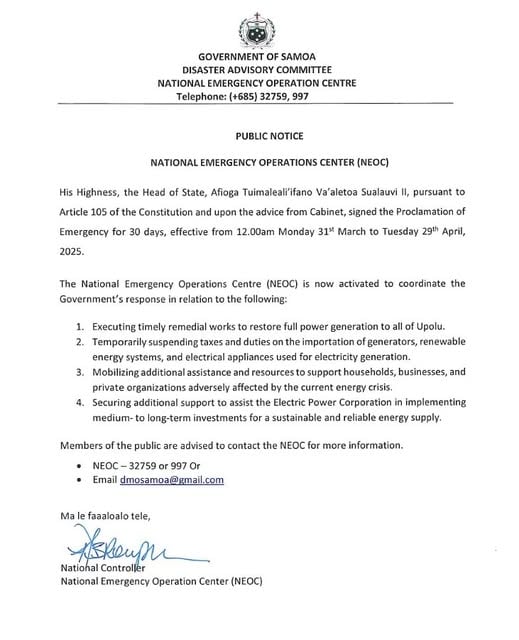
His Highness, the Head of State, Afioga Tuimaleali’ifano Va’aletoa Sualauvi II, pursuant to Article 105 of the Constitution and upon the advice from Cabinet, signed the Proclamation of Emergency for 30 days, effective from 12.00am Monday 31st March to Tuesday 29th April, 2025.
The National Emergency Operations Centre (NEOC) is now activated to coordinate the Government’s response in relation to the following:
1. Executing timely remedial works to restore full power generation to all of Upolu.
2. Temporarily suspending taxes and duties on the importation of generators, renewable energy systems, and electrical appliances used for electricity generation.
3. Mobilizing additional assistance and resources to support households, businesses, and private organizations adversely affected by the current energy crisis.
4. Securing additional support to assist the Electric Power Corporation in implementing medium- to long-term investments for a sustainable and reliable energy supply.
Members of the public are advised to contact the NEOC for more information.
NEOC 32759 or 997 Or Email dmosamoa@gmail.com
Ma le faaaloalo tele,
OFISA TŪTOTONU MO FA’ALAVELAVE MĀTUIĀ
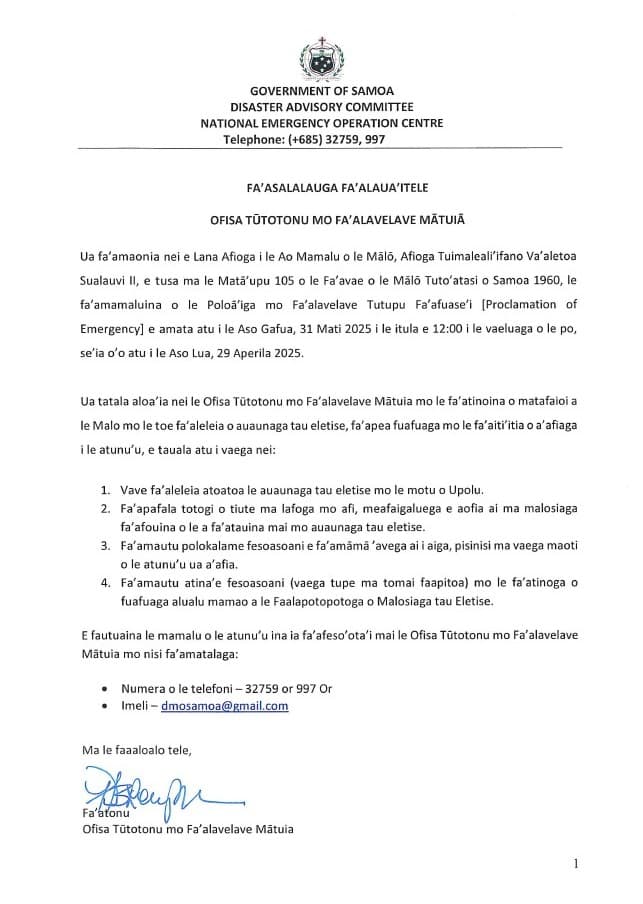
Ua fa’amaonia nei e Lana Afioga i le Ao Mamalu o le Mālō, Afioga Tuimaleali’ifano Va’aletoa Sualauvi II, e tusa ma le Mata’upu 105 o le Fa’avae o le Mālō Tuto’atasi o Samoa 1960, le fa’amamaluina o le Poloa’iga mo Fa’alavelave Tutupu Fa’afuase’i [Proclamation of Emergency] e amata atu i le Aso Gafua, 31 Mati 2025 i le itula e 12:00 i le vaeluaga o le po, se’ia o’o atu i le Aso Lua, 29 Aperila 2025.
Ua tatala aloa’ia nei le Ofisa Tūtotonu mo Fa’alavelave Mātuia mo le fa’atinoina o matafaioi a le Malo mo le toe fa’aleleia o auaunaga tau eletise, fa’apea fuafuaga mo le fa’aiti’itia o a’afiaga i le atunu’u, e tauala atu i vaega nei:
1. Vave fa’aleleia atoatoa le auaunaga tau eletise mo le motu o Upolu.
2. Fa’apafala totogi o tiute ma lafoga mo afi, meafaigaluega e aofia ai ma malosiaga fa’afouina o le a fa’atauina mai mo auaunaga tau eletise.
3. Fa’amautu polokalame fesoasoani e fa’amāmā ‘avega ai i aiga, pisinisi ma vaega maoti
o le atunu’u ua a’afia.
4. Fa’amautu atina’e fesoasoani (vaega tupe ma tomai faapitoa) mo le fa’atinoga o fuafuaga alualu mamao a le Faalapotopotoga o Malosiaga tau Eletise.
E fautuaina le mamalu o le atunu’u ina ia fa’afeso’ota’i mai le Ofisa Tūtotonu mo Fa’alavelave
Mātuia mo nisi fa’amatalaga:
• Numera o le telefoni – 32759 or 997 Or Imeli : dmosamoa@gmail.com
His Highness, the Head of State, Afioga Tuimaleali’ifano Va’aletoa Sualauvi II, pursuant to Article 105 of the Constitution and acting on the advice of Cabinet, has declared a State of Emergency for Samoa for 30 days, effective from 12:00am Monday 31 March to Tuesday 29 April 2025.
The Proclamation of Emergency enables the Government to implement emergency measures necessary to manage and restore national energy supply, protect public health and safety, and maintain essential services.
As a result of continuous power outages and electricity rationing, the Government acknowledges the significant impact on our people and economy, noting that:
1. The damage to household utilities and the safety of residential buildings.
2. The loss of power has compromised the storage of perishable food items in retail and wholesale outlets, as well as households.
3. The impact on private businesses and corporations affecting operations and livelihoods.
4. The projected economic cost of the crisis is estimated to reach approximately 16% of GDP for the 2025 calendar year, underscoring severe disruptions to national productivity, public services, and economic activity.
The Electric Power Corporation (EPC) has been working tirelessly to monitor the situation, identify solutions, and minimize, as best as possible, the impact on essential services and the daily lives of our people. Multiple factors have contributed to the current energy crisis, namely:
1. Mechanical failures at the Fiaga Power Station resulted in the loss of primary generators that supply a substantial portion of Upolu’s electricity;
2. A faulty underground transmission line disrupted power distribution across key parts of the national grid;
3. Severe weather events, most notably the destructive storm of 9 March 2025, caused widespread damage to energy infrastructure and further hindered restoration efforts; and
4. Rising electricity demand has placed additional strain on EPC’s generation capacity, particularly during peak consumption hours.
The Government is pleased to provide an update on the priority actions implemented to date in response to the ongoing energy crisis:
1. Temporary power generation units are scheduled to arrive on 5 April to provide immediate relief and supplement electricity supply. Full power restoration across Upolu is expected before the end of April, while awaiting the arrival and commissioning of permanent generators in August 2025.
2. Overhaul parts for the Fiaga generators are currently being procured to restore them to full operational capacity.
3. The Government remains committed to accelerating renewable energy and grid reinforcement projects to strengthen and diversify the national energy supply.
The Proclamation of Emergency will enable the Government to implement urgent measures to stabilize the energy supply and mitigate the impacts of the crisis by:
1. Ensuring the timely arrival and operation of temporary generators before the end of April, ahead of the permanent units scheduled for August, along with the necessary overhaul parts for Fiaga;
2. Lifting tax and import duties on generators and other electricity-related equipment, including renewable energy systems, procured by EPC, households, businesses, and organizations for electricity generation;
3. Mobilizing additional assistance and resources to support households, businesses, and private organizations adversely affected by the crisis;
4. Securing additional and targeted financial and technical support to assist EPC in implementing medium to long-term remedial works; and
5. Activating a whole-of-government coordinated response through the National Emergency Operations Centre (NEOC) to coordinate the Government’s response to the energy crisis.
The Government acknowledges the significant hardship this energy crisis has placed on households, businesses, and essential services across the island of Upolu. We want to reassure everyone that restoring a stable electricity supply and supporting those most affected remain our top priorities. Every effort is being made to respond swiftly, minimize further disruptions, and provide relief where it is needed most.
With unity, resilience, and collective action, we will overcome this challenge and move toward a more secure, sustainable, and affordable energy future for all of our people.
Faafetai and God Bless Samoa.
SAUNOAGA FA’APITOA A LE AFIOGA I LE PALEMIA, HON. FIAME NAOMI MATAAFA MO LE FA’AMAMALUINA O LE POLOĀ’IGA O FA’ALAVELAVE TUTUPU FA’AFUASE’I ONA O LE ‘ELETISE. [Aso Gafua, 31 Mati 2025]
Ou te fa’afeiloa’i atu i lenei itula o le aso, i lau fa’afofoga’aga Samoa, mai tafa e fia o le atunu’u. O ou paia ma mamalu o le a lē afea e se fa’amatalaga, auā o Samoa o le fue lavelave, e leai se poto po’o se vave na te autalaina. Ae nu’unu’u atu ia sasaga fa’atini o tausala, i le galuega tausi a le usoga a Tumua ma Pule.
Ole vi’iga o le Atua e lē fa’aitiitia, ona o lona agalelei ma lona alofa tunoa, o lo’o malu tapu ‘ā’aoina ai pea la tatou savaliga i lenei vaitau. Mālō le ta’i, fa’afetai le fai tatalo, mālō le tapua’i.
Ona o a’afiaga ma le tulaga ogaoga ole motusia ai o le ‘eletise i le atunu’u, ua fa’amaonia ai nei e Lana Afioga i le Ao Mamalu o le Mālō, e tusa ma le Matā’upu 105 o le Fa’avae o le Mālō Tuto’atasi o Samoa 1960, le fa’amamaluina o le Poloā’iga mo Fa’alavelave Tutupu Fa’afuase’i [Proclamation of Emergency] e amata atu i le Aso Gafua, 31 Mati 2025 i le itula e 12:00 i le vaeluaga o le po se’ia o’o atu i le Aso Lua, 29 Aperila 2025.
O lenei Poloaiga mo Faalavalave Tutupu Faafuasei o le a mafai ai e le Ma ̅lo ona faatinoina ma faanatinati ai galuega fesoasoani mo le toe faaleleia o auaunaga tau eletise atoa ai ma le faaitiitia o aafiaga ile atunuu.
Ua faia lenei faaiuga e tali fuaitau atu ai ile tulaga ma’ale’ale ua iai nei le tau faasoasoaina ole eletise faapea aafiaga ile atunuu, e aofia ai:
Aafiaga i tagata lautele ma le saogalemu o fale ma meatotino tau eletise ua faaleagaina.
Aafiaga tau soifua maloloina o tagata lautele mai le fa’atamai’aina o oloa taumafa tu’u-aisa e lē gata i faleoloa ma falesiiatoa.
Aafiaga i pisinisi ma atina’e o loo faamoemoe ai le tamaoaiga o tagata lautele.
Le ono o’o atu i le 16 pasene o le tamaoaiga o le atunu’u (GDP) i totonu o le tausaga 2025, ua a’afia ona o le tulaga faaletonu o le eletise.
I le taimi nei, o lo o galulue pea le Fa’alapotopotoga o Malosiata tau Eletise e toe fa’aleleia le auaunaga ma le fa’asoasoaina atu ole eletise i vaega uma ole atunuu ona o mafuaaga e aofia ai:
Fa’aletonu i afi tetele i le Faleafi i Fiaga, ma ua a’afia ai se vaega tele o le motu o Upolu;
Fa’aletonu i uaea malolosi o lo o i lalo o le ele’ele o lo’o fa’asoasoa ai le eletise;
Motusia o laina ma le fa’aleagaina o pou molī i le malolosi o savili lea na tulai mai i le Aso Sā 09 Mati 2025,
Si’itia le maualuga o manaoga tau eletise i totonu o le atunu’u, ma ua atili fa’aopo’opoina ai le eletise moomia pe a faatusa atu i le eletise maua, aemaise lava i taimi o lo o maualuga ai le manaoga tau eletise.
O lo o galulue itutino uma o le Malo ina ia foia faafitauli nei, ma e avea lenei avanoa ou te tuuina atu ai se faamatalaga i le tulaga o lo o taoto ai nei galuega:
O le Aso 05 Aperila 2025 o lo’o fuafua e taunu’u mai ai ni afi tetele mai fafo, ua lisiina mai mo le toe fa’aleleia ole auaunaga mo le motu i Upolu, a o talia ai le taunuu mai o afi tumau ile masina o Aokuso 2025.
Ua mae’a ona fa’atauina totoga moomia mo le faaleleia o afi tetele i Fiaga, ma o lo o talia le taunuu mai mo le toe fa’aleleia atoa ai o auaunaga tau eletise.
Faamautuina i se taimi vave le faatinoga o poloketi mo malosiaga faafouina (renewable energy) e tali atu ai ile siisii pea o manaoga tau eletise.
O lenei Poloaiga, o le a fa’amamaluina mo le 30 aso, ma o le a lagolagoina ai taumafaiga uma a le tatou Malo e le gata mo le toe fa’aleleia o le auaunaga tau eletise mo le atunu’u atoa, ae fa’apea le fa’atinoina o galuega e tali atu ai i a’afiaga ona o le faaletonu o auaunaga tau eletise, ma e aofia ai le:
Vave fa’aolaina o afi ua lisiina fa’avaitaimi i le masina o Aperila, e fa’atali ai le taunu’u mai o afi tetele ia Aokuso, fa’apea ma le toe fa’aleleia atoatoa o le auaunaga a le faleafi i Fiaga;
Fa’apafala totogi o tiute ma lafoga mo afi, meafaigaluega e aofia ai ma malosiaga fa’afouina o le a fa’atauina mai mo le fa’aleleia o vaega ua fa’aletonu a le Fa’alapotopotoga o Malosiaga tau Eletise, fa’apea pisinisi, faalapotopotoga ma aiga taitasi;
Faamautu polokalame fesoasoani e fa’amāmā ’avega mo aiga, pisinisi ma vaega maoti o le atunu’u ua a’afia;
Faamautu atinae fesoasoani (vaega tupe ma tomai faapitoa) mo le faatinoga o fuafuaga alualumamao a le Faalapotopotoga o Malosiaga tau Eletise.
Faatino matafaioi fa’aletulafono a le Komiti mo Fa’alavelave Tutupu Faafuasei, o lo o auai ai itutino uma o le Malo, pisinisi ma faalapotopotoga ina ia galulue faatasi mo le toe faaleleia o auaunaga tau eletise faapea fuafuaga mo le faaitiitia o aafiaga ile atunuu.
Samoa e, e lē mavae le agaga fa’afetai i lo outou sao tāua e ala i le lalago mai i galuega faifaipea a lo tatou Mālō e tauala atu i le auaunaga a le Faalapotopotoga o Malosiaga tau Eletise. O ni taga e fai i vasa, ma ni tonu e le tuā le taumafai atu o le Mālō, pe ana leai lo outou finagalo malamalama e lagolagosua ma onosaia ai lenei galuega fītā. Fa’afetai tele i lo outou onosa’i ma le lava papale, a o fa’agasolo ai galuega fa’aleleia a le tatou Fa’alapotopotoga o Malosiaga tau Eletise.
E momoli foi le fa’afetai ma le fa’amālō a lo tatou Mālō i le aufaigaluega galulue a le Faalapotopotoga o Malosiaga tau Eletise. Mālō le tautua, fa’afetai le galulue lē fa’alogologotigā. Le Atua o manuia, na te tauia lo outou afu sisina. O lo o tatou folau pea ma lu’itau e ui ina tatou folau mālie i le laula’i o Matāmatagi a o vavala mai ata o Tauleleia.
E leai so tatou malosi, po o so tatou poto tatou te malu ai, pe ana le seanoa le Atua o lo’o tatou auauna i ai. Ua na o le Atua lava na te mafaia mea uma, o Ia na te fa’atonu folau ma ta’iala si o tatou atunu’u, e tusa ma le ta’ita’iga a lona Agaga Paia ma lona finagalo alofa iā Samoa. Ia tumau pea lo tatou fa’atuatua ma le mautinoa, pe lutia lava tatou i puava, tatou te mapu i Fagalele. O tua atu fo’i o le loulouā ma le mamafa o timuga, o lo o tumau ai pea le susulu o le la o le amiotonu a lo tatou Atua.
Ia tumau i le alofa tulituliloa ma le finagalo fa’apaolo o lo tatou Atua, le faigāmalaga a Samoa.
The Commission is convinced that agricultural production and nature preservation must go hand in hand to face climate change by improving water resilience and give young farmers a farming future. Balance between agriculture and nature has both an EU and a national dimension.
The present Common Agricultural Policy (CAP)[1] and existing environmental and climate acquis, provide a solid legal framework for Member States to identify fit for purpose targets, based on National Strategic Plans, offering them more margin for manoeuvre than before.
Member States have designed tailor-made interventions in their CAP Strategic Plans (CSPs) which also target livestock-related pollution. Eco-Schemes and Agri-Environmental and Climate Commitments support interventions to improve water quality and nutrient management, addressing manure surplus, on 21% and 15.5% of EU farmland[2] respectively.
Other interventions include livestock density adjustments, aiming at reducing Greenhouse Gases, water and air (ammonia) emissions (for example, the Luxembourgish CSP[3] offers financial aid to less intensive animal husbandry systems).
In his speech during the Grüne Woche[4] (Green Week), the Commissioner for Agriculture and Food reflected on targeted territorial solutions for balancing the livestock sector’s competitiveness with environmental sustainability, as published later in the Commission’s Vision for Agriculture and Food[5].
This approach includes maintaining grasslands, valorising the link with carbon sinks and improved water resilience, as well as more extensive systems beneficial in preserving biodiversity while reducing negative externalities.
The informal agreement between EU co-legislators will ensure soil is monitored in all EU countries and farmers get better support to improve soil health.
On Wednesday evening, Parliament and Council negotiators reached a provisional political agreement on the Commission’s proposal for a soil monitoring law. The overall objective is to have healthy European soils by 2050, in line with the EU’s “zero pollution” ambition. It should also provide for a more coherent and harmonised EU framework for soil monitoring.
Monitoring and assessing EU soils
According to the deal, member states will have to monitor and assess soil health across their territories using common soil descriptors – characterising the physical, chemical, and biological aspect of soil health for each soil type – and an EU methodology for sampling points. To make it simpler for member states, they will be free to build on national soil monitoring campaigns or other equivalent methodologies. The Commission will support member states by reinforcing its current EU soil sampling programme, LUCAS Soils. It will offer tailor-made financial and technical support.
To reflect different levels of soil degradation and local conditions, national governments will set non-binding, sustainable, targets for each soil descriptor, in line with the overall objective of improving soil health.
No new obligations for farmers
To protect farmers and foresters, the agreed directive does not impose any new obligations on landowners or land managers. Instead, it obliges EU countries to help them improve soil health and soil resilience – the soil’s capacity to keep playing its important role in the ecosystem. Support measures may include independent advice, training activities, and capacity building, as well as the promotion of research and innovation, and measures to raise awareness of the benefits of soil resilience. Member states will also have to assess regularly the financial cost to farmers and foresters’ of improving soil health and soil resilience.
Contaminated soils
The law will require member states to draw up a public list of potentially contaminated sites within ten years of its entry into force and address any unacceptable risks to human health and the environment.
Finally, an indicative watch list of emerging substances that could pose a significant risk to soil health, human health or the environment, and for which data is needed, will be drawn up 18 months after the law enters into force. This list will include relevant PFAS (also known as “forever chemicals”) and pesticides.
Quote
On reaching the agreement, rapporteur Martin Hojsík (Renew, SK) said: “Today’s deal is an important milestone in improving support for farmers and all others in keeping the soil healthy. Providing them with better information and help, while preventing bureaucracy and new obligations, are cornerstones of the new soil monitoring law.”
Next steps
Parliament and the Council have concluded an “early second reading agreement” (the negotiation took place after Parliament’s first reading was adopted in plenary). The Council is now expected to adopt this agreement formally, and Parliament will then have to endorse the text in plenary, in second reading.
The directive will enter into force 20 days after its publication in the EU Official Journal. From this date, EU countries will have three years to comply.
Background
An estimated 60 to 70% of European soils are unhealthy due to urbanisation, low land recycling rates, intensification of agriculture practices, and climate change. Degraded soils are major drivers of the climate and biodiversity crises, and they reduce the provision of key ecosystem services. This costs the EU at least €50 billion per year, according to the Commission.
Stars of the Olympics and Paralympics are set to be saluted alongside local coaching stalwarts and a whole host of other unsung heroes at the 2025 Leeds Sports Awards.
Nominations opened in February for the 22nd edition of the event, held each year to celebrate the achievements of individual athletes – of all ages and levels – as well as community-based teams and volunteers.
And the chosen finalists in a total of 13 different categories have now been announced as the countdown continues to next month’s awards ceremony.
Paralympic champions Hannah Cockroft and Kadeena Cox are shortlisted for the Disability Sportsperson Award, while Olympic gold medallists Katy Marchant, Tom Pidcock and Georgie Brayshaw are in contention for the Sportsperson Award.
Diving coach Adam Smallwood, gymnastics coach Dave Murray, wheelchair racing coach Paul Moseley and triathlon coach Rhys Davey are all finalists in the Performance Coach Award category.
Taking place on Thursday, May 15, this year’s ceremony will be held for the first time at Leeds’s Carriageworks Theatre and is being hosted by sports broadcaster Tanya Arnold and Leeds Rhinos great Jamie Jones-Buchanan.
The recipient of 2025’s Sporting Pride of Leeds Award – previously won by legendary names such as Jonny and Alistair Brownlee, Eddie Gray and Rob Burrow – will be announced on the evening.
The awards are once again being delivered by Sport Leeds with support from Leeds City Council.
Rob Wadsworth, chair of Sport Leeds, said:
“The long-awaited finalists announcement has been made and, as you would expect from this great sporting city, we will be celebrating the global success of athletes and their coaches, but equally as important, the unsung heroes of community sport.”
Councillor Salma Arif, Leeds City Council’s executive member for adult social care, active lifestyles and culture, said:
“From a very large number of nominations, the judges have produced an exceptional list of finalists representing every level of sport across the city, from inspirational community champions to Olympic and Paralympic gold medal winners. We look forward to showcasing their sporting achievements at the wonderful Carriageworks Theatre.”
2025 LEEDS SPORTS AWARDS FINALISTS
Young Disability Sportsperson (Sponsored by Technogym)
Lucas Town
Oliver Porter
Disability Sportsperson (Sponsored by Technogym)
Hannah Cockroft
Kadeena Cox
Young Sportsperson (Sponsored by Technogym)
Amy Wright
Matilda Potter
Yaried Alem
Sportsperson (Sponsored by Technogym)
Georgie Brayshaw
Katy Marchant
Tom Pidcock
School Achievement (Sponsored by YPO)
Dave Curtis
St Theresa’s Catholic Primary School
Outstanding Sports Volunteer (Sponsored by Rosterfy)
Fiona Croft and Becky Simmonds
Dr Ian Richards
Community Coach (Sponsored by Evans Homes)
Charlotte Williams
Elaine Brown & Pete Makowski
Community Team/Club (Sponsored by Evans Homes)
Crossgates Harriers
Methley United AFC
Student Sport Champion (Sponsored by Leeds Trinity University)
Luke Whitehouse
Max Burgin
Inspirational Community Champion (Sponsored by University of Leeds)
Anthony Hall
Come Outside – Jovanni & Rob
Performance Coach (Sponsored by Yorkshire Sport Foundation)
Adam Smallwood
Dave Murray
Paul Moseley
Rhys Davey
Performance Team/Club (Sponsored by Weetwood Hall Estate)
City of Leeds Diving Club
Leeds Gymnastics Club
Sustainability Champion (Sponsored by Zoggs)
K.E.E.P.
Yorkshire Cricket Foundation
Sporting Pride of Leeds (Sponsored by first direct arena)
Winner to be announced during May 15’s ceremony
Note to editors:
Sport Leeds was established in 2002 and has since become a dynamic sports network with a strong reputation in the city and region. It serves as the strategic partnership for organisations involved in promoting and developing sports and active recreation in Leeds.
The network includes professional and amateur sports clubs, universities, colleges, school clusters and other important sporting organisations from within the city, region and beyond.
Highland Council’s Trading Standards team is informing local traders that from 1 June 2025, the sale and supply of single-use vapes will be banned across the UK. Businesses in Highland are encouraged to review their stock and prepare for these changes to ensure compliance with the law.
David MacKenzie, Trading Standards Manager said: “Highland Council Trading Standards fully supports the ban on single-use vapes. This legislation is a crucial step towards reducing environmental harm and protecting public health. Single-use vapes contribute significantly to litter in our streets and parks and pose fire risks in waste and recycling facilities. By eliminating these single-use products, we are not only safeguarding our environment but also promoting responsible vaping practices. Our team is committed to ensuring compliance with this new regulation and supporting businesses through this transition.”
This ban applies to both in-store and online sales. It covers all products classified as single-use vapes.
Steps for businesses to take now
Businesses should:
review their stock and identify single-use vapes
stop buying new stock of single-use vapes
sell all existing stock
only buy vapes from reputable sources that follow the new regulations
train their employees about the new requirements and compliance expectations
arrange for the environmentally responsible disposal of any unsold single-use vapes
From 1 June 2025, it is an offence to have disposable vaping products in your possession for sale. Any leftover disposable vaping products must be:
stored in stock rooms away from the shopfloor
separated from other goods
securely wrapped
clearly labelled
Leftovers must be left waiting to be collected for disposal and not for sale.
Enforcement and Penalties
Highland Council Trading Standards will enforce the ban in Highland. Businesses found in violation may face:
seizure of non-compliant products
a Fixed Penalty Notice of at least £200
criminal prosecution with fines of up to £5000
Why this ban matters
Single-use vapes are difficult to recycle and typically end up in landfills, where their batteries can leak harmful waste like battery acid, lithium, and mercury into the environment. Batteries thrown into household waste also cause fires in bin lorries and waste-processing centres. DEFRA estimates almost five million single-use vapes were either littered or thrown into general waste each week last year.
More Information
The Department for Environment, Food and Rural Affairs (DEFRA) has published a comprehensive guide for distributors, suppliers, and retailers to help businesses understand their responsibilities under the ban. The guide includes:
the definition of single-use vapes
practical steps to identify compliant products
enforcement measures and potential penalties for non-compliance
I would like to start by acknowledging the Wurundjeri Woi-wurrung and Bunurong/Boon Wurrung peoples of the Eastern Kulin nation as the traditional owners and custodians of the land on which we are meeting this evening and pay my respects to Elders, past and present, as well as any First Nations people here with us or online.
It is great to be here to mark 40 years of Chief Executive Women (CEW).
I hadn’t intended to talk about the RBA’s policy responsibilities tonight, seeing as we are here to recognise the progress in women’s economic empowerment. However, given developments over the past week, I will make a few short comments first.
Inevitably, there will be a period of uncertainty and adjustment as countries respond to the ongoing tariff announcements by the United States administration. It will take some time to see how all of this plays out and the added unpredictability means we need to be patient as we work through how all of this could affect demand and supply globally.
Financial market and economic volatility can be expected as this process unfolds. But there are two points I want to make on this. First, we’re not currently seeing the same degree of impact as previous market events like in 2008 for example. And second, the Australian financial system is strong and well placed to absorb shocks from abroad.
We are closely monitoring financial market conditions here and overseas – as we always do. We continue to engage closely with our fellow financial regulators in Australia, and our central bank counterparts overseas, sharing information and working together. We are carefully considering several factors including the response of our trading partners, additional counter-responses from the US, the response of our exchange rate, and adjustments in other financial markets. A key focus for us is how all this uncertainty is affecting decisions made by households and businesses in Australia.
All of this – together with our usual detailed analytical work and scenarios – is helping us build a fuller picture of the possible impacts as we prepare for the next Monetary Policy Board meeting on 19-20 May. There are a lot of moving parts. We are bringing all this together to form an objective assessment of what it means for the outlook for domestic activity and inflation here at home.
We are mindful of not adding to the uncertainty, and to that end, it’s too early for us to determine what the path will be for interest rates. Our focus remains on our dual mandate for price stability and full employment.
Now, back to our focus for being here tonight.
I’ll reflect on the significant strides in women’s empowerment in the Australian economy and the progress made by women at the RBA over the past 40 years. In doing so, I will provide some reflections on my own leadership journey. I’ll also highlight our efforts to help build the pipeline of future female economists and business leaders.
Women’s economic empowerment
Over the past 40 years, women’s representation and participation in the Australian economy has undergone a remarkable transformation.
In the mid-1980s, women made up just under 40 per cent of the workforce, with married women’s participation in the labour market especially low. But through persistent efforts – including by organisations like CEW and many of the individuals in the room tonight – women’s participation in paid work has increased considerably.
Law reform has helped, too, with the introduction of the Sex Discrimination Act in 1984 paving the way for further reforms to advance women’s rights, particularly in our workplaces. This progress has been supported by a range of other factors, including greater access to education and child care. The increased availability of more flexible working arrangements – for women and men – has also helped.
Fast forward 40 years and women now account for almost half of the paid workforce. This has given women greater financial independence and social equity, a worthy goal in and of itself. But beyond that, it has expanded the pool of available workers, providing businesses with a larger and more diverse talent base.
There are some estimates for the United States that show that between 20–40 per cent of productivity growth in the 50 years to 2010 could be attributed to better talent allocation.
The idea here is simple. If there are more people working in positions that suit their skills, this maximises their ability to contribute to economic growth and better and more informed decision-making within organisations. It is good for women, good for businesses, good for productivity and the economy, and good for society.
Opportunities to increase equity and representation
While women’s labour force participation has increased, there’s further progress to be made.
Research from the Workplace Gender Equality Agency (WGEA) shows that fewer than 20 per cent of CEOs are women, while women made up only one-third of board members. The federal public service fares better, with women holding more than 50 per cent of Australian government board positions, and 45 per cent of chair and deputy chair positions.
The gender pay gap remains an issue. Since the mid-1990s, the gender pay gap has narrowed by about 3 percentage points, mostly in the past decade. However, men still earn $28,000 more per year on average than women.
But there are positive signs, particularly for younger workers. Participation rates for those aged 25 and under are now equal for men and women, allowing young women to build skills and experience for future leadership roles.
Indeed, in addition to closing gender gaps being the right thing to do, analysis by the Organisation for Economic Co-operation and Development (OECD) indicates that it could boost GDP by an average of 9 per cent across OECD countries by 2060. Given our ageing population in Australia, boosting the labour force participation of working-age women is not only desirable, but essential, for economic growth.
My leadership journey at the RBA
At the RBA, we have a wide range of responsibilities and rely on diverse sets of skills and experience to get the job done. Women play an essential role in all aspects of our operations.
But this hasn’t always been the case. In the 1960s and 70s, pioneers like Ann Catling and Margaret Campbell paved the way for gender equity at the RBA. Ann Catling, one of only 13 women on the men’s pay scale at the RBA in 1966, made significant contributions to development economics and gender equity. Margaret Campbell, who began at the RBA in 1967, achieved equal compensation with men while studying full-time at university. Other notable figures include Jillian Broadbent and Kerry Schott, who contributed to the RBA’s first econometric model of the Australian economy.
When I first joined the RBA in the mid-1980s, there were barely any women at the level of section head. In 1996, I was the first female to reach deputy head level in a policy department.
Reflecting on my journey, there were three important milestones for me.
The first was earning a scholarship from the RBA to undertake a Masters degree in Economics at the London School of Economics. It wasn’t just the postgraduate training. It was also an early recognition than my leaders saw promise in me.
The second was a career move when I came back from maternity leave. I was appointed as the deputy head of a new department – Payments Policy. It gave me a completely blank sheet of paper to build something new. I had very direct and regular exposure to the Governor and to the members of the Payments System Board. And I had great leaders – including men who were encouraging of me and other women as we progressed.
The third milestone was my appointment to Assistant Governor (Currency) in 2010 – the first female assistant governor. This was a big change for me. It was a move from a policy to an operational area, in which I was not an expert. I also had to lift my gaze beyond my area of specialty to the enterprise level.
In the last decade, women’s representation at the RBA improved significantly. In June last year, we achieved 40 per cent women in management roles. Women made up 44 per cent of employees, with four of seven Executive Committee positions held by women. 56 per cent of promoted employees were women, and 63 per cent of those promoted to management were women. These promotions were all based on skills and ability.
This progress reflects the RBA’s commitment to inclusion, and it is also a testament to the resilience and determination of women at the RBA.
There are four things I have learnt in my leadership journey. The first is not to undersell myself. Women have to be prepared to promote themselves even if we don’t feel 100 per cent confident. Second is don’t be afraid to do something different. I always took opportunities when they were offered. Most often it was a sideways move. Third, I found people who I trusted to guide me – some internal and, as I became more senior, people from outside the RBA. My contacts at CEW have been important here. Finally, the teams around me are my most valuable resources. They are professional, know what they are doing and always give their best. My job is to draw on that expertise, support them and guide them.
Building the pipeline of future economists
Finally, I want to say a few words on the work the RBA is doing to build a diverse pipeline of future economists, policymakers and business leaders in Australia. There has been a sharp decline in the size and diversity of the economics student population since the early 1990s. The trend raises concerns about economic literacy in society and the long-term health of the economics discipline.
This is an important reason for the RBA’s education program, which engages with students and teachers and provides a range of resources that aim to inspire and support the next generation of economists. Some of our initiatives include school outreach programs and providing educational resources, research into the economics education landscape, and engagements with educational and curriculum bodies.
Today, males still outnumber females by two to one in high school and university economics. Our research confirms that a confidence gap exists for females; that female students tend to underestimate their proficiency when it comes to economics. It is not the case that women can’t do economics – which I am sure will come as no surprise to anyone in this room.
Even among year 12 students who do study economics, a recent RBA study has found that there is a low interest in pursuing economics at the university level, particularly for females. Instead, these students are more likely to enrol in commerce, finance, or arts and social science courses.
One approach to increase the flow of high school students into university economics could be to develop some tailored advocacy to emphasise the connections between economics and other preferred fields of study. Increasing the representation of female role models amongst economists, female economics teachers and female advocates for economics in the public domain could also help.
Conclusion
While we have made significant strides in improving gender equity and increasing female participation both at the RBA and within the broader Australian economy, there is still much work to be done.
I hope that my role as Governor of the RBA – the first woman to hold the role – gives encouragement to women coming up through the ranks of Australian businesses and the public service. You can do it.
Thank you to CEW for the opportunity to speak to you ahead of what I’m sure will be an engaging panel discussion.
In today’s fast-paced world, technology is transforming the way we live, work, and play. At the heart of this transformation is the concept of smart living – a world where connected devices work together seamlessly to simplify our daily routines, increase efficiency, and enhance overall comfort. All of this is possible thanks to Samsung SmartThings, the smart home ecosystem that is helping South Africans experience the future of living right in their homes today.
Smart living isn’t just about flashy gadgets or futuristic innovations. It’s about creating a connected environment where everything works together in harmony. The rise of smart devices has made it easier than ever to enhance the functionality of your home, but managing multiple devices can quickly become overwhelming. That’s where Samsung SmartThings comes in, offering a centralised platform that integrates and automates a wide range of devices – from lights and thermostats to refrigerators and washing machines – making your home smarter, more efficient, and easier to manage.
What is Samsung SmartThings?
Samsung SmartThings is a comprehensive smart home platform that acts as the central hub for your connected devices. By linking up everything from lights and air conditioners to TVs and washing machines, SmartThings enables you to control your home environment with a few taps or voice commands. It’s compatible with a wide array of Samsung and third-party devices.
Whether you want to adjust the temperature, monitor your energy usage, or simply control your lights, SmartThings connects it all in one simple, easy-to-use app. Samsung ensures that your home is equipped for the future with seamless integration across its range of devices – including smartphones, wearables, and TVs.
Professional gamer, tech enthusiast and TV presenter, Grant Hinds, who has had experience with SmartThings as Samsung’s brand partner, had this to say, “SmartThings is more than a smart home platform – it’s a practical ecosystem that adapts to real life. I’ve always believed that tech should simplify, not complicate. What Samsung has done here is take the guesswork out of connected living. Whether you’re managing energy, automating your day, or syncing your lifestyle across devices, it just works. That’s where the power lies – in its quiet efficiency and seamless integration.”
Everyday Smart Home Hacks Using Samsung SmartThings
Samsung SmartThings is designed to simplify and elevate your daily life. Here are some easy-to-implement “hacks” that will take your home to the next level:
Automate Your Lighting
Set up motion sensors to automatically turn your lights on and off as you enter or leave a room. No more fumbling for switches in the dark or worrying about leaving the lights on when you head out.
Create Custom Routines
Create routines that automatically adjust your home to suit your schedule. For instance, program your thermostat to adjust to the perfect temperature when you wake up or when you return home. You can also set your speakers to play your favourite playlist as soon as you walk in the door or your favourite podcast as you start your day.
Save Energy
With SmartThings, you can monitor the energy consumption of your appliances and devices in real-time. Set up appliances to operate during off-peak hours to save on electricity costs, or use SmartThings to receive energy-saving tips and reminders to optimise your usage.
Improve Home Health and Comfort
Smart sensors can help you maintain optimal conditions for comfort and health in your home. From controlling air quality with smart air purifiers to adjusting temperature and humidity, SmartThings helps create a healthier, more comfortable living environment.
Secure Your Home Automatically
Set up a routine to ensure your doors are locked and security cameras are activated when you leave the house. You can even receive notifications if any unusual activity is detected while you’re away.
Integration with Other Samsung Devices
Samsung’s ecosystem is more than just a group of devices – it’s an integrated experience designed to make life easier. For example, you can control your SmartThings-compatible devices directly from your Galaxy smartphone, giving you control whether you’re at home or away. Want to adjust your home’s thermostat from your Galaxy Watch? With SmartThings, you can do that too. Plus, the Samsung Smart TV can be seamlessly integrated into the SmartThings platform, allowing you to control TV settings or even automate actions based on what’s happening on-screen.
From controlling lighting to checking your home’s energy usage, all of your Samsung devices can work together to create a personalised, connected environment.
Sustainability with SmartThings
SmartThings isn’t just about convenience – it’s also about sustainability. With the ability to monitor and reduce energy consumption, SmartThings empowers users to live in an eco-friendly way. Smart sensors can alert you when energy consumption is higher than usual, and you can adjust your devices to be more energy-efficient. Whether it’s optimising heating and cooling or turning off devices that aren’t being used, SmartThings makes it easier to reduce your carbon footprint and save on energy costs.
Ready to experience the convenience of Smart Living? Discover how Samsung SmartThings can help you transform your home into a smarter, more efficient space today. Go to SmartThings to learn more and click here to download the app.
Hiroshima tree of hope finds new home in Gate Lodge Gardens
10 April 2025
Horticulture students from Greenmount College shared a message of hope this week at the newly opened Gate Lodge Gardens in Derry’s St Columb’s Park, with the planting of a special tree cultivated from Ginkgo Biloba seeds from Hiroshima.
Eighty years since the devastating atomic bomb that destroyed the Japanese city, the seeds of the Hibaku-jumoku – Japanese for survivor trees – now have a new purpose, representing resilience and rebirth.
Students at the College of Agriculture, Farming, and Rural Enterprise (CAFRE) at Greenmount have been entrusted with sharing their important legacy though the Green Legacy Hiroshima Project, working with partners throughout the world to reinforce the message of peace. St Columbs Park has been selected as one of a number of special sites to locate a tree, which has been grown from seedlings cultivated by the students.
The group met with the Mayor of Derry and Strabane, Councillor Lilian Seenoi Barr, to plant the tree at the recently completed Gate Lodge which is part of the Acorn Farm project.
It’s a particularly fitting symbol of hope and peace to mark the 80th anniversary of the end of WW2. Members of Foyle Obon representing the local Japanese Community also joined the Mayor and the students for the planting.
The Mayor heard more about the Green Legacy Hiroshima Project, and plans for the college to work closely with the Acorn Farm project, Derry’s first urban farm. Acorn Farm is an exciting and innovative project currently transforming a disused military site into a vibrant urban food growing space.
Speaking afterwards Mayor Barr said: “I want to thank Greenmount College for gifting the tree to Council and dedicating it to St Columb’s Park as the home for one of the Hiroshima Trees. It sends a wonderful message of peace and solidarity at a time when sadly there is much conflict and upheaval in the world.
“In a city where peace and reconciliation has led to such a positive transformation, I think our example can be one of hope for other places embroiled in war. We stand in solidarity with all the innocent victims of violence and conflict. 80 years since the end of the Second World War, it’s a timely opportunity to reflect and reinforce our message that peace is the only way forward and no one should be oppressed because of their race, politics or religion.”
The Acorn Farm project has partnered with Greenmount College and will offer student placements as part of their education offering hands on practical experience as part of the project’s Green Academy programme of community education and engagement around sustainable food production.
The £6.2million capital project is being led by Derry City and Strabane District Council, funded by the UK, and is delivered by a partnership team consisting of Council, The Community Foundation for Northern Ireland, The Conservation Volunteers, Developing Healthy Communities and Community Garden Support.
David Dowd from CAFRE said the students were looking forward to learning and contributing to the project. “We are delighted to be here today and to pass on this sapling which has been carefully nurtured by the students at Greenmount. It will be well looked after here, and become part of the wonderful shared community space that is being created.
“I know the students are really looking forward to continuing to engage with the learning academy that is being developed at Acorn Farm, and to playing an active role in developing new approaches to growing food in a sustainable and environmentally friendly way.”
Source: United Kingdom – Executive Government & Departments
Press release
SIA grants funds to preventing violence against women and girls
The SIA has awarded its grant for good causes to 3 organisations preventing violence against women and girls.
Today (10 April 2025) the Security Industry Authority (SIA) announced the award of its 2024 to 2025 grant for good causes.
The SIA’s grant for good causes is funded from proceeds of crime confiscated from individuals convicted of criminal offences within the private security industry. Grants are used to benefit the private security industry and improve public protection.
The beneficiaries of this year’s grants have distinct roles but share a common goal: preventing violence against women and girls. This includes working with victims and survivors of sexual violence, child sexual abuse, and domestic abuse.
Paul Cartlidge, Chair of the grants panel, and Investigations and Enforcement Head of Operational Support at the SIA, said:
We believe that crime should not pay, so it’s fitting that illegally acquired money should be taken from criminals and used for the benefit of society and especially for the protection of the public. The organisations we have awarded to this year are actively preventing violence against women and girls, and their applications resonated with the panel and stood out from many other worthy applicants.
The grants for 2024 to 2025 have been awarded to:
Centre for Action on Rape and Abuse in Essex (CARA): £10,000
The Haven Refuge Wolverhampton: £2,661.50
Rising Sun: £3,283.50
The SIA is proud to support organisations in their vital work in creating safer, more supportive communities.
Organisations are eligible to apply if they are a registered charity or a not-for-profit organisation and are able to clearly demonstrate the positive impact of the grant to public protection.
The Proceeds of Crime Act 2002 (POCA) enables the SIA to investigate the financial activity of people who have committed a criminal offence and confiscate the proceeds of crime through a court-issued confiscation order. The SIA has been a designated body under POCA since 2015.
The SIA receives a portion of the money it recovers through confiscation orders under the Asset Recovery Incentivisation Scheme (ARIS). This money can only be used to fund its financial investigation capability or distributed to good causes.
Confiscating ill-gotten cash helps to deter others from committing crime, makes sure that people do not financially benefit from criminal acts, and makes it harder for convicted criminals to come back into the private security industry.
The SIA is the organisation responsible for regulating the private security industry in the UK, reporting to the home secretary under the terms of the Private Security Industry Act 2001. The SIA’s main duties are the compulsory licensing of individuals undertaking designated activities and managing the voluntary Approved Contractor Scheme (ACS).
KINGSTOWN, St. Vincent and the Grenadines, April 10, 2025 (GLOBE NEWSWIRE) — WOO X, a leading global crypto trading platform, has released its quarterly report focusing on artificial intelligence as a central element of its product roadmap for the remainder of 2025.
WOO’s strategy this year centers around four key priorities:
Growth: Driving user acquisition and increasing trading volume across WOO X and WOOFi to fuel staking rewards and token utility.
Efficiency: Maintaining a lean, high-performing team structure to maximize productivity and output.
AI Integration: Rolling out a full suite of AI-powered tools and infrastructure to enhance user experience and support smarter trading decisions.
WOO App 2.0: Launching a next-generation app in the second half of the year to unify trading and investing under one seamless interface.
In parallel with its product development efforts, WOO is expanding partnerships across institutional players, layer-1 and layer-2 networks, and AI firms—especially in key regions like Asia and the U.S. These partnerships are crucial for scaling WOO’s global presence and embedding it deeper into the evolving crypto ecosystem.
Toward a sustainable business model
2024 marked a pivotal turning point in WOO’s business fundamentals, with revenue growing 3.5x year-over-year, driven by strong usage across WOO X and WOOFi. While expenses also increased during this period, WOO is now positioned to shift its focus toward sustainable, profitable growth in 2025.
Token utility and ecosystem incentives
Staking continues to play a central role in WOO’s ecosystem, with real yield being shared with stakers through revenue-based rewards. This creates a stronger connection between platform usage and token holder value. As trading activity increases, this feeds into WOO buybacks and additional token burns, reinforcing a deflationary dynamic.
Looking ahead
With several roadmap milestones planned for the first half of the year—including early releases of new AI products and a preview of WOO App 2.0—WOO’s focus remains squarely on delivering meaningful utility to its users. Community and institutional adoption continues to fuel the platform’s global reach, with over 86% of tokens already circulating.
As Q2 begins, WOO will unveil the next phase of its “Reform WOO” initiatives, which will cover product launches, growth campaigns, and a renewed commitment to building a best-in-class app ecosystem.
About WOO X WOO X is a global centralized crypto futures and spot trading platform offering the best-in-class liquidity and price execution. WOO X has achieved a daily volume exceeding $1.6 billion and is home to hundreds of thousands of traders worldwide. WOO X traders benefit from radical transparency through our industry-first live Proof of Reserves & liabilities dashboard and the company’s mission to maintain the trust of its growing community of traders.
Disclaimer and important information
This report provides an overview of WOO’s key achievements, developments, and performance over the past quarter. It is intended solely for informational and educational purposes and should not be interpreted as an investment recommendation, offer, or solicitation for any products or services.
Investment decisions should be made with caution. The content herein does not cater to individual investment needs or circumstances. We strongly advise consulting with a professional financial advisor before making any investment decisions. The views and opinions expressed in this report are those of WOO and do not reflect any official policy or position.
While efforts have been made to ensure the accuracy and reliability of the information provided, WOO does not guarantee its completeness or precision. The content of this report has been translated into various languages and disseminated across multiple platforms. Despite our efforts to ensure accurate translations, discrepancies or inconsistencies may occur. In such cases, the English version available on our official website shall prevail.
Past performance is not indicative of future results. Any forward-looking statements in this report are based on current expectations and projections about future events. They are subject to risks, uncertainties, and other factors that may cause actual results to differ materially from those anticipated. We make no representations or warranties, express or implied, regarding the accuracy, completeness, or reliability of the information provided. Any reliance you place on such information is strictly at your own risk. WOO does not undertake any obligation to update these statements in light of new information or future events.
This report is not intended for distribution in any jurisdiction where such distribution would be contrary to local law or regulation.
We reserve the right to the final interpretation of the information and content presented in this report. Any interpretations, conclusions, or decisions made based on this report are subject to our sole discretion.
For any queries or clarifications regarding the content of this report, please feel free to contact us.
The Tectum Labs innovation hub aims to focus on business tokenization and Web3 growth, supporting projects in blockchain, DeFi, and NFTs with services like tokenomics, tech development and marketing.
Tectum Labs integrates Tectum’s tools: high-speed blockchain, SoftNote Wallet, and SoftNote payments; future tools include Tectum SDK and ePoS.
Scalable Web3 projects will also benefit from mentorship, investor connections, and exchange listing assistance.
The announcement aligns with Tectum’s mission to bridge tradFi and DeFi, following Tectum 4.0 mainnet and SoftNote success.
Dubai, UAE, April 10, 2025 (GLOBE NEWSWIRE) — – Tectum, the high-performance blockchain innovator, has officially launched Tectum Labs, an innovation hub focused on business tokenization and supporting projects in the Web3 space. Positioned as a hub for blockchain innovation, Tectum Labs aims to demonstrate that any business can be tokenized, offering comprehensive services to help projects scale in blockchain, DeFi, and NFT ecosystems.
The launch underscores Tectum Lab’s mission to act as an end-to-end tokenization suite built for real-world impact – unlocking liquidity, streamlining operations, and expanding access to global capital markets.
Tectum Labs provides structured support across the project lifecycle, beginning with in-depth evaluations to assess innovation, business potential, and team capabilities. It then offers full-cycle tokenomics development to create sustainable token models, alongside technical build-outs for web platforms, mobile apps, and custom software solutions. Audited smart contract development is also available to support staking mechanisms, DAO governance, and token issuance across multiple ecosystems.
Additionally, go-to-market support is included, covering ICO/IDO planning, whitelist onboarding, and investor KYC.
“Tectum Labs is about making tokenization practical and accessible for businesses looking to enter the decentralized economy,” said Alexander Guseff, Founder & CEO of Tectum. “We’re providing a full suite of tools – high-speed blockchain infrastructure, sustainable tokenomics design, and real-world payment solutions like SoftNote – alongside expert mentorship and investor access to transform ideas into scalable Web3 projects. By building on Tectum 4.0’s performance and SoftNote’s ability to simplify crypto transactions, we’re enabling companies to adopt blockchain seamlessly and drive measurable growth.”
Tectum Labs caters to a wide spectrum of clients, from traditional businesses to fintech startups to asset managers and RWA tokenization projects, offering custom Web3 strategies for real-world scalability.
Leveraging Tectum’s blockchain infrastructure, Tectum Labs integrates the high-speed Tectum 4.0 Layer-1 blockchain for scalable smart contract deployment in DeFi, NFTs, and gaming, the SoftNote Wallet for secure storage and dApp integration, and SoftNote – a gas-free, borderless payment system ideal for merchant adoption. Cross-chain compatibility with EVM networks like Ethereum, BSC, and Solana ensures flexibility and broader developer support.
Projects are also granted access to Tectum’s in-house tools including the upcoming Tectum SDK for dApp creation, ePOS crypto terminals for retail, and P2P exchange platforms currently in development. AI-powered optimization tools will further help projects refine go-to-market strategy, audience targeting, and feature optimization.
With its mentorship program and curated investor framework, Tectum Labs also helps projects attract capital, form strategic partnerships, and grow their communities from early user testing to mainnet traction.
The launch aligns with Tectum’s broader vision of bridging traditional finance with decentralized solutions, a mission already underway with Tectum 4.0’s public mainnet and the growing adoption of SoftNote. Tectum Labs takes this a step further by empowering businesses to tokenize assets and grow in Web3, with a focus on measurable outcomes like successful token launches, investment acquisition, and community engagement. Following the mainnet activation in February 2025, Tectum Labs is set to play a key role in the company’s 2025 roadmap, alongside plans for quantum-resistant security via Tectum Keys in Q2.
A subsidiary of Crispmind Ltd., Tectum continues to push blockchain adoption through scalable, secure solutions. Tectum Labs is now operational, welcoming projects ready to tokenize and grow in the decentralized economy. For more details, visit www.tectumlabs.com.
-ENDS-
About Tectum
Tectum is transforming digital payments with Tectum 4.0, its high-performance Layer-1 blockchain, designed for scalability and real-world adoption.
Built on Tectum 3.0, SoftNote enables zero-fee, instant peer-to-peer crypto transactions, eliminating network confirmations and gas fees. The SoftNote ecosystem includes the SoftNote Wallet for secure storage, the SoftNote Merchant Terminal for seamless point-of-sale transactions, and the SoftNote Pay App for simplified everyday payments.
Tectum empowers Bitcoin and other cryptocurrencies to become truly spendable, breaking barriers to adoption and enabling seamless micropayments. Its ecosystem includes the Tectum Emission Token ($TET) for SoftNote minting and quantum-proof authentication (XFA) for enhanced security.
A subsidiary of Crispmind Ltd., Tectum is committed to scalable, secure, and inclusive blockchain solutions that redefine global transactions. To learn more, visit www.tectum.io.
Nuclear Taskforce lead appointed to speed up nuclear renaissance
Nuclear Taskforce lead appointed to accelerate UK’s nuclear renaissance.
John Fingleton CBE appointed as head of government’s nuclear taskforce
Taskforce will accelerate reforms of regulation needed to build new nuclear plants as part of clean energy superpower mission
part of Plan for Change to get Britain building with clean, homegrown power
John Fingleton CBE has been appointed as the lead for the Prime Minister’s Nuclear Regulatory Taskforce to speed up new nuclear plants and deliver a ‘nuclear renaissance’ as part of the government’s Plan for Change.
The appointment is the latest step in the Prime Minister’s ambitious plan to call time on a planning system that has held back new nuclear for too long, unleashing nuclear from cumbersome planning burdens to build new plants, driving energy security and economic growth.
As former boss of the Office of Fair Trading and the Board of UK Research and Innovation, John Fingleton CBE brings significant experience from outside the nuclear industry. He will lead a panel of nuclear experts to help unlock economic growth and accelerate towards net zero.
The independent taskforce will identify how nuclear regulation can better incentivise investment to deliver new projects more quickly and cost efficiently, simplify processes, and reduce duplication, all whilst upholding high safety and security standards.
This follows the reform package laid out by the Prime Minister in January, which included plans to scrap the set list of 8-sites which means nuclear sites could be built anywhere across England and Wales; and removing the expiry date on nuclear planning rules – so projects don’t get timed out and industry can plan for the long term.
Energy Secretary Ed Miliband said:
“Our Plan for Change and clean energy mission means it is time to build, build, build – it is time for a nuclear renaissance in this country, and that can only happen if we move further and faster to break down the barriers.
“John is equipped with the right experience to drive this review with the urgency required to deliver on our nuclear ambitions.”
Nuclear Regulation Taskforce lead John Fingleton CBE said:
“I am very pleased to lead this important work to improve how the UK delivers new nuclear capacity.
“I will work closely with business, regulators and other interested individuals and groups to identify how regulation can better enable and incentivise investment in this area.
“New nuclear power is essential to deliver greater productivity growth for the UK economy and greater prosperity for workers and consumers across the UK. The taskforce will work hard to ensure that we can achieve those goals.”
Britain is currently considered one of the world’s most expensive countries in which to build nuclear power. The taskforce will look at how to speed up the approval of new reactor designs and streamline how developers engage with regulators.
The recommendations from the taskforce into nuclear regulation will cover both civil and defence nuclear to support both energy security and national security, and help unlock economic growth.
The taskforce will help reinforce the importance of our Defence Nuclear Enterprise, which supports delivery of the government’s triple-lock commitment to the UK’s nuclear deterrent.
It will also explore better international alignment so reactor designs approved abroad could be green lit more quickly, minimising expensive changes.
This is part of the government push to drive growth – building on the Prime Minister’s announcement earlier this year to overhaul the legal challenges to major infrastructure projects including nuclear – with Sizewell C having suffered increased legal costs and uncertainty as a result of local activists taking them to court.
Since July, the government has committed to driving forward new nuclear – including a further £2.7 billion committed to Sizewell C last month.
Great British Nuclear also continues to progress the small modular reactor competition, with contract negotiations currently underway.
Notes to editors
The panel of nuclear experts will be appointed in due course.
The upcoming elections in Gabon will test whether the country is on a firm democratic footing, or whether it will be business as usual with military men in control, but under the guise of democratic choice.
Brice Oligui Nguema, now the transitional president, staged a coup against Ali Bongo in August 2023. Oligui Nguema and his military junta promised to return power to civilians at the end of a two year military transition.
But Oligui Nguema wrong-footed opposition figures on two fronts. First, he announced the elections six months earlier than the transition arrangement allowed for. And second, in early March he resigned his office as general and presented himself as a civilian and therefore eligible to run as a candidate. He is contesting against seven other candidates, one of whom is the former prime minister of Gabon, Claude Bilie-By-Nze.
Since most of the other candidates have no national following and lack sufficient campaign finance or party machinery throughout the densely forested national territory, I argue that the presidential race has been reduced to a run-off between two men: Oligui Nguema and Bilie-By-Nze.
Both men were part of the previous regime. Although the two men agreed to stand against one another, they never contradict each other.
Whoever wins the 12 April election, Gabon’s people will see a new government run by members of the former one. So, for the people of Gabon, perhaps the only thing that will change will be the end of the 56-year Bongo family dynasty.
The contenders
Originally, 23 applications for candidacy were sent to the National Commission for the Organization and Coordination of Elections and Referendum. On 27 March Gabon’s Constitutional Court validated eight candidates.
They are Thierry Yvon Michel Ngoma, Axel Stophène Ibinga Ibinga, Alain Simplice Boungoueres, Zenaba Gninga Changing, Stéphane Germain Iloko, Joseph Lapensée Essigone, Bilie-By-Nze and Oligui Nguema.
At first the military junta threatened to exclude the former ruling party from participating in the 2025 multiparty elections. But after a year of close consultations with former ministers, deputies and local party “big men”, Oligui Nguema decided to allow the Gabonese Democratic Party to present candidates.
In return, the party agreed to call on all its activists and supporters to vote for Oligui Nguema.
Where Oligui Nguema has resurrected the former ruling party, which ruled Gabon from 1967 to 2023, its politicians and its national machinery, Bilie-By-Nze has positioned himself as the “candidate of rupture”. Beyond the public posturing, there doesn’t seem to much difference between the two.
The election, which will follow a new code put in place in January 2025, involves several key steps to ensure transparency and fairness.
Citizens register to vote, providing identification and proof of residency. As a referendum on a new constitution was held in November 2024, electoral lists are largely complete.
The election has to be organised on the basis of “permanent biometric electoral lists”. This means a biometric register of voters would be used for verification. Information and communications technologies must be used to ensure the transparency, efficiency and reliability of the ballots.
Candidates and their parties campaign, presenting their platforms and policies. This campaign period is regulated to ensure fair play, with restrictions on campaign financing and media coverage.
Polling stations are set up across the country, equipped with the necessary high-tech materials. Election officers are trained to assist voters and manage the process. Voters receive ballots listing all candidates and parties. They mark their choices in private booths to ensure confidentiality.
After the polls close, votes will be counted under strict supervision to prevent tampering. Counting is conducted transparently, with representatives from political parties and observers present to monitor the process, as per Article 90 of the electoral code.
The official results are announced by the electoral commission, with observers present to validate the process. Despite having high-technology biometric counting systems, it can take as long as two weeks to announce the official results, especially if the results are close.
Any disputes or complaints are addressed through legal channels to ensure a fair outcome, in accordance with Article 105 of the electoral code.
Doubts persist
Despite these systems being in place, opposition figures (including former interior minister Jean-Remy Yama) have expressed doubts that the process will be fair.
Firstly, candidates endorsed by the Gabonese Democratic Party have always won. Since Oligui Nguema has been endorsed by the Gabonese Democratic Party, he is, in a statistical sense, the most probable winner.
Secondly, prominent figures from the former regime who are now leading opposition actors criticised Oligui Nguema’s premature announcement of the poll. According to his transition timeline, the election was to take place in August 2025. It is an old trick: calling quick elections to prevent the opposition from uniting behind a common candidate who can challenge the president.
Drawing from its past experience as election observer in Gabon, the Gabonese Red Cross plans to mobilise a team of 200 volunteers, in addition to its staff. This team will supplement the limited human resources available during the 2023 operation to help the public authorities.
International observers from organisations such as the African Union and the United Nations are expected to monitor the elections to ensure they are free and fair, providing an additional layer of oversight.
Security measures are also heightened during the election period to maintain peace and order, enabling citizens to exercise their democratic rights without fear or intimidation.
If the referendum held in November 2024 is any indicator of what is to come, then foreign observers should expect a peaceful presidential election with a clear victory for the winner.
It promises to be a peaceful transition from military rule to civilian rule. This is especially so as the new government will be run by members of the former one.
Douglas Yates does not work for, consult, own shares in or receive funding from any company or organisation that would benefit from this article, and has disclosed no relevant affiliations beyond their academic appointment.
Source: United Kingdom – Executive Government & Departments
Press release
RSH warns of risks with lease-based provision of specialised supported housing
The Regulator of Social Housing has today published a report on the fundamental issues with some leased-based provision of specialised supported housing.
This is where social landlords lease properties on a long-term basis, to provide much-needed specialised housing for people with complex support needs. The ongoing level of support should be similar to that provided in a care home, while enabling people to live independently in the community.
Over a number of years, RSH has found significant and ongoing issues with some landlords in this part of the sector. Many have not been well run and have become financially distressed or insolvent when financial risks have crystalised.
RSH continues to tackle the issues that fall within its remit. It has taken action to improve the governance and decision making of some landlords. RSH has also made landlords address severe conflicts of interest, which had resulted in some taking on unfavourable lease terms and unsuitable homes from freeholders.
Yet very few lease-based landlords are delivering specialised supported housing in a way that consistently delivers the outcomes in RSH’s standards. There are still significant issues, including:
The imbalance of risk and reward between the social landlord that leases the property and the freeholder that owns it. Social landlords generally pay inflation-linked leases for at least 10 years (and often longer), which absorb a large part of their rental income despite carrying substantial responsibility.
Limited capacity to manage risks, ongoing repairs and maintenance, and void periods when the property is empty and no rent is paid.
Weak governance, with some boards not understanding the scale of their lease liabilities and not challenging these arrangements at the outset.
Some landlords taking on a large number of homes without understanding the needs of tenants or the homes they live in. This can lead to poor outcomes for tenants and landlords incorrectly claiming rent exemptions to meet their lease payments.
RSH has concluded that there is generally not enough flexibility in current lease terms for landlords to manage risks effectively. For the model to be sustainable and to protect tenants’ homes, landlords are going to have to address the issues raised in this report and this may need further negotiations with the freeholders.
Jonathan Walters, Deputy Chief Executive of RSH, said:
“Some landlords that provide specialised supported housing are exposed to a significant number of risks as a result of long-term and inflexible lease structures. The burden of risk often lies with the social landlord rather than the freeholder, and this can lead to viability issues and poor outcomes for tenants.
“We will continue to engage actively with the landlords who are failing to deliver the outcomes in our standards, and we will keep a range of regulatory interventions under review.
RSH published a report in 2019 about the issues in this sector and has continued to work intensively to tackle the issues that fall within its remit.
Notes to editors
RSH promotes a viable, efficient and well-governed social housing sector able to deliver more and better social homes. It does this by setting standards and carrying out robust regulation focusing on driving improvement in social landlords, including local authorities, and ensuring that housing associations are well-governed, financially viable and offer value for money. It takes appropriate action if the outcomes of the standards are not being delivered.
Source: Novosibirsk State University – Novosibirsk State University – On Tuesday atofficial telegram channel TEFIpublished a list of finalists. It included the documentary film “Circumstances” by fourth-year students direction “Journalism”Humanitarian InstituteNSU – Ekaterina Sidorina and Daria Ushanova.
— My partner Dasha and I are simply shocked! Our film about homelessness in Novosibirsk won the prestigious TEFI award. Our film “Circumstances” shows something very important: behind the statistics of more than two million people living without a roof over their heads, there are real people with their fates. We met these people at events to help those in need, where they told us how they ended up on the street.
This is an incredible achievement for us and recognition of the importance of the topic we raised. So much effort and time was invested in this project – sleepless nights of editing, difficult filming, emotional interviews with the characters. It is especially valuable that the jury paid attention to social issues and the stories of real people. Now we are looking forward to the final stage of the competition and hope that our work will help change society’s attitude to the problem of homelessness, – Ekaterina Sidorina shared her first impressions.
— I think the reason for the success of the work was our emotional immersion with Katya in the characters and the situation of homelessness. We sincerely wanted to know people, their fates and the reasons for this situation. Everything turned out to be not as simple as everyone is used to thinking about the reasons for homelessness. In our documentary, we showed how it really happens in life, — said Daria Ushanova.
Congratulations to the girls and good luck at the awards ceremony!
Please note: This information is raw content directly from the source of the information. It is exactly what the source states and does not reflect the position of MIL-OSI or its clients.
Headline: Talking with Group CEO Kusumi: The True Meaning of Group Management Reform
On February 4, 2025, Panasonic Holdings (PHD) announced its third quarter (3Q) financial results for fiscal year 2025 (fiscal year ending March 31, 2025) and explained the group management reform that will be launched from FY3/26. Yuki Kusumi, Group CEO, announced a fundamental restructuring of the organization and cost structure that will allow the Panasonic Group to continue to contribute to society by helping people live better lives over many years while flexibly responding to major changes in society. We talked with him to learn more about his thoughts behind the announcement.
Can you provide an overview of the announcement and its background?
Based on a review of the current Medium-Term Strategy that has been the focus of our efforts for the past three years (since 2022), we outlined the vision of the Panasonic Group and explained to internal and external audiences the issues that need to be resolved right now and the details of the reforms that must be implemented without delay.
There are two main points. First, in order to resolve structural and intrinsic issues within the Group, we will embark on fundamental group management reforms centering on “fixed-cost structure reform and profit improvement by streamlining for leaner1 HQs and indirect departments,” “elimination of businesses with issues,”2 and “focus on Solutions,” seeking to achieve the following profit targets by fiscal year 2029 (fiscal year ending March 31, 2029): an ROE3 of 10% or greater and an adjusted operating profit margin of 10% or greater. Second, in order to contribute to the sustainable development of society and lifestyles that make effective use of the earth’s limited resources and energy, we have defined the globally competitive “Solutions area” as an “area of focus,” and the home appliance-centered “Smart Life area” and “Devices area” as “profit base areas.”
1 A business model that minimizes waste2 A business is defined as having “issues” if its Return On Invested Capital (ROIC) is lower than its Weighted Average Cost of Capital (WACC)3 Return On Equity; an indicator of how effectively a company uses the money invested by shareholders to generate profits
In addition to responding better to stakeholders, who viewed the content of our announcement spread across media and social media in a manner that included some misinterpretations and distortions, I would like to take this opportunity to reiterate Panasonic Group’s position.4
4 Blog Posts: Regarding some media reports on the television business and others (February 6, 2025), Regarding some media reports on the use of the Panasonic name and brand (February 6, 2025)
I made the announcement at a time when the final year of the current Medium-Term Strategy (FY2023–25) had not yet ended, and although many people viewed the 3Q financial results announced the same day as relatively positive—with increased revenue and profit on a non-consolidated basis excluding the Automotive Business5—many were also surprised by the announcement of major management reforms. The fact is, I am still not satisfied with the state of our business, and I continue to feel a strong sense of crisis. This is the background to my February 4 announcement.
5 Due to the transfer of shares in Panasonic Automotive Systems Co., Ltd., the company became a subsidiary of Star Japan Acquisition Co., Ltd., an equity method affiliate of PHD, in December 2024 and was therefore excluded from consolidated results.
Of the medium-term management indicators established under in the FY2023–2025 Medium-Term Strategy, we achieved our cumulative operating cash flow target of 2 trillion yen by the end of the third quarter. However, we are not expected to achieve our ROE or cumulative operating profit targets. While implementing the FY2023–2025 Medium-Term Strategy, we have seen some results and improvements in some areas, but we have also identified more pressing issues that need to be addressed.
As I have been saying since I became Group CEO, our Group has not been able to grow in terms of sales or profits for the past 30 years. Operating profit margin continues to hover around 5% and is not even close to a level that would satisfy our shareholders. We have not been able to set a new profit record since 1984—or 40 years ago. This means that even though each employee is working extremely hard, business management is not generating results that reflect their efforts. I take that responsibility very seriously. Today, we face a crisis that threatens the survival of the group, and I, and the group’s management team, have come to the conclusion that we need to grasp the helm with even greater resolve and determination. This is the background to this announcement.
Some people might ask, “Why are you introducing reforms that will impact employment when you’re already making a certain amount of profit?” It is true that in the past, our company has taken emergency measures such as reducing employment after posting losses. However, from my own experience, when you try to make changes while running a loss, you cannot provide a sufficient level of support to your employees. Moreover, having surplus personnel does not encourage bold, original ideas for improving efficiency. It also hampers the growth of employees, meaning that the valuable human resources entrusted to us by society cannot be utilized. This situation must be avoided. So, although it is a reform that our group has never experienced before, I believe that we must be determined to see it through.
You mentioned that certain issue have come to light. What points you are focusing on?
In the FY2023–2025 Medium-Term Strategy we have been aiming for growth by designating three business areas as priority investment areas: Automotive Batteries, air quality and air conditioning (A2W in Europe6), and SCM7 software. However, the European A2W market is currently undergoing significant changes, and the business environment for automotive batteries has changed significantly since the Medium-Term Strategy was formulated three years ago. Nevertheless, we believe that the EV market will continue to grow, albeit at a slower pace, and we will continue to invest in line with the needs of vehicle manufacturers. Now that major investments in SCM software have subsided, the company will enter an offensive phase from the second half of this fiscal year.
From the perspective of strengthening competitiveness, some of our operating companies have been able to turn their growth investments into profits, but many of them have yet to produce results. Three years have passed since we moved to an operating company structure, and as I will explain in more detail later, we have also identified major issues with the Group’s fixed-cost structure. With this in mind, I felt that we needed to take immediate action to reform the Group, so I decided to announce both internally and externally that we would begin implementing fundamental reforms before the end of fiscal year 2025.
6 Air to Water; heat pump hot water heaters7 Supply Chain Management
Under the conventional rolling approach to Medium-Term Strategy in our Group, fiscal 2026 should be the first year of the next Medium-Term Strategy, but we will not set the new strategy this fiscal year because we want to focus on the current management reforms and position FY2026 as a year for solving structural and intrinsic issues and solidifying our foundations. At the same time, we will accelerate business portfolio management (PFM) based on the three pillars of “streamlining for leaner HQs and indirect departments,” “elimination of businesses with issues,” and “focus on Solutions” while improving profitability by reforming our fixed-cost structure.
First, regarding the “streamlining for leaner HQs and indirect departments,” this is the issue of the fixed-cost structure that I mentioned earlier, and it means that we will significantly reduce costs at the HQs and indirect departments of each operating company and divisional companies, including Panasonic Holdings (PHD) and Panasonic Operational Excellence (PEX), which is responsible for PHD indirect functions. Focusing on HQs and indirect departments across the entire Group, we will identify the work that is truly necessary and optimize the number of personnel.
As a result of individual operating companies strengthening their indirect functions in line with the operating company system, the entire Group is now seeing an increase in fixed costs that is putting pressure on profits. Our top priority is to concentrate and consolidate operations, particularly in these indirect functions, and to modernize them. We have made progress in some areas over the past three years of challenge, and we will fix those areas where problems remain. When the decision was made to transition to an operating company system in 2022, based on my own experience as head of a business unit, I decided that it would be best to leave business operations to business leaders who were familiar with the actual situation on the ground, and I have sought for operating companies and business divisions to take the lead in improving our competitiveness. Although each operating company made great efforts based on autonomous responsible management and progress was made, we recognize that there were issues—including those related to governance—regarding the fact that we were unable to achieve numerical results. While the operating companies will continue to play a central role in the group structure, PHD will take a more active role in improving the profit structure and providing support as necessary. In some foreign-affiliated companies with autonomous responsible management, the PHD Head Office still exercises governance over headcount control, and we are considering this approach as well. As I mentioned earlier, if we have surplus employees, or if our human resources are trapped in such a situation, we cannot say that we are doing the right thing as a company that is entrusted with human resources by society and whose basic management policy is to “develop people and make the most of their abilities.” Managers within the Group must maintain a strong awareness that “society has entrusted us with people and money, so it is our role as a company to make the most of them.”
Second is “elimination of businesses with issues.” We will assess the feasibility of restructuring those businesses with low ROIC levels despite not currently being at the growth investment stage; businesses that are inferior to competitors and have no chance of regaining their competitiveness; and businesses that are simply in the wrong business conditions. For businesses where restructuring is not feasible, we will proceed with urgent reforms according to a firm deadline, accelerating our efforts to withdraw from them or transferring them to the best owner.
And as I mentioned at the beginning, third is “focus on Solutions,” the basic direction for the Group to take. We have reviewed the positioning of businesses that were designated as priority investment areas in our FY2023–2025 Medium-Term Strategy, and will now focus on the Solutions area. Furthermore, we will position the Devices area and the Smart Life area as the profit base, and we will clarify the roles of “focus” and “profit base” in each domain.
There are some globally competitive solutions businesses that have been developed under the relevant operating companies. Thanks to the technology and customer relationships that we have cultivated since our founding, these businesses now have a current scale of 3.5 trillion yen. In the future, the Solutions area will evolve beyond simply introducing products and systems to providing a full range of services—from consulting and operations to services—while maximizing customer value through long-term proposals and problem-solving. Under the “Panasonic Go” initiatives announced at CES in January, we will evolve our solutions business, connect with a wider range of customers, and create synergies across the entire Group. We will aim for growth in highly competitive global businesses, particularly in energy and SCM solutions, ultimately toward double-digit adjusted operating profit margins in each business.
As part of these reforms, it was announced that one of the operating companies, Panasonic Corporation (PC), would be dissolved. What is the intent behind this decision?
The intention of dissolving PC is to transcend the borders of the Lifestyle business and create synergies across the entire Group in the Solutions area.
PC was originally established with the aim of creating Groupwide synergies in the Lifestyle business, and five divisional companies were set up under its umbrella. However, the industry is changing rapidly, and problems that customers face are becoming more complex and sophisticated, making it difficult to address them within the scope of our Lifestyle business alone. In Japan, PC’s Electric Works Company and Panasonic Connect Co., Ltd. are currently strengthening their collaboration involving on-site solutions, and inquiries are starting to come in. Meanwhile, Panasonic Connect’s Blue Yonder and Hussmann, the US subsidiary of PC’s Cold Chain Solutions Company, have a number of common customers in the retail food sector, so we can look forward to creating new value in the food supply chain going forward. If we are going to speed up Group synergies like these, then we need to change to a system that addresses customer issues and social issues on a Groupwide basis, and this is why we have decided on dissolution. From the perspective of achieving technological synergies, Heating & Ventilation A/C Company and Cold Chain Solutions Company are scheduled to become a single operating company.
The divisional companies under the PC umbrella that will become new operating companies will contribute to accelerating Group growth by thoroughly implementing autonomous responsible management while maintaining an enhanced Groupwide perspective that includes creating synergies in the Solutions area.
In addition, competition in the home appliance business is intensifying not only overseas but also in Japan, and our overall competitiveness is on a downward trend, so we will use the technological and design capabilities that we have honed in China to achieve “Japan Quality” at global standard costs that can compete on the world stage and work to improve profitability. Because there is overlap in mass production design between China and Japan, we will start by working together with China to optimize Japan’s mass production development resources so that we can deploy products that make full use of China’s supply chain in each region and increase our cost competitiveness. Then we will improve operational efficiency and streamline domestic indirect departments, and thoroughly strengthen our domestic marketing structure to pursue net added value from a customer perspective while also improving efficiency and optimizing resources.
These management reforms are going to have significant impact. Looking beyond these reforms, what do you envision for the Group?
In fiscal 2026, we will focus on management reforms, and plan to begin virtual operation of the new system in the fourth quarter. Through the three initiatives mentioned above, we will reform our fixed-cost structure and improve profitability while accelerating business portfolio management, expecting to achieve cumulative operating profit improvement exceeding 150 billion yen in fiscal 2027 and 300 billion yen in fiscal 2029 relative to fiscal 2025.8 In terms of profit targets for fiscal 2029, we are determined to achieve an ROE of 10% and are aiming for an adjusted operating profit of 10%.
8 Forecast for adjusted operating profit as of fiscal year 2025 3Q
Utilization of data and AI will be essential to the successful completion of these reforms. We intend to thoroughly improve productivity across the Group, provide highly competitive solutions to customers in the Solutions area, and expand our software and AI solutions business to 30% of the entire sales by 2035. When used properly, generative AI can yield manyfold increases in the efficiency and quality of some tasks. AI Technology is constantly evolving, and it has become so ingrained in modern society that the next generation entering the workforce can be said to be generative AI natives. An organization that cannot truly master data and AI will not be able to lead the way in the future. To achieve this goal, the entire Group will work to transform its revenue structure and business model under PX—a Groupwide transformation project that also encompasses DX—and the Panasonic Go initiative that will form the core of this project.
We will also change the organizational culture. I have said many times before how important it is to keep making improvements and changing, but this has not yet taken root within our culture. There is a deep-rooted tendency toward following the established framework once a decision has been made. If we are going to improve the efficiency and quality of our work, then we must become an organization that is constantly changing, with each individual taking the initiative to make changes. I believe we need to advance to the stage where change is considered a virtue. To achieve this, it is extremely important that we avoid being constrained by deeply-ingrained behaviors and implement a strategy that will transform the company into an organization that is able to “UNLOCK” the potential of its employees.
The efforts and challenges of each and every employee, entrusted to us by society, will lead to the happiness of our customers around the world, and we will be recognized by society as an “indispensable entity”—this is what the Group should become through these reforms. Once these management reforms have been achieved, all Group employees will be able to take pride in the Panasonic Group as an “aggregation of highly profitable businesses” and an “aggregation of globally competitive businesses.” As our founder, Konosuke Matsushita, once said, “Difficult times provide a precious opportunity for further progress.” In order for the Group to achieve development that will lead to the next generation, we will work together with all our employees, acknowledging and understanding the significance of our efforts, and push ahead until these management reforms have been completed.
Source: United Kingdom – Executive Government & Departments
Press release
Nikhil Rathi reappointed as Chief Executive of the Financial Conduct Authority
The Chancellor Rachel Reeves has confirmed the reappointment of Nikhil Rathi as Chief Executive of the Financial Conduct Authority (FCA) for a second five-year term until September 2030.
Nikhil Rathi’s reappointment for a second five-year term ensures continuity of leadership.
Reappointment is critical for delivering key reforms to the regulatory environment to help boost growth and deliver the Plan for Change.
The Financial Conduct Authority (FCA) has worked constructively with the government on growth mission, with refreshed ideas such as simplifying mortgage lending rules which will make it easier for first time buyers to get on the housing ladder.
Nikhil Rathi will lead the FCA as it continues to drive reform to make the UK the best place to do business by removing unnecessary, outdated and duplicate regulations – whilst ensuring consumers are protected from detriment and can be confident in markets.
Last December, the Prime Minister and Chancellor set the FCA the challenge of coming up with ideas to boost economic growth. Since then, the FCA, under the leadership of Nikhil Rathi, has stepped up to this challenge to come up with a series of policy changes to boost growth, which will have benefits in the real economy. This includes making it easier for people to get on the housing ladder through changes to the rules on mortgages and extra support to help financial services firms start and grow in the UK.
The Chancellor has since doubled down on the agenda to reform regulation with the radical Regulatory Action Plan. This cuts red tape by pledging to reduce the administrative cost of regulation on business by a quarter, to make Britain the best place in the world to do business.
The government started this programme of regulatory reforms by merging the Payment System Regulator primarily into the FCA to allow a more coordinated and streamlined approach, with a payments sector that promotes innovation and competition.
Chancellor of the Exchequer, Rachel Reeves, said:
Nikhil Rathi has been crucial in this government’s efforts to reform regulation so it supports growth and boosts investment – I am delighted he will be continuing his leadership of the FCA. We want the FCA to go further and faster to deliver this government’s Plan for Change and we look forward to continuing to work together to achieve this.
Chief Executive of the Financial Conduct Authority, Nikhil Rathi, said:
I am honoured to be reappointed by the Chancellor. The FCA does vital work to enable a fair and thriving financial services sector for the good of consumers and the economy. I am proud of the reforms we have delivered to support growth, bolster operational effectiveness, set higher standards and to keep our markets clean and open. While we must go further and faster in this age of volatility, the UK is well placed as a major international financial centre.
Chair of the Financial Conduct Authority, Ashley Alder, said:
I am delighted Nikhil has been reappointed. He’s the right leader in testing times. His exemplary first term as chief executive has ensured the FCA is an organisation transformed. We’ve set a new standard for consumer protection, made it easier for businesses to access capital and quicker for firms to get authorised. That provides the solid foundation to deliver our ambitious new strategy – to deepen trust, rebalance risk, support growth and improve lives.
The government will continue to work closely with regulators to ensure they are regulating for growth, not just risk.
The FCA will publish its second report on how it has embedded its growth and competitiveness strategy later this summer.
In the meantime, the FCA is continuing to examine the financial services regulatory landscape and working to eliminate any unnecessary rules that hold back growth.
Press Release Nokia, Digita and CoreGo collaborate to enhance the customer experience at large events
Nokia Digital Automation Cloud (DAC) private wireless ensures fast and reliable payment transactions and seamless network connections.
Quick verification and seamless payment solution enable customers to enjoy events without delays.
10 April 2025 Espoo, Finland – Nokia and Digita today announced that they are expanding their partnership with CoreGo, a company specializing in payment and access control solutions for events, to provide secure and reliable data transmission for large Finnish and international events. This collaboration has enabled multiple deployments in the last two years, benefited sports and festival organizers with reliable connectivity, and significantly improved the customer experience of over 2 million event attendees in Europe.
The CoreGo POS combined with Nokia Digital Automation Cloud (DAC)’s private wireless network enables event organizers to easily utilize and move the private network as needed to enable seamless management of onsite payments in venues. Deployed by Digita, the private 5G network ensures real-time, uninterrupted data transfer for critical event systems such as inventory management, payment terminals, access control, and ticket validation that meet the requirements of modern businesses and dynamic environments. The solution ensures reliability, security, and scalability to meet the needs of large events.
Private networks have proven to be a crucial technology for large public events where real-time and uninterrupted data transfer is critical. They support the success of events by enabling efficient electronic ticket sales and verification, reliable payment transactions, smooth use of digital signage, and secure access control. Additionally, private networks enable advanced real-time data analytics, interactive fan engagement, critical staff communications, and geo-location-based services that further enhance the overall experience for guests.
“Our goal is to improve the customer experience and support the organization and event workers in the best possible way by enabling real-time situational awareness. Delivered through our long-term partners, Nokia and Digita, the private wireless solution enabled a first-class service experience, with access control and payment playing a crucial role,” said Hannu Elomaa, CEO and Founder at CoreGo.
“We are proud that CoreGo chose us as their partner to implement critical event networks in Finland and internationally. This agreement strengthens our expertise in delivering high-quality, scalable, and reliable network solutions, supporting our strategy to expand into the Nordics. The Nokia technology ensures that event data transfer works reliably and efficiently,” said Pekka Koskinen, Head of Sales, Private Networks at Digita.
“Private 5G networks deployed with powerful edge cloud processing capabilities are transforming the event industry. Event visitors now have secure access to well-connected services from the moment they purchase their ticket to when they depart the venue. We have successfully collaborated with Digita and CoreGo on multiple projects, and it is great to see that private 5G technology proves its capability in securing reliable data transmission at large events,” said Michael Aspinall, Head of Sales, Enterprise Campus Edge, Europe at Nokia
About Nokia At Nokia, we create technology that helps the world act together.
As a B2B technology innovation leader, we are pioneering networks that sense, think and act by leveraging our work across mobile, fixed and cloud networks. In addition, we create value with intellectual property and long-term research, led by the award-winning Nokia Bell Labs, which is celebrating 100 years of innovation.
With truly open architectures that seamlessly integrate into any ecosystem, our high-performance networks create new opportunities for monetization and scale. Service providers, enterprises and partners worldwide trust Nokia to deliver secure, reliable and sustainable networks today – and work with us to create the digital services and applications of the future.
About Digita Digita is a provider of digital infrastructure and services and the country’s largest independent owner of telecommunication masts. We ensure the functionality of everyday connections and the availability of diverse communications for all Finns while respecting the environment. The company owns and operates Finland’s leading national terrestrial television and radio network and develops future broadcasting services. Digita’s telecommunications services include private networks, indoor coverage solutions, telecommunications mast and rooftop management services, as well as Internet of Things (IoT) and data center services. Services are provided to media companies, consumers, mobile operators, industry, infrastructure companies and property owners. Digita employs more than 150 experts nationwide and we want to be the best workplace in our industry for everyone. www.digita.fi
About CoreGo CoreGo provide technology solutions for events and venues. Our strength lies in our expertise of the event industry combined with the skills to develop inhouse and implement robust existing technology solutions. Our mission is to increase the visitor, employee and partner experience and make events technology solutions use as smooth as possible. Main portfolio services are access control, payment solutions and network for large events.
The City of Wanneroo’s support for the Australian Automation and Robotics Precinct (AARP) was officially renewed this year, with the City signing a three-year Enterprise Funding Agreement with CORE.
City of Wanneroo Mayor Linda Aitken, CEO Bill Parker and CORE Innovation Hub Director Brodie McCulloch signed the agreement at the Wanneroo Business Association Sundowner in February, which brought together more than 60 local business representatives at the internationally recognised AARP.
The $225,000 agreement with CORE will support the activation of the AARP in the Neerabup Industrial Area.
Spread across 51 hectares the AARP was developed and is managed by DevelopmentWA, the State Government of Western Australia’s land development agency.
The purpose-designed AARP allows local and global companies to enter the automation and robotics global megatrend set to transform entire sectors, with facilities for research and development, testing, training, as well as demonstrating automation, robotics, and zero emissions technology.
City of Wanneroo Mayor Linda Aitken said beyond the strategic and economic returns AARP is expected to deliver for WA – an economic impact assessment placed its potential impact at $608m by 2030 – the City’s support furthers its focus on creating new and direct opportunities for local business and residents.
“AARP’s presence in Neerabup Industrial Area enhances the City’s reputation as a place for innovative and strategic industries to locate, and outcomes will include more opportunities to work closer to home, particularly for those in professional and technical roles,” Mayor Aitken said.
“In the immediate term, the agreement secures exclusive opportunities for City businesses to participate in AARP programs including AARP Start, AARP Community Coffee Series, AARP Sundowner Series and the Global Robotics and Automation Technology Showcase.
“The City of Wanneroo is committed to facilitating the delivery of sustainable economic growth, enhancing social and environmental outcomes and enabling businesses to provide diverse, quality and rewarding local job opportunities. I encourage all local businesses to explore opportunities to engage with this internationally recognised innovation hub in the heart of Neerabup.”
AARP National Robotics and Innovation Lead, Renu Kannu, said the agreement signalled confidence in AARP’s value to the State and its innovation sectors, while recognising the immediate value the facility delivers to local business.
“CORE is pleased to collaborate with the City of Wanneroo to provide comprehensive support services to local businesses, including tailored, needs-based support for new and existing businesses at the AARP,” Ms Kannu said.
“AARP’s success will contribute to the City’s prosperity through uplift in property values, growth in strategic industries, developing an innovation cluster, and generating strategic employment. We appreciate the City’s three-year investment toward achieving these outcomes.
“From co-working and private office space in a state-of-the-art building, along with access to dedicated testing and development sites and networking and connection events featuring industry relevant guest speakers, the AARP offers connection to an industry led ecosystem and world-class innovation infrastructure. We welcome all local business operators to take advantage of AARP’s many opportunities.”
The Trump administration has announced a 90-day pause on its plan to impose so-called “reciprocal” tariffs on nearly all US imports. But the pause does not extend to China, where import duties will rise to around 125%.
The move signals a partial retreat from what had been shaping up as a broad and aggressive trade war. For most countries, the US will now apply a 10% baseline tariff for the next three months. But the White House made clear that its tariffs on Chinese imports will remain in place.
So why did President Trump back away from the broader tariff push? The answer is simple: the economic cost to the US was too high.
Our economic model shows the fallout, even after the ‘pause’
Using a global economic model, we have been estimating the macroeconomic consequences of the Trump administration’s tariff plans as they have developed.
The following table shows two versions of the economic effects of the tariff plan:
“pre-pause” – as the plan stood immediately before Wednesday’s 90-day pause, under a scenario in which all countries retaliate except Australia, Japan and South Korea (which said they would not retaliate)
“post-pause” after reciprocal tariffs were withdrawn.
As is clear, the US would have faced steep and immediate losses in employment, investment, growth, and most importantly, real consumption, the best measure of household living standards.
Heavy costs of the tariff war
Under the pre-pause scenario, the US would have seen real consumption fall by 2.4% in 2025 alone. Real gross domestic product (GDP) would have declined by 2.6%, while employment falls by 2.7% and real investment (after inflation) plunges 6.6%.
These are not trivial adjustments. They represent significant contractions that would be felt in everyday life, from job losses to price increases to reduced household purchasing power. Since the current US unemployment rate is 4.2%, these results suggest that for every three currently unemployed Americans, two more would join their ranks.
Our modelling shows the damage would not just be short-term. Across the 2025–2040 projection period, US real consumption losses would have averaged 1.2%, with persistent investment weakness and a long-term decline in real GDP.
It is likely that internal economic advice reflected this kind of outlook. The decision to pause most of the tariff increases may well be an acknowledgement that the policy was economically unsustainable and would result in a permanent reduction in US global economic power. Financial markets were also rattled.
The scaled-back plan: still aggressive on China
The new arrangement announced on April 9 scales the higher tariff regime back to a flat 10% for about 70 countries, but keeps the full weight of tariffs on Chinese goods at around 125%. Rates on Canadian and Mexican imports remain at 25%.
The table’s “post-pause” column summarises the results of the scaled-back plan if the pause becomes permanent. For consistency, we assume all countries except Australia, Japan and Korea retaliate with tariffs equal to those imposed by the US.
As is clear from the “post-pause” results, lower US tariffs, together with lower retaliatory tariffs, equal less damage for the US economy.
Tariffs applied uniformly are less distortionary, and significant retaliation from just one major partner (China) is easier to absorb than a broad global response.
However, the costs will still be high. The US is projected to experience a 1.9% drop in real consumption in 2025, driven by lower employment and reduced efficiency in production. Real investment is projected to fall by 4.8%, and employment by 2.1%.
Perhaps we should not be surprised that the costs are still so high. In 2022, China, Canada and Mexico accounted for almost 45% of all US goods imports, and many countries were already facing 10% reciprocal tariffs in the “pre-pause” scenario. Trump’s tariff pause has not changed duty rates for these countries.
US President Donald Trump discusses the 90-day pause.
What does this mean for Australia?
Much of the domestic commentary in Australia has focused on the risk of collateral damage from a US-China trade war. Given Australia’s economic ties to both countries, it is a reasonable concern.
But our modelling suggests that Australia may actually benefit modestly. Under both scenarios, Australia’s real consumption rises slightly, driven by stronger investment, improved terms of trade (a measure of our export prices relative to import prices), and redirection of trade flows.
One mechanism is what economists call trade diversion: if Chinese or European exporters find the US market less attractive, they may redirect goods to Australia and other open markets.
At the same time, reduced global demand for capital, especially in the US and China, means lower interest rates globally. That stimulates investment elsewhere, including in Australia. In our model, Australian real investment rises under both scenarios, leading to small but sustained gains in GDP and household consumption.
These results suggest that, at least under current policy settings, Australia is unlikely to suffer significant direct effects from the tariff increases.
However, rising investor uncertainty is a risk for both the global and Australian economies, and this is not factored into our modelling. In the space of a single week, the Trump administration has whipsawed global investor confidence through three major tariff announcements.
A temporary reprieve
Tariffs appear to be central to the administration’s economic program. So Trump’s decision to pause his broader tariff agenda may not signal a shift in philosophy: just a tactical retreat.
The updated strategy, high tariffs on China and lower ones elsewhere, might reflect an attempt to refocus on where the administration sees its main strategic concern, while avoiding unnecessary blowback from allies and neutral partners.
Whether this narrower approach proves durable remains to be seen. The sharpest economic pain has been deferred. Whether it returns depends on how the next 90 days play out.
The authors do not work for, consult, own shares in or receive funding from any company or organisation that would benefit from this article, and have disclosed no relevant affiliations beyond their academic appointment.
Preliminary figures show that the financial sector’s emissions have increased slightly in 2024. The sector’s financed emissions of greenhouse gases have thus risen by 1.4 million tons, corresponding to an increase of 13 percent compared to the end of 2023.
The financed emissions in 2024 are a preliminary estimate based on emissions and accounting data from 2023 and the portfolio composition from 2024. The development in financed emissions from 2023 to 2024 is mainly due to the portfolio growing during 2024 and the share of emission-intensive companies increasing.
Insurance and pension companies account for the majority of the financial sector’s financed emissions through investments in equities and corporate bonds. These companies represent 61 percent of the investments and just over 60 percent of the financial sector’s financed emissions. The remaining investments come from investment funds as well as banks and mortgage credit institutions, which account for 34 and 5 percent of the investments, respectively. Banks primarily finance companies through business loans, which are not included in the data.
What is included in the climate-related indicators for the financial sector?
Note: The climate-related indicators cover insurance and pension companies, investment funds, as well as banks and mortgage credit institutions, while holding companies and other credit institutions are not included, see sources and methods.
The climate-related indicators show the financial sector’s climate footprint in terms of financed emissions from investments in listed companies. The data covers the majority of the sector’s investments, with some exceptions. For example, financing of greenhouse gas emissions from bank loans is not included. The same applies to emissions from unlisted equities and bonds, which are also not included. The central bank is working to fully illuminate the financial sector’s financing of greenhouse gas emissions. The coverage will gradually be expanded as relevant data becomes available.
Data can be found in the statistics database, and you can read more about the accounting method and uncertainties in sources and methods on the central bank’s website (link).
Make the most of the 2025 Bendigo Easter Festival with traditional cultural activities, entertainment, family fun and community events.
City of Greater Bendigo Manager Economy & Experience James Myatt said the final preparations were underway for the homegrown community event over the long weekend from Good Friday April 18 to Easter Monday April 21.
“The festival is a major highlight in the events calendar for residents and visitors with something for everyone to enjoy and experience,” Mr Myatt said.
“With the Bendigo Easter Festival just over a week away, now’s the time to start planning your time at the festival, particularly if you are hosting visiting family and friends during the school holidays.
“I encourage you to check out our extensive online program which features many cultural performances celebrating Bendigo’s Chinese heritage and plenty of fun attractions and activities.
“This year will see an extended format for the Awakening of the Dragon which will bring together a traditional celebration of lion and dragon dance, including contemporary elements presented by the Bendigo Chinese Association and visiting lion teams. It will take place from 11am to 4pm on Easter Saturday, April 19 at Dai Gum San Precinct.
“Firecrackers will be used as part of the ceremony to wake up Dai Gum Loong from his slumber, but please note the Imperial dragon’s only public appearance will be at the Sherridon Homes Gala Parade on Easter Sunday.
“The La Trobe University Torchlight Procession – Commemorating the service of Rod Fyffe OAM will be on Easter Saturday April 19 evening starting at 7pm until approximately 8.30pm. The procession finale will be a dynamic fireworks display with the best viewing locations in Rosalind Park (near the Rotunda), the Dai Gum San precinct, View Street, Queen Elizabeth Oval and Barnard Street.”
Other highlights
This year’s festival has a new program addition with the Bendigo Chinese Association launching its Dragon Passport, featuring seven activities for primary school-aged child, including dragon-scale stamping, a scavenger hunt and mask-making. Booking is required for the hour-long sessions on Good Friday from 10am to 2pm at the Dai Gum San Precinct.
Rosalind Park will be a vibrant precinct bursting with family-friendly entertainment, stage shows, hands-on activities, live music, roving performers, and some tickets are still available for the traditional Easter Egg Hunt with 85,000 eggs nestled in straw.
The award-winning Arena Theatre Company will present a Hidden Creature Gallery combining magical adventure and amazing digital art. Using a free Arena free app on a mobile phone, families will love spotting the animated creatures hiding in plain sight in Rosalind Park.
Other highlights include The Mik Maks, The Blurbs, Djaara workshops, the Easter Bunny Stage Show, dragon craft and sand art workshop, Fosterville Gold Mine panning for gold, Farmer Darryl’s Animal Farm, Sonic the Hedgehog, Bendigo Bricks and much more. The lively atmosphere at Carnival Central on Mundy Street comes alive with lights, rides, and a sideshow alley. The CFA Kids Amusement Rides is at William Vahland Place for younger thrill seekers.
The Rotary Club Market returns on Good Friday (Pall Mall and Easter Fair Way) and Easter Sunday (Easter Fair Way) with a range arts and craft, handmade goodies, unique treasures, collectables, tasty produce and more.
Hargreaves Mall will host the Moonlight Easter Market from 10am to 4pm on Easter Saturday.
Pall Mall will host activities from 10am to 3pm on Easter Saturday including the Bendigo Braves basketball, Bendigo Strikers netball, Little Builders by Sherridon Homes and an Army Reserve exhibition.
Smaller community events during the long weekend also have a wide appeal (please check the full program for dates and times). Events include the 38th Annual Easter Model Train Exhibition, the Bendigo Foodshare Easter Bookfair, Steam to the Bendigo Easter Festival, the Rotary Club of Bendigo Easter Art Exhibition at Bendigo Town Hall and the Photographic Print and Digital Image Exhibition at Dudley House.
For live music entertainment, the Bull Street Festival will highlight the best of local and regional talent.
The City would like to take this opportunity to thank the festival’s premium sponsor Agnico Eagle Fosterville Gold Mine, a dedicated team of City staff who ensure the major event runs smoothly, the Bendigo Chinese Association, the Bendigo Easter Fair Society, and the many volunteers and community groups.