NewzIntel.com

    • Checkout Page
    • Contact Us
    • Default Redirect Page
    • Frontpage
    • Home-2
    • Home-3
    • Lost Password
    • Member Login
    • Member LogOut
    • Member TOS Page
    • My Account
    • NewzIntel Alert Control-Panel
    • NewzIntel Latest Reports
    • Post Views Counter
    • Privacy Policy
    • Public Individual Page
    • Register
    • Subscription Plan
    • Thank You Page

Category: housing

  • MIL-OSI Global: Trump’s first term polarized teens’ views on racism and inequality

    Source: The Conversation – USA – By Laura Wray-Lake, Professor of Social Welfare, University of California, Los Angeles

    Teens who supported President Trump in 2016 became less aware of societal inequalities after the election. AP Photo/Evan Vucci

    When asked about reactions to Donald Trump being president, a 16-year-old Black girl said, “I feel unsafe and not protected. The United States is supposed to be the land of the free but is really the land of racism.”

    In contrast, a 16-year-old white girl said, “I think it’s OK … I do feel bad for minorities … I’m white however and come from a somewhat similar background so I will be alright.”

    These two teenagers responded very differently to the racial climate created by Trump – during his first presidency. Research on adolescents during Trump’s first term takes on new relevance now that he is back in office.

    As a scholar of adolescent development, I have studied U.S. teenagers for over two decades. When Trump took office in 2016, I was in the midst of leading a five-year study to understand how young people become civically engaged. My colleagues and I were tracking adolescents’ beliefs and behaviors over time, which gave us a unique opportunity to document changes after Trump was elected.

    Focusing on 1,400 ninth through 12th graders, I hypothesized that adolescents would become more divided during Trump’s presidency, given the political divisions evident among adults in 2016. And, like other social scientists, my team and I did identify diverging worldviews about racism and inequalities among teenagers and increased discrimination.

    Decades of research shows that adolescents are influenced in lasting ways by societal events and political shifts, such as the Great Depression, the Civil Rights Movement, the 9/11 terrorist attacks and changing presidential administrations. Likewise, the short-term impacts of Trump’s presidency identified by research may portend long-lasting effects for this generation of young people.

    Diverging worldviews

    In our study, young Trump supporters were more likely to be white and male and to have politically conservative parents, and less likely to be immigrants. Teenagers in our study who disapproved of Trump were more likely to be female and Latino, Black or Asian, to have politically liberal parents, and to have parents or grandparents who were immigrants. These groups were not just different demographically; they diverged in their worldviews about race and inequality over time.

    Across Trump’s first year in office, young Trump supporters decreased their race consciousness – that is, their support for racial equity and inclusion declined. We measured race consciousness by whether high schoolers agreed with statements like “I show support for equal rights for people of all racial and ethnic backgrounds” and “I express concern about discrimination faced by racial and ethnic groups.”

    Young Trump supporters also grew less aware of inequalities in society during this time frame, becoming less likely to endorse statements like “In America, certain groups have fewer chances to get ahead.”

    Conversely, young Trump detractors increased their race consciousness and awareness of societal inequalities during this time. Another study that interviewed youth of color during Trump’s first presidency similarly found that adolescents critical of Trump developed deeper capacities to understand societal inequalities in response to Trump’s policies.

    Did these divergent beliefs translate into different behaviors?

    Interestingly, only young Trump supporters in our study became more likely to vote after Trump’s first election. This heightened interest in voting among young Trump supporters aligns with 2024’s election results. Although people ages 18-29 were more likely to support Kamala Harris than Donald Trump, the majority of white youth (54%) and young men (56%) who voted turned out to support Trump. The adolescents we surveyed in 2016 and 2017 are among this cohort of young voters in 2024.

    Dozens of incidents of swastikas and other racist graffiti were reported in schools in Revere, Mass., between May and November 2018.
    Jessica Rinaldi/The Boston Globe via Getty Images

    Increased discrimination

    The divergent beliefs of Trump supporters and detractors may have implications for other behaviors in addition to voting.

    After Trump’s first election, 28% of K-12 teachers reported witnessing increases in students’ derogatory remarks toward minority groups, especially in predominantly white schools. Students were emboldened to make bigoted statements about immigrants, Muslims and other groups. Researchers documented incidents of anti-Black racism and anti-transgender discrimination in schools.

    Our study found that Latino youth experienced more discrimination after Trump was elected. Latino adolescents also expressed fears and anxieties due to Trump’s hostile immigration policies and rhetoric, and they attributed Trump’s stance to racism. Four psychologists who systematically reviewed the available research concluded that the first Trump presidency harmed Latino adolescents’ mental health.

    These studies did not definitively attribute increased discrimination to actions of young Trump supporters. But young Trump supporters did become less concerned about discrimination and racial equity. And adult Trump supporters did endorse more racist and anti-immigrant attitudes and the use of political violence compared with other adults.

    What about now?

    Trump’s executive orders in 2025 have expanded the detention and deportation of immigrants, declared that gender is binary, and that diversity, equity and inclusion initiatives are illegal.

    Based on how people responded in the early days of Trump’s first term, these orders may directly harm adolescents and embolden discrimination again. For example, immediately after the 2024 election, crisis calls from LGBTQ+ youth increased by 200%, and harassing texts were sent to Black, Latino and LGBTQ+ adolescents across 20 states.

    The executive order to eliminate teaching on racial and gender equity from schools, if upheld, would limit adolescents’ opportunities to learn about racism, sexism and inequalities faced by different groups.

    Adolescents’ awareness of and concerns about inequalities diverged during Trump’s first presidency based on their political views. Given the policy focus of Trump’s second term, I anticipate similar or greater divisions in young people’s racial attitudes and actions than my research revealed over the course of his first term.

    Laura Wray-Lake received funding for research reported herein from the National Science Foundation and John Templeton Foundation. She is a registered Democrat.

    – ref. Trump’s first term polarized teens’ views on racism and inequality – https://theconversation.com/trumps-first-term-polarized-teens-views-on-racism-and-inequality-249911

    MIL OSI – Global Reports –

    March 18, 2025
  • MIL-OSI USA: Response to RFI on Development of AI Action Plan

    Source: US State of New York

    overnor Kathy Hochul today announced New York State’s comments in response to the request for information on the development of an Artificial Intelligence Action Plan from the Trump Administration. As a global leader in AI and related technologies, New York has driven advancements that have furthered America’s national and economic security, expanded the safe deployment and use of AI, created high-quality jobs, and expanded access to high performance computing systems. New York is home to world-renowned research institutions, pioneering AI companies, and a thriving innovation ecosystem that has led to increased economic productivity thanks to transformative breakthroughs in AI, semiconductors, and quantum networking and computing. As the federal government develops an AI Action Plan, New York urges the Trump Administration to prioritize global competitiveness and commercialization, intellectual property and research security, and energy innovation and sufficiency.

    “The United States is in a race with China and the rest of the world in the global AI revolution, and with our first-in-the-nation Empire AI Consortium, New York is leading the way. With our world-class innovation economy, energy grid investments, and protection of artists and creators intellectual property rights we stand ready to ensure that AI is a force for good, not just for huge global companies,” Governor Hochul said. “New York is continuing to help New Yorkers launch businesses and access good jobs in this growing economy while building an AI future that is safe, sustainable, and globally competitive. We welcome opportunities to collaborate with the Trump Administration to advance those goals.”

    Governor Hochul’s commitment to advancing New York’s leadership in AI builds on her broader agenda to expand cutting-edge technology development in the Empire State. Last year, Governor Hochul appointed IBM CEO Arvind Krishna and Girls Who Code CEO Dr. Tarika Barrett as co-chairs of the newly created Emerging Technology Advisory Board (the Board) — an independent group of industry leaders tasked with informing and accelerating New York’s transformation into a hub for growth and innovation. The Board released its initial recommendations in December 2024.

    New York State Director of State Operations and Infrastructure Kathryn Garcia said, “We want to harness AI technologies to benefit people and organizations across New York State. As a leader in AI and emerging technology, New York has been making the investments necessary to ensure the U.S. has a comparative advantage over global competitors.”

    New York State Chief Cyber Officer Colin Ahern said, “New York is strong in industry talent, academic expertise, and innovative ideas. We want to ensure those resources strengthen our state and nation and are not siphoned off by our adversaries. Strong research security and intellectual property protections will help make sure the benefits of AI help New Yorkers and Americans.”

    Empire State Development President, CEO and Commissioner Hope Knight said, “New York will continue to leverage our thriving innovation ecosystem to develop and commercialize AI that creates quality jobs, attracts additional investments, and further strengthens our economic security.”

    The Governor previously signed New York’s historic Green CHIPS legislation to drive semiconductor research, development and manufacturing in New York State and announced a $10 billion partnership to bring next-generation chips research to NY CREATES’ Albany NanoTech Complex. The Governor has continued to advance a $620 million Life Science Initiative to support innovation in biomedical research. Additionally, through strategic investments such as the $113.7 million Battery-NY initiative, Governor Hochul has fueled the growth of the sustainability, green technology and energy storage economies in New York State.

    The Governor’s innovation agenda has catalyzed major public and private investments, transforming New York’s economy and creating good-paying jobs of the future. GlobalFoundries recently announced an $11.6 billion investment to expand its chip manufacturing campus in New York’s Capital Region, creating 1,500 direct jobs and thousands of indirect jobs. In 2022, Micron announced a 20-year, $100 billion investment to create a megafab campus in Central New York, creating 50,000 new direct and indirect jobs and unlocking hundreds of millions of dollars in community benefits.

    MIL OSI USA News –

    March 18, 2025
  • MIL-OSI: AJ DiCarlo Joins Rate as Mortgage Loan Originator in Florida Panhandle

    Source: GlobeNewswire (MIL-OSI)

    DESTIN, Fla., March 17, 2025 (GLOBE NEWSWIRE) — Rate, a leader in fintech mortgage solutions, is pleased to welcome AJ DiCarlo as a Mortgage Loan Originator serving homebuyers, investors, and homeowners throughout the Florida Panhandle.

    A 21-year U.S. Air Force veteran, DiCarlo served as a Special Operations Combat Airspace Manager, demonstrating leadership and precision in high-stakes environments. Now, he brings that same commitment to excellence and service to the mortgage industry, helping individuals and families navigate home financing with confidence.

    “The attraction of being a Mortgage Loan Originator was brought on by my undying desire to serve,” said DiCarlo. “The joy of assisting first-time homebuyers in living out their dream of purchasing their first home, aiding real estate investors in expanding their real estate portfolio and creating generational wealth, and helping existing homeowners with a refinance to ease some of the burden their current monthly obligations may bring them is what keeps me going.”

    With deep roots in Fort Walton Beach, DiCarlo understands the unique needs of buyers and homeowners in the Florida Panhandle. Whether guiding first-time buyers, supporting investors in growing their real estate portfolios, or assisting homeowners in refinancing, he is dedicated to providing personalized mortgage solutions.

    About Rate

    Rate Companies is a leader in mortgage lending and digital financial services. Headquartered in Chicago, Rate has over 850 branches across all 50 states and Washington D.C. Since its launch in 2000, Rate has helped more than 2 million homeowners with home purchase loans and refinances. The company has cemented itself as an industry leader by introducing innovative technology, offering low rates, and delivering unparalleled customer service. Honors and awards include Best Mortgage Lender for First-Time Homebuyers by NerdWallet for 2023; HousingWire’s Tech100 award for the company’s industry-leading FlashClose℠ digital mortgage platform in 2020, MyAccount in 2022, and Language Access Program in 2023; the most Scotsman Guide Top Originators for 11 consecutive years; Chicago Agent Magazine’s Lender of the Year for seven consecutive years; and Chicago Tribune’s Top Workplaces list for seven straight years. Visit rate.com for more information.

    Media Contact
    press@rate.com

    A photo accompanying this announcement is available at https://www.globenewswire.com/NewsRoom/AttachmentNg/7dd8226a-df6a-461c-bd1f-54128d9da78a.

    The MIL Network –

    March 18, 2025
  • MIL-OSI Africa: Global crises have hit education hard: 24 years of research offers a way forward for southern Africa

    Source: The Conversation – Africa – By Emmanuel Ojo, Associate Professor, University of the Witwatersrand

    Global crises have shaped our world over the past two decades, affecting education systems everywhere. Higher education researcher Emmanuel Ojo has studied the impact of these disruptions on educational opportunities, particularly in southern Africa.

    He looked at 5,511 peer-reviewed articles published between 2000 and 2024 to explore what the research suggests about making education systems more resilient. Here, he answers some questions about his review.


    What are the global crises that have undermined education?

    In my review I drew up a table documenting how multiple crises have disrupted education systems worldwide.

    The cycle began with the 2000-2002 dot-com bubble collapse, which reduced education funding and slowed technological integration. This was followed by the 2001 terrorist attacks, Severe Acute Respiratory Syndrome (SARS) outbreak (2002-2004), Iraq War (2003-2011), Indian Ocean tsunami (2004), and Hurricane Katrina (2005). The Israeli-Palestinian conflict since 2000, global food crisis (2007-2008), financial crisis (2007-2008), and European debt crisis (2010-2012) continued this pattern of disruption.

    More recently, the Ebola epidemic, COVID-19 pandemic, and Russia-Ukraine war have destabilised education systems. Meanwhile, the ongoing climate crisis creates challenges, particularly in southern Africa where environmental vulnerability is high.

    Who suffers most, and in what ways?

    Education has consistently been among the hardest-hit sectors globally. According to Unesco, the COVID pandemic alone affected more than 1.6 billion students worldwide.

    But the impact is not distributed equally.

    My research shows crises have put vulnerable populations at a further disadvantage through school closures, funding diversions, infrastructure destruction and student displacement. Quality and access decline most sharply for marginalised communities. Costs rise and mobility is restricted. Food insecurity during crises reduces attendance among the poorest students.

    In southern Africa, the Covid-19 disruption highlighted existing divides. Privileged students continued learning online. Those in rural and informal settlements were completely cut off from education.

    Climate change compounds these inequalities. Unicef highlights that climate disasters have a disproportionate impact on schooling for millions in low-income countries, where adaptive infrastructure is limited.

    What’s at stake for southern Africa is the region’s development potential and social cohesion. The widening of educational divides threatens to create a generation with unequal opportunities and capabilities.

    What makes southern African education systems fragile?

    My review focused on the 16 countries of the Southern African Development Community, revealing what makes them vulnerable to crisis impacts.

    Southern Africa’s geographic exposure to climate disasters combines with pre-existing economic inequalities. The region’s digital divide became starkly visible during the Covid-19 pandemic. Some students were excluded from learning by limited connectivity and unreliable electricity.

    The region’s systems also rely on external funding. The Trump administration’s sudden foreign aid freeze was a shock to South Africa’s higher education sector. It has affected public health initiatives and university research programmes.

    Research representation itself is unequal. Within the region, South African researchers dominate and other nations make only limited contributions. This creates blind spots in understanding context-specific challenges and solutions.

    Each successive crisis deepens educational divides, making recovery increasingly difficult and costly. Weaker education systems make the region less able to respond to other development challenges, too.

    How can southern Africa build education systems to withstand crises?

    One striking finding from my review was the surge in educational research after the Covid-19 pandemic began – from 229 studies in 2019 to nearly double that in 2020, with continued rapid growth thereafter. This indicates growing recognition that education systems must be redesigned to withstand future disruptions, not merely recover from current ones.

    Research points to a number of ways to do this:

    • Strategic investment in educational infrastructure, particularly digital technologies, to ensure learning continuity.

    • Equipping educators with skills to adapt teaching methods during emergencies.

    • Innovative, context-appropriate teaching approaches that empower communities.

    • Integration of indigenous knowledge systems into curricula, enhancing relevance, adaptability and community ownership.

    • Interdisciplinary and cross-national research collaborations.

    • Protection of education budgets, recognising education’s role in crisis recovery and long-term stability.

    • Community engagement in education, ensuring interventions are culturally appropriate and widely accepted.

    In my view, African philanthropists have a duty to provide the independent financial base that education systems need to withstand external funding fluctuations.

    What’s the cost of doing nothing?

    The economic and social costs of failing to build resilient education systems are profound and long-lasting. Each educational disruption creates negative effects that extend far beyond the crisis period.

    When students miss critical learning periods, it reduces their chances in life. The World Bank estimates that learning losses from the Covid-19 pandemic alone could result in up to US$17 trillion in lost lifetime earnings for affected students globally.

    Social costs are equally severe. Educational disruptions increase dropout rates, child marriage, early pregnancy, and youth unemployment. These outcomes create broader societal challenges that require costly interventions across multiple sectors.

    Spending on educational resilience avoids those costs.

    The question isn’t whether southern African nations can afford to invest in educational resilience, but whether they can afford not to.

    The choices made today will determine whether education systems merely survive crises or make society better. Evidence-based policies and regional cooperation are essential for building education systems that can fulfil Southern Africa’s human potential.

    – Global crises have hit education hard: 24 years of research offers a way forward for southern Africa
    – https://theconversation.com/global-crises-have-hit-education-hard-24-years-of-research-offers-a-way-forward-for-southern-africa-251833

    MIL OSI Africa –

    March 18, 2025
  • MIL-OSI United Nations: 17 March 2025 Statement Third meeting of the International Health Regulations (2005) Emergency Committee regarding the upsurge of mpox 2024

    Source: World Health Organisation

    The Director-General of the World Health Organization (WHO) is hereby transmitting the report of the third meeting of the International Health Regulations (2005) (IHR) Emergency Committee (Committee) regarding the upsurge of mpox 2024, held on Tuesday, 25 February 2025, from 12:00 to 17:00 CET.

    Concurring with the advice unanimously expressed by the Committee during the meeting, the WHO Director-General determined that the upsurge of mpox 2024 continues to meet the criteria of a public health emergency of international concern (PHEIC) and, accordingly, on 27 February 2025, issued temporary recommendations to States Parties.

    The WHO Director-General expresses his most sincere gratitude to the Chair, Members, and Advisors of the Committee.

    Proceedings of the meeting

    Sixteen (16) Members of, and two Advisors to, the International Health Regulations (2005) (IHR) Emergency Committee (Committee) were convened by teleconference, via Zoom, on Tuesday, 25 February 2025, from 12:00 to 17:00 CET. Fourteen (14) of the 16 Committee Members, and one of the two Advisors to the Committee participated in the meeting.

    On behalf of the Director-General of the World Health Organization (WHO), the Deputy Director-General welcomed Members of and Advisors to the Committee, as well as Government Officials designated to present their views to the Committee on behalf of the ten invited States Parties – Burundi, Canada, China, the Democratic Republic of the Congo (DRC), Nepal, Nigeria, Rwanda, Sierra Leone, Uganda, United Arab Emirates and United Kingdom of Great Britain and Northern Ireland (United Kingdom).

    In his opening remarks, the WHO Deputy Director-General recalled that, on 14 August 2024, the upsurge of mpox was determined to constitute a public health emergency of international concern (PHEIC). He noted that, over the three years from 1 January 2022 through 31 January 2025, almost 130 000 confirmed cases of mpox, including over 280 deaths, were reported to WHO from 130 countries and territories in all six WHO Regions, including seven countries and territories that had reported their first mpox cases since the previous meeting of the Committee on 22 November 2024. The WHO African Region, where some States Parties are continuing to experience sustained community transmission, accounts for 61% of the cases and 72% of the deaths reported globally over the past 12 months.

    The WHO Deputy Director-General highlighted that, since the last meeting of the Committee, the epidemiological situation continues to be volatile. Despite observed improvements pertaining to several aspects of the response – emergency coordination, surveillance, laboratory diagnostics, empowerment of communities, furthering equitable access to medical countermeasures and tools – several critical challenges had emerged, including: (a) rising geopolitical instability in the DRC due to escalating conflict affecting mpox response operations resulting in temporary pauses in operation, relocation of staff and restricted access to affected populations; (b) concurrent health emergencies requiring States Parties and partners to respond (e.g. Sudan virus disease outbreak in Uganda); and (c) uncertainties related to the pause in financial support from the United States of America (United States) occurring in the broader landscape of declining foreign assistance. To date, globally, one-third of the funds supporting the response to mpox had been pledged by the United States. Without sufficient funds, the ability of States Parties, WHO and partners to maintain, sustain, and expand the response to mpox would be compromised.

    The Representative of the Office of Legal Counsel then briefed the Members and Advisors on their roles and responsibilities and identified the mandate of the Committee under the relevant articles of the IHR. The Ethics Officer from the Department of Compliance, Risk Management, and Ethics provided the Members and Advisors with an overview of the WHO Declaration of Interests process. The Members and Advisors were made aware of their individual responsibility to disclose to WHO, in a timely manner, any interests of a personal, professional, financial, intellectual or commercial nature that may give rise to a perceived or actual conflict of interest. They were additionally reminded of their duty to maintain the confidentiality of the meeting discussions and the work of the Committee. Each Member and Advisor was surveyed, with no conflicts of interest identified.

    The meeting was handed over to the Chair who introduced the objectives of the meeting, which were to provide views to the WHO Director-General on whether the event continues to constitute a PHEIC, and if so, to provide views on the potential proposed temporary recommendations.

    Session open to representatives of States Parties invited to present their views

    The WHO Secretariat presented an overview of the global epidemiological situation of mpox, including all circulating clades of monkeypox virus (MPXV). Outside the WHO African Region, cases of mpox reported to WHO are associated with the spread of MPXV clade IIb, with a decline in the number of cases reported in recent months. In the WHO African Region, amid the circulation of multiple MPXV clades, the still growing number of cases reported monthly is driven by the spread of MPXV clade Ib. Since the Committee last met, on 22 November 2024, exported travel-related cases of confirmed MPXV clade Ib infection have been detected in eight additional countries outside the WHO African Region.

    The WHO Secretariat then focused on the three countries reporting most cases of MPXV clade Ib since January 2024 – the DRC (over 15 000 cases, including cases in areas where MPXV clade Ia is circulating); Burundi (over 3000 cases, with a sustained decrease reported weekly and a geographic shift to the administrative capital Gitega since the Committee last met); and Uganda (nearly 3000 cases, with an exponential increase in and around the capital Kampala since the Committee last met). Notwithstanding changes in the case definition of mpox cases, uneven surveillance coverage (including due to the conflict in the eastern provinces of the country), and limited laboratory testing capacity in the DRC introducing some challenges in the interpretation of data , the number of mpox cases reported weekly is plateauing and the geographic distribution of cases, in all provinces in the country, remained very similar to the situation presented at the previous meeting of the Committee. Mathematical modelling work suggests that, since the PHEIC was determined in mid-August 2024 in the DRC, the transmission rate has decreased in certain health zones of the North Kivu and South Kivu Provinces, as well as in some health zones of the capital Kinshasa where vaccination efforts are underway.

    The spread of MPXV clade Ia and Ib, in North Kivu, South Kivu, and Kinshasa Provinces of the DRC, as well as in Burundi and Uganda, appears to have started among adults, including through sexual networks involving commercial sex workers and their clients, disproportionately affecting the 20–39 years age group. Since then, in North Kivu and South Kivu Provinces of the DRC, more age group became affected reflecting community transmission through close contact, including household, whereas, in the capital Kinshasa, the spread has remained within the adult population. In Burundi and Uganda, the age distribution of mpox cases shows a bimodal pattern, with high incidence observed among young adults and younger children. This pattern reflects both ongoing sexual transmission and close contact transmission in household settings. The strikingly high proportion of cases among younger children (0-9 age group) observed in Burundi is possibly attributable to transmission occurring within health care facilities settings.

    In addition to the three aforementioned countries, community transmission of MPXV clade Ib is also observed in Kenya, Rwanda, and Zambia, while travel-related imported cases have been reported both, by countries in the WHO African Region (Angola, Zimbabwe, with cases in Tanzania being under investigation), and by 14 countries in the five remaining WHO Regions. Most travel-related imported cases are male and, in instances where limited secondary transmission in the country of importation has occurred, a few children have been infected through household contact, including child-to-child transmission on one occasion. The five imported cases with sole travel history to the United Arab Emirates may signal wider mpox transmission in that country.

    Mortality associated with the different MPXV clades in the WHO African Region, and notwithstanding the limitation of surveillance and laboratory diagnostics in the DRC, clade Ia accounts for the majority of fatal cases (1345), corresponding to an average case fatality rate (CFR%) of 2.5-3%, being highest in children under 1 year of age (4–5%). The CFR attributed with clade Ib infection remains very low at around 0.2%, and similar to the that attributed to clade IIb, with recorded deaths associated with specific risk factors such as uncontrolled HIV and other comorbidities.

    The WHO Secretariat also noted an increase in mpox cases reported in West African countries since the PHEIC was determined in mid-August 2024, including the first cases of mpox, due to MPXV clade IIa, reported by Sierra Leone.

    The WHO Secretariat presented the assessed risk by MPXV clades and further expressed in terms of overall public health risk where any given clade/s is/are circulating, as: Clade Ib – high public health risk in the DRC and neighbouring countries; Clade Ia – moderate public health risk in the DRC; Clade II – moderate public health risk in Nigeria and countries of West and Central Africa where mpox is endemic; and lade IIb – moderate public health risk globally.

    The WHO Secretariat subsequently provided an update on response actions taken together with States Parties and partners since the Committee last met. In addition to the overview provided by the WHO Deputy Director-General, and in the epidemiological overview, the WHO Secretariat provided details on progress and challenges focusing on the aspects of the response outlined below.

    The coordination of emergency operations by the WHO Secretariat was readjusted – including based on action reviews and leveraging the comparative advantages of WHO, State Parties, and partners –prioritizing a flexible, agile, and delivery-focused response. However, while decentralized field operations have intensified, such shifts take time, particularly in specific settings in the DRC and amid changes in geopolitical partnerships. The operational decentralization continues to emphasize increased laboratory diagnostic support, increased dissemination of standards and guidance to deliver safe clinical care, and empowering communities to enhance their efforts to protect themselves from risks associated with mpox.

    Additionally, through the Access and Allocation Mechanism (AAM), WHO and partners (Africa Centres for Disease Control and Prevention (Africa CDC), the Coalition for Epidemic Preparedness Innovations (CEPI), Gavi, The Vaccine Alliance (Gavi), and the United Nations Children’s Fund (UNICEF)) are continuing coordinated and multifaceted efforts to prioritize access to and roll out mpox vaccines in an equitable manner.

    With the WHO Mpox global strategic preparedness and response plan, September 2024-February 2025 (SPRP) reaching the end of its initial timeframe, and considering the response strategy it outlines as still fit for purpose, the WHO Secretariat is planning to release an extension of the plan in the coming weeks.

    In September 2024, the WHO Secretariat launched an appeal for US$ 87.4 million to support mpox response efforts WHO appeal: mpox public health emergency 2024 with US$ 65.5 million raised by the time of this meeting. The contribution from the United States had accounted for 33% of the funds raised, of which US$ 7.5 million is currently inaccessible due to the freeze of funds from the United States. As part of planning for the extension of the SPRP, the WHO Secretariat is conducting a review of available resources to address priority needs and mitigate potential future gaps in the delivery of the response. While the above-mentioned freeze is expected to primarily impact operations in Burundi, the Central African Republic, the DRC, the Republic of the Congo, and Rwanda, broader challenges are anticipated for the second and third quarters of 2025. Given the evolving epidemiological situation and challenges noted above, the reduction in predictable and flexible funding throughout 2025 will put at risk the progress of the mpox response to date.

    Representatives of Burundi, the DRC, Nigeria, Sierra Leone, and Uganda updated the Committee on the mpox epidemiological situation in their countries and their current control and response efforts, needs and challenges, including those related to the freeze of the funds from the United States. The use of mpox vaccine is contemplated in the response plans of the DRC, Nigeria, Sierra Leone, and Uganda. In Burundi, following action review, community-based interventions that are being strengthened in areas experiencing high incident of mpox include risk communication and awareness raising.

    Members of, and the Advisor to, the Committee then engaged in questions and answers, revolving around the issues and challenges enumerated below, with the presenters from States Parties and the WHO Secretariat, as well as with representatives of States Parties invited to submit a written statement to the Committee ahead of the meeting – Canada, China, Nepal, the United Arab Emirates, and the United Kingdom.

    Funding – The Committee reiterated the importance of efforts to mobilize domestic financial resources to support mpox response activities. Burundi and the DRC indicated the funds allocated to the response by their respective Governments, also providing details of specific activities supported. The DRC indicated that, at present, the freeze of the funds from the United States is impacting the transportation of clinical specimens and laboratory diagnostics, with a decline in the testing rate, and that the Government is exploring solutions with other partners. The WHO Secretariat added that alternative funding sources are being explored with non-traditional donors.

    Age distribution of mpox cases – The WHO Secretariat indicated that (a) there are studies ongoing to determine the secondary attack rate by age group and type of exposure; (b) at least in Burundi, there is no evidence of large outbreaks in settings where children are congregating and, hence, supporting evidence of child-to-child transmission; and (c) in the South Kivu Proving of the DRC, it remains unknown the extent to which transmission to children is occurring beyond the household setting.

    Impact of vaccination on transmission – The DRC indicated that, at present, there is no information about whether the use of the limited amount of mpox vaccine available is being effective in interrupting mpox transmission.

    The DRC – The DRC indicated that, due to insecurity and to decrease in laboratory testing rate, any apparent decrease of the number of reported mpox cases may represent an artifact and should be interpreted with caution. The WHO Secretariat highlighted that, being mpox a relatively mild illness, the rate of underreporting is unknown and that the trends of mpox surveillance data are critical to monitor the evolution of the situation. With respect to detection of a new MPXV clade Ia lineage in Kinshasa, the WHO Secretariat indicated that the strain, similarly to clade Ib, has increased human-to-human transmission potential.

    Uganda – Uganda elaborated on the shift of the dynamics of mpox transmission from lower to higher income groups. The initial spread of MPXV clade Ib initiated long-distance truck drivers, it continued in fishing communities, and then within commercial sex networks in the capital Kampala. The fact that more affluent individuals are now affected poses a public health risk both, nationally and internationally. Therefore, the use of mpox vaccine is focused among sex workers in Kampala.

    Nigeria – Nigeria indicated that, in the context of the mpox response, the human health and animal health sectors are working very closely and that, despite the numerous research initiatives, to date, there is no evidence of animal involvement in sustaining the mpox outbreak in the human population. Nigeria, with a population of 200 million persons, indicated that 20 000 doses of mpox vaccine have been used in the country, targeting health care workers, female sex workers, and men who have sex with men.

    The United Arab Emirates – Considering that, in five instances, travel-related imported cases of MPXV clade Ib infection had sole travel history to the United Arab Emirates, the representative of the country (a) indicated that the National IHR Focal Point reported to WHO the first case of MPXV clade Ib infection; (b) briefly described the surveillance, laboratory diagnostic, case management, and risk communication approaches in place; (c) indicated that mpox vaccine is available to health care workers and as a post-exposure measure; and (d) recalled that the country is bilaterally supporting the response efforts of some African countries.

    The United Kingdom – The United Kingdom (a) described the detection, investigation, and clinical and public health management of the travel-related imported mpox cases; and (b) highlighted that the countries of origin of the imported cases are systematically informed about the occurrences.

    Deliberative session

    Following the session open to invited States Parties, the Committee reconvened in a closed session to examine the questions in relation to whether the event constitutes a PHEIC or not, and if so, to consider the temporary recommendations drafted by the WHO Secretariat in accordance with IHR provisions.

    The Chair reminded the Committee Members of their mandate and recalled that a PHEIC is defined in the IHR as an “extraordinary event, which constitutes a public health risk to other States through the international spread of disease, and potentially requires a coordinated international response”.

    The Committee was unanimous in expressing the views that the ongoing upsurge of mpox still meets the criteria of a PHEIC and that the Director-General be advised accordingly

    The overarching considerations underpinning the advice of the Committee are (a) the insecurity in the eastern provinces and in the capital of the DRC – the State Party epicenter of the MPXV clade Ib outbreak –, hampering mpox response field operations and with the potential to morph into a larger scale humanitarian response; (b) the freeze of funding by the United States both, of specific mpox response activities as well as of other, directly or indirectly related, aid interventions; and (c) the continuing detection of travel-related imported mpox cases in States Parties within and outside the WHO African Region.

    On that basis, the Committee considered that:

    The event is “extraordinary” because of (a) the persistent, if not increasing, challenges in gauging the actual magnitude and trend of the MPXV clade Ib outbreak, especially in the DRC. This is thwarting the ability to assess progress, if any, towards controlling the spread of mpox and to adjust response interventions. The Committee’s reading is that, overall, the epidemiological situation is worryingly similar to that observed in November 2024; (b) the unfolding dynamics of MPXV clade Ib transmission, resulting in the shift in age groups affected and, hence, posing challenges in timely targeting response interventions; (c) the co-circulation and the risk of mutations of MPXV clades in the context of sustained community transmission; and (d) the possibility of change in the severity of disease resulting from food insecurity and interruption in the delivery of HIV-related care due to the freeze of aid.

    The event “constitutes a public health risk to other States through the international spread of disease” because of (a) the doubling of the number of States Parties having detected travel-related imported cases of MPXV clade Ib infection since the Committee last met, both in the WHO African Region and in all five other WHO Regions; (b) the possible influx of refugees from the eastern provinces of the DRC into neighbouring countries.

    The event “requires a coordinated international response” because of the needs (a) to mobilize, and optimize the use, of financial and other resources to sustain response efforts, at the required level, in the medium term, following the freeze of funding by the United States; and (b) to continue facilitating and increasing equitable access to mpox vaccines and diagnostics.

    The Committee subsequently considered the draft of the temporary recommendations proposed by the WHO Secretariat

    Anticipating the possibility that the WHO Director-General may determine that the event continues to constitute a PHEIC, the Committee had received a proposed set of revised temporary recommendations ahead of the meeting. This reflected the proposal to extend most of the temporary recommendations issued on 27 November 2024. The Committee indicated that it would be giving them further consideration with a view to share its advice in that regard with the WHO Director-General as soon as possible. In such a way, should the WHO Director-General determine that the event continues to constitute a PHEIC, he could proceed, without delay, with issuing such communication together with a prospective revised set of temporary recommendations.

    The Committee agreed to finalize the report of its third meeting during the week of 3 March 2025.

    Conclusions

    The Committee reiterated its concern regarding the continuing spread of MPXV in and beyond Africa, considering global geopolitical developments, the humanitarian situation in the DRC, as well as the foreseeable options and opportunities to secure sustainable funding to support response efforts. The Committee considered that the determination by the WHO Director-General that the upsurge of mpox still constitutes a PHEIC would be warranted. However, the Committee cautioned about the possible unintended consequences of determining an event to constitute a PHEIC for extended periods of time, since this could undermine the global public health alert function intrinsic to such a determination and reduce the leverage of a PHEIC in boosting domestic and international response efforts for future events. To that effect, the Committee reiterated the need to elaborate on considerations, related to the three criteria defining a PHEIC, that would inform its future advice to the WHO Director-General as to the termination of this PHEIC.

    The Incident Manager for mpox at WHO headquarters, on behalf of the WHO Deputy Director-General, expressed his gratitude to the Committee’s Officers, its Members and Advisor and closed the meeting.

    MIL OSI United Nations News –

    March 18, 2025
  • MIL-OSI Global: Global crises have hit education hard: 24 years of research offers a way forward for southern Africa

    Source: The Conversation – Africa – By Emmanuel Ojo, Associate Professor, University of the Witwatersrand

    Global crises have shaped our world over the past two decades, affecting education systems everywhere. Higher education researcher Emmanuel Ojo has studied the impact of these disruptions on educational opportunities, particularly in southern Africa.

    He looked at 5,511 peer-reviewed articles published between 2000 and 2024 to explore what the research suggests about making education systems more resilient. Here, he answers some questions about his review.


    What are the global crises that have undermined education?

    In my review I drew up a table documenting how multiple crises have disrupted education systems worldwide.

    The cycle began with the 2000-2002 dot-com bubble collapse, which reduced education funding and slowed technological integration. This was followed by the 2001 terrorist attacks, Severe Acute Respiratory Syndrome (SARS) outbreak (2002-2004), Iraq War (2003-2011), Indian Ocean tsunami (2004), and Hurricane Katrina (2005). The Israeli-Palestinian conflict since 2000, global food crisis (2007-2008), financial crisis (2007-2008), and European debt crisis (2010-2012) continued this pattern of disruption.

    More recently, the Ebola epidemic, COVID-19 pandemic, and Russia-Ukraine war have destabilised education systems. Meanwhile, the ongoing climate crisis creates challenges, particularly in southern Africa where environmental vulnerability is high.

    Who suffers most, and in what ways?

    Education has consistently been among the hardest-hit sectors globally. According to Unesco, the COVID pandemic alone affected more than 1.6 billion students worldwide.

    But the impact is not distributed equally.

    My research shows crises have put vulnerable populations at a further disadvantage through school closures, funding diversions, infrastructure destruction and student displacement. Quality and access decline most sharply for marginalised communities. Costs rise and mobility is restricted. Food insecurity during crises reduces attendance among the poorest students.

    In southern Africa, the Covid-19 disruption highlighted existing divides. Privileged students continued learning online. Those in rural and informal settlements were completely cut off from education.

    Climate change compounds these inequalities. Unicef highlights that climate disasters have a disproportionate impact on schooling for millions in low-income countries, where adaptive infrastructure is limited.

    What’s at stake for southern Africa is the region’s development potential and social cohesion. The widening of educational divides threatens to create a generation with unequal opportunities and capabilities.

    What makes southern African education systems fragile?

    My review focused on the 16 countries of the Southern African Development Community, revealing what makes them vulnerable to crisis impacts.

    Southern Africa’s geographic exposure to climate disasters combines with pre-existing economic inequalities. The region’s digital divide became starkly visible during the Covid-19 pandemic. Some students were excluded from learning by limited connectivity and unreliable electricity.

    The region’s systems also rely on external funding. The Trump administration’s sudden foreign aid freeze was a shock to South Africa’s higher education sector. It has affected public health initiatives and university research programmes.

    Research representation itself is unequal. Within the region, South African researchers dominate and other nations make only limited contributions. This creates blind spots in understanding context-specific challenges and solutions.

    Each successive crisis deepens educational divides, making recovery increasingly difficult and costly. Weaker education systems make the region less able to respond to other development challenges, too.

    How can southern Africa build education systems to withstand crises?

    One striking finding from my review was the surge in educational research after the Covid-19 pandemic began – from 229 studies in 2019 to nearly double that in 2020, with continued rapid growth thereafter. This indicates growing recognition that education systems must be redesigned to withstand future disruptions, not merely recover from current ones.

    Research points to a number of ways to do this:

    • Strategic investment in educational infrastructure, particularly digital technologies, to ensure learning continuity.

    • Equipping educators with skills to adapt teaching methods during emergencies.

    • Innovative, context-appropriate teaching approaches that empower communities.

    • Integration of indigenous knowledge systems into curricula, enhancing relevance, adaptability and community ownership.

    • Interdisciplinary and cross-national research collaborations.

    • Protection of education budgets, recognising education’s role in crisis recovery and long-term stability.

    • Community engagement in education, ensuring interventions are culturally appropriate and widely accepted.

    In my view, African philanthropists have a duty to provide the independent financial base that education systems need to withstand external funding fluctuations.

    What’s the cost of doing nothing?

    The economic and social costs of failing to build resilient education systems are profound and long-lasting. Each educational disruption creates negative effects that extend far beyond the crisis period.

    When students miss critical learning periods, it reduces their chances in life. The World Bank estimates that learning losses from the Covid-19 pandemic alone could result in up to US$17 trillion in lost lifetime earnings for affected students globally.

    Social costs are equally severe. Educational disruptions increase dropout rates, child marriage, early pregnancy, and youth unemployment. These outcomes create broader societal challenges that require costly interventions across multiple sectors.

    Spending on educational resilience avoids those costs.

    The question isn’t whether southern African nations can afford to invest in educational resilience, but whether they can afford not to.

    The choices made today will determine whether education systems merely survive crises or make society better. Evidence-based policies and regional cooperation are essential for building education systems that can fulfil Southern Africa’s human potential.

    Emmanuel Ojo receives funding from National Research Foundation (NRF).

    – ref. Global crises have hit education hard: 24 years of research offers a way forward for southern Africa – https://theconversation.com/global-crises-have-hit-education-hard-24-years-of-research-offers-a-way-forward-for-southern-africa-251833

    MIL OSI – Global Reports –

    March 18, 2025
  • MIL-OSI Global: From pulpits to protest, the surprising history of the phrase ‘pride and prejudice’

    Source: The Conversation – USA – By Margie Burns, Lecturer of English, University of Maryland, Baltimore County

    Despite the phrase’s rich history, the fame of Jane Austen’s novel ended up drowning out all other associations. Suzy Hazelwood/Pexels

    Most readers hear “pride and prejudice” and immediately think of Jane Austen’s most famous novel, that salty-sweet confection of romance and irony with a fairy-tale ending.

    Few people, however, know the history of the phrase “pride and prejudice,” which I explore in my new book, “Jane Austen, Abolitionist: The Loaded History of the Phrase ‘Pride and Prejudice.’”

    Like most Austen fans and scholars, I had read and loved her novels for years without learning much about the history of the title, which Austen chose after scrapping the original one, “First Impressions.”

    By the 20th century, “pride and prejudice” became solely associated with Austen’s 1813 novel.

    The phrase, which has religious origins, appeared in hundreds of works before Austen was born. From Britain it traveled to America, and from religious tomes it expanded to secular works. It even became a hallmark of abolitionist writing.

    Fighting words for religious factions

    While 2025 marks Austen’s 250th birthday, the phrase “pride and prejudice” first appeared more than 400 years ago, in religious writings by English Protestants. As the daughter, sister, cousin and granddaughter of Church of England ministers, Austen was certainly aware of the tradition.

    If ministers wanted to reproach their parishioners or their opponents, they attributed criticism of their sermons to “pride and prejudice” – as coming from people too arrogant and narrow-minded to entertain their words in good faith.

    While the usage began in the Church of England, other denominations, even radical ones, soon adopted it: “Pride and prejudice” appears in the writings of Nonconformists, Anabaptists, Quakers, Dissenters and other representatives of “Schism, Faction and Sedition,” as one anonymous writer called them.

    One early takeaway is that, amid fervent religious conflicts, various denominations similarly used “pride and prejudice” as a criticism.

    The unnamed minister himself complained that, owing to “the Pride and Prejudice of mens Spirits, the prevailing Interests of some Factions and Parties, the greatest part of the Nation are miserably wanting in their Duty.”

    At the same time, the phrase could be invoked to support religious toleration and in pleas for inclusiveness.

    “When all Pride and Prejudice, all Interests and Designs, being submitted to the Honour of God, and the Discharge of our Duty,” an anonymous clergyman wrote in 1734, “the Holy Scriptures shall again triumph over the vain Traditions of Men; and Religion no longer take its Denomination from little Sects and Factions.”

    From politics to prose

    In the 18th century, advances in publishing led to an explosion of secular writing. For the first time, regular people could buy books about history, politics and philosophy. These popular texts spread the phrase “pride and prejudice” to even more distant shores.

    One fan was American founding father Thomas Paine.

    In his 47-page pamphlet “Common Sense,” Paine argued that kings could not be trusted to protect democracy: “laying aside all national pride and prejudice in favour of modes and forms, the plain truth is, that it is wholly owing to the constitution of the people, and not to the constitution of the government[,] that the crown is not as repressive in England as in Turkey.”

    Others included Daniel Defoe, author of “Robinson Crusoe.” In his 1708 essay “Review of the State of the British Nation,” Defoe satirically exhorted the public to vote Tory rather than electing men of sense, to “dispell the Poisons” that “Sloth, Envy, Pride and Prejudice may have contracted, and bring the Blood of the Party into a true circulation.”

    After the philosophers, the historians and the political commentators came the novelists. And among the novelists, female writers were especially important. My annotated list in “Jane Austen, Abolitionist” includes more than a dozen female writers using the phrase between 1758 and 1812, the year Austen finished revising “Pride and Prejudice.”

    Among them was Frances Burney. Scholars have often attributed Austen’s famous title to Burney, who used the phrase “pride and prejudice” in her novel “Cecilia.”

    But Burney was not alone. Female novelists who used the expression before Austen included Charlotte Lennox, sisters Harriet and Sophia Lee, Charlotte Turner Smith, Mrs. Colpoys, Anne Seymour Damer and mother and daughter Susannah and Elizabeth Gunning, who jointly authored their novel “The Heir Apparent.”

    An abolitionist rallying cry

    As the critique embodied in the phrase progressed beyond religious and partisan conflict, it became increasingly used in the context of ethics and social reform.

    My most striking discovery in this research is the long-standing association of the phrase “pride and prejudice” with abolitionism, the movement to eradicate enslavement and the slave trade.

    The leaders of transnational antislavery organizations used it at their conventions and in the books and periodicals they published. In 1843, 30 years after the publication of Austen’s “Pride and Prejudice,” British Quaker Thomas Clarkson wrote to the General Antislavery Convention, which was meeting in London.

    He exhorted the faithful to repudiate slavery “at once and forever” if there were any among them “whose eyes may be so far blinded, or their consciences so far seared by interest or ignorance, pride or prejudice, as still to sanction or uphold this unjust and sinful system.”

    He even used the phrase twice. Acknowledging that some violent abolitionists had aroused reaction, he warned his audience that “this state of feeling arises as much from pride and prejudice on the one hand, as from indiscretion or impropriety on the other.”

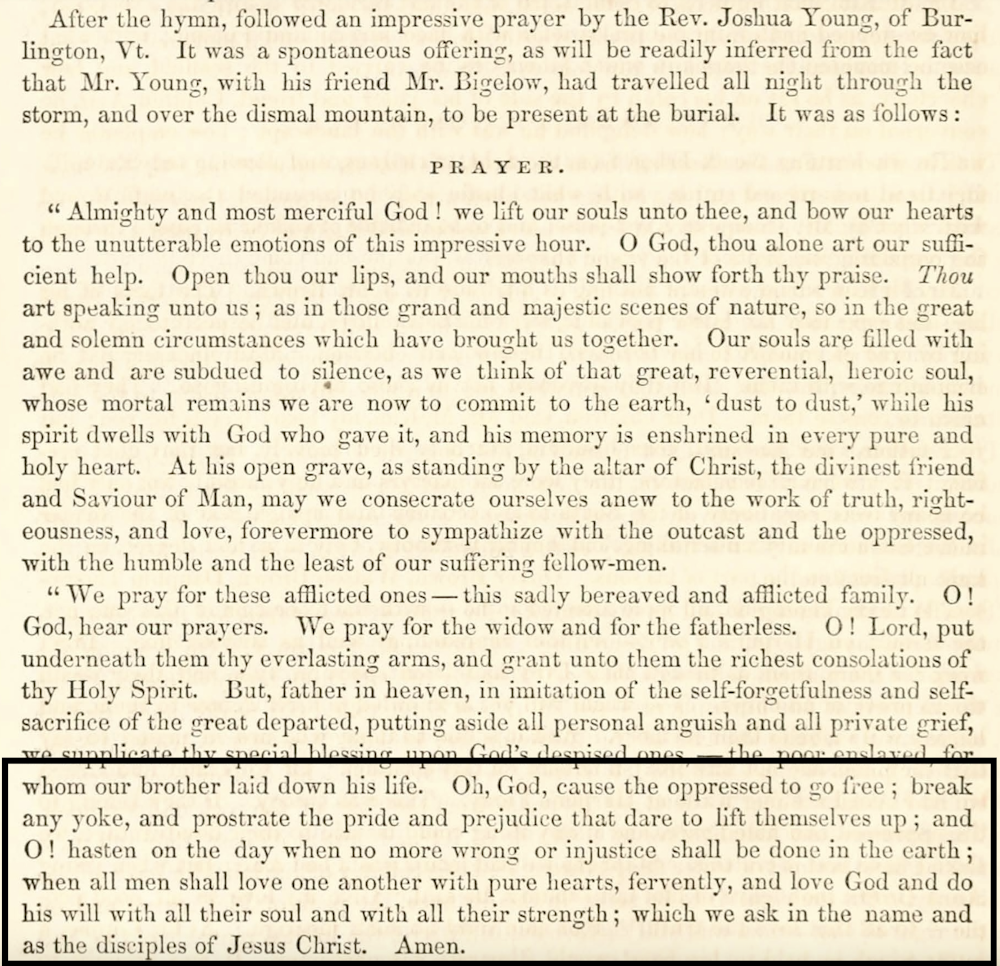
    At the funeral for abolitionist John Brown, the minister prayed over his body, “Oh, God, cause the oppressed to go free; break any yoke, and prostrate the pride and prejudice that dare to lift themselves up.”

    The prayer uttered at John Brown’s burial.
    Library of Congress

    Use of the phrase did not end with Emancipation or the end of the U.S. Civil War.

    In fact, it was one of Frederick Douglass’ favorite phrases. On Oct. 22, 1883, in his “Address at Lincoln Hall,” Douglass excoriated the Supreme Court’s decision rendering the Civil Rights Act of 1875 unconstitutional.

    As was typical of Douglass, the speech ranged beyond racial inequities: “Color prejudice is not the only prejudice against which a Republic like ours should guard. The spirit of caste is malignant and dangerous everywhere. There is the prejudice of the rich against the poor, the pride and prejudice of the idle dandy against the hard-handed workingman.”

    Austen’s independent women

    Early on in “Pride and Prejudice,” the conceited Caroline Bingley snipes that Elizabeth Bennet shows “an abominable sort of conceited independence.” Later, the snobbish Lady Catherine accuses Bennet of being “headstrong.” But near the ending, Mr. Darcy tells Bennet that he loves her for “the liveliness” of her “mind.”

    In this respect, Bennet reflects a quality that all of Austen’s heroines possess. While they try to adhere to standards of courtesy and respect, none are guilty of saying only what the leading man wants to hear.

    Jane Austen.
    Stock Montage/Getty Images

    Given that Austen chose her title to honor the phrase and its history, it is ironic that her own fame ended up drowning out the abolitionist associations of “pride and prejudice” after the Civil War.

    If there is any work of fiction that successfully makes self-sufficiency, independent thinking and open-mindedness look good – and makes sycophants, rigidity and hysterical devotion to rank and status look bad – it is “Pride and Prejudice.”

    Yet the lasting popularity of Austen’s novel demonstrates that the ethics contained in the phrase continue to resonate today, even if its context has been lost.

    Margie Burns does not work for, consult, own shares in or receive funding from any company or organization that would benefit from this article, and has disclosed no relevant affiliations beyond their academic appointment.

    – ref. From pulpits to protest, the surprising history of the phrase ‘pride and prejudice’ – https://theconversation.com/from-pulpits-to-protest-the-surprising-history-of-the-phrase-pride-and-prejudice-249836

    MIL OSI – Global Reports –

    March 18, 2025
  • MIL-OSI Global: The US military has cared about climate change since the dawn of the Cold War – for good reason

    Source: The Conversation – USA – By Paul Bierman, Fellow of the Gund Institute for Environment, Professor of Natural Resources and Environmental Science, University of Vermont

    Military engineers managing supply routes in Greenland in the 1950s paid attention to the weather and climate.
    US Army/Pictorial Parade/Archive Photos/Getty Images

    In 1957, Hollywood released “The Deadly Mantis,” a B-grade monster movie starring a praying mantis of nightmare proportions. Its premise: Melting Arctic ice has released a very hungry, million-year-old megabug, and scientists and the U.S. military will have to stop it.

    The rampaging insect menaces America’s Arctic military outposts, part of a critical line of national defense, before heading south and meeting its end in New York City.

    Yes, it’s over-the-top fiction, but the movie holds some truth about the U.S. military’s concerns then and now about the Arctic’s stability and its role in national security.

    A poster advertises ‘The Deadly Mantis,’ a movie released in 1957, a time when Americans worried about a Russian invasion. The film used military footage to promote the nation’s radar defenses along the Distant Early Warning line in the Arctic.
    LMPC via Getty Images

    In the late 1940s, Arctic temperatures were warming and the Cold War was heating up. The U.S. military had grown increasingly nervous about a Soviet invasion across the Arctic. It built bases and a line of radar stations. The movie used actual military footage of these polar outposts.

    But officials wondered: What if sodden snow and vanishing ice stalled American men and machines and weakened these northern defenses?

    In response to those concerns, the military created the Snow, Ice and Permafrost Research Establishment, a research center dedicated to the science and engineering of all things frozen: glacier runways, the behavior of ice, the physics of snow and the climates of the past.

    It was the beginning of the military’s understanding that climate change couldn’t be ignored.

    Army engineers test the properties of snow on Greenland’s ice sheet in 1955, a critical determinant of mobility on the ice and one that changes rapidly with temperature and climate.
    U.S. Army

    As I was writing “When the Ice is Gone,” my recent book about Greenland, climate science and the U.S. military, I read government documents from the 1950s and 1960s showing how the Pentagon poured support into climate and cold-region research to boost the national defense.

    Initially, military planners recognized threats to their own ability to protect the nation. Over time, the U.S. military would come to see climate change as both a threat in itself and a threat multiplier for national security.

    Ice roads, ice cores and bases inside the ice sheet

    The military’s snow and ice engineering in the 1950s made it possible for convoys of tracked vehicles to routinely cross Greenland’s ice sheet, while planes landed and took off from ice and snow runways.

    In 1953, the Army even built a pair of secret surveillance sites inside the ice sheet, both equipped with Air Force radar units looking 24/7 for Soviet missiles and aircraft, but also with weather stations to understand the Arctic climate system.

    The public reveal of U.S. military bases somewhere – that remained classified – inside Greenland’s ice sheet, in the February 1955 edition of REAL.
    Paul Bierman collection.

    The Army drilled the world’s first deep ice core from a base it built within the Greenland ice sheet, Camp Century. Its goal: to understand how climate had changed in the past so they would know how it might change in the future.

    The military wasn’t shy about its climate change research successes. The Army’s chief ice scientist, Dr. Henri Bader, spoke on the Voice of America. He promoted ice coring as a way to investigate climates of the past, provide a new understanding of weather, and understand past climatic patterns to gauge and predict the one we are living in today – all strategically important.

    Henri Bader describes drilling high on Greenland’s ice sheet in 1956 or 1957 in a Voice of America recording (National Archives), “The Snows of Yesteryear,” and a movie (U.S. Army). Created by Quincy Massey-Bierman.

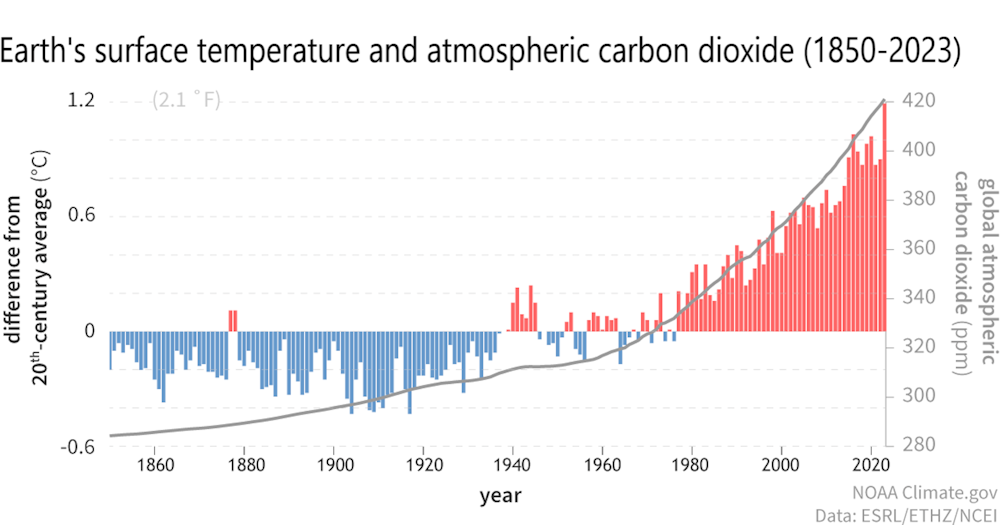
    In the 1970s, painstaking laboratory work on the Camp Century ice core extracted minuscule amounts of ancient air trapped in tiny bubbles in the ice. Analyses of that gas revealed that levels of carbon dioxide in the atmosphere were lower for tens of thousands of years before the industrial revolution. After 1850, carbon dioxide levels crept up slowly at first and then rapidly accelerated. It was direct evidence that people’s actions, including burning coal and oil, were changing the composition of the atmosphere.

    Since 1850, carbon dioxide levels in the atmosphere have spiked and global temperatures have warmed by more than 2.5 degrees Fahrenheit (1.3 Celsius). The past 10 years have been the hottest since recordkeeping began, with 2024 now holding the record. Climate change is now affecting the entire Earth – but most especially the Arctic, which is warming several times faster than the rest of the planet.

    Since 1850, global average temperature and carbon dioxide concentrations in the atmosphere have risen together, reflecting human emissions of greenhouse gases. Red bars indicate warmer years; blue bars indicate colder years.
    NOAA

    Seeing climate change as a threat multiplier

    For decades, military leaders have been discussing climate change as a threat and a threat multiplier that could worsen instability and mass migration in already fragile regions of the world.

    Climate change can fuel storms, wildfires and rising seas that threaten important military bases. It puts personnel at risk in rising heat and melts sea ice, creating new national security concerns in the Arctic. Climate change can also contribute to instability and conflict when water and food shortages trigger increasing competition for resources, internal and cross-border tensions, or mass migrations.

    The military understands that these threats can’t be ignored. As Secretary of the Navy Carlos Del Toro told a conference in September 2024: “Climate resilience is force resilience.”

    A view of aircraft carriers docked at the sprawling Naval Station Norfolk show how much of the region is within a few feet of sea level.
    Stocktrek Images via Getty Images

    Consider Naval Station Norfolk. It’s the largest military port facility in the world and sits just above sea level on Virginia’s Atlantic coast. Sea level there rose more than 1.5 feet in the last century, and it’s on track to rise that much again by 2050 as glaciers around the world melt and warming ocean water expands.

    High tides already cause delays in repair work, and major storms and their storm surges have damaged expensive equipment. The Navy has built sea walls and worked to restore coastal dunes and marshlands to protect its Virginia properties, but the risks continue to increase.

    Planning for the future, the Navy incorporates scientists’ projections of sea level rise and increasing hurricane strength to design more resilient facilities. By adapting to climate change, the U.S. Navy will avoid the fate of another famous marine power: the Norse, forced to abandon their flooded Greenland settlements when sea level there rose about 600 years ago.

    Norse ruins in Igaliku in southern Greenland, illustrated in the late 1800s while flooded at spring tide by sea level, which had risen since the settlement was abandoned around 1400.
    Steenstrup, K.J.V., and A. Kornerup. 1881. Expeditionen til Julianehaabs distrikt i 1876. MeddelelseromGrønland

    Climate change is costly to ignore

    As the impacts of climate change grow in both frequency and magnitude, the costs of inaction are increasing. Most economists agree that it’s cheaper to act now than deal with the consequences. Yet, in the past 20 years, the political discourse around addressing the cause and effects of climate change has become increasingly politicized and partisan, stymieing effective action.

    In my view, the military’s approach to problem-solving and threat reduction provides a model for civil society to address climate change in two ways: reducing carbon emissions and adapting to inevitable climate change impacts.

    The U.S. military emits more planet warming carbon than Sweden and spent more than US$2 billion on energy in 2021. It accounts for more than 70% of energy used by the federal government.

    In that context, its embrace of alternative energy, including solar generation, microgrids and wind power, makes economic and environmental sense. The U.S. military is moving away from fossil fuels, not because of any political agenda, but because of the cost-savings, increased reliability and energy independence the alternatives provide.

    Solar panels generate power on many U.S. military bases. This array at Joint Forces Training Base in Los Alamitos, Calif., generates enough power for more than 15,000 homes and has a backup battery system to provide power when the sun isn’t shining.
    Frederic J . Brown/AFP via Getty Images

    As sea ice melts and Arctic temperatures rise, the polar region has again become a strategic priority. Russia and China are expanding Arctic shipping routes and eyeing critical mineral deposits as they become accessible. The military knows climate change affects national security, which is why it continues to take steps to address the threats a changing climate presents.

    Paul Bierman receives funding from the US National Science Foundation, this work in part supported by grant EAR-2114629.

    – ref. The US military has cared about climate change since the dawn of the Cold War – for good reason – https://theconversation.com/the-us-military-has-cared-about-climate-change-since-the-dawn-of-the-cold-war-for-good-reason-246333

    MIL OSI – Global Reports –

    March 18, 2025
  • MIL-OSI Video: Department of State Press Briefing – March 17, 2025 – 2:00PM

    Source: United States of America – Department of State (video statements)

    Spokesperson Tammy Bruce leads the Department Press Briefing, at the Department of State, on March 17, 2025.
    ———-
    Under the leadership of the President and Secretary of State, the U.S. Department of State leads America’s foreign policy through diplomacy, advocacy, and assistance by advancing the interests of the American people, their safety and economic prosperity. On behalf of the American people we promote and demonstrate democratic values and advance a free, peaceful, and prosperous world.

    The Secretary of State, appointed by the President with the advice and consent of the Senate, is the President’s chief foreign affairs adviser. The Secretary carries out the President’s foreign policies through the State Department, which includes the Foreign Service, Civil Service and U.S. Agency for International Development.

    Get updates from the U.S. Department of State at www.state.gov and on social media!
    Facebook: https://www.facebook.com/statedept
    X: https://x.com/StateDept
    Instagram: https://www.instagram.com/statedept
    Flickr: https://flickr.com/photos/statephotos/

    Subscribe to the State Department Blog: https://www.state.gov/blogs
    Watch on-demand State Department videos: https://video.state.gov/
    Subscribe to The Week at State e-newsletter: http://ow.ly/diiN30ro7Cw

    State Department website: https://www.state.gov/
    Careers website: https://careers.state.gov/
    White House website: https://www.whitehouse.gov/
    Terms of Use: https://state.gov/tou

    #StateDepartment #DepartmentofState #Diplomacy

    https://www.youtube.com/watch?v=ZG-FW8mkAvA

    MIL OSI Video –

    March 18, 2025
  • MIL-OSI Security: Heroin Dealer Sentenced to Prison

    Source: Federal Bureau of Investigation (FBI) State Crime Alerts (b)

    A man who sold heroin and cocaine on the street near Loras College in 2017 and 2018 was sentenced today to more than two years in federal prison.

    Willie Smith, age 27, from Chicago, Illinois, received the prison term after a September 25, 2024, guilty plea to one count of conspiracy to distribute cocaine and heroin within 1000 feet of Loras College, and one count of distribution of heroin within 1000 feet of Loras College.  At the guilty plea, Smith admitted he worked with others to sell cocaine and heroin out of a house near Loras College.

    Smith was sentenced in Cedar Rapids by United States District Court Chief Judge C.J. Williams.  Smith was sentenced to 33 months’ imprisonment and he must also serve a six-year term of supervised release after the prison term.  There is no parole in the federal system.

    Smith is being held in the United States Marshal’s custody until he can be transported to a federal prison.

    The case was prosecuted by Assistant United States Attorneys Patrick J. Reinert and Nicole Nagin and was investigated as part of the Organized Crime Drug Enforcement Task Force (OCDETF) program of the United States Department

    of Justice through a cooperative effort of the Federal Bureau of Investigation, the Bureau of Alcohol, Tobacco, Firearms, and Explosives, Iowa Medical Examiner’s Office and the Dubuque Drug Task Force, comprised of Dubuque Police Department, Dubuque Sheriff’s Office. 

    Court file information at https://ecf.iand.uscourts.gov/cgi-bin/login.pl.

    The case file number is 22-CR-01021.

    Follow us on X @USAO_NDIA.

    MIL Security OSI –

    March 18, 2025
  • MIL-OSI Economics: Samsung’s SmartThings Flex Connect Expands Reach to Maximize Energy Savings and Rewards

    Source: Samsung

    SmartThings, Samsung’s global connected living platform, today announces the expansion of its Flex Connect program with Leap into PJM Interconnection LLC (PJM). Originally launched to California and New York in July 2024, the program saw rapid success, prompting Samsung to expand access to Texas in December 2024, and now to PJM in early March. This expansion to the largest wholesale electricity market in the U.S. enables more consumers to access energy-saving opportunities, reinforcing SmartThings’ commitment to providing user choice and sustainable solutions.
    With the expanded reach of Flex Connect, SmartThings users across the Mid-Atlantic and greater Chicago now have greater access to participate in demand response (DR) events that help stabilize the energy grid while lowering their energy costs. Consumers can automate their smart home devices—including thermostats, plugs, air conditioners, lights, TVs, and appliances—to participate in energy-saving initiatives effortlessly, maximizing their savings without sacrificing comfort.

    Enhancing Consumer Choice with the Largest Smart Home Ecosystem
    SmartThings offers the largest ecosystem of connected devices, giving consumers unparalleled flexibility in how they can engage with DR programs. Unlike traditional DR initiatives with limited device compatibility, Flex Connect allows a broad range of smart devices to integrate seamlessly, ensuring users can participate in a way that best suits their home setup.
    Eligible users can enroll supported devices through SmartThings Energy, a service within the SmartThings app, and select their preferred automation settings. When the grid is under stress, enrolled devices will automatically adjust energy consumption, helping consumers reduce their usage while maintaining comfort. Users who do not own supported devices can still participate by receiving energy-saving tips and taking manual actions to conserve energy.

    Transforming the Demand Response Experience
    Historically, DR programs required significant manual intervention and offered limited device compatibility. With SmartThings Energy, Samsung has unlocked whole-home DR participation by providing seamless automation, energy usage insights, and AI-powered energy management.
    Flex Connect allows users to:
    Earn Rewards – Enrolled users receive $50 in Samsung Rewards Points for participating in energy-saving events, making sustainability financially beneficial to users.
    Automate Energy Savings – SmartThings devices intelligently adjust energy use based on grid demand, efficiently saving users energy without compromising convenience.
    Customize Their Experience – Consumers have full control over which devices participate and how they respond to DR events, reinforcing SmartThings’ core mission of user empowerment.

    Empowering Consumers and Strengthening the Grid
    Grid pressures are projected to continue to intensify across the U.S., with the North American Electric Reliability Corporation projecting a 15% increase in summer peak demand and an 18% increase in winter peak demand over the next decade. With the Flex Connect program now supporting 32% of the U.S. population, according to U.S. Census data, Samsung is now a vital player in managing the increased energy demand–and at a crucial time, when energy demand is rising, supply is constrained, electricity prices are increasing for customers, and grid stability is threatened.
    “With SmartThings, we’re giving consumers the power to choose how they engage with their energy use while contributing to a more sustainable future,” said Chanwoo Park, Executive Vice President of B2B Integrated Offering Center at Samsung Electronics. “Expanding Flex Connect with Leap in the Mid-Atlantic and Chicago regions means more users can experience the benefits of automation, energy savings, and financial incentives—all while supporting a more resilient grid.”

    SmartThings remains at the forefront of innovation, creating new opportunities for consumers to participate in demand response programs effortlessly. Programs like Flex Connect are vital in managing the increased energy demand while providing financial and environmental benefits. The Flex Connect expansion marks a significant step toward a smarter, more efficient, and consumer-driven energy future.
    For more information, please visit www.smartthings.com.

    MIL OSI Economics –

    March 18, 2025
  • MIL-OSI Europe: AFRICA/NIGERIA – After the March 3 kidnapping: Seminarian murdered, while the priest kidnapped with him is released

    Source: Agenzia Fides – MIL OSI

    Abuja (Agenzia Fides) – The seminarian who was kidnapped along with a priest on March 3 in southern Nigeria (see Fides, 5/3/2025) has been murdered, while the priest was released. According to the Diocese of Auchi, “Fr. Philip Ekweli was released by the kidnappers on Thursday, 13th of March, 2025 close to Amughe village, a few kilometres from Okpekpe town, North Ibie in Etsako East LGA of Edo State.””Unfortunately, however, the 21-year-old major seminarian, Andrew Peter, who was kidnapped along with Fr Ekweli, was gruesomely murdered by the abductors,” the statement added, signed by Fr. Peter Egielewa, Director of the Diocesan Media Relations Office. Father Ekweli and seminarian Andrew were kidnapped from the rectory of St. Peter’s Catholic Church in Iviukhua-Agenebode, Etsako East County, Edo State, at approximately 9:30 p.m. on March 3, when armed men entered both the rectory and the church. The two were taken to nearby forests.The diocese appeals to security forces to protect the people of Edo State from the ongoing kidnappings: “The Bishop of the Catholic Diocese of Auchi, Most Rev. Dr. Gabriel Dunia, expresses gratitude to all for the prayers and moral support received while Fr Ekweli and the Seminarian were held in captivity. He calls on the government at all levels and the security agencies to stop the deteriorating security situation in Edo North in particular and other parts of Edo State, which has now become a safe haven for kidnappers, who can operate with impunity, while the people feel helpless and abandoned.” “People are not safe on the roads, in their farms and even in their homes. This is unacceptable when there are elected officials whose duty it is to protect the people. The bishop is grateful to the Edo State Government for their sincere efforts in seeing the victims rescued, but expresses dissatisfaction with the response of the police in particular in the rescue efforts, urging them to put in place better measures to rescue kidnapped victims rather than leave the entire rescue efforts solely in the hands of family, friends and acquaintances of kidnapped victims.”Father Egielewa recalls that “in the past decade, six of its priests had been kidnapped and tortured before release, three were attacked but escaped, and two—Fr. Christopher Odia and Seminarian Andrew Peter—were murdered.” “May the souls of Seminarian Andrew Peter, Fr Christopher Odia and all those killed by kidnappers in Nigeria through the mercy of God rest in peace,” the statement concludes. (L.M.) (Agenzia Fides, 17/3/2025)
    Share:

    MIL OSI Europe News –

    March 18, 2025
  • MIL-OSI Europe: ASIA/MYANMAR – Banmaw, fire destroys St Patrick’s Cathedral

    Source: Agenzia Fides – MIL OSI

    photo: www.ucanews.com

    Banmaw (Agenzia Fides) – The Cathedral of Banmaw, a town in the state of Kachin, in Myanmar, was destroyed by fire on Sunday 16 March, on the eve of the feast of St Patrick, the Saint to whom it is dedicated.The Cathedral was allegedly set on fire during operations conducted in the area by soldiers of the SAC (State Administration Council), the military junta that currently holds power in Myanmar.The fire, according to testimonies sent to Fides, broke out at 4 in the afternoon on Sunday, 16th March. The priest’s house, the three-storey building that houses the diocesan offices and the high school had already been set on fire on 26 February.The diocese of Banmaw, established in 2006 and led by Bishop Raymond Sumlut Gam, borders China to the east and covers a largely mountainous area of 10,741 square kilometres. Before the current conflict situation it was inhabited by a civilian population of more than 407,000 (with more than 27,000 baptized Catholics), belonging to different ethnic groups. (PA/FB) (Agenzia Fides, 17/3/2025)
    Share:

    MIL OSI Europe News –

    March 18, 2025
  • MIL-OSI Europe: ASIA/CHINA – Two churches dedicated to Saint Joseph reconsecrated and reopened in the diocese of Shanghai

    Source: Agenzia Fides – MIL OSI

    Shanghai (Agenzia Fides) – “Since the visible temple has been rebuilt, we must now also make the interior temple of our heart more spiritually alive”. This is the exhortation addressed by Joseph Shen Bin, Bishop of the diocese of Shanghai to the baptized Catholics of his diocese on the occasion of the reconsecration and inauguration of two churches dedicated to Saint Joseph in view of the solemnity dedicated to the Holy Spouse of the Virgin Mary and putative father of Jesus, on March 19.On Sunday, March 16, the second Sunday of Lent, Bishop Shen Bin consecrated the church in Tianma, Songjiang district. At the liturgy attended by more than a thousand people, Bishop Shen Bin also conferred the sacrament of Confirmation to more than two hundred adults. During his homily, Shen Bin also thanked all the priests, nuns and lay people of the parish for their dedication and commitment in supporting the restoration of the church, and also the civil authorities for their logistical support. “May this temple of God’s grace,” the Bishop hoped, “be a welcoming house of faith for all, so that we can walk together towards holiness under the guidance of the Holy Spirit.”The fervent devotion to Saint Joseph, Patron Saint of China, has been handed down among Chinese Catholics from generation to generation, and is revived every year in March, the month dedicated to the Saint. In China, many churches, ecclesiastical structures, seminaries, national and diocesan religious congregations, charitable institutions (orphanages, homes for the elderly) and schools are dedicated to Saint Joseph. Chinese shrines dedicated to the Saint welcome pilgrims and devotees from all parts of China and abroad.On Saturday, March 15, Bishop Joseph Shen Bin had already presided over the consecration of another church in Beitaowan, in the Baoshan district, also dedicated to Saint Joseph. On that occasion, thirty diocesan priests concelebrated Mass in front of more than 300 faithful, and the sacrament of Confirmation was administered to 17 parishioners.The Beitaowan church in the Baoshan district was built in 1650 during the Qing dynasty, and rebuilt around 1875. A primary school attached to the church was built in 1949. On March 10, 1989, it was restored and reopened to the faithful, becoming the first Catholic church to be reopened for worship in the Baoshan district.The Tianma church, in the Songjiang district, was built in 1850. A hospital run by the Canossian nuns was also attached to the church. It was reopened for worship on 16 December 1989. Today, a public hospital stands on the site of the former hospital. (NZ) (Agenzia Fides, 17/3/2025)
    Share:

    MIL OSI Europe News –

    March 18, 2025
  • MIL-OSI United Kingdom: SIA response to Home Office public body review

    Source: United Kingdom – Government Statements

    Press release

    SIA response to Home Office public body review

    The Security Industry Authority (SIA) today (17 March 2025) welcomed the publication of the Home Office public body review of the regulator.

    Public body reviews provide an opportunity for government departments to ensure they are satisfied that an arm’s length body such as the SIA is operating with a clear purpose using an appropriate delivery model.

    In a joint statement issued today, Heather Baily, Chair of the SIA, and Michelle Russell, Chief Executive of the SIA, said:

    We welcome the publication of this review of the SIA and of the regulatory regime for private security. The SIA embraced the review with a collaborative, open, and transparent approach. We are pleased the review provides the necessary assurance to ministers and the public that the SIA is a well-run organisation doing good work. 

    The focus of this review was efficiency, and the review confirms the SIA has challenged itself to increase efficiency to contain the cost of its operations.

    The review also confirms the SIA is best placed in its current form to deliver the licensing of regulated security roles and the regulation of private security.

    We are particularly pleased that the review acknowledges the work licensed security operatives do to protect the UK. The review encourages them to “continue to work with the SIA as an expert and authoritative regulator that is punching above its weight to encourage the highest standards in the profession.

    We seek and continue to benefit from the support and co-operation of those working in the private security industry and our many partners to provide effective regulation and pursue robustly those who choose not to comply.

    We will work with the Home Office and the devolved governments to implement the recommendations of this review.

    The Home Office conducted the review between August 2023 and March 2024.

    Download and read the full review here: Security Industry Authority: Public Body Review 2025 – GOV.UK.

    Further information

    The SIA is the organisation responsible for regulating the private security industry in the UK, reporting to the Home Secretary under the terms of the Private Security Industry Act 2001. The SIA’s main duties are the compulsory licensing of individuals undertaking designated activities and managing the voluntary Approved Contractor Scheme (ACS).

    For media enquiries only, please contact: media.enquiries@sia.gov.uk.

    Share this page

    The following links open in a new tab

    • Share on Facebook (opens in new tab)
    • Share on Twitter (opens in new tab)

    Updates to this page

    Published 17 March 2025

    MIL OSI United Kingdom –

    March 18, 2025
  • MIL-OSI USA News: ICYMI: “Trump ties for highest approval he’s ever had — as more Americans say US is on right track than any time in 20 years: poll”

    Source: The White House

    President Donald J. Trump’s approval rating is tied for his highest ever, according to a new NBC poll — while more Americans say the country is headed in the right direction than at any point in more than two decades.

    From the New York Post:

    Three months into his second term, President Trump hit the highest approval rating he’s ever had as commander-in-chief — while more Americans say the country is on the right track than at any point since 2004, a new poll found … [T]he survey found that voters generally feel Trump is bringing “the right kind of change” on the key issues — even tariffs.

    Read the full article here.

    MIL OSI USA News –

    March 18, 2025
  • MIL-OSI China: China’s new consumption policies cover stock, real estate stability for first time

    Source: People’s Republic of China – State Council News

    China’s new consumption policies cover stock, real estate stability for first time

    BEIJING, March 17 — China’s latest plan to expand consumer spending, unveiled on Sunday, emphasizes for the first time the need to stabilize the stock and real estate markets, an official said on Monday.

    To this end, the plan outlines measures to boost consumer confidence and stabilize expectations, according to Li Chunlin, deputy director of the National Development and Reform Commission.

    Previous consumption policies primarily focused on the supply side, emphasizing that supply drives demand creation. However, the latest policies also prioritize the demand side, aiming to boost household incomes and ease financial burdens, Li noted.

    He cited measures such as reasonable wage growth and scientifically adjusted minimum wages, both highlighted in the consumption support plan.

    To enhance property income, the plan calls for a multifaceted approach, including stabilizing the stock market, strengthening strategic reserves and market stabilization mechanisms, and accelerating the removal of barriers preventing long-term funds — such as commercial insurance, the national social security fund, and the basic pension insurance fund — from entering the market.

    To better meet housing consumption needs, efforts will focus on curbing the downturn and restoring stability in the real estate market, according to the plan.

    MIL OSI China News –

    March 18, 2025
  • MIL-OSI USA: ICE Newark, law enforcement partners arrest illegal alien with arrest warrants

    Source: US Immigration and Customs Enforcement

    NEWARK, N.J. — U.S. Immigration and Customs Enforcement, with assistance from local and federal partners, apprehended Ismail Sayik, a citizen of Turkey illegally present in the United States, March 4 during a routine enforcement operation in New Jersey.

    Sayik, 29, has three arrest warrants overseas, including for allegation of murder, and is currently in ICE custody pending removal proceedings.

    “Once the ICE Homeland Security Investigations attaché office in Turkey alerted HSI Newark that a person of interest overseas was in New Jersey illegally, our team was quick to respond, identify the suspect and arrest him in Queens, New York,” said ICE Homeland Security Investigations Newark Special Agent in Charge Ricky J. Patel. “We are grateful for the entire federal partnership, specifically the FBI and it’s Drug Enforcement Administration for their support to the ICE mission focused on safeguarding our homeland from criminals unlawfully hiding out in our neighborhoods.”

    U.S. Border Patrol arrested Sayik on March 17, 2023, at or near Jacumba, California, after he illegally entered the United States. USBP served Sayik a notice to appear before a Department of Justice immigration judge.

    USBP released Sayik on an Order of Recognizance pending removal proceedings and instructed him to reported to nearest to the nearest ICE office.

    On April 5, 2023, Sayik reported to ICE New York as instructed.

    Personnel with ICE Newark arrested Sayik in Sunnyside, New York, on March 4, and detained him in ICE custody pending removal proceedings.

    MIL OSI USA News –

    March 18, 2025
  • MIL-OSI USA: Did You Know: UConn Health Offers Retail Pharmacy Services?

    Source: US State of Connecticut

    Nearly five years after opening as a specialty pharmacy, UConn Health Pharmacy Services Inc. is establishing itself as a competitive option in the retail pharmacy market.

    Most retail medications are available there, in addition to specialty drugs. Nearly all insurance plans are accepted, including Caremark, which is part of the state employee benefit package.

    Prescriptions filled by UConn Health Pharmacy Services Inc. (UHPSI) are available for pickup weekdays from 8 a.m. to 5:30 p.m. at Building One of the Exchange, 270 Farmington Ave., which is across the street from UConn Health’s main campus. Shipping to the home is also an option with most medications.

    “We’re an accredited pharmacy, which sets us apart from other retail,” says Dr. Hetal Patel, the pharmacy manager.

    “The accreditation standards we maintain ensure every patient has access to the pharmacy professionals at UConn Health,” says Pharmacy Director Emmett Sullivan, ’93 (PHARM). “Our team treats every patient as individual and will help them with their specific needs. This best summarized as UHPSI providing exceptional service and care.”

    Dr. Hetal Patel (left) is pharmacy manager and Emmett Sullivan (right) is pharmacy director at UConn Health Pharmacy Services Inc., located in Building 1 of the Exchange, 270 Farmington Ave., across the street from UConn Health’s main campus in Farmington. (Tina Encarnacion/UConn Health photo)

    Another accreditation standard is responsiveness to callers.

    “We have an 11-second turnaround time and 99.9% patient satisfaction when it comes to answering our phones,” Patel says.

    “If there was a question that a patient had about any medication they’re getting filled in the community, they can call us and talk to the UConn Health pharmacist and see how we can service them,” Sullivan says. “Because there are questions that come up, and we have pharmacists here who can answer those questions.”

    UConn Health Pharmacy Services Inc. opened in 2020 as a specialty pharmacy with a staff of three, no insurance contracts, and little inventory. In recent years, patients who were going there for specialty drugs started filling their traditional prescriptions there too.

    “From 2021 to today, we’ve increased our volume by about 500%,” Sullivan says. “Over the course of time, we realized there was a greater need for traditional retail prescriptions, especially as we’ve heard the pains people have been suffering at retail pharmacies, whether it’s a decrease in hours or closings. We want to make sure we’re here to help the people of our community and extend as much access as we possibly can.”

    “The growth of UHPSI is a true reflection of the vision of UConn Health leadership five-plus years ago and the pharmacy team in place since and now,” says Kevin Chamberlin ’01 (PHARM), ’03 Pharm.D., associate vice president and chief pharmacy officer. “Their investment in the business model and patient-first approach has led the trajectory of success being realized today.”

    Although the Caremark prescription plan is associated with CVS, members are not limited to CVS for their prescriptions and they still would be in-network if they filled their prescriptions at UConn Health Pharmacy Services Inc.

    Switching from CVS or any other retail pharmacy starts with simple a phone call to UConn Health Pharmacy Services Inc. at 860-676-4036 or toll free 833-777-4276.

    “We would call the pharmacy for a transfer, and we’ll get the provider to make sure your therapy is current, and get the meds transferred over,” Sullivan says.

    “You would give us a call when you’re ready to have it refilled,” Patel adds. “You will be in charge of your own therapy, compared to a retail pharmacy calling you six weeks in advance before you even need the medication.”

    UConn Health Pharmacy Services Inc. is an option available in the patient portal of UConn Health’s electronic health record (not to be confused with the UConn Health Infusion Pharmacy). (Imaged from MyChart in UConn Health’s Epic electronic health record)

    And the out-of-pocket expenses are comparable if not favorable.

    “It may be the same, and if not, we’re going to look at if there’s a co-pay program from the manufacturer that may even make it lower for you,” Sullivan says. “We do that on a quite regular basis.”

    UConn Health Pharmacy Services Inc. is an option in UConn Health’s electronic health record system, Epic. Patients using the corresponding patient portal, MyChart, can select it through the “Manage My Pharmacies” option on the “Medications” page, noting that “UConn Health Infusion Pharmacy” is also a choice. Those seeking to fill traditional retail prescriptions should be sure to choose “UConn Health Pharmacy Services.”

    Learn more about UConn Health Pharmacy Services Inc.

    MIL OSI USA News –

    March 18, 2025
  • MIL-OSI USA: Final Phase of Gant Overhaul Expected to Start This Summer

    Source: US State of Connecticut

    The multi-year project to overhaul and expand one of UConn’s largest, most visible, and most heavily used academic buildings will soon enter its final stretch with the start of the last phase of renovations.

    The Gant Science Complex, often described colloquially as the workhorse of UConn’s academic infrastructure at Storrs, has undergone extensive renovations that started in 2018 and have significantly transformed much of the once-outdated structure.

    If all remains on schedule, work is slated to begin this summer on the final phase of renovations at the complex, which fronts North Eagleville and Auditorium Roads.

    Completion of the project will mark a milestone for UConn, which received funding for the work under the state’s Next Generation Connecticut initiative.

    UConn students walk through the Gant Science Complex on the first day of classes for the spring 2025 semester on Tuesday, Jan. 21, 2025. (Sydney Herdle/UConn Photo)

    That visionary program is part of the larger UConn 2000 initiative, which has built the state’s innovation economy through investments in its flagship university, as supported by generations of Connecticut legislators and governors since the mid-1990s.

    NextGenCT included construction of UConn’s Science 1 building in addition to the Gant renovations. Science 1 opened nearby in 2023, complementing Gant as interdisciplinary research facilities that anchor the university’s Northwest Science District.

    Both buildings support goals in the 10-year Strategic Plan, including expanding UConn’s research impact, powering a thriving Connecticut, and promoting holistic student success.

    “The hallmarks of a great university are not only the research and academic knowledge it produces, but also its commitment to providing the modern labs, learning spaces, and support facilities that cultivate that important work,” says Anne D’Alleva, UConn’s provost and executive vice president for academic affairs.

    “We often jokingly refer to the Gant Science Complex as the workhorse of our Storrs campus because so much of the hands-on research, teaching, and collaborative learning takes place there on a daily basis,” she says. “The renovations of this important complex will be integral to UConn’s ability to reach new heights and power the Connecticut innovation economy.”

    The U-shaped Gant Science Complex houses several academic departments and their associated classrooms, lecture halls, teaching and research laboratories, faculty offices, and support space.

    It was built between 1970 and 1974 and is named for the late Edward V. Gant, a longtime engineering professor who also served three stints as UConn’s acting president. He died in 1985.

    The science complex that bears his name had about 285,000 gross square feet of space at the start of the renovation, with the current project adding about 25,000 additional square feet upon completion.

    The first phase of renovations, which involved Gant South, was completed in 2019, followed by a two-year renovation period at Gant West. In both cases, the full wings were overhauled along with the connector between the wings and the central plaza.

    A central Light Court area, a new signature feature of the complex, was completed and occupied in January 2020.

    The phased approach has allowed UConn to continue using large portions of the complex even when other areas were under construction, minimizing disruption to academic operations and eliminating the need for temporary facilities.

    Construction on the last phase will start this summer if all remains on schedule with bidding, timely availability of equipment, and other factors.

    The third and final phase of work at Gant will involve renovating and expanding the North Wing and its connector to the West Wing and includes a fourth-floor addition for advanced research.

    The renovated North Wing will offer updated laboratory teaching facilities and support spaces for the Department of Ecology & Environmental Biology, as well as multidisciplinary science teaching labs and teaching labs for Biology 1000 level courses on the ground through second floors.

    Support spaces include a new advising and tutoring center for the College of Liberal Arts & Sciences and a new facility for biology central storage. The third and fourth floors will be prepared for future advanced research activities.

    UConn’s Board of Trustees recently gave its approval to begin working toward the final phase, which would start with demolition and abatement, site work, and purchasing equipment with long lead times for delivery.

    In addition to the interior renovations, the building’s façade and roof are being reconstructed to better prevent leaks and save energy, while the outdoor plaza area is being improved to be more inviting and accessible to the campus community.

    If all remains on schedule, the renovated North Wing will open during the 2027-28 academic year.

    The project also aligns with UConn’s commitment to sustainability and environmental stewardship, meeting Connecticut High Performance Building standards and aiming for LEED Gold certification.

    LEED-certified buildings are designed with methods to reduce operating costs, conserve energy and water, cut down on waste sent to landfills, reduce harmful greenhouse gas emissions, and ensure a healthy working environment for occupants. The U.S. Green Building Council confers the certification after a review process.

    MIL OSI USA News –

    March 18, 2025
  • MIL-OSI United Kingdom: National Planning Skills Commitment Plan

    Source: Scottish Government

    Focus on skills and recruitment.

    A new programme is being launched to attract more people into the planning profession and build their skills.  

    The National Planning Skills Commitment Plan will provide training and skills development through monthly themed webinars, hands-on learning and recruitment support. It is supported by more than 100 leaders across almost 60 organisations in the built and natural environment professions. The plan will cover different themes at different times, with the first one on housing.

    More planners are needed in Scotland to meet recruitment gaps. In 2023-24 planners dealt with nearly 23,000 applications including 227 applications for major developments.

    Public Finance Minister Ivan McKee met planning students during a visit to Govan Housing Association’s Water Row Development.

    Mr McKee said: 

    “The response to the new National Planning Skills Commitment Plan has been overwhelmingly positive and demonstrates that the industry is eager to work with the Scottish Government to develop skills and welcome new talent. 

    “Planning promotes economic development, addresses housing shortages and supports action on climate change. Modernising how the profession is promoted and portrayed, and taking a more direct approach to recruitment will help attract the next generation of planning professionals. This will ensure that Scotland can deliver development and infrastructure efficiently, effectively and sustainably now and in the future.”

    Ross Nimmo, Head of Place at Glasgow City Region, said: 

    “Planners help to imagine and deliver many of our local, regional and national priorities, from town centres and business parks to renewable energy and nature networks. As a growing City Region, we need planners to create great places like Water Row in Govan. The National Planning Skills Commitment Plan and our own regional skills initiative are boosting the profession’s profile and opening up new routes to education and employment.”

    Background 

    The Commitment Plan is available at www.ourplace.scot/resource/training-and-recruitment-opportunities

    The Commitment plan builds on the Future Planners Research (2022) and delivers on the action outlined in the Planning and Housing Emergency – Delivery Plan (November 2024). Organisations committed to actions, this month, include Fife Council and Highland Council who are leading a workshop for the Scottish Young Planners Network on processing a planning application. Others training partners during March include the Improvement Service, Scottish Land Commission, Scottish Futures Trust, Architecture and Design Scotland.

    MIL OSI United Kingdom –

    March 18, 2025
  • MIL-OSI United Kingdom: New-look repairs and maintenance service to be rolled out across Stoke-on-Trent

    Source: City of Stoke-on-Trent

    Published: Monday, 17th March 2025

    A repairs and maintenance company, which looks after 17,500 homes and around 600 public buildings in Stoke-on-Trent, will be back under the control of Stoke-on-Trent City Council from April.

    In August 2024, the city council announced how Unitas is being brought back in-house to enable it to better meet new government regulations requiring landlords to adhere to new, higher standards ­- and be accountable for all aspects of service delivery.

    Unitas was established in 2018 as a wholly-owned subsidiary of the council, however, from Tuesday, 1 April 2025, Unitas will be transferred over to Stoke-on-Trent City Council and will operate alongside the hundreds of other valued services that the authority already provides.

    From that date, the Unitas name – and logo – will cease to exist, and the service will instead be known as the council’s Repairs and Maintenance Service.

    The current Unitas branding will be phased out and replaced with the Stoke-on-Trent City Council crest, in line with all other council services.

    New name badges and ID cards are currently being produced for repairs operatives who will present them upon arrival at a tenant’s property. The ID cards will also include a telephone number, which tenants can call to clarify who the person is before letting them into their homes.

    Councillor Chris Robinson, cabinet member for housing and planning at Stoke-on-Trent City Council, said: “Over the last six months, a lot of work has been going on behind the scenes to ensure this transition carried out as smoothly and sensitively as possible for all involved.

    “The project is progressing well and I’m pleased to be able to announce that, from Tuesday, 1 April, the service will be back under control of the council.

    “For now, and in the near future, we don’t expect tenants to notice a huge difference in the way we are delivering our housing repairs and maintenance service. Everything will continue as normal up until at least April.

    “But we know from speaking to our tenants that improvement is needed to our repairs and maintenance service and we are looking at what changes we need to make to ensure we can provide a high-quality service. We also want to make sure that repairs are done right the first time and that, through our proactive investment programme, we can fix common housing issues before they become a big problem – such as damp and mould.

    “We are committed to improving people’s lives and making the city a healthier, wealthier and safer place for all.”

    The decision to bring the council’s repair and maintenance service in-house follows the introduction of new government legislation, introduced on the back of the Grenfell Tower tragedy in 2017.

    MIL OSI United Kingdom –

    March 18, 2025
  • MIL-OSI United Kingdom: Work on Ryhope supported housing scheme reaches key milestone

    Source: City of Sunderland

    A new residential development on the site of the former St Cuthbert’s Church in Ryhope has reached a key milestone.

    The topping out of the six supported bungalows for people with physical and learning disabilities brings the development a step nearer completion.

    Built as part of Sunderland City Council’s ongoing work to provide homes for those who are most at need, each bungalow will come with 5G infrastructure built-in, ready to incorporate assistive technology depending on client needs. 

    The development is being supported by £660,000 funding from Homes England and is part of a council-led plan to deliver more supported properties for vulnerable residents. This includes more bungalows for people living with disabilities and providing specialist accommodation available for affordable rent. 

    Councillor Kevin Johnston, Cabinet Member for Housing, Regeneration and Business at Sunderland City Council, said: “It’s great to see work nearing completion on these six new bungalows, which are all about helping us to deliver more accessible properties for those who need them. 

    “We’ve worked closely with colleagues in Adult Social Care, Sunderland Care and Support and the residents themselves to create homes that will meet their needs.

    “The creative and innovative thinking from everyone involved has resulted in homes that are both personalised and technology enabled, enabling their residents to live as independently as possible.”

    The three three-bedroom bungalows and three two-bedroom bungalows in Ryhope follow similar projects to provide accessible housing in Washington and at Hylton Road.

    Matthew Wright, Manager – Affordable Housing Delivery at Homes England, said: “As the Government’s housing and regeneration agency, increasing the supply of quality affordable homes remains one of our key objectives and we are committed to supporting ambitious housebuilders of all sizes to build those homes and communities.

    “This investment through the Affordable Homes Programme does just that, enabling Sunderland City Council to build 12 much needed new homes the people of Sunderland can be proud of.”

    The development has been built by North East based T Manners and Sons.

    Derek Collinson, Contracts Manager at T Manners and Sons, said: “It is great to be working with Sunderland City Council on this project constructing six bungalows designed to provide comfortable and accessible living spaces that support individuals with specialised care needs.

    “The works have reached a major milestone, with the completion of the roofing works. As work progresses on internal fittings, landscaping, and hard-standing areas, the project continues to prioritise the use of the local supply chain. This commitment to local suppliers reinforces the project’s dedication to community investment and sustainable construction practices. We are really excited to see the final product come together and the positive impact it will have on the community.”

    The first residents are expected to start moving into their new homes this summer.

    MIL OSI United Kingdom –

    March 18, 2025
  • MIL-OSI United Kingdom: Acclaimed markets return to Liverpool for 2025

    Source: City of Liverpool

    Liverpool’s award-winning Stanley Park Market is set to return for a second straight year later this month.  

    Launching on Wednesday 19 March, the weekly market will run between 9am and 3pm until mid-December.  

    Its return is closely followed by the spring edition of St George’s Hall Artisan Market, which takes place four days later. 

    Stanley Park Market’s inaugural year saw the market double in size from its initial 50 stalls. 

    Its growing success was celebrated at this year’s Great British Market Awards, where it took home the title of Best Community Market. 

    The market will be held every Wednesday, except when there are evening football matches or concerts held at Goodison Park or Anfield Stadium, as the site is reserved for those events. 

    Each week, there will be up to 100 stalls selling items including fresh local produce, clothing, homeware, toys, and more. Visitors can also choose from lots of hot food and drink stalls, with plenty of seating available.  

    Throughout the year, the market will host a variety of community groups and other local organisations to support people with their health and wellbeing. Last year this included special set ups by Everton in the Community and social care initiatives. 

    Continuing the theme of local craft being on show, Sunday 23 March sees the return of an artisan market at the Grade 1 listed St George’s Hall. The free market launched last year and has already attracted thousands of visitors.  

    Taking place between 10am and 4.30pm, people will be able to browse almost 70 stalls, offering the likes of homemade jewellery, artwork, artisan chocolate, and specialist drinks. The market will also be home to several hot street food vendors and live music performances throughout the day. 

    Liverpool is home to a many beloved markets, from the weekly Great Homer Street Market (Greatie Market) to a regular programme of farmers and craft markets. For a full list of dates and locations, visit the Council’s markets webpage. 

    Councillor Harry Doyle, Liverpool City Council’s Cabinet Member for Culture, Health and Wellbeing, said: “Stanley Park Market exceeded our expectations last year and I can’t wait to see what it brings in 2025. Having it and the St George’s artisan market return this year just goes to show how popular and highly successful these community-driven events have been. 

    “Liverpool is known for its collective spirit and there’s no better place to witness it than in any one of our incredible markets. They’re a fantastic way to connect neighbourhoods and support our local businesses and community groups.  

    “There are loads of markets happening all through the year, and I encourage everyone to head down to one local to you and see what you can find.” 

    Louise Pritchard, owner of Just Bee Gorgeous said: “I am really looking forward to taking my stall ‘Just Bee Gorgeous’ to both Stanley Park and St George’s Hall, once again this year.

    “Last year Stanley Park market had a fantastic community feel to it, because it was a place where people could meet up with their neighbours, family and friends, do a spot of shopping and also have a bite to eat, choosing from the impressive and reasonably-priced food options available.

    “St George’s Hall artisan market is held less frequently (roughly every quarter) but WOW is it worth the wait, because what a backdrop! Everyone is impressed by the stunning surroundings, and it is just the perfect venue to host an artisan market, where there is such a wealth of talent on display. What a great way for small businesses to showcase their work.

    “It is crucial to support your local small businesses because they are the life-blood of all communities. Your custom means so much more to a small business owner than to a giant multi-national corporation and could be the difference between being able or being unable to afford a sports kit for a child, fund medical expenses or even just pay for a short break for the family. Apart from the financial aspect, you are supporting someone’s dream which is fantastic.”

    MIL OSI United Kingdom –

    March 18, 2025
  • MIL-OSI Economics: Luis de Guindos: Interview with The Sunday Times

    Source: European Central Bank

    Interview with Luis de Guindos, Vice-President of the ECB, conducted by Jon Ihle

    16 March 2025

    The progress of annual inflation, at least up until February, looked like it was going in the wrong direction. Are you still confident that it will converge towards 2% sometime this year?

    The disinflation process is on track. There was a small pick-up inflation in recent months, but this had been expected, mostly on account of unfavourable base effects in November, December and January.

    The main reason for our confidence that inflation will come down to 2% is that all indicators for services and underlying inflation are moving in the right direction. A very important one is compensation per employee. According to recent data and in line with our projections, wage growth is moderating, which will help services inflation to gradually decline.

    At the same time, we need to keep in mind that factors like tariffs and fiscal policy are causing a lot of uncertainty. But taking this into account, we are confident that headline inflation will converge on a sustainable basis towards our 2% medium-term target towards the end of this year or the beginning of next.

    Let’s talk about some of the factors in this uncertain environment. What are the specific factors that are influencing the Governing Council’s thinking about the rate path right now, and how has that changed since the start of the easing cycle?

    We have already reduced interest rates by a total of 150 basis points. This is what we refer to in our monetary policy statement as a “meaningfully less restrictive” stance than at the beginning of the cycle.

    Our projections now show that inflation will converge towards our target in the medium term. But again, we need to consider the uncertainty of the current environment, which is even higher than it was during the pandemic. For instance, our projections don’t include the definitive level of the tariffs imposed by the United States and its trade partners, since the current situation is so volatile.

    Nevertheless, we are confident that inflation is moving towards our target on a sustainable basis, for example due to the moderation in wage growth I mentioned earlier. Even energy prices, which had also resulted in a small pick-up in inflation, have started to decline.

    Markets in the last few weeks have had some very strong reactions to the external environment. I’m thinking of the increase in German bond yields, changing expectations for fewer rate cuts from the ECB and the stock market correction in the United States. Does any of that feed into the ECB’s thinking on the rate path?

    We look at a wide range of indicators, all of which have an impact on our analysis. These include the evolution of wages and of the economy in terms of domestic demand and growth. And we of course look at financing conditions, for which our bank lending survey is very useful.

    It’s true that bond yields have increased due to the new German Government’s budgetary plans and that we have seen a correction in US equities from very high levels. But we also need to try to look through the short-term evolution of markets and distinguish between short-term volatility and permanent or medium-term forces. If we were to be as volatile as the markets, that wouldn’t be very reassuring.

    You said the uncertainty now is even greater than during the pandemic. How would you characterise it? What are the big unknowns at the moment?

    First, the policies of the new US Administration. There’s a lot of talk about tariffs, but it’s not just about that. The new Administration has also been quite clear about deregulating banks, non-banks and crypto-assets. And beyond that, they have announced that they want to modify corporate tax, which could affect capital flows across the Atlantic. In general, what we’re seeing is that the new US Administration isn’t very open to continuing with multilateralism, which is about cooperation across jurisdictions and finding common solutions for common problems. This is a very important change, and a big source of uncertainty.

    Second, and as a result of the new Administration’s attitude towards defence, we have the European Commission’s proposal to increase national defence spending by 1.5% of GDP. This is certainly a decision in the right direction, and it will have an impact on the macroeconomic outlook. We don’t know enough details about the package to make an accurate assessment about its impact on the economy, but it will likely be positive for growth and have a limited impact on inflation.

    Let’s focus on defence. Are you comfortable with national budget rules being relaxed to accommodate more defence spending? Will you need to adjust your monetary policy as those changes in fiscal policy come through?

    We always take fiscal policy into account because it interacts with monetary policy. In this case, we need to know the concrete details of the package before we can make an accurate assessment. How will spending be distributed across items? In terms of economic impact, spending more on military wages is not the same as spending more on weapons. How much will be spent outside of the EU? How is it going to be financed? One part will be common debt, but the package is much larger than that. The rest could be covered by taxes or a reduction in public spending. All of these factors are important to know in order to assess the impact of the package on the economy.

    It looks like we may be moving closer towards a resolution of the war in Ukraine, or at least a ceasefire. Would that be beneficial for the euro area economy? Would it change anything of what you’ve outlined so far?

    From a human standpoint, a peace agreement would obviously be very positive. And in general, it would be beneficial for the economy as well. But we would need to see the exact terms of a potential settlement to know for sure.

    Turning to the United States, what role do you see for the ECB in terms of managing trade shocks and the overall approach of the Trump administration?

    We need to keep in mind that the current situation is very volatile. It seems like every day a new tariff is imposed or one that has already been announced is removed. Hopefully we’ll soon have more clarity on the US Administration’s plans for the time ahead.

    Obviously, a trade war would be a lose-lose situation for everybody. It would have a much worse impact on growth than on inflation. This is because increasing tariffs raises prices at first, but lower growth subsequently offsets this initial price increase. We also need to look not only at bilateral tariffs between the United States and Europe but also at what economists call “trade diversion”. This means that, for example, tariffs imposed by the United States on Chinese goods could redirect trade flows to Europe, along with whatever economic impact that may have.

    Once we have all the details of the final policies, we will be able to better assess their impact based on all these factors. We are now using a baseline scenario and several alternative scenarios with different trade distortions to try to calibrate the impact as best as we can.

    Another aspect of the uncertainty in the United States is the way Trump is changing the relationship of the White House to many of the independent agencies in Washington. One of those might be the Federal Reserve. What would it mean for the ECB if its independence were to erode under President Trump? Has that scenario been discussed at all in the Governing Council?

    No, we haven’t discussed that because we can’t imagine it happening. The independence of the Federal Reserve is enshrined in law. We will always defend the independence of central banks, which is crucial to ensure they can fulfil their mandates.

    There are a lot of question marks over the predictability of the United States. Does Europe need to start thinking about making the euro more of a global reserve currency, if the dollar becomes less reliable?

    The euro is already a reserve currency, and strengthening its role in that respect is not part of our mandate. But keeping inflation low, increasing the potential growth of the European economy, signalling openness to trade agreements with different jurisdictions and making the European Union a model for free trade all over the world – all of this would strengthen the role of the euro as a reserve currency.

    But do you see a need for Europe to step more into that role ahead of the United States?

    I wouldn’t make comparisons with the United States. What Europe should do is maintain the position that it has always had as an open economy, in favour of free trade, the free flow of capital and multilateralism.

    Earlier you said that a trade war would be very detrimental to growth, but we don’t know all the details yet. How has the ECB’s view on euro area growth evolved in the last few months?

    We have downgraded our growth outlook for 2025 and 2026 by 0.2 percentage points. There are two main drivers behind that downward revision. First, uncertainty about the economy in the coming months has clearly dented confidence, and this is having an impact on investment. And second, a possible trade war would reduce net exports.

    Philip Lane has said recently that the conditions in the euro area are right for a pick-up in household consumption. Do you share his optimism that it can increase and maybe drive economic growth?

    All the factors that Philip indicated are correct. Real wages have increased, inflation is declining, interest rates are coming down and financing conditions are better. But still, the reality is that consumption is not picking up.

    This is because consumers don’t always react to developments in their short-term real disposable income. They also consider what might happen with the economy over the medium term, which is clouded in uncertainty. The possibility of a trade war or wider geopolitical conflict has an impact on consumer confidence.

    Eventually, the increase in the factors that Philip pointed out will prevail. But right now, the lack of consumer confidence due to the uncertainty of the world economy is offsetting that effect.

    European households have enormous cash savings at the moment, especially since the pandemic. Christine Lagarde has spoken frequently about turning those cash savings into investment to drive innovation and growth. Are you optimistic that this can become a reality?

    The capital markets union is certainly very important, but looking at the current economic situation in Europe, it’s crucial to put structural reforms in place to make it more productive and competitive. This is also what the Letta and Draghi reports argued.

    Fully integrating the internal market will be key here. It’s very difficult to have a capital markets union if you don’t have an integrated economy for goods and services. There are certainly concrete actions we can take to complete the capital markets union, but we should also focus on removing the internal obstacles to a real single market in Europe.

    There are three key elements here: fully integrating the Single Market, completing the banking union and completing the capital markets union. We must make progress on these three elements in parallel; it will be very difficult to make progress on one of them in isolation.

    Which of those elements would you say the ECB has the most influence on? And what can it do?

    Our mandate is price stability, but we also have an advisory role and produce expert opinions. Our economists and researchers carry out a lot of analytical work on Europe. The European Council and the Commission listen to what we have to say, and we are also accountable to the European Parliament. So we continuously use our voice to make the points that we believe are key to making the European economy more productive and competitive.

    Are you happy with the levels of credit flow from European banks to households and businesses?

    They are on the rise, following the rate cuts and the improvement in financing conditions. Demand for credit is not very strong, at least from a corporate standpoint, although it’s gradually increasing. This has to do with the lack of investor confidence. If you have doubts about the future and you’re waiting to see what will happen with trade, fiscal policy and geopolitical risk, you don’t invest, so you also don’t borrow. But in the case of households, we have started to see a significant increase in demand for mortgages.

    Speaking of housing: in several countries of the euro area, housing is in crisis. There’s an undersupply, and financing isn’t available to everybody that wants to buy a house. Do you think at this stage, nearly 15 years after the financial crisis, that lending rules are still too tight? Have regulators overcorrected on capital rules for banks, harming consumers and households?

    The current situation is very different to the one that we had 15 years ago. As a finance minister in Spain, I was dealing with the burst of a big housing and credit bubble, similar to what we saw in Ireland. Now, residential real estate prices are a big problem, but the drivers aren’t the same as the ones we had back then. From a financing standpoint, the situation is very different because the banks’ solvency is not in question.

    That being said, current developments in house prices are having a very negative impact on young people, who have a lot of trouble accessing housing. In some countries, this may have to do with issues with the rental market and how it is regulated. Policies should be put in place to make housing, mainly in the rental market, much more affordable. At the European level, improving the performance of the rental market will be very important in the near future. We should foster common action to achieve this, because it’s a significant source of social upset.

    But this is for national governments to do, not the ECB. We do need to analyse the situation, however, because not all countries are in the same position with respect to their rental markets. And there are lessons to be learned from the policies some countries have put in place.

    MIL OSI Economics –

    March 18, 2025
  • MIL-OSI Global: With a federal election looming, America’s democratic decline has critical lessons for Canadian voters

    Source: The Conversation – Canada – By Matthew Lebo, Professor, Department of Political Science, Western University

    Prime Minister Mark Carney and his cabinet have been sworn in, ending Justin Trudeau’s time in office and paving the way for a spring election. Canadians are soon heading to the polls as they watch American democracy crumble.

    United States President Donald Trump recently argued “he who saves his country does not violate any Law” as he ignores Congress and the courts, governs by executive order and threatens international laws and treaties.


    Read more:
    Is Donald Trump on a constitutional collision course over NATO?


    Once stable democratic institutions are failing to hold an authoritarian president in check.

    What lessons are there to protect Canadian democracy as the federal election approaches?

    Elites lead the way

    First, it’s important to delve into how so many Americans have become tolerant of undemocratic actions and politics in the first place. It’s not that Republican voters first became more extreme and then chose a representative leader. Rather, public opinion and polarization are led by elites.

    Republican leaders moved dramatically to the right, and the primary system allowed the choice of an extremist. Republican voters then aligned their opinions with his. Trump’s disdain for democratic fundamentals spread quickly. Partisans defending their team slid away from democratic values.

    Canada’s more centrist ideological spectrum is not foolproof against this type of extremism. Public opinion can be moved when our leaders take us there.

    Decline can start slowly and then accelerate. America’s democratic backsliding in the first weeks of Trump’s second presidency follows the erosion of democratic norms over decades. Republican attacks on institutions, the opposition, the media and higher education corrosively undermined public faith in the truth, including election results.

    Trust in government is holding steady in Canada, however. That provides an important guardrail for Canadian democracy.

    The dangers of courting the far right

    There are also lessons for our political parties. To maximize their seats, Republicans accepted extremists like Marjorie Taylor Greene, but soon needed those types of politicians for key votes.

    The so-called Freedom Caucus, made up of MAGA adherents, forced the choice of a new, more extreme, leader of the House of Representatives. This provides a clear lesson that history has shown many times: it is dangerous for the party on the political right to accommodate the far right, which can quickly take control.

    Once established within the ruling party, extremists can hold their party hostage.

    At a recent meeting of the Munich Security Conference, Vice-President JD Vance pushed European parties to include far-right parties, and Elon Musk outright endorsed the far-right Alternative for Germany party.

    Austria recently avoided the inclusion of the far right in its new coalition, and now Germany is working to do the same. As Canada’s Conservatives look for every vote, courting far-right voters and candidates risks destabilizing the system.

    Can it happen in Canada?

    How safe is Canada’s Westminster-style parliamentary democracy?

    The fusion of legislative and executive power in parliamentary systems like Canada’s seems prone to tyranny. America’s Constitutional framers thought so when they designed a system with separate legislative, executive and judicial branches that could check each other’s power.

    They clearly did not imagine party loyalty negating the safeguards that protect democracy from an authoritarian-minded president. The Constitution gives Congress the power to legislate and impeach, limits the executive’s power to spend and make appointments, gives the judiciary power to hold an executive accountable and contains the 25th amendment allowing cabinet to remove a president.

    But when one party controls the legislative and executive branches during a time of hyper-partisanship, these mechanisms may not constrain an authoritarian. Today, Republican loyalty has eroded these checks and balances and American courts are struggling to step up to their heightened role.

    Although counter-intuitive, parliamentary systems like Canada’s are usually less susceptible to authoritarianism than presidential ones because the cabinet or the House of Commons can turn against a lawless leader.

    Still, if popular, authoritarian leaders can still retain their party’s support — and then things can slide quickly. The rightward pull of extremists seen in the U.S. House would be more dangerous here since the Canadian House of Commons includes our executive.

    Guarding against xenophobia

    Lastly, Canada should be wary of xenophobic rhetoric.

    “America First” is not simply shopping advice. It began as an isolationist slogan during the First World War but was soon adopted by pro-fascists, American Nazis and the Ku Klux Klan. These entities questioned who is really American and wanted not only isolationism, but racist policies, immigration restrictions and eugenics.

    Trump did not revive the phrase accidentally. It’s a call to America’s fringes. Alienating domestic groups is a sure sign of democratic decline.

    “Canada First” mimics that century-long dark theme in America. In combination with contempt for the opposition, it questions the right of other parties to legitimately hold power if used as a message by one party.

    Also, asserting that “Canada is broken” — as Conservative Leader Pierre Poilievre often does — mimics Trump’s talk of American carnage, language and imagery he uses to justify extraordinary presidential authority.

    Such language erodes citizens’ trust in democratic institutions and primes voters to support undemocratic practices in the name of patriotism. Canadian parties and politicians should exit that road.

    Ultimately, institutions alone do not protect a country from the rise of authoritarianism. Democracy can be fragile. As a federal election approaches in Canada, it’s important to know the warning signs of extremism and anti-democratic practices that are creeping into our politics.

    Matthew Lebo does not work for, consult, own shares in or receive funding from any company or organisation that would benefit from this article, and has disclosed no relevant affiliations beyond their academic appointment.

    – ref. With a federal election looming, America’s democratic decline has critical lessons for Canadian voters – https://theconversation.com/with-a-federal-election-looming-americas-democratic-decline-has-critical-lessons-for-canadian-voters-251544

    MIL OSI – Global Reports –

    March 18, 2025
  • MIL-OSI Global: Trump’s potential embrace of ‘continentalist geopolitics’ poses grave risks to Canada

    Source: The Conversation – Canada – By Michael Williams, Professor of International Politics, L’Université d’Ottawa/University of Ottawa

    In the few weeks since United States President Donald Trump returned to the White House, world leaders and commentators have struggled to make sense of his approach to foreign policy, including tariffs, alliance renegotiations and threats of territorial appropriation.

    No one is sure how much is bluff or negotiating tactics, nor how much is deadly serious.

    For some, Trump’s foreign policy is simply incoherent, but most try to fit his approach into the familiar choice between isolationism and internationalism.

    But there’s a third possibility: Trump’s second presidency marks a contemporary twist on an older form of continentalist geopolitics with important implications for Canada and the world.

    ‘Great Powers’

    Although it has been largely missing from foreign policy debates in the post-Second World War era, continentalist geopolitics has a long and often controversial history.

    In the 19th century and the first half of the 20th, it envisioned a world divided into “great spaces,” each dominated by a different “Great Power.” According to this perspective, not all regions are equally important, and continentalist geopolitics does not require a choice between internationalism and isolationism.

    Instead, continentalism recommends that Great Powers like the U.S. — with its massive financial, natural and industrial resources — concentrate on controlling territory, the regions surrounding it and the crucial transportation routes on its continental fringes.

    Pressure is placed on countries whose importance is determined by their geopolitical proximity, and those that are least able to resist due to their dense connections and relative dependence on the U.S.

    The objective is not just to gain specific advantages; it’s to force neighbours into even tighter economic and infrastructural connections and dependence. The obvious countries in this scenario are Canada and Mexico, and it’s therefore unsurprising that both have been the targets of Trump’s significant tariff threats and other coercive measures.

    When Ontario Premier Doug Ford talks about the need for tighter continental ties through a continental AmCan arrangement, he provides exactly the desired reaction.

    Pressuring neighbours

    Beyond geographically contiguous states, continentalist geopolitics also focuses on areas that command key strategic passages and trade routes, especially those currently controlled by weaker powers.

    For the U.S., Panama, with its canal, fits the bill. Danish-administered Greenland, with its natural resources and geographic importance in a rapidly thawing Arctic region, is another. It’s unsurprising that these countries, along with Canada, were a Trump focus in the first weeks of his second administration.

    Today, continentalist geopolitics recognizes the multi-polarity and “multi-alignment” in world politics.

    It’s not isolationist, but it recognizes that waning American power in an inter-connected world gives more distant states the ability to resist U.S. pressure by making deals with a wide range of other countries. In this setting, an interventionist global role is neither possible nor desirable, and the U.S. should refrain from global commitments.

    As U.S. Secretary of State Marco Rubio stated in one of his first interviews after taking office:

    “It’s not normal for the world to simply have a unipolar power… that was an anomaly. It was a product of the end of the Cold War, but eventually you were going to reach back to a point where you had a multi-polar world, multi-great powers in different parts of the planet. We face that now with China and to some extent Russia.”

    No commitment to global stability

    The continentalist perspective does not require a complete separation from the world economic or security order. Trade, financial and technology flows can be encouraged, but their basis would be a re-industrialized and more self-sufficient core, well-insulated from economic and security threats.

    Extended interests, such as European stability, could be minimized by increasing the cost burden to allies and minimizing fixed commitments. A powerful global capacity with a “light” geographic footprint is the preferred posture.

    Calls for increased defence spending by NATO allies and for European responsibility in enforcing a post-war settlement in Ukraine logically follow.

    The continentalist playbook is content to leave the management of distant regions to other powers, each pre-eminent in their part of the world. That means participation in international organizations is minimized.

    Foreign aid should reflect American interests, with involvement depending on the costs and benefits, not any automatic commitment to global stability. Feeding the world’s most extensive development agency, USAID, “into the wood-chipper” — to quote Elon Musk — is a page taken straight from this kind of geopolitician’s handbook.

    Unsavoury history

    The possibility that a continentalist geopolitics underpins recent U.S. foreign policy initiatives has received too little attention in Canada.

    It’s not yet clear that the actions of America’s new administration represent the rise, much less the triumph, of Trumpian geopolitics. Nor is there any guarantee that such a vision would or will succeed.

    But there is enough evidence to suggest we should take the possibility seriously. Since 1945, America’s foreign policy options have resided somewhere between internationalism and isolationism. But a geopolitical vision of world politics as a diverse canvas of large territory dominated by different Great Powers have a long, if often unsavoury, history in foreign policy.

    A southern neighbour pursuing a such a geopolitical approach would mark a radical transformation in world order and pose huge challenges for Canada. Canadians should at least be prepared for the possibility.

    Michael Williams receives funding from the Social Science Research Council of Canada

    – ref. Trump’s potential embrace of ‘continentalist geopolitics’ poses grave risks to Canada – https://theconversation.com/trumps-potential-embrace-of-continentalist-geopolitics-poses-grave-risks-to-canada-251545

    MIL OSI – Global Reports –

    March 18, 2025
  • MIL-OSI Video: UK Happy St Patrick’s Day ☘️

    Source: United Kingdom UK Parliament (video statements)

    You can spot shamrocks in the windows of Westminster Hall and the tiles of the Central Lobby. The Palace of Westminster is home to symbols of all four parts of the United Kingdom, including the leek, thistle, rose and shamrock.

    Come and spot them for yourself by visiting Parliament on a tour. https://www.parliament.uk/visiting/visiting-and-tours/

    https://www.youtube.com/watch?v=k1Idab1BzdM

    MIL OSI Video –

    March 18, 2025
  • MIL-OSI Asia-Pac: Prime Minister applauds Reserve Bank of India for Winning Digital Transformation Award 2025

    Source: Government of India (2)

    Posted On: 16 MAR 2025 1:59PM by PIB Delhi

    The Prime Minister, Shri Narendra Modi applauded Reserve Bank of India (RBI) for Winning Digital Transformation Award 2025. RBI has been honored with the Digital Transformation Award 2025 by Central Banking, London, UK, recognizing its innovative digital initiatives—Pravaah and Sarthi—developed by its in-house developer team.

    Commending the achievement, the Prime Minister wrote on X;

    “A commendable accomplishment, reflecting an emphasis towards innovation and efficiency in governance.

    Digital innovation continues to strengthen India’s financial ecosystem, thus empowering countless lives.”


    A commendable accomplishment, reflecting an emphasis towards innovation and efficiency in governance.

    Digital innovation continues to strengthen India’s financial ecosystem, thus empowering countless lives. https://t.co/WomTSvXTCa

    — Narendra Modi (@narendramodi) March 16, 2025


    ***

    MJPS/ST

    (Release ID: 2111602) Visitor Counter : 51

    MIL OSI Asia Pacific News –

    March 18, 2025
  • MIL-OSI Security: Former Baltimore City Council Candidate Convicted of Bank Fraud and False Statements in Connection with Scheme to Obtain Nearly $1.7 Million in Economic Injury Disaster Loans and Paycheck Protection Program Loans

    Source: Federal Bureau of Investigation (FBI) State Crime News

    Henson used the fraudulently obtained funds for cosmetic surgery, extensive renovations to her home and the home of a family member, funding new business adventures—including a used car dealership that never opened—and a cryptocurrency she had created.

    Baltimore, Maryland – After a one-week trial, a federal jury found Nichelle Henson, age 38, of Baltimore, Maryland, guilty of making false statements and for bank fraud in connection with fraudulent applications Henson filed to obtain Economic Injury Disaster Loans (EIDL) and Paycheck Protection Program (PPP) loans in the names of multiple purported businesses that she had previously incorporated in the state of Maryland.  

    The trial conviction was announced by United States Attorney for the District of Maryland Kelly O. Hayes; Special Agent in Charge William J. DelBagno of the Federal Bureau of Investigation, Baltimore Field Office; and Brian D. Miller, Special Inspector General for Pandemic Recovery (SIGPR).

    According to the evidence presented at trial, Henson incorporated several businesses with the State of Maryland, including Crowns Construction, LLC; Nichelle Henson Campaign, LLC; One Stop for Services, LLC; Your Friendly Tax Preparation Services, LLC; Women Entrepreneurs Can Succeed, LLC, and Peace of Mind Services, Inc.  The Defendant opened bank accounts in the names of some of her businesses and obtained Tax Identification Numbers (TINs) from the Internal Revenue Service (IRS) for the businesses.

    In 2020 and 2021, she submitted six fraudulent EIDL applications to the SBA for her various businesses that contained false information concerning each business’s gross receipts, costs of goods sold, and number of employees.  At the time of the submissions, none of the businesses were operating, and none of the businesses had any employees.  As a result of the applications, Henson received $18,000 in United States Treasury funds from the SBA.  

    Financial assistance offered through the CARES Act included forgivable loans to small businesses for job retention and certain other expenses, through the PPP, administered through the Small Business Administration (SBA).  The SBA also offered an EIDL and/or an EIDL advance to help businesses meet their financial obligations.  An EIDL advance did not have to be repaid, and small businesses could receive an advance, even if they were not approved for an EIDL loan. The maximum advance amount was $10,000.

    During this same period, Henson submitted 12 fraudulent PPP loan applications to three SBA-approved lenders for her various purported businesses.  Each of these applications contained false information about each business’s number of employees and average monthly payroll, and each was supported by purported IRS tax forms listing employees and wages that were, in fact, never filed with the IRS. 

    Between April 30, 2020 and June 29, 2020, Henson submitted six PPP applications for her various businesses.  One of these businesses was called Nichelle Henson Campaign (the “Campaign”), an entity that was meant to fund Henson’s run for Baltimore City Council.  However, at the time of the submission of the application for the Campaign on May 10, 2020, Henson had withdrawn her candidacy – approximately six months earlier, on November 19, 2019.

    Another entity was called Crowns Construction, a purported construction business located in Baltimore City.  This business did not exist in any capacity, and the address used on the PPP loan application was nothing more than a vacant lot.  In support of the application for this business, Henson included a fabricated Baltimore Gas & Electric that purported to be for Crowns Construction but was in fact a bill belonging to a neighbor of Henson’s that she had scanned and then doctored using a PDF editing tool.  

    Henson ultimately obtained $998,590 as a result of these six fraudulent applications. On January 19, 2021, Henson submitted six more fraudulent PPP loan applications—this time to M&T Bank—for each of her six purported businesses.  Each of these applications contained lies about the existence of each business, the number of their employees, and payroll paid.  And each application was supported by fabricated tax documents never filed with the IRS.  M&T funded five of the six loans, transferring $676,250 in PPP funds to Henson. Shortly thereafter Henson went to an M&T branch in Baltimore and withdrew $5,000 cash from each of her five M&T accounts where the PPP funds flowed.  M&T thereafter froze Henson’s accounts and notified law enforcement about the suspected fraud.

    Henson used the EIDL and PPP loan funds to support businesses other than the borrowers, such as Wyse Rides, a used car business Henson attempted to open in Dundalk, Maryland.  The business never opened. Henson used the PPP funds she received in multiple ways impermissible under the PPP, including for cosmetic surgery, for extensive renovations to her home and a family member’s home, to pay a year’s rent for her personal home, to pay a year’s rent for a new business venture, and to fund other new business ventures, including a used car dealership—which never opened—and to create a cryptocurrency called Subina Coin and, relatedly, to fund an entity called the “Adageyhdi Indian Nation.”

    In total, Henson obtained $1,694,451 in connection with her scheme to defraud.  

    Henson faces a maximum possible sentence of 30 years in federal prison for each count of Bank Fraud, and a maximum possible sentence of 5 years in prison for each count of False Statements.  U.S. District Judge Matthew J. Maddox has scheduled sentencing for August 5, 2025 at 10:00 a.m.  She will be required to pay restitution to the SBA and the victim financial institutions.  

    The District of Maryland Strike Force is one of five strike forces established throughout the United States by the U.S. Department of Justice to investigate and prosecute COVID-19 fraud, including fraud relating to the Coronavirus Aid, Relief, and Economic Security (“CARES”) Act.  The CARES Act was designed to provide emergency financial assistance to Americans suffering the economic effects caused by the COVID-19 pandemic.  The strike forces focus on large-scale, multi-state pandemic relief fraud perpetrated by criminal organizations and transnational actors.  The strike forces are interagency law enforcement efforts, using prosecutor-led and data analyst-driven teams designed to identify and bring to justice those who stole pandemic relief funds. 

    For more information on the Department’s response to the pandemic, please visit https://www.justice.gov/coronavirus.  Anyone with information about allegations of attempted fraud involving COVID-19 can report it by calling the Department of Justice’s National Center for Disaster Fraud (NCDF) Hotline at 866-720-5721 or via the NCDF Web Complaint Form at: https://www.justice.gov/disaster-fraud/ncdf-disaster-complaint-form. 

    United States Attorney Kelly O. Hayes commended the FBI and the Office of the Special Inspector General for Pandemic Recovery, which conducted the investigation on behalf of the Pandemic Response Accountability Committee (PRAC) Fraud Task Force, for their work in the investigation. Ms. Hayes thanked Assistant U.S. Attorneys Paul Riley and Joseph Wenner, who are prosecuting the federal case, and Paralegal Specialist Julie Jarman. 

    For more information on the Maryland U.S. Attorney’s Office, its priorities, and resources available to help the community, please visit www.justice.gov/usao-md and https://www.justice.gov/usao-md/community-outreach.

    # # #

    MIL Security OSI –

    March 18, 2025
←Previous Page
1 … 919 920 921 922 923 … 1,471
Next Page→
NewzIntel.com

NewzIntel.com

MIL Open Source Intelligence

  • Blog
  • About
  • FAQs
  • Authors
  • Events
  • Shop
  • Patterns
  • Themes

Twenty Twenty-Five

Designed with WordPress