NewzIntel.com

    • Checkout Page
    • Contact Us
    • Default Redirect Page
    • Frontpage
    • Home-2
    • Home-3
    • Lost Password
    • Member Login
    • Member LogOut
    • Member TOS Page
    • My Account
    • NewzIntel Alert Control-Panel
    • NewzIntel Latest Reports
    • Post Views Counter
    • Privacy Policy
    • Public Individual Page
    • Register
    • Subscription Plan
    • Thank You Page

Category: India

  • MIL-OSI USA: Ahead of Mother’s Day, Senator Murray, King County Executive Braddock, Moms and Local Parents Slam Trump’s “Baby” Tax, Painful Unnecessary Price Hikes for Families

    US Senate News:

    Source: United States Senator for Washington State Patty Murray

    Washington Post: Trump’s tariffs hit baby industry hard, threatening parents with price hikes, shortages

    Axios: “Baby tax”: Trump tariffs send baby gear prices soaring

    *** B-ROLL AND PHOTOS HERE***

    Seattle, WA — Today, ahead of Mother’s Day, U.S. Senator Patty Murray (D-WA), Vice Chair of the Senate Appropriations Committee, held a press conference at WestSide Baby in Seattle to highlight how President Trump’s chaotic trade war is raising costs on moms and families across the board. Trump’s sweeping tariffs are the highest in decades, and are estimated to cost American families more than $4,000 per year—the largest tax increase since 1968.

    Senator Murray was joined by King County Executive Shannon Braddock, Executive Director of WestSideBaby Allie Lindsay Johnson, Brittney Geleynse owner of Clover Toys, and local moms and parents who all outlined how Trump’s tariffs are already raising the cost of items moms need for their families, purchases that can’t be pushed off—from car seats and strollers, to high chairs, kids clothes, and cribs.

    The press conference comes as new reporting lays out how Trump’s tariffs are making it more expensive to raise kids, driving up prices on children’s products and threatening shortages of critical baby gear at a time when household budgets are already under strain.

    “The last thing any mom wants right now is higher costs for things like diapers, high chairs, and car seats—but that is exactly what Donald Trump is delivering with his nonsense trade war,” said Senator Murray. “His across-the-board tariffs are already raising prices for new moms and families. With all the costs new parents are going to have to pay for these goods, Trump has essentially announced a new ‘baby’ tax. If you are a billionaire, Republicans are getting ready to give you a massive tax break. But babies? Moms? Dads? Trump says you are out of luck. Yes, Trump’s ‘baby’ tax is going to mean fewer toys, smaller birthdays—but it is also going to mean parents struggling to buy high chairs or specialty formula, struggling to buy a safe bassinet, or a stroller, or a car seat.”

    “Well, my message to moms is: I got into politics to fight for moms like me—and I am never going to stop,” continued Senator Murray. “I know what you are going through, all the things you already have to worry about. You should not have to worry about Trump’s new baby tax driving up costs as well. Congress CAN reverse these tariffs—we could do it next week if Republicans chose to. So, I am going to be lifting up your voices, and using mine—to push for Congress to act and demand this administration reverse their incredibly damaging price hikes on families.”

    “Tariffs that drive up the cost of baby essentials like car seats, strollers and diapers aren’t just bad economics—they’re bad values,” said King County Executive Shannon Braddock. “Working families are the ones who pay the price. We need real leadership in Washington, D.C., and I’m grateful Senator Murray is standing with us in this fight.” 

    “Children should not be the casualties of a trade war. Items like car seats, strollers, and cribs aren’t luxuries—they’re critical for a child’s safety and development. At WestSide Baby, we regularly see parents forced to choose between paying rent or buying a car seat. For families facing poverty or sudden financial strain, even small price increases can mean going without or making unsafe compromises,” said Allie Lindsay Johnson, Executive Director of WestSide Baby.

    “As a parent, I want the best possible future for my children. I want to give them the tools and opportunities to get ahead in life, not put limits on what they can do. But Trump’s unnecessary tariffs are increasing prices on my baby’s basic needs like his formula, stroller, and car seat,” said Salia Gartrell, a public school teacher and mother of four from Kent, WA. “My family isn’t the only one feeling the financial squeeze from these bad tariffs. Even though my boys are active in their community, and my husband and I work hard to give them every opportunity, the rising costs of living that are due to bad policies like Trump’s Baby Tax leave me and my husband no other choice but to cut back on what our kids can do.”

    “Tariffs on imported toys present a significant operational challenge for Clover Toys, directly impacting our costs and forcing us to navigate complex pricing and inventory decisions,” said Brittney Geleynse owner of Clover Toys. “We are committed to our customers and the Seattle community, and we’re working hard to manage these pressures while continuing to offer the curated selection they expect from their local toy store.”

    Senator Murray has been a vocal opponent of Trump’s chaotic trade war from the very start and has been lifting up the voices of people in Washington state harmed by this administration’s approach to trade and calling on Republicans to end Trump’s trade war—which Congress has the power to do—and take back Congress’ Constitutionally-granted power to impose tariffs. Earlier last month, Senator Murray brought together leaders across Washington state who highlighted how Trump’s ongoing trade war is already a devastating hit to Washington state’s economy, businesses, and our agriculture sector. Senator Murray also took to the Senate floor to lay out how Trump’s chaotic trade war is seriously threatening our economy, American businesses, families’ retirement savings, and so much else.

    Murray has also been sounding the alarm on Trump’s tariffs across Washington state. Recently, Senator Murray held a roundtable discussion in Tacoma with local businesses and ports, met with farmers in Yakima to discuss the consequences of Trump’s tariffs, and held a roundtable discussion in Vancouver at a local metal fabrication company to highlight how Trump’s trade war is hurting businesses and our economy Washington state. Last month, Senator Murray met with small business owners in Seattle’s University District to hear how Trump’s tariffs and the broader economic uncertainty are affecting them, and later she met with farmers in Skagit County to discuss tariffs, and visited Blaine near the Canadian border to highlight the impacts of Trump’s trade war. Just last week, Senator Murray rallied her West Coast colleagues and ports from Washington state and California to sound the alarm on how Trump’s tariffs will mean bare shelves, higher prices, and painful layoffs.

    From Groundwork Collaborative – Trump’s Tariffs are increasing prices on everything:

    Car seats: UPPAbaby, a major manufacturer of car seats and strollers, announced increased prices across most of its products beginning May 5. Nuna has increased prices by $50, and Evenflo has increased prices by 10-40%.

    • This represents a major challenge for parents, as car seats – which can run over $400 – are required by law in all 50 states and should be bought new due to safety concerns.
    • New parents spend, on average, $1,000 on baby safety gear.

    Strollers: To put it in Trump’s words, prices are rising for “the thing that you carry the babies around in.” UPPAbaby’s popular Vista stroller just increased from $900 to $1,200. Or, for a cheaper option, Bombi’s flagship stroller now costs $225 instead of $199.

    • Few strollers are made in the U.S. Most are made in China, while others come from Italy, Taiwan, Hungary, and the Netherlands.

    Cribs: Since the average parent spends approximately $2,000 on a new nursery, it is terrible news that three-quarters of all baby furniture is made in China. The Consumer Product Safety Commission does not recommend buying used cribs, as unsafe sleep environments are the main cause of injuries and deaths with nursery products.

    • The popular smart bassinet SNOO is manufactured in China and might soon cost more than its current $1,695 price tag.

    High Chairs & Sippy Cups: The CEO of popular baby accessory brand Munchkin, Steve Dunn, said the company will increase prices on about 90% of products, likely by at least 20%. Their cheapest high chair is currently $170.

    Clothes: Carter’s has already raised prices on many items. Approximately 74% of its products are sourced from Cambodia, Vietnam, Bangladesh, and India, which now face the 10% universal tariff rate.

    Toys: About 80% of all toys imported to the U.S. come from China, according to the Toy Association. Mattel CFO Anthony DiSilvestro has warned of possible price hikes as 40% of Mattel toys come from China.

    Senator Murray’s remarks, as delivered, are below:

    “As families across the country get ready to celebrate Mother’s Day, the last thing any mom wants right now is higher costs for things like diapers, high chairs, and car seats—but that is exactly what Donald Trump is delivering with his all-out trade war. His across-the-board tariffs are ALREADY raising prices for new moms and families.

    “Because just about every single car seat sold in this country, just about every single stroller, just about every bassinet and changing table—is made somewhere else. And the vast majority of them are made in China—meaning Trump’s tariffs will jack up the cost by 145%. To say nothing of baby clothes made in other countries in the Pacific, or specialty baby formulas imported from Europe, or the materials and machinery we import—even for products made in America—like bamboo fibers in some diapers.

    “With all the costs new parents are going to have to pay for these goods, Trump has essentially announced a new “baby” tax. If you are a billionaire,  Republicans are getting ready to give you a massive tax break. But babies? Moms? Dads? Trump says you are out of luck.

    “Maybe this is hard for a billionaire who calls strollers “the thing that you carry babies around in” to understand—but most babies in America aren’t born with a golden spoon in their mouth. Parents are already struggling, the concern I hear from new parents almost more than anything else—is simply “how do we afford this?” After all, child care can cost more than college tuition and Trump’s trade war is just going to make that—and everything else—worse.

    “This isn’t about having to skimp on Christmas—though Trump has made it all too clear he’s eager to play Grinch, and toys are definitely going to get more expensive. Trump’s new taxes are making sure of that.


    “But every parent understands there is yet a bigger problem here. There are a lot of costs that are not really optional! You can’t just not buy diapers. You can’t just go without high chairs or sippy cups—even though manufactures are already warning about 20 percent price increases.

    “And—as much as they like to wriggle out of them—you can’t just go without baby clothes—even though three-quarters of them are made abroad and are about to get taxed out the wazoo. And those are just everyday necessities—don’t forget the big ticket items. No family should have to choose between cost and safety as they’re making decisions for their children.

    “Some companies have already raised stroller prices by hundreds of dollars. And then there’s cribs. The average parent already spends two thousand dollars on a crib—this is a critical item. And three-quarters of all baby furniture is made in China—meaning Trump wants to slap a 145% tax on it.

    “The same goes for car seats which are virtually all made in China. You absolutely cannot just go without a car seat, and safety experts emphasize you should not buy them used. But with Trump’s 145% tax—parents are wondering how they can even afford them at all. That’s what Trump’s trade war is doing to families! Trump’s baby tax is not just expensive for families and it is not just one more callous and careless policy from a billionaire without a clue—it is also dangerous.

    “Yes, it is going to mean fewer toys, smaller birthdays—but it is also going to mean parents struggling to buy high chairs or specialty formula, struggling to buy a safe bassinet, or a stroller, or a car seat.

    “Well my message to moms: I got into politics to fight for moms like me—and I am never going to stop. I know what you are going through, all the things you already have to worry about. You should not have to worry about Trump’s new baby tax driving up costs as well. Congress CAN reverse these tariffs—we could do it next week if Republicans chose to. So, I am going to be lifting up your voices, and using mine—to push for Congress to act and demand this administration reverse their incredibly damaging price hikes on families.”

    MIL OSI USA News –

    May 10, 2025
  • MIL-OSI Security: USS Milius Sailor Named COMNAVSURFPAC Sea Sailor of the Year

    Source: United States Navy Pacific Fleet 1

    INDIAN OCEAN (April 26, 2025) – A Sailor assigned to the Arleigh Burke-class guided-missile destroyer USS Milius (DDG 69) was selected as the Commander, Naval Surface Force, U.S. Pacific (COMNAVSURFPAC) Fleet Sea Sailor of the Year (SOY) for Fiscal Year 2024.

    MIL Security OSI –

    May 10, 2025
  • MIL-OSI Security: Mescalero Man Sentenced to Federal Prison for Sexual Assault of Minor

    Source: Office of United States Attorneys

    ALBUQUERQUE – A Mescalero man was sentenced to 48 months in prison for sexually assaulting a teen 20 years his junior.

    There is no parole in the federal system.

    According to court documents, on September 27, 2024, Thomas Lee Chaffins, 35, an enrolled member of Mescalero Apache Tribe, sexually assaulted a 15-year-old girl on the Mescalero Apache Indian Reservation

    Upon his release from prison, Chaffins will be subject to five years of supervised release.

    U.S. Attorney Ryan Ellison and Phillip Russel, Acting Special Agent in Charge of the Federal Bureau of Investigation’s Albuquerque Field Office made the announcement today.

    The Las Cruces Resident Agency of the FBI’s Albuquerque Field Office investigated this case with assistance from the Bureau of Indian Affairs. Assistant United States Attorney Alyson Hehr is prosecuting the case. 

    MIL Security OSI –

    May 10, 2025
  • MIL-OSI Global: India-Pakistan conflict over water reflects a region increasingly vulnerable to climate change

    Source: The Conversation – UK – By Mehebub Sahana, Leverhulme Early Career Fellow, Geography, University of Manchester

    Water from the Chandra Taal lake in Himachal Pradesh, India, ultimately flows into Pakistan and the Indus river. ImagesofIndia / shutterstock

    In an unprecedented move, India recently suspended the 1960 Indus Waters Treaty with Pakistan, citing cross-border terrorism. This was one of a series of escalations between the two countries which now find themselves on the brink of war.

    The treaty suspension reflects a growing regional trend: South Asian countries are increasingly treating water as a strategic asset rather than a shared resource amid rising mistrust, climate stress and geopolitical competition.

    The region is home to nearly a quarter of the global population, and relies on huge transboundary rivers fed by Himalayan glaciers – the so-called “Third Pole” of freshwater reserves. A breakdown in water diplomacy could trigger environmental collapse, humanitarian crises and geopolitical instability. The weaponisation of water must be urgently addressed as a global climate justice issue.

    A flashpoint occurred in August 2024 when devastating floods affected nearly 5.8 million people in Bangladesh. Some Bangladeshi officials accused India of releasing excess water from a large dam upstream without warning. India denied responsibility, citing extreme rainfall and standard dam operations. Nevertheless, the incident reignited longstanding tensions between the two countries.

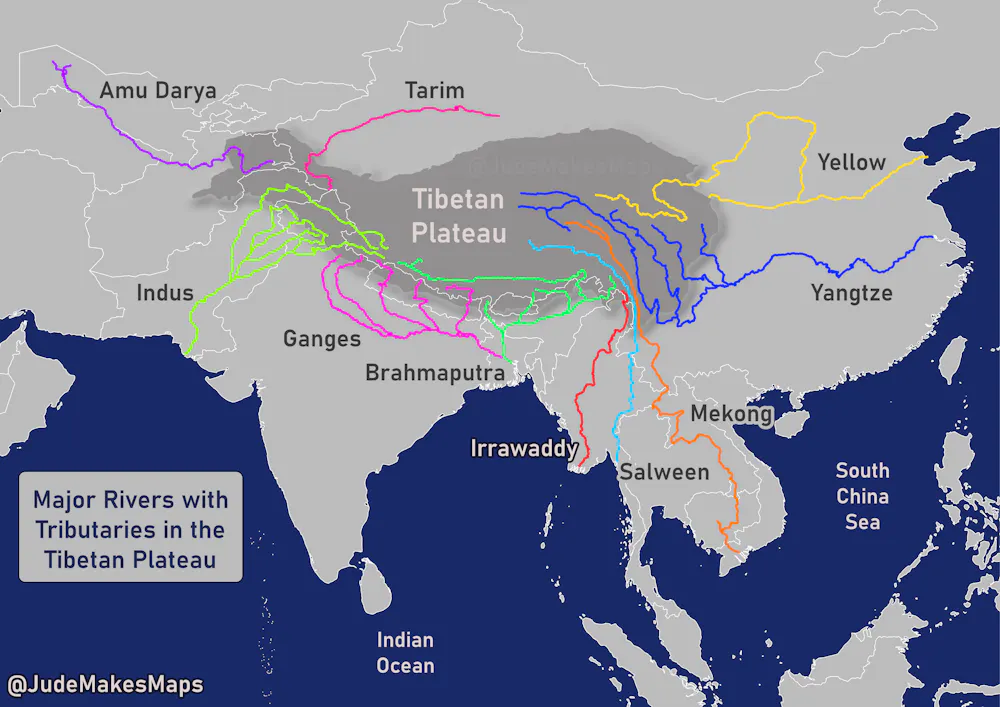
    Complicating matters further is China recently approving the construction of the world’s largest hydropower project on the Yarlung Tsangpo river in Tibet, which becomes the Brahmaputra in India. This massive project has raised alarm about China’s ability to exert control upstream, and the ecological risks for India and Bangladesh downstream.

    China hasn’t signed formal water-sharing agreements with its neighbours, but its growing presence in regional water infrastructure signals a dramatic shift in south and east Asian hydro-politics.

    Climate change is making things worse

    Recent climatic trends are making transboundary rivers an increasing focus of geopolitical friction. These trends include accelerated glacier melt, erratic monsoon patterns, and intensifying extreme weather.

    While melting glaciers will temporarily boost the flow of rivers, the long-term prognosis is bleak. If emissions and warming trends continue, many glacier-fed rivers – including the Indus, Ganges and Brahmaputra – could see dramatically reduced flows by the end of the century. This will directly affect hundreds of millions of people who depend on them.

    The crisis is being intensified by changes in the Himalayas. The region is warming faster than the global average, with a shift from snowfall to rainfall that disrupts the timing and volume of water that flows down from the mountains to the fields and cities below.

    At the same time, unsustainable groundwater extraction has pushed South Asia’s reserves of underground water toward collapse, threatening both food and water security.

    A dangerous precedent

    A collapse or suspension of the Indus Waters Treaty could set a dangerous precedent. Importantly, the threat is less about India cutting off water flows – an unlikely and technically challenging act – and more about the erosion of trust, transparency and data sharing.

    One of the treaty’s most valuable features has been the routine sharing of data on things like water levels, river flow and dam operations. Pakistan needs this data to forecast floods and droughts, plan its irrigation, generate hydropower effectively and manage its drinking water, yet India is indicating it will no longer honour these obligations.

    But India’s strained water relations are not limited to Pakistan. Bangladesh and Nepal have often felt sidelined or pressured in negotiations, and India’s indication that it may reconsider longstanding treaties raises concerns in both countries.

    This is especially the case as the Ganges Water Treaty nears its 2026 expiration: the vast Ganges river flows through India and irrigates much of Bangladesh – and the treaty guarantees Bangladesh a minimum river flow.

    Other key agreements, such as the Mahakali Treaty and Kosi river accord with Nepal, and the Teesta water-sharing deal with Bangladesh, remain largely unimplemented, breeding mistrust. These failures undermine confidence in regional water diplomacy and cast doubt on India’s commitment to equitable cooperation.

    None of this is helped by India, Pakistan and Bangladesh all continuing to rely on outdated irrigation methods that mean they use more water than necessary. As climate change intensifies floods, droughts and glacial melt, there is an urgent need to reform existing water treaties to reflect present-day climate, hydrological and geopolitical realities.

    Canals, like this one in Punjab, India, irrigate much of South Asia.
    Hussain Warraich / shutterstock

    The Indus Waters Treaty, negotiated in the 1960s before the emergence of modern climate science, no longer accounts for these transformations. Indeed, most water treaties in the region remain rooted in technocratic, engineering-centric frameworks which fail to address extreme climate variability and its cascading impacts.

    The upcoming expiration of the Ganges Water Treaty, and the pending negotiation of other basin agreements, present a critical opportunity to rethink water governance in South Asia.

    Though the Indus flows through India before Pakistan, in other basins, India is downstream. This is the case with the Brahmaputra, where it demands upstream cooperation from China.

    Undermining the Indus treaty could weaken India’s own position in future negotiations and strain its relations with Nepal and Bangladesh, while giving China more influence in South Asian hydro-politics. China is already expanding its footprint by offering billions in loans to Bangladesh and strengthening ties with Nepal, particularly around water infrastructure.

    Many of the world’s largest rivers begin in the Himalayas or the Tibetan Plateau.
    JudeMakesMaps, CC BY-SA

    Weaponising water is a perilous strategy that may backfire. The weakening of water diplomacy in South Asia is not just a regional threat; it endangers global climate security.

    In the face of escalating climate change impacts and recurring disasters, updating transboundary agreements like the Indus Waters Treaty, Ganga Water Treaty, and Kosi and Teesta accords is no longer optional – it is an urgent necessity with enormous consequences.

    Mehebub Sahana receives funding from the Leverhulme Trust, United Kingdom.

    – ref. India-Pakistan conflict over water reflects a region increasingly vulnerable to climate change – https://theconversation.com/india-pakistan-conflict-over-water-reflects-a-region-increasingly-vulnerable-to-climate-change-256253

    MIL OSI – Global Reports –

    May 10, 2025
  • MIL-OSI Global: Gems supposedly buried with Buddha are to be sold at auction – it’s a symptom of Buddhism’s ongoing commercialisation

    Source: The Conversation – UK – By Lee Clarke, Lecturer in Philosophy, Nottingham Trent University

    Almost 2,000 years ago in modern-day Uttar Pradesh, India, someone deposited a cache of gems inside a reliquary (a container for holy relics), along with some bone fragments and ash. The gems were precious, but the bones and ash even more so, for according to an inscription on the reliquary, they belonged to Siddhartha Gautama, the Buddha.

    The Piprahwa gems were placed along with the Buddha’s bodily relics (śarīra) as an offering inside a stūpa (A Buddhist funerary structure that contains relics and acts as a place of pilgrimage). Such an offering is not only supposed to generate “merit” (puṇya) and hopefully a good rebirth for the devotee, but is also an act of devotion and gratitude to the Buddha.

    In 1898, a British land owner, William Claxton Peppé, ordered the excavation of that same stūpa on his land in colonial India and discovered the reliquary. The bodily relics were sent to the Buddhist king of Thailand, many of the gems went to the former Imperial Museum in Calcutta and Peppé was permitted to keep the rest.

    This latter portion was due to be put up for auction at Sotheby’s Hong Kong this month, just days before the Buddhist holy day of Vesak – and it has generated controversy. Not only has the sale been described as perpetuating colonial violence, but the Indian government demanded that auction house Sotheby’s halt the sale or it would seek legal action. Sotheby’s has complied, for now.


    Looking for something good? Cut through the noise with a carefully curated selection of the latest releases, live events and exhibitions, straight to your inbox every fortnight, on Fridays. Sign up here.


    Peppé’s great-grandson, Chris Peppé, explained in an article for Sotheby’s: “From the time we received the Piprahwa gem relics, my cousins and I have sought to make them available for viewing by the public (ideally a Buddhist public) to see at no cost to the institution borrowing them.” This has resulted in the gems being displayed in museums around the world. The cousins also set up The Piprahwa Project website, which allows people to access all the research materials that they have gathered.

    Chris Peppé has said that he hopes that the sale will help people see to see the gems and connect with those that left them and the Buddha himself. His great-grandfather, he says, ordered the excavation to provide work for his tenant farmers.

    As a Buddhist and the grandson of an Anglo-Indian man myself, my past straddles this colonial divide more than most. Putting aside the ethical issues around excavating a sacred site in the first place, and the uncomfortable tie-in to other instances of colonial looting by the British in India, the truly extraordinary thing is that these gems were put up for sale at all.

    If they really were mixed together with the bodily relics of the Buddha, then these gems were in physical contact with them and intended to be paired with them for posterity. That means that, in a Buddhist context, there is no essential difference between the gems and the actual remains of the Buddha.

    The Sri Lankan historical chronicle The Mahāvaṃsa (written in the 5th or 6th-century AD) states that “if we behold the relics we behold the Conqueror”, aka Buddha. As art historians Conan Cheong and Ashley Thompson write in their recent journal paper on the topic: “At the very least, we can affirm that for many Buddhists, historically and today, these ‘gems’ are śarīra of the Buddha and as such are imbued with the Buddha’s living presence.”

    Buddha in the west

    Speaking to the Guardian after the auction was postponed Peppé said: “In light of the Indian government’s sudden interest in the gems, 25% of auction proceeds will be donated to the displaying of the main Kolkata collection of the Piprahwa gems for Buddhists and the larger public to enjoy. Another 25% will be donated to Buddhist institutions.” With regards to his and his two relatives’ right to sell the gems, he added: “Legally, the ownership is unchallenged.”

    As an expert in Buddhist philosophy, I believe that to put a price on something that possesses such a sacred status for millions of people worldwide is both disrespectful and morally objectionable.

    The sale is also not something I could ever imagine happening regarding objects linked with any other religious figure. If a piece of intact clothing, for example, was found to have been worn by Jesus, would this be put up for sale? Of course, it would be massively valuable, but any financial considerations would surely be outweighed by its religious importance for the world’s billions of Christians. Why should it be any different with Buddhist relics?

    Another phenomenon inadvertently revealed by the fact of the sale is the ongoing commercialisation of Buddhism in the west. To many westerners, the Buddha and Buddhism are increasingly viewed as commodities to be bought and sold.

    Cheaply made Buddha statues and Buddha-faced plant pots adorn the shelves of garden centres and are then used to decorate living rooms and gardens. Clothes, lamps, beach towels and even shoes embellished with images of the Buddha can be purchased easily. The Buddha is frequently regarded as an ornament or fashion item rather than a sacred figure in a manner that, again, is rarely done with any other religiously significant person.

    Buddhas are common garden decorations in the west – but it’s hard to imagine a Jesus-themed equivalent.
    Radek Havlicek/Shutterstock

    From all this, selling actual Buddhist relics is not a large step. As with the commodification of other religions in the west such as Hinduism and Islam, commercialisation always simultaneously involves decontextualisation. It is an example of what philosopher Sophia Rose Arjana in her book Buying Buddha, Selling Rumi (2020) terms “the religious marketplace”.

    As she writes: “Religions associated with the east – Hindu, Buddhism, Islam – are also commodified. Their symbols are marketed by entrepreneurs and corporations and then consumed by everyone from non-religious spiritualists to ambivalent mystical seekers.”

    Religious traditions, practices, images and artefacts must be stripped of their native contexts and sacred meaning. Through this auction, the Piprahwa gems are considered ancient jewels to be admired ascetically rather than religious relics.

    Given their importance to global history and our human story, the Buddha and Buddhism are worthy of a lot more respect than they are currently afforded. While Buddhism teaches that everything is impermanent, we are lucky enough to still possess treasures such as the Piprahwa gems, and we should value them – and learn from them – while we can.

    Lee Clarke does not work for, consult, own shares in or receive funding from any company or organisation that would benefit from this article, and has disclosed no relevant affiliations beyond their academic appointment.

    – ref. Gems supposedly buried with Buddha are to be sold at auction – it’s a symptom of Buddhism’s ongoing commercialisation – https://theconversation.com/gems-supposedly-buried-with-buddha-are-to-be-sold-at-auction-its-a-symptom-of-buddhisms-ongoing-commercialisation-256163

    MIL OSI – Global Reports –

    May 10, 2025
  • MIL-OSI Global: From pulpit to pitch: Pope Francis used sport to get his message to a wider world − that could continue with baseball-loving Leo XIV

    Source: The Conversation – USA – By Carmen M. Nanko-Fernández, Professor of Hispanic Theology and Ministry, Catholic Theological Union

    Players observe a minute of silence in memory of Pope Francis before the Spanish league soccer match between Real Madrid and RC Celta de Vigo at Santiago Bernabeu Stadium in Madrid on May 4, 2025. Pierre-Philippe Marcou/AFP via Getty Images

    The world of sport is “a constellation of many stars,” Pope Francis told La Gazzetta dello Sport, the Italian daily sports newspaper, during a wide-ranging interview in January 2021.

    On April 21, 2025, that world lost, if not one of its brightest stars, then certainly one of its highest-placed advocates in Francis. In his youth, Francis was only ever a street athlete, but he was an avid and lifelong sports fan, especially when it came to soccer. In fact, Francis incorporated his love of the beautiful game into his outlook as pope – for him, sport was a way to communicate with people from all backgrounds and all corners of the globe.

    With Leo XIV now installed as Francis’ successor, that sporting theme could continue in the Vatican, though the center of gravity may migrate from soccer to baseball. As befitting a U.S. pope, Leo is known to be a fan of the national pastime, in particular his native Chicago White Sox.

    Always ‘un cuervo!’

    Long before the papacy, even before his first steps toward priesthood, for Jorge Mario Bergoglio – the boy who would go on to become Pope Francis – there was his hometown sports club, Buenos Aires’ San Lorenzo de Almagro.

    It was “part of my cultural identity,” Francis later said, so much so that he maintained his club membership throughout his life.

    That became news upon his death, when a photo of his club card went viral. Argentine sports fans noted that his membership card number, 88235, coincided with his age, 88, and the moment of his death in Argentina time: 2:35 AM.

    Francis’ relationship with San Lorenzo de Almagro was marked by mutual affection. The team memorialized him in various ways. They noted how he continues to accompany them by emblazoning on their jerseys his image and the words “juntos por la eternidad” or “together forever.”

    In a touching video tribute posted on social media following Francis’ death, the club affirmed his belonging, from his childhood through his papacy, as “un cuervo” – or “crow,” a nod to the nickname for the team and its fans rooted in the club’s founding by a Catholic priest. In Lunfardo, a dialect in Buenos Aires, “cuervo” is also slang for priest. For his team, “Papa Cuervo” was “never just one more fan, he was always one of us.”

    A sporting world pays tribute

    And it wasn’t just his home team that mourned Francis’ death.

    On the day of his passing, moments of silence preceded play from Citi Field, the home of Major League Baseball’s New York Mets, to Estadi Olímpic Lluís Companys, the temporary soccer venue of Spanish soccer giant Barcelona.

    In Italy, soccer matches were rescheduled to honor the national period of mourning, and players and coaches from AS Roma filed into St. Peter’s Basilica to pay their respects.

    Pope Francis holds a tennis racket presented to him by the Italian Tennis Federation in 2015.
    AP Photo/Alessandra Tarantino

    Across social media platforms, the sporting world responded to the loss of one they considered their own. Spanish tennis champ Rafael Nadal tweeted his condolences and observed that the day was indeed “un día triste,” or “sad day.”

    The NFL’s New Orleans Saints expressed condolences and commemorated their relationship with the pope, a connection born of a digital anomaly. Each time Francis posted #Saints on his X – formerly Twitter – account, it automatically tagged the NFL team, which did not mind the accidental blessings.

    When global attention turned to speculating about the next pope, the soccer world continued to mourn and honor their star. From April 29 to May 1, each Champions League semifinal match – youth, women’s and men’s alike – was preceded by a moment of silence.

    In the words of world soccer body UEFA’s president Aleksander Čeferin: “Pope Francis was a beacon of hope for… (a) humanity that will now remain orphaned of that voice – tireless and powerful – that always rose in defense of the poor, the humble, and the vulnerable to call for respect, acceptance, and equality and to implore a peace that always seemed distant …”

    Pope Francis is given a San Lorenzo’s shirt as he greets the faithful prior to his first ‘Urbi et Orbi’ blessing from the balcony of St. Peter’s Basilica during Easter Mass on March 31, 2013.
    Dan Kitwood/Getty Images

    Sport as language of life

    For Francis, sport was more than a game or a pastime.

    It was a vernacular, and soccer was his dialect. He was fluent and it showed. He recognized in sport the potential to communicate in what he called a universal language that “extends across borders, language, race, religion and ideology; it possesses the capacity to unite people, together, by fostering dialogue and acceptance.”

    The online archive of his pontificate contains well over 60 sport-related audiences, messages and letters, including video greetings on occasions such as the 2014 FIFA World Cup and Super Bowl LI in 2017.

    The significance of sport as a distinctive body of his papal teaching is also indicated by the Spanish release in 2024 of “Más Allá De Los Límites: El Deporte Según El Papa Francisco,” or “Beyond the Limits: Sports According to Pope Francis.” The book came with a forward by Carlo Ancelotti, the storied manager of a litany of soccer greats, including Real Madrid.

    Sport emerged early as one of Jorge Bergoglio’s native tongues, bound intimately to memory, family, identity and belonging – threads also evident in his canon of teachings on sport. In “Hope,” his 2024 autobiography, Francis dedicates a chapter to sport and weaves stories of his beloved soccer throughout the book in a manner that reveals how “the experience of the people and their passions” became for him a source and site for his theology of encounter.

    A commitment to inclusivity is a constitutive element in his teaching on both sport and encounter. Among those who paid tribute on Francis’ passing were the organizers of the Paralympic Games, who posted: “Today humanity lost a great man … passionate about sport and passionate about inclusion, which epitomizes everything the Paralympic Movement stands for.”

    ‘Getting in the game’

    Francis urged, “‘Get in the game’ not only in sports … but also in life, in the search for the good, without fear but with courage and enthusiasm. Get in the game with others and with God … Place your talents at the service of the encounter among people, of friendship and of inclusion.”

    Pope Francis salutes the cricket team of the Vatican.
    AP Photo/Alessandra Tarantino

    He put this into practice with the launch and sponsorship in 2019 of Athletica Vaticana, a dedicated sports body for the city-state. He also gave his blessing and backing to St. Peter’s Cricket Club, the first-ever Vatican women’s soccer team, and Sport at the Service of Humanity, a collaborative global movement that seeks to “leverage the power of Faith and Sport as a platform for good.”

    “Get in the game” was a call intended not only for athletes – amateur, collegiate, Special Olympian, professional – but for street-ballers, schoolyard players, fans and gamers of all kinds. In sports and play, Francis found the potential for a “school of peace” because they provided opportunities “to go outside of our own walls and learn how to participate, to overcome, to struggle together,” charting ways forward for church and society “to overcome all forms of discrimination and exclusion.”

    Francis never forgot the joys or even the sorrows of sports as a player or as a fan. “Playing is a right,” he wrote in his memoir, “and there’s also the hallowed right not to be a champion.”

    Behind every ball, he saw a kid with a dream and aspirations, and he recognized himself on the soccer field – a “pata dura,” the kid with two left feet, “sleeves rolled up, and often with grazed knees.” On the sports field, like elsewhere, he recognized and took delight in the beauty of God.

    The link between the papacy and the sporting world looks set to continue under Pope Leo XIV.

    The media quickly noted that soccer aficionado Francis had been succeeded by an amateur tennis player and fan.

    The new pope’s brother had to resolve an online dispute by affirming Leo is a fan of the South Side’s Chicago White Sox and not the North Side’s Cubs.

    Regardless, the city’s two baseball franchises responded with dueling stadium signs claiming the pope as their own. Meanwhile, ESPN reported that NBA teammates Jalen Brunson and Josh Hart, former Villanova Wildcats-turned-New York Knicks chatted about a possible alumni reunion with the newest rising star in the constellation of sports: Pope Leo XIV.

    Carmen M. Nanko-Fernández does not work for, consult, own shares in or receive funding from any company or organization that would benefit from this article, and has disclosed no relevant affiliations beyond their academic appointment.

    – ref. From pulpit to pitch: Pope Francis used sport to get his message to a wider world − that could continue with baseball-loving Leo XIV – https://theconversation.com/from-pulpit-to-pitch-pope-francis-used-sport-to-get-his-message-to-a-wider-world-that-could-continue-with-baseball-loving-leo-xiv-255493

    MIL OSI – Global Reports –

    May 10, 2025
  • MIL-OSI Europe: ASIA/INDIA – “Before each meeting and pastoral activity, he spent a long time in Eucharistic adoration”: Augustinians remember the Prior Provost in India

    Source: Agenzia Fides – MIL OSI

    Verapoly diocese

    New Delhi (Agenzia Fides) – “Pope Leo XIV is remembered in India with affection and gratitude. He visited our nation twice as Prior General of the Augustinian Fathers, he is remembered as a simple man, who knew how to adapt to the local context, his attitude of listening and dialogue, and his spirituality rooted in an intense life of prayer. What was most striking was the prolonged time he dedicated to silent Eucharistic adoration,” Father Stephen Alathara, Deputy Secretary General of the Conference of Latin Rite Bishops of India and Founding Director of “Communio,” an initiative of the Latin Episcopate of India (CCBI) to support dioceses and religious congregations in rural areas, told Fides.Father Alathara recalls the two visits the then Prior Provost made during his tenure as head of the Order of Saint Augustine: “In 2004 and 2006, he visited several Augustinian communities in Kerala and Tamil Nadu, leaving everyone with an impression of profound spirituality and closeness.” During his first visit, in 2004, he spent more than a week at the Augustinian houses in Mariyapuram, in the Archdiocese of Verapoly and Edakochi, in the Diocese of Cochin, both in the state of Kerala, in southern India. “He celebrated the Eucharist at the Parish of Mary Queen Help of Christians in Mariyapuram and at the Shrine of Saint Anthony in Edakochi. They were celebrations experienced with great fervor and hope,” the faithful recall. In particular, on April 22, 2004, he concelebrated with the then Archbishop of Verapoly, Monsignor Daniel Acharuparambil, the ordination Mass of six Augustinian deacons at the Church of St. Francis Xavier in Kathrikadavu (Kaloor). “His gestures of welcome and fraternal charity toward the new priests are engraved in our hearts,” Father Alathara emphasizes. The second visit took place in October 2006, when he returned to the Augustinian house in Mariyapuram to participate in the Asia-Pacific meeting organized by the Order. “During that trip, despite having to attend to important matters for the Order in the region, he found time to visit the Shenbagam School in Pollachi (Tamil Nadu), run by the Augustinian Fathers in the Diocese of Coimbatore, where he met with children and young people. “He also celebrated the Eucharist at the parish of St. Thomas in Thalapuzha, in the Archdiocese of Calicut, Kerala,” adds Father Alathara. “These gestures reveal his human sensitivity and his pastoral heart. He always wanted to be in touch with the concrete reality and with the people of the communities: this is how we remember him, and we hope to be able to welcome him back to India as Pope Leo XIV.”The Indian Augustinians also remember him fondly. “When he was here, we knew him as an extraordinarily simple person, down-to-earth, always ready to face the difficulties of everyday life,” notes Father Jacob Mullassery, OSA, who accompanied him on both visits. “He never asked for privileges: he traveled with us and accepted lodging in humble rooms, provided with the bare essentials. His humility deeply impressed us.”Father Metro Xavier, OSA, who had several personal encounters with the Prior Provost, describes him as “a deeply spiritual man.” And he adds: “Before each meeting or pastoral activity, he spent a long time in silent Eucharistic adoration. He demonstrated a profound love for the Church and total reverence for her Magisterium. His spiritual life gave us a testimony of prayer and simplicity.” For his part, Father Wilson Injerappu, OSA, Regional Vicar of the Order in India, joyfully expresses: “We are filled with immense gratitude. Having an Augustinian brother as Pope is a great blessing. It is also a reminder of our responsibility: we must constantly pray for him and support his mission with our daily prayer.” (PA) (Agenzia Fides, 9/5/2025)
    Share:

    MIL OSI Europe News –

    May 10, 2025
  • MIL-OSI United Kingdom: Windsor soldier of World War 1 buried with Full Military Honours

    Source: United Kingdom – Executive Government & Departments 3

    News story

    Windsor soldier of World War 1 buried with Full Military Honours

    The remains of Private (Pte) John Tame of 2nd Battalion The Royal Berkshire Regiment were laid to rest on 8 May in Belgium, nearly 108 years after his death.

    The coffin of Private Tame is carried into New Irish Farm Cemetery by serving soldiers of 2nd Battalion The Rifles (Crown Copyright)

    The burial service for Pte Tame was organised by the MOD’s Joint Casualty and Compassionate Centre (JCCC), also known as the War Detectives, and took place at the Commonwealth War Graves Commission’s (CWGC) New Irish Farm Cemetery. 

    The service was supported by serving soldiers from 2nd Battalion The Rifles and was attended by Keith Brooks, the great nephew of Pte Tame, who aided JCCC by providing the DNA sample used to identify him. 

    Keith Brooks said: 

    John and his brothers Alfred and William have been remembered by the family from just photographs and vague memories from those who have now long passed. Now, after finding John’s remains, he is more than just a distant photograph. This has made him more real along with his story for future generations.

    This has all been achieved because of the excellent work the MOD do with all the research and investigations, giving missing people who have served their country the funeral they all greatly deserve. 

    Pte Tame was identified after his remains were found during road works at Zonnebeke near Ypres in May 2018. Nearby artefacts included a cap badge and shoulder title of The Royal Berkshire Regiment. The body also appeared to have been previously wounded around his left shoulder, which led to DNA matching confirming his identification.

    Pte Tame was from Windsor, Berkshire, and the third-eldest of 7 children. His elder brothers Alfred and William George also enlisted and served with 2nd Battalion The Royal Berkshire Regiment which, though stationed in India at the outbreak of the World War 1, arrived on the Western Front on 5 November 1914. 

    John’s brothers Lance Corporal Alfred Tame and Corporal William George Tame were both killed on 9 May 1915 during the Battle of Aubers Ridge. They are still missing and are commemorated on the Ploegsteert Memorial. 

    On Friday 9 May, the 110th anniversary of their deaths, the family of Pte Tame and a party from 2nd Battalion The Rifles visited the Ploegsteert Memorial to remember his missing brothers. 

    Soldiers of 2nd Battalion The Rifles visited the Ploegsteert Memorial with Keith Brooks to remember Private Tame’s brothers, killed 110 years ago today (Crown Copyright)

    JCCC Caseworker, Rosie Barron said: 

    It has been an honour to work with The Rifles to give Pte Tame the full military funeral that he deserves and to have conducted the research which led to his identification. It has also been a privilege to meet Keith, and to have shared this experience with him and his family.  

    The grave will now be cared for in perpetuity by CWGC. Commemorations Casework Manager at the CWGC, David Royle, said:

    It is an honour to have been involved in the research that led to the formal identification of Private Tame and to have assisted his family with their choices for his Commission headstone. He is now at rest alongside his comrades in New Irish Farm Cemetery, where we will care for his grave in perpetuity.

    The service was conducted by the Reverend Stephen Cassells CF, Chaplain to 2nd Battalion The Rifles. Reverend Cassells said: 

    I count it a privilege to be involved in the proper burial of Pte Tame. It is right that his remains should be laid to rest with dignity and in a place where his service will be properly honoured. I pray that his family will find peace in knowing that their relative has been found and buried properly and that those connected with his army regiment would draw renewed commitment through his service for King and country.

    Share this page

    The following links open in a new tab

    • Share on Facebook (opens in new tab)
    • Share on Twitter (opens in new tab)

    Updates to this page

    Published 9 May 2025

    MIL OSI United Kingdom –

    May 10, 2025
  • MIL-OSI Global: Major brands don’t need to kowtow to Trump: they have the power to bring people together

    Source: The Conversation – UK – By Michael Beverland, Professor of Brand Management, University of Sussex Business School, University of Sussex

    Whatever you think of his personality or politics, it’s impossible to deny the success of Donald Trump as a brand. Supporters and detractors across the world are transfixed by his second term as US president.

    And so far, many corporate brands appear keen to get alongside him. The leaders of Tesla, Amazon and Meta were all prominent guests at Trump’s inauguration in January 2025.

    By then, Mark Zuckerberg had already shifted company policy on fact checking to be more aligned with the political wind. Weeks later, retail giants Walmart and Target had rolled back diversity, equality and inclusion (DEI) initiatives.

    Even the NFL, which had so infuriated Trump in his first term with its support for diversity, has come to heel.

    So now that Trump is back in town, is the only option available to big US organisations to swing to the right? Well, not necessarily.

    Our research suggests that the rise of populism actually represents an opportunity for brands to rebuild a sense of shared national identity.

    And the most well-known brands are the best placed to do this. Their familiar place in people’s everyday lives gives them huge power as non-political agents of collective identity which can cross divides of race, class, geography and age.

    A great example of this was during the presidential election campaign when Trump’s team wanted to organise a publicity stunt involving the Republican candidate “working” at a branch of McDonald’s in Pennsylvania.

    Trump’s love of the golden arches is well known, but McDonald’s is a strongly non-political brand. So what should it do? Refuse and risk a backlash, or accept and be accused of taking sides?

    In the end, the company’s response was a masterclass in neutrality.

    McDonald’s told its employees that the company was neither red (Republican) nor blue (Democrat), but golden. Referring to both presidential candidates’ love of McDonald’s, the company made it clear that the permission granted to Trump illustrated one of their core values, stating: “We open our doors for everyone”.

    The plan worked. And this was partly down to McDonald’s being widely thought of as an authentic brand which connects people.

    Research has shown that people really value a company’s place in local communities. And McDonald’s is a place which hosts children’s birthday parties, where you can catch up with friends, where you might even have had your first ever job.

    This kind of power to unify is something other brands can do too. As something our earlier research shows, brands can benefit from bringing people together, by creating a sense of shared identity.

    Brand new

    In New Zealand for example, ANZ Bank was widely applauded for a campaign featuring Indian immigrants. The advert tells the story of a father and son and their mixed cricketing loyalties (the parent to India, the child to New Zealand).

    It is a tale of immigrants achieving their version of the national dream, through hard work and trademark Kiwi humour. This kind of narrative-driven campaign does not pitch one side against another, but instead highlights the things that bind people together.

    Similarly in the UK, the department store John Lewis has become a seasonal advertising staple as it reminds customers of their shared rituals over Christmas. And Kraft’s “How do you love your Vegemite” campaign allowed new immigrants to participate in local snacking rituals, helping them feel Australian.

    In the US, a 1971 Coca Cola commercial (one of the most lauded adverts ever) presented a united multi-cultural collection of young people as a response to the anti-Vietnam war counter-culture.

    So far, American brands have struggled to navigate the ever-shifting pronouncements coming from the White House in Trump’s second term. Amazon for example, quickly went back on its decision to list the cost of tariffs on products after it was branded a “hostile move”.

    But one brand does stand out. And that’s Ford.

    Perhaps it was inevitable that the car maker which came to symbolise successful 20th century American manufacturing would get this right. And the company’s decision to extend employee discounts to all consumers in what it describes as “unprecedented times” is a clever move.

    Some might call it a cynical tactic to embrace Trump’s tariffs and encourage Americans to buy American. But the firm (which will likely take a huge hit from more expensive imported parts and materials) is doing much more than that.

    Its new campaign (with the slogan “From America for America”) reminds US citizens that the brand is part of their lives, regardless of their political home. Supportive full-page print ads go further, setting out the firm’s long history spent backing the people of America.

    One Ford executive says that the campaign is about “authenticity” and Ford being a brand “that all consumers can rely on, especially in these uncertain times”.

    Authenticity is much prized when the political landscape is so polarised. And while divisions cannot be healed solely by brands, they can help to remind us of shared values and a sense of community. And in doing so, dial down those political tensions.

    The authors do not work for, consult, own shares in or receive funding from any company or organisation that would benefit from this article, and have disclosed no relevant affiliations beyond their academic appointment.

    – ref. Major brands don’t need to kowtow to Trump: they have the power to bring people together – https://theconversation.com/major-brands-dont-need-to-kowtow-to-trump-they-have-the-power-to-bring-people-together-249401

    MIL OSI – Global Reports –

    May 10, 2025
  • MIL-OSI China: Tensions remain as Pakistan-India flare-ups enter 3rd day

    Source: People’s Republic of China – State Council News

    Tensions have remained as flare-ups between Pakistan and India have entered the third day.

    Pakistan’s Foreign Ministry has firmly rejected Indian media reports alleging cross-border attacks originating from Pakistani territory, calling them “baseless, fabricated, and aimed at creating a false pretext for escalation.”

    “The repeated pattern of leveling accusations against Pakistan without any credible investigation reflects a deliberate strategy to manufacture a pretext for aggression and to further destabilize the region,” the ministry said in a statement late on Thursday.

    Separately, Pakistani security sources dismissed claims carried by Indian media alleging drone or missile attacks in the Indian-controlled Kashmir and the downing of a Pakistani F-16 fighter jet.

    “No drone or missile has been launched from Pakistan,” the sources told Xinhua. “These reports are outright fake, politically motivated, and part of a broader campaign of disinformation.”

    In India, the Indian army on Friday released a short video showing a strike hitting a target in Pakistan.

    In the short, low-resolution video, a projectile (apparently a missile) can be seen moving and hitting a structure.

    The army described it as a “befitting reply” to Pakistan’s shelling, but the exact location of the destroyed structure has not been disclosed.

    Meanwhile, authorities in the Indian capital region Delhi on Friday installed and tested air raid sirens.

    According to social media giant X, formerly known as Twitter, the Indian government has asked it to block 8,000 accounts on the social media platform, including those belonging to international news organizations and prominent X users.

    On Wednesday, India launched airstrikes on Pakistani targets to avenge last month’s killing of 26 people by gunmen in Pahalgam town, about 89 km east of Srinagar, the summer capital of the Indian-controlled Kashmir.

    The situation along the Line of Control, dividing Kashmir, has been tense as troops of India and Pakistan deployed on both sides of the ceasefire line were engaged in an exchange of fire and artillery.

    MIL OSI China News –

    May 10, 2025
  • MIL-OSI Economics: RBI imposes monetary penalty on Jana Small Finance Bank Limited

    Source: Reserve Bank of India

    The Reserve Bank of India (RBI) has, by an order dated May 07, 2025, imposed a monetary penalty of ₹1.00 crore (Rupees One Crore only) on Jana Small Finance Bank Limited (the bank) for contravention of provision of Section 12B(5) of the Banking Regulation Act, 1949 (BR Act). This penalty has been imposed in exercise of powers conferred on RBI under the provisions of Section 47A(1)(c) read with Section 46(4)(i) of the BR Act.

    The bank had raised paid-up share capital through issue / allotment of Compulsory Convertible Preference Shares (CCPS) to certain persons. This was examined vis-à-vis the requirement under Section 12B(5) of the BR Act and a notice was issued to the bank advising it to show cause as to why penalty should not be imposed on it for its failure to comply with the statutory provision.

    After considering the bank’s reply to the notice, additional submissions made by it and oral submissions made during the personal hearing, RBI found that the following charge against the bank was sustained, warranting imposition of monetary penalty:

    The bank issued / allotted CCPS to certain persons, which taken along with equity share capital held by them, made such persons to hold more than permitted percentage of the paid-up share capital of the bank. It was not ensured that such persons have obtained previous approval of RBI as required under Section 12B(1) of the BR Act.

    This action is based on deficiencies in statutory compliance and is not intended to pronounce upon the validity of any transaction or agreement entered into by the bank with its customers. Further, imposition of monetary penalty is without prejudice to any other action that may be initiated by RBI against the bank.

    (Puneet Pancholy)  
    Chief General Manager

    Press Release: 2025-2026/302

    MIL OSI Economics –

    May 10, 2025
  • MIL-OSI Economics: RBI approves the voluntary amalgamation of Sawantwadi Urban Co-operative Bank Ltd., Sawantwadi (Maharashtra) with TJSB Sahakari Bank Ltd. (Maharashtra)

    Source: Reserve Bank of India

    The Reserve Bank of India has sanctioned the Scheme of Amalgamation of Sawantwadi Urban Co-operative Bank Ltd., Sawantwadi (Maharashtra) with TJSB Sahakari Bank Ltd. (Maharashtra). The Scheme has been sanctioned in exercise of the powers conferred under sub-section (4) of Section 44A read with Section 56 of the Banking Regulation Act, 1949. The Scheme will come into force with effect from May 13, 2025. The branches of Sawantwadi Urban Co-operative Bank Ltd., Sawantwadi (Maharashtra) will function as branches of TJSB Sahakari Bank Ltd. (Maharashtra) with effect from May 13, 2025.

    (Puneet Pancholy)  
    Chief General Manager

    Press Release: 2025-2026/301

    MIL OSI Economics –

    May 10, 2025
  • MIL-OSI USA: South Carolina AG Alan Wilson asks SCOTUS to uphold Maine legislator’s right to vote and speak freelyRead More

    Source: US State of South Carolina

    (COLUMBIA, S.C.) – South Carolina Attorney General Alan Wilson announced today that his office has joined a friend-of-the-court brief filed in the United States Supreme Court supporting Maine Representative Laurel Libby, who was stripped of her ability to vote and speak on the State House floor by Democratic legislative leadership.  

    The Supreme Court is being asked to restore Representative Libby’s voting rights while her case continues through the courts, as such actions likely violate the foundational principles of representative democracy and the U.S. Constitution. 

    “This is not a partisan issue, it’s a constitutional one,” said Attorney General Alan Wilson. “In our system of government, every citizen deserves to have their voice heard through their elected officials. Blocking a legislator from voting silences not just one voice, but the voice of every constituent they represent. That’s not how our republic is supposed to work. The ability of lawmakers to speak and vote freely on behalf of their districts is a foundational part of American democracy, and I am standing up to ensure that principle is protected.” 

    The case involves Representative Libby being barred from voting and speaking on the Maine House floor after she posted on social media about a biologically male student-athlete who won a girls’ pole-vaulting competition. The brief argues that stripping a duly elected lawmaker of their right to vote undermines democratic representation and violates the constitutional rights of both the representative and their constituents. 

    The coalition of attorneys general asserts that legislative immunity, which generally shields lawmakers from lawsuits related to legislative actions, does not protect actions that directly undermine democratic processes, like removing a legislator’s voting rights. 

    In addition to South Carolina, attorneys general from the following states joined the brief: Alabama, Arkansas, Florida, Georgia, Idaho, Indiana, Iowa, Kansas, Mississippi, Missouri, Montana, North Dakota, Ohio, and South Dakota. 

    You can read the brief here. 

    MIL OSI USA News –

    May 10, 2025
  • MIL-OSI Global: Missile strikes and drone attacks heighten South Asian crisis – 8 questions answered over the role of Pakistan’s military in responding

    Source: The Conversation – Global Perspectives – By Ayesha Jalal, Professor of History, Tufts University

    A mosque lies in ruins after an Indian airstrike in Muzaffarabad, the capital of Pakistan-administered Kashmir, on May 7, 2025. Zubair Abbasi/Middle East Images//AFP via Getty Images

    Pakistan’s government has pledged to respond “at a time, place and manner of its choosing” following an air attack from India that killed 31 people in Pakistan on May 6, 2025.

    The missile strike comes at a time of increased tension between the two South Asian neighbors following a terror attack in Indian-controlled Kashmir on April 22 that resulted in the deaths of 26 Indian tourists.

    India blamed the assault on its neighbor although has yet to provide any solid proof of a link between the assailants and the Pakistani state.

    To understand more about how Pakistan’s powerful military is viewing the incident, and weighing a response, The Conversation U.S. turned to Ayesha Jalal, an expert on South Asian history and politics who is the Mary Ricardson Professor of History at Tufts University.

    Who will makes the decisions over how Pakistan responds?

    This is clearly a defense issue, so the Pakistani military is going to take the lead. Any decision over how to respond to the Indian airstrikes will have to be done in consultation with the civilian government. But ultimately it will be the powerful Pakistani generals that will be making the decisions.

    In Pakistan, this is the usual way of doing things. The military has dominated politics in Pakistan for decades. Partly, this is due to the very dynamic we are seeing now. From the creation of Pakistan onward, there has been tension with India, including over Kashmir. Indeed the two countries went to war over Kashmir within a year of the partition of India soon after the creation of Pakistan. So the military has always been seen as central to Pakistan’s view of itself as an independent nation.

    Then in 1958, the Pakistani army toppled the civilian government in the country’s first of several military coup attempts, three of which have been successful.

    Since that time onward, no civilian government has been able to govern successfully for long without the support of the army. Recent political developments in the country – the ouster and arrest of former Prime Minister Imran Khan and a 2024 election that resulted in a weak coalition government – have only strengthened the hand of Pakistan’s military.

    What do we know about Pakistan’s army chief Gen. Syed Asim Munir?

    Despite the Pakistani Army’s position of power, Gen. Syed Asim Munir, the Chief of Army Staff, is someone who has tried to keep out of the spotlight. He is known as a very religious character – he is a Hafiz, meaning he has memorized the Quran. And he is seen as a tough, fairly inaccessible soldier.

    He is also a hawk when it comes to relations with India. Speaking after the Kashmir attack and before India’s airstrikes, Munir warned, “Let there be no ambiguity: Any military misadventure by India will be met with a swift, resolute, and notch-up response.”

    Chief of Army Staff Syed Asim Munir on July 16, 2023.
    Iranian Presidency/Anadolu Agency via Getty Images

    This approach is somewhat of a departure from that of the man he replaced in 2022, former Army Chief Qamar Javed Bajwa. Bajwa was more inclined to look for a peaceful resolution with India over Kashmir and other issues.

    Munir, by contrast, presents a a more belligerent front in the face of what many in Pakistan see as Indian aggression, while framing the rivalry between the two nations in religious terms.

    What role has he and the Pakistani army played so far in the crisis?

    A lot has been made, especially in India, of comments that Munir made a few days before the attack in Pahalgam.

    Munir described Kashmir as Pakistan’s “jugular vein” and framed the long-running animosity between Pakistan and India in religious terms, invoking the “two-nation” theory that states that India is a homeland for Hindus; Pakistan is one for Muslims. The theory, conveyed by much of India’s media, is that Munir’s was an inflammatory statement that encouraged the Pahalgam attack.

    But there is nothing in what he said that was entirely original or new: This has been the narrative of the Pakistani military for several decades. It is simply how they talk.

    Is there evidence that Pakistan’s military played a role in the attack?

    None that India has presented as yet.

    India has blamed Pakistan for supporting the Kashmiri militants responsible – but hasn’t articulated what the actual relationship is between Pakistan and the militant group, The Resistance Front.

    Certainly, Pakistan has in the past had ties to some of the many militant groups in Kashmir. For some groups, that has meant crossing over from Indian-controlled Kashmir to Pakistan for training.

    But the argument that “Pakistan used to do it, so they must be doing it now” seems unsupported – certainly, Indian hasn’t presented solid evidence to any international body.

    What has the reaction of the international community been?

    India is not on as strong of ground as it was in 2019, when a suicide bomber in Pulwama, Indian-administerd Kashmir, killed 40 members of the Central Reserve Police Force. On that occasion, the international community swung behind India, with the U.S. offering counterterrorism support while calling on Pakistan to stop sheltering terrorists.

    Without firm evidence of a link between the attack and Pakistan this time around, the international community has found it difficult to go with India’s narrative of the attack. The U.S. has called on both sides to find a “peaceful resolution.”

    Meanwhile China has indicated that it is standing by Pakistan in a statement in which it expressed “regret over India’s military actions” while also calling on both India and Pakistan to “avoid taking actions that further complicate the situation.”

    What pressures will the Pakistani army be under to respond?

    In Pakistan, the view is this is India attempting to assert its dominance and create what analysts have called a “new normal” in relationships between the two countries – one in which India will retaliate to any perceived Pakistani-linked terror attack with missile strikes on Pakistan’s territory.

    The theory here is that India doesn’t mind escalation, in fact it is seen as serving the Hindu nationalist aims of India’s Prime Minister Narendra Modi.

    But I wouldn’t describe it as public pressure on Pakistan’s military to respond, it is more strategic pressure. Pakistan will need to prevent this “new normal” happening, and so will, in my view, very likely respond in kind to the Indian airstrikes.

    What can Pakistan do in response?

    Well, for starters it has, in theory, the capacity to hit over 200 Indian cities with its arsenal of missiles. But Pakistan Defense Minister Khawaja Muhammad Asif has already said that strikes would only target Indian military targets and not civilians. Pakistan also has to weigh how India may respond to any retaliatory strikes.

    But India has expanded the usual terms of engagement when it comes to Kashmir. Typically in recent years, fighting has been contained along the “line of control” – the border between Indian- and Pakistani-controled Kashmir.

    But the Indian airstrike was deep within Pakistan. India says that the targets were all terrorist, but civilians were killed in the process – and Pakistan’s military will not be able to just leave it at that. A response is very much expected, especially now that India has upped the ante by using Israeli made Harop drones in an attempt to target the Pakistani air defense system. Pakistan claims it has shot down 25 of these drones.

    What are the risks of escalation for Pakistan?

    Obviously the most pressing risk is that Pakistan and India are both nuclear states. If Pakistan retaliates in an escalatory way, and then India responds in a similar fashion, this gets to a point where the use of nuclear weapons is a very real risk.

    War would also hit Pakistan’s economy at a time when it is seen to be improving after years of crisis. But that will likely be of secondary importance in the decision-making process for Pakistan’s military if it believes that the country’s integrity is being threatened.

    In addition, Pakistan’s generals will likely be of the view that India, in attacking Pakistan, is trying to thwart any economic recovery in Pakistan – with the belief being that India’s government fears a powerful, more economically stable rival.

    Ayesha Jalal does not work for, consult, own shares in or receive funding from any company or organization that would benefit from this article, and has disclosed no relevant affiliations beyond their academic appointment.

    – ref. Missile strikes and drone attacks heighten South Asian crisis – 8 questions answered over the role of Pakistan’s military in responding – https://theconversation.com/missile-strikes-and-drone-attacks-heighten-south-asian-crisis-8-questions-answered-over-the-role-of-pakistans-military-in-responding-256185

    MIL OSI – Global Reports –

    May 9, 2025
  • MIL-OSI Banking: Indonesia credit and charge card payments market to grow by 3.2% in 2025, forecasts GlobalData

    Source: GlobalData

    Indonesia credit and charge card payments market to grow by 3.2% in 2025, forecasts GlobalData

    Posted in Banking

    Indonesia’s credit and charge card payments market is expected to register a growth of 3.2% to reach IDR441.8 trillion ($27.9 billion) in 2025. This growth will be driven by the rising consumer spending and increasing consumer preference for cashless transactions. Enhanced by value-added incentives such as cashback offers, flexible repayment options, and installment facilities, the market is set to maintain an upward trajectory, despite the evolving global economic challenges, reveals GlobalData, a leading data and analytics company.

    GlobalData’s Payment Cards Analytics reveals that credit and charge card payment value in Indonesia registered a growth of 7.8% in 2024, driven by the rise in consumer spending.

    Kartik Challa, Senior Banking and Payments Analyst at GlobalData, comments: “Public awareness of the advantages associated with credit card usage is gradually rising in Indonesia. The launch of domestic credit card scheme like Kartu Kredit Indonesia (KKI) has also contributed to the rising adoption of credit cards. Consumers frequently utilize these cards to capitalize on benefits, including cashback offers and rewards programs.”

    While credit and charge card penetration is low compared to debit cards, consumers are increasingly using credit and charge cards for payments, with the frequency of payments per card standing at 24.2 times in 2024 (compared to 3.9 for debit cards) and is anticipated to further rise to 30.9 in 2029. This is driven by banks offering flexible repayment options and value-added benefits such as cashback, reward points, discounts, and installment facilities.

    Bank Mandiri offers an installment facility to Visa Credit Card Shopee and Mastercard Livin’ Everyday credit card holders. Likewise, Bank Negara Indonesia offers BNI installment plan allowing its credit card holders to convert purchases into three, six, nine, 12, 18, 24, and 36 monthly installments.

    Meanwhile, to mitigate the risk of over-indebtedness, banks provide debt consolidation programs. HSBC Indonesia, for instance, presents a Debt Management service to clients who have utilized credit cards or personal loans. This service includes options to lower the amount of each installment, extend the repayment term, or decrease the total amount owed by waiving interest or fees. These measures are designed to assist customers in managing their financial obligations more effectively.

    Gradual improvement in payment infrastructure is also contributing to the rise of credit and charge cards in the country, with the total number of POS terminals rising from 1.4 million in 2020 to 2.2 million in 2024. The figure is expected to reach 3 million by 2029. Overall, the number of POS terminals per million inhabitants in Indonesia stood at 7,793 in 2024, which is higher compared to some of its peers such as India (6,964), Vietnam (5,988), the Philippines (4,891), and Cambodia (2,477), though there is significant room for further expansion of POS infrastructure.

    Challa concludes: “While the market size for credit and charge cards is smaller compared to debit cards, it is experiencing notable growth. This is due to growing consumer spending, and growth in e-commerce payments. However, challenges such as the ongoing global trade tariff dispute among major countries, and geopolitical uncertainties remain bottlenecks to the market. Overall, the value of credit and charge card payments is forecast to register a slower compound annual growth rate (CAGR) of 9.8% between 2025 and 2029 to reach IDR622.3 trillion ($39.2 billion) in 2029.”

    MIL OSI Global Banks –

    May 9, 2025
  • MIL-OSI Economics: Detailed Result: OMO Purchase Auction held on May 09, 2025 and Settlement on May 13, 2025

    Source: Reserve Bank of India

    I. Summary OMO Purchase Results

    Aggregate Amount (Face value) notified by RBI : ₹25,000 crore
    Total amount offered (Face value) by participants : ₹76,845 crore
    Total amount accepted (Face value) by RBI : ₹25,000 crore

    II. Details of OMO Purchase Issue

    Security 6.54% GS 2032 7.57% GS 2033 6.19% GS 2034 6.64% GS 2035 7.54% GS 2036
    No. of offers received 55 51 24 94 35
    Total amount (face value) offered (₹ in crore) 9,167 26,522 6,909 27,284 6,963
    No. of offers accepted 11 33 4 33 21
    Total offer amount (face value) accepted by RBI (₹ in crore) 3,300 7,124 1,850 10,510 2,216
    Cut off yield (%) 6.3203 6.4005 6.3681 6.4548 6.4993
    Cut off price (₹) 101.17 107.29 98.75 101.35 108.10
    Weighted average yield (%) 6.3240 6.4205 6.3797 6.4670 6.5189
    Weighted average price (₹) 101.15 107.16 98.67 101.26 107.94
    Partial allotment % of competitive offers at cut off price NA 49.93 NA 41.88 NA

    Ajit Prasad          
    Deputy General Manager
    (Communications)    

    Press Release: 2025-2026/297

    MIL OSI Economics –

    May 9, 2025
  • MIL-OSI Economics: Four NBFCs surrender their Certificate of Registration to RBI

    Source: Reserve Bank of India

    The following four Non-Banking Financial Companies (NBFC) have surrendered the Certificate of Registration (CoR) granted to them by the Reserve Bank of India (RBI). The RBI, in exercise of powers conferred on it under Section 45-IA (6) of the Reserve Bank of India Act, 1934, has therefore cancelled their CoR.

    i) Cancellation of CoR due to exit from Non-Banking Financial Institution (NBFI) business

    Sr. No. Name of the Company Registered Office Address CoR No. CoR Issued on Date of Cancellation of CoR
    1 Sicom Investments & Finance Limited Sixth Floor, Solitare Corporate Park, Bldg No. 4, Chakala, Andheri (East), Mumbai, Mumbai, Maharashtra – 400093 N-13.01842 September 08, 2006 April 04, 2025
    2 Pioneer Holdings Private Limited Shriram Mansion, Ground Floor, Parekh Street, Mumbai, Maharashtra – 400004 N-13.01654 January 06, 2003 April 24, 2025
    3 Easyaccess Financial Services Limited No 18 (Old No 40), 2nd Floor, Mussuri Subramaniam Salai (Oliver Road), Mylapore, Chennai, Tamil Nadu – 600004 N-07.00775 December 22, 2008 April 29, 2025

    ii) Cancellation of CoR due to NBFC ceasing to be a legal entity due to amalgamation/ merger/dissolution/ voluntary strike-off, etc.

    Sr. No. Name of the Company Registered Office Address CoR No. CoR Issued on Date of cancellation of CoR
    1 Eastern Credit Capital Private Limited Ramkrishna Chambers 72, Shakespeare Sarani, Kolkata, West Bengal – 700017 B.05.06803 December 20, 2012 April 09, 2025

    (Puneet Pancholy)  
    Chief General Manager

    Press Release: 2025-2026/295

    MIL OSI Economics –

    May 9, 2025
  • MIL-OSI Economics: RBI cancels Certificate of Registration of one NBFC and one ARC

    Source: Reserve Bank of India

    The Reserve Bank of India, in exercise of powers conferred on it under Section 45-IA (6) of the Reserve Bank of India Act, 1934, has cancelled the Certificate of Registration of the following company.

    Sr. No. Name of the Company Registered Office Address CoR No. CoR Issued On Cancellation Order Date
    1 R.L. Investment and Finance Company Limited 61/211, Canal Road, Kanpur, Uttar Pradesh – 208001 12.00010 February 21, 1998 April 08, 2025

    As such, the above company shall not transact the business of a Non-Banking Financial Institution, as defined in clause (a) of Section 45-I of the RBI Act, 1934.

    Further, the Reserve Bank of India, in exercise of powers conferred on it under Section 4 (1) (e) of the Securitisation and Reconstruction of Financial Assets and Enforcement of Security Interest Act, 2002, has cancelled the Certificate of Registration of the following company.

    Sr. No. Name of the Company Registered Office Address CoR No. CoR Issued On Cancellation Order Date
    1 India Resurgence ARC Private Limited 304, 3rd Floor, Piramal Tower, Peninsula Corporate Park, Ganpatrao Kadam Marg, Lower Parel, Mumbai, Maharashtra – 400013 029/2018 October 23, 2018 April 04, 2025

    As such, the above company shall not transact the business of an Asset Reconstruction Company.

    (Puneet Pancholy)  
    Chief General Manager

    Press Release: 2025-2026/296

    MIL OSI Economics –

    May 9, 2025
  • MIL-OSI Economics: Open Market Operation (OMO) – Purchase of Government of India Securities held on May 09, 2025: Cut-Offs

    Source: Reserve Bank of India

    Security 6.54% GS 2032 7.57% GS 2033 6.19% GS 2034 6.64% GS 2035 7.54% GS 2036
    Total amount notified Aggregate amount of ₹25,000 crore
    (no security-wise notified amount)
    Total amount (face value) accepted by RBI (₹ in crore) 3,300 7,124 1,850 10,510 2,216
    Cut off yield (%) 6.3203 6.4005 6.3681 6.4548 6.4993
    Cut off price (₹) 101.17 107.29 98.75 101.35 108.10
    Detailed results will be issued shortly.

    Ajit Prasad          
    Deputy General Manager
    (Communications)    

    Press Release: 2025-2026/294

    MIL OSI Economics –

    May 9, 2025
  • MIL-OSI Economics: Result of the Daily Variable Rate Repo (VRR) auction held on May 09, 2025

    Source: Reserve Bank of India

    Tenor 4-day
    Notified Amount (in ₹ crore) 25,000
    Total amount of bids received (in ₹ crore) 7,417
    Amount allotted (in ₹ crore) 7,417
    Cut off Rate (%) 6.01
    Weighted Average Rate (%) 6.01
    Partial Allotment Percentage of bids received at cut off rate (%) NA

    Ajit Prasad          
    Deputy General Manager
    (Communications)    

    Press Release: 2025-2026/291

    MIL OSI Economics –

    May 9, 2025
  • MIL-OSI Economics: Result of Underwriting Auction conducted on May 09, 2025

    Source: Reserve Bank of India

    In the underwriting auction conducted on May 09, 2025, for Additional Competitive Underwriting (ACU) of the undernoted Government securities, the Reserve Bank of India has set the cut-off rates for underwriting commission payable to Primary Dealers as given below:

    Nomenclature of the Security Notified Amount
    (₹ crore)
    Minimum Underwriting Commitment (MUC) Amount
    (₹ crore)
    Additional Competitive Underwriting Amount Accepted
    (₹ crore)
    Total Amount underwritten
    (₹ crore)
    ACU Commission Cut-off rate
    (paise per ₹100)
    6.92% GS 2039 16,000 8,001 7,999 16,000 14
    6.90% GS 2065 16,000 8,001 7,999 16,000 30
    Auction for the sale of securities will be held on May 09, 2025.

    Ajit Prasad          
    Deputy General Manager
    (Communications)    

    Press Release: 2025-2026/290

    MIL OSI Economics –

    May 9, 2025
  • MIL-Evening Report: It’s almost winter. Why is Australia still so hot?

    Source: The Conversation (Au and NZ) – By Andrew King, Associate Professor in Climate Science, ARC Centre of Excellence for 21st Century Weather, The University of Melbourne

    This year, for many Australians, it feels like summer never left. The sunny days and warm nights have continued well into autumn. Even now, in May, it’s still unusually warm.

    Much of the southern half of the continent is experiencing both unseasonable warmth and dry conditions. This is linked to persistent high atmospheric pressure (called “blocking”) to the south and southeast of Australia.

    While temperatures will fall across southern Australia as we approach the winter solstice, early indications are that this winter will be a warm one. Rainfall predictions are less certain.

    The extra warmth we’ve experienced raises obvious questions about the influence of human-caused climate change. The warming signal is clear and it’s a sign of things to come.

    A warm and dry autumn for many

    March and April brought unseasonal heat to much of Australia.

    March was widely hot, with temperatures several degrees above normal across much of the country. But April’s heat was largely restricted to the southeast.

    Australia had its hottest March on record and the heat has continued, especially in Victoria and parts of New South Wales.
    Bureau of Meteorology

    Victoria had its warmest April on record, and parts of the state experienced temperatures more than 3°C above normal across both March and April.

    Temperatures normally fall quite quickly over the southeast of Australia during April and May as the days shorten and the continent’s interior cools. But this year, southern Australia was unusually warm at the start of May. Some locations experienced days with maximum temperatures more than 10°C above normal for the time of year.

    Records were broken in Hobart and parts of Melbourne, which had their warmest May nights since observations began.

    The start of May saw daytime maximum temperatures across much of Australia well above average for the time of year.
    Bureau of Meteorology

    While Queensland and the New South Wales coast have had very wet spells, including downpours from Tropical Cyclone Alfred at the start of March, other parts of Australia have been quite dry.

    The area between Adelaide and Melbourne has been exceptionally dry. A drought is unfolding in the region after a severe lack of rainfall, with deficits stretching back over the past year or so. Western Tasmania is also suffering from a severe lack of rainfall since the start of autumn, although welcome rain fell in the past week.

    And it’s not just on land that unusual heat has been observed. The seas around Australia have been warmer than normal, causing severe coral bleaching to the west and east of the continent, harmful algal blooms and other ecosystem disruptions.

    Warm seas likely triggered the microalgal bloom in coastal waters of South Australia.
    Anthony Rowland

    Blocking highs largely to blame

    A high pressure system has dominated over the south and southeast of Australia over the past few months.

    High pressure in the Tasman Sea can sometimes get stuck there for a few days. This leads to what’s known as “blocking”, when the usual passage of weather systems moving from west to east is obstructed. This can lock in weather patterns for several days or even a week.

    Repeated blocking occurred this autumn. As winds move anticlockwise around high pressure systems in the Southern Hemisphere, blocking highs in the Tasman Sea can bring moist, onshore winds to the New South Wales and Queensland coasts, increasing rainfall. But such high pressure systems also bring drier conditions for the interior of the southeast and much of Victoria and South Australia.

    Often, these high pressure systems also bring northerly winds to Victoria, and this can cause warmer conditions across much of the state.

    High pressure systems also tend to bring more clear and sunny conditions, which increases daytime temperatures in particular. Air in high pressure systems moves down towards the surface and this process causes warming, too.

    Australia sits between the Pacific and Indian Oceans and is subject to their variability, so we often look there to help explain what’s happening with Australia’s climate. In autumn though, our climate influences, such as the El Niño-Southern Oscillation and the Indian Ocean Dipole, are less active and have weaker relationships with Australian climate than at other times of year. Neither of these climate influences is in a strong phase at the moment.

    A warm winter on the cards

    One big question is how long the heat will last. In parts of southeast Australia, including Melbourne, average temperatures drop quickly at this time of year as we approach the winter solstice.

    However, the seasonal outlook from the Bureau of Meteorology points to a high likelihood of a relatively warm winter.

    Australians rarely escape having a winter without any significant cold spells, but the long-range forecast suggests we should anticipate above-normal temperatures on average. Both daytime maximum temperatures and nighttime minimum temperatures are expected to be above average generally this winter.

    Climate and water long-range forecast, issued 1 May 2025 (Bureau of Meteorology)

    Global warming is here

    The elephant in the room is climate change. Human-caused climate change is increasing autumn temperatures and the frequency of late season heat events. As greenhouse gas emissions continue at a record pace, expect continued warming and a greater chance of autumn heatwaves in future.

    The effect of climate change on rainfall is less clear though. For the vast majority of Australia, there is high uncertainty as to whether autumn will become wetter or drier as the world warms.

    Andrew King receives funding from the ARC Centre of Excellence for 21st Century Weather and the National Environmental Science Program.

    – ref. It’s almost winter. Why is Australia still so hot? – https://theconversation.com/its-almost-winter-why-is-australia-still-so-hot-256071

    MIL OSI Analysis – EveningReport.nz –

    May 9, 2025
  • MIL-OSI Banking: From Dreams to Reality: Journeys at Samsung

    Source: Samsung

    As a global leader in technology and innovation, Samsung Electronics aims to create working environments that allow every employee to advance themselves personally and professionally. Guided by their diverse backgrounds, perspectives and passions, Samsung employees around the world are shaping their own unique paths at the company.
     
    With the aim of showcasing these paths, Samsung Newsroom conducted video interviews of some of its many inspiring leaders around the world. Watch the full video below to hear their inspiring stories:


    Tips for Those on Their Journeys

     
    Deborah Honig is the first ever Chief Customer Officer at Samsung Electronics U.K., a role that’s all about putting the customer at the center of Samsung’s offerings and bringing the strength of the company’s ecosystem together across B2B and B2C sales channels.
     
    A proud Canadian and sports fanatic, Honig was inspired by her father, who was an airplane engineer. When Honig was a child, he would take her to his workplace, where she had the opportunity to witness industries that were pushing the boundaries firsthand. This marked the beginning of her interest in technology. Now, she is proud to be part of Samsung’s drive for innovation and is excited to be part of the journey to bring AI technology to users.
     
    Honig is driven by the mantra, “power the possible.” To her, this means inspiring the best work in herself and in her team and is rooted in the belief that Samsung products help people live better lives. Her advice to others on their journey is, “Build your own tribe. Never underestimate the power of your network to lean on when you need coaching, inspiration or advice.”


    In a hybrid role consisting of engineering, management and consultant responsibilities, Shin-Chul Baik leads a team of 50 engineers tasked with maintaining the cybersecurity of Samsung devices, including smartphones, tablets, TVs and home appliances.
     
    Baik knew he would become an engineer from a young age and has worked consistently throughout his career to combine that strong technical foundation with expertise in business operations and interpersonal communications. The breadth and dynamism of Samsung has provided key opportunities in this regard, in addition to the company’s education program supporting him in achieving various security qualifications.
     
    To get ahead, he recommends the following approach, “Aspire to jump to the next curve. But keep your head down and grind in the meantime. It’s about the journey of getting through the process, and grabbing the opportunity to jump to the next curve.”


    Nguyen Thi Bich Hanh leads a team of nearly 100 engineers at Samsung R&D Center Vietnam, which works in mobile product development areas like performance improvement, memory optimization and software compliance. Her primary role involves overseeing project development, managing human resources, collaborating with cross-functional teams, and ensuring adherence to Samsung’s internal processes.
     
    Her journey began back in high school, where she was amazed at how quickly code produced results and the creative opportunities it offered. This led to her attending one of Vietnam’s premier technology universities and then her position at Samsung, which has shown her how the company fosters personal growth by creating a positive environment and offering numerous training programs.
     
    Her advice to the world is, “Think differently. Always question how to improve the current state and never stop learning. If you encounter a challenge, do not be afraid to embrace it or to make mistakes. Figure out what you truly desire, believe in yourself, and work to transform every setback into an opportunity for growth.”


    Camila Andrea Segura Rodriguez leads the marketing team for Home Appliances at Samsung Colombia, which is a role that involves developing effective product communication strategies to impact potential customers while closely collaborating with other teams.
     
    As someone who was drawn to creativity since childhood, she wanted to develop a career that allowed her to express her creativity and imagination, which is exactly what she found in her first internship at a creative agency. Since joining Samsung, her journey has led to an appreciation for the dynamic work environment and the opportunities to grow professionally, particularly the provision of development tools like the Leadership Incubator.
     
    When asked for her tips she would share with others, she says, “Stay true to yourself while continuously nurturing your growth with diverse people, opinions and experiences. Surrounding yourself with different voices challenges your thinking, sparks creativity and helps you evolve. Embrace change, stay open to learning, stay grounded in your values, and let both your uniqueness and the richness of diversity shape your journey.”


    Daniel Harvie is Head of the TV/AV business for Samsung in the U.K. & Ireland — a role in which he leads a large team across sales, marketing and product — with the core responsibilities of working with channel partners, creating consumer demand and managing the supply chain.
     
    The path that led to Harvie’s career at Samsung was certainly a unique one, since his childhood was rooted in competitive sport before he moved on to majoring in music and the performing arts at university and eventually pivoted to consumer technology. He credits his broad skillset to this varied background and believes his story is a testament to how different life experiences can bring value to a company. In terms of career growth, Samsung has provided him with the opportunity to develop expertise across multiple European markets and a better understanding of global strategy, including formal leadership development programs.
     
    His advice to others on their Samsung journey is, “Firstly, be open-minded, always be willing to learn from new experiences and challenges you face, and take on different perspectives. Secondly, carry with you an optimistic mindset. Optimism, with a healthy dose of realism, is a proven force multiplier and massively increases your ability to see opportunity, to be solutions focused and to galvanize people around ambitious goals.”


    Roopa Sheshadri Kotiganahally is a Director at Samsung R&D Institute India-Bangalore, where she leads the development of cutting-edge Galaxy device features powered by AI/machine learning (ML). Her team focuses on leveraging the power of computer vision, deep learning and generative AI paradigms to enhance photo and video experiences. Her position allows her to pursue her dream of working in tech — which began when she first became fixated on computers in high school — all while collaborating and sharing knowledge with a large team of talented professionals who push and grow alongside each other.
     
    During her career at Samsung, Kotiganahally has found that the company fosters a culture of innovation and continuous learning. For her, the IIMB Thought Leader Program and AI postgraduate programs have been particularly beneficial, as they have allowed her to expand her knowledge of AI and its applications in the mobile domain.
     
    Kotiganahally’s advice for others on their journey is, “Embrace curiosity and a lifelong love for learning. Don’t be afraid to explore new ideas and challenge the status quo. Believe in your potential and pursue your passions with dedication and perseverance, because the innovation journey is an ongoing one, and every step — every challenge — brings valuable learning experiences.”


    Joy Amaka Tim-Ayoola is responsible for leading a mobile experience team at Samsung Electronics West Africa, a role that involves setting goals and sales strategies to address market realities, with the ultimate goal of driving revenue.
     
    As a child, she envisioned herself as a solution provider, driven by her curiosity about the world’s challenges and how to tackle them, which led to an interest and career in technology. As she grew a little older, technology began to boom in Nigeria, and in that time she began to understand that one person could solve complex issues through programming. It is this recognition and desire to solve problems that led to her choosing a career in information technology. At Samsung, Tim-Ayoola feels she has been provided with the opportunity to combine her academic and career experiences to tackle real world challenges, thereby realizing her original dream of solving problems for others through technology.
     
    Her advice to the world is, “Be purposeful! Be intentional in what you believe, embrace change as a catalyst for growth. Have a good supportive network.”

    MIL OSI Global Banks –

    May 9, 2025
  • MIL-OSI Economics: Money Market Operations as on May 08, 2025

    Source: Reserve Bank of India


    (Amount in ₹ crore, Rate in Per cent)

      Volume
    (One Leg)
    Weighted
    Average Rate
    Range
    A. Overnight Segment (I+II+III+IV) 6,06,342.90 5.72 3.50-6.85
         I. Call Money 15,220.70 5.82 4.90-5.90
         II. Triparty Repo 3,79,886.45 5.73 5.60-5.77
         III. Market Repo 2,09,827.75 5.71 3.50-6.81
         IV. Repo in Corporate Bond 1,408.00 6.00 5.95-6.85
    B. Term Segment      
         I. Notice Money** 792.60 5.84 5.25-5.90
         II. Term Money@@ 352.00 – 5.75-6.15
         III. Triparty Repo 7,605.00 5.85 5.80-5.95
         IV. Market Repo 2,686.13 5.92 5.85-6.00
         V. Repo in Corporate Bond 0.00 – –
      Auction Date Tenor (Days) Maturity Date Amount Current Rate /
    Cut off Rate
    C. Liquidity Adjustment Facility (LAF), Marginal Standing Facility (MSF) & Standing Deposit Facility (SDF)
    I. Today’s Operations
    1. Fixed Rate          
    2. Variable Rate&          
      (I) Main Operation          
         (a) Repo          
         (b) Reverse Repo          
      (II) Fine Tuning Operations          
         (a) Repo Thu, 08/05/2025 1 Fri, 09/05/2025 8,074.00 6.01
         (b) Reverse Repo          
      (III) Long Term Operations^          
         (a) Repo          
         (b) Reverse Repo          
    3. MSF# Thu, 08/05/2025 1 Fri, 09/05/2025 1,980.00 6.25
    4. SDFΔ# Thu, 08/05/2025 1 Fri, 09/05/2025 1,77,191.00 5.75
    5. Net liquidity injected from today’s operations [injection (+)/absorption (-)]*       -1,67,137.00  
    II. Outstanding Operations
    1. Fixed Rate          
    2. Variable Rate&          
      (I) Main Operation          
         (a) Repo Fri, 02/05/2025 14 Fri, 16/05/2025 149.00 6.01
         (b) Reverse Repo          
      (II) Fine Tuning Operations          
         (a) Repo          
         (b) Reverse Repo          
      (III) Long Term Operations^          
         (a) Repo Thu, 17/04/2025 43 Fri, 30/05/2025 25,731.00 6.01
         (b) Reverse Repo          
    3. MSF#          
    4. SDFΔ#          
    D. Standing Liquidity Facility (SLF) Availed from RBI$       8,709.21  
    E. Net liquidity injected from outstanding operations [injection (+)/absorption (-)]*     34,589.21  
    F. Net liquidity injected (outstanding including today’s operations) [injection (+)/absorption (-)]*     -1,32,547.79  
    G. Cash Reserves Position of Scheduled Commercial Banks
         (i) Cash balances with RBI as on May 08, 2025 9,57,142.18  
         (ii) Average daily cash reserve requirement for the fortnight ending May 16, 2025 9,41,653.00  
    H. Government of India Surplus Cash Balance Reckoned for Auction as on¥ May 08, 2025 8,074.00  
    I. Net durable liquidity [surplus (+)/deficit (-)] as on April 18, 2025 2,02,749.00  
    @ Based on Reserve Bank of India (RBI) / Clearing Corporation of India Limited (CCIL).
    – Not Applicable / No Transaction.
    ** Relates to uncollateralized transactions of 2 to 14 days tenor.
    @@ Relates to uncollateralized transactions of 15 days to one year tenor.
    $ Includes refinance facilities extended by RBI.
    & As per the Press Release No. 2019-2020/1900 dated February 06, 2020.
    Δ As per the Press Release No. 2022-2023/41 dated April 08, 2022.
    * Net liquidity is calculated as Repo+MSF+SLF-Reverse Repo-SDF.
    ¥ As per the Press Release No. 2014-2015/1971 dated March 19, 2015.
    # As per the Press Release No. 2023-2024/1548 dated December 27, 2023.
    ^ As per the Press Release No. 2025-2026/91 dated April 11, 2025.
    Ajit Prasad          
    Deputy General Manager
    (Communications)    
    Press Release: 2025-2026/289

    MIL OSI Economics –

    May 9, 2025
  • MIL-OSI: Wintrust Financial Corporation Announces Pricing of $425 Million Preferred Stock Offering

    Source: GlobeNewswire (MIL-OSI)

    ROSEMONT, Ill., May 08, 2025 (GLOBE NEWSWIRE) — Wintrust Financial Corporation (“Wintrust”) (Nasdaq: WTFC) today announced that it has priced an underwritten public offering of 17 million depositary shares with a liquidation preference of $25.00 per share (the “Depositary Shares”) for gross proceeds of $425 million before deducting underwriting discounts and other estimated offering expenses. Each Depositary Share represents a 1/1,000th interest in a share of Wintrust’s 7.875% Fixed-Rate Reset Non-Cumulative Perpetual Preferred Stock, Series F. The offering is expected to close on May 22, 2025, subject to customary closing conditions.

    Wintrust intends to use the net proceeds from the offering for general corporate purposes, which may include the redemption of all or a portion of its outstanding shares of Series D preferred stock and/or Series E preferred stock and the corresponding depositary shares representing interests in the Series E preferred stock, subject to approval from the Federal Reserve.

    Wintrust intends to apply to list the Depositary Shares on The Nasdaq Global Select Market under the symbol “WTFCN.”

    RBC Capital Markets is acting as sole book-running manager and Keefe, Bruyette & Woods, A Stifel Company, Piper Sandler and US Bancorp are acting as co-managers for the offering.

    The offering is being made under an effective shelf registration statement on file with the U.S. Securities and Exchange Commission (the “SEC”). The offering may be made only by means of a prospectus supplement and the accompanying prospectus. Prospective investors should read the prospectus supplement and the accompanying prospectus in the registration statement and other documents Wintrust has filed or will file with the SEC for more complete information about Wintrust and the offering. Copies of the prospectus supplement and accompanying prospectus describing the offering may be obtained by visiting EDGAR on the SEC’s website at www.sec.gov or by contacting RBC Capital Markets, LLC toll free at 1-866-375-6829.

    This press release shall not constitute an offer to sell or the solicitation of any offer to buy any securities, nor shall there be any sale of these securities in any state or jurisdiction in which such offer, solicitation or sale would be unlawful prior to registration or qualification under the securities laws of such state or jurisdiction.

    About Wintrust

    Wintrust is a financial holding company whose common stock is traded on the NASDAQ Global Select Market. Guided by its “Different Approach, Better Results” philosophy, Wintrust offers the sophisticated resources of a large bank while providing a community banking experience to each customer. Wintrust operates more than 200 retail banking locations through 16 community bank subsidiaries in the greater Chicago, southern Wisconsin, west Michigan, northwest Indiana, and southwest Florida market areas. In addition, Wintrust operates various non-bank business units, providing residential mortgage origination, wealth management, commercial and life insurance premium financing, short-term accounts receivable financing/outsourced administrative services to the temporary staffing services industry, and qualified intermediary services for tax-deferred exchanges.

    Forward-Looking Statements

    This press release contains forward-looking statements within the meaning of the federal securities laws, including, without limitation, statements related to the completion of the public offering, the satisfaction of customary closing conditions related to the public offering and the intended use of net proceeds from the public offering. These forward-looking statements are based on management’s current expectations and beliefs and certain assumptions made by our management. Investors are cautioned that such statements are predictions and actual events or results may differ materially. Wintrust’s expected financial results or other plans, including Wintrust’s intention to consummate the offering and issue the Depositary Shares and Wintrust’s intended use of proceeds from the offering, are subject to a number of risks and uncertainties. For a discussion of such risks and uncertainties, any of which could cause actual results to differ from those contained in the forward-looking statements, see “Risk Factors” and the forward-looking statement disclosure contained in Wintrust’s preliminary prospectus supplement dated May 8, 2025, Wintrust’s Annual Report on Form 10-K for the fiscal year ended December 31, 2024 and in any of Wintrust’s subsequent SEC filings. Forward-looking statements speak only as of the date made and, except as required by law, Wintrust undertakes no duty to update the information.

    For more information contact:
    Timothy S. Crane, President & Chief Executive Officer
    David A. Dykstra, Vice Chairman & Chief Operating Officer
    (847) 939-9000

    Source: Wintrust Financial Corporation

    The MIL Network –

    May 9, 2025
  • MIL-OSI China: China, S. Korea to vie for women’s recurve team gold at archery World Cup

    Source: People’s Republic of China – State Council News

    Top two seeds South Korea and China have booked their places in the women’s recurve team gold medal match at the 2025 Archery World Cup after a commanding day in Thursday’s elimination rounds.

    South Korea, who skipped the season-opening World Cup in Florida to prioritize their national trials, made a strong return to international competition. Olympic champion Lim Si-hyeon marked her comeback in style, topping the individual qualification round on Wednesday. On Thursday, she teamed up with An San and Kang Chae-young to edge out a resilient Turkey side 5-4 in a tense quarterfinal match affected by sporadic winds. The trio then eased past Chinese Taipei 5-1 to secure their place in the final. Chinese Taipei went on to claim bronze.

    China’s lineup – Li Jiaman, Zhu Jingyi and Huang Yuwei – entered the event fresh from their triumph in Florida. Competing on home soil at the Yuanshen Sports Center, they rallied to defeat Italy 5-4 in the quarterfinals, before dominating Mexico 6-0 to reach the title match.

    “The result was satisfying overall,” said 20-year-old Huang, who made her team debut last month. “We faced some challenges and made mistakes, but the key was that we adjusted quickly. That’s something we’ll need to keep doing in future matches.”

    Looking ahead to the final, 18-year-old Zhu remained composed yet confident. “South Korea is a strong team, but they’re not unbeatable. We’re not afraid – we have what it takes to beat them,” she said.

    Li, a member of the Chinese squad that lost to South Korea in the team final at the Paris Olympics, anticipated a high-caliber showdown while hoping for a different outcome this time.

    “We’ll treat them like any other opponent. If we keep shooting 10s, the pressure will be on them,” she said. “I hope they shoot well, because we want to win through our own strength.”

    In the men’s recurve team event, China exited in the quarterfinals with a 6-2 loss to South Korea, though not without putting up a fight. Wang Yan, Li Zhongyuan and Kao Wenchao took the opening set 57-55 against Olympic gold medalists Kim Woo-jin, Lee Woo-seok and Kim Je-deok. But despite loud support from the home crowd, the Chinese trio couldn’t sustain their momentum, as the South Koreans responded with scores of 58, 60 and 59 in the following sets.

    “I think we brought out the best in ourselves,” said Wang. “There’s a lot we can learn from South Korea – especially their ability to stay composed and consistent under pressure. We took two points off them this time; next time, it might be more. One day, we’ll beat them.”

    South Korea went on to defeat the United States 5-3 in the semifinals and will meet France in the gold medal match. The Americans bounced back to claim bronze with a 5-3 victory over India.

    The Shanghai World Cup continues Friday with the recurve individual and mixed team elimination rounds.

    MIL OSI China News –

    May 9, 2025
  • MIL-OSI Europe: Answer to a written question – EU action to mitigate the impact of fish aggregating devices in the Indian Ocean – P-001394/2025(ASW)

    Source: European Parliament

    The Commission takes its obligations under international fisheries law, including Indian Ocean Tuna Commission (IOTC) resolutions seriously.

    On the alleged non-compliance with fish aggregating devices (FADs) design rules by EU vessels in 2022 and 2023, the Commission formally requested further information (i.e. buoy identifiers) from the IOTC Contracting Party that made the claim in order to verify the origin of the FADs. Unfortunately, no response was received.

    In 2024, the IOTC adopted Resolution 24/02[1], which significantly improves FAD traceability, assigns responsibility for deployment and strengthens marking requirements. These requirements will allow for the follow up on potential future allegations of non-compliance.

    On the issue of FAD closures, the EU is, in principle, not opposed to closures, provided they are based on robust scientific evidence. In the IOTC region, only about one-third of tropical tuna catches are made by purse seine vessels using FADs, with the remainder being caught by other gears.

    As such, a closure limited to FADs would have limited impact. The IOTC Scientific Committee has instead recommended broader closures across all gear types as more effective.

    Moreover, most other tuna regional fisheries management organisations (RFMOs) have scaled back their FAD closures due to limited effectiveness. At present, there is no conclusive scientific basis for imposing a FAD-specific closure in the IOTC area.

    • [1] https://iotc.org/cmm/resolution-2402-management-drifting-fish-aggregating-devices-fads-iotc-area-competence
    Last updated: 8 May 2025

    MIL OSI Europe News –

    May 9, 2025
  • MIL-OSI Europe: Written question – Apollo Vredestein workers fall victim to inadequate State aid rules – P-001790/2025

    Source: European Parliament

    Priority question for written answer  P-001790/2025
    to the Commission
    Rule 144
    Tom Berendsen (PPE)

    Just over a year from now, the Apollo Vredestein tyre factory in Enschede will close its doors and around 500 employees will lose their jobs[1]. The Indian parent company intends to move production primarily to the plant in Hungary.

    With this, the worst-case scenario has unfortuantely become reality. Like many companies in the manufacturing industry, Vredestein is suffering from higher costs, especially energy costs. At the same time, this decision seems to have been facilitated by the State aid the company received for its plant in Hungary. Concerns about this have been around for quite some time, as evidenced, inter alia, by the questions I and other colleagues have already raised about this with the Commission[2].

    The closure of Apollo Vredestein has a major impact on the 500 employees, their families and the Twente region more generally. Moreover, such developments undermine the level playing field in the Union and thus public support for European cooperation. Accordingly:

    • 1.Does the Commission still believe that all those involved in this case acted in accordance with the spirit and letter of the current State aid rules?
    • 2.Does the Commission share my view that the State aid rules should be revised so that similar situations can be avoided in the future?
    • 3.What can the Commission do to help the affected workers and the Twente region cope with this economic blow?

    Submitted: 2.5.2025

    • [1] https://www.tubantia.nl/enschede/zwarte-dag-voor-twente-vredestein-sluit-volledige-fabriek-500-medewerkers-op-straat~a4fafae3/.
    • [2] Questions for written answer E-001536/2020, P-003353/2020, E-004663/2020, E-006949/2020, E-003607/2021 and E-005190/2021.
    Last updated: 8 May 2025

    MIL OSI Europe News –

    May 9, 2025
  • MIL-OSI NGOs: India/Pakistan: Urgent need to protect civilians as hostilities escalate

    Source: Amnesty International –

    ‘Neither security nor justice will be achieved with the senseless loss of more civilian lives’ – Carolyn Horn

    Responding to the escalating armed engagement between India and Pakistan, Carolyn Horn, Amnesty International’s Programme Director for Law and Policy, said:

    “The escalation of hostilities between India and Pakistan has already taken a toll on civilians. Amnesty is concerned by reports of the loss of civilian lives in both India and Pakistan.

    “In every armed conflict, protecting civilians is paramount – it’s a fundamental principle of international humanitarian law which binds all nations.

    “Deliberate, indiscriminate or disproportionate attacks harming civilians or damaging civilian infrastructure such as homes, hospitals, schools, and essential services, are strictly prohibited under the Geneva Conventions and their additional protocols and under customary international law.

    “Amnesty calls on the Governments of India and Pakistan to uphold their obligations under both international human rights and humanitarian law. They must take all necessary measures to protect civilians and minimise any suffering and casualties in both countries.

    “As forces from both countries are now engaged in open hostilities, Amnesty insists that neither security nor justice will be achieved with the senseless loss of more civilian lives.

    “We extend our condolences to the families on both sides of the border who have lost their loved ones and borne the devastating cost of the current escalation in what has been a long-standing conflict.

    “We unequivocally condemn the deliberate targeting and unlawful killing of civilians by armed groups during the horrific attack in Pahalgam, Kashmir, on 22 April and call for an independent, transparent and thorough investigation to bring the suspected perpetrators of the atrocity to account through fair trials, without recourse to the death penalty.”

     Attacks

    India conducted several airstrikes in Pakistan and in Pakistan-administered Kashmir in the early hours of Wednesday 7 May. Pakistan officials claim that 31 people have been killed and 57 injured by the air strikes, including children, women and families, and claims one civilian was killed by drone-related attacks on 8 May. India’s army claims that at least 15 civilians were killed and more than 40 injured by Pakistani shelling on its side of the line of control since the airstrikes.

    MIL OSI NGO –

    May 9, 2025
  • MIL-OSI NGOs: India/Pakistan: Urgent need to protect civilians amidst escalating hostilities

    Source: Amnesty International –

    Responding to the escalating armed engagement between India and Pakistan, Carolyn Horn, Programme Director for Law and Policy at Amnesty International said:

    “The escalation of hostilities between India and Pakistan has already taken a toll on civilians. Amnesty International is concerned by reports of loss of civilian lives in both India and Pakistan. In every armed conflict, protecting civilians is paramount— it’s a fundamental principle of international humanitarian law which binds all nations. Deliberate, indiscriminate or disproportionate attacks harming civilians or damaging civilian infrastructure such as homes, hospitals, schools, and essential services, are strictly prohibited under the Geneva Conventions and their additional protocols and under customary international law.

    “Amnesty International calls on the governments of India and Pakistan to uphold their obligations under both international human rights and humanitarian law. They must take all necessary measures to protect civilians and minimize any suffering and casualties in both countries. As forces from both countries are now engaged in open hostilities, Amnesty International insists that neither security nor justice will be achieved with the senseless loss of more civilian lives.

    In every armed conflict, protecting civilians is paramount.

    Carolyn Horn, Programme Director for Law and Policy at Amnesty International

    “We extend our condolences to the families on both sides of the border who have lost their loved ones and borne the devastating cost of the current escalation in what has been a long-standing conflict. We unequivocally condemn the deliberate targeting and unlawful killing of civilians by armed groups during the horrific attack in Pahalgam, Kashmir, on 22nd April and call for an independent, transparent and thorough investigation to bring the suspected perpetrators of the atrocity to account through fair trials, without recourse to the death penalty.”

    Background

    India conducted several airstrikes in Pakistan and in Pakistan-administered Kashmir in the early hours on Wednesday, 7 May 2025. Pakistan officials claim that 31 people have been killed and 57 injured by the air strikes including children, women and families and claims one civilian was killed by drone-related attacks on 8 May.

    Meanwhile, India’s army claims that at least 15 civilians were killed and more than 40 injured by Pakistani shelling on its side of the line of control since the airstrikes.

    The escalation of hostilities between the two nuclear-armed countries came after the horrific killing of at least 26 civilians, mainly tourists and families, by five members of armed groups near Pahalgam in the Indian-administered Jammu and Kashmir on 22 April. India claims it has evidence linking the armed attack to Pakistan – a claim Pakistan denies. Pakistan has said that India has not offered any evidence to support its claim and has requested for an independent investigation.

    MIL OSI NGO –

    May 9, 2025
←Previous Page
1 … 197 198 199 200 201 … 488
Next Page→
NewzIntel.com

NewzIntel.com

MIL Open Source Intelligence

  • Blog
  • About
  • FAQs
  • Authors
  • Events
  • Shop
  • Patterns
  • Themes

Twenty Twenty-Five

Designed with WordPress