MILES AXLE Translation. Region: Russian Federation –
Source: State University Higher School of Economics – State University Higher School of Economics –
Despite the widespread use of smartphones, they have not been used enough by teachers in the teaching process of schoolchildren, including for developing their digital skills. Irina Dvoretskaya, a researcher from Institute of Education, National Research University Higher School of Economics,studiedpatterns of use of mobile devices by students in grades 9–11 for learning.
On September 1, 2024, a law came into force that prohibits schoolchildren from using mobile phones during school hours, even for educational purposes. According to media reports, in 2023, more than 80% of parents supported the proposal to ban smartphones during school lessons. Irina Dvoretskaya, a research fellow at the HSE Institute of Education, analyzed how Russian high school students had used smartphones up to this point and whether teachers were involved in students’ work with digital tools.
The study involved an online survey in urban and rural Russian schools among students in grades 9–11 (more than 20,000 boys and girls) who had smartphones. The study showed that most high school students did not use smartphones for their studies. Almost 60% of respondents either did not use gadgets at all or used them to work with applications such as an electronic diary. At the same time, teachers did not use teaching practices that promote the development of digital competencies in the classroom. Most often, a smartphone was used as a calculator or as a tool for searching for information. According to the study, only 7.34% of high school students are advanced users of gadgets.
Irina Dvoretskaya notes that in the existing frontal model of educational work, a smartphone really distracts a student from his studies. However, it would be wrong to completely exclude gadgets from the educational process, given their widespread use and the increasing digitalization of all spheres of life. Otherwise, there is a risk that personal mobile devices will remain a means of entertainment and communication for a child, but not education.
“Every year, more and more new user technologies appear (for example, chatbots with AI), and banning smartphones in the educational process will not help a child learn to use them responsibly and productively,” notes Irina Dvoretskaya.
The fruitful use of a mobile device for active learning in project-based or research-based learning allows schoolchildren not only to successfully master subject content, but also to develop meta-subject skills, that is, what students should be able to do in addition to knowledge of school subjects: to realize their educational interests and needs, to solve various life problems.
The conducted research can help the management of Russian schools to assess the possibilities of integrating personal digital infrastructure into educational organizations. The obtained data can also be used to monitor the progress and academic performance of various groups of students, develop flexible learning paths and individual educational materials in the context of the development of artificial intelligence.
Please note: This information is raw content directly from the source of the information. It is exactly what the source states and does not reflect the position of MIL-OSI or its clients.
Please note; This information is raw content directly from the information source. It is accurate to what the source is stating and does not reflect the position of MIL-OSI or its clients.
This year, all children from Reception to Year 11, including those who are home educated, are eligible for the vaccination. For the majority of children, the vaccine will be given via a nasal spray. For children who require a pork gelatine free alternative, or who are unable to have the nasal spray for medical reasons, an injectable vaccination is available on request.
Parents are urged to return their child’s consent forms as soon as possible to ensure they don’t miss out. Consent can be given online at Flu Immunisation 2024/25. Verbal consent can be given by calling Vaccination UK on 01902 200077. Requests for the injectable vaccination can be made when giving consent.
Vaccinations are scheduled to take place throughout the autumn term and each school will be visited twice by Vaccination UK, giving children who may have been off the first time the chance to have their vaccination.
Any child who misses their free vaccine in school will be able to get it at catch up clinics which will be arranged in the coming weeks, or by contacting their GP.
John Denley, Wolverhampton’s Director of Public Health, said: “The flu vaccination campaign is well underway in local schools and it’s vital that you ensure your child doesn’t miss out.
“Flu can be deadly and easily spread by children and adults. The vaccine is the best way to protect your children and other family members from becoming ill with the flu, particularly more vulnerable relatives like grandparents or those with underlying health conditions.
“I would urge parents to return their consent forms as soon as they receive them so that their children can have their free vaccine and become a Flu Fighter!”
Children aged 2 and 3, and children with some long term health conditions, are also eligible for the nasal spray, with their vaccinations given at their local GP surgery. Parents or guardians who have not yet received a letter or text from their GP inviting them for a vaccination are encouraged to contact their surgery to arrange an appointment.
To find out more about the flu vaccine for children, read the answers to frequently asked questions and enjoy the 4 exciting Flu Fighters stories for children, Flu Fighters Versus Chilly, Achy and Snotty, Flu Fighters in The Battle of Planet Bogey, Flu Fighters in Close Encounters of the Germed Kind and Flu Fighters on a Vacc-tastic Voyage, please visit Bugbusters.
Source: The Conversation – UK – By Phil Tomlinson, Professor of Industrial Strategy, Co-Director Centre for Governance, Regulation and Industrial Strategy (CGR&IS), University of Bath
The UK government’s plan to create a new industrial strategy is a welcome attempt to steer Britain’s economy through the challenges of the 21st century. Amid a backdrop of global economic uncertainty, a clear focus on achieving growth is essential.
The plan is at an early stage. The new green paper marks the beginning of a consultation process designed to shape future government policy.
But creating an industrial strategy in the first place – to coordinate a wide range of economic policies – is commendable. For too long, the UK has been lagging behind other countries which have embraced greater government intervention in their economies.
And the idea of having that strategy overseen by an “industrial strategy council”, to offer a degree of independent oversight, is a good one. If set up properly, this council should encapsulate the idea of industrial strategy as a partnership between the state and business – a collaborative effort to discover new opportunities and develop new policies.
It is also pleasing to see the green paper hasn’t shied away from some of the big issues. There is appropriate emphasis on geography, and creating opportunities in “left behind places”. For too long, economic growth in Britain has been disproportionately concentrated in London and the south-east.
Empowering local leaders in other regions to shape industrial policies, tailored to their specific needs, is a step in the right direction.
The emphasis on addressing the UK’s clapped-out infrastructure is also wise. Pledges to invest in broadband, electricity supply, rail and roads should lay the groundwork for a more interconnected economy. There is evidence that improved connectivity could attract new investment and boost regional productivity in areas that have been economically stagnant for decades.
There are also promises to increase public investment in research and development
in emerging industries such as AI and clean energy. The vision for a modern, hi-tech economy driven by innovation is much needed in a county which currently ranks 25th in the global robotics league table, the only G7 nation outside the top 20.
But there are also risks to such a technology-centred approach, which could easily be at odds with the goal of tackling regional inequality. Indeed, given new investment tends to flow to existing hi-tech regions, the divide between successful and left-behind places could widen.
The plan’s green focus is also timely. By prioritising clean energy and investment in sectors such as electric vehicles, the strategy aligns with goals for achieving net zero emissions by 2050.
Mission impossible?
However, other issues also need to be included in the government’s plans. There is no consideration of geopolitics in the green paper. Yet any effective UK industrial strategy has to account for the impact of China and the US, and their ongoing tensions.
Similarly – and strangely – Brexit is hardly mentioned. Despite post-Brexit disruption to trade with the EU continuing to act as a drag on investment and growth, the green paper merely skirts around the issue. Nor is there anything about how industries deeply reliant on EU supply chains and markets (such as car manufacturing) can thrive outside the European single market.
Workers in traditional manufacturing, and in sectors such as retail, hospitality and care, will also need to hear more about support and retraining. The government needs to be mindful of not increasing a sense of polarisation between those who benefit from a green hi-tech revolution, and those who don’t.
And there will need to be much more detail about funding. The Labour government is keen to attract investors – the green paper was published on the same day as a high-profile investment summit in London, which featured impressive international attendees enjoying fine food and high-calibre entertainment.
But heavy reliance on private sector investment raises questions about accountability. For, while public-private partnerships can be effective, there is always a risk that private sector interests may not align with the needs of everyone else.
Overall, the green paper is the starting point for a critical national conversation about the UK’s economic future. The road to tangible success will depend on translating ideas into concrete actions, dealing with inevitable trade-offs, and being brave enough to address some deep structural issues. If it does, the green paper could turn into a blueprint for a genuinely resilient and competitive country.
Phil Tomlinson receives funding from the Engineering and Physical Sciences Research Council (EPSRC) for Made Smarter Innovation: Centre for People-Led Digitalisation.
David Bailey receives funding from the Economic and Social Research Council’s UK in a Changing Europe Programme.
Michael A. Lewis currently receives funding from the Economic and Social Research Council (ESRC) and the Arts and Humanities Research Council (AHRC).
Source: United Kingdom – Executive Government & Departments
By Jackie Currie, SLC Executive Director, Business Operations
At the Student Loans Company, we remain at the forefront of supporting the education sector by providing trusted, transparent, and accessible student finance services. SLC enables more than 1.5 million students each year to invest in their futures by providing financial support to access further and higher education. And we have marked another significant milestone in the 24/25 delivery of student finance to the education sector, paying more than £2 billion pounds in tuition fees to higher education colleges and universities this week.
On Wednesday, 16 October, we paid £2.3 billion in tuition fees to education providers on behalf of almost students. This follows the almost £3 billion that was paid in maintenance loans to students since the start of academic term in September.
In total, SLC has paid over £5 billion* in student finance in the 24/25 year so far.
Currently, our primary focus is on providing additional financial support to students who applied after the deadlines and have received the minimum level of student finance. We’re also processing application from students who are still applying and for those on courses starting in January.
Where a student applied late for funding, we awarded the minimum maintenance loan and their tuition fee loan to ensure they had funding to start their term, their remaining funding is paid to them as a top-up payment once all necessary application details are confirmed.
*Please note these are provisional figures. Full year figures are published in our Student Support for Higher Education statistical release which will be published on 28 November 2024.
Portsmouth’s annual fireworks will be held for the second year at Southsea Common on Tuesday 5 November.
The site opens at 4pm, with stalls and entertainment for the whole family. Then, the big event itself is scheduled to take place from 7pm.
There will be a variety of hot food and refreshments available on site, including food such as burgers, loaded fries, hog roast, gyros, sweets, hot drinks, and toasted marshmallow pits.
Careful planning for your journey is advised. Given the expected high levels of attendance, attendees are encouraged to plan their journey and allow extra time. Consider taking the bus, renting an e-scooter, cycling or walking to the event site for a hassle-free experience.
Cllr Steve Pitt, Leader of Portsmouth City Council said: “The annual firework display is a much-loved tradition in Portsmouth.
“As always, we’ll have the fireworks, great entertainment, live music, and a good choice of food and refreshments for everyone to enjoy.”
Facilities will be onsite including toilets, first aid, visitor information point and a separate welfare tent including a lost child point, lost and found, ear defenders, and seating space for anyone feeling overwhelmed.
Source: United Kingdom – Executive Government & Departments
New green corridors could boost use of sustainable fuels, secure green jobs of the future and advance environmentally friendly travel within Europe.
world’s first ‘green shipping corridors’ to be created between the UK and Europe, accessing prime destinations like Amsterdam, Oslo, Copenhagen and Dublin
up to £9 million investment to decarbonise shipping and turbocharge green jobs of the future
30 projects across the country will also receive a share of funding to make smarter, cleaner shipping a reality
Passengers could reap the rewards of greener travel by sea thanks to the development of new shipping routes only accessible to zero emission vessels.
The Department for Transport (DfT) is also funding the development of green shipping routes from the UK to Norway and Demark – the organisations that will lead these are soon to be announced.
Green corridors are zero emission maritime routes between 2 or more ports. The UK led the development of green corridors through the launch of the Clydebank Declaration at COP26.
Once developed, should the world’s biggest shipping companies operate along these greener routes, it could transform the ‘fast shopping’ industry, making the global shipment of goods more environmentally friendly.
Maritime Minister, Mike Kane, said:
Shipping is a big contributor to global greenhouse gas emissions, so these new green corridors could be a real game changer for industry.
This is exactly the direction we need to be going in to achieve our mission of becoming a clean energy superpower.
These new corridors could turbocharge the use of sustainable fuels, secure the green jobs of the future and advance environmentally friendly travel to major European capitals like Amsterdam and Dublin.
The funding comes from the fifth round of the government’s Clean Maritime Demonstration Competition (CMDC5), which focuses on driving innovative solutions and new technologies to decarbonise the industry and grow the economy.
Matt Beeton, CEO of the Port of Tyne, said:
Today’s funding announcement will support the development of port infrastructure for electrification and the refuelling of state-of-the-art clean powered vessels. This important green infrastructure will ensure that the Port of Tyne and the Port of Ijmuiden are supporting decarbonised routes between the North East of England and Europe with the aim of saving up to 850,000 tonnes of CO2 annually.
Bolstered by the Maritime Innovation Hub, the Port of Tyne continues to drive sustainable innovation and act as a focal point for a growing European decarbonised distribution network for green trade and passenger journeys.
The River Tyne fuelled the industrial revolution and now it’s at the forefront of greening international logistics.
Visiting the Port of Tyne, the Maritime Minister also announced separate funding to help make sea travel cleaner and smarter.
Up to £8 million of match funding will be given to 30 projects across the UK to accelerate plans to develop smart technologies, such as autonomous systems, AI, robotics and sensors.
These technologies will help position the UK as a world leader in maritime decarbonisation and will support economic growth and coastal communities by delivering local jobs and boosting local businesses.
Mike Biddle, Executive Director for Net Zero at Innovate UK, said:
Like so many industries, the maritime sector is under immense pressure to decarbonise its transport and process methods. Innovate UK is proud to be a key delivery partner for DfT’s UK SHORE programme, which provides a unique platform for innovators and collaborators to demonstrate real-world solutions to some of the sector’s most pressing challenges.
With this year’s round of competitions delivering a host of exciting prospective technologies, from smart shipping drones to methanol-fuelled vessels, UK SHORE looks to accelerate the adoption of these sustainable solutions and help the UK drive towards its net zero targets.
This latest round of funding comes from the £206 million UK SHORE programme which is focused on decarbonising the UK maritime sector through tech innovation.
Geneva, 17 October, 2024: The war in Sudan, now 550 days in, has triggered one of the most devastating humanitarian crises in decades.
According to the UN, one in five people has been displaced, and half of the country’s people face acute food insecurity. Médecins Sans Frontières/Doctors Without Borders (MSF), with over 1,000 staff running 15 hospitals, 9 health centres, and mobile clinics in Sudan, is scaling up the response thanks to €35 million from the IKEA Foundation.
Despite these efforts, the needs of people remain overwhelming and a collective increase in aid is urgently required.
“This life-changing gift will allow us to respond to the medical needs, providing access to free health care services, and giving displaced people the opportunity to be treated and live a healthy life,” says Alaa Ahmed, an MSF nurse working in Sudan.
“The Sudan war is a massive, underreported emergency”, says Stephen Cornish, Director General of MSF’s Operational Centre in Geneva. “We are grateful to the IKEA Foundation and other donors who have stepped up for the people of Sudan. We are determined to deliver more lifesaving treatment for those in need.”
In response to this escalating crisis, the IKEA Foundation—a long-standing partner of MSF, as part of the Foundation’s focus on underreported emergencies—has committed €35 million to help MSF scale up efforts.
“This is now one of the largest humanitarian crises in the world,” says Jessica Anderen, CEO of the IKEA Foundation. “We are humbled by the work MSF is doing to support the Sudanese people and encourage other funders to join us in supporting their efforts.”
“This devastating situation is not getting the attention or funding it deserves. More needs to be done to provide critical support for those impacted,” says Hayley Kornblum, Programme Manager at the IKEA Foundation. “We are so encouraged to see other private sector organisations, like Mastercard Foundation, taking strong action through donations to UNHCR, but much more is required from both government and the private sector.”
The war in Sudan has displaced over 10 million people within the country and driven nearly three million more to seek refuge in neighbouring countries, such as Chad and South Sudan. Over half of Sudan’s population—around 25.6 million people—are now facing critical levels of food insecurity, according to the UN.
MSF is scaling up relief and lifesaving activities, focusing on treating severely malnourished children, and addressing the needs of displaced people and refugees. In addition, MSF is providing water and sanitation services, and ensuring the delivery of essential aid in refugee camps, like Adré transit camp in Chad, where MSF teams provide over one million litres of water per day.
MSF Australia was established in 1995 and is one of 24 international MSF sections committed to delivering medical humanitarian assistance to people in crisis. In 2022, more than 120 project staff from Australia and New Zealand worked with MSF on assignment overseas. MSF delivers medical care based on need alone and operates independently of government, religion or economic influence and irrespective of race, religion or gender. For more information visit msf.org.au
October 17 2024 – deVere Group, one of the world’s largest independent financial organizations, proudly announces that it has been awarded the highly sought-after Family Office Licence by the Financial Services Commission (FSC) of Mauritius.
A family office handles investment and wealth management and legal matters for a wealthy family, generally one with more than $75 million in investable assets, with the objective being to effectively grow and transfer wealth across generations.
This milestone achievement solidifies deVere’s position as the global leader in comprehensive wealth management services, adding to its already impressive suite of offerings including financial advisory, asset management, private banking, foreign exchange, and tax consultancy services, among many others.
The newly secured Family Office Licence allows deVere to cater to the most complex financial needs of ultra-high-net-worth individuals (UHNWIs) and families, setting it apart from competitors.
With this licence, deVere is now able to provide bespoke Family Office services, supporting families in preserving and growing their wealth across generations, through a dedicated and structured approach.
“We are incredibly proud to have been granted the Family Office Licence – one of the very few global financial firms to have achieved this,” comments Nigel Green, CEO of deVere Group.
“This new licence allows us to offer an unparalleled proposition for our elite clients, giving them access to an exclusive suite of wealth preservation, investment management, and intergenerational planning services.”
He continues: “Family is at the heart of deVere’s story.
“We understand that family governance, succession planning, and the broader social and environmental responsibilities of families are not just business concerns, they are personal.
“Our Family Office service is designed to be an extension of that legacy, allowing families to preserve their wealth while creating a meaningful impact for generations to come.”
With deVere’s Family Office, clients will benefit from tailored governance strategies, consolidated oversight of family investments, and the ability to establish clear communication and education platforms to ensure family values are transferred across generations.
deVere’s extensive network of experts and advisors will support families in creating a comprehensive roadmap for their financial future, enabling them to cut through complexity and focus on their long-term objectives.
This new licence builds on deVere’s renowned expertise and extensive resource base, cementing its commitment to staying ahead of the curve in financial innovation.
“The Family Office offering includes access to world-class partners through deVere’s network of dedicated providers and the opportunity for clients to exchange thought leadership with peer families and industry leaders,” affirms the deVere Group CEO.
“This licence is more than just another feather in our cap; it’s a testament to the quality and dedication of our team. It demonstrates our commitment to providing the most comprehensive and forward-thinking solutions in wealth management in the world today.”
As deVere expands its reach and deepens its service offerings, this new capability will provide clients with an extra level of expertise and attention to their financial and personal needs.
Whether families are looking to set their values in motion, contribute to sustainable communities, or navigate the complexities of family governance, deVere’s Family Office service is designed to provide the necessary guidance.
With this new addition, deVere’s clients now have access to a complete suite of financial solutions, all under one roof. This comprehensive approach, paired with the firm’s unwavering commitment to excellence, positions deVere as a global reference point for family wealth management.
Nigel Green concludes: “We are incredibly excited about what this means for our clients and the future of deVere Group.
“This licence enables us to offer a more personalized and holistic approach to wealth management and legal affairs, ensuring our clients’ legacies are secured and thrive for generations to come.”
deVere Group is one of the world’s largest independent advisors of specialist global financial solutions to international, local mass affluent, and high-net-worth clients. It has a network of offices around the world, more than 80,000 clients, and $12bn under advisement.
India’s economy is thriving, bolstered by strong domestic demand, rural consumption, and a growing working-age population. Infrastructure investments are enhancing productivity in the manufacturing and services sectors, fostering high investor confidence.
Against this backdrop, GlobalData, a leading data and analytics company, has revised India’s economic growth forecast for 2024 and 2025 by 0.3 percentage points (pp) and 0.2pp in its Q4 2024 update compared to the previous projections made in Q3 2024.
GlobalData’s latest report, “Macroeconomic Outlook Report: India,” reveals that India’s GDP increased by 7.6% in 2023 and is projected to grow by 7.0% in 2024 and 6.6% in 2025. Inflation is expected to decrease to 4.4% in 2024, down from 5.6% in the previous year.
To combat inflation, the Reserve Bank of India (RBI) has kept the repo rate steady at 6.5% for the 10th consecutive meeting in October 2024, emphasizing its commitment to stabilizing prices and supporting economic growth amidst the changing economic conditions.
Moreover, the rebound in India’s private consumption, indicated by a 7.4% rise in Private Final Consumption Expenditure (PFCE) for Q2 2024, suggests increased economic resilience and a potential boost in rural spending. This recovery, fueled by lower inflation and improved agricultural performance, may enhance the overall GDP growth, supporting investor confidence.
Gayatri Ganpule, Economic Research Analyst at GlobalData, comments, “Despite the geopolitical uncertainties, India’s economy shows resilience. Although inflation increased in September 2024, the projected annual rate of 4.4% is lower than the last year’s 5.6%. This expected lower price level, along with the festive season, is expected to boost consumption in Q4 2024. However, rising oil prices are a major concern, as India relies on imports for about 88% of its oil needs, risking imported inflation.”
In terms of sectors, financial intermediation, real estate, and business activities contributed 22.7% to the gross value added (GVA) in 2023, followed by mining, manufacturing, and utilities (18.7%) and agriculture (17.7%). In nominal terms, the three sectors are forecast to grow by 11.9%, 9.5%, and 9.7%, respectively, in 2024 as compared to the 9.9%, 8.1%, and 5.4% growth recorded in 2023.
India’s 2024-25 budget prioritizes job creation and enhancing the business environment through strategic tax reforms to attract foreign investment. The proposed measures include a review of the Income-tax Act, an amnesty scheme for tax disputes, and incentives for job creation. Simplifying foreign direct investment frameworks and adjusting capital gains taxes are expected to stimulate economic growth. These initiatives aim to resolve tax disputes and foster a more favorable investment climate.
India’s net foreign direct investment (FDI) increased to $6.9 billion in Q2 2024, up from $4.7 billion during the same period last year, as per the RBI data. This growth was driven by a 26.4% rise in gross inward FDI, totaling $22.5 billion. Sectors such as manufacturing, financial services, and energy contributed to 80% of these inflows, primarily from countries like Singapore and the US. During a recent roundtable meeting on 14 October 2024, Indian Prime Minister Narendra Modi engaged with business leaders from Singapore, leading to a commitment of approximately $60 billion in investments across various sectors in India.
On the external front, India aims to achieve $2 trillion in exports by 2030 under its new Foreign Trade Policy. The country recorded a current account surplus of $5.7 billion in Q1 2024, driven by service exports and remittances. As of 10 March 2024, India signed 14 free trade agreements (FTAs), including one with the European Free Trade Association (EFTA), to improve exports and market access, seeking preferential ties with 94 countries. The ongoing negotiations could extend these agreements to over 120 countries, strengthening India’s global trade relationships.
India is categorized as a medium-risk nation and ranked 75th out of 153 nations in the GlobalData Country Risk Index (GCRI Q2 2024). The country’s risk score was lower in terms of political, legal, and technology and infrastructure risk parameters when compared with the average score of the world.
Ganpule concludes, “India’s economy demonstrates resilience, supported by robust domestic demand and government reforms aimed at enhancing investment. However, challenges such as increasing oil prices and high youth unemployment remain pressing issues. Continued efforts to expand trade and attract foreign investment are key to sustaining growth.”
4,000 of the world’s largest companies, including over 70% of FTSE 100 and 60% of Fortune 100 companies, make more timely and better business decisions thanks to GlobalData’s unique data, expert analysis, and innovative solutions, all in one platform. GlobalData’s mission is to help our clients decode the future to be more successful and innovative across a range of industries, including the healthcare, consumer, retail, financial, technology, and professional services sectors.
Source: Hong Kong Government special administrative region
A spokesman for the Agriculture, Fisheries and Conservation Department (AFCD) today (October 17) announced that marine fish culture licences for operation in Wong Chuk Kok Hoi and Mirs Bay fish culture zones are open for application from today.
The spokesman said, “The AFCD has commenced the two new fish culture zones in Wong Chuk Kok Hoi and Mirs Bay for operation. The two are located in open waters with better currents, which facilitate the adoption of modern aquaculture facilities and technology such as steel truss cages or HDPE (high-density polyethylene) gravity-type cages with strong wind and wave resistance, together with automated feeding and real-time monitoring systems. They also allow fishermen to operate aquaculture in an intensification mode. Their establishment promotes and assists fishermen in switching to a modernised and sustainable mode of operation, thus facilitating the sustainable development of the local fisheries industry.”
The AFCD accepts applications for marine fish culture licences for operation in the two new fish culture zones from today to December 16. Applicants shall provide a detailed business plan, including an introduction to the proposed sustainable mariculture business, as well as explaining the kind of deep-sea cages to be used and the business itself, which should comply with relevant cage requirements as well as environmental protection and mitigation measures.
The spokesman noted that persons interested in operating in the above new fish culture zones may consider applying for marine fish culture licences through funding from the Sustainable Fisheries Development Fund or through self-financing to develop mariculture businesses.
The AFCD designated Wong Chuk Kok Hoi, Mirs Bay, Outer Tap Mun and Po Toi (Southeast) as four new fish culture zones in December last year, covering a total area equivalent to three times that of the original fish culture zones. Among these, Wong Chuk Kok Hoi and Mirs Bay fish culture zones commenced first. The AFCD will review the operation in these two new fish culture zones to further improve the planning of the two new fish culture zones at Outer Tap Mun and Po Toi (Southeast), and to prepare for commencing these new fish culture zones in due course.
The AFCD will hold a briefing session on October 22 for interested parties to provide information on the application process and licensing requirements of marine fish culture licences for operation in the new fish culture zones. Details of application and the briefing are available on the AFCD website: www.afcd.gov.hk/english/fisheries/fish_aqu/fish_aqu_mfco/newfczmfcl2024.html.
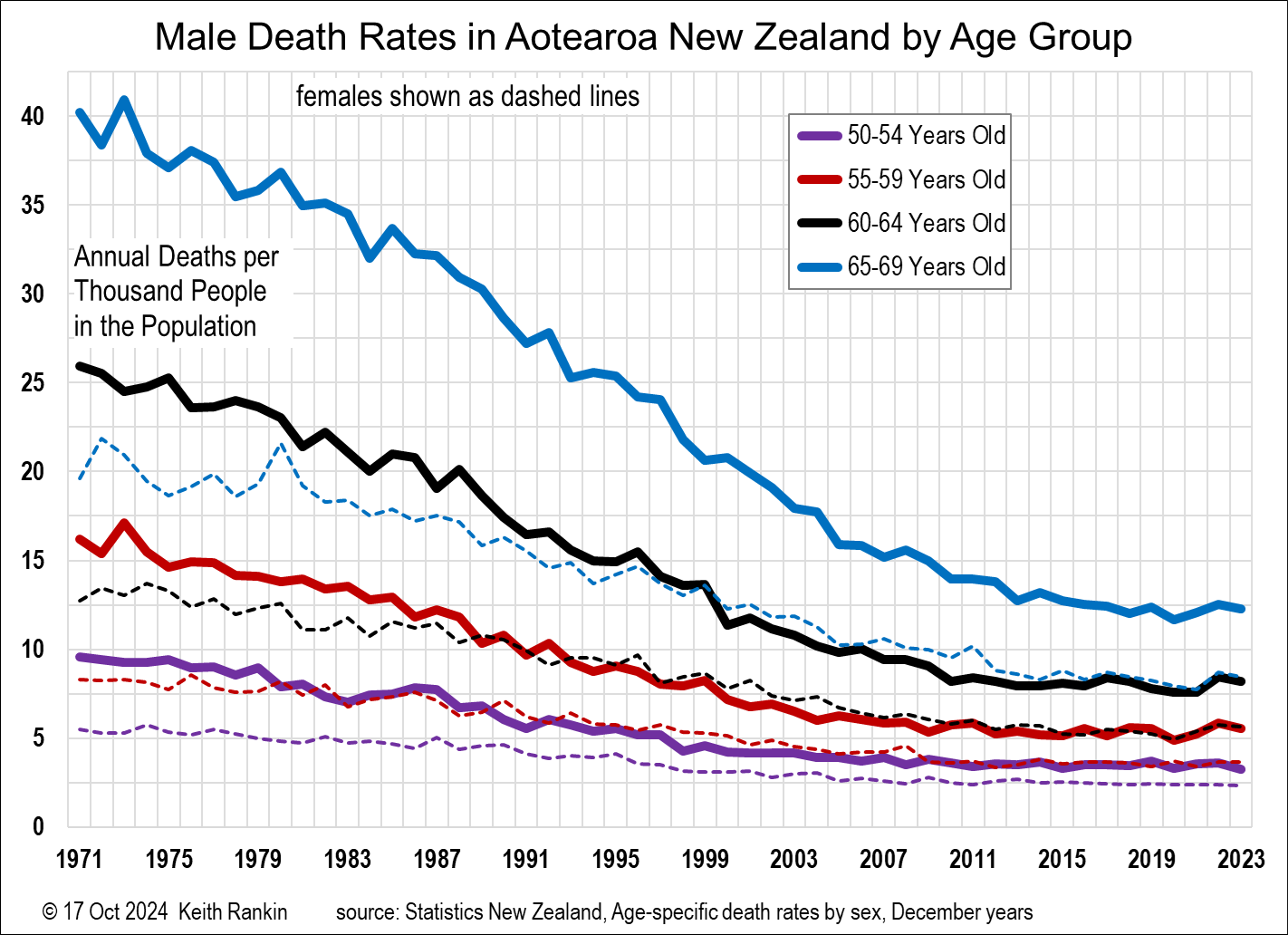
This chart shows how death rates have fallen since the 1970s, emphasising the higher male death experience. The principal finding is that dramatically falling death rates have plateaued since around 2010, especially for men aged 50 to 64. Yet the starkest fact portrayed is the much higher death rates of males than females, in each of the age groups shown.
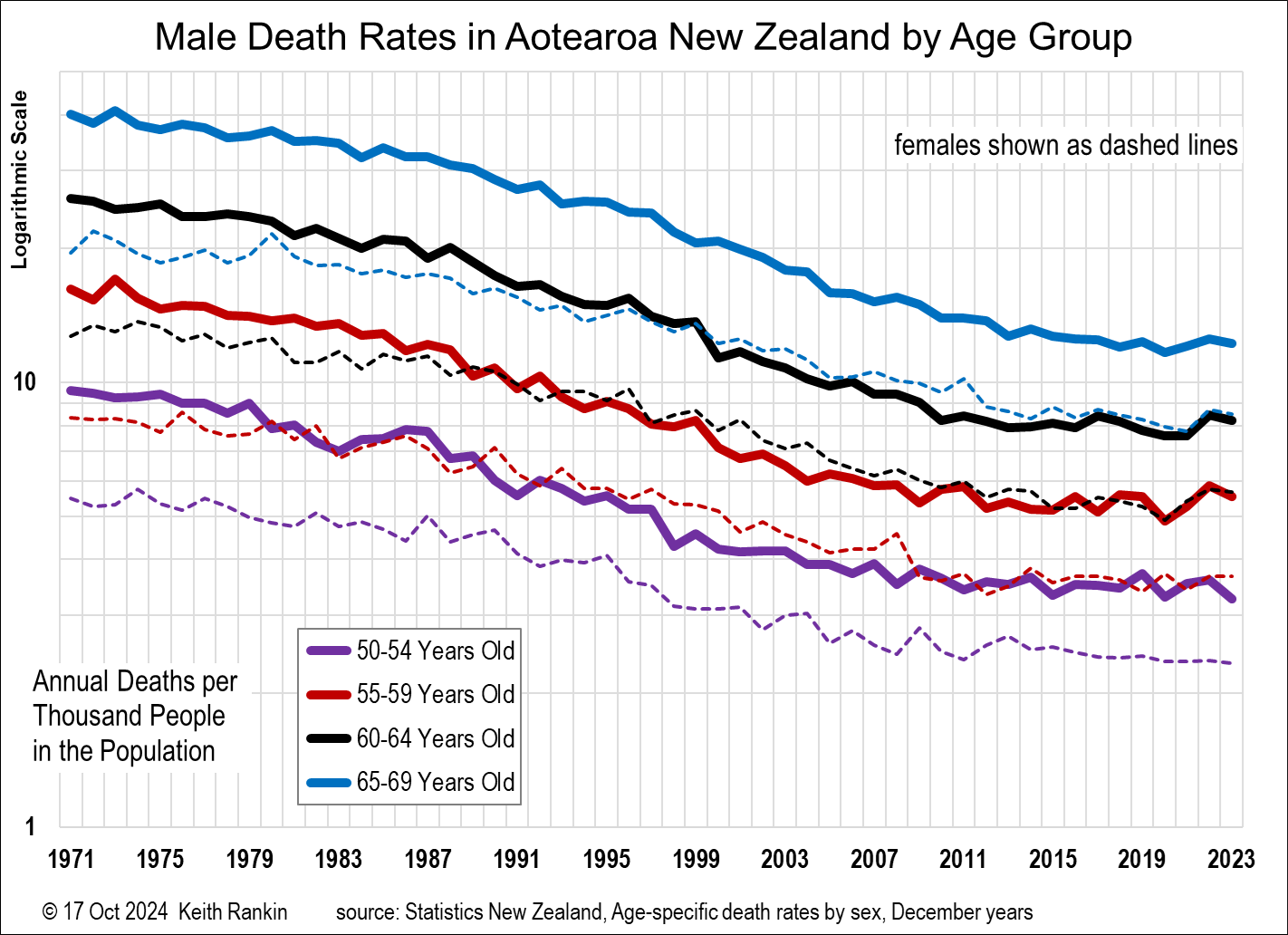
While this chart shows the differences in death rates clearly, the arithmetic plots used have an inbuilt visual bias with respect to changes over time; they exaggerate the slowing down of the improvements in death rates and the narrowing of the gaps. The second chart uses a ‘logarithmic scale’, which corrects this bias. For this second chart it is the slopes that matter, not the gaps between the groups.
Chart by Keith Rankin.
The ‘plateau-effect’ still clearly shows. What it means is that it is no longer credible to say that “we are all living longer” (as many people urging us to save more for retirement say). Essentially, since about 2010, older working-age adults were dying at the same rates in the late 2010s as in the early 2010s. For the 2020s there is a small Covid19 effect. It seems unlikely that the declining age-group death rates of the millennial period will resume.
The data used shows some other things that are not easy to chart. First, the large gap between male and female death rates is closing (but remains large). Second, males aged between 15 and 35 had disturbingly higher death rates in the late 1980s ‘Rogernomic period’ compared to the early-1980s ‘Muldoon period’. Though females aged 20-24 did have markedly rising death rates in the early 1980s. In recent years, the death rates of younger people has risen significantly, especially females; though female death rates remain significantly lower than male death rates for all age groups. The biggest improvements in death rates in the millennial period were made by younger people, and by males aged 50 to 74. Those improvements slowed or reversed after 2015.
*******
Keith Rankin (keith at rankin dot nz), trained as an economic historian, is a retired lecturer in Economics and Statistics. He lives in Auckland, New Zealand.
Source: Hong Kong Government special administrative region
The following is issued on behalf of the Hospital Authority.
The spokesperson for the Kowloon Central Cluster made the following announcement today (October 17):
A 70-year-old male patient in a respiratory medicine ward of Kowloon Hospital (KH) was confirmed to be carrying Candida auris on September 23 without signs of infection. In accordance with the prevailing infection control guidelines, KH commenced a contact tracing investigation. Three more male patients (aged 53 to 88) from the same ward were subsequently confirmed to be carrying Candida auris without signs of infection. One patient is currently hospitalised at Queen Elizabeth Hospital for other medical needs. The remaining three patients are now being treated in isolation at KH and are in stable condition.
Moreover, regarding an earlier announcement on Candida auris carrier cases in the medical ward of Hong Kong Buddhist Hospital (HKBH), one more patient of the ward concerned, an 89-year-old female, was confirmed to carry Candida auris without signs of infection. The patient is now in isolation care and is in stable condition.
The hospitals will continue the contact tracing investigations of close contacts of the patients in accordance with the prevailing guidelines. A series of enhanced infection control measures have already been adopted at wards concerned to prevent the spread of Candida auris, namely:
thorough cleaning and disinfection of the ward concerned; enhanced admission screening for patients and environmental screening procedures; and application of stringent contact precautions and enhanced hand hygiene of staff and patients.
The hospitals will continue to closely monitor the situation of the patients. The cases have been reported to the Hospital Authority Head Office and the Centre for Health Protection for necessary follow-up.
PETER KHALIL MP, MEMBER FOR WILLS: Thanks everyone, I’m Peter Khalil MP, Member for Wills. Today I’m joined by Amanda Rishworth, Claudia Johnson, Assistant Principal here at Brunswick Secondary College and Hunter Johnson, the CEO of The Man Cave and these wonderful young leaders here, these young men – I’m going to get this right – Jethro, Campbell, Harry, and Marco, who have demonstrated some amazing leadership in the way that they role model to younger kids and teach respectful relationships. They’re doing a terrific job, as is the school. So it’s great to have the Minister here to hear about the work that the Man Cave is doing, and the Brunswick Secondary College are doing, and I want to hand over now to Minister Amanda Rishworth. Welcome to Wills, thanks for coming.
AMANDA RISHWORTH, MINISTER FOR SOCIAL SERVICES: Thank you. Well, look, it’s really wonderful to be here, and I’d like to firstly acknowledge the advocacy that Peter Khalil does do, particularly about getting the right supports for adolescent men and boys. I’d also like to thank Hunter from The Man Cave and Claudia from Brunswick Secondary College for having us here today. We are announcing today the three providers that will be delivering our Healthy Mate program. The three providers are the Jesuit Social Services, the Foundation for Positive Masculinity and also The Man Cave. These three organisations will be delivering, in-person conversation and connection with young men, talking about what it means to be a young man: what some of the challenges they’re facing, how can they develop positive relationships with their peers, how can they develop positive relationships with their wider community. We know that there are many influences out there. Some role models are great, and it was wonderful to speak with these young men about some of those really good role models. But we know that many young men are being influenced by not-so-good role models. Influencers like Andrew Tate, and other online influencers that are really promoting really rigid, negative, aggressive, and violent portrayals of what it is to be a man. And so it’s really important that we get in and have these conversations with young men, and I’d like to thank The Man Cave for the proposal they put in. Their work really goes to actually having deep conversations, making sure that there are really healthy role models for young men to help them be able to realise that talking about your emotions is really important. We were talking before just about the fact that everyone feels sad from time to time, and that it’s not a sign of weakness for young men to talk about being sad. So this is what this program is doing, is making sure that we can work with young men and boys to make sure that we are developing healthy men into the future. This is, of course, really important for those young men as individuals, but really important as we tackle gender-based violence and this has been a critical area that not only was highlighted in the rapid review, but in our National Plan, that we must engage and work with young men and boys into the future. So I’m really pleased to hand over to Hunter now from The Man Cave, that is going to be one of the three organisations that will be delivering this important program.
HUNTER JOHNSON: Thank you, Minister. And thank you Peter, great to see you again. Thank you, Claudia as well. Amazing to be at Brunswick Secondary College, which is local for us. We really focus on boys’ strengths rather than their deficits. It is absolutely an inflection point for masculinity right now, it’s a really confusing time for many young men, but we’re surrounded by four, incredible, positive role models here today. The funding for us will allow us to scale to the many – to the hundreds of schools that reach out to us that have economic barriers to entry. It allows us to subsidise the program so that we can get it out far and wide, and really, it’s focussing on the character development, the social and emotional intelligence, and their relationship skills, the sex education in a way that really meets boys where they’re at. It can be, as I said, very confusing, a lot of these messages, but also we work with tens of thousands of boys on the front line every day and I can tell you from a position of hope, there are thousands of young men who want to be allies, both for supporting themselves but their relationships, their communities, too. So just recognise it’s such an important time in Australian culture, whether it’s men’s mental illness, men’s suicide prevention or men’s violence against women, a lot of the funding traditionally has gone to crisis management, and I fully understand why and I back it, but we’re also at a really exciting point with this generational moment where we can invest in the future generation to create a positive future state for masculinity. So this is a real landmark investment, I really back the courage of the Australian Government to do this and we’re excited to work alongside the other members of the collective to scale this work into the communities that need it most. So thank you very much and I’ll pass over to Claudia.
CLAUDIA JOHNSON: Thanks, Hunter. I’m really grateful to you, Minister Rishworth, and to The Man Cave for including Brunswick Secondary College in this wonderful opportunity. We know that young men need particular support, and they specifically need different ways to receive support. So it just can’t be one single program. It needs to be a whole range of things and certainly The Man Cave’s program will fit perfectly with what we’re doing at the school. The Man Cave, the program’s going to benefit our wonderful young men, but it also benefits the young women in our school as well and the community more broadly. So, again, we’re really grateful for this partnership and we’re excited for where it’s going to bring to our school. Thank you.
JOURNALIST: Minister, whereabouts is this program? What parts of the country is it actually rolled out in?
AMANDA RISHWORTH: Well, this is a trial and at the moment we’re looking at predominantly rolling it out in New South Wales and Victoria, but very much looking at continuing to see the results and looking at other opportunities which allows us to roll this program out.
JOURNALIST: How long’s the trial going to go for?
AMANDA RISHWORTH: The trial is over the next year, and we will hopefully get a good evaluation of the trial. We know already anecdotally this is having a positive influence, even just speaking recently, from speaking to participants in the program, hearing directly the benefits before this trial even began about the Man Cave program. But this will allow greater accessibility and evaluation and then we’ll look at where else we can extend it to.
JOURNALIST: What about in areas like the Northern Territory? Just yesterday another woman was killed, this is the seventh woman since July in the Territory. What else needs to be done in areas like that where we don’t have access to services like this and enough help for women up there?
AMANDA RISHWORTH: In terms of particularly for Aboriginal and Torres Strait Islander people, we have a separate action plan that was developed with States and Territories about how we address the disproportionately high rate of violence against Aboriginal women and children. And in particular, we’ve announced a number of actions, including men’s wellness camps. We are currently rolling those out, which provide culturally appropriate healing for men across the country, but there has been a particular focus on the Northern Territory under that program. These aren’t run by government. This is run by those with a cultural appropriateness to connect with men. When it comes to adolescent boys who have experienced violence, that’s another challenge because we know that trauma, in particular, can have an impact. We’ve recently announced the roll out of a number of programs to support those adolescent boys who have experienced family domestic violence themselves and that is about stopping the cycle, the generational cycle of violence. So this program is, in itself, is not the only program. In fact, under our Aboriginal and Torres Strait Islander Action Plan, there’s $263 million. When it comes to support in the Northern Territory, we have put close to $180 million extra into support within the Northern Territory.
JOURNALIST: Something’s obviously not working up there, though?
AMANDA RISHWORTH: Well, I would make the point about the National Plan. The National Plan is about a plan to change generations. We know that, for example, this program is about changing the attitudes and stereotypes that come along with a rigid masculinity that can lead to violence. So this is about making sure that we have adolescent boys that grow up healthy. That obviously, to see the benefits when it comes to violence, will take some time. I just visited, just then, new safe places accommodation here in Victoria, but equally we’re rolling them out across the country. This is building crisis accommodation as well. So we need to make sure that we’re investing in prevention, early intervention, crisis response and healing and recovery. We’ve invested as a Government, in the last two and a half years, an extra $3.4 billion. Obviously we’re rolling this out to get it on the ground. But some of this is about generational change, it is about culture change in Australia, and I would invite everyone to work with all levels of government, and I will remind that all levels of government have signed up to this National Plan, along with how we create change in our broader community if we’re going to achieve our goal.
JOURNALIST: How important is cracking down on social media? Obviously a lot of young people use TikTok and things like that, a lot of misinformation, a lot of values posted on TikTok. How important is cracking down on that for young kids?
AMANDA RISHWORTH: Look, obviously what we know is that social media in particular feeds up information that causes a stir and what that can mean is that there is a lot of quite aggressive footage on there. There can often be views that condone violence against women, encourage violence against women, and if you’re at a particularly young age, then this could be quite influential. We were just talking before about the importance of role models at the home, and it was really lovely to hear some of the young men here talking about what an important role model their father was in particular. But we also need to acknowledge that young people are being really bombarded by some really very toxic attitudes and viewpoints on social media. So it is important that we do crack down on social media and that is why our government’s committed to having an age limit on social media in legislation introduced by the end of the year.
JOURNALIST: Can I ask Hunter a quick question about the program? In terms of how you’re going to see how effective it is in schools, how are you actually going to look at that data?
HUNTER JOHNSON: Sure, so we work with schools based on their socioeconomic status, which is basically called an ICSEA status. So we will charge a school based on how high or affluent or disadvantaged they may be. We’ve also got an in-house impact evaluation team that monitors the short, long-term behavioural change and the attitudinal change, and we partner with educational institutions like universities to measure the effectiveness.
JOURNALIST: Just a couple of questions. Obviously the Prime Minister’s just purchased that $4.3 million home. Do you think he’s shown a lack of judgment by purchasing this multi-million dollar property during a cost-of-living crisis?
AMANDA RISHWORTH: I don’t accept that. The purchase of this house is really a matter for the Prime Minister and his fiancé. And he won’t be the first person or the last person, politician or other person, to buy a property. But I think what’s important is you need to look at the actions that this Government has taken when it comes to cost of living. Actions like our immediate support for a 45 per cent increase in Commonwealth Rent Assistance, whether it’s our $32 billion in investment, whether that’s in social and affordable housing, whether that’s in our rent-to-buy plan, whether that is in our home equity scheme that supports people become homeowners. I mean, really, the Greens and the Liberal Party need to front up and explain why they are standing in the way. So we’ve got to judge us by the actions, our cheaper medicines, these are the things that our government is taking action on and are critical to support people with cost-of-living pressures.
JOURNALIST: A recent survey that was released just last week said around 80 per cent of people believed that young people aren’t going to be able to buy a new home without the help of a family member and that they’re unlikely to ever be able to purchase a new home. Does this indicate that the public doesn’t believe your government is doing enough to help first homebuyers?
AMANDA RISHWORTH: Firstly, I would say that it is a challenge, of course, to get more supply online. We’ve had inaction by the previous Federal Government, the Liberal Government that did nothing when it came to housing supply in this country. So from the very beginning, we’ve been delivering things like the Housing Australia Future Fund, but also this is where our help-to-buy scheme is so important. It is providing the opportunity for 40,000 Australians to have a share – to be part of a shared equity scheme to help them own their first home. And so it is quite appalling that the Liberal Party and the Greens are standing in the way of this legislation. So I’m not surprised that Australians are feeling pretty disappointed because this legislation has been stalled in the Senate.
JOURNALIST: Is Labor divided on its housing tax policy?
AMANDA RISHWORTH: No.
JOURNALIST: Would you like to see any change to negative gearing arrangements?
AMANDA RISHWORTH: That is not part of our housing policy. As I said, we’ve committed to $32 billion extra funding when it comes to our housing policies and that includes things like the 45 per cent in Commonwealth Rent Assistance, which is flowing to people now. But it also includes increasing supply across the domains of social and affordable housing. We know that social housing has been ignored for so many years and our housing Australia Future Fund is delivering that. Our housing funding to States and Territories is delivering on that. But, of course, in addition to that, private rental and, of course, looking at home ownership. We are looking right across the board to support people. I tell you one thing that won’t help the cost of housing and that is the Liberal Party, A, standing in the way with the Greens blocking of our bill, but also, their plans that means that people have to dig into their retirement savings and to own a house. That will only ensure that more people rely on the pension and push up house prices. So it’s only Labor with a credible plan to address housing shortages in this country.
JOURNALIST: Will you rule out making any changes to the housing tax mix before the next election?
AMANDA RISHWORTH: Well, look, as the Prime Minister, Housing Minister, Treasurer said, that is not part of our plan. We have put our plans forward and we will keep talking about how important our homes for Australia plan is, that’s delivering houses now. I just recently, just before, went out to see the capital build that will happen for crisis accommodation for women and children fleeing domestic and family violence. Our funding is allowing for over 100 safe places for women and children leaving violent circumstances. That wouldn’t have been able to be done without the investment from the Commonwealth, a capital investment, to actually build those places. Thank you.
17 October 2024 – Tax Justice Aotearoa welcomes the latest 1News-Verian poll finding which shows almost half of voters would support a capital gains tax that excludes the family home.
The poll asked “Do you support or oppose the introduction of a capital gains tax (CGT) on properties other than the family home?”
More voters than not said they would support the introduction of a CGT, with 46 per cent in favour and 41 per cent opposed. 13 per cent did not know or preferred not to say.
“This poll shows that New Zealanders are tired of the current unfair system, in which you are taxed less if you make a living from buying and selling houses than you do if you work an ordinary job,” says Tax Justice Aotearoa chair Glenn Barclay.
“New Zealand is an outlier internationally in that we do not tax capital gains in a comprehensive way. The additional revenue raised could fund vital services such as education, healthcare and infrastructure and help address climate change – leading to a better quality of life for all New Zealanders.”
“Our tax system is way out of balance and a capital gains tax (CGT) is a good first step to help level the playing field between wage earners and those who mainly earn their money through investments,” Barclay says.
“There has been growing support for a capital gains tax from a range of individuals and organisations in the media in recent weeks and this poll shows the public of New Zealand are supportive too.”
Polling commissioned by TJA also indicates a strong public appetite for a tax on capital – and showed that when the concept is properly explained, support was even stronger.
“Once people understand that gains from the sale of assets such as houses and shares is income, just like income from employment, they realise how unfair our current system is,” Barclay says.
“Given the public level of support for treating all sources of income consistently for tax purposes, we call on all political parties to act now.”
China’s Ministry of Commerce (MOC) said Thursday that China is studying measures to increase tariffs on imported fuel-powered vehicles with large-displacement engines.
A decision will be made prudently after comprehensive consideration of various factors, MOC spokesperson He Yadong told a press conference.
Passengers pose for photos with a high-speed electrical multiple unit (EMU) train of the Jakarta-Bandung high-speed railway on the platform of Halim Station in Jakarta, Indonesia, April 17, 2024. [Photo/Xinhua]
The Jakarta-Bandung High-Speed Railway (HSR), celebrating its first anniversary on Thursday, has transported 5.79 million passengers, according to PT Kereta Cepat Indonesia-China (KCIC), a joint venture between Indonesian and Chinese enterprises that built and operates the railway.
Since its commercial launch in October 2023, the HSR has completed over 15,826 train trips, covering more than 2.57 million kilometers. The number of daily train services has increased from 14 at the start of operations to 52, with passenger seats rising from 8,400 to over 31,000. The highest daily ridership reached 24,132, according to KCIC statistics.
The HSR is fully powered by electricity, significantly reducing fuel consumption and emissions. The KCIC said that the green energy initiative saves Indonesia around 3.2 trillion rupiahs (208 million U.S. dollars) annually in fuel costs.
In addition, Indonesian government data indicated that between 2019 and 2023, the project contributed 86.5 trillion rupiahs (about 5.62 billion dollars) to the GDP of Jakarta and West Java.
With a design speed of 350 km per hour, the 142.3-km high-speed railway has cut travel time between Jakarta and Bandung from over three hours to just 46 minutes.
A staff member shows a China Telecom 5G antenna during the Mobile World Congress in Barcelona, Spain, Feb. 27, 2024. [Photo/Xinhua]
The added value of China’s patent-intensive industries in 2022 reached 15.32 trillion yuan (about 2.15 trillion U.S. dollars), contributing 12.7 percent to its GDP, according to a report released by the country’s top intellectual property regulator.
The latest data shows that China’s patent-intensive industries exhibit strong innovation capabilities and development potential, supporting the country’s commitment to pursuing new quality productive forces and high-quality development, the China Intellectual Property Administration noted in a recent monitoring report.
The report highlights that from 2018 to 2022, the added value of China’s patent-intensive industries saw an average annual growth rate of 9.36 percent, surpassing the average annual GDP growth rate by 2.37 percentage points during the same period.
The information and communications technology (ICT) service and ICT manufacturing, as representatives of emerging industries, achieved double-digit growth in added value with annual growth rates of 14.86 percent and 10.23 percent, respectively.
Other patent-intensive industries include manufacturing of new equipment and materials, medicine and the medical industry, as well as the environmental protection industry.
High investment in research and development is an important factor driving growth. According to the report, the internal R&D expenditure for patent-intensive industries in China reached 1.14 trillion yuan in 2022, marking an increase of 11.28 percent compared to the previous year and totaling 2.23 times that of non-patent-intensive industries.
In 2022, more than 49 million people were employed in China’s patent-intensive industries, accounting for approximately 6.7 percent of overall employment within the entire society.
However, the report noted a gap between China and Western patent leading countries. It cited the latest report from the United States and Europe, revealing that patent-intensive industries contributed 24 percent to the U.S. GDP, with employment accounting for 13 percent. Additionally, the EU’s figures that year stood at 17.4 percent and 11 percent, respectively, “significantly surpassing China’s levels.”
The patent-intensive industries in China still have immense growth potential, and greater efforts should be made to support the development of these industries, the report said.
China has set a target for patent-intensive industries to contribute 13 percent of GDP by 2025.
Today, President Biden announced an additional $4.5 billion in student debt cancellation for over 60,000 borrowers through the Public Service Loan Forgiveness (PSLF) program, bringing the number of public service workers who have had their student loans cancelled to over 1 million people during the Biden-Harris Administration. Before President Biden and Vice President Harris took office, only 7,000 borrowers had ever received forgiveness through PSLF. Thanks to the Biden-Harris Administration’s significant improvements to the PSLF program, over 1 million teachers, firefighters, law enforcement officials, nurses, servicemembers, and other public service workers who have dedicated their lives to serving their communities are getting the student debt relief they are entitled to under the law. Last week, President Biden met with a kindergarten teacher who has been paying her loans for 12 years and let her know that she is one of the 1 million people approved for PSLF under his Administration, and over $46,000 of her loans are being cancelled. In total, the Biden-Harris Administration has approved $175 billion in student debt relief for nearly 5 million borrowers through various actions.
From Day One of their Administration, President Biden and Vice President Harris vowed to fix the student loan system and make sure higher education is a ticket to the middle class – not a barrier to opportunity. Already, the Biden-Harris Administration has delivered life-changing relief to students and families. While Republican elected officials try every which way to block millions of their own constituents from receiving student debt relief – even proposing to get rid of the PSLF program altogether – President Biden and Vice President Harris are fighting to provide borrowers student debt relief and making higher education affordable.
Delivering Life-Changing Relief to Over 1 Million Public Servants
In 2007, Congress enacted bipartisan legislation creating PSLF to recognize the critical role public servants play in our communities and support them in their service. Under PSLF, people who dedicate at least 10 years of their careers to giving back to their communities – like teachers, firefighters, law enforcement officials, nurses, and servicemembers – can get relief on their student loans. However, the program was poorly implemented. Many public servants found out that they had spent years in the wrong student loan repayment plan or did not take out the right type of loan and were therefore ineligible for PSLF and denied forgiveness. Before the start of the Biden-Harris Administration, only 7,000 people had ever received forgiveness through PSLF and the rejection rate, in part due to administrative errors and difficult processes, was as high as 98% in some years. Public servants were also being told that, because they didn’t file the right forms years ago, there was nothing for them to do but keep paying their loans longer than the program requires.
Thanks to President Biden and Vice President Harris’ leadership, the Biden-Harris Administration has significantly improved the PSLF program to help more borrowers than ever before. This includes establishing and implementing new regulations to help borrowers earn more credit toward PSLF, simplifying criteria to help borrowers certify employment, creating fairer eligibility criteria, and providing borrowers the opportunity to apply for reconsideration of previous denials. The Biden-Harris Administration launched the Limited PSLF Waiver, providing public service workers affected by the pandemic with the opportunity to get PSLF credit for prior payments on their federal student loans regardless of repayment plan or loan type. To simplify the application process for borrowers, the Biden-Harris Administration made it so borrowers and employers can complete the entire PSLF application and submit required forms online, made it easier for borrowers to find qualifying employers and get necessary signatures verifying employment, and recently, announced new steps to allow borrowers to manage all aspects of their PSLF journey on StudentAid.gov.
Thanks to these improvements, as of today, over 1 million public service workers have been approved for debt cancellation through PSLF. The Department of Education today also released new state-by-state data showing how many borrowers have had their loans approved for cancellation under PSLF in each state under the Biden-Harris Administration.
Economic Benefits of Student Debt Relief for Public Service Workers
Today, the Council of Economic Advisers (CEA) published a new analysis underscoring that the Biden-Harris Administration’s student debt policies not only benefit borrowers, but also the entire economy.
The CEA highlights that PSLF has the potential to deliver considerable benefits to those who receive it – including the ability to buy a home, start a business, and improve overall financial health. In addition, the CEA analysis shows how the PSLF program strengthens the public sector by making it more feasible for students with postsecondary debt to pursue and remain in public service careers that are essential to our economy and communities.
Despite these benefits to the U.S. economy and hard-working Americans, Republican elected officials have tried to stop the Biden-Harris Administration every step of the way, and have even attempted to end PSLF altogether, which would block millions of dedicated public servants from receiving the student debt relief they have earned. President Biden and Vice President Harris will not stop fighting for our nation’s dedicated public servants.
Encouraging Public Servants to Take Advantage of the PSLF Program
Today, the Biden-Harris Administration is also announcing a series of new steps to encourage public servants across the nation to take advantage of the PSLF program.
A number of public sector unions, including the American Federation of State, County, and Municipal Employees (AFSCME), American Federation of Teachers (AFT), National Education Association (NEA), and the Service Employees International Union (SEIU), are amplifying today’s announcement through member-to-member outreach, social media campaigns, and more, and are encouraging people to sign up for PSLF:
AFT will be encouraging its members to sign up for student debt clinics to help members get on track with PSLF, with a goal of reaching another 500 teachers and nurses by the end of the year. This is on top of the 34,000 members AFT has reached since starting their student debt clinic series.
NEA will continue to help its members with the NEA Student Debt Navigator, a tool that provides 1-on-1 support for NEA’s members who need additional support with their PSLF application, or any other federal program related to student loans. Since the launch of the Student Debt Navigator, over 48,000 NEA members have signed up to receive support.
To celebrate this milestone, AFSCME will launch a new interactive map on its website, detailing PSLF forgiveness across the country based on Department of Education data. Additionally, AFSCME will update its online resources to facilitate applications for PSLF and create a social media toolkit its members can use to promote PSLF and forgiveness on their own social media platforms.
To encourage people to take advantage of the PSLF program, the Department of Education will send emails from President Biden to public servants who have received PSLF, encouraging them to share their stories to raise awareness about the benefits of the program. The Biden-Harris Administration will also share information about PSLF with federal employees to encourage more people to enroll in PSLF.
The Department of Education is reaching out to governors and mayors across the country to encourage state and local public service workers to take advantage of the PSLF program.
These new steps are in addition to previous actions by the Administration including working with over 15 major federal agencies to develop PSLF agency action plans. In implementing these plans, federal agencies have encouraged thousands of additional federal employees to take advantage of the PSLF program through extensive social media campaigns, principal-level engagement, engagement with stakeholder groups, press, and mass email communications.
Building On an Unparalleled Record of Student Debt Relief
Today’s announcement is part of the Biden-Harris Administration’s broader set of actions to reduce the burden of student debt and ensure that student loans are not a barrier to educational and economic opportunity for students and families. President Biden and Vice President Harris secured a $900 increase to the maximum Pell Grant award – the largest increase in more than a decade. Since taking office, the Biden-Harris Administration has approved through various actions $175 billion in student debt relief for nearly 5 million Americans, each of whom have been approved for an average of roughly $35,000 in student debt cancellation. These actions have benefitted borrowers in every state, territory, and congressional district in the United States.
This approved relief includes:
$74 billion for over 1 million borrowers through the PSLF program.
$56.5 billion for more than 1.4 million borrowers through Income-Driven Repayment, including the Saving on a Valuable Education SAVE plan. This includes administrative adjustments to income-driven repayment that brought borrowers closer to forgiveness and addressed longstanding problems due to past inaccuracies and the misuse of forbearance by loan servicers.
$28.7 billion for more than 1.6 million borrowers who were cheated by their schools, saw their institutions precipitously close, or are covered by related court settlements.
$16.2 billion for nearly 572,000 borrowers with a total and permanent disability.
Today, my Administration is approving another $4.7 billion in student debt cancellation for over 60,000 public service workers – bringing the total number of Americans who have had their debt cancelled under Public Service Loan Forgiveness during my Administration to over 1 million people.
Public service workers – teachers, nurses, firefighters, and more – are the bedrocks of our communities and our country. They dedicate their careers to giving back to others, and were given the promise of student debt forgiveness after 10 years of public service and 10 years of payments under the Public Service Loan Forgiveness program. But for too long, the government failed to live up to its commitments, and only 7,000 people had ever received forgiveness under Public Service Loan Forgiveness before Vice President Harris and I took office.
We vowed to fix that, and because of actions from our Administration, now over 1 million public service workers have gotten the relief they are entitled to under the law.
Today’s announcement comes on top of the significant progress we’ve made for students and borrowers over the past three years. That includes approving debt cancellation for nearly 5 million Americans across all our various debt relief actions; providing the largest increases to the maximum Pell Grant award in over a decade; fixing Income-Driven Repayment so borrowers get the relief they earned; and holding colleges accountable for taking advantage of students and families.
From day one of my Administration, I promised to fight to ensure higher education is a ticket to the middle class, not a barrier to opportunity. I will never stop working to make higher education affordable – no matter how many times Republican elected officials try to stop us.
Cabinet have agreed to continue work to explore the future use of City Hall which will include gathering public thoughts and opinions.
Last night (Wednesday, 16 October), they considered a report setting out options to transform the historic, Grade 2* listed, heritage building.
The report recommends that Norwich City Council business and its civic activities remain at City Hall.
The first option would see the building refurbished to provide better public access, fit for purpose council office space, grade A lettable space and event and conference opportunities.
The second option would go a step further by adding an extension to the rear, as intended in the original 1938 plans for the building, that could be used for offices, homes, or a hotel.
This option also proposes a new, publicly accessible, landscaped courtyard to the rear and improvements to the public spaces around City Hall.
Cabinet agreed they would like the next stage of work to be done to develop a business case around these options.
Council Leader, Cllr Mike Stonard, said: “We’re still at an early stage and a significant part of what comes next will be gathering feedback from our residents, businesses, partners, and the voluntary and creative sectors.
“It’s vital that we hear from the people of Norwich on this so we can make the best decisions for the city about how we continue to move forward.
“We’re taking the time to plan this now and expect to be getting underway with these conversations early next year.
“We have a huge opportunity here to create a future for the building that boosts the entire city, with the potential to create up to £102million in economic benefits, depending on the scale of the option eventually taken forward.
“These benefits for Norwich would come from creating improved amenities that attract more use and increase spending in the city over the lifetime of the development.”
The agreement to develop a business case will also now see the council obtain the many architectural, technical, and financial reports needed to prepare for any change to a listed, heritage building like City Hall.
SAN JOSE, Calif., Oct. 17, 2024 (GLOBE NEWSWIRE) — Infinera (Nasdaq: INFN) and the U.S. Department of Commerce have signed a non-binding preliminary memorandum of terms for Infinera to receive up to $93 million in direct funding as part of the bipartisan CHIPS and Science Act. This proposed direct funding, when combined with investment tax credits available under the CHIPS and Science Act, could result in more than $200 million in total federal incentives as well as potential state and local incentives.
This proposed funding would support the expansion and modernization of both Infinera’s semiconductor capabilities in Silicon Valley, California and its advanced test and packaging capabilities in Lehigh Valley, Pennsylvania, increasing the company’s existing domestic manufacturing capacity by an estimated factor of ten. Combined proposed funding for these two projects could create up to 1,700 manufacturing and construction jobs while strengthening America’s supply chain, economic and national security.
“We are grateful for the bipartisan efforts under the CHIPS and Science Act to increase semiconductor fabrication and packaging in the U.S. and protect our national and economic security,” said David Heard, Infinera CEO. “The proposed CHIPS funding will enable us to better secure our supply chain and compete more effectively with foreign adversary nations. Our unique photonic semiconductors address the increased demand for bandwidth from consumers while opening new markets inside the data center driven by the explosive growth in AI workloads.”
Infinera’s award of the proposed CHIPS funding would not have been possible without bipartisan support and partnerships with local, state and federal officials. This support is instrumental to the long-term success of these projects and the growth of advanced manufacturing in the U.S.
Infinera Investors: Amitabh Passi, Head of Investor Relations Tel. +1 (669) 295-1489 apassi@infinera.com
About Infinera Infinera is a global supplier of innovative open optical networking solutions and advanced optical semiconductors that enable carriers, cloud operators, governments, and enterprises to scale network bandwidth, accelerate service innovation, and automate network operations. Infinera solutions deliver industry-leading economics and performance in long-haul, submarine, data center interconnect, and metro transport applications. To learn more about Infinera, visit http://www.infinera.com, follow us on X and LinkedIn, and subscribe for updates.
Infinera and the Infinera logo are registered trademarks of Infinera Corporation.
This press release contains forward-looking statements, including but not limited to statements regarding Infinera’s ability to secure CHIPS funding and investment tax credits, and the anticipated benefits of any such funding and tax credits. These statements are not guarantees of results and should not be considered as an indication of future activity or future performance. Actual results may vary materially from these expectations as a result of various risks and uncertainties. Information about risks and uncertainties that affect Infinera’s business is contained in the risk factors section and other sections of Infinera’s Quarterly Report on Form 10-Q for the Fiscal Quarter ended June 29, 2024 as filed with the SEC on August 2, 2024, as well as any subsequent reports filed with or furnished to the SEC. These reports are available on Infinera’s website at http://www.infinera.com and the SEC’s website at http://www.sec.gov. Forward-looking statements include statements regarding our expectations, beliefs, intentions, or strategies and can be identified by words such as “anticipate,” “believe,” “could,” “estimate,” “expect,” “intend,” “may,” “should,” “will,” and “would” or similar words. Infinera assumes no obligation to, and does not currently intend to, update any such forward-looking statements.
Skills passport enabling people to find new jobs in offshore wind goes live in 2025
17 October 2024
Joint RenewableUK and OEUK media release – Thursday 17th October 2024
A new scheme to help workers across the UK’s energy mix, including oil and gas, to find new roles in offshore wind will be launched in January by RenewableUK and Offshore Energies UK (OEUK), supported by the UK and Scottish Governments.
The Energy Skills Passport enables workers and employers to easily identify which qualifications and training standards, such as health and safety, are needed for specific roles in offshore wind. As part of the Energy Skills Passport, an interactive tool will provide clarity on which qualifications are mutually recognised across the sector to avoid any duplication of training courses, as well as mapping out potential career pathways. It will be managed jointly by OEUK and RenewableUK and will be available to a limited number of testers later this year before it is rolled out in full in the new year. The initial version focuses on the transition to offshore wind and future versions will include other parts of the energy sector.
The UK’s oil and gas sector supports over 200,000 jobs and the UK’s offshore wind industry already employs 32,000 people – that number is expected to rise to over 100,000 by 2030. Research commissioned by OEUK shows that 90% per cent of oil and gas industry workers have skills which can be transferred to future offshore jobs in renewable energy. Roles which may be suitable for workers to transfer into in offshore wind include maintenance technician, commissioning technician, high-voltage senior authorised person and troubleshooting technician.
RenewableUK’s Executive Director of Offshore Wind Jane Cooper said:
“The upsurge in offshore wind jobs over the course of this decade and beyond creates excellent opportunities for highly-skilled oil and gas workers to bring their valuable experience to the clean energy sector. We’re working closely with our colleagues at Offshore Energies UK, and the UK and Scottish Governments, to make that transition as smooth as possible across all parts of the energy industry. The Energy Skills Passport is a great example of what we can achieve together and we’ll continue to look for other potential areas of work that can further support the transition of workers between sectors.”
Offshore Energies UK’s Director of Supply Chain & People, Katy Heidenreich said:
“Collaboration is key to unlocking the full potential of the UK’s offshore energy sector so we are proud to be driving this initiative with RenewableUK. This industry and its people have proven excellence and a broad range of transferable skills from engineering and construction to legal and commercial expertise. This passport can help them succeed right across our diverse energy mix. This is one way the UK can back its workforce to build a homegrown energy transition that leaves no-one behind. It’s part of the toolkit this industry is assembling to partner with government to solve the challenges and seize the opportunities of our energy future.”
The Co-Chair of the Offshore Wind Industry Council Richard Sandford said:
“The Energy Skills Passport is a crucial step forward for workers to embrace opportunities in the offshore wind industry. It simplifies movement between essential offshore energy sectors, enabling workers to apply their knowledge to the energy transition. The milestone highlights effective collaboration between OEUK and RenewableUK, supported by the UK and Scottish Governments.”
(ends)
Notes
For further information, contact
RenewableUK’s members are building our future energy system, powered by clean electricity. We bring them together to deliver that future faster; a future which is better for industry, billpayers, and the environment. We support over 490 member companies to ensure increasing amounts of renewable electricity are deployed across the UK and to access export markets all over the world. Our members are business leaders, technology innovators, and expert thinkers from right across industry. RenewableUK’s events programme is available here.
Offshore Energies UK is the leading trade body for the UK’s offshore energies industry. Its membership includes over 400 organisations with an interest in offshore oil, gas, carbon capture and storage, hydrogen, and offshore wind. Working together with its members, it is a driving force supporting the UK in ensuring security of energy supply while helping to meet its net zero ambitions.
SINGAPORE, Oct. 17, 2024 (GLOBE NEWSWIRE) — Aurora Mobile Limited (Nasdaq: JG), recently showcased its no-code AI Bot development platform, GPTBots, and its global customer engagement platform, EngageLab, at eCommerce Expo Asia, part of Tech Week Singapore on October 9-10, 2024, held at the Marina Bay Sands Expo & Convention Centre. The event brought together industry giants such as Shopify, Amazon, Stripe, and TikTok, focusing on the latest trends in e-commerce, AI, and MarTech, with Aurora Mobile’s innovative solutions drawing significant attention from attendees.
As a comprehensive trade show, eCommerce Expo Asia provided a platform for in-depth discussions on the application of cutting-edge technologies such as artificial intelligence (AI) and marketing technology (MarTech) across various industries. GPTBots, Aurora’s no-code AI Bot platform, stood out at the event, engaging a diverse audience keen to explore practical AI applications in their businesses.
During the exhibition, attendees from different industries expressed unprecedented enthusiasm for AI technology, sharing their specific needs and pain points faced during their digital transformation journeys. GPTBots demonstrated its powerful capabilities in natural language processing, contextual understanding, and extensive customization, positioning itself as a valuable tool to solve these challenges.
Interest from Various Industries
Financial Services in Indonesia: Representatives from the Indonesian financial sector expressed keen interest in GPTBots’ ability to enhance customer support through intelligent automation. They believe that GPTBots can address the rigidity of existing bot systems by providing more efficient and secure financial services through accurate responses and on-premise deployment options.
Hospitality in Hong Kong: Clients operating a platform in Hong Kong that connects users with wedding venues and service providers were particularly impressed with GPTBots. They highlighted its potential to significantly enhance the accuracy, efficiency, and timeliness of resource matching. GPTBots can seamlessly connect users, suppliers, and hotels in real time, ensuring precise and efficient resource coordination. This not only improves the overall user experience but also optimizes supplier response times, driving greater operational efficiency.
System Integrators (SI): SI clients showed strong interest in using AI Bots to automatically organize customer inquiries into leads and seamlessly push them into CRM systems. GPTBots can process and categorize customer inputs in real time, offering seamless integration with CRM platforms, enabling comprehensive lead automation management.
Additionally, representatives from industries such as manufacturing, medical e-commerce, and event organizers praised GPTBots’ potential in areas such as automated product quality inspection, intelligent lead screening, platform integration, and inquiry management. Many attendees commented that GPTBots could bring transformative changes to their respective businesses.
Global Adoption and Empowering Enterprises Since its launch in September 2023, GPTBots has gained widespread recognition. As of July 31, 2024, the platform had over 60,000 registered users, including enterprises and developers, with more than 85% of its user base coming from overseas markets. GPTBots’ users span a wide range of sectors including e-commerce, real estate, finance, IT, healthcare, government, renewable energy, education, and eldercare. This achievement demonstrates the platform’s strong ability to help businesses achieve intelligent transformation.
About Aurora Mobile Limited Founded in 2011, Aurora Mobile (NASDAQ: JG) is a leading provider of customer engagement and marketing technology services in China. Since its inception, Aurora Mobile has focused on providing stable and efficient messaging services to enterprises and has grown to be a leading mobile messaging service provider with its first-mover advantage. With the increasing demand for customer reach and marketing growth, Aurora Mobile has developed forward-looking solutions such as Cloud Messaging and Cloud Marketing to help enterprises achieve omnichannel customer reach and interaction, as well as artificial intelligence and big data-driven marketing technology solutions to help enterprises’ digital transformation. For more information, please visit https://ir.jiguang.cn/.
Safe Harbor Statement This announcement contains forward-looking statements. These statements are made under the “safe harbor” provisions of the U.S. Private Securities Litigation Reform Act of 1995. These forward-looking statements can be identified by terminology such as “will,” “expects,” “anticipates,” “future,” “intends,” “plans,” “believes,” “estimates,” “confident” and similar statements. Among other things, the Business Outlook and quotations from management in this announcement, as well as Aurora Mobile’s strategic and operational plans, contain forward-looking statements. Aurora Mobile may also make written or oral forward-looking statements in its reports to the U.S. Securities and Exchange Commission, in its annual report to shareholders, in press releases and other written materials and in oral statements made by its officers, directors or employees to third parties. Statements that are not historical facts, including but not limited to statements about Aurora Mobile’s beliefs and expectations, are forward-looking statements. Forward-looking statements involve inherent risks and uncertainties. A number of factors could cause actual results to differ materially from those contained in any forward-looking statement, including but not limited to the following: Aurora Mobile’s strategies; Aurora Mobile’s future business development, financial condition and results of operations; Aurora Mobile’s ability to attract and retain customers; its ability to develop and effectively market data solutions, and penetrate the existing market for developer services; its ability to transition to the new advertising-driven SAAS business model; its ability to maintain or enhance its brand; the competition with current or future competitors; its ability to continue to gain access to mobile data in the future; the laws and regulations relating to data privacy and protection; general economic and business conditions globally and in China and assumptions underlying or related to any of the foregoing. Further information regarding these and other risks is included in the Company’s filings with the Securities and Exchange Commission. All information provided in this press release and in the attachments is as of the date of the press release, and Aurora Mobile undertakes no duty to update such information, except as required under applicable law.
Met detectives have charged a man with murder following the death of a man that was shot in Waltheof Gardens, N17 on Tuesday, 15 October.
Mahmut Sahindal, 56 (20.5.68), of no fixed abode, was charged with murder and possession of a firearm with intent to endanger life. He has been remanded to appear at Highbury Corner Magistrates Court today (Thursday, 17 October).
Sahindal was arrested on Tuesday, 15 October.
An investigation was launched after police were called to reports of a shooting on Tuesday, 15 October, in Waltheof Gardens, N17.
Officers attended alongside the London Ambulance Service and found a man with a gunshot injury. Despite the best efforts of emergency services, he died at the scene.
The victim’s family have been informed of this update and will continue to be supported by specialist officers.
Detectives from the Met’s Serious Collision Investigation Unit (SCIU) investigating a fatal road traffic collision in Newham have named the victim as they continue to appeal for witnesses and anyone with footage to come forward.
At around 15:40hrs on Tuesday, 15 October, a Nissan Juke mounted the pavement at Barking Road, E16 colliding with 18-year-old Maryam Nabil Shuwey who was from Stratford. Despite the actions of off-duty police officers, members of the public and medics, Maryam sadly died from her injuries at the scene.
Chief Superintendent Dan Card, leading policing in Newham, said: “I know that local people will be feeling shocked and distressed by the tragic loss of a young woman’s life in such horrific circumstances. Please know that we share those feelings, and we are doing everything we can to support our SCIU colleagues as they investigate the full circumstances of the incident.
“The actions of two off-duty officers close to the scene when the collision happened were commendable – despite the chaotic situation, they managed the incident in its early stages and attempted to help the victim until medics arrived. Members of the public also rushed to see if they could help as Newham pulled together to try to save a young life. While the outcome was not what anyone would have wished for, I would like to extend my thanks to those people.
“Local residents and businesses will notice a more visible police presence in the area in the coming days and I urge anyone with concerns to speak with officers as they patrol or contact their local Neighbourhood Policing Team.”
The driver of the Nissan Juke – a 45-year-old man – was arrested on suspicion of causing death by dangerous driving. He was taken to hospital for treatment before being taken into police custody. He has since been released on bail pending further enquiries.
The victim’s family were notified and they continue to be supported by specialist officers.
Road closures and cordons were established. These have since been lifted.
Chief Superintendent Thomas Naughton, of the Met’s Roads and Transport Policing Command, said: “This is a tragic and deeply upsetting incident for everyone concerned. We are doing everything we can to support the victim’s family and we ask that their privacy be respected as they struggle to come to terms with unimaginable loss.
“I am aware of footage of the incident circulating online and ask that consideration be given the victim’s loved ones and that footage not be shared further on social media. Not least because it could prejudice any future criminal proceedings.
“We are working hard to establish the full circumstances surrounding this incident and ask that anyone who has information or footage contact us without delay.”
Anyone who witnessed this incident or has footage should call the Serious Collision Investigation witness line direct on 020 8597 4874, call 101 or post on X @MetCC quoting 4765/15OCT.
Source: United Nations Economic Commission for Europe
The annual ISO/TC 154 plenary meeting, in conjunction working Groups meeting, have been confirmed to be held from 21 to 25 October 2024 at Seongnam-city, Gyeonggi-do, Korea. You are herewith invited to the 43rd plenary meeting of ISO/TC 154 Processes, data elements and documents in commerce, industry and administration, on 21, 25 October 2024 at Seongnam-city, Gyeonggi-do, Korea. The meeting will be held at the following address: Venue: Telecommunication Technology Association(TTA) Address: 47, Bundang-ro, Bundang-gu, Seongnam-city, Gyeonggi-do, 13591, Republic of Korea As usual the Working Group meetings will take place in conjunction on 21-24 October 2024 at the same location
Victor Ambros and Gary Ruvkun were awarded the 2024 Nobel prize in physiology or medicine for their discovery of microRNA, tiny biological molecules that tell the cells in our body what kind of cell to be by turning on and off certain genes.
In this episode of The Conversation Weekly podcast, we speak to Ambros about the discovery that led to his Nobel prize and find out what he’s researching now. And we hear about how a deeper understanding of microRNA is opening up new avenues for potential treatment of cancers and other diseases.
Today, Ambros is a professor of molecular medicine and the Silverman Chair in Natural Sciences at the University of Massachusetts Chan Medical School in the US. But the research that won him a Nobel prize was published more than 30 years ago in 1993, when he had just established his own research lab at Harvard University.
Ambros was trying to understand the way cells get the right instructions from DNA during their development. To do this, he was studying mutations in an experimental organism: a small worm called C. elegans.
We were studying some mutations and that affected C. elegans’ development in interesting ways – but we were not looking for the involvement of any sort of unexpected kind of molecular mechanisms.
Ambros’s wife, Rosalind Lee, and another member of the lab team, Rhonda Feinbaum, had spent a couple of years trying to understand the genetic process behind the mutation in a labour-intensive search. What they eventually discovered was a microRNA, a new dimension to gene regulation – the process through which genes are turned on and off in certain cells. As Ambros put it:
You can say they’re really the heroes behind this, and our job – mine and Gary’s – is to stand in as representatives of the whole enterprise of science, which is so dependent upon teams, collaborations, brainstorming among multiple people, communications of ideas and crucial data … All this is part of the process that underlies successful science like this.
MicroRNA’s role in cancer
Thanks to the discoveries of Ambros and Ruvkun back in the 1990s, medical researchers all over the world are looking at how microRNA affects the development of human diseases. One such researcher is Justin Stebbing, a professor of biomedical sciences at Anglia Ruskin University in Cambridge, UK. He explained:
MicroRNAs, like many processes, can go wrong and they’ve been implicated in diseases as diverse as Alzheimer’s and Parkinson’s to cancer and kidney failure.
Stebbing said that in cancer, microRNA has been found to turn off tumour suppressor genes, effectively allowing cancers to spread. But microRNA can also be useful in understanding cancer, and in potential treatments:
We can work out the right treatments for people based on what we call a microRNA signature. We can understand prognosis, which means how severe people’s cancers are, but we can also try and harness them for treatments to make people better.
To find out more about the discovery of microRNA and what research is being done on it today, listen to the full episode of The Conversation Weekly podcast, which includes an introduction from Vivian Lam, associate health and biomedicine editor at The Conversation in the US.
This episode of The Conversation Weekly was produced by Katie Flood, Gemma Ware and Mend Mariwany. Sound design was by Michelle Macklem, and our theme music is by Neeta Sarl.
Listen to The Conversation Weekly via any of the apps listed above, download it directly via our RSS feed or find out how else to listen here.
Victor Ambros’s laboratory’s research has been funded (since 1985) and is currently funded by the US National Institutes of Heath. Justin Stebbing does not work for, consult, own shares in or receive funding from any company or organisation that would benefit from this article, and has disclosed no relevant affiliations beyond their academic appointment.
Portsmouth City Council has officially launched its new city centre enterprise centre to support local businesses to start up and grow.
City Buildings Enterprise Centre is located in Commercial Road on the former Job Centre and Playland sites and is now the fourth council owned enterprise centre in the city.
Designed to support local start-ups and small businesses, City Buildings Enterprise Centre offers affordable office space, a co-working area and flexible lease terms with easy access to transport links. .
Cllr Steve Pitt, Leader of Portsmouth City Council with responsibilities for economic development said:
“City Buildings Enterprise Centre is an exciting opportunity for Portsmouth’s city centre. There is a real need from start-up and small businesses for low cost business premises to be located centrally, close to good transport links.
This new enterprise centre is also part of our wider city centre regeneration programme. By creating a vibrant community of entrepreneurs, we can revitalise the area and support our local economy.”
In addition to affordable workspace, the centre offers businesses access to the council’s Portsmouth Business Support Service, providing expert advice on training, funding, mentoring, and networking opportunities.
Portsmouth Enterprise Centres are committed to helping small businesses thrive by providing low-cost rents and a supportive environment.
Vatican City (Agenzia Fides) – As every year, in view of World Mission Sunday, which this year celebrates its 98th anniversary on Sunday, October 20, 2024, Fides News Agency offers some statistics chosen to give a panorama of the Church in the world.All the data in this dossier, and the subsequent processing of graphs and tables are taken from the latest edition of the «Church’s Book of Statistics» published this year (updated to December 31, 2022) regarding members of the Catholic Church, church structures, healthcare, welfare and education. Finally, the picture of ecclesiastical circumscriptions dependent on the Dicastery for Evangelization, Section for the First Evangelization and the New Particular Churches is reported.Catholic Church in the world: summary of dataTo December 31, 2022 the world population was 7.838.944.000, with an increase of 53.175.000 units compared to the previous year. The positive trend is confirmed for all continents, except Europe.On the same date, December 31, 2022, Catholics in the world numbered 1.389.573.000 units with an overall increase of 13.721.000 Catholics compared to the previous year. Even in this case, the increase affects four of the five continents. Only in Europe there is a decrease in the number of Catholics: – 474.000. As in previous years, increases were registered above all in Africa (+7.271.000) and in America (+5.912.000). Followed by Asia (+889.000) and Oceania (+123.000). The world percentage of Catholics increased slightly (+0,03) compared to the previous year, reaching 17,7%. The Continents register slight variations.The total number of Bishops in the world increased by 13 units compared to the previous year, reaching 5.353. The number of diocesan Bishops increased (+19) and Religious Bishops decreased (-6). Diocesan Bishops number 2.682, while that of Religious Bishops is 2.671.The total number of priests in the world continues to decline, reaching 407.730 (-142 in the last year). Once again, it is Europe that shows a consistent decrease (-2745), followed by America (-164). Like last year, significant increase were registered in Africa (+1.676) and in Asia (+1.160). Oceania, after last year’s increase, registers a decrease (-69). Diocesan priests in the world decreased by 439 units, reaching 279.171. Religious priests have increased in the last year, reaching 128.559 (+297).Permanent deacons in the world continue to increase (+974), reaching 50.159. The increase was registered in Africa (+1), Asia (+15) and Europe (+267). A decrease was registered in America (-308) and in Oceania (-1).The number of non-religious priests decreased by 360 units compared to the previous year, reaching 49.414. A decrease was registered in Africa (-229), in Europe (-382) and in Oceania (-27) while an increase was registered in America (+27) and in Asia (+251). Even this year there is an overall decrease in the number of women religious, reaching 599.228 (-9.730). An increase was registered, once again, in Africa (+1.358) and in Asia (+74), while a decrease was registered in Europe (-7.012), America (-1.358) and Oceania (-225).The number of major seminarians, diocesan and religious decreased this year, they are globally 108.481 (they were 109.895 in the previous year). An increase was registered only in Africa (+726) and Oceania (+12), while a decrease was registered in America (-921), in Asia (-375) and in Europe (-859). The total number of minor seminarians, diocesan and religious decreased by 95.161 (-553). An increase was registered only in Africa (+1.065), while a decrease was registered in all other continents: Asia (-978), America (-475), Europe (-153) Oceania (-12).In the field of education, the Catholic Church runs 74.322 kindergartens with 7.622.480 pupils; 102.189 primary schools with 35.729.911 pupils; 50.851 secondary schools with 20.566.902 pupils. Furthermore, 2.460.993 pupils study in secondary schools and 3,925,393 in university institutes.Charity and healthcare centres run in the world by the Church are 102.409 and include: 5.420 hospitals and 14.205 dispensaries; 525 Care Homes for people with Leprosy; 15.476 Homes for the elderly or the chronically ill or people with a disability; 10.589 creches; 10.500 marriage counselling centers; 3.141 social rehabilitation centers and 33.677 other kinds of institutes.Ecclesiastical circumscriptions (Metropolitan Arcidioceses, Archdioceses, Dioceses, Territorial Abbeys, Apostolic Vicariates, Apostolic Prefectures, Missions sui iuris, Territorial Prelatures, Apostolic Administrations and Military Ordinariates) dependent on the Dicastery for Evangelization are 1.123 (+2). Most of the ecclesiastical circumscriptions entrusted to the Dicastery based in Piazza di Spagna are in Africa (525) and in Asia (481). Followed by America (71) and Oceania (46).Appendix: analysis – variations over 25 years (1998-2022)In view of the upcoming Jubilee 2025, and to help understand the trend of variations in the numerical data related to the presence and mission of the Catholic Church in the world, in addition to the usual dossier, this year Fides Agency also publishes an appendix which summarizes data collected over a period of twenty-five years, those from 1998 to 2022. This includes data on the Catholic population, the number of priests, the number of men and women religious, and the number of baptisms administered worldwide.This appendix also collects and processes data and tables from the «Church’s Book of Statistics» published this year (updated to December 31, 2022). Unlike the classic dossier, the data taken into consideration in the Appendix do not go into detail on each individual continent, but simply illustrate, with figures, the general evolution at the global level in a broader context.From the data collected for the period 1998-2022, it is immediately clear that the number of Catholics worldwide has increased overall over the twenty-five years covered. The data on the percentage of Catholics in the world population is significant: in 1998, 17.4% of the world’s population was Catholic. In the latest available survey, this figure is 17.7%. The latter percentage has remained unchanged since 2015, after reaching a brief peak in 2014 (17.8%).Another important development concerns the number of priests. Overall, the number of priests (secular and religious) worldwide has increased from 404,628 to 407,730 over the twenty-five years covered. While the number of men and women religious has decreased. According to the data, the number of religious brothers has never exceeded 60,000 over the twenty-five years covered. The same downward curve is also evident in the case of women religious, whose number has fallen from 814,779 to 559,228 in twenty-five years.While the Catholic population is growing worldwide, the number of baptisms has declined. It fell from 17,932,891 baptisms worldwide in 1998 to 13,327,037 baptisms in 2022.(Agenzia Fides, 17/10/2024)
The winners of a competition which challenges academics to explain their research in just three minutes have been announced.
A total of 850 researchers from across the UK entered the tenth annual Vitae Three Minute Thesis (3MT®) competition, which was sponsored by The Conversation through its Universal Impact training and mentoring subsidiary.
These were narrowed down first to 65 competitors and then six finalists, before a judging panel and a public vote determined the winning three.
The overall judges’ award went to Jo Baker from Newcastle University for her presentation on children’s speech difficulties, which was perfectly illustrated through the use of an original cartoon.
Speech and language therapist Jo Baker impressed the judges.
Ulster University’s James McMullan captured the public’s imagination with his presentation on whether eating fish could be the secret to healthy ageing, winning the people’s choice award.
Universal Impact also had the chance to pick an editor’s champion. We chose Muhammad Muddasar at University of Limerick for his research looking at whether the heat we waste on a daily basis could be transformed into a new energy source.
The other finalists were Ferdinando Sereno at UCL, Natalie Weir at University of Derby and Charlie Gerlis from the University of the West of England.
Originally developed by the University of Queensland, the competition challenges doctoral researchers to communicate their research to a non-expert audience – in three minutes or less.
As a judge, I was blown away by the overall standard of the entries – this really was a masterclass in research communications.
All of the academics involved spoke passionately about their research, explaining how it could contribute to making the world a better place.
Each of these researchers deserved their place in the final and it took lengthy discussions before the panel was able to pick a winner.
This year’s final was broadcast live online with the winners announced on Friday, October 4.
The presentations were recorded and uploaded online ahead of a public vote.
‘It opens minds and opens doors’**
At Universal Impact, we have been delighted to support this mission by joining the judging panel and mentoring the champions (who also receive a coveted trophy and small grant) to help them build on their success and take their research to an even wider audience.
Vitae, which organised the competition, is a non-profit organisation that supports the professional development of researchers.
Rachel Cox, head of membership and engagement at Vitae, said: “The Vitae Three Minute Thesis is a fantastic competition which provides a unique opportunity for doctoral researchers to think differently about how they communicate work that is meaningful to them to a wider audience.
“It opens minds and opens doors for the individuals involved, as it can be a pathway to a wide variety of future careers, as previous participants have shown.
“At Vitae, we are proud of the impact this competition has had over the past ten years, and we are excited to see what it can do over the next decade.
“We are also delighted that Universal Impact and The Conversation are supporting this year’s event.”
You can find out more about the competition and the work of Vitae here.