PHOENIX, Ariz. – During two weeks of enforcement operations from January 21, 2025, through February 3, 2025, the U.S. Attorney’s Office for the District of Arizona has brought immigration-related criminal charges against over 500 defendants. Specifically, the Office charged 565 defendants with immigration-related crimes. These cases were referred or supported by federal law enforcement partners, including Immigration and Customs Enforcement’s Enforcement and Removal Operations (ICE ERO), ICE Homeland Security Investigations (HSI), U.S. Border Patrol, the Drug Enforcement Administration (DEA), the Federal Bureau of Investigation (FBI), the U.S. Marshals Service (USMS), and the Bureau of Alcohol, Tobacco, Firearms and Explosives (ATF).
Apart from interdiction efforts at the border, Federal law enforcement has been prioritizing immigration enforcement operations and prosecutions of aliens unlawfully in the interior of the country who have connections to criminal activity in the United States, including those who commit drug and firearms crimes, who have serious criminal records, who have active warrants for their arrest, or who have outstanding final orders of removal from the United States issued by an immigration judge. Federal authorities have also been prioritizing investigations and prosecutions against drug, firearms, and alien smugglers and those who endanger and threaten the safety of our communities and the law enforcement officers who protect us all.
Recent matters of interest include:
United States v. Edwin Santiago Marquez Flores: On January 27, 2025, Edwin Santiago Marquez Flores was under surveillance by HSI special agents on suspicion of engaging in human smuggling activity via social media. During a traffic stop, Marquez was found to be illegally in possession of two Century Arms AK47-style rifles, along with over $1,400 in U.S. currency. He was charged by criminal complaint with being an Alien in Possession of a Firearm in violation of 18 U.S.C. § 922(g)(5). Marquez admitted to being in the United States without legal status and admitted that he picked up the rifles with the intention that they be smuggled into Mexico. Marquez further admitted that he had sold approximately 50 firearms, including 40 to one specific individual who smuggles them to Mexico. He also admitted to transporting and selling cocaine in the United States and to coordinating approximately 300 drivers to smuggle approximately 800-1,000 illegal aliens within the United States. In total, Marquez said he was paid over $1.2 million for his smuggling activities. Case No. 25-3007 MJ.
United States v. Jason Kyle Dunn: On January 31, 2025, Jason Kyle Dunn, a U.S. Citizen, was charged with smuggling aliens in violation of 8 U.S.C. § 1324. Dunn was encountered at a U.S. Border Patrol immigration checkpoint on Interstate 19, driving a Ford F-550. After a human-detecting canine alerted to the vehicle, aliens were found concealed inside toolboxes in the bed of the truck. Specifically, Border Patrol found one subject locked in the driver’s side toolbox, two locked in the passenger side toolbox, and three locked in the main toolbox. The smuggled aliens reported they had no way of opening the toolboxes from the inside and that they had been locked inside the toolboxes for up to two hours before being rescued by Border Patrol. Case No. 25-8428 MJ.
United States v. Alfonso Garcia Vega: On February 2, 2025, ICE ERO Phoenix arrested Alfonso Garcia Vega, a Mexican citizen and criminal alien, who had previously been removed after a federal felony conviction and had unlawfully returned to the United States. Vega was charged by criminal complaint for illegal reentry after deportation in violation of 8 U.S.C. § 1326(a), as enhanced by 8 U.S.C. § 1326(b) because of his prior felony convictions in the United States. Court papers in that prior case reflect that Garcia Vega’s criminal history includes DUIs, assault, illegal reentry, a drug trafficking offense, and misconduct involving weapons. See United States v. Alfonso Garcia-Vega, No. CR-19-00198-PHX-DLR. ICE ERO began its investigation in this matter based on a referral from ATF that Garcia Vega had previously attempted to illegally buy a firearm in the United States, and which purchase had been denied. Garcia Vega had been deported from the United States in 2020 pursuant to a final order of removal issued by an immigration judge after his 2019 federal felony conviction, for which he was sentenced to two years in custody. ICE officers attempted to consensually encounter and arrest Garcia Vega while he was on the sidewalk in front of his residence, but he fled into his residence in an attempt to avoid arrest. ICE ERO then obtained an arrest warrant to enter the residence. Case No. 25-3078 MJ.
A criminal complaint is simply a method by which a person is charged with criminal activity and raises no inference of guilt. An individual is presumed innocent until evidence is presented to a jury that establishes guilt beyond a reasonable doubt.
January 2025 was the hottest on record – a whole 1.7°C above pre-industrial levels. If many climate-watchers expected the world to cool slightly this year thanks to the natural “La Niña” phenomena, the climate itself didn’t seem to get the memo. In fact, January 2025’s record heat highlights how human-driven ocean warming is increasingly overwhelming these natural climate patterns.
La Niña is a part of the El Niño southern oscillation, a climate fluctuation that slowly sloshes vast bodies of water and heat between different ocean basins and disrupts weather patterns around the world. El Niño was first identified and christened by Peruvian fishermen who noticed a dismal drop in their catch of sardines that coincided with much warmer than usual coastal waters.
El Niño is now well known to be part of a grander climate reorganisation that also has a reverse cool phase, La Niña. As vast swathes of the eastern Pacific cool down during La Niña, this has knock on effects for atmospheric weather patterns, shifting the most vigorous storms from the central Pacific to the west and disrupting the prevailing winds across the globe.
This atmospheric reaction also helps to amplify the sea surface temperature changes. Typically, La Niña will lower the global temperature by a couple of tenths of a degree Celsius.
In 2024 the Pacific swung from moderate El Niño conditions to a weak La Niña. However, this time around, it’s apparently not enough to stop the world warming – even temporarily. So what’s different this time?
Each La Niña cycle is unique
Scientists aren’t entirely surprised. Each El Niño and La Niña cycle is unique. Following an surprisingly lengthy “triple dip” La Niña starting in 2020, the El Niño that developed in 2023 was also unusual, struggling to stand out against globally warm seas. The switch to a weak La Niña has only slightly cooled a narrow band along the equatorial Pacific, while surrounding waters have remained unusually hot.
Recent research shows human caused warming of the ocean is accelerating – so a year on year rise in temperature is itself getting bigger – and this is dominating to an ever greater extent over El Niño and other natural oscillations in the climate. This means that even during La Niña – when equatorial eastern Pacific waters are cooler than normal – the rest of the world’s oceans have remained remarkably warm.
More carbon, less reflection
There is also a sense of inevitability as greenhouse gas levels continue to grow, even despite the demise of El Niño. During El Niño years, the land tends to absorb less carbon from the atmosphere as large continental areas, such as parts of South America, temporarily dry out causing less plant growth and more carbon-emitting plant decay.
La Niña tends to have the opposite effect. In the strong La Niña of 2011, so much extra rain fell on the normally dry lands of Australia and parts of South America and southeast Asia that sea levels dropped as the land held on to this excess moisture borrowed temporarily from the ocean. This meant more carbon was taken from the atmosphere to feed extra plant growth. But despite the switch to La Niña, the rate of rise in atmospheric carbon in 2024 and January 2025 remains above the already high levels of previous years.
To this we can also add the diminishing effects of particle pollution from industry, big ships and other sources of “aerosols”, which in some regions had added a reflective haze in the atmosphere meaning the world absorbed less sunlight. Clean air policies introduced over time have made the world less smoggy, but they also seem to have caused clouds to reflect less sunlight back to space, adding to global heating.
As industrial activity continues to spew greenhouse gases into the air, while air cleansed of particle pollution causes more sunlight to reach the ground, this growing heating effect is beginning to drown out natural fluctuations, tipping the balance toward record warmth and worsening hot, dry and wet extremes.
The long-term trend is clear
But, just as one swallow doesn’t make a summer, a single month is not reflective of the overall trajectory of climate change. Changing weather patterns from week to week can rapidly shift temperatures especially over big landmasses, which warm up and cool down more quickly than the oceans (it takes a long time to boil up water for your vegetables but not long to super heat an empty pan).
Large areas of Europe, Canada and Siberia experienced much less cold weather than is normal for January (by up to about 7°C). Parts of South America, Africa, Australia and Antarctica also experienced above average temperatures. Along with the balmy oceans, this all contributed to an unexpectedly warm start to 2025.
While this particular warm January isn’t necessarily cause for immediate alarm, it suggests natural cooling phases may become less effective at temporarily offsetting the impact of rising greenhouse gas levels on global temperatures. And to limit the scale of the inevitable, ensuing climate change, there is a clear, urgent need to rapidly and massively cut greenhouse gas emissions and to properly account for the true cost of our lifestyles on societies and the ecosystems that underpin them.
Don’t have time to read about climate change as much as you’d like?
Richard P. Allan does not work for, consult, own shares in or receive funding from any company or organisation that would benefit from this article, and has disclosed no relevant affiliations beyond their academic appointment.
Following Donald Trump’s repeated claims that the US needs to “take back” the Panama canal from Chinese control, the US secretary of state, Marco Rubio, visited Panama to demand the country reduce China’s influence. On the surface, it seems Rubio has succeeded.
On February 3, the Panamanian authorities withdrew from the China’s international infrastructure programme, the Belt and Road Initiative (BRI). This makes Panama the first Latin American country both to endorse and to end cooperation with the BRI.
On February 4, local lawyers urged the country’s supreme court to cancel the concession given to Hong Kong-based CK Hutchison Port Holdings which allows it to operate two ports at either end of the Panama canal. They say it violates the country’s constitution since it contains excessive tax breaks and cedes significant land areas to the port company. The Panamanian authorities are reportedly still considering this.
But what is the reality of China’s presence in the canal, and what does increased US scrutiny mean for Xi Jinping’s signature project?
The Panama canal is a key passage for US trade and military. The US accounts for 74% of canal cargo. However, while Trump’s fears of losing the canal may be understandable, his assertions about China’s influence are exaggerated.
The Panamanian government administers the canal through the Panama Canal Authority. Since 1997, CK Hutchison Port Holdings Limited, a Hong Kong-listed conglomerate with interests in over 53 ports in 24 countries, has operated the Port of Balboa and Port of Cristobal on either end of the canal. These are two out of five ports in the vicinity.
CK Hutchison Holdings Limited is one of the world’s leading port investors and is owned by billionaire Li Ka-shing. The company and projects have no direct ties with the BRI.
The primary risks concerning China’s influence over the canal, as outlined by the US, are the potential for the Chinese Communist Party (CCP) to control the canal and “shut it down”.
Washington has also expressed concerns that the CCP’s access to dual-use port technology allows it to gather intelligence about US ships, such as transshipment patterns and naval routes. It also fears that China can exert an “economic chokehold” on the US in terms of the imposition of rate hikes on transit fees.
The first two points encompass the potential for China to use ports for naval purposes. But while the People’s Liberation Army navy has access to Chinese-owned ports under domestic laws and policies, they require host country permission to use Chinese-operated foreign ports. These ports are also often ill-suited for military support and operations.
So the most probable risk concerns intelligence. If the CCP deems it necessary to national security, it may use the 2020 national security law to gather sensitive data from Hong Kong-based companies.
As for rate hikes, there have been recent increases in response to droughts, maintenance investments and demand. Following Rubio’s visit, the US has claimed it is allowed to transit without paying fees.
This has been denied by Panama’s President, José Raúl Mulino. The fees are equally imposed due to neutrality principles initiated in 1977. There is no evidence that China has played any role in these rate hikes.
Panama’s ‘BRI-xit’ and Trump’s geopolitical gamble
In the unlikely event that CK Hutchison’s concession is cancelled, what would that mean for China’s presence in Panama? China’s investments in Panama precede the BRI, even if they have increased since the initiative’s launch.
The country holds geostrategic importance due to its location and role in international trade. So it’s a critical link for China’s establishment of a regional gateway for its economic and political influence.
This includes securing raw material and energy resource imports and enhancing export capabilities. China’s engagements in Panama include foreign direct investments (FDI), which amounted to around 0.8% in 2023 (compared to 3.6% by Spain and 19.6% by the US), primarily in the logistics, infrastructure, energy and construction sectors.
Most have been promoted as part of the BRI and faced renegotiation or cancellation for various – often geopolitical – reasons.
Since BRI projects in the canal are already quite limited, withdrawing from the initiative is unlikely to result in significant short-term changes. CK Hutchison will only be “slightly affected” in case of a contract cancellation.
What’s more, as the case of Brazil shows, a country can remain unaffiliated with the BRI and still receive Chinese investments.
Therefore, Chinese engagements will probably resume outside the BRI framework. Still, even though China has shown restrained disappointment and argued that Panama has made a “regrettable decision,” Sino-Panamanian relations may cool until Trump’s attention has turned elsewhere.
Trump’s rhetoric over the Panama canal may be exaggerated to appease a domestic audience rooting for a “strongman president”. But it also reflects decades of US concerns about China’s growing clout.
So the administration’s focus on containing China is hardly surprising. Instead, it demonstrates Trump’s broader “make America great again 2.0” strategy. Therefore, Panama’s “BRI-xit” may bolster US resolve on “reclaiming” the Americas.
The Panamanian authorities seem caught between US pressure to limit China’s influence and the economic boost provided by Chinese “pragmatic” investments. So like other BRI countries, they face tough choices in the coming years.
As the largest provider of FDI – US$3.8 billion (£3.05 billion) per annum – and the canal’s biggest customer, US influence and economic leverage over Panama is substantial. Conversely, China’s interests and engagements in the country have increased, and the CCP has made it clear that it is patient and wants to continue cooperation and “resist external interruption”.
Protests have erupted in Panama over Trump’s “muscular approach”, and residents have expressed strong reluctance to return to US rule. Therefore, the question remains whether this is the “great step forward” for Panama’s ties with the US that Rubio suggests or whether Trump’s actions will ultimately push Panama closer to Beijing.
Tabita Rosendal does not work for, consult, own shares in or receive funding from any company or organisation that would benefit from this article, and has disclosed no relevant affiliations beyond their academic appointment.
Source: United States Senator Ben Ray Luján (D-New Mexico)
Washington, D.C. – U.S. Senators Martin Heinrich (D-N.M.) and Ben Ray Luján (D-N.M.) joined U.S. Senator Bill Cassidy, M.D. (R-LA) and 25 of their colleagues in calling for the immediate implementation of the Social Security Fairness Act to provide full Social Security benefits for millions of public servants impacted by Windfall Elimination Provision (WEP) and the Government Pension Offset (GPO). The Social Security Fairness Act, which Senators Heinrich and Luján cosponsored, fully repeals the two unfair Social Security provisions, WEP and GPO. The Social Security Fairness Act was signed into law on January 5, 2024 after Senators Heinrich and Luján voted to advance legislation on the Senate floor.
“The Social Security Fairness Act restores full Social Security benefits for the millions of teachers, police officers, firefighters, and other public servants who are unfairly penalized by the Windfall Elimination Provision (WEP) and the Government Pension Offset (GPO),” wrote the senators.
“The Social Security Administration’s website currently states, ‘SSA expects that it could take more than one year to adjust benefits and pay all retroactive benefits’ owed under the Social Security Fairness Act. We call for the immediate implementation of this legislation to provide prompt relief to the millions of Americans impacted by WEP and GPO,” continued the senators.
Senators Heinrich, Luján, and Cassidy were joined by Senators Dan Sullivan (R-AK), Lisa Murkowski (R-AK), Jerry Moran (R-KS), Shelley Moore Capito (R-WV), Deb Fischer (R-NE), Susan Collins (R-ME), Pete Ricketts (R-NE), John Fetterman (D-PA), Sheldon Whitehouse (D-RI), Alex Padilla (D-CA), John Hickenlooper (D-CO), Angus King (I-ME), Jon Ossoff (D-GA), Jack Reed (D-RI), Dick Durbin (D-IL), Jeff Merkley (D-OR), Jacky Rosen (D-NV), Kirsten Gillibrand (D-NY), Tim Kaine (D-VA), Cory Booker (D-NJ), Mark Warner (D-VA), Peter Welch (D-VT), Amy Klobuchar (D-MN), Richard Blumenthal (D-CT), and Tammy Baldwin (D-WI).
Read the full letter here or below:
Dear Acting Commissioner King,
We write to you concerning the implementation of the Social Security Fairness Act (Public Law No: 118-273). This legislation passed Congress on an overwhelmingly bipartisan basis on December 21st, 2024 and was signed into law on January 5th, 2025. The Social Security Fairness Act restores full Social Security benefits for the millions of teachers, police officers, firefighters, and other public servants who are unfairly penalized by the Windfall Elimination Provision (WEP) and the Government Pension Offset (GPO).
The Social Security Administration’s website currently states, “SSA expects that it could take more than one year to adjust benefits and pay all retroactive benefits” owed under the Social Security Fairness Act. We call for the immediate implementation of this legislation to provide prompt relief to the millions of Americans impacted by WEP and GPO. In the interim, we request monthly updates and briefings regarding the status of the Social Security Administration’s progress towards implementing the Social Security Fairness Act.
Thank you for your prompt attention to this important matter. We look forward to your response.
Manchester Crane survey from Deloitte measures the scale of developments and their impact across Manchester and Salford city centres.
Report covers residential, office, hotel, retail and leisure, student accommodation, education and research facilities and healthcare.
Salford growth being driven by residential sector.
The 2025 Manchester Crane Survey, the latest report which records the levels of development taking place across Manchester and Salford has been released. Published on 4 February, the report provides an update on ongoing activity across the construction sector from the past 12 months.
Once again there’s positivity across the sector on both sides of the Irwell, with the report highlighting that “Manchester and Salford continue to demonstrate remarkable resilience in the face of economic headwinds, solidifying their position as a thriving hub in the UK.
“This enduring strength is evident in the cities’ diversified economy, commitment to social equity, and focus on sustainability. While the construction sector faces challenges, Manchester’s skyline remains active with cranes, reflecting ongoing investment in its future.”
Paul Dennett, Salford City Mayor said: “We have clearly highlighted our strategic approach of delivering growth through regeneration and our commitment to promoting inclusive growth through our This is Our Salford Corporate Plan.
“Our goal is focused on providing all Salford residents with the opportunity to benefit from the city’s economic prosperity. A key component to this is rooted in improving the quality, range, and affordability of homes in the city, as well as increasing the number of homes across the city. Appropriate and sustainable residential growth is vital to creating a fairer, greener, healthier, and more inclusive city for all our residents.
These latest figures are positive, showing our approach and commitment in action as we continue to enable residential growth in a key and attractive area of the city.”
Produced by Deloitte, the international professional services company, the annual findings are seen as a key reflection of progress and growth for both cities. It records the volume and impact of development projects taking place across both cities. The focus is on Manchester and Salford city centres, which Deloitte classifies as the area which closely borders Manchester city centre.
The report focuses on four key themes: the resilience of Manchester and Salford’s economy; the commitment to inclusive growth, connecting residents to opportunity; the factors driving its success as a thriving city centre; and its strategic focus on innovation as a catalyst for continued prosperity.
Salford key highlights from the past year with projects either completed or under construction include:
100 affordable homes being constructed as part of a housing scheme at Peru Street, with new homes designed to Passivhaus standards
250 residential units at Berkeley Square Phase 1
376 residential units at Bridgewater Wharf
196 residential units at Merchants Wharf
178 residential units at The Dye Works
160 residential units at Silkbank Wharf
433 residential units at CityView Salford (Regent Plaza)
189 residential units at The Railings
296 residential units at Oldfield Wharf
196 residential units at Novella Phase 2
96 residential units at Greenhaus
250 residential units at Obsidian
542 residential units at Waterloo Place
300 residential units at The Embankment
444 residential units at Bankside
156 residential units at Uptown
Plus 175,000sqft of new office space at Four New Bailey – office 175,000sq ft completed 2024 and the new Maldron Hotel Chapel Street with 188 rooms.
CAMDEN, N.J. – A Mexican national admitted on Tuesday to trafficking cocaine and illegally re-entering the United States after previously sustaining an aggravated felony conviction, Acting U.S. Attorney Vikas Khanna announced.
Anastacio Santiago Chaparro, aka Arnoldo Urquidez, 41 of Mexico pleaded guilty to an indictment charging him with possession with intent to distribute cocaine and illegal reentry by a convicted felon before U.S. District Judge Edward S. Kiel in Camden federal court.
According to documents filed in this case and statements made in court:
On November 6, 2023, Santiago Chaparro was caught by law enforcement transporting a backpack that contained over 10 kilograms of cocaine. Santiago Chaparro admitted that the cocaine was intended for distribution. Additionally, Santiago Chaparro had been deported from the United States to Mexico three times and previously sustained a conviction for being an illegal alien in possession of a firearm, an aggravated felony.
The charge of possession with intent to distribute cocaine carries a maximum penalty of 20 years in prison and a fine of up to $1,000,000. The charge of illegal reentry by a convicted felon carries a maximum penalty of 20 years in prison and a fine of up to $250,000.
Acting U.S. Attorney Khanna credited special agents of Homeland Security Investigations Newark, under the direction of Special Agent in Charge Ricky Patel, and from the Drug Enforcement Administration New York, under the direction of Frank A. Tarentino, with the investigation.
The government is represented by Assistant U.S. Attorney Chana Y. Zuckier of the Bank Integrity, Money Laundering and Recovery Unit in Newark. Sentencing is scheduled for June 9, 2025, at 11:00 a.m.
US Drug Enforcement Administration images accompanying a warning about the emergence of nitazenes in Washington DC, June 2022USDEA
In the early hours of September 14 2021, three men parked in a quiet car park in the southern English market town of Abingdon-on-Thames. The men, returning from a night out, had pulled over to smoke heroin.
Unknown to them, the drug had been fortified with a nitazene compound called isotonitazene, a highly potent new synthetic opioid. Two of the men, Peter Haslam and Adrian Davies, overdosed and went into cardiac arrest. The third, Michael Parsons, tried to save them and himself by injecting naloxone, an opioid overdose antidote. Despite paramedics also trying to resuscitate Haslam and Davies, both died at the scene.
Their deaths were among at least 27 fatalities linked to nitazenes that year in the UK. Since then, nitazenes – otherwise known as 2-benzylbenzimidazole opioids – have become more prevalent in the UK’s illegal drug supply, leading some experts to warn that they are a major new threat because of their extreme potency.
In June 2023, the UK’s most recent outbreak of deaths linked to synthetic opioids emerged in the West Midlands when drug dealers used nitazenes to fortify low-purity heroin. By August, there were 21 nitazene-related fatalities in Birmingham alone. In some cases, dealers also added xylazine (colloquially known as “tranq”), a non-opioid sedative used by vets.
The increasing availability of these and other synthetic drugs led the UK’s National Crime Agency (NCA) to warn in August 2024 that “there has never been a more dangerous time to take drugs”. Like Haslam and Davies, many heroin users are unaware they might also be consuming nitazenes, which significantly increase the risk of overdose.
Given their potency, only a small amount of nitazene is required to produce a fatal dose. While some studies have concluded that nitazenes are even more potent than the synthetic opioid fentanyl, which causes many thousands of deaths in the US, the NCA judges it a “realistic possibility” that the potency of both substances are “broadly equivalent” – making them roughly 50 times more potent than heroin.
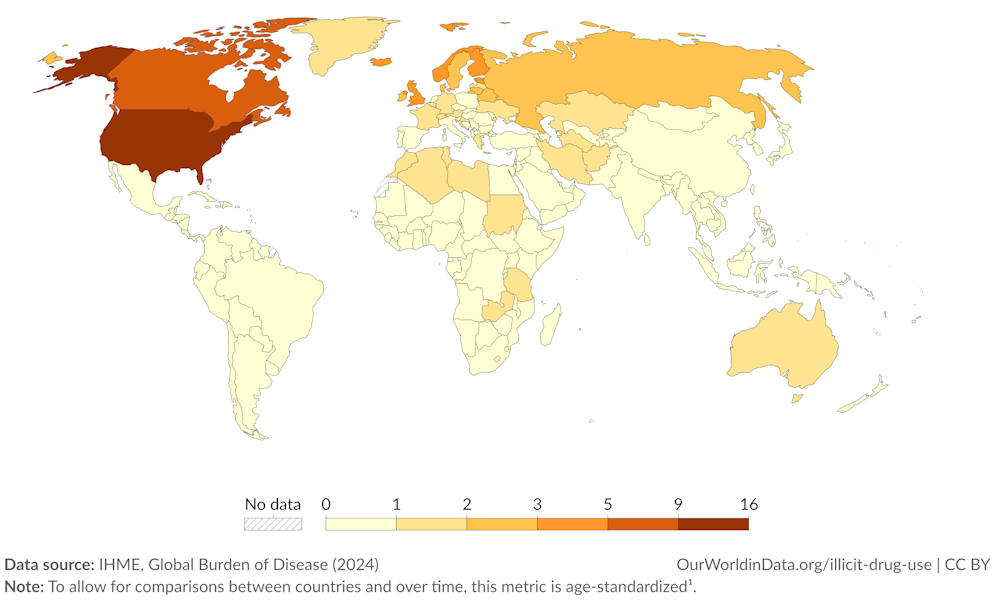
Illicit drug use is damaging large parts of the world socially, politically and environmentally. Patterns of supply and demand are changing rapidly. In our new longform series Addicted, leading drug experts bring you the latest insights on drug use and production as we ask: is it time to declare a planetary emergency?
Officially, more than 400 deaths plus many non-fatal overdoses were linked to nitazenes in the UK between June 2023 and January 2025. But this is likely to be an underestimate because of gaps within forensic and toxicology reporting. These figures come amid record levels of drug-related deaths in England and Wales. In 2023, there were 5,448 deaths related to drug poisoning, an 11% increase on the previous year and the highest total since records began in 1993.
This is of particular concern given that the UK has the largest heroin market in Europe, comprising around 300,000 users in England alone. While nitazene-related deaths are still relatively low (although by no means insignificant) compared with those from heroin and other opioids, these new synthetic opioids are cheap and easy to buy, and offer dealers multiple advantages over traditional plant-based drugs.
Unlike opium, nitazenes and other synthetic opioids can be produced anywhere in the world using precursor chemicals that are often uncontrolled and widely available. Producer countries including China and India have not yet banned all nitazene compounds, meaning they are sold legally – mostly online. Chemical manufacturing companies in these countries can synthesise nitazenes at scale using a comparatively easy three or four-step process.
Opioid use death rates around the world:
Estimated deaths from opioid use disorders per 100,000 people in 2021. Our World In Data, CC BY
For the past 15 years, I have researched and advised on the international narcotics industry, especially the Afghan drug trade, as an academic, UK Home Office official and consultant. I’ve observed many shifts within global drug markets, and I believe the increasing availability of synthetic drugs in the UK and Europe may represent a new chapter in illicit drug use here – with the emergence of nitazenes only adding to these concerns.
A brief history of synthetic opioids
New synthetic opioids (NSOs) are one of the fastest-growing groups of new psychoactive substances around the world. The EU Drugs Agency (EUDA) currently monitors 81 NSOs – the fourth-largest group of drugs under observation.
NSOs largely fall into two broad groups: fentanyl and its analogues, and non-fentanyl-structured compounds – these include nitazenes, among many other substances.
Many of these “new” synthetic opioids have, in fact, existed for decades. Nitazenes were first synthesised in the 1950s by the Swiss pharmaceutical company, Ciba Aktiengesellschaft, as pain-relieving analgesics, although they were never approved for medical use.
Prior to 2019, there had only been limited reports of nitazenes in the illegal drug supply – including a “brownish looking powder” found in Italy in 1966; the discovery of a lab in Germany in 1987; several nitazene-related deaths in Moscow in 1998; and a US chemist illegally producing the drug for personal use in 2003. But since nitazenes re-emerged at the end of the last decade, over 20 variants have been discovered.
Paul Janssen, the Belgian chemist who first made fentanyl. Johnson & Johnson
The most common NSO in the illegal drug market, fentanyl, was first synthesised by Belgian chemist Paul Janssen in 1960. Fentanyl, which is roughly 100 times more potent than morphine, was approved in the US in 1968 for pharmaceutical use as an analgesic.
Over the next four decades, however, illegally produced fentanyl resulted in three relatively small outbreaks of deaths in the US. A fourth, larger fentanyl outbreak in Chicago, Detroit and Philadelphia resulted in about 1,000 deaths between 2005 and 2007.
The current US fentanyl crisis started in 2013, expanding to affect much of the country. Between 2014 and 2019, Chinese companies were the main manufacturers of finished fentanyl substances in the US – to combat this, both the Obama and Trump administrations lobbied Beijing to curtail the fentanyl industry.
The Chinese government responded by controlling specific fentanyl analogues. However, every time an analogue was banned, chemists there would slightly adjust the formula to produce a new compound that mirrored the banned substance.
China finally banned all fentanyl-related substances in May 2019, prompting two significant changes in the drug’s supply: a slowdown in the development of new fentanyl analogues, and a reduction in their direct sale to the US from China. Instead, Chinese companies increasingly sent fentanyl precursors to Mexican drug cartels who would synthesise fentanyl (or counterfeit medication) in clandestine labs, before smuggling it across the US border. Consequently, Mexico is now the primary source of fentanyl in the US.
But these supply changes led to another shift in the global drugs arena, as China’s chemical and pharmaceutical businesses – keen to develop new markets – adjusted their focus to producing uncontrolled synthetic substances, including nitazenes. At the same time, they expanded their geographical focus from North America to include Europe and the UK.
The nitazene supply chain
Producing nitazenes is a relatively low-cost exercise. They are largely manufactured in laboratories – both legal and illegal – in China, before being smuggled to the UK and Europe via fast parcel and post networks.
Nitazenes’ high potency means only small quantities are required, making them easier to transport and harder for border officials to detect. Some Chinese vendors have reportedly been offering to hide nitazenes in legitimate goods such as dog food and catering supplies, to circumvent custom controls. All of this decreases the risk to sellers, and lessens the price of doing business.
In March 2024, two China-based sellers operating on the dark web were selling a kilo of nitazene for between €10,000 and €17,000 (£12,000-£20,000). During roughly the same period, a kilo of heroin at the wholesale level in the UK was selling for between £23,000 and £26,000. Once bought, nitazenes are largely used to fortify low-purity heroin, although the drug can also be made into pills.
Video by The Guardian.
Nitazenes are not limited to the dark web. They are widely and openly advertised on the internet, social media and music streaming platforms. In February 2024, one China-based e-commerce site displayed 85 advertisements for nitazenes. Such sites also sell a range of other synthetic drugs, including fentanyl analogues and precursors, xylazines, cannabinoids and methamphetamine.
This means drug dealers in the UK and across the world no longer need to have established connections to underworld figures to source illegal drugs. With a click of a mouse, they can have them delivered to their home address. In this sense, the internet has democratised the drug trade by widening access beyond “traditional” criminals.
In the UK, while the supply of nitazenes is currently assessed as “low”, a number of smaller-scale organised crime groups are importing them to fortify low-purity heroin, before largely dealing it at the “county lines” level. This involves organised crime groups moving drugs – primarily heroin and crack cocaine – across towns, cities and county borders within the UK, using mobile phones or another form of “deal line” to sell to customers.
In November 2023, Leon Brown from West Bromwich was imprisoned for seven years for dealing drugs containing nitazenes – a verdict described as “a great result in our ongoing efforts to tackle county lines drug dealing” by detective sergeant Luke Papps of the South Worcestershire county lines team.
A few larger UK criminal networks have also been involved in nitazene distribution. In October 2023, the police and Border Force conducted raids across north London, arresting 11 people. They dismantled a drug processing site and seized 150,000 tablets containing nitazene – the UK’s largest ever seizure of synthetic opioids – as well as a pill-pressing machine, a firearm, more than £60,000 in cash and £8,000 in cryptocurrency. The police suspected the group had been selling the tablets on the dark web.
Anecdotal reports suggest there have been mixed reactions to the introduction of nitazenes into the illegal drug supply. Richard, a recovering heroin user from Bristol, told Vice magazine that, given their potency, some “people are scared of [nitazenes]” while others are “actively seeking” them.
As has been the case with fentanyl in the US, users build up tolerance and therefore seek stronger doses. Manny, a heroin user from Bristol, told Vice: “I smoked [heroin cut with nitazenes] and it felt like the first time I’d ever taken drugs.”
Video by Vice.
UK-based criminals also use the dark web to export nitazenes abroad. In October 2023, the Australian Border Force identified 22 nitazene discoveries in packages shipped to the country via mail cargo from the UK. British criminals have also trafficked counterfeit medicines containing nitazenes to Ireland and Norway.
Use of nitazenes is now being detected all over the world. Within Europe, Ireland experienced several nitazene outbreaks in 2023-24 while in Estonia, nitazenes now account for a large share of overdose deaths – a trend also seen (to a lesser extent) in Latvia. Preliminary data suggests at least 150 deaths were linked to nitazenes in Europe in 2023.
Nitazenes have also been discovered in fake pain medication such as benzodiazepines, oxycodone and diazepam, which widens the number of people at risk to include those with no opioid tolerance. The death in July 2023 of Alex Harpum, a 23-year-old British student who was preparing for a career as an opera singer, was a stark reminder of the danger of buying fake medicine online that may have been contaminated with nitazenes.
The nitazene ‘boom’ and the global heroin trade
For decades, Afghanistan was the world’s largest opium producer and the source of most of Europe’s heroin. Then in April 2022, the ruling Taliban announced a comprehensive prohibition on the use, trade, transport, production, import and export of all drugs. As a result, poppy cultivation has fallen to historically low levels for a second consecutive year.
While this has not, as yet, translated into a shortage of heroin on European streets, including in the UK and Germany, some indicators suggest a slowdown in heroin supplies to the UK. In the year March 2023-24, the quantity of heroin seized in the UK fell by 54%, from 950kg to 441kg. This is the lowest quantity of heroin seized since 1989, when about 350kg was intercepted.
The NCA assesses that the Taliban ban has created market “uncertainty”. The wholesale price of heroin has increased from roughly £16,000 per kilo prior to the COVID-19 pandemic to about £26,000, while anecdotal reports suggest average heroin purity for users dropped to under 30% (often to 10-20%) in 2024, compared with around 35% in 2023 and 45% in 2022.
Video by UN Story.
Even without the Taliban’s ban, heroin is not easy to produce and supply. Cultivating opium poppy is labour-intensive, taking five or six months. The static nature of opium fields means they are visible and susceptible to eradication; poppy crops can also be negatively affected by blight or drought.
Converting opium into heroin base is also a labour-intensive process that can involve (depending on the production method) at least 17 steps. Acetic anhydride, the main chemical used to convert morphine into heroin, is relatively expensive compared with synthetic precursors. Moreover, heroin is a bulky product, which means it is harder to move in large volumes.
While the relationship between events in opiate-producer countries and the introduction of synthetic opioids to consumer markets should not be overstated, this new type of drug offers economic advantages to criminals whose “sole motivation is greed”.
For decades, Turkish, Kurdish and Pakistani criminal networks have been responsible for importing heroin into the UK. Once in the UK, both Turkish and British groups largely control its wholesale supply, with some participation of Albanian gangs.
To date, there is little evidence to suggest these groups have transitioned to supplying NSOs, including nitazenes. The shifting dynamics in the global drug supply chain, however, could upend traditional markets and the gangs who profit from them.
America’s synthetic drug crisis
The synthetic opioid fentanyl has devastated the US, having been linked to about 75,000 deaths in 2023 alone. It is the primary cause of death for Americans aged 18-49. Canada, too, has experienced a wave of deaths: between January 2016 and June 2024, there were 49,105 apparent opioid deaths there, with fentanyl implicated in a large proportion.
More than 4,300 reports of nitazenes have reached the US National Forensic Laboratory Information System since 2019. They are typically used to fortify fentanyl and other opioids, which can produce a fatal concoction.
Efforts to stem the flow of NSOs, including nitazenes, from China to the US and elsewhere will prove challenging. And even if China does implement stricter controls, other countries could step in to fill the void. According to the Commission on Combating Synthetic Opioid Trafficking:
The overall sizes of these industries, limited oversight efforts and political incentives contribute to an atmosphere of impunity among firms and individuals associated with those industries.
While US and Chinese counter-narcotics cooperation ended in 2022 amid increasing geopolitical tensions, the following November’s summit in Woodside, California, between presidents Joe Biden and Xi Jinping saw them agree to recommence collaboration.
As a result, China recently closed several chemical companies that were shipping fentanyl precursors and nitazenes to the US. These vendors used encrypted platforms and cryptocurrency to conduct the deals, and mislabelled the consignments to try to ensure the substances evaded border controls. China has also outlawed more chemicals and substances, including several nitazene variants.
But President Trump’s imposition of tariffs on imports from China – which sit alongside proposed taxes on imports from Canada and Mexico, in part for supposedly not doing enough to curb the trafficking of fentanyl and its precursors to the US – threatens this counter-narcotics cooperation.
While nitazenes are not yet widely available in the US, their presence within some fentanyl batches is complicating the US opioid crisis – and according to some experts, has the potential to further increase the already shocking number of synthetic opioid-related deaths.
The UK response to nitazenes
Successive UK governments have made tackling NSOs a high priority. Shortly after the most recent nitazene-related deaths were discovered in the UK in summer 2023, the NCA launched Project Housebuilder to lead and coordinate the law enforcement and public health response.
This was soon followed by the establishment of a government-wide Synthetic Opioids Taskforce “to improve…understanding, preparedness and mitigation against this evolving threat”. Chris Philp, then the UK’s combatting drugs minister, stated that “synthetic opioids are at the top of [this government’s] list because of the harm they cause”.
The taskforce has taken a range of measures, such as controlling more NSOs as class A drugs, conducting more intelligence operations at UK borders, widening access to naloxone, and enhancing the UK’s real-time, multi-source drug surveillance system. The government also worked with the US and Canada to learn from their experiences.
Recently, the current UK government banned a further six synthetic opioids and introduced a generic definition of nitazenes as class A drugs. And the UK’s current government, unlike its Conservative predecessor, has also indicated its willingness to consider evidence from the UK’s first drug consumption facility, which recently opened in Glasgow.
Other policy measures worthy of consideration include expanding drug checking services whereby drug users submit drugs to a lab to test what is in them, then are provided with information about the sample. These services offer vital information to the public and authorities about current drug trends.
While there is high uncertainty about what is going to happen next in the UK regarding illicit drug trends, the evolution of the US drug landscape over generations provides some important lessons.
Lessons from the US
The US fentanyl crisis shows drug markets can change quickly with long-lasting consequences. Most heroin on US streets contains – or has been replaced by – fentanyl. According to DEA seizure data, US heroin seizures declined by nearly 70% between 2019 and 2023, whereas fentanyl seizures have increased by 451%.
However, illegal drug markets evolve in different ways and at different paces. In May 1989, Douglas Hogg, a UK Home Office minister, travelled to the US and the Bahamas on a fact-finding mission about crack cocaine, a drug that was predicted to spread from the US to the UK. Upon his return, Hogg noted:
The ethnic, social and economic characters of many of our big cities are very similar to those in the US. If they have a crack problem, why should not we? … The use of crack in Great Britain is likely to develop very substantially over the next few years.
But this “crack invasion”, as some called it, did not materialise in the UK to the extent it had in the US – and the same was true about a predicted wave of methamphetamine use in the UK, which remains low compared with the US.
It is also unlikely the UK and Europe will experience a synthetic opioid crisis on the same scale as the US. The first wave of the US crisis was driven by extensive overprescription of opioids for pain relief. This increased the number of people addicted to opioids, some of whom later turned to heroin, before transitioning to fentanyl. In contrast, large-scale opioid prescriptions have not been a major issue in the UK or Europe, although there is some diversion of legal fentanyl into the illegal drug market in Europe.
Video by The Brookings Institution.
According to Alex Stevens, professor of criminology at the University of Sheffield, another factor differentiating the US and Europe is the provision of drug treatment and harm reduction programmes. Opioid users in Europe, and to a lesser extent in the UK, are much more likely to be in medication-assisted treatment than their US counterparts, thus reducing the number of people at risk. These interventions are reinforced by different socioeconomic factors in much of Europe, such as lower economic inequality, stronger social protections, and better healthcare systems.
None of this, though, means the nitazene threat in the UK and Europe should be underestimated, nor that use and supply of these drugs (and other NSOs) will not increase from its current relatively low base. As the NCA recently warned:
While a zero-tolerance approach from law enforcement, plus advice to users on the heightened dangers, may contain or slow the current uptake, we must prepare for these substances to become widely available, both unadvertised in fortified mixes and in response to user demand as a more potent high.
The future of new synthetic opioids
Predicting the future of NSO use and trafficking is a challenging task. Projections for Europe range from existing opiate stockpiles ensuring that heroin consumer markets remain serviced (assuming the Taliban ban is short-lived), to a heroin shortage which results in more drug dealers turning to NSOs to plug the shortfall, which in turn could lead to lasting changes in European drug markets (as happened in a few countries following the Taliban’s first opium ban in 2000-01).
In such a scenario, it is possible that Turkish criminal networks may exploit their links with Mexico’s Sinaloa cartel to source NSOs. Mexican criminal gangs also operate in Europe, which may increase the likelihood of them trying to open a new NSO market on the continent.
There is also evidence that some Italian criminal organisations have entered the NSO marketplace. In November 2023, Italian authorities announced the seizure of 100,000 doses of synthetic drugs, including fentanyl, as part of operation Painkiller, a joint Italian-American initiative.
Given the many advantages for criminal groups of NSOs, it seems likely they are here to stay. A key question is whether nitazenes (or other NSOs) will supplant traditional heroin as the opioid of choice, as they have done in the US, or remain at relatively low levels in Europe, co-existing with or mixed into the heroin supply.
In December 2023, Paul Griffiths, the EUDA’s scientific director, told Vice: “We’re not seeing much new initiation of heroin use in Europe. So in five to ten years … as heroin users get older and more vulnerable, we’re not going to have much of an opiate problem left.”
But he warned that if heroin use does dry up: “You might then see opioids appearing in other forms and preparations, such as pills, that could potentially become popular among younger age groups who currently do not appear attracted to injecting heroin.”
While previous NSO outbreaks in the UK were relatively short-lived and limited in scale, the most recent nitazene outbreak, which started in summer of 2023, has been more sustained, covered more parts of the UK, and involved more fatalities. The broader trend in Europe also suggests the prevalence and variations of NSOs are increasing at a faster pace than in previous years.
Notwithstanding, nitazene use and supply in the UK currently remains relatively low. In fact, the rate of nitazene-linked deaths – at least those officially reported – decreased between spring 2024 and the end of the year.
In the short term, then, it seems unlikely there will be a nitazene “explosion”. Rather, criminal groups will probably try to increasingly embed nitazenes into the UK drug market at a similar pace to the last 18 months.
However, this situation could change rapidly in future, especially if larger criminal networks involved in heroin importation switch to smuggling NSOs, and there is a genuine shortage of Afghan heroin. This problem would be compounded if drug users start seeking nitazenes, thus creating demand for them.
Either way, the UK government, along with its European partners, should continue to reinforce the whole drug system, to prepare for the worst-case scenario.
To hear about new Insights articles, join the hundreds of thousands of people who value The Conversation’s evidence-based news. Subscribe to our newsletter.
Philip A. Berry does not work for, consult, own shares in or receive funding from any company or organisation that would benefit from this article, and has disclosed no relevant affiliations beyond their academic appointment.
Donald Trump has hit the 30-day pause button on imposing 25% tariffs on Canada and Mexico, but is proceeding with slapping 10% tariffs on Chinese imports, and tariffs on the EU are still on his agenda.
Trump has declared that “tariff” is “the most beautiful word in the dictionary”. Yet as the president weighs up the sweeping consequences of his tariff fixation, he may want to throw out the dictionary and pick up a history book.
The magnitude and scale of the proposed tariffs hark back to the US Smoot-Hawley Tariff Act enacted in 1930.
For example, Nobel Laureate economist Paul Krugman told Bloomberg that “we’re really talking about tariffs on a scale that we … have not seen,” adding that “we’re talking about a reversal of really 90 years of US policy”.
The Smoot-Hawley tariffs were initially intended to provide support to the deeply indebted US agricultural sector at the end of the 1920s, and protect them from foreign competition – all familiar themes to the anti-free-trade rhetoric peddled by Trumpists today.
The advent of the Great Depression had generated widespread, albeit not universal, demands for protection from imports, and Smoot-Hawley increased already significant tariffs on overseas goods. Members of Congress were eager to provide protection, trading votes in exchange for support for their constituents’ industries.
Although at the time more than 1,000 economists implored President Herbert Hoover to veto Smoot-Hawley, the bill was signed into law. The resulting tariff act led to taxes averaging nearly 40% on 20,000 or so different types of imported goods.
The history of trade tariffs in the US.
The culmination led to a dramatic decline in US trade with other countries, particularly among those that retaliated, and is widely acknowledge as severely worsening the Great Depression. According to one estimate, the sum of US imports plummeted by nearly half.
What’s more, the impacts were felt globally. Protectionist policies are believed to have accounted for about half of the 25% decline in world trade, and indirectly helped create economic factors that led to the second world war.
The blowback against Capitol Hill was immense as well: the optics of vote trading over the tariff act resulted in Congress delegating control over trade policy to the president just four years later because the behaviour was regarded as so reckless.
All of this came against the backdrop of diplomatic American isolationism in the 1930s, which were not unlike many of Trump’s current efforts to retreat from – or even attack – multilateral institutions.
Despite President Woodrow Wilson winning the Nobel Peace Prize in 1919 for his work initiating the League of Nations (a forerunner of the United Nations), for example, the US never became a member. The term “America first” was also used widely in this period to refer to a focus on domestic policy and high tariffs.
Fast forward to present day
Trump has said that his tariffs will cause “some pain” but are “worth the price that must be paid.” Based on recent estimates from the non-partisan Peterson Institute for International Economics, Trump’s tariffs could drive up costs for the average US household more than US$1,200 (£963) per year.
Whether US voters will still stand behind Trump when actual prices begin to rise is still to be determined.
However, many Republicans on Capitol Hill have rushed to Trump’s defence. Congresswoman Claudia Tenney of New York told Fox News that she’s glad the US is “projecting strength for once on the world stage”. Senator Eric Schmitt of Missouri insisted that tariffs were “not a surprise,” emphasising that Trump had relentlessly campaigned on “improving our standing in the world.”
Perhaps the sharpest Republican rebuke came from Sen. Mitch McConnell of Kentucky, who labelled the tariffs simply a “bad idea”.
Public opinion data show that tariffs are hotly contested, with partisanship shaping both general views toward tariffs and views on specific national targets.
According to a January 2025 Harvard CAPS/Harris poll, 52% of Americans overall approve of placing new tariffs on China, with 74% of Republicans in favour, but just 34% of Democrats.
Support is more modest for imposing tariffs on America’s neighbours. Only 40% of voters think tariffs on Canada and Mexico are a good idea, including 59% of Republicans and 24% of Democrats.
Tariffs rank low on a list of national priorities. A mere 3% of Americans think tariffs on Canada and Mexico should be a top priority for Trump in his first 100 days, while just 11% rank tariffs on China as a top priority.
Prospect of a broader trade war
What seems clear is that Trump’s proposed tariffs against Canada, Mexico, and China could be just the opening salvos in a broader tit-for-tat that may extend to Europe, and beyond.
At home, the political challenge for Trump is to keep intact what increasingly looks like a fragile coalition – balancing the interests of hardline Maga supporters who reject free trade and tech titans who see tariffs as disrupting vital supply chains, especially to Asia.
After Trump’s election, former adviser and populist nationalist Steve Bannon warned that America would no longer be “abused” by “unbalanced trade deals.” “Yes, tariffs are coming,” he said. “You will have to pay to have access to the US market. It is no longer free, the free market is over.”
Meanwhile, Silicon Valley has been mostly silent on the tariffs. While tech moguls are doubtlessly trying to curry favour for tariff exemptions or the reduction of tariffs altogether, it’s possible that they have been assured that the tariffs are about leverage and will be gone soon enough.
Regardless, Trump is showing that tariffs are a crucial part of his “America first” foreign policy, a kind of belligerent unilateralism that treats allies and adversaries alike as pieces to be moved around a chessboard.
Under Trump, the “art of the deal” means throwing America’s weight around as the world’s economic superpower, and waiting for the leaders of other nations to fold. Whether American voters will endure the economic costs necessary for his plans could determine his resolve.
Trump may think that tariff is a beautiful word now. But if even a glimmer of the 1930s repeats itself, its economic shadow could soon look grim.
The authors do not work for, consult, own shares in or receive funding from any company or organisation that would benefit from this article, and have disclosed no relevant affiliations beyond their academic appointment.
Premier Scott Moe will travel to Washington D.C. this week for meetings with U.S. elected representatives, industry organizations and to participate in the premier’s Council of the Federation (COF) joint-mission to Washington.
Prior to the COF mission, Premier Moe will meet with U.S. elected representatives and businesses to emphasize the strong trade relationship between Canada and the U.S, and the role Saskatchewan plays in supplying the continent with energy and food security.
“It’s important in the current economic environment that we engage with our counterparts in the United States to emphasize the shared benefit of trade between our two countries and turn the conversation toward building on those strengths rather than jeopardizing them with tariffs,” said Moe.
The U.S. is Saskatchewan’s largest and most important trading partner. About $40 billion worth of imports and exports cross the border every year. The current tariff-free border allows businesses to add value to products and economies, whether flowing from north to south or vice versa.
Premier Moe’s meetings will focus on maintaining strong Canada-U.S. relations by addressing shared issues such as the economy, energy, supply chains and the impacts of the Trump Administration’s proposed tariffs.
Premier Moe will also express Saskatchewan’s support for strong measures to secure the Canada-U.S. border.
“Strengthening border security and preventing the flow of illicit drugs like Fentanyl is a concern that has been identified by the U.S. and one that I share,” Moe added. “We are already taking action as a province through our Border Security Plan to ensure we have more officers and law enforcement presence at the Saskatchewan-U.S. border.”
The Council of the Federation’s joint-mission to Washington will allow all thirteen premiers to present a united voice on the important benefits that free-trade brings to Canada and the U.S. and the concern over the negative impact of tariffs to consumers and businesses on both sides of the border.
The COF program will take place on Feb 12 and will include meetings with U.S. elected representatives, business leaders and the Canada American Business Council.
Following the COF mission Premier Moe will travel to Mexico to engage with business and elected officials to advance relationships with this key trading partner.
Over the course of the next few weeks, Premier Moe and multiple cabinet Ministers will be travelling within Canada and beyond to advocate for Saskatchewan’s interests. These engagement efforts will focus on promoting the province as a global supplier of food and energy security, while strengthening relationships with our key international trading partners.
NAPERVILLE, Ill., Feb. 07, 2025 (GLOBE NEWSWIRE) — Track Group, Inc. (OTCQB: TRCK), a global leader in offender tracking and monitoring services, today announced financial results for its fiscal quarter ended December 31, 2024 (“Q1 FY25”). In Q1 FY25, the Company posted (i) total revenue of $8.7 Million (“M”), a decrease of approximately 3.3% over total revenue of $9.0M for the quarter ended December 31, 2023 (“Q1 FY24”); (ii) Q1 FY25 operating income of $0.1M compared to Q1 FY24 operating loss of ($0.2M); and (iii) net loss attributable to common shareholders of ($2.0M) in Q1 FY25 compared to net income attributable to common shareholders of $0.1M in Q1 FY24.
“The quarter ending December 31, 2024 showed increases in gross profit, operating income and Adjusted EBITDA. This progress reflects the increased use of our products and services in legacy programs and continued expansion through newly awarded contracts domestically and abroad. With a strong pipeline and a commitment to delivering value, we are poised for continued success in fiscal year 2025,” said Derek Cassell, Track Group’s CEO.
FINANCIAL HIGHLIGHTS
Total Q1 FY25 revenue of $8.7M decreased approximately 3.3% compared to Q1 FY24 revenue of $9.0M. The decrease in revenue was driven principally by a decrease in people assigned to monitoring for clients in Michigan and Virginia, and our recently sold Chilean subsidiary. This decrease was partially offset by revenue increases for clients in Illinois, Puerto Rico and the Bahamas who experienced increases in the number of people assigned to monitoring.
Gross profit of $4.4M in Q1 FY25 increased approximately 5.2% compared to Q1 FY24 gross profit of $4.2M due to a decrease in monitoring center costs, partially offset by a decrease in revenue.
Operating income in Q1 FY25 of $0.1M increased compared to the operating loss of ($0.2M) in Q1 FY24. The increase in net income in Q1 FY25 is primarily due to a decrease in cost of revenue and a decrease in operating expense.
Adjusted EBITDA for Q1 FY25 of $1.2M, increased compared to $1.1M for Q1 FY24 due to an increase in operating income and gross profit. Adjusted EBITDA in Q1 FY25 as a percentage of revenue increased to 14.4%, compared to 11.8% for Q1 FY24 for the same reasons.
Unrestricted cash balance of $3.7M for Q1 FY25 increased compared to $3.6M for Q1 FY24. The change in cash position was principally due to the sale of our Chilean subsidiary.
Net loss attributable to shareholders in FY24 was ($2,010,849) compared to net income of $461 in FY23, a change principally attributable to lower revenue and a foreign currency exchange rate loss.
Business Outlook
Growth in gross profit and operating income in Q1 FY25 reinforces our confidence in the strategic reinvestment in technology and the implementation of new programs initiated in late FY23. These endeavors position us well for sustained growth throughout FY25. As a result, the Company’s preliminary outlook for FY25 is as follows:
Actual
Outlook
FY 2023
FY 2024
FY 2025
Revenue:
$34.5
M
$36.9
M
$35M – $36M
Adjusted EBITDA Margin:
11.1
%
14.6
%
14% – 15%
About Track Group, Inc. Track Group designs, manufactures, and markets location tracking devices; as well as develops and sells a variety of related software, services, and accessories, networking solutions, and monitoring applications. The Company’s products and services are designed to empower professionals in security, law enforcement, corrections, and rehabilitation organizations worldwide with single-sourced offender management solutions that integrate reliable intervention technologies to support re-socialization and monitoring initiatives.
The Company currently trades under the ticker symbol “TRCK” on the OTCQB exchange. For more information, visit www.trackgrp.com.
Forward-Looking Statements Any statements contained in this document that are not historical facts are forward-looking statements as defined in the U.S. Private Securities Litigation Reform Act of 1995. Words such as “anticipate,” “believe,” “estimate,” “expect,” “forecast,” “intend,” “may,” “plan,” “project,” “predict,” “if”, “should” and “will” and similar expressions as they relate to Track Group, Inc., and subsidiaries (“Track Group”) are intended to identify such forward-looking statements. These statements are only predictions and reflect Track Group’s current beliefs and expectations with respect to future events and are based on assumptions and subject to risks and uncertainties and subject to change at any time. Track Group may from time-to-time update these publicly announced projections, but it is not obligated to do so. Any projections of future results of operations should not be construed in any manner as a guarantee that such results will in fact occur. These projections are subject to change and could differ materially from final reported results. For a discussion of such risks and uncertainties, see “Risk Factors” in Track Group’s annual report on Form 10-K, its quarterly report on Form 10-Q, and its other reports filed with the Securities and Exchange Commission under the Securities Exchange Act of 1934, as amended. New risks emerge from time to time. Readers are cautioned not to place undue reliance on these forward-looking statements, which speak only as of the dates on which they are made.
Non-GAAP Financial Measures This release includes financial measures defined as “non-GAAP financial measures” by the Securities and Exchange Commission including non-GAAP EBITDA. These measures may be different from non-GAAP financial measures used by other companies. The presentation of this financial information, which is not prepared under any comprehensive set of accounting rules or principles, is not intended to be considered in isolation or as a substitute for the financial information prepared and presented in accordance with generally accepted accounting principles. Reconciliations of these non-GAAP financial measures are based on the financial figures for the respective period.
Non-GAAP Adjusted EBITDA excludes items included but not limited to interest, taxes, depreciation, amortization, impairment charges, gains and losses, currency effects, one-time charges or benefits that are not indicative of operations, charges to consolidate, integrate or consider recently acquired businesses, costs of closing facilities, stock based or other non-cash compensation or other stated cash and non-cash charges (the “Adjustments”).
The Company believes the non-GAAP measures provide useful information to both management and investors when factoring in the Adjustments. Specific disclosure regarding the Company’s financial results, including management’s analysis of results from operations and financial condition, are contained in the Company’s annual report on Form 10-K for the fiscal year ended September 30, 2023, and other reports filed with the Securities and Exchange Commission. Investors are encouraged to carefully read and consider such disclosure and analysis contained in the Company’s Form 10-K and other reports, including the risk factors contained in such Form 10-K.
TRACK GROUP, INC. AND SUBSIDIARIES CONSOLIDATED BALANCE SHEETS
(Unaudited)
December 31,
September 30,
2024
2024
Assets
Current assets:
Cash
$
3,740,043
$
3,574,215
Accounts receivable, net of allowance for credit losses of $525,141 and $432,904 respectively
5,319,041
4,428,535
Prepaid expense and deposits
420,680
638,293
Inventory, net of reserves of $99,041 and $82,848, respectively
811,992
582,481
Assets held for sale
–
969,481
Total current assets
10,291,756
10,193,005
Property and equipment, net of accumulated depreciation of $293,419 and $430,003, respectively
351,353
317,206
Monitoring equipment, net of accumulated depreciation of $5,145,204 and $5,982,972, respectively
4,550,033
4,598,864
Intangible assets, net of accumulated amortization of $19,954,086 and $19,699,966, respectively
13,415,776
13,959,571
Goodwill
7,913,369
7,941,190
Other assets, net
1,238,608
660,170
Total assets
$
37,760,895
$
37,670,006
Liabilities and Stockholders’ Equity (Deficit)
Current liabilities:
Accounts payable
$
3,336,084
$
3,082,467
Accrued liabilities
2,542,932
2,639,318
Liabilities held for sale
–
732,028
Total current liabilities
5,879,016
6,453,813
Long-term debt, net of current portion
42,659,634
42,639,197
Long-term liabilities
679,823
186,407
Total liabilities
49,218,473
49,279,417
Stockholders’ equity (deficit):
Common stock, $0.0001 par value: 30,000,000 shares authorized; 11,863,758 and 11,863,758 shares outstanding, respectively
Series A Convertible Preferred stock, $0.0001 par value: 1,200,000 shares authorized; 0 shares outstanding
–
–
Paid in capital
302,600,546
302,600,546
Accumulated deficit
(315,274,178
)
(312,691,811
)
Accumulated other comprehensive loss
1,214,868
(1,519,332
)
Total equity (deficit)
(11,457,578
)
(11,609,411
)
Total liabilities and stockholders’ equity (deficit)
$
37,760,895
$
37,670,006
TRACK GROUP, INC. AND SUBSIDIARIES CONSOLIDATED STATEMENTS OF OPERATIONS AND COMPREHENSIVE INCOME/(LOSS) (Unaudited)
Three Months Ended December 31,
2024
2023
Revenue:
Monitoring and other related services
$
8,441,307
$
8,674,485
Product sales and other
227,021
292,487
Total revenue
8,668,328
8,966,972
Cost of revenue:
Monitoring, products and other related services
3,508,762
3,973,989
Depreciation and amortization included in cost of revenue
735,224
789,463
Total cost of revenue
4,243,986
4,763,452
Gross profit
4,424,342
4,203,520
Operating expense:
General & administrative
2,431,118
2,757,887
Selling & marketing
901,189
706,531
Research & development
669,391
682,463
Depreciation & amortization
227,553
239,760
Loss on sale of subsidiary
66,483
–
Total operating expense
4,295,734
4,386,641
Operating income (loss)
128,608
(183,121
)
Other income (expense):
Interest income
2,839
48,162
Interest expense
(571,798
)
(486,084
)
Currency exchange rate gain (loss)
(1,499,262
)
538,945
Total other income (expense)
(2,068,221
)
101,023
Net income (loss) before income taxes
(1,939,613
)
(82,098
)
Income tax expense (benefit)
71,236
(82,559
)
Net income (loss) attributable to common stockholders
(2,010,849
)
461
Release of cumulative translation adjustment for sale of subsidiary
1,390,913
–
Equity adjustment for sale of subsidiary
571,518
–
Foreign currency translation adjustments
771,769
(106,702
)
Comprehensive income (loss)
$
723,351
$
(106,241
)
Net income (loss) per share – basic:
Net income (loss) per common share
$
(0.17
)
$
0.00
Weighted average common shares outstanding
11,863,758
11,863,758
Net income (loss) per share – diluted:
Net income (loss) per common share
$
(0.17
)
$
0.00
Weighted average common shares outstanding
11,863,758
11,863,758
TRACK GROUP, INC. AND SUBSIDIARIES NON-GAAP ADJUSTED EBITDA DECEMBER 31 (UNAUDITED) (amounts in thousands, except share and per share data)
Three Months Ended December 31,
2024
2023
Non-GAAP Adjusted EBITDA
Net income (loss) attributable to common shareholders
$
(2,011
)
$
–
Interest expense, net
569
438
Depreciation and amortization
963
1,029
Income taxes (1)
71
(83
)
Board compensation and stock-based compensation
75
53
Foreign exchange expense (gain)
1,499
(539
)
Loss on sale of subsidiary
66
–
Other charges (2)
18
164
Total Non-GAAP Adjusted EBITDA
$
1,250
$
1,062
Non-GAAP Adjusted EBITDA, percent of revenue
14.4
%
11.8
%
Non-GAAP earnings per share – basic:
Weighted average common shares outstanding
11,863,758
11,863,758
Non-GAAP earnings per share
$
0.11
$
0.09
Non-GAAP earnings per share – diluted:
Weighted average common shares outstanding
11,863,758
11,863,758
Non-GAAP earnings per share
$
0.11
$
0.09
(1
)
Currently, the Company has significant U.S. tax loss carryforwards that may be used to offset future taxable income, subject to IRS limitations. However, the Company is still subject to certain state, commonwealth, and other foreign based taxes.
(2
)
Other charges are expenses related to the board of directors, severance, and other Chile monitoring center costs for our recently sold subsidiary.
James Berg Chief Financial Officer jim.berg@trackgrp.com
The European Anti-Fraud Office (OLAF) and the Customs Administration of Honduras have signed an Administrative Cooperation Arrangement to enhance collaboration in the fight against customs fraud and illicit trade. This marks the first agreement between OLAF and a customs authority in Latin America, reflecting a significant step in international efforts to safeguard trade integrity.
The Arrangement establishes a framework for cooperation. It aims to strengthen efforts to combat illicit trade in dangerous goods, cigarettes, counterfeit goods, and other customs fraud.
“I am delighted that we are taking this important step with our partners in Honduras. This agreement is a reflection of the great understanding between our Offices, and I have no doubt that it will help us tackle fraud more effectively,” said Ville Itälä, OLAF Director-General.
Under this new cooperation framework, OLAF and the Customs Administration of Honduras will support each other in key areas such as the exchange of information, assistance in investigative activities, and strategic risk analysis. The partnership will enhance intelligence-sharing and enforcement actions, helping to detect and prevent fraudulent practices more effectively.
The signing of this arrangement underscores the commitment of both OLAF and the Customs Administration of Honduras to strengthening international partnerships in the fight against customs fraud and illicit trade. Through this enhanced cooperation, both parties aim to improve enforcement efficiency, contributing to fair and secure trade across borders.
For more information, read the publication from the Honduras Customs Administration.
SINGAPORE, Feb. 07, 2025 (GLOBE NEWSWIRE) — With the price of bitcoin once again trading below $100,000, many analysts believe it will enter a long period of high volatility. Holding spot positions may not continue to generate profits in the short term. BexBack Exchange is stepping up its efforts to provide traders with irresistible preferential packages. The platform now offers a 100% deposit bonus, a $50 welcome bonus for new users, and a 100x leverage on cryptocurrency trading, creating unparalleled opportunities for investors.
What Is 100x Leverage and How Does It Work?
Simply put, 100x leverage allows you to open larger trading positions with less capital. For example:
Suppose the Bitcoin price is $100,000 that day, and you open a long contract with 1 BTC. After using 100x leverage, the transaction amount is equivalent to 100 BTC.
One day later, if the price rises to $105,000, your profit will be (105,000 – 100,000) * 100 BTC / 100,000 = 5 BTC, a yield of up to 500%.
With BexBack’s deposit bonus
BexBack offers a 100% deposit bonus. If the initial investment is 2 BTC, the profit will increase to 10 BTC, and the return on investment will double to 1000%.
Note: Although leveraged trading can magnify profits, you also need to be wary of liquidation risks.
How Does the 100% Deposit Bonus Work? The deposit bonus from BexBack cannot be directly withdrawn but can be used to open larger positions and increase potential profits. Additionally, during significant market fluctuations, the bonus can serve as extra margin, effectively reducing the risk of liquidation.
About BexBack?
BexBack is a leading cryptocurrency derivatives platform that offers 100x leverage on BTC, ETH, ADA, SOL, and XRP futures contracts. It is headquartered in Singapore with offices in Hong Kong, Japan, the United States, the United Kingdom, and Argentina. It holds a US MSB (Money Services Business) license and is trusted by more than 200,000 traders worldwide. Accepts users from the United States, Canada, and Europe. There are no deposit fees, and traders can get the most thoughtful service, including 24/7 customer support.
Why recommend BexBack?
No KYC Required: Start trading immediately without complex identity verification.
High-Leverage Trading: Offers up to 100x leverage, maximizing investors’ capital efficiency.
Demo Account: Comes with 10 BTC in virtual funds, ideal for beginners to practice risk-free trading.
Comprehensive Trading Options: Feature-rich trading available via Web and mobile applications.
Convenient Operation: No slippage, no spread, and fast, precise trade execution.
Global User Support: Enjoy 24/7 customer service, no matter where you are.
Lucrative Affiliate Rewards: Earn up to 50% commission, perfect for promoters.
Take Action Now—Don’t Miss Another Opportunity!
If you missed the previous crypto bull run, this could be your chance. With BexBack’s 100x leverage and 100% deposit bonus and $50 bonus for new users (complete one trade within one week of registration), you can be a winner in the new bull run.
Sign up on BexBack now, claim your exclusive bonus and start accumulating more BTC today!
Disclaimer: This content is provided by BexBack. The statements, views and opinions expressed in this column are solely those of the content provider. The information provided in this press release is not a solicitation for investment, nor is it intended as investment advice, financial advice, or trading advice. It is strongly recommended you practice due diligence, including consultation with a professional financial advisor, before investing in or trading cryptocurrency and securities. Please conduct your own research and invest at your own risk.
Over the past few weeks the new US president, Donald Trump, has repeatedly claimed that the United States should “take back” the Panama Canal and that it should assume control of Greenland – one way or another. He has talked of Canada becoming America’s 51st state and now he even wants to “take over” the Gaza Strip to convert it into a “Riviera” on the eastern Mediterranean.
It’s as if the US president believes that his country should be an empire. In this Trump seems to be emulating China’s Xi Jinping and Vladimir Putin of Russia, leaders he has said he admires and who have themselves shown some clear imperial tendencies in recent years.
Under Putin, Russia has supported secessionist regions, such as Transnistria and Abkhazia, fought wars in Georgia and Ukraine and actively interfered in the affairs of Syria and assorted African countries. In 2022 Russia even launched a full-scale invasion of Ukraine, claiming that Ukraine was historically inseparable from Russia, but that hostile western influences were trying to destroy that unity.
China, meanwhile, has militarised a number of small uninhabited islands in the South China Sea. It has built 27 installations on disputed islands in the Spratly and Paracel island group that are also claimed by other countries including Vietnam, Taiwan, the Philippines and Malaysia. This has prompted a flurry of development, as other countries in the region have raced to establish their own footholds in the disputed, but very resource-rich, region.
Beijing also maintains its claim over Taiwan, which it says is an inalienable part of China which it wants to “come home”.
Empires and nation states
Most people assumed that the age of empires had been relegated to the dustbin of history. But this is by no means a straightforward proposition. Until relatively recently, the rise and fall of empires had dominated much of recorded history. Nation-states only appeared at the end of the 18th century. And as those states rose to prominence many too displayed imperial inclinations.
So the US, fresh from throwing off the yoke of the British empire, wasted little time in expanding its borders westward, acquiring – whether by conquest or purchase – large swaths of new territory in what effectively turned a small group of east coast states into a continental empire.
Meanwhile other newly minted nation-states such as Italy and Germany also aspired to acquire overseas empires and involved themselves, with varying success, building what turned out to be relatively shortlived colonial empires in Africa and elsewhere.
Most traditional dynastic empires, meanwhile, began to adopt various aspects of the nation-state model, such as conscription, legal equality and political participation. The decades following the second world war are often seen by historians as a period of decolonisation by traditional imperial powers such as Britain and France. But the transition from empire to nation-states was far from smooth. Most imperial governments hoped to transform their empires into more egalitarian commonwealths, while retaining a degree of influence.
This they did with varying degrees of success and often under extreme duress, as with France in Algeria and Vietnam, or under great economic pressure, such as with Britain and India. The real age of the nation-state didn’t begin until the 1960s.
The return of empire?
Today, the world consists of about 200 independent countries, the overwhelming majority nation-states. Nonetheless, one could argue that empires – or at least imperial tendencies – have never totally disappeared. France, for instance, frequently interfered in many of its former colonies in Africa. However, these military interventions were not meant to permanently occupy new territories.
Today, imperial tendencies seem to resurface around the world. The past, however, tends not to repeat itself. Massive wars of conquest or attempts to create new overseas empires are unlikely in the immediate future. Most imperial expansions are currently sought close to home.
What is striking is that Putin, Xi and Trump all use fierce nationalist rhetoric to justify their imperialist designs. Putin, as we have seen, claims the indivisibility of Ukraine and Russia and blames “Nazis” for trying to turn Russia’s sister state towards the west. He used it as a justification for invading Ukraine in February 2022.
Xi, in turn, often maintains that Communist China has finally overcome the century of humiliation, in which the country was the plaything of foreign powers. They both seem to yearn for past imperial greatness. The Russian Federation aims to undo the dissolution of the Soviet Union, communist China looks back to the Qing empire. Interestingly, under its increasingly authoritarian leader Recep Tayyip Erdoğan, Turkey – another regional power with imperial inclinations – similarly finds inspiration in the Ottoman Empire.
The US case seems to be more complex, but in fact is very similar. Thus, Trump argues that the Panama Canal, which has long been administered by the US, was foolishly returned to Panama by Jimmy Carter and claims that it is now controlled by China. He will, he says, return it to the US.
Trump also refers to America’s “Manifest Destiny”, the 19th-century belief that American settlers were destined to expand to the Pacific coast. These days his aspirations are northwards rather than to the west. The president also wants to plant the US flag on Mars, taking his imperial dreams into outer space.
If the US joins China and Russia in violating recognised borders, the international, rights-based order could be in danger. The signs are not very positive. Taking steps to illegally annex territories could blow up the entire international edifice.
Eric Storm does not work for, consult, own shares in or receive funding from any company or organisation that would benefit from this article, and has disclosed no relevant affiliations beyond their academic appointment.
ANDOVER, Mass., Feb. 07, 2025 (GLOBE NEWSWIRE) — Byrna Technologies Inc.(“Byrna” or the “Company”) (Nasdaq: BYRN), a personal defense technology company specializing in the development, manufacture, and sale of innovative less-lethal personal security solutions, today reported select financial results for its fiscal fourth quarter (“Q4 2024”) and full year ended November 30, 2024.
Fiscal Fourth Quarter 2024 and Recent Operational Highlights
Surpassed 500,000 launchers sold since inception, just five and a half years after the sale of Byrna’s first launcher in June 2019.
Increased launcher production in the first fiscal quarter of 2025 by 33% to 24,000 launchers a month to meet growing market demand and support operational growth.
Recently opened a new U.S.-based ammunition manufacturing facility in Fort Wayne, Indiana, as part of a re-shoring initiative, significantly expanding Byrna’s domestic production capacity and enhancing the Company’s supply chain for its payload ammunition.
Continued to generate a highly accretive return on ad spend (ROAS) above 5.0X through the celebrity endorsement program for the full year 2024 period, leading to a record $28.0 million of sales for the fourth quarter of 2024.
Added Megyn Kelly, Charlie Kirk, and Lara Trump as celebrity influencers to continue amplifying brand awareness and further support the normalization of its less-lethal solutions, while continuing to optimize marketing spend for maximum impact.
Partnered with the United States Concealed Carry Association (USCCA), gaining access to nearly one million USCCA members to promote less-lethal solutions while introducing Byrna customers to USCCA’s training, education, and self-defense liability insurance offerings.
Opened retail stores in the Greater Nashville Area, Scottsdale, Arizona, and Salem, New Hampshire. Byrna plans to open the Fort Wayne, Indiana store in the coming months.
Signed a Letter of Intent to launch a pilot store-within-a-store program at eleven Sportsman’s Warehouse locations, expanding Byrna’s retail footprint.
Fiscal Fourth Quarter 2024 Financial Results Results compare Q4 2024 to the 2023 fiscal fourth quarter ended November 30, 2023 unless otherwise indicated.
Net revenue for Q4 2024 was $28.0 million, compared to $15.6 million in the fiscal fourth quarter of 2023 (“Q4 2023”). The 79% year-over-year increase was primarily due to the transformational shift in Byrna’s advertising strategy implemented in September 2023 and the resulting normalization of Byrna and the less-lethal space generally.
Gross profit for Q4 2024 was $17.6 million (63% of net revenue), up from $9.0 million (58% of net revenue) in Q4 2023. The increase in gross profit was driven by the increase in the proportion of sales made through the high-margin direct-to-consumer (DTC) channels (Byrna.com and Amazon.com), a reduction in component costs driven through an intensive cost reduction effort focused on “design for manufacturability” spearheaded by Byrna’s engineering team, and the economies of scale resulting from increased production volumes.
Operating expenses for Q4 2024 were $13.5 million, compared to $9.7 million for Q4 2023, an increase of 39%. The increase in operating expenses was driven by an increase in variable selling costs (such as freight and third-party processing fees), increased marketing spend tied to the Company’s celebrity endorsement strategy, and higher payroll expenses in marketing and engineering as the Company has scaled to handle increased sales and production volumes.
Net income for Q4 2024 was $9.7 million, compared to a net loss of ($0.8) million for Q4 2023, a $10.5 million improvement. This increase was driven by higher revenue and a $5.6 million income tax benefit. The tax benefit arose from the release of tax valuation allowances related to net operating loss carryforwards incurred in earlier years and other tax assets.
Adjusted EBITDA1, a non-GAAP metric reconciled below, for Q4 2024 totaled $5.2 million, compared to $0.4 million in Q4 2023.
Cash and cash equivalents at November 30, 2024 totaled $16.8 million compared to $20.5 million at November 30, 2023. The change in cash and cash equivalents is primarily due to an $8.9 million investment in short-term marketable securities to earn a higher yield on Byrna’s unused cash. Adding cash and short-term marketable securities, total funds available were $25.7 million, an increase of $5.2 million compared to November 30, 2023. Inventory at November 30, 2024 totaled $20.0 million compared to $13.9 million at November 30, 2023. The Company has no current or long-term debt.
Fiscal Year 2024 Financial Results Results compare the 2024 fiscal year ended November 30, 2024 to the 2023 fiscal year ended November 30, 2023 unless otherwise indicated.
Net revenue for FY 2024 was $85.8 million, a 101% increase from $42.6 million in the fiscal year ended November 30, 2023 (“FY 2023”), driven by the Company’s strategic shift in advertising, increased brand normalization, and higher DTC sales
Gross profit for FY 2024 was $52.8 million (62% of net revenue), compared to $23.6 million (56% of net revenue) for FY 2023. The increase in gross profit margin was primarily due to a greater proportion of sales through high-margin DTC channels, lower component costs, and economies of scale.
Operating expenses for FY 2024 were $46.1 million, compared to $31.4 million for FY 2023, reflecting a 47% increase to support growth. The increase was driven by higher variable selling costs, expanded marketing efforts, and additional personnel in marketing and engineering.
Net income for FY 2024 was $12.8 million, compared to a net loss of ($8.2) million for FY 2023, a $21.0 million improvement. The increase in net income was driven by higher revenue and included a $5.7 million income tax benefit due to the full release of U.S. tax valuation allowances.
Adjusted EBITDA1 for FY 2024 totaled $11.5 million, compared to a negative ($2.0) million for FY 2023. The increase in adjusted EBITDA was primarily due to an increase in revenue.
Management Commentary Byrna CEO Bryan Ganz stated: “The fourth quarter was the culmination of a remarkable year for Byrna. We successfully generated a record $28.0 million in revenue while also expanding our gross margins to 62.8%. This success allowed us to deliver a 101% increase in revenue from the full year 2023 to 2024 and underscores the overall growth in brand recognition and normalization of the less-lethal space.
“Our marketing strategy, anchored by the continued success of our celebrity influencer program, has continued to be instrumental in driving DTC sales and expanding brand awareness. For 2024, the program maintained a highly accretive return on ad spend (ROAS) above 5.0X, underscoring the effectiveness of this approach in normalizing less-lethal solutions. Building on this foundation, we have been adding a more robust, multi-channel marketing strategy that now includes traditional media such as cable and broadcast networks. This diversification complements our influencer program, which recently welcomed prominent voices like Megyn Kelly, Charlie Kirk, and Lara Trump.
As we execute across multiple channels, we will continue to be disciplined in evaluating partnerships and optimizing ad spend to maximize impact and ROAS. We have prioritized celebrity endorsers who demonstrate strong ROAS and have discontinued partnerships that did not meet our minimum ROAS requirements. To date, the celebrity endorsers who were initially successful have continued to perform well, while those we discontinued never met our ROAS benchmarks. Unfortunately, we did lose one very successful celebrity endorser, Governor Mike Huckabee, due to his appointment as U.S. ambassador to Israel.
“In addition to expanding our online DTC reach, we are making strides in building our brick-and-mortar footprint. With four company-owned stores up and running, we are optimistic that these stores will validate the company-owned store model and open the way to a rollout of Byrna company-owned stores in key markets throughout the United States. Given the high gross margins and the relatively inexpensive operating costs, we believe that these stores can contribute meaningfully to Byrna’s bottom line as they ramp up over the coming quarters. We are also pleased to announce that we have signed a letter of intent to partner with Sportsman’s Warehouse to launch a store-within-a-store model at 11 locations across the United States. Each of these Sportsman’s Warehouse locations will convert their existing archery range into a firing range for customers to experience our launchers, similar to our company-owned stores and premier dealers. If the initial pilot program is successful, Byrna expects to be in 90 more stores by the end of the year, accelerating the rate of our brick-and-mortar presence across the United States.
“To ensure our production keeps pace with our growth initiatives, we have successfully increased launcher production to 24,000 units as of January at our Fort Wayne, Indiana launcher production facility. Additionally, we have begun producing payload ammunition at a new facility in Fort Wayne, located four miles from our launcher production facility. This state-of-the-art manufacturing facility will house eight advanced dousing and welding machines capable of producing both .68 and .61 caliber payload rounds for our existing launchers as well as our anticipated new Compact Launcher. We will also be able to produce .61 caliber fin-tail payload rounds for our Pepper and Max 12-gauge less-lethal rounds. Once fully operational later this year, these eight machines will collectively produce up to 10 million rounds per month, including 1.5 million fin-tail rounds for the 12-gauge platform. We believe the combination of Byrna Pepper and Max 12-gauge rounds, coupled with the Sportsman’s “store-within-a-store” partnership, will help spur the sale of our less-lethal 12-gauge rounds.
The onshoring of ammunition production is part of Byrna’s larger ‘Made in America’ strategy. We remain committed to exiting China by mid-year and aim to source nearly 100% of the components for the Byrna SD, LE, and CL models from U.S. suppliers by the end of 2025. We expect that this transition will insulate us from any potential tariffs, create well-paying jobs for American workers, reduce lead times, and eliminate the risks associated with unreliable foreign suppliers. We expect it will also allow us to market the Byrna as ‘Made in America!’
“Our momentum has carried into the new fiscal year with a strong holiday season in December, including $1.4 million in total product sales on Cyber Monday alone. International adoption has also been robust, particularly in Argentina, where the Cordoba Province committed to purchasing 1.7 million rounds of payload ammunition. This order, which will be shipped in 200,000-round monthly increments through the balance of 2025, reflects the extensive deployment of the 13,500 Byrna launchers purchased by the Cordoba Police Department to apprehend dangerous criminals and maintain the peace.
“Looking ahead, we remain optimistic about our trajectory. The ongoing success of our marketing efforts has resulted in less-lethal becoming a much more widely accepted personal self-defense category. This is allowing us to advertise on an increasing number of cable and social media platforms. We believe that the market for less-lethal weapons among gun owners in the U.S. is in the tens of millions of consumers. This expanding market, along with our growing online presence, expanding retail presence, and increasing international opportunities, reinforces our confidence in the long-term demand for less-lethal weapons as a whole and for Byrna specifically. While the first quarter historically experiences a seasonal slowdown in consumer spending, we expect to achieve strong year-over-year growth as we continue executing our strategic initiatives. We believe that Byrna is well-positioned to generate additional cash and expand profitability in 2025 and beyond.”
Conference Call The Company’s management will host a conference call today, February 7, 2025, at 9:00 a.m. Eastern time (6:00 a.m. Pacific time) to discuss these results, followed by a question-and-answer period.
Toll-Free Dial-In: 877-709-8150 International Dial-In: +1 201-689-8354 Confirmation: 13750859
Please call the conference telephone number 5-10 minutes prior to the start time of the conference call. An operator will register your name and organization. If you have any difficulty connecting with the conference call, please contact Gateway Group at 949-574-3860.
The conference call will be broadcast live and available for replay here and via the Investor Relations section of Byrna’s website.
About Byrna Technologies Inc. Byrna is a technology company specializing in the development, manufacture, and sale of innovative less-lethal personal security solutions. For more information on the Company, please visit the corporate website here or the Company’s investor relations site here. The Company is the manufacturer of the Byrna® SD personal security device, a state-of-the-art handheld CO2 powered launcher designed to provide a less-lethal alternative to a firearm for the consumer, private security, and law enforcement markets. To purchase Byrna products, visit the Company’s e-commerce store.
Forward-Looking Statements This news release contains “forward-looking statements” within the meaning of the securities laws. All statements contained in this news release, other than statements of current and historical fact, are forward-looking. Often, but not always, forward-looking statements can be identified by the use of words such as “plans,” “expects,” “intends,” “anticipates,” and “believes” and statements that certain actions, events or results “may,” “could,” “would,” “should,” “might,” “occur,” or “be achieved,” or “will be taken.” Forward-looking statements include descriptions of currently occurring matters which may continue in the future. Forward-looking statements in this news release include but are not limited to our statements related to our expected sales during 2025, our ability to scale production lines, Byrna’s ability to remain self-sustaining, profitable and cash flow positive, Byrna’s ability to open new retail locations and realize revenue growth from them, the expected scale, timing and benefits of Byrna’s store-within-a-store partnership with Sportsman’s Warehouse, the benefits and continued success of Byrna’s celebrity endorser strategy, Byrna’s ability to re-shore production and cease purchasing parts from China on the anticipated timeline, the expected benefits of re-shoring production, the anticipated growth and potential size of the U.S. less-lethal market, and Byrna’s positioning for sustained growth in 2025 and 2026. Forward-looking statements are not, and cannot be, a guarantee of future results or events. Forward-looking statements are based on, among other things, opinions, assumptions, estimates, and analyses that, while considered reasonable by the Company at the date the forward-looking information is provided, inherently are subject to significant risks, uncertainties, contingencies, and other factors that may cause actual results and events to be materially different from those expressed or implied.
Any number of risk factors could affect our actual results and cause them to differ materially from those expressed or implied by the forward-looking statements in this news release, including, but not limited to, disappointing market responses to current or future products or services; prolonged, new, or exacerbated disruption of our supply chain; the further or prolonged disruption of new product development; production or distribution disruption or delays in entry or penetration of sales channels due to inventory constraints, competitive factors, increased transportation costs or interruptions, including due to weather, flooding or fires; prototype, parts and material shortages, particularly of parts sourced from limited or sole source providers; determinations by third party controlled distribution channels, including Amazon, not to carry or reduce inventory of the Company’s products; determinations by advertisers or social media platforms, or legislation that prevents or limits marketing of some or all Byrna products; the loss of marketing partners; increases in marketing expenditure may not yield expected revenue increases; potential cancellations of existing or future orders including as a result of any fulfillment delays, introduction of competing products, negative publicity, or other factors; product design or manufacturing defects or recalls; litigation, enforcement proceedings or other regulatory or legal developments; changes in consumer or political sentiment affecting product demand; regulatory factors including the impact of commerce and trade laws and regulations; and future restrictions on the Company’s cash resources, increased costs and other events that could potentially reduce demand for the Company’s products or result in order cancellations. The order in which these factors appear should not be construed to indicate their relative importance or priority. We caution that these factors may not be exhaustive; accordingly, any forward-looking statements contained herein should not be relied upon as a prediction of actual results. Investors should carefully consider these and other relevant factors, including those risk factors in Part I, Item 1A, (“Risk Factors”) in the Company’s most recent Form 10-K and Part II, Item 1A (“Risk Factors”) in the Company’s most recent Form 10-Q, should understand it is impossible to predict or identify all such factors or risks, should not consider the foregoing list, or the risks identified in the Company’s SEC filings, to be a complete discussion of all potential risks or uncertainties, and should not place undue reliance on forward-looking information. The Company assumes no obligation to update or revise any forward-looking information, except as required by applicable law.
Investor Contact: Tom Colton and Alec Wilson Gateway Group, Inc. 949-574-3860 BYRN@gateway-grp.com
-Financial Tables to Follow-
BYRNA TECHNOLOGIES INC. Condensed Consolidated Statements of Operations and Comprehensive Income (Loss) (Amounts in thousands except share and per share data) (Unaudited)
For the Three Months Ended
For the Twelve Months Ended
November 30,
November 30,
2024
2023
2024
2023
Net revenue
$
27,979
$
15,640
$
85,756
$
42,644
Cost of goods sold
10,417
6,596
32,984
18,997
Gross profit
17,561
9,044
52,772
23,647
Operating expenses
13,468
9,729
46,101
31,437
INCOME (LOSS) FROM OPERATIONS
4,094
(684
)
6,671
(7,790
)
OTHER INCOME (EXPENSE)
Foreign currency transaction loss
(195
)
(32
)
(576
)
(270
)
Interest income
141
168
1,024
693
Loss from joint venture
–
22
(42
)
(603
)
Other income (expense)
1
27
7
(57
)
INCOME (LOSS) BEFORE INCOME TAXES
4,040
(499
)
7,084
(8,027
)
Income tax benefit
5,634
(330
)
5,708
165
NET INCOME (LOSS)
$
9,674
$
(829
)
$
12,792
$
(8,192
)
Foreign currency translation adjustment for the period
(133
)
205
342
(436
)
Unrealized gain (loss) on marketable securities
65
–
65
–
COMPREHENSIVE INCOME (LOSS)
$
9,606
$
(624
)
$
13,199
$
(8,628
)
Basic net income (loss) per share
$
0.43
$
(0.04
)
$
0.57
$
(0.37
)
Diluted net income (loss) per share
$
0.41
$
(0.04
)
$
0.55
$
(0.37
)
Weighted-average number of common shares outstanding – basic
22,514,644
21,991,313
22,504,938
21,919,624
Weighted-average number of common shares outstanding – diluted
23,754,328
21,991,313
23,139,549
21,919,624
BYRNA TECHNOLOGIES INC. Condensed Consolidated Balance Sheets (Amounts in thousands, except share and per share data)
November 30,
2024
2023
ASSETS
CURRENT ASSETS
Cash and cash equivalents
$
16,829
$
20,498
Accounts receivable, net
2,630
2,945
Marketable Securities
8,904
—
Inventory, net
19,972
13,890
Prepaid expenses and other current assets
2,623
868
Total current assets
50,958
38,201
Deposits for equipment
2,665
1,163
Right-of-use-asset, net
2,452
1,805
Property and equipment, net
3,408
3,803
Intangible assets, net
3,337
3,583
Goodwill
2,258
2,258
Loan to joint venture
—
1,473
Deferred tax asset
5,837
Other assets
1,007
28
TOTAL ASSETS
$
71,922
$
52,314
LIABILITIES
CURRENT LIABILITIES
Accounts payable and accrued liabilities
$
13,108
$
6,158
Operating lease liabilities, current
539
644
Deferred revenue
1,791
1,844
Line of credit
—
—
Notes payable, current
—
—
Total current liabilities
15,438
8,646
Notes payable, non-current
Deferred revenue, non-current
17
91
Operating lease liabilities, non-current
2,098
1,258
Total Liabilities
17,553
9,995
COMMITMENTS AND CONTINGENCIES (NOTE 19)
Preferred stock, $0.001 par value, 5,000,000 shares authorized, no shares issued
—
—
Common stock, $0.001 par value, 50,000,000 shares authorized. 24,168,014 shares issued and 22,002,027 outstanding as of November 30, 2024 and, 24,018,612 shares issued and 21,852,625 outstanding as of November 30, 2023
24
24
Additional paid-in capital
133,030
130,426
Treasury stock (2,165,987 shares purchased as of November 30, 2024 and 2023)
(21,253
)
(17,500
)
Accumulated deficit
(56,783
)
(69,575
)
Accumulated other comprehensive loss
(649
)
(1,056
)
Total Stockholders’ Equity
54,369
42,319
TOTAL LIABILITIES AND STOCKHOLDERS’ EQUITY
$
71,922
$
52,314
Non-GAAP Financial Measures
In addition to providing financial measurements based on generally accepted accounting principles in the United States (GAAP), we provide an additional financial metric that is not prepared in accordance with GAAP (non-GAAP) with presenting non-GAAP adjusted EBITDA. Management uses this non-GAAP financial measure, in addition to GAAP financial measures, to understand and compare operating results across accounting periods, for financial and operational decision making, for planning and forecasting purposes and to evaluate our financial performance. We believe that this non-GAAP financial measure helps us to identify underlying trends in our business that could otherwise be masked by the effect of certain expenses that we exclude in the calculations of the non-GAAP financial measure.
Accordingly, we believe that this non-GAAP financial measure reflects our ongoing business in a manner that allows for meaningful comparisons and analysis of trends in the business and provides useful information to investors and others in understanding and evaluating our operating results, enhancing the overall understanding of our past performance and future prospects.
This non-GAAP financial measure does not replace the presentation of our GAAP financial results and should only be used as a supplement to, not as a substitute for, our financial results presented in accordance with GAAP. There are limitations in the use of non-GAAP measures, because they do not include all the expenses that must be included under GAAP and because they involve the exercise of judgment concerning exclusions of items from the comparable non-GAAP financial measure. In addition, other companies may use other non-GAAP measures to evaluate their performance, or may calculate non-GAAP measures differently, all of which could reduce the usefulness of our non-GAAP financial measure as a tool for comparison.
Adjusted EBITDA
Adjusted EBITDA is defined as net (loss) income as reported in our condensed consolidated statements of operations and comprehensive (loss) income excluding the impact of (I) depreciation and amortization; (ii) income tax provision (benefit); (iii) interest income (expense); (iv) stock-based compensation expense, (v) impairment loss, and (vi) one time, non-recurring other expenses or income. Our Adjusted EBITDA measure eliminates potential differences in performance caused by variations in capital structures (affecting finance costs), tax positions, the cost and age of tangible assets (affecting relative depreciation expense) and the extent to which intangible assets are identifiable (affecting relative amortization expense). We also exclude certain one-time and non-cash costs. Reconciliation of Adjusted EBITDA to net (loss) income, the most directly comparable GAAP measure, is as follows (in thousands):
For the Three Months Ended
For the Twelve Months Ended
November 30,
November 30,
2024
2023
2024
2023
Net Income (Loss)
$
9,673
$
(829
)
$
12,792
$
(8,192
)
Adjustments:
Interest income
(141
)
(168
)
(1,024
)
(693
)
Income tax benefit
(5,634
)
330
(5,708
)
165
Depreciation and amortization
378
341
1,491
1,262
Non-GAAP EBITDA
$
4,276
$
(326
)
$
7,551
$
(7,458
)
Stock-based compensation expense
788
686
3,403
5,375
Severance/Separation/Officer recruiting
93
30
524
82
Non-GAAP adjusted EBITDA
$
5,157
$
390
$
11,478
$
(2,001
)
1 See non-GAAP financial measures at the end of this press release for a reconciliation and a discussion of non-GAAP financial measures.
A Coast Guard Air Station Borinquen MH-60T Jayhawk helicopter aircrew conducted a medevac for a snorkeler from the motor vessel Sea Hunter in Atlantic Ocean waters, approximately 70 nautical miles north of Punta Cana, Dominican Republic, Wednesday. The snorkeler was a 70-year-old man, U.S. citizen, who experienced a near drowning event while snorkeling off the motor vessel Sea Hunter. “This mission presented a significant challenge, as time was of the essence and required meticulous planning of fuel, communications, and extensive coordination between Sector San Juan and the Sea Hunter crew,” said Lt. William Boardman, Coast Guard MH-60T Jayhawk aircraft commander for the case. “Our team worked efficiently on scene to ensure a safe return to Puerto Rico. The patient was successfully transferred to Emergency Medical Service personnel and transported to a higher level of care. A huge thank you to everyone involved.”
For more breaking news follow us on Twitter and Facebook.
Bogota (Agenzia Fides) – “We are seriously concerned about the requests for help and the needs of the populations and communities that are seriously affected,” write the Colombian Bishops gathered in Bogota for the Plenary Assembly.”It is urgent to pay special attention to migrants, displaced persons, returnees, victims of the increasing violence in the country’s rural areas.” The Colombian Bishops are referring to the region of Catatumbo, where violence has been raging for some time, plunging the region into the most serious crisis since 2002 (see Fides, 30/1/2025).During the Plenary Assembly, which began on February 3, the Bishops’ Conference drew attention to the President of the Republic, Gustavo Petro, after a controversial cabinet meeting broadcast live on national television. “The country is in a serious crisis,” warned the bishops, calling for “effective responses” to the “profound, urgent and painful problems that afflict the nation.””We declare our solidarity with Catatumbo and other regions of the country,” they declared.”In addition, the problem remains latent, not only of deported migrants, but also of those displaced and expelled due to the violence in the regions,” the bishops said. They therefore strongly appealed to the national government and all state institutions to work in a coordinated manner and focus on the good of the nation, “in order to realize the united and peaceful country that we all long for.””Today more than ever, let us not lose hope, but let us concentrate our efforts and support the initiatives that are being carried out in the communities,” the bishops said. (AP) (Agenzia Fides, 7/2/2025)
Share:
‘The sanctions constitute another betrayal of our common humanity’ – Agnès Callamard
In response to the executive order announced by President Trump imposing sanctions on the International Criminal Court, Agnès Callamard, Amnesty International’s Secretary General, said:
“This reckless action sends the message that Israel is above the law and the universal principles of international justice. It suggests that President Trump endorses the Israeli government’s crimes and is embracing impunity.
“This executive order is vindictive. It is aggressive. It is a brutal step that seeks to undermine and destroy what the international community has painstakingly constructed over decades, if not centuries: global rules that are applicable to everyone and aim to deliver justice for all. The sanctions constitute another betrayal of our common humanity.
“The United States is ready to punish an institution that ensures the individuals most responsible for committing atrocities cannot escape justice. No one responsible for crimes under international law should be protected or aided in their attempts to escape individual accountability, least of all with the assistance of the US government based on President Trump’s political alliances.
“At an historic moment when we are witnessing a genocide against Palestinians in Gaza, Russia’s aggression against Ukraine, and the global rule of law coming under threat from multiple fronts, institutions like the Court are needed more than ever to advance human rights protections, prevent future atrocities and secure justice for victims.
“This attack against the ICC seeks to damage the Court’s independent pursuit of international justice. The sanctions issued will harm accountability, a crucial ingredient to global and long-term security. They will embolden perpetrators, present and future. They will negatively impact the interests of all victims globally and those who look to the Court for justice in all the countries where it’s conducting investigations, including Darfur, Libya, the Philippines, Palestine, Ukraine and Venezuela.
“The ICC performs a vital role by investigating crimes under international law, often committed by the most powerful individuals, in situations where – without its involvement – the perpetrators would benefit from perpetual impunity.
“The sanctions are also an affront to 125 member states who have collectively resolved that the Court must be able to effectively pursue justice – which means it must be able to undertake independent judicial functions, such as issuing arrest warrants, for example, against Benjamin Netanyahu or Vladimir Putin.
“Governments around the world and regional organisations must do everything in their power to mitigate and block the effect of President Trump’s sanctions. Through collective and concerted actions, ICC member states can protect the Court and its staff. Urgent action is needed, like never before.”
In response to the executive order announced today by President Trump imposing sanctions on the International Criminal Court (ICC), Agnès Callamard, Amnesty International’s Secretary General, said:
“This reckless action sends the message that Israel is above the law and the universal principles of international justice. It suggests that President Trump endorses the Israeli government’s crimes and is embracing impunity.
“Today’s executive order is vindictive. It is aggressive. It is a brutal step that seeks to undermine and destroy what the international community has painstakingly constructed over decades, if not centuries: global rules that are applicable to everyone and aim to deliver justice for all. The sanctions constitute another betrayal of our common humanity.
“The United States is ready to punish an institution that ensures the individuals most responsible for committing atrocities cannot escape justice. No one responsible for crimes under international law should be protected or aided in their attempts to escape individual accountability, least of all with the assistance of the US government based on President Trump’s political alliances.”
“At an historic moment when we are witnessing a genocide against Palestinians in Gaza, Russia’s aggression against Ukraine, and the global rule of law coming under threat from multiple fronts, institutions like the Court are needed more than ever to advance human rights protections, prevent future atrocities and secure justice for victims.
No one responsible for crimes under international law should be protected or aided in their attempts to escape individual accountability, least of all with the assistance of the US government based on President Trump’s political alliances.
Agnès Callamard, Amnesty International’s Secretary General
“This attack against the ICC seeks to damage the Court’s independent pursuit of international justice. The sanctions issued will harm accountability, a crucial ingredient to global and long-term security. They will embolden perpetrators, present and future. They will negatively impact the interests of all victims globally and those who look to the Court for justice in all the countries where it’s conducting investigations, including Darfur, Libya, the Philippines, Palestine, Ukraine and Venezuela.
“The ICC performs a vital role by investigating crimes under international law, often committed by the most powerful individuals, in situations where – without its involvement – the perpetrators would benefit from perpetual impunity. The sanctions are also an affront to 125 member states who have collectively resolved that the Court must be able to effectively pursue justice – which means it must be able to undertake independent judicial functions, such as issuing arrest warrants, for example, against Benjamin Netanyahu or Vladimir Putin.
“Governments around the world and regional organizations must do everything in their power to mitigate and block the effect of President Trump’s sanctions. Through collective and concerted actions, ICC member states can protect the Court and its staff. Urgent action is needed, like never before.”
On the eve of Russian Science Day, TASS held a press conference dedicated to the results of the third round of the comprehensive study “We do science in Russia” He was conducted Institute for Statistical Research and Economics of Knowledge (ISSEZ) HSE. The authors of the study and experts representing higher education, research institutes and industry spoke about the state of domestic science, the drivers of its development, the dynamics of change and the barriers that need to be overcome.
The first “Making Science in Russia” study was conducted in 2017, the second round took place in 2022, and the third from October to November 2024.
Present and future
As explained by the first vice-rector, director of the HSE ISSEK Leonid Gokhberg, the basis of the study was the results of a survey of the heads of 719 universities and leading scientific organizations, which make up almost the entire core of Russian science. These are “the key players who make the weather in this area and determine its development with their daily practices.”
The assessment was carried out on 87 factors grouped into 8 large blocks, which made it possible to determine the sentiment index in Russian science. In the second step, the researchers identified 47 measures of state scientific and technical policy, assessed their effectiveness on a number of parameters and rated them.
“The situation in Russian science looks stable and positive, there is progress compared to previous rounds of the study,” Leonid Gokhberg noted. For example, assessments related to the institutional conditions of functioning of universities and scientific organizations have improved – first of all, we are talking about increasing awareness of policy measures and regulation of important aspects of their daily life (regulation of state assignments and state purchases, tender procedures, etc.).
Representatives of the scientific sphere assess the prospects for the coming years even more optimistically. Expectations are connected with further increase in the efficiency of scientific research, cooperation with business and stimulation of investment inflow from commercial structures, development of the information base of science.
At the same time, the situation looks different in different sectors. “Universities are feeling the best, and this correlates with the measures of their support that have been launched in recent years and have had a rather positive impact on the development of university science,” Leonid Gokhberg stated.
This block received the most restrained assessment from the scientific community, but this does not mean that everything is bad. Science is financed from many sources, and the study showed that the situations with different sources differ for different organizations. Key sources of budgetary financing are assessed more restrainedly in general, since they may not be very relevant for non-profit organizations that participated in the survey (for example, grants from Russian scientific foundations).
“We see a significant improvement in the situation for all types of organizations compared to 2022, as budget expenditures on science are steadily increasing. This year, almost 3% of federal budget funds are planned to be allocated to support science, this is the highest figure in the last ten years, and we hope that funding for science will continue to increase,” Ekaterina Streltsova emphasized.
Organizations of all types were skeptical about the provision of funding from state companies and especially from business, and, in her opinion, this is a predictable result given the current structure of funding for Russian science. In recent years, the business sector has provided about 30% of the costs of science, and although this figure has increased compared to 2010, measures are needed to stimulate investment.
Of all the sources of funds, foreign organizations received the lowest ratings. “It was these ratings that influenced the overall score for the entire area and pulled it down, and this is understandable,” says Ekaterina Streltsova. “Foreign resources have never been significant for the development of Russian science; in the last five to six years, the share of these sources in the total volume of expenses has not exceeded 2.5%.”
Personnel and equipment
Ekaterina Streltsova noted that the human resources potential received a positive assessment for most factors: the managers are satisfied with both the quantitative and qualitative characteristics of the scientific personnel they work with. Compared to 2022, some values have improved due to the implementation of a whole range of measures. Difficulties are associated with attracting foreign researchers and participation in international projects.
The assessment of material and technical conditions is also quite stable: organizations are generally optimistic about the availability of scientific equipment and consumables, but many note the complication of supplies from abroad. The availability of access to specialized domestic software and Russian AI-based systems is assessed cautiously, but it is in this area that expectations are high and positive.
The weak point remains the commercialization of results – their promotion and implementation in the economy. For example, universities and research organizations are actively involved in patent activities, but their contribution to the development of licensing activities in the domestic market is still limited. Obviously, this is due, among other things, to insufficient dialogue between science and business. “Although the situation has improved somewhat compared to 2022, we see that the intensity of interaction with business in the form of joint laboratories, basic departments, and so on is still assessed rather restrainedly, which, of course, requires further implementation, including of the measures already in force,” concluded Ekaterina Streltsova.
“A most interesting analysis”
The results of the study “Making Science in Russia” were commented on by representatives of science, higher education and industry.
Director of the Joint Institute for Nuclear Research, Academician of the Russian Academy of Sciences Grigory Trubnikov noted that HSE scientists conducted “a most interesting analysis.” In his opinion, over three rounds of research, “analytics has taken off,” it has a large audience, and the data can be trusted.
Commenting on the conclusions about science funding, he put forward the hypothesis that the problem is not that it should be increased, say, twofold, but that “science should be done faster” — this is the main request of the scientific community. If we remove the obstacles associated with control, procurement procedures, academic mobility, and foreign restrictions, then the competitiveness of Russian science will increase.
Grigory Trubnikov also noted that in terms of international cooperation, everything depends on the specific organization, and things are going well at his institute in Dubna – cooperation with China, Mexico, Brazil is developing, and this is a noticeable trend in general.
Stanislav Terekhov, head of the laboratory of antibiotic resistance at the Institute of Bioorganic Chemistry of the Russian Academy of Sciences, highly praised the existing measures to support science, including the creation of youth laboratories (his laboratory is one of them). In his opinion, this allows the best personnel to be retained in the country and students and postgraduates to be integrated into laboratory practice, but state support should be supplemented by private initiatives.
Science and Business
Director of the Institute of Translational Medicine and Biotechnology at Sechenov University Vadim Tarasov emphasized the links between science and business in his speech. In his opinion, the Priority 2030 program “gave universities a huge opportunity to be flexible in their interactions with industry,” and now it is necessary to set goals for 10-15 years ahead, understanding what technologies the country needs to ensure sovereignty, and which ones are worth entering foreign markets with.
First Vice President for MTS Technologies, Head of the MTS Basic Department at HSE Pavel Voronin also highly praised the study, calling it very complete and high-quality.
In his opinion, science is the foundation for technology, and “the geopolitical situation requires us to invest more in this fundamental part,” but the economic situation forces many companies in the market to approach finances prudently. When it is necessary to monitor expenses more closely, the first thing that is cut is unpredictable, long-term investments. “From a business point of view, it is important not to get caught in these scissors, to correctly determine priorities and leave a certain share of investments for long-term research,” concluded Pavel Voronin.
Head of the scientific and technical cooperation department of the State Corporation Rosatom Ekaterina Chaban stated that in her corporation “every scientific project is also a business project” and confirmed the researchers’ findings on the successful attraction of young people to science. In the scientific division of Rosatom, out of 2 thousand scientists, 38% are under 35 years old, 48% are under 39 years old, and among the directors of institutes there are scientists and designers under 40 years old. “The corporation does a lot to maintain the influx of young people and retain young personnel,” she explained.
Please note: This information is raw content directly from the source of the information. It is exactly what the source states and does not reflect the position of MIL-OSI or its clients.
Source: People’s Republic of China – State Council News
BEIJING, Feb. 7 — As the world ushers in the Year of the Snake on the Chinese lunar calendar, the Spring Festival has expanded beyond its traditional roots to become a global phenomenon, offering a window through which people around the world can learn about China’s cultural ethos and contemporary dynamism.
To mark the Chinese New Year, the London Eye was lit up in auspicious red, while Dubai’s Burj Khalifa dazzled with festive projections. Global iconic landmarks joined China in celebrating a millennia-old tradition. Additionally, the festival’s global imprint extends beyond the lights: dragon dances, temple fairs and other activities were held across the world.
This year’s Spring Festival is the first since its inscription on the UNESCO intangible cultural heritage list. The Chinese New Year is becoming a festival celebrated across the world. As nearly 20 nations recognize the Spring Festival as an official holiday and some 200 countries hold celebrations, this cultural event reflects humanity’s shared yearning for renewal and connection.
China’s expanded visa-free travel policies have amplified this cultural exchange, enabling more international travelers to visit China and immerse themselves in the festival’s rich customs.
Foreign visitors have experienced not just festive fireworks, but the profound values embedded in the tradition: familial bonds that transcend borders, the harmony between humanity and nature, and an emphasis on social cohesion. These values resonate across cultures, dismantle stereotypes and nurture mutual cultural appreciation.
“The Spring Festival Gala,” an annual TV program broadcast live and watched by billions worldwide, epitomizes China’s cultural appeal. The 2025 gala featured the performances of U.S. band OneRepublic and Peruvian artists, demonstrating artistic dialogue between East and West.
The televised extravaganza also offers a glimpse of the integration of tradition and modernity as well as technological progress in the country. AI-powered robots performed a synchronized dance in embroidered jackets during the show, showcasing China’s fusion of heritage and cutting-edge technology, and the openness, inclusiveness and innovation of Chinese culture.
Beyond culture, this year’s Spring Festival illuminated China’s economic resilience amid global economic headwinds.
The eight-day holiday saw year-on-year increases in tourist numbers and expenditure, as well as record box office revenue. Boosted by trade-in programs and other policies, the sales of home appliances and communication equipment at key retailers jumped during the festival, reflecting the vibrancy of China’s consumption market.
In Chinese culture, the snake symbolizes agility, wisdom and vitality. As the world is fraught with growing uncertainties and regional frictions, the Spring Festival, an age-old tradition that perpetually rejuvenates itself, serves as a unique portal to a dynamically evolving China.
Moreover, the values enshrined within the Spring Festival not only act as a guiding light for individuals, but also hold the potential to foster deeper mutual understanding among different cultures and promote world peace and prosperity.
Chinese President Xi Jinping on Friday exchanged congratulations with Colombian President Gustavo Francisco Petro Urrego over the 45th anniversary of bilateral diplomatic ties.
Since China and Colombia established diplomatic relations 45 years ago, both sides have been pushing for the steady development of bilateral ties based on the principles of equality and mutual respect, said Xi.
Xi noted that in October 2023, Petro paid a successful state visit to China, during which the two heads of state had a fruitful meeting, and jointly announced the establishment of a strategic partnership between the two countries, guiding China-Colombia relations into a new era.
Colombia is an important country in Latin America and will assume the rotating presidency of the Community of Latin American and Caribbean States this year, said Xi.
Xi also said he attaches great importance to developing China-Colombia relations, and is willing to work with Petro to deepen the strategic partnership between the two countries in efforts to jointly build a China-Latin America and the Caribbean community with a shared future.
In his message, Petro said the development of bilateral relations has witnessed fruitful results since the two sides established diplomatic ties, delivering benefits to the two peoples.
Frequent high-level visits have strongly boosted bilateral cooperation in various fields, and fostered a deeper bond between the two peoples, he said.
The Colombian president also noted that he paid a state visit to China after taking office, and bilateral ties have been steadily strengthened with the continuous increase of trade and investment.
Colombia is willing to work with China to jointly advance the global agenda of mutual concern, including world peace, energy transition and tackling climate change, he added.
Source: United States Senator for Iowa Chuck Grassley
WASHINGTON – Sen. Chuck Grassley (R-Iowa), a senior member and former chairman of the Senate Finance Committee, today spoke with United States Trade Representative (USTR) nominee Jamieson Greer about the need to move away from China on trade and unlock new export markets for long term stability.
During the hearing, Grassley emphasized the importance of reducing or eliminating Brazil’s tariff on American ethanol. Grassley also questioned Greer about USTR’s cooperation with the Department of Commerce on trade matters.
Video and excerpts of his questions follow.
[embedded content]
VIDEO
Brazilian Tariffs on American Ethanol:
“Brazil is a leading competitor with the United States on agriculture. One example is that Brazil has displaced the United States as the world leader in soybean production.
“Another issue with Brazil that I brought up to your predecessor, Ms. Tai, is the drastically unfair advantage Brazil has on ethanol. U.S. exporters face an 18% tariff on ethanol going to Brazil. However, Brazilian ethanol enjoys nearly duty-free access to the U.S. market.
“I hope you will address this trade imbalance with Brazil that Ambassador Tai wasn’t successful in doing: taking action to reduce or eliminate this harmful tariff on American ethanol.”
The Role of USTR and the Department of Commerce:
“Now that you and Mr. Lutnick have been nominees for several weeks, I’d like to know exactly how much authority do you have on trade matters relative to Mr. Lutnick and other cabinet members?”
Moving Away from China and Unlocking New Markets:
“I’d like to make a statement and see if you agree:
“While I think it is important to hold China to its obligations under the Phase 1 Agreement, I also fear it may keep us reliant on the Chinese markets. So, we need to be looking around the world at other markets.
“We need to balance our short-term profitability with long term stability.
“I have for a long time voiced my own concerns about unfair trade practices by China, and I hope that you and President Trump are successful in holding China accountable on issues including fentanyl, intellectual property theft and government subsidization of industries.
“That said, I believe we must pursue freer trade with other countries to create new markets so that we can move away from China without losing even more global market share of our commodities to Brazil and other countries.
“The free trade agreements that were negotiated under George W. Bush have resulted in large trade surpluses in key industries like agriculture and manufacturing. I think we need more free trade, and I know that President Trump is more interested in bilateral agreements than multi-state agreements.
“I think if we look away from Brazil and South Korea and Japan and China and [the European Union] as being problem countries for us on trade issues. But there’s so many other countries where, if we have these agreements — and I use George W. Bush as an example and his negotiator Allen Johnson — about 13 countries, probably six or seven different agreements with countries you don’t even think much about being significant in world trade, we’ve increased tremendously with these free trade agreements, our surpluses with those countries in trade.”
Source: United States Senator for Connecticut – Chris Murphy
February 06, 2025
WASHINGTON—U.S. Senators Chris Murphy (D-Conn.), a member of the U.S. Senate Health, Education, Labor, and Pensions Committee, and Richard Blumenthal (D-Conn.) on Thursday joined U.S. Senator Sheldon Whitehouse (D-R.I.) and 15 of their Senate colleagues in reintroducing the No Tax Breaks for Outsourcing Act, legislation that would reverse the Trump tax law’s breaks for offshoring jobs and profits. The announcement comes as President Trump’s 25 percent tariffs on Canada and Mexico remain under negotiation, while Republicans push to expand those offshoring incentives in their reconciliation bill.
The No Tax Breaks for Outsourcing Act would level the playing field for American companies by requiring multinational corporations to pay the same tax rate on profits earned abroad as they do in the United States. The Trump tax law created a special tax rate for offshore profits that is half the domestic rate. Since the law’s passage, studies have found that multinationals have increased foreign, rather than domestic investment. Extending the Trump tax law would mean maintaining this half-off rate, which is otherwise scheduled to slightly increase.
If passed, the senators’ legislation would boost U.S. economic competitiveness by encouraging domestic investment, leveling the playing field for domestic companies, and bringing the U.S. into compliance with the global minimum tax agreement. The Joint Committee on Taxation found that large U.S. multinationals paid an average tax rate of just 7.8 percent the year after the Trump law passed, lower than their foreign competitors. They would still pay less than their competitors with a higher rate on foreign profits. Moreover, with over 140 countries moving to implement the global tax agreement, U.S. and foreign multinationals alike will be subject to the new minimum tax whether the U.S. complies or not. Failure to join, however, will mean the revenue fills foreign coffers instead of the U.S. Treasury.
U.S. Senators Richard Durbin (D-Ill.), Jack Reed (D-R.I.), Tammy Baldwin (D-Wis.), Elizabeth Warren (D-Mass.), Jeff Merkley (D-Ore.), Ed Markey (D-Mass.), Brian Schatz (D-Hawaii), John Fetterman (D-Pa.), Chris Van Hollen (D-Md.), Ruben Gallego (D-Ariz.), Mazie Hirono (D-Hawaii), Martin Heinrich (D-N.M.), Cory Booker (D-N.J.), Tina Smith (D-Minn.), and Tammy Duckworth (D-Ill.) also cosponsored the legislation.
The No Tax Breaks for Outsourcing Act would repeal offshoring incentives by:
Equalizing the tax rate on profits earned abroad to the tax rate on profits earned here at home. The bill would end the preferential tax rate for offshore profits by eliminating the deductions for “global intangible low-tax income (GILTI)” and “foreign-derived intangible income” and applying GILTI on a per-country basis.
Repealing the 10 percent tax exemption on profits earned from certain investments made overseas. In addition to the half-off tax rate on profits earned abroad, the Trump tax law exempts from tax a 10 percent return on tangible investments made overseas, like plants and equipment. The legislation would eliminate the zero-tax rate on certain investments made overseas.
Treating “foreign” corporations that are managed and controlled in the U.S. as domestic corporations. Ugland House in the Cayman Islands is the five-story legal home of over 18,000 companies – many of them actually American companies in disguise. The bill would treat corporations worth $50 million or more and managed and controlled within the U.S. as the American entities they in fact are, and subject them to the same tax as other U.S. taxpayers.
Cracking down on inversions by tightening the definition of expatriated entity. This provisionwould discourage corporations from renouncing their U.S. citizenship. It would deem certain mergers between a U.S. company and a smaller foreign firm to be a U.S. taxpayer, no matter where in the world the new company claims to be headquartered. Specifically, the combined company would continue to be treated as a domestic corporation if the historic shareholders of the U.S. company own more than 50 percent of the new entity.
Combating earnings stripping by restricting the deduction for interest expense for multinational enterprises with excess domestic indebtedness. Some multinational groups reduce or eliminate their U.S. tax bills by concentrating their worldwide debt, and the resulting interest deductions, in U.S. subsidiaries. The bill would disallow interest deduction for U.S. subsidiaries of a multinational corporation where a disproportionate share of the worldwide group’s debt is located in the U.S. entity, a tactic commonly known as “earnings stripping.”
Eliminating tax break for foreign oil and gas extraction income. Oil and gas extraction income earned abroad gets an even further break on the already half-off rate other industries pay on offshore profits.
Source: United States Senator for New Mexico Martin Heinrich
Heinrich uplifts New Mexicans’ concerns, sheds light on local impact of Vought’s dangerous plans
VIDEO
WASHINGTON – This evening, U.S. Senator Martin Heinrich (D-N.M.) delivered remarks on the Senate floor amplifying the voices of New Mexicans opposing the nomination of Russell Vought to lead the Office of Management and Budget (OMB). Mr. Vought is the lead architect of the Heritage Foundation’s Project 2025, the policy blueprint for Donald Trump’s harmful agenda to throw the government into chaos and harm working families.
“Today, I say to the thousands of New Mexicans who have asked me to oppose Mr. Vought’s nomination: I agree with you,” said Heinrich. “Mr. Vought is not fit to lead the OMB. We should reject this dangerously unfit nominee before he dismantles the services New Mexicans rely on. We should reject him before he unilaterally overrides the laws that Americans’ elected representatives have passed. We cannot standby and allow Mr. Vought, Elon Musk, or this President to disregard the safety and security of the American people. The law is on our side.”
VIDEO: U.S. Senator Martin Heinrich (D-N.M.) delivers remarks on the Senator floor opposing the nomination of Project 2025 architect Russell Vought to lead the Office of Management and Budget (OMB), February 6, 2025.
During his speech, Heinrich amplified the concerns of New Mexicans who have written or called into his office expressing concern over Trump’s harmful actions. Heinrich additionally recited alarming statements recently made by Vought that emphasize his dangerous plans, “In a private speech last year at his far-right Center for Renewing America think tank, Mr. Vought stated that he would like to put career civil servants ‘in trauma.’ Mr. Vought said, ‘We want the bureaucrats to be traumatically affected. When they wake up in the morning, we want them to not want to go to work because they are increasingly viewed as the villains.”’
Heinrich also emphasized the unlawfulness of Vought’s intentions and the Trump administration’s actions by citing rulings handed down from two federal courts that issued temporary restraining orders on Trump’s directives.
Heinrich concluded by encouraging New Mexicans—and all Americans—to use their voices to call on Republicans in charge of the Senate, House, and White House to put an end to this chaos, “To all Americans wondering what can be done right now: keep using your voices. Call your Members of Congress. Call your Senators. Call the White House. Call the Treasury Department. Comment on your Republican Representatives’ social media channels. Write op-eds in your local newspaper. Make sure Republicans know that ‘We the People’ are paying attention. That we will hold them accountable for following the law and upholding our Constitution. And make sure to let your lawmakers know when you support the work they’re doing, so that they continue to do it. And let federal civil servants know that you support them, and that you want them to keep doing their jobs and doing them well.”
Heinrich is leading Senate Democrats in sounding the alarm on Elon Musk and Donald Trump’s destructive actions that are wreaking havoc on Americans, weakening our economy, and threatening the livelihoods of New Mexicans.
Last week on the Senate floor, Heinrich delivered the longest speech of his career, where he slammed President Trump’s unlawful unilateral blockade of all federal grant funding. In his remarks, Heinrich uplifted stories from New Mexicans on how Trump’s federal funding freeze endangered New Mexicans and threatened communities across the state. Find the video of Heinrich sharing letters from New Mexicans on the Senate floor here.
Since Trump took office in 2025, Heinrich has:
Introduced a resolution condemning Trump’s pardons of people found guilty of assaulting police officers on January 6.
Source: United States Senator Ben Ray Luján (D-New Mexico)
Luján Voted Against Project 2025 Architect Who Attempted to Withhold Trillions of Dollars From Americans
WATCH HERE:Minutes Before Confirmation Vote, Luján Highlighted Concerns from New Mexicans on OMB Nominee
Washington, D.C. – U.S. Senator Ben Ray Luján (D-N.M), a member of the Senate Committee on the Budget, issued the following statement after Senate Republicans voted to confirm Project 2025 architect Russell Vought to serve as Director of the Office of Management and Budget (OMB):
“Before this vote even took place, Russell Vought was already taking a wrecking ball to the federal programs and services that New Mexicans depend on. Mr. Vought was behind President Trump’s funding freeze when the administration attempted to withhold vital funding to every community across America. Despite this, Senate Republicans voted to confirm Mr. Vought to lead the powerful Budget Office.
“Mr. Vought wrote Project 2025, he’s implementing it, and he has the full support of the Senate Republican Conference to continue President Trump’s agenda of chaos, corruption, and confusion. I’ve heard from New Mexicans in all corners of the state who are worried and frustrated with the impacts of Mr. Vought’s leadership role. New Mexicans want a government that works for the people and that is what I am fighting for. That is why I, along with every Senate Democrat, voted against his nomination.”
Source: United States Senator for Colorado John Hickenlooper
Legislation would improve space traffic coordination in low-Earth Orbit, reduce congestion
WASHINGTON – Today, U.S. Senators John Hickenlooper, John Cornyn, Gary Peters, Marsha Blackburn, Eric Schmitt, Mark Kelly, Roger Wicker, and Ben Ray Luján introduced the Situational Awareness of Flying Elements in (SAFE) Orbit Act. The legislation would improve space traffic coordination (STC) in low-Earth orbit by directing the Office of Space Commerce (OSC), which operates within the U.S. Department of Commerce, to acquire and share unclassified information on space activities in low-Earth orbit.
“The boom in commercial space activities has filled low-Earth orbit with more debris and satellites than ever,” said Hickenlooper. “A cutting-edge traffic coordination system will help preserve our leadership in space.”
Our current government space situational awareness (SSA) services have not kept pace with the accuracy our space industry needs. The SAFE Orbit Act would fix that.
Specifically, the legislation would:
Make basic-level SSA data, analytics, information, and services available for public use through an easily accessible, free web interface
Maintain a public catalog of SSA data and information using data from diverse sources
Facilitate the development and adoption of voluntary industry consensus standards to ensure data standardization among satellite owners and operators, commercial service providers, the academic community, and nonprofits
Foster collaboration with U.S Government and foreign government operators to encourage participation in data-sharing with respect to their assets in orbit
Prioritize purchasing data, analytics, information, and services from commercial SSA providers
Ensure any licensing agreements allow private U.S. firms to continue market growth and protect proprietary commercial systems and data
The Commercial Spaceflight Federation has endorsed this legislation.
“Commercial space objects in low-Earth orbit can help scientists make new discoveries and spur technological innovation, but this hinges on the ability to conduct safe and effective space traffic coordination,” said Cornyn. “The SAFE Orbit Act would prevent dangerous and costly accidental collisions in low-Earth orbit and improve access to data collection and analysis to help propel the United States into the next phase of space exploration.”
“To continue as a global leader in commercial space activity, the United States must lead the way to protect astronauts in orbit and space-based assets,” said Peters. “This legislation would provide important data that can help inform space exploration decisions and promote safe expansion.”
“The world is entering a new space race, and we must equip American innovators with every resource to win,” said Blackburn. “The SAFE Orbit Act would take an important step to centralize and improve space traffic coordination, ensuring there are no tragic collisions in space. As we enter this new frontier, we must be certain that we prioritize safety and coordination with our partners around the globe.”
“As the commercial space industry continues to grow, we need to safely track and manage objects in orbit and prevent collisions,” said Kelly. “We’re providing the tools for critical space situational awareness that will safeguard public access to orbital data, empower scientists and innovators to advance this critical frontier, and strengthen American leadership in space.”
“Future expansion in space requires better technology and data coordination. Currently, companies lack the awareness of other objects such as space junk, which could collide with valuable satellites,” said Wicker. “This new emerging business sector represents the new economic frontier, but we must make sure we are prepared to tap its potential.”
“This legislation will help make essential improvements to how we track objects in Earth’s orbit, enhancing space safety through better tracking and coordination to reduce collision risks,” said Luján. “As the commercial space activity grows, in New Mexico and across the country, access to critical space data is necessary to ensure safety and security.”
Source: United States Senator for Kansas Roger Marshall
Washington, D.C. – U.S. Senator Roger Marshall, M.D. joined RFD-TV to discuss this week’s Senate Ag Committee hearing, the challenges farmers are facing, trade agreements, and President Trump’s tariffs on China, Mexico, and Canada.
[embedded content]
You may click HERE or on the image above to watch Senator Marshall’s full interview.
Highlights from Senator Marshall’s interview include:
On the challenges farmers are facing:
“I don’t have to tell your listeners that we had a record drop in net farm income that was basically due to high interest rates and high input costs. Again, you’re all well aware of those as well and the regulatory environment we’re drowning in.”
“The mental health of farmers, the farmer suicide issue comes to mind. The right to work on your own property and work on your own tractors and machinery. All those little issues add up, the average age of the farmer, I think is in the 60s now. So plenty of challenges out there, and our challenge up here now is just to prioritize those and do what we can to help the American farmer and rancher.”
On the importance of trade agreements benefitting farmers:
“We got to talk about trade. And certainly, we’re grateful for the past trade agreements. President Trump got done with USMCA, South Korea, Japan…And Joe Biden didn’t do any new trade agreements. So for four years, we’ve sat idle, and we’re looking forward to President Trump hopping back in there and doing some strong bilateral trade agreements.”
On President Trump’s tariffs on Mexico and Canada:
“This is a drug war and not a trade war. And first and foremost, my farmers and ranchers, they’re parents and grandparents. And this is about the fentanyl drug war, that we’re losing 200 Americans every day from fentanyl poisoning. We’re losing 75,000 Americans every year from fentanyl poisoning, more than we lost in the entire Vietnam War. So President Trump has asked Canada, Mexico, and China, to stop the nonsense.”
“These precursors were mostly made in China, but now a lot of the precursors are in laboratories in Canada. So we need those countries to step up. And they are.”
“I think as long as over the next 30 days, we see significant progress that the tariffs on Mexico and Canada won’t come to fruition, at least I hope they don’t. But I do appreciate President Trump worried about our national security, and I appreciate that our farmers and ranchers are patriots and still supporting him.”
“And don’t forget one last thing, the last time we had it out with China, President Trump gave farmers and ranchers $28 billion from that tariff money. He’s not forgotten about us. We’re a huge priority to President Donald J. Trump.”
On China promising retaliatory tariffs:
“China is just next to impossible to deal with, and America needs to divorce from China as much as possible. You know, they’re constantly stealing our intellectual property. We talked about the fentanyl issues already. They’re trying to buy up American farmland. They don’t play fair. They simply don’t.”
“We’ve given them huge breaks for decades now. They’ve had 25-50, 75% tariffs on American goods and products forever, and now we just want it to be fair and equal. They’re no longer a developing nation, so we have to play hardball with them before they’re going to come to the table.”
“This is why USMCA was so important – that Canada and Mexico are our number one trade partners now for agriculture…at the end of the day, I have faith in President Trump that he’s going to take care of the American farmer and rancher. I think we could come back and talk about 45Z someday, and how we’re hoping President Trump will support that in the biofuels industry, rolling back regulations. I think that you can count on President Trump to champion that so we can’t look at all these issues in little single silos.”
Israeli Foreign Minister Gideon Sa’ar informed the United Nations Human Rights Council (UNHRC) on Thursday that Israel will no longer participate in it.
Israel’s move came two days after U.S. President Donald Trump announced his country’s withdrawal from the top UN human rights body.
Sa’ar wrote to UNHRC President Jurg Lauber that “the decision was reached in light of the ongoing and unrelenting institutional bias against Israel in the Human Rights Council, which has been persistent since its inception in 2006.”
Sa’ar mentioned that the council “has become a political tool and a convenient platform, cynically used to advance certain political aims, to bash and delegitimize Israel.”
He claimed that Israel has been subject to over 20 percent of all condemnatory resolutions ever passed in the council, “more than (those) against Iran, Cuba, North Korea, and Venezuela, combined.”
He added that since Oct. 7, 2023, “the council has employed every platform to spread misinformation and blood libels against Israel.”
The Israeli minister wrote on social media platform X that “joining President Trump’s just decision, Israel will no longer tolerate the council’s blatant antisemitism.”
Samsung Electronics today announced the global availability of the new Galaxy S25 series. Together with One UI 7, Gemini is officially available at launch in 46 languages,1 making it easier than ever to perform seamless interactions across Samsung and Google apps.
▲ New York 500 Broadway, Galaxy Experience Space
“The Galaxy S25 series is a fundamental shift in how we interact with our phones,” said TM Roh, President and Head of Mobile eXperience Business at Samsung Electronics. “We are thrilled to see how our users will enjoy this true AI companion that offers seamless and intuitive solutions in their daily lives.”
▲ Dubai The Bay Festival City Mall, Galaxy Experience Space
On the Galaxy S25 series, AI agents with multimodal capabilities are integrated within the One UI 72 platform to perform complex tasks seamlessly across apps and enable natural user interactions through speech, text, videos and images. Now Brief3 provides tailored suggestions to guide through the day and Now Bar4 offers a new hub for ongoing activities. From enhanced productivity with Writing Assist to limitless creativity unleashed by Drawing Assist,5 the expanded capabilities of Galaxy AI6 continue to empower users in every aspect of their daily lives.
Interactions with the Galaxy S25 series are also more intuitive. With just a single command, Gemini7 can effortlessly find a user’s favorite sports team’s schedule and add it to Samsung Calendar. Additionally, Google’s enhanced Circle to Search8 now gives users more helpful information with AI Overviews and one-tap actions.
▲ Vietnam Ho Chi Minh City, Galaxy AI Sai Gon Terminal
The Galaxy S25 series further refines and enhances the core capabilities that define the Galaxy experience. Powering the Galaxy S25 series globally, the Snapdragon® 8 Elite Mobile Platform for Galaxy fuels on-device processing for more responsive AI experiences. With unique customizations for Galaxy, including ProScaler9 and Samsung’s mobile Digital Natural Image engine (mDNIe), the Galaxy S25 series boasts enhanced AI image processing and display power efficiency. The newly introduced 50MP ultrawide camera sensor for the Galaxy S25 Ultra delivers epic shots from every range in exceptional clarity, while professional grade controls like Virtual Aperture and Samsung Log turn any photo or video into the ultimate visual experience.
▲ Indonesia Jakarta Kota Kasablanka, Galaxy Experience Space
The Galaxy S25 series is the industry’s first smartphone lineup to support Content Credentials, based on the open technical standard from the Coalition for Content Provenance and Authenticity (C2PA). Samsung has also joined the C2PA as a member, alongside industry leaders including Adobe, Microsoft, OpenAI, Google, Publicis Groupe and more, all collaborating to establish Content Credentials as the universal standard for digital content provenance. In line with its commitment to responsible mobile AI innovation, Samsung adopted this standard to enhance transparency for content created and edited with generative AI.
Starting February 7, the Galaxy S25 series will be widely available through carriers and retailers and on Samsung.com. Galaxy S25 Ultra is available in Titanium Silverblue, Titanium Black, Titanium Whitesilver and Titanium Gray. Galaxy S25 and Galaxy S25+ come in Navy, Silver Shadow, Icyblue and Mint. More unique color options are also available exclusively at Samsung.com,10 including Titanium Pinkgold, Titanium Jetblack and Titanium Jadegreen for Galaxy S25 Ultra as well as Blueblack, Coralred and Pinkgold for Galaxy S25+ and Galaxy S25.
All Galaxy S25 devices will come with six months of Gemini Advanced and 2TB of cloud storage at no extra cost. Gemini Advanced comes with Samsung’s most capable AI models and priority access to the newest features like Gems, custom AI experts for any topic, and Deep Research, which acts as a personal AI research assistant.
For more information about Galaxy S25 series, please visit: Samsung Newsroom, Samsungmobilepress.com and Samsung.com.
▲ Mexico City Santa Fe Mall, Galaxy Experience Space
▲ Brazil Sao Paulo, Galaxy S25 launch event
▲ Germany Berlin, Galaxy Experience Space
1 Supported languages include Arabic, Bengali, Bulgarian, Chinese (Simplified / Traditional), Croatian, Czech, Danish, Dutch, English, Estonian, Farsi, Finnish, French, German, Greek, Gujarati, Hebrew, Hindi, Hungarian, Indonesian, Italian, Japanese, Kannada, Korean, Latvian, Lithuanian, Malayalam, Marathi, Norwegian, Polish, Portuguese, Romanian, Russian, Serbian, Slovak, Slovenian, Spanish, Swahili, Swedish, Tamil, Telugu, Thai, Turkish, Ukrainian, Urdu and Vietnamese.2 The official One UI 7 release will commence with the latest Galaxy S series devices. The update is expected to gradually roll out to other Galaxy devices.3 Now Brief feature requires Samsung Account login. Service availability may vary by country, language, device model, or apps. Some features may require a network connection.4 Availability of functions supported within the apps may vary by country. Some functional widgets may require a network connection and/or Samsung Account login.5 Drawing Assist feature requires a network connection and Samsung Account login. A visible watermark is overlaid on the image output upon saving in order to indicate that the image is generated by AI. The accuracy and reliability of the generated output is not guaranteed.6 Samsung Account login may be required to use certain Samsung AI features. Samsung does not make any promises, assurances or guarantees as to the accuracy, completeness or reliability of the output provided by AI features. Availability of Galaxy AI features may vary depending on the region / country, OS / One UI version, device model and phone carrier. Some function availability may vary by device model. Galaxy AI service may be limited for minors in certain regions with age restrictions over AI usage. Galaxy AI features will be provided for free until the end of 2025 on supported Samsung Galaxy devices. Different terms may apply for AI features provided by third parties.7 Gemini Extensions feature availability varies based on content. Internet connection, Android device, and set up required. Language availability varies. Results for illustrative purposes and may vary. Check responses for accuracy.8 Sequences shortened and simulated. Results for illustrative purposes only. Service availability may vary by country, language, or device model. Requires internet connection. Users may need to update Android and Google app to the latest version. Results may vary depending on visual or audio matches. Accuracy of results is not guaranteed. Works on compatible apps and surfaces, and with ambient music only. Will not identify music coming through headphones or if phone volume is off.9 ProScaler feature is supported on Galaxy S25+ and Ultra models. Image quality can be enhanced up to QHD+, depending on the screen resolution setting of the device.10 Availability of colors may vary by market and network provider.
Source: United States Senator for North Dakota John Hoeven
02.06.25
WASHINGTON – Senator John Hoeven, Chairman of the Senate Agriculture Appropriations Committee and a senior member of the Senate Agriculture Committee, today issued the following statement after Mexico announced that it was rescinding its ban on the importation of genetically-engineered (GE) corn:
“This is great news, not only for U.S. farmers, but for the people of Mexico who will continue to have access to a high-quality, safe and affordable food staple,” said Hoeven. “Mexico’s ban on the importation of GE corn flew in the face of years of scientific review and regulatory oversight, while creating yet another barrier for U.S. farmers trying to access the Mexican market. Rescinding this policy is the right call and will benefit both nations.”
This follows Hoeven and his colleagues calling on the U.S. Trade Representative and Agriculture Secretary to push back on Mexico’s policy.
The senators stressed that the ban undermines food security in Mexico, ignores the longstanding, science-based regulatory regime that had proven the safety of GE corn and would stifle future agricultural innovations.
Accordingly, the senators urged for Mexico to be held to its trade commitments and for the U.S. to pursue a dispute settlement through the U.S.-Mexico-Canada Agreement (USMCA).
Last month, a USMCA dispute settlement panel found that Mexico violated its obligations under the trade agreement and ruled in favor of American farmers.