Category: Latin America

  • MIL-OSI Africa: Devil worship, muti and murder: what’s behind the growth of occult gangs in South Africa?

    Source: The Conversation – Africa – By Ashwill Ramon Phillips, Lecturer and Postgraduate Supervisor, Department of Criminology, University of the Free State

    Gang-related crime in South Africa is widespread, but is under-reported outside hotspots such as the Cape Flats in Cape Town or Westbury in Johannesburg. In these areas gangs are deeply rooted and contribute to ongoing violence, drug trafficking and territorial conflict.

    But gangs have continued to evolve and gang violence has consistently increased throughout South Africa, particularly in the Gauteng and Free State provinces. In the Free State in the east-central part of the country, devil-worshipping and witchcraft-related gang practices have been reported.

    Gang-related violence is fuelled by poverty, social exclusion, unemployment and the need for protection from rival gangs.


    Read more: Here’s how some of Cape Town’s gangsters got out – and stayed out


    In my doctoral study in criminology, I explored the phenomenon of occult-inspired gangs in the Free State. I interviewed 23 active gang members, 16 offenders who weren’t affiliated to gangs, and 18 service providers like social workers and correctional officials working with these groups.

    In a more recent study I developed a typology of occult gangs: a framework that captures their structure, symbolism, hierarchy and spiritual practices.

    This matters because in order to prevent gang-related crime it is essential to understand how they operate.

    The rise of Free State occult gangs

    In 1997, a South African Police Service investigation uncovered a so-called devil worshipping group or “evil church” that had migrated from parts of northern Africa and established itself in Maseru, Lesotho (South Africa’s neighbour). This group reportedly blended occult practices with traditional African witchcraft. This led local communities to label it as a devil-worshipping gang.

    A BTK gang tattoo. Ashwill Ramon Phillips

    Since 2011, groups like this have expanded across the Free State. There are now about 40 such gangs active in the province, as reported by the police and confirmed in my research. Some of the better known gangs are the Triple 6 (666), Born-To-Kill (BTK), Natural Born Killers (NBK), International Junior Portuguese (IJP), and Maroma (Romans/Romas).

    More typical street gangs are mostly known for expanding their territory through profit from the drug trade and extortion. But these Free State gangs incorporate spirituality and esoterism (special hidden knowledge) to assert dominance, foster cohesion and generate fear within communities.

    They engage in serious crimes including murder, organ trafficking and rape. They are particularly known for acts such as ritual stabbings, cannibalism, and alleged communication with demonic forces.

    NBK gang tattoo. Ashwill Ramon Phillips

    The communities in which these groups operate, and gang members themselves, refer to them as “devil worshipping gangs”. This is because of the explicit link between certain gang-related practices and satanism, or the worship of the devil as depicted in the Christian bible.

    Some groups merge beliefs and rituals related to Satan and anti-Christianity with witchcraft. Or they use symbols commonly associated with satanism such as “666” and inverted crosses. But labelling all such groups as “devil worshipping gangs” is misleading. The term “occult gangs” better captures the range of practices involved.

    While both devil worshipping and witchcraft-related practices can play a role in criminal gang activity, they differ in origin and form. Devil worshipping draws from western occult traditions, using symbols and rituals to strengthen gang identity. Witchcraft-based practices typically involve the malicious use of muti (traditional African medicine) and muti murders (murders for body parts to use in muti). As one participant told me:

    Yes, there are gangs that believe in muti. There are also gangs that believe in the devil. IJP and Roma believe in muti, while BTK and Triple 6 believe in getting power from the devil. They say they speak to Lucifer to give them powers.

    So, infamous gangs in the Free State are not only dreaded for their brutality but also for their reported links to ritual murder, blood oaths, the use of muti and the consumption of human organs and blood. According to my research these activities have progressed from being viewed as urban legends and community myths to becoming lived realities.

    Inside the gangs

    My gang typology study sample consisted of 39 male offenders, aged 14 to 38. Participants were either serving sentences or awaiting trial for serious offences such as murder, rape and armed robbery.

    The gang members spoke openly about seeking power through supernatural means. Some believed that consuming blood and participating in occult rituals could make them invisible to police and invincible against their enemies. As one told me:

    The minute you drink blood you are invoking spirits to become part of you, demons to become part of you, and give you the powers that you need to do what you have to do…

    A drawing by a Triple 6 gang member. Ashwill Ramon Phillips

    Ritual stabbings, inverted crosses, and the “mark of the beast” (“666”) were part of their gang symbolism – seen in gang graffiti and tattoos and furthered by involvement in spiritual gatherings and the use of muti.

    These elements form part of a shared gang ideology that offers meaning, identity and purpose to marginalised young people. I found that the gang members in my studies often lacked family support, social support or significant formal education.

    To prevent young people from joining gangs, it is crucial to understand what pulls them in. Several participants described joining gangs not only for wealth, protection or status, but for a sense of spiritual power. Especially in communities where traditional religion, ancestral beliefs and Christian teachings coexist and sometimes collide.

    My typology of occult gangs has the potential to inform targeted prevention programmes, rehabilitation efforts and policing strategies that take the spiritual realities of gang members seriously.

    A new approach to fighting crime is needed

    The rise of occult gangs has now progressed beyond the Free State. Similar trends are observed in the Eastern Cape, Northern Cape, Gauteng and Western Cape provinces.

    The intersection of faith, fear and violence in these gangs challenges mainstream approaches to crime prevention. Traditional anti-gang strategies assume that gangs are driven mainly by socioeconomic factors or rational incentives. They fail to account for spiritual motivations and metaphysical beliefs.

    The presence of ritual elements complicates investigations and amplifies fear. It makes gangs seem more powerful than they are.

    At the same time, public institutions such as the police and social workers often lack the frameworks and cultural sensitivity to address the spiritual dimensions of the offences perpetrated by these groups.

    A drawing by a BTK gang member. Ashwill Ramon Phillips

    The struggle with the occult gangs in South Africa mirrors similar challenges in other countries, like Nigeria, the DRC and Haiti, where spiritual symbolism and ritualised violence are central to gang identity.

    Effective interventions must include culturally grounded strategies to help members disengage from gangs, involving traditional leaders, healers, faith-based actors and mental health professionals.


    Read more: Rituals, rites and rumours: how women claim power in Zimbabwe’s informal gold mines


    By addressing the spiritual, social, and psychological dimensions of gang involvement, more sustainable pathways out of these groups can be created.

    Gang violence in South Africa is evolving, and so must the response. It shouldn’t just punish young offenders, but offer them a genuine alternative.

    – Devil worship, muti and murder: what’s behind the growth of occult gangs in South Africa?
    – https://theconversation.com/devil-worship-muti-and-murder-whats-behind-the-growth-of-occult-gangs-in-south-africa-260141

    MIL OSI Africa

  • MIL-OSI Africa: President Ramaphosa to address the nation on security matters 

    Source: Government of South Africa

    Thursday, July 10, 2025

    President Cyril Ramaphosa is set to brief the nation on national security matters on Sunday, the Presidency has announced.

    “President Cyril Ramaphosa will on Sunday, 13 July 2025, address the nation on developments arising from a public statement by KwaZulu-Natal Police Commissioner Lt-Gen Nhlanhla Mkhwanazi that details allegations against senior political and South African Police Service leadership,” the Presidency said on Thursday.

    President Ramaphosa was attending a BRICS summit in Brazil on Sunday, 6 July 2025, when General Mkhwanazi outlined numerous allegations at a media briefing.

    “The President undertook to attend to this development on his return from Brazil, in view of the implications for national security.

    “President Ramaphosa has been seized with this matter in recent days and will, following various consultations, take the nation into his confidence at 19h00 on Sunday, 13 July 2025,” it said. 

    The President’s message will be broadcast and streamed on various platforms. – SAnews.gov.za

    MIL OSI Africa

  • MIL-OSI Analysis: Jimmy Swaggart’s rise and fall shaped the landscape of American televangelism

    Source: The Conversation – USA (3) – By Diane Winston, Professor and Knight Center Chair in Media & Religion, USC Annenberg School for Communication and Journalism

    Rev. Jimmy Swaggart preaches at the Los Angeles Memorial Sports Arena on March 29, 1987. AP Photo/Mark Avery, file

    Jimmy Swaggart, one of the most popular and enduring of the 1980s televangelists, died on July 1, 2025, but his legacy lives.

    Along with Jerry Falwell and Pat Robertson, he drew an audience in the millions, amassed a personal fortune and introduced a new generation of Americans to a potent mix of religion and politics.

    Swaggart was an old-time evangelist whose focus was “saving souls.” But he also preached on conservative social issues, warning followers about the evils of abortion, homosexuality and godless communism.

    [Swaggart also denounced] what he called “false cults,” including Catholicism, Judaism and Mormonism. In fact, his denunciations of other religions, as well as his attacks on rival preachers, made him a more polarizing figure than his politicized brethren.

    As a reporter, I covered Swaggart in the 1980s. Now, as a scholar of American religion, I argue that while Swaggart did not build institutions like Falwell’s Moral Majority or Robertson’s 700 Club, he helped to spread right-wing positions on social issues, such as sexual orientation and abortion, and to shape the image of televangelists in popular culture..

    Swaggart’s cousins

    Born into a hardscrabble life in a small Louisiana town, Swaggart grew up alongside his cousins Jerry Lee Lewis, the future rockabilly pioneer, and future country singer Mickey Gilley.

    All three loved music and singing. They polished their playing on an uncle’s piano and sneaked into African American nightclubs to hear the jazz and blues forbidden by their parents.

    Jimmy Swaggart delivering a sermon at the Flora Blanca Stadium in El Salvador.
    Cindy Karp/Getty Images

    While Gilley and Lewis turned their musical talent into recording and performing careers, Swaggart felt called to the ministry. He dropped out of high school, married at 17, began preaching at 20 and was ordained at 26.

    He was licensed by the Assemblies of God, a Pentecostal denomination that believes the Holy Spirit endows believers with spiritual gifts that include speaking in tongues and faith healing.

    The glory years

    Pentecostals were nicknamed Holy Rollers because of their tendency to shake, quake and roll on the floor when feeling the Holy Spirit. Their preachers excelled at rousing audiences’ ardor, and Swaggart commanded the stage better than most. He paced, pounced and poured forth sweat while begging listeners to turn from sin and accept Jesus.

    Starting small, he drew crowds while preaching on a flatbed trailer throughout the South. His following grew, and in 1969 he opened the Family Worship Center in Baton Rouge.

    Evangelist Jimmy Swaggart leaves his office complex in Baton Rouge, La., on Jan. 7, 1977.
    AP Photo

    At capacity, the church held 10,000 worshippers, who represented a broad swath of America: young girls and grannies, white and Black, bankers and farmers. His sermons began calmly but built to a fever pitch. CBS newsman Dan Rather once called him the “country’s greatest speaker.”

    During services, Swaggart also sang and played piano. In 1982, Newsweek magazine noted his musical chops, naming him the “King of Honky Tonk Heaven.” His music crossed gospel, country and honky-tonk – songs with a strong rhythmic beat – and he sold 17 million albums over his lifetime.

    By 1975, Swaggart’s on-stage charisma powered the launch of a television ministry that would reach millions within a decade. Viewers were captivated by his soulful tunes and fire-and-brimstone sermons. At its height, Swaggart’s show was televised in 140 countries, including Peru, the Philippines and South Africa.

    His ministry also became the largest mail-order business in Louisiana, selling books, tapes, T-shirts and biblical memorabilia. Thanks to the US$150 million raised annually from donations and sales, Swaggart lived in an opulent mansion, possessed a private jet previously owned by the Rockefellers, sported a yellow gold vintage Rolex and drove a Jaguar.

    The downfall

    Swaggart disliked competition and had a history of humiliating rival preachers. Wary of the Rev. Marvin Gorman, a Pentecostal minister whose church also was in Louisiana, Swaggart accused the man of adultery. Gorman admitted his infidelity and was defrocked.

    Gorman had heard rumors about Swaggart’s own indiscretions, and he and his son decided to tail the famed evangelist. In 1988, they caught Swaggart at a motel with a prostitute, and Gorman reported the incident to Swaggart’s denomination. He also gave news outlets photos of Swaggart and the prostitute. In a tearful, televised apology, Swaggart pleaded for a second chance.

    While his fans were willing, the Assemblies of God had conditions: Swaggart received the standard two-year suspension for sexual immorality. Defying the ruling, Swaggart went back to work after three months, and the denomination defrocked him.

    A parishioner overcome with grief lies on steps to the altar after Jimmy Swaggart’s confession of sexual indiscretions.
    Thomas S. England/Getty Images

    Swaggart might have succeeded as an independent minister, but in 1991 the police stopped his car for driving on the wrong side of the road. Inside they found the preacher with a prostitute. This time, Swaggart did not ask for forgiveness. Instead, he informed his congregation, “The Lord told me it’s flat none of your business.”

    Afterward, Swaggart never regained his former standing. His mail-order business dried up, donations fell, and attendance at services cratered. But up until his death, he kept on, in his own words, as an “old-fashioned, Holy Ghost-filled, shouting, weeping, soul-winning, Gospel-preaching preacher.”

    Swaggart’s legacy

    Swaggart, like other 1980s televangelists, brought right-wing politics into American homes. But unlike Jerry Falwell and Pat Robertson, Swaggart was less interested in winning elections than saving souls. In fact, when Robertson considered a presidential run in 1988, Swaggart initially tried to dissuade him – then changed his mind and supported him.

    Swaggart’s calls for a return to conservative Christian norms live on – not just in Sunday sermons but also in today’s world of tradwives, abortion restrictions and calls to repeal gay marriage. His music lives on, too. The day before he died, the Southern Gospel Music Association Hall of Fame inducted him as a member.

    But his legacy also survives in popular culture. In recent years, both reality television and scripted series have starred preachers shaped in the image of Swaggart and his peers. Most exaggerate his worst characteristics for shock and comedic effect.

    Preachers of L.A.,” a 2013 reality show that profiled six Los Angeles pastors, featured blinged-out ministers whose sermons mixed hip-hop with the Bible. The fictional “Greenleaf” followed the scandals of an extended family’s Memphis megachurch, while “The Righteous Gemstones,” a dark spoof of Southern preachers, turned a family ministry into a site for sex, murder and moneymaking.

    But these imitations can’t match the reality. Swaggart was a larger-than-life minister whose story – from small-town wannabe to disgraced pastor, to preaching to those who would listen – had it all: sex, politics, music and religion.

    For those who want a taste of the real thing, The King of Honky Tonk Heaven lives on. You can see his old services and Bible studies streaming daily on his network.

    Diane Winston does not work for, consult, own shares in or receive funding from any company or organization that would benefit from this article, and has disclosed no relevant affiliations beyond their academic appointment.

    ref. Jimmy Swaggart’s rise and fall shaped the landscape of American televangelism – https://theconversation.com/jimmy-swaggarts-rise-and-fall-shaped-the-landscape-of-american-televangelism-260377

    MIL OSI Analysis

  • MIL-OSI Analysis: Dune patterns in California desert hold clues that help researchers map Mars’ shifting sands

    Source: The Conversation – USA – By Lauren Berger, Ph.D. Student in Geology, Texas A&M University

    The author did some of her fieldwork at the Algodones Dunes in California. Ryan Ewing

    Our two-person team loaded the car with a GPS, a drone, notebooks, sample bags, a trowel and a flat spatula lovingly called a scoopula. Then we drove 30 minutes in our rented truck from Yuma, Arizona, to the Algodones Dunes, a sandy field bordering California, Arizona and Mexico. The day was sunny, with a strong breeze. Turning off the highway, we carefully headed onto a gravelly path that acted as our road.

    After making decent – if bumpy – progress, we pulled off onto the sand flats and drove slowly toward the dunes, worried we might get stuck in the sand. Having arrived on the outskirts of the Algodones, we stopped and loaded our backpacks, then set off into the desert on foot.

    The coarse- and fine-grained sand at the Algodones Dunes.
    Lauren Berger

    It was November 2022. As a graduate student at Texas A&M University, I was beginning part of my Ph.D. research with my adviser, geology professor Ryan Ewing. We were looking for coarse-grained sand ripples, which are patterned piles of sand shaped by wind. Sand ripples and sand dunes are types of aeolian bedforms, which are wind-created geologic features.

    Aeolian bedforms are common on Earth and across the solar system, including on Mars, Venus, Pluto, the Saturn moon Titan, the Neptune moon Triton, and Comet 67P. These geological features, among the first landforms observed by remote images of planetary surfaces, are robust indicators of a world’s wind patterns.

    Flying a drone at Algodones. Note the GPS on the tripod, and a GPS target on the ground, which was also a landing pad for the drone.
    Ryan Ewing

    Measuring sand patterns in person

    The shapes and patterns of aeolian bedforms can reveal the environmental conditions that created them.

    Two sizes of the same bedform, such as small dunes on top of big dunes, are called compound bedforms. I study compound bedforms at two scales – the meter- and centimeter-sized coarse-grained ripples at the dunes here on Earth, and the kilometer- and meter-sized dunes on Mars.

    At the Algodones, I measured the height of each large coarse-grained sand ripple and the distance between neighboring ripples. Then we flew our drone low and steady, above the ripples, to create high-resolution images. The drone data allows us to do further measurements on the ripples later, back at my desk.

    On that day, I learned an essential rule of fieldwork in the desert: Don’t forget a shovel. Otherwise, if your vehicle gets stuck, as ours did, you’ll have to dig it out by hand. Luckily for us, a dune buggy driver passing by helped us out and we were able to get back to Yuma in time for dinner.

    High-resolution drone images of the sand ripples at Algodones.
    Lauren Berger

    My introduction to Mars

    I first became interested in aeolian bedforms during my sophomore year of college, when I interned at the NASA Jet Propulsion Laboratory. My job was to view surface images of Mars and then map the sand ripples in the regions where Perseverance, the Mars rover, might land. I assessed the areas where ripples could be hazards – places where the rover could get stuck in the sand, the way our rental truck did in the Algodones.

    I mapped those sand ripples on Mars for two years. But while I mapped, I became fascinated with the patterns the ripples made.

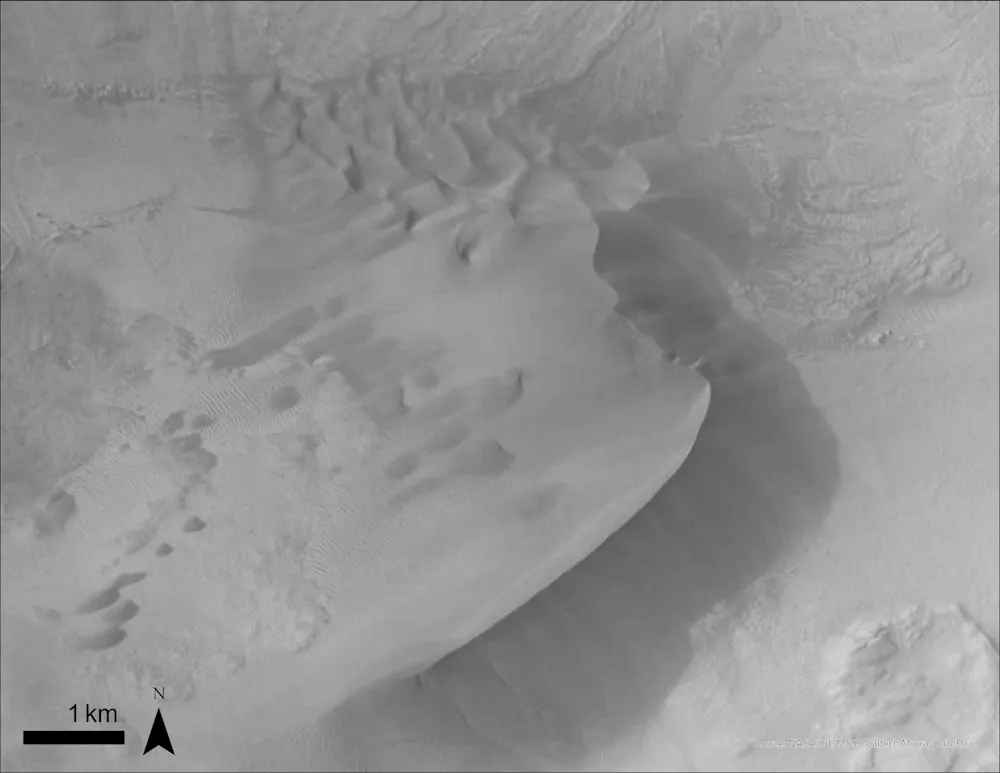
    A potential compound dune on Mars.
    NASA/JPL-Caltech

    Now, as a graduate student and aspiring planetary geologist, my time is split between work in the field and at my computer, where I have stitched together the drone’s photographs of the Algodones to create a large image of the entire study area. I then look for compound dunes on the Martian surface in images taken by the Mars reconnaissance orbiter’s context camera.

    Scientists already know about Earth’s weather patterns, sand grain size and wind data. By measuring different parts of bedforms on both planets – such as their height, shape and spacing – I can compare the similarities and differences of the bedforms to find clues to the wind patterns, grains and atmosphere on Mars. Slowly but surely, as I listen to Studio Ghibli soundtracks, I’m creating the first database of compound dunes on Mars.

    Two dune fields on Mars, both inside an impact crater.
    NASA/JPL-Caltech

    Developing this database is essential to the proposed human mission to Mars. Dust storms are frequent, and some can encircle the entire planet. Understanding aeolian bedforms will help scientists know where to put bases so they don’t get buried by moving sand.

    It is wonderful to spend an afternoon ping-ponging all over a planet that’s 140 million miles from us, seeing gorgeous terrain while I try to answer questions about the compound dunes on Mars. How common are they? Where do they form? How do they compare to those on Earth? I hope to answer these questions as I work toward earning my Ph.D in geology.

    Lauren Berger receives funding from NASA FINESST. Lauren Berger would like to acknowledge the help of her mentors Dr. Ryan Ewing (NASA Johnson Space Center), Dr. Marion Nachon (Texas A&M University), and Dr. Julia Reece (Texas A&M University).

    ref. Dune patterns in California desert hold clues that help researchers map Mars’ shifting sands – https://theconversation.com/dune-patterns-in-california-desert-hold-clues-that-help-researchers-map-mars-shifting-sands-251761

    MIL OSI Analysis

  • Rajnath Singh hails PM Modi’s leadership, praises successful five-nation visit

    Source: Government of India

    Source: Government of India (4)

    Defence Minister Rajnath Singh on Thursday hailed Prime Minister Narendra Modi’s recent five-nation official visit .

    “Under your able leadership, India is growing fast and getting stronger. Your recent 5-nation official visit is a testimony to India’s rising clout and stature,” said Rajnath Singh in a message addressed to PM Modi on the social media platform X.

    Earlier, PM Modi extended greetings to Rajnath Singh on his birthday, while the latter thanked all his party colleagues for their wishes and motivational words.

    “Pradhanmantriji, thank you for your good wishes and motivating words,” said the Defence Minister.

    In his birthday wishes, PM Modi said, “Best wishes to Union Minister Shri Rajnath Singh Ji on his birthday. He’s distinguished himself for his hardworking nature and wisdom. His efforts to make India self-reliant in defence and strengthen our armed forces are commendable. Praying for his long and healthy life.”

    he Prime Minister began his tour with a visit to Ghana on July 2-3- the first by an Indian Prime Minister to the West African nation in over three decades. In Accra, he held bilateral talks with President John Mahama to review the existing partnership and explore new areas of cooperation in economic development, defence, maritime security, energy, and critical minerals. Both leaders agreed to elevate ties to a Comprehensive Partnership. President Mahama also conferred on PM Modi The Officer of the Order of the Star of Ghana, the country’s highest civilian award.

    On July 3-4, PM Modi travelled to Trinidad and Tobago– the first Prime Ministerial visit since 1999. He met Prime Minister Kamla Persad-Bissessar and addressed the Parliament. During the visit, India announced that Overseas Citizenship of India (OCI) cards will now be issued to the sixth generation of the Indian diaspora in the Caribbean nation. PM Modi was also honoured with The Order of the Republic of Trinidad and Tobago, the nation’s highest civilian honour.

    The third leg of the tour took PM Modi to Argentina on July 4-5- the first standalone bilateral visit by an Indian Prime Minister to the South American country in nearly six decades. He held discussions with President Javier Milei to strengthen cooperation in defence, agriculture, mining, energy, trade, and investment. Describing the visit as productive, PM Modi said the talks would help deepen India-Argentina ties. He was also presented with the Key to the City of Buenos Aires by the city’s Chief, Jorge Macri.

    In the fourth leg of his visit, Prime Minister Modi attended the 17th BRICS Summit held in Rio de Janeiro, Brazil, from July 6 to 7. He then travelled to Brasília, the capital of Brazil, for a State Visit and held bilateral talks with President Luiz Inácio Lula da Silva. The two leaders discussed ways to expand the Strategic Partnership between India and Brazil in areas such as trade, defence, energy, space, technology, agriculture, health, and people-to-people exchanges. During the visit, President Lula conferred on Prime Minister Modi Brazil’s highest civilian honour, The Grand Collar of the National Order of the Southern Cross.

    In the final leg of his tour on July 9, Prime Minister Modi visited Namibia – marking the first visit by an Indian Prime Minister to the  country in 27 years. He addressed the Namibian Parliament, where he received a standing ovation from the members. During the visit, President Netumbo Nandi-Ndaitwah conferred upon him The Order of the Most Ancient Welwitschia Mirabilis, Namibia’s highest civilian honour.

  • Rajnath Singh hails PM Modi’s leadership, praises successful five-nation visit

    Source: Government of India

    Source: Government of India (4)

    Defence Minister Rajnath Singh on Thursday hailed Prime Minister Narendra Modi’s recent five-nation official visit .

    “Under your able leadership, India is growing fast and getting stronger. Your recent 5-nation official visit is a testimony to India’s rising clout and stature,” said Rajnath Singh in a message addressed to PM Modi on the social media platform X.

    Earlier, PM Modi extended greetings to Rajnath Singh on his birthday, while the latter thanked all his party colleagues for their wishes and motivational words.

    “Pradhanmantriji, thank you for your good wishes and motivating words,” said the Defence Minister.

    In his birthday wishes, PM Modi said, “Best wishes to Union Minister Shri Rajnath Singh Ji on his birthday. He’s distinguished himself for his hardworking nature and wisdom. His efforts to make India self-reliant in defence and strengthen our armed forces are commendable. Praying for his long and healthy life.”

    he Prime Minister began his tour with a visit to Ghana on July 2-3- the first by an Indian Prime Minister to the West African nation in over three decades. In Accra, he held bilateral talks with President John Mahama to review the existing partnership and explore new areas of cooperation in economic development, defence, maritime security, energy, and critical minerals. Both leaders agreed to elevate ties to a Comprehensive Partnership. President Mahama also conferred on PM Modi The Officer of the Order of the Star of Ghana, the country’s highest civilian award.

    On July 3-4, PM Modi travelled to Trinidad and Tobago– the first Prime Ministerial visit since 1999. He met Prime Minister Kamla Persad-Bissessar and addressed the Parliament. During the visit, India announced that Overseas Citizenship of India (OCI) cards will now be issued to the sixth generation of the Indian diaspora in the Caribbean nation. PM Modi was also honoured with The Order of the Republic of Trinidad and Tobago, the nation’s highest civilian honour.

    The third leg of the tour took PM Modi to Argentina on July 4-5- the first standalone bilateral visit by an Indian Prime Minister to the South American country in nearly six decades. He held discussions with President Javier Milei to strengthen cooperation in defence, agriculture, mining, energy, trade, and investment. Describing the visit as productive, PM Modi said the talks would help deepen India-Argentina ties. He was also presented with the Key to the City of Buenos Aires by the city’s Chief, Jorge Macri.

    In the fourth leg of his visit, Prime Minister Modi attended the 17th BRICS Summit held in Rio de Janeiro, Brazil, from July 6 to 7. He then travelled to Brasília, the capital of Brazil, for a State Visit and held bilateral talks with President Luiz Inácio Lula da Silva. The two leaders discussed ways to expand the Strategic Partnership between India and Brazil in areas such as trade, defence, energy, space, technology, agriculture, health, and people-to-people exchanges. During the visit, President Lula conferred on Prime Minister Modi Brazil’s highest civilian honour, The Grand Collar of the National Order of the Southern Cross.

    In the final leg of his tour on July 9, Prime Minister Modi visited Namibia – marking the first visit by an Indian Prime Minister to the  country in 27 years. He addressed the Namibian Parliament, where he received a standing ovation from the members. During the visit, President Netumbo Nandi-Ndaitwah conferred upon him The Order of the Most Ancient Welwitschia Mirabilis, Namibia’s highest civilian honour.

  • Rajnath Singh hails PM Modi’s leadership, praises successful five-nation visit

    Source: Government of India

    Source: Government of India (4)

    Defence Minister Rajnath Singh on Thursday hailed Prime Minister Narendra Modi’s recent five-nation official visit .

    “Under your able leadership, India is growing fast and getting stronger. Your recent 5-nation official visit is a testimony to India’s rising clout and stature,” said Rajnath Singh in a message addressed to PM Modi on the social media platform X.

    Earlier, PM Modi extended greetings to Rajnath Singh on his birthday, while the latter thanked all his party colleagues for their wishes and motivational words.

    “Pradhanmantriji, thank you for your good wishes and motivating words,” said the Defence Minister.

    In his birthday wishes, PM Modi said, “Best wishes to Union Minister Shri Rajnath Singh Ji on his birthday. He’s distinguished himself for his hardworking nature and wisdom. His efforts to make India self-reliant in defence and strengthen our armed forces are commendable. Praying for his long and healthy life.”

    he Prime Minister began his tour with a visit to Ghana on July 2-3- the first by an Indian Prime Minister to the West African nation in over three decades. In Accra, he held bilateral talks with President John Mahama to review the existing partnership and explore new areas of cooperation in economic development, defence, maritime security, energy, and critical minerals. Both leaders agreed to elevate ties to a Comprehensive Partnership. President Mahama also conferred on PM Modi The Officer of the Order of the Star of Ghana, the country’s highest civilian award.

    On July 3-4, PM Modi travelled to Trinidad and Tobago– the first Prime Ministerial visit since 1999. He met Prime Minister Kamla Persad-Bissessar and addressed the Parliament. During the visit, India announced that Overseas Citizenship of India (OCI) cards will now be issued to the sixth generation of the Indian diaspora in the Caribbean nation. PM Modi was also honoured with The Order of the Republic of Trinidad and Tobago, the nation’s highest civilian honour.

    The third leg of the tour took PM Modi to Argentina on July 4-5- the first standalone bilateral visit by an Indian Prime Minister to the South American country in nearly six decades. He held discussions with President Javier Milei to strengthen cooperation in defence, agriculture, mining, energy, trade, and investment. Describing the visit as productive, PM Modi said the talks would help deepen India-Argentina ties. He was also presented with the Key to the City of Buenos Aires by the city’s Chief, Jorge Macri.

    In the fourth leg of his visit, Prime Minister Modi attended the 17th BRICS Summit held in Rio de Janeiro, Brazil, from July 6 to 7. He then travelled to Brasília, the capital of Brazil, for a State Visit and held bilateral talks with President Luiz Inácio Lula da Silva. The two leaders discussed ways to expand the Strategic Partnership between India and Brazil in areas such as trade, defence, energy, space, technology, agriculture, health, and people-to-people exchanges. During the visit, President Lula conferred on Prime Minister Modi Brazil’s highest civilian honour, The Grand Collar of the National Order of the Southern Cross.

    In the final leg of his tour on July 9, Prime Minister Modi visited Namibia – marking the first visit by an Indian Prime Minister to the  country in 27 years. He addressed the Namibian Parliament, where he received a standing ovation from the members. During the visit, President Netumbo Nandi-Ndaitwah conferred upon him The Order of the Most Ancient Welwitschia Mirabilis, Namibia’s highest civilian honour.

  • MIL-OSI Economics: Financial Action Task Force (FATF) High risk and other monitored jurisdictions – June 12-13, 2025

    Source: Reserve Bank of India

    The Financial Action Task Force (FATF) vide public document ‘High-Risk Jurisdictions subject to a Call for Action’ – 13 June 2025, has called on its members and other jurisdictions to refer to the statement on Democratic People’s Republic of Korea (DPRK) and Iran adopted in February 2020 which remains in effect. Further, Myanmar was added to the list of High-Risk Jurisdictions subject to a Call for Action in the October 2022 FATF plenary and FATF has called on its members and other jurisdictions to apply enhanced due diligence measures proportionate to the risk arising from Myanmar. When applying enhanced due diligence measures, countries have been advised to ensure that flows of funds for humanitarian assistance, legitimate NPO activity and remittances are not disrupted. The status of Myanmar in the list of countries subject to a call for action, remains unchanged.

    FATF had earlier identified the following jurisdictions as having strategic deficiencies in their regimes to counter money laundering, terrorist financing, and proliferation financing and had placed the jurisdictions under Increased Monitoring, which had developed action plan with the FATF to deal with them. These jurisdictions were: Algeria, Angola, Bulgaria, Burkina Faso, Cameroon, Côte d’Ivoire, Croatia, Democratic Republic of the Congo, Haiti, Kenya, Lao People’s Democratic Republic (Lao PDR), Lebanon, Mali, Monaco, Mozambique, Namibia, Nepal, Nigeria, South Africa, South Sudan, Syria, Tanzania, Venezuela, Vietnam and Yemen. As per the June 13, 2025 FATF public statement, Bolivia and the Virgin Islands (UK) have been added to the list of Jurisdictions under Increased Monitoring while Croatia, Mali and Tanzania have been removed from this list based on review by the FATF.

    FATF plenary releases documents titled “High-Risk jurisdictions subject to a Call for Action” and “Jurisdictions under Increased Monitoring” with respect to jurisdictions that have strategic AML/CFT deficiencies as part of the ongoing efforts to identify and work with jurisdictions with strategic Anti-Money Laundering (AML)/Combating of Financing of Terrorism (CFT) deficiencies. This advice does not preclude the regulated entities from legitimate trade and business transactions with these countries and jurisdictions mentioned there.

    The detailed information is available in the updated public statements and document released by FATF on June 13, 2025. The statements and document can be accessed at the following URL:

    1. https://www.fatf-gafi.org/en/publications/Fatfgeneral/outcomes-FATF-MONEYVAL-plenary-june-2025.html

    2. https://www.fatf-gafi.org/en/publications/High-risk-and-other-monitored-jurisdictions/increased-monitoring-june-2025.html

    3. https://www.fatf-gafi.org/en/publications/High-risk-and-other-monitored-jurisdictions/Call-for-action-june-2025.html

    About FATF

    The Financial Action Task Force (FATF) is an inter-governmental body established in 1989 by the Ministers of its Member jurisdictions. The objectives of the FATF are to set standards and promote effective implementation of legal, regulatory and operational measures for combating money laundering, terrorist financing and other related threats to the integrity of the international financial system. The FATF monitors the progress of its members in implementing necessary measures, reviews money laundering and terrorist financing techniques and counter-measures, and promotes the adoption and implementation of appropriate measures globally. The FATF’s decision making body, the FATF Plenary, meets three times a year and updates these statements, which may be noted.

    Ajit Prasad          
    Deputy General Manager
    (Communications)    

    Press Release: 2025-2026/686

    MIL OSI Economics

  • MIL-OSI Economics: Financial Action Task Force (FATF) High risk and other monitored jurisdictions – June 12-13, 2025

    Source: Reserve Bank of India

    The Financial Action Task Force (FATF) vide public document ‘High-Risk Jurisdictions subject to a Call for Action’ – 13 June 2025, has called on its members and other jurisdictions to refer to the statement on Democratic People’s Republic of Korea (DPRK) and Iran adopted in February 2020 which remains in effect. Further, Myanmar was added to the list of High-Risk Jurisdictions subject to a Call for Action in the October 2022 FATF plenary and FATF has called on its members and other jurisdictions to apply enhanced due diligence measures proportionate to the risk arising from Myanmar. When applying enhanced due diligence measures, countries have been advised to ensure that flows of funds for humanitarian assistance, legitimate NPO activity and remittances are not disrupted. The status of Myanmar in the list of countries subject to a call for action, remains unchanged.

    FATF had earlier identified the following jurisdictions as having strategic deficiencies in their regimes to counter money laundering, terrorist financing, and proliferation financing and had placed the jurisdictions under Increased Monitoring, which had developed action plan with the FATF to deal with them. These jurisdictions were: Algeria, Angola, Bulgaria, Burkina Faso, Cameroon, Côte d’Ivoire, Croatia, Democratic Republic of the Congo, Haiti, Kenya, Lao People’s Democratic Republic (Lao PDR), Lebanon, Mali, Monaco, Mozambique, Namibia, Nepal, Nigeria, South Africa, South Sudan, Syria, Tanzania, Venezuela, Vietnam and Yemen. As per the June 13, 2025 FATF public statement, Bolivia and the Virgin Islands (UK) have been added to the list of Jurisdictions under Increased Monitoring while Croatia, Mali and Tanzania have been removed from this list based on review by the FATF.

    FATF plenary releases documents titled “High-Risk jurisdictions subject to a Call for Action” and “Jurisdictions under Increased Monitoring” with respect to jurisdictions that have strategic AML/CFT deficiencies as part of the ongoing efforts to identify and work with jurisdictions with strategic Anti-Money Laundering (AML)/Combating of Financing of Terrorism (CFT) deficiencies. This advice does not preclude the regulated entities from legitimate trade and business transactions with these countries and jurisdictions mentioned there.

    The detailed information is available in the updated public statements and document released by FATF on June 13, 2025. The statements and document can be accessed at the following URL:

    1. https://www.fatf-gafi.org/en/publications/Fatfgeneral/outcomes-FATF-MONEYVAL-plenary-june-2025.html

    2. https://www.fatf-gafi.org/en/publications/High-risk-and-other-monitored-jurisdictions/increased-monitoring-june-2025.html

    3. https://www.fatf-gafi.org/en/publications/High-risk-and-other-monitored-jurisdictions/Call-for-action-june-2025.html

    About FATF

    The Financial Action Task Force (FATF) is an inter-governmental body established in 1989 by the Ministers of its Member jurisdictions. The objectives of the FATF are to set standards and promote effective implementation of legal, regulatory and operational measures for combating money laundering, terrorist financing and other related threats to the integrity of the international financial system. The FATF monitors the progress of its members in implementing necessary measures, reviews money laundering and terrorist financing techniques and counter-measures, and promotes the adoption and implementation of appropriate measures globally. The FATF’s decision making body, the FATF Plenary, meets three times a year and updates these statements, which may be noted.

    Ajit Prasad          
    Deputy General Manager
    (Communications)    

    Press Release: 2025-2026/686

    MIL OSI Economics

  • MIL-OSI: Codere Improves Position in Spain’s Brand Finance Ranking

    Source: GlobeNewswire (MIL-OSI)

    Madrid, Spain, July 10, 2025 – (GLOBE NEWSWIRE) Codere Online (Nasdaq: CDRO / CDROW, the “Company”), a leading online gaming operator in Spain and Latin America, today announced that the Codere brand1 has improved its position to 77th, up from 85th in 2024, in a ranking of Spain’s most valuable brands, according to Brand Finance.

    Codere remains the only gaming brand on the list, marking its leadership in the sector, and maintains its record of consistently being named on the Top 100 list since 2010, putting it alongside household names such as Zara, Vueling and Movistar as titans in Spanish business.

    The last year has seen Codere Online continue to expand in its core markets of Spain and Mexico, as well as leverage partnerships with footballing giants Real Madrid and C.F. Monterrey to further boost its brand awareness, including activations around the FIFA Club World Cup.

    Alberto Telias, Chief Marketing Officer of Codere Online, said: “Our marketing and sponsorship efforts over the last 12 months have been reflected in the consolidation of our status as a market leading brand in Spain. We’re proud of the experiences we offer our customers, that truly allow them to connect with the Codere brand.”

    Codere Online started operations in Spain in 2014. In the twelve months ended March 31, 2025, the Company generated more than 87 million euros of net gaming revenue in Spain, with more than 50,000 average monthly active players in the country.

    About Codere Online
    Codere Online refers, collectively, to Codere Online Luxembourg, S.A. and its subsidiaries. Codere Online launched in 2014 as part of the renowned casino operator Codere Group. Codere Online offers online sports betting and online casino through its state-of-the art website and mobile applications. Codere currently operates in its core markets of Spain, Mexico, Colombia, Panama and Argentina. Codere Online’s online business is complemented by Codere Group’s physical presence in Spain and throughout Latin America, forming the foundation of the leading omnichannel gaming and casino presence.

    About Codere Group
    Codere Group is a multinational group devoted to entertainment and leisure. It is a leading player in the private gaming industry, with four decades of experience and with presence in seven countries in Europe (Spain and Italy) and Latin America (Argentina, Colombia, Mexico, Panama, and Uruguay).

    Contacts:

    Investors and Media
    Guillermo Lancha
    Director, Investor Relations and Communications
    Guillermo.Lancha@codere.com
    (+34) 628 928 152


    1 Pursuant to the terms of a relationship and license agreement, Codere Group granted Codere Online a license to use certain “Codere” trademarks.

    The MIL Network

  • MIL-OSI Europe: Minutes – Wednesday, 9 July 2025 – Strasbourg – Final edition

    Source: European Parliament

    PV-10-2025-07-09

    EN

    EN

    iPlPv_Sit

    Minutes
    Wednesday, 9 July 2025 – Strasbourg

    IN THE CHAIR: Roberta METSOLA
    President

    1. Opening of the sitting

    The sitting opened at 09:02.


    2. Negotiations ahead of Parliament’s first reading (Rule 72) (action taken)

    The decisions of the JURI, TRAN, BUDG, ECON, REGI and EMPL committees to enter into interinstitutional negotiations had been announced on 7 July 2025 (minutes of 7.7.2025, item 5).

    As no request for a vote pursuant to Rule 72(2) had been made, the committees responsible had been able to enter into negotiations upon expiry of the deadline.


    3. Conclusions of the European Council meeting of 26 June 2025 (debate)

    European Council and Commission statements: Conclusions of the European Council meeting of 26 June 2025 (2025/2981(RSP))

    The President provided some clarifications on the way in which the debate would be conducted, as a new format was being tested.

    António Costa (President of the European Council) and Ursula von der Leyen (President of the Commission) made the statements.

    The following spoke: Dolors Montserrat, on behalf of the PPE Group, Kathleen Van Brempt, on behalf of the S&D Group, Kinga Gál, on behalf of the PfE Group, Nicolas Bay, on behalf of the ECR Group, Valérie Hayer, on behalf of the Renew Group, Bas Eickhout, on behalf of the Verts/ALE Group, Manon Aubry, on behalf of The Left Group, René Aust, on behalf of the ESN Group, Paulo Cunha, Nicola Zingaretti, Paolo Borchia, Carlo Fidanza, Estrella Galán, Milan Uhrík, Kostas Papadakis, Luděk Niedermayer, Dan Nica, Marieke Ehlers, Reinhold Lopatka and Javier Moreno Sánchez.

    IN THE CHAIR: Christel SCHALDEMOSE
    Vice-President

    The following spoke: Anna Bryłka, Gaetano Pedulla’, Seán Kelly, Marta Temido, who also answered a blue-card question from João Oliveira, and Csaba Dömötör.

    The following spoke under the catch-the-eye procedure: Juan Fernando López Aguilar, Sebastian Tynkkynen, Maria Grapini, João Oliveira, Alexander Jungbluth, Vytenis Povilas Andriukaitis, Malika Sorel and Milan Mazurek.

    The following spoke: Maroš Šefčovič (Member of the Commission) and António Costa.

    The debate closed.


    4. The EU’s post-2027 long-term budget: Parliament’s expectations ahead of the Commission’s proposal (debate)

    Council and Commission statements: The EU’s post-2027 long-term budget: Parliament’s expectations ahead of the Commission’s proposal (2025/2803(RSP))

    Marie Bjerre (President-in-Office of the Council) and Piotr Serafin (Member of the Commission) made the statements.

    The following spoke: Siegfried Mureşan, on behalf of the PPE Group, Mohammed Chahim, on behalf of the S&D Group, Tamás Deutsch, on behalf of the PfE Group, Patryk Jaki, on behalf of the ECR Group, Fabienne Keller, on behalf of the Renew Group, Terry Reintke, on behalf of the Verts/ALE Group, João Oliveira, on behalf of The Left Group, Alexander Jungbluth, on behalf of the ESN Group, Karlo Ressler, Carla Tavares, Angéline Furet, Johan Van Overtveldt, Lucia Yar, Rasmus Nordqvist, Younous Omarjee, Milan Mazurek, Thomas Geisel, Herbert Dorfmann, Victor Negrescu, Ruggero Razza, Ľubica Karvašová, Andrey Novakov, Nicola Zingaretti, Jaak Madison, Rasmus Andresen, Christian Ehler, Andreas Schieder, Isabel Benjumea Benjumea, Jean-Marc Germain, Tomasz Buczek, Bogdan Rzońca, Anouk Van Brug, Danuše Nerudová, Sandra Gómez López, Moritz Körner and Janusz Lewandowski.

    The following spoke under the catch-the-eye procedure: Georgios Aftias, Thomas Bajada, Arkadiusz Mularczyk, Petras Gražulis, Branislav Ondruš, Dariusz Joński, Hélder Sousa Silva and Nina Carberry.

    The following spoke: Piotr Serafin and Marie Bjerre.

    The debate closed.

    (The sitting was suspended at 11:56.)


    IN THE CHAIR: Roberta METSOLA
    President

    5. Resumption of the sitting

    The sitting resumed at 12:00.

    The following spoke: Terry Reintke.


    6. Requests for the waiver of immunity

    The competent Austrian authorities had sent the President a request for Harald Vilimsky’s immunity to be waived in connection with legal proceedings in Austria.

    Pursuant to Rule 9(1), the request had been referred to the committee responsible, in this case the JURI Committee.


    7. Voting time

    For detailed results of the votes, see also ‘Results of votes’ and ‘Results of roll-call votes’.


    7.1. European Climate Law ***I (vote)

    European Climate Law (COM(2025)0524 – C10-0137/2025 – 2025/0524(COD)) – ENVI Committee

    REQUESTS FOR AN URGENT DECISION from the Verts/ALE, Renew and S&D groups (Rule 170(5))

    Rejected

    The following had spoken:

    Gerben-Jan Gerbrandy, Lena Schilling and Tiemo Wölken (movers of the requests), and Jeroen Lenaers (against the requests), before the vote.

    (‘Results of votes’, item 1)


    7.2. Objection pursuant to Rule 114(3): amending Delegated Regulation (EU) 2016/1675 to add certain countries to the list of high-risk third countries, and to remove other countries from that list (vote)

    Motions for resolutions B10-0311/2025, B10-0315/2025, B10-0316/2025 and B10-0318/2025 pursuant to Rule 114(3) (minutes of 9.7.2025, item I)

    (Majority of Parliament’s component Members required)

    MOTION FOR A RESOLUTION B10-0311/2025

    Rejected

    MOTION FOR A RESOLUTION B10-0315/2025

    Rejected

    MOTION FOR A RESOLUTION B10-0316/2025

    Rejected

    MOTION FOR A RESOLUTION B10-0318/2025

    Rejected

    The following had spoken:

    Maria Luís Albuquerque (Member of the Commission), before the vote, to make a statement.

    (‘Results of votes’, item 2)


    7.3. Objection pursuant to Rule 115(2) and (3): Deforestation Regulation – list of countries presenting a low or high risk (vote)

    Motion for a resolution tabled by the ENVI Committee pursuant to Rule 115(2) and (3), on the draft Commission regulation on Commission Implementing Regulation (EU) 2025/1093 of 22 May 2025 laying down rules for the application of Regulation (EU) 2023/1115 of the European Parliament and of the Council as regards a list of countries that present a low or high risk of producing relevant commodities for which the relevant products do not comply with Article 3, point (a) (2025/2739(RPS)) (B10-0321/2025) Member responsible: Alexander Bernhuber

    (Majority of the votes cast)

    MOTION FOR A RESOLUTION

    Adopted (P10_TA(2025)0149)

    (‘Results of votes’, item 3)


    7.4. Amending Regulation (EU) No 1026/2012 on certain measures for the purpose of the conservation of fish stocks in relation to countries allowing non-sustainable fishing ***I (vote)

    Report on the proposal for a regulation of the European Parliament and of the Council amending Regulation (EU) No 1026/2012 on certain measures for the purpose of the conservation of fish stocks in relation to countries allowing non-sustainable fishing [COM(2024)0407 – C10-0098/2024 – 2024/0224(COD)] – Committee on Fisheries. Rapporteur: Thomas Bajada (A10-0070/2025)

    (Majority of the votes cast)

    PROVISIONAL AGREEMENT

    Adopted (P10_TA(2025)0150)

    Parliament’s first reading thus closed.

    The following had spoken:

    Thomas Bajada, before the vote, to make a statement on the basis of Rule 165(4).

    (‘Results of votes’, item 4)


    7.5. Draft amending budget No 1/2025: entering the surplus of the financial year 2024 (vote)

    Report on the Council position on Draft amending budget No 1/2025 of the European Union for the financial year 2025 entering the surplus of the financial year 2024 [09619/2025 – C10-0125/2025 – 2025/0091(BUD)] – Committee on Budgets. Rapporteur: Victor Negrescu (A10-0116/2025)

    (Majority of the votes cast)

    MOTION FOR A RESOLUTION

    Adopted (P10_TA(2025)0151)

    The following had spoken:

    Victor Negrescu, before the vote, to make a statement on the basis of Rule 165(4).

    (‘Results of votes’, item 5)


    7.6. Mobilisation of the European Union Solidarity Fund: assistance to Austria, Poland, Czechia, Slovakia and Moldova relating to floods that occurred in September 2024 and Bosnia and Herzegovina relating to floods that occurred in October 2024 (vote)

    Report on the proposal for a decision of the European Parliament and of the Council on the mobilisation of the European Union Solidarity Fund to provide assistance to Austria, Poland, Czechia, Slovakia and Moldova relating to floods occurred in September 2024 and Bosnia and Herzegovina relating to floods occurred in October 2024 [COM(2025)0250 – C10-0102/2025 – 2025/0138(BUD)] – Committee on Budgets. Rapporteur: Andrzej Halicki (A10-0114/2025)

    (Majority of the votes cast)

    MOTION FOR A RESOLUTION

    Adopted (P10_TA(2025)0152)

    (‘Results of votes’, item 6)


    7.7. Mobilisation of the European Globalisation Adjustment Fund: Application EGF/2025/000 TA 2025 – Technical assistance at the initiative of the Commission (vote)

    Report on the proposal for a decision of the European Parliament and of the Council on the mobilisation of the European Globalisation Adjustment Fund for Displaced Workers – EGF/2025/000 TA 2025 – Technical assistance at the initiative of the Commission [COM(2025)0680 – C10-0103/2025 – 2025/0135(BUD)] – Committee on Budgets. Rapporteur: Jean-Marc Germain (A10-0115/2025)

    (Majority of the votes cast)

    MOTION FOR A RESOLUTION

    Adopted (P10_TA(2025)0153)

    The following had spoken:

    Jean-Marc Germain, before the vote, to make a statement on the basis of Rule 165(4).

    (‘Results of votes’, item 7)


    7.8. Product safety and regulatory compliance in e-commerce and non-EU imports (vote)

    Report on product safety and regulatory compliance in e-commerce and non-EU imports [2025/2037(INI)] – Committee on the Internal Market and Consumer Protection. Rapporteur: Salvatore De Meo (A10-0133/2025)

    (Majority of the votes cast)

    MOTION FOR A RESOLUTION

    Adopted (P10_TA(2025)0154)

    (‘Results of votes’, item 8)


    7.9. 2023 and 2024 reports on Albania (vote)

    Report on the 2023 and 2024 Commission reports on Albania [2025/2017(INI)] – Committee on Foreign Affairs. Rapporteur: Andreas Schieder (A10-0106/2025)

    (Majority of the votes cast)

    MOTION FOR A RESOLUTION

    Adopted (P10_TA(2025)0155)

    (‘Results of votes’, item 9)


    7.10. 2023 and 2024 reports on Bosnia and Herzegovina (vote)

    Report on the 2023 and 2024 Commission reports on Bosnia and Herzegovina [2025/2018(INI)] – Committee on Foreign Affairs. Rapporteur: Ondřej Kolář (A10-0108/2025)

    (Majority of the votes cast)

    MOTION FOR A RESOLUTION

    Adopted (P10_TA(2025)0156)

    (‘Results of votes’, item 10)


    7.11. 2023 and 2024 reports on North Macedonia (vote)

    Report on the 2023 and 2024 Commission reports on North Macedonia [2025/2021(INI)] – Committee on Foreign Affairs. Rapporteur: Thomas Waitz (A10-0118/2025)

    (Majority of the votes cast)

    MOTION FOR A RESOLUTION

    Adopted (P10_TA(2025)0157)

    (‘Results of votes’, item 11)


    7.12. 2023 and 2024 reports on Georgia (vote)

    Report on the 2023 and 2024 Commission reports on Georgia [2025/2024(INI)] – Committee on Foreign Affairs. Rapporteur: Rasa Juknevičienė (A10-0110/2025)

    (Majority of the votes cast)

    MOTION FOR A RESOLUTION

    Adopted (P10_TA(2025)0158)

    The following had spoken:

    – Rasa Juknevičienė, to move an oral amendment to Amendment 9. Parliament had agreed to put the oral amendment to the vote.

    – Urmas Paet, to move an oral amendment to paragraph 16. Parliament had agreed to put the oral amendment to the vote.

    (‘Results of votes’, item 12)


    7.13. Implementation and delivery of the Sustainable Development Goals in view of the 2025 High-Level Political Forum (vote)

    Report on implementation and delivery of the Sustainable Development Goals in view of the 2025 High-Level Political Forum [2025/2014(INI)] – Committee on Development – Committee on the Environment, Climate and Food Safety. Rapporteurs: Robert Biedroń and Nikolas Farantouris (A10-0125/2025)

    (Majority of the votes cast)

    MOTION FOR A RESOLUTION

    Adopted (P10_TA(2025)0159)

    The following had spoken:

    Robert Biedroń and Nikolas Farantouris, before the vote, to make a statement on the basis of Rule 165(4).

    (‘Results of votes’, item 13)


    7.14. The human cost of Russia’s war against Ukraine and the urgent need to end Russian aggression: the situation of illegally detained civilians and prisoners of war, and the continued bombing of civilians (vote)

    Motions for resolutions RC-B10-0304/2025, B10-0303/2025, B10-0304/2025, B10-0305/2025, B10-0306/2025, B10-0307/2025 and B10-0308/2025 (2025/2710(RSP))

    The debate had taken place on 16 June 2025 (minutes of 16.6.2025, item 21).

    (Majority of the votes cast)

    JOINT MOTION FOR A RESOLUTION RC-B10-0304/2025

    Adopted (P10_TA(2025)0160)

    (Motion for a resolution B10-0303/2025 fell.)

    (‘Results of votes’, item 14)

    (The sitting was suspended at 13:01.)


    IN THE CHAIR: Sabine VERHEYEN
    Vice-President

    8. Resumption of the sitting

    The sitting resumed at 13:05.


    9. Approval of the minutes of the previous sitting

    The minutes of the previous sitting were approved.


    10. Lessons from Budapest Pride: the urgent need for an EU wide anti-discrimination law and defending fundamental rights against right-wing attacks (topical debate)

    The following spoke: Ana Catarina Mendes to open the debate proposed by the S&D Group.

    The following spoke: Marie Bjerre (President-in-Office of the Council) and Michael McGrath (Member of the Commission).

    The following spoke: Sven Simon, on behalf of the PPE Group, Klára Dobrev, on behalf of the S&D Group, Jorge Buxadé Villalba, on behalf of the PfE Group, Alessandro Ciriani, on behalf of the ECR Group, Fabienne Keller, on behalf of the Renew Group, Alice Kuhnke, on behalf of the Verts/ALE Group, Manon Aubry, on behalf of The Left Group (the President reminded the speaker of the rules on conduct), Zsuzsanna Borvendég, on behalf of the ESN Group, Maria Walsh, Marc Angel, Tom Vandendriessche, Paolo Inselvini, Sophie Wilmès, Tineke Strik, Irene Montero, Irmhild Boßdorf (the President reminded the House of the rules on conduct), Michał Wawrykiewicz, Raphaël Glucksmann, András László, Georgiana Teodorescu, Veronika Cifrová Ostrihoňová, Nicolae Ștefănuță, Özlem Demirel, Ewa Zajączkowska-Hernik, Sirpa Pietikäinen, Evin Incir, Petra Steger, Maciej Wąsik, Moritz Körner, Kim Van Sparrentak, Carolina Morace, Markus Buchheit, Adrián Vázquez Lázara, Birgit Sippel, Jaroslava Pokorná Jermanová, Marlena Maląg, Hilde Vautmans (the President reminded the speaker of the rules on conduct), Daniel Freund, Li Andersson, Milan Uhrík, Rosa Estaràs Ferragut, Krzysztof Śmiszek, Julien Sanchez, Claudiu-Richard Târziu, Cynthia Ní Mhurchú, Mélissa Camara, Mary Khan, Alessandro Zan, Juan Carlos Girauta Vidal, Cristian Terheş, Lukas Sieper on the previous speaker’s remarks (the President took note of this and again reminded the House of the rules on conduct), and Juan Fernando López Aguilar.

    The following spoke: Michael McGrath.

    IN THE CHAIR: Younous OMARJEE
    Vice-President

    The following spoke: Marie Bjerre.

    The debate closed.


    11. EU-US trade negotiations (debate)

    Council and Commission statements: EU-US trade negotiations (2025/2804(RSP))

    Marie Bjerre (President-in-Office of the Council) and Maroš Šefčovič (Member of the Commission) made the statements.

    The following spoke: Jörgen Warborn, on behalf of the PPE Group, Kathleen Van Brempt, on behalf of the S&D Group, Enikő Győri, on behalf of the PfE Group, Rihards Kols, on behalf of the ECR Group, Karin Karlsbro, on behalf of the Renew Group, Anna Cavazzini, on behalf of the Verts/ALE Group, Martin Schirdewan, on behalf of The Left Group, Michał Szczerba, Bernd Lange, Séverine Werbrouck, Svenja Hahn, Virginijus Sinkevičius, Lynn Boylan, Luis-Vicențiu Lazarus, Željana Zovko, Brando Benifei, Jorge Martín Frías, Dick Erixon, Dan Barna, Sergey Lagodinsky, Marina Mesure, Kateřina Konečná, Daniel Caspary, who also answered a blue-card question from Lukas Sieper, Alex Agius Saliba, Gilles Pennelle, Adrian-George Axinia, João Cotrim De Figueiredo, who also answered a blue-card question from Bruno Gonçalves, Catarina Vieira, Pasquale Tridico, Branislav Ondruš, Juan Ignacio Zoido Álvarez, Javier Moreno Sánchez, Silvia Sardone, Jacek Ozdoba, Sophie Wilmès, Lukas Sieper, Céline Imart, Evin Incir, Pierre Pimpie, Anna Zalewska, Massimiliano Salini, Jean-Marc Germain, Francisco José Millán Mon, Cristina Maestre, Miriam Lexmann, Mika Aaltola, Jessika Van Leeuwen, Nina Carberry, Luděk Niedermayer, Paulo Do Nascimento Cabral, Wouter Beke, Ingeborg Ter Laak, Maria Walsh and Michalis Hadjipantela.

    The following spoke under the catch-the-eye procedure: Regina Doherty, Maria Grapini, Sebastian Tynkkynen and Oihane Agirregoitia Martínez.

    The following spoke: Maroš Šefčovič and Marie Bjerre.

    The debate closed.


    12. EU Preparedness Union in light of the upcoming wildfire and droughts season (debate)

    Council and Commission statements: EU Preparedness Union in light of the upcoming wildfire and droughts season (2025/2771(RSP))

    Marie Bjerre (President-in-Office of the Council) made the statement.

    IN THE CHAIR: Antonella SBERNA
    Vice-President

    Hadja Lahbib (Member of the Commission) made the statement.

    The following spoke: Lena Düpont, on behalf of the PPE Group, Antonio Decaro, on behalf of the S&D Group, Sergio Berlato, on behalf of the ECR Group, Grégory Allione, on behalf of the Renew Group, Benedetta Scuderi, on behalf of the Verts/ALE Group, Valentina Palmisano, on behalf of The Left Group, Raúl de la Hoz Quintano, Marta Temido, Csaba Dömötör, who also answered a blue-card question from Stine Bosse, Diego Solier, Gerben-Jan Gerbrandy, Vicent Marzà Ibáñez, Elena Kountoura, Nikolaos Anadiotis, Matej Tonin, Leire Pajín, Julien Leonardelli, who also answered blue-card questions from Grégory Allione and Thomas Pellerin-Carlin, Ruggero Razza, who also answered a blue-card question from Gerben-Jan Gerbrandy, Mārtiņš Staķis, Lefteris Nikolaou-Alavanos, Ana Miguel Pedro, who also declined to take a blue-card question from Ana Miranda Paz, Thomas Pellerin-Carlin, Ana Vasconcelos, Ana Miranda Paz, Péter Magyar, Victor Negrescu, Marjan Šarec, Dimitris Tsiodras, Sofie Eriksson, Giusi Princi, Sakis Arnaoutoglou, Daniel Buda, Hannes Heide, Sunčana Glavak, Rosa Serrano Sierra, Sérgio Humberto and Michalis Hadjipantela.

    The following spoke under the catch-the-eye procedure: Francisco José Millán Mon, Vytenis Povilas Andriukaitis, Viktória Ferenc, Sebastian Tynkkynen, Ciaran Mullooly, Diana Riba i Giner, Maria Zacharia and Diana Iovanovici Şoşoacă.

    The following spoke: Hadja Lahbib and Marie Bjerre.

    IN THE CHAIR: Martin HOJSÍK
    Vice-President

    The debate closed.


    13. Composition of committees and delegations

    The ECR Group had notified the President of the following decision changing the composition of the committees and delegations:

    – Delegation to the Africa-EU Parliamentary Assembly: Galato Alexandraki was no longer a member

    The decision took effect as of that day.


    14. Presentation of stockpiling strategies – strengthening response capacities for a changing risk and threat landscape (debate)

    Commission statement: Presentation of stockpiling strategies – strengthening response capacities for a changing risk and threat landscape (2025/2790(RSP))

    Hadja Lahbib (Member of the Commission) made the statement.

    The following spoke: Tomislav Sokol, on behalf of the PPE Group, Christophe Clergeau, on behalf of the S&D Group, Valérie Deloge, on behalf of the PfE Group, Kosma Złotowski, on behalf of the ECR Group, Grégory Allione, on behalf of the Renew Group, Pär Holmgren, on behalf of the Verts/ALE Group, Catarina Martins, on behalf of The Left Group, Christine Anderson, on behalf of the ESN Group, Mirosława Nykiel, Nicolás González Casares, Stine Bosse, Ruth Firmenich, Paulius Saudargas, Marta Temido, Liesbet Sommen and Michalis Hadjipantela.

    The following spoke under the catch-the-eye procedure: Vytenis Povilas Andriukaitis and Sebastian Tynkkynen.

    The following spoke: Hadja Lahbib.

    The debate closed.


    15. Alleged misuse of EU funds by Members of the far-right and measures to ensure institutional integrity (debate)

    Statements by Parliament: Alleged misuse of EU funds by Members of the far-right and measures to ensure institutional integrity (2025/2808(RSP))

    The following spoke: Niclas Herbst, on behalf of the PPE Group, Chloé Ridel, on behalf of the S&D Group, Moritz Körner, on behalf of the Renew Group, Mélissa Camara, on behalf of the Verts/ALE Group, Manon Aubry, on behalf of The Left Group, Arno Bausemer, on behalf of the ESN Group, Tomáš Zdechovský, who also answered a blue-card question from Raquel García Hermida-Van Der Walle, Giuseppe Lupo, Raquel García Hermida-Van Der Walle, who also answered blue-card questions from Tomáš Zdechovský and Sebastian Tynkkynen, Daniel Freund, who also answered blue-card questions from Arno Bausemer and Moritz Körner (the President reminded the speaker to keep to the subject of the debate), Jonas Sjöstedt, Reinhold Lopatka, Andreas Schieder and Helmut Brandstätter.

    The following spoke under the catch-the-eye procedure: Juan Fernando López Aguilar.

    The debate closed.


    16. Democratic Republic of the Congo-Rwanda peace deal agreement (debate)

    Council and Commission statements: Democratic Republic of the Congo-Rwanda peace deal agreement (2025/2792(RSP))

    Jozef Síkela (Member of the Commission) made the statement on behalf of the Commission.

    The following spoke: Ingeborg Ter Laak, on behalf of the PPE Group, Marit Maij, on behalf of the S&D Group, Philippe Olivier, on behalf of the PfE Group, Nicolas Bay, on behalf of the ECR Group, Hilde Vautmans, on behalf of the Renew Group, Mounir Satouri, on behalf of the Verts/ALE Group, Marc Botenga, on behalf of The Left Group, Wouter Beke and Francisco Assis.

    IN THE CHAIR: Victor NEGRESCU
    Vice-President

    The following spoke: France Jamet, Jan-Christoph Oetjen, Pernando Barrena Arza, Jan Farský and Hannes Heide.

    The following spoke under the catch-the-eye procedure: Juan Fernando López Aguilar.

    The following spoke: Jozef Síkela.

    The debate closed.


    17. Outcome of the Conference on the Financing for Development in Seville (debate)

    Council and Commission statements: Outcome of the Conference on the Financing for Development in Seville (2025/2793(RSP))

    Marie Bjerre (President-in-Office of the Council) and Jozef Síkela (Member of the Commission) made the statements.

    The following spoke: Lukas Mandl, on behalf of the PPE Group, Marit Maij, on behalf of the S&D Group, Jorge Buxadé Villalba, on behalf of the PfE Group, Mario Mantovani, on behalf of the ECR Group, Barry Andrews, on behalf of the Renew Group, Isabella Lövin, on behalf of the Verts/ALE Group, Marc Jongen, on behalf of the ESN Group, Udo Bullmann, Tiago Moreira de Sá, Beatrice Timgren, Charles Goerens, Leire Pajín, Juan Carlos Girauta Vidal, Robert Biedroń, Murielle Laurent, Francisco Assis and Joanna Scheuring-Wielgus.

    The following spoke: Jozef Síkela and Marie Bjerre.

    The debate closed.


    18. 51 years after the Turkish invasion of the Republic of Cyprus: condemning the continued Turkish occupation and supporting the resumption of negotiations for a comprehensive solution in line with international law, the UNSC resolutions, EU principles and acquis (debate)

    Commission statement: 51 years after the Turkish invasion of the Republic of Cyprus: condemning the continued Turkish occupation and supporting the resumption of negotiations for a comprehensive solution in line with international law, the UNSC resolutions, EU principles and acquis (2025/2794(RSP))

    Jozef Síkela (Member of the Commission) made the statement.

    The following spoke: Loucas Fourlas, on behalf of the PPE Group, Costas Mavrides, on behalf of the S&D Group, Afroditi Latinopoulou, on behalf of the PfE Group, Geadis Geadi, on behalf of the ECR Group, Kai Tegethoff, on behalf of the Verts/ALE Group, Giorgos Georgiou, on behalf of The Left Group, and Marc Jongen, on behalf of the ESN Group.

    The following spoke: Jozef Síkela.

    The debate closed.


    19. Debate on cases of breaches of human rights, democracy and the rule of law (debate)

    (For the titles and authors of the motions for resolutions, see minutes of 9.7.2025, item I.)


    19.1. Case of Ryan Cornelius in Dubai

    Motions for resolutions B10-0328/2025, B10-0333/2025, B10-0336/2025, B10-0340/2025 and B10-0341/2025 (2025/2796(RSP))

    Seán Kelly and Aodhán Ó Ríordáin introduced their groups’ motions for resolutions.

    IN THE CHAIR: Javi LÓPEZ
    Vice-President

    Petras Auštrevičius and Catarina Vieira introduced their groups’ motions for resolutions.

    The following spoke: Reinhold Lopatka, on behalf of the PPE Group, and Barry Andrews, on behalf of the Renew Group.

    The following spoke: Jozef Síkela (Member of the Commission).

    The debate closed.

    Vote: 10 July 2025.


    19.2. Arbitrary arrest and torture of Belgian-Portuguese researcher Joseph Figueira Martin in the Central African Republic

    Motions for resolutions B10-0323/2025, B10-0327/2025, B10-0334/2025, B10-0339/2025 and B10-0342/2025 (2025/2797(RSP))

    Wouter Beke, Francisco Assis, Hilde Vautmans, Saskia Bricmont and Catarina Martins introduced their groups’ motions for resolutions.

    The following spoke: Kathleen Van Brempt, on behalf of the S&D Group, and João Cotrim De Figueiredo, on behalf of the Renew Group.

    The following spoke under the catch-the-eye procedure: Seán Kelly.

    The following spoke: Jozef Síkela (Member of the Commission).

    The debate closed.

    Vote: 10 July 2025.


    19.3. Urgent need to protect religious minorities in Syria following the recent terrorist attack on Mar Elias Church in Damascus

    Motions for resolutions B10-0325/2025, B10-0335/2025, B10-0338/2025, B10-0343/2025, B10-0344/2025, B10-0345/2025, B10-0346/2025 and B10-0347/2025 (2025/2798(RSP))

    Ingeborg Ter Laak, Marco Tarquinio, Nathalie Loiseau, Hannah Neumann, Nikolas Farantouris, Silvia Sardone, Bert-Jan Ruissen and Tomasz Froelich introduced their groups’ motions for resolutions.

    The following spoke: Sander Smit, on behalf of the PPE Group, Yannis Maniatis, on behalf of the S&D Group, Matthieu Valet, on behalf of the PfE Group, Małgorzata Gosiewska, on behalf of the ECR Group, Michalis Hadjipantela, Evin Incir, Margarita de la Pisa Carrión, Laurence Trochu, Christophe Gomart, Paolo Inselvini, Joachim Stanisław Brudziński and Geadis Geadi.

    The following spoke under the catch-the-eye procedure: Fredis Beleris and Costas Mavrides.

    The following spoke: Jozef Síkela (Member of the Commission).

    The debate closed.

    Vote: 10 July 2025.


    20. Explanations of votes in writing (Rule 201)

    Explanations of votes given in writing would appear on the Members’ pages on Parliament’s website.


    21. Agenda of the next sitting

    The next sitting would be held the following day, 10 July 2025, starting at 09:00. The agenda was available on Parliament’s website.


    22. Approval of the minutes of the sitting

    In accordance with Rule 208(3), the minutes of the sitting would be put to the House for approval at the beginning of the afternoon of the next sitting.


    23. Closure of the sitting

    The sitting closed at 22:02.


    LIST OF DOCUMENTS SERVING AS A BASIS FOR THE DEBATES AND DECISIONS OF PARLIAMENT


    I. Motions for resolutions tabled

    Case of Ryan Cornelius in Dubai

    The following Members or political groups had requested that a debate be held, in accordance with Rule 150, on the following motions for resolutions:

    on the case of Ryan Cornelius in Dubai (2025/2796(RSP)) (B10-0328/2025)
    Rasmus Andresen, Villy Søvndal, Maria Ohisalo, Nicolae Ștefănuță, Mélissa Camara, Mounir Satouri, Catarina Vieira, Ville Niinistö
    on behalf of the Verts/ALE Group

    on the case of Ryan Cornelius in Dubai (2025/2796(RSP)) (B10-0333/2025)
    Petras Auštrevičius, Malik Azmani, Dan Barna, Benoit Cassart, Olivier Chastel, Engin Eroglu, Karin Karlsbro, Ilhan Kyuchyuk, Hilde Vautmans, Lucia Yar
    on behalf of the Renew Group

    on the case of Ryan Cornelius in Dubai (2025/2796(RSP)) (B10-0336/2025)
    Yannis Maniatis, Francisco Assis, Aodhán Ó Ríordáin
    on behalf of The Left Group

    on the case of Ryan Cornelius in Dubai (2025/2796(RSP)) (B10-0340/2025)
    Sebastião Bugalho, Seán Kelly, Tomáš Zdechovský, Ingeborg Ter Laak, Isabel Wiseler-Lima, Tomas Tobé, Wouter Beke, Davor Ivo Stier, Łukasz Kohut, Mirosława Nykiel, Michał Wawrykiewicz, Inese Vaidere
    on behalf of the PPE Group

    on the case of Ryan Cornelius in Dubai (2025/2796(RSP)) (B10-0341/2025)
    Adam Bielan, Joachim Stanisław Brudziński, Marlena Maląg, Sebastian Tynkkynen, Bogdan Rzońca, Arkadiusz Mularczyk, Ivaylo Valchev, Anna Zalewska, Waldemar Tomaszewski, Ondřej Krutílek, Veronika Vrecionová
    on behalf of the ECR Group

    Arbitrary arrest and torture of Belgian-Portuguese researcher Joseph Figueira Martin in the Central African Republic

    The following Members or political groups had requested that a debate be held, in accordance with Rule 150, on the following motions for resolutions:

    on the arbitrary arrest and torture of Belgian-Portuguese researcher Joseph Figueira Martin in the Central African Republic (2025/2797(RSP)) (B10-0323/2025)
    Catarina Martins
    on behalf of The Left Group

    on the arbitrary arrest and torture of Belgian-Portuguese researcher Joseph Figueira Martin in the Central African Republic (2025/2797(RSP)) (B10-0327/2025)
    Yannis Maniatis, Kathleen Van Brempt, Francisco Assis
    on behalf of the S&D Group
    Saskia Bricmont, Mélissa Camara, Catarina Vieira, Maria Ohisalo, Mounir Satouri, Nicolae Ștefănuță, Ville Niinistö
    on behalf of the Verts/ALE Group

    on the arbitrary arrest and torture of Belgian-Portuguese researcher Joseph Figueira Martin in the Central African Republic (2025/2797(RSP)) (B10-0334/2025)
    Hilde Vautmans, Oihane Agirregoitia Martínez, Petras Auštrevičius, Malik Azmani, Dan Barna, Benoit Cassart, Olivier Chastel, Engin Eroglu, Svenja Hahn, Karin Karlsbro, Ilhan Kyuchyuk, Jan-Christoph Oetjen, Marie-Agnes Strack-Zimmermann, Lucia Yar
    on behalf of the Renew Group

    on the arbitrary arrest and torture of Belgian-Portuguese researcher Joseph Figueira Martin in the Central African Republic (2025/2797(RSP)) (B10-0339/2025)
    Sebastião Bugalho, Wouter Beke, Ingeborg Ter Laak, Željana Zovko, Isabel Wiseler-Lima, Andrey Kovatchev, Tomas Tobé, Tomáš Zdechovský, Davor Ivo Stier, Łukasz Kohut, Liudas Mažylis, Vangelis Meimarakis, Loránt Vincze, Seán Kelly, Mirosława Nykiel, Michał Wawrykiewicz, Inese Vaidere
    on behalf of the PPE Group

    on the arbitrary arrest and torture of Belgian-Portuguese researcher Joseph Figueira Martin in the Central African Republic (2025/2797(RSP)) (B10-0342/2025)
    Adam Bielan, Aurelijus Veryga, Carlo Fidanza, Marlena Maląg, Joachim Stanisław Brudziński, Sebastian Tynkkynen, Alexandr Vondra, Bogdan Rzońca, Arkadiusz Mularczyk, Ondřej Krutílek, Veronika Vrecionová, Ivaylo Valchev, Alberico Gambino, Anna Zalewska, Małgorzata Gosiewska, Assita Kanko, Michał Dworczyk, Waldemar Tomaszewski
    on behalf of the ECR Group

    Urgent need to protect religious minorities in Syria following the recent terrorist attack on Mar Elias Church in Damascus

    The following Members or political groups had requested that a debate be held, in accordance with Rule 150, on the following motions for resolutions:

    on the urgent need to protect religious minorities in Syria following the recent terrorist attack on Mar Elias Church in Damascus (2025/2798(RSP)) (B10-0325/2025)
    Nikolas Farantouris, Özlem Demirel
    on behalf of The Left Group

    on the urgent need to protect religious minorities in Syria following the recent terrorist attack on Mar Elias Church in Damascus (2025/2798(RSP)) (B10-0335/2025)
    Hannah Neumann, Maria Ohisalo, Katrin Langensiepen, Nicolae Ștefănuță, Mounir Satouri, Catarina Vieira
    on behalf of the Verts/ALE Group

    on the urgent need to protect religious minorities in Syria following the recent terrorist attack on Mar Elias Church in Damascus (2025/2798(RSP)) (B10-0338/2025)
    Tomasz Froelich, Petr Bystron, Alexander Sell, Marc Jongen
    on behalf of the ESN Group

    on the urgent need to protect religious minorities in Syria following the recent terrorist attack on Mar Elias Church in Damascus (2025/2798(RSP)) (B10-0343/2025)
    Silvia Sardone, Susanna Ceccardi, Roberto Vannacci, Matthieu Valet, Pierre-Romain Thionnet, António Tânger Corrêa, Afroditi Latinopoulou, Hermann Tertsch
    on behalf of the PfE Group

    on the urgent need to protect religious minorities in Syria following the recent terrorist attack on Mar Elias Church in Damascus (2025/2798(RSP)) (B10-0344/2025)
    Nathalie Loiseau, Oihane Agirregoitia Martínez, Petras Auštrevičius, Malik Azmani, Dan Barna, Engin Eroglu, Svenja Hahn, Karin Karlsbro, Jan-Christoph Oetjen, Urmas Paet, Marie-Agnes Strack-Zimmermann, Hilde Vautmans, Lucia Yar
    on behalf of the Renew Group

    on the urgent need to protect religious minorities in Syria following the recent terrorist attack on Mar Elias Church in Damascus (2025/2798(RSP)) (B10-0345/2025)
    Adam Bielan, Bert-Jan Ruissen, Aurelijus Veryga, Carlo Fidanza, Marlena Maląg, Joachim Stanisław Brudziński, Sebastian Tynkkynen, Bogdan Rzońca, Arkadiusz Mularczyk, Alexandr Vondra, Reinis Pozņaks, Ondřej Krutílek, Veronika Vrecionová, Emmanouil Fragkos, Ivaylo Valchev, Małgorzata Gosiewska, Guillaume Peltier, Alberico Gambino, Marion Maréchal, Nicolas Bay, Laurence Trochu, Anna Zalewska, Assita Kanko, Waldemar Tomaszewski
    on behalf of the ECR Group

    on the urgent need to protect religious minorities in Syria following the recent terrorist attack on Mar Elias Church in Damascus (2025/2798(RSP)) (B10-0346/2025)
    Sebastião Bugalho, Ingeborg Ter Laak, David McAllister, François-Xavier Bellamy, Andrzej Halicki, Wouter Beke, Željana Zovko, Isabel Wiseler-Lima, Andrey Kovatchev, Tomas Tobé, Tomáš Zdechovský, Davor Ivo Stier, Sander Smit, Elissavet Vozemberg-Vrionidi, Eleonora Meleti, Vangelis Meimarakis, Georgios Aftias, Dimitris Tsiodras, Emmanouil Kefalogiannis, Antonio López-Istúriz White, Matej Tonin, Massimiliano Salini, Łukasz Kohut, Loránt Vincze, Seán Kelly, Mirosława Nykiel, Michał Wawrykiewicz, Inese Vaidere, Michalis Hadjipantela, Miriam Lexmann
    on behalf of the PPE Group

    on the urgent need to protect religious minorities in Syria following the recent terrorist attack on Mar Elias Church in Damascus (2025/2798(RSP)) (B10-0347/2025)
    Yannis Maniatis, Francisco Assis, Marco Tarquinio, Hana Jalloul Muro, Evin Incir, Nikos Papandreou
    on behalf of the S&D Group

    Objection pursuant to Rule 114(3): amending Delegated Regulation (EU) 2016/1675 to add certain countries to the list of high-risk third countries, and to remove other countries from that list

    Motion for a resolution tabled under Rule 114(3) by Jorge Buxadé Villalba, on behalf of the PfE Group, on the Commission delegated regulation of 10 June 2025 amending Delegated Regulation (EU) 2016/1675 to add Algeria, Angola, Côte d’Ivoire, Kenya, Laos, Lebanon, Monaco, Namibia, Nepal and Venezuela to the list of high-risk third countries which have provided a written high-level political commitment to address the identified deficiencies and have developed an action plan with the FATF, and to remove Barbados, Gibraltar, Jamaica, Panama, the Philippines, Senegal, Uganda and the United Arab Emirates from that list (C(2025)3815) – 2025/2740(DEA)) (B10-0311/2025)

    Motion for a resolution tabled under Rule 114(3) by Rasmus Andresen, Kira Marie Peter-Hansen, on behalf of the Verts/ALE Group, Murielle Laurent, Brando Benifei, Kathleen Van Brempt, Francisco Assis, Raphaël Glucksmann, Aurore Lalucq, Cecilia Strada, Christophe Clergeau, Eric Sargiacomo, Nora Mebarek, Chloé Ridel, Claire Fita, Thomas Pellerin-Carlin, Birgit Sippel, Gabriele Bischoff, Lucia Annunziata, Sandro Ruotolo, Emma Rafowicz, Pina Picierno, Alessandra Moretti, Pierre Jouvet, Annalisa Corrado, Evelyn Regner, Jean-Marc Germain, Marco Tarquinio, Udo Bullmann, Alessandro Zan, on the Commission delegated regulation of 10 June 2025 amending Delegated Regulation (EU) 2016/1675 to add Algeria, Angola, Côte d’Ivoire, Kenya, Laos, Lebanon, Monaco, Namibia, Nepal and Venezuela to the list of high-risk third countries which have provided a written high-level political commitment to address the identified deficiencies and have developed an action plan with the FATF, and to remove Barbados, Gibraltar, Jamaica, Panama, the Philippines, Senegal, Uganda and the United Arab Emirates from that list (C(2025)3815) – 2025/2740(DEA)) (B10-0315/2025)

    Motion for a resolution tabled under Rule 114(3) by Damien Carême, Jussi Saramo, on behalf of The Left Group, on the Commission delegated regulation of 10 June 2025 amending Delegated Regulation (EU) 2016/1675 to add Algeria, Angola, Côte d’Ivoire, Kenya, Laos, Lebanon, Monaco, Namibia, Nepal and Venezuela to the list of high-risk third countries which have provided a written high-level political commitment to address the identified deficiencies and have developed an action plan with the FATF, and to remove Barbados, Gibraltar, Jamaica, Panama, the Philippines, Senegal, Uganda and the United Arab Emirates from that list (C(2025)03815 – 2025/2740(DEA)) (B10-0316/2025)

    Motion for a resolution tabled under Rule 114(3) by Luděk Niedermayer, Javier Zarzalejos, Fernando Navarrete Rojas, Isabel Benjumea Benjumea, Maravillas Abadía Jover, Carmen Crespo Díaz, Francisco José Millán Mon, Rosa Estaràs Ferragut, Gabriel Mato, Pilar del Castillo Vera, Esther Herranz García, Borja Giménez Larraz, Raúl de la Hoz Quintano, Susana Solís Pérez, Alma Ezcurra Almansa, Dolors Montserrat, Elena Nevado del Campo, Adrián Vázquez Lázara, Juan Ignacio Zoido Álvarez, Antonio López-Istúriz White, Marco Falcone, Esteban González Pons, Pablo Arias Echeverría, Nicolás Pascual de la Parte, Danuše Nerudová, David Casa, Tomáš Zdechovský, Kinga Kollár, Gabriella Gerzsenyi, Herbert Dorfmann, Christophe Gomart, Ondřej Kolář, Jan Farský, Michalis Hadjipantela, Siegfried Mureşan, Dan-Ştefan Motreanu, Virgil-Daniel Popescu, Iuliu Winkler, Gheorghe Falcă, Mircea-Gheorghe Hava, Daniel Buda, Paulius Saudargas, Maria Walsh, Loucas Fourlas, Verena Mertens, François-Xavier Bellamy, Karlo Ressler, Laurent Castillo, Sirpa Pietikäinen, Andrzej Halicki, on the Commission delegated regulation of 10 June 2025 amending Delegated Regulation (EU) 2016/1675 to add Algeria, Angola, Côte d’Ivoire, Kenya, Laos, Lebanon, Monaco, Namibia, Nepal and Venezuela to the list of high-risk third countries which have provided a written high-level political commitment to address the identified deficiencies and have developed an action plan with the FATF, and to remove Barbados, Gibraltar, Jamaica, Panama, the Philippines, Senegal, Uganda and the United Arab Emirates from that list (C(2025)03815 – 2025/2740(DEA)) (B10-0318/2025)

    The human cost of Russia’s war against Ukraine and the urgent need to end Russian aggression: the situation of illegally detained civilians and prisoners of war, and the continued bombing of civilians

    Motions for resolutions tabled under Rule 136(2) to wind up the debate:

    on the human cost of Russia’s war against Ukraine and the urgent need to end Russian aggression: the situation of illegally detained civilians and prisoners of war, and the continued bombing of civilians (2025/2710(RSP)) (B10-0303/2025)
    Özlem Demirel, Danilo Della Valle
    on behalf of The Left Group

    on the human cost of Russia’s war against Ukraine and the urgent need to end Russian aggression: the situation of illegally detained civilians and prisoners of war, and the continued bombing of civilians (2025/2710(RSP)) (B10-0304/2025)
    Sergey Lagodinsky, Markéta Gregorová, Ville Niinistö, Jutta Paulus, Mārtiņš Staķis
    on behalf of the Verts/ALE Group

    on the human cost of Russia’s war against Ukraine and the urgent need to end Russian aggression: the situation of illegally detained civilians and prisoners of war, and the continued bombing of civilians (2025/2710(RSP)) (B10-0305/2025)
    Yannis Maniatis, Nacho Sánchez Amor, Thijs Reuten
    on behalf of the S&D Group

    on the human cost of Russia’s war against Ukraine and the urgent need to end Russian aggression: the situation of illegally detained civilians and prisoners of war, and the continued bombing of civilians (2025/2710(RSP)) (B10-0306/2025)
    Michael Gahler, Andrzej Halicki, Sebastião Bugalho, David McAllister, Siegfried Mureşan, Isabel Wiseler-Lima, Nicolás Pascual de la Parte, Mika Aaltola, Wouter Beke, Krzysztof Brejza, Lena Düpont, Jan Farský, Mircea-Gheorghe Hava, Rasa Juknevičienė, Ewa Kopacz, Andrey Kovatchev, Reinhold Lopatka, Antonio López-Istúriz White, Danuše Nerudová, Mirosława Nykiel, Liudas Mažylis, Ana Miguel Pedro, Paulius Saudargas, Oliver Schenk, Michał Szczerba, Davor Ivo Stier, Alice Teodorescu Måwe, Ingeborg Ter Laak, Riho Terras, Pekka Toveri, Inese Vaidere
    on behalf of the PPE Group

    on the human cost of Russia’s war against Ukraine and the urgent need to end Russian aggression: the situation of illegally detained civilians and prisoners of war, and the continued bombing of civilians (2025/2710(RSP)) (B10-0307/2025)
    Petras Auštrevičius, Malik Azmani, Dan Barna, Anna-Maja Henriksson, Ľubica Karvašová, Ilhan Kyuchyuk, Nathalie Loiseau, Urmas Paet, Marie-Agnes Strack-Zimmermann, Eugen Tomac, Hilde Vautmans, Lucia Yar, Dainius Žalimas
    on behalf of the Renew Group

    on the human cost of Russia’s war against Ukraine and the urgent need to end Russian aggression: the situation of illegally detained civilians and prisoners of war, and the continued bombing of civilians (2025/2710(RSP)) (B10-0308/2025)
    Michał Dworczyk, Małgorzata Gosiewska, Anna Zalewska, Reinis Pozņaks, Roberts Zīle, Sebastian Tynkkynen, Arkadiusz Mularczyk, Bogdan Rzońca, Rihards Kols, Alexandr Vondra, Ondřej Krutílek, Veronika Vrecionová, Aurelijus Veryga, Charlie Weimers, Joachim Stanisław Brudziński, Assita Kanko, Jadwiga Wiśniewska, Adam Bielan, Mariusz Kamiński
    on behalf of the ECR Group

    Joint motion for a resolution tabled under Rule 136(2) and (4):

    on the human cost of Russia’s war against Ukraine and the urgent need to end Russian aggression: the situation of illegally detained civilians and prisoners of war, and the continued bombing of civilians (2025/2710(RSP)) (RC-B10-0304/2025)
    (replacing motions for resolutions B10-0304/2025, B10-0305/2025, B10-0306/2025, B10-0307/2025 and B10-0308/2025)
    Michael Gahler, Andrzej Halicki, Sebastião Bugalho, David McAllister, Siegfried Mureşan, Isabel Wiseler-Lima, Nicolás Pascual de la Parte, Mika Aaltola, Wouter Beke, Krzysztof Brejza, Lena Düpont, Jan Farský, Mircea-Gheorghe Hava, Rasa Juknevičienė, Sandra Kalniete, Ewa Kopacz, Andrey Kovatchev, Reinhold Lopatka, Antonio López-Istúriz White, Liudas Mažylis, Danuše Nerudová, Mirosława Nykiel, Ana Miguel Pedro, Paulius Saudargas, Oliver Schenk, Michał Szczerba, Davor Ivo Stier, Alice Teodorescu Måwe, Ingeborg Ter Laak, Riho Terras, Matej Tonin, Pekka Toveri, Inese Vaidere
    on behalf of the PPE Group
    Yannis Maniatis, Nacho Sánchez Amor, Thijs Reuten
    on behalf of the S&D Group
    Adam Bielan, Michał Dworczyk, Małgorzata Gosiewska, Sebastian Tynkkynen, Roberts Zīle, Reinis Pozņaks, Ivaylo Valchev, Aurelijus Veryga, Mariusz Kamiński, Charlie Weimers, Alexandr Vondra, Assita Kanko, Joachim Stanisław Brudziński
    on behalf of the ECR Group
    Petras Auštrevičius, Malik Azmani, Dan Barna, Anna-Maja Henriksson, Ľubica Karvašová, Ilhan Kyuchyuk, Nathalie Loiseau, Urmas Paet, Marie-Agnes Strack-Zimmermann, Eugen Tomac, Hilde Vautmans, Lucia Yar, Dainius Žalimas
    on behalf of the Renew Group
    Sergey Lagodinsky
    on behalf of the Verts/ALE Group


    II. Documents received

    The following documents had been received from other institutions:

    – Proposal for transfer of appropriations INF 6/2025 – Section VI – Economic and Social Committee (N10-0026/2025 – C10-0131/2025 – 2025/2123(GBD))
    referred to committee responsible: BUDG

    – Proposal for transfer of appropriations V/INF-01/C/25 – Section V – Court of Auditors (N10-0027/2025 – C10-0132/2025 – 2025/2124(GBD))
    referred to committee responsible: BUDG

    – Proposal for transfer of appropriations V/INF-02/C/25 – Section V – Court of Auditors (N10-0028/2025 – C10-0133/2025 – 2025/2125(GBD))
    referred to committee responsible: BUDG

    – Proposal for transfer of appropriations V/INF-03/T/25 – Section V – Court of Auditors (N10-0029/2025 – C10-0134/2025 – 2025/2126(GBD))
    referred to committee responsible: BUDG

    – Proposal for transfer of appropriations V/INF-04/A/25 – Section V – Court of Auditors (N10-0030/2025 – C10-0135/2025 – 2025/2127(GBD))
    referred to committee responsible: BUDG

    – Proposal for transfer of appropriations V/INF-05/C/25 – Section V – Court of Auditors (N10-0031/2025 – C10-0136/2025 – 2025/2128(GBD))
    referred to committee responsible: BUDG

    – Proposal for transfer of appropriations 1/2025 – Section VIII – European Ombudsman (N10-0032/2025 – C10-0138/2025 – 2025/2129(GBD))
    referred to committee responsible: BUDG


    III. Delegated acts (Rule 114(2))

    Draft delegated acts forwarded to Parliament

    – Commission Delegated Regulation supplementing Regulation (EU) 2023/1114 of the European Parliament and of the Council with regard to regulatory technical standards specifying the minimum contents of the liquidity management policy and procedures for certain issuers of asset-referenced tokens and e-money tokens (C(2025)00602 – 2025/2777(DEA))

    Deadline for raising objections: 3 months from the date of receipt of 27 June 2025

    referred to committee responsible: ECON

    – Commission Delegated Regulation amending the regulatory technical standards laid down in Delegated Regulations (EU) 2017/583 and (EU) 2017/587 as regards transparency requirements for trading venues and investment firms in respect of bonds, structured finance products, emission allowances and equity instruments (C(2025)03104 – 2025/2773(DEA))

    Deadline for raising objections: 3 months from the date of receipt of 18 June 2025

    referred to committee responsible: ECON

    – Commission Delegated Regulation amending Regulation (EU) 2019/1241 of the European Parliament and of the Council as regards an increase of the minimum mesh size when fishing for squid in the North Sea and North Western Waters (C(2025)03720 – 2025/2769(DEA))

    Deadline for raising objections: 2 months from the date of receipt of 16 June 2025

    Extension of the deadline for raising objections: 2 months at the European Parliament’s request

    referred to committee responsible: PECH

    – Commission Delegated Regulation correcting certain language versions of Delegated Regulation (EU) 2024/1366 supplementing Regulation (EU) 2019/943 of the European Parliament and of the Council by establishing a network code on sector-specific rules for cybersecurity aspects of cross-border electricity flows (C(2025)03833 – 2025/2774(DEA))

    Deadline for raising objections: 2 months from the date of receipt of 19 June 2025

    referred to committee responsible: ITRE

    – Commission Delegated Directive adapting to scientific and technical progress Annexes I and II to Directive (EU) 2022/1999 of the European Parliament and of the Council on uniform procedures for checks on the transport of dangerous goods by road (C(2025)03886 – 2025/2775(DEA))

    Deadline for raising objections: 2 months from the date of receipt of 23 June 2025

    referred to committee responsible: TRAN

    – Commission Delegated Regulation amending Commission Delegated Regulation (EU) 2023/2534 on household tumble dryers regarding information on repairability and clarifying some aspects of the measurements and calculation methods, the product information sheet, the technical documentation and the verification procedure (C(2025)03986 – 2025/2782(DEA))

    Deadline for raising objections: 2 months from the date of receipt of 1 July 2025

    referred to committee responsible: ITRE

    – Commission Delegated Regulation amending Regulation (EU) 2019/1241 as regards the correction of the territorial scope of provisions concerning short-necked clam and red seabream (C(2025)04074 – 2025/2778(DEA))

    Deadline for raising objections: 2 months from the date of receipt of 27 June 2025

    referred to committee responsible: PECH

    – Commission Delegated Regulation supplementing Regulation (EU) No 575/2013 of the European Parliament and of the Council with regard to regulatory technical standards specifying the method for identifying the main risk driver of a position and for determining whether a transaction represents a long or a short position as referred to in Articles 94(3), 273a(3) and 325a(2) (C(2025)04105 – 2025/2781(DEA))

    Deadline for raising objections: 3 months from the date of receipt of 1 July 2025

    referred to committee responsible: ECON

    – Commission Delegated Regulation supplementing Directive (EU) 2024/1275 of the European Parliament and of the Council as regards the establishment of a comparative methodology framework for calculating cost-optimal levels of minimum energy performance requirements for buildings and building elements (C(2025)04133 – 2025/2779(DEA))

    Deadline for raising objections: 2 months from the date of receipt of 30 June 2025

    referred to committee responsible: ITRE
    opinion: TRAN

    – Commission Delegated Regulation supplementing Regulation (EU) No 575/2013 of the European Parliament and of the Council with regard to regulatory technical standards specifying the conditions for assessing the materiality of extensions of, and changes to, the use of alternative internal models, and changes to the subset of the modellable risk factors (C(2025)04338 – 2025/2805(DEA))

    Deadline for raising objections: 3 months from the date of receipt of 3 July 2025

    referred to committee responsible: ECON

    – Commission Delegated Regulation supplementing Regulation (EU) 2022/2065 of the European Parliament and of the Council by laying down the technical conditions and procedures under which providers of very large online platforms and of very large online search engines are to share data with vetted researchers (C(2025)04340 – 2025/2799(DEA))

    Deadline for raising objections: 3 months from the date of receipt of 2 July 2025

    referred to committee responsible: IMCO
    opinion: ITRE, JURI, LIBE

    – Commission Delegated Regulation amending Commission Delegated Regulation (EU) 2021/2178 as regards the simplification of the content and presentation of information to be disclosed concerning environmentally sustainable activities and Commission Delegated Regulations (EU) 2021/2139 and (EU) 2023/2486 as regards simplification of certain technical screening criteria for determining whether economic activities cause no significant harm to environmental objectives (C(2025)04568 – 2025/2806(DEA))

    Deadline for raising objections: 4 months from the date of receipt of 4 July 2025

    referred to committee responsible: ECON, ENVI

    Draft delegated act for which the period for raising objections had been extended

    – Commission Delegated Regulation on the implementation of the Union’s international obligations, as referred to in Article 15(2) of Regulation (EU) No 1380/2013 of the European Parliament and of the Council, under the Trade and Cooperation Agreement between the European Union and the European Atomic Energy Community, of the one part, and the United Kingdom of Great Britain and Northern Ireland, of the other part, as regards picked dogfish C(2025)03715 – 2025/2768(DEA)

    Deadline for raising objections: 2 months from the date of receipt of 13 June 2025

    Extension of the deadline for raising objections: 2 months at the request of the European Parliament

    referred to committee responsible: PECH


    IV. Transfers of appropriations and budgetary decisions

    In accordance with Article 31(1) of the Financial Regulation, the Committee on Budgets had decided to approve the European Commission’s transfers of appropriations DEC 08/2025, DEC 09/2025 and DEC 10/2025 – Section III – Commission.


    V. Action taken on Parliament’s positions and resolutions

    The Commission communication on the action taken on the resolutions adopted by Parliament during the March 2025 part-session (third part) was available on Parliament’s website.


    ATTENDANCE REGISTER

    Present:

    Aaltola Mika, Abadía Jover Maravillas, Adamowicz Magdalena, Aftias Georgios, Agirregoitia Martínez Oihane, Agius Peter, Agius Saliba Alex, Alexandraki Galato, Allione Grégory, Al-Sahlani Abir, Anadiotis Nikolaos, Anderson Christine, Andersson Li, Andresen Rasmus, Andrews Barry, Andriukaitis Vytenis Povilas, Androuët Mathilde, Angel Marc, Annemans Gerolf, Annunziata Lucia, Antoci Giuseppe, Arias Echeverría Pablo, Arłukowicz Bartosz, Arnaoutoglou Sakis, Arndt Anja, Arvanitis Konstantinos, Asens Llodrà Jaume, Assis Francisco, Attard Daniel, Aubry Manon, Auštrevičius Petras, Axinia Adrian-George, Azmani Malik, Bajada Thomas, Baljeu Jeannette, Ballarín Cereza Laura, Bardella Jordan, Barley Katarina, Barna Dan, Barrena Arza Pernando, Bartulica Stephen Nikola, Bartůšek Nikola, Bausemer Arno, Bay Nicolas, Bay Christophe, Beke Wouter, Beleris Fredis, Bellamy François-Xavier, Benjumea Benjumea Isabel, Beňová Monika, Bentele Hildegard, Berendsen Tom, Berger Stefan, Berg Sibylle, Berlato Sergio, Bernhuber Alexander, Biedroń Robert, Bielan Adam, Bischoff Gabriele, Blaha Ľuboš, Blinkevičiūtė Vilija, Blom Rachel, Bloss Michael, Bocheński Tobiasz, Boeselager Damian, Bogdan Ioan-Rareş, Bonaccini Stefano, Bonte Barbara, Borchia Paolo, Borrás Pabón Mireia, Borvendég Zsuzsanna, Borzan Biljana, Bosanac Gordan, Boßdorf Irmhild, Bosse Stine, Botenga Marc, Boyer Gilles, Boylan Lynn, Brandstätter Helmut, Brasier-Clain Marie-Luce, Braun Grzegorz, Brejza Krzysztof, Bricmont Saskia, Brnjac Nikolina, Brudziński Joachim Stanisław, Bryłka Anna, Buchheit Markus, Buczek Tomasz, Buda Daniel, Buda Waldemar, Bugalho Sebastião, Buła Andrzej, Bullmann Udo, Buxadé Villalba Jorge, Bystron Petr, Bžoch Jaroslav, Camara Mélissa, Canfin Pascal, Carberry Nina, Cârciu Gheorghe, Carême Damien, Casa David, Caspary Daniel, Cassart Benoit, Castillo Laurent, del Castillo Vera Pilar, Cavazzini Anna, Cavedagna Stefano, Ceccardi Susanna, Cepeda José, Ceulemans Estelle, Chahim Mohammed, Chaibi Leila, Chastel Olivier, Chinnici Caterina, Christensen Asger, Ciccioli Carlo, Cifrová Ostrihoňová Veronika, Ciriani Alessandro, Cisint Anna Maria, Clausen Per, Clergeau Christophe, Cormand David, Corrado Annalisa, Costanzo Vivien, Cotrim De Figueiredo João, Cowen Barry, Cremer Tobias, Crespo Díaz Carmen, Cristea Andi, Crosetto Giovanni, Cunha Paulo, Dahl Henrik, Danielsson Johan, Dauchy Marie, Dávid Dóra, David Ivan, Decaro Antonio, de la Hoz Quintano Raúl, Della Valle Danilo, Deloge Valérie, De Masi Fabio, De Meo Salvatore, Demirel Özlem, Deutsch Tamás, Devaux Valérie, Dibrani Adnan, Diepeveen Ton, Dieringer Elisabeth, Dîncu Vasile, Di Rupo Elio, Disdier Mélanie, Dobrev Klára, Doherty Regina, Doleschal Christian, Dömötör Csaba, Do Nascimento Cabral Paulo, Donazzan Elena, Dorfmann Herbert, Dostalova Klara, Dostál Ondřej, Droese Siegbert Frank, Düpont Lena, Dworczyk Michał, Ecke Matthias, Ehler Christian, Ehlers Marieke, Eriksson Sofie, Erixon Dick, Eroglu Engin, Estaràs Ferragut Rosa, Everding Sebastian, Ezcurra Almansa Alma, Falcă Gheorghe, Falcone Marco, Farantouris Nikolas, Farreng Laurence, Farský Jan, Ferber Markus, Ferenc Viktória, Fernández Jonás, Fidanza Carlo, Fiocchi Pietro, Firmenich Ruth, Fita Claire, Flanagan Luke Ming, Fourlas Loucas, Fourreau Emma, Fragkos Emmanouil, Freund Daniel, Frigout Anne-Sophie, Fritzon Heléne, Froelich Tomasz, Fuglsang Niels, Funchion Kathleen, Furet Angéline, Furore Mario, Gahler Michael, Gál Kinga, Galán Estrella, Gálvez Lina, Gambino Alberico, García Hermida-Van Der Walle Raquel, Garraud Jean-Paul, Gasiuk-Pihowicz Kamila, Geadi Geadis, Gedin Hanna, Geese Alexandra, Geier Jens, Geisel Thomas, Gemma Chiara, Georgiou Giorgos, Gerbrandy Gerben-Jan, Germain Jean-Marc, Gerzsenyi Gabriella, Geuking Niels, Gieseke Jens, Giménez Larraz Borja, Girauta Vidal Juan Carlos, Glavak Sunčana, Glück Andreas, Glucksmann Raphaël, Goerens Charles, Gomart Christophe, Gomes Isilda, Gómez López Sandra, Gonçalves Bruno, Gonçalves Sérgio, González Casares Nicolás, González Pons Esteban, Gori Giorgio, Gosiewska Małgorzata, Gotink Dirk, Gozi Sandro, Grapini Maria, Gražulis Petras, Gregorová Markéta, Grims Branko, Griset Catherine, Gronkiewicz-Waltz Hanna, Groothuis Bart, Grossmann Elisabeth, Grudler Christophe, Gualmini Elisabetta, Guarda Cristina, Guetta Bernard, Guzenina Maria, Győri Enikő, Gyürk András, Hadjipantela Michalis, Hahn Svenja, Haider Roman, Halicki Andrzej, Hansen Niels Flemming, Hassan Rima, Hauser Gerald, Häusling Martin, Hava Mircea-Gheorghe, Heide Hannes, Heinäluoma Eero, Henriksson Anna-Maja, Herbst Niclas, Herranz García Esther, Hohlmeier Monika, Hojsík Martin, Holmgren Pär, Hölvényi György, Homs Ginel Alicia, Humberto Sérgio, Ijabs Ivars, Imart Céline, Incir Evin, Inselvini Paolo, Iovanovici Şoşoacă Diana, Jamet France, Jarubas Adam, Jerković Romana, Jongen Marc, Joński Dariusz, Joron Virginie, Jouvet Pierre, Joveva Irena, Juknevičienė Rasa, Junco García Nora, Jungbluth Alexander, Kabilov Taner, Kalfon François, Kaliňák Erik, Kaljurand Marina, Kalniete Sandra, Kamiński Mariusz, Kanev Radan, Kanko Assita, Karlsbro Karin, Kartheiser Fernand, Karvašová Ľubica, Katainen Elsi, Kefalogiannis Emmanouil, Kelleher Billy, Keller Fabienne, Kelly Seán, Kemp Martine, Kennes Rudi, Khan Mary, Kircher Sophia, Knafo Sarah, Knotek Ondřej, Kobosko Michał, Köhler Stefan, Kohut Łukasz, Kokalari Arba, Kolář Ondřej, Kollár Kinga, Kols Rihards, Konečná Kateřina, Kopacz Ewa, Körner Moritz, Kountoura Elena, Kovatchev Andrey, Krištopans Vilis, Kruis Sebastian, Krutílek Ondřej, Kubín Tomáš, Kuhnke Alice, Kulja András Tivadar, Kulmuni Katri, Kyllönen Merja, Kyuchyuk Ilhan, Lagodinsky Sergey, Lakos Eszter, Lalucq Aurore, Lange Bernd, Laššáková Judita, László András, Latinopoulou Afroditi, Laurent Murielle, Laureti Camilla, Laykova Rada, Lazarov Ilia, Lazarus Luis-Vicențiu, Le Callennec Isabelle, Leggeri Fabrice, Lenaers Jeroen, Leonardelli Julien, Lewandowski Janusz, Lexmann Miriam, Liese Peter, Lins Norbert, Loiseau Nathalie, Løkkegaard Morten, Lopatka Reinhold, López Javi, López Aguilar Juan Fernando, López-Istúriz White Antonio, Lövin Isabella, Luena César, Łukacijewska Elżbieta Katarzyna, Lupo Giuseppe, McAllister David, Madison Jaak, Maestre Cristina, Magoni Lara, Magyar Péter, Maij Marit, Maląg Marlena, Manda Claudiu, Mandl Lukas, Maniatis Yannis, Mantovani Mario, Maran Pierfrancesco, Marczułajtis-Walczak Jagna, Maréchal Marion, Marino Ignazio Roberto, Marquardt Erik, Martín Frías Jorge, Martins Catarina, Martusciello Fulvio, Marzà Ibáñez Vicent, Mato Gabriel, Matthieu Sara, Mavrides Costas, Maydell Eva, Mayer Georg, Mazurek Milan, Mažylis Liudas, McNamara Michael, Mebarek Nora, Mehnert Alexandra, Meimarakis Vangelis, Meleti Eleonora, Mendes Ana Catarina, Mendia Idoia, Mertens Verena, Mesure Marina, Metsola Roberta, Metz Tilly, Mikser Sven, Milazzo Giuseppe, Millán Mon Francisco José, Minchev Nikola, Miranda Paz Ana, Molnár Csaba, Montero Irene, Montserrat Dolors, Morace Carolina, Morano Nadine, Moreira de Sá Tiago, Moreno Sánchez Javier, Moretti Alessandra, Motreanu Dan-Ştefan, Mularczyk Arkadiusz, Müller Piotr, Mullooly Ciaran, Mureşan Siegfried, Muşoiu Ştefan, Nagyová Jana, Nardella Dario, Navarrete Rojas Fernando, Negrescu Victor, Nemec Matjaž, Nerudová Danuše, Nesci Denis, Neuhoff Hans, Neumann Hannah, Nica Dan, Niebler Angelika, Niedermayer Luděk, Niinistö Ville, Nikolaou-Alavanos Lefteris, Nikolic Aleksandar, Ní Mhurchú Cynthia, Noichl Maria, Nordqvist Rasmus, Novakov Andrey, Nykiel Mirosława, Obajtek Daniel, Ódor Ľudovít, Oetjen Jan-Christoph, Oliveira João, Olivier Philippe, Omarjee Younous, Ondruš Branislav, Ó Ríordáin Aodhán, Orlando Leoluca, Ozdoba Jacek, Paet Urmas, Pajín Leire, Palmisano Valentina, Panayiotou Fidias, Papadakis Kostas, Papandreou Nikos, Pappas Nikos, Pascual de la Parte Nicolás, Patriciello Aldo, Paulus Jutta, Pedro Ana Miguel, Pedulla’ Gaetano, Pellerin-Carlin Thomas, Peltier Guillaume, Penkova Tsvetelina, Pennelle Gilles, Pérez Alvise, Peter-Hansen Kira Marie, Petrov Hristo, Picaro Michele, Picierno Pina, Picula Tonino, Piera Pascale, Pietikäinen Sirpa, Pimpie Pierre, Piperea Gheorghe, de la Pisa Carrión Margarita, Pokorná Jermanová Jaroslava, Polato Daniele, Polfjärd Jessica, Popescu Virgil-Daniel, Pozņaks Reinis, Prebilič Vladimir, Princi Giusi, Protas Jacek, Pürner Friedrich, Rackete Carola, Radev Emil, Radtke Dennis, Ratas Jüri, Razza Ruggero, Rechagneux Julie, Regner Evelyn, Repasi René, Repp Sabrina, Ressler Karlo, Riba i Giner Diana, Ricci Matteo, Ridel Chloé, Riehl Nela, Ripa Manuela, Rodrigues André, Ros Sempere Marcos, Roth Neveďalová Katarína, Rougé André, Ruissen Bert-Jan, Ruotolo Sandro, Rzońca Bogdan, Saeidi Arash, Salini Massimiliano, Salis Ilaria, Salla Aura, Sánchez Amor Nacho, Sanchez Julien, Sancho Murillo Elena, Saramo Jussi, Sardone Silvia, Šarec Marjan, Sargiacomo Eric, Satouri Mounir, Saudargas Paulius, Sbai Majdouline, Sberna Antonella, Schaldemose Christel, Schaller-Baross Ernő, Schenk Oliver, Scheuring-Wielgus Joanna, Schieder Andreas, Schilling Lena, Schneider Christine, Schnurrbusch Volker, Schwab Andreas, Scuderi Benedetta, Seekatz Ralf, Sell Alexander, Serrano Sierra Rosa, Sidl Günther, Sienkiewicz Bartłomiej, Sieper Lukas, Simon Sven, Singer Christine, Sinkevičius Virginijus, Sippel Birgit, Sjöstedt Jonas, Śmiszek Krzysztof, Smith Anthony, Smit Sander, Sokol Tomislav, Solier Diego, Solís Pérez Susana, Sommen Liesbet, Sonneborn Martin, Sorel Malika, Sousa Silva Hélder, Søvndal Villy, Squarta Marco, Staķis Mārtiņš, Stancanelli Raffaele, Ștefănuță Nicolae, Steger Petra, Stier Davor Ivo, Storm Kristoffer, Stöteler Sebastiaan, Stoyanov Stanislav, Strack-Zimmermann Marie-Agnes, Strada Cecilia, Streit Joachim, Strik Tineke, Strolenberg Anna, Sturdza Şerban Dimitrie, Stürgkh Anna, Sypniewski Marcin, Szczerba Michał, Szekeres Pál, Szydło Beata, Tamburrano Dario, Tânger Corrêa António, Tarczyński Dominik, Tarquinio Marco, Tarr Zoltán, Târziu Claudiu-Richard, Tavares Carla, Tegethoff Kai, Temido Marta, Teodorescu Georgiana, Teodorescu Måwe Alice, Terheş Cristian, Ter Laak Ingeborg, Terras Riho, Tertsch Hermann, Thionnet Pierre-Romain, Timgren Beatrice, Tinagli Irene, Tobback Bruno, Tobé Tomas, Tolassy Rody, Tomac Eugen, Tomašič Zala, Tomaszewski Waldemar, Tomc Romana, Tonin Matej, Toom Jana, Topo Raffaele, Torselli Francesco, Tosi Flavio, Toussaint Marie, Tovaglieri Isabella, Toveri Pekka, Tridico Pasquale, Trochu Laurence, Tsiodras Dimitris, Turek Filip, Tynkkynen Sebastian, Uhrík Milan, Vaidere Inese, Valchev Ivaylo, Vălean Adina, Valet Matthieu, Van Brempt Kathleen, Van Brug Anouk, van den Berg Brigitte, Vandendriessche Tom, Van Dijck Kris, Van Lanschot Reinier, Van Leeuwen Jessika, Vannacci Roberto, Van Overtveldt Johan, Van Sparrentak Kim, Varaut Alexandre, Vasconcelos Ana, Vasile-Voiculescu Vlad, Vautmans Hilde, Vedrenne Marie-Pierre, Ventola Francesco, Verheyen Sabine, Verougstraete Yvan, Veryga Aurelijus, Vešligaj Marko, Vicsek Annamária, Vieira Catarina, Vigenin Kristian, Vilimsky Harald, Vincze Loránt, Vind Marianne, Vistisen Anders, Vivaldini Mariateresa, Volgin Petar, von der Schulenburg Michael, Vondra Alexandr, Voss Axel, Vozemberg-Vrionidi Elissavet, Vrecionová Veronika, Vázquez Lázara Adrián, Waitz Thomas, Walsh Maria, Walsmann Marion, Warborn Jörgen, Warnke Jan-Peter, Wąsik Maciej, Wawrykiewicz Michał, Wcisło Marta, Wechsler Andrea, Weimers Charlie, Werbrouck Séverine, Wiesner Emma, Wiezik Michal, Wilmès Sophie, Winkler Iuliu, Winzig Angelika, Wiseler-Lima Isabel, Wiśniewska Jadwiga, Wölken Tiemo, Wolters Lara, Yar Lucia, Yon-Courtin Stéphanie, Yoncheva Elena, Zacharia Maria, Zajączkowska-Hernik Ewa, Zalewska Anna, Žalimas Dainius, Zan Alessandro, Zarzalejos Javier, Zdechovský Tomáš, Zdrojewski Bogdan Andrzej, Zijlstra Auke, Zingaretti Nicola, Złotowski Kosma, Zoido Álvarez Juan Ignacio, Zovko Željana, Zver Milan

    Excused:

    Burkhardt Delara, Friis Sigrid, Hazekamp Anja

    MIL OSI Europe News

  • MIL-OSI China: China edges Dominican Republic in five-set thriller in women’s VNL

    Source: People’s Republic of China – State Council News

    Players of China celebrate during the match between Dominican Republic and China at the Women’s Volleyball Nations League (VNL) 2025 in Arlington, the United States, July 9, 2025. [Photo/Xinhua]

    China came from behind to edge the Dominican Republic in a five-set thriller on Wednesday in a women’s Volleyball Nations League (VNL) match.

    Wu Mengjie scored 25 points and Gong Xiangyu added 18 as China secured a 25-22, 17-25, 22-25, 25-22, 15-13 victory, improving their overall record to 6-3 in the preliminary round.

    Nineteen-year-old middle blocker Chen Houyu sealed the match with a decisive block in the tie-breaker. She finished with 12 points from five kills, four blocks and three aces. Zhuang Yushan was also in double figures with 14 points.

    China’s head coach Zhao Yong credited the win to his team’s fighting spirit.

    “The four matches in Arlington are very important for us [to qualify for the Finals] and this time we fought until the end,” said Zhao. “Under pressure, our young players never gave up.”

    “Their serves were very aggressive, but we were able to make adjustment accordingly quick enough,” Chinese captain Gong added. “We were very determined in our receiving, especially in the fifth set.”

    Brayelin Elizabeth Martinez tallied a match-high 33 points, but the Dominican Republic slipped to a 4-5 record after being outblocked 15-10 by China.

    “I think if we look at the numbers, maybe the Dominican Republic had a better powerful attack than China, but China was better than us in blocking,” said Cristobal Marte Hoffiz, president of the Dominican Republic Volleyball Federation.

    Also on Wednesday, Germany outlasted Canada 24-26, 25-20, 23-25, 25-23, 15-13, while the United States defeated Thailand 28-26, 21-25, 27-25, 25-15.

    MIL OSI China News

  • MIL-OSI Africa: SAPS warns young women of drug trafficking syndicates

    Source: Government of South Africa

    Thursday, July 10, 2025

    The South African Police Service (SAPS) has warned young women not to fall prey to drug trafficking syndicates, as this can have dire consequences. 

    This follows the sentencing of a 30-year-old female Namibian drug mule by the Kempton Park Magistrate’s Court. She was sentenced to eight years direct imprisonment for drug dealing, of which three years were wholly suspended.

    Pauline Mbangula was arrested on 22 September 2024 shortly after landing at OR Tambo International Airport from São Paulo, Brazil.

    At the time, she was found to have swallowed at least 68 bullets – packets filled with cocaine. A medical examination confirmed that there were drugs in her stomach, which she was later made to release.

    “At the time of her arrest, she claimed that she was taken to Brazil by a man she recently met under false pretenses that they were going on holiday,” the South African Police Service said in a statement. 

    Upon arrival in Brazil, she was forced to swallow the drugs and traffic them to South Africa. 

    More than 22 drug mules have been arrested by police at OR Tambo International Airport in the past year. 

    “The regular arrests of drug mules at the OR Tambo International Airport should send a stern warning that police in South Africa, and in particular at this port of entry, are always on high alert to clamp down on criminality,” the police said. – SAnews.gov.za

    MIL OSI Africa

  • Global stocks climb on AI and rate cut optimism, unfazed by Trump’s tariff moves

    Source: Government of India

    Source: Government of India (4)

    Global stocks advanced on Thursday, underpinned by optimism around artificial intelligence and the prospect of upcoming interest rate cuts, while investors kept a cautious eye on U.S. President Donald Trump’s ongoing assault on international trade.

    U.S. copper futures widened their premium to the London benchmark overnight after Trump announced plans to impose a 50% tariff on copper imports. He said the levies would come into effect on August 1.

    Trump also threatened a punitive 50% tariff on Brazil’s exports to the U.S. on Wednesday and issued tariff notices to seven minor trading partners.

    The latest tariff moves did little to rattle markets as European stocks gained, with Germany’s DAX up 0.1% and UK’s FTSE 100 rising 1% to their respective all-time highs.

    MSCI’s broadest index of Asia-Pacific shares outside Japan added 0.5%. U.S. stock futures took a breather, with Nasdaq futures down 0.1% after the tech-heavy index closed at a record high on Wednesday.

    The market reaction to Trump’s tariff developments this week was less severe than in April, and Jeff Ng, SMBC’s head of Asia macroeconomic strategy, said investors had grown somewhat “numb” to the ever-changing situation.

    “They know that there is still room for negotiation. A lot of these announcements, they start off with eye-catching numbers, but they are not totally final, and they are still subject to changes. Even if they are implemented, they could also be reversed in the coming few months to year,” he said.

    Meanwhile, investors digested upbeat quarterly results from TSMC that reflected strong demand for the world’s largest contract chipmaker’s products, kept alive by surging interest in artificial intelligence applications.

    TSMC’s report came a day after AI chip giant Nvidia became the world’s first public company to hit a $4 trillion market value. Other tech-related stocks in Korea and Japan further got a boost.

    Also keeping stocks supported were expectations of at least two interest rate cuts by the Federal Reserve this year.

    Minutes released on Wednesday showed “most participants” at the Fed’s meeting last month anticipated rate cuts would be appropriate later this year, with any price shock from tariffs expected to be “temporary or modest.”

    “Our view remains that in the balance of risks between employment and inflation, Fed would be more sensitive to employment than to inflation. Hence, if our view holds, and we get some weakness in the employment numbers over summer, Fed will respond by cutting rates in September,” said Mohit Kumar, an economist at Jefferies.

    DOLLAR EASES

    The dollar was on the back foot on Thursday against the euro, but holding its own against the yen JPY=EBS at 146.35, after a sharp rise earlier this week when Trump slapped Japan with 25% tariffs.

    The euro was up 0.17% to $1.1734 and sterling gained 0.15% to $1.36110.

    An exception was the Brazilian real, which languished near a one-month low at 5.5826 per dollar owing to Trump’s tariff threat on Latin America’s largest economy.

    The real’s volatility gauges spiked to the highest since late April when markets were still trying to get to grips with Trump’s “Liberation Day” tariff threats.

    “Without a clear path yet to de-escalation, the real is likely to continue to trade on a softer footing in the near-term. The initial real sell-off was exacerbated by the unwind of popular carry trades,” Lee Hardman, a senior currency economist at MUFG said.

    “The risk is that carry trades continue to be unwound on the back of heightened trade risks and higher financial market volatility triggering a further reversal of real gains.”

    In cryptocurrencies, bitcoin was pinned near a record high and was last at $111,207, while ether was up 1.8% to $2,790.9.

    Elsewhere, crude prices were steady with Brent futures hovering at $70.2 per barrel, while U.S. crude was flat at $68.33 a barrel.

    Spot gold rose 0.22% to $3,320.59 an ounce.

    (Reuters)

  • MIL-OSI Banking: ICC and WCO release trade facilitation recommendations for enhanced integrity at borders

    Source: International Chamber of Commerce

    Headline: ICC and WCO release trade facilitation recommendations for enhanced integrity at borders

    US$1.2 to US$1.5 trillion. That’s the staggering annual cost of bribery alone – equal to roughly 2% of annual global GDP. But bribery represents just one facet of corruption’s devastating impact. The true cost runs far deeper, undermining the very foundations of fair trade and economic growth by eroding institutional trust, distorting competition, and creating artificial barriers that stifle opportunity for businesses worldwide. Corruption thrives precisely where trade facilitation is most needed: in complex, opaque environments where procedures span multiple government agencies and discretionary decision-making creates opportunities for abuse. Micro-, small- and medium-sized enterprises (MSMEs) and women-owned businesses are particularly vulnerable in these settings, as they often lack the resources to navigate burdensome procedures or absorb the added costs of informal payments.

    However, trade facilitation – the simplification and harmonisation of international trade procedures – can be a powerful lever for combatting corruption, according to a new joint paper from the World Customs Organization (WCO) and International Chamber of Commerce (ICC).

    How does trade facilitation limit corrupt practices?

    By reducing complexity and increasing transparency, trade facilitation limits opportunities for illicit practices. When properly implemented, these measures create an environment where corruption becomes both harder to carry out and easier to detect.

    Digitalising border processes to reduce human intervention and establishing clear and transparent regulatory frameworks that limit discretionary decision-making are concrete trade facilitation measures that strengthen integrity. Public-private partnerships play an essential role by promoting collective action and reinforcing the implementation of integrity-focused reforms.

    These efforts must be grounded in the World Trade Organiztion (WTO) Trade Facilitation Agreement and the WCO Revised Kyoto Convention, which provide a critical foundation for strengthening integrity, promoting transparency, limiting discretion, and supporting more predictable and rules-based border procedures.

    However, border practices in many countries remain in urgent need of trade facilitation reforms . Take export licensing, for example: in some cases, companies must visit multiple government offices to have paper documents stamped – a time-consuming and costly process. When officials arbitrarily demand additional documentation, it creates fertile ground for corruption, where officials can demand facilitation payments while businesses feel pressured to comply simply to expedite processes.

    While trade facilitation serves as a powerful anti-corruption tool, it is not without risks and limitations. These measures can face challenges including data manipulation in digitalised systems, cybersecurity threats, internal corruption risks, and resistance to technological adoption. To address these vulnerabilities, both Customs authorities and businesses must implement comprehensive approaches that include robust governance structures, regular audits, cybersecurity protections, and training programs. Public-private partnerships through National Trade Facilitation Committees and chambers of commerce are essential for building trust and creating effective enforcement strategies that address both the supply and demand sides of corruption.

    Trade facilitation in action

    Forward-thinking companies are adopting practices aligned with tra principles as anti-corruption tools. Some firms require their business units to take practical steps to reduce the risk of solicitation, including through digitalising sensitive transactions and engaging legal support when attending meetings with parties that present a higher risk of solicitation.

    Other businesses mandate the use of electronic communications or e-government solutions in areas such as licensing, procurement and taxes to reduce face-to-face interactions with public officials and minimise connected risks of bribe solicitation.

    Similarly, some countries that embrace digitalisation have seen remarkable outcomes. For example, in Guatemala a project supported by the Global Alliance for Trade Facilitation digitalised ship arrival and departures procedures through the National Single Window (VUMAR), reducing processing times by 85% and eliminating the need for multiple in-person visits. This reform made all these transactions traceable and verifiable, demonstrating how digital trade facilitation can reduce opportunities for corruption by replacing paper-based processes with more transparent and accountable procedures.

    Actionable recommendations for Customs and business

    Customs 

    • Digitalise  
    • Enhance legal safeguards  
    • Raise awareness 
    • Address small facilitation payments 
    • Publish on a publicly available website  
    • Foster a transparent zero-tolerance culture 
    • Establish robust feedback mechanisms 
    • Increase cross-border collaboration  
    • Monitor and evaluate

    Business 

    • Advocate  
    • Participate in integrity awareness  
    • Apply a risk-based approach  
    • Automate processes  
    • Develop compliance programmes and controls  
    • Prohibit and discourage the use of small facilitation payments 
    • Monitor and evaluate  
    • Foster a transparent zero tolerance for corruption culture 

    MIL OSI Global Banks

  • PM Modi wraps up five-nation tour, BRICS Summit participation

    Source: Government of India

    Source: Government of India (2)

    rime Minister Narendra Modi returned to New Delhi on Thursday morning after concluding a five-nation tour that spanned July 2 to 9, covering Ghana, Trinidad and Tobago, Argentina, Brazil, and Namibia. The visit also included his participation in the 17th BRICS Summit held in Rio de Janeiro under Brazil’s chairmanship.

    The Prime Minister began his tour with a visit to Ghana on July 2-3- the first by an Indian Prime Minister to the West African nation in over three decades. In Accra, he held bilateral talks with President John Mahama to review the existing partnership and explore new areas of cooperation in economic development, defence, maritime security, energy, and critical minerals. Both leaders agreed to elevate ties to a Comprehensive Partnership. President Mahama also conferred on PM Modi The Officer of the Order of the Star of Ghana, the country’s highest civilian award.

    On July 3-4, PM Modi travelled to Trinidad and Tobago– the first Prime Ministerial visit since 1999. He met Prime Minister Kamla Persad-Bissessar and addressed the Parliament. During the visit, India announced that Overseas Citizenship of India (OCI) cards will now be issued to the sixth generation of the Indian diaspora in the Caribbean nation. PM Modi was also honoured with The Order of the Republic of Trinidad and Tobago, the nation’s highest civilian honour.

    The third leg of the tour took PM Modi to Argentina on July 4-5- the first standalone bilateral visit by an Indian Prime Minister to the South American country in nearly six decades. He held discussions with President Javier Milei to strengthen cooperation in defence, agriculture, mining, energy, trade, and investment. Describing the visit as productive, PM Modi said the talks would help deepen India-Argentina ties. He was also presented with the Key to the City of Buenos Aires by the city’s Chief, Jorge Macri.

    In the fourth leg of his visit, Prime Minister Modi attended the 17th BRICS Summit held in Rio de Janeiro, Brazil, from July 6 to 7. He then travelled to Brasília, the capital of Brazil, for a State Visit and held bilateral talks with President Luiz Inácio Lula da Silva. The two leaders discussed ways to expand the Strategic Partnership between India and Brazil in areas such as trade, defence, energy, space, technology, agriculture, health, and people-to-people exchanges. During the visit, President Lula conferred on Prime Minister Modi Brazil’s highest civilian honour, The Grand Collar of the National Order of the Southern Cross.

    In the final leg of his tour on July 9, Prime Minister Modi visited Namibia – marking the first visit by an Indian Prime Minister to the  country in 27 years. He addressed the Namibian Parliament, where he received a standing ovation from the members. During the visit, President Netumbo Nandi-Ndaitwah conferred upon him The Order of the Most Ancient Welwitschia Mirabilis, Namibia’s highest civilian honour.


  • MIL-OSI China: Roma eyes move for Flamengo defender Wesley

    Source: People’s Republic of China – State Council News

    Roma is close to signing Brazil international right-back Wesley from Flamengo, according to widespread media reports.

    The 21-year-old has agreed in principle to a five-year contract and is awaiting agreement between the clubs on a transfer fee, Globo Esporte reported on Wednesday.

    It added that Roma is willing to pay around 25 million euros (29 million U.S. dollars) for the defender, whose Flamengo contract runs until December 2028.

    Wesley has been a target of new Roma manager Gian Piero Gasperini since last year, when he tried to sign him while still in charge of Atalanta.

    Roma, which does not currently have any Brazilians in its squad, finished fifth in the Italian Serie A last season, 13 points behind champions Napoli.

    MIL OSI China News

  • Djokovic sets up Sinner showdown, Swiatek reaches first Wimbledon semi-final

    Source: Government of India

    Source: Government of India (4)

    Novak Djokovic’s pursuit of yet more career milestones continued unabated as he reached a record 14th Wimbledon semi-final and a showdown with world number one Jannik Sinner on Wednesday.

    The 38-year-old Serb recovered from a set down to beat Flavio Cobolli 6-7(6) 6-2 7-5 6-4 and is now only two victories away from an unprecedented 25th Grand Slam title.

    Blocking his path next is a rather more formidable Italian in the form of Sinner who eased any worries about an elbow injury to beat American powerhouse Ben Shelton 7-6(2) 6-4 6-4.

    In the women’s quarter-finals, Poland’s claycourt specialist Iga Swiatek broke new ground by reaching her first Wimbledon semi-final, beating Liudmila Samsonova 6-2 7-5.

    The eighth seed will face Switzerland’s unseeded Belinda Bencic who edged out Russian teenager Mirra Andreeva 7-6(3) 7-6(2) to also reach her first semi-final at the grasscourt slam.

    By reaching a record-extending 52nd Grand Slam semi, Djokovic also kept alive his hopes of equalling Roger Federer’s men’s record eight Wimbledon singles titles.

    It remains a tall order even for a player widely regarded as the greatest of all time, especially with top seed Sinner and Spain’s holder Carlos Alcaraz, the two new powers in men’s tennis, most people’s bet to contest the final on July 13.

    But no one should be writing off Djokovic who has won 44 of his last 46 matches at the All England Club and seems to know every single blade of grass on the historic Centre Court.

    “It means the world to me that at 38 I am able to play in the final stages of Wimbledon,” Djokovic, who suffered a nasty slip on match point but appeared unscathed, said.

    “Competing with youngsters makes me feel young, like Cobolli today. I enjoy running and sliding around the court. Speaking of the young guys, I will have Sinner in the next round so I look forward to that. That is going to be a great match-up.”

    SINNER INJURY

    Sinner may well have been back home in Italy had Bulgaria’s Grigor Dimitrov not damaged his right pectoral muscle and retired with a two-set lead in the fourth round on Monday.

    The three-times Grand Slam champion also sustained an elbow injury early on in that match and there was some doubt about his physical state ahead of his clash with 10th seed Shelton.

    But he produced a clinical performance, reeling off seven successive points to win the first-set tiebreak and then pouncing in the 10th game of the next two sets to match his run to the semi-final two years ago when he lost to Djokovic.

    Sinner, bidding to become the first Italian to win a Wimbledon singles title, wore a protective sleeve on his right arm but was rock solid against the big-serving Shelton.

    “I had quite good feelings in the warm-up today,” Sinner, who dropped only six points on his first serve, said.

    “I put into my mind that I’m going to play today. So the concerns were not that big if I would play or not.

    “It was just a matter of what my percentage is. Today was very high, so I’m happy.”

    Swiatek appears to have finally overcome her grass court demons and the four-times French Open champion could not hide her delight at reaching the semi-final at the sixth attempt.

    “Honestly, it feels great. I have goosebumps after this win. I am super happy and super proud of myself and I will keep going. I worked really hard to progress here on this surface.”

    Former Olympic champion Bencic became the first Swiss woman to reach the semis since Martina Hingis in 1998 after stunning 18-year-old seventh seed Andreeva on Centre Court.

    “It’s crazy, it’s unbelievable. It’s a dream come true,” the 28-year-old mother said. “I’m just speechless.”

    Bencic will face Swiatek on Thursday after top seed Aryna Sabalenka takes on 13th-seeded American Amanda Anisimova.

    The first silverware of this year’s tournament will also be decided on Thursday when Dutchman Sem Verbeek and Czech Katerina Siniakova face Britain’s Joe Salisbury and Brazil’s Luisa Stefani in the mixed doubles final on Centre Court.

    (Reuters)

  • Prime Minister Modi returns after five-nation visit

    Source: Government of India

    Source: Government of India (4)

    Prime Minister Narendra Modi returned to New Delhi on Thursday morning after concluding a five-nation tour that spanned July 2 to 9, covering Ghana, Trinidad and Tobago, Argentina, Brazil, and Namibia. The visit also included his participation in the 17th BRICS Summit held in Rio de Janeiro under Brazil’s chairmanship.

    The Prime Minister began his tour with a visit to Ghana on July 2-3- the first by an Indian Prime Minister to the West African nation in over three decades. In Accra, he held bilateral talks with President John Mahama to review the existing partnership and explore new areas of cooperation in economic development, defence, maritime security, energy, and critical minerals. Both leaders agreed to elevate ties to a Comprehensive Partnership. President Mahama also conferred on PM Modi The Officer of the Order of the Star of Ghana, the country’s highest civilian award.

    On July 3-4, PM Modi travelled to Trinidad and Tobago– the first Prime Ministerial visit since 1999. He met Prime Minister Kamla Persad-Bissessar and addressed the Parliament. During the visit, India announced that Overseas Citizenship of India (OCI) cards will now be issued to the sixth generation of the Indian diaspora in the Caribbean nation. PM Modi was also honoured with The Order of the Republic of Trinidad and Tobago, the nation’s highest civilian honour.

    The third leg of the tour took PM Modi to Argentina on July 4-5- the first standalone bilateral visit by an Indian Prime Minister to the South American country in nearly six decades. He held discussions with President Javier Milei to strengthen cooperation in defence, agriculture, mining, energy, trade, and investment. Describing the visit as productive, PM Modi said the talks would help deepen India-Argentina ties. He was also presented with the Key to the City of Buenos Aires by the city’s Chief, Jorge Macri.

    In the fourth leg of his visit, Prime Minister Modi attended the 17th BRICS Summit held in Rio de Janeiro, Brazil, from July 6 to 7. He then travelled to Brasília, the capital of Brazil, for a State Visit and held bilateral talks with President Luiz Inácio Lula da Silva. The two leaders discussed ways to expand the Strategic Partnership between India and Brazil in areas such as trade, defence, energy, space, technology, agriculture, health, and people-to-people exchanges. During the visit, President Lula conferred on Prime Minister Modi Brazil’s highest civilian honour, The Grand Collar of the National Order of the Southern Cross.

    In the final leg of his tour on July 9, Prime Minister Modi visited Namibia – marking the first visit by an Indian Prime Minister to the  country in 27 years. He addressed the Namibian Parliament, where he received a standing ovation from the members. During the visit, President Netumbo Nandi-Ndaitwah conferred upon him The Order of the Most Ancient Welwitschia Mirabilis, Namibia’s highest civilian honour.

    (ANI)

  • Trump imposes 50% tariffs on Brazil after spat with Lula

    Source: Government of India

    Source: Government of India (4)

    U.S. President Donald Trump said on Wednesday the U.S. would impose a 50% tariff on all imports from Brazil after a spat this week with his Brazilian counterpart who called him an unwanted “emperor.”

    Brazil’s President Luiz Inacio Lula da Silva fired back on Wednesday, saying new tariffs would be met with reciprocal measures.

    In a letter, Trump linked the tariffs to Brazil’s treatment of former President Jair Bolsonaro, who is on trial over charges of plotting a coup to stop Lula from taking office in 2023.

    The levies were imposed due “in part to Brazil’s insidious attacks on Free Elections, and the fundamental Free Speech Rights of Americans,” the letter said.

    Brazil’s real currency added to earlier losses to fall over 2% against the dollar after the announcement, and companies such as planemaker Embraer EMBR3.SA and oil major Petrobras PETR4.SA also suffered setbacks in the stock market.

    Lula, his vice-president, his finance minister, and others held an emergency meeting in Brasilia on Wednesday night to discuss the new levies.

    In a lengthy post to social media after the meeting, Lula said Trump’s accusations that trade between the two countries was unfair to the U.S. were false, stressing the U.S. runs a trade surplus against Brazil.

    “Sovereignty, respect, and the unwavering defense of the interests of the Brazilian people are the values that guide our relationship with the world,” Lula wrote.

    The U.S. is Brazil’s second-largest trading partner after China and the tariffs are a major increase from the 10% announced in April. Trump’s letter said the 50% tariff will start August 1 and will be separate from all sectoral tariffs.

    On Monday, Lula pushed back against Trump after the U.S. leader threatened to impose an additional 10% tariff on the BRICS group of developing nations, which he called “anti-American.”

    “The world has changed. We don’t want an emperor,” Lula told reporters when asked at a BRICS summit in Rio de Janeiro about the possible BRICS tariff.

    BOLSONARO ‘WITCH HUNT’

    Tensions between the United States and Brazil had already intensified on Wednesday after Brazil’s foreign ministry summoned the U.S. Embassy chargé d’affaires over a statement defending Bolsonaro.

    Around the same time, Trump, speaking to reporters at an event with West African leaders at the White House, said Brazil “has not been good to us, not good at all,” adding the tariff rates would be based on “very, very substantial facts” and past history.

    The U.S. Embassy in Brasilia confirmed on Wednesday its chargé d’affaires had a meeting with officials from Brazil’s foreign ministry, though it declined to share details about the conversation.

    Trump’s support for Bolsonaro echoed his support for other global leaders who have faced domestic legal cases like French far-right leader Marine Le Pen and Israeli Prime Minister Benjamin Netanyahu. Trump has called cases against those leaders a “witch hunt,” a term he used for cases he faced himself in the U.S. after the end of his first term in office.

    Trump said in a social media post on Monday that Bolsonaro was the victim of such a “witch hunt.” The U.S. Embassy in Brasilia issued a statement on Wednesday to the local press echoing his remarks.

    “The political persecution of Jair Bolsonaro, his family and his supporters is shameful and disrespectful of Brazil’s democratic traditions,” it said.

    In a post on social media, Bolsonaro did not mention Trump, but said he “is persecuted because he remains alive in the public consciousness. Even out of power, he remains the most remembered—and most feared—name.”

    In his letter, Trump also directed U.S. Trade Representative James Greer to initiate a probe into what he called unfair trade practices by Brazil, particularly on U.S. companies’ digital trade. Trump also criticized decisions from Brazil’s Supreme Court that he said censored social media firms.

    Brazil’s Supreme Court has long been criticized by Bolsonaro’s allies for ordering social media websites to take down content from leaders of their far-right movement. The court also imposed more responsibilities on those companies last month.

    In his post on Wednesday, Lula rebuffed Trump’s accusations of a witch hunt and said the case against Bolsonaro was up for the courts to decide and not subject to any “threats that could compromise the independence of national institutions.”

    Lula also defended his country’s Supreme Court and its ruling on social media and said “freedom of expression must not be confused with aggression or violent practice.”

    IMPACT ON FOOD EXPORTS

    The tariffs on Brazil could have a significant impact on food prices in the United States. Around a third of the coffee consumed in the U.S., the world’s largest drinker of the beverage, comes from Brazil, which is the world’s largest coffee grower. Annual Brazilian coffee exports to the U.S. are close to 8 million bags, according to industry groups.

    More than half of the orange juice sold in the U.S. comes from Brazil, which has an 80% share of the juice’s global trade. The South American agricultural powerhouse also sells sugar, beef and ethanol to the U.S., among other products.

    “This measure impacts not only Brazil, but the whole U.S. juice industry that employs thousands of people and has had Brazil as its main supplier for decades,” said Ibiapaba Netto, the executive director of Brazilian orange juice industry group CitrusBR.

    (Reuters)

  • MIL-OSI Security: Man Charged with Smuggling Protected Toucans

    Source: Office of United States Attorneys

    SAN DIEGO – Carlos Abundez of San Ysidro, California, appeared in federal court today to face charges that he smuggled 14 live, bound Keel-billed toucans concealed inside the dashboard of his Volkswagen Passat.

    Federal agents detained Abundez at the Otay Mesa Port of Entry after a Customs and Border Protection canine showed a change of behavior while screening the car. When a CBP officer further inspected the car, the officer found a bound bird, wrapped in cloth, duct taped to the underneath of the dash.

    At the time, the officer did not know what the object was until it began to move and flutter. Officers then pried open the side panel of the dashboard and discovered a total of 14 sedated juvenile Keel-billed toucans concealed within the compartment.

    U.S. Fish and Wildlife Service agents and inspectors responded to the scene.  A wildlife inspector identified the birds as Keel-billed toucans of the species Ramphastos sulfuratus. The 14 birds were identified as juveniles. Some had injuries including broken tails and a broken leg.

    The birds were initially cared for by Veterinary Services at the southern border, before being transferred to a Department of Agriculture Animal Import Center for quarantine. The birds are now reported to be in stable condition.

    Keel-billed toucans are native to southern Mexico down through Ecuador, including Venezuela, Columbia and Nicaragua. Because of their threatened status as a species, Keel-billed toucans are listed on Appendix II of the Convention on International Trade in Endangered Species of Wild Flora and Fauna (“CITES”), an international treaty among approximately 183 governments, including the United States and Mexico, to protect fish, wildlife, and plants that may become threatened with extinction. They are illicitly sold as pets and can cost up to $5,000 per bird.

    The arrest follows the recent prosecution of three other individuals caught smuggling Amazon parrots and parakeets through the Otay Mesa and San Ysidro ports of entry, highlighting a troubling pattern of illegal wildlife trade through Southern California.

    “Smuggling endangered birds by sedating them, binding their beaks, and hiding them in car compartments is not just cruel—it’s criminal,” said U.S. Attorney Adam Gordon. “This disturbing trend of trafficking exotic wildlife through Southern California ports poses a serious threat to public health and agriculture. These birds bypass mandatory quarantine and screening, potentially carrying devastating diseases like avian influenza. We will continue to investigate and prosecute those who treat living creatures as contraband and put our communities and ecosystems at risk.”

    Avian influenza (bird flu), for instance, can spread through feathers, droppings, or even airborne particles and has previously caused massive culls of farm birds in the U.S. Bird flu is highly contagious and can cause flu like symptoms, respiratory illness, pneumonia and death in humans and other birds including birds in United States poultry farms.  Many other diseases that can be transmitted from different animals and can have disastrous effects, that is why it is necessary to quarantine animals entering the United States to limit and safeguard against this potential disease transmission.

    This case is being prosecuted by Assistant U.S. Attorney Jacqueline Jimenez.

    DEFENDANT                                                Case Number 25-mj-3726                           

    Carlos Abundez                                              Age: 35                                   San Ysidro, CA

    SUMMARY OF CHARGES

    Smuggling Merchandise – Title 18, U.S.C., Section 545

    Maximum penalty: Twenty years in prison and $250,000 fine

    Importation Contrary to Law – Title 18, U.S.C., Section 545

    Maximum penalty: Twenty years in prison and $250,000 fine

    INVESTIGATING AGENCY

    U.S. Fish and Wildlife Service

    *The charges and allegations contained in an indictment or complaint are merely accusations, and the defendants are considered innocent unless and until proven guilty.

    MIL Security OSI

  • MIL-OSI Security: Man Charged with Smuggling Protected Toucans

    Source: Office of United States Attorneys

    SAN DIEGO – Carlos Abundez of San Ysidro, California, appeared in federal court today to face charges that he smuggled 14 live, bound Keel-billed toucans concealed inside the dashboard of his Volkswagen Passat.

    Federal agents detained Abundez at the Otay Mesa Port of Entry after a Customs and Border Protection canine showed a change of behavior while screening the car. When a CBP officer further inspected the car, the officer found a bound bird, wrapped in cloth, duct taped to the underneath of the dash.

    At the time, the officer did not know what the object was until it began to move and flutter. Officers then pried open the side panel of the dashboard and discovered a total of 14 sedated juvenile Keel-billed toucans concealed within the compartment.

    U.S. Fish and Wildlife Service agents and inspectors responded to the scene.  A wildlife inspector identified the birds as Keel-billed toucans of the species Ramphastos sulfuratus. The 14 birds were identified as juveniles. Some had injuries including broken tails and a broken leg.

    The birds were initially cared for by Veterinary Services at the southern border, before being transferred to a Department of Agriculture Animal Import Center for quarantine. The birds are now reported to be in stable condition.

    Keel-billed toucans are native to southern Mexico down through Ecuador, including Venezuela, Columbia and Nicaragua. Because of their threatened status as a species, Keel-billed toucans are listed on Appendix II of the Convention on International Trade in Endangered Species of Wild Flora and Fauna (“CITES”), an international treaty among approximately 183 governments, including the United States and Mexico, to protect fish, wildlife, and plants that may become threatened with extinction. They are illicitly sold as pets and can cost up to $5,000 per bird.

    The arrest follows the recent prosecution of three other individuals caught smuggling Amazon parrots and parakeets through the Otay Mesa and San Ysidro ports of entry, highlighting a troubling pattern of illegal wildlife trade through Southern California.

    “Smuggling endangered birds by sedating them, binding their beaks, and hiding them in car compartments is not just cruel—it’s criminal,” said U.S. Attorney Adam Gordon. “This disturbing trend of trafficking exotic wildlife through Southern California ports poses a serious threat to public health and agriculture. These birds bypass mandatory quarantine and screening, potentially carrying devastating diseases like avian influenza. We will continue to investigate and prosecute those who treat living creatures as contraband and put our communities and ecosystems at risk.”

    Avian influenza (bird flu), for instance, can spread through feathers, droppings, or even airborne particles and has previously caused massive culls of farm birds in the U.S. Bird flu is highly contagious and can cause flu like symptoms, respiratory illness, pneumonia and death in humans and other birds including birds in United States poultry farms.  Many other diseases that can be transmitted from different animals and can have disastrous effects, that is why it is necessary to quarantine animals entering the United States to limit and safeguard against this potential disease transmission.

    This case is being prosecuted by Assistant U.S. Attorney Jacqueline Jimenez.

    DEFENDANT                                                Case Number 25-mj-3726                           

    Carlos Abundez                                              Age: 35                                   San Ysidro, CA

    SUMMARY OF CHARGES

    Smuggling Merchandise – Title 18, U.S.C., Section 545

    Maximum penalty: Twenty years in prison and $250,000 fine

    Importation Contrary to Law – Title 18, U.S.C., Section 545

    Maximum penalty: Twenty years in prison and $250,000 fine

    INVESTIGATING AGENCY

    U.S. Fish and Wildlife Service

    *The charges and allegations contained in an indictment or complaint are merely accusations, and the defendants are considered innocent unless and until proven guilty.

    MIL Security OSI

  • MIL-OSI Russia: Brazil’s Vice President Condemns Trump’s Tariff Decision as ‘Unfair’

    Translation. Region: Russian Federal

    Source: People’s Republic of China in Russian – People’s Republic of China in Russian –

    An important disclaimer is at the bottom of this article.

    Source: People’s Republic of China – State Council News

    SAO PAULO, July 9 (Xinhua) — Brazilian Vice President Geraldo Alckmin on Wednesday called it “unfair” that U.S. President Donald Trump has decided to impose 50 percent tariffs on Brazilian goods.

    “I see no reason to raise tariffs on Brazil. Brazil is not a problem for the United States, it is important to emphasize this again. The United States has a trade deficit, but it has a trade surplus with Brazil. Eight out of the 10 products that the United States exports most to Brazil are zero-rated,” Alckmin said in a statement.

    On Wednesday, D. Trump announced the introduction of a 50 percent tariff on Brazilian goods imported into the United States, effective August 1. –0–

    Please note: This information is raw content obtained directly from the source of the information. It is an accurate report of what the source claims and does not necessarily reflect the position of MIL-OSI or its clients.

    .

    MIL OSI Russia News

  • MIL-OSI Russia: Texas flood death toll rises to 119, death toll rises

    Translation. Region: Russian Federal

    Source: People’s Republic of China in Russian – People’s Republic of China in Russian –

    An important disclaimer is at the bottom of this article.

    Source: People’s Republic of China – State Council News

    HOUSTON, July 9 (Xinhua) — At least 119 people have been killed by devastating flooding in central Texas as of Wednesday morning, and the death toll is expected to rise, local authorities said.

    At least 161 people remain missing in the hardest-hit county, including five girls and a counselor from a girls’ summer camp on the banks of the Guadalupe River, Kerr County Sheriff Larry Leita confirmed.

    Texas Gov. Greg Abbott said Tuesday night that at least 173 people were missing across the state. He ordered state flags to be flown at half-staff until sunrise on July 14 in memory of the victims.

    Three people were killed in flash floods that hit the town of Ruidoso in central southern New Mexico on Tuesday, New Mexico officials said.

    Over the past decade, floods have killed an average of 113 people a year in the United States, accounting for nearly a sixth of all weather-related deaths, according to the National Weather Service. –0–

    Please note: This information is raw content obtained directly from the source of the information. It is an accurate report of what the source claims and does not necessarily reflect the position of MIL-OSI or its clients.

    .

    MIL OSI Russia News

  • MIL-OSI Banking: [Galaxy Unpacked 2025] The Next Chapter in Personalized, Multimodal Galaxy Innovation

    Source: Samsung

    ▲ Galaxy Unpacked 2025 took place at Duggal Greenhouse in Brooklyn.
     
    On July 9, Samsung Electronics hosted Galaxy Unpacked 2025 in Brooklyn — a borough known for its culture, creativity and spirit of collaboration. Under the theme of “Unfold Ultra,” the event reimagined what’s possible in the era of mobile AI. The all-new Galaxy Z Fold7, Galaxy Z Flip7, Galaxy Z Flip7 FE and Galaxy Watch8 series showcased seamless integration of Galaxy AI, redefined form factors and transformative performance.
     
    Samsung Newsroom was on the ground at Galaxy Unpacked 2025, where the next chapter of mobile AI innovation unfolded.
     
     
    Galaxy AI: A True AI Companion
    ▲ Roh opens the showcase by boldly announcing a new direction for Galaxy AI.
     
    Building on a legacy of human-centered innovation, Samsung’s latest lineup reflects a clear vision — making AI more meaningful, personal and accessible. From slimmer foldables to personalized health-tracking wearables, these devices chart a bold trajectory for how AI companions can support users in every moment.
     
    ▲ Roh shares the vision for Galaxy AI as a true AI companion.
     
    “When AI is paired with powerful mobile technology, it opens up a whole new world of opportunities,” said TM Roh, President, Acting Head of Device eXperience (DX) Division and Head of Mobile eXperience (MX) Business at Samsung Electronics. “The biggest breakthroughs are made when hardware, software and services challenge each other to grow.”
     
    ▲ The Galaxy Z Fold7 and Galaxy Z Flip7 are revealed through a launch video.
     
     
    One UI 8: Made for Foldables, Powered by AI
    ▲ Won-Joon Choi, Chief Operating Officer of Mobile eXperience (MX) Business at Samsung Electronics, introduces One UI 8.
     
    At the center of this transformation is One UI 8 — Samsung’s next-generation interface designed specifically for foldables, optimized for AI and built on the principles of multimodal understanding and deep personalization.
     
    Privacy and security are core to One UI 8. The on-device Personal Data Engine learns from user preferences, while Knox Enhanced Encrypted Protection secures and isolates information within the app where it’s used.
     
    Android 16 is available on the Galaxy Z Fold7 and Galaxy Z Flip7 at launch — made possible through close collaboration with Google.
     
    ▲ Rick Osterloh, Senior Vice President of Platforms & Devices at Google, discusses ongoing AI collaboration with Samsung.
     
     
    Galaxy Z Fold7: A Larger Canvas for Galaxy AI
    ▲ Annika Bizon, Vice President of Product & Marketing at Samsung Electronics, highlights the Galaxy Z Fold7.
     
    Pushing the limits of design, the Galaxy Z Fold7 is the slimmest Z Fold to date.
     
    Features like Writing Assist and Drawing Assist help shape thoughts into polished prose and ideas into visuals. Now Brief displays insights — such as travel advisories, weather updates and exchange rates — by analyzing location, time and schedule.
     
    ▲ Circle to Search is demonstrated in a video.
     
    Circle to Search has evolved to recognize in-game elements and provide contextual assistance without breaking immersion. Meanwhile, Vulkan optimizations boost graphics and responsiveness, powered by Snapdragon 8 Elite for Galaxy — engineered for next-level performance.
     
    ▲ The Galaxy Z Fold7 delivers next-generation resolution and effortless cropping.
     
    For the first time, a 200-megapixel wide-angle camera headlines the Z Fold series, empowering users to shoot wide and crop tight without compromise. AI-powered editing tools have been optimized for the large display. Generative Edit now includes a new Suggest Erases feature that automatically detects and removes passersby. Audio Eraser offers intelligent sound isolation — with support for adjusting up to four sound types at once.
     
    ▲ Audio Eraser is demonstrated in a video.
     
     
    Galaxy Z Flip7: A Full Experience, Even When Closed
    ▲ Dale Hogen, Mobile Communications at Samsung Electronics, reveals the Galaxy Z Flip7.
     
    Compact yet uncompromising, the Galaxy Z Flip7 is the slimmest Z Flip yet. With a reengineered Flex Hinge and the largest battery in Galaxy Z Flip history, the device features a 6.9-inch bar-type display that delivers vivid visuals through an embedded polarizer.
     
    The redesigned 4.1-inch FlexWindow spans edge to edge and supports a 120Hz refresh rate for ultra-smooth interaction. To maximize screen space, the bezel has slimmed to just 1.25 millimeters — nearly a third the thickness of its predecessor. Supporting numerous apps and widgets, One UI 8 brings greater functionality to the cover screen.
     
    ▲ The Galaxy Z Flip7 features a newly expanded Flex Window and thinner bezels.
     
    The Galaxy Z Flip7 is a pocket-perfect AI assistant. Timely information — such as the day’s schedule or current playlist — appears on Now Bar. Meanwhile, holding the side button activates Google’s Gemini for hands-free AI. Gemini Live can even analyze outfits via the camera and suggest style tips based on the weather or calendar events.
     
    ▲ The Galaxy Z Flip7’s camera has FlexCam that allows users to take selfies in an easier way.
     
    The 50-megapixel camera delivers sharp detail and true-to-life color thanks to the ProVisual Engine, and FlexCam gives users a one-of-a-kind selfie experience.
     
    The revolutionary Galaxy Z Flip design is now even more accessible with the Galaxy Z Flip7 FE — featuring the same iconic foldable form, complete with a 50-megapixel camera, ProVisual Engine and Galaxy AI.
     
     
    Galaxy Watch8: A New Standard for Personalized Health
    ▲ John Englehardt, Sales at Samsung Electronics, presents the Galaxy Watch8 series.
     
    The Galaxy Watch8 series is an evolution in Samsung’s design philosophy to create a clearer, more iconic design identity with distinctive cushion design — first introduced on the Galaxy Watch Ultra. The slim design, combined with Dynamic Lug System provides an unparalleled all-day comfort. Galaxy Watch’s sleek form is complemented by its exceptional performance, with a new 3-nanometer processor, dual-frequency GPS and the advanced BioActive Sensor.
     
    ▲ Running Coach delivers personalized training.
     
    The new Running Coach feature analyzes users’ running level and provides personalized insights to keep users motivated through the tailored coaching program. Simultaneously, Samsung Health informs users when it’s time to wind down via the new Bedtime Guidance feature.
     
    ▲ Vascular Load and other advanced health tracking features have been added.
     
    Vascular Load monitors stress levels on the vascular system during sleep. Meanwhile, the Antioxidant Index uses the BioActive Sensor to measure carotenoid levels, delivering lifestyle insights for healthy aging.
     
    The experience of having a true AI companion now comes full circle with the introduction of One UI 8 Watch across the Galaxy Watch8 series. In addition, the Galaxy Watch8 is the first smartwatch to come out of the box with Google’s Gemini and be powered by Wear OS 6.
     
     
    Sustainability: A Commitment to the Planet
    ▲ This year’s Galaxy foldable align with Samsung’s sustainability vision.
     
    Sustainability remains central to Galaxy’s design philosophy. The Galaxy Z Fold7 and Galaxy Z Flip7 incorporate nine recycled materials — including recycled lithium and plastics sourced from discarded fishing nets. These efforts align with Samsung’s broader Galaxy for the Planet initiative and reflect an enduring commitment to environmental stewardship.
     
     
    The Experience Zone: A Galaxy of Possibilities, Unfolded
    Attendees from around the world gathered in the product experience zone after the announcement, excited to explore the newly launched Galaxy devices. The Galaxy Z Fold7, in particular, drew attention for its noticeably slimmer, lighter build — with many eager to try it firsthand.
     
    ▲ The product experience zone draws a crowd at Galaxy Unpacked 2025.
     
    “When I first saw the Galaxy Z Fold7, I was surprised by how slim and lightweight it is,” said Francisco Javier, a Samsung Member from Spain. “The larger screen makes a big difference.”
     
    ▲ Francisco Javier, a Samsung Member from Spain
     
    “I love the Galaxy Z Flip7 because there are so many creative ways to use it,” said Ana Carolina Sandoval Diaz, an influencer from El Salvador. “I’m always making new content, and this gives me more freedom to do that.”
     
    ▲ Ana Carolina Sandoval Diaz, an influencer from El Salvador
     
    “Samsung always surprises us — and this year, it’s how thin the Galaxy Z Fold7 is,” said Adi Fida, a journalist from Indonesia. “Despite the larger screen, it still feels easy to use with one hand.”
     
    ▲ Adi Fida, a journalist from Indonesia
     
    “I like that the Galaxy Watch8 focuses on health,” said Bilge Suisik, an influencer from Türkiye. “I’ve never been great at sleeping, so I think it’ll help me get back on schedule — I could really use the reminders.”
     
    ▲ Bilge Suisik, an influencer from Türkiye
     
    With the Galaxy Z Fold7, Galaxy Z Flip7, Galaxy Z Flip FE and Galaxy Watch8 series, Samsung has made a groundbreaking leap in delivering personalized, intelligent experiences that adapt, anticipate and empower. Galaxy AI is now more deeply embedded than ever across the Galaxy ecosystem — positioning Samsung at the forefront of a future where mobile technology is both personal and powerful.

    MIL OSI Global Banks

  • MIL-OSI Russia: D. Trump announced the introduction of 50 percent tariffs on Brazilian goods

    Translation. Region: Russian Federal

    Source: People’s Republic of China in Russian – People’s Republic of China in Russian –

    An important disclaimer is at the bottom of this article.

    Source: People’s Republic of China – State Council News

    NEW YORK, July 9 (Xinhua) — U.S. President Donald Trump announced on Wednesday afternoon that goods imported from Brazil will be subject to a 50 percent tariff starting Aug. 1.

    D. Trump posted a letter addressed to Brazilian President Luiz Inacio Lula da Silva on his social media platform Truth Social, in which he said that “in part because of Brazil’s insidious attacks on free elections and the fundamental rights of Americans to free speech… we will be imposing a 50 percent tariff on all Brazilian goods shipped to the United States.”

    Trump announced new tariffs on 14 countries on Monday and another seven on Wednesday, with rates ranging from 20 percent to 40 percent. Brazil’s tariff was the highest so far in this round. –0–

    Please note: This information is raw content obtained directly from the source of the information. It is an accurate report of what the source claims and does not necessarily reflect the position of MIL-OSI or its clients.

    .

    MIL OSI Russia News

  • MIL-OSI China: PSG crush Real Madrid 4-0 to reach Club World Cup final

    Source: People’s Republic of China – State Council News

    Fabian Ruiz scored two first-half goals as Paris Saint-Germain reached the FIFA Club World Cup final on Wednesday with a 4-0 rout of Real Madrid.

    Ruiz struck either side of an assured Ousmane Dembele finish as PSG raced to an early 3-0 lead before substitute Goncalo Ramos added a fourth goal three minutes from time.

    The reigning French and European champions will meet Chelsea in the final at the same venue on Sunday.

    PSG took control from the outset in the all-European semifinal, with Ruiz cutting inside and forcing a diving save from goalkeeper Thibaut Courtois.

    The Belgian goalkeeper was again called into action a minute later, showing sharp reflexes to turn the ball away after Nuno Mendes’ goal-bound attempt.

    The Parisian outfit went ahead in the sixth minute when Raul Asencio dithered inside Real Madrid’s box and the ball fell to Ruiz, who slotted into an empty net after Courtois rushed off his line.

    Dembele then finished clinically after Antonio Rudiger gave the ball away in his own half. The former Barcelona forward has now scored 27 goals in 33 games for his club in 2025.

    PSG was in rampant form and Ruiz made it 3-0 by firing low past Courtois following Dembele’s cross.

    At times it looked as if PSG was toying with Real Madrid’s defense. Khvicha Kvaratskhelia went close to scoring again when he beat Asencio with ease in the penalty area, dancing around the center-back before lashing just wide.

    Courtois prevented his team from entering halftime with a four-goal deficit, executing a fingertip save after Mendes’ dipping shot from distance.

    Real Madrid moved the ball with greater fluency after the break and Kylian Mbappe sent a 20-yard attempt over the bar after a slick exchange with Federico Valverde.

    Vinicius Junior, who struggled to make an impact in an uncustomary role on the right wing, then had a rare shot on goal before Jude Bellingham’s powerful long-range effort was blocked by Lucas Beraldo.

    One of the few highlights for Real Madrid was the encouraging form of Eder Militao, fit again after suffering the second anterior cruciate ligament injury of his career in November last year.

    The Brazilian defender, who replaced Asencio in the 64th minute, helped tighten Madrid’s defense and twice went close to scoring late on – sending a header just wide and drawing a full-stretch save from goalkeeper Gianluigi Donnarumma with a low drive.

    But Paris Saint-Germain’s defense proved unbreakable, while at the other end, its appetite for goals remained undimmed.

    Ramos completed the rout by receiving Bradley Barcola’s pass and turning superbly out of trouble before rifling a shot past Courtois. 

    MIL OSI China News

  • MIL-OSI USA: July 9th, 2025 Heinrich Urges Trump DOE and DOI Nominees to Lower Energy Costs, Keep Americans Safe, and Maintain America’s Competitive Edge

    US Senate News:

    Source: United States Senator for New Mexico Martin Heinrich

    WASHINGTON — In his opening statement, U.S. Senator Martin Heinrich (D-N.M.), Ranking Member of the U.S. Senate Energy and Natural Resources Committee, grilled several pending Trump Administration nominees on the President’s Fiscal Year 2026 (FY26) budget request and his Big, Beautiful Betrayal bill, which will raise costs on American families by gutting investments in energy efficiency and clean energy programs. Ranking Member Heinrich additionally sought commitments to enforce surface mining laws and regulations, and pressed the nominees on the need to maintain U.S. competitiveness and secure global economic alliances with our allies.

    The hearing considered the nominations of Lanny Erdos to be the Director of the Office of Surface Mining Reclamation and Enforcement of the Department of the Interior; Audrey Robertson to be Assistant Secretary of Energy for Energy Efficiency and Renewable Energy; Timothy Walsh to be Assistant Secretary of Energy for Environmental Management, and David Eisner to be Assistant Secretary of Energy for International Affairs.

    VIDEO: Ranking Member Martin Heinrich (D-N.M.) delivers opening remarks on the nominations of several pending Trump Administration officials before the U.S. Senate Energy and Natural Resources Committee, July 9, 2025.

    “One of President Trump’s first acts after being sworn in for his second term was to abandon our efforts to transition to a clean energy economy,” Heinrich said in his opening remarks, zeroing in on how Republicans will raise utility costs on American families with their cuts to critical programs. “The Department has announced plans to cut dozens of energy efficiency rules that save consumers hundreds of dollars on their utility bills annually. It has proposed a 74 percent reduction in next year’s budget for energy efficiency and renewable energy programs. These cuts combined with the rollback of the clean energy tax credits in the reconciliation bill that Republicans supported will undoubtedly drive up energy prices.”

    Heinrich continued, “The reconciliation bill alone is estimated to increase annual energy costs more than $16 billion in 2030 and more than $33 billion by 2035. And American families will bear those increased costs.  I need to ask you, Ms. Robertson, whether you intend to continue the Department’s longstanding efforts to improve energy efficiency and develop renewable energy sources or whether you plan to abandon those programs.”

    A video of Heinrich’s opening remarks is here.

    A transcript of Heinrich’s remarks as delivered is below:

    Thank you, Chairman Lee.  And welcome Mr. Erdos, Ms. Robertson, Mr. Walsh, and Mr. Eisner.

    The Committee meets today to consider nominations to four very different offices.

     They range from expertise in coal mining to energy efficiency and renewable energy; from cleaning up nuclear weapons sites to international affairs.

    Two things that the four jobs have in common, however, is their importance and the responsibility the office holders will have to do well by the American people.

    Our task this morning, as in every confirmation hearing, is to determine how the nominees we are asked to entrust with these important offices plan to use them to do well by the American people. 

    Mr. Erdos has the advantage of having been nominated and confirmed to the position 5 years ago.  

    And while much may have changed in the past 5 years, the need for the Office of Surface Mining to protect communities and the environment during mining, to restore the land after mining, and to reclaim abandoned mine lands remains as great as ever.

    Indeed, the need may be even greater as this Administration seeks to increase coal production.

    We need your assurance, Mr. Erdos, that you remain committed to enforcing our surface mining laws and regulations and to restoring and reclaiming abandoned mine lands.

    Similarly, we seek assurances from you, Mr. Walsh, that you will work diligently to clean up the environmental legacy of the Manhattan Project and Cold War weapons sites.

    Secretary Wright testified last month that the Department remains committed to the cleanup program, and we want to hear that commitment from you as well.

    I harbor greater concerns for your offices, Ms. Robertson and Mr. Eisner. One of President Trump’s first acts after being sworn in for his second term was to abandon our efforts to transition to a clean energy economy. 

    The Department has announced plans to cut dozens of energy efficiency rules that save consumers hundreds of dollars on their utility bills annually. 

    It has proposed a 74 percent reduction in next year’s budget for energy efficiency and renewable energy programs.

    These cuts combined with the rollback of the clean energy tax credits in the reconciliation bill that Republicans supported will undoubtedly drive up energy prices.

    The reconciliation bill alone is estimated to increase annual energy costs more than $16 billion in 2030 and more than $33 billion by 2035. And American families will bear those increased costs.

    I need to ask you, Ms. Robertson, whether you intend to continue the Department’s longstanding efforts to improve energy efficiency and develop renewable energy sources or whether you plan to abandon those programs.

    I am similarly concerned by the 40 percent reduction in the Department’s budget request for International Affairs and this Administration’s apparent disdain for our allies and global alliances. 

    The work of DOE’s International Affairs office is critical to maintaining U.S. competitiveness and securing economic alliances with our allies.

    And I will seek your assurance, Mr. Eisner, that the Department will remain committed to working with our allies on international energy issues.

    I look forward to hearing from our nominees on these and other issues this morning, and I appreciate their willingness to take on these important and challenging responsibilities.

    Thank you, Mr. Chairman.

    MIL OSI USA News

  • MIL-OSI USA: July 9th, 2025 Heinrich Grills Trump Administration Nominee on Maintaining a Robust Energy Grid That Keeps Utility Costs Low for Families, Oil Spills in New Mexico

    US Senate News:

    Source: United States Senator for New Mexico Martin Heinrich

    WASHINGTON — During a U.S. Senate Energy and Natural Resources Committee hearing to consider Trump’s Department of Energy (DOE) and Department of the Interior (DOI) nominees, U.S. Senator Martin Heinrich (D-N.M.), Ranking Member of the Committee, grilled Audrey Robertson, an oil and gas executive, who is nominated to spearhead DOE’s Energy Efficiency and Renewable Energy Office, on energizing our grid with renewables to keep costs low for families, and her record of managing oil spills in New Mexico as the co-founder and an executive of Franklin Mountain Energy.

    VIDEO: U.S. Senator Martin Heinrich (D-N.M), Ranking Member of the U.S. Energy and Natural Resources Committee, grills DOI and DOE nominees.

    On Maintaining a Robust Energy Grid to Keep Costs Low for Families

    Heinrich began by questioning Audrey Robertson on Texas’ grid, “I’ve been looking closely at NERC’s 2025 summer reliability assessment in Texas. Texas added seven gigawatts of solar power in 2024, nearly seven and a half gigawatts of battery storage in 2024 alone, which is helping the state meet growing electricity demand from AI data centers and some of the things that you’ve articulated. As a result of those additional capacities, the risk of power emergencies has dropped to just 3% now, as opposed to 15% a little over a year ago. So, Ms. Robertson, do you agree that in the face of rising demand, that the grid requires more, not less affordable, reliable energy?”

    Robertson responded, “Undoubtedly the grid demands and we need to deliver more reliable, affordable, secure energy. Are you specifically asking about best systems, or solar systems?”

    Heinrich pressed, “Looking at Texas, would you agree that deploying both energy storage in tandem with renewable energy technologies can actually increase grid reliability, hold prices down and add new generation sources?”

    Robertson followed, “It certainly has the capability to do that. Texas still relies primarily on natural gas as its base load power, and that has to be the base load and the maximum because solar, solar plus wind, excuse me, solar plus batteries can provide a number of benefits, both at a large scale and a small scale, but we have yet to see the 5 or 10 year implications of these large battery systems, which unfortunately or ironically, the environments that are wonderful for solar Texas are not great for batteries. And so battery degradation and the life, the lifetime of a utility scale battery is something that is going to be a further effort of my Department, if I’m so fortunate to be confirmed. But those technologies have yet to play out.”

    Heinrich countered, “I would beg to differ. In New Mexico, we were an early adopter of grid scale storage. At this point in my personal grid in the Albuquerque area, we’re not only 35% solar, 7% nuclear, 15% wind, but using 15% battery storage, we’ve been able for a number of years now to maintain a high level of reliability, and not just a high level of reliability, but a low retail cost, which is the other thing that American consumers care about. I pay about 10.8 cents. Now I rarely pay that, because I have solar on my roof at a scale that I don’t get an electric bill most months. But when I do, I pay 10.8% – 10.8 cents, which is, if you look at the country as a whole, much lower than what you see in the Midwest and the East.”

    On Oil and Gas Spills in New Mexico

    Heinrich pressed Robertson on her company’s record of oil and gas spills in New Mexico, “Ms. Robertson, I wanted to ask you, give you something that’s been raised to me, and I wanted to give you a chance to speak to it is that Franklin Mountain Energy has had a number of both Clean Air Act [violations] and spills in the state of New Mexico, several dozen spills, in fact. And what would you just say to my constituents that are concerned about that record in the Permian?

    Robertson responded, “Senator Heinrich, happy to speak to that. Franklin Mountain Energy is now sold, but when we built this company from a few barrels a day to over 65,000 barrels a day of oil production. Growing an organization from raw BLM leases in Southeast New Mexico, to running five rigs at one time is a massive 24/7 manufacturing operation for which our team has an outstanding safety record and an outstanding EPA air quality record. We did have a number of violations that were cited, the vast majority of those were remedied within a day or two. The majority of those issues came from third party equipment that were on our facilities. We take great pride in both building and operating some of the most remarkable oil and gas facilities in the United States and in this great state of New Mexico. So I guess… Having spills is part of running a big, complicated business. There is not an oil and gas company that can move the amount of fluid, gas, and people that we do without having an occasional spill, but our record within the community is outstanding, and I’m very proud of them.”

    Heinrich responded, “I appreciate your response to that. I think that while these impacts are reality, they also have very real impacts on my constituents and so I think the goal as challenging as it should, should be zero. But I appreciate your focus on that and your response to those questions.” 

    MIL OSI USA News

  • MIL-OSI USA: Kennedy on rescissions: “It’s gut-check time. We need to pass this bill.”

    US Senate News:

    Source: United States Senator John Kennedy (Louisiana)

    Watch Kennedy’s comments here. 

    WASHINGTON – Sen. John Kennedy (R-La.) today delivered the following remarks on the U.S. Senate floor:

    “We’ve got a $7 trillion budget. I don’t know how much of that $7 trillion is waste, but every fair-minded person would have to agree that there’s some money being spent in that $7 trillion that shouldn’t be spent. It just shouldn’t. It’s wasted money.

    “So, President Trump and this Congress made one of its objectives trying to reduce spending. Not spending that we need but spending that needs to be reduced. I call it spending porn. 

    “The president has sent us a bill. He’s saying to Congress, I want you to reduce spending in the current budget by [$9.4 billion]. Let me tell you what constitutes the spending I want to reduce. 

    “First, [$9.4 billion] out of a $7 trillion budget, we’re not talking about a lot of money here. We’re talking about one-tenth of 1%. That’s all. That’s point one. 

    “Point two: You need to look at what the president is asking us to cut out. I’ll just give you a couple of examples. I didn’t make this up.

    “The president is saying we’re giving $3 million to Iraq to produce ‘Sesame Street.’ Maybe we could use that money for something else. 

    “The president is saying we’re giving $3 million to Zambia for circumcisions and vasectomies. The president is saying we don’t need to do that. We’ve got other priorities.

    “We’re giving $500,000 to Rwanda to buy electric buses. The president is saying to us, Congress we don’t need to be spending money on that. There are more important things.

    “We’re spending $67,000 to give insect powder to kids in Madagascar. I don’t even know what insect powder is, but the president is asking us to cut it out. 

    “We’re giving $3,600,000 to Haiti for pastry cooking classes, for cyber cafes, for dance focus groups for male prostitutes. The president is saying I don’t think so. I don’t think the American people support giving their hard-earned money to male prostitutes in Haiti. So, he’s asking us to cut it out.

    “He’s asking us to reduce the budget by $833,000 because some of President Biden’s bureaucrats gave a contract to [assist] transgender people, sex workers, and their clients in Nepal. The president is saying I don’t want to do that and he’s right. You get the idea.

    “That’s what I call spending porn. It triggers our gag reflex. You look at this stuff and you go, ‘What in God’s name? Who decided to do this?’ Well, Congress didn’t. The bureaucrats did. It’s money we appropriated, but we didn’t tell them to go spend money, $833,000, and give to sex workers in Nepal. They just took the money we appropriated and used it for that. So, the president is asking us to do what’s called a rescission and cancel the spending.

    “Now, I’ve been here eight years, Mr. President, and I’ve listened to a whole bunch of people talk about the need to reduce spending. But you’ve got to watch what people do, not what they say because talk is cheap.

    “And around here, I’ve learned pretty quickly that reducing spending, it’s like going to heaven. I want to go to heaven. I bet you want to go to heaven, Mr. President. I bet our guests in the gallery want to go to heaven, but everybody wants to heaven. Raise your hand if you’re ready to take the trip today. Most people—you are, sir, and I admire that—but most people want to live a little longer, and that’s the way we are with reducing spending around here.

    “‘I want to reduce spending. I support it but not just yet because I’ve got this project.’ And I’ve listened to that, and I especially listened to it for the past hundred days. ‘Go get them, President Trump. Reduce that spending. We’re behind you a thousand percent.’

    “Well, he has. One-tenth of 1% he’s asking us to reduce. And I’m not saying senators shouldn’t ask questions and make some changes if they need to be made, but here’s the bottom line: It is gut-check time. You either believe in reducing spending or you don’t. And if you talk the game and say, ‘Let’s reduce spending,’ and you vote against this bill, in my opinion, you ought to hide your head in a bag because you will be able to cut the hypocrisy with a knife.

    “It’s real, real hard, Mr. President, to preach temperance from a barstool. It’s gut-check time. We need to pass this bill.”

    Watch Kennedy’s speech here.  

    MIL OSI USA News