United States Attorney Lesley A. Woods announced that Jesse T. Hill, 35, of Hickman, Nebraska, entered a plea of guilty to an Information alleging that he committed conspiracy to commit bank fraud in front of United States Magistrate Judge Jacqueline M. DeLuca. Judge DeLuca scheduled Hill’s sentencing for September 11, 2025, at 3 p.m. before United States District Court Judge Susan M. Bazis. Hill faces a maximum possible penalty of 30 years’ imprisonment, a fine of up to $ 1 million, and a mandatory special assessment of $100. Hill additionally has agreed to pay restitution and forfeit his interest, if any, in a property in Puerto Rico, a PC-12/47E Pilatus Aircraft, and funds in a Charles Schwab account.
Individual 1 operated a real estate business in Nebraska. Individual 1 died on November 2, 2022.
Hill was an investment advisor operating in Nebraska. In 2013, Hill organized JT Equity Trading, LLC which operated as a hedge fund until 2018. Hill then organized First SOJO Capital Group, LLC (“First SOJO”) in 2019. First SOJO was a Registered Investment Advisor in Nebraska that managed two pooled investment vehicles: Outlier Fund I, LP and Outlier Fund II, LP. First SOJO used the services of Piedmont Fund Services from late 2021 until April 2022, when Piedmont Fund Services terminated their relationship with Hill due to significant investment losses. At no point in time did Piedmont Fund Services provide services to Individual 1 or any of Individual 1’s controlled entities.
Beginning in November 2020, Hill and Individual 1 began attempting to obtain loans from financial institutions throughout Nebraska and western Iowa. The loans were sought in the name of Individual 1 and/or Individual 1’s entities. It was represented that these loans were to be used for real estate investments and the alleged collateral for the loans was an investment account of Individual 1 and/or Individual 1’s entity that was managed by Hill. Hill and Individual 1 would grant a surety with the financial institution, typically in the form of a control agreement, a commercial security agreement, or an assignment of account. Hill would falsely claim that Individual 1 and/or Individual 1’s entities were clients of his through his own investment entities JT Equity or First SOJO. Hill would prepare and present fraudulent invoices from JT Equity or Piedmont Fund Services to the financial institutions. Hill would falsely represent values of alleged funds that Individual 1 and/or an entity of Individual 1 had in an account that Hill managed. Hill would falsely represent that no other financial institution had a security interest in these fictitious accounts. Throughout the process of obtaining or attempting to obtain the loans, Hill and Individual 1 would engage with each financial institution to facilitate the loan process to include meeting with the financial institution in person, communicating by telephone, communicating by text message, or communicating by email. Hill knew that the representations being made to the financial institutions in order to obtain loans by Individual 1 and/or Individual 1’s entity were false and were being done with the intent to defraud.
As a result of this scheme, Hill and Individual 1 attempted to obtain at least $45,650,000.00 in loans from at least 19 different financial institutions.
The majority of the funds that were fraudulently obtained went into a failed investment scheme. A portion of the proceeds from fraudulent loans obtained later in the scheme were used to pay off or pay down fraudulent loans obtained earlier in the scheme. Proceeds were deposited in a Charles Schwab account, were used to purchase a property in Puerto Rico, and were used to purchase an ownership interest in a PC-12/47E Pilatus Aircraft.
This case was investigated by the Federal Bureau of Investigation, the Federal Deposit Insurance Corporation – Office of the Inspector General, Federal Housing Finance Agency – Office of the Inspector General, and the Board of Governors of the Federal Reserve System – Office of the Inspector General with assistance from the Nebraska State Patrol, Lincoln Police Department, and the Lancaster County Sheriff’s Office.
United States Attorney Lesley A. Woods announced that Carinda M. Blair, 39, of Omaha, Nebraska, was sentenced on June 11, 2025, in federal court in Omaha for conspiracy to distribute methamphetamine. Chief United States District Court Judge Robert F. Rossiter, Jr. sentenced Blair to 78 months’ imprisonment. There is no parole in the federal system. After Blair’s release from prison, she will begin a two-year term of supervised release.
Blair was charged as a result of her involvement with a Mexico Source of Supply (SOS) of methamphetamine and was a local courier who was distributing the SOS’s methamphetamine in Nebraska and Iowa.
On August 17, 2023, Federal Bureau of Investigation and Drug Enforcement Administration surveillance observed a suspected drug courier go to Blair’s Omaha apartment and conduct a drug deal. In a subsequent search warrant on the Mexico SOS’s phone number, messages confirmed that Blair had arranged the drug deal with the SOS. Messages indicated that Blair was a regular customer of the SOS beginning in March of 2023 and was consistently buying ounces of methamphetamine from the SOS on a weekly basis.
This case was investigated by the Federal Bureau of Investigation, the Drug Enforcement Administration, and the Douglas County Sheriff’s Office.
What does it mean to live a good life? Psychologists and social scientists have been focusing on a new idea called flourishing – a sense of well-being that goes beyond just happiness or success. It’s about your whole life being good, including how you interact with other people and your community. So then, how do Africans fare when it comes to flourishing?
Victor Counted is a psychological scientist whose research across 40 African countries offers a data-rich rethinking of flourishing on the continent. His findings challenge the dominant narrative that Africa is “lagging behind” in development by showing a more nuanced picture of what it means to live a good life. We asked him more.
What is flourishing?
Flourishing is more than economic growth or individual happiness. It’s a multidimensional state of being that reflects how people feel about their lives and how well their lives are actually going. So it also measures people’s values within their community.
The idea of well-being often carries a Eurocentric emphasis on the individual – personal satisfaction, autonomy, achievement. Flourishing accounts for how whole a person is in relation to their environment.
It includes the social, spiritual and ecological contexts in which one lives. So, it’s not just about how one feels, but how one lives – fully, meaningfully and in a satisfying relationship with the world around us.
What’s the Global Flourishing Study?
The Global Flourishing Study tries to measure global patterns of human flourishing. It’s an ongoing five-year longitudinal study in over 200,000 participants across 22 countries.
I was one of the team of global scholars brought together to examine the trends on what it means to live well across cultures and life circumstances.
The study identifies six key dimensions of flourishing:
Happiness and life satisfaction
Mental and physical health
Meaning and purpose
Character and virtue
Close social relationships
Financial and material stability
Participants rate how they’re doing in each of these areas on a scale from 0 to 10. Further questions capture experiences related to trust, loneliness, hope, resilience, and other related well-being variables.
Of the 22 nations, five were African: Nigeria, Kenya, South Africa, Tanzania and Egypt.
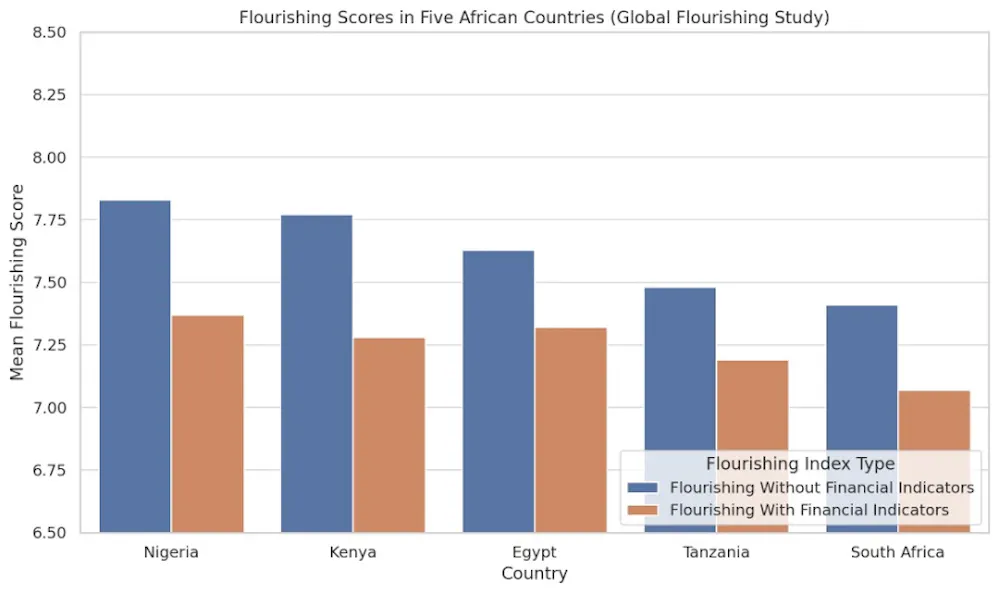
While these countries didn’t top the global rankings (Indonesia and Mexico did), Nigeria, Kenya and Egypt all reported relatively high flourishing scores, especially when well-being was considered apart from financial status.
Nigeria, for example, ranked 5th globally in flourishing scores that excluded financial indicators – ahead of many wealthier nations. Nigerians indicated strengths in social relationships, character and virtues (like forgiveness or helping others). But potential areas of growth included financial well-being, housing, ethnic discrimination and education.
Overall, this suggests that while material resources matter, they’re not the only thing that determines well-being. Kenya ranked 7th, Egypt 10th, Tanzania 11th and South Africa 13th. Each showed unique strengths in areas like meaning, social connection or mental health.
You did a separate study on flourishing in Africa. What did you find?
In a 2024 study we analysed data from the Gallup World Poll (2020–2022) to explore 38 indicators of well-being across 40 African countries.
This study offered a more detailed and culture-sensitive picture of how Africans experience and prioritise flourishing. The dimensions explored were derived from both local and universal sources, allowing for regionally relevant insights.
We found that African populations often score high in meaning, character and social relationships – despite economic hardship. This offers an important corrective to western assumptions about well-being.
Some of our key findings were:
● There is significant diversity between and within African countries. Mauritius consistently ranked highest in life evaluations (overall satisfaction with their lives), while countries like Sierra Leone and Zimbabwe scored lowest.
● East African countries such as Rwanda and Ethiopia showed strong performance in social well-being indicators (like feeling respected or learning new things daily) even when economic indicators were low.
● Countries in West Africa, such as Senegal and Ghana, scored high in emotional well-being, with many people reporting positive daily emotions like enjoyment and laughter.
● Southern African nations, despite challenges like income inequality, displayed resilience through strong community ties and cultural practices rooted in the philosophy of ubuntu.
The results reinforced that flourishing in Africa cannot only be reduced to gross domestic product (GDP) per capita (a measure of the average economic output per person in a country) – nor to western norms of success.
What can African countries focus on to flourish?
In my view, the path to greater flourishing lies in embracing local knowledge and investing in culturally relevant development priorities. Instead of following western pathways – centred on individual advancement – Africa can model alternative flourishing pathways that reflect what matters most to African people.
1. Prioritise local knowledge systems
African ideas about a connected society – like ubuntu (southern Africa), ujamaa (east Africa), teranga or wazobia (west Africa), and al-musawat wal tarahum (north Africa) teach people to care for each other and live in peace. These values help people live meaningful lives and can inform leadership and legislation.
2. Redefine development metrics
Western development models focus on individual achievement, economic output and material consumption. GDP per capita fails to capture the everyday realities and aspirations of African communities. We should also measure things like how happy people are, how hopeful they feel about the future, how strong and resilient their communities are, and how clean, safe and dignifying their living environments are.
This is not a new idea – for years development scholars have called for a shift away from narrow economic indicators toward a focus on human dignity, agency, and the real opportunities people have to pursue the lives they value. What’s new is the growing availability of data and the momentum to take these alternative metrics seriously in shaping national policies and priorities.
3. Invest in education for character development
Quality education is essential to unlocking the continent’s potential to flourish. But Africa needs more than just academic skills and workforce readiness – it needs a strategy for intentional development of values and habits that shape how a person thinks, feels, and acts with integrity.
Part of the problem lies in how the humanities – fields like history, literature, philosophy, and religious studies – are often undervalued or underfunded in education systems. But it is precisely these disciplines that nurture moral imagination, critical reflection, and civic responsibility. We need educational models that form not just workers, but whole persons – people who can think ethically, act responsibly, and lead with character in their communities.
What does Africa offer the world in terms of flourishing?
Africa is not waiting to be saved. Across the continent, people are building communities of care, cultivating joy amid hardship, and passing on values of unity, faith, and compassion. This is what development looks like when rooted in human dignity.
Africa flourishing goals offer an alternative vision for development – one that starts with what Africa already has, not what it lacks. These are locally emic aspirations for well-being. They are shaped by Africa’s indigenous knowledge systems, cultural values, and religious/spiritual traditions. Pursuing these goals means prioritising wholeness over wealth, community over consumption, and resilience over rescue.
The continent has so much to offer the world: wisdom, strong community values, and ways of staying resilient and living fully even in hard times. But many of these local insights are missing in the global science of well-being.
Victor Counted consults for Africa Flourishing Initiative
Source: The Conversation – Africa – By Victor Counted, Associate Professor of Psychology, Regent University
What does it mean to live a good life? Psychologists and social scientists have been focusing on a new idea called flourishing – a sense of well-being that goes beyond just happiness or success. It’s about your whole life being good, including how you interact with other people and your community. So then, how do Africans fare when it comes to flourishing?
Victor Counted is a psychological scientist whose research across 40 African countries offers a data-rich rethinking of flourishing on the continent. His findings challenge the dominant narrative that Africa is “lagging behind” in development by showing a more nuanced picture of what it means to live a good life. We asked him more.
What is flourishing?
Flourishing is more than economic growth or individual happiness. It’s a multidimensional state of being that reflects how people feel about their lives and how well their lives are actually going. So it also measures people’s values within their community.
The idea of well-being often carries a Eurocentric emphasis on the individual – personal satisfaction, autonomy, achievement. Flourishing accounts for how whole a person is in relation to their environment.
It includes the social, spiritual and ecological contexts in which one lives. So, it’s not just about how one feels, but how one lives – fully, meaningfully and in a satisfying relationship with the world around us.
What’s the Global Flourishing Study?
The Global Flourishing Study tries to measure global patterns of human flourishing. It’s an ongoing five-year longitudinal study in over 200,000 participants across 22 countries.
I was one of the team of global scholars brought together to examine the trends on what it means to live well across cultures and life circumstances.
The study identifies six key dimensions of flourishing:
Happiness and life satisfaction
Mental and physical health
Meaning and purpose
Character and virtue
Close social relationships
Financial and material stability
Participants rate how they’re doing in each of these areas on a scale from 0 to 10. Further questions capture experiences related to trust, loneliness, hope, resilience, and other related well-being variables.
Of the 22 nations, five were African: Nigeria, Kenya, South Africa, Tanzania and Egypt.
While these countries didn’t top the global rankings (Indonesia and Mexico did), Nigeria, Kenya and Egypt all reported relatively high flourishing scores, especially when well-being was considered apart from financial status.
Courtesy Victor Counted
Nigeria, for example, ranked 5th globally in flourishing scores that excluded financial indicators – ahead of many wealthier nations. Nigerians indicated strengths in social relationships, character and virtues (like forgiveness or helping others). But potential areas of growth included financial well-being, housing, ethnic discrimination and education.
Overall, this suggests that while material resources matter, they’re not the only thing that determines well-being. Kenya ranked 7th, Egypt 10th, Tanzania 11th and South Africa 13th. Each showed unique strengths in areas like meaning, social connection or mental health.
You did a separate study on flourishing in Africa. What did you find?
In a 2024 study we analysed data from the Gallup World Poll (2020–2022) to explore 38 indicators of well-being across 40 African countries.
This study offered a more detailed and culture-sensitive picture of how Africans experience and prioritise flourishing. The dimensions explored were derived from both local and universal sources, allowing for regionally relevant insights.
We found that African populations often score high in meaning, character and social relationships – despite economic hardship. This offers an important corrective to western assumptions about well-being.
Some of our key findings were:
● There is significant diversity between and within African countries. Mauritius consistently ranked highest in life evaluations (overall satisfaction with their lives), while countries like Sierra Leone and Zimbabwe scored lowest.
● East African countries such as Rwanda and Ethiopia showed strong performance in social well-being indicators (like feeling respected or learning new things daily) even when economic indicators were low.
● Countries in West Africa, such as Senegal and Ghana, scored high in emotional well-being, with many people reporting positive daily emotions like enjoyment and laughter.
● Southern African nations, despite challenges like income inequality, displayed resilience through strong community ties and cultural practices rooted in the philosophy of ubuntu.
The results reinforced that flourishing in Africa cannot only be reduced to gross domestic product (GDP) per capita (a measure of the average economic output per person in a country) – nor to western norms of success.
What can African countries focus on to flourish?
In my view, the path to greater flourishing lies in embracing local knowledge and investing in culturally relevant development priorities. Instead of following western pathways – centred on individual advancement – Africa can model alternative flourishing pathways that reflect what matters most to African people.
1. Prioritise local knowledge systems
African ideas about a connected society – like ubuntu (southern Africa), ujamaa (east Africa), teranga or wazobia (west Africa), and al-musawat wal tarahum (north Africa) teach people to care for each other and live in peace. These values help people live meaningful lives and can inform leadership and legislation.
2. Redefine development metrics
Western development models focus on individual achievement, economic output and material consumption. GDP per capita fails to capture the everyday realities and aspirations of African communities. We should also measure things like how happy people are, how hopeful they feel about the future, how strong and resilient their communities are, and how clean, safe and dignifying their living environments are.
This is not a new idea – for years development scholars have called for a shift away from narrow economic indicators toward a focus on human dignity, agency, and the real opportunities people have to pursue the lives they value. What’s new is the growing availability of data and the momentum to take these alternative metrics seriously in shaping national policies and priorities.
3. Invest in education for character development
Quality education is essential to unlocking the continent’s potential to flourish. But Africa needs more than just academic skills and workforce readiness – it needs a strategy for intentional development of values and habits that shape how a person thinks, feels, and acts with integrity.
Part of the problem lies in how the humanities – fields like history, literature, philosophy, and religious studies – are often undervalued or underfunded in education systems. But it is precisely these disciplines that nurture moral imagination, critical reflection, and civic responsibility. We need educational models that form not just workers, but whole persons – people who can think ethically, act responsibly, and lead with character in their communities.
What does Africa offer the world in terms of flourishing?
Africa is not waiting to be saved. Across the continent, people are building communities of care, cultivating joy amid hardship, and passing on values of unity, faith, and compassion. This is what development looks like when rooted in human dignity.
Africa flourishing goals offer an alternative vision for development – one that starts with what Africa already has, not what it lacks. These are locally emic aspirations for well-being. They are shaped by Africa’s indigenous knowledge systems, cultural values, and religious/spiritual traditions. Pursuing these goals means prioritising wholeness over wealth, community over consumption, and resilience over rescue.
The continent has so much to offer the world: wisdom, strong community values, and ways of staying resilient and living fully even in hard times. But many of these local insights are missing in the global science of well-being.
– Which African countries are flourishing? Scientists have a new way of measuring well-being – https://theconversation.com/which-african-countries-are-flourishing-scientists-have-a-new-way-of-measuring-well-being-257458
A federal jury convicted Stephanie Hockridge, a founder of the lender service provider Blueacorn, on Friday in connection with a scheme to fraudulently obtain tens of millions of dollars in COVID-19 relief money guaranteed by the U. S. Small Business Administration (SBA) through the Paycheck Protection Program (PPP).
According to court documents and evidence presented at trial, Hockridge, also known as Stephanie Reis, 42, of Rio Grande, Puerto Rico, and previously of Arizona, conspired with others to submit false and fraudulent PPP loan applications, including by fabricating documents that falsified income and payroll in order to receive loan funds for which they were not eligible.
“This defendant exploited a national emergency to personally profit from a taxpayer-funded program intended to support vulnerable individuals and small businesses,” said Matthew R. Galeotti, Head of the Justice Department’s Criminal Division. “This conviction demonstrates the Department’s commitment to holding individuals accountable for defrauding the government and wasting taxpayer money.”
“During a time of crisis in our country, this defendant abused the generosity of the American people by stealing money dedicated to the survival of small businesses to fraudulently enrich herself,” said Acting U. S. Attorney Nancy E. Larson for the Northern District of Texas. “We are proud of the diligent work of our law enforcement partners to hold her accountable and bring her to justice. Make no mistake, our efforts to bring such fraudsters to justice are ongoing.”
“Hockridge’s conviction demonstrates the FBI’s continued commitment to protecting taxpayer-funded programs from fraud and abuse,” said Assistant Director Jose A. Perez of the FBI Criminal Investigative Division. “This program was designed to provide critical funds to those struggling during a national crisis, not line the pockets of people seeking to exploit government assistance. The FBI remains committed to pursuing anyone who abuses the public trust for personal gain.”
“Ms. Hockridge defrauded the federal government of millions of dollars in pandemic relief funds for her own personal gain and has been brought to justice,” said Special Agent in Charge Jon Ellwanger of the Office of Inspector General for the Board of Governors of the Federal Reserve System and Consumer Financial Protection Bureau (CFPB) Western Region. “We are proud to have worked with our federal law enforcement partners to hold Ms. Hockridge accountable.”
“Exploiting the Small Business Administration’s pandemic relief programs for personal gain is an egregious theft of taxpayer funds,” said Deputy Inspector General Sheldon Shoemaker of the SBA Office of Inspector General. “SBA OIG will aggressively root out fraud to protect the integrity of SBA’s programs, which are intended to provide vital assistance to the nation’s small businesses. I want to thank the U. S. Attorney’s Office and our law enforcement partners for their dedication and commitment to seeing justice served.”
“This verdict is a victory for justice, accountability, and the American public,” said Special Agent in Charge Christopher J. Altemus Jr. of the IRS Criminal Investigation (IRS-CI) Dallas Field Office. “In a time of crisis, the Paycheck Protection Program was created as a lifeline to keep small businesses afloat and families fed. Ms. Hockridge saw it as an opportunity to enrich herself. Driven by greed, she used her business to steal millions of dollars intended for those in need. The women and men of IRS-CI will continue to protect what’s right and stand firmly with the honest business owners who play by the rules.”
As proven at trial, Hockridge co-founded Blueacorn in April 2020, purportedly to assist small businesses and individuals in obtaining PPP loans. To get larger loans for certain PPP applicants, Hockridge and her co-conspirators fabricated documents, including payroll records, tax documentation, and bank statements. Hockridge and her co-conspirators charged borrowers kickbacks based on a percentage of the funds received.
As part of the scheme, Hockridge and others offered a personalized service to their clients called “VIPPP” to help potential borrowers complete PPP loan applications. Hockridge recruited co-conspirators to work as VIPPP referral agents and coach borrowers on how to submit false PPP loan applications. To get more kickbacks from borrowers and a higher percentage of lender fees from the SBA, Hockridge and her co-conspirators submitted PPP loan applications that they knew contained materially false information. In total, Hockridge and her coconspirators processed tens of millions of dollars in fraudulent PPP loans. Hockridge was convicted of conspiracy to commit wire fraud and acquitted of four counts of wire fraud. She is scheduled to be sentenced on Oct. 10 and faces up to 20 years in prison.
The FBI, IRS-CI, the Special Inspector General for Pandemic Recovery, Federal Reserve Board-CFPB Office of Inspector General, and SBA OIG investigated the case.
Acting Assistant Chief Philip Trout of the Criminal Division’s Fraud Section, Trial Attorneys Elizabeth Carr and Ryan McLaren of the Criminal Division’s Money Laundering and Asset Recovery Section, and Assistant U. S. Attorney Matthew Weybrecht for the Northern District of Texas are prosecuting the case.
The Fraud Section leads the Criminal Division’s prosecution of fraud schemes that exploit the PPP. Since the enactment of the CARES Act, the Fraud Section has prosecuted over 200 defendants in more than 130 criminal cases and has seized over $78 million in cash proceeds derived from fraudulently obtained PPP funds, as well as numerous real estate properties and luxury items purchased with such proceeds. More information can be found at www. justice. gov/criminal/criminal-fraud/cares-act-fraud
MLARS’s Bank Integrity Unit investigates and prosecutes banks and other financial institutions, including their officers, managers, and employees, whose actions threaten the integrity of the individual institution or the wider financial system.
Anyone with information about allegations of attempted fraud involving COVID-19 can report it by calling the Justice Department’s National Center for Disaster Fraud (NCDF) Hotline via the NCDF Web Complaint Form at www. justice. gov/disaster-fraud/ncdf-disaster-complaint-form.
A federal jury convicted Stephanie Hockridge, a founder of the lender service provider Blueacorn, on Friday in connection with a scheme to fraudulently obtain tens of millions of dollars in COVID-19 relief money guaranteed by the U. S. Small Business Administration (SBA) through the Paycheck Protection Program (PPP).
According to court documents and evidence presented at trial, Hockridge, also known as Stephanie Reis, 42, of Rio Grande, Puerto Rico, and previously of Arizona, conspired with others to submit false and fraudulent PPP loan applications, including by fabricating documents that falsified income and payroll in order to receive loan funds for which they were not eligible.
“This defendant exploited a national emergency to personally profit from a taxpayer-funded program intended to support vulnerable individuals and small businesses,” said Matthew R. Galeotti, Head of the Justice Department’s Criminal Division. “This conviction demonstrates the Department’s commitment to holding individuals accountable for defrauding the government and wasting taxpayer money.”
“During a time of crisis in our country, this defendant abused the generosity of the American people by stealing money dedicated to the survival of small businesses to fraudulently enrich herself,” said Acting U. S. Attorney Nancy E. Larson for the Northern District of Texas. “We are proud of the diligent work of our law enforcement partners to hold her accountable and bring her to justice. Make no mistake, our efforts to bring such fraudsters to justice are ongoing.”
“Hockridge’s conviction demonstrates the FBI’s continued commitment to protecting taxpayer-funded programs from fraud and abuse,” said Assistant Director Jose A. Perez of the FBI Criminal Investigative Division. “This program was designed to provide critical funds to those struggling during a national crisis, not line the pockets of people seeking to exploit government assistance. The FBI remains committed to pursuing anyone who abuses the public trust for personal gain.”
“Ms. Hockridge defrauded the federal government of millions of dollars in pandemic relief funds for her own personal gain and has been brought to justice,” said Special Agent in Charge Jon Ellwanger of the Office of Inspector General for the Board of Governors of the Federal Reserve System and Consumer Financial Protection Bureau (CFPB) Western Region. “We are proud to have worked with our federal law enforcement partners to hold Ms. Hockridge accountable.”
“Exploiting the Small Business Administration’s pandemic relief programs for personal gain is an egregious theft of taxpayer funds,” said Deputy Inspector General Sheldon Shoemaker of the SBA Office of Inspector General. “SBA OIG will aggressively root out fraud to protect the integrity of SBA’s programs, which are intended to provide vital assistance to the nation’s small businesses. I want to thank the U. S. Attorney’s Office and our law enforcement partners for their dedication and commitment to seeing justice served.”
“This verdict is a victory for justice, accountability, and the American public,” said Special Agent in Charge Christopher J. Altemus Jr. of the IRS Criminal Investigation (IRS-CI) Dallas Field Office. “In a time of crisis, the Paycheck Protection Program was created as a lifeline to keep small businesses afloat and families fed. Ms. Hockridge saw it as an opportunity to enrich herself. Driven by greed, she used her business to steal millions of dollars intended for those in need. The women and men of IRS-CI will continue to protect what’s right and stand firmly with the honest business owners who play by the rules.”
As proven at trial, Hockridge co-founded Blueacorn in April 2020, purportedly to assist small businesses and individuals in obtaining PPP loans. To get larger loans for certain PPP applicants, Hockridge and her co-conspirators fabricated documents, including payroll records, tax documentation, and bank statements. Hockridge and her co-conspirators charged borrowers kickbacks based on a percentage of the funds received.
As part of the scheme, Hockridge and others offered a personalized service to their clients called “VIPPP” to help potential borrowers complete PPP loan applications. Hockridge recruited co-conspirators to work as VIPPP referral agents and coach borrowers on how to submit false PPP loan applications. To get more kickbacks from borrowers and a higher percentage of lender fees from the SBA, Hockridge and her co-conspirators submitted PPP loan applications that they knew contained materially false information. In total, Hockridge and her coconspirators processed tens of millions of dollars in fraudulent PPP loans. Hockridge was convicted of conspiracy to commit wire fraud and acquitted of four counts of wire fraud. She is scheduled to be sentenced on Oct. 10 and faces up to 20 years in prison.
The FBI, IRS-CI, the Special Inspector General for Pandemic Recovery, Federal Reserve Board-CFPB Office of Inspector General, and SBA OIG investigated the case.
Acting Assistant Chief Philip Trout of the Criminal Division’s Fraud Section, Trial Attorneys Elizabeth Carr and Ryan McLaren of the Criminal Division’s Money Laundering and Asset Recovery Section, and Assistant U. S. Attorney Matthew Weybrecht for the Northern District of Texas are prosecuting the case.
The Fraud Section leads the Criminal Division’s prosecution of fraud schemes that exploit the PPP. Since the enactment of the CARES Act, the Fraud Section has prosecuted over 200 defendants in more than 130 criminal cases and has seized over $78 million in cash proceeds derived from fraudulently obtained PPP funds, as well as numerous real estate properties and luxury items purchased with such proceeds. More information can be found at www. justice. gov/criminal/criminal-fraud/cares-act-fraud
MLARS’s Bank Integrity Unit investigates and prosecutes banks and other financial institutions, including their officers, managers, and employees, whose actions threaten the integrity of the individual institution or the wider financial system.
Anyone with information about allegations of attempted fraud involving COVID-19 can report it by calling the Justice Department’s National Center for Disaster Fraud (NCDF) Hotline via the NCDF Web Complaint Form at www. justice. gov/disaster-fraud/ncdf-disaster-complaint-form.
Source: United States House of Representatives – Representative Melanie Stansbury (N.M.-01)
WASHINGTON, D.C.– Congresswoman Melanie Stansbury (NM-01) fought for expanded access to healthcare in rural and Indigenous communities during an Indian and Insular Affairs Subcommittee hearing.
Her bill, theIHS Provider Expansion Act,was reintroduced earlier in the month, and testimony about the legislation was heard during the subcommittee hearing.
Watch video of thehearing.
The legislation would establish an Office of Graduate Medical Education Programs within the Indian Health Service (IHS). This legislation would expand the existing IHS Residency Program, building from the Shiprock-University of New Mexico (SUNM) Family Medicine Residency which is the first in the nation.
“Access to healthcare should not be determined by history or geography,” saidRep. Melanie Stansbury (NM-01). “The IHS Provider Expansion Act is a vital step towards ensuring that Native and Indigenous communities can access healthcare and grow the number of medical professionals serving Native communities. By investing in medical education within the Indian Health Service, we can help expand healthcare and bridge the gap in healthcare disparities that have persisted for far too long.”
Testifying about the importance of the legislation was Dr. Adriann Begay from theNavajoNation HEAL Initiative.Dr. Begay is Tábaahi (Edge of the Water clan) and born for Bít’ahnii (Folded Arms People clan). Her maternal grandparents are Ta’néészahnii (Badlands People clan) and paternal grandparents are Tl’aashchí’í (Red Cheek People clan).
She completed her undergraduate studies at the University of Arizona; and received a medical degree from the University of North Dakota School of Medicine through the Indians into Medicine program. She completed her residency in Family Medicine at the University of Arizona and is a Diplomate of the American Board of Family Practice. Adriann worked for the Indian Health Service for 21 years initially at Salt River Clinic under Phoenix Indian Medical Center for 4 years as a primary care provider. Then at Gallup Indian Medical Center as an urgent care physician and administrator for 17 years.
Watch video of Dr. Begay’stestimony.
More about the bill and its impact:
In New Mexico, which is home to 23 Tribal Nations and a population that is nearly 12% Native, access to healthcare services is a pressing issue. Currently, IHS provides services in 37 states to about 2.2 million out of 3.7 million Indigenous people in the country.
This bill is projected to directly impact millions of people across the country served by the IHS to improve access to healthcare and medical professionals who understand the unique health challenges faced by Tribal communities.
By expanding access through IHS, this bill will also help to address the significant deficit of rural primary healthcare providers across the country. Recent data from theU.S. Department of Health and Human Servicesshows rural areas across the country face a significant deficit in primary care providers, with more than 80 million Americans living in Health Professional Shortage Areas (HPSAs).
By expanding graduate medical education opportunities through IHS, we can expect an increase in the number of physicians willing to practice in these underserved regions.
Key Provisions of the Legislation:
Establishment of the Office: The Secretary of Health makes permanent the Office of Graduate Medical Education Programs to oversee residency and fellowship initiatives within the IHS.
Creating a Pipeline: The Office will facilitate opportunities for future healthcare professionals, paraprofessionals, and other health-related workers to engage in residency and fellowship programs.
Oversight of Residency Programs: The Office will oversee existing residency and fellowship programs at IHS facilities and support the creation of additional programs aimed at recruiting and retaining healthcare professionals.
Coordination with Academic Institutions: The Office will work in collaboration with academic institutions to strengthen educational ties and enhance training opportunities.
Interagency Working Group: An interagency working group, involving various federal agencies, will assist in the implementation and sustainability of the Office, ensuring ongoing support and resources.
Source: United States House of Representatives – Representative Melanie Stansbury (N.M.-01)
ALBUQUERQUE—Rep. Melanie Stansbury (NM-01)joined New Mexico state lawmakers and community leaders for a veterans town hall to answer questions directly from veterans on issues that impact them in light of the Trump administration’s cuts to the VA, and attacks on our service members by Secretary of Defense Pete Hegseth.
The Congresswoman joinedNew Mexico State Representative Debbie Sariñana (D-Albuquerque),New Mexico State Senator Harold Pope Jr. (D-Albuquerque), and U.S. Marine Corps veteranFrank Smith.
Rep. Sariñana and Sen. Pope both served in the U.S. Air Force.
Watch the videohere.
“The most patriotic thing we can do is to resist,” saidRep. Melanie Stansbury (NM-01). “The most patriotic thing we can do right now is to speak out. The most patriotic thing we can do is engage in acts of resistance and supporting our communities. And the most patriotic thing we can do is continue to serve our communities, to fight for our communities, and to fight for our democracy because we will win.”
Secretary Pete Hegseth has directed cuts aimed at what’s being labeled “wasteful” spending:
Over $580 million in contracts and programs have been canceled.
Major cuts include $1.8 billion from consulting contracts at the Defense Health Agency, $1.4 billion from cloud IT services, and $500 million from Navy business consulting.
Eleven contracts related to DEI, climate change, and COVID-19 were also terminated.
A $500 million DARPA help desk contract was cut due to duplication.
The Department of Defense is working with DOGE (Department of Government Efficiency), which has identified $800 million in additional spending to eliminate.
There are plans to in-source IT roles, shifting those duties to civilian staff.
The VA started aggressive contract reviews and program cuts:
Effective May 1, the VA ended the Veterans Affairs Servicing Purchase (VASP) program, which had been the only available mortgage assistance tool for many at-risk veterans. This has increased the risk of foreclosure for thousands of veteran families.
VA has canceled 585 contracts worth $1.8 billion, redirecting about $900 million to healthcare and benefits. Most of the canceled contracts were described as non-mission critical, but some provided administrative or support services that may now fall back on already strained internal resources.
A federal jury convicted Stephanie Hockridge, a founder of the lender service provider Blueacorn, on Friday in connection with a scheme to fraudulently obtain tens of millions of dollars in COVID-19 relief money guaranteed by the U. S. Small Business Administration (SBA) through the Paycheck Protection Program (PPP).
According to court documents and evidence presented at trial, Hockridge, also known as Stephanie Reis, 42, of Rio Grande, Puerto Rico, and previously of Arizona, conspired with others to submit false and fraudulent PPP loan applications, including by fabricating documents that falsified income and payroll in order to receive loan funds for which they were not eligible.
“This defendant exploited a national emergency to personally profit from a taxpayer-funded program intended to support vulnerable individuals and small businesses,” said Matthew R. Galeotti, Head of the Justice Department’s Criminal Division. “This conviction demonstrates the Department’s commitment to holding individuals accountable for defrauding the government and wasting taxpayer money.”
“During a time of crisis in our country, this defendant abused the generosity of the American people by stealing money dedicated to the survival of small businesses to fraudulently enrich herself,” said Acting U. S. Attorney Nancy E. Larson for the Northern District of Texas. “We are proud of the diligent work of our law enforcement partners to hold her accountable and bring her to justice. Make no mistake, our efforts to bring such fraudsters to justice are ongoing.”
“Hockridge’s conviction demonstrates the FBI’s continued commitment to protecting taxpayer-funded programs from fraud and abuse,” said Assistant Director Jose A. Perez of the FBI Criminal Investigative Division. “This program was designed to provide critical funds to those struggling during a national crisis, not line the pockets of people seeking to exploit government assistance. The FBI remains committed to pursuing anyone who abuses the public trust for personal gain.”
“Ms. Hockridge defrauded the federal government of millions of dollars in pandemic relief funds for her own personal gain and has been brought to justice,” said Special Agent in Charge Jon Ellwanger of the Office of Inspector General for the Board of Governors of the Federal Reserve System and Consumer Financial Protection Bureau (CFPB) Western Region. “We are proud to have worked with our federal law enforcement partners to hold Ms. Hockridge accountable.”
“Exploiting the Small Business Administration’s pandemic relief programs for personal gain is an egregious theft of taxpayer funds,” said Deputy Inspector General Sheldon Shoemaker of the SBA Office of Inspector General. “SBA OIG will aggressively root out fraud to protect the integrity of SBA’s programs, which are intended to provide vital assistance to the nation’s small businesses. I want to thank the U. S. Attorney’s Office and our law enforcement partners for their dedication and commitment to seeing justice served.”
“This verdict is a victory for justice, accountability, and the American public,” said Special Agent in Charge Christopher J. Altemus Jr. of the IRS Criminal Investigation (IRS-CI) Dallas Field Office. “In a time of crisis, the Paycheck Protection Program was created as a lifeline to keep small businesses afloat and families fed. Ms. Hockridge saw it as an opportunity to enrich herself. Driven by greed, she used her business to steal millions of dollars intended for those in need. The women and men of IRS-CI will continue to protect what’s right and stand firmly with the honest business owners who play by the rules.”
As proven at trial, Hockridge co-founded Blueacorn in April 2020, purportedly to assist small businesses and individuals in obtaining PPP loans. To get larger loans for certain PPP applicants, Hockridge and her co-conspirators fabricated documents, including payroll records, tax documentation, and bank statements. Hockridge and her co-conspirators charged borrowers kickbacks based on a percentage of the funds received.
As part of the scheme, Hockridge and others offered a personalized service to their clients called “VIPPP” to help potential borrowers complete PPP loan applications. Hockridge recruited co-conspirators to work as VIPPP referral agents and coach borrowers on how to submit false PPP loan applications. To get more kickbacks from borrowers and a higher percentage of lender fees from the SBA, Hockridge and her co-conspirators submitted PPP loan applications that they knew contained materially false information. In total, Hockridge and her coconspirators processed tens of millions of dollars in fraudulent PPP loans. Hockridge was convicted of conspiracy to commit wire fraud and acquitted of four counts of wire fraud. She is scheduled to be sentenced on Oct. 10 and faces up to 20 years in prison.
The FBI, IRS-CI, the Special Inspector General for Pandemic Recovery, Federal Reserve Board-CFPB Office of Inspector General, and SBA OIG investigated the case.
Acting Assistant Chief Philip Trout of the Criminal Division’s Fraud Section, Trial Attorneys Elizabeth Carr and Ryan McLaren of the Criminal Division’s Money Laundering and Asset Recovery Section, and Assistant U. S. Attorney Matthew Weybrecht for the Northern District of Texas are prosecuting the case.
The Fraud Section leads the Criminal Division’s prosecution of fraud schemes that exploit the PPP. Since the enactment of the CARES Act, the Fraud Section has prosecuted over 200 defendants in more than 130 criminal cases and has seized over $78 million in cash proceeds derived from fraudulently obtained PPP funds, as well as numerous real estate properties and luxury items purchased with such proceeds. More information can be found at www. justice. gov/criminal/criminal-fraud/cares-act-fraud
MLARS’s Bank Integrity Unit investigates and prosecutes banks and other financial institutions, including their officers, managers, and employees, whose actions threaten the integrity of the individual institution or the wider financial system.
Anyone with information about allegations of attempted fraud involving COVID-19 can report it by calling the Justice Department’s National Center for Disaster Fraud (NCDF) Hotline via the NCDF Web Complaint Form at www. justice. gov/disaster-fraud/ncdf-disaster-complaint-form.
DEL RIO, Texas – Seven members of the Partido Revolucionario Mexicano (PRM) prison gang were sentenced in a federal court in Del Rio to a combined 137 years in prison for their roles in a cocaine trafficking conspiracy.
According to court documents, Victor Hinojosa aka Zuko, 35; Martha Gonzalez Ritchie, 64; Jesus Espinoza, 33; and Francisco Espinoza, 29; Ernesto Magdaleno, 56; Armando Ramirez aka Mando, 36; and Danny Suarez, 41, all from Eagle Pass, trafficked cocaine in and around Eagle Pass and Del Rio daily between March 1, 2019, and June 1, 2021. Hinojosa, identified as a sergeant of the PRM, conspired with others by communicating with them through Facebook messenger or cell phone to discuss cocaine distribution activities. Jesus and Francisco Espinoza, Suarez, and another co-defendant would regularly supply Hinojosa with the cocaine. Drug Enforcement Administration agents conducted multiple controlled purchases from Hinojosa throughout their investigation.
All seven defendants were arrested on June 11, 2021. Hinojosa, Jesus Espinoza and Francisco Espinoza each pleaded guilty in 2022 to one count of conspiracy to possess with intent to distribute cocaine. Ritchie also pleaded guilty in 2022 to one count of conspiracy to possess with intent to distribute heroin.
On June 5, Chief U.S. District Judge Alia Moses sentenced Hinojosa and Ritchie each to 30 years in prison, Jesus Espinoza to 17 ½ years in prison, and Francisco Espinoza to 19 ½ years in prison. The following week, on June 13, Chief Judge Moses sentenced Magdaleno and Ramirez each to 14 years in prison, and Suarez to 12 years.
“This criminal conspiracy extends way beyond the bounds of narcotics distribution,” said U.S. Attorney Justin Simmons for the Western District of Texas. “PRM is a violent prison gang that operates on both sides the U.S.-Mexico border. These PRM members who have been convicted and sentenced should reemphasize to other narcoterrorists the level of our resolve when it comes to the eradication of transnational criminal organizations and providing safer border communities.”
Other co-defendants in this case who continue to await their sentence hearings include Rodolfo Jimenez Jr., Eduardo Gloria, Saul Sanchez-Rosas, Yvonne Rodriguez-Torres, Luis Alberto Torres-Marquez, Paulino Ramirez, Louis Iglesias, Martha Perez, and Randy Crioyos.
Co-defendant Carlos Eduardo Saldana Jr. was sentenced in August 2023 to 10 years in federal prison; Kevin Ritchie was sentenced in October 2023 to 35 years imprisonment; Clinton Ritchie was sentenced in July 2024 to 19 ½ years in federal prison; and Carlos Daniel Rodriguez-Urrabazo was also sentenced in July 2024 to 7 years in prison.
The DEA and FBI led the investigation, known as Operation Tequila Sunset. Homeland Security Investigations, U.S. Marshals Service, U.S. Border Patrol, Texas Department of Public Safety, the Eagle Pass Police Department, and the Sheriff’s Offices from Maverick, Dimmitt and Val Verde counties assisted.
Assistant U.S. Attorney Brett Miner prosecuted the case.
These cases are part of Operation Take Back America, a nationwide initiative that marshals the full resources of the Department of Justice to repel the invasion of illegal immigration, achieve the total elimination of cartels and transnational criminal organizations (TCOs), and protect our communities from the perpetrators of violent crime. Operation Take Back America streamlines efforts and resources from the Department’s Organized Crime Drug Enforcement Task Forces (OCDETFs) and Project Safe Neighborhood (PSN).
A federal jury convicted Stephanie Hockridge, a founder of the lender service provider Blueacorn, on Friday in connection with a scheme to fraudulently obtain tens of millions of dollars in COVID-19 relief money guaranteed by the U. S. Small Business Administration (SBA) through the Paycheck Protection Program (PPP).
According to court documents and evidence presented at trial, Hockridge, also known as Stephanie Reis, 42, of Rio Grande, Puerto Rico, and previously of Arizona, conspired with others to submit false and fraudulent PPP loan applications, including by fabricating documents that falsified income and payroll in order to receive loan funds for which they were not eligible.
“This defendant exploited a national emergency to personally profit from a taxpayer-funded program intended to support vulnerable individuals and small businesses,” said Matthew R. Galeotti, Head of the Justice Department’s Criminal Division. “This conviction demonstrates the Department’s commitment to holding individuals accountable for defrauding the government and wasting taxpayer money.”
“During a time of crisis in our country, this defendant abused the generosity of the American people by stealing money dedicated to the survival of small businesses to fraudulently enrich herself,” said Acting U. S. Attorney Nancy E. Larson for the Northern District of Texas. “We are proud of the diligent work of our law enforcement partners to hold her accountable and bring her to justice. Make no mistake, our efforts to bring such fraudsters to justice are ongoing.”
“Hockridge’s conviction demonstrates the FBI’s continued commitment to protecting taxpayer-funded programs from fraud and abuse,” said Assistant Director Jose A. Perez of the FBI Criminal Investigative Division. “This program was designed to provide critical funds to those struggling during a national crisis, not line the pockets of people seeking to exploit government assistance. The FBI remains committed to pursuing anyone who abuses the public trust for personal gain.”
“Ms. Hockridge defrauded the federal government of millions of dollars in pandemic relief funds for her own personal gain and has been brought to justice,” said Special Agent in Charge Jon Ellwanger of the Office of Inspector General for the Board of Governors of the Federal Reserve System and Consumer Financial Protection Bureau (CFPB) Western Region. “We are proud to have worked with our federal law enforcement partners to hold Ms. Hockridge accountable.”
“Exploiting the Small Business Administration’s pandemic relief programs for personal gain is an egregious theft of taxpayer funds,” said Deputy Inspector General Sheldon Shoemaker of the SBA Office of Inspector General. “SBA OIG will aggressively root out fraud to protect the integrity of SBA’s programs, which are intended to provide vital assistance to the nation’s small businesses. I want to thank the U. S. Attorney’s Office and our law enforcement partners for their dedication and commitment to seeing justice served.”
“This verdict is a victory for justice, accountability, and the American public,” said Special Agent in Charge Christopher J. Altemus Jr. of the IRS Criminal Investigation (IRS-CI) Dallas Field Office. “In a time of crisis, the Paycheck Protection Program was created as a lifeline to keep small businesses afloat and families fed. Ms. Hockridge saw it as an opportunity to enrich herself. Driven by greed, she used her business to steal millions of dollars intended for those in need. The women and men of IRS-CI will continue to protect what’s right and stand firmly with the honest business owners who play by the rules.”
As proven at trial, Hockridge co-founded Blueacorn in April 2020, purportedly to assist small businesses and individuals in obtaining PPP loans. To get larger loans for certain PPP applicants, Hockridge and her co-conspirators fabricated documents, including payroll records, tax documentation, and bank statements. Hockridge and her co-conspirators charged borrowers kickbacks based on a percentage of the funds received.
As part of the scheme, Hockridge and others offered a personalized service to their clients called “VIPPP” to help potential borrowers complete PPP loan applications. Hockridge recruited co-conspirators to work as VIPPP referral agents and coach borrowers on how to submit false PPP loan applications. To get more kickbacks from borrowers and a higher percentage of lender fees from the SBA, Hockridge and her co-conspirators submitted PPP loan applications that they knew contained materially false information. In total, Hockridge and her coconspirators processed tens of millions of dollars in fraudulent PPP loans. Hockridge was convicted of conspiracy to commit wire fraud and acquitted of four counts of wire fraud. She is scheduled to be sentenced on Oct. 10 and faces up to 20 years in prison.
The FBI, IRS-CI, the Special Inspector General for Pandemic Recovery, Federal Reserve Board-CFPB Office of Inspector General, and SBA OIG investigated the case.
Acting Assistant Chief Philip Trout of the Criminal Division’s Fraud Section, Trial Attorneys Elizabeth Carr and Ryan McLaren of the Criminal Division’s Money Laundering and Asset Recovery Section, and Assistant U. S. Attorney Matthew Weybrecht for the Northern District of Texas are prosecuting the case.
The Fraud Section leads the Criminal Division’s prosecution of fraud schemes that exploit the PPP. Since the enactment of the CARES Act, the Fraud Section has prosecuted over 200 defendants in more than 130 criminal cases and has seized over $78 million in cash proceeds derived from fraudulently obtained PPP funds, as well as numerous real estate properties and luxury items purchased with such proceeds. More information can be found at www. justice. gov/criminal/criminal-fraud/cares-act-fraud
MLARS’s Bank Integrity Unit investigates and prosecutes banks and other financial institutions, including their officers, managers, and employees, whose actions threaten the integrity of the individual institution or the wider financial system.
Anyone with information about allegations of attempted fraud involving COVID-19 can report it by calling the Justice Department’s National Center for Disaster Fraud (NCDF) Hotline via the NCDF Web Complaint Form at www. justice. gov/disaster-fraud/ncdf-disaster-complaint-form.
A federal jury convicted Stephanie Hockridge, a founder of the lender service provider Blueacorn, on Friday in connection with a scheme to fraudulently obtain tens of millions of dollars in COVID-19 relief money guaranteed by the U. S. Small Business Administration (SBA) through the Paycheck Protection Program (PPP).
According to court documents and evidence presented at trial, Hockridge, also known as Stephanie Reis, 42, of Rio Grande, Puerto Rico, and previously of Arizona, conspired with others to submit false and fraudulent PPP loan applications, including by fabricating documents that falsified income and payroll in order to receive loan funds for which they were not eligible.
“This defendant exploited a national emergency to personally profit from a taxpayer-funded program intended to support vulnerable individuals and small businesses,” said Matthew R. Galeotti, Head of the Justice Department’s Criminal Division. “This conviction demonstrates the Department’s commitment to holding individuals accountable for defrauding the government and wasting taxpayer money.”
“During a time of crisis in our country, this defendant abused the generosity of the American people by stealing money dedicated to the survival of small businesses to fraudulently enrich herself,” said Acting U. S. Attorney Nancy E. Larson for the Northern District of Texas. “We are proud of the diligent work of our law enforcement partners to hold her accountable and bring her to justice. Make no mistake, our efforts to bring such fraudsters to justice are ongoing.”
“Hockridge’s conviction demonstrates the FBI’s continued commitment to protecting taxpayer-funded programs from fraud and abuse,” said Assistant Director Jose A. Perez of the FBI Criminal Investigative Division. “This program was designed to provide critical funds to those struggling during a national crisis, not line the pockets of people seeking to exploit government assistance. The FBI remains committed to pursuing anyone who abuses the public trust for personal gain.”
“Ms. Hockridge defrauded the federal government of millions of dollars in pandemic relief funds for her own personal gain and has been brought to justice,” said Special Agent in Charge Jon Ellwanger of the Office of Inspector General for the Board of Governors of the Federal Reserve System and Consumer Financial Protection Bureau (CFPB) Western Region. “We are proud to have worked with our federal law enforcement partners to hold Ms. Hockridge accountable.”
“Exploiting the Small Business Administration’s pandemic relief programs for personal gain is an egregious theft of taxpayer funds,” said Deputy Inspector General Sheldon Shoemaker of the SBA Office of Inspector General. “SBA OIG will aggressively root out fraud to protect the integrity of SBA’s programs, which are intended to provide vital assistance to the nation’s small businesses. I want to thank the U. S. Attorney’s Office and our law enforcement partners for their dedication and commitment to seeing justice served.”
“This verdict is a victory for justice, accountability, and the American public,” said Special Agent in Charge Christopher J. Altemus Jr. of the IRS Criminal Investigation (IRS-CI) Dallas Field Office. “In a time of crisis, the Paycheck Protection Program was created as a lifeline to keep small businesses afloat and families fed. Ms. Hockridge saw it as an opportunity to enrich herself. Driven by greed, she used her business to steal millions of dollars intended for those in need. The women and men of IRS-CI will continue to protect what’s right and stand firmly with the honest business owners who play by the rules.”
As proven at trial, Hockridge co-founded Blueacorn in April 2020, purportedly to assist small businesses and individuals in obtaining PPP loans. To get larger loans for certain PPP applicants, Hockridge and her co-conspirators fabricated documents, including payroll records, tax documentation, and bank statements. Hockridge and her co-conspirators charged borrowers kickbacks based on a percentage of the funds received.
As part of the scheme, Hockridge and others offered a personalized service to their clients called “VIPPP” to help potential borrowers complete PPP loan applications. Hockridge recruited co-conspirators to work as VIPPP referral agents and coach borrowers on how to submit false PPP loan applications. To get more kickbacks from borrowers and a higher percentage of lender fees from the SBA, Hockridge and her co-conspirators submitted PPP loan applications that they knew contained materially false information. In total, Hockridge and her coconspirators processed tens of millions of dollars in fraudulent PPP loans. Hockridge was convicted of conspiracy to commit wire fraud and acquitted of four counts of wire fraud. She is scheduled to be sentenced on Oct. 10 and faces up to 20 years in prison.
The FBI, IRS-CI, the Special Inspector General for Pandemic Recovery, Federal Reserve Board-CFPB Office of Inspector General, and SBA OIG investigated the case.
Acting Assistant Chief Philip Trout of the Criminal Division’s Fraud Section, Trial Attorneys Elizabeth Carr and Ryan McLaren of the Criminal Division’s Money Laundering and Asset Recovery Section, and Assistant U. S. Attorney Matthew Weybrecht for the Northern District of Texas are prosecuting the case.
The Fraud Section leads the Criminal Division’s prosecution of fraud schemes that exploit the PPP. Since the enactment of the CARES Act, the Fraud Section has prosecuted over 200 defendants in more than 130 criminal cases and has seized over $78 million in cash proceeds derived from fraudulently obtained PPP funds, as well as numerous real estate properties and luxury items purchased with such proceeds. More information can be found at www. justice. gov/criminal/criminal-fraud/cares-act-fraud
MLARS’s Bank Integrity Unit investigates and prosecutes banks and other financial institutions, including their officers, managers, and employees, whose actions threaten the integrity of the individual institution or the wider financial system.
Anyone with information about allegations of attempted fraud involving COVID-19 can report it by calling the Justice Department’s National Center for Disaster Fraud (NCDF) Hotline via the NCDF Web Complaint Form at www. justice. gov/disaster-fraud/ncdf-disaster-complaint-form.
A federal jury convicted Stephanie Hockridge, a founder of the lender service provider Blueacorn, on Friday in connection with a scheme to fraudulently obtain tens of millions of dollars in COVID-19 relief money guaranteed by the U. S. Small Business Administration (SBA) through the Paycheck Protection Program (PPP).
According to court documents and evidence presented at trial, Hockridge, also known as Stephanie Reis, 42, of Rio Grande, Puerto Rico, and previously of Arizona, conspired with others to submit false and fraudulent PPP loan applications, including by fabricating documents that falsified income and payroll in order to receive loan funds for which they were not eligible.
“This defendant exploited a national emergency to personally profit from a taxpayer-funded program intended to support vulnerable individuals and small businesses,” said Matthew R. Galeotti, Head of the Justice Department’s Criminal Division. “This conviction demonstrates the Department’s commitment to holding individuals accountable for defrauding the government and wasting taxpayer money.”
“During a time of crisis in our country, this defendant abused the generosity of the American people by stealing money dedicated to the survival of small businesses to fraudulently enrich herself,” said Acting U. S. Attorney Nancy E. Larson for the Northern District of Texas. “We are proud of the diligent work of our law enforcement partners to hold her accountable and bring her to justice. Make no mistake, our efforts to bring such fraudsters to justice are ongoing.”
“Hockridge’s conviction demonstrates the FBI’s continued commitment to protecting taxpayer-funded programs from fraud and abuse,” said Assistant Director Jose A. Perez of the FBI Criminal Investigative Division. “This program was designed to provide critical funds to those struggling during a national crisis, not line the pockets of people seeking to exploit government assistance. The FBI remains committed to pursuing anyone who abuses the public trust for personal gain.”
“Ms. Hockridge defrauded the federal government of millions of dollars in pandemic relief funds for her own personal gain and has been brought to justice,” said Special Agent in Charge Jon Ellwanger of the Office of Inspector General for the Board of Governors of the Federal Reserve System and Consumer Financial Protection Bureau (CFPB) Western Region. “We are proud to have worked with our federal law enforcement partners to hold Ms. Hockridge accountable.”
“Exploiting the Small Business Administration’s pandemic relief programs for personal gain is an egregious theft of taxpayer funds,” said Deputy Inspector General Sheldon Shoemaker of the SBA Office of Inspector General. “SBA OIG will aggressively root out fraud to protect the integrity of SBA’s programs, which are intended to provide vital assistance to the nation’s small businesses. I want to thank the U. S. Attorney’s Office and our law enforcement partners for their dedication and commitment to seeing justice served.”
“This verdict is a victory for justice, accountability, and the American public,” said Special Agent in Charge Christopher J. Altemus Jr. of the IRS Criminal Investigation (IRS-CI) Dallas Field Office. “In a time of crisis, the Paycheck Protection Program was created as a lifeline to keep small businesses afloat and families fed. Ms. Hockridge saw it as an opportunity to enrich herself. Driven by greed, she used her business to steal millions of dollars intended for those in need. The women and men of IRS-CI will continue to protect what’s right and stand firmly with the honest business owners who play by the rules.”
As proven at trial, Hockridge co-founded Blueacorn in April 2020, purportedly to assist small businesses and individuals in obtaining PPP loans. To get larger loans for certain PPP applicants, Hockridge and her co-conspirators fabricated documents, including payroll records, tax documentation, and bank statements. Hockridge and her co-conspirators charged borrowers kickbacks based on a percentage of the funds received.
As part of the scheme, Hockridge and others offered a personalized service to their clients called “VIPPP” to help potential borrowers complete PPP loan applications. Hockridge recruited co-conspirators to work as VIPPP referral agents and coach borrowers on how to submit false PPP loan applications. To get more kickbacks from borrowers and a higher percentage of lender fees from the SBA, Hockridge and her co-conspirators submitted PPP loan applications that they knew contained materially false information. In total, Hockridge and her coconspirators processed tens of millions of dollars in fraudulent PPP loans. Hockridge was convicted of conspiracy to commit wire fraud and acquitted of four counts of wire fraud. She is scheduled to be sentenced on Oct. 10 and faces up to 20 years in prison.
The FBI, IRS-CI, the Special Inspector General for Pandemic Recovery, Federal Reserve Board-CFPB Office of Inspector General, and SBA OIG investigated the case.
Acting Assistant Chief Philip Trout of the Criminal Division’s Fraud Section, Trial Attorneys Elizabeth Carr and Ryan McLaren of the Criminal Division’s Money Laundering and Asset Recovery Section, and Assistant U. S. Attorney Matthew Weybrecht for the Northern District of Texas are prosecuting the case.
The Fraud Section leads the Criminal Division’s prosecution of fraud schemes that exploit the PPP. Since the enactment of the CARES Act, the Fraud Section has prosecuted over 200 defendants in more than 130 criminal cases and has seized over $78 million in cash proceeds derived from fraudulently obtained PPP funds, as well as numerous real estate properties and luxury items purchased with such proceeds. More information can be found at www. justice. gov/criminal/criminal-fraud/cares-act-fraud
MLARS’s Bank Integrity Unit investigates and prosecutes banks and other financial institutions, including their officers, managers, and employees, whose actions threaten the integrity of the individual institution or the wider financial system.
Anyone with information about allegations of attempted fraud involving COVID-19 can report it by calling the Justice Department’s National Center for Disaster Fraud (NCDF) Hotline via the NCDF Web Complaint Form at www. justice. gov/disaster-fraud/ncdf-disaster-complaint-form.
Defendants Kidnapped Two Women, Demanded Ransom, Instigated Shootout in Charlottesville’s Belmont Neighborhood
CHARLOTTESVILLE, Va. – A Texas man, who conspired to kidnap and transport aliens and held multiple victims for ransom before instigating a deadly shootout in a quiet, Charlottesville neighborhood, pled guilty recently to federal charges as part of Operation Take Back America.
Ricardo Franco Ordaz, 26, of Cedar Creek, Texas, pled guilty to one count of conspiracy to kidnap and one count of transporting an alien resulting in death. At sentencing, Ordaz faces a maximum possible penalty of life in prison.
“Human trafficking and human smuggling generate violence and are real threats to our community and the Justice Department will take all appropriate steps to hold accountable those who attempt to profit off of others trying to enter the country illegally,” Acting United States Attorney Zachary T. Lee said today. “This case serves as an example of the deadly consequences that can occur when individuals use human beings as currency. I am grateful to the Department of Homeland Security and our state and local partners for their work to bring this case to justice.”
According to court documents, in early January of 2023, Ordaz, his co-defendant Jordan Perez, and other co-conspirators, kidnapped multiple victims and held them for ransom, knowing these individuals had entered the United States illegally.
As part of the scheme, Ordaz arranged to pick up two victims from an area near the United States-Mexico border and bring them to a house near Austin, Texas. Once there, Ordaz, and others, held both victims against their will and under armed guard, then called and messaged the victims’ families and friends demanding cash ransom in exchange for their release.
Ordaz exchanged one of the victims in Texas for $5,000 cash, and on January 8, 2023, Perez and a co-conspirator transported another victim to Charlottesville, Virginia, where they arranged to exchange that victim for $10,000 in cash.
During the exchange, when it was revealed that the full $10,000 ransom was not available, an argument and shootout ensued, during which Perez, and another coconspirator, brandished firearms that resulted in the death of one of the kidnappers.
Perez is scheduled to go to trial in December 2025.
This case is part of Operation Take Back America, a nationwide initiative that marshals the full resources of the Department of Justice to repel the invasion of illegal immigration, achieve the total elimination of cartels and transnational criminal organizations (TCOs), and protect our communities from the perpetrators of violent crime. Operation Take Back America streamlines efforts and resources from the Department’s Organized Crime Drug Enforcement Task Forces (OCDETFs) and Project Safe Neighborhood (PSN).
Homeland Security Investigations in Harrisonburg investigated the case with assistance from the Charlottesville Police Department, Albemarle County Police Department, and HSI Austin, Texas.
Assistant U.S. Attorney Sally J. Sullivan is prosecuting the case.
Defendants Kidnapped Two Women, Demanded Ransom, Instigated Shootout in Charlottesville’s Belmont Neighborhood
CHARLOTTESVILLE, Va. – A Texas man, who conspired to kidnap and transport aliens and held multiple victims for ransom before instigating a deadly shootout in a quiet, Charlottesville neighborhood, pled guilty recently to federal charges as part of Operation Take Back America.
Ricardo Franco Ordaz, 26, of Cedar Creek, Texas, pled guilty to one count of conspiracy to kidnap and one count of transporting an alien resulting in death. At sentencing, Ordaz faces a maximum possible penalty of life in prison.
“Human trafficking and human smuggling generate violence and are real threats to our community and the Justice Department will take all appropriate steps to hold accountable those who attempt to profit off of others trying to enter the country illegally,” Acting United States Attorney Zachary T. Lee said today. “This case serves as an example of the deadly consequences that can occur when individuals use human beings as currency. I am grateful to the Department of Homeland Security and our state and local partners for their work to bring this case to justice.”
According to court documents, in early January of 2023, Ordaz, his co-defendant Jordan Perez, and other co-conspirators, kidnapped multiple victims and held them for ransom, knowing these individuals had entered the United States illegally.
As part of the scheme, Ordaz arranged to pick up two victims from an area near the United States-Mexico border and bring them to a house near Austin, Texas. Once there, Ordaz, and others, held both victims against their will and under armed guard, then called and messaged the victims’ families and friends demanding cash ransom in exchange for their release.
Ordaz exchanged one of the victims in Texas for $5,000 cash, and on January 8, 2023, Perez and a co-conspirator transported another victim to Charlottesville, Virginia, where they arranged to exchange that victim for $10,000 in cash.
During the exchange, when it was revealed that the full $10,000 ransom was not available, an argument and shootout ensued, during which Perez, and another coconspirator, brandished firearms that resulted in the death of one of the kidnappers.
Perez is scheduled to go to trial in December 2025.
This case is part of Operation Take Back America, a nationwide initiative that marshals the full resources of the Department of Justice to repel the invasion of illegal immigration, achieve the total elimination of cartels and transnational criminal organizations (TCOs), and protect our communities from the perpetrators of violent crime. Operation Take Back America streamlines efforts and resources from the Department’s Organized Crime Drug Enforcement Task Forces (OCDETFs) and Project Safe Neighborhood (PSN).
Homeland Security Investigations in Harrisonburg investigated the case with assistance from the Charlottesville Police Department, Albemarle County Police Department, and HSI Austin, Texas.
Assistant U.S. Attorney Sally J. Sullivan is prosecuting the case.
SAN JUAN, Puerto Rico and VANCOUVER, British Columbia, June 23, 2025 (GLOBE NEWSWIRE) — This news release is issued by Terren Peizer (“Mr. Peizer”) pursuant to the early warning requirements of Canada’s National Instrument 62-104 and National Instrument 62-103 with respect to proportionate voting shares (“PVS”) and proportionate voting share warrants (“PVS Warrants”) of Inspire Semiconductor Holdings Inc. (the “Issuer”).
Mr. Peizer announces that, through his wholly owned corporation, Humanitario Capital LLC (“Humanitario”), he has acquired PVS and PVS Warrants in connection with a financing (the “Financing”) of units of the Issuer consisting of 315,790 PVS and 315,790 PVS Warrants representing approximately 10.16% of the issued and outstanding subordinate voting shares of the Issuer (“SVS”) on a basic basis and approximately 18.44% of the issued and outstanding SVS on a partially-diluted basis, after giving effect only to the exercise of the PVS Warrants issued to Humanitario.
Following completion of the Financing Humanitario beneficially owned or controlled 1,056,530.74 PVS and 1,056,530 PVS Warrants representing approximately 33.98% of the issued and outstanding SVS on a basic basis and approximately 50.73% of the issued and outstanding SVS on a partially-diluted basis, after giving effect only to the exercise of the PVS Warrants held by Humanitario.
Each PVS is convertible at the option of the holder in 100 SVS pursuant to the Issuer’s articles. Each of the foregoing percentages assumes the conversion of all issued and outstanding PVS to SVS.
Mr. Peizer (through Humanitario) acquired the Shares for investment purposes and may, depending on market and other conditions, increase or decrease his beneficial ownership, control, or direction over securities of the Issuer through market transactions, private agreements, treasury issuances, exercise of warrants, or otherwise.
For further information and to obtain a copy of the early warning report filed under applicable Canadian provincial and territorial securities legislation in connection with the transactions described herein, please go to the Issuer’s profile on the SEDAR+ website (www.sedarplus.ca) or contact the Company at invest@inspiresemi.com.
TORONTO, June 23, 2025 (GLOBE NEWSWIRE) — Rockcliffe Capital is pleased to announce today the initiation of equity research coverage on Agnico Eagle Mines Ltd. (TSX/NYSE: AEM), a premier senior gold mining company with operations spanning Canada, Finland, Australia, Mexico, and the U.S.
Following rigorous financial and operational analysis, Rockcliffe Capital assigns Agnico Eagle a “Strong Buy” rating, alongside a 12-month price target of C$155, reflecting strong upside potential of approximately 25% from current market levels.
“Agnico Eagle has delivered extraordinary operating discipline and record earnings this quarter,” said Felix Gelt, Managing Director of Research at Rockcliffe Capital. “With Q1 net income soaring to US$815 M—up 134% YoY—and free cash flow reaching US$594 M amid near-zero debt, Agnico offers both growth and balance sheet strength in the gold sector.”
Investment Thesis Highlights:
Earnings Powerhouse: Q1 2025 net income rose to US$815 million (US$1.62 EPS), a 134% YoY increase, driven by record operating margins from elevated gold prices.
Revenue & Margin Strength: Q1 revenue climbed 34.9% YoY to US$2.468 billion, while all-in sustaining costs (AISC) dropped ~10% to US$1,183/oz, delivering a ~59% margin.
Balance Sheet Resilience: Operating cash flow hit US$1.044 billion, free cash flow was US$594 million, enabling net debt to fall to just US$5 million, with cash reserves of US$1.138 billion.
Strategic Growth Initiatives: Ongoing capital deployment into high-quality projects like Detour Lake, Upper Beaver, and the O3 Mining acquisition enhances reserve base and future production visibility.
Shareholder Returns: Maintains a US$0.40/share quarterly dividend. NCIB buybacks of US$50 million executed in the quarter; the Board plans an expanded NCIB of up to US$1 billion.
ESG Leadership: Released its 16th Sustainability Report highlighting best-in-class emissions intensity (0.38 tCO₂e/oz), C$1 billion Indigenous economic commitment, and sector-leading safety.
Valuation & Target: Utilizing a disciplined valuation framework with a projected 2026 EV/EBITDA multiple of ~8× and P/E multiple of ~18×, Rockcliffe Capital derives a 12-month price target of C$155, equivalent to ~US$115/share, indicating ~25% upside from current levels.
Risk Factors:
Gold Price Volatility: A sustained decline in gold prices could compress margins and cash flow.
Project Execution: Delays at key sites (e.g., underground transitions, permitting) could affect supply outlook.
Macro Factors: A stronger U.S. dollar or higher real interest rates may weigh on gold sector valuations.
About Rockcliffe Capital Research Rockcliffe Capital’s Research Department provides institutional-grade equity research focused on growth-stage companies, public markets, and high-conviction investment themes. Through rigorous analysis, proprietary modeling, and deep sector insights, our research team supports investors, issuers, and strategic partners in identifying value and making informed decisions.
Our coverage includes detailed valuation frameworks, peer comparisons, financial modeling, and ESG scorecards—delivering the intelligence that drives market leadership.
This press release is for informational purposes only and does not constitute investment advice. Rockcliffe Capital and its affiliates may hold positions in the securities mentioned.
TORONTO, June 23, 2025 (GLOBE NEWSWIRE) — Rockcliffe Capital is pleased to announce today the initiation of equity research coverage on Agnico Eagle Mines Ltd. (TSX/NYSE: AEM), a premier senior gold mining company with operations spanning Canada, Finland, Australia, Mexico, and the U.S.
Following rigorous financial and operational analysis, Rockcliffe Capital assigns Agnico Eagle a “Strong Buy” rating, alongside a 12-month price target of C$155, reflecting strong upside potential of approximately 25% from current market levels.
“Agnico Eagle has delivered extraordinary operating discipline and record earnings this quarter,” said Felix Gelt, Managing Director of Research at Rockcliffe Capital. “With Q1 net income soaring to US$815 M—up 134% YoY—and free cash flow reaching US$594 M amid near-zero debt, Agnico offers both growth and balance sheet strength in the gold sector.”
Investment Thesis Highlights:
Earnings Powerhouse: Q1 2025 net income rose to US$815 million (US$1.62 EPS), a 134% YoY increase, driven by record operating margins from elevated gold prices.
Revenue & Margin Strength: Q1 revenue climbed 34.9% YoY to US$2.468 billion, while all-in sustaining costs (AISC) dropped ~10% to US$1,183/oz, delivering a ~59% margin.
Balance Sheet Resilience: Operating cash flow hit US$1.044 billion, free cash flow was US$594 million, enabling net debt to fall to just US$5 million, with cash reserves of US$1.138 billion.
Strategic Growth Initiatives: Ongoing capital deployment into high-quality projects like Detour Lake, Upper Beaver, and the O3 Mining acquisition enhances reserve base and future production visibility.
Shareholder Returns: Maintains a US$0.40/share quarterly dividend. NCIB buybacks of US$50 million executed in the quarter; the Board plans an expanded NCIB of up to US$1 billion.
ESG Leadership: Released its 16th Sustainability Report highlighting best-in-class emissions intensity (0.38 tCO₂e/oz), C$1 billion Indigenous economic commitment, and sector-leading safety.
Valuation & Target: Utilizing a disciplined valuation framework with a projected 2026 EV/EBITDA multiple of ~8× and P/E multiple of ~18×, Rockcliffe Capital derives a 12-month price target of C$155, equivalent to ~US$115/share, indicating ~25% upside from current levels.
Risk Factors:
Gold Price Volatility: A sustained decline in gold prices could compress margins and cash flow.
Project Execution: Delays at key sites (e.g., underground transitions, permitting) could affect supply outlook.
Macro Factors: A stronger U.S. dollar or higher real interest rates may weigh on gold sector valuations.
About Rockcliffe Capital Research Rockcliffe Capital’s Research Department provides institutional-grade equity research focused on growth-stage companies, public markets, and high-conviction investment themes. Through rigorous analysis, proprietary modeling, and deep sector insights, our research team supports investors, issuers, and strategic partners in identifying value and making informed decisions.
Our coverage includes detailed valuation frameworks, peer comparisons, financial modeling, and ESG scorecards—delivering the intelligence that drives market leadership.
This press release is for informational purposes only and does not constitute investment advice. Rockcliffe Capital and its affiliates may hold positions in the securities mentioned.
Source: The Conversation – UK – By Lucy Gill-Simmen, Vice Dean for Education & Student Experience, Royal Holloway University of London
French philosopher René Descartes crowned human reason in 1637 as the foundation of existence: Cogito, ergo sum – I think, therefore I am. For centuries, our capacity to doubt, question and think has been both our compass and our identity. But what does that mean in an age where machines can “think”, generate ideas, write novels, compose symphonies and, increasingly, make decisions?
Artificial intelligence (AI) has brought a new kind of certainty, one that is quick, data-driven and at times frighteningly precise, at times alarmingly wrong. From Google’s Gemini to OpenAI’s ChatGPT, we live in a world where answers can arrive before the question is even finished. AI has the potential to change not just how we work, but how we think. As our digital tools become more capable, we may well be justified in asking: where did the wonder go?
We have become increasingly accustomed to optimisation. From using apps to schedule our days to improving how companies hire staff through AI-powered recruitment tools, technology has delivered on its promise of speed and efficiency.
This article is part of our State of the Arts series. These articles tackle the challenges of the arts and heritage industry – and celebrate the wins, too.
In education, students increasingly use AI to summarise readings and generate essay outlines; in healthcare, diagnostic models match human doctors in detecting disease.
But in our pursuit of optimisation, we may have left something essential behind. In her book The Power of Wonder (2023), author Monica Parker describes wonder as a journey, a destination, a verb and a noun, a process and an outcome.
Lamenting how “modern life is conditioning wonder-proneness out of us”, the author suggests we have “traded wonder for the pale facsimile of electronic novelty-seeking”. And there’s the paradox: AI gives us knowledge at scale, but may rob us of the humility and openness that spark genuine curiosity.
AI as the antidote?
But what if AI isn’t the killer of wonder, but its catalyst? The same technologies that predict our shopping habits or generate marketing content can also create surreal art, compose jazz music and tell stories in different ways.
Tools like DALL·E, Udio.ai, and Runway don’t just mimic human creativity, they expand our creative capacity by translating abstract ideas into visual or audio outputs instantly. They don’t just mimic creativity, they open it up to anyone, enabling new forms of self-expression and speculative thinking.
The same power that enables AI to open imaginative possibilities can also blur the line between fact and fiction, which is especially risky in education where critical thinking and truth-seeking are paramount. That’s why it’s essential that we teach students not just to use these tools, but to question them. Teaching people to wonder isn’t about uncritical amazement – it’s about cultivating curiosity alongside discernment.
Educators experimenting with AI in the classroom are starting to see this potential, as my recent work in the area has shown. Rather than using AI merely to automate learning, we are using it to provoke questions and to promote creativity.
When students ask ChatGPT to write a poem in the voice of Virginia Woolf about climate change, they learn how to combine literary style with contemporary issues. They explore how AI mimics voice and meaning, then reflect on what works and what doesn’t.
When they use AI tools to build brand storytelling campaigns, they practise turning ideas into images, sounds and messages and learn how to shape stories that connect with audiences. Students are not just using AI, they’re learning to think critically and creatively with it.
This aligns with Brazilian philosopher Paulo Friere’s “banking” concept of education, where rather than depositing facts, educators are required to spark critical reflection. AI, when used creatively, can act as a dialogue partner, one that reflects back our assumptions, challenges our ideas and invites deeper inquiry.
The research is mixed, and much depends on how AI is used. Left unchecked, tools like ChatGPT can encourage shortcut thinking. When used purposely as a dialogue partner, prompting reflection, testing ideas and supporting creative inquiry, studies show it can foster deeper engagement and critical thinking. The challenge is designing learning experiences that make the most of this potential.
A new kind of curiosity
Wonder isn’t driven by novelty alone, it’s about questioning the familiar. Philosopher Martha Nussbaum describes wonder as “taking us out of ourselves and toward the other”. In this way, AI’s outputs have the potential to jolt people out of cognitive ruts and into new realms of thought, causing them to experience wonder.
It could be argued that AI becomes both mirror and muse. It holds up a reflection of our culture, biases and blind spots while nudging us toward the imaginative unknown at the same time. Much like the ancient role of the fool in King Lear’s court, it disrupts and delights, offering insights precisely because it doesn’t think like humans do.
This repositions AI not as a rival to human intelligence, but as a co-creator of wonder, a thought partner in the truest sense.
Descartes saw doubt as the path to certainty. Today, however, we crave certainty and often avoid doubt. In a world overwhelmed by information and polarisation, there is comfort in clean answers and predictive models. But perhaps what we need most is the courage to ask questions, to really wonder about things.
The German poet Rainer Maria Rilke once advised: “Be patient toward all that is unsolved in your heart and try to love the questions themselves.”
AI can generate perspectives, juxtapositions and “what if” scenarios that challenge students’ habitual ways of thinking. The point isn’t to replace critical thinking, but to spark it in new directions. When artists co-create with algorithms, what new aesthetics emerge that we’ve yet to imagine?
And when policymakers engage with AI trained on other perspectives from around the world, how might their understanding and decisions be transformed? As AI reshapes how we access, interpret and generate knowledge, this encourages rethinking not just what we learn, but why and how we value knowledge at all.
Educational philosophers such as John Dewey and Maxine Greene championed education that cultivates imagination, wonder and critical consciousness. Greene spoke of “wide-awakeness”, a state of being in the world.
Deployed thoughtfully, AI can be a tool for wide-awakeness. In practical terms, it means designing learning experiences where AI prompts curiosity, not shortcuts; where it’s used to question assumptions, explore alternatives, and deepen understanding.
When used in this way, I believe it can help students tell better stories, explore alternate futures and think across disciplines. This demands not only ethical design and critical digital literacy, bit also an openness to the unknown. It also demands that we, as humans, reclaim our appetite for awe.
In the end, the most human thing about AI might be the questions it forces us to ask. Not “What’s the answer?” but “What if …?” and in that space, somewhere in between certainty and curiosity, wonder returns. The machines we built to do our thinking for us might just help us rediscover it.
Lucy Gill-Simmen does not work for, consult, own shares in or receive funding from any company or organisation that would benefit from this article, and has disclosed no relevant affiliations beyond their academic appointment.
Source: The Conversation – USA – By Pablo Moyano Fernández, Assistant Professor of Architecture, Washington University in St. Louis
A modular, precast system of concrete ‘rings’ can be connected in different ways to build a range of models of energy-efficient homes.Pablo Moyano Fernández, CC BY-SA
In response to these challenges, I believe mass-produced concrete homes can offer affordable, resilient housing in the U.S. By leveraging the latest innovations of the precast concrete industry, this type of homebuilding can meet the needs of a changing world.
Wood has deep historical roots as a building material in the U.S., dating back to the earliest European settlers who constructed shelters using the abundant native timber. One of the most recognizable typologies was the log cabin, built from large tree trunks notched at the corners for structural stability.
In the 1830s, wood construction underwent a significant shift with the introduction of balloon framing. This system used standardized, sawed lumber and mass-produced nails, allowing much smaller wood components to replace the earlier heavy timber frames. It could be assembled by unskilled labor using simple tools, making it both accessible and economical.
In the early 20th century, balloon framing evolved into platform framing, which became the dominant method. By using shorter lumber lengths, platform framing allowed each floor to be built as a separate working platform, simplifying construction and improving its efficiency.
The proliferation and evolution of wood construction helped shape the architectural and cultural identity of the nation. For centuries, wood-framed houses have defined the American idea of home – so much so that, even today, when Americans imagine a house, they typically envision one built of wood.
Today, light-frame wood construction dominates the U.S. residential market.
Wood is relatively affordable and readily available, offering a cost-effective solution for homebuilding. Contractors are familiar with wood construction techniques. In addition, building codes and regulations have long been tailored to wood-frame systems, further reinforcing their prevalence in the housing industry.
Despite its advantages, wood light-frame construction presents several important limitations. Wood is vulnerable to fire. And in hurricane- and tornado-prone regions, wood-framed homes can be damaged or destroyed.
Wood is also highly susceptible to water-related issues, such as swelling, warping and structural deterioration caused by leaks or flooding. Vulnerability to termites, mold, rot and mildew further compromise the longevity and safety of wood-framed structures, especially in humid or poorly ventilated environments.
The material offers unmatched strength and durability, while also allowing design flexibility and versatility. It’s low-cost and low-maintenance, and it has high thermal mass properties, which refers to the material’s ability to absorb and store heat during the day, and slowly release it during the cooler nights. This can lower heating and cooling costs.
Properly designed concrete enclosures offer exceptional performance against a wide range of hazards. Concrete can withstand fire, flooding, mold, insect infestation, earthquakes, hail, hurricanes and tornadoes.
It’s commonly used for home construction in many parts of the world, such as Europe, Japan, Mexico, Brazil and Argentina, as well as India and other parts of Southeast Asia.
However, despite their multiple benefits, concrete single-family homes are rare in the U.S.
That’s because most concrete structures are built using a process called cast-in-place. In this technique, the concrete is formed and poured directly at the construction site. The method relies on built-in-place molds. After the concrete is cast and cured over several days, the formwork is removed.
This process is labor-intensive and time-consuming, and it often produces considerable waste. This is particularly an issue in the U.S., where labor is more expensive than in other parts of the world. The material and labor cost can be as high as 35% to 60% of the total construction cost.
Portland cement, the binding agent in concrete, requires significant energy to produce, resulting in considerable carbon dioxide emissions. However, this environmental cost is often offset by concrete’s durability and long service life.
Concrete’s design flexibility and structural integrity make it particularly effective for large-scale structures. So in the U.S., you’ll see it used for large commercial buildings, skyscrapers and most highways, bridges, dams and other critical infrastructure projects.
But when it comes to single-family homes, cast-in-place concrete poses challenges to contractors. There are the higher initial construction costs, along with a lack of subcontractor expertise. For these reasons, most builders and contractors stick with what they know: the wood frame.
Unlike cast-in-place concrete, precast systems allow for off-site manufacturing under controlled conditions. This improves the quality of the structure, while also reducing waste and labor.
The CRETE House, a prototype I worked on in 2017 alongside a team at Washington University in St. Louis, showed the advantages of a precast home construction.
To build the precast concrete home, we used ultra-high-performance concrete, one of the latest advances in the concrete industry. Compared with conventional concrete, it’s about six times stronger, virtually impermeable and more resistant to freeze-thaw cycles. Ultra-high-performance concrete can last several hundred years.
The strength of the CRETE House was tested by shooting a piece of wood at 120 mph (193 kph) to simulate flying debris from an F5 tornado. It was unable to breach the wall, which was only 2 inches (5.1 centimeters) thick.
The wall of the CRETE House was able to withstand a piece of wood fired at 120 mph (193 kph).
Building on the success of the CRETE House, I designed the Compact House as a solution for affordable, resilient housing. The house consists of a modular, precast concrete system of “rings” that can be connected to form the entire structure – floors, walls and roofs – creating airtight, energy-efficient homes. A series of different rings can be chosen from a catalog to deliver different models that can range in size from 270 to 990 square feet (25 to 84 square meters).
The precast rings can be transported on flatbed trailers and assembled into a unit in a single day, drastically reducing on-site labor, time and cost.
Since they’re built using durable concrete forms, the house can be easily mass-produced. When precast concrete homes are mass-produced, the cost can be competitive with traditional wood-framed homes. Furthermore, the homes are designed to last far beyond 100 years – much longer than typical wood structures – while significantly lowering utility bills, maintenance expenses and insurance premiums.
The project is also envisioned as an open-source design. This means that the molds – which are expensive – are available for any precast producer to use and modify.
The Compact House is made using ultra-high-performance concrete. Pablo Moyano Fernández, CC BY-SA
Leveraging a network that’s already in place
Two key limitations of precast concrete construction are the size and weight of the components and the distance to the project site.
Precast elements must comply with standard transportation regulations, which impose restrictions on both size and weight in order to pass under bridges and prevent road damage. As a result, components are typically limited to dimensions that can be safely and legally transported by truck. Each of the Compact House’s pieces are small enough to be transported in standard trailers.
Additionally, transportation costs become a major factor beyond a certain range. In general, the practical delivery radius from a precast plant to a construction site is 500 miles (805 kilometers). Anything beyond that becomes economically unfeasible.
However, the infrastructure to build precast concrete homes is already largely in place. Since precast concrete is often used for office buildings, schools, parking complexes and large apartments buildings, there’s already an extensive national network of manufacturing plants capable of producing and delivering components within that 500-mile radius.
There are other approaches to build homes with concrete: Homes can use concrete masonry units, which are similar to cinder blocks. This is a common technique around the world. Insulated concrete forms involve rigid foam blocks that are stacked like Lego bricks and are then filled with poured concrete, creating a structure with built-in insulation. And there’s even 3D-printed concrete, a rapidly evolving technology that is in its early stages of development.
However, none of these use precast concrete modules – the rings in my prototypes – and therefore require substantially longer on-site time and labor.
To me, precast concrete homes offer a compelling vision for the future of affordable housing. They signal a generational shift away from short-term construction and toward long-term value – redefining what it means to build for resilience, efficiency and equity in housing.
An image of North St. Louis, taken from Google Earth, showing how vacant land can be repurposed using precast concrete homes. Pablo Moyano Fernández, CC BY-SA
Pablo Moyano Fernández does not work for, consult, own shares in or receive funding from any company or organization that would benefit from this article, and has disclosed no relevant affiliations beyond their academic appointment.
A simulation of a set of synthetic galaxies. Photons are sampled from these galaxies and have been simulated through the Earth’s atmosphere, a telescope and a sensor using a code called PhoSim.John Peterson/Purdue
Professional astronomers don’t make discoveries by looking through an eyepiece like you might with a backyard telescope. Instead, they collect digital images in massive cameras attached to large telescopes.
Just as you might have an endless library of digital photos stored in your cellphone, many astronomers collect more photos than they would ever have the time to look at. Instead, astronomers like me look at some of the images, then build algorithms and later use computers to combine and analyze the rest.
But how can we know that the algorithms we write will work, when we don’t even have time to look at all the images? We can practice on some of the images, but one new way to build the best algorithms is to simulate some fake images as accurately as possible.
With fake images, we can customize the exact properties of the objects in the image. That way, we can see if the algorithms we’re training can uncover those properties correctly.
My research group and collaborators have found that the best way to create fake but realistic astronomical images is to painstakingly simulate light and its interaction with everything it encounters. Light is composed of particles called photons, and we can simulate each photon. We wrote a publicly available code to do this called the photon simulator, or PhoSim.
The goal of the PhoSim project is to create realistic fake images that help us understand where distortions in images from real telescopes come from. The fake images help us train programs that sort through images from real telescopes. And the results from studies using PhoSim can also help astronomers correct distortions and defects in their real telescope images.
The data deluge
But first, why is there so much astronomy data in the first place? This is primarily due to the rise of dedicated survey telescopes. A survey telescope maps out a region on the sky rather than just pointing at specific objects.
These observatories all have a large collecting area, a large field of view and a dedicated survey mode to collect as much light over a period of time as possible. Major surveys from the past two decades include the SDSS, Kepler, Blanco-DECam, Subaru HSC, TESS, ZTF and Euclid.
The Vera Rubin Observatory in Chile has recently finished construction and will soon join those. Its survey begins soon after its official “first look” event on June 23, 2025. It will have a particularly strong set of survey capabilities.
The Rubin observatory can look at a region of the sky all at once that is several times larger than the full Moon, and it can survey the entire southern celestial hemisphere every few nights.
A survey can shed light on practically every topic in astronomy.
Some of the ambitious research questions include: making measurements about dark matter and dark energy, mapping the Milky Way’s distribution of stars, finding asteroids in the solar system, building a three-dimensional map of galaxies in the universe, finding new planets outside the solar system and tracking millions of objects that change over time, including supernovas.
All of these surveys create a massive data deluge. They generate tens of terabytes every night – that’s millions to billions of pixels collected in seconds. In the extreme case of the Rubin observatory, if you spent all day long looking at images equivalent to the size of a 4K television screen for about one second each, you’d be looking at them 25 times too slow and you’d never keep up.
At this rate, no individual human could ever look at all the images. But automated programs can process the data.
Astronomers don’t just survey an astronomical object like a planet, galaxy or supernova once, either. Often we measure the same object’s size, shape, brightness and position in many different ways under many different conditions.
But more measurements do come with more complications. For example, measurements taken under certain weather conditions or on one part of the camera may disagree with others at different locations or under different conditions. Astronomers can correct these errors – called systematics – with careful calibration or algorithms, but only if we understand the reason for the inconsistency between different measurements. That’s where PhoSim comes in. Once corrected, we can use all the images and make more detailed measurements.
Simulations: One photon at a time
To understand the origin of these systematics, we built PhoSim, which can simulate the propagation of light particles – photons – through the Earth’s atmosphere and then into the telescope and camera.
A simulation of photons traveling from a single star to the Vera Rubin Observatory, made using PhoSim. The layers of turbulence in the atmosphere move according to wind patterns (top middle), and the mirrors deform (top right) depending on the temperature and forces exerted on them. The photons with different wavelengths (colors) are sampled from a star, refract through the atmosphere and then interact with the telescope’s mirrors, filter and lenses. Finally, the photons eject electrons in the sensor (bottom middle) that are counted in pixels to make an image (bottom right). John Peterson/Purdue
PhoSim simulates the atmosphere, including air turbulence, as well as distortions from the shape of the telescope’s mirrors and the electrical properties of the sensors. The photons are propagated using a variety of physics that predict what photons do when they encounter the air and the telescope’s mirrors and lenses.
The simulation ends by collecting electrons that have been ejected by photons into a grid of pixels, to make an image.
Representing the light as trillions of photons is computationally efficient and an application of the Monte Carlo method, which uses random sampling. Researchers used PhoSim to verify some aspects of the Rubin observatory’s design and estimate how its images would look.
A simulations of a series of exposures of stars, galaxies and background light through the Rubin observatory using PhoSim. Photons are sampled from the objects and then interact with the Earth’s atmosphere and Rubin’s telescope and camera. John Peterson/Purdue
The results are complex, but so far we’ve connected the variation in temperature across telescope mirrors directly to astigmatism – angular blurring – in the images. We’ve also studied how high-altitude turbulence in the atmosphere that can disturb light on its way to the telescope shifts the positions of stars and galaxies in the image and causes blurring patterns that correlate with the wind. We’ve demonstrated how the electric fields in telescope sensors – which are intended to be vertical – can get distorted and warp the images.
Researchers can use these new results to correct their measurements and better take advantage of all the data that telescopes collect.
Traditionally, astronomical analyses haven’t worried about this level of detail, but the meticulous measurements with the current and future surveys will have to. Astronomers can make the most out of this deluge of data by using simulations to achieve a deeper level of understanding.
John Peterson does not work for, consult, own shares in or receive funding from any company or organization that would benefit from this article, and has disclosed no relevant affiliations beyond their academic appointment.
PHOENIX, June 23, 2025 (GLOBE NEWSWIRE) — Award-winning real estate technology innovator, Lofty today announced customer La Rosa Holdings Corp. (NASDAQ: LRHC), a real estate and PropTech company, has partnered with the Lofty team to support the company’s impressive national expansion efforts. By enabling La Rosa’s agents to close more deals more efficiently, Lofty can deliver the practical innovation needed to help La Rosa scale and drive their long-term growth strategy forward. Citing immediate demand, a swift onboarding process, and high user engagement, the Lofty platform has already been adopted by over 500 La Rosa agents across the U.S. To learn more about how Lofty helps brokerages boost productivity, recruit and retain top agents, and lower operational costs, visit https://www.lofty.com/solutions-brokers.
With 26 corporate-owned brokerage offices across Florida, California, Texas, Georgia, North Carolina, and Puerto Rico, La Rosa offers both residential and commercial real estate brokerage services, as well as technology-driven products and support for its 2,900 agents and franchise partners. As a strategic part of the firm’s national expansion strategy, Lofty’s comprehensive platform provides La Rosa with the innovative technology foundation needed to scale and grow.
“Our collaboration with Lofty reflects our commitment to empowering agents through cutting-edge technology that aims to enhance productivity, streamline client engagement, and accelerate business growth. Since its rollout, Lofty has demonstrated strong adoption across our agent network, validating its product-market fit,” noted Joe La Rosa, CEO of La Rosa. “The platform’s low churn rate underscores its enduring value and strong reception among La Rosa agents.”
Unlike other real estate technology solutions, Lofty provides a true platform, powered by AI, to support the unique and complex needs of both traditional and modern brokerages. Easy to learn, and quick to drive results, Lofty can convert 42% more leads than other solutions, enabling brokerages like La Rosa to rapidly drive growth from one centralized application while also optimizing technology investments. Lofty has also expanded its multilingual capabilities to better serve clients such as La Rosa. This includes two key features:
Language translation and currency conversion capabilities which are automatically reflected on an agent’s Lofty IDX website.
AI Sales Assistant now supports over 50 languages, powered by the language model from Google DialogFlow to GPT 4.1 to have more real and human conversations.
“La Rosa understands that cutting-edge technology is a key growth lever. From search to settlement, the Lofty platform provides them with innovative yet user-friendly applications that empowers agents, enables the business to scale, and puts them on the path achieving profitability,” noted Andrew Wild, Vice President, Enterprise Sales, Lofty.
About Lofty Inc. Lofty Inc. (formerly Chime Technologies) provides an AI-powered platform that helps real estate professionals increase their productivity and accelerate business growth. Featuring award-winning technology, the Lofty platform is designed to optimize every step of the real estate journey, from search to settlement. By leveraging one unified hub, customers can automate marketing programs, streamline the sales process, and maximize collaboration between agents, empowering them to spend more time building relationships and their business. Headquartered in Phoenix, Arizona, Lofty provides proven solutions for brokers, teams, and the enterprise. For more information, visit lofty.com.
AboutLa Rosa Holdings Corp. La Rosa Holdings Corp. (NASDAQ: LRHC) is transforming the real estate industry by providing agents with flexible compensation options, including a revenue-sharing model or a fee-based structure with 100% commission. Powered by its proprietary technology platform, La Rosa aims to equip agents and franchisees with the tools they need to deliver exceptional service.
The Company offers both residential and commercial real estate brokerage services, as well as technology-driven products and support for its agents and franchise partners. Its business model includes internal services for agents and external offerings for the public, spanning real estate brokerage, franchising, education and coaching, and property management.
La Rosa operates 26 corporate-owned brokerage offices across Florida, California, Texas, Georgia, North Carolina, and Puerto Rico. La Rosa also recently started its expansion into Europe, beginning with Spain. Additionally, the Company has six franchised offices and branches and three affiliated brokerage locations in the U.S. and Puerto Rico. The Company also operates a full-service escrow settlement and title company in Florida.
Newark, NJ, June 23, 2025 (GLOBE NEWSWIRE) —BOSSMoney, the remittance and payments brand of IDT Corporation (NYSE: IDT), achieved the highest average app store rating of the eighteen digital money transfer companies in FXC Intelligence’s 2025 customer satisfaction ranking. FXC Intelligence is a highly regarded financial intelligence and analytics company specializing in cross-border payments.
The BOSS Money app led the pack with a 4.9 average app rating in the FXC Intelligence rankings. Over 100,000 customers across the App store and Google Play platforms have given BOSS Money the highest possible score.
“This recognition reflects the BOSS Money app’s unrivaled ease-of-use and proven reliability,” said Esti Witty, EVP Product at BOSS Money. “Our customers’ feedback, experiences, and trust inspire us to innovate and improve every day.”
The FXC Intelligence app rankings reflect comparative customer scores for money transfer apps in the App Store and Google Play. Boss Money’s 4.6 Trustpilot rating was also among the highest in its peer group.
New BOSS Money customers get two $0-fee transfers on their first two transactions to over 50 countries using a debit card in the BOSS Money app, and five $0-fee transactions when sending money to family or friends in Mexico. BOSS Money is known for its low fees and competitive exchange rates. Within the app, customers can compare foreign exchange rates quoted by leading money transfer providers to see exactly how much they are saving.
“If you have not yet tried the BOSS Money app, this is your invitation. With two $0-fee transfers and the best exchange rates, it is easier than ever to become a happy BOSS Money customer,” Witty emphasized.
The BOSS Money app is free at the iOS App and Google Play Stores.
To learn more about BOSS Money’s low fees, competitive exchange rates and exclusive promotions visit bossmoney.com.
ABOUT BOSS MONEY
BOSS Money’s rapidly expanding international remittance service provides fast, secure and reliable money transfers for residents of the U.S. and Canada to popular destination countries in Latin America, the Caribbean, Africa, and South Asia. BOSS Money offers a robust menu of payout options including cash pick-up, mobile money, in-country bank account, and debit card direct deposit. Customers can remit funds through the highly rated BOSS Money and BOSS Revolution apps or through licensed Boss Money retailers.
ABOUT IDT CORPORATION
IDT Corporation (NYSE: IDT) is a global provider of fintech and communications solutions through a portfolio of synergistic businesses: National Retail Solutions (NRS), through its point-of-sale (POS) platform, enables independent retailers to operate more effectively while providing advertisers and marketers with unprecedented reach into underserved consumer markets; BOSS Money facilitates innovative international remittances and fintech payments solutions; net2phone provides enterprises and organizations with intelligently integrated cloud communications and contact center services across channels and devices; IDT Digital Payments and the BOSS Revolution calling service make sharing prepaid products and services and speaking with friends and family around the world convenient and reliable; and, IDT Global and IDT Express enable communications services to provision and manage international voice and SMS messaging.
All statements above that are not purely about historical facts, including, but not limited to, those in which we use the words “believe,” “anticipate,” “expect,” “plan,” “intend,” “estimate,” “target” and similar expressions, are forward-looking statements within the meaning of the Private Securities Litigation Reform Act of 1995. While these forward-looking statements represent our current judgment of what may happen in the future, actual results may differ materially from the results expressed or implied by these statements due to numerous important factors. Our filings with the SEC provide detailed information on such statements and risks and should be consulted along with this release. To the extent permitted under applicable law, IDT assumes no obligation to update any forward-looking statements.
India is moving steadily towards establishing a comprehensive carbon pricing ecosystem aimed at meeting its climate and development commitments. With the formal adoption of the Carbon Credit Trading Scheme (CCTS) in July 2024 and increasing alignment with global carbon markets, the country is setting the stage for a structured, rate-based Emissions Trading System (ETS).
According to the World Bank’s State and Trends of Carbon Pricing 2025 report, India has emerged as a notable player among emerging economies—alongside Brazil and Türkiye—in advancing carbon pricing frameworks and climate finance tools.
A Transition to Rate-Based Emissions Trading
Unlike cap-based systems where total emissions are limited, India’s ETS follows a rate-based model. Here, emissions are not capped outright, but each entity is assigned a performance benchmark to limit net emissions relative to output. This model offers greater flexibility, particularly for fast-growing economies like India, by accommodating industrial expansion while maintaining climate discipline.
The national ETS is set to initially cover nine energy-intensive sectors, including cement, steel, and power generation. Facilities outperforming benchmark emission levels will be issued tradable Credit Certificates. The scheme thus rewards efficiency while laying the groundwork for the Indian Carbon Market (ICM).
India’s Ministry of Power approved eight methodologies on March 28, 2025, for generating voluntary carbon credits. These include renewable energy, green hydrogen production, industrial energy efficiency, and mangrove afforestation. This move supports the broader aim of transitioning from existing schemes such as the Perform, Achieve and Trade (PAT) programme to a market-ready, credit-based system.
Emerging Economies in Comparison
Among peer economies, China operates a similar rate-based ETS focused on the power and heavy industrial sectors. Indonesia, too, follows a rate-based structure and has recently expanded its coverage. Brazil stands apart with a cap-based system, legislated in December 2024, covering all sectors barring agriculture. India’s carbon pricing framework is currently in the regulatory phase but is expected to become operational within the next fiscal year.
Voluntary Carbon Market: Expanding the Scope
India is developing a voluntary carbon market to include sectors currently outside the purview of the compliance mechanism. These encompass agriculture, afforestation, and clean cooking initiatives. The objective is to channel private capital towards climate-positive projects through transparent crediting mechanisms and market participation.
The regulatory backbone for this voluntary market is provided by the Energy Conservation (Amendment) Act, 2022. This law empowers the central government to issue carbon credit certificates, thereby legitimising both compliance and voluntary credit markets.
Policy Support and Institutional Framework
Several flagship initiatives are helping fortify India’s carbon market architecture. Among them is the National Green Hydrogen Mission, which aims to produce 5 million metric tonnes of green hydrogen annually by 2030. The mission is closely tied to the carbon credit mechanism through approved methodologies that recognise hydrogen’s potential as a low-emission fuel.
Meanwhile, the PAT scheme—implemented by the Bureau of Energy Efficiency (BEE) since 2012—has achieved a 15–25% reduction in emissions intensity in targeted sectors. It will gradually integrate with the ETS, ensuring a seamless policy transition.
India’s renewable energy ambitions remain central to its climate policy. The government aims to install 500 GW of non-fossil fuel-based power capacity by 2030, with carbon pricing acting as a complementary instrument to accelerate this shift.
Market Readiness and Governance
To strengthen governance, the National Steering Committee for the Indian Carbon Market (NSCICM) has been constituted. It includes representatives from key ministries, state governments, and industry stakeholders. The Committee is responsible for setting targets, issuing guidelines, and ensuring transparency in market operations. It also oversees the development of international trading mechanisms and verifies emission intensity reductions.
The Bureau of Energy Efficiency, functioning under the Ministry of Power, plays a pivotal role as the technical arm of India’s climate governance. Since its inception in 2002, BEE has deployed a combination of regulatory and market-based tools to drive energy efficiency across sectors such as industry, buildings, transport, and agriculture.
Enabling Behavioural Shifts
India’s approach also includes behavioural interventions. Launched as a global movement at COP27, Mission LiFE (Lifestyle for Environment) encourages individuals to adopt climate-friendly daily habits. The mission aims to mobilise one billion people by 2028 and transform 80% of Indian villages and urban bodies into green communities.
Complementing this is the Green Credit Programme (GCP), which was notified in October 2023 under the Environment Protection Act, 1986. GCP promotes tree plantation on degraded forest land, issuing digital credits to participants—ranging from individuals to corporations—who maintain the plantations over a decade. The scheme is designed to expand India’s green cover and incentivise voluntary environmental stewardship.
Towards a Carbon-Conscious Economy
India’s carbon pricing journey is firmly grounded in the principle of Common but Differentiated Responsibilities and Respective Capabilities (CBDR-RC), ensuring that climate action remains equitable and context-specific. With institutional structures now in place and policy backing strong, the country is poised to lead by example in aligning economic development with environmental sustainability.
NEW YORK, June 23, 2025 (GLOBE NEWSWIRE) — OTC Markets Group Inc. (OTCQX: OTCM), operator of regulated markets for trading 12,000 U.S. and international securities, today announced Torex Gold Resources Inc. (TSX: TXG; OTCQX: TORXF), an intermediate gold producer based in Canada, has qualified to trade on the OTCQX® Best Market. Torex Gold Resources Inc. upgraded to OTCQX from the Pink® market.
Torex Gold Resources Inc. begins trading today on OTCQX under the symbol “TORXF.” U.S. investors can find current financial disclosure and Real-Time Level 2 quotes for the company on www.otcmarkets.com.
Upgrading to the OTCQX Market is an important step for companies seeking to provide transparent trading for their U.S. investors. For companies listed on a qualified international exchange, streamlined market standards enable them to utilize their home market reporting to make their information available in the U.S. To qualify for OTCQX, companies must meet high financial standards, follow best practice corporate governance and demonstrate compliance with applicable securities laws.
About Torex Gold Resources Inc. Torex Gold Resources Inc. is an intermediate gold producer based in Canada, engaged in the exploration, development, and operation of its 100% owned Morelos Property, an area of 29,000 hectares in the highly prospective Guerrero Gold Belt located 180 kilometres southwest of Mexico City.
The Company’s principal asset is the Morelos Complex, which includes the producing Media Luna Underground, ELG Underground, and ELG Open Pit mines, the development stage EPO Underground Project, a processing plant, and related infrastructure. Commercial production from the Morelos Complex commenced on April 1, 2016 and an updated Technical Report for the Morelos Complex was released in March 2022.
Torex’s key strategic objectives are: deliver Media Luna to full production and build EPO; optimize Morelos production and costs; grow reserves and resources; disciplined growth and capital allocation; retain and attract best industry talent; and industry leader in responsible mining. In addition to realizing the full potential of the Morelos Property, the Company is seeking opportunities to acquire assets that enable diversification and deliver value to shareholders.
About OTC Markets Group Inc. OTC Markets Group Inc. (OTCQX: OTCM) operates regulated markets for trading 12,000 U.S. and international securities. Our data-driven disclosure standards form the foundation of our three public markets: OTCQX® Best Market, OTCQB® Venture Market and Pink® Open Market.
Our OTC Link® Alternative Trading Systems (ATSs) provide critical market infrastructure that broker-dealers rely on to facilitate trading. Our innovative model offers companies more efficient access to the U.S. financial markets.
OTC Link ATS, OTC Link ECN and OTC Link NQB are each an SEC regulated ATS, operated by OTC Link LLC, a FINRA and SEC registered broker-dealer, member SIPC.
To learn more about how we create better informed and more efficient markets, visit www.otcmarkets.com.
Source: People’s Republic of China in Russian – People’s Republic of China in Russian –
Source: People’s Republic of China – State Council News
BEIJING, June 23 (Xinhua) — Chinese Premier Li Qiang will attend the 16th annual meeting of emerging world leaders of the World Economic Forum (WEF), also known as “Summer Davos”, in north China’s Tianjin from June 24 to 25, Foreign Ministry spokesman Guo Jiakun said Monday.
Li Qiang will attend the opening ceremony of the meeting and deliver a special speech there, as well as meet with foreign guests and talk with representatives of foreign business circles, the Chinese diplomat added.
According to him, the event will be attended by the President of Ecuador Daniel Noboa, the Prime Minister of Singapore Lawrence Wong, the Chairman of the Cabinet of Ministers of Kyrgyzstan Adylbek Kasymaliev, the Prime Minister of Senegal Ousmane Sonko and the Prime Minister of Vietnam Pham Minh Trinh.
More than 1,700 representatives from political, business, academic and media circles from over 90 countries and regions will also attend the meeting, Guo Jiakun concluded. -0-
The Human Right Committee this morning opened its one hundred and forty-fourth session, during which it will examine the reports of Guinea-Bissau, Haiti, Kazakhstan, Latvia, North Macedonia, Spain and Viet Nam on their implementation of the provisions of the International Covenant on Civil and Political Rights.
In her opening remarks, Sara Hamood, Chief of the Anti-Racial Discrimination Section within the Rule of Law, Equality and Non-Discrimination Branch of the Thematic Engagement, Special Procedures and Right to Development Division, Office of the United Nations High Commissioner for Human Rights, and Representative of the Secretary-General, said this session was taking place in extremely challenging times for human rights globally.
Quoting the High Commissioner for Human Rights’ opening remarks at the current Human Rights Council session, she expressed concern about “spiralling conflicts”, “social tensions”, “widespread discrimination” and “attacks on the international institutions that underpin our rights, including the International Criminal Court”, as well as about funding cuts affecting the Office of the High Commissioner, the human rights mechanisms, and civil society partners. The High Commissioner appealed for the strongest possible defence of international law and human rights, emphasising that human rights provided stability and security in troubled times and that they were guardrails on power, especially when it was unleashed in its most brutal forms.
On 17 June, the High Commissioner presented to the Council his annual report (A/HRC/59/20), in which he stressed that the “global consensus around international norms and institutions continues to face serious threats”. He stated that “in this troubled and turbulent context, a global coalition is needed to demonstrate an unequivocal commitment, anchored in human rights, to international order and the rule of law.”
Last week, the Council also held interactive dialogues with Special Procedures. The Special Rapporteur on freedom of peaceful assembly and association presented her report on the “impact of the 2023-2025 ‘super election’ cycle on the rights of peaceful assembly and association” (A/HRC59/44). The Special Rapporteur on freedom of opinion and expression presented her report on “freedom of expression and elections in the digital age” (A/HRC/59/50).
Ms. Hamood said this year marked the sixtieth anniversary of the adoption of the International Convention on the Elimination of All Forms of Racial Discrimination, the first international human rights treaty adopted by the General Assembly on 21 December 1965. This year’s commemoration of the International Day for the Elimination of Racial Discrimination was dedicated to this important anniversary. There needed to be a renewed commitment to the Convention, stronger implementation, and inclusive dialogue to advance racial justice. A series of global events were being held to mark the occasion, including commemorations in New York and Geneva. As part of this initiative, the Committee on the Elimination of Racial Discrimination would host a commemorative event on 4 December.
While recent years had seen growing momentum for racial justice, a rollback on racial justice commitments was now being seen in some contexts, Ms. Hamood said. Despite significant progress, the International Convention on the Elimination of All Forms of Racial Discrimination’s promise remained unfulfilled for many. Racism and white supremacy continued to poison communities, politics, media and online platforms. Racism was manifested in many ways, including through violations of civil and political rights. The Human Rights Committee needed to continue its important contribution to the fight against racism; the work of the anti-racism mechanisms would prove helpful in this regard.
Addressing the financial crisis in the human rights system, Ms. Hamood said that for treaty bodies with three annual sessions, including the Human Rights Committee, the Office of the High Commissioner would not be able to secure the funding to hold their third sessions this year. The Office received only 73 per cent of its approved regular budget in 2025, a further decrease from the 87 per cent of its approved regular budget received in 2024. As most of these funds were needed to cover contractual liabilities, particularly staff costs, the amount available for meetings and activities was simply inadequate. Next year also risked seeing a continuation of this trend.
The liquidity situation was a system-wide crisis. The United Nations Office at Geneva’s Conference Services had also faced dramatic cuts, leading it to adopt cash conservative measures that would impact the conference support provided to the human rights treaty bodies, particularly in terms of documentation, meeting time and interpretation. It was called on to reduce official meetings and documentation by 10 per cent.
Ms. Hamood said reductions of the allotments would impact the treaty bodies’ ability to hold dialogues with States parties and to take decisions on individual communications, resulting in further delays and backlogs. Another area where cuts were being made was in treaty body capacity building activities, which provided valuable support for States to report to and interact with the treaty bodies. All this caused real damage to the predictability of the reporting cycle, which was critically important to enable States, civil society organizations and right holders to engage effectively with the treaty bodies. Ms. Hamood expressed regret that, given the overall reduction in funds and availability of support services, business as usual was no longer possible.
She reported that the thirty-seventh annual meeting of the Chairs of the human rights treaty bodies took place in Geneva from 2 to 6 June 2025. An overarching theme addressed in considerable depth was the United Nations liquidity crisis and how it was impacting the effective discharge of the mandates of the treaty bodies. The Chairs also discussed how to create synergies between human rights mechanisms as well as regional mechanisms, the progress made on the alignment of their working methods and practices, and the implementation of the guidelines on the independence and impartiality of members of the human rights treaty bodies.
Ms. Hamood said the Committee had a busy agenda ahead of it, including seven State party reviews, the consideration and adoption of 10 lists of issues prior to reporting, as well as several individual communications under the Optional Protocol. It would also hold briefings with various stakeholders, each of which was a vital opportunity to stem the local but also global assault on human rights and their defenders. She closed by wishing the Committee a successful and productive session.
Changrok Soh, Committee Chair, said the Committee was particularly interested in the commemoration of the sixtieth anniversary of the Convention against Racial Discrimination. Racial discrimination was an issue often dealt with by the Committee, as it often manifested itself in violations of civil and political rights. The Committee would continue to scrutinise the state of racial discrimination under its mandated activities. The Committee took inspiration from Ms. Hamood’s statement, as next year would mark the sixtieth anniversary of the adoption of the Covenant, Mr. Soh noted.
The Committee then adopted its agenda and programme of work for the session.
Hélène Tigroudja, Committee Vice Chair and Chair of the working group on communications, presented the report on the group’s activities for the one hundred and fortieth session. She said that the format of the group’s work had been adjusted, with three days dedicated to discussions on communications prior to the session. These were not enough to assess all the communications before the Committee. However, the working group had done tremendous work in a spirit of solidarity.
Ms. Tigroudja said that, of the 21 documents submitted for consideration, it discussed 18 and adopted 16. The Committee had continued to append in a single document communications submitted against the same State party and concerning the same claims. This enabled the group to review a total of 26 communications, covering, inter alia, participation in public affairs, the right to self-determination, freedom of expression in political and electoral processes, political representation of indigenous peoples, racial discrimination, arbitrary detention, torture and ill-treatment in detention, and non-refoulement. The communications examined were submitted between 2015 and 2023 and concerned 13 States parties covering different continents and regions.
Following its discussions, and pending the finalisation of its work this week, the working group submitted to the plenary 10 communications with a finding of inadmissibility and six communications with a finding of violation of the rights of the Covenant, Ms. Tigroudja reported. Five communications were still to be examined this week. She thanked all those who had worked hard to facilitate the holding of the condensed working group, including the petitions unit, which prepared draft decisions.
Preparation of draft decisions in advance of plenary meetings was an absolute necessity, and one of the fundamental tasks entrusted to the Committee by States through the Optional Protocol, Ms. Tigroudja said. Individual communications were an important part of the Committee’sraison d’être. A session without draft decisions previously discussed, reviewed and finalised in working groups and in person would lead to a decrease in the quality and effectiveness of the Committee’s work, and moreover a denial of justice for victims seeking to denounce violations of their rights, she concluded.
A Committee Expert thanked the working group for its work, and expressed concern about the financial situation, which impeded the holding of pre-sessional working groups, and had caused the cancellation of the third session of the Committee. She thanked all Committee members for their efforts to maintain the Committee’s work in these difficult circumstances.
The working group’s report was adopted.
The Human Rights Committee’s one hundred and forty-fourth session is being held from 23 June to 17 July 2025. All the documents relating to the Committee’s work, including reports submitted by States parties, can be found on the session’s webpage. Meeting summary releases can be found here. The webcast of the Committee’s public meetings can be accessed via the UN Web TV webpage.
The Committee will next meet in public at 3 p.m. on Tuesday, 24 June, to begin its consideration of the third periodic report of Kazakhstan (CCPR/C/KAZ/3).
___________
Produced by the United Nations Information Service in Geneva for use of the media; not an official record. English and French versions of our releases are different as they are the product of two separate coverage teams that work independently.
Golar LNG Limited (“Golar”) is pleased to announce that FLNG Gimi has reached the Commercial Operations Date (“COD”) for its 20-year Lease and Operate Agreement for the Greater Tortue Ahmeyim (“GTA”) project offshore Mauritania and Senegal. The COD triggers the start of the 20-year Lease and Operate Agreement that unlocks the equivalent of around $3 billion of Adjusted EBITDA backlog (Golar’s share).
The COD milestone marks a major achievement for one of Africa’s deepest offshore developments which introduce Mauritania and Senegal as LNG exporters. We look forward to continuing working together with the GTA operator bp and its partners Kosmos, PETROSEN and SMH as well as Mauritanian and Senegalese authorities to deliver safe and reliable operations and to create value to all stakeholders.
Following the achieved COD of FLNG Gimi and announcement of the two FLNG charters in Argentina on May 2, 2025, Golar is accelerating work on its next FLNG unit(s). We continue to advance commercial discussions, with charterer demand guiding design choice of the fourth FLNG unit. In addition to the 3.5mtpa MKII option at CIMC Raffles shipyard, Golar has signed a final engineering study to confirm EPC price and delivery for a 5mtpa MKIII FLNG and is updating price and schedule for an up to 2.7mtpa MKI FLNG.
FORWARD LOOKING STATEMENTS This press release contains forward-looking statements (as defined in Section 21E of the Securities Exchange Act of 1934, as amended) which reflect management’s current expectations, estimates and projections about its operations. All statements, other than statements of historical facts, that address activities and events that will, should, could or may occur in the future are forward-looking statements. Words such as “may,” “could,” “should,” “would,” “expect,” “plan,” “anticipate,” “intend,” “forecast,” “believe,” “estimate,” “predict,” “propose,” “potential,” “continue,” “subject to” or the negative of these terms and similar expressions are intended to identify such forward-looking statements.
These statements are not guarantees of future performance and are subject to certain risks, uncertainties and other factors, some of which are beyond our control and are difficult to predict. Therefore, actual outcomes and results may differ materially from what is expressed or forecasted in such forward-looking statements. You should not place undue reliance on these forward-looking statements, which speak only as of the date of this press release. Golar LNG Limited undertakes no obligation to update publicly any forward-looking statements whether as a result of new information, future events or otherwise, unless required by applicable law.
Hamilton, Bermuda June 23, 2025
Investor Questions: +44 207 063 7900 Karl Fredrik Staubo – CEO Eduardo Maranhão – CFO Stuart Buchanan – Head of Investor Relations
This information is subject to the disclosure requirements pursuant to Section 5-12 the Norwegian Securities Trading Act
Man sentenced to six years for fraudulently issuing a vehicle roadworthy certificate
The Road Traffic Management Corporation (RTMC) has welcomed the sentencing of a vehicle testing official from a private testing station who was found guilty of fraudulently issuing a vehicle roadworthy certificate.
Kabelo Chilenge was sentenced in the Polokwane Magistrate’s Court to six years direct imprisonment for fraudulently issuing a vehicle roadworthy certificate for a vehicle that he did not physically examine.
The certificate was issued at Quick Test vehicle testing station in Modimolle, Limpopo, in April 2022, while the vehicle in question was in a police pound at the time.
“Although no evidence was led to prove that Chilenge benefitted personally from the illicit transaction, the court drew inference that such conduct could not be executed without gratification.
“The court said the accused earned a salary and there was no need for him to commit such an offence. It considered that unroadworthy vehicles cause accidents when allowed to operate on the roads,” the RTMC said on Friday.
The RTMC said the sentence was appropriate and served as a deterrent to others who are involved in such unlawful activities.
Members of the public have encouraged to report fraud and corruption via email: ntacu@rtmc.co.za or WhatsApp to 083 293 7989. – SAnews.gov.za
Written by Deborah Padgett, OPGS Task Lead at NASA’s Jet Propulsion Laboratory Earth planning date: Friday, June 20, 2025 During the plan covering Sols 4575-4576, Curiosity continued our investigation of mysterious boxwork structures on the shoulders of Mount Sharp. After a successful 56-meter drive (about 184 feet), Curiosity is now parked in a trough cutting through a highly fractured region covered by linear features thought to be evidence of groundwater flow in the distant past of Mars. With all six wheels firmly planted on solid ground, our rover is ready for contact science! Unfortunately, a repeat of the frost-detection experiment expected for the weekend plan is postponed for a few days due to a well-understood ChemCam issue. In the meantime, our atmospheric investigations have a chance to shine, as they received additional time to observe the Martian sky. In the early afternoon of Sol 4577, Curiosity’s navigation cameras will take a movie of the upper reaches of Aeolis Mons (Mount Sharp), hoping to see moving cloud shadows. This observation enables the team to calculate the altitude of clouds drifting over the peak. Next, Navcam will point straight up, to image cloud motion at the zenith and determine wind direction at their altitude. Mastcam will then do a series of small mosaics to study the rover workspace and features of the trough that Curiosity has entered. First is a 6×4 stereo mosaic of the workspace and the contact science targets “Copacabana” and “Copiapo.” The first target is a representative sample of the trough bedrock, and its name celebrates a town in Bolivia located on the shores of Lake Titicaca. The second target is a section of lighter-toned material, which may be associated with stripes or “veins” filling the many crosscutting fractures in the local stones. These are the deposits potentially left by groundwater intrusion long ago. The name “Copiapo” honors a silver mining city in the extremely dry Atacama desert of northern Chile. A second 6×3 Mastcam stereo mosaic will look at active cracks in the trough. Two additional 5×1 Mastcam stereo mosaics target “Ardamarca,” a ridge parallel to the trough walls, and a cliff exposing layers of rock at the base of “Mishe Mokwa” butte. At our current location, all the Curiosity target names are taken from the Uyuni geologic quadrangle named after the otherworldly lake bed and ephemeral lake high on the Bolivian altiplano, but the Mishe Mokwa butte is back in the Altadena quad, named for a popular hiking trail in the Santa Monica Mountains. After this lengthy science block, Curiosity will deploy its arm, brush the dust from Copacabana with the DRT, then image both it and Copiapo with the MAHLI microscopic imager. Overnight, APXS will determine the composition of these two targets. Early in the morning of Sol 4578, Mastcam will take large 27×5 and 18×3 stereo mosaics of different parts of the trough, using morning light to highlight the terrain shadows. Later in the day, Navcam will do a 360 sky survey, determining phase function across the entire sky. A 25-meter drive (about 82 feet) will follow, and the post-drive imaging includes both a 360-degree Navcam panorama of our new location and an image of the ground under the rover with MARDI in the evening twilight. The next sol is all atmospheric science, with an extensive set of afternoon suprahorizon movies and a dust-devil survey for Navcam, as well as a Mastcam dust opacity observation. The final set of observations in this plan happens on the morning of Sol 4580 with more Navcam suprahorizon and zenith movies to observe clouds, a Navcam dust opacity measurement across Gale Crater, and a last Mastcam tau. On Monday, we expect to plan another drive and hope to return to the frost-detection experiment soon as we explore the boxwork canyons of Mars.