Category: Latin America

  • MIL-OSI China: Chinese premier to attend 2025 Summer Davos

    Source: People’s Republic of China – State Council News

    BEIJING, June 23 — Chinese Premier Li Qiang will attend the 16th Annual Meeting of the New Champions (AMNC), also known as the Summer Davos, in Tianjin from June 24 to 25, foreign ministry spokesperson Guo Jiakun announced here on Monday.

    Premier Li Qiang will attend the opening plenary and deliver a special address, meet with foreign guests, and have a conversation with representatives of the foreign business community, Guo said.

    President of Ecuador Daniel Noboa, Prime Minister of Singapore Lawrence Wong, Prime Minister of Kyrgyzstan Adylbek Aleshovich Kasymaliev, Prime Minister of Senegal Ousmane Sonko, and Prime Minister of Vietnam Pham Minh Chinh will attend the AMNC, according to Guo.

    Over 1,700 representatives from the political, business, academic and media communities of over 90 countries and regions will also take part in the AMNC, Guo added.

    MIL OSI China News

  • MIL-OSI China: City cruise into Club World Cup knockouts with 6-0 win

    Source: People’s Republic of China – State Council News

    Manchester City and Juventus reached the last 16 of the FIFA Club World Cup on Sunday while Real Madrid moved closer with a gritty win over Pachuca despite playing nearly the entire match with 10 men.

    Pachuca, Al Ain and Wydad Casablanca joined previously eliminated Auckland City, Ulsan, Urawa Red Diamonds and Los Angeles FC in exiting the tournament in the United States.

    In Philadelphia, 20-year-old Turkiye international forward Kenan Yildiz scored twice as Juventus routed Morocco’s Wydad Casablanca 4-1 to clinch a knockout phase spot with a game to spare.

    Abdelmounaim Boutouil gifted the Italian club the lead with a sixth-minute own goal and Yildiz doubled the advantage by thumping a 20-yard effort into the top-right corner.

    Thembinkosi Lorch narrowed the deficit, lifting a shot over goalkeeper Michele Di Gregorio after Nordin Amrabat’s defense-splitting pass.

    The impressive Yildiz made it 3-1 as he wrong-footed Boutouil before calmly side-footing into the far corner.

    Serbian striker Dusan Vlahovic put the result beyond doubt by converting a 94th-minute penalty after being fouled by Guilherme Ferreira.

    Juventus now has six points from its two games while Wydad is eliminated irrespective of its last group-stage fixture against Al Ain.

    “It was a different kind of match, also because of the [early] kick-off time and the tempo was lower,” Juventus manager Igor Tudor said afterwards. “They had prepared for us as well. We scored early and that helped us. But in football, you never know, you always have to stay alert.

    “I’m never calm, not even at 3-1 or 4-1. I always see danger. Credit to the boys, two good wins. Tonight they’ll have an evening off and a dinner out. They’ve earned it. Now we prepare for City, which will be a great challenge,” he added.

    In Charlotte, Real Madrid registered its first win of the tournament with a 3-1 defeat of Mexican side Pachuca.

    The Spanish giants were reduced to 10 men in the seventh minute after Raul Asencio was shown a straight red card for pulling down Salomon Rondon when the Venezuela international was through on goal.

    Despite the numerical disadvantage, Real Madrid took the lead through Jude Bellingham, who charged into the box after Fran Garcia’s pass before lashing low into the far corner.

    Arda Guler doubled the lead with a clinical finish after combining with Gonzalo Garcia and Federico Valverde made it 3-0 by volleying home at the far post following Brahim Diaz’s lofted pass.

    Pachuca pulled one back through Elias Montiel’s deflected strike 10 minutes from time.

    The victory lifted Real Madrid to the top of Group H with four points while Pachuca is last and cannot advance to the next stage.

    “We had to defend with one less player in a low block and in that situation you have to know how to suffer and have the humility to find the right moment,” Real Madrid manager Xabi Alonso said.

    “We weren’t able to show what we’ve been working on but the defensive line held strong and we had good periods of possession. We took a lot of positives from the game, especially the three points.”

    In Atlanta, Ilkay Gundogan struck twice as Manchester City trounced Al Ain of the United Arab Emirates 6-0.

    Claudio Echeverri, Oscar Bobb, Rayan Cherki and Erling Haaland were also on target – the latter from the penalty spot – as City secured its place in the next round.

    Al Ain had only 26% of the possession and managed only one shot on target, sealing its early exit from the competition.

    “We spoke a lot before the game about how to maintain our pressure so that we could score the goals that we did,” Manchester City manager Pep Guardiola said.

    “The guys that played today took their opportunity. We are fortunate to have a lot of talented players that are waiting for their chance.”

    In Sunday’s other fixture, Austria’s RB Salzburg drew 0-0 with Saudi Arabian club Al Hilal at Audi Field in Washington D.C.

    Al Hilal had 58 percent of the total possession but managed only four shots on target while Salzburg had six attempts saved by Morocco international goalkeeper Yassine Bounou.

    The result leaves Salzburg second in Group H with four points, two ahead of third-placed Al Hila

    MIL OSI China News

  • MIL-OSI Russia: Kyrgyzstan’s Black, Red, Yellow Wins Best Film at 2025 Shanghai Film Festival

    Translation. Region: Russian Federal

    Source: People’s Republic of China in Russian – People’s Republic of China in Russian –

    Source: People’s Republic of China – State Council News

    SHANGHAI, June 23 (Xinhua) — The full-length film “Kara Kyzyl Sary” (Black, Red, Yellow), directed by Kyrgyz filmmaker Aktan Arym Kubat, won the top prize of the 27th Shanghai International Film Festival, the Golden Cup.

    The closing ceremony of the festival took place on Saturday. The award in the nomination “Best Film” was presented to the Kyrgyz director by the chairman of the jury, the famous film director Giuseppe Tornatore. The performers of the leading roles Nargiza Mamatkulova and Aigul Busurmankulova also appeared on stage.

    According to Kyrgyz media, the film’s plot centers on the life of a weaver whose carpets become a reflection of the fates of the people for whom they are created. In her hands, these products turn into mirrors showing the fates of their owners. The director noted that the main character’s love story unfolds against the backdrop of the collapse of the USSR, when significant changes were taking place in both the political and spiritual spheres, which exacerbated human feelings.

    The project “Kara Kyzyl Sary” was created with the support of the National Film Studio “Kyrgyzfilm” and is based on the works of the writer Topchugul Shaidullaeva. Filming took place in the Batken region of Kyrgyzstan.

    In addition, in the competition category “Animation”, the joint project of Russia and Kazakhstan “Son” was recognized as the best animated short film.

    The main competition program of the Shanghai International Film Festival included 12 full-length films, with veteran Chinese filmmaker Cao Baoping winning the Best Director award for his action-comedy “One Wacky Summer,” the Best Actress award went to Chinese actress Wan Qian for her role in “Wild Nights, Tamed Beasts,” and the Best Actor award went to José Martins for his work in the Portuguese-Brazilian co-production “The Scent of Things Remembered.”

    The 27th Shanghai International Film Festival was held in China from June 13 to 22. During this time, more than 400 films from about 70 countries were shown in dozens of Shanghai cinemas. The festival film program consisted of five sections: main competition, new Asian talents, animation, documentary films, and short films.

    Let us recall that the Shanghai International Film Festival is the only international category “A” film festival held in China. -0-

    MIL OSI Russia News

  • MIL-OSI Europe: AMERICA/ECUADOR – Salesians distribute work kits to fishermen in difficulty after the environmental disaster in Esmeraldas

    Source: Agenzia Fides – MIL OSI

    Saturday, 21 June 2025

    ANS

    Esmeraldas (Agenzia Fides) – On March 13, 2025, a pipeline rupture in the province of Esmeraldas, northwest Ecuador, caused a huge amount of oil to spill into the river of the same name, which gives the region its name. It reached the Pacific Ocean and altered the biodiversity of unique river and marine ecosystems for kilometers.Most of the region’s population makes a living from fishing. An activity that, several months later, is struggling to restart. According to authorities, more than half a million people are still affected by the environmental disaster: while in March, the oil-related water crisis required rationing and the use of water reserves, in recent weeks, fishermen have struggled to resume their fishing activities as the “oil spill” damaged their equipment. Just over a month later, the same region was hit by an earthquake that caused even more damage.Salesian missionaries, through the Salesian Foundation North Coast and the Salesian Inspectorate Campaign of Ecuador “Together for Emeraldas”, delivered artisanal fishing kits and construction materials last week to areas affected by the oil spill and the recent earthquake, according to the Salesian news agency ANS.Thanks to the support of the Salesian Procurator of Ireland and the active collaboration of the Salesian Works of Ecuador, the kits were distributed to various groups of fishermen on the banks of Santa Cruz and in the Santa Martha II neighborhood. The kits include basic tools for artisanal fishing, such as nets, hooks, ropes, safety devices, and other supplies.At the same time, families affected by the violent earthquake of April 25 received building materials to rebuild their homes. The beneficiary families come from the Santa Martha and 5 de Junio neighborhoods, where the earthquake caused serious structural damage to several homes. (F.B.) (Agenzia Fides, 21/6/2025)
    Share:

    MIL OSI Europe News

  • MIL-OSI Africa: Liberia to Commemorate International Day of Women in Diplomacy on June 24, 2025


    Download logo

    The Ministry of Foreign Affairs, with the support of UN Women Liberia, will host a high-level event on Tuesday, June 24, 2025, in observance of the International Day of Women in Diplomacy. The event will take place at the Ministry of Foreign Affairs in Monrovia. Established by the United Nations General Assembly through Resolution 76/269 in 2022, the International Day of Women in Diplomacy is observed annually on June 24. This day recognizes the critical contributions of women to diplomacy, international affairs, and peacebuilding, from grassroots activism to global negotiations. It also shines a spotlight on the persistent barriers that hinder women’s equal participation and leadership in diplomatic spaces.

    Despite gradual progress, women remain significantly underrepresented in diplomatic leadership worldwide. As of 2024, only 21% of ambassadors globally are women, with Africa accounting for 20%, up just slightly from 19% in 2023. These statistics reflect slow but ongoing efforts toward gender parity in diplomacy. In Liberia, women represent 43.9% of the Ministry’s home office staff and 37.3% of foreign mission staff. However, they remain underrepresented in leadership roles, holding only 27.1% of home office leadership positions and 40.1% of decision-making roles in foreign missions. These figures demonstrate the urgent need for targeted reforms to advance gender-balanced leadership across the diplomatic service. In April 2025, the UN Human Rights Council adopted Resolution 58/15 on Women, Diplomacy and Human Rights, led by Morocco, Chile, Mexico, and Spain and co-sponsored by more than 95 Member States. The resolution calls for systemic reforms to eliminate discrimination in diplomatic spaces and reaffirms the global commitment to women’s full, equal, and meaningful participation in diplomacy.

    Liberia has a proud legacy of women’s leadership in diplomacy and peacebuilding. From former President Ellen Johnson Sirleaf, Africa’s first elected female head of state, to Nobel Laureate Leymah Gbowee, Liberian women have long shaped the country’s diplomatic and peacebuilding efforts. Community-based mechanisms such as Peace Huts further highlight Liberia’s grassroots innovations in women-led diplomacy. Liberia is also among the growing number of countries advancing a Feminist Foreign Policy (FFP). A member of the FFP+ Group at the United Nations, Liberia reaffirmed its commitment to gender-responsive diplomacy at the 78th UN General Assembly and again at the 2025 African Union Summit. These efforts align with Liberia’s National Action Plan on Women, Peace and Security (NAP-WPS) and global frameworks such as UNSCR 1325 and HRC Resolution 58/15.

    The June 24th event presents a strategic opportunity to:

    • Celebrate the contributions of Liberian women to diplomacy and peacebuilding;
    • Disseminate and contextualize HRC Resolution 58/15 within Liberia’s policy landscape;
    • Reaffirm Liberia’s leadership in advancing gender-equitable diplomacy.

    Objectives of the Event

    1. Raise national awareness of the International Day of Women in Diplomacy and its alignment with Liberia’s foreign policy and gender equality goals.
    2. Recognize and celebrate the achievements of Liberian women in formal and informal diplomatic spaces (Track I, II, and III).
    3. Disseminate HRC Resolution 58/15 and explore its relevance to Liberia’s Feminist Foreign Policy.
    4. Facilitate dialogue among stakeholders on institutional reforms, mentorship, and pathways to expand women’s leadership in diplomacy.
    5. Generate actionable recommendations for creating enabling environments for women across Liberia’s foreign service.

    The Ministry of Foreign Affairs invites stakeholders from across government, civil society, academia, diplomatic missions, and development partners to join this important occasion in honoring and advancing the role of women in diplomacy.

    Distributed by APO Group on behalf of Ministry of Foreign Affairs of Liberia.

    MIL OSI Africa

  • MIL-OSI: Global Electronics Association Debuts; New Name Elevates IPC’s 70-Year Legacy as Voice of $6 Trillion Electronics Industry

    Source: GlobeNewswire (MIL-OSI)

    Electronics Standards and Certifications Leader Unveils New Vision and Mission for Supply Chain Harmonization and Advocacy, Releases Global Trade Flows Study

    BANNOCKBURN, Ill., June 23, 2025 (GLOBE NEWSWIRE) — Today begins a new chapter for IPC as it officially becomes the Global Electronics Association, reflecting its role as the voice of the electronics industry. Guided by the vision of “Better electronics for a better world,” the Global Electronics Association (electronics.org) is dedicated to enhancing supply chain resilience and promoting accelerated growth through engagement with more than 3,000 member companies, thousands of partners, and dozens of governments across the globe.

    “The Board’s support and approval of this transformation shows our collective recognition that the electronics industry has fundamentally changed. The Association has expanded well beyond its beginning in printed circuit boards – we’re enabling AI, autonomous vehicles, next-generation communications, and much more,” said Tom Edman, board chair of the Global Electronics Association and president and CEO of TTM Technologies. “As we chart our path forward with our new name, we will continue and elevate our efforts to build partnerships between governments and industries, foster new investment, drive innovation across the industry, and minimize disruptions in the electronics supply chain.”

    As part of its new mission, the Association is increasing resources to strengthen advocacy, deepen industry insights, and enhance stakeholder communications — all aimed at advancing and elevating the electronics industry. To champion a resilient and growing supply chain, the Association represents the entire ecosystem of diverse subsectors that contribute to this complex industry.

    “Electronics today are the backbone of all industries, which makes its supply chain crucial to economies, governments, and everyday life,” said Dr. John W. Mitchell, president and CEO of the Global Electronics Association. “Our new mission and vision position us to work more deeply with industry and our members globally to advocate for the importance of electronics in our continuously changing world.”

    The Global Electronics Association will retain the IPC brand for the industry’s standards and certification programs, which are vital to ensure product reliability and consistency. The IPC Education Foundation is now known as the Electronics Foundation, continuing to focus on solving the talent challenges for the electronics industry.

    Global Electronics Trade Flows
    The Global Electronics Association also released a trade flows study of the global electronics industry, which now represents more than $1 in every $5 of global merchandise trade.

    Key findings include:

    • Electronics supply chains are more globally integrated than any other industry, surpassing even the automotive sector in cross-border complexity.
    • Trade inputs like semiconductors and connectors now exceed trade in finished products such as smartphones and laptops, with global electronics trade totaling $4.5 trillion in 2023, including $2.5 trillion in components alone.
    • Top exporters such as China, Vietnam, and India are among the fastest-growing importers of electronic inputs, underscoring the deep interdependence embedded in global electronics production.
    • This mutual reliance challenges the viability of reshoring and decoupling strategies, as rising export powers depend on components from across the world.

    Mitchell concluded: “Our trade flows analysis reinforces that resilience, not self-sufficiency, is the foundation of competitiveness in the electronics age. No single company or country can stand alone. The complexities of the electronics ecosystem require collaboration and partnership with others. The Global Electronics Association is here to help create a vital and thriving global electronics supply chain through industry, government, and stakeholder collaboration.”

    Global Operations Supporting Entire Value Chain
    The electronics value chain supported by the Global Electronics Association – from design to final product – encompasses original equipment manufacturers, semiconductors, printed circuit boards, assembly and manufacturing services, harnesses, materials, and equipment suppliers. The Association has operations in Belgium, China, Germany, India, Japan, Korea, Malaysia, Mexico, Taiwan, and the United States, and a presence across dozens more countries to support its members.

    About the Global Electronics Association
    The Global Electronics Association is the voice of the electronics industry, working with thousands of members and partners to build a more resilient supply chain and drive sustainable growth. We advocate for fair trade, smart regulation, and regional manufacturing, and educate on industry practices, actionable intelligence and technical innovations to empower the future. The Association collaborates with governments and companies worldwide to advance a trusted and prosperous electronics industry. Formerly known as IPC, the organization serves a $6 trillion market and operates from offices across Asia-Pacific, Europe and North and South America. Learn more at www.electronics.org.

    Contact:
    Michelle Leff Mermelstein
    Michellemermelstein@electronics.org  
    + 1 202-661-8092 

    A photo accompanying this announcement is available at https://www.globenewswire.com/NewsRoom/AttachmentNg/d245e078-4a14-42eb-b999-a98d2c7cdb94

    The MIL Network

  • MIL-OSI USA: SPC Jun 23, 2025 0100 UTC Day 1 Convective Outlook

    Source: US National Oceanic and Atmospheric Administration

    SPC AC 230036

    Day 1 Convective Outlook
    NWS Storm Prediction Center Norman OK
    0736 PM CDT Sun Jun 22 2025

    Valid 230100Z – 231200Z

    …THERE IS A SLIGHT RISK OF SEVERE THUNDERSTORMS ACROSS PARTS OF
    THE GREAT PLAINS AND UPPER MISSISSIPPI VALLEY…

    …SUMMARY…
    Isolated to scattered thunderstorms will continue this evening
    across parts of the northern Plains and Upper Mississippi Valley,
    some of which could produce large hail, damaging wind gusts and
    tornadoes. Storms associated with marginally severe gusts and hail
    will also be likely across parts of the southern and central Plains.

    …Central and Northern Plains/Upper Mississippi Valley…
    A mid-level trough is evident on water vapor imagery over the
    northern Rockies, with southwest flow located over the northern
    Plains and upper Mississippi Valley. At the surface, a 997 mb low is
    located in far southeast North Dakota with a cold front extending
    southwestward from the low into eastern South Dakota and central
    Nebraska. Surface dewpoints ahead of the front are in the 70s F
    across the upper Mississippi Valley, with mostly 60s F located over
    parts of the mid Missouri Valley and central Plains. The RAP has
    moderate to strong instability analyzed ahead the front, with the
    highest instability in north-central Minnesota where MLCAPE is
    estimated to be near 4000 J/kg. Scattered thunderstorms are ongoing
    near the front in north-central Nebraska, and in the post-frontal
    airmass in western Nebraska. This activity is being supported by
    subtle shortwave trough moving through the central High Plains. As
    low-level flow ramps up this evening, storm coverage is expected to
    gradually increase, with the storms moving northeastward into
    southern and eastern South Dakota later this evening. Additional
    storms appear likely to develop over parts of Minnesota.

    Near the front from eastern South Dakota into northwest Minnesota,
    RAP forecast soundings suggest that 0-6 km shear will be mostly
    between 30 and 40 knots this evening. In addition, 700-500 mb lapse
    rates will be near 8 C/km. This environment should support
    supercells with large hail. Hailstones greater than 2 inches in
    diameter will be possible, mainly over west-central and northern
    Minnesota where the strongest instability is analyzed. Some
    short-term models also show potential for short intense line
    segments. If a line can become organized and remain persistent, the
    potential for severe gusts would be pronounced, with wind gusts
    above 70 mph possible. A tornado threat will also be likely with
    supercells, and bowing line segments.

    …Southern and Central High Plains…
    Southwest mid-level flow is evident on water vapor imagery over the
    southern and central High Plains. At the surface, a 998 mb low is
    located in far southwest Nebraska with a moist airmass located to
    the south and southeast of the low across much of the central and
    southern High Plains. Scattered thunderstorms are ongoing from
    eastern New Mexico into the Texas Panhandle. The storms are being
    supported by a subtle shortwave trough evident on water vapor
    imagery. The storms will continue to move eastward into the stronger
    instability this evening. The Amarillo 00Z sounding has very steep
    low to mid-level lapse rates, with surface dewpoints in the 60s and
    about 2000 J/kg of MLCAPE. This should support a threat for isolated
    severe gusts this evening. Hail will also be possible with the
    stronger cores. The severe threat could expand north-northeastward
    into western Kansas as low-level flow increases this evening.

    ..Broyles.. 06/23/2025

    CLICK TO GET WUUS01 PTSDY1 PRODUCT

    NOTE: THE NEXT DAY 1 OUTLOOK IS SCHEDULED BY 0600Z

    MIL OSI USA News

  • MIL-OSI China: Behind Labubu craze: China’s rise as global IP powerhouse

    Source: People’s Republic of China – State Council News

    Toys themed on Labubu, a popular furry doll from Chinese toy company Pop Mart, are pictured during the opening ceremoy of a new offline store of Pop Mart in Bangkok, Thailand, July 5, 2024. (Xinhua/Sun Weitong)

    The shop floor of a pajama factory in Jiangsu Province, east China, had stood still for some time before recently springing back to life, its resurrection kickstarted by a fluffy toy.

    “Labubu was not really my cup of tea, but now I think it is adorable,” said Qiu Zunzun, general manager of Shuofeng daily necessities company in Suzhou, jokingly.

    With its signature spiky toothed grin, Labubu has taken the world by storm. Noticing the craze, Qiu, spotted a gap in the market — outfits for collectors to dress up their fluffy friends. So, he bought some toy samples and cloth, and by the end of May, the factory was rolling out dresses for the little imp.

    “In less than 20 days we produced more than 80 kinds of doll’s dresses, with a turnover of about 170,000 yuan (about 23,643 U.S. dollars).” Qiu estimated that with orders still growing, the monthly sales revenue could reach 1 million yuan.

    The punky, cute, bunny-eared creature from China has inspired fans around the world to line up for a chance to own one. It is the latest case of Chinese IP globalization, which signals a shift in China’s role from a manufacturing hub to a source of original cultural exports, and injects vitality into traditional industries.

    CHINESE IP GOES ABROAD

    Maraid Vintena in Sydney, Australia, lined up for an hour earlier this week to check the Pop Mart Labubu vending machine in her suburb. “There are four Pop Mart vending machines near my house,” she said. “But most of the time, they’re sold out. I check their website like ten times a day… I’m really addicted, but it’s fun.”

    “As you get older, life is a little bit mundane. Something small, like a Labubu, a blind box, is like a little bit of excitement,” Vintena said, explaining why she fell in love with the doll.

    Amid the ever-growing Labubu craze, fashion brand Uniqlo has announced to partner with Pop Mart for their new collection The Monsters.

    It is not the only Chinese IP which gained recognition around the world. From the hit video game “Black Myth: Wukong” last year that amassed 1.04 million concurrent players merely an hour after its debut, to the cinematic marvel of “Ne Zha 2,” which has risen to the fifth spot on the worldwide box office chart, success of Chinese IP shows the rise of both cultural confidence and the empowerment of the country’s industrial system, said Wang Ruotong, a researcher with the Tianjin Foreign Studies University.

    Beyond the cultural sector, a number of Chinese brands have made inroads into the world-class IP categories, from the artificial intelligence (AI) to new energy vehicles and consumer technology.

    Data from China’s General Administration of Customs shows that China sustained its growth momentum on exports of new energy vehicles, with the volume of pure electric car exports topping 2 million units for the first time in 2024.

    Chinese carmaker BYD is establishing factories in Thailand and Mexico, integrating Chinese aesthetics into automotive design.

    In the AI domain, China has made holistic advancements in AI development, fostering a thriving AI industrial ecosystem. The country now hosts over 400 “little giant” firms — specialized small and medium-sized enterprises that excel in niche AI markets, including AI innovator DeepSeek.

    The vibrant growth of creative Chinese IPs has been driven by China’s booming domestic cultural consumption and a solid industrial manufacturing foundation. As China shifts from mass production to smart, high-end manufacturing, the fusion of aesthetics and craftsmanship is driving the country’s manufacturing sector to move up the global value chain.

    In 2024, China’s per-capita expenditure on education, culture, and entertainment registered 3,189 yuan, marking a 9.8-percent increase and accounting for 11.3 percent of total per-capita consumption spending, according to the National Bureau of Statistics. The continuously expanding cultural consumption market is emerging as a robust engine driving the development of China’s IP industry.

    INJECTING VITALITY INTO TRADITIONAL INDUSTRIES

    At Yiwu International Trade Market, buyers carrying black plastic bags walk from one booth to another asking “do you have dresses for Labubu?” The global frenzy for this tiny creature has offered business opportunities for China’s “world supermarket”.

    In Zhu Hui’s store, one could not only find shirts, trousers and skirts for Labubu, but also accessories like glasses and hats. “Our dresses are sold at seven to 15 yuan a piece, while the accessories are one or two yuan each,” she said.

    Zhu’s store opened only half a month ago, with number of orders increasing quickly. “At first we received orders for dozens or several hundred pieces a day, but now it is more than 10,000 pieces,” she said. Zhu has about 50 workers in her factory, all of whom are working overtime recently.

    Inspired by Labubu, other toy producers also tried to make their products more attractive.

    Sun Lijuan is manager of the Yiwu Hongsheng Toys Factory, which exports dolls to more than 80 countries and regions in South America, Middle East, Central Asia, Europe and Africa.

    “Our dolls can talk, sing and tell stories,” she said. Recently they are applying AI technology to create products to meet different needs of consumers.

    Sun told Xinhua that in recent years, they had witnessed the development of new technology which has empowered their business and helped them avoid homogeneous competition. Their toy factory was founded 13 years ago, but in recent years its turnover has been growing steadily.

    “The greatest potential for future IP to go global lies in the continuous development of content and its deep integration with technology,” said Wang Ruotong. “With the maturation of technologies such as AI and virtual reality, the presentation of IP is going towards immersive and interactive experience.”

    “China has a solid foundation in manufacturing,” she continued. “Therefore, the popularity of Labubu this time brought a huge development opportunity to this industry. I’m sure that in the future there will be more Labubus emerging.” 

    MIL OSI China News

  • MIL-OSI China: Inter leaves it late as Dortmund, Flu hit four

    Source: People’s Republic of China – State Council News

    Fluminense, Inter Milan and Borussia Dortmund all recorded crucial wins on Saturday at the FIFA Club World Cup, while River Plate was held to a goalless draw by Monterrey.

    At the MetLife Stadium in New Jersey, Brazil’s Fluminense recovered from 2-1 down to beat South Korean side Ulsan 4-2.

    Bayern Munich’s Konrad Laimer (L) vies with Boca Juniors’ Lautaro Blanco (C) during the group C match between Bayern Munich of Germany and CA Boca Juniors of Argentina at the FIFA Club World Cup 2025 at the Hard Rock Stadium, Miami, the United States, June 20, 2025. (Xinhua/Li Ming)

    Colombian midfielder Jhon Arias opened the scoring for Fluminense with a fizzing 25-yard free-kick but Lee Jin-hyun equalized from a tight angle after Um Won-sang’s cross.

    Lee returned the favor as his pass from the left wing allowed Um to score with a diving header just before halftime.

    Gustavo Nunato levelled with a low finish after intercepting Milosz Trojak’s clearance and Juan Pablo Freytes made it 3-2 by slotting home from the edge of the six-yard box.

    Keno put the result beyond doubt with a looping stoppage-time header following Arias’ cross.

    Fluminense is now top of Group F with four points, ahead of Borussia Dortmund on goal difference. Ulsan is last and has no chance of progressing.

    “We lost our focus at the end of the first half and they made us pay,” Fluminense manager Renato Gaucho told reporters. “We came back with a different attitude in the second half and the win gives us peace of mind. Tomorrow we’ll start thinking about the last match [against Mamelodi Sundowns], which we need to win.”

    In Seattle, Lautaro Martinez and Valentin Carboni scored for Inter Milan as the Italian side rallied late to overcome Japan’s Urawa Red Diamonds 2-1.

    Ryoma Watanabe gave the J1 League outfit an early lead by sweeping home from 10 yards after Takuro Kaneko’s clever run and cross from the right flank.

    It took until the 78th minute for Inter to equalize as Martinez struck with an acrobatic volley following Nicolo Barella’s corner.

    The Serie A club suddenly had the momentum and Carboni gave his side the lead in the 92nd minute by pouncing on a loose ball and drilling a low effort past Shusaku Nishikawa.

    “The result is almost secondary,” Carboni said. “It was difficult out there. They defended in a very compact fashion and we had few opportunities. But We have the three points, and it is important to move on.”

    The victory leaves Inter second in Group E with four points while Urawa is last and cannot qualify for the knockout stage.

    In Cincinnati, Germany’s Borussia Dortmund stayed in contention for a place in the last 16 with a 4-3 win over South African side Mamelodi Sundowns.

    Lucas Ribeiro, Iqraam Rayners and Lebo Mothiba were on target for the Pretoria-based side while Felix Nmecha, Serhou Guirassy and Jobe Bellingham scored for the Bundesliga outfit, which also benefitted from a Khuliso Mudau own goal.

    Borussia Dortmund is now second in Group F with four points, one ahead of third-placed Mamelodi.

    “I was expecting more, to be honest,” Borussia Dortmund boss Niko Kovac said. “We gave the ball away too easily and played too slowly. On the positive side, we scored four goals. We’re satisfied with the result given the difficult conditions. As a top team, you have to aim to score plenty of goals, but you also can’t afford to concede so many. That annoys me, but I try to stay pragmatic.”

    In Saturday’s late match, Argentina’s River Plate drew 0-0 with Mexican side Monterrey at the Rose Bowl in Pasadena.

    River Plate looked more likely to score but could not find a way past Monterrey’s Argentine goalkeeper Esteban Andrada, who made six saves.

    The Buenos Aires outfit finished the match with 10 men after Colombian midfielder Kevin Castano was sent off for a second bookable offense.

    River remains top of Group E with four points, ahead of Inter Milan on goal difference, while Monterrey is third, two points further back.

    MIL OSI China News

  • MIL-OSI China: 10-man Real Madrid ease past Pachuca at Club World Cup

    Source: People’s Republic of China – State Council News

    Ten-man Real Madrid defeated Mexico’s Pachuca 3-1 in their Group H clash at the 2025 FIFA Club World Cup on Sunday.

    Madrid entered the match at Bank of America Stadium sitting second in the group behind FC Salzburg, following a 1-1 draw against Al Hilal in their opener. The Spanish giant was without star striker Kylian Mbappe, who is recovering from gastroenteritis.

    Center back Raul Asencio was shown a straight red card just seven minutes into the match for fouling Venezuelan striker Salomon Rondon as the last defender outside the box.

    Despite being down a man, Vinicius Jr. nearly capitalized on a defensive error a few minutes later. Pachuca goalkeeper Carlos Moreno miscontrolled a soft back pass but managed to poke the ball away just before Vinicius could reach it.

    Pachuca then tested Real goalkeeper Thibaut Courtois twice, with close-range efforts from Robert Kenedy and Alan Bautista, but the Belgian made both saves.

    Jude Bellingham opened the scoring for Madrid in the 35th minute, collecting a pass from Fran Garcia inside the box and firing into the bottom right corner. Madrid doubled the lead just before halftime when Gonzalo Garcia set up Arda Guler, who slotted the ball into the far post.

    “It’s twice in two games now, the same mistake. It might have been only slight contact but he has to be a bit more intelligent. But he knows that. We are going to battle for him and win without him. And then when he returns, to win then too,” Courtois told DAZN at the break regarding Asencio’s dismissal.

    Federico Valverde added a third for Madrid in the 70th minute, before Elias Montiel pulled one back for Pachuca ten minutes later.

    Al Hilal will face Pachuca in their final group match on Thursday in Nashville, while Real Madrid meets Salzburg the same day in Philadelphia.

    Earlier in Washington, D.C., Salzburg and Al Hilal played to a goalless draw. The win lifts Real Madrid to the top of the group with four points, ahead of Salzburg on goal difference. Al Hilal sits third with two points, while Pachuca’s Club World Cup hopes end with back-to-back defeats. 

    MIL OSI China News

  • MIL-OSI China: Neymar ‘close’ to extend Santos deal

    Source: People’s Republic of China – State Council News

    Veteran forward Neymar is close to extending his contract with Santos, the Brazilian Serie A club’s president said on Sunday.

    The 33-year-old’s current deal is set to expire on June 30 and local media have linked him with a possible move to Major League Soccer.

    Brazil’s Neymar reacts before a friendly soccer match between Brazil and Qatar in Brasilia, Brazil, June 5, 2019. (Xinhua/Li Ming)

    But Santos has intensified efforts to retain the former Barcelona and Paris Saint-Germain star in recent days and is confident a deal will be finalized soon.

    “We are talking to Neymar’s representatives,” club president Marcelo Teixeira told Radio Bandeirantes. “We are making great progress with our negotiations and are very close to a new agreement that would allow Neymar to stay for a new period.”

    Neymar, Brazil’s all-time leading scorer with 79 goals, has struggled for form and fitness since returning from a ruptured anterior cruciate ligament sustained in October 2023.

    He has made just 12 appearances across all competitions for Santos this year, scoring three goals and providing three assists, after rejoining his boyhood club on a six-month contract in January.

    Teixeira defended the attacker from criticism that his off-field behavior and celebrity lifestyle were affecting his game.

    “Off the pitch, he has his issues that are always very controversial,” Teixeira said. “His profile means that everything he does has worldwide repercussions. We understand that.”

    Teixeira added that his goal was to help Neymar recover in time to play for Brazil at next year’s World Cup in the United States, Mexico and Canada.

    “We all want to see Neymar there, and he wants to play,” he said. “He’s going through a recovery process and we want to help him through it so that he can come back better and stronger very soon.”

    MIL OSI China News

  • MIL-OSI Security: 13 Indicted for Conspiracy to Distribute Methamphetamine and Cocaine as well as Illegal Possession of Machine Guns

    Source: Office of United States Attorneys

    KANSAS CITY, Mo. – Ten Mexican nationals, one Guatemalan national, and two United States citizens have been indicted by a federal grand jury for conspiracy to distribute methamphetamine and cocaine as well as numerous counts of distribution of those controlled substances, illegal possession of machine guns, alien in possession of firearms, felon in possession of firearms, and illegal reentry of removed aliens.

    The investigation began in January of 2024 and continued through June of 2025, during which time investigators seized approximately 40 kilograms of methamphetamine, two kilograms of cocaine, and 11 firearms, three of which had been equipped with machine gun conversion devices and functioned as fully automatic weapons.

    A law enforcement operation conducted on June 18, 2025, resulted in nine arrests. Three defendants were already in custody, and one defendant remains at large. More than a dozen law enforcement agencies were involved in the operation which also resulted in the seizure of nine additional firearms.

    Uriel Lopez-Farias, 31, a Mexican national; Jesus Adrian Meza-Meza, 42, a Mexican national; Walter Fernandez, 34, of Kansas City, Mo.; Carlos R. Lepe-Virgen, 52, a Mexico national; Pedro Ivan Roldan-Minjares, 44, a Mexican national; Joel Armando Guillen-Rodriguez, 31, a Mexican national; Jose Rodriguez-Vasquez, 44, a Mexican national; Jose Aroldo Troches-Reyes, 33, a Guatemalan national; Adalberto Meza-Meza, 37, a Mexican national; Maximiliano Oliva-Verdin, 30, a Mexican national; Osvaldo Chiapas-Aguilar, 38, a Mexican national; Jesus Alvarez-Giron, 23, a Mexican national; and Kenneth Baez, 25, of Kansas City, Mo., were charged in a forty-count indictment returned under seal by a federal grand jury in Kansas City, Mo., on June 11, 2025.  The federal indictment was unsealed and made public today following the initial appearances of those in custody.

    Lopez-Farias is charged with conspiracy to distribute controlled substances, distribution of methamphetamine, alien in possession of a firearm, illegal possession of a machine gun, distribution and attempted distribution of cocaine. Under federal statutes, the defendant is subject to a sentence of up to life imprisonment for these charges.

    J. Meza-Meza is charged with conspiracy to distribute controlled substances, distribution of methamphetamine, alien in possession of a firearm and reentry of a removed alien. Under federal statutes, the defendant is subject to a sentence of up to life imprisonment for these charges.

    Fernandez is charged with conspiracy to distribute controlled substances and distribution of methamphetamine. Under federal statutes, the defendant is subject to a sentence of up to life imprisonment for these charges.

    Lepe-Virgen is charged with conspiracy to distribute controlled substances and distribution of methamphetamine and cocaine. Under federal statutes, the defendant is subject to a sentence of up to life imprisonment for these charges.

    Roldan-Minjares is charged with conspiracy to distribute controlled substances, distribution of methamphetamine and cocaine and reentry of a removed alien. Under federal statutes, the defendant is subject to a sentence of up to life imprisonment for these charges.

    Guillen-Rodriguez is charged with conspiracy to distribute controlled substances and distribution of methamphetamine. Under federal statutes, the defendant is subject to a sentence of up to life imprisonment for these charges.

    Rodriguez-Vasquez is charged with conspiracy to distribute controlled substances, distribution of methamphetamine and reentry of a removed alien. Under federal statutes, the defendant is subject to a sentence of up to life imprisonment for these charges.

    Troches-Reyes is charged with conspiracy to distribute controlled substances and attempted distribution of cocaine. Under federal statutes, the defendant is subject to a sentence of up to life imprisonment for these charges.

    A. Meza-Meza is charged with conspiracy to distribute controlled substances and distribution of methamphetamine. Under federal statutes, the defendant is subject to a sentence of up to life imprisonment for these charges.

    Oliva-Verdin is charged with conspiracy to distribute controlled substances and distribution of methamphetamine. Under federal statutes, the defendant is subject to a sentence of up to life imprisonment for these charges.

    Chiapas-Aguilar is charged with conspiracy to distribute controlled substances and distribution of methamphetamine. Under federal statutes, the defendant is subject to a sentence of up to life imprisonment for these charges.

    Alvarez-Giron is charged with conspiracy to distribute controlled substances and distribution of methamphetamine. Under federal statutes, the defendant is subject to a sentence of up to life imprisonment for these charges.

    Baez is charged with illegal possession of a machine gun and felon in possession of a firearm. Under federal statutes, the defendant is subject to a sentence of up to 15 years in federal prison without parole for this charge.

    The maximum statutory sentences are prescribed by Congress and are provided here for informational purposes, as the sentencing of the defendants will be determined by the court based on the advisory sentencing guidelines and other statutory factors.

    The charges contained in this indictment are simply accusations, and not evidence of guilt. Evidence supporting the charges must be presented to a federal trial jury, whose duty is to determine guilt or innocence.

    This case is being prosecuted by Assistant U.S. Attorneys Megan A. Baker and Heather Siegele.  It was investigated by the Federal Bureau of Investigation (FBI), the Drug Enforcement Administration (DEA), the Bureau of Alcohol, Tobacco, Firearms and Explosives (ATF), Homeland Security Investigations (HSI), and the Jackson County Drug Task Force in conjunction with other federal, state, and local law enforcement agencies.

    Wednesday’s law enforcement operation included the FBI, DEA, ATF, HSI, U.S. Marshals Service, U.S. Immigration and Customs Enforcement, U.S. Postal Service, the Internal Revenue Service, Jackson County (MO) Drug Task Force, Johnson County (KS) Drug Task Force, Kansas City Missouri Police Department, Kansas City Kansas Police Department, the Kansas Bureau of Investigation, Lee’s Summit Police Department, Sugar Creek Police Department, Wyandotte County (KS) Sheriff’s Department, St. Joseph (MO) Police Department, Buchanan County (MO) Drug Strike Force, and the U.S. Attorney’s Offices for the Western District of Missouri and the District of Kansas.

    The investigation and arrest operation were part of the Kansas City Regional Homeland Security Task Force (HSTF) which is dedicated to identifying and prosecuting criminal cartels, foreign gangs, and transnational criminal organizations.

    Operation Take Back America

    This case is part of Operation Take Back America, a nationwide initiative that marshals the full resources of the Department of Justice to repel the invasion of illegal immigration, achieve the total elimination of cartels and transnational criminal organizations (TCOs), and protect our communities from the perpetrators of violent crime. Operation Take Back America streamlines efforts and resources from the Department’s Organized Crime Drug Enforcement Task Forces (OCDETFs) and Project Safe Neighborhood (PSN).

    MIL Security OSI

  • MIL-OSI Security: U.S. Attorney’s Office Filed 83 Border-Related Cases This Week

    Source: Office of United States Attorneys

    SAN DIEGO – Federal prosecutors in the Southern District of California filed 83 border-related cases this week, including charges of bringing in aliens for financial gain, reentering the U.S. after deportation, and importation of controlled substances.

    The U.S. Attorney’s Office for the Southern District of California is the fourth-busiest federal district, largely due to a high volume of border-related crimes. This district, encompassing San Diego and Imperial counties, shares a 140-mile border with Mexico. It includes the San Ysidro Port of Entry, the world’s busiest land border crossing, connecting San Diego (America’s eighth largest city) and Tijuana (Mexico’s second largest city).

    In addition to reactive border-related crimes, the Southern District of California also prosecutes a significant number of proactive cases related to terrorism, organized crime, drugs, white-collar fraud, violent crime, cybercrime, human trafficking and national security. Recent developments in those and other significant areas of prosecution can be found here.

    A sample of border-related arrests this week:

    • On June 14, Guillermo Navarro Cinco and Daniel Vazquez Mijares, both Mexican citizens and alleged captains of a smuggling boat, were arrested and charged with Attempted Bringing in Aliens for Financial Gain after they were intercepted by the U.S. Coast guard 25 miles off Point Loma. Librado Lopez Ramirez, who was also aboard the boat and had been previously deported to Mexico, was arrested and charged with Attempted Entry After Deportation. According to a complaint, Navarro Cinco and Vazquez Mijares attempted to smuggle nine people – including Lopez Ramirez – on a small boat; some passengers said they didn’t know how to swim and feared for their lives as the boat faltered under excessive weight.
    • On June 17, Erik Quintero Baez, a Mexican citizen, was arrested and charged with Importation of a Controlled Substance. According to a complaint, when the defendant attempted to cross the border in his tractor-trailer at the Otay Mesa Port of Entry, Customs and Border Protection Officers found three 20-liter jugs containing 167 pounds of liquid methamphetamine concealed in the cab.
    • On June 18, Jose Julian Ugalde Ramos and Luis Adrian Carrillo Sandoval, Mexican citizens, were arrested and charged with Deported Alien Found in the United States. According to a complaint, Border Patrol agents found the defendants hiding in large bushes less than a mile north of the U.S.-Mexico border.

    Also recently, a number of defendants with criminal records were convicted by a jury or sentenced for border-related crimes such as illegally re-entering the U.S. after previous deportation. Here are a few of those cases:

    • On June 20, Alejandro Arellano-Mejia, a Mexican national who was previously convicted of felony attempted murder, was sentenced to 15 months in custody for re-entering the U.S illegally. In 2014, a Frenso jury found Arellano-Mejia guilty of attempted murder for shooting another man in the chest with a shotgun following an altercation at an outdoor gathering.
    • On June 20, Baltazar Mendoza-Giron, a Mexican national, was sentenced to 15 months in custody for illegally re-entering the United States. Part of his sentence was imposed for violating supervised release after a 2024 conviction for illegal reentry. Mendoza-Giron also has previous convictions for harassment, for attempting to elude a pursuing police officer in a vehicle, and for criminally negligent homicide.
    • On June 20, Alejandro Arellano-Mejia, a Mexican national who was previously convicted of attempted murder with a deadly weapon, was sentenced to 15 months in custody for illegally reentering the U.S.
    • On June 20, Josue Roberto Suarez Ruiz of Honduras and Jesus Ernesto Peinado Armenta of Mexico were sentenced to 14 months and 12 months and one day, respectively, for transporting undocumented immigrants in an incident that became a high-speed chase. The defendants failed to stop for Border Patrol agents and were ultimately apprehended after fleeing the vehicle and attempting to hide near trash cans on residential properties.
    • On June 20, Victor Armando Pena was sentenced to 12 months and one day in custody for illegally reentering the United States. After serving a 17-year sentence for attempted murder with an enhancement for committing the act while actively participating in a criminal street gang, he was removed to Mexico on January 17, 2025, only to return illegally less than two weeks later on January 30, 2025. He was arrested by Border Patrol in Imperial Beach after he had illegally entered the U.S. via Jet Ski.

    Pursuant to the Department’s Operation Take Back America priorities, federal law enforcement has focused immigration prosecutions on undocumented aliens who are engaged in criminal activity in the U.S., including those who commit drug and firearms crimes, who have serious criminal records, or who have active warrants for their arrest. Federal authorities have also been prioritizing investigations and prosecutions against drug, firearm, and human smugglers and those who endanger and threaten the safety of our communities and the law enforcement officers who protect the community.

    The immigration cases were referred or supported by federal law enforcement partners, including Homeland Security Investigations (HSI), Immigration and Customs Enforcement’s Enforcement and Removal Operations (ICE ERO), Customs and Border Protection, U.S. Border Patrol, the Drug Enforcement Administration (DEA), the Federal Bureau of Investigation (FBI), the U.S. Marshals Service (USMS), and the Bureau of Alcohol, Tobacco, Firearms and Explosives (ATF), with the support and assistance of state and local law enforcement partners.

    Indictments and criminal complaints are merely allegations and all defendants are presumed innocent until proven guilty beyond a reasonable doubt in a court of law.

    MIL Security OSI

  • MIL-OSI Security: 251 New Immigration Cases Filed in Western District of Texas, Fewest Since March

    Source: Office of United States Attorneys

    SAN ANTONIO –United States Attorney Justin R. Simmons for the Western District of Texas announced today, that federal prosecutors in the district filed 251 new immigration and immigration-related criminal cases from June 13 through 19.

    Among the new cases, U.S. citizens Derrick Eugene Huntington, 39, and Michael Jerear Smith Jr., 39, of Arlington, along with Christina Elena Duggan-Rankin, 42, of Huffman, were arrested at an immigration checkpoint near Carrizo Springs after they were allegedly discovered conspiring to transport four illegal aliens concealed in two separate vehicles. A criminal complaint alleges that Huntington and Smith occupied a sedan carrying an illegal alien in the trunk, while Duggan-Rankin drove an SUV with one illegal alien hidden on the floorboard in the passenger compartment and two others in the rear of the vehicle. The complaint further alleges that the three Americans admitted to conspiring with a facilitator to transport the aliens to a location near San Antonio for monetary gain, and that cell phone evidence revealed photos of the smuggled aliens and communications with the facilitator, along with a pin-drop of the pick-up location. Huntington, Smith and Duggan-Rankin are each charged with bringing in and harboring aliens.

    In a separate case, U.S. citizens Raul Hilario Alvarado, 24, and Timothey Nathan Easterling, 40, were arrested during a vehicle stop on Highway 85 near Big Wells for allegedly transporting two illegal aliens. During an immigration inspection, a criminal complaint alleges, one backseat passenger was determined to be illegally present in the U.S., while a second illegal alien was found in the trunk of the vehicle. According to the criminal complaint, both defendants admitted to conspiring with a facilitator and that they were going to be paid up to $2,500 for transporting the illegal aliens.

    Mexican nationals Israel Moreno-Salgado, 38, and Jose Hector Ramirez Roman, 43, were arrested near Maverick and charged with illegal re-entry felonies. Moreno-Salgado has been previously removed from the U.S. eight times, the most recent being April 1. Ramirez Roman has been removed from the U.S. five times, the latest being Jan. 22. Honduran national Delmar Sanchez-Zuniga, 42, was also arrested near Maverick for illegal re-entry. The three-time felon, with convictions for possession of a controlled substance, possession of a firearm by a felon, and a previous illegal re-entry conviction, has been deported twice before, the last being Dec. 13, 2024.

    Mexican national Jose Rodolfo Cruz-Lopez was arrested and charged with illegal re-entry in El Paso. Court documents reveal that, in May 2023, Cruz-Lopez was convicted of three felonies related to child abduction in Elizabethtown, North Carolina. He was removed from the U.S. to Mexico in October 2023. Also a Mexican national, Edwin Enrique Carpio-Lopez was arrested for illegal re-entry, having been removed from the U.S. five times, the last being on Feb. 11. Additionally, immigration records show Carpio-Lopez has been granted four voluntary returns and has been expelled 17 times under Title 42.

    On June 14, U.S. Border Patrol agents in El Paso attempted a traffic stop after they allegedly observed multiple individuals enter a pick-up truck near the border. A criminal complaint alleges that the driver of the truck, identified as Mexican national Ruben Alfredo Carrillo-Castruita¸ fled at a high rate of speed in a reckless manner, running several red lights before exiting the vehicle at an intersection and fleeing on foot. An assisting Texas Department of Public Safety trooper was able to apprehend Carrillo-Castruita, while the two passengers who fled from the pick-up were located by Border Patrol agents. The complaint alleges that Carrillo-Castruita admitted to being hired by a smuggler and was going to be paid $300 per illegal alien. The defendant was previously convicted for transporting illegal aliens in New Mexico in May 2023.

    Heriberto Betancourt-Morales, a Mexican national, was charged in a criminal complaint for conspiracy to bring in aliens as the result of a U.S. Border Patrol investigation that identified him as a person involved in human smuggling. The complaint alleges that Betancourt-Morales was previously removed from El Paso to Ciudad Juarez on Sept. 21, 2024, and had transported multiple illegal aliens in May 2025. In one victim account, Betancourt-Morales allegedly carried a makeshift ladder for an alien to climb the border fence and pushed them over the fence causing the alien to fall and sustain injuries. Another victim cited in the complaint alleged that Betancourt-Morales and other smugglers transported her to multiple stash houses in Mexico prior to making illegal entry using a makeshift ladder to climb the fence. A third victim also identified Betancourt-Morales as an individual who conducted random checkups and gave orders at a stash house in Ciudad Juarez, where she was harbored with more than 10 other subjects.

    These cases were referred or supported by federal law enforcement partners, including Homeland Security Investigations (HSI), Immigration and Customs Enforcement’s Enforcement and Removal Operations (ICE ERO), U.S. Border Patrol, the Drug Enforcement Administration (DEA), the Federal Bureau of Investigation (FBI), the U.S. Marshals Service (USMS), and the Bureau of Alcohol, Tobacco, Firearms and Explosives (ATF), with additional assistance from state and local law enforcement partners.

    The U.S. Attorney’s Office for the Western District of Texas comprises 68 counties located in the central and western areas of Texas, encompasses nearly 93,000 square miles and an estimated population of 7.6 million people. The district includes three of the five largest cities in Texas—San Antonio, Austin and El Paso—and shares 660 miles of common border with the Republic of Mexico.

    These cases are part of Operation Take Back America, a nationwide initiative that marshals the full resources of the Department of Justice to repel the invasion of illegal immigration, achieve the total elimination of cartels and transnational criminal organizations (TCOs), and protect our communities from the perpetrators of violent crime. Operation Take Back America streamlines efforts and resources from the Department’s Organized Crime Drug Enforcement Task Forces (OCDETFs) and Project Safe Neighborhood (PSN).

    Indictments and criminal complaints are merely allegations and all defendants are presumed innocent until proven guilty beyond a reasonable doubt in a court of law.

    ###

    MIL Security OSI

  • MIL-OSI Security: Mexican National With Three Prior Deportations And Two Prior Felony Convictions Charged For Illegally Reentering The United States

    Source: Office of United States Attorneys

    LAS VEGAS – A Mexican national made his initial court appearance today to face charges of illegally reentering the United States after previously being removed from the country.

    Jaime Eduardo Gonzalez-Camacho, 29, is charged with one-count of deported alien found in the United States. A preliminary hearing is scheduled for July 3, 2025, before United States Magistrate Judge Daniel J. Albregts.

    According to allegations contained in the criminal complaint and statements made during court proceedings, Gonzalez-Camacho is a citizen and national of Mexico who was previously deported and removed from the United States on November 2, 2017, November 10, 2017, and June 9, 2020, and reentered the United States illegally.

    On April 23, 2023, U.S. Immigration and Customs Enforcement (ICE) learned that Gonzalez-Camacho had been arrested by officers with the Las Vegas Metropolitan Police Department for three-counts drug trafficking, three-counts sell transport-controlled substance, one-count possess to sell controlled substance, and one-count conspiracy to violate uniform controlled substances act. On June 17, 2025, after serving a 26-to-72-month sentence in State prison, Gonzalez-Camacho was remanded to ICE custody from the Nevada Department of Corrections, based on an immigration detainer. Gonzalez-Camacho has two prior felony convictions for drug trafficking.

    If convicted, Gonzalez-Camacho faces the maximum statutory penalty of two years in prison, a one-year term of supervised release, a $250,000 fine, and a $100 special assessment.

    United States Attorney Sigal Chattah for the District of Nevada and Salt Lake City Field Office Director Jason Knight made the announcement.

    The ICE Salt Lake City, Las Vegas Sub-Office investigated the case; and the United States Attorney’s Office for the District of Nevada is prosecuting the case.

    Members of the public can report crimes and suspicious activity by dialing 866-DHS-2-ICE (866-347-2423) or completing the online tip form.

    A complaint is merely an accusation, and a defendant is presumed innocent unless and until proven guilty.

    ###


    MIL Security OSI

  • MIL-OSI Security: District of Arizona Charges 177 Individuals for Immigration-Related Criminal Conduct this Week

    Source: Office of United States Attorneys

    PHOENIX, Ariz. – During the week of enforcement operations from June 14, 2025, through June 20, 2025, the U.S. Attorney’s Office for the District of Arizona brought immigration-related criminal charges against 177 individuals. Specifically, the United States filed 80 cases in which aliens illegally re-entered the United States, and the United States also charged 87 aliens for illegally entering the United States. In its ongoing effort to deter unlawful immigration, the United States filed 9 cases against 10 individuals responsible for smuggling illegal aliens into and within the District of Arizona.

    These cases were referred or supported by federal law enforcement partners, including Immigration and Customs Enforcement’s Enforcement and Removal Operations (ICE ERO), ICE Homeland Security Investigations (HSI), U.S. Border Patrol, the Drug Enforcement Administration (DEA), the Federal Bureau of Investigation (FBI), the U.S. Marshals Service (USMS), and the Bureau of Alcohol, Tobacco, Firearms and Explosives (ATF).

    Recent matters of interest include:

    United States v. Heriberto Medina: On June 16, 2025, Heriberto Medina drove a Toyota Camry from Mexico into the United States through the Douglas Port of Entry. At the port, Customs and Border Protection Officers asked Medina to open his trunk. As officers were inspecting the trunk, they noticed a speaker box that seemed out of place. When officers moved the speaker box, they found an individual hiding behind it who was a Mexican citizen, illegally present in the United States. Medina was charged by criminal complaint with Transportation of an Illegal Alien for Profit. [Case Number: 25-MJ-08110]

    United States v. Carlos Barrera-Aguilar: On June 17, 2025, Border Patrol Agents arrested Carlos Barrera-Aguilar near Wellton, Arizona. At the time of his arrest, Barrera-Aguilar was illegally present in the United States, and had previously been removed from the United States on three occasions. He also has a prior felony conviction for burglary. Barrera-Aguilar was charged by criminal complaint with Illegal Re-entry. [Case Number: 25-MJ-1674]

    United States v. Juan Carlos Morales-Chavez: On June 18, 2025, law enforcement officers were arresting Juan Carlos Morales-Chavez for an administrative immigration violation when they found him in possession of a handgun. Morales-Chavez was charged by criminal complaint with Alien in Possession of a Firearm. [Case Number: 25-MJ-9270]

    A criminal complaint is simply a method by which a person is charged with criminal activity and raises no inference of guilt. An individual is presumed innocent until evidence is presented to a jury that establishes guilt beyond a reasonable doubt.

    These cases are part of Operation Take Back America, a nationwide initiative that marshals the full resources of the Department of Justice to repel the invasion of illegal immigration, achieve the total elimination of cartels and transnational criminal organizations (TCOs), and protect our communities from the perpetrators of violent crime. Operation Take Back America streamlines efforts and resources from the Department’s Organized Crime Drug Enforcement Task Forces (OCDETFs) and Project Safe Neighborhood (PSN).

    RELEASE NUMBER:    2025-097_June 20 Immigration Enforcement

    # # #

    For more information on the U.S. Attorney’s Office, District of Arizona, visit http://www.justice.gov/usao/az/
    Follow the U.S. Attorney’s Office, District of Arizona, on X @USAO_AZ for the latest news.

    MIL Security OSI

  • MIL-OSI Video: Annual Report on Children and Armed Conflict – Press Conference | United Nations

    Source: United Nations (video statements)

    Last year, 41,370 grave violations against children were documented and verified by the United Nations, according to the Secretary-General’s annual report on children in armed conflict.

    Speaking to reporters today (20 Jun), Special Representative for Children and Armed Conflict Virginia Gamba told reporters that the 41,370 verified incidents in 2024 – “is now the highest number of grave violations against children in armed conflict since the inception of the Children and Armed Conflict mandate almost 30 years ago.”

    The numbers cover the 25 country situations, and one regional monitoring arrangement included in the children and armed conflict report, she explained.

    “Wars and Armed conflict inflicted excruciating levels of violence on children. As conflicts rage across the globe, children around the world are being killed, maimed, starved, or raped,” Gamba said.

    She added, “It is as if parties to war and conflict, and we -the international community- choose to settle our disputes through military means at an enormous cost for our children, rather than choosing to negotiate peace for the benefit of all children.”

    The Special Representative stressed that behind the numbers of this year’s report are the shattered stories, dreams, and futures of 22,495 children, “each of them profoundly affected by war, displacement, and the collapse of protection systems that should have served as their shield.

    Gamba said, “Countries with the highest levels of violations in 2024 were Israel and the Occupied Palestinian Territory, notably the Gaza Strip, the Democratic Republic of the Congo (DRC), Somalia, Nigeria, and Haiti.  Most grave violations showed an increase in 2024, including attacks on schools (44 percent), and rape and other forms of sexual violence (35 percent). “

    The Special Representative expressed her “deep concern” at the continuous increase in verified incidents of sexual violence against children, as the numbers had already increased by 25 percent between 2022 and 2023.

    She said, “Data for some countries is particularly staggering. For instance, in 2024, for Haiti alone, over 550 children were victims of sexual violence, with over 70 per cent of cases involving gang rape. In Nigeria, over 400 children were subjected to sexual violence, including forced marriage. In the Democratic Republic of Congo, the United Nations verified that over 350 girls were subjected to sexual violence including rape, gang rape and sexual slavery.”

    The Special Representative reiterated that children living amidst hostilities are being robbed of their childhood, adding that parties to conflict who, instead of recognizing the special protection afforded to children, are blatantly ignoring international law and show little to no political will.

    “The magnitude of the suffering of the children in Gaza defies and contravenes every human standard,” Gamba continued, stressing, “we cannot continue to stand by and watch with no action.”

    “There is no justification for depriving children of access to survival means such food, healthcare, and security,” calling Israel to “facilitate safe, rapid and unimpeded passage of humanitarian relief to civilians in need in the Gaza Strip.”

    The Special Representative added, “it is imperative that the armed groups inside Gaza prime humanitarian relief over their political aspirations, including through the immediate release of all Israeli hostages, alive or dead.”

    Gamba called on the international community to “recommit to the universal consensus to protect children from armed conflict, and on parties to conflict to immediately end their wars which are fought over the bodies of their own children.”

    “All parties to conflict must uphold the core principles of International Humanitarian Law that impose limits on the destruction and suffering caused by armed conflict: humanity, distinction, proportionality and necessity,” the Special Representative concluded.

    The report was published on Thursday (19 Jun) and will be presented in a meeting to the security Council next week.

    https://www.youtube.com/watch?v=qlGz-4lSw8A

    MIL OSI Video

  • MIL-OSI Global: US and Iran have a long, complicated history, spanning decades before US strikes on nuclear sites

    Source: The Conversation – USA – By Jeffrey Fields, Professor of the Practice of International Relations, USC Dornsife College of Letters, Arts and Sciences

    People observe fire and smoke from an Israeli airstrike on an oil depot in Tehran, Iran, on June 15, 2025. Stringer/Getty Images

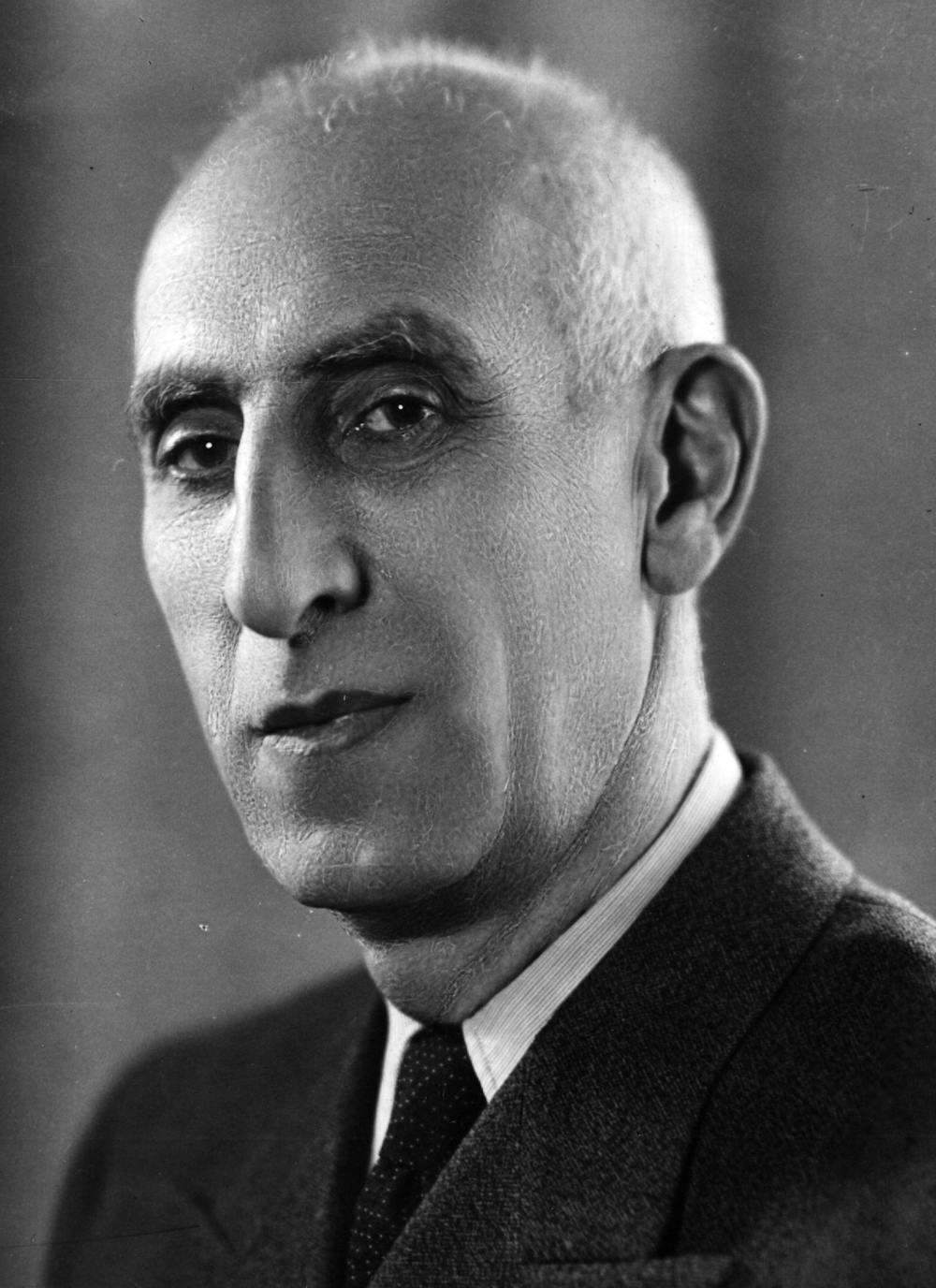
    With the U.S. bombing of three nuclear sites in Iran, relations between the two countries have arguably reached one of the lowest points in modern times. But the bad blood between the two countries isn’t new: The U.S. and Iran have been in conflict for decades – at least since the U.S. helped overthrow a democracy-minded prime minister, Mohammed Mossadegh, in August 1953. The U.S. then supported the long, repressive reign of the Shah of Iran, whose security services brutalized Iranian citizens for decades.

    The two countries have been particularly hostile to each other since Iranian students took over the U.S. Embassy in Tehran in November 1979, resulting in economic sanctions and the severing of formal diplomatic relations between the nations.

    Since 1984, the U.S. State Department has listed Iran as a “state sponsor of terrorism,” alleging the Iranian government provides terrorists with training, money and weapons.

    Some of the major events in U.S.-Iran relations highlight the differences between the nations’ views, but others arguably presented real opportunities for reconciliation.

    1953: US overthrows Mossadegh

    Mohammed Mossadegh.
    Wikimedia Commons

    In 1951, the Iranian Parliament chose a new prime minister, Mossadegh, who then led lawmakers to vote in favor of taking over the Anglo-Iranian Oil Company, expelling the company’s British owners and saying they wanted to turn oil profits into investments in the Iranian people. The U.S. feared disruption in the global oil supply and worried about Iran falling prey to Soviet influence. The British feared the loss of cheap Iranian oil.

    President Dwight Eisenhower decided it was best for the U.S. and the U.K. to get rid of Mossadegh. Operation Ajax, a joint CIA-British operation, convinced the Shah of Iran, the country’s monarch, to dismiss Mossadegh and drive him from office by force. Mossadegh was replaced by a much more Western-friendly prime minister, handpicked by the CIA.

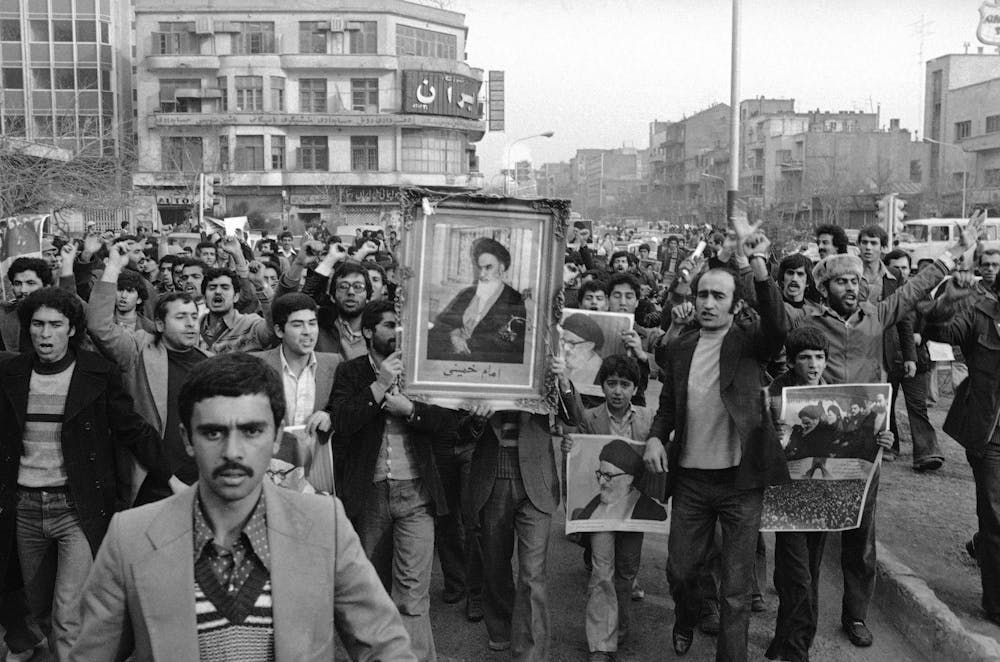
    Demonstrators in Tehran demand the establishment of an Islamic republic.
    AP Photo/Saris

    1979: Revolutionaries oust the shah, take hostages

    After more than 25 years of relative stability in U.S.-Iran relations, the Iranian public had grown unhappy with the social and economic conditions that developed under the dictatorial rule of Shah Mohammad Reza Pahlavi.

    Pahlavi enriched himself and used American aid to fund the military while many Iranians lived in poverty. Dissent was often violently quashed by SAVAK, the shah’s security service. In January 1979, the shah left Iran, ostensibly to seek cancer treatment. Two weeks later, Ayatollah Ruhollah Khomeini returned from exile in Iraq and led a drive to abolish the monarchy and proclaim an Islamic government.

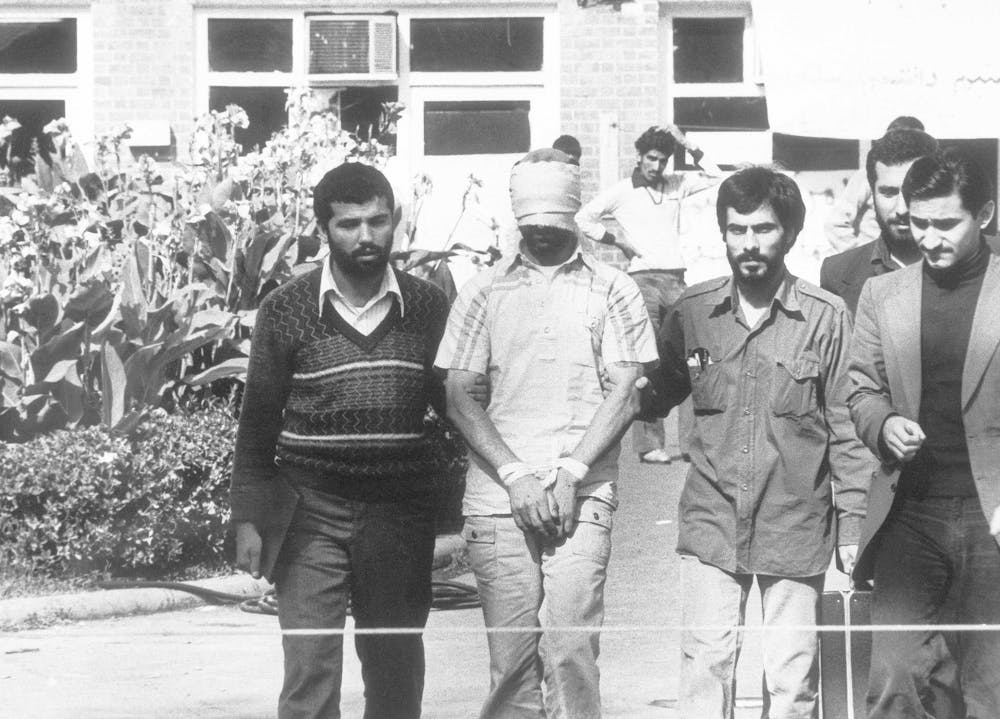
    Iranian students at the U.S. Embassy in Tehran show a blindfolded American hostage to the crowd in November 1979.
    AP Photo

    In October 1979, President Jimmy Carter agreed to allow the shah to come to the U.S. to seek advanced medical treatment. Outraged Iranian students stormed the U.S. Embassy in Tehran on Nov. 4, taking 52 Americans hostage. That convinced Carter to sever U.S. diplomatic relations with Iran on April 7, 1980.

    Two weeks later, the U.S. military launched a mission to rescue the hostages, but it failed, with aircraft crashes killing eight U.S. servicemembers.

    The shah died in Egypt in July 1980, but the hostages weren’t released until Jan. 20, 1981, after 444 days of captivity.

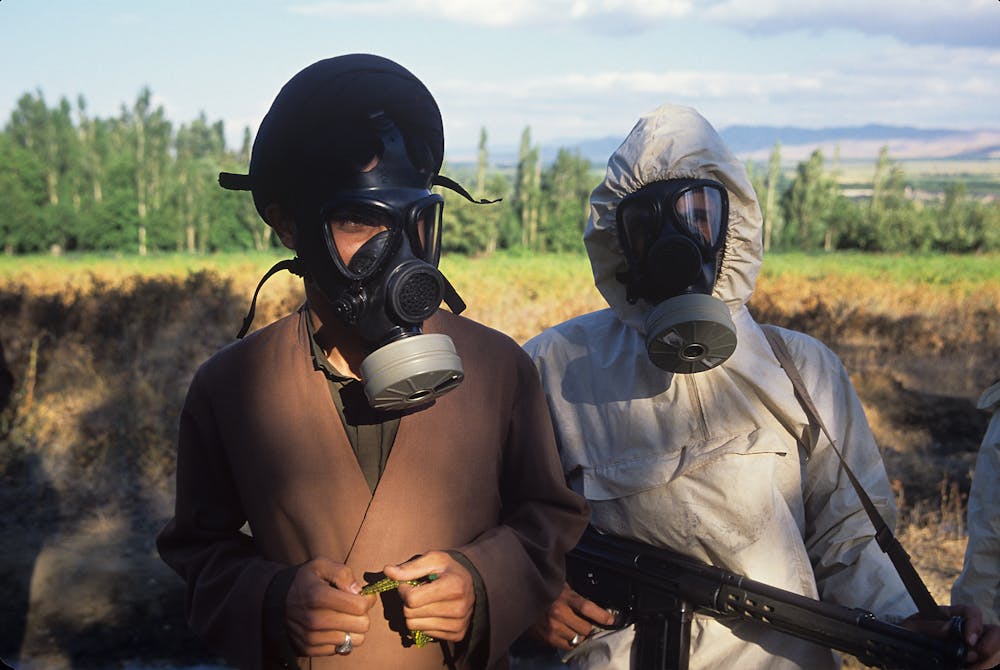
    An Iranian cleric, left, and an Iranian soldier wear gas masks to protect themselves against Iraqi chemical-weapons attacks in May 1988.
    Kaveh Kazemi/Getty Images

    1980-1988: US tacitly sides with Iraq

    In September 1980, Iraq invaded Iran, an escalation of the two countries’ regional rivalry and religious differences: Iraq was governed by Sunni Muslims but had a Shia Muslim majority population; Iran was led and populated mostly by Shiites.

    The U.S. was concerned that the conflict would limit the flow of Middle Eastern oil and wanted to ensure the conflict didn’t affect its close ally, Saudi Arabia.

    The U.S. supported Iraqi leader Saddam Hussein in his fight against the anti-American Iranian regime. As a result, the U.S. mostly turned a blind eye toward Iraq’s use of chemical weapons against Iran.

    U.S. officials moderated their usual opposition to those illegal and inhumane weapons because the U.S. State Department did not “wish to play into Iran’s hands by fueling its propaganda against Iraq.” In 1988, the war ended in a stalemate. More than 500,000 military and 100,000 civilians died.

    1981-1986: US secretly sells weapons to Iran

    The U.S. imposed an arms embargo after Iran was designated a state sponsor of terrorism in 1984. That left the Iranian military, in the middle of its war with Iraq, desperate for weapons and aircraft and vehicle parts to keep fighting.

    The Reagan administration decided that the embargo would likely push Iran to seek support from the Soviet Union, the U.S.’s Cold War rival. Rather than formally end the embargo, U.S. officials agreed to secretly sell weapons to Iran starting in 1981.

    The last shipment, of anti-tank missiles, was in October 1986. In November 1986, a Lebanese magazine exposed the deal. That revelation sparked the Iran-Contra scandal in the U.S., with Reagan’s officials found to have collected money from Iran for the weapons and illegally sent those funds to anti-socialist rebels – the Contras – in Nicaragua.

    At a mass funeral for 76 of the 290 people killed in the shootdown of Iran Air 655, mourners hold up a sign depicting the incident.
    AP Photo/CP/Mohammad Sayyad

    1988: US Navy shoots down Iran Air flight 655

    On the morning of July 8, 1988, the USS Vincennes, a guided missile cruiser patrolling in the international waters of the Persian Gulf, entered Iranian territorial waters while in a skirmish with Iranian gunboats.

    Either during or just after that exchange of gunfire, the Vincennes crew mistook a passing civilian Airbus passenger jet for an Iranian F-14 fighter. They shot it down, killing all 290 people aboard.

    The U.S. called it a “tragic and regrettable accident,” but Iran believed the plane’s downing was intentional. In 1996, the U.S. agreed to pay US$131.8 million in compensation to Iran.

    1997-1998: The US seeks contact

    In August 1997, a moderate reformer, Mohammad Khatami, won Iran’s presidential election.

    U.S. President Bill Clinton sensed an opportunity. He sent a message to Tehran through the Swiss ambassador there, proposing direct government-to-government talks.

    Shortly thereafter, in early January 1998, Khatami gave an interview to CNN in which he expressed “respect for the great American people,” denounced terrorism and recommended an “exchange of professors, writers, scholars, artists, journalists and tourists” between the United States and Iran.

    However, Supreme Leader Ayatollah Ali Khamenei didn’t agree, so not much came of the mutual overtures as Clinton’s time in office came to an end.

    In his 2002 State of the Union address, President George W. Bush characterized Iran, Iraq and North Korea as constituting an “Axis of Evil” supporting terrorism and pursuing weapons of mass destruction, straining relations even further.

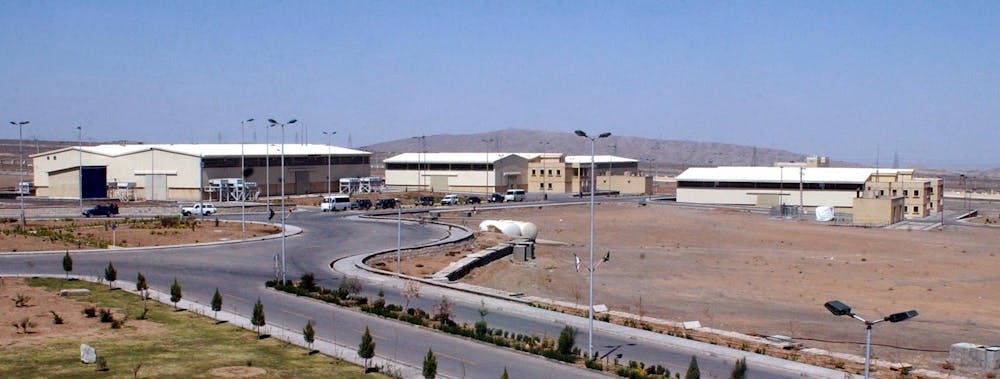
    Inside these buildings at the Natanz nuclear facility in Iran, technicians enrich uranium.
    AP Photo/Vahid Salemi

    2002: Iran’s nuclear program raises alarm

    In August 2002, an exiled rebel group announced that Iran had been secretly working on nuclear weapons at two installations that had not previously been publicly revealed.

    That was a violation of the terms of the Nuclear Nonproliferation Treaty, which Iran had signed, requiring countries to disclose their nuclear-related facilities to international inspectors.

    One of those formerly secret locations, Natanz, housed centrifuges for enriching uranium, which could be used in civilian nuclear reactors or enriched further for weapons.

    Starting in roughly 2005, U.S. and Israeli government cyberattackers together reportedly targeted the Natanz centrifuges with a custom-made piece of malicious software that became known as Stuxnet.

    That effort, which slowed down Iran’s nuclear program was one of many U.S. and international attempts – mostly unsuccessful – to curtail Iran’s progress toward building a nuclear bomb.

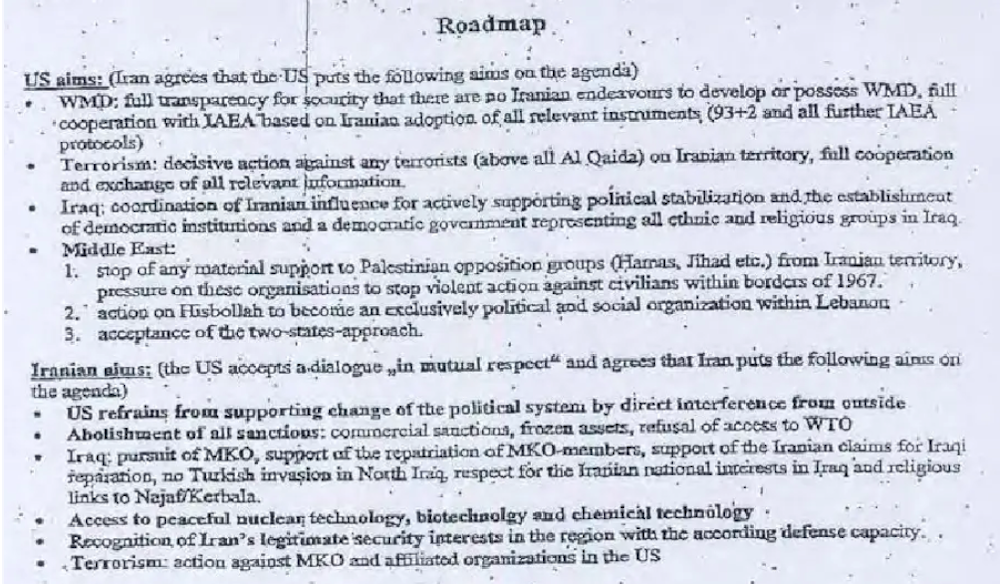
    2003: Iran writes to Bush administration

    An excerpt of the document sent from Iran, via the Swiss government, to the U.S. State Department in 2003, appears to seek talks between the U.S. and Iran.
    Washington Post via Scribd

    In May 2003, senior Iranian officials quietly contacted the State Department through the Swiss embassy in Iran, seeking “a dialogue ‘in mutual respect,’” addressing four big issues: nuclear weapons, terrorism, Palestinian resistance and stability in Iraq.

    Hardliners in the Bush administration weren’t interested in any major reconciliation, though Secretary of State Colin Powell favored dialogue and other officials had met with Iran about al-Qaida.

    When Iranian hardliner Mahmoud Ahmadinejad was elected president of Iran in 2005, the opportunity died. The following year, Ahmadinejad made his own overture to Washington in an 18-page letter to President Bush. The letter was widely dismissed; a senior State Department official told me in profane terms that it amounted to nothing.

    Representatives of several nations met in Vienna in July 2015 to finalize the Iran nuclear deal.
    Austrian Federal Ministry for Europe, Integration and Foreign Affairs/Flickr

    2015: Iran nuclear deal signed

    After a decade of unsuccessful attempts to rein in Iran’s nuclear ambitions, the Obama administration undertook a direct diplomatic approach beginning in 2013.

    Two years of secret, direct negotiations initially bilaterally between the U.S. and Iran and later with other nuclear powers culminated in the Joint Comprehensive Plan of Action, often called the Iran nuclear deal.

    Two years of secret, direct negotiations conducted bilaterally at first between the U.S. and Iran and later with other nuclear powers culminated in the Joint Comprehensive Plan of Action, often called the Iran nuclear deal.

    Iran, the U.S., China, France, Germany, Russia and the United Kingdom signed the deal in 2015. It severely limited Iran’s capacity to enrich uranium and mandated that international inspectors monitor and enforce Iran’s compliance with the agreement.

    In return, Iran was granted relief from international and U.S. economic sanctions. Though the inspectors regularly certified that Iran was abiding by the agreement’s terms, President Donald Trump withdrew from the agreement in May 2018.

    2020: US drones kill Iranian Maj. Gen. Qassem Soleimani

    An official photo from the Iranian government shows Maj. Gen. Qassem Soleimani, who was killed in a Jan. 3 drone strike ordered by President Donald Trump.
    Iranian Supreme Leader Press Office/Anadolu Agency via Getty Images

    On Jan. 3, 2020, an American drone fired a missile that killed Maj. Gen. Qassem Soleimani, the leader of Iran’s elite Quds Force. Analysts considered Soleimani the second most powerful man in Iran, after Supreme Leader Ayatollah Khamenei.

    At the time, the Trump administration asserted that Soleimani was directing an imminent attack against U.S. assets in the region, but officials have not provided clear evidence to support that claim.

    Iran responded by launching ballistic missiles that hit two American bases in Iraq.

    2023: The Oct. 7 attacks on Israel

    Hamas’ brazen attack on Israel on Oct. 7, 2023, provoked a fearsome militarized response from Israel that continues today and served to severely weaken Iran’s proxies in the region, especially Hamas – the perpetrator of the attacks – and Hezbollah in Lebanon.

    2025: Trump 2.0 and Iran

    Trump saw an opportunity to forge a new nuclear deal with Iran and to pursue other business deals with Tehran. Once inaugurated for his second term, Trump appointed Steve Witkoff, a real estate investor who is the president’s friend, to serve as special envoy for the Middle East and to lead negotiations.

    Negotiations for a nuclear deal between Washington and Tehran began in April, but the countries did not reach a deal. They were planning a new round of talks when Israel struck Iran with a series of airstrikes on June 13, forcing the White House to reconsider is position.

    On June 22, in the early morning hours, the U.S. chose to act decisively in an attempt to cripple Iran’s nuclear capacity, bombing three nuclear sites and causing what Pentagon officials called “severe damage.” Iran vowed to retaliate.

    This story has been updated to reflect the U.S. bombing of Iranian nuclear sites on June 22, 2025.

    Jeffrey Fields receives funding from the Carnegie Corporation of New York and Schmidt Futures.

    ref. US and Iran have a long, complicated history, spanning decades before US strikes on nuclear sites – https://theconversation.com/us-and-iran-have-a-long-complicated-history-spanning-decades-before-us-strikes-on-nuclear-sites-259240

    MIL OSI – Global Reports

  • MIL-OSI USA: Luján Statement on U.S. Airstrikes on Iran

    US Senate News:

    Source: United States Senator Ben Ray Luján (D-New Mexico)

    Santa Fe, N.M. – U.S. Senator Ben Ray Luján (D-N.M.) issued the following statement following U.S. airstrikes on Iranian nuclear facilities:

    “Americans have made it clear they do not want to be dragged into another endless war in the Middle East. Yet President Trump went against the American people without sharing any evidence to prove these military strikes would protect our homeland security.

    “This unauthorized and unilateral action puts American troops at risk and threatens to further destabilize the region.

    “President Trump must work to deescalate rising tensions in the Middle East and to protect the American people.” 

    MIL OSI USA News

  • MIL-OSI USA: Luján Statement on U.S. Airstrikes on Iran

    US Senate News:

    Source: United States Senator Ben Ray Luján (D-New Mexico)

    Santa Fe, N.M. – U.S. Senator Ben Ray Luján (D-N.M.) issued the following statement following U.S. airstrikes on Iranian nuclear facilities:

    “Americans have made it clear they do not want to be dragged into another endless war in the Middle East. Yet President Trump went against the American people without sharing any evidence to prove these military strikes would protect our homeland security.

    “This unauthorized and unilateral action puts American troops at risk and threatens to further destabilize the region.

    “President Trump must work to deescalate rising tensions in the Middle East and to protect the American people.” 

    MIL OSI USA News

  • MIL-OSI Russia: /China in Focus/ The Labubu Hype or China’s Rise as a Global Intellectual Property Power

    Translation. Region: Russian Federal

    Source: People’s Republic of China in Russian – People’s Republic of China in Russian –

    Source: People’s Republic of China – State Council News

    HANGZHOU, June 22 (Xinhua) — A pajama factory in east China’s Jiangsu Province was idle for a while but was brought back to life by one plush toy.

    “I didn’t like Labubu at first, but now I find it charming,” said Qiu Zunjun, general manager of Suzhou-based Shuofeng, a consumer goods company, with a smile.

    Labubu took the world by storm with its signature mischievous smile and sharp teeth. Noticing the excitement, Qiu Zunjun saw a gap in the market – clothes for collectors to dress up their plush friends. He bought samples of the toys and fabric, and by the end of May, the factory was churning out clothes for the little rascal.

    “In less than 20 days, we produced more than 80 types of doll clothes, earning about 170,000 yuan (approximately $23,643).” Qiu Zunjun estimates that monthly revenue could reach 1 million yuan if orders continue to increase.

    Cool, cute, with bunny ears, this character from China has inspired people around the world to line up for a chance to own it. It is the latest example of the globalization of Chinese intellectual property (IP), marking China’s transition from being a manufacturing hub to a source of original cultural exports that are breathing life into traditional industries.

    CHINESE IS CONQUERING THE WORLD

    Maraid Vintena of Sydney, Australia, queued for an hour at a Pop Mart Labubu machine in her local area this week. “There are four Pop Mart machines near my house,” she said. “But most of the time they’re empty. I check the site about 10 times a day… I feel like I’m addicted, but it’s fun.”

    “As you get older, life becomes a little mundane. A little joy like Labubu or a blind box is like a breath of fresh air,” Vintena explained her love for the doll.

    Amid growing excitement, clothing brand Uniqlo has announced a collaboration with Pop Mart to release a new collection, The Monsters.

    It is not the only IP from China to gain global recognition. From last year’s hit video game “Black Myth: Wukong,” which attracted 1.04 million concurrent players within an hour of its release, to the blockbuster “Nezha 2,” which has risen to fifth place in the history of the global box office, the success of Chinese IP demonstrates the growing cultural confidence and strength of the country’s industrial system, said Wang Ruotong, a researcher at Tianjin Foreign Studies University.

    Beyond culture, a number of Chinese brands have also made it into the global top tier of IP, from artificial intelligence (AI) to electric vehicles and consumer electronics.

    China maintained its growth momentum in new energy vehicle exports, with pure electric vehicle exports set to exceed 2 million units for the first time in 2024, according to the General Administration of Customs.

    Chinese automaker BYD is building factories in Thailand and Mexico, integrating Chinese aesthetics into car design.

    In the field of AI, China has made comprehensive progress, forming a thriving industrial ecosystem. The country is home to more than 400 “little giants” – small and medium-sized enterprises leading niche segments of the AI market, including innovator DeepSeek.

    The dynamic growth of China’s creative IP is driven by China’s booming domestic cultural consumption and strong industrial manufacturing base. As China moves from mass production to high-tech, intelligent manufacturing, the synthesis of aesthetics and craftsmanship is helping propel the country’s manufacturing industry up the global value chain.

    According to the National Bureau of Statistics of the People’s Republic of China (NBS), the average per capita expenditure on education, culture and entertainment in China was 3,189 yuan in 2024, up 9.8 percent year on year and accounting for 11.3 percent of total per capita consumption expenditure. The ever-expanding cultural services consumption market is becoming a powerful driver for the development of China’s intellectual property industry.

    REVIVAL OF TRADITIONAL INDUSTRIES

    At a market in Yiwu, east China’s Zhejiang Province, shoppers with black bags wander from stall to stall asking, “Are there any clothes for Labubu?” The global buzz around the doll has opened up business opportunities for China’s “global supermarket.”

    Zhu Hui’s shop not only sells shirts, pants, and skirts for Labubu, but also accessories like glasses and hats. “Our clothes are 7-15 yuan each, and accessories are 1-2 yuan,” she said.

    Zhu Hui’s shop opened just half a month ago, but the number of orders is growing rapidly. “At first, we received orders for tens or hundreds of pieces a day, but now we have more than 10,000 pieces.” Her factory has about 50 workers, all of whom have recently had to work overtime.

    Inspired by Labubu, other toy manufacturers are also looking to make their products more appealing.

    Sun Lijuan is the manager of Yiwu Hongsheng Toy Factory, which exports dolls to more than 80 countries and regions in South America, the Middle East, Central Asia, Europe and Africa.

    “Our dolls can talk, sing and tell stories,” she said. They are now implementing AI technologies to create products that meet different consumer needs.

    According to Sun Lijuan, in recent years they have seen the development of new technologies, which have strengthened their business and helped them avoid homogeneous competition. Their factory is 13 years old, but its turnover has been growing steadily in recent years.

    “The main potential of the globalization of IP in the future lies in the continuous development of content and its deep integration with technology,” said Wang Ruotong. “With the maturation of technologies such as AI and virtual reality, IP display will move toward immersive and interactive experiences.”

    “China has a strong manufacturing base,” she continued. “So the current popularity of Labubu has opened up a huge opportunity for the industry. I’m sure there will be many more Labubu in the future.” -0-

    MIL OSI Russia News

  • MIL-OSI Russia: How could nuclear technology revolutionise plastic recycling?

    Translation. Region: Russian Federal

    Source: International Atomic Energy Agency –

    How could nuclear technology revolutionise plastic recycling?

    Today, plastic is used to make everything from water bottles and medical devices to building materials and clothing. The material is an integral part of our daily lives. However, only about 9 percent plastic, and 91 percent ends up in landfills and pollutes the seas, oceans, soil and even the air we breathe.

    Last year alone, the world was formed 400 million tons plastic waste. Many plastic items are not designed to be reused or recycled, and some can only be recycled once or twice. In addition, plastic does not decompose naturally. Instead, discarded plastic breaks down into tiny fragments called microplastics, which can be toxic to humans and the environment.

    One innovative solution to this problem is based on advances in nuclear science. The IAEA is using nuclear technology to understand and address plastic pollution and the crisis it is causing. Through the initiative “NUTEK plastics”, which was launched in 2021, the Agency helps countries study microplastics already in the marine environment and use nuclear techniques to improve recycling technologies, ultimately reducing the amount of plastic waste ending up in the ocean.

    In honor of World Environment Day, we interviewed Selina Horak, an IAEA expert on the use of radiation to recycle plastic.

    How can we use nuclear science to prevent the negative impacts of plastic waste on our oceans and our lives?

    Nuclear science offers the opportunity to find innovative solutions to the problem of plastic pollution throughout its entire life cycle. To tackle this problem, we need to understand its root causes. According to research, about 80 percent of plastic in the sea comes from land (the remaining 20 percent comes from ocean sources such as fishing nets, etc.), so measures taken on land are especially important.

    The IAEA applies cutting-edge technology in two ways: first, we use radiation to create bioplastics, a sustainable alternative to conventional oil-based plastics. In simple terms, we are working to develop new materials that are both biodegradable and easily recyclable. This approach can not only reduce dependence on fossil fuels, but also support a circular economy by turning organic waste into a valuable resource.

    Second, we use radiation technologies to create more durable, strong, and valuable products from plastic waste. For example, radiation technologies can improve the properties of concrete by partially replacing cement with recycled plastic. Nuclear methods can more effectively sort and separate polymers in mixed plastic waste streams. In addition, we are exploring the use of pyrolysis to transform plastics under the influence of radiation into different types of plastic material, fuels, and other valuable chemical additives.

    Will new products made from irradiated plastic be dangerous?

    Not at all — quite the opposite. Radiation is considered a form of “green chemistry” because it does not require toxic chemicals or extreme conditions like heat or pressure. When we use radiation to create new types of biopolymer-based plastics or recycle plastic waste, it is a safe, efficient, and environmentally friendly process.

    The radiation itself does not make the material radioactive. As with dental X-rays, the radiation passes through tissues but does not remain in the body. The same principle applies here: after processing, the materials do not become radioactive and are absolutely safe to use.

    You mentioned using nuclear technology to improve plastic recycling methods. Is this work already underway?

    Of the 52 countries collaborating with the IAEA on the NUTEC Plastics initiative to recycle plastics, nine have already opened their first plants – and are turning promising ideas into reality. These countries are rapidly advancing through the Technology Readiness Levels (TRLs) – an internationally recognised nine-step system that tracks the maturity of technologies from conceptual design to commercial deployment.

    We are already getting impressive, tangible results.

    Indonesia and the Philippines are developing wood-plastic composites for sustainable construction. In Malaysia, plastic waste is being turned into fuel. In Argentina, durable railroad ties made from recycled plastic are showing promise in early testing.

    These pilot projects are not just experiments, but proof of progress. We expect that some of these technologies will reach the final level of technological readiness and we will begin preparing for their full-scale implementation as early as next year.

    Why did you, as a scientist, decide to study this particular issue?

    I have always believed that science should be a catalyst for meaningful and lasting change. This belief has led me to focus on plastic recycling and finding alternatives to petroleum-based materials – areas where the environmental challenges we face today can be directly addressed through innovation.

    With over 30 years of experience working in the field of ionizing radiation, I have seen first-hand the untapped potential of ionizing radiation to transform waste into valuable resources. This work is more than just research: it is an effort to create a circular economy that will preserve ecosystems, reduce humanity’s carbon footprint, protect nature, and improve the sustainability of our planet – for future generations.

    Please note: This information is raw content directly from the source of the information. It is exactly what the source states and does not reflect the position of MIL-OSI or its clients.

    MIL OSI Russia News

  • MIL-OSI United Nations: IAEA and FAO Conduct First Atoms4Food Assessment Mission to Burkina Faso

    Source: International Atomic Energy Agency (IAEA)

    The joint IAEA and FAO Assessment Mission team examine new rice varieties during the first Atoms4Food Initiative Assessment Mission in Burkina Faso. (Photo: Victor Owino/IAEA)

    In a critical step toward addressing food insecurity in West Africa, the International Atomic Energy Agency (IAEA) and the Food and Agriculture Organization (FAO) of the United Nations have launched their first joint Atoms4Food Initiative Assessment Mission in Burkina Faso. 

    This mission aims to identify key gaps and opportunities for delivering targeted technical support to Burkina Faso for food and agriculture in a country where an estimated 3.5 million people—nearly 20% of the population—are facing food insecurity. By leveraging nuclear science and technology, Atoms4Food seeks to bolster agricultural resilience and agrifood systems in one of the region’s most vulnerable nations.

    The mission, conducted from 26 May to 1 June, assessed how nuclear and related technologies are being used in Burkina Faso to address challenges in enhancing crop production, improving soil quality and in animal production and health, as well as human nutrition.

    The Atoms4Food Initiative was launched jointly by IAEA and FAO in 2023 to help boost food security and tackle growing hunger around the world. Atoms4Food will support countries to use innovative nuclear techniques such as sterile insect technique and plant mutation breeding to enhance agricultural productivity, ensure food safety, improve nutrition and adapt agrifood systems to the challenges of climate change. Almost €9 million has been pledged by IAEA donor countries and private companies to the initiative so far.

    As part of the Atoms4Food initiative, Assessment Missions are used to evaluate the specific needs and priorities of participating countries and identify critical gaps and opportunities where nuclear science and technology can offer impactful solutions. Based on the findings, tailored and country-specific solutions will be offered.

    Burkina Faso is one of 29 countries who have so far requested to receive support under Atoms4Food, with more expected this year. Alongside Benin, Pakistan, Peru and Türkiye, Burkina Faso was among the first countries to request an Atoms4Food Assessment Mission in 2025.

    A large proportion of Burkina Faso’s population still live in poverty and inequality.  Food insecurity has been compounded by rapid population growth, gender inequality and low levels of educational attainment. In addition, currently, 50% of rice consumed in Burkina Faso is imported. The government aims to achieve food sovereignty by producing sufficient rice domestically to reduce reliance on imports.

    “Hunger and malnutrition are on the rise globally, and Burkina Faso is particularly vulnerable to this growing challenge,” said IAEA Director General Rafael Mariano Grossi. “This first Atoms4Food assessment mission marks a significant milestone in our collective efforts to harness the power of nuclear science to enhance food security. As the Atoms4Food Initiative expands worldwide, we are committed to delivering tangible, sustainable solutions to reduce hunger and malnutrition.”

    The mission was conducted by a team of ten international experts in the areas of crop production, soil and water management, animal production and health and human nutrition. During the mission, the team held high-level meetings with the Burkina Faso Ministries of Agriculture, Health and Environment and conducted site visits to laboratories including the animal health laboratory and crop breeding facility at the Institute of Environment and Agricultural Research, the crop genetics and nutrition laboratories at the University Joseph Ki-Zerbo, and the bull station of the Ministry of Agriculture in Loumbila.

    “The Government of Burkina Faso is striving to achieve food security and sovereignty, to supply the country’s population with sufficient, affordable, nutritious and safe food, while strengthening the sustainability of the agrifood systems value-chain,” said Dongxin Feng, Director of the Joint FAO/IAEA Centre for Nuclear Techniques in Food and Agriculture and head of the mission to Burkina Faso. “Though much needs to be done, our mission found strong dedication and commitment from the Government in developing climate-resilient strategies for crops, such as rice, potato, sorghum and mango, strengthening sustainable livestock production of cattle, small ruminants and local poultry, as well as reducing malnutrition among infants and children, while considering the linkages with food safety.”

    The Assessment Mission will deliver an integrated Assessment Report with concrete recommendations on areas for intervention under the Atoms4Food Initiative. This will help develop a National Action Plan in order to scale up the joint efforts made by the two organizations in the past decades, which will include expanding partnership and resource mobilization. “Our priority now is to deliver a concrete mission report with actionable recommendations that will support the development of the National Action Plan aimed at improving the country’s long term food security,” Feng added.

    MIL OSI United Nations News

  • MIL-OSI United Nations: Press Arrangements for IAEA Board of Governors Meeting 9-13 September 2024

    Source: International Atomic Energy Agency (IAEA)

    The IAEA Board of Governors will convene its regular September meeting at the Agency’s headquarters starting at 10:30 CEST on Monday, 9 September, in Board Room C, Building C, 4th floor, in the Vienna International Centre (VIC).

    Board discussions are expected to include, among others: nuclear and radiation safety; nuclear security; strengthening the Agency’s activities related to nuclear science, technology and applications; verification and monitoring in the Islamic Republic of Iran in light of United Nations Security Council resolution 2231 (2015); application of safeguards in the Democratic People’s Republic of Korea; implementation of the NPT safeguards agreement in the Syrian Arab Republic; NPT Safeguards Agreement with the Islamic Republic of Iran; nuclear safety, security and safeguards in Ukraine; transfer of the nuclear materials in the context of AUKUS and its safeguards in all aspects under the NPT; application of IAEA safeguards in the Middle East; and the restoration of sovereign equality of Member States in the IAEA.

    The Board of Governors meeting is closed to the press.

    Director General Rafael Mariano Grossi will open the meeting with an introductory statement which will be released to journalists after delivery and posted on the IAEA website. The IAEA will provide video footage here and will make photos available on Flickr

    Press Conference:

    Director General Grossi is expected to hold a press conference at 13:00 CEST on Monday, 9 September, in the Press Room of the M building.

    A live video stream of the press conference will be available. The IAEA will provide video footage here and will make photos available on Flickr

    Photo Opportunity:

    There will be a photo opportunity with the IAEA Director General and the Chair of the Board, Ambassador Holger Federico Martinsen of Argentina, before the start of the Board meeting, on 9 September at 10:30 CEST in Board Room C, in the C building in the VIC.

    Press Working Area:

    The Press Room on the M-Building’s ground floor will be available as a press working area starting from 9:00 CEST on 9 September.

    Accreditation:

    All journalists interested in covering the meeting in person must register with the Press Office by 16:00 CEST on Thursday, 5 September. Please email press@iaea.org.  We encourage those journalists who do not yet have permanent accreditation to request it at UNIS Vienna.

    Please plan your arrival to allow sufficient time to pass through the VIC security check.

    MIL OSI United Nations News

  • MIL-OSI United Nations: IAEA Scientific Forum “Atoms4Food” Highlights Role of Nuclear Science in Agriculture

    Source: International Atomic Energy Agency (IAEA)

    Scientists and experts from around the world will meet at the IAEA Scientific Forum this week to discuss how nuclear science and technology innovations under the framework of Atoms4Food can contribute to enhancing sustainable agrifood systems, improving food security and addressing climate challenges.

    IAEA Director General Rafael Mariano Grossi will open the forum on Tuesday alongside HE Musalia Mudavadi, Prime Cabinet Secretary of Kenya, Mr Abdulhamid Alkhalifa, President of the OPEC Fund, Mr Liu Jing, Vice Chairman, China Atomic Energy Authority, China, HE Mr Sidi Tiémoko Touré, Minister of Animal and Fisheries Resources, Cote d’Ivoire, HE Ms Leila Benali, Minister of Energy Transition and Sustainable Development, Kingdom of Morocco, HE Mr Fernando Mattos, Minister of Livestock, Uruguay, and Mr Giorgio Silli, Undersecretary of Foreign Affairs and International Cooperation, Italy. Director General Grossi will conclude the Forum on Wednesday alongside HE Mr Anxious Jongwe Masuka, Minister of Lands, Agriculture, Fisheries, Water and Rural Development from Zimbabwe, HE Mr Amadou Dicko, Deputy Minister, Ministry of Agriculture, Animal Resources and Fisheries, Burkina Faso and other distinguished representatives from Member States and International Organizations.

    The event under the title Atoms4Food – Better Agriculture for Better Life, takes place from Tuesday, 17 September, 9:30 CEST to Wednesday, 18 September 2024, 13:00 CEST in Board Room D on the 4th floor of the C-Building of the Vienna International Centre (VIC). Open to the media and streamed live, the event will showcase how nuclear science can drive agricultural advancements and support global efforts to combat food insecurity.

    The forum will feature three technical sessions, where international experts will explore the critical role of nuclear science and technology in advancing sustainable agriculture, food production and nutrition. Speakers will discuss innovations using nuclear and isotopic techniques in agriculture and food production, the interconnectedness of agricultural practices with environmental conservation and socioeconomic equity, and the importance of partnering with stakeholders to scale up results and ensure sustainability. More details about the Scientific Forum can be found on the IAEA website and social media (FacebookInstagramLinkedInXWeibo). Photos of the Forum will also be available on Flickr.

    The detailed programme and full list of speakers can be found here. For those interested in interviewing speakers, please contact the IAEA Press Office, and we will assist with interview arrangements.

    Accreditation

    Journalists with permanent credentials to the VIC or journalists who have already obtained accreditation for the IAEA’s General Conference need no additional credentials. We encourage those journalists who do not yet have permanent accreditation to request it at UNIS Vienna.

    Others should contact the IAEA Press Office for accreditation.

    MIL OSI United Nations News

  • World leaders react to US attack on Iran

    Source: Government of India

    Source: Government of India (4)

    The reaction of world leaders after U.S. forces struck three Iranian nuclear sites on Sunday Iran time ranged from Israel lauding President Donald Trump’s decision to the U.N. calling for de-escalation and Iran and some other nations condemning the attacks.

    ISRAEL PRIME MINISTER BENJAMIN NETANYAHU, RECORDED STATEMENT:

    “Congratulations, President Trump. Your bold decision to target Iran’s nuclear facilities with the awesome and righteous might of the United States will change history… History will record that President Trump acted to deny the world’s most dangerous regime the world’s most dangerous weapons.”

    IRAN FOREIGN MINISTER ABBAS ARAQCHI, ON X:

    “The United States, a permanent member of the United Nations Security Council, has committed a grave violation of the UN Charter, international law and the NPT by attacking Iran’s peaceful nuclear installations. The events this morning are outrageous and will have everlasting consequences. Each and every member of the UN must be alarmed over this extremely dangerous, lawless and criminal behavior. In accordance with the UN Charter and its provisions allowing a legitimate response in self-defense, Iran reserves all options to defend its sovereignty, interest, and people.”

    U.N. SECRETARY-GENERAL ANTONIO GUTERRES, STATEMENT

    “I am gravely alarmed by the use of force by the United States against Iran today. This is a dangerous escalation in a region already on the edge – and a direct threat to international peace and security. There is a growing risk that this conflict could rapidly get out of control – with catastrophic consequences for civilians, the region, and the world. I call on Member States to de-escalate and to uphold their obligations under the UN Charter and other rules of international law. At this perilous hour, it is critical to avoid a spiral of chaos. There is no military solution. The only path forward is diplomacy. The only hope is peace.”

    NEW ZEALAND FOREIGN MINISTER WINSTON PETERS, STATEMENT:

    “We acknowledge developments in the last 24 hours, including President Trump’s announcement of US strikes on nuclear facilities in Iran. Ongoing military action in the Middle East is extremely worrying, and it is critical further escalation is avoided. New Zealand strongly supports efforts towards diplomacy. We urge all parties to return to talks. Diplomacy will deliver a more enduring resolution than further military action.”

    AUSTRALIA GOVERNMENT SPOKESPERSON, STATEMENT:

    “We have been clear that Iran’s nuclear and ballistic missile program has been a threat to international peace and security. We note the US President’s statement that now is the time for peace. The security situation in the region is highly volatile. We continue to call for de-escalation, dialogue and diplomacy.”

    MEXICO FOREIGN MINISTRY, ON X:

    “The ministry urgently calls for diplomatic dialogue for peace between the parties involved in the Middle East conflict. In keeping with our constitutional principles of foreign policy and our country’s pacifist conviction, we reiterate our call to de-escalate tensions in the region. The restoration of peaceful coexistence among the states of the region is the highest priority.”

    VENEZUELA FOREIGN MINISTER YVAN GIL, ON TELEGRAM:

    “Venezuela Condemns U.S. Military Aggression Against Iran and Demands an Immediate Cessation of Hostilities. The Bolivarian Republic of Venezuela firmly and categorically condemns the bombing carried out by the United States military, at the request of the State of Israel, against nuclear facilities in the Islamic Republic of Iran, including the Fordow, Natanz, and Isfahan complexes.”

    CUBA PRESIDENT MIGUEL DIAZ-CANEL, ON X:

    “We strongly condemn the US bombing of Iran’s nuclear facilities, which constitutes a dangerous escalation of the conflict in the Middle East. The aggression seriously violates the UN Charter and international law and plunges humanity into a crisis with irreversible consequences.”

    (Reuters)


  • MIL-OSI United Nations: Nuclear Techniques Make Waves at UN Ocean Conference

    Source: International Atomic Energy Agency (IAEA)

    IAEA Director General Rafael Grossi during the high-level event on combatting marine pollution at the United Nations Conference in Nice, France  (Photo: E. McDonald/IAEA)

    The IAEA highlighted the role of nuclear science in protecting our oceans at the 2025 United Nations Ocean Conference held last week in Nice, France.

    Co-hosted by France and Costa Rica, the conference convened over 10,000 participants, including scientists, diplomats and politicians, to address the triple planetary crisis of climate change, biodiversity loss and pollution. It aimed to accelerate progress towards SDG14, Life Below Water, through innovative technologies and action. The IAEA took center stage at the event to share how nuclear technology is boosting ocean health and tackling critical threats such as marine plastic pollution.

    The IAEA organized and participated in more than a dozen events at the conference, and on research vessels in the Port of Nice. Experts from the IAEA’s Marine Environment Laboratories in Monaco highlighted how isotopic tools can help monitor and reduce plastic pollution in the ocean.

    Plastic waste is not only infiltrating our oceans, but also the human body in the form of microplastics. Without urgent action, the amount of plastic entering the ocean each year could reach 37 million metric tons by 2040, according to UN estimates, becoming a threat to marine and human life.

    Plastic pollution featured prominently throughout the conference, with a focus on the ongoing negotiations for the development of an internationally legally binding instrument to end plastic pollution, including in the marine environment. The negotiations for the United Nations Environment Programme (UNEP)-led treaty are expected to conclude later this year in Geneva, following five previous sessions.

    At the conference, IAEA Director General Rafael Grossi spoke about the IAEA’s work to combat plastic pollution and emphasized the need to share data data between scientists, policymakers and environmental agencies.

    “Four years ago, at the last UN Ocean Conference, I announced NUTEC Plastics, an initiative that gives countries the tools they need to address the issue of marine microplastic pollution. Today, I am delighted to report that we have made significant progress with 99 countries involved, and we have been equipping more than 100 Member State laboratories all over the world. We are building the capacity that countries need to translate data into policies and action.” 

    NUTEC Plastics is an IAEA flagship initiative that supports countries in researching microplastics and using nuclear techniques to improve recycling techniques.

    Director of the IAEA Marine Environment Laboratories Florence Descroix-Comanducci (left), highlighted IAEA’s work to support sustainable ocean management and monitor marine microplastic pollution at the 2025 UN Ocean Conference in France (Photo: E.McDonald/IAEA)

    “Nuclear and isotopic techniques add incredible value to boost ocean health,” said Florence Descroix-Comanducci, Director of the IAEA Marine Environment Laboratories. “Our laboratories in Monaco support Member States in the implementation and use of these techniques, and to develop harmonized methods to generate globally comparable data, especially in light of the forthcoming plastics treaty.”

    At events organized by the IAEA, panelists highlighted the need to address the top of the plastic life cycle to prevent further pollution, employing a “source to sea approach” to reduce marine litter and, by extension, marine plastic pollution. “While many indicators on oceans are moving in the wrong direction, there are also positive points. Our metrics on marine litter are moving in the right direction,” said Martin Adams, Head of the Environment Department at the European Environment Agency. “Timely and relevant data are essential to inform good decision-making, but we don’t need to know everything. We just need to know enough to act.” Other events organized by the IAEA focused on ocean-based carbon dioxide removal, ocean acidification, IAEA support for Small Island Developing States (SIDS), and nuclear energy and ocean health.

    The IAEA’s unique expertise in nuclear applications is contributing to both mitigations, by using radiation technology for waste recycling, and monitoring, by using isotopic techniques to monitor and assess impacts of microplastic pollution. Through the NUTEC Plastics initiative, and with the support of the IAEA’s technical cooperation programme, 99 countries are participating in marine monitoring of microplastics, and 52 around the world are developing innovative recycling technology.

    The International High Level Forum on NUTEC Plastic, organized by the IAEA on 25–26 November 2025, in Manila, Philippines, will highlight the progress achieved to date, address current challenges, and chart course to strengthen regional and international cooperation in the sustainable management of plastic waste through innovative nuclear technologies.

    MIL OSI United Nations News

  • MIL-OSI United Nations: Press Arrangements for IAEA Board of Governors Meeting, 20-22 November 2024 

    Source: International Atomic Energy Agency (IAEA)

    The IAEA Board of Governors will convene its regular November meeting at the Agency’s headquarters starting at 10:30 CET on Wednesday, 20 November, in Board Room C, Building C, 4th floor, in the Vienna International Centre (VIC). 

    Board discussions are expected to include, among others: applications for membership of the Agency; report of the Technical Assistance and Cooperation Committee; verification and monitoring in the Islamic Republic of Iran in light of United Nations Security Council resolution 2231 (2015); nuclear verification: the conclusion of safeguards agreements and of additional protocols (if any), staff of the Department of Safeguards to be used as Agency inspectors, application of safeguards in the Democratic People’s Republic of Korea, implementation of the NPT safeguards agreement in the Syrian Arab Republic, naval nuclear propulsion: Australia and naval nuclear propulsion: Brazil, and NPT safeguards agreement with the Islamic Republic of Iran; nuclear safety, security and safeguards in Ukraine; transfer of the nuclear materials in the context of AUKUS and its safeguards in all aspects under the NPT; and restoration of the Sovereign Equality of Member States in the IAEA. 

    The Board of Governors meeting is closed to the press. 

    Director General Rafael Mariano Grossi will open the meeting with an introductory statement, which will be released to journalists after delivery and posted on the IAEA website.  

    Press Conference 

    Director General Grossi is expected to hold a press conference at 13:00 CET on Wednesday, 20 November, in the Press Room of the M building. 

    A live video stream of the press conference will be available. The IAEA will provide video footage of the press conference and the Director General’s opening statement here and will make photos available on Flickr.  

    Photo Opportunity 

    There will be a photo opportunity with the IAEA Director General and the Chair of the Board, Ambassador Philbert Abaka Johnson of Ghana, before the start of the Board meeting, on 20 November at 10:30 CET in Board Room C, in the C building in the VIC. 

    Press Working Area 

    The Press Room on the M-Building’s ground floor will be available as a press working area, starting from 9:00 CET on 20 November. 

    Accreditation

    All journalists interested in covering the meeting in person – including those with permanent accreditation – are requested to inform the IAEA Press Office of their plans. Journalists without permanent accreditation must send copies of their passport and press ID to the IAEA Press Office by 14:00 CET on Tuesday, 19 November. 

    We encourage those journalists who do not yet have permanent accreditation to request it at UNIS Vienna

    Please plan your arrival to allow sufficient time to pass through the VIC security check. 

    MIL OSI United Nations News

  • MIL-OSI United Nations: IAEA Director General’s Speech at the Nobel Peace Prize Forum

    Source: International Atomic Energy Agency (IAEA)

    Nobel’s spotlight on our perilous path and how we change course

    I want to start by congratulating Nihon Hidankyō and the hibakusha for their Nobel Peace Prize.

    As a young diplomat almost 40 years ago, I was fortunate to be part of a UN disarmament fellowship programme and to visit Hiroshima. There, fellows had an opportunity to meet the hibakusha and I had a conversation with an ailing victim. I have carried to every meeting, to every negotiation, and to every posting, the memory this woman’s silent testimony. When I asked her about that morning in 1945, she struggled to express the horror in words. She tried to articulate some words but stayed silent. Looking at me, right into my eyes. The look in her eyes has stayed with me ever since, like a powerful reminder, a secret mandate, to work so that her suffering is never repeated.

    For decades after the Second World War, the international community has been dealing with this unique dilemma: we built robust norms and passed nonproliferation and disarmament treaties. Instead of dozens of countries armed with nuclear weapons, as was the concern in the 1960s, there are less than ten. Stockpiles of nuclear weapons have shrunk from tens of thousands to thousands.

    But on its journey through the perils of the atomic age, the world has come to a crucial crossroads. Our deep psychological connection caused by collectively seeing the horror of the consequences of nuclear war seems to be evaporating, taking with it our joint resolve to do everything possible to prevent a repetition.

    Like a giant spotlight, this year’s Nobel Peace Prize has lit up our path ahead. It has done it, by reminding us of the past, and of the consequences of ignoring the perils of nuclear weapons use.

    Context of conflicts

    To understand the important challenges we face, we must look at the global context, at what is happening around the world.  

    War has returned to Europe, and it directly involves a nuclear weapon state. The conflict in Ukraine is also an indirect confrontation between the world’s biggest nuclear weapon states, the first since the end of the Cold War. But nuclear exercises and open references to the use of nuclear weapons in the theatre of this war are increasing the risks and can not be ignored.

    In the Middle East, the conflict of the past year has ignited smoldering tensions between Israel and Iran and led to the unprecedented step of direct exchanges and attacks between the two. Here there is also a nuclear weapons dimension. On one side, the assumed presence of nuclear weapons looms in the background. On the other, the very real potential of nuclear proliferation is raising the stakes.

    We find ourselves in a harmful loop: the erosion of the restraints around nuclear weapons is making these conflicts more dangerous. Meanwhile, these conflicts are contributing to the erosion of the restraints. The vicious circle dynamic is in motion.

    An unfortunate change of direction

    Doctrines regarding the use of nuclear weapons are being revised or reinterpreted. The quantity and quality of nuclear weapon stockpiles are being increased. 

    And in some non-nuclear weapon states – states that are important in their region – leaders are asking “why not us?”. And they are asking this openly!

    At the start of the nuclear arms race, J Robert Oppenheimer described the USSR and the US as “two scorpions in a bottle” each capable of killing the other, but only by risking their own life.

    Oppenheimer’s blunt statement would later be developed and elaborated under the roof of deterrence and the more sophisticated concept of “Mutual Assured Destruction,” or MAD.

    Today, independent of the vantage point of the observer, there is widespread concern that the risk of mutual destruction through nuclear war is higher than it has been for more than a generation.

    Lessons from history

    But it does not have to be this way. We can do better. History has shown that effective dialogue among superpowers has, more often than not, led to confidence and, as a result, also to arms limitation and even disarmament. At certain moments in history, world leaders took the right decisions, to tone down, or, to use today’s parlance, to de-escalate. Let’s see:

    The end of the Cuban Missile Crisis happened thanks to the direct engagement of Soviet leader Nikita Khrushchev and US President John F Kennedy. Decades later, at the Geneva Summit of 1985, Mikhail Gorbachev and President Ronald Reagan agreed a crucial axiom: “Nuclear war cannot be won and should never be fought.” They met again the next year in Reykjavik and significant reductions in nuclear arsenals followed. Nuclear weapon reductions and the elimination of a whole category of weapon, through the Intermediate-Range Nuclear Forces, or INF, Treaty, were agreed. These steps towards rapprochement took leadership and courage. They often happened despite skepticism and voices against them.

    Diplomacy and dialogue (and the duty of nuclear weapon states)

    A return to diplomacy and dialogue is urgently needed, and this, not only in things nuclear. Shutting the other side out has never solved a problem and almost certainly aggravates it. Top leadership involvement is simply indispensable when nuclear weapons are involved. President Trump took the initiative and talked to Kim Jong Un. More of this is needed. Some have said these talks were ill prepared. I say, this is important. Nuclear weapon policy and limitations does not work bottom up. It is of course the other way around.

    We must be proactive in building the trust and protections that lower the risk of close calls and of brinkmanship, especially during today’s tensions. Not taking active steps means we rely on luck – or the assumption that the other side will show restraint – to save us from nuclear war. The longer you rely on luck, the more likely it is to run out.

    Conflict and tensions compel nations to arm themselves. Diplomacy and compromise create conditions in which they can disarm.

    The road to a nuclear weapon-free world is long and winding. The disarmament landscape is complex, and it’s worth acknowledging that. This does not diminish the responsibility nuclear weapons states have to make progress. After all, they committed themselves to this goal back in 1968, through the Non-Proliferation Treaty.

    Steps can be taken to decrease the reliance on nuclear weapons, both in their production and the scenarios for their use.

    Nuclear weapon states, through their actions at home and on the world stage, have a responsibility to avoid a scenario in which more countries seek nuclear weapons. Pushing ahead with increases in arsenals leads to despair, cynicism, and a growing skepticism about the value of past commitments. Disengagement and unilateralism fuel sentiments of vulnerability in other countries, and with that, the notion nuclear weapons could be the ultimate protection against outside threats.

    Engagement among the five permanent members of the Security Council is indispensable. Such engagement can take many different shapes, starting with direct contact among themselves, bilaterally or as a group. This dialogue, which still exists, has been reduced to a very low level, virtually without real impact. Perhaps its revival could be assisted by an international organization, or facilitated with the support of a respected, impartial leader. Therefore, it’s essential that the United Nations, other international organizations, and their leaders work effectively to ensure their continued relevance amid the changing needs of their stakeholders.

    Do not make things worse (by falling for the siren call of proliferation)

    The IAEA has played its indispensable technical role during past attempts of nuclear proliferation, particularly in the Middle East. As the difficult experiences in Iraq, Libya and Syria remind us, the draw of nuclear weapons is real and so is the geopolitical and military response.

    Today’s tensions are prompting even leaders of important counties that, so far, are in good standing with the NPT to ask: “Why shouldn’t we have a nuclear weapon too?”

    To this, I would say, “Do not make things worse.” Acquiring a nuclear weapon will not increase national security, it will do the opposite. Other countries will follow. And this will contribute to the unravelling of a nonproliferation regime that has had its ups and downs – and it still has its limitations – but none-the-less it has served humanity extraordinarily well. The problem and challenge to the NPT regime may come from those nuclear armed but also those who, while not having nuclear weapons, may feel the NPT has failed as a catalyst to disarmament.

    Weakening the non-proliferation treaty under the argument that progress on nuclear disarmament has been slow and more drastic approaches are required, would be totally misguided and may make us throw away existing international measures committing nuclear weapon states and non-nuclear weapon states in this field.

    I come from a non-nuclear weapon state. I understand the frustration that some people feel about the “haves” and “have-nots” of nuclear weapons. But I have also seen the legacy of peace and prosperity left by leaders who resisted that siren call. In the 1980s, vision, resolve and dialogue meant Brazil and Argentina changed course and did not go down the path to nuclear arms. Today, Latin America is a nuclear weapon free zone.

    Multilateral leaders: step up by stepping in

    Many wonder whether there’s still a role for multilateralism in guiding us through this maze of conflicting interests. Yes, there is. During difficult times in the past, international organizations have had a big impact on peace and security. But it only happens when leaders of these organizations get off the side lines and use their mandate and their own good offices effectively.

    We prove our relevance in extraordinary times.   

    Each organization has different tools, a different mandate, a different membership, and each of their leaders will determine how to act. I can speak for the IAEA.  We have nuclear science at our core, and we are the world’s nuclear weapons watchdog. Let me give you an example:

    For almost three years, Ukraine, the world and the IAEA have been confronted with a completely unprecedented situation – never before has a military conflict involved the seizure of a nuclear power plant and been fought among the facilities of a major nuclear power programme.

    At the beginning of the war, Ukraine’s biggest nuclear power plant – the biggest nuclear power plant in Europe, with nearly 6 gigawatts of installed capacity – was taken by Russia. This established a hotspot in the middle of a combat zone. The chance of an incident – or accident – causing terrible radiological consequences became real.

    Observing this from the outside was never, in my mind, an option. Staying on the sidelines and later reflecting on “lessons learned” may have been the more traditional – or expected – path for an international organization. But to me this would have been a dereliction of duty. So, we leaned into our core mission, crossed the front lines of war, and established a permanent presence of IAEA experts at all Ukraine’s nuclear power plants. That makes us the only international organization operating independently in occupied territory. We are informing the world of what’s going on and reducing the chance that a radiological incident enflames the conflict and causes even more devastation.

    We did the same by going to Kursk when a Russian nuclear reactor was at risk of coming into the line of fire. I am in constant communication with both sides.

    I have been meeting with President Zelenskyy, and President Putin regularly. Nuclear safety and security during this conflict must have the buy-in and continued involvement of both leaders. Talking to only one of them would not achieve this important goal. At the same time, I am keeping an open dialogue with leaders on all continents and briefing the UN Security Council. When it comes to nuclear safety in Ukraine it has been possible to build a level of agreement that is rare during the divisions of this conflict. Where there is agreement, there is hope for more agreement.

    Ukraine is not our only hotspot.

    In Iran, the IAEA’s job is to verify the exclusively peaceful nature of a growing nuclear programme. Iran has now enriched uranium to a level that is hard to justify. It has not yet answered the IAEA’s questions completely and it has made our work more difficult by taking away some of our cameras and blocking some of our most experienced safeguards inspectors from going into the country. This has caused concern and led to a pattern of mistrust and recriminations. In diplomacy, progress often requires prompting, catalyzing, and suggesting ways forward. This presents a role for an impartial, honest and effective broker. It is a role I, in my capacity as the IAEA’s Director General, have been playing. In fact, I returned from my latest visit to Tehran just a few weeks ago where I presented alternatives and ideas to reduce the growing tensions, and hopefully to retain Iran within the NPT and the non-proliferation norms.

    The danger of playing it safe

    When it comes to working on behalf of peace and security, playing it safe is dangerous.

    Silence and indifference can be deadly.

    Dag Hammerskjold, the second Secretary General of the United Nations, said: “It is when we all play safe that we create a world of utmost insecurity.”

    A new path

    This week, the Norwegian Nobel Committee looked beyond today’s conflicts. In its own way, it did not play it safe. Instead, it shined a light on the horrors of nuclear war and the people who have been warning us about them for many decades.

    In doing that, the Nobel Committee, Nihon Hidankyō and the hibakusha have illuminated the danger of the path we are now on.

    We have to make a new path.

    First, the leaders of the nuclear weapon states must recognize the need for a responsible management of their nuclear arsenals. Experiences from the past confirm that even at times of crisis and conflict it has been possible to recognize the unique terminal power of these weapons and the responsibility that comes with it. What Kennedy, Khrushchev, Reagan, Gorbachev, or Trump did by reaching out to a nuclear-armed adversary, sets a precedent, a useful one. Such contacts, either bilateral or at the P5 level could possibly be facilitated by a competent broker. These are the first steps to bringing down the tone so that nuclear sabre rattling recedes and the commitments to the unequivocal undertakings to move towards a nuclear free world can be fulfilled.

    Secondly, an iron-clad resolve to observe and strengthen the global non-proliferation regime needs to be adopted. Nuclear weapon and nuclear non-weapon states must work together to ensure the non-proliferation of nuclear weapons.

    Ladies and gentlemen,

    We need to walk through perilous times by recognizing limitations and keeping our eyes on our common objectives.

    Nuclear disarmament cannot be imposed on the nuclear armed.

    Realism is not defeatism. Diplomacy is not weakness.

    Difficult times call for enlightened leadership, at the national level, and at the international level as well.

    Putting the international system back on track is within our reach. World leaders, including those at the top of the multilateral system, have a duty and an irrevocable responsibility to work towards this.  

    Personally, I am convinced. Perhaps, because the secret mandate I received that day in Hiroshima from a hibakusha burns in me, stronger than ever. Thank you.

    MIL OSI United Nations News

  • MIL-OSI United Nations: IAEA Director General’s Introductory Statement to the Board of Governors

    Source: International Atomic Energy Agency (IAEA)

    (As prepared for delivery)

    As the armed conflict in Ukraine enters its fourth year, the nuclear safety and security situation throughout the country continues to be highly precarious. The presence of the IAEA at all Ukrainian nuclear facilities has been and continues to be an invaluable asset to the international community and must be preserved.

    The IAEA remains present at Ukraine’s nuclear power plant facilities. Difficult conditions have in the past month complicated and delayed one rotation of experts, which was safely completed in recent days. Back in December, a drone hit and severely damaged an IAEA official vehicle during a rotation. As I reported to you in the special Board meeting shortly afterward, staff survived this unacceptable attack unharmed, but the rear of the vehicle was destroyed. Other episodes followed, confirming the dangerous situation.

    Around Ukraine, the Khmelnitsky NPP, the Rivne NPP and the South Ukraine NPP, continue to operate amid serious challenges, including on the electricity infrastructure, a major risk to the reliable and stable supply of power crucial for the safe operation of NPPs. The electrical grid’s ability to provide a reliable off-site power supply to Ukrainian NPPs was further reduced by damage sustained following military attacks in November and December 2024, a mission of IAEA experts that visited and assessed seven critical electrical substations concluded late last year. Considering the seriousness of the situation, I visited the Kyivska electrical substation last month to observe the damage sustained first hand. On what was my 11th visit to Ukraine since the start of the war, I also met with President Volodymyr Zelenskyy, reiterating the IAEA’s commitment to supporting nuclear safety and security in Ukraine and our readiness to support the country’s plans to expand nuclear power at Khmelnytskyy NPP. Consultations with Moscow have also taken place and will continue, in the interest of nuclear safety and security at Zaporizhzhya Nuclear Power Plant.

    At Ukraine’s Zaporizhzhya Nuclear Power Plant (ZNPP), where the 6 reactor units are in cold shutdown, the status of the off-site power supply remains extremely vulnerable. For about one week ZNPP had to rely on a single off-site power line following the loss of its only remaining back-up line, confirming the extremely fragile situation. 

    Last month at the Chornobyl site a drone caused significant damage to the structure built to prevent any radioactive release from the reactor damaged in the 1986 accident and to protect it from external hazards. Although this attack did not result in any radioactive release, it nevertheless underlines the persistent risk to nuclear safety during this military conflict.

    Since the Board gathered for its last regular meeting in November 2024, the Agency has arranged 31 deliveries of nuclear safety, security and medical equipment and supplies to Ukraine, bringing the total so far to 108 deliveries valued at more than EUR 15.6 million. The Agency also has initiated the first phase of its support on safety and security of radioactive sources in Ukraine.

    We are grateful to all 30 donor states and the European Union for their extrabudgetary contributions, and I encourage those who can, to support the delivery of the comprehensive assistance programme, for which EUR 22 million are necessary.

    As reflected in my latest report to the Board on Nuclear Safety, Security and Safeguards in Ukraine, I would like to reiterate that all the IAEA’s activities in Ukraine are being conducted in line with relevant resolutions of the UN General Assembly and of the IAEA policy-making organs.

    Madame Chairperson,

    In February, I travelled to Fukushima to participate in collecting water samples off the coast of the Fukushima Daiichi Nuclear Power Station. I did this together with scientists from China, Korea and Switzerland as part of additional measures to promote transparency and build trust in the region during the ongoing release of ALPS-treated water from the plant. Additional measures focus on expanding international participation and transparency, allowing hands-on independent measurements of the concentration level of the water. This work is conducted within agreed parameters set by the IAEA in its role as an independent, impartial and technical organization.  IAEA officials and experts from laboratories from China, France, the Republic of Korea, and Switzerland also sampled ALPS -treated water – prior to dilution – from measurement/confirmation tanks on the premises at the site. The IAEA has maintained its independent monitoring and analysis efforts, confirming that tritium concentrations in the discharged batches remain far below operational limits.

    In December 2024, an IAEA Task Force concluded that the approach TEPCO, and the Government of Japan are taking continues to align with international safety standards.

    While in Japan, I also visited facilities where soil removed after the Fukushima Daiichi Nuclear Power Station accident is safely stored, managed, and recycled, an effort the IAEA has been supporting by working to ensure it meets international safety standards.

    You have before you the Nuclear Safety Review 2025 and the Nuclear Security Review 2025. Both documents present, in their respective areas, an analytical overview, the global trends, and the Agency’s main activities in 2024. They also identify the top priorities for the years ahead.

    This month the inaugural meeting of the Nuclear Security Working Group established under the Nuclear Harmonization and Standardization Initiative’s Regulatory Track will identify nuclear security topics of common interest amongst participating States and share regulatory approaches, good practices and lessons learned in ensuring the security of SMRs.

    Our preparatory work in advance of the launch of Atomic Technology Licensed for Applications at Sea (ATLAS) later this year is progressing. ATLAS will provide a framework to enable the peaceful maritime uses of nuclear technology, a prospect that is generating significant interest.

    Contracting Parties to the Joint Convention on the Safety of Spent Fuel Management and on the Safety of Radioactive Waste Management (Joint Convention) later this month will participate in the 8th Review Meeting to study National Reports with the aim of improving safety in radioactive waste and spent fuel management.

    December saw the start of a new project supporting the establishment of sustainable regulatory infrastructure for radiation safety and the security of radioactive material in Central East Asia and the Pacific Islands.

    In June, Romania will host ConvEx-3, the IAEA’s highest level and most complex emergency exercise. In the event of an incident with transboundary implications, Member States will be called upon to implement a harmonized response and therefore this exercise will have a particular focus on regional collaboration.

    The International Conference on Nuclear and Radiological Emergency Preparedness and Response will be held in December in Riyadh in the Kingdom of Saudi Arabia.

    Madame Chairperson,

    Today, 417 nuclear power reactors operating in 31 countries make up almost 377 gigawatts of installed capacity, providing just under 10 per cent of the world’s total electricity and a quarter of its low-carbon supply.

    It is clear that countries are turning more and more to nuclear energy. In the IAEA’s high case scenario, global nuclear electricity generating capacity is seen increasing two and a half times by 2050.  Delivering on that promise will require public support. That is why the first IAEA International Conference on Stakeholder Engagement for Nuclear Power Programmes will gather governments, industry and practitioners from around the world in the final week of May. Mayors of municipalities with nuclear power facilities from around the world will share their experiences. No one is better placed to assess the impact and contribution to the community of nuclear facilities than those living there.

    Following our first Nuclear Stakeholder Engagement School, hosted by the Abdus Salam International Centre for Theoretical Physics in Trieste, Italy last November, we are now planning two more later this year. In addition, we have also established a new Stakeholder Engagement Advisory Service, which will help countries assess and strengthen their stakeholder engagement programmes.

    The use of Artificial Intelligence (AI) is rapidly evolving and growing in all spheres of life, including in nuclear science and technology. AI data centres require a lot of energy and nuclear reactors provide clean, reliable, and adaptable options, including in the form of SMRs and micro reactors.  Meanwhile, the integration of AI into the nuclear sector offers the chance to streamline operations across the nuclear power project life cycle. In this context the IAEA will host the International Symposium on Artificial Intelligence and Nuclear Energy this December. We look forward to welcoming as many of you as possible to this important and first-of-a-kind event here at the Agency’s headquarters.

    Within the Secretariat we are also intent on making the most of AI while mitigating its risks, therefore we have established official guidelines, a portal and a community of practice.

    Our work on fusion continues apace with the publication of Experiences for Consideration in Fusion Plant Design Safety and Safety Assessment.

    Madame Chairperson,

    The Nuclear Technology Review before you highlights key advancements in nuclear applications that support Member States in addressing critical priorities. This year’s review places particular emphasis on innovations in food safety and authenticity, energy security, early disease detection and cancer treatment, environmental sustainability, and advanced manufacturing.

    In November, the IAEA hosted the Ministerial Conference on Nuclear Science, Technology and Applications and the Technical Cooperation Programme. The Ministerial Declaration recognized both the critical role of nuclear science, technology, and applications in tackling global challenges, and the important role of the Technical Cooperation programme as a key mechanism in transferring, expanding and further accelerating Member State access to nuclear technology, materials, equipment and expertise for peaceful purposes.

    I am pleased to report the IAEA’s technical cooperation programme achieved an implementation rate of 86% in 2024. We provided our emergency assistance to Türkiye and Syria, assessing damage to civil structures following the earthquakes and building the capacities of Turkish and Syrian experts in non-destructive testing. We initiated procurement to reinstate X-ray and laboratory services in Grenada and Honduras in the aftermath of Hurricane Beryl and Tropical Storm Sara, and we aided oil-spill clean-up efforts in Trinidad and Tobago.

    In 2024, the Rate of Attainment for contributions to the TC Fund was 95%, underscoring Member States’ commitment to our work. To ensure resources for the TC programme are sufficient, assured and predicable, I urge Member States to contribute on time, and in full, to the TC Fund.

    Our flagship initiatives are making progress across the globe. Under Atoms4Food, about 27 countries from all regions have officially requested support. Member States have pledged almost EUR 9 million, two thirds of which was contributed by Japan to support livestock production in Côte d’Ivoire, food safety in Mauritania, and molecular laboratories in Vietnam, among other projects.

    Our network of international partnerships has grown with Memoranda of Understanding having been signed with Anglo American, CGIAR, and the Inter-American Institute of Cooperation in Agriculture (IICA). The partnership with Anglo American focuses on combating soil salinization through climate-smart agricultural practices.

    While I was in Japan last month, I signed a partnership with Sumitomo Corporation, one of the world’s largest integrated trading companies, to cooperate particularly in the area of sustainable uses of nuclear related technologies for multiple areas, including healthcare, shipping, fusion and capacity building efforts.  

    Under Rays of Hope, the Anchor Centre in Argentina held its first capacity-building event to strengthen paediatric radiotherapy services in Latin America and the Caribbean, creating a regional network for knowledge exchange and support.

    In January 2025, the IAEA conducted its first national-level quality assurance audit in diagnostic radiology, reviewing 16 hospitals in Qatar.

    The International Conference on Advances in Radiation Oncology (ICARO-4) will take place in the first week of June, focusing on emerging radiotherapy techniques to address global health challenges.

    Under the Zoonotic Disease Integrated Action (ZODIAC), a novel surveillance technology for high-risk pathogens was transferred to the IAEA’s Animal Production and Health Laboratory in November and will soon be passed on to Member States. New funding pledges from the Republic of Korea, Portugal, and Japan are supporting ZODIAC’s coordinated research projects in Asia and Africa, as well as the development of AI-driven platforms for zoonotic disease monitoring.

    Under NUTEC Plastics 104 Member States are engaged in microplastic monitoring, with 42 developing recycling technologies. Four countries in Asia-Pacific and Latin America have validated radiation-based upcycling technology at lab scale, with private sector collaboration helping to build up operations. China is developing a pilot-scale facility, bringing the total number of countries promoting the technology to nine.

    In November this year, the International High-Level Forum on NUclear TEChnology for Controlling Plastic Pollution (NUTEC-Plastics): Scaling Solutions and Partnerships for Global Impact will take place in the Philippines. I thank the Philippines Government for hosting this important milestone.

    The Global Water Analysis Laboratory Network (GloWAL) baseline survey has received 85 responses from 65 countries, informing future activities. Its first coordination meeting for the Spanish-speaking Latin America and the Caribbean is underway.

    Under ReNuAL 2, the construction of new greenhouses in Seibersdorf is nearing completion and the modernized laboratories will be ready to welcome staff soon.  

    Madame Chairperson,

    Regarding the issue of Iran’s nuclear programme, you have before you my latest report on verification and monitoring in the Islamic Republic of Iran in light of United Nations Security Council Resolution 2231 (2015).

    Following my last report, Iran’s stockpile of uranium enriched up to 60% U‑235 has increased to 275 kg, up from 182 kg in the past quarter. Iran is the only non-nuclear weapon State enriching to this level, causing me serious concern.

    It has been four years since Iran stopped implementing its nuclear-related commitments under the Joint Comprehensive Plan of Action (JCPOA), including provisionally applying its Additional Protocol and therefore it is also four years since the Agency was able to conduct complementary access in Iran.

    You also have before you my report on the NPT Safeguards Agreement with the Islamic Republic of Iran. Iran says it has declared all nuclear material, activities and locations required under its NPT Safeguards Agreement. However, this statement is inconsistent with the Agency’s findings of uranium particles of anthropogenic origin at undeclared locations in Iran. The Agency needs to know the current location(s) of the nuclear material and/or of contaminated equipment involved.

    There is also a discrepancy in the material balance of uranium involved in uranium metal production experiments conducted at Jaber Ibn Hayan Mutlipurpose Laboratory, for which Iran has not accounted.

    Having stated it had suspended such implementation, Iran still is not implementing modified Code 3.1, which is a legal obligation for Iran.

    I am seriously concerned that the outstanding safeguards issues remain unresolved. They stem from Iran’s obligations under its Comprehensive Safeguards Agreement and need to be resolved for the Agency to be in a position to provide assurance that Iran’s nuclear programme is exclusively peaceful.

    I deeply regret that Iran, despite having indicated a willingness to consider accepting the designation of four additional experienced Agency inspectors, did not accept their designation.

    There has been no significant progress towards implementing the Joint Statement of 4 March 2023. I call upon Iran urgently to implement the Joint Statement through serious engagement.

    In response to the Board’s request in its resolution of November 2024, I will produce a comprehensive and updated assessment on the presence and use of undeclared nuclear material in connection with past and present outstanding issues regarding Iran’s nuclear programme.

    High-level engagement is indispensable to making real progress. My visit to Tehran last November, and meetings with President Masoud Pezeshkian and Foreign Minister Abbas Araghchi indicate that there may be room for constructive compromises. I hope to see them again soon and pursue effective dialogue and tangible results.

    The Board has before it for approval a draft Additional Protocol for Saint Vincent and the Grenadines.

    I have made it a priority to strengthen the legal framework for safeguards. Since the last Board meeting in November, Oman, Mongolia, Cyprus, Saint Vincent and the Grenadines and Zambia have amended their original Small Quantities Protocols and Saudi Arabia has rescinded its original SQP. The number of States with safeguards agreements in force remains 191, and 143 of these States have additional protocols in force. I call upon the remaining three States Parties to the Treaty on the Non-Proliferation of Nuclear Weapons without comprehensive safeguards agreements to bring such agreements into force without delay. I also encourage States that have not yet concluded additional protocols to do so as soon as possible, and I reiterate my repeated calls for the remaining 14 States with SQPs based on the original standard text to amend or rescind them as soon as possible. Let me assure you that I will continue to use my good offices to strengthen the indispensable legal framework on which the continued peaceful uses of nuclear science and technology rest.

    The IAEA continues to monitor the Democratic People’s Republic of Korea’s nuclear programme.

    The Agency has observed that the 5MW(e) reactor at Yongbyon resumed operation in mid-October 2024, following a shutdown period of approximately 60 days. This shutdown is assessed to be of sufficient length to refuel the reactor and start its seventh operational cycle. Strong indicators of preparations for a new reprocessing campaign, including the operation of the steam plant serving the Radiochemical Laboratory, have been observed.

    In late-January 2025, the DPRK released photographs of General Secretary Kim Jong Un visiting “the nuclear material production base and the Nuclear Weapons Institute”. The depicted centrifuge cascades and infrastructure are consistent with the layout of a centrifuge enrichment facility and with the structure of the Yongbyon Uranium Enrichment Plant. This development follows the DPRK’s publication in September 2024 of photographs of an undeclared enrichment facility at the Kangson Complex. The undeclared enrichment facilities at both Kangson and Yongbyon, combined with General Secretary Kim’s call for “overfulfilling the plan for producing weapons-grade nuclear materials,” are of serious concern. There are indications that the uranium enrichment plants at Kangson and Yongbyon continue to operate, and there are indications that the light water reactor (LWR) at Yongbyon continues to operate. Additions to the support infrastructure have been observed adjacent to the LWR.

    There were no indications of significant changes at the Nuclear Test Site at Punggye-ri, which remains prepared to support a nuclear test.

    The continuation and further development of the DPRK’s nuclear programme are clear violations of relevant UN Security Council resolutions and are deeply regrettable. I call upon the DPRK to comply fully with its obligations under relevant UN Security Council resolutions, to cooperate promptly with the Agency in the full and effective implementation of its NPT Safeguards Agreement and to resolve all outstanding issues, especially those that have arisen during the absence of Agency inspectors from the country. The Agency continues to maintain its enhanced readiness to play its essential role in verifying the DPRK’s nuclear programme.

    Concerning the safety of the LWR, we lack the necessary information to make an assessment. Safety should always be a paramount consideration when operating a reactor. Nuclear safety is a sovereign responsibility of the State and the IAEA supports the States in this area.

    Following the change of Government in the Syrian Arab Republic towards the end of 2024, I have written to the new Minister of Foreign Affairs and Expatriates. I requested cooperation with the Agency to enable us to fulfill our obligation to verify nuclear material and facilities under Syria’s safeguards agreement. I conveyed the importance of continuing and reinforcing cooperation between Syria and the Agency to address unresolved issues. Clarifying these issues remains essential to Syria demonstrating its commitment to nuclear non-proliferation and international peace and security.

    I hope to be able to engage with the new government soon. Bringing total clarity to the situation regarding past activities in this field in Syria is indispensable to the realization of current efforts to modernize the country and put it on a firm path to peace and development.

    In April and May, the IAEA will participate in the Third Preparatory Meeting for the 2026 Review Conference of the Nuclear Non-Proliferation Treaty (NPT) in New York.

    Madame Chairperson,

    The IAEA’s Marie Sklodowska‑Curie Fellowship Programme has been expanding the talent base for the nuclear field since 2020 with 760 female students and graduates from 121 Member States so far having been supported in studying in 72 countries. In the current, fifth cycle, we selected 200 candidates from 109 countries. I would like to thank Member States that have contributed so far. For this programme to continue accepting new fellowship candidates it urgently needs further support. I ask those who can, to support this endeavor. 

    This year, we have planned three Lise Meitner Programme cohorts, in Argentina, Canada and Japan. They are focused on nuclear power, advanced nuclear technologies and research reactors.

    I am happy to report that we have reached parity, women now make up half the staff in the professional and higher categories. This is up from about 30% when I took office in 2019.

    I thank Member States who have paid their regular budget contributions, including some who paid in advance. It is important that all Member States pay their contributions in a timely manner. This will ensure liquidity of the regular budget throughout the year, allowing the Agency to carry out its activities effectively.

    You recently received for your consideration my proposed programme and budget for the 2026-2027 biennium.

    It has been prepared with due consideration of the constraints of the prevailing financial environment. Despite increasing demands and higher operational costs, I have decided for the third time in a row to propose a zero real growth budget. The proposal maintains balance among the different programmes and emphasises my commitment to ensuring our resources are managed with discipline, efficiency and restraint so that we maximize the impact of the Agency’s work.

    This being our first Board meeting of 2025, I want to conclude by saying that I look forward to making 2025 a successful year in which the IAEA benefits all Member States as we advance our common goals of peace and development.

    MIL OSI United Nations News