Category: Latin America

  • MIL-OSI USA: Congressman Gonzalez Joins Agriculture Secretary Rollins to Announce Efforts to Fight New World Screwworm

    Source: United States House of Representatives – Congressman Vicente Gonzalez (15th District of Texas)

    EDINBURG, TEXAS – Today, Congressman Vicente Gonzalez (TX-34) participated in a press conference with U.S. Secretary of Agriculture Brooke L. Rollins, Texas Commissioner of Agriculture Sid Miller, and several Members of Congress to announce a five-pronged plan to combat the spread of New World Screwworm (NWS).

    This follows Congressman Gonzalez’s efforts to mitigate the spread of NWS. He previously joined 21 other members of Congress in sending a bipartisan letter to the House Appropriations Agriculture Subcommittee requesting $300 million in funding to establish a NWS sterile fly facility in the United States. Congressman Gonzalez also cosponsored H.R. 3392, the Strengthening Tactics to Obstruct the Population of Screwworms (STOP Screwworms) Act, which authorizes $300 million for the same project.

    NWS is a devastating pest that causes serious and often deadly damage to livestock, wildlife, pets, and in rare cases, humans. While NWS has been eradicated from the United States for decades, recent detections in Mexico as far north as Oaxaca and Veracruz, about 700 miles away from the U.S. border led to the immediate suspension of live cattle, horse, and bison imports through U.S. ports of entry along the southern border on May 11, 2025.

    “The return of the New World Screwworm is a glaring potential threat to South Texas ranchers, wildlife, and communities as a whole,” said Congressman Gonzalez. “If it reaches our country, this pest could wreak havoc on our economy and food supply chain. It must be eradicated. I look forward to working with USDA and other partners on innovative solutions right here at Moore Air Base to ensure the safety of our agricultural industry and South Texans’ wellbeing.”

    “The United States has defeated NWS before and we will do it again,” said Secretary Rollins. “We do not take lightly the threat NWS poses to our livestock industry, our economy, and our food supply chain. The United States government will use all resources at its disposal to push back NWS, and today’s announcement of a domestic strategy to bolster our border defenses is just the beginning. We have the proven tools, strong domestic and international partnerships, and the grit needed to win this battle.”

    “I’m proud to partner with decisive leaders such as USDA Secretary Rollins and our Texas congressional delegation in combating the New World Screwworm. This is a significant threat, and it’s critical we stay ahead of it. Texas has historically been at the forefront of American agriculture, and we are prepared to assist Secretary Rollins and the USDA in protecting our livestock, economy, and food supply. I look forward to implementing a robust, effective plan to protect Texas agriculture from this dangerous pest,” said Commissioner of Agriculture Sid Miller.   

    For more information on USDA’s Five-Pronged Plan, please visit their page.

    ###

    MIL OSI USA News

  • MIL-OSI USA: De La Cruz Secures Sterile Fly Facility in Hidalgo County to Combat New World Screwworm

    Source: United States House of Representatives – Monica De La Cruz (TX-15)


    WASHINGTON – 
    Today, Congresswoman Monica De La Cruz (TX-15) and U.S. Department of Agriculture Secretary Brooke Rollins announced $8.5 million to establish a New World Screwworm sterile fly facility at the Moore Air Base in Hidalgo County. As the threat posed by the New World Screwworm moves northward, the facility will be crucial in producing and distributing sterile flies to prevent potential outbreaks in the U.S.

    “If we do not take action now, the New World Screwworm will devastate Texas livestock and wildlife. Thank you, Secretary Rollins, for swiftly accepting my proposal to establish this critical facility in Hidalgo County. I am committed to working alongside the Administration to put Texas farmers and ranchers first and safeguard our agriculture industry.”  Congresswoman Monica De La Cruz

    “The United States has defeated NWS before and we will do it again. We do not take lightly the threat NWS poses to our livestock industry, our economy, and our food supply chain. The United States government will use all resources at its disposal to push back NWS, and today’s announcement of a domestic strategy to bolster our border defenses is just the beginning. We have the proven tools, strong domestic and international partnerships, and the grit needed to win this battle.” – U.S. Department of Agriculture Secretary Brooke Rollins

    Background:

    The New World Screwworm is a highly destructive parasitic fly that infests the flesh of livestock and wildlife. The parasite has been detected in Veracruz, Mexico, approximately 700 miles from the U.S. border. As more cases arise, the threat and concerns of northward spread grow.
     
    Last week at the House Agriculture Committee hearing with Secretary Rollins, Rep. De La Cruz advocated for Moore Air Base in Hidalgo County to be considered as a site to help combat New World Screwworm. In May, De La Cruz sent a letter to the Secretary requesting that Moore Air Base be considered for a new sterile fly facility to help combat this parasite. The Congresswoman has also led legislative initiatives, including the New World Screwworm Preparedness Act, to ensure Texas agriculture is prepared to combat the threat.

    MIL OSI USA News

  • MIL-OSI USA: De La Cruz Secures Sterile Fly Facility in Hidalgo County to Combat New World Screwworm

    Source: United States House of Representatives – Monica De La Cruz (TX-15)


    WASHINGTON – 
    Today, Congresswoman Monica De La Cruz (TX-15) and U.S. Department of Agriculture Secretary Brooke Rollins announced $8.5 million to establish a New World Screwworm sterile fly facility at the Moore Air Base in Hidalgo County. As the threat posed by the New World Screwworm moves northward, the facility will be crucial in producing and distributing sterile flies to prevent potential outbreaks in the U.S.

    “If we do not take action now, the New World Screwworm will devastate Texas livestock and wildlife. Thank you, Secretary Rollins, for swiftly accepting my proposal to establish this critical facility in Hidalgo County. I am committed to working alongside the Administration to put Texas farmers and ranchers first and safeguard our agriculture industry.”  Congresswoman Monica De La Cruz

    “The United States has defeated NWS before and we will do it again. We do not take lightly the threat NWS poses to our livestock industry, our economy, and our food supply chain. The United States government will use all resources at its disposal to push back NWS, and today’s announcement of a domestic strategy to bolster our border defenses is just the beginning. We have the proven tools, strong domestic and international partnerships, and the grit needed to win this battle.” – U.S. Department of Agriculture Secretary Brooke Rollins

    Background:

    The New World Screwworm is a highly destructive parasitic fly that infests the flesh of livestock and wildlife. The parasite has been detected in Veracruz, Mexico, approximately 700 miles from the U.S. border. As more cases arise, the threat and concerns of northward spread grow.
     
    Last week at the House Agriculture Committee hearing with Secretary Rollins, Rep. De La Cruz advocated for Moore Air Base in Hidalgo County to be considered as a site to help combat New World Screwworm. In May, De La Cruz sent a letter to the Secretary requesting that Moore Air Base be considered for a new sterile fly facility to help combat this parasite. The Congresswoman has also led legislative initiatives, including the New World Screwworm Preparedness Act, to ensure Texas agriculture is prepared to combat the threat.

    MIL OSI USA News

  • MIL-OSI USA: Prolific Guatemalan Drug Traffickers Extradited to the United States to Face Drug Trafficking Conspiracy Charge

    Source: US State of Vermont

    Steven Ovaldino Lorenzana Alvarenga, also known as “Chipi,” and Allan Mendoza, also known as “Carnes” and “Carnitas,” both of Guatemala, made their initial appearances today in the U.S. District Court for the District of Columbia following their June 17 extraditions from Guatemala to the United States.

    Lorenzana Alvarenga, 30, and Mendoza, 40, are each charged with one count of conspiracy to import five kilograms or more of cocaine into the United States from Venezuela, Colombia, Mexico, Guatemala, and Honduras, and one count of possessing a firearm in furtherance of a drug trafficking crime.

    According to court documents, from 2006 through 2023, Lorenzana Alvarenga and Mendoza were key members of the Guatemala-based Lorenzana drug trafficking organization (“DTO”), which transports multi-ton quantities of cocaine from South America into Mexico and the United States on behalf of various Mexican, Honduran, and Venezuelan cartels. The Lorenzana DTO allegedly controls multiple departments in Guatemala and regularly uses violence, including murder, assault, kidnapping, assassination, and torture in furtherance of their drug trafficking activities. As alleged, Lorenzana Alvarenga and Mendoza were part of a loyal group of associates surrounding the leader of the Lorenzana DTO, Haroldo Waldemar Lorenzana Terraza.

    If convicted, Lorenzana Alvarenga and Mendoza face a maximum penalty of life in prison on the conspiracy charge and up to 30 years in prison on the firearm charge.

    The extraditions of Lorenzana Alvarenga and Mendoza mark another significant step in the Justice Department’s efforts to dismantle the Lorenzana DTO and bring its members to justice. Lorenzana Terraza assumed leadership of the Lorenzana DTO in the mid-2000s, after the indictment, extradition, and conviction of multiple family members who previously served as key leaders, including Lorenzana Terraza’s grandfather, Waldemar Lorenzana Lima, who pleaded guilty and was sentenced to 23 years in prison in February 2020;  Lorenzana Terraza’s uncles, Eliu and Waldemar Lorenzana Cordon, who received life sentences following a conviction at trial in 2016; and Lorenzana Terraza’s aunt, Marta Julia Lorenzana-Cordon, who pleaded guilty and was sentenced to 33 years in prison in March 2024. Lorenzana Terraza was charged alongside Lorenzana Alvarenga and Mendoza with conspiring to import five kilograms or more of cocaine into the United States and possessing a firearm in furtherance of a drug trafficking crime, and he also faces two additional charges of engaging in a continuing criminal enterprise and conspiring to import heroin into the United States. Lorenzana Terraza is still a fugitive, and the U.S. Department of State is currently offering a reward of up to $5 million for information leading to his arrest and/or conviction.

    Matthew R. Galeotti, Head of the Justice Department’s Criminal Division and Acting Administrator Robert J. Murphy of the Drug Enforcement Administration (DEA) made the announcement.

    The DEA Bilateral Investigation Unit and DEA Guatemala City Country Office investigated the case. The Justice Department’s Office of International Affairs working with Guatemalan law enforcement authorities, INTERPOL, and the DEA provided critical assistance in securing the arrest and extradition of Lorenzana Alvarenga and Mendoza to the United States.

    Trial Attorneys Douglas Meisel and Ligia Markman of the Criminal Division’s Narcotic and Dangerous Drug Section are prosecuting the case.

    This case is part of Operation Take Back America, a nationwide initiative that marshals the full resources of the Department of Justice to repel the invasion of illegal immigration, achieve the total elimination of cartels and transnational criminal organizations and protect our communities from the perpetrators of violent crime. Operation Take Back America streamlines efforts and resources from the Department’s Organized Crime Drug Enforcement Task Forces and Project Safe Neighborhood.

    MIL OSI USA News

  • MIL-OSI Security: Prolific Guatemalan Drug Traffickers Extradited to the United States to Face Drug Trafficking Conspiracy Charge

    Source: United States Attorneys General 13

    Steven Ovaldino Lorenzana Alvarenga, also known as “Chipi,” and Allan Mendoza, also known as “Carnes” and “Carnitas,” both of Guatemala, made their initial appearances today in the U.S. District Court for the District of Columbia following their June 17 extraditions from Guatemala to the United States.

    Lorenzana Alvarenga, 30, and Mendoza, 40, are each charged with one count of conspiracy to import five kilograms or more of cocaine into the United States from Venezuela, Colombia, Mexico, Guatemala, and Honduras, and one count of possessing a firearm in furtherance of a drug trafficking crime.

    According to court documents, from 2006 through 2023, Lorenzana Alvarenga and Mendoza were key members of the Guatemala-based Lorenzana drug trafficking organization (“DTO”), which transports multi-ton quantities of cocaine from South America into Mexico and the United States on behalf of various Mexican, Honduran, and Venezuelan cartels. The Lorenzana DTO allegedly controls multiple departments in Guatemala and regularly uses violence, including murder, assault, kidnapping, assassination, and torture in furtherance of their drug trafficking activities. As alleged, Lorenzana Alvarenga and Mendoza were part of a loyal group of associates surrounding the leader of the Lorenzana DTO, Haroldo Waldemar Lorenzana Terraza.

    If convicted, Lorenzana Alvarenga and Mendoza face a maximum penalty of life in prison on the conspiracy charge and up to 30 years in prison on the firearm charge.

    The extraditions of Lorenzana Alvarenga and Mendoza mark another significant step in the Justice Department’s efforts to dismantle the Lorenzana DTO and bring its members to justice. Lorenzana Terraza assumed leadership of the Lorenzana DTO in the mid-2000s, after the indictment, extradition, and conviction of multiple family members who previously served as key leaders, including Lorenzana Terraza’s grandfather, Waldemar Lorenzana Lima, who pleaded guilty and was sentenced to 23 years in prison in February 2020;  Lorenzana Terraza’s uncles, Eliu and Waldemar Lorenzana Cordon, who received life sentences following a conviction at trial in 2016; and Lorenzana Terraza’s aunt, Marta Julia Lorenzana-Cordon, who pleaded guilty and was sentenced to 33 years in prison in March 2024. Lorenzana Terraza was charged alongside Lorenzana Alvarenga and Mendoza with conspiring to import five kilograms or more of cocaine into the United States and possessing a firearm in furtherance of a drug trafficking crime, and he also faces two additional charges of engaging in a continuing criminal enterprise and conspiring to import heroin into the United States. Lorenzana Terraza is still a fugitive, and the U.S. Department of State is currently offering a reward of up to $5 million for information leading to his arrest and/or conviction.

    Matthew R. Galeotti, Head of the Justice Department’s Criminal Division and Acting Administrator Robert J. Murphy of the Drug Enforcement Administration (DEA) made the announcement.

    The DEA Bilateral Investigation Unit and DEA Guatemala City Country Office investigated the case. The Justice Department’s Office of International Affairs working with Guatemalan law enforcement authorities, INTERPOL, and the DEA provided critical assistance in securing the arrest and extradition of Lorenzana Alvarenga and Mendoza to the United States.

    Trial Attorneys Douglas Meisel and Ligia Markman of the Criminal Division’s Narcotic and Dangerous Drug Section are prosecuting the case.

    This case is part of Operation Take Back America, a nationwide initiative that marshals the full resources of the Department of Justice to repel the invasion of illegal immigration, achieve the total elimination of cartels and transnational criminal organizations and protect our communities from the perpetrators of violent crime. Operation Take Back America streamlines efforts and resources from the Department’s Organized Crime Drug Enforcement Task Forces and Project Safe Neighborhood.

    MIL Security OSI

  • MIL-OSI Security: Homeland Security Warns about the Spike in China-Based Technology Firms’ Smuggling of Signal Jammers

    Source: US Department of Homeland Security

    The Department of Homeland Security issued a warning on the rise in Chinese-manufactured signal jammers to the United States, which pose a threat to public safety and civilian aviation. Customs and Border Protection (CBP) has seen a roughly 830% increase in seizures since 2021, despite Chinese companies’ attempts to subvert inspection.

    Signal jammers can be used to disrupt a range of radio frequency channels, and pose a threat to emergency response, law enforcement and critical infrastructure.

    • South American illegal aliens jam calls to local police during home invasions or bank robberies in Florida, Illinois, Ohio, Pennsylvania, Texas, Vermont, and Virginia.
    • In February 2025, law enforcement in Texas recovered a signal jammer while arresting an illegal alien from Chile.
    • In December 2024, a criminal used a jammer as law enforcement responded to a burglary.

    “Signal jammers have been used by illegal aliens across the country to jam communications during police operations, bank robberies, burglaries, and other dangerous crimes. Under the vigilance of CBP, national security begins at America’s ports. As Chinese manufacturers attempt to smuggle signal jammers, we will continue to seize these tools of terrorism. President Trump and Secretary Noem will always protect America’s critical infrastructure and law enforcement.”DHS Spokesperson.

    U.S. federal law already prohibits the private import, operation, marketing, or sale of any signal jamming equipment that interferes with law enforcement communications, GPS, or radar. Chinese counterparts could be amenable to cooperation because signal jammers are banned in Beijing for public use.

    ###

    MIL Security OSI

  • MIL-OSI USA: Cortez Masto, Hernández Call on Trump Administration to Maintain Funding for Puerto Rico Energy Resilience

    US Senate News:

    Source: United States Senator for Nevada Cortez Masto

    Washington, D.C. – U.S. Senator Catherine Cortez Masto (D-Nev.) and Resident Commissioner for Puerto Rico Pablo José Hernández (D-P.R.) led 19 Members of Congress in a letter to U.S. Department of Energy (DOE) Secretary Chris Wright calling on the Trump Administration to reverse its decision to redirect funding from the Puerto Rico Energy Resilience Fund. In 2022, Congress approved $1 billion for the fund to improve the resilience of the Puerto Rican electric grid.

    “We write to express our deep concern regarding the Department of Energy’s (DOE) decision to redirect funding from the Puerto Rico Energy Resilience Fund away from providing the most vulnerable citizens of Puerto Rico with backup power,” wrote the Members. “As you know, these congressionally appropriated funds were intended to provide solar and battery storage at residential communities and health centers across the island. DOE has claimed that the funds will now be deployed to ‘support practical fixes that offer a faster, more impactful solution to the current crisis.’ We, however, remain greatly concerned that the people of Puerto Rico are being used as pawns in President Trump’s attack on clean energy, and fail to see a justification for this action.”

    “The long-term recovery process of Puerto Rico’s electric grid has been marked by significant challenges, including recurring power outages that continue to impact the daily lives of Puerto Ricans, with one as recently as this past April,” continued the Members. “We are concerned that redirecting this funding would restart the allocation process, delaying timely and needed resources to medically vulnerable populations. In addition, the legal justification for this “reallocation” of funds, with seeming disregard to congressional intent, remains unclear.”

    Read the full letter here. Additional signatories to the letter include Senate Democratic Leader Chuck Schumer (D-N.Y.), Senators Richard Blumenthal (D-Conn.), Cory Booker (D-N.J.), Ruben Gallego (D-Ariz.), Kirsten Gillibrand (D-N.Y.), Martin Heinrich (D-N.M.), Mazie Hirono (D-Hawaii), Ed Markey (D-Mass.), Jeff Merkley (D-Ore.), Jacky Rosen (D-Nev.), Bernie Sanders (I-Vt.), and Representatives Adriano Espaillat (D-N.Y.-13), Jared Huffman (D-Calif.-02), Tim Kennedy (D-N.Y.-26), Kweisi Mfume (D-Md.-07), Alexandria Ocasio-Cortez (D-N.Y.-14), Nellie Pou (D-N.J.-09), Ritchie Torres (D-N.Y.-15), and Nydia Velázquez (D-N.Y.-07).

    The first and only Latina elected to the U.S. Senate, Senator Cortez Masto is committed to raising awareness about the needs of people in Puerto Rico. She has supported federal relief for Puerto Rico in the aftermath of devastating natural disasters and has pressed FEMA on their preparedness plans to protect Puerto Rico and the U.S. Islands during hurricane season. She has also previously introduced the Puerto Rico Status Act, legislation establishing a process for the people of Puerto Rico to determine the future of the island’s political status.

    MIL OSI USA News

  • MIL-Evening Report: Jaws at 50: how a single movie changed our perception of white sharks forever

    Source: The Conversation (Au and NZ) – By John Long, Strategic Professor in Palaeontology, Flinders University

    Shane Myers Photography/Shutterstock

    It’s been 50 years since Steven Spielberg’s movie Jaws first cast a terrifying shadow across our screens.

    At a low point during production, Spielberg worried he’d only ever be known for “a big fish story”. The film, however, did not tank.

    Jaws broke box office records and became the highest-grossing movie at the time, only surpassed by the first Star Wars released two years later in 1977.

    A combination of mass advertising, familiar “hero” tropes and old-school showmanship launched Jaws as the first modern blockbuster.

    Hollywood, and our relationship to oceans and the sharks within them, would never be the same.

    The novel Jaws was based on was a bestseller in its own right.
    Snap Shot/Shutterstock

    An unrealistic monster

    In Peter Benchley’s 1974 novel that Jaws is based on, the shark is 6 metres long. For added screen excitement, in the movie it grew to a whopping 7.6 metres.

    However, that’s unrealistically large.

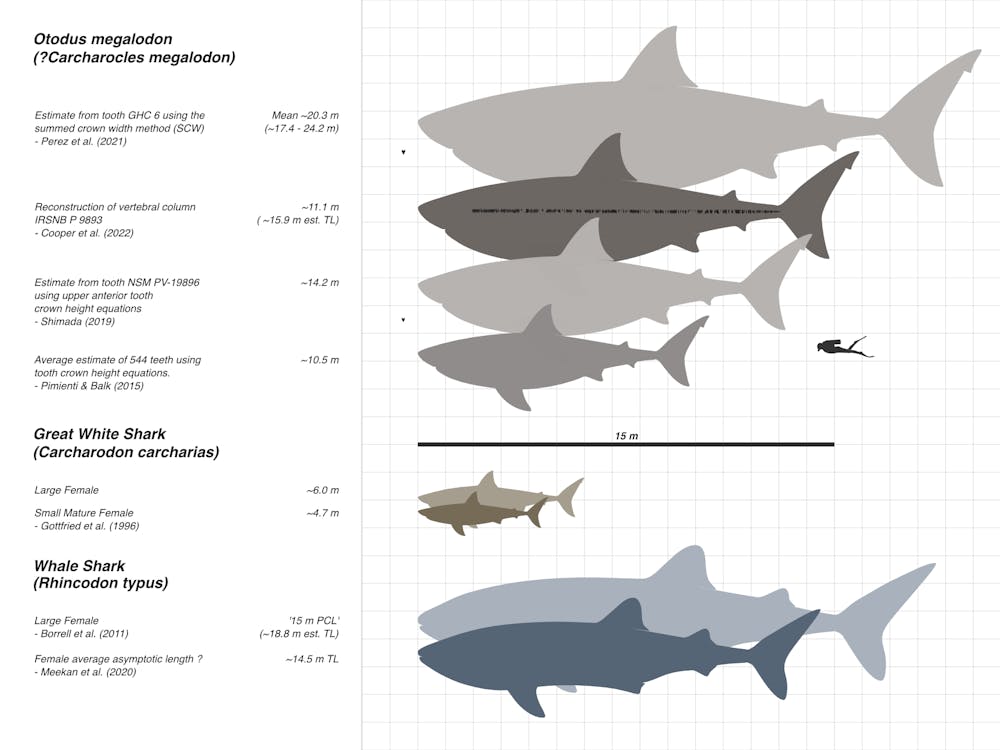
    The average size of a mature great white (Carcharodon carcharias, also known as the white shark) is between 4.6 and 4.9 metres for female sharks and up to 4 metres for male sharks.

    The largest recorded living specimens peak at about 6 metres, with one monster specimen caught in Cuba in 1945 reaching 6.4 metres.

    Earth’s oceans have seen bigger predatory sharks in the past. The biggest one of all time was the megalodon (Otodus megalodon) which lived from 23 to 3 million years ago, and may have been up to 24 metres in length. However, it looked nothing like the modern white shark.

    We don’t know precisely how big the megalodon was, but certainly larger than the great white shark.
    Steveoc 86/Wikimedia Commons, CC BY-SA

    They’re not even directly related – another thing scientists learned quite recently.

    Who was the megalodon, then?

    White sharks first evolved between 6 and 4 million years ago in the shadows of the megalodon. A recent study showed the megalodon’s large serrated teeth show signs of it being a supreme opportunistic super-predator.

    That means it ate just about anything, but especially liked whales and marine mammals.


    Read more:
    Friday essay: Giant shark megalodon was the most powerful superpredator ever. Why did it go extinct?


    But white sharks are not directly related to the megalodon, whose lineage began with a shark called Cretalamna during the age of dinosaurs about 100 million years ago.

    By contrast, the white shark lineage began with an ancient mako shark, Carcharodon hastalis. It was 7 to 8 metres long and had large, similarly shaped teeth to the modern white shark but lacking serrated edges.

    A fossil intermediate species, Carcharodon hubbelli shows the transition over time from weakly serrated to strongly serrated teeth.

    White shark fossil species. Left, the serrated fossil tooth teeth of the extant white shark; right, a similarly shaped unserrated tooth of the extinct giant mako shark which gave rise to white sharks.
    John Long, CC BY

    How did Jaws affect white shark populations?

    Last year, the International Shark Attack File reported 47 unprovoked shark bites to humans worldwide, resulting in seven fatalities. This was well below the previous ten-year average of 70 bites per year; your chances of getting bitten by a shark are extremely rare.

    Following the movies that made up the Jaws franchise, there was an increase in hunting and killing sharks – with a particular focus on great white sharks that were already going into a decline due to overfishing, trophy hunting and lethal control programs.

    Between 80% and 90% of white sharks have disappeared globally since the middle of the 20th century. Recent estimates calculate there are probably less than 500 individual white sharks in Australian waters right now.

    When Jaws first aired, scientists didn’t know how long sharks took to reproduce, or how many offspring a white shark could have each year. We now know it takes about 26 years for a male and 33 years for a female to sexually mature before they can start having pups.

    Data about white shark births is sparse, but recently a 5.6-metre-long female caught on a drum line off the coast of Queensland had just four large pups inside her. This is a very small number. Some large sharks, such as the whale shark, can give birth to up to 300 young.

    Now that we know just how slow they are to breed, it’s clear it will take many decades to reestablish the “pre-Jaws” population of white sharks – important apex predators in the marine ecosystem.

    Charlie Huveneers from Flinders University about to take a tissue sample for research on white sharks. There is still a lot we don’t know about their biology.
    Andrew Fox, Adelaide, CC BY

    Will white sharks survive?

    White sharks are currently listed as vulnerable.

    This classification means if we don’t change the current living conditions for white sharks, including impacts caused by human activities such as commercial fishing, and the impacts of climate change and ocean pollution, they will continue to decline and eventually could go extinct.

    Currently, white sharks are protected in several countries and form the basis for an important tourist industry in Australia, South Africa, western United States and most recently Nova Scotia, Canada.

    These sharks are iconic apex predators that fascinate people. One of us (John) went cage diving with them recently off the Neptune Islands of South Australia and can attest to how breathtaking it is to watch them in their natural environment.

    In terms of economic impact, they are worth far more alive than dead.

    White sharks are a growing tourism draw in several countries.
    Andrew Fox, Adelaide, CC BY

    There’s still much we don’t know about white sharks

    The complete white shark genome was first published only in 2019. It has 4.63 billion base pairs, making it much larger than the human genome (3.2 billion base pairs).

    The genome revealed some surprising things, like how white sharks show strong molecular adaptations for wound-healing processes, and a suite of “genome stability” genes – those used in DNA repair or DNA damage response.

    The transcriptome (or sum total of the messenger RNA) of the white shark showed greater similarity to the human transcriptome than to that of other fishes. This hints that “unexpressed genes” in the shark could one day play a role in uncovering genetic pathways for potential cures in human diseases.

    Jaws and its sequels certainly brought white sharks to the attention (and nightmares) of humans, with devastating impacts on how we treated them as a species.

    Our relationship with white sharks reflects our relationship with nature more broadly – a feared antagonist within the current capitalist paradigm; an enemy to be tamed, contained or consumed.

    As we learn more of the peril and potential of these remarkable creatures, we can learn how to live with them, to see beyond our fears and value their role within our delicate ocean ecosystems.

    John Long receives funding from The Australian Research Council.

    Heather L. Robinson does not work for, consult, own shares in or receive funding from any company or organisation that would benefit from this article, and has disclosed no relevant affiliations beyond their academic appointment.

    ref. Jaws at 50: how a single movie changed our perception of white sharks forever – https://theconversation.com/jaws-at-50-how-a-single-movie-changed-our-perception-of-white-sharks-forever-258306

    MIL OSI AnalysisEveningReport.nz

  • MIL-OSI USA: Following Trump Attacks on TPS, Markey, Van Hollen, Senate Democrats Put Forward Bill to Protect TPS and DED Recipients

    US Senate News:

    Source: United States Senator for Massachusetts Ed Markey

    Washington (June 18, 2025) – Today, U.S. Senator Chris Van Hollen (D-Md.) was joined by 30 Senate colleagues in putting forward legislation to provide qualified Temporary Protected Status (TPS) and Deferred Enforced Departure (DED) recipients a path to legal permanent residency. The Senators’ reintroduction of this legislation – the Safe Environment from Countries Under Repression and Emergency (SECURE) Act – comes as the Trump Administration and the right-wing Supreme Court undermine TPS, a program that has for years provided refuge to those living in America who have fled natural disasters, violence, and political insecurity. The Trump Administration has revoked TPS for an estimated 563,000 recipients from five countries – Venezuela, Haiti, Afghanistan, Cameroon, and Nepal – and while there have been legal challenges filed against this action, the Supreme Court has temporarily allowed the revocation to stand – putting hundreds of thousands at risk of deportation to their home countries where they would face serious danger.

    This legislation is endorsed by AFL-CIO, Laborers’ International Union of North America (LIUNA), International Union of Painters and Allied Trades (IUPAT), CASA, National TPS Alliance, Working Families United, the National Network for Arab American Communities, International Longshore and Warehouse Union (ILWU), Service Employees International Union (SEIU), and Communities United for Status and Protection (CUSP).

    “As Donald Trump continues to strip immigrant communities of critical legal protections, we must protect the individuals who came to our country seeking safe harbor and who cannot return home safely. I am proud to join my colleagues in introducing the SECURE Act, to ensure that individuals fleeing armed conflicts, political unrest, or environmental disasters have a guaranteed pathway to safety in the United States. Recipients of Temporary Protected Status and Deferred Enforced Departure are our friends, our neighbors, our colleagues, and we cannot turn our backs on them. We must be loud and clear – immigrants are welcome here,” said Senator Markey.

    “America has long used the TPS and DED programs to offer special legal protections to individuals in the United States whose lives would be put at extreme risk if forced to return to their countries of origin. As they’ve sought safety and stability here, TPS and DED recipients have built new lives in America, living here legally for years – sometimes decades – and making important contributions to our communities. But the Trump Administration is threatening both the lives they have built and the safety of these individuals – forcing TPS recipients to return to dangerous places like Haiti, Venezuela, Afghanistan, and more. This bill offers much-needed certainty to TPS and DED recipients – providing a path to stay safely in the U.S. and continue to call America their home,” said Senator Van Hollen.

    “TPS and DED recipients are valuable members of our communities. Many have lived here for years with U.S. children, spouses, and even businesses they’ve built — yet they are forced to live in uncertainty and fear that they may lose everything if they lose TPS or DED. I’m proud to introduce this legislation to give TPS and DED recipients a path to permanent residence so they can continue to contribute to America,” said Senator Kaine.

    “America is strengthened by the contributions and hard work of immigrants. But this Administration’s cruelty has left thousands of workers in limbo — without legal status and without work authorization,” said Senator Padilla. “The SECURE Act provides TPS holders who live and work in the United States legally, seeking safety after fleeing dangerous conditions in their home countries, the security of a pathway to permanent residency protections while continuing to contribute to our communities and economy.”

    “TPS recipients have come to the U.S. to escape widespread violence and environmental disasters in their countries that make returning home unsafe.  As they rebuild their lives here, TPS recipients, as longtime residents of the United States, deserve security and certainty about their immigration status,” said Senator Durbin. “I’m joining Senator Van Hollen to introduce the SECURE Act to provide TPS recipients a pathway to legal permanent residency.”

    “As the Trump administration terrorizes immigrant communities and arbitrarily revokes TPS and DED for law-abiding immigrants, it’s important that we speak up and push back every way we can, and support individuals who are contributing to our communities and would be at severe risk if they were to be forced to return to their countries of origin,” said Senator Murray. “I’m proud to join my colleagues in introducing the SECURE Act to provide immigrants with Temporary Protected Status and Deferred Enforced Departure a path to legal permanent residency.”

    “After escaping horrific violence and persecution in their home countries, TPS and DED recipients come to this country in search of a better life,” said Senator Cortez Masto. “These hardworking men and women have been living in and contributing to our communities for years, and it’s common sense to give them the certainty they need to fulfill the American Dream.”

    “Virginia is home to tens of thousands of law-abiding immigrants who are unable to return to their countries of origin due to painful extraordinary circumstances. Though these individuals benefit from certain protections from deportation, they remain in limbo despite having lived and worked in the U.S. for years,” said Senator Warner. “I’m proud to introduce this legislation to create a real pathway to permanent residency for TPS and DED recipients who drive our economy and make valuable contributions to their communities.”

    “The Temporary Protected Status program has been a lifeline that has allowed people and families facing unimaginable circumstances to find a safe refuge here in the United States,” said Senator Rosen. “TPS recipients contribute to our communities and our economy, and they deserve a pathway to permanent residency, which is why I’m proud to help introduce this bill. I’ll keep standing up to protect Nevada’s immigrant families.”

    “TPS holders deserve certainty, especially when the Trump administration is suddenly ending people’s status with no justification and forcing them to return to unsafe conditions,” said Senator Schatz. “Our bill would enable TPS holders to apply for permanent status so they can continue to live, work, and contribute in the United States without constantly being stuck in limbo.”

    “Families should have protection from ongoing wars, environmental disasters, widespread illness, and other dangers that make it difficult to return home,” said Senator Warren. “While Donald Trump makes it harder for immigrants to navigate our complex immigration system, Senate Democrats are fighting back to protect these vulnerable families.”

    “Scripture tells us: welcome the stranger in your midst,” said Senator Coons. “When we welcome those fleeing persecution and violence, hunger and poverty around the world, we show the world our values. That makes America safer, and it grows the economy in states like Delaware. The SECURE Act gives people searching for freedom and safety, who love this country, and who are already adding their valuable skills and gifts to our nation, a path to continue to do so.”

    “Our country has long supported families fleeing violence and seeking refuge,” said Senator Luján. “As this administration continues its attacks on TPS recipients, Congress must ensure a legal pathway to permanent residency for those who contribute to our communities every day. That’s why I’m partnering with my colleagues to reintroduce the SECURE Act to provide permanent protections for thousands of TPS recipients who live and work lawfully in the U.S.”

    “As immigrant communities continue to come under attack, the SECURE Act provides a clear pathway to permanent residency—offering overdue, necessary protections for immigrants and the lives they’ve built in our nation. America is a nation of immigrants and has a storied history of providing opportunity and refuge for those fleeing hardship or crisis. Individuals with TPS and DED have made America their home—using their talents and skills to strengthen our economies and enrich our communities—often while the countries from which they fled remain in turmoil,” said Senator Blumenthal.

    “Trump’s heartless immigration policies do nothing to make us safer and betray our core values—our nation always has been and always will be stronger because of our immigrant communities,” said Senator Duckworth. “While no one is arguing that we shouldn’t be deporting violent criminals who pose a danger to our country, it’s cruel to target people who fled from life-threatening situations and have been productive members of our communities for years. I’m proud to help Senator Van Hollen reintroduce this legislation to help give TPS and DED recipients a path to remain here as legal permanent residents.”

    “Our country should serve as a refuge for individuals who cannot return to their home country due to dangerous circumstances,” said Senator Hirono. “TPS holders and DED recipients living in our country are essential members of our communities, making up a significant amount of our workforce and contributing to our economy. As this administration continues its all-out attack on immigrants and their loved ones, I am proud to reintroduce this legislation to provide TPS and DED recipients peace of mind that they can remain in the country safely and with a path to lawful permanent residence.”

    “This bill is a necessary step in creating a pathway to legal permanent residency for TPS recipients,” said Senator Bennet. “They are already facing extraordinary and unstable conditions in their home countries; they shouldn’t have to face those same conditions here in the U.S.”

    “I’m joining the effort to pass the SECURE Act to stand by thousands in New Jersey who do not deserve to live in uncertainty and fear as the Trump administration arbitrarily revokes Temporary Protected Status,” said Senator Kim. “TPS recipients are friends and neighbors who are part of our communities and are essential to the economic growth of our state. We should use this moment to address disorder in our TPS program and immigration system – and deliver eligible families a pathway toward permanent stability and security.”

    “TPS provides protection for individuals and families who are unable to return to their countries due to dangerous conditions, including natural disasters, armed conflicts, and other disasters. Many find refuge in California where they can live and work lawfully under its protections. This legislation would provide a much-needed sense of security and stability to those who are living in the legal limbo caused by President Trump’s targeting of this program and his continued erosion of our nation’s commitment to helping those fleeing violence, famine, disease, and disaster,” said Senator Schiff.

    The legislation is cosponsored by Senators Angela Alsobrooks (D-Md.), Tammy Baldwin (D-Wis.), Michael Bennet (D-Colo.), Richard Blumenthal (D-Conn.), Cory Booker (D-N.J.), Chris Coons (D-Del.), Catherine Cortez-Masto (D-Nev.), Tammy Duckworth (D-Ill.), Dick Durbin (D-Ill.), Martin Heinrich (D-N.M.), John Hickenlooper (D-Colo.), Mazie Hirono (D-Hawaii), Tim Kaine (D-Va.), Andy Kim (D-N.J.) Amy Klobuchar (D-Minn.), Ben Ray Luján (D-N.M.), Patty Murray (D-Wash.), Alex Padilla (D-Calif.), Jack Reed (D-R.I.), Jacky Rosen (D-Nev.), Bernie Sanders (I-Vt.), Brian Schatz (D-Hawaii), Adam Schiff (D-Calif.), Tina Smith (D-Minn.), Mark Warner (D-Va.), Raphael Warnock (D-Ga.), Elizabeth Warren (D-Mass.), Sheldon Whitehouse (D-R.I.), and Ron Wyden (D-Ore.).

    “Immigrant workers are under unprecedented attack: hundreds of thousands of people have been stripped of their legal status and work authorization, throwing families and industries into chaos and uncertainty. Workers with Temporary Protected Status, many of whom have lived and worked in our country for decades, are vital members of our communities and our unions. The SECURE Act is common-sense legislation that would provide TPS holders with stable, permanent lawful status so they can continue to raise their families, work, and contribute to our economy,” said Liz Shuler, AFL-CIO President.

    “LIUNA commends Senator Van Hollen for his tireless efforts to protect workers and their family members who have Temporary Protected Status (TPS), many of whom are members of our union and who have lived and worked in the U.S. for decades. About 1/3 of TPS holders work in construction. The SECURE Act will not only provide permanence to these hard-working immigrants, but will also help the U.S. economy by retaining these valued immigrants in our workforce,” said Brent Booker, General President, LIUNA.

    “Every day, thousands of people with TPS and DED who have built their lives, families, and futures here are forced to live with fear and uncertainty. They deserve more than endless waiting; they deserve real, permanent protection. As attacks on immigrant communities grow across the country, we must act without hesitation. We are grateful to Senator Van Hollen’s leadership – in this time of growing instability, the SECURE Act will offer dignity, safety, and security for our community,” said Cathryn Jackson, Public Policy Director of CASA.

    “Immigrant families and allies continue to advocate for permanent protections. The National TPS Alliance calls for long-overdue justice to our immigrant communities. The reintroduction of the SECURE Act in the Senate addresses the uncertainty that our families have been living for years. This bill is timely, ensuring that TPS holders don’t fall out of status and in turn preventing irreparable harm to whole communities, continuing critical contributions to the nation’s economy. We urge congressional leaders to support this critical effort,” said Mardoel Hernandez, TPS recipient from Honduras and National TPS Alliance Executive Committee Member.

    “TPS holders, including members of my own union, contribute to our economy every single day. Some may not know it, but our society is dependent on TPS holders in different industries, including in the building and construction trades. We need the SECURE Act so these workers can continue living, working, and raising their families without fear,” said IUPAT General President Jimmy Williams, Jr.; IUPAT is a member of the Working Families United Coalition.

    “The SECURE Act offers overdue protection for hundreds of thousands living in fear of being uprooted from the families, homes, and careers they built. The National Network for Arab American Communities believes this bill reflects a critical truth: our democracy and safety are strongest when everyone has the opportunity to live and contribute freely and lawfully,” said Rima Meroueh, Director, National Network for Arab American Communities.

    “Now more than ever, we need a solution for immigrants with Temporary Protected Status from countries like El Salvador, Honduras, Venezuela and Haiti, whose lives have been in limbo under the chaos of this administration. We applaud the reintroduction of the SECURE Act by Senator Chris Van Hollen, which would create a path to citizenship for these individuals who contribute billions to our economy and whose lives would be in danger if they were sent back immediately to their home countries,” said Rocio Saenz, Secretary-Treasurer, SEIU.

    “The ILWU stands in strong support of the SECURE Act, a commonsense measure that serves our country’s interests and recognizes the dignity and contributions of TPS and DED holders — hardworking individuals who have paid their taxes, contributed to our economy, and been model members of our communities. These men and women have earned a chance to live without fear, continue to contribute to their communities and build their lives in the country they’ve long called home. We urge Congress to pass this vital legislation without delay,” said International Longshore and Warehouse Union President Robert Olvera.

    “Communities United for Status & Protection (CUSP) endorses the SECURE Act as a critical step toward justice and stability for immigrants with Temporary Protected Status (TPS) and Deferred Enforced Departure (DED). For decades, these communities—Black, Asian, brown, working-class immigrants from countries facing war, repression, and climate disaster—have lived, worked, and raised families in the U.S. They are essential to our economy, our neighborhoods, and our collective future. Yet they continue to live in uncertainty, without a pathway to permanent protection. The SECURE Act honors their dignity, recognizes their profound contributions, and upholds our nation’s values of fairness and humanitarian responsibility. We urge Congress to act with courage and conscience and pass this bill without delay,” said Carolyn Tran, Executive Director, Communities United for Status & Protection (CUSP).

    Additional Background

    TPS is a temporary, legal immigration status granted to foreign citizens who are endangered by conditions in their home country resulting from extraordinary events such as ongoing armed conflict, environmental disaster, or epidemic. TPS status is granted for set periods ranging from six to 18 months, requiring the Department of Homeland Security to extend a country’s status on a recurring basis. Each time a country is recertified, recipients must reapply and pass a thorough background check. Recent estimates found there are approximately 860,000 people with TPS in the United States.

    Deferred enforced departure (DED) is a temporary and discretionary administrative stay of removal granted to foreign citizens from designated countries. Unlike TPS, a DED designation emanates from the President’s constitutional powers to conduct foreign relations and has no statutory basis. Grants are usually in response to war, civil unrest, or natural disasters, through an executive order or presidential memorandum that provides eligibility guidelines.

    The SECURE Act will provide long-term stability for these individuals and their communities by giving them the ability to apply for legal permanent residency. Under the bill, all TPS recipients – current and past – and TPS and DED eligible individuals who have been continuously present in the United States for at least three years would be eligible to apply for legal permanent residency.

    Additionally, under the SECURE Act:

    • A spouse, domestic partner, child, or unmarried child of a qualifying non-citizen would be eligible to obtain permanent resident status (upon meeting certain requirements).
    • Individuals with a pending TPS application will receive work authorization and be eligible for travel authorization.
    • Non-citizens who have a pending application or is prima facie eligible for permanent status under the bill and intends to apply are shielded from deportation.
    • Information from an applicant’s application may not be shared or used for immigration enforcement purposes, with limited exceptions, such as for the identification of fraudulent claims.
    • DHS must report to Congress when terminating a country’s TPS designation with an explanation to justify the termination.

    MIL OSI USA News

  • MIL-OSI: The Herzfeld Caribbean Basin Fund, Inc. Announces Results of Special Meeting of Stockholders; Approval of Conversion of Fund to CLO Equity Strategy

    Source: GlobeNewswire (MIL-OSI)

    MIAMI BEACH, FLA., June 18, 2025 (GLOBE NEWSWIRE) — The Herzfeld Caribbean Basin Fund, Inc. (NASDAQ: CUBA) (the “Fund”) today announced that the Fund’s Stockholders have approved the Fund’s conversion from its current investment strategy to focus on a “CLO Equity Strategy”. The approval was voted for at a Special Meeting of Stockholders held on June 17, 2025, with approximately 96% of the votes cast in favor of the changes.

    With this change, the Fund’s primary investment objective will change to a total return strategy with a secondary objective of generating high current income for stockholders. In accordance with the change in investment objective, the Fund will focus on investing in equity and junior debt tranches of collateralized loan obligations, or “CLOs”. CLOs are portfolios of collateralized loans consisting primarily of below investment grade U.S. senior secured loans with a large number of distinct underlying borrowers across various industry sectors.

    The three proposals approved by the Fund’s stockholders at the special meeting were:

    • Proposal 1: approval of an amended and restated investment advisory agreement between the Fund and Thomas J. Herzfeld Advisors, Inc. (the “Adviser”) to permit the Adviser to receive a fee based on “managed assets” and an incentive fee.
    • Proposal 2: approval to revise the Fund’s investment objective from obtaining “long term capital appreciation” to a primary objective of “maximizing risk adjusted total returns” with a secondary objective of “generating high current income;” and to reclassify the Fund’s investment objective as non-fundamental.
    • Proposal 3: approval to amend the fundamental policies of the Fund related to borrowing, the issuance of senior securities, underwriting securities issued by other persons, industry concentration, the purchase or sale of real estate, the purchase or sale of commodities, and making loans to other persons.

    The changes approved by the Fund’s Stockholders will go into effect July 1, 2025.

    Cecilia Gondor, Chairperson of the Fund’s Board of Directors commented: “This marks an important day in the long history of our Fund and the beginning of what we hope is a bright future for our Fund investors. I want to thank my fellow board members and our Chairman Emeritus, Tom Herzfeld, for the hard work that was undertaken in managing this transition.”

    About Thomas J. Herzfeld Advisors, Inc.

    Thomas J. Herzfeld Advisors, Inc., founded in 1984, is an SEC registered investment advisor, specializing in investment analysis and account management in closed-end funds.

    More information about the advisor can be found at www.herzfeld.com.

    Past performance is no guarantee of future performance. An investment in the Fund is subject to certain risks, including market risk. In general, shares of closed-end funds often trade at a discount from their net asset value and at the time of sale may be trading on the exchange at a price which is more or less than the original purchase price or the net asset value. An investor should carefully consider the Fund’s investment objective, risks, charges and expenses. Please read the Fund’s disclosure documents before investing.

    Forward-Looking Statements

    This press release, and other statements that TJHA or the Fund may make, may contain forward looking statements within the meaning of the Private Securities Litigation Reform Act, with respect to the Fund’s or TJHA’s future financial or business performance, strategies or expectations. Forward-looking statements are typically identified by words or phrases such as “trend,” “potential,” “opportunity,” “pipeline,” “believe,” “comfortable,” “expect,” “anticipate,” “current,” “intention,” “estimate,” “position,” “assume,” “outlook,” “continue,” “remain,” “maintain,” “sustain,” “seek,” “achieve,” and similar expressions, or future or conditional verbs such as “will,” “would,” “should,” “could,” “may” or similar expressions. TJHA and the Fund caution that forward-looking statements are subject to numerous assumptions, risks and uncertainties, which change over time. Forward-looking statements speak only as of the date they are made, and TJHA and the Fund assume no duty to and do not undertake to update forward-looking statements. Actual results could differ materially from those anticipated in forward-looking statements and future results could differ materially from historical performance. With respect to the Fund, the following factors, among others, could cause actual events to differ materially from forward-looking statements or historical performance: (1) changes and volatility in political, economic or industry conditions, particularly with respect to Cuba and other Caribbean Basin countries, the interest rate environment, foreign exchange rates or financial and capital markets, which could result in changes in demand for the Fund or in the Fund’s net asset value; (2) the relative and absolute investment performance of the Fund and its investments; (3) the impact of increased competition; (4) the unfavorable resolution of any legal proceedings; (5) the extent and timing of any distributions or share repurchases; (6) the impact, extent and timing of technological changes; (7) the impact of legislative and regulatory actions and reforms, including the Dodd-Frank Wall Street Reform and Consumer Protection Act, and regulatory, supervisory or enforcement actions of government agencies relating to the Fund or TJHA, as applicable; (8) terrorist activities, international hostilities and natural disasters, which may adversely affect the general economy, domestic and local financial and capital markets, specific industries or TJHA or the Fund; (9) TJHA’s and the Fund’s ability to attract and retain highly talented professionals; (10) the impact of TJHA electing to provide support to its products from time to time; (11) the impact of problems at other financial institutions or the failure or negative performance of products at other financial institutions; and (12) the effects of an epidemic, pandemic or public health emergency, including without limitation, COVID-19. Annual and Semi-Annual Reports and other regulatory filings of the Fund with the SEC are accessible on the SEC’s website at www.sec.gov and on TJHA’s website at www.herzfeld.com/cuba, and may discuss these or other factors that affect the Fund. The information contained on TJHA’s website is not a part of this press release.

    TJHA has received certain nominations or awards by third-parties as reflected herein. Investors should review the criteria for each nomination or award as reflected on the third-party’s webpage. In addition, the nominations and awards reflect past performance of the nominee or award designee and may not reflect the current performance or status of any such firm or individual and may no longer be applicable. Morningstar award content presented with permission and licensing fee. Contact us for more information on how the ratings are apportioned and for full disclosures regarding third party news and awards.

    Contact:
    Thomas Morgan
    Chief Compliance Officer
    The Herzfeld Caribbean Basin Fund, Inc.
    1-305-777-1660

    The MIL Network

  • MIL-OSI: The Herzfeld Caribbean Basin Fund, Inc. Announces Results of Special Meeting of Stockholders; Approval of Conversion of Fund to CLO Equity Strategy

    Source: GlobeNewswire (MIL-OSI)

    MIAMI BEACH, FLA., June 18, 2025 (GLOBE NEWSWIRE) — The Herzfeld Caribbean Basin Fund, Inc. (NASDAQ: CUBA) (the “Fund”) today announced that the Fund’s Stockholders have approved the Fund’s conversion from its current investment strategy to focus on a “CLO Equity Strategy”. The approval was voted for at a Special Meeting of Stockholders held on June 17, 2025, with approximately 96% of the votes cast in favor of the changes.

    With this change, the Fund’s primary investment objective will change to a total return strategy with a secondary objective of generating high current income for stockholders. In accordance with the change in investment objective, the Fund will focus on investing in equity and junior debt tranches of collateralized loan obligations, or “CLOs”. CLOs are portfolios of collateralized loans consisting primarily of below investment grade U.S. senior secured loans with a large number of distinct underlying borrowers across various industry sectors.

    The three proposals approved by the Fund’s stockholders at the special meeting were:

    • Proposal 1: approval of an amended and restated investment advisory agreement between the Fund and Thomas J. Herzfeld Advisors, Inc. (the “Adviser”) to permit the Adviser to receive a fee based on “managed assets” and an incentive fee.
    • Proposal 2: approval to revise the Fund’s investment objective from obtaining “long term capital appreciation” to a primary objective of “maximizing risk adjusted total returns” with a secondary objective of “generating high current income;” and to reclassify the Fund’s investment objective as non-fundamental.
    • Proposal 3: approval to amend the fundamental policies of the Fund related to borrowing, the issuance of senior securities, underwriting securities issued by other persons, industry concentration, the purchase or sale of real estate, the purchase or sale of commodities, and making loans to other persons.

    The changes approved by the Fund’s Stockholders will go into effect July 1, 2025.

    Cecilia Gondor, Chairperson of the Fund’s Board of Directors commented: “This marks an important day in the long history of our Fund and the beginning of what we hope is a bright future for our Fund investors. I want to thank my fellow board members and our Chairman Emeritus, Tom Herzfeld, for the hard work that was undertaken in managing this transition.”

    About Thomas J. Herzfeld Advisors, Inc.

    Thomas J. Herzfeld Advisors, Inc., founded in 1984, is an SEC registered investment advisor, specializing in investment analysis and account management in closed-end funds.

    More information about the advisor can be found at www.herzfeld.com.

    Past performance is no guarantee of future performance. An investment in the Fund is subject to certain risks, including market risk. In general, shares of closed-end funds often trade at a discount from their net asset value and at the time of sale may be trading on the exchange at a price which is more or less than the original purchase price or the net asset value. An investor should carefully consider the Fund’s investment objective, risks, charges and expenses. Please read the Fund’s disclosure documents before investing.

    Forward-Looking Statements

    This press release, and other statements that TJHA or the Fund may make, may contain forward looking statements within the meaning of the Private Securities Litigation Reform Act, with respect to the Fund’s or TJHA’s future financial or business performance, strategies or expectations. Forward-looking statements are typically identified by words or phrases such as “trend,” “potential,” “opportunity,” “pipeline,” “believe,” “comfortable,” “expect,” “anticipate,” “current,” “intention,” “estimate,” “position,” “assume,” “outlook,” “continue,” “remain,” “maintain,” “sustain,” “seek,” “achieve,” and similar expressions, or future or conditional verbs such as “will,” “would,” “should,” “could,” “may” or similar expressions. TJHA and the Fund caution that forward-looking statements are subject to numerous assumptions, risks and uncertainties, which change over time. Forward-looking statements speak only as of the date they are made, and TJHA and the Fund assume no duty to and do not undertake to update forward-looking statements. Actual results could differ materially from those anticipated in forward-looking statements and future results could differ materially from historical performance. With respect to the Fund, the following factors, among others, could cause actual events to differ materially from forward-looking statements or historical performance: (1) changes and volatility in political, economic or industry conditions, particularly with respect to Cuba and other Caribbean Basin countries, the interest rate environment, foreign exchange rates or financial and capital markets, which could result in changes in demand for the Fund or in the Fund’s net asset value; (2) the relative and absolute investment performance of the Fund and its investments; (3) the impact of increased competition; (4) the unfavorable resolution of any legal proceedings; (5) the extent and timing of any distributions or share repurchases; (6) the impact, extent and timing of technological changes; (7) the impact of legislative and regulatory actions and reforms, including the Dodd-Frank Wall Street Reform and Consumer Protection Act, and regulatory, supervisory or enforcement actions of government agencies relating to the Fund or TJHA, as applicable; (8) terrorist activities, international hostilities and natural disasters, which may adversely affect the general economy, domestic and local financial and capital markets, specific industries or TJHA or the Fund; (9) TJHA’s and the Fund’s ability to attract and retain highly talented professionals; (10) the impact of TJHA electing to provide support to its products from time to time; (11) the impact of problems at other financial institutions or the failure or negative performance of products at other financial institutions; and (12) the effects of an epidemic, pandemic or public health emergency, including without limitation, COVID-19. Annual and Semi-Annual Reports and other regulatory filings of the Fund with the SEC are accessible on the SEC’s website at www.sec.gov and on TJHA’s website at www.herzfeld.com/cuba, and may discuss these or other factors that affect the Fund. The information contained on TJHA’s website is not a part of this press release.

    TJHA has received certain nominations or awards by third-parties as reflected herein. Investors should review the criteria for each nomination or award as reflected on the third-party’s webpage. In addition, the nominations and awards reflect past performance of the nominee or award designee and may not reflect the current performance or status of any such firm or individual and may no longer be applicable. Morningstar award content presented with permission and licensing fee. Contact us for more information on how the ratings are apportioned and for full disclosures regarding third party news and awards.

    Contact:
    Thomas Morgan
    Chief Compliance Officer
    The Herzfeld Caribbean Basin Fund, Inc.
    1-305-777-1660

    The MIL Network

  • MIL-OSI: Red Cat Holdings Announces Closing of $46.75 Million Registered Direct Offering of Common Stock

    Source: GlobeNewswire (MIL-OSI)

    SAN JUAN, Puerto Rico, June 18, 2025 (GLOBE NEWSWIRE) — Red Cat Holdings, Inc. (Nasdaq: RCAT) (“Red Cat” or “Company”), a drone technology company integrating robotic hardware and software for military, government, and commercial operations, has successfully closed the previously announced registered direct offering with certain institutional investors for the purchase and sale of 6,448,276 shares of common stock resulting in gross proceeds of approximately $46.75 million, before deducting placement agent fees and other offering expenses. The offering closed on June 18, 2025.

    The Company intends to use net proceeds from the offering for general corporate and working capital purposes, including but not limited to operating expenditures related to its new unmanned surface vessel division.

    “We believe this financing positions Red Cat for significant growth in the drone industry and will accelerate our product development and production for our newly formed Unmanned Surface Vessels (USVs) division for the maritime autonomy market,” said Jeff Thompson, Founder, Chairman and Chief Executive Officer of Red Cat.

    Recent Operational Highlights

    • Expansion of our manufacturing capacity by moving the Edge 130 production to a new, larger facility that will produce 150 Edge 130s per month and is in process of doubling the Black Widow production capacity, enabling an eventual production of 1,000 per month.
    • We have been diligently working to identify top talent and manufacturing capacity for our USV division to meet end market demand for maritime applications.
    • Reiterate 2025 annual revenue guidance of $80 to $120 million for calendar year 2025, which consists of:
      • $25 to $65 million in SRR-related Black Widow sales
      • $25 million in Non-SRR Black Widow sales
      • $25 million in Edge 130 sales
      • $5m in Fang FPV sales

    Northland Capital Markets acted as the exclusive placement agent and Ladenburg Thalmann served as financial advisor for the transaction.

    The offering is being made pursuant to an effective shelf registration statement on Form S-3 (File No. 333-283242), which was declared effective by the Securities and Exchange Commission (the “SEC”) on December 11, 2024. A final prospectus supplement and the accompanying prospectus relating to the registered direct offering will be filed with the SEC and will be available on the SEC’s website located at http://www.sec.gov. Additionally, when available, electronic copies of the final prospectus supplement and the accompanying prospectus may be obtained, when available, from Northland Securities, Inc., 150 South Fifth Street, Suite 3300, Minneapolis, MN.

    This press release shall not constitute an offer to sell or the solicitation of an offer to buy any of the securities described herein, nor shall there be any sale of these securities in any state or jurisdiction in which such offer, solicitation, or sale would be unlawful prior to registration or qualification under the securities laws of any such state or jurisdiction.

    About Red Cat Holdings, Inc.

    Red Cat (Nasdaq: RCAT) is a drone technology company integrating robotic hardware and software for military, government, and commercial operations. Through two wholly owned subsidiaries, Teal Drones and FlightWave Aerospace, Red Cat has developed a leading-edge Family of Systems. This includes the flagship Black Widow™, a small unmanned ISR system that was awarded the U.S. Army’s Short Range Reconnaissance (SRR) Program of Record contract. The Family of Systems also includes TRICHON™, a fixed wing VTOL for extended endurance and range, and FANG™, the industry’s first line of NDAA compliant FPV drones optimized for military operations with precision strike capabilities. Learn more at www.redcat.red.

    Safe Harbor Forward-Looking Statements

    This press release contains “forward-looking statements” that are subject to substantial risks and uncertainties. All statements, other than statements of historical fact, contained in this press release are forward-looking statements. Forward-looking statements contained in this press release may be identified by the use of words such as “anticipate,” “believe,” “contemplate,” “could,” “estimate,” “expect,” “intend,” “seek,” “may,” “might,” “plan,” “potential,” “predict,” “project,” “target,” “aim,” “should,” “will” “would,” or the negative of these words or other similar expressions, although not all forward-looking statements contain these words. Such statements include, but are not limited to, statements relating to our intended use of proceeds from the offering, annual revenue guidance, future manufacturing capacities and future market demand. Forward-looking statements are based on Red Cat Holdings, Inc.’s current expectations and are subject to inherent uncertainties, risks and assumptions that are difficult to predict. Further, certain forward-looking statements are based on assumptions as to future events that may not prove to be accurate. These and other risks and uncertainties are described more fully in the section titled “Risk Factors” in the Form 10-KT filed with the Securities and Exchange Commission on March 31, 2025. Forward-looking statements contained in this announcement are made as of this date, and Red Cat Holdings, Inc. undertakes no duty to update such information except as required under applicable law.

    Contact:

    INVESTORS:
    E-mail: Investors@redcat.red

    NEWS MEDIA:
    Phone: (347) 880-2895
    Email: peter@indicatemedia.com

    The MIL Network

  • MIL-OSI: Red Cat Holdings Announces Closing of $46.75 Million Registered Direct Offering of Common Stock

    Source: GlobeNewswire (MIL-OSI)

    SAN JUAN, Puerto Rico, June 18, 2025 (GLOBE NEWSWIRE) — Red Cat Holdings, Inc. (Nasdaq: RCAT) (“Red Cat” or “Company”), a drone technology company integrating robotic hardware and software for military, government, and commercial operations, has successfully closed the previously announced registered direct offering with certain institutional investors for the purchase and sale of 6,448,276 shares of common stock resulting in gross proceeds of approximately $46.75 million, before deducting placement agent fees and other offering expenses. The offering closed on June 18, 2025.

    The Company intends to use net proceeds from the offering for general corporate and working capital purposes, including but not limited to operating expenditures related to its new unmanned surface vessel division.

    “We believe this financing positions Red Cat for significant growth in the drone industry and will accelerate our product development and production for our newly formed Unmanned Surface Vessels (USVs) division for the maritime autonomy market,” said Jeff Thompson, Founder, Chairman and Chief Executive Officer of Red Cat.

    Recent Operational Highlights

    • Expansion of our manufacturing capacity by moving the Edge 130 production to a new, larger facility that will produce 150 Edge 130s per month and is in process of doubling the Black Widow production capacity, enabling an eventual production of 1,000 per month.
    • We have been diligently working to identify top talent and manufacturing capacity for our USV division to meet end market demand for maritime applications.
    • Reiterate 2025 annual revenue guidance of $80 to $120 million for calendar year 2025, which consists of:
      • $25 to $65 million in SRR-related Black Widow sales
      • $25 million in Non-SRR Black Widow sales
      • $25 million in Edge 130 sales
      • $5m in Fang FPV sales

    Northland Capital Markets acted as the exclusive placement agent and Ladenburg Thalmann served as financial advisor for the transaction.

    The offering is being made pursuant to an effective shelf registration statement on Form S-3 (File No. 333-283242), which was declared effective by the Securities and Exchange Commission (the “SEC”) on December 11, 2024. A final prospectus supplement and the accompanying prospectus relating to the registered direct offering will be filed with the SEC and will be available on the SEC’s website located at http://www.sec.gov. Additionally, when available, electronic copies of the final prospectus supplement and the accompanying prospectus may be obtained, when available, from Northland Securities, Inc., 150 South Fifth Street, Suite 3300, Minneapolis, MN.

    This press release shall not constitute an offer to sell or the solicitation of an offer to buy any of the securities described herein, nor shall there be any sale of these securities in any state or jurisdiction in which such offer, solicitation, or sale would be unlawful prior to registration or qualification under the securities laws of any such state or jurisdiction.

    About Red Cat Holdings, Inc.

    Red Cat (Nasdaq: RCAT) is a drone technology company integrating robotic hardware and software for military, government, and commercial operations. Through two wholly owned subsidiaries, Teal Drones and FlightWave Aerospace, Red Cat has developed a leading-edge Family of Systems. This includes the flagship Black Widow™, a small unmanned ISR system that was awarded the U.S. Army’s Short Range Reconnaissance (SRR) Program of Record contract. The Family of Systems also includes TRICHON™, a fixed wing VTOL for extended endurance and range, and FANG™, the industry’s first line of NDAA compliant FPV drones optimized for military operations with precision strike capabilities. Learn more at www.redcat.red.

    Safe Harbor Forward-Looking Statements

    This press release contains “forward-looking statements” that are subject to substantial risks and uncertainties. All statements, other than statements of historical fact, contained in this press release are forward-looking statements. Forward-looking statements contained in this press release may be identified by the use of words such as “anticipate,” “believe,” “contemplate,” “could,” “estimate,” “expect,” “intend,” “seek,” “may,” “might,” “plan,” “potential,” “predict,” “project,” “target,” “aim,” “should,” “will” “would,” or the negative of these words or other similar expressions, although not all forward-looking statements contain these words. Such statements include, but are not limited to, statements relating to our intended use of proceeds from the offering, annual revenue guidance, future manufacturing capacities and future market demand. Forward-looking statements are based on Red Cat Holdings, Inc.’s current expectations and are subject to inherent uncertainties, risks and assumptions that are difficult to predict. Further, certain forward-looking statements are based on assumptions as to future events that may not prove to be accurate. These and other risks and uncertainties are described more fully in the section titled “Risk Factors” in the Form 10-KT filed with the Securities and Exchange Commission on March 31, 2025. Forward-looking statements contained in this announcement are made as of this date, and Red Cat Holdings, Inc. undertakes no duty to update such information except as required under applicable law.

    Contact:

    INVESTORS:
    E-mail: Investors@redcat.red

    NEWS MEDIA:
    Phone: (347) 880-2895
    Email: peter@indicatemedia.com

    The MIL Network

  • MIL-OSI Canada: Tribunal Continues Orders—Circular Copper Tube from Brazil, Greece, China, South Korea and Mexico

    Source: Government of Canada News (2)

    Ottawa, Ontario, June 18, 2025—The Canadian International Trade Tribunal today continued its orders made on September 25, 2019, in expiry review RR‑2018‑005, concerning the dumping of circular copper tube from Brazil, Greece, China, South Korea and Mexico, and the subsidizing of these goods from China.

    The Tribunal found that the expiry of the orders was likely to result in injury. As such, the Tribunal continued its orders. The Canada Border Services Agency will therefore continue to impose anti-dumping and countervailing duties on these goods.

    The Tribunal is an independent quasi-judicial body that reports to Parliament through the Minister of Finance. It hears cases on dumped and subsidized imports, safeguard complaints, complaints about federal government procurement and appeals of customs and excise tax rulings. When requested by the federal government, the Tribunal also provides advice on other economic, trade and tariff matters.

    MIL OSI Canada News

  • MIL-OSI USA: Ahead of Juneteenth, Momentum Grows for H.R. 40, Pressley’s Historic Reparations Legislation

    Source: United States House of Representatives – Congresswoman Ayanna Pressley (MA-07)

    Bill Would Form Commission to Develop Reparations Proposals for African American Descendants of Enslaved People

    Legislation Now Has Support of Over 100 National and Grassroots Organizations

    H.R. 40 Press Conference | H.R. 40 Bill Text | H.R. 40 Briefing Photos | H.R. 40 Briefing One-Pager

    WASHINGTON – Today, ahead of the Juneteenth holiday and a national celebration of Black joy and emancipation, Congresswoman Ayanna Pressley (MA-07) affirmed the strength of the reparations movement and announced growing support for H.R.40, legislation that she is championing to address the harmful legacy of slavery and establish a federal commission to develop reparations proposals for African American descendants of enslaved people. The legislation now has the support of more than 100 national and grassroots organizations and 85 members of Congress.

    In February, during Black History Month, Rep. Pressley and Senator Cory Booker reintroduced H.R. 40, serving as a powerful counterweight to the unprecedented onslaught against diversity, equity, and inclusion (DEI) initiatives from the Trump Administration and a call to action to address the systemic oppression of Black people. Last week, Rep. Pressley hosted a briefing on H.R. 40 to provide congressional staffers and their offices an expanded look into the bill, its 36-year legislative journey – led by Congressman John Conyers and Congresswoman Sheila Jackson Lee – and its vital role in the reparative justice movement.

    “The state of our reparations movement is strong and in this moment of heightened anti-Blackness in America, we are more resolved than ever,” said Congresswoman Pressley, lead House sponsor of H.R. 40. “H.R. 40 is racial justice, economic justice, and a moral imperative, and it is deeply necessary to confront America’s damning history of systemic racism head-on. I’m proud of the growing, broad, and intersectional support behind our bill and I am grateful to our grassroots organizations for their partnership in pushing to get this critical legislation over the finish line.”

    Support for reparations has grown nationwide, with state and local officials taking action, including in Massachusetts, Illinois, Tennessee, North Carolina and Oklahoma. H.R. 40 now has endorsements from over 100 national and grassroots organizations.

    “We are delighted that Congresswoman Ayanna Pressley has picked up the torch from Cong. Sheila Jackson Lee and Cong. John Conyers, Jr. to continue the historic push to achieve long overdue reparations for African Americans.” – National African American Reparations Commission

    “At this pivotal moment in the United States’ existence and identity, we proudly stand with Rep. Ayanna Pressley in the reintroduction of H.R. 40, which if enacted will provide concrete ways to implement reparations,” said Dreisen Heath, Why We Can’t Wait Reparations Coalition. “Providing reparations is a routine practice by the federal government from providing remedy in perpetuity to Holocaust survivors to providing free healthcare to 9/11 victims and veterans exposed to toxic waste waters. By embracing what H.R. 40 legislation will produce, we are not only educating the public on the truth but also energizing a strong movement towards reflection and accountability. While states and cities advance their own reparative efforts, the federal government can no longer neglect and obscure its responsibility to do right by Black Americans, and by extension the rest of the country.

    “The National Urban League, for over a century, has witnessed firsthand the devastating impact of systemic racism on countless lives. We have championed social and economic justice for Black Americans, striving to overcome the enduring legacy of slavery. For too long, we have avoided a full and honest reckoning with this history. A federal commission to study the vestiges of slavery, from the harrowing experiences of enslaved people to the ongoing struggles of their descendants, is not just overdue, it is essential. This examination is not about dwelling on the past but about better understanding the present. By understanding how the lingering effects of slavery continue to shape our society and policies, we can finally create a level playing field and unlock the full potential of our nation,” said the National Urban League. “The National Urban League fully supports H.R. 40, a bill establishing a commission to study and develop reparations proposals for Black Americans, as it represents a crucial step towards reconciliation and redress. We urge Congress to swiftly pass this vital legislation. The time for inaction is over. The time for justice is now.”

    “Eradicating poverty requires understanding its root causes and the economic injustices that plague Black communities today can be directly traced to the legacy of slavery and Jim Crow laws,” said Margaret Huang, President and CEO of the Southern Poverty Law Center. “This commission would be an important step toward grappling with how our country failed to support so many Americans after slavery and segregation ended. We need to take an honest look at the ugly history of racial discrimination that has denied so many Black and Brown families, particularly in the Deep South, economic opportunities to sustain their families.”

    “This legislation is not symbolic, it’s structural,” said Ebonie Riley, Senior Vice President of Policy & Strategic Partnerships at the National Action Network. “In a moment where the very language of equity is under assault, this bill confronts the unfinished business of this nation: the deliberate extraction of wealth, labor, and life from Black Americans. Under the leadership of Rev. Al Sharpton, NAN has consistently called for federal action that reflects the scale of harm inflicted. Reparations are a matter of economic policy, legal obligation, and historical accountability.”

    “The NAACP has supported the creation and passage of HR. 40/S.40 from its introduction by Congressman John Conyers (MI) through its reintroduction by Congresswoman Sheila Jackson Lee (TX) and Senator Cory Booker (NJ) continue to support the passage of this crucial legislation in the 119th Congress,” – NAACP

    “The United Methodist Book of Resolutions and the General Board of Church and Society strongly support HR 40 being reintroduced at a time when truth is under attack,” – United Methodist Church General Board of Church and Society

    “Black people have been the backbone to the growth and wealth of this nation and of the global economy, and justly, should be recipients of its fruits. Black people can’t achieve equity without the United States acknowledging the historical past and materially addressing past and present harms. Reparatory justice is a must,” –Network Lobby for Catholic Social Justice

    “The Council on American-Islamic Relations strongly supports the reintroduction of H.R. 40, recognizing it as a vital measure to confront America’s legacy of slavery and systemic racism head-on. We stand in solidarity with Congresswoman Pressley, Senator Booker, and their colleagues in calling for truth, accountability, and meaningful reparative actions that honor and protect the dignity of Black American communities,” – Council on American-Islamic Relations (CAIR)

    “As a church, we understand that the truth shall set us free. We have committed to and embarked on undertaking the work of truth-telling and reconciliation ourselves. H.R. 40/S. 40 would offer the opportunity for our country to begin a process to understand our own history and would present a path forward for repairing historical harms done to African Americans,” – The Episcopal Church

    “It has been nearly 40 years since Japanese Americans received redress for being incarcerated unjustly during WWII. Many of us in the Japanese American community recognize that our own experience of institutionalized racism at the hands of our government is part of a pattern that began with chattel slavery since our country’s inception as a British colony. Although slavery ended formally with the Civil War, its legacy persisted through Jim Crow policies well into the 20th century. Mere words of regret and apology for our history of slavery and Jim Crow do nothing to repay the unfulfilled promise of 40 acres and a mule.” – Japanese American Citizens League

    “We’re making historic progress advancing reparative justice in local communities nationwide.  We stand together in support of HR40, the most promising and just opportunity to repair the harm of the institution of slavery and its uninterrupted legacies to date. The outcomes of the HR40 Commission can result in a comprehensive and tangible portfolio of remedies that transform this nation,” – First Repair

    The full list of endorsing organizations include: AjabuSpeaks, All Souls Movement, Alliance of Baptists, American Humanist Association, Amnesty International USA, Bend the Arc: Jewish Action, Black Music Action Coalition, Black Veterans Project, Blackroots Alliance, BLIS Collective, California Black Power Network, Center for LGBTQ Economic Advancement & Research (CLEAR), Colombia Acuerdo de Paz NGO, Council on American-Islamic Relations (CAIR), DC Justice Lab, DC Reparations Coalition, Democrats Abroad Reparations Task Force, Disciples Center for Public Witness (Disciples of Christ), Empowerment Temple, Reparation Education Project, Episcopal City Mission, FirstRepair, Freedom Road Consulting, LLC, Friends Committee on National Legislation, Get Free, Human Rights Watch, Humanity2020 Group LLC, Institute for Justice & Democracy in Haiti, Japanese American Citizens League, Johnson & Klein Law, Justice for the 110, KC Reparations Coalition, Loc Community Association, Loyola Law School, Los Angeles Anti Racism Center (LARC), Make It Plain, Marijuana Justice, Maryknoll Office for Global Concerns, Media 2070, Missionary Oblates of Mary Immaculate, Movement for Black Lives, NAACP, National Action Network Education Team, National African American Reparations Commission , National Black Justice Collective, National Council of Churches, National Council of Jewish Women, National LGBTQ+ Bar Association, National Urban League, NETWORK Lobby for Catholic Social Justice, New Yorkers 4 Reparations, Northampton Reparations Study Commission, Not In Our Town, Princeton, NP/NCRR – Nikkei Progressives & Nikkei for Civil Rights & Redress, Pax Christi Metro DC-Baltimore, Pax Christi USA, RebuildingTheCommun7ty, Reparation Generation, Reparations Finance Lab, Reparations Interfaith Coalition of Massachusetts, Reparations United, Reparations4Slavery, San Francisco Bay Area Black & Jewish Unity Coalition, Sanctuary of Hope, SCOPE LA, Showing Up for Racial Justice, Sisters of Mercy of the Americas Justice Team, South Bend Reparations Working Group (SBRWG), State of Loc Nation Global Public Benefit Corp, Terence Crutcher Foundation, The Episcopal Church, The Southern Poverty Law Center, The United Methodist Church General Board of Church and Society, Tsuru for Solidarity, Tulsa African Ancestral Society, Union for Reform Judaism, Unitarian Universalists for Social Justice, United By Equity, United Church of Christ, USTRHT, Virago Strategies, Why We Can’t Wait Reparations Coalition, Women’s International League for Peace and Freedom, Young LLC.

    Co-sponsors of H.R. 40 include: Rep. Adams, Alma S. [D-NC-12], Rep. Balint, Becca [D-VT-At Large], Rep. Barragán, Nanette Diaz [D-CA-44], Rep. Beatty, Joyce [D-OH-3], Rep. Bera, Ami [D-CA-06], Rep. Beyer, Donald S. [D-VA-8], Rep. Bishop, Sanford D. [D-GA-2], Rep. Bonamici, Suzanne [D-OR-1], Rep. Brown, Shontel M. [D-OH-11], Rep. Brownley, Julia [D-CA-26], Rep. Carson, André [D-IN-7], Rep. Carter, Troy A. [D-LA-2], Rep. Casar, Greg [D-TX-35], Rep. Case, Ed [D-HI-1], Rep. Casten, Sean [D-IL-6], Rep. Cherfilus-McCormick, Sheila [D-FL-20], Rep. Chu, Judy [D-CA-28], Rep. Clarke, Yvette D. [D-NY-9], Rep. Cleaver, Emanuel [D-MO-5], Rep. Clyburn, James E. [D-SC-6], Rep. Cohen, Steve [D-TN-9], Rep. Connolly, Gerald E. [D-VA-11], Rep. Alexandria Ocasio-Cortez [D-NY-14], Rep. Jasmine Crockett [D-TX-30], Rep. Davis, Danny K. [D-IL-7], Rep. Dean, Madeleine [D-PA-4], Rep. Doggett, Lloyd [D-TX-37], Rep. Espaillat, Adriano [D-NY-13], Rep. Evans, Dwight [D-PA-3], Rep. Fletcher, Lizzie [D-TX-7], Rep. Foushee, Valerie P. [D-NC-4], Rep. Frost, Maxwell [D-FL-10], Rep. Garcia, Robert [D-CA-42], Rep. Garcia, Sylvia R. [D-TX-29], Rep. Green, Al [D-TX-9], Rep. Hayes, Jahana [D-CT-5], Rep. Himes, James A. [D-CT-4], Rep. Horsford, Steven [D-NV-4], Rep. Jackson, Jonathan L. [D-IL-1], Rep. Jacobs, Sara [D-CA-51], Rep. Jayapal, Pramila [D-WA-7], Rep. Johnson, Henry C. “Hank” [D-GA-4], Rep. Kamlager-Dove, Sydney [D-CA-37], Rep. Kelly, Robin L. [D-IL-2], Rep. Khanna, Ro [D-CA-17], Rep. Landsman, Greg [D-OH-1], Rep. Lee, Summer L. [D-PA-12], Rep. Lieu, Ted [D-CA-36], Rep. McClellan, Jennifer L. [D-VA-4], Rep. McGovern, Jim [D-MA-02], Rep. McIver, LaMonica [D-NJ-10], Rep. Meeks, Gregory W. [D-NY-5], Rep. Meng, Grace [D-NY-6], Rep. Mfume, Kweisi [D-MD-7], Rep. Moore, Gwen [D-WI-4], Rep. Nadler, Jerrold [D-NY-12], Del. Norton, Eleanor Holmes [D-DC-At Large], Rep. Omar, Ilhan [D-MN-5], Rep. Panetta, Jimmy [D-CA-19], Rep. Pingree, Chellie [D-ME-1], Rep. Pocan, Mark [D-WI-2], Rep. Quigley, Mike [D-IL-5], Rep. Ramirez, Delia C. [D-IL-3], Rep. Sánchez, Linda T. [D-CA-38], Rep. Scanlon, Mary Gay [D-PA-5], Rep. Schakowsky, Janice D. [D-IL-9], Rep. David Scott [D-GA-13], Rep. Simon, Lateefah [D-CA-12], Rep. Smith, Adam [D-WA-9], Rep. Stansbury, Melanie A. [D-NM-1], Rep. Stevens, Haley M. [D-MI-11], Rep. Strickland, Marilyn [D-WA-10], Rep. Swalwell, Eric [D-CA-14], Rep. Takano, Mark [D-CA-39], Rep. Thanedar, Shri [D-MI-13], Rep. Thompson, Bennie G. [D-MS-2], Rep. Titus, Dina [D-NV-1], Rep. Tlaib, Rashida [D-MI-12], Rep. Tokuda, Jill N. [D-HI-2], Rep. Torres, Ritchie [D-NY-15], Rep. Trahan, Lori [D-MA-3], Rep. Velázquez, Nydia M. [D-NY-7], Rep. Watson Coleman, Bonnie [D-NJ-12], Rep. Williams, Nikema [D-GA-5], Rep. Wilson, Frederica S. [D-FL-24]

    The full text of the bill is available here.

    Throughout her time in Congress, Rep. Pressley has championed policies to address the harmful legacy of slavery and support the true liberation of Black America, including Baby Bonds, a People’s Justice Guarantee, student debt cancellation, addressing the Black maternal morbidity crisis, supporting Black-owned microbusinesses, promoting anti-racist public health policy, and more.

    In April 2025, Rep. Pressley met with Northeastern University’s Center for Law, Equity, and Race to discuss efforts and further action in a shared push for reparative justice.

    Congresswoman Pressley is the lead sponsor of the People’s Justice Guarantee (PJG) – her comprehensive, decarceration-focused resolution that outlines a framework for a fair, equitable and just legal system. 

    Last year, Rep. Pressley and House Oversight Ranking Member Jamies Raskin introduced the Federal Government Equity Improvement Act and the Equity in Agency Planning Act to codify racial equity across federal agencies and improve government services for underserved communities.

    ###

    MIL OSI USA News

  • MIL-OSI USA: NASA’s Human Exploration Rover Challenge

    Source: NASA

    Two students guide their rover through an obstacle course in this April 11, 2025, image from the 2025 Human Exploration Rover Challenge. The annual engineering competition – one of NASA’s longest standing student challenges – is in its 31st year. This year’s competition challenged teams to design, build, and test a lunar rover powered by either human pilots or remote control. More than 500 students with 75 teams from around the world participated, representing 35 colleges and universities, 38 high schools, and two middle schools from 20 states, Puerto Rico, and 16 other nations.
    See the 2025 winners.
    Image credit: NASA/Charles Beason

    MIL OSI USA News

  • MIL-OSI USA: NASA Tech to Measure Heat, Strain in Hypersonic Flight

    Source: NASA

    [embedded content]
    NASA/Jacob Shaw

    A NASA system designed to measure temperature and strain on high-speed vehicles is set to make its first flights at hypersonic speeds – greater than Mach 5, or five times the speed of sound – when mounted to two research rockets launching this summer.
    Technicians in the Environmental Laboratory at NASA’s Armstrong Flight Research Center in Edwards, California, used machines called shakers to perform vibration tests on the technology, known as a Fiber Optic Sensing System (FOSS), on March 26. The tests confirmed the FOSS could operate while withstanding the shaking forces of a rocket launch. Initial laboratory and flight tests in 2024 went well, leading to the recently tested system’s use on the U.S. Department of Defense coordinated research rockets to measure critical temperature safety data.
    Hypersonic sensing systems are crucial for advancing hypersonics, a potentially game-changing field in aeronautics. Capitalizing on decades of research, NASA is working to address critical challenges in hypersonic engine technology through its Advanced Air Vehicles Program.
    Using FOSS, NASA will gather data on the strain placed on vehicles during flight, as well as temperature information, which helps engineers understand the condition of a rocket or aircraft. The FOSS system collects data using a fiber about the thickness of a human hair that collects data along its length, replacing heavier and bulkier traditional wire harnesses and sensors.

    “There is no reliable technology with multiple sensors on a single fiber in the hypersonic environment,” said Patrick Chan, FOSS project manager at Armstrong. “The FOSS system is a paradigm shift for hypersonic research, because it can measure temperature and strain.”
    For decades, NASA Armstrong worked to develop and improve the system, leading to hypersonic FOSS, which originated in 2020. Craig Stephens, the Hypersonic Technology Project associate project manager at NASA Armstrong, anticipated a need for systems and sensors to measure temperature and strain on hypersonic vehicles.
    “I challenged the FOSS team to develop a durable data collection system that had reduced size, weight, and power requirements,” Stephens said. “If we obtain multiple readings from one FOSS fiber, that means we are reducing the number of wires in a vehicle, effectively saving weight and space.”
    The research work has continually made the system smaller and lighter. While a space-rated FOSS used in 2022 to collect temperature data during a NASA mission in low Earth orbit was roughly the size of a toaster, the hypersonic FOSS unit is about the size of two sticks of butter.

    To help advance hypersonic FOSS to test flights, NASA Armstrong Technology Transfer Office lead Ben Tomlinson orchestrated a partnership. NASA, the U.S. Air Force Test Pilot School in Edwards, California, and the U.S. Air Force’s 586th Flight Test Squadron at Holloman Air Force Base in New Mexico, agreed to a six-flight series in 2024.
    The test pilot school selected an experiment comparing FOSS and traditional sensors, looking at the data the different systems produced.
    The hypersonic FOSS was integrated into a beam fixed onto one end of a pod. It had weight on the other end of the beam so that it could move as the aircraft maneuvered into position for the tests. The pod fit under a T-38 aircraft that collected strain data as the aircraft flew.
    “The successful T-38 flights increased the FOSS technology readiness,” Tomlinson said. “However, a test at hypersonic speed will make FOSS more attractive for a United States business to commercialize.”

    After the experiment with the Air Force, NASA’s hypersonic technology team looked for other opportunities to advance the miniaturized version of the system. That interest led to the upcoming research rocket tests in coordination with the Department of Defense.
    “We have high confidence in the system, and we look forward to flying it in hypersonic flight and at altitude,” Chan said.

    MIL OSI USA News

  • MIL-OSI Banking: WTO members review six regional trade agreements, discuss transparency issues

    Source: WTO

    Headline: WTO members review six regional trade agreements, discuss transparency issues

    The Committee considered the following Agreements:

    The Chair of the Committee, Ambassador José Valencia of Ecuador, noted that 61 RTAs in force have still not been notified to the WTO up to 2 June 2025 – up from 58 RTAs on the previous list.
    The Chair outlined the informal consultations he recently held with members on the issues of  non-notified RTAs, factual presentations, and possible inputs for the 14th WTO Ministerial Conference to be held in Yaoundé, Cameroon, on 26-29 March 2026.
    Ambassador Valencia shared a report summarizing members’ views, with background context provided primarily by the Secretariat, and his own suggestions for action. The report was presented under the Chair’s own responsibility and without prejudice to members’ views. Further informal consultations are planned after the summer to facilitate deeper discussions on the report’s content and future actions.
    Under other business, Brazil sought clarification on the trade deal recently announced by the United States and the United Kingdom. The US and the UK said they would relay the questions to capitals and revert back.
    Next meeting
    The next Committee meeting is scheduled for 10 November.

    Share

    MIL OSI Global Banks

  • MIL-OSI United Nations: Experts of the Committee on the Elimination of Discrimination against Women Commend Mexico’s Equality Achievements in Political and Public Life, Raise Questions on the Judiciary’s Response to Gender Crimes and Gender-Based Violence in Schools

    Source: United Nations – Geneva

    The Committee on the Elimination of Discrimination against Women today concluded its consideration of the tenth periodic report of Mexico, with Committee Experts commending Mexico’s achievements in guaranteeing equality in political and public life, while raising questions on how the judiciary responded to gender crimes and how the State was tackling gender-based violence in schools.

    A Committee Expert said the Committee commended the State party’s achievements in guaranteeing equality in political and public life.  Reforms had been implemented towards preventing and eliminating gender discrimination.  This had resulted in a 43 per cent improvement in women’s public leadership positions.  The Committee lauded the 2019 constitutional reform, entitled “gender parity in everything”, which guaranteed political rights of women towards certifying gender parity for all candidates for elected political office, including municipalities with indigenous and Afro-Mexican populations. 

    An Expert asked what mechanisms the State had put in place to guarantee an effective, gender-sensitive judicial response?  Were there reparations available for victims of gender crimes?  What measures were being planned to ensure elected judges had knowledge to judge with a gender perspective?  Could statistics be provided on the fast-track and pretrial procedure, to illustrate how female victims had benefitted from these changes? Had the performances of judges who had been trained been assessed? 


    A Committee Expert said the Committee noted with concern the high school dropout rates due to pregnancy and violence.  The ongoing persistence and increase of violence against women and adolescents, at all educational levels, was also concerning, particularly high levels of sexual violence.  What measures had the State taken to guarantee education for pregnant teenagers and to prevent them from leaving school?  How was it ensured that comprehensive sexual education was provided at all levels and in all states?  Was there a plan to ensure the eradication of gender-based violence in schools?  What measures was the State taking to guarantee standardisation and the enforcement of penalties?


    The delegation said Mexico had special prosecution services in different bodies.  These ensured that the highest standards were used when investigating cases of femicide.  In cases of femicide, it was important to comply with standards relating to the crime.  Protocols had been standardised for the crimes of femicide.  The Tribunal of Judicial Discipline had been created to combat impunity.  The Women’s Secretariat was working with the Department of Prosecutions to create a network of female lawyers to provide advice and organise strategic lawsuits.

    The delegation said in 2024, Mexico significantly invested in the training of teachers, as part of the national strategy to deal with and prevent teenage pregnancy.  This also focused on keeping teenagers who were pregnant in school.  A programme called violence free schools supported people working in schools.  A protocol had been ratified to ensure the referral, channelling, follow-up and prevention of sexual violence in schools.  School dropout rates had fallen by 75 per cent for basic education, 26 per cent for secondary education, and 18 per cent in further education.  A national strategy was in place to prevent early pregnancy and there had been a 10 per cent drop in early pregnancy in Mexico over the past three years.   

    Introducing the report, Citlalli Hernández Mora, Secretary, Women’s Secretariat of Mexico and head of the delegation, said for decades, there had been a system of structural inequality which had intensified violence against women in Mexico. Legislative reforms by the President, which came into force in November 2024, established reinforced duties of the State to combat all types of violence against women, as well as the eradication of the gender wage gap.  The reforms also created the Women’s Secretariat, tasked with preventing violence against women, promoting a society of care, and reducing structural gaps. From 2019 to 2024, the gender pay gap was reduced by 29 per cent at the local level.

    In closing remarks, Ms. Hernández Mora commended the Committee for its work and the experts for their questions and comments.  The Committee’s recommendations were very important for the Government, and the dialogue had been an enriching experience.  Mexico was committed to changing the lives of all women in the country.

    In her closing remarks, Nahla Haidar, Committee Chair, thanked Mexico for the constructive dialogue which had provided further insight into the situation of women and girls in the country. 

    The delegation of Mexico was comprised of representatives of the Ministry of Foreign Affairs; the Ministry of Public Education; the Ministry of Health; the Secretariat of Women; the Mexican Social Security Institute; the Legislative Branch; the Judiciary; the National Institute of Statistics and Geography; the Electoral Tribunal of the Judicial Branch of the Federation; the National Electoral Institute; the National Council of Indigenous Peoples; and the Permanent Mission of Mexico to the United Nations Office at Geneva.

    The Committee on the Elimination of Discrimination against Women’s ninety-first session is being held from 16 June to 4 July.  All documents relating to the Committee’s work, including reports submitted by States parties, can be found on the session’s webpage.  Meeting summary releases can be found here.  The webcast of the Committee’s public meetings can be accessed via the UN Web TV webpage.

    The Committee will next meet at 10 a.m. on Thursday, 19 June, to begin its consideration of the eighth periodic report of Thailand (CEDAW/C/THA/8).

    Report

    The Committee has before it the tenth periodic report of Mexico (CEDAW/C/MEX/10).

    Presentation of Report

    FRANCISCA E. MÉNDEZ ESCOBAR, Ambassador and Permanent Representative of Mexico to the United Nations Office at Geneva, said Mexico had hosted the First World Conference on Women in 1975 and was an active promoter of the Convention. Mexico was also involved in the creation of numerous mechanisms and groups, including United Nations Women. The State was committed to respecting, protecting, and promoting the human rights of women and girls in all their diversity.

    CITLALLI HERNÁNDEZ MORA, Secretary, Women’s Secretariat of Mexico and head of the delegation, said under the leadership of the first woman President of Mexico and as the State’s first Secretary for Women, she was pleased to lead the delegation. 

    For decades, there had been a system of structural inequality which had intensified violence against women in Mexico.  Legislative reforms by the President, which came into force in November 2024, established reinforced duties of the State to combat all types of violence against women, as well as the eradication of the gender wage gap.  The reforms also created the Women’s Secretariat, tasked with preventing violence against women, promoting a society of care, and reducing structural gaps. 

    In 2024, Mexico had 132.27 million inhabitants, of which 51.08 per cent were women; 9 per cent were indigenous women; 2 per cent were women with disabilities; and 1 per cent were Afro-Mexican women, requiring the State to build inclusive and intercultural policies.  The poorest person in Mexico was an indigenous girl with disabilities, which was why 45 billion dollars had been invested, allowing 3.5 million women to escape moderate poverty over the past six years. 

    From 2019 to 2024, the gender pay gap was reduced by 29 per cent at the local level.  The implementation of the New Mexican School System with a gender perspective had promoted actions to guarantee inclusive, egalitarian and quality education for children and young people in Mexico.  The first 12 of the 200 Education and Child Centres were being built, prioritising highly vulnerable areas such as the maquiladoras on the northern border.  The Pension Fund was launched this year for women between 60 and 64 years of age and had reached over 900,000 women. 

    The Women’s Secretariat had installed 678 LIBRE centres throughout the national territory, with an investment of almost 40 million dollars per year, which sought to offer comprehensive care, legal and psycho-emotional support to those who experience violence.  In March of this year, the Tejedoras de la Patria initiative was launched, which encompassed a national network of women protagonists to guide, lead and support their communities. 

    INGRID GÓMEZ, Undersecretary for the Right to a Life Free of Violence, Women’s Secretariat of Mexico, said femicide violence was one of the greatest challenges faced by the Mexican State.  The implementation of targeted territorial strategies, the strengthening of protection mechanisms for women at risk, and the improvement of victim care systems had resulted in a sustained downward trend in the incidence of femicides. During the first two months of 2025, there had been a decrease of 29.23 per cent reported cases compared to the same period in 2024.  This was the result of a coordinated institutional response, which included early warning of risk, strengthening and expanding the Women’s Justice Centres, specialised shelters, mobile units, and other protection measures. 

    Following the recommendation of the Committee, Mexico had made progress in the legislative harmonisation of the criminal category of femicide, which had been achieved in 28 of the 32 states.  The National Programme against Trafficking in Persons had been the backbone, promoting prevention, protection, prosecution and comprehensive care for victims.  The Office of the Special Prosecutor for the Investigation of Crimes in the Matter of Trafficking in Persons was created, which was a significant step. 

    JENNIFER FELLER, Director General of Human Rights and Democracy of the Ministry of Foreign Affairs of Mexico, said the Protection Mechanism for Human Rights Defenders and Journalists was a key tool to guarantee the safety and integrity of women human rights defenders and journalists.  As of April 2025, it had a total of 2,341 people, including female journalists, human rights defenders and their family members. 

    The Mexican State was sensitive to cases of disappearance of persons, including women. In 2019, the National Search Commission was created and, for the first time, a National Registry of Missing and Unlocated Persons was developed.  With the Attorney General’s Office and the State Prosecutors’ Offices, visits had been made to expert service institutions, temporary protection centres, cemeteries and shelters, to carry out human identification processes and interventions to recover remains deposited in mass graves.  The Mexican State continued with the search actions to locate all these people and had undertaken dialogue with almost 200 collectives of relatives of disappeared persons, with multiple Government institutions. 

    TERESA RAMOS ARREOLA, Head of the National Centre for Gender Equity, Sexual and Reproductive Health of Mexico, said 100 commitments had been made for the President’s six-year term, including the Care Programme from the first 1,000 days of life, which guaranteed access to women’s health services, especially reproductive health, bodily autonomy, and the prevention of gender violence.  In Mexico, contraception was free and 24 of the country’s 32 states had decriminalised abortion.  A technical note had been issued which outlined the obligation of the health sector to have available personnel and the necessary technical capacities to provide safe abortion services.


    YANETH DEL ROSARIO CRUZ GÓMEZ, Representative of Mexico’s National Council of Indigenous Peoples, said the reform of the second article of the Constitution, published in September 2024, should be celebrated.  It constituted a historic advance in the recognition of indigenous peoples as rights holders, with legal recognition and their own assets. However, the implementation of these rights was a challenge.  It was urgent for indigenous rights to be effectively implemented. 

    Indigenous and Afro-Mexican women were developing the general law on the rights of indigenous and Afro-Mexican peoples.  The resources allocated to indigenous peoples and communities, through the Contribution Fund for Social Infrastructure for Indigenous and Afro-Mexican Peoples, were welcomed. 

    MARTHA LUCÍA MICHER CAMARENA, Federal Senator and President of the Commission for Gender Equality of the Senate of the Republic, said in Mexico, they had a parity legislative power; there were 14 female governors in 32 states.  In December 2024, amendments were approved to various secondary laws, including the general law for equality between women and men; the general law on women’s access to a life free of violence; the National Code of Criminal Procedure; and the general law of the national public security system, among others.  Between 2021 and 2024, key legislative reforms were also adopted, including amendments to the Federal Penal Code and 22 local penal codes that now criminalised acid attacks, as well as other types of violence, within the criminal category of family violence. 

    MÓNICA SOTO, Presiding Magistrate of the Electoral Tribunal of the Judicial Branch of the Federation, said the Electoral Tribunal of the Judicial Branch of the Federation had issued rulings to seek balanced representation in the Government. In 2024, the first parity federal Congress was constituted, after 108 years as an independent Republic. Despite this, there were significant challenges, with only 28 per cent of municipal presidencies headed by women. In many cases, violations of their rights persisted. 

    Gender-based political violence against women continued to be a reality.  However, in a historical precedent in 2021, the Superior Chamber of the Court annulled the election results in Iliatenco, Guerrero for gender-based political violence against an indigenous woman.  Authorities had been trained, and guides and protocols had been issued for judgment with a gender perspective in electoral matters and, in May 2024, the Specialised Ombudsman’s Office for the Care of Women was created. 

    MARYCARMEN COLOR VARGAS, Director of Gender Equality of the Supreme Court of Justice of the Nation, said the Supreme Court of Justice had issued a protocol for judging with a gender perspective, which was updated in 2020.  To ensure its implementation, the Court and the Council of the Federal Judiciary had deployed a training strategy with case law notebooks, manuals, thematic notes, specialised works, and self-management courses. To date, 59 per cent of federal civil servants had completed mandatory training in gender and human rights.  The Comprehensive Inclusion Policy had been adopted, which increased the participation of women at the highest judicial levels from 20 per cent to 31 per cent. 

    CITLALLI HERNÁNDEZ MORA, Secretary, Women’s Secretariat of Mexico and head of the delegation, said Mexico reaffirmed at the highest level its commitment to this Committee, to peace, and to the fight against discrimination against women and girls in all their diversity.

    Questions by a Committee Expert

    YAMILA GONZÁLEZ FERRER, Committee Expert and Country Rapporteur, said Mexico was a great country which faced colossal challenges.  Mexico should be congratulated on electing its first female President in its history, and the Committee recognised the State’s decision to adopt a feminist foreign policy, as well as the 2024 constitutional reform that incorporated the right to substantive equality, a life free from violence, and decent care.  The Committee also welcomed the constitutionalisation of the National Care System, the ratification of International Labour Organization Convention 189 on domestic work, and the progressive decriminalisation of abortion in several states.

    However, there were several issues.  The National Council to prevent discrimination seemed to have been weakened and seemed to lack power to strengthen itself; what had been done to strengthen this institution?   What steps had been taken to put in place criminal legislation which provided legal certainty for women?  What measures had the State taken to strengthen the independence of the National Human Rights Commission?  What help had it provided to women searching for the disappeared?   

    What mechanisms did the State put in place to guarantee an effective, gender-sensitive judicial response?  Were there interpreters available in indigenous languages?  Were there reparations available for victims of gender crimes? What measures were being planned to ensure elected judges had knowledge to judge with a gender perspective? Could statistics be provided on the fast-track and pretrial procedure, to illustrate how female victims had benefitted from these changes?  Had the performances of judges who had been trained been assessed? 

    Responses by the Delegation

    The delegation said that since 2018, the country had been experiencing deep seated change, including in the public administration system.  Mexico was a federal republic with 32 different constitutional bodies. It was important to mention the inclusion of discrimination in article 1 of Mexico’s Constitution.  The law on equality between men and women included a new law on discrimination.  There was a worsening situation for women in Mexico.  In non-progressive States, the situation was worse for women.  This was due to religious ideas, which impacted women’s sexual and reproductive health rights. 

    Mexico had special prosecution services in different bodies.  These ensured that the highest standards were used when investigating cases of femicide.  In cases of femicide, it was important to comply with standards relating to the crime. Protocols had been standardised for the crimes of femicide.  The Tribunal of Judicial Discipline had been created to combat impunity.  Lack of access to justice often took the form of impunity.  The Women’s Secretariat was working with the Department of Prosecutions to create a network of female lawyers to provide advice and organise strategic lawsuits.

    The National Human Rights Commission was a public independent body, with independence guaranteed in Mexican laws.  It issued recommendations on human rights violations when there was a gender element, and had general recommendations on femicide.  The Constitutional reform outlined the rights of indigenous peoples to be assisted by an interpreter, which must be taken into account to ensure appropriate defence in court. 

    The reform of the judiciary began with a desire to see parity in access, including equal representation of men and women as judges and magistrates.  Currently, only 30 per cent of these positions were held by women.  A judicial school would focus specifically on training.  A guidebook was being created for gender-based judgements which would represent a crucial tool.  There was one training programme which was binding for all members of the judiciary, and it was helping the State achieve progress. 

    The previous corruption of the judiciary did not allow women or relatives of killed women to defend themselves.  Unofficial pretrial was used due to the corruption of the judiciary.  Many judges would free perpetrators of femicide who would then threaten the relatives of murdered women. 

    Questions by Committee Experts

    A Committee Expert congratulated Mexico on the election of the first female President, and recognised the steps taken to achieve gender equality, including the creation of the first Ministry for Women in 2024.  What concrete steps was Mexico taking to strengthen effective coordination between national institutions on policies relating to the rights of women and girls, in light of technical and financial challenges; what concrete steps were being provided to strengthen their international capacity?  How was it ensured that institutions received technical resources to support their work? 

    Another Expert said Parliament had a high level of women’s representation, and as heads of Government.  However, while women comprised 50 per cent of candidates for mayoral elections, they were not being elected at the same rate, and faced barriers, including political violence and stereotypes.  Why had Mexico not adopted temporary special measures in this regard?  What temporary special measures had the State adopted to ensure parity in decision-making positions?  What about for the heads of corporate and private companies? Would the State consider adopting a positive discrimination act?   

    Responses by the Delegation

    The delegation said since 2018, Mexico had promoted the participation of women in the peace and security sector.  Work had been carried out to mainstream gender issues in all budgets and Government actions.  This year, half the budget was allocated for men, and half for women.  The budget aimed to make up areas of weakness in inequality.  The National Programme for Equality between men and women had mechanisms for follow-up and for impact assistance.  A national system was in place for the prevention and eradication of violence. A national database included a recording or registration of incidents of violence of women and girls; this was a register which different bodies fed information into.  The State aimed to have a living database which gave a clear overview of cases. 

    Mexico already had a law on equality.  As part of the 2021 electoral process, the competitive block system had been used. As part of the block, three levels of competitiveness were established in different areas.  This aimed to ensure women were candidates in places where they had a real chance of winning, which aimed to improve women’s participation at the local political levels.  In Mexico, there was no quota in place, but legislation was amended to bring about equality between men and women in elections. 

    A network of defenders had been put in place throughout the country, and within the network, there was now a defenders training network.  These people were selected to train and pass on their knowledge and skills, including on electoral justice.  The recent 2024 election had resulted in 540 female local authority council leaders.  The burden of proof had been reversed to ensure defendants had to provide they were not violent to women in the local council. 

    During the pandemic in 2021, the health system put in place special measures for women and girls to deal with the additional burden on them to provide caring in the home. This meant there had to be coordination on mental health services.  There were now centres which provided services to workers in the mental health sector and users of the mental health system.  Issues such as anxiety, post-traumatic stress, and depression, and their treatments, were key focuses.  Mental health services had been provided during lockdowns.

    There had been political party shenanigans when quotas were in place.  Mexico had equality.  Any electoral list needed to be composed of 50 per cent women and 50 per cent men. Positive discrimination and quotas were previously essential, but the State did not need them now because political equality had been achieved and Mexico was working to maintain it.

    Questions by Committee Experts

    An Expert said the Committee was concerned about the different definitions of feminicide, which meant many murders of women were not classified as feminicide.  Currently just 20 per cent of female murders were classed as femicide.  The persistence of stereotypes in the media, which mainly impacted minority women, was concerning.  Nonconsensual surgeries which impacted women with disabilities and indigenous women were also concerning.  What training was provided to the judiciary?  Was its impact assessed?  The search protocol for women and girls who had been disappeared was not effectively implemented throughout the country, which was concerning. 

    The Committee was also worried at the lack of inclusion of an intersectional approach in investigation protocols.  The lack of access to information, including rulings on violence against women, was additionally concerning.  The Committee was worried about the lack of a broad reparations policy for victims, particularly victims of violence or those who had been disappeared.  Data was lacking in many areas, including for women and girls who had been disappeared. 

    What measures were put in place for companies running social media to ensure they sanctioned criminal postings on their websites?  Could information be provided about women who were deprived of liberty? 

    A Committee Expert said the improvement of legislation on trafficking, including the general law to prevent, punish and eradicate trafficking in persons, was a positive step, as well as the creation of the Inter-Secretarial Commission on Trafficking, and the work of the Commission for Victim Support.  Nevertheless, the lack of sufficient implementation and coordination persisted as well as inefficient investigations, and the complicity of authorities with organised crime related to trafficking.

    What specific measures had the State adopted to prevent, investigate and punish trafficking in women for the purpose of sexual exploitation, and with what results?  How was it ensured that trafficking policies did not criminalise or re-victimise victims?  What actions had been developed against trafficking networks affecting migrant women and girls?  What programmes existed to guarantee reparation and mental health care to victims?  How were victims, who had been forced to engage in illegal acts by the cartels, protected?  How would the State party maintain a gender focus in their security policy?  Weapons in the United States were the main reasons for killings in the country. What follow-up measures did the Government consider in regard to United States manufacturers of weapons? 

    Responses by the Delegation

    The delegation said 71 justice centres existed in the country.  A programme was in place to shed light on situations of violence which took place in different parts of the country, and bring down the levels of violence nation-wide.  In 2024, the Charter was created to protect citizens from trafficking in persons, published in multiple languages, as well as in indigenous languages, and disseminated throughout the Government and federal bodies.  A manual on trafficking and an agreement had been developed, allowing local staff to be used to assist victims of femicide.  There was now a legal obligation to disseminate all decisions; these were now publicly available.  All persons were required to undergo mandatory training from the judiciary. 

    Mexico was aware that gender needed to be mainstreamed.  Around 62 per cent of mothers seeking the disappeared were located in seven federal states of Mexico.  Among the Constitutional reforms carried out, the comprehensive act on the national system of public security had been amended to create a special chapter on protection measures.  The Women’s Secretariat was raising the visibility of these measures to prevent violence against women.  The Mexican State had committed to developing a register to track orphans who were victims of femicide.  The State had been working on the harmonisation of the search protocols for women and girls.  The coverage of the justice centres for women had been enlarged, and there were now almost 80 in operation. 

    The fast-track procedure for femicide should not be compared to impunity.  This process was an opportunity to have access to truth, if the accused was convicted.  It enabled important information to be secured to ensure no further information escaped the prosecution.  The programme to combat trafficking was being updated this year. 

    Mexico had 33 criminal codes nationwide, due to the country’s federal makeup.  In the national criminal procedure, there was one single definition; femicide was criminalised, with gender stipulated as a ground.  Work had been undertaken on media violence, and several secondary laws which suppressed online and media violence had been amended.  Anyone guilty of online violence was liable to be punished.  The definition of femicide had been reworked, as had the measures to provide compensation to victims.  Mexico had developed protection measures for victims of online and media violence, which was something no other country had done before. 

    Legal reforms and awareness campaigns had been put in place to eradicate forced marriage.  It was essential to put in place a law which stipulated that marriage should only take place at the age of 18.  It was vital to eradicate child marriage in indigenous communities.  There had been a drop in this phenomenon of four per cent since 2018. 

    The State recognised the difficult situation of women in a mobility situation and the risk of gender-based violence.  The right to apply for refugee status was recognised in Mexico and was supported by various agreements. 

    There was no militarisation of Mexico’s security system.  It was acknowledged that violations had been committed by Mexico’s armed forces, and the State was committed to ensuring these events did not reoccur.   Mexico would ensure that codes were in line, so all crimes were dealt with the same way across the whole country.  The State would review communications and assess how femicide was reported, which could often lead to revictimisation of the victim.  It was vital to combat impunity in order to combat violence. 

    Civil society organizations had been key in achieving progress in Mexico, including in the areas of digital violence.  The State aimed to work together with social media platforms to prevent digital violence from occurring.  Mexico was a victim of trafficking in weapons.  It was essential for the State to continue to wage war on this phenomenon. 

    When considering how to classify crimes of femicide, the rulings related to several factors, including the relationship between the victim and the perpetrator.  Criteria were now in place which mandated that any violent death of a woman was to be investigated as a femicide.  It was vital to ensure the prosecution services were strengthened.  There were now 40 prosecutors and around 100 people investigating cases of femicide. For 2024, there had been 2,564 first degree murders of women, as well as more than 800 femicides. 

    Questions by a Committee Expert

    A Committee Expert said the Committee commended the State party’s achievements of guaranteeing equality in political and public life.  Reforms had been implemented towards preventing and eliminating gender discrimination.  This had resulted in a 43 per cent improvement in women’s public leadership positions.  The Committee lauded the 2019 constitutional reform entitled “gender parity in everything”, which guaranteed the political rights of women towards certifying gender parity for all candidates for elected political office, including municipalities with indigenous and Afro-Mexican populations.  Law 303 against violence was also lauded, which prevented male aggressors or those sentenced for violence from holding public office. However, concerns remained. 

    Could the State party outline existing measures to prevent political violence against women? What special measures had been adopted to ensure the political participation of indigenous women and other minority groups?  What percentage of women heading embassies and multilateral organizations was held by traditionally marginalised women?  What plans existed to combat women’s low levels of political participation and strengthen their participation in the community and social participation beyond elections?   

    Responses by the Delegation

    The delegation said Mexico produced disaggregated data regarding the situation of women.  There were 78 programmes desegregating data by gender.  The national survey on domestic relationships provided information on violence against women at home.  It reflected a falling trend in domestic violence.  Concerning financial issues, according to data, more than 26 per cent of women now had increased access to financial products, including loans and credit. The State was using available data to design and monitor public policies which were evidence-based.

    Around 200,000 firearms unlawfully entered Mexico every year.  Mexico was awaiting the decision of the International Criminal Court of Justice on this.  Trafficking in arms was a scourge in the country, and it was important to combat this. Gender gaps needed to be reduced in leadership roles.  The most recent survey stated that women made up 37 per cent of the diplomatic core, only 25 per cent of whom were ministers.  There were training programmes in place for public officials regarding political violence against women.  Specialised meetings had been carried out to disseminate the rights of women, including those with disabilities, migrant women, and rural women. In connection with civil society, a network had been created with women human rights defenders, guaranteeing the participation of these groups in courts.  It was mandatory to ensure parity in municipal bodies. 

    Questions by a Committee Expert

    A Committee Expert welcomed the provision in the law which permitted the transmission of nationality to descendants, including children born abroad.  What measures had the State adopted to ensure universal birth registration?  Had rural offices for birth registration been established?  What measures had been adopted to overcome barriers that indigenous women faced when they sought to register their children?  How was access to identity documents ensured?  What measures had been taken to facilitate the return of Mexican citizens to Mexico and guarantee their access to identity papers? 

    Responses by the Delegation

    The delegation said coordination groups had been established with the state civil registry, and registration campaigns had been launched.  Mobile units addressed issues regarding the registration of migrant births. There was no restriction on the status of a migrant person, whether documented or undocumented, to process their application to have access to services.

    Questions by a Committee Expert

    A Committee Expert commended Mexico for progress made in the area of education, including the education act which recognised the right to secular, free, inclusive education, which was gender and human rights based.  The State party was encouraged to continue and consolidate these efforts. What measures were underway to guarantee access to education?  What was Mexico doing to ensure that gender equality was truly maintained in school curricula?  What percentage of the educational budget was set aside for gender-based programmes? How were their impacts assessed? 

    The Committee noted with concern the high school drop-out rates due to pregnancy and violence. The ongoing persistence and increase of violence against women and adolescents, at all educational levels, was also concerning, particularly high levels of sexual violence.  What measures had Mexico taken to guarantee education for pregnant teenagers and to prevent them from leaving school?  How was it ensured that comprehensive sexual education was provided at all levels and in all states?  Was there a plan to ensure the eradication of gender-based violence in schools?  What measures was the State taking to guarantee standardisation and the enforcement of penalties?

    Responses by the Delegation

    The delegation said the new school model was based on the gender perspective, and the new sexual education syllabus had been created under this model.  In 2024, Mexico significantly invested in the training of teachers, as part of the national strategy to deal with and prevent teenage pregnancy.  This also focused on keeping teenagers who were pregnant in school.  A programme called violence-free schools supported people working in schools.  A protocol had been ratified to ensure the referral, channelling, follow-up and prevention of sexual violence in schools. 

    School dropout rates had fallen by 75 per cent for basic education, 26 per cent for secondary education, and 18 per cent in further education.  Mexico had invested just over 500,000 dollars on school infrastructure.  A national strategy was in place to prevent early pregnancy and there had been a 10 per cent drop in early pregnancy in Mexico over the past three years. Particular focus was paid to rural and isolated areas, where the issue was connected to others such as forced marriage.  Schools feeding programmes offered food and support to Afro and indigenous students. There were also scholarships available for higher education. 

    Questions by a Committee Expert

    A Committee Expert said the Government had adopted gender responsive labour reforms which promoted women’s access to employment, which was commendable.  However, the majority of women were concentrated in the informal market, and only 25 per cent of managers were women in private and public sectors.  Women also faced sexual harassment and threats in the workplace. 

    What actions had Mexico taken to close the gender wage gap between women and men?  How could women be helped to improve their digital literacy to start their own businesses and ensure employment?  How was it ensured that women employed in the domestic, care and agricultural sectors enjoyed social security and paid care benefits? How could indigenous women, women with disabilities, and migrant women have access to paid employment and social security?  What complaints mechanisms were in place for women in the labour market? 

    Responses by the Delegation

    The delegation said a programme was in place for rural and agricultural workers and temporary workers, with more than 20,000 women enrolled.  A programme had been put in place for domestic workers, with 60,000 domestic workers enrolled.  Nearly 200,000 persons benefitted from childcare schemes.  Legislation had been drafted allowing for pregnant persons to ask to be placed back on their post when they returned to work.  Short-term contracts were available for pregnant persons, which had to be extended after maternity leave had been taken. 

    A pilot project was being developed in Mexico, and legislation had been promulgated on rights for domestic workers.  Mexico had made progress in the areas of health, education and welfare.  A new minimum wage policy had been instigated to ensure a decent wage to those who earned the least.  The gender pay gap had been reduced by 29 per cent at the local level between 2019 and 2024.  The minimum wage for workers in border areas with the United States had increased significantly.  Over the past six years, there had been an 18.7 per cent increase in the number of women covered by social security systems.  In 2022, an agreement was struck between the private and public sector which aimed to monitor and assess the gender pay gap. 

    Questions by a Committee Expert

    A Committee Expert said since the last meeting with Mexico, there had been significant progress in sexual and reproductive health, but challenges still remained.  How was care for women guaranteed in State hospitals? Why did vaccination coverage dramatically drop from 100 per cent to 28 per cent to 2021?  What was the reason for the increase in breast cancer cases in the country?  What was the State doing to target women’s health? 

    Mexico should be commended for progress made in legalising abortion; however, it had still not been decriminalised in nine jurisdictions.  Care services for women who had chosen to have an abortion due to rape were still linked to the judicial system.  Some young children were detained because they had had an abortion. How was the State party planning to resolve these challenges?  How did the State intend to address issues such as hostile health workers or access to modern contraception? 

    How would the State combat the forced sterilisation of indigenous women and those with disabilities? Had there been reparations for victims? What measures were being taken to ensure a gender perspective when assessing the disabilities of women?  How could women who were victims of gender-based violence have access to mental health services without stigmatisation? Were there special services for the rehabilitation of children whose mothers were victims of violence? 

    Responses by the Delegation 

    The State was revising the law to ensure that cases of rape were not linked to the judicial system. It did not need to be proven that sexual violence had taken place to have access to a safe abortion.  The federal system continued to work with the nine states where abortion had not been decriminalised.  All contraception products were free and provided by the health care system for anyone who required them.  Mexico was reviewing all informed consent in relation to the health system to ensure they were accessible to persons with disabilities, and to allow anyone to have full control over decisions being taken or any procedure recommended for them. 

    The new health system guaranteed all women had the same quality, standardised care throughout the country.  One of the emblematic programmes of the new administration covered treatment for the elderly and persons with disabilities.  Thousands of doctors and nurses had been recruited and went door to door seeking out these people and helping them to create a medical file to receive the care they needed.  More than 80 justice centres provided free psychological and counselling services. The State needed to recruit additional specialised healthcare workers to bolster mental health services. 

    Mexico was working closely with offices that defended the rights of children and adolescents to enable them to identify children and adolescents at risk in all areas. Guidelines had been issued in February this year, focusing on obstetric violence.  No woman in Mexico was in prison because she had carried out an abortion. An amnesty had been declared last year for anyone in prison for this reason.  The State had been working to ensure all these women were released. 

    Questions by a Committee Expert

    A Committee Expert commended the State party on its notable initiatives to advance the economic and social benefits of women, including the microcredits for wellbeing programme, with over 70.5 per cent of the 1.25 million loans allocated to women. Nonetheless, their impact was limited. Mexico had the lowest rate of women’s economic participation in the region and would not reach gender parity on corporate boards until 2052.  What plans were in place to integrate unpaid care and domestic work into macroeconomic frameworks?  Were women non-governmental organizations consulted to capture their views and voices in the design? 

    What measures were in place to increase female leadership in economic sectors, financial portfolios, and procurement opportunities?  How were women, particularly indigenous, Afro-Mexican, rural and migrant women, and women with disabilities benefiting from targeted economic interventions?  What concrete plans existed to expand women’s participation in sports leadership?  Were there gender targets within the investment plan and the sovereign wealth fund?  The State should be commended on the act which regulated the digital sector. Was there data available on the level of reparations provided by companies regarding violations of women’s rights? 

    Responses by the Delegation

    The delegation said Mexico aimed to boost domestic trade through a number of credit lines, and aimed to empower workers economically.  The President had created the very first cooperative with the cleaners in the Presidential Palace.  Significant progress had been recorded in the reduction of poverty. 

    There had been a 12 percent increase in the income of rural women.  There had been a financial transfer to women between the ages of 60 and 64.  Women athletes earned up to 500 per cent less than men for the same sport.  An initiative had been developed to ensure that women who were professional sports persons were entitled to a basic wage, which so far did not exist for female athletes.  Around 5,403 economic projects had been supported by the State to drive forward activities for productive education for communities and regions. This year, Mexico would be creating 200 childcare centres to ensure that women, particularly rural and indigenous women, did not have to leave their job to care for their children.

    All economic projects had a gender-based approach.  Everything began with consultations with the community.  Many new governmental funds were earmarked for the fostering of the participation of women in rural areas, including for land titles. 

    Questions by a Committee Expert

    A Committee Expert asked if the Mexico City law for the murder of trans people for reasons of identity would be extended to all 32 states?  Would the ratification of the new United Nations Cybercrime Convention of 2025 be considered?  While Mexico had seen an 18 per cent reduction in rural poverty, this issue persisted.  How would the plan developed address rural poverty?  Would rural women be able to overcome cultural taboos to land ownership? 

    Around 46.1 per cent of those in pretrial detention were women.  Women were sometimes kept in prison awaiting sentencing for many years. How would the State strengthen their due process rights in this regard?  How would the State bring a survivor-centred approach to justice for the disappeared and their families?  It was acknowledged that the President had committed her office to addressing enforced disappearance; however, it was important to bring a gender perspective to this. 

    Responses by the Delegation

    The delegation said more than 10 million people had come out of poverty over the past seven years, due to the social policies in place specifically targeting rural and indigenous areas.  Mexico had social protection caravans, ensuring protection and advice was taken to women in different areas.  Training was provided to rural women and they were given special tools and knowledge to exercise their land rights.  The State had reached the goal to issue 150,000 land titles. 

    Special gynaecological and trauma services had been provided for women in prisons.  There was special care for pregnant women in prison and children detained with their mothers.  A mechanism was in place to follow-up on cases of torture.  The Public Defender had carried out 5,600 visits to female detainees, and ensured that measures they had implemented had yielded results, including special care for trans women.  Lengthy pre-trial detention periods had to be overseen by a court.  Mexico had stated at the Conference of States parties that they did not agree with the implementation of a declaration which rid the Convention against Enforced Disappearances of its meaning.  This was a unilateral decision by the Committee.   

    Questions by a Committee Expert

    A Committee Expert asked what was being done to help women facing intersectional discrimination to claim their rights in court?  What would be done to harmonise indigenous rules with gender equality?  What had been the impact of efforts targeting law enforcement authorities?  What were the plans for the future to make family judges and lawyers, social workers and local authorities fully aware of women’s rights?  The Committee commended Mexico for positive trends in combatting child marriage.  What was being done to raise awareness about the minimum age of marriage and further improve respect for the prohibition of early marriage? 

    Responses by the Delegation

    The delegation said Mexico had made constitutional reforms and reforms to secondary law to protect all women in their diversity, including migrant women, domestic workers, and indigenous women. A lot of progress had been made in protecting the intersectional rights of women.  A court had noted that it was mainly women who had caring responsibilities, and the State was focusing on the situation on the division of labour. Measures had been taken to provide information in indigenous languages.

    Closing Remarks 

    CITLALLI HERNÁNDEZ MORA, Secretary, Women’s Secretariat of Mexico and head of the delegation, commended the Committee for its work and the Experts for their questions and comments.  All the different sectors of the State were involved in drafting the report.  Mexico had made progress but there were areas where challenges remained.  Mexico had a striving civil society and a strong feminist movement, as well as the first woman President.  The Committee’s recommendations were very important for the Government, and the dialogue had been an enriching experience.  Mexico was committed to changing the lives of all women in the country.

    NAHLA HAIDAR, Committee Chair, said she had been privileged to meet the President of Mexico and was hopeful about her vision.  It was an exceptional opportunity for the world to have a female in this position.  Ms. Haidar thanked Mexico for the constructive dialogue which had provided further insight into the situation of women and girls in the country. 

    ___________

    Produced by the United Nations Information Service in Geneva for use of the media; 
    not an official record. English and French versions of our releases are different as they are the product of two separate coverage teams that work independently.


    CEDAW25.0013E

    MIL OSI United Nations News

  • MIL-OSI Africa: Merck Foundation’s 7th Edition of First Ladies Initiative Summit Brings Together 14 African and Asian First Ladies to discuss the impact of their programs

    Source: Africa Press Organisation – English (2) – Report:

    • Link to Live Stream of Inaugural Session of Merck Foundation First Ladies Initiative – MFFLI Summit 2025: https://apo-opa.co/3G1Afxo

    Merck Foundation (www.Merck-Foundation.com), the philanthropic arm of Merck KGaA Germany, conducted the 7th Edition of Merck Foundation First Ladies Initiative – MFFLI Summit 2025 on 19th and 20th June in Dubai, United Arab Emirates. It was inaugurated by Prof. Dr. Frank Stangenberg-Haverkamp, Chairman of Merck Foundation Board of Trustees, and Senator, Dr. Rasha Kelej, CEO of Merck Foundation and President of Merck Foundation First Ladies Initiative along with The First Ladies of 14 African and Asian countries, who joined as the Guests of Honor and Keynote Speakers.

    Senator Dr. Rasha Kelej, CEO of Merck Foundation and President of “Merck Foundation First Ladies Initiative” emphasized, “It is my great honor to welcome our esteemed Guests of Honor and Keynote Speakers, The First Ladies of Africa and Asia, and Ambassadors of our ‘More Than a Mother’ campaign to the 7th Edition of the Merck Foundation First Ladies Initiative – MFFLI Summit.

    Through this important platform, we have collectively exchanged valuable experiences and engaged in meaningful discussions on the impact of our programs, which are aimed at transforming patient care and raising awareness of a wide range of critical social and health issues.”

    Prof. Dr. Frank Stangenberg Haverkamp, Chairman of Merck Foundation Board of Trustees added, “At Merck Foundation, our goal is improving overall health and well-being by building healthcare capacity and by providing access to quality & equitable healthcare solutions in the Africa, Asia and beyond. I would like to sincerely thank our Ambassadors and partners. Together, with your unwavering support and collaboration, we will continue to work towards our vision of a world where everyone can lead a healthy and happy life.”

    The First Ladies of 14 countries, who are also the Ambassadors of “Merck Foundation More Than a Mother”, joined as Guests of Honor and Keynote Speakers. They are:

    • H.E. Dr. ANA DIAS LOURENÇO, The First Lady of the Republic of Angola
    • H.E. Dr. DÉBORA KATISA CARVALHO, The First Lady of the Republic of Cabo Verde
    • H.E. Madam BRIGITTE TOUADERA, The First Lady of the Central African Republic
    • H.E. Madam ZITA OLIGUI NGUEMA, The First Lady of the Gabonese Republic
    • H.E. Mrs. FATOUMATTA BAH-BARROW, The First Lady of the Republic of The Gambia
    • H.E. Mrs. LORDINA DRAMANI MAHAMA, The First Lady of the Republic of Ghana
    • H.E. Mrs. RACHEL RUTO E.G.H., The First Lady of the Republic of Kenya
    • H.E. Mrs. KARTUMU YARTA BOAKAI, The First Lady of the Republic of Liberia
    • H.E. Mrs. SAJIDHA MOHAMED, The First Lady of the Republic of Maldives
    • H.E. Dr. GUETA SELEMANE CHAPO, The First Lady of the Republic of Mozambique
    • H.E. Senator OLUREMI TINUBU, CON, The First Lady of the Federal Republic of Nigeria
    • H.E. Mrs. MARIA DE FATIMA VILA NOVA, The First Lady of the Democratic Republic of São Tomé and Príncipe
    • H.E. Madam MARIE KHONE FAYE, The First Lady of the Republic of Senegal
    • H.E. Amai Dr. AUXILLIA MNANGAGWA, The First Lady of the Republic of Zimbabwe

    Senator, Dr. Rasha Kelej stated, “I am proud to share that Merck Foundation has provided more than 2280 scholarships for young doctors from 52 countries in 44 critical and underserved specialties. Many of our Merck Foundation Alumni are becoming the first specialists in their countries. Together with our Ambassadors and Partners, we are making history and transforming the patient care landscape across Africa and beyond. Many of them are becoming the first specialists in their countries.”

    “During our Conference, we also marked together the World Infertility Awareness Month, observed in June, through our signature campaign “Merck Foundation More Than a Mother”, which aims to empower infertile and childless women by providing access to information, education, and change of mindset. I am happy to share that out of the total 2280 scholarships, more than 700 scholarships have been provided for training in Fertility, Embryology, Sexual and Reproductive Medicine, Clinical Psychiatry, Women’s Health, Urology, Laparoscopic Surgical Skills, and Family Medicine, to improve access to fertility care and women’s health”, she further added. 

    During the 7th Edition of Merck Foundation First Ladies Initiative -MFFLI Summit, two important occasions were marked; the 8th Anniversary of Merck Foundation and 13 years of Merck Foundation’s development programs that started in 2012.

    On the first day, the Plenary Session of the Merck Foundation First Ladies Initiative -MFFLI Summit took place, featuring a high-level panel discussion with the participating First Ladies of Africa and Asia. Moreover, a high-level ministerial panel discussion was held with African Ministers and top healthcare experts from across the globe.

    The Day 2 of the conference will have three key parallel session will be held- Two medical and scientific sessions covering Oncology and Fertility Topics, and a community awareness session, Merck Foundation Health Media Training. This session will emphasize the critical role of the media in influencing communities and driving cultural change, with regards to a wide range of social and health issues like Breaking Infertility Stigma, Supporting Girls’ Education, Stopping GBV, Ending Child Marriage & FGM, Empowering Women, Diabetes and Hypertension Awareness.

    The conference is being conducted in a hybrid format, enabling over 6,000 audiences from more than 70 countries to benefit, meet and discuss strategies and solutions for the health and social challenges in their countries safely and effectively.

    Countries participating in the 7th Edition of Merck Foundation First Ladies Initiative:

    Angola, Bangladesh, Benin, Botswana, Burkina Faso, Burundi, Cameroon, Canada, Central Africa Republic, Cambodia, Chad, Côte d’Ivoire, Republic of the Congo, Democratic Republic of the Congo, Egypt, Ethiopia, France, Gabon, Germany, Ghana, Guinea – Bissau, Guinea – Conakry, India, Indonesia, Kenya, Lesotho, Liberia, Malawi, Malaysia, Maldives, Mali, Mauritania, Mauritius, Mexico, Mozambique, Myanmar, Namibia, Nepal, Niger, Nigeria, Peru, Philippines, Russia, Rwanda, Senegal, Sierra Leone, Somalia, South Africa, Sri Lanka, Sudan, Tanzania, Thailand, The Gambia, Togo, Tunisia, U.A.E, UK, Uganda, US, Vietnam, Zambia, Zimbabwe and more.

    The 7th Edition of Merck Foundation First Ladies Initiative is streamed live on the social media handles of Merck Foundation and Senator, Dr. Rasha Kelej, CEO of Merck Foundation:

    @ Merck Foundation: Facebook (https://apo-opa.co/4edCwCi), X (https://apo-opa.co/4n8k2qI), Instagram (https://apo-opa.co/3G4ZQ8w), and YouTube (https://apo-opa.co/4kQbVOf).

    @ Rasha Kelej: Facebook (https://apo-opa.co/3ZBhIi7), X (https://apo-opa.co/3FT5D13), Instagram (https://apo-opa.co/3HNpOOr), and YouTube (https://apo-opa.co/3ZF3Xiq).

    Link to the Facebook live stream of Inaugural Session of Merck Foundation First Ladies High Level Panel: https://apo-opa.co/3G1Afxo

    Merck Foundation is transforming the Patient care landscape and making history together with their partners in Africa, Asia, and beyond, through:

    • 2280+ Scholarships provided by Merck Foundation for doctors from 52 Countries in more than 44 critical and underserved medical specialties.  

    Merck Foundation is also creating a culture shift and breaking the silence about a wide range of social and health issues in Africa and underserved communities through:

    3700+ Media Persons from more than 35 countries trained to better raise awareness about different social and health issues

    8 Different Awards launched annually for best media coverage, fashion designers, films, and songs

    • Around 30 songs to address health and social issues, by local singers across Africa

    8 Children’s Storybooks in three languages – English, French, and Portuguese

    7 Awareness Animation films in five languages – English, French, Portuguese, Spanish and Swahili to raise awareness about prevention and early detection of Diabetes & Hypertension and supporting girl education.

    Pan African TV Program “Our Africa by Merck Foundation” addressing Social and Health Issues in Africa through “Fashion and ART with Purpose” Community

    950+ Scholarships provided to high performing but under-privileged African schoolgirls to empower them to complete their studies

    15 Social Media Channels with more than 8 Million Followers.

    – on behalf of Merck Foundation.

    Contact:
    Mehak Handa
    Community Awareness Program Manager
    +91 9310087613
    +91 9319606669
    mehak.handa@external.merckgroup.com

    Join the conversation on our social media platforms below and let your voice be heard!
    Facebook: https://apo-opa.co/4edCwCi
    X: https://apo-opa.co/4n8k2qI
    YouTube: https://apo-opa.co/4kQbVOf
    Instagram: https://apo-opa.co/3G4ZQ8w
    Threads: https://apo-opa.co/460CnzW
    Flickr: https://apo-opa.co/460Conu
    Website: www.Merck-Foundation.com
    Download Merck Foundation App: https://apo-opa.co/460ClIk

    About Merck Foundation:
    The Merck Foundation, established in 2017, is the philanthropic arm of Merck KGaA Germany, aims to improve the health and wellbeing of people and advance their lives through science and technology. Our efforts are primarily focused on improving access to quality & equitable healthcare solutions in underserved communities, building healthcare & scientific research capacity, empowering girls in education and empowering people in STEM (Science, Technology, Engineering, and Mathematics) with a special focus on women and youth. All Merck Foundation press releases are distributed by e-mail at the same time they become available on the Merck Foundation Website.  Please visit www.Merck-Foundation.com to read more. Follow the social media of Merck Foundation: Facebook (https://apo-opa.co/4edCwCi), X (https://apo-opa.co/4n8k2qI), Instagram (https://apo-opa.co/3G4ZQ8w), YouTube (https://apo-opa.co/4kQbVOf), Threads (https://apo-opa.co/460CnzW) and Flickr (https://apo-opa.co/460Conu).

    The Merck Foundation is dedicated to improving social and health outcomes for communities in need. While it collaborates with various partners, including governments to achieve its humanitarian goals, the foundation remains strictly neutral in political matters. It does not engage in or support any political activities, elections, or regimes, focusing solely on its mission to elevate humanity and enhance well-being while maintaining a strict non-political stance in all of its endeavors.

    Media files

    Download logo

    MIL OSI Africa

  • MIL-OSI Security: DHS Announces Arrest of Illegal Alien Child Sex Offender Who Dragged ICE Officer

    Source: US Department of Homeland Security

    The criminal illegal alien dragged the officer 50 yards with his car and has a history of violent offenses

    WASHINGTON – Today, the Department of Homeland Security (DHS) announced federal law enforcement arrested Roberto Carlos Munoz, a serial criminal illegal alien, after he dragged an Immigration and Customs Enforcement (ICE) officer 50 yards with his car in Bloomington, Minnesota, trying to evade arrest.

    During a traffic stop, Munoz refused to exit his vehicle. He tried to flee law enforcement and put his car in drive while the ICE officer still had his arm inside the vehicle, dragging the officer approximately 50 yards. This criminal illegal alien has been arrested and is in federal custody.  

    The ICE officer was hospitalized and is expected to make a full recovery.  

    “Robert Carlos Munoz is a child sex offender and illegal alien from Guatemala who attempted to evade law enforcement and dragged an ICE officer 50 yards down the street with his car. Thankfully, the officer is expected to make a full recovery,” said Assistant Secretary Tricia McLaughlin. “This illegal alien has been committing violent crimes in the U.S. for nearly 15 years. He is a convicted child sex offender who has a rap sheet that includes an arrest for domestic assault and multiple driving offenses. Under Governor Tim Walz, this sicko was living in Minnesota without consequence. Instead of comparing ICE law enforcement to the Gestapo, Governor Walz should be thanking our brave law enforcement for arresting these violent criminals.” 

    This illegal alien from Guatemala entered the U.S. at an unknown date. His lengthy criminal rap sheet in the U.S. dates back to 2010. Previously he’s been arrested for domestic assault and convicted of sex crimes against an underage teenager. Additionally, he’s been convicted for driving without a valid license, and multiple charges for driving illegally. ICE first lodged a detainer on him in 2013.

    ###

    MIL Security OSI

  • MIL-OSI Security: Cartel firearms traffickers sent to federal prison

    Source: United States Bureau of Alcohol Tobacco Firearms and Explosives (ATF)

    LAREDO, Texas – Two men have been sentenced for attempting to traffic firearms into Mexico on behalf of Jalisco New Generation Cartel (CJNG), announced U.S. Attorney Nicholas J. Ganjei.

    Mexican national Jorge Alberto Morales-Calvo, 25, pleaded guilty Jan. 8, while Homero Arteaga Jr., 45, Mission, entered his plea Nov. 21, 2024.

    U.S. District Judge John A. Kazen has now imposed a 41-month-term of imprisonment for Morales-Calvo. Not a U.S. citizen, he is expected to face removal proceedings following his sentence. At the hearing, the court heard Morales-Calvo and Arteaga knew the firearms were going to be smuggled across the border and delivered to CJNG. In handing down the sentence, Judge Kazen noted that selling firearms to the cartel in Mexico leads to the destabilization of that country. Arteaga previously received 57 months in prison to be immediately followed by three years of supervised release.

    The investigation revealed Arteaga and Morales-Calvo were purchasing firearms on behalf of a broker for CJNG. On Sept. 18, 2024, they planned to purchase a Barrett .50 caliber rifle for $15,000 and a FN Herstal Belgium, 5.7 x 28 caliber pistol with a large capacity magazine for $850.

    Arteaga and Morales-Calvo were given $16,000 in counterfeit U.S. currency to pay for the firearms.

    When they arrived in Zapata to complete the transaction, Morales-Calvo stayed in the vehicle while Arteaga inspected the firearms. Arteaga then retrieved the fake U.S. currency and took possession of the firearms. Law enforcement immediately arrested Arteaga. Morales-Calvo attempted to flee but authorities stopped him before making it out of the parking lot.

    “The Department of Justice is looking to hit the cartels from every angle and at every opportunity, which includes vigorously prosecuting not just the member of these terror groups, but those that enable them as well,” said Ganjei. “Those that arm or otherwise empower the cartels are going to the meet the full force of the federal criminal justice system.”

    “Trafficking firearms on behalf of violent cartels is not just illegal, it fuels deadly cycle of violence on both sides of the border,” said Special Agent in Charge Michael Weddel of Bureau of Alcohol, Tobacco, Firearms and Explosives (ATF). “This case demonstrates how seriously we take these crimes and how we are using every tool and resource available to disrupt the illegal flow of weapons, dismantle cartel networks, and protect our communities.” The success of this investigation reflects the critical partnerships between all levels of law enforcement working together to stop this violence at its source.”

    Both men have been and will remain in custody pending transfer to a Federal Bureau of Prisons facility to be determined in the near future.

    The ATF conducted the investigation with the assistance of Border Patrol and the Texas Department of Public Safety. Assistant U.S. Attorney Andrew P. Hakala-Finch prosecuted the case.

    This case is part of Operation Take Back America, a nationwide initiative that marshals the full resources of the Department of Justice to repel the invasion of illegal immigration, achieve the total elimination of cartels and transnational criminal organizations and protect our communities from the perpetrators of violent crime. Operation Take Back America streamlines efforts and resources from the Department’s Organized Crime Drug Enforcement Task Forces and Project Safe Neighborhood.

    MIL Security OSI

  • MIL-OSI Africa: HH the Amir Receives Written Message from President of Panama

    Source: Government of Qatar

    Doha, June 18, 2025

    HH the Amir Sheikh Tamim bin Hamad Al-Thaniآ received a written message from HE President of the Republic of Panama Jose Raul Mulino, pertaining to bilateral relations and means of supporting and developing them.

    HE Minister of State for Foreign Affairs Sultan bin Saad Al Muraikhi received the message during his meeting Wednesday with HE Ambassador of the Republic of Panama to the State of Qatar Johnny Mayani. 

    MIL OSI Africa

  • MIL-OSI United Nations: 18 June 2025 Donors making a difference: refugees and migrants

    Source: World Health Organisation

    Today, more than one billion people, about one in eight globally, are on the move, driven by war, conflict, disasters, environmental degradation or economic instability. Migration and displacement are powerful social determinants of health, shaping how and whether people can access the health conditions they need to survive and thrive.

    Climate change, recognized as a “threat multiplier”, worsens food insecurity, disrupts livelihoods, and fuels further displacement. Whether by choice or forced, being on the move is a part of human life, but for many, it brings disproportionate exposure to risk, inequality, and exclusion from basic health services.

    Refugees, migrants, and internally displaced persons (IDPs) frequently face unsafe journeys and precarious living conditions, often with limited access to clean water, adequate nutrition, sanitation, or shelter. Their susceptibility to communicable diseases is increased by the environmental risk factors related to their precarious living and working conditions. Many also face barriers to managing noncommunicable diseases, accessing maternal and newborn care, or receiving mental health support.

    Thanks to the support of donors and partners, WHO works with governments and communities to deliver inclusive, equitable, and context-sensitive health services to people on the move. This includes immunization, disease surveillance, chronic disease management, reproductive and mental health care, support for health system resilience, amongst other efforts.

    These contributions are grounded in the recognition that health is a human right, and that universal health coverage must be inclusive of all people, regardless of migratory status. The stories presented below show how rapid, compassionate action can protect lives and advance dignity, equity, and resilience, especially in times of crisis.

    Landmark cholera vaccination campaign offers hope to Rohingya refugee camps

    A young girl receives the OCV vaccine in one of the remote blocks of camp. Photo by: WHO/Mehnaz Manzur

    Cholera has been endemic in Bangladesh for decades, with seasonal peaks. It has remained a major health concern in the Rohingya refugee camps since 2017.

    In a major joint effort, the Government of Bangladesh, with support from WHO, UNHCR, and health sector partners, launched a landmark cholera vaccination campaign in the Rohingya refugee camps on 12 January 2025. This initiative focused on children aged one year and older, following a rise in cholera cases detected through WHO’s disease monitoring system in both the camps and nearby host communities.

    The five-day vaccination campaign aimed to reach 943 174 people across 33 camps and Bhasan Char Island. Over 1 700 community health workers, supervisors, and health sector partners visited 194 907 households to administer the single-dose Euvichol Plus vaccine.

    Read the full story.

    Delivering lifesaving health services for flood-displaced families in Nigeria

    Delivering lifesaving health services for flood-displaced families in Nigeria. Photo by: WHO/Nigeria

    Borno state, in northeastern Nigeria, was severely impacted by recent floods, in September 2024, which displaced over 400 000 people. Almost 90 000 people in vulnerable situations were forced to take shelter in temporary camps with limited access to food, clean water and health services.

    Displaced populations are at especially high risk from malnutrition, and diseases such as cholera, malaria and measles in a region where health systems are already fragile and strained.

    Recognizing urgent health need, WHO, with financial support from USAID and the Government of Germany, deployed five mobile health teams made up of 35 public health experts, to provide routine immunization, maternal care and clinical services. So far, 34 camps and over 93 000 households have been reached and informed about how to prevent epidemic-prone diseases and adopt healthy household practices.

    Read the full story.

    Bringing health care closer to displaced communities in Somalia

    WHO drought response activities in affected districts in Somalia. Photo by: WHO/Somalia

    Somalia experienced a severe drought in 2022-2023. Donors responded swiftly with increased funding to save lives by treating severe acute malnutrition and the prevention and management of disease outbreaks.

    This support enabled WHO to meet urgent health needs while also investing in the long-term capacity of local health services. For example, the Sinkadheer health centre in Al-Adalada camp, west of Mogadishu, provides a full range of services through the Integrated Health and Nutrition Programme. The centre helps ensure access to essential health care for families who might otherwise face financial or logistical barriers to treatment.

    Supported by the European Commission Humanitarian Aid (ECHO), the German Federal Foreign Office, and other partners, the programme continues to improve health outcomes for Somali mothers and children, promoting dignity and resilience in the context of displacement. Each day, the centre serves around 200 patients, primarily from nearby internally displaced communities, offering primary health care, nutritional support, and services to prevent malnutrition.

    Read the full story.

    Bridging gaps in health and nutrition services for IDPs and crisis-affected communities in Ethiopia

    Bridging gaps in health and nutrition services for IDPs and crisis-affected communities in Amhara, Ethiopia. Photo by: WHO/Ethiopia

    Since November 2021, Ethiopia’s Amhara region has faced complex and protracted humanitarian crises driven by internal armed conflict, multiple disease outbreaks, and climate-related shocks- including drought and floods. The region also witnessed a growing influx of people fleeing conflict in neighbouring Sudan. Nearly a million internally displaced persons (IDPs) are living across 38 collective sites and host communities, alongside hundreds of thousands of refugees and returnees.

    To ensure access to essential health services for displaced and crisis-impacted populations, WHO, in collaboration with regional government authorities, deployed Mobile Health and Nutrition Teams. As displacements increased, the number of mobile teams was scaled up to 19 in April 2024, comprising 132 health workers. This increase was made possible through support from the European Commission Humanitarian Aid (ECHO), the United States Agency for International Development (USAID), the UN Central Emergency Response Fund (UNCERF), and the People and Government of Japan.

    These teams have provided over 124 250 medical consultations, including referrals for patients requiring specialized care. Services include primary health care, immunizations, maternal and child health support, nutritional care, mental health and psychosocial support, and first-line assistance for survivors of gender-based violence. They also address both communicable and noncommunicable diseases, helping ensure that health care is available and accessible to all.

    Read the full story.

    Health on the frontlines: caring for Haiti’s displaced population

    A mobile clinic organized at the Lycée Argentine Bellegarde IDP site. Photo by: WHO/PAHO

    Since February 2024, Haiti has faced an escalating security crisis from escalating gang violence, political instability, and a humanitarian emergency, placing further strain on the country’s already overstretched health system. This has significantly disrupted access to health care for millions in Haiti.

    The crisis has most severely affected people living in precarious conditions, including the approximately 86 000 individuals residing across 84 IDPs sites of the metropolitan area of Port-au-Prince.

    To help maintain access to essential services, mobile clinics have been established by the Ouest Department’s health authorities with the support from PAHO/WHO and other partners such as UNCERF. Disease surveillance activities have also been reactivated, including for cholera, through the deployment of surveillance and response teams to each site- helping to detect and respond efficiently to potential outbreaks.

    Read the full story.

    Support for public health emergency preparedness and response in Niger

    WHO medicines and medical supplies donation in Diffa, Niger. Photo by: WHO/Niger

    In March 2024, WHO delivered 16 tons of medicines and medical supplies valued at nearly 100 million FCFA (US$ 170 000) to health facilities across eight regions of Niger, which host large numbers of IDPs, refugees, and returnees.

    This donation, funded through UNCERF and WHO’s own resources, include medical consumables and treatment kits for pneumonia, meningitis, malaria, diphtheria, cholera, and other common illnesses.

    “This donation comes at a crucial time when our health system in the Diffa region is under significant pressure. We will be able to strengthen access to quality health care and save the lives of the people of Diffa, who are already facing emergencies related to the growing number of IDPs, refugees and returnees,” said Colonel-Major Dr Garba Hakimi, Minister of Public Health, Population and Social Affairs.

    Read the full story (French).

    Lessons from Malta: advancing refugee and migrant health

    Valetta from waterfront. Photo by: WHO/Marc Gallego

    As an island located at the heart of the Mediterranean, Malta has long been a transitional stop for people on the move. Today, it is home to over 11 000 refugees and 2 000 asylum seekers, primarily from Bangladesh, Libya, Syria, Sudan and Ukraine.

    With co-funding from the European Union, WHO, in partnership with Malta’s Ministry for Health and Active Ageing, hosted the first Knowledge Forum on Refugee and Migrant Health in Malta in April 2024.

    The Forum brought together government officials, humanitarian organizations, civil society, United Nations agencies, and other stakeholders to share knowledge, exchange experiences, identify opportunities for collaboration, and advance the implementation of WHO’s European Region Action Plan for Refugee and Migrant Health 2023–2030.

    Read the full story.

    Acknowledgments

    The donors and partners acknowledged in this story are (in alphabetical order) European Commission Humanitarian Aid (ECHO), European Union, Germany, Japan, United Nations Central Emergency Response Fund (UNCERF), and United States Agency for International Development (USAID).

    Thank you also to UNHCR for its strong partnership in responding to the needs of refugees.

    WHO’s work is made possible through all contributions of our Member States and partners. WHO thanks all donor countries, governments, organizations and individuals who are contributing to the Organization’s work, with special appreciation for those who provide fully flexible contributions to maintain a strong, independent WHO.

    MIL OSI United Nations News

  • MIL-OSI Global: England is expanding free school meals – here’s what could happen if they were given to all children

    Source: The Conversation – UK – By Sanghamitra Bandyopadhyay, Professor of Development Economics , Queen Mary University of London

    Children in Jharkhand state, India, eating their midday meal at school. Mohammad Shahnawaz/Shutterstock

    The UK government has announced an extension of free school meals in England to all children whose parents receive universal credit, in order to address child hunger and poverty.

    The government claims that half a million more pupils will now have access to school lunches for free. The total number of children registered for free school meals in England is currently about 2.2 million, or about 26% of the total school population. In addition, all children in infant school, aged between four and seven, are entitled to receive a hot lunch at school.

    But given the high rates of child poverty in the UK, and the value a decent meal provides, there is evidence that free school meals for all children could provide significant benefits in England.

    The provision in Scotland and Wales is more generous: free school meals for children from primary one to five in Scotland (ages four to ten) and for all children in primary school in Wales. But other countries make provision for all children, in both primary and secondary education, to receive meals at school.


    Get your news from actual experts, straight to your inbox. Sign up to our daily newsletter to receive all The Conversation UK’s latest coverage of news and research, from politics and business to the arts and sciences.


    Child poverty in the UK continues to be historically high. In 2023-24, 3.4 million children – 23% of all children in the UK – were in relative income poverty. Incidence of child poverty is particularly acute in cities.

    In the UK, the COVID-19 pandemic and Brexit resulted in a rise in unemployment. This in turn led to widespread instances of extreme poverty and child hunger. The lack of active policies in the UK to address child hunger, malnourishment and increasing childhood obesity has been widely criticised by the British Medical Association.

    The UK’s experience of high levels of child poverty is in stark contrast with most other high-income countries. The UK ranked 37th out of 39 by child income poverty, ahead only of Turkey and Colombia, in 2023. In comparison, the UK’s adult poverty rate is close to the OECD average, ranking 23rd out of 39 high-income countries. This implies that child poverty can be high even if adult poverty levels are relatively low.

    Global policy choices

    Providing nutritious free school meals is a fundamental cornerstone of government policy to ensure child welfare. It’s used as a poverty alleviation measure all over the world. Almost half of the world’s school meals are free, feeding 418 million children.

    Many of these programmes are based in developing countries. The world’s largest free school meal programme runs in India: the “mid-day meal scheme” feeds 125 million children aged six to 14 and costs the equivalent of £2 billion each year. Similar successful programmes are run in Brazil and some African countries, with another having recently been launched in Indonesia.

    But schemes in Finland and Sweden also cover almost all school children.

    There is a growing body of global evidence on the wider beneficial effects of free school meals on child poverty. Free school meals in India have resulted in higher cognitive outcomes. They have increased school enrolment and school attendance, and thus educational outcomes.

    They have also been found to have an intergenerational effect. In India, fewer shorter children were born to women who had benefited from the country’s school food programme.

    Nutritionally balanced school meals have proven health benefits.
    Pixel-Shot/Shutterstock

    Nutritionally balanced children’s school meals are also associated with lower incidence of obesity. Studies in the US and UK, for example, have shown universal provision is linked to lower obesity rates.

    Research into the Swedish scheme has found that children who have free school meals with prescribed nutritional standards not only have higher educational attainment and better health outcomes in adulthood, but also higher incomes. Children from families in the lowest income quartile in Sweden who received free school meals for nine years increased their lifetime income by 6%.

    Other tangible economic benefits include significant reductions in potential healthcare costs as a result of malnutrition and non-communicable diseases. A 2025 European Union report estimates the return from investment in school meal programmes is at least sevenfold, up to a possible €34 for every €1 spent.

    While there is rich scientific and economic evidence that universal free school meals are immensely beneficial, a child’s access to nutrition and government support to obtain nourishment is also a fundamental human right. The School Meals Coalition is an international consortium of 108 countries to achieve free school meals for all by 2030. The UK is one of the few advanced countries not signed up to it.

    Sanghamitra Bandyopadhyay does not work for, consult, own shares in or receive funding from any company or organisation that would benefit from this article, and has disclosed no relevant affiliations beyond their academic appointment.

    ref. England is expanding free school meals – here’s what could happen if they were given to all children – https://theconversation.com/england-is-expanding-free-school-meals-heres-what-could-happen-if-they-were-given-to-all-children-258337

    MIL OSI – Global Reports

  • MIL-OSI USA: ICE Boston arrest leads to federal charge for Brazilian alien who re-entered US after removal

    Source: US Immigration and Customs Enforcement

    BOSTON – A U.S. Immigration and Customs Enforcement apprehension led to federal charges for an illegally present, 43-year-old Brazilian alien residing in Somerville. A federal grand jury indicted Paulo Vinicius Cardozo-Pereira June 9 charging him with one count of unlawful reentry of a deported alien. This indictment follows Cardozo-Pereira’s arrest by officers with ICE Boston May 10.

    “Paulo Vinicius Cardozo-Pereira has allegedly illegally re-entered the United States after having previously been removed by ICE,” said ICE Enforcement and Removal Operations Boston acting Field Office Director Patricia H. Hyde. “He has apparently shown a blatant disregard for U.S. immigration laws, and now he will be forced to answer for his actions. The officers of ICE Boston will continue to prioritize the safety of our public by arresting and removing alien offenders from our New England communities.”

    ICE previously deported Cardozo-Pereira from the United States July 25, 2014.

    It is alleged that sometime after his July 2014 removal, Cardozo Pereira illegally re-entered the United States without permission.

    Cardozo-Pereira will appear in federal court in Boston to face the charge on June 24.

    If convicted, Cardozo-Pereira faces a sentence of up to two years in prison, one year of supervised release and a fine of up to $250,000. ICE will seek to remove Cardozo-Pereira from the United States following the completion of any sentence the federal district court imposes.

    Members of the public can report crimes and suspicious activity by dialing 866-DHS-2-ICE (866-347-2423) or completing the online tip form.

    Learn more about ICE’s mission to increase public safety in our communities on X at @EROBoston and @HSINewEngland.

    MIL OSI USA News

  • MIL-OSI Security: SIXTEEN INDICTMENTS RETURNED FOR PREVIOUSLY DEPORTED ILLEGAL ALIENS IDENTIFIED IN RECENT IMMIGRATION ENFORCEMENT ACTIONS

    Source: United States Bureau of Alcohol Tobacco Firearms and Explosives (ATF)

    TALLAHASSEE & PENSACOLA – United States Attorney John P. Heekin announced today that 16 previously deported aliens have been indicted separately by a federal grand jury for illegal reentry into the United States.

    Jose Victor Aguilar-Zelaya, 40, of Honduras, allegedly reentered the United States illegally and was located in Fort Walton Beach in March 2025, after previously being deported in 2010.

    Oscar Alva-Cabrera, 23, of Mexico, allegedly reentered the United States illegally and was located in Gulf Breeze in May 2025, after previously being deported in 2024.

    Ofelia Andrea Caal-Chub, 22, of Guatemala, allegedly reentered the United States illegally and was located Madison County in June 2025, after previously being deported in 2021.

    Bernardo Chavez-Chavez, 46, of Mexico, allegedly reentered the United States illegally and was located in Tallahassee in May 2025, after previously being deported in 1997.

    Joel Coto-Mendoza, 48, of Honduras, allegedly reentered the United States illegally and was located in Pensacola in May 2025, after previously being deported in 2023.

    Luis Armando Funez-Gomez, 48, of Honduras, allegedly reentered the United States illegally and was located in Tallahassee in May 2025, after previously being deported in 2008.

    Roberto Gonzales-Coto, 46, of Honduras, allegedly reentered the United States illegally and was located in Pensacola in May 2025, after previously being deported in 2004.

    Candido Hurtado-Solano, 39, of Mexico, allegedly reentered the United States illegally and was located in Tallahassee in May 2025, after previously being deported in 2012.

    Juan Hurtado-Solano, 43, of Mexico, allegedly reentered the United States illegally and was located in Tallahassee in May 2025, after previously being deported in 2012.

    Omar Jimenez-Salinas, 29, of Mexico, allegedly reentered the United States illegally and was located in Pensacola in May 2025, after previously being deported in 2014.

    Jose Luis Morales-Huerta, 40, of Mexico, allegedly reentered the United States illegally and was located in Santa Rosa County in May 2025, after previously being deported in 2018.

    Cevero Enrique Ordonez, 29, of Guatemala, allegedly reentered the United States illegally and was located in Pensacola in May 2025, after previously being deported in 2014.

    Juan Gomez Perez, 22, of Mexico, allegedly reentered the United States illegally and was located in Tallahassee in May 2025, after previously being deported in 2022.

    Elpidio Abelardo Perez-Perez, 33, of Mexico, allegedly reentered the United States illegally and was located in Pensacola in February 2025, after previously being deported in 2010, 2012, and 2013.

    Maximo Solis-Xec, 25, of Guatemala, allegedly reentered the United States illegally and was located in Santa Rosa County in May 2025, after previously being deported in 2018.

    Juan Carlos Hernandez Vallejos, 42, of Nicaragua, allegedly reentered the United States illegally and was located in Tallahassee in May 2025, after previously being deported in 2014 and 2015.

    The penalty for illegally reentering the United States after deportation is a maximum of two years in prison and a $250,000 fine.

    The cases are being investigated by U.S. Immigration and Customs Enforcement, Homeland Security Investigations, Enforcement and Removal Operations, the Florida Highway Patrol, the Florida Department of Law Enforcement, the Federal Bureau of Investigation, the Bureau of Alcohol, Tobacco, Firearms and Explosives, the Drug Enforcement Administration, the United States Marshal’s Service, the Internal Revenue Service – Criminal Investigations, the Escambia County Sheriff’s Office, and the Santa Rosa County Sheriff’s Office.  Assistant United States Attorneys Jessica Etherton, Harley Ferguson, Alicia Forbes, Justin Keen, Walter Narramore, and Eric Welch are prosecuting the cases.

    An indictment is merely an allegation by a grand jury that a defendant has committed a violation of federal criminal law and is not evidence of guilt.  All defendants are presumed innocent and entitled to a fair trial, during which it will be the government’s burden to prove guilt beyond a reasonable doubt in a court of law.

    The cases are part of Operation Take Back America (https://www.justice.gov/dag/media/1393746/dl?inline ) a nationwide initiative that marshals the full resources of the Department of Justice to repel the invasion of illegal immigration, achieve the total elimination of cartels and transnational criminal organizations (TCOs), and protect our communities from the perpetrators of violent crime. Operation Take Back America streamlines efforts and resources from the Department’s Organized Crime Drug Enforcement Task Forces (OCDETFs) and Project Safe Neighborhood (PSN).

    The United States Attorney’s Office for the Northern District of Florida is one of 94 offices that serve as the nation’s principal litigators under the direction of the Attorney General.  To access public court documents online, please visit the U.S. District Court for the Northern District of Florida website. For more information about the United States Attorney’s Office, Northern District of Florida, visit http://www.justice.gov/usao/fln/index.html.

    MIL Security OSI

  • MIL-OSI Security: SIXTEEN INDICTMENTS RETURNED FOR PREVIOUSLY DEPORTED ILLEGAL ALIENS IDENTIFIED IN RECENT IMMIGRATION ENFORCEMENT ACTIONS

    Source: United States Bureau of Alcohol Tobacco Firearms and Explosives (ATF)

    TALLAHASSEE & PENSACOLA – United States Attorney John P. Heekin announced today that 16 previously deported aliens have been indicted separately by a federal grand jury for illegal reentry into the United States.

    Jose Victor Aguilar-Zelaya, 40, of Honduras, allegedly reentered the United States illegally and was located in Fort Walton Beach in March 2025, after previously being deported in 2010.

    Oscar Alva-Cabrera, 23, of Mexico, allegedly reentered the United States illegally and was located in Gulf Breeze in May 2025, after previously being deported in 2024.

    Ofelia Andrea Caal-Chub, 22, of Guatemala, allegedly reentered the United States illegally and was located Madison County in June 2025, after previously being deported in 2021.

    Bernardo Chavez-Chavez, 46, of Mexico, allegedly reentered the United States illegally and was located in Tallahassee in May 2025, after previously being deported in 1997.

    Joel Coto-Mendoza, 48, of Honduras, allegedly reentered the United States illegally and was located in Pensacola in May 2025, after previously being deported in 2023.

    Luis Armando Funez-Gomez, 48, of Honduras, allegedly reentered the United States illegally and was located in Tallahassee in May 2025, after previously being deported in 2008.

    Roberto Gonzales-Coto, 46, of Honduras, allegedly reentered the United States illegally and was located in Pensacola in May 2025, after previously being deported in 2004.

    Candido Hurtado-Solano, 39, of Mexico, allegedly reentered the United States illegally and was located in Tallahassee in May 2025, after previously being deported in 2012.

    Juan Hurtado-Solano, 43, of Mexico, allegedly reentered the United States illegally and was located in Tallahassee in May 2025, after previously being deported in 2012.

    Omar Jimenez-Salinas, 29, of Mexico, allegedly reentered the United States illegally and was located in Pensacola in May 2025, after previously being deported in 2014.

    Jose Luis Morales-Huerta, 40, of Mexico, allegedly reentered the United States illegally and was located in Santa Rosa County in May 2025, after previously being deported in 2018.

    Cevero Enrique Ordonez, 29, of Guatemala, allegedly reentered the United States illegally and was located in Pensacola in May 2025, after previously being deported in 2014.

    Juan Gomez Perez, 22, of Mexico, allegedly reentered the United States illegally and was located in Tallahassee in May 2025, after previously being deported in 2022.

    Elpidio Abelardo Perez-Perez, 33, of Mexico, allegedly reentered the United States illegally and was located in Pensacola in February 2025, after previously being deported in 2010, 2012, and 2013.

    Maximo Solis-Xec, 25, of Guatemala, allegedly reentered the United States illegally and was located in Santa Rosa County in May 2025, after previously being deported in 2018.

    Juan Carlos Hernandez Vallejos, 42, of Nicaragua, allegedly reentered the United States illegally and was located in Tallahassee in May 2025, after previously being deported in 2014 and 2015.

    The penalty for illegally reentering the United States after deportation is a maximum of two years in prison and a $250,000 fine.

    The cases are being investigated by U.S. Immigration and Customs Enforcement, Homeland Security Investigations, Enforcement and Removal Operations, the Florida Highway Patrol, the Florida Department of Law Enforcement, the Federal Bureau of Investigation, the Bureau of Alcohol, Tobacco, Firearms and Explosives, the Drug Enforcement Administration, the United States Marshal’s Service, the Internal Revenue Service – Criminal Investigations, the Escambia County Sheriff’s Office, and the Santa Rosa County Sheriff’s Office.  Assistant United States Attorneys Jessica Etherton, Harley Ferguson, Alicia Forbes, Justin Keen, Walter Narramore, and Eric Welch are prosecuting the cases.

    An indictment is merely an allegation by a grand jury that a defendant has committed a violation of federal criminal law and is not evidence of guilt.  All defendants are presumed innocent and entitled to a fair trial, during which it will be the government’s burden to prove guilt beyond a reasonable doubt in a court of law.

    The cases are part of Operation Take Back America (https://www.justice.gov/dag/media/1393746/dl?inline ) a nationwide initiative that marshals the full resources of the Department of Justice to repel the invasion of illegal immigration, achieve the total elimination of cartels and transnational criminal organizations (TCOs), and protect our communities from the perpetrators of violent crime. Operation Take Back America streamlines efforts and resources from the Department’s Organized Crime Drug Enforcement Task Forces (OCDETFs) and Project Safe Neighborhood (PSN).

    The United States Attorney’s Office for the Northern District of Florida is one of 94 offices that serve as the nation’s principal litigators under the direction of the Attorney General.  To access public court documents online, please visit the U.S. District Court for the Northern District of Florida website. For more information about the United States Attorney’s Office, Northern District of Florida, visit http://www.justice.gov/usao/fln/index.html.

    MIL Security OSI

  • MIL-OSI Global: Trump breaks from western allies at G7 summit as US weighs joining Iran strikes

    Source: The Conversation – UK – By Natasha Lindstaedt, Professor in the Department of Government, University of Essex

    Working alongside western democratic allies has not been a natural fit for Donald Trump. The US president left the recently concluded G7 summit in Canada early, with his French counterpart Emmanuel Macron assuming this was to work on addressing the most severe escalation between Iran and Israel in decades.

    But Trump offered little communication with other G7 members, which include Canada, France, Germany, Italy, Japan and the UK, of what his plans were. He said he had to leave the summit “for obvious reasons”, though failed to elaborate on what he meant.

    After exiting the summit, he lambasted Macron on social media. Trump wrote: “Wrong! He has no idea why I am now on my way to Washington, but it certainly has nothing to do with a Cease Fire”. Trump continued by saying his exit was due to something “much bigger than that”, adding: “Emmanuel always gets it wrong.”

    This has prompted discussion over whether US forces may join Israel’s strikes on Iran. Despite initially distancing the US from the Israeli attacks, Trump said on June 17: “We now have complete and total control of the skies over Iran.”


    Get your news from actual experts, straight to your inbox. Sign up to our daily newsletter to receive all The Conversation UK’s latest coverage of news and research, from politics and business to the arts and sciences.


    He has since demanded Tehran’s “unconditional surrender”, while also issuing a chilling threat to Iran’s supreme leader, Ayatollah Ali Khamenei, describing him as an “easy target”.

    The pressure campaign employed by Israel’s prime minister, Benjamin Netanyahu, to convince Trump that the time is right for a military assault on Iran seems to be working.

    Exploiting Trump’s impulsive nature, Netanyahu may soon be able to convince Trump to give Israel what it needs to destroy Iran’s underground uranium enrichment sites: a 30,000-pound “bunker buster” bomb and a B-2 bomber to carry it.

    The US’s western allies have been left scrambling to interpret Trump’s social media posts and figure out the real reason he left the G7 summit early.

    The only aircraft capable of carrying ‘bunker-buster’ bombs is the B-2.
    Mariusz Lopusiewicz / Shutterstock

    This wasn’t the first time that Trump has left a G7 forum early. In 2018, the last time such a meeting was held in Canada, Trump also left early after Macron and the then Canadian prime minister, Justin Trudeau, promised to confront Trump over the imposition of tariffs on US allies.

    The latest G7 summit also wasn’t the first time Trump has treated traditional US allies with suspicion. Trump has cast doubt on US willingness to defend Nato allies if they don’t pay more for their own defence. He has repeatedly threatened to leave the alliance and has frequently denigrated it – even calling alliance members “delinquent”.

    Trump thinks the US gains an advantage by abandoning relationships with “free riders”. But experts have made clear alienating allies makes the US weaker. While the alliance system has given the US unprecedented influence over the foreign policies of US allies in the past, Trump’s pressure to increase their defence spending will make them more independent from the US in the long-term.

    Trump seems to prefer a world guided by short-term self-interest at the expense of long-term collective security. Indeed, with an “America first” agenda, multilateral cooperation is not Trump’s strong suit. With the G7, Trump is yet again making clear that he does not fit in, nor does he want to.

    Because the G7 is small and relatively homogenous in membership, meetings between members are supposed to promote collective and decisive decision-making. However, even the task of coming up with a joint statement on the escalating conflict between Iran and Israel proved challenging.

    Trump eventually joined other leaders in calling for deescalation in the Middle East, and the G7 was in agreement that Iran cannot acquire nuclear weapons. But Trump’s social media activity since then has left US allies in the dark over what role the US might play in the conflict.

    Trump also alarmed G7 members with calls for Russia to return to the forum. He claimed that the war in Ukraine would not have happened had Moscow not been ejected from the former G8 grouping in 2014.

    Then, on his way out of the summit, Trump bragged to reporters that Russia’s leader, Vladimir Putin, “doesn’t speak to anybody else” but him. Trump added that Putin was insulted when Russia was thrown out of the G8, “as I would be, as you would be, as anybody would be”.

    Following weeks of frustration over Russia’s refusal to engage in serious peace talks about ending the war in Ukraine, Trump seems to have returned to being Putin’s most loyal advocate.

    Hostility toward multilateralism

    During Trump’s first term, he pushed multilateralism to the brink. But he did not completely disengage. The US withdrew from the Paris climate accords, the nuclear deal with Iran, negotiations for a trade deal with Pacific nations, and imposed sanctions against officials of the International Criminal Court.

    However, when multilateral initiatives served Trump’s short-term objectives, he was willing to get on board. A trade deal struck with Canada and Mexico that Trump described as “the most important” ever agreed by the US. He said the deal would bring thousands of jobs back to North America.

    The second Trump administration has been even more hostile to multilateralism. Not only has the trade deal with Canada and Mexico been undermined by Trump’s love of tariffs, his administration has been more antagonistic toward almost all of the US’s traditional allies. In fact, most of Trump’s ire is reserved for democracies not autocracies.

    In contrast to the G7, where he clearly felt out of place, Trump was in his element during his May trip to the Middle East. Trump has a more natural connection to the leaders of the Gulf who do not have to adhere to democratic norms and human rights, and where deals can get done immediately.

    Trump left the Middle East revelling in all of the billion dollar deals he made, which he exaggerated were worth US$2 trillion (£1.5 trillion). The G7, on the other hand, doesn’t offer much to Trump. He sees it as more of a nuisance.

    The G7 forum is supposed to reassure the public that the most powerful countries in the world are united in their commitment to stability. But Trump’s antics are undermining the credibility of that message. It is these antics that risk dragging the west into a dangerous confrontation with Iran.

    Natasha Lindstaedt does not work for, consult, own shares in or receive funding from any company or organisation that would benefit from this article, and has disclosed no relevant affiliations beyond their academic appointment.

    ref. Trump breaks from western allies at G7 summit as US weighs joining Iran strikes – https://theconversation.com/trump-breaks-from-western-allies-at-g7-summit-as-us-weighs-joining-iran-strikes-259214

    MIL OSI – Global Reports

  • MIL-OSI USA: ICE, law enforcement partners arrest more than 80 illegal aliens during worksite enforcement operation at Louisiana racetrack

    Source: US Immigration and Customs Enforcement

    LAKE CHARLES, La. — U.S. Immigration and Customs Enforcement, the U.S. Border Patrol, the Louisiana State Police, the Bureau of Alcohol, Tobacco, Firearms and Explosives, and the FBI arrested approximately 84 illegal aliens June 17 during a worksite enforcement operation at the Delta Downs Racetrack in Calcasieu Parish, near Vinton, Louisiana.

    The operation focused on the businesses that own and race thoroughbred and quarter horses out of the stables at the racetrack and the employees who work for them and take care of the horses.

    All of the aliens taken into custody during the operation were processed for administrative immigration violations and transported to the Lake Charles Border Patrol Station in Lake Charles, Louisiana.

    An investigation into potential criminal conduct related to the hiring of the illegal aliens remains ongoing and an assessment of whether any civil penalties are appropriate is being conducted.

    Authorities continue to process the aliens, but at least two criminal aliens have been identified. ICE arrested Enrique Gonzalez Moreno, a 36-year-old criminal alien from Mexico who has illegally entered the U.S. four times. While in the U.S. illegally, Gonzalez has been convicted twice for driving under the influence, and once for cocaine possession and illegal reentry. ICE also arrested a 40-year-old illegal alien from Mexico who has been arrested for criminal conspiracy, aggravated battery with a dangerous weapon, sexual battery, and video voyeurism. ICE is working to verify the disposition of those criminal charges and will provide additional details once in-processing is complete.

    “ICE Homeland Security Investigations is working closely with our federal and state partners to review each case of unauthorized employment at the racetrack to identify any other criminal activities that were taking place in addition labor exploitation and immigration violations,” said ICE HSI New Orleans Special Agent in Charge Eric DeLaune. “Oftentimes, when we’re conducting these worksite enforcement operations, we uncover other forms of criminal conduct such as document and benefit fraud, money laundering and human trafficking. As a result, we’re able to bolster public safety in the local community by eliminating that criminal activity and removing any dangerous criminal aliens, transnational gang members or other egregious immigration offenders who illegally entered the country and are working at the business without authorization.”

    The operation was conducted after authorities received intelligence indicating that the businesses operating out of the stables at the racetrack were employing unauthorized workers. Those suspicions were further confirmed during a subsequent site visit.

    “These enforcement operations aim to disrupt illegal employment networks that threaten the integrity of our labor systems, put American jobs at risk and create pathways for exploitation within critical sectors of our economy,” said U.S. Custom and Border Protection Director of Field Operations New Orleans Steven Stavinoha. “CBP New Orleans is assisting ICE with multiple operations across the country to safeguard public safety, national security and economic stability. Along the Gulf Coast, CBP remains committed to facilitating legitimate trade and travel while maintaining a strong enforcement environment.”

    “We stand shoulder-to-shoulder with our local, state, and federal partners in operations like this one with the common goal to remove criminal threats from every community across the State of Louisiana,” said Special Agent in Charge Jonathan Tapp of the FBI New Orleans Field Office.

    The Immigration Reform and Control Act of 1986 requires employers to verify the identity and work eligibility of all individuals they hire and sets forth criminal and civil sanctions for employment-related violations. Employers are required to document information on those that they hire using the Employment Eligibility Verification Form I-9. ICE HSI uses a comprehensive inspection program to promote compliance with the law and deter illegal employment and illegal immigration.

    The Calcasieu Parish Sheriff’s Office and Lake Charles Police Department also assisted with the operation.

    For more news and information on how ICE HSI combats illegal immigration and other transnational criminal activity in Louisiana follow us on X at @HSINewOrleans.

    MIL OSI USA News