Category: Middle East

  • Iran and Europeans begin nuclear talks with questions over future UN sanctions

    Source: Government of India

    Source: Government of India (4)

    Iran pushed back on Friday on suggestions of extending a U.N. resolution that ratifies a 2015 nuclear deal as it began the first face-to-face talks with Western powers since Israel and the U.S. bombed it last month.

    Delegations from Iran, the European Union and the E3 group of France, Britain and Germany, arrived for talks at the Iranian consulate in Istanbul.

    The European countries, along with China and Russia, are the remaining parties to a 2015 deal – from which the U.S. withdrew in 2018 – that lifted sanctions on Iran in return for restrictions on its nuclear programme.

    A deadline of Oct. 18 is fast approaching when the resolution governing that deal expires.

    At that point, all U.N. sanctions on Iran will be lifted unless a “snapback” mechanism is triggered at least 30 days before. This would automatically reimpose those sanctions, which target sectors from hydrocarbons to banking and defence.

    To give time for this to happen, the E3 have set a deadline of the end of August to revive diplomacy. Diplomats say they want Iran to take concrete steps to convince them to extend the deadline by up to six months.

    Iran would need to make commitments on key issues including eventual talks with Washington, full cooperation with the International Atomic Energy Agency, and accounting for 400 kg (880 pounds) of near-weapons grade highly enriched uranium, whose whereabouts are unknown since last month’s strikes.

    Minutes before the talks began, Iranian Foreign Ministry spokesperson Esmaeil Baghaei told the state news agency IRNA that Iran considered talk of extending U.N. Security Council Resolution 2231 to be “meaningless and baseless”.

    The United States held five rounds of talks with Iran prior to its airstrikes in June, which U.S. President Donald Trump, said had “obliterated” a programme that Washington and its ally Israel say is aimed at acquiring a nuclear bomb.

    However, NBC News has cited current and former U.S. officials as saying a subsequent U.S. assessment found the strikes destroyed most of one of three targeted Iranian nuclear sites, but that the other two were not as badly damaged.

    Iran denies seeking a nuclear weapon.

    European and Iranian diplomats say there is no prospect of Iran re-engaging with the U.S. at the negotiating table for now.

    (Reuters)

  • White House touts Columbia deal, critics see dangerous precedent

    Source: Government of India

    Source: Government of India (4)

    Columbia University’s agreement to pay more than $220 million to the U.S. government to resolve federal probes was not capitulation but a means to restore vital public funding, the university’s acting president said on Thursday.

    But critics expressed concern about a harmful precedent in what they see as President Donald Trump’s push for greater control over elite U.S. colleges.

    Trump has targeted Columbia and other universities over the pro-Palestinian student protest movement that roiled college campuses last year.

    Harvard University is fighting the Trump administration in court and critics have likened the Columbia deal to extortion.

    Columbia faced the loss of billions of dollars in future federal funds and the potential revocation of the visa status of thousands of international students, said Acting President Claire Shipman.

    “This was not capitulation,” Shipman told CNN, adding that the deal protected the university’s “academic integrity.”

    Under the settlement, Columbia will pay $200 million to the U.S. Treasury and a further $21 million to a fund to resolve alleged civil rights violations against Jewish employees following the October 7, 2023, Hamas attack on Israel, senior administration officials said.

    In return, the university regained access to some $1.7 billion in federal funding and grants, Shipman said.

    The deal comes after the Trump administration in March penalized Columbia over how it handled last year’s protests by canceling $400 million in federal funding. It contended that Columbia’s response to alleged antisemitism and harassment of Jewish and Israeli members of the university community was insufficient.

    The school later acquiesced to a series of demands that included scrutiny of departments offering courses on the Middle East and other concessions that were widely condemned by U.S. academics.

    Wednesday’s deal formalized many of those concessions in what Education Secretary Linda McMahon called an “incredible win” for the government.

    “It is our hope this is going to be a template for other universities around the country,” McMahon told cable network NewsNation. “We’re already seeing other universities taking these measures before investigation.”

    McMahon said Columbia agreed to discipline student offenders for severe disruptions of campus operations, bring viewpoint diversity to their Middle Eastern studies programs, eliminate race preferences from their hiring and admissions practices, and end DEI (diversity, equity and inclusion) programs.

    Columbia law professor David Pozen called the agreement a “shakedown” and said it set a precedent for “pay-to-play” deals the Trump administration is seeking with other schools.

    “The agreement gives legal form to an extortion scheme,” Pozen said in a blog post, calling it the first time antisemitism and DEI have been invoked as the basis for a government-enforced restructuring of a private university.

    Shipman said the agreement contained no provisions that “shall be construed as giving the United States authority to dictate faculty hiring, university hiring, admissions decisions, or the content of academic speech.”

    (Reuters)


  • MIL-OSI United Kingdom: Statement on Australia-UK Ministerial Consultations (AUKMIN) July 2025

    Source: United Kingdom – Executive Government & Departments

    Press release

    Statement on Australia-UK Ministerial Consultations (AUKMIN) July 2025

    Joint statement from UK and Australia on the Australia-UK Ministerial Consultations (AUKMIN) July 2025

    1 . On 25 July 2025, the Minister for Foreign Affairs Senator the Hon Penny Wong and the Deputy Prime Minister and Minister for Defence the Hon Richard Marles MP hosted the Secretary of State for Foreign, Commonwealth and Development Affairs the Rt Hon David Lammy MP and the Secretary of State for Defence the Rt Hon John Healey MP for the Australia-UK Ministerial Consultations (AUKMIN) in Sydney.

    2 . Ministers noted the global security environment had become more dangerous and unpredictable since they last met in December 2024. They recognised the elevated importance of the enduring Australia-UK relationship in responding together to address these challenges.

    3 . Ministers agreed to significantly increase their cooperation to bolster Australia and the UK’s defence and national security, enhance economic security and mitigate and address the impacts of climate change. Ministers agreed on the enduring importance of the UK-Australia relationship in delivering economic growth to our peoples and globally.

    4 . Ministers underscored the role Australia and the UK play in upholding the rules, norms and institutions, including respect for universal human rights, that underpin global prosperity and security, and noted their deep, clear and longstanding commitment to the multilateral system. They committed to consider joint initiatives and advocacy on multilateral reform, including on the UN Secretary-General’s UN80 Initiative, to ensure the multilateral system is able to continue to deliver on critical core functions and mandates.

    Closer cooperation in the Indo-Pacific

    5 . Ministers reaffirmed that the security, resilience and prosperity of the Indo-Pacific and Euro-Atlantic regions are interconnected. They committed to continue to expand efforts to safeguard internationally agreed rules and norms and respect for sovereignty. Ministers agreed on the need to shape a world characterised by adherence to rules and norms, rather than power or coercion.

    6 . Ministers committed to further strengthen cooperation, bilaterally and with regional partners, to ensure a peaceful, stable and prosperous Indo-Pacific. Ministers agreed the UK and Australia’s enduring engagement in the Indo-Pacific was important to shaping a favourable strategic balance in the region.

    7 . Recognising the deteriorating geostrategic environment, Ministers emphasised the need for all countries to manage strategic competition responsibly, and the importance of dialogue and practical measures to reduce the risks of miscalculation, escalation and conflict.

    8 . Ministers reiterated their strong opposition to coercive or destabilising activities by China’s Coast Guard, naval vessels and maritime militia in the South China Sea, including sideswiping, water cannoning and close manoeuvres that have resulted in injuries, endangered lives and created risks of miscalculation and escalation. Ministers agreed to continue cooperating to support freedom of navigation and overflight in the region, including through participation in joint activities. They also reiterated their concern about the situation in the East China Sea.

    9 . Ministers emphasised the obligation of all states to adhere to international law, particularly the United Nations Convention on the Law of the Sea (UNCLOS), which provides the comprehensive legal framework for all activities in the ocean and seas. They agreed that maritime disputes must be resolved peacefully and in accordance with international law. Ministers reaffirmed that the 2016 South China Sea Arbitral Tribunal decision is final and binding on the parties. They emphasised any South China Sea Code of Conduct must be consistent with UNCLOS and not undermine the rights of States under international law.

    10 . Ministers agreed on the critical importance of peace and stability across the Taiwan Strait. They called for the peaceful resolution of cross-Strait issues through dialogue and not through the threat or use of force or coercion, and reaffirmed their opposition to unilateral changes to the status quo. They expressed concern at China’s destabilising military exercises around Taiwan. Ministers recognised that the international community benefits from the expertise of the people of Taiwan and committed to support Taiwan’s meaningful participation in international organisations where statehood is not a pre-requisite or as an observer or guest where it is. They reiterated their will to continue to deepen relations with Taiwan in the economic, trade, scientific, technological, and cultural fields.

    11 . Ministers strongly condemned the DPRK’s ongoing nuclear and ballistic missile programs and called for the complete, verifiable and irreversible denuclearisation of the DPRK. Ministers also expressed grave concern over the DPRK’s malicious cyber activity, including cryptocurrency theft and use of workers abroad to fund the DPRK’s unlawful weapons of mass destruction and ballistic missile programs.

    12 . Ministers emphasised their commitment to ASEAN centrality and recognised the critical role of ASEAN-led architecture in promoting peace, stability and prosperity in the region. They reaffirmed their ongoing commitment to support the practical implementation of the ASEAN Outlook on the Indo-Pacific.

    13 . Ministers underscored their commitment to deepen engagement on trade and investment diversification in Southeast Asia, including through Invested: Australia’s Southeast Asia Economic Strategy to 2040, Australia’s AUD 2 billion Southeast Asian Investment Financing Facility and dedicated Southeast Asia Investment Deal Teams, and the UK’s enhanced economic engagement. Ministers agreed to continue to strengthen coordination on clean energy transition in Southeast Asia and cooperation to bolster the region’s economic resilience through the mobilisation of private finance for climate objectives and green infrastructure, exploring collaboration on financing of low-carbon energy projects, and coordination of support to the ASEAN Power Grid.

    14 . Ministers reaffirmed their commitment to combat people smuggling, human trafficking and modern slavery in South and Southeast Asia, recognising that women and girls were most impacted, with a focus on trafficking into scam centres.

    15 . Ministers reiterated their commitment to the Indian Ocean Rim Association (IORA) as the premier ministerial-level forum in the Indian Ocean region. They agreed to continue collaboration on shared priorities in the Indian Ocean, including maritime security.

    16 . Ministers reiterated their serious concern at the deepening humanitarian crisis and escalating violence in Myanmar, compounded by the devastating earthquake in March. They strongly condemned the Myanmar regime’s violent oppression of its people, including the continued bombardment of civilian infrastructure. They called for all parties to prioritise the protection of civilians. They called on the regime to immediately cease violence, release those arbitrarily detained, allow safe and unimpeded humanitarian access, and return Myanmar to the path of inclusive democracy. Ministers reiterated their support for ASEAN’s efforts to resolve the crisis, including through the Five Point Consensus and the work of the ASEAN Special Envoy and UN Special Envoy. They welcomed ASEAN leaders’ recent call for an extended and expanded ceasefire, and inclusive national dialogue.

    17 . Ministers highlighted their commitment to continue to work with Pacific island countries through existing regional architecture, recognising the centrality of the Pacific Islands Forum. They agreed on the importance of pursuing Pacific priorities as set out in the 2050 Strategy for the Blue Pacific Continent. Ministers joined Pacific partner calls for increased access to climate finance, including further support to Pacific-owned and led mechanisms such as the Pacific Resilience Facility. Ministers welcomed ongoing reform of multilateral climate funds, including the Green Climate Fund (GCF), to provide better outcomes for Pacific island countries, noting encouraging progress made regarding the accreditation of Direct Access Entities and GCF regional presence. Ministers welcomed the UK’s continued contributions to Pacific security through their assistance in the removal of explosive remnants of war via their participation in the Australian-led Operation Render Safe. Ministers agreed to continue to work together to advance transparent and high-quality development in line with the Pacific Quality Infrastructure Principles (PQIPs), including through the Pacific Business Club. Ministers committed to work collaboratively on respective approaches to the Multilateral Development Banks (MDBs) to encourage reform consistent with the PQIPs. Ministers underscored our shared commitment to cyber coordination and capacity-building in the Pacific including through support to the inaugural Pacific Cyber Week in August 2025, a concept endorsed by the Pacific Islands Forum. Ministers emphasised the importance of sharing expertise and strengthening people-to-people links for a more cyber-resilient Pacific.

    Ambitious partners, facing global challenges together

    18 . Ministers unequivocally condemned Russia’s full-scale invasion of Ukraine and called on Russia to immediately withdraw its troops from Ukraine’s internationally recognised territory, and adhere fully to its obligations under international law, including in relation to the protection of civilians and treatment of prisoners of war. They reiterated their commitment to making sure that Ukraine gets the military and financial support it needs to defend itself in the fight now and agreed to step up action against Russia’s war machine. They emphasised the importance of taking further action against Russia’s shadow fleet, acknowledging the sanctions both countries had imposed in this regard. They also called on Russia to immediately cease their illegal deportation of Ukrainian children and reunify those already displaced with their families and guardians in Ukraine.

    19 . Ministers reiterated their deep concerns about the role of third countries in supporting Russia’s illegal war in Ukraine and the associated impact for the security of the Indo-Pacific. They called on China to prevent its companies from supplying dual-use components to Russia’s war effort, and exercise its influence with Russia to stop Moscow’s military aggression and enter negotiations to end the war in good faith. Ministers strongly condemned the DPRK’s support for Russia through the supply of munitions and deployment of DPRK personnel to enable Russia’s war efforts. Ministers called on Iran to cease all support for Russia’s illegal war against Ukraine and halt the transfer of ballistic missiles, UAVs and related technology.

    20 . Ministers agreed deepening military cooperation between Russia and the DPRK was a dangerous expansion of Russia’s war that has significant implications for security in the Indo-Pacific region. They expressed deep concerns about any political, military or economic support Russia may be providing to the DPRK’s nuclear and ballistic missile programs. Ministers affirmed their commitment to cooperating with international partners to strengthen efforts to hold the DPRK to account for violations and evasions of UN Council Resolutions (UNSCRs) including as founding members of the Multilateral Sanctions Monitoring Team (MSMT). Ministers acknowledged the release of the MSMT’s first report, which shines a light on unlawful DPRK-Russia military cooperation including arms transfers and Russia’s training of DPRK troops. Ministers urged all UN Member States to abide by their international obligations under the UNSCRs to implement sanctions, including the prohibition on the transfer or procurement of arms and related material to or from the DPRK.

    21 . Ministers called on Iran and Israel to adhere to the ceasefire and urged Iran to resume negotiations with the US. Ministers stated their determination that Iran must never develop a nuclear weapon. It is essential that Iran act promptly to return to full compliance with its safeguards obligations, cooperate fully with the International Atomic Energy Agency, and refrain from actions that would compromise efforts to address the security situation in the Middle East. Ministers condemned Iran’s unjust detention of foreign nationals and raised ongoing concerns over the human rights situation in Iran, particularly the escalation of the use of the death penalty as a political tool during the 12-day conflict, and the ongoing repression of women, girls and human rights defenders.

    22 . Ministers reiterated their support for Israel’s security and condemnation of Hamas’ horrific attacks on 7 October 2023, and underlined that Israeli actions must abide by international law. They called for an immediate ceasefire in Gaza, an end to Israeli blocks on aid, and the urgent and unconditional release of all hostages.

    23 . Ministers reaffirmed their conviction that an immediate and sustained ceasefire, alongside urgent steps towards a credible and irreversible pathway to a two-state solution are the only ways to deliver lasting peace, security and stability for Israelis, Palestinians and the wider region.

    24 . Ministers expressed grave concerns at the horrific and intolerable situation in Gaza. They continue to be appalled by the immense suffering of civilians, including Israel’s blocking of essential aid. They reiterated their call for Israel to immediately enable full, safe and unhindered access for UN agencies and humanitarian organisations to work independently and impartially to save lives, end the suffering and deliver dignity. Ministers also condemned settler violence in the West Bank, which has led to deaths of Palestinian civilians and the displacement of whole communities, and expressed opposition to any attempt to expand Israel’s illegal settlements.

    25 . Ministers expressed their deep concern for the safety and security of humanitarian personnel working in conflict settings around the world. They reaffirmed their commitment to finalise a Declaration for the Protection of Humanitarian Personnel and implement practical actions to ensure greater respect for and protection of humanitarian personnel. Ministers also called on all countries to endorse the Declaration once launched and to reaffirm their responsibility to uphold humanitarian principles and ensure respect for international humanitarian law. Ministers discussed the essential role of the humanitarian system which is critical to saving lives and livelihoods and avoiding mass displacement. Ministers noted that the core work of the UN, the Red Cross and Red Crescent Movement, and international, national and local humanitarian organisations, must be preserved. Ministers also reiterated support for the Emergency Relief Coordinator’s humanitarian reset.

    26 . Ministers committed to continue close collaboration on protecting and promoting gender equality internationally and countering rollback of rights, including through Australia-UK Strategic Dialogues on Gender Equality and progressing subsequent agreed commitments, such as the UK-Australia Gender Based Violence MoU.

    27 . Ministers reaffirmed their commitment to the full implementation of the Women Peace and Security (WPS) agenda. They acknowledged the 25th anniversary of UN Security Council Resolution 1325 and agreed to continue working together on implementing the WPS agenda, promoting the full, equal, meaningful and safe participation and leadership of women in conflict prevention, mediation and resolution, and working together on preventing conflict-related sexual violence and ending impunity.

    28 . Ministers reiterated their serious shared concerns about human rights violations in China, including the persecution and arbitrary detention of Uyghurs and Tibetans and the erosion of their religious, cultural, education and linguistic rights and freedoms. They expressed their deep concern with the transfer of a cohort of 40 Uyghurs to China against their will in February this year. Ministers shared grave concerns about the ongoing systemic erosion of Hong Kong’s autonomy, freedom, rights and democratic processes, including through the imposition of national security legislation and the prosecution of individuals such as British national Jimmy Lai and Australian citizen Gordon Ng. They shared their deep concern over the actions of Hong Kong authorities in targeting pro-democracy activists both within Hong Kong and overseas, including in Australia and the UK.

    29 . Ministers expressed growing concern over foreign information manipulation and interference (FIMI) and attempts to undermine security and democratic institutions and processes. They committed to working closely to analyse and respond to FIMI in order to raise the costs for malign actors, and build collective responses to FIMI, including in multilateral fora, and to promote resilient, healthy, open and fact-based environments.

    30 . Ministers acknowledged the unprecedented opportunities presented by critical and emerging technologies, including artificial intelligence, and the need to mitigate harms to build trust and confidence. They committed to collaborate on reciprocal information sharing on advanced AI capabilities and research, including between Australian agencies and the UK AI Security Institute, and working together to capture the opportunities of AI through the bilateral Cyber and Critical Technology Partnership.

    31 . Australia welcomed the UK’s new Laboratory for AI Security Research (LASR) and looked forward to exploring the opportunities for cooperation between our nations. The lab will pull together our world-class industry, academia and government agencies to ensure we reap the benefits of AI, while detecting, disrupting and deterring adversaries who would use it to undermine our national security and economic prosperity.

    32 . Ministers expressed shared concern over the persistent threat of malicious cyber activities impacting our societies and economies and agreed to continue to work closely on leveraging all tools of deterrence, including the use of attributions and sanctions to impose reputational, financial costs and travel bans on these actors. Our respective statements calling out the egregious activity of Russia’s GRU on Friday 18 July is a good example of such cooperation.

    33 . The UK is pleased to welcome Australia as a partner to the Common Good Cyber Fund, designed to strengthen cybersecurity for individuals most at risk from digital transnational repression. The Fund was first launched by the Prime Ministers of the UK and Canada under the G7 Rapid Response Mechanism. This participation underscores the growing commitment among G7 partners and like-minded nations to counter this threat and to deliver support to those who may be targeted.

    34 . Ministers reiterated their commitment to the Commonwealth as a unique platform for cross-regional dialogue and cooperation. They noted the importance of the Commonwealth in elevating the voices of small developing states on issues of global importance. Ministers took note of the important role of the Commonwealth Small States Offices in New York and Geneva, and committed to looking into options for expansion of this offer.

    Building shared defence capability

    35 . Ministers welcomed the continued growth in the bilateral defence relationship including the deployment of a British Carrier Strike Group to Australia for Exercise Talisman Sabre 2025 as part of an Indo-Pacific deployment. HMS Prince of Wales is the first UK aircraft carrier to visit Australia since 1997 and the deployment demonstrates the UK’s ongoing commitment to increase interoperability with Australia in the Indo-Pacific following significant contributions to Exercises Pitch Black and Predator’s Run in 2024. Ministers look forward to future opportunities in Australia and the wider region, including leveraging the Royal Navy’s (RN) offshore patrol vessels persistently deployed in the Indo-Pacific.

    36 . Ministers also welcomed the success of the inaugural Australia-UK Staff Level Meeting, with the second meeting set to take place in Australia later this year. This forum will continue to progress joint strategic and operational objectives, supporting the evolution of the bilateral relationship.

    37 . Ministers reaffirmed their enduring commitment to the generational AUKUS partnership, which is supporting security and stability in the Indo-Pacific and beyond, enhancing our collective deterrence against shared threats. This capability and technology sharing partnership will deliver military advantage to deter adversaries and promote regional security. The partnership also provides new pathways for innovation, boosting interoperability between partners and strengthening our combined defence industrial base.

    38 . Ministers announced their intent to sign a bilateral AUKUS treaty between the UK and Australia on Saturday, 26 July. The Treaty is a landmark agreement, which will underpin the next 50 years of UK-Australian bilateral cooperation under AUKUS Pillar I.

    39 . The Treaty will enable comprehensive cooperation on the design, build, operation, sustainment, and disposal of our SSN-AUKUS submarines; support the development of the personnel, workforce, infrastructure and regulatory systems required for Australia’s nuclear-powered submarine program; and realise increased port visits and the rotational presence of a UK Astute Class submarine at HMAS Stirling under Submarine Rotational Force – West.

    40 . The Treaty will enable our two countries to deliver a cutting-edge undersea capability through the SSN-AUKUS, in conjunction with our partner the US. Through working together we are supporting stability and security in the Indo-Pacific and beyond for decades to come, creating thousands of jobs, strengthening our economies and supply chains, building our respective submarine industrial bases and providing new opportunities for industry partners.

    41 . Ministers welcomed the significant progress made towards delivering Pillar I, including the entry into force of the AUKUS Naval Nuclear Propulsion Agreement between Australia, the UK and US on 17 January 2025 and the progress in design of the SSN-AUKUS submarines that will be operated by the RN and the Royal Australian Navy (RAN).

    42 . Ministers welcomed the UK’s June commitment, in its Strategic Defence Review, to build up to 12 SSN-A submarines, and continuous submarine production through investments in Barrow and Raynesway that will allow the UK to produce a submarine every 18 months, and recognised the UK’s additional investment to transform the UK’s submarine industrial base.

    43 . Ministers reaffirmed Australia and the UK’s strong and ongoing commitment to the delivery of the AUKUS Optimal Pathway. Reflecting the UK’s enduring dedication to this partnership, and long-standing engagement in the Indo-Pacific, Ministers welcomed the planned deployment of a RN submarine to undertake a port visit to Australia in 2026, delivering a varied programme of operational and engagement activities. The visit will support preparations for the establishment of the Submarine Rotational Force – West from as early as 2027, and represents another step forward on the shared path towards the delivery of SSN-AUKUS – ensuring our navies are ready, integrated, and capable of operating together to promote security and stability in the region.

    44 . Ministers underscored the importance of ensuring Australia’s acquisition of a conventionally-armed, nuclear-powered submarine capability sets the highest non-proliferation standard, and endorsed continued close engagement with the International Atomic Energy Agency.

    45 . Ministers affirmed their commitment under AUKUS Pillar II to continue to deliver tangible advanced capabilities to our defence forces and welcomed progress to date. By leveraging advanced technologies, our forces become more than the sum of their parts. They underlined the importance of Pillar II in streamlining capability acquisition and strengthening our defence innovation and industry sectors.

    46 . As part of Talisman Sabre 25, AUKUS partners participated in Maritime Big Play activities as well as groundbreaking AI and undersea warfare trials. The partners tested the remote operation of the UK’s Extra Large Unmanned Underwater Vehicle, Excalibur, controlled from Australia while operating in UK waters. The exercise once again accelerated interoperability between our forces and the accelerated integration of remote and autonomous systems.

    47 . Ministers noted the successful UK E-7A Seedcorn training program in Australia. The program, which is set to conclude in December 2025, was established to preserve a core of Airborne Early Warning and Control expertise within the Royal Air Force (RAF) and to lay a strong foundation for the introduction of the UK’s own Wedgetail aircraft. Thanks to the exceptional support of the Royal Australian Air Force (RAAF), since its inception in 2018, 30 RAF personnel – including pilots, mission crew, engineer officers, aircraft technicians, and operations specialists – have benefited from world-class training and exposure to the Wedgetail capability.

    48 . Ministers welcomed the upcoming deployment of a RAAF E-7A Wedgetail to Europe in August under Operation Kudu to help protect vital supply lines for humanitarian aid and military assistance into Ukraine. Delivering upon the vision for true interchangeability detailed in the Wedgetail Trilateral Joint Vision Statement in 2023, this deployment will see the Wedgetail jointly crewed by Australian and British service members in a live operational setting.  Ministers also welcomed Australia’s decision to extend support for training Ukrainian personnel under Operation Interflex, through Operation Kudu, to the end of 2026. Australia and the UK will also continue to work closely together to share insights and observations from the conflict.

    49 . Ministers reiterated their nations’ continued investment in the Five Power Defence Arrangements (FPDA) as a unique multilateral arrangement that plays a constructive role in building habits of cooperation and enhancing the warfighting capabilities of its members. They look forward to Exercise Bersama Lima 2025 which will feature high-end warfighting serials and next-generation assets such as Australia’s F-35s and the UK’s Carrier Strike Group.

    50 . Ministers affirmed their shared ambition to conduct a bilateral defence industry dialogue at both the Senior Official and Ministerial levels, providing a forum to deepen defence industry collaboration, enhance joint capability development, and cooperate on procurement reform to ensure improved efficiency in capability acquisition and sustainment.

    51 . Ministers agreed to deepen cooperation on using Active Electronically Scanned Array (AESA) radar technology in both nations. This includes exploring the potential of using Australian AESA radar technologies for UK integrated air and missile defence applications. They agreed to undertake a series of targeted risk reduction activities in the near future to inform future decisions.”

    52 . Ministers agreed to progress personnel exchanges that support the future combat effectiveness of the Australian Hunter Class and British Type 26 Frigates. To support the introduction of these platforms into service, the RAN and RN will undertake a series of maritime platform familiarisation activities that enable our people to gain experience in critical capabilities, including underwater and above water weapon systems, primary acoustical intelligence analysis, and overall signature management.

    53 . Ministers agreed to strengthen their sovereign defence industries through closer collaboration between the UK’s Complex Weapons Pipeline and Australia’s Guided Weapons and Explosive Ordnance Enterprise. As a first step the Ministers announced a collaborative effort to develop modular, low cost components for next-generation weapon systems.

    54 . Ministers acknowledged the shared legacy and the contribution of veterans to the bilateral relationship. They reaffirmed their commitment to identify avenues for closer collaboration on improving veterans’ health and transition services.

    Partnering on trade, climate and energy

    55 . Ministers agreed to work closely to safeguard and strengthen the role that free and fair trade and the rules-based multilateral trading system plays in economic prosperity and building resilience against economic shocks.

    56 . Ministers reaffirmed the importance of the rules-based multilateral trading system, with the World Trade Organization (WTO) at its core, to economic security and prosperity. Ministers agreed to deepen cooperation to reform and reposition the Organization, and the broader global trading system, to meet the trade challenges of the new economic and geopolitical environment. Ministers agreed to continue working together to overcome blockages in multilateral rulemaking, including by working in smaller and more agile plurilateral groupings to address contemporary challenges, such as non-market policies and practices, which could complement ongoing multilateral efforts. They welcomed cooperation on plurilateral rulemaking, including efforts to have the E-Commerce Agreement incorporated into WTO architecture and brought into force as soon as possible. They reaffirmed the importance of restoring a fully-functioning dispute settlement system as soon as possible, welcoming the UK’s decision to join the Multi-Party Interim Appeal Arbitration Arrangement (MPIA) while our countries work to fix the system.

    57 . Ministers welcomed the entry into force of the UK’s accession to the Comprehensive and Progressive Agreement for Trans-Pacific Partnership (CPTPP) in December 2024 and welcomed Australia as 2025 Chair. Ministers affirmed the need to work cooperatively together to ensure the CPTPP remains high standard and fit-for-purpose in addressing evolving challenges through continued progress on the CPTPP General Review and expansion of the membership. They looked forward to planned CPTPP trade and investment dialogues with the EU and with ASEAN.

    58 . Ministers welcomed the second meeting of the Australia-United Kingdom Free Trade Agreement (A-UKFTA) Joint Committee on 3 June which celebrated the strong and growing trade and investment relationship between the UK and Australia and the strong uptake of the agreement’s benefits.

    59 . Ministers welcomed close engagement on economic security under the annual United Kingdom-Australia Economic Security Dialogue, noting that its establishment by AUKMIN in 2023 was timely in preparing for future needs. They reflected on the closer integration of our analysis capabilities and committed to a joint-funded track 1.5 to generate practical insights and informal policy dialogue that will inform our joint economic security efforts.

    60 . As both countries continue to develop their bilateral partnership through the UK-Australia FTA, the Economic Security Dialogue, and other fora, Ministers committed to deepening cooperation in key sectors of mutual interest. Ministers view this as an opportunity to explore new areas of collaboration and share best practices in the interests of boosting bilateral trade and investment, facilitating innovation and research, and supporting our mutual economic security and resilience. This year, officials in relevant departments will compare approaches with the aim to identify areas of common interest or complementary strength and discuss further opportunities for related cooperation. This may include initiatives to advance supply chain resilience, frontier research, investment promotion, public finance cooperation, and effective regulation.

    61 . Ministers affirmed the calls in the Global Stocktake under the Paris Agreement for countries to come forward in their next NDCs with ambitious emissions reduction targets aligned with keeping 1.5 degrees within reach. In that context, Ministers recognised the immense economic opportunities in ambitious climate action and a rapid transition to renewable energy. Ministers welcomed the UK’s ambitious NDC and looked forward to Australia’s NDC and Net-Zero Plan. Ministers further welcomed the report released by the UN Secretary General titled ‘Seizing the Moment of Opportunity: Supercharging the new energy era of renewables, efficiency, and electrification’ that highlighted the compelling economic case for the rapidly declining cost of renewable energy, and the rapidly growing role of the clean energy economy in powering jobs and economic growth. Ministers affirmed their determination to fulfil multilateral climate commitments and reiterated the importance of reforming the finance system and improving access to climate finance for developing countries. Ministers recommitted to building nature-positive economies to support a central theme of Brazil’s COP Presidency. The UK reiterated its support for Australia’s bid to host COP31 in partnership with the Pacific and expressed the hope that a decision would soon be reached. Ministers welcomed UK sharing its hosting experience and agreed to explore secondments to support COP31 planning. The UK and Australia welcome the close collaboration between our countries in the Intergovernmental Negotiating Committee (INC) negotiations for an international legally binding instrument on plastic pollution, including through our shared membership of the High Ambition Coalition to End Plastic Pollution. At this critical juncture ahead of INC-5.2, the final opportunity to secure an agreement, we call upon all members of the INC to recommit to working constructively to achieve an effective comprehensive agreement that addresses the full lifecycle of plastic. We recognise that Commonwealth countries are particularly affected by plastic pollution and in that regard we renew our commitment to collaborating through the Commonwealth Clean Ocean Alliance, to tackle plastic pollution in the commonwealth. Ministers pledged to deepen collaboration through the UK-Australia Climate and Clean Energy Partnership.

    62 . Ministers welcomed close cooperation to support the development of resilient critical mineral supply chains governed by market principles. This includes developing a roadmap to promote a standards-based market to reflect the real costs of responsible production, processing and trade of critical minerals as agreed at the recent G7 meeting on 17 June. Ministers agreed upon the importance of the sustainable and responsible extraction and processing of critical minerals for the energy transition, and committed to working together on solutions. These include the new Critical Minerals Supply Finance developed by UK Export Finance (UKEF) which can provide finance support to overseas critical minerals projects that supply the UK’s high-growth sectors. UKEF has up to £5bn in finance support available for projects in Australia and will work closely with Export Finance Australia. Ministers also undertook to ensure the UK is consulted on the design and implementation of Australia’s Critical Minerals Strategic Reserve.

    63 . Ministers discussed the leading roles being played by Australia and the UK in the full and effective implementation of the Biodiversity Beyond National Jurisdiction (BBNJ) Agreement welcoming in particular Australia’s role as Co-Chair of the Preparatory Commission. Ministers were encouraged by each country’s progress towards ratification of the treaty, which is a landmark agreement for protection of the world’s ocean.

    64 . Ministers discussed the increasing geostrategic, climatic, and resource pressures on the Antarctic and Southern Ocean region and reaffirmed their shared and long-standing commitment to the Antarctic Treaty System (ATS). Ministers committed to upholding together the ATS rules and norms of peaceful use, scientific research, international cooperation and environmental protection, and to deepen understanding of the impact of climate change on the oceans and the world through Antarctic research including in the context of the International Polar Year of 2032/33. Ministers welcomed the United Kingdom’s chairing of CCAMLR for 2024-5 and 2025-6.

    65 . Ministers agreed on the importance of ensuring all children have the right to grow up in a safe and nurturing family environment. Ministers recognised the transformative impact on children’s health, capacity to learn and economic prospects that growing up in a family-based environment can have. Ministers acknowledged the UK’s Global Campaign on Children’s Care Reform and agreed to work together to drive international awareness and demonstrate their commitment to children’s care reform.

    66 . Ministers reiterated their commitment to upholding shared values and continuing to invest in sustainable development, gender equality, disability equity and social inclusion, which underpin global prosperity. To support sustainable development, Ministers agreed to deepen cooperation with emerging donors of development assistance, to diversify funding, enhance development effectiveness, share lessons and build trust and transparency with partners. Ministers committed to work together to deliver sustainable solutions for Small Island Developing States (SIDS), recognising their unique vulnerabilities and to ensure meaningful engagement in international processes, including ODA graduation.
    Media enquiries

    Email newsdesk@fcdo.gov.uk

    Telephone 020 7008 3100

    Email the FCDO Newsdesk (monitored 24 hours a day) in the first instance, and we will respond as soon as possible.

    Updates to this page

    Published 25 July 2025

    MIL OSI United Kingdom

  • MIL-OSI United Nations: Urgent Support Needed as Over 1.3 Million War-displaced Sudanese Begin to Return Home

    Source: International Organization for Migration (IOM)

    Geneva/ Port Sudan, 25 July 2025 – As conflict persists across much of Sudan, pockets of relative safety have emerged and to date over a million internally displaced Sudanese have been making their way home. A further 320,000 people have crossed back to Sudan since last year, mainly from Egypt and South Sudan, some to assess the current situation in the country before deciding to return.

    People are mainly going back to Khartoum, Sennar and Al Jazirah states, where the impact of more than two years of war is immense.

    MIL OSI United Nations News

  • MIL-OSI: Stage 8 Presale Live for EVM Layer 2 Meme Coin Little Pepe, With Over $12M Raised in Total

    Source: GlobeNewswire (MIL-OSI)

    DUBAI, United Arab Emirates, July 25, 2025 (GLOBE NEWSWIRE) — Little Pepe (LILPEPE) is redefining what meme coins can accomplish in 2025. Built on an Ethereum Virtual Machine (EVM)-compatible Layer 2 community, this rapidly rising meme token has formally entered stage 8 of its presale. Priced at $0.0017, the latest stage follows a major milestone: over $12 million raised and more than 8.5 billion tokens sold so far. These numbers are turning heads across the crypto area, signaling both strong investor confidence and a brand-new wave of demand for meme coins that blend utility with viral culture.

    While many meme coins rely completely on internet hype and celebrity-pushed buzz, Little Pepe sticks out by way of turning in a scalable infrastructure built for long-term use. Its success in investment rounds and engaged network endorse that it can turn out to be one of the standout meme projects of the year.

    Layer 2 Power Meets Meme Energy

    What makes Little Pepe different is its Ethereum Layer 2 foundation, a crucial advancement that enhances the project’s overall utility and user experience. By operating on a Layer 2 chain, $LILPEPE can offer key benefits such as Lower transaction fees, Faster execution times, Reduced network congestion, and Ethereum-level security

    For users tired of expensive gas fees and slow transactions, Little Pepe’s infrastructure offers a welcome alternative. The EVM compatibility ensures seamless integration with existing Ethereum dApps and tools, increasing accessibility for developers and investors alike.

    This tech-forward approach gives Little Pepe a critical edge. While meme coins are typically seen as speculative, $LILPEPE is being increasingly viewed as a platform in development—a token with the architecture to support real-world applications in the near future.

    Over $12 Million Raised—and Counting

    Little Pepe’s presale has already crossed the $12 million mark, showcasing serious interest from retail and possibly even institutional investors. With each stage offering a higher price, whale investors have already seen the value of their holdings increase, reinforcing confidence in the project’s long-term prospects.

    More than 8.5 billion tokens have been sold, showing rapid and sustained interest as the presale progresses. Unlike many projects that struggle to maintain attention beyond initial hype, Little Pepe is building momentum with each passing week. The pace of this funding also indicates growing demand for Ethereum-based meme coins that offer something more. Investors aren’t just betting on humor—they’re betting on blockchain performance, future integrations, and scalability.

    Stage 8: A Crucial Presale Chapter

    Stage 8 marks a critical moment in the presale journey. At $0.0017, the current token price reflects the project’s rising profile and strong community support. As Little Pepe gets closer to potential exchange listings, this stage may represent one of the final opportunities for whale investors to secure a favorable entry point.

    Interest in Stage 8 is already climbing, mirroring the energy seen in previous rounds. With such a strong funding record and an increasingly global presence, it’s likely that this stage will sell out quickly—especially as the project approaches a broader marketing push and public launch. 

    As presale stages progress, each phase tends to close faster than the last. Investors following the project closely are now eyeing Stage 8 as a key moment to get in before $LILPEPE becomes more widely available.

    About Little Pepe

    Little Pepe is a next-gen Layer 2 blockchain designed to merge meme culture with high-speed, low-cost decentralized infrastructure. Built for scalability, security, and accessibility, Little Pepe supports EVM-compatible applications and is powered by means of the $LILPEPE token. The project’s mission is to create a meme coin environment wherein utility meets virality, empowering users through cutting-edge technology and lightning-fast transactions.

    For more information:

    Website: https://littlepepe.com/

    Telegram: https://t.me/littlepepetoken

    Twitter: https://x.com/littlepepetoken

    Contact Details: COO- James Stephen Email: media@littlepepe.com

    Disclaimer: This content is provided by Little Pepe. The statements, views, and opinions expressed in this content are solely those of the content provider and do not necessarily reflect the views of this media platform or its publisher. We do not endorse, verify, or guarantee the accuracy, completeness, or reliability of any information presented. We do not guarantee any claims, statements, or promises made in this article. This content is for informational purposes only and should not be considered financial, investment, or trading advice.Investing in crypto and mining-related opportunities involves significant risks, including the potential loss of capital. It is possible to lose all your capital. These products may not be suitable for everyone, and you should ensure that you understand the risks involved. Seek independent advice if necessary. Speculate only with funds that you can afford to lose. Readers are strongly encouraged to conduct their own research and consult with a qualified financial advisor before making any investment decisions. However, due to the inherently speculative nature of the blockchain sector—including cryptocurrency, NFTs, and mining—complete accuracy cannot always be guaranteed.Neither the media platform nor the publisher shall be held responsible for any fraudulent activities, misrepresentations, or financial losses arising from the content of this press release. In the event of any legal claims or charges against this article, we accept no liability or responsibility.Globenewswire does not endorse any content on this page.

    Legal Disclaimer: This media platform provides the content of this article on an “as-is” basis, without any warranties or representations of any kind, express or implied. We assume no responsibility for any inaccuracies, errors, or omissions. We do not assume any responsibility or liability for the accuracy, content, images, videos, licenses, completeness, legality, or reliability of the information presented herein. Any concerns, complaints, or copyright issues related to this article should be directed to the content provider mentioned above.

    A photo accompanying this announcement is available at https://www.globenewswire.com/NewsRoom/AttachmentNg/6e74c864-def7-475a-a4cf-261380ce4586

    The MIL Network

  • MIL-OSI Russia: Chinese company launches pilot autonomous taxi service in Saudi Arabia

    Translation. Region: Russian Federal

    Source: People’s Republic of China in Russian – People’s Republic of China in Russian –

    An important disclaimer is at the bottom of this article.

    Source: People’s Republic of China – State Council News

    RIYADH, July 25 (Xinhua) — Chinese technology company WeRide on Wednesday launched a pilot autonomous taxi service under the Robotaxi brand in Saudi Arabia.

    Several dozen vehicles serve King Khalid International Airport and several key areas of Riyadh, including major highways and select destinations in the city centre.

    WeRide said it expects to launch full commercial operations by the end of 2025.

    “The pilot launch of the autonomous taxi service reflects the Kingdom’s vision and strategic investment in the future of mobility,” said Saudi Arabia’s Minister of Transport and Logistics Services Saleh bin Nasser Al Jasser. “This step reinforces our commitment to fostering innovation, adopting cutting-edge technologies, and creating a globally competitive, efficient and sustainable transport sector that supports economic growth and improves quality of life for all,” he added.

    “The kingdom’s forward-thinking approach and commitment to innovation make it a natural market for our regional expansion,” said Li Xuan, WeRide’s chief financial officer and head of international. –0–

    Please note: This information is raw content obtained directly from the source of the information. It is an accurate report of what the source claims and does not necessarily reflect the position of MIL-OSI or its clients.

    .

    MIL OSI Russia News

  • MIL-OSI Russia: 166 trucks with humanitarian aid entered Gaza overnight – Egyptian source

    Translation. Region: Russian Federal

    Source: People’s Republic of China in Russian – People’s Republic of China in Russian –

    An important disclaimer is at the bottom of this article.

    Source: People’s Republic of China – State Council News

    CAIRO, July 25 (Xinhua) — About 166 trucks carrying humanitarian aid entered the Gaza Strip on the night from Wednesday to Thursday, Egyptian Al-Qahira Al-Ikhbariya TV reported, citing an anonymous source in the security forces.

    According to him, trucks carrying humanitarian aid entered the besieged enclave through the Zikim and Kerem Shalom /Kerem Abu Salem/ border crossings.

    The aid shipment included flour, food and medicine, the source said. “Egypt has stepped up its efforts with all international parties to deliver more aid to the Gaza Strip during this period,” he added.

    The humanitarian situation in the Palestinian enclave continues to deteriorate, with Israel cutting off supplies and food to Gaza after the first phase of the ceasefire agreement with Hamas expired in January.

    The UN Office for the Coordination of Humanitarian Affairs (OCHA) warned on Wednesday that hunger in the sector is at its worst ever, with aid workers and those they help exhausted, aid agencies say.

    A new round of indirect talks between Hamas and Israel resumed earlier this month in the Qatari capital Doha amid international efforts to end the conflict and resume humanitarian aid deliveries.

    Since October 2023, the Israeli military campaign has killed more than 59,210 Palestinians in the enclave and injured more than 143,040, according to Gaza’s medical authorities. –0–

    Please note: This information is raw content obtained directly from the source of the information. It is an accurate report of what the source claims and does not necessarily reflect the position of MIL-OSI or its clients.

    .

    MIL OSI Russia News

  • MIL-OSI Australia: Press conference, Calamvale, Queensland

    Source: Australian Parliamentary Secretary to the Minister for Industry

    Jim Chalmers:

    The purpose of economic reform is to boost incomes and lift living standards over time. When we came to office, living standards were in free fall, inflation was much higher and galloping, real wages were falling, interest rates had already started to come up – and we’ve been turning things around. We’ve got inflation much lower, sustainably within the Reserve Bank’s target band, real wages are growing again, interest rates have started to come down, unemployment is low, we’ve delivered a couple of surpluses and we’ve got the Liberal debt down as well.

    We’ve made a lot of progress together in our economy, but we know that there’s more work to do. We’ve got a big agenda that we are delivering, that we are rolling out. But we know that at a time when people are still under pressure, the global economic environment is uncertain and when we’ve got these persistent structural issues in our economy as well, we’ve got more work to do and that’s what our efforts on economic reform are all about.

    Our Economic Reform Roundtable is all about making our economy more productive and more resilient and our budget more sustainable at the same time. Now, these are long‑standing issues in our economy and there’s no quick fix. We have an agenda that we’re rolling out, and we are looking to build consensus about next steps when it comes to our economy.

    Now, when it comes to the range of views which have been provided, especially in the last couple of days, whether it be from the union movement, the business community, the Productivity Commission, there have been a range of proposals put to us. I know that the Member for Wentworth and the federal parliament is hosting a tax reform discussion today as well.

    I want to make it really clear – we welcome ideas on the future of our economy from every corner of our economy and every part of our communities. This is a good thing to see the kind of engagement and interest that we’ve seen in the government’s Economic Reform Roundtable and all of the processes which surround it. We don’t expect there to be a unanimous view, but we are seeking common ground. We do welcome ideas from all parts of our country and we’re very encouraged by the level of interest and engagement that we are seeing.

    When it comes to the Productivity Commission report released overnight, I wanted to make a couple of points specifically about that. The Productivity Commission makes it really clear that this challenge in our economy has not been just a feature of our economy the last couple of years, but for the last couple of decades. Our productivity challenge is a long‑standing challenge. The weakest decade for productivity growth in the last 60 years was the decade that our political opponents presided over. So, this challenge has been in our economy for some time.

    There are no quick fixes and we want to work with business and unions and the community more broadly to turn that around over time. Making our economy more productive is one of the most important ways that we can boost incomes and lift living standards over time, and that’s why it’s such a priority for us. Our priorities are to make our economy more productive, to make our economy more resilient in the face of all this global uncertainty, and also to make our budget more sustainable. At the same time, the Productivity Commission has provided some thinking to help us work through these issues. We also welcome the input from unions and businesses and others. I suspect that there will be more of this between now and the Roundtable next month, and that’s a very good thing. Happy to take a couple of questions.

    Journalist:

    Minister, I’ve just got a few questions from our journos in Canberra. On productivity, business and unions are already taking shots at each other in the media over the Productivity Roundtable. Are you worried that the process is becoming unconstructive already?

    Chalmers:

    Not at all. There’ll be a range of views about our productivity challenge and that’s a good thing. We welcome engagement and interest and ideas from unions, from business, from the Productivity Commission, from the community sector and from others. It’s a good thing in a country like ours that we can tease out our differences and seek common ground and that’s what we’re seeing right now. This is precisely why we’re seeking to bring people together. Not because we expect everyone to have a unanimous view. But because everyone’s got an interest in strengthening our economy and strengthening our budget, making our economy more productive and more resilient, lifting living standards and boosting incomes.

    Every Australian has an interest in that. Not every Australian will have a unanimous view, but this is our best effort to seek common ground around these big, persistent structural challenges in our economy. We think it’s a good thing that that conversation that people are engaged in is robust. We think it’s a good thing that people are being blunt and upfront about their views. I think that gives us the best possible chance of working out if there’s common ground and where that common ground might exist.

    Journalist:

    How does Queensland benefit from the opening of [INAUDIBLE] beef imports from the US?

    Chalmers:

    Well, this has been a long standing process that has been underway. It’s a scientific process that involves experts and scientists and it makes sure that our arrangements are up to scratch. I see that there’s a lot of commentary around this in the last day or 2. I know that our political opponents want to play their usual low‑rent politics over it but this is a long‑standing scientific process. It’s coming to a conclusion and it’s all about making sure that we have the best arrangements based on the best scientific advice.

    Journalist:

    The ACTU says that workplace managers are dragging down the nation’s productivity. Is that a view you share?

    Chalmers:

    I think it’s obvious that when it comes to decisions taken by managers and by boards and by others, obviously, that has implications for productivity. I think it would be unusual in the extreme if the ACTU representing Australian workers weren’t able to make that view public. And as I said before, and in answer to your colleague’s question here, I think it’s a good thing.

    Whether it’s the unions, the business community, the PC or others, people should be free to express their views about the best way forward when it comes to making our economy more productive. Obviously, decisions taken by managers and by boards and by others are relevant here to the productivity challenge and I think the ACTU should be able to make their views public.

    Journalist:

    Hoping to ask you a question about the ABC’s Four Corners story about the ATO and Paul Keating’s company. Are you confident that ordinary taxpayers would have the same level of access and the opportunity to get a similar outcome on a tax write‑off as the former Prime Minister Paul Keating?

    Chalmers:

    Well, first of all, I want to make it clear that the first I knew about that decision was when I read it on the ABC website. It’s not something that I was involved in or aware of. In fact, the decision, as I understand it, was made about a decade ago in 2015. That’s 3 treasurers ago, 4 if you include Scott Morrison’s sneaky second stint as Treasurer. So, a long time ago under a government of a different persuasion and a few treasurers ago.

    The ATO takes these decisions independently, that’s how the system works, and treasurers of both political persuasions don’t make commentary on the tax affairs of individuals or individual companies. These decisions are rightly taken independently by the ATO. They have their own processes when it comes to reviewing and considering appeals and feedback that they get from different taxpayers. And that is appropriately a matter for them.

    Journalist:

    Will you be contacting them though, and asking them for a full explanation?

    Chalmers:

    Look, I speak regularly with the Commissioner of Tax Rob Heferen. I appointed him not that long ago. We met not that long ago, we catch up relatively frequently, but it’s not for me to second‑guess decisions taken 10 years ago under other treasurers and other tax commissioners. There are good reasons why the ATO takes those sorts of decisions independently, free of political involvement or interference.

    Journalist:

    Do you think that Glencore is bluffing when it says it’s going to close its copper smelter? And if it isn’t bluffing, what is the federal government doing to protect 17,000 indirect jobs through the chain of supply in North Queensland?

    Chalmers:

    This is a very anxious time for the workers of North Queensland and North West Queensland as well. Very anxious time. The Industry Minister, Tim Ayres, gave an update to the Senate yesterday – as I understand it – on these matters. Our priority is to try and find a way through. Minister Ayres, I think, is convening the major players involved here in the next few weeks to try and find a way through.

    I’m not interested in second guessing the explanations that the company might be providing. I’m interested in trying to find a way through, so I work with Tim Ayres. He’s been very focused on this. We’re obviously very aware of it. It’s obviously an anxious time for all of the workers and communities involved and so if we can find a way through, we will. Tim Ayres is bringing people together to try and see what the next steps could be.

    Journalist:

    Minister, France has announced it will recognise Palestine at the UN General Assembly in September, would that influence Australia’s position?

    Chalmers:

    That’s a matter for the French government. Our Australian position is very clear. We’ve called for an immediate end of the war in Gaza and we support an enduring 2 state solution as the best pathway out of this endless cycle of violence. So the Australian position is clear. I know that Penny Wong will be speaking later on today in the context of the AUKMIN ministers meeting in Sydney, so she might have more to add about that then.

    Journalist:

    Ms Spender is hosting her own tax roundtable today where halting the $3 million super tax will be discussed. Would you be open to hearing those similar sorts of views from that roundtable in your own discussions and roundtable?

    Chalmers:

    I’ve been consulting on that issue for 2 and a half years now. We announced that decision, that policy, 2 and a half years ago. We’ve done 3 rounds of formal consultation, there’s been Treasury‑led technical roundtables, stakeholder roundtables, bilateral engagement, so we’ve been engaging and consulting on that for years now. I know that Allegra has a view about it and she has a right to express that view, as do people participating at the roundtable. I want to say this more broadly, I think it’s absolutely terrific that Allegra Spender is bringing people together as part of the tax component of this Economic Reform Roundtable.

    The Economic Reform Roundtable, as I said, is about productivity, resilience and budget sustainability and obviously, tax has a role to play in all 3 of those things so I think it’s a really good thing that Allegra is bringing those experts together in Canberra today. As I understand it, I will obviously listen to and respect the views put forward around that table today in Canberra. My position on making these generous tax concessions – still generous, still concessional – but fairer and more sustainable is well known, well established.

    Thanks very much.

    Journalist:

    Thank you very much, Treasurer.

    MIL OSI News

  • MIL-OSI Economics: ToolShell: a story of five vulnerabilities in Microsoft SharePoint

    Source: Securelist – Kaspersky

    Headline: ToolShell: a story of five vulnerabilities in Microsoft SharePoint

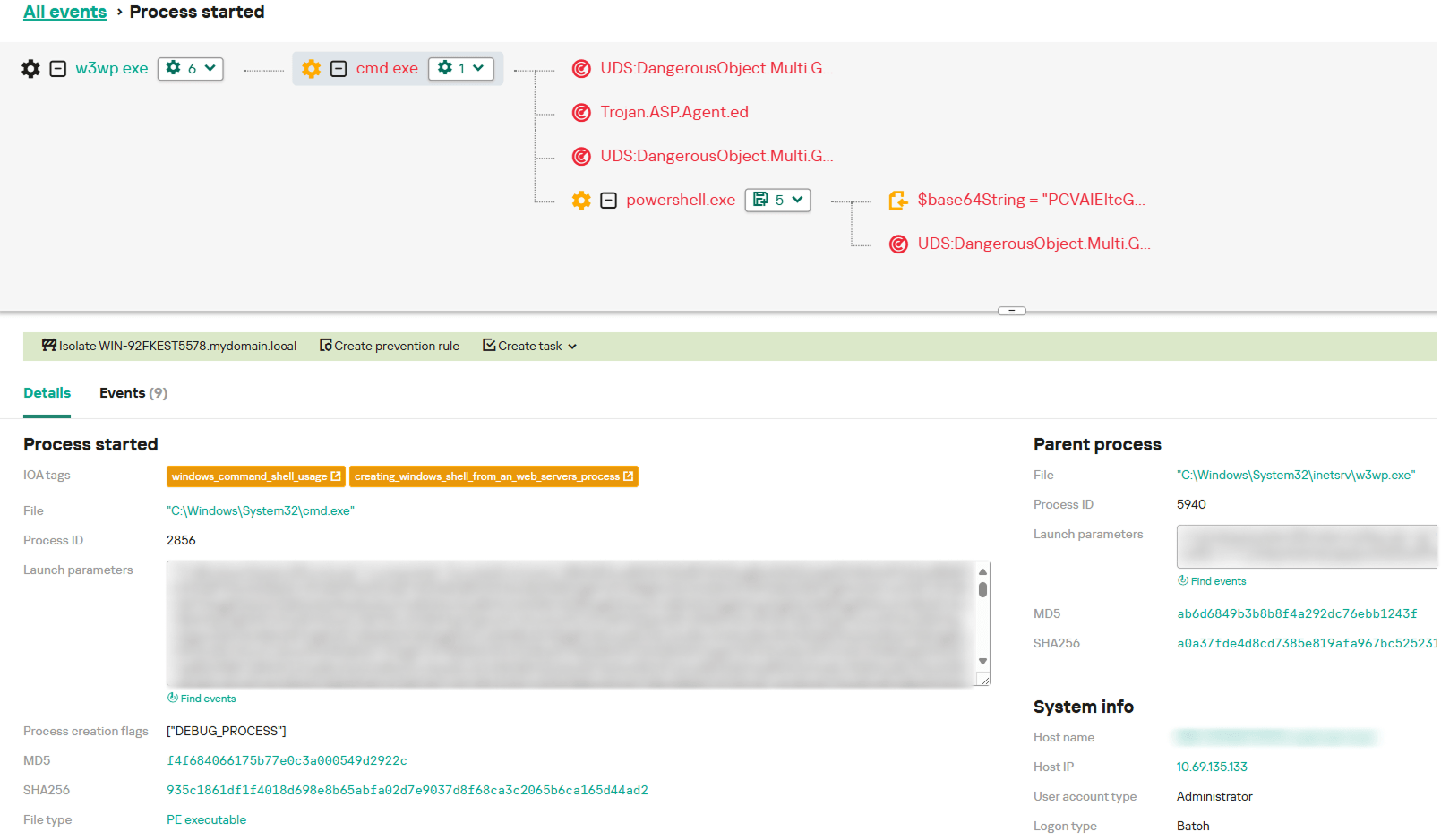
    On July 19–20, 2025, various security companies and national CERTs published alerts about active exploitation of on-premise SharePoint servers. According to the reports, observed attacks did not require authentication, allowed attackers to gain full control over the infected servers, and were performed using an exploit chain of two vulnerabilities: CVE-2025-49704 and CVE-2025-49706, publicly named “ToolShell”. Additionally, on the same dates, Microsoft released out-of-band security patches for the vulnerabilities CVE-2025-53770 and CVE-2025-53771, aimed at addressing the security bypasses of previously issued fixes for CVE-2025-49704 and CVE-2025-49706. The release of the new, “proper” updates has caused confusion about exactly which vulnerabilities attackers are exploiting and whether they are using zero-day exploits.

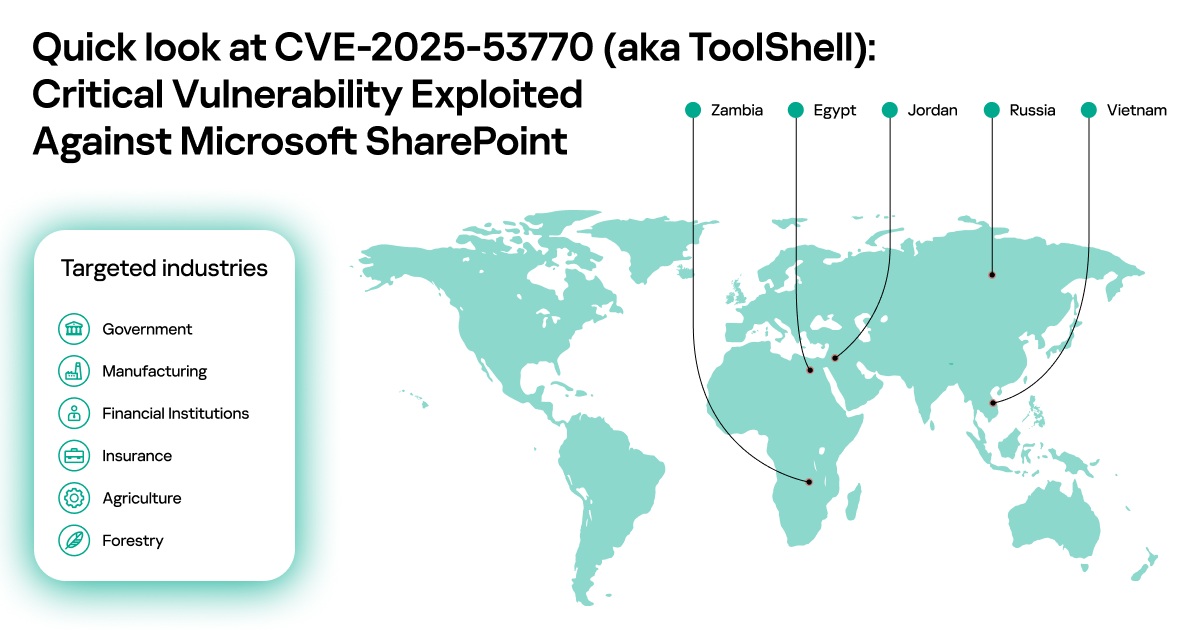
    Kaspersky products proactively detected and blocked malicious activity linked to these attacks, which allowed us to gather statistics about the timeframe and spread of this campaign. Our statistics show that widespread exploitation started on July 18, 2025, and attackers targeted servers across the world in Egypt, Jordan, Russia, Vietnam, and Zambia. Entities across multiple sectors were affected: government, finance, manufacturing, forestry, and agriculture.

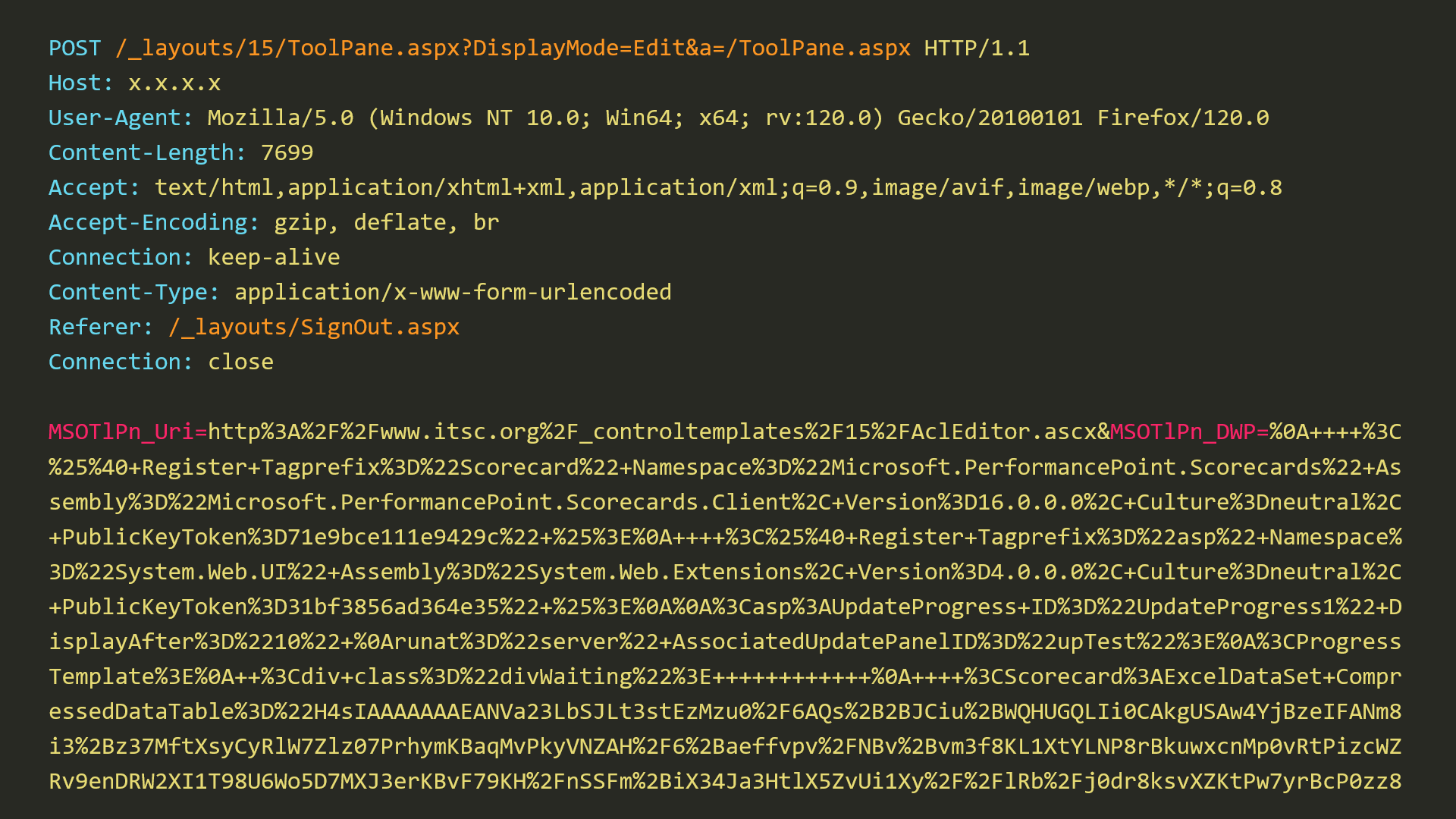
    While analyzing all artifacts related to these attacks, which were detected by our products and public information provided by external researchers, we found a dump of a POST request that was claimed to contain the malicious payload used in these attacks. After performing our own analysis, we were able to confirm that this dump indeed contained the malicious payload detected by our technologies, and that sending this single request to an affected SharePoint installation was enough to execute the malicious payload there.

    Our analysis of the exploit showed that it did rely on vulnerabilities fixed under CVE-2025-49704 and CVE-2025-49706, but by changing just one byte in the request, we were able to bypass those fixes.

    In this post, we provide detailed information about CVE-2025-49704, CVE-2025-49706, CVE-2025-53770, CVE-2025-53771, and one related vulnerability. Since the exploit code is already published online, is very easy to use, and poses a significant risk, we encourage all organizations to install the necessary updates.

    The exploit

    Our research started with an analysis of a POST request dump associated with this wave of attacks on SharePoint servers.

    Snippet of the exploit POST request

    We can see that this POST request targets the “/_layouts/15/ToolPane.aspx” endpoint and embeds two parameters: “MSOtlPn_Uri” and “MSOtlPn_DWP”. Looking at the code of ToolPane.aspx, we can see that this file itself does not contain much functionality and most of its code is located in the ToolPane class of the Microsoft.SharePoint.WebPartPages namespace in Microsoft.SharePoint.dll. Looking at this class reveals the code that works with the two parameters present in the exploit. However, accessing this endpoint under normal conditions is not possible without bypassing authentication on the attacked SharePoint server. This is where the first Microsoft SharePoint Server Spoofing Vulnerability CVE-2025-49706 comes into play.

    CVE-2025-49706

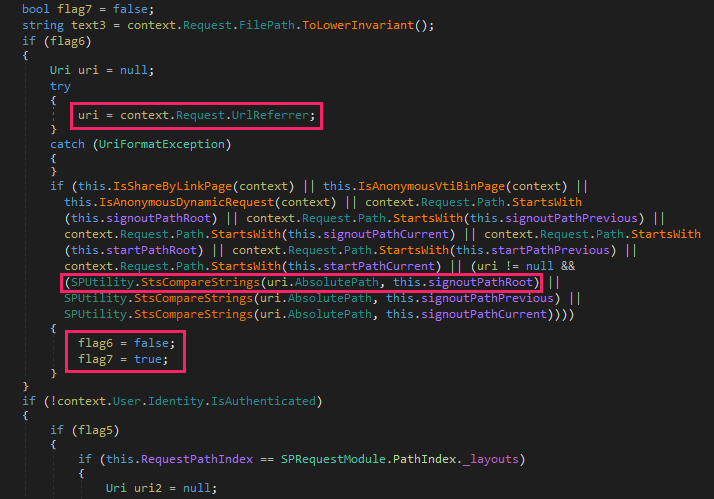
    This vulnerability is present in the method PostAuthenticateRequestHandler, in Microsoft.SharePoint.dll. SharePoint requires Internet Information Services (IIS) to be configured in integrated mode. In this mode, the IIS and ASP.NET authentication stages are unified. As a result, the outcome of IIS authentication is not determined until the PostAuthenticateRequest stage, at which point both the ASP.NET and IIS authentication methods have been completed. Therefore, the PostAuthenticateRequestHandler method utilizes a series of flags to track potential authentication violations. A logic bug in this method enables an authentication bypass if the “Referrer” header of the HTTP request is equal to “/_layouts/SignOut.aspx”, “/_layouts/14/SignOut.aspx”, or “/_layouts/15/SignOut.aspx” using case insensitive comparison.

    Vulnerable code in PostAuthenticateRequestHandler method (Microsoft.SharePoint.dll version 16.0.10417.20018)

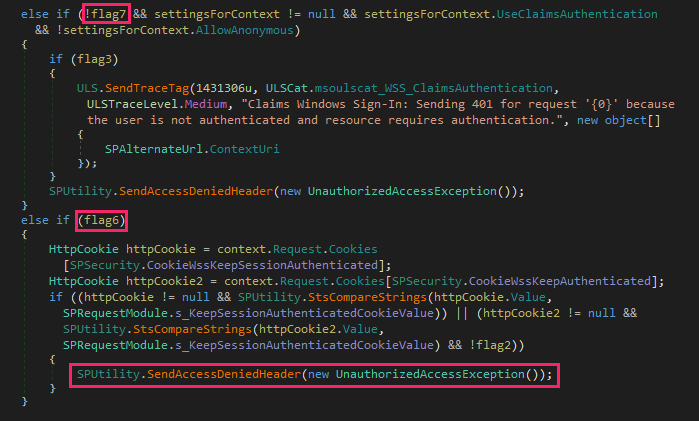
    The code displayed in the image above handles the sign-out request and is also triggered when the sign-out page is specified as the referrer. When flag6 is set to false and flag7 is set to true, both conditional branches that could potentially throw an “Unauthorized Access” exception are bypassed.

    Unauthorized access checks bypassed by the exploit

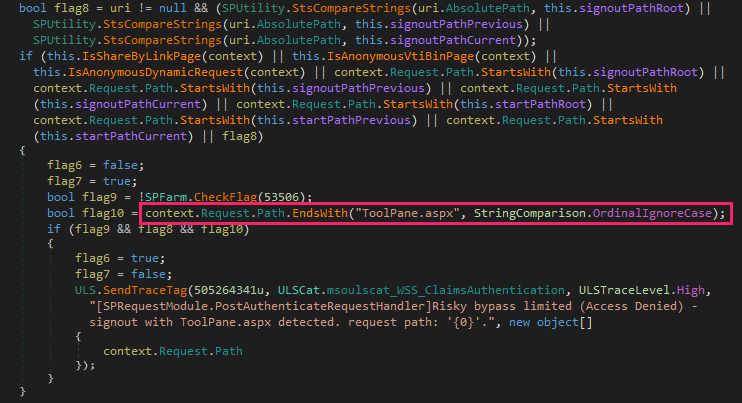
    On July 8, 2025, Microsoft released an update that addressed this vulnerability by introducing additional checks to detect the usage of the “ToolPane.aspx” endpoint with the sign-out page specified as the referrer.

    CVE-2025-49706 fix (Microsoft.SharePoint.dll version 16.0.10417.20027)

    The added check uses case insensitive comparison to verify if the requested path ends with “ToolPane.aspx”. Is it possible to bypass this check, say, by using a different endpoint? Our testing has shown that this check can be easily bypassed.

    CVE-2025-53771

    We were able to successfully bypass the patch for vulnerability CVE-2025-49706 by adding just one byte to the exploit POST request. All that was required to bypass this patch was to add a “/” (slash) to the end of the requested “ToolPane.aspx” path.

    Bypass for CVE-2025-49706 fix

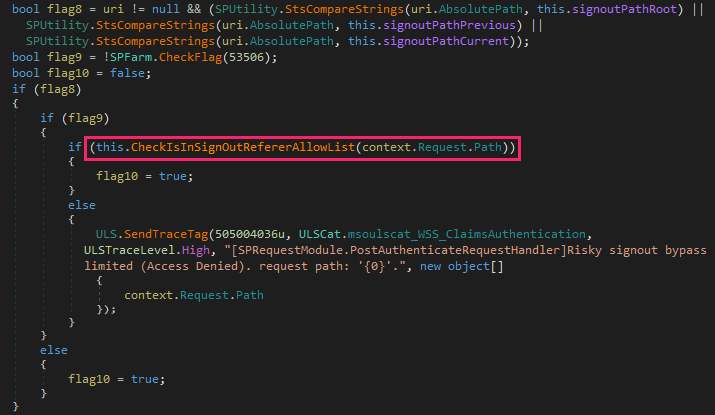
    On July 20, 2025, Microsoft released an update that fixed this bypass as CVE-2025-53771. This fix replaces the “ToolPane.aspx” check to instead check whether the requested path is in the list of paths allowed for use with the sign-out page specified as the referrer.

    CVE-2025-53771 fix (Microsoft.SharePoint.dll version 16.0.10417.20037)

    This allowlist includes the following paths: “/_layouts/15/SignOut.aspx”, “/_layouts/15/1033/initstrings.js”, “/_layouts/15/init.js”, “/_layouts/15/theming.js”, “/ScriptResource.axd”, “/_layouts/15/blank.js”, “/ScriptResource.axd”, “/WebResource.axd”, “/_layouts/15/1033/styles/corev15.css”, “/_layouts/15/1033/styles/error.css”, “/_layouts/15/images/favicon.ico”, “/_layouts/15/1033/strings.js”, “/_layouts/15/core.js”, and it can contain additional paths added by the administrator.

    While testing the CVE-2025-49706 bypass with the July 8, 2025 updates installed on our SharePoint debugging stand, we noticed some strange behavior. Not only did the bypass of CVE-2025-49706 work, but the entire exploit chain did! But wait! Didn’t the attackers use an additional Microsoft SharePoint Remote Code Execution Vulnerability CVE-2025-49704, which was supposed to be fixed in the same update? To understand why the entire exploit chain worked in our case, let’s take a look at the vulnerability CVE-2025-49704 and how it was fixed.

    CVE-2025-49704

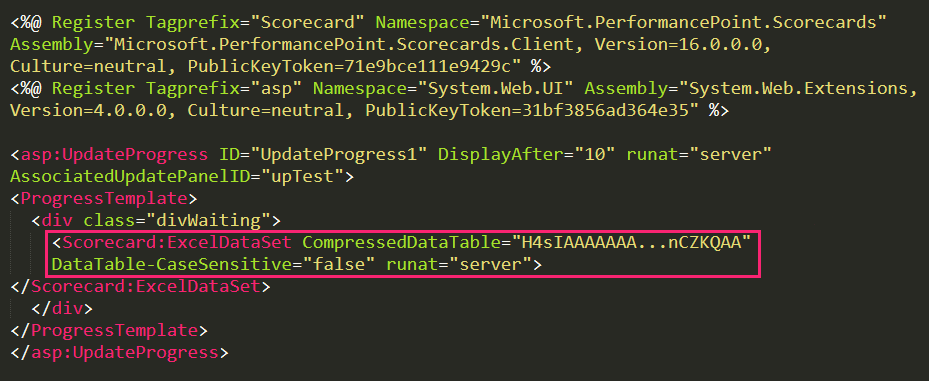
    CVE-2025-49704 is an untrusted data deserialization vulnerability that exists due to improper validation of XML content. Looking at the exploit POST request, we can see that it contains two URL encoded parameters: “MSOtlPn_Uri” and “MSOtlPn_DWP”. We can see how they are handled by examining the code of the method GetPartPreviewAndPropertiesFromMarkup in Microsoft.SharePoint.dll. A quick analysis reveals that “MSOtlPn_Uri”  is a page URL that might be pointing to an any file in the CONTROLTEMPLATES folder and the parameter “MSOtlPn_DWP” contains something known as WebPart markup. This markup contains special directives that can be used to execute safe controls on a server and has a format very similar to XML.

    WebPart markup used by the attackers

    While this “XML” included in the “MSOtlPn_DWP” parameter does not itself contain a vulnerability, it allows attackers to instantiate the ExcelDataSet control from Microsoft.PerformancePoint.Scorecards.Client.dll with CompressedDataTable property set to malicious payload and trigger its processing using DataTable property getter.

    Code of the method that handles the contents of ExcelDataSet’s CompressedDataTable property in the DataTable property getter

    Looking at the code of the ExcelDataSet’s DataTable property getter in Microsoft.PerformancePoint.Scorecards.Client.dll, we find the method GetObjectFromCompressedBase64String, responsible for deserialization of CompressedDataTable property contents. The data provided as Base64 string is decoded, unzipped, and passed to the BinarySerialization.Deserialize method from Microsoft.SharePoint.dll.

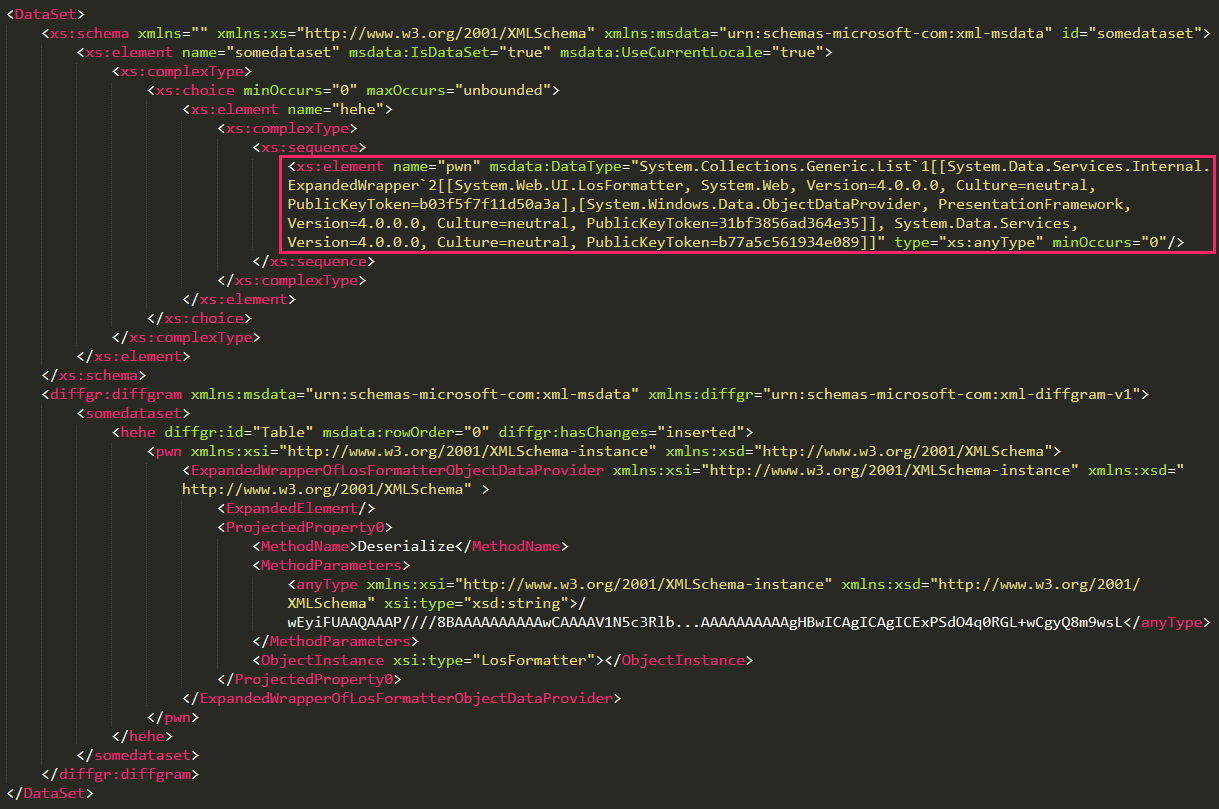
    DataSet with XML content exploiting CVE-2025-49704 (deserialized)

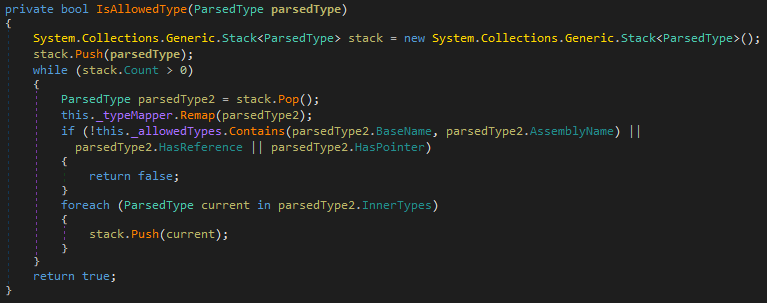
    Attackers use this method to provide a malicious DataSet whose deserialized content is shown in the image above. It contains an XML with an element of dangerous type “System.Collections.Generic.List1[[System.Data.Services.Internal.ExpandedWrapper2[…], System.Data.Services, Version=4.0.0.0, Culture=neutral, PublicKeyToken=b77a5c561934e089]]”, which allows attackers to execute arbitrary methods with the help of the well-known ExpandedWrapper technique aimed at exploitation of unsafe XML deserialization in applications based on the .NET framework. In fact, this shouldn’t be possible, since BinarySerialization.Deserialize in Microsoft.SharePoint.dll uses a special XmlValidator designed to protect against this technique by checking the types of all elements present in the provided XML and ensuring that they are on the list of allowed types. However, the exploit bypasses this check by placing the ExpandedWrapper object into the list.

    Now, to find out why the exploit worked on our SharePoint debugging stand with the July 8, 2025 updates installed, let’s take a look at how this vulnerability was fixed. In this patch, Microsoft did not really fix the vulnerability but only mitigated it by adding the new AddExcelDataSetToSafeControls class to the Microsoft.SharePoint.Upgrade namespace. This class contains new code that modifies the web.config file and marks the Microsoft.PerformancePoint.Scorecards.ExcelDataSet control as unsafe. Because SharePoint does not execute this code on its own after installing updates, the only way to achieve the security effect was to manually run a configuration upgrade using the SharePoint Products Configuration Wizard tool. Notably, the security guidance for CVE-2025-49704 does not mention the need for this step, which means at least some SharePoint administrators may skip it. Meanwhile, anyone who installed this update but did not manually perform a configuration upgrade remained vulnerable.

    CVE-2025-53770

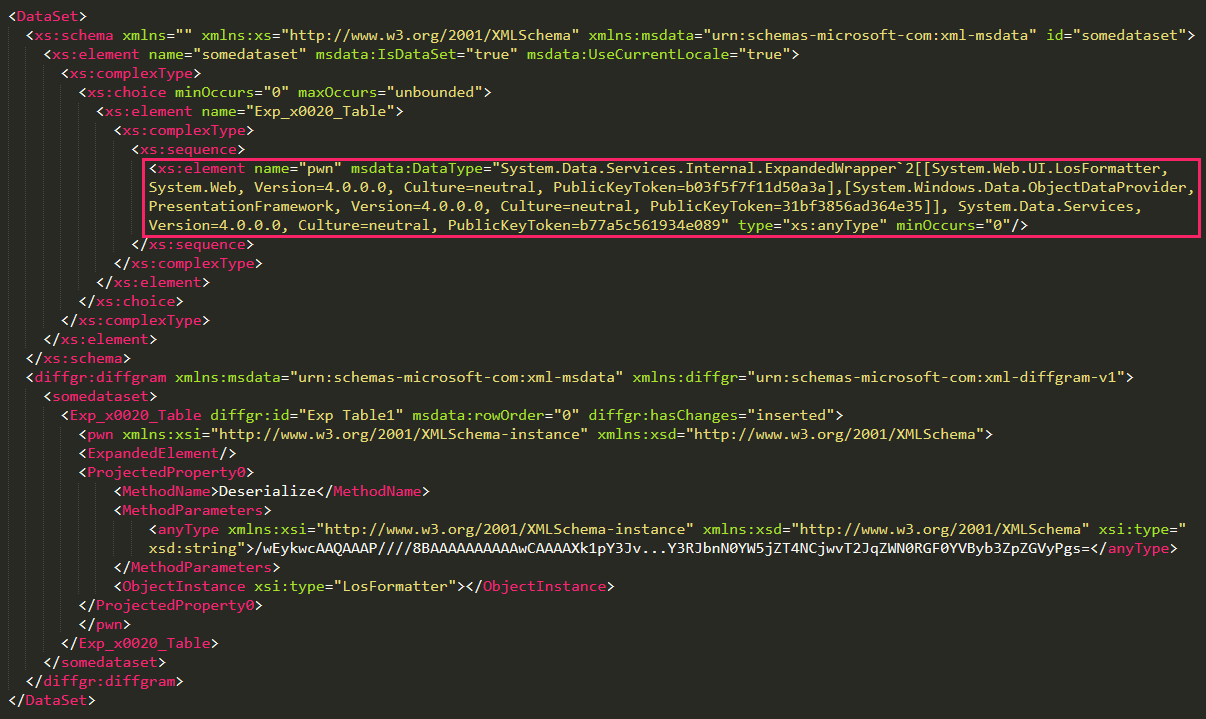
    On July 20, 2025, Microsoft released an update with a proper fix for the CVE-2025-49704 vulnerability. This patch introduces an updated XmlValidator that now properly validates element types in XML, preventing exploitation of this vulnerability without requiring a configuration upgrade and, more importantly, addressing the root cause and preventing exploitation of the same vulnerability through controls other than Microsoft.PerformancePoint.Scorecards.ExcelDataSet.

    DataSet with XML content exploiting CVE-2025-49704 (deserialized)

    CVE-2020-1147

    Readers familiar with previous SharePoint exploits might feel that the vulnerability CVE-2025-49704/CVE-2025-53770 and the exploit used by the attackers looks very familiar and very similar to the older .NET Framework, SharePoint Server, and Visual Studio Remote Code Execution Vulnerability CVE-2020-1147. In fact, if we compare the exploit for CVE-2020-1147 and an exploit for CVE-2025-49704/CVE-2025-53770, we can see that they are almost identical. The only difference is that in the exploit for CVE-2025-49704/CVE-2025-53770, the dangerous ExpandedWrapper object is placed in the list. This makes CVE-2025-53770 an updated fix for CVE-2020-1147.

    DataSet with XML content exploiting CVE-2020-1147

    Conclusions

    Despite the fact that patches for the ToolShell vulnerabilities are now available for deployment, we assess that this chain of exploits will continue being used by attackers for a long time. We have been observing the same situation with other notorious vulnerabilities, such as ProxyLogon, PrintNightmare, or EternalBlue. While they have been known for years, many threat actors still continue leveraging them in their attacks to compromise unpatched systems. We expect the ToolShell vulnerabilities to follow the same fate, as they can be exploited with extremely low effort and allow full control over the vulnerable server.

    To stay better protected against threats like ToolShell, we as a community should learn lessons from previous events in the industry related to critical vulnerabilities. Specifically, the speed of applying security patches nowadays is the most important factor when it comes to fighting such vulnerabilities. Since public exploits for these dangerous vulnerabilities appear very soon after vulnerability announcements, it is paramount to install patches as soon as possible, as a gap of even a few hours can make a critical difference.

    At the same time, it is important to protect enterprise networks against zero-day exploits, which can be leveraged when there is no available public patch for vulnerabilities. In this regard, it is critical to equip machines with reliable cybersecurity solutions that have proven effective in combatting ToolShell attacks before they were publicly disclosed.

    Kaspersky Next with its Behaviour detection component proactively protects against  exploitation of these vulnerabilities. Additionally, it is able to detect exploitation and the subsequent malicious activity.

    Kaspersky products detect the exploits and malware used in these attacks with the following verdicts:

    • UDS:DangerousObject.Multi.Generic
    • PDM:Exploit.Win32.Generic
    • PDM:Trojan.Win32.Generic
    • HEUR:Trojan.MSIL.Agent.gen
    • ASP.Agent.*
    • PowerShell.Agent.*

    MIL OSI Economics

  • MIL-OSI Economics: ToolShell: a story of five vulnerabilities in Microsoft SharePoint

    Source: Securelist – Kaspersky

    Headline: ToolShell: a story of five vulnerabilities in Microsoft SharePoint

    On July 19–20, 2025, various security companies and national CERTs published alerts about active exploitation of on-premise SharePoint servers. According to the reports, observed attacks did not require authentication, allowed attackers to gain full control over the infected servers, and were performed using an exploit chain of two vulnerabilities: CVE-2025-49704 and CVE-2025-49706, publicly named “ToolShell”. Additionally, on the same dates, Microsoft released out-of-band security patches for the vulnerabilities CVE-2025-53770 and CVE-2025-53771, aimed at addressing the security bypasses of previously issued fixes for CVE-2025-49704 and CVE-2025-49706. The release of the new, “proper” updates has caused confusion about exactly which vulnerabilities attackers are exploiting and whether they are using zero-day exploits.

    Kaspersky products proactively detected and blocked malicious activity linked to these attacks, which allowed us to gather statistics about the timeframe and spread of this campaign. Our statistics show that widespread exploitation started on July 18, 2025, and attackers targeted servers across the world in Egypt, Jordan, Russia, Vietnam, and Zambia. Entities across multiple sectors were affected: government, finance, manufacturing, forestry, and agriculture.

    While analyzing all artifacts related to these attacks, which were detected by our products and public information provided by external researchers, we found a dump of a POST request that was claimed to contain the malicious payload used in these attacks. After performing our own analysis, we were able to confirm that this dump indeed contained the malicious payload detected by our technologies, and that sending this single request to an affected SharePoint installation was enough to execute the malicious payload there.

    Our analysis of the exploit showed that it did rely on vulnerabilities fixed under CVE-2025-49704 and CVE-2025-49706, but by changing just one byte in the request, we were able to bypass those fixes.

    In this post, we provide detailed information about CVE-2025-49704, CVE-2025-49706, CVE-2025-53770, CVE-2025-53771, and one related vulnerability. Since the exploit code is already published online, is very easy to use, and poses a significant risk, we encourage all organizations to install the necessary updates.

    The exploit

    Our research started with an analysis of a POST request dump associated with this wave of attacks on SharePoint servers.

    Snippet of the exploit POST request

    We can see that this POST request targets the “/_layouts/15/ToolPane.aspx” endpoint and embeds two parameters: “MSOtlPn_Uri” and “MSOtlPn_DWP”. Looking at the code of ToolPane.aspx, we can see that this file itself does not contain much functionality and most of its code is located in the ToolPane class of the Microsoft.SharePoint.WebPartPages namespace in Microsoft.SharePoint.dll. Looking at this class reveals the code that works with the two parameters present in the exploit. However, accessing this endpoint under normal conditions is not possible without bypassing authentication on the attacked SharePoint server. This is where the first Microsoft SharePoint Server Spoofing Vulnerability CVE-2025-49706 comes into play.

    CVE-2025-49706

    This vulnerability is present in the method PostAuthenticateRequestHandler, in Microsoft.SharePoint.dll. SharePoint requires Internet Information Services (IIS) to be configured in integrated mode. In this mode, the IIS and ASP.NET authentication stages are unified. As a result, the outcome of IIS authentication is not determined until the PostAuthenticateRequest stage, at which point both the ASP.NET and IIS authentication methods have been completed. Therefore, the PostAuthenticateRequestHandler method utilizes a series of flags to track potential authentication violations. A logic bug in this method enables an authentication bypass if the “Referrer” header of the HTTP request is equal to “/_layouts/SignOut.aspx”, “/_layouts/14/SignOut.aspx”, or “/_layouts/15/SignOut.aspx” using case insensitive comparison.

    Vulnerable code in PostAuthenticateRequestHandler method (Microsoft.SharePoint.dll version 16.0.10417.20018)

    The code displayed in the image above handles the sign-out request and is also triggered when the sign-out page is specified as the referrer. When flag6 is set to false and flag7 is set to true, both conditional branches that could potentially throw an “Unauthorized Access” exception are bypassed.

    Unauthorized access checks bypassed by the exploit

    On July 8, 2025, Microsoft released an update that addressed this vulnerability by introducing additional checks to detect the usage of the “ToolPane.aspx” endpoint with the sign-out page specified as the referrer.

    CVE-2025-49706 fix (Microsoft.SharePoint.dll version 16.0.10417.20027)

    The added check uses case insensitive comparison to verify if the requested path ends with “ToolPane.aspx”. Is it possible to bypass this check, say, by using a different endpoint? Our testing has shown that this check can be easily bypassed.

    CVE-2025-53771

    We were able to successfully bypass the patch for vulnerability CVE-2025-49706 by adding just one byte to the exploit POST request. All that was required to bypass this patch was to add a “/” (slash) to the end of the requested “ToolPane.aspx” path.

    Bypass for CVE-2025-49706 fix

    On July 20, 2025, Microsoft released an update that fixed this bypass as CVE-2025-53771. This fix replaces the “ToolPane.aspx” check to instead check whether the requested path is in the list of paths allowed for use with the sign-out page specified as the referrer.

    CVE-2025-53771 fix (Microsoft.SharePoint.dll version 16.0.10417.20037)

    This allowlist includes the following paths: “/_layouts/15/SignOut.aspx”, “/_layouts/15/1033/initstrings.js”, “/_layouts/15/init.js”, “/_layouts/15/theming.js”, “/ScriptResource.axd”, “/_layouts/15/blank.js”, “/ScriptResource.axd”, “/WebResource.axd”, “/_layouts/15/1033/styles/corev15.css”, “/_layouts/15/1033/styles/error.css”, “/_layouts/15/images/favicon.ico”, “/_layouts/15/1033/strings.js”, “/_layouts/15/core.js”, and it can contain additional paths added by the administrator.

    While testing the CVE-2025-49706 bypass with the July 8, 2025 updates installed on our SharePoint debugging stand, we noticed some strange behavior. Not only did the bypass of CVE-2025-49706 work, but the entire exploit chain did! But wait! Didn’t the attackers use an additional Microsoft SharePoint Remote Code Execution Vulnerability CVE-2025-49704, which was supposed to be fixed in the same update? To understand why the entire exploit chain worked in our case, let’s take a look at the vulnerability CVE-2025-49704 and how it was fixed.

    CVE-2025-49704

    CVE-2025-49704 is an untrusted data deserialization vulnerability that exists due to improper validation of XML content. Looking at the exploit POST request, we can see that it contains two URL encoded parameters: “MSOtlPn_Uri” and “MSOtlPn_DWP”. We can see how they are handled by examining the code of the method GetPartPreviewAndPropertiesFromMarkup in Microsoft.SharePoint.dll. A quick analysis reveals that “MSOtlPn_Uri”  is a page URL that might be pointing to an any file in the CONTROLTEMPLATES folder and the parameter “MSOtlPn_DWP” contains something known as WebPart markup. This markup contains special directives that can be used to execute safe controls on a server and has a format very similar to XML.

    WebPart markup used by the attackers

    While this “XML” included in the “MSOtlPn_DWP” parameter does not itself contain a vulnerability, it allows attackers to instantiate the ExcelDataSet control from Microsoft.PerformancePoint.Scorecards.Client.dll with CompressedDataTable property set to malicious payload and trigger its processing using DataTable property getter.

    Code of the method that handles the contents of ExcelDataSet’s CompressedDataTable property in the DataTable property getter

    Looking at the code of the ExcelDataSet’s DataTable property getter in Microsoft.PerformancePoint.Scorecards.Client.dll, we find the method GetObjectFromCompressedBase64String, responsible for deserialization of CompressedDataTable property contents. The data provided as Base64 string is decoded, unzipped, and passed to the BinarySerialization.Deserialize method from Microsoft.SharePoint.dll.

    DataSet with XML content exploiting CVE-2025-49704 (deserialized)

    Attackers use this method to provide a malicious DataSet whose deserialized content is shown in the image above. It contains an XML with an element of dangerous type “System.Collections.Generic.List1[[System.Data.Services.Internal.ExpandedWrapper2[…], System.Data.Services, Version=4.0.0.0, Culture=neutral, PublicKeyToken=b77a5c561934e089]]”, which allows attackers to execute arbitrary methods with the help of the well-known ExpandedWrapper technique aimed at exploitation of unsafe XML deserialization in applications based on the .NET framework. In fact, this shouldn’t be possible, since BinarySerialization.Deserialize in Microsoft.SharePoint.dll uses a special XmlValidator designed to protect against this technique by checking the types of all elements present in the provided XML and ensuring that they are on the list of allowed types. However, the exploit bypasses this check by placing the ExpandedWrapper object into the list.

    Now, to find out why the exploit worked on our SharePoint debugging stand with the July 8, 2025 updates installed, let’s take a look at how this vulnerability was fixed. In this patch, Microsoft did not really fix the vulnerability but only mitigated it by adding the new AddExcelDataSetToSafeControls class to the Microsoft.SharePoint.Upgrade namespace. This class contains new code that modifies the web.config file and marks the Microsoft.PerformancePoint.Scorecards.ExcelDataSet control as unsafe. Because SharePoint does not execute this code on its own after installing updates, the only way to achieve the security effect was to manually run a configuration upgrade using the SharePoint Products Configuration Wizard tool. Notably, the security guidance for CVE-2025-49704 does not mention the need for this step, which means at least some SharePoint administrators may skip it. Meanwhile, anyone who installed this update but did not manually perform a configuration upgrade remained vulnerable.

    CVE-2025-53770

    On July 20, 2025, Microsoft released an update with a proper fix for the CVE-2025-49704 vulnerability. This patch introduces an updated XmlValidator that now properly validates element types in XML, preventing exploitation of this vulnerability without requiring a configuration upgrade and, more importantly, addressing the root cause and preventing exploitation of the same vulnerability through controls other than Microsoft.PerformancePoint.Scorecards.ExcelDataSet.

    DataSet with XML content exploiting CVE-2025-49704 (deserialized)

    CVE-2020-1147

    Readers familiar with previous SharePoint exploits might feel that the vulnerability CVE-2025-49704/CVE-2025-53770 and the exploit used by the attackers looks very familiar and very similar to the older .NET Framework, SharePoint Server, and Visual Studio Remote Code Execution Vulnerability CVE-2020-1147. In fact, if we compare the exploit for CVE-2020-1147 and an exploit for CVE-2025-49704/CVE-2025-53770, we can see that they are almost identical. The only difference is that in the exploit for CVE-2025-49704/CVE-2025-53770, the dangerous ExpandedWrapper object is placed in the list. This makes CVE-2025-53770 an updated fix for CVE-2020-1147.

    DataSet with XML content exploiting CVE-2020-1147

    Conclusions

    Despite the fact that patches for the ToolShell vulnerabilities are now available for deployment, we assess that this chain of exploits will continue being used by attackers for a long time. We have been observing the same situation with other notorious vulnerabilities, such as ProxyLogon, PrintNightmare, or EternalBlue. While they have been known for years, many threat actors still continue leveraging them in their attacks to compromise unpatched systems. We expect the ToolShell vulnerabilities to follow the same fate, as they can be exploited with extremely low effort and allow full control over the vulnerable server.

    To stay better protected against threats like ToolShell, we as a community should learn lessons from previous events in the industry related to critical vulnerabilities. Specifically, the speed of applying security patches nowadays is the most important factor when it comes to fighting such vulnerabilities. Since public exploits for these dangerous vulnerabilities appear very soon after vulnerability announcements, it is paramount to install patches as soon as possible, as a gap of even a few hours can make a critical difference.

    At the same time, it is important to protect enterprise networks against zero-day exploits, which can be leveraged when there is no available public patch for vulnerabilities. In this regard, it is critical to equip machines with reliable cybersecurity solutions that have proven effective in combatting ToolShell attacks before they were publicly disclosed.

    Kaspersky Next with its Behaviour detection component proactively protects against  exploitation of these vulnerabilities. Additionally, it is able to detect exploitation and the subsequent malicious activity.

    Kaspersky products detect the exploits and malware used in these attacks with the following verdicts:

    • UDS:DangerousObject.Multi.Generic
    • PDM:Exploit.Win32.Generic
    • PDM:Trojan.Win32.Generic
    • HEUR:Trojan.MSIL.Agent.gen
    • ASP.Agent.*
    • PowerShell.Agent.*

    MIL OSI Economics

  • MIL-Evening Report: Leaked document reveals proposed law revisions in NZ, as Western defence of Zionist genocide threatens Pacific

    SPECIAL REPORT: By Mick Hall

    A leaked document has revealed secretive plans to revise terror laws in New Zealand so that people can be charged over statements deemed to constitute material support for a proscribed organisation.

    It shows the government also wants to widen the criteria for proscribing organisations to include groups that are judged to “facilitate” or “promote and encourage” terrorist acts.

    The changes would see the South Pacific nation falling in line with increasingly repressive Western countries like the UK, where scores of independent journalists and anti-genocide protesters have been arrested and charged under terrorism laws in recent months.

    The consultation document, handed over to the New Zealand Council for Civil Liberties (NZCCL), reveals the government has been in contact with a small number of unnamed groups this year over plans to legally redefine what material support involves, so that public statements or gestures involving insignia like flags can lead to charges if construed as support for proscribed groups.

    As part of a proposal to revise the Terrorism Suppression Act, the document suggests the process for designating organisations as terror groups should be changed by “expanding the threshold to enable more modern types of entities to be designated, such as those that ‘facilitate’ or ‘promote and encourage’ terrorist acts”.

    The Ministry of Justice has been contacted in an attempt to ascertain which groups it has been consulting with and why it believed the changes were necessary.

    NZCCL chairman Thomas Beagle told Mick Hall In Context his group was concerned the proposed changes were a further attempt to limit the rights of New Zealanders to engage in political protest.

    ‘What’s going on?’
    “When you look at the proposal to expand the Terrorism Suppression Act, alongside the Police and IPCA conspiring to propose a law change to ban political protest without government permission, you really have to wonder what’s going on,” he said.

    A report by the Independent Police Conduct Authority (IPCA) in February proposed to give police the right to ban protests if they believed there was a high chance of public disorder and threats to public safety.

    That would potentially mean bans on Palestinian solidarity protests if far right counter protestErs posed a threat of violent confrontation.

    The stand-alone legislation would put New Zealand in line with other Five Eyes and NATO-aligned security jurisdictions such as Australia, the United Kingdom, and Canada.

    Beagle points out proposed changes to terror laws would suppress freedom of speech and further undermine freedom of assembly and the right to protest.

    “We’ve seen what’s happening with the state’s abuse of terrorism suppression laws in the UK and are horrified that they have sunk so far and so quickly,” he said.

    More than 100 people were arrested across the UK on suspicion of supporting Palestine Action, a non-violent protest group proscribed as a terrorist organisation by the British government earlier this month.

    Arrests in social media clips
    Social media clips showed pensioners aggressively arrested while attending rallies in Liverpool, London, Manchester, Edinburgh, Bristol and Truro over the weekend.

    Independent journalists and academics have also faced state repression under the UK’s Terrorism Act.

    Among those targeted was Electronic Intifada journalist Asa Winstanley, who had his home raided and devices seized in October last year as part of the opaque counter-terror drive “Operation Incessantness”.

    Independent journalist Asa Winstanley . . . his home was raided and devices seized in October last year as part of “Operation Incessantness”. Image: R Witts Photography/mickhall.substack.com

    In May, the country’s Central Criminal Court ruled the raid was unlawful.

    Journalist Richard Medhurst has had a terror investigation hanging over his head since being detained at Heathrow Airport in August last year and charged under section 8 of the Terrorism Act. Activist and independent journalist Sarah Wilkinson had her house raided in the same month.

    Others have faced similar intimidation and threats of jail. In November 2024, Jewish academic Haim Bresheeth was charged after police alleged he had expressed support for a “proscribed organisation” during a speech outside the London residence of the Israeli ambassador to the UK.

    Meanwhile, dozens of members of Palestine Action are in jail facing terror charges. The vast majority are being held on remand where they may wait two years before going to trial — a common state tactic to take activists off the street and incarcerate them, knowing the chances of conviction are slim when they eventually go to court.

    ‘Targeted amendments’
    The document says the New Zealand government wants to progress “targeted amendments” to the Act, creating or amending offences “to capture contemporary behaviours and activities of concern” like “public expressions of support for a terrorist act or designated entities, for example by showing insignia or distributing propaganda or instructional material.”

    Protesters highlight the proscription of Palestine Action outside the British Embassy at The Hague on July 20. No arrests were made following 80 arrests by Dutch police the week before. Image: Defend Our Juries/mickhall.substack.com

    It proposes to improve “the timeliness of the process, by considering changes to who the decision-maker is” and extending the renewal period from three to five years.

    The document suggests consulting the Attorney-General over designation-related decisions to ensure legal requirements are met may not be required and questions whether the designation process requiring the Prime Minister to review decisions twice is necessary. It asks whether others, like the Foreign Minister, should be involved in the decision-making process.

    Beagle believes the secretive proposals pose a threat to New Zealand’s liberal democracy.

    “Political protest is an important part of New Zealand’s history,” he said.

    “Whether it’s the environment, worker’s rights, feminism, Māori issues, homosexual law reform or any number of other issues, political protest has had a big part in forming what Aotearoa New Zealand is today.

    Protected under Bill of Rights
    “It’s a right protected by New Zealand’s Bill of Rights and is a critical part of being a functioning democracy.”

    The terror laws revision forms part of a wider trend of legislating to close down dissent over New Zealand’s foreign policy, now closely aligned with NATO and US interests.

    The government is also widening the definition of foreign interference in a way that could see people who “should have known” that they were being used by a foreign state to undermine New Zealand’s interests prosecuted.

    The Crimes (Countering Foreign Interference) Amendment Bill, which passed its first reading in Parliament on November 19, would criminalise the act of foreign interference, while also increasing powers of unwarranted searches by authorities.

    The Bill is effectively a reintroduction of the country’s old colonial sedition laws inherited from Britain, the broadness of the law having allowed it to be used against communists, trade unionists and indigenous rights activists.

    Republished from Mick Hall in Context on Substack with permisson.

    MIL OSI AnalysisEveningReport.nz

  • MIL-Evening Report: Leaked document reveals proposed law revisions in NZ, as Western defence of Zionist genocide threatens Pacific

    SPECIAL REPORT: By Mick Hall

    A leaked document has revealed secretive plans to revise terror laws in New Zealand so that people can be charged over statements deemed to constitute material support for a proscribed organisation.

    It shows the government also wants to widen the criteria for proscribing organisations to include groups that are judged to “facilitate” or “promote and encourage” terrorist acts.

    The changes would see the South Pacific nation falling in line with increasingly repressive Western countries like the UK, where scores of independent journalists and anti-genocide protesters have been arrested and charged under terrorism laws in recent months.

    The consultation document, handed over to the New Zealand Council for Civil Liberties (NZCCL), reveals the government has been in contact with a small number of unnamed groups this year over plans to legally redefine what material support involves, so that public statements or gestures involving insignia like flags can lead to charges if construed as support for proscribed groups.

    As part of a proposal to revise the Terrorism Suppression Act, the document suggests the process for designating organisations as terror groups should be changed by “expanding the threshold to enable more modern types of entities to be designated, such as those that ‘facilitate’ or ‘promote and encourage’ terrorist acts”.

    The Ministry of Justice has been contacted in an attempt to ascertain which groups it has been consulting with and why it believed the changes were necessary.

    NZCCL chairman Thomas Beagle told Mick Hall In Context his group was concerned the proposed changes were a further attempt to limit the rights of New Zealanders to engage in political protest.

    ‘What’s going on?’
    “When you look at the proposal to expand the Terrorism Suppression Act, alongside the Police and IPCA conspiring to propose a law change to ban political protest without government permission, you really have to wonder what’s going on,” he said.

    A report by the Independent Police Conduct Authority (IPCA) in February proposed to give police the right to ban protests if they believed there was a high chance of public disorder and threats to public safety.

    That would potentially mean bans on Palestinian solidarity protests if far right counter protestErs posed a threat of violent confrontation.

    The stand-alone legislation would put New Zealand in line with other Five Eyes and NATO-aligned security jurisdictions such as Australia, the United Kingdom, and Canada.

    Beagle points out proposed changes to terror laws would suppress freedom of speech and further undermine freedom of assembly and the right to protest.

    “We’ve seen what’s happening with the state’s abuse of terrorism suppression laws in the UK and are horrified that they have sunk so far and so quickly,” he said.

    More than 100 people were arrested across the UK on suspicion of supporting Palestine Action, a non-violent protest group proscribed as a terrorist organisation by the British government earlier this month.

    Arrests in social media clips
    Social media clips showed pensioners aggressively arrested while attending rallies in Liverpool, London, Manchester, Edinburgh, Bristol and Truro over the weekend.

    Independent journalists and academics have also faced state repression under the UK’s Terrorism Act.

    Among those targeted was Electronic Intifada journalist Asa Winstanley, who had his home raided and devices seized in October last year as part of the opaque counter-terror drive “Operation Incessantness”.

    Independent journalist Asa Winstanley . . . his home was raided and devices seized in October last year as part of “Operation Incessantness”. Image: R Witts Photography/mickhall.substack.com

    In May, the country’s Central Criminal Court ruled the raid was unlawful.

    Journalist Richard Medhurst has had a terror investigation hanging over his head since being detained at Heathrow Airport in August last year and charged under section 8 of the Terrorism Act. Activist and independent journalist Sarah Wilkinson had her house raided in the same month.

    Others have faced similar intimidation and threats of jail. In November 2024, Jewish academic Haim Bresheeth was charged after police alleged he had expressed support for a “proscribed organisation” during a speech outside the London residence of the Israeli ambassador to the UK.

    Meanwhile, dozens of members of Palestine Action are in jail facing terror charges. The vast majority are being held on remand where they may wait two years before going to trial — a common state tactic to take activists off the street and incarcerate them, knowing the chances of conviction are slim when they eventually go to court.

    ‘Targeted amendments’
    The document says the New Zealand government wants to progress “targeted amendments” to the Act, creating or amending offences “to capture contemporary behaviours and activities of concern” like “public expressions of support for a terrorist act or designated entities, for example by showing insignia or distributing propaganda or instructional material.”

    Protesters highlight the proscription of Palestine Action outside the British Embassy at The Hague on July 20. No arrests were made following 80 arrests by Dutch police the week before. Image: Defend Our Juries/mickhall.substack.com

    It proposes to improve “the timeliness of the process, by considering changes to who the decision-maker is” and extending the renewal period from three to five years.

    The document suggests consulting the Attorney-General over designation-related decisions to ensure legal requirements are met may not be required and questions whether the designation process requiring the Prime Minister to review decisions twice is necessary. It asks whether others, like the Foreign Minister, should be involved in the decision-making process.

    Beagle believes the secretive proposals pose a threat to New Zealand’s liberal democracy.

    “Political protest is an important part of New Zealand’s history,” he said.

    “Whether it’s the environment, worker’s rights, feminism, Māori issues, homosexual law reform or any number of other issues, political protest has had a big part in forming what Aotearoa New Zealand is today.

    Protected under Bill of Rights
    “It’s a right protected by New Zealand’s Bill of Rights and is a critical part of being a functioning democracy.”

    The terror laws revision forms part of a wider trend of legislating to close down dissent over New Zealand’s foreign policy, now closely aligned with NATO and US interests.

    The government is also widening the definition of foreign interference in a way that could see people who “should have known” that they were being used by a foreign state to undermine New Zealand’s interests prosecuted.

    The Crimes (Countering Foreign Interference) Amendment Bill, which passed its first reading in Parliament on November 19, would criminalise the act of foreign interference, while also increasing powers of unwarranted searches by authorities.

    The Bill is effectively a reintroduction of the country’s old colonial sedition laws inherited from Britain, the broadness of the law having allowed it to be used against communists, trade unionists and indigenous rights activists.

    Republished from Mick Hall in Context on Substack with permisson.

    MIL OSI AnalysisEveningReport.nz

  • MIL-Evening Report: Leaked document reveals proposed law revisions in NZ, as Western defence of Zionist genocide threatens Pacific

    SPECIAL REPORT: By Mick Hall

    A leaked document has revealed secretive plans to revise terror laws in New Zealand so that people can be charged over statements deemed to constitute material support for a proscribed organisation.

    It shows the government also wants to widen the criteria for proscribing organisations to include groups that are judged to “facilitate” or “promote and encourage” terrorist acts.

    The changes would see the South Pacific nation falling in line with increasingly repressive Western countries like the UK, where scores of independent journalists and anti-genocide protesters have been arrested and charged under terrorism laws in recent months.

    The consultation document, handed over to the New Zealand Council for Civil Liberties (NZCCL), reveals the government has been in contact with a small number of unnamed groups this year over plans to legally redefine what material support involves, so that public statements or gestures involving insignia like flags can lead to charges if construed as support for proscribed groups.

    As part of a proposal to revise the Terrorism Suppression Act, the document suggests the process for designating organisations as terror groups should be changed by “expanding the threshold to enable more modern types of entities to be designated, such as those that ‘facilitate’ or ‘promote and encourage’ terrorist acts”.

    The Ministry of Justice has been contacted in an attempt to ascertain which groups it has been consulting with and why it believed the changes were necessary.

    NZCCL chairman Thomas Beagle told Mick Hall In Context his group was concerned the proposed changes were a further attempt to limit the rights of New Zealanders to engage in political protest.

    ‘What’s going on?’
    “When you look at the proposal to expand the Terrorism Suppression Act, alongside the Police and IPCA conspiring to propose a law change to ban political protest without government permission, you really have to wonder what’s going on,” he said.

    A report by the Independent Police Conduct Authority (IPCA) in February proposed to give police the right to ban protests if they believed there was a high chance of public disorder and threats to public safety.

    That would potentially mean bans on Palestinian solidarity protests if far right counter protestErs posed a threat of violent confrontation.

    The stand-alone legislation would put New Zealand in line with other Five Eyes and NATO-aligned security jurisdictions such as Australia, the United Kingdom, and Canada.

    Beagle points out proposed changes to terror laws would suppress freedom of speech and further undermine freedom of assembly and the right to protest.

    “We’ve seen what’s happening with the state’s abuse of terrorism suppression laws in the UK and are horrified that they have sunk so far and so quickly,” he said.

    More than 100 people were arrested across the UK on suspicion of supporting Palestine Action, a non-violent protest group proscribed as a terrorist organisation by the British government earlier this month.

    Arrests in social media clips
    Social media clips showed pensioners aggressively arrested while attending rallies in Liverpool, London, Manchester, Edinburgh, Bristol and Truro over the weekend.

    Independent journalists and academics have also faced state repression under the UK’s Terrorism Act.

    Among those targeted was Electronic Intifada journalist Asa Winstanley, who had his home raided and devices seized in October last year as part of the opaque counter-terror drive “Operation Incessantness”.

    Independent journalist Asa Winstanley . . . his home was raided and devices seized in October last year as part of “Operation Incessantness”. Image: R Witts Photography/mickhall.substack.com

    In May, the country’s Central Criminal Court ruled the raid was unlawful.

    Journalist Richard Medhurst has had a terror investigation hanging over his head since being detained at Heathrow Airport in August last year and charged under section 8 of the Terrorism Act. Activist and independent journalist Sarah Wilkinson had her house raided in the same month.

    Others have faced similar intimidation and threats of jail. In November 2024, Jewish academic Haim Bresheeth was charged after police alleged he had expressed support for a “proscribed organisation” during a speech outside the London residence of the Israeli ambassador to the UK.

    Meanwhile, dozens of members of Palestine Action are in jail facing terror charges. The vast majority are being held on remand where they may wait two years before going to trial — a common state tactic to take activists off the street and incarcerate them, knowing the chances of conviction are slim when they eventually go to court.

    ‘Targeted amendments’
    The document says the New Zealand government wants to progress “targeted amendments” to the Act, creating or amending offences “to capture contemporary behaviours and activities of concern” like “public expressions of support for a terrorist act or designated entities, for example by showing insignia or distributing propaganda or instructional material.”

    Protesters highlight the proscription of Palestine Action outside the British Embassy at The Hague on July 20. No arrests were made following 80 arrests by Dutch police the week before. Image: Defend Our Juries/mickhall.substack.com

    It proposes to improve “the timeliness of the process, by considering changes to who the decision-maker is” and extending the renewal period from three to five years.

    The document suggests consulting the Attorney-General over designation-related decisions to ensure legal requirements are met may not be required and questions whether the designation process requiring the Prime Minister to review decisions twice is necessary. It asks whether others, like the Foreign Minister, should be involved in the decision-making process.

    Beagle believes the secretive proposals pose a threat to New Zealand’s liberal democracy.

    “Political protest is an important part of New Zealand’s history,” he said.

    “Whether it’s the environment, worker’s rights, feminism, Māori issues, homosexual law reform or any number of other issues, political protest has had a big part in forming what Aotearoa New Zealand is today.

    Protected under Bill of Rights
    “It’s a right protected by New Zealand’s Bill of Rights and is a critical part of being a functioning democracy.”

    The terror laws revision forms part of a wider trend of legislating to close down dissent over New Zealand’s foreign policy, now closely aligned with NATO and US interests.

    The government is also widening the definition of foreign interference in a way that could see people who “should have known” that they were being used by a foreign state to undermine New Zealand’s interests prosecuted.

    The Crimes (Countering Foreign Interference) Amendment Bill, which passed its first reading in Parliament on November 19, would criminalise the act of foreign interference, while also increasing powers of unwarranted searches by authorities.

    The Bill is effectively a reintroduction of the country’s old colonial sedition laws inherited from Britain, the broadness of the law having allowed it to be used against communists, trade unionists and indigenous rights activists.

    Republished from Mick Hall in Context on Substack with permisson.

    MIL OSI AnalysisEveningReport.nz

  • MIL-Evening Report: Ceasefire talks collapse – what does that mean for the humanitarian catastrophe in Gaza?

    Source: The Conversation (Au and NZ) – By Ali Mamouri, Research Fellow, Middle East Studies, Deakin University

    Efforts to end the relentless siege of Gaza have been set back by the abrupt end to peace talks in Qatar.

    Both the United States and Israel have withdrawn their negotiating teams, accusing Hamas of a “lack of desire to reach a ceasefire”.

    US President Donald Trump’s special envoy Steve Witkoff says it would appear Hamas never wanted a deal:

    While the mediators have made a great effort, Hamas does not appear to be coordinated or acting in good faith. We will now consider alternative options to bring the hostages home and try to create a more stable environment for the people in Gaza

    State Department spokesman Tommy Piggott reads Steve Witkoff’s statement on the collapse of the Gaza peace talks.

    The disappointing development coincides with mounting fears of a widespread famine in Gaza and a historic decision by France to formally recognise a Palestinian state.

    French President Emmanuel Macron says there is no alternative for the sake of security of the Middle East:

    True to its historic commitment to a just and lasting peace in the Middle East, I have decided that France will recognise the State of Palestine

    What will these developments mean for the conflict in Gaza and the broader security of the Middle East?

    ‘Humanitarian catastrophe’

    The failure to reach a truce means there is no end in sight to the Israeli siege of Gaza which has devastated the territory for more than 21 months.

    Amid mounting fears of mass starvation, Australian Prime Minister Anthony Albanese says Gaza is in the grip of a “humanitarian catastrophe”. He is urging Israel to comply immediately with its obligations under international law:

    Israel’s denial of aid and the killing of civilians, including children, seeking access to water and food cannot be defended or ignored.

    According to the United Nations Palestinian refugee agency UNRWA, more than 100 people – most of them children – have died of hunger. One in five children in Gaza City is malnourished, with the number of cases rising every day.

    Commissioner-General Philippe Lazzarini says with little food aid entering Gaza, people are

    neither dead nor alive, they are walking corpses […] most children our teams are seeing are emaciated, weak and at high risk of dying if they don’t get the treatment they urgently need.

    The UN and more than 100 aid groups blame Israel’s blockade of almost all aid into the territory for the lack of food.

    Lazzarini says UNRWA has 6,000 trucks of emergency supplies waiting in Jordan and Egypt. He is urging Israel – which continues to blame Hamas for cases of malnutrition – to allow the humanitarian assistance into Gaza.

    Proposed ceasefire deal

    The latest ceasefire proposal was reportedly close to being agreed by both parties.

    It included a 60-day truce, during which time Hamas would release ten living Israeli hostages and the remains of 18 others. In exchange, Israel would release a number of Palestinian prisoners, and humanitarian aid to Gaza would be significantly increased.

    During the ceasefire, both sides would engage in negotiations toward a lasting truce.

    While specific details of the current sticking points remain unclear, previous statements from both parties suggest the disagreement centres on what would follow any temporary ceasefire.

    Israel is reportedly seeking to maintain a permanent military presence in Gaza to allow for a rapid resumption of operations if needed. In contrast, Hamas is demanding a pathway toward a complete end to hostilities.

    A lack of mutual trust has dramatically clouded the negotiations.

    From Israel’s perspective, any ceasefire must not result in Hamas regaining control of Gaza, as this would allow the group to rebuild its power and potentially launch another cross-border attack.

    However, Hamas has repeatedly said it is willing to hand over power to any other Palestinian group in pursuit of a Palestinian state based on the 1967 borders. This could include the Palestinian National Authority (PNA), which governs the West Bank and has long recognised Israel.

    Support for a Palestinian state

    Israeli leaders have occasionally paid lip service to a Palestinian state. But they have described such an entity as “less than a state” or a “state-minus” – a formulation that falls short of both Palestinian aspirations and international legal standards.

    In response to the worsening humanitarian situation, some Western countries have moved to fully recognise a Palestinian state, viewing it as a step toward a permanent resolution of one of the longest-running conflicts in the Middle East.

    Macron’s announcement France will officially recognise a full Palestinian state in September is a major development.

    France is now the most prominent Western power to take this position. It follows more than 140 countries – including more than a dozen in Europe – that have already recognised statehood.

    While largely symbolic, the move adds diplomatic pressure on Israel amid the ongoing war and aid crisis in Gaza.

    However, the announcement was immediately condemned by Israeli Prime Minister Benjamin Netanyahu, who claimed recognition “rewards terror” and

    risks creating another Iranian proxy, just as Gaza became. A Palestinian state in these conditions would be a launch pad to annihilate Israel – not to live in peace beside it.

    Annexing Gaza?

    A Palestinian state is unacceptable to Israel.

    Further evidence was recently presented in a revealing TV interview by former Israeli Prime Minister Ehud Barak who stated Netanyahu had deliberately empowered Hamas in order to block a two-state solution.

    Instead there is mounting evidence Israel is seeking to annex the entirety of Palestinian land and relocate Palestinians to neighbouring countries.

    Given the current uncertainty, it appears unlikely a new ceasefire will be reached in the near future, especially as it remains unclear whether the US withdrawal from the negotiations was a genuine policy shift or merely a strategic negotiating tactic.

    Ali Mamouri does not work for, consult, own shares in or receive funding from any company or organisation that would benefit from this article, and has disclosed no relevant affiliations beyond their academic appointment.

    ref. Ceasefire talks collapse – what does that mean for the humanitarian catastrophe in Gaza? – https://theconversation.com/ceasefire-talks-collapse-what-does-that-mean-for-the-humanitarian-catastrophe-in-gaza-261942

    MIL OSI AnalysisEveningReport.nz

  • MIL-OSI Analysis: Ceasefire talks collapse – what does that mean for the humanitarian catastrophe in Gaza?

    Source: The Conversation – Global Perspectives – By Ali Mamouri, Research Fellow, Middle East Studies, Deakin University

    Efforts to end the relentless siege of Gaza have been set back by the abrupt end to peace talks in Qatar.

    Both the United States and Israel have withdrawn their negotiating teams, accusing Hamas of a “lack of desire to reach a ceasefire”.

    US President Donald Trump’s special envoy Steve Witkoff says it would appear Hamas never wanted a deal:

    While the mediators have made a great effort, Hamas does not appear to be coordinated or acting in good faith. We will now consider alternative options to bring the hostages home and try to create a more stable environment for the people in Gaza

    State Department spokesman Tommy Piggott reads Steve Witkoff’s statement on the collapse of the Gaza peace talks.

    The disappointing development coincides with mounting fears of a widespread famine in Gaza and a historic decision by France to formally recognise a Palestinian state.

    French President Emmanuel Macron says there is no alternative for the sake of security of the Middle East:

    True to its historic commitment to a just and lasting peace in the Middle East, I have decided that France will recognise the State of Palestine

    What will these developments mean for the conflict in Gaza and the broader security of the Middle East?

    ‘Humanitarian catastrophe’

    The failure to reach a truce means there is no end in sight to the Israeli siege of Gaza which has devastated the territory for more than 21 months.

    Amid mounting fears of mass starvation, Australian Prime Minister Anthony Albanese says Gaza is in the grip of a “humanitarian catastrophe”. He is urging Israel to comply immediately with its obligations under international law:

    Israel’s denial of aid and the killing of civilians, including children, seeking access to water and food cannot be defended or ignored.

    According to the United Nations Palestinian refugee agency UNRWA, more than 100 people – most of them children – have died of hunger. One in five children in Gaza City is malnourished, with the number of cases rising every day.

    Commissioner-General Philippe Lazzarini says with little food aid entering Gaza, people are

    neither dead nor alive, they are walking corpses […] most children our teams are seeing are emaciated, weak and at high risk of dying if they don’t get the treatment they urgently need.

    The UN and more than 100 aid groups blame Israel’s blockade of almost all aid into the territory for the lack of food.

    Lazzarini says UNRWA has 6,000 trucks of emergency supplies waiting in Jordan and Egypt. He is urging Israel – which continues to blame Hamas for cases of malnutrition – to allow the humanitarian assistance into Gaza.

    Proposed ceasefire deal

    The latest ceasefire proposal was reportedly close to being agreed by both parties.

    It included a 60-day truce, during which time Hamas would release ten living Israeli hostages and the remains of 18 others. In exchange, Israel would release a number of Palestinian prisoners, and humanitarian aid to Gaza would be significantly increased.

    During the ceasefire, both sides would engage in negotiations toward a lasting truce.

    While specific details of the current sticking points remain unclear, previous statements from both parties suggest the disagreement centres on what would follow any temporary ceasefire.

    Israel is reportedly seeking to maintain a permanent military presence in Gaza to allow for a rapid resumption of operations if needed. In contrast, Hamas is demanding a pathway toward a complete end to hostilities.

    A lack of mutual trust has dramatically clouded the negotiations.

    From Israel’s perspective, any ceasefire must not result in Hamas regaining control of Gaza, as this would allow the group to rebuild its power and potentially launch another cross-border attack.

    However, Hamas has repeatedly said it is willing to hand over power to any other Palestinian group in pursuit of a Palestinian state based on the 1967 borders. This could include the Palestinian National Authority (PNA), which governs the West Bank and has long recognised Israel.

    Support for a Palestinian state

    Israeli leaders have occasionally paid lip service to a Palestinian state. But they have described such an entity as “less than a state” or a “state-minus” – a formulation that falls short of both Palestinian aspirations and international legal standards.

    In response to the worsening humanitarian situation, some Western countries have moved to fully recognise a Palestinian state, viewing it as a step toward a permanent resolution of one of the longest-running conflicts in the Middle East.

    Macron’s announcement France will officially recognise a full Palestinian state in September is a major development.

    France is now the most prominent Western power to take this position. It follows more than 140 countries – including more than a dozen in Europe – that have already recognised statehood.

    While largely symbolic, the move adds diplomatic pressure on Israel amid the ongoing war and aid crisis in Gaza.

    However, the announcement was immediately condemned by Israeli Prime Minister Benjamin Netanyahu, who claimed recognition “rewards terror” and

    risks creating another Iranian proxy, just as Gaza became. A Palestinian state in these conditions would be a launch pad to annihilate Israel – not to live in peace beside it.

    Annexing Gaza?

    A Palestinian state is unacceptable to Israel.

    Further evidence was recently presented in a revealing TV interview by former Israeli Prime Minister Ehud Barak who stated Netanyahu had deliberately empowered Hamas in order to block a two-state solution.

    Instead there is mounting evidence Israel is seeking to annex the entirety of Palestinian land and relocate Palestinians to neighbouring countries.

    Given the current uncertainty, it appears unlikely a new ceasefire will be reached in the near future, especially as it remains unclear whether the US withdrawal from the negotiations was a genuine policy shift or merely a strategic negotiating tactic.

    Ali Mamouri does not work for, consult, own shares in or receive funding from any company or organisation that would benefit from this article, and has disclosed no relevant affiliations beyond their academic appointment.

    ref. Ceasefire talks collapse – what does that mean for the humanitarian catastrophe in Gaza? – https://theconversation.com/ceasefire-talks-collapse-what-does-that-mean-for-the-humanitarian-catastrophe-in-gaza-261942

    MIL OSI Analysis

  • French plan to recognise Palestinian state draws fire from Israel, US

    Source: Government of India

    Source: Government of India (4)

    France intends to recognise a Palestinian state in September at the United Nations General Assembly, President Emmanuel Macron said on Thursday in hopes of bringing peace to the region, but the plan drew angry rebukes from Israel and the United States.

    Macron, who unveiled the decision on X, published a letter sent to Palestinian Authority President Mahmoud Abbas confirming France’s intention to press ahead with Palestinian recognition and work to convincing other partners to follow suit.

    “True to its historic commitment to a just and lasting peace in the Middle East, I have decided that France will recognise the state of Palestine,” Macron said.

    “I will make this solemn announcement at the United Nations General Assembly next September.”

    Home to Europe’s largest Jewish and Muslim communities, France will become the first major Western country to recognise a Palestinian state, potentially fuelling a movement so far dominated by smaller nations generally more critical of Israel.

    The news sparked anger in Israel and Washington.

    Israeli Prime Minister Benjamin Netanyahu condemned the decision by one of Israel’s closest allies and a G7 member, saying such a move “rewards terror and risks creating another Iranian proxy.”

    In a post on X, he added, “A Palestinian state in these conditions would be a launch pad to annihilate Israel — not to live in peace beside it.

    “Let’s be clear: the Palestinians do not seek a state alongside Israel; they seek a state instead of Israel.”

    Israeli Defence Minister Israel Katz described the move as “a disgrace and a surrender to terrorism,” adding that Israel would not allow the establishment of a “Palestinian entity that would harm our security, endanger our existence.”

    In response, U.S. Secretary of State Marco Rubio said the United States “strongly rejects (Macron’s) plan to recognize a Palestinian state at the UN general assembly.”

    In a post on X, he said, “This reckless decision only serves Hamas propaganda and sets back peace. It is a slap in the face to the victims of October 7th.”

    Earlier, Canada also pressed Israel to seek peace, with Prime Minister Mark Carney condemning its “failure to prevent the rapidly deteriorating humanitarian disaster in Gaza” and reiterating support for a two-state solution.

    Carney also accused Israel of violating international law over the blocking of Canadian-funded aid to civilians in the war-torn Palestinian enclave.

    “Canada calls on all sides to negotiate an immediate ceasefire in good faith,” he added.

    “We reiterate our calls for Hamas to immediately release all the hostages, and for the Israeli government to respect the territorial integrity of the West Bank and Gaza.”

    In a diplomatic cable in June, the United States said it opposed steps to unilaterally recognise a Palestinian state, even saying it could go against U.S. foreign policy interests and draw consequences.

    In June, Washington’s ambassador to Israel, Mike Huckabee, said he did not think an independent Palestinian state remained a U.S. foreign policy goal.

    President Donald Trump has himself expressed doubts about a two-state solution, proposing a U.S. takeover of Gaza in February, that was condemned by rights groups, Arab states, Palestinians and the U.N. as a proposal of “ethnic cleansing”.

    Macron had been leaning towards recognising a Palestinian state for months as part of a bid to keep the idea of a two-state solution alive, despite the pressure not to do so.

    French officials initially weighed up the move ahead of a United Nations conference, which France and Saudi Arabia had planned to co-host in June to lay out parameters for a roadmap to a Palestinian state, while ensuring Israel’s security.

    The conference was postponed under U.S. pressure and after the 12-day Israel-Iran air war began, during which the closure of regional airspace made it hard for representatives of some Arab states to attend.

    It was rescheduled and downgraded to a ministerial event on July 28 and July 29, with a second event taking place with heads of state and government on the sidelines of the United Nations General Assembly in September.

    CREATING MOMENTUM

    The decision to make the announcement ahead of next week’s conference aimed to give the French team at the United Nations a framework to work with other countries that are also considering recognising a Palestinian state or have misgivings in doing so.

    Diplomats say Macron has faced resistance from allies such as Britain and Canada over his push for the recognition of a Palestinian state. About 40 foreign ministers will be in New York next week.

    Israeli officials have spent months lobbying to prevent what some have called “a nuclear bomb” for bilateral ties.

    Sources familiar with the matter say Israel’s warnings to France have ranged from scaling back intelligence sharing to complicating Paris’ regional initiatives – even hinting at possible annexation of parts of the West Bank.

    Israel has been waging a devastating war in Gaza since the Palestinian militant group Hamas’ deadly attack on Israel in October 2023 and says recognising a Palestinian state now would be equivalent to rewarding Hamas.

    Thanking France, the Palestinian Authority’s Vice President Hussein Al Sheikh said on X that Macron’s decision reflected “France’s commitment to international law and its support for the Palestinian people’s rights to self-determination and the establishment of our independent state.”

    (Reuters)

  • Israel and US recall teams from Gaza truce talks, US says Hamas not showing good faith

    Source: Government of India

    Source: Government of India (4)

    Israel and the United States recalled their delegations from Gaza ceasefire talks for consultations on Thursday, with U.S. envoy Steve Witkoff accusing the Palestinian militant group Hamas of failing to act in good faith in the talks.

    It marked the latest setback in efforts to secure a deal that would bring a ceasefire to Gaza, secure the release of Israeli hostages held by Hamas, and bring respite to Palestinians suffering a sharply worsening humanitarian crisis.

    Witkoff said mediators had made a great effort but “Hamas does not appear to be coordinated or acting in good faith”. “We will now consider alternative options to bring the hostages home and try to create a more stable environment for the people of Gaza,” he wrote on X.

    Hamas said it was surprised by Witkoff’s remarks, adding that the group’s position had been welcomed by mediators and had opened the door to reaching a comprehensive agreement.

    “The movement affirms its keenness to continue negotiations and engage in them in a manner that helps overcome obstacles and leads to a permanent ceasefire agreement,” Hamas added in a statement early on Friday.

    An Israeli official with knowledge of the talks said Hamas’ response to the latest ceasefire proposal “does not allow for progress without a concession” by the group but that Israel intended to continue discussions.

    Both Israel and Hamas are facing pressure at home and abroad to reach a deal following almost two years of war, with the humanitarian situation inside Gaza deteriorating and Israelis worried about the conditions in which hostages are being held.

    Dozens of people have starved to death in Gaza the last few weeks as a wave of hunger crashes on the enclave, according to local health authorities.

    British Prime Minister Keir Starmer said the suffering and starvation in Gaza was an “unspeakable and indefensible” humanitarian catastrophe and called on Israel to urgently let in aid.

    “While the situation has been grave for some time, it has reached new depths and continues to worsen. We are witnessing a humanitarian catastrophe,” Starmer said in a statement.

    He will hold an emergency call with French and German partners on Friday to discuss what could be done to “stop the killing and get people the food they desperately need,” he said.

    The Gaza health ministry said two more people had died of malnutrition. The head of Shifa Hospital in Gaza City said the two were patients suffering from other illnesses who died after going without food for several days.

    Earlier in the day, there had been some apparent signs of progress in the mediation.

    A senior Hamas official told Reuters that there was still a chance of reaching a ceasefire deal but it would take a few days because of what he called Israeli stalling.

    A senior Israeli official had been quoted by local media as saying the new text was something Israel could work with.

    But, Israel’s Channel 12 said a rapid deal was not within reach, with gaps remaining between the two sides, including over where the Israeli military should withdraw to during any truce.

    Witkoff’s team did not immediately respond to a request to explain the Hamas demands that led to his withdrawal of the U.S. negotiators.

    The Hostages Families Forum, representing the family members of those held in Gaza, expressed concern at the recall of the Israeli team. “Each day that passes endangers the hostages’ chances of recovery and risks losing the ability to locate the fallen or gain vital intelligence about them,” it said.

    PEPPER SPRAY FIRED AT AID SITE

    Women going to fetch aid for their families on Thursday said U.S. contractors organising distribution asked them to come to pick up goods and then fired tear gas and pepper spray at them.

    “The Americans said ‘go, go’, and then said no, get back. They sprayed us with pepper spray so we went away. Five minutes later they shot tear gas at us … is this American humanitarian aid?” said Mervat al-Sakani.

    Asked for comment, a spokesperson for the aid organisation – the Gaza Humanitarian Foundation – said a limited amount of pepper spray was used “to prevent civilian injury due to overcrowding”, adding that GHF “didn’t want people to get hurt.” The spokesperson said women-only aid distribution had been “a major success” overall.

    GHF, a U.S.-and Israeli-backed organization, began distributing food packages in Gaza at the end of May.

    The U.N. has called the GHF’s model unsafe and a breach of humanitarian impartiality standards, which GHF denies.

    The U.N. rights office said on July 15 it had recorded at least 875 killings within the preceding six weeks in the vicinity of aid sites and food convoys in Gaza – the majority of them close to GHF distribution points.

    Most of those deaths were caused by gunfire that locals have blamed on the Israeli military. The military has acknowledged that civilians were harmed, saying that Israeli forces had been issued new instructions with “lessons learned”.

    Israel, which cut off all supplies to Gaza from the start of March and reopened it with new restrictions in May, says it is committed to allowing in aid but must control it to prevent Hamas diverting it.

    Israel says it has let in enough food for Gazans, and blames the United Nations for being slow to deliver it; the U.N. says it is operating as effectively as possible under conditions imposed by Israel.

    The war began when Hamas killed some 1,200 people and took 251 hostages in its October 7 attacks on Israel, according to Israeli tallies. Israel has since killed nearly 60,000 Palestinians in Gaza, according to Gaza health authorities.

    (Reuters)

  • MIL-OSI China: Aid allowed into Gaza ‘woefully inadequate’ to sustain life: UN

    Source: People’s Republic of China – State Council News

    A Palestinian child receives free food from a charity kitchen in Gaza City, on July 24, 2025. [Photo/Xinhua]

    The little aid allowed to reach supply facilities inside Gaza is “woefully inadequate” to curb starvation or sustain life-saving relief operations, UN humanitarians said Thursday.

    The UN Office for the Coordination of Humanitarian Affairs (OCHA) said that while UN teams were able to collect food aid, mainly flour, from Kerem Shalom/Karem Abu Salem and Zikim crossings on Wednesday, civilians still face death, injury, hunger, displacement and trauma amid the hostilities and inadequate access to food, water, health care and shelter.

    Following Israeli allegations that the world body and its partners were not collecting aid at the border crossing, OCHA listed the obstacles it faces in obtaining relief for Gazans.

    The humanitarian office said that challenges the United Nations and its partners face include bureaucratic, logistical, administrative and other operational obstacles imposed by Israeli authorities, ongoing hostilities, and access constraints within Gaza, including incidents of criminal looting and shooting that have killed and injured people gathering to offload aid supplies along convoy routes.

    OCHA said violence connected with aid distribution has put civilians and humanitarian staff at grave risk and forced aid agencies on many occasions to pause the collection of cargo from Israeli-controlled crossings.

    The office said that out of 16 attempts to coordinate movements with Israeli authorities on Wednesday, only eight were facilitated, including the collection and transfer of limited fuel. Two other movements were initially approved but then faced obstacles in Gaza.

    OCHA said its partners reported that more than 1 million children are bearing the brunt of deepening starvation and malnutrition, with reports of death from malnutrition increasing by the day.

    “According to partners working in nutrition, in the first two weeks of July, nearly 5,000 of the 56,000 children under the age of 5 screened for malnutrition in the governorates of Gaza, Deir al-Balah and Khan Younis were found to be acutely malnourished,” the humanitarians said, adding that the figure is a staggering 9 percent, compared with 6 percent in June and 2.4 percent in February.

    Philippe Lazzarini, commissioner-general of the UN Relief and Works Agency for Palestine Refugees in the Near East, said on Thursday that one in every five children in Gaza City is malnourished.

    OCHA said that families have been squeezed into just 12 percent of Gaza’s area, while the remaining 88 percent of the Gaza Strip now either falls within Israeli-militarized zones or has been placed under displacement orders.

    The office said the blockade on critical items, such as tents and other shelter materials, has lasted more than 20 weeks. The trickle of fuel now let in is also wholly insufficient.

    OCHA said that aid workers in Gaza who themselves are affected, displaced and going hungry insist on staying and providing life-saving assistance. They join voices across the UN system in continuing to call for a ceasefire and an end to the devastation.

    MIL OSI China News

  • MIL-OSI China: China win first athletics gold, Walaza claims 200m gold at Universiade

    Source: People’s Republic of China – State Council News

    Long jumper Shu Heng leaped 8.09 meters to claim China’s first track and field gold medal, while South Africa’s teenage sprinting sensation Bayanda Walaza won his second gold in as many days Thursday at the Rhine-Ruhr World University Games.

    Shu Heng of China competes during the men’s long jump final at the Rhine-Ruhr 2025 FISU World University Games in Bochum, Germany, July 24, 2025. (Xinhua/Li Ying)

    Shu improved on his leading mark of 8.07 meters from the fourth round by two centimeters in his final attempt to win the event, 13cm shy of his 8.22m gold-winning performance at the Asian Athletics Championships in May.

    Japan’s Koki Fujihara finished second with 8.00m, edging Germany’s Luka Herden by four centimeters.

    “Every international competition helps strengthen my confidence. Winning the Asian championship boosted me mentally, and now winning at the University Games further paves the way and reinforces my confidence for bigger stages ahead,” said Shu.

    Another Chinese athlete, Xing Jialiang, the top qualifier in men’s shot put, earned silver with a throw of 20.08m, just 17cm behind South Africa’s Aiden Smith, who took gold. Italy’s Riccardo Ferrara claimed bronze with 17.91m.

    Walaza, 18, a Paris 2024 Olympian, was third fastest out of the blocks and surged past Spain’s Adria Alfonso Medero in the outer lane to win the men’s 200m final from lane seven. Walaza clocked 20.63 seconds to Medero’s 20.70, with South Korea’s Lee Jae-song taking bronze in 20.75.

    Walaza’s time was an improvement on his 20.93 in the heats and 20.76 in the semifinals earlier in the day.

    “It’s wonderful to say that I’m the fastest in all of the universities around the world. It’s a great honor to be here and to win this,” Walaza said after the race.

    “I arrived in Germany with not a lot of training under my belt, but I quickly convinced myself that I am a warrior and a fighter.”

    The reigning world U20 champion also won the men’s 100m on Tuesday in 10.16 seconds, edging Thailand’s Puripol Boonson (10.22), whom he had previously defeated in last year’s junior world final in Peru.

    Italy led the night’s medal haul with three golds from women’s track events.

    In the women’s 200m, Tokyo 2020 Olympian Vittoria Fontana ran a personal best of 22.79 seconds to take gold, bettering her previous mark of 22.97.

    Eloisa Coiro won the women’s 800m in 1:59.84 ahead of Switzerland’s Veronica Vancardo (2:00.08) and Spain’s Garcia Tena (2:00.12).

    Alice Muraro added Italy’s third track gold with a personal best of 54.60 in the women’s 400m hurdles. Michelle Smith of the U.S. Virgin Islands earned silver in 55.65 and Hungary’s Sara Mato took bronze in 55.92.

    Turkish Ozlem Becerek won the women’s discus with a season-best 61.15m. Sweden’s Ana Lindfors took silver at 58.80 and Germany’s Antonia Kinzel secured bronze with 58.43.

    Israel claimed its first athletics medal of the meet as Jonathan Kapitolnik won men’s high jump with a 2.27m clearance. Totsuki Abe delivered Japan’s first athletics gold by winning the men’s 110m hurdles in 13.47 seconds.

    Poland picked up two golds on the night. Filip Ostrowski won the men’s 1,500m in 3:46.10, and the Polish team captured the 4x400m mixed relay title with a season-best 3:15.18.

    In table tennis, China’s Zhao Shang swept past Huang Yu-jie of Chinese Taipei 4-0 to win women’s singles. Vladimir Sidorenko defeated Maksim Grebnev 4-1 in the men’s singles final between individual neutral athletes, concluding the table tennis competitions.

    In men’s basketball, Brazil and the United States advanced to Saturday’s final. Brazil edged host Germany 83-78, while Team USA overcame Lithuania 72-64.

    “When we’re making a bunch of mistakes and we’re down, we all come together and smile and stay positive and keep working hard. I am blessed from God to be in this position I am in,” said U.S. forward Daniel Skillings Jr., who had a game-high 17 points.

    MIL OSI China News

  • MIL-OSI China: SCO scholars expect better connectivity for regional development

    Source: People’s Republic of China – State Council News

    Participants of the Shanghai Cooperation Organization (SCO) Media and Think Tank Summit pose for photos outside the venue in Zhengzhou, central China’s Henan Province, July 24, 2025. Themed “Upholding the ‘Shanghai Spirit’ to Build a More Beautiful Home,” the SCO Media and Think Tank Summit is held here from July 23 to 27. (Xinhua/Wu Jingdan)

    Scholars from the Shanghai Cooperation Organization (SCO) countries are upbeat that greater connectivity will enhance cooperation and joint development, as they gathered in central China’s Henan Province to discuss the SCO’s role and sustainable development in a changing world.

    The ongoing SCO Media and Think Tank Summit is taking place in Zhengzhou, the capital of Henan, from Wednesday to Sunday. Co-hosted by Xinhua News Agency, the Chinese Academy of Social Sciences (CASS), and the Henan provincial government, the event has attracted more than 400 representatives from media outlets, think tanks and governments of 26 SCO countries, as well as international and regional organizations.

    Since its establishment in 2001 with a focus on security cooperation, the SCO has expanded from six member states to 10 member states with two observer states and 14 dialogue partners. The participating scholars believe that the SCO can support closer economic and people-to-people ties, creating a new pattern of regional cooperation.

    “The SCO possesses the practical conditions to become a new type of geo-economic entity,” said Sun Zhuangzhi, head of the Institute of Russian, Eastern European and Central Asian Studies under the CASS, at a think tank forum held at the summit on Thursday.

    Sun highlighted that with the accession of Iran and Belarus as member states, the SCO has the potential to develop multiple overland corridors, which can support regional economic prosperity.

    As a key Eurasia hub, the SCO can establish an open and efficient transportation system, significantly contributing to economic development and connectivity across the continent, he added.

    Cholpon Koichumanova, a senior scholar at Kyrgyz State University named after I. Arabaev, remarked that the SCO has gained increased influence and respect over the past few years, demonstrating its relevance in global processes.

    “In the context of global transformations and shifting values, economic cooperation between Central Asia and China is especially important,” she said, noting that the China-Kyrgyzstan-Uzbekistan Railway will play a critical role not just for the countries involved but also for infrastructure development and mutual ties enhancement across Central Asia.

    Economic connectivity has evidently grown within the SCO since its establishment. China’s customs data show that from 2001 to 2020, the share of global trade of SCO member states rose from 5.4 percent to 17.5 percent. In 2024, trade between China and other SCO member states, observers and dialogue partners reached a record 890 billion U.S. dollars.

    Zhang Ting, a senior researcher at the Chinese Academy of International Trade and Economic Cooperation with China’s Ministry of Commerce, said that while the potential for economic cooperation among SCO members continues to be unleashed, there remains a shortage in connectivity regarding infrastructure and digital trade.

    “Such factors have limited deeper regional economic integration and development,” she said.

    She thus suggested strengthening policy research collaboration to build an institutional framework for coordinated regional development based on the sustainable development strategies of member states, and deepening research in key areas such as the digital economy, green development, and industrial chain cooperation.

    Hassan Daud Butt, a senior associate professor at Bahria University in Pakistan, highlighted the importance of regional connectivity and integration in transforming underperforming regions into centers of opportunity.

    Butt regards the SCO as a critical framework for inclusive globalization, where “development is attuned to regional realities while connected to global opportunities,” in a world striving to balance resilience with openness.

    Therefore, he anticipates that the SCO framework will not only promote trade and logistics but, more importantly, empower and connect people, with a focus on quality, sustainability, digital and green connectivity.

    Kin Phea, director general of the International Relations Institute of Cambodia, Royal Academy of Cambodia, recommended leveraging digital technologies to encourage shared knowledge and real-time cooperation. This includes the establishment of a shared digital platform for media and research institutions.

    He also advised inclusive dialogue mechanisms that facilitate the exchange and cooperation among municipal authorities, think tanks, and academic institutions of the SCO countries in specific sectors such as urban innovation and public health.

    According to Sun Zhuangzhi, as the SCO has entered a “relatively mature stage of development,” it should shift from emphasizing the construction of consultation mechanisms to focusing more on action-oriented mechanisms, with measures to build a community with a shared future within the SCO framework.

    Building a community with a shared future under the SCO is a shared aspiration of countries in the region, and also a long-term task, Sun said.

    “Based on broad consensus, member states need to deepen practical cooperation across political, security, economic and cultural fields to gradually turn this vision into reality,” he said. 

    MIL OSI China News

  • MIL-Evening Report: ER Report: A Roundup of Significant Articles on EveningReport.nz for July 25, 2025

    ER Report: Here is a summary of significant articles published on EveningReport.nz on July 25, 2025.

    Gangs are going global and so is the illegal gun trade – NZ can do more to fight it
    Source: The Conversation (Au and NZ) – By Alexander Gillespie, Professor of Law, University of Waikato According to the Global Organised Crime Index, international criminal activity has increased over the past two years. And the politically fractured post-pandemic world has made this even harder for nations to combat. New Zealand is far from immune. According

    Historic ICJ climate ruling ‘just the beginning’, says Vanuatu’s Regenvanu
    By Ezra Toara in Port Vila Vanuatu’s Minister of Climate Change Adaptation, Ralph Regenvanu, has welcomed the historic International Court of Justice (ICJ) climate ruling, calling it a “milestone in the fight for climate justice”. The ICJ has delivered a landmark advisory opinion on states’ obligations under international law to act on climate change. The

    3 reasons young people are more likely to believe conspiracy theories – and how we can help them discover the truth
    Source: The Conversation (Au and NZ) – By Jean-Nicolas Bordeleau, Research Fellow, Jeff Bleich Centre for Democracy and Disruptive Technologies, Flinders University Conspiracy theories are a widespread occurrence in today’s hyper connected and polarised world. Events such as Brexit, the 2016 and 2020 United States presidential elections, and the COVID pandemic serve as potent reminders

    Waiting too long for public dental care? Here’s why the system is struggling – and how to fix it
    Source: The Conversation (Au and NZ) – By Santosh Tadakamadla, Professor and Head of Dentistry and Oral Health, La Trobe University Just over one-third of Australians are eligible for public dental services, which provide free or low cost dental treatment. Yet demand for these services continues to exceed supply. As a result, many Australian adults

    Butter wars: ‘nothing cures high prices like high prices’ – but will market forces be enough?
    Source: The Conversation (Au and NZ) – By Alan Renwick, Professor of Agricultural Economics, Lincoln University, New Zealand RobynRoper/Getty Images The alarming rise of butter prices has become a real source of frustration for New Zealand consumers, as well as a topic of political recrimination. The issue has become so serious that Miles Hurrell, chief

    Ultrafast fashion brand Princess Polly has been certified as ‘sustainable’. Is that an oxymoron?
    Source: The Conversation (Au and NZ) – By Harriette Richards, Senior Lecturer, School of Fashion and Textiles, RMIT University Carol Yepes/Getty Images Last week, the ultrafast fashion brand Princess Polly received B Corp certification. This certification is designed to accredit for-profit businesses that provide social impact and environmental benefit. Established on the Gold Coast in

    AI will soon be able to audit all published research – what will that mean for public trust in science?
    Source: The Conversation (Au and NZ) – By Alexander Kaurov, PhD Candidate in Science and Society, Te Herenga Waka — Victoria University of Wellington Jamillah Knowles & Digit/Better Images of AI, CC BY-SA Self-correction is fundamental to science. One of its most important forms is peer review, when anonymous experts scrutinise research before it is

    Columbia’s $200M deal with Trump administration sets a precedent for other universities to bend to the government’s will
    Source: The Conversation (Au and NZ) – By Brendan Cantwell, Associate Professor of Higher, Adult, and Lifelong Education, Michigan State University Students at Columbia University in New York City on April 14, 2025. Charly Triballeau/AFP via Getty Images Columbia University agreed on July 23, 2025, to pay a US$200 million fine to the federal government

    Miles Franklin 2025: Siang Lu’s Ghost Cities is a haunting comedy about tyranny. Is it the funniest winner ever?
    Source: The Conversation (Au and NZ) – By Joseph Steinberg, Forrest Foundation Postdoctoral Fellow, English & Literary Studies, The University of Western Australia Siang Lu David Kelly/UQP The Miles Franklin judges described Siang Lu’s Ghost Cities, winner of the 2025 award, as “a grand farce and a haunting meditation on diaspora”. To my mind, it

    Keep fighting for a nuclear-free Pacific, Helen Clark warns Greenpeace over global storm clouds
    Asia Pacific Report Former New Zealand prime minister Helen Clark warned activists and campaigners in a speech on the deck of the Greenpeace environmental flagship Rainbow Warrior III last night to be wary of global “storm clouds” and the renewed existential threat of nuclear weapons. Speaking on her reflections on four decades after the bombing

    Business coalition calls for 25% cut in the cost of red tape by 2030
    Source: The Conversation (Au and NZ) – By Michelle Grattan, Professorial Fellow, University of Canberra Business, universities, and investors have jointly urged the federal government to commit to cutting the cost of red tape by 25% by 2030, in a submission for next month’s Economic Reform Roundtable. The push to reduce regulation is in line

    Grattan on Friday: net zero battle has net zero positives for Sussan Ley
    Source: The Conversation (Au and NZ) – By Michelle Grattan, Professorial Fellow, University of Canberra There’s no other way of looking at it: Sussan Ley faces a diabolical situation with the debate over whether the Coalition should abandon the 2050 net zero emissions target. The issue is a microcosm of her wider problems. The Nationals,

    The Murray–Darling Basin Plan Evaluation is out. The next step is to fix the land, not just the flows
    Source: The Conversation (Au and NZ) – By Michael Stewardson, CEO One Basin CRC, The University of Melbourne Yarramalong Weir is one of many barriers to the passage of fish in the Murray-Darling Basin. Geoff Reid, One Basin CRC A report card into the A$13 billion Murray–Darling Basin Plan has found much work is needed

    The Murray–Darling Basin Plan Evaluation is out. The next step is to fix the land, not just the flows
    Source: The Conversation (Au and NZ) – By Michael Stewardson, CEO One Basin CRC, The University of Melbourne Yarramalong Weir is one of many barriers to the passage of fish in the Murray-Darling Basin. Geoff Reid, One Basin CRC A report card into the A$13 billion Murray–Darling Basin Plan has found much work is needed

    Reserve Bank says unemployment rise was not a shock, inflation on track
    Source: The Conversation (Au and NZ) – By John Hawkins, Head, Canberra School of Government, University of Canberra Reserve Bank Governor Michele Bullock has fleshed out the central bank’s thinking behind its surprise decision to keep interest rates on hold this month. In a speech today to the Anika Foundation, Bullock said there has been:

    Reserve Bank says unemployment rise was not a shock, inflation on track
    Source: The Conversation (Au and NZ) – By John Hawkins, Head, Canberra School of Government, University of Canberra Reserve Bank Governor Michele Bullock has fleshed out the central bank’s thinking behind its surprise decision to keep interest rates on hold this month. In a speech today to the Anika Foundation, Bullock said there has been:

    Israel waging ‘horror show’ starvation campaign in Gaza, says UN chief
    This is Democracy Now!. I’m Amy Goodman. More than 100 humanitarian groups are demanding action to end Israel’s siege of Gaza, warning mass starvation is spreading across the Palestinian territory. The NGOs, including Amnesty International, Oxfam, Doctors Without Borders, warn, “illnesses like acute watery diarrhea are spreading, markets are empty, waste is piling up, and

    Israel waging ‘horror show’ starvation campaign in Gaza, says UN chief
    This is Democracy Now!. I’m Amy Goodman. More than 100 humanitarian groups are demanding action to end Israel’s siege of Gaza, warning mass starvation is spreading across the Palestinian territory. The NGOs, including Amnesty International, Oxfam, Doctors Without Borders, warn, “illnesses like acute watery diarrhea are spreading, markets are empty, waste is piling up, and

    Historic ruling finds climate change ‘imperils all forms of life’ and puts laggard nations on notice
    Source: The Conversation (Au and NZ) – By Jacqueline Peel, Professor of Law and Director, Melbourne Climate Futures, The University of Melbourne Hilaire Bule/Getty Climate change “imperils all forms of life” and countries must tackle the problem or face consequences under international law, the International Court of Justice (ICJ) has found. The court delivered its

    Jet ski accidents are tragic but preventable. Here’s how to reduce the risk
    Source: The Conversation (Au and NZ) – By Milad Haghani, Associate Professor & Principal Fellow in Urban Risk & Resilience, The University of Melbourne Richard Hamilton Smith/Getty Two teenage boys were thrown from a jet ski during a ride on the Georges River in Sydney’s south this week. One died at the scene. The other

    MIL OSI AnalysisEveningReport.nz

  • MIL-OSI China: Israel condemns France’s decision to recognize Palestinian state

    Source: People’s Republic of China – State Council News

    Israel’s Prime Minister Benjamin Netanyahu on Thursday night condemned French President Emmanuel Macron’s decision to recognize a Palestinian state.

    The French president wrote on the social media platform X earlier in the night that, “consistent with its historic commitment to a just and lasting peace in the Middle East, I have decided that France will recognize the State of Palestine.”

    Macron added that he will make this “solemn announcement” before the upcoming 80th session of the United Nations General Assembly

    In a statement from his office, Netanyahu said, “Such a move rewards terror and risks creating another Iranian proxy, just as Gaza became.”

    “A Palestinian state in these conditions would be a launch pad to annihilate Israel, not to live in peace beside it,” he said.

    In a statement, Israeli Foreign Minister Gideon Sa’ar said, “A Palestinian state will be a Hamas state, just as the withdrawal from the Gaza Strip twenty years ago led to Hamas taking control of it.”

    Macron’s move follows his earlier declaration in April, saying that France would recognize the Palestinian state during an international conference on Palestine, co-chaired with Saudi Arabia in New York in June. But under pressure from the United States, the international conference has been postponed until the end of July. 

    MIL OSI China News

  • MIL-OSI Russia: Xinhua signs cooperation agreements with several media organizations at SCO Media and Think Tank Summit

    Translation. Region: Russian Federal

    Source: People’s Republic of China in Russian – People’s Republic of China in Russian –

    An important disclaimer is at the bottom of this article.

    Source: People’s Republic of China – State Council News

    ZHENGZHOU, July 24 (Xinhua) — China’s Xinhua News Agency signed cooperation agreements with a number of foreign media organizations on Thursday at the Shanghai Cooperation Organization (SCO) Media and Think Tank Summit in Zhengzhou, central China’s Henan Province.

    These agreements are aimed at promoting cooperation in such areas as the exchange of news and information, exchanges and mutual visits of employees, and integrated development of mass media.

    Xinhua Director General Fu Hua, together with Deputy Director General of the Turkish news agency Demiroren Media Abdullah Kose, Director General of the Union of News Agencies of the Organization of Islamic Cooperation Mohammed Al Yami and Director General of the Belarusian Telegraph Agency (BELTA) Irina Akulovich took part in the ceremony of signing and exchanging copies of cooperation documents.

    During the event, foreign media leaders expressed their willingness to work with Xinhua and other colleagues to give full play to the unique role of news broadcasting and think tank research in strengthening dialogue among civilizations and deepening mutual understanding and trust, so as to contribute to bringing people together and advancing world peace and development.

    A. Kese stated that the signing of the cooperation agreement between the two agencies marks the rise of Turkish-Chinese media cooperation to a new height, opening a new multi-channel window for audiences in Turkey and neighboring countries and regions to better understand China.

    M. Al Yami noted the broad prospects for strengthening cooperation with Chinese media organizations and expressed hope for strengthening cooperation with Xinhua in such areas as exchanging news and information in order to strengthen mutual understanding and friendship, and contribute to each other’s development and prosperity.

    I. Akulovich expressed her readiness to further strengthen cooperation with Xinhua, deepen exchanges and jointly contribute to strengthening the voice of the Global South in the international community.

    The SCO Media and Think Tank Summit, jointly organized by Xinhua, the Chinese Academy of Social Sciences and the Henan Provincial People’s Government under the leadership of the State Council Information Office, is being held in Zhengzhou from July 23 to 27. –0–

    Please note: This information is raw content obtained directly from the source of the information. It is an accurate report of what the source claims and does not necessarily reflect the position of MIL-OSI or its clients.

    .

    MIL OSI Russia News

  • MIL-OSI China: Atletico confirm David Hancko signing from Feyenoord

    Source: People’s Republic of China – State Council News

    Atletico Madrid continues its summer recruitment with the signing of Slovakian central defender David Hancko from Dutch side Feyenoord.

    Hancko is Atletico’s sixth signing this summer after the arrivals of Alex Baena, Johnny Cardoso, Marc Pubill, Thiago Almada and Matteo Ruggeri, while the club has also made loan deals for Clement Lenglet and Juan Musso permanent.

    Atletico have closed the deal after Hancko’s proposed move to Saudi Arabian side Al Nassr collapsed at the last minute.

    His arrival will help Atletico coach Diego Simeone compensate for the departures of veteran defenders Axel Witsel, Cesar Azpilicueta and Reinildo, who has moved to Premier League outfit Sunderland.

    Speaking on Wednesday, Atletico president, Enrique Cerezo told the press that in principle the club had concluded its transfer business for the summer “unless an opportunity” arises.

    MIL OSI China News

  • MIL-OSI Submissions: Gaza: MSF finds 1 in 4 young children and pregnant women malnourished as Israel’s policy of starvation continues

    Source: Médecins Sans Frontières (MSF)

    Gaza Strip: Israeli authorities’ deliberate use of starvation as a weapon in Gaza has reached unprecedented levels, with patients and healthcare workers themselves now fighting to survive, Médecins Sans Frontières (MSF) warns.

    MSF staff are receiving an increasing number of malnourished patients at our clinics, while they themselves struggle to find sufficient food. Across screenings of children aged six months to five years old and pregnant and breastfeeding women, at MSF facilities last week, 25 per cent were malnourished. At the MSF clinic in Gaza City, the number of people enrolled for malnutrition has quadrupled since 18 May, while rates of severe malnutrition in children under five have tripled in the last two weeks alone.

    This is not just hunger – it’s deliberate starvation, manufactured by the Israeli authorities. The weaponisation of food to exert pressure on a civilian population must not be normalised. Israeli authorities must allow food and aid supplies into Gaza at scale.

    “We see the dire consequences of these shortages in Gaza on a daily basis in our clinic,” says Caroline Willemen, project coordinator at the MSF clinic in Gaza City. “We are now enrolling 25 new patients every single day for malnutrition. We see the exhaustion and the hunger in our own colleagues.”

     Meanwhile, hundreds of people seeking desperately needed aid continue to be attacked by Israeli forces and private security contractors at food distribution sites run by the Israeli proxy, the Gaza Humanitarian Foundation (GHF).

    “What we are seeing is unconscionable; an entire population being deliberately cut off from food and water, all while the Israeli forces commit daily massacres as people scramble for scraps of food at distribution sites. Any shred of humanity in Gaza has been wiped out in the ongoing genocide,” says Amande Bazerolle, MSF head of emergency response in Gaza.

    In the last two months, more than 1,000 people have been killed and over 7,200 injured, according to the Ministry of Health, as they attempted to collect aid, including a large proportion at the distribution sites of the GHF, which is backed and funded by the US government. Despite these sites being set up to avoid aid diversion, they have done nothing to reduce the existence of looting.

    “These food distributions are not humanitarian aid, they are war crimes committed in broad
    daylight and presented to the world with compassionate language. Those who go to the Gaza Humanitarian Foundation’s food distributions know that they have the same chance of receiving a sack of flour as they do of leaving with a bullet in their head,” says Dr. Mohammed Abu Mughaisib, MSF deputy medical coordinator in Gaza.

    In addition to people wounded at GHF sites, our teams have treated dozens of patients from recurrent massacres by Israeli forces as people wait for flour from trucks that pass by.

    “In the emergency room of Sheikh Radwan clinic a few days ago, dozens of patients came in, both dead and wounded,” says Willeman. “These were people who had approached trucks for flour and were ruthlessly shot by Israeli forces.

    That day MSF and Ministry of Health medical teams at the clinic, in north Gaza, treated 122 people with gunshot wounds who had been fired on while waiting for flour and additional 46 people were dead on arrival.

    To make matters worse, in the last week, community kitchens who provide food to patients and medical staff in hospitals have struggled to do so, some shutting down for days at a time. Even if they can deliver, it is only one meal a day of plain rice for patients who need nutrient-rich food to heal properly, and often nothing for staff. This is no longer about what people can afford. There is barely any food available in most of the strip.

    MIL OSI – Submitted News

  • MIL-OSI USA: Chairman Wicker Leads SASC Confirmation Hearing on Chief of Naval Operations Nominee Admiral Daryl Caudle

    US Senate News:

    Source: United States Senator for Mississippi Roger Wicker
    Watch Video Here
    WASHINGTON – U.S. Senator Roger Wicker, R-Miss., Chairman of the Senate Armed Services Committee, today led a hearing to consider the nomination of Admiral Daryl Caudle to be Chief of Naval Operations.
    In his opening remarks, Chairman Wicker praised Admiral Caudle’s extensive experience and highlighted the challenges facing the Navy amid rising demands in the maritime domain.
    Read Senator Wicker’s hearing opening statement as delivered.
    I welcome Admiral Daryl Caudle, and his family are here, thank you for being here today.  As Commander of United States Fleet Forces Command for the past four years, Admiral Caudle has been responsible for the readiness, training, and deployment of naval forces.  He is uniquely suited to guide the Navy through today’s complex challenges.
    The U.S. Navy handles critical maritime missions that no other nation could shoulder. Our Navy is unmatched in its capabilities. No other navy can operate complex naval exercises in the Pacific, defend Israel from Iranian ballistic missile attacks, and prosecute a campaign against the Houthi terrorists in Yemen – executing all of these missions nearly simultaneously.
    Accomplishing all these objectives is no easy feat.  Admiral Caudle has championed a ready fleet, targeting a goal of 80 percent surge combat readiness to ensure forces are prepared for rapid deployment.  He also started the important task of rethinking force generation models to consider how we can more efficiently generate combat power.  We must start addressing the global demand for United States naval presence by increasing the supply of ready ships, personnel, and equipment.
    Last week, this committee released the text of the National Defense Authorization Act for Fiscal Year 2026.  In addition to reforms proposed by the FORGED Act, our bill seeks to address maintenance challenges faced by the Navy’s surface fleet. The Senate’s plan adjusts the contracting strategy for ship repair.  We would like to see the Navy give a clear demand signal to each shipyard and bring them into the planning process much earlier. Additionally, we proposed authorities that are meant to reverse inefficiencies in current processes by empowering the fleet to oversee maintenance.  I would like to hear from our witness about these reforms and his strategies for boosting readiness to meet global demands.
    The committee’s NDAA would help correct serious deficiencies in the Navy’s budget by proposing additional support for the service.  Billions of dollars are misaligned between the Navy’s budget request and the recently enacted reconciliation law.  If confirmed, Admiral Caudle must navigate these fiscal realities in order to keep readiness and modernization on track.  I am hopeful that Congress will unite to raise the defense topline, closing these gaps to ensure our Navy remains the world’s preeminent maritime force.
    Fortunately, the reconciliation law gives the Navy a transformative opportunity.  It includes $18 billion for shipbuilding, $5 billion for unmanned systems, $5 billion for rebuilding the maritime industrial base, $5 billion for munitions and missiles, and $2 billion for ship spare parts.
    These investments are necessary, but they are no substitute for good management.  Leadership starts at the top, and I hope that our nominee and Secretary Phelan will build an immediate partnership.  The next Chief of Naval Operations will lead our Navy into the most dangerous threat window our country has faced in generations.
    Let me quote Admiral Hyman Rickover, “In everything we do, we must ask ourselves: Does this directly advance our preparation for war?”  We all seek peace, but the surest path to preserving peace is by building unmatched strength.  I look forward to hearing from our witness how he will strengthen our Navy to meet the challenges we need.

    MIL OSI USA News

  • MIL-OSI USA: WATCH: Congressman Castro Testifies at Texas Capitol to Stand Against Governor Abbott’s Gerrymandering Efforts

    Source: United States House of Representatives – Congressman Joaquin Castro (20th District of Texas)

    July 24, 2025

    AUSTIN, TX — Today, Congressman Joaquin Castro (TX-20) testified before the Texas House Select Committee on Congressional Redistricting to stand up to Governor Greg Abbott and President Trump for subverting the will of all Texans and disenfranchising the voting power of minority voters.

    Congressman Castro Delivers 2 Minute Testimony

    Congressman Castro’s testimony below:

    Thank you, Chairman and Members of the Committee.

    I am proud to represent my hometown of San Antonio, Texas, the 20th Congressional District.

    I was a freshman in 2003, when as Democrats, we left the state for Ardmore, Oklahoma, to stop mid-decade redistricting more than 20 years ago.

    It was wrong then, and it’s wrong now.

    And you all are being used. You’re being used by the White House and by Donald Trump. You’re being used because he doesn’t want Democrats to control the majority of the Congress so that there’ll be no investigations.

    There has been no discussion in Congress about the floods that occurred in Kerr County and the loss of so many lives. There has been no discussion on the Epstein files, no discussions on the Iran leaks and all those messages by the Secretary of Defense and others.

    There literally is no accountability right now in Congress and the people that are going to pay for this are the folks in Black and Brown communities in our cities. They’re going to have their districts cracked and packed and un-Blacked because of this effort.

    That’s what’s at stake here, whether you all are going to work for the people of Texas, as we used to do, or try to do, or whether you’re going to take your commandments from Donald Trump and the White House.

    I hope that you all will choose to do the business of the people of Texas as this body has a history of being independent from the federal government, not a stooge for it.

    I yield back.

    ###


    MIL OSI USA News

  • MIL-OSI United Kingdom: Development Minister sets out new UK approach to development at G20 meeting in South Africa

    Source: United Kingdom – Executive Government & Departments

    Press release

    Development Minister sets out new UK approach to development at G20 meeting in South Africa

    The UK is resetting its relationship with countries in the Global South and helping countries exit the need for aid, as Baroness Chapman attends the G20 Development Ministerial Meeting in South Africa.

    • Development Minister Baroness Chapman will reset the UK’s approach to international development at the G20 Development Meeting in South Africa today (Friday, 25 July).
    • Economic development underpins the UK’s new approach, as the Minister visits a South African food producer supported by the FCDO’s development arm BII.
    • The UK is supporting countries to transition from traditional aid to innovative financing for development, as the Minister visits a centre for survivors of gender-based violence funded by both the UK and the private sector.

    The UK is resetting its relationship with countries in the Global South and helping countries exit the need for aid, as Baroness Chapman attends the G20 Development Ministerial Meeting in South Africa today (Friday 25 July 2025).

    This follows the publication of ODA allocations earlier this week (Tuesday 22 July 2025), which indicate how the UK is going to spend its aid budget for the next year.

    The UK will move from being a donor to a genuine partner and investor, ensuring every pound spent on aid delivers for the UK taxpayer and the people we support.

    Economic development underpins the UK’s new approach, to help countries grow fairer, more resilient economies and ultimately exit the need for aid, in support of the government’s Plan for Change.

    The Minister saw this in action yesterday (Thursday 24 July 2025) as she visited an Agristar farm which produces macadamia nuts in Mbombela, eastern South Africa. British International Investment (BII), the UK’s development finance institution, is supporting Agristar to expand – supporting jobs and growth and helping to stock British supermarket shelves. 

    The Minister also visited a UK supported care centre for survivors of gender-based violence in Mbombela, alongside South African Minister for Women, Youth and Persons with Disability, Sindisiwe Lydia Chikunga. The centre is supported by a multi-donor fund which has seen increased backing from South African and international private investors. The innovative funding approach has supported over 200 community-based organisations in South Africa working to prevent violence in schools and communities and provide response services for survivors of gender-based violence. This demonstrates the UK and South Africa’s shared commitment to gender equality and women’s empowerment.

    By mobilising private finance and empowering partners to take charge of their own development, the UK is moving away from a paternalistic approach to aid.

    Minister for Development, Baroness Chapman said:

    We want to help countries move beyond aid. In South Africa, I’ve seen the impact we can have with genuine partnerships, rather than paternalism. Our work is supporting jobs and generating global economic growth – and bringing high quality South African produce to UK shops. 

    At the G20 in South Africa, I have one simple message: the world has changed and so must we. The UK is taking a new approach to development, responding to the needs of our partners and delivering real impact and value for money for UK taxpayers.

    At the G20, the Minister is due to discuss the UK’s new approach to international development with counterparts from Egypt, India and Germany.

    The Agristar farm in Mbombela, which the Minister visited yesterday, has benefitted from UK investment as part of the Just Energy Transition Partnership (JETP). BII support has enabled the macadamia nut producer to expand its operations across Africa, invest in measures to mitigate climate risks, and support nearly 400 jobs. BII is also supporting Agristar’s expansion into Malawi.

    BII, which aims to make a return on its investments, has so far supported 92 companies in South Africa and over 35,000 jobs.   

    Its success highlights how the UK’s investment in international development is driving green growth and jobs, boosting global prosperity and stability to help create the conditions to deliver the government’s Plan for Change at home.   

    The Minister will also announce today a new £2 million commitment to support local agribusiness projects by partnering with South African investment funds to drive more private finance for the farming sector.

    In G20 talks on tackling illicit financial flows, the Minister will highlight how money and assets siphoned away as part of criminal activity deprive lower-income countries of vital resources which could otherwise support growth and development. The Foreign Secretary is leading a campaign against illicit finance, mobilising the best UK expertise and international partnerships, so dirty money has nowhere to hide. This is also vital to deterring threats to the safety and security of Britain, as part of the government’s Plan for Change.

    Media enquiries

    Email newsdesk@fcdo.gov.uk

    Telephone 020 7008 3100

    Email the FCDO Newsdesk (monitored 24 hours a day) in the first instance, and we will respond as soon as possible.

    Updates to this page

    Published 25 July 2025

    MIL OSI United Kingdom

  • MIL-OSI USA: Warner, 28 Senators Call on Administration to Conduct Independent, U.S.-Led Investigation into Death of American Citizen in West Bank

    US Senate News:

    Source: United States Senator for Commonwealth of Virginia Mark R Warner
    WASHINGTON – Today, U.S. Sen. Mark R. Warner (D-VA) joined Sen. Chris Van Hollen (D-MD) and 27 of their Senate Democratic colleagues in a letter to Secretary of State Marco Rubio and Attorney General Pam Bondi calling on the Administration to conduct an independent investigation into the death of Saifullah Kamel Musallet, an American citizen recently killed near the West Bank town of Sinjil. The Senators point to the repeated lack of accountability in the deaths of other American citizens killed in the West Bank since January 2022, including Shireen Abu Akleh, Omar Assad, Tawfic Abdel Jabbar, Mohammad Ahmed Mohammad Khdour, Aysenur Ezgi Eygi, and Amer Mohammad Saada Rabee. Given that, the Senators also ask for an update on the status of any investigations into the killings of these six other Americans.
    The Senators wrote, “We write with grave concern regarding the brutal killing of a Palestinian-American, Saifullah Kamel Musallet, near the West Bank town of Sinjil, on July 11, 2025. The U.S. government must conduct a credible and independent investigation into his death and hold all perpetrators accountable. Protecting and supporting U.S. citizens abroad is one of the foremost responsibilities of the U.S. government. The United States Government has failed to secure accountability for the killing of respected Palestinian American journalist Shireen Abu Akleh, or any of the other five American citizens – Omar Assad, Tawfic Abdel Jabbar, Mohammad Ahmed Mohammad Khdour, Aysenur Ezgi Eygi, and Amer Mohammad Saada Rabee – killed in the West Bank since January 2022. Following the Trump Administration’s sudden revocation of all U.S. sanctions against extremist settlers in the West Bank, the first five months of 2025 have seen the highest rate of settler attacks in years and the killing of another American. We urge you to pursue a different approach.” 
    “Saifullah Kamal Musallet is the seventh American citizen killed in the West Bank since January 2022 — and the fifth in just the last nineteen months. The killings of these Americans in the West Bank have been met by a lack of accountability from the Netanyahu government and an inability to secure justice by the U.S. government. These failures have contributed to an unacceptable culture of impunity when it comes to incidents where civilians have been killed in the West Bank, including Americans,” they continued. 
    The Senators noted, “The Netanyahu government has failed to hold anyone accountable for any of these seven killings of Americans and the United States government has failed in its responsibility to protect American citizens overseas and demand justice for their deaths.”  
    “It is long past time for the U.S. government to demand accountability in these killings of Americans. To that end, we urge you to immediately launch an independent investigation into the brutal killing of Saifullah Kamel Musallet, including the circumstances that blocked ambulances from reaching him. We also ask that you provide us with an update on the status of any investigations into the killings of the six other Americans who have been killed since January 2022, and provide us with a briefing on actions you are taking to ensure accountability for their deaths and to prevent future killings of Americans in the West Bank,” the Senators closed. 
    In addition to Sen. Warner, the letter was signed by Senators Van Hollen, Murray, Kaine, Durbin, Reed, Shaheen, Schatz, Merkley, Sanders, Warren, Cantwell, Welch, Smith, Baldwin, Markey, Warnock, Lujan, Ossoff, Kim, Heinrich, Duckworth, Klobuchar, Whitehouse, Hirono, Booker, Alsobrooks, Blunt Rochester, and Murphy. 
    The full text of the letter is available here and below.
    Dear Secretary Rubio and Attorney General Bondi, 
    We write with grave concern regarding the brutal killing of a Palestinian-American, Saifullah Kamel Musallet, near the West Bank town of Sinjil, on July 11, 2025. The U.S. government must conduct a credible and independent investigation into his death and hold all perpetrators accountable. Protecting and supporting U.S. citizens abroad is one of the foremost responsibilities of the U.S. government. The United States Government has failed to secure accountability for the killing of respected Palestinian American journalist Shireen Abu Akleh, or any of the other five American citizens – Omar Assad, Tawfic Abdel Jabbar, Mohammad Ahmed Mohammad Khdour, Aysenur Ezgi Eygi, and Amer Mohammad Saada Rabee – killed in the West Bank since January 2022. Following the Trump Administration’s sudden revocation of all U.S. sanctions against extremist settlers in the West Bank, the first five months of 2025 have seen the highest rate of settler attacks in years and the killing of another American. We urge you to pursue a different approach.
    Saifullah Kamal Musallet is the seventh American citizen killed in the West Bank since January 2022 — and the fifth in just the last nineteen months. The killings of these Americans in the West Bank have been met by a lack of accountability from the Netanyahu government and an inability to secure justice by the U.S. government. These failures have contributed to an unacceptable culture of impunity when it comes to incidents where civilians have been killed in the West Bank, including Americans.
    Saifullah Kamel Musallet, a 20-year-old U.S. citizen from Florida, was visiting family in the West Bank when he was beaten to death by extremist Israeli settlers during a settler attack on the town of Sinjil. Reports indicate that ambulances could not reach the injured for more than two hours, with eyewitness accounts stating that settlers and Israeli forces impeded ambulance access. In April of this year, a 14-year-old boy from New Jersey, Amer Mohammad Saada Rabee, was also killed in the West Bank. Amer was reportedly shot at the entrance to Turmus Ayya by Israeli security forces. Reports suggest that Amer was shot a total of 11 times and two other Americans were also shot in the incident. 
    Last year, three other U.S. citizens were killed in the West Bank, including two teenagers. Tawfic Abdel Jabbar and Mohammad Ahmed Mohammad Khdour were both 17-year-old U.S. citizens visiting their families in the West Bank when they were shot and killed in separate incidents. In both cases they were shot in the head while they were traveling in vehicles. The third U.S. citizen killed in the West Bank last year was Aysenur Ezgi Eygi, a 26-year-old American citizen raised in Seattle who, according to reports, was shot in the head by an Israeli soldier from a distance of 200 meters. 
    The Netanyahu government has failed to hold anyone accountable for any of these seven killings of Americans and the United States government has failed in its responsibility to protect American citizens overseas and demand justice for their deaths.
    It is long past time for the U.S. government to demand accountability in these killings of Americans. To that end, we urge you to immediately launch an independent investigation into the brutal killing of Saifullah Kamel Musallet, including the circumstances that blocked ambulances from reaching him. We also ask that you provide us with an update on the status of any investigations into the killings of the six other Americans who have been killed since January 2022, and provide us with a briefing on actions you are taking to ensure accountability for their deaths and to prevent future killings of Americans in the West Bank.
    We respectfully ask for a response within two weeks.
    Sincerely,

    MIL OSI USA News

  • MIL-OSI USA: Chairman Mast on France Recognizing ‘State of Palestine’

    Source: US House Committee on Foreign Affairs

    Media Contact 202-321-9747

    WASHINGTON, D.C. – Today, House Foreign Affairs Committee Chairman Brian Mast issued the following statement in response to President Emmanuel Macron’s announcement that France will recognize the “State of Palestine:”

    “Choosing to reward terrorism, hostage taking, and genocide against Jews is the wrong choice.”

    ###

    MIL OSI USA News