Category: Middle East

  • MIL-OSI Asia-Pac: Text of the Vice President’s address to the IDAS Probationers of 2022 and 2023 Batches (Excerpts)

    Source: Government of India

    To be in service of the largest democracy, home to one-sixth of humanity, is divine intervention in your lives.

    You are required to handhold rather than generate handicaps. It is very easy to find a lapse, it is very easy to pick up. This procedure requirement has not been thorough, but if your attitude is to see things really at fast track, you must have a solution in mind, and primarily, the solution is immediate hand holding. Things will be amazing.

    Let me tell you, being in service of Bharat, home to one-sixth of humanity, is a blessing. You may have on account of your credentials occasion to serve in several other areas, and maybe perhaps with larger fiscal gain, but you shall never have the satisfaction that you will have now. Satisfaction to live up to our civilizational ethos of service, satisfaction to nurture our nationalism, satisfaction to serve our motherland, and satisfaction to serve in conditions that is envy of everyone.

    All your life you will be in close contact with nature because defence estates are bountiful, gifted by nature. 

    Second, you will be living and dealing with a community that is in uniform by and large. You will be dealing with people who are taken to uniform with a resolve to serve the motherland at the cost of making supreme sacrifice. Security of any nation is fundamental. It is said, security is best assured from a position of strength and position of strength is secured by level of preparation and preparation these days, you have to be ahead of times. 

    You have to think of next-gen equipment in every field and now the situation is so dramatically changed that conventional warfare has taken back seat.

    You will have to deal with many strategic challenges generated also by disruptive technologies. Therefore, you will have to keep on learning while your training is well made out, your exposure is remarkable but much of it you will have to self-learn also. Learning never stops but in your service particularly, you have to be always learning because there is paradigm shift when it comes to auditing, budgeting, account handling, effective transparency, accountability.

    If you get into a groove and get obsessed, only to find procedural lapses as indicated by the Defence Secretary and do not have a solution in mind. You cannot imagine the kind of damage we make. Of course, it will have cascading impact, a deleterious impact on our preparedness.

    You are an ancient guardian of economic discipline. I strongly advocate that there must be meticulous, scrupulous adherence to fiscal prudence, frugality but this should not come at the cost or compromising efficiency and efficiency lies the fiscal utilisation of resources. When resources are allocated and in your case the allocation is indeed 13% to 14% of the budget. If you delay it the Nation suffers. 

    Given the security clime in our neighborhood, given the challenges we have, and given the challenges that we are living in times where conflagration in any part of the globe, Ukraine-Russia, Israel-Hamas, we were impeccable, and therefore, the level of preparation now has become much beyond what you may be having in your mind. 

    Good thing is that our nation is getting prepared. It started after a long time with acquisition of Rafale, but now things are on track, backlog is being made up. The Defence Secretary is seat of the matter, so is the CDS and the three Chiefs, but your mindset will be determinative.

    While I would say always keep the nation first, have unwavering commitment to the nation, but this cannot be just an idea. You have to fructify that idea day in and day out. If you look around, while it is your ordainment by virtue of being public servants to ensure fiscal discipline, enabling operational efficiency, you also have to look around what as individuals you can do. For example, it is said and it is historical fact established, the morale of the armed forces is determined by the care we have for our veterans. If veterans are in good morale, those who serve on the frontiers or otherwise look up. 

    You have a deep connect with the veterans, pensioners. There are two connects that you have and I feel very emotively about it because I come from a place called Chittorgarh. I couldn’t get into the uniform on account of my right eye not being well. So, as Rajya Sabha Chairman, I mostly look to the government on the right side, but my heart is on the left side, where the opposition is there. So, you will have to have absolute empathy for pensioners. Never ever create a problem in disbursement of the pension. 

    I am so happy and delighted and I came to know about it that technological upgradation has resulted in seamless delivery with expedition but still there will be issues and issues are bound to be there. We will never have a system where there will be no issues interdepartmental or with pensioners. 

    Have empathy, act with them with a sense of devotion. All of them are like parents for you, senior citizens, our veterans. hand-hold them, if they physically interface with you, will go a long way. Not only they will bless you, by word of mouth, a message will permeate all throughout. They are not the people who are retired, they are pensioners. They will never be tired of serving the nation in whatever form they are. This blessed, distinguished, premium category of human resource you will be interacting with.

    No one has fancy for people who deal with finance. No one is in love with the auditors. There is an element of fear sometimes but now the mindset must change because Integrity has been generated by and large on account of technology. Much has been plugged in the entire system, most of yours but I would particularly urge, while auditing others, never hesitate to self-audit. 

    As young boys and girls, you must exemplify by conduct, discipline and decorum, that not only you are different, you are cut out to make a difference and that difference would add up to the nation being different.

    There will always be challenges, but I can assure you, law full route of integrity is the safest route. Shortcuts are very tempting; sometimes, they are too tempting to be resisted but when challenges comes, a shortcut, rather than being the shortest distance between two points, turns out to be the longest intractable with headwinds and air pockets. Sometimes, negotiating is never-ending.

    Therefore, financial integrity is absolute essence; it is your nectar. Financial integrity once compromised, you lose it forever; you can never repair and therefore, develop a mechanism in life of happiness and satisfaction that do not measure yourself comparing those who are in private sector. The limousine  may also look, very attractive to you but if you get into their role you will find your life is much happier more rewarding more satisfying.   

    The best answer is, ‘I don’t know.’ Never guess, Never fear failure. Never fear that you have lack of knowledge, no one is encyclopedic. There will be people who will tell you, yes, you are nice boy, nice girl. You don’t know, but you are urge to live. You have the courage and conviction to say, I am not ready at the moment, give me a day’s time. Maybe the superior, may at that point of time will not appreciate. But to cover up that fault by something which cannot be tenable. You must not adopt.

    As individuals, I will invite you that you must be good citizens of the country while people in our country focus on rights and we have fundamental rights, I would beseech all of you to first carefully go through fundamental duties that are in part 4A of the Constitution. Many people ask me, what individuals can we do? I will here give you some tips.

    One, if the Prime Minister initiated a clarion call for ‘Ek Ped Maa ke Naam’, imagine the difference it is making. If everyone takes it seriously, and I include everyone, including a child, then there would be saplings of 1.4 billion. You will be living in a state where you can make your difference. Please do that.

    I would want you to take note, get imbibe and practice five civilizational values. 

    One, strengthening of family ties, family values. Being connected with a family. दादा-दादी, नाना-नानी को जब पता लगता है की उनको फ़ोन कर दिया, उनसे बात हो गई| उनको जीवन के अंदर आनंद लेने का एक पल मिल जाता है|

    Make it a priority, believe in environmental awareness and sustainable living. These are not words. As individuals you can contribute for it. Embrace indigenous knowledge, स्वेदेशी, economic self-alliance. Be Vocal for Local. I’ll tell you, avoidable imports in this country are huge drain on finance, to the extent of billions of dollars. These avoidable imports are in the shape of shoes, socks, trousers, coat, shirts, carpets, furniture, toys, candles, what not.

    Second aspect is that when we engage into use of avoidable foreign items imported into the country, we are depriving our people of work. This small gesture you can do. I’ll be Vocal for Local; I’ll go for indigenous product when it comes for my use. State actors can’t do it. You are a discerning young mind. WTO will come into play. It is very difficult to evolve a policy for that. But if people take to a policy by their habit, a designed habit, inculcated habit, it will make a difference.

    Forged in unity and inclusivity amidst mass diversity. For 5,000 years we have had inclusivity, we have had inclusivity, but the challenge to inclusivity was extreme. 

    Murderers came, invaders came. They ravaged our culture, our religious places. We stood our ground but time has come now to keep nation’s interest always first, fostering unity, foster the brotherhood, and that is required because if you find someone not subscribing to our values, not believing in the nation. You must have capacity to effect change of mindset, and if not, make your presence felt. The nation first has to be there.

    Everyone has civic duties to perform. I have noticed myself, no Indian who left India for abroad, threw a banana skin out of a running vehicle. No one has done it, and landing here back, सड़क तो हमारी है, हमारा garbage है, फेकेंगे but Prime Minister gave a call Swachh Bharat. 

    Now people don’t do it. Look at it. If we become a disciplined nation, things will be different. You youngsters must know our history. You are lucky to be living at a time when India is the fastest growing economy in the world. No nation has witnessed the kind of exponential economic upsurge, infrastructure growth, deep digitization, technological penetration, and facilities unheard of in the villages. Cooking gas, toilet, internet, road connectivity. Light in the house, pipe water is on the way, no one thought of it. So we are a nation full of hope and possibility. 

    In that nation you have the privileged honour to be public servants, but comes along with this another challenge that the nation is most aspirational. People have tasted development. Therefore, your duty you must always ensure before you leave the office. There should be no avoidable pendency on your table. If you make it your Dharma, it will take you a long way.

    The armed forces are counting on you, the future generations are counting on you. My best wishes for all your future endeavors and always be positive. Shed negativity in the process if you can spare time to read our scriptures, Vedas, Gita, Epics, Ramayan, Mahabharata. I am not getting religious, I am saying they define sublimity of secularism. 

    Thank you so much.

    ****

    JK/RC/SM
    MIL OSI Asia Pacific News

  • MIL-OSI Asia-Pac: Shri Jayant Chaudhary inaugurates NSDC International Academy at Greater Noida

    Source: Government of India (2)

    Shri Jayant Chaudhary inaugurates NSDC International Academy at Greater Noida

    The state-of-the-art facility to provide world-class skill development & training programmes

    The academy to empower youth in foreign languages and prepare them for international career opportunities

    Posted On: 06 FEB 2025 6:38PM by PIB Delhi

    Shri Jayant Chaudhary, Minister of State (I/C), Ministry of Skill Development and Entrepreneurship (MSDE) and Minister of State, Ministry of Education inaugurated the NSDC International Academy at Greater Noida, Uttar Pradesh. The academy is a state-of-the-art facility designed to provide world-class skill development and training programmes.

    The NSDC International Academy is a landmark initiative designed to bridge the gap between Indian youth and global employment opportunities. It will serve as a centre of excellence, offering specialized training programs aligned with the skill demands of countries like Germany, Japan, and Israel. Shri Chaudhary flagged off the departure of 11 candidates headed to Germany. He toured the NSDC International Academy, interacted with students about their life journeys, and offered them motivation and also experienced the AI and VR facilities, advanced labs present at the centre.


    Delivering his address, Shri Jayant Chaudhary, mentioned, “We must recognize that young India is breaking barriers, moving beyond traditional career paths, and looking at new opportunities. Institutions like these are testament to this shift—equipping our youth with the skills, confidence, and global exposure they need to succeed. A great building and infrastructure are important, but the real strength of any institution is its people—the trainers, students, and programs that drive it. With our skilling budget increasing substantially, we are strengthening initiatives like this academy, ensuring young Indians get industry-relevant training, language skills, and cultural readiness. A Viksit Bharat by 2047 will be built by individuals ready to take on global challenges, and our job is to make sure they have the right support to get there.”


    He added, “Prime Minister Shri Narendra Modi Ji is very passionate about skilling, and takes pride in what our ministry is achieving. Skill India programme and ITI rejuvenation programme, announced in the budget will have a huge impact, in increasing our capacity to skill our young people.”

    This centre aims to empower individuals with the skills needed to thrive in today’s competitive global workforce. The academy specializes in internationally recognized language certifications, ensuring that candidates receive globally accepted qualifications. These include OSD and GOETHE certifications for German, JLPT for Japanese, and ISLETS for English, making graduates well-prepared for global opportunities.

    Addressing the audience, Shri Ved Mani Tiwari, CEO, Nation Skill Development Corporation said, “In our journey of making India a global skill capital, today is a pivotal moment as our honorable minister Shri Jayant Chaudhary inaugurates this center, fulfilling the dreams of our honorable prime minister Shri Narendra Modi Ji. The World Economic Forum report says that in the next 25 years, 100 crore people would join the global workforce, with every third and fourth person being Indian. The coming years would ensure that India plays a dominant role in the global economy and contributes significantly to the dollar economy. Our initiatives at this center equip youths with world-class language proficiency and advanced technical skills, preparing them for careers in Germany, Japan, Israel, and the UK. With cutting-edge training in sectors like caregiving and with the support of Industry 4.0, we are readying our talent for global opportunities.

    With a target of training over 1,000 candidates annually, the NSDC International Academy is committed to addressing the demands of both local and international job markets. As part of its mission to enhance employability, the academy will provide placement assistance and establish partnerships with industry leaders to facilitate valuable interview opportunities for its graduates.

    The NSDC International Academy in Greater Noida stands as a flagship initiative, of the National Skill Development Corporation (NSDC) under the Ministry of Skill Development & Entrepreneurship (MSDE), Government of India, dedicated to transforming India’s workforce by providing training and certifications recognised globally. This premier skill development institution offers specialised courses in various fields, including foreign languages, healthcare, employability skills, and aviation, ensuring that Indian youth are well-prepared for international career opportunities.

    The facility features modern classrooms equipped with interactive technology and advanced labs focused on soft skills and language learning with resources that will enable hands-on training and practical application of the learnings. The academy also includes dedicated counselling rooms to provide career guidance and psychological support, fostering holistic development among students. With residential facilities accommodating up to 500 candidates, the NSDC International Academy offers an immersive learning environment that promotes both academic and personal growth.

    With a target of training over 1,000 candidates annually, the NSDC International Academy is committed to addressing the demands of both local and international job markets. As part of its mission to enhance employability, the academy will provide placement assistance and establish partnerships with industry leaders to facilitate valuable interview opportunities for its graduates.

    ****

    PSF

    (Release ID: 2100397) Visitor Counter : 124

    MIL OSI Asia Pacific News

  • MIL-OSI Asia-Pac: Shri Jayant Chaudhary inaugurates NSDC International Academy

    Source: Government of India

    Shri Jayant Chaudhary inaugurates NSDC International Academy

    The state-of-the-art facility to provide world-class skill development & training programmes

    The academy to empower youth in foreign languages and prepare them for international career opportunities

    Posted On: 06 FEB 2025 6:38PM by PIB Delhi

    Shri Jayant Chaudhary, Minister of State (I/C), Ministry of Skill Development and Entrepreneurship (MSDE) and Minister of State, Ministry of Education inaugurated the NSDC International Academy, a state-of-the-art facility designed to provide world-class skill development and training programmes.

    The NSDC International Academy is a landmark initiative designed to bridge the gap between Indian youth and global employment opportunities. It will serve as a centre of excellence, offering specialized training programs aligned with the skill demands of countries like Germany, Japan, and Israel. Shri Chaudhary flagged off the departure of 11 candidates headed to Germany. He toured the NSDC International Academy, interacted with students about their life journeys, and offered them motivation and also experienced the AI and VR facilities, advanced labs present at the centre.


    Delivering his address, Shri Jayant Chaudhary, mentioned, “We must recognize that young India is breaking barriers, moving beyond traditional career paths, and looking at new opportunities. Institutions like these are testament to this shift—equipping our youth with the skills, confidence, and global exposure they need to succeed. A great building and infrastructure are important, but the real strength of any institution is its people—the trainers, students, and programs that drive it. With our skilling budget increasing substantially, we are strengthening initiatives like this academy, ensuring young Indians get industry-relevant training, language skills, and cultural readiness. A Viksit Bharat by 2047 will be built by individuals ready to take on global challenges, and our job is to make sure they have the right support to get there.”


    He added, “Prime Minister Shri Narendra Modi Ji is very passionate about skilling, and takes pride in what our ministry is achieving. Skill India programme and ITI rejuvenation programme, announced in the budget will have a huge impact, in increasing our capacity to skill our young people.”

    This centre aims to empower individuals with the skills needed to thrive in today’s competitive global workforce. The academy specializes in internationally recognized language certifications, ensuring that candidates receive globally accepted qualifications. These include OSD and GOETHE certifications for German, JLPT for Japanese, and ISLETS for English, making graduates well-prepared for global opportunities.

    Addressing the audience, Shri Ved Mani Tiwari, CEO, Nation Skill Development Corporation said, “In our journey of making India a global skill capital, today is a pivotal moment as our honorable minister Shri Jayant Chaudhary inaugurates this center, fulfilling the dreams of our honorable prime minister Shri Narendra Modi Ji. The World Economic Forum report says that in the next 25 years, 100 crore people would join the global workforce, with every third and fourth person being Indian. The coming years would ensure that India plays a dominant role in the global economy and contributes significantly to the dollar economy. Our initiatives at this center equip youths with world-class language proficiency and advanced technical skills, preparing them for careers in Germany, Japan, Israel, and the UK. With cutting-edge training in sectors like caregiving and with the support of Industry 4.0, we are readying our talent for global opportunities.

    With a target of training over 1,000 candidates annually, the NSDC International Academy is committed to addressing the demands of both local and international job markets. As part of its mission to enhance employability, the academy will provide placement assistance and establish partnerships with industry leaders to facilitate valuable interview opportunities for its graduates.

    The NSDC International Academy in Greater Noida stands as a flagship initiative, of the National Skill Development Corporation (NSDC) under the Ministry of Skill Development & Entrepreneurship (MSDE), Government of India, dedicated to transforming India’s workforce by providing training and certifications recognised globally. This premier skill development institution offers specialised courses in various fields, including foreign languages, healthcare, employability skills, and aviation, ensuring that Indian youth are well-prepared for international career opportunities.

    The facility features modern classrooms equipped with interactive technology and advanced labs focused on soft skills and language learning with resources that will enable hands-on training and practical application of the learnings. The academy also includes dedicated counselling rooms to provide career guidance and psychological support, fostering holistic development among students. With residential facilities accommodating up to 500 candidates, the NSDC International Academy offers an immersive learning environment that promotes both academic and personal growth.

    With a target of training over 1,000 candidates annually, the NSDC International Academy is committed to addressing the demands of both local and international job markets. As part of its mission to enhance employability, the academy will provide placement assistance and establish partnerships with industry leaders to facilitate valuable interview opportunities for its graduates.

    ****

    PSF

    (Release ID: 2100397) Visitor Counter : 56

    MIL OSI Asia Pacific News

  • MIL-OSI Europe: Answer to a written question – The dangerous possibility of a Turkish-Syrian maritime zone agreement – P-000006/2025(ASW)

    Source: European Parliament

    The fall of Assad’s criminal regime marks a historic moment for the Syrian people. The European Council of 19 December 2024[1] stressed the historic opportunity to reunite and rebuild the country and underlined the importance of an inclusive and Syrian-led political process that meets the legitimate aspirations of the Syrian people, in line with the core principles of United Nations (UN) Security Council Resolution 2254.

    In this respect, the EU supports the work of the UN Special Envoy for Syria. Syria’s independence, sovereignty and territorial integrity within secure borders should be fully respected, in accordance with international law.

    This was also the agreement reached in Aqaba[2] on 14 December 2024 on common principles[3] for the international community’s engagement in support of the Syrian people in this unprecedented transition.

    The EU has a strategic interest in a stable and secure environment in the Eastern Mediterranean and in the development of a cooperative and mutually beneficial relationship with Türkiye.

    In this context, the EU continues to expect Türkiye to respect the sovereignty and the sovereign rights of all Member States, in accordance with international law, including the UN Convention on the Law of the Sea[4] and to unequivocally commit to and promote good neighbourly relations and the peaceful settlement of disputes, having recourse, if necessary, to the International Court of Justice.

    The European Council conclusions of 12 December 2019[5] clearly stated that the Türkiye-Libya memorandum of understanding on the delimitation of maritime jurisdictions in the Mediterranean Sea[6] infringes upon the sovereign rights of third states, does not comply with the Law of the Sea and cannot produce any legal consequences for third States.

    • [1] https://www.consilium.europa.eu/media/jhlenhaj/euco-conclusions-19122024-en.pdf
    • [2] https://www.eeas.europa.eu/eeas/press-statement-eu-high-representative-foreign-affairs-and-security-policy-following-international_en
    • [3] https://www.diplomatie.gouv.fr/en/country-files/syria/news/2024/article/joint-statement-on-syria-14-dec-2024
    • [4] https://www.un.org/depts/los/convention_agreements/texts/unclos/unclos_e.pdf
    • [5] https://www.consilium.europa.eu/media/41768/12-euco-final-conclusions-en.pdf
    • [6] https://www.un.org/depts/los/LEGISLATIONANDTREATIES/PDFFILES/TREATIES/Turkey_11122019_(HC)_MoU_Libya-Delimitation-areas-Mediterranean.pdf
    Last updated: 6 February 2025

    MIL OSI Europe News

  • MIL-OSI Security: Luzerne County Man Sentenced To 188 Months in Prison for Conspiring to Distribute Fentanyl and Methamphetamine

    Source: Office of United States Attorneys

     SCRANTON – The United States Attorney’s Office for the Middle District of Pennsylvania announced that Anthony Jordan Vega, age 29, of Hazleton, Pennsylvania, was sentenced on February 4, 2025, by United States District Court Judge Robert D. Mariani to 188 months’ imprisonment to be followed by five years of supervised release for conspiring to distribute, and distribution of fentanyl and other controlled substances.

    According to Acting United States Attorney John C. Gurganus, Vega was involved in a conspiracy to distribute fentanyl and other controlled substances throughout Lackawanna and Luzerne Counties beginning in January 2022 until the time of his arrest on April 20, 2023.  The investigation revealed that Vega managed a network of drug traffickers and utilized co-conspirators to facilitate drug orders and drug distributions.  After a series of undercover purchases of controlled substances from Vega and others beginning in February through March 2023, Vega was arrested on April 20, 2023.  At the time of his arrest, Vega attempted to obstruct justice by directing the concealment of approximately 5,000 bags of fentanyl and other contraband located in a stash house in Hazleton.  The obstruction attempt and managerial role were taken into consideration at sentencing.

    Vega was indicted by a grand jury in Scranton on April 18, 2023, along with Alex Hernandez, age 25, also from Hazleton and a member of Vega’s conspiracy.  Vega appeared in federal court in Scranton on July 19, 2024, and plead guilty to conspiracy to distribute and distribution of fentanyl and methamphetamine.  Hernandez was previously sentenced to 10 years’ imprisonment for his role in the conspiracy.

    The charges stem from a joint investigation involving the Federal Bureau of Investigation (FBI) in Scranton – Safe Streets Task Force, and the Pennsylvania State Police.  Assistant United States Attorney Michelle Olshefski prosecuted the case.

    This case was brought as part of a district wide initiative to combat the nationwide epidemic regarding the use and distribution of heroin and fentanyl. Led by the United States Attorney’s Office, the Heroin Initiative targets heroin traffickers operating in the Middle District of Pennsylvania and is part of a coordinated effort among federal, state and local law enforcement agencies to locate, apprehend, and prosecute individuals who commit heroin related offenses.

    This case is also part of Project Safe Neighborhoods (PSN), a program bringing together all levels of law enforcement and the communities they serve to reduce violent crime and gun violence, and to make our neighborhoods safer for everyone. On May 26, 2021, the Department launched a violent crime reduction strategy strengthening PSN based on these core principles: fostering trust and legitimacy in our communities, supporting community-based organizations that help prevent violence from occurring in the first place, setting focused and strategic enforcement priorities, and measuring the results.

    ###

    MIL Security OSI

  • MIL-OSI Europe: Latest news – Next meeting of DPAL – 12/02/2025 at 15.00-16.30 in Strasbourg – Delegation for relations with Palestine

    Source: European Parliament

    The next meeting of the Delegation for relations with Palestine will take place on Wednesday, 12 February from 15.00 to 16.30, in Strasbourg, room CHURCHILL 200.
    Further details on the agenda will be shared in due time.

    MIL OSI Europe News

  • MIL-OSI Video: Palestine: Committee on the Rights of Palestinian People – Press Briefing | United Nations

    Source: United Nations (Video News)

    Following the CEIRPP meeting, there will be a joint press encounter by members of the newly-elected Committee on the Exercise of the Inalienable Rights of the Palestinian People (CEIRPP Bureau), as follows: 

    Ambassador Coly Seck, Permanent Representative of Senegal, Chair.
    Ambassador Neville Melvin Gertze, Permanent Representative of Namibia, Vice-Chair.  
    Ambassador Jaime Hermida Castillo, Permanent Representative of Nicaragua, Vice-Chair
    Ambassador Hari Prabowo, Deputy Permanent Representative of Indonesia, representing Ambassador Arrmanatha Christiawan Nasir, elected as Vice-Chair.
    Ambassador Ernesto Soberón Guzmán, Permanent Representative of Cuba, Vice-Chair.
    Ambassador Ahmad Faisal Muhamad, Permanent Representative of Malaysia, Vice-Chair and Rapporteur.
    Ambassador Riyad Mansour, Permanent Observer of the Observer State of Palestine

    https://www.youtube.com/watch?v=OhL2Ln6La3k

    MIL OSI Video

  • MIL-OSI USA: Guatemalan national sentenced for conspiracy and illegal reentry

    Source: US Immigration and Customs Enforcement

    PROVIDENCE, R.I. — A twice-deported Guatemalan national has been sentenced to 30 months in federal prison on charges of conspiracy to commit interstate transportation of stolen property and illegal reentry into the United States as a result of a large-scale Homeland Security Investigations (HSI) organized retail crime case.

    Marvin Estuardo Morales De Paz, 30, of Cranston, was one of as many as a dozen members of a Rhode Island-based conspiracy of individuals who traveled to home improvement and clothing stores in at least five states to commit thefts. The group then transported the stolen merchandise to Rhode Island to sell. Court documents describe Morales as being “the most consistent member” of the organized group and was present for nearly every theft and set prices and directed sales of the stolen items.

    According to information presented to the court, the ring was involved in at least 35 documented thefts in Rhode Island, Massachusetts, Connecticut, Pennsylvania, and New Jersey. It is estimated that members of the conspiracy stole more than $280,000 worth of merchandise. Tens of thousands of dollars’ worth of stolen goods was recovered from Morales’s residence when HSI special agents arrested him on April 11, 2024.

    Morales was sentenced Jan. 31 by U.S. District Court Senior Judge William E. Smith to 30 months of incarceration to be followed by one year of supervised release. Morales will be turned over to U.S. Immigration and Customs Enforcement and faces deportation upon completion of his term of incarceration.

    The matter was investigated by HSI New England’s Providence Resident Agent in Charge office, with the assistance of HSI Boston and HSI Allentown, Pennsylvania. Additional assistance was provided by police departments in Providence, Coventry, Warwick, Smithfield, and Johnston in Rhode Island; Boston, Norwood, Bellingham, Marlboro, Seekonk, Avon, Auburn police departments in Massachusetts; Montville and Fairfield police departments in Connecticut; Parkesburg, Downingtown, Lebanon, Wyomissing, and Reading police departments in Pennsylvania; Nashua police department in New Hampshire; and Marlboro Police Department in New Jersey.

    MIL OSI USA News

  • MIL-OSI Global: Gaza: we analysed a year of satellite images to map the scale of agricultural destruction

    Source: The Conversation – UK – By Lina Eklund, Associate Senior Lecturer, Lund University

    Part of North Gaza in November 2023, and again in July 2024.

    SkySat imagery © 2025/Planet Labs PBC

    The ceasefire agreed between Israel and Hamas makes provisions for the passage of food and humanitarian aid into Gaza. This support is much needed given that Gaza’s agricultural system has been severely damaged over the course of the war.

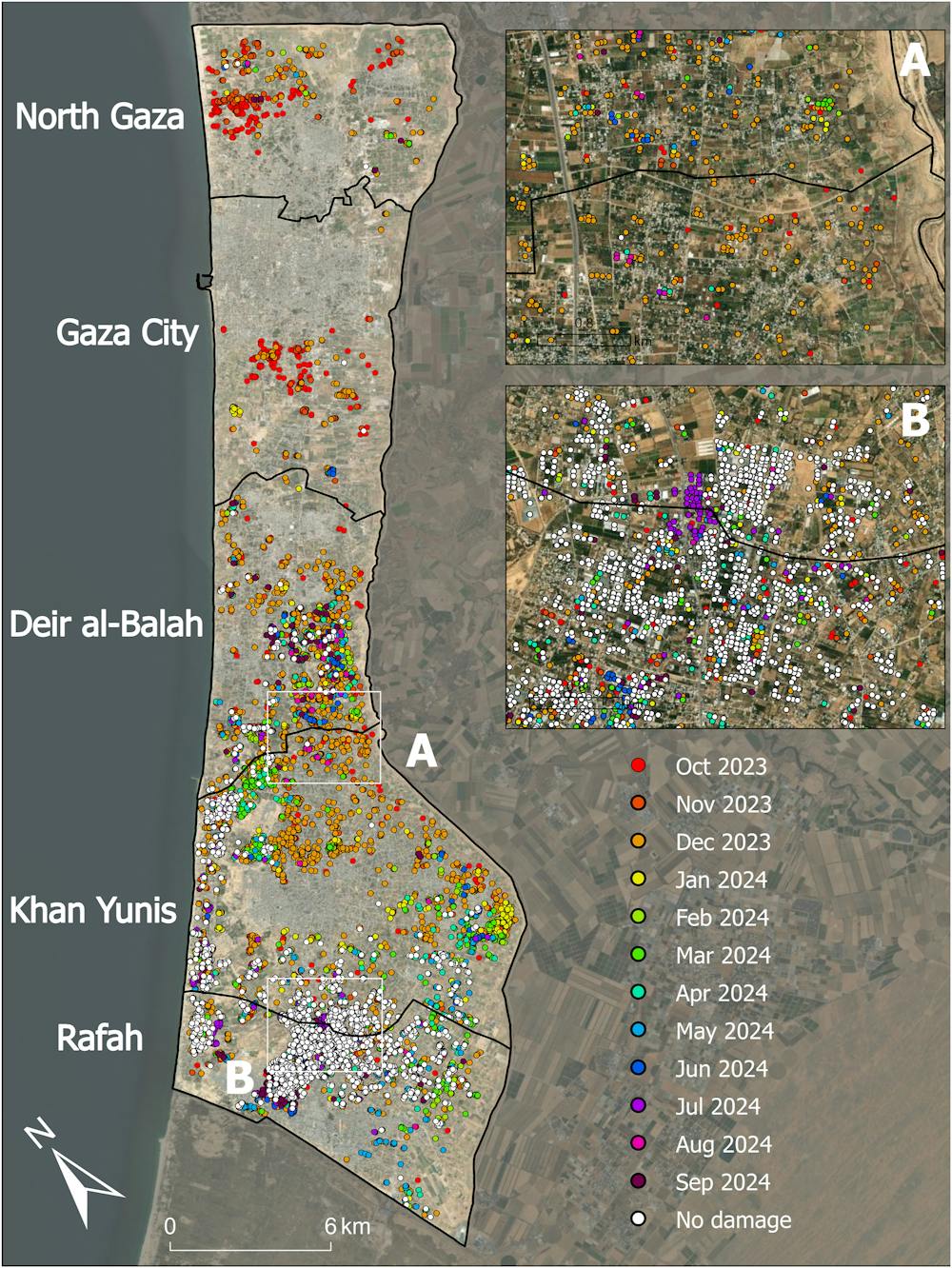
    Over the past 17 months we have analysed satellite images across the Gaza Strip to quantify the scale of agricultural destruction across the region. Our newly published research reveals not only the widespread extent of this destruction but also the potentially unprecedented pace at which it occurred. Our work covers the period until September 2024 but further data through to January 2025 is also available.

    Before the war, tomatoes, peppers, cucumbers and strawberries were grown in open fields and greenhouses, and olive and citrus trees lined rows across the Gazan landscape. The trees in particular are an important cultural heritage in the region, and agriculture was a vital part of Gaza’s economy. About half of the food eaten there was produced in the territory itself, and food made up a similar portion of its exports.

    By December 2023, only two months into the war, there were official warnings that the entire population of Gaza, more than 2 million people, was facing high levels of acute food insecurity. While that assessment was based on interviews and survey data, the level of agricultural damage across the whole landscape remained out of view.

    Most olive and citrus trees are gone

    To address this problem, we mapped the damage to tree crops – mostly olive and citrus trees – in Gaza each month over the course of the war up until September 2024. Together with our colleagues Dimah Habash and Mazin Qumsiyeh, we did this using very high-resolution satellite imagery, detailed enough to focus on individual trees.

    We first visually identified tree crops with and without damage to “train” our computer program, or model, so it knew what to look for. We then ran the model on all the satellite data. We also looked over a sample of results ourselves to confirm it was accurate.

    Our results showed that between 64% and 70% of all tree crop fields in Gaza had been damaged. That can either mean a few trees being destroyed, the whole field of trees completely removed, or anything in between. Most damage took place during the first few months of the war in autumn 2023. Exactly who destroyed these trees and why is beyond the scope of our research or expertise.

    In some areas, every greenhouse is gone

    As greenhouses look very different in satellite images, we used a separate method to map damage to them. We found over 4,000 had been damaged by September 2024, which is more than half of the total we had identified before the start of the war.

    Greenhouses and the date of initial damage between October 2023 and September 2024.
    Yin et al (2025)

    In the south of the territory, where most greenhouses were found, the destruction was fairly steady from December 2023 onwards.

    But in north Gaza and Gaza City, the two most northerly of the territory’s five governorates, most of the damage had already taken place by November and December 2023. By the end of our study period, all 578 greenhouses there had been destroyed.

    North Gaza and Gaza City have also seen the most damage to tree crop fields. By September 2024, over 90% of all tree crops in Gaza City had been destroyed, and 73% had been lost in north Gaza. In the three southern governorates, Khan Younis, Deir al-Balah and Rafah, around 50% of all tree crops had been destroyed.

    Agricultural damage is common in armed conflict, and has been documented with satellite analysis in Ukraine since the 2022 Russian invasion, in Syria and Iraq during the ISIS occupation in 2015, and in the Caucasus during the Chechen wars in the 1990s and 2000s.

    The exact impact can differ from conflict to conflict. War may directly damage lands, as we have seen in Gaza, or it may lead to more fallow areas as infrastructure is damaged and farmers are forced to flee. A conflict also increases the need for local agricultural production, especially when food imports are restricted.

    Our assessment shows a very high rate of direct and extensive damage to Gaza’s agricultural system, both compared to previous conflict escalations there in 2014 and 2021, and in other conflict settings. For example, during the July-August war in 2014, around 1,200 greenhouses were damaged in Gaza. This time round at least three times as many have been damaged.

    Agricultural attacks are unlawful

    Attacks on agricultural lands are prohibited under international law. The Rome Statute of the International Criminal Court from 1998 defines the intentional use of starvation of civilians through “depriving them of objects indispensable to their survival” as a war crime. The Geneva conventions further define such indispensable objects as “foodstuffs, agricultural areas for the production offoodstuffs, crops, livestock, drinking water installations and supplies and irrigation works”.

    Our study provides transparent statistics on the extent and timing of damage to Gaza’s agricultural system. As well as documenting the impacts of the war, we hope it can help the massive rebuilding efforts that will be required.

    Restoring Gaza’s agricultural system goes beyond clearing debris and rubble, and rebuilding greenhouses. The soils need to be cleaned from possible contamination. Sewage and irrigation infrastructure need to be rebuilt.

    Such efforts may take a generation or more to complete. After all, olive and citrus trees can take five or more years to become productive, and 15 years to reach full maturity. After previous attacks on Gaza the trees were mostly replanted, and perhaps the same will happen again this time. But it’s for good reason they say that only people with hope for the future plant trees.

    Lina Eklund receives funding from the Swedish National Space Agency and the Strategic Research Area: The Middle East in the Contemporary World (MECW) at the Centre for Advanced Middle Eastern Studies, Lund University, Sweden.

    He Yin receives funding from NASA.

    Jamon Van Den Hoek receives funding from NASA.

    ref. Gaza: we analysed a year of satellite images to map the scale of agricultural destruction – https://theconversation.com/gaza-we-analysed-a-year-of-satellite-images-to-map-the-scale-of-agricultural-destruction-248796

    MIL OSI – Global Reports

  • MIL-OSI Global: Trump’s Gaza and Ukraine plans come under the spotlight

    Source: The Conversation – UK – By Jonathan Este, Senior International Affairs Editor, Associate Editor

    Steve Bannon may no longer be in Donald Trump’s inner circle, but the newly reinstated US president appears to be adhering to a dictum the conservative disrupter-in-chief outlined back in 2018 as he reflected on his role in getting Trump elected the first time. “The Democrats don’t matter. The real opposition is the media. And the way to deal with them is to flood the zone with shit.”

    It’s fair to say that for the first two weeks of Trump’s second presidency the Democrats haven’t really mattered. But Trump and his advisers have got news organisations struggling to work out which way to look.

    In any normal news cycle, the appointment of vaccine-sceptic RFK Jnr. as health secretary would dominate the headlines, as would the successful installation of any of the more bizarre Trump cabinet picks. But at the same time the media has had to deal with a steady stream of other attention-grabbing announcements: the idea that the US could one way or the other acquire Greenland from Denmark, for instance, or the threats to use force to take control of the Panama Canal. We’ve had conflicting statements about how to end the war in Ukraine (more of which later) and the now you see them, now you don’t tariff threats against Mexico and Canada, not to mention the idea that the latter could be incorporated as the 51st state of the USA.

    The zone has been well and truly flooded. Meanwhile, the administration’s plan to take complete control of the civil service (which appears to be straight out of the Project 2025 playbook) has proceeded apace with career public servants being dismissed in their droves to make way for true Maga (Make America Great Again) believers in key roles. This, needless to say, has struggled for attention in light of all the eye-catching news stories.


    Sign up to receive our weekly World Affairs Briefing newsletter from The Conversation UK. Every Thursday we’ll bring you expert analysis of the big stories in international relations.


    This week’s big idea has to do with his vision for a post-conflict Gaza. Trump foreshadowed this plan last week when he announced he was talking with the leaders of Egypt and Jordan about resettling Gazans there – whether permanently or just for a period of reconstruction of Gaza was not clear, his statement was short on detail. But this week, hosting the Israeli prime minister in Washington (significantly the first foreign leader to visit since his inauguration), Trump expanded on his vision while Benjamin Netanyahu looked on approvingly.

    Initially, it appeared that Trump’s plan was for the permanent relocation of all 2.2 million Gazans to other countries while the Trump administration and its allies considered the considerable real estate investment opportunities presented by turning the 360km² Gaza Strip, with its 40km Mediterranean coastline into the “Middle East Riviera”. But as Simon Mabon notes here, administration officials were later quick to insist that the relocation would only last for as long as it takes to rebuild the stricken enclave.

    Mabon, professor of international relations at the University of Lancaster who specialises in Middle East politics, also notes that the proposal did what few other issues seem able to do: united the Arab nations in opposition. He also believes that while both Egypt and Jordan have signed peace deals with Israel, the relationship is often fractious and this latest announcement won’t have helped.

    Most importantly, perhaps, will be the reaction of Saudi Arabia. Israel (with Washington’s encouragement) has been pursuing normalisation of relations with Riyadh for some years. But the Saudi ruler, Crown Prince Mohammed bin Salman, has explicitly rejected “any attempts to displace the Palestinians from their land as well as affirming that relations with Israel would depend on the establishment of a Palestinian state.


    Read more:
    What Trump’s proposal to ‘take over’ Gaza could mean for Arab-Israeli relations


    It’s not the first time, by any means, that the idea of clearing Gaza of Palestinians has been mooted. It’s not even the first time that the real estate investment potential of such a plan has been discussed by a senior Trump official. Back in March last year, Jared Kushner, Trump’s son-in-law and former senior adviser who was the architect of Trump’s 2020 peace plan, talked up the idea of resettling Gazans in the Negev desert while noting that “Gaza’s waterfront property could be very valuable”.

    Israel’s far-right settler movement, meanwhile, has long yearned to empty out the strip. In December 2023 the leader of the Nachala Israeli settlement movement, Daniella Weiss, declared that Gaza City had always been “one of the cities of Israel. We’re just going back. There was a historical mistake and now we are fixing it.”

    The relocation of Palestinians outside Palestine was actually part of the founding mission of UN agency Unrwa – which, incidentally was banned by Israel last week and has been defunded by the US since allegations surfaced last year that a number of Unrwa employees had taken part in the Hamas attacks on October 2023.

    Anne Irfan of University College London, a specialist in refugees and displacement, and Jo Kelcey of the Lebanese American University, whose core research area covers the politics of education in marginalised communities such as Gaza, recount here that Unrwa was set up in 1949 following the Nakba (catastrophe) when more than 700,000 Palestinians were displaced in fighting before and after the foundation of the State of Israel.

    Unrwa was set up with the aim of resettling the displaced people and sponsoring projects that would create jobs and promote economic development in their new host countries: the “works” in the agency’s title.

    As Irfan and Kelcey note, the staunchest opponents of this plan were Palestinians themselves. They could read between the lines of this mission, that their exile was intended to be permanent. It was a non-starter and within five years of Unrwa’s establishment the resettlement policy was shelved in favour of a focus on education, which remains to this day.

    Not that Trump would be keen to associate any plan of his with Unrwa. In 2018 he fully defunded the agency, the first time a US president has done this. He has also more recently extended Joe Biden’s suspension of Unrwa funding after the allegations of Hamas infiltration and has made it clear he supports Netanyahu’s ban on the agency operating in Israel.


    Read more:
    Trump plans to ‘permanently resettle’ Palestinians outside Gaza – the very reason Unrwa was originally created


    Meanwhile, how would the Gaza plan sit in terms of Trump’s “America First” strategy? Mark Shanahan, of the University of Surrey, believes this is all part of what he refers to here as “Trumperialism”. It’s not so much America as the light on the hill, trying to find a way to fix global problems and seek peaceful solutions to dangerous and distressing conflicts. Rather, in this case at least, it sees Gaza as “an opportunity for American business to build wealth – the classic US economic hegemony of the populist America First political theory”.

    Rather than emulating the Marshall plan of what feels now like a more enlightened era, Trump’s plan for Gaza, at least as he laid it out after his meeting with Netanyahu, is more akin to the plan for the rebuilding of Iraq after the 2003 invasion, writes Shanahan. That is: US private funding for beachside condos and luxury developments while the countries to whom the displaced Palestinians are relocated would be expected to pay for the privilege.

    But Trump also hinted this might mean US boots on the ground in the Middle East, cautions Shanahan, adding that “delivering Mar-a-Lago on the Med may mean thousands of American combat troops deployed to Gaza for years at daily risk of death. How do main-street Americans benefit from that?”


    Read more:
    How Trump’s Gaza plan does – and doesn’t – fit in with his pledge to put America first


    And if you wondered whether – like so many of Trump’s big plans and executive orders issued since his second inauguration – the Gaza Riviera scheme might fall foul of the law, it would. As Tamer Morris –
    an expert in international law at the University of Sydney – explains, the US would require the consent of the Palestinian people to take control of Gaza. And this is not going to happen.

    Forced relocation is forbidden under the Geneva Conventions as is helping another state forcibly relocate people. It could also be interpreted as ethnic cleansing, as defined by the Commission of Experts report on the former state of Yugoslavia to the UN Security Council in 1994.


    Read more:
    Trump wants the US to ‘take over’ Gaza and relocate the people. Is this legal?


    Meanwhile in Ukraine

    Meanwhile, the US president has also been making noises about his ideas for bringing peace to Ukraine. The latest, aired this week, involved linking continuing US support with favourable concessions on Ukraine’s supply of rare earths and other strategic resources. Stefan Wolff, of the University of Birmingham, has been watching the diplomatic manoeuvrings around Trump, Putin, Xi and Ukraine since the war began nearly three years ago. In the past fortnight, he’s been looking at the prospect of a peace deal brokered by the US.

    Wolff thinks it unlikely that anything will be resolved in the foreseeable future beyond a ceasefire and freezing of the battle lines. And that’s not even much more than a distant possibility given that neither Kyiv nor the Kremlin seem to want this for reasons of their own.


    Read more:
    Trump’s vision of a peace deal for Ukraine is limited to a ceasefire – and it’s not even clear if Kyiv or Moscow are going to play ball


    The possibility of Europe bearing the burden of maintaining support to Ukraine without the US bearing the lion’s share of the burden also looks remote. Domestic politics in many EU member states is threatening the bloc’s unity – and, in any case, the ability of Europe to make up the shortfall caused by a possible US withdrawal of aid to Ukraine is distinctly doubtful. And unlikely improve any time soon.


    Read more:
    Ukraine: prospects for peace are slim unless Europe grips the reality of Trump’s world


    It appears, meanwhile, that Putin’s ally Kim Jong-un is poised to send another wave of North Koreans to help. Jennifer Mathers, of Aberystwyth University, takes a detailed look at what we know about how these troops have fared thus far. She concludes that, given the terribly heavy losses the North Korean units are reported to be suffering, it’s possible that their leader may be trading the high casualty rate for much-needed combat experience in case his army might want to fight in a conflict nearer to home.


    Read more:
    North Korea: Kim Jong-un is sending a second wave of soldiers to Ukraine – here’s why


    World Affairs Briefing from The Conversation UK is available as a weekly email newsletter. Click here to get our updates directly in your inbox.


    ref. Trump’s Gaza and Ukraine plans come under the spotlight – https://theconversation.com/trumps-gaza-and-ukraine-plans-come-under-the-spotlight-249311

    MIL OSI – Global Reports

  • MIL-OSI USA: Jeweler sentenced to 30 months for multimillion-dollar international trade fraud scheme following a multi-agency investigation

    Source: US Immigration and Customs Enforcement

    NEWARK, N.J. — Homeland Security Investigations (HSI) Newark led an investigation with law enforcement partners spanning from India to New York and New Jersey, resulting in the discovery of a jeweler running a multimillion-dollar international trade fraud scheme and unlicensed money transmitting.

    Monishkumar Kirankumar Doshi Shah, a/k/a “Monish Doshi Shah” (Shah), 40, of Mumbai, India and Jersey City, New Jersey, who operated jewelry companies in New York City’s Diamond District was sentenced to 30 months for spearheading a scheme to illegally evade customs duties for more than $13.5 million of jewelry imports into the United States and for illegally processing more than $10.3 million through an unlicensed money transmitting business. He previously pleaded guilty at the U.S. District Court for the District of New Jersey to a two-count Information charging him with conspiracy to commit wire fraud and operating and aiding and abetting the operation of an unlicensed money transmitting business.

    “Monishkumar Kirankumar Doshi Shah disregarded our nation’s trade laws and defrauded the U.S. government of millions of dollars in customs duties through his brazen international financial fraud scheme,” said HSI Newark acting Special Agent in Charge Sprios Karabinas. “Through HSI’s investigation, we were able to uncover the mislabeled tracks of jewelry shipments and illegal transactions Shah hoped to conceal. We are thankful for the collaboration with partners across the globe who helped us bring this case to successful prosecution.”

    According to the investigation, from approximately December 2019 to approximately April 2022, Shah engaged in a scheme to evade duties for shipments of jewelry from Turkey and India to the United States. Shah would ship and/or instruct his co-conspirators to ship goods from Turkey or India — which would have been subject to an approximately 5.5% duty if shipped directly to the United States — to one of Shah’s companies in South Korea. Shah’s co-conspirators in South Korea would change the labels on the jewelry to state that they were from South Korea instead of Turkey or India, and then ship them to Shah or his customers in the United States, thereby unlawfully evading the duty. Shah would also make and instruct his customers to make fake invoices and packing lists to make it look like Shah’s South Korean companies were actually ordering jewelry from Turkey or India. Shah also instructed a third-party shipping company to provide false information to U.S. Customs and Border Protection concerning the origin of the jewelry. During the scheme, Shah shipped approximately $13.5 million of jewelry from South Korea to the United States without paying the appropriate duty.

    In addition, from approximately July 2020 through approximately November 2021, Shah owned and/or operated numerous jewelry companies in New York City’s Diamond District, including MKore LLC, MKore USA Inc, and Vruman Corp. Shah used these entities to conduct more than $10.3 million in illegal financial transactions for customers — including converting cash to checks or wire transfers. Shah would also collect cash from customers and use other individuals’ jewelry companies to convert the cash into wires or checks. At times, Shah and other members of the money transmitting business moved hundreds of thousands of dollars in a single day. In exchange for their services, certain members of the money transmitting business charged a fee. None of Shah’s or his associates’ companies were registered as money transmitting businesses with New York, New Jersey, or the Financial Crimes Enforcement Network.

    In addition to the prison term, Judge Salas ordered restitution in the amount of $742,500 for the wire fraud scheme and forfeiture in the amount of $11,126,982.33 for the wire fraud and unlicensed money transmitting schemes. In addition, the Court imposed a two-year term of supervised release.

    HSI Newark partnered with HSI New York, the Internal Revenue Service – Criminal Investigation in Newark, the U.S. Customs and Border Protection in the investigation leading to the sentence. International partners included the HSI attaché office in Seoul, and the Korea Customs Service, the Seoul Customs Special Investigation Office in South Korea. The DEA, the Parsippany -Troy Hills Police Department, the Morristown Police Department, the Federal Deposit Insurance Corporation – Office of Inspector General and the Justice Department’s Money Laundering and Asset Recovery Section assisted in the investigation.

    Follow us on X, formerly known as Twitter, at @HSINewark to learn more about HSI’s global missions and operations.

    MIL OSI USA News

  • MIL-OSI USA: 176 New Troopers Join the Ranks of the NYSP

    Source: US State of New York

    Governor Kathy Hochul joined Superintendent Steven G. James in honoring 176 new State Troopers as they graduated today from the 216th session of the Basic School of the New York State Police Academy. The ceremony was held at the Empire State Plaza Convention Center in Albany. Today’s graduation increases the State Police ranks to 5,034 sworn members.

    “I commend these 176 new troopers for dedicating themselves to public service, and their commitment to protecting the people of New York State,” Governor Hochul said. “The members of the New York State Police put their lives on the line each day to keep the rest of us safe — in a world where their mission has grown more challenging and complex. On behalf of all New Yorkers, I want to thank the graduates for their hard work and perseverance — and welcome them to the long gray line.”

    New York State Police Superintendent Steven G. James said, “Today’s graduation is the culmination of six months of difficult classwork, physical training, and sacrifice, and we now welcome our newest members to one of the most prestigious and well-respected law enforcement agencies in the nation. I am confident they are equipped to carry out our mission to serve our communities with the same professionalism and pride the State Police have exhibited for the past 107 years.”

    In addition to honoring all graduates from the 216th Session of Basic School,

    Superintendent James presented the following awards:

    Academic Achievement Award

    As a special incentive for all students attending the State Police Academy Basic School, the Superintendent sponsors the awarding of a firearm for the attainment of the highest level of academic performance during Academy training.

    The recipient of the Academic Performance Award is Clayton D. Buff, age 24, who resides in Cohoes, New York. He attended the University at Albany where he studied Criminal Justice. Prior to joining the New York State Police, he served 4 years of active duty with the United States Army. Throughout the Academy training program, he achieved an outstanding overall academic average of 96.58 percent. He will be assigned to Troop G.

    Firearms Proficiency Award

    The New York State Trooper Foundation has sponsored the awarding of a firearm for the attainment of the highest level of performance in all phases of firearms training.

    The recipient of the Superintendent’s Firearms Proficiency Award is Hunter T. Argetsinger, age 24, who resides in Elmira, New York. He is a graduate of Corning Community College where he received an associate’s degree in criminal justice. Prior to joining the New York State Police, he was a police officer with the city of Elmira Police Department. During firearms training, he achieved an average score of 250 out of a possible 250. He will be assigned to Troop E.

    Investigator Joseph T. Aversa Physical Fitness Award

    The New York State Police Investigators Association has sponsored the awarding of a firearm for the attainment of the highest degree of physical fitness during the Physical Training Program at the Academy. This award will be presented in memory of deceased Investigator Joseph Aversa. Investigator Aversa made the ultimate sacrifice in New York City on March 5, 1990, during a narcotics investigation while serving as a member of the Joint Drug Enforcement Task Force. Investigator Aversa was a six-year State Police veteran who believed that physical conditioning was an integral part of being a Trooper.

    The recipient of the Joseph T. Aversa Physical Training Award is Oliver P. Valenti, age 21, who resides in Clarence, New York. Prior to joining the New York State Police, he attended Hilbert College where he studied Forensic Science while employed with Wegmans Marketplace as a front-end coordinator. During the physical agility testing, he achieved the highest score of all 176 Members of the 216th Session, a tribute to his superb physical conditioning. He will be assigned to Troop A.

    I commend these 176 new troopers for dedicating themselves to public service, and their commitment to protecting the people of New York State.”

    Governor Hochul

    Student Representative

    The New York State Troopers Police Benevolent Association has sponsored the awarding of a firearm to the member of the class who is selected by his or her peers to represent them during these exercises. The PBA presents the award in memory of Trooper John J. McKenna IV, who was killed in action in 2006, while serving his country as a Marine in Iraq.

    The recipient of the Class Representative Award is Antonio M. Vecchio, age 21, who resides in Levittown, New York. Prior to joining the New York State Police, he attended Binghamton University where he studied Economics. He will be assigned to Troop C.

    The new Troopers will report for field duty on February 7 or February 10, depending on their platoon. For the following 10 weeks, the new Troopers will be evaluated under a field-training program supervised by senior Field Training Officers.

    Below is a complete list of graduates listed alphabetically (Troop assignments are pending):

    Last Name First Name Hometown
    Aguilar Magali Wallkill, NY
    Akande-Bowen Jared Queens, NY
    Balbuena Kelly Newburgh, NY
    Akhmedov Kairat Brooklyn, NY
    Argetsinger Hunter Elmira, NY
    Arndt Mitchell Mohawk, NY
    Ashby Tristan Syracuse, NY
    Baines Evan Merrick, NY
    Bartholomew Zoe Lake Pleasant, NY
    Bassiouni Omar Staten Island, NY
    Bektic Nedim Utica, NY
    Beltran Antonio Amsterdam, NY
    Boudreau Luc Warwick, NY
    Boul Rang Syracuse, NY
    Brennan Lauren Selkirk, NY
    Briggs Cynthia Hawthorne, NY
    Brownell James Geneva, NY
    Buck Aaron Houghton, NY
    Buff Clayton Cohoes, NY
    Bull Lance Queensbury, NY
    Bullo Silvano Fairport, NY
    Burns Mason Rome, NY
    Cahill Edward Massapequa, NY
    Canale Connor Amsterdam, NY
    Carnero Tello Glenn Bogota, NY
    Carr Jason Cortland, NY
    Carrillo Evan Bronx, NY
    Carron Sean Delhi, NY
    Cervantes Manuel Port Chester, NY
    Clarke Hannah South Glens Falls, NY
    Clarke Jakob Plattsburgh, NY
    Combs Jenna Warrensburg, NY
    Cosbert Stefan Freeport, NY
    Cox Tyler Schenectady, NY
    Cregin Ethan Staten Island, NY
    Curtin James Hicksville, NY
    Daley Keri West Henrietta, NY
    Dalrymple Scott Brewster, NY
    Dalrymple Shane Brewster, NY
    Deebs Andrew Hornell, NY
    Delaney Austin Neversink, NY
    Delfini Louis Staten Island, NY
    Derick Gavin Lindley, NY
    Diana Joseph Holland Patent, NY
    Disalvo Natalie Johns Island, NY
    Diaz Israel East Fishkill, NY
    Dieng Ngagne Bronx, NY
    Difusco Frank Poughquag, NY
    Diorio David Deer Park, NY
    Eldred Rebecca Clifton Park, NY
    Ellsworth Logan Matamoras, NY
    Fallon Hayley Long Beach, NY
    Fallon Thomas Kings Park, NY
    Faso Emma Clarence Center, NY
    Favreau Parker Plattsburgh, NY
    Feirabend Michael West Seneca, NY
    Fernaays Ryan Williamson, NY
    Finn Richard Pleasant Valley, NY
    Fitzsimmons Cody Dryden, NY
    Flocco Sophia Bronx, NY
    Fontus Angelo Brooklyn, NY
    Galanti Jillian Webster, NY
    Garcia Castrejon Luis Pine Plains, NY
    Gates Seth Elbridge, NY
    Gehrke Matthew Centerport, NY
    Gould Erin Astoria, NY
    Grant Ariel Carle Place, NY
    Hahn Richard Kings Park, NY
    Harrington Carson Jacksonville, NY
    Haynes Dylan Baldwin, NY
    Healey Trevor Perry, NY
    Heegan Christina Oneonta, NY
    Heras Nelson Jamaica, NY
    Hidalgo Christopher Queens Village, NY
    Holloway William West Hempstead, NY
    Ibrahim Maryam Williston Park, NY
    Ibrahim Mohamed Levittown, NY
    Ilahi Haider Brooklyn, NY
    Jansen Connor Horseheads, NY
    Jolly Kaitlyn Waterloo, NY
    Kalletta George Manorville, NY
    Komenda Kiersten Springville, NY
    Karam Michael Gansevoort, NY
    Khork Brennan Hornell, NY
    Knoop Dennis Queensbury, NY
    Koprivica Marko Blasdell, NY
    Kraft Joel Waterloo, NY
    Lamouree Grant Queensbury, NY
    Lask Michael Buffalo, NY
    Lawson Lance Valley Stream, NY
    Lazo Franklin Pleasantville, NY
    Letourneau Casey Constable, NY
    Lillis Abigail Angola, NY
    Locurto Madeline New Windsor, NY
    Manley Charles Buffalo, NY
    Marroquinn Kevin Lindenhurst, NY
    Mcdermott Dylan West Babylon, NY
    Meegan Liam West Seneca, NY
    Messina Sebastian Levittown, NY
    Milazzo Matteo Briarcliff, NY
    Miller Eric Medina, NY
    Murphy Rebecca Monroe, NY
    Monnin Daniel Buffalo, NY
    Moore Hunter Castorland, NY
    Morales Nicholas Staten Island, NY
    Moses Avery Fayetteville, NY
    Motler Katherine Glenmont, NY
    Morales Nickolas Binghamton, NY
    Mustafa Kamal Mohamad Ayyas Utica, NY
    Naum Caleb Brewerton, NY
    Nell Abigail Verona, NY
    Newburg V Louis Coeymans, NY
    Obrien Cade Gansevoort, NY
    Oconnor James New Paltz, NY
    Page Joshua Verona, NY
    Parga Erick Island Park, NY
    Parkhurst Kevin Ilion, NY
    Patti Victoria Buffalo, NY
    Pekoff Jeremy Bellmore, NY
    Pelaez Matthew Old Bethpage, NY
    Peters Henry Callicoon, NY
    Petfield Jacob Hawthorne, NY
    Petry Henry Chemung, NY
    Phillips Anaya Medford, NY
    Pindulic Amber Centereach, NY
    Quintero Josue Brooklyn, NY
    Quirk Timothy Centereach, NY
    Ramirez Evelin Carmel, NY
    Roush Hailey Mayville, NY
    Rath Nathaniel Newport, NY
    Robinson Shane Binghamton, NY
    Romero Lainez Bryan West Babylon, NY
    Rowe Jake Pleasant Valley, NY
    Rutkowski Jack Pine Bush, NY
    Ryan Allison Syracuse, NY
    Salvadori David Massapequa Park, NY
    Sarpong Joel Columbus, NY
    Sasso Mario Nanuet, NY
    Savino Nicholas Bellmore, NY
    Scoma Anthony Lancaster, NY
    Scordo Alex Middletown, NY
    Simon Nicole Howard Beach, NY
    Smoulcey Ryan Rome, NY
    Stephany Krista Buffalo, NY
    Streety Maxwell Orchard Park, NY
    Streety Mitchell Thornwood, NY
    Sustache Samuel Syracuse, NY
    Svitak Brendan Marcy, NY
    Sweet Jeffrey Petersburg, NY
    Szlamcynski Adam Star Lake, NY
    Taylor Grace South Kortright, NY
    Tejeda Francheska Buffalo, NY
    Thaureaux Alejandro Webster, NY
    Thompson Adam St Albans, NY
    Tommasone Daniel Schenectady, NY
    Trzaska Noah West Seneca, NY
    Twoguns Kristine Perrysburg, NY
    Valenti Oliver Akron, NY
    Valladares Steven Woodside, NY
    Vargo Quinton West Falls, NY
    Vasile Hudson Mount Morris, NY
    Vata Halit New York City
    Vecchio Antonio Levittown, NY
    Velez Diana Campbell Hall, NY
    Vogel Tanner Ilion, NY
    Volk III Robert Mechanicville, NY
    Wallace Connor Manorville, NY
    Weist Brockton Port Crane, NY
    White Alexander Schenectady, NY
    Willenbrock Derek Amityville, NY
    Winslow Hunter Canastota, NY
    Workman Daniel Groton, NY
    Young Tanner Camden, NY
    Yudchits Julia Herkimer, NY
    Zahin Md Muhaiminul New York City, NY
    Zambardino Nicholas Monroe, NY

    MIL OSI USA News

  • MIL-OSI USA: HSI Los Angeles, Cherry Hill, and Honolulu special agents arrest members of online neo-Nazi group on child exploitation enterprise charges

    Source: US Immigration and Customs Enforcement

    LOS ANGELES — On Jan. 30, Homeland Security Investigations (HSI) special agents, in coordinated operations in New Jersey and Hawaii, arrested two individuals on federal charges of participating in a neo-Nazi child exploitation enterprise that groomed and then coerced minors to produce child sexual abuse material and images of self-harm. The group allegedly victimized at least 16 minors around the world, including two in Southern California.

    Colin John Thomas Walker, 23, of Bridgeton, New Jersey, and Clint Jordan Lopaka Nahooikaika Borge, 41, of Pahoa, Hawaii, were arrested pursuant to a grand jury indictment charging them with one count of engaging in a child exploitation enterprise. They are expected to make initial court appearances later today in New Jersey and Hawaii. Two additional defendants, Rohan Sandeep Rane, 28, of Antibes, France, and Kaleb Christopher Merritt, 24, of Spring, Texas, were also charged in the indictment.

    “Sextortion and other forms of online child sexual abuse have tragically altered the trajectory of too many young lives and this group preyed upon the vulnerable to fulfill their sick and twisted desires,” said HSI Los Angeles Special Agent in Charge Eddy Wang. “HSI and our partners will work tirelessly to protect children from victimization in communities across the United States and around the globe.”

    From at least 2019 to 2022, Rane, Walker, Merritt and Borge were members of CVLT, an online group that espoused neo-Nazism, nihilism and pedophilia as its core principles. Members of the international enterprise engaged in online child sexual exploitation offenses and trafficked child sexual abuse material (CSAM). Rane, Walker, and Merritt acted as leaders and administrators in the CVLT enterprise, hosting and running CVLT online servers and controlling membership for the group.

    CVLT members worked collectively to entice and coerce children in the U.S. and around the world to self-produce CSAM on an online platform run by CVLT members where they groomed children for the eventual production of CSAM through various means of degradation, including exposing the victims to extremist and violent content. CVLT specifically targeted vulnerable victims, including ones suffering from mental health challenges or a history of sexual abuse.

    Victims were encouraged to engage in increasingly dehumanizing acts, including cutting and eating their own hair, drinking their urine, punching themselves, calling themselves racial slurs, and using razor blades to carve CVLT members’ names into their skin. CVLT members’ coercion escalated to pressuring victims to kill themselves on a video livestream.

    When victims hesitated, resisted or threatened to tell parents or authorities, CVLT members would threaten to distribute already-obtained compromising photos and videos of the victims to their family and friends. For victims who stopped participating in the CSAM, CVLT would sometimes carry through on their threats.

    Rane previously was charged with several child exploitation and related offenses in France and has been in French custody since 2022. Merritt is currently in Virginia state custody, serving a 50-year sentence for child sex abuse crimes committed in 2020 and 2021.

    If convicted, the defendants would face a 20-year mandatory minimum sentence and a statutory maximum sentence of life in prison.

    HSI Los Angeles, HSI Honolulu, and HSI Cherry Hill are conducting this investigation collaboratively with the Los Angeles Police Department, San Bernardino County Sheriff’s Office, Henry County Sheriff’s Office (Virginia), Iowa State University Police, Police Nationale (France), the National Crime Agency (United Kingdom), the New Zealand Department of Internal Affairs, and EUROPOL.

    HSI is a global leader in the fight against child exploitation and is committed to protecting children from exploitation by predators involved in the production, distribution, and possession of child sexual abuse material and travel in foreign commerce to engage in illicit sexual conduct with minors.

    Report suspected child exploitation to the HSI Tip Line at 877-4-HSI-TIP or through the CyberTipline on the National Center for Missing & Exploited Children’s website.

    Learn more about HSI’s mission to protect children in your community on X, formerly known as Twitter, at @HSILosAngeles. To learn how you can prevent online child sexual exploitation and abuse, visit https://www.Know2Protect.gov.

    MIL OSI USA News

  • MIL-OSI Video: President Trump Greets the Prime Minister of the State of Israel

    Source: United States of America – The White House (video statements)

    President Donald J. Trump welcomed Israeli Prime Minister Benjamin Netanyahu to the White House today- the first world leader to visit during his second term.

    https://www.youtube.com/watch?v=WmukWqxYGQA

    MIL OSI Video

  • MIL-OSI Security: Defense News: Truman Strike Group Units Arrive in Greece for Port Visit

    Source: United States Navy

    While the strike group’s material readiness is the top priority of the visit, ensuring maintenance and upkeep across the ships and aircraft, Sailors will have the opportunity to enjoy liberty and experience Crete’s rich history and culture. 

    “I’m incredibly proud of the dedication and service of this team and their tireless work around the clock,” said Capt. Dave Snowden, commanding officer of USS Harry S. Truman (CVN 75). “Their efforts keep our ship operating at peak performance and aircraft ready to support combat operations.” 

    After entering the U.S. Central Command (CENTCOM) area of responsibility on Dec. 14, the Harry S. Truman Carrier Strike Group (HSTCSG) supported multiple self-defense strikes against targets across Iran-backed Houthi-controlled areas of Yemen. The strikes directly contributed to CENTCOM’s campaign to degrade the Houthis attempts to threaten regional partners and the free flow of commerce in the region. On Feb. 1, HSTCSG conducted airstrikes against ISIS-Somalia in support of U.S. Africa Command and in coordination with the Federal Government of Somalia. 

    “The Harry S. Truman Carrier Strike Group remains the most adaptable and lethal presence in theater,” said Rear Adm. Sean Bailey, commander, HSTCSG. “This port visit provides the opportunity to reset and focus on maintenance for maximum readiness ahead of future operations.” 

    The visit is HSTCSG’s third port visit of deployment, following stops in Oslo, Norway, and Marseille, France. NSA Souda Bay is a remote forward operating installation that enables power projection and warfighting capabilities from the Eastern Mediterranean.

    “Team Souda is happy to welcome HSTCSG to Crete,” from Capt. Stephen Steacy, commanding officer, NSA Souda Bay. “As the crossroads of the 6th Fleet, we are strategically located in the Eastern Mediterranean to support our forward-deployed forces. The hospitality of the local community is unmatched, giving Sailors the opportunity for a much-needed break.”

    The Dwight D. Eisenhower Carrier Strike Group (IKECSG) visited NSA Souda Bay for a similar port visit in April 2024. The IKECSG and HSTCSG have operated in the most intense period of sustained combat activity for the U.S. Navy since World War II.

    The carrier strike group includes the flagship USS Harry S. Truman (CVN 75); Carrier Air Wing (CVW) 1, with eight embarked aviation squadrons; staffs from CSG-8, CVW-1, and Destroyer Squadron (DESRON) 28; the Ticonderoga-class guided-missile cruiser USS Gettysburg (CG 64); and two Arleigh Burke-class guided-missile destroyers, USS Stout (DDG 55) and USS Jason Dunham (DDG 109). 

    HSTCSG’s mission is to conduct prompt and sustained combat operations at sea and maintain a forward presence through sea control and power projection capabilities. For more information, visit DVIDS at https://www.dvidshub.net/unit/CVN75. 
     

    MIL Security OSI

  • MIL-OSI United Kingdom: Charity regulator convenes discussions on safe delivery of urgent Middle East aid

    Source: United Kingdom – Executive Government & Departments

    The Charity Commission hosted a roundtable meeting today (6 February 2025) bringing together major international aid charities and government departments to discuss the pressing need to secure the flow of aid to the Middle East.

    Leaders of organisations including the Disasters Emergency Committee were joined by senior officials from the Foreign, Commonwealth and Development Office, the Home Office and HM Treasury.

    Leaders of umbrella bodies NCVO and Bond also participated in the meeting, held in central London.

    Discussion centred on how partners across civil society and government can work effectively to accelerate delivery of aid to the Middle East within a strong regulatory framework.

    Representatives explored the practical operating challenges of seeking to support those living in areas devastated by the impact of recent events in the region. They discussed the importance of regulatory compliance, including with the various legal duties and challenges affecting charities working in the Middle East.

    Following the meeting, the Commission undertook to work with other government departments to publish further guidance to support charities of all sizes seeking to operate in the region.

    Chief Executive Officer of the Charity Commission, David Holdsworth, said:

    The role of aid charities will be crucial not only to providing immediate humanitarian support to people in the region, but to the long, complex process of rebuilding Gaza, Syria and other war-torn areas.

    As the charity regulator our role is to enable as well as to enforce. In convening today’s roundtable the Commission sought to bring together key players for an honest conversation about the challenges and risks involved in delivering international aid in such circumstances.

    All were united by an ambition to help ensure that the UK and its citizens can effectively help bring aid to a region in desperate need.

    The Commission stands ready to support however it can within its regulatory remit and we will shortly publish further advice to charities working in this area.

    ENDS

    Notes to editors

    1. The Charity Commission is the independent, non-ministerial government department that registers and regulates charities in England and Wales. Its ambition is to be an expert regulator that is fair, balanced, and independent so that charity can thrive. This ambition will help to create and sustain an environment where charities further build public trust and ultimately fulfil their essential role in enhancing lives and strengthening society. Find out more: About us – The Charity Commission – GOV.UK

    Press office

    Email pressenquiries@charitycommission.gov.uk

    Out of hours press office contact number: 07785 748787

    Updates to this page

    Published 6 February 2025

    MIL OSI United Kingdom

  • MIL-OSI: Celona and stc Group Launch Private 5G Solution to Drive Business Efficiency in Middle East

    Source: GlobeNewswire (MIL-OSI)

    • Celona and stc Group have announced a new partnership, launching a private 5G edge computing technology network solution for enterprises in Saudi Arabia, Kuwait and Bahrain.
    • The digital solution increases operational efficiencies by lowering total cost and accelerating time-to-market.
    • The solution avoids the challenges commonly faced with Wi-Fi networks and provide secure, reliable connectivity in hard-to-reach places.

    CAMPBELL, Calif. and RIYADH, Saudi Arabia, Feb. 06, 2025 (GLOBE NEWSWIRE) — Celona, a pioneer in private 5G networks, and stc Group, a leading digital enabler, have partnered to launch a new generation of private 5G digital solutions, allowing businesses to scale up their wireless connectivity in a cost-efficient manner. The partnership aligns with stc Group’s commitment to driving development and efficiency across the Middle East region with new solutions to support digital transformation.

    The partnership between Celona and stc Group will expedite the deployment of new automation applications, enhancing operational efficiency, reducing costs and addressing operational challenges by leveraging stc Group’s expertise in cloud and IoT services. This collaboration will lower total cost of ownership and accelerate time-to-market for the launch of new products and services across industries such as oil and gas, logistics, warehousing, mining, and manufacturing.

    stc Group and Celona’s new private 5G network service will utilize private networks to meet the growing demand for secure, reliable wireless performance, coverage, and connectivity required by a new era of network-dependent business applications, IoT systems, and cybersecurity integration. Enterprises in Saudi Arabia, Kuwait, and Bahrain will benefit from swift deployment of private wireless networks to support their automation and modernization initiatives.

    Saud Alsheraihi, stc Group Products & Solutions VP, said, “This partnership with Celona marks a significant milestone in stc Group’s mission to drive digital transformation and operational efficiency. By integrating Celona’s cutting-edge private 5G technology, we are proudly enabling businesses in Saudi Arabia, Kuwait and Bahrain to modernize their operations, reduce costs, and accelerate their time-to-market. This collaboration underscores our commitment to providing innovative digital solutions that empower enterprises to thrive in a rapidly evolving digital landscape.”

    Rajeev Shah, Celona’s Co-founder and CEO, said, “stc Group is a digital transformation visionary with a clear strategy for driving economic growth and efficiency through digitization. We are honored that they have chosen to power their industrial transformation initiatives with the Celona private 5G solution, driving Connected Mines, Connected Supply Chains, Connected Warehouses, and Connected Manufacturing throughout the region with a robust solution that will drive business success.”

    About Celona
    Based in Silicon Valley, Celona is a pioneer and leading innovator of enterprise private wireless solutions. The company offers a turnkey private 5G solution that enables enterprises to address their growing needs for secure and reliable wireless connectivity for critical business applications. Celona private 5G has been deployed by a wide range of global customers across industries. To date, the company has raised over $135 million in venture funding from Lightspeed Venture Partners, Norwest Venture Partners, NTT Ventures, Cervin Ventures, DigitalBridge and Qualcomm Ventures. For more information, please visit celona.io.

    About stc Group
    stc Group is an enabler of digital transformation, offering advanced solutions and driving a role in the digitization process. The group provides a comprehensive suite of services encompassing digital infrastructure, cloud computing, cybersecurity, Internet of Things (IoT), digital payments, digital media, and digital entertainment. The group comprises 13 subsidiaries across the Kingdom of Saudi Arabia, the Middle East, North Africa, and Europe.
    To know more about stc group: Click here

    Media Contact:
    Lisa Garza
    Celona
    lgarza@celona.io
    510-366-2225

    The MIL Network

  • MIL-OSI Security: Former University Employee Charged with Attempted Coercion and Enticement of a Minor

    Source: Federal Bureau of Investigation (FBI) State Crime Alerts (c)

    COLUMBIA, S.C. — Mohammad Ebrahim Torki Harchegani, 38, has been charged with attempted enticement of a minor for sexual activity.

    During a contested bond hearing, an FBI special agent testified that on Dec. 3-4, 2024, multiple agencies participated in an online chat operation targeting child sex offenders where an officer posed as a 14-year-old female. Torki, a legal permanent resident of the United States and Iranian citizen, engaged in sexually explicit conversations with the alleged 14-year-old girl. Torki ultimately traveled to the residence where he believed the girl was home alone to engage in sexual activities with her. He was arrested thereafter.

    Testimony was also presented that Torki was a researcher at the University of South Carolina at the time of the chat. Upon his arrest, his employment was suspended and his contract with the university was not renewed.

    This case was brought as part of Project Safe Childhood, a nationwide initiative launched in May 2006 by the U.S. Department of Justice to combat the growing epidemic of child sexual exploitation and abuse. Led by the U.S. Attorneys’ Offices and the Criminal Division’s Child Exploitation and Obscenity Section, Project Safe Childhood marshals federal, state and local resources to better locate, apprehend and prosecute individuals, who sexually exploit children, as well as to identify and rescue victims. For more information about Project Safe Childhood, please visit http://www.justice.gov/psc.

    Torki was ordered detained at the hearing. He faces a maximum penalty of life in prison.

    The FBI Columbia Field Office, the South Carolina Internet Crimes Against Children Task Force, and the Richland County Sheriff’s Department participated in the online chat operation and investigated the case. Assistant U.S. Attorneys Elle E. Klein and Winston Holliday are prosecuting the case.

    All charges in the indictment are merely accusations and defendants are presumed innocent unless and until proven guilty beyond a reasonable doubt in a court of law.

    ###

    MIL Security OSI

  • MIL-OSI Africa: Peace in Sudan: what it’s going to take

    Source: The Conversation – Africa – By Mulugeta G Berhe, Senior Fellow, World Peace Foundation, Fletcher School of Law and Diplomacy at Tufts, Tufts University

    Sudan, which included South Sudan up to 2011, has never known peace and stability since independence in 1956. The country’s instability stems from the absence of democratic rule; failure to manage its diversity; military coups; civil wars; and its fragmented and bloated security sector.

    Numerous political processes to mediate the peaceful resolution of conflicts started in the first decade of independence and continue today. None of these have delivered anything. The earliest peace efforts – in 1965 – sought to internally resolve the country’s north-south divide, which eventually triggered Africa’s longest civil war.

    Since then, there have been at least a dozen attempts driven by local or external actors to resolve political crises. Among them were:

    • the 1972 Addis Ababa Agreement that ended the first civil war, mediated by Ethiopian emperor Haile Selassie

    • a 1988 agreement to silence the guns, made by John Garang of the Sudan People’s Liberation Movement and Mohamed Osman al-Mirghani of the Democratic Unionist Party

    • the 2019 Khartoum Declaration, mediated by the US, Saudi Arabia, the United Arab Emirates and Britain, which provided a road map for the transition of Sudan into an elected and democratic government.

    More recent talks have centred on the war that broke out in April 2023 pitting the Sudan Armed Forces against the Rapid Support Forces, a powerful paramilitary group. The two protagonists and various civilian groups have been called to Jeddah, Cairo, Bahrain, Djibouti, Addis Ababa, Geneva, Ankara and other locations for talks under different auspices and with different formats. Multilateral organisations like the UN, AU, Intergovernmental Authority on Development (IGAD) and League of Arab states have been engaged directly or through their support in some of the mediation efforts.

    I have two decades of research and practice in conflict prevention, management and resolution with a focus on east Africa and the Horn. It’s my view that mediation processes in Sudan are destined to fail for three main reasons. The first is the lack of an accurate definition of the problems of Sudan, and a lack of broader direction of its resolution and areas of consensus. The second is lack of agreement on who should get everyone together to discuss and resolve it. Finally, the lack of public participation.

    What’s missing

    Sudan needs to find the right formula to manage its diverse political, economic and cultural interests under a viable state. It must bring peace, democracy, justice and genuine reconciliation among Sudanese.

    The most robust attempt to define the problem was the process convened in the years of 2009-2012 by the African Union High-Level Implementation Panel led by the former president of South Africa, Thabo Mbeki, in his capacity as a Special Envoy of the AU PSC. The panel’s final report defined the problems of Sudan as:

    • diversity management (differences between groups based on religion and on socioeconomic power)

    • absence of a viable state that values peace, democracy, justice and reconciliation

    • lack of a consultative forum or process for all Sudanese to contribute to important issues.

    The panel report suggested that the Sudanese needed to arrive at a consensus through inclusive consultation. This has never taken place.

    The second overriding problem is related to the architecture of mediation processes. Before South Sudan’s secession, Sudan shared a border with nine African countries. Even after the south left, Sudan remains a huge nation linking regions, and located at the strategic maritime route of the Red Sea.

    Sudanese conflicts have been entangled in multiple regional and international cross-cutting interests. Outside actors have had various agendas: stability, counter-terrorism, and humanitarian action.

    The existence of multiple interests by itself is an asset towards peace making in Sudan. But failure to coordinate them properly has been generating competing processes. This gives the Sudanese parties a chance to “shop for forums”, enabling them to procrastinate and avoid real engagement.

    Key steps to effective Sudanese mediation

    The key task of a mediator is assisting the Sudanese to define the problems of Sudan correctly, arrive at a consensus on it, and agree on a mechanism to resolve it.

    Defining the problem and building consensus: Any mediation process begins with conflict parties defining the problem and developing the options for their resolution. The parties should have confidence in the neutrality of the mediator.

    At this stage, the conflict parties are usually not represented by the top decision makers but by second level players with the expertise to develop options for decision making. This is because decision makers typically do not want to take positions from which they cannot backtrack.

    Understanding this is important in creating a coordination mechanism for external stakeholders.

    Neutral arbiter: The lead mediator needs to demonstrate neutrality to the conflicting parties as much as possible. Given the conditions in Sudan, a multilateral organisation such as the UN is most suited for the task. The UN has the ultimate responsibility. The AU, the Arab League and IGAD can also be engaged in support of the mediation by using their leverages on the conflicting parties. The choice of focal point must be accessible to all parties and perceived as neutral.

    Foreign power influence: Creating the right mix of incentives for the warring protagonists is vital. This is a task for the external powerbrokers, which have the leverage on the warring parties. The protagonists will make decisions framed by their security, political and economic interests in the wider region.

    But they may also be influenced by the fact that the humanitarian cataclysm in Sudan will have an impact on their interests. And failure to prevent that disaster will damage their reputations.

    The US can use its relationships with the UAE, Saudi Arabia, Egypt and other external powerbrokers so that they refrain from supporting one or the other actor. The front-line states can use their influence on the warring parties to encourage them to work for peace.

    The UN, the African Union, IGAD, and the League of Arab States are the sources for any international legitimacy to the parties. The Sudanese actors will need to respond positively to the demands of these institutions in search of international legitimacy given that the institutions act in a complementary manner.

    With the right architecture for peacemaking, a peace process can be achieved in Sudan.

    – Peace in Sudan: what it’s going to take
    – https://theconversation.com/peace-in-sudan-what-its-going-to-take-248328

    MIL OSI Africa

  • MIL-OSI United Nations: International Community Must Keep Pushing for Permanent Ceasefire, Work towards Gaza’s Reconstruction, Secretary-General Tells Palestinian Rights Committee

    Source: United Nations General Assembly and Security Council

    Speakers Urge Member States to Fully Support UN Palestine Refugee Agency’s Vital Work, Stress Rising Violence by Israeli Settlers in West Bank Must Stop

    The international community must keep pushing for a permanent ceasefire and work towards the reconstruction of Gaza, the UN Chief told the Palestinian Rights Committee today, highlighting the essential role of the United Nations Relief and Works Agency for Palestine Refugees in the Near East (UNRWA) in the process.

    “At its essence, the exercise of the inalienable rights of the Palestinian people is about the right of Palestinians to simply live as human beings in their own land,” said UN Secretary-General António Guterres in his remarks to the Committee on the Exercise of the Inalienable Rights of the Palestinian People as it opened its 2025 session.

    However, the realization of those rights steadily slips farther out of reach as the world witnesses “chilling, systematic dehumanization and demonization of an entire people”, he said.  Nearly 50,000 people — 70 per cent of them women and children — have been reported killed and most of Gaza’s civilian infrastructure — hospitals, schools and water facilities — has been destroyed.  Displacement after displacement, hunger and disease left an entire generation homeless and traumatized.

    “We cannot go back to more death and destruction,” he asserted, adding that the UN is working around the clock to reach Palestinians in need and scale up support.  That requires rapid, safe, unimpeded, expanded and sustained humanitarian access, he said, calling on Member States to fully fund humanitarian operations and support UNRWA’s vital work.

    In the search for solutions, it is crucial to stay true to the bedrock of international law and avoid any form of ethnic cleansing, he stressed, adding that a viable, sovereign Palestinian State living side by side in peace and security with Israel is “the only sustainable solution for Middle East stability”.

    Relatedly, he voiced grave concern over rising violence by Israeli settlers and other violations in the occupied West Bank, including East Jerusalem.  “The violence must stop,” he said, urging respect for international law, including the International Court of Justice orders.

    “The ceasefire was a decisive step forward in providing aid and safety,” said Coly Seck (Senegal), the elected Chair of the Committee for 2025.  He called on States to “reinvent strategies to block the way for those enemies of peace on Palestinian ground” and on the international community to defend “these people long oppressed”, adding:  “This is a key year for the Palestinian cause.”

    Permanent Observer for State of Palestine Rejects Concept of ‘Ceasefire in the Gaza Strip and Open Hell in the West Bank’

    Riyad H. Mansour, Permanent Observer for the State of Palestine, said that while “we are delighted to have a ceasefire”, the agreement must become permanent and cover all parts of the Occupied Palestinian Territory.  He rejected the concept of “a ceasefire in the Gaza Strip and open hell in the West Bank”, and underscored the need to implement all the agreement’s provisions, including the reconstruction of Gaza and the safe return of the Palestinians to the areas from which they were displaced.

    Outlining his objectives for 2025, he stressed that defending UNRWA — the most successful story of multilateralism since the UN’s inception — is paramount.  Furthermore, he outlined his plan to work with all Member States towards a successful international conference in June, co-chaired by Saudi Arabia and France, to accomplish the objectives established by the International Court of Justice. The body determined that prolonged occupation of the Palestinian Territory is unlawful and must be terminated as quickly as possible.  Echoing that, the General Assembly legislated that this illegal occupation must be terminated within one year.

    Underscoring the need to rebuild Gaza, he declared:  “It is part of our homeland, and we do not have a homeland other than the State of Palestine [nor] are we looking for other homelands or countries”.  Rejecting any idea of ethnic cleansing, he urged all countries to help Palestine’s Government in this endeavour.  Accordingly, he spotlighted “intense meetings and communications” between President Mahmoud Abbas and the leaders of Jordan, Egypt and Saudi Arabia.

    “There is no power on Earth that can remove the Palestinian people from our ancestral homeland, including Gaza,” he said, adding that the return of 400,000 Palestinians to the north is “our answer for those who want us to kick us out of Gaza”.

    UNRWA Is Stabilizing Force, Committed Partner to Peace, Agency Official Says

    Greta Gunnarsdottir, Head of the UNRWA Liaison Office in New York, speaking on behalf of the Agency’s Commissioner-General, Philippe Lazarini, said that, although the Knesset legislation prohibiting UNRWA’s operations creates challenges, the Agency’s local staff continues to operate “at considerable personal risk” in the occupied West Bank.  While operations in Gaza continue, it is unclear how the contact prohibition with Israeli officials will constrain the Agency’s work.  Since the ceasefire, UNRWA has distributed food to 750,000 people and conducted 17,000 medical consultations; in January, 260,000 children enrolled in its online learning programmes.

    However, she emphasized curtailing UNRWA’s operations will undermine the ceasefire and sabotage Gaza’s recovery and political transition.  “The Government of Israel is investing significant resources to portray the Agency as a terrorist organization,” she said, adding that — as a result — donors are declining or reducing funding.  “For 75 years, UNRWA has been a stabilizing force and a committed partner for peace in the Occupied Palestinian Territory.  It must be allowed to remain so until a political solution is at hand,” she stated.

    UN Special Rapporteur on the Right to Food Calls Israel’s Starving of 2.3 Million Palestinians in Gaza ‘Fastest Starvation Campaign in Modern History’

    Michael Fakhri, UN Special Rapporteur on the Right to Food, speaking via video conference, recalled that Israel announced its intent to starve the civilians in Gaza on 6 October 2023 — before the Hamas attacks.  On the reached agreement, he said:  “This is not a ceasefire, [but] a slowing down of Israel’s genocide and starvation campaign.”

    On 6 October 2023, Gaza had been under a blockade for 23 years, with 50 per cent of its civilians already food insecure and 80 per cent dependent on humanitarian aid.  “How is it even possible for Israel to starve 2.3 million Palestinians in Gaza so quickly and so completely,” he asked, citing it as “the fastest starvation campaign in modern history”.

    One of the reasons for UNRWA’s creation in 1948 was to prevent the starvation of the Palestinian people, he pointed out, stressing that “there has always been the risk of starvation”.  The International Court of Justice has recognized the risk of genocide and the occurrence of starvation, as reflected in its warrants on the crime of starvation against Israel’s Prime Minister Benjamin Netanyahu and former Defence Minister Yoav Gallant.

    The right of return and the right to self-determination of the Palestinian people constitute the foundation necessary for future political solutions, he continued.  Israel has been attacking Palestinians “at degrees of violence not seen before”, destroying food systems and creating conditions of hunger that will last for generations.  Moreover, it has attacked the UN itself — it shot at peacekeepers in Lebanon, killed a record number of UN staff in Gaza, mostly UNRWA, and declared the Secretary-General a persona non grata.

    Nonetheless, he emphasized that without the support of the United States and Germany — among others — Israel would be unable to implement its starvation campaign and commit genocide.  Washington, D.C., under the previous administration, exited international law, while “the current administration exited the UN” by defunding UNRWA, threatening to defund the United Nations Educational, Scientific and Cultural Organization (UNESCO) and withdrawing from the Human Rights Council. “What is at stake is the international legal order and the UN itself,” he warned, highlighting the importance of the Hague Group, which was created to implement the decisions of the International Court of Justice and the International Criminal Court.

    Recounting Death of Relatives in Gaza Due to Israeli Bombings, UNRWA USA Philanthropy Director Stresses ‘We Will Continue’

    “My world shuttered for the first time on 24 November 2023, when Israel dropped a bomb on the family home where my brother lived,” said Hani Almadhoun, Senior Director of Philanthropy at UNRWA USA, also recalling the humiliation of his other brother, who was falsely accused of being a fighter.  “Palestinian men were paraded by the Israeli army in their underwear as if they were part of some grotesque spectacle,” he observed.  While his non-profit organization supports UNRWA’s work, he noted that individual efforts — no matter how heartfelt — cannot replace the comprehensive support of an established institution like UNRWA.  He further recalled that, in February 2024, together with his brother Mahmoud, he co-founded the Gaza Soup Kitchen, which soon became a “lifeline” serving hot meals to thousands of families.

    When hospitals were under siege, Mahmoud also created a medical clinic that provided baby formula and diapers and founded a small school for 560 children.  He said that “forcing the Palestinians out of Gaza is as unrealistic as draining the ocean”, stating:  “Whenever the world failed the Palestinian people […] the land did not.”  His concluded by citing the words of his brother Mahmoud, who was killed by an Israeli strike in November 2024: “We will continue.”

    Committee Members Highlight UNRWA’s Indispensable Role, Reject Any Attempts to Expel Palestinians from Occupied Palestinian Territory

    In the ensuing discussions, Committee members highlighted UNRWA’s indispensable role, with Cuba’s delegate stressing that “to prohibit the work of the Agency today means undermining the present and the future of the Palestinian people”.

    While Guyana’s delegate underscored that “the ceasefire must be a stepping stone towards the lasting peace”, her counterpart from Venezuela warned that the latest developments in the West Bank could threaten the agreement.

    Others, including Nicaragua’s representative, rejected the recent declarations that imply attempts to expel the Palestinian population from its territories.  A displacement plan — “even opening it for discussion” — is unacceptable, said Türkiye’s representative.

    Echoing that, Qatar’s delegate said that, during the comprehensive reconstruction process in Gaza, the international community must ensure that Palestinians remain on their land.

    For her part, Egypt’s delegate said that commemorating the Committee’s fiftieth anniversary manifests “the failure of the international community to assist the Palestinian people”.

    2025 Work Programme Adopted, Bureau Elected  

    In other business, the Committee adopted its work programme for 2025 and unanimously elected Coly Seck (Senegal) as Chair and Neville Melvin Gertze (Namibia), Jaime Hermida Castillo (Nicaragua), Ahmad Faisal Muhamad (Malaysia), Arrmanatha Christiawan Nasir (Indonesia) and Ernesto Soberón Guzmán (Cuba) as Vice-Chairs.

    MIL OSI United Nations News

  • MIL-OSI Global: Trump plans to ‘permanently resettle’ Palestinians outside Gaza – the very reason Unrwa was originally created

    Source: The Conversation – UK – By Anne Irfan, Lecturer in Interdisciplinary Race, Gender and Postcolonial Studies, UCL

    Donald Trump shocked much of the world when he announced plans for the US to “take over” Gaza. Speaking at a press conference with the Israeli prime minister, Benjamin Netanyahu, the US president outlined a plan to “resettle” Gaza’s population of nearly 2.2 million Palestinians elsewhere in the Arab world. Several officials later added that this resettlement would be temporary while Gaza was rebuilt.

    Governments around the world were quick to condemn the planwith politicians and human rights advocates pointing out that it would amount to ethnic cleansing.

    Conversely, Netanyahu praised Trump for “thinking outside the box with fresh ideas”. Yet while there is no question that this plan violates international law, it is not as unprecedented as these responses suggest.

    Successive Israeli governments, often with clandestine US support, have long sought a similar “solution” for Gaza’s Palestinians, 66% of whom are already refugees from the Nakba (catastrophe) of 1948. At that time, Zionist militias and the Israeli army displaced and expelled 750,000 Palestinians before and during the First Arab-Israeli war.

    In fact, that’s the very reason the US supported the creation of the United Nations Relief and Works Agency for Palestine Refugees in the Near East (Unrwa) in 1949. Though its purpose today is very different, it was originally intended as a tool to permanently resettle the Palestinians outside Palestine.

    The idea for Unrwa was inspired by the experience of the Tennessee Valley Authority (TVA), a US government agency established during the Great Depression. It promoted resource development through large public works programmes in the deep south.

    US officials considered the TVA a prototype for managing the Palestinian refugee crisis and pushed the newly established United Nations to set up an agency that would similarly create jobs and economic development.

    This was the “works” in Unrwa’s title. As they saw it, employment opportunities would encourage the Palestinians to integrate into their places of exile. Meanwhile, the resulting economic development would lessen resistance in the host state to the refugees’ permanent resettlement.

    In four of the five territories where Unrwa operates – Lebanon, Jordan, Syria and the West Bank – it spent its first few years designing large public works projects. But in Gaza, the large concentration of refugees in a tiny territory with limited natural resources did not lend itself to public works projects.

    Instead US officials pushed Unrwa to resettle Palestinians outside of the Strip, in Sinai, Libya and further afield.

    Yet Unrwa’s efforts on this front quickly ran into a major obstacle: the Palestinians themselves. The refugees clearly understood that the “integration” projects and jobs schemes were intended to make their exile permanent – despite the UN having officially recognised their right to return home.

    By the late 1950s, the refugees’ persistent refusal participate in these programmes led Unrwa to shift its focus to education.

    Repeated expulsions

    The desire to forcibly transfer Gaza’s population never really disappeared. Gaza has been home to Palestinian refugees from across the country, with a huge political significance as a result, and its demographics have repeatedly been deemed unacceptable by elements of the Israeli state.

    Soon after it began occupying Gaza and the West Bank in 1967, the Israeli military forcibly expelled 200,000 Palestinians from Gaza to Jordan. Four year later, Shimon Peres, then the Israeli minister of transport and communications, sought to forcibly transfer more Palestinians into the Sinai. And around the same time, the Israeli government looked into relocating Gaza’s population to sites as far away as Iraq, Canada and Brazil.

    Such ideas persist in Israel. Shortly after Israel began its war on Gaza in response to the Hamas attacks of October 7 2023, there was also evidence in the form of a leaked intelligence report that the government was considering forcibly transferring Palestinians to Sinai.

    More recently, the White House administration floated the possibility of transferring Gaza’s population to Indonesia. And Trump spoke in alarming terms shortly after his inauguration of “cleaning out” the Strip.

    There’s no connection between the US president’s plan, as outlined this week, and the early US-backed idea to found Unrwa as an agency to oversee resettlement of Gaza’s population. Unrwa had abandoned its resettlement policy by the mid-1950s – and, in any case, Trump has long been one of Unrwa’s most virulent opponents.

    In 2018, he became the first US president to fully defund the agency. More recently he has been a vocal supporter of the Israeli Knesset’s ban on its operations.

    In the same press conference where Trump announced his plans for ethnic cleansing in Gaza, he also confirmed that he will extend the Biden administration’s ban on funding Unrwa.

    Yet Trump’s current plan is not a million miles away from the US government’s original intention for Unrwa. His apparent ignorance of this history suggests he is also unaware of the biggest likely obstacle to “permanent resettlement”.

    But he cannot ignore the historical resistance of the Palestinian people themselves to the seemingly endless plans to displace, dispossess and deny them their homeland.

    As Unrwa officials learned decades ago, the only “solution” for the question of the future of the Gaza Strip is a just and durable political process that accounts for the Palestinian people’s rights as well as Israeli security.

    Anne Irfan has received funding from the British Academy.

    Jo Kelcey has received funding from the Spencer Foundation.

    ref. Trump plans to ‘permanently resettle’ Palestinians outside Gaza – the very reason Unrwa was originally created – https://theconversation.com/trump-plans-to-permanently-resettle-palestinians-outside-gaza-the-very-reason-unrwa-was-originally-created-249185

    MIL OSI – Global Reports

  • MIL-OSI: Maris-Tech Secures First Eastern European Defense Order for Jupiter Nano

    Source: GlobeNewswire (MIL-OSI)

    Expansion into a New Defense Market Reinforces Maris- Tech’s Global Capabilities

    Rehovot, Israel, Feb. 06, 2025 (GLOBE NEWSWIRE) — Maris-Tech Ltd. (Nasdaq: MTEK, MTEKW) (“Maris-Tech” or the “Company”), a global leader in video and artificial intelligence (“AI”) based edge computing technology, today announced that it has received a new order from its U.K.-based distributor for its Jupiter Nano system to be delivered to a new defense company in Eastern Europe. This order marks a significant milestone for the Company as it expands into Eastern Europe’s defense sector and reinforces the Company’s’ position as a global player in video and AI-based edge computing solutions.

    The order includes dozens of Jupiter Nano units, which will be integrated into weapon systems for a defense project in Eastern Europe. With its compact form factor and ability to handle multiple video streams simultaneously, Jupiter Nano offers the advantage of ultra-low latency streaming and robust network support. It also addresses the customer’s specific challenges and seamlessly integrates into their sophisticated military systems.

    “We believe that this new order is a testament to both the strong relationship we have built with our U.K. distributor and the growing demand for Jupiter Nano’s advanced capabilities,” said Israel Bar, Chief Executive Officer of Maris-Tech. “Eastern Europe is a new and exciting market for us, and we believe that that this opportunity will allow us to expand our reach in the global defense and homeland security markets.”

    Jupiter Nano is a dual-channel H.264/H.265 codec, capable of 100msec ultra-low-latency streaming over wired and wireless networks. With video and audio capture, encoding, decoding, transcoding, and raw data preprocessing, Jupiter Nano is designed to meet the highest performance and reliability standards for modern defense applications.

    About Maris-Tech Ltd.

    Maris-Tech is a global leader in video and AI-based edge computing technology, pioneering intelligent video transmission solutions that conquer complex encoding-decoding challenges. Our miniature, lightweight, and low-power products deliver high-performance capabilities, including raw data processing, seamless transfer, advanced image processing, and AI-driven analytics. Founded by Israeli technology sector veterans, Maris-Tech serves leading manufacturers worldwide in defense, aerospace, Intelligence gathering, homeland security (HLS), and communication industries. We’re pushing the boundaries of video transmission and edge computing, driving innovation in mission-critical applications across commercial and defense sectors.

    For more information, visit https://www.maris-tech.com/

    Forward-Looking Statement Disclaimer

    This press release contains “forward-looking statements” within the meaning of Section 27A of the Securities Act of 1933, as amended, and Section 21E of the Securities Exchange Act of 1934, as amended, that are intended to be covered by the “safe harbor” created by those sections. Forward-looking statements, which are based on certain assumptions and describe the Company’s future plans, strategies and expectations, can generally be identified by the use of forward-looking terms such as “believe,” “expect”,” “may”, “should,” “could,” “seek,” “intend,” “plan,” “goal,” “estimate,” “anticipate” or other comparable terms. For example, the Company is using forward-looking statements when it is discussing: the new order for the Jupiter Nano system; the integration of the Jupiter Nano units into the weapon systems; the growing demand for Jupiter Nano’s advanced capabilities; and that the new order will allow the Company to expand its reach in the global defense and homeland security markets. Because forward-looking statements relate to the future, they are subject to inherent uncertainties, risks and changes in circumstances that are difficult to predict and many of which are outside of the Company’s control. The Company’s actual results and financial condition may differ materially from those indicated in the forward-looking statements. Therefore, you should not rely on any of these forward-looking statements. Important factors that could cause the Company’s actual results and financial condition to differ materially from those indicated in the forward-looking statements include, among others, the following: its ability to successfully market its products and services, including in the United States; the acceptance of its products and services by customers; its continued ability to pay operating costs and ability to meet demand for its products and services; the amount and nature of competition from other security and telecom products and services; the effects of changes in the cybersecurity and telecom markets; its ability to successfully develop new products and services; its success establishing and maintaining collaborative, strategic alliance agreements, licensing and supplier arrangements; its ability to comply with applicable regulations; and the other risks and uncertainties described in the Annual Report on Form 20-F for the year ended December 31, 2023, filed with the SEC on March 21, 2024, and its other filings with the SEC. We undertake no obligation to publicly update any forward-looking statement, whether written or oral, that may be made from time to time, whether as a result of new information, future developments or otherwise.

    Investor Relations:

    Nir Bussy, CFO
    Tel: +972-72-2424022
    Nir@maris-tech.com

    The MIL Network

  • MIL-OSI Global: Peace in Sudan: what it’s going to take

    Source: The Conversation – Africa – By Mulugeta G Berhe, Senior Fellow, World Peace Foundation, Fletcher School of Law and Diplomacy at Tufts, Tufts University

    Sudan, which included South Sudan up to 2011, has never known peace and stability since independence in 1956. The country’s instability stems from the absence of democratic rule; failure to manage its diversity; military coups; civil wars; and its fragmented and bloated security sector.

    Numerous political processes to mediate the peaceful resolution of conflicts started in the first decade of independence and continue today. None of these have delivered anything. The earliest peace efforts – in 1965 – sought to internally resolve the country’s north-south divide, which eventually triggered Africa’s longest civil war.

    Since then, there have been at least a dozen attempts driven by local or external actors to resolve political crises. Among them were:

    • the 1972 Addis Ababa Agreement that ended the first civil war, mediated by Ethiopian emperor Haile Selassie

    • a 1988 agreement to silence the guns, made by John Garang of the Sudan People’s Liberation Movement and Mohamed Osman al-Mirghani of the Democratic Unionist Party

    • the 2019 Khartoum Declaration, mediated by the US, Saudi Arabia, the United Arab Emirates and Britain, which provided a road map for the transition of Sudan into an elected and democratic government.

    More recent talks have centred on the war that broke out in April 2023 pitting the Sudan Armed Forces against the Rapid Support Forces, a powerful paramilitary group. The two protagonists and various civilian groups have been called to Jeddah, Cairo, Bahrain, Djibouti, Addis Ababa, Geneva, Ankara and other locations for talks under different auspices and with different formats. Multilateral organisations like the UN, AU, Intergovernmental Authority on Development (IGAD) and League of Arab states have been engaged directly or through their support in some of the mediation efforts.

    I have two decades of research and practice in conflict prevention, management and resolution with a focus on east Africa and the Horn. It’s my view that mediation processes in Sudan are destined to fail for three main reasons. The first is the lack of an accurate definition of the problems of Sudan, and a lack of broader direction of its resolution and areas of consensus. The second is lack of agreement on who should get everyone together to discuss and resolve it. Finally, the lack of public participation.

    What’s missing

    Sudan needs to find the right formula to manage its diverse political, economic and cultural interests under a viable state. It must bring peace, democracy, justice and genuine reconciliation among Sudanese.

    The most robust attempt to define the problem was the process convened in the years of 2009-2012 by the African Union High-Level Implementation Panel led by the former president of South Africa, Thabo Mbeki, in his capacity as a Special Envoy of the AU PSC. The panel’s final report defined the problems of Sudan as:

    • diversity management (differences between groups based on religion and on socioeconomic power)

    • absence of a viable state that values peace, democracy, justice and reconciliation

    • lack of a consultative forum or process for all Sudanese to contribute to important issues.

    The panel report suggested that the Sudanese needed to arrive at a consensus through inclusive consultation. This has never taken place.

    The second overriding problem is related to the architecture of mediation processes. Before South Sudan’s secession, Sudan shared a border with nine African countries. Even after the south left, Sudan remains a huge nation linking regions, and located at the strategic maritime route of the Red Sea.

    Sudanese conflicts have been entangled in multiple regional and international cross-cutting interests. Outside actors have had various agendas: stability, counter-terrorism, and humanitarian action.

    The existence of multiple interests by itself is an asset towards peace making in Sudan. But failure to coordinate them properly has been generating competing processes. This gives the Sudanese parties a chance to “shop for forums”, enabling them to procrastinate and avoid real engagement.

    Key steps to effective Sudanese mediation

    The key task of a mediator is assisting the Sudanese to define the problems of Sudan correctly, arrive at a consensus on it, and agree on a mechanism to resolve it.

    Defining the problem and building consensus: Any mediation process begins with conflict parties defining the problem and developing the options for their resolution. The parties should have confidence in the neutrality of the mediator.

    At this stage, the conflict parties are usually not represented by the top decision makers but by second level players with the expertise to develop options for decision making. This is because decision makers typically do not want to take positions from which they cannot backtrack.

    Understanding this is important in creating a coordination mechanism for external stakeholders.

    Neutral arbiter: The lead mediator needs to demonstrate neutrality to the conflicting parties as much as possible. Given the conditions in Sudan, a multilateral organisation such as the UN is most suited for the task. The UN has the ultimate responsibility. The AU, the Arab League and IGAD can also be engaged in support of the mediation by using their leverages on the conflicting parties. The choice of focal point must be accessible to all parties and perceived as neutral.

    Foreign power influence: Creating the right mix of incentives for the warring protagonists is vital. This is a task for the external powerbrokers, which have the leverage on the warring parties. The protagonists will make decisions framed by their security, political and economic interests in the wider region.

    But they may also be influenced by the fact that the humanitarian cataclysm in Sudan will have an impact on their interests. And failure to prevent that disaster will damage their reputations.

    The US can use its relationships with the UAE, Saudi Arabia, Egypt and other external powerbrokers so that they refrain from supporting one or the other actor. The front-line states can use their influence on the warring parties to encourage them to work for peace.

    The UN, the African Union, IGAD, and the League of Arab States are the sources for any international legitimacy to the parties. The Sudanese actors will need to respond positively to the demands of these institutions in search of international legitimacy given that the institutions act in a complementary manner.

    With the right architecture for peacemaking, a peace process can be achieved in Sudan.

    Mulugeta G Berhe consults to the World Peace Foundation and has been consulting the UN DPPA MSU until December 31st 2024.

    ref. Peace in Sudan: what it’s going to take – https://theconversation.com/peace-in-sudan-what-its-going-to-take-248328

    MIL OSI – Global Reports

  • MIL-OSI Global: How Trump’s Gaza plan does – and doesn’t – fit in with his pledge to put America first

    Source: The Conversation – UK – By Mark Shanahan, Associate Professor of Political Engagement, University of Surrey

    Donald Trump welcomed the Israeli prime minister, Benjamin Netanyahu, to the White House on February 4 as the first foreign leader to visit Washington since his reelection as US president. At their post-meeting press conference, an unscripted Trump launched into his vision for a post-conflict Gaza.

    In just a few sentences, he expunged any remaining Palestinian hopes for a two-state solution in Israel. Trump suggested flattening what remains of the Palestinian settlement after 15 months of total war and forcing nearly 2 million people out of Gaza to make way for a US-controlled “Riviera of the Middle East”.

    As ever, the president was light on detail. But his outwardly reasonable suggestion for the fate of the Palestinian people was chilling: “You build really good quality housing, like a beautiful town, like some place where they can live and not die, because Gaza is a guarantee that they’re going to end up dying,” he told reporters.

    The secretary of state, Marco Rubio, has since clarified that the proposal to resettle Gaza’s population would only be temporary, while debris was cleared and reconstruction took place. And the White House spokeswoman, Karoline Leavitt, has now reinforced this point.

    Trump re-entered the White House intent on driving an “America First” policy, both in economic terms and as the central platform of all foreign engagement. This, as Trump outlined in a speech in 2016, essentially means putting the “interests of the American people and American security above all else”.

    While already claiming responsibility for the recent Gaza ceasefire, which has seen the exchange of a number of Israeli hostages for Palestinian prisoners, he used Netanyahu’s visit as a means to up the ante of bringing peace to the Middle East.

    It’s here that “Trumperialism” comes to the fore. He sees Gaza not as a problem of war and people displacement, but as an opportunity for American business to build wealth – the classic US economic hegemony of the populist America First political theory.

    Trump’s vision for Gaza is much more akin to the post-2011 rebuilding of Iraq than, say, the European economic recovery after the second world war. There’s no sign of any Marshall Plan for Gaza and, while US private funding may flood in to build beachfront condos and gated playgrounds for the wealthy, it seems Trump expects Israel’s neighbours to pay for the exodus of the Palestinian people and their settlement on foreign soil.

    “They say they’re not going to accept,” Trump reportedly said of Egypt and Jordan’s opposition to relocating Palestinians during a meeting with Netanyahu in the Oval Office. “I say they will.” Trump has spent the past two weeks urging Jordan and Egypt to take hundreds of thousands more Palestinian refugees each as part of his vision to “clean out Gaza”.

    As ever, there is no nuance in Trump’s thinking. It is purely transactional: the US benefits and Trump himself – as the peacemaker – benefits most. So, in this sense, his vision for Gaza can certainly be seen as putting America First. But Trump’s Gaza proposal will chill many Americans, much as it has drawn scorn and disbelief from around the world.

    Foreign relations rarely raise a ripple among the domestic US audience and, on the surface, the strengthening of the US-Israel special relationship will be cheered by many who voted for Trump. This is, not least, because of the strong Judeo-Christian links that unite the pioneer cultures of Israel and the US heartland.

    However, in his White House news conference, Trump implied that he’s willing to put American boots on the ground to secure Gaza. “We’ll do what is necessary. If it’s necessary, we’ll do that,” he responded when pressed on the issue. Members of Trump’s cabinet have since backed away from the suggestion, but the prospect of US troops being sent to Gaza is not exactly delivering on the isolationist tendency many US voters cast their ballot for.

    Trump does not like war. He is equivocal in his support for Ukraine, and has repeatedly threatened to withdraw the US from Nato. He believes that every problem can be solved by making a deal. But delivering Mar-a-Lago on the Med may mean thousands of American combat troops deployed to Gaza for years at daily risk of death. How do main-street Americans benefit from that?

    Sowing chaos

    At this stage, Trump’s proposal isn’t any kind of fully fledged plan. But his pronouncements still sow chaos. Already there’s massive fear among the Palestinian people. It’s clear that Trump sides firmly with the state of Israel and has no time for the Palestinian cause. That could well embolden what remains of Hamas, never mind the group’s allies in Lebanon, Syria and Iran, to stage attacks on Israel.

    It is already emboldening far-right nationalists in Netanyahu’s government to call for the Israeli military to finish the extermination of Hamas. Itamar Ben Gvir, who was until recently a member of Netanyahu’s cabinet, said in a post on X that “encouraging” Gazans to migrate was the only correct strategy to end the war in Gaza. If fundamentalists such as Ben Gvir gain the upper hand again, the fragile peace in Gaza will disappear.

    Trump envisaged palm trees and golf courses for a US-controlled, Israeli-enabled Gaza in his remarks. He just didn’t envisage more than a few Palestinians being there. Such a crude imposition of US economic and military hegemony won’t bring peace and is far more likely to plunge Gaza – and potentially the wider region – back into the terrors of war.

    Mark Shanahan does not work for, consult, own shares in or receive funding from any company or organisation that would benefit from this article, and has disclosed no relevant affiliations beyond their academic appointment.

    ref. How Trump’s Gaza plan does – and doesn’t – fit in with his pledge to put America first – https://theconversation.com/how-trumps-gaza-plan-does-and-doesnt-fit-in-with-his-pledge-to-put-america-first-249196

    MIL OSI – Global Reports

  • MIL-OSI United Kingdom: Time to act on UK’s expiring trade remedy measures

    Source: United Kingdom – Government Statements

    Some UK anti-dumping and anti-subsidy measures will expire in 2026. Affected UK producers can apply for an expiry review if they want the measures to be kept.

    In 2026, some anti-dumping and countervailing trade remedy measures that currently defend UK businesses from unfair trading practices will expire. The window for affected domestic producers to apply for an expiry review has now opened.

    The period for industry to request an expiry review for the measures listed below runs from January 2025 to end October 2025. We are already contacting the industries affected by the measures, but producers should be ready to consider now if they will request an expiry review to TRA.

    The measures that expire in January 2026 cover the following goods:

    • Welded steel tubes and pipes
    • Rainbow trout
    • Biodiesel
    • Glass fibre
    • Wire rods

    UK producers of these goods that believe the expiry of these measures could lead to a resurgence of dumping or subsidisation that would cause injury to their industry can apply for an expiry review. To complete the application process, producers will need to provide sufficient evidence that allowing the measures to lapse would be likely to result in continued or recurring harm to their business.

    Requests for expiry reviews for the measures listed above must be submitted between January and October 2025. Interested UK producers should consider if they need to act now to ask the TRA to investigate if there is a case for extending the measure.

    If a request is not submitted between January to October 2025 for these measures, this would result in the relevant measure expiring automatically in January 2026 and potentially leave domestic producers vulnerable to imports at unfair prices.

    The TRA ‘s Pre-Application Office offers support in explaining the review process, reviewing submitted information, and checking draft applications and requests for reviews. The TRA operates as an independent body, so it cannot source information or complete applications on behalf of industry members.

    For those looking to understand the expiry review process further, comprehensive guidance is available online. This resource is designed to help UK producers understand the necessary steps to submit a successful application and ensure that their interests are adequately protected in the face of potentially unfair trading practices.

    All UK producers who have a current trade remedy measure protecting their goods can keep up to date with the expiry date of their measure and when the expiry window opens using the Trade Remedies Service. The TRA will publish information on other measures that will expire as the expiry window approaches, specifying the deadlines when producers must submit any request for an expiry review.

    The UK’s steel safeguard measure which covers certain steel products also ends in summer 2026. Unlike anti-dumping and anti-subsidy measures, it cannot be renewed or extended. Any relevant UK producers who would like to know more about the options available to protect their industry should contact the TRA’s Pre-Application Office.

    Email: Contact@traderemedies.gov.uk

    Expiry notices for measures expiring in January 2026:

    Welded tubes and pipes: Welded Tubes and Pipes from Belarus, China and Russia – Trade Remedies Service – GOV.UK

    Rainbow trout: Rainbow Trout from Turkey – Trade Remedies Service – GOV.UK

    Biodiesel AS: Biodiesel from United States and Canada – Trade Remedies Service – GOV.UK

    Biodiesel AD: Biodiesel from United States and Canada – Trade Remedies Service – GOV.UK

    Glass fibre AD: Continuous Glass fibre from China – Trade Remedies Service – GOV.UK

    Gass fibre AS: Continuous Glass fibre from China – Trade Remedies Service – GOV.UK

    Wire rod: Wire Rod from China – Trade Remedies Service – GOV.UK

    Updates to this page

    Published 6 February 2025

    MIL OSI United Kingdom

  • MIL-OSI United Nations: Gaza: 10,000 aid trucks reached enclave since ceasefire began

    Source: United Nations 4

    Humanitarian Aid

    The humanitarian community’s plan to flood Gaza with lifesaving aid passed an important milestone on Thursday with the news that more than 10,000 relief lorries have entered the enclave since the ceasefire began on 19 January.

    Announcing the development, the UN’s top aid official, Tom Fletcher, said that the trucks contained lifesaving food, medicine, and tents – all desperately needed by Gazans after more than 15 months of constant Israeli bombardment.

    The UN emergency relief chief’s comments came as he prepared to join an aid convoy crossing into northern Gaza.

    In recent days, he has held “practical discussions” with the Israeli authorities in Tel Aviv and Jerusalem “to keep lifesaving UN aid moving into Gaza at scale”. This includes COGAT – the Israeli body responsible for approving requests to deliver aid into Gaza and the West Bank – and the Israel Foreign Ministry.

    Clearing rubble to live

    According to the UN aid coordination office, OCHA, more than half a million people have returned to north Gaza since the ceasefire began. Needs for food, water, sanitation, healthcare and tents are enormous, with some returning to former homes with shovels to clear the rubble, according to the UN Children’s Fund, UNICEF.

    In an update, the UN World Health Organization (WHO), said that it had received 63 trucks of medical supplies from aid partners to replenish its three warehouses in Gaza.

    In addition, more than 100 sick and injured patients have also been evacuated to Egypt for urgent medical treatment since the temporary ceasefire came into effect, while OCHA noted that primary and secondary health services are being provided throughout the Strip.

    Five ambulances entered Gaza to strengthen emergency response capacity on Tuesday, OCHA said in an update.

    Food production boosted

    The UN aid coordination agency noted that across Gaza, 22 bakeries supported by the World Food Programme (WFP) are now operational.

    The WFP has also provided nutrient supplements to more than 80,000 children and pregnant or breastfeeding women across Gaza, since the ceasefire took effect and UNICEF has continued distributing nutrition support for infants.

    Humanitarian partners have screened more than 30,000 children under the age of five for malnutrition since the ceasefire took effect. Of those screened, 1,150 cases of acute malnutrition have been identified, including 230 cases of severe acute malnutrition,” OCHA said.

    In addition, the UN Food and Agriculture Organization (FAO) distributed nearly 100 metric tons of animal feed to support herders in Deir al Balah and Khan Younis, benefiting hundreds of people working in the agricultural sector.

    To sustain learning activities across the Strip, education partners have established three new temporary learning spaces yesterday in Gaza, Rafah and Khan Younis governorates, benefiting 200 school-aged children.

    Ceasefire push 

    The aid build-up came as the Secretary-General on Wednesday pushed for a permanent ceasefire in Gaza and the release of all remaining hostages in the enclave, while strongly rejecting the suggestion that Gazans should be resettled outside their homeland.

    “In the search for solutions, we must not make the problem worse. It is vital to stay true to the bedrock of international law. It is essential to avoid any form of ethnic cleansing,” Guterres told  the UN Committee on the Exercise of the Inalienable Rights of the Palestinian People, which met to set out its programme of work for the year. “We must reaffirm the two-State solution,” he said.

    Underlining the Secretary-General’s comments, the UN High Commissioner for human rights, Volker Türk, said that “any deportation or forced transfer of persons without legal basis is strictly forbidden”.

    MIL OSI United Nations News

  • MIL-OSI United Kingdom: Reports of Russia’s treatment of Ukrainian prisoners of war are deeply concerning: UK statement to the OSCE

    Source: United Kingdom – Executive Government & Departments

    Deputy Ambassador Brown condemns the Russian state’s reported systematic torture, abuse, and execution of Ukrainian prisoners of war.

    Thank you, Madam Chair and good afternoon colleagues.  On behalf of the UK Delegation I would like to offer a warm welcome to the new Ukraine ambassador.  Please be assured of our continued support to you, Viktoria and to your exceptional team.

    Since the full-scale invasion of Ukraine, overwhelming evidence from international bodies, human rights organisations, and independent investigations demonstrates that Russia continues to disregard international law. The UK unequivocally condemns the Russian state’s reported systematic torture, abuse, and execution of Ukrainian prisoners of war.

    The UN Commission of Inquiry has concluded that Russia’s use of torture against POWs and civilian detainees amounts to crimes against humanity. Their reports outline how Russian forces have subjected Ukrainian POWs to brutal beatings, burns and electric shocks amplified by water. Additionally, they detail how Ukrainian POWs are forced to endure sexual violence, including rape, attacks on genitals, and threats of mutilation, castration, and sterilisation. In ODIHR’s latest report on Ukraine, all the Ukrainian former POWs interviewed reported severe and routine torture during their internment, supporting ODIHR’s analysis that the torture of both POWs and civilians by the Russian state is widespread and systematic.

    Furthermore, ODIHR documented that Ukrainian POWs are held in overcrowded, unsanitary conditions, and deprived of adequate food, water, and medical care. Such neglect, aimed at breaking the spirit of those already disarmed and vulnerable, is a direct affront to human dignity.

    Additionally, the Ukrainian Prosecutor-General’s Office reports that 147 Ukrainian POWs have been executed by Russian forces since the start of the full-scale invasion.

    And this week the UN Human Rights Monitoring Mission in Ukraine raised serious concerns over a sharp increase in executions of captured Ukrainian soldiers by Russian forces. Since August 2024, the Mission documented 79 executions across 24 incidents, with many cases involving soldiers who had surrendered or were otherwise in Russian custody, including instances where unarmed and injured personnel were shot dead on the spot.

    Madam Chair, these are not isolated incidents. The testimonies gathered by the UN Commission of Inquiry highlight deliberate and systematic practices; and find a coordinated state policy of cruelty and impunity that underscores the Russian state’s complete disregard for international norms. The Geneva Conventions are clear: POWs must be treated humanely. Reporting from the UN and ODIHR outlines how Russia has not only failed in this obligation—it has systematically violated it.

    The UK demands an immediate end to all atrocities and calls for independent investigations to hold all perpetrators accountable; from those carrying out abuses to those ordering them. Alongside our international partners, we will ensure that those responsible—at all levels of the Russian state—face justice.

    The protection of prisoners of war is not optional; it is an absolute and binding requirement of international law.  The UK demands that the Russian state ensures the humane treatment of all those in detention and grants the ICRC unimpeded access to places of detention, in line with the Geneva Conventions.

    The UK welcomes the latest prisoner exchange between Ukraine and Russia facilitated by the United Arab Emirates. We continue to call on Russia to comply with International Humanitarian Law and not exploit prisoners of war and civilian detainees for political purposes. All those arbitrarily detained must be released, including our colleagues: the three Special Monitoring Mission members. We continue to call for their release.

    The UK stands in full solidarity with Ukraine and reaffirms our commitment to ensuring justice for victims and survivors. The evidence is overwhelming. The time for accountability is now. Thank you, Madam Chair.

    Updates to this page

    Published 6 February 2025

    MIL OSI United Kingdom

  • MIL-OSI NGOs: MSF mobile clinics bring care to neglected region of east Ghouta in Syria

    Source: Médecins Sans Frontières –

    “Going to east Ghouta and seeing it with my own eyes was heartbreaking,” says Patrick Wieland, Médecins Sans Frontières’ (MSF’s) head of mission in Syria. “The scale of destruction is huge, people are trapped in extreme poverty, barely holding on, and in urgent need of medical care.”

    After years of neglect, east Ghouta, a region located only 10 kilometres from Damascus, shows little signs of normalcy, the streets lined with the ruins of buildings are empty of the signs of life. The people here are struggling under the strain of overwhelming economic hardship. Years of health facility closures have left huge needs for medical care, and the available services are incredibly limited. East Ghouta’s suffering is far from over and urgent support is needed now.

    Following the fall of Bashar al Assad’s 24-year rule, MSF has gained access to Damascus for the first time in over a decade. We began operating mobile clinics on 21 January, offering basic healthcare, like consultations for gastrointestinal infections. In this short time, we have seen 576 patients, including 77 children under the age of five.

    Families living in the shells of buildings

    East Ghouta was once a lush and green 110 square kilometres, filled with fruit trees and farms. After years of relentless airstrikes by the former Syrian government forces it now stands in ruins. What’s left behind of this major food producing region is destroyed land dotted with grey buildings that have been stripped of rooftops, windows, and life. Still, families are here and struggling to make do.

    “Entire families are living in the rubble of destroyed buildings that look as if they have come from the Middle Ages,” says Bilal Alsarakibi, MSF’s medical referent in Syria. “The level of negligence is unimaginable; the medical needs are huge and for people to find healthcare is a desperate race against time.”

    People are living in difficult conditions. They lack clean water, proper food, sanitation infrastructure, and heating for their homes, exposing them to many health hazards.

    A new chapter of hope

    Since January 2025, MSF has sent several teams to cities in east Ghouta, including Douma, Harasta, Zamlka, Hamoria, Ain Tarma, and Kafr Batna. Our teams are providing basic healthcare, like medical consultations and mental health support, through mobile clinics.

    We attempted to reach east Ghouta many times during the rule of Bashar al Assad. Our teams were repeatedly denied entry, which ensured that people had less access to healthcare than they desperately needed.

    “When people get sick or injured, getting healthcare is really hard, there are no ambulances and medicine is too expensive,” says Mohammed Riad, who attended a mobile clinic. “Mobile clinics are a great idea. If they were covering all the areas, it can save people a lot of trouble.” 

    Our teams are helping people suffering from different conditions, with the most common being respiratory infections, asthma, and gastroenteritis due to food contamination. We are also seeing people for non-communicable diseases such as diabetes, hypertension, and other cardiovascular diseases.

    Our teams are also assessing the overall medical and humanitarian situation in these cities. The work is currently underway to understand the depth of people’s needs after our years of absence. 

    Besieged and bombarded

    When the opposition forces gained control of the east Ghouta in 2012, the Syrian armed forces then imposed a severe siege on the area. Relentless ground and aerial bombardments targeted homes, markets and hospitals, while food, water and medicines were deliberately denied as a method of warfare. 

    A UN report shows the devastating toll on people. Between 18 February and 11 March 2018, attacks by the former government forces killed 1,100 people and injured 4,000. During the same period, shelling on Damascus city by different armed groups killed and injured hundreds more people. 

    Saving lives was everyone’s struggle

    “Due to the siege in 2013, a lot of people were injured and lost their limbs in daily airstrikes,” says Othman Al-Rifai, a resident of east Ghouta. “The doctors travelled abroad because salaries were low and until today you can see the impact.”

    Between 2013 to 2018, MSF provided remote support to Syrian medics in east Ghouta. Our teams sent medical supplies, offered financial support and provided technical guidance. Since MSF could not work in east Ghouta directly, this was the only way to help the medical teams there. 

    We supported 20 clinics and hospitals in 2013. Over the years of escalating violence, the number went down to just one clinic by 2018. The other 19 facilities were either closed or abandoned after former government forces took over the area. At a certain point, there was nothing left that we could support.

    “Today, the mobile clinics give a small sense of relief to the people who endured a lot in east Ghouta over the past years,” adds Bilal Alsarakibi. “Despite what they have seen, people are still able to smile. They have been through a lot of suffering, and they urgently need support to regain their lives.”

    MIL OSI NGO

  • MIL-OSI: Atlys announces its expansion to the UK, spelling the end of visa woes for more than 36% of the population

    Source: GlobeNewswire (MIL-OSI)

    London, Feb. 06, 2025 (GLOBE NEWSWIRE) — For millions of travellers, planning a trip abroad means facing uncertainty and anxiety as they jump through hoops trying to satisfy complex visa requirements. In order to tackle this kind of travel inequality, Atlys has today announced its expansion into the UK market. The digital visa platform’s UK expansion follows a fresh $20 million funding round from marquee global investors. 

    As part of its UK expansion, Atlys has acquired Artionis, a UK-based visa services company, bringing aboard 40 specialists across offices in London, Manchester, and Edinburgh. It plans to double headcount to 80 employees in the UK this year. The acquisition strengthens Atlys’ expertise in specialised visa routes, that will cater to 36% of the UK population made up of non-UK passport holders as well as those who prefer a DIY approach to visa applications.

    Atlys founder and CEO: Mohak Nahta.

    “Expanding to the UK represents more than just market growth – it’s about creating a more equitable travel ecosystem,” said Mohak Nahta, Founder and CEO of Atlys. “Our platform is designed to make international travel accessible to everyone, regardless of their passport strength, and the UK’s strategic position will help us extend this impact across Europe.”

    The Atlys digital visa application experience.

    Since its inception in 2021, Atlys has processed over two million visas for people, transforming a traditionally complex process through intelligent automation. The platform’s unique predictive engine provides exact visa approval timelines and backs this certainty with refund guarantees for rejected or delayed applications. Users can complete applications in under five minutes and upload documents once to become visa-ready for more than 100 countries, eliminating redundant paperwork. Within six months of its launch, Atlys rapidly became the largest visa processor in India – capturing a lion’s share of the market. Building on that momentum, Atlys launched its services in the UAE last year and has quickly established a strong foothold in the country where 90%  of the population is made up of expatriates, creating a pressing demand for a streamlined visa solution.

    Atlys offers transparency on your visa application process.

    Atlys’s impact can be seen in the stories of users like George, who booked a flight to Dubai to visit his ailing mother and only realized at the airport that his UAE visa had expired. With Atlys’s assistance, he secured a new visa in just 30 minutes – just in time to board his plane. Another case highlighting Atlys’s effectiveness is Muhammad, a businessman from Hyderabad who initially had his European visa application denied. Atlys guided him through the process, recommended the most suitable embassy, and helped craft a strong application that showcased his ties to India, ultimately leading to an approval.

    The platform’s origin story reflects its mission. The idea for Atlys was born when Mohak Nahta, while working at Pinterest, faced a stark contrast in travel preparation compared to his American colleagues. As the only Indian team member planning a five-country work trip, Nahta had to secure multiple visas, each requiring him to submit the same documents over and over again. This frustration led him to envision a platform where travellers could upload documents once and instantly become visa-ready for multiple countries. What started as a side project quickly gained traction among friends, with word-of-mouth driving rapid adoption. 

    The founder’s belief in the solution led to unconventional growth tactics. He began visiting San Francisco’s international airport wearing a T-shirt emblazoned with the words “Got Questions on Turkey e-Visa?”, helping confused travellers navigate recent rule changes – until security eventually banned him from the premises. This grassroots approach and clear market need convinced Nahta to leave Pinterest and pursue Atlys full-time.

    “Since our initial investment, Atlys has demonstrated exceptional growth, processing over two million visas while maintaining strong user satisfaction,” said Shraeyansh Thakur, Principal at Peak XV. “Their data-driven approach and focus on user experience set them apart. The UK expansion represents a significant step toward becoming the definitive platform for global travel enablement.”

    The expansion comes as the global travel sector shows considerable growth, with the World Travel & Tourism Council valuing the market at nearly $9 trillion in 2023 and projecting over 1.8 billion international arrivals by decade’s end. Beyond visas, Atlys is evolving into a comprehensive travel companion having added eSIMs, Forex, and travel insurance to their offering, with plans to expand into curated experiences.

    Looking ahead, Atlys will leverage its new funding to drive product innovation and broader expansion, empowering even more  global travellers to explore the world with confidence – regardless of their passport strength.

    Ends

    Media images can be found here

    About Atlys
    Founded in 2021 by Mohak Nahta, Atlys simplifies visa processing and global travel. Through its intuitive platform, even first-time travellers can confidently navigate visa applications. Driven by the mission to enable every person to travel freely, Atlys is paving the way for a world where borders are no longer a barrier to exploration.

    The MIL Network

  • MIL-OSI Europe: How to bring startups to global markets

    Source: European Investment Bank

    Since its establishment, the park has been building a startup ecosystem and encouraging young people to become entrepreneurs. It has developed services and programmes for new teams and companies, as well as for more advanced tech firms looking to enter new markets and attract investment.

    “The park’s experts have been providing support in strategy development, venture capital funding, financial negotiations and legal aspects,” Grković says.

    It has also established partnerships across the world in locations such as Israel, France, Spain, the United Kingdom and Switzerand. 

    “In 2024 alone, we organized five missions to discover new markets for Serbian startups, enabling them to participate in leading global tech conferences such as VivaTech, Web Summit, StartupDays, and London Tech Week,” Grković says.

    Startups operating in the Science Technology Park Belgrade are working in the fields of information technology, biomedicine, robotics, nanoscience, energy efficiency, smart cities, and innovative agriculture. They are developing various innovative products in fields as diverse as house plants in apartments, non-invasive remote monitoring of bee colonies, personalized approaches to women’s health, therapeutic toys for speech therapists or robot-based learning platforms for children.

    MIL OSI Europe News