Category: Middle East

  • MIL-OSI Global: World Update: how Israel’s relations with the UN hit rock bottom

    Source: The Conversation – UK – By Jonathan Este, Senior International Affairs Editor, Associate Editor

    With the clock ticking down to November 5 and what just about everyone agrees is the most consequential US presidential election in living memory, various of the Biden administration’s top brass have jetted out to the Middle East for one last try to get a deal over the line.

    The most likely area where progress could be made is the conflict in Lebanon between Israel and Hezbollah. The militant group announced the appointment of a new general secretary on October 29. Naim Qassem is, as the BBC puts it, “one of the few senior Hezbollah leaders who remains alive after Israel killed most of the group’s leadership in a series of attacks”. He is reportedly making noises about possible change in Hezbollah policy that would separate any negotiations over the conflict in Lebanon with any talks over Gaza.

    If true, it’s a major shift from the policy of recently assassinated leader Hassan Nasrallah, which previously indelibly linked a ceasefire in Gaza with the cessation of Lebanon’s rocket attacks on northern Israel. Full details of the deal remain under wraps, but a draft was leaked to Israel’s state broadcaster Kan.

    Post on X by Kann reporter, Suleiman Maswadeh, with details of a proposed Middle East peace deal.
    X

    For Israel’s part, Prime Minister Benjamin Netanyahu has said the initial phase of Israel’s operation inside Lebanon is drawing to a close. As for what comes next, the New York Times reported on October 28 that Netanyahu is “waiting to see who will succeed President Biden before committing to a diplomatic trajectory”.

    The diplomatic trajectory has been made more complicated of late by a big spat between Israel and the UN. The two have had a fractious relationship since the very start. But under the Netanyahu government, things have steadily deteriorated to the stage that Israel actually barred UN secretary general António Guterres from entering the country at the beginning of October.

    This week Israel’s parliament, the Knesset, passed a new law banning the UN relief and works agency (Unrwa) from operating on any territory it controls. Unrwa was set up after the war of 1948 to help displaced Arabs and has since morphed into what an independent review this year said was an “indispensable lifeline” for civilians in Gaza and the West Bank.

    The trouble is that the reason the independent review was reporting at all was that Israel was alleging Unrwa staff had taken part in the October 7 massacres alongside Hamas. Unwra subsequently fired nine staff members. But Israel’s contention that Unrwa is a “rotten tree entirely infected with terrorist operatives” remains unproved.

    Lisa Strömbom of Sweden’s Lund University, who has been following the conflict for many years, has traced the deterioration of relations between Israel and Unrwa over several decades. She now believes that Israel’s ban will make it nigh on impossible for Unrwa to fulfil its mission in Gaza. This can only make things worse for a civilian population in Gaza which is already trying to survive in the most difficult circumstances possible.


    Read more:
    Israel’s relations with the UN hit a new low with Unrwa ban


    The Netanyahu government’s decision to ban Unrwa has been roundly condemned on all sides. Some voices have even called for Israel’s membership of the UN to be suspended. That’s a complicated issue, writes Aidan Hehir, who has published widely on conflict resolution and treaty making.

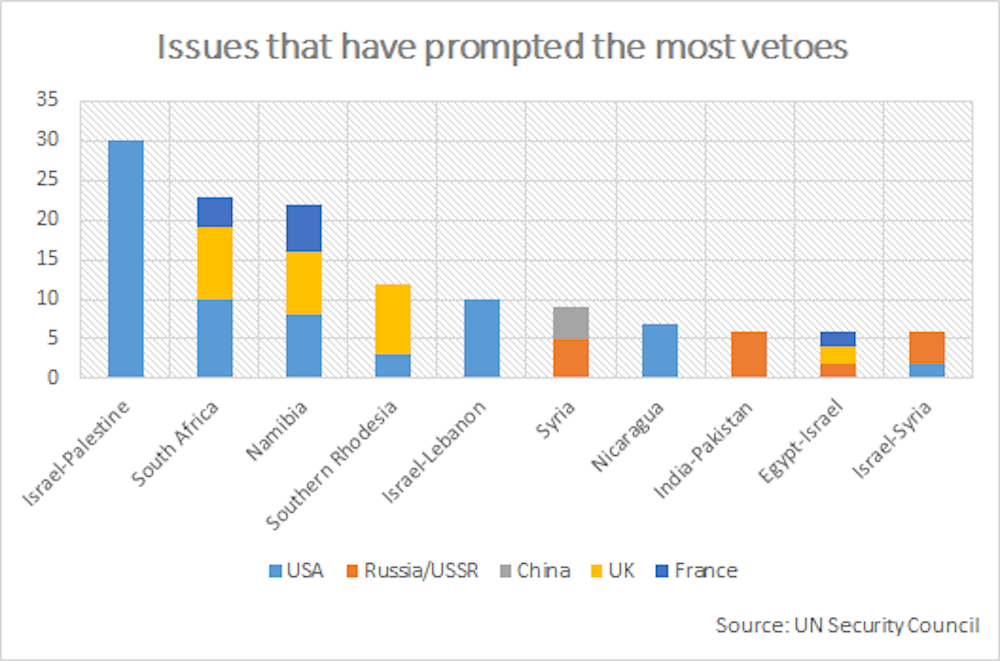
    For a start, it would need to get past the UN security council which means being subject to a veto from any one of the five permanent members (P5). We published an article on this issue some years ago with the help of UN expert Emma McClean, which looked at the issues which had prompted members of the P5 to wield their vetos. It found that Israel-Palestine was hands-down the most common issue that led to a veto – and all those vetoes had been instigated by the US.

    UN security council vetoes.
    UN security council


    Read more:
    Hard Evidence: who uses veto in the UN Security Council most often – and for what?


    So suspending Israel from the UN would appear to be a non-starter. But Hehir tells the story of the way the UN managed to circumvent the P5 and suspend South Africa in 1974 over apartheid. Having failed to get the suspension past the security council after the UK and France vetoed the move, the credentials committee of the general assembly simply refused to renew South Africa’s credentials. It remained suspended for two decades until the end of apartheid in 1994.


    Read more:
    Gaza: can the UN suspend Israel over its treatment of Palestinians? It’s complicated, but yes


    Meanwhile Israel’s assault on Gaza continues and the death toll continues to mount. Israeli Defense Forces (IDF), supported by airstrikes, continue to bombard what the IDF says are Hamas positions in the towns of Beit Lahia and Jabalia but which the Gaza health ministry say are residential buildings sheltering hundreds of civilians. On October 29, the health ministry said at least 93 people, including 25 children, were killed by an Israeli airstrike.


    Now, more than ever, it’s vital to be informed about the important issues affecting global stability. Sign up to receive our weekly World Update newsletter. Every Thursday we’ll you expert analysis of the big stories making international headlines.


    Much of the population of the north of Gaza has been evacuated south of what is known as the Netzarim corridor. Israel’s Haaretz newspaper claims that it’s part of an operation known as the “generals’ plan”, which calls for the north to be cleared of civilian residents and locked down as a military zone. This is presented as a national security measure, but Leonie Fleischmann reports that there are those who believe the military operation will be followed by an influx of Israeli settlers.

    Fleischmann points to a conference held on the Israeli side of the border with north Gaza, attended by members of Netanyahu’s Likud party as well as by several government ministers, which actively promoted the idea of settling north Gaza. Memories and historical legend mingle with ideology that holds Gaza had a Jewish population from biblical times through to 1929, when an Arab revolt killed 133 Jewish people living there and drove the rest out.

    The prospect of a land grab is clearly exercising minds at the UK foreign office. UK ambassador to the United Nations, Barbara Woodward said on October 29: “We reiterate that northern Gaza must not be cut off from the south. Palestinian civilians, including those evacuated from northern Gaza must be permitted to return. There must be no forcible transfer of Gazans from or within Gaza, nor any reduction in the territory of the Gaza Strip.”


    Read more:
    Israel’s ‘generals’ plan’ to clear Palestinians from north of Gaza could pave the way for settlers to return


    All eyes on Washington

    It’s highly unlikely that we’ll know by this time next week who has prevailed in the US presidential election. But the Middle East will be one of the first big ticket items on the Resolute desk.

    The issue has already proved to be a tricky one for Kamala Harris. Her support base is deeply divided on the issue, with large numbers of Democrats – particularly young people, as well as Muslims and black voters – unsettled by her perceived part in the Biden administration’s “steadfast” support for Israel over the past four years.

    It’s hard to tell whether these voters consider that the people of Gaza would fare any better under a Trump White House. But Natasha Lindstaedt and Faten Ghosn believe that Netanyahu’s continuing aggression in Gaza may well play out in the Republican contender’s favour.


    Read more:
    How the Middle East conflict could influence the US election – and why Arab Americans in swing states might vote for Trump


    Meanwhile, to guide us through how the two candidates are likely to approach the big foreign policy issues, we can turn to Garret Martin of the Transatlantic Policy Center at the American University in Washington.


    Read more:
    On foreign policy, Trump opts for disruption and Harris for engagement − but they share some of the same concerns


    World Update is available as a weekly email newsletter. Click here to get our updates directly in your inbox.


    ref. World Update: how Israel’s relations with the UN hit rock bottom – https://theconversation.com/world-update-how-israels-relations-with-the-un-hit-rock-bottom-242632

    MIL OSI – Global Reports

  • MIL-OSI Video: DPR Korea, Lebanon/Humanitarian, Cuba & other topics – UN Daily Press Briefing (31 Oct 2024)

    Source: United Nations (Video News)

    Noon Briefing by Stéphane Dujarric, Spokesperson for the Secretary-General.

    Highlights:
    -Democratic People’s Republic of Korea
    -UNIFIL
    -Lebanon/Humanitarian
    -Occupied Palestinian Territory
    -Ukraine
    -Security Council
    -Deputy Secretary-General
    -Cuba
    -South Sudan
    -West and Central Africa
    -World Cities Day
    -Guest briefing
    -Briefings tomorrow

    Democratic People’s Republic of Korea
    The Secretary-General strongly condemns the launch today of a long-range ballistic missile by the Democratic People’s Republic of Korea (DPRK).
    The DPRK’s continued launches of missiles using ballistic missile technology are clear violations of relevant Security Council resolutions.
    The Secretary-General remains concerned about the situation on the Korean Peninsula. He has consistently called for de-escalation and the full implementation of all relevant Security Council resolutions, as well as for an environment that is conducive to dialogue, and the resumption of talks. 
    Diplomatic engagement remains the only pathway to sustainable peace and the complete and verifiable denuclearization of the Korean Peninsula.

    UNIFIL
    In Lebanon, Blue Helmets – who remain at their positions and continue their essential work to monitor and report to us and the international community what is actually happening on the ground, tell us that intense clashes between Hizbullah and the Israel Defence Forces have been reported in the Khiam area in UNIFIL’s Sector East.
    The Israeli Defence Forces have continued to strike areas across Lebanon, including in the south, Baalbek and near Beirut, with multiple casualties reported. Hizbullah’s rocket fire has reportedly killed five people today near Metula in northern Israel.
    Yesterday, a UNIFIL position near the Blue Line, south of the Shab’a village (Sector East) sustained minor damage to its barracks and a vehicle due to a nearby explosion.
    We once again remind all involved in this conflict of the inviolability of UN premises, and those premises must be respected, as well as our peacekeepers, both uniformed and civilians.
    The intensifying hostilities are, of course, extremely concerning. We urge all actors to stop the violence immediately and avail themselves of the diplomatic initiatives to end this conflict. We continue to support efforts towards de-escalation and a diplomatic solution.
    The UN peacekeeping mission also remains focused on helping local communities. This week, they delivered essential humanitarian aid to the Municipality of Tyre amid a challenging situation in south Lebanon. The aid included medical devices as well as medicines.

    Lebanon/Humanitarian
    On the humanitarian front, as in many conflicts, children and woman bear the brunt of the ongoing hostilities.
    In a statement today, UNICEF’s Executive Director, Catherine Russell, said that 166 children have been killed in Lebanon since October 2023, that is what Lebanese authorities are telling UNICEF, while thousands of others have been injured.
    UNICEF is on the ground providing emergency psychological support to thousands of children and their caregivers.
    For its part, the UN Population Fund says the conflict is also impacting more than 10,000 pregnant women including 1,300 who are expecting to give birth soon amid significant damage to infrastructure and a health system that is extremely strained.
    The displacement crisis remains a key issue. Our humanitarian colleagues are telling us that today, the Israeli army issued new orders for people to leave their homes in several villages as well as in the Rashiedeh Palestinian refugee camp, which is located in the south. This is the first time the Israeli army has called for the evacuation of a Palestinian refugee camp in Lebanon.
    OCHA says that yesterday’s displacement orders and strikes in Baalbek and surrounding areas have forced thousands of people to flee their homes. Many of them spent the night in their vehicles.
    And yesterday, the Humanitarian Coordinator for Lebanon, Imran Riza, visited Akkar in Tripoli, which currently hosts around 70,000 people who have been forced to flee, and are in conditions that you can only imagine.

    Full Highlights: https://www.un.org/sg/en/content/noon-briefing-highlight?date%5Bvalue%5D%5Bdate%5D=31%20October%202024

    https://www.youtube.com/watch?v=M_88Ll_nbRg

    MIL OSI Video

  • MIL-OSI NGOs: Treating open wounds in the West Bank Palestine

    Source: Médecins Sans Frontières –

    It’s a sunny morning in Nur Shams refugee camp, in Tulkarem, West Bank, Palestine. Over 20 women are filing into a room set up by Médecins Sans Frontières (MSF) staff, sitting in a circle and chatting over Arabic coffee. In the middle of the room, there is a table with gauze, tourniquet devices and charts explaining blood flow in the human body. This is MSF’s ‘stop the bleeding’ training.

    Most women gathered in this room have little to no medical training, but trauma wounds and severe bleeding are not new to them. They are here to learn how to care for wounds, apply tourniquets, and provide basic first aid to family members and neighbours until they can reach medical care during frequent military incursions by Israeli forces.

    “We experience raids, bombings, and injuries from shootings,” says Saeda Ahmad, a participant in the training. “We often have an injured person right in front of us. In such situations, it’s important for us to have the knowledge and background to properly administer first aid.”

    “During raids, it’s extremely difficult for ambulances to reach the scene,” continues Ahmad. “That’s why everyone in the camp needs to have some knowledge of first aid. So that we ourselves can help the injured person.”

    Here, military raids by Israeli forces are becoming increasingly frequent, and blockages of access to healthcare are part of the modus operandi. Roads are blocked, ambulances cannot move, healthcare workers are harassed and targeted or otherwise hindered, and wounded people often cannot reach hospitals.

    Incursions from Israeli forces are also increasing in violence and intensity; on 3 October, 18 people were killed in an airstrike on Tulkarem refugee camp. The use of drone strikes, air strikes and other bombardments by Israeli forces, in often densely-populated areas and refugee camps, has become increasingly common. Incursions are also increasing in length, and not only here; last August, in Jenin, north of Tulkarem, Israeli forces launched a large-scale military incursion that lasted nine days.

    In this context of constant violence and insecurity, people in the camps have spoken with MSF mental health staff of the deep psychological impacts of these raids. Military incursions by Israeli forces reshape the lives of people, stripping them of normalcy and any sense of safety.

    People are always in the aftermath from the last incursion, rebuilding torn up streets and destroyed houses, while holding their breath until the next military raid. Our teams are also providing psychological first aid to residents in the camp, to address the significant mental health issues stemming from the impact of these incursions, which affect all residents, but particularly children.

    “The situation is very difficult. The children in the camps are afraid to go to school, as they fear a raid might happen while they are there,” says an MSF community health educator for MSF in Tulkarem. “In their home life, stability has vanished. People remain on edge.”

    “Children have stopped playing in the alleys. They spend most of the time at home and are not able to go out,” says our health educator. “They can’t even go out to buy what they need because their parents won’t let them, out of fear that a raid or incident might occur while they’re outside. There are children whose entire playtime has become centred around the violence they have experienced.”

    In a context of fear and insecurity, it becomes impossible for people to live a normal life or plan for the future. Training like ‘stop the bleeding’ can provide some sense of control over the situation, by giving residents the tools to act in a medical emergency during an incursion. But their very existence highlights the direness of the situation in the West Bank.

    In this room, as participants practice wrapping gauze around each other’s arms, emotional wounds also reveal themselves. Participants share stories of the violence they have experienced, in conversations, stories, and photos of killed family members on a phone’s lock screen.

    The psychological wounds, also, are deep. And mending them takes more time than applying pressure or tightening a tourniquet.

    MIL OSI NGO

  • MIL-OSI Video: In Lebanon, more than 2,000 dead and 800,000 forced to flee in recent weeks as shelling continues

    Source: United Nations (Video News)

    In Lebanon, more than 2,000 people have died and 800,000 have been forced to flee in recent weeks as shelling continues, the Spokesperson for the United Nations Interim Mission in Lebanon (UNIFIL) says. Briefing reporters in New York from Beirut, Andrea Tenenti points out that statistics cannot convey the human toll of the conflict. Peacekeepers have been targeted by attacks from the Israeli Defense Forces (IDF), and actions by the IDF and Hezbollah put the blue helmets in danger, he adds.

    https://www.youtube.com/watch?v=-ONk99AUd_k

    MIL OSI Video

  • MIL-OSI Europe: Answer to a written question – Invasion and destructive impact of various pufferfish species ( Tetraodontidae ) in the Mediterranean Sea – E-001726/2024(ASW)

    Source: European Parliament

    The EU works with the General Fisheries Commission for the Mediterranean (GFCM) on the issue of the spread of Non-Indigenous Species (NIS).

    The GFCM 2030 Str ategy recognises its importance and makes its work on NIS a priority[1]. Several pilot projects and research programs, in which Member States take part, have been developed advancing data collection, information sharing and establishing comprehensive mitigation measures.

    These include a pilot study on NIS in the eastern Mediterranean and the creation of a NIS observatory. While initially focused on the east, the aim is for the observatory to eventually be expanded to the entire region.

    Regarding the compensation available to fishers, the EU provides for the funding of national initiatives under the European Maritime, Fisheries and Aquaculture Fund (EMFAF). Several Mediterranean Member States have identified the threat posed by NIS and put in place measures and solutions to combat them.

    In Cyprus, a scheme has been put in place to compensate fishers for their pufferfish catches[2]. Other Member States, such as Greece, have funded innovative projects which help turn this threat into an economic opportunity[3].

    Our Mediterranean neighbours have also been developing mitigation and adaptation measures, expanding their research on pufferfish species.

    At the 2024 GFCM Fish Forum, Tunisia and Türkiye presented pufferfish-focused research with the latter having developed the production of pufferfish leather[4].

    The EU has been financially supporting the GFCM’s capacity building work under the MedSea4Fish programme which has also focused on providing GFCM parties with support in their research and data collection on NIS, ensuring a uniform ability to combat invasion.

    • [1]  GFCM 2030 Strategy Action Plan(https://www.fao.org/gfcm/2030strategy): Target 1.4 on the need to prevent and mitigate ‘threats to fisheries and the marine environment, including plastic pollution, climate change and the expansion of non-indigenous species’
    • [2]  www.moa.gov.cy/emfaf
    • [3]  The Greek example of turning pufferfish into fishmeal is particularly relevant https://oceans-and-fisheries.ec.europa.eu/news/turning-toxic-pufferfish-invader-aquaculture-feed-2023-12-22_en#:~:text=The%20pufferfish%2C%20originating%20from%20the,to%20have%20no%20commercial%20value.https://oceans-and-fisheries.ec.europa.eu/news/turning-toxic-pufferfish-invader-aquaculture-feed-2023-12-22_en
    • [4]  https://pufferfishleather.com/

    MIL OSI Europe News

  • MIL-OSI Economics: Per Jacobsson Lecture 2024 — Ngozi Okonjo-Iweala: “Delivering on new global challenges: How can we keep multilateral coherence whilst re-imagining the multilateral trading system?”

    Source: WTO

    Headline: Per Jacobsson Lecture 2024 — Ngozi Okonjo-Iweala: “Delivering on new global challenges: How can we keep multilateral coherence whilst re-imagining the multilateral trading system?”

    Excellencies, Dear Raghu, Minouche, Maury, ladies and gentlemen, friends,
    Thank you. What an honor to follow in the footsteps of previous Per Jacobsson lecturers – all the more so in this 80th anniversary year of the Bretton Woods Conference.
    We are living in troubled times – something Per Jacobsson knew well. So far as trade is concerned, the times are not only troubled, they are tense. Trade is sometimes blamed and scapegoated for poor outcomes that really derive from macroeconomic, technology, or social policy, for which trade is not responsible.
    Trade policies and tools are being deployed not just to solve trade-related problems, but also to try to address security and geopolitical concerns.
    As unilateral measures or threats thereof become increasingly widespread, trade policy has been getting more restrictive. In recent months, the US, the EU, Turkey, and Canada have introduced new tariffs and countervailing duties on Chinese electric vehicles and other products, including steel. China has countered with WTO disputes and measures against EU products such as dairy, pork, and brandy. 
    These are among the over 130 new trade-restricting measures recorded by the WTO Secretariat since the start of this year. This number represents an 8% increase to the stockpile of over 1600 restrictive measures introduced between 2009 and 2023, which as of last year were already affecting over 10% of world goods trade. In addition, WTO members initiated 210 trade remedy investigations in the first half of 2024 – nearly as many as in all of 2023. While not all will culminate in the imposition of duties, investigations have a well-documented chilling effect on trade. And I haven’t even mentioned subsidies yet. 
    Frictions are manifesting as trade disputes. Six of the eight WTO disputes initiated this year deal with green technologies, particularly electric vehicles.
    I hope we are not on a path that leads back to the sort of economic disorder that came before Bretton Woods – disorder that was followed by political extremism and war.
    It was precisely to avoid a repeat of such circumstances that the multilateral economic institutions were created. My concern today is that we have forgotten this lesson – that we have forgotten the good these institutions have done.
    Walking away from the legacy of Bretton Woods, including the trading system, would diminish the world’s ability – collectively and at the national level – to respond to problems affecting people’s lives and opportunities.
    I will argue that there is a better path forward: re-imagining the global trading system and the rest of the multilateral economic architecture to help us meet the technological, environmental, social and geopolitical challenges of our time. To succeed, its various components must work in concert – an idea we have come to call ‘coherence’.
    In the 1940s, the overall thrust of coherence was that trade, reconstruction financing, and monetary policymaking need to be in harmony with each other, and anchored in institutions and rules across countries, to promote growth, prosperity, and peace.
    Today, delivering lasting improvements to people’s lives and livelihoods requires us to solve problems of the global commons.
    The notion of coherence across different policy areas would have made sense to Per Jacobsson. His convictions about sound money, and its importance for durable growth and recovery, were shaped by his own experiences. As a young man he saw the collapse of global economic integration amid the First World War. From his position at the League of Nations in the 1920s, he witnessed the failed attempts by leading economies to establish effective international coordination on global finance and trade – a memory that echoes uncomfortably today.
    We know what happened when the downturn came at the end of the decade. Vicious circles emerged: of falling output, deflation, banking and financial crises, trade protectionism and retaliation, and exchange rate chaos. Countries retreated into increasingly isolated economic blocs.
    The experience of those years was seared into the consciousness of the officials who gathered in Bretton Woods in July 1944. US Treasury Secretary Henry Morgenthau opened the conference by looking back at what he called “the great economic tragedy of our time.” I quote “We saw currency disorders develop and spread from land to land, destroying the basis for international trade and international investment and even international faith. In their wake, we saw unemployment and wretchedness — idle tools, wasted wealth. We saw their victims fall prey, in places, to demagogues and dictators. We saw bewilderment and bitterness become the breeders of fascism and, finally, of war.”
    What Bretton Woods delivered
    The genius of Bretton Woods was that it turned the vicious circles of the 1930s into virtuous ones, by recognizing that macro-financial stability, reconstruction and development, and trade went hand-in-hand.
    Instead of beggar-thy-neighbor policies, countries would treat trade, monetary issues, and even domestic macro-economic policies as matters of common interest.
    Instead of excessively rigid or chaotically fluctuating currencies, there would be orderly, rules-based management of exchange rates and balance of payments problems.
    Instead of underinvestment, there would be long-term financing for reconstruction and expanding productive capacity.
    Instead of quantitative restrictions, prohibitive tariffs, and bilateral clearing, there would be a coordinated lowering of trade barriers, and freedom to undertake international payments and current account transactions.
    The idea of coherence across policy fields, with trade as a unifying theme, was baked into the system from day one. Promoting the “balanced growth of international trade” is written into the founding mandates of both the IMF and the World Bank – not as an end in itself, but as a means to higher employment, productivity, and incomes.
    The trade leg of the stool, alongside the Bank and the IMF, was supposed to be the International Trade Organization, but it ran aground in the US Congress. A parallel negotiating process in 1947 produced the General Agreement on Tariffs and Trade, which was nominally temporary and did not require Congressional ratification. Successive rounds of GATT negotiations substantially reduced barriers to trade. The growing number of “contracting parties” used the GATT to resolve and avoid trade disputes. By the 1960s, global trade was growing faster than output.
    The decades that followed Bretton Woods and the Marshall Plan delivered a breathtaking recovery from the devastation of the Second World War.
    Strong growth in the 1950s and 1960s saw per capita incomes in Western Europe and Japan begin to converge with those in the United States.
    Major European currencies achieved full convertibility in 1958, when Per Jacobsson was leading the IMF.
    These gains, however, were largely confined to industrialized countries.
    Most newly independent developing countries continued to lose ground in relative terms, as they struggled with declining terms of trade for their commodities.
    But a handful of poor economies in East Asia started trying to use increasingly open external markets to pursue export-led development.
    Discordance and reinvention: the 1970s and 1980s
    Coherence gave way to discordance in the 1970s, with the oil shocks, stagflation, the advent of floating exchange rates, and a wave of emerging market debt crises.
    By the mid-1980s, the success of the so-called Asian tigers had become a compelling example, inspiring many developing country governments to pivot from inward-oriented to export-oriented development strategies.
    At the international level, growing frustration with ad hoc protectionism and “à la carte” approaches to GATT strictures created demand for more rules-based trade cooperation.
    The Uruguay Round negotiations from 1986 to 1994 broadened the reach of multilateral trade rules to cover services and intellectual property, filled longstanding gaps with respect to agriculture and textiles, and unwound much of the protectionism that had emerged in the preceding years.
    The nominally provisional GATT was transformed into the World Trade Organization, with a binding dispute resolution mechanism that enhanced the predictability offered by its expanded rulebook.
    The preamble to the Marrakesh Agreement establishing the WTO opened up new vistas for the organization, defining its purpose as using trade not just to raise living standards and create jobs but to advance sustainable development – thus introducing environmental concerns that were absent in the 1940s.
    1990 to 2020: A “golden period of economic development”, but clouds on the horizon
    The Uruguay Round and the end of the Cold War would mark a second era of coherence and virtuous circles across the trading system, the World Bank, and the IMF. And this time, the benefits were spread much more widely across countries and people.
    The WTO became an anchor for outward-oriented economic reforms in many emerging markets and developing economies.
    Increasingly open and predictable trade became a stronger driver of development, productivity, specialization and scale.
    Better macro-financial policies bolstered growth – and trade performance – in many emerging markets and developing countries. So did improved human capital and physical infrastructure.
    Trade and modern supply chains became powerful sources of disinflationary pressures.
    Market-oriented reforms in China, Eastern Europe, India and other developing economies brought them into the increasingly global division of labor. Trade boomed, incomes rose, and poverty plummeted.
    Between 1995 and 2022, as low- and middle-income economies nearly doubled their share in global exports from 16 to 32%, the share of their populations subsisting on less than US$2.15 per day fell from 40% to under 11%. Over 1.5 billion people were lifted out of extreme poverty.
    Since 1995, per capita incomes in low- and middle-income countries have nearly tripled, and global per capita income increased by approximately 65 percent.
    For the first time since the industrial revolution two centuries earlier, per capita incomes in rich and poor countries began to converge.
    Gains for poor countries did not come at the expense of rich ones. Examining the United States since 1950, researchers at the Peterson Institute for International Economics (PIIE) have shown that international trade boosted the economy by the equivalent of $2.6 trillion in 2022, or about 10% of GDP. The gains from trade would be even larger for small, open advanced economies.
    In a Foreign Affairs piece this year, Dev Patel, Justin Sandefur, and Arvind Subramanian called the years between 1990 and the start of COVID-19 pandemic in 2020, I quote, “history’s most golden period of economic development”.   They argue that the rapid increase in trading opportunities was “perhaps the most important enabler” of convergence.
    Research from our new World Trade Report backs them up: the pace of income convergence of low- and middle-income economies is strikingly correlated with their participation in global trade, as measured by a size-adjusted ratio of trade to GDP. Our simulations suggest falling trade costs account for as much as one-third of the convergence.
    To be clear, the period was not golden for everyone. Developing countries with lower trade participation or greater commodity-dependence – mostly in Africa, Latin America and the Caribbean, and the Middle East – lagged on convergence. And in some rich countries, many people felt left behind, and their frustration started to fuel a political backlash against trade.
    Multilateral rule-making on trade began to falter, with the failure of the Doha Round of WTO negotiations.
    Nevertheless, in 2008 and 2009, when the world economy faced its worst financial crisis since the 1930s, the system worked.
    International markets stayed broadly open. The rules and norms of the multilateral trading system helped governments contain protectionist pressures.
    Alongside fiscal and monetary support, trade was a powerful shock absorber. Crisis-hit countries could rely on predictable market access elsewhere to absorb their excess supply, preventing growth and development from getting derailed.
    The WTO, the World Bank, and the IMF also worked together productively on the macro-micro policy nexus.
    For instance, when trade finance dried up during the credit crunch, despite being extremely low-risk, the three institutions joined hands to encourage G20 members and international financial institutions to step in with a $250 billion support package.
    Since the financial crisis, the multilateral trading system, with the WTO at its core, has continued to deliver economic benefits, despite rising geopolitical tensions and tariffs between the US and China, the disabling of the Appellate Body, and the failure to reach agreements in long-running negotiations such as those on agriculture. Global trade kept reaching new highs through the 2010s, and over 75% of global goods trade continued – and continues today – to operate on core WTO tariff terms.
    When COVID-19 hit in 2020, the norms and rules of the multilateral trading system mostly did their job again. Trust in trade was damaged by initial missteps, as governments enacted export restrictions on medical supplies and vaccines. But governments generally refrained from widespread protectionism, allowing food and other essentials to flow across borders to where they were needed. Goods trade rebounded strongly from the lockdowns and was soon setting new records. Cross-border supply chains churned out products needed to fight the pandemic, from face masks to vaccines. Trade in digitally-delivered services boomed, propelled by the same technologies that allowed so many of us to work from home.
    Goods and especially services trade are now well above pre-COVID levels.  Last year, global trade was worth a near-record $30.5 trillion, in a $105-trillion world economy.
    Re-imagining the Multilateral Trading System with coherence
    As we saw at the outset, however, these successes did not forestall the challenges we now face in global trade. While trade has been largely resilient, signs of fragmentation are now visible.
    So it’s not difficult to imagine a return of vicious circles – trade restrictions, efficiency losses, slower growth, higher prices, costs imposed by extreme weather and food insecurity, and public frustration and anger.
    Allowing the vicious circles to take hold and the world to fragment into isolated trading blocs would be costly. The WTO has estimated longer term global GDP losses in the order of 5% were the world to fragment into two like-minded trading blocs. IMF estimates are in the order 7%. We cannot afford this!
    And that is why we need to re-imagine the multilateral trading system to solve modern challenges and address modern vulnerabilities.
    This means re-imagining coherence as well. Trade alone was insufficient in 1944, and trade alone is insufficient to build the more secure, sustainable, and inclusive world we want today.  The way forward for trade will increasingly be about “WTO and” – trade in tandem with other issues, and policies that support the original vision of coherence and do not misuse trade tools, for coercion, as a weapon, or to undermine competition.
    Our unfinished business from 1944 was elegantly illustrated by a recent blog post from IMF chief economist Pierre-Olivier Gourinchas and his team.
    They showed that China’s growing and contentious trade surplus, and the US’s widening trade deficit, are the result of domestic macro-economic forces, rather than the product of trade and industrial policies.
    “Homegrown surpluses and deficits call for homegrown solutions,” they argued, suggesting demand-boosting measures in China and fiscal consolidation in the US.
    As for concerns over industrial policy, they said the right response was to strengthen WTO rules, not to restrict trade.
    They cited the WTO’s recent China Trade Policy Review which showed new data of billions of dollars in subsidies going to manufacturing. Urging China to be more transparent about its subsidies.
    The blog shows the coherence mandate in action but it also illustrates how even today, the global trading system is paying a price for shortcomings of macro-economic policy.
    As Sylvia Ostry, one of my predecessors at this podium, said in 1987, “Trade policy is no substitute for macro policy.”
    Let’s now turn to the new trade agenda, and look at three areas where future prospects for people and the planet require trade to be re-imagined, and complemented by other policy levers pulling in the same direction.
    First, the environmental agenda, above all climate change and getting to net zero by mid-century.
    Trade is indispensable to deploy low-carbon technologies globally. Trade lets countries share the burden of developing new green tech. Scale economies and competitive pressures associated with trade help drive down unit costs, making it possible for renewables to undercut fossil fuel energy.
    Trade also allows us to leverage ‘green comparative advantage’, a concept that our chief economist, Ralph Ossa, has done much to advance. The idea is straightforward: just as individuals and countries can reap economic gains by specializing in what they are relatively good at, the world can reap environmental gains if countries specialize in what they are relatively green at.
    If countries with abundant clean energy can produce more energy-intensive goods and services, while importing energy-light products from places where clean energy is scarce, and vice versa, global emissions fall much more than they would have absent that trade. And in fact research from the University of Zurich  suggests that as much as one-third of global emissions reductions could come from this kind of specialization linked to green comparative advantage.
    As Ricardo Hausmann at Harvard has observed, fossil fuels are cheap to transport, but wind and solar energy are not. This makes parts of Africa, Central Asia, and Latin America with high green energy potential attractive destinations for investment in energy-intensive industries, including the production of green hydrogen.
    Global cooperation on internalizing carbon costs would incentivize greener sourcing everywhere. Nevertheless, we are already seeing moves in the right direction as in Kenya, which has attracted a billion-dollar investment to build a geothermal-powered low-carbon data center.
    Parenthetically, a similar dynamic exists for water, provided it is valued correctly. A recent report of the Global Commission on the Economics of Water, which I co-chair, shows that with trade one can also promote the notion of a hydrological comparative advantage. Trade can help mitigate water scarcity by allowing countries with abundant hydrological resources to specialize in producing water-intensive products for export to water-scarce nations.  Such virtual water trade offers agricultural export opportunities, for example, to those regions including countries in Africa with under-utilized ground water resources and land.
    But just as environmental policy coordination could accelerate climate action, policy fragmentation could weaken it.  There is a genuine risk that trade frictions associated with carbon pricing, green subsidies, and other climate policies will escalate into trade restrictions and retaliation, harming emissions reduction as well as trade.
    We should seek to pre-empt such frictions and disputes by establishing shared frameworks for trade and climate policy. The goal would be to maximize emissions reduction and green innovation, while minimizing negative spillovers, trade tensions, and wasted public resources on subsidy races that most countries may not even afford to participate in.
    To this end, the WTO Secretariat is coordinating a carbon pricing task force comprised of the IMF, World Bank, OECD, UNCTAD, and UNFCCC, where we are working to develop shared carbon metrics and ultimately a global carbon pricing framework against which we can benchmark national policies to aid interoperability of approaches. We have also joined hands with the IMF, the OECD, and the World Bank to explore approaches to enhance greater transparency with respect to subsidies. And we are working with the steel industry to help them promote interoperability in decarbonization standards, reducing transaction costs and facilitating trade and investment in green steel.
    Reforming the over $1.2 trillion in direct global annual fossil fuel subsidies, the $630 billion in trade-distorting agricultural support, and the $22 billion in harmful fisheries subsidies (which the WTO Fisheries Subsidies Agreement is delivering) should be a no-brainer. Some of the resources freed up could be repurposed to support green innovation and a just transition for poor countries.
    The second set of opportunities for the Multilateral Trading System deals with diversifying and decentralizing supply chains – and doing so in a manner that brings in countries and communities that remain on the margins of the global division of labor.
    More diversified global production networks would enhance supply security in an increasingly shock-prone world, while extending the benefits of trade to places and people that have not shared adequately in them. Greater diversification would also help lower the geopolitical temperature around supply chain relationships, by making them harder for any single country to weaponize.
    As the pandemic and the war in Ukraine made abundantly clear, overconcentration makes supply chains vulnerable in a crisis.
    The advent of COVID-19, concentrated minds on the fact that 80% of world vaccine exports came from only ten countries. This meant export restrictions in a few of them severely disrupted global access to vaccines – especially to Africa, which relied on imports for 99% of its jabs.
    Decentralizing value chains and building up pharmaceutical production capacity in Africa and other developing country regions for instance would make the global supply base more resilient in the event of future pandemics, whilst more closely integrating these regions in to world trade, and making them part of a more prosperous and healthy world.
    Critical minerals is another sector where there are major opportunities to mitigate concerns about overconcentration in mining and especially processing, while stimulating growth in developing countries. 
    Exports of minerals critical for the low-carbon transition, like lithium, cobalt, nickel, and rare earths, have grown rapidly to reach USD 320 billion in value in 2022, and are set to increase much more in the years ahead. Africa, for example, represents 40% of estimated global reserves of cobalt, manganese, and platinum; and 12% of world exports of critical minerals, but only 3.8% of exports of processed minerals.
    By investing in processing these minerals within the regions including in Central Asia and Latin America where they are found, we can promote value addition and job creation while removing supply bottlenecks that currently threaten to hold back the low-carbon transition.
    Furthermore, to the extent that this process is powered by green hydrogen and other kinds of clean energy, it would harness the green comparative advantage I mentioned earlier and thereby help the developing regions increase their share in world trade.
    It would be green growth and green trade – the ‘re-globalization’ we want.
    Finally, there are areas where cross-border commerce is flourishing, but where new rules are necessary to foster predictability and lower barriers to entry for smaller businesses and developing economies.
    The fastest growing segment of international trade is in services delivered across borders via computer networks. Trade in digitally-delivered services – everything from streaming video to remote consulting – has quadrupled since 2005, reaching $4.25 trillion in value last year. These services have become an increasingly important driver of growth and job creation.
    The commercialization of artificial intelligence promises to further accelerate digital trade. A forthcoming WTO report describes how AI could reduce trade and transaction costs, improve supply chain logistics, and shift countries’ comparative advantages.
    I always say the future of trade is digital, but the future of protectionism could be as well. Imports of digital services could become as contentious as manufactured imports have, or more so – inviting digital barriers that are even simpler to put in place than their counterparts for trade in physical goods.
    Putting in place some basic rules for digital trade would reduce the risks of such reversals. The 90-odd members participating in plurilateral e-commerce negotiations at the WTO are now looking to conclude a first phase agreement on a series of practical measures to facilitate digital trade, from common rules for e-signatures and payments, to paperless trading, and consumer protection. Tougher issues like cross-border data flows – a critical element in AI – will be dealt with in a second phase of negotiations.
    Delivering on this agenda for the future will involve strengthening all of the WTO’s functions: monitoring and transparency, negotiations, and dispute settlement.
    With respect to our dispute settlement system, we are working to reform it. The reform process has wide buy-in, and talks are advancing, including on issues like appeal review and accessibility to ensure that developing countries can use the system. There are delicate issues here around how national security exceptions will be handled – it is going to take work!
    We will need to negotiate and implement new rules in important areas like the environment. Some members are showing the way: New Zealand, Costa Rica, Switzerland, and Iceland recently agreed to liberalize trade in a list of hundreds of environmental goods, and they are trying to get others to join.
    We are working on getting an Agreement on Investment Facilitation for Development, negotiated by three-quarters of our membership, into the WTO rulebook. This agreement will help developing economies attract FDI by simplifying investment-related procedures and sweeping away red tape.
    We will also need to review existing rules to make them fit for purpose. Instead of members doing an end run around our Agreement on Subsidies and Countervailing Measures to introduce industrial policies, it would be better to update that agreement. It actually dates back to 1994 – seven years before China joined the WTO,  [a time when climate concerns were barely on the radar screen, and the conventional wisdom was that state-owned enterprises were a fading relic of a bygone era]. Members could decide to create space for subsidizing the green transition. Shared ground rules would help minimize negative spillovers and related trade tensions, while maximizing efficiency in the use of public resources. 
    Excellencies, ladies, and gentlemen. Let me now conclude.
    As I said at the start, these are tense times for trade. There are political dynamics outside our control. But we can treat the challenges we face as opportunities to re-imagine the global trading system.
    We can build global resilience whilst making the system more supportive of inclusive growth and environmental sustainability.
    We can make existing trade rules more fit for purpose rather than go around or against them and we can make new rules fit for the time.
    We can help developing countries left behind by the recent wave of global economic integration.
    We can have interdependence without overdependence.
    While nothing is ever easy at the WTO, we are moving in the right direction. We will manage what we can manage. Control what we can control. But we will need your help.
    Over the past eight decades, the multilateral economic architecture, including the trading system, has delivered a great deal for the world. We have reinvented it before. We can do so again, for people and planet.
    Nelson Mandela once wrote that “after climbing a great hill, one only finds that there are many more hills to climb.” I ask you, let’s climb these hills together.
    Thank you.

    Share

    MIL OSI Economics

  • MIL-OSI: Asure Announces Third Quarter 2024 Results

    Source: GlobeNewswire (MIL-OSI)

    Reports Third Quarter Revenues of $29.3 Million

    Recurring Revenues Grew 20% Versus Prior Year Third Quarter

    AUSTIN, Texas, Oct. 31, 2024 (GLOBE NEWSWIRE) — Asure Software, Inc. (“we”, “us”, “our”, “Asure” or the “Company”) (Nasdaq: ASUR), a leading provider of cloud-based Human Capital Management (“HCM”) software solutions, today reported results for the third quarter ended September 30, 2024.

    Third Quarter 2024 Financial Highlights

    • Revenue of $29.3 million, nearly unchanged versus the same period of the prior year
    • Revenue (excluding ERTC revenue) of $29.2 million, up 20% from $24.4 million versus the same period of the prior year
    • Recurring revenue of $28.6 million, up 20% year over year. Recurring revenue was 98% of total revenue versus 81% the same period of the prior year
    • Net loss of $3.9 million versus a net loss of $2.2 million during the same period of the prior year 
    • EBITDA(1) of $2.2  million versus $3.0 million during the same period of the prior year  
    • Adjusted EBITDA(1) of $5.4 million versus $6.2 million during the same period of the prior year 
    • Gross profit of $19.7 million versus $21.3 million during the same period of the prior year  
    • Non-GAAP gross profit(1) of $21.4 million (Non-GAAP gross margin(1) of 73%) versus $22.4 million (and 76% during the same period of the  prior year) 

    Nine Months 2024 Financial Highlights

    • Revenue of $89.0 million down 4% versus the first nine months of prior year
    • Revenue (excluding ERTC revenue) of $87.4 million up 15% from $75.7 million in the first nine months of prior year
    • Recurring revenue (excluding ERTC revenue) of $86.0 million up 16% from $74.4 million in the first nine months of prior year
    • Net loss of $8.6 million versus a net loss of $5.6 million the first nine months of prior year
    • EBITDA(1) of $8.0 million versus $13.2 million the first nine months of prior year
    • Adjusted EBITDA(1) of $16.3 million versus $20.5 million the first nine months of prior year
    • Gross profit of $61.2 million versus $67.7 million during the first nine months of the prior year  
    • Non-GAAP gross profit(1) of $65.6 million (Non-GAAP gross margin(1) of 74%) versus $71.5 million (and 77% during the first nine months of the prior year) 

    _______________
    (1)This financial measure is not calculated in accordance with GAAP and is defined on page 4 of this press release. A reconciliation of this non-GAAP measure to the most applicable GAAP measure begins on page 11 of this release.

    Recent Business Highlights

    • Payroll Tax Management Expansion: Asure’s Payroll Tax Management product gained significant momentum, going live with additional Workday and SAP clients during the third quarter. Key sales wins include one of America’s largest grocery chains and a nationally known HCM system integrator who assists large enterprises with Workday, SAP, and Oracle HCM implementations. These enterprise bookings have grown our backlog and still represent additional product and professional services opportunities.
    • HCM Architectural Milestone: Employee self-service capabilities have been decoupled from disparate payroll platforms and modularized as a single API-based service. This enhancement improves scalability and stability of the end-to-end HCM suite and further consolidates our technical footprint to a more flexible service-oriented architecture.
    • Entering Beta of New AI Agent: More than a chatbot, this new Generative-AI Agent handles inquiries related to payroll and payroll taxes takes secure action on behalf of the user. Through dynamic, interactive sessions, the AI Agent will answer questions and take actions on HR requests including time off requests, demographic changes, or changes to W-4 allowances.
    • Leadership Recognition: Asure Chairman and CEO, Pat Goepel, was named Austin Business Journal’s Best CEO of a Public Company for 2024, recognizing his leadership and commitment to Asure’s growth and success.
    • New financial services product to launch November 2024: Asure is introducing AsurePay™, an innovative financial solution offering working Americans a comprehensive online banking alternative. AsurePay™ combines features such as debit card access, fee-free ATM withdrawals, and paycheck advances through a unique interest-bearing banking solution, designed to improve employee engagement, while also improving overall employer efficiency. This solution is easily accessible through an intuitive mobile app.

    Management Commentary

    Asure Chairman and CEO, Pat Goepel, stated, “Our third quarter performance reflects strong, continued growth, with recurring revenue up 20% year-over-year. We’ve made great strides in transitioning to a more valuable revenue model, with 98% of our revenues now recurring, compared to 81% in the same quarter last year. Additionally, new bookings were up 141% year-over-year. Our backlog has grown significantly — over 35% from Q2 2024 and over 250% from Q3 2023. While large enterprise tax product deals have contributed to our success, their pace of implementation can vary. That said, we remain confident in our ability to maintain this positive trajectory.”

    Goepel continued, “We’re seeing strong demand for our Payroll Tax Management product, we’re introducing new solutions, upgrading our technology, and making strategic acquisitions. Earlier in the year, we faced the challenge of replacing ERTC revenue, but those headwinds have now dissipated as we close out 2024 and this change in the composition of our revenues offers us strong momentum going into 2025. We are optimistic about the opportunities ahead for both the remainder of this year and into next year.”

    Fourth Quarter 2024 and Full Year 2025 Revenue Guidance Ranges

    The Company is providing the following guidance for the fourth quarter 2024 based on the Company’s year-to-date results and recent business trends. Management is initiating full year 2025 guidance to a range of $134M-$138M which does not include revenue from potential future acquisitions.

    Guidance for 2024

    Guidance Range   Q4-2024   FY-2024  
    Revenue $ 30M – 32M $ 119M -121M  
    Adjusted EBITDA(1) $ 6M -7M   18% -19%  
               

    Guidance for 2025 

    Guidance Range   FY-2025  
    Revenue $ 134M – 138M  
    Adjusted EBITDA(1)   23% – 24%  
           

    Management uses GAAP, non-GAAP and adjusted measures when planning, monitoring, and evaluating the Company’s performance. The primary purpose of using non-GAAP and adjusted measures is to provide supplemental information that may prove useful to investors and to enable investors to evaluate the Company’s results in the same way that management does.

    Management believes that supplementing GAAP disclosures with non-GAAP and adjusted disclosures provides investors with a more complete view of the Company’s operational performance and allows for meaningful period-to-period comparisons and analysis of trends in the Company’s business. Further, to the extent that other companies use similar methods in calculating adjusted financial measures, the provision of supplemental non-GAAP and adjusted information can allow for a comparison of the Company’s relative performance against other companies that also report non-GAAP and adjusted operating results.

    Management has not provided a reconciliation of guidance of GAAP to non-GAAP or adjusted disclosures because management is unable to predict the nature and materiality of non-recurring expenses without unreasonable effort.

    Management’s projections are based on management’s current beliefs and assumptions about the Company’s business, and the industry and markets in which it operates; there are known and unknown risks and uncertainties associated with these projections. There can be no assurance that our actual results will not differ from the guidance set forth above. The Company assumes no obligation to update publicly any forward-looking statements, including its 2024 and 2025 earnings guidance, whether as a result of new information, future events or otherwise. Please refer to the “Use of Forward-Looking Statements” disclosures on page 6 of this press release as well as the risk factors in our quarterly and annual reports on file with the Securities and Exchange Commission for more information about risk that affect our business and industry.

    Conference Call Details

    Asure management will host a conference call on Thursday, October 31, 2024, at 3:30 pm Central (4:30 pm Eastern). Asure Chairman and CEO Pat Goepel and CFO John Pence will participate in the conference call followed by a question-and-answer session. The conference call will be broadcast live and available for replay via the investor relations section of the Company’s website. Analysts may participate on the conference call by dialing 877-407-9219 or 201-689-8852.

    About Asure Software, Inc.

    Asure Software (Nasdaq: ASUR) is a leading provider of Human Capital Management (“HCM”) software solutions. We help small and mid-sized companies grow by assisting them in building better teams with skills to stay compliant with ever-changing federal, state, and local tax jurisdictions and labor laws, and better allocate cash so they can spend their financial capital on growing their business rather than back-office overhead expenses. Asure’s Human Capital Management suite, named AsureHCM®, includes cloud-based Payroll, Tax Services, and Time & Attendance software and Asure Marketplace™ as well as human resources (“HR”) services ranging from HR projects to completely outsourcing payroll and HR staff. We also offer these products and services through our network of reseller partners. Visit us at asuresoftware.com.

    Non-GAAP and Adjusted Financial Measures

    This press release includes information about non-GAAP gross profit, non-GAAP sales and marketing expense, non-GAAP general and administrative expense, non-GAAP research and development expense, EBITDA, EBITDA margin, adjusted EBITDA, and adjusted EBITDA margin. These non-GAAP and adjusted financial measures are measurements of financial performance that are not prepared in accordance with U.S. generally accepted accounting principles and computational methods may differ from those used by other companies. Non-GAAP and adjusted financial measures are not meant to be considered in isolation or as a substitute for comparable GAAP measures and should be read only in conjunction with the Company’s Condensed Consolidated Financial Statements prepared in accordance with GAAP. Non-GAAP and adjusted financial measures are reconciled to GAAP in the tables set forth in this release and are subject to reclassifications to conform to current period presentations.

    Non-GAAP gross profit differs from gross profit in that it excludes amortization, share-based compensation, and one-time items.

    Non-GAAP sales and marketing expense differs from sales and marketing expense in that it excludes share-based compensation and one-time items.

    Non-GAAP general and administrative expense differs from general and administrative expense in that it excludes share-based compensation and one-time items.

    Non-GAAP research and development expense differs from research and development expense in that it excludes share-based compensation and one-time items.

    EBITDA differs from net income (loss) in that it excludes items such as interest, income taxes, depreciation, and amortization. Asure is unable to predict with reasonable certainty the ultimate outcome of these exclusions without unreasonable effort.

    Adjusted EBITDA differs from EBITDA in that it excludes share-based compensation, other income (expense), net and one-time expenses. Asure is unable to predict with reasonable certainty the ultimate outcome of these exclusions without unreasonable effort.

    All adjusted and non-GAAP measures presented as “margin” are computed by dividing the applicable adjusted financial measure by total revenue.

    Specifically, as applicable to the respective financial measure, management is adjusting for the following items when calculating non-GAAP and adjusted financial measures as applicable for the periods presented. No additional adjustments have been made for potential income tax effects of the adjustments based on the Company’s current and anticipated de minimis effective federal tax rate, resulting from the Company’s continued losses for federal tax purposes and its tax net operating loss balances.

    Share-Based Compensation Expenses. The Company’s compensation strategy includes the use of share-based compensation to attract and retain employees and executives. It is principally aimed at aligning their interests with those of our stockholders and at long-term employee retention, rather than motivating or rewarding operational performance for any particular period. Thus, share-based compensation expense varies for reasons that are generally unrelated to operational decisions and performance in any particular period.

    Depreciation. The Company excludes depreciation of fixed assets. Also included in the expense is the depreciation of capitalized software costs.

    Amortization of Purchased Intangibles. The Company views amortization of acquisition-related intangible assets, such as the amortization of the cost associated with an acquired company’s research and development efforts, trade names, customer lists and customer relationships, and acquired lease intangibles, as items arising from pre-acquisition activities determined at the time of an acquisition. While these intangible assets are continually evaluated for impairment, amortization of the cost of purchased intangibles is a static expense, one that is not typically affected by operations during any particular period.

    Interest Expense, Net. The Company excludes accrued interest expense, the amortization of debt discounts and deferred financing costs.

    Income Taxes. The Company excludes income taxes, both at the federal and state levels.

    One-Time Expenses. The Company’s adjusted financial measures exclude the following costs to normalize comparable reporting periods, as these are generally non-recurring expenses that do not reflect the ongoing operational results. These items are typically not budgeted and are infrequent and unusual in nature.

    Settlements, Penalties and Interest. The Company excludes legal settlements, including separation agreements, penalties and interest that are generally one-time in nature and not reflective of the operational results of the business.

    Acquisition and Transaction Related Costs. The Company excludes these expenses as they are transaction costs and expenses that are generally one-time in nature and not reflective of the underlying operational results of our business. Examples of these types of expenses include legal, accounting, regulatory, other consulting services, severance and other employee costs.

    Other non-recurring Expenses. The Company excludes these as they are generally non-recurring items that are not reflective of the underlying operational results of the business and are generally not anticipated to recur. Some examples of these types of expenses, historically, have included write-offs or impairments of assets, demolition of office space and cybersecurity consultants.

    Other (Expense) Income, Net. The Company’s adjusted financial measures exclude Other (Expense) Income, Net because it includes items that are not reflective of the underlying operational results of the business, such as loan forgiveness, adjustments to contingent liabilities and credits earned as part of the CARES Act, passed by Congress in the wake of the coronavirus pandemic.

    Use of Forward-Looking Statements

    This press release contains certain statements made by management that may constitute “forward-looking” statements within the meaning of the safe harbor provisions of the U.S. Private Securities Litigation Reform Act of 1995. These forward-looking statements about our financial results may include expected or projected U.S GAAP and other operating and non-operating results. The words “believe,” “may,” “will,” “estimate,” “projects,” “anticipate,” “intend,” “expect,” “should,” “plan,” and similar expressions are intended to identify forward-looking statements. Examples of “forward-looking statements” include statements we make regarding our operating performance, future results of operations and financial position, revenue growth, earnings or other projections. We have based these forward-looking statements largely on our current expectations and projections about future events and trends that we believe may affect our financial condition, results of operations, business strategy, short-term and long-term business operations and objectives, and financial needs. The achievement or success of the matters covered by such forward-looking statements involves risks, uncertainties and assumptions, over many of which we have no control. If any such risks or uncertainties materialize or if any of the assumptions prove incorrect, our results could differ materially from the results expressed or implied by the forward-looking statements we make.

    The risks and uncertainties referred to above include—but are not limited to—the expiration of major revenue streams such as Employee Retention Tax Credits (“ERTC”) and the impact of the Internal Revenue Service recent measures regarding ERTC claims; risks associated with breaches of the Company’s security measures; risks associated with the Company’s rate of growth and anticipated revenue run rate, including impact of the current economic environment; the Company’s ability to convert deferred revenue and unbilled deferred revenue into revenue and cash flow, and ability to maintain continued growth of deferred revenue and unbilled deferred revenue; privacy concerns and laws and other regulations may limit the effectiveness of our applications; the financial and other impact of any previous and future acquisitions; the Company’s ability to continue to release, gain customer acceptance of and provide support for new and improved versions of the Company’s services; successful customer deployment and utilization of the Company’s existing and future services; interruptions to supply chains and extended shut down of businesses; issues in the use of artificial intelligence in our HCM products and services; political unrest, including the current conflict between Russia and Ukraine and the ongoing conflict involving Israel in the Middle East; reductions in employment and an increase in business failures, specifically among our clients; possible fluctuations in the Company’s financial and operating results; regulatory pressures on economic relief enacted as a result of the COVID-19 pandemic that change or cause different interpretations with respect to eligibility for such programs; domestic and international regulatory developments, including changes to or applicability to our business of privacy and data securities laws, money transmitter laws and anti-money laundering laws; technological developments; the nature of the Company’s business model; interest rates; competition; various financial aspects of the Company’s subscription model; impairment of intangible assets; interruptions or delays in the Company’s services or the Company’s Web hosting; access to additional capital; the Company’s ability to hire, retain and motivate employees and manage the Company’s growth; litigation and any related claims, negotiations and settlements, including with respect to intellectual property matters or industry-specific regulations; volatility and weakness in bank and capital markets; factors affecting the Company’s deferred tax assets and ability to value and utilize them; volatility and low trading volume of our common stock; collection of receivables; and general developments in the economy, financial markets, credit markets and the impact of current and future accounting pronouncements and other financial reporting standards. Please review the Company’s risk factors in its annual report on Form 10-K filed with the Securities and Exchange Commission (the “SEC”) on February 26, 2024, and its quarterly reports on Form 10-Q filed with the SEC on August 1, 2024, and October 31, 2024.

    The forward-looking statements, including the financial guidance 2024 and 2025 outlooks, contained in this press release represent the judgment of the Company as of the date of this press release, and the Company expressly disclaims any intent, obligation or undertaking to release publicly any updates or revisions to any forward-looking statements to reflect any change in the Company’s expectations with regard to these forward looking statements or any change in events, conditions or circumstances on which any such statements are based.

    © 2024 Asure Software, Inc. All rights reserved.

    ASURE SOFTWARE, INC.
    CONDENSED CONSOLIDATED BALANCE SHEETS
    (in thousands, except per share amounts)
    (Unaudited)
     
      September 30, 2024   December 31, 2023
           
    ASSETS      
    Current assets:      
    Cash and cash equivalents $ 11,248     $ 30,317  
    Accounts receivable, net of allowance for credit losses of $6,150 and $4,787 at September 30, 2024 and December 31, 2023, respectively   17,233       14,202  
    Inventory   233       155  
    Prepaid expenses and other current assets   4,586       3,471  
    Total current assets before funds held for clients   33,300       48,145  
    Funds held for clients   193,589       219,075  
    Total current assets   226,889       267,220  
    Property and equipment, net   18,490       14,517  
    Goodwill   94,724       86,011  
    Intangible assets, net   73,429       62,082  
    Operating lease assets, net   4,401       4,991  
    Other assets, net   10,176       9,047  
    Total assets $ 428,109     $ 443,868  
    LIABILITIES AND STOCKHOLDERSEQUITY      
    Current liabilities:      
    Current portion of notes payable $     $ 27  
    Accounts payable   1,317       2,570  
    Accrued compensation and benefits   4,277       6,519  
    Operating lease liabilities, current   1,600       1,490  
    Other accrued liabilities   8,287       3,862  
    Deferred revenue   3,029       6,853  
    Total current liabilities before client fund obligations   18,510       21,321  
    Client fund obligations   193,951       220,019  
    Total current liabilities   212,461       241,340  
    Long-term liabilities:      
    Deferred revenue   2,276       16  
    Deferred tax liability   2,116       1,728  
    Notes payable, net of current portion   7,506       4,282  
    Operating lease liabilities, noncurrent   3,832       4,638  
    Other liabilities   765       209  
    Total long-term liabilities   16,495       10,873  
    Total liabilities   228,956       252,213  
    Stockholders’ equity:      
    Preferred stock, $0.01 par value; 1,500 shares authorized; none issued or outstanding          
    Common stock, $0.01 par value; 44,000 shares authorized; 26,540 and 25,382 shares issued, 26,540 and 24,998 shares outstanding at September 30, 2024 and December 31, 2023, respectively   265       254  
    Treasury stock at cost, zero(1) and 384 shares at September 30, 2024 and December 31, 2023, respectively         (5,017 )
    Additional paid-in capital   502,920       487,973  
    Accumulated deficit   (304,022 )     (290,440 )
    Accumulated other comprehensive loss   (10 )     (1,115 )
    Total stockholders’ equity   199,153       191,655  
    Total liabilities and stockholders’ equity $ 428,109     $ 443,868  
    (1) The aggregate Treasury stock of prior repurchases of the Company’s own common stock was retired and subsequently issued effective January 1, 2024. See the Condensed Consolidated Statement of Changes in Stockholders’ Equity for the impact of this transaction.
     
    ASURE SOFTWARE, INC.
    CONDENSED CONSOLIDATED STATEMENTS OF COMPREHENSIVE LOSS
    (in thousands, except per share amounts)
    (Unaudited)
     
      Three Months Ended
    September 30,
      Nine Months Ended
    September 30,
        2024       2023       2024       2023  
                   
    Revenue:              
    Recurring $ 28,626     $ 23,833     $ 85,950     $ 74,749  
    Professional services, hardware and other   678       5,501       3,050       18,069  
    Total revenue   29,304       29,334       89,000       92,818  
    Cost of sales   9,600       8,054       27,821       25,120  
    Gross profit   19,704       21,280       61,179       67,698  
    Operating expenses:              
    Sales and marketing   6,680       6,597       21,371       22,312  
    General and administrative   10,378       9,294       30,559       29,586  
    Research and development   1,973       1,803       5,704       5,107  
    Amortization of intangible assets   4,295       3,333       11,790       9,929  
    Total operating expenses   23,326       21,027       69,424       66,934  
    (Loss) income from operations   (3,622 )     253       (8,245 )     764  
    Interest income   165       437       762       1,015  
    Interest expense   (274 )     (1,219 )     (662 )     (5,336 )
    Loss on extinguishment of debt         (1,517 )           (1,517 )
    Other (expense) income, net         (283 )     10       (291 )
    Loss from operations before income taxes   (3,731 )     (2,329 )     (8,135 )     (5,365 )
    Income tax expense (benefit)   170       (123 )     434       267  
    Net loss   (3,901 )     (2,206 )     (8,569 )     (5,632 )
    Other comprehensive loss:              
    Unrealized income (loss) on marketable securities   1,340       (201 )     1,105       (213 )
    Comprehensive loss $ (2,561 )   $ (2,407 )   $ (7,464 )   $ (5,845 )
                   
    Basic and diluted loss per share              
    Basic $ (0.15 )   $ (0.10 )   $ (0.33 )   $ (0.27 )
    Diluted $ (0.15 )   $ (0.10 )   $ (0.33 )   $ (0.27 )
                   
    Weighted average basic and diluted shares              
    Basic   26,429       22,591       25,870       21,204  
    Diluted   26,429       22,591       25,870       21,204  
                                   
    ASURE SOFTWARE, INC.
    CONDENSED CONSOLIDATED STATEMENTS OF CASH FLOWS
    (in thousands)
    (Unaudited)
     
      Nine Months Ended September 30,
        2024       2023  
           
    Cash flows from operating activities:      
    Net loss $ (8,569 )   $ (5,632 )
    Adjustments to reconcile loss to net cash (used) in provided by operations:      
    Depreciation and amortization   16,200       14,243  
    Amortization of operating lease assets   1,025       1,129  
    Amortization of debt financing costs and discount   531       548  
    Non-cash interest expense         1,471  
    Net accretion of discounts on available-for-sale securities   (273 )     (63 )
    Provision for expected losses   111       2,004  
    Provision for deferred income taxes   388       111  
    Loss on extinguishment of debt         1,208  
    Net realized gains on sales of available-for-sale securities   (1,929 )     (1,645 )
    Share-based compensation   4,981       4,170  
    Loss on disposals of long-term assets         132  
    Change in fair value of contingent purchase consideration         175  
    Changes in operating assets and liabilities:      
    Accounts receivable   (3,142 )     (5,014 )
    Inventory   (78 )     159  
    Prepaid expenses and other assets   (1,656 )     4,031  
    Operating lease right-of-use assets         473  
    Accounts payable   (1,253 )     (498 )
    Accrued expenses and other long-term obligations   (1,052 )     918  
    Operating lease liabilities   (1,139 )     (895 )
    Deferred revenue   (4,539 )     (5,190 )
    Net cash (used) in provided by operating activities   (394 )     11,835  
    Cash flows from investing activities:      
    Acquisition of intangible asset   (12,397 )     (697 )
    Purchases of property and equipment   (546 )     (1,365 )
    Software capitalization costs   (7,677 )     (5,029 )
    Purchases of available-for-sale securities   (10,914 )     (21,513 )
    Proceeds from sales and maturities of available-for-sale securities   13,325       10,428  
    Net cash used in investing activities   (18,209 )     (18,176 )
    Cash flows from financing activities:      
    Payments of notes payable   (420 )     (35,627 )
    Debt extinguishment costs         (468 )
    Payments made on amounts due for the acquisition of intangible assets   (658 )      
    Net proceeds from issuance of common stock   902       45,986  
    Capital raise fees   (47 )     (258 )
    Net change in client fund obligations   (26,068 )     (31,033 )
    Net cash used in financing activities   (26,291 )     (21,400 )
    Net decrease in cash and cash equivalents   (44,894 )     (27,741 )
    Cash and cash equivalents, beginning of period   177,622       164,042  
    Cash and cash equivalents, end of period $ 132,728     $ 136,301  
                   
    ASURE SOFTWARE, INC.
    CONDENSED CONSOLIDATED STATEMENTS OF CASH FLOWS (continued)
    (in thousands)
    (Unaudited)
     
      Nine Months Ended September 30,
        2024       2023  
           
    Reconciliation of cash and cash equivalents to the Condensed Consolidated Balance Sheets
    Cash and cash equivalents $ 11,248     $ 32,787  
    Cash and cash equivalents included in funds held for clients   121,480       103,514  
    Total cash and cash equivalents $ 132,728     $ 136,301  
           
    Supplemental information:      
    Cash paid for interest $     $ 3,140  
    Cash paid for income taxes $ 15     $ 532  
           
    Non-cash investing and financing activities:      
    Acquisition of intangible assets $ 6,918     $ 332  
    Notes payable issued for acquisitions $ 3,138     $  
    Shares issued for acquisitions $ 9,125     $ 2,543  
                   
    ASURE SOFTWARE, INC.
    RECONCILIATION OF NON-GAAP AND ADJUSTED FINANCIAL MEASURES
    (unaudited)
     
    (in thousands) Q3-24 Q2-24 Q1-24 Q4-23 Q3-23 Q2-23 Q1-23 Q4-22
    Revenue(1) $ 29,304   $ 28,044   $ 31,652   $ 26,264   $ 29,334   $ 30,420   $ 33,064   $ 29,292  
                     
    Gross Profit to non-GAAP Gross Profit                
    Gross Profit $ 19,704   $ 18,868   $ 22,607   $ 17,839   $ 21,280   $ 22,018   $ 24,400   $ 21,139  
    Gross Margin   67.2 %   67.3 %   71.4 %   67.9 %   72.5 %   72.4 %   73.8 %   72.2 %
                     
    Share-based Compensation   44     43     40     32     28     46     31     34  
    Depreciation   1,232     1,145     1,110     921     984     1,309     1,009     871  
    Amortization – intangibles   50     50     50     50     50     50     268     298  
    One-time expenses                
    Settlements, penalties & interest   2     3         (6 )   8         4     3  
    Acquisition and transaction costs   367     264     39                      
    Non-GAAP Gross Profit $ 21,399   $ 20,373   $ 23,846   $ 18,836   $ 22,350   $ 23,423   $ 25,712   $ 22,345  
    Non-GAAP Gross Margin   73.0 %   72.6 %   75.3 %   71.7 %   76.2 %   77.0 %   77.8 %   76.3 %
                     
    Sales and Marketing Expense to non-GAAP Sales and Marketing Expense
    Sales and Marketing Expense $ 6,680   $ 6,924   $ 7,767   $ 6,422   $ 6,597   $ 8,515   $ 7,200   $ 6,022  
                     
    Share-based Compensation   269     237     243     180     210     149     124     93  
    Depreciation   1         1     1                  
    One-time expenses                
    Settlements, penalties & interest   (5 )   5     18     6     30     4     11      
    Acquisition and transaction costs   68     37     11                      
    Other non-recurring expenses                       180          
    Non-GAAP Sales and Marketing Expense $ 6,347   $ 6,645   $ 7,494   $ 6,235   $ 6,357   $ 8,182   $ 7,065   $ 5,929  
                     
    General and Administrative Expense to non-GAAP General and Administrative Expense
    General and Administrative Expense $ 10,378   $ 10,118   $ 10,063   $ 9,747   $ 9,294   $ 10,336   $ 9,956   $ 9,720  
                     
    Share-based Compensation   1,187     1,122     1,535     980     936     1,298     1,142     641  
    Depreciation   264     256     251     225     200     234     210     168  
    One-time expenses                
    Settlements, penalties & interest   377     304     98     284     101     432     102     34  
    Acquisition and transaction costs   371     245     57     51                  
    Other non-recurring expenses   253         86     53         453          
    Non-GAAP General and Administrative Expense $ 7,926   $ 8,191   $ 8,036   $ 8,154   $ 8,057   $ 7,919   $ 8,502   $ 8,877  
                     
    Research and Development Expense to non-GAAP Research and Development Expense
    Research and Development Expense $ 1,973   $ 1,962   $ 1,769   $ 1,739   $ 1,803   $ 1,325   $ 1,979   $ 1,627  
                     
    Share-based Compensation   90     86     85     69     76     89     40     70  
    One-time expenses                
    Settlements, penalties & interest       27     31                     25  
    Acquisition and transaction costs   195     369     147                      
    Non-GAAP Research and Development Expense $ 1,688   $ 1,480   $ 1,506   $ 1,670   $ 1,727   $ 1,236   $ 1,939   $ 1,532  
                                                     

    (1)Note that first quarters are seasonally strong as recurring year-end W2/ACA revenue is recognized in this period.

    ASURE SOFTWARE, INC.
    RECONCILIATION OF NON-GAAP AND ADJUSTED FINANCIAL MEASURES (cont.)
    (unaudited)
     
    (in thousands) Q3-24 Q2-24 Q1-24 Q4-23 Q3-23 Q2-23 Q1-23 Q4-22
    Revenue(1) $ 29,304   $ 28,044   $ 31,652   $ 26,264   $ 29,334   $ 30,420   $ 33,064   $ 29,292  
                     
    GAAP Net (Loss) Income to Adjusted EBITDA
    GAAP Net (Loss) Income $ (3,901 ) $ (4,360 ) $ (308 ) $ (3,582 ) $ (2,206 ) $ (3,765 ) $ 339   $ (1,056 )
                     
    Interest expense, net   109     (53 )   (156 )   (24 )   782     1,593     1,944     1,429  
    Income taxes   170     231     33     (158 )   (123 )   627     (237 )   (94 )
    Depreciation   1,497     1,402     1,361     1,148     1,185     1,542     1,219     1,039  
    Amortization – intangibles   4,345     4,096     3,499     3,743     3,384     3,343     3,570     3,648  
    EBITDA $ 2,220   $ 1,316   $ 4,429   $ 1,127   $ 3,022   $ 3,340   $ 6,835   $ 4,966  
    EBITDA Margin   7.6 %   4.7 %   14.0 %   4.3 %   10.3 %   11.0 %   20.7 %   17.0 %
                     
    Share-based Compensation   1,591     1,488     1,902     1,260     1,251     1,582     1,337     838  
    One Time Expenses                
    Settlements, penalties & interest   375     339     147     283     140     436     117     62  
    Acquisition and transaction costs   1,001     914     254     51                  
    Other non-recurring expenses   253         86     53         633          
    Other (expense) income, net           (10 )   1     1,800     93     (83 )   139  
    Adjusted EBITDA $ 5,440   $ 4,057   $ 6,808   $ 2,775   $ 6,213   $ 6,084   $ 8,206   $ 6,005  
    Adjusted EBITDA Margin   18.6 %   14.5 %   21.5 %   10.6 %   21.2 %   20.0 %   24.8 %   20.5 %
                                                     

    (1)Note that first quarters are seasonally strong as recurring year-end W2/ACA revenue is recognized in this period.

    Investor Relations Contact
    Patrick McKillop
    Vice President, Investor Relations
    617-335-5058
    patrick.mckillop@asuresoftware.com

    The MIL Network

  • MIL-OSI New Zealand: Trade Deals – Gulf State trade deal to grow economy – BusinessNZ

    Source: BusinessNZ

    BusinessNZ welcomes the opportunity for New Zealand business to access new markets and grow our economy through a Free Trade Agreement (FTA) with the Gulf States.
    Chief Executive Katherine Rich says the new high-quality FTA between New Zealand and the Gulf Cooperation Council will be welcome news to those looking to grow their business overseas.
    “New Zealand has a strong reputation for exports which are sought after in the Gulf States – things like high-quality agriculture, food and beverage, as well as other goods. This FTA gives preferential access for our primary sector exporters and streamlined customs processes.
    “This deal will help meet the ambitious target set by this Government to double export value by 2034. The Gulf States are home to some 54 million people who have good incomes and sophisticated tastes, so there are plenty of opportunities for Kiwi exporters to expand into the region.
    “This FTA also sends an important global signal at a time of increasing protectionism, that some countries are still embracing open economies and free trade – which is for the mutual benefit of their consumers and citizens.
    “BusinessNZ acknowledges the hard work our negotiators have put into making this deal a reality and look forward to further growing our economy through overseas trade.
    The Gulf Cooperation Council Nations include: Bahrain, Kuwait , Oman, Qatar, Saudi Arabia, UAE
    The BusinessNZ Network including BusinessNZ, EMA, Business Central, Business Canterbury and Business South, represents and provides services to thousands of businesses, small and large, throughout New Zealand.

    MIL OSI New Zealand News

  • MIL-OSI New Zealand: Trade Deals – Gulf State trade deal unlocks new region – BusinessNZ

    Source: BusinessNZ

    ExportNZ welcomes a new Free Trade Agreement (FTA) between New Zealand and the Gulf Cooperation Council, which provides new avenues for exporters.
    Executive Director Josh Tan says the agreement with the Gulf States will streamline processes to get New Zealand products on shelves in the Gulf sooner.
    “This FTA provides new market access to several Gulf States, making it easier for exporters to engage with customers and clients, and grow their business overseas.
    “Exporters will be pleased to hear tariffs on 99 percent of goods will be eliminated in the first ten years of the FTA coming into force, providing certainty to businesses looking to enter Gulf State markets.
    “With this deal and the recent NZ-UAE FTA, New Zealand now has access into the economic hubs of the Middle East. These deals will help unlock the region for exporters who had previously been deterred from doing business in the Gulf.
    “The Government has set an ambitious target to double our export value by 2034. Agreements like this and the UAE-NZ FTA will help exporters reach that goal.
    “ExportNZ on behalf of all NZ exporters, would like to thank our negotiators in securing this new deal.”
    Gulf Cooperation Council Nations include: Bahrain, Kuwait, Oman, Qatar, Saudi Arabia, UAE
    The BusinessNZ Network including BusinessNZ, EMA, Business Central, Business Canterbury and Business South, represents and provides services to thousands of businesses, small and large, throughout New Zealand.

    MIL OSI New Zealand News

  • MIL-OSI New Zealand: Trade Deals – DCANZ welcomes NZ: GCC trade agreement

    Source: Dairy Companies Association of New Zealand (DCANZ)

    The Dairy Companies Association of New Zealand (DCANZ) welcomes the announced conclusion of trade negotiations between the Gulf Cooperation Council (GCC) and New Zealand. The conclusion of this deal with the wider GCC region follows on from the recent conclusion of trade negotiations between New Zealand and the United Arab Emirates (UAE).
    “New Zealand exported approximately NZ$1.9 billion worth of dairy products to the GCC region in the last year. This makes the GCC region New Zealand’s second-largest dairy market after China. Locking in elimination of the already low tariffs on key dairy products into this highly valuable market provides important commercial certainty for dairy exporters,” says DCANZ Executive Director Kimberly Crewther.
    “DCANZ congratulates Trade Minister Todd McClay and New Zealand trade negotiators on the conclusion of these negotiations. With New Zealand and the GCC first launching FTA negotiations back in 2007, it is good to see negotiations finally concluded. New Zealand is also the first major dairy exporter to secure a free trade agreement with the GCC and we commend the Government for continuing to pursue this outcome”.
    “We appreciate the Government’s commitment to a trade agenda that continues to deliver for exporters, including in regions where New Zealand does not have an existing free trade agreement footprint. We strongly encourage the Government to maintain momentum and ambition to bring down barriers with other negotiating partners, including upgrading existing trade agreements that have not yet secured dairy tariff elimination.”

    MIL OSI New Zealand News

  • MIL-OSI Submissions: GAZA – Detention of MSF Dr Mohammed Obeid and several medical staff from Kamal Adwan Hospital, North Gaza – MSF

    Source: Médecins Sans Frontières/Doctors Without Borders (MSF)

    1st November, 2024. Médecins Sans Frontières/Doctors Without Borders (MSF) has received confirmation that Dr Mohammed Obeid, an MSF orthopedic surgeon, has been detained by Israeli forces along with several medical staff from Kamal Adwan hospital in north Gaza during a military operation at the hospital on 26 October. We are extremely alarmed by the detention of our colleague.

    Dr Obeid has been working tirelessly since the beginning of the war, offering his support as a doctor to multiple hospitals in Gaza. His work has saved countless lives. 

    Our last contact with Dr Obeid was on the afternoon of 25 October. He had been sheltering and offering his support as a surgeon at Kamal Adwan hospital when it was besieged by Israeli forces. 
    We have officially requested information from the Israeli authorities on Dr Obeid’s detention status, his current location, and any information regarding his physical and mental well-being.

    Prior to his detention Dr Obeid shared this testimony describing the situation in the hospital:

    “There is death in all types and forms in Kamal Adwan hospital and north Gaza. The bombardment does not stop. The artillery does not stop. The planes do not stop. There is heavy shelling, and the hospital is targeted too. It just looks like a movie; it does not seem real.

    About five days ago, my house was hit. They completely blew up the roof and water tanks, but we were at the ground floor and only one person got injured, thank God. We left a few times, moving to different areas, my family and neighbors were terrified. I sheltered in Kamal Adwan hospital with my wife and children, and I am now working here, where I can treat numerous patients.

    There are no words to describe the situation in Kamal Adwan hospital: it is disastrous. The hospital is completely overwhelmed. There are injured people everywhere, outside and inside the hospital, and we do not have medical and surgical equipment to treat them.

    Ambulances cannot move. We cannot reach the bodies of the people killed and cannot save the injured ones who lie in the streets. Many of them died before reaching the hospital, and others died inside the hospital as we could not treat their wounds.

    We have 30 people dead inside the hospital, and around 130 injured patients who need urgent medical care. Medical staff are exhausted, and many are injured as well. We feel hopeless. I just don’t have words.

    We call on all the countries in the world to consider north Gaza, and to lift the blockade that has led to the death of so many people.”

    MSF calls for the safety and the protection of our colleague, and for all medical staff in Gaza who work under impossible conditions and are facing horrific violence as they try to provide care.

    MSF Australia was established in 1995 and is one of 24 international MSF sections committed to delivering medical humanitarian assistance to people in crisis. In 2022, more than 120 project staff from Australia and New Zealand worked with MSF on assignment overseas. 

    MSF delivers medical care based on need alone and operates independently of government, religion or economic influence and irrespective of race, religion or gender. For more information visit msf.org.au  

    MIL OSI – Submitted News

  • MIL-OSI China: Saudi Arabia’s 1st ETF tracking Hong Kong stocks debuts

    Source: China State Council Information Office

    Saudi Arabia’s first exchange-traded fund (ETF) tracking the Hong Kong equity market debuted Wednesday on the Saudi Stock Exchange.

    With an initial size of over 1.2 billion U.S. dollars, the ETF, the Albilad CSOP MSCI Hong Kong China Equity ETF, became the largest ETF in the Middle East upon its listing.

    The index fund allows Saudi investors to directly trade Hong Kong stocks across such sectors as consumer goods, healthcare, and technology.

    The listing of the ETF provides a convenient investment channel for investors from the Middle East to access markets of the Chinese mainland and Hong Kong, promoting the two-way flow of capital between the two sides, and strengthening the connections in their capital markets, Financial Secretary of the Hong Kong Special Administrative Region Paul Chan said.

    In November last year, Asia’s first ETF tracking shares listed in Saudi Arabia debuted in Hong Kong.

    MIL OSI China News

  • MIL-OSI China: ‘World Cities Culture Forum 2024’ kicks off in Dubai

    Source: China State Council Information Office 3

    The “World Cities Culture Forum 2024” kicked off in Dubai, the United Arab Emirates, on Wednesday, bringing together representatives from more than 36 cities worldwide to exchange ideas and strategies around cultural and creative growth.

    Held under the theme “Tomorrow’s Culture: How Will the Next Generation Shape Our World?” the forum marks its first appearance in the Middle East and North Africa region, spanning three days to underscore the role of cities in fostering creative economy.

    It will discuss key topics including investment in cultural and creative industries, nurturing talent, and creating opportunities for talents to help reshape the future of cities.

    On the forum’s opening day, Sheikha Latifa bint Mohammed bin Rashid Al Maktoum, chairperson of the Dubai Culture and Arts Authority, announced the launch of the “Future of Education in the Creative Economy” report. This report examines the educational landscape within cultural and creative sectors and emphasizes the crucial role of education in developing an innovative, knowledge-based economy.

    Sheikha Latifa called for a collaborative effort to establish an innovative framework aimed at empowering youths globally to achieve their ambitions and enhance the creative economy’s impact.

    “We will unify all efforts through this forum to advance the youths as leaders and innovators of tomorrow, and we will strive to empower them with strong foundations in education,” the chairperson said.

    The World Cities Culture Forum is a global network of over 40 cities that champions the belief that culture is at the heart of city planning and investment. 

    MIL OSI China News

  • MIL-OSI China: Hezbollah’s new leader says to continue his predecessor’s war strategy

    Source: China State Council Information Office

    A screen shows Hezbollah’s new leader Sheikh Naim Qassem delivering a televised speech on Oct. 30, 2024. [Photo/Xinhua]

    Hezbollah’s new leader Sheikh Naim Qassem said on Wednesday he will continue the war strategy adopted by his predecessor Sayyed Hassan Nasrallah by supporting the Gaza front, Lebanese TV channel al-Manar reported.

    “My work program is a continuation of Sayyed Hassan Nasrallah’s program in all fields, political, jihadist, social, and cultural,” Qassem said in his first televised speech following his appointment as the new secretary-general of Hezbollah.

    Qassem emphasized that supporting Gaza is essential to confront the threat posed by Israel in the region.

    “You will certainly be defeated because this is our land. Get out of our lands; if you stay, you will pay a heavy price,” he said, addressing the Israelis.

    Qassem also said that Iran has been supporting Hezbollah without any hidden intentions.

    “We are liberating Lebanese land when we fight Israel with Lebanese men on our borders; Iran is not using us to fight Israel as some people were saying,” he said.

    While acknowledging that Hezbollah was impacted by the assassination of Nasrallah, Qassem reiterated that the group is capable of filling all vacant positions.

    Since September 23, the Israeli army has been conducting an unprecedented and intensive air campaign against Lebanon, marking a dangerous escalation with Hezbollah.

    Since Oct. 8, 2023, Hezbollah and the Israeli army have been exchanging fire across the Lebanese-Israeli border amid concerns of a broader conflict, as the war between Hamas and Israel continues in the Gaza Strip.

    MIL OSI China News

  • MIL-OSI China: 31 killed, 27 injured in Israeli airstrikes on Lebanon

    Source: China State Council Information Office 3

    Israeli airstrikes targeted dozens of towns and villages in eastern and southern Lebanon on Wednesday, killing 31 people and injuring 27 others, according to official and military sources in Lebanon.

    The Lebanese military sources, who spoke anonymously, told Xinhua that Israeli warplanes and drones carried out 55 airstrikes on towns and villages in southern Lebanon, including 17 raids on the southeast village of Khiam.

    The official National News Agency (NNA) said that Israeli warplanes targeted the nuns’ neighborhood in the city of Nabatieh on Wednesday, destroying several buildings.

    Meanwhile, towns and villages surrounding the eastern city of Baalbek were also subjected to 15 raids.

    NNA reported that there was a massive displacement movement following Israel’s evacuation warning in Baalbek, in which about 100,000 citizens left their homes within several hours.

    Many teams from the Civil Defense, the Lebanese Red Cross, and the Islamic Health Authority are still working to remove the rubble of destroyed homes in search of missing persons.

    For its part, Hezbollah said in a series of statements that its fighters bombed several Israeli targets with dozens of missiles and drones, including the Adam Camp for special forces training southeast of Tel Aviv and a missile defense and regional brigade base east of Hadera.

    Since Sept. 23, the Israeli army has been launching an unprecedented, intensive air attack on Lebanon in a dangerous escalation with Hezbollah.

    Since Oct. 8, 2023, Hezbollah and the Israeli army have been exchanging fire across the Lebanese-Israeli border amid fears of a broader conflict as the war between Hamas and Israel continues in the Gaza Strip.

    MIL OSI China News

  • MIL-OSI Economics: Regional Economic Outlook for the Middle East and Central Asia, October 2024: Navigating The Evolving Geoeconomic Landscape

    Source: International Monetary Fund

    COMING SOON

    Launch of the October 2024 Regional Economic Outlook for the Middle East and Central Asia

    The Regional Economic Outlook (REO) report provides comprehensive insights into recent economic developments and future prospects specifically for countries in the region. It analyzes the impact of economic policy changes on performance, highlighting key challenges faced by policymakers in navigating complex economic landscapes.

    • THURSDAY, OCTOBER 31, 2 AM ET/10 AM GMT+4: Full report release with press briefing in Dubai, United Arab Emirates
      The report will be available for download on this page starting on October 31. Stay tuned for updates!
    RECENT EVENT
    • 2024 Annual Meetings Press Briefing: Regional Economic Outlook for the Middle East and Central Asia
      • Jihad Azour, Director, Middle East and Central Asia Department, IMF
      • Moderator: Angham H. Al Shami, Communications Officer, IMF

    Publications

    MIL OSI Economics

  • MIL-OSI: Societe Generale: Third quarter 2024 earnings

    Source: GlobeNewswire (MIL-OSI)

    RESULTS AT 30 SEPTEMBER 2024

    Press release                                                        
    Paris, 31 October 2024

    SOLID BUSINESS PERFORMANCE IN Q3 24,
    GROUP NET INCOME OF EUR 1.4 BILLION

    Revenues of EUR 6.8 billion, up +10.5% vs. Q3 231, driven notably by the strong rebound in net interest income in France, in line with end of year estimate, and by another solid performance of Global Banking and Investor Solutions, in particular in Equities and Transaction Banking

    Strong positive jaws, control of operating expenses, down by -0.8% vs. Q3 23

    Cost-to-income ratio at 63.3% in Q3 24, improved by 7.1 points vs. Q3 23

    Stable cost of risk at 27 basis points in Q3 24

    Profitability (ROTE) at 9.6% vs. 3.8% for Q3 23

    9M 24 NET INCOME UP 53% VS. 9M 23 AT EUR 3.2 BILLION,
    DRIVEN BY THE IMPROVEMENT IN OPERATING PERFORMANCE

    Revenues of EUR 20.2 billion, up +5.3% vs. 9M 23

    Stable operating expenses, +0.1% vs. 9M 23

    Cost-to-income ratio at 68.8%, improved by 3.6 percentage points vs. 9M 23

    Profitability (ROTE) at 7.1% vs. 5.0% for 9M 23

    SOLID CAPITAL AND LIQUIDITY RATIOS

    CET 1 ratio of 13.2%2at end of Q3 24, around 300 basis points above the regulatory requirement

    Liquidity Coverage Ratio at 152% at end of Q3 24

    Distribution provision of EUR 1.663per share at end-September 2024

    DECISIVE EXECUTION OF THE STRATEGIC PLAN

    Capital build-up ahead of Capital Markets Day trajectory

    Continuous improvement in efficiency and profitability

    Reshaping of the business portfolio well underway

    Slawomir Krupa, the Group’s Chief Executive Officer, commented:
    “We are publishing solid quarterly results that continue to show strong improvement. It demonstrates that we are executing our strategic plan which is impacting our results in a positive and tangible way. Our revenues are up thanks to the solid performance of our businesses with a strong rebound of the net interest income in France and another remarkable contribution from Global Banking and Investor Solutions. Operating expenses are stable and cost of risk is contained. We are posting a clear improvement of cost-to-income ratio and profitability, and our capital ratio continues to strengthen.
    For the past year we have been working relentlessly. Our teams are mobilized and we have made progress in three fundamental areas: capital build-up, improvement of profitability, and the reshaping of our business portfolio. We continue to implement our various strategic initiatives such as BoursoBank’s development, LeasePlan’s integration within Ayvens and the acceleration of our contribution to the energy transition. Our goal remains unchanged: a sustainable performance that will create long-term value.”

    1. GROUP CONSOLIDATED RESULTS
    In EURm Q3 24 Q3 23 Change 9M 24 9M 23 Change
    Net banking income 6,837 6,189 +10.5% +11.8%* 20,167 19,147 +5.3% +6.5%*
    Operating expenses (4,327) (4,360) -0.8% -0.3%* (13,877) (13,858) +0.1% +0.5%*
    Gross operating income 2,511 1,829 +37.3% +41.0%* 6,290 5,289 +18.9% +22.4%*
    Net cost of risk (406) (316) +28.4% +30.5%* (1,192) (664) +79.6% +81.0%*
    Operating income 2,105 1,513 +39.1% +43.2%* 5,098 4,625 +10.2% +13.9%*
    Net profits or losses from other assets 21 6 x 3.5 x 3.4* (67) (92) +27.5% +27.3%*
    Income tax (535) (624) -14.3% -12.7%* (1,188) (1,377) -13.7% -11.3%*
    Net income 1,591 563 x 2.8 x 3.0* 3,856 2,836 +35.9% +41.3%*
    O.w. non-controlling interests 224 268 -16.5% -16.1%* 696 774 -10.1% -11.2%*
    Reported Group net income 1,367 295 x 4.6 x 5.1* 3,160 2,062 +53.2% +62.2%*
    ROE 8.4% 0.9%     6.2% 3.6% +0.0% +0.0%*
    ROTE 9.6% 3.8%     7.1% 5.0% +0.0% +0.0%*
    Cost to income 63.3% 70.4%     68.8% 72.4% +0.0% +0.0%*

    Societe Generale’s Board of Directors, which met on 30 October 2024 under the chairmanship of Lorenzo Bini Smaghi, examined Societe Generale Group’s results for Q3 24 and for the first nine months of 2024.

    Net banking income 

    Net banking income stood at EUR 6.8 billion, up by +10.5% vs. Q3 23.

    Revenues of French Retail, Private Banking and Insurance were up by +18.7% vs. Q3 23 and totalled EUR 2.3 billion in Q3 24. Net interest income continued its rebound in Q3 24 (+43% excluding PEL/CEL provision vs. Q3 23), in line with latest estimates, in the context of a still muted loan environment and the pursuit of increasing interest-bearing deposits. Assets under management in the Private Banking and Insurance businesses continued to rise, respectively recording a growth of +8% and +10% in Q3 24 vs. Q3 23. Last, BoursoBank continued its controlled client acquisition, onboarding once again more than 300,000 new clients over the quarter, reaching close to 6.8 million clients at end-September 2024. Likewise, assets under administration rose by over 14% vs. Q3 23. As in Q2 24, BoursoBank posted a positive contribution to Group net income in Q3 24.

    Global Banking and Investor Solutions registered a +4.9% increase in revenues relative to Q3 23. Revenues totalled EUR 2.4 billion over the quarter, still driven by strong dynamics of Global Markets’ and Global Transaction & Payment Services’ activities, with revenues increasing by a respective +7.6% and +9.0% in Q3 24 vs. Q3 23. Within Global Markets, revenues of Equity businesses grew by +10.1%. This is the second best third quarter ever. Fixed income and Currencies also recorded a solid performance, with a +6.1% increase in revenues amid a falling interest rates. Financing and Advisory’s revenues totalled EUR 843 million, stable vs. Q3 23. The commercial momentum in the securitisation businesses remained very solid and the performance of financing activities continued to be good, albeit slower relative to an elevated Q3 23. Likewise, Global Transaction & Payment Services’ activities posted an +9.0% increase in revenues vs. Q3 23, driven by a favourable market environment and sustained commercial development in the cash management and correspondent banking activities.

    Mobility, International Retail Banking and Financial Services’ revenues were down by -5.4% vs. Q3 23 mainly owing to base effects at Ayvens. International Retail Banking recorded a +1.4% increase in revenues vs. Q3 23 to EUR 1.1 billion, driven by favourable momentum across all regions. Mobility and Financial Services’ revenues contracted by -11.4% vs. Q3 23 owing to an unfavourable non-recurring base effect on Ayvens.

    The Corporate Centre recorded revenues of EUR +54 million in Q3 24. They include the booking of exceptional proceeds of approximately EUR 0.3 billion4.

    Over 9M 24, net banking income increased by +5.3% vs. 9M 23.

    Operating expenses 

    Operating expenses came to EUR 4,327 million in Q3 24, down -0.8% vs. Q3 23.

    The cost-to-income ratio stood at 63.3% in Q3 24, a sharp decrease vs. Q3 23 (70.4%) and Q2 24 (68.4%).

    Over 9M 24, operating expenses were stable (+0.1% vs. 9M 23) and the cost-to-income ratio came to 68.8% (vs. 72.4% for 9M 23), which is lower than the 71% target set for FY 2024.

    Cost of risk

    The cost of risk was stable and contained over the quarter at 27 basis points, i.e., EUR 406 million. This comprises a EUR 400 million provision for doubtful loans (around 27 basis points) and a provision on performing loan outstandings for EUR +6 million.

    At end-September 2024, the Group’s provisions on performing loans amounted to EUR 3,122 million, down by a slight EUR -56 million relative to 30 June 2024 notably as per the application of IFRS5 accounting standards on activities under disposal. The EUR -450 million contraction relative to 31 December 2023 is mainly owing to the application of IFRS 5 accounting standards for activities under disposal.

    The gross non-performing loan ratio stood at 2.95%5,6 at 30 September 2024, down vs. end of June 2024 (3.03%). The net coverage ratio on the Group’s non-performing loans stood at 84%7 at 30 September 2024 (after netting of guarantees and collateral).

    Net profits from other assets

    In Q3 24, the Group booked net profit of EUR 21 million driven, on the one hand, by the sale of the headquarters of KB in the Czech Republic and, on the other hand, by the accounting impacts mainly owing to the current sale of assets.

    Group net income

    Group net income stood at EUR 1,367 million in Q3 24, equating to a Return on Tangible Equity (ROTE) of 9.6%.

    Over 9M 24, Group net income came to EUR 3,160 million, equating to a Return on Tangible Equity (ROTE) of 7.1%.

    2.   STRATEGIC PLAN FULLY ON TRACK

    Since announcing its strategic plan in September 2023, the Group has made significant progress in its implementation, the benefits of which are starting to materialise, including on financials aspects. Fundamental milestones have notably been reached in three major areas: capital build-up, the continuous improvement in efficiency and profitability and the reshaping of the business portfolio.

    Regarding the business portfolio, the Group has been proactive in recent months, announcing the disposal of several non-core and non-synergistic assets. These latest divestments not only contribute to simplifying the Group but will also reinforce the capital ratio by around 60 basis points, of which around 15 basis points are expected by year-end.

    At the same time, the Group is preparing the future by investing in our core franchises, as demonstrated by the development of BoursoBank, the integration of LeasePlan in Ayvens, the creation of Bernstein, the partnership with Brookfield, the merger of our networks in France and the digitalization of our networks in the Czech Republic.

    The rollout of our ESG roadmap is also progressing well, particularly on the alignment of our portfolio. The Group has already reduced by more than 50% its upstream Oil & Gas exposure at Q2 24 compared to 20198.

    Last quarter, the Group reached its EUR 300 billion sustainable finance target set between 2022-2025. Societe Generale announces today a new sustainable finance target to facilitate EUR 500 billion over the 2024-2030 period that breaks down as follows:
    – EUR 400 billion in financing and EUR 100 billion in sustainable bonds9
    – EUR 400 billion in environmental activities and EUR 100 billion in social

    A major portion of financing will be for dedicated transactions in clean energy, sustainable real estate, low carbon mobility, and other industry and environmental transition topics.

    3.   THE GROUP’S FINANCIAL STRUCTURE

    At 30 September 2024, the Group’s Common Equity Tier 1 ratio stood at 13.2%10, around 300 basis points above the regulatory requirement. Likewise, the Liquidity Coverage Ratio (LCR) was well ahead of regulatory requirements at 152% at end-September 2024 (156% on average for the quarter), and the Net Stable Funding Ratio (NSFR) stood at 116% at end-September 2024.

    All liquidity and solvency ratios are well above the regulatory requirements.

      30.09.2024 31.12.2023 Requirements
    CET1(1) 13.2% 13.1% 10.22%
    CET1 fully loaded 13.2% 13.1% 10.22%
    Tier 1 ratio (1) 15.5% 15.6% 12.15%
    Total Capital(1) 18.2% 18.2% 14.71%
    Leverage ratio (1) 4.25% 4.25% 3.60%
    TLAC (% RWA)(1) 27.8% 31.9% 22.29%
    TLAC (% leverage)(1) 7.6% 8.7% 6.75%
    MREL (% RWA)(1) 32.2% 33.7% 27.56%
    MREL (% leverage)(1) 8.8% 9.2% 6.23%
    End of period LCR 152% 160% >100%
    Period average LCR 156% 155% >100%
    NSFR 116% 119% >100%
    In EURbn 30.09.2024 31.12.2023
    Total consolidated balance sheet 1,580 1,554
    Group shareholders’ equity 67 66
    Risk-weighted assets 392 389
    O.w. credit risk 331 326
    Total funded balance sheet 948 970
    Customer loans 453 497
    Customer deposits 608 618

    At 11 October 2024, the parent company had issued a total of EUR 38.0 billion in medium/long-term debt, of which EUR 17.5 billion in vanilla notes. The 2024 long-term vanilla funding programme is completed. The subsidiaries had issued EUR 4.6 billion. In all, the Group has issued a total of EUR 42.6 billion.

    The Group is rated by four rating agencies: (i) FitchRatings – long-term rating “A-”, stable outlook, senior preferred debt rating “A”, short-term rating “F1” (ii) Moody’s – long-term rating (senior preferred debt) “A1”, negative outlook, short-term rating “P-1” (iii) R&I – long-term rating (senior preferred debt) “A”, stable outlook; and (iv) S&P Global Ratings – long-term rating (senior preferred debt) “A”, stable outlook, short-term rating “A-1”.
    4.   FRENCH RETAIL, PRIVATE BANKING AND INSURANCE

    In EURm Q3 24 Q3 23 Change 9M 24 9M 23 Change
    Net banking income 2,254 1,900 +18.7% 6,390 6,090 +4.9%
    Net banking income excl. PEL/CEL 2,259 1,895 +19.2% 6,392 6,090 +5.0%
    Operating expenses (1,585) (1,608) -1.4% (4,962) (5,073) -2.2%
    Gross operating income 669 292 x 2.3 1,428 1,017 +40.5%
    Net cost of risk (178) (144) +23.4% (597) (342) +74.7%
    Operating income 491 148 x 3.3 831 675 +23.1%
    Net profits or losses from other assets (1) 0 n/s 7 4 x 2.1
    Reported Group net income 368 109 x 3.4 631 506 +24.8%
    RONE 9.4% 2.8%   5.4% 4.4%  
    Cost to income 70.3% 84.7%   77.7% 83.3%  

    Commercial activity

    SG Network, Private Banking and Insurance 

    Average outstanding deposits of the SG Network amounted to EUR 236 billion in Q3 24, up by +0.6% vs. the previous quarter (-1% vs. Q3 23), with a continued rise in interest-bearing deposits and financial savings.

    The SG Network’s average loan outstandings contracted by -5% vs. Q3 23 to EUR 195 billion. Outstanding loans to corporate and professional clients were stable vs. Q3 23 (excluding government-guaranteed PGE loans), with the share of medium to long-term loans increasing relative to Q2 24. Home loan production continued its recovery (2.4x vs. Q3 23 and +15% vs. Q2 24).

    The average loan to deposit ratio came to 82.5% in Q3 24, down by -3.3 percentage points relative to Q3 23.

    Private Banking activities saw their assets under management11 reach a new record of EUR 154 billion in Q3 24, up by +8% vs. Q3 23. Net gathering stood at EUR 5.9 billion in 9M 24, the net asset gathering pace (net new money divided by AuM) has risen by +5.5% since the start of the year. Net banking income stood at EUR 368 million over the quarter, stable vs. Q3 23. Over 9M 24, net banking income came to EUR 1,121 million, a +1% increase vs. 9M 23.

    Insurance, which covers activities in and outside France, posted a very strong commercial performance. Life insurance outstandings increased sharply by +10% vs. Q3 23 to reach a record EUR 145 billion at end-September 2024. The share of unit-linked products remained high at 40%. Gross life insurance savings inflows amounted to EUR 3.6 billion in Q3 24, up by +35% vs. Q3 23.

    Personal protection and P&C premia were up by +5% vs. Q3 23.

    BoursoBank 

    BoursoBank registered almost 6.8 million clients at end-September 2024, a +27% increase vs. Q3 23 (an increase of around 1.4 million clients year on year). The pace of new client acquisition (around 310,000 new clients in Q3 24) is fully in line with the target of 7 million clients by the end of 2024. BoursoBank can build on an active, loyal and high-quality client base. The brokerage activity registered two million transactions, up by +18% vs. Q3 23. Last, proof of the efficiency of the model and of the very high client satisfaction level, the churn rate has remained low at around 3% and below the market rate.

    Average loan outstandings rose by +4,2% compared to Q3 23, at EUR 15 billion in Q3 24.

    Average outstanding savings including deposits and financial savings were +13.8% higher vs. Q3 23 at EUR 63 billion. Deposits outstanding totalled EUR 38 billion at Q3 24, posting another sharp increase of +16.2% vs. Q3 23. Life insurance outstandings came to EUR 12 billion in Q3 24 and rose by +7.3% vs. Q3 23 (o/w 47% unit-linked products, a +3.3 percentage points increase vs. Q3 23). The activity continued to register strong gross inflows over the quarter (+55% vs. Q3 23, around 53% unit-linked products).

    For the second quarter in a row, BoursoBank recorded a positive contribution to Group net income in Q3 24.

    Net banking income

    Over the quarter, revenues came to EUR 2,254 million, up +19% vs. Q3 23 and up +6% vs Q2 24. Net interest income grew by +43% vs. Q3 23 (excluding PEL/CEL) and +19% (EUR 169 million) vs. Q2 24. Fee income rose by +5.0% relative to Q3 23.

    Over 9M 24 revenues came to EUR 6,390 million, up by +4.9% vs. 9M 23. Net interest income excluding PEL/CEL was up by +15.9% vs. 9M 23. Fee income increased by +1.7% relative to 9M 23.

    Operating expenses

    Over the quarter, operating expenses came to EUR 1,585 million, down -1.4% vs. Q3 23. Operating expenses for Q3 24 include EUR 12 million in transformation costs. The cost-to-income ratio stood at 70.3% for Q3 24, improving by more than +14 percentage points vs. Q3 23.

    Over 9M 24, operating expenses came to EUR 4,962 million (-2.2% vs. 9M 23). The cost-to-income ratio stood at 77.7% and improved by +5.7 percentage points vs. 9M 23.

    Cost of risk

    In Q3 24, the cost of risk amounted to EUR 178 million or 30 basis points stable on Q2 24
    (29 basis points).

    Over 9M 24, the cost of risk totalled EUR 597 million or 34 basis points.

    Group net income

    Over the quarter, Group net income totalled EUR 368 million. RONE stood at 9.4% in Q3 24.

    Over 9M 24, Group net income totalled EUR 631 million. RONE stood at 5.4% in 9M 24.
    5.   GLOBAL BANKING AND INVESTOR SOLUTIONS

    In EUR m Q3 24 Q3 23 Variation 9M 24 9M 23 Change
    Net banking income 2,422 2,309 +4.9% +5.2%* 7,666 7,457 +2.8% +2.8%*
    Operating expenses (1,494) (1,478) +1.1% +1.3%* (4,898) (5,187) -5.6% -5.5%*
    Gross operating income 928 831 +11.6% +12.0%* 2,768 2,270 +21.9% +21.8%*
    Net cost of risk (27) (14) +95.3% x 2.0* (29) 8 n/s n/s
    Operating income 901 817 +10.2% +10.5%* 2,739 2,278 +20.2% +20.0%*
    Reported Group net income 699 645 +8.2% +8.5%* 2,160 1,814 +19.1% +18.8%*
    RONE 18.0% 16.8% +0.0% +0.0%* 19.0% 15.6% +0.0% +0.0%*
    Cost to income 61.7% 64.0% +0.0% +0.0%* 63.9% 69.6% +0.0% +0.0%*

    Net banking income

    Global Banking and Investor Solutions continued to deliver very strong performances, posting revenues of EUR 2,422 million, up +4.9% versus Q3 23.

    Over 9M 24, revenues climbed by +2.8% vs. 9M 23 (EUR 7,666 million vs. EUR 7,457 million).

    Global Markets and Investor Services recorded a rise in revenues over the quarter vs. Q3 23 of +7.6% to EUR 1,579 million. Over 9M 24, revenues totalled EUR 5,063 million, i.e., a +3.1% increase vs. 9M 23. Growth was mainly driven by Global Markets which recorded revenues of EUR 1,410 million in Q3 24, up by +8.6% relative to Q3 23 amid a positive environment that was particularly conducive to Equities. Over 9M 24, revenues totalled EUR 4,553 million, up by +4.5% vs. 9M 23.

    The Equities business again delivered a solid performance, recording revenues of EUR 880 million in Q3 24, up by a strong +10.1% vs. Q3 23, notably on the back of a very good performance from derivatives amid favourable market conditions. This is the second best third quarter ever. Over 9M 24, revenues increased sharply by +12.9% relative to 9M 23 to EUR 2,739 million.

    Fixed Income and Currencies registered a +6.1% increase in revenues to EUR 530 million in Q3 24, notably owing to robust demand for rates and forex flow activities, particularly from US clients. Over 9M 24, revenues decreased by -6.0% to EUR 1,814 million.

    Securities Services’ revenues were up +0.6% versus Q3 23 at EUR 169 million, but increased by +9.9% excluding the impact of equity participations. The business continued to reap the benefit of a positive fee generation trend and robust momentum in private market and fund distribution. Over 9M 24, revenues were down by -8.2%, but rose by +2.1% excluding equity participations. Assets under Custody and Assets under Administration amounted to EUR 4,975 billion and EUR 614 billion, respectively.

    The Financing and Advisory business posted revenues of EUR 843 million, stable versus Q3 23. Over 9M 24, revenues totalled EUR 2,602 million, up by +2.3% vs. 9M 23.

    The Global Banking and Advisory business posted a -3.2% decline in revenues relative to Q3 23. Securitised products again delivered a solid performance and momentum was strong in the distribution activity. Financing activities posted a good performance, albeit down on the high baseline in Q3 23. Investment banking activities turned in resilient performances. Over 9M 24, revenues dipped slightly by -0.3% relative to 9M 23.

    Global Transaction & Payment Services again delivered a very robust performance compared with Q3 23, posting an +9.0% increase in revenues, driven by strong momentum in cash management and the correspondent banking activities. Over 9M 24, revenues grew by +10.1%.

    Operating expenses

    Operating expenses came to EUR 1,494 million over the quarter and included EUR 21 million in transformation costs. Operating expenses rose by +1.1% compared with Q3 23, equating to a cost-to-income ratio of 61.7% in Q3 24.

    Over 9M 24, operating expenses decreased by -5.6% compared with 9M 23 and the cost-to-income ratio came to 63.9%.

    Cost of risk

    Over the quarter, the cost of risk was low at EUR 27 million, or 7 basis points vs. 3 basis points in Q3 23.

    Over 9M 24, the cost of risk was EUR 29 million, or 2 basis points.

    Group net income

    Group net income increased by +8.2% vs. Q3 23 to EUR 699 million. Over 9M 24, Group net income rose sharply by +19.1% to EUR 2,160 million.

    Global Banking and Investor Solutions reported high RONE of 18.0% for the quarter and RONE of 19.0% for 9M 24.

    6.   MOBILITY, INTERNATIONAL RETAIL BANKING AND FINANCIAL SERVICES

    In EURm Q3 24 Q3 23 Change   9M 24 9M 23 Change
    Net banking income 2,108 2,228 -5.4% -2.8%*   6,403 6,491 -1.4% +1.8%*
    Operating expenses (1,221) (1,239) -1.4% +0.3%*   (3,832) (3,479) +10.2% +12.7%*
    Gross operating income 887 989 -10.4% -6.6%*   2,570 3,013 -14.7% -10.9%*
    Net cost of risk (201) (175) +14.9% +18.1%*   (572) (349) +63.7% +65.9%*
    Operating income 685 814 -15.8% -12.0%*   1,998 2,663 -25.0% -21.2%*
    Net profits or losses from other assets 94 1 x 77.0 x 76.7*   98 0 x 375.7 x 304.1
    Non-controlling interests 223 237 -6.1% -3.6%*   623 674 -7.6% -7.8%*
    Reported Group net income 367 377 -2.4% +3.1%*   956 1,325 -27.8% -22.1%*
    RONE 14.1% 14.9%       12.2% 18.6%    
    Cost to income 57.9% 55.6%       59.9% 53.6%    

    (122)()

    Commercial activity

    International Retail Banking

    International Retail Banking1 posted robust commercial momentum in Q3 24, with an increase in loan outstandings of +4.2%* vs. Q3 23 (+1.8%, outstandings of EUR 68 billion in Q3 24) and growth of +4.1%* vs. Q3 23 (+1.2%, outstandings of EUR 83 billion in Q3 24).

    Activity in Europe was solid across client segments for both entities. Loan outstandings increased by +6.0%* vs. Q3 23 (+3.1% at current perimeter and exchange rates, outstandings of EUR 43 billion in Q3 24), driven by home loans and medium and long-term corporate loans in a lower rates environment. Deposit outstandings increased by +4.6%* vs. Q3 23 (+1.9% at current perimeter and exchange rates, outstandings of EUR 55 billion in Q3 24), mainly on interest-bearing products.

    In Africa, Mediterranean Basin and French Overseas Territories, loan outstandings totalled EUR 25 billion in Q3 24 (+1.2%* vs. Q3 23, stable at current perimeter and exchange rates) on back of a +5.6%* rise vs. Q3 23 in sub-Saharan Africa (stable vs. Q3 23 at current perimeter and exchange rates). Deposit outstandings totalled EUR 27 billion at Q3 24. They increased by +3.0%* vs. Q3 23 (stable at current perimeter and exchange rates) across all client segments in Africa.

    Mobility and Financial Services

    Overall, Mobility and Financial Services maintained a good commercial performance.

    Ayvens’ earning assets totalled EUR 53.1 billion at end-September 2024, a +5.8% increase vs.                                end-September 2023.

    The Consumer Finance business posted loans outstanding of EUR 23 billion for Q3 24, down -4.5% vs. Q3 23 in a still uncertain environment.

    Equipment Finance posted outstandings of EUR 15 billion in Q3 24, the same level as in Q3 23.

    Net banking income

    Over the quarter, Mobility, International Retail Banking and Financial Services’ revenues totalled EUR 2,108 million, a decrease of -2.8%* vs. Q3 23 (-5.4% at current perimeter and exchange rates).

    Over 9M 24, revenues came to EUR 6,403 million, up slightly by +1.8%* vs. 9M 23 (-1.4% at current perimeter and exchange rates).

    International Retail Banking recorded a solid performance over the quarter, with a net banking income of EUR 1,058 million, up by +5.1%* vs. Q3 23 (+1.4% at current perimeter and exchange rates). Over 9M 24, revenues totalled EUR 3,131 million, a +4.0%* increase vs. 9M 23 (stable at current perimeter and exchange rates).

    Europe recorded revenues of EUR 506 million in Q3 24, an increase for both entities (+3.0%* vs. Q3 23, stable at current perimeter and exchange rates).

    The Africa, Mediterranean Basin and French Overseas Territories region continued to post robust commercial momentum with revenues of EUR 552 million in Q3 24. These increased by +7.2%* vs. Q3 23 (+2.8% at current perimeter and exchange rates), driven by a significant rise in net interest income in Africa (+10.5%* vs. Q3 23).

    In Q3 24, Mobility and Financial Services’ revenues decreased by -11.4% vs. Q3 23 to EUR 1,049 million. Over the first nine months of 2024, they contracted by -2.9% to EUR 3,271 million.

    Ayvens’ net banking income stood at EUR 732 million, a decrease of -14,8% in Q3 24 vs. Q3 23 and of
    -4,0% restated from non-recurring items13. The amount of underlying margins was stable vs. Q3 23 at around EUR 690 million1. The average used car sale result per vehicle (UCS) continued to normalise but remained at a high level of EUR 1,4201 per unit in Q3 24 vs. EUR 1,4801 in Q2 24.

    Consumer Finance activities, down by -3.5% vs. Q3 23, have stabilised since Q2 24 with the business posting net banking income of EUR 218 million in Q3 24. Equipment Finance revenues were also stable vs. Q3 23 (EUR 99 million in Q3 24).

    Operating expenses

    Over the quarter, operating expenses were stable (+0.3%* vs. Q3 23, -1.4%) at EUR 1,221 million and included EUR 29 million in transformation costs. The cost-to-income ratio came to 57.9% in Q3 24.

    Over 9M 24, operating expenses totalled EUR 3,832 million, up +12.7%* vs. 9M 23 (+10.2% at current perimeter and exchange rates). They include around EUR 148 million of transformation charges.

    In a context of a strong transformation, International Retail Banking costs rose by +3.4%* vs. Q3 23 (stable at current perimeter and exchange rates, EUR 567 million in Q3 24), notably due to the impact of a new banking tax in Romania which entered into force in January 2024.

    The Mobility and Financial Services business recorded a decrease in operating expenses compared to Q3 23 (-2.4% vs. Q3 23, EUR 654 million in Q3 24).

    Cost of risk

    Over the quarter, the cost of risk normalised at 48 basis points (or EUR 201 million).

    Over 9M 24, the cost of risk stood at 45 basis points vs. 32 basis points in 9M 23.

    Group net income

    Over the quarter, Group net income came to EUR 367 million, down -2.4% vs. Q3 23. RONE stood at 14.1% in Q3 24. RONE was 21.4% for International Retail Banking (positive impact on Group net income of around EUR 40 million related to the sale of KB head office premises), and 9.2% in Mobility and Financial Services in Q3 24.

    Over 9M 24, Group net income came to EUR 956 million, down by -27.8% vs. 9M 23. RONE stood at 12.2% for 9M 24. RONE was 16.4% in International Retail Banking, and 9.5% in Mobility and Financial Services in 9M 24.
    7.   CORPORATE CENTRE

    In EURm Q3 24 Q3 23 Change 9M 24 9M 23 Change
    Net banking income 54 (249) n/s n/s (291) (891) +67.3% +67.8%*
    Operating expenses (27) (35) -22.8% -25.8%* (185) (119) +55.2% +48.2%*
    Gross operating income 27 (283) n/s n/s (476) (1,010) +52.9% +54.2%*
    Net cost of risk 1 17 +95.9% +95.9%* 6 19 +70.6% +70.6%*
    Net profits or losses from other assets (73) 4 n/s n/s (172) (96) -78.9% -79.1%*
    Income tax (26) (214) -87.7% -87.5%* 118 (85) n/s n/s
    Reported Group net income (67) (836) +92.0% +92.2%* (587) (1,582) +62.9% +63.7%*

    The Corporate Centre includes:

    • the property management of the Group’s head office,
    • the Group’s equity portfolio,
    • the Treasury function for the Group,
    • certain costs related to cross-functional projects, as well as several costs incurred by the Group that are not re-invoiced to the businesses.

    Net banking income

    Over the quarter, the Corporate Centre’s net banking income totalled EUR +54 million vs.  EUR -249 million in Q3 23. It includes the booking of exceptional proceeds received of approximately EUR 0.3 billion14.

    Operating expenses

    Over the quarter, operating expenses totalled EUR 27 million vs. EUR 35 million in Q3 23.

    Net losses from other assets

    Pursuant notably to the application of IFRS 5, the Group booked in Q3 24 various impacts from ongoing disposals of assets.

    Group net income

    Over the quarter, the Corporate Centre’s Group net income totalled EUR -67 million vs. EUR -836 million in Q3 23.

    8.   2024 AND 2025 FINANCIAL CALENDAR

    2024 and 2025 Financial communication calendar
    February 6th, 2025 Fourth quarter and full year 2024 results
    April 30th, 2025 First quarter 2025 results
    May 20th, 2025 2024 Combined General Meeting
    The Alternative Performance Measures, notably the notions of net banking income for the pillars, operating expenses, cost of risk in basis points, ROE, ROTE, RONE, net assets and tangible net assets are presented in the methodology notes, as are the principles for the presentation of prudential ratios.

    This document contains forward-looking statements relating to the targets and strategies of the Societe Generale Group.

    These forward-looking statements are based on a series of assumptions, both general and specific, in particular the application of accounting principles and methods in accordance with IFRS (International Financial Reporting Standards) as adopted in the European Union, as well as the application of existing prudential regulations.

    These forward-looking statements have also been developed from scenarios based on a number of economic assumptions in the context of a given competitive and regulatory environment. The Group may be unable to:

    – anticipate all the risks, uncertainties or other factors likely to affect its business and to appraise their potential consequences;

    – evaluate the extent to which the occurrence of a risk or a combination of risks could cause actual results to differ materially from those provided in this document and the related presentation.

    Therefore, although Societe Generale believes that these statements are based on reasonable assumptions, these forward-looking statements are subject to numerous risks and uncertainties, including matters not yet known to it or its management or not currently considered material, and there can be no assurance that anticipated events will occur or that the objectives set out will actually be achieved. Important factors that could cause actual results to differ materially from the results anticipated in the forward-looking statements include, among others, overall trends in general economic activity and in Societe Generale’s markets in particular, regulatory and prudential changes, and the success of Societe Generale’s strategic, operating and financial initiatives.

    More detailed information on the potential risks that could affect Societe Generale’s financial results can be found in the section “Risk Factors” in our Universal Registration Document filed with the French Autorité des Marchés Financiers (which is available on https://investors.societegenerale.com/en).

    Investors are advised to take into account factors of uncertainty and risk likely to impact the operations of the Group when considering the information contained in such forward-looking statements. Other than as required by applicable law, Societe Generale does not undertake any obligation to update or revise any forward-looking information or statements. Unless otherwise specified, the sources for the business rankings and market positions are internal.

    9.   APPENDIX 1: FINANCIAL DATA

    GROUP NET INCOME BY CORE BUSINESS

    In EURm Q3 24 Q3 23 Variation 9M 24 9M 23 Variation
    French Retail, Private Banking and Insurance 368 109 x 3.4 631 506 +24.8%
    Global Banking and Investor Solutions 699 645 +8.2% 2,160 1,814 +19.1%
    Mobility, International Retail Banking & Financial Services 367 377 -2.4% 956 1,325 -27.8%
    Core Businesses 1,434 1,131 +26.7% 3,747 3,644 +2.8%
    Corporate Centre (67) (836) +92.0% (587) (1,582) +62.9%
    Group 1,367 295 x 4.6 3,160 2,062 +53.2%

    MAIN EXCEPTIONAL ITEMS

    In EURm Q3 24 Q3 23 9M 24 9M 23
    Net Banking Income – Total exceptional items 287 0 287 (240)
    One-off legacy items – Corporate Centre 0 0 0 (240)
    Exceptional proceeds received – Corporate Centre 287 0 287 0
             
    Operating expenses – Total one-off items and transformation charges (62) (145) (538) (662)
    Transformation charges (62) (145) (538) (627)
    Of which French Retail, Private Banking and Insurance (12) (46) (139) (330)
    Of which Global Banking & Investor Solutions (21) (41) (204) (102)
    Of which Mobility, International Retail Banking & Financial Services (29) (58) (148) (195)
    Of which Corporate Centre 0 0 (47) 0
    One-off items 0 0 0 (35)
    Of which French Retail, Private Banking and Insurance 0 0 0 60
    Of which Global Banking & Investor Solutions 0 0 0 (95)
             
    Other one-off items – Total 13 (625) 13 (704)
    Net profits or losses from other assets 13 (17) 13 (96)
    Of which Mobility, International Retail Banking and Financial Services 86 0 86 0
    Of which Corporate Centre (73) (17) (73) (96)
    Goodwill impairment – Corporate Centre 0 (338) 0 (338)
    Provision of Deferred Tax Assets – Corporate Centre 0 (270) 0 (270)

    CONSOLIDATED BALANCE SHEET

    In EUR m   30.09.2024 31.12.2023
    Cash, due from central banks   199,140 223,048
    Financial assets at fair value through profit or loss   528,259 495,882
    Hedging derivatives   8,265 10,585
    Financial assets at fair value through other comprehensive income   93,795 90,894
    Securities at amortised cost   29,908 28,147
    Due from banks at amortised cost   87,153 77,879
    Customer loans at amortised cost   446,576 485,449
    Revaluation differences on portfolios hedged against interest rate risk   (330) (433)
    Insurance and reinsurance contracts assets   438 459
    Tax assets   4,535 4,717
    Other assets   75,523 69,765
    Non-current assets held for sale   39,940 1,763
    Investments accounted for using the equity method   384 227
    Tangible and intangible fixed assets   60,970 60,714
    Goodwill   5,031 4,949
    Total   1,579,587 1,554,045
    In EUR m   30.09.2024 31.12.2023
    Due to central banks   10,134 9,718
    Financial liabilities at fair value through profit or loss   391,788 375,584
    Hedging derivatives   14,621 18,708
    Debt securities issued   162,997 160,506
    Due to banks   105,320 117,847
    Customer deposits   526,100 541,677
    Revaluation differences on portfolios hedged

    against interest rate risk

      (5,074) (5,857)
    Tax liabilities   2,516 2,402
    Other liabilities   93,909 93,658
    Non-current liabilities held for sale   29,802 1,703
    Insurance contracts related liabilities   150,295 141,723
    Provisions   3,954 4,235
    Subordinated debts   15,985 15,894
    Total liabilities   1,502,347 1,477,798
    Shareholder’s equity  
    Shareholders’ equity, Group share  
    Issued common stocks and capital reserves   21,166 21,186
    Other equity instruments   8,918 8,924
    Retained earnings   34,074 32,891
    Net income   3,160 2,493
    Sub-total   67,318 65,494
    Unrealised or deferred capital gains and losses   128 481
    Sub-total equity, Group share   67,446 65,975
    Non-controlling interests   9,794 10,272
    Total equity   77,240 76,247
    Total   1,579,587 1,554,045

    10.    APPENDIX 2: METHODOLOGY

    1 –The financial information presented for the third quarter and nine-month 2024 was examined by the Board of Directors on October 30th, 2024 and has been prepared in accordance with IFRS as adopted in the European Union and applicable at that date. This information has not been audited.

    2 – Net banking income

    The pillars’ net banking income is defined on page 42 of Societe Generale’s 2024 Universal Registration Document. The terms “Revenues” or “Net Banking Income” are used interchangeably. They provide a normalised measure of each pillar’s net banking income taking into account the normative capital mobilised for its activity.

    3 – Operating expenses

    Operating expenses correspond to the “Operating Expenses” as presented in note 5 to the Group’s consolidated financial statements as at December 31st, 2023. The term “costs” is also used to refer to Operating Expenses. The Cost/Income Ratio is defined on page 42 of Societe Generale’s 2024 Universal Registration Document.

    4 – Cost of risk in basis points, coverage ratio for doubtful outstandings

    The cost of risk is defined on pages 43 and 770 of Societe Generale’s 2024 Universal Registration Document. This indicator makes it possible to assess the level of risk of each of the pillars as a percentage of balance sheet loan commitments, including operating leases.

    In EURm   Q3 24 Q3 23 9M 24 9M 23
    French Retail, Private Banking and Insurance Net Cost Of Risk 178 144 597 342
    Gross loan Outstandings 234,420 243,740 236,286 248,757
    Cost of Risk in bp 30 24 34 18
    Global Banking and Investor Solutions Net Cost Of Risk 27 14 29 (8)
    Gross loan Outstandings 163,160 167,057 163,482 170,165
    Cost of Risk in bp 7 3 2 (1)
    Mobility, International Retail Banking & Financial Services Net Cost Of Risk 201 175 572 349
    Gross loan Outstandings 168,182 162,873 167,680 145,227
    Cost of Risk in bp 48 43 45 32
    Corporate Centre Net Cost Of Risk (1) (17) (6) (19)
    Gross loan Outstandings 25,121 22,681 24,356 19,364
    Cost of Risk in bp (1) (31) (3) (13)
    Societe Generale Group Net Cost Of Risk 406 316 1,192 664
    Gross loan Outstandings 590,882 596,350 591,804 583,512
    Cost of Risk in bp 27 21 27 15

    The gross coverage ratio for doubtful outstandings is calculated as the ratio of provisions recognised in respect of the credit risk to gross outstandings identified as in default within the meaning of the regulations, without taking account of any guarantees provided. This coverage ratio measures the maximum residual risk associated with outstandings in default (“doubtful”).

    5 – ROE, ROTE, RONE

    The notions of ROE (Return on Equity) and ROTE (Return on Tangible Equity), as well as their calculation methodology, are specified on pages 43 and 44 of Societe Generale’s 2024 Universal Registration Document. This measure makes it possible to assess Societe Generale’s return on equity and return on tangible equity.
    RONE (Return on Normative Equity) determines the return on average normative equity allocated to the Group’s businesses, according to the principles presented on page 44 of Societe Generale’s 2024 Universal Registration Document.
    Group net income used for the ratio numerator is the accounting Group net income adjusted for “Interest paid and payable to holders if deeply subordinated notes and undated subordinated notes, issue premium amortisation”. For ROTE, income is also restated for goodwill impairment.
    Details of the corrections made to the accounting equity in order to calculate ROE and ROTE for the period are given in the table below:

    ROTE calculation: calculation methodology

    End of period (in EURm) Q3 24 Q3 23 9M 24 9M 23
    Shareholders’ equity Group share 67,446 68,077 67,446 68,077
    Deeply subordinated and undated subordinated notes (8,955) (11,054) (8,955) (11,054)
    Interest payable to holders of deeply & undated subordinated notes, issue premium amortisation(1) (45) (102) (45) (102)
    OCI excluding conversion reserves 560 853 560 853
    Distribution provision(2) (1,319) (1,059) (1,319) (1,059)
    Distribution N-1 to be paid
    ROE equity end-of-period 57,687 56,715 57,687 56,715
    Average ROE equity 57,368 56,572 56,896 56,326
    Average Goodwill(3) (4,160) (4,279) (4,079) (3,991)
    Average Intangible Assets (2,906) (3,390) (2,933) (3,128)
    Average ROTE equity 50,302 48,903 49,884 49,207
             
    Group net Income 1,367 295 3,160 2,063
    Interest paid and payable to holders of deeply subordinated notes and undated subordinated notes, issue premium amortisation (165) (165) (521) (544)
    Cancellation of goodwill impairment 338 338
    Adjusted Group net Income 1,202 468 2,639 1,858
    ROTE 9.6% 3.8% 7.1% 5.0%

    151617

    RONE calculation: Average capital allocated to Core Businesses (in EURm)

    In EURm Q3 24 Q3 23 Change 9M 24 9M 23 Change
    French Retail , Private Banking and Insurance 15,695 15,564 +0.8% 15,602 15,457 +0.9%
    Global Banking and Investor Solutions 15,490 15,324 +1.1% 15,149 15,485 -2.2%
    Mobility, International Retail Banking & Financial Services 10,433 10,136 +2.9% 10,425 9,505 +9.7%
    Core Businesses 41,618 41,024 +1.4% 41,177 40,448 +1.8%
    Corporate Center 15,750 15,548 +1.3% 15,719 15,878 -1.0%
    Group 57,368 56,572 +1.4% 56,896 56,326 +1.0%

    6 – Net assets and tangible net assets

    Net assets and tangible net assets are defined in the methodology, page 45 of the Group’s 2024 Universal Registration Document. The items used to calculate them are presented below:
    1819

    End of period (in EURm) 9M 24 H1 24 2023
    Shareholders’ equity Group share 67,446 66,829 65,975
    Deeply subordinated and undated subordinated notes (8,955) (9,747) (9,095)
    Interest of deeply & undated subordinated notes, issue premium amortisation(1) (45) (19) (21)
    Book value of own shares in trading portfolio 97 96 36
    Net Asset Value 58,543 57,159 56,895
    Goodwill(2) (4,178) (4,143) (4,008)
    Intangible Assets (2,895) (2,917) (2,954)
    Net Tangible Asset Value 51,471 50,099 49,933
           
    Number of shares used to calculate NAPS(3) 796,498 787,442 796,244
    Net Asset Value per Share 73.5 72.6 71.5
    Net Tangible Asset Value per Share 64.6 63.6 62.7

    7 – Calculation of Earnings Per Share (EPS)

    The EPS published by Societe Generale is calculated according to the rules defined by the IAS 33 standard (see page 44 of Societe Generale’s 2024 Universal Registration Document). The corrections made to Group net income in order to calculate EPS correspond to the restatements carried out for the calculation of ROE and ROTE.
    The calculation of Earnings Per Share is described in the following table:

    Average number of shares (thousands) 9M 24 H1 24 2023
    Existing shares 802,314 802,980 818,008
    Deductions      
    Shares allocated to cover stock option plans and free shares awarded to staff 4,548 4,791 6,802
    Other own shares and treasury shares 2,930 3,907 11,891
    Number of shares used to calculate EPS(4) 794,836 794,282 799,315
    Group net Income (in EUR m) 3,160 1,793 2,493
    Interest on deeply subordinated notes and undated subordinated notes (in EUR m) (521) (356) (759)
    Adjusted Group net income (in EUR m) 2,638 1,437 1,735
    EPS (in EUR) 3.32 1.81 2.17

    20
    8 – The Societe Generale Group’s Common Equity Tier 1 capital is calculated in accordance with applicable CRR2/CRD5 rules. The fully loaded solvency ratios are presented pro forma for current earnings, net of dividends, for the current financial year, unless specified otherwise. When there is reference to phased-in ratios, these do not include the earnings for the current financial year, unless specified otherwise. The leverage ratio is also calculated according to applicable CRR2/CRD5 rules including the phased-in following the same rationale as solvency ratios.

    9 – Funded balance sheet, loan to deposit ratio

    The funded balance sheet is based on the Group financial statements. It is obtained in two steps:

    • A first step aiming at reclassifying the items of the financial statements into aggregates allowing for a more economic reading of the balance sheet. Main reclassifications:

    Insurance: grouping of the accounting items related to insurance within a single aggregate in both assets and liabilities.
    Customer loans: include outstanding loans with customers (net of provisions and write-downs, including net lease financing outstanding and transactions at fair value through profit and loss); excludes financial assets reclassified under loans and receivables in accordance with the conditions stipulated by IFRS 9 (these positions have been reclassified in their original lines).
    Wholesale funding: Includes interbank liabilities and debt securities issued. Financing transactions have been allocated to medium/long-term resources and short-term resources based on the maturity of outstanding, more or less than one year.
    Reclassification under customer deposits of the share of issues placed by French Retail Banking networks (recorded in medium/long-term financing), and certain transactions carried out with counterparties equivalent to customer deposits (previously included in short term financing).
    Deduction from customer deposits and reintegration into short-term financing of certain transactions equivalent to market resources.

    • A second step aiming at excluding the contribution of insurance subsidiaries, and netting derivatives, repurchase agreements, securities borrowing/lending, accruals and “due to central banks”.

    The Group loan/deposit ratio is determined as the division of the customer loans by customer deposits as presented in the funded balance sheet.

    NB (1) The sum of values contained in the tables and analyses may differ slightly from the total reported due to rounding rules.
    (2) All the information on the results for the period (notably: press release, downloadable data, presentation slides and supplement) is available on Societe Generale’s website www.societegenerale.com in the “Investor” section.

    Societe Generale

    Societe Generale is a top tier European Bank with more than 126,000 employees serving about 25 million clients in 65 countries across the world. We have been supporting the development of our economies for nearly 160 years, providing our corporate, institutional, and individual clients with a wide array of value-added advisory and financial solutions. Our long-lasting and trusted relationships with the clients, our cutting-edge expertise, our unique innovation, our ESG capabilities and leading franchises are part of our DNA and serve our most essential objective – to deliver sustainable value creation for all our stakeholders.

    The Group runs three complementary sets of businesses, embedding ESG offerings for all its clients:

    • French Retail, Private Banking and Insurance, with leading retail bank SG and insurance franchise, premium private banking services, and the leading digital bank BoursoBank.
    • Global Banking and Investor Solutions, a top tier wholesale bank offering tailored-made solutions with distinctive global leadership in equity derivatives, structured finance and ESG.
    • Mobility, International Retail Banking and Financial Services, comprising well-established universal banks (in Czech Republic, Romania and several African countries), Ayvens (the new ALD I LeasePlan brand), a global player in sustainable mobility, as well as specialized financing activities.

    Committed to building together with its clients a better and sustainable future, Societe Generale aims to be a leading partner in the environmental transition and sustainability overall. The Group is included in the principal socially responsible investment indices: DJSI (Europe), FTSE4Good (Global and Europe), Bloomberg Gender-Equality Index, Refinitiv Diversity and Inclusion Index, Euronext Vigeo (Europe and Eurozone), STOXX Global ESG Leaders indexes, and the MSCI Low Carbon Leaders Index (World and Europe).

    For more information, you can follow us on Twitter/X @societegenerale or visit our website societegenerale.com. or visit our website societegenerale.com.


    Asterisks* in the document refer to data at constant perimeter and exchange rates
    1 +5.8% excluding exceptional proceeds recorded in Corporate Centre (~EUR 0.3bn)
    2 Including IFRS 9 phasing, proforma including Q3 24 results
    3 Based on a pay-out ratio of 50% of the Group net income, at the high-end of the 40%-50% pay-out ratio, as per regulation, restated from non-cash items and after deduction of interest on deeply subordinated notes and undated subordinated notes
    4 As stated in Q2 24 results press release
    5 Ratio calculated according to European Banking Authority (EBA) methodology published on 16 July 2019
    6 Ratio excluding loans outstanding of companies currently being disposed of in compliance with IFRS 5
    7 Ratio of S3 provisions, guarantees and collaterals over gross outstanding non-performing loans
    8 Target: -80% upstream exposure reduction by 2030 vs. 2019, with an intermediary step in 2025 at -50% vs. 2019
    9 Only the Societe Generale participation is taken into account
    10 Including IFRS 9 phasing, proforma including Q3 24 results
    11 France and International, including Switzerland and United Kingdom
    1 Including entities reported under IFRS 5
    1 Excluding non-recurring items on either margins or UCS (mainly linked to fleet revaluation at EUR 114m in Q3 23 vs EUR 0m in Q3 24, the net impact related to prospective depreciation and Purchase Price Allocation for ~EUR 35m vs. Q3 23, hyperinflation in Turkey at EUR 46m in Q3 23 vs. EUR 10m in Q3 24 and MtM of derivatives at EUR -82m in Q3 23 vs. EUR -55m in Q3 24)
    14 As stated in Q2 24 results press release
    15 Interest net of tax
    16 The dividend to be paid is calculated based on a pay-out ratio of 50%, restated from non-cash items and after deduction of interest on deeply subordinated notes and on undated subordinated notes
    17 Excluding goodwill arising from non-controlling interests
    18 Interest net of tax
    19 Excluding goodwill arising from non-controlling interests
    20 The number of shares considered is the number of ordinary shares outstanding at end of period, excluding treasury shares and buybacks, but including the trading shares held by the Group (expressed in thousand of shares)
    4 The number of shares considered is the average number of ordinary shares outstanding during the period, excluding treasury shares and buybacks, but including the trading shares held by the Group.

    Attachment

    The MIL Network

  • MIL-OSI: Societe Generale: Managerial changes within the Group

    Source: GlobeNewswire (MIL-OSI)

    SOCIETE GENERALE: MANAGERIAL CHANGES WITHIN THE GROUP

    Press release
    Paris, 31 October 2024

    Societe Generale announces managerial changes within the Group.

    Within General Management:

    Following a proposal by Slawomir Krupa, Chief Executive Officer, the Societe Generale Board of Directors, under the chairmanship of Lorenzo Bini Smaghi, approved on 30 October 2024 the reduction of the number of General Management executive officers to two: Slawomir Krupa, Chief Executive Officer, and Pierre Palmieri, Deputy Chief Executive Officer.

    Philippe Aymerich, Deputy Chief Executive Officer, will step down from his role on 31 October 2024. 

    As part of this change, Slawomir Krupa will assume direct supervision of Retail Banking activities in France (SG Network and BoursoBank), Private Banking, and Insurance.

    Within Retail Banking and Private Banking:

    Bertrand Cozzarolo and Thierry Le Marre are appointed Co-Heads of the SG Retail Banking network in France, effective 1 November 2024. They have been serving Societe Generale and its clients since 2004 and 1998, respectively. Their extensive experience in retail banking activities in France and abroad, as well as their direct contribution to the development of SG Retail Banking, will be essential assets in implementing our ambitious commercial roadmap to deliver sustainable performance.

    They replace Marie-Christine Ducholet, who will pursue projects outside the Group, effective 31 October 2024.

    Mathieu Vedrenne is appointed Head of Private Banking activities, effective 1 November 2024, replacing Bertrand Cozzarolo. At the service of the Group and its clients since 2001, he is currently Deputy Head of Private Banking, with particular responsibility for Private Banking in France, where he has successfully led its many years of sustainable growth.

    Within Financial Management:

    Leopoldo Alvear is appointed Chief Financial Officer of the Group, effective 7 January 2025. He will also become a member of the Group Executive Committee. With over 27 years of banking experience, including 12 years as head of financial departments at banking institutions (successively at Bankia and currently at Banco Sabadell), Leopoldo Alvear has demonstrated outstanding professional and leadership qualities.

    He will succeed Claire Dumas, who will ensure a seamless transition of the Chief Financial Officer duties until the end of January 2025, before pursuing professional opportunities outside the Group.

    The role of the Chief Financial Officer remains a direct report to Slawomir Krupa.

    Slawomir Krupa, Chief Executive Officer, comments: “Over the past 18 months, we have initiated numerous transformation, development and efficiency initiatives to strengthen our Group and increase the sustainability of our performance. We are already realizing the tangible benefits in our results. The trajectory of our improvement is clear, and our determination is unwavering.
    I would like to warmly thank Philippe and Marie-Christine for their commitment throughout the many years they have served our Group, and I wish them every success in their new projects.
    I am proud to promote our internal talents, Bertrand, Thierry and Mathieu, to continue building the new model of our SG Network in France while also developing our Private Banking activities, and strengthening commercial dynamics, synergies, and financial performance of our retail banking activities in France.
    I would also like to thank Claire for all the work she has done for Societe Generale over the past two decades, which she will continue during the transition period until the end of January.
    I am delighted to welcome Leopoldo to our team starting 7 January. His experience as a chief financial officer of other banking institutions, as well as his professional and personal qualities, will be valuable assets in ensuring the flawless execution of our strategic plan.
    Our ambition remains the same: to build a stronger and more profitable bank and create more long-term value for all our stakeholders.”

    Press contact:
    Jean-Baptiste Froville_+33 1 58 98 68 00_ jean-baptiste.froville@socgen.com

    Biographies

      Bertrand Cozzarolo began his career in 2000 in the General Inspection teams of the Ministry of Finance before joining Societe Generale in 2004 as a financial analyst. He subsequently held several management positions within retail banking subsidiaries in Egypt and Bulgaria before returning to France in 2011 as Executive Management Chief of Staff. In 2015, he joined Retail Banking in France, where he held various key positions in commercial management and customer relations before being appointed as the Commercial and Marketing Director in 2021. In December 2022, he was appointed as the Head of Societe Generale Private Banking.
    He is a graduate of the Paris Institute of Political Studies and a former student of the National School of Administration.


      Thierry Le Marre began his career in 1990 as a consultant at Coopers & Lybrand before joining the Societe Generale Group in 1998 in the Organization department. In 2002, he became the Chief of Staff of the Chairman and Secretary of the Board of Directors. From 2007 to 2014, he held various management positions in international consumer credit activities. In 2014, he joined retail banking in France, where he successively led two regional delegations. In January 2021, he was appointed co-responsible for the “Clients and network organization” project within the merger project between Credit du Nord and Societe Generale. He has been the Regional Director of SG Societe Generale Ile-de-France Sud since 2023.
    He is a graduate of the Paris Institute of Political Studies.


      Mathieu Vedrenne began his career as a consultant at PriceWaterhouseCoopers in 1998 before joining the General Inspection of Societe Generale in 2001, and then the Strategy Department in 2005. In 2008, he was appointed as Executive Management Chief of Staff. He joined Private Banking in 2011, where he held several positions in Switzerland and France and contributed to the commercial development of the activities. He has been Head of Societe Generale Private Banking France since 2019 and Deputy Head of Private Banking since 2023.
    He is a graduate of the Swiss Federal Institute of Technology Lausanne (EPFL).


      Leopoldo Alvear has over 27 years of experience in financial services. Since 2021, he has been the General Manager and Chief Financial Officer of Banco Sabadell. Previously, he spent 11 years at Bankia, where he successively held the positions of first Head of Financial Management & Rating, and then, since 2012 Group CFO. He began his career at PWC in Corporate Finance before joining Caja Madrid as head of Equity Capital Markets.
    He is a graduate of the Complutense University of Madrid.


    Societe Generale

    Societe Generale is a top tier European Bank with more than 126,000 employees serving about 25 million clients in 65 countries across the world. We have been supporting the development of our economies for 160 years, providing our corporate, institutional, and individual clients with a wide array of value-added advisory and financial solutions. Our long-lasting and trusted relationships with the clients, our cutting-edge expertise, our unique innovation, our ESG capabilities and leading franchises are part of our DNA and serve our most essential objective – to deliver sustainable value creation for all our stakeholders.

    The Group runs three complementary sets of businesses, embedding ESG offerings for all its clients:

    • French Retail, Private Banking and Insurance, with leading retail bank SG and insurance franchise, premium private banking services, and the leading digital bank BoursoBank.
    • Global Banking and Investor Solutions, a top tier wholesale bank offering tailored-made solutions with distinctive global leadership in equity derivatives, structured finance and ESG.
    • Mobility, International Retail Banking and Financial Services, comprising well-established universal banks (in Czech Republic, Romania and several African countries), Ayvens (the new ALD I LeasePlan brand), a global player in sustainable mobility, as well as specialized financing activities.

    Committed to building together with its clients a better and sustainable future, Societe Generale aims to be a leading partner in the environmental transition and sustainability overall. The Group is included in the principal socially responsible investment indices: DJSI (Europe), FTSE4Good (Global and Europe), Bloomberg Gender-Equality Index, Refinitiv Diversity and Inclusion Index, Euronext Vigeo (Europe and Eurozone), STOXX Global ESG Leaders indexes, and the MSCI Low Carbon Leaders Index (World and Europe).

    In case of doubt regarding the authenticity of this press release, please go to the end of the Group News page on societegenerale.com website where official Press Releases sent by Societe Generale can be certified using blockchain technology. A link will allow you to check the document’s legitimacy directly on the web page.

    For more information, you can follow us on Twitter/X @societegenerale or visit our website societegenerale.com.

    Attachment

    The MIL Network

  • MIL-OSI Asia-Pac: FS explores opportunities in Riyadh

    Source: Hong Kong Information Services

    Financial Secretary Paul Chan, currently leading a delegation on a visit to Riyadh, Saudi Arabia, yesterday attended the listing ceremony for the first Saudi exchange-traded fund (ETF) that tracks Hong Kong stocks on the Saudi stock exchange.

    The fund is the result of collaboration between Albilad Bank of Saudi Arabia and Hong Kong’s CSOP Asset Management.

    Mr Chan said that, as the largest of its kind in the Middle East, the ETF will create a win-win situation by attracting more investors to the Hong Kong market, while also fostering the development of the ETF market in Saudi Arabia.

    He also highlighted that the fund is Saudi Arabia’s first ETF tracking Hong Kong stocks, after the first ETF invested in the Saudi market was listed in Hong Kong last November.

    He added that he believes more products will emerge in the future to give investors from the Middle East convenient access to the Hong Kong and Mainland markets. Such products will enhance the two-way flow of capital between Hong Kong and Saudi Arabia, fostering greater connectivity and stimulating the development of the capital markets in both regions, he said.

    The finance chief also attended a breakfast meeting hosted by Hong Kong Exchanges & Clearing to discuss capital market connectivity between Asia and the Middle East.

    In a keynote speech, he highlighted that Saudi Arabia’s Vision 2030 has brought major reforms and opportunities, promoting capital investment from Asian markets.

    He added that with its unique advantages under “one country, two systems”, Hong Kong has become the premier international financial centre connecting the Middle East and China, particularly in light of its credentials in fund-raising, asset and wealth management, and green and sustainable finance.

    He explained that Hong Kong provides diverse offerings for investors and enterprises in the Middle East, and can provide financial support for regional economic development and green transformation.

    At noon, Mr Chan called on Ambassador Extraordinary & Plenipotentiary of the People’s Republic of China to the Kingdom of Saudi Arabia Chang Hua, to brief him on developments in Hong Kong. They also discussed China-Saudi co-operation and economic relations.

    In the afternoon, Mr Chan co-hosted a roundtable with Saudi Capital Market Authority Chairman Mohammed bin Abdullah Elkuwaiz. Participants discussed developments in the financial markets of Asia and the Middle East and explored further opportunities for co-operation.

    Later on, Mr Chan met Saudi Central Bank Governor Ayman Alsayari to discuss connectivity between the financial markets of Hong Kong, Saudi Arabia and the Middle East more broadly, as well as co-operation in digital finance.

    In the evening, the Hong Kong Science & Technology Parks Corporation held an event at which 20 startups showcased research products spanning green technology, biotechnology, artificial intelligence, robotics, and more, with a view to connecting with investors and business partners.

    MIL OSI Asia Pacific News

  • MIL-OSI: SHELL PLC 3rd QUARTER 2024 UNAUDITED RESULTS

    Source: GlobeNewswire (MIL-OSI)

                                 
    SHELL PLC
    3rd QUARTER 2024 UNAUDITED RESULTS


    SUMMARY OF UNAUDITED RESULTS
    Quarters $ million   Nine months
    Q3 2024 Q2 2024 Q3 2023   Reference 2024 2023 %
    4,291    3,517    7,044    +22 Income/(loss) attributable to Shell plc shareholders   15,166    18,887    -20
    6,028    6,293    6,224    -4 Adjusted Earnings A 20,055    20,944    -4
    16,005    16,806    16,336    -5 Adjusted EBITDA A 51,523    52,204    -1
    14,684    13,508    12,332    +9 Cash flow from operating activities   41,522    41,622   
    (3,857)   (3,338)   (4,827)     Cash flow from investing activities   (10,723)   (12,080)    
    10,827    10,170    7,505      Free cash flow G 30,799    29,542     
    4,950    4,719    5,649      Cash capital expenditure C 14,161    17,280     
    9,570    8,950    10,097    +7 Operating expenses F 27,517    29,062    -5
    8,864    8,651    9,735    +2 Underlying operating expenses F 26,569    28,635    -7
    12.8% 12.8% 13.9%   ROACE2 D 12.8% 13.9%  
    76,613    75,468    82,147      Total debt E 76,613    82,147     
    35,234    38,314    40,470      Net debt E 35,234    40,470     
    15.7% 17.0% 17.3%   Gearing E 15.7% 17.3%  
    2,801    2,817    2,706    -1 Oil and gas production available for sale (thousand boe/d)   2,843    2,779    +2
    0.69    0.55    1.06 +25 Basic earnings per share ($)   2.39    2.78    -14
    0.96    0.99    0.93    -3 Adjusted Earnings per share ($) B 3.16    3.08    +3
    0.3440    0.3440    0.3310    Dividend per share ($)   1.0320    0.9495    +9

    1.Q3 on Q2 change

    2.Effective first quarter 2024, the definition has been amended and comparative information has been revised. See Reference D.

    Quarter Analysis1

    Income attributable to Shell plc shareholders, compared with the second quarter 2024, reflected lower refining margins, lower realised oil prices and higher operating expenses partly offset by favourable tax movements, and higher Integrated Gas volumes.

    Third quarter 2024 income attributable to Shell plc shareholders also included unfavourable movements relating to an accounting mismatch due to fair value accounting of commodity derivatives, charges related to redundancy and restructuring, and net impairment charges and reversals. These items are included in identified items amounting to a net loss of $1.3 billion in the quarter. This compares with identified items in the second quarter 2024 which amounted to a net loss of $2.7 billion.

    Adjusted Earnings and Adjusted EBITDA2 were driven by the same factors as income attributable to Shell plc shareholders and adjusted for the above identified items and the cost of supplies adjustment of positive $0.5 billion.

    Cash flow from operating activities for the third quarter 2024 was $14.7 billion, and primarily driven by Adjusted EBITDA, and working capital inflows of $2.7 billion partly offset by tax payments of $3.0 billion. The working capital inflow mainly reflected inventory movements due to lower oil prices and lower volumes.

    Cash flow from investing activities for the quarter was an outflow of $3.9 billion, and included cash capital expenditure of $4.9 billion.

    Net debt and Gearing: At the end of the third quarter 2024, net debt was $35.2 billion, compared with $38.3 billion at the end of the second quarter 2024, mainly reflecting free cash flow, partly offset by share buybacks, cash dividends paid to Shell plc shareholders, lease additions and interest payments. Gearing was 15.7% at the end of the third quarter 2024, compared with 17.0% at the end of the second quarter 2024, mainly driven by lower net debt.


    SHELL PLC
    3rd QUARTER 2024 UNAUDITED RESULTS

    Shareholder distributions

    Total shareholder distributions in the quarter amounted to $5.7 billion comprising repurchases of shares of $3.5 billion and cash dividends paid to Shell plc shareholders of $2.2 billion. Dividends declared to Shell plc shareholders for the third quarter 2024 amount to $0.3440 per share. Shell has now completed $3.5 billion of share buybacks announced in the second quarter 2024 results announcement. Today, Shell announces a share buyback programme of $3.5 billion which is expected to be completed by the fourth quarter 2024 results announcement.

    Nine Months Analysis1

    Income attributable to Shell plc shareholders, compared with the first nine months 2023, reflected lower refining margins, lower LNG trading and optimisation margins, lower realised LNG and gas prices as well as lower trading and optimisation margins of power and pipeline gas in Renewables and Energy Solutions, partly offset by lower operating expenses, higher Marketing margins and volumes, higher realised Chemicals margins, and higher Integrated Gas and Upstream volumes.

    First nine months 2024 income attributable to Shell plc shareholders also included net impairment charges and reversals, reclassifications from equity to profit and loss of cumulative currency translation differences related to funding structures, unfavourable movements relating to an accounting mismatch due to fair value accounting of commodity derivatives, and charges related to redundancy and restructuring, partly offset by favourable differences in exchange rates and inflationary adjustments on deferred tax. These charges, reclassifications and movements are included in identified items amounting to a net loss of $4.6 billion. This compares with identified items in the first nine months 2023 which amounted to a net loss of $2.2 billion.

    Adjusted Earnings and Adjusted EBITDA2 for the first nine months 2024 were driven by the same factors as income attributable to Shell plc shareholders and adjusted for identified items and the cost of supplies adjustment of positive $0.3 billion.

    Cash flow from operating activities for the first nine months 2024 was $41.5 billion, and primarily driven by Adjusted EBITDA, the timing impact of payments relating to emission certificates and biofuel programmes of $1.2 billion and cash inflows relating to commodity derivatives of $1.2 billion, partly offset by tax payments of $9.1 billion, and working capital outflow of $0.3 billion.

    Cash flow from investing activities for the first nine months 2024 was an outflow of $10.7 billion and included cash capital expenditure of $14.2 billion, partly offset by divestment proceeds of $2.0 billion, and interest received of $1.8 billion.

    This Unaudited Condensed Interim Financial Report, together with supplementary financial and operational disclosure for this quarter, is available at www.shell.com/investors 3 .

    1.All earnings amounts are shown post-tax, unless stated otherwise.

    2.Adjusted EBITDA is without taxation.

    3.Not incorporated by reference.

    THIRD QUARTER 2024 PORTFOLIO DEVELOPMENTS

    Integrated Gas

    In July 2024, we announced the final investment decision (FID) on the Manatee project, an undeveloped gas field in the East Coast Marine Area (ECMA) in Trinidad and Tobago.

    In July 2024, we signed an agreement to invest in the Abu Dhabi National Oil Company’s (ADNOC) Ruwais LNG project in Abu Dhabi through a 10% participating interest. The Ruwais LNG project will consist of two 4.8 mtpa LNG liquefaction trains with a total capacity of 9.6 mtpa.

    In August 2024, Arrow Energy, an incorporated joint venture between Shell (50%) and PetroChina (50%), announced plans to develop Phase 2 of Arrow Energy’s Surat Gas Project in Queensland, Australia. The gas from the project will flow to the Shell-operated QCLNG LNG (joint venture between Shell (73.75%), CNOOC (25%) and MidOcean Energy (1.25%)) facility on Curtis Island, near Gladstone.

    Upstream

    In July 2024, the operator of the Jerun field in Malaysia, SapuraOMV Upstream Sdn Bhd, announced that first gas has been achieved. Jerun is operated by SapuraOMV Upstream (40%) in partnership with Sarawak Shell Berhad (30%) and PETRONAS Carigali Sdn Bhd (30%).

    In August 2024, we announced the FID on a ‘waterflood’ project at our Vito asset in the US Gulf of Mexico. Water will be injected into the reservoir formation to displace additional oil.

             Page 2


    SHELL PLC
    3rd QUARTER 2024 UNAUDITED RESULTS

    Marketing

    In July 2024, we announced that we are temporarily pausing on-site construction work at our 820,000 tonnes a year biofuels facility at the Shell Energy and Chemicals Park Rotterdam in the Netherlands to address project delivery and ensure future competitiveness given current market conditions.

    Renewables and Energy Solutions

    In October 2024, we signed an agreement to acquire a 100% equity stake in RISEC Holdings, LLC (RISEC), which owns a 609-megawatt (MW) two-unit combined-cycle gas turbine power plant in Rhode Island, USA. The transaction is subject to regulatory approvals and is expected to close in the first quarter 2025.

             Page 2


    SHELL PLC
    3rd QUARTER 2024 UNAUDITED RESULTS

    PERFORMANCE BY SEGMENT


    INTEGRATED GAS        
    Quarters $ million   Nine months
    Q3 2024 Q2 2024 Q3 2023   Reference 2024 2023 %
    2,631    2,454    2,156    +7 Segment earnings   7,846    5,325    +47
    (240)   (220)   (375)     Of which: Identified items A (1,379)   (4,625)    
    2,871    2,675    2,531    +7 Adjusted Earnings A 9,225    9,951    -7
    5,234    5,039    4,874    +4 Adjusted EBITDA A 16,410    17,189    -5
    3,623    4,183    4,009    -13 Cash flow from operating activities A 12,518    13,923    -10
    1,236    1,151    1,099      Cash capital expenditure C 3,429    3,000     
    136    137    122    -1 Liquids production available for sale (thousand b/d)   137    134    +2
    4,669    4,885    4,517    -4 Natural gas production available for sale (million scf/d)   4,835    4,744    +2
    941    980    900    -4 Total production available for sale (thousand boe/d)   971    952    +2
    7.50    6.95    6.88    +8 LNG liquefaction volumes (million tonnes)   22.03    21.23    +4
    17.04    16.41    16.01    +4 LNG sales volumes (million tonnes)   50.32    49.01    +3

    1.Q3 on Q2 change

    Integrated Gas includes liquefied natural gas (LNG), conversion of natural gas into gas-to-liquids (GTL) fuels and other products. It includes natural gas and liquids exploration and extraction, and the operation of the upstream and midstream infrastructure necessary to deliver these to market. Integrated Gas also includes the marketing, trading and optimisation of LNG.

    Quarter Analysis1

    Segment earnings, compared with the second quarter 2024, reflected higher LNG liquefaction volumes (increase of $237 million).

    Third quarter 2024 segment earnings also included unfavourable movements of $213 million relating to an accounting mismatch due to fair value accounting of commodity derivatives. These unfavourable movements are part of identified items and compare with the second quarter 2024 which included a charge of $122 million due to unrecoverable indirect tax receivables, and unfavourable movements of $98 million due to the fair value accounting of commodity derivatives. As part of Shell’s normal business, commodity derivative hedge contracts are entered into for mitigation of economic exposures on future purchases, sales and inventory.

    Adjusted Earnings and Adjusted EBITDA2 were driven by the same factors as the segment earnings and adjusted for identified items.

    Cash flow from operating activities for the quarter was primarily driven by Adjusted EBITDA, partly offset by tax payments of $814 million, net cash outflows related to derivatives of $373 million and working capital outflows of $247 million.

    Total oil and gas production, compared with the second quarter 2024, decreased by 4% mainly due to production-sharing contract effects, and higher maintenance in Trinidad and Tobago. LNG liquefaction volumes increased by 8% mainly due to higher feedgas supply in Nigeria, and Trinidad and Tobago.

    Nine Months Analysis1

    Segment earnings, compared with the first nine months 2023, reflected the combined effect of lower contributions from trading and optimisation and lower realised prices (decrease of $1,787 million), partly offset by higher volumes (increase of $513 million), lower operating expenses (decrease of $171 million), and favourable deferred tax movements ($168 million).

    First nine months 2024 segment earnings also included unfavourable movements of $1,198 million relating to an accounting mismatch due to fair value accounting of commodity derivatives. These unfavourable movements are part of identified items and compare with the first nine months 2023 which included unfavourable movements of $2,821 million due to the fair value accounting of commodity derivatives, and net impairment charges and reversals of $1,700 million. As part of Shell’s normal business, commodity derivative hedge contracts are entered into for mitigation of economic exposures on future purchases, sales and inventory.

    Adjusted Earnings and Adjusted EBITDA2 were driven by the same factors as the segment earnings and adjusted for identified items.

             Page 3


    SHELL PLC
    3rd QUARTER 2024 UNAUDITED RESULTS

    Cash flow from operating activities for the first nine months 2024 was primarily driven by Adjusted EBITDA, partly offset by tax payments of $2,320 million and net cash outflows related to derivatives of $1,586 million.

    Total oil and gas production, compared with the first nine months 2023, increased by 2% mainly due to ramp-up of fields in Oman and Australia, and lower maintenance in Australia. LNG liquefaction volumes increased by 4% mainly due to lower unplanned maintenance in Australia.

    1.All earnings amounts are shown post-tax, unless stated otherwise.

    2.Adjusted EBITDA is without taxation.

             Page 4


    SHELL PLC
    3rd QUARTER 2024 UNAUDITED RESULTS
                                                         
     
    UPSTREAM          
    Quarters $ million   Nine months
    Q3 2024 Q2 2024 Q3 2023   Reference 2024 2023 %
    2,289    2,179    1,999    +5 Segment earnings   6,741    6,388    +6
    (153)   (157)   (238)     Of which: Identified items A 28    (357)    
    2,443    2,336    2,237    +5 Adjusted Earnings A 6,712    6,746   
    7,871    7,829    7,433    +1 Adjusted EBITDA A 23,588    22,750    +4
    5,268    5,739    5,336    -8 Cash flow from operating activities A 16,734    15,663    +7
    1,974    1,829    2,007      Cash capital expenditure C 5,813    5,906     
    1,321    1,297    1,311    +2 Liquids production available for sale (thousand b/d)   1,316    1,313   
    2,844    2,818    2,564    +1 Natural gas production available for sale (million scf/d)   2,933    2,687    +9
    1,811    1,783    1,753    +2 Total production available for sale (thousand boe/d)   1,822    1,776    +3

    1.Q3 on Q2 change

    The Upstream segment includes exploration and extraction of crude oil, natural gas and natural gas liquids. It also markets and transports oil and gas, and operates the infrastructure necessary to deliver them to the market.

    Quarter Analysis1

    Segment earnings, compared with the second quarter 2024, reflected lower well write-offs (decrease of $139 million), favourable tax movements ($96 million), lower operating expenses (decrease of $63 million), and lower depreciation charges (decrease of $57 million), partly offset by lower realised liquids prices (decrease of $304 million).

    Third quarter 2024 segment earnings also included charges of $138 million related to redundancy and restructuring and charges of $104 million related to decommissioning provisions. These charges are part of identified items, and compare with the second quarter 2024 which included a loss of $143 million related to the impact of the weakening Brazilian real on a deferred tax position, and a loss of $122 million related to a tax settlement in Brazil, partly offset by a gain of $139 million related to the impact of inflationary adjustments in Argentina on a deferred tax position.

    Adjusted Earnings and Adjusted EBITDA2 were driven by the same factors as the segment earnings and adjusted for identified items.

    Cash flow from operating activities for the quarter was primarily driven by Adjusted EBITDA, partly offset by tax payments of $2,074 million.

    Total production, compared with the second quarter 2024, increased mainly due to new oil production.

    Nine Months Analysis1

    Segment earnings, compared with the first nine months 2023, reflected unfavourable tax movements ($351 million), higher well write-offs (increase of $327 million) and the net impact of lower realised gas and higher realised liquids prices (decrease of $278 million), partly offset by the comparative favourable impact of $910 million mainly relating to gas storage effects.

    First nine months 2024 segment earnings also included gains of $676 million related to the impact of inflationary adjustments in Argentina on a deferred tax position, partly offset by charges of $179 million related to redundancy and restructuring, net impairment charges and reversals of $171 million and a loss of $164 million related to the impact of the weakening Brazilian real on a deferred tax position. These gains and charges are part of identified items, and compare with the first nine months 2023 which included charges of $188 million from impairments, legal provisions of $169 million and deferred tax charges of $132 million due to amendments to IAS 12, partly offset by favourable movements of $106 million relating to an accounting mismatch due to fair value accounting of commodity derivatives. As part of Shell’s normal business, commodity derivative hedge contracts are entered into for mitigation of economic exposures on future purchases, sales and inventory.

    Adjusted Earnings and Adjusted EBITDA2 were driven by the same factors as the segment earnings and adjusted for identified items.

    Cash flow from operating activities for the first nine months 2024 was primarily driven by Adjusted EBITDA, partly offset by tax payments of $5,832 million.

    Total production, compared with the first nine months 2023, increased mainly due to new oil production, partly offset by field decline.

             Page 5


    SHELL PLC
    3rd QUARTER 2024 UNAUDITED RESULTS

    1.All earnings amounts are shown post-tax, unless stated otherwise.

    2.Adjusted EBITDA is without taxation.

             Page 6


    SHELL PLC
    3rd QUARTER 2024 UNAUDITED RESULTS
                                                         
     
    MARKETING        
    Quarters $ million   Nine months
    Q3 2024 Q2 2024 Q3 2023   Reference 2024 2023 %
    760    257    629    +196 Segment earnings2   1,791    2,832    -37
    (422)   (825)   (12)     Of which: Identified items2 A (1,255)   314     
    1,182    1,082    641    +9 Adjusted Earnings2 A 3,046    2,518    +21
    2,081    1,999    1,453    +4 Adjusted EBITDA2 A 5,767    4,837    +19
    2,722    1,958    397    +39 Cash flow from operating activities2 A 5,999    3,794    +58
    525    644    959      Cash capital expenditure2 C 1,634    4,406     
    2,945    2,868    3,138    +3 Marketing sales volumes (thousand b/d)2   2,859    3,062    -7

    1.Q3 on Q2 change

    2.Wholesale commercial fuels, previously reported in the Chemicals and Products segment, is reported in the Marketing segment (Mobility) with effect from Q1 2024. Comparative information for the Marketing segment and the Chemicals and Products segment has been revised.

    The Marketing segment comprises the Mobility, Lubricants, and Sectors and Decarbonisation businesses. The Mobility business operates Shell’s retail network including electric vehicle charging services and the Wholesale commercial fuels business which provides fuels for transport, industry and heating. The Lubricants business produces, markets and sells lubricants for road transport, and machinery used in manufacturing, mining, power generation, agriculture and construction. The Sectors and Decarbonisation business sells fuels, speciality products and services including low-carbon energy solutions to a broad range of commercial customers including the aviation, marine, and agricultural sectors.

    Quarter Analysis1

    Segment earnings, compared with the second quarter 2024, reflected higher Marketing margins (increase of $139 million) mainly driven by improved Mobility unit margins and impact of seasonally higher volumes partly offset by lower lubricants and Sectors and Decarbonisation margins. Segment earnings also reflected favourable tax movements ($55 million). These were partly offset by higher operating expenses (increase of $63 million).

    Third quarter 2024 segment earnings also included impairment charges of $179 million, charges of $98 million related to redundancy and restructuring, and net losses of $84 million related to sale of assets. These charges and unfavourable movements are part of identified items, and compare with the second quarter 2024 impairment charges of $783 million mainly relating to an asset in the Netherlands, and charges of $50 million related to redundancy and restructuring.

    Adjusted Earnings and Adjusted EBITDA2 were driven by the same factors as the segment earnings and adjusted for identified items.

    Cash flow from operating activities for the quarter was primarily driven by Adjusted EBITDA, working capital inflows of $792 million, and the timing impact of payments relating to emission certificates and biofuel programmes of $427 million. These inflows were partly offset by non-cash cost of supplies adjustment of $334 million and tax payments of $241 million.

    Marketing sales volumes (comprising hydrocarbon sales), compared with the second quarter 2024, increased mainly due to seasonality.

    Nine Months Analysis1

    Segment earnings, compared with the first nine months 2023, reflected higher Marketing margins (increase of $582 million) including higher unit margins in Mobility, Lubricants and higher Sectors and Decarbonisation margins. Segment earnings also reflected lower operating expenses (decrease of $170 million). These were partly offset by higher depreciation charges (increase of $128 million) mainly due to asset acquisitions, and unfavourable tax movements ($94 million).

    First nine months 2024 segment earnings also included impairment charges of $965 million mainly relating to an asset in the Netherlands, charges of $163 million related to redundancy and restructuring, and net losses of $140 million related to the sale of assets. These charges are part of identified items and compare with the first nine months 2023 which included gains of $298 million related to indirect tax credits, and favourable movements of $60 million relating to an accounting mismatch due to fair value accounting of commodity derivatives. As part of Shell’s normal business, commodity derivative hedge contracts are entered into for mitigation of economic exposures on future purchases, sales and inventory.

    Adjusted Earnings and Adjusted EBITDA2 were driven by the same factors as the segment earnings and adjusted for identified items.

             Page 7


    SHELL PLC
    3rd QUARTER 2024 UNAUDITED RESULTS

    Cash flow from operating activities for the first nine months 2024 was primarily driven by Adjusted EBITDA, the timing impact of payments relating to emission certificates and biofuel programmes of $966 million, and working capital inflows of $153 million. These inflows were partly offset by tax payments of $432 million, and non-cash cost of supplies adjustment of $256 million.

    Marketing sales volumes (comprising hydrocarbon sales), compared with the first nine months 2023, decreased mainly in Mobility including increased focus on value over volume.

    1.All earnings amounts are shown post-tax, unless stated otherwise.

    2.Adjusted EBITDA is without taxation.

             Page 8


    SHELL PLC
    3rd QUARTER 2024 UNAUDITED RESULTS
                                                         
     
    CHEMICALS AND PRODUCTS        
    Quarters $ million   Nine months
    Q3 2024 Q2 2024 Q3 2023   Reference 2024 2023 %
    341    587    1,250    -42 Segment earnings2   2,085    3,310    -37
    (122)   (499)   (213)     Of which: Identified items2 A (1,078)   (278)    
    463    1,085    1,463    -57 Adjusted Earnings2 A 3,163    3,588    -12
    1,240    2,242    2,661    -45 Adjusted EBITDA2 A 6,308    6,819    -7
    3,321    2,249    2,862    +48 Cash flow from operating activities2 A 5,221    6,364    -18
    761    638    837      Cash capital expenditure2 C 1,898    2,027     
    1,305    1,429    1,334    -9 Refinery processing intake (thousand b/d)   1,388    1,360    +2
    3,015    3,052    2,998    -1 Chemicals sales volumes (thousand tonnes)   8,950    8,656    +3

    1.Q3 on Q2 change

    2.Wholesale commercial fuels, previously reported in the Chemicals and Products segment, is reported in the Marketing segment (Mobility) with effect from Q1 2024. Comparative information for the Marketing segment and the Chemicals and Products segment has been revised.

    The Chemicals and Products segment includes chemicals manufacturing plants with their own marketing network, and refineries which turn crude oil and other feedstocks into a range of oil products which are moved and marketed around the world for domestic, industrial and transport use. The segment also includes the pipeline business, trading and optimisation of crude oil, oil products and petrochemicals, and Oil Sands activities (the extraction of bitumen from mined oil sands and its conversion into synthetic crude oil).

    Quarter Analysis1

    Segment earnings, compared with the second quarter 2024, reflected lower Products margins (decrease of $492 million) mainly driven by lower refining margins and lower margins from trading and optimisation. Segment earnings also reflected lower Chemicals margins (decrease of $189 million) mainly due to lower utilisation and lower realised prices. In addition, the third quarter 2024 reflected higher operating expenses (increase of $88 million). These were partly offset by favourable tax movements ($133 million).

    Third quarter 2024 segment earnings also included charges of $101 million related to redundancy and restructuring, and net impairment charges and reversals of $92 million, partly offset by favourable movements of $95 million relating to an accounting mismatch due to fair value accounting of commodity derivatives. These charges and favourable movements are part of identified items, and compare with the second quarter 2024 which included net impairment charges and reversals of $708 million mainly relating to assets in Singapore, partly offset by favourable movements of $156 million due to the fair value accounting of commodity derivatives. As part of Shell’s normal business, commodity derivative hedge contracts are entered into for mitigation of economic exposures on future purchases, sales and inventory.

    Adjusted Earnings and Adjusted EBITDA2 were driven by the same factors as the segment earnings and adjusted for identified items. In the third quarter 2024, Chemicals had negative Adjusted Earnings of $111 million and Products had positive Adjusted Earnings of $573 million.

    Cash flow from operating activities for the quarter was primarily driven by working capital inflows of $2,131 million, Adjusted EBITDA, cash inflows relating to commodity derivatives of $88 million and dividends (net of profits) from joint ventures and associates of $63 million. These inflows were partly offset by non-cash cost of supplies adjustment of $331 million.

    Chemicals manufacturing plant utilisation was 76% compared with 80% in the second quarter 2024, due to higher planned and unplanned maintenance.

    Refinery utilisation was 81% compared with 92% in the second quarter 2024, due to higher planned and unplanned maintenance.

    Nine Months Analysis1

    Segment earnings, compared with the first nine months 2023, reflected lower Products margins (decrease of $1,458 million) mainly driven by lower refining margins and lower margins from trading and optimisation. Segment earnings also included unfavourable tax movements ($106 million). These were partly offset by higher Chemicals margins (increase of $516 million) due to higher realised prices and higher utilisation. In addition, the first nine months 2024 reflected lower operating expenses (decrease of $658 million).

    First nine months 2024 segment earnings also included net impairment charges and reversals of $952 million mainly relating to assets in Singapore, charges of $139 million related to redundancy and restructuring, and unfavourable

             Page 9


    SHELL PLC
    3rd QUARTER 2024 UNAUDITED RESULTS

    movements of $69 million relating to an accounting mismatch due to fair value accounting of commodity derivatives. These charges and unfavourable movements are part of identified items, and compare with the first nine months 2023 which included losses of $227 million from net impairments and reversals, legal provisions of $74 million and favourable movements of $75 million related to the fair value accounting of commodity derivatives. As part of Shell’s normal business, commodity derivative hedge contracts are entered into for mitigation of economic exposures on future purchases, sales and inventory.

    Adjusted Earnings and Adjusted EBITDA2 were driven by the same factors as the segment earnings and adjusted for identified items. In the first nine months 2024, Chemicals had negative Adjusted Earnings of $174 million and Products had positive Adjusted Earnings of $3,337 million.

    Cash flow from operating activities for the first nine months 2024 was primarily driven by Adjusted EBITDA, the timing impact of payments relating to emission certificates and biofuel programmes of $257 million, and dividends (net of profits) from joint ventures and associates of $165 million. These inflows were partly offset by working capital outflows of $869 million, cash outflows relating to legal provisions of $203 million, tax payments of $182 million, and non-cash cost of supplies adjustment of $182 million.

    Chemicals manufacturing plant utilisation was 77% compared with 70% in the first nine months 2023, mainly due to economic optimisation in the first nine months 2023. The increase was also driven by ramp-up of Shell Polymers Monaca and lower unplanned maintenance in the first nine months 2024.

    Refinery utilisation was 88% compared with 87% in the first nine months 2023.

    1.All earnings amounts are shown post-tax, unless stated otherwise.

    2.Adjusted EBITDA is without taxation.

             Page 10


    SHELL PLC
    3rd QUARTER 2024 UNAUDITED RESULTS
                                                         
     
    RENEWABLES AND ENERGY SOLUTIONS        
    Quarters $ million   Nine months
    Q3 2024 Q2 2024 Q3 2023   Reference 2024 2023 %
    (481)   (75)   616    -538 Segment earnings   (3)   3,361    -100
    (319)   112    667      Of which: Identified items A 183    2,778     
    (162)   (187)   (51)   +13 Adjusted Earnings A (186)   583    -132
    (75)   (91)   101    +18 Adjusted EBITDA A 101    1,229    -92
    (364)   847    (34)   -143 Cash flow from operating activities A 2,948    4,249    -31
    409    425    659      Cash capital expenditure C 1,272    1,655     
    79    74    76    +7 External power sales (terawatt hours)2   230    211    +9
    148    148    170    0 Sales of pipeline gas to end-use customers (terawatt hours)3   487    563    -14

    1.Q3 on Q2 change

    2.Physical power sales to third parties; excluding financial trades and physical trade with brokers, investors, financial institutions, trading platforms, and wholesale traders.

    3.Physical natural gas sales to third parties; excluding financial trades and physical trade with brokers, investors, financial institutions, trading platforms, and wholesale traders. Excluding sales of natural gas by other segments and LNG sales.

    Renewables and Energy Solutions includes activities such as renewable power generation, the marketing and trading and optimisation of power and pipeline gas, as well as carbon credits, and digitally enabled customer solutions. It also includes the production and marketing of hydrogen, development of commercial carbon capture and storage hubs, investment in nature-based projects that avoid or reduce carbon emissions, and Shell Ventures, which invests in companies that work to accelerate the energy and mobility transformation.

    Quarter Analysis1

    Segment earnings, compared with the second quarter 2024, reflected lower margins (decrease of $86 million) mainly due to lower trading and optimisation in the Americas, partly offset by slightly higher trading and optimisation in Europe.

    Third quarter 2024 segment earnings also included unfavourable movements of $279 million relating to an accounting mismatch due to fair value accounting of commodity derivatives. These unfavourable movements are part of identified items and compare with the second quarter 2024 which included favourable movements of $223 million due to the fair value accounting of commodity derivatives and impairment charges of $155 million. As part of Shell’s normal business, commodity derivative hedge contracts are entered into for mitigation of economic exposures on future purchases, sales and inventory.

    Adjusted Earnings and Adjusted EBITDA2 were driven by the same factors as the segment earnings and adjusted for identified items.

    Cash flow from operating activities for the quarter was primarily driven by working capital outflows of $136 million, net cash outflows related to derivatives of $107 million, and Adjusted EBITDA.

    Nine Months Analysis1

    Segment earnings, compared with the first nine months 2023, reflected lower margins (decrease of $1,236 million) mainly from trading and optimisation primarily in Europe due to lower volatility and lower prices, partly offset by lower operating expenses (decrease of $427 million).

    First nine months 2024 segment earnings also included favourable movements of $250 million relating to an accounting mismatch due to fair value accounting of commodity derivatives, partly offset by net impairment charges and reversals of $89 million. These favourable movements and charges are part of identified items and compare with the first nine months 2023 which included favourable movements of $2,632 million due to the fair value accounting of commodity derivatives. As part of Shell’s normal business, commodity derivative hedge contracts are entered into for mitigation of economic exposures on future purchases, sales and inventory.

    Adjusted Earnings and Adjusted EBITDA2 were driven by the same factors as the segment earnings and adjusted for identified items. Most Renewables and Energy Solutions activities were loss-making for the first nine months 2024, which was partly offset by positive Adjusted Earnings from trading and optimisation.

    Cash flow from operating activities for the first nine months 2024 was primarily driven by net cash inflows related to derivatives of $2,479 million, working capital inflows of $570 million, and Adjusted EBITDA, partly offset by tax payments of $415 million.

    1.All earnings amounts are shown post-tax, unless stated otherwise.

             Page 11


    SHELL PLC
    3rd QUARTER 2024 UNAUDITED RESULTS

    2.Adjusted EBITDA is without taxation.

    Additional Growth Measures

                                                         
    Quarters     Nine months
    Q3 2024 Q2 2024 Q3 2023     2024 2023 %
            Renewable power generation capacity (gigawatt):        
    3.4    3.3    2.5    +2 – In operation2   3.4    2.5    +37
    3.9    3.8    4.9    +3 – Under construction and/or committed for sale3   3.9    4.9    -20

    1.Q3 on Q2 change

    2.Shell’s equity share of renewable generation capacity post commercial operation date. It excludes Shell’s equity share of associates where information cannot be obtained.

    3.Shell’s equity share of renewable generation capacity under construction and/or committed for sale under long-term offtake agreements (PPA). It excludes Shell’s equity share of associates where information cannot be obtained.


    CORPORATE      
    Quarters $ million   Nine months
    Q3 2024 Q2 2024 Q3 2023   Reference 2024 2023
    (647)   (1,656)   (497)   Segment earnings1   (2,656)   (2,315)  
    (3)   (1,080)   22    Of which: Identified items A (1,069)   (50)  
    (643)   (576)   (519)   Adjusted Earnings1 A (1,588)   (2,266)  
    (346)   (213)   (186)   Adjusted EBITDA1 A (650)   (619)  
    115    (1,468)   (238)   Cash flow from operating activities A (1,898)   (2,372)  

    1.From the first quarter 2024, Shell’s longer-term innovation portfolio is managed centrally and hence reported as part of the Corporate segment (previously all other segments). Prior period comparatives have been revised to conform with current year presentation with an offsetting impact on all the other segments.

    The Corporate segment covers the non-operating activities supporting Shell. It comprises Shell’s holdings and treasury organisation, headquarters and central functions, self-insurance activities and centrally managed longer-term innovation portfolio. All finance expense, income and related taxes are included in Corporate segment earnings rather than in the earnings of business segments.

    Quarter Analysis1

    Segment earnings, compared with the second quarter 2024, reflected unfavourable movements in currency exchange rate effects, partly offset by favourable tax movements.

    Second quarter 2024 segment earnings also included reclassifications from equity to profit and loss of cumulative currency translation differences related to funding structures resulting in unfavourable movements of $1,122 million. These currency translation differences were previously recognised in other comprehensive income and accumulated in equity as part of accumulated other comprehensive income. This non-cash reclassification is part of identified items.

    Adjusted EBITDA2 was mainly driven by unfavourable currency exchange rate effects and higher operating expenses.

    Nine Months Analysis1

    Segment earnings, compared with the first nine months 2023, were primarily driven by favourable tax movements and favourable net interest movements.

    First nine months 2024 segment earnings also included reclassifications from equity to profit and loss of cumulative currency translation differences related to funding structures resulting in unfavourable movements of $1,122 million. These reclassifications are included in identified items.

    Adjusted EBITDA2 was mainly driven by unfavourable currency exchange rate effects.

    1.All earnings amounts are shown post-tax, unless stated otherwise.

    2.Adjusted EBITDA is without taxation.

    OUTLOOK FOR THE FOURTH QUARTER 2024

    For Full year 2023 cash capital expenditure was $24 billion. Cash capital expenditure for full year 2024 is expected to be below $22 billion.

    Integrated Gas production is expected to be approximately 900 – 960 thousand boe/d. Fourth quarter 2024 outlook reflects scheduled maintenance at Pearl GTL in Qatar. LNG liquefaction volumes are expected to be approximately 6.9 – 7.5 million tonnes.

             Page 12


    SHELL PLC
    3rd QUARTER 2024 UNAUDITED RESULTS

    Upstream production is expected to be approximately 1,750 – 1,950 thousand boe/d.

    Marketing sales volumes are expected to be approximately 2,550 – 3,050 thousand b/d.

    Refinery utilisation is expected to be approximately 75% – 83%. Chemicals manufacturing plant utilisation is expected to be approximately 72% – 80%.

    In the fourth quarter 2023, Corporate Adjusted Earnings were a net expense of $609 million1. Corporate Adjusted Earnings2 are expected to be a net expense of approximately $600 – $800 million in the fourth quarter 2024.

    1.From the first quarter 2024, Shell’s longer-term innovation portfolio is managed centrally and hence reported as part of the Corporate segment (previously all other segments). Prior period comparatives have been revised to conform with current year presentation with an offsetting impact on all the other segments.

    2.For the definition of Adjusted Earnings and the most comparable GAAP measure please see reference A.

    FORTHCOMING EVENTS


    Date Event
    January 30, 2025 Fourth quarter 2024 results and dividends
    March 13, 2025 Publication of Annual Report and Accounts and filing of Form 20-F for the year ended December 31, 2024
    May 2, 2025 First quarter 2025 results and dividends
    July 31, 2025 Second quarter 2025 results and dividends
    October 30, 2025 Third quarter 2025 results and dividends

             Page 13


    SHELL PLC
    3rd QUARTER 2024 UNAUDITED RESULTS

    UNAUDITED CONDENSED CONSOLIDATED INTERIM FINANCIAL STATEMENTS


    CONSOLIDATED STATEMENT OF INCOME    
    Quarters $ million Nine months
    Q3 2024 Q2 2024 Q3 2023   2024 2023
    71,089    74,463    76,350    Revenue1 218,031    237,888   
    933    898    747    Share of profit/(loss) of joint ventures and associates 3,150    2,957   
    440    (305)   913    Interest and other income/(expenses)2 1,042    2,207   
    72,462    75,057    78,011    Total revenue and other income/(expenses) 222,222    243,052   
    48,225    49,417    49,144    Purchases 144,509    158,138   
    6,138    5,593    6,384    Production and manufacturing expenses 17,541    18,433   
    3,139    3,094    3,447    Selling, distribution and administrative expenses 9,208    9,811   
    294    263    267    Research and development 768    817   
    305    496    436    Exploration 1,551    1,283   
    5,916    7,555    5,911    Depreciation, depletion and amortisation2 19,352    20,069   
    1,174    1,235    1,131    Interest expense 3,573    3,507   
    65,190    67,653    66,720    Total expenditure 196,502    212,058   
    7,270    7,404    11,291    Income/(loss) before taxation 25,717    30,993   
    2,879    3,754    4,115    Taxation charge/(credit)2 10,237    11,891   
    4,391    3,650    7,176    Income/(loss) for the period 15,480    19,102   
    100    133    132    Income/(loss) attributable to non-controlling interest 314    215   
    4,291    3,517    7,044    Income/(loss) attributable to Shell plc shareholders 15,166    18,887   
    0.69    0.55    1.06    Basic earnings per share ($)3 2.39    2.78   
    0.68    0.55    1.05    Diluted earnings per share ($)3 2.36    2.75   

    1.See Note 2 “Segment information”.

    2.See Note 8 “Other notes to the unaudited Condensed Consolidated Interim Financial Statements”.

    3.See Note 4 “Earnings per share”.


    CONSOLIDATED STATEMENT OF COMPREHENSIVE INCOME    
    Quarters $ million Nine months
    Q3 2024 Q2 2024 Q3 2023   2024 2023
    4,391    3,650    7,176    Income/(loss) for the period 15,480    19,102   
          Other comprehensive income/(loss) net of tax:    
          Items that may be reclassified to income in later periods:    
    2,947    698    (1,460)   – Currency translation differences1 1,651    (1,174)  
    35    (12)     – Debt instruments remeasurements 16    13   
    (75)   14    141    – Cash flow hedging gains/(losses) (7)   61   
    —    —    —    – Net investment hedging gains/(losses) —    (44)  
    (2)   (6)   (39)   – Deferred cost of hedging (22)   (94)  
    35    (50)   (72)   – Share of other comprehensive income/(loss) of joint ventures and associates (27)   (118)  
    2,940    644    (1,429)   Total 1,610    (1,357)  
          Items that are not reclassified to income in later periods:    
    419    310    180    – Retirement benefits remeasurements 1,169    125   
    80    (81)   (38)   – Equity instruments remeasurements 77    (15)  
    (53)   44    17    – Share of other comprehensive income/(loss) of joint ventures and associates   (15)  
    446    273    159    Total 1,247    95   
    3,386    917    (1,270)   Other comprehensive income/(loss) for the period 2,857    (1,262)  
    7,777    4,567    5,906    Comprehensive income/(loss) for the period 18,337    17,840   
    177    123    149    Comprehensive income/(loss) attributable to non-controlling interest 357    217   
    7,600    4,443    5,757    Comprehensive income/(loss) attributable to Shell plc shareholders 17,981    17,622   

    1.See Note 8 “Other notes to the unaudited Condensed Consolidated Interim Financial Statements”.

             Page 14


    SHELL PLC
    3rd QUARTER 2024 UNAUDITED RESULTS
                     
     
    CONDENSED CONSOLIDATED BALANCE SHEET
    $ million    
      September 30, 2024 December 31, 2023
    Assets    
    Non-current assets    
    Goodwill 16,600    16,660   
    Other intangible assets 8,188    10,253   
    Property, plant and equipment 191,721    194,835   
    Joint ventures and associates 25,764    24,457   
    Investments in securities 3,062    3,246   
    Deferred tax 6,114    6,454   
    Retirement benefits1 10,564    9,151   
    Trade and other receivables 6,883    6,298   
    Derivative financial instruments² 498    801   
      269,394    272,155   
    Current assets    
    Inventories 24,143    26,019   
    Trade and other receivables 46,782    53,273   
    Derivative financial instruments² 10,233    15,098   
    Cash and cash equivalents 42,252    38,774   
      123,411    133,164   
    Assets classified as held for sale1 2,144    951   
      125,555    134,115   
    Total assets 394,949    406,270   
    Liabilities    
    Non-current liabilities    
    Debt 64,597    71,610   
    Trade and other payables 3,864    3,103   
    Derivative financial instruments² 1,749    2,301   
    Deferred tax 15,487    15,347   
    Retirement benefits1 7,110    7,549   
    Decommissioning and other provisions 22,979    22,531   
      115,786    122,441   
    Current liabilities    
    Debt 12,015    9,931   
    Trade and other payables 61,076    68,237   
    Derivative financial instruments² 6,775    9,529   
    Income taxes payable 4,289    3,422   
    Decommissioning and other provisions 4,171    4,041   
      88,327    95,160   
    Liabilities directly associated with assets classified as held for sale1 1,298    307   
      89,625    95,467   
    Total liabilities 205,411    217,908   
    Equity attributable to Shell plc shareholders 187,673    186,607   
    Non-controlling interest 1,865    1,755   
    Total equity 189,538    188,362   
    Total liabilities and equity 394,949    406,270   

    1.    See Note 8 “Other notes to the unaudited Condensed Consolidated Interim Financial Statements”.

    2.    See Note 7 “Derivative financial instruments and debt excluding lease liabilities”.

             Page 15


    SHELL PLC
    3rd QUARTER 2024 UNAUDITED RESULTS
                                                         
     
    CONSOLIDATED STATEMENT OF CHANGES IN EQUITY
      Equity attributable to Shell plc shareholders      
    $ million Share capital1 Shares held in trust Other reserves² Retained earnings Total Non-controlling interest   Total equity
    At January 1, 2024 544    (997)   21,145    165,915    186,607    1,755      188,362   
    Comprehensive income/(loss) for the period —    —    2,815    15,166    17,981    357      18,337   
    Transfer from other comprehensive income —    —    166    (166)   —    —      —   
    Dividends³ —    —    —    (6,556)   (6,556)   (242)     (6,798)  
    Repurchases of shares4 (25)   —    25    (10,536)   (10,536)   —      (10,536)  
    Share-based compensation —    542    (24)   (400)   119    —      119   
    Other changes —    —    —    60    60    (5)     55   
    At September 30, 2024 519    (456)   24,127    163,482    187,673    1,865      189,538   
    At January 1, 2023 584    (726)   21,132    169,482    190,472    2,125      192,597   
    Comprehensive income/(loss) for the period —    —    (1,263)   18,886    17,622    217      17,840   
    Transfer from other comprehensive income —    —    (111)   111    —    —      —   
    Dividends3 —    —    —    (6,193)   (6,193)   (636)     (6,829)  
    Repurchases of shares4 (30)   —    30    (11,058)   (11,058)   —      (11,058)  
    Share-based compensation —    466    (18)   (100)   349    —      349   
    Other changes —    —    —        37      45   
    At September 30, 2023 555    (261)   19,769    171,136    191,199    1,745      192,943   

    1.    See Note 5 “Share capital”.

    2.    See Note 6 “Other reserves”.

    3.    The amount charged to retained earnings is based on prevailing exchange rates on payment date.

    4.     Includes shares committed to repurchase under an irrevocable contract and repurchases subject to settlement at the end of the quarter.

             Page 16


    SHELL PLC
    3rd QUARTER 2024 UNAUDITED RESULTS
                                             
     
    CONSOLIDATED STATEMENT OF CASH FLOWS    
    Quarters $ million Nine months
    Q3 2024   Q2 2024 Q3 2023   2024 2023
    7,270      7,404    11,291    Income before taxation for the period 25,717    30,993   
            Adjustment for:    
    554      619    513    – Interest expense (net) 1,749    1,789   
    5,916      7,555    5,911    – Depreciation, depletion and amortisation1 19,352    20,069   
    150      269    186    – Exploration well write-offs 973    626   
    154      (143)   74    – Net (gains)/losses on sale and revaluation of non-current assets and businesses —    (24)  
    (933)     (898)   (747)   – Share of (profit)/loss of joint ventures and associates (3,150)   (2,957)  
    860      792    749    – Dividends received from joint ventures and associates 2,390    2,529   
    2,705      (954)   (3,151)   – (Increase)/decrease in inventories 1,143    2,237   
    4,057      1,965    (1,126)   – (Increase)/decrease in current receivables 5,827    13,105   
    (4,096)     (1,269)   4,498    – Increase/(decrease) in current payables2 (7,314)   (10,881)  
    735      253    (2,807)   – Derivative financial instruments 2,373    (6,050)  
    125      (332)     – Retirement benefits (267)   31   
    359      (332)   282    – Decommissioning and other provisions2 (572)   (210)  
    (144)     2,027    (150)   – Other1 2,392    474   
    (3,028)     (3,448)   (3,191)   Tax paid (9,092)   (10,108)  
    14,684      13,508    12,332    Cash flow from operating activities 41,522    41,622   
    (4,690)     (4,445)   (5,259)      Capital expenditure (13,114)   (16,033)  
    (222)     (261)   (350)      Investments in joint ventures and associates (983)   (1,093)  
    (38)     (13)   (40)      Investments in equity securities (63)   (154)  
    (4,950)     (4,719)   (5,649)   Cash capital expenditure (14,161)   (17,280)  
    94      710    184    Proceeds from sale of property, plant and equipment and businesses 1,128    2,024   
    94      57    68    Proceeds from joint ventures and associates from sale, capital reduction and repayment of long-term loans 284    425   
            Proceeds from sale of equity securities 576    28   
    593      648    586    Interest received 1,818    1,555   
    1,074      883    701    Other investing cash inflows 2,814    3,308   
    (769)     (920)   (724)   Other investing cash outflows (3,183)   (2,141)  
    (3,857)     (3,338)   (4,827)   Cash flow from investing activities (10,723)   (12,080)  
    (89)     (179)   88    Net increase/(decrease) in debt with maturity period within three months (375)   (185)  
            Other debt:    
    78      132    187    – New borrowings 377    964   
    (1,322)     (4,154)   (3,368)   – Repayments (7,008)   (6,596)  
    (979)     (1,287)   (1,049)   Interest paid (3,177)   (3,076)  
    652      (115)   (26)   Derivative financial instruments 239    22   
    —      (1)     Change in non-controlling interest (5)   (22)  
            Cash dividends paid to:    
    (2,167)     (2,177)   (2,179)   – Shell plc shareholders (6,554)   (6,192)  
    (92)     (82)   (51)   – Non-controlling interest (242)   (636)  
    (3,537)     (3,958)   (2,725)   Repurchases of shares (10,319)   (10,640)  
        (24)   (30)   Shares held in trust: net sales/(purchases) and dividends received (480)   (176)  
    (7,452)     (11,846)   (9,147)   Cash flow from financing activities (27,545)   (26,535)  
    729      (126)   (421)   Effects of exchange rate changes on cash and cash equivalents 224    (222)  
    4,105      (1,801)   (2,063)   Increase/(decrease) in cash and cash equivalents 3,478    2,785   
    38,148      39,949    45,094    Cash and cash equivalents at beginning of period 38,774    40,246   
    42,252      38,148    43,031    Cash and cash equivalents at end of period 42,252    43,031   

    1.See Note 8 “Other notes to the unaudited Condensed Consolidated Interim Financial Statements”.

    2.To further enhance consistency between working capital and the Balance Sheet and the Statement of Cash Flows, from January 1, 2024, onwards movements in current other provisions are recognised in ‘Decommissioning and other provisions’ instead of ‘Increase/(decrease) in current payables’. Comparatives for the third quarter 2023 and the nine months 2023 have been reclassified accordingly by $212 million and $40 million respectively to conform with current period presentation.

             Page 17


    SHELL PLC
    3rd QUARTER 2024 UNAUDITED RESULTS

    NOTES TO THE UNAUDITED CONDENSED CONSOLIDATED INTERIM FINANCIAL STATEMENTS

    1. Basis of preparation

    These unaudited Condensed Consolidated Interim Financial Statements of Shell plc (“the Company”) and its subsidiaries (collectively referred to as “Shell”) have been prepared in accordance with IAS 34 Interim Financial Reporting as issued by the International Accounting Standards Board (“IASB”) and adopted by the UK, and on the basis of the same accounting principles as those used in the Company’s Annual Report and Accounts (pages 244 to 316) for the year ended December 31, 2023, as filed with the Registrar of Companies for England and Wales and as filed with the Autoriteit Financiële Markten (the Netherlands) and Form 20-F (pages 217 to 290) for the year ended December 31, 2023 as filed with the US Securities and Exchange Commission, and should be read in conjunction with these filings.

    The financial information presented in the unaudited Condensed Consolidated Interim Financial Statements does not constitute statutory accounts within the meaning of section 434(3) of the Companies Act 2006 (“the Act”). Statutory accounts for the year ended December 31, 2023, were published in Shell’s Annual Report and Accounts, a copy of which was delivered to the Registrar of Companies for England and Wales, and in Shell’s Form 20-F. The auditor’s report on those accounts was unqualified, did not include a reference to any matters to which the auditor drew attention by way of emphasis without qualifying the report and did not contain a statement under sections 498(2) or 498(3) of the Act.

    2. Segment information

    Segment earnings are presented on a current cost of supplies basis (CCS earnings), which is the earnings measure used by the Chief Executive Officer for the purposes of making decisions about allocating resources and assessing performance. On this basis, the purchase price of volumes sold during the period is based on the current cost of supplies during the same period after making allowance for the tax effect. CCS earnings therefore exclude the effect of changes in the oil price on inventory carrying amounts. Sales between segments are based on prices generally equivalent to commercially available prices.

    From the first quarter 2024, Wholesale commercial fuels forms part of Mobility with inclusion in the Marketing segment (previously Chemicals and Products segment). The change in segmentation reflects the increasing alignment between the economic characteristics of wholesale commercial fuels and other Mobility businesses, and is consistent with changes in the information provided to the Chief Operating Decision Maker. Prior period comparatives have been revised to conform with current year presentation with an offsetting impact between the Marketing and the Chemicals and Products segment (see below). Also, from the first quarter 2024, Shell’s longer-term innovation portfolio is managed centrally and hence reported as part of the Corporate segment (previously all other segments). Prior period comparatives have been revised to conform with current year presentation with an offsetting impact on all the other segments (see below).

             Page 18


    SHELL PLC
    3rd QUARTER 2024 UNAUDITED RESULTS
                                       
     
    REVENUE AND CCS EARNINGS BY SEGMENT    
    Quarters $ million Nine months
    Q3 2024 Q2 2024 Q3 2023   2024 2023
          Third-party revenue    
    9,748    9,052    8,338    Integrated Gas 27,996    27,208   
    1,605    1,590    1,617    Upstream 4,954    5,212   
    30,519    32,005    35,236    Marketing2 92,564    98,799   
    22,608    24,583    22,119    Chemicals and Products2 70,926    72,121   
    6,599    7,222    9,032    Renewables and Energy Solutions 21,558    34,517   
    10    11      Corporate 33    31   
    71,089    74,463    76,350    Total third-party revenue1 218,031    237,888   
          Inter-segment revenue    
    2,131    2,157    2,472    Integrated Gas 6,691    8,946   
    9,618    10,102    10,277    Upstream 30,008    30,282   
    1,235    1,363    1,456    Marketing2 3,953    4,056   
    9,564    9,849    11,942    Chemicals and Products2 29,725    32,653   
    1,131    957    894    Renewables and Energy Solutions 3,093    3,140   
    —    —    —    Corporate —    —   
          CCS earnings    
    2,631    2,454    2,156    Integrated Gas 7,846    5,325   
    2,289    2,179    1,999    Upstream 6,741    6,388   
    760    257    629    Marketing2 1,791    2,832   
    341    587    1,250    Chemicals and Products2 2,085    3,310   
    (481)   (75)   616    Renewables and Energy Solutions (3)   3,361   
    (647)   (1,656)   (497)   Corporate3 (2,656)   (2,315)  
    4,894    3,747    6,152    Total CCS earnings4 15,804    18,901   

    1.Includes revenue from sources other than from contracts with customers, which mainly comprises the impact of fair value accounting of commodity derivatives.

    2.From January 1, 2024, onwards Wholesale commercial fuels has been reallocated from the Chemicals and Products segment to the Marketing segment. Comparatives for the third quarter 2023 and the nine months 2023 have been reclassified accordingly, by $5,659 million and $16,369 million respectively for Third-party revenue and by $(73) million and $22 million respectively for CCS earnings to conform with current period presentation. For Inter-segment revenue the reallocation and revision of comparative figures for the third quarter 2023 and the nine months 2023 led to an increase in inter-segment revenue in the Marketing segment of $1,302 million and $3,616 million respectively and an increase in the Chemicals and Products segment of $11,373 million and $31,011 million respectively.

    3.From January 1, 2024, onwards costs for Shell’s centrally managed longer-term innovation portfolio are reported as part of the Corporate segment. Prior period comparatives for Corporate for the third quarter 2023 and the nine months 2023 have been revised by $37 million and $91 million respectively, with a net offsetting impact in all other segments to conform with current period presentation.

    4.See Note 3 “Reconciliation of income for the period to CCS Earnings, Operating expenses and Total Debt”.

             Page 19


    SHELL PLC
    3rd QUARTER 2024 UNAUDITED RESULTS

    Cash capital expenditure is a measure used by the Chief Executive Officer for the purposes of making decisions about allocating resources and assessing performance.


    CASH CAPITAL EXPENDITURE BY SEGMENT
    Quarters $ million Nine months
    Q3 2024 Q2 2024 Q3 2023   2024 2023
          Capital expenditure    
    1,090    1,024    958    Integrated Gas 2,971    2,458   
    1,998    1,769    2,013    Upstream 5,533    5,701   
    488    644    935    Marketing1 1,559    4,358   
    748    601    761    Chemicals and Products1 1,822    1,944   
    327    377    523    Renewables and Energy Solutions 1,124    1,382   
    39    30    68    Corporate 104    190   
    4,690    4,445    5,259    Total capital expenditure 13,114    16,033   
          Add: Investments in joint ventures and associates    
    147    127    141    Integrated Gas 457    543   
    (37)   60    (6)   Upstream 268    205   
    37    —    25    Marketing 75    48   
    13    37    76    Chemicals and Products 76    81   
    59    35    114    Renewables and Energy Solutions 103    205   
          Corporate   11   
    222    261    350    Total investments in joint ventures and associates 983    1,093   
          Add: Investments in equity securities    
    —    —    —    Integrated Gas —    —   
    12    —    —    Upstream 12    —   
    —    —    —    Marketing —    —   
    —    —    —    Chemicals and Products —     
    23    13    21    Renewables and Energy Solutions 45    68   
      —    19    Corporate   84   
    38    13    40    Total investments in equity securities 63    154   
          Cash capital expenditure    
    1,236    1,151    1,099    Integrated Gas 3,429    3,000   
    1,974    1,829    2,007    Upstream 5,813    5,906   
    525    644    959    Marketing1 1,634    4,406   
    761    638    837    Chemicals and Products1 1,898    2,027   
    409    425    659    Renewables and Energy Solutions 1,272    1,655   
    45    32    87    Corporate 114    285   
    4,950    4,719    5,649    Total Cash capital expenditure 14,161    17,280   

    1.From January 1, 2024, onwards Wholesale commercial fuels has been reallocated from the Chemicals and Products segment to the Marketing segment. Comparatives for the third quarter 2023 and the nine months 2023 have been reclassified accordingly by $42 million and $133 million respectively for capital expenditure and cash capital expenditure to conform with current period presentation.

             Page 20


    SHELL PLC
    3rd QUARTER 2024 UNAUDITED RESULTS

    3. Reconciliation of income for the period to CCS Earnings, Operating expenses and Total Debt


    RECONCILIATION OF INCOME FOR THE PERIOD TO CCS EARNINGS    
    Quarters $ million Nine months
    Q3 2024 Q2 2024 Q3 2023   2024 2023
    4,291    3,517    7,044    Income/(loss) attributable to Shell plc shareholders 15,166    18,887   
    100    133    132    Income/(loss) attributable to non-controlling interest 314    215   
    4,391    3,650    7,176    Income/(loss) for the period 15,480    19,102   
          Current cost of supplies adjustment:    
    668    137    (1,304)   Purchases 473    (275)  
    (162)   (36)   327    Taxation (114)   60   
    (2)   (5)   (47)   Share of profit/(loss) of joint ventures and associates (35)   14   
    503    97    (1,024)   Current cost of supplies adjustment 324    (201)  
          Of which:    
    477    89    (969)   Attributable to Shell plc shareholders 302    (162)
    26      (55)   Attributable to non-controlling interest 22    (39)
    4,894    3,747    6,152    CCS earnings 15,804    18,901   
          Of which:    
    4,768    3,606    6,075    CCS earnings attributable to Shell plc shareholders 15,468    18,725   
    126    140    77    CCS earnings attributable to non-controlling interest 336    176   
                                       
     
    RECONCILIATION OF OPERATING EXPENSES    
    Quarters $ million Nine months
    Q3 2024 Q2 2024 Q3 2023   2024 2023
    6,138    5,593    6,384    Production and manufacturing expenses 17,541    18,433   
    3,139    3,094    3,447    Selling, distribution and administrative expenses 9,208    9,811   
    294    263    267    Research and development 768    817   
    9,570    8,950    10,097    Operating expenses 27,517    29,062   
                                       
     
    RECONCILIATION OF TOTAL DEBT    
    Quarters $ million Nine months
    Q3 2024 Q2 2024 Q3 2023   2024 2023
    September 30, 2024 June 30, 2024 September 30, 2023   September 30, 2024 September 30, 2023
    12,015    10,849    10,119    Current debt 12,015    10,119   
    64,597    64,619    72,028    Non-current debt 64,597    72,028   
    76,613    75,468    82,147    Total debt 76,613    82,147   

    4. Earnings per share


    EARNINGS PER SHARE
    Quarters   Nine months
    Q3 2024 Q2 2024 Q3 2023   2024 2023
    4,291    3,517    7,044    Income/(loss) attributable to Shell plc shareholders ($ million) 15,166    18,887   
               
          Weighted average number of shares used as the basis for determining:    
    6,256.5    6,355.4    6,668.1    Basic earnings per share (million) 6,350.3    6,792.5   
    6,320.9    6,417.6    6,736.7    Diluted earnings per share (million) 6,414.0    6,856.7   

             Page 21


    SHELL PLC
    3rd QUARTER 2024 UNAUDITED RESULTS

    5. Share capital


    ISSUED AND FULLY PAID ORDINARY SHARES OF €0.07 EACH
      Number of shares   Nominal value
    ($ million)
    At January 1, 2024 6,524,109,049      544     
    Repurchases of shares (299,830,201)     (25)    
    At September 30, 2024 6,224,278,848      519     
    At January 1, 2023 7,003,503,393      584     
    Repurchases of shares (357,368,014)     (30)    
    At September 30, 2023 6,646,135,379      555     

    At Shell plc’s Annual General Meeting on May 21, 2024, the Board was authorised to allot ordinary shares in Shell plc, and to grant rights to subscribe for, or to convert, any security into ordinary shares in Shell plc, up to an aggregate nominal amount of approximately €150 million (representing approximately 2,147 million ordinary shares of €0.07 each), and to list such shares or rights on any stock exchange. This authority expires at the earlier of the close of business on August 20, 2025, or the end of the Annual General Meeting to be held in 2025, unless previously renewed, revoked or varied by Shell plc in a general meeting.

    6. Other reserves


    OTHER RESERVES
    $ million Merger reserve Share premium reserve Capital redemption reserve Share plan reserve Accumulated other comprehensive income Total
    At January 1, 2024 37,298    154    236    1,308    (17,851)   21,145   
    Other comprehensive income/(loss) attributable to Shell plc shareholders —    —    —    —    2,815    2,815   
    Transfer from other comprehensive income —    —    —    —    166    166   
    Repurchases of shares —    —    25    —    —    25   
    Share-based compensation —    —    —    (24)   —    (24)  
    At September 30, 2024 37,298    154    261    1,284    (14,870)   24,127   
    At January 1, 2023 37,298    154    196    1,140    (17,656)   21,132   
    Other comprehensive income/(loss) attributable to Shell plc shareholders —    —    —    —    (1,263)   (1,263)  
    Transfer from other comprehensive income —    —    —    —    (111)   (111)  
    Repurchases of shares —    —    30    —    —    30   
    Share-based compensation —    —    —    (18)   —    (18)  
    At September 30, 2023 37,298    154    227    1,121    (19,029)   19,769   

    The merger reserve and share premium reserve were established as a consequence of Shell plc (formerly Royal Dutch Shell plc) becoming the single parent company of Royal Dutch Petroleum Company and The “Shell” Transport and Trading Company, p.l.c., now The Shell Transport and Trading Company Limited, in 2005. The merger reserve increased in 2016 following the issuance of shares for the acquisition of BG Group plc. The capital redemption reserve was established in connection with repurchases of shares of Shell plc. The share plan reserve is in respect of equity-settled share-based compensation plans.

    7. Derivative financial instruments and debt excluding lease liabilities

    As disclosed in the Consolidated Financial Statements for the year ended December 31, 2023, presented in the Annual Report and Accounts and Form 20-F for that year, Shell is exposed to the risks of changes in fair value of its financial assets and liabilities. The fair values of the financial assets and liabilities are defined as the price that would be received to sell an asset or paid to transfer a liability in an orderly transaction between market participants at the measurement date. Methods and assumptions used to estimate the fair values at September 30, 2024, are consistent with those used in the year ended December 31, 2023, though the carrying amounts of derivative financial instruments have changed since that

             Page 22


    SHELL PLC
    3rd QUARTER 2024 UNAUDITED RESULTS

    date. The movement of the derivative financial instruments between December 31, 2023 and September 30, 2024 is a decrease of $4,865 million for the current assets and a decrease of $2,754 million for the current liabilities.

    The table below provides the comparison of the fair value with the carrying amount of debt excluding lease liabilities, disclosed in accordance with IFRS 7 Financial Instruments: Disclosures.


    DEBT EXCLUDING LEASE LIABILITIES
    $ million September 30, 2024 December 31, 2023
    Carrying amount 51,022    53,832   
    Fair value¹ 48,489    50,866   

    1.    Mainly determined from the prices quoted for these securities.

    8. Other notes to the unaudited Condensed Consolidated Interim Financial Statements

    Consolidated Statement of Income

    Interest and other income


    Quarters $ million Nine months
    Q3 2024 Q2 2024 Q3 2023   2024 2023
    440    (305)   913    Interest and other income/(expenses) 1,042    2,207   
          Of which:    
    619    616    618    Interest income 1,824    1,718   
      30      Dividend income (from investments in equity securities) 58    36   
    (154)   143    (75)   Net gains/(losses) on sales and revaluation of non-current assets and businesses   35   
    (189)   (1,169)   168    Net foreign exchange gains/(losses) on financing activities (1,292)   (60)  
    159    74    195    Other 452    478   

    Net foreign exchange gains/(losses) on financing activities in the second quarter 2024 includes a loss of $1,104 million related to cumulative currency translation differences that were reclassified to profit and loss. The reclassification of these cumulative currency translation differences was principally triggered by changes in the funding structure of some of Shell’s businesses in the United Kingdom. These currency translation differences were previously directly recognised in equity as part of accumulated other comprehensive income.

    Depreciation, depletion and amortisation


    Quarters $ million Nine months
    Q3 2024 Q2 2024 Q3 2023   2024 2023
    5,916    7,555    5,911    Depreciation, depletion and amortisation 19,352    20,069   
          Of which:    
    5,578 5,642 5,716 Depreciation 16,874    17,120   
    340 1,984 359 Impairments 2,706    3,438   
    (2) (71) (163) Impairment reversals (228)   (489)  

    Impairments recognised in the third quarter 2024 of $340 million pre-tax ($290 million post-tax) mainly relate to various assets in Marketing and Chemicals and Products. Impairments recognised in the second quarter 2024 of $1,984 million pre-tax ($1,778 million post-tax) mainly relate to Marketing ($1,055 million), Chemicals and Products ($690 million) and Renewables and Energy Solutions ($141 million). The impairment in Marketing principally relates to a biofuels facility located in the Netherlands, triggered by a temporary pause of on-site construction work. The impairment in Chemicals and Products relates to an Energy and Chemicals Park located in Singapore, due to remeasurement of the fair value less costs of disposal triggered by a sales agreement reached. Impairments recognised in the third quarter 2023 of $359 million pre-tax ($299 million post-tax) mainly relate to various assets in Renewables and Energy Solutions and Chemicals and Products.

             Page 23


    SHELL PLC
    3rd QUARTER 2024 UNAUDITED RESULTS

    Taxation charge/credit


    Quarters $ million Nine months
    Q3 2024 Q2 2024 Q3 2023   2024 2023
    2,879    3,754    4,115    Taxation charge/(credit) 10,237    11,891   
          Of which:    
    2,834 3,666 4,115 Income tax excluding Pillar Two income tax 10,026    11,891   
    45 88 Income tax related to Pillar Two income tax 212   

    On June 20, 2023, the UK substantively enacted Pillar Two Model Rules, effective as from January 1, 2024.

    As required by IAS 12 Income Taxes, Shell has applied the exception to recognising and disclosing information about deferred tax assets and liabilities related to Pillar Two income taxes.

    Consolidated Statement of Comprehensive Income

    Currency translation differences


    Quarters $ million Nine months
    Q3 2024 Q2 2024 Q3 2023   2024 2023
    2,947    698    (1,460)   Currency translation differences 1,651    (1,174)  
          Of which:    
    2,912 (406) (1,469) Recognised in Other comprehensive income 524    (1,181)  
    35 1,104 9 (Gain)/loss reclassified to profit or loss 1,127    7

    Amounts reclassified to profit and loss in the second quarter 2024 relate to cumulative currency translation differences that were reclassified to income (refer to Interest and other income above).

    Condensed Consolidated Balance Sheet

    Retirement benefits


    $ million    
      September 30, 2024 December 31, 2023
    Non-current assets    
    Retirement benefits 10,564    9,151   
    Non-current liabilities    
    Retirement benefits 7,110    7,549   
    Surplus/(deficit) 3,454    1,602   

    Amounts recognised in the Balance Sheet in relation to defined benefit plans include both plan assets and obligations that are presented on a net basis on a plan-by-plan basis. The change in the net retirement benefit asset as at September 30, 2024, is mainly driven by an increase of the market yield on high-quality corporate bonds in the USA, the UK and Eurozone since December 31, 2023, partly offset by losses on plan assets.

    Assets classified as held for sale


    $ million      
      September 30, 2024 December 31, 2023  
    Assets classified as held for sale 2,144    951     
    Liabilities directly associated with assets classified as held for sale 1,298    307     

    Assets classified as held for sale and associated liabilities at September 30, 2024 relate to an energy and chemicals park asset in Chemicals and Products in Singapore and various smaller assets. The major classes of assets and liabilities classified as held for sale at September 30, 2024, are Inventories ($1,273 million; December 31, 2023: $463 million), Property, plant and equipment ($544 million; December 31, 2023: $250 million), Decommissioning and other provisions ($634 million; December 31, 2023: $75 million) and Debt ($425 million; December 31, 2023: $84 million).

             Page 24


    SHELL PLC
    3rd QUARTER 2024 UNAUDITED RESULTS

    Consolidated Statement of Cash Flows

    Cash flow from operating activities – Other


    Quarters $ million Nine months
    Q3 2024 Q2 2024 Q3 2023   2024 2023
    (144)   2,027    (150)   Other 2,392    474   

    ‘Cash flow from operating activities – Other’ for the third quarter 2024 includes $432 million of net inflows (second quarter 2024: $620 million net inflows; third quarter 2023: $630 million net outflows) due to the timing of payments relating to emission certificates and biofuel programmes in Europe and North America and $539 million in relation to reversal of currency exchange gains on Cash and cash equivalents (second quarter 2024: $96 million losses; third quarter 2023: $336 million losses). For the second quarter 2024 ‘Cash flow from operating activities – Other’ also includes $1,104 million inflow representing reversal of the non-cash recycling of currency translation losses from other comprehensive income (refer to Interest and other income above).

             Page 25


    SHELL PLC
    3rd QUARTER 2024 UNAUDITED RESULTS

    ALTERNATIVE PERFORMANCE (NON-GAAP) MEASURES

    A.Adjusted Earnings, Adjusted earnings before interest, taxes, depreciation and amortisation (“Adjusted EBITDA”) and Cash flow from operating activities

    The “Adjusted Earnings” measure aims to facilitate a comparative understanding of Shell’s financial performance from period to period by removing the effects of oil price changes on inventory carrying amounts and removing the effects of identified items. These items are in some cases driven by external factors and may, either individually or collectively, hinder the comparative understanding of Shell’s financial results from period to period. This measure excludes earnings attributable to non-controlling interest.

    We define “Adjusted EBITDA” as “Income/(loss) for the period” adjusted for current cost of supplies; identified items; tax charge/(credit); depreciation, amortisation and depletion; exploration well write-offs and net interest expense. All items include the non-controlling interest component. Management uses this measure to evaluate Shell’s performance in the period and over time.


    Quarters $ million Nine months
    Q3 2024 Q2 2024 Q3 2023   2024 2023
    4,291    3,517    7,044    Income/(loss) attributable to Shell plc shareholders 15,166    18,887   
    100    133    132    Income/(loss) attributable to non-controlling interest 314    215   
    477    89    (969)   Add: Current cost of supplies adjustment attributable to Shell plc shareholders 302    (162)  
    26      (55)   Add: Current cost of supplies adjustment attributable to non-controlling interest 22    (39)  
    4,894    3,747    6,152    CCS earnings 15,804    18,901   
                                                   
     
    Q3 2024 $ million
      Total Integrated Gas Upstream Marketing Chemicals and Products Renewables and Energy Solutions Corporate
    CCS earnings 4,894 2,631 2,289 760 341 (481) (647)
    Less: Identified items (1,259) (240) (153) (422) (122) (319) (3)
    Less: CCS earnings attributable to non-controlling interest 126            
    Add: Identified items attributable to non-controlling interest            
    Adjusted Earnings 6,028            
    Add: Non-controlling interest 126            
    Adjusted Earnings plus non-controlling interest 6,153 2,871 2,443 1,182 463 (162) (643)
    Add: Taxation charge/(credit) excluding tax impact of identified items 3,571 949 2,413 322 (73) (1) (39)
    Add: Depreciation, depletion and amortisation excluding impairments 5,578 1,369 2,691 564 862 86 6
    Add: Exploration well write-offs 150 2 148        
    Add: Interest expense excluding identified items 1,173 49 183 13 14 2 912
    Less: Interest income 619 5 8 25 581
    Adjusted EBITDA 16,005 5,234 7,871 2,081 1,240 (75) (346)
    Less: Current cost of supplies adjustment before taxation 665     334 331    
    Joint ventures and associates (dividends received less profit) (62) (146) (90) 51 63 61
    Derivative financial instruments 133 (373) 47 98 88 (106) 380
    Taxation paid (3,028) (814) (2,074) (241) 23 (33) 112
    Other (365) (32) (406) 275 107 (75) (234)
    (Increase)/decrease in working capital 2,665 (247) (78) 792 2,131 (136) 204
    Cash flow from operating activities 14,684 3,623 5,268 2,722 3,321 (364) 115

             Page 26


    SHELL PLC
    3rd QUARTER 2024 UNAUDITED RESULTS
                                                   
     
    Q2 2024 $ million
      Total Integrated Gas Upstream Marketing Chemicals and Products Renewables and Energy Solutions Corporate
    CCS earnings 3,747 2,454 2,179 257 587 (75) (1,656)
    Less: Identified items (2,669) (220) (157) (825) (499) 112 (1,080)
    Less: CCS earnings attributable to non-controlling interest 140            
    Add: Identified items attributable to non-controlling interest 18            
    Adjusted Earnings 6,293            
    Add: Non-controlling interest 122            
    Adjusted Earnings plus non-controlling interest 6,415 2,675 2,336 1,082 1,085 (187) (576)
    Add: Taxation charge/(credit) excluding tax impact of identified items 3,947 940 2,312 359 297 (10) 49
    Add: Depreciation, depletion and amortisation excluding impairments 5,642 1,375 2,750 548 867 95 6
    Add: Exploration well write-offs 269 5 264
    Add: Interest expense excluding identified items 1,149 44 166 10 23 1 904
    Less: Interest income 616 (1) 30 (9) 595
    Adjusted EBITDA 16,806 5,039 7,829 1,999 2,242 (91) (213)
    Less: Current cost of supplies adjustment before taxation 133     74 59    
    Joint ventures and associates (dividends received less profit) (135) 96 (288) (54) 46 64
    Derivative financial instruments 713 (133) 9 7 304 607 (79)
    Taxation paid (3,448) (1,039) (1,955) (17) (186) (138) (113)
    Other (38) (104) (341) (57) 263 180 20
    (Increase)/decrease in working capital (258) 324 484 153 (361) 225 (1,083)
    Cash flow from operating activities 13,508 4,183 5,739 1,958 2,249 847 (1,468)
                                                   
     
    Q3 2023 $ million
      Total Integrated Gas Upstream Marketing Chemicals and Products Renewables and Energy Solutions Corporate
    CCS earnings 6,152 2,156 1,999 629 1,250 616 (497)
    Less: Identified items (149) (375) (238) (12) (213) 667 22
    Less: CCS earnings attributable to non-controlling interest 77            
    Add: Identified items attributable to non-controlling interest            
    Adjusted Earnings 6,224            
    Add: Non-controlling interest 77            
    Adjusted Earnings plus non-controlling interest 6,302 2,531 2,237 641 1,463 (51) (519)
    Add: Taxation charge/(credit) excluding tax impact of identified items 3,621 845 2,160 269 253 70 24
    Add: Depreciation, depletion and amortisation excluding impairments 5,716 1,413 2,771 528 918 82 4
    Add: Exploration well write-offs 186 35 151
    Add: Interest expense excluding identified items 1,130 51 119 23 41 1 895
    Less: Interest income 618 1 5 8 13 1 590
    Adjusted EBITDA 16,336 4,874 7,433 1,453 2,661 101 (186)
    Less: Current cost of supplies adjustment before taxation (1,351)     (624) (727)    
    Joint ventures and associates (dividends received less profit) (13) (40) 43 (19) (19) 21
    Derivative financial instruments (2,549) (454) (20) 10 (375) (1,407) (304)
    Taxation paid (3,191) (679) (2,090) (226) 54 (258) 8
    Other 177 (44) (57) (485) 167 327 269
    (Increase)/decrease in working capital 221 352 28 (960) (354) 1,182 (27)
    Cash flow from operating activities 12,332 4,009 5,336 397 2,862 (34) (238)

             Page 27


    SHELL PLC
    3rd QUARTER 2024 UNAUDITED RESULTS
                                                   
     
    Nine months 2024 $ million
      Total Integrated Gas Upstream Marketing Chemicals and Products Renewables and Energy Solutions Corporate
    CCS earnings 15,804 7,846 6,741 1,791 2,085 (3) (2,656)
    Less: Identified items (4,569) (1,379) 28 (1,255) (1,078) 183 (1,069)
    Less: CCS earnings attributable to non-controlling interest 336            
    Add: Identified items attributable to non-controlling interest 18            
    Adjusted Earnings 20,055            
    Add: Non-controlling interest 318            
    Adjusted Earnings plus non-controlling interest 20,373 9,225 6,712 3,046 3,163 (186) (1,588)
    Add: Taxation charge/(credit) excluding tax impact of identified items 11,642 2,885 7,247 1,039 562 (10) (81)
    Add: Depreciation, depletion and amortisation excluding impairments 16,874 4,154 8,169 1,647 2,599 287 18
    Add: Exploration well write-offs 973 14 959        
    Add: Interest expense excluding identified items 3,485 136 518 35 54 4 2,737
    Less: Interest income 1,824 5 17 1 69 (5) 1,736
    Adjusted EBITDA 51,523 16,410 23,588 5,767 6,308 101 (650)
    Less: Current cost of supplies adjustment before taxation 438     256 182    
    Joint ventures and associates (dividends received less profit) (779) (247) (924) 89 165 138
    Derivative financial instruments 1,153 (1,586) 53 66 (10) 2,479 152
    Taxation paid (9,092) (2,320) (5,832) (432) (182) (415) 89
    Other (500) (90) (978) 612 (8) 75 (111)
    (Increase)/decrease in working capital (344) 352 827 153 (869) 570 (1,377)
    Cash flow from operating activities 41,522 12,518 16,734 5,999 5,221 2,948 (1,898)
                                                   
     
    Nine months 2023 $ million
      Total Integrated Gas Upstream Marketing Chemicals and Products Renewables and Energy Solutions Corporate
    CCS earnings 18,901 5,325 6,388 2,832 3,310 3,361 (2,315)
    Less: Identified items (2,219) (4,625) (357) 314 (278) 2,778 (50)
    Less: CCS earnings attributable to non-controlling interest 176            
    Add: Identified items attributable to non-controlling interest            
    Adjusted Earnings 20,944            
    Add: Non-controlling interest 176            
    Adjusted Earnings plus non-controlling interest 21,120 9,951 6,746 2,518 3,588 583 (2,266)
    Add: Taxation charge/(credit) excluding tax impact of identified items 11,553 2,773 6,720 808 558 345 349
    Add: Depreciation, depletion and amortisation excluding impairments 17,120 4,300 8,358 1,479 2,667 303 13
    Add: Exploration well write-offs 625 59 566
    Add: Interest expense excluding identified items 3,504 110 372 40 39 3 2,941
    Less: Interest income 1,718 2 13 8 33 5 1,657
    Adjusted EBITDA 52,204 17,189 22,750 4,837 6,819 1,229 (619)
    Less: Current cost of supplies adjustment before taxation (261)     (94) (167)    
    Joint ventures and associates (dividends received less profit) (167) 32 (443) 85 85 72 2
    Derivative financial instruments (5,112) (3,071) (18) 225 (1,719) (528)
    Taxation paid (10,108) (2,843) (6,455) (478) (197) (350) 214
    Other 82 (84) (530) 23 284 304 85
    (Increase)/decrease in working capital 4,462 2,700 342 (748) (1,019) 4,713 (1,526)
    Cash flow from operating activities 41,622 13,923 15,663 3,794 6,364 4,249 (2,372)

    Identified Items

    Identified items comprise: divestment gains and losses, impairments, redundancy and restructuring, provisions for onerous contracts, fair value accounting of commodity derivatives and certain gas contracts and the impact of exchange rate movements and inflationary adjustments on certain deferred tax balances, and other items. Identified items in the tables below are presented on a net basis.

             Page 28


    SHELL PLC
    3rd QUARTER 2024 UNAUDITED RESULTS
                                                   
     
    Q3 2024 $ million
      Total Integrated Gas Upstream Marketing Chemicals and Products Renewables and Energy Solutions Corporate
    Identified items included in Income/(loss) before taxation              
    Divestment gains/(losses) (154) 1 (2) (110) (19) (20) (3)
    Impairment reversals/(impairments) (338) (6) (3) (195) (120) (14)
    Redundancy and restructuring (552) (69) (189) (136) (141) (26) 10
    Provisions for onerous contracts (7) (7)
    Fair value accounting of commodity derivatives and certain gas contracts (602) (252) (13) (78) 126 (385)
    Other (136) (141) (1) (11) 16
    Total identified items included in Income/(loss) before taxation (1,789) (327) (348) (526) (165) (430) 7
    Less: total identified items included in Taxation charge/(credit) (530) (87) (195) (104) (43) (111) 10
    Identified items included in Income/(loss) for the period              
    Divestment gains/(losses) (129) 1 (6) (84) (15) (23) (2)
    Impairment reversals/(impairments) (288) (4) (2) (179) (92) (10)
    Redundancy and restructuring (397) (48) (138) (98) (101) (19) 7
    Provisions for onerous contracts (5) (5)
    Fair value accounting of commodity derivatives and certain gas contracts (456) (213) (3) (56) 95 (279)
    Impact of exchange rate movements and inflationary adjustments on tax balances 120 24 104 (8)
    Other (105) (108) (8) 12
    Impact on CCS earnings (1,259) (240) (153) (422) (122) (319) (3)
    Impact on CCS earnings attributable to non-controlling interest
    Impact on CCS earnings attributable to Shell plc shareholders (1,259) (240) (153) (422) (122) (319) (3)

             Page 29


    SHELL PLC
    3rd QUARTER 2024 UNAUDITED RESULTS
                                                   
     
    Q2 2024 $ million
      Total Integrated Gas Upstream Marketing Chemicals and Products Renewables and Energy Solutions Corporate
    Identified items included in Income/(loss) before taxation              
    Divestment gains/(losses) 143 2 131 (60) (8) 79
    Impairment reversals/(impairments) (1,932) (18) (80) (1,055) (619) (161)
    Redundancy and restructuring (211) (9) (56) (69) (30) (45) (2)
    Provisions for onerous contracts (17) (3) (14)
    Fair value accounting of commodity derivatives and certain gas contracts 461 (102) (29) 63 211 318
    Other1 (1,271) (130) (168) 10 113 7 (1,103)
    Total identified items included in Income/(loss) before taxation (2,826) (260) (215) (1,111) (333) 198 (1,105)
    Less: total identified items included in Taxation charge/(credit) (157) (40) (58) (286) 165 87 (25)
    Identified items included in Income/(loss) for the period              
    Divestment gains/(losses) 135 1 114 (45) (6) 71
    Impairment reversals/(impairments) (1,728) (15) (67) (783) (708) (155)
    Redundancy and restructuring (147) (6) (33) (50) (23) (33) (1)
    Provisions for onerous contracts (14) (3) (11)
    Fair value accounting of commodity derivatives and certain gas contracts 319 (98) (7) 45 156 223
    Impact of exchange rate movements and inflationary adjustments on tax balances 49 10 (4) 43
    Other1 (1,284) (111) (148) 7 83 5 (1,122)
    Impact on CCS earnings (2,669) (220) (157) (825) (499) 112 (1,080)
    Impact on CCS earnings attributable to non-controlling interest 18 18
    Impact on CCS earnings attributable to Shell plc shareholders (2,687) (220) (157) (825) (517) 112 (1,080)

    1.Corporate includes reclassifications from equity to profit and loss of cumulative currency translation differences related to funding structures resulting in unfavourable movements of $1,122 million. These currency translation differences were previously recognised in other comprehensive income and accumulated in equity as part of accumulated other comprehensive income.

             Page 30


    SHELL PLC
    3rd QUARTER 2024 UNAUDITED RESULTS
                                                   
     
    Q3 2023 $ million
      Total Integrated Gas Upstream Marketing Chemicals and Products Renewables and Energy Solutions Corporate
    Identified items included in Income/(loss) before taxation              
    Divestment gains/(losses) (75) 6 23 (10) 3 (98)
    Impairment reversals/(impairments) (196) (15) (2) (103) (76)
    Redundancy and restructuring (20) (3) (4) (5) (4) (2) (3)
    Provisions for onerous contracts
    Fair value accounting of commodity derivatives and certain gas contracts 258 (350) 38 (2) (88) 659
    Other 50 (25) (236) (97) 408
    Total identified items included in Income/(loss) before taxation 17 (371) (194) (18) (288) 891 (3)
    Less: total identified items included in Taxation charge/(credit) 166 4 44 (6) (75) 225 (25)
    Identified items included in Income/(loss) for the period              
    Divestment gains/(losses) (68) 4 8 (7) 2 (76)
    Impairment reversals/(impairments) (167) (12) (1) (79) (75)
    Redundancy and restructuring (14) (2) (2) (4) (3) (1) (2)
    Provisions for onerous contracts
    Fair value accounting of commodity derivatives and certain gas contracts 121 (340) 13 (59) 506
    Impact of exchange rate movements and inflationary adjustments on tax balances (51) (13) (62) 24
    Other 29 (25) (184) (74) 312
    Impact on CCS earnings (149) (375) (238) (12) (213) 667 22
    Impact on CCS earnings attributable to non-controlling interest
    Impact on CCS earnings attributable to Shell plc shareholders (149) (375) (238) (12) (213) 667 22

             Page 31


    SHELL PLC
    3rd QUARTER 2024 UNAUDITED RESULTS
                                                   
     
    Nine months 2024 $ million
      Total Integrated Gas Upstream Marketing Chemicals and Products Renewables and Energy Solutions Corporate
    Identified items included in Income/(loss) before taxation              
    Divestment gains/(losses) 155 (185) (35) 68 (3)
    Impairment reversals/(impairments) (2,498) (32) (179) (1,254) (917) (116)
    Redundancy and restructuring (837) (79) (258) (226) (190) (86) 3
    Provisions for onerous contracts (24) (3) (14) (7)
    Fair value accounting of commodity derivatives and certain gas contracts (1,221) (1,421) (44) (9) (79) 332
    Other1 (1,281) (126) (271) 32 148 39 (1,103)
    Total identified items included in Income/(loss) before taxation (5,859) (1,663) (609) (1,649) (1,073) 238 (1,104)
    Less: total identified items included in Taxation charge/(credit) (1,290) (284) (638) (394) 5 55 (35)
    Identified items included in Income/(loss) for the period              
    Divestment gains/(losses) 2 118 (140) (28) 54 (2)
    Impairment reversals/(impairments) (2,201) (24) (171) (965) (952) (89)
    Redundancy and restructuring (597) (55) (179) (163) (139) (63) 2
    Provisions for onerous contracts (19) (3) (11) (5)
    Fair value accounting of commodity derivatives and certain gas contracts (1,032) (1,198) (11) (6) (69) 250
    Impact of exchange rate movements and inflationary adjustments on tax balances 573 8 512 53
    Other1 (1,293) (107) (228) 24 110 30 (1,122)
    Impact on CCS earnings (4,569) (1,379) 28 (1,255) (1,078) 183 (1,069)
    Impact on CCS earnings attributable to non-controlling interest 18 18
    Impact on CCS earnings attributable to Shell plc shareholders (4,587) (1,379) 28 (1,255) (1,096) 183 (1,069)

    1.Corporate includes reclassifications from equity to profit and loss of cumulative currency translation differences related to funding structures resulting in unfavourable movements of $1,122 million. These currency translation differences were previously recognised in other comprehensive income and accumulated in equity as part of accumulated other comprehensive income.

             Page 32


    SHELL PLC
    3rd QUARTER 2024 UNAUDITED RESULTS
                                                   
     
    Nine months 2023 $ million
      Total Integrated Gas Upstream Marketing Chemicals and Products Renewables and Energy Solutions Corporate
    Identified items included in Income/(loss) before taxation              
    Divestment gains/(losses) 35 (1) 76 32 (12) (59)
    Impairment reversals/(impairments) (2,952) (2,274) (199) (49) (300) (130)
    Redundancy and restructuring (54) (10) (22) (4) (1) (16)
    Provisions for onerous contracts (24) (24)
    Fair value accounting of commodity derivatives and certain gas contracts 939 (3,047) 387 66 77 3,455
    Other 116 (25) (445) 298 (119) 408
    Total identified items included in Income/(loss) before taxation (1,941) (5,347) (192) 324 (382) 3,672 (16)
    Less: total identified items included in Taxation charge/(credit) 278 (722) 165 11 (104) 894 34
    Identified items included in Income/(loss) for the period              
    Divestment gains/(losses) 50 80 24 (9) (45)
    Impairment reversals/(impairments) (2,284) (1,700) (188) (50) (227) (119)
    Redundancy and restructuring (35) (3) (17) (3) (1) (11)
    Provisions for onerous contracts (18) (18)
    Fair value accounting of commodity derivatives and certain gas contracts 52 (2,821) 106 60 75 2,632
    Impact of exchange rate movements and inflationary adjustments on tax balances 8 (31) 78 (39)
    Other 7 (74) (431) 297 (96) 312
    Impact on CCS earnings (2,219) (4,625) (357) 314 (278) 2,778 (50)
    Impact on CCS earnings attributable to non-controlling interest
    Impact on CCS earnings attributable to Shell plc shareholders (2,219) (4,625) (357) 314 (278) 2,778 (50)

    The identified items categories above may include after-tax impacts of identified items of joint ventures and associates which are fully reported within “Share of profit/(loss) of joint ventures and associates” in the Consolidated Statement of Income, and fully reported as identified items included in Income/(loss) before taxation in the table above. Identified items related to subsidiaries are consolidated and reported across appropriate lines of the Consolidated Statement of Income. Only pre-tax identified items reported by subsidiaries are taken into account in the calculation of underlying operating expenses (Reference F).

    Provisions for onerous contracts: Provisions for onerous contracts that relate to businesses that Shell has exited or to redundant assets or assets that cannot be used.

    Fair value accounting of commodity derivatives and certain gas contracts: In the ordinary course of business, Shell enters into contracts to supply or purchase oil and gas products, as well as power and environmental products. Shell also enters into contracts for tolling, pipeline and storage capacity. Derivative contracts are entered into for mitigation of resulting economic exposures (generally price exposure) and these derivative contracts are carried at period-end market price (fair value), with movements in fair value recognised in income for the period. Supply and purchase contracts entered into for operational purposes, as well as contracts for tolling, pipeline and storage capacity, are, by contrast, recognised when the transaction occurs; furthermore, inventory is carried at historical cost or net realisable value, whichever is lower. As a consequence, accounting mismatches occur because: (a) the supply or purchase transaction is recognised in a different period, or (b) the inventory is measured on a different basis. In addition, certain contracts are, due to pricing or delivery conditions, deemed to contain embedded derivatives or written options and are also required to be carried at fair value even though they are entered into for operational purposes. The accounting impacts are reported as identified items.

    Impact of exchange rate movements and inflationary adjustments on tax balances represents the impact on tax balances of exchange rate movements and inflationary adjustments arising on (a) the conversion to dollars of the local currency tax base of non-monetary assets and liabilities, as well as losses (this primarily impacts the Upstream and Integrated Gas segments) and (b) the conversion of dollar-denominated inter-segment loans to local currency, leading to taxable exchange rate gains or losses (this primarily impacts the Corporate segment).

    Other identified items represent other credits or charges that based on Shell management’s assessment hinder the comparative understanding of Shell’s financial results from period to period.

             Page 33


    SHELL PLC
    3rd QUARTER 2024 UNAUDITED RESULTS

    B.    Adjusted Earnings per share

    Adjusted Earnings per share is calculated as Adjusted Earnings (see Reference A), divided by the weighted average number of shares used as the basis for basic earnings per share (see Note 4).

    C.    Cash capital expenditure

    Cash capital expenditure represents cash spent on maintaining and developing assets as well as on investments in the period. Management regularly monitors this measure as a key lever to delivering sustainable cash flows. Cash capital expenditure is the sum of the following lines from the Consolidated Statement of Cash Flows: Capital expenditure, Investments in joint ventures and associates and Investments in equity securities.

    See Note 2 “Segment information” for the reconciliation of cash capital expenditure.

    D.    Capital employed and Return on average capital employed

    Return on average capital employed (“ROACE”) measures the efficiency of Shell’s utilisation of the capital that it employs. Effective first quarter 2024, the definition of capital employed has been amended to reflect the deduction of cash and cash equivalents. In addition, the numerator applied to ROACE on an Adjusted Earnings plus non-controlling interest basis has been amended to remove interest on cash and cash equivalents for consistency with the revised capital employed definition. Comparative information has been revised to reflect the updated definition. Also, the presentation of ROACE on a net income basis has been discontinued, as this measure is not routinely used by management in assessing the efficiency of capital employed.

    The measure refers to Capital employed which consists of total equity, current debt, and non-current debt reduced by cash and cash equivalents.

    Management believes that the updated methodology better reflects Shell’s approach to managing capital employed, including the management of cash and cash equivalents alongside total debt and equity as part of the financial framework.

    In this calculation, the sum of Adjusted Earnings (see Reference A) plus non-controlling interest (NCI) excluding identified items for the current and previous three quarters, adjusted for after-tax interest expense and after-tax interest income, is expressed as a percentage of the average capital employed excluding cash and cash equivalents for the same period.


    $ million Quarters
      Q3 2024 Q2 2024 Q3 2023
    Current debt 10,119 12,114 8,046
    Non-current debt 72,028 72,252 73,944
    Total equity 192,943 192,094 190,237
    Less: Cash and cash equivalents (43,031) (45,094) (35,978)
    Capital employed – opening 232,059 231,366 236,250
    Current debt 12,015 10,849 10,119
    Non-current debt 64,597 64,619 72,028
    Total equity 189,538 187,190 192,943
    Less: Cash and cash equivalents (42,252) (38,148) (43,031)
    Capital employed – closing 223,898 224,511 232,059
    Capital employed – average 227,979 227,939 234,154

             Page 34


    SHELL PLC
    3rd QUARTER 2024 UNAUDITED RESULTS
                           
     
    $ million Quarters
      Q3 2024 Q2 2024 Q3 2023
    Adjusted Earnings – current and previous three quarters (Reference A) 27,361 27,558 30,758
    Add: Income/(loss) attributable to NCI – current and previous three quarters 376 409 275
    Add: Current cost of supplies adjustment attributable to NCI – current and previous three quarters 56 (25) (12)
    Less: Identified items attributable to NCI (Reference A) – current and previous three quarters 7 7 13
    Adjusted Earnings plus NCI excluding identified items – current and previous three quarters 27,787 27,935 31,008
    Add: Interest expense after tax – current and previous three quarters 2,698 2,650 2,685
    Less: Interest income after tax on cash and cash equivalents – current and previous three quarters 1,392 1,395 1,179
    Adjusted Earnings plus NCI excluding identified items before interest expense and interest income – current and previous three quarters 29,093 29,190 32,514
    Capital employed – average 227,979 227,939 234,154
    ROACE on an Adjusted Earnings plus NCI basis 12.8% 12.8% 13.9%

    E.    Net debt and gearing

    Net debt is defined as the sum of current and non-current debt, less cash and cash equivalents, adjusted for the fair value of derivative financial instruments used to hedge foreign exchange and interest rate risk relating to debt, and associated collateral balances. Management considers this adjustment useful because it reduces the volatility of net debt caused by fluctuations in foreign exchange and interest rates, and eliminates the potential impact of related collateral payments or receipts. Debt-related derivative financial instruments are a subset of the derivative financial instrument assets and liabilities presented on the balance sheet. Collateral balances are reported under “Trade and other receivables” or “Trade and other payables” as appropriate.

    Gearing is a measure of Shell’s capital structure and is defined as net debt (total debt less cash and cash equivalents) as a percentage of total capital (net debt plus total equity).


    $ million  
      September 30, 2024 June 30, 2024 September 30, 2023
    Current debt 12,015    10,849    10,119   
    Non-current debt 64,597    64,619    72,028   
    Total debt 76,613    75,468    82,147   
    Of which lease liabilities 25,590    25,600    27,854   
    Add: Debt-related derivative financial instruments: net liability/(asset) 1,694    2,460    3,116   
    Add: Collateral on debt-related derivatives: net liability/(asset) (821)   (1,466)   (1,762)  
    Less: Cash and cash equivalents (42,252)   (38,148)   (43,031)  
    Net debt 35,234    38,314    40,470   
    Total equity 189,538    187,190    192,943   
    Total capital 224,772    225,505    233,414   
    Gearing 15.7  % 17.0  % 17.3  %

    F.    Operating expenses and Underlying operating expenses

    Operating expenses

    Operating expenses is a measure of Shell’s cost management performance, comprising the following items from the Consolidated Statement of Income: production and manufacturing expenses; selling, distribution and administrative expenses; and research and development expenses.

             Page 35


    SHELL PLC
    3rd QUARTER 2024 UNAUDITED RESULTS
                                                   
     
    Q3 2024 $ million
      Total Integrated Gas Upstream Marketing Chemicals and Products Renewables and Energy Solutions Corporate
    Production and manufacturing expenses 6,138 1,164 2,394 367 1,766 453 (6)
    Selling, distribution and administrative expenses 3,139 (1) (39) 2,408 453 209 110
    Research and development 294 27 75 55 34 22 81
    Operating expenses 9,570 1,190 2,430 2,830 2,253 684 185
                                                   
     
    Q2 2024 $ million
      Total Integrated Gas Upstream Marketing Chemicals and Products Renewables and Energy Solutions Corporate
    Production and manufacturing expenses 5,593 1,050 2,219 320 1,573 422 10
    Selling, distribution and administrative expenses 3,094 64 62 2,295 293 279 101
    Research and development 263 32 61 47 37 24 62
    Operating expenses 8,950 1,146 2,341 2,662 1,902 725 173
                                                   
     
    Q3 2023 $ million
      Total Integrated Gas Upstream Marketing Chemicals and Products Renewables and Energy Solutions Corporate
    Production and manufacturing expenses 6,384 1,125 2,266 335 1,900 760 (1)
    Selling, distribution and administrative expenses1 3,447 50 42 2,448 501 286 121
    Research and development1 267 30 77 60 44 (26) 81
    Operating expenses 10,097 1,204 2,384 2,843 2,444 1,021 201
                                                   
     
    Nine months 2024 $ million
      Total Integrated Gas Upstream Marketing Chemicals and Products Renewables and Energy Solutions Corporate
    Production and manufacturing expenses 17,541 3,170 6,881 1,052 4,973 1,454 10
    Selling, distribution and administrative expenses 9,208 125 80 6,891 1,166 646 300
    Research and development 768 85 194 136 104 58 192
    Operating expenses 27,517 3,380 7,156 8,079 6,243 2,158 501
                                                   
     
    Nine months 2023 $ million
      Total Integrated Gas Upstream Marketing Chemicals and Products Renewables and Energy Solutions Corporate
    Production and manufacturing expenses 18,433 3,341 6,591 1,030 5,579 1,878 14
    Selling, distribution and administrative expenses1 9,811 114 217 6,906 1,494 787 293
    Research and development1 817 84 216 184 129 2 202
    Operating expenses 29,062 3,540 7,024 8,120 7,201 2,667 509

    1.From the first quarter 2024, Wholesale commercial fuels forms part of Mobility with inclusion in the Marketing segment (previously Chemicals and Products segment). Prior period comparatives have been revised to conform with current year presentation with an offsetting impact between Marketing and Chemicals and Products segments (see Note 2). Also, from the first quarter 2024, Shell’s longer-term innovation portfolio is managed centrally and hence reported as part of the Corporate segment (previously all other segments). Prior period comparatives have been revised to conform with current year presentation with an offsetting impact on all the other segments (see Note 2).

    Underlying operating expenses

    Underlying operating expenses is a measure aimed at facilitating a comparative understanding of performance from period to period by removing the effects of identified items, which, either individually or collectively, can cause volatility, in some cases driven by external factors.

             Page 36


    SHELL PLC
    3rd QUARTER 2024 UNAUDITED RESULTS
                                       
         
    Quarters $ million Nine months
    Q3 2024 Q2 2024 Q3 2023   2024 2023
    9,570    8,950    10,097    Operating expenses 27,517    29,062   
    (552)   (210)   (19)   Redundancy and restructuring (charges)/reversal (834)   (51)  
    (154)   (212)   (343)   (Provisions)/reversal (366)   (376)  
    —    123    —    Other 252    —   
    (706)   (299)   (362)   Total identified items (948)   (426)  
    8,864    8,651    9,735    Underlying operating expenses 26,569    28,635   

    G.    Free cash flow and Organic free cash flow

    Free cash flow is used to evaluate cash available for financing activities, including dividend payments and debt servicing, after investment in maintaining and growing the business. It is defined as the sum of “Cash flow from operating activities” and “Cash flow from investing activities”.

    Cash flows from acquisition and divestment activities are removed from Free cash flow to arrive at the Organic free cash flow, a measure used by management to evaluate the generation of free cash flow without these activities.


    Quarters $ million Nine months
    Q3 2024 Q2 2024 Q3 2023   2024 2023
    14,684    13,508    12,332    Cash flow from operating activities 41,522    41,622   
    (3,857)   (3,338)   (4,827)   Cash flow from investing activities (10,723)   (12,080)  
    10,827    10,170    7,505    Free cash flow 30,799    29,542   
    194    769    259    Less: Divestment proceeds (Reference I) 1,988    2,477   
    —    —    (3)   Add: Tax paid on divestments (reported under “Other investing cash outflows”) —       
    —    189      Add: Cash outflows related to inorganic capital expenditure1 251    2,316   
    10,633    9,590    7,246    Organic free cash flow2 29,062    29,381   

    1.Cash outflows related to inorganic capital expenditure includes portfolio actions which expand Shell’s activities through acquisitions and restructuring activities as reported in capital expenditure lines in the Consolidated Statement of Cash Flows.

    2.Free cash flow less divestment proceeds, adding back outflows related to inorganic expenditure.

    H.    Cash flow from operating activities and cash flow from operating activities excluding working capital movements

    Working capital movements are defined as the sum of the following items in the Consolidated Statement of Cash Flows: (i) (increase)/decrease in inventories, (ii) (increase)/decrease in current receivables, and (iii) increase/(decrease) in current payables.

    Cash flow from operating activities excluding working capital movements is a measure used by Shell to analyse its operating cash generation over time excluding the timing effects of changes in inventories and operating receivables and payables from period to period.


    Quarters $ million Nine months
    Q3 2024 Q2 2024 Q3 2023   2024 2023
    14,684    13,508    12,332    Cash flow from operating activities 41,522    41,622   
    2,705    (954)   (3,151)   (Increase)/decrease in inventories 1,143    2,237   
    4,057    1,965    (1,126)   (Increase)/decrease in current receivables 5,827    13,105   
    (4,096)   (1,269)   4,498    Increase/(decrease) in current payables1 (7,314)   (10,881)  
    2,665    (258)   221    (Increase)/decrease in working capital (344)   4,462   
    12,019    13,766    12,111    Cash flow from operating activities excluding working capital movements 41,867    37,160   

    1.To further enhance consistency between working capital and the Balance Sheet and the Statement of Cash Flows, from January 1, 2024, onwards movements in current other provisions are recognised in ‘Decommissioning and other provisions’ instead of ‘Increase/(decrease) in current payables’. Comparatives for the third quarter 2023 and the nine months 2023 have been reclassified accordingly by $212 million and $40 million respectively to conform with current period presentation.

             Page 37


    SHELL PLC
    3rd QUARTER 2024 UNAUDITED RESULTS

    I.    Divestment proceeds

    Divestment proceeds represent cash received from divestment activities in the period. Management regularly monitors this measure as a key lever to deliver free cash flow.


    Quarters $ million Nine months
    Q3 2024 Q2 2024 Q3 2023   2024 2023
    94    710 184 Proceeds from sale of property, plant and equipment and businesses 1,128 2,024
    94    57 68 Proceeds from joint ventures and associates from sale, capital reduction and repayment of long-term loans 284 425
      2 7 Proceeds from sale of equity securities 576 28
    194    769 259 Divestment proceeds 1,988 2,477

             Page 38


    SHELL PLC
    3rd QUARTER 2024 UNAUDITED RESULTS

    CAUTIONARY STATEMENT

    All amounts shown throughout this Unaudited Condensed Interim Financial Report are unaudited. All peak production figures in Portfolio Developments are quoted at 100% expected production. The numbers presented throughout this Unaudited Condensed Interim Financial Report may not sum precisely to the totals provided and percentages may not precisely reflect the absolute figures, due to rounding.

    The companies in which Shell plc directly and indirectly owns investments are separate legal entities. In this Unaudited Condensed Interim Financial Report, “Shell”, “Shell Group” and “Group” are sometimes used for convenience where references are made to Shell plc and its subsidiaries in general. Likewise, the words “we”, “us” and “our” are also used to refer to Shell plc and its subsidiaries in general or to those who work for them. These terms are also used where no useful purpose is served by identifying the particular entity or entities. ‘‘Subsidiaries’’, “Shell subsidiaries” and “Shell companies” as used in this Unaudited Condensed Interim Financial Report, refer to entities over which Shell plc either directly or indirectly has control. The term “joint venture”, “joint operations”, “joint arrangements”, and “associates” may also be used to refer to a commercial arrangement in which Shell has a direct or indirect ownership interest with one or more parties. The term “Shell interest” is used for convenience to indicate the direct and/or indirect ownership interest held by Shell in an entity or unincorporated joint arrangement, after exclusion of all third-party interest.

    Forward-Looking Statements

    This Unaudited Condensed Interim Financial Report contains forward-looking statements (within the meaning of the U.S. Private Securities Litigation Reform Act of 1995) concerning the financial condition, results of operations and businesses of Shell. All statements other than statements of historical fact are, or may be deemed to be, forward-looking statements. Forward-looking statements are statements of future expectations that are based on management’s current expectations and assumptions and involve known and unknown risks and uncertainties that could cause actual results, performance or events to differ materially from those expressed or implied in these statements. Forward-looking statements include, among other things, statements concerning the potential exposure of Shell to market risks and statements expressing management’s expectations, beliefs, estimates, forecasts, projections and assumptions. These forward-looking statements are identified by their use of terms and phrases such as “aim”; “ambition”; ‘‘anticipate’’; ‘‘believe’’; “commit”; “commitment”; ‘‘could’’; ‘‘estimate’’; ‘‘expect’’; ‘‘goals’’; ‘‘intend’’; ‘‘may’’; “milestones”; ‘‘objectives’’; ‘‘outlook’’; ‘‘plan’’; ‘‘probably’’; ‘‘project’’; ‘‘risks’’; “schedule”; ‘‘seek’’; ‘‘should’’; ‘‘target’’; ‘‘will’’; “would” and similar terms and phrases. There are a number of factors that could affect the future operations of Shell and could cause those results to differ materially from those expressed in the forward-looking statements included in this Unaudited Condensed Interim Financial Report, including (without limitation): (a) price fluctuations in crude oil and natural gas; (b) changes in demand for Shell’s products; (c) currency fluctuations; (d) drilling and production results; (e) reserves estimates; (f) loss of market share and industry competition; (g) environmental and physical risks; (h) risks associated with the identification of suitable potential acquisition properties and targets, and successful negotiation and completion of such transactions; (i) the risk of doing business in developing countries and countries subject to international sanctions; (j) legislative, judicial, fiscal and regulatory developments including regulatory measures addressing climate change; (k) economic and financial market conditions in various countries and regions; (l) political risks, including the risks of expropriation and renegotiation of the terms of contracts with governmental entities, delays or advancements in the approval of projects and delays in the reimbursement for shared costs; (m) risks associated with the impact of pandemics, such as the COVID-19 (coronavirus) outbreak, regional conflicts, such as the Russia-Ukraine war, and a significant cybersecurity breach; and (n) changes in trading conditions. No assurance is provided that future dividend payments will match or exceed previous dividend payments. All forward-looking statements contained in this Unaudited Condensed Interim Financial Report are expressly qualified in their entirety by the cautionary statements contained or referred to in this section. Readers should not place undue reliance on forward-looking statements. Additional risk factors that may affect future results are contained in Shell plc’s Form 20-F for the year ended December 31, 2023 (available at www.shell.com/investors/news-and-filings/sec-filings.html and www.sec.gov). These risk factors also expressly qualify all forward-looking statements contained in this Unaudited Condensed Interim Financial Report and should be considered by the reader. Each forward-looking statement speaks only as of the date of this Unaudited Condensed Interim Financial Report, October 31, 2024. Neither Shell plc nor any of its subsidiaries undertake any obligation to publicly update or revise any forward-looking statement as a result of new information, future events or other information. In light of these risks, results could differ materially from those stated, implied or inferred from the forward-looking statements contained in this Unaudited Condensed Interim Financial Report.

    Shell’s Net Carbon Intensity

    Also, in this Unaudited Condensed Interim Financial Report we may refer to Shell’s “Net Carbon Intensity” (NCI), which includes Shell’s carbon emissions from the production of our energy products, our suppliers’ carbon emissions in supplying energy for that production and our customers’ carbon emissions associated with their use of the energy products we sell. Shell’s NCI also includes the emissions associated with the production and use of energy products produced by others which Shell purchases for resale. Shell only controls its own emissions. The use of the terms Shell’s “Net Carbon Intensity” or NCI are for convenience only and not intended to suggest these emissions are those of Shell plc or its subsidiaries.

    Shell’s Net-Zero Emissions Target

    Shell’s operating plan, outlook and budgets are forecasted for a ten-year period and are updated every year. They reflect the current economic environment and what we can reasonably expect to see over the next ten years. Accordingly, they reflect our Scope 1, Scope 2 and NCI targets over the next ten years. However, Shell’s operating plans cannot reflect our 2050 net-zero emissions target, as this target is currently outside our planning period. In the future, as society moves towards net-zero emissions, we expect Shell’s operating plans to reflect this movement. However, if society is not net zero in 2050, as of today, there would be significant risk that Shell may not meet this target.

    Forward-Looking Non-GAAP measures

    This Unaudited Condensed Interim Financial Report may contain certain forward-looking non-GAAP measures such as cash capital expenditure and divestments. We are unable to provide a reconciliation of these forward-looking non-GAAP measures to the most comparable GAAP financial measures because certain information needed to reconcile those non-GAAP measures to the most comparable GAAP financial measures is dependent on future events some of which are outside the control of Shell, such as oil and gas prices, interest rates and exchange rates. Moreover, estimating such GAAP measures with the required precision necessary to provide a meaningful reconciliation is extremely difficult and could not be accomplished without unreasonable effort. Non-GAAP measures in respect of future periods which cannot be reconciled to the most comparable GAAP financial measure are calculated in a manner which is consistent with the accounting policies applied in Shell plc’s consolidated financial statements.

    The contents of websites referred to in this Unaudited Condensed Interim Financial Report do not form part of this Unaudited Condensed Interim Financial Report.

    We may have used certain terms, such as resources, in this Unaudited Condensed Interim Financial Report that the United States Securities and Exchange Commission (SEC) strictly prohibits us from including in our filings with the SEC. Investors are urged to consider closely the disclosure in our Form 20-F, File No 1-32575, available on the SEC website www.sec.gov.

    This Unaudited Condensed Interim Financial Report contains inside information.

             Page 39


    SHELL PLC
    3rd QUARTER 2024 UNAUDITED RESULTS

    October 31, 2024

         
    The information in this Unaudited Condensed Interim Financial Report reflects the unaudited consolidated interim financial position and results of Shell plc. Company No. 4366849, Registered Office: Shell Centre, London, SE1 7NA, England, UK.

    Contacts:

    – Sean Ashley, Company Secretary

    – Media: International +44 (0) 207 934 5550; USA +1 832 337 4355

    LEI number of Shell plc: 21380068P1DRHMJ8KU70

    Classification: Inside Information

             Page 40

    The MIL Network

  • MIL-OSI: Shell plc publishes third quarter 2024 press release

    Source: GlobeNewswire (MIL-OSI)

    London, October 31, 2024

    “Shell delivered another set of strong results. We continue to deliver more value with less emissions, whilst enhancing the resilience of our balance sheet. Today, we announce another $3.5 billion buyback programme for the next three months, making this the 12th consecutive quarter in which we have announced $3 billion or more in buybacks.”

    Shell plc Chief Executive Officer, Wael Sawan


    STRONG RESULTS, CONSISTENT DISTRIBUTIONS

    • Q3 2024 Adjusted Earnings1 of $6.0 billion, despite the lower crude prices and weaker refining margins, reflect strong operational performance in Integrated Gas, Upstream and Marketing.
    • CFFO of $14.7 billion for the quarter includes a working capital inflow of $2.7 billion; net debt reduced to $35.2 billion ($9.6 billion excluding lease liabilities).
    • Cash capex for 2024 is expected to be below the lower end of the $22 – 25 billion range.
    • Commencing a $3.5 billion share buyback programme, expected to be completed by Q4 2024 results announcement. Over the last 4 quarters, total shareholder distributions paid were 43% of CFFO. Dividend stable at $0.344 per ordinary share.
    $ million1 Adj. Earnings Adj. EBITDA CFFO Cash capex
    Integrated Gas 2,871 5,234 3,623 1,236
    Upstream 2,443 7,871 5,268 1,974
    Marketing 1,182 2,081 2,722 525
    Chemicals & Products2 463 1,240 3,321 761
    Renewables & Energy Solutions (162) (75) (364) 409
    Corporate (643) (346) 115 45
    Less: Non-controlling interest (NCI) 126      
    Shell Q3 2024 6,028 16,005 14,684 4,950
    Q2 2024 6,293 16,806 13,508 4,719

    1Income/(loss) attributable to shareholders for Q3 2024 is $4.3 billion. Reconciliation of non-GAAP measures can be found in the unaudited results, available at www.shell.com/investors.

    2Chemicals & Products Adjusted Earnings at a subsegment level are as follows – Chemicals $(0.1) billion and Products $0.6 billion.

    • CFFO of $14.7 billion for Q3 2024 includes a working capital inflow of $2.7 billion mainly due to lower prices. CFFO reflects tax payments of $3.0 billion. Net debt reduced by $3.1 billion over the quarter to $35.2 billion ($9.6 billion excluding lease liabilities).
    $ billion1 Q3 2023 Q4 2023 Q1 2024 Q2 2024 Q3 2024
    Divestment proceeds 0.3 0.6 1.0 0.8 0.2
    Free cash flow 7.5 6.9 9.8 10.2 10.8
    Net debt 40.5 43.5 40.5 38.3 35.2

    1 Reconciliation of non-GAAP measures can be found in the unaudited results, available at www.shell.com/investors.

    Q3 2024 FINANCIAL PERFORMANCE DRIVERS

    INTEGRATED GAS

    Key data Q2 2024 Q3 2024 Q4 2024 outlook
    Realised liquids price ($/bbl) 68 63
    Realised gas price ($/thousand scf) 7.6 7.9
    Production (kboe/d) 980 941 900 – 960
    LNG liquefaction volumes (MT) 6.9 7.5 6.9 – 7.5
    LNG sales volumes (MT) 16.4 17.0
    • Adjusted Earnings were higher than in Q2 2024, due to higher LNG liquefaction volumes. Trading and optimisation results
      were in line with a strong Q2 2024.
    • Q4 2024 production outlook reflects scheduled maintenance at Pearl GTL in Qatar.

    UPSTREAM

    Key data Q2 2024 Q3 2024 Q4 2024 outlook
    Realised liquids price ($/bbl) 78 75
    Realised gas price ($/thousand scf) 6.2 6.6
    Liquids production (kboe/d) 1,297 1,321
    Gas production (million scf/d) 2,818 2,844
    Total production (kboe/d) 1,783 1,811 1,750 – 1,950
    • Adjusted Earnings were higher than in Q2 2024, as lower prices were offset by lower well write-offs than in the previous quarter.

    MARKETING

    Key data Q2 2024 Q3 2024 Q4 2024 outlook
    Marketing sales volumes (kb/d) 2,868 2,945 2,550 – 3,050
    Mobility (kb/d) 2,078 2,119
    Lubricants (kb/d) 84 81
    Sectors & Decarbonisation (kb/d) 706 745

    Wholesale commercial fuels, previously reported in the Chemicals & Products segment, is reported in the Marketing segment (Mobility) with effect from Q1 2024.
    Comparative information for the Marketing segment and the Chemicals & Product segment has been revised.

    • Adjusted Earnings were higher than in Q2 2024 due to improved Mobility unit margins and impact of seasonally higher volumes.

    CHEMICALS & PRODUCTS

    Key data Q2 2024 Q3 2024 Q4 2024 outlook
    Refinery processing intake (kb/d) 1,429 1,305
    Chemicals sales volumes (kT) 3,052 3,015
    Refinery utilisation (%) 92 81 75 – 83
    Chemicals manufacturing plant utilisation (%) 80 76 72 – 80
    Global indicative refining margin ($/bbl) 7.7 5.5
    Global indicative chemical margin ($/t) 155 164

    Wholesale commercial fuels, previously reported in the Chemicals & Products segment, is reported in the Marketing segment (Mobility) with effect from Q1 2024.

    Comparative information for the Marketing segment and the Chemicals & Products segment has been revised.

    • Lower refining margins in Q3 2024 were driven by a stabilising market with increased supply. Chemicals Adjusted Earnings
      were lower than in Q2 2024 due to lower utilisation and lower realised prices.
    • Trading and optimisation results were in line with Q2 2024.

    RENEWABLES & ENERGY SOLUTIONS

    Key data Q2 2024 Q3 2024
    External power sales (TWh) 74 79
    Sales of pipeline gas to end-use customers (TWh) 148 148
    Renewables power generation capacity (GW)* 7.1 7.3
    • in operation (GW)
    3.3 3.4
    • under construction and/or committed for sale (GW)
    3.8 3.9

      *Excludes Shell’s equity share of associates where information cannot be obtained.

    • Adjusted Earnings were in line with Q2 2024.

    Renewables and Energy Solutions includes activities such as renewable power generation, the marketing and trading and optimisation of power and pipeline gas, as well as carbon credits, and digitally enabled customer solutions.
    It also includes the production and marketing of hydrogen, development of commercial carbon capture and storage hubs, investment in nature-based projects that avoid or reduce carbon emissions, and Shell Ventures, which invests in companies that work to accelerate the energy and mobility transformation.

    CORPORATE

    Key data Q2 2024 Q3 2024 Q4 2024 outlook
    Adjusted Earnings ($ billion) (0.6) (0.6) (0.8) – (0.6)
    • The Adjusted Earnings outlook is a net expense of $2.2 – 2.4 billion for the full year 2024.

    UPCOMING ANNOUNCED INVESTOR EVENTS

    January 30, 2025 Fourth quarter 2024 results and dividends
    May 2, 2025 First quarter 2025 results and dividends
    July 31, 2025 Second quarter 2025 results and dividends
    October 30, 2025 Third quarter 2025 results and dividends

    USEFUL LINKS

    Results materials Q3 2024

    Quarterly Databook Q3 2024

    Webcast registration Q3 2024

    Dividend announcement Q3 2024

    ALTERNATIVE PERFORMANCE (NON-GAAP) MEASURES

    This announcement includes certain measures that are calculated and presented on the basis of methodologies other than in accordance with generally accepted accounting principles (GAAP) such as IFRS, including Adjusted Earnings, Adjusted EBITDA, CFFO excluding working capital movements, Cash capital expenditure, free cash flow, Divestment proceeds and Net debt. This information, along with comparable GAAP measures, is useful to investors because it provides a basis for measuring Shell plc’s operating performance and ability to retire debt and invest in new business opportunities. Shell plc’s management uses these financial measures, along with the most directly comparable GAAP financial measures, in evaluating the business performance.

    This announcement may contain certain forward-looking non-GAAP measures for cash capital expenditure and divestments. We are unable to provide a reconciliation of these forward-looking non-GAAP measures to the most comparable GAAP financial measures because certain information needed to reconcile the non-GAAP measures to the most comparable GAAP financial measures is dependent on future events some of which are outside the control of the company, such as oil and gas prices, interest rates and exchange rates. Moreover, estimating such GAAP measures with the required precision necessary to provide a meaningful reconciliation is extremely difficult and could not be accomplished without unreasonable effort. Non-GAAP measures in respect of future periods which cannot be reconciled to the most comparable GAAP financial measure are estimated in a manner which is consistent with the accounting policies applied in Shell plc’s consolidated financial statements.

    CAUTIONARY STATEMENT

    The companies in which Shell plc directly and indirectly owns investments are separate legal entities. In this announcement “Shell”, “Shell Group” and “Group” are sometimes used for convenience where references are made to Shell plc and its subsidiaries in general. Likewise, the words “we”, “us” and “our” are also used to refer to Shell plc and its subsidiaries in general or to those who work for them. These terms are also used where no useful purpose is served by identifying the particular entity or entities. “Subsidiaries”, “Shell subsidiaries” and “Shell companies” as used in this announcement refer to entities over which Shell plc either directly or indirectly has control. The terms “joint venture”, “joint operations”, “joint arrangements”, and “associates” may also be used to refer to a commercial arrangement in which Shell has a direct or indirect ownership interest with one or more parties. The term “Shell interest” is used for convenience to indicate the direct and/or indirect ownership interest held by Shell in an entity or unincorporated joint arrangement, after exclusion of all third-party interest.

    This announcement contains forward-looking statements (within the meaning of the U.S. Private Securities Litigation Reform Act of 1995) concerning the financial condition, results of operations and businesses of Shell. All statements other than statements of historical fact are, or may be deemed to be, forward-looking statements. Forward-looking statements are statements of future expectations that are based on management’s current expectations and assumptions and involve known and unknown risks and uncertainties that could cause actual results, performance or events to differ materially from those expressed or implied in these statements. Forward-looking statements include, among other things, statements concerning the potential exposure of Shell to market risks and statements expressing management’s expectations, beliefs, estimates, forecasts, projections and assumptions. These forward-looking statements are identified by their use of terms and phrases such as “aim”; “ambition”; “anticipate”; “believe”; “commit”; “commitment”; “could”; “estimate”; “expect”; “goals”; “intend”; “may”; “milestones”; “objectives”; “outlook”; “plan”; “probably”; “project”; “risks”; “schedule”; “seek”; “should”; “target”; “will”; “would” and similar terms and phrases. There are a number of factors that could affect the future operations of Shell and could cause those results to differ materially from those expressed in the forward-looking statements included in this [report], including (without limitation): (a) price fluctuations in crude oil and natural gas; (b) changes in demand for Shell’s products; (c) currency fluctuations; (d) drilling and production results; (e) reserves estimates; (f) loss of market share and industry competition; (g) environmental and physical risks; (h) risks associated with the identification of suitable potential acquisition properties and targets, and successful negotiation and completion of such transactions; (i) the risk of doing business in developing countries and countries subject to international sanctions; (j) legislative, judicial, fiscal and regulatory developments including regulatory measures addressing climate change; (k) economic and financial market conditions in various countries and regions; (l) political risks, including the risks of expropriation and renegotiation of the terms of contracts with governmental entities, delays or advancements in the approval of projects and delays in the reimbursement for shared costs; (m) risks associated with the impact of pandemics, such as the COVID-19 (coronavirus) outbreak, regional conflicts, such as the Russia-Ukraine war, and a significant cyber security breach; and (n) changes in trading conditions. No assurance is provided that future dividend payments will match or exceed previous dividend payments. All forward-looking statements contained in this announcement are expressly qualified in their entirety by the cautionary statements contained or referred to in this section. Readers should not place undue reliance on forward-looking statements. Additional risk factors that may affect future results are contained in Shell plc’s Form 20-F for the year ended December 31, 2023 (available at www.shell.com/investors/news-and-filings/sec-filings.html and www.sec.gov). These risk factors also expressly qualify all forward-looking statements contained in this [report] and should be considered by the reader. Each forward-looking statement speaks only as of the date of this announcement, October 31, 2024. Neither Shell plc nor any of its subsidiaries undertake any obligation to publicly update or revise any forward-looking statement as a result of new information, future events or other information. In light of these risks, results could differ materially from those stated, implied or inferred from the forward-looking statements contained in this announcement.

    All amounts shown throughout this announcement are unaudited. The numbers presented throughout this announcement may not sum precisely to the totals provided and percentages may not precisely reflect the absolute figures, due to rounding.

    Shell’s Net Carbon Intensity

    Also, in this announcement we may refer to Shell’s “Net Carbon Intensity” (NCI), which includes Shell’s carbon emissions from the production of our energy products, our suppliers’ carbon emissions in supplying energy for that production and our customers’ carbon emissions associated with their use of the energy products we sell. Shell’s NCI also includes the emissions associated with the production and use of energy products produced by others which Shell purchases for resale. Shell only controls its own emissions. The use of the terms Shell’s “Net Carbon Intensity” or NCI is for convenience only and not intended to suggest these emissions are those of Shell plc or its subsidiaries.

    Shell’s Net-Zero Emissions Target

    Shell’s operating plan, outlook and budgets are forecasted for a ten-year period and are updated every year. They reflect the current economic environment and what we can reasonably expect to see over the next ten years. Accordingly, they reflect our Scope 1, Scope 2 and NCI targets over the next ten years. However, Shell’s operating plans cannot reflect our 2050 net-zero emissions target, as this target is currently outside our planning period. In the future, as society moves towards net-zero emissions, we expect Shell’s operating plans to reflect this movement. However, if society is not net zero in 2050, as of today, there would be significant risk that Shell may not meet this target.

    The content of websites referred to in this announcement does not form part of this announcement.

    We may have used certain terms, such as resources, in this announcement that the United States Securities and Exchange Commission (SEC) strictly prohibits us from including in our filings with the SEC. Investors are urged to consider closely the disclosure in our Form 20-F, File No 1-32575, available on the SEC website www.sec.gov.

    The financial information presented in this announcement does not constitute statutory accounts within the meaning of section 434(3) of the Companies Act 2006 (“the Act”). Statutory accounts for the year ended December 31, 2023 were published in Shell’s Annual Report and Accounts, a copy of which was delivered to the Registrar of Companies for England and Wales, and in Shell’s Form 20-F. The auditor’s report on those accounts was unqualified, did not include a reference to any matters to which the auditor drew attention by way of emphasis without qualifying the report and did not contain a statement under sections 498(2) or 498(3) of the Act.

    The information in this announcement does not constitute the unaudited condensed consolidated financial statements which are contained in Shell’s third quarter 2024 unaudited results available on www.shell.com/investors.

    CONTACTS

    • Media: International +44 207 934 5550; USA +1 832 337 4355

    The MIL Network

  • MIL-OSI USA: The First 100 Hours: Historic Action to Kick off America’s Golden Age

    US Senate News:

    Source: The White House
    class=”has-text-align-left”>President Donald Trump’s second term is off to an historic start. The President is wasting no time delivering on the promises he made to the American people. The President signed more executive orders on his first day in office than any other president in history. Within the first 100 hours of his second administration, President Trump taken hundreds of executive actions to secure the border, deport criminal illegal immigrants, unleash American prosperity, lower costs, increase government transparency, and reinstitute merit-based hiring in the federal government. The President has already secured over $1 trillion in historic new investments. 
    We’re witnessing the Trump Effect:
    President Trump is securing historic investments just days after being sworn in.
    President Trump secured $500 billion in private sector investment for the largest AI infrastructure project in history, with Softbank CEO Masayoshi Son, Oracle co-founder Larry Ellison and OpenAI CEO Sam Altman all stating that it would not have been possible if not for President Trump’s election victory and leadership.
    Saudi Arabia “wants to invest $600 billion in the United States over the next four years.”
    Stellantis announced it will restart an assembly plant in Illinois and build the new Dodge Durango in Detroit.
    The Detroit Free Press: “The news, announced in a letter Wednesday to employees from North America Chief Operating Officer Antonio Filosa, also provided some good news to workers in Toledo, Ohio, and Kokomo, Indiana, where investments are planned. The Belvidere plant will start production of a new midsize truck in the next two years. The letter said company Chairman John Elkann had met last week with President Donald Trump before his inauguration on Monday. Elkann shared ‘our enthusiasm for his strong commitment to the United States auto industry and all that this means for American jobs and the broader economy.’”

    President Trump is already securing the border and arresting criminal illegal immigrants.
    The Border Patrol is reporting a significant drop already in attempted illegal crossings.
    Fox News: “The U.S. southern border has seen a sharp drop in illegal immigrant encounters in the first days of the Trump administration, compared to the final few days of the Biden administration.”
    ICE is at work rounding up criminal aliens.
    Fox News: “Information obtained by Fox News Digital, shows that between midnight Jan. 21 and 9 a.m. Jan 22, a 33-hour period, ICE Enforcement and Removal Operations (ERO) arrested more than 460 illegal immigrants that include criminal histories of sexual assault, robbery, burglary, aggravated assault, drugs and weapons offenses, resisting arrest and domestic violence.”
    Breitbart News: “President Donald Trump’s administration arrested 538 illegal aliens on Thursday, ranging from child predators to gang members and a suspected terrorist.”

    The Trump Administration immediately shut down the CBP One app, which “paroled” over 1 million illegal immigrants.
    Deportation flights have already started and the military is assisting with the effort.
    The Department of Homeland Security reinstated official use of the term “illegal alien” over “undocumented noncitizen,” and the DOJ announced it would be taking action against lawless sanctuary city policies.
    President Donald Trump signed an executive order to designate the cartels as terrorist organizations.

    Common sense has been restored to the government.
    President Trump signed a series of executive orders ensuring the elimination of discriminatory DEI practices and ensuring merit-based hiring.
    DEI staff are being placed on leave.
    The Federal Aviation Administration must now return to merit-based hiring.
    President Trump ended an affirmative action mandate in federal government hiring.
    President Trump signed an executive order affirming the reality that there are only two sexes.
    The State Department issued guidance that embassies should only be flying the American flag, and not any activist flags.
    President Donald Trump signed an executive order telling agencies to stop remote work practices and directing workers to return to the office.
    The State Department subsequently ordered workers to return to working in the office.
    President Donald Trump is unleashing American energy.
    President Trump declared a National Energy Emergency to unlock America’s full energy potential and bring down costs for American families.
    President Trump rescinded every one of Joe Biden’s industry-killing, pro-China, and anti-American energy regulations, empowering consumer choice in vehicles, showerheads, toilets, washing machines, lightbulbs, and dishwashers.
    President Trump withdrew the United States from the disastrous Paris Climate Agreement that unfairly ripped off our country.
    President Trump paused all new federal leasing and permitting for massive wind farms that degrade our natural landscapes and fail to serve American energy consumers.
    President Trump reversed the burdensome regulations that impeded Alaska’s ability to develop its vast natural resources.
    President Trump terminated Biden’s harmful electric vehicle mandate.

      These opening few days can be summarized as Promises Made, Promises Kept: 
    President Donald Trump said he would declassify the JFK Files. He did.
    President Donald Trump said he would end the EV mandate. He did.
    President Donald Trump said he would have the backs of the brave men and women in law enforcement. He did just that by pardoning two Washington D.C. Police officers that were unjustly prosecuted. The Metropolitan Police Department thanked President Trump for the pardon.
    President Donald Trump said he would use the military to secure the border. The Pentagon is deploying troops to the border and the Coast Guard is surging assets to the Gulf of America.
    President Trump said we would drill, baby, drill. The President signed executive orders to open up offshore drilling and allow more energy exploration in Alaska.
    President Donald Trump said he would end the weaponization of government. He signed an executive order doing just that.
    President Donald Trump said he would pardon the J6 Hostages. He did.
    President Donald Trump said he would end government censorship. On his first day in office, he signed an executive order restoring freedom of speech and ending government censorship.
    President Trump is being praised for his historic leadership:
    The Steel Manufacturers Association: “President Trump has repeatedly demonstrated his strong support for American steel workers. He reiterated that support on day one by directing his agencies to investigate unfair trade and its impact on domestic manufacturing.”
    American Fuel & Petrochemical Manufacturers President and CEO Chet Thompson: “President Trump promised to end gas car bans and vehicle mandates on Day 1 of his new administration, and we are pleased to see that work already underway. Thank you, President Trump.”
    American Petroleum Institute President and CEO Mike Sommers: “Americans sent a clear message at the ballot box, and President Trump is answering the call on Day 1. U.S. energy dominance will drive our nation’s economic and security agenda. This is a new day for American energy, and we applaud President Trump for moving swiftly to chart a new path where U.S. oil and natural gas are embraced, not restricted.”
    Job Creators Network CEO Alfredo Ortiz: “Trump’s two-fold approach of boosting oil and gas production and repealing the Biden administration’s green energy mandates will make American energy cheaper, reliable and more efficient.”
    Mortgage Bankers Association President and CEO Bob Broeksmit: “President Trump campaigned on lowering costs for Americans, and we appreciate housing supply and affordability being included in an executive order on this issue. We support efforts to cut unnecessary regulatory red tape and to pursue federal housing program enhancements that make renting and homeownership more attainable and sustainable.”
    Professional Trucking Association Group: “President Trump’s decision to freeze regulations and curtail bureaucratic overreach is commendable. This is precisely what America needs: reduced government interference and increased freedom for small trucking businesses and entrepreneurs to flourish.”
    NetChoice CEO Steve DelBianco: “Upon returning to office, President Trump showed that America is ready to lead in tech and innovation again. By repealing Biden’s restrictive rules on energy production and AI development, the president is steering America to remain dominant in creating the best technology in the world.”
    United Against Nuclear Iran Chairman Governor Jeb Bush and CEO Ambassador Mark Wallace: “We applaud President Trump for his decision today to redesignate the Houthis as an FTO. UANI in its recommended action plan for the Trump administration’s first 100 days suggested that the president redesignate the Houthis as an FTO. This will now provide the U.S. government additional authorities to hold the Houthis accountable for their threats to international commerce and U.S. allies and partners.”

    MIL OSI USA News

  • MIL-OSI Russia: Dmitry Chernyshenko: Siberia, the South and the Caucasus Lead in Growth of Tourist Trips Over Nine Months

    Translation. Region: Russian Federation –

    Source: Government of the Russian Federation – An important disclaimer is at the bottom of this article.

    Tourists made 5.5 million trips in nine months across Siberian regions from January to September 2024. This is 15.3% more than in the same period last year. The federal district took first place in terms of the number of tourists received. The Republic of Tyva, Tomsk and Omsk regions demonstrated the highest results.

    The second place in the ranking of federal districts was taken by the traditionally touristy south of Russia. Here, the increase in the number of trips was 14.8%. In total, the southern regions received 12.3 million tourists.

    The North Caucasus rounds out the top three, demonstrating significant growth rates in this area in recent years. The indicator increased by 14.8% and reached 2.3 million trips.

    “Over the past nine months, Rosstat recorded 65.5 million tourist trips across Russia, which is 11.1% more than in the same period in 2023. The growing interest in our country from foreign tourists is encouraging: more than 3 million people have become guests of Russian hotels, which is 42% more than last year. This success confirms that Russia is becoming increasingly popular with travelers from all over the world,” said Deputy Prime Minister Dmitry Chernyshenko.

    The Deputy Prime Minister emphasized that President Vladimir Putin had instructed to make the visa regime more flexible and accessible for tourists from other countries. Thus, visa-free group trips are available for citizens of Iran and China, and representatives of 52 countries can obtain electronic visas.

    The regions of the Far East have become leaders in the growth of interest from foreign tourists. The most significant results are shown by the Republic of Sakha (Yakutia), Amur Region and Khabarovsk Krai.

    The top three leaders in terms of growth in tourist trips from abroad also include the Northwest and Siberia, with an increase of 69 and 63.8%, respectively. Here, significant results are demonstrated by the Republic of Karelia, Murmansk Region, St. Petersburg, as well as Irkutsk, Tomsk Region and the Republic of Tyva.

    “This year we are seeing rapid growth and the establishment of new tourist centers. First of all, we are talking about Siberia and the Far East. They are actively being developed by both Russian and foreign travelers. I believe that these are the most promising geographic areas for investors. For our part, we are ready to support these growth points with government support measures within the framework of the national project “Tourism and Hospitality Industry”, – said Minister of Economic Development Maxim Reshetnikov.

    The Minister added that this year the Discover Russia brand was also developed, which already today helps promote Russian tourism products in foreign markets through the cultural component, creative and gastronomic industries.


    Please note: This information is raw content directly from the source of the information. It is exactly what the source states and does not reflect the position of MIL-OSI or its clients.

    MIL OSI Russia News

  • MIL-OSI Russia: “Science is international and aimed at the benefit of all mankind”

    Translation. Region: Russian Federation –

    Source: State University Higher School of Economics – State University Higher School of Economics –

    Sharing research results

    This year, our International Center for Decision Analysis and Choice at the National Research University Higher School of Economics celebrates its 15th anniversary. This HSE division carries out work that is at the forefront of scientific research in various fields, and we also interact a lot with various universities around the world. And almost every year we hold schools such as the autumn school “Advances in Decision Analysis”. Its goal is for scientists to learn what is being done in science around the world. Science is not Russian or American, English, science is international, it is aimed at the benefit of all humanity. We must constantly exchange research results. And within the framework of the school, we receive the very latest scientific work of the highest level. This is of great importance for our students and teachers. Lagging behind is dangerous, and our school exists to prevent it.

    Comfortable format

    The online format is convenient for our school. During Covid, we mastered this technology because people could not travel. In the current political situation, there are also restrictions, but the respect for our school is very high, so many foreign colleagues agreed to give presentations online. As part of the autumn school, we made several broadcasts on the Internet, which were joined by participants from various universities in Russia and around the world.

    List of speakers

    The first speaker was Professor Arunava Sen, one of India’s leading scientists who works at the Indian Statistical Institute. Some schools in India have an excess supply of teachers, while others have a shortage, and the speaker explained how to effectively reassign teachers, taking into account their wishes and the needs of the schools. Then Ahmed Alkan from Sabanci University, Turkey, one of the largest specialists in the field of generalized matchings, spoke – also completely new work related to representing these matchings in the form of lattices. The next speaker, Mario Guarracino from the University of Cassino, Italy, gave an amazing overview of neural network analysis methods and how neural networks operate. Eric Maskin, an employee of our center and a Nobel laureate, also spoke; I was delighted by his work on classical voting models. But he made very significant progress here. Alexey Myachin, also our employee, gave a report on completely new models in pattern analysis. This is a direction that has been developing for us for 20 years. Very high-quality new results have been obtained. The next talk is by Michel Grabisch from the Panthéon-Sorbonne University in Paris, who spoke about the possibility of generating linear orders. Then Vladimir Makarenkov, head of the bioinformatics department at the University of Quebec in Montreal, Canada, spoke about bioinformatics and practical applications. One of the world’s leading experts in the field of data analysis, Boris Mirkin, also spoke, who spoke about new models of K-means algorithms for data analysis. Colleagues from Sberbank Dzhangir Dzhangirov and Andrey Vashevnik spoke about large linguistic models and new visions for risk assessments. 

    Please note: This information is raw content directly from the source of the information. It is exactly what the source states and does not reflect the position of MIL-OSI or its clients.

    MIL OSI Russia News

  • MIL-OSI New Zealand: Surveys – New Zealand outranks Australia as the country that Americans want to relocate to the most, according to new research

    Source: Journo Research

    New Zealand ranks in eighth place with 11,866 average monthly searches, beating Australia with 10,919 searches.
    Canada is the country that Americans want to relocate to the most, with 28,722 average monthly relocation-related searches.
    The study analysed Google search data for keywords related to relocation inquiries to rank the countries Americans are most interested in moving to.

    New research reveals that Canada is the country Americans want to relocate to the most.
     
    Experts at QR Code Generator ranked countries by the average number of monthly Google searches for relocation-related terms, such as “move to Canada” and “Brazil visa.” The findings identified which countries Americans would like to relocate to the most.
     
    Canada ranks in first place with 28,722 average monthly searches. The country is the most searched in every state except California and Hawaii, where Japan holds the top spot.
     
    Vermont has the highest average monthly searches for Canada-related relocation terms per 100,000 of its population, at 20.34 searches.
     
    With 21,584 average monthly searches, Japan places second. Hawaii searches for Japan the most, with 26.36 average monthly searches per 100,000 locals. This search volume is also the highest out of any state’s interest in any country.
     
    Third place goes to Costa Rica with 15,511 average monthly searches. Montana has the highest average monthly searches for Costa Rica, with 8.90 searches per 100,000 residents.
     
    Brazil ranks in fourth place with 14,613 average monthly searches. With 7.64 average monthly searches per 100,000 locals, Massachusetts is the most interested in moving to Brazil.
     
    Earning fifth place, Mexico has 13,221 average monthly searches. South Dakota is the most interested in moving to Mexico, with 8.52 average monthly searches per 100,000 residents.

    Countries that Americans want to relocate to the most


    Ranking 

    Country 

    Average Monthly Google Searches  

    1 

    Canada 

    28,722 

    2 

    Japan 

    21,584 

    3 

    Costa Rica 

    15,511 

    4 

    Brazil 

    14,613 

    5 

    Mexico 

    13,221 

    6 

    Switzerland 

    12,963 

    7 

    Spain 

    12,592 

    8 

    New Zealand 

    11,866 

    9 

    Ireland 

    11,732 

    10 

    Italy 

    11,711 

     
    Switzerland ranks sixth, with 12,963 average monthly searches. With 5.08 average monthly searches per 100,000 locals, Massachusetts is the state that is the most interested in moving to the Central European country.
     
    With 12,592 average monthly searches, Spain takes seventh place. Even though Spain reaches its highest rank of fourth-most searched in New York, the state that has the highest volume of Spain-related searches is Rhode Island, with 7.98 searches per 100,000 residents.
     
    In eighth place, New Zealand has 11,866 average monthly searches. The country in Oceania was the second-most popular in Wyoming, Montana, and Hawaii, with 13.27, 9.42, and 11.85 average monthly searches per 100,000 locals, respectively.
     
    Ireland ranks in ninth place with 11,732 average monthly searches. Ireland was the second-most popular country with Vermont, Maine and West Virginia, receiving 13.77, 8.42, and 5.08 average monthly searches per 100,000 residents, respectively.
     
    Italy just makes the list in tenth place, with 11,711 searches. Alaska, Delaware, and Rhode Island had Italy as their second-most searched destination, with 12.84, 8.80, and 9.88 average monthly searches per 100,000 locals, respectively.  
     
    Marc Porcar, CEO of QR Code Generator PRO S.L, commented on the findings:
     
    “With its proximity and cultural similarities, Canada has emerged as the clear favorite for Americans considering a move abroad.

    “Yet some of the other top choices, like Japan, Costa Rica, and Brazil, are surprising, given the language barriers, unique cuisines, and distinct cultural landscapes they offer.

    “These findings reveal that many Americans aren’t just looking for an easy transition, but are drawn to the adventure of a richer, more diverse experience overseas.”

    If you publish these insights, please credit and link to QR Code Generator, as they conducted this research.
     
    Methodology
     
    To determine which countries have the highest interest for Americans looking to relocate, data from Google Keyword Planner was examined.  
     
    Terms like “move to [country]” and “visa [country]” were searched, and the average monthly search volume over the past 12 months was analysed to rank countries by the frequency of relocation searches.
     
    State data was compared to its respective populations.

    The 193 countries were taken from this United Nations source:

    https://www.un.org/en/about-us/member-states

    The combined search volume for each country’s 22 terms was calculated and used to rank the countries from highest to lowest average monthly searches.

    Full ranking: The countries Americans want to relocate to the most


    Ranking 

    Country 

    Average Monthly Google Searches  

    1 

    Canada 

    28,722 

    2 

    Japan 

    21,584 

    3 

    Costa Rica 

    15,511 

    4 

    Brazil 

    14,613 

    5 

    Mexico 

    13,221 

    6 

    Switzerland 

    12,963 

    7 

    Spain 

    12,592 

    8 

    New Zealand 

    11,866 

    9 

    Ireland 

    11,732 

    10 

    Italy 

    11,711 

    11 

    Portugal 

    11,057 

    12 

    Australia 

    10,919 

    13 

    Thailand 

    9,228 

    14 

    Germany 

    9,193 

    15 

    Turkey 

    9,089 

    16 

    Iceland 

    8,557 

    17 

    Norway 

    8,274 

    18 

    Sweden 

    7,696 

    19 

    France 

    7,685 

    20 

    United Kingdom 

    7,523 

    21 

    Greece 

    6,957 

    22 

    Netherlands 

    6,705 

    23 

    Kenya 

    6,632 

    24 

    Philippines 

    6,309 

    25 

    Finland 

    6,079 

    26 

    Denmark 

    6,013 

    27 

    Vietnam 

    6,005 

    28 

    Belize 

    5,838 

    29 

    Ghana 

    5,756 

    30 

    Panama 

    5,647 

    31 

    North Korea 

    5,441 

    32 

    South Korea 

    5,133 

    33 

    Dominican Republic 

    5,098 

    34 

    Russia 

    4,947 

    35 

    The Bahamas 

    4,851 

    36 

    South Africa 

    4,813 

    37 

    Argentina 

    4,769 

    38 

    Singapore 

    4,753 

    39 

    China 

    4,482 

    40 

    Taiwan 

    4,283 

    41 

    Poland 

    4,168 

    42 

    Israel 

    3,913 

    43 

    Colombia 

    3,910 

    44 

    India 

    3,906 

    45 

    Ecuador 

    3,885 

    46 

    Austria 

    3,648 

    47 

    Malaysia 

    3,633 

    48 

    Uruguay 

    3,510 

    49 

    Jamaica 

    3,386 

    50 

    Chile 

    3,356 

    MIL OSI New Zealand News

  • MIL-OSI NGOs: Protection must be guaranteed for MSF doctor and medical staff detained by Israeli forces

    Source: Médecins Sans Frontières –

    Médecins Sans Frontières (MSF) has received confirmation that Dr Mohammed Obeid, an MSF orthopaedic surgeon, has been detained by Israeli forces, along with several other medical staff from Kamal Adwan hospital in north Gaza, during a military operation at the hospital on 26 October. We are extremely alarmed by the detention of our colleague.

    Dr Obeid has been working tirelessly since the beginning of the war, offering his support as a doctor to multiple hospitals in Gaza. His work has saved countless lives. 

    Our last contact with Dr Obeid was on the afternoon of 25 October. He had been sheltering and offering his support as a surgeon at Kamal Adwan hospital when it was besieged by Israeli forces.

    We have officially requested information from the Israeli authorities on Dr Obeid’s detention status, his current location, and any information regarding his physical and mental wellbeing. We call for the safety and the protection of our colleague, and for all medical staff in Gaza who work under impossible conditions and are facing horrific violence as they try to provide care.

    MIL OSI NGO

  • MIL-OSI Asia-Pac: Speech by FS at SAB Invest Hang Seng Hong Kong ETF Listing Ceremony (English only) (with photos)

    Source: Hong Kong Government special administrative region

         Following is the speech by the Financial Secretary, Mr Paul Chan, at the SAB Invest Hang Seng Hong Kong ETF Listing Ceremony in Riyadh, Saudi Arabia, today (October 31, Riyadh time):
     
    Diana (Executive Director and Chief Executive of Hang Seng Bank, Ms Diana Ferreira Cesar), Rosita (Director and Chief Executive Officer of Hang Seng Investment Management Limited, Ms Rosita Lee), Mr Al-Hussan (Chairman of the Board of Directors of the Saudi Exchange, Mr Khalid Abdullah Al-Hussan), distinguished guests, ladies and gentlemen,
     
         Good morning. It is a great pleasure to join you today in celebrating the fast-growing financial collaboration between Hong Kong and Saudi Arabia.
     
         I am delighted to congratulate SAB, Hang Seng Investment Management and the Saudi Tadawul for this cheering listing.
          
         Following last November’s listing, on the Hong Kong Stock Exchange, of the first Asian ETF (exchange-traded fund) investing in Saudi Arabia, the SAB Invest Hang Seng Hong Kong ETF is just another remarkable product that encourages mutual access of our two markets.
          
         Today’s ETF invests into the Tracker Fund of Hong Kong, which tracks more than 80 of the largest, most liquid stocks on the Hong Kong Stock Exchange. It creates another channel for Saudi investors to participate in Hong Kong’s equity market on a diversified basis, covering such key sectors as finance, technology and property, in Hong Kong and Mainland China.
          
         And the Tracker Fund itself is an eligible ETF for Southbound trading under our Stock Connect Scheme with the Mainland, meaning that it will enjoy the liquidity of the investment from the Mainland, too.
     
         The Hong Kong Stock market is, of course, a global market, boasting capitalisation of more than US$4.5 trillion. That’s 12 times our GDP.
          
         It counts more than 2 600 listed companies, including some 1 460 from the Mainland. And they represent nearly 80 per cent of our market capitalisation. In other words, HK is the global fund raising platform for Mainland companies.
          
         Investing in our market, by extension, is investing in the Mainland economy, which will prove to be a rewarding endeavour as our country, China, is forecast to grow on a relatively faster pace on a sustainable basis for the long term.
     
         But the benefits are much more. Last year, we reached an MOU with the Saudi Tadawul, enhancing co-operation in such areas as cross-listings.  We also encourage Saudi issuers to secondary list on our Stock Exchange.  We believe these will be important steps to drive more mutual flow of capital, and widening the accessibility to both markets and enhancing their liquidity.
     
         Hong Kong is connecting issuers, investors and capital around the world and are forging more two-way capital flows with the Middle East, China, Asia and beyond.
     
         I’m glad that the ETF listed today is helping to deepen our efforts in connecting emerging markets with global capital. It is more than a financial product; it signifies our determination to create innovative ways to co-operate, to realise mutually rewarding opportunities with Saudi Arabia and the Middle East.
     
         I would like to thank all the parties for your hard work.  And for that, I look forward to more mutually beneficial cross-border financial innovation to emerge to benefit our markets and our people.
     
         I wish you all the best of business, and investing, long down this 21st century of opportunity. Thank you.      

    MIL OSI Asia Pacific News

  • MIL-OSI Africa: Malawi Accedes to the Establishment Agreement for Afreximbank’s Fund for Export Development in Africa (FEDA)

    Source: Africa Press Organisation – English (2) – Report:

    KIGALI, Rwanda, October 31, 2024/APO Group/ —

    The Fund for Export Development in Africa (FEDA), the development impact investment arm of African Export-Import Bank (Afreximbank) (www.Afreximbank.com), has announced the Republic of Malawi’s accession to the FEDA Establishment Agreement.

    This key milestone reflects the Fund’s growing support across Africa, bringing the total number of participating countries in FEDA to eighteen. Malawi’s accession to FEDA highlights the Fund’s growing momentum, following the recent accession of Benin, Nigeria, Ghana, the Arab Republic of Egypt and Equatorial Guinea among others, to its membership.

    New memberships are crucial to broadening the scope of FEDA’s interventions and advancing its mission of delivering long-term capital to African economies with a focus on industrialization, intra-African trade and value-added exports. The rapid growth of FEDA reflects the strong support and confidence African states have in its mandate.

     Professor Benedict Oramah, President of Afreximbank and Chairman of the Boards of both Afreximbank and FEDA, commented: “We welcome the Republic of Malawi to the growing FEDA family. This step lays the groundwork for an enhanced and more effective cooperation and gives the country better access to the full range of interventions offered by Afreximbank Group. The dividends of Malawi’s accession are best illustrated by the launch of the Magwero Industrial Park project, being developed by Arise IIP in collaboration with Afreximbank and FEDA. The project which aims to unlock Malawi’s manufacturing export potential represents a significant investment in the country.”

    Marlène Ngoyi, Chief Executive Officer of FEDA, said: “The signing of the FEDA Establishment Agreement builds on FEDA’s investment in strategic projects in Malawi, through Arise IIP, that aim to promote industrialisation, intra-African trade and value-added exports. FEDA will continue supporting Malawi to foster an environment that promotes economic diversification and enhances value-added production.”

    FEDA’s recent key strategic investments across the continent, include a further USD300 million capital injection in Arise Integrated Industrial Platforms (Arise IIP) in October 2024, its strategic investment in Team Drogba, competing in the inaugural E1 Series, the world’s first-ever all-electric boat racing championship and the partnership with the Republic of Malawi in June 2024 to develop the Magwero Industrial Park to expedite Malawi’s industrialization process.

    MIL OSI Africa

  • MIL-OSI Russia: Rosneft Day was held at Ufa State Petroleum Technological University

    Translation. Region: Russian Federation –

    Source: Rosneft – Rosneft – An important disclaimer is at the bottom of this article.

    Rosneft Day was held at the Company’s key partner university in the Republic of Bashkortostan, Ufa State Petroleum Technological University (USPTU). 34 subsidiaries, including 10 enterprises of Bashneft, Rosneft’s largest asset in the region, took part in the job fair and presentations.

    During the Rosneft Day, vacancies for students and graduates of universities and colleges were presented. Today, the most popular vacancies among blue-collar jobs are: oil and gas production operator, chemical analysis laboratory assistant, process unit operator, instrument operator, repairman, process unit repairman, process pump operator, commodity operator, general machine operator, electrician for repair and maintenance of electrical equipment, electric and gas welder.

    Oil refiners from Bashneft-Novoil held a quiz for students on the topic of “Oil refining and more”, the winners won tickets to the cinema. Orenburgneft held a game of “oil monopoly”. Guests of the fair could also attend a lecture on “Hydraulic fracturing – a discipline at the intersection of sciences” from RN-GRP. The master class “Career roasting” and a meeting with foreign students were held by RN-Service employees. All participants of the events received memorable souvenirs.

    Rosneft, as part of the corporate continuous education program “school – college/university – enterprise”, is implementing projects to attract talented youth and form an external personnel reserve. In the Republic of Bashkortostan, the program has been implemented for several years. This year, 49 schoolchildren entered the 10th “Rosneft-classes”. In addition, in Ufa, in pilot mode, 25 9th-grade students were enrolled in the “Rosneft-class”. The Ufa Fuel and Energy College (UTEK) acted as a partner of the pilot.

    There are six Bashneft corporate groups in Ufa State Petroleum Technical University and Ufa Energy Company in various training areas, including: oil and gas geology and geophysics, solid fuel, oil and gas processing technology, design and operation of oil and gas processing equipment, etc. In specialized groups, students combine work in production with training according to an individual schedule. Training in specialized subjects is carried out with the involvement of expert teachers from among Bashneft employees. Students also participate in career guidance and corporate events of the Company.

    In partnership with Bashneft enterprises, the following basic departments were created at USPTU: “Technologies of Petrochemical Processes”, “Welding of Oil and Gas Structures”, “Bashneft Processing”, and “Bashneft – Environmental Engineering”.

    The scientific institute “RN-BashNIPIneft” supervises 7 basic and graduating departments at USPTU. This year, the institute opened two new basic departments at the university: “Lean Technologies and Innovations in the Oil and Gas Complex” and “Oil and Gas Field Equipment for Well Operation and Repair”. Also in 2024, a new master’s program MPE Petroleum Engineering in the direction of “Oil and Gas Engineering” was opened for foreign students at the Department of “Field Pipeline Systems” of USPTU. RN-BashNIPIneft specialists teach master’s students the design, development and production of oil and gas fields on land and offshore, work in Rosneft software products, introduce innovative well drilling technologies, etc. The first students of the program were 10 applicants from Egypt, Nigeria and Cameroon.

    Ufaorgsintez annually holds the Unified Oil Refinery Cup in Oil Refining Olympiad and the Petrochemistry, Chemical Technology and Automation Olympiad for senior students at the University. In addition to certificates and gifts, winners and prize winners receive additional points that are taken into account when applying for a master’s degree at USPTU, and are also invited to interviews at Bashneft enterprises for possible employment.

    Reference:

    Ufa State Petroleum Technological University is one of the leading technical universities in Russia. With the support of the Company, a unique scientific and educational center “NK Rosneft – Ufa State Petroleum Technological University” was created there.

    Since 2001, Rosneft and USPTU have been partners in the field of training qualified personnel, scientific and innovative activities, as well as the implementation of international educational projects of the Company with Tsinghua University (PRC) and Qatar University.

    Department of Information and Advertising of PJSC NK Rosneft October 31, 2024

    Please note: This information is raw content directly from the source of the information. It is exactly what the source states and does not reflect the position of MIL-OSI or its clients.

    MIL OSI Russia News

  • MIL-OSI: Bybit Card in The Pocket: Physical Card Applications Now Open in Argentina With Welcome Offer

    Source: GlobeNewswire (MIL-OSI)

    DUBAI, United Arab Emirates, Oct. 31, 2024 (GLOBE NEWSWIRE) — Bybit, the world’s second-largest cryptocurrency exchange by trading volume, will be unveiling its first physical Mastercard debit card for Bybit users in Argentina. From now to Dec. 31, 2024, new applicants may unlock up to 30,000 ARS in bonuses for card spendings upon the first 100 USDT in deposit. The welcome offer is available for residents in Argentina.

    Seamlessly bridging digital assets with real-world spending, the Bybit Card has quickly become the preferred choice for Argentina’s crypto community. Starting today, virtual Bybit Card holders in Argentina can apply for the physical card through their accounts within a few clicks. For new users who have not experienced the virtual card and missed the early-bird registration period, now is the time to apply for both the virtual and the physical cards. 

    Argentina has emerged as one of the leading markets for digital assets in Latin America, topping the list of regional crypto inflows. According to a recent Chainalysis report, users in Argentina deposited $91 billion worth of crypto between July 2023 and June 2024—the highest amount in the region.

    With the Bybit physical card, users can unlock the full benefits of online and offline spending, accessing over 90 million merchants worldwide through the Mastercard network. The card offers an easy, global payment solution backed by Bybit’s support for major cryptocurrencies and 24/7 customer service. It also comes with a range of perks:

    • Free issuance and delivery
    • Zero annual fees or hidden charges
    • 2% cashback in USDT
    • Up to 8% APR on crypto holdings
    • 30,000 ARS bonus rewards for a limited time only

    “We were encouraged by the warm Argentinian welcome since the Bybit Card made its local debut in July. Three months in, our virtual card has been well loved by the vast majority of Bybit users in Argentina, and we are excited to give users access to the physical version for added flexibility,” said Joan Han, Sales and Marketing Director of Bybit. “Bybit is dedicated to building communities beyond a transactional experience, and we hope a Bybit branded card our users can hold in their hands will bring us closer with a sense of touch and added convenience,” she added.

    The Bybit Card offers a seamless and effortless way for Argentinian users to spend their crypto on everyday purchases while taking full advantage of its rewards and exclusive benefits. Argentinian users can expect more upcoming features and perks with the physical card, including ATM withdrawals and other rewards campaigns in future. The product aligns with Bybit’s mission to foster crypto adoption and create meaningful value for the community.

    Users can find out more about the Bybit Card for residents in Argentina: Bybit Card – Argentina 

    #Bybit / #TheCryptoArk

    About Bybit

    Bybit is the world’s second-largest cryptocurrency exchange by trading volume, serving over 50 million users. Established in 2018, Bybit provides a professional platform where crypto investors and traders can find an ultra-fast matching engine, 24/7 customer service, and multilingual community support. Bybit is a proud partner of Formula One’s reigning Constructors’ and Drivers’ champions: the Oracle Red Bull Racing team.

    For more details about Bybit, please visit Bybit Press 

    For media inquiries, please contact: media@bybit.com

    For more information, please visit: https://www.bybit.com

    For updates, please follow: Bybit’s Communities and Social Media

    Discord | Facebook | Instagram | LinkedIn | Reddit | Telegram | TikTok | X | Youtube

    Contact

    Head of PR 
    Tony Au 
    Bybit 
    tony.au@bybit.com

    The MIL Network