Category: Technology

  • MIL-OSI Russia: “We love life and each other – simple, clear, understandable”

    Translation. Region: Russian Federal

    Source: Novosibirsk State University – Novosibirsk State University –

    July 8 is Family, Love and Fidelity Day in Russia. Despite the fact that Novosibirsk State University is quite young, many family dynasties have formed within its walls. In anticipation of the holiday, we interviewed Irina Georgievna and Evgeny Ivanovich Palchikov, professors of the Department of General Physics Physics Department of NSU, they recently celebrated their golden anniversary together. The couple told us a touching and heartfelt story about how they met, what path they have taken together, what life principles helped them overcome all difficulties and what they think about the future.

    — How did you meet?


    — Irina Georgievna: It’s quite banal. I was a first-year student at the Physics Department of NSU, and some of my friends were in the Mathematics Department, and we lived in the 6th dormitory. Sometimes we would drop in on each other to chat and have some tea. The girls were neat and thrifty in the German way, pleasant conversationalists, you could always relax with them, trying buns or cookies that they baked themselves. It was at one of these tea parties that I saw a physicist who was selflessly adjusting the antenna of an old TV (which was, indeed, not easy). My friend said that it was Zheka and that he would join us when the TV started working. But this did not happen during my presence. Most likely, he did not even notice me.

    — Evgeny Ivanovich: I didn’t notice much at the time. I was in my fifth year. Radiative recombinations in Gunn diodes, lasers that Zhores Alferov and his colleagues brought and that needed to be tested in liquid nitrogen, heading the laboratories of the physics workshop at the Physics and Mathematics School, a special course at the Physics and Mathematics School, and even a diploma.

    — What attracted you to each other?


    — Irina Georgievna: We noticed each other much later, four years later, when, as they say, the time had come for a change. Summer school of the Physics and Mathematics School, my friend from the Faculty of Mathematics and I work as teachers and live in the same room. It is August outside, warm days alternate with warm rains, after lunch we go to the beach with the schoolchildren, and in the evening you can walk along the cool forest paths. The atmosphere is conducive to acquaintances and conversations. Evgeny Ivanovich graduated from the Physics and Mathematics School at NSU and, of course, understood very well the meaning and process of solving the problems that we analyzed with the schoolchildren. I graduated from Secondary School 176 in Novosibirsk and began teaching at the age of 12. The thing is that at that time it was customary to “pull up” the poor students, of whom there were plenty in our class, and I, a future gold medalist, was assigned to conduct additional classes with them. So Evgeny Ivanovich and I had a lot to talk about.

    We got married in the spring of 1975. Our friends turned this event into a real Komsomol wedding, where everyone had fun and felt comfortable. Pleasant music, congratulations from relatives, funny pranks for the youth and, of course, delicious food.


    — What is the basis of your relationship?

    — Irina Georgievna: This is a very correct formulation of the question. The basis is always and in everything innate, and not acquired or nurtured qualities and forms of behavior. Evgeny Ivanovich and I had and have the same innate ideas about the relationship of genders in the family, which were supported by the family relationships of our parents and all the generations of our genealogy. That is, for us, the family is the only possible organization of life. We can say that our family is a typical example of an East Slavic family, we love life and each other – simple, clear, understandable.

    Fate was not particularly kind to us. Our only beloved daughter was born. And one can say that our life is a road of changes. We walked through life along the path we chose at the beginning. Each of us worked hard and persistently in our chosen specialty, despite social storms and collapses in the country. We remained faithful to our ancestors, fatherland and calling. And not all of our friends managed to do this, who flew to different cities, countries and continents…

    — Which of your spouse’s professional achievements do you consider the most significant?

    — Evgeny Ivanovich: There are many achievements. Let’s start with the queen of the physics department J. At work — candidate, then doctor of technical sciences. Head of the laboratory at KTI NP SB RAS. At NSU — deputy dean of the physics department. In the family — she raised not only a daughter, but seriously participated in the upbringing and education of four grandchildren. And also household chores are a serious burden.

    — Irina Georgievna: Evgeny Ivanovich is a famous Russian scientist. Here are just some of his achievements: research into the first Gunn diodes in the USSR, created at the ISP SB RAS in 1970-1972. The average person doesn’t know about them, but now they are the main device in every speedometer in the State Traffic Safety Inspectorate and in road cameras, as well as in satellite dishes. Participation in the creation of the first CMOS photomatrix in the USSR in 1977, manufactured at NEVI (NPO Vostok) and in Novosibirsk. Then not for cameras, but for reading the information matrix in the holographic memory of a computer. Such memory was created at the IAP SB RAS. Development and creation in the 1970s-1980s of the first molecular beam epitaxy (MBE) installation in the USSR by the IAP jointly with NPO Vostok. Before the creation of MBE installations at the ISP SB RAS. Development and subsequent factory production of a series of pulsed X-ray devices of the PIR-600 series for the study of fast-flowing and explosive processes. All testing grounds and explosive laboratories of the USSR were provided with these devices.

    Evgeny Ivanovich: A lot was done at the Physics and Mathematics School and NSU as well. In 1970-1974, he devised and constructed a number of original laboratory works for the physics practical course of the Physics and Mathematics School at NSU. He taught physics at the Physics and Mathematics School at NSU for 20 years — from 1974 to 1994. He created the Department of Natural Sciences of the Higher College of Informatics at NSU when it was organized and then headed it from 1992 to 1999. From 1985 to the present (40 years), I have been teaching at NSU. Since 2014, I have been the head of the Department of Continuous Media Physics at the Physics and Mathematics School of NSU. But I consider the following two to be my main achievements at NSU. Firstly, from 1975 to the present, I have been giving lectures with physical experiments at the summer physics and mathematics schools (SPMS) at NSU. 50 years every year — without a single absence. Secondly, from 1989 to the present time, I have been giving lectures on “Introduction to the Technique of Physical Experiments” at the Department of General Physics for first-year students of the Physics Department of NSU. Over 35 years, more than 5.5 thousand students have passed through me – future physicists and not only physicists. I hope that what I told, and most importantly – showed in experiments, left something in their heads and influenced their further understanding of the surrounding reality.

    — How do you manage to find a balance between family life, teaching and research activities?


    — Irina Georgievna: It’s easy, we don’t look for balance, we just live.


    — What are you most grateful to your parents for?


    — Irina Georgievna: I will not describe the fate of my parents, which is the same as the fate of millions of Siberians. The main lesson I learned in early childhood concerns interethnic relations. My native Novosibirsk is a city of four winds, a crossroads of all roads: railways, highways, nomadic roads, and river roads. The post-war 1950s were very difficult and challenging for residents. Our family lived on 1-aya Shkolnaya Street (which no longer exists), two-story timber houses were surrounded by fences, so that a small closed world was formed in each yard. And in our yard there was its own international: Russians, exiled Germans, gypsies, Mordvins, Tatars, Ukrainians — they lived very cramped, without loud quarrels or scandals. And we — children — played as a single crowd. And the main thing was not to offend anyone, so that everything was fair. I remember how in the common hallway my grandmother made an agreement with her neighbor: “Come on, you won’t do the laundry on Saturday, and I won’t wash the floor on Friday…”

    Evgeny Ivanovich. Since childhood, I was surrounded by technology of all kinds. My father, a pilot and aircraft mechanic, was demobilized in the city of Leovo, then in the Moldavian SSR, where I was born in 1949. My mother was born in the village of Bely Kolodez. When I was 2 years old, the family moved to the Altai Territory, where my father was from. In Biysk, my father worked as an engineer at a boiler plant, managed the construction of facilities at a huge plant in Biysk for the production of missiles (RSM-52) for Typhoon submarines, and a brick factory. My mother worked in the laboratories of a boiler plant. We lived in Biysk in the private sector in a house that my father and his relatives built. On the street, all the children were like brothers.

    — What talents do you see in your children and grandchildren, what are you proud of?

    — Irina Georgievna: Our descendants are an extension of ourselves. And we always understood what exactly we needed to help them with, what to teach them, where to direct them. We have four beloved grandchildren, whom we taught a lot, helped them choose their specialization. And one of the moments that pleasantly surprised me was the following. In the second year of MIPT, where our eldest granddaughter (a gold medalist) studies, the teacher announced: “And you will study this material based on I. G. Palchikova’s publication.” “What!? That’s my grandmother!” — the granddaughter’s reaction was immediate.

    — What is the difference between raising children and raising grandchildren? Is it true for you that grandchildren are loved more than children?

    — Irina Georgievna: I don’t see any difference. We cared equally for our daughter and grandchildren. We didn’t lecture them, we just found a place in our hearts for all of them.

    — What is the secret of a happy family life? How to work on your relationship so that it is harmonious and brings happiness to both?

    — Irina Georgievna: It seems that I have already answered these questions. I can only clarify. All the secrets have been revealed many times in ancient fairy tales: “there is no happiness beyond the sea, look for it nearby.” Happiness is not eternal or continuous: “prepare the sleigh in the summer,” “if you like to ride down the hill, love to pull the sleigh.” And the main thing is that life does not end tomorrow.

    We would like to thank the Palchikov family and Zhanna Yakovlevna Ermola, Deputy Dean of the NSU Physics Faculty for extracurricular and educational work, and Head of the NSU Social Department, for their help in preparing the interview.

    Please note: This information is raw content directly from the source of the information. It is exactly what the source states and does not reflect the position of MIL-OSI or its clients.

    MIL OSI Russia News

  • Indian stock market opens marginally higher, Nifty above 25,400

    Source: Government of India

    Source: Government of India (4)

    The domestic benchmark indices opened marginally higher on Friday amid mixed global cues, with early buying seen in the IT, PSU bank and financial services sectors.

    At around 9:34 am, the Sensex was trading 32.52 points, or 0.04 per cent, higher at 83,271.99, while the Nifty added 3.45 points, or 0.01 per cent, to reach 25,408.75.

    According to analysts, the Nifty 50 opened on a positive note but failed to sustain its momentum, breaching its intraday support at 25,450 and forming a bearish candlestick pattern on the daily chart.

    “This development may signal a potential trend reversal; however, further confirmation is awaited. A sustained move above 25,600 could pave the way for a rally toward 25,750,” said Hardik Matalia, Derivative Analyst at Choice Broking.

    On the downside, immediate support is seen at 25,222 and 25,120, which could act as potential entry levels for long positions, he added.

    Nifty Bank was up 9.90 points, or 0.02 per cent, at 56,801.85 in early trade.

    The Nifty Midcap 100 index was trading at 59,771.65 after gaining 88.40 points, or 0.15 per cent. The Nifty Smallcap 100 index stood at 19,051.80, up 24.75 points, or 0.13 per cent.

    Analysts said investors should watch for possible changes in the earnings growth trajectory, indications of which will emerge with the Q1 results expected soon. Outperformance is likely to be company-specific rather than sector-specific.

    Among Sensex constituents, Bajaj Finance, Bajaj Finserv, BEL, HDFC Bank and Hindustan Unilever Limited were the top gainers. Trent, Tata Steel, Tech Mahindra and Titan were among the top losers.

    On the institutional front, Foreign Institutional Investors (FIIs) extended their selling streak for the fourth consecutive day, offloading equities worth Rs 1,481.19 crore on July 3. In contrast, Domestic Institutional Investors (DIIs) continued their buying activity, purchasing equities worth Rs 1,333.06 crore on the same day.

    In Asian markets, Bangkok, Hong Kong, Japan, Seoul and Jakarta were trading in the red, while only China was trading in the green.

    In the last trading session, the Dow Jones in the US closed at 44,828.53, up 344.11 points, or 0.77 per cent. The S&P 500 ended with a gain of 51.93 points, or 0.83 per cent, at 6,279.35, and the Nasdaq closed at 20,601.10, up 207.97 points, or 1.02 per cent.

    Viram Shah, Founder and CEO of Vested Finance, said the US markets closed sharply higher on Thursday on the back of a stronger-than-expected jobs report, with 147,000 jobs added and unemployment dipping to 4.1 per cent. This helped push the S&P 500 and Nasdaq to record highs.

    —IANS

  • MIL-OSI Russia: Summer walks, concerts and cafes: the capital’s consumer portal will tell you how to plan a vacation in Moscow

    Translation. Region: Russian Federal

    Source: Moscow Government – Government of Moscow –

    Many Muscovites spend their summer holidays and weekends in the capital, preferring leisurely walks in parks and embankments, interesting excursions to historical sites, and exciting events at the project sites to traveling to other countries and cities. “Summer in Moscow” and cozy gatherings with loved ones on the verandas of restaurants and cafes.

    Metropolitan consumer portal will help you get the most out of your summer in the city.

    “To ensure that your vacation and entertainment in Moscow leave warm and good memories, before planning your leisure time, it is worth getting acquainted with the recommendations of the experts of the capital’s consumer portal. They will help you navigate when choosing tickets for concerts and shows, and will also tell you what to pay attention to when visiting cafes and restaurants and how to protect consumer rights in the event of controversial situations with sellers and service providers. To quickly find the article you need, just go to the thematic section of the portal or enter your request in the search bar,” the press service of the capital said.

    Department of Information Technology.

    Spend the evening on the summer veranda of a cafe or restaurant

    Enjoying the atmosphere of the evening city, strolling along the historic streets, parks and squares is one of the summer pleasures. But not only the cultural and historical heritage of Moscow, its architectural monuments, cozy courtyards attract city residents and tourists. The developed sphere of public catering services gives the opportunity to have a good time in street cafes or restaurants, and also gives gastronomic discoveries. In order for such a vacation to be held with a high level of service and health benefits, it is important to study the recommendations of experts in the section “Catering services”. Here you can find out what to pay attention to when visiting restaurants, cafes, coffee shops and pastry shops, ordering a snack to go, and what information a guest has the right to request. For example, if the dish seemed tasteless or of poor quality, and the bill unexpectedly increased due to imposed and previously unagreed additional services, then you can safely ask for a complaint book, record your dissatisfaction in writing, and then follow the advice and instructions of the consumer portal experts.

    Attend a show or concert

    For those who cannot imagine a summer holiday in Moscow without visiting spectacular events, it will be useful to get acquainted with the recommendations of experts presented in the section “Cultural and entertainment services”. Here you can find out how to get your money back if you spent on a ticket show cancelled, as well as how and when you can return the ticket if your plans have changed and you visit concert it doesn’t work.

    To be sure of your plans and buy tickets without intermediaries, you can use the official city service “Mosbilet” on the mos.ru portal. Here you will find an up-to-date and detailed schedule of all cultural events in the capital. This allows you to easily and simply choose leisure activities to suit any taste, purchase the necessary tickets online or find free events. Museums, theaters, cinemas, concert halls and other cultural venues in the city are presented in the service.

    Check the seller or resolve a dispute

    Regardless of what service or product you plan to purchase, it is important to make sure at the selection stage that the seller or service provider complies with consumer protection laws. Special materials will help with this. information sectionHere you can check whether the seller of the goods or the provider of the service has violated the consumer’s rights, and also study the judicial practice on the topic of interest.

    If during the purchase process or after payment for a service or product a dispute arises with the seller, which he refuses to resolve verbally, the consumer has the right to file a written claim. The article will tell you how to do this “Pre-trial procedure for resolving disputes on consumer rights protection issues”. In addition, you can file a claim or lawsuit using ready template.

    Consumer portal was created in 2022 by the Moscow Government and the Moscow Office of Rospotrebnadzor. The resource contains more than 230 materials: articles, instructions, memos, webinars, expert interviews. In addition to practical recommendations, the publications contain the names of relevant regulations that can be relied on when communicating with legal entities or individual entrepreneurs to protect consumer rights. You can also consult by calling the 24-hour hotline of the Moscow Office of Rospotrebnadzor: 7 495 539-36-96.

    The creation and support of information security tools, as well as counteracting cyber fraud, are in line with the objectives of the national project “Data Economy and Digital Transformation of the State”.

    Get the latest news quicklyofficial telegram channel the city of Moscow.

    Please note: This information is raw content directly from the source of the information. It is exactly what the source states and does not reflect the position of MIL-OSI or its clients.

    Please Note; This Information is Raw Content Directly from the Information Source. It is access to What the Source Is Stating and Does Not Reflect

    https: //vv.mos.ru/nevs/ite/156258073/

    MIL OSI Russia News

  • MIL-OSI Russia: Everyday activities and leisure for the whole family: what is the use of the My id app

    Translation. Region: Russian Federal

    Source: Moscow Government – Government of Moscow –

    The mobile application “My id” helps residents of the capital to receive various city services, quickly view information from personal documents and use digital versions of some of them. Today, more than 20 documents and services are available in it.Department of Information Technology Moscow noted that in the two years since the launch of the application, its audience has exceeded 400 thousand people.

    “The My ID app has become an assistant for residents who actively use city services in their everyday lives. It provides access to information that the user has independently indicated in their personal account on mos.ru or when receiving government services. This allows you to always have the necessary information and documents at hand to fill out online forms, questionnaires, and applications. The app also provides digital versions of some documents that are needed to use city services. For example, at a clinic, you can scan the QR code of your compulsory medical insurance policy at an information terminal to make an appointment with a doctor, and at a library, show the barcode of your unified library card to borrow a book,” the press service of the Department of Information Technology said.

    The capabilities of the mobile application “My id” are constantly evolving. For example, this year all new services were combined in a catalog on the main screen. This allows you to quickly open QR codes for tickets to cultural events, go to the “My payments” service on the mos.ru portal, and view scanned copies of documents.

    For daily tasks

    The My ID app is useful if you need to fill out a paper application or an online form, but you don’t have the documents at hand. Without searching for photos on your smartphone, you can view information about your passport, birth certificate, driver’s license, taxpayer identification number, and other documents. The app also offers a digital version of the SNILS, the barcode of which can be presented at My Documents centers to receive services faster.

    The app also allows you to share document information with trusted people. This feature can be useful, for example, if you need to provide passport information to buy tickets or obtain a pass.

    For the whole family’s leisure

    This year, a new service appeared in the application — “Tickets”. With its help, you can visit city museums, theaters, exhibition halls and other cultural venues by presenting the QR code of the ticket purchased in the service “Mosbilet” or on the websites of institutions through a Mos ID account. Such a ticket can be used instead of its paper version, you will not need to present the original passport. To access the QR codes of tickets, you need to click on the corresponding icon in the upper right corner of the main screen and select the desired one from the list.

    The application can also be used in the library. To take or return a book, instead of a single library card, just show its barcode on the smartphone screen. The application also allows you to track the status of ordered publications through the service “Moscow Libraries” and control the return dates of books.

    A digital certificate of a large family is available in My ID. It contains information about all family members and the validity period of the status. The electronic document can be used to confirm the right to benefits in city institutions. For example, you can present a QR code in museums and theaters to get free tickets or a discount.

    Holders of the Muscovite card can also take advantage of discounts on goods and services from the program’s partners by presenting the card’s barcode from the application, for example, in supermarkets, pharmacies, bookstores and children’s stores, cafes and cultural spaces.

    In addition, QR codes of active orders placed on the website of the city loyalty program “Million Prizes” are available in “My ID”. These QR codes can be presented in stores, restaurants and other organizations – partners of the program.

    The My ID mobile app was launched in July 2023. It allows city residents to use services and services in the city: it provides quick access to information on personal documents and documents of their children, including passports, taxpayer identification numbers, insurance numbers and compulsory medical insurance (CMI) policies. The app helps view information and, if necessary, share it with trusted persons. Digital versions of some documents, such as a single library card, a Muscovite card and a compulsory medical insurance policy, are presented in the form of QR codes and barcodes. They can be used to receive city services.

    The application is available to registered users of the mos.ru portal – just log in using your account. In the settings, the user can independently select the documents they want to use. The information specified in the personal account or provided when receiving government services will automatically be displayed in the application.

    Answers to frequently asked questions and links to download the application can be found on the special project page “Mobile applications and services”.

    The creation, development and operation of the e-government infrastructure, including the provision of mass socially significant services, as well as other services in electronic form, corresponds to the objectives of the national project “Data Economy and Digital Transformation of the State” and the regional project of the city of Moscow “Digital Public Administration”.

    Get the latest news quicklyofficial telegram channel the city of Moscow.

    Please note: This information is raw content directly from the source of the information. It is exactly what the source states and does not reflect the position of MIL-OSI or its clients.

    Please Note; This Information is Raw Content Directly from the Information Source. It is access to What the Source Is Stating and Does Not Reflect

    https: //vv.mos.ru/nevs/ite/156265073/

    MIL OSI Russia News

  • MIL-OSI Economics: Fortaleza, Brazil, Opens Call for Urban Mobility Challenge with Focus on Vulnerable Areas

    Source: Toyota

    Headline: Fortaleza, Brazil, Opens Call for Urban Mobility Challenge with Focus on Vulnerable Areas

    Fortaleza City Hall, through the Fortaleza Science, Technology and Innovation Foundation (Citinova), has launched a new Open Innovation Call for Urban Mobility. This call for proposals is targeted at various companies and organizations in the field of innovation and aims to develop innovative solutions for the various modes of transport, with a focus on reducing the mobility challenges faced in regions with a low Human Development Index (HDI).

    MIL OSI Economics

  • MIL-OSI: Why High-Net-Worth Investors Are Turning to BTC Miner for Daily Crypto Returns Amid Market Turbulence

    Source: GlobeNewswire (MIL-OSI)

    Chicago, Illinois, July 03, 2025 (GLOBE NEWSWIRE) — Introducing BTC Miner — the cloud mining solution designed not for traders, but for wealth builders. For family offices, crypto funds, and large-scale investors seeking dependable yield in a volatile asset class, BTC Miner offers what the market cannot: stable, automated, daily income backed by clean energy infrastructure.

    Not Just Another Crypto Tool — A Full-Scale Income Engine

    BTC Miner isn’t trying to “beat the market.” It’s designed to exit the market’s chaos altogether.

    Here’s what makes it different:

    • Daily fixed payouts — earn even when BTC drops
    • No equipment, no maintenance — just automated profit
    • Powered by wind energy — slashing costs, boosting margins
    • Scalable contracts — grow your income with your capital
    • Withdraw profits or reinvest daily — full liquidity, full control

    In an era where uncertainty is the new norm, BTC Miner gives investors the one thing missing from crypto: certainty.

    $500 Free Contract to Experience the Model — No Capital Required

    BTC Miner’s offer to new users is as aggressive as it is attractive:
    Register and receive a $500 contract at no cost.
    That’s $2 in real, daily income, without any deposit or credit card.

    Reach $200 in accumulated earnings, and you can withdraw — completely free.

    For wealth managers, it’s a way to test BTC Miner’s profitability and user flow before committing real capital.

    Turn Capital into Daily Crypto Cash Flow

    Traditional Bitcoin investment is binary: price goes up, you win.
    BTC Miner rewrites that rule.

    Investors purchase cloud mining contracts that deliver predictable daily yield, regardless of BTC’s price on the open market.

    And the more you invest — and the longer the contract term — the more income you generate, with no ceiling on daily payouts.

    Some investors have integrated BTC Miner into multi-million-dollar portfolios as a crypto cash-flow engine alongside DeFi, real estate, and yield products.

    Wind Energy Infrastructure = Higher Margins + ESG Compliance

    BTC Miner operates global mining nodes powered primarily by wind farms in Northern Europe and Iceland.

    That means:

    •  Energy cost advantage = higher profits for users
    •  ESG-aligned income = ideal for institutional mandates
    • Reduced regulatory scrutiny vs. carbon-intensive operations

    For institutional capital with sustainability requirements, BTC Miner offers green mining with uncompromising returns.

    Earn Passively Through Network Effect

    BTC Miner also rewards user growth with a powerful two-tier referral structure:

    •  7% Level 1 commission
    •  2% Level 2 commission

    Invite others to participate and earn lifetime rewards based on their contract activity — no deposit required to activate this stream.

    Why the Wealthy Are Quietly Allocating to BTC Miner

    It scales: From $500 to $500,000 — the returns model adapts
    It compounds: Reinvest daily for exponential income growth
    It protects: Earn regardless of BTC price
    It’s hands-free: No tech skills, no downtime, no stress
    It’s real: Withdraw anytime. Use your income daily.

    BTC Miner is increasingly being used as a core yield-generating instrument by long-term crypto capital — not for speculation, but for strategic, systematic income generation.

    How to Get Started — and Why You Should

    1. Visit https://btcminer.net
    2. Register and claim your $500 free contract — earn daily with no investment
    3. Explore scalable plans or refer others to grow your passive cash flow

    Whether you’re an accredited investor or managing capital for others, BTC Miner can serve as your turnkey, real-yield crypto asset — with no drawdowns, no counterparty risk, and full daily liquidity.

    Learn More

    Website: https://btcminer.net

    Attachment

    The MIL Network

  • MIL-OSI: BTC Miner Users Tap to Earn as Bitcoin Surges to $110K — Investors Make Gains from the Couch

    Source: GlobeNewswire (MIL-OSI)

    San Francisco, CA, July 03, 2025 (GLOBE NEWSWIRE) — Bitcoin has once again asserted its dominance in the digital asset space, recently breaking through the $110,149.8 mark and signaling renewed investor confidence in its long-term value. As Ethereum (ETH), Solana (SOL), Ripple (XRP), and other major cryptocurrencies also ride the wave of bullish momentum, blockchain activity and capital inflows are surging across the board.

    In this climate of opportunity, more investors are turning to low-risk, passive income strategies—and leading the charge is BTC Miner, a next-generation cloud mining platform offering high returns, seamless access, and fully automated daily payouts.

    BTC Miner: Turning Passive Mining Into Reliable High-Yield Income

    Unlike traditional mining setups that require hardware, maintenance, and technical know-how, BTC Miner makes crypto mining accessible to all through cloud-based smart contracts. Users simply register, select a mining contract, and receive stable and remarkably high daily earnings—with no need for physical equipment or technical expertise.

    Contracts are short-term and flexible, ranging from 1 to 13 days, with clear terms and real-time profits. Some options deliver annualized returns exceeding 300%, making BTC Miner one of the most attractive passive earning tools on the market.

    Get $500 Free Mining Power Just for Signing Up

    New users receive $500 worth of cloud mining power upon registration—no deposit required. This bonus can be used to activate real contracts, and all profits generated are 100% yours to keep.

    This feature alone has attracted tens of millions of users from the United States, United Kingdom, Germany, France, and beyond. The platform has earned praise for its fast payouts, transparent earnings, and beginner-friendly design.

    Double-Layer Referral Program: 7% + 2% Commissions

    To reward community growth, BTC Miner offers a two-tier affiliate program:

    • Level 1 Bonus – 7%: Earn 7% of every contract purchased by users you refer.
    • Level 2 Bonus – 2%: Also earn 2% from purchases made by people invited by your referrals.

    All referral rewards are credited instantly, with no limits or lock-ups, and can be withdrawn or reinvested freely.

    Fully FCA Registered – Legal and Transparent

    BTC Miner is operated by a UK-registered company that is officially listed under the UK Financial Conduct Authority (FCA). Company registration details and credentials are publicly verifiable on the UK government website, making BTC Miner one of the few cloud mining platforms to offer both high returns and regulatory credibility.

    Official Access and Supported Assets

    •  Website: https://btcminer.net
    •  Supported cryptocurrencies: BTC, USDT (TRC20/ERC20), ETH, LTC, USDC, BNB, XRP, DOGE, BCH, SOL, and more.

    A New Era of “Risk-Free” Passive Crypto Income

    As Bitcoin ETFs gain momentum and global monetary policy eases, the crypto landscape is shifting from high-risk speculation toward structured portfolio allocation. BTC Miner provides the ideal gateway for both newcomers and experienced investors to harness blockchain income with zero technical complexity and low barriers to entry.

    Whether you’re looking to grow your holdings or build passive cash flow, BTC Miner transforms cloud mining into a stable, hands-free wealth strategy.

    BTC Miner: Where crypto mining meets real-world simplicity and unmatched rewards.

    Start now at  https://btcminer.net

    Attachment

    The MIL Network

  • MIL-OSI: BTC Miner Users Tap to Earn as Bitcoin Surges to $110K — Investors Make Gains from the Couch

    Source: GlobeNewswire (MIL-OSI)

    San Francisco, CA, July 03, 2025 (GLOBE NEWSWIRE) — Bitcoin has once again asserted its dominance in the digital asset space, recently breaking through the $110,149.8 mark and signaling renewed investor confidence in its long-term value. As Ethereum (ETH), Solana (SOL), Ripple (XRP), and other major cryptocurrencies also ride the wave of bullish momentum, blockchain activity and capital inflows are surging across the board.

    In this climate of opportunity, more investors are turning to low-risk, passive income strategies—and leading the charge is BTC Miner, a next-generation cloud mining platform offering high returns, seamless access, and fully automated daily payouts.

    BTC Miner: Turning Passive Mining Into Reliable High-Yield Income

    Unlike traditional mining setups that require hardware, maintenance, and technical know-how, BTC Miner makes crypto mining accessible to all through cloud-based smart contracts. Users simply register, select a mining contract, and receive stable and remarkably high daily earnings—with no need for physical equipment or technical expertise.

    Contracts are short-term and flexible, ranging from 1 to 13 days, with clear terms and real-time profits. Some options deliver annualized returns exceeding 300%, making BTC Miner one of the most attractive passive earning tools on the market.

    Get $500 Free Mining Power Just for Signing Up

    New users receive $500 worth of cloud mining power upon registration—no deposit required. This bonus can be used to activate real contracts, and all profits generated are 100% yours to keep.

    This feature alone has attracted tens of millions of users from the United States, United Kingdom, Germany, France, and beyond. The platform has earned praise for its fast payouts, transparent earnings, and beginner-friendly design.

    Double-Layer Referral Program: 7% + 2% Commissions

    To reward community growth, BTC Miner offers a two-tier affiliate program:

    • Level 1 Bonus – 7%: Earn 7% of every contract purchased by users you refer.
    • Level 2 Bonus – 2%: Also earn 2% from purchases made by people invited by your referrals.

    All referral rewards are credited instantly, with no limits or lock-ups, and can be withdrawn or reinvested freely.

    Fully FCA Registered – Legal and Transparent

    BTC Miner is operated by a UK-registered company that is officially listed under the UK Financial Conduct Authority (FCA). Company registration details and credentials are publicly verifiable on the UK government website, making BTC Miner one of the few cloud mining platforms to offer both high returns and regulatory credibility.

    Official Access and Supported Assets

    •  Website: https://btcminer.net
    •  Supported cryptocurrencies: BTC, USDT (TRC20/ERC20), ETH, LTC, USDC, BNB, XRP, DOGE, BCH, SOL, and more.

    A New Era of “Risk-Free” Passive Crypto Income

    As Bitcoin ETFs gain momentum and global monetary policy eases, the crypto landscape is shifting from high-risk speculation toward structured portfolio allocation. BTC Miner provides the ideal gateway for both newcomers and experienced investors to harness blockchain income with zero technical complexity and low barriers to entry.

    Whether you’re looking to grow your holdings or build passive cash flow, BTC Miner transforms cloud mining into a stable, hands-free wealth strategy.

    BTC Miner: Where crypto mining meets real-world simplicity and unmatched rewards.

    Start now at  https://btcminer.net

    Attachment

    The MIL Network

  • MIL-OSI Video: Challenges and opportunities: what lies ahead for the world economy?

    Source: European Central Bank (video statements)

    Tariffs and geopolitical conflicts have created uncertainty around the world. But how does the new trade environment affect inflation and the economy? How can central banks adapt? And what is the potential impact on the dominance of the US dollar ?

    In the third episode of our special Sintra series of the ECB Podcast, our host Paul Gordon talks to London School of Economics Professor Silvana Tenreyro.

    The views expressed are those of the speakers and not necessarily those of the European Central Bank.

    Published on 4 July 2025 and recorded on 1 July 2025.

    In this episode:
    01:30 How is the world economy doing?
    What developments are having an impact on our economy today? And what uncertainties are arising from tariffs, trade fragmentation and armed conflicts in different parts of the world?

    03:30 Tariffs, trade fragmentation and the economy
    How can trade tariffs and fragmentation affect economic growth and inflation in the euro area and beyond?

    06:25 How are prices changing?
    How are prices changing in different countries? Will tariffs cause prices in the United States to rise, and those in Asia and Europe to fall? And why?

    07:55 Lessons for central banks
    Given the extremely high level of uncertainty, what lessons from past shocks can central banks apply in the future? Why do we need clearly defined frameworks? And what role do governments play?

    09:55 How can governments prepare for potential shocks?
    Investing in technologies that are difficult to substitute, diversifying energy sources and creating buffers for critical inputs – why it’s crucial that governments have a strategy to withstand various shocks.

    12:05 What is a dominant currency?
    When is a currency considered internationally “dominant”? And what dominant currencies have there been in the past?

    13:40 Dollar dominance and monetary policy transmission
    Does dollar dominance in international trade transactions reduce the effectiveness of monetary policy?

    17:30 The future of dollar dominance
    How will the dominance of the US dollar develop in the future? Is its role as a primary reserve currency at risk due to the Trump Administration’s policies?

    19:10 What keeps you up at night?
    What happens to our economy if there is a sudden shortage of a certain input? What impact will AI have if it remains largely unregulated? And what do stablecoins and digital currencies mean for our economy?

    21:00 Our guest’s hot tip

    Silvana shares her hot tip with our listeners.

    Further readings:

    Michael McLeay and Silvana Tenreyro: Dollar dominance and the transmission of monetary policy

    Sintra Series episode 1/4: Price stability in times of change

    Sintra Series episode 2/4: Adapting to change: Ensuring price stability in a new geopolitical era

    Silvana’s hot tip: I’m still here/Ainda estou aqui

    ECB Instagram
    https://www.instagram.com/europeancentralbank/

    https://www.youtube.com/watch?v=p1YYRg69syw

    MIL OSI Video

  • MIL-OSI China: China’s global financial ranking on rise

    Source: People’s Republic of China – State Council News

    This panoramic aerial photo taken on Jan. 10, 2023 shows a view of Lujiazui area in the China (Shanghai) Pilot Free Trade Zone in east China’s Shanghai. [Photo/Xinhua]

    China ranks fourth in terms of its global financial competitiveness this year, following the United States, United Kingdom and Japan, with China’s rank one place higher than last year, according to a new report released at the Digital Finance Forum during the Global Digital Economy Conference 2025 in Beijing.

    The report, which evaluates 31 countries globally and was released by the Chinese Academy of Social Sciences on Thursday, states the gap between the scores of China and the US has narrowed for four consecutive years.

    Global financial competitiveness is defined as the ability of an economy’s financial system to allocate financial resources and manage risks more effectively on a global scale compared to other economies, thereby promoting economic growth and social development, according to the CASS.

    “For segmented indicators, China’s financial technology competitiveness has ranked third for two straight years, and this year’s score is significantly higher than last year, driven by notable development potential of China’s fintech industry,” said Liu Dongmin, a senior research fellow at the Institute of World Economics and Politics of the CASS.

    Meanwhile, the score of China’s fintech industry development potential index increased from 35.12 last year to 57.25 this year, and this ranking has risen from 12th last year to fourth place globally this year. Among the sub indicators, the AI talent index in China has risen from eighth place last year to fourth place this year, the report said.

    Major economies globally are actively promoting the growth of the digital economy, and China’s digital finance market is highly dynamic and ranks top in the world in terms of its market size, said Li Dongrong, former deputy governor of the People’s Bank of China.

    Last year, the market size of global digital finance exceeded $4.5 trillion, and China’s digital finance market size reached $3.2 trillion, becoming an important engine driving global growth, according to industry research company ChinaIRN.

    “China’s development of digital finance technology, especially mobile payment technology, is globally leading. Leveraging on the growth of digital technology, China’s financial services have effectively covered areas that were previously difficult to reach and the country has made effective breakthroughs in inclusive finance,” Li said at the forum.

    Chen Wenhui, former vice-chairman of the former China Banking and Insurance Regulatory Commission, said China’s application of artificial intelligence technology in the financial industry is accelerating. The digital wave has brought and will bring comprehensive transformation to the economy and society. AI is on a track with high certainty, and the financial sector should pay close attention to it.

    MIL OSI China News

  • MIL-OSI USA: Wicker Details the Provisions of the Reconciliation Bill

    US Senate News:

    Source: United States Senator for Mississippi Roger Wicker
    WASHINGTON – U.S. Senator Roger Wicker, R-Miss., detailed the provisions of the reconciliation bill which President Trump will soon sign into law.
    “The reconciliation bill is an investment in the future of the United States. Through this legislation, the Senate secured a down payment on a generational upgrade for our nation’s defense capabilities. Many of the key provisions of the Tax Cuts and Jobs Act will be cemented and expanded. This will stimulate the economy and benefit job creators across the country. Additionally, this legislation will help secure the southern border and unleash American energy production. This legislation delivers on the promises Republicans made to the American people in November.”
    Click here for the full legislative text.
    Below is a list of provisions in the reconciliation bill that benefit Mississippians:
    Key tax cuts from the Tax Cuts and Jobs Act are made permanent with an adjustment for inflation.
    This reconciliation bill delivers the largest tax cut for the middle class in American history.
    The Child Tax Credit is doubled from $1,000 to $2,000, and the legislation increases tax credits available for childcare expenses.
    The adoption tax credit is now partially refundable, making it more affordable for families to manage costs related to adoption.
    A 20 percent small business deduction is maintained, ensuring small businesses can continue to invest in themselves and their employees.
    A 53 percent long-run wage increase for Mississippians. This legislation ensures Mississippians will take home more dollars and have improved economic security.
    Research and development expenditures will be fully expensed for small business owners. This provision encourages innovation, boosts productivity, and improves competitiveness for businesses across Mississippi.
    The creation of permanent opportunity zones. Making opportunity zones permanent provides certainty for the individuals and companies that utilize the credit and invest in underserved communities.
    Up to a $25,000 deduction for qualified cash tips received in occupations that customarily receive tips, available to both employees and independent contractors.
    The 1099-K reporting threshold increased to $20,000 and 200 transactions. This will reduce burdensome red tape and unnecessary regulations imposed by Democrats in 2021, improving economic activity and job creation across Mississippi.
    The New Market Tax Credit is made permanent, driving investment in rural and underutilized areas across Mississippi.
    Work requirements will now be required for Medicaid coverage, ensuring these benefits are available to those who are truly in need of care. This provision will also eliminate much of the waste, fraud, and abuse within Medicaid.
    Medicaid is no longer available for illegal immigrants.
    There is an allocated $50 billion over five fiscal years for states to carry out rural health transformation plans. This funding would be available to improve access to hospitals and ensure the financial stability of rural hospitals.
    This legislation repeals $6 billion in climate related Green New Deal funds, restores lease sales blocked by the Biden administration, cuts permitting red tape, and funds resupplying the Strategic Petroleum Reserve (SPR) with American-sourced energy.
    All unspent funds and unobligated money in the Inflation Reduction Act will be rescinded.
    The methane tax is paused for the next 10 years, stopping Democrats’ natural gas tax hike, which would have increased gas prices and continued Biden’s inflationary policies.
    The Federal Communications Commissions’ (FCC) spectrum auction authority is restored until September 30, 2034. The FCC would be required to auction at least 800 megahertz—500 megahertz of Federal and 300 megahertz of non-Federal spectrum—within an eight-year period.
    There is an allocated $4.3 billion for the procurement of Polar Security Cutters, which are built at the Bollinger Shipbuilding’s Pascagoula yard.
    A total of $175 billion on funding for securing the southern border, including:
    $46.5 billion for Customs and Border Protection for construction of the border wall.
    $45 billion for expanding ICE detention capacity.
    $4.1 billion for border patrol agents, air and marine agents, and field support personnel.
    $6 billion for border technology and screening upgrades.
    $10 billion in grant funding to reimburse states for border security expenses.
    The John C. Stennis Space Center will receive $120 million for infrastructure modernization projects. As NASA’s largest rocket propulsion test facility, these investments will enable NASA to update aging facilities and support development to attract commercial companies to the site.
    The Space Launch System for Artemis Missions IV and V receives $4.1 billion. All engines in the Artemis program are tested at the Stennis Center. This will enable additional testing of engines for Artemis V to continue at the Stennis Center.
    The legislation narrows the Supplemental Nutrition Assistant Program (SNAP) exceptions for work requirements for able-bodied adults, ensures benefits are available for those who truly need it.
    SNAP is no longer available for illegal immigrants.
    Commodities reference prices are increased to account for inflation so farmers and cattlemen can produce food here in the United States. It is imperative we are not relying on other nations for the food to feed our nation.
    Farm-raised fish producers who experience losses associated with bird predation are eligible for emergency assistance in the event of a disaster.
    The competitive research grants included in this bill for agriculture research facilities will ensure the next generation of students have access to cutting-edge facilities and research opportunities.
    The Consumer Financial Protection Bureau funding would be decreased by 45 percent, limiting this unaccountable federal entity from issuing needless bureaucratic regulations that reduce consumer access to financial services.
    As Chairman of the Armed Services Committee, Chairman Wicker secured a total of $150 billion for investment in our military. Below are a few of those provisions:
    $25 billion for the Golden Dome for America. This missile defense system will shield our homeland and troops in the age of hypersonic weapons.
    $29 billion for shipbuilding and the Maritime Industrial Base. Expands the size and enhances the capability of our naval fleet. Invests in autonomous surface and subsurface technology. Builds capacity and improves infrastructure in the maritime industrial base.
    $15 billion for nuclear deterrence. Accelerates modernization of the triad. Improves readiness of our current nuclear deterrent. Invests in infrastructure needed to restore America’s ability to manufacture nuclear weapons.
    $350 million to replace antiquated business systems and inject automation and AI at the DOD. This funding would support DOGE so that the DOD can finish its first audit by end of 2028.
    $16 billion to improve readiness, including through modernization of depots, additional spare parts for aircraft, and expanded naval maintenance.    
    $9 billion for service member quality of life. These funds increase allowances and special pays, as well as improvements to housing, healthcare, childcare, and education. 
    $16 billion to expedite innovation to the warfighter. This legislation increases scale production of innovative low-cost and next-generation weapons like drones, counter-drone tech, low-cost munitions, and artificial intelligence.

    MIL OSI USA News

  • MIL-Evening Report: Avoid bad breath, don’t pick partners when drunk: ancient dating tips to find modern love

    Source: The Conversation (Au and NZ) – By Konstantine Panegyres, Lecturer in Classics and Ancient History, The University of Western Australia

    Henryk Siemiradzki via Wikimedia Commons

    To love and be loved is something most people want in their lives.

    In the modern world, we often see stories about the difficulties of finding love and the trials of dating and marriage. Sometimes, the person we love doesn’t love us. Sometimes, we don’t love the person who loves us.

    Ancient Greeks and Romans also had a lot to say about this subject. In fact, most of the issues people face today in their search for love are already mentioned in ancient Greek and Roman literature.

    So, what did they say? And is the advice they put forward still relevant for modern people?

    Advice for finding a lover

    The Roman poet Ovid (43BCE–17CE) wrote a poem called The Art of Love (Ars Amatoria). In it, he offered advice for those who are still single.

    First, Ovid says, you should make an effort to find someone you’re interested in. Your lover “will not come floating down to you through the tenuous air, she must be sought”.

    As suitable places to find a lover, Ovid recommends walking in porticos and gardens, attending the theatre, or (surprisingly enough) lingering near law courts.

    You need to catch someone’s eye and then invent an excuse to talk with them, he says.

    Seek your lover in the daytime, says Ovid. Be careful of the night. You won’t choose the right person if you’re drunk. And you can’t see their face properly if it’s too dark – they might be uglier than you think.

    Second, Ovid says you need to look presentable. Make sure your clothes are clean and you have a good haircut. Moreover, keep yourself groomed properly at all times:

    Do not let your nails project, and let them be free of dirt; nor let any hair be in the hollow of your nostrils. Let not the breath of your mouth be sour and unpleasing.

    Ovid’s The Art of Love may be regarded as a kind of love manual. But aside from making personal efforts to find a lover, people could also use matchmakers.

    However, matchmaking was a difficult process. Sometimes matchmakers didn’t tell the truth about the situations of the parties involved. So the Athenian writer Xenophon (430–353 BCE) says people were sometimes “victims of deception” in the matchmaking process.

    What if you’re not in love?

    The ancients recognised that not being in love can be a problem. They thought it bad for your mental and physical health, but also for society more broadly.

    For example, the Roman writer Claudius Aelian (2nd–3rd century CE) in his Historical Miscellany says soldiers who are in love will fight better than soldiers who are not in love:

    In the heat of battle when war brings men into combat, a man who is not in love could not match one who is. The man untouched by love avoids and runs away from the man who loves, as if he were an outsider uninitiated into the god’s rites, and his bravery depends on his character and physical strength.

    According to Aelian, the Spartans had a punishment for men who did not fall in love:

    Any man of good appearance and character who did not fall in love with someone well-bred was also fined, because despite his excellence he did not love anyone […] lovers’ affection for their beloved has a remarkable power of stimulating the virtues.

    So, when two people are in love, they can inspire each other and bring out the best in one another. Being in love can help a person become better and achieve more.

    Fighting for and keeping a lover

    If we are lucky, the person we love will also love us back, and we won’t have any love rivals.

    But what happens when the person we love is also loved by someone else? We may need to put in more effort to win the affection of that person, but sometimes this brings us into conflicts.

    For example, the Roman orator and politician Marcus Tullius Cicero (106–43 BCE), in his On the Orator, tells how Gaius Memmius, Roman tribune of the year 111 BCE, apparently took a bite out of his love rival’s arm, “when he had a quarrel with him at Tarracina over a girlfriend”.

    Some ways to keep one’s lover interested that are mentioned in ancient sources include showing off one’s wealth.

    For example, in one of the plays of the poet Alexis (375–275 BCE) a young man who is in love puts on a large banquet to impress his girlfriend with a display of wealth. Engagements were at that time sometimes cancelled if it turned out the husband was too poor.

    Of course, things did not always work out, and people had grievances against former lovers. One particularly famous invective was from the poet Martial (38–104 CE) to a woman called Manneia:

    Manneia, your little dog licks your face and lips. Small wonder that a dog likes eating dung!

    Timeless concerns

    Today, we often see debates about whether it’s better to stay single or get into a relationship.

    The same goes for antiquity. In the 4th-century BCE play Arrephoros or The Pipe Girl by poet Menander, one character says:

    If you’ve got any sense, you won’t get married […] I’m married myself – which is why I’m advising you not to do it.

    Others lamented that they missed their opportunity for love. So the poet Pindar (6th–5th century BCE) wrote a poem regretting that he could not make the much younger Theoxenus his boyfriend:

    You should have picked love’s flowers at the right time, my heart, when you were young. But as for the sparkling rays from Theoxenus’ eyes, whoever looks on them and is not roiled with longing has a black heart forged with cold fire out of steel or iron.

    Clearly, finding a lover was as difficult then as it is now.

    Konstantine Panegyres does not work for, consult, own shares in or receive funding from any company or organisation that would benefit from this article, and has disclosed no relevant affiliations beyond their academic appointment.

    ref. Avoid bad breath, don’t pick partners when drunk: ancient dating tips to find modern love – https://theconversation.com/avoid-bad-breath-dont-pick-partners-when-drunk-ancient-dating-tips-to-find-modern-love-250792

    MIL OSI AnalysisEveningReport.nz

  • MIL-Evening Report: Astronomers have spied an interstellar object zooming through the Solar System

    Source: The Conversation (Au and NZ) – By Kirsten Banks, Lecturer, School of Science, Computing and Engineering Technologies, Swinburne University of Technology

    K Ly / Deep Random Survey

    This week, astronomers spotted the third known interstellar visitor to our Solar System.

    First detected by the Asteroid Terrestrial-impact Last Alert System (ATLAS) on July 1, the cosmic interloper was given the temporary name A11pl3Z. Experts at NASA’s Center for Near Earth Object Studies and the International Astronomical Union (IAU) have confirmed the find, and the object now has an official designation: I3/ATLAS.

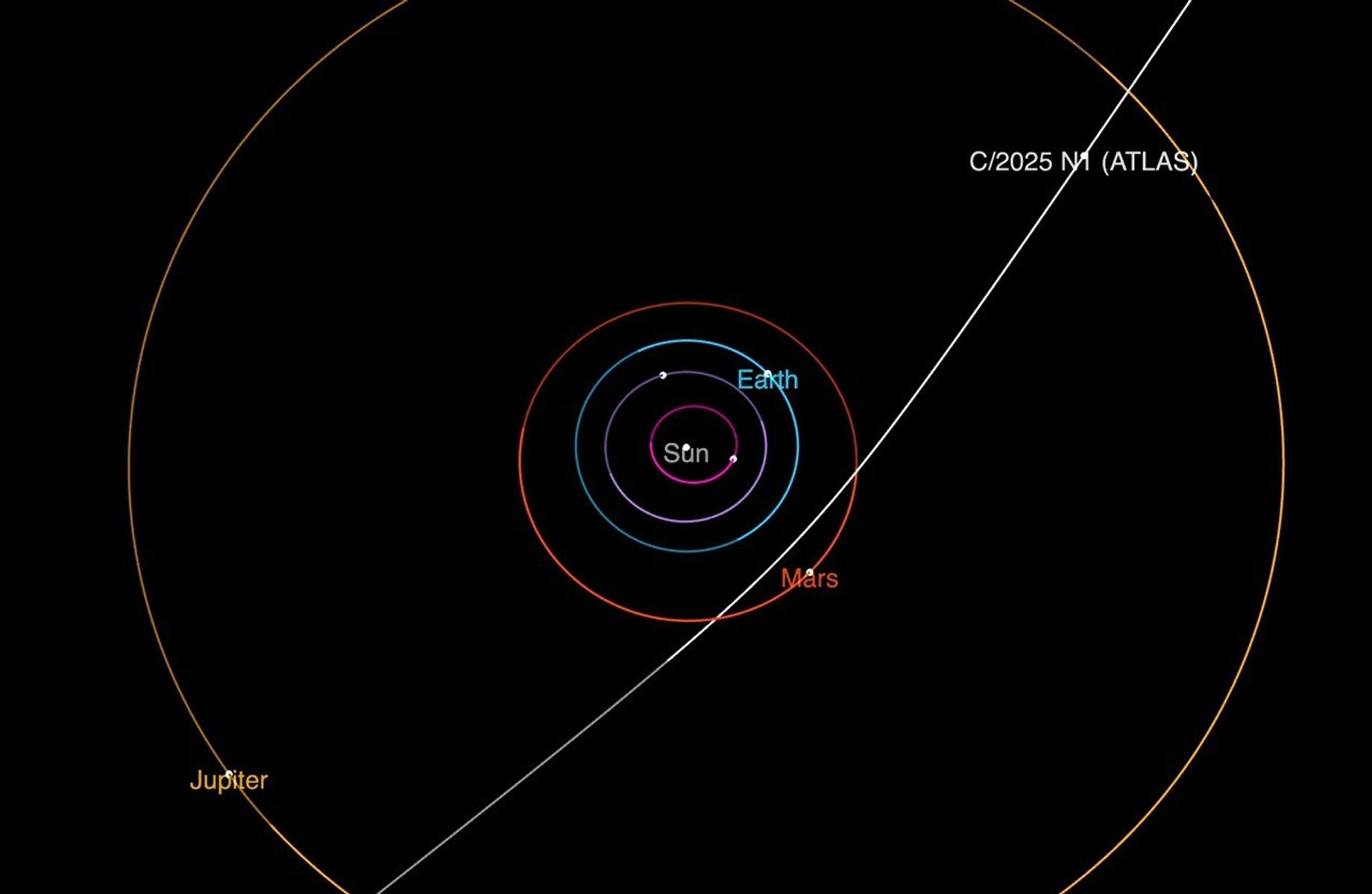
    The orbital path of I3/ATLAS through the Solar System.
    NASA/JPL-Caltech, CC BY-NC

    There are a few strong clues that suggest 3I/ATLAS came from outside the Solar System.

    First, it’s moving really fast. Current observations show it speeding through space at around 245,000km per hour. That’s more than enough to escape the Sun’s gravity.

    An object near Earth’s orbit would only need to be travelling at just over 150,000km/h to break free from the Solar System.

    Second, 3I/ATLAS has a wildly eccentric orbit around the Sun. Eccentricity measures how “stretched” an orbit is: 0 eccentricity is a perfect circle, and anything up to 1 is an increasingly strung-out ellipse. Above 1 is an orbit that is not bound to the Sun.

    3I/ATLAS has an estimated eccentricity of 6.3, by far the highest ever recorded for any object in the Solar System.

    Has anything like this happened before?

    An artist’s impression of the first confirmed interstellar object, 1I/‘Oumuamua.
    ESO/M. Kornmesser, CC BY

    The first interstellar object spotted in our Solar System was the cigar-shaped ‘Oumuamua, discovered in 2017 by the Pan-STARRS1 telescope in Hawaii. Scientists tracked it for 80 days before eventually confirming it came from interstellar space.

    The interstellar comet I2/Borisov, imaged by the Hubble Space Telescope.
    NASA, ESA, and D. Jewitt (UCLA), CC BY-NC

    The second interstellar visitor, comet 2I/Borisov, was discovered two years later by amateur astronomer Gennadiy Borisov. This time it only took astronomers a few weeks to confirm it came from outside the Solar System.

    This time, the interstellar origin of I3/ATLAS has been confirmed in a matter of days.

    How did it get here?

    We have only ever seen three interstellar visitors (including I3/ATLAS), so it’s hard to know exactly how they made their way here.

    However, recent research published in The Planetary Science Journal suggests these objects might be more common than we once thought. In particular, they may come from relatively nearby star systems such as Alpha Centauri (our nearest interstellar neighbour, a mere 4.4 light years away).

    Alpha Centauri A and Alpha Centauri B, from the triple star system Alpha Centauri.
    ESA/Hubble & NASA, CC BY

    Alpha Centauri is slowly moving closer to us, with its closest approach expected in about 28,000 years. If it flings out material in the same way our Solar System does, scientists estimate around a million objects from Alpha Centauri larger than 100 metres in diameter could already be in the outer reaches of our Solar System. That number could increase tenfold as Alpha Centauri gets closer.

    Most of this material would have been ejected at relatively low speeds, less than 2km/s, making it more likely to drift into our cosmic neighbourhood over time and not dramatically zoom in and out of the Solar System like I3/ATLAS appears to be doing. While the chance of one of these objects coming close to the Sun is extremely small, the study suggests a few tiny meteors from Alpha Centauri, likely no bigger than grains of sand, may already hit Earth’s atmosphere every year.

    Why is this interesting?

    Discovering new interstellar visitors like 3I/ATLAS is thrilling, not just because they’re rare, but because each one offers a unique glimpse into the wider galaxy. Every confirmed interstellar object expands our catalogue and helps scientists better understand the nature of these visitors, how they travel through space, and where they might have come from.

    A swarm of new asteroids discovered by the NSF–DOE Vera C. Rubin Observatory.

    Thanks to powerful new observatories such as the NSF–DOE Vera C. Rubin Observatory, our ability to detect these elusive objects is rapidly improving. In fact, during its first 10 hours of test imaging, Rubin revealed 2,104 previously unknown asteroids.

    This is an astonishing preview of what’s to come. With its wide field of view and constant sky coverage, Rubin is expected to revolutionise our search for interstellar objects, potentially turning rare discoveries into routine ones.

    What now?

    There’s still plenty left to uncover about 3I/ATLAS. Right now, it’s officially classified as a comet by the IAU Minor Planet Center.

    But some scientists argue it might actually be an asteroid, roughly 20km across, based on the lack of typical comet-like features such as a glowing coma or a tail. More observations will be needed to confirm its nature.

    Currently, 3I/ATLAS is inbound, just inside Jupiter’s orbit. It’s expected to reach its closest point to the Sun, slightly closer than the planet Mars, on October 29. After that, it will swing back out towards deep space, making its closest approach to Earth in December. (It will pose no threat to our planet.)

    Whether it’s a comet or an asteroid, 3I/ATLAS is a messenger from another star system. For now, these sightings are rare – though as next-generation observatories such as Rubin swing into operation, we may discover interstellar companions all around.

    Kirsten Banks does not work for, consult, own shares in or receive funding from any company or organisation that would benefit from this article, and has disclosed no relevant affiliations beyond their academic appointment.

    ref. Astronomers have spied an interstellar object zooming through the Solar System – https://theconversation.com/astronomers-have-spied-an-interstellar-object-zooming-through-the-solar-system-260422

    MIL OSI AnalysisEveningReport.nz

  • MIL-Evening Report: ER Report: A Roundup of Significant Articles on EveningReport.nz for July 4, 2025

    ER Report: Here is a summary of significant articles published on EveningReport.nz on July 4, 2025.

    Astronomers have spied an interstellar object zooming through the Solar System
    Source: The Conversation (Au and NZ) – By Kirsten Banks, Lecturer, School of Science, Computing and Engineering Technologies, Swinburne University of Technology K Ly / Deep Random Survey This week, astronomers spotted the third known interstellar visitor to our Solar System. First detected by the Asteroid Terrestrial-impact Last Alert System (ATLAS) on July 1, the

    Avoid bad breath, don’t pick partners when drunk: ancient dating tips to find modern love
    Source: The Conversation (Au and NZ) – By Konstantine Panegyres, Lecturer in Classics and Ancient History, The University of Western Australia Henryk Siemiradzki via Wikimedia Commons To love and be loved is something most people want in their lives. In the modern world, we often see stories about the difficulties of finding love and the

    Back to Back Theatre tackles an epic Shakespearian conflict – set in a factory, with cardboard props
    Source: The Conversation (Au and NZ) – By Kate Hunter, Senior Lecturer in Art and Performance, Deakin University Jeff Busby/Back To Back Theatre/ACMI Back to Back Theatre is one of Australia’s national treasures. Over 30 years this dynamic Geelong-based company – an ensemble of actors who are perceived to have intellectual disabilities – has built

    Australia’s new lung cancer screening program has chosen simplicity over equity, and we’re concerned
    Source: The Conversation (Au and NZ) – By Lisa J. Whop, Associate Director of Research and Senior Fellow, Yardhura Walani, National Centre for Aboriginal and Torres Strait Islander Wellbeing Research, Australian National University Thurtell/Getty Images Australia’s lung cancer screening program launched on July 1, and marks real progress and opportunity. It aims to reduce the

    Lost in space: MethaneSat failed just as NZ was to take over mission control – here’s what we need to know now
    Source: The Conversation (Au and NZ) – By Nicholas Rattenbury, Associate Professor in Physics, University of Auckland, Waipapa Taumata Rau Environmental Defense Fund, CC BY-SA This week’s announcement of the loss of a methane-detecting satellite, just days before New Zealand was meant to take over mission control, is a blow to the country’s space research

    Rare wooden tools from Stone Age China reveal plant-based lifestyle of ancient lakeside humans
    Source: The Conversation (Au and NZ) – By Bo Li, Professor, Environmental Futures Research Centre, School of Science, University of Wollongong Excavation at the Gantangqing site. Liu et al. Ancient wooden tools found at a site in Gantangqing in southwestern China are approximately 300,000 years old, new dating has shown. Discovered during excavations carried out

    I’ve seen the brain damage contact sports can cause – we all need to take concussion and CTE more seriously
    Source: The Conversation (Au and NZ) – By Alan Pearce, Professor, Adjunct Research Fellow, School of Health Science, Swinburne University of Technology AAP Image/The Conversation, CC BY Concussion in sport continues to make headlines, whether it be class actions, young men flocking to the highly violent “RunIt” activity or debate about whether Australian rules football

    NZ will soon have no real interisland rail-ferry link – why are we so bad at infrastructure planning?
    Source: The Conversation (Au and NZ) – By Timothy Welch, Senior Lecturer in Urban Planning, University of Auckland, Waipapa Taumata Rau Hagen Hopkins/Getty Images) Another week, another Cook Strait ferry breakdown. As the winter maintenance season approaches and the Aratere prepares for its final months of service, New Zealand faces a self-imposed crisis. The government

    Mauna Loa Observatory captured the reality of climate change. The US plans to shut it down
    Source: The Conversation (Au and NZ) – By Alex Sen Gupta, Associate Professor in Climate Science, UNSW Sydney Izabela23/Shutterstock The greenhouse effect was discovered more than 150 years ago and the first scientific paper linking carbon dioxide levels in the atmosphere with climate change was published in 1896. But it wasn’t until the 1950s that

    6 simple questions to tell if a ‘finfluencer’ is more flash than cash
    Source: The Conversation (Au and NZ) – By Dimitrios Salampasis, Associate Professor, Emerging Technologies and FinTech | FinTech Capability Lead, Swinburne University of Technology Oleg Golovnev/Shutterstock Images of flashy sports cars. Lavish lifestyle shots. These are just some of the red flags consumers should watch out for when they turn to social media for financial

    Grattan on Friday: how two once hot-button issues this week barely sparked media and political interest
    Source: The Conversation (Au and NZ) – By Michelle Grattan, Professorial Fellow, University of Canberra Political and news cycles often work in a certain and predictable way. Issues flare like bushfires, then rage for weeks or even months, until they are finally extinguished by action or fade by being overtaken by the next big thing.

    How many serious incidents are happening in Australian childcare centres? We don’t really know
    Source: The Conversation (Au and NZ) – By Erin Harper, Lecturer, School of Education and Social Work, University of Sydney Catherine Delahaye/ Getty Images This week, a Melbourne childcare worker was charged over alleged sexual abuse of young children in his care. Families are justifiably appalled and furious – with 1,200 children urged to be

    Too much vitamin B6 can be toxic. 3 symptoms to watch out for
    Source: The Conversation (Au and NZ) – By Nial Wheate, Professor, School of Natural Sciences, Macquarie University Selena3726/Shutterstock Side effects from taking too much vitamin B6 – including nerve damage – may be more widespread than we think, Australia’s medicines regulator says. In an ABC report earlier this week, a spokesperson for the Therapeutic Goods

    Too much vitamin B6 can be toxic. 3 symptoms to watch out for
    Source: The Conversation (Au and NZ) – By Nial Wheate, Professor, School of Natural Sciences, Macquarie University Selena3726/Shutterstock Side effects from taking too much vitamin B6 – including nerve damage – may be more widespread than we think, Australia’s medicines regulator says. In an ABC report earlier this week, a spokesperson for the Therapeutic Goods

    10 steps governments can take now to stamp out child sexual abuse in care settings
    Source: The Conversation (Au and NZ) – By Ben Mathews, Distinguished Professor, School of Law, Queensland University of Technology Recent cases of prolific alleged child sexual abuse in Melbourne and other Australian early childhood education and care settings have shocked even experienced people who work to prevent child sexual abuse. Parents are right to be

    Tears, trauma and unpaid work: why men in tinnies aren’t the only heroes during a flood disaster
    Source: The Conversation (Au and NZ) – By Rebecca McNaught, Research Fellow, Rural and Remote Health, University of Sydney Dan Peled/Getty Images When flooding strikes, our screens fill with scenes of devastated victims, and men performing heroic dinghy rescues in swollen rivers. But another story often goes untold: how women step in, and step up,

    The takeaway from the Venice Biennale saga: the art world faces deep and troubling structural inequality
    Source: The Conversation (Au and NZ) – By Grace McQuilten, Professor of Art and Associate Dean, Research and Innovation, School of Art, RMIT University Creative Australia’s decision earlier this year to rescind the selection of artist Khaled Sabsabi and curator Michael Dagostino as Australia’s 2026 representatives at the Venice Biennale sent shockwaves through the arts

    The Rainbow Warrior saga: 1. French state terrorism and NZ’s end of innocence
    COMMENTARY: By Eugene Doyle Immediately after killing Fernando Pereira and blowing up Greenpeace’s flagship the Rainbow Warrior in Auckland harbour, several of the French agents went on a ski holiday in New Zealand’s South Island to celebrate. Such was the contempt the French had for the Kiwis and the abilities of our police to pursue

    Does eating cheese before bed really give you nightmares? Here’s what the science says
    Source: The Conversation (Au and NZ) – By Charlotte Gupta, Senior Postdoctoral Research Fellow, Appleton Institute, HealthWise Research Group, CQUniversity Australia Phoenixns/Shutterstock, The Conversation, CC BY Have you heard people say eating cheese before bed will cause you to have vivid dreams or nightmares? It’s a relatively common idea. And this week, a new study

    Experiencing extreme weather and disasters is not enough to change views on climate action, study shows
    Source: The Conversation (Au and NZ) – By Omid Ghasemi, Research Associate in Behavioural Science at the Institute for Climate Risk & Response, UNSW Sydney STR / AFP via Getty Images Climate change has made extreme weather events such as bushfires and floods more frequent and more likely in recent years, and the trend is

    MIL OSI AnalysisEveningReport.nz

  • MIL-Evening Report: ER Report: A Roundup of Significant Articles on EveningReport.nz for July 4, 2025

    ER Report: Here is a summary of significant articles published on EveningReport.nz on July 4, 2025.

    Astronomers have spied an interstellar object zooming through the Solar System
    Source: The Conversation (Au and NZ) – By Kirsten Banks, Lecturer, School of Science, Computing and Engineering Technologies, Swinburne University of Technology K Ly / Deep Random Survey This week, astronomers spotted the third known interstellar visitor to our Solar System. First detected by the Asteroid Terrestrial-impact Last Alert System (ATLAS) on July 1, the

    Avoid bad breath, don’t pick partners when drunk: ancient dating tips to find modern love
    Source: The Conversation (Au and NZ) – By Konstantine Panegyres, Lecturer in Classics and Ancient History, The University of Western Australia Henryk Siemiradzki via Wikimedia Commons To love and be loved is something most people want in their lives. In the modern world, we often see stories about the difficulties of finding love and the

    Back to Back Theatre tackles an epic Shakespearian conflict – set in a factory, with cardboard props
    Source: The Conversation (Au and NZ) – By Kate Hunter, Senior Lecturer in Art and Performance, Deakin University Jeff Busby/Back To Back Theatre/ACMI Back to Back Theatre is one of Australia’s national treasures. Over 30 years this dynamic Geelong-based company – an ensemble of actors who are perceived to have intellectual disabilities – has built

    Australia’s new lung cancer screening program has chosen simplicity over equity, and we’re concerned
    Source: The Conversation (Au and NZ) – By Lisa J. Whop, Associate Director of Research and Senior Fellow, Yardhura Walani, National Centre for Aboriginal and Torres Strait Islander Wellbeing Research, Australian National University Thurtell/Getty Images Australia’s lung cancer screening program launched on July 1, and marks real progress and opportunity. It aims to reduce the

    Lost in space: MethaneSat failed just as NZ was to take over mission control – here’s what we need to know now
    Source: The Conversation (Au and NZ) – By Nicholas Rattenbury, Associate Professor in Physics, University of Auckland, Waipapa Taumata Rau Environmental Defense Fund, CC BY-SA This week’s announcement of the loss of a methane-detecting satellite, just days before New Zealand was meant to take over mission control, is a blow to the country’s space research

    Rare wooden tools from Stone Age China reveal plant-based lifestyle of ancient lakeside humans
    Source: The Conversation (Au and NZ) – By Bo Li, Professor, Environmental Futures Research Centre, School of Science, University of Wollongong Excavation at the Gantangqing site. Liu et al. Ancient wooden tools found at a site in Gantangqing in southwestern China are approximately 300,000 years old, new dating has shown. Discovered during excavations carried out

    I’ve seen the brain damage contact sports can cause – we all need to take concussion and CTE more seriously
    Source: The Conversation (Au and NZ) – By Alan Pearce, Professor, Adjunct Research Fellow, School of Health Science, Swinburne University of Technology AAP Image/The Conversation, CC BY Concussion in sport continues to make headlines, whether it be class actions, young men flocking to the highly violent “RunIt” activity or debate about whether Australian rules football

    NZ will soon have no real interisland rail-ferry link – why are we so bad at infrastructure planning?
    Source: The Conversation (Au and NZ) – By Timothy Welch, Senior Lecturer in Urban Planning, University of Auckland, Waipapa Taumata Rau Hagen Hopkins/Getty Images) Another week, another Cook Strait ferry breakdown. As the winter maintenance season approaches and the Aratere prepares for its final months of service, New Zealand faces a self-imposed crisis. The government

    Mauna Loa Observatory captured the reality of climate change. The US plans to shut it down
    Source: The Conversation (Au and NZ) – By Alex Sen Gupta, Associate Professor in Climate Science, UNSW Sydney Izabela23/Shutterstock The greenhouse effect was discovered more than 150 years ago and the first scientific paper linking carbon dioxide levels in the atmosphere with climate change was published in 1896. But it wasn’t until the 1950s that

    6 simple questions to tell if a ‘finfluencer’ is more flash than cash
    Source: The Conversation (Au and NZ) – By Dimitrios Salampasis, Associate Professor, Emerging Technologies and FinTech | FinTech Capability Lead, Swinburne University of Technology Oleg Golovnev/Shutterstock Images of flashy sports cars. Lavish lifestyle shots. These are just some of the red flags consumers should watch out for when they turn to social media for financial

    Grattan on Friday: how two once hot-button issues this week barely sparked media and political interest
    Source: The Conversation (Au and NZ) – By Michelle Grattan, Professorial Fellow, University of Canberra Political and news cycles often work in a certain and predictable way. Issues flare like bushfires, then rage for weeks or even months, until they are finally extinguished by action or fade by being overtaken by the next big thing.

    How many serious incidents are happening in Australian childcare centres? We don’t really know
    Source: The Conversation (Au and NZ) – By Erin Harper, Lecturer, School of Education and Social Work, University of Sydney Catherine Delahaye/ Getty Images This week, a Melbourne childcare worker was charged over alleged sexual abuse of young children in his care. Families are justifiably appalled and furious – with 1,200 children urged to be

    Too much vitamin B6 can be toxic. 3 symptoms to watch out for
    Source: The Conversation (Au and NZ) – By Nial Wheate, Professor, School of Natural Sciences, Macquarie University Selena3726/Shutterstock Side effects from taking too much vitamin B6 – including nerve damage – may be more widespread than we think, Australia’s medicines regulator says. In an ABC report earlier this week, a spokesperson for the Therapeutic Goods

    Too much vitamin B6 can be toxic. 3 symptoms to watch out for
    Source: The Conversation (Au and NZ) – By Nial Wheate, Professor, School of Natural Sciences, Macquarie University Selena3726/Shutterstock Side effects from taking too much vitamin B6 – including nerve damage – may be more widespread than we think, Australia’s medicines regulator says. In an ABC report earlier this week, a spokesperson for the Therapeutic Goods

    10 steps governments can take now to stamp out child sexual abuse in care settings
    Source: The Conversation (Au and NZ) – By Ben Mathews, Distinguished Professor, School of Law, Queensland University of Technology Recent cases of prolific alleged child sexual abuse in Melbourne and other Australian early childhood education and care settings have shocked even experienced people who work to prevent child sexual abuse. Parents are right to be

    Tears, trauma and unpaid work: why men in tinnies aren’t the only heroes during a flood disaster
    Source: The Conversation (Au and NZ) – By Rebecca McNaught, Research Fellow, Rural and Remote Health, University of Sydney Dan Peled/Getty Images When flooding strikes, our screens fill with scenes of devastated victims, and men performing heroic dinghy rescues in swollen rivers. But another story often goes untold: how women step in, and step up,

    The takeaway from the Venice Biennale saga: the art world faces deep and troubling structural inequality
    Source: The Conversation (Au and NZ) – By Grace McQuilten, Professor of Art and Associate Dean, Research and Innovation, School of Art, RMIT University Creative Australia’s decision earlier this year to rescind the selection of artist Khaled Sabsabi and curator Michael Dagostino as Australia’s 2026 representatives at the Venice Biennale sent shockwaves through the arts

    The Rainbow Warrior saga: 1. French state terrorism and NZ’s end of innocence
    COMMENTARY: By Eugene Doyle Immediately after killing Fernando Pereira and blowing up Greenpeace’s flagship the Rainbow Warrior in Auckland harbour, several of the French agents went on a ski holiday in New Zealand’s South Island to celebrate. Such was the contempt the French had for the Kiwis and the abilities of our police to pursue

    Does eating cheese before bed really give you nightmares? Here’s what the science says
    Source: The Conversation (Au and NZ) – By Charlotte Gupta, Senior Postdoctoral Research Fellow, Appleton Institute, HealthWise Research Group, CQUniversity Australia Phoenixns/Shutterstock, The Conversation, CC BY Have you heard people say eating cheese before bed will cause you to have vivid dreams or nightmares? It’s a relatively common idea. And this week, a new study

    Experiencing extreme weather and disasters is not enough to change views on climate action, study shows
    Source: The Conversation (Au and NZ) – By Omid Ghasemi, Research Associate in Behavioural Science at the Institute for Climate Risk & Response, UNSW Sydney STR / AFP via Getty Images Climate change has made extreme weather events such as bushfires and floods more frequent and more likely in recent years, and the trend is

    MIL OSI AnalysisEveningReport.nz

  • MIL-OSI: World Trading Tournament Reschedules Main Event to March 2026 and Announces Official Mini Tournament Series

    Source: GlobeNewswire (MIL-OSI)

    HOCKESSIN, Delaware, July 03, 2025 (GLOBE NEWSWIRE) — The World Trading Tournament (WTT) announces a strategic update regarding its operations and event calendar. In line with long-term planning and platform optimization, the WTT Main Event, initially scheduled for July 2025, will now take place in March 2026.

    This adjustment reflects the organization’s ongoing commitment to delivering a reliable and inclusive global trading experience. The decision was driven by several key developments:

    • Platform Expansion and Technology Enhancements:
      WTT is integrating advanced infrastructure to support real-time performance tracking, global participant access, and enhanced security. The goal is to ensure a seamless tournament experience for all users and traders.
    • Strategic Partnerships:
      Several institutional and fintech partners have expressed interest in deeper collaboration. Extending the timeline allows WTT to onboard these partners more effectively, ensuring alignment across key objectives.
    • Global Outreach:
      This strategic shift enables WTT to expand its global marketing and onboarding efforts, improve accessibility for traders in emerging markets, and provide additional time for participants to prepare and qualify.

    World Trading Tournament: Dates Updated

    Participants already registered for the original July 2025 event may retain their entry or request a full refund by contacting support@worldtradingtournament.com.

    In conjunction with this update, WTT is launching its official Co-Branded Mini Tournament Program. This initiative enables selected community leaders and trading influencers to host WTT-sponsored tournaments with a fully funded USD 350 prize pool. Each mini tournament will be coordinated with the WTT operations team and must meet specific participation criteria.

    Co-Brand Mini Tournament Prize Pool

    These Mini Tournaments will serve as a lead-up to the March 2026 Main Event, encouraging early participation and community involvement under WTT’s brand and oversight.

    WTT reaffirms its commitment to transparency, fairness, and innovation as it continues to build a structured, competitive global trading platform.

    Media Contact:
    World Trading Tournament Customer Support
    support@worldtradingtournament.com
    https://worldtradingtournament.com

    Photos accompanying this announcement are available at
    https://www.globenewswire.com/NewsRoom/AttachmentNg/95160a63-101d-4e3f-8824-03ea0f94d855

    https://www.globenewswire.com/NewsRoom/AttachmentNg/2557ef84-0877-4b0c-b647-5b761da73ff5

    The MIL Network

  • MIL-OSI: World Trading Tournament Reschedules Main Event to March 2026 and Announces Official Mini Tournament Series

    Source: GlobeNewswire (MIL-OSI)

    HOCKESSIN, Delaware, July 03, 2025 (GLOBE NEWSWIRE) — The World Trading Tournament (WTT) announces a strategic update regarding its operations and event calendar. In line with long-term planning and platform optimization, the WTT Main Event, initially scheduled for July 2025, will now take place in March 2026.

    This adjustment reflects the organization’s ongoing commitment to delivering a reliable and inclusive global trading experience. The decision was driven by several key developments:

    • Platform Expansion and Technology Enhancements:
      WTT is integrating advanced infrastructure to support real-time performance tracking, global participant access, and enhanced security. The goal is to ensure a seamless tournament experience for all users and traders.
    • Strategic Partnerships:
      Several institutional and fintech partners have expressed interest in deeper collaboration. Extending the timeline allows WTT to onboard these partners more effectively, ensuring alignment across key objectives.
    • Global Outreach:
      This strategic shift enables WTT to expand its global marketing and onboarding efforts, improve accessibility for traders in emerging markets, and provide additional time for participants to prepare and qualify.

    World Trading Tournament: Dates Updated

    Participants already registered for the original July 2025 event may retain their entry or request a full refund by contacting support@worldtradingtournament.com.

    In conjunction with this update, WTT is launching its official Co-Branded Mini Tournament Program. This initiative enables selected community leaders and trading influencers to host WTT-sponsored tournaments with a fully funded USD 350 prize pool. Each mini tournament will be coordinated with the WTT operations team and must meet specific participation criteria.

    Co-Brand Mini Tournament Prize Pool

    These Mini Tournaments will serve as a lead-up to the March 2026 Main Event, encouraging early participation and community involvement under WTT’s brand and oversight.

    WTT reaffirms its commitment to transparency, fairness, and innovation as it continues to build a structured, competitive global trading platform.

    Media Contact:
    World Trading Tournament Customer Support
    support@worldtradingtournament.com
    https://worldtradingtournament.com

    Photos accompanying this announcement are available at
    https://www.globenewswire.com/NewsRoom/AttachmentNg/95160a63-101d-4e3f-8824-03ea0f94d855

    https://www.globenewswire.com/NewsRoom/AttachmentNg/2557ef84-0877-4b0c-b647-5b761da73ff5

    The MIL Network

  • MIL-OSI Banking: Panasonic HD develops “SparseVLM” technology that doubles the processing speed of Vision-Language Model

    Source: Panasonic

    Headline: Panasonic HD develops “SparseVLM” technology that doubles the processing speed of Vision-Language Model

    Figure 1: Comparison of “SparseVLM” and existing sparsification methods (quoted from the accepted paper)

    Osaka, Japan, July 4, 2025 – Panasonic R&D Company of America (PRDCA) and Panasonic Holdings Co., Ltd. (Panasonic HD), in collaboration with researchers from Peking University, Fudan University, University of California, Berkeley, and Shanghai Jiao Tong University, have developed “SparseVLM,” a technology that speeds up Vision-Language Models (VLMs), AI models that can understand and process both visual data such as images and videos, and text data.In recent years, VLMs have seen rapid development. These models can process visual and textual information simultaneously and can answer questions about visual content. However, handling a large amount of data, especially high-resolution images and long videos, leads to longer inference times and higher computational complexity for the AI model. “SparseVLM” adopts a novel approach by focusing solely on the visual information relevant to the input prompt (Figure 1), significantly reducing inference time and computational complexity while maintaining high accuracy in answering questions about images.This research has been accepted for presentation at the 42nd International Conference on Machine Learning (ICML2025), one of the premier conferences for AI and machine learning research. The conference will take place in Vancouver, Canada from July 13 to July 19, 2025.

    MIL OSI Global Banks

  • MIL-OSI Banking: Panasonic HD develops “SparseVLM” technology that doubles the processing speed of Vision-Language Model

    Source: Panasonic

    Headline: Panasonic HD develops “SparseVLM” technology that doubles the processing speed of Vision-Language Model

    Figure 1: Comparison of “SparseVLM” and existing sparsification methods (quoted from the accepted paper)

    Osaka, Japan, July 4, 2025 – Panasonic R&D Company of America (PRDCA) and Panasonic Holdings Co., Ltd. (Panasonic HD), in collaboration with researchers from Peking University, Fudan University, University of California, Berkeley, and Shanghai Jiao Tong University, have developed “SparseVLM,” a technology that speeds up Vision-Language Models (VLMs), AI models that can understand and process both visual data such as images and videos, and text data.In recent years, VLMs have seen rapid development. These models can process visual and textual information simultaneously and can answer questions about visual content. However, handling a large amount of data, especially high-resolution images and long videos, leads to longer inference times and higher computational complexity for the AI model. “SparseVLM” adopts a novel approach by focusing solely on the visual information relevant to the input prompt (Figure 1), significantly reducing inference time and computational complexity while maintaining high accuracy in answering questions about images.This research has been accepted for presentation at the 42nd International Conference on Machine Learning (ICML2025), one of the premier conferences for AI and machine learning research. The conference will take place in Vancouver, Canada from July 13 to July 19, 2025.

    MIL OSI Global Banks

  • MIL-OSI China: China to host Digital Silk Road Development Forum in time-honored port city

    Source: People’s Republic of China – State Council News

    BEIJING, July 3 — This year’s World Internet Conference (WIC) Digital Silk Road Development Forum will be held on July 24 in the city of Quanzhou, east China’s Fujian Province, according to a WIC press conference on Thursday.

    The forum will feature discussions on a variety of topics, such as inclusive cooperation on digital trade under the Belt and Road Initiative, AI empowerment for high-quality development of the private economy, and digital-intelligent transformation and sustainable development of international logistics, according to the WIC.

    At the press conference, Ren Xianliang, secretary-general of the WIC, said the forum will also feature discussions on AI development and governance, studies on innovation in and development of the digital economy, and digital presentation of traditional Chinese culture, among others.

    Located on the narrow plains along the Fujian coastline, Quanzhou was one of the largest ports along the historic Maritime Silk Road, particularly during China’s Song Dynasty (960-1279) and Yuan Dynasty (1271-1368). In 2021, the city won UNESCO World Cultural Heritage status.

    MIL OSI China News

  • MIL-OSI China: Landmark effort launched at Beijing conference to democratize digital processes

    Source: People’s Republic of China – State Council News

    .

    As the digital economy reshapes societies, a critical question emerges: how can its benefits move beyond privileged tech hubs to empower cities everywhere?

    At the 2025 Global Digital Economy Conference in Beijing, more than 40 partner cities spanning Europe, North America, Asia-Pacific, the Middle East and Latin America answered by launching the Global Digital Economy Cities Alliance (DEC40) — a landmark effort to democratize digital processes.

    While 5G and artificial intelligence (AI) advance rapidly, infrastructure gaps and governance challenges exclude billions, especially in developing nations. DEC40 directly tackles it by institutionalizing multilateral cooperation on cross-border data rules, ethical AI and smart city solutions — frameworks essential for inclusive growth.

    This photo taken on July 2, 2025 shows a sign of the Global Digital Economy Conference 2025 in Beijing, capital of China. (Xinhua/Zhang Chenlin)

    CHINA’S ROLE AS CATALYST

    “Technologies from industry and academia need multilateral platforms to become true ‘digital public goods,’” stressed Zhao Houlin, former secretary-general of the International Telecommunication Union, at the conference running from Wednesday to Saturday.

    China’s practical models, showcased through DEC40, offer scalable blueprints: The digital governance platform of the city of Beijing streamlines administrations, serving 500,000 civil servants. Its Level-4 autonomous vehicles logged 170 million km, a replicable testbed for global urban mobility.

    “Urban development in the digital era requires not just technological breakthroughs, but also new ideas for governance and stronger international cooperation,” said Jiang Guangzhi, director of the Beijing Municipal Bureau of Economy and Information Technology. “We are ready to share our practice and provide a ‘Beijing Solution.’”

    “These innovations will be shared through the DEC40 platform to help other cities, especially in developing countries, adopt adaptable technology solutions,” Jiang added.

    Under DEC40, Beijing has a preliminary plan to implement three major initiatives. Over the next three years, the Chinese capital aims to provide digital infrastructure planning and consulting services to 100 cities in developing countries, train 100 city-level digital governance officers, and jointly build 10 demonstration projects in smart agriculture and digital healthcare.

    Beijing has already established connections with cities in countries such as Angola and Tajikistan, and the first training course for 50 officials is expected to be launched this year.

    Looking ahead, Rakhimova Durdona Shukurrullayevna, deputy mayor of Tashkent, Uzbekistan, believed that cooperation with Beijing will help ensure every resident shares in digital dividends.

    This photo taken on April 17, 2025 shows a China-developed WeRide Robobus (front) operating at an airport in Zurich, Switzerland. (Xinhua)

    PRIVATE SECTOR’S CROSS-BORDER IMPACT

    Beyond government-led efforts, Chinese private companies are also expanding their global footprint in the digital economy and taking their digital expertise to the world stage.  

    Chinese autonomous driving leaders like Pony.ai and WeRide now operate across more than eight countries, from Paris to Riyadh, contributing to local job creation in operations and tech support.

    “Our expansion attracts global suppliers to invest locally, building industrial clusters,” said Peng Jun, Pony.ai co-founder and chief executive officer.

    And benefits go beyond factories. According to Zhang Yuxue, WeRide’s director of PR and marketing, local partnerships have also led to job creation in areas such as fleet management and technical support.

    As Chinese autonomous driving firms gain global traction, collaboration with global players is deepening. Uber, for instance, has teamed up with WeRide and Pony.ai to integrate Chinese-developed autonomous driving technologies into its ride-hailing platform, starting with pilot operations in the Middle East.

    “It’s clear that the future of mobility will be increasingly shared, electric and autonomous,” said Uber CEO Dara Khosrowshahi. “We look forward to working with Chinese leading autonomous vehicle companies to help bring the benefits of autonomous technology to cities around the world.”

    Co-organized with the UN Development Program, the Global Digital Economy Conference signals that “digital inclusion is now a shared governance imperative.” As Beate Trankmann, resident representative of the United Nations Development Program in China, underscored, collective action turns tech potential into “tangible human benefits.”

    MIL OSI China News

  • MIL-OSI Australia: On Country and in demand: Tackling remote teacher shortages

    Source:

    04 July 2025

    Sports day on Country.

    When a dry creek bed is your classroom, science connects to the land, and sports day kicks off amid a cloud of red dust, you know you’re on Country out bush.

    For a group of UniSA student teachers, the opportunity to teach in remote South Australia offers more than cultural immersion – it’s a chance to connect with community, embrace new ways of learning, and potentially spark a career in Aboriginal education.

    This National NAIDOC Week, UniSA is highlighting its remote teaching placements in the Anangu Lands, spanning Anangu Pitjantjatjara Yankunytjatjara (APY) and Yalata Lands, aiming to inspire future teachers, while addressing workforce shortages in regional and remote Australia.

    The timing is significant, with the State’s Aboriginal Education Strategy, Impact Report showing that teaching support in the APY Lands has helped deliver the highest average preschool attendance in five years.

    Already, four of last year’s eight placement students have returned to continue teaching in the APY Lands while completing their degrees.

    With more than 30 years’ experience in Aboriginal education, UniSA’s Associate Director: Regional Engagement, Dr Sam Osborne, says encouraging students to explore remote teaching placements is vital to building the remote workforce.

    “When there’s a teacher shortage in Australia, we know there’s a desperate teacher shortage in rural and remote Australia,” Dr Osborne says.

    “These areas can seem daunting – they’re unfamiliar, far from family and friends, and may lack creature comforts – but they also offer incredibly rewarding experiences in close-knit and supportive communities.

    “Our placement program provides third-year education students with a unique opportunity to spend six weeks living and teaching in Anangu communities, alongside the world’s oldest continuing culture.

    “They live, learn and teach between the classroom, and on Country. Whether it’s working with Elders to link native plants with science, teaching kindy kids colours in Pitjantjatjara and Yankunytjatjara, or making maths fun by tallying bird species observed on Country.

    “Importantly, students are supported by the community as they learn their craft in a cultural and language context that few Australians ever encounter.”

    The Anangu schools’ partnership includes 10 schools spanning the far north and west of South Australia, including The APY Lands, Maralinga Tjarutja, and Yalata with around 200 local and non-local educators working in these schools.

    UniSA student teachers and team connecting at Yulara.

    Sophia, a third-year UniSA education student who recently returned from a six-week placement in Pipalyatjara Anangu School, says her stay was transformative.

    “One of the first things you notice is the scale of the Australian outback. From the desert plains to endless skies over the mountain ranges, you know you’re about to experience something completely different,” Sophia says.

    “Teaching at an Anangu school was so unique, and it very strongly connected to culture.

    “We often took learning outdoors – using hopscotch or other made-up games to teach language and numbers – which the kids loved because they’re such outdoor people.

    “There were also amazing opportunities to learn from people in the community. On family days, we’d sit with an Elder to hear stories of their history, their travels, or more practical things like how to mix bush medicines or make spears.

    “The local people are beautiful – gentle, kind and insightful, and they have a quiet confidence that really stayed with me.

    “This placement was unlike anything I’ve ever done. I felt welcomed in the community and I can’t wait to return – hopefully next year.”

    The program includes a three-day language and culture orientation run by Iwiri Aboriginal corporation, a mid-placement visit to the UniSA site at Ernabella, and a post-placement debrief at Uluru. Students are supported by experienced staff and take part in on-Country experiences and excursions.

    “This program provides high-quality support for preservice teachers who want to challenge themselves personally and professionally in a new context,” Dr Osborne says.

    “They are developing far more than classroom skills – they’re building cultural understanding, lasting connections, and for many, a sense of purpose that could shape their careers.”

    In partnership with the SA Department for Education, UniSA is also running a two-week field trip for students interested in teaching in remote areas.

    …………………………………………………………………………………………………………………………

    Contact for interview: Dr Sam Osborne E: Sam.Osborne@unisa.edu.au
    Media contact: Annabel Mansfield M: +61 479 182 489 E: Annabel.Mansfield@unisa.edu.au

    MIL OSI News

  • MIL-OSI USA: CWA Statement on Layoffs at Microsoft

    Source: Communications Workers of America

    (Washington, D.C.) – Yesterday, Microsoft announced that they intend to lay off about 9,000 employees across the company, including from its Microsoft Gaming division, and to stop production on several games. The layoffs are expected to impact Communications Workers of America-represented employees at the company.

    “We are deeply disappointed in Microsoft’s decision to lay off thousands more workers, including union-represented CWA members, at a time when the company is prospering,” said Communications Workers of America President Claude Cummings Jr. “We will be bargaining with the company over these layoffs, and CWA District Vice Presidents Mike Davis and Derrick Osobase will remain directly involved in ensuring that our members are supported and treated with dignity throughout this process.”

    Workers in the video game industry have been under constant threat of layoffs, with Electronic Arts, Sony Interactive Entertainment, Unity Technologies, and countless others scaling back their workforces in recent months. These layoffs are often announced without warning, leaving workers who create the products responsible for the companies’ successes scrambling to survive while executives and investors reap the benefits of record-breaking profits.

    “Right now, we are living through a moment of profound corporate consolidation and disruption,” Cummings said. “In times like these, union organizing is not just a tool for protections in the workplace; it is essential to workers’ survival, and one of the strongest defenses we have against unchecked corporate power. This news will not slow the movement for a video game industry that works for those who make it what it is today. Our strength is in our unity.”

    ###

    MIL OSI USA News

  • MIL-OSI: Demo Copy now available on desktop — Start copying Lead Traders in a simulated trading environment

    Source: GlobeNewswire (MIL-OSI)

    KINGSTOWN, St. Vincent and the Grenadines, July 03, 2025 (GLOBE NEWSWIRE) — WOO X, a leading global crypto trading platform, is thrilled to announce that Demo Copy, a cornerstone feature of our social trading product, is now live on desktop, expanding access beyond its initial launch on mobile.

    This exciting update makes it easier than ever for traders to experience zero-cost crypto paper trading on their preferred devices.

    Demo Copy is a zero-cost crypto paper trading tool designed to help users simulate copying trades from top lead traders using virtual funds in a fully simulated trading environment. Many traders hesitate to start copy trading due to fear of loss and uncertainty about strategy performance. By replicating real trading with virtual funds, Demo Copy allows users to learn, practice, and build confidence before committing real capital.

    Since its debut on the WOO X mobile app, Demo Copy has empowered countless users to explore copy trading safely and effectively. Now, with the desktop version available, even more traders can take advantage of this innovative tool.

    Key Features

    Follow Lead Traders’ moves in real time: Track and replicate the trades of seasoned lead traders as they happen, gaining insight into their strategies without risking your own capital.

    Interactive dashboard with performance metrics: Monitor key indicators such as Return on Investment (ROI) and Profit and Loss (PnL) on an intuitive dashboard, helping you evaluate the effectiveness of different trading strategies.

    Compare Lead Traders: Explore and analyze multiple lead traders’ performance and trading styles to select the ones that align with your risk tolerance and goals.

    CounterTrading feature: Take advantage of WOO X’s innovative CounterTrading tool, which allows you to strategically hedge by taking opposite positions against lead traders when market conditions call for it.

    Learn, practice, and optimize: Demo Copy is designed to help users build confidence and sharpen their trading skills by practicing in a simulated environment before committing real funds. This hands-on experience helps avoid common pitfalls and better prepares traders for live copy trading.

    How to start copying Lead Traders on WOO X

    1. If you aren’t registered yet, create your WOO X account by signing up here: https://woox.io/en/register
    2. Learn all about Social Trading and its benefits by visiting the dedicated overview page: https://woox.io/en/social-trading
    3. Visit the Social Trading page to browse a curated list of top-performing Lead Traders, each with detailed profiles showcasing key metrics like ROI, PnL, win rate, and drawdown: https://woox.io/en/social-trading/marketplace
    4. Explore our curated selection of Hyperliquid whales tracking the performance of well-known whale traders on the Hyperliquid protocol: https://woox.io/en/social-trading/strategy?lt_id=683a65dcd94c3031fef64b78&strategy_id=6840fcb86d451a15cd8b908d

    Ben Yorke, Vice President of Ecosystem at WOO X, said:

    “We’re excited to bring Demo Copy to desktop, making it even easier for traders to experience the power of social trading without risking real capital. Demo Copy is designed to break down barriers for new and experienced traders alike by providing a zero-cost, fully simulated environment where users can learn, practice, and build confidence by following top lead traders in real time. At WOO X, we believe that by democratizing access to advanced trading tools and education, we can foster a smarter, safer, and more inclusive crypto trading ecosystem. This launch is a significant step toward that mission, enabling more people to take their first confident steps into the world of copy trading.”

    Closing remarks
    Demo Copy lowers entry barriers and encourages wider crypto adoption by providing a safe simulated environment where users can practice and test trading strategies. This accessible approach helps traders build confidence and skills before moving to live trading, making crypto markets more inclusive and approachable.

    At WOO X, our mission is to make crypto trading smarter, safer, and more accessible for everyone. To welcome new users, don’t miss our Welcome Bonus offer when you complete KYC verification: https://woox.io/blog/welcome-bonus-kyc

    Ready to start?
    Download the WOO X App or log in now to try Demo Copy today and take your first step into Social Trading: https://woox.io/download

    Contact: media@woo.network

    About WOO X
    WOO X is a global centralized crypto futures and spot trading platform offering the best-in-class liquidity and price execution. WOO X has achieved a daily volume exceeding $1.6 billion and is home to hundreds of thousands of traders worldwide. WOO X traders benefit from radical transparency through our industry-first live Proof of Reserves & liabilities dashboard and the company’s mission to maintain the trust of its growing community of traders.

    Disclaimers

    The information provided in this article is for general informational purposes only and does not constitute financial, investment, legal advice or professional advice of any kind. While we have made every effort to ensure that the information contained herein is accurate and up-to-date, we make no guarantees as to its completeness or accuracy. The content is based on information available at the time of writing and may be subject to change.

    Cryptocurrencies involve significant risk and may not be suitable for all investors. The value of digital currencies can be extremely volatile, and you should carefully consider your investment objectives, level of experience, and risk appetite before participating in any staking or investment activities.

    We strongly recommend that you seek independent advice from a qualified professional before making any investment or financial decisions related to cryptocurrencies. We shall in NO case be liable for any loss or damage arising directly or indirectly from the use of or reliance on the information contained in this article.

    A photo accompanying this announcement is available at https://www.globenewswire.com/NewsRoom/AttachmentNg/ce311f0f-d596-4fba-b73e-9d13005d9a61

    The MIL Network

  • MIL-OSI USA News: Fact Sheet: President Donald J. Trump Makes Our National Parks Great Again

    Source: US Whitehouse

    PUTTING AMERICANS FIRST: Today, President Donald J. Trump signed an Executive Order investing in our national treasures by increasing fees for foreign tourists visiting our national parks to improve services, access, and affordability for Americans.

    • The Order directs the Secretary of the Interior to increase fees only for foreign visitors, while making national parks more affordable and enjoyable for American families.  
    • The Order increases national park access to American families by directing the National Park Service to ensure that U.S. residents receive priority access in any permitting or reservation systems.

    MAKING OUR NATIONAL PARKS BEAUTIFUL AGAIN: The increased fee revenue from foreign tourists will raise hundreds of millions for conservation projects that improve our national parks.

    • Charging higher entrance fees to foreign tourists is a common policy at national parks throughout the world that supports both conservation and affordable access for residents.
    • Increasing entry fees at national parks for foreign visitors will fuel investment in our national parks, reduce the maintenance backlog, construct critical infrastructure improvements, and support conservation projects that improve our majestic national parks.
    • Increasing fees for foreign visitors will also ensure fairness. American citizens fund national parks and public lands with their tax dollars, yet they are currently charged the same rate as foreign visitors who do not pay taxes, meaning that American citizens pay more to see their own national treasures than foreign visitors do. President Trump is ending this unfair situation and putting Americans first.
    • When President Trump signed into law the Great American Outdoors Act in 2020, the National Park Service’s maintenance backlog was $14.9 billion. Under the Biden Administration’s mismanagement, the maintenance backlog grew to over $22.9 billion. This Order will improve our national parks and reduce the maintenance backlog.

    HONORING OUR CONSERVATION LEGACY: Since the days of Republican President Teddy Roosevelt, America has led the world in conservation policy. This Order builds on America’s conservative, conservationist history and reinvests in our natural treasures while putting Americans first.

    • During President Trump’s first term, he signed the Great American Outdoors Act—the single largest investment in America’s national parks and public lands in history and the most significant conservation achievement since Teddy Roosevelt’s presidency.
    • This Order builds on President Trump’s legacy as a conservation President and fulfills his promise to put Americans first.

    MIL OSI USA News

  • MIL-OSI USA News: Fact Sheet: President Donald J. Trump Establishes Make America Beautiful Again Commission

    Source: US Whitehouse

    MAKING AMERICA BEAUTIFUL AGAIN: Today, President Donald J. Trump signed an Executive Order establishing the Make America Beautiful Again (MABA) Commission to conserve America’s lands and waters, cut red tape, and drive conservation and economic growth.

    • The MABA Commission will be chaired by Secretary of the Interior Doug Burgum and comprised of members of President Trump’s Administration.
    • Guided by our Nation’s rich history, the MABA Commission will work to expand access to recreation for outdoorsmen, hunters, anglers, hikers, bikers, climbers, skiers, runners, and all Americans seeking to spend time in nature.
    • The MABA Commission is tasked with expanding access to public lands and waters for recreation and incentivizing voluntary conservation efforts.
    • Using gold-standard science, the MABA Commission will promote active forest management and responsible stewardship of our public lands, while reducing bureaucratic delays that hinder effective environmental management and put our forests and rural communities at risk.

    EXPANDING ACCESS TO PUBLIC LANDS: President Trump wants to preserve America’s natural beauty and expand outdoor recreation for future generations.

    • As the Roosevelt Arch at Yellowstone National Park states, America’s public lands are “for the benefit and enjoyment of the people.” Therefore, the MABA Commission will work to expand access to America’s natural wonders for the enjoyment of the American people.
    • The outdoor recreation economy creates $1.2 trillion in economic output and supports 5 million jobs.
    • The Biden Administration unnecessarily restricted outdoorsmen’s access to public lands and deprived them of the ability to responsibly hunt and fish in certain areas.
    • Years of mismanagement have unnecessarily reduced public access to and enjoyment of outdoor recreational areas

    CONSERVING AMERICAN TREASURES: The MABA Commission will build on the legacy of conservative conservationists like President Teddy Roosevelt and protect our Nation’s natural treasures.

    • During President Trump’s first term in office, his Administration recovered more endangered or threatened species than any other administration in its first term.
    • President Trump signed the Great American Outdoors Act during his first term—the largest investment in America’s national parks and public lands in history and the most significant development in conservation policy since Teddy Roosevelt.
    • During President Trump’s first term, his Administration designated 1.3 million new acres of wilderness, added 1,645 miles of new trails to the National Recreational Trails System, and expanded hunting and fishing opportunities across more than 2.3 million acres of land.
    • President Trump has worked to protect American industries while maintaining standards that allow Americans to have among the cleanest air and water in the world.

    MIL OSI USA News

  • MIL-OSI China: China to accelerate high-quality development of photovoltaics sector

    Source: People’s Republic of China – State Council News

    BEIJING, July 3 — China’s Ministry of Industry and Information Technology (MIIT) on Thursday held a symposium for manufacturing enterprises, focusing on accelerating the high-quality development of the photovoltaics industry.

    The symposium called for efforts to deal comprehensively with the problem of disorderly price competition in the photovoltaics industry in accordance with laws and regulations, as well as efforts to guide enterprises to improve product quality, phase out backward production capacities in an orderly manner, and achieve healthy and sustainable development.

    An MIIT official said that in recent years, China’s photovoltaics industry has transformed from nothing into something, moving from weakness to strength and gaining leading advantages in industrial scale, technological level and application markets while becoming a bright calling card for Chinese manufacturing.

    The official said that industry enterprises should commit to technological innovation, uphold the bottom lines of quality and safety, strengthen international cooperation, and accelerate the creation of competitive advantages for China’s next-generation photovoltaic products.

    MIIT will enhance macro guidance and industry governance further, strengthen its standardization leadership and service support, and continuously help enterprises solve their most pressing and difficult problems, according to the official.

    MIL OSI China News

  • MIL-OSI: Find Mining Launches One-Stop AI Cloud Mining for Sustainable Digital Wealth

    Source: GlobeNewswire (MIL-OSI)

    London, UK,, July 03, 2025 (GLOBE NEWSWIRE) — As Bitcoin returns to the $100,000 mark and global demand for clean energy and remote computing services continues to grow, Find Mining, a long-established cloud mining platform founded in 2018, announced that it has officially launched a new one-stop multi-currency AI cloud mining solution and supporting mobile applications, committed to providing global users with a smarter, low-threshold, and sustainable way to increase the value of digital assets.

    Driven by a new round of bull market, the demand for green computing power is rising

    According to the latest market information from CoinDesk, the price of Bitcoin continued to fluctuate around $100,000 in early July, and there were clear signs of institutional funds and mainstream ETF funds returning. At the same time, many places in the United States and Europe have approved the establishment of a new round of renewable energy data centers and mines, pushing the concept of “green mining” to become the focus of market attention again.

    Find Mining seized the market window and launched a multi-currency cloud mining solution based on AI computing power scheduling, providing a one-stop smart mining channel for ordinary users around the world.

     Breaking down traditional barriers: one-click excavation, global coverage

    Since its establishment in 2018, Find Mining has provided cloud mining services in more than 190 countries and regions around the world, attracting more than 9 million registered users. The core highlight of the new version is the introduction of the AI ​​intelligent allocation system. Registered users can automatically start mining BTC, ETH, SOL, XRP, DOGE and other multi-currency combinations without having to configure mining machines or select mining pools by themselves.

    “We have been committed to using technology to lower the threshold so that more people can fairly share the dividends brought by decentralized finance. AI intelligent computing power scheduling and new mobile products mean that users only need to register and select contracts to start mining with one click and receive daily income.” The head of global markets at Find Mining said in a press release.

    Four core highlights: AI + green energy + multi-currency + global support

    AI intelligent scheduling: Based on the real-time on-chain difficulty, currency price and handling fee fluctuations, it automatically optimizes the computing power allocation and improves the unit cost-benefit ratio.

    Green energy power supply: More than 70% of Find Mining’s current computing power is supported by wind power, hydropower and solar power data centers, contributing to the global carbon emission reduction goals.

    Flexible collection of multiple currencies: Supports settlement of mainstream currencies such as BTC, ETH, USDT, XRP, SOL, and users can freely switch to withdraw asset portfolios.

    Visual income management: Embedded real-time income dashboard, contract income is settled daily, and you can withdraw or reinvest at any time when the balance reaches US$100.

    Sign up and get $15, flexible and low investment threshold

    Find Mining offers a $15 computing power reward for new users upon registration, and a $0.60 reward for daily login and sign-in, lowering the trial threshold.

    Currently, it supports flexible mining contracts from 1 day to 60 days, with a minimum investment of only $15. The income is credited daily and calculated in real time based on the market exchange rate. All fees are open and transparent, without any additional management fees or hidden exchange fees.

    Compliance and safety are the foundation

    Faced with increasingly stringent regulation of cloud mining services in Europe, America and around the world, Find Mining continues to increase its investment in technology and compliance security:

    The platform has access to McAfee® network security protection and Cloudflare® anti-DDoS technology, while using cold wallet asset isolation, dedicated servers, and 7×24 hours global multilingual customer service to provide multiple guarantees for user funds and data security.

    Industry analysts pointed out that green energy, AI computing power scheduling and a highly transparent profit structure are the core elements for Find Mining to continue to gain the trust of the global market.

    About Find Mining

    Find Mining is headquartered in London. Since its establishment in 2018, it has focused on providing sustainable, secure and transparent remote cloud computing services to individuals and institutional users around the world, reducing the technical threshold and energy consumption costs of mining cryptocurrencies such as Bitcoin. At present, Find Mining has built distributed green energy data centers in North America, Europe, Asia and other regions, supporting flexible combination mining of multiple currencies such as BTC, ETH, DOGE, XRP, SOL, etc., helping users achieve long-term and stable digital wealth growth in the trend of decentralized finance.

    Learn more

    Visit the official website www.findmining.com

    or download the Find Mining App to start your low-threshold, safe and sustainable crypto asset passive income journey.

    Official email: info@findmining.com

    Disclaimer: This announcement is for informational purposes only and does not constitute financial advice, investment solicitation, or a trading recommendation. Cryptocurrency mining and staking carry risk, including potential loss of capital. Always conduct due diligence and consult a licensed financial advisor before making investment decisions.

    The MIL Network

  • MIL-OSI: Find Mining Launches One-Stop AI Cloud Mining for Sustainable Digital Wealth

    Source: GlobeNewswire (MIL-OSI)

    London, UK,, July 03, 2025 (GLOBE NEWSWIRE) — As Bitcoin returns to the $100,000 mark and global demand for clean energy and remote computing services continues to grow, Find Mining, a long-established cloud mining platform founded in 2018, announced that it has officially launched a new one-stop multi-currency AI cloud mining solution and supporting mobile applications, committed to providing global users with a smarter, low-threshold, and sustainable way to increase the value of digital assets.

    Driven by a new round of bull market, the demand for green computing power is rising

    According to the latest market information from CoinDesk, the price of Bitcoin continued to fluctuate around $100,000 in early July, and there were clear signs of institutional funds and mainstream ETF funds returning. At the same time, many places in the United States and Europe have approved the establishment of a new round of renewable energy data centers and mines, pushing the concept of “green mining” to become the focus of market attention again.

    Find Mining seized the market window and launched a multi-currency cloud mining solution based on AI computing power scheduling, providing a one-stop smart mining channel for ordinary users around the world.

     Breaking down traditional barriers: one-click excavation, global coverage

    Since its establishment in 2018, Find Mining has provided cloud mining services in more than 190 countries and regions around the world, attracting more than 9 million registered users. The core highlight of the new version is the introduction of the AI ​​intelligent allocation system. Registered users can automatically start mining BTC, ETH, SOL, XRP, DOGE and other multi-currency combinations without having to configure mining machines or select mining pools by themselves.

    “We have been committed to using technology to lower the threshold so that more people can fairly share the dividends brought by decentralized finance. AI intelligent computing power scheduling and new mobile products mean that users only need to register and select contracts to start mining with one click and receive daily income.” The head of global markets at Find Mining said in a press release.

    Four core highlights: AI + green energy + multi-currency + global support

    AI intelligent scheduling: Based on the real-time on-chain difficulty, currency price and handling fee fluctuations, it automatically optimizes the computing power allocation and improves the unit cost-benefit ratio.

    Green energy power supply: More than 70% of Find Mining’s current computing power is supported by wind power, hydropower and solar power data centers, contributing to the global carbon emission reduction goals.

    Flexible collection of multiple currencies: Supports settlement of mainstream currencies such as BTC, ETH, USDT, XRP, SOL, and users can freely switch to withdraw asset portfolios.

    Visual income management: Embedded real-time income dashboard, contract income is settled daily, and you can withdraw or reinvest at any time when the balance reaches US$100.

    Sign up and get $15, flexible and low investment threshold

    Find Mining offers a $15 computing power reward for new users upon registration, and a $0.60 reward for daily login and sign-in, lowering the trial threshold.

    Currently, it supports flexible mining contracts from 1 day to 60 days, with a minimum investment of only $15. The income is credited daily and calculated in real time based on the market exchange rate. All fees are open and transparent, without any additional management fees or hidden exchange fees.

    Compliance and safety are the foundation

    Faced with increasingly stringent regulation of cloud mining services in Europe, America and around the world, Find Mining continues to increase its investment in technology and compliance security:

    The platform has access to McAfee® network security protection and Cloudflare® anti-DDoS technology, while using cold wallet asset isolation, dedicated servers, and 7×24 hours global multilingual customer service to provide multiple guarantees for user funds and data security.

    Industry analysts pointed out that green energy, AI computing power scheduling and a highly transparent profit structure are the core elements for Find Mining to continue to gain the trust of the global market.

    About Find Mining

    Find Mining is headquartered in London. Since its establishment in 2018, it has focused on providing sustainable, secure and transparent remote cloud computing services to individuals and institutional users around the world, reducing the technical threshold and energy consumption costs of mining cryptocurrencies such as Bitcoin. At present, Find Mining has built distributed green energy data centers in North America, Europe, Asia and other regions, supporting flexible combination mining of multiple currencies such as BTC, ETH, DOGE, XRP, SOL, etc., helping users achieve long-term and stable digital wealth growth in the trend of decentralized finance.

    Learn more

    Visit the official website www.findmining.com

    or download the Find Mining App to start your low-threshold, safe and sustainable crypto asset passive income journey.

    Official email: info@findmining.com

    Disclaimer: This announcement is for informational purposes only and does not constitute financial advice, investment solicitation, or a trading recommendation. Cryptocurrency mining and staking carry risk, including potential loss of capital. Always conduct due diligence and consult a licensed financial advisor before making investment decisions.

    The MIL Network

  • MIL-OSI Economics: Press Briefing Transcript: Julie Kozack, Director, Communications Department, July 3, 2025

    Source: International Monetary Fund

    July 3, 2025

    SPEAKER:  Ms. Julie Kozack, Director of the Communications Department, IMF

    MS. KOZACK: Good morning, everyone, and welcome to the IMF Press Briefing. It’s wonderful to see all of you, both those of you here in person and, of course, colleagues online as well. I’m Julie Kozack, Director of the Communications Department at the IMF.  As usual, this briefing is embargoed until 11 A.M. Eastern Time in the United States.  I’ll start as usual with a few announcements and then take your questions in person on WebEx and via the Press Center. 

    Starting with the announcements, the First Deputy Managing Director, Gita Gopinath, will participate in the G20 Finance Ministers and Central Bank Governors meetings in Durban, South Africa, on July 17th to 18th. 

    Second, in the coming weeks, we will be releasing two flagship publications, our External Sector Report and the World Economic Outlook Update.  These reports will offer fresh insights into current global economic trends and external imbalances.  Stay tuned.  We will share more details soon. 

    And with that, I will now open the floor for your questions.  For those of you who are connecting virtually, please turn on both your camera and microphone when speaking.  And now the floor is open. 

    QUESTIONER: Thank you so much.  I have two questions on Ukraine.  In its Eighth Review, the IMF highlighted that Ukraine needs to adopt a supplementary budget for 2025 and enact critical reforms to restore fiscal sustainability and implement the National Revenue Strategy.  Could you please elaborate on this?  What specific reforms should Ukraine implement and when?  And secondly, could you also please inform us when the next review of Ukraine is scheduled?  Thank you.  

    QUESTIONER:  Thank you, Julie.  How concerned is IMF about the Ukraine’s debt sustainability?  Taking into account recent highlights in the IMF’s release.  Thank you. 

    MS. KOZACK: Any other questions on Ukraine? And no one online on Ukraine?  Okay, let me go ahead and answer these questions on Ukraine. 

    So, first, just stepping back to remind everyone where we are on Ukraine. On June 30th, so just a few days ago, the IMF’s Executive Board completed the Eighth Review of the EFF arrangement with Ukraine that enabled a disbursement of U.S. $0.5 billion, and it brought total disbursements under the program to $10.6 billion.  In that review, we found that Ukraine’s economy remains resilient.  The authorities met all end-March quantitative performance criteria, a prior action, and two structural benchmarks that were needed to complete the review. 

    Now, with respect to the specific questions. On the supplementary budget, what I can say there is that  from our discussions over time and from the program documents, restoring fiscal sustainability in Ukraine does require a sustained and decisive effort to implement the National Revenue Strategy.  And that strategy includes modernization of the tax and customs system, including timely appointment of a customs head.  It includes the reduction in tax evasion and harmonization of certain legislation with EU standards.  And the idea behind this package of reforms is that these reforms, combined with improvements in public investment management frameworks and medium-term budget preparation, as well as fiscal risk management, altogether, these are going to be critical to helping Ukraine underpin growth and investment over the medium term. 

    With respect to the Ninth Review, right now we expect the Ninth Review to take place toward the end of the year.  It will combine basically the Ninth and the Tenth Reviews together under this new schedule.  And of course, we do remain closely engaged with the Ukrainian authorities.

    And then on the question on debt, what I can say there is that Ukraine has been able to preserve macroeconomic stability despite very difficult circumstances and conditions under the Fund’s program.  Given the risks to the outlook and the overall challenges that Ukraine continues to face, it is essential that reform momentum is sustained.  And we talked about the measures for domestic revenue mobilization, which are critical, as well as  how important they are for restoring debt sustainability over the medium term. 

    It is also important for Ukraine to complete the remaining elements of the debt restructuring in line with program objectives.  And that will be essential for the full restoration of debt sustainability under the program. 

    QUESTIONER: Two questions.  Had the IMF confirmed any involvement by President Alassane Ouattara of Cote d’ Ivoire in supporting Senegalese ongoing negotiations with the Fund, particularly considering the recent data misreporting issues? This is the first question. 

    The second one, what are the IMF’s views on Senegal’s debt sustainability after the recent leak of the 119 percent national debt, as opposed to 99.7 which was indicated in the recent audit of the nation’s finances?  Do you trust the last numbers on debt, 119 percent of GDP, communicated by the Ministry of Finance?  Are they reliable?  Thank you very much. 

    QUESTIONER: Are there any other questions on Senegal?  Okay, so let me step back and remind where we are on Senegal. 

    So our team remains closely engaged with the Senegalese authorities.  As you know, a Staff Mission visited Dakar in March and April, just a few months ago, to advance resolution of the misreporting case, which was confirmed by the Court of Auditors and which, as you know, revealed underreporting of fiscal deficits and public debt over a number of years.  And we’re working closely with the authorities on the design of corrective measures and actions to address the root causes of the misreporting that took place.  And we’re also working closely with the authorities to strengthen capacity development. 

    What I can say with respect to the question on the debt numbers is we strongly welcome the new government’s commitment to transparency in revealing the discrepancies in the reported debt and the fiscal deficits.  The authorities are conducting their own audit and that audit is ongoing. We understand that the audit is close to being finalized.  And we’re waiting for its completion to better understand the challenges and how we can move forward.  And so ultimately, as we wait for that report, we are going to refrain from commenting on any numbers.  We’re waiting for the report, and we will remain very closely engaged. 

    And on your other question on President Ouattara, I don’t have any information for you at this time, but of course, we’ll keep you updated if we have anything to report on that. 

    QUESTIONER: Question about Russia.  So, the Bank of Russia has recently indicated that it can cut key interest rates for another one percentage point if the inflationary pressure remains to ease in Russia.  So, from the IMF standpoint, how – well-timed and appropriate will this step be, taking into account your view on the current economic situation in Russia?  Thanks. 

    MS. KOZACK: Any other questions on Russia? Okay, so let me start a little bit with our assessment of the economy, and then I’ll speak to your question on monetary policy. 

    So, in terms of how we see the Russian economy following last year’s overheating, what we see is that the Russian economy is now slowing sharply.  Inflation is easing, but is still high.  And Russia, like many countries, is affected by high risks and uncertainty.  In our April WEO, we projected growth to slow to 1.5 percent in 2025.  Recent developments since April suggest that growth may even be lower.  And we will, like for many countries, we will be updating our forecast for Russia in the July WEO update, which will come in a few weeks. 

    With respect to monetary policy, as I said, inflation remains high.  Annual inflation is above the Central Bank of Russia’s target.  But based on our April forecast, we do expect inflation to come down and to decline over time.  In April, we had expected inflation to return to target in the second half of 2027.  And so, we see that for the Central Bank policymaking is going to need to balance the fact that inflation is still high, and that unemployment is still very low in Russia, with the fact that the economy is rapidly slowing and that risks are rising.  So that will be the challenge for the Central Bank that we see in its making of monetary policy in the near future. 

    QUESTIONER: Julie, can I just follow up on that Russia question? So you said that because of the current conditions, can you just explain why your forecast is going to be revised downward for Russia’s growth? 

    MS. KOZACK: So, I want to be clear, we will provide the revised forecast in July as part of the WEO. What the team has been seeing is that some recent data suggests that growth may be lower than we had forecast.  But I don’t want to preempt their actual forecast.  What we see is that the slowdown that we see in Russia reflects a few things.  First, tight policies.  The other factors are cyclical factors.  So, coming off of a period of overheating, you often see a cyclical slowdown.  And that’s what we’re seeing in Russia.  And also, the fact that oil prices are lower, which is also affecting Russia as well.  And we also do see some impact on the economy from tightening sanctions. 

    QUESTIONER: A couple of questions on the U.S. Congress, as you know, is about to pass the, what they call the One Big Beautiful Bill, the sweeping budget tax spending policy bill, which is going to, by all accounts, increase the U.S. deficit by $3.4 trillion over 10 years.  It contains major cuts to social programs such as Medicaid, which is going to be very hard on the poorest Americans.  Just wondering if you can provide any perspective from the IMF on this bill.  It kind of goes against everything that the IMF recommends that the U.S. do on the fiscal front, which is to bring deficits under control and tocreate more equality in the economy.  So just wondering if you can shed some light on sort of how the IMF is going to view this, including your perspective on what it might do for financial markets with extra U.S. debt, perhaps increasing U.S. interest rates in real terms and forcing other countries to pay higher interest rates.  Thanks. 

    MS. KOZACK: Are there any other questions on the U.S.? You have another question?

    QUESTIONER: It’s a trade question. 

    MS. KOZACK: Okay, well, if it’s on the U.S., go for it.

    QUESTIONER: So next week is the July 9th deadline for the U.S. to potentially raise tariff rates on many, many countries.  As you know, the president had lowered those tariff rates temporarily. It’s likely that a lot of countries are going to see much higher interest rates.  And I’m just wondering if you can comment on that and how it will affect whether that’s being factored into your WEO update, and the impact that  will have on the global economy.  Thanks.

    QUESTIONER: Julie, a follow-up?

    MS. KOZACK: Yes, please go ahead.

    QUESTIONER: Just a follow-up to that question with regard to the U.S. and trade.  Now, one of South Asia’s biggest trading partners is the U.S.  Now, President Trump has already signaled deals with countries like Vietnam and India.  But, for small economies like Sri Lanka, Maldives, Bangladesh, there is still uncertainty around it.  So, given the uncertainty around it, will the Fund be looking at changes in certain targets with these countries that are already in programs, or will there be any revisit to the financing already given to these countries?  Thank you. 

    MS. KOZACK: All right, so let me start by saying, I think, to your first question, so at this stage, and as you noted, it’s fair to say there’s a consensus that the recent bill that was approved in the Senate and is now under discussion in the House would add to the fiscal deficit and it appears to run counter to reducing federal debt over the medium term. From the IMF side, we have been consistent in saying that the U.S. will need to reduce its fiscal deficit over time to put public debt-to-GDP on a decisive downward path.  And since a fiscal consolidation will ultimately be needed to achieve or to put debt on a downward path, of course, the sooner that process starts to reduce the deficit, the more gradual the deficit reduction can be over time. 

    And of course, there are many different policy options that the U.S. has to reduce its deficit and debt.  And it is, of course, important to build consensus within the United States about how it will address these chronic fiscal deficits.  We’re currently examining the details of the legislation and the likely impact on the U.S. economy.  We will be providing a broader update of our views in terms of the outlook for the U.S. and also, of course, for the global economy in the July WEO update, which, as I noted, will be coming in the next few weeks.  And of course, we will take into account in the update all updated developments, including potential new policies or legislation. 

    And that goes a little bit to your other question on July 9th and the tariff deadline, to the extent possible and feasible, we will take into account as many of the trade deals or announcements that are made, and we will take those into account in our July WEO update.  And we’re paying, of course, close attention to the situation globally. 

    As we’ve been saying, this is a moment for the global economy marked by high uncertainty.  And so that uncertainty is something that is still with us.  And we’re also taking the fact that we’re at a moment of high uncertainty into account in thinking about our forecasts for the global economy. 

    QUESTIONER: When will the Board will address the first revision of the agreement with Argentina?  It’s a simple question. 

    MS. KOZACK: Okay. Other questions on Argentina?

    QUESTIONER: Is there a concern in the IMF that the external deficit exceed $5 billion in the first quarter of this year?  

    QUESTIONER: Thank you, Julie.  Wanted to ask what the IMF is expecting in terms of Argentina’s ability to meet its reserves target, or whether the IMF will be considering a waiver to ask about the timing for the next $2 billion disbursement.  And finally, how the YPF court order this week influences the outlook for Argentina and the need to build foreign reserves.  

    QUESTIONER: Hi, Julie.  Good morning.   I would like to address the question of my colleague.  Do you think the court ruling of YPF will have significant implications for both, I mean, the company and Argentina’s economic stability?  

    QUESTIONER: Also, on the YPF issue, if that challenges in any way Argentina’s goal to return to international financial markets by the end of the year.  And if you could comment on the mission that was in Buenos Aires’ findings last week.  

    QUESTIONER: A recent JP Morgan report recommended that selling LECAP bonds due to their increased risk because of the lack of reserve accumulation. Also, Argentina failed to rise to MSCI Emerging Market status. Is this a cause for concern for the IMF? Could it obstruct Argentina’s return to international markets in 2026 as the Staff Report indicates? Thank you.

    MS. KOZACK: All right, anyone else on Argentina? Okay, so maybe just stepping back for a moment.  As you know, a recent IMF Staff Technical Mission visited Buenos Aires recently.  The mission concluded on June 27th.  And this mission was part of the First Review under the program under the new $20 billion EFF program.  Discussions for the First Review continue, and they remain very productive. 

    What I can also add is that the program, as we’ve said before, it continues to deliver positive results.  The transition to a more robust FX regime has been smooth.  The disinflation process has resumed.  The economy continues to expand.  High-frequency indicators suggest that poverty is on a downward trend in Argentina.  Argentina has also reaccessed international capital markets for the first time in seven years.  And all of this progress, of course, under the program, is being underpinned by appropriately tight fiscal and monetary policies.

    Discussions now are focused on policies to sustain the stabilization gains, including by continuing to rebuild buffers to address risks from a more complex external backdrop.  Both the IMF Staff and the Argentine authorities are closely engaged on these issues, and it reflects the ongoing collaboration that we have with the authorities as well as a shared commitment to the success of the program. 

    On some of the more specific questions with respect to targets under the program and the potential for waivers, at this stage, given that the discussions are ongoing, I’m not going to speculate on the potential for waivers or the outcome of those discussions.  But we will, of course, keep you updated in due course.

    On the broader question of reserve accumulation, what I can add is that, as I mentioned, Staff and the authorities do have a shared commitment to the success of the program, which I noted.  But I can add that this, of course, includes a shared recognition of the need to continue to build buffers against external risks.  We’re closely engaged with the authorities on the issue. 

    On the question of YPF, we’re obviously paying close attention, monitoring this situation.  However, as a matter of policy, we don’t comment on legal matters involving our member countries, and that includes this IMF case. 

    I need to apologize because a question was asked in the last round which I did not answer.  So, I’m going to repeat the question, and then I’m going to answer it.  The question is the U.S. is one of South Asia’s biggest trading partners and countries are racing to strike deals.  President Trump already signaled a deal with India.  Given this uncertainty around it, will the Fund be looking to change targets or revisit financing?  So here I think, they were asking really about program countries, and they mentioned Sri Lanka, Bangladesh, and one other country. 

    So, what I can say on this one is that in all program countries, in all program contexts, the reason why we have reviews during the program is there’s a backward-looking part to the review, which is to assess whether the country has complied with the targets and the commitments that they have made.  But the other part is what we call a forward-looking part.  And that part really looks at what has happened to the economy, globally, what are the trends, and how should those be taken into account going forward.  So to the extent that uncertainty or changes in trading relations or in the trading environment has an effect on the economy, which is significant enough to affect the program, of course, those will be taken into account.  But it will be done on a case-by-case basis, tailored to the specific circumstances of every program country that we have. 

    Let’s continue then.   

    QUESTIONER: Do you know when the Board will meet? 

    MS. KOZACK: Ah, I apologize. So, with respect to the First Review, just in terms of the process, first, the discussions between the team and the authorities will need to come to a conclusion, and a Staff-Level Agreement would need to be reached.  And once that happens, we will submit the documentation to our Board for review.  So, I don’t yet have a timing for the Board meeting, but we will, of course, keep you informed as the discussions continue.

    MS. KOZACK: I’m not going to speculate at all. I want to give time, of course, for the authorities and the team to complete the discussions, and we will abide by our process, the first step of which is a Staff-Level Agreement, and then we will submit the documents for consideration by the Executive Board. 

    QUESTIONER: Can I have a short follow-up? Do you expect Minister Caputo in the upcoming days in Washington D.C.?

    MS. KOZACK: So, what I can say is that the discussions are continuing. There is a technical team here in Washington to have those discussions. But it’s a technical team. 

    MS. KOZACK: All right, let me go online.

    QUESTIONER: I have a couple of questions on Egypt specifically. The first is we all in Egypt were expecting the Fifth Review to be completed before the end of fiscal year, which ends by end of June.  So, could you please update us on the ongoing negotiations regarding the Fifth Review?  My second one is on the RSF financing.  We want to also know an update on that. 

    MS. KOZACK: Are there other questions on Egypt.

    QUESTIONER:  I have another question on Egypt.  So, what are the current points of contention that delayed this disbursement of the fifth tranche?  And do you think there is any room to extend the loan repayment due to the current challenges, especially that there were more effects that have affected Egypt recently, because of the war that happened during June?  And I have another question on Syria.  I don’t know if I could put it in now.  Maybe you can answer that later on.  How will lifting the sanctions change or expedite any program with the IMF regarding Syria? 

    MS. KOZACK: Okay, so let’s first see if there’s other questions on Egypt and I’ll answer on Egypt and then I’ll turn to Syria.

    QUESTIONER: I just want to add to what my colleagues said before whether you’re able to confirm or say any more about reports recently that the Fifth and Sixth Reviews will be combined into one review that would then take place in September. 

    MS. KOZACK: Anyone else on Egypt?   

    So, on Egypt, an IMF team, as you know, visited Cairo in May, from May 6th to 18th, for discussions with the Egyptian authorities.  The discussions were productive.  Egypt continues to make progress under its macroeconomic reform program.  And we can say that there’s been notable improvements in inflation and in the level of foreign exchange reserves, which have increased.

    To move further and to really safeguard macroeconomic stability in Egypt and to bolster the country’s resilience to shocks, it is essential to deepen reforms, and this is particularly important to reduce the state footprint in the economy, level the playing field, and improve the business environment.  Some of the key policies that are under discussion and key priorities are advancing the state ownership policy and asset [divestment diversification] program in sectors where the state has committed to withdraw.  These steps are critical to really enabling the private sector to drive stronger and more sustainable growth in Egypt.  And our commitment, of course, is strong to Egypt.  We’re committed to supporting Egypt in building this resilience and in fostering growth. 

    With respect to the reviews, the discussions suggest that more time is needed to finalize the key policy measures, particularly related to the state’s role in the economy and to ensure that the critical objectives of the program, the authority’s economic reform program, can be met.  Our Staff team is continuing to work with the authorities on this goal.  And for that reason, the Fifth and Sixth Reviews under the EFF will be combined.  And the idea is for them to be combined into a discussion or a combined review for the fall.  So that’s the rationale for combining the reviews.  More time [is] needed. 

    And I think there was also a question on Egypt’s RSF and what I can say on thisis that as the RSF was approved recently for Egypt and as per the schedule approved by the board, the First Review of the RSF is aligned with the Sixth Review under the EFF. 

    QUESTIONER: Julie, would you allow me to follow up on something they’ve just said? 

    So, you said that the Fifth and the Sixth Review will be combined for the fall.  Does this mean that the Fifth and the Sixth disbursements will be together?  Could this be possible? Is this on the table? 

    MS. KOZACK: So, given that the discussions are still underway, a part of the discussions that will, of course, take place around combining the reviews will be to look at what are Egypt’s financing needs and around that, what should be the size of the disbursement around the combined Fifth and Sixth Review. So that’s all part of the discussions, the ongoing discussions that are taking place.  So, it would be premature for me to speculate at this stage. 

    Okay, you had a question on Syria.  So, let me see if anyone else has a question on Syria.  I don’t see anyone else on Syria. 

    So, turning to Syria. So, as I think you know, an IMF team visited Syria from June 1st to 5th.  And this was the first visit of an IMF team to Syria since 2009.  The team was in Syria to assess the economic and financial conditions in Syria and discuss with the authorities their economic policy and capacity-building priorities.  And all of this, of course, is to support the recovery of the Syrian economy. 

    As we’ve discussed here before, Syria faces enormous challenges following years of conflict that have caused, you know, immense human suffering.  And the conflict has reduced the economy to a fraction of its former size.  The lifting of sanctions can help facilitate Syria’s rehabilitation by supporting its reintegration into the global economy.  And as part of our ongoing engagement with the Syrian authorities, we will, as needed, of course, you know, assess the implications of the lifting of sanctions on the Syrian economy. 

    So, again, that’s going to be part of the work of the team as they are putting together a picture of the Syrian economy, but also of the very important and deep capacity development needs that the Syrian authorities will have. 

    QUESTIONER: I just wanted to follow up on a colleague’s follow-up.  The comments that you made a few minutes ago regarding Argentina having a technical team in Washington for discussions with the IMF.  I just wanted to confirm my understanding.  Were you saying that they have a — that there is currently a technical team in Washington, and can you tell us anything more about the dates of the meetings or anything beyond that technical team being currently in Washington, if I understood you correctly? 

    MS. KOZACK: So, I think all I can add to that is that I can confirm that there is a technical delegation in Washington, you know, from Argentina in Washington, visiting headquarters this week. And the goal is to advance discussions on the First Review under the program.  I hope that clarifies. 

    QUESTIONER: Yes, I wanted to ask you on Mozambique — sorry, just pulling up my note here — which was that –excuse me.  Regarding Mozambique, is it feasible to agree to a new program with Mozambique by year-end, as the president of that country is hoping, or do you have anything on any of the hurdles and the process there?  Thank you. 

    MS. KOZACK: I’m sort of looking. I don’t have anything off-hand in terms of an update on Mozambique. So, we’ll come back to you separately on Mozambique.  I’m sorry about that. 

    All right, let’s go online.  You had a question?

    QUESTIONER: I have a quick follow-up on Ukraine and then another one.  On Ukraine, when you are talking about combining the Ninth and Tenth Reviews, what would that mean also in terms of the disbursement?  But you know, in the case of Egypt, you’re giving the authorities more time to execute reviews.  What is the reason for combining them in the case of Ukraine? 

    And then, how many more reviews, I just don’t remember, how many more reviews were planned to get to the $15.5 billion?  So, we’ve got $10.6 billion dispersed already.  Like, how much is left to go, and how much of that notionally would come in the Ninth and Tenth Reviews?

    And then separately, I just want to come back to the trade question and perhaps broaden it out a little bit.  So, as the United States under the administration of Donald Trump is imposing quite significant tariffs on many, if not all, of its trading partners, that raises costs, obvious for everyone.  At the same time, the government has also been reducing, significantly slashing its foreign aid for development systems.  And you know, obviously, there’s a lot of concern about that.  We’ve seen some reports recently from the Lancet that millions of people could die as a result of this money not being in — in those countries.  That has follow-on consequences for all the countries whose, you know, economies you’re guiding and accompanying.  And I just want to know if you — if you’ve done a sort of broader analysis about this trade environment.  For many years, you have been warning about trade restrictions, and we are now fully into a period where trade restrictions seem to be increasing.  So, just asking a broad question.

    And then finally, we do have the G20 meeting coming up. The United States has not participated in the initial G20 meetings this year.  What would it mean to the organization if the United States also chose to skip this July meeting?  What is the importance of that as in that body?

    QUESTIONER: So, on Ukraine, what I can say is the Ninth Review, as I said, we expect it to take place by the end of the year and it is going to combine the previously envisaged Ninth Review, which was scheduled for the fall, and the Tenth Review, which we expected to take place in the fourth quarter.  And the team is going to remain closely engaged with Ukraine over this period.  I don’t have more details on the reason that the reviews are being combined, but I believe the Staff Report has been published for Ukraine.  And so, I would refer you to that document, which should have the relevant details.

    On your broader question about the trade environment and the aid environment.  I think if you think about it, or if we look back at it, you know, what has the IMF been saying?  If we look back to the Spring Meetings, one of the main messages from the Managing Director’s Curtain Raiser and her global policy agenda, as well as our broader messages, was that it is very important for countries to, we were saying, kind of, or the Managing Director was saying to get their own house in order.  So, there’s — and the message really behind that was that yes, the trade environment is shifting, and we see very significant shifts in the trade environment. 

    But there is a lot that countries can and need to do domestically related to their own reforms to build their own resilience.  There’s a lot that countries can do in terms of policy, and that really relates in many countries to fiscal policy, which is about, because we’ve been talking about a low-growth, high-debt environment for some time.  High uncertainty and weaker trade affects that environment.  But the fact still remains that we have a low-growth and high-debt environment globally.  So, for countries, that means taking measures to reduce the high debt problem. 

    That’s on the fiscal side.  And that is a general piece of policy advice that we’ve given to many, many countries.  And on the growth side, we are strongly encouraging countries to take measures to boost productivity and medium-term growth.  So, this is really at the crux of our policy advice to countries. 

    And on the aid side, what we’ve been warning about for quite some time is that official development assistance, in general, has been on a declining downward trend for many, many years.  And we see the impact of the decline in official development assistance in low-income countries.  So, this is a broad trend that we observe globally across many countries, affecting low-income countries.  But what it means for those countries is that they are going to have to both work with the IMF, other MDBs [multinational development banks], [and] donors who are still providing financing.  But most importantly, those countries are going to need to look for ways to mobilize domestic resources so that they can fund many of their own development needs. 

    And so this is also part of, we call it a three-pillar approach where we look at the need for domestic reforms in countries, the need for assistance and stepped-up  assistance from multilateral organizations to provide needed financing for countries, and of course ways to ultimately reduce the cost of financing and also looking to mobilize private financing for countries.  So, there is a very rich and large agenda on this broad topic that we have been discussing for quite some time.

    And on the G20, this is really a matter, I think, for the G20 presidency and for the — for the United States. 

    Let me look online. 

    QUESTIONER: So, I have like two questions regarding the finalizing the four-year Extended Credit Facility that is linked between the International Monetary Fund and the government of Ethiopia.  So again, the IMF Staff has been paying a review visit to Ethiopia many times to review Ethiopia’s section and disperse the money.  In this point, I have two questions.  The first one is how does the IMF evaluate Ethiopia’s move and current achievement towards liberalizing its economy?  And the second one is what are the parameters to indicate whether the mission is going on the right track, as the people of the country are facing heavy life burden?

    MS. KOZACK: Okay, thank you. Other questions on Ethiopia? 

    QUESTIONER: I noted [that] in the Third Review that came out late last night that most of the macroeconomic forecasts are looking up compared to the second.  Apart from public debt-to-GDP, I can’t really figure out why.  So, could you maybe walk me through that?  And I have a separate question on Lebanon.  Maybe we’ll take that later.

    MS. KOZACK: Anything else on Ethiopia? All right. So, with respect to Ethiopia, the IMF Executive Board approved the 2025 Article IV consultation and the Third Review under the ECF on July 2nd, and that enabled Ethiopia to access about U.S. $260 million. 

    What I can add is that the completion of the review reflects both the assessment of the Staff and our Executive Board that Ethiopia’s strong adherence to the program and the program goals, and it also reflects continued confidence in the government’s reform agenda.  The Ethiopian authorities have made significant progress in implementing some really important and fundamental reforms under the ECF.  Key economic indicators such as inflation, fiscal balance, and external balance are all showing signs of stabilization.  And that suggests that the country and the economy are kind of progressing on the right track. 

    With respect to your more detailed question, we will have to come back to you bilaterally.  I’m not sure exactly why.  I don’t know off the top of my head the answer to that, but we will come back to you on that one. 

    I know there’s a few more questions online, so let’s try to get to them. 

    QUESTIONER: Hi, good morning.  Sorry.  So, I wanted to — my question is regarding what is going on in Kenya.  President Ruto announced that he planned to privatize some of the public assets.  And I was wondering if you could provide any views from the IMF?  I also wanted to ask you, next week, President Donald Trump will be meeting with several African leaders.  Some of those countries have critical minerals.  So perhaps the meeting we resolve around critical minerals.  As you know, a lot of countries, the U.S., China, as well as European nations, are very interested in African critical minerals.  So, I was wondering if you could share your view, giving what has happened in the past and the corruption around critical minerals and the mismanagement of the Fund received from the minerals.  What is the IMF’s recommendation to nations across the African continent right now, on how to —

    MS. KOZACK: I think we lost you.

    MS. KOZACK: Okay, so, we lost you for a bit in the middle, but I think I got the gist of your question. So, let me now ask, does anyone else have a question on Kenya? 

    QUESTIONER: Yeah, I do.  Hello? 

    MS. KOZACK: Yes, please go ahead.

    QUESTIONER: I wanted to ask about that Diagnostic Mission.  I know I’d asked you about it before, but now it’s completed, and does the IMF want that report to be made public, or does it expect it to be made public?  I have a question on Barbados, too, but I’ll wait on that one. 

    MS. KOZACK: All right, so let me start with Kenya. So, on Kenya, maybe just to remind everyone where we are on Kenya. Our Staff team is actively engaged with the authorities on recent developments.  As you know, we’ve been discussing with them the timing of the next Article IV Mission and also their request for a new program. 

    And I will come to your question on the Government Diagnostics Mission in just a minute. 

    So, a big part of our work with Kenya now is this Government Diagnostics Mission.  The Technical Mission just concluded on June 30th, and they released a short press release, which was just issued.  This was kind of the first step of a process that we expect to take until the end of the year.  So, collaboration on government diagnostics.  It will continue over the next several months.  A draft diagnostic assessment report is expected to be shared with the Kenyan authorities before the end of the year.  So that first report will go to the authorities, and then the report will be published once consent is received from the authorities.  So that is the process that we’ll have.  But it will take quite some time to get that report prepared and ready.  So, kind of hold this space.  We’ll continue to work on it. 

    And then on your question on Kenya, what I can say is that we look forward to learning more details about the President’s statement that was made yesterday.  What I can say more broadly is that our engagement with the Kenyan authorities on privatization has been focused on establishing a solid framework to ensure that transparency and good governance, with the aim to unlock potential benefits. 

    So again, our discussions have very much focused on having a framework, and if done well, we see potential benefits that could include, for example, increased efficiency of improved private investment, reducing the fiscal burden, and improving service delivery. 

    On your second question, I think the way I will approach it is to say that, and Kenya is an example of this in some ways, with this governance Diagnostic Mission that, of course, at the IMF, we are concerned about not only in Africa, but in all countries where it’s a — where corruption affects economic activity, we are concerned about governance.  We have a strong governance program, and it includes a Government Diagnostic Mission.  Government diagnostic assessments allow our experts to go and do a deep assessment of governance in a country, look at where governance weaknesses exist, and to recommend a path forward to improve governance and reduce corruption over time. 

    We recognize that in many of our member countries, governance and corruption issues do have a significant impact on economic activity, and we are very committed to working with our member countries to improve governance as an important part of enabling countries to achieve stronger growth and better livelihoods for their people. 

    And let me go — I have Jermine.  You haven’t had a question yet, and I think we are over time.  So,  I am going to wrap up with you as the last question. 

    QUESTIONER: I have two questions pertaining to the Caribbean region, more specifically to the Citizenship by Investment programs.  What’s IMF’s position regarding the decisions made by St. Kitts and Nevis and other territories to establish a regulatory body to oversee these programs? 

    MS. KOZACK: Go ahead.

    QUESTIONER: Regarding the looming threat of visa waivers by the Schengen region, the European Union, regarding these particular passport holders, knowing that the CBI programs are the pillars of the economies of the region. 

    MS. KOZACK: So, what I can say on the CBI, the citizenship by investment programs, is that our position has been that we generally advocate for common CBI program standards across the region, including in the area of transparency. And this was noted in our 2024 Regional Consultation Report on the ECCU. 

    And with respect to specific countries such as Dominica, Grenada, St. Kitts and Nevis, and St. Lucia, for those specific countries, we have provided country-specific information, and the information on those can be found in the respective Article IV reports for those countries. 

    With respect to the question on the Schengen region, this is really a matter between the individual countries in the Caribbean and the countries in the Schengen region.  It’s not really a matter for the IMF. 

    So, with that, given that we’ve taken more time than we normally allocate, I want to thank everyone very much for your participation today.  As a reminder, the briefing is embargoed until 11:00 A.M. Eastern Time in the United States.  As always, a transcript will be made later — available later on IMF.org.  And of course, in case of any clarifications, additional queries, if you didn’t get a chance to ask your questions today, please do be in contact with my colleagues at media@imf.org, and we will be sure to give you a response.  I wish you all a wonderful day and a wonderful long weekend, and I look forward to seeing you all next time.  Thanks very much.  

    *  *  *  *  *

    IMF Communications Department
    MEDIA RELATIONS

    PRESS OFFICER: Rahim Kanani

    Phone: +1 202 623-7100Email: MEDIA@IMF.org

    MIL OSI Economics