Category: United States of America

  • MIL-OSI: NANO Nuclear Energy Announces Pricing of $105 Million Private Placement of Common Stock

    Source: GlobeNewswire (MIL-OSI)

    The offering includes primary participation from fundamental institutional investors, including a leading long-only mutual fund and a preeminent global investment manager

    Company total cash position expected to be over $200 million following closing

    New York, N.Y., May 27, 2025 (GLOBE NEWSWIRE) — NANO Nuclear Energy Inc. (NASDAQ: NNE) (“NANO Nuclear” or “the Company”), a leading advanced nuclear energy and technology company, today announced that it has entered into a definitive securities purchase agreement with institutional investors for the purchase and sale of 3,888,889 shares of common stock in a private placement at a purchase price of $27.00 per share, for total gross proceeds of $105 million.

    Participants in the private placement include several fundamental institutional investors, including a leading long-only mutual fund and a preeminent global investment manager.

    The closing of the offering is expected to occur on or about May 28, 2025, subject to the satisfaction of customary closing conditions.

    With the anticipated net proceeds from the private placement, NANO Nuclear would have over $200 million in cash on hand, which it expects to use to more readily advance its cutting-edge micro nuclear reactors and auxiliary nuclear energy-related businesses, as well as to seek complimentary acquisitions and drive growth towards initial revenue generation.

    Titan Partners Group, a division of American Capital Partners, is acting as the sole placement agent for the offering.

    The securities issued in the private placement described above have not been registered under the Securities Act of 1933, as amended, and may not be offered or sold in the United States absent registration or an applicable exemption from registration requirements. NANO Nuclear has agreed to file a resale registration statement with the SEC for purposes of registering the resale of the shares of common stock issued in connection with the private placement.

    This press release shall not constitute an offer to sell or the solicitation of an offer to buy nor shall there be any sale of these securities in any state or jurisdiction in which such offer, solicitation, or sale would be unlawful prior to registration or qualification under the securities laws of any such state or jurisdiction.

    For more corporate information please visit: https://NanoNuclearEnergy.com/

    About NANO Nuclear Energy, Inc.

    NANO Nuclear Energy Inc. (NASDAQ: NNE) is an advanced technology-driven nuclear energy company seeking to become a commercially focused, diversified, and vertically integrated company across five business lines: (i) cutting edge portable and other microreactor technologies, (ii) nuclear fuel fabrication, (iii) nuclear fuel transportation, (iv) nuclear applications for space and (v) nuclear industry consulting services. NANO Nuclear believes it is the first portable nuclear microreactor company to be listed publicly in the U.S.

    Led by a world-class nuclear engineering team, NANO Nuclear’s reactor products in development include patented KRONOS MMR™ Energy System, a stationary high-temperature gas-cooled reactor that is in construction permit pre-application engagement U.S. Nuclear Regulatory Commission (NRC) in collaboration with University of Illinois Urbana-Champaign (U. of I.), “ZEUS”, a solid core battery reactor, and “ODIN”, a low-pressure coolant reactor, and the space focused, portable LOKI MMR, each representing advanced developments in clean energy solutions that are portable, on-demand capable, advanced nuclear microreactors.

    Advanced Fuel Transportation Inc. (AFT), a NANO Nuclear subsidiary, is led by former executives from the largest transportation company in the world aiming to build a North American transportation company that will provide commercial quantities of HALEU fuel to small modular reactors, microreactor companies, national laboratories, military, and DOE programs. Through NANO Nuclear, AFT is the exclusive licensee of a patented high-capacity HALEU fuel transportation basket developed by three major U.S. national nuclear laboratories and funded by the Department of Energy. Assuming development and commercialization, AFT is expected to form part of the only vertically integrated nuclear fuel business of its kind in North America.

    HALEU Energy Fuel Inc. (HEF), a NANO Nuclear subsidiary, is focusing on the future development of a domestic source for a High-Assay, Low-Enriched Uranium (HALEU) fuel fabrication pipeline for NANO Nuclear’s own microreactors as well as the broader advanced nuclear reactor industry.

    NANO Nuclear Space Inc. (NNS), a NANO Nuclear subsidiary, is exploring the potential commercial applications of NANO Nuclear’s developing micronuclear reactor technology in space. NNS is focusing on applications such as the LOKI MMR system and other power systems for extraterrestrial projects and human sustaining environments, and potentially propulsion technology for long haul space missions. NNS’ initial focus will be on cis-lunar applications, referring to uses in the space region extending from Earth to the area surrounding the Moon’s surface.

    For more corporate information please visit: https://NanoNuclearEnergy.com/

    For further information, please contact:

    Email: IR@NANONuclearEnergy.com
    Business Tel: (212) 634-9206

    PLEASE FOLLOW OUR SOCIAL MEDIA PAGES HERE:

    NANO Nuclear Energy LINKEDIN
    NANO Nuclear Energy YOUTUBE
    NANO Nuclear Energy TWITTER

    Cautionary Note Regarding Forward Looking Statements

    This news release and statements of NANO Nuclear’s management in connection with this news release or related events contain or may contain “forward-looking statements” within the meaning of Section 21E of the Securities Exchange Act of 1934, as amended, and the Private Securities Litigation Reform Act of 1995. In this context, forward-looking statements mean statements (including statements related to the closing, and the anticipated benefits to the Company, of the private placement described herein) related to future events, which may impact our expected future business and financial performance, and often contain words such as “expects”, “anticipates”, “intends”, “plans”, “believes”, “potential”, “will”, “should”, “could”, “would” or “may” and other words of similar meaning. These forward-looking statements are based on information available to us as of the date of this news release and represent management’s current views and assumptions. Forward-looking statements are not guarantees of future performance, events or results and involve significant known and unknown risks, uncertainties and other factors, which may be beyond our control. For NANO Nuclear, particular risks and uncertainties that could cause our actual future results to differ materially from those expressed in our forward-looking statements include but are not limited to the following: (i) risks related to our U.S. Department of Energy (“DOE”) or related state or non-U.S. nuclear fuel licensing submissions, (ii) risks related the development of new or advanced technology and the acquisition of complimentary technology or businesses, including difficulties with design and testing, cost overruns, regulatory delays, integration issues and the development of competitive technology, (iii) our ability to obtain contracts and funding to be able to continue operations, (iv) risks related to uncertainty regarding our ability to technologically develop, gain registered intellectual property protection for, and commercially deploy a competitive advanced nuclear reactor or other technology in the timelines we anticipate, if ever, (v) risks related to the impact of U.S. and non-U.S. government regulation, policies and licensing requirements, including by the DOE and the U.S. Nuclear Regulatory Commission, including those associated with the recently enacted ADVANCE Act, and (vi) similar risks and uncertainties associated with the operating an early stage business a highly regulated and rapidly evolving industry. Readers are cautioned not to place undue reliance on these forward-looking statements, which apply only as of the date of this news release. These factors may not constitute all factors that could cause actual results to differ from those discussed in any forward-looking statement, and NANO Nuclear therefore encourages investors to review other factors that may affect future results in its filings with the SEC, which are available for review at www.sec.gov and at https://ir.nanonuclearenergy.com/financial-information/sec-filings. Accordingly, forward-looking statements should not be relied upon as a predictor of actual results. We do not undertake to update our forward-looking statements to reflect events or circumstances that may arise after the date of this news release, except as required by law.

    The MIL Network

  • MIL-OSI Video: Department of State Press Briefing – May 27, 2025 – 2:00 PM

    Source: United States of America – Department of State (video statements)

    Spokesperson Tammy Bruce leads the Department Press Briefing at the Department of State, on May 29, 2025.
    ———-
    Under the leadership of the President and Secretary of State, the U.S. Department of State leads America’s foreign policy through diplomacy, advocacy, and assistance by advancing the interests of the American people, their safety and economic prosperity. On behalf of the American people we promote and demonstrate democratic values and advance a free, peaceful, and prosperous world.

    The Secretary of State, appointed by the President with the advice and consent of the Senate, is the President’s chief foreign affairs adviser. The Secretary carries out the President’s foreign policies through the State Department, which includes the Foreign Service, Civil Service and U.S. Agency for International Development.

    Get updates from the U.S. Department of State at www.state.gov and on social media!
    Facebook: https://www.facebook.com/statedept
    X: https://x.com/StateDept
    Instagram: https://www.instagram.com/statedept
    Flickr: https://flickr.com/photos/statephotos/
    Rumble: https://rumble.com/c/StateDept
    Substack: https://statedept.substack.com

    Watch on-demand State Department videos: https://video.state.gov/
    Subscribe to The Week at State e-newsletter: https://public.govdelivery.com/accounts/USSTATEBPA/signup/32562

    State Department website: https://www.state.gov/
    Careers website: https://careers.state.gov/
    White House website: https://www.whitehouse.gov/
    Terms of Use: https://state.gov/tou

    #StateDepartment #DepartmentofState #Diplomacy

    https://www.youtube.com/watch?v=cxEyYnFILGs

    MIL OSI Video

  • MIL-OSI USA: EIA counts U.S. electricity generation in different ways

    Source: US Energy Information Administration

    Filter by article type:

    In-brief analysis

    May 27, 2025

    Data source: U.S. Energy Information Administration, Hourly Electric Grid Monitor


    At EIA, we publish U.S. electricity net generation from two different perspectives:

    Read More ›

    In-brief analysis

    May 22, 2025

    Data source: U.S. Energy Information Administration, Gasoline and Diesel Fuel Update, and the U.S. Bureau of Labor Statistics
    Note: Real prices are adjusted to May 2025 dollars.

    The retail price for regular-grade gasoline in the United States on May 19, the Monday before Memorial Day weekend, averaged $3.17 per gallon (gal), 11% (or 41 cents/gal) lower than the price a year ago. After adjusting for inflation (real terms), average U.S. retail gasoline prices going into Memorial Day weekend are 14% lower than last year, largely because crude oil prices have fallen.

    Read More ›

    In-brief analysis

    May 21, 2025

    Data source: United Nations Statistics Division, UN Comtrade
    Note: Excludes trade within regions.

    China has a major role at each stage of the global battery supply chain and dominates interregional trade of minerals. China imported almost 12 million short tons of raw and processed battery minerals, accounting for 44% of interregional trade, and exported almost 11 million short tons of battery materials, packs, and components, or 58% of interregional trade in 2023, according to regional UN Comtrade data.

    Read More ›

    In-depth analysis

    May 20, 2025


    Colorado State University’s hurricane forecast estimates the 2025 hurricane season will exceed the 1991–2020 average, with an estimate of 17 named storms, compared with a historical average of 14 storms. Meteorologists expect 13–18 named storms, including 3–6 storms with direct impacts on the United States, during this year’s Atlantic hurricane season, according to reports from AccuWeather in April.

    Read More ›

    In-brief analysis

    May 19, 2025


    We expect U.S. hydropower generation will increase by 7.5% in 2025 but will remain 2.4% below the 10-year average in our May Short-Term Energy Outlook (STEO). Hydropower generation in 2024 fell to 241 billion kilowatthours (BkWh), the lowest since at least 2010; in 2025, we expect generation will be 259.1 BkWh. This amount of generation would represent 6% of the electricity generation in the country.

    Read More ›

    In-brief analysis

    May 15, 2025

    Data source: U.S. Energy Information Administration, Short-Term Energy Outlook (STEO), May 2025, and Oxford Economics
    Note: Excludes 2020 and 2021 as outlier years because of the COVID-19 pandemic.

    We forecast consumption growth of crude oil and other liquid fuels will slow over the next two years, driven by a slowdown in economic growth, particularly in Asia, in our May Short-Term Energy Outlook (STEO).

    Read More ›

    In-depth analysis

    May 14, 2025


    Retail electricity prices have increased faster than the rate of inflation since 2022, and we expect them to continue increasing through 2026, based on forecasts in our Short-Term Energy Outlook. Parts of the country with relatively high electricity prices may experience greater price increases than those with relatively low electricity prices.

    Read More ›

    In-brief analysis

    May 13, 2025


    In our latest Short-Term Energy Outlook, we forecast U.S. annual electricity consumption will increase in 2025 and 2026, surpassing the all-time high reached in 2024. This growth contrasts with the trend of relatively flat electricity demand between the mid-2000s and early 2020s. Much of the recent and forecasted growth in electricity consumption is coming from the commercial sector, which includes data centers, and the industrial sector, which includes manufacturing establishments.

    Read More ›

    In-brief analysis

    May 12, 2025


    The average electric monthly bill for U.S. residential customers was $144 in 2024, but average costs for customers in some states were much higher or lower. Customers in states such as Hawaii and Connecticut, where retail electricity prices are relatively high, paid more than $200 per month for electricity, or more than twice as much as customers in states such as New Mexico and Utah.

    Read More ›

    In-brief analysis

    May 7, 2025

    Data source: FracFocus
    Note: To calculate the number of wells completed per location, we grouped wells within a 50-foot radius into single locations. We then identified wells completed by their completion start and end dates, counting concurrent completions when their completion periods overlapped.

    We estimate that the average number of wells completed simultaneously at the same location in the Lower 48 states has more than doubled, increasing from 1.5 wells in December 2014 to more than 3.0 wells in June 2024. By completing multiple wells at once rather than sequentially, operators can accelerate their production timeline and reduce their cost per well. The increasing number of simultaneous completions reflects significant technological advances in hydraulic fracturing operations, particularly in equipment capabilities and operational strategies.

    Read More ›

    In-brief analysis

    May 6, 2025

    Data source: U.S. Energy Information Administration, Petroleum Supply Monthly; company announcements and trade press
    Note: Other Biofuels includes sustainable aviation fuel (SAF), renewable heating oil, renewable naphtha, renewable propane, renewable gasoline, and other emerging biofuels that are in various stages of development and commercialization. SAF production capacity is an estimate based on company announcements and trade press and only includes hydroprocessed esters and fatty acids (HEFA) SAF. We do not publish SAF production capacity data.

    Sustainable aviation fuel (SAF) production is growing in the United States as new capacity comes online. U.S. production of Other Biofuels, the category we use to capture SAF in our Petroleum Supply Monthly, approximately doubled from December 2024 to February 2025.

    Read More ›

    In-brief analysis

    May 5, 2025

    Data source: AAA

    Retail prices for regular grade gasoline in California are consistently higher than in any other state in the continental United States, often exceeding the national average by more than a dollar per gallon. Several factors contribute to this high price, including state taxes and fees, environmental requirements, special fuel requirements, and isolated petroleum markets.

    Read More ›

    In-brief analysis

    May 1, 2025

    Data source: CME Group, Bloomberg L.P.
    Note: Refinery margin is calculated as the 3-2-1 crack spread on the U.S. Atlantic Coast, which represents two barrels of gasoline and one barrel of distillate fuel oil minus three barrels of Brent crude oil. 1Q25=first quarter of 2025


    During the first quarter of 2025 (1Q25), crude oil prices generally decreased while U.S. refinery margins initially increased before decreasing in the final month of the quarter. In this quarterly update, we review petroleum markets price developments in 1Q25, covering crude oil prices, refinery margins, biofuel compliance credit prices, and natural gas plant liquids prices.

    Read More ›

    In-brief analysis

    Apr 30, 2025

    Data source: Evaluate Energy
    Note: Production expenses include costs of goods sold, operating expenses, and production taxes from company income statements. Interest expenses are in 2024 dollars and deflated using the Consumer Price Index.


    Higher oil prices, increased drilling efficiency, and structurally lower debt needs have contributed to lower interest expenses for some publicly traded U.S. oil companies over the past decade, despite the level of interest rates across the economy being relatively high.

    Read More ›

    In-brief analysis

    Apr 29, 2025


    U.S. imports of petroleum products decreased by 210,000 barrels per day (b/d) in 2024 to average 1.8 million b/d. Imports of all major transportation fuels, such as motor gasoline, diesel, and jet fuel, as well as other products, such as unfinished oils, decreased.

    Read More ›

    MIL OSI USA News

  • MIL-OSI: HashFly Implements Advanced AI For Cloud Mining Operations

    Source: GlobeNewswire (MIL-OSI)

    New York City, NY, May 27, 2025 (GLOBE NEWSWIRE) —

    HashFly, one of the leading cloud mining platform, is heading into the future with the integration of advanced artificial intelligence (AI) technology into its mining processes. With the use of AI, HashFly seeks to revolutionize cloud mining through enhanced operational efficiency, profitability maximization, and providing users with stable returns amid an ever-changing world of cryptocurrencies.

    A New Era of Smarter Mining

    In the year 2025, HashFly committed to innovating beyond the limits of what is possible with cloud mining. The integrated advanced AI systems of HashFly platform enable users to make more informed decisions, help them respond rapidly to new conditions, and optimise performance in all mining activities. The AI system receives enormous amounts of data from hash rates, power usage, and market conditions to allow rapid changes to improve mining performance in real time. 

    The AI technologies today enable HashFly to maximize its mining facilities by predicting the market correctly, modifying operations from real-time information, and utilising all available resources to ensure maximum profit for its users.

    David Chen, the CEO of HashFly, stated, “With an Advanced AI model now embedded into our mining operation process, we’re not just improving our ability to mine cryptos but we’re bringing a higher level of intelligence into the process. The integrated AI technology helps us optimize server resources, predict the basic market movements, and ensure that our cloud mining stack are as efficient as possible, leading to better outcomes for our users.”

    How AI Enhances HashFly’s Cloud Mining Performance

    The incorporation of AI into HashFly’s cloud mining system brings several distinct advantages. By processing its real-time data from mining operations, the platform can automatically adjust mining processes to make sure they are as efficient as possible, even during highly fluctuating market conditions.

    Some of the ways AI improves cloud mining at HashFly include:

    • Predictive Adjustments: AI can forecast market shifts and adjust mining strategies accordingly, ensuring the platform stays profitable even as conditions change.
    • Real-Time Data Analysis: The mining operations data helps the system to make instant adjustments for continuous optimisation of the mining process to increase yield.
    • Efficient Resource Management: The integrated AI model ensures that the mining resources are properly distributed and used in the most efficient way to increase productivity.
    • Cost Efficiency: The AI system improves energy consumption and reduces waste by analyzing network difficulty and adjusting mining power accordingly.

    “AI helps us achieve a level of adaptability that was once unattainable,” Chen added. “We no longer rely solely on manual oversight. The AI calculates the learning from each data point and adjusts automatically, making our mining operations responsive to the market than they were before.”

    Transparency and Control for Users

    One of the main Advantages for HashFly users is the added transparency that comes with AI integration. The user interface of the platform offers real-time monitoring of mining performance, allowing users to monitor their income, keep track of the effectiveness of their operations, and make informed decisions regarding their investments.

    With the help of AI, HashFly ensures that users can make informed choices based on real-time data rather than relying on outdated mining metrics. This level of transparency strengthens trust between the platform and its users, providing them with more control over their investments.

    A Commitment to Sustainability

    When it comes to the performance and profitability of the platform, HashFly is also leveraging AI to improve the sustainability of its mining operations. The data centres of HashFly are running on renewable energy, which is integrated with the advanced AI, will help to further optimise energy consumption by adjusting mining activity based on real-time network conditions. This commitment to reducing energy consumption makes HashFly’s operations more environmentally friendly and efficient.

    “We are committed to running our mining operations as sustainably as possible,” said Chen. “AI plays a critical role in helping us achieve that by ensuring we minimise energy waste and maximise the return on every resource we use.”

    A Future Built on Innovation

    A Future Built on Innovation With this step into artificial intelligence, HashFly is to set the stage for a new standard in the cryptocurrency mining industry by integrating an advanced AI model. HashFly improves the way it operates but also helps its users take advantage of smarter mining strategies that enhance profitability.

    As the crypto market continues to evolve, the HashFly team’s approach will ensure that it maintains a trusted platform for cloud mining investors from all around the world. By combining an advanced AI model with the power of cloud mining, HashFly is going to shape the future of digital asset mining, which offers users an efficient yet profitable way to engage in the industry.

    About HashFly

    Hashfly was founded in the year 2013, a leading cloud mining provider that enables users to mine popular cryptocurrencies such as Bitcoin, Ethereum, and Litecoin without the need for costly hardware or technical expertise. This user-friendly platform, HashFly, is backed by cutting-edge technology, including advanced AI optimisation, and continues to lead the way in transforming the cloud mining experience.

    For more information, visit www.hashfly.com.

    MEDIA CONTACT
    Name: Scott Joseph
    Email: info@hashfly.com
    Job Title: Director
    City/Country: New York, USA

    Disclaimer: This press release is for informational purposes only and does not constitute financial advice, legal advice, or investment recommendations. Cryptocurrency involves risk and market volatility. Please research or consult a licensed financial advisor before making investment decisions. H.com and associated parties are not liable for any financial loss incurred.

    Attachment

    The MIL Network

  • MIL-Evening Report: Could a bold anti-poverty experiment from the 1960s inspire a new era in housing justice?

    Source: The Conversation (Au and NZ) – By Deyanira Nevárez Martínez, Assistant Professor of Urban and Regional Planning, Michigan State University

    Model Cities staff in front of a Baltimore field office in 1971. Robert Breck Chapman Collection, Langsdale Library Special Collections, University of Baltimore, CC BY-NC-ND

    In cities across the U.S., the housing crisis has reached a breaking point. Rents are skyrocketing, homelessness is rising and working-class neighborhoods are threatened by displacement.

    These challenges might feel unprecedented. But they echo a moment more than half a century ago.

    In the 1950s and 1960s, housing and urban inequality were at the center of national politics. American cities were grappling with rapid urban decline, segregated and substandard housing, and the fallout of highway construction and urban renewal projects that displaced hundreds of thousands of disproportionately low-income and Black residents.

    The federal government decided to try to do something about it.

    President Lyndon B. Johnson launched one of the most ambitious experiments in urban policy: the Model Cities Program.

    As a scholar of housing justice and urban planning, I’ve studied how this short-lived initiative aimed to move beyond patchwork fixes to poverty and instead tackle its structural causes by empowering communities to shape their own futures.

    Building a great society

    The Model Cities Program emerged in 1966 as part of Johnson’s Great Society agenda, a sweeping effort to eliminate poverty, reduce racial injustice and expand social welfare programs in the United States.

    Earlier urban renewal programs had been roundly criticized for displacing communities of color. Much of this displacement occurred through federally funded highway and slum clearance projects that demolished entire neighborhoods and often left residents without decent options for new housing.

    So the Johnson administration sought a more holistic approach. The Demonstration Cities and Metropolitan Development Act established a federal framework for cities to coordinate housing, education, employment, health care and social services at the neighborhood level.

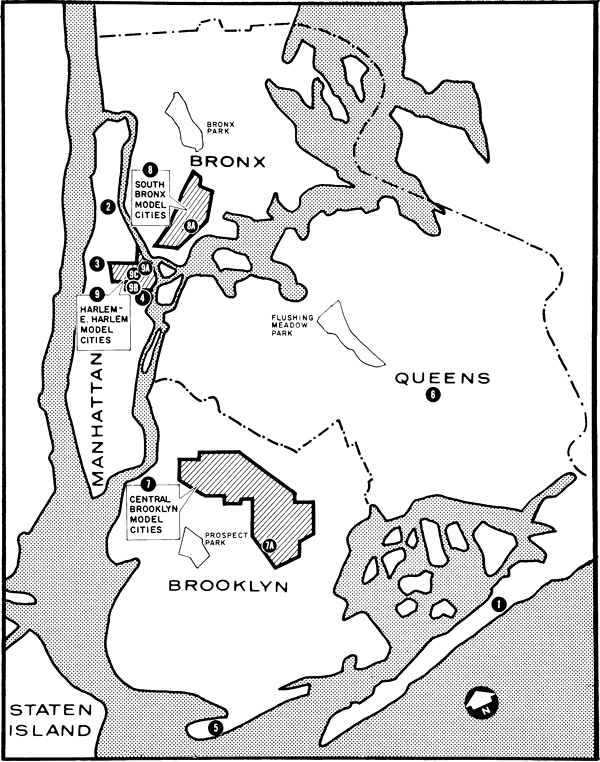
    New York City neighborhoods designated for revitalization with funding from the Model Cities Program.
    The City of New York, Community Development Program: A Progress Report, December 1968.

    To qualify for the program, cities had to apply for planning grants by submitting a detailed proposal that included an analysis of neighborhood conditions, long-term goals and strategies for addressing problems.

    Federal funds went directly to city governments, which then distributed them to local agencies and community organizations through contracts. These funds were relatively flexible but had to be tied to locally tailored plans. For example, Kansas City, Missouri, used Model Cities funding to support a loan program that expanded access to capital for local small businesses, helping them secure financing that might otherwise have been out of reach.

    Unlike previous programs, Model Cities emphasized what Johnson described as “comprehensive” and “concentrated” efforts. It wasn’t just about rebuilding streets or erecting public housing. It was about creating new ways for government to work in partnership with the people most affected by poverty and racism.

    A revolutionary approach to poverty

    What made Model Cities unique wasn’t just its scale but its philosophy. At the heart of the program was an insistence on “widespread citizen participation,” which required cities that received funding to include residents in the planning and oversight of local programs.

    The program also drew inspiration from civil rights leaders. One of its early architects, Whitney M. Young Jr., had called for a “Domestic Marshall Plan” – a reference to the federal government’s efforts to rebuild Europe after World War II – to redress centuries of racial inequality.

    Civil rights activist Whitney M. Young Jr. helped shape the vision of the Model Cities Program.
    Bettmann/Getty Images

    Young’s vision helped shape the Model Cities framework, which proposed targeted systemic investments in housing, health, education, employment and civic leadership in minority communities. In Atlanta, for example, the Model Cities Program helped fund neighborhood health clinics and job training programs. But the program also funded leadership councils that for the first time gave local low-income residents a direct voice in how city funds were spent.

    In other words, neighborhood residents weren’t just beneficiaries. They were planners, advisers and, in some cases, staffers.

    This commitment to community participation gave rise to a new kind of public servant – what sociologists Martin and Carolyn Needleman famously called “guerrillas in the bureaucracy.”

    A Model Cities staffer discusses the program to a group of students gathered at Denver’s Metropolitan Youth Education Center in 1970.
    Bill Wunsch/The Denver Post via Getty Images

    These were radical planners – often young, idealistic and deeply embedded in the neighborhoods they served. Many were recruited and hired through new Model Cities funding that allowed local governments to expand their staff with community workers aligned with the program’s goals.

    Working from within city agencies, these new planners used their positions to challenge top-down decision-making and push for community-driven planning.

    Their work was revolutionary not because they dismantled institutions but because they reimagined how institutions could function, prioritizing the voices of residents long excluded from power.

    Strengthening community ties

    In cities across the country, planners fought to redirect public resources toward locally defined priorities.

    A mobile dentist office in Baltimore.
    Robert Breck Chapman Collection, Langsdale Library Special Collections, University of Baltimore, CC BY-NC-ND

    In some cities, such as Tucson, the program funded education initiatives such as bilingual cultural programming and college scholarships for local students. In Baltimore, it funded mobile health services and youth sports programs.

    In New York City, the program supported new kinds of housing projects called vest-pocket developments, which got their name from their smaller scale: midsize buildings or complexes built on vacant lots or underutilized land. New housing such as the Betances Houses in the South Bronx were designed to add density without major redevelopment taking place – a direct response to midcentury urban renewal projects, which had destroyed and displaced entire neighborhoods populated by the city’s poorest residents. Meanwhile, cities such as Seattle used the funds to renovate older apartment buildings instead of tearing them down, which helped preserve the character of local neighborhoods.

    The goal was to create affordable housing while keeping communities intact.

    An Atlanta neighborhood identified as a candidate for street paving and home rehabilitation as part of the Model Cities Program.
    Georgia State University Special Collections

    What went wrong?

    Despite its ambitious vision, Model Cities faced resistance almost from the start. The program was underfunded and politically fragile. While some officials had hoped for US$2 billion in annual funding, the actual allocation was closer to $500 million to $600 million, spread across more than 60 cities.

    Then the political winds shifted. Though designed during the optimism of the mid-1960s, the program started being implemented under President Richard Nixon in 1969. His administration pivoted away from “people programs” and toward capital investment and physical development. Requirements for resident participation were weakened, and local officials often maintained control over the process, effectively marginalizing the everyday citizens the program was meant to empower.

    In cities such as San Francisco and Chicago, residents clashed with bureaucrats over control, transparency and decision-making. In some places, participation was reduced to token advisory roles. In others, internal conflict and political pressure made sustained community governance nearly impossible.

    Critics, including Black community workers and civil rights activists, warned that the program risked becoming a new form of “neocolonialism,” one that used the language of empowerment while concentrating control in the hands of white elected officials and federal administrators.

    A legacy worth revisiting

    Although the program was phased out by 1974, its legacy lived on.

    In cities across the country, Model Cities trained a generation of Black and brown civic leaders in what community development leaders and policy advocates John A. Sasso and Priscilla Foley called “a little noticed revolution.” In their book of the same name, they describe how those involved in the program went on to serve in local government, start nonprofits and advocate for community development.

    It also left an imprint on later policies. Efforts such as participatory budgeting, community land trusts and neighborhood planning initiatives owe a debt to Model Cities’ insistence that residents should help shape the future of their communities. And even as some criticized the program for failing to meet its lofty goals, others saw its value in creating space for democratic experimentation.

    A housing meeting takes place at a local Model Cities field office in Baltimore in 1972.
    Robert Breck Chapman Collection, Langsdale Library Special Collections, University of Baltimore, CC BY-NC-ND

    Today’s housing crisis demands structural solutions to structural problems. The affordable housing crisis is deeply connected to other intersecting crises, such as climate change, environmental injustice and health disparities, creating compounding risks for the most vulnerable communities. Addressing these issues through a fragmented social safety net – whether through housing vouchers or narrowly targeted benefit programs – has proven ineffective.

    Today, as policymakers once again debate how to respond to deepening inequality and a lack of affordable housing, the lost promise of Model Cities offers vital lessons.

    Model Cities was far from perfect. But it offered a vision of how democratic, local planning could promote health, security and community.

    Deyanira Nevárez Martínez is a trustee of the Lansing School District Board of Education and is currently a candidate for the Lansing City Council Ward 2.

    ref. Could a bold anti-poverty experiment from the 1960s inspire a new era in housing justice? – https://theconversation.com/could-a-bold-anti-poverty-experiment-from-the-1960s-inspire-a-new-era-in-housing-justice-253706

    MIL OSI AnalysisEveningReport.nz

  • MIL-OSI USA: UConn Has Record-Breaking Cohort for Gilman Scholars

    Source: US State of Connecticut

    A record-breaking 31 UConn students have been awarded a Gilman Scholarship in the latest cohort of the prestigious academic award. The award is congressionally funded through the Bureau of Education and Cultural Affairs at the State Department.

    The funding supports expanding student participation in study abroad programs and encourages travel to diverse locations around the globe, along with intensive language study and internship experiences.

    The 31 UConn students, who will study in 14 different countries, will receive a total of nearly $94,000 in scholarship funds through the Gilman program. A total of 40 UConn students have earned Gilman awards in the last two cohorts, this one and October 2024, for a total of more than $121,500 in scholarship funding.

    Students applying for Gilman Scholarships work with advisors in UConn’s Office of National Scholarships & Fellowships (ONSF) and Experiential Global Learning (EGL). Rachel Gleicher, an advisor in EGL, and Michael Cunningham, assistant director of ONSF and UConn’s Fulbright program advisor, are UConn’s two Gilman certifying advisors.

    “We are very excited that the Gilman program has selected so many UConn students this cycle,” says Cunningham. “It’s a testament to the quality of our students and to the hard work that they put into their applications.”

    Upon their return from studying abroad, each Gilman Scholar is required to complete a service project in their campus or home community with the goal of sharing the value of participation in study abroad and promoting the scholarship to prospective students. Applications are reviewed with consideration for the proposed follow-up service project.

    “We are so proud of these students for staying determined and focused on their study abroad goals,” says Gleicher. “Amid uncertain times, with federal funding freezes and broader uncertainty, they remained committed to their aspirations. Now more than ever, it is crucial to ensure students are aware of the funding opportunities available to them.”

    Eligibility for the Gilman Scholarship requires undergraduate students to be Pell Grant-eligible United States citizens who plan to study abroad for academic credit through a program approved by their home institution. Supporting students with high financial need provides access to students who are historically underrepresented in study abroad, including first-generation college students, STEM majors, ethnic and racial minority students, students with disabilities, LGBTQ+ students, and others who experience barriers to participation.

    Students from underrepresented areas of the U.S. are also considered during the application process and this year there are recipients from all 50 states.

    The following UConn students were selected as Gilman Scholars in this cycle, and they are listed with the location of where they will study as part of the program:

    Carina Adams-Szabo ’27 (CLAS), a psychology and political science major from Greenwich, who will be studying neuroscience this summer in Salamanca, Spain.

    Ashley Barragan ’27 (NUR), a nursing major who will be studying at the University of Dublin Summer Applied Research for Nursing Practice in Dublin, Ireland.

    Rhys Brauer ’27 (CLAS), a psychological sciences major, who will be studying neuroscience this summer in Salamanca.

    Brooke Catellier ’26 (CAHNR), an allied health major, who will be studying the Mediterranean diet and Tuscan cuisine in Florence, Italy, this summer.

    Kylene Chino ’26 (CLAS), a human rights and political science major, who will be studying in the fall at the Pusan National University in Shanghai, China.

    Jaiyliah Cochran ’25 (CLAS), a microbiology major, who will be studying field ecology this summer in Limpopo Province, South Africa.

    Mia Dansby ’26 (BUS), a management major, who will be studying this summer at ISI in Florence.

    Andrea D’Oleo ’27 (NUR), a nursing major from East Hartford, who will be studying in the Dublin Summer Applied Research Program for Nursing Practice in Ireland.

    Danyelix Echevarria Figueroa ’28 (ACES), a pre-teaching major from New Britain, who will study next spring at the University of Grenda in Grenda, Spain.

    Dahiana Fernandez-Ramirez ’26 (CLAS), a psychological sciences major, who will be studying this fall at ISI Florence.

    Adiriana Garcia Vazquez ’25 (CLAS), a cognitive science major from Bridgeport, who will be studying this fall at the Interdisciplinary Ethnography Field School in Mauritius.

    Hannah Ginste ’26 (CLAS), a communications major, who will be doing a summer internship in London.

    Jessica Glowacki ’25 (CLAS), a biological sciences major who will be studying field ecology this summer in Limpopo Province, South Africa.

    Emma Hazard ’27 (CAHNR), a diagnostic genetic sciences major, who will be studying the Mediterranean diet and Tuscan cuisine in Florence this summer.

    Danecia Henry ’28 (BUS), a management major from New Haven, will be studying in the summer at Camino de Santiago in Spain.

    Ty’Laisha Huff ’27 (NUR), a nursing major from Hartford, will be studying at the Dublin Summer Applied Research Program for Nursing Practice in Ireland.

    Layan Jahaf ’28 (CLAS), a political science and Arabic and Islam civics major, who will be studying this fall in London.

    Dee Jerome ’26 (CAHNR), an allied health sciences major from Bridgeport, who will be studying this summer in Accra, Ghana.

    Evelyn Pazan ’27 (CLAS), a finance and German major, who will be studying during the 2025-26 academic year at the University of Mannheim in Germany.

    Danielle Phillips ’27 (CLAS), an individualized major in industrial and labor relations from Bridgeport, who will be studying this summer at the Intercultural Leadership Program in Strasbourg, France.

    Jocelyn Ramirez ’26 (BUS), a management major from New Haven, who will be studying this summer at ISI.

    Jamie Ross ’27 (CLAS), a physiology and neurobiology major, who will be studying next winter in Barcelona, Spain.

    Ellie Sanders ’27 (CAHNR), a nutritional sciences major from West Cornwall, who will be studying the Mediterranean diet and Tuscan cuisine in Florence this summer.

    Fabio Silveira ’26 (CLAS), a pathobiology major, who will be studying neuroscience this summer in Salamanca, Spain.

    Amber Szymanski ’26 (CLAS), a political science and human rights major, who will be studying this fall at the Pusan National University in Busan, South Korea.

    Angel Uchupailla ’26 (CAHNR), an allied health major from Stamford, who will be studying this winter in Rome.

    Lyric Vargas ’27 (CLAS), a political science and psychological science major, who will be studying this fall at the University of Lisbon in Portugal.

    Erica Wong ’26 (CLAS), a political science and urban and community studies major, who will be studying this fall at Fudan University in Shanghai, China.

    Morgan Xu ’26 (ENG), a materials science and engineering major from Chesire, who will be studying this fall at the National University of Singapore.

    Ada Yeung ’27 (CLAS), an individualized major, who will be studying next spring at Fudan University.

    Maggie Zheng ’27 (BUS), an accounting major, who will be studying next spring at Fudan University.

    MIL OSI USA News

  • MIL-OSI USA: Investing in Relationships Builds Resilience for Dementia Caregivers, Study Finds

    Source: US State of Connecticut

    When assistant professor of communication Amanda Cooper was in graduate school, her grandparents began to decline. She watched her large family, comprising of her father, his nine siblings, and 50 of her first cousins rally around her grandparents. Because their home was in the Idaho woods, near Yellowstone National Park, their distance from the hospital meant they needed round-the-clock care.  

    “It’s like a crazy storm hits your family,” she says. “Everyone is moving, and there’s all these pieces, and relationships are changing.” 

    Cooper witnessed her family members disagreeing on how to handle tough conversations. After her grandmother’s death, her grandfather would repeatedly ask where his wife was.  

    “My dad said he wouldn’t lie to him,” she says. “He’d say, ‘She’s dead. Stop asking.’”  

    But other family members didn’t want to take this approach, causing tension within the family.  

    That experience sparked a question that became the foundation of Cooper’s research. How can caregivers maintain a relationship with family members with dementia, while preserving their own sanity? 

    More than six million Americans are living with Alzheimer’s disease, the most common form of dementia, and many more live with other types of cognitive decline. The emotional labor of caregiving and the communication breakdowns that happen between patients and their loved ones has only recently become a topic of research.  

    Cooper’s new study reveals that people who invest in their relationships by regularly expressing love, talking about important topics, and spending time together, build what she calls relational reserves. These reserves help caregivers cope more effectively if a loved one begins to change due to dementia. 

    “The theory says, if I’ve built a strong relationship, I’ll have more resources to draw from when things get difficult,” Cooper says.  

    This hypothesis, however, contrasts with another theory: that the more invested you are in a relationship, the more devastating it is to lose. Cooper set out to look at this apparent contrast through a social science lens.  

    In her study, caregivers reported on their past relationships with loved ones; how much they felt like teammates, how often they engaged in affectionate or supportive behavior, and how they approached problems together. Then Cooper looked at how those same caregivers communicated now with their loved ones who had dementia. 

    I just want to help people find a way to keep the love, even when the memory fades.

    She found that developing strong, loving relationships in the past led to more positive communication in the present, even in the face of memory loss or personality changes. 

    “One of the hardest things with the relational side of dementia is that, when it starts, you don’t know what’s going on,” says Cooper “You just think your family member is behaving weirdly, or you’re confused. Usually people get frustrated: they think, ‘I just had this conversation with you. Why are you asking me this again?’” 

    But caregivers who had what Cooper calls a “communal orientation,” or a belief that the caregiver and the person with dementia are in it together, were better able to adapt. 

    “If I view this person as my teammate, it shifts how I interact with them, even when they can’t give back in the same way anymore,” she says. 

    The study also found that caregivers who could mentally separate their loved one from the disease, or who saw the dementia as the cause of difficult behaviors rather than blaming the person, were better able to maintain a sense of compassion. 

    “I think sometimes we imagine that, once someone is diagnosed with dementia, their life is basically over,” Cooper says. “But that’s not true. People live with this for five, eight, even ten years. I’ve talked to so many caregivers who have a pretty rich and full life with their loved one, even through the difficulty.” 

    Cooper’s goal is to help families make the most of those years.

    “I’m a big believer that we should live as much as we can until we die,” she says. “Often, scientific research just goes into a journal to other academics and dies there,” she said. “Research is almost useless if it doesn’t actually get to the right people who can use it.” 

    Her message to families navigating the rocky terrain of dementia is one of hope: it is possible to maintain connection, to adapt, to find meaning in caregiving. 

    “It’s hard. It’s messy. But it can also be beautiful,” says Cooper. “I just want to help people find a way to keep the love, even when the memory fades.”

    MIL OSI USA News

  • MIL-OSI USA: Rudd Center Celebrates 10th Anniversary at UConn

    Source: US State of Connecticut

    In the fall of 2014, researchers, advocates, and community members gathered in the garden at an East Hartford elementary school for an exciting announcement from President Susan Herbst: The Rudd Center was moving to UConn.  

    Founded in 2005 by Kelly Brownell, the Rudd Center enjoyed 10 successful years at Yale University before officially joining UConn’s Institute for Collaboration on Health, Intervention, and Policy (InCHIP) in 2015. Now, as it celebrates its 10th anniversary at UConn, members of the Rudd Center team are reflecting on the past decade and looking forward to what comes next for the Center. 

    Marlene Schwartz, director of the Rudd Center, speaks at an event announcing the move of the Rudd Center to UConn. (Peter Morenus/UConn Photo)

    “UConn’s commitment to multidisciplinary research has made it the perfect home for the Rudd Center,” says Marlene Schwartz, director of the Rudd Center and a professor in the Department of Human Development and Family Sciences. “Connecting with research partners across the University has been a crucial part of our work for the past 10 years, and we look forward to continuing to foster these collaborations.” 

    At the heart of the Rudd Center’s mission is the belief that everyone deserves the opportunity to eat healthfully. While the Center’s areas of research have evolved over the years, its work centers around five core domains:  

    • Charitable food system research led by Caitlin Caspi from the Department of Allied Health Sciences, Maria Gombi-Vaca, and Schwartz
    • Economics of food assistance programs and fiscal policy research led by Tatiana Andreyeva from the Department of Agricultural and Resource Economics
    • Food marketing research led by Fran Fleming-Milici
    • Healthy school environments (including school meals) research led by Schwartz
    • Weight bias research led by Rebecca Puhl from the Department of Human Development and Family Sciences

    “To help further our mission, we focus on translating research into action,” says Puhl, deputy director of the Rudd Center. “This ranges from testifying about legislation at the state and federal levels, sharing our research findings with the media, and creating evidence-based resources to help diverse audiences.” 

    Among the popular tools developed by the Rudd Center are an online assessment to help school districts around the country assess their wellness policies and practices, a training course to help clinicians reduce weight stigma in health care, a cultural food guide to help the charitable food system meet the needs of their neighbors, an image gallery to help content creators find respectful imagery of people in larger bodies, and a calculator to help policymakers assess the potential impact of sugary drink taxes.  

    “As we look back on the past 10 years, I’m so grateful that the Rudd Center has been given the opportunity to grow and thrive at UConn,” says Schwartz. “The many researchers, staff, students, and affiliates who have been a part of our journey are what makes the Rudd Center so special.” 

    For more information about the Rudd Center’s work, visit its website, subscribe to its monthly newsletter, and connect with the Center on LinkedIn and Bluesky.  

    MIL OSI USA News

  • MIL-OSI: LIS Technologies Inc. Appoints Leading Regulatory Expert Julie Olivier as its Regulatory Affairs and Licensing Director

    Source: GlobeNewswire (MIL-OSI)

    Oak Ridge, Tennessee, May 27, 2025 (GLOBE NEWSWIRE) — LIS Technologies Inc. (“LIST” or “the Company”), a proprietary developer of advanced laser technology and the only USA-origin and patented laser uranium enrichment company, today announced that it has appointed Julie Olivier as its Regulatory Affairs and Licensing Director.

    Julie Olivier brings more than twenty‑five years of experience across the commercial energy sector, with primary focus on the nuclear fuel cycle and ash management at coal sites. Her expertise covers environmental protection, facility siting, decommissioning, waste management, risk assessment, security, material control and accountability, quality assurance, performance improvement, emergency preparedness, and chemical safety.

    “This is a really exciting time for the nuclear industry and the US government’s commitment to build back nuclear, including a robust domestic fuel supply chain, suggests that it is only the beginning,” said Julie Olivier, Director of Regulatory Affairs and Licensing of LIS Technologies Inc. “I am delighted to join LIST at this pivotal moment for the Company amidst the nation’s nuclear renaissance. The future of this technology is bright, and I am very excited to help steer it through the licensing process and toward commercialization.”

    Figure 1 – LIS Technologies Inc. Appoints Julie Olivier as its Director of Regulatory Affairs and Licensing.

    Ms. Olivier began her career as a Safety Analyst at the DOE’s West Valley Demonstration Project before spending nine years at the Nuclear Regulatory Commission in Fuel Cycle Safety and Safeguards, New Nuclear Licensing, and the Chairman’s Office. She later became the Regulatory Affairs Manager for Global Laser Enrichment, then Nuclear Fleet Licensing Manager at Duke Energy, where she was promoted to Director within the Coal Combustion Products team. Most recently, she consulted on advanced‑nuclear facility siting and licensing for the Tennessee Valley Authority.

    As Regulatory Affairs Manager, Ms. Olivier secured the NRC’s first license for a uranium laser‑enrichment technology. She holds a Six Sigma Lean Green Belt, a B.S. in Chemistry from the University of New Orleans, and an M.S. in Environmental Engineering from Virginia Tech.

    “We are very pleased to welcome Julie to this critical role in the future of LIST,” said Christo Liebenberg, CEO and Co-Founder of LIS Technologies Inc. “Her depth of experience will be essential as we strengthen our engagement with government, regulatory stakeholders and to help move our CRISLA technology to the next stage of development, while also preparing for commercial deployment. I look forward to working with her as we advance our leadership in U.S. domestic uranium enrichment.”

    About LIS Technologies Inc.

    LIS Technologies Inc. (LIST) is a USA based, proprietary developer of a patented advanced laser technology, making use of infrared lasers to selectively excite the molecules of desired isotopes to separate them from other isotopes. The Laser Isotope Separation Technology (L.I.S.T) has a huge range of applications, including being the only USA-origin (and patented) laser uranium enrichment company, and several major advantages over traditional methods such as gas diffusion, centrifuges, and prior art laser enrichment. The LIST proprietary laser-based process is more energy-efficient and has the potential to be deployed with highly competitive capital and operational costs. L.I.S.T is optimized for LEU (Low Enriched Uranium) for existing civilian nuclear power plants, High-Assay LEU (HALEU) for the next generation of Small Modular Reactors (SMR) and Microreactors, the production of radioisotopes isotopes for medical and scientific research, and the production of stable isotopes with applications in quantum computing manufacturing for semiconductor technologies. The Company employs a world class nuclear technical team working alongside leading nuclear entrepreneurs and industry professionals, possessing strong relationships with government and private nuclear industries.

    In Dec 2024, LIS Technologies Inc. was selected as one of six domestic companies to participate in the Low-Enriched Uranium (LEU) Enrichment Acquisition Program. This initiative allocates up to $3.4 billion overall, with contracts lasting for up to 10 years. Each awardee is slated to receive a minimum contract of $2 million.

    For more information please visit: LaserIsTech.com

    For further information, please contact:
    Email: info@laseristech.com
    Telephone: 800-388-5492
    Follow us on X Platform
    Follow us on LinkedIn

    Forward Looking Statements

    This news release contains “forward-looking statements” within the meaning of Section 21E of the Securities Exchange Act of 1934, as amended, and the Private Securities Litigation Reform Act of 1995. In this context, forward-looking statements mean statements related to future events, which may impact our expected future business and financial performance, and often contain words such as “expects”, “anticipates”, “intends”, “plans”, “believes”, “will”, “should”, “could”, “would” or “may” and other words of similar meaning. These forward-looking statements are based on information available to us as of the date of this news release and represent management’s current views and assumptions. Forward-looking statements are not guarantees of future performance, events or results and involve known and unknown risks, uncertainties and other factors, which may be beyond our control. For LIS Technologies Inc., particular risks and uncertainties that could cause our actual future results to differ materially from those expressed in our forward-looking statements include but are not limited to the following which are, and will be, exacerbated by any worsening of global business and economic environment: (i) risks related to the development of new or advanced technology, including difficulties with design and testing, cost overruns, development of competitive technology, loss of key individuals and uncertainty of success of patent filing, (ii) our ability to obtain contracts and funding to be able to continue operations and (iii) risks related to uncertainty regarding our ability to commercially deploy a competitive laser enrichment technology, (iv) risks related to the impact of government regulation and policies including by the DOE and the U.S. Nuclear Regulatory Commission; and other risks and uncertainties discussed in this and our other filings with the SEC. Only after successful completion of our Phase 2 Pilot Plant demonstration will LIS Technologies be able to make realistic economic predictions for a Commercial Facility. Readers are cautioned not to place undue reliance on these forward-looking statements, which apply only as of the date of this news release. These factors may not constitute all factors that could cause actual results to differ from those discussed in any forward-looking statement. Accordingly, forward-looking statements should not be relied upon as a predictor of actual results. We do not undertake to update our forward-looking statements to reflect events or circumstances that may arise after the date of this news release, except as required by law.

    Attachment

    The MIL Network

  • MIL-OSI: Zscaler to Host Innovations Briefing for Investors at Zenith Live 2025

    Source: GlobeNewswire (MIL-OSI)

    SAN JOSE, Calif., May 27, 2025 (GLOBE NEWSWIRE) — Zscaler, Inc. (NASDAQ: ZS), the leader in cloud security, today announced that the company will host an innovations briefing for investors on June 3, 2025. The briefing will take place in Las Vegas, Nevada, during the company’s Zenith Live 2025 event.

    Zscaler Investor Innovations Briefing – Zenith Live 2025
    Tuesday, June 3, 2025
    11:30 a.m. PT (2:30 p.m. ET)

    The briefing is scheduled to conclude before 2:00 p.m. PT (5:00 p.m. ET).

    A live webcast and replay will be available on the Investor Relations section of the Zscaler website at https://ir.zscaler.com.

    About Zscaler

    Zscaler (NASDAQ: ZS) accelerates digital transformation so customers can be more agile, efficient, resilient, and secure. The Zscaler Zero Trust Exchange platform protects thousands of customers from cyberattacks and data loss by securely connecting users, devices, and applications in any location. Distributed across more than 150 data centers globally, the SASE-based Zero Trust Exchange is the world’s largest in-line cloud security platform.

    Zscaler™ and the other trademarks listed at https://www.zscaler.com/legal/trademarks are either (i) registered trademarks or service marks or (ii) trademarks or service marks of Zscaler, Inc. in the United States and/or other countries. Any other trademarks are the properties of their respective owners.

    Media Relations Contact:
    Pavel Radda
    press@zscaler.com

    Investor Relations Contact:
    Ashwin Kesireddy
    ir@zscaler.com

    The MIL Network

  • MIL-OSI USA: PINE GROVE – Shapiro Administration to Tour Schuylkill County Dairy Farm Where Commonwealth Investments in Planning, Innovation are Feeding Farm Success

    Source: US State of Pennsylvania

    May 27, 2025Pine Grove, PA

    ADVISORY – PINE GROVE – Shapiro Administration to Tour Schuylkill County Dairy Farm Where Commonwealth Investments in Planning, Innovation are Feeding Farm Success

    Agriculture Secretary Russell Redding will announce a significant increase in the amount available to farmers statewide to support strategic business planning. The announcement will be made at Jersey Acres Farms, a Schuylkill County family farm that has taken advantage of state support from Farm Vitality Grants and an Agricultural Innovation Grant to fund critical planning and robotic technology that will keep their farm thriving in the future.

    Media are invited to tour the farm’s dairy along with Sec. Redding and fourth-graders from Blue Mountain Elementary West. Students will see first-hand how technology works on a modern dairy farm to make the dairy products they enjoy safe and healthy.

    The event will highlight Shapiro Administration investments supporting the future of family farms across Pennsylvania and creating opportunities for rural communities to succeed. Governor Josh Shapiro’s 2025-26 budget proposes an increase of $13 million to the historic Agriculture Innovation Grant program to help farms across Pennsylvania compete and succeed.

    WHO:
    Agriculture Secretary Russell Redding
    Agriculture Deputy Secretary for Farm, Food, and Market Access Heidi Secord
    Jersey Acres Farms Owner Kent Heffner
    Schuylkill Conservation District Manager Jenna St. Clair

    WHEN:
    Tuesday, May 27 at 10 a.m.

    WHERE:
    Jersey Acres Farm
    1615 Panther Valley Road, Pine Grove, PA 17963

    RSVP:
    Press attending should RSVP with news outlet and photographer and reporter names to aginfo@pa.gov.

    MIL OSI USA News

  • MIL-OSI China: EU pledges to strike trade deal with US amid tariff twists

    Source: People’s Republic of China – State Council News

    The European Commission remains “fully committed” to reaching a trade deal with the United States amid tariff twists, according to a senior European Union (EU) official.

    In a Monday post on social media platform X, European Commissioner for Trade and Economic Security Maros Sefcovic wrote: “The European Commission remains fully committed to constructive and focused efforts at pace towards an EU-US deal,” adding that Brussels would continue to stay in constant contact with Washington.

    His remarks followed his calls with U.S. Commerce Secretary Howard Lutnick and U.S. Trade Representative Jamieson Greer.

    On Friday, U.S. President Donald Trump said talks with the 27-member bloc were “going nowhere” and threatened to impose a 50 percent tariff on all EU imports from June 1. European Commission President Ursula von der Leyen phoned Trump on Sunday, after which he agreed to postpone the planned tariff increase until July 9.

    Economists and market analysts have also criticized the unpredictability of U.S. trade policies, noting that such volatility undermines confidence in the U.S. as a reliable trading partner. 

    MIL OSI China News

  • MIL-OSI USA: SPC May 27, 2025 0730 UTC Day 3 Severe Thunderstorm Outlook

    Source: US National Oceanic and Atmospheric Administration

     For best viewing experience, please enable browser JavaScript support.

    May 27, 2025 0730 UTC Day 3 Severe Thunderstorm Outlook

    Updated: Tue May 27 07:21:34 UTC 2025 (Print Version |   |  )

    Probabilistic to Categorical Outlook Conversion Table

     Forecast Discussion

    SPC AC 270721

    Day 3 Convective Outlook
    NWS Storm Prediction Center Norman OK
    0221 AM CDT Tue May 27 2025

    Valid 291200Z – 301200Z

    …THERE IS A MARGINAL RISK OF SEVERE THUNDERSTORMS ACROSS PARTS OF
    THE SOUTHERN HIGH PLAINS…SOUTHERN ROCKIES AND SOUTHEAST…

    …SUMMARY…
    A marginal severe threat is expected on Thursday over parts of the
    southern High Plains, southern Rockies, and Southeast.

    …Southern High Plains/Southern Rockies…
    Northwesterly mid-level flow will be in place across much of the
    High Plains on Thursday, as a trough moves southeastward through the
    central Plains. At the surface, an axis of low-level moisture will
    likely be located from eastern New Mexico northward into southern
    Colorado. As surface heating takes place, isolated to scattered
    thunderstorms are expected to develop in the higher terrain, with
    the storms moving eastward into the lower elevations in the
    afternoon. Although instability is forecast to remain weak, lapse
    rates will be steep, and deep-layer shear could be strong enough for
    a marginal severe threat. Hail and isolated severe wind gusts will
    be possible.

    …Southeast…
    A broad low-amplitude cyclonic flow pattern is forecast across the
    Southeast on Thursday. At the surface, a moist airmass will be
    located along the Gulf Coast from Texas to Florida. Model forecasts
    suggest that scattered thunderstorms will develop in the Gulf Coast
    states early in the day as surface temperatures warm. The greatest
    convective coverage should be located along or near zones of focused
    low-level convergence. In spite of a lack of large-scale ascent, a
    few marginally severe storms could develop as low-level lapse rates
    become steep during the day. Severe gusts would be the primary
    threat.

    ..Broyles.. 05/27/2025

    CLICK TO GET WUUS03 PTSDY3 PRODUCT

    NOTE: THE NEXT DAY 3 OUTLOOK IS SCHEDULED BY 1930Z

    Top/Latest Day 1 Outlook/Today’s Outlooks/Forecast Products/Home

    MIL OSI USA News

  • MIL-OSI USA: SPC May 27, 2025 0600 UTC Day 2 Convective Outlook

    Source: US National Oceanic and Atmospheric Administration

    SPC AC 270558

    Day 2 Convective Outlook
    NWS Storm Prediction Center Norman OK
    1258 AM CDT Tue May 27 2025

    Valid 281200Z – 291200Z

    …THERE IS A SLIGHT RISK OF SEVERE THUNDERSTORMS ACROSS PARTS OF
    THE SOUTHERN HIGH PLAINS…

    …SUMMARY…
    Isolated large hail and severe wind gusts will be possible in parts
    of the southern High Plains Wednesday afternoon and evening.
    Marginally severe storms will be possible over part of the central
    High Plains, and from the southern Plains into the Southeast.

    …Southern High Plains…
    At mid-levels, convergent flow from the northwest and west will be
    place across the southern Plains on Wednesday. At the surface, an
    area of high pressure is forecast over the central Plains. To the
    south of the anticyclone, a post-frontal airmass will gradually
    modify as moisture begins to return northward over parts of the
    southern Plains. Moderate instability is expected to develop over a
    few areas from central and east Texas into western Louisiana. Over
    this modifying airmass, any severe threat is expected to be
    marginal.

    Further west into parts of the southern High Plains, convective
    initiation is expected during the early afternoon in the higher
    terrain of eastern New Mexico and far west Texas. The storms will
    gradually move eastward toward an axis of moderate instability.
    Forecast soundings early Wednesday evening near the instability axis
    have 0-6 km shear near 30 knots, with 700-500 mb lapse rates
    approaching 8 C/km. This could be enough for isolated large hail and
    severe wind gusts, associated with strong updrafts that develop in
    the afternoon and evening.

    Northward into central and eastern Colorado, thunderstorms are
    expected to develop in the higher terrain and move eastward into the
    central Plains. Weak instability, sufficient deep-layer shear and
    steep lapse rage could be enough for a marginal severe threat.

    …Southeast…
    West-southwesterly flow at mid-levels is forecast over the Southeast
    on Wednesday. At the surface, a moist airmass will likely be in
    place from the lower Mississippi Valley eastward into the eastern
    Gulf Coast states. As surface temperatures warm, isolated to
    scattered thunderstorm development is expected along zones of
    maximized heating, and near focused areas of low-level convergence.
    Although large-scale ascent and deep-layer shear should be weak, the
    thermodynamic environment may be enough for marginally severe wind
    gusts with the stronger multicells.

    ..Broyles.. 05/27/2025

    CLICK TO GET WUUS02 PTSDY2 PRODUCT

    NOTE: THE NEXT DAY 2 OUTLOOK IS SCHEDULED BY 1730Z

    MIL OSI USA News

  • MIL-OSI USA: SPC May 27, 2025 0600 UTC Day 1 Convective Outlook

    Source: US National Oceanic and Atmospheric Administration

     For best viewing experience, please enable browser JavaScript support.

    May 27, 2025 0600 UTC Day 1 Convective Outlook

    Click to see valid 1Z – 12Z Day 1 Convective Outlook

    Updated: Tue May 27 05:42:56 UTC 2025 (Print Version |   |  )

    Probabilistic to Categorical Outlook Conversion Table

     Forecast Discussion

    SPC AC 270542

    Day 1 Convective Outlook
    NWS Storm Prediction Center Norman OK
    1242 AM CDT Tue May 27 2025

    Valid 271200Z – 281200Z

    …THERE IS A SLIGHT RISK OF SEVERE THUNDERSTORMS ACROSS PARTS OF
    THE SOUTHERN PLAINS AND SOUTHEAST…

    …SUMMARY…
    Scattered strong to severe storms are expected across parts of the
    southern Plains and over portions of the Southeast. Hail and wind
    are the primary threats.

    …Southern Plains…

    Large-scale pattern will change little through the upcoming day1
    period, and remains bifurcated with a distinct southern stream
    extending from northern Mexico into the Gulf States. Latest model
    guidance suggests at least one notable weak short-wave trough will
    approach the Big Bend later this evening. Water-vapor imagery
    depicts this feature near the northern Baja Peninsula. As this
    feature approaches far west TX, southeasterly boundary-layer flow
    will force higher moisture deep into the Big Bend. Ongoing
    convection across south central TX should also contribute to this
    westward push of low-level moisture. Strong surface heating west of
    this returning moisture will allow convective temperatures to easily
    be breached and isolated robust convection is expected to develop
    after 21z, both across the higher terrain of west TX into northeast
    Mexico west of DRT. While 500mb flow is not forecast to be that
    strong, forecast soundings suggest slow-moving supercells are
    possible. Very large hail is the most likely severe threat. Some
    increase in the LLJ is expected during the latter half of the
    period. This may encourage one or more MCS-type complexes near the
    international border.

    …Southeast…

    Slow-moving MCS has matured over south central into southeast TX.
    This complex will forward propagate into the lower MS Valley by
    sunrise. A weak short-wave trough is likely affiliated with this MCS
    and some increase in mid-level flow is expected across MS into GA by
    mid day, which should aid potential convective organization. While
    some weakening may be noted early in the period, boundary-layer
    heating will aid destabilization and new updrafts should develop
    along the leading convective outflow. A few weak supercells are
    possible, but the primary storm mode should be mixed with clusters
    and line segments. This favors damaging winds, though some hail can
    not be ruled out.

    ..Darrow/Thornton.. 05/27/2025

    CLICK TO GET WUUS01 PTSDY1 PRODUCT

    .html”>Latest Day 2 Outlook/Today’s Outlooks/Forecast Products/Home

    MIL OSI USA News

  • MIL-OSI USA: SPC – No watches are valid as of Tue May 27 08:37:02 UTC 2025

    Source: US National Oceanic and Atmospheric Administration

    Current Convective Watches (View What is a Watch? clip)Updated:  Tue May 27 08:46:06 UTC 2025 No watches are currently valid

    Archived Convective ProductsTo view convective products for a previous day, type in the date you wish to retrieve (e.g. 20040529 for May 29, 2004). Data available since January 1, 2004.

    MIL OSI USA News

  • MIL-OSI Asia-Pac: President Lai meets delegation from European Parliament

    Source: Republic of China Taiwan

    Details
    2025-05-20
    President Lai hosts state banquet for President Surangel Whipps Jr. of Republic of Palau
    On the evening of May 20, President Lai Ching-te, accompanied by Vice President Bi-khim Hsiao, hosted a state banquet at the Presidential Office in honor of President Surangel Whipps Jr. of the Republic of Palau and his wife. In remarks, President Lai said that he looks forward to working closely with President Whipps to promote tourism exchanges and sports cooperation so that Taiwan and Palau shine brightly together on the international stage. A translation of President Lai’s remarks follows: It is a pleasure to host this banquet tonight at the Presidential Office for President Whipps, First Lady Valerie Whipps, and the esteemed members of their delegation. Welcome to Taiwan. During my trips to Palau in 2022 and last year, President and First Lady Whipps received me with great hospitality. Wearing my island shirt, I enjoyed a very friendly reception from the people of Palau. It felt warm and friendly, just like being welcomed back home. The first time I visited Palau, President Whipps and I piloted a boat to the Milky Way lagoon. We both tried volcanic mud facial masks. We also fished together and enjoyed the breeze as we walked on the beach. Last year, on my second visit to Palau, I was honored to be invited to address the National Congress. I also observed the results of the close bilateral cooperation between our two nations. Due to its world-famous ocean scenery, Palau is sometimes referred to as “God’s aquarium.” And it is even possible to snorkel with sharks. It leaves a deep impression. Nothing compares to seeing Palau firsthand. During the COVID-19 pandemic, Taiwan and Palau launched a travel bubble that created a safe means of travel. Now, with the pandemic behind us, I hope that even more Taiwanese can tour Palau and gain a greater understanding of our diplomatic ally. In addition to tourism exchanges, I mentioned on my visit to Palau last year that I hoped Taiwan and Palau could promote sports cooperation by providing training away from home. Next month, Palau will be holding the Pacific Mini Games. And right now, Palau’s national baseball and table tennis teams are holding training sessions here in Taiwan. We will do our utmost to support Palau’s national players and we hope they stand out and achieve outstanding results in the events. I look forward to working closely with President Whipps so that Taiwan and Palau shine brightly together on the international stage. Thank you! Mesulang! President Whipps then delivered remarks, saying that it is truly an honor to be here once again one year after President Lai’s inauguration. Mentioning that this is his first state visit after being reelected to a second term, he said that it is important to be here among friends, and that we are more than friends, we are family. He thanked President Lai for the generous words and, most importantly, Taiwan’s enduring support. He remarked that our relationship continues to get stronger in each passing year. President Whipps said that President Lai’s diplomacy initiative, leadership, and vision deeply resonate with them. Diplomacy must be rooted in our shared values, he said, and an unwavering support for our allies and a commitment to a sustainable, inclusive development are all deeply appreciated by their people. President Whipps emphasized that, as we look into the future and the challenges that we face, from security to climate change, it is so important that we are united. He added that it is important for the world, and especially important for them in Palau, that they stand up for Taiwan, so that Taiwan can participate on international fora that address climate change, security, and health, because they know the world is better when Taiwan has a seat at the table. Mentioning that Palau will host the Pacific Islands Forum next year, President Whipps said that Palau remains committed to working closely with Taiwan to ensure a successful event, and that they will continue to speak up for Taiwan’s indispensable contributions as we stand together against any efforts to silence or isolate democratic partners. President Whipps said that our nations have navigated challenges and emerged stronger, bound by a partnership that is built on trust, respect, and hope for a better world. Whether it is in clean energy, education, smart medicine, or tourism, our shared journey is just beginning, he said, and we are stronger together.  Also in attendance at the banquet were Palauan Minister of State Gustav Aitaro, Minister of Public Infrastructure and Industries Charles Obichang, Minister of Human Resources, Culture, Tourism and Development Ngiraibelas Tmetuchl, Senate Floor Leader Kerai Mariur, House of Delegates Floor Leader Warren Umetaro, High Chief of Ngiwal State Elliot Udui, Governor of Peleliu State Emais Roberts, and Governor of Koror State Eyos Rudimch.

    Details
    2025-05-20
    President Lai and President Surangel S. Whipps, Jr. of Palau hold bilateral talks and witness signing of cooperation agreements  
    On the afternoon of May 20, following a welcome ceremony with military honors for President Surangel S. Whipps, Jr. of the Republic of Palau and his wife, President Lai Ching-te, accompanied by Vice President Bi-khim Hsiao, held bilateral talks with President Whipps at the Presidential Office. The two leaders also jointly witnessed the signing of a technical cooperation agreement and an agreement on diplomatic staff training cooperation. In remarks, President Lai thanked Palau for standing firm in its backing of Taiwan’s international participation as geopolitical tensions continue to increase in the Pacific region. He added that he looks forward to the cooperative ties between Taiwan and Palau continuing to expand into even broader areas, allowing our economies and societies to further progress as we jointly advance peace, stability, and prosperity in the Indo-Pacific region. A translation of President Lai’s remarks follows: I welcome our guests to Taiwan once again. Last year on May 20, President Whipps led a delegation to attend the inauguration ceremony for myself and Vice President Hsiao. I am delighted, on the anniversary of my first year in office, to meet with old friends of Taiwan again, as President Whipps returns for this visit. Taiwan-Palau relations have grown even closer in recent years thanks to the strong support of President Whipps. In 2022, during my term as vice president, I led a delegation to Palau as a demonstration of how our nations were together boosting tourism development as we jointly faced the challenges of the COVID-19 pandemic. Every time I visit Palau, and every time I meet with President Whipps, I feel very deeply that Taiwan and Palau are like family. We are both maritime nations and share a common Austronesian heritage and culture. We are also staunch partners in upholding such values as freedom, democracy, and respect for human rights. Last December, when I went on my first overseas trip since taking office, one of the nations I visited was Palau. We celebrated the 30th anniversary of Palau’s independence and 25 years of diplomatic relations, underscoring our friendly ties. Taiwan and Palau enjoy close exchanges and cooperation in a range of areas, including climate change, education, agriculture and fisheries, healthcare, humanitarian assistance, sports, and culture. After this meeting, President Whipps and I will witness the signing of a technical cooperation agreement and an agreement on diplomatic staff training cooperation, demonstrating once again our diverse collaboration and strong friendship. I believe that by working together, Taiwan and Palau can contribute to each other’s development and overcome the regional and global challenges we currently face. In particular, as geopolitical tensions continue to increase in the Pacific region, Palau has wisely and courageously upheld democratic values and stood firm in its backing of Taiwan’s international participation. Palau has never stopped voicing support for Taiwan, including at the United Nations General Assembly, the World Health Organization, the UN Framework Convention on Climate Change Conference of the Parties, and the UN Ocean Conference. We have been deeply moved by this support. I thank President Whipps again for his high regard and support for Taiwan. I look forward to the cooperative ties between our nations continuing to expand into even broader areas. This will allow our economies and societies to further progress as we jointly advance peace, stability, and prosperity in the Indo-Pacific region. President Whipps then delivered remarks, saying that it is a great honor for him to be here, standing in this historic place – a symbol of strength, resilience, and the democratic spirit of the Taiwanese people. On behalf of the government of Palau, President Whipps extended heartfelt gratitude to President Lai and the people of Taiwan for the warm welcome and gracious hospitality toward him and his delegation. President Whipps then extended sincere thanks for President Lai’s visit to Palau in December – his second visit to Palau – and for having Minister of Foreign Affairs Lin Chia-lung (林佳龍) attend his inauguration as a special envoy. He added that this also marks his third visit to Taiwan since President Lai took office, saying that this demonstrates the strength of our growing relationship. President Whipps indicated that the increased engagements and numerous entrepreneurs that President Lai has brought from Taiwan to Palau have resulted in fruitful visits, and that President Lai’s leadership represents hope, unity, and continued advancement of democracy and freedom, not only for Taiwan, but for the broader Indo-Pacific region. President Whipps went on to say that this visit to Taiwan reaffirms our deep friendship and shared values between our two nations. He emphasized that Palau and Taiwan are bound not by proximity, but by purpose, in that both are island nations and believe in human dignity, the rule of law, and the right of our people to determine their own futures. President Whipps stated that although we are celebrating 26 years of diplomatic relations, Taiwan has been a steadfast partner of Palau for decades, and that one of the MOUs they are signing further extends the relationship that began in December of 1984. From healthcare and medical missions, to education, agriculture, renewable energy, infrastructure, the private sector, tourism development, and climate resilience, he said, our cooperation has improved lives and strengthened our communities. The president also indicated that during the COVID-19 pandemic, Taiwan stood with Palau, noting that both sides began the tourism bubble, and that President Lai came to Palau to reopen the two weekly direct flights that have now been increased to four. That solidarity will never be forgotten, he said. As the world faces growing uncertainty and complex challenges from climate change to global tensions, President Whipps said, this friendship becomes even more vital. The president concluded his remarks by expressing hope that both nations continue to stand together, work together, and advocate together for peace, prosperity, and for the right of small nations to be seen, heard, and respected. After the bilateral talks, President Lai and President Whipps witnessed the signing of the technical cooperation agreement and the agreement on diplomatic staff training cooperation by Minister Lin and Palauan Minister of State Gustav Aitaro. The delegation also included Palauan Minister of Public Infrastructure and Industries Charles Obichang, Minister of Human Resources, Culture, Tourism and Development Ngiraibelas Tmetuchl, Senate Floor Leader Kerai Mariur, House of Delegates Floor Leader Warren Umetaro, High Chief of Ngiwal State Elliot Udui, Governor of Peleliu State Emais Roberts, and Governor of Koror State Eyos Rudimch.  

    Details
    2025-05-20
    President Lai interviewed by Nippon Television and Yomiuri TV
    In a recent interview on Nippon Television’s news zero program, President Lai Ching-te responded to questions from host Mr. Sakurai Sho and Yomiuri TV Shanghai Bureau Chief Watanabe Masayo on topics including reflections on his first year in office, cross-strait relations, China’s military threats, Taiwan-United States relations, and Taiwan-Japan relations. The interview was broadcast on the evening of May 19. During the interview, President Lai stated that China intends to change the world’s rules-based international order, and that if Taiwan were invaded, global supply chains would be disrupted. Therefore, he said, Taiwan will strengthen its national defense, prevent war by preparing for war, and achieve the goal of peace. The president also noted that Taiwan’s purpose for developing drones is based on national security and industrial needs, and that Taiwan hopes to collaborate with Japan. He then reiterated that China’s threats are an international problem, and expressed hope to work together with the US, Japan, and others in the global democratic community to prevent China from starting a war. Following is the text of the questions and the president’s responses: Q: How do you feel as you are about to round out your first year in office? President Lai: When I was young, I was determined to practice medicine and save lives. When I left medicine to go into politics, I was determined to transform Taiwan. And when I was sworn in as president on May 20 last year, I was determined to strengthen the nation. Time flies, and it has already been a year. Although the process has been very challenging, I am deeply honored to be a part of it. I am also profoundly grateful to our citizens for allowing me the opportunity to give back to our country. The future will certainly be full of more challenges, but I will do everything I can to unite the people and continue strengthening the nation. That is how I am feeling now. Q: We are now coming up on the 80th anniversary of the end of World War II, and over this period, we have often heard that conflict between Taiwan and the mainland is imminent. Do you personally believe that a cross-strait conflict could happen? President Lai: The international community is very much aware that China intends to replace the US and change the world’s rules-based international order, and annexing Taiwan is just the first step. So, as China’s military power grows stronger, some members of the international community are naturally on edge about whether a cross-strait conflict will break out. The international community must certainly do everything in its power to avoid a conflict in the Taiwan Strait; there is too great a cost. Besides causing direct disasters to both Taiwan and China, the impact on the global economy would be even greater, with estimated losses of US$10 trillion from war alone – that is roughly 10 percent of the global GDP. Additionally, 20 percent of global shipping passes through the Taiwan Strait and surrounding waters, so if a conflict breaks out in the strait, other countries including Japan and Korea would suffer a grave impact. For Japan and Korea, a quarter of external transit passes through the Taiwan Strait and surrounding waters, and a third of the various energy resources and minerals shipped back from other countries pass through said areas. If Taiwan were invaded, global supply chains would be disrupted, and therefore conflict in the Taiwan Strait must be avoided. Such a conflict is indeed avoidable. I am very thankful to Prime Minister of Japan Ishiba Shigeru and former Prime Ministers Abe Shinzo, Suga Yoshihide, and Kishida Fumio, as well as US President Donald Trump and former President Joe Biden, and the other G7 leaders, for continuing to emphasize at international venues that peace and stability across the Taiwan Strait are essential components for global security and prosperity. When everyone in the global democratic community works together, stacking up enough strength to make China’s objectives unattainable or to make the cost of invading Taiwan too high for it to bear, a conflict in the strait can naturally be avoided. Q: As you said, President Lai, maintaining peace and stability across the Taiwan Strait is also very important for other countries. How can war be avoided? What sort of countermeasures is Taiwan prepared to take to prevent war? President Lai: As Mr. Sakurai mentioned earlier, we are coming up on the 80th anniversary of the end of WWII. There are many lessons we can take from that war. First is that peace is priceless, and war has no winners. From the tragedies of WWII, there are lessons that humanity should learn. We must pursue peace, and not start wars blindly, as that would be a major disaster for humanity. In other words, we must be determined to safeguard peace. The second lesson is that we cannot be complacent toward authoritarian powers. If you give them an inch, they will take a mile. They will keep growing, and eventually, not only will peace be unattainable, but war will be inevitable. The third lesson is why WWII ended: It ended because different groups joined together in solidarity. Taiwan, Japan, and the Indo-Pacific region are all directly subjected to China’s threats, so we hope to be able to join together in cooperation. This is why we proposed the Four Pillars of Peace action plan. First, we will strengthen our national defense. Second, we will strengthen economic resilience. Third is standing shoulder to shoulder with the democratic community to demonstrate the strength of deterrence. Fourth is that as long as China treats Taiwan with parity and dignity, Taiwan is willing to conduct exchanges and cooperate with China, and seek peace and mutual prosperity. These four pillars can help us avoid war and achieve peace. That is to say, Taiwan hopes to achieve peace through strength, prevent war by preparing for war, keeping war from happening and pursuing the goal of peace. Q: Regarding drones, everyone knows that recently, Taiwan has been actively researching, developing, and introducing drones. Why do you need to actively research, develop, and introduce new drones at this time? President Lai: This is for two purposes. The first is to meet national security needs. The second is to meet industrial development needs. Because Taiwan, Japan, and the Philippines are all part of the first island chain, and we are all democratic nations, we cannot be like an authoritarian country like China, which has an unlimited national defense budget. In this kind of situation, island nations such as Taiwan, Japan, and the Philippines should leverage their own technologies to develop national defense methods that are asymmetric and utilize unmanned vehicles. In particular, from the Russo-Ukrainian War, we see that Ukraine has successfully utilized unmanned vehicles to protect itself and prevent Russia from unlimited invasion. In other words, the Russo-Ukrainian War has already proven the importance of drones. Therefore, the first purpose of developing drones is based on national security needs. Second, the world has already entered the era of smart technology. Whether generative, agentic, or physical, AI will continue to develop. In the future, cars and ships will also evolve into unmanned vehicles and unmanned boats, and there will be unmanned factories. Drones will even be able to assist with postal deliveries, or services like Uber, Uber Eats, and foodpanda, or agricultural irrigation and pesticide spraying. Therefore, in the future era of comprehensive smart technology, developing unmanned vehicles is a necessity. Taiwan, based on industrial needs, is actively planning the development of drones and unmanned vehicles. I would like to take this opportunity to express Taiwan’s hope to collaborate with Japan in the unmanned vehicle industry. Just as we do in the semiconductor industry, where Japan has raw materials, equipment, and technology, and Taiwan has wafer manufacturing, our two countries can cooperate. Japan is a technological power, and Taiwan also has significant technological strengths. If Taiwan and Japan work together, we will not only be able to safeguard peace and stability in the Taiwan Strait and security in the Indo-Pacific region, but it will also be very helpful for the industrial development of both countries. Q: The drones you just described probably include examples from the Russo-Ukrainian War. Taiwan and China are separated by the Taiwan Strait. Do our drones need to have cross-sea flight capabilities? President Lai: Taiwan does not intend to counterattack the mainland, and does not intend to invade any country. Taiwan’s drones are meant to protect our own nation and territory. Q: Former President Biden previously stated that US forces would assist Taiwan’s defense in the event of an attack. President Trump, however, has yet to clearly state that the US would help defend Taiwan. Do you think that in such an event, the US would help defend Taiwan? Or is Taiwan now trying to persuade the US? President Lai: Former President Biden and President Trump have answered questions from reporters. Although their responses were different, strong cooperation with Taiwan under the Biden administration has continued under the Trump administration; there has been no change. During President Trump’s first term, cooperation with Taiwan was broader and deeper compared to former President Barack Obama’s terms. After former President Biden took office, cooperation with Taiwan increased compared to President Trump’s first term. Now, during President Trump’s second term, cooperation with Taiwan is even greater than under former President Biden. Taiwan-US cooperation continues to grow stronger, and has not changed just because President Trump and former President Biden gave different responses to reporters. Furthermore, the Trump administration publicly stated that in the future, the US will shift its strategic focus from Europe to the Indo-Pacific. The US secretary of defense even publicly stated that the primary mission of the US is to prevent China from invading Taiwan, maintain stability in the Indo-Pacific, and thus maintain world peace. There is a saying in Taiwan that goes, “Help comes most to those who help themselves.” Before asking friends and allies for assistance in facing threats from China, Taiwan must first be determined and prepared to defend itself. This is Taiwan’s principle, and we are working in this direction, making all the necessary preparations to safeguard the nation. Q: I would like to ask you a question about Taiwan-Japan relations. After the Great East Japan Earthquake in 2011, you made an appeal to give Japan a great deal of assistance and care. In particular, you visited Sendai to offer condolences. Later, you also expressed condolences and concern after the earthquakes in Aomori and Kumamoto. What are your expectations for future Taiwan-Japan exchanges and development? President Lai: I come from Tainan, and my constituency is in Tainan. Tainan has very deep ties with Japan, and of course, Taiwan also has deep ties with Japan. However, among Taiwan’s 22 counties and cities, Tainan has the deepest relationship with Japan. I sincerely hope that both of you and your teams will have an opportunity to visit Tainan. I will introduce Tainan’s scenery, including architecture from the era of Japanese rule, Tainan’s cuisine, and unique aspects of Tainan society, and you can also see lifestyles and culture from the Showa era.  The Wushantou Reservoir in Tainan was completed by engineer Mr. Hatta Yoichi from Kanazawa, Japan and the team he led to Tainan after he graduated from then-Tokyo Imperial University. It has nearly a century of history and is still in use today. This reservoir, along with the 16,000-km-long Chianan Canal, transformed the 150,000-hectare Chianan Plain into Taiwan’s premier rice-growing area. It was that foundation in agriculture that enabled Taiwan to develop industry and the technology sector of today. The reservoir continues to supply water to Tainan Science Park. It is used by residents of Tainan, the agricultural sector, and industry, and even the technology sector in Xinshi Industrial Park, as well as Taiwan Semiconductor Manufacturing Company. Because of this, the people of Tainan are deeply grateful for Mr. Hatta and very friendly toward the people of Japan. A major earthquake, the largest in 50 years, struck Tainan on February 6, 2016, resulting in significant casualties. As mayor of Tainan at the time, I was extremely grateful to then-Prime Minister Abe, who sent five Japanese officials to the disaster site in Tainan the day after the earthquake. They were very thoughtful and asked what kind of assistance we needed from the Japanese government. They offered to provide help based on what we needed. I was deeply moved, as former Prime Minister Abe showed such care, going beyond the formality of just sending supplies that we may or may not have actually needed. Instead, the officials asked what we needed and then provided assistance based on those needs, which really moved me. Similarly, when the Great East Japan Earthquake of 2011 or the later Kumamoto earthquakes struck, the people of Tainan, under my leadership, naturally and dutifully expressed their support. Even earlier, when central Taiwan was hit by a major earthquake in 1999, Japan was the first country to deploy a rescue team to the disaster area. On February 6, 2018, after a major earthquake in Hualien, former Prime Minister Abe appeared in a video holding up a message of encouragement he had written in calligraphy saying “Remain strong, Taiwan.” All of Taiwan was deeply moved. Over the years, Taiwan and Japan have supported each other when earthquakes struck, and have forged bonds that are family-like, not just neighborly. This is truly valuable. In the future, I hope Taiwan and Japan can be like brothers, and that the peoples of Taiwan and Japan can treat one another like family. If Taiwan has a problem, then Japan has a problem; if Japan has a problem, then Taiwan has a problem. By caring for and helping each other, we can face various challenges and difficulties, and pursue a brighter future. Q: President Lai, you just used the phrase “If Taiwan has a problem, then Japan has a problem.” In the event that China attempts to invade Taiwan by force, what kind of response measures would you hope the US military and Japan’s Self-Defense Forces take? President Lai: As I just mentioned, annexing Taiwan is only China’s first step. Its ultimate objective is to change the rules-based international order. That being the case, China’s threats are an international problem. So, I would very much hope to work together with the US, Japan, and others in the global democratic community to prevent China from starting a war – prevention, after all, is more important than cure.

    Details
    2025-05-13
    President Lai interviewed by Japan’s Nikkei  
    In a recent interview with Japan’s Nikkei, President Lai Ching-te responded to questions regarding Taiwan-Japan and Taiwan-United States relations, cross-strait relations, the semiconductor industry, and the international economic and trade landscape. The interview was published by Nikkei on May 13. President Lai indicated that Nikkei, Inc. is a global news organization that has received significant recognition both domestically and internationally, and that he is deeply honored to be interviewed by Nikkei and grateful for their invitation. The president said that he would like to take this rare opportunity to thank Japan’s government, National Diet, society, and public for their longstanding support for Taiwan. Noting that current Prime Minister Ishiba Shigeru and former Prime Ministers Abe Shinzo, Suga Yoshihide, and Kishida Fumio have all strongly supported Taiwan, he said that the peoples of Taiwan and Japan also have a deep mutual affection, and that through the interview, he hopes to enhance the bilateral relationship between Taiwan and Japan, deepen the affection between our peoples, and foster more future cooperation to promote prosperity and development in both countries. In response to questions raised on the free trade system and the recent tariff war, President Lai indicated that over the past few decades, the free economy headed by the Western world and led by the US has brought economic prosperity and political stability to Taiwan and Japan. At the same time, he said, we have also learned or followed many Western values. The president said he believes that Taiwan and Japan are exemplary students, but some countries are not. Therefore, he said, the biggest crisis right now is China, which exploits the free trade system to engage in plagiarism and counterfeiting, infringe on intellectual property rights, and even provide massive government subsidies that facilitate the dumping of low-priced goods worldwide, which has a major impact on many countries including Japan and Taiwan. If this kind of unfair trade is not resolved, he said, the stable societies and economic prosperity we have painstakingly built over decades, as well as some of the values we pursue, could be destroyed. Therefore, President Lai said he thinks it is worthwhile for us to observe the recent willingness of the US to address unfair trade, and if necessary, offer assistance. President Lai emphasized that the national strategic plan for Taiwanese industries is for them to be rooted in Taiwan while expanding their global presence and marketing worldwide. Therefore, he said, while the 32 percent tariff increase imposed by the US on Taiwan is indeed a major challenge, we are willing to address it seriously and find opportunities within that challenge, making Taiwan’s strategic plan for industry even more comprehensive. When asked about Taiwan’s trade arrangements, President Lai indicated that in 2010 China accounted for 83.8 percent of Taiwan’s outbound investment, but last year it accounted for only 7.5 percent. In 2020, he went on, 43.9 percent of Taiwan’s exports went to China, but that figure dropped to 31.7 percent in 2024. The president said that we have systematically transferred investments from Taiwanese enterprises to Japan, Southeast Asia, Europe, and the US. Therefore, he said, last year Taiwan’s largest outbound investment was in the US, accounting for roughly 40 percent of the total. Nevertheless, only 23.4 percent of Taiwanese products were sold to the US, with 76.6 percent sold to places other than the US, he said.  The president emphasized that we don’t want to put all our eggs in one basket, and hope to establish a global presence. Under these circumstances, he said, Taiwan is very eager to cooperate with Japan. President Lai stated that at this moment, the Indo-Pacific and international community really need Japan’s leadership, especially to make the Comprehensive and Progressive Agreement for Trans-Pacific Partnership (CPTPP) excel in its functions, and also requested Japan to support Taiwan’s CPTPP accession. The president said that Taiwan hopes to sign an Economic Partnership Agreement (EPA) with Japan to build closer ties in economic trade and promote further investment, and that we also hope to strengthen relations with the European Union, and even other regions. Currently, he said, we are proposing an initiative on global semiconductor supply chain partnerships for democracies, because the semiconductor industry is an ecosystem. The president raised the example that Japan has materials, equipment, and technology; the US has IC design and marketing; Taiwan has production and manufacturing; and the Netherlands excels in equipment, saying we therefore hope to leverage Taiwan’s advantages in production and manufacturing to connect the democratic community and establish a global non-red supply chain for semiconductors, ensuring further world prosperity and development in the future, and ensuring that free trade can continue to function without being affected by dumping, which would undermine future prosperity and development. The president stated that as we want industries to expand their global presence and market internationally while staying rooted here in Taiwan, having industries rooted in Taiwan involves promoting pay raises for employees, tax cuts, and deregulation, as well as promoting enterprise investment tax credits. He said that we have also proposed Three Major Programs for Investing in Taiwan for Taiwanese enterprises and are actively resolving issues regarding access to water, electricity, land, human resources, and professional talent so that the business community can return to Taiwan to invest, or enterprises in Taiwan can increase their investments. He went on to say that we are also actively signing bilateral investment agreements with friends and allies so that when our companies invest and expand their presence abroad, their rights and interests as investors are ensured.  President Lai mentioned that Taiwan hopes to sign an EPA with Japan, similar to the Taiwan-US Initiative on 21st-Century Trade and the Economic Prosperity Partnership Dialogue, or the Enhanced Trade Partnership arrangement with the United Kingdom, or similar agreements or memorandums of understanding with Canada and Australia that allow Taiwanese products to be marketed worldwide, concluding that those are our overall arrangements. Looking at the history of Taiwan’s industrial development, President Lai indicated, of course it began in Taiwan, and then moved west to China and south to Southeast Asia. He said that we hope to take this opportunity to strengthen cooperation with Japan to the north, across the Pacific Ocean to the east, and develop the North American market, making Taiwan’s industries even stronger. In other words, he said, while Taiwan sees the current reciprocal tariffs imposed by the US as a kind of challenge, it also views these changes positively. On the topic of pressure from China affecting Taiwan’s participation in international frameworks such as the CPTPP or its signing of an EPA with Japan, President Lai responded that the key point is what kind of attitude we should adopt in viewing China’s acts of oppression. If we act based on our belief in free trade, he said, or on the universal values we pursue – democracy, freedom, and respect for human rights – and also on the understanding that a bilateral trade agreement between Taiwan and Japan would contribute to the economic prosperity and development of both countries, or that Taiwan’s accession to the CPTPP would benefit progress and prosperity in the Indo-Pacific region, then he hopes that friends and allies will strongly support us. On the Trump administration’s intentions regarding the reciprocal tariff policy and the possibility of taxing semiconductors, as well as how Taiwan plans to respond, President Lai said that since President Trump took office, he has paid close attention to interviews with both him and his staff. The president said that several of President Trump’s main intentions are: First, he wants to address the US fiscal situation. For example, President Lai said, while the US GDP is about US$29 trillion annually, its national debt stands at US$36 trillion, which is roughly 124 percent of GDP. Second, he went on, annual government spending exceeds US$6.5 trillion, but revenues are only around US$4.5 trillion, resulting in a nearly US$2 trillion deficit each year, about 7 percent of GDP. Third, he said, the US pays nearly US$1.2 trillion in interest annually, which exceeds the US$1 trillion defense budget and accounts for more than 3 percent of GDP. Fourth, President Trump still wants to implement tax cuts, aiming to reduce taxes for 85 percent of Americans, he said, noting that this would cost between US$500 billion and US$1 trillion. These points, President Lai said, illustrate his first goal: solving the fiscal problem. President Lai went on to say that second, the US feels the threat of China and believes that reindustrialization is essential; without reindustrialization, the US risks a growing gap in industrial capacity compared to China. Third, he said, in this era of global smart technology, President Trump wants to lead the nation to become a world center of AI. Fourth, he aims to ensure world peace and prevent future wars, President Lai said. In regard to what the US seeks to achieve, he said he believes these four areas form the core of the Trump administration’s intentions, and that is why President Trump has raised tariffs, demanded that trading partners purchase more American goods, and encouraged friendly and allied nations to invest in the US, all in order to achieve these goals. President Lai indicated that the 32 percent reciprocal tariff poses a critical challenge for Taiwan, and we must treat it seriously. He said that our approach is not confrontation, but negotiation to reduce tariffs, and that we have also agreed to measures such as procurement, investment, resolving non-tariff trade barriers, and addressing origin washing in order to effectively reduce the trade deficit between Taiwan and the US. Of course, he said, through this negotiation process, we also hope to turn challenges into opportunities. The president said that first, we aim to start negotiations from the proposal of zero tariffs and seek to establish a bilateral trade agreement with the US. Second, he went on, we hope to support US reindustrialization and its aim to become a world AI hub through investment, while simultaneously upgrading and transforming Taiwan’s industries, which would help further integrate Taiwan’s industries into the US economic structure, ensuring Taiwan’s long-term development.  President Lai emphasized again that Taiwan’s national industrial strategy is for industries to stay firmly rooted in Taiwan while expanding their global presence and marketing worldwide. He repeated that we have gone from moving westward across the Taiwan Strait, to shifting southbound, to working closer northward with Japan, and now the time is ripe for us to expand eastward by investing in North America. In other words, he said, while we take this challenge seriously to protect national interests and ensure that no industry is sacrificed, we also hope these negotiations will lead to deeper Taiwan-US trade relations through Taiwanese investment in the US, concluding that these are our expectations. The president stated that naturally, the reciprocal tariffs imposed by the US will have an impact on Taiwanese industries, so in response, the Taiwanese government has already proposed support measures for affected industries totaling NT$93 billion. In addition, he said, we have outlined broader needs for Taiwan’s long-term development, which will be covered by a special budget proposal of NT$410 billion, noting that this has already been approved by the Executive Yuan and will be submitted to the Legislative Yuan for review. He said that this special budget proposal addresses four main areas: supporting industries, stabilizing employment, protecting people’s livelihoods, and enhancing resilience. As for tariffs on semiconductors, President Lai said, Taiwan Semiconductor Manufacturing Company (TSMC) has committed to investing in the US at the request of its customers. He said he believes that TSMC’s industry chain will follow suit, and that these are concrete actions that are unrelated to tariffs. However, he said, if the US were to invoke Section 232 and impose tariffs on semiconductors or related industries, it would discourage Taiwanese semiconductor and ICT investments in the US, and that we will make this position clear to the US going forward. President Lai indicated that among Taiwan’s exports to the US, there are two main categories: ICT products and electronic components, which together account for 65.4 percent. These are essential to the US, he said, unlike final goods such as cups, tables, or mattresses. He went on to say that what Taiwan sells to the US are the technological products required by AI designers like NVIDIA, AMD, Amazon, Google, and Apple, and that therefore, we will make sure the US understands clearly that we are not exporting end products, but the high-tech components necessary for the US to reindustrialize and become a global AI center. Furthermore, the president said, Taiwan is also willing to increase its defense budget and military procurement. He stated that Taiwan is committed to defending itself and is strongly willing to cooperate with friends and allies to ensure regional peace and stability, and that this is also something President Trump hopes to see. Asked whether TSMC’s fabs overseas could weaken Taiwan’s strategic position as a key hub for semiconductor manufacturing, and whether that could then give other countries fewer incentives to protect Taiwan, President Lai responded by saying that political leaders around the world including Japan’s Prime Minister Ishiba and former Prime Ministers Abe, Suga, and Kishida have emphasized, at the G7 and other major international fora, that peace and stability in the Taiwan Strait are essential for global security and prosperity. In other words, he explained, the international community cares about Taiwan and supports peace and stability in the Taiwan Strait because Taiwan is located in the first island chain in the Indo-Pacific, directly facing China. He pointed out that if Taiwan is not protected, China’s expansionist ambitions will certainly grow, which would impact the current rules-based international order. Thus, he said, the international community willingly cares about Taiwan and supports stability in the Taiwan Strait – that is the reason, and it has no direct connection with TSMC. He noted that after all, TSMC has not made investments in that many countries, stressing that, on that point, it is clear. President Lai said that TSMC’s investments in Japan, Europe, and the US are all natural, normal economic and investment activities. He said that Taiwan is a democratic country whose society is based on the rule of law, so when Taiwanese companies need to invest around the world for business needs, the government will support those investments in principle so long as they do not harm national interests. President Lai said that after TSMC Chairman C.C. Wei (魏哲家) held a press conference with President Trump to announce the investment in the US, Chairman Wei returned to Taiwan to hold a press conference with him at the Presidential Office, where the chairman explained to the Taiwanese public that TSMC’s R&D center will remain in Taiwan and that the facilities it has already committed to investing in here will not change and will not be affected. So, the president explained, to put it another way, TSMC will not be weakened by its investment in the US. He further emphasized that Taiwan has strengths in semiconductor manufacturing and is very willing to work alongside other democratic countries to promote the next stage of global prosperity and development. A question was raised about which side should be chosen between the US and China, under the current perception of a return to the Cold War, with East and West facing off as two opposing blocs. President Lai responded by saying that some experts and scholars describe the current situation as entering a new Cold War era between democratic and authoritarian camps; others assert that the war has already begun, including information warfare, economic and trade wars, and the ongoing wars in Europe – the Russo-Ukrainian War – and the Middle East, and the Israel-Hamas conflict. The president said that these are all matters experts have cautioned about, noting that he is not a historian and so will not attempt to define today’s political situation from an academic standpoint. However, he said, he believes that every country has a choice, which is to say, Taiwan, Japan, or any other nation does not necessarily have to choose between the US and China. What we are deciding, he said, is whether our country will maintain a democratic constitutional system or regress into an authoritarian regime, and this is essentially a choice of values – not merely a choice between two major powers. President Lai said that Taiwan’s situation is different from other countries because we face a direct threat from China. He pointed out that we have experienced military conflicts such as the August 23 Artillery Battle and the Battle of Guningtou – actual wars between the Republic of China and the People’s Republic of China. He said that China’s ambition to annex Taiwan has never wavered, and that today, China’s political and military intimidation, as well as internal united front infiltration, are growing increasingly intense. Therefore, he underlined, to defend democracy and sovereignty, protect our free and democratic system, and ensure the safety of our people’s lives and property, Taiwan’s choice is clear. President Lai said that China’s military exercises are not limited to the Taiwan Strait, and include the East China Sea, South China Sea, and even the Sea of Japan, as well as areas around Korea and Australia. Emphasizing that Taiwan, Japan, Australia, and the Philippines are all democratic nations, the president said that Taiwan’s choice is clear, and that he believes Japan also has no other choice. We are all democratic countries, he said, whose people have long pursued the universal values of democracy, freedom, and respect for human rights, and that is what is most important. Regarding the intensifying tensions between the US and China, the president was asked what roles Taiwan and Japan can play. President Lai responded that in his view, Japan is a powerful nation, and he sincerely hopes that Japan can take a leading role amid these changes in the international landscape. He said he believes that countries in the Indo-Pacific region are also willing to respond. He suggested several areas where we can work together: first, democracy and peace; second, innovation and prosperity; and third, justice and sustainability. President Lai stated that in the face of authoritarian threats, we should let peace be our beacon and democracy our compass as we respond to the challenges posed by authoritarian states. Second, he added, as the world enters an era characterized by the comprehensive adoption of smart technologies, Japan and Taiwan should collaborate in the field of innovation to further drive regional prosperity and development. Third, he continued, is justice and sustainability. He explained that because international society still has many issues that need to be resolved, Taiwan and Japan can cooperate for the public good, helping countries in need around the world, and cooperating to address climate change and achieve net-zero transition by 2050. Asked whether he hopes that the US will continue to be a leader in the liberal democratic system, President Lai responded by saying that although the US severed diplomatic ties with the Republic of China, for the past few decades it has assisted Taiwan in various areas such as national defense, security, and countering threats from China, based on the Taiwan Relations Act and the Six Assurances. He pointed out that Taiwan has also benefited, directly and indirectly, in terms of politics, democracy, and economic prosperity thanks to the US, and so Taiwan naturally hopes that the US remains strong and continues to lead the world. President Lai said that when the US encounters difficulties, whether financial difficulties, reindustrialization issues, or becoming a global center for AI, and hopes to receive support from its friends and allies to jointly safeguard regional peace and stability, Taiwan is willing to stand together for a common cause. If the US remains strong, he said, that helps Taiwan, the Indo-Pacific region, and the world as a whole. Noting that while the vital role of the US on the global stage has not changed, the president said that after decades of shouldering global responsibilities, it has encountered some issues. Now, it has to make adjustments, he said, stating his firm belief that it will do so swiftly, and quickly resume its leadership role in the world. Asked to comment on remarks he made during his election campaign that he would like to invite China’s President Xi Jinping for bubble tea, President Lai responded that Taiwan is a peace-loving country, and Taiwanese society is inherently kind, and therefore we hope to get along peacefully with China, living in peace and mutual prosperity. So, during his term as vice president, he said, he was expressing the goodwill of Taiwanese society. Noting that while he of course understands that China’s President Xi would have certain difficulties in accepting this, he emphasized that the goodwill of Taiwanese society has always existed. If China reflects on the past two or three decades, he said, it will see that its economy was able to develop with Taiwan as its largest foreign investor. The president explained that every year, 1 to 2 million Taiwanese were starting businesses or investing in China, creating numerous job opportunities and stabilizing Chinese society. While many Taiwanese businesses have profited, he said, Chinese society has benefited even more. He added that every time a natural disaster occurs, if China is in need, Taiwanese always offer donations. Therefore, the president said, he hopes that China can face the reality of the Republic of China’s existence and understand that the people of Taiwan hope to continue living free and democratic lives with respect for human rights. He also expressed hope that China can pay attention to the goodwill of Taiwanese society. He underlined that we have not abandoned the notion that as long as there is parity, dignity, exchange, and cooperation, the goodwill of choosing dialogue over confrontation and exchange over containment will always exist. Asked for his view on the national security reforms in response to China’s espionage activities and infiltration attempts, President Lai said that China’s united front infiltration activities in Taiwan are indeed very serious. He said that China’s ambitions to annex Taiwan rely not only on the use of political and military intimidation, but also on its long-term united front and infiltration activities in Taiwanese society. Recently, he pointed out, the Taiwan High Prosecutors Office of the Ministry of Justice prosecuted 64 spies, which is three times the number in 2021, and in addition to active-duty military personnel, many retired military personnel were also indicted. Moreover, he added, Taiwan also has the Chinese Unification Promotion Party, which has a background in organized crime, Rehabilitation Alliance Party, which was established by retired military personnel, and Republic of China Taiwan Military Government, which is also composed of retired generals. He explained that these are all China’s front organizations, and they plan one day to engage in collaboration within Taiwan, which shows the seriousness of China’s infiltration in Taiwan. Therefore, the president said, in the recent past he convened a high-level national security meeting and proposed 17 response strategies across five areas. He then enumerated the five areas: first, to address China’s threat to Taiwan’s sovereignty; second, to respond to the threat of China’s obscuring the Taiwanese people’s sense of national identity; third, to respond to the threat of China’s infiltrating and recruiting members of the ROC Armed Forces as spies; fourth, to respond to the threat of China’s infiltration of Taiwanese society through societal exchanges and united front work; and fifth, to respond to the threat of China using “integration plans” to draw Taiwan’s young people and Taiwanese businesses into its united front activities. In response to these five major threats, he said, he has proposed 17 response strategies, one of which being to restore the military trial system. He explained that if active-duty military personnel commit military crimes, they must be subject to military trials, and said that this expresses the Taiwanese government’s determination to respond to China’s united front infiltration and the subversion of Taiwan. Responding to the question of which actions Taiwan can take to guard against China’s threats to regional security, President Lai said that many people are worried that the increasingly tense situation may lead to accidental conflict and the outbreak of war. He stated his own view that Taiwan is committed to facing China’s various threats with caution. Taiwan is never the source of these problems, he emphasized, and if there is an accidental conflict and it turns into a full-scale war, it will certainly be a deliberate act by China using an accidental conflict as a pretext. He said that when China expanded its military presence in the East China Sea and South China Sea, the international community did not stop it; when China conducted exercises in the Taiwan Strait, the international community did not take strong measures to prevent this from happening. Now, he continued, China is conducting gray-zone exercises, which are aggressions against not only the Taiwan Strait, the South China Sea, and the East China Sea, but also extending to the Sea of Japan and waters near South Korea. He said that at this moment, Taiwan, the Philippines, Japan, and even the US should face these developments candidly and seriously, and we must exhibit unity and cooperation to prevent China’s gray-zone aggression from continuing to expand and prevent China from shifting from a military exercise to combat. If no action is taken now, the president said, the situation may become increasingly serious. Asked about the view of some US analysts who point out that China will have the ability to invade Taiwan around 2027, President Lai responded that Taiwan, as the country on the receiving end of threats and aggression, must plan for the worst and make the best preparations. He recalled a famous saying from the armed forces: “Do not count on the enemy not showing up; count on being ready should it strike.” This is why, he said, he proposed the Four Pillars of Peace action plan. First, he said, we must strengthen our national defense. Second, he added, we must strengthen economic resilience, adding that not only must our economy remain strong, but it must also be resilient, and that we cannot put all our eggs in the same basket, in China, as we have done in the past. Third, he continued, we must stand shoulder to shoulder with friends and allies such as Japan and the US, as well as the democratic community, and we must demonstrate the strength of deterrence to prevent China from making the wrong judgment. Fourth, he emphasized, as long as China treats Taiwan with parity and dignity, Taiwan is willing to conduct exchanges and cooperate with China and seek cross-strait peace and mutual prosperity through exchanges and cooperation. Regarding intensifying US-China confrontation, the president was asked in which areas he thinks Taiwan and Japan should strengthen cooperation; with Japan’s Ishiba administration also being a minority government, the president was asked for his expectations for the Ishiba administration. President Lai said that in the face of rapid and tremendous changes in the political situation, every government faces considerable challenges, especially for minority governments, but the Japanese government led by Prime Minister Ishiba has quite adequately responded with various strategies. Furthermore, he said, Japan is different from Taiwan, explaining that although Japan’s ruling party lacks a majority, political parties in Japan engage in competition domestically while exhibiting unity externally. He said that Taiwan’s situation is more challenging, because the ruling and opposition parties hold different views on the direction of the country, due to differences in national identity. The president expressed his hope that in the future Taiwan and Japan will enjoy even more comprehensive cooperation. He stated that he has always believed that deep historical bonds connect Taiwan and Japan. Over the past several decades, he said, when encountering natural disasters and tragedies, our two nations have assisted each other with mutual care and support. He said that the affection between the people of Taiwan and Japan is like that of a family. Pointing out that both countries face the threat of authoritarianism, he said that we share a mission to safeguard universal values such as democracy, freedom, and respect for human rights. The president said that our two countries should be more open to cooperation in various areas to maintain regional peace and stability as well as to strengthen cooperation in economic and industrial development, such as for semiconductor industry chains and everyday applications of AI, including robots and drones, adding that we can also cooperate on climate change response, such as in hydrogen energy and other strategies. He said our two countries should also continue to strengthen people-to-people exchanges. He then took the opportunity to once again invite our good friends from Japan to visit Taiwan for tourism and learn more about Taiwan, saying that the Taiwanese people wholeheartedly welcome our Japanese friends.  

    Details
    2025-05-09
    President Lai extends congratulations on election of His Holiness Pope Leo XIV  
    Following the successful election of the 267th pope of the Roman Catholic Church, His Holiness Pope Leo XIV, on May 8, President Lai Ching-te extended sincere congratulations on behalf of the people and government of Taiwan, including its Catholic community. The president stated that he looks forward to working with Pope Leo XIV to continue deepening cooperation in the area of humanitarian aid and jointly defend the universal value of religious freedom, expanding and strengthening the alliance between Taiwan and the Vatican. Upon learning of the election results, President Lai directed the Republic of China (Taiwan) Embassy to the Holy See to convey a message of congratulations. In the message, President Lai extended sincere congratulations to Pope Leo XIV on behalf of the people and government of Taiwan, including its Catholic community, expressing confidence that His Holiness will lead the Catholic Church and its 1.4 billion followers worldwide with profound wisdom. President Lai also emphasized that Taiwan looks forward to continuing to work alongside the Holy See in the shared pursuit of peace, justice, religious freedom, solidarity, friendship, and human dignity. This year marks the 83rd anniversary of the establishment of diplomatic ties between Taiwan and the Vatican. Enjoying a strong alliance, Taiwan and the Vatican share such universal values as freedom of religion, respect for human rights, peace, and benevolence, and conduct close exchanges. Taiwan will continue to engage in exchanges and cooperation with the Holy See, further strengthen bilateral relations, and work alongside the Holy See to contribute even more to the world.  

    Details
    2025-05-20
    President Lai interviewed by Nippon Television and Yomiuri TV
    In a recent interview on Nippon Television’s news zero program, President Lai Ching-te responded to questions from host Mr. Sakurai Sho and Yomiuri TV Shanghai Bureau Chief Watanabe Masayo on topics including reflections on his first year in office, cross-strait relations, China’s military threats, Taiwan-United States relations, and Taiwan-Japan relations. The interview was broadcast on the evening of May 19. During the interview, President Lai stated that China intends to change the world’s rules-based international order, and that if Taiwan were invaded, global supply chains would be disrupted. Therefore, he said, Taiwan will strengthen its national defense, prevent war by preparing for war, and achieve the goal of peace. The president also noted that Taiwan’s purpose for developing drones is based on national security and industrial needs, and that Taiwan hopes to collaborate with Japan. He then reiterated that China’s threats are an international problem, and expressed hope to work together with the US, Japan, and others in the global democratic community to prevent China from starting a war. Following is the text of the questions and the president’s responses: Q: How do you feel as you are about to round out your first year in office? President Lai: When I was young, I was determined to practice medicine and save lives. When I left medicine to go into politics, I was determined to transform Taiwan. And when I was sworn in as president on May 20 last year, I was determined to strengthen the nation. Time flies, and it has already been a year. Although the process has been very challenging, I am deeply honored to be a part of it. I am also profoundly grateful to our citizens for allowing me the opportunity to give back to our country. The future will certainly be full of more challenges, but I will do everything I can to unite the people and continue strengthening the nation. That is how I am feeling now. Q: We are now coming up on the 80th anniversary of the end of World War II, and over this period, we have often heard that conflict between Taiwan and the mainland is imminent. Do you personally believe that a cross-strait conflict could happen? President Lai: The international community is very much aware that China intends to replace the US and change the world’s rules-based international order, and annexing Taiwan is just the first step. So, as China’s military power grows stronger, some members of the international community are naturally on edge about whether a cross-strait conflict will break out. The international community must certainly do everything in its power to avoid a conflict in the Taiwan Strait; there is too great a cost. Besides causing direct disasters to both Taiwan and China, the impact on the global economy would be even greater, with estimated losses of US$10 trillion from war alone – that is roughly 10 percent of the global GDP. Additionally, 20 percent of global shipping passes through the Taiwan Strait and surrounding waters, so if a conflict breaks out in the strait, other countries including Japan and Korea would suffer a grave impact. For Japan and Korea, a quarter of external transit passes through the Taiwan Strait and surrounding waters, and a third of the various energy resources and minerals shipped back from other countries pass through said areas. If Taiwan were invaded, global supply chains would be disrupted, and therefore conflict in the Taiwan Strait must be avoided. Such a conflict is indeed avoidable. I am very thankful to Prime Minister of Japan Ishiba Shigeru and former Prime Ministers Abe Shinzo, Suga Yoshihide, and Kishida Fumio, as well as US President Donald Trump and former President Joe Biden, and the other G7 leaders, for continuing to emphasize at international venues that peace and stability across the Taiwan Strait are essential components for global security and prosperity. When everyone in the global democratic community works together, stacking up enough strength to make China’s objectives unattainable or to make the cost of invading Taiwan too high for it to bear, a conflict in the strait can naturally be avoided. Q: As you said, President Lai, maintaining peace and stability across the Taiwan Strait is also very important for other countries. How can war be avoided? What sort of countermeasures is Taiwan prepared to take to prevent war? President Lai: As Mr. Sakurai mentioned earlier, we are coming up on the 80th anniversary of the end of WWII. There are many lessons we can take from that war. First is that peace is priceless, and war has no winners. From the tragedies of WWII, there are lessons that humanity should learn. We must pursue peace, and not start wars blindly, as that would be a major disaster for humanity. In other words, we must be determined to safeguard peace. The second lesson is that we cannot be complacent toward authoritarian powers. If you give them an inch, they will take a mile. They will keep growing, and eventually, not only will peace be unattainable, but war will be inevitable. The third lesson is why WWII ended: It ended because different groups joined together in solidarity. Taiwan, Japan, and the Indo-Pacific region are all directly subjected to China’s threats, so we hope to be able to join together in cooperation. This is why we proposed the Four Pillars of Peace action plan. First, we will strengthen our national defense. Second, we will strengthen economic resilience. Third is standing shoulder to shoulder with the democratic community to demonstrate the strength of deterrence. Fourth is that as long as China treats Taiwan with parity and dignity, Taiwan is willing to conduct exchanges and cooperate with China, and seek peace and mutual prosperity. These four pillars can help us avoid war and achieve peace. That is to say, Taiwan hopes to achieve peace through strength, prevent war by preparing for war, keeping war from happening and pursuing the goal of peace. Q: Regarding drones, everyone knows that recently, Taiwan has been actively researching, developing, and introducing drones. Why do you need to actively research, develop, and introduce new drones at this time? President Lai: This is for two purposes. The first is to meet national security needs. The second is to meet industrial development needs. Because Taiwan, Japan, and the Philippines are all part of the first island chain, and we are all democratic nations, we cannot be like an authoritarian country like China, which has an unlimited national defense budget. In this kind of situation, island nations such as Taiwan, Japan, and the Philippines should leverage their own technologies to develop national defense methods that are asymmetric and utilize unmanned vehicles. In particular, from the Russo-Ukrainian War, we see that Ukraine has successfully utilized unmanned vehicles to protect itself and prevent Russia from unlimited invasion. In other words, the Russo-Ukrainian War has already proven the importance of drones. Therefore, the first purpose of developing drones is based on national security needs. Second, the world has already entered the era of smart technology. Whether generative, agentic, or physical, AI will continue to develop. In the future, cars and ships will also evolve into unmanned vehicles and unmanned boats, and there will be unmanned factories. Drones will even be able to assist with postal deliveries, or services like Uber, Uber Eats, and foodpanda, or agricultural irrigation and pesticide spraying. Therefore, in the future era of comprehensive smart technology, developing unmanned vehicles is a necessity. Taiwan, based on industrial needs, is actively planning the development of drones and unmanned vehicles. I would like to take this opportunity to express Taiwan’s hope to collaborate with Japan in the unmanned vehicle industry. Just as we do in the semiconductor industry, where Japan has raw materials, equipment, and technology, and Taiwan has wafer manufacturing, our two countries can cooperate. Japan is a technological power, and Taiwan also has significant technological strengths. If Taiwan and Japan work together, we will not only be able to safeguard peace and stability in the Taiwan Strait and security in the Indo-Pacific region, but it will also be very helpful for the industrial development of both countries. Q: The drones you just described probably include examples from the Russo-Ukrainian War. Taiwan and China are separated by the Taiwan Strait. Do our drones need to have cross-sea flight capabilities? President Lai: Taiwan does not intend to counterattack the mainland, and does not intend to invade any country. Taiwan’s drones are meant to protect our own nation and territory. Q: Former President Biden previously stated that US forces would assist Taiwan’s defense in the event of an attack. President Trump, however, has yet to clearly state that the US would help defend Taiwan. Do you think that in such an event, the US would help defend Taiwan? Or is Taiwan now trying to persuade the US? President Lai: Former President Biden and President Trump have answered questions from reporters. Although their responses were different, strong cooperation with Taiwan under the Biden administration has continued under the Trump administration; there has been no change. During President Trump’s first term, cooperation with Taiwan was broader and deeper compared to former President Barack Obama’s terms. After former President Biden took office, cooperation with Taiwan increased compared to President Trump’s first term. Now, during President Trump’s second term, cooperation with Taiwan is even greater than under former President Biden. Taiwan-US cooperation continues to grow stronger, and has not changed just because President Trump and former President Biden gave different responses to reporters. Furthermore, the Trump administration publicly stated that in the future, the US will shift its strategic focus from Europe to the Indo-Pacific. The US secretary of defense even publicly stated that the primary mission of the US is to prevent China from invading Taiwan, maintain stability in the Indo-Pacific, and thus maintain world peace. There is a saying in Taiwan that goes, “Help comes most to those who help themselves.” Before asking friends and allies for assistance in facing threats from China, Taiwan must first be determined and prepared to defend itself. This is Taiwan’s principle, and we are working in this direction, making all the necessary preparations to safeguard the nation. Q: I would like to ask you a question about Taiwan-Japan relations. After the Great East Japan Earthquake in 2011, you made an appeal to give Japan a great deal of assistance and care. In particular, you visited Sendai to offer condolences. Later, you also expressed condolences and concern after the earthquakes in Aomori and Kumamoto. What are your expectations for future Taiwan-Japan exchanges and development? President Lai: I come from Tainan, and my constituency is in Tainan. Tainan has very deep ties with Japan, and of course, Taiwan also has deep ties with Japan. However, among Taiwan’s 22 counties and cities, Tainan has the deepest relationship with Japan. I sincerely hope that both of you and your teams will have an opportunity to visit Tainan. I will introduce Tainan’s scenery, including architecture from the era of Japanese rule, Tainan’s cuisine, and unique aspects of Tainan society, and you can also see lifestyles and culture from the Showa era.  The Wushantou Reservoir in Tainan was completed by engineer Mr. Hatta Yoichi from Kanazawa, Japan and the team he led to Tainan after he graduated from then-Tokyo Imperial University. It has nearly a century of history and is still in use today. This reservoir, along with the 16,000-km-long Chianan Canal, transformed the 150,000-hectare Chianan Plain into Taiwan’s premier rice-growing area. It was that foundation in agriculture that enabled Taiwan to develop industry and the technology sector of today. The reservoir continues to supply water to Tainan Science Park. It is used by residents of Tainan, the agricultural sector, and industry, and even the technology sector in Xinshi Industrial Park, as well as Taiwan Semiconductor Manufacturing Company. Because of this, the people of Tainan are deeply grateful for Mr. Hatta and very friendly toward the people of Japan. A major earthquake, the largest in 50 years, struck Tainan on February 6, 2016, resulting in significant casualties. As mayor of Tainan at the time, I was extremely grateful to then-Prime Minister Abe, who sent five Japanese officials to the disaster site in Tainan the day after the earthquake. They were very thoughtful and asked what kind of assistance we needed from the Japanese government. They offered to provide help based on what we needed. I was deeply moved, as former Prime Minister Abe showed such care, going beyond the formality of just sending supplies that we may or may not have actually needed. Instead, the officials asked what we needed and then provided assistance based on those needs, which really moved me. Similarly, when the Great East Japan Earthquake of 2011 or the later Kumamoto earthquakes struck, the people of Tainan, under my leadership, naturally and dutifully expressed their support. Even earlier, when central Taiwan was hit by a major earthquake in 1999, Japan was the first country to deploy a rescue team to the disaster area. On February 6, 2018, after a major earthquake in Hualien, former Prime Minister Abe appeared in a video holding up a message of encouragement he had written in calligraphy saying “Remain strong, Taiwan.” All of Taiwan was deeply moved. Over the years, Taiwan and Japan have supported each other when earthquakes struck, and have forged bonds that are family-like, not just neighborly. This is truly valuable. In the future, I hope Taiwan and Japan can be like brothers, and that the peoples of Taiwan and Japan can treat one another like family. If Taiwan has a problem, then Japan has a problem; if Japan has a problem, then Taiwan has a problem. By caring for and helping each other, we can face various challenges and difficulties, and pursue a brighter future. Q: President Lai, you just used the phrase “If Taiwan has a problem, then Japan has a problem.” In the event that China attempts to invade Taiwan by force, what kind of response measures would you hope the US military and Japan’s Self-Defense Forces take? President Lai: As I just mentioned, annexing Taiwan is only China’s first step. Its ultimate objective is to change the rules-based international order. That being the case, China’s threats are an international problem. So, I would very much hope to work together with the US, Japan, and others in the global democratic community to prevent China from starting a war – prevention, after all, is more important than cure.

    MIL OSI Asia Pacific News

  • MIL-OSI: Cardano Foundation and Switzerland for UNHCR cooperate in Industry-First ETP That Funds Refugee Support Through Crypto Staking, Geneva, Switzerland

    Source: GlobeNewswire (MIL-OSI)

     With over 100 million people forcibly displaced worldwide, the humanitarian system faces unprecedented challenges in funding essential services. In response, an innovative financial product—the Cardano Impact for UNHCR ETP (CASL)—launches on 28 May on the SIX Swiss Exchange, creating a bridge between institutional capital and humanitarian relief through blockchain.

    The CASL ETP (Ticker: CASL | ISIN: CH1327686056) is the first-ever regulated exchange-traded product that converts blockchain staking rewards into continuous funding for UNHCR, the UN Refugee Agency. The product offers investors exposure to Cardano (ADA), while automatically donating 100% of staking rewards—not principal—toward field operations supporting refugees across over 135 countries, including Syria, Sudan, and Venezuela.

    “This launch represents a world first in sustainable finance and humanitarian aid,” said Oliver Anselmo, Deputy Executive Director at Switzerland for UNHCR. “It transforms passive investment returns into a recurring, scalable stream of support for people who have lost everything.”

    Quantifying Impact

    Based on current ADA staking yields (~3.5% APY) and projections of initial fund inflows, the CASL ETP could generate $1.5 to $2 million in annual donations with $50 million in assets under management—funds that directly power UNHCR’s emergency response and innovative refugee programs.

    Industry-First Technical and Regulatory Design

    Structured by issuance.swiss AG and operated under Swiss regulatory approval, CASL is physically backed 1:1 by ADA, with a 1.5% management fee. It bypasses crypto-native complexities through a familiar ISIN, allowing institutions to invest using USD, EUR, or CHF—with no wallets, private keys, or blockchain knowledge required.

    “CASL is an industry-first that merges full regulatory compliance, institutional-grade staking infrastructure, and humanitarian aid in one product,” said Laurent Kssis, CIO at issuance.swiss AG. “We’ve eliminated the operational barriers—from fiat on-ramps to staking—and embedded impact at the protocol layer of capital allocation.”

    Powered by Trusted Partners

    Custody and staking are operated by Taurus SA, a FINMA-regulated securities firm and leader in digital asset infrastructure, based in Geneva, Switzerland. ADA contributions to the underlying stake pool include 3.5 million ADA from the Cardano Foundation, alongside more than 200 delegations of holdings from the HOSKY team and their fans for a total amount of 6.3 million ADA, underscoring community trust and sustainability.

    “Our infrastructure secures the ADA and operates staking pools to maximize both yield and impact,” said Lamine Brahimi, Managing Partner at Taurus SA. “We are extremely proud to extend our partnership with UNHCR for Switzerland and with Cardano, and to demonstrate how innovation can be a force for good by providing support to forcibly displaced people.”

    Why Cardano? Why UNHCR?

    From funding streams to digital ID, one thing is clear: blockchain has the potential to be a great leveler, providing innovative ways of solving some of the administrative problems that make seeking refuge even harder. With the technology and use cases now at a stage where they have the capacity to substantially facilitate daily operations, the widespread adoption of humanitarian blockchain solutions must become one of the industry’s key priorities,” said Frederik Gregaard, CEO of the Cardano Foundation.

    Cardano currently ranks among the top 10 cryptocurrencies by market cap (~$22 billion), with ADA priced at approximately $0.62 as of May 2025. Its proof-of-stake consensus, peer-reviewed architecture, and environmental efficiency make it uniquely suited for mission-critical applications.

    The Bigger Picture

    This model is already drawing attention from other humanitarian and philanthropic entities.

    “We believe this model can and should be replicated,” added Pavel Izmaylov, CEO of issuance.swiss AG. “Discussions are already underway to launch additional impact-linked ETPs supporting education, climate resilience, and public health within the next 6 to 12 months.”

    An early institutional investor Florian Volery, Liqwid.Finance, commented: “CASL gives us ADA exposure, recently included in US Fed Reserve digital assets and the only blockchain never experienced any technical outage, while automatically contributing to one of the most urgent causes of our time—it’s smart capital at its best.”

    Product Summary

    • Name: Cardano Impact for UNHCR ETP (CASL)
    • Ticker: CASL | ISIN: CH1327686056
    • Launch Date: May 28, 2025
    • Exchange: SIX Swiss Exchange
    • Management Fee: 1.5%
    • Custodian & Staking Operator: Taurus SA
    • Currency: USD / EUR / CHF
    • Underlying: 100% physically backed Cardano (ADA)

    About UNHCR
    UNHCR, the UN Refugee Agency, protects and assists people forced to flee due to conflict and persecution. Operating in over 135 countries, UNHCR delivers life-saving aid and solutions to refugees and stateless people.

    About Switzerland for UNHCR

    Switzerland for UNHCR is the national partner of the UN Refugee Agency for Switzerland and Liechtenstein. Its mission is to support UNHCR’s mission by mobilizing essential resources and raising awareness on behalf of those who are forced to flee.   

    About Cardano Foundation
    The Cardano Foundation advances Cardano’s global adoption and is committed to unlocking blockchain for good. It stewards the development of the Cardano protocol and ecosystem.

    About issuance.swiss AG
    issuance.swiss AG is a Swiss-based issuer of regulated digital asset products, pioneering accessible, transparent, and socially impactful investment structures.

    About Taurus SA
    Taurus SA provides regulated infrastructure for digital assets, enabling custody, tokenization, and staking services trusted by top-tier institutions.

    For media inquiries:
    press@issuance.swiss
    media@cardanofoundation.org
    UNHCR/Switzerland for UNHCR: alvaro.cosi@unrefugees.ch
    press@taurusgroup.ch

    Disclaimer 
    This document and the information contained herein are not for distribution in or into (directly or indirectly) the United States, Canada, Australia or Japan or any other jurisdiction in which the distribution or release would be unlawful. This document does not constitute an offer of securities for sale in or into the United States, Canada, Australia or Japan.This document does not constitute an offer to sell, or a solicitation of an offer to purchase, any securities in the United States. This document is only being distributed to and is only directed at: (i) to investment professionals falling within Article 19(5) of the Financial Services and Markets Act 2000 (Financial Promotion) Order 2005 (the “Order”); or (ii) high net worth entities, and other persons to whom it may lawfully be communicated, falling within Article 49(2)(a) to (d) of the Order (all such persons together being referred to as “relevant persons”); or (iv) persons who fall within Article 43(2) of the Order, including existing members and creditors of the Company or (v) any other persons to whom this document can be lawfully distributed in circumstances where section 21(1) of the FSMA does not apply. The approval of the 2024 Base Prospectus (EU) should not be understood as an endorsement by the FMA of the securities offered or admitted to trading on a regulated market. Eligible potential investors should read the 2024 Base Prospectus (EU) and the relevant Final Terms before making an investment decision in order to understand the potential risks associated with the decision to invest in the securities.

    The MIL Network

  • MIL-OSI: Annexus and North American Expand Partnership With the Launch of Secure Horizon Indexed Universal Life Insurance

    Source: GlobeNewswire (MIL-OSI)

    SCOTTSDALE, Ariz., May 27, 2025 (GLOBE NEWSWIRE) — Annexus, a leading retirement product design company, has announced its continued collaboration with North American Company for Life and Health Insurance®, one of the largest issuers of life insurance and annuity products in the United States. The two companies launched Secure HorizonSM Indexed Universal Life Insurance (Secure Horizon IUL), a breakthrough life insurance product designed to provide death benefit protection alongside a suite of supplemental retirement benefits and strong accumulation potential.

    “The launch of Secure Horizon IUL represents the next evolution of our partnership with Annexus and our shared commitment to innovation,” said Jerry Blair, president of Sammons Life Insurance Group. “Together with Annexus, we are reimagining the untapped possibilities in life insurance product design.”

    Secure Horizon IUL features strong death benefit protection and accumulation potential through index options including the S&P PRISM®Index, the best-performing live smart beta index in the IUL industry since 2018,1 and the Research Affiliates®Global Multi-Asset Index, which provides diversified exposure to global stocks, bonds and commodities while using a proprietary risk management process to manage volatility. Both indices are available in 1-, 2- and 3-year strategy terms with participation rates as high as 410%. In addition, Secure Horizon IUL will feature an S&P 500®Index Trigger strategy and a Dual Trigger Strategy that provides the opportunity to credit interest in up, flat and even some down markets.

    “We are excited to launch Secure Horizon IUL, a new product that includes some truly innovative benefits designed to help protect against major risks in retirement,” said Ron Shurts, co-founder and CEO of Annexus. “This is the first time an IUL will offer a Longevity Benefit Base that can be used to provide guaranteed lifetime income, a benefit if social security is reduced, and an enhanced death benefit that could be greater than the policy’s death benefit.”

    The SecureStage Supplemental Benefits EndorsementSM (SecureStage) is automatically included on all Secure Horizon IUL policies. SecureStage is powered by an industry-first Longevity Benefit Base that grows by 150% of the net credited interest.2 The Longevity Benefit Base can be used for any of the following three benefits:

    • LifePay Income Benefit: provides a stream of guaranteed lifetime income clients cannot outlive
    • PlanGap®Benefit: the first solution within an IUL designed to help offset a potential future reduction in social security benefits3
    • Enhanced Death Benefit: a legacy benefit that may be greater than the death benefit offered under the policy payable over five years

    Secure Horizon IUL also offers living benefits through the Accelerated Death Benefit Endorsement, which enables policyowners to use a portion of the death benefit if diagnosed with a qualifying critical, chronic or terminal illness.4, 5 Together these supplemental benefits can help address six of the major risks clients face in retirement.

    Advisors, Registered Investment Advisors (RIAs), and insurance professionals seeking access to this product should contact their Annexus-affiliated Independent Distribution Company. If you are a consumer interested in learning about Secure Horizon IUL, ask your financial professional for more information.

    About Annexus

    For nearly two decades, Annexus has developed market-leading fixed indexed annuities, registered indexed-linked annuities, and indexed universal life insurance products that help Americans grow and protect their retirement savings. The company has built strategic relationships with the industry’s top insurance carriers and some of the world’s largest investment banks. For more information, visit Annexus.

    About North American Company for Life and Health Insurance
    North American Company for Life and Health Insurance® is a member of Sammons® Financial Group, Inc. They offer a comprehensive portfolio of term and indexed universal life insurance products, as well as a wide variety of traditional fixed and fixed index annuities. Learn more about North American.

    1 Based on all 5% volatility control smart beta live performance indices in the Indexed Universal Life market as of 4/15/25. Index performance from 12/31/2017 – 12/31/2024.

    2 Net credited interest is any index credit and interest credit minus Index Credit and interest credit attributed to interest bonus on fixed interest participating loans.

    3 The PlanGap® Benefit is known as the Income Gap Benefit in the contract. The PlanGap® Benefit is not a replacement for Social Security benefits but provides a benefit designed to mitigate a reduction. For purposes of this Endorsement, reduction means a reduction in Social Security benefits due to a change implemented by the Social Security Administration or other federal law or regulation. It does not include reductions in your Social Security benefits based upon your actions (including any elections under Social Security or changes to your Social Security elections) or change in circumstances. PlanGap® is a registered trademark of PlanGap, LLC and is used pursuant to a license. The Benefit can be elected if the Income Gap Benefit Index is reduced by more than 3%. Limited to the insured’s policy age being between age 62 and 85 and waiting period of 10 years for issue ages 0-59, and 5 years for issue ages 60+.

    North American Company for Life and Health Insurance® is not affiliated with PlanGap® or the Social Security Administration. North American’s product(s) are not sponsored, endorsed, sold, or promoted by the Social Security Administration, and they make no representation regarding the advisability of purchasing of the product(s).

    4 Payment of accelerated death benefits paid under the endorsement is intended for favorable tax treatment under Section 101(g) of the Internal Revenue Code.

    5 Accelerated death benefits subject to eligibility requirements. An administrative fee may be required at the time of election. The death benefit will be reduced by the amount of the death benefit accelerated. Since benefits are paid prior to death, a discount will be applied to the death benefit accelerated. As a result, the actual amount received will be less than the amount of the death benefit accelerated.

    The “S&P 500®” and “S&P PRISM” (“the Indices”) are products of S&P Dow Jones Indices LLC or its affiliates (“SPDJI”) and have been licensed for use by North American Company for Life and Health Insurance® (“the Company”). S&P®, S&P 500®, US 500, The 500, iBoxx®, iTraxx® and CDX® are trademarks of S&P Global, Inc. or its affiliates (“S&P”); Dow Jones® is a registered trademark of Dow Jones Trademark Holdings LLC (“Dow Jones”). It is not possible to invest directly in an index. The Company’s Product is not sponsored, endorsed, sold or promoted by SPDJI, Dow Jones, S&P, or any of their respective affiliates (collectively, “S&P Dow Jones Indices”). S&P Dow Jones Indices does not make any representation or warranty, express or implied, to the owners of the Company’s Product or any member of the public regarding the advisability of investing in securities generally or in the Company’s Product particularly or the ability of the Indices to track general market performance. Past performance of an index is not an indication or guarantee of future results. S&P Dow Jones Indices’ only relationship to the Company with respect to the Indices is the licensing of the Index and certain trademarks, service marks and/or trade names of S&P Dow Jones Indices and/or its licensors. The Indices are determined, composed and calculated by S&P Dow Jones Indices without regard to the Company or the Company’s Product. S&P Dow Jones Indices has no obligation to take the needs of the Company or the owners of the Company’s Product into consideration in determining, composing or calculating the Indices. S&P Dow Jones Indices has no obligation or liability in connection with the administration, marketing or trading of the Company’s Product. There is no assurance that investment products based on the Indices will accurately track index performance or provide positive investment returns. S&P Dow Jones Indices LLC is not an investment adviser, commodity trading advisory, commodity pool operator, broker dealer, fiduciary, “promoter” (as defined in the Investment Company Act of 1940, as amended), “expert” as enumerated within 15 U.S.C. § 77k(a) or tax advisor. Inclusion of a security, commodity, crypto currency or other asset within an index is not a recommendation by S&P Dow Jones Indices to buy, sell, or hold such security, commodity, crypto currency or other asset, nor is it considered to be investment advice or commodity trading advice.

    S&P DOW JONES INDICES DOES NOT GUARANTEE THE ADEQUACY, ACCURACY, TIMELINESS AND/OR THE COMPLETENESS OF THE INDICES OR ANY DATA RELATED THERETO OR ANY COMMUNICATION, INCLUDING BUT NOT LIMITED TO, ORAL OR WRITTEN COMMUNICATION (INCLUDING ELECTRONIC COMMUNICATIONS) WITH RESPECT THERETO. S&P DOW JONES INDICES SHALL NOT BE SUBJECT TO ANY DAMAGES OR LIABILITY FOR ANY ERRORS, OMISSIONS, OR DELAYS THEREIN. S&P DOW JONES INDICES MAKES NO EXPRESS OR IMPLIED WARRANTIES, AND EXPRESSLY DISCLAIMS ALL WARRANTIES, OF MERCHANTABILITY OR FITNESS FOR A PARTICULAR PURPOSE OR USE OR AS TO RESULTS TO BE OBTAINED BY THE COMPANY, OWNERS OF THE COMPANY’S PRODUCT, OR ANY OTHER PERSON OR ENTITY FROM THE USE OF THE INDICES OR WITH RESPECT TO ANY DATA RELATED THERETO. WITHOUT LIMITING ANY OF THE FOREGOING, IN NO EVENT WHATSOEVER SHALL S&P DOW JONES INDICES BE LIABLE FOR ANY INDIRECT, SPECIAL, INCIDENTAL, PUNITIVE, OR CONSEQUENTIAL DAMAGES INCLUDING BUT NOT LIMITED TO, LOSS OF PROFITS, TRADING LOSSES, LOST TIME OR GOODWILL, EVEN IF THEY HAVE BEEN ADVISED OF THE POSSIBILITY OF SUCH DAMAGES, WHETHER IN CONTRACT, TORT, STRICT LIABILITY, OR OTHERWISE. S&P DOW JONES INDICES HAS NOT REVIEWED, PREPARED AND/OR CERTIFIED ANY PORTION OF, NOR DOES S&P DOW JONES INDICES HAVE ANY CONTROL OVER, THE COMPANY’S PRODUCT REGISTRATION STATEMENT, PROSPECTUS OR OTHER OFFERING MATERIALS. THERE ARE NO THIRD-PARTY BENEFICIARIES OF ANY AGREEMENTS OR ARRANGEMENTS BETWEEN S&P DOW JONES INDICES AND THE COMPANY, OTHER THAN THE LICENSORS OF S&P DOWJONES INDICES.

    The Research Affiliates® Global Multi-Asset Index (the “Index”) is a service mark of RAFI Indices, LLC or its affiliates (collectively, “RAFI”) and has been licensed for certain use by North American Company for Life and Health Insurance® (“the Company”). The intellectual and other property rights to the Index are owned by or licensed to RAFI. Use and distribution of the Index or any included data and RAFI’s service marks requires RAFI’s written permission. This IUL (the “Product”) is not sponsored, endorsed, sold or promoted by RAFI or any of its third-party service providers or suppliers including data licensors and index calculators (“RAFI and its suppliers”).

    The Index is an excess return index and does not allocate to any interest-bearing cash rate allocations. Because of this, an excess return version of an index will have lower performance than a total return version of the same index would, especially in high interest rate environments.

    Past performance of an index is not an indicator of or a guarantee of future results. Hypothetical and simulated examples have inherent limitations and are generally prepared with the benefit of hindsight. There are often differences between simulated results and the actual results. There are numerous factors related to the markets in general or the implementation of any specific investment strategy, which cannot be fully accounted for in the preparation of simulated results and all of which can adversely affect actual results. RAFI and its suppliers make no representations or warranties regarding the advisability of investing in the Product or the ability of the Index to provide any particular market performance. RAFI is not acting as an investment adviser to you and has no fiduciary duties to you in connection with the Index or the Product. RAFI and its suppliers are not responsible for and have not participated in the (i) development, marketing, issuance or management of the Product, (ii) the determination of the timing of, prices, at or quantities of the Product to be issued, or (iii) calculation of the equation by which the Product is redeemable.

    RAFI and its suppliers have no obligation or liability to the owners of the Product and any decision to purchase or invest in the Product is at your own risk. RAFI and its suppliers obtain information from sources they consider reliable but do not guarantee the accuracy, completeness or completeness of the Index or any data included therein, all of which are provided on an “as is” basis.

    RAFI and its suppliers make no warranty as to the results that may be obtained by the Company, the Company’s customers and counterparties, owners of the Product or anyone else from the use of the Index or included data as licensed or for any other use. RAFI and its suppliers disclaim all warranties and representations, including any warranties of merchantability or fitness for a particular purpose or use, with respect to the Index or any included data. In no event will RAFI or its suppliers be liable for any damages, including direct, indirect, special, punitive and consequential damages (including lost profits), even if notified of the possibility of such damages.

    The term financial professional is not intended to imply engagement in an advisory business in which compensation is not related to sales. Financial professionals that are insurance licensed will be paid a commission on the sale of an insurance product.

    Secure Horizon IUL is issued on form P100/ICC22P100 (policy), E100/ICC22E100, E101/ICC22E101, E103/ICC22E103, E104/ICC22E104, E105/ICC22E105, E109/ICC22E109, E110/ICC22E110, E111/ICC22E111, E115/ICC24E115, E117, R100/ICC23R100, R101/ICC23R101, R102/ICC23R102, R103/ICC23R103, R106/ICC22R106, (riders/endorsements) or appropriate state variation by North American Company for Life and Health Insurance®, West Des Moines, IA. Products, features, endorsements, riders or issue ages may not be available in all states. Limitations or restrictions may apply.

    Sammons Financial® is the marketing name for Sammons® Financial Group, Inc.’s member companies, including North American Company for Life and Health Insurance®. Annuities and life insurance are issued by, and product guarantees are solely the responsibility of, North American Company for Life and Health Insurance.

    The MIL Network

  • The Next Decade Will be About India’s Per Capita Income Rise

    Source: Government of India

    Source: Government of India (4)

    Comfortably seated in the world’s top five economies, India is now inviting the envious ire of several economists, who are questioning its per-capita income. The bears expect India not to celebrate its triumph, for its per capita income continues to trail many Western nations.

    Their numbers might be sound, but their rationale remains incomplete. In the last decade, our per capita income has gone from Rs. 80,000-odd to more than Rs. 200,000, and much of this increase has been driven by the overall rural transformation.

    The decades until 2014 were about deadlock. Policymakers in the power corridors realised the need for a change in India’s villages, but were unable to drive any significant change on the ground. The pursuit of food, clothing, and shelter was known to all, but beyond political philosophy, no visible action was taken. Even the self-admission of the lost 85 per cent did not result in any change for the next three decades, until 2014.

    The policies of the Narendra Modi government have been straightforward. Fix the problem. Address the gaps. There are no delays. Implementation is swift, and without leakages. While the previous government saw discontinuation of its pilot DBT programme because of lack of banking penetration, the Modi government facilitated transfer of welfare benefits amounting to more than Rs. 43 Lakh Crore.

    Beyond the DBTs, powered by the JAM trinity (Jan Dhan-Aadhar-Mobile), the villages of India, housing almost 100 Crore people, have witnessed all-round development. From the decades of deadlock, India witnessed the decade of driving change.

    The first big push came in the healthcare sector. Initiated in 2014, the Swachh Bharat Abhiyan focused on improving sanitation and cleanliness, particularly for India’s poor, who are most vulnerable to diseases caused by poor hygiene.

    The program has constructed over 12 crore household toilets, achieving 100 per cent open-defecation-free status in rural areas by 2019. This has enhanced the dignity and health of low-income families, especially women, while reducing waterborne diseases. Improved sanitation access has empowered poor communities with safer living environments and better public health infrastructure. As per studies, infant mortality has been progressively reduced through the Swachh Bharat Abhiyaan.

    While toilets were being built across the country, the Modi Government then launched the biggest healthcare programme in the world, encompassing over 500 million people, almost 1.6 times the population of the United States of America.

    Ayushman Bharat is a transformative healthcare initiative aimed at providing affordable medical access to India’s poor. Through its Pradhan Mantri Jan Arogya Yojana (PM-JAY), it offers up to ₹5 lakh per family annually for secondary and tertiary hospital care.

    The Ayushman Bharat programme has enabled the poor to access critical treatments, reducing out-of-pocket expenses that often push families into debt. By 2024, over 34 crore hospital admissions have been covered, significantly improving health outcomes for marginalized communities.

    To supplement healthcare and hygiene, the Modi Government also improved the coverage of the Jan Aushadi Kendras. Less than 100 in 2014, the pharmacy stores have increased to more than 15,000.

    Jan Aushadhi Kendras provide generic medicines at prices up to 50-90 per cent lower than branded alternatives. This initiative has reduced healthcare costs, enabling low-income families to manage medical expenses without financial distress. It has also created entrepreneurial opportunities for small-scale operators in underserved areas.

    The second big push came through the guarantee of food. This rendered the traditional chase for food futile. The first big change came to the ration cards. The One Nation One Ration Card (ONORC) scheme, fully implemented by 2024, allows beneficiaries to access rations anywhere in India, benefiting migrant workers. These upgrades have streamlined access, reduced fake beneficiaries, and ensured equitable distribution for the poor.

    Launched in 2020, the Pradhan Mantri Garib Kalyan Anna Yojana was extended to December 2028, providing 5 kg of free food grains per person monthly to 81.35 crore beneficiaries, alongside National Food Security Act (NFSA) subsidies. The additional guarantee of foodgrains allows a surplus ration for India’s economic majority.

    The third big push came in the form of infrastructure. While the capex increased to more than Rs. 10 Lakh Crore in the last few budgets, the last-mile infrastructure has benefited the people in the villages.

    Initiated in 2019, Jal Jeevan Mission seeks to provide safe drinking water through household tap connections to all rural households in India. Over 18 crore rural households now have tap water, up from 3.27 crore in 2019, saving millions of hours daily, especially for women, and improving health outcomes.

    By integrating Jal Jeevan Mission (JJM) with Pradhan Mantri Awas Yojana and Swachh Bharat Mission, and focusing on community-driven water management, JJM has alleviated water scarcity for the poor, enhancing their quality of life. The endless pursuits for water for women have to come to an end, leaving them with more productivity hours each day.

    Launched in 2015, Pradhan Mantri Awas Yojana aims to provide affordable housing to the urban and rural poor. PMAY-Gramin has sanctioned more than 3.5 crore houses, with around 2.8 crore completed, benefiting nearly 15 crore individuals with pucca houses equipped with amenities like toilets and water connections.

    The fourth big push came in the form of boosting entrepreneurship amongst the people in the villages. People who did not have bank accounts a decade ago are today active stakeholders in India’s economy.

    Launched in 2015, the Pradhan Mantri MUDRA Yojana provides collateral-free loans up to ₹20 lakh to micro and small enterprises, with over 52 crore loans sanctioned worth more than Rs. 33 Lakh Crore by 2025, 68 per cent benefiting women and 50 per cent supporting SC/ST/OBC communities.

    It has empowered poor entrepreneurs, particularly in manufacturing, trading, and services, by enabling access to formal credit without guarantees, fostering self-employment and small business growth. The scheme’s focus on marginalized groups has enhanced financial inclusion, with average loan sizes rising from ₹38,000 in 2016 to ₹1.02 lakh in 2025.

    Similarly, PM SVANidhi Scheme: Introduced in 2020 to support street vendors during the COVID-19 crisis, PM SVANidhi offers collateral-free loans up to ₹50,000, with interest subsidies for timely repayments, benefiting over 79.55 lakh vendors with ₹10,978 crore disbursed by 2024.

    The scheme, linked to eight welfare programs via SVANidhi Se Samriddhi, helps urban poor access health, housing, and food security benefits, uplifting their socio-economic status. It has enabled vendors, especially in aspirational districts, to sustain and expand their businesses, fostering financial independence.

    The Modi government has strengthened SHGs (Self-Help Groups) through the Deendayal Antyodaya Yojana-National Rural Livelihoods Mission (DAY-NRLM). SHGs empower poor women by providing microfinance, skill training, and market linkages, enabling income-generating activities like handicrafts and agriculture.

    Initiatives like Lakhpati Didi aim to make 3 crore SHG women earn ₹1 lakh annually, boosting economic self-reliance and community development.

    In isolation, these are welfare programmes, but when viewed together, these are going to be an economic launchpad for India’s majority population residing in the non-urban areas. The early signs are already there, in the changing consumption patterns driven by more disposable income.

    To view these welfare programmes only from the prism of development is an incomplete exercise, and their role in enabling 100 crore people of India, to chase their dreams, wherever they are across the country, must be applauded. In another decade, India will go from becoming a $4 trillion economy to an $8 trillion economy, but the story is going to be about India’s per capita rise. It’s inevitable.

  • MIL-OSI Europe: Written question – Local content in the Clean Industrial Deal – E-002005/2025

    Source: European Parliament

    Question for written answer  E-002005/2025
    to the Commission
    Rule 144
    Oihane Agirregoitia Martínez (Renew)

    The European renewable energy industry is facing a structural crisis. While global manufacturing of clean tech components has grown rapidly, European manufacturers are steadily losing market share and competitiveness. Lower-cost imports from Asia and market barriers in the United States are accelerating the decline. Recent months have seen closures and lay-offs across the wind, solar and storage sectors, affecting at least France, Germany, Italy, Denmark, Austria, Spain and Sweden. Meanwhile, non-EU products – mainly from Asia – are increasingly dominating the European market.

    The industry welcomes the Clean Industrial Deal’s inclusion of local manufacturing as a strategic pillar. However, to be effective, measures must be sufficiently broad and impactful. Countries such as the United States, India and Brazil already apply 50-60 % local content requirements across much of the value chain.

    Therefore:

    • 1.What measures will ensure that EU content requirements are broad and effective across the full renewable energy supply chain?
    • 2.Will the Commission consider drawing on current international models, such as those implemented in the United States, India or Brazil?
    • 3.How will local content be defined and monitored to ensure the manufacturing of high-value components in the EU, guaranteeing a true ‘Made in Europe’ approach – not merely ‘Assembled in Europe’?

    Submitted: 20.5.2025

    Last updated: 27 May 2025

    MIL OSI Europe News

  • MIL-OSI Video: The Columbia Generating Station

    Source: United States of America – Federal Government Departments (video statements)

    The Columbia Generating Station is located near Richland, Washington and is the only commecial reactor in the Northwest region.

    The single unit boiling water reactor operates around the clock to power to meet more than 8% of the state’s power needs.

    Learn more about nuclear energy: https://www.energy.gov/ne

    Follow us

    https://www.facebook.com/nuclearenergygov
    https://www.x.com/GovNuclear
    https://www.linkedin.com/showcase/nuclearenergygov

    https://www.youtube.com/watch?v=92Ok-SJp6-0

    MIL OSI Video

  • MIL-OSI USA: Johnson’s Paige Whittington Builds a Symphony of Simulations

    Source: NASA

    What do music ensembles and human spaceflight have in common? They require the harmonization of different elements to create an inspiring opus.
    NASA’s Paige Whittington has experience with both.
    As a principal flutist for Purdue University’s Wind Ensemble, Whittington helped fellow flutists play beautiful music together while pursuing her graduate degree. Now, as a space exploration simulation architect at Johnson Space Center in Houston, she strives for a cross-team harmony that can inform the agency’s Moon to Mars exploration approach.
    “Simulation often sits at the intersection of several teams because we integrate various designs and mission requirements,” she said. “We have to learn how to best fit those teams and their priorities together to enable cutting-edge human exploration.”

    Whittington is part of the NASA Exploration Systems Simulations (NExSyS) team, which develops physics-based simulations to evaluate various vehicles and mission concepts. Her role includes working with lunar and Mars architecture teams within NASA’s Strategy and Architecture Office to assess current and potential future elements of vehicle design, logistics, and planning.
    “Our simulations help inform engineers, astronauts, and managers about the new, challenging environments that await us on the Moon and Mars,” she said.
    One of the most challenging and rewarding projects she is working on is the Artemis Distributed Simulation. “NExSyS develops and maintains several individual simulations such as rovers, landers, and habitats. However, human exploration on other planetary bodies requires careful integration and coordination of these individual pieces,” she explained.
    The distributed simulation brings those pieces together to enable agency teams to envision a complete Artemis mission to the lunar surface. Different elements can be added or removed to create a wide variety of scenarios. The simulation can run automatically with predetermined settings or be responsive to real-time and randomized changes. Participants can operate the team’s video walls, mock-up mission control console, virtual reality platforms, and lander piloting facility to interact together within the chosen Artemis mission scenario.

    “I am very proud to know that the simulations I help develop have impacted some of the decisions being made by NASA’s architecture teams,” she said.
    She is excited to take on a new responsibility, as well. Whittington recently became project manager of the JSC Engineering Orbital Dynamics software package. Also known as JEOD, this open-source tool was created by NASA to model spacecraft trajectories, such as proposed flight paths for a lunar lander. JEOD calculates gravitational and other environmental forces acting on spacecraft to simulate the position and orientation of those vehicles over time, whether they are orbiting a cosmic body or traveling between planets.
    Whittington’s family moved frequently during her childhood, calling five different states home as she grew up. Their time in Florida would have a life-long impact.
    “My parents drove me and my sister across the state to visit NASA’s Kennedy Space Center. It was mesmerizing, awe-inspiring, and seemingly a whole different world from where my 8-year-old self thought I was living,” she said. Her love of space never waned, and a high school physics teacher encouraged her to study aerospace engineering in college. “That was the turning point when I realized space exploration didn’t have to stay in my dreams – it was a career field I could actually work in.”
    Whittington took her teacher’s advice, earning a bachelor’s degree in aerospace engineering from the University of Texas at Austin. She also completed two internships at Johnson through the Universities Space Research Association and interned with a NASA contractor after graduation.  While pursuing a master’s degree in Aeronautics and Astronautics at Purdue, Whittington was accepted to NASA’s Pathways Program and did two rotations with the Simulation and Graphics Branch before joining the team as a full-time employee in June 2022.

    Whittington has learned several key lessons during her five years with NASA, including the essential part open, regular communication plays in understanding an individual’s or team’s core needs and limitations. She also stressed the importance of adaptability.
    “The path that you planned for may not be the path you end up choosing. But that planning enabled you to be who you are now and to make different choices,” she said. “I did not anticipate working in simulations when I started my aerospace engineering degree, but I took the opportunity when it was presented, and I am so happy that I did.”

    MIL OSI USA News

  • MIL-OSI Economics: Luis de Guindos: Interview with Ta Nea

    Source: European Central Bank

    Interview with Luis de Guindos, Vice-President of the ECB, conducted by Leonidas Stergiou on 21 May 2025

    27 May 2025

    What is the key message from the latest issue of the ECB’s Financial Stability Review?

    Uncertainty in the global economy has increased significantly since the last Financial Stability Review in November 2024, mainly because of the abrupt change in US tariff policy. Given this level of uncertainty, we see three main risks to financial stability.

    First, market valuations are very high and are now pricing in a benign scenario with no recession, lower inflation and lower interest rates. High valuations and high uncertainty could give rise to sharp market corrections – as we saw after the US tariff announcements on 2 April – and adjustments could become disorderly. Second, the heightened uncertainty is already affecting growth, which could elevate credit risks for banks and non-banks. The European Commission’s growth forecasts have been revised downwards for 2025 and 2026, businesses are postponing investments and households are delaying major purchases. Third, fiscal pressures are on the rise owing to higher defence spending in a low-growth environment. This could affect sovereign bond yields and raise concerns about sovereign debt sustainability in some countries.

    How do trade tensions with the United States affect the economy?

    We do not know what the final outcome of the ongoing trade negotiations will be, but they have certainly created uncertainty and volatility. They are affecting investment, weakening household confidence and reducing the growth prospects of the European economy. The trade negotiations are still ongoing but, ultimately, the level of tariffs is likely to be higher than it was before the start of the new US Administration. And we shouldn’t only focus on bilateral tariffs between the United States and the EU – we also need to look at global trade patterns and disruptions. If China redirects its exports to Europe, for example, the impact will be significant.

    What are the risks from non-banks?

    The non-bank financial sector is a very broad term that covers investment funds, insurance companies, pension funds and other financial intermediaries. Non-banks have weathered recent market disruptions well overall. But, in such an uncertain environment, with trade tensions increasing market volatility and weighing on asset quality, they could face higher valuation losses and more frequent margin calls.

    Hedge funds are our main concern here. First, because of liquidity risk: if redemptions increase, they might not have enough liquid assets to meet them. Second, because they can be extremely leveraged – not only in the traditional sense but also through derivatives – there is a risk that they might need to fire-sell assets and unwind their leverage. These factors may increase pressure on the market and exacerbate the risk of contagion in the event of a shock.

    The non-bank sector has grown significantly over the past few years and is less supervised than the banking sector. This is why we need an effective policy framework that improves the sector’s resilience and levels the playing field across Europe.

    Is the supervisory framework fair for small and medium-sized banks in the euro area?

    We think there is scope to simplify European banking regulation and reporting frameworks, in line with the initiatives of the European Commission. We have therefore created a task force within the Eurosystem to develop proposals on how to simplify the regulatory framework for European banks. Once approved by the Governing Council, these proposals will be sent to the European legislators for their consideration.

    The group is going to look at four main areas. First, how the capital structure could be made simpler and easier to understand for investors. Second, the remaining steps in the implementation of Basel III, considering what will be decided in other countries, like the United States. If the United States pursues a more lenient approach, the EU could be put at a competitive disadvantage. Third, simplifying the extensive reporting obligations that banks face, with a view to avoiding overlaps and reducing the administrative burden. And finally, simplifying our own supervisory framework. Our banking supervision arm has already taken several steps in this area, for example by streamlining our annual assessment of banks’ risk profiles.

    In any case, our recommendations will not undermine resilience, and banks’ capital levels should not be reduced. The aim is to make the regulatory and reporting frameworks simpler and easier to follow, without reducing banks’ solvency.

    In the Financial Stability Review, you mention the high deposit franchise value of Greek banks. Is this an advantage or a risk?

    Banks with a stable and strong deposit base are more resilient. By providing steady, low-cost funding, strong deposit franchises are a source of bank profitability. Greek banks are a case in point and so have a comparative advantage over banks that rely more on market financing.

    What is currently the main challenge for the Greek economy?

    Greece has made remarkable progress since the sovereign debt crisis ten years ago. Greek bond yields are now at historically low levels, banks are solvent and robust and the economy is growing faster than the euro area average. The labour market has also strengthened, with unemployment levels dropping significantly. This has been acknowledged by markets, rating agencies and institutions, including the European Commission and the ECB.

    To maintain this momentum, the main challenge at present is to enhance economic productivity by investing in education, innovation and infrastructure. This will help to boost wages and improve living standards in a sustainable manner and will support Greece in maintaining its strong economic performance in the medium term.

    MIL OSI Economics

  • MIL-OSI Asia-Pac: President Lai meets and hosts luncheon for delegation led by Governor Lourdes A. Leon Guerrero of Guam

    Source: Republic of China Taiwan

    Details
    2025-05-27
    President Lai meets delegation from European Parliament
    On the morning of May 27, President Lai Ching-te met with a delegation from the European Parliament. In remarks, President Lai thanked the European Parliament for continuing to pay close attention to peace and stability across the Taiwan Strait and voice support for Taiwan. The president expressed hope for an even closer relationship and diversified cooperation between Taiwan and the European Union. The president said that Taiwan and the EU can work together in such areas as semiconductors, AI, and green energy to create more resilient supply chains for global democracies and contribute to global prosperity and development. A translation of President Lai’s remarks follows: I warmly welcome our guests to the Presidential Office. After being elected last year, MEPs Reinis Pozņaks and Beatrice Timgren are making their first visits to Taiwan, demonstrating support for Taiwan through concrete action. On behalf of the people of Taiwan, I extend my sincerest welcome and appreciation. I would also like to take this opportunity to thank the European Parliament for continuing to pay close attention to peace and stability across the Taiwan Strait. Just last month, the European Parliament adopted resolutions with regard to annual reports on the implementation of the European Union’s Common Foreign and Security Policy and Common Security and Defence Policy. These resolutions reaffirmed the EU’s steadfast commitment to maintaining the status quo across the Taiwan Strait. The European Parliament also condemned China for continuing to take provocative military actions against Taiwan and emphasized that Taiwan is a key democratic partner in the Indo-Pacific region. It called on the EU and its member states to continue working closely with Taiwan to strengthen economic, trade, and investment ties. Once again, I thank the European Parliament for voicing support for Taiwan. Just as MEPs Pozņaks and Timgren are visiting Taiwan to strengthen Taiwan-EU exchanges, our Minister of Economic Affairs Kuo Jyh-huei (郭智輝) also led a delegation to Europe last year, marking the first in-person dialogue between high-ranking economic and trade officials of Taiwan and the EU. Moving ahead, we look forward to bringing Taiwan-EU ties even closer and to diversifying our cooperation. The EU is Taiwan’s largest source of foreign investment. Both sides are highly complementary in such areas as semiconductors, AI, and green energy. Through our joint efforts, we can create more resilient supply chains for global democracies and further contribute to global prosperity and development. Looking ahead, I hope that MEPs Pozņaks and Timgren will continue to make the case in the European Parliament for the signing of a Taiwan-EU economic partnership agreement. This would not only yield mutually beneficial development, but also consolidate economic security and boost international competitiveness for both sides. In closing, I am sure that you will gain a deeper understanding of Taiwan through this visit. Please feel welcome to come back as often as possible as we continue to elevate Taiwan-EU ties.  MEP Pozņaks then delivered remarks, saying that it is a great honor to be here and thanking everybody involved in arranging this trip that allows them the opportunity to better know Taiwan. He added that it is definitely not the last time they will be here, as Taiwan is a very beautiful country. MEP Pozņaks mentioned that he comes from Latvia, and despite their being on the other side of the world, they know how the Taiwanese people feel, because they also have a big neighbor who is claiming that Latvia belongs to them. Unfortunately, he said, there is already war in Europe, but he is confident that their situation is similar to Taiwan’s, adding that they have a neighbor who uses disinformation attacks. MEP Pozņaks said that we live in very challenging times, and that our choices will define the future of the world, asking whether it will be a world where the rule of law prevails or where physical power and aggression succeeds. Coming from a small country, he said he clearly understands that for them there is no other possibility; they must protect the world where the rule of law prevails. That is why now, he emphasized, it is very crucial for all democracies around the world to stick together to protect our freedoms, values, and democracy. MEP Timgren then delivered remarks, thanking President Lai for meeting with them and saying it is a big honor. Noting that they arrived here two days ago and that while she really loves Taiwan, its food, and the good weather, she stated that the reason they are here is because of the values that we share, our good relationships, and solidarity with other democratic countries in the world, which is important for them in Europe and in Sweden. MEP Timgren, referring to MEP Pozņaks’s earlier remarks, said that they face a big threat from Russia that is discernible even in the European Parliament. Actually, she pointed out, there is a war inside Europe that shows us how important it is that we support one another. She said that the Russian people thought it would be easy to take over Ukraine, but it was not, because all European countries stepped up and provided weapons and support. And that is why, MEP Timgren said, it is important that democratic countries maintain good relationships and let China and Russia see that we have good relationships, because a part of defense is solidarity. In closing, she expressed her gratitude for having the honor to be here in this beautiful country.

    Details
    2025-05-20
    President Lai hosts state banquet for President Surangel Whipps Jr. of Republic of Palau
    On the evening of May 20, President Lai Ching-te, accompanied by Vice President Bi-khim Hsiao, hosted a state banquet at the Presidential Office in honor of President Surangel Whipps Jr. of the Republic of Palau and his wife. In remarks, President Lai said that he looks forward to working closely with President Whipps to promote tourism exchanges and sports cooperation so that Taiwan and Palau shine brightly together on the international stage. A translation of President Lai’s remarks follows: It is a pleasure to host this banquet tonight at the Presidential Office for President Whipps, First Lady Valerie Whipps, and the esteemed members of their delegation. Welcome to Taiwan. During my trips to Palau in 2022 and last year, President and First Lady Whipps received me with great hospitality. Wearing my island shirt, I enjoyed a very friendly reception from the people of Palau. It felt warm and friendly, just like being welcomed back home. The first time I visited Palau, President Whipps and I piloted a boat to the Milky Way lagoon. We both tried volcanic mud facial masks. We also fished together and enjoyed the breeze as we walked on the beach. Last year, on my second visit to Palau, I was honored to be invited to address the National Congress. I also observed the results of the close bilateral cooperation between our two nations. Due to its world-famous ocean scenery, Palau is sometimes referred to as “God’s aquarium.” And it is even possible to snorkel with sharks. It leaves a deep impression. Nothing compares to seeing Palau firsthand. During the COVID-19 pandemic, Taiwan and Palau launched a travel bubble that created a safe means of travel. Now, with the pandemic behind us, I hope that even more Taiwanese can tour Palau and gain a greater understanding of our diplomatic ally. In addition to tourism exchanges, I mentioned on my visit to Palau last year that I hoped Taiwan and Palau could promote sports cooperation by providing training away from home. Next month, Palau will be holding the Pacific Mini Games. And right now, Palau’s national baseball and table tennis teams are holding training sessions here in Taiwan. We will do our utmost to support Palau’s national players and we hope they stand out and achieve outstanding results in the events. I look forward to working closely with President Whipps so that Taiwan and Palau shine brightly together on the international stage. Thank you! Mesulang! President Whipps then delivered remarks, saying that it is truly an honor to be here once again one year after President Lai’s inauguration. Mentioning that this is his first state visit after being reelected to a second term, he said that it is important to be here among friends, and that we are more than friends, we are family. He thanked President Lai for the generous words and, most importantly, Taiwan’s enduring support. He remarked that our relationship continues to get stronger in each passing year. President Whipps said that President Lai’s diplomacy initiative, leadership, and vision deeply resonate with them. Diplomacy must be rooted in our shared values, he said, and an unwavering support for our allies and a commitment to a sustainable, inclusive development are all deeply appreciated by their people. President Whipps emphasized that, as we look into the future and the challenges that we face, from security to climate change, it is so important that we are united. He added that it is important for the world, and especially important for them in Palau, that they stand up for Taiwan, so that Taiwan can participate on international fora that address climate change, security, and health, because they know the world is better when Taiwan has a seat at the table. Mentioning that Palau will host the Pacific Islands Forum next year, President Whipps said that Palau remains committed to working closely with Taiwan to ensure a successful event, and that they will continue to speak up for Taiwan’s indispensable contributions as we stand together against any efforts to silence or isolate democratic partners. President Whipps said that our nations have navigated challenges and emerged stronger, bound by a partnership that is built on trust, respect, and hope for a better world. Whether it is in clean energy, education, smart medicine, or tourism, our shared journey is just beginning, he said, and we are stronger together.  Also in attendance at the banquet were Palauan Minister of State Gustav Aitaro, Minister of Public Infrastructure and Industries Charles Obichang, Minister of Human Resources, Culture, Tourism and Development Ngiraibelas Tmetuchl, Senate Floor Leader Kerai Mariur, House of Delegates Floor Leader Warren Umetaro, High Chief of Ngiwal State Elliot Udui, Governor of Peleliu State Emais Roberts, and Governor of Koror State Eyos Rudimch.

    Details
    2025-05-20
    President Lai and President Surangel S. Whipps, Jr. of Palau hold bilateral talks and witness signing of cooperation agreements  
    On the afternoon of May 20, following a welcome ceremony with military honors for President Surangel S. Whipps, Jr. of the Republic of Palau and his wife, President Lai Ching-te, accompanied by Vice President Bi-khim Hsiao, held bilateral talks with President Whipps at the Presidential Office. The two leaders also jointly witnessed the signing of a technical cooperation agreement and an agreement on diplomatic staff training cooperation. In remarks, President Lai thanked Palau for standing firm in its backing of Taiwan’s international participation as geopolitical tensions continue to increase in the Pacific region. He added that he looks forward to the cooperative ties between Taiwan and Palau continuing to expand into even broader areas, allowing our economies and societies to further progress as we jointly advance peace, stability, and prosperity in the Indo-Pacific region. A translation of President Lai’s remarks follows: I welcome our guests to Taiwan once again. Last year on May 20, President Whipps led a delegation to attend the inauguration ceremony for myself and Vice President Hsiao. I am delighted, on the anniversary of my first year in office, to meet with old friends of Taiwan again, as President Whipps returns for this visit. Taiwan-Palau relations have grown even closer in recent years thanks to the strong support of President Whipps. In 2022, during my term as vice president, I led a delegation to Palau as a demonstration of how our nations were together boosting tourism development as we jointly faced the challenges of the COVID-19 pandemic. Every time I visit Palau, and every time I meet with President Whipps, I feel very deeply that Taiwan and Palau are like family. We are both maritime nations and share a common Austronesian heritage and culture. We are also staunch partners in upholding such values as freedom, democracy, and respect for human rights. Last December, when I went on my first overseas trip since taking office, one of the nations I visited was Palau. We celebrated the 30th anniversary of Palau’s independence and 25 years of diplomatic relations, underscoring our friendly ties. Taiwan and Palau enjoy close exchanges and cooperation in a range of areas, including climate change, education, agriculture and fisheries, healthcare, humanitarian assistance, sports, and culture. After this meeting, President Whipps and I will witness the signing of a technical cooperation agreement and an agreement on diplomatic staff training cooperation, demonstrating once again our diverse collaboration and strong friendship. I believe that by working together, Taiwan and Palau can contribute to each other’s development and overcome the regional and global challenges we currently face. In particular, as geopolitical tensions continue to increase in the Pacific region, Palau has wisely and courageously upheld democratic values and stood firm in its backing of Taiwan’s international participation. Palau has never stopped voicing support for Taiwan, including at the United Nations General Assembly, the World Health Organization, the UN Framework Convention on Climate Change Conference of the Parties, and the UN Ocean Conference. We have been deeply moved by this support. I thank President Whipps again for his high regard and support for Taiwan. I look forward to the cooperative ties between our nations continuing to expand into even broader areas. This will allow our economies and societies to further progress as we jointly advance peace, stability, and prosperity in the Indo-Pacific region. President Whipps then delivered remarks, saying that it is a great honor for him to be here, standing in this historic place – a symbol of strength, resilience, and the democratic spirit of the Taiwanese people. On behalf of the government of Palau, President Whipps extended heartfelt gratitude to President Lai and the people of Taiwan for the warm welcome and gracious hospitality toward him and his delegation. President Whipps then extended sincere thanks for President Lai’s visit to Palau in December – his second visit to Palau – and for having Minister of Foreign Affairs Lin Chia-lung (林佳龍) attend his inauguration as a special envoy. He added that this also marks his third visit to Taiwan since President Lai took office, saying that this demonstrates the strength of our growing relationship. President Whipps indicated that the increased engagements and numerous entrepreneurs that President Lai has brought from Taiwan to Palau have resulted in fruitful visits, and that President Lai’s leadership represents hope, unity, and continued advancement of democracy and freedom, not only for Taiwan, but for the broader Indo-Pacific region. President Whipps went on to say that this visit to Taiwan reaffirms our deep friendship and shared values between our two nations. He emphasized that Palau and Taiwan are bound not by proximity, but by purpose, in that both are island nations and believe in human dignity, the rule of law, and the right of our people to determine their own futures. President Whipps stated that although we are celebrating 26 years of diplomatic relations, Taiwan has been a steadfast partner of Palau for decades, and that one of the MOUs they are signing further extends the relationship that began in December of 1984. From healthcare and medical missions, to education, agriculture, renewable energy, infrastructure, the private sector, tourism development, and climate resilience, he said, our cooperation has improved lives and strengthened our communities. The president also indicated that during the COVID-19 pandemic, Taiwan stood with Palau, noting that both sides began the tourism bubble, and that President Lai came to Palau to reopen the two weekly direct flights that have now been increased to four. That solidarity will never be forgotten, he said. As the world faces growing uncertainty and complex challenges from climate change to global tensions, President Whipps said, this friendship becomes even more vital. The president concluded his remarks by expressing hope that both nations continue to stand together, work together, and advocate together for peace, prosperity, and for the right of small nations to be seen, heard, and respected. After the bilateral talks, President Lai and President Whipps witnessed the signing of the technical cooperation agreement and the agreement on diplomatic staff training cooperation by Minister Lin and Palauan Minister of State Gustav Aitaro. The delegation also included Palauan Minister of Public Infrastructure and Industries Charles Obichang, Minister of Human Resources, Culture, Tourism and Development Ngiraibelas Tmetuchl, Senate Floor Leader Kerai Mariur, House of Delegates Floor Leader Warren Umetaro, High Chief of Ngiwal State Elliot Udui, Governor of Peleliu State Emais Roberts, and Governor of Koror State Eyos Rudimch.  

    Details
    2025-05-20
    President Lai interviewed by Nippon Television and Yomiuri TV
    In a recent interview on Nippon Television’s news zero program, President Lai Ching-te responded to questions from host Mr. Sakurai Sho and Yomiuri TV Shanghai Bureau Chief Watanabe Masayo on topics including reflections on his first year in office, cross-strait relations, China’s military threats, Taiwan-United States relations, and Taiwan-Japan relations. The interview was broadcast on the evening of May 19. During the interview, President Lai stated that China intends to change the world’s rules-based international order, and that if Taiwan were invaded, global supply chains would be disrupted. Therefore, he said, Taiwan will strengthen its national defense, prevent war by preparing for war, and achieve the goal of peace. The president also noted that Taiwan’s purpose for developing drones is based on national security and industrial needs, and that Taiwan hopes to collaborate with Japan. He then reiterated that China’s threats are an international problem, and expressed hope to work together with the US, Japan, and others in the global democratic community to prevent China from starting a war. Following is the text of the questions and the president’s responses: Q: How do you feel as you are about to round out your first year in office? President Lai: When I was young, I was determined to practice medicine and save lives. When I left medicine to go into politics, I was determined to transform Taiwan. And when I was sworn in as president on May 20 last year, I was determined to strengthen the nation. Time flies, and it has already been a year. Although the process has been very challenging, I am deeply honored to be a part of it. I am also profoundly grateful to our citizens for allowing me the opportunity to give back to our country. The future will certainly be full of more challenges, but I will do everything I can to unite the people and continue strengthening the nation. That is how I am feeling now. Q: We are now coming up on the 80th anniversary of the end of World War II, and over this period, we have often heard that conflict between Taiwan and the mainland is imminent. Do you personally believe that a cross-strait conflict could happen? President Lai: The international community is very much aware that China intends to replace the US and change the world’s rules-based international order, and annexing Taiwan is just the first step. So, as China’s military power grows stronger, some members of the international community are naturally on edge about whether a cross-strait conflict will break out. The international community must certainly do everything in its power to avoid a conflict in the Taiwan Strait; there is too great a cost. Besides causing direct disasters to both Taiwan and China, the impact on the global economy would be even greater, with estimated losses of US$10 trillion from war alone – that is roughly 10 percent of the global GDP. Additionally, 20 percent of global shipping passes through the Taiwan Strait and surrounding waters, so if a conflict breaks out in the strait, other countries including Japan and Korea would suffer a grave impact. For Japan and Korea, a quarter of external transit passes through the Taiwan Strait and surrounding waters, and a third of the various energy resources and minerals shipped back from other countries pass through said areas. If Taiwan were invaded, global supply chains would be disrupted, and therefore conflict in the Taiwan Strait must be avoided. Such a conflict is indeed avoidable. I am very thankful to Prime Minister of Japan Ishiba Shigeru and former Prime Ministers Abe Shinzo, Suga Yoshihide, and Kishida Fumio, as well as US President Donald Trump and former President Joe Biden, and the other G7 leaders, for continuing to emphasize at international venues that peace and stability across the Taiwan Strait are essential components for global security and prosperity. When everyone in the global democratic community works together, stacking up enough strength to make China’s objectives unattainable or to make the cost of invading Taiwan too high for it to bear, a conflict in the strait can naturally be avoided. Q: As you said, President Lai, maintaining peace and stability across the Taiwan Strait is also very important for other countries. How can war be avoided? What sort of countermeasures is Taiwan prepared to take to prevent war? President Lai: As Mr. Sakurai mentioned earlier, we are coming up on the 80th anniversary of the end of WWII. There are many lessons we can take from that war. First is that peace is priceless, and war has no winners. From the tragedies of WWII, there are lessons that humanity should learn. We must pursue peace, and not start wars blindly, as that would be a major disaster for humanity. In other words, we must be determined to safeguard peace. The second lesson is that we cannot be complacent toward authoritarian powers. If you give them an inch, they will take a mile. They will keep growing, and eventually, not only will peace be unattainable, but war will be inevitable. The third lesson is why WWII ended: It ended because different groups joined together in solidarity. Taiwan, Japan, and the Indo-Pacific region are all directly subjected to China’s threats, so we hope to be able to join together in cooperation. This is why we proposed the Four Pillars of Peace action plan. First, we will strengthen our national defense. Second, we will strengthen economic resilience. Third is standing shoulder to shoulder with the democratic community to demonstrate the strength of deterrence. Fourth is that as long as China treats Taiwan with parity and dignity, Taiwan is willing to conduct exchanges and cooperate with China, and seek peace and mutual prosperity. These four pillars can help us avoid war and achieve peace. That is to say, Taiwan hopes to achieve peace through strength, prevent war by preparing for war, keeping war from happening and pursuing the goal of peace. Q: Regarding drones, everyone knows that recently, Taiwan has been actively researching, developing, and introducing drones. Why do you need to actively research, develop, and introduce new drones at this time? President Lai: This is for two purposes. The first is to meet national security needs. The second is to meet industrial development needs. Because Taiwan, Japan, and the Philippines are all part of the first island chain, and we are all democratic nations, we cannot be like an authoritarian country like China, which has an unlimited national defense budget. In this kind of situation, island nations such as Taiwan, Japan, and the Philippines should leverage their own technologies to develop national defense methods that are asymmetric and utilize unmanned vehicles. In particular, from the Russo-Ukrainian War, we see that Ukraine has successfully utilized unmanned vehicles to protect itself and prevent Russia from unlimited invasion. In other words, the Russo-Ukrainian War has already proven the importance of drones. Therefore, the first purpose of developing drones is based on national security needs. Second, the world has already entered the era of smart technology. Whether generative, agentic, or physical, AI will continue to develop. In the future, cars and ships will also evolve into unmanned vehicles and unmanned boats, and there will be unmanned factories. Drones will even be able to assist with postal deliveries, or services like Uber, Uber Eats, and foodpanda, or agricultural irrigation and pesticide spraying. Therefore, in the future era of comprehensive smart technology, developing unmanned vehicles is a necessity. Taiwan, based on industrial needs, is actively planning the development of drones and unmanned vehicles. I would like to take this opportunity to express Taiwan’s hope to collaborate with Japan in the unmanned vehicle industry. Just as we do in the semiconductor industry, where Japan has raw materials, equipment, and technology, and Taiwan has wafer manufacturing, our two countries can cooperate. Japan is a technological power, and Taiwan also has significant technological strengths. If Taiwan and Japan work together, we will not only be able to safeguard peace and stability in the Taiwan Strait and security in the Indo-Pacific region, but it will also be very helpful for the industrial development of both countries. Q: The drones you just described probably include examples from the Russo-Ukrainian War. Taiwan and China are separated by the Taiwan Strait. Do our drones need to have cross-sea flight capabilities? President Lai: Taiwan does not intend to counterattack the mainland, and does not intend to invade any country. Taiwan’s drones are meant to protect our own nation and territory. Q: Former President Biden previously stated that US forces would assist Taiwan’s defense in the event of an attack. President Trump, however, has yet to clearly state that the US would help defend Taiwan. Do you think that in such an event, the US would help defend Taiwan? Or is Taiwan now trying to persuade the US? President Lai: Former President Biden and President Trump have answered questions from reporters. Although their responses were different, strong cooperation with Taiwan under the Biden administration has continued under the Trump administration; there has been no change. During President Trump’s first term, cooperation with Taiwan was broader and deeper compared to former President Barack Obama’s terms. After former President Biden took office, cooperation with Taiwan increased compared to President Trump’s first term. Now, during President Trump’s second term, cooperation with Taiwan is even greater than under former President Biden. Taiwan-US cooperation continues to grow stronger, and has not changed just because President Trump and former President Biden gave different responses to reporters. Furthermore, the Trump administration publicly stated that in the future, the US will shift its strategic focus from Europe to the Indo-Pacific. The US secretary of defense even publicly stated that the primary mission of the US is to prevent China from invading Taiwan, maintain stability in the Indo-Pacific, and thus maintain world peace. There is a saying in Taiwan that goes, “Help comes most to those who help themselves.” Before asking friends and allies for assistance in facing threats from China, Taiwan must first be determined and prepared to defend itself. This is Taiwan’s principle, and we are working in this direction, making all the necessary preparations to safeguard the nation. Q: I would like to ask you a question about Taiwan-Japan relations. After the Great East Japan Earthquake in 2011, you made an appeal to give Japan a great deal of assistance and care. In particular, you visited Sendai to offer condolences. Later, you also expressed condolences and concern after the earthquakes in Aomori and Kumamoto. What are your expectations for future Taiwan-Japan exchanges and development? President Lai: I come from Tainan, and my constituency is in Tainan. Tainan has very deep ties with Japan, and of course, Taiwan also has deep ties with Japan. However, among Taiwan’s 22 counties and cities, Tainan has the deepest relationship with Japan. I sincerely hope that both of you and your teams will have an opportunity to visit Tainan. I will introduce Tainan’s scenery, including architecture from the era of Japanese rule, Tainan’s cuisine, and unique aspects of Tainan society, and you can also see lifestyles and culture from the Showa era.  The Wushantou Reservoir in Tainan was completed by engineer Mr. Hatta Yoichi from Kanazawa, Japan and the team he led to Tainan after he graduated from then-Tokyo Imperial University. It has nearly a century of history and is still in use today. This reservoir, along with the 16,000-km-long Chianan Canal, transformed the 150,000-hectare Chianan Plain into Taiwan’s premier rice-growing area. It was that foundation in agriculture that enabled Taiwan to develop industry and the technology sector of today. The reservoir continues to supply water to Tainan Science Park. It is used by residents of Tainan, the agricultural sector, and industry, and even the technology sector in Xinshi Industrial Park, as well as Taiwan Semiconductor Manufacturing Company. Because of this, the people of Tainan are deeply grateful for Mr. Hatta and very friendly toward the people of Japan. A major earthquake, the largest in 50 years, struck Tainan on February 6, 2016, resulting in significant casualties. As mayor of Tainan at the time, I was extremely grateful to then-Prime Minister Abe, who sent five Japanese officials to the disaster site in Tainan the day after the earthquake. They were very thoughtful and asked what kind of assistance we needed from the Japanese government. They offered to provide help based on what we needed. I was deeply moved, as former Prime Minister Abe showed such care, going beyond the formality of just sending supplies that we may or may not have actually needed. Instead, the officials asked what we needed and then provided assistance based on those needs, which really moved me. Similarly, when the Great East Japan Earthquake of 2011 or the later Kumamoto earthquakes struck, the people of Tainan, under my leadership, naturally and dutifully expressed their support. Even earlier, when central Taiwan was hit by a major earthquake in 1999, Japan was the first country to deploy a rescue team to the disaster area. On February 6, 2018, after a major earthquake in Hualien, former Prime Minister Abe appeared in a video holding up a message of encouragement he had written in calligraphy saying “Remain strong, Taiwan.” All of Taiwan was deeply moved. Over the years, Taiwan and Japan have supported each other when earthquakes struck, and have forged bonds that are family-like, not just neighborly. This is truly valuable. In the future, I hope Taiwan and Japan can be like brothers, and that the peoples of Taiwan and Japan can treat one another like family. If Taiwan has a problem, then Japan has a problem; if Japan has a problem, then Taiwan has a problem. By caring for and helping each other, we can face various challenges and difficulties, and pursue a brighter future. Q: President Lai, you just used the phrase “If Taiwan has a problem, then Japan has a problem.” In the event that China attempts to invade Taiwan by force, what kind of response measures would you hope the US military and Japan’s Self-Defense Forces take? President Lai: As I just mentioned, annexing Taiwan is only China’s first step. Its ultimate objective is to change the rules-based international order. That being the case, China’s threats are an international problem. So, I would very much hope to work together with the US, Japan, and others in the global democratic community to prevent China from starting a war – prevention, after all, is more important than cure.

    Details
    2025-05-13
    President Lai interviewed by Japan’s Nikkei  
    In a recent interview with Japan’s Nikkei, President Lai Ching-te responded to questions regarding Taiwan-Japan and Taiwan-United States relations, cross-strait relations, the semiconductor industry, and the international economic and trade landscape. The interview was published by Nikkei on May 13. President Lai indicated that Nikkei, Inc. is a global news organization that has received significant recognition both domestically and internationally, and that he is deeply honored to be interviewed by Nikkei and grateful for their invitation. The president said that he would like to take this rare opportunity to thank Japan’s government, National Diet, society, and public for their longstanding support for Taiwan. Noting that current Prime Minister Ishiba Shigeru and former Prime Ministers Abe Shinzo, Suga Yoshihide, and Kishida Fumio have all strongly supported Taiwan, he said that the peoples of Taiwan and Japan also have a deep mutual affection, and that through the interview, he hopes to enhance the bilateral relationship between Taiwan and Japan, deepen the affection between our peoples, and foster more future cooperation to promote prosperity and development in both countries. In response to questions raised on the free trade system and the recent tariff war, President Lai indicated that over the past few decades, the free economy headed by the Western world and led by the US has brought economic prosperity and political stability to Taiwan and Japan. At the same time, he said, we have also learned or followed many Western values. The president said he believes that Taiwan and Japan are exemplary students, but some countries are not. Therefore, he said, the biggest crisis right now is China, which exploits the free trade system to engage in plagiarism and counterfeiting, infringe on intellectual property rights, and even provide massive government subsidies that facilitate the dumping of low-priced goods worldwide, which has a major impact on many countries including Japan and Taiwan. If this kind of unfair trade is not resolved, he said, the stable societies and economic prosperity we have painstakingly built over decades, as well as some of the values we pursue, could be destroyed. Therefore, President Lai said he thinks it is worthwhile for us to observe the recent willingness of the US to address unfair trade, and if necessary, offer assistance. President Lai emphasized that the national strategic plan for Taiwanese industries is for them to be rooted in Taiwan while expanding their global presence and marketing worldwide. Therefore, he said, while the 32 percent tariff increase imposed by the US on Taiwan is indeed a major challenge, we are willing to address it seriously and find opportunities within that challenge, making Taiwan’s strategic plan for industry even more comprehensive. When asked about Taiwan’s trade arrangements, President Lai indicated that in 2010 China accounted for 83.8 percent of Taiwan’s outbound investment, but last year it accounted for only 7.5 percent. In 2020, he went on, 43.9 percent of Taiwan’s exports went to China, but that figure dropped to 31.7 percent in 2024. The president said that we have systematically transferred investments from Taiwanese enterprises to Japan, Southeast Asia, Europe, and the US. Therefore, he said, last year Taiwan’s largest outbound investment was in the US, accounting for roughly 40 percent of the total. Nevertheless, only 23.4 percent of Taiwanese products were sold to the US, with 76.6 percent sold to places other than the US, he said.  The president emphasized that we don’t want to put all our eggs in one basket, and hope to establish a global presence. Under these circumstances, he said, Taiwan is very eager to cooperate with Japan. President Lai stated that at this moment, the Indo-Pacific and international community really need Japan’s leadership, especially to make the Comprehensive and Progressive Agreement for Trans-Pacific Partnership (CPTPP) excel in its functions, and also requested Japan to support Taiwan’s CPTPP accession. The president said that Taiwan hopes to sign an Economic Partnership Agreement (EPA) with Japan to build closer ties in economic trade and promote further investment, and that we also hope to strengthen relations with the European Union, and even other regions. Currently, he said, we are proposing an initiative on global semiconductor supply chain partnerships for democracies, because the semiconductor industry is an ecosystem. The president raised the example that Japan has materials, equipment, and technology; the US has IC design and marketing; Taiwan has production and manufacturing; and the Netherlands excels in equipment, saying we therefore hope to leverage Taiwan’s advantages in production and manufacturing to connect the democratic community and establish a global non-red supply chain for semiconductors, ensuring further world prosperity and development in the future, and ensuring that free trade can continue to function without being affected by dumping, which would undermine future prosperity and development. The president stated that as we want industries to expand their global presence and market internationally while staying rooted here in Taiwan, having industries rooted in Taiwan involves promoting pay raises for employees, tax cuts, and deregulation, as well as promoting enterprise investment tax credits. He said that we have also proposed Three Major Programs for Investing in Taiwan for Taiwanese enterprises and are actively resolving issues regarding access to water, electricity, land, human resources, and professional talent so that the business community can return to Taiwan to invest, or enterprises in Taiwan can increase their investments. He went on to say that we are also actively signing bilateral investment agreements with friends and allies so that when our companies invest and expand their presence abroad, their rights and interests as investors are ensured.  President Lai mentioned that Taiwan hopes to sign an EPA with Japan, similar to the Taiwan-US Initiative on 21st-Century Trade and the Economic Prosperity Partnership Dialogue, or the Enhanced Trade Partnership arrangement with the United Kingdom, or similar agreements or memorandums of understanding with Canada and Australia that allow Taiwanese products to be marketed worldwide, concluding that those are our overall arrangements. Looking at the history of Taiwan’s industrial development, President Lai indicated, of course it began in Taiwan, and then moved west to China and south to Southeast Asia. He said that we hope to take this opportunity to strengthen cooperation with Japan to the north, across the Pacific Ocean to the east, and develop the North American market, making Taiwan’s industries even stronger. In other words, he said, while Taiwan sees the current reciprocal tariffs imposed by the US as a kind of challenge, it also views these changes positively. On the topic of pressure from China affecting Taiwan’s participation in international frameworks such as the CPTPP or its signing of an EPA with Japan, President Lai responded that the key point is what kind of attitude we should adopt in viewing China’s acts of oppression. If we act based on our belief in free trade, he said, or on the universal values we pursue – democracy, freedom, and respect for human rights – and also on the understanding that a bilateral trade agreement between Taiwan and Japan would contribute to the economic prosperity and development of both countries, or that Taiwan’s accession to the CPTPP would benefit progress and prosperity in the Indo-Pacific region, then he hopes that friends and allies will strongly support us. On the Trump administration’s intentions regarding the reciprocal tariff policy and the possibility of taxing semiconductors, as well as how Taiwan plans to respond, President Lai said that since President Trump took office, he has paid close attention to interviews with both him and his staff. The president said that several of President Trump’s main intentions are: First, he wants to address the US fiscal situation. For example, President Lai said, while the US GDP is about US$29 trillion annually, its national debt stands at US$36 trillion, which is roughly 124 percent of GDP. Second, he went on, annual government spending exceeds US$6.5 trillion, but revenues are only around US$4.5 trillion, resulting in a nearly US$2 trillion deficit each year, about 7 percent of GDP. Third, he said, the US pays nearly US$1.2 trillion in interest annually, which exceeds the US$1 trillion defense budget and accounts for more than 3 percent of GDP. Fourth, President Trump still wants to implement tax cuts, aiming to reduce taxes for 85 percent of Americans, he said, noting that this would cost between US$500 billion and US$1 trillion. These points, President Lai said, illustrate his first goal: solving the fiscal problem. President Lai went on to say that second, the US feels the threat of China and believes that reindustrialization is essential; without reindustrialization, the US risks a growing gap in industrial capacity compared to China. Third, he said, in this era of global smart technology, President Trump wants to lead the nation to become a world center of AI. Fourth, he aims to ensure world peace and prevent future wars, President Lai said. In regard to what the US seeks to achieve, he said he believes these four areas form the core of the Trump administration’s intentions, and that is why President Trump has raised tariffs, demanded that trading partners purchase more American goods, and encouraged friendly and allied nations to invest in the US, all in order to achieve these goals. President Lai indicated that the 32 percent reciprocal tariff poses a critical challenge for Taiwan, and we must treat it seriously. He said that our approach is not confrontation, but negotiation to reduce tariffs, and that we have also agreed to measures such as procurement, investment, resolving non-tariff trade barriers, and addressing origin washing in order to effectively reduce the trade deficit between Taiwan and the US. Of course, he said, through this negotiation process, we also hope to turn challenges into opportunities. The president said that first, we aim to start negotiations from the proposal of zero tariffs and seek to establish a bilateral trade agreement with the US. Second, he went on, we hope to support US reindustrialization and its aim to become a world AI hub through investment, while simultaneously upgrading and transforming Taiwan’s industries, which would help further integrate Taiwan’s industries into the US economic structure, ensuring Taiwan’s long-term development.  President Lai emphasized again that Taiwan’s national industrial strategy is for industries to stay firmly rooted in Taiwan while expanding their global presence and marketing worldwide. He repeated that we have gone from moving westward across the Taiwan Strait, to shifting southbound, to working closer northward with Japan, and now the time is ripe for us to expand eastward by investing in North America. In other words, he said, while we take this challenge seriously to protect national interests and ensure that no industry is sacrificed, we also hope these negotiations will lead to deeper Taiwan-US trade relations through Taiwanese investment in the US, concluding that these are our expectations. The president stated that naturally, the reciprocal tariffs imposed by the US will have an impact on Taiwanese industries, so in response, the Taiwanese government has already proposed support measures for affected industries totaling NT$93 billion. In addition, he said, we have outlined broader needs for Taiwan’s long-term development, which will be covered by a special budget proposal of NT$410 billion, noting that this has already been approved by the Executive Yuan and will be submitted to the Legislative Yuan for review. He said that this special budget proposal addresses four main areas: supporting industries, stabilizing employment, protecting people’s livelihoods, and enhancing resilience. As for tariffs on semiconductors, President Lai said, Taiwan Semiconductor Manufacturing Company (TSMC) has committed to investing in the US at the request of its customers. He said he believes that TSMC’s industry chain will follow suit, and that these are concrete actions that are unrelated to tariffs. However, he said, if the US were to invoke Section 232 and impose tariffs on semiconductors or related industries, it would discourage Taiwanese semiconductor and ICT investments in the US, and that we will make this position clear to the US going forward. President Lai indicated that among Taiwan’s exports to the US, there are two main categories: ICT products and electronic components, which together account for 65.4 percent. These are essential to the US, he said, unlike final goods such as cups, tables, or mattresses. He went on to say that what Taiwan sells to the US are the technological products required by AI designers like NVIDIA, AMD, Amazon, Google, and Apple, and that therefore, we will make sure the US understands clearly that we are not exporting end products, but the high-tech components necessary for the US to reindustrialize and become a global AI center. Furthermore, the president said, Taiwan is also willing to increase its defense budget and military procurement. He stated that Taiwan is committed to defending itself and is strongly willing to cooperate with friends and allies to ensure regional peace and stability, and that this is also something President Trump hopes to see. Asked whether TSMC’s fabs overseas could weaken Taiwan’s strategic position as a key hub for semiconductor manufacturing, and whether that could then give other countries fewer incentives to protect Taiwan, President Lai responded by saying that political leaders around the world including Japan’s Prime Minister Ishiba and former Prime Ministers Abe, Suga, and Kishida have emphasized, at the G7 and other major international fora, that peace and stability in the Taiwan Strait are essential for global security and prosperity. In other words, he explained, the international community cares about Taiwan and supports peace and stability in the Taiwan Strait because Taiwan is located in the first island chain in the Indo-Pacific, directly facing China. He pointed out that if Taiwan is not protected, China’s expansionist ambitions will certainly grow, which would impact the current rules-based international order. Thus, he said, the international community willingly cares about Taiwan and supports stability in the Taiwan Strait – that is the reason, and it has no direct connection with TSMC. He noted that after all, TSMC has not made investments in that many countries, stressing that, on that point, it is clear. President Lai said that TSMC’s investments in Japan, Europe, and the US are all natural, normal economic and investment activities. He said that Taiwan is a democratic country whose society is based on the rule of law, so when Taiwanese companies need to invest around the world for business needs, the government will support those investments in principle so long as they do not harm national interests. President Lai said that after TSMC Chairman C.C. Wei (魏哲家) held a press conference with President Trump to announce the investment in the US, Chairman Wei returned to Taiwan to hold a press conference with him at the Presidential Office, where the chairman explained to the Taiwanese public that TSMC’s R&D center will remain in Taiwan and that the facilities it has already committed to investing in here will not change and will not be affected. So, the president explained, to put it another way, TSMC will not be weakened by its investment in the US. He further emphasized that Taiwan has strengths in semiconductor manufacturing and is very willing to work alongside other democratic countries to promote the next stage of global prosperity and development. A question was raised about which side should be chosen between the US and China, under the current perception of a return to the Cold War, with East and West facing off as two opposing blocs. President Lai responded by saying that some experts and scholars describe the current situation as entering a new Cold War era between democratic and authoritarian camps; others assert that the war has already begun, including information warfare, economic and trade wars, and the ongoing wars in Europe – the Russo-Ukrainian War – and the Middle East, and the Israel-Hamas conflict. The president said that these are all matters experts have cautioned about, noting that he is not a historian and so will not attempt to define today’s political situation from an academic standpoint. However, he said, he believes that every country has a choice, which is to say, Taiwan, Japan, or any other nation does not necessarily have to choose between the US and China. What we are deciding, he said, is whether our country will maintain a democratic constitutional system or regress into an authoritarian regime, and this is essentially a choice of values – not merely a choice between two major powers. President Lai said that Taiwan’s situation is different from other countries because we face a direct threat from China. He pointed out that we have experienced military conflicts such as the August 23 Artillery Battle and the Battle of Guningtou – actual wars between the Republic of China and the People’s Republic of China. He said that China’s ambition to annex Taiwan has never wavered, and that today, China’s political and military intimidation, as well as internal united front infiltration, are growing increasingly intense. Therefore, he underlined, to defend democracy and sovereignty, protect our free and democratic system, and ensure the safety of our people’s lives and property, Taiwan’s choice is clear. President Lai said that China’s military exercises are not limited to the Taiwan Strait, and include the East China Sea, South China Sea, and even the Sea of Japan, as well as areas around Korea and Australia. Emphasizing that Taiwan, Japan, Australia, and the Philippines are all democratic nations, the president said that Taiwan’s choice is clear, and that he believes Japan also has no other choice. We are all democratic countries, he said, whose people have long pursued the universal values of democracy, freedom, and respect for human rights, and that is what is most important. Regarding the intensifying tensions between the US and China, the president was asked what roles Taiwan and Japan can play. President Lai responded that in his view, Japan is a powerful nation, and he sincerely hopes that Japan can take a leading role amid these changes in the international landscape. He said he believes that countries in the Indo-Pacific region are also willing to respond. He suggested several areas where we can work together: first, democracy and peace; second, innovation and prosperity; and third, justice and sustainability. President Lai stated that in the face of authoritarian threats, we should let peace be our beacon and democracy our compass as we respond to the challenges posed by authoritarian states. Second, he added, as the world enters an era characterized by the comprehensive adoption of smart technologies, Japan and Taiwan should collaborate in the field of innovation to further drive regional prosperity and development. Third, he continued, is justice and sustainability. He explained that because international society still has many issues that need to be resolved, Taiwan and Japan can cooperate for the public good, helping countries in need around the world, and cooperating to address climate change and achieve net-zero transition by 2050. Asked whether he hopes that the US will continue to be a leader in the liberal democratic system, President Lai responded by saying that although the US severed diplomatic ties with the Republic of China, for the past few decades it has assisted Taiwan in various areas such as national defense, security, and countering threats from China, based on the Taiwan Relations Act and the Six Assurances. He pointed out that Taiwan has also benefited, directly and indirectly, in terms of politics, democracy, and economic prosperity thanks to the US, and so Taiwan naturally hopes that the US remains strong and continues to lead the world. President Lai said that when the US encounters difficulties, whether financial difficulties, reindustrialization issues, or becoming a global center for AI, and hopes to receive support from its friends and allies to jointly safeguard regional peace and stability, Taiwan is willing to stand together for a common cause. If the US remains strong, he said, that helps Taiwan, the Indo-Pacific region, and the world as a whole. Noting that while the vital role of the US on the global stage has not changed, the president said that after decades of shouldering global responsibilities, it has encountered some issues. Now, it has to make adjustments, he said, stating his firm belief that it will do so swiftly, and quickly resume its leadership role in the world. Asked to comment on remarks he made during his election campaign that he would like to invite China’s President Xi Jinping for bubble tea, President Lai responded that Taiwan is a peace-loving country, and Taiwanese society is inherently kind, and therefore we hope to get along peacefully with China, living in peace and mutual prosperity. So, during his term as vice president, he said, he was expressing the goodwill of Taiwanese society. Noting that while he of course understands that China’s President Xi would have certain difficulties in accepting this, he emphasized that the goodwill of Taiwanese society has always existed. If China reflects on the past two or three decades, he said, it will see that its economy was able to develop with Taiwan as its largest foreign investor. The president explained that every year, 1 to 2 million Taiwanese were starting businesses or investing in China, creating numerous job opportunities and stabilizing Chinese society. While many Taiwanese businesses have profited, he said, Chinese society has benefited even more. He added that every time a natural disaster occurs, if China is in need, Taiwanese always offer donations. Therefore, the president said, he hopes that China can face the reality of the Republic of China’s existence and understand that the people of Taiwan hope to continue living free and democratic lives with respect for human rights. He also expressed hope that China can pay attention to the goodwill of Taiwanese society. He underlined that we have not abandoned the notion that as long as there is parity, dignity, exchange, and cooperation, the goodwill of choosing dialogue over confrontation and exchange over containment will always exist. Asked for his view on the national security reforms in response to China’s espionage activities and infiltration attempts, President Lai said that China’s united front infiltration activities in Taiwan are indeed very serious. He said that China’s ambitions to annex Taiwan rely not only on the use of political and military intimidation, but also on its long-term united front and infiltration activities in Taiwanese society. Recently, he pointed out, the Taiwan High Prosecutors Office of the Ministry of Justice prosecuted 64 spies, which is three times the number in 2021, and in addition to active-duty military personnel, many retired military personnel were also indicted. Moreover, he added, Taiwan also has the Chinese Unification Promotion Party, which has a background in organized crime, Rehabilitation Alliance Party, which was established by retired military personnel, and Republic of China Taiwan Military Government, which is also composed of retired generals. He explained that these are all China’s front organizations, and they plan one day to engage in collaboration within Taiwan, which shows the seriousness of China’s infiltration in Taiwan. Therefore, the president said, in the recent past he convened a high-level national security meeting and proposed 17 response strategies across five areas. He then enumerated the five areas: first, to address China’s threat to Taiwan’s sovereignty; second, to respond to the threat of China’s obscuring the Taiwanese people’s sense of national identity; third, to respond to the threat of China’s infiltrating and recruiting members of the ROC Armed Forces as spies; fourth, to respond to the threat of China’s infiltration of Taiwanese society through societal exchanges and united front work; and fifth, to respond to the threat of China using “integration plans” to draw Taiwan’s young people and Taiwanese businesses into its united front activities. In response to these five major threats, he said, he has proposed 17 response strategies, one of which being to restore the military trial system. He explained that if active-duty military personnel commit military crimes, they must be subject to military trials, and said that this expresses the Taiwanese government’s determination to respond to China’s united front infiltration and the subversion of Taiwan. Responding to the question of which actions Taiwan can take to guard against China’s threats to regional security, President Lai said that many people are worried that the increasingly tense situation may lead to accidental conflict and the outbreak of war. He stated his own view that Taiwan is committed to facing China’s various threats with caution. Taiwan is never the source of these problems, he emphasized, and if there is an accidental conflict and it turns into a full-scale war, it will certainly be a deliberate act by China using an accidental conflict as a pretext. He said that when China expanded its military presence in the East China Sea and South China Sea, the international community did not stop it; when China conducted exercises in the Taiwan Strait, the international community did not take strong measures to prevent this from happening. Now, he continued, China is conducting gray-zone exercises, which are aggressions against not only the Taiwan Strait, the South China Sea, and the East China Sea, but also extending to the Sea of Japan and waters near South Korea. He said that at this moment, Taiwan, the Philippines, Japan, and even the US should face these developments candidly and seriously, and we must exhibit unity and cooperation to prevent China’s gray-zone aggression from continuing to expand and prevent China from shifting from a military exercise to combat. If no action is taken now, the president said, the situation may become increasingly serious. Asked about the view of some US analysts who point out that China will have the ability to invade Taiwan around 2027, President Lai responded that Taiwan, as the country on the receiving end of threats and aggression, must plan for the worst and make the best preparations. He recalled a famous saying from the armed forces: “Do not count on the enemy not showing up; count on being ready should it strike.” This is why, he said, he proposed the Four Pillars of Peace action plan. First, he said, we must strengthen our national defense. Second, he added, we must strengthen economic resilience, adding that not only must our economy remain strong, but it must also be resilient, and that we cannot put all our eggs in the same basket, in China, as we have done in the past. Third, he continued, we must stand shoulder to shoulder with friends and allies such as Japan and the US, as well as the democratic community, and we must demonstrate the strength of deterrence to prevent China from making the wrong judgment. Fourth, he emphasized, as long as China treats Taiwan with parity and dignity, Taiwan is willing to conduct exchanges and cooperate with China and seek cross-strait peace and mutual prosperity through exchanges and cooperation. Regarding intensifying US-China confrontation, the president was asked in which areas he thinks Taiwan and Japan should strengthen cooperation; with Japan’s Ishiba administration also being a minority government, the president was asked for his expectations for the Ishiba administration. President Lai said that in the face of rapid and tremendous changes in the political situation, every government faces considerable challenges, especially for minority governments, but the Japanese government led by Prime Minister Ishiba has quite adequately responded with various strategies. Furthermore, he said, Japan is different from Taiwan, explaining that although Japan’s ruling party lacks a majority, political parties in Japan engage in competition domestically while exhibiting unity externally. He said that Taiwan’s situation is more challenging, because the ruling and opposition parties hold different views on the direction of the country, due to differences in national identity. The president expressed his hope that in the future Taiwan and Japan will enjoy even more comprehensive cooperation. He stated that he has always believed that deep historical bonds connect Taiwan and Japan. Over the past several decades, he said, when encountering natural disasters and tragedies, our two nations have assisted each other with mutual care and support. He said that the affection between the people of Taiwan and Japan is like that of a family. Pointing out that both countries face the threat of authoritarianism, he said that we share a mission to safeguard universal values such as democracy, freedom, and respect for human rights. The president said that our two countries should be more open to cooperation in various areas to maintain regional peace and stability as well as to strengthen cooperation in economic and industrial development, such as for semiconductor industry chains and everyday applications of AI, including robots and drones, adding that we can also cooperate on climate change response, such as in hydrogen energy and other strategies. He said our two countries should also continue to strengthen people-to-people exchanges. He then took the opportunity to once again invite our good friends from Japan to visit Taiwan for tourism and learn more about Taiwan, saying that the Taiwanese people wholeheartedly welcome our Japanese friends.  

    Details
    2025-05-20
    President Lai interviewed by Nippon Television and Yomiuri TV
    In a recent interview on Nippon Television’s news zero program, President Lai Ching-te responded to questions from host Mr. Sakurai Sho and Yomiuri TV Shanghai Bureau Chief Watanabe Masayo on topics including reflections on his first year in office, cross-strait relations, China’s military threats, Taiwan-United States relations, and Taiwan-Japan relations. The interview was broadcast on the evening of May 19. During the interview, President Lai stated that China intends to change the world’s rules-based international order, and that if Taiwan were invaded, global supply chains would be disrupted. Therefore, he said, Taiwan will strengthen its national defense, prevent war by preparing for war, and achieve the goal of peace. The president also noted that Taiwan’s purpose for developing drones is based on national security and industrial needs, and that Taiwan hopes to collaborate with Japan. He then reiterated that China’s threats are an international problem, and expressed hope to work together with the US, Japan, and others in the global democratic community to prevent China from starting a war. Following is the text of the questions and the president’s responses: Q: How do you feel as you are about to round out your first year in office? President Lai: When I was young, I was determined to practice medicine and save lives. When I left medicine to go into politics, I was determined to transform Taiwan. And when I was sworn in as president on May 20 last year, I was determined to strengthen the nation. Time flies, and it has already been a year. Although the process has been very challenging, I am deeply honored to be a part of it. I am also profoundly grateful to our citizens for allowing me the opportunity to give back to our country. The future will certainly be full of more challenges, but I will do everything I can to unite the people and continue strengthening the nation. That is how I am feeling now. Q: We are now coming up on the 80th anniversary of the end of World War II, and over this period, we have often heard that conflict between Taiwan and the mainland is imminent. Do you personally believe that a cross-strait conflict could happen? President Lai: The international community is very much aware that China intends to replace the US and change the world’s rules-based international order, and annexing Taiwan is just the first step. So, as China’s military power grows stronger, some members of the international community are naturally on edge about whether a cross-strait conflict will break out. The international community must certainly do everything in its power to avoid a conflict in the Taiwan Strait; there is too great a cost. Besides causing direct disasters to both Taiwan and China, the impact on the global economy would be even greater, with estimated losses of US$10 trillion from war alone – that is roughly 10 percent of the global GDP. Additionally, 20 percent of global shipping passes through the Taiwan Strait and surrounding waters, so if a conflict breaks out in the strait, other countries including Japan and Korea would suffer a grave impact. For Japan and Korea, a quarter of external transit passes through the Taiwan Strait and surrounding waters, and a third of the various energy resources and minerals shipped back from other countries pass through said areas. If Taiwan were invaded, global supply chains would be disrupted, and therefore conflict in the Taiwan Strait must be avoided. Such a conflict is indeed avoidable. I am very thankful to Prime Minister of Japan Ishiba Shigeru and former Prime Ministers Abe Shinzo, Suga Yoshihide, and Kishida Fumio, as well as US President Donald Trump and former President Joe Biden, and the other G7 leaders, for continuing to emphasize at international venues that peace and stability across the Taiwan Strait are essential components for global security and prosperity. When everyone in the global democratic community works together, stacking up enough strength to make China’s objectives unattainable or to make the cost of invading Taiwan too high for it to bear, a conflict in the strait can naturally be avoided. Q: As you said, President Lai, maintaining peace and stability across the Taiwan Strait is also very important for other countries. How can war be avoided? What sort of countermeasures is Taiwan prepared to take to prevent war? President Lai: As Mr. Sakurai mentioned earlier, we are coming up on the 80th anniversary of the end of WWII. There are many lessons we can take from that war. First is that peace is priceless, and war has no winners. From the tragedies of WWII, there are lessons that humanity should learn. We must pursue peace, and not start wars blindly, as that would be a major disaster for humanity. In other words, we must be determined to safeguard peace. The second lesson is that we cannot be complacent toward authoritarian powers. If you give them an inch, they will take a mile. They will keep growing, and eventually, not only will peace be unattainable, but war will be inevitable. The third lesson is why WWII ended: It ended because different groups joined together in solidarity. Taiwan, Japan, and the Indo-Pacific region are all directly subjected to China’s threats, so we hope to be able to join together in cooperation. This is why we proposed the Four Pillars of Peace action plan. First, we will strengthen our national defense. Second, we will strengthen economic resilience. Third is standing shoulder to shoulder with the democratic community to demonstrate the strength of deterrence. Fourth is that as long as China treats Taiwan with parity and dignity, Taiwan is willing to conduct exchanges and cooperate with China, and seek peace and mutual prosperity. These four pillars can help us avoid war and achieve peace. That is to say, Taiwan hopes to achieve peace through strength, prevent war by preparing for war, keeping war from happening and pursuing the goal of peace. Q: Regarding drones, everyone knows that recently, Taiwan has been actively researching, developing, and introducing drones. Why do you need to actively research, develop, and introduce new drones at this time? President Lai: This is for two purposes. The first is to meet national security needs. The second is to meet industrial development needs. Because Taiwan, Japan, and the Philippines are all part of the first island chain, and we are all democratic nations, we cannot be like an authoritarian country like China, which has an unlimited national defense budget. In this kind of situation, island nations such as Taiwan, Japan, and the Philippines should leverage their own technologies to develop national defense methods that are asymmetric and utilize unmanned vehicles. In particular, from the Russo-Ukrainian War, we see that Ukraine has successfully utilized unmanned vehicles to protect itself and prevent Russia from unlimited invasion. In other words, the Russo-Ukrainian War has already proven the importance of drones. Therefore, the first purpose of developing drones is based on national security needs. Second, the world has already entered the era of smart technology. Whether generative, agentic, or physical, AI will continue to develop. In the future, cars and ships will also evolve into unmanned vehicles and unmanned boats, and there will be unmanned factories. Drones will even be able to assist with postal deliveries, or services like Uber, Uber Eats, and foodpanda, or agricultural irrigation and pesticide spraying. Therefore, in the future era of comprehensive smart technology, developing unmanned vehicles is a necessity. Taiwan, based on industrial needs, is actively planning the development of drones and unmanned vehicles. I would like to take this opportunity to express Taiwan’s hope to collaborate with Japan in the unmanned vehicle industry. Just as we do in the semiconductor industry, where Japan has raw materials, equipment, and technology, and Taiwan has wafer manufacturing, our two countries can cooperate. Japan is a technological power, and Taiwan also has significant technological strengths. If Taiwan and Japan work together, we will not only be able to safeguard peace and stability in the Taiwan Strait and security in the Indo-Pacific region, but it will also be very helpful for the industrial development of both countries. Q: The drones you just described probably include examples from the Russo-Ukrainian War. Taiwan and China are separated by the Taiwan Strait. Do our drones need to have cross-sea flight capabilities? President Lai: Taiwan does not intend to counterattack the mainland, and does not intend to invade any country. Taiwan’s drones are meant to protect our own nation and territory. Q: Former President Biden previously stated that US forces would assist Taiwan’s defense in the event of an attack. President Trump, however, has yet to clearly state that the US would help defend Taiwan. Do you think that in such an event, the US would help defend Taiwan? Or is Taiwan now trying to persuade the US? President Lai: Former President Biden and President Trump have answered questions from reporters. Although their responses were different, strong cooperation with Taiwan under the Biden administration has continued under the Trump administration; there has been no change. During President Trump’s first term, cooperation with Taiwan was broader and deeper compared to former President Barack Obama’s terms. After former President Biden took office, cooperation with Taiwan increased compared to President Trump’s first term. Now, during President Trump’s second term, cooperation with Taiwan is even greater than under former President Biden. Taiwan-US cooperation continues to grow stronger, and has not changed just because President Trump and former President Biden gave different responses to reporters. Furthermore, the Trump administration publicly stated that in the future, the US will shift its strategic focus from Europe to the Indo-Pacific. The US secretary of defense even publicly stated that the primary mission of the US is to prevent China from invading Taiwan, maintain stability in the Indo-Pacific, and thus maintain world peace. There is a saying in Taiwan that goes, “Help comes most to those who help themselves.” Before asking friends and allies for assistance in facing threats from China, Taiwan must first be determined and prepared to defend itself. This is Taiwan’s principle, and we are working in this direction, making all the necessary preparations to safeguard the nation. Q: I would like to ask you a question about Taiwan-Japan relations. After the Great East Japan Earthquake in 2011, you made an appeal to give Japan a great deal of assistance and care. In particular, you visited Sendai to offer condolences. Later, you also expressed condolences and concern after the earthquakes in Aomori and Kumamoto. What are your expectations for future Taiwan-Japan exchanges and development? President Lai: I come from Tainan, and my constituency is in Tainan. Tainan has very deep ties with Japan, and of course, Taiwan also has deep ties with Japan. However, among Taiwan’s 22 counties and cities, Tainan has the deepest relationship with Japan. I sincerely hope that both of you and your teams will have an opportunity to visit Tainan. I will introduce Tainan’s scenery, including architecture from the era of Japanese rule, Tainan’s cuisine, and unique aspects of Tainan society, and you can also see lifestyles and culture from the Showa era.  The Wushantou Reservoir in Tainan was completed by engineer Mr. Hatta Yoichi from Kanazawa, Japan and the team he led to Tainan after he graduated from then-Tokyo Imperial University. It has nearly a century of history and is still in use today. This reservoir, along with the 16,000-km-long Chianan Canal, transformed the 150,000-hectare Chianan Plain into Taiwan’s premier rice-growing area. It was that foundation in agriculture that enabled Taiwan to develop industry and the technology sector of today. The reservoir continues to supply water to Tainan Science Park. It is used by residents of Tainan, the agricultural sector, and industry, and even the technology sector in Xinshi Industrial Park, as well as Taiwan Semiconductor Manufacturing Company. Because of this, the people of Tainan are deeply grateful for Mr. Hatta and very friendly toward the people of Japan. A major earthquake, the largest in 50 years, struck Tainan on February 6, 2016, resulting in significant casualties. As mayor of Tainan at the time, I was extremely grateful to then-Prime Minister Abe, who sent five Japanese officials to the disaster site in Tainan the day after the earthquake. They were very thoughtful and asked what kind of assistance we needed from the Japanese government. They offered to provide help based on what we needed. I was deeply moved, as former Prime Minister Abe showed such care, going beyond the formality of just sending supplies that we may or may not have actually needed. Instead, the officials asked what we needed and then provided assistance based on those needs, which really moved me. Similarly, when the Great East Japan Earthquake of 2011 or the later Kumamoto earthquakes struck, the people of Tainan, under my leadership, naturally and dutifully expressed their support. Even earlier, when central Taiwan was hit by a major earthquake in 1999, Japan was the first country to deploy a rescue team to the disaster area. On February 6, 2018, after a major earthquake in Hualien, former Prime Minister Abe appeared in a video holding up a message of encouragement he had written in calligraphy saying “Remain strong, Taiwan.” All of Taiwan was deeply moved. Over the years, Taiwan and Japan have supported each other when earthquakes struck, and have forged bonds that are family-like, not just neighborly. This is truly valuable. In the future, I hope Taiwan and Japan can be like brothers, and that the peoples of Taiwan and Japan can treat one another like family. If Taiwan has a problem, then Japan has a problem; if Japan has a problem, then Taiwan has a problem. By caring for and helping each other, we can face various challenges and difficulties, and pursue a brighter future. Q: President Lai, you just used the phrase “If Taiwan has a problem, then Japan has a problem.” In the event that China attempts to invade Taiwan by force, what kind of response measures would you hope the US military and Japan’s Self-Defense Forces take? President Lai: As I just mentioned, annexing Taiwan is only China’s first step. Its ultimate objective is to change the rules-based international order. That being the case, China’s threats are an international problem. So, I would very much hope to work together with the US, Japan, and others in the global democratic community to prevent China from starting a war – prevention, after all, is more important than cure.

    MIL OSI Asia Pacific News

  • MIL-OSI: Golar LNG Limited Interim results for the period ended March 31, 2025

    Source: GlobeNewswire (MIL-OSI)

    Highlights and subsequent events

    • Golar LNG Limited (“Golar” or “the Company”) reports Q1 2025 net income attributable to Golar of $8 million, Adjusted EBITDA1 of $41 million and Total Golar Cash1 of $678 million.
    • Concluded the 20-year charter of FLNG Hilli for Southern Energy S.A. (“SESA”) in Argentina.
    • Signed definitive agreements for a 20-year charter for the MKII FLNG to SESA. Combined with the FLNG Hilli charter, the project will be for 5.95 mtpa of nameplate capacity – one of the world’s largest FLNG development projects.
    • FLNG Gimi in final stages of commissioning on the GTA field, Commercial Operations Date (“COD”) expected within Q2.
    • MKII FLNG conversion vessel Fuji LNG arrived at the shipyard for conversion works, conversion project on schedule for Q4 2027 delivery.
    • FLNG Hilli maintained market-leading operational track record and delivered its 132nd LNG cargo since contract start-up.
    • Sold minority shareholding in Avenir LNG Limited.
    • Completed exit from LNG shipping segment with sale of Golar Arctic.
    • Declared dividend of $0.25 per share for the quarter.
    • Progressed FLNG growth opportunities with commercial leads, shipyard availability and long lead equipment timing.

    FLNG Hilli: Maintained leading operational track record with 132 cargoes offloaded to date and over 9 million tons of LNG produced since operations commenced.

    Final Investment Decision (“FID”) for the 20-year redeployment of FLNG Hilli to Southern Energy in Argentina concluded (further details provided in the SESA charter agreements section). A dedicated team has progressed detailed work on Hilli’s re-deployment scope, vessel upgrade and transit to her new location.

    Following the conclusion of FLNG Hilli’s re-deployment contract, we will initiate discussions for debt optimization that reflects the strong earnings visibility for the FLNG unit.

    FLNG Gimi: In January 2025, the bp operated FPSO provided feedgas from the GTA field allowing for full commissioning to commence, triggering the final upward adjustment to the commissioning rate under the commercial reset agreed in August 2024. First LNG was achieved in February and in April 2025, FLNG Gimi completed the offload of its first full LNG cargo. This introduced Mauritania and Senegal as LNG exporters to the international gas market and triggered the final pre-COD milestone bonus payment to Golar under the terms of the commercial reset. COD, which remains on schedule for Q2 2025, triggers the start of the 20-year Lease and Operate Agreement that unlocks the equivalent of around $3 billion of Adjusted EBITDA backlog1 (Golar’s share) and recognition of contractual payments comprised of capital and operating elements in both the balance sheet and income statement.

    As of May 2025, Golar has invoiced $195.9 million of pre-COD fees under the commercial reset arrangements, with this amount currently recognized on the balance sheet.

    On March 20, 2025, a $1.2 billion debt facility to refinance FLNG Gimi was signed with a consortium of leading Chinese leasing companies. The contemplated sale and leaseback facility features a tenor of 12 years and a 17-year amortization profile. Upon closing and repayment of the existing debt facility, Gimi MS Corporation is expected to generate net proceeds of approximately $530 million. This amount includes the release of existing interest rate swaps. Golar stands to benefit from 70% of these proceeds, equivalent to approximately $371 million. The transaction remains subject to customary closing conditions and third party stakeholder approvals. Golar has also progressed a rating process to further evaluate debt optimization alternatives for the vessel during the quarter.

    MKII FLNG 3.5 MTPA conversion: Conversion work on the $2.2 billion MKII FLNG is proceeding to schedule. The conversion vessel Fuji LNG entered CIMC’s Yantai yard in February 2025 and in April the vessel was successfully separated into forward and aft sections. A mid-ship section housing the liquefaction unit will be inserted between and attached to the refurbished forward and aft sections later in the conversion process. Fabrication of the topsides for the mid-ship section is also underway. As of March 31, 2025, Golar has spent $0.7 billion on the MKII FLNG conversion, all of which is equity funded. The MKII FLNG is expected to be delivered in Q4 2027.

    With a definitive agreement that contemplates a 2H 2025 FID now secured, Golar will consider alternatives for asset level MKII FLNG financing.

    Southern Energy charter agreements: On May 2, 2025, Golar announced a FID for the 20-year charter of FLNG Hilli. The vessel will be chartered to SESA offshore Argentina. Golar and SESA also signed definitive agreements for a 20-year charter of the MKII FLNG. The MKII FLNG charter remains subject to FID and the same regulatory approvals as those granted to the FLNG Hilli project, expected within 2025.

    Key commercial terms for the respective 20-year charter agreements include:

    • FLNG Hilli (nameplate capacity of 2.45mtpa): Expected contract start-up in 2027, expected  Adjusted EBITDA1 to Golar of $285 million per year, plus a commodity linked tariff component of 25% of Free on Board (“FOB”) prices in excess of $8/MMBtu; and,
    • MKII FLNG (nameplate capacity of 3.5mtpa): Expected contract start-up in 2028, expected  Adjusted EBITDA1 to Golar of $400 million per year, plus a commodity linked tariff component of 25% of FOB prices in excess of $8/MMBtu.

    The two FLNG agreements are expected to add $13.7 billion in Adjusted EBITDA backlog1 to Golar over 20 years, before inflationary adjustments (30% of U.S. CPI from year 6) to the charter hire, and before the commodity linked tariff upside. Where achieved FOB prices exceed the $8/MMBtu reference price, Golar will receive 25% of the excess amount (this reference price is subject to the same 30% US CPI adjustment from year 6). The commodity linked element in the FLNG charter provides an upside of $70 million per year to Golar for every $ 1/MMBtu the achieved FOB price is higher than the USD 8/MMBtu reference price. The upside calculation is based on monthly achieved FOB prices.

    While the commodity linked tariff component is upside oriented, the Company has also agreed to a mechanism where the charter hire can be partially reduced for FOB prices below $7.5/MMBtu, down to a floor of $6/MMBtu. Under this mechanism, the maximum accumulated discount over the life of both contracts has a cap of $210 million, and any outstanding discounted charter hire amounts will be recovered through additional upside sharing if FOB prices return to levels above $7.5/MMBtu. Golar is not exposed to further downside in the commodity linked FLNG charter mechanism. The upside calculation is based on monthly achieved FOB prices, whilst the downside adjustment is based on annual average achieved FOB prices. The downside mechanism is based on annual average achieved FOB prices.

    SESA, a company formed to export Argentinian LNG, is owned by a consortium of leading Argentinian gas producers including Pan American Energy (30%), YPF (25%), Pampa Energia (20%), Harbour Energy (15%) and Golar (10%). The four gas producers have committed to supply their pro-rata share of natural gas to the FLNGs under Gas Sales Agreements at a fixed price per MMBtu. Golar’s 10% shareholding in SESA provides additional commodity exposure. The 10% equity stake equates to approximately $28 million in annual additional commodity exposure to Golar for every $1/MMBtu change in achieved FOB prices versus SESA’s cash break even.

    With the combination of the fixed charter hire with 30% of U.S. CPI inflation from year 6, operating expenses pass through, 25% commodity exposure in the FLNG tariff for FOB prices above $8/MMBtu and Golar’s 10% shareholding in SESA, Golar believes it has secured a highly attractive risk-reward in the SESA charters. For every $1 FOB price above $8/MMBtu, Golar’s total commodity upside is approximately $100 million, versus approximately $28 million in downside for every $1/MMBtu that realized FOB prices are below SESA’s cash break even.

    Located offshore in close proximity of each other in Rio Negro’s Gulf of San Matias, the FLNG’s will monetize gas from the Vaca Muerta formation, the world’s second largest shale gas resource, located onshore in Argentina’s Neuquen province. FLNG Hilli will initially utilize spare volumes from the existing pipeline network. SESA intends to facilitate the construction of a dedicated pipeline from Vaca Muerta to the Gulf of San Matias to supply gas to the FLNGs and the project expects to benefit from significant operational efficiencies and synergies from two FLNGs in the same area.

    The charters are also subject to strong legal and regulatory protections including:

    • both charter agreements are subject to English Law with dispute resolution pursuant to ICC arbitration in Paris, France;
    • hire and other payments under both contracts are fully paid in U.S. dollars;
    • SESA has obtained Argentina’s first ever 30-year non-interruptible LNG export license for FLNG Hilli, providing security of exports, necessary for the significant upstream and midstream investments, as well as securing offtake contracts; and
    • MKII FLNG is expected to obtain a similar term export license within 2025.

    FLNG Hilli has been approved for adherence to the Large Investments Incentive Scheme (“RIGI”), as a Long-Term Strategic Export project. The RIGI was implemented by the current administration of President Milei to incentivize large investments in Argentina. Under the RIGI, there are incentives and protections granted to the project company (SESA), with Golar benefiting as an international asset provider and investor, mostly notably:

    • guaranteed legal certainty and regulatory stability for the duration of the project, covering taxes, customs, duties, and foreign exchange controls;
    • any new national, provincial, or municipal taxes or restrictions would not apply to RIGI projects beyond those existing when the project was approved; and
    • freedom to repatriate profits, dividends, and capital including exemption from potential Central Bank restrictions on access to foreign exchange for repatriation purposes.

    If Argentina breaches the RIGI framework (e.g. by purporting to change the regime unilaterally), the beneficiary of the RIGI status can:

    • bring legal action against the National or Provincial Government (as applicable) under ICC arbitration, or elect to challenge the revocation through administrative channels; and
    • challenge the constitutionality of enacted law which breaches the RIGI protections.

    Business development: Detailed discussions for FLNG opportunities continue. With limited yard capacity for FLNG delivery before the 2030s, and with the current Golar fleet committed, we see firming demand for the remaining available 2020s deliveries. Progress is being made on FLNG projects ranging from MKI, MKII and MKIII FLNG developments. We target FLNG opportunities with competitive wellhead gas to secure attractive base tariff and commodity upside participation. We are also in commercial negotiations with potential charterers seeking equity participation in the FLNG to align project stakeholders.

    On the back of the recent commitments for the existing fleet and with ongoing detailed commercial discussions, we are working with shipyards and topside equipment providers to firm-up prices and schedules for potential ordering of additional unit(s) within 2025. Any growth initiatives are planned to be funded with recycled liquidity from debt optimization of the existing FLNG fleet on the back of their long term charters.

    Corporate/Other: Operating revenues and costs under corporate and other items are comprised of two FSRU operate and maintain agreements in respect of the LNG Croatia and Italis LNG together with the  Golar Arctic up to her point of sale in March 2025, for $24 million, and the Fuji LNG, up to the point she entered CIMC’s yard in February 2025 for FLNG conversion.

    In February 2025, Golar also closed the sale of its non-core 23.4% interest in Avenir LNG Limited, for $39 million.

    Shares and dividends: As of March 31, 2025, 104.7 million shares are issued and outstanding. Golar’s Board of Directors approved a total Q1 2025 dividend of $0.25 per share to be paid on or around June 10, 2025. The record date will be June 3, 2025.

    Financial Summary

    (in thousands of $) Q1 2025 Q1 2024 % Change Q4 2024 % Change
    Net income 12,939 66,495 (81)% 15,037 (14)%
    Net income attributable to Golar LNG Ltd 8,197 55,220 (85)% 4,494 82%
    Total operating revenues 62,502 64,959 (4)% 65,917 (5)%
    Adjusted EBITDA 1 40,936 63,587 (36)% 59,168 (31)%
    Golar’s share of Contractual Debt 1 1,494,615 1,209,407 24% 1,515,357 (1)%

    Financial Review 

    Business Performance:

      2025 2024
    (in thousands of $) Jan-Mar Oct-Dec Jan-Mar
    Net income        12,939        15,037        66,495
    Income taxes              179            (504)              138
    Net income before income taxes        13,118        14,533        66,633
    Depreciation and amortization        12,638        13,642        12,476
    Impairment of long-term assets                —        22,933                —
    Unrealized loss/(gain) on oil and gas derivative instruments        25,001        14,269        (2,148)
    Other non-operating loss                —          7,000                —
    Interest income        (8,699)        (9,866)      (10,026)
    Loss/(gain) on derivative instruments, net          6,795        (8,711)        (6,202)
    Other financial items, net          2,292          1,153          2,640
    Net (income)/loss from equity method investments      (10,209)          4,215              214
    Adjusted EBITDA 1        40,936        59,168        63,587
      2025 2024
      Jan-Mar Oct-Dec
    (in thousands of $) FLNG Corporate and other Total FLNG Corporate and other Total
    Total operating revenues        55,688          6,814        62,502        56,396          9,521        65,917
    Vessel operating expenses      (18,785)        (9,685)      (28,470)      (19,788)        (8,121)      (27,909)
    Voyage, charterhire & commission expenses                —                —                —                —           (446)           (446)
    Administrative expenses           (588)        (8,999)        (9,587)           (264)        (7,241)        (7,505)
    Project development expenses        (2,351)           (968)        (3,319)        (3,624)        (1,236)        (4,860)
    Realized gain on oil and gas derivative instruments (2)        21,213                —        21,213        33,502                —        33,502
    Other operating income                —        (1,403)        (1,403)             469                —             469
    Adjusted EBITDA 1        55,177      (14,241)        40,936        66,691        (7,523)        59,168

    (2) The line item “Realized and unrealized (loss)/gain on oil and gas derivative instruments” in the Unaudited Consolidated Statements of Operations relates to income from the Hilli Liquefaction Tolling Agreement (“LTA”) and the natural gas derivative which is split into: “Realized gain on oil and gas derivative instruments” and “Unrealized (loss)/gain on oil and gas derivative instruments”.

      2024
      Jan-Mar
    (in thousands of $) FLNG Corporate and other Total
    Total operating revenues               56,368                  8,591               64,959
    Vessel operating expenses              (18,784)                (7,078)              (25,862)
    Voyage, charterhire & commission expenses                       —                (1,770)                (1,770)
    Administrative expenses                   (471)                (6,604)                (7,075)
    Project development expenses/(income)                (1,085)                     273                   (812)
    Realized gain on oil and gas derivative instruments               34,147                       —               34,147
    Adjusted EBITDA 1               70,175                (6,588)               63,587

    Golar reports today Q1 2025 net income of $13 million, before non-controlling interests, inclusive of $32 million of non-cash items1, comprised of:

    • TTF and Brent oil unrealized mark-to-market (“MTM”) losses of $25 million; and
    • A $7 million MTM loss on interest rate swaps.

    The Brent oil linked component of FLNG Hilli’s fees generates additional annual cash of approximately $3.1 million for every dollar increase in Brent Crude prices between $60 per barrel and the contractual ceiling. Billing of this component is based on a three-month look-back at average Brent Crude prices. During Q1 2025, we recognized a total of $21 million of realized gains on FLNG Hilli’s oil and gas derivative instruments, comprised of a: 

    • $12 million realized gain on the Brent oil linked derivative instrument; and
    • $9 million realized gain in respect of fees for the TTF linked production.

    We also recognized $25 million of non-cash losses in relation to FLNG Hilli’s oil and gas derivative assets, with corresponding changes in the fair value in its constituent parts recognized on our unaudited consolidated statement of operations as follows:

    • $13 million loss on the Brent oil linked derivative asset; and
    • $12 million loss on the TTF linked natural gas derivative asset. 

    Balance Sheet and Liquidity:

    As of March 31, 2025, Total Golar Cash1 was $678 million, comprised of $522 million of cash and cash equivalents and $156 million of restricted cash. 

    Golar’s share of Contractual Debt1 as of  March 31, 2025 is $1,495 million. Deducting Total Golar Cash1 of $678 million from Golar’s share of Contractual Debt1 leaves a net debt position of $817 million. 

    Assets under development amounts to $2.5 billion, comprised of $1.8 billion in respect of FLNG Gimi and $0.7 billion in respect of the MKII FLNG. The carrying value of LNG carrier Fuji LNG, previously included under Vessels and equipment, net in Q4 2024 was transferred to Assets under development in Q1 2025.

    Non-GAAP measures

    In addition to disclosing financial results in accordance with U.S. generally accepted accounting principles (US GAAP), this earnings release and the associated investor presentation contains references to the non-GAAP financial measures which are included in the table below. We believe these non-GAAP financial measures provide investors with useful supplemental information about the financial performance of our business, enable comparison of financial results between periods where certain items may vary independent of business performance, and allow for greater transparency with respect to key metrics used by management in operating our business and measuring our performance.

    This report also contains certain forward-looking non-GAAP measures for which we are unable to provide a reconciliation to the most comparable GAAP financial measures because certain information needed to reconcile those non-GAAP measures to the most comparable GAAP financial measures is dependent on future events some of which are outside of our control, such as oil and gas prices and exchange rates, as such items may be significant. Non-GAAP measures in respect of future events which cannot be reconciled to the most comparable GAAP financial measure are calculated in a manner which is consistent with the accounting policies applied to Golar’s unaudited consolidated financial statements.

    These non-GAAP financial measures should not be considered a substitute for, or superior to, financial measures and financial results calculated in accordance with GAAP. Non-GAAP measures are not uniformly defined by all companies and may not be comparable with similarly titled measures and disclosures used by other companies. The reconciliations as at March 31, 2025 and for the three months ended March 31, 2025, from these results should be carefully evaluated.

    Non-GAAP measure Closest equivalent US GAAP measure Adjustments to reconcile to primary financial statements prepared under US GAAP Rationale for adjustments
    Performance measures
    Adjusted EBITDA Net income/(loss)  +/- Income taxes
    + Depreciation and amortization
    + Impairment of long-lived assets
    +/- Unrealized (gain)/loss on oil and gas derivative instruments
    +/- Other non-operating (income)/losses
    +/- Net financial (income)/expense
    +/- Net (income)/losses from equity method investments
    +/- Net loss/(income) from discontinued operations
    Increases the comparability of total business performance from period to period and against the performance of other companies by excluding the results of our equity investments, removing the impact of unrealized movements on embedded derivatives, depreciation, impairment charge, financing costs, tax items and discontinued operations.
    Distributable Adjusted EBITDA Net income/(loss)  +/- Income taxes
    + Depreciation and amortization
    + Impairment of long-lived assets
    +/- Unrealized (gain)/loss on oil and gas derivative instruments
    +/- Other non-operating (income)/losses
    +/- Net financial (income)/expense
    +/- Net (income)/losses from equity method investments
    +/- Net loss/(income) from discontinued operations
    – Amortization of deferred commissioning period revenue
    – Amortization of Day 1 gains
    – Accrued overproduction revenue
    + Overproduction revenue received
    – Accrued underutilization adjustment
    Increases the comparability of our operational FLNG Hilli from period to period and against the performance of other companies by removing the non-distributable income of FLNG Hilli, project development costs, the operating costs of the Gandria (prior to her disposal) and FLNG Gimi.
    Liquidity measures
    Contractual debt 1 Total debt (current and non-current), net of deferred finance charges  +/-Variable Interest Entity (“VIE”) consolidation adjustments
    +/-Deferred finance charges
    During the year, we consolidate a lessor VIE for our Hilli sale and leaseback facility. This means that on consolidation, our contractual debt is eliminated and replaced with the lessor VIE debt.

    Contractual debt represents our debt obligations under our various financing arrangements before consolidating the lessor VIE.

    The measure enables investors and users of our financial statements to assess our liquidity, identify the split of our debt (current and non-current) based on our underlying contractual obligations and aid comparability with our competitors.

    Adjusted net debt Adjusted net debt based on
    GAAP measures:
    -Total debt (current and
    non-current), net of
    deferred finance
    charges
    – Cash and cash
    equivalents
    – Restricted cash and
    short-term deposits
    (current and non-current)
    – Other current assets (Receivable from TTF linked commodity swap derivatives)
    Total debt (current and non-current), net of:
    +Deferred finance charges
    +Cash and cash equivalents
    +Restricted cash and short-term deposits (current and non-current)
    +/-VIE consolidation adjustments
    +Receivable from TTF linked commodity swap derivatives
    The measure enables investors and users of our financial statements to assess our liquidity based on our underlying contractual obligations and aids comparability with our competitors.
    Total Golar Cash Golar cash based on GAAP measures:

    + Cash and cash equivalents

    + Restricted cash and short-term deposits (current and non-current)

    -VIE restricted cash and short-term deposits We consolidate a lessor VIE for our sale and leaseback facility. This means that on consolidation, we include restricted cash held by the lessor VIE.

    Total Golar Cash represents our cash and cash equivalents and restricted cash and short-term deposits (current and non-current) before consolidating the lessor VIE.

    Management believe that this measure enables investors and users of our financial statements to assess our liquidity and aids comparability with our competitors.

    (1) Please refer to reconciliation below for Golar’s share of contractual debt

    Adjusted EBITDA backlog (also referred to as “earnings backlog”): This is a non-GAAP financial measure and represents the share of contracted fee income for executed contracts or definitive agreements less forecasted operating expenses for these contracts/agreements. Adjusted EBITDA backlog should not be considered as an alternative to net income / (loss) or any other measure of our financial performance calculated in accordance with U.S. GAAP.

    Non-cash items: Non-cash items comprised of impairment of long-lived assets, release of prior year contract underutilization liability, MTM movements on our TTF and Brent oil linked derivatives, listed equity securities and interest rate swaps (“IRS”) which relate to the unrealized component of the gains/(losses) on oil and gas derivative instruments, unrealized MTM (losses)/gains on investment in listed equity securities and gains on derivative instruments, net, in our unaudited consolidated statement of operations.

    Abbreviations used:

    FLNG: Floating Liquefaction Natural Gas vessel
    FSRU: Floating Storage and Regasification Unit
    MKII FLNG: Mark II FLNG
    FPSO: Floating Production, Storage and Offloading unit

    MMBtu: Million British Thermal Units
    mtpa: Million Tons Per Annum

    Reconciliations – Liquidity Measures

    Total Golar Cash

    (in thousands of $) March 31, 2025 December 31, 2024 March 31, 2024
    Cash and cash equivalents             521,434           566,384           547,868
    Restricted cash and short-term deposits (current and non-current)           172,879           150,198             92,159
    Less: VIE restricted cash and short-term deposits            (16,745)            (17,472)            (17,933)
    Total Golar Cash           677,568           699,110           622,094

    Contractual Debt and Adjusted Net Debt

    (in thousands of $) March 31, 2025 December 31, 2024 March 31, 2024
    Total debt (current and non-current) net of deferred finance charges        1,418,816        1,452,255        1,195,063
    VIE consolidation adjustments           251,728           241,666           213,042
    Deferred finance charges             20,946             22,686             22,337
    Total Contractual Debt        1,691,490        1,716,607        1,430,442
    Less: Keppel’s and B&V’s share of the FLNG Hilli contractual debt                     —                     —            (32,035)
    Less: Keppel’s share of the Gimi debt         (196,875)         (201,250)         (189,000)
    Golar’s share of Contractual Debt        1,494,615        1,515,357        1,209,407

    Please see Appendix A for a capital repayment profile for Golar’s Contractual Debt.

    Forward Looking Statements

    This press release contains forward-looking statements (as defined in Section 21E of the Securities Exchange Act of 1934, as amended) which reflects management’s current expectations, estimates and projections about its operations. All statements, other than statements of historical facts, that address activities and events that will, should, could or may occur in the future are forward-looking statements. Words such as “if,” “subject to,” “believe,” “assuming,” “anticipate,” “intend,” “estimate,” “forecast,” “project,” “plan,” “potential,” “will,” “may,” “should,” “expect,” “could,” “would,” “predict,” “propose,” “continue,” or the negative of these terms and similar expressions are intended to identify such forward-looking statements. These statements are not guarantees of future performance and are based upon various assumptions, many of which are based, in turn, upon further assumptions, including without limitation, management’s examination of historical operating trends, data contained in our records and other data available from third parties. Although we believe that these assumptions were reasonable when made, because these assumptions are inherently subject to significant uncertainties and contingencies which are difficult or impossible to predict and are beyond our control, we cannot assure you that we will achieve or accomplish these expectations, beliefs or projections. Therefore, actual outcomes and results may differ materially from what is expressed or forecasted in such forward-looking statements. You should not place undue reliance on these forward-looking statements, which speak only as of the date of this press release. Unless legally required, Golar undertakes no obligation to update publicly any forward-looking statements whether as a result of new information, future events or otherwise. Other important factors that could cause actual results to differ materially from those in the forward-looking statements include but are not limited to:

    • our ability and that of our counterparty to meet our respective obligations under the 20-year lease and operate agreement (the “LOA”) with BP Mauritania Investments Limited, a subsidiary of BP p.l.c. (“bp”), entered into in connection with the Greater Tortue Ahmeyim Project (the “GTA Project”), including the commissioning and start-up of various project infrastructure. Delays to FLNG commissioning works and the start of operations for our FLNG Gimi (“FLNG Gimi”) could result in incremental costs to both parties to the LOA;
    • our ability to meet our obligations under our commercial agreements, including the liquefaction tolling agreement (the “LTA”) entered into in connection with the FLNG Hilli Episeyo (“FLNG Hilli”);
    • our ability to meet our obligations to SESA in connection with the recently signed agreement to deploy FLNG Hilli in Argentina, and SESA’s ability to meet its obligations to us;
    • our ability to meet our obligations to SESA in connection with the recently signed definitive agreement to deploy our FLNG in conversion, MKII FLNG in Argentina, including reaching a final investment decision, and SESA’s ability to meet its obligations to us;
    • our ability to obtain additional financing or refinance existing debt on acceptable terms or at all including the satisfaction of the conditions precedent to the consummation of the FLNG Gimi sale leaseback transaction;
    • global economic trends, competition, and geopolitical risks, including U.S. government actions, trade tensions or conflicts such as between the U.S. and China, related sanctions, a potential Russia-Ukraine peace settlement and its potential impact on liquefied natural gas (“LNG”) supply and demand;
    • a material decline or prolonged weakness in tolling rates for FLNGs;
    • failure of shipyards to comply with schedules, performance specifications or agreed prices;
    • failure of our contract counterparties to comply with their agreements with us or other key project stakeholders;
    • an increase in tax liabilities in the jurisdictions where we are currently operating, have previously operated, or expect to operate;
    • continuing volatility in the global financial markets, including commodity prices, foreign exchange rates and interest rates and global trade policy, particularly the recent imposition of tariffs by the U.S. government;
    • changes in general domestic and international political conditions, particularly where we operate, or where we seek to operate;
    • changes in our ability to retrofit vessels as FLNGs, including the availability of vessels to purchase and in the time it takes to build new vessels or convert existing vessels;
    • continuing uncertainty resulting from potential future claims from our counterparties of purported force majeure under contractual arrangements, including our future projects and other contracts to which we are a party;
    • our ability to close potential future transactions in relation to equity interests in our vessels or to monetize our remaining equity method investments on a timely basis or at all;
    • increases in operating costs as a result of inflation or trade policy, including salaries and wages, insurance, crew provisions, repairs and maintenance, spares and redeployment related modification costs;
    • claims made or losses incurred in connection with our continuing obligations with regard to New Fortress Energy Inc. (“NFE”), Energos Infrastructure Holdings Finance LLC (“Energos”), Cool Company Ltd (“CoolCo”), and Snam S.p.A. (“Snam”);
    • the ability of NFE, Energos, CoolCo, and Snam to meet their respective obligations to us, including indemnification obligations;
    • changes to rules and regulations applicable to FLNGs or other parts of the natural gas and LNG supply chain;
    • rules on climate-related disclosures promulgated by the European Union, including but not limited to disclosure of certain climate-related risks and financial impacts, as well as greenhouse gas emissions;
    • actions taken by regulatory authorities that may prohibit the access of FLNGs to various ports and locations; and
    • other factors listed from time to time in registration statements, reports or other materials that we have filed with or furnished to the Commission, including our annual report on Form 20-F for the year ended December 31, 2024, filed with the U.S. Securities and Exchange Commission on March 27, 2025 (the “2024 Annual Report”).

    As a result, you are cautioned not to rely on any forward-looking statements. Actual results may differ materially from those expressed or implied by such forward-looking statements. The Company undertakes no obligation to publicly update or revise any forward-looking statements, whether as a result of new information, future events or otherwise unless required by law.

    Responsibility Statement

    We confirm that, to the best of our knowledge, the unaudited consolidated financial statements for the three months ended March 31, 2025, which have been prepared in accordance with accounting principles generally accepted in the United States give a true and fair view of Golar’s unaudited consolidated assets, liabilities, financial position and results of operations. To the best of our knowledge, the report for the three months ended March 31, 2025, includes a fair review of important events that have occurred during the period and their impact on the unaudited consolidated financial statements, the principal risks and uncertainties and major related party transactions.

    May 27, 2025
    The Board of Directors
    Golar LNG Limited
    Hamilton, Bermuda
    Investor Questions: +44 207 063 7900
    Karl Fredrik Staubo – CEO
    Eduardo Maranhão – CFO

    Stuart Buchanan – Head of Investor Relations

    Tor Olav Trøim (Chairman of the Board)
    Benoît de la Fouchardiere (Director)
    Carl Steen (Director)
    Dan Rabun (Director)
    Lori Wheeler Naess (Director)
    Mi Hong Yoon (Director)
    Niels Stolt-Nielsen (Director)

    This information is subject to the disclosure requirements pursuant to Section 5-12 the Norwegian Securities Trading Act

    The MIL Network

  • MIL-OSI: Northfield Capital Announces Agreements to Acquire Additional Interest in Juno Corp., Completion of Acquisition of Remaining Minority Interest of Northfield Aviation and Proposed Issuance of Class B Multiple Voting Shares

    Source: GlobeNewswire (MIL-OSI)

    Not for distribution to U.S. Newswire Services or for release, publication, distribution or dissemination directly or indirectly, in whole or in part, in or into the United States.

    TORONTO, May 27, 2025 (GLOBE NEWSWIRE) — Northfield Capital Corporation (TSX-V: NFD.A) (the “Company”) announces that it has entered into binding share purchase agreements (the “Purchase Agreements”) with five shareholders of Juno Corp. (“Juno”) pursuant to which the Company has agreed to acquire an aggregate of 5,123,044 common shares of Juno (“Juno Shares”) in consideration for the issuance to such shareholders of an aggregate of 3,725,848 class A restricted voting shares in the capital of the Company (the “Class A Shares”). Pursuant to the transactions contemplated in the Purchase Agreements (collectively, the “Juno Share Acquisition”), each Juno Share will be exchanged for 0.727272727 of a Class A Share. The participation in the Juno Share Acquisition by Mr. Robert Cudney, the President, Chief Executive Officer and a director of the Company, as described below, constitutes a Non-Arm’s Length Transaction (as such term is defined in the policies of the TSX Venture Exchange (the “TSXV”)).

    The Company also announces that, further to its news release of May 5, 2025, its wholly-owned subsidiary, Spruce Goose Aviation Inc. (“Spruce Goose”), has completed the acquisition (“Northfield Aviation Acquisition”) of all of the shares (the “Purchased Shares”) of Northfield Aviation Group Inc. (“Northfield Aviation”) not already owned by Spruce Goose.

    Following the completion of the Northfield Aviation Acquisition, Spruce Goose holds a 100% ownership interest in Northfield Aviation. The Northfield Aviation Acquisition was completed in accordance with the terms of the share purchase agreement dated May 5, 2025, between Spruce Goose and Iain Hayden. In consideration for the Purchased Shares, the Company issued to Mr. Hayden 60,000 Class A Shares (which shares are not subject to resale restrictions under applicable Canadian securities laws).

    Separately, the Company is pleased to announce the proposed issuance of an aggregate of 4,968 Class B multiple voting shares of the Company (the “Class B Shares”) to Mr. Robert Cudney, the President, Chief Executive Officer and a director of the Company, on a non-brokered private placement basis at a price of $6.00 per Class B Share, for aggregate gross proceeds of $29,808‬ (the “Class B Share Issue”) in order for Mr. Cudney to maintain his pro rata voting interest in respect of the Class B Shares following the completion of the Juno Share Acquisition and the Northfield Aviation Acquisition.

    The Juno Share Acquisition

    The Purchase Agreements contain customary representations, warranties and agreements, conditions to closing and other obligations of the parties. Closing of the Juno Share Acquisition is anticipated to be completed upon the Company obtaining disinterested shareholder approval in accordance with the policies of the TSXV. The Juno Share Acquisition will be exempt from prospectus requirements pursuant to Section 2.16 of National Instrument 45-106 – Prospectus Exemptions (the take-over bid and issuer bid transaction exemption).

    MI 61-101 and TSXV Policy 5.9

    Pursuant to Policy 5.9 – Protection of Minority Security Holders in Special Transactions of the TSXV and Multilateral Instrument 61-101 – Protection of Minority Security Holders in Special Transactions (“MI 61-101”), the transactions contemplated by the Purchase Agreement entered into between the Company and Mr. Robert Cudney (the “Cudney Purchase Agreement”) constitutes a “related party transaction” due to the fact that Mr. Cudney is an insider of the Company and has beneficial ownership of, or control or direction over, securities of the Company carrying more than 10% of the voting rights attached to all the outstanding voting securities of the Company. However, the Company is relying on the exemptions from the formal valuation and minority shareholder approval requirements of MI 61-101 contained in sections 5.5(a) and 5.7(1)(a), respectively, of MI 61-101 in respect of such transaction, as neither the fair market value of securities acquired from or issued to Mr. Cudney (individually or in the aggregate) pursuant to the Cudney Purchase Agreement, nor the fair market value of the transactions contemplated by the Cudney Purchase Agreement, exceeds 25% of the Company’s market capitalization as determined in accordance with MI 61-101. Disinterested shareholder approval will be required for the Juno Share Acquisition under the policies of the TSXV.
      
    Class B Share Issue

    As of the date hereof, Mr. Cudney beneficially owns, or exercises control and direction over, Class B Shares representing approximately 39.6% of the total voting power represented by the issued and outstanding voting securities of the Company. The Class B Share Issue is being undertaken to allow Mr. Cudney to maintain the total voting power represented by the Class B Shares held by Mr. Cudney immediately prior to the closing of the Juno Share Acquisition and the Northfield Aviation Acquisition. The Class B Shares are being issued in accordance with the resolutions of the shareholders of the Company passed at the meeting of shareholders of the Company held in December 1986, which authorized the board of directors of the Company (the “Board”) to issue additional Class B Shares to Mr. Cudney at an issue price equal to the market price of the Class A restricted voting shares of the Company on the day before the Board approves such issuance.

    The Class B Share Issue remains subject to approval by the TSXV. All securities issued and issuable pursuant to the Class B Share Issue will be subject to a hold period of four months plus one day from the date of closing of the Class B Share Issue.

    The Company intends to use the net proceeds of the Class B Share Issue for working capital and general corporate purposes.

    TSXV Policy 5.9 and MI 61-101

    Mr. Cudney is the President, Chief Executive Officer and a director of the Company, and accordingly, is a Non-Arm’s Length Party (as such term is defined in the policies of the TSXV) in relation to the Company and a “related party” of the Company pursuant to MI 61-101.

    The participation in the Class B Share Issue by a related party of the Company constitutes a “related party transaction” as defined under MI 61-101 and Policy 5.9 – Protection of Minority Security Holders in Special Transactions of the TSXV. However, pursuant to sections 5.5(a) and 5.7(1)(a) of MI 61-101, the Company is exempt from obtaining a formal valuation and minority approval of the Company’s shareholders in respect of the Class B Share Issue due to the fair market value of the related party participation being below 25% of the Company’s market capitalization for the purposes of MI 61-101.

    About Northfield Capital Corporation

    The Company is a value-based investment and merchant banking company focused on the resource (critical minerals and precious metals) and transportation sectors.

    For further information, please contact:

    Michael G. Leskovec, CPA, CA
    Chief Financial Officer
    Telephone: (416) 628-5940

    Forward-Looking Information and Other Disclaimers

    This news release contains forward-looking statements and forward-looking information (collectively, “forward-looking information”) within the meaning of applicable securities laws including, but not limited to, statements with respect to the Juno Share Acquisition, the Class B Share Issue (including, the anticipated closing dates thereof and the securities laws expected to be applicable thereto) and the receipt of disinterested shareholder approval for the Juno Share Acquisition. The use of any of the words “expect”, “anticipate”, “continue”, “estimate”, “objective”, “ongoing”, “may”, “will”, “project”, “should”, “believe”, “plans”, “intends” and similar expressions are intended to identify forward-looking information. Forward-looking information is based on certain key expectations and assumptions made by the Company. Although the Company believes that the expectations and assumptions on which such forward-looking information are based are reasonable, undue reliance should not be placed on the forward-looking information because the Company can give no assurance that they will prove to be correct.

    Since forward-looking information address future events and conditions, by their very nature they involve inherent risks and uncertainties. Actual results could differ materially from those currently anticipated due to a number of factors and risks. Factors which could materially affect such forward-looking information are described in the risk factors in the Company’s most recent annual management’s discussion and analysis that is available on the Company’s profile on SEDAR+ at www.sedarplus.ca. Readers are cautioned that the foregoing list of factors is not exhaustive. The forward-looking information included in this news release are expressly qualified by this cautionary statement. The forward-looking information contained in this news release are made as of the date hereof and the Company undertakes no obligation to update publicly or revise any forward-looking information, whether as a result of new information, future events or otherwise, unless so required by applicable securities laws.

    The securities offered will not be registered under the U.S. Securities Act of 1933, as amended, and may not be offered or sold in the United States absent a registration statement or an applicable exemption from the registration requirements. The news release shall not constitute an offer to sell or the solicitation of an offer to buy nor shall there be any sale of the securities in any State in which such offer, solicitation or sale would be unlawful.

    Neither TSX Venture Exchange nor its Regulation Services Provider (as that term is defined in the policies of the TSX Venture Exchange) accepts responsibility for the adequacy or accuracy of this news release.

    The MIL Network

  • MIL-OSI USA: Miller, Davis Reintroduce the Second Chance Reauthorization Act of 2025

    Source: United States House of Representatives – Congresswoman Carol Miller (R-WV)

    Washington, D.C. – Yesterday, Congresswoman Carol Miller (R-WV) and Congressman Danny K. Davis (D-IL) introduced legislation to reauthorize critical reentry grant programs from the Second Chance Act of 2008 to support reentry efforts including housing, career training and job placement, and substance use disorder and mental health treatment. The Second Chance Reauthorization Act of 2025 would reauthorize critical programs to reduce recidivism, invest in communities, and promote public safety.
     
    Over 95% of the prison population will eventually be released, with more than 600,000 individuals returning to their communities from prison each year and an even higher number entering and exiting local jails. To address this need and to improve reentry services and lower recidivism rates, the Second Chance Act was passed by Congress with bipartisan support and signed into law by President Bush in April 2008. The Act was last reauthorized by President Trump in 2018.
     
    Senators Capito (R-WV) and Booker (D-NJ) introduced companion legislation in the U.S. Senate.
     
    Since the Second Chance Act passed in 2008, formerly incarcerated West Virginians reentering our communities have received the vital services and support they needed to return home successfully,” said Rep. Miller. “We have seen the benefits of the Second Chance Act in West Virginia and across the country. When we put in place strong reentry programming, we are creating safer communities where individuals feel supported and empowered to break the cycle of recidivism.”
     
    Second Chance reentry programs and services have reached hundreds of thousands of individuals and families across the country, creating healthier families and safer communities,” said Rep. Davis. “Continuing to invest in these evidenced-based interventions is a commonsense approach to strengthen individuals, re-build families, and grow our economy.”
     
    Joining Representatives Miller and Davis are Representatives Darin LaHood (R-IL), Lucy McBath (D-GA), Bruce Westerman (R-AR), Hank Johnson (D-GA), Laurel Lee (R-FL), Bobby Scott (D-VA), Don Bacon (R-NE), Nydia Velásquez (D-NY), Lloyd Smucker (R-PA), Shontel Brown (D-OH), Mike Turner (R-OH), Pramila Jayapal (D-WA), Barry Moore (R-AL), and Andre Carson (D-IN).
     
    As a former federal prosecutor, I understand the importance of accountability to the law, but I also believe that individuals deserve the opportunity to rebuild their lives and contribute to society,” said Rep. LaHood. “I am proud to join my colleagues in reintroducing the Second Chance Act to invest in rehabilitation programs to strengthen services provided in Illinois’ 16th Congressional District to reduce recidivism rates and provide substance abuse treatment for those who need it most.”
     
    Last month, I was honored to work with colleagues across the aisle to declare April as Second Chance Month, and today’s introduction of the Second Chance Act builds on our bipartisan efforts to break down barriers for formerly incarcerated Americans,” said Rep. McBath. “The goal of our justice system is to reduce and prevent recidivism, which is why we must make smart federal investments to support programs and organizations that assist individuals with reentry. We in Congress can and must be leaders in breaking the stigma and empowering formerly incarcerated individuals to once again make vital contributions to their communities. I am proud to be an original cosponsor of this legislation.”
     
    It is incredibly important to create pathways for incarcerated Arkansans and Americans who have paid their debt to society and are now experiencing the arduous barriers to re-enter their communities. Congress must work towards reducing recidivism rates and breaking the cycle of crime,” said Rep. Westerman. “There is no doubt that each of these Americans have an intrinsic value and are worthy of the dignity that comes with establishing hard-earned jobs and gaining sought-after respect among their peers. I am proud to support the Second Chance Reauthorization Act which will promote second chances and in turn, create safer communities and brighter futures.
     
    Thousands of citizens return from incarceration to our communities every year,” said Rep. Johnson.I know how difficult it is for people to get back up on their feet after getting out of the system. We need to fund programs that can remove barriers for returning citizens. That’s what Second Chance Act is all about, and I’m proud to support this critical, bipartisan legislation.”
     
    Stabilizing services and employment opportunities are critical for recently incarcerated individuals. We know these programs get people back on the right track and facilitate successful reentry,” said Rep. Scott.The Second Chance Act reduces recidivism and provides critical support for those returning to society and I thank my colleagues for joining this bipartisan effort with me.”
     
    I am pleased to support the reauthorization of the Second Chance Act, which demonstrates our commitment to the power of forgiveness and rehabilitation,” said Rep. Bacon. “Second Chance programs have helped reintegrate people back into society, heal families, and give much-needed mental health services. With the help of these support systems, individuals can become productive members of society, restoring dignity and respect to those who have served their time and want to contribute back to their communities and families.”
     
    Everyone deserves the chance to rebuild their life after incarceration, and that means real support, not roadblocks. The Second Chance Reauthorization Act invests in the housing, job training, and mental health services that make successful reentry possible,” said Rep. Velázquez. “I’m proud to support this bipartisan effort to break cycles of incarceration and uplift communities across the country, and I thank Representatives Danny Davis and Carol Miller for their leadership on this important legislation.”
     
    America is the land of opportunity and second chances. Previously incarcerated individuals who take accountability for their actions and improve their lives should be able to count on our support,” said Rep. Smucker.By passing the Second Chance Act Reauthorization Act of 2025, we can help more Americans successfully reenter and become productive members of their communities.” 
     
    I am honored to be an original cosponsor of the Second Chance Act Reauthorization of 2025. In Northeast Ohio we know first-hand how the cycles of incarceration can negatively impact families and communities,” said Rep. Brown.By investing in reentry programs and supporting formerly incarcerated individuals, the Second Chance Act has reduced recidivism, strengthened families, and invested in communities that are far too often left behind. We need to build on that progress and ensure more people have a real path to opportunity and stability.”
     
    The Second Chance Reauthorization Act of 2025 represents a principled and measured approach to criminal justice reform, one that reaffirms our commitment to accountability while acknowledging the vital role of rehabilitation and successful reintegration,” said Rep. Turner. “When we invest in programs that prepare individuals to return to society with purpose and responsibility, we not only restore lives, but strengthen the foundations of our communities.”
     
    For many incarcerated Alabamians and Americans, paying their debt to society after committing a crime is just the start of a long, burdensome process toward re-entering society,” said Rep. Moore. “The Lord shows each of us grace daily, and that same grace should be shown to those who are committed to breaking the cycle of crime and reintegrating into communities. We must do all we can to help reduce recidivism rates and provide pathways to opportunities that will help incarcerated individuals see a brighter future. I am proud to support the Second Chance Reauthorization Act and look forward to seeing the positive impacts it makes on incarcerated individuals and their communities.” 
     
    I’m honored to join my colleagues as an original cosponsor of the Second Chance Act Reauthorization. These programs have a proven track record of reducing recidivism and helping returning citizens come back home to become productive members of our communities,” said Rep. Carson.Over half of all Second Chance participants enrolled in re-entry programs for employment, housing and education services. My home state of Indiana has seen a 21% drop in re-incarceration rates since the bill was first enacted, and if we continue to boldly invest in Second Chances, our families and communities will grow stronger with opportunities for everyone.

    For too long, our country’s criminal justice system has focused on punitive measures that do nothing to reduce recidivism or actually make our communities safer. We need to invest in initiatives that center rehabilitation and reentry – which is why I’m proud to join my colleagues in introducing the Second Chance Reauthorization Act,” said Rep. Jayapal. “This legislation will continue giving formerly incarcerated individuals the tools and support they need to come back to their homes and communities and successfully rebuild their lives.” 
     
    To read the full text of the bill, click here.
     
    Background:
    The Second Chance Reauthorization Act of 2025 would:

    1. Reauthorize key grant programs that provide vital services, supports, and resources for people reentering their communities after incarceration;
    2. Expand allowable uses for supportive and transitional housing services for individuals reentering the community from prison and jail; and
    3. Enhance addiction treatment services for individuals with substance use disorders, including peer recovery services, case management, and overdose prevention.

     
    Since its passage 16 years ago, Second Chance has supported states, local governments, tribal governments, and nonprofit organizations in their efforts to reduce recidivism. To date, Second Chance grants have reached more than 442,000 justice-involved individuals who participated in reentry services or parole and probation programs. From 2009 to 2024, the U.S. Department of Justice awarded over 1,300 Second Chance Act grants to states, local, and tribal governments, as well as reentry-focused community organizations. Second Chance grants have been administered to 871 agencies across 49 U.S. states, territories, and the District of Columbia.
     
    The legislation is supported by the Council of State Governments Justice Center, Correctional Leaders Association, Major County Sheriffs of America, Conservative Political Action Conference, American Correctional Association, American Jail Association, Prison Fellowship, National District Attorneys Association, American Parole and Probation Association, National Alliance on Mental Illness, National Association of Counties, National Association of State Alcohol and Drug Abuse Directors, National Association of State Mental Health Program Directors, National League of Cities, Treatment Alternatives for Safe Communities, Unify.US, and U.S. Chamber of Commerce.

    ###

    MIL OSI USA News

  • MIL-OSI USA: Miller and Ways and Means Republicans Provide Tax Cuts and Relief for American Families

    Source: United States House of Representatives – Congresswoman Carol Miller (R-WV)

    Washington, D.C. – Last week, after an 18-hour markup session, the Ways and Means Committee voted to build upon the 2017 Trump tax cuts, averting a 22 percent tax hike on American families. The Republican-led bill will deliver meaningful tax relief for average working families, including an additional $1,300 tax cut, increasing annual take-home pay by $4,000 to $5,000, and raising annual real wages by roughly $3,000. This One, Big, Beautiful Bill keeps President Trump’s promises of no tax on tips, no tax on overtime pay, no tax on auto loan interest, and tax relief for seniors.

    This bill will also bolster small businesses throughout the country by increasing the 199A small business deduction to 23 percent and making the deduction permanent, provide relief to gig workers by ending the $600 1099-K reporting threshold imposed by Democrats, and encourages domestic manufacturing by allowing 100% expensing for new factories and improvements to existing factories. The legislation also ensures taxpayer benefits are going to legal American citizens by requiring a Social Security number for individuals claiming tax credits and deductions.

    “Ways and Means Committee Republicans are committed to ensuring that American families are once again put at the forefront of our country’s economic policies, rather than foreign governments and illegal immigrants. By passing this tax package through our committee, we are one step closer to securing President Trump’s promises and ushering in a golden age of American manufacturing and economic success. I call on my colleagues in the House of Representatives to pass this bill so that we can continue to work toward getting it to President Trump’s desk,” said Congresswoman Miller.

    ###

    MIL OSI USA News

  • MIL-OSI USA: WATCH: Miller Speaks on House Floor in Support of the One, Big, Beautiful Bill

    Source: United States House of Representatives – Congresswoman Carol Miller (R-WV)

    Washington, D.C. – This morning, the House of Representatives passed H.R. 1, the One, Big, Beautiful Bill Act. Congresswoman Miller voted in favor of the legislation, and spoke in support of the bill’s passage on the House floor. Her speech can be viewed here and is transcribed below:

    “Thank you for yielding. I rise today in strong support of the One, Big, Beautiful Bill.

    Ways and Means Republicans have worked tirelessly for two years, traveling across America and hearing from real people about the impact that the 2017 Trump Tax Cuts had on them.

    Working families got more money back in their pay checks from a simplified tax code, Main Street America was able to utilize the small business deduction to weather the storm of high inflation during the Biden years, and larger businesses were able to invest more of their money domestically because of a globally competitive corporate rate.

    This One, Big, Beautiful Bill builds on all of that successful tax policy – and then some. 

    This bill gives the average working family a $1,300 tax cut. It delivers on President Trump’s promises of no tax on tips and no tax on overtime pay. It makes permanent the 199A small business deduction to keep our economy humming.

    It also provides relief to gig workers by ending the Democrats’ ridiculous $600 1099-K reporting threshold and reverting back to the time-tested standard of $20,000 and 200 transactions. 

    I have worked tirelessly to fix this problem since Democrats created it – and I am glad to see it included in this bill.

    This legislation will undoubtedly make the life of the Average American better, and I am proud to support it on the House floor and help get it to President Trump’s desk. I urge my colleagues to do the same.”

    ###

    MIL OSI USA News