Category: Military Intelligence

  • MIL-OSI New Zealand: “Advancing New Zealand and Asia relations”

    Source: New Zealand Government

    Good evening

    Before discussing the ‘advancing of New Zealand and Asia relations’, we would like to congratulate the Asia New Zealand Foundation and acknowledge its significant contribution to New Zealand’s relationship with, and understanding of, Asia over the past 30 years.

    Can we also welcome Thitinan Pongsudhirak, one of the Foundation’s Honorary Advisers, and Michael Fullilove, Executive Director of the Lowy Institute.  

    I would also like to acknowledge Members of Parliament; members of the diplomatic corps; Asia New Zealand Foundation founders Sir Don McKinnon and Philip Burdon; and its Chair, Dame Fran Wilde.

    A lot has happened over the past 30 years – in New Zealand, in Asia, and indeed in New Zealand’s engagement with Asia.

    30 years ago

    It is, of course, difficult to talk about Asia in general terms. The region has 23 countries, hundreds of languages and a vast swathe of peoples and cultures and political systems. 

    This is to say nothing of the vast distances in Asia.  Indeed, it’s closer from London to Moscow than Auckland to Jakarta, and yet we tend to think Indonesia as our back yard. 

    We tend to zone in on one country, or one issue.

    Our understanding needs to be more nuanced than this – something the Asia New Zealand Foundation knows well and is in fact its core mission.

    We can, however, look at some trends, as we think about New Zealand’s relationship with Asia over the past 30 years.

    In 1994, for example, Asia’s population was over three billion people. The region accounted for one quarter of the world’s GDP, and economic growth was underway in many countries. 

    The region had experienced years of peace and stability, albeit with some notable exceptions. Many parts of the region were at the start of a long, although sometimes uneven, path of rising urbanisation, productivity and incomes.

    In New Zealand, our population had just tipped over three million. Asian countries had become important trading partners – this was 20 years after Britain joined the European Economic Community and forced us to look beyond our traditional trading partners. 

    We had adapted by looking closer to home. 

    Thirty five percent of New Zealand’s exports went to Asia, with Japan accounting for close to half of this. 

    Remarkably, at that time China took just two percent of our exports, compared to 20 percent of today.

    Many New Zealanders had come to realise the importance of Asia to our future prosperity.

    Along with this came a recognition that we needed to better understand the vast range of cultures, languages and peoples of the region. This would be a shift for us. 

    Just three percent of New Zealanders at the time identified as being of Asian origin – compared to 17 percent today. 

    We had the beginnings of some cultural and culinary influences, with tourists and students starting to flow. 

    Under the Colombo Plan, we had welcomed many Asian students to New Zealand. But for the most part, these cultural influences were not mainstream or well-understood at the time.

    It was in this context that the Asia New Zealand Foundation was born and began its important work that we are here to discuss today.

    What has changed in Asia? 

    Even those who were aficionados back in 1994 might have been surprised at just how important Asia would become to New Zealand.

    The Asian financial crisis in 1997 was devastating to the region. It was an unsettled and unpredictable time. But the region has recovered, and in fact boomed.

    The figures are certainly impressive. More than one billion people have been lifted out of poverty in Asia since 1990. Asia now comprises over 40 percent of the world’s GDP. In the next quarter century, this is forecast to reach 50 percent. 

    It is important for us all to remember that there has not been just one linear trajectory in the region. Each country has had its own path, and these paths can have different twists and turns over time.

    China’s growth story is of course well-known, but the statistics remain extraordinary. Today, China stands as the world’s second-largest economy worth nearly 18 trillion US dollars in 2023, soaring a staggering 4,000 percent since the 1990s.

    This is not, however, just a China story. There has been astonishing success in other countries, too. 

    India overtook China to become the most populous country in the world last year, and with 900 million registered voters it is also the world’s largest democracy. This year India’s economy will be the fastest growing in the G20, and it is expected to overtake Germany and Japan to become the world’s third largest economy in the next few years. 

    India’s advances in science, technology, education, and space, are inspiring to many countries around the world. In short, India has become a significant global actor playing a key role in securing a stable and prosperous region.

    Japan itself continues to be an economic powerhouse.

    We must also recognise that ASEAN’s growth, after starting down the path of economic integration, has been remarkable. 

    If ASEAN today were one economy, it would be New Zealand’s fourth-largest trading partner. Its countries are growing at an impressive clip – more than five percent year in, year out. 

    The total GDP of ASEAN reached nearly four trillion US dollars last years, positioning it as the fifth largest economy in the world. 

    Projections indicate that ASEAN’s GDP is poised to reach an estimated four and a half trillion US dollars by the year 2030. This will propel ASEAN to become the world’s fourth-largest economy by 2040.

    Much of Asia’s economic growth has been built on trade and manufacturing. But the region is now also central across many facets of the modern economy – from finance and capital, to people, and to innovation.

    To take just two examples, Asia’s services trade is growing 1.7 times faster than the rest of the world. And by 2030, Asia’s fintech revenues are expected to be larger even than North America’s.

    We know economic growth doesn’t happen in a vacuum. It is regional security that has provided the foundation for the significant rise in living standards we have witnessed across Asia. 

    In this time of global upheaval and challenges to the rules-based order, the role of regional security in our collective economic security is undeniable. 

    In Southeast Asia, ASEAN centrality is playing a pivotal role. ASEAN has led the way in bringing the region together in peaceful dialogue. This includes initiatives like the Regional Forum we attended in July, or last week’s East Asia Summit – which was attended by Prime Minister Luxon.

    Notwithstanding the various peaceful offramps that exist, Asia has had, and continues to have, security challenges. 

    The liberal rules-based order – underpinned by US hegemony – is under strain.

    As China’s power and influence have increased, so too have the areas of difference that we have had to navigate.

    We are seeing a rising and more active India.

    And we shouldn’t forget that Russia considers itself an Indo-Pacific power, too.

    Added to this are hemispheric wild cards: the DPRK; other nuclear powers; arms build-up; and alliance and proxy relationships.

    We also have population trends that will have not just economic but also geostrategic consequences. 

    Also, fierce competition for resources: protein and commodities like rare metals.

    Finally – environmental challenges, which are an existential threat for many countries in the region – are exacerbating all of these factors. 

    What has this meant for New Zealand? 

    For New Zealand, the message is clear: we need to continue to understand and engage Asia.

    The Coalition Government, via the Foreign Policy Reset, is focused on building and advancing relationships in a way that engages more actively the region’s opportunities and risks. 

    The work of the Asia New Zealand Foundation remains as relevant today as it was 30 years ago. 

    Understanding Asia starts here at home. The past 30 years has seen a boom, and our ethnic communities have grown significantly. 

    While there is still some way to go, we have started to see Asian New Zealanders in leadership roles – from Members of Parliament to business leaders, sports, and entertainment. 

    Along with this has come a richness of culture and language. Kiwis have enjoyed new festivities and embraced an array of Asian cuisine, at home and at restaurants – something almost completely unavailable 30 years ago.

    The top 25 languages spoken in New Zealand include many Asian languages, such as Mandarin, with nearly 100,000 speakers, as well as Hindi with almost 70,000, Cantonese, Tagalog, Punjabi, Korean, Japanese, Gujarati, and Tamil.

    We celebrate Diwali, Lunar New Year and Eid – festivals that showcase cultural traditions to New Zealanders.

    Last year, 54,000 students from Asian countries came to study in New Zealand education institutions. 

    In the last year we have welcomed over 700,000 international visitors from Asia – nearly double that of a year ago – and we’re looking forward to seeing this growth continue over the coming years as the pandemic fall-out recedes.

    Over the last 70 years, we have provided scholarships and training to 21 countries from the Asian region under our International Development Cooperation programme. This remains a foundation of our enduring people-to-people connections.

    Thanks to the Asia New Zealand Foundation, we have some tangible evidence of how New Zealanders’ attitudes toward Asia have changed over time. 

    The first Perceptions of Asia survey was conducted in 1997 and showed that New Zealanders saw Asia as something largely external. 

    Today, however, over half of New Zealanders feel a connection to Asia in their daily lives, with more than a third regularly enjoying Asia-related entertainment. 

    Over the past decade, public awareness and engagement with Asia has grown significantly. In 2013, one third of New Zealanders said they felt knowledgeable about Asia. 

    That number has now risen to an all-time high, with nearly 60 percent saying they possess at least a fair amount of understanding about the region.

    This is wonderful and thanks in no small part to the work of the Foundation. We hope we will see this familiarity grow further in the coming years.

    New Zealand in Asia

    Alongside these developments in New Zealand, we have been engaging both with Asia but also in Asia.

    Today you can fly direct from Auckland and Christchurch to 14 destinations across Asia, connecting New Zealand to the region and providing opportunities for New Zealanders to interact with and learn about Asia.


    Kiwis have been broadening their traditional “OE” and heading to Asia. As just one example, 3,300 New Zealanders have travelled to Japan under the Japan Exchange and Teaching, or “JET”, programme since its inception, teaching English in Japan. 

    Programmes such as the Prime Minister’s Scholarships for Asia have seen thousands of young New Zealanders study at Asian institutions and return with meaningful skills and experience. 

    The Asia New Zealand Foundation has also contributed to this through the internships, grants, and residencies it offers throughout Asia.

    It is important to highlight that seven of our top 10 export destinations are Asian economies. 

    Exports to China amounted to 20 billion New Zealand dollars last year; Japan more than four billion. Korea, Singapore, Taiwan, Malaysia, and Indonesia round out the list of our top export destinations in Asia.

    This has been supported by the network of free trade agreements we have negotiated to support our commercial partnerships over the past 20 years. It is notable that our second oldest FTA is with Singapore – second only to Australia. 

    The origins of CPTPP, one of our most significant trade agreements, also finds its origins in our relationships with Asia. 

    Its precursor, the P4 agreement with Singapore, Brunei, and Chile in 2006, provided the foundation stone for what would become CPTPP.

    CPTPP is itself a high watermark agreement that includes other economies from the region such as Japan, Malaysia, and Viet Nam, and we continue to encourage others who can meet the agreement’s high standards to seek to join in the future.

    All in all, 95 percent of our trade with Asia takes place under a trade agreement.

    New Zealand has also invested in regional institutions. This architecture provides space for dialogue and the exchange of ideas on key issues impacting us. 

    We were the second country to become an ASEAN dialogue partner, and we will celebrate the 50th anniversary of this next year. In that time New Zealand has been and continues to be a trusted partner to ASEAN and its member states. 

    We know that by contributing to ASEAN’s success, and the success of ASEAN-led councils like the East Asia Summit, we contribute to our own success and to that of the region.

    In 1994, New Zealand was a member of one regional body – APEC, which was founded just five years earlier. 

    This platform gives us a venue to influence regional economic policy together with members, who today make up two thirds of global economic growth and take 80 percent of New Zealand’s exports.

    Just over 10 years later, in 2005, our delegation was proud to take part in the inaugural East Asia Summit in Kuala Lumpur. 

    We had put intensive effort into laying the groundwork for the shape of the grouping and New Zealand’s participation. 

    Our membership as a founding partner made clear to all that New Zealand was part of the region and had a role to play in regional decisions. 

    The EAS is now the premier forum for strategic dialogue and regional cooperation. 

    New Zealand is showing up today, as we did then, because we want to support peace and stability in the region in tangible ways.

    Recent years have seen the emergence of new plurilateral and ‘minilateral’ architecture alongside established multilateral architecture. 

    New Zealand supports new groupings that advance and defend our interests and capabilities, and we no reason why these can’t coexist as long as they are constructive, advanced in an open and transparent way, and are respectful of ASEAN centrality.

    We have championed a stable, peaceful and nuclear-free Korean Peninsula. In the current climate, it is not possible to visit North Korea. But in the past, we have. 

    During a 2007 visit, we met with political leaders and advocated in favour of multi-party peace talks. 

    To this day, New Zealand Defence Force assets and personnel are deployed in Korea to maintain the armistice. The Defence Force also has a separate deployment to monitor and deter North Korea’s evasion of UN sanctions.

    In 2006, we received a request from Timor-Leste, seeking assistance to restore stability and freedom of movement. We responded swiftly, deploying police and military troops. 

    In a testament to our security cooperation in the region, Singaporean personnel were integrated seamlessly into a New Zealand battalion.

    New Zealand has a long-standing development programme in Asia. It is our largest programme outside the Pacific and is growing. 

    It goes beyond training and scholarships to respond to the priorities of our ASEAN partners, as well as humanitarian assistance. 

    Just last month, for example, we contributed humanitarian assistance in response to the devastating impacts of Typhoon Yagi in Viet Nam and Myanmar, and to extreme flooding in Bangladesh. 

    It is also worth noting that, for the past 30 years, New Zealand has advanced its policy towards Asia in a bipartisan way wherever possible. 

    This has ensured successive governments can follow through on policy commitments and is one of our greatest strengths.

    What next? 

    It is instructive to think about how far we have come in the past 30 years

    But it is also clear that we need to do more. 

    The world today is disordered and becoming more dangerous. 

    As we said to the NZIIA in May, “the challenges we face are stark, the worst that anyone today working in politics or foreign affairs can remember.” 

    As MFAT’s own strategic assessment has identified, one of the drivers for this has been a shift from rules to power:  the Cold War era of predominant US western hegemony is over. 

    The multipolar world is here to stay, and states: large, middle, and small are all jostling to advance their interests.

    Added to this is the fact that global problems – whether health, environmental, demographic, or migratory – present global risks, but at the same time require state-to-state cooperation to resolve. 

    We offer this simply to point out that we’re living in a time where relationships, norms and rules – many of which have enabled the rise of countries in Asia, including those which seek to challenge those same rules – are changing at the very time when we need to maximise global cooperation.

    This is at the heart of what’s happening in Asia, as well as around the world more broadly. 

    This is why the Government decided earlier this year on a Foreign Policy Reset. A fundamental driver was that our foreign policy needs to reflect and respond to the challenging strategic context we find ourselves in. We need to act now to bring more energy, ambition and engagement to our relationships. 

    Under the Foreign Policy Reset, we have been explicit: we will be increasing the focus on and resources applied to Southeast Asia, South Asia especially India, and North Asia. This is what will have a major impact on our security and prosperity. 

    We are already delivering on this. The Prime Minister and international-facing Ministers have been incredibly active in our engagements with the region, having travelled between us to over 20 countries.

    We have taken forward concrete initiatives to demonstrate the importance and future trajectory of our partnerships. 

    This ranges from cooperation with Japan on a hospital in Kiribati, to a Customs Cooperation Arrangement with India, to advancing toward Comprehensive Strategic Partnerships with ASEAN and Korea.

    Conclusion 

    New Zealand is an Indo-Pacific country. This is our identity, and we know this is where our future lies. With every forecast about Asia’s trajectory, this becomes clearer and clearer.

    It was this realisation that led to the Asia New Zealand Foundation’s birth 30 years ago. And as we have heard today, a lot has changed since then. Asia has evolved, and New Zealand’s relationship with Asian countries has evolved too, in some ways beyond recognition. 

    As we navigate our own pathway forward, we need to understand Asia. If we don’t, our relationships will be characterised by misconceptions, bias and miscalculation. So, our work has really only just begun. New Zealand’s security and prosperity depends on us continuing it.
    MIL OSI New Zealand News

  • MIL-OSI New Zealand: Inquiries – Auditor General inquiry into Oranga Tamariki welcomed, but must go wider – PSA

    Source: PSA

    The Auditor General’s inquiry into Oranga Tamariki’s cuts to funding community services must go further with the axe hanging over social service providers funded by other government agencies.
    “The inquiry is welcome as this was a botched and heartless process which impacted critical support for children, flying in the face of the Government’s promise that its cuts would not hit the frontline,” said Melissa Woolley, Assistant Secretary for the Public Service Association Te Pūkenga Here Tikanga Mahi.
    “Oranga Tamariki was blind to the damage inflicted on tamariki, rangatahi and whānau from this rushed cut to contracts. In many cases there was no evidence to justify contracts being axed or funding being reduced.
    “Oranga Tamariki failed to communicate with providers, many of which had built up services over many years. There was little warning, and they had salt rubbed into their wounds by the Minister for Children, claiming many were abusing the funds, labelling Oranga Tamariki a ‘cash cow’ for them. They deserved better.”
    The sudden and deep cuts left many of those providing the services scrambling to make ends meet, resulting in job losses and the loss of critical support for many.
    “Many of our members including social workers now face losing their jobs, or hours being cut, and at a time of a cost-of-living crisis, many were already struggling to make ends meet.
    “These workers take pride in the difference they make to lives of the young every day. They care deeply about the children and whānau in their care. They too deserved better.
    “The Government’s drive to cut spending is impacting the whole funded sector – other community providers supporting various social services receive funding from agencies like the Ministry of Social Development and the Ministry of Health. We know many are facing cuts which we believe are poorly thought through just like Oranga Tamariki.
    “The PSA urges the Auditor General to expand the scope if his inquiry before more damage is inflicted on providers and their workers who are doing the mahi to improve the health and wellbeing of so many in our community.
    “The blame must ultimately be sheeted home to the Government which has embarked on this cost cutting campaign with little regard to the consequences,” said Melissa Woolley.
    Other recent PSA releases on this issue:
    The Public Service Association Te Pūkenga Here Tikanga Mahi is Aotearoa New Zealand’s largest trade union, representing and supporting more than 95,000 workers across central government, state-owned enterprises, local councils, health boards and community groups.

    MIL OSI New Zealand News

  • MIL-OSI China: MOFA sincerely thanks international community for taking concrete actions to support Taiwan’s UN participation

    Source: Republic of Taiwan – Ministry of Foreign Affairs

    October 4, 2024
    No. 058

    The General Debate of the 79th session of the United Nations General Assembly (UNGA) concluded on September 30. The Ministry of Foreign Affairs (MOFA) sincerely thanks the diplomatic allies, like-minded countries, and friends from around the world who expressed support for Taiwan’s participation in the UN and refuted China’s deliberate misrepresentation of UNGA Resolution 2758 in various ways, both in the chamber and on the sidelines of the event. 

    High-level government officials from Taiwan’s diplomatic allies Paraguay, the Marshall Islands, Palau, Saint Vincent and the Grenadines, Eswatini, Tuvalu, Saint Christopher and Nevis, Saint Lucia, and Belize spoke up for Taiwan at the UN General Debate and Summit of the Future. Officials from the Marshall Islands, Palau, Tuvalu, and Saint Lucia explicitly pointed out that UNGA Resolution 2758 did not preclude Taiwan’s participation in the UN system. Following similar remarks in 2022, US President Joe Biden again used his speech to the UN General Debate to spell out the United States’ commitment to maintaining peace and stability across the Taiwan Strait. Australia mentioned the Taiwan Strait for the first time at the UN General Debate, with Minister for Foreign Affairs Penny Wong stating that Australia had consistently pressed China on peace and stability in the Taiwan Strait.  

    At a US House of Representatives Committee on Foreign Affairs hearing held a few days before the UN General Debate, US Deputy Secretary of State Kurt Campbell criticized China for using UNGA Resolution 2758 as a diplomatic tool to suppress Taiwan’s status. In response to a question in parliament, Dutch Minister of Foreign Affairs Caspar Veldkamp openly acknowledged that the resolution had nothing to do with Taiwan. Following a meeting on the sidelines of the UNGA held by the Group of Seven (G7) foreign ministers and the European Union high representative for foreign affairs and security policy, the chair of the meeting released a statement reaffirming the importance of cross-strait peace and stability to international security and prosperity as well as supporting Taiwan’s international participation. 

    Joint statements expressing a high regard for cross-strait peace and stability were issued after other recent high-level meetings, including the Quad leaders’ summit, the seventh high-level meeting of the EU-US Dialogue on China, the US-Japan summit meeting, the UK-US Strategic Dialogue, the Japan-Australia Foreign and Defence Ministerial Consultations, the Republic of Korea-New Zealand bilateral meeting, and the Lithuania-US Strategic Dialogue on the Indo-Pacific.

    In terms of legislative branches, the Inter-Parliamentary Alliance on China passed a model resolution on UNGA Resolution 2758 on July 30 for its members’ reference. The Australian Senate, the Dutch House of Representatives, and the Guatemalan Congress have since adopted motions in support of Taiwan based on the model resolution. The Foreign Affairs Committee of the Italian Chamber of Deputies also approved a resolution backing Taiwan’s international participation, demonstrating staunch support for Taiwan.

    Speaking for the first time on the sidelines of the UNGA at the annual summit of the New York-based nonprofit organization Concordia through prerecorded remarks, President Lai Ching-te told the UN family that Taiwan would strive to maintain regional peace and stability and urged the international community to support Taiwan’s participation.  Ambassador Alexander Tah-ray Yui, Representative to the United States, held a discussion with former US Under Secretary of State for Economic Growth, Energy, and the Environment Keith Krach on cross-strait peace and security and Taiwan’s campaign to participate in the UN. During the UNGA, Taiwan cohosted a seminar in New York with the United States, Japan, Australia, and Canada under the Global Cooperation and Training Framework. The event underscored Taiwan’s resolve to contribute to the global community.

    MOFA also appreciates the unwavering support of the Legislative Yuan. A cross-party delegation of legislators—including Ngalim Tiunn, Wu Tsung-hsien, and Wu Chun-cheng—visited New York during the UNGA to provide guidance and take part in related activities. The group powerfully conveyed the strong desire of the Taiwanese people to be part of the UN system.

    Through an international publicity and new media campaign, the government effectively communicated Taiwan’s demands for UN participation to all quarters. An op-ed by Minister of Foreign Affairs Lin Chia-lung, letters to the editor from Taiwan’s overseas missions, and interviews with Taiwanese ambassadors and representatives appeared 455 times in mainstream international media outlets. These included the Diplomat, the Hill, the Washington Times, National Review, and the New York Sun in the United States; Modern Diplomacy and the European Business Review in the European Union; the National Post in Canada; Le Figaro in France; Norrbottens-Kuriren in Sweden; La Razón in Spain; De Telegraaf and Nederlands Dagblad in the Netherlands; Euractiv in Greece; Rzeczpospolita in Poland; La Verità and Le Formiche in Italy; the Sankei Shimbun in Japan; the Chosun Ilbo in the Republic of Korea; the Philippine Star in the Philippines; the Hindustan Times and the Tribune in India; the Jerusalem Post in Israel; La Razón in Peru; the Eswatini Observer in Eswatini; La Nación in Paraguay; O Tempo in Brazil; Jelen in Hungary; and the Daily News in Thailand. 

    The short promotional film IC You received more than 25.4 million views—again breaking the record for Taiwan’s annual campaign. During the UNGA, MOFA and its overseas missions released 2,922 posts about Taiwan’s bid on social media platforms including Facebook, X, Instagram, and Threads. The posts were seen over 48.378 million times and received an unprecedentedly warm response. A short animation video, UNity through Peace: Chip in with Taiwan, was shown on a large billboard in New York City’s iconic Times Square. The advertisement featured elements including semiconductor circuits and Taiwan’s contributions to achieving the UN Sustainable Development Goals (SDGs). The video conveyed Taiwan’s strengths in IC technology, highlighted its image as a responsible member of the global community, and broadened worldwide recognition and support for Taiwan’s call for international participation.

    MOFA reiterates that UNGA Resolution 2758 does not mention Taiwan. The resolution therefore has nothing to do with Taiwan and cannot serve as the basis for precluding Taiwan from the UN system and other international organizations. Taiwan is determined, willing, and able to contribute to the global community. Continuing to exclude Taiwan from multilateral endeavors will not only be a loss to humanity but also detrimental to realizing the SDGs. To uphold the UN principle of leaving no one behind, MOFA again calls on the UN to stop bowing to pressure from China and swiftly allow Taiwan’s full participation. (E)

    MIL OSI China News

  • MIL-OSI China: Xi’s speech at literature, art symposium to be published

    Source: China State Council Information Office 2

    A speech delivered by Xi Jinping, general secretary of the Communist Party of China (CPC) Central Committee, at a symposium on literature and art will be republished on Wednesday in the Qiushi Journal, a flagship magazine of the CPC Central Committee.
    Tuesday marks the 10th anniversary of the symposium held in Beijing, where Xi, also Chinese president and chairman of the Central Military Commission, addressed some of the country’s most renowned artists and writers at the time.

    MIL OSI China News

  • MIL-OSI Global: IDF actions against UN peacekeepers suggest Israel may be considering occupying part of southern Lebanon

    Source: The Conversation – UK – By Vanessa Newby, Assistant Professor, Institute of Security and Global Affairs, Leiden University

    The United Nations security council has expressed strong concern for the safety of peacekeepers in Lebanon after a series of incidents over the past week in which UN positions have come under fire from the Israel Defense Forces as they continue their push in the south of the country.

    “UN peacekeepers and UN premises must never be the target of an attack,” the security council said on October 14 in a statement adopted by consensus of the 15-member council. It urged all parties to respect the security and safety of the United Nations Interim Force in Lebanon (Unifil) operating in south Lebanon.

    In recent days, the Israel Defense Forces (IDF) have struck the Unifil on several occasions, damaging cameras, shooting directly at peacekeepers and, on October 13, two Israeli tanks entered a UN compound for 45 minutes and set off smoke bombs.

    The same day Israel requested that Unifil withdraw five kilometres back from the blue line which constitutes the de facto border between Israel and Lebanon, to keep them “out of harm’s way”.

    On each occasion, the IDF has either claimed it was acting in self-defence against Hezbollah or that its actions were accidental. These explanations have failed to convince the rest of the world.

    The US, several European countries and the EU have all stated that UN peacekeepers must not be harmed. The UN secretary general, António Guterres, contends these attacks may constitute war crimes and are a breach of both international law and international humanitarian law.


    Read more:
    UN peacekeepers at risk as they deliver protection for civilians in southern Lebanon


    Since 1978, Unifil has lost 337 peacekeepers, making Lebanon the most costly, in human terms, of all the UN peacekeeping operations. But despite these risks it has remained in post. Throughout Unifil’s deployment, IDF has put it under pressure both directly and through a proxy force, the South Lebanon Army (SLA). As such Unifil has a strong institutional memory of staying put in the direst of circumstances which makes it unlikely to recommend a drawdown.

    What’s more, the security council is aware that if Unifil leaves the area, another UN-led conflict resolution mechanism is likely to be required in future. This logic is why Unifil mandates have always been renewed – albeit sometimes for three months or less.

    The biggest threat to Unifil’s deployment is if one or more troop contributing countries decide the risks are too high and withdraw their contingents. The post-2006 Unifil mission comprises the highest number of European troop contingents of all peace operations worldwide with the main contributors being Italy, Spain, Ireland, and France.

    The two sectors that comprise the mission – sector west and sector east – are led by Italy and Spain respectively. The biggest non-EU contributors are India, Ghana, Indonesia and Malaysia. If one or more of these countries were to decide to withdraw troops, this could trigger a reevaluation of the mission’s ability to deploy.

    If Unifil were to leave, it is worth noting that their compounds have a large amount of expensive equipment – much of it owned nationally by the troop contributing countries. The logistical challenge of moving troops and equipment in a battle zone would be very difficult and dangerous.

    Despite the intense fighting, many civilians still remain. The death toll from the hostilities is now estimated to be 2,306 dead and 10,698 wounded. Unifil’s presence remains crucial to monitor the hostilities and wherever possible, provide civilian protection and humanitarian assistance. But for that to be possible, Israel’s allies must continue to exert pressure to ensure that the IDF ceases all attacks on Unifil.

    A new ‘zone of security’?

    One possible reason for the attacks is that the IDF believes ridding the area of Unifil exposes Hezbollah and will enable the IDF to continue their incursion unhindered by the watchful eyes of an international observer.

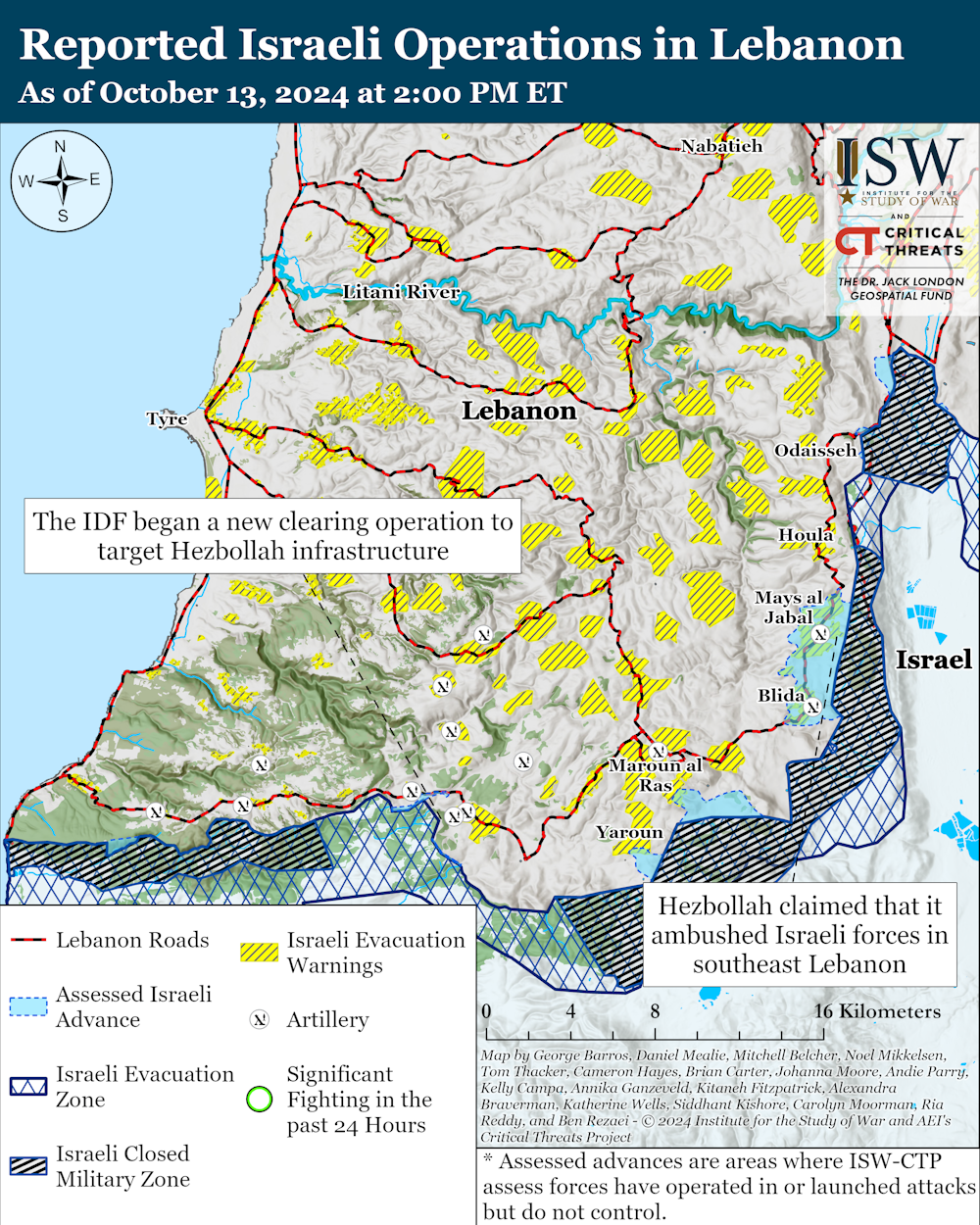
    Israel’s ground offensive in southern Lebanon, October 13 2024.
    Institute for the Study of War

    But there’s another possibility. During the Lebanese civil war, the IDF occupied a section of Lebanese land bordering Israel that was known as the “zone of security”. Its purpose was to serve as a buffer zone for northern Israel, initially designed to protect Israeli citizens from Palestinian militia, and later also from the Shia resistance groups Amal and Hezbollah.

    The Israeli request for Unifil to move five kilometres back from the blue line could mean Israel is considering reestablishing some kind of buffer zone. Several factors point to this being a possibility – although the IDF and the Israeli government may not be aligned on this issue as recent tensions suggest.

    First, the IDF has now deployed units from at least four divisions into Lebanon. The volume of troop numbers deployed is upwards of 15,000 suggesting this incursion is more than a limited operation.

    Second, 29 Unifil compounds lie along the blue line. Were they to be evacuated by the UN, there would be nothing to stop the IDF from moving in and developing them into their own strongholds. While UN positions would need reinforcement and protection equipment, they would nonetheless remain useful.

    Third, in 2006 the IDF tried to destroy Hezbollah from the air and deployed limited haphazard ground incursions. These tactics failed and the prevailing view may now be that the only way to guarantee the safe return of 65,000 Israelis to their homes in northern Israel is through an occupation.

    But unlike the previous occupation, where the IDF was aided by the SLA, Israel currently has no partner in Lebanon, and it is unlikely to find a willing accomplice among the Lebanese population to help them manage the security of a buffer zone. This means IDF troops would directly bear the brunt of attacks from resistance groups, and the northern Israeli villages would be unlikely to remain secure.

    The Netanyahu government’s continued use of military solutions to solve political problems has worrying implications for Israel, Lebanon and the Middle East as a whole. At this stage, Israel looks as if it might be settling back into a conflict that could become another “forever war”.

    Thus far, the tactics used by the IDF would imply they are not thinking ahead to “the day after” and the cost to Israel that would come with the prolonged occupation of a buffer zone.

    This article was written with assistance from John Molloy, lt. col. (rtd.) Irish Defence Forces and former senior Unifil political & civil affairs officer, 2008-2017.

    Chiara Ruffa receives funding from the Swedish Research Council, the Fulbright Commission and the European Commission.

    ref. IDF actions against UN peacekeepers suggest Israel may be considering occupying part of southern Lebanon – https://theconversation.com/idf-actions-against-un-peacekeepers-suggest-israel-may-be-considering-occupying-part-of-southern-lebanon-241297

    MIL OSI – Global Reports

  • MIL-OSI: Intelligence Community Veteran Michael Widener Joins Synergy ECP Board of Advisors

    Source: GlobeNewswire (MIL-OSI)

    COLUMBIA, Md., Oct. 15, 2024 (GLOBE NEWSWIRE) — Synergy ECP, a leading provider of mission critical, highly technical solutions for the Defense and Intelligence Communities, is excited to announce the appointment of Michael Widener to its Board of Advisors. Synergy ECP is a portfolio company of Falfurrias Management Partners.

    Michael Widener, a former Senior Intelligence Service executive at the Central Intelligence Agency and four-time Chief of Station/Base, brings decades of experience to Synergy ECP’s Board of Advisors through his leadership of historically large and complex CIA programs in Africa, Europe, the Middle East, and Southeast Asia. Michael also led CIA efforts related to understanding the impact of advanced computing, microelectronics, next-generation communications, and other emerging technologies on US national security by harnessing expertise from the US private sector and worldwide venture capital ecosystem to deliver new capabilities into the Intelligence Community.

    “We are honored to welcome Michael Widener to our Board of Advisors,” said Bruce Howard, CEO of Synergy ECP. “Michael’s extensive experience at the intersection of emerging technologies, the private sector, and policymakers will support Synergy ECP’s efforts as we deliver technical solutions in areas such as signals intelligence, cyber operations, critical infrastructure resiliency, zero trust methodologies, and next generation 5G capabilities. Additionally, his mission understanding, developed through years of leading human intelligence and covert action programs, will ensure Synergy ECP stays on the leading edge of emerging technical requirements within our intelligence community.”

    “I am honored to join the Board of Advisors at Synergy ECP,” said Mr. Widener. “Our Intelligence Community faces significant challenges in understanding the national security implications of emerging technology areas such as artificial intelligence, quantum computing, and cyber. I look forward to supporting Synergy ECP as they advance on their mission of solving the toughest national security challenges for tip of the spear customers leading our Nation’s cyber and signals intelligence operations.”

    About Synergy ECP
    Founded in 2007 and headquartered in Columbia, Maryland, Synergy ECP is a leading provider of cybersecurity, software and systems engineering and IT services to the U.S. intelligence and defense communities. The company leverages its expertise in data transport solutions, software and systems engineering, and other solutions to deliver critical and innovative capabilities to high-level decision makers that enhance our nation’s security. For more information, visit http://www.synergyecp.com.

    The MIL Network

  • MIL-OSI Europe: Analysis: UN peacekeepers at risk in southern Lebanon

    Source: Universities – Science Po in English

    United Nations peacekeepers in southern Lebanon have reported a series of incidents over the past few days in which they have been endangered by Israeli Defense Forces (IDF) as Israel continues its incursion into southern Lebanon. From bearing witness to sheltering the local population, the UN Unifil mission has a vital role to play in Lebanon, but at what cost?

    Read the analysis by experts Chiara Ruffa, Professor in political science at Sciences Po Center for International Studies (CERI), and Vanessa Newby, Assistant Professor at the Institute of Security and Global Affairs at Leiden University, initially published by our partner The Conversation.

    United Nations peacekeepers in southern Lebanon have reported a series of incidents over the past few days in which they have been endangered by Israeli Defense Forces (IDF) as Israel continues its incursion into southern Lebanon.

    Two members of the United Nations Interim Force in Lebanon (Unifil) were wounded on October 10 when an Israeli tank fired its weapon at Unifil’s headquarters in the city of Naqoura. They are reported to be receiving treatment in hospital for minor injuries.

    This follows a series of other reports of IDF troops firing on other Unifil positions in recent days. A Unifil statement called on the IDF “and all actors to ensure the safety and security of UN personnel and property and to respect the inviolability of UN premises at all times”.

    For 44 years the presence of UN peacekeepers in southern Lebanon has provided a much-needed measure of predictability and stability on an international fault line that has the potential to trigger a larger war in the Middle East. Its value has often been to shine an international spotlight on events on the ground and to provide humanitarian assistance to the local population.

    The Unifil peacekeeping mission is in an area of southern Lebanon that stretches from the de facto Lebanese border with Israel about 18 miles northwards up to the Litani River. In violation of UN security council resolution 1701, which was issued in 2006 and was designed to bring to an end the 33-day war between Israel and Hezbollah, Israeli tanks have been advancing into southern Lebanon since September 30. Hezbollah is fighting back – and casualties are mounting.

    On October 5, the Israel Defense Forces (IDF) pressed the Unifil Irish Battalion, stationed south-east of Marun al-Ras, to leave its position to allow the IDF to proceed with their invasion. On October 6, Unifil force commander Lt. Gen. Aroldo Lázaro Sáenz denied the request. A Unifil statement said: “Peacekeepers remain in all positions and the UN flag continues to fly.”


    The IDF reportedly ceased their military operations in the area on October 8. This is most likely because their military goals have changed. The rapidly unfolding Israeli military action in Lebanon has now deployed an additional 15,000 troops. This raises questions about the “limited” nature of the IDF’s incursion and its goals.

    Since 1978, Unifil has provided medical services, electricity, generators, language courses, financial aid and water to local communities. The peacekeeping force has also helped to clear millions of square meters of land from anti-personal mines and cluster bombs, releasing farmland for cultivation and preventing injuries or deaths since the 2006 war.

    In 2006, the Unifil mission adopted a new mandate under UN Resolution 1701. Like all newer UN peacekeeping mandates, it contained a protection of civilians clause which authorises Unifil to “protect civilians under imminent threat of physical violence”.

    Israel contends that Hezbollah missile attacks into northern Israel are an indication that Unifil has never fully implemented 1701 – hence the need to invade and destroy the militant group. But protection of civilians is central to Unifil’s mandate. While the IDF claims it is targeting Hezbollah’s military infrastructure and leadership, thousands of civilian lives in southern Lebanon remain at risk.

    It has recently been reported that more than 2,000 civilians have died in the latest Israeli incursion, with more than 9,000 injured and over 608,000 displaced. So, implementation of this protection clause has never been more important.

    Unifil must not become collateral damage

    Unifil’s ability to protect civilians during Israeli incursions has often been challenged because the IDF refused to guarantee the safety of fleeing civilians, either in convoys out of the villages, or in UN compounds.

    The most notorious incident was the Qana incident of 1996, when 106 civilians died while sheltering in the Fijian UN compound. In July 2006, the IDF used a precision guided aerial bomb on a Unifil post. The attack killed four international unarmed military observers working under Unifil operational control, despite repeated verbal warnings from Unifil headquarters to avoid the post. The IDF has also damaged Unifil positions in times of peace. In January 2005 an unarmed French UN observer was killed by IDF tank fire. In January 2015 IDF artillery killed a Spanish peacekeeper.

    So the challenge for Unifil has always been that if they allow civilians to take shelter in their compounds, they risk becoming part of the IDF’s collateral damage.

    Similarly, Hezbollah is also no friend of Unifil. In December 2022, Hezbollah supporters killed an Irish peacekeeper who ventured accidentally into a village just outside the area of operation.

    International witness

    Despite these challenges, Unifil still has a powerful role to play in southern Lebanon. As the fog of war engulfs all the protagonists, Unifil has the ability to bring the world’s attention to the current conflict which may help constrain the parties. It is critical at this time to have an international force bear witness to events on the ground and provide basic humanitarian assistance, monitor and report potential violations and guarantee shelter to the local population whenever possible to help the displaced people that remain within the Unifil area of operation.

    On October 7, the US State Department warned the IDF that it did not want to see military action taken against Unifil or for the peacekeepers to be put in danger in any way. This warning is welcome given the recent disregard for the UN demonstrated by Israel’s prime minister, Benjamin Netanyahu. who, when speaking to the UN general assembly on September 27, labelled the UN “contemptible in the eyes of decent people everywhere”. On October 2, the Israeli government barred UN secretary general António Guterres from entering Israel.

    Israel’s allies must increase the pressure for the IDF to allow Unifil to exercise the protection of civilians clause contained in its mandate. This would mean allowing the peacekeeping force the freedom of movement in south Lebanon to facilitate the delivery of humanitarian aid. The IDF must also guarantee the safety of civilians escaping with Unifil’s assistance from the villages. And the IDF must allow Unifil to establish safe zones for civilians trapped in the conflict, to compensate for the absence of air raid shelters and bunkers in Lebanon.

    While Unifil may not be able to prevent the bloodshed, for now it can continue help to stem the flow, just as it always has.

    MIL OSI Europe News

  • MIL-OSI China: Chinese medical peacekeepers to Lebanon complete emergency defense drill 2024-10-14 20:27:33 Recently, the 22nd Chinese Peacekeeping Level-1+ Hospital to the UNIFIL successfully completed the “Blue Porcupine 2024” emergency defense drill organized by the UNIFIL Sector East amid the ongoing conflicts in the mission area.

    Source: People’s Republic of China – Ministry of National Defense

      By Zeng Dele, Cheng Lu and Zhuang Xiaohao

      BEIRUT, Oct. 15 — Recently, the 22nd Chinese Peacekeeping Level-1+ Hospital to the United Nations Interim Force in Lebanon (UNIFIL) successfully completed the “Blue Porcupine 2024” emergency defense drill organized by the UNIFIL Sector East amid the ongoing conflicts in the mission area. The drill has examined and enhanced the emergency response capabilities of the Chinese peacekeeping medical contingent.

      After the drill began, the Chinese peacekeepers immediately put on their protective gear. The emergency combat team quickly collected weapons and ammunition, occupied a favorable position and stayed alert to the surrounding situation, while the rest of the personnel went to the designated bunker on standby.

      During the drill, the Chinese peacekeepers conducted medical treatment training. They provided emergency treatment for the wounded and then transferred them to the resuscitation room for fluid replacement and anti-shock therapy while monitoring the vital signs all the time.

      The UNIFIL Sector East sent special inspectors to verify the personnel composition, weapons and equipment, medical supplies and daily necessities in the two bunkers of the Chinese peacekeeping medical contingent. The inspectors used the communication facilities in the bunker to communicate with the UNIFIL Sector East and reported that the Chinese peacekeeping contingent fully met the exercise standards.

      In addition, the Chinese medical contingent conducted combat rescue knowledge and skills training for peacekeeping detachments and military observers from multiple countries, with a focus on several key subjects such as battlefield triage, spinal injury rescue, bleeding control, bandaging and fixation, airway management and cardiopulmonary resuscitation, in a bid to help friendly peacekeeping forces and military observers master the basic operational methods of self-rescue and mutual rescue.

    loading…

    MIL OSI China News

  • MIL-OSI United Kingdom: Finding Future Advanced Electronics and Electromechanical Devices

    Source: United Kingdom – Executive Government & Departments

    DASA and AWE seek novel technologies in the space domain to enhance the UK’s Defence and Commercial Space Systems resilience and reliability

    • DASA has launched a new Themed Competition: AWE – Advanced Electronics and Electromechanical Devices
    • This competition is funded by AWE
    • The total possible funding available for Phase 1 of this competition is £4 million across two years (including VAT)
    • Competition closes midday on Tuesday 10th December 2024 (GMT)

    The Defence and Security Accelerator (DASA) is pleased to launch a new Themed Competition called AWE – Advanced Electronics and Electromechanical Devices. DASA, in conjunction with AWE, is seeking innovative ideas to approach the following four challenge areas in novel ways:

    1. Power and data transfer across closed metal barriers.
    2. Robust semi-conductor switching for high-voltage applications.
    3. Low delta-T thermo-electric generation.
    4. Low drift inertial sensors.

    Read the full competition document to learn more.

    Key dates and funding

    The total possible funding available for Phase 1 of this competition is £4 million across two years (including VAT). A number of proposals may be funded.

    The deadline to submit a proposal is midday on Tuesday 10th of December 2024 (GMT). Submit via the DASA Online Submission Service for which you will require an account.

    Do you have a relevant solution? Read the full competition document and submit a proposal.

    Background

    The space domain has been identified by the National Protective Security Authority (NPSA) as one of the UK’s critical national infrastructure sectors. The need to increase and assure resilience and reliability of operation, particularly within the space domain in times of tension, is self-evident. Many technology developments are accelerated from the defence sector into the commercial sector. AWE is interested in further enhancing UK-sovereign, resilient, demonstrable capabilities for the space and air domains. Maintaining and developing a UK-sovereign capability is critical to the UK security and prosperity.

    Sourcing and supporting innovation is crucially important to the security of our nation. This competition represents the next step in DASA’s collaboration with AWE and we look forward to seeing what novel innovations the competition finds to address AWE’s challenges in the space domain.

    Anita Friend, Head of DASA

    This competition will enhance AWE’s capability in UK defence, security and commercial air and space domains, helping to keep our nation safe while investing in UK business.

    Lucy, Group Leader Engineering at AWE

    Learn more about the competition and submit a proposal here.

    Supporting events

    Launch Webinar –

    A dial-in session on Tuesday 22 October, providing further detail on the problem space and a chance to ask questions in an open forum. If you would like to participate, please register on the Eventbrite page here.

    1-2-1 –

    A series of 15 minute one-to-one teleconference sessions across Monday 28 and Tuesday 29 October, giving you the opportunity to ask specific questions. Booking is on a first come first served basis. If you would like to participate, please register on the relevant Eventbrite page linked below:

    Book for Monday 28 October

    Book for Tuesday 29 October

    Submit a proposal

    We want novel ideas to benefit end-users working in UK Defence, Security and Commercial air and space domains. If you can provide this, submit a proposal to this competition.

    Updates to this page

    Published 15 October 2024

    MIL OSI United Kingdom

  • MIL-OSI United Kingdom: Israel Defence Forces’ attacks on UNIFIL bases: statement by foreign ministers of France, Germany, Italy and the UK

    Source: United Kingdom – Executive Government & Departments 3

    Foreign ministers of France, Germany, Italy and the UK gave a joint statement on attacks by the Israel Defence Forces against UNIFIL bases.

    Joint statment:

    We, the Foreign Ministers of France, Germany, Italy and the United Kingdom express our deep concern in the wake of recent attacks by IDF on UNIFIL bases, which have left several peacekeepers injured. These attacks must stop immediately. We condemn all threats to UNIFIL’s security.

    Any deliberate attack against UNIFIL goes against international humanitarian law and United Nations Security Council Resolution 1701. The protection of peacekeepers is incumbent upon all parties to a conflict.

    We call on Israel and all parties to uphold their obligations to ensure the safety and security of UNIFIL personnel at all times and to allow UNIFIL to continue carrying out its mandate. We reaffirm the essential stabilizing role played by UNIFIL in southern Lebanon. We underscore the importance of the United Nations in resolving armed conflict and mitigating the humanitarian impact.

    Media enquiries

    Email newsdesk@fcdo.gov.uk

    Telephone 020 7008 3100

    Contact the FCDO Communication Team via email (monitored 24 hours a day) in the first instance, and we will respond as soon as possible.

    Updates to this page

    Published 14 October 2024

    MIL OSI United Kingdom

  • MIL-OSI Video: Lebanon: UNIFIL would stay in all its position – Media Stakeout | United Nations

    Source: United Nations (Video News)

    Informal comments to the media by Jean-Pierre Lacroix, Under-Secretary-General for Peace Operations, on the situation in Lebanon.

    —————————-

    Under-Secretary-General for Peace Operations, Jean-Pierre Lacroix told reporters today (14 Oct) after the Security Council closed consultations in New York City, “the decision was made that UNIFIL would currently stay in all its position, in spite of the calls that were made by the Israeli Defense Forces to vacate the position that are in the vicinity of the Blue Line. I want to emphasize that this decision still remains.”

    The Under-Secretary-General emphasized ongoing communication efforts. He said, “the liaison mechanism continues to work,” adding that he would be meeting with the Israeli Permanent Representative on Tuesday (15 Oct) for further discussions.

    Lacroix also underscored the importance of maintaining open routes for UNIFIL’s operational needs. He said, “the movements that need to be carried out by UNIFIL with the purpose of resupplying position, with the purpose of supporting the civilian population, those movements need to be deconflicted, and they need to be also cleared by the parties, including the IDF.”

    Despite security concerns Lacroix reaffirmed the mission’s commitment to peacekeeping in southern Lebanon. He appealed to all parties saying, “our main call to all the parties is to respect their international obligation when it comes to protecting the safety and security of peacekeepers.”

    Lacroix reiterated UNIFIL’s mandate, which is to aid in the implementation of UN Security Council Resolution 1701. He said, “it’s for the parties to implement resolution 1701. UNIFIL are not mandated to implement, and certainly not to enforce, resolution 1701.”

    https://www.youtube.com/watch?v=v3i8EtN-6UI

    MIL OSI Video

  • MIL-OSI Economics: Thales radios successfully tested by the German Armed Forces to be deployed within the NATO enhanced Forward Presence

    Source: Thales Group

    Headline: Thales radios successfully tested by the German Armed Forces to be deployed within the NATO enhanced Forward Presence

    • The German Armed Forces conducted operational tests with PR4G and SYNAPS-H Thales radios to demonstrate their suitability for the needs of the multinational Battalion Group deployed by NATO.
    • Within one year, Thales has successfully delivered to the German Armed Forces radio equipment for the NATO enhanced Forward Presence (eFP).
    • These 4-week operational tests demonstrated that Thales radios are interoperable and secure.
    @Thales

    Thales radios for use in NATO enhanced Forward Presence were tested in an intensive four-week operational trial under the direction of the Army Development Office. These tests were conducted with the participation of the Army Development Office, the Federal Office of Bundeswehr Equipment, Information Technology and In-Service Support (BAAINBw), the German Army’s “Test and Trial” teams and Dutch and French Armed Forces.

    The particular focus of the procurement was to provide modern, encrypted, electronic counter countermeasure (ECCM)-capable command and control radios for the multinational deployment of the enhanced Forward Presence, which can transmit voice in parallel with data and their own position.

    “During the four-week operational test, Thales PR4G and SYNAPS-H radios met the requirements so effectively that the system is deemed suitable for introduction into the German Armed Forces.. We are very pleased that there are no more obstacles for the operational use of the radios in Lithuania, where the deployed forces will have protected, modern radios.” added Christoph Ruffner, CEO and Country Director, Thales Deutschland.

    Although the soldiers had not received any training, only a short briefing, it was possible to establish operational readiness in under an hour..The radios also impressed with a stable radio network and in the range tests.

    The purpose of NATO enhanced Forward Presence is to strengthen its defensive and deterrent posture on Europe’s eastern flank. NATO battlegroups are deployed to the Baltic states of Estonia, Latvia and Lithuania as well as to Poland and led by the United Kingdom, Canada, Germany and the United States respectively.

    MIL OSI Economics

  • MIL-OSI Economics: KNDS selects Thales Power Systems Solution for the Leopard 2 A8

    Source: Thales Group

    Headline: KNDS selects Thales Power Systems Solution for the Leopard 2 A8

    • KNDS awarded Thales a contract to deliver compact, programable and scalable High-Power Solid-State Power Distribution Boards (SSPDB) for the Leopard 2 A8 platform.
    • The SSPDB developed by Thales is designed to provide overcurrent and short circuit protection, and to enable smart electrical power management of protected vehicles.
    • A first, short-term delivery of SSPDBs will already take place in Q3 2024, followed by several hundred units by 2027.

    In just a few months, KNDS and Thales engineering teams have jointly succeeded in adapting an SSPDB solution that meets the power management needs of the Leopard 2 A8. Thales will focus on making the High-Power SSPDB a successful product by concentrating on key performance areas of the SWaP (Size, Weight and Power) to meet the stringent and demanding power requirements.

    Rated up to 160A per channel and with integrated current, temperature and voltage sensing, the multi-channel SSPDBs are designed to protect against overcurrent and short circuits and offer the flexibility to use pre-programmed operating profiles or real-time selections to enable intelligent power management in a variety of mission scenarios.

    The first units will be integrated as early as Q3 2024. This time-critical collaboration demonstrates the ingenuity and agility of our two teams.

    Under the KNDS contract, Thales will build hundreds of SSPDBs by 2027, using customization, manufacturing and testing processes already in use for the Thales Power Systems product line.

    “With an expertise of more than 20 years, Thales is a global leader in the development and manufacture of Power Systems for protected vehicles. We are proud to have been awarded this contract by KNDS and are confident that this strong partnership will continue.” ​ Martin Bernhardsgrütter, Country Director, Thales Switzerland.

    About Thales

    Thales (Euronext Paris: HO) is a global leader in advanced technologies specialized in three business domains: Defence & Security, Aeronautics & Space, and Cybersecurity & Digital identity.

    It develops products and solutions that help make the world safer, greener and more inclusive.

    The Group invests close to €4 billion a year in Research & Development, particularly in key innovation areas such as AI, cybersecurity, quantum technologies, cloud technologies and 6G.

    Thales has close to 81,000 employees in 68 countries. In 2023, the Group generated sales of €18.4 billion.

    MIL OSI Economics

  • MIL-OSI United Kingdom: InsideAIR Podcast Episode 101: The Red Arrows Maple Hawk Tour of Canada15 Oct 2024

    Source: United Kingdom – Royal Air Force

    In the latest episode of InsideAIR, we catch up with the Red Arrows following their 6-week long ‘Maple Hawk’ tour of Canada.

    The RAF Waddington based team are celebrating their own 60th anniversary and were invited to help mark the Royal Canadian Air Force’s Centennial year. InsideAIR’s Flight Lieutenant McKinstry joined them behind the scenes.

    Listen to more episodes of Inside Air here.

    InsideAIR is produced for the Royal Air Force by RAF Media Reserves. Theme music by RAF Music Services.

    MIL OSI United Kingdom

  • MIL-OSI United Kingdom: RAF 60 Second Update09 Oct 2024

    Source: United Kingdom – Royal Air Force

    We’re back with our latest 60 Second Update, from 607 (County of Durham) Squadron, who received a new Standard alongside three other Royal Auxiliary Air Force Squadrons.

    In this episode:

    • Exercise Cobra Warrior, the RAF’s largest air exercise, sees 80 aircraft from six nations training together at RAF Waddington.
    • 617 Squadron Lightning jets embark on HMS Prince of Wales with the Royal Navy 809 Naval Air Squadron on Exercise Strike Warrior.
    • 501 (County of Gloucester), 504 (City of Nottingham), 603 (City of Edinburgh) and 607 (County of Durham) Squadrons receive their new Standards in a special ceremony at the Tower of London.

    Thanks for watching and see you next time!

    MIL OSI United Kingdom

  • MIL-OSI USA: Governor Newsom announces appointments 10.14.24

    Source: US State of California 2

    Oct 14, 2024

    SACRAMENTO – Governor Gavin Newsom today announced the following appointments:

    Joe Shea, of Los Angeles, has been appointed Assistant Secretary for Salton Sea Policy at the California Natural Resources Agency. Shea has served in several positions at the Office of Governor Gavin Newsom since 2019, including Deputy Cabinet Secretary since 2022, Assistant Cabinet Deputy, and Special Assistant to the Governor. He was a Special Consultant for the California Governor-elect Gavin Newsom Transition from 2018 to 2019. From 2017 to 2018, Shea held multiple positions with Newsom for California Governor 2018, including Southern California Field Director and Northern California Organizer. He earned a Bachelor of Arts degree in Public Policy from the University of Michigan. This position does not require Senate confirmation and the compensation is $168,000. Shea is a Democrat.

    Allegra Curiel, of Sacramento, has been appointed Deputy Director of Legislative Affairs at the California Department of Resources, Recycling, and Recovery (CalRecycle.) Curiel has been a Senior Policy Advocate at the California Council for Environmental and Economic Balance since 2023. She was a Policy Manager at Newlight Technologies Inc. from 2021 to 2023. Curiel held multiple positions at CalRecycle from 2017 to 2021, including Legislative Analyst from 2018 to 2021, Disaster Recovery Operations Analyst in 2018 and Executive Fellow with the Capital Fellows Program from 2017 to 2018. She earned a Bachelor of Arts degree in Political, Legal, and Economic Analysis from Mills College at Northeastern University. This position does not require Senate confirmation and the compensation is $135,036. Curiel is a Democrat.  

    Marybel Batjer, of Sacramento, has been appointed to the California Wildfire Safety Advisory Board. Batjer has been a Partner at California Strategies since 2021. She was President of the California Public Utilities Commission from 2019 to 2021. Batjer was Secretary of the California Government Operations Agency from 2013 to 2019. She was Vice President of Public Policy and Corporate Social Responsibility at Caesars Entertainment Inc. from 2005 to 2013. Batjer was Cabinet Secretary in the Office of Governor Arnold Schwarzenegger from 2003 to 2004. She was Chief of Staff in the Office of Nevada Governor Kenny Guinn from 2000 to 2003. Batjer was Executive-in-Residence of Hotel Management and Casino Operations at the Mirage from 1998 to 2000. She was Undersecretary at the California Business, Transportation and Housing Agency from 1997 to 1998. Batjer was Chief Deputy Director at the California Department of Fair Employment and Housing from 1992 to 1997. She was a Special Assistant to the U.S. Secretary of the Navy from 1989 to 1993. Batjer was a National Security Affairs Special Assistant to President Ronald Regan from 1987 to 1989. She earned a Bachelor of Arts degree in Administration and Legal Processes from Mills College at Northeastern University. This position does not require Senate confirmation and there is no compensation. Batjer is a Democrat. 

    John Laird, of Santa Cruz, has been appointed to the Pacific States Marine Fisheries Commission. Laird has served as a California State Senator representing Senate District 17 since 2020. He served as Secretary of the California Natural Resources Agency from 2011 to 2019. Laird was a member of the California Integrated Waste Management Board from 2009 to 2010. He served as a California State Assemblymember representing Assembly District 27 from 2002 to 2008. Laird was Executive Director at the Santa Cruz AIDS Project from 1991 to 1993. He was a Budget Analyst for the County of Santa Cruz from 1974 to 2002. Laird was a Legislative Aide in the Office of Congressman Jerome Waldie from 1972 to 1974. He is a member of the California Democratic Party. Laird earned a Bachelor of Arts degree in Politics from the University of California, Santa Cruz. This position requires Senate confirmation and there is no compensation. Laird is a Democrat. 

    Recent news

    News What you need to know: New measure will help prevent price spikes that cost Californians upwards of $2 billion last year, giving the state more tools to require that petroleum refiners backfill supplies and plan ahead for maintenance. SACRAMENTO – Today,…

    News Welcome to The California Weekly, your Saturday morning recap of top stories and announcements you might have missed. News you may have missed1. BOOSTING PUBLIC TRANSPORTATIONThe state is awarding $206 million in NEW funding to expand clean bus and rail…

    News What you need to know: A court has rejected a legal maneuver to stop enforcement of California’s emergency regulations banning THC-containing hemp products that harm the public, especially children. The ban remains in effect after the court affirmed that the…

    MIL OSI USA News

  • MIL-OSI Asia-Pac: DG Paramesh Sivamani takes over as 26th Director General of Indian Coast Guard

    Source: Government of India (2)

    Posted On: 15 OCT 2024 11:13AM by PIB Delhi

    DG Paramesh Sivamani took over as the 26th Director General of the Indian Coast Guard (ICG). The Flag Officer, during his illustrious career spanning over three and a half decades, has served in various capacities in ashore and afloat appointments.


    DG Paramesh Sivamani specialises in Navigation & Direction and his sea commands include all major vessels of ICG which include Advanced Offshore Patrol Vessel ‘Samar’ & Offshore Patrol Vessel ‘Vishwast’. The Flag Officer was at the helm of Coast Guard Region (East), Coast Guard Region (West), Coast Guard Commander Eastern Seaboard). He is an alumnus of the National Defence College, New Delhi and Defence Services Staff College, Wellington.

    DG Paramesh Sivamani was elevated to the rank of Additional Director General in September 2022, and was subsequently posted at the Coast Guard Headquarters, New Delhi. He was given the additional charge of Director General Coast Guard in August 2024.

    During the period, many significant operations and exercises were accomplished that includes the seizure of drugs/narcotic substances and gold worth crores of rupees, rescue of mariners during severe cyclonic storms, joint exercises with the Foreign Coast Guards, anti-poaching operations, humanitarian assistance during cyclones/naturals calamities & Coastal Security exercises.

    The Flag Officer was conferred with the Tatrakshak Medal in 2014 and the President Tatrakshak Medal in 2019 for his illustrious service. He was also awarded the DG Coast Guard Commendation in 2012 and Flag Officer Commanding-in-Chief (East) Commendation in 2009.

    ****

    VK/SR/Savvy

    (Release ID: 2064900) Visitor Counter : 71

    MIL OSI Asia Pacific News

  • MIL-OSI China: Defense attachés from over 60 countries visit Chinese PLA Eastern Theater Command: Defense Spokesperson 2024-10-15 “At the invitation of China’s Ministry of National Defense, defense attachés from more than 60 countries went to the Chinese PLA Eastern Theater Command on October 14th for a five-day visit,” said Chinese Defense Spokesperson Senior Colonel Wu Qian at regular press briefing on Tuesday.

    Source: People’s Republic of China – Ministry of National Defense 2

      BEIJING, Oct. 15 — “At the invitation of China’s Ministry of National Defense, defense attachés from more than 60 countries including Pakistan, Singapore, South Africa, Jordan, the United Kingdom, Kazakhstan, Canada and Argentina went to the Chinese PLA Eastern Theater Command on October 14th for a five-day visit,” said Chinese Defense Spokesperson Senior Colonel Wu Qian at regular press briefing on Tuesday.

      According to the spokesperson, this visit will help them better understand the Chinese path to modernization, the great achievements made by the people’s military in the new era, and promote the friendly and cooperative relations between the Chinese military and the militaries of these countries.

    loading…

    MIL OSI China News

  • MIL-OSI China: US weapons sold to Taiwan costly and obsolete: Defense Spokesperson 2024-10-15 “Sky-high price and obsolete functions are two hallmarks of US arms sales to Taiwan,” said Senior Colonel Wu Qian when answering a media query at a press briefing on Tuesday.

    Source: People’s Republic of China – Ministry of National Defense 2

      BEIJING, Oct. 15 — “Sky-high price and obsolete functions are two hallmarks of US arms sales to Taiwan. From mouldy bulletproof vests, expired ammunition, and expensive missiles and radars, we can see that the Americans only care about their own interests,” said Chinese Defense Spokesperson Senior Colonel Wu Qian when answering a media query at a press briefing on Tuesday.

      According to media reports, the US Government Accountability Office recently accused Raytheon of fraud in selling expensive weapons to Taiwan, which procured the Patriot missile system in 2013 and radar systems in 2017 from that company. A public opinion representative from the Kuomintang criticized the US arms dealers as fraudsters.

      The spokesperson noted that China firmly opposes the US provision of weapons to China’s Taiwan region and further pointed out what the reports revealed is only a tip of the iceberg. The Democratic Progressive Party Authorities have been doing their best to court their masters in the US to buy weapons, squandering hard-earned money of people in Taiwan. It is evident that what they bought are pieces of junk that only benefited corrupted officials and arms dealers. There are growing opposition and dissatisfaction from the local people.

      “‘Taiwan independence’ is a dead end and outsiders are never reliable. Those who try to rely on the US support for independence will only court their own destruction,” stressed the spokesperson.

    loading…

    MIL OSI China News

  • MIL-OSI China: Quad becomes US’s political tool to contain China and maintain hegemony: Defense Spokesperson 2024-10-15 “The so-called Quad mechanism has become a sheer political tool for the US to contain China and maintain its hegemony,” said Chinese Defense Spokesperson Senior Colonel Wu Qian at a press briefing on Tuesday.

    Source: People’s Republic of China – Ministry of National Defense 2

      BEIJING, Oct. 15 — “The so-called Quad mechanism has become a sheer political tool for the US to contain China and maintain its hegemony,” said Chinese Defense Spokesperson Senior Colonel Wu Qian at a press briefing on Tuesday.

      Naval forces from the US, Japan, India and Australia conducted Exercise Malabar in the Indian Ocean on October 8th. It is reported that this exercise is directed at China and can enhance the Quad mechanism among these four countries in security guarantee field.

      In response to a related query, the spokesperson said that China believes that security cooperation among relevant countries should not harm the interests of any third party or undermine regional peace and stability. The so-called Quad mechanism has become a sheer political tool for the US to contain China and maintain its hegemony.

      “We firmly oppose relevant parties to use China as an excuse to stir up bloc confrontation and escalate regional tensions. A small clique will not make any big difference,” said the spokesperson.

      He pointed out that the Asia-Pacific should be a grand stage where countries join hands to cooperate, rather than an arena for geopolitical competition. “We require relevant countries to give up their obsession with zero-sum mindset and put more efforts on safeguarding regional security, instead of doing the opposite.”

    loading…

    MIL OSI China News

  • MIL-OSI Canada: The Government of Canada Honours Mr. Floyd H. Prosser as a Hometown Hero

    Source: Government of Canada News

    The Government of Canada Honours Mr. Floyd H. Prosser as a Hometown Hero

    Saturday, October 12, 2024               Halifax, Nova Scotia                         Parks Canada

    The Government of Canada is committed to sharing the stories of the people, places, and events who have contributed to our country’s rich and diverse heritage.  

    Today, Darren Fisher, Member of Parliament for Dartmouth-Cole Harbour paid tribute to Mr. Floyd H. Prosser through Parks Canada’s Hometown Heroes program on behalf of the Honourable Steven Guilbeault, Minister of Environment and Climate Change and Minister responsible for Parks Canada. The ceremony was held in Halifax, Nova Scotia at the Halifax Citadel National Historic Site in the presence of dignitaries and family members.

    Mr. Floyd H. Prosser
    Born in 1920 in Elgin, New Brunswick, Floyd H. Prosser enlisted in the Canadian Army Active Service Force in 1941 in Moncton, New Brunswick. Transferred overseas, Prosser trained for 2 years with the tanks in England and Scotland before being sent to Italy in 1943. Prosser was present at many of the 1st Canadian Armoured Brigade’s famous battles and in addition to the tough enemy soldiers they were fighting, he and the other Canadian troops endured the extreme weather condition of hot summers and frigid winters. After leaving Italy, Prosser landed in France in March of 1945 when the 1st Canadian Armoured Brigade was sent to support the liberation of Europe. During his time away, he saw Winston Churchill, and King George VI in person as he stood on guard for inspection. In addition, he, along with other Canadian troops was blessed by the Pope when they arrived in Rome.

    He returned home to civilian life in 1946 after serving nearly 5 years away from home, working as an industrial electrician for Westinghouse Canada until his retirement in 1975. After retirement, he became actively involved with the Royal Canadian Legion and visited fellow veterans who were in the hospital.

    To mark the 80th anniversary of D-Day in 2024, Parks Canada is honoured to add Floyd H. Prosser to the Hometown Heroes program. This individual joins a growing list of Canadians who have been recognized for their contributions as strong community leaders who are in alignment with the Parks Canada mandate and its priorities, and for their efforts to help protect and promote natural and cultural heritage in Canada as part of the Hometown Heroes program. His story will be added to the Fortress Halifax: A City Shaped by Conflict exhibit at Halifax Citadel National Historic Site in a display dedicated entirely to Parks Canada Hometown Heroes from across the country.

                                                                                                                                        -30-

    MIL OSI Canada News

  • MIL-OSI New Zealand: Minister to attend cyber security, NATO meetings

    Source: New Zealand Government

    Minister Responsible for the GCSB and Minister of Defence Judith Collins will travel to Singapore and Brussels for Singapore International Cyber Week and the North Atlantic Treaty Organization (NATO) Defence Ministers’ Meeting. 

    New Zealand has been invited to attend the NATO meeting alongside representatives from the European Union and the Indo-Pacific 4 (IP4), which comprises New Zealand, Australia, Japan and the Republic of Korea. 

    “This is the first time IP4 Defence representatives will have the opportunity to exchange views with NATO Allies in the changing security dynamics in the Euro-Atlantic and Indo-Pacific regions, including in the context of Russia’s war of aggression against Ukraine and its implications for our region,” Ms Collins says.

    “I will be taking the opportunity to reiterate our unwavering support for the people of Ukraine as they fight against Russia’s illegal and unjustified war of aggression.

    “In a deteriorating global environment, New Zealand is committed to working with like-minded partners to uphold the international rules-based system that is fundamental to our security and prosperity.

    While in Brussels, Ms Collins will hold bilateral meetings with defence counterparts from NATO and the Indo-Pacific region, and will participate in a meeting of the Global Coalition to Defeat ISIS.                               

    Ms Collins will also meet Directors-General from European Commission agencies in the Space, and Science, Innovation and Technology portfolios while in Brussels.

    Before going to Brussels she will attend the Singapore International Cyber Week, the most established cyber security event in the Asia Pacific region and one which provides a vital chance to discuss global cyber security. She will also take part in the annual ASEAN Ministerial Meeting on Cyber Security Special Session with Dialogue Partners.

    “I am pleased to represent New Zealand at this important gathering and am looking forward to participating in a range of discussions on global cyber security issues,” Ms Collins says.

    “Cyber security is front of mind for many New Zealand businesses and I am committed to ensuring we are prepared and resilient in this area.”             

    Ms Collins will also meet private sector representatives to discuss cyber and technology security matters while in Singapore.

    She leaves New Zealand tomorrow and returns on 20 October. 

    MIL OSI New Zealand News

  • MIL-OSI USA: Biden-Harris Administration Assisting with Seven Major Disaster Declarations Across Southeast Following Helene and Milton

    Source: US Federal Emergency Management Agency

    Headline: Biden-Harris Administration Assisting with Seven Major Disaster Declarations Across Southeast Following Helene and Milton

    Biden-Harris Administration Assisting with Seven Major Disaster Declarations Across Southeast Following Helene and Milton

    WASHINGTON – Under the direction of FEMA Administrator Deanne Criswell, more than 10,000 federal employees are assisting with Helene and Milton response and recovery across the Southeast.

    Yesterday, President Joseph R. Biden approved a major disaster declaration for Florida following Hurricane Milton. Nearly 700 FEMA staff are in Florida to supplement local and state efforts in response to Helene and Milton.

    President Biden previously approved federal disaster assistance in six states affected by Helene. This opens up federal help for survivors in designated areas in Florida, Georgia North Carolina, South Carolina, Tennessee and Virginia. Survivors—who to date have been approved for over $441 million in federal disaster assistance for Helene—may apply for assistance in three ways: online by visiting disasterassistance.gov, by calling 800-621-3362 or using the FEMA App.

    Survivors may receive upfront funds to help with essential items like food, water, baby formula and other emergency supplies. Funds may also be available to repair storm-related damage to homes and personal property, as well as assistance to find a temporary place to stay. 

    These photos highlight response and recovery efforts across states impacted by Helene and Milton.

    View Original‘ data-align=”center” data-asset-link=”1″ data-entity-type=”emerald” data-image-style=”large” data-asset-type=”imageasset” data-asset-id=”56277″ src=”https://www.fema.gov/sites/default/files/styles/large/public/externals/b40ae70075d6eef90116e9e50b30a3a5.jpg?itok=cjrLWps1″ alt=”Caption: St. Lucie, Fla. (Oct. 11, 2024) – FEMA Administrator Criswell greets the local community after Hurricane Milton, meeting survivors where they are.” class=”image-style-large”>
    St. Lucie, Fla. (Oct. 11, 2024) – FEMA Administrator Criswell greets the local community after Hurricane Milton, meeting survivors where they are.
    View Original‘ data-align=”center” data-asset-link=”1″ data-entity-type=”emerald” data-image-style=”large” data-asset-type=”imageasset” data-asset-id=”56275″ src=”https://www.fema.gov/sites/default/files/styles/large/public/externals/e3e67b68db6e4b6560c7b6234606cbf8.jpg?itok=Bh48LpCg” alt=”Caption: St. Lucie, Fla. (Oct. 11, 2024) – FEMA Administrator Criswell greets the local community after Hurricane Milton, meeting survivors where they are.” class=”image-style-large”>
    St. Lucie, Fla. (Oct. 11, 2024) – FEMA Administrator Criswell greets the local community after Hurricane Milton, meeting survivors where they are.
    View Original‘ data-align=”center” data-asset-link=”1″ data-entity-type=”emerald” data-image-style=”large” data-asset-type=”imageasset” data-asset-id=”56274″ src=”https://www.fema.gov/sites/default/files/styles/large/public/externals/1f31274b2a7296cc25e9454dca75837f.jpg?itok=GB60-db9″ alt=”Caption: St. Lucie, Fla. (Oct. 11, 2024) – FEMA Administrator Criswell greets the local community after Hurricane Milton, meeting survivors where they are.” class=”image-style-large”>
    St. Lucie, Fla. (Oct. 11, 2024) – FEMA Administrator Criswell greets the local community after Hurricane Milton, meeting survivors where they are.
    CLEARWATER, Florida — FEMA Urban Search and Rescue Colorado Task Force One conducts wellness check after Hurricane Milton. (Source: FEMA)
    View Original‘ data-align=”center” data-asset-link=”1″ data-entity-type=”emerald” data-image-style=”large” data-asset-type=”imageasset” data-asset-id=”56231″ src=”https://www.fema.gov/sites/default/files/styles/large/public/externals/76466a4941ac4ee2d541f75f5f18c2e8.jpg?itok=7t8ApOIq” alt=”Caption: Clearwater, Fla. (Oct. 11, 2024) – FEMA Urban Search and Rescue Colorado Task Force One condcuts hasty searches after Hurricane Milton.” class=”image-style-large”>
    Clearwater, Fla. (Oct. 11, 2024) – FEMA Urban Search and Rescue Colorado Task Force One conducts searches after Hurricane Milton.
    ST. LUCIE COUNTY, Florida — Soldiers from the Florida and South Carolina National Guard distribute water, meals and sanitation kits to residents who were affected by Hurricane Milton (Source: U.S. Air National Guard)
    View Original‘ data-align=”center” data-asset-link=”1″ data-entity-type=”emerald” data-image-style=”large” data-asset-type=”imageasset” data-asset-id=”56204″ src=”https://www.fema.gov/sites/default/files/styles/large/public/externals/c8e797f53de269c47cee207170221624.jpg?itok=uW_6NQWT” alt=”Caption:

    Smyth County, Va. (Oct. 10, 2024) – A FEMA Disaster Survivor Assistance Specialist leaves a flyer with information on applying for disaster assistance after Hurricane Helene at a home in Smyth County, Va., on Oct. 10. 

    ” class=”image-style-large”>

    Smyth County, Va. (Oct. 10, 2024) – A FEMA Disaster Survivor Assistance Specialist leaves a flyer with information on applying for disaster assistance after Hurricane Helene at a home in Smyth County, Va., on Oct. 10. 
    View Original‘ data-align=”center” data-asset-link=”1″ data-entity-type=”emerald” data-image-style=”large” data-asset-type=”imageasset” data-asset-id=”56258″ src=”https://www.fema.gov/sites/default/files/styles/large/public/externals/1e1844aa868e55e33b024892f8fddbeb.jpg?itok=_AA9r7WJ” alt=”Caption: Douglas, Ga. (Oct. 11, 2024) – FEMA opened a Disaster Recovery Center to help those affected by Hurricane Helene register for aid.” class=”image-style-large”>
    Douglas, Ga. (Oct. 11, 2024) – FEMA opened a Disaster Recovery Center to help those affected by Hurricane Helene register for aid.
    View Original‘ data-align=”center” data-asset-link=”1″ data-entity-type=”emerald” data-image-style=”large” data-asset-type=”imageasset” data-asset-id=”56186″ src=”https://www.fema.gov/sites/default/files/styles/large/public/externals/596380e8a86ee6b20275798d6e28b641.jpg?itok=a3GzrKBF” alt=”Caption: Asheville, N.C. (Oct. 10, 2024) – FEMA Disaster Recovery Center is open to help survivors of Hurricane Helen.” class=”image-style-large”>
    Asheville, N.C. (Oct. 10, 2024) – FEMA Disaster Recovery Center is open to help survivors of Hurricane Helen.
    View Original‘ data-align=”center” data-asset-link=”1″ data-entity-type=”emerald” data-image-style=”large” data-asset-type=”imageasset” data-asset-id=”56266″ src=”https://www.fema.gov/sites/default/files/styles/large/public/externals/4f752822650cb861f9c38425311ac9ca.jpg?itok=422c_ur1″ alt=”Caption: Batesburg, SC (Oct. 11, 2024) – FEMA hosts a Disaster Survivor Assistance event at local factory to help employees register for assistance.” class=”image-style-large”>
    Batesburg, SC (Oct. 11, 2024) – FEMA hosts a Disaster Survivor Assistance event at local factory to help employees register for assistance.

     FEMA’s Disaster Multimedia Toolkit page provides graphics, social media copy and sample text in multiple languages. In addition, FEMA has set up a rumor control web page to reduce confusion about its role in the Helene response. Visit Hurricane Rumor Response.

    amy.ashbridge

    MIL OSI USA News

  • MIL-OSI Asia-Pac: Raksha Mantri Shri Rajnath Singh performs Shastra Pooja with troops at Sukna Military Station on the occasion of Dussehra

    Source: Government of India (2)

    Raksha Mantri Shri Rajnath Singh performs Shastra Pooja with troops at Sukna Military Station on the occasion of Dussehra

    Lauds soldiers for their vigilance & critical role in maintaining peace & stability along the borders

    “India has never attacked any country out of hatred or contempt, but if our interests are threatened, we will not hesitate to take a big step”

    Posted On: 12 OCT 2024 12:02PM by PIB Delhi

    Raksha Mantri Shri Rajnath Singh performed the traditional Shastra Pooja at the Sukna Military Station in West Bengal on October 12, 2024 on the auspicious occasion of Dussehra. This significant ceremony in the Indian Army symbolises the respect for weapons as the protectors of the nation’s sovereignty.

    Raksha Mantri initiated the rituals with Kalash Pooja, followed by the Shastra Pooja and Vahan Pooja. He also offered prayers to a range of modern military equipment, including state-of-the-art infantry, artillery and communication systems, mobility platforms, and drone systems. The event concluded with Raksha Mantri’s interaction with the troops.

    In his address, Shri Rajnath Singh commended the vigilance and critical role of the Armed Forces in maintaining peace & stability along the borders. He stated that Dussehra symbolises the victory of good over evil, and the soldiers possess the same respect for human values.

    “India has never attacked any country out of hatred or contempt. We fight only when someone insults or tries to harm our integrity and sovereignty; when war is waged against religion, truth & human values. This is what we have inherited. We will continue to preserve this heritage. However, if our interests are threatened, we will not hesitate to take a big step. Shastra Pooja is a clear indication that if need be, the weapons/equipment will be used with full force,” Raksha Mantri said.

    The rituals, performed to seek blessings for strength, success & safety reaffirm the cultural and spiritual depth of Dussehra, underscoring the pivotal role of weapon systems in safeguarding the country. They symbolise the preparedness, resolve, and unwavering dedication of the Armed Forces to protect the nation. The ceremony highlighted the Indian Army’s blend of tradition and modernisation, with a focus on preserving India’s sovereignty and promoting indigenous defence systems & platforms.

    The event was attended by Chief of the Army Staff General Upendra Dwivedi, Defence Secretary-designate Shri RK Singh, General Officer Commanding-in-Chief, Eastern Command Lt Gen Ram Chander Tiwari, DG Border Roads Lt Gen Raghu Srinivasan, General Officer Commanding, Trishakti Corps Lt Gen Zubin A Minwalla and other senior officers.

    ****

    SR/Savvy

    (Release ID: 2064334) Visitor Counter : 70

    MIL OSI Asia Pacific News

  • MIL-OSI Asia-Pac: HARBOUR ACTIVITIES OF MALABAR- 2024

    Source: Government of India

    Posted On: 12 OCT 2024 2:30PM by PIB Delhi

    As part of the ongoing harbour activities during the Multilateral Maritime Exercise Malabar 2024, participating navies – India, Australia, Japan, and the United States – have been actively engaged in various collaborative events since 09 Oct 24, at Visakhapatnam, coordinated by the Eastern Naval Command. These activities include Key Leadership Engagement (KLE), Subject Matter Expert Exchange (SMEE), cross-deck visits, sports fixtures, and pre-sailing discussions, all aimed at enhancing maritime cooperation, building camaraderie, and fostering operational synergy.

    Key leadership engagement of the senior naval hierarchy has been a special feature of the exercise, with Vice Admiral Rajesh Pendharkar, Flag Officer Commanding-in-Chief (FOC-in-C), Eastern Naval Command, Admiral Stephen Koehler, Commander US Pacific Fleet, Vice Admiral Katsushi Omachi, Commander-in-Chief, Self-Defense Fleet, Japan, and Rear Admiral Chris Smith, Commander Australian Fleet, meeting to discuss ways to strengthen mutual naval interoperability and cooperation in the Indo-Pacific region, as well as the future of Malabar exercises.

    Further reinforcing this bond, the Subject Matter Expert Exchanges and cross-deck visits have provided valuable opportunities for the participating nations to exchange knowledge and best practices towards promoting deeper engagement and understanding. These interactions have highlighted the importance of collaboration to enhance maritime security and achieve shared goals in maritime operations.

    The crews from Australia, India, Japan and the United States participated in friendly sports fixtures, further reinforcing the camaraderie and bonhomie among the teams. From the seas to the fields, the spirit of teamwork and friendship embodied the theme of Stronger Together, exemplifying the spirit of Malabar 2024 beyond naval operations. The crews also enjoyed a memorable Indian dinner, with the rich flavors of Indian cuisine setting the stage for enhancing cultural familiarity between the navies.

    As the harbour phase of Malabar 2024 draws to a close, pre-sailing discussions have taken center stage, focusing on strategies to ensure maximum operational synergy during the upcoming sea phase in the Bay of Bengal, scheduled from 14 Oct 24. The multifaceted interactions at various levels have all been instrumental in cementing cooperation, sharing expertise, and enhancing maritime security.

    _______________________________________________________________

    VM/SKY                                                                                                          204/24

    (Release ID: 2064361) Visitor Counter : 70

    MIL OSI Asia Pacific News

  • MIL-OSI Asia-Pac: Raksha Mantri Shri Rajnath Singh virtually dedicates to the nation 75 BRO infrastructure projects, worth Rs 2,236 crore, across 11 States/UTs

    Source: Government of India

    Raksha Mantri Shri Rajnath Singh virtually dedicates to the nation 75 BRO infrastructure projects, worth Rs 2,236 crore, across 11 States/UTs

    Terms it as a testament to the Govt’s commitment to further strengthen border infrastructure, defence preparedness & ensure socio-economic progress

    “India will be one of the safest & strongest nations in the times to come”

    Posted On: 12 OCT 2024 1:28PM by PIB Delhi

    Raksha Mantri Shri Rajnath Singh, on October 12, 2024, virtually dedicated to the nation 75 infrastructure projects of Border Roads Organisation (BRO) at a cost of Rs 2,236 crore. These projects – 22 roads, 51 bridges & two others – are spread across 11 States/Union Territories. Nineteen (19) are in Jammu & Kashmir, 18 in Arunachal Pradesh, 11 in Ladakh, nine in Uttarakhand, six in Sikkim, five in Himachal Pradesh, two each in West Bengal & Rajasthan and one each in Nagaland, Mizoram and Andaman & Nicobar Islands.

    Raksha Mantri inaugurated the projects from the Headquarters, Trishakti Corps in Sukna, West Bengal. One of the main highlights was the inauguration of the Kupup-Sherathang Road in Sikkim which serves as a crucial link between Jawahar Lal Nehru Marg and Zuluk axis.


    In his address, Raksha Mantri termed the projects as a testament to the Government’s unwavering resolve to keep strengthening the border infrastructure and ensuring socio-economic progress of these areas. He added that these projects will go a long way in enhancing the defence preparedness of the country. Prime Minister Shri Narendra Modi’s vision of ‘Viksit Bharat by 2047’ can be realised through such infrastructure projects, he said.

    With the inauguration of these 75 projects, BRO has completed a total of 111 infrastructure projects in 2024 at an overall cost of Rs 3,751 crore. This includes 36 projects worth Rs 1,508 crore, such as the state-of-the-art Sela Tunnel in Arunachal Pradesh, inaugurated by the Prime Minister earlier this year. Last year, 125 infrastructure projects of BRO were dedicated to the nation at a cost of Rs 3,611 crore.

    Raksha Mantri commended the grit and determination of the BRO personnel for completing the projects in a time-bound manner even in most challenging terrains and harsh weather conditions, adding that the government, in its third term, aims to further bolster the border infrastructure with more promptness. Referring to the increased allocation of Rs 6,500 crore for BRO in Union Budget 2024-25, he expressed hope that it would not only contribute to strategic infrastructure development, but will also prove helpful in socio-economic progress in the border areas, including the North East region.


    Raksha Mantri pointed out that the governments before 2014 were of the view that the development of border areas can have an adverse impact as it may be used by the country’s adversaries. He emphasised that border infrastructure development has been the priority area of PM Modi-led Government ever since it came to power as these regions, especially the North-east, is crucial from the socio-economic & strategic perspectives. “In the last decade, we have built a vast network of roads from villages to cities, which has resulted in the country witnessing progress at an unprecedented pace,” he said.

    Shri Rajnath Singh assured the people that new dimensions will be added to the development of border areas. India will be one of the safest and strongest nations in the times to come, he said.

    Chief of the Army Staff General Upendra Dwivedi, Defence Secretary-designate Shri RK Singh, General Officer Commanding-in-Chief, Eastern Command Lt Gen Ram Chander Tiwari, DG Border Roads Lt Gen Raghu Srinivasan, General Officer Commanding, Trishakti Corps Lt Gen Zubin A Minwalla were present with Raksha Mantri during the virtual inauguration, while Sikkim Chief Minister Shri Prem Singh Tamang was at the main site in Sherathang.


    Governors of Sikkim, Arunachal Pradesh, Rajasthan, Himachal Pradesh, Nagaland and Mizoram; Lt Governors of Jammu and Kashmir & Ladakh; Chief Ministers of Arunachal Pradesh & Uttarakhand; Union Minister of State (Independent Charge) of Science & Technology and Earth Sciences & MoS in Prime Minister’s Office and Personnel & Public Grievances and MoS of Law & Justice and Parliamentary Affairs attended the event virtually.

    ******

    SR/Savvy/KB

    (Release ID: 2064340) Visitor Counter : 47

    MIL OSI Asia Pacific News

  • MIL-OSI Asia-Pac: Defence Minister Shri Rajnath Singh inaugurates 75 Infrastructure projects built by BRO worth Rs 2,236 crore

    Source: Government of India (2)

    Defence Minister Shri Rajnath Singh inaugurates 75 Infrastructure projects built by BRO worth Rs 2,236 crore

    These include 07 roads and 12 bridges constructed at the cost ofRs731.22 crore in Jammu and Kashmir

    Union Minister Dr. Jitendra Singh takes part in inaugural function virtually

    Posted On: 12 OCT 2024 3:53PM by PIB Delhi

    Defence Minister, Shri Rajnath Singh today virtually inaugurated and dedicated 75 BRO (Border Roads Organisation) road and bridge projects to the nation at a cost of Rs 2,236 crore.

    These include 7 road and 12 bridge projects in Jammu & Kashmir worth Rs 731.22 crore virtually today. Union Minister of State (Independent Charge) for Science and Technology, MoS (I/C) for Earth Sciences, MoS PMO, Department of Atomic Energy, Department of Space, Personnel, Public Grievances and Pensions, Dr. Jitendra Singh, who is also Lok Sabha MP from J&K also joined the inauguration function virtually.

    The J&K road projects are Bishnah-Kaulpur-Khojipur (Km 0.0 to 24.328) worth Rs.73.26crore, Basoli-Bani-Bhaderwah (Km 70.00 to 89.00) Rs.97.76 crore, Basoli-Bani-Bhaderwah (Km 89.00 to 102.00) Rs81.42 crore, Galhar-Sansari(Km 0 to 10) Rs.37.69 under Project Sampark of BRO. Bandipur-Gureizin Rs.230.54 crore, Mohura-Baaz Rs.134.99 and Tutmarigali-Kaiyan Bowl Rs24.35 crore under Project Beacon of BRO.

    In addition, 12 bridges at Sawan, Sanu, Naigarh, Channani, Nantoo, Korga, Sewa-II, Biyalu, Dersu, Nirunar, Gurai and Garjun were constructed at the cost of Rs 51.21 crore in different areas of J&K.

    Overall, these Projects have been constructed in 11 border States/UTs of the country, including Andaman and Nicobar Islands.

    The ceremony was organised by the Border Roads Organisation (BRO)at Sukna in West Bengal. The Defence Minister inaugurated 22 Roads, 51 Bridges and 02 other miscellaneous projects. These Infrastructure Projects have been constructed under challenging weather conditions at places with most inhospitable terrain.

    Speaking on the occasion, Shri Rajnath Singh lauded BRO’s commitment towards establishing connectivity in far-flung areas by ensuring timely completion of these roads & bridges. He mentioned that in the last five years BRO had completed 450 infrastructure projects with a cost of more than Rs16,000 crore and this year, in 2024 with these 75 infra projects BRO has dedicated a record 111 infrastructure projects to the Nation.

    The Defence Minister appreciated the feat of construction of these 75 infrastructure projects at such an expeditious pace during this year. He mentioned that such performance by the BRO is unprecedented and is a reflection of the grit and determination of the entire Border Roads Organisation.

    Shri Rajnath Singh also lauded BRO’s effort of always being at the forefront in constructing more than 40% of Roads in high altitude areas with hostile terrain, harsh weather, low Oxygen levels and extreme cold. Despite these challenges BRO remains committed towards its mission of Connecting Place Connecting People.

    ****

    NKR/DK

    (Release ID: 2064377) Visitor Counter : 46

    MIL OSI Asia Pacific News

  • MIL-OSI Asia-Pac: FIRST TRAINING SQUADRON CONCLUDES VISIT TO MUSCAT, OMAN

    Source: Government of India (2)

    Posted On: 12 OCT 2024 6:12PM by PIB Delhi

    Indian Naval Ships Tir and Shardul along with Indian Coast Guard Ship Veera of the First Training Squadron (1TS) concluded visit to Muscat, Oman on 09 Oct 24. During the four day visit, the Indian Navy engaged with Royal Navy of Oman on various fronts, forging deeper bonds and strengthening the Bridges of Friendship between two maritime nations.

    VAdm V Srinivas, Flag Officer Commanding-in-Chief, Southern Naval Command (FOCINC, South) along with Commanding Officers of visiting ships called on VAdm Abdullah Bin Khamis Bin Abdullah Al Raisi, Chief of Staff Sultan’s Armed Forces (COSSAF) and RAdm Saif bin Nasser bin Mohsen Al- Rahbi, Commander of Royal Navy of Oman (CRNO). The discussions were focused on enhancing defence cooperation through avenues of training exchanges, shared knowledge and joint training exercises. During the visit, FOCINC (South) emphasised the importance of growing strategic partnership, greater engagement & interoperability between the two Navies.

    The Indian Naval delegation visited Said Bin Sultan Naval Base and were conducted on a guided tour including ships, maintenance units and medical setup. The sea trainees of 1TS visited various facilities and simulators including Sports complex at Sultan Qaboos Naval Academy. The trainees had the opportunity to visit Fleet Maintenance Unit and troop carrier ship Al Naasir of Royal Navy of Oman. Personnel of Royal Navy of Oman visited ships of 1TS as part of cross deck visit and held interactions, exchanging best practices and fostering goodwill & camaraderie.

    In a school outreach event undertaken by 1TS, the young minds were provided glimpses of the role and capabilities of the Indian Navy. In another event, the Indian Naval Symphonic Band captivated the audience at Oman Avenues Mall showcasing a vibrant display of music transcending language and cultural boundaries. Mrs Vijaya Srinivas, President, Navy Welfare and Wellness Association (Southern Region) visited an Early Intervention Centre, A.B.L.E in Indian School Wadi Kabir. She interacted with the faculty & differently abled children and appreciated the school for their initiatives. During the port call, school children, members of the Indian Embassy at the Sultanate of Oman and the Indian diaspora visited the ships. Shri Amit Narang, Ambassador of India to the Sultanate of Oman, visited the ships of 1TS and engaged in an interactive session with the sea Trainees.

    A formal reception was hosted by VAdm V Srinivas, FOCINC (South) onboard ships of 1TS.  Shri Amit Narang, Ambassador of India to Sultanate of Oman and Cmde Ali Al Balushi, Asst Chief of Staff, Sultan’s Armed Forces (Admin and Logistics) attended the reception. The event was also attended by diplomats, Omani dignitaries and other esteemed guests.

    The visit of Indian Naval Ships to the Sultanate of Oman concluded on a high note, having significantly strengthened bonds and fostering deeper and long-lasting ties between the two seafaring nations.

    _______________________________________________________________

    VM/SKY                                                                                                         205/24

    (Release ID: 2064412) Visitor Counter : 46

    MIL OSI Asia Pacific News

  • MIL-OSI China: Hamas claims killing, wounding of Israeli soldiers in N. Gaza

    Source: China State Council Information Office

    The al-Qassam Brigades, the armed wing of Hamas, announced on Saturday that they had killed and injured members of a 15-person Israeli patrol by detonating a powerful explosive device in northern Gaza City.

    In a press statement, the Brigades said that their forces targeted the Israeli patrol as it attempted to raid a house west of the Jabalia camp in northern Gaza.

    Members of the patrol were either killed or injured, the statement said, without providing further details. The Israeli army has not yet commented on the incident.

    In separate statements, the Brigades claimed that their forces had shelled a gathering of Israeli troops east of the Jabalia camp with mortar fire, and targeted an Israeli Merkava tank with a missile in the Tawam area north of Gaza City.

    The Brigades did not mention the casualties of the two attacks.

    These developments came amid a large-scale operation by the Israeli army in Jabalia and surrounding areas for about a week, along with a blockade imposed on the residents there.

    On Oct. 6, the Israeli army’s spokesman Avichai Adraee announced that the Jabalia area had been “encircled.” He explained that the operation was based on prior intelligence indicating the presence of armed elements and infrastructure, along with efforts by Hamas to rebuild its militant capabilities.

    For its part, the Civil Defense Authority in Gaza warned on Saturday that 200,000 Palestinians in Jabalia face the risk of death either from Israeli shelling or from hunger and thirst, amid a land blockade that has been ongoing for the seventh consecutive day.

    Spokesman Mouhammed Bassil said that the Israeli army “has not allowed medical teams and civil defense personnel to obtain fuel and medical supplies, which negatively impacts the situation of the besieged citizens.”

    Bassil called on international organizations to fulfill their humanitarian duty to protect the residents of Jabalia in northern Gaza.

    Meanwhile, the World Food Program (WFP) warned that the escalating violence in northern Gaza is “having a disastrous impact on food security for thousands of Palestinian families,” noting that the main crossings into the north have been closed and no food aid has entered since Oct. 1.

    In a statement, the WFP said food distribution points, as well as kitchens and bakeries in northern Gaza, have been forced to shut down due to airstrikes, military ground operations and evacuation orders. The only functioning bakery in the area, supported by the WFP, caught fire after being hit by an explosive munition.

    MIL OSI China News

  • MIL-OSI USA: Una reunión familiar de la NASA por casualidad

    Source: NASA

    Al crecer en Puerto Rico, Yomayra Cruz-Díaz no imaginó que algún día trabajaría en la NASA. En la actualidad, se desempeña como coordinadora de proyectos técnicos en el Centro de Investigación Langley de la NASA en Virginia, apoyando a su Dirección de Investigación Aeronáutica.
    El puesto de Cruz-Díaz le requiere viajar para apoyar eventos de participación pública y recientemente apoyó la presencia de la NASA en una exhibición aérea, en San Diego, California, donde el puesto de la agencia presentó materiales STEM en español.
    Algo, o, mejor dicho, alguien, hizo que este evento fuera especialmente único para Cruz-Díaz: su hijo, Israel Martínez-Cruz, actualmente sirve en los Marines de los Estados Unidos y está destinado en la Estación Aérea del Cuerpo de Marines de Miramar.
    En un golpe de suerte, ambos trabajaban en el mismo evento para sus respectivos empleadores. Al vivir en lados opuestos del país, no se habían visto en persona durante casi un año. Con sorpresa y alegría, se abrazaron.
    Al crecer en un hogar puertorriqueño, las conversaciones sobre los valores fundamentales giraban en torno a la familia, dijo Martínez-Cruz. El recuerda haber visto a su madre trabajar en la NASA y sentirse inspirado por su ética de trabajo. Ese nivel de compromiso era hereditario.
    “Israel y yo compartiríamos el viaje”, ella dijo. “El me dejaba en Langley y luego seguía el camino a su escuela de mecánica aeronáutica”.
    Martínez-Cruz se desempeña como controlador de tránsito aéreo, trabajo que Cruz-Díaz conocía pero que nunca había visto en persona.

    MIL OSI USA News