Category: Natural Disasters

  • MIL-OSI USA: In Senate Floor Speech, Murray Rails Against Republican Bill That Will Rip Away Health Care, Nutrition Assistance, Abortion Access & Balloon National Debt to Fund Tax Cuts for Billionaires

    US Senate News:

    Source: United States Senator for Washington State Patty Murray
    In Washington state, at least 306,000 people will lose health care under Republican bill; 900,000 Washingtonians could see SNAP benefits reduced or eliminated; 14 rural hospitals will be at risk of closure
    ***VIDEO of Senator Murray’s full floor speech HERE***
    Washington, D.C. – Today, U.S. Senator Patty Murray (D-WA), Vice Chair of the Senate Appropriations Committee, took to the Senate floor to speak out forcefully against Republicans’ reconciliation bill—the One Big Beautiful Bill Act—which, as Murray detailed, will rip away health care from millions of Americans, shutter the doors of hospitals and health care clinics across the country, make the largest cuts to Medicaid and nutrition assistance in history, and blow up the national debt—all so Republicans can fund massive tax breaks for billionaires.
    Republicans’ 940-page bill, which they released in the dead of night, cuts more than $900 billion from Medicaid—$100 billion more than the House bill. That means about 17 million Americans will lose their health care, according to estimates from the nonpartisan Congressional Budget Office (CBO), and more than 300 rural hospitals and over 500 nursing homes could close because of the legislation. The legislation makes the largest cut to the Supplemental Nutrition Assistance Program (SNAP) in history and will rip away nutrition assistance entirely from more than 5 million Americans and shift tens of billions of dollars in costs to states. The legislation also increases the debt by nearly $4 trillion dollars—nearly a trillion more than the House bill. About two in three Americans oppose the bill.
    In Washington state, 1.95 million people rely on Apple Health, Washington state’s Medicaid program, and over 300,000 Washingtonians access coverage through the state’s Affordable Care Act marketplace (Washington Healthplanfinder). The Joint Economic Committee estimates that at least 306,312 people in Washington state would lose their health insurance under the Republican legislation—that includes 198,050 people who would be kicked off Medicaid and 108,262 people who would lose their coverage under the Affordable Care Act. Among other things, Republicans’ bill would institute work reporting requirements for Medicaid, which have been proven not to increase employment and just strip health care coverage from people who are already working or exempt—this would put more than 620,000 Washingtonians at risk of losing their health care coverage or having it delayed. Fourteen rural hospitals in Washington state would be at risk of closure under the Republican bill. The legislation also “defunds” Planned Parenthood for the next year, threatening the closure of up to 200 health centers across the country—90 percent of them in states where abortion is legal. 11 percent of Washington state residents rely on SNAP, and the Washington State Department of Social and Health Services estimated that more than 900,000 people across the state could their see SNAP benefits reduced or eliminated under the House bill—the Senate bill is just as extreme.
    Senator Murray’s full remarks, as delivered, are below and HERE:
    “I think it’s really important the discussion we had right now about the deficit and debt, but I want to talk a little bit more about this bill in general.
    “You know, recent KFF polling shows that this Republican Big, Ugly, Betrayal bill is overwhelmingly unpopular. In fact, this thing is more underwater than the Titanic.
    “Nearly two-in-three Americans view this bill unfavorably. That goes up to nearly three-in-four when they learn it will kick millions—millions—off their health insurance. And it goes up to nearly four-in-five when they learn it will choke off funding to their local hospital. In other words, the more the American people hear about what is actually in this Big, Ugly Betrayal bill, the more they dislike it.
    “So with that in mind, I want to be here today to say a little bit more about what is in the Republicans’ latest version. Spoiler alert: it is still big, it is still ugly—and it is an absolute betrayal of the people who sent us here to fight for them.
    “The Republican plan is still going to mean over 16 million people losing health care as patients get kicked off their ACA plans. Kids and struggling families will get kicked off Medicaid. Rural hospitals are going to forced to shut their doors.
    “The Republican plan is still going to mean more starving families. New red tape is going to cut people off from their SNAP benefits that they need to put food on the table, and it is going to take away kids’ school meals.
    “The Republican plan still rips away support from the people in this country who are struggling the most, to give away billions in tax breaks to billionaires who need help the least.
    “In short, this latest version of Republicans’ bill would still be one of the biggest transfers of wealth from the people at the bottom to the people at the top in our nation’s history.
    [Health Care]
    “When it comes to health care, this Republican abomination will cause millions of people to lose their insurance, and see their costs skyrocket in one way or another.
    “It will create mountains of new paperwork and bureaucratic barriers that are positively meant to kick people off their Medicaid and ACA coverage.
    “And there is new sabotage to the ACA health care markets, which will mean more people losing their affordable coverage. Meanwhile, there is nothing—a big, fat zero—when it comes to renewing the tax credits Democrats passed to lower your health care costs.
    “That’s right—while Republicans are showering their billionaire donors in new tax breaks, they will not lift a finger to extend health care tax credits that are saving millions of families thousands of dollars a year on health coverage.
    “Instead, they are going to make sure people lose health care coverage—including our seniors, people with disabilities, pregnant women, millions of patients who rely on Medicaid.
    “And let’s not forget, the cuts in their bill are going to shutter hospitals across the country, especially in our rural areas.
    “Do you have Medicaid? Medicare? Employer-sponsored-coverage? Regardless, Republicans have some pretty bad news for you—because it hardly matters what insurance you’re on when you don’t have a hospital to get care anymore!
    “In Washington state, we have fourteen rural hospitals that are fighting to survive and would likely close under this bill—mostly in areas represented by Republicans, I should add!
    “Not to mention, we have six rural labor and delivery units that could be forced to close their doors under this bill.
    “And you know what the Senate Republicans did? They made that problem worse! They put even more pressure on our rural hospitals!
    “I’m telling you, this betrayal is getting bigger and uglier by the day. And this cannot get lost: Republicans want to shut the doors of one of the biggest health care providers in the country.
    “They want to defund Planned Parenthood. That is wildly harmful and wildly unpopular.
    “It would shutter at least 200 health centers that provide a wide spectrum of care—including cancer screenings, pap smears, birth control for millions of women.
    [Nutrition]
    “And let’s not forget, Republicans are cutting nutrition assistance too.
    ‘This Big Ugly Betrayal would make one of the biggest cuts to SNAP in history. We are talking around a $200 billion dollar cut over the next ten years. Now it should be obvious, but that would be devastating for our country and for our kids’ future.
    “And yet, Republicans are not giving up on taking dinner off the table, taking school lunch off kids’ trays, all so they can shovel tax cuts at billionaires and wealthy corporations.
    “And it is worth underscoring, the new red tape in their bill is even targeted at some of our most vulnerable families! Because it expands work requirements to apply to seniors and parents with kids in school.
    “Mr. President, when my dad, a WWII veteran, got sick with Multiple Sclerosis, he lost his job. He lost his job. My mom was at home, 7 kids she was raising, my dad lost his job, and my mom had to spend some time getting some new skills so she could go back to work and take care of our family. You know what, during that time? We had to rely on food stamps in my family, to feed those seven kids in my family.
    “But under this Republican bill today—because neither of my parents had a job during those few months—my family would not be eligible for SNAP benefits. We would not have even gotten food on our table at the worst time in my family’s life. This is wrong.
    “Thanks to those food stamps, my family did get through that rough patch, and all seven of us kids grew up to give back to our communities—whether as a firefighter, a middle school teacher, or even here as a United States Senator.
    “So I can’t emphasize enough: Republicans want to cut families from SNAP and Medicaid—programs that give people a hand up in hard times—why? So they can give an enormous hand out to the richest people and biggest companies in the country.
    “Oh and, at the same time they are making it harder to afford groceries and health care, I should mention—they are also gutting energy investments in a completely chaotic way that is all but guaranteed to drive away jobs and drive up energy costs for all of American families.
    [Higher Education]
    “And at the same time, in this bill, they are giving billionaires billions of dollars, Republicans are going to give students the short end of the stick.
    “This big mess of a bill would tear away programs and protections that make it possible for many students to pursue a higher education: it eliminates GRAD PLUS loans, it cuts families off from Parent Plus loans, it punishes students who go into public service or a medical residency, and more.
    “Meanwhile, they are tearing down the guardrails—from gutting regulations that protect students whose universities commit fraud, to opening a Pandora’s box for Pell grants, with a new loophole that will let low-quality programs suck up our taxpayer dollars.
    “These changes are especially going to hurt students from low-income families, and first-generation college students, and our veterans.
    “Some of them will have no way to go to college when Republicans take their support away. Some will be driven into predatory private loans they can’t afford. And some will get lured into low-quality programs that take their money, waste taxpayer dollars, and leave the student worse off.
    “And if that wasn’t enough—if the Secretary of Education wanted to try and stop this kind of fraud, and protect students, Republicans will leave them about as much authority as a school hall monitor.
    “Because in this bill, Republicans prevent any Secretary of Education from making regulations that carry added benefits for borrowers.
    “And it hardly matters if that is a good impact—like saving students’ money, or protecting taxpayer dollars from fraud, or making higher education more accessible—Republicans are going to make problems worse, and make fixing them even harder.
    “Students in this country should be outraged.
    [National Debt]
    “And I want to be perfectly clear about something. If Republicans charge ahead with this big, awful, mess—which they seem intent on doing—they can kiss any last shred of credibility goodbye, as we just talked about, when it comes to pretending they care about balancing the budget or addressing the national debt.
    “The idea was already laughable—for the entirety of the 21st Century, the biggest driver of the national debt has been tax cuts that Republicans championed.
    “But now, as we just talked about, they want to put at least 4 trillion dollars—that is trillions, with a T—on the national credit card. Why? So they can shower the richest people on the planet with more money.
    “And then they’re pretending all the math works and it’s kind of easy-peasy if they only just, they can do it if they kick people off health care, or take enough meals away from kids, or close enough hospitals, or—better still—use some absurd accounting gimmick to pretend, to pretend that billions of dollars in new tax cuts for their billionaire donors actually just don’t cost anything.
    “Well I’ve got some bad news for Republicans—your math is terrible, and so is this bill. This thing is very expensive. And you don’t have to take my word for it.
    “Ask the nonpartisan Congressional Budget Office, which just said the latest version of this bill will add $4 trillion, “T,” trillion to the debt just over the next 10 years.
    “If Republicans want to ignore them, you can also ask the fiscal hawks at the Committee for a Responsible Federal Budget. They calculate that the House bill adds $5 trillion to our debt, when you include interest payments and the cost of making temporary provisions in this bill permanent. And we are told the Senate bill is even less fiscally responsible.
    “Everyone agrees: this thing is not beautiful, but it is recklessly big. And it won’t just increase the debt—it will blow it up!
    “Mr. President, this may very well be the most expensive bill in history. I say ‘may’ because Republicans are still planning changes, we have not yet gotten the final bill. They already cut out even more taxes for multinational corporations.
    “SNAP benefits? They’re still on the chopping block. Health care? Still on the chopping block. In fact, they want to cut Medicaid even more painfully.
    “We may not know how expensive the Republicans’ bill will be in the end, but we know who is paying for it. Paying for it is you, working families.
    [Blocked Provisions]
    “And it is important for people to know: as bad as this bill is, Republicans were trying to make it even worse.
    “Now, Democrats have been fighting them every step of the way, and we have notched a few important wins by challenging every single provision we possibly could under the Senate rules.
    “So I want to talk about some of the things Democrats were successful in striking out.
    “Because if Republicans had had their way, not only would this bill take away more food from our struggling families, or shutter even more hospitals, and kick even more people off their health insurance. It would have also sold off our public lands!
    “And instead of just slashing CFPB funding, it would have completely shuttered the doors of a very important federal watchdog that protects Americans from getting scammed.
    “If Republicans had had their way, this bill would make it easier to buy gun silencers, harder to get your earned income tax credit, or pay off your student loan, and effectively impossible to get insurance plans on the marketplace that cover abortion care.
    “If Republicans had had their way, this bill would have also given Trump more power to deny funding to our constituents on a whim, and less power for the courts to stop him.
    “We are talking about a whole smorgasbord of really awful, unpopular ideas and policies that would have hurt our families and weakened our democracy. Ideas that were this close to making it into this bill.
    “But Republicans did not have their way. Democrats have been fighting back at every single step. We got those provisions tossed in the shredder, and we are still doing our darndest to send the rest of the bill into the shredder as well.
    [Making People Heard]
    “Now let’s be clear, when we talk about how unpopular this bill is with the American people, the reason is simple: this bill polls like garbage, because it is garbage. That’s why it should go nowhere, except a trash bin.
    “Democrats are going to keep pushing back on this monstrosity with absolutely everything we’ve got, at every step we can.
    “We’re not going to stand by as Republicans shutter hospitals, so the richest people in the country can build another vacation home.
    “We are not going to sit around and let Republicans kick millions of people off of their insurance and raise working families’ premiums—so corporate executives can get a bigger bonus.
    “And we are not going to be silent as Republicans take food away from struggling families so they can help billionaires fuel up their private jets.
    “We are going to keep speaking up, we are going to keep pushing back, and we are going to make sure everyone—everyone—knows exactly what is going on here. This bill is deeply unpopular—that much is clear.
    “But if Republicans keep pushing for this disaster, buckle up, because we are only going to get louder and louder about how big this is, how ugly it is—and it is only going to get more unpopular with the folks back home as these provisions are enacted if this bill passes.
    “I’m pretty astounded by how far some Republicans are trying to stick their heads in the sand on this. One Republican Senator told their concerned constituents, and I quote, ‘We are all going to die.’
    “Maybe that’s a better name for the bill? At least it’s more honest. Because, when you take health care away from people, when you make it harder to get, when you make it harder to afford, when you close the only hospital for miles—yeah, you’re right, people will die.
    “You’d think my colleagues would show a bit more concern about that. Instead, that senator actually doubled down. And in a response video she filmed walking through a cemetery—I don’t know how you get out of touch that much to misunderstand this, but let me clear about something to our Republicans: whistling past the graveyard is a metaphor to stop ignoring dangers. It is not a literal messaging suggestion!
    “And if you thought Republicans couldn’t be any more dismissive to their own constituents, this week, another Republican Senator, who was speaking about people voicing their concerns about these Medicaid cuts, said they will, quote, people will ‘Get over it.’
    “Mr. President: I have news for every one of my Republican colleagues who is trying to deny the reality of this bill and pretend the fairytales they are telling themselves are true.
    “When someone’s local hospital closes, they don’t ‘get over it.’ When someone’s kid is kicked off health care, they do not ‘get over it.’
    “And Republicans don’t want to take my word for it, they can listen to the doctor I spoke with who warned, when patients go uninsured, they delay care and it increases costs for everyone. Instead of paying $10 for diabetic medication, we’ll pay $10,000 for an amputation.
    “Or, Republicans can actually read the countless letters I am getting from my constituents sharing their stories: ‘My dad is a double amputee, he relies on Medicaid,’ ‘Without Medicaid we couldn’t get my kids’ anti-seizure medication.’
    “Or, ‘I’m a full-time caregiver for my daughter with cerebral palsy’… or my son with spina bifida… or my elderly mother… and this bill threatens to kick them off the health care and supportive services they rely on to survive.
    “Or better yet, Republicans can go out and talk to their own constituents, because I have no doubt they will hear similar stories.
    “They will even come to you! Advocates have been here in D.C. all week. I’ve seen them in the halls. I’ve heard from them from my office!
    “And now Republicans can listen to the people across the country who are warning them about this bill. And they can do the right thing and abandon this effort, or they can keep ignoring them.
    “But make no mistake, in the end the American people will have their voices and their votes heard.
    “Because at the end of the day, this bill—this monstrosity of a bill—is all in the goal of a tax break for multi-billionaires and corporations. And the way they pay for it is by taking away your health care, and your nutrition—the things your families, or your neighbors, or people you know rely on. And that’s just wrong. It’s un-American. And we’re fighting back.”

    MIL OSI USA News

  • MIL-OSI China: Kane, Neves lead Bayern, PSG to Club World Cup quarters

    Source: People’s Republic of China – State Council News

    Bayern Munich and Paris Saint-Germain will meet in a tantalizing FIFA Club World Cup quarterfinal after winning their round-of-16 matches on Sunday.

    In Miami, Harry Kane struck twice as Bayern Munich progressed with a 4-2 victory over a spirited Flamengo while Paris Saint-Germain eliminated Lionel Messi’s Inter Miami with a 4-0 rout in Atlanta.

    Bayern went ahead early at Hard Rock Stadium courtesy of an Erick Pulgar own goal and Kane doubled the lead with a long-range effort after a turnover.

    Gerson reduced the deficit by rifling home from 15 yards before Leon Goretzka controlled a defensive clearance with his chest and thumped a 25-yard drive past Agustin Rossi.

    The Brazilian side continued to press and Jorginho converted from the penalty spot after a Michael Olise handball just before the hour.

    But the Bundesliga champions pulled away again through Kane, who slotted a low shot past Rossi after Kimmich’s perfectly weighted pass.

    “In the first 20 minutes we were playing well but the intensity of the game was ferocious,” Bayern manager Vincent Kompany said.

    “I’m thinking, ‘Okay, in this heat, against this opponent, is this going to carry on?’ To be fair, we grew into the game and I think it was a good game for the fans. We are really happy to go to the next round.”

    Kompany said his team would prioritize rest before turning its focus to Saturday’s clash with PSG in Atlanta.

    “The main thing is we have to rest now, recover from this game, use every single day that we’ve got to rebuild our energy,” the former Manchester City defender said.

    “What more do you want? Top sides playing each other on the biggest stage. We’ll be ready for that.”

    Earlier, Joao Neves scored twice as Paris Saint-Germain netted four first-half goals en route to a comprehensive win over Inter Miami.

    Portugal international Neves opened the scoring for the European champions by meeting a sumptuous free-kick from compatriot Vitinha to head home at the far post. Neves then combined with Fabian Ruiz for an easy tap-in after Sergio Busquets gave the ball away in front of his own box.

    Nothing went right for the MLS club and Tomas Aviles inadvertently chested the ball into his own net after Desire Doue’s cross from the right flank. Moroccan right-back Achraf Hakimi fired home a fourth goal after his initial attempt from eight yards rebounded off the bar.

    Eight-time Ballon d’Or winner Messi, playing against his former club, did his best to lift Inter Miami in the second half with a series of vintage dribbles and a near-miss with a header. But his team could do little more than limit the damage as PSG showed the gulf in quality between Europe’s elite and the MLS.

    “It’s a great feeling. I think we started the match almost perfectly, controlling play and creating a lot of chances,” PSG manager Luis Enrique said.

    “The second half was different. We had less energy and they could have scored a goal, but I’m happy with all the players, with the mentality, with the attitude. We need to improve, like always because that’s professional football, but I’m happy.”

    Inter Miami boss Javier Mascherano said he could not have asked for more from his players.

    “In terms of the tournament, my take is that we have accomplished the goals we set for ourselves,” the Argentine said. “We have met the expectations that were placed on us.

    “It’s difficult when it’s 4-0 and you know you don’t have much chance. You don’t expect to change the result but it was important to show a good image to the people. The players did really well in the second half, they tried to do their best, this is the way we want to play.”

    MIL OSI China News

  • MIL-Evening Report: Unsafe and unethical: bed shortages mean dementia patients with psychiatric symptoms are admitted to medical wards

    Source: The Conversation (Au and NZ) – By Cindy Towns, Senior Lecturer in General Medicine and Geriatrics, University of Otago

    Getty Images

    New Zealand’s mental health crisis is well documented in the government’s 2018 inquiry, He Ara Oranga, which shows one in five people experience mental illness or significant mental distress.

    However, an almost singular focus on care of young people obscures the psychiatric needs of older adults.

    Failure to account for these needs has resulted in physicians facing pressure to admit psychiatric patients to medical wards that are not designed or resourced to care for them. This compromises patient safety and rights as well as fundamental standards of care.

    Our new research highlights the clinical, ethical and legal consequences of this practice and calls for urgent action.

    Dementia includes psychiatric features

    The memory deficits of dementia are well known but the condition also includes psychiatric presentations. These are known collectively as the “behavioural and psychiatric symptoms of dementia” (BPSD). When severe, they can include intrusive behaviour, violence and inappropriate sexual conduct. Such patients require admission and specialist treatment.

    However, New Zealand has a severe shortage of psychiatric beds for older adults. Even more concerning is that despite well recognised demographic trends and clinical concerns, bed numbers have decreased over time rather than increased.

    Reports that Dunedin plans to slash the number of psycho-geriatric beds by 50% reflect a lack of government insight into the risks this large and growing patient cohort poses.

    Hospitals routinely expect medical wards to admit dementia patients presenting with BPSD when no psycho-geriatric bed is available. Yet it is impossible for staff on medical wards to adhere to even basic standards of care.

    Poor design

    A lack of single rooms means medical teams cannot provide the security and minimisation of light and noise people with dementia require. Single rooms need to be prioritised for transmissible infections, delirium and terminal care.

    Medical wards are also not designed for aggressive patients. People can enter and exit freely, potential weapons (scissors, for example) are accessible, there are no seclusion rooms or low-stimulus areas, and nursing stations are not secure.

    Medical staff are not trained in de-escalation or restraint and ward pharmacists are not specialised in the medications required to treat BPSD.

    Those presenting with physical or sexual violence also need dedicated security, well beyond what healthcare assistants on “patient watches” can provide. Most healthcare assistants are women, which creates a grossly inadequate level of safety when managing violent male patients.

    The experience of Wellington general medicine staff documents numerous assaults on nurses and intrusive and frightening behaviour. Staff have been punched, hit, bitten and threatened. One nurse was stabbed while attending to another patient in a multi-bed room.

    Admissions have included physically robust patients who have seriously assaulted family or carers. This includes one man who committed a fatal assault and another who was sexually aggressive and stabbed a family member.

    High rates of mixed-gender bedding in hospital wards raise the risk of harm. The United Kingdom banned hospitals from placing men and women in the same room in 2010. Yet despite concerns for patient safety, New Zealand has no prohibition on this practice.

    Poor policy

    By comparison, Australia proposed a risk stratification approach more than 20 years ago whereby severe dementia patients would be managed in secure units with dedicated security staff and specialist psycho-geriatric care.

    This model is used throughout Australia in policy and planning. In New Zealand, severe dementia is defaulted to medical wards even in cases where patients are presenting solely due to extreme violence.

    According to the Code of Health and Disability Services Consumers’ Rights, patients are entitled to an appropriate standard of care. Admitting someone with dementia to medical wards that cannot meet basic standards of care clearly breaches this right.

    BPSD admissions also significantly compromise the rights of other patients. The risks are again demonstrable rather than potential. International media reports have documented male dementia patients assaulting female patients in medical wards without the necessary security measures.

    Medical staff in New Zealand hospitals have also witnessed numerous incidents of intrusion and harassment as well as assaults of other patients by dementia patients inappropriately admitted to medical wards with BPSD.

    We should also recognise indirect impacts of people with severe dementia being admitted on medical wards. Many patients wait overnight for admission, increasing their risk for complications, and breaching rights to privacy and dignity.

    When psychiatric patients occupy medical beds, they contribute to admission delays, complications and rights breaches for medical patients awaiting beds.

    Urgent need for more psycho-geriatric beds

    Wellington general medicine teams have raised serious concerns about dementia admissions for many years. Yet there are no secure areas and no additional psycho-geriatric beds.

    We need to ask why the practice continues when harm is so obvious. The answer appears to be about cost. When physicians relent and admit psychiatric patients, the risks are high but the financial cost is low. The consequences are born by elderly and frail patients seldom able to advocate for themselves.

    Change relies on health leaders and funders caring about safety, rights and basic standards of care. Unfortunately, the Wellington experience and the decision to cut beds in Dunedin suggest change will not happen unless physicians consistently refuse the admission of psychiatric patients. But this is a morally distressing position to be put in.

    New Zealand must urgently address the shortage of psycho-geriatric beds. Until these are in place, temporary secure accommodation must be made available under the care of mental health specialists.

    Medical teams can no longer be expected to manage the mental health crisis as well as their own medical workloads. It is unsafe, unethical and untenable for all involved.

    Cindy Towns does not work for, consult, own shares in or receive funding from any company or organisation that would benefit from this article, and has disclosed no relevant affiliations beyond their academic appointment.

    ref. Unsafe and unethical: bed shortages mean dementia patients with psychiatric symptoms are admitted to medical wards – https://theconversation.com/unsafe-and-unethical-bed-shortages-mean-dementia-patients-with-psychiatric-symptoms-are-admitted-to-medical-wards-257634

    MIL OSI AnalysisEveningReport.nz

  • MIL-Evening Report: ER Report: A Roundup of Significant Articles on EveningReport.nz for June 30, 2025

    ER Report: Here is a summary of significant articles published on EveningReport.nz on June 30, 2025.

    Fiji’s Dr Prasad unveils $4.8b budget as deficit widens
    By Kaya Selby, RNZ Pacific journalist The Fiji government is spending big on this year’s budget. The country’s Deputy Prime Minister and Minister for Finance, Biman Prasad, unveiled a FJ$4.8 billion (about NZ$3.5 billion) spending package, complete with cost of living measures and fiscal stimulus, to the Fijian Parliament on Friday. This is about F$280

    Cities are heating up the planet – how they can do more to fight climate change
    Source: The Conversation (Au and NZ) – By Anna Hurlimann, Associate Professor in Urban Planning, The University of Melbourne Quality Stock Arts/Shutterstock Cities have a central role to play tackling climate change. They contribute 67–72% of the greenhouse gas emissions which are heating up the planet. At the same time, cities are increasingly at risk

    Tahiti prepares for its first Matari’i public holiday
    RNZ Te Manu Korihi Tahiti will mark Matari’i as a national public holiday for the first time in November, following in the footsteps of Matariki in Aotearoa New Zealand. Matari’i refers to the same star cluster as Matariki. And for Tahitians, November 20 will mark the start of Matari’i i ni’a — the “season of

    Scientists look to black holes to know exactly where we are in the Universe. But phones and wifi are blocking the view
    Source: The Conversation (Au and NZ) – By Lucia McCallum, Senior Scientist in Geodesy, University of Tasmania ESA / Hubble / L. Calçada (ESO), CC BY The scientists who precisely measure the position of Earth are in a bit of trouble. Their measurements are essential for the satellites we use for navigation, communication and Earth

    Could we live with a nuclear-armed Iran? Reluctantly, yes
    Source: The Conversation (Au and NZ) – By Benjamin Zala, Senior Lecturer, Politics & International Relations, Monash University As the ceasefire between Israel and Iran seems to be holding for now, it is important to reflect on whether this whole episode was worth the risks. Wider escalation was (and remains) possible, and we do not

    How to reform the NDIS and better support disabled people who don’t qualify for it
    Source: The Conversation (Au and NZ) – By Sam Bennett, Disability Program Director, Grattan Institute Australia is spending more than ever on disability services – and yet many people with disability still aren’t receiving the support they need. Since the National Disability Insurance Scheme (NDIS) began in 2013, it has transformed the lives of hundreds

    Mr Smith or Gary? Why some teachers ask students to call them by their first name
    Source: The Conversation (Au and NZ) – By Nicole Brownlie, Lecturer in Education, University of Southern Queensland Johnny Greig/ Getty Images When you went to school, did you call your teacher Mrs, Ms or Mr, followed by their surname? Perhaps you even called them Sir or Miss. The tradition of addressing teachers in a formal

    NZ cities are getting hotter: 5 things councils can do now to keep us cooler when summer comes
    Source: The Conversation (Au and NZ) – By Timothy Welch, Senior Lecturer in Urban Planning, University of Auckland, Waipapa Taumata Rau Getty Images Stand on any car park on a sunny day in February and the heat will radiate through your shoes. At 30°C air temperature, that asphalt hits 50–55°C – hot enough to cause

    Murdoch’s News Corp has moved into the mortgage business. Where are the regulators?
    Source: The Conversation (Au and NZ) – By Roberta Esbitt, Associate, RMIT University If you want to advertise a house online in Australia, you don’t have many options. Just two companies dominate the market. Australia’s largest property listings platform, realestate.com.au, belongs to digital media company REA Group, which is majority-owned by Rupert Murdoch’s US-based media

    Clark warns in new Pacific book renewed nuclear tensions pose ‘existential threat to humanity’
    Asia Pacific Report Former New Zealand prime minister Helen Clark has warned the country needs to maintain its nuclear-free policy as a “fundamental tenet” of its independent foreign policy in the face of gathering global storm clouds. Writing in a new book being published next week, she says “nuclear war is an existential threat to

    ‘Bridge for peace – not more bombs,’ say CNMI Gaza protesters
    By Bryan Manabat in Saipan Advocacy groups in the Commonwealth of the Northern Mariana Islands (CNMI) disrupted the US Department of Defense’s public meeting this week, which tackled proposed military training plans on Tinian, voicing strong opposition to further militarisation in the Marianas. Members of the Marianas for Palestine, Prutehi Guahan and Commonwealth670 burst into

    Why manufacturing consent for war with Iran failed this time
    COMMENTARY: By Ahmad Ibsais On June 22, American warplanes crossed into Iranian airspace and dropped 14 massive bombs. The attack was not in response to a provocation; it came on the heels of illegal Israeli aggression that took the lives of more than 600 Iranians. This was a return to something familiar and well-practised: an

    A return to Nature.
    Headline: A return to Nature. – 36th Parallel Assessments Thomas Hobbes wrote his seminal work Leviathan in 1651. In it he describes the world system as it was then as being in “a state of nature,” something that some have interpreted as anarchy. However, anarchy has order and purpose. It is not chaos. In fact,

    MIL OSI AnalysisEveningReport.nz

  • MIL-OSI China: 21 Palestinians killed by Israeli army across Gaza

    Source: People’s Republic of China – State Council News

    Palestinians are seen near a site of an Israeli airstrike in Gaza City, on June 27, 2025. [Photo/Xinhua]

    At least 21 Palestinians were killed on Sunday in Israeli airstrikes and gunfire across the Gaza Strip, Gaza’s civil defense said, as the Israeli army ordered the evacuation of wide areas in Gaza City and northern parts of the enclave amid escalating military operations.

    According to Mahmoud Basal, spokesperson for the civil defense in Gaza, Israeli warplanes struck residential houses and tents sheltering displaced people in various areas of the enclave, killing at least 17 people, including women and children. Dozens of others were injured, some critically.

    Basal told Xinhua that four other Palestinians were killed while searching for food near the U.S.-backed aid distribution center in the Shakoush area, north of Rafah in southern Gaza.

    There was no immediate comment from the Israeli army on these incidents.

    Munir al-Bursh, director general of Gaza’s health authorities, told Xinhua on Sunday the Israeli army has intensified its attacks over the past 24 hours, targeting residential areas and shelter centers.

    “We are witnessing daily casualties and a worsening health crisis. Artillery fire is dispersing crowds waiting for aid,” al-Bursh said, noting that most injuries were to the head and chest.

    Gaza’s health authorities warned that the humanitarian and medical situation has reached catastrophic levels due to the continued blockade that restricts the entry of emergency medical supplies.

    Meanwhile, local sources told Xinhua that Israeli artillery shelled the eastern and southern outskirts of Gaza City, Jabalia in the north, and Khan Younis in the south, amid fierce fighting with Palestinian armed groups.

    Al-Qassam Brigades, the military wing of Hamas, said in a press statement on Sunday that its fighters had targeted an Israeli D9 bulldozer with a Yasin 105 missile east of Khan Younis, causing it to catch fire.

    The group also claimed to have shelled Israeli army positions in the Ma’an area with mortars.

    Also on Sunday, the Israeli army issued evacuation orders for residents in Jabalia and the Gaza City neighborhoods of al-Zaytoun, al-Tuffah, al-Daraj, and al-Sabra, urging civilians to move to the al-Mawasi area in southern Gaza. The directive marks one of the largest evacuation orders issued in recent months.

    Israeli army spokesperson for Arabic media Avichay Adraee warned that military operations would intensify in these areas and expand westward toward the city center.

    Following the warning, witnesses reported that dozens of families fled their homes under heavy bombardment. Streets were filled with civilians, many carrying belongings on foot or in private vehicles, heading southward in search of safety.

    On Sunday, Palestinian presidential spokesperson Nabil Abu Rudeineh warned of the danger of what he described as the largest displacement campaign in Gaza since the start of the conflict.

    He urged the United States to pressure Israel to halt its operations and push for a ceasefire to prevent further escalation.

    Abu Rudeineh reaffirmed that any political initiative must guarantee the legitimate rights of the Palestinian people, including the establishment of an independent state with East Jerusalem as its capital based on the 1967 borders.

    At least 6,175 Palestinians had been killed and 21,378 others injured since Israel renewed its intensive strikes in Gaza on March 18, bringing the total death toll since October 2023 to 56,500, and injuries to 133,419, Gaza’s health authorities said on Sunday.

    MIL OSI China News

  • MIL-OSI China: Iran’s top military commander questions Israel’s ceasefire commitment

    Source: People’s Republic of China – State Council News

    A state funeral for the military commanders and nuclear scientists killed during a 12-day conflict with Israel is held in Tehran, Iran, on June 28, 2025. [Photo/Xinhua]

    Iran’s top military commander on Sunday questioned Israel’s commitment to a recently agreed ceasefire following 12 days of fighting, warning that Tehran was prepared to respond forcefully to any renewed aggression, according to the semi-official Tasnim news agency.

    Abdolrahim Mousavi, chief of staff of the Iranian Armed Forces, made the remarks during a phone call with Saudi Defense Minister Prince Khalid bin Salman, as the two discussed the conflict involving Iran, Israel, and the United States.

    “We have serious doubts about the enemy’s adherence to the ceasefire,” Mousavi said. “If aggression is repeated, we are fully prepared to respond decisively.”

    He accused Israel and the United States of launching attacks on Iran despite what he described as Tehran’s restraint, including during indirect nuclear talks with Washington.

    Saudi Arabia’s defense chief condemned “aggression” against Iran and said Riyadh had made efforts to help end the conflict, according to Tasnim. The two sides also agreed to maintain consultations aimed at improving bilateral ties and promoting regional stability.

    Separately, Iran’s deputy foreign minister for political affairs, Majid Takht-Ravanchi, said Tehran had not scheduled any meeting with U.S. officials, rejecting recent claims by U.S. President Donald Trump of upcoming nuclear talks, state media reported.

    Speaking at the close of a NATO summit earlier this week, Trump said U.S. and Iranian officials would meet the following week to discuss a possible nuclear deal.

    The conflict escalated on June 13 when Israel launched airstrikes on Iranian territory, targeting military and nuclear facilities. The attacks killed senior commanders, nuclear scientists, and civilians, according to Iranian officials.

    Iran retaliated with waves of missile and drone strikes against Israel. On June 22, U.S. forces bombed three Iranian nuclear facilities – Fordow, Natanz, and Isfahan. In response, Iran struck the U.S. Al Udeid Air Base in Qatar.

    A ceasefire between Iran and Israel was reached last Tuesday after nearly two weeks of fighting.

    MIL OSI China News

  • MIL-OSI China: Relief efforts continue in flood-hit Rongjiang, Guizhou

    Source: People’s Republic of China – State Council News

    Relief efforts continue in flood-hit Rongjiang, Guizhou

    Xinhua | June 30, 2025

    Volunteers hand out emergency food aid in the flood-stricken Rongjiang County, southwest China’s Guizhou Province, June 29, 2025. Heavy flooding has returned to Rongjiang County in southwest China’s Guizhou Province, prompting local authorities to re-activate the highest-level emergency flood response, effective from 12:30 p.m. Saturday.

    Since flooding began, Rongjiang, with a population of 385,000, has received prompt rescue efforts from both authorities and volunteers. (Photo by Wang Bingzhen/Xinhua)

    1   2   3   4   5   6   >  

    MIL OSI China News

  • MIL-OSI USA: “It Is Those Who Can Least Afford It Who Are Going To Be Hit The Hardest”– In Speech on Senate Floor, Cantwell Shows How GOP’s Budget Sells Out the American People

    US Senate News:

    Source: United States Senator for Washington Maria Cantwell

    06.29.25

    “It Is Those Who Can Least Afford It Who Are Going To Be Hit The Hardest”– In Speech on Senate Floor, Cantwell Shows How GOP’s Budget Sells Out the American People

    Cantwell: From kicking 17 million Americans off Medicaid & other health insurance to effectively cancelling state AI protections, the budget proposed by Congressional Republicans is a cash grab for corporations & the rich — at the expense of everyone else

    WASHINGTON, D.C. – Today, as the Senate prepares to vote on a new budget that would gut $930 billion from Medicaid, funnel resources to special interests via massive corporate tax breaks, and add $3.3 trillion to the national debt over the next decade, U.S. Senator Maria Cantwell (D-WA) delivered a speech on the Senate floor to highlight how various provisions included in the 940-page document ultimately sell out the American people.

    “This bill would make the entire health care system less responsive and more expensive for everyone by dismantling Medicaid and shifting more of the cost burden on to states — and threatening the very existence of rural hospitals. This bill also sells spectrum out from under our national defense and safety agencies and forces states to choose between protecting their citizens from dangerous AI or providing broadband service, and just gives away big breaks to companies like Meta — that’s Facebook — or Google, who I’m sure at this point in time don’t really need that additional tax break. Clearly, though, the most [egregious] and certainly most destructive part of the bill, of this reconciliation, is the changes to health care,” Sen. Cantwell said.

    “You’re going to increase the cost of uncompensated care. You’re going to make people wait to go to emergency rooms and then they’re going to be sicker,” she said. “It’s ten times more expensive to deal with somebody at an emergency room than just get health insurance and get covered.”

    “Yes, extending the 2017 tax cuts does help some middle-class families, and we would support that. But all the hits in other areas — like health insurance — mean they will lose money overall. The lowest 20% of income brackets are hit even harder. In this massive bill, it is those who can least afford it who are going to be hit the hardest,” Sen. Cantwell concluded.

    Her speech can be watched in full HERE; a transcript is HERE.

    Sen. Cantwell, who serves as ranking member of the Senate Committee on Commerce, Science, and Transportation and senior member of the Senate Finance Committee and Senate Committee on Energy and Natural Resources, has been fighting this proposed budget every step of the way.

    To sound the alarm on proposed Medicaid cuts, Sen. Cantwell hosted a virtual press conference on Friday with Republican leaders from red states – Utah, North Carolina, and Missouri. On Monday, she delivered another speech on the Senate floor highlighting the story of the Winterrose family in Richland, WA, who rely on Medicaid to ensure their 5-year-old daughter can live at home. Last month, she convened a group of health care providers across Washington state for a virtual press conference to highlight statewide opposition to the cuts.  The same day, 23 Republican members of the Washington state legislature sent a letter to the entire Washington state federal congressional delegation, urging the delegation to “protect Medicaid funding for Washington State.”

    When details of her Republican colleagues’ plan to slash Medicaid were made public earlier this year, Sen. Cantwell toured the state to hear from folks who would be directly impacted by the cuts. Doctors, patients, and health care providers in Seattle, Spokane, the Tri-Cities, and Wenatchee warned that such cuts would devastate Washington state’s health care system and limit access to lifesaving care. 

    Sen. Cantwell also released a snapshot report highlighting the impact that Medicaid cuts would have on Washington state’s highly-ranked long-term care system for seniors and people with disabilities. In February, she released a snapshot report that demonstrated how cuts would harm health care access in Washington state, and she followed up with a report in March that dove into impacts on the Puget Sound region. Last week, the Senator released a fact sheet that warned of dire consequences for reproductive health care in Washington state if the Republican reconciliation bill is passed.

    In her remarks today, Sen. Cantwell also discussed new analysis from the Congressional Budget Office (CBO), available here, of the impact of the Republican plan’s cuts to Medicaid.  In addition, a Joint Economic Committee (JEC) fact sheet, available here, provides updated estimates for all 50 states and D.C. of the estimated number of people losing their health insurance. The JEC data broken down by Congressional District is available here.

    A previous version of the bill included a provision that would have required the federal government to sell off millions of acres of public land. On Tuesday, Sen. Cantwell held a virtual press conference with the mayor of Boise, professional climbers, a leader from outdoor gear retailer REI, and a spokesperson for a hunting and angling advocacy group to fight back – yesterday, the provision was dropped.

    Earlier this week, Sen. Cantwell criticized new reconciliation bill language released by U.S. Senator Ted Cruz (R-TX) which forces states receiving Broadband Equity, Access, and Deployment (BEAD) funding to choose between expanding broadband or protecting consumers from harms caused by artificial intelligence for ten years. Cruz’s new language would also auction spectrum critical to national defense: “The newly released language by Chair Cruz continues to hold $42 billion in BEAD funding hostage, forcing states to choose between protecting consumers and expanding critical broadband infrastructure to rural communities,” Sen. Cantwell said earlier this week. “Forty state attorneys general oppose the AI moratorium that would leave every American vulnerable to AI-assisted fraud, theft, and abuse at a time when we should be strengthening consumer protections. This bill would auction off spectrum essential for military drone operations and risk grounding both civilian and military aircraft due to interference with airplane altimeters. It would jeopardize our weather tracking radar systems and the bands we rely on for WiFi connectivity. And for what? So telecommunications companies—the same ones that failed to protect Americans from Salt Typhoon—can profit and Trump can hawk more of his $47.45 phone plans. This is a fundamental threat to our national defense and a massive giveaway to China.” Sen. Cruz claims that the ten-year moratorium on states’ enforcement of AI laws applies only to a new $500 million appropriation. However, concerns remain that the bill’s text still leverages broadband funding to deny states the ability to protect their citizens from AI-assisted fraud, theft, and abuse.

    The Senate is currently scheduled to vote on the budget bill late tonight or early tomorrow morning. If the bill passes the Senate, it will go back to the House for at least 72 hours of consideration before a House vote.

    MIL OSI USA News

  • MIL-OSI Global: Earth is trapping much more heat than climate models forecast – and the rate has doubled in 20 years

    Source: The Conversation – Global Perspectives – By Steven Sherwood, Professor of Atmospheric Sciences, Climate Change Research Centre, UNSW Sydney

    NASA, CC BY-NC-ND

    How do you measure climate change? One way is by recording temperatures in different places over a long period of time. While this works well, natural variation can make it harder to see longer-term trends.

    But another approach can give us a very clear sense of what’s going on: track how much heat enters Earth’s atmosphere and how much heat leaves. This is Earth’s energy budget, and it’s now well and truly out of balance.

    Our recent research found this imbalance has more than doubled over the last 20 years. Other researchers have come to the same conclusions. This imbalance is now substantially more than climate models have suggested.

    In the mid-2000s, the energy imbalance was about 0.6 watts per square metre (W/m2) on average. In recent years, the average was about 1.3 W/m2. This means the rate at which energy is accumulating near the planet’s surface has doubled.

    These findings suggest climate change might well accelerate in the coming years. Worse still, this worrying imbalance is emerging even as funding uncertainty in the United States threatens our ability to track the flows of heat.

    Energy in, energy out

    Earth’s energy budget functions a bit like your bank account, where money comes in and money goes out. If you reduce your spending, you’ll build up cash in your account. Here, energy is the currency.

    Life on Earth depends on a balance between heat coming in from the Sun and heat leaving. This balance is tipping to one side.

    Solar energy hits Earth and warms it. The atmosphere’s heat-trapping greenhouse gases keep some of this energy.

    But the burning of coal, oil and gas has now added more than two trillion tonnes of carbon dioxide and other greenhouse gases to the atmosphere. These trap more and more heat, preventing it from leaving.

    Some of this extra heat is warming the land or melting sea ice, glaciers and ice sheets. But this is a tiny fraction. Fully 90% has gone into the oceans due to their huge heat capacity.

    Earth naturally sheds heat in several ways. One way is by reflecting incoming heat off of clouds, snow and ice and back out to space. Infrared radiation is also emitted back to space.

    From the beginning of human civilisation up until just a century ago, the average surface temperature was about 14°C. The accumulating energy imbalance has now pushed average temperatures 1.3-1.5°C higher.

    Ice and reflective clouds reflect heat back to space. As the Earth heats up, most trapped heat goes into the oceans but some melts ice and heats the land and air. Pictured: Icebergs from the Jacobshavn glacier in Greenland, the largest outside Antarctica.
    Ashley Cooper/Getty

    Tracking faster than the models

    Scientists keep track of the energy budget in two ways.

    First, we can directly measure the heat coming from the Sun and going back out to space, using the sensitive radiometers on monitoring satellites. This dataset and its predecessors date back to the late 1980s.

    Second, we can accurately track the build-up of heat in the oceans and atmosphere by taking temperature readings. Thousands of robotic floats have monitored temperatures in the world’s oceans since the 1990s.

    Both methods show the energy imbalance has grown rapidly.

    The doubling of the energy imbalance has come as a shock, because the sophisticated climate models we use largely didn’t predict such a large and rapid change.

    Typically, the models forecast less than half of the change we’re seeing in the real world.

    Why has it changed so fast?

    We don’t yet have a full explanation. But new research suggests changes in clouds is a big factor.

    Clouds have a cooling effect overall. But the area covered by highly reflective white clouds has shrunk, while the area of jumbled, less reflective clouds has grown.

    It isn’t clear why the clouds are changing. One possible factor could be the consequences of successful efforts to reduce sulfur in shipping fuel from 2020, as burning the dirtier fuel may have had a brightening effect on clouds. However, the accelerating energy budget imbalance began before this change.

    Natural fluctuations in the climate system such as the Pacific Decadal Oscillation might also be playing a role. Finally – and most worryingly – the cloud changes might be part of a trend caused by global warming itself, that is, a positive feedback on climate change.

    Dense blankets of white clouds reflect the most heat. But the area covered by these clouds is shrinking.
    Adhivaswut/Shutterstock

    What does this mean?

    These findings suggest recent extremely hot years are not one-offs but may reflect a strengthening of warming over the coming decade or longer.

    This will mean a higher chance of more intense climate impacts from searing heatwaves, droughts and extreme rains on land, and more intense and long lasting marine heatwaves.

    This imbalance may lead to worse longer-term consequences. New research shows the only climate models coming close to simulating real world measurements are those with a higher “climate sensitivity”. That means these models predict more severe warming beyond the next few decades in scenarios where emissions are not rapidly reduced.

    We don’t know yet whether other factors are at play, however. It’s still too early to definitively say we are on a high-sensitivity trajectory.

    Our eyes in the sky

    We’ve known the solution for a long time: stop the routine burning of fossil fuels and phase out human activities causing emissions such as deforestation.

    Keeping accurate records over long periods of time is essential if we are to spot unexpected changes.

    Satellites, in particular, are our advance warning system, telling us about heat storage changes roughly a decade before other methods.

    But funding cuts and drastic priority shifts in the United States may threaten essential satellite climate monitoring.

    Steven Sherwood receives funding from the Australian Research Council and the Mindaroo Foundation.

    Benoit Meyssignac receives funding from the European Commission, the European Space Agency and the French National Space Agency.

    Thorsten Mauritsen receives funding from the European Research Council, the European Space Agency, the Swedish Research Council, the Swedish National Space Agency and the Bolin Centre for Climate Research.

    ref. Earth is trapping much more heat than climate models forecast – and the rate has doubled in 20 years – https://theconversation.com/earth-is-trapping-much-more-heat-than-climate-models-forecast-and-the-rate-has-doubled-in-20-years-258822

    MIL OSI – Global Reports

  • MIL-OSI Global: Could we live with a nuclear-armed Iran? Reluctantly, yes

    Source: The Conversation – Global Perspectives – By Benjamin Zala, Senior Lecturer, Politics & International Relations, Monash University

    As the ceasefire between Israel and Iran seems to be holding for now, it is important to reflect on whether this whole episode was worth the risks.

    Wider escalation was (and remains) possible, and we do not know whether Iran will seek a nuclear weapon with renewed vigour in the future.

    So, could we live with a nuclear-armed Iran, if it does indeed continue to pursue a bomb?

    Is an Iranian bomb an existential threat?

    The conventional wisdom, at least in the Western world, is that an Iranian nuclear weapon would pose an existential threat to Israel, and possibly the United States as well.

    Israeli Prime Minister Benjamin Netanyahu said his country’s strikes on Iran’s nuclear facilities were aimed at rolling back “the Iranian threat to Israel’s very survival”.

    White House press secretary Karoline Leavitt described an Iranian bomb as “an existential threat, not just to Israel, but to the United States, and to the entire world”.

    The same mantra has been repeated by leaders in Europe, at the G7 meeting, and in Australia.

    Iran, of course, did not yet possess a nuclear weapon when the strikes occurred, as the UN nuclear watchdog attested. The strikes were aimed at preventing Iran from being able to do so in the future – a prospect seen by Israel and the US as simply “unthinkable”.

    But if Iran had built a nuclear weapon before the Israeli and US strikes – or manages to do so in the future – would this pose an existential threat to Israel or the US?

    The answer is no. And for a very simple reason: nuclear deterrence works.

    Why deterrence works

    If Iran had a monopoly on nuclear weapons, it would be different. But it does not.

    Israel has maintained a robust nuclear arsenal for more than half a century. Every authoritative assessment of global nuclear weapons stockpiles includes Israel’s roughly 90 nuclear warheads.

    The Israeli government officially neither confirms nor denies the existence of its nuclear arsenal. But thanks to leaks from inside the Israeli nuclear program – as well as the best assessments from around the world – we can be quite sure they exist. It also explains why Israel has never signed the Nuclear Non-proliferation Treaty – it can’t without giving up this stockpile.

    The US, of course, has been nuclear-armed since 1945 and openly maintains an inventory of thousands of nuclear warheads. These provide a deterrent against nuclear attacks on the United States.

    Washington also provides extended nuclear deterrence guarantees to over 30 states, including members of NATO, Japan, South Korea and Australia. It does not need to provide this for Israel given the Israeli arsenal. But if there was ever any doubt about Israel’s stockpile, it certainly could.

    After 80 years of living with nuclear weapons, we know the deterrent effect of assured nuclear retaliation is very powerful. It deterred both the Soviets and Americans from using nuclear weapons against each other through multiple Cold War crises. It has deterred both India and Pakistan from using them in multiple standoffs, including quite recently. It has deterred both North Korea and the US from striking each other.

    Similarly, Iran would no doubt be deterred from using a nuclear weapon by a certain Israeli or American response.

    Iranian leaders have called for the destruction of Israel, and the chants of “death to Israel” and “death to America” are a common occurrence at rallies held by supporters of the regime.

    But beneath the fiery rhetoric lies a truism: no Iranian leader would destroy Israel with a nuclear weapon if it came at the expense of the destruction of Iran.

    In the history of the nation-state, not a single one has ever knowingly committed suicide. Not for any reason – ideological, religious, political or any other. All nations value survival over everything else because this allows for the achievement of other goals, such as power and prosperity.

    Further, Iran is ruled by a brutally authoritarian, theocratic regime. And for authoritarian regimes, staying in power is the number one priority. There is no staying in power the day after a nuclear exchange.

    Not a panacea

    This does not mean an Iranian nuclear weapon would be a welcome development. Far from it.

    Every new nuclear-armed state provides another opportunity for miscalculation or accident. It adds extra stress to an already fragile non-proliferation regime.

    In addition, nuclear deterrence is not just and can be considered ethically questionable. It may not even be sustainable over the longer term.

    There is no doubt the existence of over 12,000 nuclear weapons globally poses a potentially existential risk to all of humanity.

    But the idea that a nuclear-armed Iran would pose a unique risk to Israel or the United States simply does not stand up to scrutiny. If we can live with a nuclear-armed North Korea, nuclear-armed Pakistan, and for that matter, a nuclear-armed Israel, we can live, however reluctantly, with a nuclear-armed Iran.

    Regardless of whether the current proposed ceasefire between Israel and Iran holds, the military operation initiated by Israel and bolstered by the United States was extremely dangerous and unnecessary, based on both countries’ justification.

    The regime in Tehran is brutal, authoritarian, openly antisemitic and worthy of our disdain. But there is no evidence it is suicidal.

    The claim an Iranian nuclear bomb would pose an existential threat to Israel or the United States and justifies unilateral, preventive military attacks makes no sense.

    It is time to stop repeating it.

    Benjamin Zala has received funding from the Stanton Foundation, a US philanthropic group that funds nuclear research. He is an honorary fellow at the University of Leicester on a project that is funded by the European Research Council.

    ref. Could we live with a nuclear-armed Iran? Reluctantly, yes – https://theconversation.com/could-we-live-with-a-nuclear-armed-iran-reluctantly-yes-259905

    MIL OSI – Global Reports

  • MIL-OSI Global: Could we live with a nuclear-armed Iran? Reluctantly, yes

    Source: The Conversation – Global Perspectives – By Benjamin Zala, Senior Lecturer, Politics & International Relations, Monash University

    As the ceasefire between Israel and Iran seems to be holding for now, it is important to reflect on whether this whole episode was worth the risks.

    Wider escalation was (and remains) possible, and we do not know whether Iran will seek a nuclear weapon with renewed vigour in the future.

    So, could we live with a nuclear-armed Iran, if it does indeed continue to pursue a bomb?

    Is an Iranian bomb an existential threat?

    The conventional wisdom, at least in the Western world, is that an Iranian nuclear weapon would pose an existential threat to Israel, and possibly the United States as well.

    Israeli Prime Minister Benjamin Netanyahu said his country’s strikes on Iran’s nuclear facilities were aimed at rolling back “the Iranian threat to Israel’s very survival”.

    White House press secretary Karoline Leavitt described an Iranian bomb as “an existential threat, not just to Israel, but to the United States, and to the entire world”.

    The same mantra has been repeated by leaders in Europe, at the G7 meeting, and in Australia.

    Iran, of course, did not yet possess a nuclear weapon when the strikes occurred, as the UN nuclear watchdog attested. The strikes were aimed at preventing Iran from being able to do so in the future – a prospect seen by Israel and the US as simply “unthinkable”.

    But if Iran had built a nuclear weapon before the Israeli and US strikes – or manages to do so in the future – would this pose an existential threat to Israel or the US?

    The answer is no. And for a very simple reason: nuclear deterrence works.

    Why deterrence works

    If Iran had a monopoly on nuclear weapons, it would be different. But it does not.

    Israel has maintained a robust nuclear arsenal for more than half a century. Every authoritative assessment of global nuclear weapons stockpiles includes Israel’s roughly 90 nuclear warheads.

    The Israeli government officially neither confirms nor denies the existence of its nuclear arsenal. But thanks to leaks from inside the Israeli nuclear program – as well as the best assessments from around the world – we can be quite sure they exist. It also explains why Israel has never signed the Nuclear Non-proliferation Treaty – it can’t without giving up this stockpile.

    The US, of course, has been nuclear-armed since 1945 and openly maintains an inventory of thousands of nuclear warheads. These provide a deterrent against nuclear attacks on the United States.

    Washington also provides extended nuclear deterrence guarantees to over 30 states, including members of NATO, Japan, South Korea and Australia. It does not need to provide this for Israel given the Israeli arsenal. But if there was ever any doubt about Israel’s stockpile, it certainly could.

    After 80 years of living with nuclear weapons, we know the deterrent effect of assured nuclear retaliation is very powerful. It deterred both the Soviets and Americans from using nuclear weapons against each other through multiple Cold War crises. It has deterred both India and Pakistan from using them in multiple standoffs, including quite recently. It has deterred both North Korea and the US from striking each other.

    Similarly, Iran would no doubt be deterred from using a nuclear weapon by a certain Israeli or American response.

    Iranian leaders have called for the destruction of Israel, and the chants of “death to Israel” and “death to America” are a common occurrence at rallies held by supporters of the regime.

    But beneath the fiery rhetoric lies a truism: no Iranian leader would destroy Israel with a nuclear weapon if it came at the expense of the destruction of Iran.

    In the history of the nation-state, not a single one has ever knowingly committed suicide. Not for any reason – ideological, religious, political or any other. All nations value survival over everything else because this allows for the achievement of other goals, such as power and prosperity.

    Further, Iran is ruled by a brutally authoritarian, theocratic regime. And for authoritarian regimes, staying in power is the number one priority. There is no staying in power the day after a nuclear exchange.

    Not a panacea

    This does not mean an Iranian nuclear weapon would be a welcome development. Far from it.

    Every new nuclear-armed state provides another opportunity for miscalculation or accident. It adds extra stress to an already fragile non-proliferation regime.

    In addition, nuclear deterrence is not just and can be considered ethically questionable. It may not even be sustainable over the longer term.

    There is no doubt the existence of over 12,000 nuclear weapons globally poses a potentially existential risk to all of humanity.

    But the idea that a nuclear-armed Iran would pose a unique risk to Israel or the United States simply does not stand up to scrutiny. If we can live with a nuclear-armed North Korea, nuclear-armed Pakistan, and for that matter, a nuclear-armed Israel, we can live, however reluctantly, with a nuclear-armed Iran.

    Regardless of whether the current proposed ceasefire between Israel and Iran holds, the military operation initiated by Israel and bolstered by the United States was extremely dangerous and unnecessary, based on both countries’ justification.

    The regime in Tehran is brutal, authoritarian, openly antisemitic and worthy of our disdain. But there is no evidence it is suicidal.

    The claim an Iranian nuclear bomb would pose an existential threat to Israel or the United States and justifies unilateral, preventive military attacks makes no sense.

    It is time to stop repeating it.

    Benjamin Zala has received funding from the Stanton Foundation, a US philanthropic group that funds nuclear research. He is an honorary fellow at the University of Leicester on a project that is funded by the European Research Council.

    ref. Could we live with a nuclear-armed Iran? Reluctantly, yes – https://theconversation.com/could-we-live-with-a-nuclear-armed-iran-reluctantly-yes-259905

    MIL OSI – Global Reports

  • MIL-OSI China: Chelsea’s Maresca slams ‘joke’ Club World Cup weather delays

    Source: People’s Republic of China – State Council News

    Despite Chelsea reached the FIFA Club World Cup quarterfinals on Saturday with a 4-1 win over Benfica in the Bank of America Stadium in Charlotte, Chelsea head coach Enzo Maresca insisted it was “not football.”

    Maresca was furious that the match lasted for four hours and 38 minutes after U.S. safety regulations saw the two teams taken off the pitch and the game suspended for almost two hours due to a thunderstorm in the region.

    Chelsea manager Enzo Maresca criticized the two-hour delay that punctuated his team’s 4-1 win over Benfica.[photo: xinhua]

    The United States safety regulations mean sporting events have to be suspended if there is a thunderstorm within 13 kilometers of the venue. Chelsea-Benfica was the sixth game at the FIFA Club World Cup to be suspended because of this rule, prompting Maresca to issue his displeasure.

    “It’s not normal to suspend a game. In a World Cup, how many games are suspended? Probably zero. In Europe, how many games? Zero,” complained the Italian.

    “For me personally, it’s not football. You cannot be inside for two hours. It is something completely new,” said Maresca, who questioned whether the U.S. – along with Mexico and Canada – would make a suitable host for next summer’s World Cup finals.

    “I can understand that for security reasons, you are to suspend the game. But if you suspend six, seven games that means that probably is not the right place to do this competition,” he said.

    Chelsea had controlled the game and led though Reece James’ 64th-minute strike when the match was stopped with five minutes left on the clock, but Benfica regrouped well in the stoppage, with Angel Di Maria netting an injury-time penalty to force an extra half-hour of play.

    “For 85 minutes we were in control of the game. We didn’t concede anything; we created chances enough to win the game. And then after the break the game changed completely,” complained the Chelsea boss.

    Christopher Nkunku, Pedro Neto and Kiernan Dewsbury-Hall scored the extra-time goals that saw Chelsea seal a quarterfinal place against Brazilian side Palmeiras.

    MIL OSI China News

  • MIL-OSI Australia: Police investigating suspicious structure fire, Rossarden

    Source: New South Wales Community and Justice

    Police investigating suspicious structure fire, Rossarden

    Sunday, 29 June 2025 – 4:05 pm.

    Police are investigating a suspicious structure fire at Rossarden overnight.
    Emergency services were called to the former Rossarden School House in Schell Street just before 1am after reports of a fire.
    Tasmania Fire Service contained the fire before an investigation determined it was deliberately lit.
    Nobody was inside the structure at the time and police are asking anyone with information to come forward.
    Anyone with information is asked to contact police on 131 444 or Crime Stoppers on 1800 333 000 or at crimestopperstas.com.au. Information can be provided anonymously.  Please quote offence report number 778719.

    MIL OSI News

  • MIL-Evening Report: Cities are heating up the planet – how they can do more to fight climate change

    Source: The Conversation (Au and NZ) – By Anna Hurlimann, Associate Professor in Urban Planning, The University of Melbourne

    Quality Stock Arts/Shutterstock

    Cities have a central role to play tackling climate change. They contribute 67–72% of the greenhouse gas emissions which are heating up the planet.

    At the same time, cities are increasingly at risk from global warming. Flood, fire and drought are affecting everything from the cost of insuring homes and businesses, through to impacts on health and safety.

    This is critical given 90% of Australians live in urban areas. Globally, cities are home to more than four billion people.

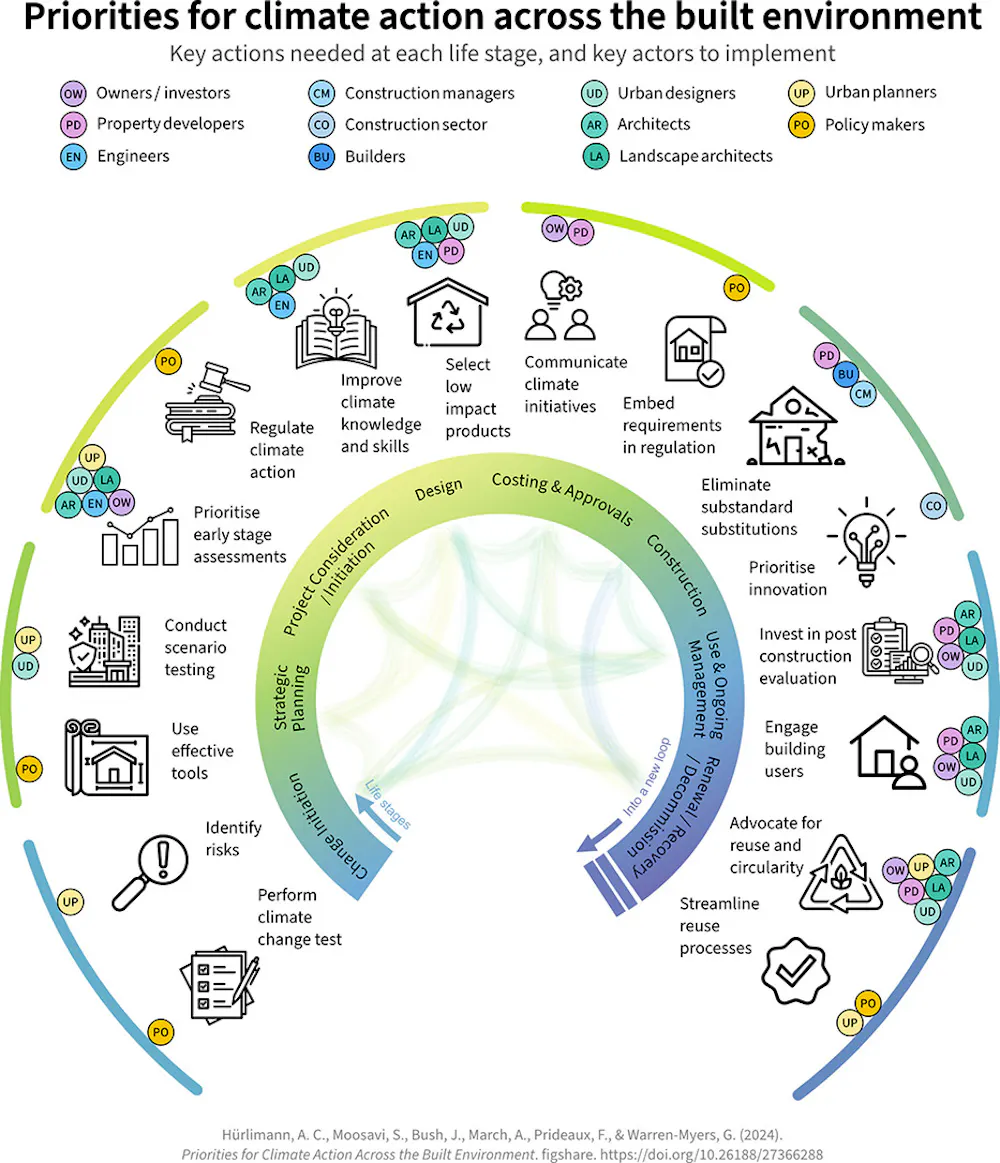
    Our new study identifies 16 priority actions to address climate change in the construction and management of cities.

    Building smarter

    Climate change must be a key consideration when designing, building and managing our cities. The emissions generated need to be minimised and eventually eliminated.

    We must build in locations, and in ways, that reduce climate risks. But policies governing how our cities are designed and constructed don’t achieve this.

    A recent study of three local government areas identified only limited action on adaptation and mitigation. Other research has found few urban development policies include carbon reduction goals that meet international targets.

    The National Housing Accord will see more than one million houses built by 2029. These new homes must address the climate challenge.

    16 areas for priority action

    The priority areas in our new study were informed by interviews with more than 150 stakeholders working in urban planning, architecture, landscape architecture, urban design, sustainability, construction and property.

    Priority areas for minimising damaging emissions generated by cities.
    CC BY

    The actions they identified cover the entire life cycle of the built environment.

    One of the first barriers to overcome is the perceived lack of agency among industry professionals to initiate or demand climate action. They perceive others, such as property owners or clients, to have more influence.

    Climate change risks should be identified in the early stages of planning new developments, backed up by effective tools to make risk identification and action easier:

    There were areas that were identified as being flood prone or risk prone. But there was no strategy to deal with what happens to those areas – An urban planner

    Once specific projects are being considered it is important to prioritise early stage climate assessments, supported by policies which mandate climate action:

    Everyone has good intentions but without big formal legislation around it, everyone’s just sort of making their way in the dark – A construction industry professional

    In the design stage, steps to improve the climate knowledge and skills of the workforce beyond disciplinary boundaries is critical. The selection of low-impact products and materials will also help ensure design is more climate responsive.

    Climate action must be embedded in all stages of design and construction of Australian cities.
    GagliardiPhotography/Shutterstock

    The highest number of hurdles to climate action were found to occur during the costing and approvals stage. Participants spoke of a highly competitive building industry. If climate change initiatives introduced at an earlier stage aren’t required by law, they are likely to be cut.

    unless there’s something in it for them in terms of return on investment, it’s going to be hard to get them to do it, unless we make them – An urban planner

    During the construction phase, product and material substitutions that have detrimental environmental impact should be eliminated. Innovation should be encouraged:

    If you want to push the envelope a little bit in terms of using recycled materials […] that’s a bit of a barrier. To push innovation is difficult – A landscape architect

    Post-construction

    Once construction is complete and buildings and public spaces are being used, it is important to invest in a thorough evaluation process. Building users should be involved to ensure buildings are maintained for optimal climate outcomes:

    [We] tried to achieve the six star rating […] the client has to maintain it [the building] for a year, and that’s when things start to fall off – An architect

    When it comes to area upgrades or building renewals, advocating for reuse and materials circularity is important. But the custom of demolishing and building anew, is hard to shift:

    The reuse of the existing building obviously generates significantly less waste and involves less material. So, design decisions and strategic decisions around using existing buildings is really important – An urban designer

    Working together

    This is a time of significant change in our urban areas.

    We need to make sure climate action is embedded in every stage of decision making. This may mean more efficient use, and reuse, of the existing built stock. This will require an overhaul of policies regarding building retrofits, and a change in mindsets.

    The priority actions to address climate change in cities can be implemented across a range of levels for:

    • individual professionals – pursue development of their climate change skills, including opportunities provided by professional associations

    • professional practices – review internal processes to ensure climate action is mainstreamed across projects, and in company decision making

    • universities teaching built environment professional degrees – embed climate change knowledge, skills, and competencies across the curriculum

    • governments at all levels – review policy settings to mandate mitigation and adaption.

    By addressing these actions, we can collectively work towards achieving our emission reduction targets and making sure our cities minimise climate change risks.

    Anna Hurlimann received funding for the research reported in this article from the Australian Research Council – Discovery Grant DP200101378, with co-chief investigators Georgia Warren-Myers, Alan March, Sareh Moosavi and Judy Bush. She is a member of the Planning Institute of Australia.

    Sareh Moosavi received funding for the research reported in this article from the Australian Research Council – Discovery Grant DP200101378, with co-chief investigators Anna Hurlimann, Georgia Warren-Myers, Alan March, and Judy Bush.

    ref. Cities are heating up the planet – how they can do more to fight climate change – https://theconversation.com/cities-are-heating-up-the-planet-how-they-can-do-more-to-fight-climate-change-259391

    MIL OSI AnalysisEveningReport.nz

  • MIL-OSI Submissions: Gaza: Deadly Israeli-US supply distribution scheme must be dismantled and siege lifted – MSF

    Source: Médecins Sans Frontières (MSF)

    28 June, Gaza: The Israeli-US food distribution scheme in Gaza, launched one month ago, is degrading Palestinians by design, forcing them to choose between starvation or risking their lives for minimal supplies. With over 500 people killed and nearly 4,000 wounded while seeking food, this scheme is slaughter masquerading as humanitarian aid and must be immediately dismantled. Médecins Sans Frontières (MSF) calls on the Israeli authorities and their allies to lift the siege on food, fuel, medical, and humanitarian supplies and to revert to the pre-existing principled humanitarian system, coordinated by the UN.

    This disaster has been orchestrated by the Israeli-US proxy operating under the name Gaza Humanitarian Foundation (GHF). The way supplies are distributed forces thousands of Palestinians, who have been starved by an over 100 day-long Israeli siege, to walk long distances to reach the four distribution sites and fight for scraps of food supplies. These sites hinder women, children, the elderly, and people with disabilities from accessing aid and people are killed and wounded in the chaotic process. Yet each renewed atrocity now happens with barely a shrug, let alone condemnation, from an international community seemingly resigned to its role in allowing and perpetuating a campaign consistent with patterns of genocide. This cannot be allowed to continue.

    “The four distribution sites, all located in areas under the full control of Israeli forces after people had been forcibly displaced from there, are the size of football fields surrounded by watch points, mounds of earth and barbed wire. The fenced entrance gives only one access point in or out,” says Aitor Zabalgogeazkoa, MSF emergency coordinator in Gaza. “GHF workers drop the pallets and the boxes of food and open the fences, allowing thousands in all at once to fight down to the last grain of rice.

    “If people arrive early and approach the checkpoints, they get shot. If they arrive on time, but there is an overflow and they jump over the mounds and the wires, they get shot,” says Zabalgogeazkoa. “If they arrive late, they shouldn’t be there because it is an ‘evacuated zone’, they get shot.”

    Every day, MSF teams see patients who have been killed or wounded trying to get food at one of these sites.

    “A lot of people were getting directly shot at. This is not aid – it’s a death trap,” says Hani Abu Soud, a community member at Al-Mawasi primary healthcare centre. “They were going to kill us one by one.  We were hungry, we were just trying to feed our children. What else can I do?  A bag of lentils costs around 30-40 shekels [€6 – €10]”.

    “We do not have that kind of money. Death has become cheaper than survival.”

    As the distributions have continued, medical teams have noticed a stark increase in the number of patients with gunshot wounds. In the MSF field hospital in Deir Al-Balah the number of patients with gunshot wounds increased by 190 per cent the week of 8 June, compared to the week before. The still barely functioning hospitals in Gaza are devastated; running on minimal supplies of pain relief, anaesthetic and blood. Fully functioning hospitals would struggle to cope with such a high number of trauma patients flooding emergency rooms every day.

    Injured patients seek help at basic healthcare clinics or field hospitals, since larger hospitals better equipped to provide treatment for violent trauma have been damaged by Israel’s attacks on healthcare facilities, with many no longer functioning. The MSF clinic in Al Mawasi, which is not typically equipped to treat trauma patients, has received 423 people wounded from the distribution sites since 7 June.  Ten or more patients with violent injuries arrive from distribution sites each day. These injuries require immediate life-saving treatment, like blood transfusions or surgery, that our medical teams cannot provide in a basic healthcare clinic. Patients are referred to the few remaining hospitals still functioning like Nasser hospital, but with healthcare so scarce, MSF has received reports of people wounded at aid distribution sites dying from their injuries before they can receive treatment.

    With no food in the tent he shared with his family, seventeen-year-old Ashraf went to a distribution site on 23 June. “I told him it was too dangerous. He said he wanted to get something for his sister,” says Hanan, Ashraf’s mother. “Thirty minutes later he called me, crying for help. He had been shot. This ‘aid’ is soaked in blood.”

    Ashraf was being treated at Al Mawasi basic healthcare clinic.

    Aid must not be controlled by a warring party to further its military objectives. The Israeli authorities have used a deliberate tactic of food deprivation against Palestinians in Gaza. They have weaponised food supply by denying it to people, then by limiting it to a trickle, in a complete violation of international humanitarian law. Humanitarian principles exist to enable the facilitation of aid to those who need it most, with dignity. Aid must be delivered at scale, consistent with these principles. The people of Gaza are in vital and immediate need of the re-establishment of a genuine aid system, and a sustained ceasefire, for their very survival.

    MSF is an international, medical, humanitarian organisation that delivers medical care to people in need, regardless of their origin, religion, or political affiliation. MSF has been working in Haiti for over 30 years, offering general healthcare, trauma care, burn wound care, maternity care, and care for survivors of sexual violence. MSF Australia was established in 1995 and is one of 24 international MSF sections committed to delivering medical humanitarian assistance to people in crisis. In 2022, more than 120 project staff from Australia and New Zealand worked with MSF on assignment overseas. MSF delivers medical care based on need alone and operates independently of government, religion or economic influence and irrespective of race, religion or gender. For more information visit msf.org.au  

    MIL OSI – Submitted News

  • MIL-OSI Submissions: Gaza: Deadly Israeli-US supply distribution scheme must be dismantled and siege lifted – MSF

    Source: Médecins Sans Frontières (MSF)

    28 June, Gaza: The Israeli-US food distribution scheme in Gaza, launched one month ago, is degrading Palestinians by design, forcing them to choose between starvation or risking their lives for minimal supplies. With over 500 people killed and nearly 4,000 wounded while seeking food, this scheme is slaughter masquerading as humanitarian aid and must be immediately dismantled. Médecins Sans Frontières (MSF) calls on the Israeli authorities and their allies to lift the siege on food, fuel, medical, and humanitarian supplies and to revert to the pre-existing principled humanitarian system, coordinated by the UN.

    This disaster has been orchestrated by the Israeli-US proxy operating under the name Gaza Humanitarian Foundation (GHF). The way supplies are distributed forces thousands of Palestinians, who have been starved by an over 100 day-long Israeli siege, to walk long distances to reach the four distribution sites and fight for scraps of food supplies. These sites hinder women, children, the elderly, and people with disabilities from accessing aid and people are killed and wounded in the chaotic process. Yet each renewed atrocity now happens with barely a shrug, let alone condemnation, from an international community seemingly resigned to its role in allowing and perpetuating a campaign consistent with patterns of genocide. This cannot be allowed to continue.

    “The four distribution sites, all located in areas under the full control of Israeli forces after people had been forcibly displaced from there, are the size of football fields surrounded by watch points, mounds of earth and barbed wire. The fenced entrance gives only one access point in or out,” says Aitor Zabalgogeazkoa, MSF emergency coordinator in Gaza. “GHF workers drop the pallets and the boxes of food and open the fences, allowing thousands in all at once to fight down to the last grain of rice.

    “If people arrive early and approach the checkpoints, they get shot. If they arrive on time, but there is an overflow and they jump over the mounds and the wires, they get shot,” says Zabalgogeazkoa. “If they arrive late, they shouldn’t be there because it is an ‘evacuated zone’, they get shot.”

    Every day, MSF teams see patients who have been killed or wounded trying to get food at one of these sites.

    “A lot of people were getting directly shot at. This is not aid – it’s a death trap,” says Hani Abu Soud, a community member at Al-Mawasi primary healthcare centre. “They were going to kill us one by one.  We were hungry, we were just trying to feed our children. What else can I do?  A bag of lentils costs around 30-40 shekels [€6 – €10]”.

    “We do not have that kind of money. Death has become cheaper than survival.”

    As the distributions have continued, medical teams have noticed a stark increase in the number of patients with gunshot wounds. In the MSF field hospital in Deir Al-Balah the number of patients with gunshot wounds increased by 190 per cent the week of 8 June, compared to the week before. The still barely functioning hospitals in Gaza are devastated; running on minimal supplies of pain relief, anaesthetic and blood. Fully functioning hospitals would struggle to cope with such a high number of trauma patients flooding emergency rooms every day.

    Injured patients seek help at basic healthcare clinics or field hospitals, since larger hospitals better equipped to provide treatment for violent trauma have been damaged by Israel’s attacks on healthcare facilities, with many no longer functioning. The MSF clinic in Al Mawasi, which is not typically equipped to treat trauma patients, has received 423 people wounded from the distribution sites since 7 June.  Ten or more patients with violent injuries arrive from distribution sites each day. These injuries require immediate life-saving treatment, like blood transfusions or surgery, that our medical teams cannot provide in a basic healthcare clinic. Patients are referred to the few remaining hospitals still functioning like Nasser hospital, but with healthcare so scarce, MSF has received reports of people wounded at aid distribution sites dying from their injuries before they can receive treatment.

    With no food in the tent he shared with his family, seventeen-year-old Ashraf went to a distribution site on 23 June. “I told him it was too dangerous. He said he wanted to get something for his sister,” says Hanan, Ashraf’s mother. “Thirty minutes later he called me, crying for help. He had been shot. This ‘aid’ is soaked in blood.”

    Ashraf was being treated at Al Mawasi basic healthcare clinic.

    Aid must not be controlled by a warring party to further its military objectives. The Israeli authorities have used a deliberate tactic of food deprivation against Palestinians in Gaza. They have weaponised food supply by denying it to people, then by limiting it to a trickle, in a complete violation of international humanitarian law. Humanitarian principles exist to enable the facilitation of aid to those who need it most, with dignity. Aid must be delivered at scale, consistent with these principles. The people of Gaza are in vital and immediate need of the re-establishment of a genuine aid system, and a sustained ceasefire, for their very survival.

    MSF is an international, medical, humanitarian organisation that delivers medical care to people in need, regardless of their origin, religion, or political affiliation. MSF has been working in Haiti for over 30 years, offering general healthcare, trauma care, burn wound care, maternity care, and care for survivors of sexual violence. MSF Australia was established in 1995 and is one of 24 international MSF sections committed to delivering medical humanitarian assistance to people in crisis. In 2022, more than 120 project staff from Australia and New Zealand worked with MSF on assignment overseas. MSF delivers medical care based on need alone and operates independently of government, religion or economic influence and irrespective of race, religion or gender. For more information visit msf.org.au  

    MIL OSI – Submitted News

  • MIL-OSI USA: McCaul Discusses Importance of USAGM’s Work in Iran with Kari Lake at House Foreign Affairs Committee Hearing

    Source: United States House of Representatives – Congressman Michael McCaul (10th District of Texas)

    WASHINGTON – Today, U.S. Congressman Michael McCaul (R-Texas) — chairman emeritus of the House Committee on Foreign Affairs — discussed the importance of the U.S. Agency for Global Media’s work in Iran with Senior Advisor for USAGM Kari Lake.

    Click to watch

    Full exchange below:

     Chair Emeritus McCaul: Thank you, Mr. Chairman. Ms. Lake, thanks for being here today. I want to thank you for visiting with me in my office to talk about these challenges that you’ve outlined. I think the chairman has outlined them quite well. I want to commend you for reforming USAGM. I think every new administration has a right and responsibility to do so. Your testimony has highlighted systemic problems that must be addressed — more importantly, security lapses, misuse of visas, weak editorial oversight, and much more. I look forward to authorizing this agency with the chairman and his authorization bill to correct these abuses.

     I remember President Reagan used Voice of America when I was entering college, as a frontline voice against Soviet oppression. It was the Voice of America, not the Voice of anti-America. 

    Recently, I used the Voice of America and the Open Technology Fund to translate my report on the origins of COVID-19. We disseminated it through mainland China — broke through the firewall. It went viral [and] got the attention of the CCP foreign minister, who spoke out against me and the report. That’s the kind of impact this agency needs to reach. 

    With the events in Iran — we need America’s voice in Iran right now. We need to ensure the Iranian people hear the truth: that we do not intend to harm them, but rather their oppressor and this theocratic regime of the Ayatollah. We need communications inside and outside of Iran. 

    This week, General Vogel, the CENTCOM commander, said the Voice of America is a critical tool for American security. You’ve outlined why there are many insecurities. I hope we can go back to that core mission.

    So my question is, Ms. Lake, how are you working to fix the Voice of America so it is the Voice of America — and not anti-America — in Iran? And [how are you using] the Open Technology Fund to achieve the mission — the core mission that Congress intended?

    Ms. Lake: Thank you for that question, and thank you for laying out when it was a better agency. You’re right, Ronald Reagan used it — a great broadcaster, one of the great communicators — and he used it, but times have changed, and it’s still doing 1990-style television in a world where people are getting their information right here on their smartphones. It’s in the back pocket, and so we need to update it and modernize it. But President Trump’s executive order dated March 14th has called for this agency to be brought to its statutory minimum. 

    I’m glad that you mentioned Iran, because one of the languages that is required in the statute is Farsi, and we are still broadcasting in Farsi. And Ranking Member Meeks said that we have not been, and that in a panic we started to put news out in Farsi. That is actually not true. We were in the process of effectuating President Trump’s executive order, and in the process of doing that, several malicious lawsuits were started up, and the judge froze us from being able to get news on. We literally were frozen in place because of all these lawsuits.

    Once we were freed to start putting news on, we immediately went to what the statutory minimum is, and one of the languages is Farsi going into Iran. I’m very proud to say that when President Trump — when the bombings happened over the weekend on Saturday and when President Trump started to speak, we had a crew in on Saturday delivering President Trump’s message to the people of Iran in Farsi. It was translated and it went out. Sometimes a lean and mean and smaller staff makes it easier to get things done. In one of the emails that I got from our Persian team, they actually said that. They were able to move quicker because it was smaller, the bloat had been diminished. And I’m really proud of the fact that we got that on.

    We are going to continue to operate at the statutory minimum. We are putting out content in Pashto, Dari, Mandarin, Farsi, and Spanish through the Office of Cuba Broadcasting. 

    Chair Emeritus McCaul: Thank you for that response. I think it’s very important right now that the Iranian people hear the American story and the American message, and I commend you for your efforts to reform. I encourage you to get that message into Iran right now. Communication inside and out is so important for those people if they’re going to rise up against this oppressive theocracy that we’ve endured since 1979. I yield back.

    ###

    MIL OSI USA News

  • MIL-OSI New Zealand: Rare slab hut refurbishment keeps traditional ways alive

    Source: NZ Department of Conservation

    Date:  30 June 2025

    The historic Slaty Creek Hut, in the Grey Valley, was originally built as a winter project in 1952 by deer cullers. The hut was built with timber milled with hand tools using logs from the beech forest surrounding the site. It’s now used by recreational hunters, trampers and climbers.

    Slab huts are a surviving form of the slab houses which European settlers built in 19th century New Zealand to accommodate themselves in a practical and cost-effective way, using a material found readily in many areas – trees.

    Before the introduction of water and steam powered sawmills, trees were dissembled by splitting, sawing or hewing, and it is these techniques that were carried on into the 20th century in building slab huts for deer cullers, musterers and gold fossickers in rural areas of New Zealand.

    Because of the impermanence of wood due to rot, and that slab houses were only seen by settlers as temporary housing until something more permanent could be built when resources allowed, very few slab houses or buildings remain, making slab huts like Slaty Creek Hut a real link to the past. There are 12 slab huts on public conservation land in the South Island.

    Because so few people still have the skills to hew timber from logs with hand tools, maintaining historic huts like Slaty Creek is becoming more difficult -which is why rangers spent time learning about the techniques.

    The rangers spent a day breaking down beech logs and hewing these into hand shaped timber, which was used to replace boards and framing on Slaty Creek Hut. While the rangers were at Slaty Creek they also replaced the hearth of the fire, installed a new sub floor structure, dug drainage channels around the hut and gave it a good spruce up.

    Ranger Casey Rhodes, who has been on the team restoring the hut says, “We went in six months ago and scoped it out and worked out which boards needed to be replaced and made a list, so we’re only replacing the minimum to try and keep as much heritage factor as we can”.

    Mike Gillies, a Senior Heritage Advisor who is sharing his skills in these historic building methods, says it’s important to maintain traditions of how huts and structures were built.

    “We could use modern methods and materials on the hut, but you pretty soon lose authenticity, whereas doing it using the same tools and techniques ensures that craft and those traditions stay alive. So the guys are using axes and draw knifes and wedges and mauls, the same way people have been building for hundreds of years.

    “It’s the best feeling in the world, compared to a modern building site where there are lots of power tools and you are working with treated timber. It’s very quiet, all you can hear are the axes and adzes hewing. It’s a real privilege to be able to continue this tradition and this craft that’s been passed down for a really long time.”

    Background information

    Slaty Creek Hut is a backcountry hut and there is no formed track leading to it. Anyone wanting to visit should be experienced and well equipped, with suitable route finding and navigational skills.

    The hut is on the Amuri Pass tramping route, an advanced multi-day trip which follows a historic route between the West Coast and Canterbury which was once used to move stock.

    Contact

    For media enquiries contact:

    Email: media@doc.govt.nz

    MIL OSI New Zealand News

  • MIL-OSI New Zealand: DOC’s Jobs for Nature legacy

    Source: NZ Department of Conservation

    Date:  30 June 2025

    Sia says, “Jobs for Nature projects have had a positive impact on the environment, restoring over 6000 ha of wetland, which has improved wildlife habitat, water quality and flood control capability, and have worked toward restoring six priority waterways, such as the Rangitata and Whanganui Rivers, among many other amazing results for our land, water, and species.”

    “As the Department’s work with Jobs for Nature comes to an end this month, the programme has been successful for the thousands who’ve gained valuable experience and achieved great things for nature.”

    Launched to turbo-boost nature-based employment through COVID-19, the $1.2 billion multi-agency programme employed people whose livelihoods were impacted through the pandemic, enabling them to stay local and support their families and communities.

    This support also benefitted regional economies reliant on tourism. In South Westland for example, the Jobs for Nature programme redeployed tourism workers from 40 businesses, keeping essential skills vital for economic recovery in the community.

    Sia says, “We estimate Jobs for Nature projects will return more than $1.97 billion in environmental, social and economic benefits over 30 years.

    “Jobs for Nature has stood up a new generation of conservationists who have upskilled and trained in critical ranger skills including pest control, planting, and landscape restoration.”

    When surveyed, 91 project partners identified as being whānau, hapū or iwi, and a further 63 said they have strong engagement with whānau, hapū or iwi.

    “Jobs for Nature supported Māori to work in their communities, contribute directly to improving the health of the whenua.”

    While government funding ends on 30 June 2025, there is an ongoing legacy, with just over 20 percent of projects (46) intending to develop businesses and continue their mahi.

    “We’ve seen tangible benefits for iwi, communities and nature. It’s demonstrated that when we take action for nature, it can bounce back,” Sia says.

    Background information

    Jobs for Nature (JFN) was a $1.2 billion programme set up in response to COVID-19 to create both nature-based employment opportunities and enduring environmental benefits.

    It ran from July 2020 to June 2025 and was administered by five government agencies. The Department of Conservation Te Papa Atawhai (DOC) allocated $485.3 million over 225 projects across Aotearoa New Zealand.

    Over five years, since 2020, the programme has improved biodiversity, increased environmental protection and supported better access to nature for future generations:

    • 8.4 million hours of conservation work was enabled, including more than 2.3 million hectares of pest control (animal and plant) and 5 million plantings.
    • Targeted support was provided for threatened species and ecosystems, including the Threatened – Nationally Critical kākāriki karaka/orange-fronted parakeet.
    • Restoration of six priority freshwater waterways was accelerated to protect and improve their biodiversity.
    • Over 6,000 hectares of wetland was restored, improving wildlife habitat, water quality, flood control and more.
    • Over 1,000 cultural heritage and recreational sites were maintained and improved, retaining our connection to nature and identity.
    • Local resilience to climate change impacts was increased.

    The programme also enabled iwi, hapū and whānau to realise their aspirations for the environment:

    • 90 Māori collective entities received funding totalling nearly $135 million, allowing them to have a greater influence in local decision making and delivery.
    • When surveyed, 91 project partners identified as being whānau, hapū or iwi, and a further 63 said they have strong engagement with whānau, hapū or iwi.
    • 93 projects included work on Māori land, improving the whenua for the future.

    *Data as at March, 2025.

    Contact

    For media enquiries contact:

    Email: media@doc.govt.nz

    MIL OSI New Zealand News

  • MIL-OSI NGOs: Giant baby Musk float in march for tax justice at UN summit in Sevilla: ‘Make rich polluters pay’

    Source: Greenpeace Statement –

    Sevilla, Spain – Greenpeace activists joined a civil society march today for Global Economic Justice, with a giant float of a baby Elon Musk holding a chainsaw threatening planet Earth. As the 4th International Conference on Financing for Development (FfD4) starts tomorrow in Sevilla, campaigners are calling on world leaders to advance commitments for new and fair global tax and debt rules, and to hold fossil fuel polluters accountable for climate and nature damages.[1] [2]

    The conference opens against a backdrop of intensifying conflicts, geopolitical tensions, rising inequality, and accelerating climate and environmental breakdown. The outcome document, the Compromiso de Sevilla, released ahead of the conference, does not go far enough. It delivers on some promises on international tax cooperation and encouraging taxes on environmental contamination and pollution. However, bold language on sovereign debt architecture reform was weakened by Global North governments during the negotiations, and the agreement falls short on responding to the urgency of the climate, nature and social crises.[3]

    Fred Njehu, Greenpeace Africa’s Global Political Lead for the Fair Share campaign,[4] said: “Sevilla is a rare opportunity for global economic justice and for urgent conversations on how billionaires and corporate polluters should pay their fair share of taxes to fund climate action, nature protection and social programmes. World leaders need to listen to what the public wants and deliver a tax system that works for all.”

    Eva Saldaña, Executive Director of Greenpeace Spain and Portugal, said: “Multilateral cooperation is key to addressing global threats and resource gaps for global climate and economic justice. It must not become an excuse for more powerful governments, in the Global North or elsewhere, to water down ambition. We must put people over greed and listen to the voices rising from the streets – in Seville and all over the world. All governments must actively support the UN Tax Convention process and pursue real solutions to the debt crisis, so that we can finally begin to transfer resources away from polluters and the super-rich for the wellbeing of all people and especially for those who are suffering the most from the climate emergency.”

    Greenpeace demands reforms in international tax cooperation and public financing for sustainable development. Specifically: 

    • Endorsement of the UN Tax Convention process for just and equitable global tax rules, that make the super-rich pay their fair share and make corporate polluters, such as the fossil fuel industry, pay for their climate damages.
    • Explicit commitments from governments – via the Global Solidarity Levies Task Force, and beyond – to remove fossil fuel production subsidies and introduce progressive taxes and fines on fossil fuel corporations, and other high emitting sectors. This builds on the FfD4 outcomes document’s endorsement of “taxes on environmental contamination and pollution.” The revenues should be used to pay for domestic climate action and international climate finance support  – in particular action to support communities to respond and recover from climate disasters.

    Rebecca Newsom, Global Political Lead for Greenpeace International’s Stop Drilling, Start Paying campaign, said: “While fossil fuel-driven floods, storms, wildfires and droughts increasingly hit communities around the world, people are crying out for their governments to tax oil, gas and coal corporations to pay for climate-related loss and damage. So what are political leaders waiting for? They must seize the opportunity of Sevilla to make polluters pay – or face growing public anger for continuing to let dirty industries off the hook.”

    Hanen Keskes, Campaigns Lead at Greenpeace Middle East North Africa, said: “This is not the time to lack ambition as civil society is calling for urgent debt relief and structural reform. The burden of debt is undermining the most vulnerable countries’ ability to respond to climate, nature and social crises. Governments must show that they are ready to build a fairer and more sustainable future – one rooted in justice, not extraction.”

    ENDS

    Members of the Greenpeace delegation in Seville are available for interviews in Spanish, English, German, and Swahili.

    Photos and Videos can be downloaded via Greenpeace Media Library and will be updated throughout the conference. 

    Notes:

    [1] Greenpeace Spain’s float of Elon Musk measures 2 metres wide by 3.5 –  4 metres high.

    [2] The Fourth International Conference on Financing for Development (FFD4) is a once-in-a-decade opportunity to reform financing at all levels, including to support reform of the international financial architecture. FFD4 Conference will be held in FIBES Sevilla Exhibition and Conference Centre (30 June – 3 July 2025)

    [3] The Compromiso de Sevilla: Outcome | FFD4

    Contacts in Seville:

    Tal Harris, Global Media Lead – Stop Drilling Start Paying campaign, Greenpeace International. +41-782530550, [email protected]  

    Begoña Rodríguez, Media Lead – Climate Responsibility Team, Greenpeace Spain & Portugal. +34 605248097, [email protected]

    Additional contacts: 

    Christine Gebeneter, EU Communication lead, Greenpeace CEE based in Austria, +43 664 8403807, [email protected] 

    Lee Kuen, Global Comms Lead – Fair Share campaign, Greenpeace International. +601112527489, [email protected]

    Greenpeace International Press Desk, +31 (0)20 718 2470 (available 24 hours), [email protected]

    MIL OSI NGO

  • MIL-OSI USA: Additional Mississippi Counties Designated Under Amended Presidential Disaster Declaration for Public Assistance

    Source: United States Small Business Administration

    ATLANTA – In response to an amended Presidential disaster declaration, the U.S. Small Business Administration (SBA) announced the availability of low interest federal disaster loans to private nonprofit (PNP) organizations in one additional Mississippi county affected by the severe storms and flooding occurring Mar. 14-15, 2025.

    The amended declaration covers the newly designated county of Montgomery.

    Under this declaration, PNPs providing non-critical services of a governmental nature who suffered financial losses directly related to the disaster are eligible to apply for both physical damage loans and Economic Injury Disaster Loans (EIDLs) from the SBA. Examples of eligible non-critical PNP organizations include, but are not limited to, food kitchens, homeless shelters, museums, libraries, community centers, schools, and colleges.

    PNPs may borrow up to $2 million to repair or replace damaged or destroyed real estate, machinery and equipment, inventory, and other business assets. Applicants may also be eligible for a loan increase of up to 20% of their physical damages, as verified by the SBA, for mitigation purposes.

    EIDLs are for working capital needs caused by the disaster and are available even if the PNP did not suffer any physical damage. The loans may be used to pay fixed debts, payroll, accounts payable, and other bills not paid due to the disaster.

    “SBA loans help eligible small businesses and private nonprofits cover operating expenses after a disaster, which is crucial for their recovery,” said Chris Stallings, associate administrator of the Office of Disaster Recovery and Resilience at the SBA. “These loans not only help business owners get back on their feet but also play a key role in sustaining local economies in the aftermath of a disaster.”  

    The interest rate can be as low as 3.625%, with terms up to 30 years. Interest does not begin to accrue, and monthly payments are not due until 12 months from the date of the initial disbursement. The SBA sets loan amounts and terms based on each applicant’s financial condition.

    To apply online visit sba.gov/disaster. Applicants may also call the SBA’s Customer Service Center at (800) 659-2955 or email disastercustomerservice@sba.gov for information on SBA disaster assistance. For people who are deaf, hard of hearing, or have a speech disability, please dial 7-1-1 to access telecommunications relay services.

    The filing deadline to submit applications for physical property damage is July 22, 2025. The deadline to submit economic injury applications is Feb. 23, 2026.

    ###

    About the U.S. Small Business Administration

    The U.S. Small Business Administration helps power the American dream of business ownership. As the only go-to resource and voice for small businesses backed by the strength of the federal government, the SBA empowers entrepreneurs and small business owners with the resources and support they need to start, grow or expand their businesses, or recover from a declared disaster. It delivers services through an extensive network of SBA field offices and partnerships with public and private organizations. To learn more, visit www.sba.gov. 

    MIL OSI USA News

  • MIL-OSI USA: SBA Opened Business Recovery Centers in Tennessee to Assist Small Businesses, Private Nonprofits and Residents Affected by Adverse Weather

    Source: United States Small Business Administration

    ATLANTA – The U.S. Small Business Administration (SBA) opened Business Recovery Centers (BRCs) in Davidson and McNairy Counties to assist small businesses, private nonprofits and residents affected by severe storms, straight-line winds, tornadoes and flooding occurring on April 2-24, 2025.

    SBA customer service representatives will be on hand at the BRCs to answer questions about SBA’s disaster loan program, explain the application process and help individuals complete their application. Walk-ins are accepted, but you can schedule an in-person appointment in advance at appointment.sba.gov. The BRCs hours of operation are listed below.

    Business Recovery Center (BRC)  

    Davidson County  

    SBA District Office, Nashville

    2 International Plaza  

    Nashville, TN 37217

    Hours:    Monday – Sunday, 8 a.m. to 6 p.m.  

     Temporary Closed:   Friday, July, 4th  

    in observance of 4th of July Holiday  

    Business Recovery Center (BRC)  

    McNairy County  

     The Latta Theatre

    205 W Court Ave.  

    Selmer, TN 38375

    Hours:   Monday – Sunday, 8 a.m. to 6 p.m.  

     Temporary Closed:   Friday, July, 4th  

    in observance of 4th of July Holiday  

    “SBA’s Business Recovery Centers have consistently proven their value to business owners following a disaster,” said Chris Stallings, associate administrator of the Office of Disaster Recovery and Resilience at the SBA. “Business owners can visit these centers to meet face-to-face with specialists who will guide them through the disaster loan application process and connect them with resources to support their recovery.”

    The SBA’s Economic Injury Disaster Loan (EIDL) program is available to small businesses, small agricultural cooperatives and private nonprofit (PNP) organizations with financial losses directly related to the disaster. The SBA is unable to provide disaster loans to agricultural producers, farmers, or ranchers, except for small aquaculture enterprises.

    EIDLs are available for working capital needs caused by the disaster and are available even if the business or PNP did not suffer any physical damage. The loans may be used to pay fixed debts, payroll, accounts payable, and other bills not paid due to the disaster.

    Businesses and nonprofits are eligible to apply for business physical disaster loans and may borrow up to $2 million to repair or replace disaster-damaged or destroyed real estate, machinery and equipment, inventory, and other business assets.

    Homeowners and renters are eligible to apply for home and personal property loans and may borrow up to $100,000 to replace or repair personal property, such as clothing, furniture, cars, and appliances. Homeowners may apply for up to $500,000 to replace or repair their primary residence.

    Applicants may also be eligible for a loan increase of up to 20% of their physical damage, as verified by the SBA, for mitigation purposes. Eligible mitigation improvements include strengthening structures to protect against high wind damage, upgrading to wind rated garage doors, and installing a safe room or storm shelter to help protect property and occupants from future damage.

    Interest rates are as low as 4% for small businesses, 3.625% for PNPs, and 2.75% for homeowners and renters, with terms up to 30 years. Interest does not begin to accrue, and payments are not due until 12 months from the date of the first loan disbursement. The SBA sets loan amounts and terms based on each applicant’s financial condition.

    Disaster survivors should not wait to settle with their insurance company before applying for a disaster loan. If a survivor does not know how much of their loss will be covered by insurance or other sources, SBA can make a low-interest disaster loan for the total loss up to its loan limits, provided the borrower agrees to use insurance proceeds to reduce or repay the loan.

    With the changes to FEMA’s Sequence of Delivery, survivors are now encouraged to simultaneously apply for FEMA grants and the SBA low-interest disaster loan assistance to fully recover.  FEMA grants are intended to cover necessary expenses and serious needs not paid by insurance or other sources. The SBA disaster loan program is designed for your long-term recovery, to make you whole and get you back to your pre-disaster condition.

    To apply online, visit sba.gov/disaster. Applicants may also call SBA’s Customer Service Center at (800) 659-2955 or email disastercustomerservice@sba.gov for more information on SBA disaster assistance. For people who are deaf, hard of hearing, or have a speech disability, please dial 7-1-1 to access telecommunications relay services.

    The filing deadline to return applications for physical property damage is Aug. 19, 2025. The deadline to return economic injury applications is March 19, 2026.

    ###

    About the U.S. Small Business Administration

    The U.S. Small Business Administration helps power the American dream of business ownership. As the only go-to resource and voice for small businesses backed by the strength of the federal government, the SBA empowers entrepreneurs and small business owners with the resources and support they need to start, grow or expand their businesses, or recover from a declared disaster. It delivers services through an extensive network of SBA field offices and partnerships with public and private organizations. To learn more, visit www.sba.gov. 

    MIL OSI USA News

  • MIL-OSI Russia: Pakistan’s monsoon rains kill 45 in four days

    Translation. Region: Russian Federal

    Source: People’s Republic of China in Russian – People’s Republic of China in Russian –

    Source: People’s Republic of China – State Council News

    ISLAMABAD, June 29 (Xinhua) — Seven more people have died in rain-related accidents in Pakistan in the past two days, taking the death toll to 45 since the start of the monsoon season on June 26, Pakistan’s National Disaster Management Authority (NDMA) said on Sunday.

    In a statement, the ministry said the death toll had risen to 68 after six more residents were injured in heavy rains that hit almost all provinces of Pakistan.

    Simultaneously, the NDMA has issued a warning of heavy rainfall and thunderstorms expected to affect large parts of the country in the next 12-24 hours. –0–

    MIL OSI Russia News

  • MIL-OSI USA: SPC MD 1509

    Source: US National Oceanic and Atmospheric Administration

    Mesoscale Discussion 1509

    Mesoscale Discussion 1509
    NWS Storm Prediction Center Norman OK
    0128 PM CDT Sun Jun 29 2025

    Areas affected…eastern WY…the NE Panhandle …southwest SD

    Concerning…Severe potential…Severe Thunderstorm Watch likely

    Valid 291828Z – 292030Z

    Probability of Watch Issuance…95 percent

    SUMMARY…At least isolated large hail and severe gusts are likely,
    with scattered coverage possible by late afternoon. A Severe
    Thunderstorm Watch issuance is expected.

    DISCUSSION…Initial, lower-topped convection has formed across far
    southeast MT towards the Black Hills. This activity is expected to
    strengthen over the next couple hours amid modest MLCAPE near 1000
    J/kg and effective bulk shear around 40 kts. While the parameter
    space is a step-down from yesterday, which should mitigate overall
    intensity, the coverage of storms should be greater by peak heating.
    Additional storms should develop within the weak upslope flow regime
    across southeast WY. Both areas may eventually converge in the NE
    Panhandle to far southwest SD vicinity by early evening. A few
    supercells with large hail are most likely in the northern regime
    surrounding the Black Hills. Severe gusts may be the primary hazard
    farther south where multicell clustering dominates.

    ..Grams/Hart.. 06/29/2025

    …Please see www.spc.noaa.gov for graphic product…

    ATTN…WFO…LBF…UNR…CYS…BYZ…RIW…

    LAT…LON 45350502 44520346 43690208 42970166 42050152 41470218
    41160293 41120431 41070513 42440530 43820586 44550635
    45350502

    MOST PROBABLE PEAK WIND GUST…55-70 MPH
    MOST PROBABLE PEAK HAIL SIZE…1.50-2.50 IN

    Top/All Mesoscale Discussions/Forecast Products/Home

    MIL OSI USA News

  • MIL-OSI USA: SPC MD 1510

    Source: US National Oceanic and Atmospheric Administration

    Mesoscale Discussion 1510

    Mesoscale Discussion 1510
    NWS Storm Prediction Center Norman OK
    0152 PM CDT Sun Jun 29 2025

    Areas affected…northeast CO…northwest KS…far southwest NE

    Concerning…Severe potential…Severe Thunderstorm Watch likely

    Valid 291852Z – 292045Z

    Probability of Watch Issuance…80 percent

    SUMMARY…Initially isolated severe wind/hail threats are
    anticipated along the I-25 corridor in Colorado. A slow-moving QLCS,
    with an increasing wind threat, should evolve eastward across
    northeast Colorado into northwest Kansas this evening.

    DISCUSSION…Persistent surface northeasterlies are aiding in the
    advection of 50s dew points westward towards the Foothills north of
    the Palmer Divide. This will aid in increasing convective
    development off the higher terrain and across the I-25 corridor into
    the adjacent High Plains through this evening. Mid-level westerlies
    are weak to modest, but sufficient for transient mid-level rotation
    amid substantial veering of the wind profile with height. This type
    of flow regime should support outflow-dominated convection.
    Colliding outflows and amalgamating cells will likely yield a
    slow-moving MCS as they shift east towards the KS border. As this
    occurs, a mix of severe wind/hail may transition to primarily a
    severe gust threat.

    ..Grams/Hart.. 06/29/2025

    …Please see www.spc.noaa.gov for graphic product…

    ATTN…WFO…LBF…GLD…PUB…BOU…

    LAT…LON 40940232 40590165 40080130 39400123 38550211 38400278
    38670412 39030472 39760493 40440509 40930510 40940326
    40940232

    MOST PROBABLE PEAK WIND GUST…65-80 MPH
    MOST PROBABLE PEAK HAIL SIZE…1.00-1.75 IN

    Top/All Mesoscale Discussions/Forecast Products/Home

    MIL OSI USA News

  • MIL-OSI Russia: Hamas denies setting conditions for Gaza ceasefire

    Translation. Region: Russian Federal

    Source: People’s Republic of China in Russian – People’s Republic of China in Russian –

    Source: People’s Republic of China – State Council News

    GAZA, June 29 (Xinhua) — Palestinian Hamas movement on Sunday denied reports that it had set conditions for a ceasefire deal in the Gaza Strip.

    In its press release, Hamas said that the information from the Sky News Arabia news channel about the alleged conditions it had put forward for accepting a deal on prisoner exchange and a ceasefire in the Palestinian enclave were “baseless and full of lies.”

    “We reject this completely and utterly. The purpose of this is to divert attention from war crimes and cheap incitement against Hamas and the Palestinian resistance, and to distort their positions and declared positions,” Hamas stressed.

    Hamas is demanding that its political bureau not be harmed and that its assets not be confiscated, detained or restricted abroad, Sky News Arabia reported on Saturday, citing a Palestinian source.

    According to the same source, Hamas also insists on including its representatives or people associated with the movement and close to it in the future administration and security apparatus of the Gaza Strip.

    Meanwhile, on Sunday, senior Hamas leader Mahmoud Mardavi accused Israeli Prime Minister Benjamin Netanyahu of “setting impossible conditions aimed at derailing any swap deal and refusing to honor what he had previously agreed to.”

    On June 27, US President Donald Trump said a ceasefire agreement in Gaza could be reached within the next week. –0–

    MIL OSI Russia News

  • MIL-Evening Report: NZ cities are getting hotter: 5 things councils can do now to keep us cooler when summer comes

    Source: The Conversation (Au and NZ) – By Timothy Welch, Senior Lecturer in Urban Planning, University of Auckland, Waipapa Taumata Rau

    Getty Images

    Stand on any car park on a sunny day in February and the heat will radiate through your shoes. At 30°C air temperature, that asphalt hits 50–55°C – hot enough to cause second-degree burns to skin in seconds.

    Right now, in the northern hemisphere summer, 100 million Americans are dealing with 38°C temperatures. Britain is preparing for hundreds of heat deaths. In New Zealand, of course, we’re still lighting fires and complaining about the cold.

    But that gives us time to prepare for our own heatwaves. Open-air car parks that sit empty for 20 hours a day could become cooling infrastructure instead. Transport routes can become cooling corridors.

    Replace asphalt with trees, grass and permeable surfaces, and you can drop surface temperatures by 12°C. It’s not complicated. It’s not even expensive.

    It’s getting hotter

    NIWA data shows New Zealand is already experiencing extreme temperatures five times more frequently than historical baselines. Wellington hit 30.3°C and Hamilton 32.9°C in January, both all-time records. Marine heatwaves are persisting around South Island coasts months longer than usual.

    Aucklanders will face 48 additional days above 25°C annually by 2099, as summer temperatures increase by 3.6°C. Auckland Council has already adopted the most severe warming scenario (3.8°C) for infrastructure planning, acknowledging previous models underestimated the pace of change.

    Even Wellington’s famously cool winds won’t offset the estimated 79% increase in residential cooling energy demand by 2090, driven by hotter, longer summers and more extreme-heat days.

    A quarter of New Zealand’s population will be over 65 by 2043, an age when heat regulation becomes harder and fixed incomes make cooling costs a real burden.

    Currently, 14 heat-related deaths occur annually among Auckland’s over-65 population when temperatures exceed just 20°C. As the mercury rises, our older population will be at a greater risk.

    Summer in the city: a vendor sells drinks and ice cream during a severe heat wave in Washington DC, June 23.
    Getty Images

    Greener is cooler

    While global average temperature increases of 1.5°C might appear modest, the actual temperatures we experience in our cities is far more extreme. The built environment – all that concrete and asphalt – traps heat like an oven.

    But converting car parks back to green space can knock the temperature down dramatically.

    Research from Osaka Prefecture in Japan recorded surface temperature reductions of up to 14.7°C when comparing asphalt to grass-covered parking during sunny summer conditions.

    Another study found temperature differences averaging 11.79°C between asphalt and grass surfaces, with air temperature differences of 7-8°C at human height.

    Trees are the heavy lifters here. Stand under a tree on a hot day, and it can feel 17°C cooler than standing in the sun. Add rain gardens (shallow, planted areas designed to capture and filter stormwater) and ground cover for another 2-4°C reduction. Layer these elements together, and you get cooling that works even on overcast days.

    Roads as cooling corridors

    Grassy and tree-covered car parks are just a starting point. Auckland’s 7,800 kilometres of roads could become the city’s cooling system. Every bus lane, cycleway and walking path is an opportunity for green infrastructure.

    If we stop thinking of transport corridors as merely a way to get from one place to another, and see them as multifunctional cooling networks, the possibilities multiply while the costs remain relatively low.

    Melbourne’s COVID-era parklet program proved this works: 594 small conversions created 15,000 square metres of public space at just A$300–900 per square metre.

    Converting even a small percentage of New Zealand’s parking infrastructure could create connected cooling corridors throughout our cities.

    Protecting cycleways with a tree canopy would encourage active transport while cooling neighbourhoods. Bus lanes with rain garden medians would improve service reliability while managing stormwater.

    5 things councils can do

    Summer is six months away – maybe not enough time to do all the work needed, but certainly enough to get a plan in place. Here are five things councils could do.

    1. Plant trees now: winter is planting season. Focus on car parks and heat-vulnerable neighbourhoods. Use fast-growing natives and protective rings to ensure survival. Trees planted now will provide shade by December.

    2. Install modular planters: test cooling locations with movable infrastructure before committing to permanent changes. Order now for spring placement when residents can see the benefits.

    3. Schedule paving replacements: when resurfacing is needed, switch to permeable options and get heat-reducing surfaces in place before summer.

    4. Design shade structures: plan and budget pop-up shade for the hottest areas. Having designs ready means quick installation when temperatures spike.

    5. Organise spring planting days: line up community groups now, source trees through winter nursery contracts, and hit the ground running in September. Small investments in coordination yield big cooling dividends.

    Auckland Council’s NZ$1 billion climate action package includes grants of $1,000 to $50,000 for climate projects. Wellington’s Climate and Sustainability Fund and Christchurch’s 50-year Urban Forest Plan provide similar frameworks.

    The Ministry for the Environment’s National Policy Statement on Urban Development creates opportunity by removing minimum parking requirements. This frees up land for trees, gardens and public spaces instead of underused asphalt, maximising climate co-benefits: cooler surfaces, better stormwater management and more pleasant streetscapes.

    By next February, we can either be thanking ourselves for planting trees and converting car parks, or feeling the heat from that 50°C asphalt.

    Timothy Welch does not work for, consult, own shares in or receive funding from any company or organisation that would benefit from this article, and has disclosed no relevant affiliations beyond their academic appointment.

    ref. NZ cities are getting hotter: 5 things councils can do now to keep us cooler when summer comes – https://theconversation.com/nz-cities-are-getting-hotter-5-things-councils-can-do-now-to-keep-us-cooler-when-summer-comes-259885

    MIL OSI AnalysisEveningReport.nz

  • MIL-Evening Report: Could we live with a nuclear-armed Iran? Reluctantly, yes

    Source: The Conversation (Au and NZ) – By Benjamin Zala, Senior Lecturer, Politics & International Relations, Monash University

    As the ceasefire between Israel and Iran seems to be holding for now, it is important to reflect on whether this whole episode was worth the risks.

    Wider escalation was (and remains) possible, and we do not know whether Iran will seek a nuclear weapon with renewed vigour in the future.

    So, could we live with a nuclear-armed Iran, if it does indeed continue to pursue a bomb?

    Is an Iranian bomb an existential threat?

    The conventional wisdom, at least in the Western world, is that an Iranian nuclear weapon would pose an existential threat to Israel, and possibly the United States as well.

    Israeli Prime Minister Benjamin Netanyahu said his country’s strikes on Iran’s nuclear facilities were aimed at rolling back “the Iranian threat to Israel’s very survival”.

    White House press secretary Karoline Leavitt described an Iranian bomb as “an existential threat, not just to Israel, but to the United States, and to the entire world”.

    The same mantra has been repeated by leaders in Europe, at the G7 meeting, and in Australia.

    Iran, of course, did not yet possess a nuclear weapon when the strikes occurred, as the UN nuclear watchdog attested. The strikes were aimed at preventing Iran from being able to do so in the future – a prospect seen by Israel and the US as simply “unthinkable”.

    But if Iran had built a nuclear weapon before the Israeli and US strikes – or manages to do so in the future – would this pose an existential threat to Israel or the US?

    The answer is no. And for a very simple reason: nuclear deterrence works.

    Why deterrence works

    If Iran had a monopoly on nuclear weapons, it would be different. But it does not.

    Israel has maintained a robust nuclear arsenal for more than half a century. Every authoritative assessment of global nuclear weapons stockpiles includes Israel’s roughly 90 nuclear warheads.

    The Israeli government officially neither confirms nor denies the existence of its nuclear arsenal. But thanks to leaks from inside the Israeli nuclear program – as well as the best assessments from around the world – we can be quite sure they exist. It also explains why Israel has never signed the Nuclear Non-proliferation Treaty – it can’t without giving up this stockpile.

    The US, of course, has been nuclear-armed since 1945 and openly maintains an inventory of thousands of nuclear warheads. These provide a deterrent against nuclear attacks on the United States.

    Washington also provides extended nuclear deterrence guarantees to over 30 states, including members of NATO, Japan, South Korea and Australia. It does not need to provide this for Israel given the Israeli arsenal. But if there was ever any doubt about Israel’s stockpile, it certainly could.

    After 80 years of living with nuclear weapons, we know the deterrent effect of assured nuclear retaliation is very powerful. It deterred both the Soviets and Americans from using nuclear weapons against each other through multiple Cold War crises. It has deterred both India and Pakistan from using them in multiple standoffs, including quite recently. It has deterred both North Korea and the US from striking each other.

    Similarly, Iran would no doubt be deterred from using a nuclear weapon by a certain Israeli or American response.

    Iranian leaders have called for the destruction of Israel, and the chants of “death to Israel” and “death to America” are a common occurrence at rallies held by supporters of the regime.

    But beneath the fiery rhetoric lies a truism: no Iranian leader would destroy Israel with a nuclear weapon if it came at the expense of the destruction of Iran.

    In the history of the nation-state, not a single one has ever knowingly committed suicide. Not for any reason – ideological, religious, political or any other. All nations value survival over everything else because this allows for the achievement of other goals, such as power and prosperity.

    Further, Iran is ruled by a brutally authoritarian, theocratic regime. And for authoritarian regimes, staying in power is the number one priority. There is no staying in power the day after a nuclear exchange.

    Not a panacea

    This does not mean an Iranian nuclear weapon would be a welcome development. Far from it.

    Every new nuclear-armed state provides another opportunity for miscalculation or accident. It adds extra stress to an already fragile non-proliferation regime.

    In addition, nuclear deterrence is not just and can be considered ethically questionable. It may not even be sustainable over the longer term.

    There is no doubt the existence of over 12,000 nuclear weapons globally poses a potentially existential risk to all of humanity.

    But the idea that a nuclear-armed Iran would pose a unique risk to Israel or the United States simply does not stand up to scrutiny. If we can live with a nuclear-armed North Korea, nuclear-armed Pakistan, and for that matter, a nuclear-armed Israel, we can live, however reluctantly, with a nuclear-armed Iran.

    Regardless of whether the current proposed ceasefire between Israel and Iran holds, the military operation initiated by Israel and bolstered by the United States was extremely dangerous and unnecessary, based on both countries’ justification.

    The regime in Tehran is brutal, authoritarian, openly antisemitic and worthy of our disdain. But there is no evidence it is suicidal.

    The claim an Iranian nuclear bomb would pose an existential threat to Israel or the United States and justifies unilateral, preventive military attacks makes no sense.

    It is time to stop repeating it.

    Benjamin Zala has received funding from the Stanton Foundation, a US philanthropic group that funds nuclear research. He is an honorary fellow at the University of Leicester on a project that is funded by the European Research Council.

    ref. Could we live with a nuclear-armed Iran? Reluctantly, yes – https://theconversation.com/could-we-live-with-a-nuclear-armed-iran-reluctantly-yes-259905

    MIL OSI AnalysisEveningReport.nz

  • MIL-OSI Analysis: Gen Z is struggling to find work: 4 strategies to move forward

    Source: The Conversation – Canada – By Leda Stawnychko, Associate Professor of Strategy and Organizational Theory, Mount Royal University

    As the school year comes to a close, young Canadians entering the job market are facing one of the toughest hiring seasons in years. Despite their drive to build careers and connections, many Gen Z are entering a stagnant job market.

    According to Statistics Canada, the unemployment rate for youth aged 15-24 is 12.2 per cent — over double that of the prime working-age population.

    The outlook is bleaker for students planning to return to full-time studies in the fall. Unemployment for this group has reached just over 20 per cent, the highest level since 2009, when the global economy was reeling from the Great Recession.

    Gen Zs without post-secondary credentials, people with disabilities and newcomers face steeper hurdles. They are competing in a labour market dominated by one of the world’s most highly educated generations.

    Today’s youth are navigating a perfect storm of persistent inflation, global trade tensions, a saturated labour market and restructuring driven by automation and AI.

    Unlike older workers, many young people lack the financial stability or support systems to pursue opportunities that require relocating.

    First jobs matter more than ever

    Early work experiences have long served as crucial stepping stones for young people entering the workforce. They offer new workers exposure to the habits, norms and expectations of the professional world.

    Roles in retail, hospitality and customer service often serve as a first taste of working life, helping young people build confidence, develop transferable skills and expand their professional networks. Without access to these opportunities, many young Canadians risk falling behind before their careers even begin.

    The long-term implications are serious. According to a 2024 report from consulting firm Deloitte, Canada stands to lose $18.5 billion in GDP over the next decade if youth unemployment remains high.

    Young Canadians are facing one of the toughest hiring seasons in years.
    (Shutterstock)

    More broadly, high unemployment among youth weakens social trust and undermines the foundations of social cohesion, long-term prosperity, democratic stability and leadership pipelines.

    Underemployment also takes a personal toll, contributing to poorer mental and physical health and delaying major life milestones like financial independence, homeownership and family formation.

    What Gen Z can do

    Many young job-seekers are understandably discouraged by today’s labour market. But as digital natives, Gen Z have advantages to bring to the table, including creativity, values-driven mindsets and fluency in technology.

    The key is to stay open, proactive and creative by pursuing non-linear experiences that can serve as legitimate entry points into the workforce. Here are four actionable strategies for Gen Z starting their careers:

    1. Think beyond traditional pathways.

    Unconventional roles and programs can offer valuable experience. For example, university students at Global Affairs Canada’s federal work experience program recently helped support the G7 Summit, gaining confidence and transferable skills.

    Side projects, such as building websites or freelancing, can also help people start their careers. These are increasingly recognized as valid ways to break into the job market.

    2. Build core skills that matter.

    The World Economic Forum’s Future of Jobs Report identifies analytical thinking, resilience, creativity, leadership and self-awareness as the most in-demand skills for the future. These can be developed through volunteer work, community leadership, mentorship or personal projects.

    Programs like International Experience Canada also help foster independence, global awareness and important skills.

    3. Invest in future-ready capabilities.

    As workplaces adopt AI and automation, tech literacy is becoming increasingly valuable. Microcredentials can help build specialized skills, while apprenticeships and other experiential learning opportunities offer experiences that employers value.


    Read more:
    Workplace besties: How to build relationships at work while staying professional


    4. Build meaningful connections.

    Networks are also a key part of job success. Relationships with peers, mentors and community members can provide support, broaden perspectives and lead to unexpected opportunities. Participating in interest groups or volunteering can help young workers feel more connected and confident while developing skills that matter.

    A new working generation

    While these steps won’t solve the systemic challenges facing the labour market, they can help young Canadians gain traction in a system that is still catching up to the needs of their generation.

    This will require the collaboration of government, employers, educational institutions and community service providers to innovatively reduce existing barriers. Importantly, these sectors are being asked to “walk the talk” when it comes to addressing youth unemployment.

    Gen Z is entering the workforce during a time of profound economic and social change. But they also have unparalleled access to information, supportive communities and platforms to share ideas and make a meaningful impact.

    By acting with intention, young Canadians can navigate this landscape with agency, laying the foundation not only for jobs but for careers that reflect their values and ambitions.

    Leda Stawnychko receives funding from SSHRC.

    Warren Boyd Ferguson does not work for, consult, own shares in or receive funding from any company or organisation that would benefit from this article, and has disclosed no relevant affiliations beyond their academic appointment.

    ref. Gen Z is struggling to find work: 4 strategies to move forward – https://theconversation.com/gen-z-is-struggling-to-find-work-4-strategies-to-move-forward-259504

    MIL OSI Analysis

  • MIL-OSI Global: Gen Z is struggling to find work: 4 stategies to move forward

    Source: The Conversation – Canada – By Leda Stawnychko, Assistant Professor of Strategy and Organizational Theory, Mount Royal University

    As the school year comes to a close, young Canadians entering the job market are facing one of the toughest hiring seasons in years. Despite their drive to build careers and connections, many Gen Z are entering a stagnant job market.

    According to Statistics Canada, the unemployment rate for youth aged 15-24 is 12.2 per cent — over double that of the prime working-age population.

    The outlook is bleaker for students planning to return to full-time studies in the fall. Unemployment for this group has reached just over 20 per cent, the highest level since 2009, when the global economy was reeling from the Great Recession.

    Gen Zs without post-secondary credentials, people with disabilities and newcomers face steeper hurdles. They are competing in a labour market dominated by one of the world’s most highly educated generations.

    Today’s youth are navigating a perfect storm of persistent inflation, global trade tensions, a saturated labour market and restructuring driven by automation and AI.

    Unlike older workers, many young people lack the financial stability or support systems to pursue opportunities that require relocating.

    First jobs matter more than ever

    Early work experiences have long served as crucial stepping stones for young people entering the workforce. They offer new workers exposure to the habits, norms and expectations of the professional world.

    Roles in retail, hospitality and customer service often serve as a first taste of working life, helping young people build confidence, develop transferable skills and expand their professional networks. Without access to these opportunities, many young Canadians risk falling behind before their careers even begin.

    The long-term implications are serious. According to a 2024 report from consulting firm Deloitte, Canada stands to lose $18.5 billion in GDP over the next decade if youth unemployment remains high.

    Young Canadians are facing one of the toughest hiring seasons in years.
    (Shutterstock)

    More broadly, high unemployment among youth weakens social trust and undermines the foundations of social cohesion, long-term prosperity, democratic stability and leadership pipelines.

    Underemployment also takes a personal toll, contributing to poorer mental and physical health and delaying major life milestones like financial independence, homeownership and family formation.

    What Gen Z can do

    Many young job-seekers are understandably discouraged by today’s labour market. But as digital natives, Gen Z have advantages to bring to the table, including creativity, values-driven mindsets and fluency in technology.

    The key is to stay open, proactive and creative by pursuing non-linear experiences that can serve as legitimate entry points into the workforce. Here are four actionable strategies for Gen Z starting their careers:

    1. Think beyond traditional pathways.

    Unconventional roles and programs can offer valuable experience. For example, university students at Global Affairs Canada’s federal work experience program recently helped support the G7 Summit, gaining confidence and transferable skills.

    Side projects, such as building websites or freelancing, can also help people start their careers. These are increasingly recognized as valid ways to break into the job market.

    2. Build core skills that matter.

    The World Economic Forum’s Future of Jobs Report identifies analytical thinking, resilience, creativity, leadership and self-awareness as the most in-demand skills for the future. These can be developed through volunteer work, community leadership, mentorship or personal projects.

    Programs like International Experience Canada also help foster independence, global awareness and important skills.

    3. Invest in future-ready capabilities.

    As workplaces adopt AI and automation, tech literacy is becoming increasingly valuable. Microcredentials can help build specialized skills, while apprenticeships and other experiential learning opportunities offer experiences that employers value.


    Read more:
    Workplace besties: How to build relationships at work while staying professional


    4. Build meaningful connections.

    Networks are also a key part of job success. Relationships with peers, mentors and community members can provide support, broaden perspectives and lead to unexpected opportunities. Participating in interest groups or volunteering can help young workers feel more connected and confident while developing skills that matter.

    A new working generation

    While these steps won’t solve the systemic challenges facing the labour market, they can help young Canadians gain traction in a system that is still catching up to the needs of their generation.

    This will require the collaboration of government, employers, educational institutions and community service providers to innovatively reduce existing barriers. Importantly, these sectors are being asked to “walk the talk” when it comes to addressing youth unemployment.

    Gen Z is entering the workforce during a time of profound economic and social change. But they also have unparalleled access to information, supportive communities and platforms to share ideas and make a meaningful impact.

    By acting with intention, young Canadians can navigate this landscape with agency, laying the foundation not only for jobs but for careers that reflect their values and ambitions.

    Leda Stawnychko receives funding from SSHRC.

    Warren Boyd Ferguson does not work for, consult, own shares in or receive funding from any company or organisation that would benefit from this article, and has disclosed no relevant affiliations beyond their academic appointment.

    ref. Gen Z is struggling to find work: 4 stategies to move forward – https://theconversation.com/gen-z-is-struggling-to-find-work-4-stategies-to-move-forward-259504

    MIL OSI – Global Reports