Category: Natural Disasters

  • MIL-OSI: KraneShares Launches First Global Humanoid & Embodied Intelligence ETF (Ticker: KOID) On Nasdaq

    Source: GlobeNewswire (MIL-OSI)

    NEW YORK, June 05, 2025 (GLOBE NEWSWIRE) — Krane Funds Advisors, LLC (“KraneShares”), an asset management firm known for its global exchange-traded funds (ETFs), announced the launch of the KraneShares Global Humanoid and Embodied Intelligence Index ETF (Ticker: KOID). KOID represents the first US-listed thematic equity ETF that captures the global humanoid opportunity.1

    Thanks to breakthroughs in Artificial Intelligence (AI), machine learning, advanced materials, and robotics manufacturing, commercial and retail applications of humanoid robotics and embodied intelligence are now a reality. Humanoid robots—including Tesla’s Optimus, Figure AI, and Unitree—are already demonstrating impressive performance in human tasks, including in both factory and home settings. The Morgan Stanley Global Humanoid Model projects there could be 1 billion humanoids and $5 trillion in annual revenue by 2050.2

    KOID seeks to capture the global humanoid and embodied intelligence ecosystem, which refers to AI systems integrated into physical machines that can sense, learn, and interact with the real world. Humanoid robotics, a key subset of embodied intelligence, focuses on robots with human-like forms and capabilities designed to work seamlessly in environments built for people, like factories, hospitals, and homes. The acceleration of bringing robots to the commercial and retail markets stems from the need to address urgent global challenges like labor shortages, aging populations, and greater efficiency and safety across industries.

    “Soon, the cost of a humanoid robot could be less than a car3,” said KraneShares Senior Investment Strategist Derek Yan, CFA. “We see compelling investment opportunities among the humanoid enablers and supply-chain partners that will bring humanoid robots into our daily lives at scale.”

    Unlike legacy robotics‐focused ETFs, KOID focuses exclusively on humanoid robotics and embodied AI, positioning itself at the forefront of the next generation of robotics innovation. KOID aims to capture the full spectrum of enabling technologies that form the foundation of humanoid development, including humanoid integration & manufacturing, mechanical systems, sensing & perception, actuation systems (the “muscle” of the robot), semiconductors & technology, and critical materials. KOID offers global exposure to companies based primarily in the United States, China, and Japan within the information technology, industrial, and consumer discretionary sectors.

    “We are excited to bring the Humanoid opportunity to global investors through KOID, the latest addition to our suite of innovative global thematic ETFs,” said KraneShares CEO Jonathan Krane. “At KraneShares, our core goal is to launch strategies like KOID to capture emerging megatrends, giving our clients access to powerful growth opportunities as they accelerate.”

    The KOID ETF will track the MerQube Global Humanoid and Embodied Intelligence Index, which is designed to capture the performance of companies engaged in humanoid and embodied intelligence-related business.

    For more information on the KraneShares Global Humanoid and Embodied Intelligence Index ETF (Ticker: KOID), please visit https://kraneshares.com/koid or consult your financial advisor.

    About KraneShares

    KraneShares is a specialist investment manager focused on China, Climate, and Alternatives. KraneShares seeks to provide innovative, high-conviction, and first-to-market strategies based on the firm and its partners’ deep investing knowledge. KraneShares identifies and delivers groundbreaking capital market opportunities and believes investors should have cost-effective and transparent tools for attaining exposure to various asset classes. The firm was founded in 2013 and serves institutions and financial professionals globally. The firm is a signatory of the United Nations-supported Principles for Responsible Investment (UN PRI).

    Citations:

    1. Data from Bloomberg as of 5/27/2025.
    2. “Humanoids: 1bn Robots and $5tn Revenues by 2050, China is in Pole Position” Morgan Stanley Research, 4/28/2025.
    3. “Could AI Robots Help Fill the Labor Gap?” Morgan Stanley Research, 8/13/2024.

    Carefully consider the Funds’ investment objectives, risk factors, charges and expenses before investing. This and additional information can be found in the Funds’ full and summary prospectus, which may be obtained by visiting https://kraneshares.com/koid. Read the prospectus carefully before investing.

    Risk Disclosures:

    Investing involves risk, including possible loss of principal. There can be no assurance that a Fund will achieve its stated objectives. Indices are unmanaged and do not include the effect of fees. One cannot invest directly in an index.

    This information should not be relied upon as research, investment advice, or a recommendation regarding any products, strategies, or any security in particular. This material is strictly for illustrative, educational, or informational purposes and is subject to change. Certain content represents an assessment of the market environment at a specific time and is not intended to be a forecast of future events or a guarantee of future results; material is as of the dates noted and is subject to change without notice.

    Humanoid and embedded intelligence technology companies often face high research and capital costs, resulting in variable profitability in a competitive market where products can quickly become obsolete. Their reliance on intellectual property makes them vulnerable to losses, while legal and regulatory changes can impact profitability. Defining these companies can be complex, and some may risk commercial failure. They are also affected by global scientific developments, leading to rapid obsolescence, and may be subject to government regulations. Many companies in which the Fund invests may not currently be profitable, with no guarantee of future success.

    A-Shares are issued by companies in mainland China and traded on local exchanges. They are available to domestic and certain foreign investors, including QFIs and those participating in Stock Connect Programs like Shanghai-Hong Kong and Shenzhen-Hong Kong. Foreign investments in A-Shares face various regulations and restrictions, including limits on asset repatriation. A-Shares may experience frequent trading halts and illiquidity, which can lead to volatility in the Fund’s share price and increased trading halt risks. The Chinese economy is an emerging market, vulnerable to domestic and regional economic and political changes, often showing more volatility than developed markets. Companies face risks from potential government interventions, and the export-driven economy is sensitive to downturns in key trading partners, impacting the Fund. U.S.-China tensions raise concerns over tariffs and trade restrictions, which could harm China’s exports and the Fund. China’s regulatory standards are less stringent than in the U.S., resulting in limited information about issuers. Tax laws are unclear and subject to change, potentially impacting the Fund and leading to unexpected liabilities for foreign investors. Fluctuations in currency of foreign countries may have an adverse effect to domestic currency values.

    The Japanese economy depends heavily on international trade and is vulnerable to economic, political, and social instability, which could affect the Fund. The yen is volatile, influenced by fluctuations in Asia, and has historically shown unpredictable movements against the U.S. dollar. Natural disasters, such as earthquakes and tidal waves, also pose risks. Furthermore, government intervention and an unstable financial services sector can negatively impact the economy, which relies significantly on trade with developing nations in East and Southeast Asia.

    The Fund invests in non-U.S. securities, which can be less liquid and subject to weaker regulatory oversight compared to U.S. securities. Risks include currency fluctuations, political or economic instability, incomplete financial disclosure, and potential taxes or nationalization of holdings. Foreign trading hours and settlement processes may also limit the Fund’s ability to trade, and different accounting standards can add complexity. Suspensions of foreign securities may adversely impact the Fund, and delays in settlement or holidays may hinder asset liquidation, increasing the risk of loss.

    The Fund may invest in derivatives, which are often more volatile than other investments and may magnify the Fund’s gains or losses. A derivative (i.e., futures/forward contracts, swaps, and options) is a contract that derives its value from the performance of an underlying asset. The primary risk of derivatives is that changes in the asset’s market value and the derivative may not be proportionate, and some derivatives can have the potential for unlimited losses. Derivatives are also subject to liquidity and counterparty risk. The Fund is subject to liquidity risk, meaning that certain investments may become difficult to purchase or sell at a reasonable time and price. If a transaction for these securities is large, it may not be possible to initiate, which may cause the Fund to suffer losses. Counterparty risk is the risk of loss in the event that the counterparty to an agreement fails to make required payments or otherwise comply with the terms of the derivative.

    Large capitalization companies may struggle to adapt fast, impacting their growth compared to smaller firms, especially in expansive times. This could result in lower stock returns than investing in smaller and mid-sized companies. In addition to the normal risks associated with investing, investments in smaller companies typically exhibit higher volatility.

    A large number of shares of the Fund is held by a single shareholder or a small group of shareholders. Redemptions from these shareholder can harm Fund performance, especially in declining markets, leading to forced sales at disadvantageous prices, increased costs, and adverse tax effects for remaining shareholders.

    The Fund is new and does not yet have a significant number of shares outstanding. If the Fund does not grow in size, it will be at greater risk than larger funds of wider bid-ask spreads for its shares, trading at a greater premium or discount to NAV, liquidation and/or a trading halt. Narrowly focused investments typically exhibit higher volatility. The Fund’s assets are expected to be concentrated in a sector, industry, market, or group of concentrations to the extent that the Underlying Index has such concentrations. The securities or futures in that concentration could react similarly to market developments. Thus, the Fund is subject to loss due to adverse occurrences that affect that concentration. KOID is non-diversified.

    Neither MerQube, Inc. nor any of its affiliates (collectively, “MerQube”) is the issuer or producer of KOID and MerQube has no duties, responsibilities, or obligations to investors in KOID. The index underlying the KOID is a product of MerQube and has been licensed for use by Krane Funds Advisors, LLC and its affiliates. Such index is calculated using, among other things, market data or other information (“Input Data”) from one or more sources (each such source, a “Data Provider”). MerQube® is a registered trademark of MerQube, Inc. These trademarks have been licensed for certain purposes by Krane Funds Advisors, LLC and its affiliates in its capacity as the issuer of the KOID. KOID is not sponsored, endorsed, sold or promoted by MerQube, any Data Provider, or any other third party, and none of such parties make any representation regarding the advisability of investing in securities generally or in KOID particularly, nor do they have any liability for any errors, omissions, or interruptions of the Input Data, MerQube Global Humanoid and Embodied Intelligence Index, or any associated data.

    Neither MerQube nor the Data Providers make any representation or warranty, express or implied, to the owners of the shares of KOID or to any member of the public, of any kind, including regarding the ability of the MerQube Global Humanoid and Embodied Intelligence Index to track market performance or any asset class. The MerQube Global Humanoid and Embodied Intelligence Index is determined, composed and calculated by MerQube without regard to Krane Funds Advisors, LLC and its affiliates or the KOID. MerQube and Data Providers have no obligation to take the needs of Krane Funds Advisors, LLC and its affiliates or the owners of KOID into consideration in determining, composing or calculating the MerQube Global Humanoid and Embodied Intelligence Index. Neither MerQube nor any Data Provider is responsible for and have not participated in the determination of the prices or amount of KOID or the timing of the issuance or sale of KOID or in the determination or calculation of the equation by which KOID is to be converted into cash, surrendered or redeemed, as the case may be. MerQube and Data Providers have no obligation or liability in connection with the administration, marketing or trading of KOID. There is no assurance that investment products based on the MerQube Global Humanoid and Embodied Intelligence Index will accurately track index performance or provide positive investment returns. MerQube is not an investment advisor. Inclusion of a security within an index is not a recommendation by MerQube to buy, sell, or hold such security, nor is it considered to be investment advice.

    NEITHER MERQUBE NOR ANY OTHER DATA PROVIDER GUARANTEES THE ADEQUACY, ACCURACY, TIMELINESS AND/OR THE COMPLETENESS OF THE MERQUBE GLOBAL HUMANOID AND EMBODIED INTELLIGENCE INDEX OR ANY DATA RELATED THERETO (INCLUDING DATA INPUTS) OR ANY COMMUNICATION WITH RESPECT THERETO. NEITHER MERQUBE NOR ANY OTHER DATA PROVIDERS SHALL BE SUBJECT TO ANY DAMAGES OR LIABILITY FOR ANY ERRORS, OMISSIONS, OR DELAYS THEREIN. MERQUBE AND ITS DATA PROVIDERS MAKE NO EXPRESS OR IMPLIED WARRANTIES, AND THEY EXPRESSLY DISCLAIM ALL WARRANTIES, OF MERCHANTABILITY OR FITNESS FOR A PARTICULAR PURPOSE OR USE OR AS TO RESULTS TO BE OBTAINED BY KRANE FUNDS ADVISORS, LLC AND ITS AFFILIATES, OWNERS OF THE KOID, OR ANY OTHER PERSON OR ENTITY FROM THE USE OF THE MERQUBE GLOBAL HUMANOID AND EMBODIED INTELLIGENCE INDEX OR WITH RESPECT TO ANY DATA RELATED THERETO. WITHOUT LIMITING ANY OF THE FOREGOING, IN NO EVENT WHATSOEVER SHALL MERQUBE OR DATA PROVIDERS BE LIABLE FOR ANY INDIRECT, SPECIAL, INCIDENTAL, PUNITIVE, OR CONSEQUENTIAL DAMAGES INCLUDING BUT NOT LIMITED TO, LOSS OF PROFITS, TRADING LOSSES, LOST TIME OR GOODWILL, EVEN IF THEY HAVE BEEN ADVISED OF THE POSSIBILITY OF SUCH DAMAGES, WHETHER IN CONTRACT, TORT, STRICT LIABILITY, OR OTHERWISE. THE FOREGOING REFERENCES TO “MERQUBE” AND/OR “DATA PROVIDER” SHALL BE CONSTRUED TO INCLUDE ANY AND ALL SERVICE PROVIDERS, CONTRACTORS, EMPLOYEES, AGENTS, AND AUTHORIZED REPRESENTATIVES OF THE REFERENCED PARTY.

    ETF shares are bought and sold on an exchange at market price (not NAV) and are not individually redeemed from the Fund. However, shares may be redeemed at NAV directly by certain authorized broker-dealers (Authorized Participants) in very large creation/redemption units. The returns shown do not represent the returns you would receive if you traded shares at other times. Shares may trade at a premium or discount to their NAV in the secondary market. Brokerage commissions will reduce returns. Beginning 12/23/2020, market price returns are based on the official closing price of an ETF share or, if the official closing price isn’t available, the midpoint between the national best bid and national best offer (“NBBO”) as of the time the ETF calculates the current NAV per share. Prior to that date, market price returns were based on the midpoint between the Bid and Ask price. NAVs are calculated using prices as of 4:00 PM Eastern Time.

    The KraneShares ETFs and KFA Funds ETFs are distributed by SEI Investments Distribution Company (SIDCO), 1 Freedom Valley Drive, Oaks, PA 19456, which is not affiliated with Krane Funds Advisors, LLC, the Investment Adviser for the Funds, or any sub-advisers for the Funds.

    The MIL Network

  • MIL-OSI Global: Game theory explains why reasonable parents make vaccine choices that fuel outbreaks

    Source: The Conversation – USA – By Y. Tony Yang, Endowed Professor of Health Policy and Associate Dean, George Washington University

    Vaccination is an example of how people make decisions in an interconnected system. MichelleLWilson via iStock/Getty Images Plus

    When outbreaks of vaccine-preventable diseases such as measles occur despite highly effective vaccines being available, it’s easy to conclude that parents who don’t vaccinate their children are misguided, selfish or have fallen prey to misinformation.

    As professors with expertise in vaccine policy and health economics, we argue that the decision not to vaccinate isn’t simply about misinformation or hesitancy. In our view, it involves game theory, a mathematical framework that helps explain how reasonable people can make choices that collectively lead to outcomes that endanger them.

    Game theory reveals that vaccine hesitancy is not a moral failure, but simply the predictable outcome of a system in which individual and collective incentives aren’t properly aligned.

    Game theory meets vaccines

    Game theory examines how people make decisions when their outcomes depend on what others choose. In his research on the topic, Nobel Prize-winning mathematician John Nash, portrayed in the movie “A Beautiful Mind, showed that in many situations, individually rational choices don’t automatically create the best outcome for everyone.

    Vaccination decisions perfectly illustrate this principle. When a parent decides whether to vaccinate their child against measles, for instance, they weigh the small risk of vaccine side effects against the risks posed by the disease. But here’s the crucial insight: The risk of disease depends on what other parents decide. If nearly everyone vaccinates, herd immunity – essentially, vaccinating enough people – will stop the disease’s spread. But once herd immunity is achieved, individual parents may decide that not vaccinating is the less risky option for their kid.

    In other words, because of a fundamental tension between individual choice and collective welfare, relying solely on individual choice may not achieve public health goals.

    A 1963 poster featuring Wellbee, the CDC’s national symbol of public health, encouraged people to get the polio vaccine.
    CDC via Wikimedia Commons

    This makes vaccine decisions fundamentally different from most other health decisions. When you decide whether to take medication for high blood pressure, your outcome depends only on your choice. But with vaccines, everyone is connected.

    This interconnectedness has played out dramatically in Texas, where the largest U.S. measles outbreak in a decade originated. As vaccination rates dropped in certain communities, the disease – once declared eliminated in the U.S. – returned. One county’s vaccination rate fell from 96% to 81% over just five years. Considering that about 95% of people in a community must be vaccinated to achieve herd immunity, the decline created perfect conditions for the current outbreak.

    This isn’t coincidence; it’s game theory playing out in real time. When vaccination rates are high, not vaccinating seems rational for each individual family, but when enough families make this choice, collective protection collapses.

    The free rider problem

    This dynamic creates what economists call a free rider problem. When vaccination rates are high, an individual might benefit from herd immunity without accepting even the minimal vaccine risks. Game theory predicts something surprising: Even with a hypothetically perfect vaccine – faultless efficacy, zero side effects – voluntary vaccination programs will never achieve 100% coverage. Once coverage is high enough, some rational individuals will always choose to be free riders, benefiting from the herd immunity provided by others.

    And when rates drop – as they have, dramatically, over the past five years – disease models predict exactly what we’re seeing: the return of outbreaks.

    Game theory reveals another pattern: For highly contagious diseases, vaccination rates tend to decline rapidly following safety concerns, while recovery occurs much more slowly. This, too, is a mathematical property of the system because decline and recovery have different incentive structures. When safety concerns arise, many parents get worried at the same time and stop vaccinating, causing vaccination rates to drop quickly.

    But recovery is slower because it requires both rebuilding trust and overcoming the free rider problem – each parent waits for others to vaccinate first. Small changes in perception can cause large shifts in behavior. Media coverage, social networks and health messaging all influence these perceptions, potentially moving communities toward or away from these critical thresholds.

    Mathematics also predicts how people’s decisions about vaccination can cluster. As parents observe others’ choices, local norms develop – so the more parents skip the vaccine in a community, the more others are likely to follow suit.

    Game theorists refer to the resulting pockets of low vaccine uptake as susceptibility clusters. These clusters allow diseases to persist even when overall vaccination rates appear adequate. A 95% statewide or national average could mean uniform vaccine coverage, which would prevent outbreaks. Alternatively, it could mean some areas with near-100% coverage and others with dangerously low rates that enable local outbreaks.

    Not a moral failure

    All this means that the dramatic fall in vaccination rates was predicted by game theory – and therefore more a reflection of system vulnerability than of a moral failure of individuals.
    What’s more, blaming parents for making selfish choices can also backfire by making them more defensive and less likely to reconsider their views.

    Much more helpful would be approaches that acknowledge the tensions between individual and collective interests and that work with, rather than against, the mental calculations informing how people make decisions in interconnected systems.

    People make decisions by balancing individual and collective interests – a calculation that’s crucial for how infectious diseases spread.

    Research shows that communities experiencing outbreaks respond differently to messaging that frames vaccination as a community problem versus messaging that implies moral failure. In a 2021 study of a community with falling vaccination rates, approaches that acknowledged parents’ genuine concerns while emphasizing the need for community protection made parents 24% more likely to consider vaccinating, while approaches that emphasized personal responsibility or implied selfishness actually decreased their willingness to consider it.

    This confirms what game theory predicts: When people feel their decision-making is under moral attack, they often become more entrenched in their positions rather than more open to change.

    Better communication strategies

    Understanding how people weigh vaccine risks and benefits points to better approaches to communication. For example, clearly conveying risks can help: The 1-in-500 death rate from measles far outweighs the extraordinarily rare serious vaccine side effects. That may sound obvious, but it’s often missing from public discussion. Also, different communities need different approaches – high-vaccination areas need help staying on track, while low-vaccination areas need trust rebuilt.

    Consistency matters tremendously. Research shows that when health experts give conflicting information or change their message, people become more suspicious and decide to hold off on vaccines. And dramatic scare tactics about disease can backfire by pushing people toward extreme positions.

    Making vaccination decisions visible within communities – through community discussions and school-level reporting, where possible – can help establish positive social norms. When parents understand that vaccination protects vulnerable community members, like infants too young for vaccines or people with medical conditions, it helps bridge the gap between individual and collective interests.

    Health care providers remain the most trusted source of vaccine information. When providers understand game theory dynamics, they can address parents’ concerns more effectively, recognizing that for most people, hesitancy comes from weighing risks rather than opposing vaccines outright.

    The authors do not work for, consult, own shares in or receive funding from any company or organization that would benefit from this article, and have disclosed no relevant affiliations beyond their academic appointment.

    ref. Game theory explains why reasonable parents make vaccine choices that fuel outbreaks – https://theconversation.com/game-theory-explains-why-reasonable-parents-make-vaccine-choices-that-fuel-outbreaks-256975

    MIL OSI – Global Reports

  • MIL-OSI Global: Storm damage costs are often a mystery – that’s a problem for understanding extreme weather risk

    Source: The Conversation – USA – By John Nielsen-Gammon, Regents Professor of Atmospheric Sciences, Texas A&M University

    Hail can be destructive, yet the cost of the damage often isn’t publicly tracked. NOAA/NSSL

    On Jan. 5, 2025, at about 2:35 in the afternoon, the first severe hailstorm of the season dropped quarter-size hail in Chatham, Mississippi. According to the federal storm events database, there were no injuries, but it caused $10,000 in property damage.

    How do we know the storm caused $10,000 in damage? We don’t.

    That estimate is probably a best guess from someone whose primary job is weather forecasting. Yet these guesses, and thousands like them, form the foundation for publicly available tallies of the costs of severe weather.

    If the damage estimates from hailstorms are consistently lower in one county than the next, potential property buyers might think it’s because there’s less risk of hailstorms. Instead, it might just be because different people are making the estimates.

    Hail damage in Dallas in June 2012.
    Rondo Estrello/Flickr, CC BY-SA

    We are atmospheric scientists at Texas A&M University who lead the Office of the Texas State Climatologist. Through our involvement in state-level planning for weather-related disasters, we have seen county-scale patterns of storm damage over the past 20 years that just didn’t make sense. So, we decided to dig deeper.

    We looked at storm event reports for a mix of seven urban and rural counties in southeast Texas, with populations ranging from 50,000 to 5 million. We included all reported types of extreme weather. We also talked with people from the two National Weather Service offices that cover the area.

    Storm damage investigations vary widely

    Typically, two specific types of extreme weather receive special attention.

    After a tornado, the National Weather Service conducts an on-site damage survey, examining its track and destruction. That survey forms the basis for the official estimate of a tornado’s strength on the enhanced Fujita scale. Weather Service staff are able to make decent damage cost estimates from knowledge of home values in the area.

    They also investigate flash flood damage in detail, and loss information is available from the National Flood Insurance Program, the main source of flood insurance for U.S. homes.

    Tornadoes in May 2025 destroyed homes in communities in several states, including London, Ky.
    AP Photo/Timothy D. Easley

    Most other losses from extreme weather are privately insured, if they’re insured at all.

    Insured loss information is collected by reinsurance companies – the companies that insure the insurance companies – and gets tabulated for major events. Insurance companies use their own detailed information to try to make better decisions on rates than their competitors do, so event-based loss data by county from insurance companies isn’t readily available.

    Losing billion-dollar disaster data

    There’s one big window into how disaster damage has changed over the years in the U.S.

    The National Oceanic and Atmospheric Administration, or NOAA, compiled information for major disasters, including insured losses by state. Bulk data won’t tell communities or counties about their specific risk, but it enabled NOAA to calculate overall damage estimates, which it released as its billion-dollar disasters list.

    From that program, we know that the number and cost of billion-dollar disasters in the United States has increased dramatically in recent years. News articles and even scientific papers often point to climate change as the primary culprit, but a much larger driver has been the increasing number and value of buildings and other types of infrastructure, particularly along hurricane-prone coasts.

    Critics in the past year called for more transparency and vetting of the procedures used to estimate billion-dollar disasters. But that’s not going to happen, because NOAA in May 2025 stopped making billion-dollar disaster estimates and retired its user interface.

    Previous estimates can still be retrieved from NOAA’s online data archive, but by shutting down that program, the window into current and future disaster losses and insurance claims is now closed.

    Emergency managers at the county level also make local damage estimates, but the resources they have available vary widely. They may estimate damages only when the total might be large enough to trigger a disaster declaration that makes relief funds available from the federal government.

    Patching together very rough estimates

    Without insurance data or county estimates, the local offices of the National Weather Service are on their own to estimate losses.

    There is no standard operating procedure that every office must follow. One office might choose to simply not provide damage estimates for any hailstorms because the staff doesn’t see how it could come up with accurate values. Others may make estimates, but with varying methods.

    The result is a patchwork of damage estimates. Accurate values are more likely for rare events that cause extensive damage. Loss estimates from more frequent events that don’t reach a high damage threshold are generally far less reliable.

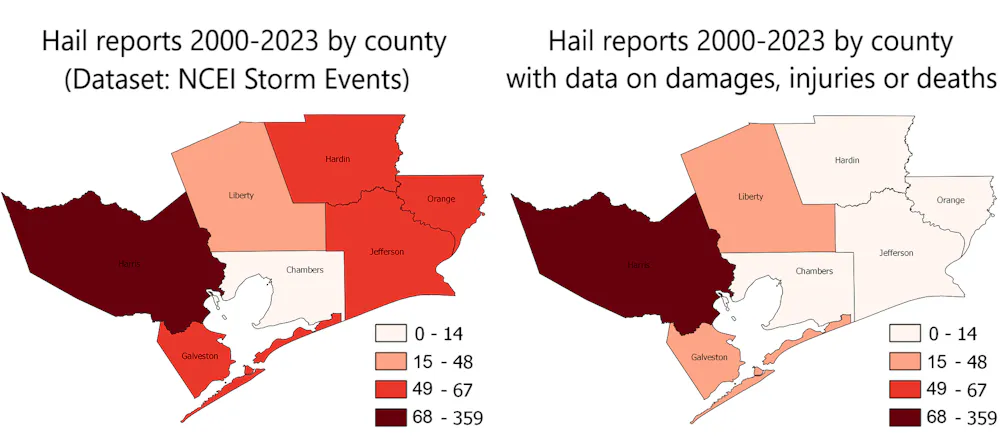
    The number of severe hail reports in southeast Texas listed in the National Centers for Environmental Information’s storm events database is strongly correlated with population. The county with the most reports and greatest detail in those reports is home to Houston. Hailstorms in the three easternmost counties are rarely associated with damage estimates.
    John Nielsen-Gammon and B.J. Baule

    Do you want to look at local damage trends? Forget about it. For most extreme weather events, estimation methods vary over time and are not documented.

    Do you want to direct funding to help communities improve resilience to natural disasters where the need is greatest? Forget about it. The places experiencing the largest per capita damages depend not just on actual damages but on the different practices of local National Weather Service offices.

    Are you moving to a location that might be vulnerable to extreme weather? Companies are starting to provide localized risk estimates through real estate websites, but the algorithms tend to be proprietary, and there’s no independent validation.

    4 steps to improve disaster data

    We believe a few fixes could make NOAA’s storm events database and the corresponding values in the larger SHELDUS database, managed by Arizona State University, more reliable. Both databases include county-level disasters and loss estimates for some of those disasters.

    First, the National Weather Service could develop standard procedures for local offices for estimating disaster damages.

    Second, additional state support could encourage local emergency managers to make concrete damage estimates from individual events and share them with the National Weather Service. The local emergency manager generally knows the extent of damage much better than a forecaster sitting in an office a few counties away.

    Third, state or federal governments and insurance companies can agree to make public the aggregate loss information at the county level or other scale that doesn’t jeopardize the privacy of their policyholders. If all companies provide this data, there is no competitive disadvantage for doing so.

    Fourth, NOAA could create a small “tiger team” of damage specialists to make well-informed, consistent damage estimates of larger events and train local offices on how to handle the smaller stuff.

    With these processes in place, the U.S. wouldn’t need a billion-dollar disasters program anymore. We’d have reliable information on all the disasters.

    John Nielsen-Gammon receives funding from the National Oceanic and Atmospheric Administration and the State of Texas.

    William Baule receives funding from NOAA, the State of Texas, & the Austin Community Foundation.

    ref. Storm damage costs are often a mystery – that’s a problem for understanding extreme weather risk – https://theconversation.com/storm-damage-costs-are-often-a-mystery-thats-a-problem-for-understanding-extreme-weather-risk-257105

    MIL OSI – Global Reports

  • MIL-OSI Global: How your electric bill may be paying for big data centers’ energy use

    Source: The Conversation – USA – By Ari Peskoe, Lecturer on Law, Harvard University

    Your power bill may be hiding something. photoschmidt/iStock/Getty Images Plus

    In the race to develop artificial intelligence, large technology companies such as Google and Meta are trying to secure massive amounts of electricity to power new data centers. Electric utilities see the prospect of earning large profits by providing electricity to these power-hungry facilities and are competing for their business by offering discounts not available to average consumers.

    In our paper Extracting Profits from the Public, we explain how utilities are forcing regular ratepayers to pay for the discounts enjoyed by some of the nation’s largest companies and identify ways policymakers can limit the costs to the public.

    Shifting costs

    In much of the U.S., utilities are monopolists. Within their service territories, they are the only companies allowed to deliver electricity to consumers. To fund their operations, utilities split the costs of maintaining and expanding their systems among all ratepayers – homeowners, businesses, warehouses, factories and anyone else who uses electricity.

    Historically, a utility expanded its system to meet growing demand for electricity from new factories, businesses and homes. To pay for its expansion − new power plants, new transmission lines and other equipment − the utility would propose to raise electricity rates by different amounts for various types of consumers.

    Public utility commissions are state agencies charged with ensuring that the public gets a fair deal. These commissions monitor how much money the utility spends to provide electric service and how its costs are shared among various types of ratepayers, including residential, commercial and industrial consumers. Ultimately, the public utility commission is supposed to approve any rate increases based on its assessment of what’s fair to consumers.

    Splitting the utility’s costs among all consumers made perfect sense when population growth and economic development across the economy stimulated the need for new infrastructure. But today, in many utility service territories, most of the projected growth in electricity demand is due to new data centers.

    Here’s the problem for consumers: To meet data center demand, utilities are building new power plants and power lines that are needed only because of data center growth. If state regulators allow utilities to follow the standard approach of splitting the costs of new infrastructure among all consumers, the public will end up paying to supply data centers with all that power.

    An artist’s rendering of a proposed Meta data center in Richland Parish, La.
    Meta via Facebook

    A big price tag

    One particularly acute example is in Louisiana. A Meta data center under development in the northeastern corner of the state is projected to use, by our calculations, twice as much energy as the city of New Orleans.

    Entergy, the regional monopoly utility, is proposing to build more than US$3 billion worth of new gas-fired power plants and delivery infrastructure to meet the data center’s energy demand. Rather than billing Meta directly for these costs, Entergy is proposing to include the costs in rates paid by all customers.

    Entergy claims its contract with Meta will cover some portion of the $3 billion price tag and that will mitigate any increases in consumers’ bills. But Entergy has asked state regulators to keep key terms of the contract secret, and only a redacted version of its application is available online.

    The public has no idea how much it might pay if the commission approves the contract. And if the Meta data center ends up using much less power than the company anticipates, the public does not know whether it would be on the hook to pay higher electricity rates for longer periods to guarantee Entergy a profit.

    The electronics in data centers consume large amounts of electricity.
    RJ Sangosti/MediaNews Group/The Denver Post via Getty Images

    Secret agreements

    Our research, reviewing nearly 50 public utility commission proceedings about data centers’ power needs across 10 states, uncovered dozens of secretive contracts between utilities and data centers. Unlike Louisiana, most states require utilities to submit to the public utility commission their one-off deals with data centers, but they allow utilities to conceal the pricing terms from the public.

    In normal rate-review cases, numerous parties advocate for their interests in a public proceeding, including members of the public, industry groups and the utility itself. But as our paper finds, utility commission reviews of data center contracts are based on confidential utility filings that are inaccessible to the general public. Few, if any, outsiders participate, and as a result the commission often hears only the utility’s version of the deal.

    Because the pricing terms are secret, it is impossible to know whether the deal that a utility is offering to a data center is too low to cover the utility’s costs of providing power to the data center, which would mean that the public is subsidizing the deal. History shows, however, that utilities have a long history of exploiting their monopolies to shift costs to the public, including through secret contracts.

    Electric utilities also charge customers for the costs of building and maintaining transmission networks.
    Jay L. Clendenin/Getty Images

    Other public costs

    Our paper also explores other ways that the public pays for data center energy costs. For instance, many high-voltage interstate transmission projects, which connect large power plants to local delivery systems, are developed through regional planning processes run by numerous utilities. These alliances have complex rules for splitting the costs of new transmission lines and equipment among their utility members.

    Once a utility is charged its share, it spreads the costs of new transmission projects among its local ratepayers. Because some regions are building new transmission capacity to accommodate data centers, our analysis finds that the public has been forced to pay billions of dollars for data center growth.

    Data center energy costs can also be shifted when data centers connect directly to existing power plants. Under what are called “co-location” deals, the power plant stops selling energy to the wider public and just sells to the data center. With less supply in the overall market, prices go up and the public faces higher bills as a result.

    Many state legislatures are noticing these problems and working to figure out how to address them. Several recent bills would set new terms and conditions for future data center deals that could help protect the public from data center energy costs.

    Ari Peskoe is the Director of the Electricity Law Initiative at the Harvard Law School Environmental and Energy Law Program (EELP). EELP receives funding from philanthropic foundations that support the clean energy transition.

    Eliza Martin does not work for, consult, own shares in or receive funding from any company or organization that would benefit from this article, and has disclosed no relevant affiliations beyond their academic appointment.

    ref. How your electric bill may be paying for big data centers’ energy use – https://theconversation.com/how-your-electric-bill-may-be-paying-for-big-data-centers-energy-use-257794

    MIL OSI – Global Reports

  • MIL-OSI: Military Drone Market Size Expected to Reach $15.16 Billion In 2030 as Cutting-Edge Innovations Improve Operations

    Source: GlobeNewswire (MIL-OSI)

    PALM BEACH, Fla., June 05, 2025 (GLOBE NEWSWIRE) — FN Media Group News Commentary – According to industry experts, the Military Drone market is expected to continue substantial growth in the years to come. The market is characterized by a complex interplay of drivers, restraints, and a spectrum of opportunities collectively shaping its trajectory, especially in the military market. Military drones, also known as Unmanned Aerial Vehicles (UAVs), are advanced technological systems used by military forces for various purposes. These drones are designed to operate without a human pilot on board, and they are remotely controlled or autonomously programmed to carry out a range of tasks. Military drones come in various sizes and configurations, from small hand-launched models to more prominent, long-endurance aircrafts. They serve many roles, including reconnaissance, surveillance, target acquisition, intelligence gathering, communication relays, and combat operations. Their ability to operate in challenging environments, gather real-time data, and execute missions with reduced risk to human personnel has made them valuable assets in modern warfare strategies. However, their use raises ethical and legal considerations concerning civilian safety, privacy, and potential misuse. A report from Verified Market Research said that: “The Military Drone market is characterized by a complex interplay of drivers, restraints, and a spectrum of opportunities collectively shaping its trajectory. Technological advancement stands as a prominent driver, propelling the market forward with cutting-edge innovations that enhance the capabilities of unmanned aerial vehicles (UAVs). These advancements encompass a range of functionalities, from improved surveillance and reconnaissance to combat capabilities, all of which contribute to the drones’ strategic significance on the battlefield. Additionally, the cost-effectiveness of Military Drone compared to manned aircraft is a compelling driver, enabling military forces to achieve operational objectives with reduced financial burdens.”   Active Companies in the markets today include ZenaTech, Inc. (NASDAQ: ZENA), Red Cat Holdings, Inc. (NASDAQ: RCAT), Kratos Defense & Security Solutions, Inc. (NASDAQ: KTOS), AeroVironment (NASDAQ: AVAV), Northrop Grumman Corporation (NYSE: NOC).

    Verified Market Research continued: “A range of opportunities beckons the Military Drone market. One such opportunity lies in intelligent swarming, where multiple drones collaborate seamlessly to achieve intricate missions, providing enhanced surveillance and reconnaissance capabilities. Additionally, the development of counter-drone technologies represents a growing niche within the market, as the increasing proliferation of drones necessitates robust defenses against hostile UAVs. The convergence of commercial and military sectors offers a unique avenue for collaboration, fostering cross-pollination of technologies and innovative solutions. Integrating artificial intelligence and automation further widens the scope of Military Drone applications in the realm of technological advancement. These capabilities enable drones to execute complex tasks autonomously, reducing the burden on human operators and opening doors to entirely new mission profiles. Moreover, exploring hybrid power systems and stealth technology holds promise for extending drone endurance and elevating their covert capabilities, expanding the range of potential operations.”

    ZenaTech (NASDAQ:ZENA) Launches Drone as a Service (DaaS) for US Defense and Government Agencies with New Partnerships – ZenaTech, Inc. (FSE: 49Q) (BMV: ZENA) (“ZenaTech”) a technology company specializing in AI (Artificial Intelligence) drones, Drone as a Service (DaaS), Enterprise SaaS, and Quantum Computing solutions, today announces the launch of Drone as a Service specifically for US Defense and Government agencies, and two new partnerships with consulting and government relations firms to assist in selling these services.

    ZenaTech’s ZenaDrone subsidiary has retained the services of Bromelkamp Government Relations and Winning Strategies Washington to provide Congressional lobbying and defense business development consulting services. Bromelkamp is a defense-focused business development consulting firm to small and medium technology companies that are growing their business with the US Department of Defense and other security-related federal agencies. Winning Strategies is an independent bipartisan federal government relations and grants procurement firm.

    “These partnerships will be instrumental in building relationships with the various agencies as we launch our DaaS service and expand our sales efforts in this sector,” said Shaun Passley, Ph.D., CEO of ZenaTech. “Bromelkamp and Winning Strategies have decades of defense industry experience and understand the complexities and culture of the military. As defense priorities shift toward autonomy, resilience, and secure supply chains, ZenaTech is uniquely positioned to deliver scalable, mission-ready drone solutions that align with the US military and the defense industry. Our Drone as a Service model is designed to accelerate adoption, lower barriers, and support operational agility.”

    With a growing demand for advanced drone solutions in security, logistics and tactical operations, the DaaS model allows defense customers to deploy mission-specific drone solutions without the need for capital equipment purchases. To accelerate market entry, ZenaTech has onboarded two seasoned military consultants to lead business developments, identify pilot programs, and secure funding partnerships within the defense sector.

    The ZenaDrone 1000 is an autonomous, military grade aerial solutions built for multi-mission flexibility, featuring a patented foldable-wing design, 40 kg payload capacity, and 1 hour flight time. Its onboard AI, thermal imaging, LiDAR, and multi spectral sensors enable real-time ISR (intelligence, surveillance, and reconnaissance), border patrol, and base surveillance with minimal operator input. The modular cone enables fast swapping of mission-specific payloads like HD Cameras and sensors, making it ideal for tactical resupply, SAR (search and rescue), infrastructure inspection, and operations in high-risk restricted environments. Rugged, AI-powered and rapidly deployable, the ZenaDrone 1000 enhances situational awareness and operational reach for defense forces.

    The ZenaDrone IQ Nano and IQ Square are compact, high-performance drone solutions engineered for intelligence, surveillance, and reconnaissance (ISR), indoor security, and tactical inspection in complex military environments. The IQ Nano, excels in GOS-denied environments like military warehouses or confined infrastructure, offering obstacle avoidance, and precise maneuverability. The IQ Square, with extended flight time and payload options, supports ISR, CBRN monitoring and perimeter patrols. Lightweight and field-ready, both drones deliver rapid situational awareness for mission-critical deployments.

    ZenaTech is actively pursuing Green UAS and Blue UAS certifications to meet stringent federal standards. With recent restrictions on Chinese-made drones in military and government operations, these certifications are mandatory for vendors aiming to participate in DoD and allied agency contracts. ZenaTech’s compliant drone solutions open access to high-value defense contracts and align with increasing demand for secure aerial solutions.

    The DaaS business model offers customers reduced upfront costs and convenience ─ there is no need to purchase drone hardware and software, find a drone pilot, manage maintenance and operation, or acquire regulatory approvals. The model also offers scalability to use more often or less often based on business needs. Continued… Read this full release by visiting: https://www.financialnewsmedia.com/news-zena/.

    Other recent developments in the markets include:

    Red Cat Holdings, Inc. (NASDAQ: RCAT), a drone technology company integrating robotic hardware and software for military, government, and commercial operations, recently reported its financial results for the first quarter ended March 31, 2025 and provides a corporate update.

    “Red Cat’s momentum continues to build as we execute on our strategy to deliver advanced, AI-enabled unmanned systems across air, land, and sea,” said Jeff Thompson, Red Cat CEO. “Our partnership with Palantir to deploy Warp Speed is optimizing our manufacturing and cost efficiency, while our expansion into maritime autonomy with Unmanned Surface Vessels significantly expands our Family of Systems. A strong balance sheet bolstered by a recent $30 million capital raise positions us strongly to meet growing domestic and international demand in the second half of 2025.”

    “Our balance sheet remains strong as we transition to production and delivery of our new Black Widow drones,” said Chris Ericson, Red Cat CFO. “We have bolstered our quarter-end cash and receivables of $9 million with an additional $30 million from a capital raise executed soon after quarter-end. This liquidity has given us ample strength and ability to expand manufacturing to meet the impending demands of the U.S. Army’s SRR program and international opportunities for the second half of 2025.”

    Kratos Defense & Security Solutions, Inc. (NASDAQ: KTOS), a Technology Company in the Defense, National Security and Global Markets, and GE Aerospace (NYSE: GE) recently announced a formal teaming agreement to advance propulsion technologies for the next generation of affordable unmanned aerial systems and Collaborative Combat Aircraft-type (CCA-type) aircraft.

    Eric DeMarco, President and CEO of Kratos, said, “Kratos’ strategically important Teaming Agreement with GE Aerospace continues to rapidly advance and expand, with the GEK family of engines targeting certain of the most important, mission critical and highest priority needs and requirements of United States National Security. At Kratos, affordability is a technology and delivering more capability for less cost as quickly as possible are key contributions we are bringing for truly industry leading GEK offerings with our partner and global leader GE Aerospace.”

    Tomahawk GCS, an AeroVironment (NASDAQ: AVAV) product line specializing in autonomous and intelligent multi-domain systems, has recently been awarded a $5.1 million contract to support the U.S. Army Rapid Capabilities and Critical Technologies Office (RCCTO) Human-Machine Integrated Formations (HMIF) rapid prototyping project. Following a rigorous selection process, AV’s Tomahawk’s Grip TA5 was selected as the Dismounted Common Controller (DCC) to significantly enhance human-machine teaming for battlefield operations.

    The HMIF initiative, led by the U.S. Army RCCTO, is accelerating the integration of autonomous and robotic systems into formations to enhance situational awareness, lethality, and survivability. With its modular architecture and multi-platform compatibility, the Grip TA5 provides operators command-and-control of multiple robotic assets in real-time, enhancing mission adaptability and response speed.

    Northrop Grumman Corporation (NYSE: NOC) has recently invested $50 million into Firefly Aerospace to further advance production of their co-developed medium launch vehicle, now known as Eclipse™. The companies continue to make progress in the development of Eclipse flight hardware with qualification testing underway and more than 60 Miranda engine hot fire tests performed to date.

    “Firefly is incredibly grateful for Northrop Grumman’s investment that further solidifies our first-of-its-kind partnership to build the first stage of Antares 330 and jointly develop Eclipse,” said Jason Kim, CEO of Firefly Aerospace. “Eclipse represents two powerful forces coming together to transform the launch market with decades of flight heritage, a rapid, iterative approach, and bold innovation. With a 16 metric ton to orbit capability, Eclipse is a sweet spot for programs like NSSL Lane 1 and a natural fit to launch proliferated constellations in LEO, MEO, GEO, and TLI.”

    About FN Media Group:

    At FN Media Group, via our top-rated online news portal at www.financialnewsmedia.com, we are one of the very few select firms providing top tier one syndicated news distribution, targeted ticker tag press releases and stock market news coverage for today’s emerging companies. #tickertagpressreleases #pressreleases

    Follow us on Facebook to receive the latest news updates: https://www.facebook.com/financialnewsmedia

    Follow us on Twitter for real time Market News: https://twitter.com/FNMgroup

    Follow us on Linkedin: https://www.linkedin.com/in/financialnewsmedia/

    DISCLAIMER: FN Media Group LLC (FNM), which owns and operates FinancialNewsMedia.com and MarketNewsUpdates.com, is a third party publisher and news dissemination service provider, which disseminates electronic information through multiple online media channels. FNM is NOT affiliated in any manner with any company mentioned herein. FNM and its affiliated companies are a news dissemination solutions provider and are NOT a registered broker/dealer/analyst/adviser, holds no investment licenses and may NOT sell, offer to sell or offer to buy any security. FNM’s market updates, news alerts and corporate profiles are NOT a solicitation or recommendation to buy, sell or hold securities. The material in this release is intended to be strictly informational and is NEVER to be construed or interpreted as research material. All readers are strongly urged to perform research and due diligence on their own and consult a licensed financial professional before considering any level of investing in stocks. All material included herein is republished content and details which were previously disseminated by the companies mentioned in this release. FNM is not liable for any investment decisions by its readers or subscribers. Investors are cautioned that they may lose all or a portion of their investment when investing in stocks. For current services performed FNM has been compensated fifty one hundred dollars for news coverage of the current press releases issued by ZenaTech, Inc. by the Company. FNM HOLDS NO SHARES OF ANY COMPANY NAMED IN THIS RELEASE.

    This release contains “forward-looking statements” within the meaning of Section 27A of the Securities Act of 1933, as amended, and Section 21E the Securities Exchange Act of 1934, as amended and such forward-looking statements are made pursuant to the safe harbor provisions of the Private Securities Litigation Reform Act of 1995. “Forward-looking statements” describe future expectations, plans, results, or strategies and are generally preceded by words such as “may”, “future”, “plan” or “planned”, “will” or “should”, “expected,” “anticipates”, “draft”, “eventually” or “projected”. You are cautioned that such statements are subject to a multitude of risks and uncertainties that could cause future circumstances, events, or results to differ materially from those projected in the forward-looking statements, including the risks that actual results may differ materially from those projected in the forward-looking statements as a result of various factors, and other risks identified in a company’s annual report on Form 10-K or 10-KSB and other filings made by such company with the Securities and Exchange Commission. You should consider these factors in evaluating the forward-looking statements included herein, and not place undue reliance on such statements. The forward-looking statements in this release are made as of the date hereof and FNM undertakes no obligation to update such statements.

    Contact Information:

    Media Contact email: editor@financialnewsmedia.com – +1(561)325-8757

    SOURCE: FN Media Group

    The MIL Network

  • MIL-OSI United Kingdom: Russia continues to frustrate peace efforts while trying to convince the world it is taking them seriously: UK statement to the OSCE

    Source: United Kingdom – Executive Government & Departments

    Speech

    Russia continues to frustrate peace efforts while trying to convince the world it is taking them seriously: UK statement to the OSCE

    Ambassador Holland calls out Russia’s latest tactics to frustrate efforts to end its war in Ukraine while trying to convince the world it is serious about peace. He confirms that the Kremlin’s delay tactics will only redouble the UK’s resolve to support Ukraine to secure a just and lasting peace

    Thank you, Mister Chair.  The UK welcomes the second round of bilateral negotiations that took place earlier this week in Istanbul.  We thank Türkiye for again hosting the discussions and the United States for creating the momentum that got everybody to this point.  The agreement to a further large-scale prisoner exchange and the return of fallen soldiers is a further step towards building confidence.

    We regret, however, that Russia limited the progress that could be made at Monday’s talks by refusing to send, in advance, the memorandum setting out its position on ending this illegal war.  The memorandum, when it arrived, revealed no movement away from the maximalist terms that we have all heard before.  We also regret that the Kremlin continues to reject a complete, unconditional and immediate 30-day ceasefire.

    This is consistent with the tactics that Russia has employed for weeks over peace talks: to draw out the process and refuse to engage in a meaningful way; all while trying to convince the world that it is serious about peace.  We see it in this Council and at the United Nations where Russia makes nonsensical claims.  Among these is the allegation that those who materially support Ukraine’s sovereign right to defend itself from unprovoked aggression, are undermining peace efforts.

    Nobody in this room is fooled; we know who started this war, and we know who is resisting efforts to end it.  The UK is committed to securing a just and lasting peace in Ukraine.  Delay tactics from the Kremlin will only redouble our resolve to help Ukraine defend itself and to use our sanctions to restrict Russia’s war machine.

    Thank you.

    Updates to this page

    Published 5 June 2025

    MIL OSI United Kingdom

  • MIL-OSI NGOs: DRC: Victims still waiting for justice, truth and reparations 25 years on from Kisangani war 

    Source: Amnesty International –

    Twenty-five years since the six-day war in Kisangani in Democratic Republic of Congo in which hundreds of civilians were killed and thousands more injured, victims are still waiting for truth, justice and, for the most part, reparations, Amnesty International said in a new briefing today. 

    The briefing Is anyone moved by Congo’s pain? 25 years without justice for the six-day war in Kisangani, documents how there has not been a single criminal investigation or trial since the bloody conflict between Rwandan and Ugandan forces. During the fighting in the north-eastern city, which started on 5 June 2000, both armies engaged in intense and indiscriminate shelling of heavily populated civilian areas, intentionally killed civilians, raped women and pillaged houses.  

    It is utterly unacceptable that for 25 years, not a single person has been held to account for crimes perpetrated in Kisangani, not one.

    Tigere Chagutah, Amnesty International’s Regional Director for East and Southern Africa

    With the DRC courts’ failure to pursue justice and the International Criminal Court’s (ICC) lack of jurisdiction over crimes committed in DRC before 2002, those suspected of criminal responsibility for these crimes have never been prosecuted and punished. 

    “It is utterly unacceptable that for 25 years, not a single person has been held to account for crimes perpetrated in Kisangani, not one,” said Tigere Chagutah, Amnesty International’s Regional Director for East and Southern Africa. “This lack of criminal accountability for past crimes has led to a cycle of violence in the DRC, with similar actors, similar weapons and similar suffering. Justice cannot wait another 25 years. It is the responsibility of Congolese judicial authorities to investigate and, if there is sufficient admissible evidence, prosecute those suspected of criminal responsibility for crimes committed on DRC territory.” 

    In 2022, the International Court of Justice (ICJ) ordered Uganda to pay reparations, following a case brought by the DRC against Uganda and Rwanda. The ICJ did not have jurisdiction over Rwanda. In 2024, some victims finally started to receive compensation, but the process by been wrought by complaints of mismanagement and embezzlement. 

    Amnesty International interviewed over 50 people, mostly survivors, as well as civil society organizations and justice sector officials. 

    The “Three-Day, One-Day and Six-Day wars” in Kisangani 

    The six-day war was one of a series of conflicts between the Ugandan and Rwandan armies in Kisangani between August 1999 and June 2000 that left behind a trail of death and destruction. 

    The first war – “the three-day war”, started on 14 June 1999, with the two armies exchanging indiscriminate fire and shelling, which killed more than 30 civilians  and wounded more than 100.  

    After close to a year of relative quiet, fighting started again on 5 May 2000 and lasted only one day. Exactly a month later, the “six-day war”, which was more intense, started. Without differentiating between civilians and combatants, the two armies indiscriminately shelled Kisangani, killing several hundred civilians and injuring thousands. 

    A civil society activist who survived and reported on the three wars in Kisangani recounted:  

    “For six days there were only bombs falling, we did not know if we were going to live. There were a lot of fatalities…” 

    A woman who was seven at the time of the war, recalled: 

    “I was walking with my grandmother when I was struck by a bomb in my leg. I didn’t know how to get to hospitals, it was dangerous, so we were dealing with the injury at home, but the foot was rotting. On the fifth day I went to the hospital, but it was too late, they cut off my leg.  

    For six days there were only bombs falling, we did not know if we were going to live. There were a lot of fatalities.

    Survivor, Kisangani

    “A gentleman who could not go home until the war ended, returned at the end of the six days and found his wife and three children dead, their corpses decomposing. The house had been hit by bombs. “He went mad and died shortly after.”  

    People want truth, justice and reparations 

    Despite the lack of judicial criminal proceedings either in the DRC or internationally, the people’s demands for justice and reparations remain strong decades later. 

    A man, who also survived the wars, said: “My dearest wish was the establishment of courts. This is the wish of the Congolese people. Now we have a sense of frustration in the population. Why were there blockages? It is unclear why crimes that have already been documented have not been tried. Is there nobody emotionally moved by the crimes committed in Congo?” 

    At least 40 people interviewed told Amnesty International that there was no political will to institute criminal proceedings or deliver justice. Lack of judicial independence has also meant that without the support of political leaders, some of whom are former belligerents, judicial officials could not open investigations. 

    The complete lack of prosecutions has led to a loss of trust in the country’s justice system and the government. 

    With regards to reparation programmes, the Special Fund for the Distribution of Compensation to Victims of Uganda’s Illicit Activities in the DRC (FRIVAO), tasked to manage the millions of dollars Uganda has been ordered to pay for reparations by the ICJ, has been criticised for lack of transparency and adequate consultations with victims of the Kisangani wars.  

    Justice cannot wait another 25 years. It is the responsibility of Congolese judicial authorities to investigate and, if there is sufficient admissible evidence, prosecute those suspected of criminal responsibility for crimes committed on DRC territory

    Tigere Chagutah

    One activist said: “People have no decency; there has been bloodshed… and they are embezzling funds that were intended for public interest work and victims! That is not what we fought for.”  

    Tigere Chagutah said: “Amnesty International reminds DRC of its obligations to investigate and, if enough admissible evidence is found, to prosecute in fair trials those suspected of criminal responsibility for the serious crimes committed in the territory of the DRC for over 30 years, including the Kisangani war.”  

    “The government must also offer adequate, effective and prompt reparations to victims following genuine consultations with survivors and civil society.” 

    MIL OSI NGO

  • MIL-OSI NGOs: USA: Veto of UN resolution on lifting Gaza aid restrictions and unconditional release of hostages is inhumane and shameful amid Israel’s ongoing genocide

    Source: Amnesty International –

    Responding to the US government’s decision to veto a draft UN Security Council resolution calling for an immediate ceasefire in the occupied Gaza Strip, the release of hostages, and the “immediate and unconditional lifting of all restrictions on the entry of humanitarian aid”, Amnesty International’s Secretary General, Agnès Callamard, said:  

    “This latest shameful US veto – one in a long list – gives Israel the green light to continue its genocide of Palestinians in Gaza. It allows Israel to continue starving Palestinian civilians and creating conditions of life meant to bring about their destruction. 

    “The US has squandered yet another crucial opportunity to demand that Israel ends civilian bloodshed. What possible justification can there be for blocking action by the UN Security Council that could help to end the harrowing starvation and suffering, free hostages and lift Israel’s suffocating aid restrictions? 

    “The lives of more than 2 million Palestinians are at stake: babies and children hospitalized for malnutrition-related symptoms; tens of thousands of children sleeping on empty stomachs; families unable to access flour for weeks; mothers too malnourished to breastfeed their infants; injured civilians deprived of life-saving medical supplies; and starved and emaciated fathers walking for hours under inhumane conditions to collect a parcel of food, not knowing if they’d even return home to their children.  

    The US can and must do its part to put an end to this manmade catastrophe, which it has contributed to.

    Agnès Callamard, Amnesty International’s Secretary General

    “As the occupying power, Israel has a clear obligation under international law to ensure the population in the territory it controls has adequate access to food, medicine and other supplies essential to their survival. It has repeatedly refused to do so. All states, including the United States, have an obligation to prevent genocide, cooperate to bring it to an end and punish perpetrators.

    “Israel’s newly established militarized humanitarian aid scheme, run by the US-backed Gaza Humanitarian Foundation, is not the answer as it is at odds with humanitarian principles and international law. The danger, ineffectiveness and utter depravity of this scheme became painfully clear as dozens of Palestinians, many of whom are sole providers for their families, were killed or injured while trying to access food. Nothing short of lifting all restrictions on entry of humanitarian aid will do. 

    “The US can and must do its part to put an end to this manmade catastrophe, which it has contributed to. It must immediately halt arms transfers and military assistance, press Israel to lift all aid restrictions and push for an immediate ceasefire by all parties. The survival of 2.2 million Palestinians in Gaza depends on it.” 

    MIL OSI NGO

  • MIL-OSI United Kingdom: National Drought Group meets after driest spring in 132 years

    Source: United Kingdom – Executive Government & Departments

    Press release

    National Drought Group meets after driest spring in 132 years

    Expert group told England has now experienced driest March, April and May since 1893.

    The Environment Agency convened a National Drought Group meeting today (5 June 2025) to discuss the latest outlook and hear from water companies about steps they are taking to prepare for the summer.  

    England has only seen 57% of the long-term average May rainfall and spring is the driest since the reign of Queen Victoria. However, the recent rain at the end of May and the start of June is helping to stabilise the position.

    The expert group will now meet monthly following a drought declaration in the north-west. Four other areas – the north-east, Yorkshire, east and west midlands – are also experiencing prolonged dry weather.  

    The EA told the group it has stepped up its operational response. This includes more compliance checks on businesses who abstract water, such as manufacturers, and increased monitoring of river and groundwater levels.

    The regulator is also working with all members of the National Drought Group, including the National Farmers Union, to help farmers plan their water needs over the summer.

    Meanwhile, water companies updated the group on how they are implementing their drought plans, including increased communication with customers, and speeding up the fixing of leaks.

    United Utilities in the north-west has increased the rate of finding and fixing leaks by 70% in recent weeks after a strong response from the community in spotting leaks during the dry weather.

    Youlgrave Waterworks, a private firm which supplies 500 homes in Derbyshire, became the first company to introduce a hosepipe ban at the start of June. The major water companies report they have no current plans for hosepipe bans but are keeping this under review.

    Helen Wakeham, EA Director of Water and National Drought Group chair, said: 

    It’s been the driest spring since 1893, and we need to be prepared for more summer droughts as our climate changes.

    The recent rainfall is having a positive effect, but it hasn’t been enough to stop a drought in the north-west and we must ensure we have enough water to last the entire summer.

    We are working with water companies, farmers and other abstractors to help them plan their water usage over the summer and urge people to be mindful about their daily use.

    The National Drought Group heard that without further substantial rain, some water companies may need to implement further drought measures this summer to conserve supplies.

    Water Minister Emma Hardy said:

    We face a water shortage in the next decade. That’s why the government is taking urgent steps to secure supplies into the future, as part of our Plan for Change.

    As an immediate step, we have convened the National Drought Group to make sure water companies are acting to conserve this precious resource and act in line with their drought plans.

    The Government has secured over £104 billion of private sector investment to fund essential infrastructure, including nine new reservoirs, and to cut leakage by 17% over the next five years.

    Dr Will Lang, Chief Meteorologist at the Met Office said: 

    After the driest Spring for more than a century across England, the start of June has brought some much-needed rainfall with a mix of Atlantic weather systems interspersed with drier and sunnier periods expected to continue over the coming days.

    Most areas will experience showers at times with some seeing longer spells of rain.  From mid-June onwards, the forecast becomes less clear with signs of drier conditions becoming more dominant across southern England.

    Looking further ahead, the chance of a hot summer is higher than normal with an associated increased risk of heatwaves and related impacts. After the more unsettled and wetter start to June, the likelihoods of a wetter or drier than average summer remain evenly balanced.

    Periods of dry weather and low rivers can have several consequences for the environment and wildlife. Low oxygen levels in water can lead to fish kills, as well as more algal blooms and lower river flows prevent wildlife from moving up or downstream.  

    The National Drought Group – which includes the Met Office, government, regulators, water companies, farmers, and conservation experts – heard:  

    • Reservoir levels are now at 77%.

    • Fish rescues have been carried out on the Rivers Redlake and Tern in Shropshire.  

    • Navigation issues have been noted with the Canals and Rivers Trust having to implement restrictions on the Leeds-Liverpool Canal and Lancaster Canal because of low water levels.   

    • The quality of spring crops is becoming a concern because of the dry soil and poor grass growth for feed.  

    • Applications for Local Resource Options (LRO) screening studies are now open for groups of farmers to explore ways to improve water availability and reliability.

    The Environment Agency is encouraging the public to report environmental incidents to their 24/7 hotline on 0800 80 70 60. Meanwhile angling groups are also asking members to report signs of environmental impacts.

    Notes to editors: 

    A decision to declare drought is taken based on reservoir levels, river flows and moisture in the soil along with consideration of the long-term weather forecasts.  

    More information on how drought is defined can be found here: Drought explained – Creating a better place

    Updates to this page

    Published 5 June 2025

    MIL OSI United Kingdom

  • MIL-OSI Europe: Written question – EU-wide ban on flavoured and disposable vapes – E-002114/2025

    Source: European Parliament

    Question for written answer  E-002114/2025
    to the Commission
    Rule 144
    Gerben-Jan Gerbrandy (Renew)

    The evidence of health and environmental risks is mounting rapidly. Recent data reveals that nearly one third of 15-year-olds in Europe have tried e-cigarettes, while scientific literature increasingly demonstrates that vaping can impair brain development, exacerbate mental health issues and cause respiratory and cardiovascular disease, and has even led to documented deaths from vaping-associated lung injury – with disposable vapes creating massive environmental waste through single-use batteries and plastics.

    The Member States are forced to implement their own ‘gold-plated’ restrictions to protect citizens, prompting 12 countries to call for stronger European legal frameworks in June 2024. National laws alone prove insufficient against the flourishing illegal vape trade where criminal networks easily circumvent restrictions and flood schoolyards with unregulated products.

    • 1.What concrete measures has the Commission implemented to address the concerns raised by the 12 Member States in June 2024 regarding youth vaping, and what timeline does the Commission currently have for applying these measures EU-wide?
    • 2.Is the Commission prepared to invoke Article 20(11) of Directive 2014/40/EU to enact an EU-wide ban on flavoured and disposable vapes via delegated act, following national bans already implemented in three Member States?

    Submitted: 27.5.2025

    Last updated: 5 June 2025

    MIL OSI Europe News

  • MIL-OSI United Kingdom: Council agrees further work to tackle climate change

    Source: City of Portsmouth

    Ambitious next steps towards a carbon neutral Portsmouth have been agreed by the city council.

    A programme of work to tackle climate change will build on achievements over the last 12 months, which include:

    • Delivering Warm Homes funding to help make Portsmouth homes more energy efficient, reducing fossil fuel usage
    • Launching a landmark solar power project at Lakeside North Harbour, one of the UK’s biggest solar car park and battery storage installations
    • Starting work on ‘Seachange’, the biggest project in Portsmouth International Port’s history to provide green electricity to power ships while at berth
    • Securing funding to plant 2,500 new trees as part of a wider Greening Strategy to double the city’s tree canopy coverage over 25 years, and developing an Urban Forest Masterplan
    • Partnering with Southern Water to invest in reducing surface water runoff which contributes to outfall releases, including a £220,000 grant for sustainable drainage at New Horizon’s School
    • Working in partnership with Hampshire County Council and First Bus to launch a fleet of 62 brand new, zero emission buses, replacing a diesel fleet as part of the strategy for greener travel and improved air quality

    A report for the Climate Change and Greening the City meeting outlined the council’s focus on continuing to reduce carbon usage across all departments. The council will work with partners to protect and enhance Portsmouth’s natural environment, while building resilience to the impacts of climate change – such as heatwaves and rainfall – with a focus on supporting the most vulnerable.

    A programme of climate and natural environment actions was presented and agreed. It includes:

    • Improving how the council monitors carbon emissions, including emissions from its suppliers.
    • Developing Local Area Energy Plans
    • Continuing to work with the Department for Energy Security and Net Zero on funded schemes to upgrade domestic properties across all tenures to improve energy efficiency and reduce carbon emissions.
    • Developing a resilient treescape by working with stakeholders and communities so old and new trees are resilient to climate change impacts and provide cooling across the city
    • Continued working to reduce surface water flooding
    • Exploring how we deliver a green and healthy streets programme
    • Developing a biodiversity strategy and action plan as part of the council’s Strengthened Biodiversity Duty
    • Development of an air quality strategy

    Cllr Kimberley Barrett, Cabinet Member for Climate Change and Greening the City, said:

    “Climate change is here and its impact is affecting us all. That’s why we declared a climate emergency in 2019, and made a pledge for the city and the council to become carbon neutral.

    “We all want Portsmouth to be a green and healthy city, where people and businesses thrive alongside nature. But we can only achieve this if businesses and our communities work together.

    “The good news is that so much has been achieved already, but we need to keep being ambitious as this programme of work is, to protect and enhance our special city.”

    Cllr Barrett approved the transformation programme, which will form the basis of the council’s activity to tackle climate change and improve the natural environment for 2025/26.

    MIL OSI United Kingdom

  • MIL-OSI Security: Two men charged in connection with firearms incident in Croydon

    Source: United Kingdom London Metropolitan Police

    Met detectives have charged two men with attempted murder following a shooting in Croydon last month.

    Anthony Dasousa, 30 (30.01.95), of Station Approach, Coulsdon, was charged on Wednesday, 4 June, with attempted murder and possession of a shotgun with intent to endanger life. He was arrested on Tuesday, 3 June.

    Tevin Nzita, 29 (15.07.95), of Warbank Crescent, Croydon, was charged on Thursday, 5 June with attempted murder and possession of a shotgun with intent to endanger life. He was arrested on Wednesday, 4 June.

    On Wednesday, 21 May officers, including specialist crime officers, attended Walsh Crescent, New Addington after multiple reports of a firearm discharge shortly after 19:26hrs.

    A man in his 30s suffered gunshot wounds and was treated in hospital. His injuries have not been deemed life-threatening or life-changing.

    Both men have been remanded in custody. Dasousa appeared at Bromley Magistrates’ Court on Wednesday, 4 June and Nzita appeared at the same court on Thursday, 5 June.

    MIL Security OSI

  • MIL-OSI Africa: The Global Environment Facility (GEF) backs $8.7m initiative to unite African nations against extreme weather events in the Ubangi River Basin

    Source: Africa Press Organisation – English (2) – Report:

    ABIDJAN, Ivory Coast, June 5, 2025/APO Group/ —

    Home to one of the largest tributaries of the Congo River, the Central African Republic (CAR) and the Democratic Republic of the Congo (DRC) will benefit from a pioneering cross-border initiative to prepare for extreme climatic events and develop joint water resource management strategies with $8.7 million in funding from the Global Environment Facility (GEF). 

    Approved this Monday by the GEF Council, the “Regional program for integrated water resources management in the transboundary basin of the Ubangi River between the CAR and the DRC” aims to strengthen bilateral cooperation between the two African nations while improving technical and institutional capacities for managing increasingly extreme floods, droughts and erratic rainfall patterns affecting the Ubangi River basin.  

    The GEF implementing agencies of the project are the International Union for Conservation of Nature (IUCN) and the African Development Bank. A regional body and two national ministries are ensuring the execution of the initiative: the International Commission of the Congo-Ubangi-Sangha (CICOS), the Ministry of Rural Development of the DRC, and the Ministry of Development of Energy and Water Resources of the CAR. 

     Thierry Kamach, Minister of Environment and Sustainable Development of CAR said: “The degradation of natural resources is undeniable. The United Nations 2030 Agenda is an inspiring and unifying message to build strong resilience around a transformative project that will further strengthen ecosystem interdependence for a greener and more sustainable future.” 

    Flowing between the CAR, the DRC and the Republic of Congo, the Ubangi stretches over 2,272 kilometres and is the main right-bank tributary of the Congo River. As such, it is part of the Congo River basin, the second-largest river basin in the world and a global biodiversity hotspot with over 1,000 fish species.  

    The river basin’s rainforest harbours more than 10,000 plant species and 2,500 animal species, including two-thirds of all primates, which are under pressure from deforestation and land cover clearing. In parallel, changes in hydrological regimes, riverbank erosion, sedimentation and mining pollution threaten the river’s fish and shore fauna, which are becoming increasingly rare, and the Ubangi’s role as a regulator of regional and global climates. These challenges will be addressed by the new GEF initiative in an integrated fashion, considering the nexus between biodiversity, climate and ecosystem degradation, and between aquatic and terrestrial ecosystems. 

    This initiative is vital as it brings together the communities and institutions of two countries to conserve one of Africa’s most ecologically and economically important river basins. By working across borders, these countries will strengthen their resilience to climate change while protecting biodiversity and the natural systems that sustain life” said IUCN Director General, Grethel Aguilar. “Through its strong on-the-ground presence in the Congo basin, IUCN will mobilise actors in the forest and environmental sectors to promote collaborative basin management and community-led nature-based solutions at the regional, national and local levels. Our focus will be as much on biodiversity and water resources, as it will on safeguarding the livelihoods of the region’s 25 million inhabitants, many of whom depend on the Ubangi River for navigation, trade and agriculture”.

     “This initiative is aligned with GEF’s long-standing commitment and investments in the sustainable management of the Congo basin,” said GEF CEO and Chairperson Carlos Manuel Rodríguez. “By funding this crucial effort in support of sustainable management of water and land resources while averting pollution and land degradation, the GEF also contributes to maintaining the ecosystem functions of this gigantic forest system in supporting the stability of the regional and global hydrological cycle.” 

    Over the past 30 years, changes in rainfall patterns have progressively decreased water levels and reduced runoff in the Ubangi River by up to 18%. Coupled with the erosion, this further accentuated the siltation of the river, which is not only detrimental to biodiversity but also cripples navigation, limits trade and restricts access to residential areas. Alternating with drought periods, destructive floods are another harsh reality affecting hundreds of thousands of people in the region over the last decade, leading to population displacement to neighbouring countries.  

    The new GEF initiative will enable more effective binational cooperation in decision-making and the political monitoring of water crises by establishing a joint observatory and shared tools and data protocols between the DRC and CAR to enhance forecasting, prevention, and common crisis management measures. To combat biodiversity loss caused by human activities in the river basin, practical demonstrations of nature-based solutions —such as agroforestry, conservation farming and ecosystem rehabilitation— will be carried out on site. 

    Ensuring social inclusivity and promoting a “whole of society” approach, the project will roll out a framework for dialogue and exchange among stakeholders, including regional and local authorities, the private sector (particularly local small to medium-sized enterprises), young professionals, and female community leaders. This aims to strengthen local actors’ capability to contribute to shared watercourse management through training and capacity-building, and to assist them in formulating strategies to resolve common challenges. 

    Anthony Nyong, Director of the Climate Change and Green Growth Department at the African Development Bank, stated: “The Bank welcomes this GEF-supported initiative to strengthen cooperation in the Ubangi basin, enhance local resilience, and promote women’s leadership. Its nature-based, people-centred approach aligns with our High 5s and offers a model for basin-wide collaboration in Africa.” 

    With $67 million mobilised in co-financing, the GEF initiative complements a pre-existing project entitled “Regional Support Programme for the Development of Cross-border Water Infrastructure and Resources between the Central African Republic (CAR) and the Democratic Republic of Congo (DRC) – PREDIRE”, being implemented by the African Development Bank, by mainstreaming environmental, ecosystem and participative approaches into the sectors of water, agriculture and transport. 

    MIL OSI Africa

  • MIL-OSI Asia-Pac: President Lai welcomes President Bernardo Arévalo of Republic of Guatemala with military honors  

    Source: Republic of China Taiwan

    Details
    2025-06-03
    President Lai confers decoration on President Hilda C. Heine of Republic of the Marshall Islands, hosts state banquet  
    At noon on June 3, President Lai Ching-te, accompanied by Vice President Bi-khim Hsiao, conferred a decoration upon President Hilda C. Heine of the Republic of the Marshall Islands, and hosted a state banquet for President Heine and her husband at the Presidential Office. In remarks, President Lai thanked President Heine for her commitment to deepening the diplomatic partnership between our nations and speaking up for Taiwan in the international arena. He also expressed hope for Taiwan and the Marshall Islands to work together to address various challenges through an even greater diversity of exchanges, and that together, we can contribute even more to peace, stability, and development throughout the Pacific region. At the decoration ceremony, President Lai personally conferred the Order of Brilliant Jade with Grand Cordon on President Heine before delivering remarks, a translation of which follows:  The Marshall Islands was the first Pacific ally that I visited after taking office as president. When I arrived there, I was immediately drawn to its beautiful scenery. And I received a very warm welcome from the local people. This gesture showed the profound friendship between our two nations. I was truly touched. I also remember trying your nation’s special Bob Whisky for the first time. The flavor was as unique and impressive as the landscape of the Marshall Islands.  In addition to welcoming our distinguished guests today, we also presented President Heine with the Order of Brilliant Jade with Grand Cordon. On behalf of the people of Taiwan, I want to thank President Heine for her commitment to deepening the diplomatic partnership between our nations, and for staunchly speaking up for Taiwan in the international arena. Both I and the people of Taiwan are profoundly grateful to President Heine for her friendship and support. Over the past few years, cooperation between Taiwan and the Marshall Islands has grown ever closer. And this visit by our distinguished guests will allow our two countries to further expand areas of bilateral exchange. I have always believed that only through mutual assistance and trust can two countries build a longstanding and steadfast partnership. I once again convey my sincere aspiration that Taiwan and the Marshall Islands work together to address various challenges through an even greater diversity of exchanges. Together, we can contribute even more to peace, stability, and development throughout the Pacific region. In closing, I want to thank President Heine and First Gentleman Thomas Kijiner, Jr. for leading this delegation to Taiwan, which deepens the foundations of our bilateral relationship. May our two nations enjoy a long and enduring friendship. President Heine then delivered remarks, stating that she felt especially privileged to receive the Order of Brilliant Jade with Grand Cordon of the Republic of China (Taiwan), and humbly accepted the honor with the utmost gratitude, humility, and deep responsibility. This is a deep responsibility, she said, because she understands that since its inception in 1933, this order has been bestowed upon a select few. She then thanked President Lai for this great honor. President Heine stated that the banquet was not just a celebration of our bilateral friendship, but a true reflection of the generosity of the Taiwan spirit and a testament to the enduring ties between our nations, founded on shared values and aspirations, including a respect for the rule of law, the preservation of human dignity, and a deep commitment to democracy. President Heine stated that the Taiwan-Marshall Islands partnership continues to evolve through practical cooperation and mutual support. In recent years, she said, our countries have worked hand in hand across a range of vital sectors, including the recent opening of the Majuro Hospital AI and Telehealth Center and the ongoing and successful Taiwan Health Center, various technical training and scholarship programs, and various climate change adaptation projects in renewable energy, coastal resilience, and sustainable agriculture.   President Heine emphasized that the Marshall Islands continues to be a proud and vocal supporter of Taiwan’s meaningful participation in the United Nations system and other international organizations. Taiwan’s exclusion from these platforms, she said, is not only unjust, but is bad for the world, and the global community needs Taiwan’s voice and expertise.  President Heine also expressed sincere appreciation to all of the Taiwanese friends who have contributed their efforts to deepening bilateral relations, including government officials, healthcare workers, teachers, engineers, and volunteers. The people of the Marshall Islands, she said, deeply appreciate and value everyone’s efforts and service. President Heine said that as we celebrate our partnership, let us look to the future with hope and determination, continue to work together, learn from one another, and support one another to champion a world where all nations can chart their own course based on peace and international law. Also attending the state banquet were Marshall Islands Council of Iroij Chairman Lanny Kabua, Minister of Foreign Affairs and Trade Kalani R. Kaneko, Minister of Finance David Paul, Nitijela Standing Committee on Foreign Affairs and Trade Chairperson Joe Bejang, and Charge d’Affaires a.i. Anjanette Davis-Anjel of the Embassy of the Republic of the Marshall Islands.  

    Details
    2025-06-03
    President Lai and President Hilda C. Heine of Marshall Islands hold bilateral talks and witness signing of agreements
    On the morning of June 3, President Lai Ching-te, accompanied by Vice President Bi-khim Hsiao, held bilateral talks with President Hilda C. Heine of the Republic of the Marshall Islands at the Presidential Office following a welcome ceremony with military honors for her and her husband. The leaders also jointly witnessed the signing of a letter of intent for sports exchanges and a memorandum of understanding regarding the Presidents’ Scholarship Fund. President Lai then presided over a launch ceremony for a loan program to purchase aircraft. In remarks, President Lai thanked the government and the Nitijela (parliament) of the Marshall Islands for their longstanding support for Taiwan’s international participation and for voicing staunch support for Taiwan at numerous international venues. President Lai said that Taiwan looks forward to continuing to deepen its diplomatic partnership with the Marshall Islands and build an even closer cooperative relationship across a range of fields, engaging in mutual assistance for mutual benefits and helping each other achieve joint and prosperous development to yield even greater well-being for our peoples. A translation of President Lai’s remarks follows: I once again warmly welcome President Heine, First Gentleman Thomas Kijiner, Jr., and our guests to Taiwan. During my visit to the Marshall Islands last year, I said that Taiwan and the Marshall Islands are truly a family. When Vice President Hsiao and I took office last year, President Heine led a delegation to Taiwan. It is now one year since our inauguration, and I am delighted to see President Heine once again, just as if I were seeing family arrive from afar. Through my visit to the Marshall Islands, I gained a profound sense of the friendship between the peoples of our two nations, well-demonstrated by bilateral exchanges in such areas as healthcare, agriculture, and education. And it is thanks to President Heine’s longstanding support for Taiwan that our countries have been able to further advance collaboration on even more issues, including women’s empowerment and climate change. In recent years, the geopolitical and economic landscape has changed rapidly. We look forward to Taiwan and the Marshall Islands continuing to deepen our partnership and build an even closer cooperative relationship. In just a few moments, President Heine and I will witness the signing of several documents, including a memorandum of understanding and a letter of intent, to expand bilateral cooperation in such fields as sports, education, and transportation. Taiwan will take concrete action to work with the Marshall Islands and advance mutual prosperity and development, writing a new chapter in our diplomatic partnership. I would also like to take this opportunity to express gratitude to the government and Nitijela of the Marshall Islands. In recent years, the Nitijela has passed annual resolutions backing Taiwan’s international participation, and President Heine and Marshallese cabinet members have been some of the strongest advocates for Taiwan’s international participation, voicing staunch support for Taiwan at numerous international venues. Building on the pillars of democracy, peace, and prosperity, Taiwan will continue to work with the Marshall Islands and other like-minded countries to deepen our partnerships, engage in mutual assistance for mutual benefits, and help one another achieve joint and prosperous development. I have every confidence that the combined efforts of our two nations will yield even greater well-being for our peoples and see us make even more contributions to the world. President Heine then delivered remarks, and began by conveying warm greetings of iokwe from the people and government of the Republic of the Marshall Islands to the people and government of the Republic of China (Taiwan). She said she was deeply honored to be in Taiwan for an official visit, and extended appreciation to President Lai and his government for their gracious invitation and warm welcome. President Heine stated that this year marks 27 years of diplomatic ties between our two nations, and that they are proud of this enduring friendship. This special and enduring relationship, she said, is grounded in our shared Austronesian heritage, and strengthened by mutual respect for each other’s democratic systems and our steadfast commitment to the core values of freedom, justice, and the rule of law. President Heine stated that Taiwan’s continued support has been invaluable to the people and national development of the Marshall Islands, particularly in the areas of health, education, agriculture, and climate change. She also expressed deep appreciation to Taiwan for providing Marshallese students with opportunities to study in Taiwan, and for the care extended to Marshallese who travel here for medical treatment. President Heine also announced that she would be presenting a copy of a resolution by the people and government of the Republic of the Marshall Islands reiterating their appreciation for the support provided by the people and government of the Republic of China (Taiwan), and calling on the United Nations to take immediate action to resolve the inappropriate exclusion of Taiwan’s 23 million people from the UN system. She added that she looked forward to the bilateral discussions later that day, and to continuing the important work that both countries carry out together. After the bilateral talks, President Lai and President Heine witnessed the signing of a letter of intent regarding sports exchanges and a memorandum of understanding regarding the Presidents’ Scholarship Fund by Minister of Foreign Affairs Lin Chia-lung (林佳龍) and Marshallese Minister of Foreign Affairs and Trade Kalani R. Kaneko. President Lai then presided over a launch ceremony for a loan program to purchase aircraft, marking the formal beginning of Taiwan-Marshall Islands air transport cooperation. The visiting delegation also included Council of Iroij Chairman Lanny Kabua, Minister of Finance David Paul, and Nitijela Standing Committee on Foreign Affairs and Trade Chair Joe Bejang. They were accompanied to the Presidential Office by Charge d’Affaires a.i. Anjanette Davis-Anjel of the Embassy of the Republic of the Marshall Islands.

    Details
    2025-06-03
    President Lai welcomes President Hilda C. Heine of Republic of the Marshall Islands with military honors  
    President Lai Ching-te welcomed President Hilda C. Heine of the Republic of the Marshall Islands and her husband on the morning of June 3 with full military honors. In remarks, President Lai thanked President Heine and the people and government of the Marshall Islands for demonstrating such high regard for our nations’ diplomatic ties. The president said that over our 27 years of diplomatic relations, our cooperation in healthcare, agriculture, fisheries, education and training, and climate change has yielded many positive results. And moving ahead, he said, Taiwan will continue to deepen collaboration across all domains for mutual prosperity and growth. The welcome ceremony began at 10:30 a.m. in the plaza fronting the Presidential Office. President Lai and President Heine each delivered remarks after a 21-gun salute, the playing of the two countries’ national anthems, and a review of the military honor guard. A translation of President Lai’s remarks follows: On behalf of the people and government of the Republic of China (Taiwan), it is a great pleasure to welcome President Heine, First Gentleman Thomas Kijiner, Jr., and their delegation with full military honors as they make this state visit to Taiwan. When I traveled to the Marshall Islands on a state visit last December, I was received with great warmth and courtesy. I once again thank President Heine and the people and government of the Marshall Islands for demonstrating such high regard for our nations’ diplomatic ties. Taiwan and the Marshall Islands share Austronesian cultural traditions, and we are like-minded friends. Throughout our 27 years of diplomatic relations, we have always engaged with each other in a spirit of reciprocal trust and mutual assistance. Our cooperation in healthcare, agriculture, fisheries, education and training, and climate change has yielded many positive results. This is President Heine’s first state visit to Taiwan since taking office for a second time. We look forward to engaging our esteemed guests in in-depth discussions on issues of common concern. And moving ahead, Taiwan will continue to deepen collaboration with the Marshall Islands across all domains for mutual prosperity and growth. In closing, I thank President Heine, First Gentleman Kijiner, and their entire delegation for visiting Taiwan. I wish you all a pleasant and successful trip.  A transcript of President Heine’s remarks follows: Your Excellency President Lai Ching-te, Vice President [Bi-khim] Hsiao, honorable members of the cabinet, ambassadors, distinguished guests, ladies and gentlemen: It is my pleasure to extend warm greetings of iokwe on behalf of the people and the government of the Republic of the Marshall Islands. I wish to also convey my appreciation to Your Excellency President Lai, for the hospitality and very warm welcome – kommol tata. This visit marks my seventh official state visit to this beautiful country. It’s a testament to my strong commitment to further deepening ties between the Republic of the Marshall Islands and the Republic of China (Taiwan). During this visit, I look forward to engaging in meaningful discussions with Your Excellency President Lai to further strengthen the bilateral relationship between our two nations and our peoples.  For over a quarter-century, Taiwan has been a strong ally and friend to the Marshall Islands. Our partnership has thrived across many sectors, including education, healthcare, infrastructure, and economic development. Through Taiwan’s generous support and collaboration, we have made significant progress in improving the lives of our people, empowering our communities, and fostering sustainable growth. The Marshall Islands deeply values our partnership with Taiwan and appreciates Taiwan’s support over the years. Despite our small size and limited voice on the global stage, the Marshall Islands deeply cherishes our friendship with Taiwan, and to that end, I wish to reaffirm my government’s commitment to Taiwan’s meaningful participation in the United Nations system. Taiwan has consistently demonstrated its commitment to the principles of democracy, human rights, and the rule of law. In light of current constraints in global affairs, it is now more urgent than ever that the international community of nations recognize the fundamental rights of the 23 million Taiwanese people and recognize Taiwan’s aspiration to engage fully in global affairs. It is with this in mind that I wish to reiterate to Your Excellency President Lai, the Taiwanese people, and the world that under my government, Marshall Islands will continue to acknowledge Taiwan’s contribution on the global stage and urge like-minded countries to advocate for Taiwan’s meaningful engagement in the international arena. In closing, may I once again extend our sincere appreciation to Your Excellency President Lai, the people and government of the Republic of China (Taiwan), for your warm welcome.  Also in attendance at the welcome ceremony were Charge d’Affaires a.i. Anjanette Davis-Anjel of the Embassy of the Republic of the Marshall Islands, Dean of the Diplomatic Corps and Saint Vincent and the Grenadines Ambassador Andrea Clare Bowman, and members of the foreign diplomatic corps in Taiwan.  

    Details
    2025-05-29
    President Lai attends 2025 Europe Day Dinner
    On the evening of May 29, President Lai Ching-te attended the 2025 Europe Day Dinner. In remarks, President Lai stated that Taiwan looks forward to further establishing institutionalized mechanisms with Europe for our trade and investment ties and hopes to take an innovative and diverse approach to sign an economic partnership agreement with the European Union, to provide a more transparent, stable, and predictable business environment for our enterprises. The president said that Taiwan will actively work alongside other democracies, including those in Europe, to jointly build resilient, promising non-red supply chains, and noted that Taiwan and Europe have endless potential for collaboration, whether it is in safeguarding freedom and democracy or advancing our economic and trade relationship. He expressed hope to further strengthen our partnership and work together toward global peace, stability, and prosperity. A transcript of President Lai’s remarks follows: Chairman [Henry] Chang (張瀚書), thank you for the invitation, and congratulations on your second term. I’m confident that under your leadership, the ECCT [European Chamber of Commerce Taiwan] will build even more bridges for cooperation between Taiwan and Europe. I would also like to thank EETO [European Economic and Trade Office] Head [Lutz] Güllner and all the European country representatives stationed in Taiwan. Your hard work over the years has helped deepen Taiwan-Europe relations and brought about such fruitful cooperation. Thank you. This year we celebrate the 75th anniversary of the Schuman Declaration. In 1950, then-French Foreign Minister Robert Schuman proposed to create a European federation dedicated to preserving peace. The declaration symbolized a new flowering in the post-war era of democracy, unity, and cooperation. As we face the geopolitical challenges and drastic economic changes of today’s world, the Schuman Declaration still speaks to us profoundly. This year is also the 80th anniversary of the end of World War II in Europe. Moving forward, Taiwan will continue to advance cooperation with our democratic partners, and will join hands with Europe to build a partnership of even greater resilience and mutual trust. Europe is Taiwan’s third largest trading partner. It is also Taiwan’s largest source of foreign direct investment. Last year, bilateral trade between Taiwan and Europe totaled US$84.7 billion. This demonstrates our vibrant economic and trade ties and reflects the high levels of confidence our businesses have in each other’s markets and systems. We look forward to Taiwan and Europe further establishing institutionalized mechanisms for our trade and investment ties. And we hope to take an innovative and diverse approach to sign an economic partnership agreement with the EU, to provide a more transparent, stable, and predictable business environment for our enterprises. Today’s Taiwan has an internationally recognized democracy and a semiconductor industry vital to global security and prosperity. This enables us to play a key role in restructuring global democratic supply chains and the economic order. In particular, we see supply chains dominated by a new authoritarian bloc expanding their influence through non-market mechanisms, price subsidies, and monopolies on resources, as they seek global control of critical technologies and manufacturing capabilities. Their actions not only distort principles of market fairness, but also threaten the international community’s basic expectations for democracy, the rule of law, and corporate responsibility. In response, Taiwan will actively work alongside other democracies, including those in Europe, to jointly build resilient, promising non-red supply chains. We will also introduce an initiative on semiconductor supply chain partnerships for global democracies. This is more than a proposal for economic cooperation; it is an alliance of shared values and advanced technology. Security in the Taiwan Strait and regional peace and stability have always been issues of mutual interest for Taiwan and Europe. So here today, on behalf of all the people of Taiwan, I would like to thank the EU and European nations for continuing to take concrete actions in public support of peace and stability across the strait. Such actions are vital to regional security and prosperity. Taiwan will continue to bolster itself to achieve real peace through strength, and will work with democratic partners to safeguard freedom and democracy, thereby showing our determination for regional peace. At this critical time, Taiwan and Europe have endless potential for collaboration, whether it’s in safeguarding freedom and democracy or advancing our economic and trade relationship. I look forward to our joining hands at this strategic juncture to further strengthen our partnership and work together toward global peace, stability, and prosperity. Also in attendance at the event was British Office Taipei Representative Ruth Bradley-Jones.

    Details
    2025-05-28
    President Lai meets US delegation led by Senator Tammy Duckworth
    On the afternoon of May 28, President Lai Ching-te met with a delegation led by United States Senator Tammy Duckworth. In remarks, President Lai thanked the US Congress and government for their longstanding and bipartisan support for Taiwan. The president stated that Taiwan will continue to strengthen cooperation with the US and jointly safeguard regional peace and stability. He pointed out that the Taiwan government has already proposed a roadmap for deepening Taiwan-US trade ties and will encourage mutual investment between Taiwanese and US businesses. He then expressed hope of deepening Taiwan-US ties and creating more niches for both sides. A translation of President Lai’s remarks follows: I warmly welcome this delegation led by Senator Duckworth, a dear friend of Taiwan. Senator Duckworth previously visited in May last year to convey congratulations after the inauguration of myself and Vice President Bi-khim Hsiao. Your bipartisan delegation was the first group from the US Senate that I met with as president. Today, you are visiting just after the first anniversary of my taking office, demonstrating the staunch support of the US and our deep friendship. On behalf of the people of Taiwan, I extend my sincere appreciation and greetings. And I invite you to come back and visit next year, the year after that, and every year. Taiwan and the US share the values of democracy and the rule of law and believe in free and open markets. Both sides embrace a common goal of peace, stability, and prosperity in the Indo-Pacific region. I thank the US Congress and government for their longstanding, bipartisan, and steadfast support for Taiwan. In 2021, to help Taiwan overcome the challenges of the COVID-19 pandemic, Senator Duckworth made a special trip here to announce that the US government would be donating vaccines to Taiwan. In recent years, Senator Duckworth has also promoted the TAIWAN Security Act, STAND with Taiwan Act, and Taiwan and America Space Assistance Act in the US Congress, all of which have further deepened Taiwan-US cooperation and steadily advanced our ties. For this, I express my deepest appreciation. I want to emphasize that the people of Taiwan have an unyielding determination to protect their homeland and free and democratic way of life. Over the past year, the government and private sector have been working together to enhance Taiwan’s whole-of-society defense resilience. The government is committed to reforming national defense, and it has proposed prioritizing special budget allocations to ensure that our defense budget exceeds three percent of GDP. This will continue to bolster Taiwan’s self-defense capabilities. Moving forward, Taiwan will continue to strengthen cooperation with the US. In addition to jointly safeguarding regional peace and stability, we also aspire to deepen bilateral trade and economic ties. At the SelectUSA Investment Summit in Washington, DC, earlier this month, Taiwan’s delegation was once again the biggest delegation attending the event – proof positive of our close economic and trade cooperation. We have already proposed a roadmap for deepening Taiwan-US trade ties. We will narrow the trade imbalance through the procurement of energy and agricultural and other industrial products from the US. We will encourage mutual investment between Taiwanese and US businesses to stimulate industrial development on both sides, especially in such industries as national defense and shipbuilding. We therefore look forward to Congress passing the US-Taiwan Expedited Double-Tax Relief Act as soon as possible, as this would deepen Taiwan-US trade ties and create more niches for business. In closing, I once again thank Senator Duckworth for making the trip to Taiwan. Let us continue to work together to elevate Taiwan-US ties. I wish you a pleasant and successful visit. Senator Duckworth then delivered remarks, saying that she is happy to be back in Taiwan and that she wanted to make sure to come back just after President Lai’s one-year anniversary of taking office to show the dedication and the outstanding friendship that we have. She noted that because no matter who is in the White House, no matter which political party is in power in Washington, DC, she has always believed that if America wants to remain a leader on the global stage, it has to show up for friends like Taiwan.  Senator Duckworth mentioned that in the years that she has been coming to Taiwan since pre-COVID times, she has seen a remarkable increase in participation in its defense and the support of the Taiwanese people for defending the homeland. She then thanked Taiwan for making the commitment to its self-defense, and also for being a partner with other nations around the world.  The STAND with Taiwan Act, the senator noted, is so named because the US wants to stand side by side with Taiwan. Pointing out that Taiwan is an important leader in the Indo-Pacific and on the global stage, she reiterated that there is support on both sides of the aisle in Washington for Taiwanese democracy, and added that the people of Taiwan are showing that they are willing to shore up their own readiness. Senator Duckworth said that whether it is delivering vaccines to Taiwan or making sure that the US National Guard works with Taiwan’s reserve forces or even with its civilian emergency response teams, these are all important components to the ongoing partnership between our nations.  Senator Duckworth indicated that there are many great opportunities moving forward beyond our military cooperation with one another. Whether it is in chip manufacturing, agricultural investments, shipbuilding, or in the healthcare field, those investments in both nations will facilitate stability and development in both our nations. She said that is why she wants to continue the Taiwan-US relationship, underlining that they are in it for the long haul. The delegation was accompanied to the Presidential Office by American Institute in Taiwan Taipei Office Director Raymond Greene.

    Details
    2025-05-20
    President Lai interviewed by Nippon Television and Yomiuri TV
    In a recent interview on Nippon Television’s news zero program, President Lai Ching-te responded to questions from host Mr. Sakurai Sho and Yomiuri TV Shanghai Bureau Chief Watanabe Masayo on topics including reflections on his first year in office, cross-strait relations, China’s military threats, Taiwan-United States relations, and Taiwan-Japan relations. The interview was broadcast on the evening of May 19. During the interview, President Lai stated that China intends to change the world’s rules-based international order, and that if Taiwan were invaded, global supply chains would be disrupted. Therefore, he said, Taiwan will strengthen its national defense, prevent war by preparing for war, and achieve the goal of peace. The president also noted that Taiwan’s purpose for developing drones is based on national security and industrial needs, and that Taiwan hopes to collaborate with Japan. He then reiterated that China’s threats are an international problem, and expressed hope to work together with the US, Japan, and others in the global democratic community to prevent China from starting a war. Following is the text of the questions and the president’s responses: Q: How do you feel as you are about to round out your first year in office? President Lai: When I was young, I was determined to practice medicine and save lives. When I left medicine to go into politics, I was determined to transform Taiwan. And when I was sworn in as president on May 20 last year, I was determined to strengthen the nation. Time flies, and it has already been a year. Although the process has been very challenging, I am deeply honored to be a part of it. I am also profoundly grateful to our citizens for allowing me the opportunity to give back to our country. The future will certainly be full of more challenges, but I will do everything I can to unite the people and continue strengthening the nation. That is how I am feeling now. Q: We are now coming up on the 80th anniversary of the end of World War II, and over this period, we have often heard that conflict between Taiwan and the mainland is imminent. Do you personally believe that a cross-strait conflict could happen? President Lai: The international community is very much aware that China intends to replace the US and change the world’s rules-based international order, and annexing Taiwan is just the first step. So, as China’s military power grows stronger, some members of the international community are naturally on edge about whether a cross-strait conflict will break out. The international community must certainly do everything in its power to avoid a conflict in the Taiwan Strait; there is too great a cost. Besides causing direct disasters to both Taiwan and China, the impact on the global economy would be even greater, with estimated losses of US$10 trillion from war alone – that is roughly 10 percent of the global GDP. Additionally, 20 percent of global shipping passes through the Taiwan Strait and surrounding waters, so if a conflict breaks out in the strait, other countries including Japan and Korea would suffer a grave impact. For Japan and Korea, a quarter of external transit passes through the Taiwan Strait and surrounding waters, and a third of the various energy resources and minerals shipped back from other countries pass through said areas. If Taiwan were invaded, global supply chains would be disrupted, and therefore conflict in the Taiwan Strait must be avoided. Such a conflict is indeed avoidable. I am very thankful to Prime Minister of Japan Ishiba Shigeru and former Prime Ministers Abe Shinzo, Suga Yoshihide, and Kishida Fumio, as well as US President Donald Trump and former President Joe Biden, and the other G7 leaders, for continuing to emphasize at international venues that peace and stability across the Taiwan Strait are essential components for global security and prosperity. When everyone in the global democratic community works together, stacking up enough strength to make China’s objectives unattainable or to make the cost of invading Taiwan too high for it to bear, a conflict in the strait can naturally be avoided. Q: As you said, President Lai, maintaining peace and stability across the Taiwan Strait is also very important for other countries. How can war be avoided? What sort of countermeasures is Taiwan prepared to take to prevent war? President Lai: As Mr. Sakurai mentioned earlier, we are coming up on the 80th anniversary of the end of WWII. There are many lessons we can take from that war. First is that peace is priceless, and war has no winners. From the tragedies of WWII, there are lessons that humanity should learn. We must pursue peace, and not start wars blindly, as that would be a major disaster for humanity. In other words, we must be determined to safeguard peace. The second lesson is that we cannot be complacent toward authoritarian powers. If you give them an inch, they will take a mile. They will keep growing, and eventually, not only will peace be unattainable, but war will be inevitable. The third lesson is why WWII ended: It ended because different groups joined together in solidarity. Taiwan, Japan, and the Indo-Pacific region are all directly subjected to China’s threats, so we hope to be able to join together in cooperation. This is why we proposed the Four Pillars of Peace action plan. First, we will strengthen our national defense. Second, we will strengthen economic resilience. Third is standing shoulder to shoulder with the democratic community to demonstrate the strength of deterrence. Fourth is that as long as China treats Taiwan with parity and dignity, Taiwan is willing to conduct exchanges and cooperate with China, and seek peace and mutual prosperity. These four pillars can help us avoid war and achieve peace. That is to say, Taiwan hopes to achieve peace through strength, prevent war by preparing for war, keeping war from happening and pursuing the goal of peace. Q: Regarding drones, everyone knows that recently, Taiwan has been actively researching, developing, and introducing drones. Why do you need to actively research, develop, and introduce new drones at this time? President Lai: This is for two purposes. The first is to meet national security needs. The second is to meet industrial development needs. Because Taiwan, Japan, and the Philippines are all part of the first island chain, and we are all democratic nations, we cannot be like an authoritarian country like China, which has an unlimited national defense budget. In this kind of situation, island nations such as Taiwan, Japan, and the Philippines should leverage their own technologies to develop national defense methods that are asymmetric and utilize unmanned vehicles. In particular, from the Russo-Ukrainian War, we see that Ukraine has successfully utilized unmanned vehicles to protect itself and prevent Russia from unlimited invasion. In other words, the Russo-Ukrainian War has already proven the importance of drones. Therefore, the first purpose of developing drones is based on national security needs. Second, the world has already entered the era of smart technology. Whether generative, agentic, or physical, AI will continue to develop. In the future, cars and ships will also evolve into unmanned vehicles and unmanned boats, and there will be unmanned factories. Drones will even be able to assist with postal deliveries, or services like Uber, Uber Eats, and foodpanda, or agricultural irrigation and pesticide spraying. Therefore, in the future era of comprehensive smart technology, developing unmanned vehicles is a necessity. Taiwan, based on industrial needs, is actively planning the development of drones and unmanned vehicles. I would like to take this opportunity to express Taiwan’s hope to collaborate with Japan in the unmanned vehicle industry. Just as we do in the semiconductor industry, where Japan has raw materials, equipment, and technology, and Taiwan has wafer manufacturing, our two countries can cooperate. Japan is a technological power, and Taiwan also has significant technological strengths. If Taiwan and Japan work together, we will not only be able to safeguard peace and stability in the Taiwan Strait and security in the Indo-Pacific region, but it will also be very helpful for the industrial development of both countries. Q: The drones you just described probably include examples from the Russo-Ukrainian War. Taiwan and China are separated by the Taiwan Strait. Do our drones need to have cross-sea flight capabilities? President Lai: Taiwan does not intend to counterattack the mainland, and does not intend to invade any country. Taiwan’s drones are meant to protect our own nation and territory. Q: Former President Biden previously stated that US forces would assist Taiwan’s defense in the event of an attack. President Trump, however, has yet to clearly state that the US would help defend Taiwan. Do you think that in such an event, the US would help defend Taiwan? Or is Taiwan now trying to persuade the US? President Lai: Former President Biden and President Trump have answered questions from reporters. Although their responses were different, strong cooperation with Taiwan under the Biden administration has continued under the Trump administration; there has been no change. During President Trump’s first term, cooperation with Taiwan was broader and deeper compared to former President Barack Obama’s terms. After former President Biden took office, cooperation with Taiwan increased compared to President Trump’s first term. Now, during President Trump’s second term, cooperation with Taiwan is even greater than under former President Biden. Taiwan-US cooperation continues to grow stronger, and has not changed just because President Trump and former President Biden gave different responses to reporters. Furthermore, the Trump administration publicly stated that in the future, the US will shift its strategic focus from Europe to the Indo-Pacific. The US secretary of defense even publicly stated that the primary mission of the US is to prevent China from invading Taiwan, maintain stability in the Indo-Pacific, and thus maintain world peace. There is a saying in Taiwan that goes, “Help comes most to those who help themselves.” Before asking friends and allies for assistance in facing threats from China, Taiwan must first be determined and prepared to defend itself. This is Taiwan’s principle, and we are working in this direction, making all the necessary preparations to safeguard the nation. Q: I would like to ask you a question about Taiwan-Japan relations. After the Great East Japan Earthquake in 2011, you made an appeal to give Japan a great deal of assistance and care. In particular, you visited Sendai to offer condolences. Later, you also expressed condolences and concern after the earthquakes in Aomori and Kumamoto. What are your expectations for future Taiwan-Japan exchanges and development? President Lai: I come from Tainan, and my constituency is in Tainan. Tainan has very deep ties with Japan, and of course, Taiwan also has deep ties with Japan. However, among Taiwan’s 22 counties and cities, Tainan has the deepest relationship with Japan. I sincerely hope that both of you and your teams will have an opportunity to visit Tainan. I will introduce Tainan’s scenery, including architecture from the era of Japanese rule, Tainan’s cuisine, and unique aspects of Tainan society, and you can also see lifestyles and culture from the Showa era.  The Wushantou Reservoir in Tainan was completed by engineer Mr. Hatta Yoichi from Kanazawa, Japan and the team he led to Tainan after he graduated from then-Tokyo Imperial University. It has nearly a century of history and is still in use today. This reservoir, along with the 16,000-km-long Chianan Canal, transformed the 150,000-hectare Chianan Plain into Taiwan’s premier rice-growing area. It was that foundation in agriculture that enabled Taiwan to develop industry and the technology sector of today. The reservoir continues to supply water to Tainan Science Park. It is used by residents of Tainan, the agricultural sector, and industry, and even the technology sector in Xinshi Industrial Park, as well as Taiwan Semiconductor Manufacturing Company. Because of this, the people of Tainan are deeply grateful for Mr. Hatta and very friendly toward the people of Japan. A major earthquake, the largest in 50 years, struck Tainan on February 6, 2016, resulting in significant casualties. As mayor of Tainan at the time, I was extremely grateful to then-Prime Minister Abe, who sent five Japanese officials to the disaster site in Tainan the day after the earthquake. They were very thoughtful and asked what kind of assistance we needed from the Japanese government. They offered to provide help based on what we needed. I was deeply moved, as former Prime Minister Abe showed such care, going beyond the formality of just sending supplies that we may or may not have actually needed. Instead, the officials asked what we needed and then provided assistance based on those needs, which really moved me. Similarly, when the Great East Japan Earthquake of 2011 or the later Kumamoto earthquakes struck, the people of Tainan, under my leadership, naturally and dutifully expressed their support. Even earlier, when central Taiwan was hit by a major earthquake in 1999, Japan was the first country to deploy a rescue team to the disaster area. On February 6, 2018, after a major earthquake in Hualien, former Prime Minister Abe appeared in a video holding up a message of encouragement he had written in calligraphy saying “Remain strong, Taiwan.” All of Taiwan was deeply moved. Over the years, Taiwan and Japan have supported each other when earthquakes struck, and have forged bonds that are family-like, not just neighborly. This is truly valuable. In the future, I hope Taiwan and Japan can be like brothers, and that the peoples of Taiwan and Japan can treat one another like family. If Taiwan has a problem, then Japan has a problem; if Japan has a problem, then Taiwan has a problem. By caring for and helping each other, we can face various challenges and difficulties, and pursue a brighter future. Q: President Lai, you just used the phrase “If Taiwan has a problem, then Japan has a problem.” In the event that China attempts to invade Taiwan by force, what kind of response measures would you hope the US military and Japan’s Self-Defense Forces take? President Lai: As I just mentioned, annexing Taiwan is only China’s first step. Its ultimate objective is to change the rules-based international order. That being the case, China’s threats are an international problem. So, I would very much hope to work together with the US, Japan, and others in the global democratic community to prevent China from starting a war – prevention, after all, is more important than cure.

    MIL OSI Asia Pacific News

  • MIL-OSI Africa: Cold front expected to bring adverse weather 

    Source: South Africa News Agency

    Thursday, June 5, 2025

    A well-developed cold front is expected to make landfall this weekend, bringing adverse weather to most of the western parts of the country, says the South African Weather Service (SAWS).

    The weather service has advised the public and small stock farmers to prepare for cold to very cold, wet, and windy conditions, including snowfall, very rough seas, and strong winds. 

    The cold front will make landfall early on Saturday morning while progressing eastward over the course of the weekend.

    “The highest 24-hour rainfall amounts are expected on Saturday, with 10 to 20 mm likely over the western parts of the Western Cape and 30 to 40 mm over the mountainous regions. 

    “Elsewhere, light rain and showers are possible. Light snowfall is also likely over the Western Cape mountains and the southern high-lying areas of the Northern Cape,” the SAWS said on Wednesday.

    The weather conditions will result in difficult driving conditions and flooded roads, short disruption to essential services as well as difficulty in navigation at sea due to very rough and choppy seas. –SAnews.gov.za

    MIL OSI Africa

  • PM Modi plants sapling in Delhi, pushes Aravalli Green Wall Project on World Environment Day

    Source: Government of India

    Source: Government of India (4)

    On the occasion of World Environment Day, Prime Minister Narendra Modi participated in a special tree plantation drive at Bhagwan Mahavir Vanasthali Park in Delhi, planting a sapling as part of the ‘Ek Ped Maa Ke Naam’ campaign. The event marked a renewed push for environmental conservation, with a focus on reforesting the ancient Aravalli range under the Aravalli Green Wall Project.

    In a post on X, PM Modi said, “Today, on #WorldEnvironmentDay, we strengthened the #EkPedMaaKeNaam initiative with a special tree plantation drive. I planted a sapling at the Bhagwan Mahavir Vanasthali Park in Delhi. This is also a part of our effort to reforest the Aravalli range—the Aravalli Green Wall project.”

    The PM also planted a Sindoor sapling at his residence in New Delhi. The plant was gifted to him by the brave mothers and sisters of Kutch, Gujarat, who had displayed extraordinary courage and patriotism during the 1971 India-Pakistan war.

    Speaking at the event, the Prime Minister emphasized the ecological importance of the Aravalli range—one of the oldest mountain ranges in the world—spanning the states of Gujarat, Rajasthan, Haryana, and Delhi. He noted that the region has been facing a series of environmental challenges over the years, and reaffirmed the government’s commitment to restoring and protecting the fragile ecosystem.

    PM Modi outlined the government’s vision for rejuvenating the Aravalli landscape, which includes improving water systems, curbing dust storms, halting the eastward expansion of the Thar desert, and working in coordination with local administrations. He stressed that plantation efforts will not be limited to traditional methods; instead, innovative techniques suitable for urban and semi-urban areas with limited space will also be encouraged.

    To ensure accountability and transparency, all plantation activities will be geo-tagged and monitored through the Meri LiFE portal—part of India’s broader sustainability mission.

    Calling on the younger generation to take active part in the initiative, the Prime Minister said, “I call upon the youth of our nation to take part in this movement and add to our planet’s green cover.”

    The Aravalli Green Wall project is aimed at creating a continuous green belt to combat desertification, improve biodiversity, and enhance climate resilience across the 700-kilometre stretch of the Aravalli range. The initiative is expected to bring ecological and socio-economic benefits to 29 districts across Delhi, Rajasthan, Haryana, and Gujarat.

  • Putin tells Trump Russia has to respond to Ukrainian attacks

    Source: Government of India

    Source: Government of India (4)

    Russian President Vladimir Putin told U.S. President Donald Trump on Wednesday that he would have to respond to Ukrainian drone attacks on Russia’s nuclear-capable bomber fleet, while also describing peace talks with Ukraine as “useful.”

    The war in Ukraine is intensifying after nearly four months of cajoling and threats to both Moscow and Kyiv from Trump, who says he wants peace after more than three years of the deadliest conflict in Europe since World War Two.

    After Ukraine bombed bridges and attacked Russia’s fleet of bombers deep in Siberia and Russia’s far north, Putin on Wednesday said he did not think Ukraine’s leaders wanted peace.

    Shortly after Putin discussed the attacks with top ministers in Moscow, Trump said he had spoken by telephone with Putin for one hour and 15 minutes, and that they had discussed the Ukrainian attacks and Iran.

    “We discussed the attack on Russia’s docked airplanes, by Ukraine, and also various other attacks that have been taking place by both sides. It was a good conversation, but not a conversation that will lead to immediate peace,” Trump said on social media.

    Russia has unleashed several massive aerial attacks on Ukraine over recent weeks.

    “President Putin did say, and very strongly, that he will have to respond to the recent attack on the airfields,” Trump said.

    A foreign policy aide to Putin, Yuri Ushakov, said the Russian leader told Trump on the call that ceasefire talks between Moscow and Kyiv have been productive, despite what he termed attempts by Ukraine to “disrupt” them.

    “Let me stress that our president described in detail the content of the talks and that these talks on the whole were useful,” Ushakov said.

    Memorandums outlining peace plans were exchanged and will be analysed, Ushakov said, “and we hope that afterwards the two sides will be able to continue their talks.”

    Ushakov confirmed the two presidents discussed other international issues, particularly the Middle East conflict and how Russia could help deal with Iran and its nuclear programme.

    On Iran, Trump said he believed Putin agreed with Washington that Iran “cannot have a nuclear weapon,” and accused Tehran of “slowwalking” decisions regarding the talks.

    Trump has been unusually silent on the Ukrainian attacks on the Russian bombers – one of the three pillars of Russia’s nuclear arsenal – though Moscow demanded that the United States and Britain restrain Ukraine.

    The Kremlin said Trump had told Putin that Washington was not informed in advance of the Ukrainian attacks. Trump’s Ukraine envoy said the risk of escalation from the war in Ukraine was “going way up” after the strikes.

    Russia and the United States are by far the world’s biggest nuclear powers: together they hold about 88% of all nuclear weapons.

    Each has three ways of nuclear attack – strategic bombers, land-launched intercontinental ballistic missiles and submarine-launched ballistic missiles – and any attack on any part of the “triad” is considered a grave escalation.

    WAR OR PEACE?

    In some of his most hawkish remarks in recent months on the outlook for peace, Putin on Wednesday said the bridge attacks had been directed against civilians and accused Ukrainian leadership of being a “terrorist organisation” supported by powers who were becoming “terrorist accomplices.”

    “The current Kyiv regime does not need peace at all,” Putin said at a meeting with senior officials. “What is there to talk about? How can we negotiate with those who rely on terror?”

    Ukraine has not commented on the bridge attacks. It denies it targets civilians, as does Russia, though civilians have been killed by both sides.

    Kyiv has similarly accused Moscow of not seriously wanting peace, citing as evidence Russian resistance to an immediate ceasefire. Russia says certain conditions must first be met.

    Putin, in his public remarks, did not mention the bomber attacks, which came just before Russia and Ukraine met for direct peace talks in Istanbul where Moscow set out what the United States has called “maximalist” aims.

    Before Putin spoke, other Russian officials said military options were “on the table” for its response to Ukrainian attacks deep inside Russia and accused the West of being involved in them.

    “We urge London and Washington to react in such a way as to stop further escalation,” Russian Deputy Foreign Minister Sergei Ryabkov was quoted by the Interfax news agency as saying. Ryabkov oversees relations with the U.S. and arms control.

    British and U.S. officials have said they had no prior knowledge of the weekend attacks on Russian nuclear-capable long-range bombers. The White House has said Trump was not informed of Ukraine’s drone attack before it unfolded.

    (Reuters)

  • MIL-OSI New Zealand: NZ’s firefighters demonstrate life-saving extraction skills in Feilding

    Source: United Fire Brigades’ Association

    Tragically, 2025 has already seen 147 fatal road crashes on NZ roads, which trending higher than this time last year – and who is first on the scene in many areas of the country? Our firefighters are.
    Firefighters today do far more than put water on fire. They now respond to as many medical emergencies and road crashes as they do fires.
    Along with Police and Ambulance, firefighters respond to some of the worst scenes imaginable.
    The United Fire Brigades’ Association (UFBA) Road Crash Rescue Challenge supports the development of our members’ skills in these high-stress and life-threatening situations.
    The challenge is treated with the seriousness and professionalism of real-life and death scenarios while providing a realistic simulation in a controlled and safe environment.
    Imagine a scene where a car has flipped over onto its roof, wedged against a dangerously leaning pole. The driver lies suspended, unconscious and bleeding. In the dim light it’s hard to know whether there are fractures, cuts or worse. Shattered glass litters the road.
    Everyday, our members from over 600 paid and volunteer fire brigades across Aotearoa must make precise and difficult calls in these situations, deciding on the safest, most efficient way to extricate a patient, while a life literally hangs in the balance.
    From Thursday 12 to Saturday 14 June, over 110 firefighters from all across the country will gather in Feilding at the UFBA Road Crash Rescue Challenge to take part in complex, timed rescues – working in teams to remove live ‘patients’ from multiple crash scenes using real vehicles, real tools and real pressure.
    It’s raw, intensely visual, and an exciting test of firefighters’ critical life-saving skills and teamwork that demonstrates the mental and physical demands of real-life patient extraction in serious car crashes or medical situations.
    The UFBA Road Crash Rescue Challenge is supported by Fire and Emergency New Zealand and AA Insurance who have supplied all the wrecked vehicles used in the simulations – meaning that damaged vehicles are re-purposed for good.
    This event is open to the public; it’s a great opportunity for a close-up experience of what firefighters do.
    Location: Manfeild Park Stadium, 59 South Street, Feilding Date/Times: Thursday 12 June: 12pm to 5pm Friday 13 June: 9.30am to 5pm Saturday 14 June: 9am to 2pm
    About the UFBA – for over 140 years the United Fire Brigades’ Association has been the leading association representing firefighters in New Zealand. Today our services support c.14,000 firefighters throughout the fire and emergency services sector by providing advocacy, skills-based challenges, workshops, and service honours.

    MIL OSI New Zealand News

  • MIL-OSI New Zealand: Weather News – Brace for the cold: a wintry weekend in store – MetService

    Source: MetService

    Covering period of Thursday 5 – Monday 9 June
    After a night of wild weather, MetService is forecasting on-and-off showers on Thursday, before a cold cup of winter is served across the country from Friday into the weekend.

    What’s happened and updates:
    • Between Wednesday afternoon and Thursday morning several areas experienced brief but intense periods of rain
    • Taupō was just 0.2 mm shy of their wettest June day at 61.2 mm of rain from 9am Wednesday to 9am Thursday
    • The band of heavy rain and downpours that lashed the country overnight has now shifted east away from New Zealand
    • Scattered showers are expected today – and even sunny spells for some
    • However, the West Coast of the South Island remains unsettled, with rain and a chance of thunderstorms forecast for later today

    Parts of inland Canterbury woke up to a snowy scene on Thursday morning, but there’s more to come. Snow is set to return on Friday and Saturday to Southland, Otago, Canterbury and Marlborough. Heavy Snow Watches and Warnings have been issued, with the largest accumulations expected above 400 metres. However, flurries are possible down to around 200 to 300 metres including in Queenstown. Several Road Snowfall Warnings are also in place.

    “The snow may affect travel and could have an impact on rural communities and farmers,” says MetService meteorologist Mmathapelo Makgabutlane. “It’s a good idea to prepare ahead of time and allow extra time if you have to head out on the roads.”

    Elsewhere, the weekend brings a mix of showers and drier spells, and windy conditions in Westland where there is a Watch for Strong Winds in place. But it’s the cold that most people will be feeling.

    “Firewood, warm drinks, and plenty of extra layers will go a long way, I would imagine!” Makgabutlane says.

    Temperatures across the South Island are forecast to peak in the low to mid-single digits during the day, with overnight lows well below freezing. Wānaka stands out, with a daytime high of just 2°C and a chilly low of -6°C. The North Island will be feeling the cold too, with a sharp drop in temperatures over the next couple of days. Napier sees a warm 22°C today but will struggle to 13°C on Friday. Waiouru is only expected to reach 4°C this weekend, with highs of 10°C in Palmerston North and 13°C in Auckland.

    MIL OSI New Zealand News

  • MIL-OSI New Zealand: Local News – Porirua backs regional approach to water services delivery

    Source: Porirua City Council

    Porirua City Council’s Te Puna Kōrero committee has endorsed a joint regional approach for water services delivery.
    As part of the Local Water Done Well reform, the Government has mandated that councils must review how water services are delivered.
    Te Puna Kōrero met this morning to deliberate and made a recommendation to Council, after consulting on two options for a future water services delivery model – a new water services organisation, or a modified version of the status quo.
    They voted unanimously to recommend that Council should jointly establish and co-own a new water organisation with Upper Hutt City Council, Hutt City Council, Wellington City Council and Greater Wellington Regional Council.
    Under this model, a multi-council-owned water organisation will take ownership of public water assets. The alternative was a modified version of the current Wellington Water model, where councils retain ownership while Wellington Water manages water services.
    That recommendation will need to be endorsed at the full Council meeting on 26 June.
    All five councils are independently making decisions by the end of June on how to proceed.
    Officers will then develop a joint Water Services Delivery Plan and foundation documents for the new organisation, which must be lodged with the Department of Internal Affairs by 3 September 2025.
    The intention is that Council will transfer its assets, debt, liabilities and services in relation to drinking water, wastewater and stormwater to the new organisation by1 July 2026.
    In making today’s decision, the committee unanimously supported an amendment from Councillor Geoff Hayward, setting out the principles Porirua City wants reflected in the new organisation’s foundation documents.
    These include recognising water as a public good, safeguarding households from disconnection, value for money, fair pricing, supporting local employment, and upholding Te Mana o te Wai.
    Porirua Mayor Anita Baker said like many parts of the country, Porirua’s water networks faced significant challenges.
    “We have old pipes that cause water leaks, contribute to water shortages and are a main contributor to pollution in the harbour.
    “While we’ve poured all the money we can into funding water assets, we simply can’t address these challenges on our own. Doing nothing is not an option, and we believe the new model is the best way forward for Porirua.”

    MIL OSI New Zealand News

  • MIL-OSI New Zealand: Climate – Fifth-Warmest Autumn on Record Brings Wet Weather to the South Island – Seasonal Climate Summary – NIWA

    Source: NIWA

    Autumn 2025 was New Zealand’s fifth-warmest on record, with nationwide average temperatures above the long-term seasonal average for almost all the country, according to NIWA’s latest seasonal climate summary. 
    Almost all regions experienced above-average temperatures, driven by more frequent northeasterly winds and persistently high-pressure systems. 
    It was a warm autumn, wet for eastern and northern parts of the South Island, says NIWA Climate Scientist Gregor Macara . 
    The data shows it was a wetter-than-usual autumn for eastern and northern parts of the South Island, while Northland, Auckland, Coromandel, and western Bay of Plenty also saw above normal rainfall. 
    Meanwhile, areas such as Dunedin, Whanganui, and Hawke’s Bay remained drier than usual over the three month period, March to May. 
    Two major weather events marked the autumn season: heavy flooding in Canterbury at the end of April, which prompted a state of emergency in multiple districts, and ex-tropical cyclone Tam, which impacted the North Island in mid-April. 
    Extreme conditions included a high of 33.6°C in Timaru, a low of -5.0°C in Manapouri and Tūrangi, and the highest 1-day rainfall of 290 mm, recorded at Tākaka on 3 April. 
    Among the main centres, Auckland was the warmest, Tauranga the sunniest and wettest, and Dunedin the driest and least sunny. More detailed information, including records and local data, is available at https://niwa.co.nz/climate-and-weather/seasonal 

    MIL OSI New Zealand News

  • MIL-OSI Russia: Moscow robots master more and more specialties — Sergei Sobyanin

    Translation. Region: Russian Federal

    Source: Moscow Government – Government of Moscow –

    Moscow companies are increasing the production of robots. They are mastering more and more specialties, including loader, farmer and storekeeper, replacing people in hazardous production areas, and also relieving them of routine tasks. Sergei Sobyanin spoke about some interesting developments in his blog.

    “Moscow’s robotics industry continues to develop dynamically: the production of automated systems is demonstrating rapid and confident growth. In the first quarter of 2025, the volume of production of machinery and equipment, including robots, increased by 14.3 percent compared to the same period last year,” the Moscow Mayor wrote.

    Industrial robots

    TechnoRed develops and manufactures ready-made box robotic systems, including automated welding complexes and robotic machine operators. In addition, the company produces palletizers (packaging machines) capable of sorting, moving and compactly stacking products. They are in demand at more than 550 Russian enterprises. Robots allow increasing labor productivity by an average of two to three times.

    In the first quarter of this year, the company increased its output by 50 percent. Today, it has more than 20 patented developments. The company is a technology partner of Innopolis University, Moscow State Technological University Stankin and Plekhanov Russian University of Economics. The company implements its own training programs in the field of robotics, introduces robotic cells into educational institutions.

    In May of this year, the company opened a production site at the Technopolis Moscow special economic zone (SEZ) for the production of domestic industrial robots.

    From sports to robotics: the number of clubs in renovated Moscow schools has increased by almost 40 percentNew machines and robotics kits delivered to engineering and IT classes in Moscow schools

    Robots in warehouses and production

    Ronavi Robotics, a company of the Rusnano Group, produces logistics robots for automating warehouses and production facilities. Some are designed for assembling and moving cargo, others for sorting parcels. There is a model that can replace the main conveyor.

    This year, the company robotized the warehouse of a capital manufacturer of workwear with an area of about 7.5 thousand square meters. To implement the project, the company supplied 48 robots, 10 charging stations and four assembly stations. The manufacturer continues to develop the system, improves the parameters every month and develops new solutions for other areas of the warehouse.

    UVL Robotics specializes in developing intelligent solutions for warehouse and transport logistics. The drone-based inventory system allows for inventory counting 10 times faster and five times more efficiently than traditional methods.

    Recognizing objects with the help of a built-in scanning module, robots read markings on containers. Their productivity is up to 1.5 thousand pallets per hour, manually such a volume can be processed in about six hours. At the same time, drones cope well with work in refrigerated warehouses with temperatures down to minus 25 degrees, reducing the workload on personnel.

    This year, an improved model was released. It is lighter, can maintain altitude, is easier to control, stores data and transmits it quickly over the network.

    Rescue robots

    The company “Special Design and Technology Bureau of Applied Robotics” manufactures multifunctional robotic systems at the site of the SEZ “Technopolis Moscow”. Among them are robotic sappers, which are used not only for mine clearance, but also in a number of explosive works, for example, in dismantling buildings.

    In addition, the company produces mobile robotic fire extinguishing units to combat fires of any level at radiation and explosive hazardous facilities. The robot is equipped with television cameras, a thermal imager, as well as chemical and radiation reconnaissance devices. It can transmit information to the control post online.

    Another original development is an amphibious robot. The model can be used underwater at a depth of up to four meters, as well as on land, and can be used for reconnaissance, emergency rescue, and explosive engineering work. The installation was created for nuclear power plants.

    Robots for agriculture

    The company “ERlab” creates robots for agriculture. The machines replace up to 15 people on a farm and process up to eight hectares in one hour. In particular, the robotic sprayer reduces the use of chemicals by 95 percent, fertilizers by 40 percent, and the robotic weeder increases crop yields by seven percent. Agrorobots independently identify weeds and signs of plant diseases.

    “Moscow developers of robotic systems are mastering more and more areas and directions. With the support of the city, they are expanding their model range and increasing production output. New developments are successfully integrated into production processes, increasing their efficiency and safety,” Sergei Sobyanin emphasized.

    Moscow supported more than three thousand innovative solutions with patent grantsMikhail Mishustin and Sergei Sobyanin inspected the work of the Lomonosov cluster

    Please note: This information is raw content directly from the source of the information. It is exactly what the source states and does not reflect the position of MIL-OSI or its clients.

    Please Note; This Information is Raw Content Directly from the Information Source. It is access to What the Source Is Stating and Does Not Reflect

    https: //vv.mos.ru/mayor/tkhemes/12817050/

    MIL OSI Russia News

  • MIL-OSI Russia: How to invest funds and present business ideas: what young visitors to financial literacy days will learn

    Translation. Region: Russian Federal

    Source: Moscow Government – Government of Moscow –

    On June 7 and 8, the Northern and Southern river terminals will host financial literacy days. A two-day educational marathon for the whole family was prepared Department of Finance of the City of Moscowand the Financial Literacy Center of the capital together with partners. While adults will participate in lectures and master classes, children will learn how to manage money wisely. The program of events for young visitors is divided into age groups: for children aged six to 10, 11 to 14, and 14 to 17.

    “Young guests will master key skills in an accessible, playful way: be mindful of spending and saving, avoid financial traps, and turn dreams into achievable goals. No complicated terms — just practice, exciting games, educational cartoons, and interactive activities. Today, when the world of finance is becoming increasingly complex, it is especially important to give children a reliable compass that will help them confidently chart their course into adulthood,” she emphasized.

    Elena Zyabbarova, Minister of the Moscow Government, head of the capital’s Department of Finance.

    This time, financial literacy days will be held as part of a large-scale city project “Summer in Moscow”. To participate, you need to register in the Russpass service. In order to attend the events on June 7, Northern river station, registration will be required. To participate in the events on June 8, Southern river station You also need to register.

    “On June 7 and 8, the Northern and Southern River Terminals will become the venue for financial literacy days. On the instructions of Sergei Sobyanin, we continue to develop both river terminals. Today, these are not only transport platforms, but also modern urban spaces: entertainment, cultural and educational events are held here all year round,” said the Deputy Mayor of Moscow for Transport and Industry

    Maxim Liksutov.

    How to preserve capital

    The organizers came up with a way to explain to children what a personal budget, savings, and reasonable spending are. They turned complex topics into an exciting game.

    For the first time, during the days of financial literacy at the Northern River Terminal on June 7, a separate children’s zone “Cabin Boys-Entrepreneurs” will open. The children will master important navigation skills. They will learn to keep track of treasures – income, control damage in the hold – expenses, and also determine the course – plan a budget. How to manage wisely with personal fundsNatalia Pivkina, an expert at the Moscow Center for Financial Literacy, will tell the children how to always stay afloat.

    At the master class “Color your treasure map”The kids will learn to set financial goals, such as saving up for a new toy or book. Together with experts, they will learn the rules of saving.

    Children learn information more easily through visual examples. At the event “The Island of Financial Fairy Tales”Experts will analyze the behavior of famous cartoon characters and show how to make a shopping list, plan expenses, and even help parents save money.

    During interactive classes, schoolchildren will be asked to come up with a new type of means of payment and layout bank cardwith its own original design.

    For guys who are interested in cryptocurrency and digital ruble, the master class will be held by Irina Maslova, Doctor of Economics. The expert will talk about the features of digital money and give advice on how not to become a victim of crypto scammers.

    Young sailors will be able to take a break from the busy program during short physical exercises – deck and storm exercises. The festive atmosphere will be complemented by a soap bubble show and Aitish’s financial assistant – a favorite character of all children from the program “Good night, little ones!”

    How to invest savings

    Young guests of the second day of financial literacy at the Southern River Terminal on June 8 will get acquainted with various banking instruments that will be useful to them in the future. Children who learn to save money from an early age have a better chance of saving for a dream or a long-awaited trip.

    For those who want to properly form savings and invest them in the future, experts will suggest drawing up step by step planand visualize it colorfully.

    Older kids will be interested team play, during which you can develop business ideas and learn how to present them correctly. Irina Suslova, a teacher at the Department of Innovation Economics of the Faculty of Economics at Lomonosov Moscow State University, will help you with this.

    How to turn a hobby into source of income, Director of Electronic Commerce Dmitry Milyushin will tell young businessmen. The guys will learn what steps they need to take to start making money on their hobby, and what platforms and tools will help with this.

    By solving thematic problems and competing in intellectual tournaments, young guests will understand issues of telephone and internet fraudand find out how to protect yourself from investing in dubious financial organizations.

    Useful exhibitions

    At the Northern and Southern River Terminals, participants in the financial literacy days will be able to visit the Bank of Russia exhibition “Journey to Childhood”. The stands will display photographs of coins dedicated to heroes of folk tales, characters of Russian cartoons, children’s writers and artists. The exhibition will help young guests learn more about finances using familiar stories.

    At the Southern River Terminal, young visitors will be treated to an exhibition called “Financial Security”. The exhibition will introduce children to common types of fraud – from calls from unknown numbers to financial pyramids and fictitious job offers.

    On both days, VR simulators developed jointly with experts from the Moscow Government’s Personnel Services Department will be available. With their help, teenagers aged 14 and over will be able to practice their financial management skills. A financial checkup will help them assess their own knowledge. After answering several questions in the express test, participants will find out their level of financial literacy and receive personal advice and links to useful training materials.

    Summer concerts of the “Music in the Metro” project begin at the Northern River Terminal

    More news about financial literacy, as well as event announcements, can be found in the telegram channel “Open Budget of Moscow” and on portal of the same name.

    Get the latest news quickly official telegram channel the city of Moscow.

    Please note: This information is raw content directly from the source of the information. It is exactly what the source states and does not reflect the position of MIL-OSI or its clients.

    Please Note; This Information is Raw Content Directly from the Information Source. It is access to What the Source Is Stating and Does Not Reflect

    https: //vv.mos.ru/nevs/ite/154853073/

    MIL OSI Russia News

  • MIL-OSI Russia: US vetoes UN Security Council draft resolution calling for immediate ceasefire in Gaza

    Translation. Region: Russian Federal

    Source: People’s Republic of China in Russian – People’s Republic of China in Russian –

    Source: People’s Republic of China – State Council News

    UNITED NATIONS, June 5 (Xinhua) — The United States on Wednesday vetoed a draft UN Security Council resolution calling for an immediate ceasefire in the Gaza Strip and the lifting of all restrictions on humanitarian aid.

    The draft resolution, submitted by the 10 non-permanent members of the Security Council, received the support of 14 of the 15 members of the Security Council. The United States, which has veto power, voted against.

    The draft resolution called for the immediate and unconditional release of all hostages held by Hamas and other groups, as well as the immediate and unconditional lifting of all restrictions on the entry of humanitarian aid into Gaza and its safe and unhindered distribution on a large scale. –0–

    MIL OSI Russia News

  • MIL-OSI Russia: China slams US for vetoing UNSC draft resolution on Gaza

    Translation. Region: Russian Federal

    Source: People’s Republic of China in Russian – People’s Republic of China in Russian –

    Source: People’s Republic of China – State Council News

    UNITED NATIONS, June 5 (Xinhua) — China’s permanent representative to the United Nations Fu Cong on Wednesday criticized the United States for vetoing a draft UN Security Council resolution calling for an immediate ceasefire in the Gaza Strip and lifting restrictions on humanitarian aid.

    He said China was deeply disappointed with the results of Wednesday’s vote. The draft resolution reflected the most pressing demands of the people of Gaza and the voice of the overwhelming majority of the international community.

    “The United States has once again abused its veto power, snuffing out a glimmer of hope for the people of Gaza and cruelly leaving more than 2 million people in the dark. They owe an explanation to the international community,” Fu Cong said.

    As the main body for maintaining international peace and security, the UN Security Council seeks to achieve a ceasefire in Gaza and has long reached a broad consensus. The results of the vote held on Wednesday once again show that the root cause of the UN Security Council’s inability to resolve the conflict in Gaza is the constant opposition from the United States, Fu Cong said, commenting on the results of the vote.

    Washington has repeatedly vetoed UN Security Council resolutions on a ceasefire in Gaza. And because it defends Israel, several UN Security Council resolutions on Gaza have not yet been effectively implemented, he noted.

    The US claim that the UN Security Council’s actions at the moment will hinder diplomatic efforts is absolutely untenable, Fu Tsung concluded. -0-

    MIL OSI Russia News

  • MIL-Evening Report: The Top End’s tropical savannas are a natural wonder – but weak environment laws mean their future is uncertain

    Source: The Conversation (Au and NZ) – By Euan Ritchie, Professor in Wildlife Ecology and Conservation, School of Life & Environmental Sciences, Deakin University

    François Brassard

    The Top End of Australia’s Northern Territory contains an extensive, awe-inspiring expanse of tropical savanna landscapes. It includes well-known and much-loved regions such as Darwin, Kakadu National Park, Arnhem Land and Nitmiluk Gorge.

    These tropical savannas feature open forests and woodlands dominated by eucalypts and a diverse grassy understorey. They experience an intense monsoon-driven wet season and long dry season during which fire is common.

    The area is home to a spectacular range of plants and animals, including crocodiles, barramundi, speartooth sharks, the spectacularly coloured Leichhardt’s grasshopper and flocks of magpie geese. Some groups are extraordinarily diverse. Several thousand ant species are thought to live there – compared to just 1,000 species in South America’s Amazon basin.

    Australia’s tropical savannas are diverse and dynamic, shaped by fire and the cycle of wet and dry seasons.
    Brett Murphy

    Yet, despite their immense ecological and cultural significance, the NT’s tropical savannas face an uncertain future. The landscape is under increasing pressure from invasive species, more frequent and severe fires, climate change, mining, agriculture and development – including water extraction.

    Our new report outlines what should be done to ensure conservation and sustainable management of this unique and special region.

    A region in trouble

    As ecologists, we share a deep passion for tropical Northern Australia but fear for its future. To aid environmental policy and decision-making, we set out to describe the current condition and likely future of the NT’s tropical savannas. This involved identifying existing, emerging and possible future threats.

    We found biodiversity in decline. Many species, particularly mammals that were once common and widespread, have disappeared from much of the region. These include the northern quoll, brush-tailed rabbit-rat and black-footed tree-rat.

    Species such as the brush-tailed rabbit-rat have declined substantially and are now locally extinct in some areas.
    Cara Penton

    Habitats are degraded and ecosystems are showing signs of collapse. Feral animals are widespread. Cats prey on native wildlife. Feral pigs feast on turtle nests and trash plants in and around waterways, reducing water quality. Cattle, water buffalo, horses and donkeys eat their way through native plants, reducing habitat structure and complexity, aiding the establishment and spread of weeds.

    In many parts of the Top End, fires are becoming more frequent and severe. This is in part due to the increasing dominance of invasive grasses, particularly Gamba and buffel grass. Both grasses are highly flammable, increasing the risk and harm of fires.

    Longer and hotter dry seasons also increase fire risk and severity, as well as making water less available to wildlife due to higher rates of evaporation. Plants and animals also face greater heat stress and risk of dying during extended periods of extreme temperatures.

    The Top End is spectacular and rich in biodiversity.
    François Brassard

    The changing nature of land-clearing

    Land-clearing is increasing in the Top End, too. We estimate about 45,000 hectares of savanna habitat was destroyed between 2000 and 2020. That’s equivalent to an area roughly the size of 22,500 Melbourne Cricket Grounds.

    Another 146,000 hectares have approval to be cleared, and an additional 100,000 hectares could be cleared for an expanded cotton industry.

    It is not just the amount of clearing that matters, but where it occurs. The habitat mainly destroyed to date has been in higher rainfall areas between Darwin and Katherine. This is where most threatened species live. On average, the cleared areas overlapped with more than 12 nationally listed threatened species.

    What should be done?

    Our report shows current laws are insufficient to protect the Northern Territory’s tropical savannas. Evidence-based law reform is urgently needed.

    Decision-making must be collaborative, not controlled by individuals, based on sound science. It must also actively support and involve First Nations peoples and their goals.

    The Top End is awe inspiring but without greater enviromental protection its many values may be diminished.
    François Brassard

    The situation in the NT reflects broader calls to strengthen national environmental laws as a matter of urgency and greatly boost investment in conservation to achieve positive results for nature.

    Nature is the lynchpin of northern Australia. It characterises and nurtures the place, underpins and embraces Indigenous culture, is a major tourist attraction and helps make our country healthy. We need to recognise its value, and guard against its ongoing loss.


    Our report was independently reviewed by experts in the ecology and conservation of Northern Australia, Professors Richard Williams and Christopher Johnson.

    Euan Ritchie receives funding from the Australian Research Council and the Victorian government’s Department of Energy, Environment, and Climate Action. Euan is a Councillor within the Biodiversity Council, a member of the Ecological Society of Australia and President of the Australian Mammal Society.

    The research underpinning this report was partly supported by the Environment Centre NT, the Wilderness Society and the World Wide Fund for Nature (Australia).

    Brett Murphy receives, or has recently received, funding from the Australian Research Council, Environment Centre NT, and the Northern Territory Government.

    John Woinarski is affiliated with Charles Darwin University, and has previously received research funding from the Australian Department of Climate Change, Energy and the Environment.

    ref. The Top End’s tropical savannas are a natural wonder – but weak environment laws mean their future is uncertain – https://theconversation.com/the-top-ends-tropical-savannas-are-a-natural-wonder-but-weak-environment-laws-mean-their-future-is-uncertain-241893

    MIL OSI AnalysisEveningReport.nz

  • MIL-OSI USA: SPC Jun 5, 2025 0600 UTC Day 2 Convective Outlook

    Source: US National Oceanic and Atmospheric Administration

    SPC AC 050551

    Day 2 Convective Outlook
    NWS Storm Prediction Center Norman OK
    1251 AM CDT Thu Jun 05 2025

    Valid 061200Z – 071200Z

    …THERE IS A SLIGHT RISK OF SEVERE THUNDERSTORMS FROM THE SOUTHERN
    HIGH PLAINS TO THE TN/LOWER OH VALLEYS…

    …SUMMARY…
    Scattered severe thunderstorms are expected from the southern High
    Plains to the Tennessee and Lower Ohio Valleys on Friday into Friday
    night. Damaging winds and a couple tornadoes are the main hazards.
    Large to very large hail is possible over the southern High Plains.

    …Southern Great/High Plains…
    A large MCS will likely be ongoing at 12Z Friday from the Ozark
    Plateau to the OK/TX Red River Valley. Large-scale outflow will
    trail in the wake of this MCS and modify to the north of it as
    diurnal heating ensues. Along and south of the boundary, a confined
    plume of moderate to large buoyancy is expected by late afternoon
    with MLCAPE of 2000-3000 J/kg. North of it, more modest values are
    anticipated between the outflow and a quasi-stationary front.
    Scattered thunderstorms will once again develop along and to the
    cool side of the front over the Raton Mesa into south-central CO,
    with more isolated expected southward along the dryline to the
    Trans-Pecos. A belt of enhanced mid-level westerlies, with
    strengthening of upper-level flow, is anticipated south of a
    shortwave impulse moving into the central High to Great Plains
    through Friday night. This setup should yield favorable hodograph
    elongation for a sustained, long-lived supercell or two evolving
    southeastward from southeast CO. While buoyancy will be more muted,
    it should be sufficient for a significant severe hail and brief
    tornado threat. A few supercells farther south may have a tendency
    to be more outflow-dominant per various CAM depictions, but will
    likewise contain sig-severe hail potential as well.

    The Raton Mesa vicinity convection should grow upscale into another
    MCS Friday night as storm-scale outflows consolidate and with
    strengthening of the southern High Plains low-level jet. Most
    guidance indicates a somewhat delayed/slightly weaker jet than on
    D1. This coupled with signals for negative low-level theta-e
    advection overnight, given the confined plume of rich low-level
    moisture along the prior outflow boundary, lowers confidence in
    highlighting greater coverage of both severe and sig severe wind
    with the MCS as it likely tracks into/across OK.

    …Mid-South to the TN/Lower OH Valleys…
    A large MCS will likely be ongoing at 12Z Friday from the Ozark
    Plateau to the OK/TX Red River Valley. This MCS should weaken
    somewhat in the late morning, but then intensify by midday and
    persist through the afternoon. A moderately unstable airmass will
    develop ahead of it from the Deep South into at least southern KY
    with MLCAPE of 1500-2500 J/kg common. Deep-layer shear should remain
    modest with southern extent, where multicell clusters will dominate.
    Closer to the parent MCV, enhanced 700-mb westerlies will be present
    and should compensate for weaker destabilization. While isolated
    severe hail is possible, mainly within renewed updrafts along the
    large-scale outflow and redevelopment on the backside of the MCV,
    scattered damaging wind swaths should be the main hazard from KY to
    northern parts of MS/AL/GA.

    ..Grams.. 06/05/2025

    CLICK TO GET WUUS02 PTSDY2 PRODUCT

    NOTE: THE NEXT DAY 2 OUTLOOK IS SCHEDULED BY 1730Z

    MIL OSI USA News

  • MIL-OSI USA: SPC Jun 5, 2025 0600 UTC Day 1 Convective Outlook

    Source: US National Oceanic and Atmospheric Administration

    SPC AC 050547

    Day 1 Convective Outlook
    NWS Storm Prediction Center Norman OK
    1247 AM CDT Thu Jun 05 2025

    Valid 051200Z – 061200Z

    …THERE IS A SLIGHT RISK OF SEVERE THUNDERSTORMS ACROSS PORTIONS OF
    THE CENTRAL AND SOUTHERN PLAINS…

    …SUMMARY…
    Scattered severe thunderstorms are expected across the High Plains
    from southwestern Kansas into west Texas. A few tornadoes, large to
    isolated very large hail, and severe gusts are possible.

    …Central/Southern High Plains…

    Large-scale pattern is not forecast to change appreciably during the
    day1 period as broad upper ridging holds across northeast Mexico
    into the lower MS Valley. Along the northern periphery of this
    feature, a few weak disturbances are forecast to translate across
    the southwestern U.S. into the southern/central High Plains region.
    Each of these features should encourage potentially robust, deep
    convection.

    Early this morning, a notable MCS has evolved over the TX Panhandle.
    This complex has been partly aided by a low-amplitude short-wave
    trough that will translate into eastern KS/OK later today. While
    this convection is currently well-organized, with time this activity
    should gradually weaken downstream over western OK/northwest TX. Of
    potential concern will be the influence on boundary-layer stability
    and the position of convective outflow boundaries. If the MCS
    continues as currently anticipated, a possible demarcation in
    buoyancy may extend across the TX South Plains into far eastern NM
    by peak heating. Remnant outflow will likely serve as the focus for
    robust convection later this afternoon as temperatures warm into the
    mid 80s-lower 90s, west and south of the outflow. Forecast soundings
    along this corridor exhibit strong deep-layer shear and substantial
    0-3km SRH. Supercells should develop across the southern High Plains
    and very large hail may accompany these robust updrafts.
    Additionally, profiles appear favorable for tornadoes, especially if
    the aforementioned convective outflow maintains some identity.

    A secondary area of potential convective concentration will be
    across southeast CO into southwest KS. Models suggest strong
    boundary-layer heating will develop across northeast NM into the
    western OK Panhandle, just south of a secondary weak frontal zone
    that should drape itself across this region. Supercells should
    easily develop along this boundary then possibly grow upscale into a
    larger complex of storms as it spreads downstream along the KS/OK
    border after sunset. All hazards are possible with this activity,
    but any tornado threat will likely be concentrated with more
    isolated supercells early in the convective evolution.

    …Elsewhere…

    High-PW plume currently stretches across the lower MS Valley-OH
    Valley-lower Great Lakes-southeast Canada. Scattered convection will
    readily develop along this corridor, juxtaposed along a weak frontal
    zone. Poor lapse rates should limit updraft strength, but some risk
    for an isolated severe wind gust does exist.

    ..Darrow/Wendt.. 06/05/2025

    CLICK TO GET WUUS01 PTSDY1 PRODUCT

    NOTE: THE NEXT DAY 1 OUTLOOK IS SCHEDULED BY 1300Z

    MIL OSI USA News

  • MIL-OSI United Kingdom: Ukraine’s Security is our Security. Only a Just Peace Can Secure Ukraine’s Future: UK Statement to the OSCE

    Source: United Kingdom – Executive Government & Departments 3

    Speech

    Ukraine’s Security is our Security. Only a Just Peace Can Secure Ukraine’s Future: UK Statement to the OSCE

    UK Military Advisor, Lt Col Joby Rimmer, says that a sustained ceasefire is the quickest route to stop the killing. The UK supports ending the war in Ukraine through a just peace, while Russia obstructs progress.

    Thank you, Madam Chair. Last week, we discussed the Code of Conduct, including its stipulation that “In the event of armed conflict, they will seek to facilitate the effective cessation of hostilities and seek to create conditions favourable to the political solution of the conflict”.

    To that end, the UK shares President Trump’s desire to bring this war to an end, and will continue to work closely with the US, Ukraine and other international partners to secure a just and lasting peace.  We thank Türkiye for hosting talks in Istanbul, including earlier this week. This is a once in a generation moment for the collective security of our continent. Only a lasting peace in Ukraine that safeguards its sovereignty will deter President Putin from further aggression in the future.

    As we have noted each week, Ukraine continues to show its commitment to peace: Its constructive engagement with US peace efforts at every turn; agreement in principle to a full and unconditional ceasefire; sending a senior and empowered delegation to Istanbul; and President Zelenskyy’s readiness to meet President Putin face to face.

    Russia, on the other hand, has taken steps to obstruct the pathway to peace.  President Putin continues to reject a complete, unconditional and immediate 30-day ceasefire that President Zelenskyy endorsed nearly three months ago; refused to share his memorandum on terms for ending this illegal war in advance of Monday’s meeting; and rejected President Zelenskyy’s call for a direct meeting.

    We continue to call on Russia to agree a full and unconditional ceasefire to create the space for negotiations on a framework for a lasting peace.  A sustained ceasefire is the quickest route to stop the killing. Ukraine’s security is our security. UK support for Ukraine remains iron-clad, and our support will be sustained. Thank you, Madame Chair.

    Updates to this page

    Published 5 June 2025

    MIL OSI United Kingdom

  • MIL-OSI New Zealand: Auckland Council backs environmental stars with a burst of funding

    Source: Auckland Council

    Sixty-four conservation projects carried out by mana whenua and community groups around Tāmaki Makaurau have received Auckland Council funding in the current financial year to help protect, restore and enhance the natural environment.

    Another 44 projects will also receive funding over the next two years.

    Community Committee chair, Councillor Angela Dalton says a new streamlined process has delivered support for environmental-related projects this year where it is needed most to help achieve regional Tāmaki Makaurau conservation and water quality goals.

    “We have clearer visibility on where funding will make the biggest difference and the application process is now easier for the groups who work on environmental projects to be considered for funding opportunities,” Cr Dalton says.    

    On 27 May, the council’s Community Committee members approved $731,000 in funding to help support the goals of 23 community groups working to protect and restore the environment, through the 2024/2025 Regional Environment and Natural Heritage (RENH) grant.

    General Manager Environmental Services Samantha Hill says grants ranging from $5,800 to $85,000 have been allocated to projects that will help to protect and restore native ecosystems, grow community involvement and contribute to Māori outcomes.

    “One of the projects delivers pest control to help long-tailed bats living in Franklin; another supports mana whenua-led conservation work on Aotea / Great Barrier Island, and several other groups are carrying out ongoing predator control and native habitat restoration to support a range of threatened native species,” says Ms Hill.

    “With the invaluable work these community groups are doing, we will see significant steps in progress to protect, improve and minimise risks to our natural environment. It is important for us to continue to recognise and support the tireless commitment given by these dedicated community-led conservation groups and their many volunteers.”

    A separate group of 23 projects have also been approved with Community Coordination and Facilitation grants from the Natural Environment Targeted Rate (NETR) for region-wide and large-scale conservation activities.

    Last year, $1 million delivered in grants supported by the Natural Environment Targeted Rate delivered a $6.10 return for each $1 invested on projects benefiting the natural environment.

    Finally, an additional 18 projects will receive a share of ​$1,222,268 in funding from the council’s Healthy Waters department to support environmental projects in 2024/25. These projects will enhance water quality and improve flood resilience.

    All applications were rigorously assessed against key criteria. Fair distribution across the region was also considered in recommendations made for grant allocations. Projects have been approved for funding in all local board areas.

    Year

    Grant Name

    Allocation

    2024/25

    Regional Environment and Natural Heritage (23 applicants)

    $  731,000

    2024/25

    2025/26

    2026/27

    Community Coordination and Facilitation (23 applicants)

    (23 applicants)

    (21 applicants)

    $  973,800

    $  773,000

    $  702,000

    2024/25

    Water Quality and Flood Resilience (18 applicants)

    $1,222,268

    More detail on the environmental projects Auckland Council is supporting in this financial year, and in 2025/26 and 2026/27 is available in this PDF document.   

    MIL OSI New Zealand News