NewzIntel.com

    • Checkout Page
    • Contact Us
    • Default Redirect Page
    • Frontpage
    • Home-2
    • Home-3
    • Lost Password
    • Member Login
    • Member LogOut
    • Member TOS Page
    • My Account
    • NewzIntel Alert Control-Panel
    • NewzIntel Latest Reports
    • Post Views Counter
    • Privacy Policy
    • Public Individual Page
    • Register
    • Subscription Plan
    • Thank You Page

Category: Natural Disasters

  • MIL-OSI Security: Falmouth — Update: RCMP seeking information about fatal collision in Falmouth

    Source: Royal Canadian Mounted Police

    On May 10, RCMP officers, fire services, and EHS responded to a fatal two-vehicle collision on Highway 101 between Hantsport and Falmouth.

    At this time, based on physical evidence gathered at the scene, investigators believe that the Honda Civic was travelling in the opposite direction of traffic in the eastbound lanes when it collided with the Nissan Sentra approximately 1.5 kms from Exit 7 in Falmouth.

    Through the investigation, it’s been determined that Kings District RCMP responded to a possible impaired driver involving the same Civic at 7:20 p.m. The vehicle was last seen at a restaurant on Hwy. 1 near the 11600 block in Grand Pre. An extensive search for the vehicle, led by multiple officers in Kings and West Hants counties, was unsuccessful.

    Investigators are seeking information from the public to establish the whereabouts of the blue 2014 Honda Civic prior to 7:20 p.m. and prior to the collision, which occurred at approximately 11:12 p.m. The vehicle was bearing Nova Scotia licence plate HLF590.

    The investigation is ongoing.

    Anyone with information about this incident or dashcam footage of the area prior to the collision is asked to call West Hants District RCMP at 902-798-2207. To remain anonymous, contact Nova Scotia Crime Stoppers, toll-free, at 1-800-222-TIPS (8477), submit a secure web tip at www.crimestoppers.ns.ca, or use the P3 Tips app.

    Our thoughts continue to be with the victims’ loved ones at this difficult time.

    File #: 2025-632421, 2025-631333

    MIL Security OSI –

    May 13, 2025
  • MIL-OSI Global: Syria faces renewed sectarian violence as government fails to deliver inclusivity

    Source: The Conversation – UK – By Katya Alkhateeb, Senior Researcher in International Human Rights Law & Humanitarian Law at Essex Law School and Human Rights Centre, University of Essex

    A recent surge in violence against Syria’s Druze religious community has reportedly seen over 100 people killed since the start of May. This is a grim extension of sectarian targeting that began with the massacre of Alawite civilians in March.

    Both crises are grounded in the same religious justifications, revealing problems in Syria’s transition following the end of the Assad family’s 53-year rule.

    Specifically these atrocities are linked by the misuse of nafir aam – a general call to arms or mass mobilisation. It is an Arabic term rooted in classical Islamic jurisprudence, especially in discussions about jihad and collective defence.

    It is declared only when the Muslim community faces an existential threat, such as an invasion or overwhelming danger from an enemy.


    Get your news from actual experts, straight to your inbox. Sign up to our daily newsletter to receive all The Conversation UK’s latest coverage of news and research, from politics and business to the arts and sciences. Join The Conversation for free today.


    Recently though, it has been used by extremist groups such as Islamic State and al-Qaeda to summon Muslims to fight supposed enemies of the faith. These enemies have, in most cases, been innocent civilians.

    In March, when gunmen loyal to Syria’s former leader Bashar al-Assad (who is an Alawite) clashed with security forces, the transitional government issued a nafir aam. Loudspeakers in mosques across northern Syria broadcast mobilisation calls, tribal groups pledged support, and recruitment links flooded social media.

    The UK-based Syrian Observatory for Human Rights reported that close to 1,400 Alawite civilians were subsequently murdered, with the final death toll likely to be much higher.

    A post on the Telegram channel of Syria’s ruling Hayat Tahrir al-Sham organisation reading: ‘General mobilisation now being announced via loudspeakers in Idlib and Aleppo toward the coast. Listen to the important and urgent announcement directly.’
    Telegram

    The same sectarian machinery has now been turned against the Druze. This latest wave of violence was triggered by the unproven allegation that a Druze cleric was responsible for an audio recording containing anti-Islamic remarks. Despite the cleric’s immediate denial, armed groups launched assaults on Druze areas near Syria’s capital, Damascus.

    Israel’s prime minister, Benjamin Netanyahu, vowed to protect the Druze and the Israeli military subsequently carried out a series of airstrikes across Syria. These included strikes near the presidential palace. While Netanyahu has positioned these actions as protecting a vulnerable minority, they risk further destabilising Syria’s fragile transition.

    Deeply entrenched sectarianism

    Syria’s transitional government is led by the Islamist group Hayat Tahrir al-Sham (HTS). Following its campaign against Assad, HTS has been implementing a new policy of tolerance towards minority groups. The Syrian president, Ahmed al-Sharaa, has vowed to protect minorities and pursue more inclusive policies.

    But HTS is arguably failing to deliver the inclusive governance it promised when seizing control of the country in December 2024. The seven-member committee for the national dialogue conference, which began in February to discuss a new path for the nation, lacked Alawite, Kurdish and Druze representation.

    The resulting constitutional declaration offered no explicit protections for Syria’s religious diversity. It also centralises power in ways that undermine pluralism.

    Article 3 of the constitutional declaration states that the “religion of the president of the republic is Islam” and “Islamic jurisprudence is the principal source of legislation”. Officials have clarified that any future parliament would remain subordinate to Islamic law.

    The ideological basis and policy for sectarian violence in Syria remains deeply entrenched. A 14th-century fatwa (a religious edict) by Sunni Muslim scholar Ibn Taymiyyah branded Alawites as “infidels”. This fatwa continues to circulate in areas under government control.

    At the Brussels donors’ conference on Syria in March, Syrian foreign minister Asaad al-Shibani blamed “54 years of minority rule” for mass displacement and deaths – raising concerns about sectarian narratives. And the integrity of the investigation into the recent massacres have been questioned, notably by the Syrians for Truth and Justice human rights group.

    Criticisms have also been made over the inclusion of controversial figures to the newly formed Civil Peace Committee, which is tasked with healing the sectarian wounds left by Assad family rule. One of these figures, Sheikh Anas Ayrout, was reported 12 years ago to have made inciting comments against Alawites.

    Civil society organisations, including the Syrian Observatory for Human Rights, have called on the government to issue protective religious rulings for minority communities. But their appeals have gone unanswered. And violence, particularly against Alawites in Homs and Aleppo, has surged dramatically.

    Five months after Assad’s fall, it seems that Syria is not witnessing the long hoped for fruition of its 2011 revolution, where pro-democracy protests swept through the country, but rather its continuing unravelling.

    The groups now in power had little to do with the revolution’s early democratic hopes. They have emerged from transnational jihadist networks with a radically different vision for Syria’s future.

    In the view of prominent Syrian intellectual Yassin al-Haj Saleh, Syria urgently needs a period of de-escalation and genuine political concessions. He argues for “taking two or three steps back … to move more firmly forward”. Political solutions must precede the creation of public institutions, not the other way around.

    If the cycle of sectarian violence is not broken, Syria risks sliding deeper into communal bloodshed that could permanently fracture the nation’s social fabric.

    The international community must act decisively. It has to apply concrete political pressure that makes the protection of all Syrians – regardless of sect – a non-negotiable foundation for Syria’s path forward.

    The authors do not work for, consult, own shares in or receive funding from any company or organisation that would benefit from this article, and have disclosed no relevant affiliations beyond their academic appointment.

    – ref. Syria faces renewed sectarian violence as government fails to deliver inclusivity – https://theconversation.com/syria-faces-renewed-sectarian-violence-as-government-fails-to-deliver-inclusivity-255974

    MIL OSI – Global Reports –

    May 13, 2025
  • MIL-OSI Global: How the weather got ‘stuck’ over the UK – and produced an unusually dry and warm spring

    Source: The Conversation – UK – By Simon H. Lee, Lecturer in Atmospheric Science, University of St Andrews

    Wildfires have ignited in forests and on moorland across the UK in recent months. LSP EM/Shutterstock

    A “blocking” weather system lingering high above the UK has produced one of the driest, warmest and brightest starts to spring on record.

    April 2025 was the sunniest since records began in 1910. This followed the third-sunniest March, and both months saw temperatures well above average nationwide. On May 1, the temperature reached 29.3°C in Kew Gardens in London – a new record for the date.

    Meteorologists are warning of the potential for a summer drought, as the UK has seen roughly half its usual amount of rainfall for March and April. While farmers fret about this year’s harvest, some water companies are urging customers to help reservoir levels recover by limiting water use.

    Meanwhile, wildfires have engulfed forest and moorland in areas of Scotland, Wales and England.

    Most of the UK has experienced a record-dry spring so far.
    Met Office

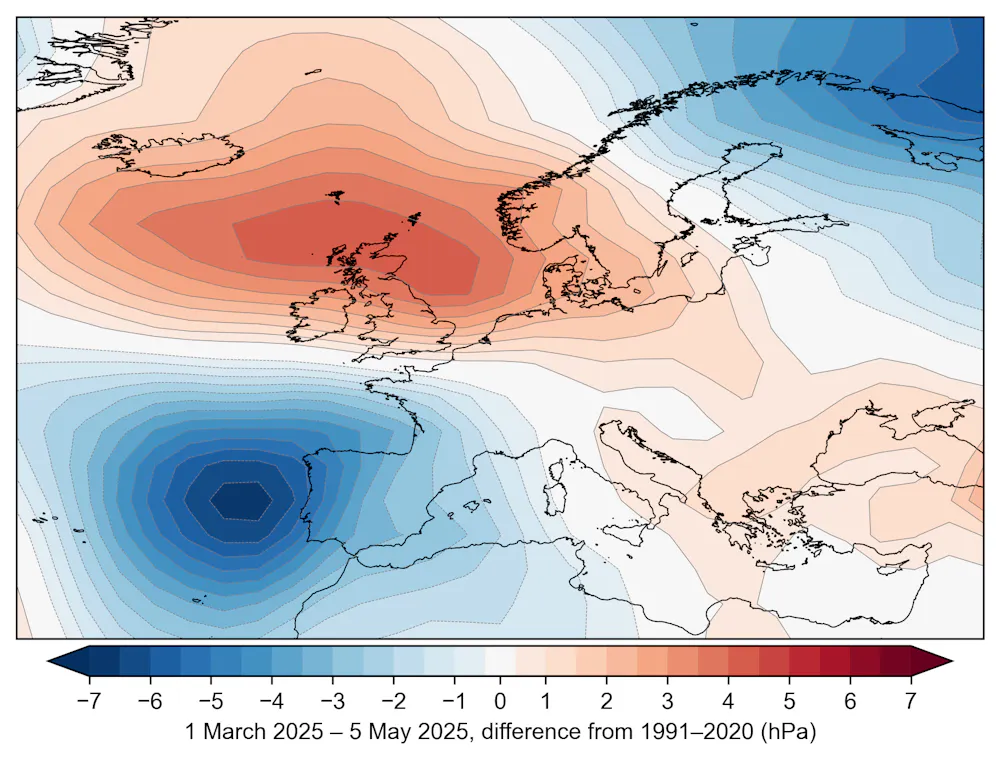
    For several weeks, a stubborn area of high pressure over the UK has diverted the usual flow of mild, moist air from the North Atlantic like a boulder in a river. This is known as a blocking weather system.

    Within it, air descends, warms and dries, which is why this weather pattern tends to be linked to heatwaves and drought. Blocking is usually persistent, making it seem like the weather is stuck.

    Here’s how climate change may have played a role in setting up this unusual spring.


    Get your news from actual experts, straight to your inbox. Sign up to our daily newsletter to receive all The Conversation UK’s latest coverage of news and research, from politics and business to the arts and sciences. Join The Conversation for free today.


    The human fingerprint

    The warming climate means that unusually warm weather is occurring more often and becoming more intense. At the same time, we can expect more periods of both severe drought and extreme rainfall. Sudden changes from drought to deluge, termed “weather whiplash”, are due to the intensification of the water cycle in a warmer atmosphere that can hold more water vapour.

    However, certain weather patterns are necessary to produce extreme weather. More blocking events in future could increase the chance of heatwaves or drought. But are blocking weather patterns becoming more common?

    It’s difficult to determine how weather patterns will change as a result of the rising concentration of greenhouse gases in the atmosphere, which is predominantly caused by the burning of fossil fuels.

    Part of the difficulty arises from the fact that weather patterns vary year to year. Several years in a row with more blocking events than usual could make it seem like blocking is increasing due to climate change, but it could simply be down to chance.

    As a result, it is difficult to detect the fingerprint of human activity from weather observations alone. For example, blocking weather patterns over Greenland during summer have happened more often in recent decades, which can enhance the melting of the ice sheet. But it isn’t clear that this trend is the result of human-induced climate change.

    Climate models do suggest future changes in the occurrence of blocking, however. These computer simulations, consisting of equations that describe the fundamental physics of the atmosphere, are the main tool scientists use to perform experiments that parse how the climate will behave in future.

    The blocking system is visible in the area of high pressure over Britain and Ireland.
    National Centers for Environmental Prediction/National Center for Atmospheric Research/NOAA Physical Sciences Laboratory, CC BY

    When scientists run climate model simulations with increased greenhouse gas concentrations the results consistently show a decrease in blocking events. But blocking generally happens more often in real life than model simulations, which reduces the confidence scientists have in future projections.

    Keeping track of the jet stream

    The movement of weather systems in Earth’s mid-latitudes – including over the UK – is linked to the jet stream, which is a fast-flowing river of air driven by the contrast in temperature between the poles and mid-latitudes.

    Some researchers have suggested that, because the Arctic is warming faster than the tropics, the jet stream may weaken and become more “wavy”, increasing the occurrence of blocking events, contrary to what most climate models show.

    Outside of the scientific community, this idea has become popular. However, the hypothesis remains controversial among scientists, and observational evidence has weakened in recent years.

    In fact, tens of kilometres above the Earth’s surface, near commercial aircraft cruising altitudes, the opposite trends are occurring: the temperature difference between the Arctic and mid-latitudes is increasing, acting to increase the strength of the jet stream.

    There are considerable challenges with understanding how climate change is affecting the large-scale atmospheric patterns which drive the weather we experience. These include large natural variability and imperfect climate models. Models mostly suggest a decline in blocking events with climate change, though this remains relatively uncertain compared with other aspects of the science.

    Overall, we can be confident that climate change is bringing warmer conditions in all seasons. Scientists also have strong evidence to suggest that drought conditions will become more common. These changes are already affecting food production, energy generation and water availability and these impacts will continue to worsen with climate change.


    Don’t have time to read about climate change as much as you’d like?

    Get a weekly roundup in your inbox instead. Every Wednesday, The Conversation’s environment editor writes Imagine, a short email that goes a little deeper into just one climate issue. Join the 45,000+ readers who’ve subscribed so far.


    Simon H. Lee has received funding from the Natural Environment Research Council and the National Science Foundation.

    Matthew Patterson receives funding from the Natural Environment Research Council in the UK via the the National Centre for Atmospheric Science.

    – ref. How the weather got ‘stuck’ over the UK – and produced an unusually dry and warm spring – https://theconversation.com/how-the-weather-got-stuck-over-the-uk-and-produced-an-unusually-dry-and-warm-spring-255987

    MIL OSI – Global Reports –

    May 13, 2025
  • MIL-OSI Global: The Climate Fiction Prize 2025: the five shortlisted books reviewed by our experts

    Source: The Conversation – UK – By Louisa Egbunike, Associate Professor in African Literature, Durham University

    Five novels have been shortlisted for the 2025 Climate Fiction Prize. Our academics review the finalists ahead of the announcement of the winner on May 14.

    And So I Roar by Abi Daré

    Abi Daré’s poignant second novel, And So I Roar, charts the parallel stories of Tia, an environmental advocate, and Adunni, a Nigerian teenager first introduced in The Girl with the Louding Voice (2020).

    Now under Tia’s care in Lagos, Adunni has escaped child marriage and domestic abuse.

    When she returns to her village, Ikati, where she and other girls are blamed for the drought and face the threat of violence, the novel unravels long-held secrets. Daré masterfully explores how environmental crises intersect with gendered violence, showing how impoverished women disproportionately bear the burden of climate change.

    And So I Roar highlights intergenerational, inter-ethnic and cross-class solidarity, celebrating the courage of women and girls who defy society’s expectations. It is a powerful testament to resilience, as women and girls confront injustice and find the strength to lift their voices and, finally, roar.

    By Louisa Uchum Egbunike, associate professor in African literature

    The Morningside by Téa Obreht

    Obreht’s The Morningside is a quietly dazzling piece of climate fiction – more adjacent to our world than removed from it, and all the more unsettling for it.

    Set in Island City, a place marked by an unnamed tragedy, the novel centres on Sil, an 11-year-old girl who moves into the Morningside apartment complex with her mother.

    Both are climate refugees, though the novel wears this reality lightly – what matters more are the small acts of home-making, the search for belonging and the ghosts that travel with them. Magical realism is deftly handled here, interlaced with hints of folklore that feel entirely plausible within the book’s fragile ecology.

    The Morningside is deeply readable – generous, tender and brimming with quiet unease. It never tips into bleakness, but its warnings are clear enough. “The things you had, the things you saw,” Sil’s mother tells us, “will probably be gone by the time [your children are] born.”

    By Sam Illingworth, professor of creative pedagogies

    Briefly Very Beautiful by Roz Dineen

    Roz Dineen’s Briefly Very Beautiful immerses readers in a world that both is and is not a familiar fiction. Crisply written, in direct, unfussy prose, it is, at one level, a story of a woman, Cass, trying to protect her children as her relationship unravels.

    At the same time, a parallel social collapse triggered by climate change puts the ordinary in an extraordinary frame.

    Much of the effect of this novel comes from Cass’s utterly believable responses to what is taking place around her, her almost peripheral awareness of other people fleeing the city, her own craving for fresh air “like she’d craved things in pregnancy, with a scary gorging hunger”.

    Briefly Very Beautiful is a novel brave enough to recognise that there is no simple, heroic response to some situations. That sometimes, the determination to live an ordinary life is the truly heroic course of action.

    By Christopher Morash, professor of Irish writing

    Orbital by Samantha Harvey

    Samantha Harvey’s Orbital skilfully exposes the human cost of space flight, set against the urgency of the climate crisis. While a typhoon of life-threatening proportions gathers across south-east Asia, six cosmonauts hurtle around Earth on the International Space Station.

    Their everyday routine of tasteless food and laboratory work is in stark contrast to the awesome spectacle of the blue planet, oscillating between night and day, dark and light, where international borders are meaningless.

    While they teach laboratory mice to orient themselves in micro-gravity, they rigorously document their own bodily functions to satisfy some “grand abstract dream of interplanetary life” away from “the planet held hostage by humans, a gun to its vitals”. These are humans, Harvey tells us, “with a godly view that’s the blessing and also the curse”. Harvey has written a novel for the end of the world as we know it. The hope it offers is that we might learn to know it differently.

    By Debra Benita Shaw, reader in cultural theory

    The Ministry of Time by Kaliane Bradley

    The best novels defy easy categorisation, and The Ministry of Time covers many genres: climate fiction, sci-fi, speculative fiction, romance, action.

    It tells the story of a female civil servant who is a handler for one of five people plucked from history before their death. It was fun to imagine how today’s world would be perceived from various perspectives, including a zesty young lesbian woman from the 17th century, a shy young lieutenant from the first world war and a 19th-century naval officer.

    The story adopts the usual dystopian tropes of a world that has destroyed itself through greed, power-seeking and over-indulgence. In the final plea to the reader not to let this terrible future unfold, the assumption is that if we’re scared enough, we’ll all give up red meat, stop flying and campaign for climate policies.

    My research, and psychological studies of fear caution us that the response is just as likely to be voting for far-right leaders, marginalisation of innocent victims, and buying up all the toilet rolls. I loved this book, but to inspire greener behaviour, showing visions of what a sustainable society might look like if we did things right would be a welcome change.

    By Denise Baden, professor of sustainable business


    Looking for something good? Cut through the noise with a carefully curated selection of the latest releases, live events and exhibitions, straight to your inbox every fortnight, on Fridays. Sign up here.


    The authors do not work for, consult, own shares in or receive funding from any company or organisation that would benefit from this article, and have disclosed no relevant affiliations beyond their academic appointment.

    – ref. The Climate Fiction Prize 2025: the five shortlisted books reviewed by our experts – https://theconversation.com/the-climate-fiction-prize-2025-the-five-shortlisted-books-reviewed-by-our-experts-253056

    MIL OSI – Global Reports –

    May 13, 2025
  • MIL-OSI United Kingdom: Joint statement on India-Pakistan conflict

    Source: City of Leeds

    Comment issued by civic and faith leaders in Leeds

    “As civic and faith leaders in Leeds, we welcome news of the ceasefire in hostilities between India and Pakistan following the recent terrorist attack in Pahalgam, Kashmir.

    “Terrorism in any form goes against the values of humanity. We condemn all forms of terrorism affecting any communities and countries across the world.

    “We affirm our commitment to stand together at this time of increased tension between India and Pakistan.

    “We are deeply saddened and troubled by the loss of lives, property and livelihoods. Our hearts go out to all those who have been injured, those who are grieving and those who are living in fear of further attacks. We recognise that many in Leeds will also be worried for family and friends in the affected areas. We pray for everyone caught up in the conflict.

    “We have a strong and enduring history in Leeds of caring for one another and of acting responsibly in the face of international events that shake us. We will not let these tensions disrupt the peace we cherish in our neighbourhoods and communities.

    “The faith leaders of Leeds stand firmly against any form of extremism affecting any community in our city. We urge our communities to reject division and to avoid provocation. We would ask all those in our communities to seek to de-escalate tension, recognising our love for our neighbours, reaching out to one another in mutual respect and care. Together, we reaffirm our commitment to peace and concord and to standing against hatred and division.

    “We call on international leaders to continue taking steps to de-escalate the situation through dialogue. Escalation will only lead to the suffering of more innocent people, and everything must be done to prevent further harm.

    “We are a proud city where people of many backgrounds, faiths, and cultures live side by side. Hate has no place on our streets and together we issue this collective call for peace. We have not much control over what is happening internationally, but we can continue to live as neighbours who care for one another and our shared neighbourhoods.

    “In this great city which we all call home, we stand shoulder to shoulder – as part of Team Leeds. One community, one voice, one people. We call on all parties to pray and to work tirelessly for a just peace.”

    Signatories:

    Councillor Abigail Marshall Katung – Lord Mayor of Leeds

    Councillor James Lewis – Leader Leeds City Council

    Ed Whiting – Chief executive Leeds City Council

    Councillor Oliver Edwards – Faith, Religion and Belief Champion

    The Rt. Revd. Arun Arora – Chair Leeds Faith Forum

    Qari Assim MBE – Leeds Faith Forum

    Rasool Bhamani – Leeds Faith Forum

    Dharmesh Mistry – Leeds Faith Forum

    Simon Phillips – Vice Chair Leeds Faith Forum

    Girish Sonigra – Leeds Faith Forum

    Chiragi Solanki – Leeds Faith Forum

    Nirav Thakker – Leeds Faith Forum

    ENDS 

    For media enquiries please contact:

    Leeds City Council communications and marketing,

    Email: communicationsteam@leeds.gov.uk

    Tel: 0113 378 6007

    MIL OSI United Kingdom –

    May 13, 2025
  • MIL-OSI Global: The Moomins drift through time like a myth – that’s why they resist meaning and endure

    Source: The Conversation – UK – By Steve Nash, Lecturer in Literature, Media, and Creative Writing, Leeds Beckett University

    The Moomins may look like hippos in aprons and top hats, but they’re more than just adorable characters from children’s books. Over the decades, these gentle creatures have become part of a living mythology – one that drifts across time, borders and generations.

    Created by Finnish-Swedish author Tove Jansson in the 1940s, the Moomins live in stories that blur the lines between fairy tale, folk wisdom and quiet philosophy. And perhaps that’s the secret to their enduring appeal: they resist being pinned down.

    Unlike traditional children’s characters tied to a tidy moral or neat storyline, the Moomins meander literally and metaphorically. Their world is one of seasonal migrations, long silences, floods, comets and unexpected departures.


    This is part of a series of articles celebrating the 80th anniversary of the Moomins. Want to celebrate their birthday with us? Join The Conversation and a group of experts on May 23 in Bradford for a screening of Moomins on the Riviera and a discussion of the refugee experience in Tove Jansson’s work. Click here for more information and tickets.


    Moominvalley isn’t a safe haven – it’s a landscape shaped by change. In that sense, Jansson’s stories echo something far older than modern literature: the mythic rhythms of Nordic storytelling, where time loops, endings blur and characters return in altered forms.

    A myth that moves

    The Viking sagas, for instance, were not written down at first but passed from voice to voice, reshaped with each telling. They weren’t concerned with tidy endings or moral clarity. Characters disappeared and reappeared. Time looped and fragmented.

    Similarly, Jansson’s stories don’t build to a climax. They wander. One book might end with a mystery, a quiet mood or a long silence. It’s a narrative style that feels strangely modern – and yet deeply ancient.

    Jansson herself resisted giving her stories a single message. In letters and interviews, she said she disliked moralising and preferred ambiguity. “A good story,” she wrote, “has no need to be explained; its truth lies in its telling, not in its conclusion.” That idea – of a truth that doesn’t depend on being pinned down – is at the heart of what makes the Moomins mythic.

    Of course, myths evolve. And the Moomins have evolved spectacularly. After the books found international success, the characters were adapted into Japanese anime, Nordic theatre, British radio and global branding campaigns.

    Each version tells a slightly different story. In Japan, the Moomins became symbols of warmth and nostalgia – gentle mascots of a simpler life. In the UK and US, early translations softened the melancholy and existential tones. More recently, new editions and critical reappraisals have returned to Jansson’s deeper themes of loss, solitude and transformation.

    The many lives of the Moomins

    This global journey has parallels with the evolution of Viking mythology. Once oral stories shared around fires, Norse myths have been repackaged for everything from national pride to Hollywood action. Like the Moomins, they’ve become flexible cultural symbols – used and re-used in ways that often have little to do with their original context.

    But unlike the fierce warriors of Norse myth, the Moomins are gentle, uncertain creatures. They worry. They drift. They don’t fight monsters – they reflect, explore, adapt. In Moominland Midwinter, Moomintroll wakes from hibernation to find the world cold and unfamiliar.

    His journey isn’t about conquering the landscape, it’s about learning how to live in it. That emotional honesty resonates with readers of all ages. It also reflects something uniquely Nordic: an existential awareness of solitude, change and survival.

    Folklore, loneliness and the Groke

    One character, the Groke, captures this beautifully. She’s a shadowy figure who creates frost wherever she walks. She’s not a villain, she’s just lonely. Children often fear her, but readers grow to understand her.

    She recalls Nordic spirits like the huldra or tomte – ghostly beings that live in the forests, blurring the line between human and otherworldly. In Jansson’s hands, this folklore becomes a way to explore anxiety, estrangement and the human need for warmth.

    The Moomins’ refusal to settle – geographically or philosophically – also speaks to today’s world of cultural fluidity. Jansson was from Finland’s Swedish-speaking minority and grew up between languages, cultures and post-war upheaval.

    Her books reflect that liminal identity, and they’ve found a home among readers who don’t always fit neatly into one place. That might be why the Moomins are particularly popular in countries dealing with identity shifts or cultural nostalgia.

    A myth for a shifting world

    As with all mythologies, there’s also a commercial side. The Moomins are now a global brand, with theme parks, merchandise, museums and a thriving fanbase. Some of this has softened their original complexity.

    But even through plush toys and animation, something essential remains: the feeling that these characters, like the stories they inhabit, can’t be reduced to one message. They are always slightly mysterious, slightly out of reach.

    In a world that often demands quick answers and strong opinions, the Moomins offer something gentler: ambiguity, openness and quiet reflection. They remind us that not all stories are meant to be solved with a neat conclusion. Some are meant to be returned to – revisited like familiar places in the mind, reshaped each time we arrive.

    That’s what makes the Moomins mythic. Not just their age or popularity, but their ability to change – and to change us – with every retelling. They invite us to wander, like Snufkin, and to sit still, like Moominmamma.

    They show us that myth isn’t just about gods and monsters – it’s about living with uncertainty, embracing return, and finding meaning in the stories that help us feel at home in the world.

    Steve Nash works for Leeds Beckett University.

    – ref. The Moomins drift through time like a myth – that’s why they resist meaning and endure – https://theconversation.com/the-moomins-drift-through-time-like-a-myth-thats-why-they-resist-meaning-and-endure-254742

    MIL OSI – Global Reports –

    May 13, 2025
  • MIL-OSI Security: FBI Releases Officers Killed and Assaulted in the Line of Duty, 2024 Special Report and Law Enforcement Employee Counts

    Source: Federal Bureau of Investigation FBI Crime News (b)

    On Monday, May 12, 2025, the FBI’s Uniform Crime Reporting (UCR) Program released the “Officers Killed and Assaulted in the Line of Duty, 2024 Special Report” and data from the Law Enforcement Employee Counts on the FBI’s Crime Data Explorer (CDE) at cde.ucr.cjis.gov.

    “Officers Killed and Assaulted in the Line of Duty, 2024 Special Report”, provides preliminary counts of law enforcement officers killed and assaulted in 2024, as well as an in-depth analysis of law enforcement officers who were killed or assaulted from 2015 through 2024, based on the data voluntarily provided by law enforcement agencies to the FBI’s UCR Program.

    In 2024, 64 officers were feloniously killed in the line of duty. That is consistent with the number of officers feloniously killed the previous two years; however, the rate of assaults against officers increased from 2022 to 2024. Firearms were the most reported weapon used in fatal incidents.

    Information about offenders of officer felonious killings in 2024 show there were 61 offenders reported for the felonious deaths. Of these offenders, 95.9% were male, 57.9% were white, and 32 offenders were reported to have a prior criminal record.

    For each of the 10 years under consideration, the South region had the most line-of-duty deaths. There was a 45% increase in the deaths in that region in 2024 (29 deaths) compared to 2023 (20 deaths).

    Agencies reported 85,730 officer assaults in 2024 indicating a rate of 13.5 assaults per 100 officers, marking the highest officer assault rate in the past 10 years.

    The number of officers assaulted and injured by firearms has climbed over the years, reaching a 10-year high in 2023 with approximately 500 officers assaulted and injured by firearms. In 2024, the number of officers assaulted and injured by firearms dropped to approximately 457 officers.

    Most accidental deaths of law enforcement officers from 2020 to 2024 can be attributed to motor vehicle accidents.

    Also released today was the 2024 information from the Law Enforcement Employee Counts Data Collection. Law enforcement agencies provide these counts to the FBI annually and account for all full-time sworn law enforcement officers and civilian employees. This information may be used by city, county, state, and federal law enforcement agencies to establish manpower needs, and to provide effective enforcement and protection.

    The full report may be found in the Special Reports section on the FBI’s CDE.

    MIL Security OSI –

    May 13, 2025
  • MIL-OSI USA: Kemp: April Net Tax Revenues Down 5.8%; Adjusted YTD Down 0.6%

    Source: US State of Georgia

    ATLANTA – The State of Georgia’s net tax collections in April approached $3.73 billion, for a decrease of $230.4 million, or 5.8%, compared to FY 2024, when net tax collections totaled $3.96 billion for the month. April 2025 individual and corporate income tax collections were impacted by the hurricane-related extension of filing and payment deadlines to May 1, 2025. Early May individual and corporate return payments have significantly exceeded those received during the same period in May 2024, indicating a large number of filers took advantage of the extended filing deadline. Year-to-date, net tax revenue totaled $27.77 billion for an increase of $312.2 million that was driven largely by the collection of the state’s motor fuel excise tax, which was suspended by Executive Order for a period of two and a half months during FY 2024. Adjusting for the year-over-year motor fuel tax changes, year-to-date net tax revenue collections for the period ending April 30 were down $154.2 million, or 0.6%.

    The changes within the following tax categories help to further explain April’s overall net tax revenue decrease:
     
    Individual Income Tax:  Individual Income Tax collections totaled $1.91 billion, for a decrease of $55.9 million, or 2.8%, compared to last year when Individual Tax collections totaled nearly $1.97 billion.

    The following notable components within Individual Income Tax combined for the net decrease:

    • Individual Income Tax refunds issued (net of voided checks) were down $115.1 million or 14.1%.
    • Individual Withholding payments were down $35.9 million, or 2.7%, from the previous fiscal year.
    • Individual Income Tax Return payments declined by $102.3 million, or 9.4%, from FY 2024.
    • All other Individual Tax categories, including Estimated payments, were down a combined $32.8 million.

    Sales and Use Tax:  Gross Sales and Use Tax collections totaled almost $1.65 billion in April, for an increase of $70.4 million, or 4.5%, compared to April 2024.  Net Sales and Use Tax increased by $40.5 million, or 5.1%, compared to last year, when net sales tax totaled $798.8 million.  The adjusted Sales Tax distribution to local governments totaled $798.8 million, for an increase of $33.8 million, or 4.4%, while Sales Tax refunds decreased by $3.9 million, or 25.7%, compared to FY 2024.

    Corporate Income Tax:  Corporate Income Tax collections for the month totaled $540.2 million, which was a decrease of roughly $207.9 million, or 27.8%, compared to FY 2024.

    The following notable components within Corporate Income Tax make up the net decrease:

    • Corporate Income Tax refunds issued (net of voids) were down $5.2 million, or 13.9%, from FY 2024.
    • Corporate Income Tax Return payments decreased by $84.5 million, or 29.2%, from last fiscal year.
    • Corporate Income Tax Estimated payments decreased by $112.1 million, or 30.8%, from April 2024.
    • All other Corporate Tax types, including S-Corporate payments, were down a combined $16.5 million.

    Motor Fuel Taxes:  Motor Fuel Tax collections increased by $6.6 million, or 3.4%, compared to FY 2024.

    Motor Vehicle – Tag & Title Fees:  Motor Vehicle Tag & Title Fees increased by $2.8 million, or 7.4%, for the month, while Title Ad Valorem Tax (TAVT) collections increased by $3.4 million, or 4.7%, over last year.

    MIL OSI USA News –

    May 13, 2025
  • MIL-OSI USA: Congressman Robert Garcia Releases Oversight Report on Lessons From Kenneth Fire False Alerts

    Source: United States House of Representatives – Congressman Robert Garcia California (42nd District)

    Washington, D.C. – Today, Congressman Robert Garcia (CA-42) released a report with key findings on the causes of false evacuation warnings during the Kenneth Fire on January 9, 2025, and policy recommendations to improve emergency warning alerts. The full report can be found here.

    “The Kenneth Fire false alert was a wake-up call,” said Congressman Robert Garcia. “It showed the consequences of software failures, vague message wording, and a lack of federal standards. We must modernize our emergency alert systems to ensure that warnings are accurate, timely, and targeted. The public’s trust is at stake.”

    On February 13, 2025, Congressman Garcia and thirteen Members of Congress representing Los Angeles County sent oversight letters seeking answers to why evacuation warnings were accidentally sent to nearly 10 million L.A. County residents during the Los Angeles fires, why individuals received delayed warnings, or why individuals received multiple warnings.

    Responses were received from Genasys, Inc., the software company used by the County for issuing wireless emergency alerts, Los Angeles County, the Federal Emergency Management Agency (FEMA), and Federal Communications Commission (FCC).

    The Kenneth Fire serves as a critical reminder of the importance of robust emergency communication systems. Congress and federal agencies must act swiftly to close identified gaps and ensure the public receives accurate and life-saving information when disaster strikes.

    The report’s key findings noted:

    • The initial false alert was caused by a software failure in Genasys, Inc.’s system. The correct evacuation area polygon was not uploaded to the IPAWS wireless alert channel, which Genasys believes was due to a network disruption. Genasys’ system failed to warn the LA County Office of Emergency Management that the polygon was missing, and the alert was to be sent county-wide. Genasys has since added safeguards to its software to address this issue.
    • LA County responded quickly, canceling the alert within 2 minutes and 47 seconds, and issued a corrected message 20 minutes later. The County temporarily transitioned to CalOES’ Onsolve CodeRed alert system and resumed use of Genasys on January 30, 2025.
    • LA County could improve the wording of alert messages. The wording of the original alert was vague and lacked geographic specificity. Improved language and inclusion of timestamps would have helped avoid confusion, especially for individuals outside the evacuation zone.
    • Duplicate and delayed alerts were not caused by downed cell towers, as initially thought, but by technical issuessuch as network overload, lack of unique message identifiers, and long alert durations.

    Policy recommendations included:

    1. Increase funding for IPAWS systems – Federal support is needed for planning, equipment, training, exercises, and system maintenance.
    2. Finalize FEMA’s IPAWS requirements – Five years after Congress mandated improvements, FEMA has yet to fully implement certification programs for users and third-party software providers.
    3. The FCC should ensure mobile providers include location-aware maps by the December 2026 deadline – Last October, the FCC passed a requirement for wireless services providers to include links to maps that show the emergency incident and your location relative to the incident by December 2026.
    4. The FCC should establish performance standards – The FCC should develop measurable goals and monitoring for Wireless Emergency Alert (WEA) performance, including reliability, accuracy, and speed.

    By addressing these challenges, emergency alerting can become more accurate, reliable, and effective in future crises.

    Congressman Garcia is dedicated to ensuring that government operations are efficient, effective, and safe, especially during emergencies. After the devastating LA wildfires in January, he led a letter with LA colleagues to Genasys Inc., Los Angeles County, the Federal Communications Commission (FCC), and Federal Emergency Management Agency (FEMA) demanding answers regarding accidental emergency alerts. Individuals received delayed evacuation warnings, some received the same message multiple times, and millions received unnecessary warnings. As Mayor of Long Beach, Congressman Garcia helped establish the AlertLongBeach system to provide those who live or work in the city with text alerts containing important information before, during, and after a major emergency or disaster. Congressman Garcia’s leadership on the Oversight Committee ensures that government operations are effective and responsive to crises. Congressman Garcia led dozens of his colleagues in calling on FEMA to honor their commitment to reimbursing California cities and counties for providing shelter options for individuals experiencing homelessness during the pandemic. 

    ###

    MIL OSI USA News –

    May 13, 2025
  • MIL-OSI USA: Baldwin Slams Trump Plan to Shutter Agency that Addresses Opioid Epidemic and Provides Mental Health Support

    US Senate News:

    Source: United States Senator for Wisconsin Tammy Baldwin

    WASHINGTON, D.C. – U.S. Senator Tammy Baldwin (D-WI) and her colleagues are condemning the Trump Administration’s proposed dissolution of a core agency responsible for addressing the opioid crisis and providing mental health support to Wisconsin families. Under President Trump’s restructuring plan and the White House Office of Management and Budget’s budget proposal, the Substance Abuse and Mental Health Services Administration (SAMHSA) will be shut down. The Senators expressed deep concerns about the consequences of dismantling SAMHSA, outlined the impacts on the worsening behavioral and mental health crisis, and detailed why the proposal is unlawful.

    “At a time when America is in a dual mental health and substance use crisis, a time when youth suicide is at all-time highs, a time when synthetic opioids are destroying communities and taking lives, this proposed destruction of SAMHSA will harm the American people,” wrote Baldwin and the Senators. “This proposed reorganization and your proposed cuts of over $1 billion to mental health and substance use programs threaten the lives of millions of Americans and appear to violate federal law.”

    According to the National Survey on Drug Use and Health, nearly 50 million Americans aged 12 and older battled a substance use disorder and 58.7 million Americans aged 18 and older experienced a mental illness in 2023. The programs administered by SAMHSA are essential to addressing this national crisis. The Trump Administration’s actions harm the operations of crucial programs, including roughly $7 billion in grant distribution, access to early intervention for mental health care, and support services for crisis care, many of which are statutorily required.

    “SAMHSA, its functions, its role, and many of its positions are clearly outlined and required by federal law. Firing most of SAMHSA’s staff and breaking up SAMHSA appear to violate these statutory requirements,” continued Baldwin and the Senators. “Downsizing SAMHSA into a new ‘division’, dismantling its functions, and firing over half its workforce puts at risk the lives of the 58.7 million Americans who experience a mental health condition and 48.5 million of those who are impacted by a substance use disorder.”

    The Senators emphasized the importance of SAMHSA’s essential work in administering programs including State Opioid Response grants, the National Survey of Drug Use and Health for crucial behavioral health data collection, the Assisted Outpatient Treatment Program for funding community-based care, and FindTreatment.gov for connecting people to mental health care resources, including the 988 Suicide & Crisis Lifeline.

    Furthermore, the Senators stressed that Congress has passed multiple bills creating and expanding SAMHSA’s behavioral and mental health services, and that eliminating SAMHSA would violate the law. The bipartisan Alcohol, Drug Abuse, and Mental Health Administration Reorganization Act (ADAMHA), signed into law by President George H.W. Bush in 1992, established SAMHSA and included requirements for various grant programs and roles that the Trump Administration has proposed eliminating. The ADAMHA Reorganization Act codified additional positions and transferred numerous authorities to SAMHSA.

    Moreover, the 21st Century Cures Act established the Interdepartmental Serious Mental Illness Coordinating Committee through 2027, which the Trump Administration terminated, and codified SAMHSA’s Center for Behavioral Health Statistics and Quality to administer the annual National Survey of Drug Use and Health, but the team responsible for the survey was reportedly eliminated in the mass layoffs.

    The Senators concluded by demanding answers on the Trump Administration’s plans for the continuity of SAMHSA’s statutorily required roles and programs and the impacts of HHS’ restructuring.

    “We demand that HHS not unlawfully dismantle SAMHSA, which would only serve to further exacerbate a growing mental health and substance use disorder crisis,” concluded Baldwin and the Senators.

    The full letter is available here and below.

    Dear Secretary Kennedy,

    We write in strong opposition to the proposed dissolution of the Substance Abuse and Mental Health Administration (SAMHSA) outlined in the Department of Health and Human Services (HHS) fact sheet on March 27, 2025, and by the proposal from the White House Office of Management and Budget. At a time when America is in a dual mental health and substance use crisis, a time when youth suicide is at all-time highs, a time when synthetic opioids are destroying communities and taking lives, this proposed destruction of SAMHSA will harm the American people. This proposed reorganization and your proposed cuts of over $1 billion to mental health and substance use programs threaten the lives of millions of Americans and appear to violate federal law, including the Alcohol, Drug Abuse, and Mental Health Administration (ADAMHA) Reorganization Act and the 21st Century Cures Act.

    President George H.W. Bush signed the bipartisan ADAMHA Reorganization Act into law in 1992. This law formed SAMHSA, a new agency to be the nation’s lead on community-based mental health and substance use disorder prevention, treatment, and recovery services. In addition to creating a variety of grant programs to be administered by SAMHSA, the ADAMHA Reorganization Act created the role of the Assistant Secretary, transferred numerous authorities to SAMHSA, and created Centers and Center Director and Associate Administrator positions. Therefore, SAMHSA, its functions, its role, and many of its positions are clearly outlined and required by federal law. Firing most of SAMHSA’s staff and breaking up SAMHSA appear to violate these statutory requirements.

    SAMHSA leads the government’s efforts to promote mental health, prevent substance misuse, and advance the behavioral health of people across this country. SAMHSA’s programs provide a model for behavioral health care. Downsizing SAMHSA into a new “division”, dismantling its functions, and firing over half its workforce puts at risk the lives of the 58.7 million Americans who experience a mental health condition and 48.5 million of those who are impacted by a substance use disorder.

    The White House Office of Management and Budget HHS Budget Proposal eliminates SAMHSA and creates a new “Mental Health Division”, demotes substance use from its focus, and guts budgets focused on prevention, treatment, and recovery. Amid a dual crisis, this undoes the bipartisan work that Congress and past Administrations have worked to improve. And the federal investments, the expansion of SAMHSA’s work through grant programs and expertise, have worked – for the first time in years, the U.S. has seen a decline in opioid overdose deaths. As the mental health crisis grows, as new synthetic opioids continue to surge, restructuring the agency stands to reverse this historic decline. Now is not the time to change course and risk American lives.

    Congress has passed numerous bills expanding SAMHSA services to reach more Americans. In 2014, the Protecting Access to Medicare Act (PAMA) was signed into law, creating the Assisted Outpatient Treatment (AOT) Program, which funds community-based programs for adults with serious mental illness. This program allows individuals to stay in their community and their homes while also receiving “medically prescribed mental health treatment.” For example, using SAMHSA funds, an AOT program in Montana is working to reduce homelessness and incarceration while improving health and social outcomes for individuals with serious mental illness. Because HHS is dissolving SAMHSA and firing its staff, Montana is in jeopardy of losing the ability to provide their patients with up-to-date, evidence-based services, a key SAMHSA function. Any interruption to the effective delivery of these programs has detrimental consequences.

    In 2016, Congress again prioritized SAMHSA and expanded its services and programming by passing the 21st Century Cures Act. This bill codified SAMHSA’s Center for Behavioral Health Statistics and Quality (CBHSQ), requiring CBHSQ to perform several functions. One of these requirements was to publish an annual report on mental health and substance use disorder , also known as the National Survey of Drug Use and Health (NSDUH). NSDUH is the only source of behavioral health data for people 12 and older in the U.S. and is a critical tool to combat these dual crises. Without this data, states would not be able to implement State Opioid Response grants with fidelity.

    The State Opioid Response (SOR) grant was created to address the overdose crisis, which is now driven by illicit fentanyl, and is meant to help states provide a continuum of care, including prevention, harm reduction, treatment, and recovery services. Funding to support states in combating this epidemic is critical, especially as the crisis is exacerbated by other synthetic opioids. States use SOR funding to purchase and distribute naloxone, test strips, buprenorphine, and much more. SOR is proven to be effective – in 2023, the percentage of people who did not use substances increased by 29.7 percent. SOR funding and NSDUH data give states the ability to purchase these medications, implement these programs, and track outcomes. Reports suggest the entire team running NSDUH was fired on April 1, 2025. Without NSDUH data, states will have inaccurate information on how opioids are affecting their communities, which will result in a lack of resources, incomplete strategies, and an increase in deaths.

    In addition to data collection, CBHSQ is responsible for operating FindTreatment.gov, a critical tool where individuals can find treatment for mental health and substance use disorder care. Launched in 2019 under the first Trump Administration, FindTreatment.gov provides individuals with resources in their communities and connects those in crisis with helplines, including the 988 Suicide & Crisis Lifeline. Without adequate staffing of FindTreatment.gov, people across this country are left stranded, not knowing where to turn to find treatment and services. The mass terminations at SAMHSA’s CBHSQ and HHS’s announced reorganization make unclear who is operating and overseeing this program that President Trump proudly launched. It is unclear how HHS can now live up to its claim of continuing “to support people who seek substance use treatment on their journey to recovery.”

    The 21st Century Cures Act not only expanded data collection but also improved interdepartmental coordination, something that you claim to prioritize. This bill established the first ever Interdepartmental Serious Mental Illness Coordinating Committee (ISMICC) to better direct mental health services for adults and children with a serious mental illness. ISMICC is tasked with evaluating the effects of federal programs, including programs for suicide prevention and overdose reduction, so they can provide “recommendations for actions that agencies can take to better coordinate the administration of mental health services.” By law, ISMICC must be operating to achieve these goals through at least September 30, 2027. However, HHS terminated ISMICC on April 9, 2025. By dismissing ISMICC, HHS is actively putting people in crisis at risk and violating a statutory requirement to protect the American people.

    We demand that HHS not unlawfully dismantle SAMHSA, which would only serve to further exacerbate a growing mental health and substance use disorder crisis. To better understand HHS’s plans and statutory compliance, we request responses to the following questions by May 16, 2025.

    1. Per the 21st Century Cures Act, SAMHSA is required to have an Assistant Secretary, a Chief Medical Officer, and a Director, with specific qualifications, at each of its four mandated Centers – the Center for Substance Abuse Treatment, the Center for Substance Abuse Prevention, the Center for Mental Health Services, and CBHSQ.
      1. Who is currently serving in these roles, and what are their qualifications?
      1. Have any of the people in these roles been subject to the reduction in force that occurred on April 1, 2025? If so, please explain why these legally mandated positions were part of the reduction.
      1. What is HHS’s plan to maintain these positions and centers under the restructuring at HHS?
    1. SAMHSA is required to have Associate Administrators for Alcohol Prevention and Treatment Policy and Women’s Services.
      1. Who is currently serving in these roles, and what are their qualifications?
      1. Have any of the people in these roles been subject to the reduction in force that occurred on April 1, 2025? If so, please explain why these legally mandated positions were part of the reduction.
      1. What is HHS’s plan to maintain these positions under the restructuring at HHS?
    1. SAMHSA is required to have a National Mental Health and Substance Use Policy Laboratory to coordinate policy changes, review programs, identify duplication, and more.
      1. Please provide a list of all employees in SAMHSA’s Policy Laboratory as of January 19, 2025, and as of April 15, 2025, including job title and General Schedule rank. Please indicate which staff were part of the reduction in force that occurred on April 1, 2025.
      1. How did HHS determine that the proposed restructuring will not prevent fulfilling these statutory duties?
    1. Which Centers and Branches are overseeing each of SAMHSA’s grant programs, including AOT? Please provide the number of employees currently employed for each Center and Branch, and the number of grants each employee is required to supervise.
    1. Who is overseeing each of CBHSQ’s data collection and roles, including NSDUH and FindTreatment.gov? Please provide a list of staff working on each service and provide their qualifications.
    1. Is NSDUH data still being collected through its contract with RTI International?
      1. Does HHS plan to continue its contract with RTI International and ensure all payments are received promptly?
      1. Has there been any break in data collection since January 20, 2025? If so, why, and what did HHS do to restore any missing information?
    1. Why did HHS terminate statutorily-required ISMICC?
      1. When will ISMICC be restored?
    1. What is HHS’s long-term plan with SAMHSA under the restructuring? Please explain how HHS plans to remain in compliance with all relevant statutes under this restructure.
    1. Explain how your decision to dissolve SAMHSA into a “division” will increase efficacy and improve mental health and substance use disorder outcomes for Americans.

    Thank you for your attention to this urgent matter.
    MIL OSI USA News –

    May 13, 2025
  • MIL-OSI United Nations: IOM Spokesperson: Statement On Flooding in Democratic Republic of Congo

    Source: International Organization for Migration (IOM)

    Geneva/Kinshasa, 12 May 2025 – IOM is deeply concerned by the devastating impact of heavy rains and flooding battering South Kivu, in the eastern Democratic Republic of the Congo. Over 100 lives have reportedly been lost, including women, children, and the elderly, and many hundreds of people have been displaced.  

    IOM expresses its condolences to those impacted by the recent heavy rain and flooding, which is exacerbating the suffering and increasing the needs of communities harmed by months of violence between the Congolese Armed Forces and the Mouvement du 23 Mars ( M23).   

    Nearly 1.2 million have been displaced from their homes in North and South Kivu since January, while another 1.8 million have been compelled to return to their areas of origin with little to no access to assistance — many because displacement sites in areas under M23 control have been dismantled. 

    Hundreds of thousands of vulnerable people in eastern DRC lack access to critical services including shelter, health care, access to water and protection assistance. We continue to try scale up efforts to ensure lifesaving aid reaches people in need in DRC while calling for durable solutions.
     

    For more information, please contact IOM Media Centre   

    MIL OSI United Nations News –

    May 13, 2025
  • MIL-OSI USA: Duckworth, Wyden, Murray and Booker Lead Colleagues in Demanding Answers About Firings of Congressionally-Mandated CDC IVF Team Duckworth, Wyden, Murray and Booker Lead Colleagues in Demanding Answers About Firings of Congressionally-Mandated CDC IVF Team

    US Senate News:

    Source: United States Senator for Illinois Tammy Duckworth

    May 08, 2025

    [WASHINGTON, D.C.] – U.S. Senators Tammy Duckworth (D-IL), Ron Wyden (D-OR), Patty Murray (D-WA) and Cory Booker (D-NJ) today demanded answers from Department of Health and Human Services (HHS) Secretary Robert F. Kennedy Jr. for eliminating the Centers for Disease Control and Prevention (CDC) team responsible for making sure people who are trying to become parents have the information they need to thoughtfully and safely grow their families—despite Donald Trump’s broken promise to support families seeking IVF treatments.

    “Because IVF is a complicated and expensive process, the American people deserve access to the best information possible to inform their family building journey. Unfortunately, hollowing out National Assisted Reproductive Technology (ART) Surveillance System capabilities and capacity is consistent with Donald Trump’s deceitful and disingenuous rhetoric on IVF,” the Senators wrote in a letter to HHS Secretary Kennedy. “Your actions threaten hopeful parents and families’ ability to access high-quality, safe, and effective fertility care. The American people deserve assurances that their rights under the [Fertility Clinic Success Rate and Certification Act of 1992] will continue to be guaranteed, as Congress intended.”

    The Assisted Reproductive Technology Surveillance and Research team (ARTS) was established following a 1992 Wyden law passed by Congress aimed at guaranteeing consumer protections for people seeking to grow their family through IVF and other assisted reproductive technology. The fired team of six deeply qualified scientists and public health practitioners were responsible for carrying out the CDC’s mandated responsibilities under the Wyden law, including conducting IVF clinic data analysis related to success rates and important clinic oversight through yearly audits and site visits and the monitoring of lab certification status.

    ARTS served as a critical source of unbiased information for patients seeking fertility treatment, collecting and maintaining data on approximately 98 percent of all IVF and assisted reproductive technology cycles performed in the United States.

    In addition to Duckworth, Wyden, Murray and Booker, the letter was signed by U.S. Senators Richard Blumenthal (D-CT), Kirsten Gillibrand (D-NY), John Hickenlooper (D-DO), Mazie Hirono (D-HI), Amy Klobuchar (D-MN), Jon Ossoff (D-GA), Charles Schumer (D-NY), Raphael Warnock (D-GA) and Elizabeth Warren (D-MA).

    Full text of the letter is available on Senator Duckworth’s website.

    -30-


    MIL OSI USA News –

    May 13, 2025
  • MIL-OSI USA: Duckworth Statement on DOT Secretary Duffy’s Plan to Modernize Our Aging Air Traffic Control System

    US Senate News:

    Source: United States Senator for Illinois Tammy Duckworth

    May 08, 2025

    [WASHINGTON, D.C.] – Today, U.S. Senator Tammy Duckworth (D-IL)—a member of the U.S. Senate Committee on Commerce, Science and Transportation (CST) and Ranking Member of the CST Aviation Subcommittee—issued the following statement after Department of Transportation (DOT) Secretary Sean Duffy announced his new plan to modernize our nation’s air traffic control system:

    “For years, I’ve sounded the alarm that we must modernize our air traffic control system in order to safeguard the flying public. After the deadly DCA crash, multiple near-misses and a terrifying equipment failure impacting Newark, it is encouraging that Secretary Duffy and the Trump Administration recognize how urgent this matter is and are calling for new funding to upgrade our nation’s aging air traffic control technology and facilities.

    “While this may be a positive development, we shouldn’t forget that these are the same officials who just months ago indiscriminately fired hundreds of FAA workers who helped keep our civilian aviation system safe. If America wants to remain the gold standard in aviation safety, we need smart investments—not canceled investments and funding cuts. I look forward to reviewing the details of the Trump Administration’s plan with my colleagues on the Commerce committee so we can ensure our air traffic controllers have the support and equipment they need to keep passengers and crew safe.”

    For years, Duckworth has been sounding the alarm that we must make these critical aviation safety investments immediately to prevent all-too-often near-misses from becoming catastrophic tragedies. Last Congress, Duckworth chaired two CST Aviation Subcommittee hearings—one last December and the other a year prior—to address our aviation industry’s chilling surge in near-deadly close calls and underscore the urgent need to improve air traffic control systems to protect the flying public.

    Last year, Duckworth helped author the landmark bipartisan FAA reauthorization that was signed into law to extend the FAA’s funding and authorities through Fiscal Year 2028. The reauthorization included several of her provisions to improve consumer safety, expand the aviation workforce and enhance protections for travelers with disabilities.

    -30-


    MIL OSI USA News –

    May 13, 2025
  • MIL-OSI USA: SBA Relief Still Available to Kansas Small Businesses and Private Nonprofits Affected by Adverse Weather Conditions

    Source: United States Small Business Administration

    SACRAMENTO, Calif. – The U.S. Small Business Administration (SBA) is reminding eligible small businesses and private nonprofit (PNP) organizations in Kansas of the June 11 deadline to apply for low interest federal disaster loans to offset economic losses caused by severe storms, straight-line winds, tornadoes and flooding occurring April 25 ‑ 30, 2024.

    The declaration covers the Kansas counties of Allen, Bourbon and Linn.

    Under this declaration, the SBA’s Economic Injury Disaster Loan (EIDL) program is available to eligible small businesses, small agricultural cooperatives, nurseries, and PNPs impacted by financial losses directly related to the disaster. The SBA is unable to provide disaster loans to agricultural producers, farmers, or ranchers, except for aquaculture enterprises.

    EIDLs are for working capital needs caused by the disaster and are available even if the small business or PNP did not suffer any physical damage. They may be used to pay fixed debts, payroll, accounts payable, and other bills not paid due to the disaster.

    “SBA loans help eligible small businesses and private nonprofits cover operating expenses after a disaster, which is crucial for their recovery,” said Chris Stallings, associate administrator of the Office of Disaster Recovery and Resilience at the SBA. “These loans not only help business owners get back on their feet but also play a key role in sustaining local economies in the aftermath of a disaster.”

    The loan amount can be up to $2 million with interest rates as low as 4% for small businesses and 3.25% for PNPs with terms up to 30 years. Interest does not begin to accrue, and payments are not due until 12 months from the date of the first loan disbursement. The SBA sets loan amounts and terms based on each applicant’s financial condition.

    To apply online, visit sba.gov/disaster. Applicants may also call SBA’s Customer Service Center at (800) 659-2955 or email disastercustomerservice@sba.gov for more information on SBA disaster assistance. For people who are deaf, hard of hearing, or have a speech disability, please dial 7-1-1 to access telecommunications relay services.

    Submit completed loan applications to the SBA no later than June 11.

    ###

    About the U.S. Small Business Administration

    The U.S. Small Business Administration helps power the American dream of business ownership. As the only go-to resource and voice for small businesses backed by the strength of the federal government, the SBA empowers entrepreneurs and small business owners with the resources and support they need to start, grow, expand their businesses, or recover from a declared disaster. It delivers services through an extensive network of SBA field offices and partnerships with public and private organizations. To learn more, visit www.sba.gov.

    MIL OSI USA News –

    May 13, 2025
  • MIL-OSI USA: Assessing the Global Climate in April 2025

    Source: US National Oceanographic Data Center

    April Highlights:

    • Temperatures were above normal across most land and ocean areas in April.
    • Preliminary data suggest that global average precipitation in April was record low.
    • Northern Hemisphere snow cover extent tied for lowest on record for the month.
    • Sea ice extent was below average around both poles.
    • Global tropical storm activity was near-normal with four named storms.
    Map of global selected significant climate anomalies and events in April 2025.

    Temperature

    Temperatures were above normal across much of the globe in April. Asia and the Arctic stood out in this regard, though western Antarctica was also warmer than normal, and most of the ocean surface was much above average. A few areas were below normal, such as northern Australia, southern South America and eastern Antarctica, as well as the Norwegian, Greenland and Barents Seas. 

    For the globe as a whole, April 2025 was 2.20°F (1.22°C) above the 20th-century baseline. This is 0.13°F (0.07°C) below the record-warm April of 2024, thus ranking second in the 1850–2025 period. According to NCEI’s Global Annual Temperature Outlook, there is only a 3% chance that 2025 will rank as the warmest year on record.

    Surface Temperature Departure from the 1991–2020 Average for April 2025 (°C). Red indicates warmer than average and blue indicates colder than average.

    Precipitation

    Large areas in central Asia and southern Africa received record-setting precipitation in April.  Parts of northern Australia also experienced abnormally high precipitation. Heavy rainfall during the month caused floods and landslides in Brazil and Congo as well as flooding in western Somalia. Despite these extreme events, the globe as a whole was much drier than the long-term average. In fact, preliminary data indicate that April 2025 might have been the driest April in the historical record, which spans from 1979 to present.

    Percent of Normal Precipitation from the 1961–1990 base period for April 2025. Brown indicates drier than average and green indicates wetter than average.

    Snow Cover

    The Northern Hemisphere snow cover extent in April was 820,000 square miles below average, tying with 2024 as the smallest April snow cover extent on record. Snow cover over North America and Greenland was below average (by 120,000 square miles), and Eurasia was also below average (by 710,000 square miles). A lack of snow cover was particularly obvious over the United States and central Eurasia.


    Sea Ice

    Global sea ice extent was 480,000 square miles below the 1991–2020 average, ranking in the lowest third of the historical record. Arctic sea ice extent was below average (by 160,000 square miles), with the Barents, Okhotsk, Bering and Labrador Seas having lower-than-normal ice extent. Antarctic extent was also below average (by 320,000 square miles), though extent was above normal in some areas (such as the Weddell and Amundsen Seas).

    Map of the Arctic (left) and Antarctic (right) sea ice extent in April 2025.

    Tropical Cyclones

    Four named storms occurred across the globe in April, which matches the long-term average. Most notable among these was Severe Tropical Cyclone Courtney in the southwestern Indian Ocean. Two other storms occurred in the Australian region, along with one in the southwest Pacific.


    For a more complete summary of climate conditions and events, see our April 2025 Global Climate Report or explore our Climate at a Glance Global Time Series.

    MIL OSI USA News –

    May 13, 2025
  • MIL-OSI Security: New Orleans Man Caught with Eight Firearms and Over $100,000 Cash Sentenced for Federal Drug and Weapons Violations

    Source: Federal Bureau of Investigation (FBI) State Crime Alerts (b)

    NEW ORLEANS, LOUISIANA – Acting U.S. Attorney Michael M. Simpson announced today that SHANE BOLDEN (“BOLDEN”), age 36, was sentenced on April 30, 2025 by U.S. District Judge Lance M. Africk to eighty-seven (87) months in prison followed by three (3) years of supervised release, along with a $200 mandatory special assessment fee, after previously pleading guilty to possession with intent to distribute marijuana, in violation of 21 U.S.C. §§ 841(a)(1) and 841(b)(1)(D), and to being a felon in possession of a firearm, in violation of 18 U.S.C. §§ 922(g)(1) and 924(a)(8).

    According to court documents, the New Orleans Police Department (NOPD) executed a search warrant at BOLDEN’s residence on April 8, 2024.  NOPD recovered over a pound of marijuana that BOLDEN intended to sell, and eight firearms that belonged to BOLDEN: a Glock Model 33, .357 caliber semi-automatic pistol, loaded with 15 armor-piercing rounds; a Glock Model 23, .40 caliber semi-automatic pistol, loaded with 22 hollow point rounds; a Zastava Arms Model PAP M85 NP, 5.56 millimeter caliber semi-automatic pistol; a Stag Arms Model Stag-15, multi-caliber semi-automatic pistol; a Romarm/Cugir Model Mini Draco, 7.62 millimeter caliber semi-automatic pistol, loaded with 30 rounds; a Glock Model 19x, nine-millimeter caliber semi-automatic pistol, loaded with 16 red-tip hollow point rounds; a Diamondback Arms Model DB380, .380 caliber semi-automatic pistol, loaded with eight rounds; and a stolen Glock Model 22, .40 caliber semi-automatic pistol.  BOLDEN is prohibited from possessing a firearm because of prior felony convictions, including a conviction for possession with intent to distribute marijuana.  NOPD also recovered over $108,000 in cash belonging to BOLDEN.  Pursuant to a plea agreement, BOLDEN agreed to forfeit all the firearms and cash to the United States government.

    This case is part of Project Safe Neighborhoods (PSN), a program bringing together all levels of law enforcement and the communities they serve to reduce violent crime and gun violence, and to make our neighborhoods safer for everyone.  On May 26, 2021, the Department launched a violent crime reduction strategy strengthening PSN based on these core principles: fostering trust and legitimacy in our communities, supporting community-based organizations that help prevent violence from occurring in the first place, setting focused and strategic enforcement priorities, and measuring the results.

    The case was investigated by the Federal Bureau of Investigation and the New Orleans Police Department.  It is being prosecuted by Assistant United States Attorney David Berman of the Violent Crime Unit.

    ###

    MIL Security OSI –

    May 13, 2025
  • MIL-OSI Global: What causes inequality in African countries? New book traces a vicious cycle

    Source: The Conversation – Africa – By Murray Leibbrandt, UCT Chair in Poverty and Inequality Research; Director of ARUA’s African Centre of Excellence for Inequality Resaearch with the Southern Africa Labour and Development Research Unit., University of Cape Town

    Inequality is a problem that exists in various forms in sub-Saharan Africa.

    Inequality is created by, among other factors, where you are born and live. Alongside this, income, assets, and access to education and healthcare differ among and between populations. These inequalities reinforce each other. The result is persistent poverty, lack of social mobility across generations, increased exposure to climate change, and a lack of inclusive economic growth.

    Our recently published book Inequalities in Sub-Saharan Africa: Multidimensional Perspectives and Future Challenges presents an overview of the current situation. It identifies the key dimensions, challenges and causes of inequalities in the region. The book also proposes some solutions for equitable and sustainable development. These include progressive taxation and policies that address inequalities at their roots.

    The impact of inequality

    Migration: On a global scale, the greatest determinant of individual incomes – and thus of inequalities between individuals – is place of birth. More than half of income’s variability is explained by the country of residence and by the given circumstances at birth. These include being born in a rural environment.

    In sub-Saharan Africa, especially in low-income countries, internal migration remains the most prevalent migration pattern. Migration is often the chosen route for people seeking to escape poverty. The rural exodus that characterises many countries in sub-Saharan Africa illustrates this well. Young people in Africa, faced with high unemployment rates, often see migration as the only opportunity for social mobility.

    The dynamics of international migration are more complex. Given the high costs involved, international migration concerns only 2.5% of the population in sub-Saharan Africa. This is mostly intra-continental.

    Labour market: Access to the labour market remains the main
    determinant of inequalities in sub-Saharan Africa.

    Labour markets in the region are characterised by high proportions of informal employment. Formal sectors are relatively small (about 15% of total employment on the continent). Since the turn of the century, countries like Kenya have seen their share of informal employment increase significantly (from 73% in 2001 to 83% in 2017). At the same time formal wage employment has declined.

    This amplifies inequality because the informal sector is characterised by a lack of protection and high vulnerability. But not all informal activities are precarious. Some serve as springboards into formal jobs.

    In the formal sector, wage inequality in Africa is among the highest in the world.
    In South Africa, workers in high-skilled jobs earn nearly five times more than those in low-skilled jobs.

    Young people entering the labour market have much higher unemployment rates and little chance of regular employment.

    Gender inequality: Many gender inequalities persist, particularly access to the labour market. Unpaid care work makes women’s work invisible. In many African countries, women and girls spend more time on unpaid care which limits their economic opportunities.

    These inequalities are reinforced by inequalities in access to resources. About 38% of African women report owning land, compared to 51% of African men.

    Climate change: Africa is suffering the most severe impacts – droughts, floods and food insecurity – while contributing less than 5% of global carbon emissions.

    Arid conditions affect 43.5% of agricultural land in sub-Saharan Africa compared to an estimated global average of 29%. Similarly, climate change mitigation costs, such as finding alternatives to hydroelectric power, are higher for low-income countries.

    In sub-Saharan Africa, the richest 10% emit seven times more tonnes of carbon dioxide than the poorest 50%. Disadvantaged groups are more vulnerable to adverse climate effects as their housing and wealth are more likely to be damaged by storms and floods.

    Skewed economic growth benefits: Economic growth has led to notably lower reductions in poverty in African countries than elsewhere. Unequal distribution of growth and its capture by those at the top of the income distribution ladder are evidence of non-inclusive economic growth. The richest 1% of Africans received 27% of the total revenue from growth on the continent.

    What needs to be done

    It is vital to give priority to promoting social and economic inclusion in the development strategies of African countries. Importantly, multidimensional inequalities such as income and health persist because they reinforce each other. Tackling them therefore requires coordinated and coherent policies.

    Murray Leibbrandt receives funding from the National Research Foundation of South Africa, the Agence Française de Développement, UK Research and Innovation, the World Institute for Development Economics Research and the International Inequalities Institute of the London School of Economics. He is affiliated with the United Nations University’s World Institute for Development Economics Research and the Jackson School of Global Affairs at Yale University.

    Anda David, Rawane Yasser, and Vimal Ranchhod do not work for, consult, own shares in or receive funding from any company or organisation that would benefit from this article, and have disclosed no relevant affiliations beyond their academic appointment.

    – ref. What causes inequality in African countries? New book traces a vicious cycle – https://theconversation.com/what-causes-inequality-in-african-countries-new-book-traces-a-vicious-cycle-253376

    MIL OSI – Global Reports –

    May 13, 2025
  • MIL-OSI Africa: President Ramaphosa champions African-led growth at Africa CEO Forum

    Source: South Africa News Agency

    President Cyril Ramaphosa has reaffirmed South Africa’s commitment to the success of the G20 Presidency and the African Continental Free Trade Area (AfCFTA), while calling for deeper public-private collaboration across Africa to drive development and integration.

    Speaking during the Presidential Panel at the 2025 Africa CEO Forum in Abidjan, Côte d’Ivoire, President Ramaphosa addressed questions on South Africa’s role as the current chair of the G20, and whether US President Donald Trump had been convinced to attend the November 2025 G20 Summit, which South Africa will host. 

    “Well, there’s still a long time from now to November, and a number of discussions will be ensuing. The G20 process consists of 130 meetings the whole year, and we participate with a number of countries and the US also participates. Leading to that summit where we will, as South Africa, hand over to the United States, one would hope that it will all happen seamlessly and in an ordinary and well managed manner, so we will see how this whole process will end up,” the President said on Monday. 

    South Africa assumed the G20 Presidency in December 2024, the first time the leadership of the forum has rested on African shoulders. 

    “We are excited as South Africa and very privileged to be heading the G20 for the very first time on the African continent,” President Ramaphosa said.

    He welcomed the African Union’s inclusion as a permanent member of the G20 and said the continent’s voice would be amplified in shaping global economic and social priorities.

    “We are particularly pleased that our own continent as a whole, through the AU, is now a member and will be participating fully as we get the world to discuss our priorities and our theme, which is ‘Solidarity, Equality and Sustainability’. 

    “As we do all that, we expect that our key priorities will become top of mind in the discussions that are currently taking place leading up to the Leaders’ Summit, particularly in the conflict that’s been happening on our continent,” the President said. 

    The President also weighed in on regional peace and stability efforts, particularly in the eastern Democratic Republic of Congo (DRC). Commending African-led initiatives such as the Nairobi, Rwanda and AU peace processes, he said these efforts were “essential in building a foundation of peacemaking and also confidence-building”.

    “In the end, we must also remember the principle that we have adopted as Africa — ‘African solutions for African problems’. 

    “Whatever discussions are happening in the end have to be endorsed, signed off and owned and appropriated by us as Africans, because this is our continent. We are in charge of the future of this continent, and we must build peace ourselves, because we live on this continent.  

    “Therefore, we have a deep responsibility to ensure that peace does indeed prevail… [and]… it is inherently African. We must thank and applaud those who are assisting, because they are our partners, but we are the owners of the whole process ourselves, as Africans,” he said. 

    Making the most of the AfCFTA

    On the economic development front, President Ramaphosa placed significant emphasis on the AfCFTA as a transformative driver of intra-African trade and economic integration. 

    Responding to concerns that the AfCFTA is yet to meaningfully impact businesses on the ground, the President acknowledged the perception and responded with openness. He called on the private sector to fully embrace the AfCFTA, describing it as “an engine of growth” that provides access to a market of 1.4 billion people and a combined GDP of $3.4 trillion.

    “We would like the private sector to follow in tandem with the public sector, and to embrace the AfCFTA and also be active participants,” he said. 

    He urged investors to support infrastructure development to make trade meaningful, including roads, rail, ports and airlines.

    As part of this effort, President Ramaphosa said the public sector is working to “de-risk a number of these projects… and allow the private sector to participate”. 

    “Now what the public sector will do is to de-risk, particularly when it comes to infrastructure projects, and to de-risk a number of these projects through the sovereign financial systems that we have in each country and allow the private sector to participate. 

    “…We need to work together, and I’d like to see that… scepticism whittling down,” the President said. 

    G20

    Looking ahead to the G20 Summit, the President said Africa would use the platform to advocate for fair management of the continent’s resources.

    “This is precisely what we are going to be advocating for… when it comes to things like critical minerals. We want a critical minerals accord that will enable all of us to manage our critical minerals properly, and we can only do so when the public sector and the private sector move together and work together so your money is put to good use…” the President said. 

    When the facilitator pointed out the challenges of closed borders, expensive flights, and visa restrictions, the President replied: “…The African Continental Free Trade Area is going to be the pathfinder.

    “The issue of visas is currently being addressed. The pace might be slow, but it is happening, and it is going to happen. It’s going to open the floodgate for economic activity on our continent. Watch this space. It is going to happen,” the President said. 

    The Africa CEO Forum is the leading platform for CEOs of the largest continental and multinational companies, investors, Heads of State and Government, Ministers and representatives of financial institutions.

    This year’s forum takes place against a challenging global economic backdrop marked by rising protectionism, diminishing development aid, and mounting debt servicing costs for many African nations. – SAnews.gov.za

    MIL OSI Africa –

    May 13, 2025
  • MIL-OSI Global: US funding cuts have crippled our HIV work – what’s being lost

    Source: The Conversation – Africa – By Glenda Gray, Distinguished Professor, Infectious Disease and Oncology Research Institute, Faculty of Heath Sciences, University of the Witwatersrand, Executive Director Perinatal HIV Research Unit, Chief Scientific Officer, South African Medical Research Council

    The loss of research capability means losing an understanding of how to prevent or treat HIV. Photo by sergey mikheev on Unsplash

    The Trump administration’s cuts to funding for scientific research have left many scientists reeling and very worried. At the National Institutes of Health in the US, which has an annual budget of US$47 billion to support medical research both in the US and around the world, nearly 800 grants have been terminated. The administration is considering cutting the overall budget of the National Institutes of Health by 40%.

    In South Africa, where tensions are running high with the new Trump administration over land reform and other diplomatic fault lines, scientists have had research grants from the National Institutes of Health suspended. Glenda Gray, who has been at the forefront of HIV/Aids scientific research for decades, assesses the impact of these cuts.

    How have the cuts affected your research? When did you start worrying?

    There was subliminal fear that started to percolate at the end of January. I said to my team, we need to start looking at our grants. We need to start looking at our exposure.

    The first institute to go under the Trump administration’s cuts was USAID. The multibillion-dollar agency that fought poverty and hunger around the world was the first to face the chop.

    As a result, a USAID-funded US$46 million consortium on HIV vaccine discovery and experimental medicine to evaluate first in Africa or first in human HIV vaccines was terminated.

    Then in mid-April, funding for a clinical trial in Soweto near Johannesburg in South Africa was marked as “pending”. The unit was involved in trials for HIV vaccines. On top of that,  four global research networks on HIV/Aids prevention and treatment strategies were told by the National Institutes of Health in the US that they could no longer spend any money in South Africa. The Soweto unit was affiliated with those networks.

    So basically you can’t start new studies in South Africa?

    There is a great deal of uncertainty. I’m sitting on many calls, working out how we survive in the next couple of months.

    I’m going from bankrupt to absolutely bankrupt in terms of our ability to do work.

    We’ve been doing scenario planning, looking at all our contingencies, but it’s very hard to know exactly what you’re doing until you have the relevant documentation in front of you.

    To all intents and purposes for the next period, South Africa is eliminated from the National Institutes of Health networks and its scientific agenda.

    How is the South African government responding?

    The government doesn’t have the kind of money to replace the substantial amount of finances that we got through the National Institutes of Health competitive processes. However scientists have been working together with the Medical Research Council, Treasury and various government departments to plot the best way forward.

    Everyone’s been writing grant proposals, speaking to the Gates Foundation, speaking to the Wellcome Trust, looking at public-private partnerships, talking to other philanthropists. But the bottom line is that funding is never going to be at the kind of level that will replace the research infrastructure that we’ve got.

    To get money from the National Institutes of Health we had to compete with all scientists all over the world. This wasn’t just aid being doled out to us.

    Where does this leave the future of research in South Africa for HIV vaccine trials?

    South Africa has been able to contribute to global guidelines to improve care. The loss of research capability means that you lose the knowledge or the value of understanding HIV prevention, HIV vaccines or therapeutics.

    We in South Africa have the infrastructure, we have the burden of disease, the sciences, the regulator and ethical environment and the ability to answer these questions. And so it’s going to take the world a lot longer to answer these questions without South Africa.

    If we slow down research, we slow down HIV vaccine research, we slow down cures and we slow down other HIV prevention methodologies.

    And so basically you slow down the process of knowledge generation.

    What does it feel like to be a scientist right now in South Africa?

    South African scientists are resilient. We’ve had to weather many storms, from the explosion of HIV to Aids denialism … watching people die, getting people onto treatment, having vaccine trials that have failed.

    You have to be resilient to be a scientist in this field.

    It’s going to be very hard to bring the fight against HIV/Aids back to the current level again.

    It feels now like we are deer in the headlights because we don’t know how to pivot.

    This is an edited transcript of an interview with Professor Gray aired in a podcast produced by The Conversation UK. You can listen to the full podcast here.

    Glenda Gray receives funding from US-NIH which is currently being evaluated. .

    – ref. US funding cuts have crippled our HIV work – what’s being lost – https://theconversation.com/us-funding-cuts-have-crippled-our-hiv-work-whats-being-lost-255645

    MIL OSI – Global Reports –

    May 13, 2025
  • MIL-OSI Africa: What causes inequality in African countries? New book traces a vicious cycle

    Source: The Conversation – Africa – By Murray Leibbrandt, UCT Chair in Poverty and Inequality Research; Director of ARUA’s African Centre of Excellence for Inequality Resaearch with the Southern Africa Labour and Development Research Unit., University of Cape Town

    Inequality is a problem that exists in various forms in sub-Saharan Africa.

    Inequality is created by, among other factors, where you are born and live. Alongside this, income, assets, and access to education and healthcare differ among and between populations. These inequalities reinforce each other. The result is persistent poverty, lack of social mobility across generations, increased exposure to climate change, and a lack of inclusive economic growth.

    Our recently published book Inequalities in Sub-Saharan Africa: Multidimensional Perspectives and Future Challenges presents an overview of the current situation. It identifies the key dimensions, challenges and causes of inequalities in the region. The book also proposes some solutions for equitable and sustainable development. These include progressive taxation and policies that address inequalities at their roots.

    The impact of inequality

    Migration: On a global scale, the greatest determinant of individual incomes – and thus of inequalities between individuals – is place of birth. More than half of income’s variability is explained by the country of residence and by the given circumstances at birth. These include being born in a rural environment.

    In sub-Saharan Africa, especially in low-income countries, internal migration remains the most prevalent migration pattern. Migration is often the chosen route for people seeking to escape poverty. The rural exodus that characterises many countries in sub-Saharan Africa illustrates this well. Young people in Africa, faced with high unemployment rates, often see migration as the only opportunity for social mobility.

    The dynamics of international migration are more complex. Given the high costs involved, international migration concerns only 2.5% of the population in sub-Saharan Africa. This is mostly intra-continental.

    Labour market: Access to the labour market remains the main determinant of inequalities in sub-Saharan Africa.

    Labour markets in the region are characterised by high proportions of informal employment. Formal sectors are relatively small (about 15% of total employment on the continent). Since the turn of the century, countries like Kenya have seen their share of informal employment increase significantly (from 73% in 2001 to 83% in 2017). At the same time formal wage employment has declined.

    This amplifies inequality because the informal sector is characterised by a lack of protection and high vulnerability. But not all informal activities are precarious. Some serve as springboards into formal jobs.

    In the formal sector, wage inequality in Africa is among the highest in the world. In South Africa, workers in high-skilled jobs earn nearly five times more than those in low-skilled jobs.

    Young people entering the labour market have much higher unemployment rates and little chance of regular employment.

    Gender inequality: Many gender inequalities persist, particularly access to the labour market. Unpaid care work makes women’s work invisible. In many African countries, women and girls spend more time on unpaid care which limits their economic opportunities.

    These inequalities are reinforced by inequalities in access to resources. About 38% of African women report owning land, compared to 51% of African men.

    Climate change: Africa is suffering the most severe impacts – droughts, floods and food insecurity – while contributing less than 5% of global carbon emissions.

    Arid conditions affect 43.5% of agricultural land in sub-Saharan Africa compared to an estimated global average of 29%. Similarly, climate change mitigation costs, such as finding alternatives to hydroelectric power, are higher for low-income countries.

    In sub-Saharan Africa, the richest 10% emit seven times more tonnes of carbon dioxide than the poorest 50%. Disadvantaged groups are more vulnerable to adverse climate effects as their housing and wealth are more likely to be damaged by storms and floods.

    Skewed economic growth benefits: Economic growth has led to notably lower reductions in poverty in African countries than elsewhere. Unequal distribution of growth and its capture by those at the top of the income distribution ladder are evidence of non-inclusive economic growth. The richest 1% of Africans received 27% of the total revenue from growth on the continent.

    What needs to be done

    It is vital to give priority to promoting social and economic inclusion in the development strategies of African countries. Importantly, multidimensional inequalities such as income and health persist because they reinforce each other. Tackling them therefore requires coordinated and coherent policies.

    – What causes inequality in African countries? New book traces a vicious cycle
    – https://theconversation.com/what-causes-inequality-in-african-countries-new-book-traces-a-vicious-cycle-253376

    MIL OSI Africa –

    May 13, 2025
  • MIL-OSI Africa: US funding cuts have crippled our HIV work – what’s being lost

    Source: The Conversation – Africa – By Glenda Gray, Distinguished Professor, Infectious Disease and Oncology Research Institute, Faculty of Heath Sciences, University of the Witwatersrand, Executive Director Perinatal HIV Research Unit, Chief Scientific Officer, South African Medical Research Council

    The Trump administration’s cuts to funding for scientific research have left many scientists reeling and very worried. At the National Institutes of Health in the US, which has an annual budget of US$47 billion to support medical research both in the US and around the world, nearly 800 grants have been terminated. The administration is considering cutting the overall budget of the National Institutes of Health by 40%.

    In South Africa, where tensions are running high with the new Trump administration over land reform and other diplomatic fault lines, scientists have had research grants from the National Institutes of Health suspended. Glenda Gray, who has been at the forefront of HIV/Aids scientific research for decades, assesses the impact of these cuts.

    How have the cuts affected your research? When did you start worrying?

    There was subliminal fear that started to percolate at the end of January. I said to my team, we need to start looking at our grants. We need to start looking at our exposure.

    The first institute to go under the Trump administration’s cuts was USAID. The multibillion-dollar agency that fought poverty and hunger around the world was the first to face the chop.

    As a result, a USAID-funded US$46 million consortium on HIV vaccine discovery and experimental medicine to evaluate first in Africa or first in human HIV vaccines was terminated.

    Then in mid-April, funding for a clinical trial in Soweto near Johannesburg in South Africa was marked as “pending”. The unit was involved in trials for HIV vaccines. On top of that,  four global research networks on HIV/Aids prevention and treatment strategies were told by the National Institutes of Health in the US that they could no longer spend any money in South Africa. The Soweto unit was affiliated with those networks.

    So basically you can’t start new studies in South Africa?

    There is a great deal of uncertainty. I’m sitting on many calls, working out how we survive in the next couple of months.

    I’m going from bankrupt to absolutely bankrupt in terms of our ability to do work.

    We’ve been doing scenario planning, looking at all our contingencies, but it’s very hard to know exactly what you’re doing until you have the relevant documentation in front of you.

    To all intents and purposes for the next period, South Africa is eliminated from the National Institutes of Health networks and its scientific agenda.

    How is the South African government responding?

    The government doesn’t have the kind of money to replace the substantial amount of finances that we got through the National Institutes of Health competitive processes. However scientists have been working together with the Medical Research Council, Treasury and various government departments to plot the best way forward.

    Everyone’s been writing grant proposals, speaking to the Gates Foundation, speaking to the Wellcome Trust, looking at public-private partnerships, talking to other philanthropists. But the bottom line is that funding is never going to be at the kind of level that will replace the research infrastructure that we’ve got.

    To get money from the National Institutes of Health we had to compete with all scientists all over the world. This wasn’t just aid being doled out to us.

    Where does this leave the future of research in South Africa for HIV vaccine trials?

    South Africa has been able to contribute to global guidelines to improve care. The loss of research capability means that you lose the knowledge or the value of understanding HIV prevention, HIV vaccines or therapeutics.

    We in South Africa have the infrastructure, we have the burden of disease, the sciences, the regulator and ethical environment and the ability to answer these questions. And so it’s going to take the world a lot longer to answer these questions without South Africa.

    If we slow down research, we slow down HIV vaccine research, we slow down cures and we slow down other HIV prevention methodologies.

    And so basically you slow down the process of knowledge generation.

    What does it feel like to be a scientist right now in South Africa?

    South African scientists are resilient. We’ve had to weather many storms, from the explosion of HIV to Aids denialism … watching people die, getting people onto treatment, having vaccine trials that have failed.

    You have to be resilient to be a scientist in this field.

    It’s going to be very hard to bring the fight against HIV/Aids back to the current level again.

    It feels now like we are deer in the headlights because we don’t know how to pivot.

    This is an edited transcript of an interview with Professor Gray aired in a podcast produced by The Conversation UK. You can listen to the full podcast here.

    – US funding cuts have crippled our HIV work – what’s being lost
    – https://theconversation.com/us-funding-cuts-have-crippled-our-hiv-work-whats-being-lost-255645

    MIL OSI Africa –

    May 13, 2025
  • MIL-OSI Security: U.S. and Royal Moroccan Armed Forces Launch African Lion 25 in Morocco

    Source: United States AFRICOM

    AFRICOM logo PNG_release thumbnail.png

    U.S. and Royal Moroccan Armed forces officially began the Morocco portion of African Lion 25, the largest annual joint military exercise on the African continent, with training events beginning this week across multiple regions of the Kingdom of Morocco.

    African Lion 25 (AL25) demonstrates the enduring strategic military partnership between the Kingdom of Morocco and the United States. The exercise features joint operations involving ground, air, and combined staff components, designed to strengthen regional security, promote interoperability, and build readiness across allied and partner forces.

    “Exercise African Lion 25 exemplifies the robust and enduring defense partnership between the United States and Morocco, showcasing our shared commitment to regional stability and security,” said U.S. Air Force Col. Seward Matwick, the defense attaché for U.S. Embassy Rabat. “Through this joint effort, we enhance our operational readiness and strengthen the bonds of cooperation with our Moroccan counterparts and other participating nations.”

    This year’s Morocco-based activities include field training exercises (FTX), a planning exercise (PLANEX), and live-fire drills, along with humanitarian and academic exchanges focused on enhancing multinational coordination and operational effectiveness. The Kingdom of Morocco is hosting the largest concentration of activities for this iteration of African Lion, reaffirming its role as a cornerstone of regional security cooperation.

    AL25 further deepens the U.S.-Morocco defense partnership through the National Guard’s State Partnership Program. The Utah National Guard—Morocco’s official state partner since 2003— will play a direct role in the humanitarian civic assistance exchange during this year’s exercise.

    AL25 serves as a practical demonstration of U.S. Africa Command’s (USAFRICOM) ability to project power across Africa. From strategic airlift to sustainment operations, the exercise tests and validates the Army’s expeditionary logistics network. 

    African Lion demonstrates our ability to project combat power across Africa,” said U.S. Army Lt. Col. Hannah K. Williams, U.S. Army Southern European Task Force, Africa (SETAF-AF) G4 exercise chief. “The strategic lift, reception, and onward movement of forces and materiel required to support this exercise not only highlight our logistical capabilities, but also our commitment to global readiness. We don’t just move—we position ourselves to respond rapidly and decisively alongside our partners.”

    “Our logistics teams and Moroccan counterparts have developed a seamless working rhythm over the years,” added U.S. Army Maj. Jonathan F. Alvis, SETAF-AF logistics planner for AL25 in Morocco. “Exercises like African Lion show that we don’t just plan together, we solve problems together, under pressure and in real time.”

    Participating nations include Cameroon, Cape Verde, Djibouti, France, Gambia, Ghana, Guinea-Bissau, Hungary, Israel, Kenya, Morocco, Netherlands, Nigeria, Portugal, the United Kingdom, and the United States.

    “Morocco is a strategic partner that for the last 21 years has been the primary host for Exercise African Lion, their steadfast support, multinational inclusion, and unwavering support make the exercise successful year after year. They remain a vital and trusted partner in our shared pursuit of stability and security in the region,” said Eldridge Browne, Chief of Exercises for SETAF-AF. “African Lion showcases how we train, deploy, and operate together as a combined and joint all domain force.”

    AL25, the largest annual military exercise in Africa, will take place from April 14 to May 23, 2025. Led by USAFRICOM with over 10,000 troops from more than 50 nations, including seven NATO allies, across Ghana, Morocco, Senegal, and Tunisia. The exercise aims to bolster military readiness, enhance lethality, and foster stronger partnerships, ultimately improving joint capabilities in complex multi-domain environments to enable participating forces to deploy, fight, and win.

    For media inquiries or to request interviews or embed opportunities, contact:

    SETAF-AF Public Affairs: setaf_mediarelations@army.mil

    DVIDS Feature Page: https://www.dvidshub.net/feature/AfricanLionEx

    MIL Security OSI –

    May 13, 2025
  • MIL-OSI Russia: China urges India, Pakistan to consolidate ceasefire momentum

    Translation. Region: Russian Federal

    Source: People’s Republic of China in Russian – People’s Republic of China in Russian –

    Source: People’s Republic of China – State Council News

    BEIJING, May 12 (Xinhua) — China supports and welcomes the ceasefire reached by India and Pakistan and expects the two countries to consolidate and continue the momentum of the ceasefire and properly resolve differences through dialogue and negotiations, Foreign Ministry spokesperson Lin Jian said on Monday.

    He made this statement at a regular press conference, responding to journalists’ requests to comment on the agreement reached on May 10 by India and Pakistan on a ceasefire and the re-organization of bilateral talks on May 12.

    Lin Jian noted that the ceasefire between India and Pakistan is in line with the fundamental and long-term interests of the two sides, conducive to peace and stability in the region, and meets the common expectations of the international community.

    India and Pakistan are neighbors that cannot be separated from each other and are also neighbors of China, Lin Jian said, noting that since tensions between them began to escalate, China has maintained close communication with relevant parties and called on India and Pakistan to maintain calm and restraint and refrain from escalating tensions.

    Chinese Foreign Minister Wang Yi, also a member of the Political Bureau of the CPC Central Committee and director of the Office of the Foreign Affairs Commission of the CPC Central Committee, held telephone conversations on May 10 with Pakistani Vice Foreign Minister Ishaq Dar and Indian Prime Minister’s National Security Advisor Ajit Doval, respectively, to help ease the situation and achieve a comprehensive and lasting ceasefire.

    “China expects India and Pakistan to consolidate and maintain the momentum of the ceasefire to avoid recurrence of conflict, and properly resolve differences through dialogue and negotiation, thereby returning to the path of political resolution,” Lin Jian said.

    He added that China is ready to maintain communication with India and Pakistan and play a constructive role in achieving a comprehensive and long-term ceasefire between them and maintaining peace and stability in the region. -0-

    MIL OSI Russia News –

    May 13, 2025
  • MIL-OSI Global: Trump heads to the Gulf aiming to bolster trade ties – but side talks on Tehran, Gaza could drive a wedge between US and Israel

    Source: The Conversation – Global Perspectives – By Asher Kaufman, Professor of History and Peace Studies, University of Notre Dame

    President Donald Trump and Saudi Arabia’s Crown Prince Mohammed Bin Salman attend the G20 Summit in Japan in 2019. Eliot Blondet/AFP via Getty Images

    President Donald Trump will sit down with the Saudi crown prince and Emirati and Qatari leaders on May 14, 2025, in what is being heavily touted as a high-stakes summit. Not invited, and watching warily, will be Israeli Prime Minister Benjamin Netanyahu.

    Like many other members of his right-wing coalition, Netanyahu appeared delighted at the election of Trump as U.S. president in November, believing that the Republican’s Middle East policies would undoubtedly favor Israeli interests and be coordinated closely with Netanyahu himself.

    But it hasn’t quite played out that way. Of course, Washington remains – certainly in official communications – Israel’s strongest global ally and chief supplier of arms. But Trump is promoting a Middle East policy that is, at times, distinctly at odds with the interests of Netanyahu and his government.

    In fact, in pushing for an Iran nuclear deal – a surprise reversal from Trump’s first administration – Trump is undermining long-held Netanyahu positions. Such is the level of alarm in Israeli right-wing circles that rumors have been circulating of Trump announcing unilateral U.S. support for a Palestinian state ahead of the Riyadh visit – something that would represent a clear departure for Washington.

    As a historian of Israel and the broader Middle East, I recognize that in key ways Trump’s agenda in Riyadh represents a continuation of the U.S. policies, notably in pursuing security relationships with Arab Gulf monarchies – something Israel has long accepted if not openly supported. But in the process, the trip could also put significant daylight between Trump and Netanyahu.

    Trump’s official agenda

    The four-day trip to the Gulf, Trump’s first policy-driven foreign visit since being elected president, is on the surface more about developing economic and security ties between the U.S. and traditional allies in the Persian Gulf.

    Trump is expected to cement trade deals worth tens of billions of dollars between the U.S. and Arab Gulf States, including unprecedented arms purchases, Gulf investments in the U.S. and even the floated Qatari gift of a palatial 747 intended for use as Air Force One.

    There is also the possibility of a security alliance between the U.S. and Saudi Arabia.

    So far, so good for Israel’s government. Prior to the Oct. 7 attacks, Israel was already in the process of forging closer ties to the Gulf states, with deals and diplomatic relations established with the United Arab Emirates and Bahrain through the Abraham Accords that the Trump administration itself facilitated in September 2020. A potential normalization of ties with Saudi Arabia was also in the offing.

    Dealing with Tehran

    But central to the agenda this week in Riyadh will be issues where Trump and Netanyahu are increasingly not on the same page. And that starts with Iran.

    While the country won’t be represented, Iran will feature heavily at Trump’s summit, as it coincides with the U.S. administration’s ongoing diplomatic talks with Tehran over its nuclear program. Those negotiations have now concluded four rounds. And despite clear challenges, American and Iranian delegations continue to project optimism about the possibility of reaching a deal.

    The approach marks a change of course for Trump, who in 2018 abandoned a similar deal to the one he is now largely looking to forge. It also suggests the U.S. is currently opposed to the idea of direct armed confrontation with Iran, against Netanayhu’s clear preference.

    Diplomacy with Tehran is also favored by Gulf states as a way of containing Iran’s nuclear ambitions. Even Saudi Arabia – Tehran’s long-term regional rival that, like Israel, opposed the Obama-era Iran nuclear diplomacy – is increasingly looking for a more cautious engagement with Iran. In April, the Saudi defense minister visited Tehran ahead of the recent U.S.-Iranian negotiations.

    Netanyahu has built his political career on the looming threat from a nuclearized Iran and the necessity to nip this threat in the bud. He unsuccessfully tried to undermine President Barack Obama’s initial efforts to reach an agreement with Iran – resulting in 2015’s Iran nuclear deal. But Netanyahu had more luck with Obama’s successor, helping convince Trump to withdraw from the agreement in 2018.

    So Trump’s about-turn on Iran talks has irked Netanyahu – not only because it happened, but because it happened so publicly. In April, the U.S. president called Netanyahu to the White House and openly embarrassed him by stating that Washington is pursuing diplomatic negotiations with Tehran.

    Split over Yemen

    A clear indication of the potential tension between the Trump administration and the Israeli government can be seen in the ongoing skirmishes involving the U.S., Israel and the Houthis in Yemen.

    After the Houthis fired a missile at the Tel Aviv airport on May 4 – leading to its closure and the cancellation of multiple international flights – Israel struck back, devastating an airport and other facilities in Yemen’s capital.

    But just a few hours after the Israeli attack, Trump announced that the U.S. would not strike the Houthis anymore, as they had “surrendered” to his demands and agreed not to block passage of U.S. ships in the Red Sea.

    It became clear that Israel was not involved in this new understanding between the U.S. and the Houthis. Trump’s statement was also notable in its timing, and could be taken as an effort to calm the region in preparation of his trip to Saudi Arabia. The fact that it might help smooth talks with Iran too – Tehran being the Houthis’ main sponsor – was likely a factor as well.

    Timing is also relevant in Israel’s latest attack on Yemeni ports. They took place on May 11 – the eve of Trump setting off for his visit to Saudi Arabia. In so doing, Netanyahu may be sending a signal not only to the Houthis but also to the U.S. and Iran. Continuing to attack the Houthis might make nuclear talks more difficult.

    Bibi’s political survival-first approach

    Critical observers of Netanyahu have long argued that he prioritizes continued war in Gaza over regional calm for the sake of holding together his far-right coalition, members of which desire full control of the Gaza Strip and de-facto annexation of the West Bank.

    Israel’s Prime Minister Benjamin Netanyahu warns of the Iran nuclear threat at the United Nations in 2012.
    Mario Tama/Getty Images

    This, many political commentators have argued, is the main reason why Netanyahu backed off from the last stage of the ceasefire agreement with Hamas in March – something which would have required the withdrawal of the Israeli army from the Gaza Strip.

    Since the collapse of the ceasefire, Israel’s army has mobilized in preparation for a renewed Gaza assault, scheduled to start after the end of Trump’s trip to the Gulf.

    With members of the Netanayhu government openly supporting the permanent occupation of the strip and declaring that bringing back the remaining Israeli hostages is no longer a top priority, it seems clear to me that deescalation is not on Netanyahu’s agenda.

    Trump himself has noted recently both the alarming state of the hostages and the grave humanitarian crisis in Gaza. Now, in addition to the release of Israeli-American hostage Edan Alexander, the U.S. is also engaged in negotiations with Hamas over ceasefire and aid – ignoring Netanyahu in the process.

    The bottom dollar

    Current U.S. policy in the region may all be serving a greater aim for Trump: to secure billions of dollars of Gulf money for the American economy and, some have said, himself. But to achieve that requires a stable Middle East, and continued war in Gaza and Iran inching closer to nuclear capabilities might disrupt that goal.

    Of course, a diplomatic agreement over Tehran’s nuclear plans is still some way off. And Trump’s foreign policy is notably prone to abrupt turns. But whether guided by a dealmaker’s instincts to pursue trade and economic deals with wealthy Gulf states, or by a genuine – and related – desire to stabilize the region, his administration is increasingly pursuing policies that go against the interests of the current Israeli government.

    Asher Kaufman does not work for, consult, own shares in or receive funding from any company or organization that would benefit from this article, and has disclosed no relevant affiliations beyond their academic appointment.

    – ref. Trump heads to the Gulf aiming to bolster trade ties – but side talks on Tehran, Gaza could drive a wedge between US and Israel – https://theconversation.com/trump-heads-to-the-gulf-aiming-to-bolster-trade-ties-but-side-talks-on-tehran-gaza-could-drive-a-wedge-between-us-and-israel-256371

    MIL OSI – Global Reports –

    May 13, 2025
  • MIL-OSI United Kingdom: Weimar+ Joint Statement on Ukraine and Euro-Atlantic security

    Source: United Kingdom – Government Statements

    News story

    Weimar+ Joint Statement on Ukraine and Euro-Atlantic security

    Joint statement by the Foreign Ministers of France, Germany, Italy, Poland, Spain, the United Kingdom plus the EU High Representative, following their meeting in London

    We met in London on 12 May to discuss Russian aggression against Ukraine and Euro-Atlantic security. 

    On Ukraine, we reiterated our solidarity with the Ukrainian people, our sympathy for the victims of recent attacks by Russia, and our full support for Ukraine’s security, sovereignty and territorial integrity within its internationally recognised borders. 

    We welcomed US-led peace efforts and the prospect of further talks this week.  So far, Russia has not shown any serious intent to make progress.  It must do so without delay.  We joined Ukraine in calling for an immediate, full, unconditional 30-day ceasefire to create space for talks on a just, comprehensive and lasting peace.

    Any peace will only last if it is based on international law including the UN Charter and Ukraine is able to deter and defend against any future Russian attack. 

    We discussed how we would further step up European efforts to support Ukraine in its ongoing defence against Russia’s war of aggression.  Ukraine should be confident in its ability to continue to resist successfully Russian aggression with our support. 

    Strong Ukrainian armed forces will be vital.  We agreed to work with Ukraine on initiatives to strengthen Ukraine’s armed forces, restock munitions and equipment, and further enhance industrial capacity.  

    We are committed to robust security guarantees for Ukraine.  This includes exploring the creation of a coalition of air, land and maritime reassurance forces that could help create confidence in any future peace and support the regeneration of Ukraine’s armed forces.  And we will work on new reconstruction and recovery commitments, including at the Ukraine Recovery Conference in Rome on 10-11 July, to ensure that Ukraine’s future security is underpinned by a vibrant economy.

    We agreed to pursue ambitious measures to reduce Russia’s ability to wage war by limiting Kremlin revenues, disrupting the shadow fleet, tightening the Oil Price Cap, and reducing our remaining imports of Russian energy.  We will keep Russian sovereign assets in our jurisdictions immobilised until Russia ceases its aggression and pays for the damage caused.

    On Euro-Atlantic security, we reaffirmed that NATO is the bedrock of our security and prosperity.  The Alliance has secured peace for over 75 years.  A strong, united NATO, based on a strong transatlantic bond, an ironclad commitment to defend each other, and fair burden-sharing, is essential to maintain this. 

    European countries must play a still greater role in assuring our own security.  We will further strengthen NATO and the contribution of European Allies by stepping up security and defence expenditure to meet the requirement to deter and defend across all domains in the Euro-Atlantic area. 

    We will use all feasible levers to strengthen our collective defence capability and production and reinforce Europe’s technological and industrial base. To that end, we will build on work in NATO, the EU and likeminded groups to achieve these goals.

    An enhanced security and defence relationship between the UK and EU is key to improving the lives of our people and making our continent more safe and secure, as will enhanced cooperation between NATO and the EU on the basis of the three Joint Declarations, and greater co-operation with Ukraine.

    Share this page

    The following links open in a new tab

    • Share on Facebook (opens in new tab)
    • Share on Twitter (opens in new tab)

    Updates to this page

    Published 12 May 2025

    Invasion of Ukraine

    • UK visa support for Ukrainian nationals
    • Move to the UK if you’re coming from Ukraine
    • Homes for Ukraine: record your interest
    • Find out about the UK’s response

    MIL OSI United Kingdom –

    May 13, 2025
  • MIL-OSI Economics: Antitrust scrutiny will only increase as Big Tech caught in escalating trade war, says GlobalData

    Source: GlobalData

    Antitrust scrutiny will only increase as Big Tech caught in escalating trade war, says GlobalData

    Posted in Strategic Intelligence

    The consensus around the need to regulate digital monopolies has never been stronger on both sides of the Atlantic. Under the second Trump administration, transatlantic tensions over digital regulation, including antitrust, will heighten, as Big Tech is caught in an intensifying trade war, according to GlobalData, a leading data and analytics company.

    GlobalData’s latest Strategic Intelligence report “Antitrust,” reveals that the European Commission is enforcing the Digital Markets Act (DMA) and is expected to wrap up its investigations of Google, Meta, and Apple by 2026. The US government has stepped up efforts to tackle digital monopolies through lawsuits. The Department of Justice is considering breaking up Google, which would represent the most decisive intervention to date against one of the world’s most powerful tech companies. So far only Apple and Meta have been fined for a DMA infringement, while all lawsuits opened against Big Tech in the US are ongoing.

    Laura Petrone, Principal Analyst, Strategic Intelligence team at GlobalData, comments: “US President Donald Trump views the DMA as ‘overseas extortion’ of US companies, but Brussels is determined to go ahead with its antitrust investigations and has said that it will make no concessions on its digital rules in trade negotiations with the US.

    “There will likely be an acceleration in DMA enforcement as the EU uses the threat of fines and sanctions as bargain chips in tariff negotiations with Washington. The result could be a damaging tit-for-tat trade war in the tech industry.”

    While the Trump administration is expected to be more friendly to consolidation across different sectors, the tech industry will likely be the exception, as both recently appointed heads of the Federal Trade Commission (FTC) and Department of Justice (DoJ) have signaled their interest in scrutinizing Big Tech over antitrust. However, mergers and acquisitions (M&As) and partnerships perceived to be in the national interest, particularly in artificial intelligence (AI), will likely receive a green light from US regulators.

    According to GlobalData’s regulatory risk scorecard, Big Tech will continue to be the target of intense antitrust scrutiny, and most Big Tech companies could be caught in the crossfire of trade wars ignited by Trump’s tariffs.

    Samsung Electronics has the lowest regulatory risk among Big Tech companies, while Meta, Alphabet, and Amazon have the highest. US and Chinese Big Tech companies will face intense regulatory scrutiny due to their dominant position in most digital markets.

    MIL OSI Economics –

    May 13, 2025
  • MIL-OSI Global: Calorie counts on menus and food labels may not help consumers choose healthier foods, new research shows

    Source: The Conversation – USA – By Deidre Popovich, Associate Professor of Marketing, Texas Tech University

    Fitness apps make it easy to track the number of calories in a meal. d3sign/Moment via Getty Images

    Knowing the calorie content of foods does not help people understand which foods are healthier, according to a study I recently co-authored in the Journal of Retailing. When study participants considered calorie information, they rated unhealthy food as less unhealthy and healthy food as less healthy. They were also less sure in their judgments.

    In other words, calorie labeling didn’t help participants judge foods more accurately. It made them second-guess themselves.

    Across nine experiments with over 2,000 participants, my colleague and I tested how people use calorie information to evaluate food. For example, participants viewed food items that are generally deemed healthier, such as a salad, or ones that tend to be less healthy, such as a cheeseburger, and were asked to rate how healthy each item was. When people did not consider calorie information, participants correctly saw a big gap between the healthy and unhealthy foods. But when they considered calorie information, those judgments became more moderate.

    In another experiment in the study, we found that asking people to estimate the calorie content of food items reduced self-reported confidence in their ability to judge how healthy those foods were − and that drop in confidence is what led them to rate these food items more moderately. We observed this effect for calories but not for other nutrition metrics such as fat or carbohydrates, which consumers tend to view as less familiar.

    This pattern repeated across our experiments. Instead of helping people sharpen their evaluations, calorie information seemed to create what researchers call metacognitive uncertainty, or a feeling of “I thought I understood this, but now I’m not so sure.” When people aren’t confident in their understanding, they tend to avoid extreme judgments.

    People’s calorie needs vary widely.

    Because people see calorie information so often, they believe they know how to use it effectively. But these findings suggest that the very familiarity of calorie counts can backfire, creating a false sense of understanding that leads to more confusion, not less. My co-author and I call this the illusion of calorie fluency. When people are asked to judge how healthy a food item is based on calorie data, that confidence quickly unravels and their healthiness judgments become less accurate.

    Why it matters

    These findings have important implications for public health and for the businesses that are investing in calorie transparency. Public health policies assume that providing calorie information will drive more informed choices. But our research suggests that visibility isn’t enough – and that calorie information alone may not help. In some cases, it might even lead people to make less healthy choices.

    This does not mean that calorie information should be removed. Rather, it needs to be supported with more context and clarity. One possible approach is pairing calorie numbers with decision aids such as a traffic light indicator or an overall nutrition score, which both exist in some European countries. Alternatively, calorie information about an item could be accompanied by clear reference points explaining how much of a person’s recommended daily calories it contains – though this may be challenging because of how widely daily calorie needs vary.

    Our study highlights a broader issue in health communication: Just because information is available doesn’t mean it’s useful. Realizing that calorie information can seem easier to understand than it actually is can help consumers make more informed, confident decisions about what they eat.

    What still isn’t known

    In our studies, we found that calorie information is especially prone to creating an illusion of understanding. But key questions remain.

    For example, researchers don’t yet know how this illusion interacts with the growing use of health and wellness apps, personalized nutrition tools or AI-based food recommendations. Future research could look at whether these tools actually help people feel more sure of their choices – or just make them feel confident without truly understanding the information.

    The Research Brief is a short take on interesting academic work.

    Deidre Popovich does not work for, consult, own shares in or receive funding from any company or organization that would benefit from this article, and has disclosed no relevant affiliations beyond their academic appointment.

    – ref. Calorie counts on menus and food labels may not help consumers choose healthier foods, new research shows – https://theconversation.com/calorie-counts-on-menus-and-food-labels-may-not-help-consumers-choose-healthier-foods-new-research-shows-256054

    MIL OSI – Global Reports –

    May 13, 2025
  • MIL-OSI Global: From defenders to skeptics: The sharp decline in young Americans’ support for free speech

    Source: The Conversation – USA – By Jacob Mchangama, Research Professor of Political Science and Executive Director of The Future of Free Speech, Vanderbilt University

    Support among young people for allowing controversial or offensive speech has dropped sharply. J Studios/Getty Images

    For much of the 20th century, young Americans were seen as free speech’s fiercest defenders. But now, young Americans are growing more skeptical of free speech.

    According to a March 2025 report by The Future of Free Speech, a nonpartisan think tank where I am executive director, support among 18- to 34-year-olds for allowing controversial or offensive speech has dropped sharply in recent years.

    In 2021, 71% of young Americans said people should be allowed to insult the U.S. flag, which is a key indicator of support for free speech, no matter how distasteful. By 2024, that number had fallen to just 43% – a 28-point drop. Support for pro‑LGBTQ+ speech declined by 20 percentage points, and tolerance for speech that offends religious beliefs fell by 14 points.

    This drop contributed to the U.S. having the third-largest decline in free speech support among the 33 countries that The Future of Free Speech surveyed – behind only Japan and Israel.

    Why has this support diminished so dramatically?

    Shift from past generations

    In the 1960s, college students led what was called the free speech movement, demanding the right to speak freely about political matters on campus, often clashing with older, more censorious generations.

    Sociologist Jean Twenge has tracked changes in attitudes using data from the General Social Survey, a biennial survey conducted by the University of Chicago’s National Opinion Research Center.

    Since the 1970s, this survey has asked Americans whether controversial figures – racists, communists and anti-religionists – should be allowed to speak. Support for such rights generally increased from the Greatest Generation, born between 1900-1924, to Gen X, born between 1965-1979.

    But Gen Z, those born between 1995-2004, has reversed that trend. Despite the fact that the Cold War, which pitted the communist Soviet Union and its allies against the democratic West, ended more than three decades ago, even support for the free speech rights of communists has declined.

    Political drift and cultural realignment

    At the same time, some data suggests that young Americans may be drifting rightward politically.

    A Harvard Institute of Politics poll in late 2024 found that men ages 18–24 now identify as slightly more conservative than those ages 25–29. Another Gallup survey showed that Gen Z teens are twice as likely as millennials to describe themselves as more conservative than their parents were at the same age.

    This shift may help explain changes in speech attitudes.

    Today’s young Americans may be less likely to instinctively defend speech aligned with liberal or progressive causes. For example, support among 18- to 29-year-olds for same-sex marriage, generally considered a liberal or progressive cause, fell from 79% in 2018 to 71% in 2022, according to Pew Research.

    Attitudes toward hate speech

    The Future of Free Speech study found that younger Americans are especially hesitant to defend speech that offends minority groups.

    Only 47% of those ages 18 to 34 said such speech should be allowed, compared with 70% of those over 55.

    Similarly, tolerance for religiously offensive speech was 57% among younger respondents, down from 71% in 2021.

    This concern over harmful or bigoted speech is not new. A 2015 Pew survey found that 40% of millennials believed the government should be able to prevent offensive speech about minorities.

    More recently, a 2024 report by the nonpartisan free speech advocacy group FIRE found that 70% of U.S. college students supported disinviting speakers perceived as bigoted. Over a quarter said violence could be acceptable to stop campus speech in some cases.

    Broader implications

    Why does this matter?

    The First Amendment protects unpopular speech. It does not just shield offensive ideas, but it safeguards movements that once seemed fringe. Whether it’s civil rights, LGBTQ+ rights or anti-war protests, history shows that ideas seen as dangerous or radical in one era often become widely accepted in another.

    Today’s younger Americans will soon shape policies in universities, media, government, tech and the public square. If a growing share believes speech should be regulated to prevent offense, that could signal a shift in how free speech is interpreted and enforced in American institutions.

    To be sure, support for free speech in principle remains strong. The Future of Free Speech report found that 89% of Americans said people should be allowed to criticize government policy. But tolerance for more provocative or offensive speech appears to be eroding, especially among young people.

    This raises questions about whether these changes reflect a life-stage effect − will today’s young people become more speech-tolerant as they age? Or are we seeing a deeper generational shift?

    The data suggests Americans across all generations still value free speech. But for younger Americans, especially, that support seems increasingly conditional.

    Jacob Mchangama receives funding from The John Templeton Foundation. He is affiliated with the Foundation for Individual Rights and Expression.

    – ref. From defenders to skeptics: The sharp decline in young Americans’ support for free speech – https://theconversation.com/from-defenders-to-skeptics-the-sharp-decline-in-young-americans-support-for-free-speech-254953

    MIL OSI – Global Reports –

    May 13, 2025
  • MIL-OSI Russia: Hamas announces decision to release hostage with dual citizenship

    Translation. Region: Russian Federal

    Source: People’s Republic of China in Russian – People’s Republic of China in Russian –

    Source: People’s Republic of China – State Council News

    GAZA, May 12 (Xinhua) — The Izzedine al-Qassam Brigades, the militant wing of the Hamas movement, said Monday it would release Edan Alexander, a US-Israeli citizen, who is being held in the Gaza Strip.

    A spokesman for the group, Abu Obeida, said in a brief statement that the decision had been made by the group’s leadership, without providing further details about the release.

    A senior Hamas official and head of the group’s negotiating team, Khalil al-Haya, said on Sunday that the group would release E. Alexander as part of efforts to secure a ceasefire and reopen border crossings for humanitarian aid.

    He said Hamas had been in contact with the US administration in recent days and had shown a “positive attitude” toward mediation efforts.

    The decision by Hamas came nearly a month after the movement said it had lost contact with the group guarding E. Alexander following Israeli strikes on their location.

    E. Alexander was captured on October 7, 2023. He is believed to be the last living American hostage held in Gaza. –0–

    MIL OSI Russia News –

    May 13, 2025
  • MIL-OSI United Nations: Risk of famine across all of Gaza, new report says

    Source: World Food Programme

    Photo: WFP/Photo library. displaced Palestinians line up and wait to fill their containers with water in Gaza City

    Photo credit

    ROME/NEW YORK – Populations across the Gaza Strip are at risk of famine as fighting has surged again, border crossings are still closed, and food is dangerously scarce. Hunger and malnutrition have intensified sharply since all aid was blocked from entering on 2 March, reversing the clear humanitarian gains seen during the ceasefire earlier this year.

    According to the Integrated Food Security Phase Classification (IPC) snapshot released today, 470,000 people in Gaza are facing catastrophic hunger (IPC Phase 5), and the entire population is experiencing acute food insecurity. The report also projects an alarming 71,000 children and more than 17,000 mothers will need urgent treatment for acute malnutrition. At the beginning of 2025, agencies estimated 60,000 children would need treatment.

    “Families in Gaza are starving while the food they need is sitting at the border. We can’t get it to them because of the renewed conflict and the total ban on humanitarian aid imposed in early March,” said the UN World Food Programme’s Executive Director Cindy McCain. “It’s imperative that the international community acts urgently to get aid flowing into Gaza again. If we wait until after a famine is confirmed, it will already be too late for many people.”  

    The IPC snapshot for Gaza projects that renewed military operations, the ongoing complete blockade, and the critical lack of supplies needed for survival could push food insecurity, acute malnutrition and mortality levels past the famine thresholds in the coming months. 

    The vast majority of children in Gaza are facing extreme food deprivation as confirmed by 17 UN agencies and NGOs in the IPC report. Coupled with the severely limited access to health services and critical shortages of clean water and sanitation, rapid increases in acute malnutrition are expected in North Gaza, Gaza and Rafah governorates.

    “The risk of famine does not arrive suddenly. It unfolds in places where access to food is blocked, where health systems are decimated, and where children are left without the bare minimum to survive. Hunger and acute malnutrition are a daily reality for children across the Gaza Strip,” said UNICEF Executive Director Catherine Russell.  “We have repeatedly warned of this trajectory and call again on all parties to prevent a catastrophe.” 

    Border crossings into Gaza have been closed for over two months – the longest the population has ever faced – causing food prices in markets to spike to astronomical levels, putting what little food is available out of reach for most families. 

    At the same time, more than 116,000 metric tons of food assistance – enough to feed one million people for up to four months – is already positioned in aid corridors, ready to be brought in. Hundreds of pallets of lifesaving nutrition treatments are also prepositioned for entry. United Nations agencies stand ready to work with all stakeholders and food security partners to bring in these food and nutrition supplies and distribute it as soon as borders reopen for principled aid delivery.

    The UN World Food Programme and UNICEF remain on the ground in Gaza ready to deliver lifesaving aid according to required humanitarian principles. 

    WFP depleted its last food stocks to support hot meals kitchens for families on 25 April. A week earlier, all 25 WFP-supported bakeries closed as wheat flour and cooking fuel ran out. The same week, WFP food parcels for families – with two weeks of food rations – were exhausted. UNICEF continues to deliver water and critical nutrition services but its stocks for preventing malnutrition have run out and supplies for the therapeutic treatment of acute malnutrition are critically low.

    UNICEF and WFP urge all parties to prioritize the needs of civilians and allow aid to enter Gaza immediately and uphold their obligations under international humanitarian law.

    Note to Editors:

    For more information on IPC system, please check here

    For more information about the Integrated Food Security Phase Classification scales

    Read the IPC Snapshot Report here

    Photos available here

    Download broadcast quality video here

    For interviews please contact WFP.Media@wfp.org

    #                              #                                #

    The United Nations World Food Programme is the world’s largest humanitarian organization, saving lives in emergencies and using food assistance to build a pathway to peace, stability and prosperity for people recovering from conflict, disasters and the impact of climate change.

    Follow us on X, formerly Twitter, via @wfp_media

    MIL OSI United Nations News –

    May 13, 2025
←Previous Page
1 … 301 302 303 304 305 … 770
Next Page→
NewzIntel.com

NewzIntel.com

MIL Open Source Intelligence

  • Blog
  • About
  • FAQs
  • Authors
  • Events
  • Shop
  • Patterns
  • Themes

Twenty Twenty-Five

Designed with WordPress