Category: Natural Disasters

  • MIL-OSI USA: Luján Leads Colleagues in Calling on Trump Administration to Crack Down on U.S. Firearms Flowing to Latin American Drug Cartels

    US Senate News:

    Source: United States Senator Ben Ray Luján (D-New Mexico)
    Administration’s Designation of 8 Cartels as Foreign Terrorist Organizations Unlocks New Tools to Crack Down on Southbound Arms Trafficking  
    Over 200,000 American Firearms Flow into Mexico Every Year, Fueling Gang Violence and Drug and Human Trafficking 
    Washington, D.C – U.S. Senators Ben Ray Luján (D-N.M.) and Michael Bennet (D-Colo.), along with U.S. Representatives Dan Goldman (D-N.Y.) and Rob Menendez (D-N.J.), led 14 of their colleagues—including U.S. Senator Martin Heinrich (D-N.M.) and U.S. Representative Gabe Vasquez (D-N.M.)—in urging the Trump administration to use its recent designation of Latin American cartels as Foreign Terrorist Organizations (FTOs) to take aggressive action to stop the illegal trafficking of American firearms across the Southern Border.
    In a letter addressed to Secretary of Homeland Security Kristi Noem, Secretary of State Marco Rubio, and Attorney General Pam Bondi, the lawmakers called for a coordinated federal response to stem the flow of hundreds of thousands of American firearms that arm violent drug cartels, fuel lawlessness along the Southern Border, and bring drugs into communities across the United States. 
    “We were pleased that President Trump agreed to address the outflow of hundreds of thousands of American-made firearms across the southern border when he initially postponed the implementation of tariffs on our ally Mexico. Accordingly, we urge you to utilize the FTO designation to take aggressive action to stem the flow of American guns to the cartels,” the Members wrote. 
    Anywhere between 200,000 and 500,000 American firearms are smuggled across U.S. borders into Mexico every year, arming Latin American criminal organizations that have used them to undermine domestic law enforcement and assert control over fentanyl and human trafficking operations back into the United States. 
    “The new FTO designation for these cartels provides additional legal tools to bolster interagency coordination, disrupt their financial networks, and impose stricter penalties on those who provide material support to these criminal enterprises. Specifically, under current statute, it is unlawful to knowingly provide material support or resources to a Foreign Terrorist Organization and those who do so can be fined or imprisoned for up to 20 years,” the Members continued. 
    The members urged the administration to effectively and strategically employ the full suite of legal options this new designation enables and offered their assistance to empower it to specifically address the “Iron River” of American firearms that are fueling violence and destruction in communities across the United States and Mexico. 
    “We hope that you move swiftly and use these new legal authorities to combat southbound arms trafficking. We stand ready to assist in this effort in any way we can, including through legislation that expands your programmatic authorities to address this critical issue,” the Member concluded.  
    In addition to Senators Luján and Bennet and Representatives Goldman and Menendez, the letter was signed by U.S. Senators Martin Heinrich (D-N.M.) and Catherine Cortez Masto (D-Nev.), along with U.S. Representatives Gabe Vasquez (D-N.M.), Eric Swalwell (D-Calif.), J. Luis Correa (D-Calif.), Seth Magaziner (D-R.I.), Debbie Wasserman Schultz (D-Fla.), Jill Tokuda (D-Hawaii), Timothy Kennedy (D-N.Y.), and Nellie Pou (D-N.J.).
    Read the letter here or below: 
    Dear Secretary Noem, Secretary Rubio, and Attorney General Bondi: 
    We write to you today regarding the Trump Administration’s recent designation of eight Latin American cartels and gangs as Foreign Terrorist Organizations (FTOs), a move aimed at addressing the growing harms these organizations are causing in the United States. As you know, the primary source of strength and control that these criminal organizations exert over the U.S./Mexico border stems from one source: American firearms. We were pleased that President Trump agreed to address the outflow of hundreds of thousands of American-made firearms across the southern border when he initially postponed the implementation of tariffs on our ally Mexico. Accordingly, we urge you to utilize the FTO designation to take aggressive action to stem the flow of American guns to the cartels.  
    It is a well-established fact that the overwhelming majority of the weapons used by Latin American cartels are manufactured in the United States. In fact, anywhere from 200,000 to 500,000 are smuggled into Mexico every single year and a whopping 70 percent of firearms recovered at crime scenes in Mexico are traced to the U.S. Alarmingly, although Mexico has just a single gun store in the entire country, it still endures approximately 30,000 firearm related deaths every year. This steady supply of weapons coming in from the north has allowed these criminal organizations to gain control over fentanyl and human trafficking across the border and undermine Mexican law enforcement. 
    Put simply, if we do not stop the flow of American-made guns across the southern border to Mexico, we cannot stop the flow of fentanyl into our country over that same border.  
    The new FTO designation for these cartels provides additional legal tools to bolster interagency coordination, disrupt their financial networks, and impose stricter penalties on those who provide material support to these criminal enterprises. Specifically, under current statute, it is unlawful to knowingly provide material support or resources to a Foreign Terrorist Organization and those who do so can be fined or imprisoned for up to 20 years. Individuals and entities that provide weapons, funds, equipment, or other tangible support to designated terrorist organizations can face serious federal prosecution if found liable.   
    To leverage this designation most effectively, the Department of Homeland Security (DHS), Department of Justice (DOJ) and Department of State (DOS) must take immediate steps to crack down on the “Iron River” of illegal arms flowing into Mexico by taking the following actions: 
    Increasing interagency cooperation to track, target, and dismantle smuggling rings that facilitate weapons trafficking across the Mexican border.  
    Expanding inspections at border crossings to intercept vehicles carrying firearms, related munitions, and other contraband into Mexico.  
    Increasing law enforcement efforts against straw purchasers and firearm dealers that knowingly provide material support to smugglers.  
    Strengthening our intelligence-sharing with Mexican authorities and trusted partners to target and disrupt arms traffickers and their networks. 
    Given that this issue has been a key topic of discussion between President Trump and President Sheinbaum of Mexico – which has resulted in the U.S. government agreeing to work together to stop the flow of firearms into Mexico – we hope that you move swiftly and use these new legal authorities to combat southbound arms trafficking. We stand ready to assist in this effort in any way we can, including through legislation that expands your programmatic authorities to address this critical issue.  
    Thank you for your consideration and we look forward to continuing to work with you on this issue. 

    MIL OSI USA News

  • MIL-OSI Canada: 60 Million Reasons To Check The Highway Hotline This Past Year

    Source: Government of Canada regional news

    Released on May 9, 2025

    Today, Highways Minister David Marit announced the Highway Hotline’s digital platform was checked by motorists over the last year more than 60 million times – a new record for Saskatchewan’s provincial road information service.

    “Thank you to all drivers who take the time to check the Highway Hotline to make an informed decision before heading out on the road,” Marit said. “Understanding what may be on the road ahead can help you plan safer and more efficient trips, which supports our quality of life and export-based economy.”

    From April 2024 to March 2025, the Highway Hotline website had over 40 million pageviews, while its mobile app had a total of more than 20 million. A key contributing factor to this record was more storms this winter than previous.

    From April 2023 to March 2024 the Highway Hotline website had over 10 million pageviews, while its mobile app had more than 3 million for a total of 13 million views overall. The previous winter was milder.

    The Highway Hotline began more than 50 years ago as a telephone service answered by staff. It continues providing that service via modern automated audio reports of road conditions by dialing 1-888-335-7623 (across Canada) or 511 (within Saskatchewan) and using touch tone technology. About 33,000 calls are received a year.

    The service has evolved to include the latest version of the Highway Hotline mobile app available for free in the Google and Apple online stores.

    The service has more than 50 camera locations that can be seen online at https://hotline.gov.sk.ca/cctv or by using the mobile app, while the Track My Plow is a Highway Hotline winter feature showing motorists where a snowplow has recently been clearing snow or treating ice.

    Motorists are reminded to continue checking the Highway Hotline throughout the year at https://hotline.gov.sk.ca/map as it provides information such as construction zones, weather, ferry crossings, parks, along with closures and incidents related to vehicle collisions, forest and grass fires.

    -30-

    For more information, contact:

    MIL OSI Canada News

  • MIL-OSI Security: Annapolis County — Annapolis District RCMP seeking information about roadside fires

    Source: Royal Canadian Mounted Police

    Annapolis District RCMP is seeking information in relation to two suspicious roadside fires along Hwy. 201, between Round Hill and Moschelle in Annapolis County.

    The fires were reported on Thursday, May 1, at approximately 10:45 a.m. and 4:25 p.m. The fires were quickly extinguished by fire services.

    No injuries were reported.

    Investigators are asking anyone who might have seen any suspicious activity in the area along Hwy. 201 to contact Annapolis District RCMP at 902-825-2000. To remain anonymous, call Nova Scotia Crime Stoppers, toll-free, at 1-800-222-TIPS (8477), submit a secure web tip at www.crimestoppers.ns.ca, or use the P3 Tips app.

    MIL Security OSI

  • MIL-OSI Security: Fugitive Wanted for Murder in Saint Lucia Indicted in Atlanta on Firearm Charge

    Source: United States Bureau of Alcohol Tobacco Firearms and Explosives (ATF)

    ATLANTA – Orville Andrew Pernell, also known as “Oneil Christopher Reid,” 32, of Saint Mary, Jamaica, was arraigned today before the Honorable John K. Larkins, III, United States Magistrate Judge, on a federal charge of possession of a firearm by an alien illegally or unlawfully present in the United States.  Pernell was indicted by a federal grand jury seated in the Northern District of Georgia on April 23, 2025.

    “Pernell is an international fugitive who was charged with murder before escaping custody in both Saint Lucia and Jamaica, and then unlawfully entering the United States under a false identity,” said Acting U.S. Attorney Richard S. Moultrie, Jr. “Our office is proud of the collaborative work of our United States, Saint Lucian, and Jamaican law enforcement partners whose efforts resulted in Pernell’s identification and apprehension.”

    “Law enforcement collaboration is instrumental in apprehending violent individuals locally and internationally,” said Assistant Special Agent in Charge Beau Kolodka. “This arraignment sends a direct message to criminals that ATF and our local and international law enforcement partners will investigate and protect its citizens.”

    “This case demonstrates the far-reaching impact of Homeland Security Investigations in identifying and apprehending fugitives who pose a threat to public safety across international borders,” said Steven N. Schrank, the Special Agent in Charge of Homeland Security Investigations in Georgia and Alabama. “Pernell’s ability to evade law enforcement in multiple countries and unlawfully enter the United States under a false identity underscores the importance of strong global partnerships. Thanks to the coordinated efforts of HSI and our domestic and international counterparts, a dangerous individual is now off the streets and facing justice.”

    According to Acting U.S. Attorney Moultrie, Jr., the charges, and other information presented in court: Pernell was charged with the murder of Clius Alfred in Saint Lucia on October 8, 2020.  He then escaped custody in Saint Lucia while awaiting trial.  He was arrested in Jamaica on July 21, 2021, but then escaped Jamaican custody while awaiting his extradition to Saint Lucia.

    Pernell was then encountered by immigration authorities on December 7, 2022, when he attempted to illegally enter the United States via an unmanned border area near the San Ysidro point of entry.  He gave the false name of “Oneil Christopher Reid” and was allowed to enter the United States pending further immigration proceedings.

    On July 21, 2023, Pernell, using the Reid alias, was stopped by the Clayton County, Georgia, Sheriff’s Office after being observed traveling 115 miles per hour on a motorcycle.  He attempted to flee but was forced to stop after he encountered a heavily congested intersection.  Once he was stopped, officers determined that the motorcycle he was driving was stolen. During a search that followed, officers found a firearm in the front pocket of his jacket.  Officers also determined that the firearm was stolen from a Southern Freight Lines firearms shipment.  He was arrested for possession of a stolen motorcycle, possession of a stolen firearm, and attempting to evade arrest.

    Pernell is facing federal charges of possession of a firearm by an alien illegally or unlawfully present in the United States.  He has been ordered detained pending trial, and is subject to removal and extradition back to Saint Lucia once the proceedings in the United States are concluded.

    Members of the public are reminded that the indictment only contains a charge.  The defendant is presumed innocent of the charge and it will be the government’s burden to prove the defendant’s guilt beyond a reasonable doubt at trial.

    This case is being investigated by the Bureau of Alcohol, Tobacco, Firearms and Explosives and U.S. Immigration and Customs Enforcement’s Homeland Security Investigations.

    Assistant United States Attorney Benjamin Wylly is prosecuting the case.

    This case is part of Operation Take Back America a nationwide initiative that marshals the full resources of the Department of Justice to repel the invasion of illegal immigration, achieve the total elimination of cartels and transnational criminal organizations (TCOs), and protect our communities from the perpetrators of violent crime. Operation Take Back America streamlines efforts and resources from the Department’s Organized Crime Drug Enforcement Task Forces (OCDETFs) and Project Safe Neighborhood (PSN).

    For further information please contact the U.S. Attorney’s Public Affairs Office at USAGAN.PressEmails@usdoj.gov or (404) 581-6280.  The Internet address for the U.S. Attorney’s Office for the Northern District of Georgia is http://www.justice.gov/usao-ndga.

    MIL Security OSI

  • MIL-OSI Security: U.S. Marshals Fugitive Task Force Arrests Three Homicide Suspects in the Past Three Days

    Source: US Marshals Service

    Cleveland, OH – This week, the U.S. Marshals led Northern Ohio Violent Fugitive Task Force (NOVFTF) arrested Jaylin Tyler, 20, Anthony Ortiz, 28, and Quinterious Parker, 23. Tyler was wanted by the Toledo Police Department for aggravated murder, Ortiz was wanted by the Cleveland Police Department for aggravated murder, and Parker was wanted by the Mobile Police Department for murder.

    On January 6, 2025, officers with the Toledo Police Department responded to the Boulder Creek Apartments near Arlington and South Byrne for a “shots fired” call for service. When officers arrived on scene they located Derrick Rogers, 18, who had suffered fatal gunshot wounds. Jaylin Tyler was later identified as being involved in this deadly incident and a warrant was issued for his arrest. On May 6, members of the NOVFTF in Toledo arrested Tyler at a residence in the 5100 block of Secor Road, Toledo, Ohio.

    On September 28, 2024, officers with the Cleveland Division of Police – 4th District, responded to the 800 block of E. 134th Street for a burnt-out vehicle. When officers arrived, they located the burnt-out vehicle and a deceased body inside the vehicle. Anthony Ortiz was later identified as being involved in this incident and a warrant was issued for his arrest. On May 7, members of the NOVFTF in Cleveland arrested Ortiz at a residence in the 5400 block of Hollywood Ave., Maple Heights, Ohio.

    On April 12, 2025, Frenicka Craig, 28, was shot and killed at a park in the 2900 block of Dauphin Street, Mobile, Alabama. Since the incident, 5 individuals have been arrested in connection with the incident. Yesterday, Quinterious Parker was arrested by the NOVFTF at a hotel in 11000 block of Milan Road, Milan, Ohio.

    U.S. Marshal Pete Elliott stated, “Each and every day, members of our task force pursue wanted, dangerous fugitives. This week, in three consecutive days and in three different cities in northern Ohio, our task force was investigating and arresting fugitives wanted for violent offenses.”

    Anyone with information concerning a wanted fugitive can contact the Northern Ohio Violent Fugitive Task Force at 1-866-4WANTED (1-866-492-6833), or you can submit a web tip. Reward money is available, and tipsters may remain anonymous.  Follow the U.S. Marshals on Twitter @USMSCleveland. 

    MIL Security OSI

  • MIL-OSI USA: Risch Votes to Support Trump Nuclear Energy, Land Management, and Water Nominees

    US Senate News:

    Source: United States Senator for Idaho James E Risch
    WASHINGTON – U.S. Senator Jim Risch (R-Idaho) yesterday voted to support four of President Trump’s nominees in the Energy and Natural Resources Committee.
    “Idaho’s leadership in nuclear energy and our vast natural resources are critical to the state’s economy and way of life,” said Risch. “I’m proud to support President Trump’s nominees, who I am confident will prioritize Idaho’s resources and execute the president’s America First agenda.”
    Risch voted to advance the following nominees to the Department of Interior and Department of Energy:
    Andrea Travnicek to be Assistant Secretary of the Interior for Water and Science. Travnicek will oversee the U.S. Geological Survey and Bureau of Reclamation, which manages federal dams, powerplants, and other facilities across Idaho for irrigation, hydropower, flood control, and recreation.
    Leslie Beyer to be Assistant Secretary of the Interior for Lands and Mineral Management. Beyer will oversee four departmental agencies, including the Bureau of Land Management, which manages nearly 12 million acres of public lands in Idaho for multiple use, including grazing, mining, timber production, and recreation.
    Theodore Garrish to be Assistant Secretary of Energy for Nuclear Energy. Garrish will oversee the Office of Nuclear Energy (NE), which advances nuclear energy research, technology, and facilities. NE supports and oversees the Idaho National Laboratory, DOE’s nuclear research laboratory.  
    Tristan Abbey to be the Administrator of Energy Information Administration, responsible for providing independent and impartial energy information. 

    MIL OSI USA News

  • MIL-OSI Global: India-Pakistan conflict over water reflects a region increasingly vulnerable to climate change

    Source: The Conversation – UK – By Mehebub Sahana, Leverhulme Early Career Fellow, Geography, University of Manchester

    Water from the Chandra Taal lake in Himachal Pradesh, India, ultimately flows into Pakistan and the Indus river. ImagesofIndia / shutterstock

    In an unprecedented move, India recently suspended the 1960 Indus Waters Treaty with Pakistan, citing cross-border terrorism. This was one of a series of escalations between the two countries which now find themselves on the brink of war.

    The treaty suspension reflects a growing regional trend: South Asian countries are increasingly treating water as a strategic asset rather than a shared resource amid rising mistrust, climate stress and geopolitical competition.

    The region is home to nearly a quarter of the global population, and relies on huge transboundary rivers fed by Himalayan glaciers – the so-called “Third Pole” of freshwater reserves. A breakdown in water diplomacy could trigger environmental collapse, humanitarian crises and geopolitical instability. The weaponisation of water must be urgently addressed as a global climate justice issue.

    A flashpoint occurred in August 2024 when devastating floods affected nearly 5.8 million people in Bangladesh. Some Bangladeshi officials accused India of releasing excess water from a large dam upstream without warning. India denied responsibility, citing extreme rainfall and standard dam operations. Nevertheless, the incident reignited longstanding tensions between the two countries.

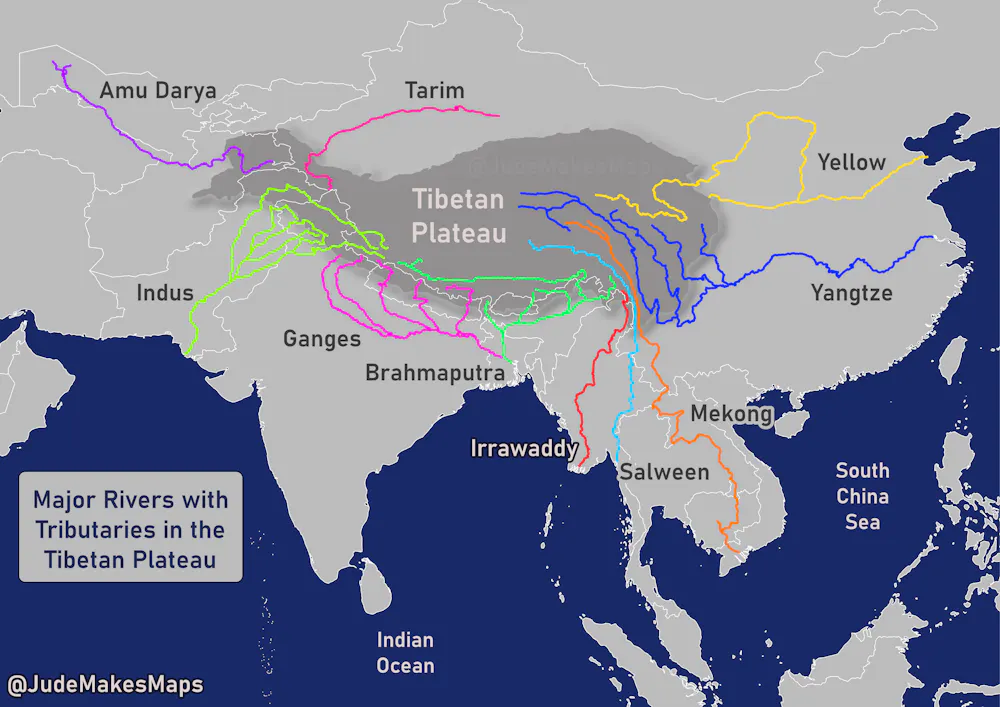
    Complicating matters further is China recently approving the construction of the world’s largest hydropower project on the Yarlung Tsangpo river in Tibet, which becomes the Brahmaputra in India. This massive project has raised alarm about China’s ability to exert control upstream, and the ecological risks for India and Bangladesh downstream.

    China hasn’t signed formal water-sharing agreements with its neighbours, but its growing presence in regional water infrastructure signals a dramatic shift in south and east Asian hydro-politics.

    Climate change is making things worse

    Recent climatic trends are making transboundary rivers an increasing focus of geopolitical friction. These trends include accelerated glacier melt, erratic monsoon patterns, and intensifying extreme weather.

    While melting glaciers will temporarily boost the flow of rivers, the long-term prognosis is bleak. If emissions and warming trends continue, many glacier-fed rivers – including the Indus, Ganges and Brahmaputra – could see dramatically reduced flows by the end of the century. This will directly affect hundreds of millions of people who depend on them.

    The crisis is being intensified by changes in the Himalayas. The region is warming faster than the global average, with a shift from snowfall to rainfall that disrupts the timing and volume of water that flows down from the mountains to the fields and cities below.

    At the same time, unsustainable groundwater extraction has pushed South Asia’s reserves of underground water toward collapse, threatening both food and water security.

    A dangerous precedent

    A collapse or suspension of the Indus Waters Treaty could set a dangerous precedent. Importantly, the threat is less about India cutting off water flows – an unlikely and technically challenging act – and more about the erosion of trust, transparency and data sharing.

    One of the treaty’s most valuable features has been the routine sharing of data on things like water levels, river flow and dam operations. Pakistan needs this data to forecast floods and droughts, plan its irrigation, generate hydropower effectively and manage its drinking water, yet India is indicating it will no longer honour these obligations.

    But India’s strained water relations are not limited to Pakistan. Bangladesh and Nepal have often felt sidelined or pressured in negotiations, and India’s indication that it may reconsider longstanding treaties raises concerns in both countries.

    This is especially the case as the Ganges Water Treaty nears its 2026 expiration: the vast Ganges river flows through India and irrigates much of Bangladesh – and the treaty guarantees Bangladesh a minimum river flow.

    Other key agreements, such as the Mahakali Treaty and Kosi river accord with Nepal, and the Teesta water-sharing deal with Bangladesh, remain largely unimplemented, breeding mistrust. These failures undermine confidence in regional water diplomacy and cast doubt on India’s commitment to equitable cooperation.

    None of this is helped by India, Pakistan and Bangladesh all continuing to rely on outdated irrigation methods that mean they use more water than necessary. As climate change intensifies floods, droughts and glacial melt, there is an urgent need to reform existing water treaties to reflect present-day climate, hydrological and geopolitical realities.

    Canals, like this one in Punjab, India, irrigate much of South Asia.
    Hussain Warraich / shutterstock

    The Indus Waters Treaty, negotiated in the 1960s before the emergence of modern climate science, no longer accounts for these transformations. Indeed, most water treaties in the region remain rooted in technocratic, engineering-centric frameworks which fail to address extreme climate variability and its cascading impacts.

    The upcoming expiration of the Ganges Water Treaty, and the pending negotiation of other basin agreements, present a critical opportunity to rethink water governance in South Asia.

    Though the Indus flows through India before Pakistan, in other basins, India is downstream. This is the case with the Brahmaputra, where it demands upstream cooperation from China.

    Undermining the Indus treaty could weaken India’s own position in future negotiations and strain its relations with Nepal and Bangladesh, while giving China more influence in South Asian hydro-politics. China is already expanding its footprint by offering billions in loans to Bangladesh and strengthening ties with Nepal, particularly around water infrastructure.

    Many of the world’s largest rivers begin in the Himalayas or the Tibetan Plateau.
    JudeMakesMaps, CC BY-SA

    Weaponising water is a perilous strategy that may backfire. The weakening of water diplomacy in South Asia is not just a regional threat; it endangers global climate security.

    In the face of escalating climate change impacts and recurring disasters, updating transboundary agreements like the Indus Waters Treaty, Ganga Water Treaty, and Kosi and Teesta accords is no longer optional – it is an urgent necessity with enormous consequences.

    Mehebub Sahana receives funding from the Leverhulme Trust, United Kingdom.

    ref. India-Pakistan conflict over water reflects a region increasingly vulnerable to climate change – https://theconversation.com/india-pakistan-conflict-over-water-reflects-a-region-increasingly-vulnerable-to-climate-change-256253

    MIL OSI – Global Reports

  • MIL-OSI USA: SBA Relief Still Available to Oregon Small Businesses and Private Nonprofits Affected by Summer Drought

    Source: United States Small Business Administration

    SACRAMENTO, Calif. – The U.S. Small Business Administration (SBA) is reminding eligible small businesses and private nonprofit (PNP) organizations in Oregon of the June 9 deadline to apply for low interest federal disaster loans to offset economic losses caused by the drought beginning Aug. 13, 2024.

    The disaster declaration covers the Oregon counties of Baker, Grant, Harney and Malheur as well as the Idaho counties of Canyon, Owyhee, Payette and Washington, and in Nevada the county of Humboldt.

    Under this declaration, SBA’s Economic Injury Disaster Loan (EIDL) program is available to small businesses, small agricultural cooperatives, nurseries, and PNPs with financial losses directly related to the disaster. The SBA is unable to provide disaster loans to agricultural producers, farmers, or ranchers, except for small aquaculture enterprises.

    EIDLs are available for working capital needs caused by the disaster and are available even if the business or PNP did not suffer any physical damage. The loans may be used to pay fixed debts, payroll, accounts payable and other bills not paid due to the disaster.

    “Through a declaration by the U.S. Secretary of Agriculture, SBA provides critical financial assistance to help communities recover,” said Chris Stallings, associate administrator of the Office of Disaster Recovery and Resilience at the SBA. “We’re pleased to offer loans to small businesses and private nonprofits impacted by these disasters.”

    The loan amount can be up to $2 million with interest rates as low as 4% for small businesses and 3.25% for PNPs with terms up to 30 years. Interest does not accrue and payments are not due until 12 months from the date of the first loan disbursement. The SBA sets loan amounts and terms based on each applicant’s financial condition.

    To apply online, visit sba.gov/disaster. Applicants may also call SBA’s Customer Service Center at (800) 659-2955 or email disastercustomerservice@sba.gov for more information on SBA disaster assistance. For people who are deaf, hard of hearing, or have a speech disability, please dial 7-1-1 to access telecommunications relay services.

    Submit completed loan applications to the SBA no later than June 9.

    ###

    About the U.S. Small Business Administration

    The U.S. Small Business Administration helps power the American dream of business ownership. As the only go-to resource and voice for small businesses backed by the strength of the federal government, the SBA empowers entrepreneurs and small business owners with the resources and support they need to start, grow, expand their businesses, or recover from a declared disaster. It delivers services through an extensive network of SBA field offices and partnerships with public and private organizations. To learn more, visit www.sba.gov.

    MIL OSI USA News

  • MIL-OSI USA: SBA Relief Still Available to Oklahoma Small Businesses and Private Nonprofits Affected by Drought

    Source: United States Small Business Administration

    SACRAMENTO, Calif. – The U.S. Small Business Administration (SBA) is reminding eligible small businesses and private nonprofit (PNP) organizations in Oklahoma of the June 9 deadline to apply for low interest federal disaster loans to offset economic losses caused by the drought beginning Oct. 1, 2024.

    The disaster declaration covers the Oklahoma counties of Atoka, Bryan, Canadian, Carter, Cherokee, Choctaw, Comanche, Cotton, Craig, Creek, Delaware, Garfield, Garvin, Grady, Jefferson, Johnston, Kingfisher, Lincoln, Logan, Love, Marshall, Mayes, Noble, Nowata, Oklahoma, Osage, Ottawa, Pawnee, Payne, Rogers, Stephens, Tulsa, Wagoner and Washington as well as the Kansas counties of Cherokee, Labette and Montgomery, and in Texas the counties of Clay, Fannin, Grayson, Lamar and Montague.

    Under this declaration, SBA’s Economic Injury Disaster Loan (EIDL) program is available to small businesses, small agricultural cooperatives, nurseries, and PNPs with financial losses directly related to the disaster. The SBA is unable to provide disaster loans to agricultural producers, farmers, or ranchers, except for small aquaculture enterprises.

    EIDLs are available for working capital needs caused by the disaster and are available even if the business or PNP did not suffer any physical damage. The loans may be used to pay fixed debts, payroll, accounts payable and other bills not paid due to the disaster.

    “Through a declaration by the U.S. Secretary of Agriculture, SBA provides critical financial assistance to help communities recover,” said Chris Stallings, associate administrator of the Office of Disaster Recovery and Resilience at the SBA. “We’re pleased to offer loans to small businesses and private nonprofits impacted by these disasters.”

    The loan amount can be up to $2 million with interest rates as low as 4% for small businesses and 3.25% for PNPs with terms up to 30 years. Interest does not accrue, and payments are not due until 12 months from the date of the first loan disbursement. The SBA sets loan amounts and terms based on each applicant’s financial condition.

    To apply online, visit sba.gov/disaster. Applicants may also call SBA’s Customer Service Center at (800) 659-2955 or email disastercustomerservice@sba.gov for more information on SBA disaster assistance. For people who are deaf, hard of hearing, or have a speech disability, please dial 7-1-1 to access telecommunications relay services.

    Submit completed loan applications to the SBA no later than June 9.

    ###

    About the U.S. Small Business Administration

    The U.S. Small Business Administration helps power the American dream of business ownership. As the only go-to resource and voice for small businesses backed by the strength of the federal government, the SBA empowers entrepreneurs and small business owners with the resources and support they need to start, grow, expand their businesses, or recover from a declared disaster. It delivers services through an extensive network of SBA field offices and partnerships with public and private organizations. To learn more, visit www.sba.gov.

    MIL OSI USA News

  • MIL-OSI USA: SBA Relief Still Available to North Dakota Small Businesses and Private Nonprofits Affected by Drought

    Source: United States Small Business Administration

    SACRAMENTO, Calif. – The U.S. Small Business Administration (SBA) is reminding eligible small businesses and private nonprofit (PNP) organizations in North Dakota of the June 9 deadline to apply for low interest federal disaster loans to offset economic losses caused by the drought beginning Oct. 1, 2024.

    The disaster declaration covers the North Dakota counties of Adams, Billings, Bowman, Burke, Divide, Golden Valley, Grant, Hettinger, McKenzie, Mountrail, Sioux, Slope, Stark and Williams as well as the Montana counties of Fallon, Richland, Roosevelt and Sheridan, and the South Dakota counties of Corson, Harding and Perkins.

    Under this declaration, SBA’s Economic Injury Disaster Loan (EIDL) program is available to small businesses, small agricultural cooperatives, nurseries, and PNPs with financial losses directly related to the disaster. The SBA is unable to provide disaster loans to agricultural producers, farmers, or ranchers, except for small aquaculture enterprises.

    EIDLs are available for working capital needs caused by the disaster and are available even if the business or PNP did not suffer any physical damage. The loans may be used to pay fixed debts, payroll, accounts payable and other bills not paid due to the disaster.

    “Through a declaration by the U.S. Secretary of Agriculture, SBA provides critical financial assistance to help communities recover,” said Chris Stallings, associate administrator of the Office of Disaster Recovery and Resilience at the SBA. “We’re pleased to offer loans to small businesses and private nonprofits impacted by these disasters.”

    The loan amount can be up to $2 million with interest rates as low as 4% for small businesses and 3.25% for PNPs with terms up to 30 years. Interest does not accrue and payments are not due until 12 months from the date of the first loan disbursement. The SBA sets loan amounts and terms based on each applicant’s financial condition.

    To apply online, visit sba.gov/disaster. Applicants may also call SBA’s Customer Service Center at (800) 659-2955 or email disastercustomerservice@sba.gov for more information on SBA disaster assistance. For people who are deaf, hard of hearing, or have a speech disability, please dial 7-1-1 to access telecommunications relay services.

    Submit completed loan applications to the SBA no later than June 9.

    ###

    About the U.S. Small Business Administration

    The U.S. Small Business Administration helps power the American dream of business ownership. As the only go-to resource and voice for small businesses backed by the strength of the federal government, the SBA empowers entrepreneurs and small business owners with the resources and support they need to start, grow, expand their businesses, or recover from a declared disaster. It delivers services through an extensive network of SBA field offices and partnerships with public and private organizations. To learn more, visit www.sba.gov.

    MIL OSI USA News

  • MIL-OSI USA: SBA Relief Still Available to Idaho Small Businesses and Private Nonprofits Affected by Summer Drought

    Source: United States Small Business Administration

    SACRAMENTO, Calif. – The U.S. Small Business Administration (SBA) is reminding eligible small businesses and private nonprofit (PNP) organizations in Idaho of the June 9 deadline to apply for low interest federal disaster loans to offset economic losses caused by the drought beginning Aug. 13, 2024.

    The disaster declaration covers the Idaho counties of Bingham, Bonneville, Caribou, Fremont, Jefferson, Madison and Teton as well as the Wyoming counties of Lincoln and Teton.

    Under this declaration, SBA’s Economic Injury Disaster Loan (EIDL) program is available to small businesses, small agricultural cooperatives, nurseries, and PNPs with financial losses directly related to the disaster. The SBA is unable to provide disaster loans to agricultural producers, farmers, or ranchers, except for small aquaculture enterprises.

    EIDLs are available for working capital needs caused by the disaster and are available even if the business or PNP did not suffer any physical damage. The loans may be used to pay fixed debts, payroll, accounts payable and other bills not paid due to the disaster.

    “Through a declaration by the U.S. Secretary of Agriculture, SBA provides critical financial assistance to help communities recover,” said Chris Stallings, associate administrator of the Office of Disaster Recovery and Resilience at the SBA. “We’re pleased to offer loans to small businesses and private nonprofits impacted by these disasters.”

    The loan amount can be up to $2 million with interest rates as low as 4% for small businesses and 3.25% for PNPs with terms up to 30 years. Interest does not accrue and payments are not due until 12 months from the date of the first loan disbursement. The SBA sets loan amounts and terms based on each applicant’s financial condition.

    To apply online, visit sba.gov/disaster. Applicants may also call SBA’s Customer Service Center at (800) 659-2955 or email disastercustomerservice@sba.gov for more information on SBA disaster assistance. For people who are deaf, hard of hearing, or have a speech disability, please dial 7-1-1 to access telecommunications relay services.

    Submit completed loan applications to the SBA no later than June 9.

    ###

    About the U.S. Small Business Administration

    The U.S. Small Business Administration helps power the American dream of business ownership. As the only go-to resource and voice for small businesses backed by the strength of the federal government, the SBA empowers entrepreneurs and small business owners with the resources and support they need to start, grow, expand their businesses, or recover from a declared disaster. It delivers services through an extensive network of SBA field offices and partnerships with public and private organizations. To learn more, visit www.sba.gov.

    MIL OSI USA News

  • MIL-OSI Security: Armed Career Criminal Sentenced to 17 Years in Federal Prison for Being a Felon in Possession of a Firearm

    Source: United States Bureau of Alcohol Tobacco Firearms and Explosives (ATF)

               LITTLE ROCK—Demarius Chamon Johnson, a felon who possessed a firearm located next to a three-year old child, will spend the next 17 years in federal prison for being a felon in possession of a firearm. Jonathan D. Ross, United States Attorney for the Eastern District of Arkansas, announced the 204-month sentence, which was handed down today by United States District Judge Brian S. Miller.

               A federal grand jury indicted Johnson, 35, of Jacksonville, in a superseding indictment on May 3, 2023. On January 24, 2025, Johnson pleaded guilty to being a felon in possession of a firearm. 

               On September 17, 2021, officers with the North Little Rock Police Department located a vehicle that had been reported stolen out of El Dorado parked at the Fairview Inn in North Little Rock. The hotel’s surveillance footage showed that an individual had parked the stolen vehicle and entered one of the rooms on the second floor. Officers went to the room, noted the door was open, and saw Johnson by the doorway. When officers entered the room, they noticed a firearm next to a three-year old child who was lying on one of the beds. Johnson was initially detained in relation to the stolen car. While being placed in handcuffs, Johnson stated, “that gun’s mine, it belongs to me.” The Colt Commander, .45 caliber pistol that was located on the bed had one round in the chamber and six rounds in the magazine. The firearm had been reported stolen out of Little Rock.

               Johnson has at least three prior convictions for a violent felony or serious drug offense and is therefore classified as an armed career criminal. His criminal history includes residential burglary, attempted residential burglary, and felony drug possession and distribution. 

               Judge Miller also sentenced Johnson to three years’ supervised release. There is no parole in the federal system.

               This case was investigated by ATF with assistance from the North Little Rock Police Department. The case was prosecuted by Assistant United States Attorney Amanda Jegley.

    # # #

    This news release, as well as additional information about the office of the

    United States Attorney for the Eastern District of Arkansas, is available on-line at


    http://www.justice.gov/edar

    X (formerly known as Twitter):

    @USAO_EDAR

    MIL Security OSI

  • MIL-OSI USA: Waller, Thank You, John

    Source: US State of New York Federal Reserve

    Thank you, Volker, and thank you for the opportunity to speak to you today.1
    John Taylor is deservedly well known for his work on monetary policy rules, the best known of which bear his name. But in the early 1980s, John was part of a broader discussion about rules versus discretion in the setting of monetary policy.
    The traditional argument for discretionary monetary policy was that any policy choice that a rule would recommend could be replicated by discretion, especially when policymakers are aware of the rule, but not vice versa. Discretion allowed more flexibility than a rule and thus was the dominant strategy for setting monetary policy.
    Then, in 1977, Finn Kydland and Ed Prescott published their paper “Rules Rather than Discretion: The Inconsistency of Optimal Plans,” which argued that policy promises made today may not be carried out in the future if there are advantages to reneging on those promises.2 Reneging on promises made by discretionary policymakers, they argued, is much easier than reneging on a policy rule, which is a way to commit to future actions.
    Kydland and Prescott provided a simple and appealing model at the end of their paper. The model had an incentive for the central bank to renege on its promise to keep inflation low, since doing so would expand the economy and lower unemployment. If rational agents knew of this incentive, they would not find the promise of low inflation credible and would therefore raise their expectations for future inflation. The central bank would then have to validate those expectations with higher inflation to avoid a recession. In the end, the economy ends up in a high-inflation equilibrium with no gains from higher output or lower unemployment.
    Kydland and Prescott then showed that if, on the other hand, the central bank could commit to following a rule to set policy, then it could not renege on its promises. As a result, inflation would stay low while yielding the same outcomes for output and employment. In this case, rules beat discretion. This was pathbreaking research, and it came to influence both the theory and practice of central banking. It was also part of the basis for Kydland and Prescott’s Nobel Prize in Economics in 2004.
    But commitment to most things in life is easier said than done. Even rules can be abandoned if it is optimal to do so. In the absence of commitment, can the central bank do anything to enhance the credibility of its promise to keep inflation low?
    In 1983, Robert Barro and David Gordon used the Kydland–Prescott example to study reputation building by the central bank.3 The basic idea is to establish a reputation for fulfilling promises. But what promises can be made in a discretionary world that the public would find credible? They showed that promising the low-inflation outcome wasn’t credible. However, the central bank could promise an inflation rate that was between the low-inflation equilibrium and the high-inflation equilibrium. If private individuals expected this intermediate inflation rate, then the gains from reneging would be reduced just enough to dissuade the central bank from breaking its promise. Consequently, promises to deliver this intermediate inflation rate were credible, and society was better off than it would be in the high-inflation world, showing that credibility really mattered in a world in which commitment was not feasible.
    I now introduce John Taylor and his work into the story, which coincided with the beginning of my own research career.
    In 1983, having read the Barro and Gordon paper, I started working on reputation-building strategies as part of my Ph.D. dissertation research. In the process, I was struck by the thought that the building of credibility and reputation hinges on the person setting monetary policy at the time: If that person leaves, does the central bank have to start over to rebuild its credibility? At the time, I had in mind Paul Volcker, whose personal credibility seemed so crucial in the Federal Reserve’s campaign to vanquish high inflation. Relying on the credibility of individual policymakers seemed like a weak foundation for sustaining the credibility of policy promises.
    That is when I went back and read John Taylor’s discussion of the Barro and Gordon paper in the Journal of Monetary Economics.4 John applauded the analytical contribution that Barro and Gordon—as well as Kydland and Prescott—had made, but he was skeptical about the practical applicability of their story. In his critique, John said, “In other well-recognized time inconsistency situations, society seems to have found ways to institute the optimal (cooperative) policy.”5
    As I read that sentence, I thought, “How does society build credibility into the institution instead of relying on the credibility of an individual?” That one sentence that John wrote in 1983 set me off on a 20-year journey studying central bank design.
    So where did it lead me?
    Around that time, Ken Rogoff published his paper on what he referred to as “conservative” central bankers.6 In his terminology, a conservative central banker was someone who disliked inflation more than the rest of society did. Rogoff showed that a conservative central banker would choose a lower rate of inflation than the average citizen but at the cost of greater instability of output and employment. This tradeoff improved social well-being, but there was one catch to this solution—there had to be safeguards to guarantee that the conservative central banker could not be fired for this policy decision, ensuring that these promises to control inflation were credible. In short, the central bank had to be independent and protected from the threats to its independence.
    This type of institutional design issue was one that I was interested in researching.
    Up until Rogoff’s work, the underlying assumption had been that the central bank was trying to maximize social welfare and that its preferences were aligned with those of society. Think of it as a “representative agent” economy. But as I read Rogoff’s work, it suggested that society consisted of people who had a variety of views about inflation, meaning that they would also have different views on the tradeoff between inflation and output stability. Consequently, members of society may have different views on how conservative the central banker should be. But where are these views coming from?
    So I tried to endogenize the heterogeneity in preferences. I had the idea that individuals all had the same fundamental preferences for inflation and output stability but that they varied if they worked in different sectors of the economy. In one sector, wages and employment were determined in a standard competitive fashion. In the other sector, wages were determined by wage contracts, and employment was determined by demand. Thus, when a negative shock hit the economy, the wage contract workers suffered a bigger reduction in employment because wages couldn’t adjust, whereas in the competitive sector, wages would adjust to soften the blow to employment—implying that if the wage contract sector got to choose a conservative central banker, they would want a more dovish central banker who would accept higher inflation in return for greater employment stability. The flexible wage workers wanted the opposite: They were more hawkish on inflation because they didn’t bear the same employment volatility. The punchline was that if political parties formed around workers from different sectors, then they would install central bankers with different policy preferences if they won the election.
    It was around that time that I read Alberto Alesina’s paper on “partisan business cycles.”7 In that paper, he assumed there were different political parties, each having different preferences about inflation and unemployment. One party was more concerned with price stability and less concerned about output stability than the other. Monetary policy and inflation outcomes were determined by the party that won a national election. As power changed hands after an election, monetary policy would differ from expected policy depending on who won the election. These election surprises would create volatility in monetary policy and thus inflation and output. In other words, elections would lead to partisan business cycles. In Alesina’s model, monetary policy was fully accountable to the electorate, which is desirable, but it came at the cost of causing greater economic instability.
    This was a brilliant paper, but, again, it raised a serious question for me: Why would society choose full electoral accountability and maximum volatility in monetary policy? Economists usually think there are tradeoffs on the margin such that “corner solutions” like these aren’t optimal. It seemed to me that there could be a welfare-improving institutional design for the central bank. I looked at the Federal Reserve’s Board of Governors structure, and I felt that electoral accountability could be achieved through the appointment process, but economic instability would be reduced by having a monetary policy board composed of current and past appointees who set policy according to majority rule. This thinking led me to taking a variant of Alesina’s model and studying how a policy board would change his results.
    I assumed that board members were appointed by the winning party of an election to serve for multiple periods. This appointment process provided accountability to the electorate via the nomination and confirmation process. To ensure that economic stability would be improved, I assumed these members served staggered and long (relative to the election cycle) terms in office.8 Furthermore, as in Rogoff’s model, board members could not be removed from office. This feature of the model captured the idea that the central bank board would be independent.
    My research showed that by having an independent policy board set monetary policy, social well-being was improved relative to Alesina’s results. Accountability to the electorate could be achieved through the nomination and confirmation process, and economic stability was enhanced by having a group of individuals set policy who could not be removed from office. This structure is the one that we have in place today at the Federal Reserve. I would argue that it has stood the test of time, and I hope that it continues to be in place for years to come.
    To conclude, I have come full circle in my professional life—from first reading that sentence that John wrote in 1983 to researching central bank independence and central bank boards for 20 years to then becoming a central bank board member, which led me here today. So, I can finally thank John for sending me on a wonderful journey that he had no idea he launched me on.

    1. The views expressed here are my own and are not necessarily those of my colleagues on the Federal Reserve Board or the Federal Open Market Committee. Return to text
    2. See Finn E. Kydland and Edward C. Prescott (1977), “Rules Rather than Discretion: The Inconsistency of Optimal Plans,” Journal of Political Economy, vol. 85 (June), pp. 473–92. Return to text
    3. See Robert J. Barro and David B. Gordon (1983), “Rules, Discretion and Reputation in a Model of Monetary Policy,” Journal of Monetary Economics, vol. 12 (1), pp. 101–21. Return to text
    4. See John B. Taylor (1983), “‘Rules, Discretion and Reputation in a Model of Monetary Policy’ by Robert J. Barro and David B. Gordon,” Journal of Monetary Economics, vol. 12 (1), pp. 123–25. Return to text
    5. See Taylor, ‘”Rules, Discretion and Reputation in a Model of Monetary Policy’ by Robert J. Barro and David B. Gordon” in note 4. Return to text
    6. See Kenneth Rogoff (1985), “The Optimal Degree of Commitment to an Intermediate Monetary Target,” Quarterly Journal of Economics, vol. 100 (November), pp. 1169–89. Return to text
    7. See Alberto Alesina (1987), “Macroeconomic Policy in a Two-Party System as a Repeated Game,” Quarterly Journal of Economics, vol. 102 (August), pp. 651–78. Return to text
    8. See Christopher J. Waller (1989), “Monetary Policy Games and Central Bank Politics,” Journal of Money, Credit and Banking, vol. 21 (November), pp. 422–31; Christopher J. Waller (1992), “A Bargaining Model of Partisan Appointments to the Central Bank,” Journal of Monetary Economics, vol. 29 (June), pp. 411–28; and Christopher J. Waller (2000), “Policy Boards and Policy Smoothing,” Quarterly Journal of Economics, vol. 115 (February), pp. 305–39. Return to text

    MIL OSI USA News

  • MIL-OSI USA: Rep. Dan Goldman, Rep. Menendez, Senator Luján, Senator Bennet Lead Democrats in Calling on Trump Administration to Crack Down on U.S. Firearms Flowing to Latin American Drug Cartels

    Source: US Congressman Dan Goldman (NY-10)

    Administration’s Designation of 8 Cartels as Foreign Terrorist Organizations Unlocks New Tools to Crack Down on Southbound Arms Trafficking  


    Over 200,000 American Firearms Flow into Mexico Every Year, Fueling Gang Violence and Drug and Human Trafficking 


    Read the Letter Here 

    Washington, D.C – Congressman Dan Goldman (NY-10), Congressman Rob Menendez (NJ-08) and Senator Ben Ray Luján (D-NM) today led 10 of their colleagues in urging the Trump administration to use its recent designation of Latin American cartels as Foreign Terrorist Organizations (FTOs) to take aggressive action to stop the illegal trafficking of American firearms south across the Southern Border. In a letter addressed to Secretary of Homeland Security Kristi Noem, Secretary of State Marco Rubio, and Attorney General Pam Bondi, the lawmakers called for a coordinated federal response to stem the flow of hundreds of thousands of American firearms that arm violent drug cartels, fuel lawlessness along the Southern Border, and bring drugs into communities across the United States. 

    “We were pleased that President Trump agreed to address the outflow of hundreds of thousands of American-made firearms across the southern border when he initially postponed the implementation of tariffs on our ally Mexico. Accordingly, we urge you to utilize the FTO designation to take aggressive action to stem the flow of American guns to the cartels,” the Members wrote. 

    Anywhere between 200,000 and 500,000 American firearms are smuggled across U.S. borders into Mexico every year, arming Latin American criminal organizations that have used them to undermine domestic law enforcement and assert control over fentanyl and human trafficking operations back into the United States. 

    “The new FTO designation for these cartels provides additional legal tools to bolster interagency coordination, disrupt their financial networks, and impose stricter penalties on those who provide material support to these criminal enterprises. Specifically, under current statute, it is unlawful to knowingly provide material support or resources to a Foreign Terrorist Organization and those who do so can be fined or imprisoned for up to 20 years,” the Members continued. 

    The members urged the administration to effectively and strategically employ the full suite of legal options this new designation enables and offered their assistance to empower it to specifically address the “Iron River” of American firearms that are fueling violence and destruction in communities across the United States and Mexico. 

    “We hope that you move swiftly and use these new legal authorities to combat southbound arms trafficking. We stand ready to assist in this effort in any way we can, including through legislation that expands your programmatic authorities to address this critical issue,” the Members concluded. 

    Read the letter here or below: 

    Dear Secretary Noem, Secretary Rubio, and Attorney General Bondi: 

    We write to you today regarding the Trump Administration’s recent designation of eight Latin American cartels and gangs as Foreign Terrorist Organizations (FTOs), a move aimed at addressing the growing harms these organizations are causing in the United States. As you know, the primary source of strength and control that these criminal organizations exert over the U.S./Mexico border stems from one source: American firearms. We were pleased that President Trump agreed to address the outflow of hundreds of thousands of American-made firearms across the southern border when he initially postponed the implementation of tariffs on our ally Mexico. Accordingly, we urge you to utilize the FTO designation to take aggressive action to stem the flow of American guns to the cartels.  

    It is a well-established fact that the overwhelming majority of the weapons used by Latin American cartels are manufactured in the United States. In fact, anywhere from 200,000 to 500,000 are smuggled into Mexico every single year and a whopping 70 percent of firearms recovered at crime scenes in Mexico are traced to the U.S. Alarmingly, although Mexico has just a single gun store in the entire country, it still endures approximately 30,000 firearm related deaths every year. This steady supply of weapons coming in from the north has allowed these criminal organizations to gain control over fentanyl and human trafficking across the border and undermine Mexican law enforcement. 

    Put simply, if we do not stop the flow of American-made guns across the southern border to Mexico, we cannot stop the flow of fentanyl into our country over that same border.  

    The new FTO designation for these cartels provides additional legal tools to bolster interagency coordination, disrupt their financial networks, and impose stricter penalties on those who provide material support to these criminal enterprises. Specifically, under current statute, it is unlawful to knowingly provide material support or resources to a Foreign Terrorist Organization and those who do so can be fined or imprisoned for up to 20 years. Individuals and entities that provide weapons, funds, equipment, or other tangible support to designated terrorist organizations can face serious federal prosecution if found liable.   

    To leverage this designation most effectively, the Department of Homeland Security (DHS), Department of Justice (DOJ) and Department of State (DOS) must take immediate steps to crack down on the “Iron River” of illegal arms flowing into Mexico by taking the following actions: 

    Increasing interagency cooperation to track, target, and dismantle smuggling rings that facilitate weapons trafficking across the Mexican border.  

    Expanding inspections at border crossings to intercept vehicles carrying firearms, related munitions, and other contraband into Mexico.  

    Increasing law enforcement efforts against straw purchasers and firearm dealers that knowingly provide material support to smugglers.  

    Strengthening our intelligence-sharing with Mexican authorities and trusted partners to target and disrupt arms traffickers and their networks. 

    Given that this issue has been a key topic of discussion between President Trump and President Sheinbaum of Mexico – which has resulted in the U.S. government agreeing to work together to stop the flow of firearms into Mexico – we hope that you move swiftly and use these new legal authorities to combat southbound arms trafficking. We stand ready to assist in this effort in any way we can, including through legislation that expands your programmatic authorities to address this critical issue.  

    Thank you for your consideration and we look forward to continuing to work with you on this issue. 
    ### 

    MIL OSI USA News

  • MIL-OSI USA: Bacon, Gottheimer Demand Answers from the Administration on U.S.-Houthi Agreement, Ongoing Threat to Israel

    Source: United States House of Representatives – Congressman Don Bacon (2nd District of Nebraska)

    Bacon, Gottheimer Demand Answers from the Administration on U.S.-Houthi Agreement, Ongoing Threat to Israel

    Washington, DC — Today, May 9, 2025, U.S. Representatives Don Bacon (NE-2) and Josh Gottheimer (NJ-5) led a bipartisan group of colleagues in sending a letter to President Trump and Acting National Security Advisor Marco Rubio demanding clarity on the May 6 agreement with the Iranian-backed Houthi forces. 

    The deal made with the Houthis would halt all U.S. strikes against the terrorist group without addressing the ongoing threat to Israel, our key democratic ally. Shortly after the announcement, the Houthis declared their intent to continue targeting Israeli civilians, despite the U.S. agreement.

    “On May 4 — just two days before this deal was struck — a Houthi missile reached Israeli territory, injuring six and disrupting operations at Israel’s primary international airport. That such an attack could occur after extensive efforts by the Administration to target the Houthis, and then be followed by a negotiated cessation of strikes, sends the wrong message to both our allies and adversaries: that U.S. resolve is negotiable and that aggression against our allies will go unpunished by the United States,” the Members of Congress wrote in a letter to President Trump and Acting National Security Advisor Rubio. 

    The letter continues, “We urge the Administration to engage closely with our Israeli partners to ensure that any diplomatic or military arrangements fully protect Israel’s security interests and do not embolden Iranian proxies. As Members of Congress, we have a constitutional responsibility to ensure that the use of American military force is both properly authorized and strategically effective. We expect a timely briefing rooted in a strategy that defends our allies, restores deterrence, and reaffirms our global leadership.”

    “The Houthi threat to global shipping cannot be separated from the danger this terrorist group continues to pose to U.S. forces in the region as well as to our allies like Israel. Ultimately, Iran is at the heart of this threat,” said Tyler Stapleton, Director of Government Relations at FDD Action. “Iran’s financial assistance and transfers of advanced weapons to the Houthis must be addressed and until they are, any agreement with this terrorist group will achieve only temporary calm. The Trump administration must develop and work with Congress to implement a long-term strategy to degrade the Houthi threat and hold Iran accountable for its continued support to this terrorist group.”

    In addition to Bacon and Gottheimer, Reps. Tom Suozzi (NY-3), Dan Goldman (NY-10), and Greg Stanton (AZ-4) also signed the letter. 

    Full text of the letter can be found here and below:

    Dear President Trump and Acting National Security Advisor Rubio,

    We are writing to express our serious concern over the agreement reached on May 6 with the Iranian-backed Houthi forces in Yemen, which halts U.S. strikes against Houthi targets without addressing the threat to Israel. Shortly after the announcement, the Houthis declared their intent to continue targeting Israeli civilians, despite the agreement with the United States. This decision leaves Israel dangerously vulnerable and fails to confront the broader threat posed by Iran’s proxy network. 

    After months of sustained operations—including more than 800 U.S. and coalition air and missile strikes—the Houthis remain not only operational, but increasingly emboldened, regularly launching ballistic missiles toward Israeli territory. This is unacceptable. The fact that such a deal was made despite the Houthis’ continued aggression underscores a troubling lack of strategic coherence. 

    Since Hamas’ brutal October 7 terrorist attacks against Israel, the Houthis have openly declared their unwavering support for Hamas and Iran’s broader proxy network, launching missile and drone strikes targeting Israel and global shipping in the Red Sea. These operations have not only endangered Israeli civilians, but have also raised prices globally by disrupting one of the busiest global shipping routes in the world. 

    Notably, on May 4—just two days before this deal was struck—a Houthi missile reached Israeli territory, injuring six and disrupting operations at Israel’s primary international airport. That such an attack could occur after extensive efforts by the Administration to target the Houthis, and then be followed by a negotiated cessation of strikes, sends the wrong message to both our allies and adversaries: that U.S. resolve is negotiable and that aggression against our allies will go unpunished by the United States.

    Moreover, this ceasefire fails to address the root of the problem: Iran’s supply of advanced weapons, intelligence, and training to the Houthis. Without a strategy that targets Tehran’s supply lines, any agreement with the Houthis is merely a tactical pause and leaves Israel exposed.

    Given these serious concerns, we are requesting a briefing to Congress by no later than May 19 that includes:

    • The full details of the May 6 agreement, including a strategy for how Israel will be engaged throughout its implementation;
    • An assessment of the Houthis long-range missile capabilities, specifically their ability to target Israeli territory;
    • An examination of Iran’s supply of weapons systems to the Houthis, including how these supply routes have evaded U.S. forces;

    We urge the Administration to engage closely with our Israeli partners to ensure that any diplomatic or military arrangements fully protect Israel’s security interests and do not embolden Iranian proxies. As Members of Congress, we have a constitutional responsibility to ensure that the use of American military force is both properly authorized and strategically effective. We expect a timely briefing rooted in a strategy that defends our allies, restores deterrence, and reaffirms our global leadership.

    ###

    MIL OSI USA News

  • MIL-OSI USA: Reps. Obernolte, Stevens, Weber, Hudson introduce new legislation to expedite quantum computing applications in USA

    Source: United States House of Representatives – Congressman Jay Obernolte (R-Hesperia)

    U.S. Congressman Jay Obernolte (R-CA) introduced the Quantum Sandbox for Near-Term Applications Act alongside co-leads Rep. Haley Stevens (D-MI), Rep. Randy Weber (R-TX), and Rep. Richard Hudson (R-NC). The bill aims to increase quantum technology commercial advancement through the creation of a quantum sandbox program. This program allows government and industry partners to come together to develop and deploy quantum and quantum-hybrid applications for near-term use.

    U.S. Congressman Jay Obernolte (R-CA) introduced the Quantum Sandbox for Near-Term Applications Act alongside co-leads Rep. Haley Stevens (D-MI), Rep. Randy Weber (R-TX), and Rep. Richard Hudson (R-NC). The bill aims to increase quantum technology commercial advancement through the creation of a quantum sandbox program. This program allows government and industry partners to come together to develop and deploy quantum and quantum-hybrid applications for near-term use. 

    “Quantum computing is a game-changing advancement in technology. It will dramatically increase the speed at which computers can run algorithms and solve problems, enabling new opportunities to improve our supply chains, transportation networks, electrical grid, and our communication resilience,” said Rep. Obernolte. “The Quantum Sandbox for Near-Term Applications Act will help to ensure the United States remains a global leader in not only the development but also the deployment of new quantum technologies by providing a cloud-based venue for developers to produce quantum-enabled software tools from a variety of different systems for use in sectors such as telecommunications, financial services, healthcare and defense.” 

    “The application of quantum technologies in manufacturing is vital to the future competitiveness of Michigan manufacturers. The bipartisan Quantum Sandbox for Near-Term Applications Act will create testbeds to allow innovators to test quantum discoveries in real-world applications, like advanced manufacturing,” said Rep. Haley Stevens. “This legislation will ensure businesses and researchers here at home can apply this emerging technology and help Michigan businesses continue to grow and innovate.” 

    Unlike traditional computers which store and analyze data as either zeros or ones, quantum computers operate with quantum bits, known as qubits, which are complex dual systems of both zero and one simultaneously, a concept derived from quantum physics. Although fully developed commercial quantum computing remains years away, finding new ways to tackle critical challenges is a key objective of a quantum sandbox program. Once use cases are identified, the sandbox program can provide an expedited pathway to develop targeted applications through public-private partnerships. 

    The quantum sandbox program will drive U.S. innovation toward solving critical real-world challenges impacting American society and will augment the long-term basic research currently being conducted through the National Quantum Initiative.  

    What they’re saying: 

    D-Wave CEO Alan Baratz: “We commend Representatives Obernolte, Stevens, Hudson and Weber for their continued leadership on advancing near-term applications of emerging technologies like quantum and AI. We’re already seeing meaningful progress where quantum computing is providing computational advantages. For example, the U.S. Army Engineer Research and Development Center recently developed a quantum application for wildfire management. A dedicated program to accelerate near-term quantum applications is essential to incorporating hardware and software advancements, and the quantum sandbox legislation would do just that by enabling public-private partnerships to safely test and validate applications within a 24-month timeframe. This effort is key to demonstrating the real-world viability of quantum technologies. We strongly urge its enactment this Congress.” 

    Strangeworks Founder and CEO whurley: “As a nation, our leadership in quantum technology depends on bold, forward-thinking initiatives and the Quantum Sandbox Act is a perfect example. At Strangeworks, we strongly support this legislation, which expands access to quantum computing and accelerates the development of real-world, near-term applications. With continued investment and public-private collaboration, quantum technology holds the promise to transform entire industries—advancing medical breakthroughs, driving sustainability, strengthening national security, and redefining artificial intelligence. This bill represents a pivotal step in shaping a more innovative, resilient future, and we are proud to stand behind it.” 

    Celia Merzbacher, Executive Director, QED-C: “The Quantum Economic Development Consortium (QED-C®) seeks to grow the quantum economy through the development of quantum technologies for applications in sensing, communication, and computing. As documented in various QED-C reports, there are many use cases that experts believe are highly feasible and within grasp. The Quantum Sandbox act will accelerate the discovery and development of near-term applications and in the process will build the capacity for longer term innovation as well.” 

    Alliance for Digital Innovation Executive Director Ross Nodurft: “We commend Reps. Obernolte Stevens, Weber, and Hudson for their commitment to emerging technologies such as artificial intelligence and quantum computing, and the Quantum Sandbox bill is another step in the right direction. A quantum sandbox program is a critical program to provide rapid development of new and innovative cloud-based solutions to solve public-sector challenges, and we support enactment of this legislation.” 

    Dr. Rajeeb Hazra, President & CEO of Quantinuum: “As the world’s largest integrated quantum computing company, Quantinuum strongly supports the bipartisan Quantum Sandbox for Near-Term Applications Act. This legislation is essential to ensure the continued leadership of the U.S. in this critical emerging technology. By fostering application development and accelerating commercialization, the Act will help unlock solutions to some of today’s most complex challenges across a range of critical sectors—including healthcare, energy, national security and beyond.”

    Jitesh Lalwani, CEO Artificial Brain: “Artificial Brain warmly welcomes and urges the expeditious passage of the Quantum Sandbox Act. Our company is already developing and deploying our quantum software and hybrid QML solutions on quantum hardware through the cloud, achieving huge successes across all of our use cases, including in defense and energy. Artificial Brain has been a leading industry voice on the quantum computing advantages that are already here. Now is the moment for the U.S. to act boldly. The Congressional findings agree with our own clear message: Quantum innovation is critical and foundational to the United States and that quantum and hybrid applications can provide innovative near term solutions across the public and private sector. This is why it is imperative that our country shifts our focus to developing and deploying near-term applications. We must be positioned to develop an unrivaled quantum workforce and near-term application development or risk losing behind allies and adversaries alike. This shift will take total commitment, and we are pleased to see both the Congress and Administration as supportive champions so we can seize on these near-term, value-creating opportunities. This legislation might be one of the most consequential and bipartisan achievements for U.S. innovation of this congressional term.” 

    Paul Stimers, Executive Director of the Quantum Industry Coalition: “As the US quantum industry advances the commercialization of quantum technologies, it is increasingly important for the National Quantum Initiative to include a focus on near-term applications. The Quantum Industry Coalition commends Rep. Obernolte for addressing this issue, and looks forward to incorporating it into the National Quantum Initiative reauthorization process this year.” 

    ### 

    MIL OSI USA News

  • MIL-OSI Security: Castle Shannon Felon Charged with Drug and Firearms Offenses

    Source: Federal Bureau of Investigation (FBI) State Crime Alerts (c)

    PITTSBURGH, Pa. – A resident of Castle Shannon, Pennsylvania, has been indicted by a federal grand jury in Pittsburgh on charges of violating federal narcotics and firearms laws, Acting United States Attorney Troy Rivetti announced today.

    The three-count Indictment named Vaughn James, 40, as the sole defendant.

    According to the Indictment, on or about June 14, 2023, James possessed with intent to distribute quantities of mixtures and substances containing fentanyl, fluorofentanyl, protonitazene, heroin, MDMA, cocaine, and crack cocaine. The Indictment also alleges that James possessed a firearm in furtherance of his drug trafficking crime and possessed a firearm and ammunition after having been convicted of multiple prior felonies, including for state drug trafficking and firearms offenses. Federal law prohibits possession of a firearm or ammunition by a convicted felon.

    The law provides for a maximum total sentence of not less than 20 years and up to life in prison, a fine of up to $10.5 million, or both. Under the federal Sentencing Guidelines, the actual sentence imposed would be based upon the seriousness of the offenses and the prior criminal history of the defendant.

    Assistant United States Attorney V. Joseph Sonson is prosecuting this case on behalf of the government.

    The Pennsylvania State Police Drug Law Enforcement Division’s Southwest Strike Force Unit and Federal Bureau of Investigation conducted the investigation leading to the Indictment.

    This case is part of Project Safe Neighborhoods (PSN), a program bringing together all levels of law enforcement and the communities they serve to reduce violent crime and gun violence, and to make our neighborhoods safer for everyone. On May 26, 2021, the Department launched a violent crime reduction strategy strengthening PSN based on these core principles: fostering trust and legitimacy in our communities, supporting community-based organizations that help prevent violence from occurring in the first place, setting focused and strategic enforcement priorities, and measuring the results.

    MIL Security OSI

  • MIL-OSI Security: Centre Rawdon — RCMP investigates serious collision on Hwy. 14

    Source: Royal Canadian Mounted Police

    East Hants District RCMP is investigating a serious collision that occurred in Centre Rawdon.

    On May 8, at approximately 12:05 p.m., RCMP officers, fire services, and EHS, responded to a report of a two-vehicle collision at the intersection of Hwy. 14 and South Rawdon Rd. Investigators learned that a Freightliner truck was travelling west on Hwy. 14 and a Chevrolet Cruze was travelling north on South Rawdon Rd. when they collided.

    The rear passenger of the Cruze, an infant, suffered life-threatening injuries and was transported to hospital by EHS LifeFlight. The driver and passenger of the vehicle, a 34-year-old South Rawdon woman and a 69-year-old Hantsport woman, suffered non-life-threatening injuries and were transported to hospital by EHS.

    The driver and lone occupant of the truck, a 70-year-old man of Williamswood, suffered minor injuries.

    An RCMP collision reconstructionist attended the scene and the investigation is ongoing.

    The intersection was closed several hours but has since reopened.

    File #: 2025-617980

    MIL Security OSI

  • MIL-OSI USA: During Small Business Week, Governor Stein Visits Marshall, Calls for More Western NC Small Business Support

    Source: US State of North Carolina

    Headline: During Small Business Week, Governor Stein Visits Marshall, Calls for More Western NC Small Business Support

    During Small Business Week, Governor Stein Visits Marshall, Calls for More Western NC Small Business Support
    lsaito

    Raleigh, NC

    Yesterday, during Small Business Week, Governor Stein and North Carolina Secretary of Commerce Lee Lilley visited downtown Marshall to highlight the importance of supporting small businesses impacted by Hurricane Helene. Governor Stein has proclaimed May 4 – May 10, 2025 as Small Business Week to celebrate the impact of entrepreneurs and small businesses on North Carolina’s economy. 

    “Small businesses are the beating heart of our economy, and I am proud to recognize them this week. In particular, western North Carolina is open for business, and it is more crucial than ever to support its economic recovery,” said Governor Josh Stein. “With the help of private partners, $55 million is now on the way to more than 2,100 small businesses. Unfortunately, it’s not nearly enough. I am calling on the General Assembly to dedicate more funding to support small businesses so they can keep providing jobs and bolstering local economies.”

    “Small businesses are foundational in our communities, employing nearly 45 percent of the private-sector workforce across the state,” said Commerce Secretary Lee Lilley. “As we continue our recovery from devastating storms and federal impacts, our focus remains on creating an environment where entrepreneurs can thrive.”

    Governor Stein remains committed to ensuring that businesses in western North Carolina have the resources and infrastructure they need to rebuild. Last week, Governor Stein announced that the Dogwood Health Trust, the Duke Endowment, and the State of North Carolina have distributed $55 million to more than 2,100 businesses in western North Carolina. In his second Helene budget request, Governor Stein will call on the General Assembly to invest more in small business grants so that western North Carolina businesses can keep their doors open to serve their communities.  

    Governor Stein and the North Carolina Department of Commerce also launched an additional $55 million state infrastructure program, which allows local governments to apply for up to $1 million to rebuild public infrastructure. Small businesses rely on this infrastructure, such as sidewalks and sewers, to do business. The Department of Commerce’s Division of Workforce Solutions has also made the $500,000 “Hurricane Helene Business Edge Fund” available to local workforce boards serving the counties that were most impacted by the storm, with a particular focus on minimizing layoffs from small businesses. 

    North Carolina’s small businesses account for more than 99 percent of the state’s businesses, employing 1.7 million people statewide. More than 9,600 North Carolina small firms exported merchandise, generating $8.2 billion of the state’s exports as of the latest report from 2022. North Carolina is proud to support small businesses through services such as NCWorks, community college small business centers, the N.C. Small Business and Technology Development Center, SCORE, the Veterans Business Outreach Center, the Rural Center, and a toll-free information and referral service known as the Small Business Advisors hotline. 

    Click here to read Governor Stein’s full proclamation.  

    May 9, 2025

    MIL OSI USA News

  • MIL-OSI USA: NCDHHS Livestream Fireside Chat and Tele-Town Hall:  NC Crisis Services — Support For All Ages

    Source: US State of North Carolina

    Headline: NCDHHS Livestream Fireside Chat and Tele-Town Hall:  NC Crisis Services — Support For All Ages

    NCDHHS Livestream Fireside Chat and Tele-Town Hall:  NC Crisis Services — Support For All Ages
    stonizzo

    The North Carolina Department of Health and Human Services will host a live fireside chat and tele-town hall on Tuesday, May 13, from 6 to 7 p.m. to discuss how people can support their mental well-being, find resources and get help for themselves or someone else who is struggling with mental health or experiencing a crisis. 

    Event participants include:  

    • Lisa DeCiantis, MA, LCMHC, Chief Clinical Officer for Mental Health Wellness, Treatment and Recovery, Division of Mental Health, Developmental Disabilities and Substance Use Services, NCDHHS  
    • Natasha Holley, MSW, LCSW, LCAS, CCS, Chief Executive Officer, Integrated Family Services PLLC
    • Noah Swabe, Chief Operating Officer, Promise Resource Network 

    May is Mental Health Awareness Month, and nearly 1 in 4 adults in North Carolina have reported symptoms of anxiety or depression. Mental health crisis services offer non-judgmental, confidential and compassionate care to connect North Carolinians with resources and support — available at little or no cost. People of all ages and stages of life can get help with social or family situations, depression, anxiety, thoughts of suicide, substance use or if they just need someone to talk to.

    The fireside chat will stream live from the NCDHHS Facebook and YouTube accounts, where viewers can submit questions. The event also includes a tele-town hall, which invites people by phone to listen in and submit questions. People can dial into the event by calling 855-756-7520 Ext. 120795#. Fireside chat and tele-town hall panelists will discuss:

    • What crisis services are and how to access them  
    • When to get support if you’re struggling, or a caregiver of someone who needs help  
    • Where to find mental health information and resources for youth and adults in North Carolina 

    A Crisis Services page is available in English and Spanish on the NCDHHS website to explain and connect people to services. This page includes a searchable map to find community crisis centers and has a zip code search to find a mobile crisis team. If you or someone you love is feeling overwhelmed, NC crisis services are here to help: 

    • Call, text or chat with 988 for immediate support, 24/7
    • Talk to someone with lived experience through the Peer Warmline: 855-PEERS-NC
    • Have help come to you — trained mobile crisis teams will meet you in a safe place at no cost
    • Visit a community crisis center for fast, in-person help from licensed clinicians 
    May 9, 2025

    MIL OSI USA News

  • MIL-OSI: Fireweed Upsizes Financing to $60 Million

    Source: GlobeNewswire (MIL-OSI)

    NOT FOR DISTRIBUTION TO UNITED STATES NEWS WIRE SERVICES OR FOR DISSEMINATION IN THE UNITED STATES

    VANCOUVER, British Columbia, May 09, 2025 (GLOBE NEWSWIRE) — FIREWEED METALS CORP. (“Fireweed” or the “Company”) (TSXV: FWZ; OTCQX: FWEDF), is pleased to announce that, due to strong institutional investor demand, it has entered into an agreement with Ventum Financial Corp. as co-lead agent and bookrunner, alongside Haywood Securities Inc., as co-lead agent, on behalf of a syndicate of agents, to increase the Company’s previously announced brokered and non-brokered financing from $45 million to up to $60 million. See press release of the Company dated May 8, 2025.

    Pursuant to the amended terms of the financing, the brokered private placement (“Brokered Offering”) will now consist of:

    • 12,545,000 critical mineral charity flow-through common shares (“CM FT Shares”) of the Company at a price of $2.79 per CM FT Share for aggregate gross proceeds of up to $35,000,550.
    • 4,281,000 non-critical mineral charity flow-through common shares (“NCM FT Shares”) of the Company at a price of $2.57 per NCM FT Share for aggregate gross proceeds of up to $11,002,170.

    The Company has also decided to increase the size of the non-brokered private placement (“Non-Brokered Offering”) which will now consist of:

    • 7,777,800 common shares of the Company (“Shares”) at a price of $1.80 per Share, for aggregate gross proceeds of up to $14,000,040.

    In all other respects, the terms of the Brokered Offering and Non-Brokered Offering remain as previously disclosed in the original press release of the Company related to the financing dated May 8, 2025, a copy of which is available on the Company’s website at FireweedMetals.com and at www.sedarplus.com.

    The securities being offered have not, nor will they be registered under the United States Securities Act of 1933, as amended, and may not be offered or sold within the United States or to, or for the account or benefit of, U.S. persons in the absence of U.S. registration or an applicable exemption from the U.S. registration requirements. This release does not constitute an offer for sale of securities in the United States.

    About Fireweed Metals Corp.

    Fireweed is an exploration company focused on unlocking value in a new critical metals district located in Northern Canada. Fireweed is 100% owner of the Macpass District, a large and highly prospective 985 km2 land package. The Macpass District includes the Macpass zinc-lead-silver project and the Mactung tungsten project. A Lundin Group company, Fireweed is strongly positioned to create meaningful value.

    Fireweed trades on the TSX Venture Exchange under the trading symbol “FWZ”, on the OTCQX Best Market under the symbol “FWEDF”, and on the Frankfurt Stock Exchange under the trading symbol “M0G”.

    Additional information about Fireweed and its projects can be found on the Company’s website at FireweedMetals.com and at www.sedarplus.com

    ON BEHALF OF FIREWEED METALS CORP.

    Ian Gibbs

    CEO

    Neither the TSX Venture Exchange nor its Regulation Services Provider (as that term is defined in the policies of the TSX Venture Exchange) accepts responsibility for the adequacy or accuracy of this release.

    Cautionary Statements

    Forward Looking Statements

    This news release contains “forward-looking” statements and information (“forward-looking statements”). All statements, other than statements of historical facts, included herein, including, without limitation, statements relating to the Brokered Offering and the Non-Brokered Offering, timing thereof, completion and use of proceeds thereof, statements relating to interpretation of drill results, targets for exploration, potential extensions of mineralized zones, geophysical anomalies, future work plans, and the potential of the Company’s projects, are forward looking statements. Forward-looking statements are frequently, but not always, identified by words such as “expects”, “anticipates”, “believes”, “intends”, “estimates”, “potential”, “possible”, and similar expressions, or statements that events, conditions, or results “will”, “may”, “could”, or “should” occur or be achieved. Forward-looking statements are based on the beliefs of Company management, as well as assumptions made by and information currently available to Company management and reflect the beliefs, opinions, and projections on the date the statements are made. Forward-looking statements involve various risks and uncertainties and accordingly, readers are advised not to place undue reliance on forward-looking statements. There can be no assurance that such statements will prove to be accurate, and actual results and future events could differ materially from those anticipated in such statements. Important factors that could cause actual results to differ materially from the Company’s expectations include but are not limited to, exploration and development risks, unanticipated reclamation expenses, expenditure and financing requirements, general economic conditions, changes in financial markets, the ability to properly and efficiently staff the Company’s operations, the sufficiency of working capital and funding for continued operations, title matters, First Nations relations, operating hazards, political and economic factors, competitive factors, metal prices, relationships with vendors and strategic partners, governmental regulations and oversight, permitting, seasonality and weather, technological change, industry practices, uncertainties involved in the interpretation of drilling results and laboratory tests, and one-time events. The Company assumes no obligation to update forward‐looking statements or beliefs, opinions, projections or other factors, except as required by law.

    Contact: Alex Campbell

    Phone: +1 (604) 689-7842

    Email: info@fireweedmetals.com

    The MIL Network

  • MIL-OSI Africa: Ozwald Boateng OBE steals the spotlight at Met Gala 2025, celebrating 40 years of dazzling design

    Source: Africa Press Organisation – English (2) – Report:

    NEW YORK, United States of America, May 9, 2025/APO Group/ —

    The red carpet just got a seismic glow-up! British-Ghanaian fashion legend Ozwald Boateng OBE storms the 2025 Met Gala, marking his 40th year as a global style icon with a breathtaking showcase of bespoke looks for the Metropolitan Museum of Art’s exhibition, Superfine: Tailoring Black Style. With his signature blend of African authenticity, Savile Row craftsmanship, and fearless innovation, Boateng dresses a roster of cultural titans who light up the night with pure, unfiltered magic. 

    Picture this: Jaden Smith owning the carpet in a futuristic suit that screams tomorrow, with oversized shoulders and flowing wide-leg trousers that channel ancestral wisdom. Tems redefines elegance in a jaw-dropping ball gown suit, its tribal jacquard skirt billowing like a royal tapestry. And Ncuti Gatwa, serving Harlem Renaissance realness in a gold silk jacquard jacket that swings with soulful rhythm. This is Boateng’s world, and we’re all just living in it. 

    Road to the Met: A Love Letter to Legacy 

    Boateng’s Road to the Met is no mere moment- it’s a movement. For 40 years, this visionary has woven African heritage into the crisp lines of Savile Row, shattering conventions and redefining what tailoring can mean. As the first eponymous black designer on the iconic street and the first British menswear designer to strut at Paris Fashion Week in 1994, Boateng’s journey is a masterclass in staying true to your roots while rewriting the rules. 

    “This is my heart on the red carpet,” Boateng says, his eyes sparkling with purpose. “Every stitch carries a story of heritage, rebellion, and joy. This Gala isn’t just about fashion; it’s about who we are and who we’ll become.” Dive into Boateng’s world. 

    From his game-changing 2019 AI: Authentic Identity show at Harlem’s Apollo Theatre to his boundary-pushing designs for The Matrix and Black Panther, Boateng has always been ahead of the curve. Tonight, he channels the lion-hearted spirit of the Harlem Renaissance, the precision of bespoke craftsmanship, and the soul of African artistry into looks that don’t just turn heads – they start revolutions. 

    The Lineup: Icons in Ozwald’s Finest 

    Boateng’s Met Gala looks are a love affair between past and future, each outfit a story spun in silk, wool, and Kente. Here’s the dazzling lineup: 

    • Ozwald Boateng: The maestro himself, resplendent in a tribal jacquard suit that radiates regal confidence. 
    • Hanna Hultberg (Boateng): A goddess in a tailored gown, its vibrant hues dancing under the Gala lights. 
    • Oscar & Emilia Boateng: The next gen, slaying in custom looks that echo their father’s bold legacy. 
    • Hope Smith: Looking stunning in a striking royal gold-yellow silk jacquard suit, elevated by the house’s iconic Kente cloth. 
    • Omar Sy: Quietly commanding in a deep green wool mohair double-breasted suit featuring the House’s Authenticity Adinkra symbol.  
    • Burna Boy: Burna Boy commands in a royal red wool tuxedo paired with a dramatic oxblood eel skin cape.  
    • Issa Rae: Issa Rae wears a long, black tailored 3 piece suit featuring the House’s Tribal pattern in a silk jacquard. 
    • Jaden Smith: A fut.uristic warrior in a sharply contoured suit, oversized shoulders meeting ancient craft. 
    • Ayra Starr: A tuxedo dress from the 2022 Black AI collection, with slits and blue lining that scream fierce elegance. 
    • Tems: A revolutionary ball gown suit in blue-to-teal jacquard, its puff skirt a bold ode to feminine majesty. 
    • Ncuti Gatwa: Wearing the House’s signature colour, purple, rendered in a richly textured silk jacquard Kente cloth. 
    • Henry Golding: A wears a rich gold silk jacquard three-piece suit, woven with the House’s Adinkra symbol for Knowledge.   
    • Colin Kaepernick: Colin in a royal red silk suit with a fiery orange overcoat. 

    The Exhibition: A Celebration of Black Style 

    The Costume Institute’s Superfine: Tailoring Black Style, curated by Monica L. Miller, is a seminal tribute to Black dandyism’s indelible mark on fashion. From 18th-century trailblazers to today’s visionaries, the exhibit showcases Boateng’s pivotal role with pieces from his 2019 Apollo Theatre show and iconic Savile Row designs in vibrant Vlisco fabrics. Opened by Coleman Domingo, his pink silk jacquard morning suit, his matt black beret, their nod to the struggle still endured and the power of a culture always rising… Step into the exhibit (https://apo-opa.co/4k9NSJh). 

    Creative Collaborators: Adding Sparkle and Vision 

    Boateng’s Met Gala triumph is amplified by electrifying partnerships: 

    Hirsh London Luxury Jewels: “Working with Ozwald has been a true creative adventure,” says Sophia Hirsh. “We instinctively understood each other’s passion for colour and design. These jewels are full of life and character- capturing both of our spirits in a strikingly original way.” The result? Statement jewelry that pops with Boateng’s vibrant aesthetic, adding fire to every look. Discover Hirsh London (https://apo-opa.co/3GNxcc7). 

    Odette Lunettes: Eline De Munck, founder of Odette Lunettes, beams about their first full collection with Boateng: “London Savile Row style meets Antwerp design.” Boateng grins, adding, “Tailoring, but for your face.” After featuring Odette eyewear in his New York and London shows, this collaboration births frames that fuse bold elegance with cutting-edge cool, perfectly framing the Gala’s stars. Explore Odette Lunettes (https://apo-opa.co/4jLW6HE). 

    Afreximbank: Highlighting the Bank’s Commitment to Africa’s creative economy, Prof. Benedict Oramah, President and Chairman of the Board of Directors of Afreximbank said, “The doubling of the Bank’s credit commitment to the Global African Creative industry to $2 Billion marks a very important step towards empowering African creatives and building a globally competitive creative industry, with strong participation of Africans.” He pointed to the Bank’s support to renowned designer , Ozwald Boateng’s 40th design anniversary at the Met Gala as a powerful example of how Afreximbank’s Creative Africa Nexus (CANEX) is helping global African talents to gain international recognition and inspire a new generation of designers across the continent.Discover Afreximbank (https://apo-opa.co/43l5Ann). 

    MIL OSI Africa

  • MIL-OSI Europe: ASIA/CHINA – Chinese bishops congratulate Pope Leo XIV

    Source: Agenzia Fides – MIL OSI

    Friday, 9 May 2025

    Beijing (Agenzia Fides) – The Chinese bishops congratulate Pope Leo XIV on his election. As reported by the Chinese state news agency “Xin Hua” (New China), the Patriotic Association of the Chinese Catholic Church “Yi Hui Yi Tuan,” and the Chinese Bishops’ Conference, the congratulatory message to the new Pope is dated today, Friday, May 9, 2025.This morning, Chinese bishops and priests pronounced the Pope’s name during Mass and prayed for him as usual during the Eucharistic liturgy.The Chinese press and social media, both Catholic and non-Catholic, followed the Conclave and the period leading up to it step by step, reporting extensively and publishing accounts of the death of their beloved Pope Francis and his funeral, right up to the first black smoke. The white smoke arrived when it was already night in China, but despite the late hour, Chinese Catholics and the people waited in front of their computers, tablets, and smartphones for the announcement and the first words of the new Pope.Awaiting the “Habemus Papam”, a Chinese bishop told Fides: “I am happy because soon I will be able to pronounce the Pope’s name at morning Mass and pray for the new Pontiff.”When the name was announced, an article by Father Paul Han (https://mp.weixin.qq.com/s/KAO2BN-FsKZAxllRTPNUmA), published on WeChat on May 6, immediately circulated on the Chinese internet. In this article, the priest not only predicted the election of Cardinal Robert Francis Prevost, but also the possible choice of the name “Leo XIV”, with a detailed biography.Following the announcement of the new Pope’s election, congratulations and prayers of thanks poured in, both online and during the first morning Masses of Chinese Catholics, who prayed “for a world and Church blessed by God through the pastoral ministry of Pope Prevost.”The choice of the name “Leo” was also highly appreciated by Chinese Catholics. It is a name that encompasses history, but at the same time also looks to the present and the future.His pastoral ministry will not only be a leadership role, but also a testimony of faith, love, and truth. The name represents continuity with his predecessors: in the midst of the storm, he wants to be the one who stands firm on the boat of Saint Peter, not only preserving the faith, but also leading us to hope! (N.Z.) (Agenzia Fides, 9/5/2025)
    Share:

    MIL OSI Europe News

  • MIL-OSI United Kingdom: Isle of Wight Council issues warning following unlawful tree felling 9 May 2025 Isle of Wight Council issues warning following unlawful tree felling

    Source: Aisle of Wight

    Two people charged with cutting down trees within a conservation area were told by a crown court judge that their actions had caused a “blot on the landscape”.

    The Isle of Wight Council mounted the prosecution after trees were felled within the Totland Conservation Area on or before 16 March 2023, without prior notice or the consent of the Local Planning Authority.

    Nearly 90 per cent of the trees in an area measuring around 31 by 32 metres — which is just smaller than four tennis courts — were either felled or reduced to stumps. Formal permission should have been sought before the work was carried out, but this was never obtained.

    Following an investigation that involved planning enforcement, tree and legal teams from the council, a prosecution was brought against Timothy Royston-Parry, of Rosetta Gardening, which carried out the work, and Kim Stapley, who instructed it.

    They appeared at Newport Crown Court last Friday for sentencing, after pleading guilty at an earlier hearing. A third defendant, the landowner, will appear in court later this year for sentence and confiscation proceedings.

    Mr Royston-Parry and Ms Stapley each received a fine of £2,000. Additionally, they were both ordered to pay prosecution costs of £2,689.62.

    The prosecution case was that it caused substantial environmental damage in a prominent position in a conversation area and visible for miles from the beach and promenade.

    In his sentencing remarks, Recorder Gibney said: “The Island is a beautiful place and canopies of this nature are well respected and protected. This is now a blot on the landscape brought about by your actions.”

    The council welcomed the result, saying it should serve as a reminder that it is ready to take necessary and proportionate action to protect its tree stock.

    Ollie Boulter, strategic manager for planning and infrastructure, said: “This case highlights the importance of adhering to environmental regulations.

    “The illegal removal of trees not only damages the landscape but also disrupts local ecosystems and wildlife habitats.

    “This case also underscores our commitment to protecting the environment and serves as a stern warning to those considering similar actions.

    “We are actively investigating several other cases of illegal tree removal, emphasising that such activities can cause irreparable harm to trees, the character of the countryside, and local wildlife.”

    Councillor Chris Jarman, the Isle of Wight councillor for Totland and Colwell ward, said: “Our local community strongly values the essential contribution that our trees and associated wildlife bring to our landscape and to the natural beauty of our West Wight environment.

    “This applies particularly to our various protected areas including those along the coast where they can reduce erosion. There was great dismay at these unauthorised works which so decimated a beautiful area and vista.

    “We trust the view expressed by the judge in his findings and sentence will serve as a clear reminder to all that permission must be sought prior to such felling.”

    Councillor Paul Fuller, Cabinet member for planning, coastal protection and flooding, added: “These are matters that local communities take very seriously. Conservation areas are designated to protect the natural and historic environment.

    “This kind of environmental vandalism is wholly unacceptable, and we will continue to take firm action against those who breach these important safeguards.”

    •    If you are considering tree works, please refer to our website for further information.

    MIL OSI United Kingdom

  • MIL-OSI Russia: Six killed in gas-air explosion in Uzbekistan

    Translation. Region: Russian Federal

    Source: People’s Republic of China in Russian –

    Source: People’s Republic of China – State Council News

    Tashkent, May 9 (Xinhua) — Six people were killed in a gas-air explosion in Samarkand, the Uzbek regional emergency department said on Friday.

    It is reported that on the night of May 8-9 in the city of Samarkand, a gas-air mixture flashed in one of the houses. The explosion caused by the ignition of the mixture led to the collapse of the reinforced concrete structures of the building.

    As a result of the actions carried out, the bodies of six citizens were discovered under the rubble.

    It is noted that fire and rescue teams arrived at the scene and began to eliminate the consequences of the accident.

    The incident is currently under investigation. –0–

    MIL OSI Russia News

  • MIL-OSI Canada: Protect what grows — learn about the connection between human, animal and plant health this International Day of Plant Health

    Source: Government of Canada News (2)

    May 9, 2025 – Ottawa, Ontario

    How important are plants really? More than you might think.

    Healthy plants are fundamental for the existence and well-being of both humans and animals. They also stabilize the environment and maintain the balance of ecosystems, while fostering economic growth. On May 12, 2025, the Canadian Food Inspection Agency (CFIA) encourages Canadians to mark the International Day of Plant Health by learning more about the role and risks to plant health. This year’s theme, ‘The importance of plant health in One Health,’ highlights the connections between human, animal, and plant health and emphasizes how they are all part of a single, integrated system.

    Plant pests pose significant risks to this balance. They attack Canada’s crops, forests, the environment and other natural resources. Invasive insects and plants, plant diseases, snails, and other organisms can disrupt ecosystems and damage critical economic activities such as food production, horticulture, and forestry. These pests often spread through cargo transport, human activities such as moving firewood, and extreme weather events that can carry them over great distances.

    The CFIA works with industries, stakeholders, and governments to reduce threats by using risk assessments, surveys, and inspections to prevent invasive species from spreading across Canada.

    Each of us has a role in protecting plant health. Here are some of the ways you can help prevent the spread of invasive species:

    • Learn about invasive species in your area and how to recognize them.
    • Don’t bring plants, seeds or plant products into Canada without declaring them to border officials, when coming back in the country.
    • Don’t move firewood; always buy and burn local wood or choose heat-treated firewood.
    • Inspect and clean outdoor gear, vehicles, or equipment (such as boats, ATVs, RVs, camping gear, or lawn mowers) before moving them to new areas.
    • Report any suspicious plant pests. You can do so online or by contacting your local CFIA office.

    By working together, we can help protect our plants, animals, and environment.

    MIL OSI Canada News

  • MIL-OSI Global: Zia Yusuf: the British Muslim driving Reform’s transformation into an election winner

    Source: The Conversation – UK – By Parveen Akhtar, Senior Lecturer: Politics, History and International Relations, Aston University

    Reform’s success at the expense of Labour and the Conservatives in recent local elections has triggered speculation that it is on course for significantly more representation in parliament at the next general election.

    This is a remarkable position for such a young party to be in. And perhaps just as remarkable is the fact that the chairman of a party defined by identity politics and opposition to immigration is a Muslim son of Sri Lankan immigrants.

    Zia Yusuf is credited with professionalising Reform. Under his watch a number of constitutional changes have been made, including granting the party chair the authority to revoke membership, take disciplinary measures against and suspend candidates, as well as growing and building a national level party infrastructure.

    Given the constant battles of the past – the candidates accused of racist comments at the 11th hour, for example – these election results suggest this professionalisation drive has paid off. The numbers are impressive, Reform has surpassed 230,000 members, leads ten councils, has 799 councillors, five MPs and two regional mayors.

    Ben Habib, former co-deputy leader of Reform, has called for Yusuf to be removed over a dispute that erupted earlier this year that resulted in the suspension of Rupert Lowe, one of the Reform MPs elected in July 2024.

    Senior-level party in-fighting persists, albeit increasingly behind closed doors (like the traditional parties). The Lowe row initially looked like it could end the way so many other such incidents have, but was quickly neutralised. Lessons have been learned.

    Yusuf’s rise

    Now a millionaire businessman, Yusuf was born in Scotland, to parents who migrated to the UK in the 1980s. He calls himself a “British Muslim patriot” and has been one of Reform’s biggest donors. Introducing himself at the Reform rally in Birmingham in June 2024, (a speech he described as a love letter to Great Britain), Yusuf said he became a Reform donor because “I love Britain, I love my country.”

    Reform took 4 million votes in the last general election but came away with just five parliamentary seats. Lessons, again, were learned. In these local elections, Reform was on almost every ballot paper, the focus was on getting out the activists, running local campaigns that could deliver every vote in the first-past-the-post system.

    Luke Campbell, a former professional boxer and now Reform’s mayor of Hull and East Yorkshire’s Facebook campaign exemplifies the blending of local issues (a long-broken water fountain in Hull city centre) with incumbent party performance and national accountability: “If the Lib Dems can’t fix a water fountain, how can they fix a region?”

    Momentum is clearly behind Reform. It has become the de facto home of many disaffected, defecting Conservative councillors and has attracted some big names from the Conservative party. These include former government minister Andrea Jenkyns (now a Reform mayor), and Tim Montgomerie, a Conservative party member for over 30 years and one-time adviser to Boris Johnson.

    And in a major coup for Yusuf, Reform now has former Conservative party donor and billionaire Nick Candy as its treasurer. Candy, for the moment appears happy with a backstage role, raising funds. Yusuf however, has been public facing, on the campaign trail, at the counts, doing the media circuit.

    A delicate path

    Yusuf’s appointment as Reform’s chairman did not go uncontested and he has faced racist and Islamophobic abuse, including from Reform supporters. A sample of the kind of rhetoric swirling around opposition to Yusuf could be found on X. As one user reportedly said: “I voted Reform to get Britain back for the British, not for it to be led by a Muslim. I will be resigning my membership tomorrow.”

    We of course don’t know if they saw through on that threat, and judging by Reform’s current membership numbers, few people voted against Yusuf with their feet. However, as another X user’s view suggests, he occupies a difficult position in a rightwing party: “I personally don’t buy the ‘good Muslim’ line. If he believes in the Qur’an, and is still chairman at the next election, I won’t be voting Reform again.”

    Laurence Fox, the actor turned political activist, stated on his X account: “There cannot be a valid opposition party in the UK with @ZiaYusufUK anywhere near it. A Britain focused party cannot have a Mohammedan as the chair. Islam is not your friend if you believe in free speech, family and British culture. You cannot buy us.”

    Meanwhile conspiracy theories have emerged claiming Yusuf is a plant trying to damage the party from the inside.

    No doubt Yusuf’s position is at times an uncomfortable one. Yet he insists the response to his appointment has been “overwhelmingly positive”.

    Farage himself has a complicated relationship with Islam. In May 2024, he said a growing number of young Muslims in the UK loathed much of what Britain stands for. Yet he left UKIP, the party he once led, because the new leadership was: “pretty obsessed with the issue of Islam, not just Islamic extremism, but Islam, and UKIP wasn’t founded to be a party fighting a religious crusade”.

    Given some of the comments on social media by Reform supporters, it’s clear that not everyone is convinced that it’s possible to be a British Muslim patriot. Yusuf himself remains steadfast in the face of personal abuse. He continues to stand behind the party leader who has never publicly called out the racism and Islamophobia he faces.

    Yusuf has ploughed his money and his time into Reform because, he insists, of his love for Britain and his belief that the country gave his immigrant parents the chance to start a new life when they needed it – a country that he now thinks needs him to stand up and defend it against what he sees as open borders and uncontrolled immigration.

    On this, Yusuf mirrors the sentiments in my forthcoming research with colleagues on British Muslims and Brexit. We’re finding that Muslim Leave voters were similar to mainstream Leave voters in wanting to reduce immigration, which they believed threatened the British way of life.

    Yusuf, it seems, is on a personal mission to show that being the son of immigrants doesn’t exclude him from his beloved country. Perhaps he feels he has to be more vocal about his love of country, more attuned to British values and more anti-immigration to prove that love.

    So far, he has proven valuable in mainstreaming the Reform party. Now that the party is on the up, he may be more valuable than ever.

    Parveen Akhtar has previously received funds from the ESRC and the British Academy.

    ref. Zia Yusuf: the British Muslim driving Reform’s transformation into an election winner – https://theconversation.com/zia-yusuf-the-british-muslim-driving-reforms-transformation-into-an-election-winner-256003

    MIL OSI – Global Reports

  • MIL-OSI United Nations: Major port explosions signal need for urgent action to strengthen safety and security in managing hazardous chemicals worldwide

    Source: United Nations Economic Commission for Europe

    The massive explosion and fires that rocked the Shahid Rajaei port near Bandar Abbas, Iran, on 26 April 2025 took the lives of at least 57 people and injured over 1,200, according to media reports. The port’s activities and surrounding community were severely impacted and the hazardous smoke could have severe health and environmental effects. The government has stated that negligence and non-compliance with safety measures regarding the storage and handling of hazardous chemicals were the causes.  

    To prevent and mitigate the effects of future incidents, Member States worldwide are invited to engage in UNECE’s current interagency work to support governments  to strengthen safety and security measures across sectors for the  management of hazardous chemicals.  

    Major port explosions in Lebanon (Beirut port in 2020) and China (Tianjin port in 2015), as well as blasts in Equatorial Guinea (Bata barracks in 2021) and USA (West Fertilizer Explosion in 2013), have had lasting impacts. These resulted from inadequate storage and handling of hazardous chemicals and in some cases prompted governments to strengthen their inspections of chemical facilities, review inventories, follow-up on non-compliance and suspected irregularities and raise public awareness. As governments review and improve safety measures, risks need to be carefully assessed against the background of the ongoing global energy transition, aiming to mitigate climate change, while also adapting to its increasing impacts. Certain hazardous substances and technologies affiliated with the energy transition have potential to cause accidents if not properly managed. In a changing climate, increasingly severe and frequent natural hazards can trigger accidents and exacerbate their effects.  

    International instruments and standards support governments to manage risks of hazardous chemicals to prevent, prepare for and respond to industrial accidents. At UNECE, the Industrial Accidents Convention provides principles and guidance to manage technological disaster risk, aiming to enhance industrial safety nationally and across borders, in a  transboundary context. At UN level, the Globally Harmonized System of Classification and Labelling of Chemicals (GHS) and UN Recommendations on the Transport of Dangerous Goods lay out measures to safely store, handle and transport hazardous chemicals.  

    ILO, IMO, UNDRR, UNEP, UNEP/OCHA Joint Environment Unit, UNITAR, WHO, OECD, the European Commission and European Investment Bank also support risk management from different angles, with their respective legal and policy instruments and guidance.  

    UNECE has also initiated a partnership with these organizations to follow-up on the 2020 Beirut port explosion and implement a three-year global project, supported by the European Union and the European Investment Bank. The initiative aims to promote and improve knowledge of international instruments that apply along the lifecycle of chemicals for preventing and mitigating accidents, strengthen capacities for related policies and governance and increase knowledge of authorities on preparedness and response.  

    A new video that introduces the risks of managing hazardous chemicals and tools available to manage them; a forthcoming information repository and report with more information on international instruments and national good practices; and a global seminar on this topic within the framework of the 14th meeting of the Conference of the Parties to the Industrial Accidents Convention at the end of 2026.  

    International cooperation and coordination, including across sectors, are key to enhancing knowledge and developing tools to avoid future incidents involving hazardous chemicals and to protect people, the environment and economies from them. 

    MIL OSI United Nations News

  • MIL-OSI: Endeavor Bancorp Declares 2% Stock Dividend

    Source: GlobeNewswire (MIL-OSI)

    SAN DIEGO, May 09, 2025 (GLOBE NEWSWIRE) — Endeavor Bancorp (OTCQX: EDVR) (the “Company,” or “Bancorp”), the holding company for Endeavor Bank (the “Bank”), today announced its Board of Directors has declared a 2% stock dividend to be distributed on May 22, 2025, to shareholders of record on May 9, 2025 (the “Record Date”).

    Shareholders will receive two additional shares of common stock for every 100 shares currently owned. A cash payment will be made in lieu of fractional shares in an amount equal to the product of (a) the fair value of a share of common stock on the Record Date, multiplied by (b) the applicable fraction of one share of common stock owned by the shareholder.

    “As our franchise continues to deliver strong earnings, we are pleased to be able to pay a stock dividend to our loyal shareholders,” said Dan Yates, CEO. “We view this stock dividend as a means of improving trading liquidity by increasing the number of shares available.”

    About Endeavor Bancorp 

    Endeavor Bancorp, the holding company for Endeavor Bank, is primarily owned and operated by Southern Californians for Southern California businesses and their owners. The bank’s focus is local: local decision-making, local board, local founders, local owners, and relationships with local clients in Southern California.

    Headquartered in downtown San Diego in the Symphony Towers building, the Bank also operates a loan production and executive administration office in Carlsbad, a branch office in La Mesa, and an office in LA/Inland Empire. Endeavor Bank provides traditional business banking services across a broad spectrum of industries and specialties. Unique to the bank is its consultative banking approach that partners our business clients with Endeavor Bank’s senior management. Together, we build strategies and provide resources that solve problems, plan for the future, and help clients’ efforts to grow revenues and profits. Endeavor Bancorp trades on the OTCQX® Best Market under the symbol “EDVR.” Visit www.endeavor.bank for more information.

    Endeavor Bank is rated by Bauer Financial as Five-Star “Superior” for strong financial performance, the top rating given by the independent bank rating firm. DepositAccounts.com awarded Endeavor Bank an A rating.

    EDVR Shareholders 

    With many of our shareholders transferring their EDVR shares to their brokerage companies, along with ongoing trading taking place, Endeavor Bancorp may not have the most current shareholder contact information. If you are an EDVR shareholder and would like to receive information via a more timely method, please complete the Shareholder Communication Preference Form on our website: https://www.bankendeavor.com/investor-relations so we can keep you updated on EDVR news, and invite you to various shareholder networking events throughout the year. 

    Forward-Looking Statements 

    This press release includes “forward-looking statements,” as such term is defined in the Private Securities Litigation Reform Act of 1995. Forward-looking statements are based on the current beliefs of the Company’s directors and executive officers (collectively, “Management”), as well as assumptions made by and information currently available to the Company’s Management. All statements regarding the Company’s business strategy and plans and objectives of Management of the Company for future operations, are forward-looking statements. When used in this press release, the words “anticipate,” “believe,” “estimate,” “expect” and “intend” and words or phrases of similar meaning, as they relate to the Company or the Company’s Management, are intended to identify forward-looking statements. Although the Company believes that the expectations reflected in such forward-looking statements are reasonable, it can give no assurance that such expectations will prove to be correct. Important factors that could cause actual results to differ materially from the Company’s expectations (“cautionary statements”) are loan losses, rapid and unanticipated deposit withdrawals, unavailability of sources of liquidity, additional regulatory requirements that may be imposed on community banks or banks generally, changes in interest rates, loss of key personnel, lower lending limits and capital than competitors, regulatory restrictions and oversight of the Company, the secure and effective implementation of technology, risks related to the local and national economy, the effect on customers, collateral value and property insurance markets of the recent wildfires in the Los Angeles metropolitan area and similar events in the future, changes in real estate values, the Company’s implementation of its business plans and management of growth, loan performance, interest rates, and regulatory matters, the effects of trade, monetary and fiscal policies, inflation, and changes in accounting policies and practices. Based upon changing conditions, if any one or more of these risks or uncertainties materialize, or if any underlying assumptions prove incorrect, actual results may vary materially from those described as anticipated, believed, estimated, expected, or intended. The Company does not intend to update these forward-looking statements.

    Endeavor Bancorp Contact Information:
    (858) 230.5185
    Dan Yates, CEO
    dyates@bankendeavor.com

    (858) 230.4243
    Steve Sefton, President
    ssefton@bankendeavor.com

    The MIL Network

  • MIL-OSI China: Tensions remain as Pakistan-India flare-ups enter 3rd day

    Source: People’s Republic of China – State Council News

    Tensions have remained as flare-ups between Pakistan and India have entered the third day.

    Pakistan’s Foreign Ministry has firmly rejected Indian media reports alleging cross-border attacks originating from Pakistani territory, calling them “baseless, fabricated, and aimed at creating a false pretext for escalation.”

    “The repeated pattern of leveling accusations against Pakistan without any credible investigation reflects a deliberate strategy to manufacture a pretext for aggression and to further destabilize the region,” the ministry said in a statement late on Thursday.

    Separately, Pakistani security sources dismissed claims carried by Indian media alleging drone or missile attacks in the Indian-controlled Kashmir and the downing of a Pakistani F-16 fighter jet.

    “No drone or missile has been launched from Pakistan,” the sources told Xinhua. “These reports are outright fake, politically motivated, and part of a broader campaign of disinformation.”

    In India, the Indian army on Friday released a short video showing a strike hitting a target in Pakistan.

    In the short, low-resolution video, a projectile (apparently a missile) can be seen moving and hitting a structure.

    The army described it as a “befitting reply” to Pakistan’s shelling, but the exact location of the destroyed structure has not been disclosed.

    Meanwhile, authorities in the Indian capital region Delhi on Friday installed and tested air raid sirens.

    According to social media giant X, formerly known as Twitter, the Indian government has asked it to block 8,000 accounts on the social media platform, including those belonging to international news organizations and prominent X users.

    On Wednesday, India launched airstrikes on Pakistani targets to avenge last month’s killing of 26 people by gunmen in Pahalgam town, about 89 km east of Srinagar, the summer capital of the Indian-controlled Kashmir.

    The situation along the Line of Control, dividing Kashmir, has been tense as troops of India and Pakistan deployed on both sides of the ceasefire line were engaged in an exchange of fire and artillery.

    MIL OSI China News