Category: Natural Disasters

  • MIL-OSI Security: Fentanyl and Firearms Trafficker Sentenced to Fifteen Years in Federal Prison

    Source: United States Bureau of Alcohol Tobacco Firearms and Explosives (ATF)

    Richard G. Frohling, Acting United States Attorney for the Eastern District of Wisconsin, announced that on April 11, 2025, Azjuan Meriwether (age: 25) of Milwaukee, was sentenced to 15 years in federal prison for drug and firearm offenses. 

    According to court records, a proactive law enforcement investigation revealed that Meriwether was the leader of an armed drug trafficking organization responsible for distributing at least 32 kilograms of fentanyl, at least 375 grams of para-fluorofentanyl (a fentanyl analogue), as well as methamphetamine, cocaine, and other drugs.  Meriwether and his organization also engaged in firearms trafficking involving the illegal sale of firearms, machinegun-conversion devices, also known as “switches,” and “ghost guns.” “Ghost guns” are privately made firearms, often assembled from pre-made kits, that do not possess serial numbers or other identifying markings, which make the firearms difficult to trace back to the original purchaser and manufacturer. As part of his plea agreement, Meriwether agreed that he personally and illegally sold 18 firearms and 6 “switches.”  Below is a photograph from the court record of firearms recovered as a result of this investigation.

    As a result of the investigation, Meriwether was arrested in Indiana. Before his arrest, Meriwether led officers on a high-speed chase that lasted approximately 2 hours and involved Meriwether driving his vehicle the wrong way on a highway, endangering civilians and officers. Law enforcement ultimately recovered approximately 375 grams of para-fluorofentanyl combined with heroin, approximately 165 grams of methamphetamine, and approximately 29 grams of cocaine from Meriwether’s vehicle.

    “The conduct at issue in this case presented layer upon layer of danger to the community,” said Acting U.S. Attorney Frohling. “This individual and his organization not only distributed dangerous – potentially lethal — controlled substances but also further endangered others through the sale of switches and ghost guns. The sentence imposed in this case is the direct result of strong partnerships among federal and local agencies, supported by the North Central High Intensity Drug Trafficking Areas (HIDTA). I commend the agents, task force officers, and support personnel who worked tirelessly to build this investigation and hold Mr. Meriwether accountable for his actions.”

    “Meriwether’s possession and sale of fentanyl and Machine Gun Conversion Devices posed a dual threat to our communities,” stated Bureau of Alcohol, Tobacco, Firearms & Explosives (ATF) Chicago Field Division Special Agent-in-Charge Christopher Amon. “Through the use of NIBIN and collaborations like those seen in the Waukesha County Drug Task Force, law enforcement was able to link firearms possessed by Meriwether to violent acts. 

    Taking him off the streets helps stop the flow of drugs and Machine Gun Conversion Devices into our communities, which reduces crime, protects residents, and fosters safer neighborhoods.”

    “The DEA and their partners from the Waukesha County Sheriff’s Department continue to relentlessly pursue dangerous fentanyl traffickers like Meriwether. The DEA is grateful to the Waukesha County Sheriff’s Department for their unwavering commitment to dismantle violent drug-trafficking organizations and keep our communities safe,” said U.S. Drug Enforcement Administration (DEA) Milwaukee District Office Assistant Special Agent in Charge John G. McGarry.

    “This investigation originated in a small Waukesha County community and through the hard work of our local Drug Task Force, and their partnership with federal law enforcement agencies, a criminal organization was dismantled.  These law enforcement relationships are paramount to effectively maintaining safety in our communities,” said Captain Tony Kasta, Waukesha County Drug Task Force.

    This prosecution was part of an Organized Crime Drug Enforcement Task Forces (OCDETF) investigation. OCDETF identifies, disrupts, and dismantles the highest-level drug traffickers, money launderers, gangs, and transnational criminal organizations that threaten the United States by using a prosecutor-led, intelligence-driven, multi-agency approach that leverages the strengths of federal, state, and local law enforcement agencies against criminal networks.

               This matter was investigated by ATF, the Drug Enforcement Administration (DEA), and Waukesha County Drug Task Force, through a coordinated partnership supported by the North Central HIDTA. 

               In addition to the investigating agencies noted above, multiple law enforcement agencies participated in arrests, the execution of search warrants, and other matters related to the case, including the United States Marshals Service (USMS), the Wisconsin Department of Justice, Division of Criminal Investigation (WI DOJ-DCI), the Waukesha County Sheriff’s Department, the Milwaukee County Sheriff’s Department, the Washington County Sheriff’s Department, the Milwaukee Police Department, the West Allis Police Department, as well as the Indiana State Patrol, Vermillion County (Indiana) Sheriff’s Office, and the Vermillion County District Attorney’s Office. 

               The case was prosecuted by Assistant United States Attorneys Katherine Halopka-Ivery and Patricia Daugherty.


    MIL Security OSI

  • MIL-OSI: Aviva’s Charged for Change Program to Power Up another 10 Canadian Communities with EV Charging Stations

    Source: GlobeNewswire (MIL-OSI)

    TORONTO, April 16, 2025 (GLOBE NEWSWIRE) — Aviva Canada is thrilled to announce that an additional 10 communities across Canada will soon be equipped with Level 2 electric vehicle (EV) charging stations thanks to its Charged for Change program, presented in partnership with Earth Day Canada. This year also marks the first time the program will fund EV infrastructure projects on First Nations territory.

    The recipients are:

    • We’koqma’q First Nation, NS
    • qathet Regional District, BC
    • Municipality of Neguac, NB
    • Village of Arcadia, NB
    • Municipality of Thames Centre, ON
    • Town of Essex, ON
    • Town of Fort Erie, ON
    • Town of Otterburn Park, QC
    • Town of Gravelbourg, SK
    • Town of Radisson, SK

    Charged for Change is an initiative aimed at addressing barriers to EV adoption in communities that lack adequate access to public charging infrastructure. Since 2021, this $3 million partnership has enabled municipalities and Indigenous communities to apply for funding to install Level 2 EV charging stations. In its first two years, the program successfully provided funding for public charging stations to 15 municipalities across Canada.

    “We’re grateful for the enthusiastic response from municipalities to our Charged for Change initiative, and pleased that Aviva has made a positive difference in multiple communities across the country,” stated Pascal Dessureault, Aviva Canada’s Chief Public Affairs, Marketing and Communications Officer. “While this marks the final year of the program, we know there’s still so much more to be done to support the climate transition and we’re eager to explore those opportunities.”

    Valérie Mallamo, Executive Director of Earth Day Canada, added, “For three years, Charged for Change and our partnership with Aviva Canada has supported small, rural communities across Canada in making their EV public infrastructure projects a reality. We’re very excited for this final cohort of communities to benefit from the program and to see them support EV adoption for their residents.”

    Testimonials from year three Charged for Change recipients:

    “The addition of new EV charging stations reflects Fort Erie’s ongoing commitment to building a greener future. This grant allows us to expand our efforts to combat climate change. It’s encouraging to see our community take tangible steps towards continued sustainability, such as welcoming our first EV and enhancing local charging infrastructure.”
    — Wayne Redekop, Mayor, Town of Fort Erie

    “We’koqma’q First Nation applied for Charged for Change funding because we are committed to building a greener, more sustainable future for our community. With the climate challenges we face, including rising water levels and increased flooding, we know the importance of taking action now. This funding allows us to invest in cleaner transportation and infrastructure, helping us reduce emissions and move towards energy independence. Receiving this support is a huge step forward for our community, and we are excited about the positive impact it will have for generations to come.”
    – Jordan Keeling, Director of Public Works, We’koqma’q First Nation

    “The qathet Regional District is proud to have been selected for the Charged for Change program, which will help bring much-needed public EV charging infrastructure to our rural, remote, and island communities, including Texada Island. By expanding access to EV charging in underserved areas, we are supporting sustainable transportation, reducing greenhouse gas emissions, fostering tourism, and strengthening local and regional economies. This funding is a crucial step in advancing our climate action goals and ensuring a more connected and resilient future for our communities.”
    – Mikhael Drosdovech, Manager of Assets and Capital Projects, qathet Regional District

    About Aviva Canada

    Aviva Canada is one of the leading property and casualty insurance groups in the country, providing home, automobile, lifestyle, and business insurance to 2.5 million customers coast to coast. A subsidiary of UK-based Aviva plc, we have the financial strength, scale and are a trusted insurance provider globally for more than 325 years.

    For more information, visit aviva.ca or Aviva Canada’s blogLinkedIn and Instagram pages.

    The MIL Network

  • MIL-OSI United Kingdom: Ousewem sponsors Yorkshire’s NFM CoP Monitoring Skill Share

    Source: City of York

    In a step to strengthen flood resilience in the region last week experts and stakeholders met to share skills.

    More than 50 natural flood management (NFM) experts, land managers, and policymakers gathered in Kirkby Malham on Friday 11 April for the first Yorkshire NFM Community of Practice (CoP) Monitoring Skill Share – a practical and collaborative event designed to improve how we monitor NFM’s impact across the region.

    Supported by Ousewem and the Environment Agency, the event brought together academics, consultants, and practitioners to share knowledge, test equipment, and explore how monitoring can drive better land management, funding decisions, and long-term resilience.

    A shift from data collection to decision-making

    From leaky dams in the Dales to river restoration in the Skell Valley, the morning presentations covered a wide range of real-world case studies – including Ousewem’s own approach, which blends landowner-led visual tools with technical data collection to feed into catchment-scale modelling.

    Dr Steph Bond, Impact Translation Fellow at iCASP, said:

    There’s often uncertainty around why data is being collected or what happens to it. This event helped shift the conversation from just collecting data to using it effectively.”

    The afternoon offered hands-on demonstrations at a local site, where attendees used flow monitoring equipment and discussed practical challenges such as data storage, maintenance, and accessibility.

    From learning to action

    A pre-event survey revealed the wide variety of monitoring methods already in use – from drone footage to simple stage boards. Learning from the day will now feed into a shared resource for the Yorkshire NFM Community of Practice, including:

    • An inventory of equipment and local support contacts
    • Tips on setting up and maintaining kit
    • A draft letter to Defra on improving monitoring support in future funding rounds

    Mark Henderson, Flood Risk Manager at City of York Council, said:

    We see monitoring not as a tick-box exercise, but as a decision-making tool that shapes investment, policy, and long-term resilience.

    “Sponsoring this event reflects Ousewem’s commitment to evidence-led NFM – and to working openly with others to improve outcomes across the region.”

    Cllr Jenny Kent, Executive Member for Environment and Climate Emergency at City of York Council, added: 

    Nature-based solutions are central to York’s long-term climate resilience strategy.

    “To unlock private and public investment in nature-based solutions, we need rigorous data and regional collaboration. Events like this skill share show the value of working collaboratively across sectors to build the evidence we need to invest with confidence. I’m proud that Ousewem, led by City of York Council, is helping to lead that charge.”

    What’s next for Ousewem

    The Skill Share is just one part of Ousewem’s broader investment in NFM evidence gathering. Upcoming initiatives include:

    • The next in Ousewem’s video series exploring how monitoring can strengthen decision-making – featuring footage from the Skill Share event.
    • Living Lab student research, such as Owain Wells’ study of how leaky dams influence upper catchment flows.
    • Soil aeration trials in Crimple Beck upstream of Burn Bridge, where we’re inviting local farmers to explore how improved soil structure can boost water storage and flood resilience.

    Get involved

    Would you like to join a future NFM Community of Practice meeting or take part in our next trial?

    Contact iCASP@leeds.ac.uk with ‘NFM Community of Practice’ in the subject line or reach out to Ousewem for more on our soil aeration initiative.

    For more information or to explore collaboration opportunities, please contact the Ousewem team at ousewem@york.gov.uk.

    MIL OSI United Kingdom

  • MIL-OSI Europe: ASIA/LEBANON – The mission of the Sisters of Our Lady of the Apostles and the new hopes of the Lebanese people

    Source: Agenzia Fides – MIL OSI

    Wednesday, 16 April 2025

    NDA

    Beirut (Agenzia Fides) – After five consecutive years of crises, many Lebanese are beginning to harbor hope for a new era for the Land of the Cedars, prompted by the election last January of a new President of the Republic: General Joseph Aoun, former army commander. This opens up an unprecedented scenario, still fraught with uncertainty but also with expectations, Sister Micheline Najjar, Provincial of the Sisters of Our Lady of the Apostles (Soeurs Missionnaires de Notre Dame des Apostles, NDA), told Fides. “The country has gone through a dark and painful period,” Sister Micheline recalls. “The deep economic crisis, the terrible consequences of the pandemic, the devastating explosion in the port of Beirut in 2020, armed conflicts, extreme poverty, mass migration, the destruction of homes and families, and the absence of a President for two and a half years have put to the test a people who, however, have proven accustomed to overcoming adversity.” The presidential election took place “just two weeks after the opening of the Catholic Church’s Jubilee Year of Hope 2025,” convened by Pope Francis, and coincided with the formation of a new government headed by Prime Minister Nawaf Salam. It is a political turning point that, in the words of the nun, “has touched the aspirations of a people and a country that yearns to rise from its ashes like the phoenix.” However, she emphasizes, “this nascent hope is accompanied by prudent caution.” The challenges for the new leaders are enormous: regaining the trust of citizens and the international community, reviving a collapsed economy, restoring public institutions, and ensuring stability in a region marked by tension.In this context, the Sisters of Our Lady of the Apostles remain committed to families, young people, and children, especially in the field of education. “Despite the difficulties, we continue to draw strength from the Lord, convinced that He always triumphs over evil,” says Sister Micheline. In the midst of the reconstruction process, their mission continues to be guided by the certainty that “God never ceases to act, even in the midst of storms.” (AP) (Agenzia Fides, 16/4/2025)
    Share:

    MIL OSI Europe News

  • MIL-OSI: Morning After Federal Election, Canada’s Top Innovation Leaders Converge at NACO Summit in Ottawa

    Source: GlobeNewswire (MIL-OSI)

    OTTAWA, Ontario, April 16, 2025 (GLOBE NEWSWIRE) — The National Angel Capital Organization (NACO) will host its flagship NACO Summit 2025 on April 29–30 at Ottawa’s iconic National Arts Centre, directly across from Parliament Hill. This sold-out event gathers 500 of Canada’s leading investors, entrepreneurs, and senior innovation leaders at a pivotal moment—as the country welcomes a newly elected federal government.

    Kicking off the morning immediately after the federal election, this symbolic setting underscores the Summit’s role in shaping a bold vision for Canada’s economic future. The event convenes leaders representing the full spectrum of the country’s innovation economy—from globally scaled entrepreneurs to founders of high-growth companies in strategic sectors.

    “At this moment of national reflection, a new economic story is being written—one shaped by Canada’s builders, innovators, and investors,” said Claudio Rojas, CEO of NACO. “These bold leaders and job creators are gathering to chart the path toward a resilient, self-reliant, and globally competitive Canadian economy.”

    “The Summit serves as a premier forum for innovators, entrepreneurs, investors, and thought leaders to convene, exchange ideas, and share insights,” said Mark Sutcliffe, Mayor of Ottawa. “It provides unparalleled networking opportunities, connecting global investors directly with Canada’s tech leaders and high-growth startups. Events like the NACO Summit significantly enhance Ottawa’s—and Canada’s—position as a leading innovation economy.”

    Honouring Canada’s Builders, Entrepreneurs, and Risk-takers

    At the heart of the Summit is a celebration of those whose leadership and vision are shaping Canada’s innovation landscape toward a more transformative and innovation-driven future.

    The 2025 NACO Awards recognize outstanding contributions in three categories:

    • Canada’s Angel of the Year – a national honour recognizing an outstanding angel investor who has made a meaningful and lasting impact on Canada’s entrepreneurial ecosystem.
    • NACO Nation Builder Award – honouring leaders whose extraordinary contributions have significantly advanced Canada’s cultural, economic and innovation landscape.
    • Lifetime Achievement Award – recognizing decades-long commitment to mobilizing angel capital and strengthening Canada’s innovation infrastructure.

    Showcasing Canada’s Fastest Growing Companies

    NACO Summit will unveil the highly anticipated 2025 Moonshots Showcase, highlighting more than 20 of Canada’s most promising early-stage ventures, representing sectors that are essential to the economy of the future—including healthtech, artificial intelligence, cleantech, enterprise software, and frontier technologies. Collectively, these companies have raised over $122 million in early-stage funding with many actively pursuing Series A and B investment rounds.

    Interactive Roundtables with Canada’s Innovators and Entrepreneurs

    With Canada at an economic inflection point, interactive roundtables will tackle the country’s most urgent innovation challenges, including:

    • Resilience Through Risk Capital: Leveraging early-stage investment to build adaptive, resilient ventures that thrive amid market shifts.
    • Angel-to-VC Pipeline: Exploring how angel investment serves as a critical foundation for venture capital success and long-term innovation growth.
    • Regional Capital Gaps and Opportunities: Revealing new data and strategies to address funding disparities across Canadian regions.
    • Scaling Emerging Ecosystems: Actionable strategies for growing vibrant entrepreneurial communities beyond major urban centres.

    Fireside Interviews with Media Personalities and Thought Leaders

    Renowned media personalities Amanda Lang, Keshia Chanté, Takara Small, Douglas Soltys, Camila Gonzalez, Michael Curran, and others will moderate fireside chats and panel discussions, revealing bold ideas and fresh insights on innovation, economic resilience, and Canada’s evolving global role.

    Notable speakers at NACO Summit include:

    • Daniel Debow, angel investor, serial entrepreneur and founding member of Build Canada, an initiative committed to building a more prosperous nation.
    • Mike Serbinis, CEO and Co-Founder of League, a leading healthcare technology platform, and a serial entrepreneur with over $1 billion in successful exits.
    • Mark Miller, an angel investor and the Chief Operating Officer of Constellation Software, a TSX-listed company valued at CAD $96 billion.
    • Senia Rapisarda, Managing Director at HarbourVest, a global private-markets investment firm with USD $140 billion in assets.
    • Tabatha Bull, President and CEO of the Canadian Council for Indigenous Business.
    • Allen Lau, Operating Partner and Co-Founder of Two Small Fish Ventures, and Co-Founder of Wattpad, acquired in 2021 for USD $660 million.
    • Christiane Germain, Co-President and Co-Founder of Germain Hôtels, Canada’s pioneering boutique hotel company with 40 years of innovation leadership.
    • Geneviève Bouthillier, Executive Vice President at BDC Capital, Canada’s largest and most active venture investor, managing over CAD $6 billion.


    About National Angel Capital Organization (NACO)

    Established in 2002, NACO is Canada’s professional association representing over 4,000 angel investors, serving as the national umbrella for more than 100 member organizations—including angel groups, venture funds, incubators, and accelerators. Collectively, NACO members have invested more than CAD $1.66 billion into over 2,000 Canadian ventures.

    Angel investors are individuals or funds deploying capital at the earliest stages of growth. They include limited partners (LPs) investing in venture funds, family offices backing pre-seed and seed-stage ventures, and individuals investing directly or through angel groups.

    High-growth companies backed by angel investment that went on to achieve significant global scale include Slack (British Columbia), Verafin (Newfoundland and Labrador), Wealthsimple (Ontario), Hopper (Québec), and Jobber and Neo Financial (Alberta). Recent standouts include CoLab (NL) and 7shifts (Saskatchewan). These successes illustrate how angel investment drives Canada’s pipeline of innovative ventures, fueling future global success stories.

    Learn more at nacocanada.com

    For media inquiries, contact:
    Claudio Rojas, CEO, National Angel Capital Organization
    Email: media@nacocanada.com

    A photo accompanying this announcement is available at: 
    https://www.globenewswire.com/NewsRoom/AttachmentNg/5b08d0f6-5bd3-4549-98bc-850c5518908f

    A video accompanying this announcement is available at: 
    https://www.globenewswire.com/NewsRoom/AttachmentNg/ca74a13c-cf87-46ce-9ca8-4108e44f6c5d

    The MIL Network

  • MIL-OSI United Kingdom: ‘StokieLEGO’ to build city Centenary logo out of iconic bricks

    Source: City of Stoke-on-Trent

    Published: Wednesday, 16th April 2025

    A Stoke-on-Trent man whose LEGO creations have been seen and loved by fans across the world has started building the city centenary logo out of bricks.

    Neil Walker has thanked residents on the Facebook group ‘Sneyd Green Community’ for donating some of the 5,000 bricks he needs but he has appealed for more help. He has said any leftover bricks from the build, will be donated to a local Samaritans shop. 

    A chat between Mr Walker, who is known on social media as StokieLEGO, and one of his former workmates at Stoke-on-Trent City Council led to him agreeing to the creative project for the city’s centenary year celebrations.  

    The Lord Mayor of Stoke-on-Trent, Councillor Lyn Sharpe and Chair of Centenary Celebrations Organising Committee, said: “I can’t wait to see what ‘StokieLEGO’ builds. His work is building up a following and is even watched by the manufacturers of this famous brand. His final creation is going to share the message far and wide that we turn 100 in 2025.”  

    Mr Walker said: “I loved LEGO as a child but back in the day it was just for children. Two years ago, my mum asked me to go in her attic to get some old photos and I found some of my LEGO sets.   

    “I took them home and started to mess around with them. That’s how the whole LEGO journey started.”  

    He found time spent building LEGO had a positive effect on mental health, and soon realised how good a coping mechanism it can be, so now wants to spread the word. 

    During his spare time, he volunteers for the Samaritans and runs a men’s mental health support group on Facebook.   

    He said: “I found LEGO was relaxing like reading, walking or doing jigsaws.”  

    StokieLEGO started on social media and attracted the attention of LEGO’s social media team who sometimes give him free sets to build and photograph for his followers.  

    But he still doesn’t have all the colours and pieces he needs for his city council project.   

    “I need a lot of LEGO bricks. It’s going to be about 81cm x 81cm and initially flat, but the kiln and Spitfire will ‘stand out’ of it.” said Mr Walker.  

    Becky Smith, a designer at Stoke-on-Trent City Council, created the celebratory logo. She’s helping Neil by checking each stage of his build to make sure the proportions and sizes are right.  

    Members of the public will be able to view his creation in The Potteries Museum & Art Gallery with plans for it to go on public display at other locations being finalised by the city council. 

     If you have any LEGO bricks to donate, you can contact Neil, either on his Instagram ‘@StokieLEGO’ or by emailing walker_n@yahoo.com.

    MIL OSI United Kingdom

  • MIL-OSI USA: Sols 4511-4512: Low energy after a big weekend?

    Source: NASA

    Written by Lauren Edgar, Planetary Geologist at USGS Astrogeology Science Center
    Earth planning date: Monday, April 14, 2025
    We all know the feeling: it’s Monday morning after a big weekend and you’re coming into the week wishing you’d had a little more time to rest and recharge.  Well, Curiosity probably feels the same way today. Curiosity accomplished a lot over the weekend, including full contact science, a MAHLI stereo imaging test, testing the collection of ChemCam passive spectral data at the same time as data transmission with one of the orbiters, and some APXS and MAHLI calibration target activities, plus a long 57 m drive. It was great to see all of those activities in the plan and to see some great drive progress. But that means we’re a bit tight on power for today’s plan!
    I was on shift as Long Term Planner today, and the team had to think carefully about science priorities to fit within our power limit for today’s plan, and how that will prepare us for the rest of the week.  The team still managed to squeeze a lot of activities into today’s 2-sol plan. First, Curiosity will acquire Mastcam mosaics to investigate local stratigraphic relationships and diagenetic features. Then we’ll acquire some imaging to document the sandy troughs between bedrock blocks to monitor active surface processes. We’ll also take a Navcam mosaic to assess atmospheric dust. The science block includes a ChemCam LIBS observation on the bedrock target “Santa Margarita” and a long distance RMI mosaic of “Ghost Mountain” to look for possible boxwork structures. Then Curiosity will use the DRT, APXS and MAHLI to investigate the finely-laminated bedrock in our workspace at a target named “The Grotto.”  We’ll also collect APXS and MAHLI data on a large nodule in the workspace named “Torrey Pines” (meanwhile the Torrey Pines here on Earth was shaking in today’s southern California earthquakes! All is well but it gave some of our team members an extra jolt of adrenaline right before the SOWG meeting).  The second sol is focused on continuing our drive to the south and taking post-drive imaging to prepare for Wednesday’s plan.
    Phew! Good job Curiosity, you made it through Monday.

    MIL OSI USA News

  • MIL-OSI Economics: Streamlining detection engineering in security operation centers

    Source: Securelist – Kaspersky

    Headline: Streamlining detection engineering in security operation centers

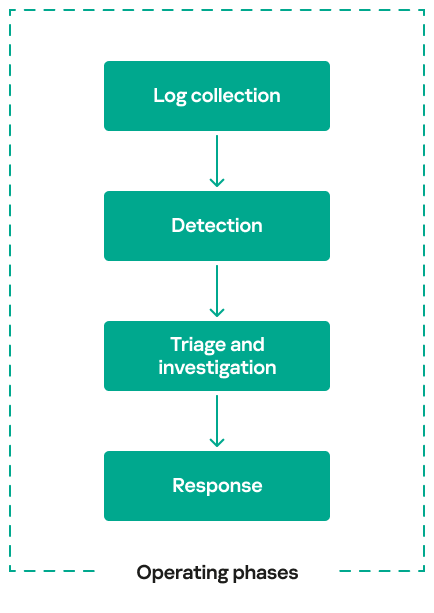
    Security operations centers (SOCs) exist to protect organizations from cyberthreats by detecting and responding to attacks in real time. They play a crucial role in preventing security breaches by detecting adversary activity at every stage of an attack, working to minimize damage and enabling an effective response. To accomplish this mission, SOC operations can be broken down into four operating phases:

    Each of these operating phases has a distinct role to play, and well-defined processes or procedures ensure a seamless handover of findings from one phase to the next. In practice, SOC processes and procedures at each operational phase often require continuous improvement over time.

    Assessment observations: Common SOC issues

    During our involvement in SOC technical assessments, adversary emulations, and incident response readiness projects across different regions, we evaluated each operating phase separately. Based on our assessments, we observed common challenges, weak practices, and recurring issues across these four key SOC capabilities.

    Log collection

    There are three main issues we have observed at this stage:

    • Lack of visibility coverage based on the MITRE DETT&CT framework – customers do not practice maintaining a visibility coverage matrix. Instead, they often maintain log source data as an Excel or similar spreadsheet that is not easily tracked. This means they don’t have a systematic approach to what data they are feeding into the SIEM and which TTPs can be detected in their environment. And in most cases, maintaining a continuous visibility matrix is also a challenge because log sources may disappear over time for a variety of reasons: agent termination, changes in log destination settings, device (e.g., firewall) replacement. This only leads to the degradation of the log visibility matrix.
    • Inefficient use of data for correlation – in many cases, relevant data is available to detect threats, but there are no correlation rules in place to leverage it for threat detection.
    • Correlation exists, but lacks the necessary data fields – while some rule sets are properly configured with the right logic to detect threats, the required data fields from log sources are missing, preventing the rules from being triggered. This critical issue can only be detected through a data quality assessment.

    Detection

    At this stage, we have seen the following issues during assessment procedures:

    • Over-reliance on vendor-provided rules – many customers rely heavily on the default rule sets in their SIEM and only tune them when alerts are triggered. Since the default content is not optimized, it often generates thousands of alerts. This reactive approach leads to excessive alert fatigue, making it difficult for analysts to focus on truly meaningful alerts.
    • Lack of detection alignment with the threat profile – the absence of a well-defined organizational threat profile prevents customers from focusing on the threats that are most likely to target them. Instead, they adopt a scattered approach to detection, like shooting in the dark rather than prioritizing relevant threats.
    • Poor use of threat intelligence feeds – we have encountered cases where endpoint logs do not contain file hash data. The log sources only provide filenames or file paths, but not the actual hash values, making it difficult for the SOC to correlate threat intelligence (TI) feeds that rely on file hashes. As a result, TI feeds are not operational because the required data field is not ingested into the SIEM.
    • Analytics deployment errors – one of the most challenging issues we see is when a well-designed detection rule is deployed incorrectly, causing threat detection to fail despite having the right analytics in place. We have found that there is no structured process for reviewing and validating rule deployments.

    Triage and investigation

    The most typical issues at this stage are:

    • Lack of a documented triage procedure – analysts often rely on generic, high-level response playbooks sourced from the internet, especially from unreliable sources, which slows or hinders the process of qualifying alerts as potential incidents. Without a structured triage procedure, they spend more time investigating each case instead of quickly assessing and escalating threats.
    • Unattended alerts – we also observed that many alerts were completely ignored by analysts. This likely stems from either a lack of skill in linking multiple alerts into a single incident, or analysts being swamped with high-severity alerts, causing them to overlook other relevant alerts.
    • Difficulty in correlating alerts – as noted in the previous observation, one of the biggest challenges is linking related alerts into a single incident. The lack of alert correlation makes it harder to see the full attack pattern, leading to disorganized alert diagnosis.
    • Default use of alert severity – SIEM default rules don’t take into account the context of the target system. Instead, they rely on the default severity in the rule, which is often set randomly or based on an engineer’s opinion without a clear process. This lack of context makes it harder to investigate and properly assess alerts.

    Response

    The challenges of the final operating phase are most often derived from the issues encountered in the previous stages.

    • Challenges in incident scoping – as mentioned earlier, the inability to properly correlate alerts leads to a fragmented understanding of attack patterns. This makes it difficult to see the bigger picture, resulting in inefficient incident handling and misjudged response efforts.
    • Increase in unnecessary escalations – this issue is particularly common in MSSP environments, where a lack of understanding of baseline behavior causes analysts to escalate benign cases. Without proper context, normal activities are mistaken for threats, resulting in wasted time and effort.

    With these ongoing challenges, chaos will continue in SOC operations. As organizations adopt new security tools such as CASB and container security, both of which generate valuable detection data, and as digital transformation introduces even more technology, security operations will only become more complex, exacerbating these issues.

    Taking the right and impactful approach

    Enhancing SOC operations requires evaluating each operating phase from an investment perspective, with the detection phase having the greatest impact because it directly affects data quality, threat visibility, incident response efficiency, and the overall effectiveness of the SOC analyst. Investing in detection directly influences all the other operating phases, making it the foundation for improving all operating phases. The detection operating phase must be handled through a dedicated program that ensures log collection is purpose-driven, collecting only the data fields necessary for detection rather than unnecessarily driving up SIEM costs. This focused approach helps define what should be ingested into the SIEM while ensuring meaningful threat visibility.

    Strengthening detection reduces false positives and false negatives, improves true positive rates, and enables the identification of attacker activity chains. A documented triage and investigation process streamlines the work of analysts, improving efficiency and reducing response time. Furthermore, effective incident scoping, guided by accurate detection of the cyber kill chain, enables a faster and more precise response. By prioritizing investment in detection and managing it through a structured approach, organizations can significantly improve SOC performance and resilience against evolving threats. This article focuses solely on SIEM-based detection management.

    Detection engineering program

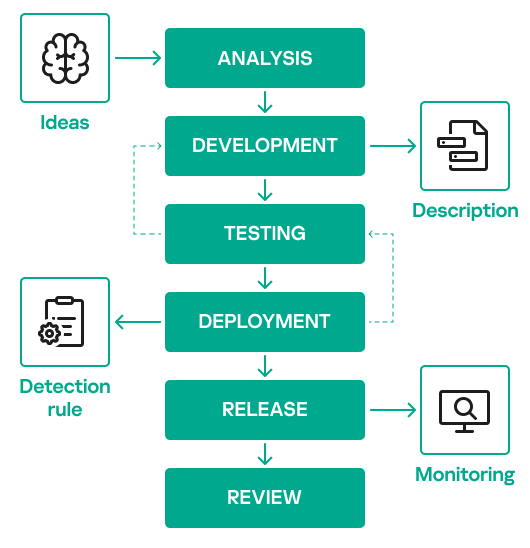
    Before diving into the program-level approach, we will first present the detection engineering lifecycle that forms the foundation of the proposed program. The image below shows the stages of this lifecycle.

    The detection engineering lifecycle shown here is typically followed when building detections, but its implementation often lacks well-defined processes or a dedicated team. A structured program must be put in place to ensure that the SOC’s investment and efforts in detection engineering are used efficiently.

    When we talk about a program, it should be built on the following key elements:

    • A dedicated team responsible for driving the program
    • Well-defined processes and procedures to ensure consistency and effectiveness
    • The right tools to integrate with workflows, facilitate output handovers, and enable feedback loops across related processes
    • Meaningful metrics to measure the overall performance of the program.

    We will discuss these performance measurement metrics in the final section of the article.

    1. Team supporting detection engineering program

    The key idea behind having a dedicated team is to take full control of the detection engineering (DE) lifecycle, from analysis to release, and ensure accountability for the program’s success. In a traditional SOC setup, deployment and release are often handled by SOC engineers. This can lead to deployment errors due to potential differences in the data models used by DE and SOC teams (raw log data vs. SIEM-optimized data), as well as deployment delays due to the SOC team being overloaded with other tasks. This, in turn, can indirectly impact the work of the detection team. However, the one responsibility that does not fall under the DE team is log onboarding. Since this process requires coordination with other teams, it should continue to be managed by SOC engineers to keep the DE team focused on its core objectives.

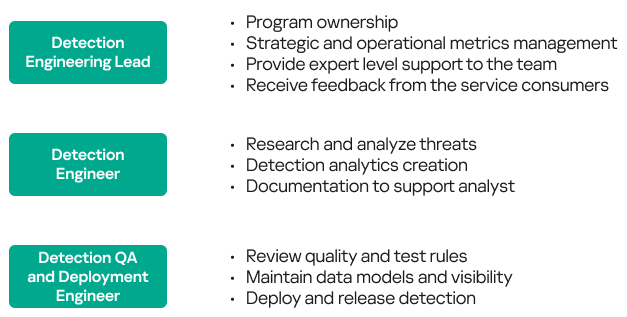
    The DE team should start with at least three key roles:

    The size of the team depends on factors related to the program’s objectives. For example, if the goal is to build a certain number of detection rules per month, the number of detection engineers required will vary accordingly. Similarly, if a certain number of rules need to be tested and deployed within a week, the team size must be adjusted to meet that demand.

    The Detection Engineering Lead should communicate with SOC leadership to set the right expectations by outlining what goals can realistically be achieved based on the size and capacity of the DE team. A dedicated Detection QA role can be established as the need for testing, deployment, and release of detections grows.

    1. Process and procedures

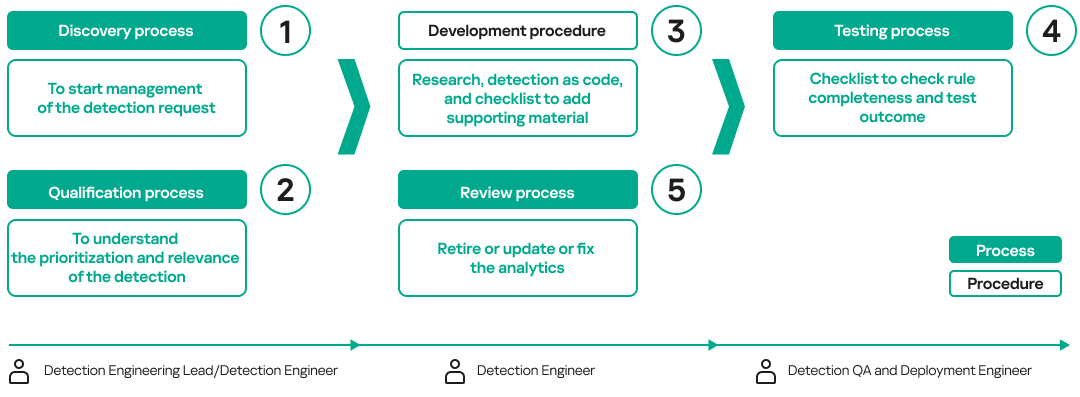
    Well-defined workflows, supported by structured processes and procedures, must be established to streamline detection engineering operations. The following image illustrates the necessary processes and procedures, along with the roles responsible for executing each workflow:

    During the qualification process, the Detection Engineering Lead or Detection Engineer may discover that the data source needed to develop a detection is not available. In such cases, they should follow the log management process to request onboarding of the required data before proceeding with detection research and development. The testing process typically checks that the rule works by ensuring that the SIEM triggers an alert based on the required data fields.

    Lastly, a validation process that is not part of the detection engineering lifecycle must be incorporated into the detection engineering program to assess its overall effectiveness. Ideally, this validation should be conducted by individuals outside the DE lifecycle or by an external service provider.

    Proper planning is required that incorporates threat intelligence and an updated threat profile. In addition, the validation process should generate reports that outline:

    • What is working well
    • Areas that need improvement
    • Detection gaps identified
    1. Tools

    An essential element of the DE lifecycle is the use of tools to streamline processes and improve efficiency. Key tools include:

    • Ticketing platform – efficiently manages workflows, tracks progress from ticket creation to closure, and provides time-based metrics for monitoring.
    • Rules repository – platform for managing detection queries and code, supporting Detection-as-Code, using a unified rule format such as SIGMA, and implementing code development best practices in detection engineering, including features such as version control and change management.
    • Centralized knowledge base – dedicated space for documenting detection rules, descriptions, research notes, and other relevant information. See the best practices section below for more details on centralized documentation.
    • Communication platform – facilitates collaboration among DE team members, integrates with the ticketing system, and provides real-time notification of ticket status or other issues.
    • Lab environment – virtualized setup, including SIEM and relevant data sources, tools to simulate attacks for testing purposes. The core function of the lab is to test detection rules prior to release.

    Best practices in detection engineering

    Several best practices can significantly enhance your detection engineering program. Based on our experience, implementing these best practices will help you effectively manage your rule set while providing valuable support to security analysts.

    1. Rule naming convention

    When developing analytics or a rule, adhering to a proper naming convention provides a concrete framework. A rule name like “Suspicious file drop detected” may confuse the analyst and force them to dig deeper to understand the context of the alert that was triggered. It would be better to give a rule a name that provides complete context at first glance, such as “Initial Access | Suspicious file drop detected in user directory | Windows – Medium”. This example makes it easy for the analyst to understand:

    • At what stage of the attack the rule is triggered. In this case, it is Initial Access as per MITRE / Kill Chain Model.
    • Where exactly the file was dropped. In this case, the user directory was the target, which may mean that this probably involved user interaction, which is another sign that the attack was probably detected at an early stage.
    • What platform was attacked. In this case, it is Windows, which can help the analyst to quickly find the machine that triggered the alert.
    • Lastly, an alert priority can be set, which helps the analyst to prioritize accordingly. For this to work properly, SIEM’s priority levels should be aligned with the rule priorities defined by the detection engineering team. For example, a high priority in SIEM should correspond to a high-priority alert.

    A consistent rule naming structure can help the detection engineering team to easily search, sort and manage existing rules, avoid creating duplicates with different names, etc.

    The naming structure doesn’t necessarily have to look like the example above. The whole idea of this best practice is to find a good naming convention that not only helps the SOC analyst, but also makes managing detection rules easier and more convenient.

    For example, while the rule name “Audit Log Deletion” gives a basic idea of what is happening, a more effective name would be:

    This provides better context, making it much more useful to the SOC team, and more keywords for the DE team to find this particular rule or filter rules if necessary.

    1. Centralized knowledge base

    Once a rule is created after thorough research, the detection team should manage it in a centralized platform (a knowledge base). This platform should not only store the rule name and logic, but also other key details. Important elements to consider:

    • Rule name/ID/description – rule name, unique ID, and a brief description of the rule.
    • Rule type/status – provides insight into the rule type (static, correlated, IoC-based, etc.) and the status (experimental, stable, retired, etc.).
    • Severity and confidence – seriousness of the threat triggering this rule and the likelihood of a true positive.
    • Research notes – possible public links, threat reports, used as a basis for creating the rule.
    • Data components used to detect the behavior – list of source and data fields used to detect activity.
    • Triage steps – provides steps to investigate the alert.
    • False positives – provides options where the alert could show false positive behavior.
    • Tags (CVE, Actors, Malware, etc.) – provide more context if the detection is linked to a behavior or artifact, specific to any APT group, or malware.

    Make sure this centralized documentation is accessible to all SOC analysts.

    1. Contextual tagging

    As covered in the previous best practice, tags provide a great value in understanding the attack chain. That’s why we want to highlight them as a separate best practice.

    The tags attached to the above detection rule are the result of the research done on the behavior of the attack when writing the detection rule. They help the analyst gain more context at the time the rule is triggered. In the example above, the analyst may suspect a potential initial access attempt related to QakBot or Black Basta ransomware. This also helps in reporting to security leadership that the SOC team successfully detected the initial ransomware behavior and was able to thwart the attack in the early stages of the kill chain.

    1. Triage steps

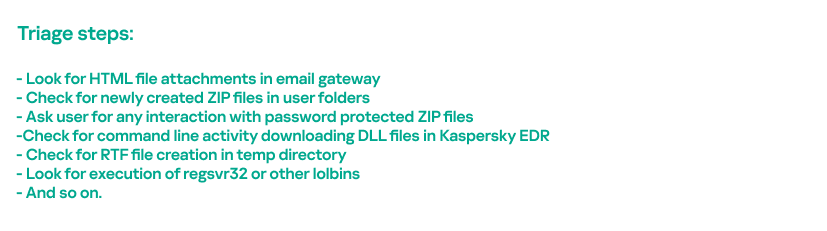
    A good practice is to include triage (or investigation steps) in detection rule documentation. Since the DE team has spent a lot of time understanding the threat, it is very important to document the precursors and possible next steps the attacker can take. The SOC analyst can quickly review these and provide incident qualification with confidence.

    For the rule from the previous section, “Initial Access | Suspicious LNK files dropped in download folder | Windows – Medium”, the triage procedure is shown below.

    MITRE has a project called the Technique Inference Engine, which provides a model for understanding other techniques an attacker is likely to use based on observed adversary behavior. This tool can be useful for both DE and SOC teams. By analyzing the attacker’s path, organizations can improve alert correlation and enhance scoping of incident/threats.

    1. Baselining

    Understanding the infrastructure and its baseline operations is a must, as it helps reduce the false positive rate. The detection engineering team must learn the prevention policies (to de-prioritize detection if already remediated), learn about the technologies deployed in the infrastructure, understand the network protocols being used and user behavior under normal circumstances.

    For example, to detect T1480.002: Execution Guardrails: Mutual Exclusion sub-technique, MITRE recommends monitoring a “file creation” data component. According to the MITRE Data Sources framework, data components are possible actions with data objects and/or data objects statuses or parameters that may be relevant for threat detection. We discussed them in more detail in our detection prioritization article.

    MITRE’s detection recommendation for T1480.002 sub-technique

    A simple rule for detecting such activity is to monitor lock file creation events in the /var/run folder, which stores temporary runtime data for running services. However, if you have done the baselining and found that the environment uses containers that also create lock files to manage runtime operations, you can filter out container-linked events to avoid triggering false positive alerts. This filter is easy to apply, and overall detection can be improved by baselining the infrastructure you are monitoring.

    1. Finding the narrow corridors

    Some indicators, such as file hashes or software tools are easy to change, while others are more difficult to replace. Detections based on such “narrow corridors” tend to have high true positive rates. To pursue this, detection should focus primarily on behavioral indicators, ensuring that attackers cannot easily evade detection by simply changing their tools or tactics. Priority should be given to behavior-based detection over tool-specific, software-dependent, or IoC-driven approaches. This aligns with the Pyramid of Pain model, which emphasizes detecting adversaries based on their tactics, techniques, and procedures (TTPs) rather than easily replaceable indicators. By prioritizing common TTPs, we can effectively identify an adversary’s modus operandi, making detection more resilient and impactful.

    1. Universal rules

    When planning a detection program from scratch, it is important not to ignore the universal threat detection rules that are mostly available in SIEM by default. Detection engineers should operationalize them as soon as possible and tune them according to feedback received from SOC analysts or what they have learned about the organization’s infrastructure during baselining activity.

    Universal rules generally include malicious behavior associated with applications, databases, authentication anomalies, unusual remote access behavior, and policy violation rules (typically to monitor compliance requirements).

    Some examples include:

    • Windows firewall settings modification detected
    • Use of unapproved remote access tools
    • Bulk failed database login attempts

    Performance measurement

    Every investment needs to be justified with measurable outcomes that demonstrate its value. That is why communicating the value of a detection engineering program requires the use of effective and actionable metrics that demonstrate impact and alignment with business objectives. These metrics can be divided into two categories: program-level metrics and technical-level metrics. Program-level metrics signal to security leadership that the program is well aligned with the company’s security objectives. Technical metrics, on the other hand, focus on how operational work is being carried out to maximize the detection engineering team’s operational efficiency. By measuring both program-level metrics and technical-level metrics, security leaders can clearly show how the detection engineering program supports organizational resilience while ensuring operational excellence.

    Designing effective program-level metrics requires revisiting the core purpose for initiating the program. This approach helps identify metrics that clearly communicate success to security leadership. There are three metrics that can be very effective to measure the success at program level.

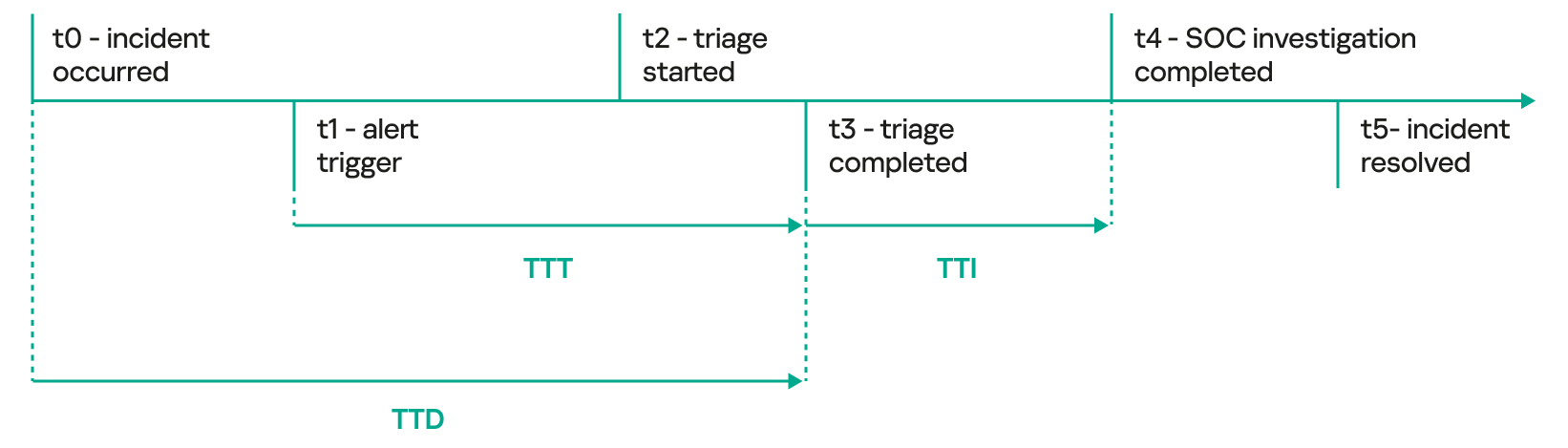
    1. Time to Detect (TTD) – this metric is calculated as the time elapsed from the moment an attacker’s initial activity is observed until the time it is formally detected by the analyst. Some SOCs consider the time the alert is triggered on the SIEM as the detection time, but that is not really an actionable metric to consider. The time the alert is converted into a potential incident is the best option to consider for detection time by SOC analysts.

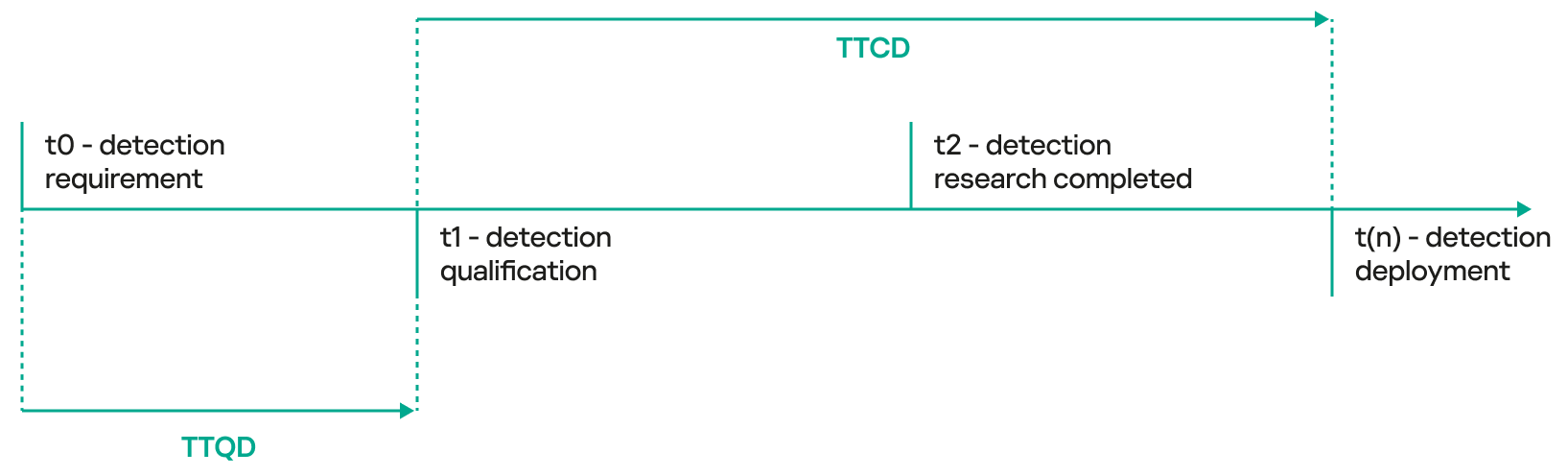
    Although the initial detection of activity occurs at t1 (alert triggered), when malicious activity occurs, a series of events must be analyzed before qualifying the incident. This is why t3 is required to correctly qualify the detection as a potential threat. Additional metrics such as time to triage (TTT), which establishes how long it takes to qualify the incident, and time to investigate (TTI), which describes how long it takes to investigate the qualified incident, can also come in handy.

    Time to detect compared to time to triage and time to investigate metrics

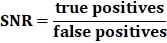
    1. Signal-to-Noise Ratio (SNR) – this metric indicates the effectiveness of detection rules by measuring the balance between relevant and irrelevant information. It compares the number of true positive detections (correct alerts for real threats) to the number of false positives (incorrect or misleading alerts).

    Where:

    True positives: instances where a real threat is correctly detected
    False positives: incorrect alerts that do not represent real threats

    A high SNR indicates that the system is generating more meaningful alerts (signal) compared to noise (false positives), thereby enhancing the efficiency of security operations by reducing alert fatigue and focusing analysts’ attention on genuine threats. Improving SNR is crucial to maximizing the performance and reliability of a detection program. SNR directly impacts the amount of SOC analyst effort spent on false positives, which in turn influences alert fatigue and the risk of professional burnout. Therefore, it is a very important metric to consider.

    1. Threat Profile Alignment (TPA) – this metric evaluates how well detections are aligned with known adversarial tactics, techniques, and procedures (TTPs). This metric measures this by determining how many of the identified TTPs are adequately covered by unique detections (unique data components).

    Total TTPs identified – this is the number of known adversarial techniques relevant to the organization’s threat model, typically derived from cyber threat intelligence threat profiling efforts
    Total TTPs covered with at least three unique detections (where possible) – this counts how many of the identified TTPs are covered by at least three distinct detection mechanisms. Having multiple detections for a given TTP enhances detection confidence, ensuring that if one detection fails or is bypassed, others can still identify the activity.
    Team efforts supporting the detection engineering program must also be measured to demonstrate progress. These efforts are reflected in technical-level metrics, and monitoring these metrics will help justify team scalability and address productivity challenges. Key metrics are outlined below:

    1. Time to Qualify Detection (TTQD) – this metric measures the time required to analyze and validate the relevance of a detection for further processing. The Detection Engineering Lead assesses the importance of the detection and prioritizes it accordingly. The metric equals the time that has elapsed from when a ticket is raised to create a detection to when it is shortlisted for further research and implementation.

    1. Time to Create Detection (TTCD) – this tracks the amount of time required to design, develop and deploy a new detection rule. It highlights the agility of detection engineering processes in responding to evolving threats.

    1. Detection Backlog – the backlog refers to the number of pending detection rules awaiting review or consideration for detection improvement. A growing backlog might indicate resource constraints or inefficiencies.
    1. Distribution of Rules Criticality (High, Medium, Low) – this metric shows the proportion of detection rules categorized by their criticality level. It helps in understanding the balance of focus between high-risk and lower-risk detections.
    1. Detection Coverage (MITRE) – detection coverage based on MITRE ATT&CK indicates how well the detection rules cover various tactics, techniques, and procedures (TTPs) in the MITRE ATT&CK framework. It helps identify coverage gaps in the defense strategy. Tracking the number of unique detections that cover each specific technique is highly recommended, as it provides visibility into the threat profile alignment – a program level metric. If unique detections are not being built to detect gaps and the coverage is not increasing over time, it indicates an issue in the detection qualification process.
    1. Share of Rules Never Triggered – this metric tracks the percentage of detection rules that have never been triggered since their deployment. It may indicate inefficiencies, such as overly specific or poorly implemented rules, and provides insight for rule optimization.

    There are other relevant metrics, such as the proportion of behavior-based rules in the total set. Many more metrics can be derived from a general understanding of the detection engineering process and its purpose to support the DE program. However, program managers should focus on selecting metrics that are easy to measure and can be calculated automatically by available tools, minimizing the need for manual effort. Avoid using an excessive number of metrics, as this can lead to a focus on measurement only. Instead, prioritize a few meaningful metrics that provide valuable insight into the program’s progress and efforts. Choose wisely!
    MIL OSI Economics

  • MIL-OSI Russia: Sobyanin: More than 2.4 thousand houses will undergo major repairs in 2025

    Translartion. Region: Russians Fedetion –

    Source: Moscow Government – Government of Moscow –

    The Moscow Government Presidium meeting considered the implementation of the capital repairs program apartment buildings in the capital and approved plans for its implementation in the near future. Following the discussion of the issue, Sergei Sobyanin approved plans for major repairs for 2025 and the near future.

    In his report, Deputy Mayor of Moscow for Housing and Public Utilities and Improvement Pyotr Biryukov noted that from 2015 to 2024, work was carried out within the framework of the program in more than 14.5 thousand houses, in which over 3.8 million Muscovites live.

    According to the Russian Ministry of Construction, Moscow ranks first among the subjects of the Russian Federation in terms of the implementation of regional capital repair programs in 2024.

    In 2025, work is planned to be carried out in another 2,428 houses.

    In addition, to further improve the efficiency of work, from 2025 onwards, a transition to centralized procurement of materials and equipment is underway with subsequent provision to contractors (radiators and convectors, heated towel rails, paint for facade repair work, garbage chutes).

    The Moscow program for capital repairs of apartment buildings is designed for 30 years: its implementation began in 2015 and is scheduled to be completed in 2044. This is one of the largest housing stock modernization projects in the world. The program includes about 30 thousand buildings with a total area of more than 300 million square meters – this is 10 percent of all apartment buildings included in regional programs throughout Russia. Specialists will have to repair more than 400 thousand engineering systems and structural elements of buildings.

    The main goals of the program are to ensure comfortable and safe living for Muscovites, save resources, reduce the risk of emergency situations and increase the aesthetic appeal of the exterior of residential buildings. The Moscow program is fully consistent with the goals and objectives of the national project “Infrastructure for life”.

    The program operator is the Moscow City Apartment Building Capital Repair Fund. It controls the volume, quality, and timing of the work performed.

    The list of works carried out within the framework of the Moscow program is expanded in comparison with the list established by the Housing Code of the Russian Federation. In addition to major repairs and replacement of the main structural elements and engineering systems, it includes repairs of entrances, internal drainage systems, smoke removal and fire water supply, as well as replacement of garbage chutes and windows in common areas.

    Restoration of house facades

    When renovating facades, modern technologies are used that allow not only to restore the external appearance of buildings, but also to increase their energy efficiency.

    Brick facades are subject to mandatory hydrophobization. This method of treatment protects them from destructive processes associated with temperature changes and high humidity.

    When restoring painted facades of panel houses, the first stage involves correcting the geometry of the panels, and the second stage involves filling the interpanel seams with sealant. After this, the surfaces are primed and painted in two layers.

    For facades of houses faced with small-sized tiles, a technology using polymer-cement mixtures on reinforcing meshes is used. A facade repaired in this way will last at least 30 years.

    Major repairs of entrances

    Major repairs of entrances in accordance with the Moscow program are carried out in full – from floor to ceiling.

    According to the developed standard, only materials and technologies that meet strict requirements for quality, safety and durability are used during the work. For example, the walls are cleaned of old finishes and covered with washable, non-fading paint that tolerates moisture well: after cleaning, there are no streaks or smudges left on it.

    When renovating entrances, the opinions of residents are taken into account. They themselves choose from the proposed options of color, texture and other parameters. The design of mailboxes and entrance doors is thought out separately. Therefore, major renovation of entrances is painstaking work and an individual approach.

    Standard for performing works in architectural monuments

    Particular attention is paid to cultural heritage sites: 364 such buildings are included in the Moscow capital repairs program.

    Since 2020, in order to preserve historical elements and details as carefully as possible, the city has been allocating special subsidies to cover additional costs when organizing work in apartment buildings – architectural monuments. An individual approach is used for such objects. Specialists carefully develop a project for repair and restoration work. They are carried out using advanced technologies and under strict control.

    Co-financing of major repairs in buildings that are architectural monuments allows not only to restore their historical appearance, but also to maintain a single amount of contribution for major repairs for all residents. Thanks to city subsidies, more than 30 objects have already been restored. For example, in 2024, specialists updated the facades of residential buildings of the high-rise on Krasnye Vorota Square.

    Major repairs to residential building facades have begun in MoscowAlmost 400 red houses have been overhauled in the capital in 10 years

    Please note: This information is raw content directly from the source of the information. It is exactly what the source states and does not reflect the position of MIL-OSI or its clients.

    Please Note; This Information is Raw Content Directly from the Information Source. It is access to What the Source Is Stating and Does Not Reflect

    HTTPS: //vv.mos.ru/mayor/tkhemes/12624050/

    MIL OSI Russia News

  • MIL-OSI Asia-Pac: INDIA- UZBEKISTAN JOINT MILITARY EXERCISE DUSTLIK-VI COMMENCES AT FOREIGN TRAINING NODE, AUNDH

    Source: Government of India

    Posted On: 16 APR 2025 2:39PM by PIB Delhi

    The 6th edition of India- Uzbekistan Joint Military Exercise DUSTLIK-VI commenced today, at Foreign Training Node, Aundh (Pune). The Exercise is scheduled to be conducted from 16 to 28 Apr 2025.

    Indian contingent comprising of 60 personnel is being represented by a Battalion of JAT Regiment and IAF. The Uzbekistan contingent is being represented by personnel from Uzbekistan Army. Joint Exercise DUSTLIK -VI is an annual training event conducted alternatively in India and Uzbekistan. Last edition was conducted in Termez District, Uzbekistan in April 2024.

    The theme of the exercise will be based on the theme of Joint Multi Domain Sub Conventional operations in Semi-Urban Scenario. It will focus on responding to a terrorist action involving the capture of a defined territory. It will also include the establishment of a Joint Operations Centre at the battalion level for continuous joint operations, the execution of counterterrorism missions such as population control measures, raids, search-and-destroy operations, and the employment of firepower, including air assets, to neutralise terrorists. Special forces from the Army and Air Force, during the Exercise, will secure a helipad for use as a mounting base for further operations. The Exercise will also cover the deployment of drones, counter-UAS measures, and logistics support by the Air Force to sustain forces in hostile areas. Additionally, helicopters will be utilised for reconnaissance and observation, special heliborne operations (SHBO), small team insertion and extraction (STIE) and other associated missions.

    Joint Exercise DUSTLIK -VI will enable both sides to share best practices in Tactics, Techniques and Procedures of conducting Joint Sub Conventional operations. It will facilitate developing inter-operability, bonhomie and camaraderie between the two armies. The Joint Exercise will also enhance defence cooperation, further augmenting bilateral relations between the two friendly nations.

    ****

    SC

    (Release ID: 2122061) Visitor Counter : 105

    MIL OSI Asia Pacific News

  • MIL-OSI Asia-Pac: National Technical Textile Mission in association with M/s SYSTEM 5S Pvt. Ltd developing an innovative Firefighting Suit

    Source: Government of India

     National Technical Textile Mission in association with M/s SYSTEM 5S Pvt. Ltd developing an innovative Firefighting Suit

    The specialized Firefighting Suit is developed using aluminised coated glass fabrics

    Posted On: 16 APR 2025 3:14PM by PIB Delhi

    The National Technical Textile Mission (NTTM), an initiative by the Ministry of Textiles, Government of India, has supported an innovative project titled “Development of Specialized Fire fighting Suit.” These specialized fire fighter suits are used by Firefighting & Emergency services, Defence forces, Oil & Gas industry, Aerospace & Aviation, Power Plants & Thermal Industry, etc. Manufacturing of firefighting suits in India is in its nascent stage and currently, in India, specialized firefighting suits (also known as fire entry suits) are imported mostly from Europe, the USA, and China. The NTTM project is implemented by Northern India Textile Research Association (NITRA), in collaboration with its industrial partner, M/s System 5S Private Ltd.

    The annual current consumption would be approximately 1000 sets by various End Users in India. However, with the introduction of an Indian Certified Aluminized suit, the consumption could go up exponentially. M/s SYSTEM 5S Pvt. Ltd has an annual production capacity of 1000 suits with this commercialisation.

    According to EN 1486 (a European Standard that specifies the requirements and test methods for protective clothing for fire fighters), protective clothing for specialized fire fighting must protect the full body, including the head, hands, and feet, against radiant heat and flame impingement. This protective gear includes a garment, a hood (integrated or separate), gloves, and over boots. Additionally, the design of such suits is intended for use with respiratory protection, with designs varying on whether the breathing apparatus is worn inside or outside the protective clothing.

    M/s System 5S Private Ltd, has developed an indigenous Specialized Fire Fighting Suit, designed to meet the EN 1486 or ISO 15538 standards. The development process prioritised the safety, comfort, and ease of donning and doffing for fire fighters. The suit is developed using aluminised coated glass fabrics, OPAN (Oxidized Polyacrylonitrile) Nonwoven battings and FR (Flame Resistant) viscose fabric. All the inner layers are quilted together. The industrial partner has already begun manufacturing these suits for trial purposes, and commercial manufacturing will commence once the fire manikin test is completed successfully, as per the EN ISO 13506 (a standard that defines a test method for evaluating the performance of protective clothing against heat and flame) standard, to ensure the suit meets all necessary performance requirements.

    ***

    Dhanya Sanal K

    Director

    (Release ID: 2122075) Visitor Counter : 26

    MIL OSI Asia Pacific News

  • MIL-OSI Asia-Pac: Ombudsman announces results of direct investigation operation into Government’s regulation of occupational safety and health in construction industry (with photos)

    Source: Hong Kong Government special administrative region

    The following is issued on behalf of the Office of The Ombudsman:

         The Ombudsman, Mr Jack Chan, today (April 16) announced the completion of a direct investigation operation into the Government’s regulation of occupational safety and health (OSH) in the construction industry, with 40 major recommendations for improvement made to the Labour Department (LD), the Buildings Department (BD) and the Development Bureau (DEVB).

         In recent years, from large-scale public works, housing development and building repairs to small-scale flat renovation works, fatal industrial accidents in the construction industry have occurred frequently. The situation has attracted widespread public concern. During the six-year period from 2018 to 2023, the construction industry recorded a total of 108 fatal industrial accidents, accounting for more than 80 per cent of fatal industrial accidents in all industries. 

         Mr Chan said, “This direct investigation operation is by far our largest and most comprehensive direct investigation operation in many years. During the investigation, investigation staff of the Office has scrutinised over 90 000 pages of documents, including about 70 individual cases in 40 boxes, and conducted multiple in-depth site visits of different types to examine the issue thoroughly and from different perspectives. 

         “The construction industry undoubtedly makes significant contributions to the economic development of society and people’s living environment. All lives are priceless. Indeed, one life lost to an industrial accident is one too many. The problem must be dealt with seriously and vigorously. During our direct investigation operation, the current-term Government has proactively introduced an array of targeted improvement measures to enhance OSH in the construction industry, which include amending the relevant OSH legislation to significantly increase the level of penalties to provide greater deterrent; revising various codes of practice to enhance technical requirements; conducting a number of special enforcement operations to curb unsafe operations; updating the content of mandatory safety training courses to raise workers’ safety awareness; improving the mechanism for processing renewal of contractors’ registration; formulating proposed amendments to the Buildings Ordinance to tighten the regulation of contractors; strengthening the regulation of contractors on the approved lists with unsatisfactory safety performance; and making great efforts to promote the application of the Smart Site Safety System. While the current-term Government’s endeavours are highly commendable, heart-wrenching fatal industrial accidents still happen from time to time. The Government must continue to step up its efforts to safeguard the safety of workers at every step of work. Based on our findings, the Office considers that there is still room for improvement in different areas on the part of the three relevant departments.”

         From the analysis of previous fatal accidents, complaints handled by the LD and site visits conducted by the Office, the Office found that in a number of cases concerning high-risk operations such as bamboo scaffolds, lifting appliances and lifting operations, the “competent persons” and “competent examiners” (collectively referred to as “competent persons”) had failed to properly inspect the plant or machinery before signing a prescribed form to certify its safety, or even signed multiple forms in advance. For example, a “competent person” has to sign a “Form 5” to certify that a bamboo scaffold is safe before it can be used by workers. In a site inspection, the Office found that a “competent person” had signed a “Form 5” certifying that a scaffold had been inspected and was in safe working order, but the inspection date mentioned in the form was two days after the date of the Office’s inspection. The Office even found a case where a “competent person” had already signed a form to certify the safety of a scaffold before the scaffold was actually completed.  

         Moreover, in its investigation into a fatal industrial accident concerning a lifting appliance, the LD found that two registered professional engineers acting in the capacity of “competent examiners” signed a few prescribed forms on different dates, one of which was after a storm, certifying that the lifting appliance was in safe working condition, but they actually had not carried out the required tests and examination.

         Mr Chan said, “These ‘competent persons’ failed to carry out inspections properly or even did not carry out any inspections at all, yet irresponsibly signed forms to certify the safety of equipment. Such reckless acts pose a serious risk to the safety of workers and the public. These persons failed to uphold their obligations and meet public expectations, and they must face legal consequences and criticisms from all.” The Office considers that the LD must step up monitoring under a multipronged approach, including exploring the formulation of inspection checklist templates for different types of high-risk operations, requiring “competent persons” to maintain inspection records, and implementing a system of random checks. In the long run, the LD should explore the development of an electronic platform for contractors and “competent persons” to upload inspection records and forms to facilitate monitoring and surprise checking to curb unprofessional or even fraudulent criminal conduct, such as predating inspection forms.

         The average amounts of penalty imposed on offenders of OSH legislation in the construction industry between 2018 and 2023 ranged from merely some $8,000 to some $10,500 per year. Comparing to the enormous fees and profits of construction projects, such penalty levels are obviously inadequate to have a deterrent effect. Among those offenders, the two contractors with the highest and the second-highest numbers of convictions during the six years had been convicted 77 and 56 times respectively. This shows that some disobedient contractors in the construction industry are repeat offenders, and their blatant defiance of the law and disregard for OSH are indeed staggering. The Office is pleased to learn that the current-term Government has completed amendments to the relevant OSH legislation, and the Occupational Safety and Occupational Health Legislation (Miscellaneous Amendments) Ordinance 2023, which took effect on April 28, 2023, has significantly increased the penalties for contravention of OSH legislation and extended the time limit for prosecution. Since the new penalties have been in effect for only a short time, the LD should, after the new penalties have been in force for a period, conduct a systemic analysis to review the effectiveness of its prosecution work and the penalties imposed by the Court in convicted cases.

         The Office’s investigation also revealed that the BD had long failed to handle cases referred by the LD for determining whether disciplinary action should be taken against contractors convicted of OSH offences. During the decade from 2011 to 2021, the BD has taken disciplinary action against only one contractor on one occasion. The Office has thoroughly examined the reason for the BD’s omission throughout the years. Under the disciplinary system, the BD may take disciplinary action against a contractor when either one of the following two criteria is met: the contractor has been convicted of five or more site safety offences relating to building works in the same construction site in six consecutive months (“Criterion 1”); or the contractor has been convicted of site safety offences relating to building works which involved fatal accidents (“Criterion 2”). The Office found that, in the past decade or so, the BD, upon receiving the monthly summary list of conviction records from the LD, only focused on handling contractors meeting Criterion 1 for consideration of disciplinary action. As regards contractors meeting Criterion 2, the BD admitted omission of follow-up action due to a mistaken belief that, in addition to a monthly summary list of conviction records, the LD would proactively provide details of individual cases for its consideration of disciplinary action. 

         Furthermore, in the only disciplinary case mentioned above, it took more than six years from the occurrence of the fatal accident in 2009 to the BD’s completion of disciplinary action against the contractor in 2015. The Office has examined the sequence of events of this case and found delays in different time points. For example, it took the BD a year after receiving the LD’s referral to complete analysis and seek detailed case information from the LD. And, after receiving information from the LD, the BD sought legal advice only a year later. This reflects the cumbersome and inefficient procedures for disciplinary action. The Office is glad to see that in response to its observations, the BD has implemented time indicators for handling cases of disciplinary action before the Office’s completion of this report and is striving to process previously omitted cases.

         Meanwhile, relevant data shows that site safety has obviously been better maintained in public works than in the construction industry as a whole. While this is not due to luck but to effective regulation by relevant government departments, the Office considers that there is still room for improvement. The Office has selected 12 public works projects involving fatal industrial accidents between 2020 and 2023 and examined the scores that the contractors concerned (i.e. the successful tenderers) received regarding their site safety performance in the tender evaluation. The Office found in many contracts that the successful tenderer was given a rather low score regarding site safety performance, and some were even given the lowest score among all the tenderers. Yet, these successful tenderers still managed to win the bid because of their higher scores in tender price or other technical parts. Although the Office found no systemic occurrence of “the lowest bid wins” situation in the tender evaluation of public works, the case studies showed that adequate consideration had not been given to tenderers’ previous performance of site safety. This is because items relating to site safety did not weigh much, and the score gaps between tenderers were narrow, resulting in only an insignificant impact on the overall outcome.  

         Mr Chan said, “The Office is glad to learn that, during this direct investigation operation, the DEVB introduced in November 2023 a new tender evaluation system whereby a merit or demerit point would be applied having regard to the tenderer’s previous performance of site safety. The DEVB should continue to review the tender evaluation system for public works in a timely manner to ensure that only contractors whose performance meets the safety standards are awarded contracts.”

         Another noteworthy point is that, during the six-year period from 2018 to 2023, there were 45 fatal accidents relating to renovation and repair works in total, accounting for a significant 42 per cent of all fatal accidents in the construction industry. Based on case studies and site inspections, the Office found serious inadequacies in safety measures for renovation and repair works and a lack of basic safety awareness among workers and even property management companies, property owners and residents. The Office recognises the sheer volume of renovation and repair works under way throughout the territory. The LD alone can hardly ensure the safety of this kind of small-scale works, and property management companies, owners’ corporations, property owners and residents should also take part in monitoring. In fact, property management companies, owners’ corporations, property owners and residents have clear legal responsibilities under OSH legislation and may face civil claims or even criminal liability in the event of accidents. The Office considers that the LD should step up publicity and education among these stakeholders, stressing in particular their legal liability in relation to renovation and repair works and the legal consequence (whether criminal or civil) and loss in case of accidents. This is to ensure that these stakeholders understand it is in their own interest to protect the safety of workers, and at the same time incentivise them to engage contractors and workers with a good safety record. 

         On the whole, the Office has made 40 recommendations for improvement in nine major areas, including the LD’s regulation of high-risk operations; the LD’s inspections; the LD’s enforcement and prosecution; the LD’s monitoring of registered safety auditors and registered safety officers; the BD’s regulation of registered contractors; the DEVB’s monitoring of public works and contractors; the use of innovation and technology; safety education and training; as well as publicity and promotion. The Office is pleased to learn that the LD, the BD and the DEVB have accepted all of its recommendations.

         Mr Chan said, “To enhance OSH in the construction industry, the Government is duty bound to carry out effective regulation. However, stakeholders within or outside the industry, including contractors, workers, trade unions, various types of safety personnel, as well as owners’ corporations, property owners, residents and property management companies who are involved in renovation and repair works, all have a role to play. I hope all stakeholders will work together to safeguard site and worker safety, eradicate undesirable habits, and prevent accidents from happening for the benefit of society as a whole.” 

         The Office’s major recommendations for improvement to the LD are:

    • explore formulating templates of inspection checklist for different types of high-risk operations and attach them to the relevant codes of practice for use by “competent persons” during inspections or examinations to tighten control;

    • conduct a comprehensive review of the existing requirements for maintenance of inspection records by “competent persons” regarding different types of high-risk operations, specifying the inspection records to be maintained and the need to produce such records upon the instruction of the LD officers;

    • in the long run, explore the development of an electronic platform for contractors and “competent persons” to upload inspection records and forms to facilitate monitoring and random checking to curb unprofessional or even fraudulent conduct, such as predating inspection forms;

    • review the operational guidelines on the conduct of in-depth surprise inspections for more precise selection of high-risk construction sites and proper follow-up on sites inspected to ensure systemic improvement of site safety;

    • continue to pursue legislative amendment work to enhance the statutory notification mechanism for construction works;

    • after the new penalties for OSH offences have been in force for a period of time, conduct a systemic analysis to review its prosecution work and the penalties imposed by the Court in convicted cases;

    • take more proactive steps to follow up on the performance of registered safety auditors and registered safety officers on the monitoring list by, for example, making close observations of their actual performance on the site and careful examination of the reports they submit to enhance the quality of their work;

    • drawing on the painful lessons from previous fatal accidents, remind site personnel including registered safety officers and registered safety auditors of the issues to which they should pay attention during their routine inspections or safety audit to strengthen their ability to detect irregularities in site operations and enhance the quality of their work;

    • step up the monitoring of course providers and trainers engaging in mandatory safety training courses and carry out surprise checks in a timely manner to ensure their quality. In case of irregularities, the Department should be decisive in taking regulatory action;

    • consider co-ordinating efforts of relevant departments and organisations to set up a thematic website on OSH in the construction industry to provide a convenient platform for various stakeholders and the public to look for information they need;

    • step up publicity and education among property owners, owners’ corporations, property management companies and residents through mass media and the platform of property management companies, stressing in particular their legal liability in relation to renovation and repair works and the legal consequence and loss in case of accidents; and

    • enrich the content of the publications and information on analysis of accidents, adding the roles and responsibilities of various stakeholders and how they can avoid accidents.

         The Office’s major recommendations for improvement to the BD are:
     
    • speed up processing of previously omitted cases and promptly refer those warranting disciplinary action to the Registered Contractors’ Disciplinary Board to bring non-compliant contractors to account; and

    • set up a mechanism for internal monitoring to ensure timely follow-up on all referrals from the LD for consideration of disciplinary action against convicted contractors.

         The Office’s major recommendations for improvement to the DEVB are:

    • continue to review the tender evaluation system for public works in a timely manner to ensure that only contractors whose performance meets the safety standards are awarded contracts;

    • continue to review the regulating requirement regarding contravention of legislation related to site safety for more effective prevention of accidents;

    • after various promotional measures have been implemented for a period of time, review the adoption of the Smart Site Safety System and, with reference to the feedback from the industry, step up efforts to encourage and support wider use of the system in private development sites to enhance site safety by means of technology; and

    • share with the Construction Industry Council the experience of safety training in public works for its consideration of offering subsidies as incentive, with a view to extending such safety training to private works projects to enhance site safety.

         The full investigation report is available on the website of the Office of The Ombudsman at www.ombudsman.hk for public information.

    MIL OSI Asia Pacific News

  • MIL-OSI USA: Deadline day: Today is the last day to register up for Los Angeles fire debris removal

    Source: US State of California 2

    Apr 15, 2025

    What you need to know: The passage of Proposition 1 by California voters adds rocket fuel to Governor Gavin Newsom’s transformational overhaul of the state’s behavioral health system. These reforms refocus existing funds to prioritize Californians with the most serious mental health and substance use issues, who are too often experiencing homelessness. They also fund more than 11,150 new behavioral health beds and supportive housing units and 26,700 outpatient treatment slots.

    LOS ANGELES – Today, April 15 is the deadline for property owners to submit a Right of Entry (ROE) form to LA County in order to have debris removed by the U.S. Army Corps of Engineers (USACE).

    “This recovery is moving quickly and it is critical that all fire survivors sign up for this important program.”

    Governor Gavin Newsom

    Nearly 500 crews of expert heavy equipment operators are working around the clock to rapidly clear ash, soot, and fire debris from structures damaged by the Eaton and Palisades fires. More than 2,200 parcels have already been completed and signed off by the county and hundreds more have been cleared of debris and are now just awaiting erosion controls, tree removal, and final inspection.

    Debris Removal at a glance 

    Federally funded debris removal is available to residents of single-family and owner-occupied multi-family units. 

    All disaster impacted property owners should submit a ROE form by today, April 15, 2025 to opt-in or opt-out of the debris removal program. 

    If a property owner opts out of the USACE debris removal program, they become responsible for all permits, inspections, and other associated debris removal requirements and costs. 

    There is no out-of-pocket cost to have debris removed by USACE, however the program is unable to duplicate other forms of funding specific to debris removal. If a property owner has insurance for debris removal, residual funds not used by the property owner may be remitted to the county to offset the cost of debris removal at a later date. 
     

    Commercial and multi-family buildings now included

    Last week, at Governor Newsom’s request, the Federal Emergency Management Agency agreed to expand the scope of cleanup to a number of facility types that were not previously eligible for debris removal, including owner occupied condominiums, multi-family units, and certain commercial properties.

    Under Governor Newsom’s leadership, California has expedited the cleanup process by cutting red tape and eliminating bureaucratic barriers, allowing highly trained crews to enter impacted communities sooner and help survivors rebuild their lives faster.

    Debris removal from private commercial property is typically the responsibility of property owners and is usually not eligible for federal programs. 

    Commercial properties – including multi-family rental properties – will be reviewed on a case-by-case basis. The criteria for these properties being included in the USACE debris removal program is based upon: 

    • An immediate threat to public health and safety due to debris.
    • Barriers to the commercial entity completing debris removal independently.
    • Insurance coverage and status of claim.
    • Economic impact of debris removal on the commercial entity and community.


    Debris removal and insurance

    Residents have the option to opt-in to the government-sponsored debris removal program at no direct cost or manage the cleanup independently by opting out by the end of the day. Whether you are insured, uninsured, or underinsured, the program comes at no direct cost to eligible homeowners.

    Submit your form to LA County

    To find other forms of assistance and track progress in wildfire recovery visit: https://www.ca.gov/LAfires/

    Recent news

    News What you need to know: The First Partner released the final report of a working group tasked with developing recommendations for policymakers, healthcare providers, law enforcement, and the judicial system in order to better support survivors of sexual assault….

    News What you need to know: Preliminary data suggests property and violent crimes in California were down in 2024. Sacramento, California – As the state continues to invest in the safety and security of California communities, new data suggests violent and property…

    News What you need to know: With one of the state’s leading climate programs – cap-and-trade – set to expire in 2030, Governor Newsom, Senate President pro Tempore Mike McGuire and Assembly Speaker Robert Rivas announced they would seek an extension of the program….

    MIL OSI USA News

  • MIL-OSI Europe: Written question – Will Europol support Member States and third countries in the fight against terrorist groups that target certain companies and their customers? – E-001418/2025

    Source: European Parliament

    Question for written answer  E-001418/2025
    to the Commission
    Rule 144
    Catherine Griset (PfE)

    In order to strike at the financial interests of Elon Musk, far-left groups in the United States have set up an anonymous website that publishes the personal data of Tesla owners (names, addresses and telephone numbers)[1].

    These same individuals also blew up a Tesla in front of the Trump International Hotel in Las Vegas and regularly set fire to charging stations and vehicles of this brand in the United States.

    The US Attorney General, Pam Bondi, did not hesitate to describe these criminal acts as ‘domestic terrorism’[2].

    This violence is now spreading across Europe, particularly in Member States whose governments are highly indulgent of violent far-left groups. In France, in particular, a Tesla dealership near Toulouse and Tesla vehicles in Niort have been set on fire. The French headquarters of the manufacturer has also been vandalised in recent days.

    • 1.Is the Commission aware of attacks against this company and its customers in other Member States?
    • 2.Can Europol, as part of its mission to support Member States and third countries against terrorism, provide assistance in stopping these violent groups?

    Submitted: 8.4.2025

    • [1] https://www.bvoltaire.fr/aux-etats-unis-comme-en-france-tesla-est-visee-par-des-attaques-dultra-gauche/
    • [2] https://www.francetvinfo.fr/internet/elon-musk/etats-unis-des-hackers-divulguent-les-donnees-personnelles-de-proprietaires-de-tesla-elon-musk-denonce-un-terrorisme-interieur_7141125.html
    Last updated: 16 April 2025

    MIL OSI Europe News

  • MIL-Evening Report: NZ’s Palestine Forum calls on Luxon to take ‘firm stand’ over Israeli atrocities with temporary ban on visitors

    Asia Pacific Report

    A Palestinian advocacy group has called on NZ Prime Minister Christopher Luxon and Foreign Minister Winston Peters to take a firm stand for international law and human rights by following the Maldives with a ban on visiting Israelis.

    Maher Nazzal, chair of the Palestine Forum of New Zealand, said in an open letter sent to both NZ politicians that the “decisive decision” by the Maldives reflected a “growing international demand for accountability and justice”.

    He said such a measure would serve as a “peaceful protest against the ongoing violence” with more than 51,000 people — mostly women and children — being killed and more than 116,000 wounded by Israel’s brutal 18-month war on Gaza.

    Since Israel broke the ceasefire on March 18, at least 1630 people have been killed — including at least 500 children — and at least 4302 people have been wounded.

    The open letter said:

    Dear Prime Minister Luxon and Minister Peters,

    I am writing to express deep concern over the ongoing humanitarian crisis in Gaza and to urge the New Zealand government to take a firm stand in support of international law and human rights.

    Palestinian Forum of New Zealand chair Maher Nazzal at an Auckland pro-Palestinian rally . . . “New Zealand has a proud history of advocating for human rights and upholding international law.” Image: Asia Pacific Report

    The Maldives has recently announced a ban on Israeli passport holders entering their country, citing solidarity with the Palestinian people and condemnation of the ongoing conflict in Gaza.

    This decisive action reflects a growing international demand for accountability and justice.

    New Zealand has a proud history of advocating for human rights and upholding international law. In line with this tradition, I respectfully request that the New Zealand government consider implementing a temporary suspension on the entry of Israeli passport holders. Such a measure would serve as a peaceful protest against the ongoing violence and a call for an immediate ceasefire and the protection of civilian lives.

    I understand the complexities involved in international relations and the importance of maintaining diplomatic channels. However, taking a stand against actions that result in significant civilian casualties and potential violations of international law is imperative.

    I appreciate your attention to this matter and urge you to consider this request seriously. New Zealand’s voice can contribute meaningfully to the global call for peace and justice.

    Sincerely,
    Maher Nazzal
    Chair
    Palestine Forum of New Zealand

    The Middle East Eye reports that Maldives ban on Israelis from entering the country was a protest against Israel’s war on Gaza in “resolute solidarity” with the Palestinian people.

    President Mohamed Muizzu signed the legislation after it was passed on Monday by the People’s Majlis, the Maldivian parliament.

    Muizzu’s cabinet initially decided to ban all Israeli passport holders from the idyllic island nation in June 2024 until Israel stopped its attacks on Palestine, but progress on the legislation stalled.

    A bill was presented in May 2024 in the Maldivian parliament by Meekail Ahmed Naseem, a lawmaker from the main opposition, the Maldivian Democratic Party, which sought to amend the country’s Immigration Act.

    The cabinet then decided to change the country’s laws to ban Israeli passport holders, including dual citizens. After several amendments, it passed this week, more than 300 days later.

    “The ratification reflects the government’s firm stance in response to the continuing atrocities and ongoing acts of genocide committed by Israel against the Palestinian people,” Muizzu’s office said in a statement.

    Gaza’s Health Ministry said on Sunday that at least 1,613 Palestinians had been killed since 18 March, when a ceasefire collapsed, taking the overall death toll since Israel’s war on Gaza began in October 2023 to 50,983.

    The ban went into immediate effect.

    “The Maldives reaffirms its resolute solidarity with the Palestinian cause,” the statement added.

    Last year, in response to talk of a ban, Israel’s Foreign Ministry advised its citizens against travelling to the country.

    The Maldives, a popular tourist destination, has a population of more than 525,000 and about 11,000 Israeli tourists visited there in 2023 before the Israeli war on Gaza began.

    MIL OSI AnalysisEveningReport.nz

  • MIL-OSI Russia: A house under the renovation program will appear in Tagansky District

    Translartion. Region: Russians Fedetion –

    Source: Moscow Government – Government of Moscow –

    The project of a residential building, which will be built under the renovation program in the Central Administrative District of the capital, has been approved. This was reported by the Chairman of the Moscow City Committee for Pricing Policy in Construction and State Expertise of Projects (Moskomexpertiza) Ivan Shcherbakov.

    “Mosgosexpertiza has issued a positive conclusion to the project of an apartment building under the renovation program in the Tagansky District. According to the documentation, the building is planned to be built on the site of a vacated five-story building at the address: 2-ya Dubrovskaya Street, Building 1,” said Ivan Shcherbakov.

    The house will consist of one section. It is designed to have 108 apartments. The first floor will house a pram room, a concierge room, a mailbox room and an elevator hall, as well as non-residential commercial and public premises with individual entrances from the street. The basement will be used for technical needs – there will be a pumping station, electrical panels and an individual heating point.

    The project complies with modern fire safety standards. In particular, the building will have a smoke-proof staircase, and the elevator units will be separated from the intra-apartment corridors by fire doors. In addition, the building will have an elevator with a fire brigade transportation mode. All premises, including apartments, will be equipped with automatic fire alarm systems.

    Previously Mayor of Moscow told on resettlement under the renovation program in the Timiryazevsky district.

    The renovation program was approved in August 2017. It concerns about a million Muscovites and provides for the resettlement of 5,176 houses. Earlier, Sergei Sobyanin instructed to double the pace of implementation of the renovation program.

    Moscow is one of the leaders among regions in terms of construction volumes. High rates of housing construction correspond to the goals and initiatives of the national project “Infrastructure for life”.

    Please note: This information is raw content directly from the source of the information. It is exactly what the source states and does not reflect the position of MIL-OSI or its clients.

    Please Note; This Information is Raw Content Directly from the Information Source. It is access to What the Source Is Stating and Does Not Reflect

    https: //vv.mos.ru/nevs/ite/152639073/

    MIL OSI Russia News

  • MIL-OSI Europe: Moldova and Ukraine: Strengthening energy resilience in the face of extreme weather with OSCE workshop in Chisinau

    Source: Organization for Security and Co-operation in Europe – OSCE

    Headline: Moldova and Ukraine: Strengthening energy resilience in the face of extreme weather with OSCE workshop in Chisinau

    Participants in an OSCE workshop on strengthening energy resilience in the face of extreme weather in Chisinau, 14 April 2025. (OSCE) Photo details

    As extreme weather events become more frequent and climate conditions continue to evolve, the energy sectors face increasing risks. From heatwaves straining power grids to storms damaging infrastructure and climate variability disrupting natural resources, these challenges add uncertainty to energy diversification and transition efforts.
    To help Moldova and Ukraine build resilience in the face of these growing threats, the OSCE held a workshop on 14 and 15 April in Chisinau, Moldova: “Building Energy System Resilience Against Extreme Weather and Evolving Conditions in Moldova and Ukraine: Modelling and its Applications for Energy Planning”.
    The event brought together more than 40 experts and decision-makers from Moldova and Ukraine, including Moldova’s State Secretaries for Energy and Environment and Ukraine’s Deputy Minister of Energy. Participants explored how to assess climate vulnerabilities in critical energy infrastructure and integrate climate risks into energy planning, security, and transition strategies.
    A key focus of the workshop was improving access to downscaled climate data: detailed, localized projections essential for protecting energy infrastructure and informing policy and investment decisions. Through a partnership with Argonne National Laboratory, the OSCE provided participants with critical high-resolution datasets and modelling tools to support science-based decision-making.
    Attendees were also trained on how to use this granular data to evaluate risks and opportunities across the energy sector. This support strengthens the capacity of both countries to plan for future climate scenarios and protect vital energy systems.
    This workshop is the first in a series of regional trainings under the OSCE’s project “Mitigating Climate Change Threats to the Energy Sector in the OSCE Region”, set to continue throughout 2025 and 2026.

    MIL OSI Europe News

  • MIL-OSI United Kingdom: G7 foreign ministers’ statement marking 2 years since the beginning of Sudan war

    Source: United Kingdom – Executive Government & Departments 3

    News story

    G7 foreign ministers’ statement marking 2 years since the beginning of Sudan war

    G7 foreign ministers gave a joint statement marking 2 years since the beginning of the war in Sudan.

    Joint statement:

    We, the G7 Foreign Ministers of Canada, France, Germany, Italy, Japan, the United Kingdom, and the United States of America and the High Representative of the European Union, unequivocally denounce the ongoing conflict, atrocities and grave human rights violations and abuses in Sudan, as the world marks two years since the beginning of the devastating war between the Sudanese Armed Forces (SAF) and the Rapid Support Forces (RSF).

    As a direct result of the actions of the SAF and the RSF, the people of Sudan, especially women and children, are enduring the world’s largest humanitarian and displacement crises, and continued atrocities, including widespread conflict-related sexual violence, ethnically motivated attacks and reprisal killings. These must end immediately.

    We strongly condemn the RSF attacks carried out in and around El Fasher on the Zamzam and Abu Shouk IDP camps, which have caused numerous casualties, including humanitarian workers. Civilians must be protected and allowed safe passage.

    As famine continues to spread across Sudan, G7 members are disturbed by reports of the use of starvation of civilians as a method of warfare and reiterate that such actions are prohibited under international humanitarian law.

    We call on the warring parties to uphold their obligations under international humanitarian law and their commitments under the Jeddah Declaration, which include the crucial responsibility to distinguish at all times between civilians and combatants and between civilian objects and military targets.

    We call on all parties to the conflict to lift impediments to effective crossline humanitarian assistance, provide assurances of safety and security for local and international humanitarian actors, and allow humanitarian access through all border crossings into Sudan, including through South Sudan and Chad. We recognize the important role of Emergency Response Rooms in providing for and protecting civilians and call for their protection. We further call on all parties to refrain from attacks on critical infrastructure that civilians rely upon, including dams and telecommunications systems.

    We call for an immediate and unconditional ceasefire and urge both the SAF and the RSF to engage meaningfully in serious, constructive negotiations. All external actors must cease any support that further fuels the conflict, in accordance with the Declaration of Principles adopted at the International Humanitarian Conference for Sudan and Neighbouring Countries in Paris in 2024 and the United Nations arms embargo on Darfur. We condemn all violations and unlawful attacks by the SAF, the RSF, and their allied militias.

    For sustainable peace in Sudan, any resolution to the conflict must be rooted in the voices of Sudanese civilians. Women, youth, and civil society must be meaningfully included in all peace processes.

    We reaffirm our support for a democratic transition and express our solidarity with the people of Sudan in their efforts to shape the future of their country that reflects their aspirations for freedom, peace and justice.

    The sovereignty, unity and territorial integrity of Sudan are paramount.  

    G7 members remain committed to deepening collective diplomatic efforts to bring about an end to the world’s largest humanitarian crisis and secure an end to the conflict, including through the London Sudan Conference.

    Updates to this page

    Published 15 April 2025

    MIL OSI United Kingdom

  • MIL-OSI Russia: Daily summary of the Berlin offensive operation

    Translartion. Region: Russians Fedetion –

    Source: State University of Management – Official website of the State –

    Exactly 80 years ago, on April 16, 1945, the Berlin Strategic Offensive Operation began, ending the Great Patriotic War with the complete and unconditional victory of the Soviet Union over Nazi Germany.

    The Guinness Book of Records lists this operation as the largest-scale battle in world history. About 3.5 million people, 52 thousand guns and mortars, 7,750 tanks and 11 thousand aircraft took part in it on both sides. The German capital was attacked by forces from three fronts: the 1st Belorussian under the command of Georgy Zhukov, the 2nd Belorussian under the command of Konstantin Rokossovsky and the 1st Ukrainian under the command of Ivan Konev.

    The scale of the operation is clearly described by Zhukov in his book “Memories and Reflections”: “On the first day, 1,197,000 shots were planned for artillery alone, but in fact 1,236,000 shots were fired. Think about these numbers! 2,450 train cars of shells, that is, almost 98 thousand tons of metal fell on the enemy’s head.”

    On April 16, at exactly 4 a.m., the final chord of retribution for Germany’s treacherous attack sounded – the code signal “Rodina” swept through the communication lines and the battle began. Having recovered from the first artillery barrage, the Germans put up serious resistance, the Soviet tanks got bogged down in heavy fighting and were unable to outpace the infantry.

    On April 17, as a result of bloody battles, the Seelow Heights, 50-60 kilometers from Berlin, were taken; they were considered by the German command to be the most reliable line of defense.

    On April 18, the Red Army began to cross the Ost-Oder.

    On April 19, the breakthrough of the entire Oder defensive line was completed.

    On April 20, Soviet long-range artillery began shelling Berlin.

    On April 21, troops of the 1st Belorussian and 1st Ukrainian Fronts reached the eastern and southern outskirts of the city, respectively. The first street battles began.

    On April 22, the German command transferred troops of the Frankfurt-Guben group from the Western Front to stop the envelopment of Berlin from the north. This attack was repelled by Soviet troops with the help of the 2nd Polish Army.

    On April 23, during particularly fierce battles, the 9th Rifle Corps of Major General Ivan Roslov captured the Karlshorst and Kölönig areas, and immediately crossed the Spree River, where the Dnieper military flotilla was already operating.

    On April 24, in the southeast of Berlin, in the Bonsdorf area, troops of the 1st Belorussian and 1st Ukrainian fronts met, encircling the German Frankfurt-Guben group.

    On April 25, the troops of the same fronts united in the Ketzin area, encircling the enemy’s Berlin group. At the same time, the famous meeting on the Elbe with the troops of the 1st US Army took place.

    On April 26, the two-day air operation “Salute” ended, during which 1,222 tons of bombs were dropped on the central districts of Berlin to suppress the enemy – 70 tons per square kilometer.

    On April 27, the assault on the central districts of the German capital began – the city front stretched from the southeast to the northwest in a narrow strip 16 km long and 2-3 km wide. The Red Army seemed to be plunging into the capital of Germany with a bayonet.

    On April 28, the commander of Army Group Vistula, Gotthard Heinrici, ordered his troops to retreat, for which he was removed from command and later surrendered to British troops. Meanwhile, the Russians reached the Reichstag area.

    On April 29, the Moltke Bridge leading to the Government Quarter of Berlin was captured.

    April 30 – German Fuhrer Adolf Hitler committed suicide. On the same day, the Frankfurt-Guben group, the largest German unit at the time, numbering about 200 thousand soldiers, was liquidated. The Ministry of Internal Affairs building next to the Reichstag was captured. Red flags also began to rise over the Reichstag itself. There was more than one Victory Banner; a total of nine special flags were prepared for the Red Army assault groups.

    On May 1, the German government announced Hitler’s death and offered to conclude a truce, but did not agree to an unconditional surrender. The storming of the Government Quarter resumed.

    On May 2, still at night, a radio message in Russian arrived at the headquarters of the 1st Belorussian Front asking for a ceasefire. At 6 a.m., after brief negotiations, the commander of the Berlin defense, Helmut Weidling, surrendered and signed the capitulation order. The units that refused to surrender were destroyed by the end of the day.

    Thus ended the Berlin offensive operation. And although the capitulation of all of Germany was still ahead, it was already a matter of time. The main result of the battle was the destruction of the last large forces of Germany and the capture of its top leadership, as well as the liberation from captivity of hundreds of thousands of civilians of the Soviet Union and many European countries. About 1 million Red Army servicemen were awarded the Medal “For the Capture of Berlin”. Among them were employees and graduates of the Moscow Engineering and Economics Institute, heroes of the Scientific Regiment of the State University of Management: – Georgy Bryansky – Dean of the Faculty of Organizers of Industrial Production and Construction, Candidate of Economic Sciences, Professor, during the war assistant to the division commander for political affairs; – Boris Ionas – Head of the Department of Construction Economics, Doctor of Economic Sciences, Professor, twice Knight of the Order of the Red Star; – Alexey Kozhin – Professor of the Department of Management in Automobile Transport, Candidate of Economic Sciences, during the war commander of a control platoon, and later a battery of a howitzer-artillery regiment; — Arkady Pashenin – 1941 graduate of the Moscow Institute of Power Engineering, retired lieutenant colonel, during the war a major in the headquarters of the 5th Shock Army, standard-bearer at the signing ceremony of the act of surrender of Germany; — Alexey Strigin – associate professor, candidate of historical sciences, retired lieutenant, during the war served as a tank platoon commander.

    #Scientific regiment

    Subscribe to the TG channel “Our GUU” Date of publication: 04/16/2025

    Please note: This information is raw content directly from the source of the information. It is exactly what the source states and does not reflect the position of MIL-OSI or its clients.

    MIL OSI Russia News

  • MIL-OSI Australia: Manjal Jimalji (Devil’s Thumb) trail reopened

    Source: Tasmania Police

    Issued: 16 Apr 2025

    The iconic Manjal Jimalji (Devil’s Thumb) trail has reopened following the realignment of a new access track to the trail head.

    The trail was closed in November to allow rangers from the Department of the Environment, Tourism, Science and Innovation to conduct the necessary works.

    Clearance and maintenance works has also been conducted along the trail to improve the visitor experience.

    The 10.6-kilometre trail is considered one of the best walks in far north Queensland and attracts national and international visitors.

    The challenging trail showcases the unique vegetation of the upland and lowland rainforests and the amazing range of bird life that calls the Daintree home. It also provides an incredible view of the coastline and the surrounding rainforest.

    A grade four walking track, the trail takes around ten hours return and should be attempted by experienced hikers with an above average level of fitness.

    Manjal Jimalji is a significant cultural site for the Eastern Kuku Yalanji that tells the story of fire creation.

    MIL OSI News

  • MIL-OSI Submissions: Gaza has become a “mass grave” for Palestinians and those helping them – MSF

    Source: Médecins Sans Frontières / Doctors Without Borders (MSF)

    JERUSALEM, 16 APRIL – As Israeli forces resume and expand their military offensive by air, ground and sea on the Gaza Strip, Palestine, forcibly displacing people and deliberately blocking essential aid, Palestinian lives are once again being systematically destroyed, warns Médecins Sans Frontières / Doctors Without Borders (MSF). A series of deadly attacks by Israeli forces have shown a blatant disregard for the safety of humanitarian and medical workers in Gaza. We call on Israeli authorities to immediately lift the inhumane and deadly siege on Gaza, protect the lives of Palestinians, humanitarian and medical personnel, and for all parties to restore and sustain the ceasefire.

    “Gaza has been turned into a mass grave of Palestinians and those coming to their assistance. We are witnessing in real time the destruction and forced displacement of the entire population in Gaza.” says Amande Bazerolle, MSF emergency coordinator in Gaza. “With nowhere safe for Palestinians or those trying to help them, the humanitarian response is severely struggling under the weight of insecurity and critical supply shortages, leaving people with few, if any, options for accessing care.”

    Over 50,000 people have been killed since October 2023, nearly a third of whom are children, according to the Ministry of Health. Since the resumption of hostilities on 18 March, more than 1,500 people have been killed, according to local authorities.

    According to the United Nations, at least 409 aid workers, most of whom were UNWRA staff, the main provider of humanitarian aid in Gaza, have been killed since October 2023. Eleven MSF colleagues, some while on duty, have been killed since the start of the war, including two in just the past two weeks.

    In the latest instance of a ruthless attack by Israeli forces on aid workers, the bodies of 15 emergency responders and the ambulances they were traveling in were found in a mass grave on 30 March in Rafah, southern Gaza. The group was killed by Israeli forces while trying to assist civilians caught in shelling on 23 March. Recent publicly shared evidence has shown that the workers and their vehicles were clearly marked and identifiable, challenging the initial claims given by Israeli authorities.

    “This horrific killing of aid workers is yet another example of the complete disregard shown by Israeli forces for the protection of humanitarian and medical workers. The silence and unconditional support of Israel’s closest allies further emboldens these actions,” says Claire Magone, General Director of MSF France. MSF considers that only international and independent investigations can bring to light the circumstances of, and the responsibilities for, these attacks on aid workers.

    Although the situation has already been catastrophic for over 18 months, over the past three weeks, MSF has witnessed several incidents involving the killing of humanitarian and medical workers. The coordination of humanitarian movements with Israeli authorities, known as the Humanitarian Notification System (HNS), an already imperfect mechanism, has become more unreliable and is now barely affording any protection guarantees. Notified locations, in which humanitarians have informed Israel of their presence, such as health facilities where we work, compounds of humanitarian stakeholders, and MSF offices and guesthouses have been hit by shells or bullets. Areas near healthcare facilities have been subjected to strikes, fighting and evacuation orders.

    Medical facilities are not exempt from attacks and evacuation orders by Israeli forces. MSF teams have had to leave many facilities, while others continue operating with staff and patients trapped inside, unable to leave safely for hours at a time. On 7 April, MSF teams and patients found themselves trapped in the MSF field hospital in Deir Al-Balah, central Gaza. Rockets were launched by Hamas in close proximity to our field hospitals in Deir Al-Balah endangering both patients and staff and leading to an evacuation order of the area by Israeli forces, who also carried out strikes near the compounds of Al Aqsa and Nasser hospitals. We strongly denounce these actions by the warring parties and call on them to respect and protect healthcare facilities, patients and medical staff.

    Since March 18, MSF has not been able to return to Indonesian hospital in northern Gaza where our teams were set to begin pediatric care but had to flee the field hospital, which was set up right next to the compound. MSF mobile clinics in North Gaza were suspended, and in the south, teams have been unable to return to Al-Shaboura clinic in Rafah.

    The full siege on Gaza has depleted food, fuel and medical stocks. MSF is especially facing shortages in medications for pain management and chronic illnesses, antibiotics and critical surgical materials. The lack of fuel replenishment across the Strip will lead to the inevitable suspension of activities as hospitals rely on generators for electricity to keep critical patients alive and conduct lifesaving operations.

    “Israeli authorities have deliberately blocked all aid from entering Gaza for over a month. Humanitarians have been forced to watch people suffer and die while carrying the impossible burden of providing relief with depleted supplies, all while facing the same life-threatening conditions themselves,” explains Bazerolle. “There is no way they can carry out their mission under such circumstances. This is not a humanitarian failure — it is a political choice, and a deliberate assault on a people’s ability to survive, carried out with impunity.”

    Israeli authorities must end their collective punishment of Palestinians.

    We urge Israel’s allies to end their complicity and stop enabling the destruction of Palestinian lives.

    MSF is an international, medical, humanitarian organisation that delivers medical care to people in need, regardless of their origin, religion, or political affiliation. MSF has been working in Haiti for over 30 years, offering general healthcare, trauma care, burn wound care, maternity care, and care for survivors of sexual violence. MSF Australia was established in 1995 and is one of 24 international MSF sections committed to delivering medical humanitarian assistance to people in crisis. In 2022, more than 120 project staff from Australia and New Zealand worked with MSF on assignment overseas. MSF delivers medical care based on need alone and operates independently of government, religion or economic influence and irrespective of race, religion or gender. For more information visit msf.org.au 

    MIL OSI – Submitted News

  • MIL-OSI China: China’s AI development achievements catch spotlight at Canton Fair

    Source: People’s Republic of China – State Council News

    China’s AI development achievements catch spotlight at Canton Fair

    Updated: April 16, 2025 15:33 Xinhua
    A foreign buyer watches a pet robot and an educational robot at the Service Robots Zone during the 137th edition of the China Import and Export Fair, also known as the Canton Fair, in Guangzhou, south China’s Guangdong Province, April 15, 2025. The 137th edition of the Canton Fair kicked off on Tuesday, with the number of export exhibitors exceeding 30,000 for the first time in the history of this famous event. The first phase of the Canton Fair, held from April 15 to 19, focuses on advanced manufacturing and for the first time added a special zone for service robots, showcasing the latest achievements of China’s AI development efforts. [Photo/Xinhua]
    Buyers watch the performances of the robot dogs at the Service Robots Zone during the 137th edition of the China Import and Export Fair, also known as the Canton Fair, in Guangzhou, south China’s Guangdong Province, April 15, 2025. [Photo/Xinhua]
    Foreign buyers interact with a robot dog at the Service Robots Zone during the 137th edition of the China Import and Export Fair, also known as the Canton Fair, in Guangzhou, south China’s Guangdong Province, April 15, 2025. [Photo/Xinhua]
    This photo taken on April 15, 2025 shows a photovoltaic panel cleaning robot and a high-altitude curtain wall cleaning robot at the Service Robots Zone during the 137th edition of the China Import and Export Fair, also known as the Canton Fair, in Guangzhou, south China’s Guangdong Province. [Photo/Xinhua]
    A foreign buyer tries gesture control technology at the Service Robots Zone during the 137th edition of the China Import and Export Fair, also known as the Canton Fair, in Guangzhou, south China’s Guangdong Province, April 15, 2025. [Photo/Xinhua]
    People watch the demonstrations of intelligent sorting robots at the Service Robots Zone during the 137th edition of the China Import and Export Fair, also known as the Canton Fair, in Guangzhou, south China’s Guangdong Province, April 15, 2025. [Photo/Xinhua]
    Foreign buyers experience robots-made coffee at the Service Robots Zone during the 137th edition of the China Import and Export Fair, also known as the Canton Fair, in Guangzhou, south China’s Guangdong Province, April 15, 2025. [Photo/Xinhua]
    This photo taken on April 15, 2025 shows the exhibits of robotic dexterous hands at the Service Robots Zone during the 137th edition of the China Import and Export Fair, also known as the Canton Fair, in Guangzhou, south China’s Guangdong Province. [Photo/Xinhua]
    People watch a humanoid robot demonstration at the Service Robots Zone during the 137th edition of the China Import and Export Fair, also known as the Canton Fair, in Guangzhou, south China’s Guangdong Province, April 15, 2025. [Photo/Xinhua]
    A foreign buyer has business talks at the Service Robots Zone during the 137th edition of the China Import and Export Fair, also known as the Canton Fair, in Guangzhou, south China’s Guangdong Province, April 15, 2025. [Photo/Xinhua]
    People visit the Service Robots Zone during the 137th edition of the China Import and Export Fair, also known as the Canton Fair, in Guangzhou, south China’s Guangdong Province, April 15, 2025. [Photo/Xinhua]
    Buyers watch the integrated patrol robot for inspection and combat at the Service Robots Zone during the 137th edition of the China Import and Export Fair, also known as the Canton Fair, in Guangzhou, south China’s Guangdong Province, April 15, 2025. [Photo/Xinhua]
    Buyers look at a firefighting robot at the Service Robots Zone during the 137th edition of the China Import and Export Fair, also known as the Canton Fair, in Guangzhou, south China’s Guangdong Province, April 15, 2025. [Photo/Xinhua]
    Foreign buyers look at a humanoid robot at the Service Robots Zone during the 137th edition of the China Import and Export Fair, also known as the Canton Fair, in Guangzhou, south China’s Guangdong Province, April 15, 2025. [Photo/Xinhua]
    This photo taken on April 15, 2025 shows a robotic arm demonstrating dexterous hand functions at the Service Robots Zone during the 137th edition of the China Import and Export Fair, also known as the Canton Fair, in Guangzhou, south China’s Guangdong Province. [Photo/Xinhua]

    MIL OSI China News

  • MIL-OSI: ‘The Sound of Chunhyang Opens the World’ – The 95th Namwon Chunhyang Festival to Kick Off on April 30

    Source: GlobeNewswire (MIL-OSI)

    NAMWON, KOREA, April 16, 2025 (GLOBE NEWSWIRE) — Motivated by the Joseon Dynasty’s Chunhyang love story, the festival sees a growing number of foreign visitors engaging in K-culture experiences.

    Korea’s oldest traditional regional festival, soon to mark its 100th anniversary, aims to attract 2 million visitors. A classic Korean love story comparable to “Romeo and Juliet” is now gaining global attention as a cultural festival celebrating K-culture experiences. The spotlight is on the Chunhyang Festival, held in Namwon, Jeollabuk-do Special Self-Governing Province, the hometown of love and tradition.

    The name ‘Chunhyang’ in the festival comes from the heroine of “The Tale of Chunhyang,” a traditional Korean love story handed down from the Joseon Dynasty, symbolizing love and fidelity. The story has been reinterpreted with a modern sensibility and transformed into a regional cultural festival enjoyed by people of all ages.

    The Namwon Chunhyang Festival, which began in 1931 and celebrates its 95th edition this year, is the oldest regional festival in Korea and one of the most beloved traditional cultural events. Selected as an outstanding festival by the Ministry of Culture, Sports and Tourism and ranked first in the traditional arts category, it has grown into a nationally recognized regional event. Last year, it welcomed 1.2 million visitors, positioning itself as a global festival that draws international attention.

    The 95th Chunhyang Festival will take place from April 30 to May 6 across Namwon’s Gwanghallu Garden and the Yocheon Stream area. Under the theme “The Sound of Chunhyang Opens the World,” the festival will feature 100 diverse programs in anticipation of its centennial anniversary.

    Chunhyang Festival Connecting Past, Present, and the World Through Sound

    This year’s main concept of Chunhyang Festival is ‘sound’. A variety of musical performances will be presented to allow people from around the world to relate and enjoy together. Aspiring to become a high-quality global music festival, the event will be organized around three themes: the Sound of Korea, the Sound of the World, and the Sound of Fusion.

    Highlights include a 300-member civic choir, traditional Korean music performances, international ensemble exchanges, a K-pop dance competition, and the Chunhyang Ball. These diverse performances will be staged throughout Namwon, with nightly shows at Gwanghalluwon Garden offering unforgettable moments.

    As the festival is centered on the theme of sound, there will also be performances by band music teams that can communicate with various generations beyond Korean national music. On May 5 and 6, the outdoor stage at Love Square will host the national band contest “Let PungROCK Resound!” Featuring a mix of intense genres like rock, metal, and punk with smoother ones like blues and jazz, the contest will provide citizens and visitors with a rich musical experience.

    Throughout the week, the “One Day Spring Dream Concert” will showcase modern Korean traditional music alongside pop artists. Each day will feature performances by pop singers, international artists, music bands, and orchestras, captivating audiences with both sight and sound.

    Immersive Korean Traditional Culture Experiences in Hanbok

    Hanbok, the traditional Korean attire that gained global fame through BTS and BLACKPINK’s music video and performances, is now a must-do experience for international visitors. With its graceful colors, patterns, and textures, Hanbok rental is available throughout the Chunhyang Festival for guests to fully immerse themselves in Korean culture.

    During the week of the Chunhyang Festival, event staff members wear traditional hanbok to greet visitors. Visitors, too, can freely walk around the festival grounds dressed in hanbok of their choice, which they can personally select and rent, fully immersing themselves in the atmosphere of traditional Korean culture.

    Not only foreign visitors but also numerous citizens of all ages enjoy the festival programs wearing hanbok. Throughout the festival grounds, photo zones are set up where visitors dressed in hanbok can take commemorative photos, capturing the memorable moments of the Chunhyang Festival.

    Hanbok wearers can also take part in various cultural programs for a deeper experience. At Gwanghalluwon Garden, visitors can participate in tea ceremonies using prepared tea leaves, spinning a bowl games, traditional cup and ball games, and enjoy master performances at the historic Gwanghallu Pavilion, a National Treasure No. 281. The comedic “Pumba” performances in the canola flower fields will allow participants to special experience Chunhyang’s world firsthand.

    Popular programs such as the “Daedong Street Performance” street parade and “Hanbok Ball” will also be held. The Daedong Street Performance parade, themed after the Tale of Chunhyang, features citizen participation along with special international performers, taekwondo demonstrations, and police motorcycle parades, offering a vibrant spectacle. With people of all ages and nationalities joining the parade, the entire city of Namwon will be filled with music and excitement.

    Namwon’s multilingual tourism information system will help all visitors enjoy the festival with ease.

    A Feast for the Five Senses: Family Zone, Camping Zone, and Food Zone

    Evolving from a traditional cultural festival to a global event nearing its 100th year, the Chunhyang Festival will feature a dedicated “Family Zone” at Love Square, ensuring convenience for families with young children.

    The Family Zone includes amusement rides, various performance programs, food trucks, and amenities. Popular attractions like air bouncers, Viking rides, and disco pang-pang, along with circus acts, bubble shows, and magic shows, will keep families entertained. Finger food-friendly food trucks and comfortable rest areas, including nursing rooms, are also provided.

    Four free shuttle bus routes will be in operation for easier access to the venue, running every 20 minutes from 10 AM to 11 PM. To accommodate the expected surge in visitors, car camping and camping zones will be established in six areas, including Yocheon Eco Park and Geumam Park, accommodating up to 340 vehicles including caravans and passenger cars.

    A wide variety of foods made using local specialties will also be available. A barbecue zone, a traditional food court, and a food truck zone within the Family Zone will be in operation, and visitors will also be able to enjoy cocktails made with Namwon’s traditional liquor at various spots throughout the venue. In particular, the traditional food court operated directly by local residents offers a chance to experience and savor the diverse flavors of K-Food that has recently captured the taste buds of people around the world.

    Nights Brighter Than Days: Night Views, Music, and Fireworks

    The nights of the Chunhyang Festival shine even brighter than the days. A 3-hectare field of canola flowers along the Yocheon Stream sets the backdrop for breathtaking sunsets and golden blooms. With scenic lighting and photo zones, visitors can also enjoy the canola flower field at night.

    Traditional Korean lanterns, Cheongsachorong, placed throughout Namwon, will cast a warm glow, symbolizing love and hope. The fireworks at the festival’s opening and closing ceremonies will add a spectacular finale, leaving lasting memories of this spring’s most special moments.

    Media contact

    Organization: Chunhyang

    Contact: Park Jungna

    Email: jra0381@chunhyang.org

    Phone: 010-7674-0381

    Website: https://www.chunhyang.org/eng

    The MIL Network

  • MIL-OSI: ICG Enterprise Trust announces realisation of Minimax

    Source: GlobeNewswire (MIL-OSI)

    16 April 2025

    ICG Enterprise Trust announces realisation of Minimax

    ICG Enterprise Trust (“ICGT”) is pleased to announce the realisation of Minimax, generating €53 million (£45m) in cash proceeds1 to ICGT. The sale was executed in line with the last reported NAV and proceeds have been received.

    ICGT originally invested in Minimax in 2018 alongside funds managed by ICG2.

    Minimax is a global supplier of fire protection systems and services, and was ICGT’s largest company exposure at 31 October 2024, accounting for 3.3% of the Portfolio value.

    Oliver Gardey and Colm Walsh, Portfolio Managers for ICG Enterprise Trust, commented:
    “As a result of the realisation of Minimax and the secondary sale reported earlier this month ICGT has announced over £100m of total proceeds in April, which will be deployed in line with our investment objectives and capital allocation policy.

    These transactions underline the benefits of our active portfolio management and help validate the quality of the businesses we invest in. These characteristics underpin the long-term returns we seek to generate for our shareholders.

    We believe our portfolio of mid-market companies, diversified across North America and Europe and with defensive growth characteristics, gives shareholders exposure to an attractive segment of the private equity landscape. We will continue to monitor the macro-economic environment closely and look forward to discussing our performance and outlook with shareholders in our full year results in early May.”

    1Cash proceeds received of 53m, of which ICG Enterprise Trust is reinvesting 14m alongside Management and other investors including certain ICG funds; 2The original investment was through primary commitments to ICG Europe VI and ICG Europe VII as well as a direct co-investment into Minimax

    Enquiries

    Analyst / Investor enquiries:  
    Martin Li, Shareholder Relations, ICG +44 (0) 20 3545 1816
    Nathan Brown, Deutsche Numis +44 (0) 20 7260 1426
    David Harris, Cadarn Capital +44 (0) 20 7019 9042
       
    Media:  
    Clare Glynn, Corporate Communications, ICG +44 (0) 20 3545 1395
       
    Website:  
    www.icg-enterprise.co.uk  

    About ICG Enterprise Trust

    ICG Enterprise Trust is a leading listed private equity investor focused on creating long-term compounding growth by delivering consistently strong returns through selectively investing in profitable, cash-generative private companies, primarily in Europe and the US.

    We invest in companies directly as well as through funds managed by ICG and other leading managers who focus on creating long-term value and building sustainable growth through active management and strategic change.

    We have a long track record of delivering strong returns through a flexible mandate and highly selective approach that strikes the right balance between concentration and diversification, risk and reward.

    Disclaimer

    This report may contain forward looking statements. These written materials are not an offer of securities for sale in the United States. Securities may not be offered or sold in the United States absent registration under the US Securities Act of 1933, as amended, or an exemption therefrom. The issuer has not and does not intend to register any securities under the US Securities Act of 1933, as amended, and does not intend to offer any securities to the public in the United States. No money, securities or other consideration from any person inside the United States is being solicited and, if sent in response to the information contained in these written materials, will not be accepted.

    The MIL Network

  • MIL-OSI New Zealand: Earthquake & renewable energy a focus in Vanuatu

    Source: New Zealand Government

    New Zealand is boosting support to Vanuatu to recover from last year’s earthquake and develop its renewable energy sector, Deputy Prime Minister Winston Peters says.

    “Being in Port Vila has underlined the scale of the challenge that Vanuatu faces in recovering from the December earthquake, and we are pleased to provide a further NZ$10 million of support.” 

    “New Zealand will work with the Vanuatu Government over coming weeks to identify priority areas to focus our efforts,” Mr Peters says. 

    “This support will draw on our experience of preparing for, and responding to, major earthquakes through the provision of geotechnical, engineering, and local government response advice, as well as reconstruction.

    “We are also pleased to announce that New Zealand will lead on a renewable energy project on Efate and Tanna — focused on solar photo-voltaic and battery energy storage systems. Working with France, the project will help reduce fuel import costs, and provide for cleaner, more efficient energy use.” 

    While in Port Vila, the New Zealand cross-party delegation met Prime Minister Jotham Napat, the new Vanuatu Government, as well as members of Vanuatu’s Opposition.

    “We had productive discussions, highlighting the muti-faceted nature of our engagement, as neighbours and as development and regional partners,” Mr Peters says. 

    “Our visit also reinforced our shared interest in a safe, secure, and peaceful Pacific.”.

    The delegation attended the completion ceremony of the South Paray Wharf, an important economic project delivered with Vanuatu and the Asian Development Bank.

    Vanuatu is the New Zealand delegation’s fourth and final destination on this Pacific trip, following Tonga, Hawaii and Fiji.

    MIL OSI New Zealand News

  • MIL-OSI Security: Canastota Man Sentenced to 5 Years for Drug Conspiracy and Firearm Offense

    Source: Office of United States Attorneys

    SYRACUSE, NEW YORK – Andrew Snyder, age 46, of Canastota, New York, was sentenced yesterday to 60 months in federal prison for conspiring to distribute methamphetamine and a heroin/fentanyl mixture, and for possessing firearms as an unlawful user of controlled substances.

    United States Attorney John A. Sarcone III, Bryan Miller, Special Agent in Charge of the New York Field Division of the U.S. Bureau of Alcohol, Tobacco, Firearms, and Explosives (ATF), and Madison County Sheriff Todd Hood made the announcement.

    As part of his prior guilty plea, Snyder admitted that from approximately October 2020 through May 17, 2022, he conspired with his wife, Jessica Snyder, to distribute both methamphetamine and heroin/fentanyl mixture to others out of the garage of their home in Madison County. Snyder further admitted that on May 17, 2022, while he was an unlawful user of controlled substances, including methamphetamine, he possessed two 9mm handguns and ammunition.

    Chief United States District Judge Brenda K. Sannes also ordered Snyder to serve a 4-year term of supervised release following his release from prison. Jessica Snyder is currently scheduled to be sentenced on April 24, 2025.

    This case was investigated by ATF and the Madison County Sheriff’s Office, with assistance from the Drug Enforcement Administration and New York State Police. Assistant U.S. Attorneys Thomas R. Sutcliffe and Matthew J. McCrobie prosecuted the case.

    MIL Security OSI

  • MIL-OSI Russia: Dedicated to the heroes. Moscow museum projects for the 80th anniversary of Victory

    Translartion. Region: Russians Fedetion –

    Source: Moscow Government – Government of Moscow –

    City museums are preparing special projects dedicated to the 80th anniversary of victory in the Great Patriotic War. About what exhibitions can be seen in the Moscow Museum of Modern Art, the State Museum of the Defense of Moscow and other cultural institutions – in the material mos.ru.

    “Dedicated to Heroes” at the Ilya Glazunov Gallery

    Dates: April 3 – December 30

    Address: Izmailovsky Boulevard, Building 30

    Age limit: 6

    The exhibition “Dedicated to Heroes” introduces the indomitable strength and courage of the Russian army, captured in the paintings of naive artists and in the works of masters of heroic popular prints. The exhibition presents works dedicated not only to the Great Patriotic War, but also to the stories of other military exploits over many centuries.

    Popular prints on military subjects are unique documents, they preserve the people’s memory of the exploits and glory of heroes. Many popular prints still serve as a source of knowledge about the military history of tsarist Russia.

    Buy tickets you can on mos.ru.

    “Immortal Regiment of Russian Geneticists” at the State Darwin Museum

    Dates: April 15 – June 29

    Address: Vavilov street, house 57, building 1

    Age limit: 12

    The scientists discussed at the thematic exhibition in the State Darwin Museum are the cream of Russian genetics. They made a great contribution to the overall victory. Among the front-line soldiers were famous practicing doctors of science who managed to distinguish themselves during the war years, many were awarded military orders and medals, and achieved high military ranks. Visitors will be able to see portraits of outstanding geneticists, learn about their scientific work, participation in military operations, and awards.

    You can visit the exhibition with an entrance ticket to the museum.

    “Hero Cities” at the State Museum of the Defense of Moscow

    Dates: April 18 – June 30

    Address: Michurinsky Prospect, Olympic Village, Building 3

    Age limit: 6

    The new exhibition will be dedicated to 12 cities of the Soviet Union and the Brest Fortress, which became famous for their heroic defense during the Great Patriotic War and received the titles of “Hero City” and “Hero Fortress”.

    The exhibition will feature unique items from the collection of the State Museum of the Defense of Moscow. The hero cities will be represented by graphics by Ivan Tsarevich, Vasily Medvedev, Pavel Baranov, Vasily Konovalov, Yaroslav Titov and other artists who fought at the front. The works reflect the mood of the war years: the will to win, the suffering of civilians and the hard work of soldiers. Each painting is a true portrait of the city.

    Buy tickets you can on mos.ru.

    “The Darwin Museum during the Great Patriotic War” at the State Darwin Museum

    Dates: April 22 – July 27

    Address: Vavilov street, house 57, building 1

    Age limit: 6

    Visitors will learn how the State Darwin Museum survived many difficult trials from 1941 to 1945, but did not stop its educational activities. The exhibition is based exclusively on items from the institution’s collections: photographs, archival materials, original and printed graphics.

    Already in the third week of the war, several employees went to the front with the people’s militia units, and 11 people continued to work in the museum, for whom it became a matter of honor to preserve the collections and throw the ideas reflected in them into the fight against the enemy.

    The specialists took patronage over several Moscow hospitals, where they carried out cultural and educational work. In a short period of time, they prepared lectures, supplemented with visual material. For example, the theme “Animals on the Fronts of the Great Patriotic War” was illustrated by paintings by Konstantin Flerov and Alexey Komarov, painted within the walls of the Darwin Museum during this difficult time.

    Entrance to the exhibition – with a museum ticket.

    Exhibition for the 80th anniversary of the victory in the Great Patriotic War at the Nikolai Ostrovsky Museum

    Dates: April 22 – June 29

    Address: Tverskaya street, house 14

    Age limit: 0

    Nikolai Ostrovsky was a figure inspiring Soviet people to feats – during the Great Patriotic War, not only military equipment but also military units of various purposes (for example, partisans) bore his name. The new exhibition will tell about the lives and feats of people united by a common goal.

    Visitors will see exhibits evacuated from the museum in August 1941, letters from frontline soldiers, and materials about the Ostrovsky family’s participation in the Great Patriotic War. The exhibition will feature documents and photographs from the institution’s employees’ archives, telling about their work at the front and support for servicemen in the rear.

    Among the interesting exhibits is the book “How the Steel Was Tempered”, donated by members of the Nikolai Ostrovsky partisan detachment, which was part of the Alexander Suvorov brigade. In rare moments of rest, the fighters were inspired by the story of Pavka Korchagin, whose main motto was the words: “Only forward, only to the line of fire, only through difficulties to victory.”

    Entrance to the exhibition – with a museum ticket.

    “Maestro, take off!” at the Cosmonautics Museum

    Dates: April 24 – October 6

    Address: Mira Avenue, Building 111

    Age limit: 6

    The 5th Guards Fighter Aviation Berlin Red Banner Order of Bohdan Khmelnitsky Regiment (5th GIAP) became the most effective air combat unit of the Great Patriotic War. The pilots carried out over 15 thousand combat sorties, destroyed over 700 enemy aircraft, inflicted great damage on ground troops, and collected important intelligence data.

    The profession of a pilot was extremely popular and in demand in the USSR in the first half of the 20th century. The exploits of its representatives had a huge impact on the younger generation: the flight of Valery Chkalov, the rescue of the Chelyuskinites, in which the future head of the first cosmonaut detachment Nikolai Kamanin took part, the dropping of the Victory Banner on the roof of the Reichstag (for this the 5th GIAP received the title of “Berlin”). Yuri Gagarin in his autobiography described a meeting with pilots during the occupation and his admiration for these amazing people: “In the morning the pilots flew away, leaving behind bright memories. Each of us wanted to fly, to be as brave and beautiful as they were. We experienced some strange, unknown feeling.” The first cosmonauts, whose childhood fell on the war years, became military pilots – thus the baton of heroes was passed on.

    The exhibition is based on the story of two people united by the goal of preserving the memory of the heroic past of their ancestors: the son of ace pilot Ivan Laveykin, Hero of the Soviet Union, USSR pilot-cosmonaut No. 61 Alexander Laveykin, and the great-grandson of sniper Vasily Zaytsev, Vladimir Donshin.

    Visitors will see the squadron’s authentic battle flag — a sacred symbol of the regiment, personifying the glory and valor of the military unit. Descendants of the heroes will help them learn their stories: the exhibition will feature documentary and photo materials, personal belongings, including priceless relics — uniforms and awards. One of the sections of the exhibition will be a large-scale video installation, which combines newsreel footage and fragments of the film “Only Old Men Are Going to Battle”. Among the artifacts on display is the heart of the legendary combat vehicle, the fiery engine. At the end of the exhibition, you can learn the story of the feat of Pyotr Kalsin, who was nominated for the title of Hero of the Soviet Union, but did not have time to receive the award, as he went missing.

    Entrance to the exhibition – with museum tickets.

    “And courage, like a banner, was carried” in the Alexander Shilov Gallery

    Dates: April 24 – May 30

    Address: Znamenka street, building 5

    Age limit: 6

    “Such concepts as love for the Motherland, readiness to defend it, the image of a person standing guard over the Fatherland have always been very close to me,” says Hero of Labor of the Russian Federation, People’s Artist of the USSR Alexander Shilov. The theme of the Great Patriotic War is one of the main ones in his work, portraits of veterans are a genuine chronicle of the war years created by the artist. With these images, Alexander Shilov tells about courage, patriotism, high human dignity of people who went through severe trials. His heroes were generals and doctors, pilots and sailors, partisans, intelligence officers and ordinary soldiers.

    Over the years of his work, the master has created the history of Russia in faces. The exhibition will feature the following portraits: “On Victory Day. Machine Gunner P.P. Shorin”, “Sister of Mercy (Elena Mikhailovna Ogneva)”, “Special Purpose Partisan M. Stroganov”, “War Veteran I.F. Rubtsov”, “Hero of the Soviet Union Attack Pilot V.B. Yemelyanenko”, “Participant in the Victory Parade Colonel N.A. Gorbachev”, “Hero of the Soviet Union Intelligence Officer G.A. Vartanyan” and a number of other paintings. More than 50 portraits, each with its own story, its own destiny. You can get acquainted with them at the exhibition “And Courage, Like a Banner, They Carried”.

    Tickets – on mos.ru.

    “Victory Salute” at the State Museum of the Defense of Moscow

    Dates: April 25 – August 31

    Address: Michurinsky Prospect, Olympic Village, Building 3

    Age limit: 6

    On May 9, 1945, to commemorate the victory over Germany, a special salute was given in Moscow: 30 artillery salvos from one thousand guns, accompanied by the cross-beams of 160 searchlights and the launch of multi-colored rockets.

    The Victory Salute is an exceptional event with unique aesthetics and impeccable organization based on engineering and management solutions that were unique for its time. The exhibition at the State Museum of Defense of Moscow will tell the story of this most regulated festive event. The exposition will feature paintings, photographs, and rare materials from personal archives.

    Tickets are available for purchase on mos.ru.

    “With faith in the victory of life…” in the panorama museum “Battle of Borodino”

    Dates: April 29 – July 20

    Address: Kutuzovsky Prospect, Building 38, Building 1

    Age limit: 12

    The exhibition will feature drawings by Nikolai Zhukov, Leonid Golovanov, Vladimir Gorbachenko, Anatoly Gorpenko, Pavel Kirpichev, Yuri Tsishevsky, Dmitry Pyatkin and other front-line artists. They showed how peaceful life was gradually reviving in the territories liberated from occupation. At the same time, the drawings are filled with tragic signs of war, reminding us that battles had recently taken place here. But these works are characterized by faith in victory, historical optimism and humanism.

    You can buy tickets on mos.ru.

    “Victory Park. Images of Memory in Contemporary Russian Art” at the Moscow Museum of Modern Art

    Dates: April 30 – August 24

    Address: Petrovka street, house 25, building 1

    Age limit: 6

    The exhibition at the Moscow Museum of Modern Art dedicated to the victory in the Great Patriotic War focuses on modern sculptural monuments. Each room will feature photographs, texts and other exhibits to present a monument, and works from the museum’s collection will be gathered around it.

    Visitors will be able to see how the themes of war and Victory have been represented over the last three decades. These events, which in one way or another touched every corner of the country, became a powerful impulse for artists who created countless works throughout Russia and beyond. The exhibition will feature photographs, texts and graphics created at the front, as well as works by veteran and nonconformist artists such as Ernst Neizvestny, Nikolai Vechtomov, Vadim Sidur and other masters.

    Tickets are available for purchase on mos.ru.

    Please note: This information is raw content directly from the source of the information. It is exactly what the source states and does not reflect the position of MIL-OSI or its clients.

    Please Note; This Information is Raw Content Directly from the Information Source. It is access to What the Source Is Stating and Does Not Reflect

    https: //vv.mos.ru/nevs/ite/152643073/

    MIL OSI Russia News

  • MIL-OSI New Zealand: Cyclone Tam makes for challenging driving

    Source: New Zealand Transport Agency

    With severe weather arriving ahead of the busy Easter holiday period, NZ Transport Agency Waka Kotahi (NZTA) is advising road users in the Waikato and Bay of Plenty, to be prepared and take extra care on the roads.

    Heavy rain and strong winds are forecast, with MetService issuing a severe weather warning from tonight until end of day on Friday 18 April for Coromandel and Western Bay of Plenty.

    The orange warning is likely to be extended further into the Waikato and across the Kaimai Range.

    With school holidays, and Easter approaching, it’s busier than usual on our roads, and Waikato Journey Manger for NZTA, Andrew Brosnan, urges motorists to be vigilant.

    “Essentially, the message is –  be ready for difficult driving conditions. There’s the potential for surface flooding and slips. Anticipate that there could be trees or debris on the road just around the next corner. There’s also a risk of downed powerlines – so expect the unexpected.

    “If you need to travel, allow extra time for your journey. Slow down and keep a safe following distance from the vehicle in front. Keep your headlights on to increase visibility.

    “Thunderstorms are possible on Friday. While the current estimate is up to 250 mm of rain to fall on the Comomandel Ranges, there is potential for this to increase.

    “Be aware that streams and rivers may rise rapidly. Strong winds are creating dangerous coastal conditions around the upper North Island, with large waves potentially causing coastal inundation and erosion. The highest risk for the Coromandel is around high tide.”

    NZTA contractors are out clearing critical drainage areas on the network and have crews on standby to manage any issues as the weather takes hold.

    Road uses should be aware that there may be some areas of the network where traffic management or temporary speed limits are in place. There will be traffic management in place on State Highway 25 at the Pepe Steam Bridge at Tairua over both Easter and Anzac weekends, to help keep traffic moving over the holiday period.

    “Please adhere to temporary speed limits and follow the directions of traffic management in work zones, even if you can’t see active work underway. It is there for your protection, the protection of workers and other motorists. This is especially important in poor weather,” Mr Brosnan says.

    Plan ahead before you travel with the Easter and Anzac travel advisory in the NZTA Journey Planner.

    Easter and Anzac holiday weekends 2025 | NZTA Journey Planner(external link)

    MIL OSI New Zealand News

  • MIL-OSI Australia: Update – Man arrested over Mawson Lakes house fire

    Source: New South Wales – News

    A man has been arrested following a house fire at Mawson Lakes early this morning.

    Police and fire crews were called to a home on Greenleaf Court about 2.20am on Wednesday 16 April following reports of a fire.

    Flames could be seen coming from the roof of the two-storey property.

    When police arrived, they found the home fully engulfed by the fire. Thankfully no one was home at the time but unfortunately the property was completely destroyed in the blaze.

    Fire Cause Investigators attended the scene and determined the fire to be suspicious.

    Northern District Detectives identified a suspect and he was arrested by police at Bordertown late this morning.

    A 57-year-old man from Mawson Lakes was arrested and is expected to be charged with arson at Mount Gambier Police Station later today.

    Anyone with information that may assist the investigation is asked to contact Crime Stoppers at www.crimestopperssa.com.au/ on 1800 333 000. You can remain anonymous.

    MIL OSI News

  • MIL-OSI China: Zelensky meets Rutte on Ukrainian, European security

    Source: China State Council Information Office

    Ukrainian President Volodymyr Zelensky met on Tuesday with visiting North Atlantic Treaty Organization (NATO) Secretary General Mark Rutte to discuss Ukrainian and European security, the presidential press service reported.

    At the meeting in Ukraine’s southern city of Odesa, Zelensky and Rutte discussed various formats of cooperation between Ukraine and NATO member states, including in Ramstein format.

    The talks also focused on Ukraine’s relations with the U.S. and Washington’s efforts in negotiations with Russia.

    The report said Zelensky accused Russia of “ignoring the U.S. proposal for a full ceasefire” and continuing its strikes on Ukraine.

    Emphasizing the need to strengthen Ukraine’s air defense, Zelensky voiced hope for the implementation of air defense-related agreements with partners in Europe and the U.S.

    He also noted that the UK, France, and other NATO countries are actively laying the foundation for a security contingent in Ukraine.

    For his part, Rutte reaffirmed that the alliance will continue to stand with Ukraine.

    According to him, in the first three months of this year, NATO member states pledged over 20 billion euros (about 22.5 billion U.S. dollars) in security assistance to Ukraine for 2025.

    MIL OSI China News