Category: Natural Disasters

  • MIL-OSI Global: Canada’s federal election doesn’t seem like it’s about climate change, but it actually is

    Source: The Conversation – Canada – By Mark Winfield, Professor, Environmental and Urban Change, York University, Canada

    A defining feature of the ongoing federal election campaign has been the apparent marginalization of the environment and climate change as top-of-mind issues due to threats by the United States against Canadian sovereignty, security and trade.

    But how Canada responds to U.S. President Donald Trump’s actions will also have profound implications for its future greenhouse gas emissions and its economy.

    The current federal election is very different from those held in 2015, 2019 and 2021. In those elections, the environment and climate were central issues. Each time, more than 60 per cent of Canadian voters chose parties (Liberal, NDP, Bloc Québécois and Green) that advocated for strong climate action, including some form of carbon pricing.


    Read more:
    Canada’s federal election made big strides for climate and the environment


    The increasing evidence of the consequences of a changing climate had placed the environment and climate change among the leading issues in the minds of Canadians for nearly two decades. The political landscape has shifted dramatically since then.

    The role of inflation

    Although Trump’s second presidency is often cited as the trigger point for a decline of the environment as a top-of-mind concern for Canadians, the slide actually began a year earlier, in the fall of 2023.

    Despite the record wildfire season that summer, the impact of inflation, triggered in large part by the COVID-19 pandemic and Russia’s invasion of Ukraine, moved economic concerns to the forefront of the public’s mind. Government stimulus programs needed to counter the impacts of the pandemic contributed to inflationary pressures, prompting the Bank of Canada to hike interest rates in response, adding to Canadians’ economic distress.

    Amid high inflation and high interest rates, the Liberal government’s climate strategies — especially consumer carbon pricing — became an easy political target, particularly for a Conservative opposition with little apparent concern for the climate challenge.

    But even though climate change is no longer top of mind for Canadians, it remains a significant embedded concern, with as many as 70 per cent of Canadians believing climate change is real and caused by human activity. And perhaps surprisingly, despite the criticism levelled at the consumer carbon tax, between 60 and 70 per cent of non-Conservative leaning voters (those intending to cast their ballots for Liberal, NDP, Bloc and Green candidates) continue to support the concept of carbon pricing.

    Focus on fossil fuels

    Despite this, many political and business leaders have responded to Trump’s actions by focusing on natural resource exports, especially fossil fuels and critical minerals, to bolster the Canadian economy.

    This has been accompanied by calls to further streamline environmental review and approval processes for resource extraction and export projects like pipelines, and to expand their subsidization by taxpayers.

    Discussions about the climate implications of these initiatives have been noticeably absent. So have conversations about the long-term economic viability and desirability of expanding Canada’s dependency on resource commodity exports to increasingly uncertain global markets.

    On fossil fuels, the International Energy Agency and others are predicting that global consumption will peak within the next decade. This will reflect the falling costs of renewable energy, improving energy productivity and the imperative of reaching net zero greenhouse gas emissions by mid-century.

    The peak will likely happen before any new major export infrastructure can be built in Canada, regardless of what review and approval requirements they might be subjected to.

    In a world of declining fossil fuel consumption, Canada — increasingly reliant on high-cost and high-carbon production like oilsands crude and fracked and liquified natural gas — seems more likely to be among the earliest producers to fall than among the last standing. Public investments in new export infrastructure look like dubious propositions in this scenario.


    Read more:
    Coal in Alberta: Neither public outrage nor waning global demand seem to matter to Danielle Smith


    International markets for critical minerals are likely to remain in deep flux as the pace of technological development in renewable energy and energy storage accelerates to reduce or avoid dependency on costly and difficult-to-access materials.

    Mining operations also continue to have substantial environmental impacts with significant implications for reconciliation with Indigenous Peoples in Canada.

    Backwards approach

    All of this means there must be continued meaningful scrutiny of projects in terms of their implications for climate change, environmental sustainability and reconciliation, as well as their economic viability and potential legacy costs for taxpayers — not a further streamlining of review processes.

    Falling back on fossil fuels in response to Trump is a fundamentally backwards approach. It ignores the implications of the climate challenge. As recently noted by at least one Canadian business leader, it also overlooks the need to not just diversify Canada’s markets, but to diversify Canadian products as well.

    Canada must design and implement strategies that transform its industries from producers of low-value raw materials into producers of higher-value products and services for a world that must decarbonize and advance sustainability.

    As a coalition of Canadian mayors recently pointed out, climate change remains a real threat to Canadians and their communities. It’s not going away regardless of what Trump’s executive orders might say.

    As they campaign to lead the country, the situation requires more substantive responses from Canada’s would-be prime ministers than Canadians are getting right now.

    Mark Winfield receives funding from the Social Sciences and Humanities Research Council of Canada.

    ref. Canada’s federal election doesn’t seem like it’s about climate change, but it actually is – https://theconversation.com/canadas-federal-election-doesnt-seem-like-its-about-climate-change-but-it-actually-is-254458

    MIL OSI – Global Reports

  • MIL-OSI Security: Brazilian National Indicted for Selling 12 Firearms

    Source: United States Bureau of Alcohol Tobacco Firearms and Explosives (ATF)

    BOSTON – A Brazilian national, living in Massachusetts, was indicted on April 10th by a federal grand jury in Boston for firearm offenses.  

    Lucas Ferreira-Da Silva, 27, was indicted on one count of dealing firearms without a license. Ferreira-DaSilva was arrested and charged by criminal complaint on Nov. 7, 2024.

    According to the charging documents, between September and November 2024, Ferreira-Da Silva sold 12 firearms and ammunition across six different dates and offered others for sale. The sold firearms included rifles, shotguns and pistols. Four of these firearms had obliterated serial numbers.  

    The charge of engaging in the business of dealing firearms without a license provides for a sentence of up to five years in prison, three years of supervised release and a fine of up to $250,000. The defendant will also be subject to deportation upon completion of any sentence imposed. Sentences are imposed by a federal district court judge based upon the U.S. Sentencing Guidelines and statutes which govern the determination of a sentence in a criminal case.

    United States Attorney Leah B. Foley; James M. Ferguson, Special Agent in Charge of the Bureau of Alcohol, Tobacco, Firearms and Explosives, Boston Field Division; Michael J. Krol, Special Agent in Charge of Homeland Security Investigations in New England; and Patricia H. Hyde, Field Office Director, Boston, U.S. Immigration and Customs Enforcement’s Enforcement and Removal Operations made the announcement today. Valuable assistance was provided by the Massachusetts State Police, Malden, Chelsea and Revere Police Departments. Assistant U.S. Attorney Michael J. Crowley and John Reynolds, of the Organized Crime & Gang Unit are prosecuting the case.

    The details contained in the charging documents are allegations. The defendant is presumed innocent unless and until proven guilty beyond a reasonable doubt in a court of law.
     

    MIL Security OSI

  • MIL-OSI Europe: EU invests €86 million in climate resilience and water quality projects

    Source: European Union 2

    The EU is investing €86 million in several projects in the EU and Iceland that will work on water quality and availability, cleaning up polluted rivers, improving fire and flood protection, and reducing greenhouse gas emissions. Their work will help Europe become a climate-neutral continent by 2050.

    MIL OSI Europe News

  • MIL-OSI Canada: Travelling for Easter? The CBSA gives tips for a smooth trip

    Source: Government of Canada News (2)

    April 15, 2025
    Ottawa, Ontario

    The Canada Border Services Agency (CBSA) reminds travellers that it can be extra busy at the border over the Easter long weekend.

    Every day, the CBSA works hard to protect Canadians, support the economy and ensure the safe and efficient movement of people and goods across the border. In 2024, we welcomed over 93.4 million travellers, stopped over 34,400 kg of illegal drugs from entering our communities and kept more than 17,200 weapons and 930 firearms off our streets.

    The CBSA plans and prepares for peak periods, including long weekends and summer months. We monitor traveller volumes and take measures to minimize border wait times at land ports of entry and at international airports, without compromising safety and security.

    Here are some travel tips to help you plan for your trip:

    • Driving into Canada? Check border wait times and expect delays.
      • Early mornings are the best time to cross the border to avoid wait times.
      • The Monday of holiday long weekends tend to be the busiest.
      • Consider an alternative port of entry with shorter wait times or less traffic.
      • Check the port of entry’s hours of operation on the official CBSA Directory of Offices and Services.
      • If you are using a GPS application (such as Google Maps, Apple Maps or Waze) to direct you to a port of entry, consider checking different navigation options (such as fastest and shortest routes) to determine the preferred route of travel.
    • Have your travel documents handy. This will speed up processing times at the border.
    • Be prepared to declare. Declare everything you have with you upon entry into Canada. If arriving by land, you are responsible for everything inside your vehicle.
      • Goods purchased abroad: If you are a resident of Canada, personal exemptions allow you to bring goods, including alcohol and tobacco (up to a certain value), back to Canada without paying regular duty and taxes. Make sure you know how much you are bringing back in Canadian dollars and have your receipts readily available for the officer.
      • Surtaxes on certain US goods. If you’ve purchased goods in the U.S. and are bringing them into Canada, you may have to pay a 25% surtax in addition to regular duties and taxes. For residents of Canada, this surtax applies only to goods exceeding your personal exemptions limit. Consult the lists of products surtaxed as of March 4, as of March 13, and April 9 (U.S.-made vehicles). Visit the CBSA website for more details on how these surtaxes apply at the border.
      • Visitors to Canada may also bring gifts for their friends and family as long as the gifts are unwrapped or in gift bags, in case border services officers need to inspect the contents.
      • You can bring in Easter chocolate as long as it’s for personal use and doesn’t exceed a certain weight.
    • Flying into Canada? Use Advance Declaration and make your customs and immigration declaration up to 72 hours in advance of your arrival into Canada at participating airports.
    • When travelling with children, who are not your own or for whom you don’t have full legal custody, we recommend you have a consent letter from the parent or legal guardian authorizing you to travel with the child. We are always watching for missing children, and in the absence of the letter, officers may ask additional questions.
    • Know before you go: review the restricted and prohibited goods to avoid the possibility of penalties, including fines, seizure or prosecution. Make sure you have the information you need before attempting to bring items into Canada.
    • Leave behind: firearms, weapons, narcotics and cannabis.
    • We encourage you to read and follow all of our travel tips before arriving at the border.

    Not sure? Ask a CBSA officer. The best way to save time is to be open and honest with the border services officer. If you are not sure about what to declare, don’t hesitate to ask!

    For more information, visit the CBSA website or call us at 1-800-461-9999.

    MIL OSI Canada News

  • MIL-OSI Europe: 2024 warmest year on record in Europe, finds EU climate report

    Source: European Union 2

    The European State of the Climate Report finds that Europe was the fastest-warming continent in 2024. It also notes that there were record-high numbers of extreme heat days and tropical nights, as well as widespread flooding. The report calls for urgent action to increase climate resilience.

    MIL OSI Europe News

  • MIL-OSI Security: Eskasoni — Inverness County District RCMP Recover Stolen Firearms

    Source: Royal Canadian Mounted Police

    Inverness County District RCMP recovered four stolen firearms near a school in Whycocomagh.

    On April 10, at approximately 2 p.m., officers responded to a report of firearms being located on the ground near a school.

    Upon arrival, officers were led to the firearms, which were found to be rusty and covered in grass. The firearms were subsequently seized. Through the course of the investigation, it was determined that they had been stolen during a previous break and enter in Whycocomagh in June 2024.

    Anyone with information about the stolen firearms is asked to contact police at 902-490-5020. To remain anonymous, call Nova Scotia Crime Stoppers, toll-free, at 1-800-222-TIPS (8477), submit a secure web tip at www.crimestoppers.ns.ca, or use the P3 Tips app.

    MIL Security OSI

  • MIL-OSI China: A glimpse of low-altitude economy zone at ongoing CICPE

    Source: People’s Republic of China – State Council News

    A glimpse of low-altitude economy zone at ongoing CICPE

    Updated: April 15, 2025 21:07 Xinhua
    A visitor experiences a passenger-carrying drone at the booth of EHang at the 5th China International Consumer Products Expo (CICPE) in Haikou, south China’s Hainan Province, April 15, 2025. Slated from April 13 to 18, this year’s expo features dedicated exhibition zones for groundbreaking innovations in artificial intelligence (AI) and low-altitude economy for the first time. Making its debut this year, the low-altitude economy zone showcases electric vertical takeoff and landing (eVTOL) aircraft, flying cars, and drones. [Photo/Xinhua]
    A logistics drone loaded with goods and heading for Xuwen Port in Guangdong Province takes off outside the exhibition hall of the 5th China International Consumer Products Expo (CICPE) in Haikou, south China’s Hainan Province, April 14, 2025. [Photo/Xinhua]
    An unmanned aircraft used for fighting fire in tall buildings is displayed at the low-altitude economy zone of the 5th China International Consumer Products Expo (CICPE) in Haikou, south China’s Hainan Province, April 14, 2025. [Photo/Xinhua]
    A staff member introduces a product to a visitor at the booth of DJI at the 5th China International Consumer Products Expo (CICPE) in Haikou, south China’s Hainan Province, April 15, 2025. [Photo/Xinhua]
    A staff member introduces an exhibit by Xpeng AeroHT at the low-altitude economy zone of the 5th China International Consumer Products Expo (CICPE) in Haikou, south China’s Hainan Province, April 15, 2025. [Photo/Xinhua]
    People visit the low-altitude economy zone at the 5th China International Consumer Products Expo (CICPE) in Haikou, south China’s Hainan Province, April 14, 2025. [Photo/Xinhua]
    People visit the low-altitude economy zone at the 5th China International Consumer Products Expo (CICPE) in Haikou, south China’s Hainan Province, April 15, 2025. [Photo/Xinhua]
    People visit the booth of United Aircraft at the 5th China International Consumer Products Expo (CICPE) in Haikou, south China’s Hainan Province, April 15, 2025. [Photo/Xinhua]

    MIL OSI China News

  • MIL-OSI Canada: Canada announces new support for Canadian businesses affected by U.S. tariffs  

    Source: Government of Canada News (2)

    April 15, 2025 – Ottawa, Ontario – Department of Finance Canada

    The Minister of Finance, the Honourable François-Philippe Champagne, today announced new measures for Canadian businesses and entities affected by the tariff dispute between Canada and the United States. These measures include the remission of some of the countermeasure tariffs announced by Canada in response to unjustified tariffs imposed by the U.S. on Canadian products.

    First, Minister Champagne announced a performance-based remission framework for automakers, designed to incentivize continued production and investment in Canada. In recognition of the integrated nature of the North American automotive sector, this will allow automakers that continue to manufacture vehicles in Canada to import a certain number of U.S.-assembled, CUSMA-compliant vehicles into Canada, free of the countermeasure tariffs that Canada has imposed.

    The remission granted to these companies is contingent on these automakers continuing to produce vehicles in Canada and on completing planned investments. The number of tariff-free vehicles a company is permitted to import will be reduced if there are reductions in Canadian production or investment.

    Second, the Minister announced that the government intends to provide temporary 6-month relief for goods imported from the U.S. that are used in Canadian manufacturing, processing and food and beverage packaging, and for those used to support public health, health care, public safety, and national security objectives. This provides immediate relief to a broad cross-section of Canadian businesses that must rely on U.S. inputs to support their competitiveness as well as to entities integral to Canadians’ health and safety, such as hospitals, long-term care facilities and fire departments. The remission is provided on a time-limited basis to provide businesses and entities with additional time to adjust their supply chains and prioritize domestic sources of supply if available.

    Third, the new Large Enterprise Tariff Loan Facility (LETL), as announced by the Prime Minister in March, is now accepting applicants. This program will support eligible large businesses—including those that contribute to Canada’s food security, energy security, economic security and national security—that are facing difficulties in accessing traditional sources of market financing, by providing access to liquidity. This will help employers that were viable before the recent U.S. trade actions to help sustain their operations and return to financial stability. Companies will be required to make efforts to maintain jobs and sustain business activities in Canada. Those that were already involved in insolvency proceedings before this crisis will not be eligible.

    In the weeks and months ahead, additional measures will be brought forward, as needed, to support businesses and workers. The federal government will also continue to work closely with provinces and territories to ensure complementary supports are in place across all jurisdictions.

    MIL OSI Canada News

  • MIL-OSI Global: On stage but out of the spotlight − the quiet struggle of being an opening act

    Source: The Conversation – USA – By Jeff Apruzzese, Professor of Music Industry, Drexel University

    Getting heard has never been easier. Being recognized and staying relevant is the real challenge. PeopleImages/E+ via Getty Images

    I grew up playing in a lot of different bands, and my bandmates and I always held onto the belief that if we could just open for a more established act, it would pave the way to more success.

    When I started playing in the indie pop band Passion Pit – a group known for its shimmering synths, energetic live shows and breakout hits like Sleepyhead and Take a Walk – we began gaining traction and soon had the chance to open for the British band Muse, in what would be our first arena shows.

    Until then, we’d been headlining 3,000-capacity venues. Our label, management and booking team made it clear that this next step – playing in front of massive audiences – would catapult us to megastardom.

    Reality was different. After playing our own packed shows where fans cheered and called for encores, we suddenly found ourselves in 15,000-capacity arenas, where it seemed like everyone was ignoring us: chatting among themselves, still getting to their seats or waiting in line for food and drinks.

    It was a wake-up call. The transition from being a headliner at a smaller music venue to opener for a major act didn’t feel like a step forward. It felt like starting over.

    Years later, as an academic studying the music industry, I found myself returning to this question: Does opening for a major act help an artist’s career?

    There’s an assumption that it’s a golden ticket. But I’d seen plenty of openers, some incredibly talented, disappear from the spotlight soon after a tour ended. If touring is supposed to be a stepping stone to long-term success, why do so many promising acts fade into obscurity?

    These questions became the basis for my most recent study. I wanted to see whether these high-profile opportunities deliver any benefits for a singer or band, or if they were more like a sugar high, providing little more than a brief boost in exposure.

    It’s harder to stick out from the crowd

    Popular music is a US$28.6-billion global industry, and music consumption, according to a 2025 report from the International Federation of the Phonographic Industry, is at an all-time high. People around the world now spend an average of 20.7 hours per week listening to music on radio, streaming platforms, vinyl, CDs and social media.

    The ease of listening to and recording music presents both an opportunity and a challenge for aspiring artists.

    On one hand, streaming platforms such as Spotify and Apple Music have removed traditional gatekeepers, making it easier than ever to release music and reach a global audience. But these platforms have also saturated listeners with content, and discovery is dictated more by algorithms rather than by word-of-mouth buzz, local touring circuits or traditional artist development.

    Social media, especially TikTok, can launch an unknown act into viral stardom within days. However, the attention span of digital audiences is fleeting. Most people consume music passively – often through playlists they didn’t curate and might not even remember.

    In other words, getting heard has never been easier. Being recognized and staying relevant? That’s the real challenge.

    For artists trying to break through, it’s no longer a question of choosing between touring or posting content. It’s about doing both, constantly, at a high level.

    Josh Ross performs as the opener for country superstar Jelly Roll in Edmonton on March 13, 2025.
    Ron Palmer/SOPA Images/LightRocket via Getty Images

    Fleeting benefits

    But while headlining tours are often seen as a marker of success, many emerging acts first step onto national stages as openers – raising the question, does opening for a major artist actually lead to meaningful career growth?

    In my study, I analyzed the touring and streaming data of 57 opening acts on major U.S. tours in 2022 and 2023. For this project, “major” referred to nationally promoted, ticketed tours at venues with capacities of 2,000 or more, such as Harry Styles’ “Love On Tour,” Paramore’s spring arena run and Mitski’s “Laurel Hell Tour.” These tours drew large, dedicated fanbases – offering opening artists significant exposure.

    Using platforms such as Pollstar, Songkick and Chartmetric, I tracked each artist’s listenership across Spotify four weeks before the tour, during the tour and four weeks after the tour. I also conducted surveys with 500 fans to better understand how people were discovering and engaging with openers.

    The results were revealing. Most opening acts saw a streaming bump during the tour – usually between 18% and 20%, with some surging up to 200%.

    But that momentum rarely held. Within weeks, streams often dropped by 6% to 10%, or returned to their pre-tour levels entirely. While a few artists managed to hold onto new listeners, most saw the gains quickly fade. And even when audiences enjoyed an opener’s set, their interest withered: They may have checked out a song or two after the show, but few became regular listeners.

    These findings challenge the long-standing narrative that opening for a major artist is a surefire path to career growth. Exposure helps, but it’s not enough on its own. Without a clear post-tour strategy, that attention quickly fades.

    Rapper Rapsody performs as an opener for Lauryn Hill on Oct. 19, 2023, in New York City.
    Astrida Valigorsky/Getty Images

    Algorithms can’t generate loyalty

    I’m not trying to discourage aspiring bands from going on tour. Far from it. Touring remains a crucial part of building a fan base.

    In a landscape defined by passive consumption, there’s still something powerful about the shared experience of live music. A performance can create an emotional connection that a stream simply can’t.

    Today, discovery often starts with a playlist. Someone hears a song and maybe adds it to their rotation. But they rarely click to learn more about the artist. Listeners follow the playlist, not the person behind the music. Many acts land on major playlists and go on to generate tens of thousands of streams. Others will even go viral on social media. And they still can’t sell more than 25 tickets to a local show.

    Live performances offer something different. A great set can turn a casual listener into a true fan. I’ve heard countless people say a particular show changed the way they experienced that artist’s music, that it left a lasting impression and forged a bond with the singer or group.

    That kind of loyalty doesn’t come from an algorithm. It comes from being in the room. And with more than 100,000 tracks uploaded to streaming services each day, artists need to use every tool they can to stand out.

    Cutting through the noise

    In an era when streaming revenue is notoriously slim, touring has become one of the few reliable sources of income for working artists. The top artists in 2017 earned 80% of their income from touring, 15% from recorded music and 5% from publishing fees.

    Even though touring is far from a guarantee – especially if you’re not the headliner, as my research shows – it’s still one of the few ways left to cut through the noise. In the survey I ran for my study, 68% of concertgoers said they discovered at least one new artist through an opener, and 39% said the opener influenced their ticket purchase.

    And there are success stories – instances where opening slots have helped launch lasting careers.

    Billie Eilish opened for Florence + The Machine early on in her career, using that visibility to build a massive following. Taylor Swift, in particular, has a reputation for picking future stars: Justin Bieber, Ed Sheeran, Shawn Mendes, Sabrina Carpenter and Chappell Roan all opened for her before becoming major names.

    Billie Eilish’s tour with Florence + the Machine in 2018 helped catapult the young singer to stardom.
    Jeff Hahne/Getty Images

    These examples are outliers, of course. For most openers, visibility comes quickly but fades just as fast.

    Today’s artists need more than one big moment. There needs to be some sort of plan, whether it’s releasing new content, crafting a strong identity or figuring out ways for new fans to stay engaged after the show ends.

    Because at the end of the day, it’s not about being seen once. It’s all about being remembered.

    Jeff Apruzzese does not work for, consult, own shares in or receive funding from any company or organization that would benefit from this article, and has disclosed no relevant affiliations beyond their academic appointment.

    ref. On stage but out of the spotlight − the quiet struggle of being an opening act – https://theconversation.com/on-stage-but-out-of-the-spotlight-the-quiet-struggle-of-being-an-opening-act-252350

    MIL OSI – Global Reports

  • MIL-OSI Global: Educators find creative work-arounds to new laws that restrict what they can teach

    Source: The Conversation – USA – By Riley Drake, Assistant Professor, University of Wisconsin-Stout

    Some educators are chafing under new laws that limit what and how they can teach. VectorMine/iStock via Getty Images Plus

    An onslaught of executive orders from President Donald Trump aim to restrict how and what educators can teach America’s children.

    Since taking office in January 2025, Trump has attempted to bar teachers from discussing racism and sexism in K-12 schools and order all schools that receive federal funding to recognize only two gender identities – male and female – potentially barring teachers from acknowledging the existence of nonbinary, gender queer and transgender people, including among their students.

    Educators say the orders are having a chilling effect in classrooms, with some teachers censoring themselves by minimizing dialogue about race, gender and other topics. Other educators, however, are finding ways to resist what they see as federal intrusion into the classroom.

    In March 2025, Sarah Inama, a sixth grade history teacher in Meridian, Idaho, refused to remove a classroom poster reading “Everyone is Welcome” when school district officials claimed the message was too controversial.

    “There are only two opinions on this sign. Everyone is welcome here or not everyone is welcome here,” Inama said in a March 2025 interview with Today.com.

    I am a scholar and former elementary school counselor. My research explores how educators act alongside young people and community organizers to challenge laws, policies and ways of controlling society that they see as harmful in schools.

    In my studies, I’ve encountered some educators who have found clever ways to support their students and have difficult conversations without violating executive orders or the law.

    Modeling transformative justice

    The Trump administration’s restrictive federal orders for schools are new, but some U.S. states have been limiting what educators can tell their students for several years. And educators in those places have found quiet, creative ways to push back.

    In 2022 I led a study of how educators in one Midwestern state were teaching social emotional learning – that is, the attitudes, skills and knowledge to develop healthy relationships and manage their emotions.

    The state – research ethics prohibit me from precisely identifying it – had recently passed legislation that prevented teachers from openly discussing the harms of racism, slavery, colonialism and gender violence in the U.S. Critics felt the law not only erased Black and Indigenous history but also banned truth-telling and accountability.

    One second grade teacher I observed in my study felt it was essential that her students learn to tell the truth, even in uncomfortable situations, and take accountability for their actions. She partnered with local community organizers to practice transformative justice in her classroom.

    Transformative justice seeks to address the root causes of people’s harmful behavior rather than merely punishing it. When communities can get to the core of the conditions that caused the harm, this theory holds, they can better address it.

    Rather than craft a lesson plan that might run up against the state’s restrictive new laws, the teacher in my study demonstrated the values of truth-telling and accountability in her approach to everyday conflicts.

    For example, one day after afternoon recess, two students refused to come back inside. The teacher waited patiently, and when eventually they returned to the classroom, she asked them what had been bothering them. The students said they were mad their classmates hadn’t allowed them to play a specific character in a game at recess.

    The teacher invited the rest of the class to discuss the incident. They acknowledged that those students had been excluded. Together, the class brainstormed ways to better include everyone next time. The upset students calmed down and listened actively, then began chiming in with their own ideas about solving the problem constructively.

    When schoolyard games go wrong, teachers can model different ways to resolve conflict.
    Peter Cade/Stone via Getty Images

    Finally, the teacher asked the class to reflect on how she had handled the situation.

    “What would have happened if I had called the principal on the students who wouldn’t come inside?” she asked.

    “They would have gotten in trouble!” the students said.

    “Yes, and would that have solved anything?” the teacher responded.

    “No, it would have made things worse,” one student remarked.

    In her actions and words, this teacher taught her students that punishment isn’t the only or best way to deal with conflict. And she showed them that when people tell the truth and take responsibility for their actions, they have an opportunity to build connections and repair relationships.

    In doing so, my research finds this teacher challenged her state’s policy of silencing certain conversations. Other educators in this study found other ways to challenge the law, including one who invited community organizers into her classroom to support immigrant students in learning about their rights.

    Solidarity with LGBTQ students

    I led another study in 2023 and 2024 following legislation in Iowa and other states banning books and restricting classroom discussion about gender identity and sexual orientation. In it, I documented how one middle school counselor supported student activists who’d been retaliated against after leading a school walkout protesting the state’s anti-LGBTQ bill.

    The student activists had been taunted by their peers during the walkout. Some had Pride flags torn from their hands and stomped on. Money the students had been collecting to donate to an LGBTQ organization was stolen.

    “I wish we didn’t have to be quiet to be safe,” one of the students told the counselor when debriefing after the incident.

    The counselor arranged a meeting with the school principal to share how their peers had hurt them and how disconnected it made them feel from their school. When administrators did only minimal follow-up afterward, the counselor partnered with a community arts organization outside school to create LGBTQ-affirming spaces for students to make art together.

    In my assessment, her actions demonstrated that people can come together to care for one another and showed that LGBTQ young people matter. First as an educator and then as a community member, she delivered a meaningful message to the students through showing rather than telling.

    Sometimes art can deliver a message as clearly as words.
    VeeStudio89/E+ via Getty Images

    Resistance in the classroom

    These are just a few examples of the many creative ways I’ve documented that educators from Iowa, Michigan, Indiana and Florida and other states are trying to offset the impacts of recent restrictions on what teachers can say and what topics curricula can address.

    Educators in the U.S. have long found ways to resist laws they feel are unjust.

    In the 1940s, a Black teacher named Madeline Morgan fought alongside hundreds of other Black women teachers and parents for Chicago Public Schools to include Black history in its curriculum. The curriculum she created later became a model for districts across the U.S. to teach Black history.

    Septima Clark is another Black educator who fought racism through teaching. After she was fired from her teaching position in South Carolina due to her connections with the NAACP, she dedicated her life to teaching, organizing and training civil rights activists in defiance of laws that attempted to keep her out of the classroom.

    Collaborating with others, today’s educators are finding creative ways to ensure that their classrooms demonstrate justice, in actions if not in words.

    Riley Drake does not work for, consult, own shares in or receive funding from any company or organization that would benefit from this article, and has disclosed no relevant affiliations beyond their academic appointment.

    ref. Educators find creative work-arounds to new laws that restrict what they can teach – https://theconversation.com/educators-find-creative-work-arounds-to-new-laws-that-restrict-what-they-can-teach-254033

    MIL OSI – Global Reports

  • MIL-OSI Global: Volcanic ash is a silent killer, more so than lava: What Alaska needs to know with Mount Spurr likely to erupt

    Source: The Conversation – USA – By David Kitchen, Associate Professor of Geology, University of Richmond

    One of two main craters on Alaska’s Mount Spurr, shown in 1991. Earthquake activity suggests the volcano is close to erupting again in 2025. R.G. McGimsey/Alaska Volcano Observatory/U.S. Geological Survey, CC BY

    Volcanoes inspire awe with spectacular eruptions and incandescent rivers of lava, but often their deadliest hazard is what quietly falls from the sky.

    When a large volcano erupts, as Mount Spurr appears close to doing about 80 miles from Anchorage, Alaska, it can release enormous volumes of ash. Fine ash can infiltrate the lungs of people and animals who breathe it in, poison crops and disrupt aquatic life. Thick deposits of ash can collapse roofs, cripple utilities and disrupt transport networks.

    Ash may lack the visual impact of flowing lava, but as a geologist who studies disasters, I’m aware that ash travels farther, lasts longer and leaves deep scars.

    Ash buried cars and buildings after the 1984 eruption of Rabaul in Papua New Guinea.
    Volcano Hazards Program, U.S. Geological Survey

    Volcanic ash: What it is, and why it matters

    Volcanic ash forms when viscous magma – molten rock from deep beneath Earth’s surface – erupts, exploding into shards of rock, mineral and glass carried in a near-supersonic stream of hot gas.

    Towering clouds of ash rise several miles into the atmosphere, where the ash is captured by high-altitude winds that can carry it hundreds or even thousands of miles.

    As the volcanic ash settles back to Earth, it accumulates in layers that typically decrease in thickness with distance from the eruption source. Near the vent, the ash may be several feet deep, but communities farther away may see only a dusting.

    When Mount Spurr erupted in 1992, a dark column of ash and gas shot into the atmosphere from the volcano’s Crater Peak vent. Wind patterns determine where the ash will fall.
    U.S. Geological Survey

    Breathing danger: Health risks from ash

    Breathing volcanic ash can irritate the throat and lungs, trigger asthma attacks and aggravate chronic respiratory conditions such as COPD.

    The finest particles pose the greatest risk because they can penetrate deep into the lungs and cause death by asphyxiation in the worst cases. Mild, short-term symptoms often resolve with rest. However, the long-term consequences of ash exposure can include silicosis, a lung disease and a possible cause of cancer.

    The danger increases in dry regions where fallen ash can be kicked up into the air again by wind or human activity.

    Risks to pets and livestock

    Humans aren’t the only ones at risk. Animals experience similar respiratory symptoms to humans.

    Domestic pets can develop respiratory distress, eye inflammation and paw irritation from exposure to ash.

    Ash covers sheep in Argentina after the 2011 Puyehue volcanic eruption in Chile.
    Federico Grosso/U.S. Geological Survey

    Livestock face greater dangers. If grazing animals eat volcanic ash, it can damage their teeth, block their intestines and poison them.

    During the 2010 Eyjafjallajökull eruption in Iceland, farmers were advised to shelter sheep and cattle because the ash contained fluoride concentrations above the recognized safety threshold of 400 parts per million. Animals that remained exposed became sick and some died.

    Harm to crops, soil and water

    Soil and crops can also be damaged. Volcanic ash alters the acidity of soil and introduces harmful elements such as arsenic and sulfur into the environment.

    While the ash can add nutrients such as potassium and phosphorus that enhance fertility, the immediate impact is mostly harmful.

    Ash can smother crops, block sunlight and clog the tiny stomata, or pores, in leaves that allow plants to exchange gases with the atmosphere. It can also introduce toxins that render food unmarketable. Vegetables, fruit trees and vines are particularly vulnerable, but even sturdy cereals and grasses can die if ash remains on leaves or poisons emerging shoots.

    Following the 1991 Mount Pinatubo eruption, vast tracts of farmland in central Luzon in the Philippines were rendered unproductive for years due to acidic ash and buried topsoil. If multiple ashfalls occur in a growing season, crop failure becomes a near certainty. It was the cause of a historic famine that followed the eruption of Mount Tambora in 1815.

    Ash from a 1953 eruption of Mount Spurr included very fine grains, like powder. The ash cloud reached about 70,000 feet high and left Anchorage under a blanket of ash up to a quarter-inch deep, according to a U.S. Geological Survey report at the time.
    James St. John via Wikimedia Commons, CC BY
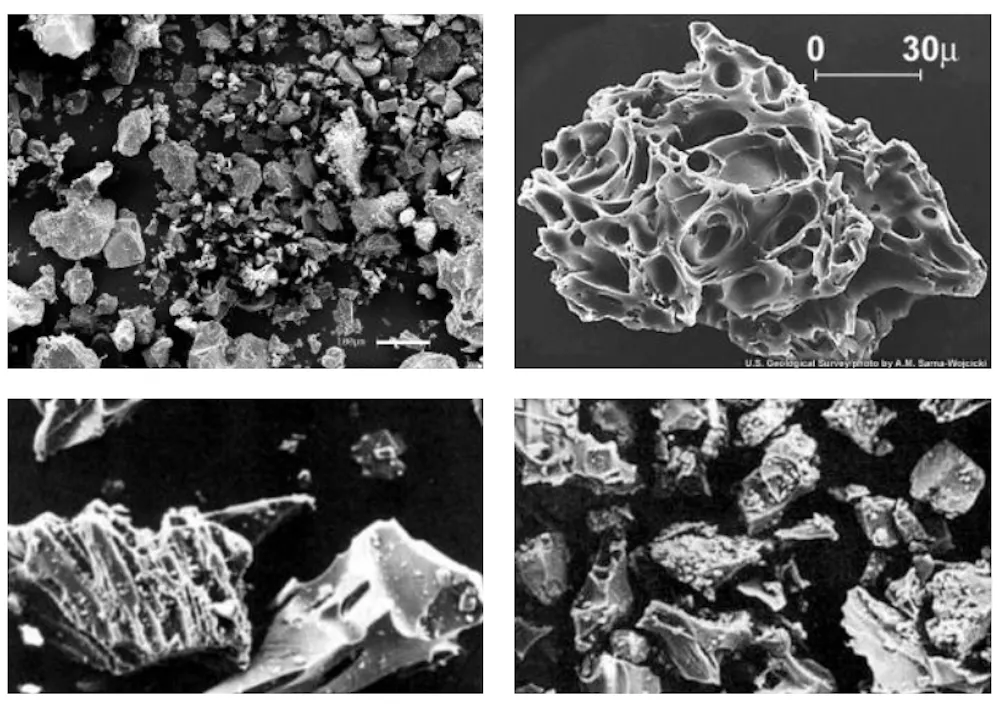
    Electron microscope images of ash show how sharp the shards are. The top left image of shards from Mount Etna in 2002 is 1 mm across. Top right is an ash particle from Mount St. Helens magnified 200 times. The shards in the lower images are less than 0.064 mm.
    Volcano Hazards Program, U.S. Geological Survey

    Ash can also contaminate surface water by introducing toxins and increasing the water’s acidity. The toxins can leach into groundwater, contaminating wells. Fine ash particles can also settle in waterways and smother aquatic plants and animals. During the 2008 Chaitén eruption in Chile, ash contamination led to widespread fish deaths in the Río Blanco.

    Ash can ground airplanes, gum up infrastructure

    Ash clouds are extremely dangerous to aircraft. The glassy ash particles melt when sucked into jet turbines, clog fuel systems and can stall engines in midair.

    In 1982, British Airways Flight 9 lost power in all four engines after flying through an ash cloud. A similar incident occurred in 1989 to KLM Flight 867 over Alaska. In 2010, Iceland’s Eyjafjallajökull eruption grounded more than 100,000 flights across Europe, disrupting travel for over 10 million passengers and costing the global economy billions of dollars.

    Volcanic ash can also wreak havoc on infrastructure by clogging water supplies, short-circuiting electrical systems and collapsing roofs under its weight. It can disrupt transportation, communication, rescue and power networks, as the 1991 eruption of Mount Pinatubo in the Philippines dramatically demonstrated.

    What to do during ashfall

    During an ashfall event, the most effective strategy to stay safe is to stay indoors as much as possible and avoid inhaling ash particles.

    Anyone who must go outside should wear a properly fitted N95 or P2 mask. Cloth masks provide little protection against fine ash. Rainwater tanks, troughs and open wells should be covered and monitored for contamination. Livestock should be moved to clean pastures or given uncontaminated fodder.

    The challenges Alaska is facing if Mount Spurr erupts.

    To reduce structural damage, ash should be cleared from roofs and gutters promptly, especially before rainfall.

    Older adults, children and people who are sick are at greatest risk, particularly those living in poorly ventilated homes. Rural communities that are dependent on agriculture and livestock are disproportionately affected by ashfall, as are low-income people who lack access to clean water, protective masks or safe shelter.

    Communities can stay informed about ash risks through official alerts, including those from the Volcanic Ash Advisory Centers, which monitor ash dispersion and issue timely warnings. The International Volcanic Health Hazard Network also offers guidelines on personal protection, emergency planning and ash cleanup.

    The long tail of ash

    Volcanic ash may fall quietly, but its effects are widespread, persistent and potentially deadly. It poses a chronic threat to health, agriculture, infrastructure and aquatic systems.

    Recognizing the risk is a crucial first step to protecting lives. Effective planning and public awareness can further help reduce the damage.

    David Kitchen does not work for, consult, own shares in or receive funding from any company or organization that would benefit from this article, and has disclosed no relevant affiliations beyond their academic appointment.

    ref. Volcanic ash is a silent killer, more so than lava: What Alaska needs to know with Mount Spurr likely to erupt – https://theconversation.com/volcanic-ash-is-a-silent-killer-more-so-than-lava-what-alaska-needs-to-know-with-mount-spurr-likely-to-erupt-254461

    MIL OSI – Global Reports

  • MIL-OSI Global: 25 years of Everglades restoration has improved drinking water for millions in Florida, but a new risk is rising

    Source: The Conversation – USA – By John Kominoski, Professor of Biological Sciences, Florida International University

    The Everglades has often been referred to as a vast river of grass. National Park Service/B.Call via Flickr

    Do you know where your drinking water comes from?

    In South Florida, drinking water comes from the Everglades, a vast landscape of wetlands that has long filtered the water relied on by millions of people.

    But as the Everglades has shrunk over the past century, the region’s water supply and water quality have become increasingly threatened, including by harmful algal blooms fueled by agriculture runoff. Now, the water supply faces another rising challenge: saltwater intrusion.

    Waterways cut through the Everglades.
    South Florida Water Management District/Flickr, CC BY-ND

    Protecting South Florida’s water hinges on restoring the Everglades. That’s why, 25 years ago, the federal government and universities launched the world’s largest ecosystem restoration effort ever attempted.

    I’m involved in this work as an ecosystem ecologist. The risks I see suggest continuing to restore the Everglades is more crucial today than ever.

    What happened to the Everglades?

    The Florida Everglades is a broad mosaic of fresh water, sawgrass marshes, cypress domes and tree islands, mangrove forests and seagrass meadows all connected by water.

    But it is half its original size. In the early 1900s, the U.S. Army Corps of Engineers began installing canals and levees to control flooding in the Everglades, which allowed people to build farms and communities along its edges. The Tamiami Trail became the first road across the Everglades in 1928. It connected Tampa to Miami, but the road and canals cut off or diverted some of the natural water flow in South Florida.

    Maps show how the Everglades changed over time. Source: USGS.

    Since then, Florida’s economy, agriculture and population have exploded – and with them has come a nutrient pollution problem in the Everglades.

    The major crop, sugarcane, is grown in a region south of Lake Okeechobee covering 1,100 square miles that’s known as the Everglades Agricultural Area. Nearly 80 tons of phosphorus fertilizer from federally subsidized farm fields runs off into the Everglades wetlands each year. And that has become a water quality concern. Drinking water with elevated nitrogen is linked to human health problems, and elevated phosphorus and associated algal blooms can cause microbes to accumulate toxins such as mercury.

    Healthy wetlands can filter out those nutrients and other pollutants, cleaning the water.

    Some of the ways the Everglades filters water contaminated with phosphorus.
    South Florida Water Management District

    Rain falling in the Everglades percolates through the porous limestone and recharges the Biscayne Aquifer, which supplies drinking water for 1 in 3 Floridians.

    But wetlands need time and space to function properly, and the damage from farm pollution has harmed that natural filtering system.

    By the 1990s, Everglades wetlands and the wildlife they support hit a critical stress level from elevated concentrations of phosphorus, a nutrient in fertilizer that washes off farm fields and fuels the growth of toxic algal blooms and invasive species that can choke out native plant populations.

    The changes led to seagrass die-offs and widespread invasion of sawgrass marshes by cattail and harmful algal blooms. Degraded wetlands can themselves become pollution sources that can contaminate surface water and groundwater quality by decreasing oxygen in the water, which can harm aquatic life, and releasing chemicals and nutrients as they decay.

    A vast restoration campaign

    Congress approved the Comprehensive Everglades Restoration Plan in 2000 to support reducing phosphorus concentrations by recreating large wetlands areas to remove excess nutrients and reestablishing more of the natural water depth to bolster native populations.

    That restoration effort is making progress in reconnecting wetlands to natural water flows by rehydrating large areas that were cut off. Phosphorus levels are lower in many wetlands that now remain hydrated longer, and in these wetlands fresh water is recharging the aquifer, helping sustain the drinking water supply.

    However, delays in critically important components of that work have left some wetlands in degraded conditions for longer than expected, especially in regions near and downstream of the Everglades Agricultural Area, where phosphorus concentrations remain stubbornly high.

    An algal bloom spreads in Florida’s Lake Okeechobee, at the heart of the Everglades.
    Nicholas Aumen/USGS

    South Florida continues to experience harmful algal blooms from phosphorus reaching rivers and the coast, resulting in fish kills and the deaths of manatees. Red tide can shut down fishing and keep beach-going tourists away, harming local economies. This pollution is estimated to have cost Florida’s economy US$2.7 billion in 2018.

    The unexpected risk: Saltwater

    An unforeseen threat has also started to creep into the Everglades: saltwater.

    As sea level rises, saltwater reaches further inland, both in rivers and underground through the porous limestone beneath South Florida. Saltwater intrusion also occurs when wells draw down aquifers to provide water for drinking or irrigation. That saltwater is causing parts of the Everglades marshes, often referred to as a river of grass, to collapse into open water.

    Saltwater intrusion into South Miami and how Everglades restoration can help. Source: Emily Northrop and Rachael Johnson, University of Miami.
    The red line shows how far saltwater had intruded into aquifers beneath Fort Lauderdale as of 2019.
    South Florida Water Management District

    The loss of these freshwater marshes reduces the capacity of the Everglades to remove phosphorus from the water. And that means more nutrients flowing downstream, contaminating aquifers and causing harmful algal blooms to form in coastal waters.

    Scientists have learned that marsh plants need freshwater pulses during the wet season, from April to November, to avoid saltwater intrusion.

    For example, saltwater intruded about one mile inland between 2009 and 2019 in parts of the Fort Lauderdale area. More fresh water is needed to push the saltwater back out to sea.

    However, the restoration effort was never intended to combat saltwater intrusion.

    Reasons for optimism

    Despite the continuing challenges, I am optimistic because of how scientists, policymakers and communities are working together to protect the Everglades and drinking water.

    I lead part of that restoration work through the Florida Coastal Everglades Long Term Ecological Research program. The effort started at Florida International University on May 1, 2000, the same year the Everglades restoration plan was authorized by Congress.

    Our research was used to set the levels of nutrients allowable to still protect the region’s water supplies, and we have been working for 25 years to reduce saltwater intrusion and phosphorus pollution to ensure drinking water for South Florida remains both fresh and clean. We continually use our research to inform water managers and policymakers of the best practices to reduce saltwater intrusion and pollution.

    A roseate spoonbill hunts for dinner in Everglades National Park.
    National Park Service, R. Cammauf, via Flickr

    As saltwater intrusion continues to threaten South Florida’s freshwater aquifer, Everglades restoration and protection will be increasingly important.

    Everyone in the region can help.

    By rehabilitating degraded wetlands, allowing for more fresh water to flow throughout the Everglades ecosystems, reducing the use of fresh water on lawns and crops, and reusing municipal water for outdoor needs, South Florida can keep its drinking water safe for generations of future residents and visitors. This is something that everyone can contribute to.

    Mangroves along Turner River in the Everglades.
    Chauncey Davis/Flickr, CC BY

    Marjory Stoneman Douglas, Miami’s renowned conservationist who helped establish the Everglades National Park, often said, “The Everglades is a test. If we pass it, we may get to keep the planet.”

    John Kominoski works for Florida International University. He receives funding from federal agencies, such as the National Park Service and the National Science Foundation.

    ref. 25 years of Everglades restoration has improved drinking water for millions in Florida, but a new risk is rising – https://theconversation.com/25-years-of-everglades-restoration-has-improved-drinking-water-for-millions-in-florida-but-a-new-risk-is-rising-253167

    MIL OSI – Global Reports

  • MIL-OSI Global: A need for chaos powers some Americans’ support for Elon Musk taking a chainsaw to the US government

    Source: The Conversation – USA – By Dannagal G. Young, Professor of Communication and Political Science, University of Delaware

    There’s a sizable group of Americans who agree with the phrase ‘I think society should be burned to the ground.’ Anton Petrus-Moment/Getty Images

    A video of a Las Vegas Tesla dealership that had been set on fire by anti-Elon Musk protesters was posted on March 18, 2025, by an account on X called EndWokeness.

    The next day Musk replied to the post, “Some people just want to watch the world burn,” an iconic line from the 2008 Batman film “The Dark Knight.” Alfred, the Wayne family’s faithful butler, says the line to Bruce Wayne – Batman – to describe the motivations behind the Joker’s chaotic acts of violence.

    Musk – and Alfred – was right. Some people do, in fact, say they think that society should be burned to the ground. It’s part of a psychological measure political psychologists created called “need for chaos.”

    New data from the Center for Political Communication at the University of Delaware suggests that those people – the ones who want society to burn – are the ones with more, not less, trust in Musk. They also report more trust in the Department of Government Efficiency, the government entity Musk advises, which the Trump administration claims it created to cut government waste and fraud.

    Yet, critics point out that Musk and DOGE’s seemingly indiscriminate approach to spending cuts risks damaging the infrastructure necessary for American innovation.

    This desire to watch the world burn doesn’t come out of nowhere.

    Fear of losing status

    Somewhat like the Joker, whose perpetual sense of victimhood – “You wanna know how I got these scars?” – drove his need for chaos and destruction, people can develop a need for chaos in response to a sense that they are losing.

    When political psychologists introduced this concept of “need for chaos” in 2021, they described it not as a psychological trait, but as a character adaptation that occurs when some people experience a cultural and political situation that makes them feel like they are losing status and power. For some people, this feeling triggers a desire to “burn it all down” – “it” being society, institutions, the world – maybe to rebuild it all anew, or maybe just to see it all destroyed.

    Only a small percentage of the U.S. population – less than 15% – tends to score high in need for chaos. But even so, understanding this minority is important to gaining insight into this political moment.

    For example, people who score high in need for chaos exhibit greater support for political violence and a willingness to knowingly share hostile and false information online. And in our data, those higher in need for chaos report holding more trust in Musk, DOGE and Trump than people who score lower in the need for chaos measure.

    Who wants to burn it down

    We are political psychologists who study the link between psychological traits and political beliefs. Last month, the University of Delaware’s Center for Political Communication ran a national survey that we designed to understand where the public stands on various political issues and how those beliefs relate to psychological traits, including need for chaos.

    In our national study of 1,600 Americans conducted between Feb. 27-March 5, 2025, by YouGov, we asked respondents how much they agreed or disagreed with the following statements:

    • “I fantasize about a natural disaster wiping out most of humanity such that a small group of people can start all over”

    • “I think society should be burned to the ground”

    • “We cannot fix the problems in our social institutions; we need to tear them down and start over”

    • “I need chaos around me – it is too boring if nothing is going on”

    Similar to prior work by author Kevin Arceneaux and his colleagues, our data shows that a very small number – fewer than 20% of the sample – agrees strongly or agrees somewhat with each item.

    However, looking at need for chaos among groups of varying ages, education levels and media habits, we find the highest need for chaos scores among people under age 40, those with less education, and those who pay the least attention to politics.

    Burning it down through government policy

    Our new data also shows that while people highest in need for chaos report having more trust in Musk, DOGE, and President Trump, these chaos-seeking folks report having less trust in “people in general,” journalists or the federal government. These findings hold even when statistically accounting for other factors, among them party, race, gender, education and ideology.

    Musk’s penchant for wielding chainsaws as a symbol of DOGE’s work provides some insight into why chaos seekers may like what they see in Musk.

    It’s not clear exactly what Musk’s aim is with his work at DOGE, as he eliminates the jobs of hundreds of thousands of government workers.

    What is clear, however, is that by many accounts, the mass firings and the gutting of agencies, like the U.S. Agency for International Development and the Institute for Peace, are sowing chaos. And a significant portion of Americans want just that.

    Dannagal G. Young receives funding from the Center for Political Communication Research Fund at the University of Delaware

    Kevin Arceneaux does not work for, consult, own shares in or receive funding from any company or organization that would benefit from this article, and has disclosed no relevant affiliations beyond their academic appointment.

    ref. A need for chaos powers some Americans’ support for Elon Musk taking a chainsaw to the US government – https://theconversation.com/a-need-for-chaos-powers-some-americans-support-for-elon-musk-taking-a-chainsaw-to-the-us-government-253420

    MIL OSI – Global Reports

  • MIL-OSI Europe: European Union – Statement by Jean-Noël Barrot on his arrival at the Foreign Affairs Council (14 Apr. 2025)

    Source: France-Diplomatie – Ministry of Foreign Affairs and International Development

    This weekend, the horror in Ukraine reached its peak with the Palm Sunday massacre. In Sumy in the north-east of the country, innocent civilians were targeted twice by Vladimir Putin’s missiles. It’s a demonstration – if it were still needed – of Vladimir Putin’s contempt for civilians and for the laws of war. Let me remind you that Vladimir Putin is still under an arrest warrant from the International Criminal Court for war crimes. It’s also a demonstration of his real intentions. Whereas Ukraine agreed to a ceasefire more than a month ago now, Vladimir Putin clearly has no intention of moving in that direction. So he must be forced to, and that’s why I’m calling on the European Union to adopt the most severe sanctions against Russia, to paralyse its economy and prevent it from fuelling its war effort. I think the United States, which has put a lot of effort into achieving a ceasefire – and Donald Trump himself has devoted a lot of time and energy to it – can also, through sanctions which are ready, force and oblige Vladimir Putin to sit down at the negotiating table.

    In Gaza, the situation is more tragic than ever. Access for humanitarian aid to the enclave stopped more than a month ago now. There must be a return to the ceasefire, unimpeded access for humanitarian aid must be permitted, and the Hamas hostages must be released. Talks can then begin on the basis of the plan prepared by the Arab countries for Gaza’s reconstruction, governance and security, and then for movement towards a political solution, because there is no military solution to the Israeli-Palestinian conflict. A political solution is the focus of the United Nations conference chaired by France and Saudi Arabia, which aims to preserve the two-State solution and put it on track, through collective and reciprocal recognition enabling the Israeli people and the Palestinian people to live side by side in peace and security.

    On Iran, today we’re adopting a raft of sanctions against people responsible for the state-hostages policy. That’s the demand I set out at the last Foreign Affairs Council. I’m pleased that we can adopt these sanctions today against seven people and two entities, including Shiraz prison. It was time, because the conditions in which some of [our] French-European compatriots are being held are humiliating and akin to torture in international law, and some of them are deprived of consular protection. That’s why I’ve announced that France will lodge a complaint to the International Court of Justice for the violation of consular protection. And I’ve reminded all our compatriots to avoid travelling to Iran, and those who are in transit to return as soon as possible. At the same time, the United States embarked on talks with Iran this weekend. We very much welcome this initiative, but we’ll be vigilant, with our British and German friends and partners, to ensure that any negotiations that might begin are indeed in line with our security interests when it comes to the Iranian nuclear programme, which poses a significant threat to French and European territory. We’re awaiting the report, in a few weeks’ time, by the IAEA Director General, which is due to demonstrate – or at any rate report on – the progress of that programme.

    Regarding Azerbaijan, I’m very concerned about the rising tensions on the border. I’d like the European mission deployed on the ground to be greatly increased in order to be able to observe and contain those tensions. The peace treaty must now be signed and arbitrary detainees, prisoners, must be released. That’s the gist of what I said last week.

    I’ll end with the situation in the Balkans, which was the focus of discussion yesterday evening and to which we’ll return today to make active efforts to ensure that the region – which is at the heart of the European Union and to which we want to export our stability rather that import its instability – all our efforts must converge to bring stability and a form of calm, despite the tensions that have emerged in recent days.

    MIL OSI Europe News

  • MIL-OSI Europe: European Union – Main results of the Foreign Affairs Council (14 Apr. 2025)

    Source: France-Diplomatie – Ministry of Foreign Affairs and International Development

    M. Jean-Noël Barrot, Minister for Europe and Foreign Affairs, took part in the Foreign Affairs Council (FAC) today, Monday 14 April.

    On France’s initiative, the meeting provided an opportunity to adopt further European sanctions against nine individuals and entities responsible for Iran’s state-hostages policy, of which two of our compatriots, Cécile Kohler et Jacques Paris, are still victims – as are several other European citizens – and have been so for nearly three years. These sanctions target judges and prosecutors officiating in courts that do not respect basic rights, as well as detention centres.

    Regarding Ukraine, the Member States emphasized the importance of giving Ukraine the means to negotiate in a position of strength when the time comes. In the coming weeks it is necessary to adopt, as soon as possible, a new package of robust sanctions against Russia containing individual and sectoral measures.

    On Armenia and Azerbaijan, the Minister stressed the importance of signing the peace treaty swiftly, and shared his deep concern about the rising tensions on the border. The role of the European mission deployed on the ground is essential for observing incidents. He reiterated the need to immediately release the people arbitrarily held in Azerbaijan.

    As regards the situation in the Middle East, the Minister recalled President Macron’s visit to Egypt and the need for an immediate return to the ceasefire in Gaza, the release of the hostages and the resumption of humanitarian aid.

    Finally, on the situation in Bosnia and Herzegovina, the Member States reaffirmed their commitment to the country’s unity and constitutional order. France favours a firm response by the EU that harnesses all the levers available to it, in order to restore stability.

    MIL OSI Europe News

  • MIL-OSI China: China’s new EV battery safety standard to take effect in July 2026

    Source: People’s Republic of China – State Council News

    BEIJING, April 15 — An updated mandatory national standard on the safety of electric vehicle batteries in China is set to take effect on July 1, 2026.

    The standard is titled “Safety Requirements for Power Batteries Used in Electric Vehicles (GB38031-2025),” according to the Ministry of Industry and Information Technology.

    The revisions include updates to thermal diffusion testing of batteries, further clarifying the temperature requirements, observation time, and vehicle testing conditions.

    A new bottom impact test has been introduced to assess the protective capabilities of the battery upon impact to its base. A new safety test following fast charging cycles has also been added, which requires external short circuit testing after 300 fast charge cycles, mandating no fire or explosion.

    The revised version clearly states that the standard applies to power batteries for electric vehicles, excluding non-propulsion batteries.

    MIL OSI China News

  • MIL-OSI: CRI Enters Into Binding LOI to Acquire Black Raven Past-Producer Antimony-Gold Property, NL

    Source: GlobeNewswire (MIL-OSI)

    TORONTO, April 15, 2025 (GLOBE NEWSWIRE) — Churchill Resources Inc. (“Churchill“) is pleased to announce that it has entered into a binding letter of intent dated April 14, 2025 (the “LOI”) to acquire a 100% undivided interest in the Black Raven Antimony Property, located approximately 60 km northwest of Gander, Newfoundland and Labrador, from property owners Eddie and Roland Quinlan. The property encloses two small-scale past producing mines which operated between 1890 and 1918 exploiting stibnite, gold and arsenopyrite. These past producers and two related occurrences constitute gold, antimony, silver +/- copper, zinc and lead targets in veins and stockworks. The historical mines and other occurrences are located within close proximity to each other, in a larger-scale geological environment containing intense veining and alteration associated with felsic intrusions within a mafic volcanic domain.

    Antimony is a critical element for the energy, transportation, and military industries with China, Russia, Tajikstan, and Burma generating over 90% of world production. Since China’s recent export ban (September 15, 2024), the price of antimony has increased roughly five-fold to >$50,000/tonne which is approximately 3x the current price of nickel. Churchill’s Taylor Brook Nickel-Copper-Cobalt-Vanadium-Titanium Property, and Florence Lake Nickel Property, are both in good standing for a number of years, such that further exploration and development can await improved market conditions sentiment while the Company focuses on high-grade antimony-gold and other critical minerals.  

    The Beaver Brook Antimony Mine owned by China Minmetals, and currently on care and maintenance due to declining resources, is located ~100 km south of Black Raven. It is reported that the owners are actively exploring for more deposits to feed the mill. (https://www.cbc.ca/news/canada/newfoundland-labrador/antimony-mine-closure-1.6703205)

    The two past-producing mines, as well as the Taylors Room prospect and Western Head porphyry target, are described within the Government of Newfoundland’s Mineral Occurrence Data System (“MODS”), and in assessment reports, as summarized below:

    Frost Cove Antimony Mine (MOD # 002E10 SB001) –

    • sporadic production between 1890-1918
    • Two adits extend ~65m along Sb-Au veins, at 3m and 20m above sea-level and are still accessible
    • Vein system/host felsic intrusion traced and sampled on surface for 800m
    • Channel sample of 2.85% Sb, 0.05g/t Au, 1.6g/t Ag over 1.6m reported at adit entrance by Golden Hind Ventures along with 30% Sb, 28.27 g/t Au, 44.8g/t Ag over 0.43m, 800m along strike. (Sheppard, 1984, Assessment Report)

    Stewart Gold-Antimony Mine (MOD # 002E10 AU001) –

    • sporadic production from 1890 to 1916
    • Shaft to ~30m depth and some development along main stockwork/vein trend
    • Samples from the ore dump assayed up to 18 g/t Au, 7% zinc and 14g/t gold by Pleasant Ridge Resources Inc. (Kruse, 2014, Technical Report)
    • 2014 due-diligence sample by Kruse graded 8.10g/t Au and 926ppm Cu.

    Taylors Room Gold Prospect (MOD # 002E10 AU002) –

    • shaft to ~50m depth with some development reported
    • Swarm of ~50 small qtz-asp-py-sb veins ~300m long by several metres wide
    • Numerous trenches to be cleaned out and sampled
    • Quinlan grab samples up to 32.2 g/t Au, 22opt Ag, 10% zinc and 1.4 % Cu (Quinlan 2013 Assessment Report).

    Western Head Cu-Mo Porphyry Target (MOD # 002E10 CU005) –

    • porphyry body ranges over ~1000m in diameter
    • Consistent soil/rock geochem anomalies in Cu, Mo, Au and Ag, no drilling
    • Chip sampling in 1967 by Newmont (returned 0.13% Cu, 300ppb Au over 61m and 0.42% Cu, 600ppm Au over 13m (Fogwill, 1968, Report on Western Head Cu Prospect)
    • Quinlan continuous channel of 57m assayed 0.22% Cu, 37 ppb Au & 37 ppm Mo incl 22m of 0.41% Cu, 59 ppb Au, 73 ppm Mo (Quinlan, 2013 Assessment Report)
    • Quinlan 2024 Winkie 4 holes to 50-60m at 45o in four compass directions – all hit mineralized Cu-Au-Ag stockwork in altered felsics (0.1-0.3% Cu, 50-350ppb Au plus Ag) (Quinlan, 2024 Assessment Report)

    Churchill intends to immediately conduct a re-sampling program on the surface showings and any accessible historical workings, and compilations of all historical data already in progress. The entire property requires modern, helicopter-borne geophysical and LiDAR surveys and Churchill has identified a leading contractor to do this work. Follow-up prospecting and systematic trenching, with channel sampling work as required, are being planned with initiation this coming Spring; the derived geological and geochemical data will used to outline targets along strike and at depth to the historical workings.

    The data reported in this News Release is historic in nature and has not yet been verified by a Qualified Person. Churchill has relied on the information supplied in the Government of Newfoundland filed assessment reports and from information found in MODS published by the Newfoundland Department of Natural Resources. The surface grab samples described in this news release are selective by nature and are unlikely to represent average grades of the property. Historical surface antimony and gold results are presented in the following figures.

    Black Raven Property

    The Black Raven Property is comprised of nine map-staked licenses constituting a single contiguous block of 125 claims that in total which cover 3,125ha or 31.25km2. Churchill and the vendors have agreed to a 4km wide area of interest around the property boundaries as part of this agreement.

    LOI Terms

    Under the terms of the LOI, the Company shall have the exclusive option for a period of 24 months to acquire an undivided 100% ownership interest in the Black Raven Antimony Property by:

    1. issuing an aggregate of 2,000,000 common shares in the capital of Churchill (“Common Shares”) to the Quinlans upon the execution date of a definitive option agreement (“Option Agreement”) and making a cash payment of $20,000;
    2. incurring a minimum of $1,200,000 in exploration expenditures within 24 months following the execution date of the Option Agreement, provided that a minimum of $400,000 in exploration expenditures is incurred on or prior to the date that is 12 months following the execution date of the Option Agreement
    3. issuing an aggregate of 4,000,000 Common Shares to the Quinlans on or prior to the date that is 12 months following the execution of the Option Agreement and making a cash payment of $40,000; and
    4. issuing an aggregate of 6,000,000 Common Shares to the Quinlans on or prior to the date that is 24 months following the execution of the Option Agreement and making a cash payment of $60,000.

    Following the date that the option is deemed to have been exercised in accordance with its terms, Churchill will issue and grant to the Quinlans a 2.0% net smelter royalty on any minerals produced from the claims comprising the Black Raven Antimony Property. If the option is exercised, Churchill will also make a one-time cash payment to the Quinlans in the amount of $100,000 on or prior to the date that is the sixth anniversary of the execution of the Option Agreement.

    The transaction, including the issuance of Common Shares to the Quinlans, is subject to all the necessary approvals from the TSX Venture Exchange (“TSXV”). Any securities issued in connection with the transaction will be subject to applicable statutory hold periods.

    The technical and scientific information in this news release has been reviewed and approved by Dr. Derek H.C Wilton, P.Geo., FGC, who is a “qualified person” as defined under National Instrument 43-101 – Standards of Disclosure for Mineral Projects (“NI 43-101”). Mr. Wilton is an honourary research professor of Economic Geology at Memorial University in St. John’s and is independent of the Company for the purposes of NI 43-101.

    References:

    Fogwill, W.D., 1968. Report on a copper prospect at Western Head, Moreton’s Harbour in the Notre Dame Bay Area, Newfoundland. Newfoundland and Labrador Geological Survey, Assessment File 2E/10/0350, 1968, 48 pages

    Kruse, Stefan, 2014. Technical Report on the Black Raven Property, Moreton’s Harbour Area Newfoundland and Labrador, Canada for Pleasant Ridge Resources Inc., May 14, 2014

    Quinlan E, 2013. First Year Assessment Report for 019872M, Ninth Year Assessment Report for 015553M, and Third Year Assessment Report for 017787M for Exploration within the Black Raven Property, NTS Map Sheet 2E/10. Newfoundland and Labrador Geological Survey Assessment Report, 69 pages

    Sheppard, B., 1984. First Year Assessment Report on Geological, Geochemical and Geophyisical Exploration on License 2363 on Claim Blocks 3533-3534 in Moreton’s Harbour Area on New World Island, Notre Dame Bay, Newfoundland and Labrador Assessment File 2E/10/0507, 1984, 28 pages.

    About Churchill Resources

    Churchill Resources Inc. is a Canadian exploration company focused on strategic, critical minerals in Canada, principally at its prospective Taylor Brook, Florence Lake, and Black Raven properties in Newfoundland & Labrador. The Churchill management team, board, and advisors have decades of combined experience in mineral exploration and in the establishment of successful publicly listed mining companies, both in Canada and around the world. Churchill’s Newfoundland and Labrador projects have the potential to benefit from the province’s large and diversified minerals industry, which includes world class nickel mines and processing facilities, and a well-developed mineral exploration sector with locally based drilling and geological expertise.

    Further Information

    For further information regarding Churchill, please contact:

    Churchill Resources Inc.
    Paul Sobie, Chief Executive Officer
    psobie@churchillresources.com
    Tel.   416.365.0930 (o)
             647.988.0930 (m)

    Alec Rowlands, Business Development & IR
    Alec.rowlands1@gmail.com
    Tel.    416.721.4732 (m)

    FORWARD-LOOKING STATEMENTS

    This news release contains certain forward-looking statements, including, but not limited to, statements about Churchill’s objectives, goals and exploration activities proposed to be conducted on its properties; future growth potential of Churchill, including whether any proposed exploration programs at any of its properties will be successful; exploration results; and future exploration plans and costs. Wherever possible, words such as “may”, “will”, “should”, “could”, “expect”, “plan”, “intend”, “anticipate”, “believe”, “estimate”, “predict” or “potential” or the negative or other variations of these words, or similar words or phrases, have been used to identify these forward-looking statements. In particular, this release contains forward-looking information relating to, among other things, the entering into of a definitive Option Agreement and other ancillary transaction documents with respect to the Black Raven Antimony Property and the exercise of such option; the number of Common Shares that may be issued in connection with the transactions discussed herein, closing conditions and receive necessary regulatory approvals These statements reflect management’s current beliefs and are based on information currently available to management as at the date hereof.

    Forward-looking statements involve significant risk, uncertainties and assumptions. Many factors could cause actual results, performance or achievements to differ materially from the results discussed or implied in the forward-looking statements. These factors should be considered carefully and readers should not place undue reliance on the forward-looking statements. Such factors, among other things, include: exploration results on the Black Raven Antimony Property; the expected benefits to Churchill relating to the exploration proposed to be conducted on its properties; receipt of all regulatory approvals in connection with the transaction contemplated herein; failure to identify any additional mineral resources or significant mineralization; the preliminary nature of metallurgical test results; uncertainties relating to the availability and costs of financing needed in the future, including to fund any exploration programs on the Churchill’s properties, if required; fluctuations in general macroeconomic conditions; fluctuations in securities markets; fluctuations in spot and forward prices of gold, silver, base metals or certain other commodities; change in national and local government, legislation, taxation, controls, regulations and political or economic developments; risks and hazards associated with the business of mineral exploration, development and mining (including environmental hazards, industrial accidents, unusual or unexpected formations pressures, cave-ins and flooding); inability to obtain adequate insurance to cover risks and hazards; the presence of laws and regulations that may impose restrictions on mining and mineral exploration; employee relations; relationships with and claims by local communities and indigenous populations; availability of increasing costs associated with mining inputs and labour; the speculative nature of mineral exploration and development (including the risks of obtaining necessary licenses, permits and approvals from government authorities); the unlikelihood that properties that are explored are ultimately developed into producing mines; geological factors; actual results of current and future exploration; changes in project parameters as plans continue to be evaluated; soil sampling results being preliminary in nature and are not conclusive evidence of the likelihood of a mineral deposit; and title to properties. Although the forward-looking statements contained in this news release are based upon what management believes to be reasonable assumptions, the Churchill cannot assure readers that actual results will be consistent with these forward-looking statements. These forward-looking statements are made as of the date of this news release, and the Churchill assumes no obligation to update or revise them to reflect new events or circumstances, except as required by law. Neither the TSXV nor its Regulation Services Provider (as that term is defined in the policies of the TSXV) accepts responsibility for the adequacy or accuracy of this release.

    An infographic accompanying this announcement is available at https://www.globenewswire.com/NewsRoom/AttachmentNg/9356bd16-4799-4797-a465-84fafebf0cf5

    The MIL Network

  • MIL-OSI Global: Birth of India: ‘biggest experiment’ with democracy was a huge gamble. Happily the people have made it work – here’s how

    Source: The Conversation – UK – By Tripurdaman Singh, British Academy Postdoctoral Fellow, Institute of Commonwealth Studies, School of Advanced Study, University of London

    The birth of Indian democracy is the stuff of legend. It was a moment of such staggering idealism and exuberance, a leap of faith so audacious, that the famous jurist and scholar Kenneth Wheare termed it “the biggest liberal experiment in democratic government” that the world had seen.

    At its centre lay the country’s new constitution. That document, with its fabled chapter of fundamental rights, transformed in one stroke what had been the world’s largest colony into the world’s largest democracy.

    Think about the origins of this constitution. It promised freedom to a fifth of humanity. It embodied the enfranchisement of the world’s largest electorate and the conversion of colonial subjects into rights-bearing citizens.

    This very exuberance has often been used to direct attention to its functional shortcomings. But today, 75 years on with Narendra Modi at the helm and the country classified in 2024 as an “electoral autocracy” by the V-Vdem (Varieties of Democracy) institute, it has also become a powerful tool to highlight Indian democracy’s contemporary problems.

    India’s notoriously fractured opposition was able to assemble a coalition to take on Modi’s Bharatiya Janata Party (BJP) in the 2024 general election. It did so by appealing to the liberal vision underpinning the constitution. But have things really changed so much since the constitution’s adoption in 1950?


    Read more:
    Moments of hope: how Indians keep pushing back against the hollowing out of democracy


    Democracy in decline? The risk and rise of authoritarianism

    Democracy is under pressure around the world in 2025. But is this part of a larger historical cycle or does it signal a deeper, more fundamental shift? Join us for a free event in central London on May 8 to discuss these important questions. Come for a panel discussion and stay for food, drinks and conversation.
    Get tickets here


    Unlike its American counterpart, India’s constitution is not animated by the impulse to limit political power and secure public freedom. It is dominated by the idea of enabling political power for the aim of social and economic reform.

    It aimed to create a state explicitly committed to achieving what India founders believed to be social, economic and political justice. As the country’s first prime minister, Jawaharlal Nehru put it, they were freeing India “through a new constitution to feed the starving people and clothe the naked masses”.

    This is partly explained by the circumstances of independent India’s birth. This was marked by violence, the upheaval of partition and a fear of balkanisation if the country became fragmented by religious, ethnic and linguistic minorities.

    Added to this were the pressures of establishing political sovereignty. And this upheaval crashed against an uneducated and destitute population with no experience of democracy and deep-seated social divisions.

    But the larger truth is that, for independent India’s leaders, civil liberties were always eclipsed by what they saw as the more important concerns of destitution and social discrimination. They felt the urgency to secure the new state through which these concerns were to be addressed.

    This required substantial restrictions of civic freedoms and the licensing of coercive state power. From the outset, the constitution enshrined centralisation and executive supremacy.

    It retained the “bureaucratic authoritarianism” of its British colonial predecessor, by placing authority in the hands of appointed bureaucrats rather than elected officials.

    It also gave the centre power over the states, enabling it to create and dismember provinces at will, and it gave the executive power over the legislature. The government can dictate when parliament is summoned or prorogued and can rule by executive decree in its absence.

    It also gave the state power over the citizen. Almost every fundamental right guaranteed in part III of the constitution is qualified on nebulous grounds such as public order, the security of the state or social harmony.

    Soaring rhetoric about freedom masked the reality that the constitution concentrated power to an unprecedented degree and enabled a vast armoury of coercive laws. As Somnath Lahiri, member of the constituent assembly for Bengal and the leader of the Communist Party of India remarked sarcastically in a debate in April 1947, the provisions for fundamental rights seemed to have “been framed from the point of view of a police constable”.

    The Preventive Detention Act, the first piece of legislation passed in the new democratic republic in February 1950, allowed the government to preemptively jail anyone without a trial and without recourse to judicial review.

    It’s ample testament to the fact that the constitution was never intended as a bulwark in the service of liberal individualism – whatever the framers might have said at the time.

    Diluting liberalism

    Since the constitution’s adoption there have been more than 106 amendments and additions. These have further diluted the constitution’s liberal intentions and eroded even the limited system of checks and balances.

    The tenth schedule – or “anti-defection law” – added in 1985 is one egregious example. It forces individual legislators to vote according to party diktats on pain of disqualification.

    This has cemented the grip of party bosses on legislative parties, disempowered individual legislators and degraded parliamentary oversight. Since the threat of backbench rebellions has become negligible, majoritarianism has become entrenched.

    Concentration of power and its use by the executive are, by design, baked into India’s constitutional order and institutional structure, which has always been inhospitable terrain for any rights and freedoms beyond voting and elections. Anti-democratic tendencies operate through constitutional means, hindering the establishment of the principles of legality and legislative primacy.

    Given this situation, it is hardly surprising that almost all governments in India have used the powers they have been granted for these very purposes.

    Nehru’s rule saw a first amendment which drastically curtailed freedom of speech. It also introduced a special schedule in the constitution to protect unconstitutional legislation from judicial review, and draconian legislation such as the laws to enable preventive detention.

    Nehru’s daughter Indira Gandhi suspended the constitution for 21 months from 1975 to 1977 in a state of emergency, when her leadership came under threat. Her government forcibly sterilised thousands as part of a botched population control programme. Yet everything was duly legal and constitutional.

    Modi’s growing authoritarianism, his attacks on opposition media and those who oppose him in the judiciary, then, are less a departure from the norm than a confirmation of it. The real story lies elsewhere.

    It is not the constitution or the legislature that is the most important issue here. It has actually been the disinclination of India’s voters to deliver parliamentary majorities too often that has constituted the major check on executive power.

    For 25 years between 1989 and 2014, voters delivered split mandates and coalition governments, which diluted and dispersed political power. Unsurprisingly, this caused the country’s democracy indices to rise. These actually peaked in the 2000s when the ruling coalitions comprised upwards of a dozen parties. But the underlying problems remained the same.

    When the voters, contrary to all expectations, elected yet another coalition to office in 2024, they understood what the country’s liberal intelligentsia has consistently failed to grasp. It is not the celebrated constitution, but the Indian voters themselves that have, over the years, doggedly held authoritarianism at bay. Only time will tell how long they will continue to do this.

    Tripurdaman Singh receives funding from the British Academy and from Fonds National Suisse. He is currently affiliated to the Geneva Graduate Institute, where I am an Ambizione Fellow at the Albert Hirschman Centre on Democracy.

    ref. Birth of India: ‘biggest experiment’ with democracy was a huge gamble. Happily the people have made it work – here’s how – https://theconversation.com/birth-of-india-biggest-experiment-with-democracy-was-a-huge-gamble-happily-the-people-have-made-it-work-heres-how-252564

    MIL OSI – Global Reports

  • MIL-OSI United Nations: WFP welcomes a contribution from Finland to boost school meals programme in Zambia

    Source: World Food Programme

    LUSAKA – The United Nations World Food Programme (WFP) welcomes a contribution of EUR 500,000 from the Government of Finland to strengthen Zambia’s national school meals programme. The one-year initiative will enhance the nutrition of over 34,000 learners in thirty-three schools across Zambia while promoting climate-resilient agriculture and sustainable food systems.

    Finland, as the co-chair of the School Meals Coalition, is a strong and longstanding supporter of school meals globally. For years, Finland has provided continuous support to several WFP school meals operations and remains committed to strengthening these efforts. 

    With Finland’s support, and in collaboration with the Ministries of Education and Agriculture, WFP will procure ninety-eight metric tonnes of beans to complement cereals provided for school meals by the Zambian government. The initiative will directly link the demand for nutritious food in schools with supply from local smallholder farmers, creating a stable market for their produce. In addition, irrigated school gardens will be established to further improve the diversity and quality of school meals.

    “Finland and Zambia share longstanding warm relations,” said Saana Halinen, Ambassador of Finland to Zambia. “School meals are an investment in the future of Zambia, and I am incredibly happy that Finnish support is complimenting the government’s efforts in expanding the school meals programme. Allocating resources to child nutrition is the single and most important investment any country can make.”

    To further boost sustainability and resilience, schools will receive energy efficient stoves and handwashing stations, while teachers, learners, and surrounding communities will benefit from training in sustainable agriculture, nutrition, and hygiene practices.

    “This support from Finland comes at a critical time for Zambia as we address the aftermath of last year’s drought, working closely with the Ministry of Education and the Ministry of Agriculture” said Cissy Kabasuuga, WFP Country Representative in Zambia. “The funding will not only meet the immediate nutritional needs of thousands of learners but also help build a stronger, more resilient food system for the future.” 

    WFP, in partnership with the Government of Zambia launched a comprehensive five-year strategic plan in 2023 which seeks to eliminate hunger, improve nutrition, and strengthen the resilience of vulnerable communities to food shocks. The plan allows for national institutions to take the lead, reducing the need for humanitarian interventions. 

    Finland, as the co-chair of the School Meals Coalition, is a strong and longstanding supporter of school meals globally. For years, Finland has provided continuous support to several WFP school meals operations and remains committed to strengthening these efforts. 

    About WFP

    The United Nations World Food Programme is the world’s largest humanitarian organization, saving lives in emergencies, building prosperity and supporting a sustainable future for people recovering from conflict, disasters and the impact of climate change.

    Follow us on X @wfp_media @WFP_Zambia, @wfp_southernafrica.

    MIL OSI United Nations News

  • MIL-OSI Asia-Pac: Three property owners fined over $400,000 in total for not complying with statutory orders

    Source: Hong Kong Government special administrative region

         Three property owners were convicted and fined over $400,000 in total by the court late last month and early this month respectively for failing to comply with statutory orders issued under the Buildings Ordinance (BO) (Cap. 123).

         The first case involved the alteration of 14 units on two floors into mini-storage areas in an industrial building at Hi Yip Street, Yuen Long. The alteration and addition works were carried out without prior approval and consent from the Buildings Department (BD) and obstructed the means of escape and access for firefighting and rescue units, while affecting the fire resistant construction of the building, which contravened the Building (Planning) Regulations and the Building (Construction) Regulation. The alterations also rendered the building as dangerous, therefore removal orders and repair orders were served on the owner under section 24(1) and section 26 of the BO.

         Failing to comply with the removal orders and the repair orders, the owner was prosecuted by the BD and was fined $220,690 in total, of which $38,690 was the fine for the number of days that the offences continued, upon conviction at the Tuen Mun Magistrates’ Courts on March 28.

         The second case involved unauthorised building works (UBWs) at a three-storey house at Yu Chui Street, Tai Lam, Tuen Mun, which included the removal of the approved railing at a garden adjoining the slope and the construction of unauthorised structures with an area of about 400 square metres on the slope. The illegal works also included the removal of an external wall and the erection of an unauthorised structure with an area of about 10 sq m on the lower ground floor, the erection of an unauthorised structure with an area of about 20 sq m on the flat roof, and the erection of supporting frames for solar panels with an area of about 28 sq m on the roof. As the UBWs were carried out without prior approval and consent from the BD, removal orders were served on the owner under section 24(1) of the BO.

         Failing to comply with the orders, the owner was prosecuted by the BD and was fined $100,860 in total by the court, of which $42,860 was the fine for the number of days that the offence continued, upon conviction at the Tuen Mun Magistrates’ Courts on March 28.

         The third case involved an unauthorised structure with an area of about 130 sq m on the flat roof of a residential building at Tung Ming Street, Kwun Tong. As the UBWs were carried out without prior approval and consent from the BD, a removal order was served on the owner under section 24(1) of the BO.

         Failing to comply with the removal order, the owner was prosecuted by the BD in 2017 and was fined $25,650 upon conviction by the court. As the owner persisted in not complying with the removal order, the BD instigated prosecution again last year. The owner was subsequently fined $84,460, of which $54,460 was the fine for the number of days that the offence continued, upon conviction at the Kwun Tong Magistrates’ Courts on April 1.

         A spokesman for the BD said today (April 15), “UBWs, including the unauthorised alterations causing obstruction to the means of escape and means of access for firefighting and rescue, or affecting the fire resisting construction of a building, may lead to serious consequences. The owners concerned must comply with the statutory orders issued by the BD without delay. The BD will continue to take enforcement action against owners who fail to comply with statutory orders, including instigation of prosecution, to ensure building safety.”

         Failure to comply with a removal order without reasonable excuse is a serious offence under the BO. The maximum penalty upon conviction is a fine of $200,000 and one year’s imprisonment, and a further fine of $20,000 for each day that the offence continues. Moreover, failure to comply with a repair order without reasonable excuse is a serious offence. The maximum penalty upon conviction is a fine of level 5 ($50,000 at present) and one year’s imprisonment, and a further fine of $5,000 for each day that the offence continues.

    MIL OSI Asia Pacific News

  • MIL-OSI USA: Governor Newsom issues order extending protections of Los Angeles area firestorm survivors from predatory real estate speculators

    Source: US State of California 2

    Apr 14, 2025

    What you need to know: Governor Newsom extended an executive order from January barring predatory investors from making unsolicited undervalued property offers to families in areas impacted by the Los Angeles area firestorms.

    LOS ANGELES — Governor Gavin Newsom today issued an executive order extending protections for Los Angeles area firestorms survivors from predatory land speculators making aggressive and unsolicited cash offers to purchase their property below fair market value.

    “California continues to support survivors of the Los Angeles area firestorms – especially ones vulnerable to those seeking to take advantage of communities that have already experienced devastating loss. We will continue working to protect and assist the people of Los Angeles as they begin the process of rebuilding their lives.”

    Governor Gavin Newsom

    The previous order, which was set to expire after April 14, has now been extended to July 1, 2025.

    Recent news

    News What you need to know: California is launching a new campaign to further strengthen tourism between California and Canada — reminding its international partners that the Golden State remains a welcoming, inclusive, and unparalleled travel destination. SACRAMENTO…

    News What you need to know: California will receive 32 new rangers and lifeguards serving across 13 state parks – protecting and informing more visitors ahead of the high travel season. PARADISE — While the federal government cuts staffing for national parks, Governor…

    News SACRAMENTO – Governor Gavin Newsom today issued a proclamation declaring a special election for Assembly District 63 on August 26, 2025. The text of the proclamation and a copy can be found below: SPECIAL ELECTION PROCLAMATIONBY THE GOVERNOR OF THE STATE OF…

    MIL OSI USA News

  • MIL-OSI USA: Governor Newsom and Visit California launch international tourism campaign welcoming Canadians to experience the warmth and love of the Golden State

    Source: US State of California 2

    Apr 14, 2025

    What you need to know: California is launching a new campaign to further strengthen tourism between California and Canada — reminding its international partners that the Golden State remains a welcoming, inclusive, and unparalleled travel destination.

    SACRAMENTO –  In response to recent declines in tourism created by President Trump’s policies, Governor Newsom and Visit California today announced the state will be launching a new international campaign to help maintain the strong tourism partnership between California and Canada, reminding Canadians that California is a grateful partner and remains one of the best — and most welcoming — destinations in the United States, and the world.

    “Sure, you-know-who is trying to stir things up back in D.C., but don’t let that ruin your beach plans. California is the ultimate playground — over 2,000 miles from Washington and a world away in mindset, from our iconic beaches and national parks to world-class wine, food, and outdoor adventure — there’s something here for everyone. Canada, come experience our California Love.”

    Governor Gavin Newsom

    President Trump’s economic and immigration policies are hurting nearly every economic sector, including the tourism industry. Since President Trump took office, tourism from Canada has dramatically declined, dropping 12% in February compared to the previous year. This is the first decrease in Canadian tourism to California since the COVID-19 pandemic. Last year, 1.8 million Canadians traveled to California, spending $3.72 billion in the Golden State. 

    California is taking decisive, strategic action — not only to stem this tide, but to send a clear message: California is open, welcoming, and deeply values its international visitors, especially Canadians. The upcoming campaign will extend Visit California’s $5.2 million annual marketing investment in Canada. 

    “California is committed to rolling out the red carpet for our Canadian visitors, whenever you’re ready to visit,” Visit California President & CEO Caroline Beteta said. “California and Canada share so much in common. Our inclusive values, love of natural beauty and passion for innovation bind us, and we look forward to welcoming you back with the same community spirit you’ve always shown us.”’
     

    Visit California is a nonprofit corporation funded by private travel, tourism and hospitality businesses in the state. No tax dollars will be used to fund this campaign.

    California Love

    All dreams are welcome in California. From the warmth of its people to its unmatched diversity of landscapes and activities, California is the ultimate playground — and a far cry from Washington, D.C. California will continue to be a welcome destination for its international neighbors to the north.

    For more about your next California adventure, see VisitCalifornia.com.

    Canada: A World of Opportunity 

    Canada is a top travel destination for California’s 40 million residents — pulling intrepid spirits to its friendly urban playgrounds, wide expanses of nature, and legendary outdoor sports locations. The campaign will help ensure that Canada remains a bright North Star for California travelers. 


    Expanding partnerships 

    This follows the Governor’s recent announcement of California’s goal to create new strategic trade relationships with international partners aimed at strengthening shared economic resilience and protecting California’s manufacturers, workers, farmers, businesses, and supply chains. As part of that effort, Governor Newsom today met with British Columbia Premier David Eby to discuss opportunities for expanding California’s partnership with Canada and shared priorities, including the lumber industry, national transportation corridors, and opportunities to expedite major projects and affordable housing.

    Meeting with British Columbia Premier David Eby. Photo may be credited to Governor Newsom’s Press Office

    California leads the nation in tourism 

    California is the nation’s #1 tourism destination. Travelers spent more than $150 billion in the state in 2023, generating $12.7 billion in state and local tax revenue. Nearly 1.2 million California workers depend on jobs in tourism and hospitality.

    Recent news

    News What you need to know: California will receive 32 new rangers and lifeguards serving across 13 state parks – protecting and informing more visitors ahead of the high travel season. PARADISE — While the federal government cuts staffing for national parks, Governor…

    News SACRAMENTO – Governor Gavin Newsom today issued a proclamation declaring a special election for Assembly District 63 on August 26, 2025. The text of the proclamation and a copy can be found below: SPECIAL ELECTION PROCLAMATIONBY THE GOVERNOR OF THE STATE OF…

    News What you need to know: California is investing an additional $170 million to support forest and vegetation management projects critical to protecting communities from wildfire. SACRAMENTO – Protecting communities ahead of peak fire season, Governor Gavin Newsom…

    MIL OSI USA News

  • MIL-OSI USA: DLNR News Release – ʻALALĀ LEARN ON THE FLY IN A MAUI FOREST, April 14, 2025

    Source: US State of Hawaii

    DLNR News Release – ʻALALĀ LEARN ON THE FLY IN A MAUI FOREST, April 14, 2025

    Posted on Apr 14, 2025 in Latest Department News, Newsroom

    STATE OF HAWAIʻI

    KA MOKU ʻĀINA O HAWAIʻI

    DEPARTMENT OF LAND AND NATURAL RESOURCES

    KA ‘OIHANA KUMUWAIWAI ‘ĀINA 

    JOSH GREEN, M.D.
    GOVERNOR
     

    DAWN CHANG
    CHAIRPERSON

    ʻALALĀ LEARN ON THE FLY IN A MAUI FOREST

    FOR IMMEDIATE RELEASE 

    April 14, 2025

    KĪPAHULU FOREST RESERVE, Maui – Five months after release into the Kīpahulu Forest Reserve in East Maui, a cohort of five ʻalalā (Hawaiian crows) is healthy and continues to discover and practice the instinctual behaviors unique to the species.

     The process wasn’t always straightforward and despite some challenges, the ʻalalā have shown resolve. In anticipation of the November 2024 release and the birds’ transition into the wild, several factors initially raised concerns for the Maui Forest Bird Recovery Project (MFBRP) staff and project partners, the San Diego Zoo Wildlife Alliance, U.S. Fish and Wildlife Service, the University of Hawai‘i, and the DLNR Division of Forestry and Wildlife (DOFAW).

    Unwalled expanses of forest and the freedoms that come with that are new concepts for this group of birds bred in captivity. In addition, the habitat at the Kīpahulu field site on Maui is different from that of previous releases on Hawaiʻi Island and presented distinct pressures.

    An initial challenge to this effort included a cohort release that was several weeks later than planned, during the middle of the rainier and colder season. The inclusion of two innovative technologies – GPS (Global Positioning System) transmitters and automated supplemental feeders – never used before in ʻalalā releases, introduced additional obstacles for the birds to overcome. For these reasons, expectations were conservative from the start.

    “Reintroductions are never simple. They require constant adaptation, attention to detail, and a willingness to pivot when needed,” said Dr. Hanna Mounce, MFBRP program manager. “But despite these challenges we can’t lose sight of what’s been accomplished here. We now have birds exploring and establishing themselves in the wild. That alone is monumental.”

    Benchmarks established for the ʻalalā include the capacity to forage for native fruits and plants while utilizing the supplemental feeder stations. Their ability to use tree cover as shelter against wind and rain and their capacity to maintain social bonds that support cooperative behavior are additional measures of the cohort’s success.

    Another target emphasized by field staff was less tangible but just as important. The team understands that providing the ʻalalā time in the forest and developing familiarity and comfort with their new reality won’t come overnight. The birds needed time and room for self-discovery and to engage with their surroundings to fully adapt and find their footing.

    “Some of the behaviors that are instinctual in these birds are coming out over time,” said Martin Frye, MFBRP ʻAlalā research field supervisor. “It’s not just an automatic switch to start engaging in wild behaviors. For some birds this progression can happen quicker, for others at a slower pace. For them to fully express themselves, we need to give them as much time as possible.”

    As days turned to weeks and then months, the ʻalalā have shown resilience, adjusting to the elements of their new environment. Over the five-month span since release, the group has grown in several areas which has eased initial concerns.

    The ʻalalā have strengthened their flight muscles to take longer journeys and improved their takeoff and landing competency in the dense forest. The birds have also been observed foraging on native plants like pūkiawe, maile, kāwaʻu and ʻōlapa, sheltering in the trees during storm events, and performing bark flaking, where they probe crevices and pick at loose tree bark with their bills. Individuals have expanded their vocal range to produce different vocalizations than heard before in captivity. The ʻalalā are visiting the feeder stations nearby and supplementing their diet to stay healthy. The cohort continues to work together as a cohesive social group and learn from each other, which has been crucial to their development.

    The field team and project partners are excited at the prospect of introducing two additional ʻalalā – a male and a female, to the release site later this year. Those birds are currently being evaluated at the Maui Bird Conservation Center to measure their health and readiness to join the group in the wild. “These individuals are undergoing the same pre-release conditioning as the five birds released last fall, including anti-predator training, habituation to the automated feeding systems, and the use of mock transmitters to simulate the units they’ll be fitted with post-release,” said Tess Hebebrand, MFBRP aviculture specialist. Staff are also gauging the birds’ fitness and preparedness as they relate to cooperative social dynamics and how the birds interact.

    “We expect the ʻalalā already in the forest to show interest in the new individuals upon their arrival,” Hebebrand added. “To support the growing group, our team has been establishing additional feeder stations throughout the forest to promote spatial dispersion and provide increased foraging opportunities as the birds approach maturity.” 

    Open communication among partners has been key to this release process and will best inform future release efforts as well. “The success that we’ve had in this pilot project is largely built from previous efforts on Hawaiʻi Island and sharing lessons learned. In that way, our own development mirrors that of the ʻalalā, learning from each other over time,” shared Frye.

    Mounce added: “This cohort has been remarkable. They’re staying together, relying on the support systems we’ve put in place, and showing us that, with care and patience, recovery is possible.” 


    # # #


    RESOURCES

    (All images/video Courtesy: DLNR)


    HD Video – East Maui ʻAlalā update – web feature (March 2025):

    https://www.dropbox.com/scl/fi/vaguvz69c6i0cdxnyqgtg/East-Maui-Alala-update.mov?rlkey=tlqud3f88ciggbesruzym7b8n&st=0is1xg2r&dl=0


    HD Video – East Maui ʻAlalā update media clips (March 2025):

    https://www.dropbox.com/scl/fi/kiar0syr3jwtgtkkjtl8g/East-Maui-Alala-update-media-clips.mov?rlkey=xo9a0d5lsqj6bhf01byenlb1x&st=8569toit&dl=0


    Photographs – ʻAlalā update (March 2025):

    https://www.dropbox.com/scl/fo/66j46hfhbfvu4n5os75ug/AL99pNN-2O7bRX4LAAIgcJY?rlkey=ypg3oxsu1djzl9zqtddbqs817&st=nbzwos55&dl=0


    Media Contact: 

    Ryan Aguilar

    Communications Specialist

    Hawai‘i Dept. of Land and Natural Resources

    808-587-0396 

    Email: [email protected] 

    MIL OSI USA News

  • MIL-OSI USA: Governor Newsom proclaims special election for Assembly District 63

    Source: US State of California 2

    Apr 14, 2025

    SACRAMENTO – Governor Gavin Newsom today issued a proclamation declaring a special election for Assembly District 63 on August 26, 2025.

    The text of the proclamation and a copy can be found below:

    SPECIAL ELECTION PROCLAMATION
    BY THE GOVERNOR OF THE STATE OF CALIFORNIA

    I, GAVIN NEWSOM, Governor of the State of California, do hereby proclaim and order the following that a special election shall beheld on the 26th day of August 2025, within the 63rd Assembly District of the State, to fill the vacancy in the offie of State Assembly Member from that district resulting from the resignation of Assembly Member Bill Essayli.

    IN WITNESS WHEREOF I have hereunto set my hand and cause the Great Seal of the State of California to be affixed this 14th day of April 2025.

    GAVIN NEWSOM
    Governor of California

    ATTEST:
    SHIRLEY N. WEBER, Ph.D.
    Secretary of State

    Press Releases, Recent News

    Recent news

    News What you need to know: California is investing an additional $170 million to support forest and vegetation management projects critical to protecting communities from wildfire. SACRAMENTO – Protecting communities ahead of peak fire season, Governor Gavin Newsom…

    News What you need to know: The Pacific Coast Highway, which was closed following the Palisades Fire, will reopen to public travel by the end of May – months ahead of schedule. LOS ANGELES – Governor Gavin Newsom today announced an all-hands-on-deck effort to support…

    News What you need to know: There are just four days left for homeowners and businesses to apply for debris removal assistance. LOS ANGELES – As nearly 500 crews of expert heavy equipment operators work around the clock to rapidly clear ash, soot, and fire debris from…

    MIL OSI USA News

  • MIL-OSI USA: California welcomes 32 new state park rangers, lifeguards at graduation ceremony

    Source: US State of California 2

    Apr 14, 2025

    What you need to know: California will receive 32 new rangers and lifeguards serving across 13 state parks – protecting and informing more visitors ahead of the high travel season.

    PARADISE — While the federal government cuts staffing for national parks, Governor Gavin Newsom today celebrated the addition of 32 new state park rangers and lifeguards. These dedicated individuals recently graduated from a rigorous eight month training program and now join the nation’s largest state park system.

    “California congratulates the 32 new state park rangers and lifeguards who will now serve in 13 parks across the state. I thank these dedicated individuals for their valuable public service – ensuring our parks remain enjoyable and safe destinations for all Californians.”

    Governor Gavin Newsom

    The graduation ceremony marked the culmination of a 32-week Basic Visitor Service Training (BVST) Academy. The graduates officially received their badges in front of their family, friends, and department staff. With this milestone, they now embark on careers dedicated to serving, protecting, and educating visitors across California’s 280 state parks. 

    This year’s graduating BVST 50 class includes 27 rangers and five lifeguards, selected from a competitive pool of approximately 830 applicants. Their assignments span the state, from the North Coast Redwoods to the Central Valley, Santa Cruz, Orange Coast, and Inland Empire districts. 

    Those interested in a career with California State Parks can go to  https://www.parks.ca.gov/jobs

    From the program’s start in September 2024, the cadets have shown unwavering commitment to protecting California’s natural and cultural treasures. Their journey exemplifies this year’s motto: “Water and Land, Together We Stand,” reflecting their dedication to safeguarding the state’s diverse landscapes and waterways for future generations. 

    “We welcome 32 new guardians of California’s most cherished places,” said State Parks Director Armando Quintero. “These men and women have not only trained hard, but they have chosen a life of service, of standing in the gap between preservation and destruction, between safety and danger. They will be the steady hands guiding lost hikers home, the first responders in times of crisis, and the storytellers who connect us to our past. Their duty is not just a job, but a promise to protect the lands and waters that define who we are as Californians.”

    The cadets’ training was extensive, ensuring they are prepared for the challenges ahead. Key areas of instruction included: 

    • Strategic communication and de-escalation techniques
    • Physical arrests and defensive tactics
    • Search and rescue operations
    • Investigation techniques
    • Visitor services, public education and interpretation
    • Park resource protection and management
    • Firearms training and first aid 

    The program’s rigorous curriculum also prepared the cadets for the next stage of their journey: a 13-week Field Training Officer Program, where they will gain hands-on, on-the-job training.

    Recent news

    News SACRAMENTO – Governor Gavin Newsom today issued a proclamation declaring a special election for Assembly District 63 on August 26, 2025. The text of the proclamation and a copy can be found below: SPECIAL ELECTION PROCLAMATIONBY THE GOVERNOR OF THE STATE OF…

    News What you need to know: California is investing an additional $170 million to support forest and vegetation management projects critical to protecting communities from wildfire. SACRAMENTO – Protecting communities ahead of peak fire season, Governor Gavin Newsom…

    News What you need to know: The Pacific Coast Highway, which was closed following the Palisades Fire, will reopen to public travel by the end of May – months ahead of schedule. LOS ANGELES – Governor Gavin Newsom today announced an all-hands-on-deck effort to support…

    MIL OSI USA News

  • MIL-OSI United Kingdom: Dunball Sluice £9.7 million upgrade completed 

    Source: United Kingdom – Executive Government & Departments

    Press release

    Dunball Sluice £9.7 million upgrade completed 

    Dunball Sluice – a vital flood defence asset near Bridgwater – has been successfully refurbished by the Environment Agency. 

    Dunball sluice performs a vital flood and water management function on the Somerset Levels and Moors.

    A £9.7million project has given the sluice another 25 years of operational life, helping to better protect properties, businesses and internationally important habitats across the Somerset Levels and Moors. 

    Delivered by the Environment Agency’s Combined Delivery Framework (CDF) partners, the refurbishment began in 2022 and was funded by the Department for Environment, Food and Rural Affairs (Defra), with a £650,000 contribution from the Somerset Rivers Authority (SRA). 

    Dunball Sluice became operational in 1971. It sits where the tidal River Parrett meets the 13.5-mile-long King’s Sedgemoor Drain – River Sowy system. The Sowy was created in tandem with the Sluice in 1969-1972: it is also known as the Parrett Flood Relief Channel. Water flows into the Sowy from the Parrett downstream of Langport, and then into the KSD, before rejoining the Parrett through Dunball Sluice. 

    Refurbishment began in 2022 and has been completed in partnership with the Somerset Rivers Authority (SRA) and Defra.

    The Environment Agency uses the sluice’s lifting gates and tidal flaps to control flows between the different watercourses. Doing this helps to manage water levels and reduce flood risks for communities across a large area. Blocking the flow of tidal saltwater from the Parrett into the KSD also helps to safeguard precious freshwater habitats on the Somerset Levels and Moors.  

    The refurbishment replaced and upgraded key mechanical, electrical, instrumentation, control and automation components, many of which were nearing the end of their working life. Also included were measures to help otters and eels move more easily and safely between watercourses, health and safety improvements for site staff and minor concrete repairs. 

    ‘New life breathed into the structure’

    Rachel Burden, Environment Agency flood and coastal risk manager for Wessex, said:   

    Dunball Sluice is one of Somerset’s most important tidal defence assets, but many of its key components were reaching the end of their working life.

    This multi-million-pound refurbishment has breathed new life into the structure, ensuring it can continue to reduce flood risk for communities for years to come.

    Councillor Mike Stanton, Chair of Somerset Rivers Authority (SRA), said: 

    Maintenance and improvement works are not glamorous, but they are very important. Local people expect flood defences to work properly, and all of us should try to make sure they do. So, I’m pleased that Somerset Rivers Authority (SRA) funding helped to refurbish Dunball Sluice. 

    I’m happy too because this project ties in with a major SRA improvements scheme for other parts of the River Sowy-KSD system. This year the SRA is funding upgrades for two outfall structures and up to 1.8 kilometres of bank raising works along the KSD.

    Bit by bit, as partners work together, we’re reducing flood risks around Bridgwater and across a large part of the Somerset Levels and Moors.

    Floods Minister Emma Hardy said:

    The Dunball Sluice is critical infrastructure better protecting properties and farmland in Somerset, and its full refurbishment will give local people and businesses confidence that their flood defences are operating well for the next 25 years.

    This Government inherited flood defences in their worst condition on record. Through our Plan for Change, we‘re investing over £144 million into the south west of England, an essential investment to build new defences and to bring existing ones up to their required condition, ensuring 1,700 properties in the region are better protected from flooding.

    Updates to this page

    Published 15 April 2025

    MIL OSI United Kingdom

  • MIL-OSI United Kingdom: Heavy rain weather warning – advice and information

    Source: Northern Ireland Direct

    Date published:

    There is a heavy rain weather warning in some areas for Wednesday 16 April. Travel delays, difficult driving conditions, flooding, and power cuts possible. The Flooding Incident Line number is 0300 2000 100.

    Weather warning

    The Met Office has sent out a weather warning for heavy rain.  

    Weather warnings let the public and emergency services know about potentially hazardous conditions. 

    You can find out more about weather warnings on the Met Office website.

    Emergency numbers

    You should note the following numbers in case of emergency:

    There is information about emergencies at this link:

    The Flooding Incident Line is available 24 hours a day, every day. You can report flooding problems on roads, burst water mains and blocked drains.

    When you phone 0300 2000 100, a member of staff will:

    • take your details
    • contact the appropriate agency on your behalf

    This is a non-emergency number, so if you are in danger call the emergency services on 999.

    You can get more information about flooding at the following link:

    Plan your journey

    You should always plan your journey and check the latest weather and travel advice.

    Ask yourself if you can delay your journey until conditions improve.

    If you do travel, plan your journey carefully and allow extra time.

    Power cuts

    If adverse weather causes power cuts, you can get the latest information at this link:

    If your power is off and you want to report it or get more information, contact:

    Financial help if your house floods

    If your home is flooded due to heavy rainfall, contact the local council and ask about their emergency payments scheme.

    Report a fallen tree or blocked road

    You can report a fallen tree or blocked road at the following link:

    Or by phoning 0300 200 7899.

    Roads information

    If there are any problems on the roads because of flooding, you can get the latest updates on the TrafficwatchNI website.

    Public transport

    You can find the latest information about bus and rail services on the Translink website

    Local council services

    If local council services are affected by adverse weather, the latest information should be available on council websites.

    Preparing for a flood

    To help reduce the impact of flooding on your home, you should:

    • have some sandbags, floodboards, or plastic covers prepared to block doorways and airbricks
    • know where to turn off your electricity and/ or gas
    • move your valuable belongings to safety
    • make sure your insurance provides cover against flood damage to property
    • keep a list of useful contact numbers such as your local council, emergency services, and your insurance company

    You can get more details on the preparing for a flood page.

    Driving and walking in flooded areas

    You should always plan your journey and check the latest weather and travel advice.

    Do not travel in heavy rainstorms unless absolutely necessary.

    In flooded areas, drivers should:

    • not enter flood water that is moving or is more than four inches deep
    • not drive through fast-flowing water under any circumstances as the car could be swept away

    In more shallow but passable water:

    • slow down
    • avoid creating bow waves which can damage your car engine

    and

    • remember to test the brakes after leaving the water

    Be aware of hidden dangers under the water, such as missing manhole covers, and guard against the possibility of falling into fast-flowing water.

    Do not try to walk through flooded areas. Even shallow water moving fast can sweep you off your feet and there may be hidden dangers, such as:

    • open drains
    • damaged road surfaces
    • submerged debris

    or

    • deep channels which can result in serious injury or, in the worst cases, death

    If you do become stranded in flood water and you feel there is a risk to life, dial 999 for emergency help.

    Insurance claims after a flood

    If you are going to report flood damage to your insurance company there are certain things to remember.

    You should keep a record of the flood damage and any contact you have with the insurance company.

    If you have different insurers for the structure of your home and your contents, make sure you contact both.

    If you live in rented accommodation, the landlord will deal with the structure of your home. For contents claims, contact your own insurer.

    You can find out more at this link:

    Preventing health problems

    The risk of becoming ill after contact with flood water is generally low.

    However, as it is not always clear whether flood water is contaminated, you should assume that it is and take appropriate precautions.

    There are things you can do to prevent health problems if your home floods:

    • wherever possible try to avoid coming into direct contact with flood water
    • do not let children play in flood water
    • use rubber gloves when cleaning up
    • wash hands after being in contact with flood water, sewage or anything contaminated by these
    • wash children’s hands regularly
    • clean toys that have been in flood water with disinfectant
    • cover cuts or open sores
    • don’t eat any food that has been in contact with flood water
    • clean all surfaces with disinfectant before any food is placed on them

    Contact your GP if you, or someone you know, develops a stomach upset following flooding.

    More useful links

    MIL OSI United Kingdom

  • MIL-OSI United Kingdom: Mansion’s dazzling display reveals what the butler saw

    Source: City of Leeds

    Life below stairs at a historic Leeds mansion has been rediscovered thanks to a dazzling new display.

    The Butler’s Pantry at Temple Newsam House has been carefully restored by experts, giving a fascinating insight into the stories of servants and staff whose tireless work behind the scenes kept the house going for hundreds of years.

    Used as a workshop for the past half a century, renovation work in the room has uncovered a number of original features harking back to its heyday, including a traditional Yorkshire stone floor and a 19th century fireplace hidden behind an old radiator.

    Paint samples were taken from the walls and meticulously analysed, and a wallpaper expert has even recreated wood grained paper from tiny scraps found in the room, returning it to its 1890s aesthetic.

    The house’s remarkable collection of antique British silverware is also given centre stage in new showcases and in a refurbished plate safe, where it would have traditionally been stored before being polished and presented at lavish banquets and occasions. This replaces a former gallery display which lacked lift access.

    The collection includes the breathtaking, ornate chinoiserie epergne crafted by Thomas Pitts in 1759 and once owned by Paris socialite and early 20th century fashion icon the Hon Mrs Daisy Fellowes.

    Also part of the display is the astonishing Kirkleatham centrepiece, made in 1731 by noted silversmith Anne Tanqueray and her brother, David Willaume II.

    The historic silver has been displayed alongside spectacular contemporary pieces by world-renowned makers Junko Mori and Hiroshi Suzuki.

    Adam Toole, curator at Temple Newsam House, said: “The process of restoring the Butler’s Pantry to its former condition has been a real labour of love that’s given us such a fascinating insight into aspects of life at the house which are much less well known.

    “It’s usually the illustrious aristocrats of Temple Newsam who are central to the house’s history, but the staff who lived and worked here were integral to keeping the house running for generations, taking care of its stunning silverware and in many ways making it the place it is today.

    “Celebrating their story and finding out what life was like for staff here through the ages is a fitting celebration of the house’s heritage and great opportunity for visitors to step back in time.

    “The restoration has also provided the opportunity to re-display our internationally important silver collection in new cases, allowing it to be much better appreciated by our visitors.”

    One of the country’s finest examples of its kind, Temple Newsam House was a family home for much of its 500-year history.

    At one time the house would have employed an army of cleaners, butlers, cooks and attendants as well as groundskeeping staff to take care of the sprawling estate.

    Under public ownership, Temple Newsam has built one of the most significant decorative art collections in the UK.

    Councillor Salma Arif, Leeds City Council’s executive member for adult social care, active lifestyles and culture, said: “Temple Newsam has played such an important part in the history and heritage of Leeds and the house has been the setting for some fascinating stories through the years.

    “This fantastic restoration project means visitors will have a new opportunity to find out even more about life at the house and explore some enthralling elements of life at Temple Newsam.”

    The newly restored Butler’s Pantry is now open to the public as part of the main route through the house. For more details on visiting, please see: Temple Newsam | Leeds Museums and Galleries | Days out and exhibitions

    ENDS

    MIL OSI United Kingdom

  • MIL-OSI Australia: Where to pay your respects in the City this Anzac Day

    Source: South Australia Police

    Wanneroo, Quinns Rocks and Yanchep RSL sub-branches will once again honour Australian and New Zealand service men and women who served in World War I and the conflicts that followed this Anzac Day.

    Each sub-branch will host a Friday dawn service, supported by the City’s Flagship Funding.

    Mayor Linda Aitken said she was proud to support the services.

    “Anzac Day plays a significant role in Wanneroo’s history, and I thank our wonderful RSL Sub-Branches for honouring service men and women, past and present,” she said.

    “The Wanneroo district was far from Europe, but this did not shield our tiny community from the horrors of World War I and World War II.

    “This year marks 110 years since the ANZAC’s landed at Gallipoli in WWI, with the City losing nine men during the war.

    “I encourage our community to come together this ANZAC Day to honour the bravery, sacrifice and service of our veterans.

    “Attending a local dawn service is a meaningful way to pay your respects and show your support for those who have served, and continue to serve, our country.”

    Those Wanneroo men who paid the ultimate sacrifice were Percy John Ainger, a farmer who enlisted at 17, survived the Western Front but died soon after coming home.

    Richard Waltham, a farmer who died aged 22 in France. Ernest John Dudley White, the son of Henry and Mary-Ann White, the first caretakers of the Yanchep Caves and Hunting Lodge.

    Richard Smales, a 21-year-old gardener. William Cockman, gardener and son of Wanneroo pioneers James and Emma Cockman.

    Charles Knight. The Bennett brothers; Albert, Herbert George, and James Dunn.

    The City’s Flagship Funding supports not-for-profit community groups and organisations delivering community initiatives that recognise, celebrate and commemorate the City’s rich history and diverse culture.

    2025 Anzac Day Services

    Yanchep-Two Rocks RSL Sub-Branch

    Yanchep National Park

    Dawn Service, 5.30am for a 6am start

    Main Service, 10.30am for an 11am start

    Wanneroo RSL Sub-Branch

    Wanneroo Memorial Park

    Dawn Service followed by a march and gunfire breakfast, 5.45am

    Quinns Rocks RSL Sub-Branch

    Quinns Rocks Sports Club

    Dawn Service followed by a gunfire breakfast and two-up, 5.45am for a 6am start

    MIL OSI News

  • MIL-OSI New Zealand: Fire Safety – Most of Mid-South Canterbury moves to open fire season

    Source: Fire and Emergency New Zealand

    Fire and Emergency New Zealand will revoke the restricted fire season in most of Mid-South Canterbury from 1am on Wednesday 16 April, until further notice.
    An open fire season means permits are no longer needed for open air fires.
    The areas this change applies to are: Aoraki/Mt Cook, Glentanner, Pukaki Aero, Tekapo Balmoral, Mt Potts, Mesopotamia Station, Hakatere, and Glenaan Station.
    Mid-South Canterbury District Manager Rob Hands says due to recent rain, the fire risk in the District has reduced.
    “As we head further into autumn, we expect the fire risk to remain low,” he says.
    Port Blakely Forests in Geraldine and Waimate and all Public Conservation Land remain in a restricted fire season. These areas are indicated on the attached map.
    “If you are planning a burn, you should continue to check the conditions for your area on checkitsalright.nz,”
    “You can also find advice on how to conduct your controlled burns safely on this website,” Rob Hands says.

    MIL OSI New Zealand News