Source: United States House of Representatives – Congressman Kweisi Mfume (MD-07)
WASHINGTON, D.C. —Today, Rep. Kweisi Mfume, Ranking Member of the Subcommittee on Government Operations, and Rep. Gerald E. Connolly, Ranking Member of the Committee on Oversight and Government Reform, sent aletter to Amber F. McReynolds, Chair of the United States Postal Service’s Board of Governors (the Governors), escalating Congress’s concerns that DOGE is attempting to actively undermine the stability and integrity of the Postal Service. In their letter, the Ranking Members call for an immediate briefing from the Chair and Vice Chair of the Governors after the sudden departure of former Postmaster General Louis DeJoy directly after he signed an agreement with DOGE through the General Services Administration to assess operational activities and drive down costs.
“We write regarding significant recent developments within the U.S. Postal Service (Postal Service) that call into question this public institution’s stability, integrity, and independence. These concerns include repeated calls by President Trump and senior public officials to reorganize the Postal Service, a back-room agreement with Department of Government Efficiency (DOGE) representatives, and the sudden resignation of Postmaster General Louis DeJoy. We respectfully request that the chair and vice chair of the U.S. Postal Service Board of Governors (the Governors) provide an immediate briefing on Postal Service operations and activities since January 20, 2025, including the Postmaster General’s agreement with DOGE and the General Services Administration (GSA) and the Postmaster General’s sudden departure thereafter,” wrote the Ranking Members.
In theirletter, the Ranking Members outline a timeline of the Trump-Musk Administration’s concerning actions at the Postal Service:
On March 24, 2025, the Washington Post reportedthat “[r]ecent tension between DeJoy and the Trump administration over the work of the U.S. DOGE Service contributed to the White House’s antipathy toward the mail chief.” The reportinghighlighted that the former Postmaster General “refused to give [DOGE officials] broad access to agency systems, according to four people familiar with the interactions.”
On March 13, 2025, Members of Congresslearnedthat Postmaster General DeJoy signed agreements with “DOGE representatives” from GSA to assist the Postal Service in “identifying and achieving further efficiencies.”
On February 20, 2025, further reportingindicated that President Trump was preparing to fire the bipartisan Postal Board of Governors and unlawfully “merge” the Postal Service into the Commerce Department, “potentially throwing the 250-year-old mail provider and trillions of dollars of e-commerce transactions into turmoil.”
On December 14, 2024, the Washington Post reportedthat President Trump was considering actions to privatize the Postal Service.
“Based on the chaos left in DOGE’s wake, we have reason to believe that any DOGE effort to restructure the Postal Service could have a detrimental effect on the American people—jeopardizing the timely delivery of life-saving medications, mail-in ballots, important financial documents, and personal letters, especially in rural or less-profitable areas that the private sector does not serve,” concluded the Ranking Members.
In his final public statement as Postmaster General, Mr. DeJoy highlighted that the Governors are working to appoint a permanent successor. While the President seeks to consolidate power into the executive branch, federal law defines the Postal Service as an independent agency and requires the Postal Board of Governors—not the President—to appoint the Postmaster General.
Click here to read the letter to the Board of Governors Chair Amber F. McReynolds.
SUMMARY…Small thunderstorm clusters and a linear band of thunderstorms will move east across much of the Watch area this afternoon into the evening. The stronger thunderstorms will pose primarily a risk for scattered damaging gusts (55-70 mph).
The severe thunderstorm watch area is approximately along and 75 statute miles east and west of a line from 40 miles north northeast of Raleigh NC to 40 miles southeast of Florence SC. For a complete depiction of the watch see the associated watch outline update (WOUS64 KWNS WOU0).
PRECAUTIONARY/PREPAREDNESS ACTIONS…
REMEMBER…A Severe Thunderstorm Watch means conditions are favorable for severe thunderstorms in and close to the watch area. Persons in these areas should be on the lookout for threatening weather conditions and listen for later statements and possible warnings. Severe thunderstorms can and occasionally do produce tornadoes.
&&
OTHER WATCH INFORMATION…CONTINUE…WW 87…WW 88…WW 89…
AVIATION…A few severe thunderstorms with hail surface and aloft to 1 inch. Extreme turbulence and surface wind gusts to 60 knots. A few cumulonimbi with maximum tops to 450. Mean storm motion vector 26040.
…Smith
Note: The Aviation Watch (SAW) product is an approximation to the watch area. The actual watch is depicted by the shaded areas. SAW0 WW 90 SEVERE TSTM NC SC CW 312005Z – 010200Z AXIS..75 STATUTE MILES EAST AND WEST OF LINE.. 40NNE RDU/RALEIGH NC/ – 40SE FLO/FLORENCE SC/ ..AVIATION COORDS.. 65NM E/W /34NNE RDU – 35SE FLO/ HAIL SURFACE AND ALOFT..1 INCH. WIND GUSTS..60 KNOTS. MAX TOPS TO 450. MEAN STORM MOTION VECTOR 26040.
LAT…LON 36397716 33757792 33758053 36397985
THIS IS AN APPROXIMATION TO THE WATCH AREA. FOR A COMPLETE DEPICTION OF THE WATCH SEE WOUS64 KWNS FOR WOU0.
Watch 90 Status Report Message has not been issued yet.
Note: Click for Complete Product Text.Tornadoes
Probability of 2 or more tornadoes
Low (10%)
Probability of 1 or more strong (EF2-EF5) tornadoes
Florida Hurricane Recovery Marc 31, 2025 (Distributed on Mondays) Key MessagesMore than 1,100 FEMA staff are on the ground in Florida to help survivors recover from Hurricanes Milton, Helene and Debby
FEMA will continue to process applications, receive and manage appeals, conduct inspections and assist applicants and local officials with questions and information about recovery programs
FEMA may call Floridians who applied for disaster assistance from unknown phone numbers
It is important to answer these calls
Survivors should return any missed phone calls
Survivors who applied for FEMA assistance should continue to stay in touch with the agency to update their application
Missing or outdated information could result in delays
Homeowners and renters can update their contact information online at DisasterAssistance
gov,by using the FEMA App or by phone at 800-621-3362
Lines are open every day and help is available in most languages
Hazard Mitigation Community Education Outreach FEMA Mitigation staff are onsite at big box stores to help homeowners learn ways to build back stronger against future storms
These specialists can offer free improvement tips and proven methods for rebuilding in a way that can lessen damage from future disasters
Insurance specialists are also available to answer NFIP questions
As of March 31, the state of Florida has removed more than 36 million cubic yards of debris
FEMA specialists will be available from March 27 through April 5 from 8:00 a
m
to 4:30 p
m
ET, Monday – Friday and on Saturday from 8:00 a
m
to 2:30 p
m
ET, at the following location:Charlotte County: Home Depot, 12621 McCall Road, Port Charlotte, FL 33981FEMA specialists will be available from March 31 through April 12 from 8:00 a
m
to 4:30 p
m
ET, Monday – Friday and on Saturday from 8:00 a
m
to 2:30 p
m
ET, at the following location:Lee County: Lowe’s, 285 SW 25th Lane, Cape Coral, FL 33914Debris RemovalAppealsSurvivors who applied for FEMA assistance will receive a decision letter in the mail or via email
If survivors disagree with the decision about their eligibility, they can appeal within 60 days from the date on that letter
If survivors have questions about their letter or how to appeal, they can call the FEMA Helpline at 800-621-3362
FraudWe encourage survivors to be aware of fraud and scams and report any suspicious activity to local authorities
For more information, visit: Be Alert to Fraud After Florida Hurricanes | FEMA
govIndividual AssistanceAs of March 31, FEMA has approved a total of more than $1
5 billion to help Floridians with losses from Milton, Helene and Debby, including: $734
3 million approved for Hurricane Milton $753
7 million approved for Hurricane Helene $56
8 million approved for Hurricane DebbyFEMA may provide financial assistance to help displaced survivors rent temporary housing
FEMA Rental Assistance is intended to cover the monthly rent amount, which may include a security deposit, at a place other than a damaged home
The rental can be near the survivor’s job, home, school and place of worship
The assistance may include essential utilities such as gas, oil, trash, sewer, electricity, and water, but not cable or Internet
Public AssistanceFEMA has obligated over $1 billion in Public Assistance funds to aid Florida’s recovery from Hurricane Milton
In just over two months from the date Hurricane Milton was presidentially declared, Public Assistance was able to obligate more than $1 billion to the state of Florida – something that has never been done before in Florida
This rapid response highlights the partnership with the State of Florida to aid local governments’ efforts to help communities recover
Milton: Category A (Debris) total obligated: $338,280,729 Milton: Category B (Emergency Protective Measures) total obligated: $647,677,699Helene: Category A (Debris) total obligated: $86,995,225 Helene: Category B (Emergency Protective Measures) total obligated: $348,183,066National Flood Insurance ProgramAs of March 31, NFIP has paid $6
6 billion in claims to 60,884 claimants from Milton, Helene and Debby
NFIP Information available online at https://www
floodsmart
gov/
U
S
Small Business AdministrationDR-4806DR-4828DR-4834Applications: 1,949Applications: 21,361Applications: 44,612Dollars Approved: $39,401,071Dollars Approved: $758,941,081Dollars Approved: $672,442,659Additional ResourcesActivate Hope: Displaced survivors can apply for State Non-Congregate Sheltering by visiting the Activate Hope website at hopeflorida
com and filling out the Assistance Request Form or by calling the Hope Florida support line at 833-GET-HOPE (833-438-4673)
Florida 211: Whether it’s a natural or human-caused disaster, a mental health issue, searching for job training or a food pantry, Florida 211 connects people to help, with a caring human on the other end of the phone
It’s a go-to, 24/7 free resource that can connect you with a wide range of social services and resources, including food, housing, utilities payment assistance, health care, transportation, childcare, employment opportunities, mental health crises, disaster information and assistance, and more
Clean & Sanitize: FEMA may be able to provide up to $300 in one-time financial assistance to help with cleanup
Clean and Sanitize Assistance | FEMA
gov
Multi-Agency Resource Centers: Florida Division of Emergency Management and local communities are operating these centers to assist residents with storm recovery
FEMA specialists are available at most centers
U
S
Department of Agriculture/Farm Services Agency: emergency_disaster_designation_declaration_process-factsheet
pdf FEMA & Citizenship: You or a member of your household must be U
S
citizen, non-U
S
citizen national or qualified non-citizen to qualify for FEMA assistance
FEMA Rumor Response: Know what’s true and what isn’t
Hurricane Rumor Response | FEMA
govSmall Business Hurricane Recovery Grant Program FAQs | U
S
Chamber of Commerce FoundationMental health resources for Floridians For help with cleanup: Call 833-GET HOPETips for Mold CleanupFlorida Division of Emergency Management Updates: floridadisaster
Headline: FEMA Mitigation Experts Offer Rebuilding Advice in Lee County
FEMA Mitigation Experts Offer Rebuilding Advice in Lee County
FEMA Mitigation Experts Offer Rebuilding Advice in Lee CountyTALLAHASSEE, Fla
– As Floridians rebuild, survivors of Hurricanes Milton, Helene and Debby can get free advice on how to rebuild stronger and safer against storms
FEMA mitigation specialists will be available to answer questions and offer free home improvement tips and proven methods to lessen damage from future disasters
This information is geared for do-it-yourself work and general contractors
FEMA specialists will be available from March 31 through April 12, from 8:00 a
m
to 4:30 p
m
ET, Monday – Friday and on Saturday from 8:00 a
m
to 2:30 p
m
ET, at the following location:Lee County: Lowe’s, 285 SW 25th Lane, Cape Coral, FL 33914Mitigation is an effort to reduce the loss of life and property damage by lessening the impact of a disaster through construction and remodeling best practices
An insurance specialist will be present to answer National Flood Insurance Program (NFIP) questions
Disaster Survivor Assistance teams will be on hand to provide updates on FEMA applications and answer questions
Stay in Touch with FEMAIt is important to let FEMA know about any changes to your contact information
You may update contact information or check on the status of your application by:Visiting DisasterAssistance
govCalling FEMA directly at 800-621-3362Using the FEMA appFor the latest information about Hurricane Milton recovery, visit fema
gov/disaster/4834
For Hurricane Helene recovery information, visit fema
gov/disaster/4828
For Hurricane Debby, visit fema
gov/disaster/4806
Follow FEMA on X at x
com/femaregion4or on Facebook at facebook
com/fema
###FEMA’s mission is helping people before, during and after disasters
Follow FEMA online, on X @FEMA or @FEMAEspanol, on FEMA’s Facebook page or Espanol page and at FEMA’s YouTube account
Also, follow on X FEMA_Cam
For preparedness information follow the Ready Campaign on X at @Ready
SACRAMENTO — Today, Governor Gavin Newsom and First Partner Jennifer Siebel Newsom announced the official launch of efforts to celebrate California’s 175th year of statehood. Today’s announcement initiates an effort to commemorate the rich and full history of the Golden State — its people, its progress, and its promise — and invites Californians across all regions and backgrounds to take part in honoring the milestone. This will include celebrations across the state, including on September 9, 2025 to mark 175 years since California joined the Union on September 9, 1850.
As part of the statewide commemoration, Governor Newsom and First Partner Siebel Newsom are launching a working group — supported by an Ambassador Circle of state and external leaders — to coordinate and amplify efforts that invite communities across the state to celebrate 175 years of growth, innovation, and diversity.
English version
“Throughout American history, California has been a beacon of innovation, shaping the very essence of the American Dream. The state has played a monumental role in igniting movements that have redefined industries, expanded rights, and shaped society. From the farmworker revolution that championed labor rights to the free speech movement that set new democratic standards, California has consistently been at the forefront of progress.”
Governor Gavin Newsom
“California has always been a place of possibility— a state where dreams are realized. Like our nation, our history is far from perfect, but it has been the people of California who have demanded the progress we celebrate today. Californians themselves are what make the Golden State so special, driving our culture, innovation, and resilience. As we celebrate this milestone, we honor the generations who have shaped California into what it is today so we may continue to work together to build a future where every Californian has the opportunity to thrive.”
First Partner Jennifer Siebel Newsom
En español
California 175
As part of the State’s effort to commemorate California’s 175th Anniversary beginning September 9, 2025, Governor Newsom and First Partner Siebel Newsom are launching a working group – across state agencies and departments – to identify different ways people across the Golden State can mark the occasion and celebrate nearly two centuries of growth, innovation, and diversity. An ‘ambassador circle,’ composed of cabinet secretaries, legislative designees, constitutional officers and external partners, will help amplify and support activities throughout the state.
America 250
California’s celebration comes as the country gears up to celebrate 250 years next July. The working group will lead commemorations of both California 175 and America 250, with state agencies and departments celebrating efforts that reflect upon and honor the state’s and country’s history, building on that work to better our communities for the future.
Learn more
Californians can sign up on the newly launched website to learn more about how the state will be marking this occasion – including different events and activities – as well as America’s 250th birthday during Summer 2026.
News Sacramento, California – Governor Gavin Newsom today issued a proclamation declaring March 30, 2025, as Welcome Home Vietnam Veterans Day. The text of the proclamation and a copy can be found below: PROCLAMATIONIt has been over a half century since the last…
Mar 28, 2025
News What you need to know: The Master Plan for Developmental Services: A Community-Driven Vision was released today with recommendations for strengthening support for Californians with intellectual and developmental disabilities and their families to live in the…
Mar 28, 2025
News What you need to know: Owner-occupied condos, multi-family units, and certain commercial properties may now eligible for the LA fire debris removal program. The deadline to submit Right of Entry Forms has been extended to April 15. LOS ANGELES – Building on…
WASHINGTON – The U.S. Attorney’s Office brought federal firearms charges against 18 defendants in the month of March—twice the monthly average since January 2021—announced U.S. Attorney Edward R. Martin, Jr.
“The United States Attorney’s Office is continuing its work to Make D.C. Safe Again by aggressively prosecuting violent offenders, adopting eligible Superior Court cases into District Court, and coordinating federal and local resources,” said U.S. Attorney Edward R. Martin, Jr. “Our efforts directly support the President’s Executive Order to restore law and order in the District and help make our nation’s capital not only safer, but also worthy of its place as the pride of every American.”
“We are committed to reducing violence by addressing the flow and supply of illegal firearms within the District, we at ATF will continue to work diligently with our law enforcement partners as well as the United States Attorney’s Office to ensure those who violate federal firearm laws and terrorize our communities with violence are held accountable and brought to justice for their crimes,” said ATF Washington Field Division Special Agent in Charge Anthony Spotswood. “We remain steadfast in our mission of fighting violent crime in D.C.”
During the month of March, the U.S. Attorney’s Office accepted 23 cases for federal prosecution, 18 of which have already been charged in the U.S. District Court. This is the highest number of case adoptions since before January 2021. As a result of this surge, more dangerous offenders are off the streets. Examples of these cases include:
Make D.C. Safe Again is a law enforcement initiative in support of President Trump’s Executive Order to Make D.C. Safe and Beautiful. Make D.C. Safe Again aims to crack down on gun violence, prioritize federal firearms violations, pursue tougher penalties for offenses, and seek detention for federal firearms violators.
The Bureau of Alcohol, Tobacco, Firearms and Explosives and the Metropolitan Police Department are investigating these cases.
An indictment is merely an allegation. All defendants are presumed innocent until proven guilty beyond a reasonable doubt in a court of law.
HUNTINGTON, W.Va. – Edward Leon Sowards, 35, of Hurricane, was sentenced today to one year and three months in prison, to be followed by three years of supervised release, for possession of a firearm by a person convicted of a misdemeanor crime of domestic violence.
According to court documents and statements made in court, Sowards admitted that he purchased a Taurus model Public Defender Judge Poly .45-caliber/.410-gauge revolver from an individual in June 2023. Sowards further admitted that he knew the individual had stolen the firearm. Sowards was later confronted about the stolen firearm being in his possession. On June 21, 2023, Sowards met with the individual in a Hurricane parking lot and returned the firearm. Sowards admitted that he knew the serial number had been removed from the firearm at the time he returned it to the individual.
Federal law prohibits a person convicted of a misdemeanor crime of domestic violence from possessing a firearm or ammunition. Sowards knew he was prohibited from possessing a firearm because of his prior conviction for domestic battery in Putnam County Magistrate Court on April 20, 2012.
Acting United States Attorney Lisa G. Johnston made the announcement and commended the investigative work of the Bureau of Alcohol, Tobacco, Firearms and Explosives (ATF) and the West Virginia State Police.
United States District Judge Robert C. Chambers imposed the sentence. Assistant United States Attorney Courtney L. Finney prosecuted the case.
This case is part of Project Safe Neighborhoods (PSN), a program bringing together all levels of law enforcement and the communities they serve to reduce violent crime and gun violence, and to make our neighborhoods safer for everyone. On May 26, 2021, the Department launched a violent crime reduction strategy strengthening PSN based on these core principles: fostering trust and legitimacy in our communities, supporting community-based organizations that help prevent violence from occurring in the first place, setting focused and strategic enforcement priorities, and measuring the results.
A copy of this press release is located on the website of the U.S. Attorney’s Office for the Southern District of West Virginia. Related court documents and information can be found on PACER by searching for Case No. 3:24-cr-147.
AUSTIN, Texas, March 31, 2025 (GLOBE NEWSWIRE) — ESO, a leading data services and software provider for EMS, fire departments, hospitals, and state and federal agencies, today announced it is one of the first software providers to earn the compatibility badge for the National Emergency Response Information System V1 (NERIS) through the Fire Safety Research Institute (FSRI).
As one of the first software providers to earn the NERIS V1 Compatible Badge, ESO’s Fire Incident application meets all new compliance requirements under NERIS while maintaining its focus on ease of use, data accuracy and intuitive reporting. Rolling out in 2026, NERIS is set to replace the National Fire Incident Reporting System (NFIRS) and marks the most significant update to national standardized reporting for fire departments in decades.
“NERIS represents a tremendous opportunity to unite fire incident reporting under a newer, more modern data standard,” said Tom Jenkins, senior advisory and research manager at FSRI. “Fire departments’ ability to easily collect, report and gather insights from incident data is as important to their own decision-making as it is to overall community safety. Compliant third-party technology providers play a critical role in making that possible.”
As part of its ongoing commitment to empower fire departments with industry-leading data and software tools, ESO has been working closely with FSRI for more than a year to provide the documentation and technical specifications required to earn NERIS compliance and demonstrate compatibility.
“The impending NERIS rollout has left fire departments unsure of how to best prepare. That’s why we’ve made it a core focus to support them with the resources and technology to ensure a seamless transition,” said Sam Brown, chief operating officer at ESO. “With this NERIS-compliant update, fire departments using ESO’s Fire Incident application will gain all the benefits of a truly interoperable data platform—without the implementation headaches that come from such a comprehensive migration.”
The NERIS update comes at no additional cost to ESO Fire Incident application customers, who will have access to onboarding and training resources as limited and general availability open throughout 2025. The application will also feature new compliant workflows and full permission sets for system administrators, while maintaining CAD file integrity and archived incident search pages.
About ESO ESO (ESO Solutions, Inc.) is dedicated to improving community health and safety through the power of data. Since its founding in 2004, the company continues to pioneer innovative, user-friendly software to meet the changing needs of today’s EMS agencies, fire departments, hospitals, and state and federal offices. ESO currently serves thousands of customers across the globe with a broad software portfolio, including the industry-leading ESO Electronic Health Record (EHR), the next-generation ePCR; ESO Health Data Exchange (HDE), the first-of-its-kind health care interoperability platform; ESO Fire RMS, the modern fire Record Management System; ESO Patient Registry (trauma, burn and stroke registry software); and ESO State Repository. ESO is headquartered in Austin, Texas. For more information, visit www.eso.com.
About Fire Safety Research Institute Fire Safety Research Institute (FSRI), part of UL Research Institutes, strives to advance fire safety knowledge and strategies in order to create safer environments. Using advanced fire science, rigorous research, extensive outreach and education in collaboration with an international network of partners, the organization imparts stakeholders with knowledge, tools, and resources that enable them to make better, more fire safe decisions that ultimately save lives and property. To learn more, visit fsri.org. Follow FSRI on Instagram, Facebook, and LinkedIn.
By Montse Ferrer, Deputy Asia-Pacific Director at Amnesty International
In 2020, North Korean authorities reportedly executed a fishing boat captain by firing squad in front of 100 of his colleagues. His crime: secretly listening to Radio Free Asia (RFA), the US government-funded news outlet that has an estimated 50 million-plus listeners across Asia-Pacific.
We only know about the fisherman’s fate because RFA broke the story, based on interviews with sources inside North Korea, including the law enforcement official who confirmed it. RFA was one of the only global media outlets, if not the only one, to have the resources and access to uncover the facts.
But today, someone tuning in to RFA from the seas around the Korean peninsula – or anywhere else – is more likely to find dead air. President Trump’s executive order to close the station down, along with sister broadcasters Voice of America (VOA), Radio Free Europe/Radio Liberty, Radio Marti covering Cuba, and stations broadcasting into the Middle East, is extinguishing cherished connections with the outside world for millions of people in “closed” countries. In many cases, their only connection.
VOA was established in 1942 with a mandate to combat Nazi propaganda. RFA followed in 1994, initially triggered by the Chinese government’s censorship of the bloody Tiananmen crackdown five years earlier.
In the Asia-Pacific of 2025, RFA’s core purpose remains just as relevant.
Chinese authorities, like those in North Korea, continue to firewall their people from the global internet, while feeding them a dedicated diet of state media propaganda. They are both, along with Myanmar and Viet Nam, in the bottom 10 the global press freedom index. Cambodia and Laos place only slightly higher.
Until now, the most accessible alternative to state media for many people in these countries was RFA and VOA. The irony of President Trump now denouncing these outlets as “radical propaganda” will not be lost on the listeners and readers who have relied upon it for independent reporting for decades.
Not that Trump’s decision is without support in Asia.
The Beijing state newspaper Global Times reveled in the news that VOA had been “discarded by its own government like a dirty rag”. Meanwhile, Cambodia’s former ruler Hun Sen hailed the order as a “big contribution to eliminating fake news”.
Fake news. The catch-all truth denier popularized by President Trump himself, now being gleefully parroted back to him by unlikely US allies around the globe.
VOA has been bundled in with Trump’s many perceived enemies in the “radical” or “liberal” media, but this executive order appears at odds with his administration’s supposedly hawkish approach on China and foreign policy in general.
Consider, for example, that it was federal funding which enabled RFA to report on human rights violations by the Chinese government in China’s Uyghur region, information which has in turn played a key role in the way civil society and Uyghur communities have successfully pushed for stronger US policies on China. Only this month, Secretary of State Marco Rubio announced sanctions on Thai officials who facilitated the deportation of 40 Uyghur men to China, where they are at risk of torture and enforced disappearance. Five other Uyghur refugees are still facing the same risk; despite threats to their existence, RFA and VOA continue to cover their stories.
The US President’s decision to pull the plug on one of the key outlets uncovering human rights violations across Asia, and not least crimes against humanity in China, hints at a certain incoherence in White House thinking. That Trump has surrendered a tried-and-tested tool of soft US power decades in the making, a brand trusted by overseas audiences amid the ongoing battle for ideas, can only be good news for those who RFA’s reporting sought to combat. It also creates an information vacuum that other ambitious, well-resourced governments could seek to fill to their own ends. Is it any wonder the celebrations are ringing out in Beijing?
As for the Trump administration’s proclaimed advocacy for free speech, there are similar contradictions.
RFA has often been one of the few journalistic voices reporting on stifled stories: from air strikes in Myanmar, to state-linked corruption in Viet Nam, to the killing of activists in Laos. Its shutdown will have an immediate impact in places where governments employ authoritarian policies to maintain control over the news and the narrative. Places where freedom of expression – and that of the press – is suppressed to quash any dissent. Places where there is no independent media, and where VOA and RFA are the lifeline that can tether listeners to reality and the outside world; one that exists beyond state propaganda.
Listeners like the North Korean fisherman, who reportedly confessed to enjoying RFA’s broadcasts for more than 15 years, the open sea acting as his buffer against detection.
Not only will those listeners be deprived of independent journalism; we will all be deprived of hearing their stories. Like the tree that falls in the forest with no one to hear it, the fisherman shot dead by the firing squad will now go down without a sound.
This article was originally published by The Diplomat
Source: The Conversation – USA – By Jonathan P. Stewart, Professor of Engineering, University of California, Los Angeles
The 6.9 magnitude Loma Prieta earthquake near San Francisco in 1989 caused about $6.8 billion in damage and 63 deaths.J.K. Nakata/U.S. Geological Survey
Earthquakes and the damage they cause are apolitical. Collectively, we either prepare for future earthquakes or the population eventually pays the price. The earthquakes that struck Myanmar on March 28, 2025, collapsing buildings and causing over 2,000 deaths, were a sobering reminder of the risks and the need for preparation.
In the U.S., this preparation hinges in large part on the expertise of scientists and engineers in federal agencies who develop earthquake hazard models and contribute to the creation of building codes designed to ensure homes, high-rises and other structures won’t collapse when the ground shakes.
Local communities and states decide whether to adopt building code documents. But those documents and other essential resources are developed through programs supported by federal agencies working in partnership with practicing engineers and earthquake experts at universities.
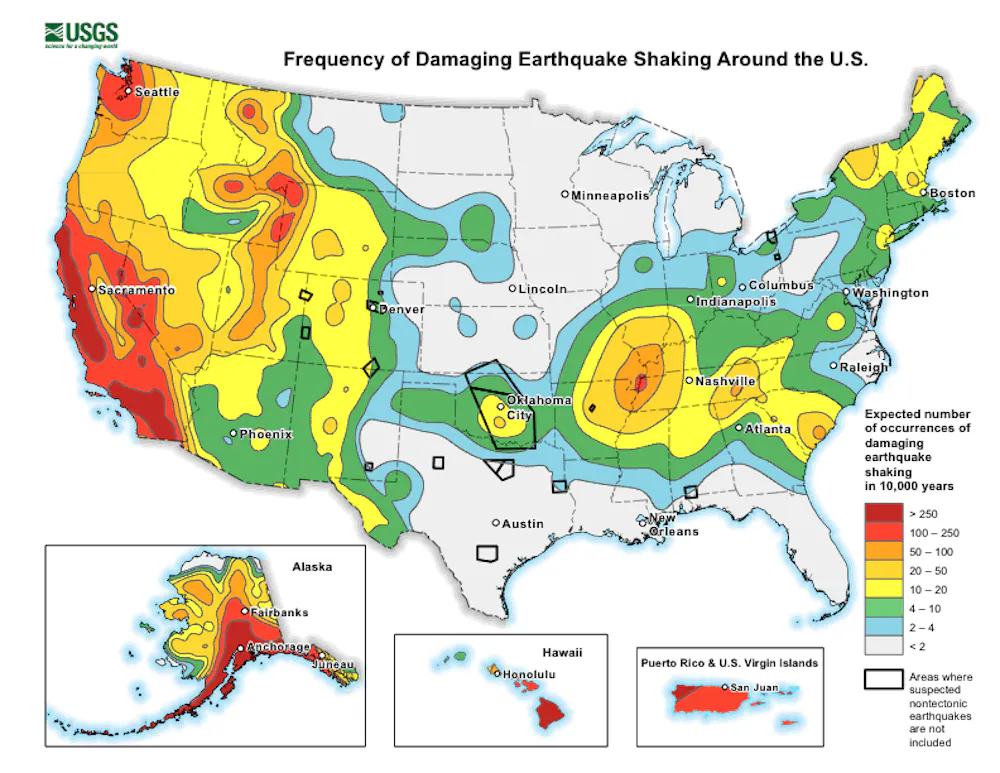
First, seismologists and earthquake engineers at the U.S. Geological Survey, or USGS, produce the National Seismic Hazard Model. These maps, based on research into earthquake sources such as faults and how seismic waves move through the earth’s crust, are used to determine the forces that structures in each community should be designed to resist.
A steering committee of earthquake experts from the private sector and universities works with USGS to ensure that the National Seismic Hazard Model implements the best available science.
In this 2023 update of the national seismic risk map, red areas have the greatest chance of a damaging earthquake occurring within 100 years. USGS
Second, the Federal Emergency Management Agency, FEMA, supports the process for periodically updating building codes. That includes supporting the work of the National Institute of Building Sciences’ Provisions Update Committee, which recommends building code revisions based on investigations of earthquake damage.
More broadly, FEMA, the USGS, the National Institute of Standards and Technology and the National Science Foundation work together through the National Earthquake Hazards Reduction Program to advance earthquake science and turn knowledge of earthquake risks into safer standards, better building design and education. Some of those agencies have been threatened by potential job and funding cuts under the Trump administration, and others face uncertainty regarding continuation of federal support for their work.
It is in large part because of the National Seismic Hazard Model and regularly updated building codes that U.S. buildings designed to meet modern code requirements are considered among the safest in the world, despite substantial seismic hazards in several states.
This paradigm has been made possible by the technical expertise and lack of political agendas among the federal staff. Without that professionalism, we believe experts from outside the federal government would be less likely to donate their time.
These programs and the federal agencies supporting them have benefited from a high level of staff expertise because hiring and advancement processes have been divorced from politics and focused on qualifications and merit.
This has not always been the case.
For much of early U.S. history, federal jobs were awarded through a patronage system, where political loyalty determined employment. As described in “The Federal Civil Service System and The Problem of Bureaucracy,” this system led to widespread corruption and dysfunction, with officials focused more on managing quid pro quo patronage than governing effectively. That peaked in 1881 with President James Garfield’s assassination by Charles Guiteau, a disgruntled supporter who had been denied a government appointment.
The passage of the Pendleton Act by Congress in 1883 shifted federal employment to a merit-based system. This preference for a merit-based system was reinforced in the Civil Service Reform Act of 1978. It states as national policy that “to provide the people of the United States with a competent, honest, and productive workforce … and to improve the quality of public service, Federal personnel management should be implemented consistent with merit system principles.”
The shift away from a patronage system produced a more stable and efficient federal workforce, which has enabled improvements in many critical areas, including seismic safety and disaster response.
Merit-based civil service matters for safety
While the work of these federal employees often goes unnoticed, the benefits are demonstrable and widespread. That becomes most apparent when disasters strike and buildings that meet modern code requirements remain standing.
A merit-based civil service is not just a democratic ideal but a proven necessity for the safety and security of the American people, one we hope will continue well into the future. This can be achieved by retaining federal scientists and engineers and supporting the essential work of federal agencies.
Jonathan P. Stewart has received funding from NSF and USGS. He is the chair of the Steering Committee for the National Seismic Hazard Model, a member of the National Institute of Building Sciences’ Provisions Update Committee, and a member of the federal Advisory Committee for Earthquake Hazard Reduction (ACEHR). His contributions to this article draw upon his experience and do not reflect the views of the Steering Committee, Provisions Update Committee, or ACEHR.
Lucy Arendt has received funding from NSF and the Applied Technology Council. She is a member and current chair of the federal Advisory Committee for Earthquake Hazard Reduction (ACEHR). Her contributions to this article reflect her professional expertise and do not reflect the views of ACEHR.
European Parliament resolution on the targeted attacks against Christians in the Democratic Republic of the Congo: defending religious freedom and security
–having regard to its previous resolutions on the Democratic Republic of the Congo (DRC),
–having regard to the UN Report of the Mapping Exercise documenting the most serious violations of human rights and international humanitarian law committed within the territory of the Democratic Republic of the Congo between March 1993 and June 2003, of August 2010,
–having regard to UN Security Council Resolution 2773 (2025) of 21 February 2025 on the situation concerning the Democratic Republic of the Congo,
–having regard to the Partnership Agreement between the European Union and its Member States, of the one part, and the Members of the Organisation of African, Caribbean and Pacific States, of the other part[1](the Samoa Agreement),
–having regard to the African Charter on Human and Peoples’ Rights, which was adopted on 27 June 1981 and entered into force on 21 October 1986,
–having regard to the Constitution of the Democratic Republic of the Congo, adopted on 18 February 2006,
–having regard to the Universal Declaration of Human Rights,
–having regard to the Charter of the United Nations,
–having regard to Rule 136(2) of its Rules of Procedure,
A.whereas there has been a deterioration in the security situation in the eastern DRC over the past year, with different armed groups, and at times government soldiers, committing widespread violence, unlawful killings and other grave abuses, putting civilians at great risk;
B.whereas the UN Group of Experts, established pursuant to UN Security Council Resolution 1533 (2004), estimates that between 3 000 and 4 000 Rwandan army troops are on the ground in the DRC, and considers that the deployment of the Rwanda Defence Force violates the sovereignty and territorial integrity of the DRC, and that Rwanda’s de facto control and direction over M23 operations also renders Rwanda liable for the actions of M23;
C.whereas the World Religion Database estimates that 95.1 % of the population in the DRC is Christian, 1.5 % is Muslim and 2.5 % has no religious affiliation; whereas the Constitution of the DRC provides for freedom of religion and prohibits discrimination based on religious belief;
D.whereasa group referred to as the Allied Democratic Forces (ADF), with links to the Islamic State,has reportedly carried out continued indiscriminate attacks against civilians in North Kivu and Ituri Provinces, on occasion targeting churches and religious leaders; whereas such violence targets all communities, but most victims have been Christian, belonging to the religious majority;whereas the deaths of at least 849 men, women and children were attributed to the ADF in North Kivu and Ituri Provinces in 2020, according to the UN Joint Human Rights Office in the DRC; whereas the ADF allegedly also carried out an attack on a church baptism in Kasindi, North Kivu Province in February 2023, killing 16 and injuring at least 62, as well as different attacks on villages in North Kivu in March 2023, killing more than 83 civilians, including children;
E.whereas, since 2015, the ADF has released increasing amounts of propaganda that reflect the group’s ‘ideological alignment with the Islamic State’, including, among other objectives, ‘an increased focus on efforts to kill non-Muslim civilians’, according to the Center for Strategic and International Studies; whereas both local Christian and Muslim leaders, with vocal support from the government, have again condemned the ADF’s attacks on civilians;
F.whereas the UN and the DRC had agreed on the withdrawal of the UN Organization Stabilization Mission in the DRC (MONUSCO) in mid-2024, leading to a degradation of the security situation and affecting civilians, who were left exposed to human rights abuses by state security forces and armed actors;
G.whereas the DRC has one of the highest rates of internal displacement in the world; whereas many women and children live in precarious conditions and are being exposed to the risk of harassment, assault or sexual exploitation; whereas displaced populations often receive no basic life-saving services and are at risk of malnutrition and disease; whereas cities that host internally displaced people in precarious circumstances are also targets of attack by different militias, causing great distress to the displaced communities and to the local population;
H.whereas state authorities and rebel groups have obligations to civilians under international humanitarian law, including protecting and facilitating access to humanitarian assistance, and permitting freedom of movement;
I.whereas the International Criminal Court (ICC) investigations in the DRC have focused on alleged war crimes and crimes against humanity committed mainly in the eastern DRC, in the Ituri region and the North and South Kivu Provinces, since 1 July 2002; whereas the DRC made a second referral in May 2023 concerning alleged crimes committed in North Kivu since 1 January 2022;
1.Is concerned by the humanitarian and security situation in the DRC and the findings in the recent reports of the UN Group of Experts established pursuant to Security Council Resolution 1533 (2004), and fully supports the reports’ recommendations;
2.Welcomes the Council’s decision on 17 March 2025[2]to impose restrictive measures on nine individuals and one entity responsible for acts that constitute serious human rights violations and abuses in the DRC and for sustaining the armed conflict, instability and insecurity in the DRC and exploiting the armed conflict through the illicit exploitation or trade of natural resources;
3.Commends the announcement of the ICC Prosecutor that the ICC will continue to investigate alleged crimes committed by any person, irrespective of affiliation or nationality; is highly concerned about the fragile situation of the ICC, noting that this fragility is already undermining the ICC’s crucial work to bring justice to victims of the most serious crimes worldwide; reiterates the EU’s unwavering support for the ICC and calls on the European Council and the Commission to fulfil their obligations to ensure the functioning and effectiveness of the ICC;
4.Calls on the Commission to continue supportinganti-corruption efforts and strengthening governance in the DRC; stresses the primary responsibility of the Government of the DRC to ensure security in its territory and protect its civilians, while respecting the rule of law, international human rights law and international humanitarian law;
5.Welcomes the special session of the UN Human Rights Council of 7 February 2025 on the human rights situation in the east of the DRC; supports the establishment of an independent commission of inquiry into serious violations committed since January 2022;
6.Reiterates its condemnation of hate speech, xenophobia, ethnic-based politics, and attacks on religious freedom; underlines that all those responsible for sustaining armed conflict, instability and insecurity in the DRC must be held accountable;
7.Recalls that human rights violations are being used as a weapon of war and that the vast majority of attacks against civilians in the DRC are not motivated by religion but are most often committed on ethnic, political, terrorist or financial grounds;
8.Calls upon the relevant parties to provide a safe environment for civil society organisations and human rights defenders to enable them to carry out their work freely;
9.Calls on the Government of the DRC to implement the recommendations of the 2010 Mapping Report, particularly regarding security sector reforms, the strengthening of institutions and the rule of law, the fight against corruption, and regional cooperation efforts for the arrest and prosecution of perpetrators of serious crimes;
10.Urges neighbouring states of the DRC to withdraw their troops, to cease all military activities on the soil of the DRC, unless expressly invited to conduct such activities by the Government of the DRC, and to stop their support to armed groups; emphasises that incursions by certain actors in the region, such as the Rwandan forces and M23, further destabilise the DRC by forcing the its army to engage on multiple fronts, making it more difficult to combat armed and terrorist groups;
11.Calls for a quick resumption of negotiations within the Luanda Process to find a lasting, peaceful and political solution, and urges all sides to fully honour their engagements within the Luanda Process, specifically the ceasefire agreed on 30 July 2024, the neutralisation of theDemocratic Forces for the Liberation of Rwandaand M23 rebel groups, and the withdrawal of Rwandan forces from the territory of the DRC; calls for the EU to have an active role in the diplomatic efforts to de-escalate the conflict, advocating for an immediate ceasefire and a renewed commitment to dialogue, with the protection of civilians at the core of negotiations, in particular women and children;
12.Deplores the fact that fighting and the shelling of medical infrastructure in and around Goma has severely limited the delivery of humanitarian aid to those in need;
13.Calls on all countries neighbouring the DRC, in particular Rwanda, to facilitate access of humanitarian equipment and personnel to all areas occupied by the rebels groups in the eastern DRC, including through the reopening of Goma airport and of borders;
14.Calls on the Commission to suspend the EU-Rwanda Memorandum of Understanding on sustainable raw materials value chains, put a halt to any plans to support any mining projects in Rwanda, put in place a trade embargo on all minerals imported from Rwanda into the EU and an export ban on weapons from the EU to Rwanda, and suspend any further military and security assistance to Rwanda until the territorial integrity of the DRC is restored; calls on the Commission to proactively engage with Rwanda’s main partners to ensure coordinated action;
15.Calls for the Government of the DRC and its international partners, including the EU, to establish new monitoring mechanisms for the implementation of the Peace, Security and Cooperation Framework for the DRC and the region, signed in Addis Ababa;
16.Deplores the fact that Rwanda announced the termination of its diplomatic relations with Belgium, and expresses its solidarity with Belgium;
17.Instructs its President to forward this resolution to the Council, the Commission, the Vice-President of the Commission / High Representative of the Union for Foreign Affairs and Security Policy, the Government and Parliament of the Democratic Republic of the Congo, the African Union, the secretariats of the United Nations Organization Stabilization Mission in the Democratic Republic of the Congo, the Southern African Development Community and the East African Community, and other relevant international bodies.
Source: United States Bureau of Alcohol Tobacco Firearms and Explosives (ATF)
ALBANY, NEW YORK – Jesse Taber, age 46, of Rotterdam, New York, was sentenced today to 27 months in federal prison for unlawfully possessing a shotgun. United States Attorney John A. Sarcone III and Bryan Miller, Special Agent in Charge of the New York Field Division of the United States Bureau of Alcohol, Tobacco, Firearms, and Explosives (ATF), made the announcement.
As part of his prior guilty plea, Taber admitted that on December 26, 2023, inside of his Rotterdam residence, he possessed a 12-gauge Stoeger Coach Gun shotgun. Taber further admitted that he has three prior felony convictions in New York that prevent him from lawfully possessing any firearms.
United States District Judge Mae A. D’Agostino also imposed a three-year term of supervised release to begin after Taber is released from prison.
ATF investigated the case with the assistance of the Rotterdam Police Department. Assistant U.S. Attorney Rick Belliss prosecuted the case.
Project Safe Neighborhoods (PSN) is the centerpiece of the Department of Justice’s violent crime reduction efforts. PSN is an evidence-based program proven to be effective at reducing violent crime. Through PSN, a broad spectrum of stakeholders work together to identify the most pressing violent crime problems in the community and develop comprehensive solutions to address them. As part of this strategy, PSN focuses enforcement efforts on the most violent offenders and partners with locally based prevention and reentry programs for lasting reductions in crime. For more information about Project Safe Neighborhoods, please visit https://www.justice.gov/psn.
Effie Kisgeropoulos Discusses Her Early Scientific Inspiration and Journey to Electron Paramagnetic Resonance Spectroscopy
As a young girl, Effie Kisgeropoulos dreamed about the endless universe of constellations. Photo from Effie Kisgeropoulos, NREL
Lying on the grass in Canton, Ohio, a young Effie Kisgeropoulos studied constellations with her eyes and later through her telescope, dreaming about the mechanisms of faraway celestial bodies.
Little did the future National Renewable Energy Laboratory (NREL) researcher know that her budding scientific gaze would later turn to something closer to home: orbiting subatomic particles in microscopic structures.
The ability to translate perspectives between different worlds might be her superpower—although this superpower has come with its challenges. Yet Kisgeropoulos has persisted through all the uphill climbs, maintaining her joy of learning.
Kisgeropoulos was homeschooled for most of her childhood, and she benefited from a framework that empowered her to absorb knowledge and ask questions. Looking back, the ease with which Kisgeropoulos moved through primary education was perhaps unsurprising given her much later diagnosis with attention-deficit/hyperactivity disorder (ADHD). She thrived in the home setting where learning was fun, engaging, and flexible. But when it was time to begin her university honors program, Kisgeropoulos’ success at home became a struggle to maintain. Her passion for exploring new ideas came under serious doubt.
Although Kisgeropoulos struggled at first, she persevered through trial and error and by embracing new opportunities. Her path at NREL began with a postdoctoral position that employed her passion for using electron paramagnetic resonance (EPR) spectroscopy to decipher the subatomic interactions that dictate our world.
Kisgeropoulos is now a full-time researcher in NREL’s Biosciences Center, responsible for helping manage the Advanced Spin Resonance Facility (ASRF), which houses the EPR equipment. This facility helps illuminate the subatomic workings of chemical reactions, like those that sustain photosynthesis or enable light-driven ammonia production and hydrogen catalysis.
In this interview (edited for length and clarity), Kisgeropoulos discusses her contagious enthusiasm for science, her unique journey to NREL, and her passion for all things EPR.
You have an interesting upbringing that isn’t familiar to many people. Can you talk about that and how it was a factor in your embrace of science?
My mom homeschooled my sister and I until mid-high school. During our elementary years, she taught us for two days and worked the other three, when my dad—who worked midnights—would help.
Around this time, I fell in love with astronomy and spent countless hours poring over star maps and gazing at constellations. I even got a small telescope! It kick-started my obsession with science fiction and, later, theoretical physics.
Kisgeropoulos, as a child, gazes through her new telescope. Photo from Effie Kisgeropoulos, NREL
Homeschooling allowed me a certain freedom in how I assimilated information. I could work on my lessons while barefoot and sitting cross-legged on the floor, make as much noise as I wanted, go at my own pace. I was unencumbered by the classical rules of school.
Later when my parents separated, my mom juggled multiple jobs while still maintaining our education. Watching all this, I also learned a lot about hard work and perseverance. I wasn’t diagnosed with ADHD until 29, so these qualities—and the love of learning I grew up with—were vital to me navigating undergrad and then a Ph.D. without any context for why I had different needs than my peers.
Kisgeropoulos (right) and her sister, Sophia (left), pose in front of their school project—sprouting seeds from plants. Photo from Effie Kisgeropoulos, NREL
Can you tell me about your transition from homeschooling to the university world?
My science obsessions led me to join the honors program at Kent State University with a plan outlined by my guidance counselor: a bachelor’s in physics; grad school for astrophysics. Once classes started, a harsh reality formed. Many students are challenged during the transition to college, but I wasn’t aware of the unique challenges that came with a neurodivergent brain.
Tougher coursework meant I had to study in earnest, but sitting alone for hours in the library to accomplish this was a strange experience. It would take me significant time to clear my mind of distractions before I could fully immerse myself in a task. Although I had experience with self-directed learning, my skills began failing me in this demanding and unfamiliar college environment.
It was a disheartening first couple of years. I had been excellent at math, but I did poorly in calculus. I did okay in Physics I, but I dropped Physics II twice because it wasn’t clicking. The irony is the stuff in Physics II—like circuits, electricity, and magnetism—are foundations to some of what I do now at NREL.
So, how did you adjust?
The end of sophomore year was my worst. I wanted to study the stars, but I just couldn’t make the connections in my coursework. At around the same time, we found out my mom had breast cancer. It really impelled me, and I switched majors to biotech. I thought a more industry-focused degree would help with getting a job, if I needed to take care of my sister, and I hoped it would lead me to work in cancer research to help patients like my mom.
With the switch, I started to excel in my classes again. In Intro Biochem, I learned about enzyme pathways in cells. It was like a puzzle, mapping them all out. In some ways, it felt like mapping out the stars. I was becoming fascinated with microscopic biological and chemical mechanisms that I had no idea about. My fire for learning came back. And as I approached graduation, my mom cleared her cancer!
That’s wonderful. So at that point, you were on the path to a Ph.D. in biochem at The Ohio State University (OSU)?
Yeah. I was thrilled when I was offered a spot. I started with three different lab rotations: mouse models of cancer, yeast genetics, and spectroscopy. Although I was still invested in cancer research, I enjoyed the approach of spectroscopy the most, which was in the lab of a new OSU professor, Hannah Shafaat. And in the end, I was still awarded a fellowship for the connection of my work to cancer research!
My work at OSU involved applying advanced pulse EPR spectroscopy to biological systems. Before even developing these experiments, we needed to characterize the systems using a more common type of EPR: continuous wave (CW). At the time, the EPR capabilities we needed weren’t available at OSU. Instead, we would drive four hours roundtrip to Miami University and collect data for 10, 12 hours.
This was where I became mesmerized by the EPR process. There’s this giant magnet with a sample in the middle that’s cooled to 5 Kelvin, and then microwaves are shot at it. It’s so metal! The resulting data were beautiful. You’re investigating a signal that looks like a child’s drawing and translating it to give information on interactions happening at the electron level.
So, when were you able to work primarily with pulsed EPR?
During my fourth year, we shifted to pulsed EPR techniques, which use microwaves shot in pulses rather than continuously. Using pulses unlocks a whole new dimension of capabilities, especially manipulating electron spins to acquire different, higher-resolution information. But pulsed EPR demands a higher level of theory and understanding to run an experiment, let alone troubleshoot one or customize it to the sample.
I was applying pulsed EPR to proteins to answer questions about their electronic structure and function. This work was like what I do here at NREL in Paul King’s (Physical Biochemistry and Photosynthesis) group, except now I investigate how this reactivity is controlled and tuned into very complex redox enzymes.
Good segue to becoming a postdoc at NREL. I imagine your experience with pulsed EPR had a lot to do with you coming here?
Honestly, I struggled with the motivation to do research or become a professor. When I started EPR, my research interest sparked a bit, but I wasn’t sure how to do EPR at a private company. And then my OSU lab partner, Tasha Manesis, sent me a link for an NREL postdoctoral position in the Physical Biochemistry and Photosynthesis group. I read the job description and was ecstatic they wanted someone to study redox enzymes using pulsed EPR!
Postdoctoral researcher Effie Kisgeropoulos poses in 2022 by an MBraun anaerobic chamber at NREL’s Science and Technology Facility. This type of equipment allows researchers to work with the oxygen-sensitive proteins and enzymes that are involved in many of nature’s important energy conversion reactions and pathways. Photo by Werner Slocum, NREL
Another bit of serendipity. How was the postdoc experience here at NREL?
Right after they hired me, COVID-19 happened. COVID-19 protocols made lab interactions challenging and training and team-building difficult. Once the protocols loosened, this all improved, and we added some new postdocs that quickly became great friends of mine. My relationship with Paul, my group manager and principal investigator, also really began to develop. These working relationships, and the willingness everyone showed to put effort into making them better, were a large reason why I stayed at NREL.
How was the transition from postdoc to full-time researcher?
Getting an NREL staff position doing what I love felt validating, a recognition of my contributions to the team. It also really brought me a sense of permanence. Even though six years in graduate school was a long time, it always had an end date. With this transition, I experienced a sense of investment in my work that I never felt before.
Kisgeropoulos works with cell culture media containing ferredoxin proteins in the Research and Innovation Laboratory at NREL. These proteins are important for understanding the control electron transfer reactions in the photosynthetic cyanobacteria Synechocystis sp. PCC 6803 and will be studied using techniques like EPR once they are purified from the media. Photo by Kaylee Weatherly, NREL
What are your responsibilities as a biological EPR spectroscopist?
I continue to build upon my postdoc work, contributing to research projects under Paul on photosynthetic energy transduction and mechanisms of photochemical nitrogen reduction. Both are funded by the U.S. Department of Energy’s Office of Science Basic Energy Sciences program.
I also took on safety-representative duties for our lab space and have an official role helping David Mulder manage and operate the ASRF, which houses the EPR equipment. David and I developed an approach for scheduling on the CW EPR, helping maintain access for all users amid high demand for instrument time. I also help train new EPR users and advise on project data collection, interpretation, and analysis.
NREL researchers (from left) Paul King, Effie Kisgeropoulos, and David Mulder talk in front of the electron paramagnetic resonance spectrometer in NREL’s Advanced Spin Resonance Facility in Golden, Colorado. Photo by Gregory Cooper, NREL
So, why does this new role and the Advanced Spin Resonance Facility at NREL excite you so much?
Most institutions operate one CW EPR at a single microwave frequency (commonly X-band). But at NREL, we have an incredible breadth of EPR capabilities in one place: CW EPR, pulsed EPR, both X-band and Q-band microwave frequencies, equipment to produce shaped pulses, the ability to incorporate radio waves and do EPR-detected nuclear magnetic resonance, and all using helium gas in a cryogen-free system to obtain super cold temperatures. All these capabilities are the perfect playground for me to explore and grow with.
There’s also a tremendous amount of expertise here applying EPR to understand highly complex enzymatic functions, like nitrogen fixation to ammonia or hydrogen generation from protons and electrons. There’s a great foundation to build from and use my understanding of pulsed EPR to advance the research.
Pulsed EPR, and really EPR in general, is such a powerful tool for obtaining targeted information on the movement, properties, and local environments of electrons, whether they exist as radicals, in defects, or on metal clusters. It’s highly applicable across a large swathe of research disciplines, from biology to materials—even brewing beer, although that’s not really in the NREL mission space. I’d like to continue to improve the experience of our core user group and expand the reach of the ASRF across NREL.
Okay, one last question. If you had the power to make one change in the world, what would it be?
Oh, tough, it’s hard to articulate, but I’d make empathy and compassion abundant. Through all my challenges, I’ve come out of it with a different appreciation for people. We’re all flawed, but people are also surprisingly great. I think it’s important to listen to what others are saying and consider how they might be feeling, the milieu that could be contributing to the actions they take.
I try to always remember this, and I would want to make the changes necessary so everyone could feel safe enough and empowered to extend this kind of empathy and compassion to each other. I think it would help the world a lot.
Learn more about NREL’sbioscience researchand theAdvanced Spin Resonance Facility.
HARRISBURG – The United States Attorney’s Office for the Middle District of Pennsylvania announced that David Gladden, age 46, of Harrisburg, Pennsylvania, was indicted by a federal grand jury with four counts of possession with intent to distribute controlled substances, two counts of possession of a firearm in furtherance of drug trafficking, and two counts of possession of firearms in furtherance of drug trafficking.
According to Acting United States Attorney John C. Gurganus, the indictment alleges that on August 21, 2021, Gladden possessed with the intent to distribute 28 grams of crack cocaine and additional quantities of cocaine. The indictment also alleges that on September 11, 2023, Gladden possessed with the intent to distribute 28 grams of crack cocaine and additional quantities of cocaine and marijuana; possessed a firearm in furtherance of drug trafficking; and possessed a firearm as a felon. Additionally, the indictment alleges that on March 7, 2024, Gladden possessed with the intent to distribute 100 grams of PCP, 28 grams of crack cocaine and additional quantities of cocaine. The indictment further alleges that on July 30, 2024, Gladden possessed with the intent to distribute 28 grams of crack cocaine and additional quantities of cocaine and marijuana; possessed a firearm in furtherance of drug trafficking; and possessed a firearm as a felon.
This case is part of Operation Take Back America, a nationwide initiative that marshals the full resources of the Department of Justice to repel the invasion of illegal immigration, achieve the total elimination of cartels and transnational criminal organizations (TCOs), and protect our communities from the perpetrators of violent crime. Operation Take Back America streamlines efforts and resources from the Department’s Project Safe Neighborhood (PSN).
The case was investigated by the Bureau of Alcohol, Tobacco, Firearms and Explosives; the Harrisburg Police Department; the Pennsylvania State Police; and the Susquehanna Police Department. Assistant U.S. Attorney Scott Ford is prosecuting the case.
Gladden faces a maximum penalty of life imprisonment, a term of supervised release following imprisonment, and a fine. A sentence following a finding of guilt is imposed by the Judge after consideration of the applicable federal sentencing statutes and the Federal Sentencing Guidelines.
Indictments and Criminal Informations are only allegations. All persons charged are presumed to be innocent unless and until found guilty in court.
Entire communities in central Myanmar have been devastated and the full scale of the earthquake disaster “remains unclear”, the UN’s top humanitarian coordinator in the countrysaid on Monday.
Humanitarian and Resident Coordinator Marcoluigi Corsi expressed the UN’s profound sorry at the immense loss of life stemming from Friday’s 7.7 and 6.4 magnitude quakes with the death toll rising to around 2,000, according to the country’s military junta.
“The latest reports indicate significant loss of life, widespread injuries, and many still unaccounted for as rescue operations continue,” Mr. Corsi said in a statement on behalf of the UN Country Team.
Urgent support operation continues
He stressed that the UN and partners continue to urgently mobilise in support of the emergency response, standing ready to assist all communities “wherever they are”.
The earthquakes struck near Mandalay and Sagaing, with impacts felt across Bago, Magway, Nay Pyi Taw, and parts of Shan State. Hospitals are overwhelmed, while communication and transport routes have been severely disrupted.
Thousands are sleeping in the open, fearful of aftershocks and unable to return to damaged homes.
UN-facilitated rescue teams from around 20 countries, including sniffer dogs, paramedics and medical supplies, supported by millions of dollars in aid, continue to arrive in Myanmar – where millions were already displaced by civil war, arising from the military coup of February 2021.
Resilience further eroded
“Even before this earthquake, nearly 20 million people in Myanmar were in need of humanitarian assistance,” Mr. Corsi emphasized. “This latest tragedy compounds an already dire crisis and risks further eroding the resilience of communities already battered by conflict, displacement, and past disasters.”
The UN Humanitarian Country Team is actively conducting rapid needs assessment missions in coordination with UN agencies, humanitarian partners, local authorities and community-based organizations, paying particular attention to the needs of women, children, the elderly, and people with disabilities, who are disproportionately affected in such disasters.
“Beyond the immediate response, this crisis highlights the urgent need to strengthen efforts towards recovery and to invest in measures that help communities withstand future shocks,” Mr. Corsi said.
Significant UN presence
An initial $15 million in emergency funds has been allocated by the UN to support the lifesaving response. Medical teams, shelter materials, and critical water, sanitation and hygiene (WASH) items are arriving – alongside prepositioned and supplementary food aid.
“We have a significant presence in Mandalay and surrounding areas, and we are doing everything we can to reach people in need despite serious logistical challenges,” Mr. Corsi said. “But much more will be required in the days and weeks ahead.”
More than ever, timely support is critical to prevent further deterioration of the crisis, he added.
The World Food Programme (WFP) reported that it aims to support 100,000 of the worst hit with ready-to-eat meals, following by food and cash-for-food assistance to around 800,000 for the next month.
WFP Myanmar/Chit Min Htet
Severe damage to Naypyidaw’s road infrastructure following the earthquake in Myanmar.
“The earthquake has laid bare the deeper vulnerabilities facing Myanmar’s people and underscored the need for sustained international attention to the broader crisis.”
Referencing the ongoing conflict which has seen military forces lose control of a majority of the country to opposition armed groups amid brutal fighting and airstrikes, she said that “all sides must urgently allow space for humanitarian relief and ensure that aid workers can operate in safety.”
Continuing military operations in quake-affected areas “risks further loss of life and undermines the shared imperative to respond,” she continued.
Ms. Bishop called for an immediate ceasefire by all parties, to prioritise the rescue, aid and recovery effort, including protection of civilians.
She said she was in close contact with Emergency Relief Coordinator Tom Fletcher and the UN Country Team in Myanmar who are working in partnership with neighboring countries and others, supported by the UN’s regional and global network.
Wildfires continue to burn in Georgia, North and South Carolina
Burn bans remain in effect for North and South Carolina, where multiple wildfires have caused road closures and evacuations. Dry conditions and downed trees from Hurricane Helene have fueled the fires.
Los Angeles, CA, March 31, 2025 (GLOBE NEWSWIRE) — Credtent, Inc., a leader in ethical AI and content licensing, has independently assessed the AI training value of Studio Ghibli’s intellectual property at $17 to 20 million annually for enterprise AI platforms. This third-party evaluation underscores the importance of fair compensation for creators whose unique styles are often used in generative AI tools without consent or compensation.
Credtent’s Official CVE for Studio Ghibli
The studio is admired the world over for their award-winning and distinctive films like My Neighbor Totoro, Princess Mononoke, and Kiki’s Delivery Service. The company’s iconic founder, Hayao Miyazaki, has expressed disdain for AI art before, calling it “an assault on life itself.” With Ghibli-styled memes flooding the Internet this last week, fans have complained about the unauthorized use of the studio’s work.
Credtent’s Director of Creator Outreach, Deborah Drake, emphasized the need for respect and collaboration between artists and AI tools, stating, “Artists and technologists think about creative work differently. What is art to creatives is just data to AI companies. As a neutral utility, we enable them both to find common ground with opt-out options and fair-market license pricing.”
Drawing on more than a decade of experience setting industry standards for the value of content and earned media, Credtent’s team calculates pricing for AI training data based on a cross-section of factors grounded in scientific first principles set by the company’s Chief Science Officer, Dr. Galen Buckwalter. Using publicly available data and its expertise in pricing content, Credtent assessed this value to highlight the importance of creative consent.
“The studio could command multi-million dollar pricing from AI companies if they licensed their work for random meme creation,” said Credtent CEO Eric R. Burgess. “But if they feel, as I do, that a gorgeous film like Spirited Away is devalued by random AI slop in its style, their company’s and their artists’ names should be restricted from generative AI prompting.”
Guardrails like these are already in place for many artist names on most Large Language Models (LLMs). They are just not applied to all artists who don’t want their work exploited. “That’s why we built Credtent – to track opt-out requests and licensing across the AI industry for artists and creators of all types,” added Burgess. The company offers creators the ability to opt-out of AI training in one place. Their list is available to all AI companies to ensure respect for creative consent.
Starting in Q2 2025, artists can also license their work to earn revenue through Credtent’s Training Data Marketplace. Thousands of creators have already registered their diverse works, including books, albums, podcasts, music, photos and art, and more to opt-out or for licensing. They will benefit from the highest pay rates in the industry because Credtent is a certified Public Benefit Corporation with plans to deliver 85% of licensing revenue to creators.
“Credtent’s goal is to orchestrate relationships between AI and creative people without stifling innovation,” said Burgess. “We want to support creative people thriving in the Age of AI, while also helping AI companies use credible, licensed content that protects them from lawsuits for copyright infringement and inaccuracy claims.”
Credtent’s commitment to ethical AI is further shown through their certified Ethical Sourcing Badges. These badges are awarded to companies that respect creative rights and undergo regular audits in partnership with Credtent. This initiative helps LLM customers feel confident about using outputs without worrying about copyright violations. Last year, Credtent also introduced Creative Origin Badges to enable creative people to be transparent about their use of AI so audiences can make their own choice about supporting AI-composed content, AI-Assisted work, or creative work that is entirely human-composed.
Open Enrollment for Credtent’s free licensing option is available until July 31st and lifetime Opt-Out requests are free through December 31st. For more information, visit Credtent’s website.
Credtent’s Ethical Sourcing Badges for LLMs that subscribe to the platform.
About Credtent, Inc.
Credtent is a Public Benefit Corporation that enables creators to exclude their work or profit from AI by setting fair licensing terms for responsible companies seeking credible, unbiased training data. We issue Content Origin and Sourcing Badges, and help AI companies make better decisions about the content they use to train their models.
Press inquiries
Credtent, Inc. https://www.credtent.org Carmen Sinata hello@credtent.org 626-600-1226 1822 E. Route 66, Ste. A353 Glendora, CA 91740
Headline: Threat of system shock remains for Alberta electricity market, with ‘hurricane brewing’ amid current calm
“The calm in Alberta’s electricity market will be related to how much new demand we allow to connect to the system in the very near future,” said Vittoria Bellissimo, CEO of the Canadian Renewable Energy Association. Read more.
The post Threat of system shock remains for Alberta electricity market, with ‘hurricane brewing’ amid current calm appeared first on Canadian Renewable Energy Association.
Source: The Conversation (Au and NZ) – By Adam Frew, Lecturer in Mycorrhizal Ecology, Hawkesbury Institute for the Environment, Western Sydney University
If you’re walking outdoors, chances are something remarkable is happening under your feet. Vast fungal networks are silently working to keep ecosystems alive.
These fungi aren’t what you might picture. They are not mushrooms, or brightly coloured growths on tree trunks. Arbuscular mycorrhizal (AM) fungi look like spools of thread wrapped around plant roots.
What makes these fungi remarkable is the deal they struck almost half a billion years ago with another kingdom of life – plants.
AM fungi make threads of hyphae thinner than spider silk and weave them through plant roots. Then, they begin to trade, offering plants water and phosphorus, a vital plant nutrient in soils. In return, plants offer carbon-rich sugars and fats from photosynthesis. Fungi can’t photosynthesise, but plants can.
This symbiotic relationship can help plants survive periods of drought and live in nutrient poor soils. More than 80% of all plant families rely on these fungi, while AM fungi cannot live without plants.
Without these fungi, many of Australia’s plants — and the soil they grow in — would be in real trouble. Our continent is ancient, dry, and nutrient-poor. But while we monitor the fate of plants and animals in response to human impact and climate change, we haven’t been tracking the fungi who support it all. We don’t even know how many species there are, let alone if we’re losing them.
To help fill this gap, I have developed the first dedicated database recording species and distributions of AM fungi in Australia – AusAMF.
The underground economy of roots and filaments
AM fungi deserve to be better known. These essential companions to most of the world’s plants maintain plant diversity, suppress invasive species, store carbon, cycle nutrients and prevent soil erosion.
Here are five remarkable things about AM fungi:
1. They’re older than roots
Incredibly, this fungus-plant symbiosis emerged before plants evolved roots some 360–420 million years ago.
AM fungi have been around for 475 million years, partnering with very early land plants such as the ancestors of today’s liverworts – which have no roots. This ancient alliance actually helped plants colonise land.
2. They can boost native plants and reject invasives
AM fungi do more than transport nutrients, carbon and water. They shape entire plant communities. Some plants benefit more than others, influencing competition and species co-existence. By giving some species a competitive edge, AM fungi allow some plants to survive which might otherwise be lost.
When AM fungal diversity declines, it can lead to a loss of native plants and open the door to invasive plant species.
But with the right management — such as reducing pesticides or reintroducing locally adapted fungi — AM fungi can boost plant nutrition and ecosystem restoration. They can help native vegetation recover and stop invasive species from gaining a foothold.
3. They run an invisible underground economy
The fungi-plant trade is more organised than you might think.
In some instances, plants reward the fungi giving them the most phosphorus with more carbon, while the fungi prioritise plants offering them the most carbon – a bit like a marketplace. Some plants have figured out how to cheat the fungi, taking resources without giving anything in return.
This high-magnification video shows water and nutrients flowing inside the hyphae of the AM fungus Rhizophagus irregularis. Source: Oyarte Galvez et al. (2025) Nature
4. They boost plant defences against pests and disease
Fungi don’t just help plants grow, they help them fight. As AM fungi colonise a plant’s roots, they boost its defences against threats such as diseases and plant-eating insects by strengthening and speeding up chemical responses. My research shows the size of this fungal-defence boost for plants can depend on what AM fungi are present.
And if one plant is attacked, it puts out chemical signals which can move through the fungal network and let other plants know to ready their defences.
5. They take in vast amounts of carbon
Plants take carbon from the atmosphere and store it in their leaves, roots and wood. But AM fungi store carbon from plants too.
Because mycorrhizal fungi are found wherever there are plants, their underground networks are vast – and so is their carbon impact. Recent research estimates the annual figure is more than a third of global fossil fuel carbon emissions.
Vitally important, all but unknown
If AM fungi vanished, many plant species would likely follow suit. Others would become more vulnerable to drought, disease, and pests. Soil would erode more easily, and nutrient and carbon flows would shift dramatically.
Are they in trouble? We don’t know. AM fungi are out of sight, out of mind. No federal or state government agency seem to be tracking them. Our current National Soil Action Plan doesn’t mention fungi at all, despite their importance to soil health.
Other than Antarctica, Australia is the least sampled continent for soil AM fungi, with just 32 sites in global databases. Europe, by comparison, has data from more than 1,200 sites.
AM fungi help plants grow better. On the left is grass in symbiosis with AM fungi with visible white hyphae. On the right is grass without the fungi. Soil Ecology Wiki, CC BY
That’s where I hope the AusAMF database will help. I partnered with landholders and research networks to gather soil samples. So far, the database has data from 610 locations, with about 400 more on the way.
But this is still scratching the surface. AM fungal communities can differ between neighbouring fields or habitats, depending on land management methods and types of vegetation. Virtually all current records are a single snapshot in time — we lack the long-term monitoring needed to track seasonal or annual changes.
It would be a mistake to remain in the dark about AM fungi. The more we learn, the more we see their importance, not only in supporting biodiversity, but in helping our crops and ecosystems cope with a changing world. If they are in decline, we need to know – and set about protecting them.
Adam Frew receives funding from the Australian Research Council and the British Ecological Society.
Seemingly innocuous conversations, informed by online campaigns, could interfere with elections.(Matt Quinn/Unsplash), CC BY
Election interference is a much broader phenomenon than is often assumed. Once limited to intimidation, voter fraud or hacking, election interference includes more mundane, pervasive and ubiquitous interactions. A seemingly innocuous and casual chat with a neighbour or barista could now be considered part of a hostile influence campaign.
From this perspective, interference is less about how ballots are cast and more about shaping the motivations, intentions and contexts in which voters think about politics. Yet those same processes, debates, persuasions and messy arguments are integral to democracy.
If “election interference” encompasses all efforts to influence opinion, do we risk diluting its meaning, creating a new hollow accusation like “fake news?” More importantly, if this broad view is right, it raises difficult new challenges beyond the narrow measures of election law.
Blurred lines
Germany recently accused Elon Musk of meddling in their February election, claiming that his prominent endorsement of the Alternative for Germany party on X was an illegal foreign donation. During the 2022 Brazilian election, misinformation on WhatsApp and Telegram swayed voter intentions, and the Superior Electoral Court frequently requested that content be taken down.
Much of this content was homegrown, produced, endorsed and circulated by Brazilians themselves. If such content was traditional journalism, existing laws and standards could be applied. But when it resembles ordinary political speech, many see takedowns as censorship. Blurred lines between citizen speech and journalism complicate the laws and policies designed to address clearly defined electioneering.
During the 2020 Taiwan elections, officials worried that pro-unification memes came not only from Chinese-controlled bots and paid posters (itself a form of election interference), but were trending because the TikTok algorithm systematically prioritized it.
And in the United States, the legislative push to ban TikTok gained momentum alongside political concern that an apparent uptick in anti-Israel sentiment was caused by covert manipulation of TikTok’s algorithm.
Broader concerns
Concerns about election interference should extend the focus beyond the ballot to include information vulnerabilities. Politicians of all stripes have called for action on deceptive speech, but there is little agreement on the nature of the problem, especially across partisan divides
Complaints about fake news are as likely to be strategic as sincere. News isn’t just about facts, it’s about what matters and why, and as such, media regulation should not solely be determined by the legal system. There is the risk that any effort to control content used to interfere with elections (propaganda, disinformation, fakes) will be inescapably partisan, thus unacceptable in democracies.
The European Union’s Digital Services Act (DSA) notes some of these concerns. The act indicates that monitoring and reporting about societal risks and public transparency databases will be required. It establishes “trusted flaggers” (experts and civil society groups) to help moderate content. It doesn’t mention elections, but voices concerns that platforms may be “used to disseminate or amplify misleading or deceptive content, including disinformation,” which can undermine fundamental rights.
Currently, too much speech is circulating, along with the power given to algorithms and human moderators to make sense of it. This suggests a different ideal — the freedom to be informed and in control of our information environments, to feel authentically represented and to have fair dealings with speech platforms. Translating these to policies and slogans is much harder than a hands-off approach to media regulation.
Overwhelmed with information, consumers favour brands, curators, editors, tastemakers, vibes and tribes that align with their personal values. If there is a shift in values, consumers cancel, unfollow and disconnect — and then replace the source.
Trust-breaking disrupts the systems we use to filter, verify and contextualize information. This is exemplified in “firehose of falsehood” tactics and hack-and-leak operations that simultaneously sow distrust and weaponize predictable reactions.
Scales of influence
For every internationally important election or referendum, there are hundreds of local contests, municipal elections, internal party nominations and the like that shape political realities just as meaningfully. Influencers operating at small scales can have outsized effects that ripple through broader constituencies. A post on a local forum might spark a thousand invisible offline conversations.
These broad concerns about vulnerabilities in our media systems matter all the time, not just during elections. Political representation requires trust in the media that inform us about what other people and communities think and care about. These reflections are distorted by online social media platforms and messaging apps.
We will have to eventually consider something like a “made in Canada” Digital Services Act that can give voters a voice in the kind of information environment they want. There’s much to be learned from the EU’s early lessons, especially as they respond to American tech companies that control so much of the online information space.
Source: United States Senator for Maine Angus King
WASHINGTON, D.C. — Today, U.S. Senator Angus King (I-ME) joined his colleagues to introduce legislation that will direct much-needed funding to farmers in Maine. The Honor Farmer Contracts Act would release federal funding — currently being withheld by the White House — for all contracts and agreements previously agreed to by the U.S. Department of Agriculture (USDA).
Farmers, and the organizations that serve them, operate on tight margins, and right now are waiting for funding they rightfully deserve and need for essential operations. This legislation would require the USDA to pay farmers all past due payments as quickly as possible to prevent them from having to shut down. If not quickly made whole, these organizations will be forced to make difficult and unnecessary financial decisions, destroying years of progress in advancing local food systems.
“Farmers are an original building block of our state economy, providing jobs and a secure food source for thousands of people in Maine and across the northeast,” said Senator King. “The Honor Farmer Contracts Act would ensure that Maine’s farmers receive the federal funding from all signed agreements and contracts as quickly as possible to prevent any operations from having to shut down. This is a critical step to protect the Maine agricultural economy and food supply that everyone in our state rely on for their essential nutrition needs.”
“Maine farmers produce milk, apples, beef, seafood, wild blueberries, vegetables, and more. These nutritious foods sustain the health of Americans in Maine, New England, and throughout the country, and are the lifeblood and the economy of rural communities across the state,” said Eric Venturini, President of the Agricultural Council of Maine. “Increasingly, Maine’s farmers are forced to compete within our own domestic market with cheaper imported foods. The economic sustainability of the Maine agricultural community requires constant change and innovation to remain competitive in this global marketplace. USDA staffing and funding are all essential programs that support Maine farms. We thank Senator King and others for their ongoing support to maintain these important programs for Maine farms.”
“Farmers are struggling with a perfect storm of stressors from escalating costs of production to labor shortages to low pay prices to extreme weather events,” said Heather Spalding, the Deputy Director of the Maine Organic Farmers and Gardeners Association. “The last thing that farmers need right now is for USDA to abandon the farmers they have pledged to support. Honoring the farmer contracts is all about putting American farmers first. It’s about building self-reliance, a strong economy, a clean environment and healthy people.”
The Honor Farmer Contracts Act would:
Require USDA to unfreeze all signed agreements and contracts;
Require USDA to make all past due payments as quickly as possible;
Prohibit USDA from cancelling agreements or contracts with farmers or organizations providing assistance to farmers unless there has been a failure to comply with the terms and conditions of the agreement or contract.
Prohibit USDA from closing any Farm Service Agency county office, Natural Resources Conservation Service field office or Rural Development Service Center without providing 60 days prior notice and justification to Congress.
The Honors Farmers Contracts is cosponsored by U.S. Senators Cory Booker (D-NJ), Tammy Duckworth (D-IL), Peter Welch (D-VT), Adam Schiff (D-CA), Chris Van Hollen (D-MD), Ron Wyden (D-OR), Martin Heinrich (D-NM), Kirsten Gillibrand (D-NY), Tina Smith (D-MN), Ed Markey (D-MA), Dick Durbin (D-Ill), Richard Blumenthal (D-CT), Tammy Baldwin (D-WI), Jeff Merkley (D-OR), Sheldon Whitehouse (D-RI), and Bernie Sanders (I-VT).
To read the full text of the bill, click here
Source: United States Bureau of Alcohol Tobacco Firearms and Explosives (ATF)
OKLAHOMA CITY – On March 27, 2025, the National High Intensity Drug Trafficking Areas (HIDTA) Program recognized a local joint law enforcement initiative with an award for “Investigation Involving a Violent Organization” at the National HIDTA Awards in Tysons Corner, Virginia.
Last September, federal and local law enforcement combined forces in a two-month targeted initiative called “Operation Sonic Boom,” which was aimed at reducing violent crime in Oklahoma City. The operation resulted in 50 people being charged in federal and state court with various firearms and drug-related offenses. In addition to the arrests, law enforcement recovered from the streets:
193 firearms, including:
81 Pistols
4 Revolvers
10 Rifles
6 Shotguns
9 Machineguns, and
83 Machinegun conversion devices (MCDs), including 30 partially completed MCDs
Two 3-D printers (used to print MCDs)
More than 63 kilograms of drugs, with an approximate street value of almost $750,000, including:
53 kilograms of methamphetamine
1.5 kilograms of fentanyl
5.2 kilograms of cocaine, and
3.8 kilograms of marijuana
Operation Sonic Boom was led by the United States Attorney’s Office for the Western District of Oklahoma and the Bureau of Alcohol, Tobacco, Firearms and Explosives. Other critical partners included the U.S. Marshals Service, the Drug Enforcement Administration, the Oklahoma County District Attorney’s Office, the Oklahoma City Police Department, the Oklahoma Department of Public Safety, the Oklahoma Bureau of Narcotic and Dangerous Drugs, and the Texoma HIDTA.
“National recognition of this important initiative is yet another example of our commitment to promote public safety in the Western District of Oklahoma, and the ongoing, collaborative efforts by federal and state prosecutors and law enforcement at every level,” said United States Attorney Robert J. Troester. “The success of Operation Sonic Boom is the result of the dedicated and coordinated efforts of federal, state, and local law enforcement to reducing violent crime in Oklahoma.”
“I could not be prouder of the men and women who participated in Operation Sonic Boom for winning this prestigious National HIDTA Award. However, as they would each tell you, they did not do this for recognition or honors; they did it to help keep Oklahoma safer from violent criminals plaguing our streets,” said ATF Dallas Special Agent in Charge Jeffrey C. Boshek II. “As I said in September, ATF, the United States Attorney’s Office, and HIDTA have doubled down in Oklahoma City. This award is merely the beginning of the work that is yet to be done. Bandits and gangsters beware; we are still here!”
“The High Intensity Drug Trafficking Areas program exists to build law enforcement partnerships and provide critical funding for important public safety efforts, and the successful outcome of Operation Sonic Boom is a clear example of the value of HIDTA,” said Keith Brown, Executive Director of the Texoma HIDTA. “I am proud the Office of National Drug Control Policy is recognizing the incredible efforts of the ATF agents and other law enforcement personnel involved in Operation Sonic Boom.”
Operation Sonic Boom was funded by the Texoma HIDTA, which is made up of federal, state, and local law enforcement agencies in North Texas and Oklahoma. HIDTA fosters and supports intra-agency cooperation strategies to target the region’s drug-related and violent crime threats to public safety by using funding provided by the Office of National Drug Control Policy, out of the Executive Office of the President of the United States.
Source: United States Senator for Connecticut – Chris Murphy
WASHINGTON—U.S. Senators Chris Murphy (D-Conn.) and Richard Blumenthal (D-Conn.) joined U.S. Representatives John Larson (D-Conn.-01), Joe Courtney (D-Conn.-02), Rosa DeLauro (D-Conn.-03), Jim Himes (D-Conn.-04), and Jahana Hayes (D-Conn.-05) in reintroducing the Save Our Small (SOS) Farms Act of 2025. This legislation improves the farm safety net and expands federal crop insurance by allowing small farms to better access crop insurance policies often limited to large commercial farms to protect their business.
Extreme weather and other disasters can cause severe losses for farms lacking crop insurance, forcing them to depend on disaster relief. This disproportionately affects small farms, which often cannot access insurance. A recent survey by the Connecticut Department of Agriculture revealed that Connecticut farmers have lost over $50 million due to weather-related events in 2023 and 2024. The SOS Farms Act aims to provide a stronger safety net by expanding the number of farms eligible to purchase crop insurance, lower coverage costs for small farms, and directing the USDA to develop more responsive coverage options for farmers during extreme weather.
According to the nationwide 2022 U.S. Department of Agriculture (USDA) Census of Agriculture, only 5% of Connecticut farms are enrolled in crop insurance, compared to 19% of farms nationally.
“Small farmers in Connecticut work hard to keep their businesses running, but don’t have adequate insurance programs to protect them when extreme storms and droughts wipe out their crops. This legislation would make disaster assistance and insurance more affordable and effective, so local farmers aren’t left behind when disaster hits,” said Murphy.
“Climate change has made it abundantly clear that we need a stronger safety net for farmers when floods, drought or other natural disasters strike. Our measure makes necessary reforms to programs that simply do not work for farmers by making coverage and assistance more accessible and affordable than before. Small farms are an essential part of Connecticut’s culture, environment, and economy—they deserve the best protection and support to recover from devastating storms,” said Blumenthal.
“After the Connecticut River Valley was devastated by severe flooding during the summer of 2023, many small farms throughout the region lost hundreds of acres of crops,” said Larson. “The Save our Small Farms Act will better tailor our nation’s crop insurance programs to the unique needs of small to midsized farmers. Our bill will make crop insurance more affordable and accessible and reduce the paperwork burdens our farmers face to access support when disaster strikes. The entire Connecticut delegation will continue to stand together with our farmers, so they get the support they deserve and are not left on their own to pick up the pieces after a natural disaster.”
“More and more farmers across Connecticut are facing the devastating impacts of extreme weather events. Unfortunately, the broken federal crop insurance system has let smaller farms fall through gaps in coverage and left them on the hook with major losses. The Save Our Small Farms Act reforms the crop insurance system and provides small farmers with the safety net they need to access assistance programs and recover from damages that come at no fault of their own. I look forward to once again working with my colleagues from Connecticut to ensure this issue receives the attention it deserves in Congress,” said Courtney.
“As the backbone of our food system, small farms deserve fair access to the resources they need to thrive,” said DeLauro. “Each year, as the climate crisis intensifies, unforeseen and catastrophic weather events are becoming more and more common. This makes our efforts to protect our farmers crucial, which is why I am a strong supporter of The Save Our Small Farms Act, which will guarantee that federal programs serve all farmers, not just the largest operations. This legislation is necessary to address the gaps in our current farm safety net. I am proud to support this legislation aimed at bolstering our agricultural economy, safeguarding local producers, and creating a more resilient food supply.”
“Each year seems to bring worse storms than the last, with Connecticut’s small farmers incurring ever-steeper crop losses because of increasingly common severe weather. The Save our Small Farms Act expands crop insurance options for small farmers and improves how the federal government provides disaster aid in times of crisis. This is a commonsense bill that brings federal agricultural policy in line with the realities of climate change and the hardships our nation’s small farmers face,” said Himes.
“In the Fifth District, small farms help feed our communities and drive our economy. Although these farmers need assistance, our crop insurance and disaster programs too often leave them behind. And as we continue to see extreme weather patterns becoming more frequent, we must find new solutions to ensure small farm operators are protected before disasters strikes,” said Hayes. “The SOS Farms Act would expand coverage and assistance, lower costs for small farmers, and direct the USDA to develop more responsive coverage options. Small farms are an essential part of our culture, environment, and economy.”
Specifically, the SOS Farms Act:
Creates a streamlined application process to the Noninsured Crop Disaster Assistance Program (NAP), which offers farmers the opportunity to purchase coverage for losses due to natural disasters in areas where crop insurance is unavailable. The bill provides new authority to USDA to launch pilot projects to address emerging needs and to improve data collection to support the development of new crop insurance policies.
Producers may not be able to find an insurance policy that covers any or all of their crops, or insurance premiums may be prohibitively expensive.
Paperwork requirements, premiums, and service fees have often kept small farms from accessing NAP coverage.
2. Directs the Farm Service Agency to create an on-ramp from NAP coverage to a true insurance policy under the Whole Farm Revenue Protection Program (WFRP), the most comprehensive crop insurance program for small and mid-sized farms.
3. Expands WFRP to allow smaller farms to better access crop insurance policies by:
Reducing paperwork requirements for applicants.
Allowing policies for farms that use crop-rotation.
Modifies insurance plans to improve effectiveness for specialty crop and diversified farms.
Increases response timeliness of insurance applications.
Requires providers and the Risk Management Agency to account for different cultivation cycles for different crops when calculating premium discounts.
Authorizing the Federal Crop Insurance Corporation to study WFRP participation by small farms that sell to local or regional markets.
Expanding the network of insurance agents selling crop insurance policies to small farms through increased compensation
4. Directs USDA to develop an index-based insurance policy that is responsive to crop and income losses due to extreme weather events.
A weather index-based insurance policy uses extreme weather events as a proxy for agricultural income losses.
This approach reduces paperwork while making the policy more responsive to losses from adverse weather conditions.
Insurance would also be based on a farm’s income instead of the price of its crops, better aligning payouts with income losses associated with crop losses.
Since payouts are automatically triggered by a weather event, producers would not have to fill out paperwork or wait months to receive support following a natural disaster.
The SOS Farms Act is endorsed by the California Climate and Agriculture Network, California FarmLink, Coastal Enterprises, Inc., Community Alliance with Family Farmers, Community Farm Alliance, Dakota Rural Action, Environmental Working Group, Farm Action, Farm Aid, Farm to Table – New Mexico, Farmshare Austin, Friends of Family Farmers, HEAL (Health, Environment, Agriculture, Labor) Food Alliance, Illinois Stewardship Alliance, Institute for Agriculture and Trade Policy, Kiss the Ground, Land for Good, Land Stewardship Project, Maine Farmland Trust, Maine Organic Farmers and Gardeners Association, Marbleseed, Michael Fields Agricultural Institute, Michigan Food and Farming Systems, Midwest Farmers of Color Collective, Missouri Coalition for the Environment, National Sustainable Agriculture Coalition (NSAC), National Young Farmers Coalition, New Entry Sustainable Farming Project, Northeast Organic Farming Association of New Hampshire (NOFA-NH), Northwest Center for Alternatives to Pesticides, Ohio Ecological Food and Farm Association, Organic Farming Association, Pasa Sustainable Agriculture, Pesticide Action and Agroecology Network, Regenerate America, Renewing the Countryside, Rogue Farm Corps, Rural Advancement Foundation International, Rural Coalition, Sierra Club, Sustainable Food Center, and World Farmers.
A one-pager of the legislation is available HERE, and the full bill text is available HERE.
Source: The Conversation – UK – By David Bacci, Senior Research Fellow, Oxford Thermofluids Laboratory, University of Oxford
The most advanced fighter jets in the world are known as “fifth generation”. They contain technologies developed in the first part of the 21st century. Examples of fifth generation fighter jets include America’s F-35 Lightning II and F-22 Raptor, China’s Chengdu J-20 and Russia’s Sukhoi SU-57.
Now, however, nations are moving ahead with the sixth generation of combat jets. In the past few months, China has flown its J36 and J50 prototype jets. Meanwhile, the US has selected Boeing to build a new fighter aircraft called the F-47.
As with previous generations, the sixth will incorporate major advances in aircraft design, onboard electronics (avionics) and weapon systems.
But how will the new generation of jets stand out from the previous one? Future combat jets will not see dramatic increases in maximum speed, nor in flight performance. Instead, the true innovations will be in how these systems operate and achieve dominance in aerial combat.
Like the fifth generation, the sixth will be dominated by stealth technology. This helps fighters jets to reduce their chances of being detected by infrared and radar sensors, to the point that when their signatures are eventually picked up, the opponent has no time to act.
Stealth is achieved through particular shapes of airframe (such as diamond shapes) and coatings on the aircraft – called radar absorbing materials. The airframe is the fundamental structural framework of an aircraft, encompassing the fuselage, wings, tail assembly and landing gear.
The diamond-like shapes that already characterise fifth generation jets are likely to remain in the upcoming generation of fighter, but they will evolve.
A common feature we’re likely to see is the reduction or complete removal of vertical tails at the back of the aircraft and their control surfaces. In current aircraft, these tails provide directional stability and control in flight, allowing the aircraft to maintain its course and manoeuvre.
However, sixth generation jets could achieve this control with the help of thrust vectoring – the ability to manipulate the direction of engines and therefore the direction of thrust (the force that moves the jet through the air).
The role of vertical tails could also be partially replaced by devices called fluidic actuators. These apply forces to the the wing by blowing high speed and high pressure air on different parts of it.
F-35 Lightning II fighter aircraft. Vertical tails can be seen at the rear of this fifth generation jet. US Air Force / Paul Holcomb
The removal of the vertical tails would contribute to the fighter’s stealth. The new generation of fighters is also likely to see the use of novel radar absorbing materials with advanced capabilities.
We’ll see the introduction of what are known as adaptive cycle engines on sixth generation fighters. These engines will feature what’s known as a three stream design, which refers to the airstreams blowing through the engine. Current jets have two airstreams: one that passes through the core of the engine, and another that bypasses the core.
The development of a third stream provides an extra source of air flow to increase the engine’s fuel efficiency and performance. This will allow both the capability to cruise efficiently at supersonic speed and deliver a high thrust during combat.
It is likely that China and the US will build two separate fighters with different airframes. One will have a bigger airframe, designed for use in an area like the Pacific Ocean region. Here, the ability to fly further and carry a heavier payload will be key, because of the distances involved. Airframes designed for this region will therefore be larger.
Another fighter jet carrying a smaller airframe will be designed for use in areas such as Europe where agility and manoeuvrability will be more important.
The next wave of jets will have a system in the cockpit that gathers lots of information from other aircraft, ground surveillance stations and satellites. It would then integrate this data to give an enhanced situational awareness to the pilot. This system would also able to actively jam enemy sensors.
Another key feature will be the deployment of unmanned combat aerial vehicles (Ucavs), a form of drone aircraft. The piloted fighter jet would be able to control a variety of Ucavs, ranging from loyal wingmen to cheaper, unpiloted fighter jets that will assist the mission, including protecting the piloted fighter.
This will all be the responsibility of something called the advanced digital cockpit, a software-driven system that will use virtual reality and allow the pilot to effectively become a battle manager. Artificial intelligence (AI) will be a key feature of the support systems for the drones. This will allow them to be controlled with complete autonomy. The pilot will assign the main task – such as, “attack that enemy jet in that sector” – and the system will carry out the mission without any further input.
Another advancement will be the weapon systems, with the adoption of missiles that not only will be capable of travelling at hypersonic speeds, but will also incorporate stealth features. This will further reduce the reaction times of enemy forces. Directed energy weapons systems, such as laser weapons, could potentially appear in later stages, as this technology is under study.
Under America’s sixth generation fighter programme, the US Navy is working on a separate jet called the F/A-XX, complementing the F-47.
The UK, Italy and Japan are also working on a jet project known as the global combat air programme (GCAP). This will replace the Eurofighter Typhoon in service with the UK and Italy and the Mitsubishi F-2 in service with Japan.
Germany, Spain and France are working on a fighter programme called the future combat air system (FCAS). This could supersede Germany and Spain’s Typhoons and France’s Rafale.
The path for sixth generation fighter jets seems to have already been traced, but uncertainties remain. The feasibility of some of the characteristics described and development times and costs are not yet well defined. This interval of time was more than ten years for fifth generation fighter jets – and the sixth is going to be far more complex in terms of requirements and capability.
A new generation of fighter jet is expected to remain on active duty for something like 30 years. But warfare across the world evolves rapidly. It is unclear whether the design requirements we are fixing today remain relevant over the coming years.
David Bacci is affiliated with Cranfeild Defence & Security (CRanfield University) – Visiting Research Fellow
UNESCO expresses its solidarity with the firefighters and the authorities of the Republic of Korea who have been facing unprecedented fires in recent days. In view of the heavy human toll, the Organisation also extends its most sincere thoughts to the victims and their families.
As part of its mandate, UNESCO has been monitoring the damage to heritage and culture. These forest fires have indeed posed a significant threat to several properties inscribed on the World Heritage List.
UNESCO commends the authorities for taking immediate action, deploying more than 750 professionals to the heritage sites to carry out inspections and implement emergency protection measures.
These actions helped to prevent the World Heritage sites from being directly affected by the fires and cultural property of universal value from disappearing.
Unfortunately, the scale of the disaster caused significant damage to other Korean cultural sites of national importance, such as the 7th-century Gounsa Temple in Uiseong County, which was destroyed.
UNESCO remains ready to provide any expertise that may be deemed necessary by the authorities to further strengthen the protection of heritage sites. The Organization also remains at their disposal, once the emergency is over, to plan the restoration of cultural property, wherever possible, and to draw up updated risk prevention plans.
Holyrood RCMP is investigating damage to a CBC building and satellite dish in St. Vincents suspected to be caused by a firearm.
On March 26, 2025, an employee of CBC discovered the damage to the building, which police suspect may have been completed with the use of a firearm. About a month ago, they also discovered damage to a satellite dish that appears to have been completed with the same weapon. It is unknown when the crimes occurred.
The investigation is continuing.
Anyone having information about this crime or the identity of the suspects is asked to contact Holyrood RCMP at 709-229-3892 or, to remain anonymous, contact Crime Stoppers: #SayItHere 1-800-222-TIPS (8477), visitwww.nlcrimestoppers.comor use the P3Tips app.
NASHVILLE – Rimon Salim, 37, a naturalized citizen of the United States; Antuan Rhodes, 44, of Nashville, Tennessee; and Jorge Luis, 35, a citizen of Mexico without legal status in the United States, have been arrested and charged in three separate criminal complaints for their involvement in drug-related crimes at two Antioch, Tennessee, nightclubs, announced Robert E. McGuire, Acting United States Attorney for the Middle District of Tennessee.
“The extraordinary number of calls from citizens to police about these establishments justifies law enforcement efforts to hold these individuals accountable for their criminal activity,” said Acting United States Attorney Robert E. McGuire. “Night clubs like these, where illegal activity is rampant, are a blight on our city and we will do what it takes to clean them up for the benefit of the community.”
“This operation exemplifies the effectiveness of collaboration between federal, state, and local agencies who have united to combat a drug trafficking operation,” said Special Agent in Charge Joseph E. Carrico of the FBI Nashville Field Office. “The FBI remains committed to working with our partners to keep illegal drugs off our streets and holding those accountable for endangering our communities.”
According to court documents, Salim owns and operates Miami Club and Paisanos bar and billar. Paisanos operates as a nightclub on the weekends from 6:00 p.m. to 2:30 a.m. When Paisanos closes, Miami Club opens next door as an “after-party nightclub” from 2:30 a.m. to 7:00 a.m.
Between 2020 and 2024, the Metropolitan Nashville Police Department has received over 400 calls for service from these clubs and nearby businesses. These calls have been for fights, weapons, shots fired, individuals suffering gunshot wounds, theft, disorderly conduct, and various other crimes.
Approximately 18 months ago, law enforcement began investigating drug trafficking in these clubs. Undercover agents went inside the clubs and observed drug sales and drug usage. Law enforcement also used informants to purchase drugs from individuals in the nightclubs’ bathrooms. Specifically, between February 2024 and March 2025, Jorge Luis sold informants cocaine in Paisanos’ bathroom on multiple occasions. In addition, between August 2024 and March 2025, Salim, Rhodes, and others sold and provided informants methamphetamine and cocaine in Miami Club on multiple occasions.
Salim is charged with maintaining a drug-involved premises and distributing controlled substances. He faces up to 20 years in federal prison and a $500,000 fine for maintaining a drug-involved premises. He faces up to life in federal prison and a $10,000,000 fine for distributing controlled substances.
Luis and Rhodes are both charged with distributing controlled substances. They face up to 20 years in federal prison and a $1,000,000 fine for each count.
This case is being investigated by the Federal Bureau of Investigation, the Bureau of Alcohol, Tobacco, Firearms and Explosives, the Drug Enforcement Administration, Homeland Security Investigations, the Tennessee Bureau of Investigation, and the Metropolitan Nashville Police Department. Assistant U.S. Attorney Ahmed Safeeullah is prosecuting the case.
This case is part of Operation Take Back America, a nationwide initiative that marshals the full resources of the Department of Justice to repel the invasion of illegal immigration, achieve the total elimination of cartels and transnational criminal organizations (TCOs), and protect our communities from the perpetrators of violent crime.
A complaint is merely an allegation. The defendants are presumed innocent until proven guilty beyond a reasonable doubt in a court of law.
Minister of Cooperative Governance and Traditional Affairs (CoGTA), Velenkosini Hlabisa, has announced a significant financial commitment of R1.44 billion from the R11 billion requested to assist municipalities impacted by recent natural disasters.
The funds, dispersed between February and March 2025, aim to address infrastructure damage caused by floods, heat waves, and severe weather events across multiple provinces.
The grant allocation covers 60 municipalities and provincial sector departments across five provinces, including the Eastern Cape, KwaZulu-Natal, Limpopo, Mpumalanga and Free State, targeting sectors such as infrastructure repair, education, health and agriculture.
Meanwhile, the Minister announced that the National Disaster Management Centre (NDMC) has officially classified recent weather events as a national disaster, enabling prompt intervention and support for affected communities.
“As we face the growing challenges posed by natural hazards such as floods, heat waves, fires and droughts, it is crucial to recognise the substantial threats these events pose to our communities, to our infrastructure, as well as to our economy.
“While climate change has exacerbated some of these risks, we also confront challenges that stem from unsustainable practices and inadequate planning,” the Minister said on Monday at a media briefing.
He believed that acknowledging these factors allowed government to pursue proactive measures and solutions that can lessen future risks.
The country has been experiencing significant weather events, including heavy rains, floods, thunderstorms and strong winds since the beginning of 2025.
The Minister is of the view that this calls for urgent collaborative action and resilience-building within communities on behalf of the government and South Africans.
Hlabisa also took the time to offer his condolences to the families and loved ones of the 40 people who have lost their lives since the December holidays.
“We continue to commit our efforts to build resilience and reduce the risk of future disasters so that no more lives are needlessly lost.”
He assured citizens that the State was now turning its attention to recovery and improving preparedness for future challenges by learning through developing stronger systems and strategies that will safeguard citizens and enhance collective resilience.
Hlabisa emphasised the importance of accountability, warning that any mismanagement or diversion of funds will face strict consequences.
“I’m speaking about the funds amounting to R1.44 billion already in the accounts of our municipalities, but what we notice in some of our municipalities is that the poor infrastructure, planning and implementation become a serious factor.
“The poor workmanship is always noted once the money has been spent, diversion from the original allocation. When money was allocated for a bridge, a municipality decides to use the money for salaries, or when the money was allocated for 3 kilometres, the municipality decided to spend the money on 1 kilometre,” he explained.
However, he said government will do whatever it takes to ensure that they follow these monies that have been allocated and have given municipalities up until August this year to use the allocated funds.
“The allocation of disaster response and recovery grants is a testament to our unwavering commitment to safeguarding our communities and rebuilding our nation as we navigate these challenging times. We must work together, leveraging our collective strengths and resources to ensure a resilient and prosperous future for all people of South Africa,” he concluded. – SAnews.gov.za
The National Council of Canadian Muslims’ senior advocacy officer Fatema Abdalla read the survivor’s statement about what happened at a news conference last week. ‘I don’t feel safe for my daughters,’ the statement reads, ‘all of whom wear hijab.’NCCM/Instagram
Afterwards, the survivor provided a statement, which was read for her at a news conference. In it, she described her visit to her “favourite quiet corner of the library” as ordinary and routine. This ordinary moment, however, turned nightmarish and extraordinary in an instant.
According to the survivor, the attacker attempted to yank her hijab off. She hurled objects at her head, including scissors and a metal object. The attacker then poured an unknown liquid on her hijab and flicked her lighter several times, allegedly attempting to light the fabric ablaze. Library staff and security intervened before any more harm could take place.
Afterwards, the survivor, a mother of two girls, explained that she’s unable to quell her terror. She said: “I can’t stop thinking: what if the lighter had worked? What if my hijab had caught fire?” But most of all, she’s terrified for her hijab-wearing daughters’ safety in public spaces.
This incident is not an isolated act of violence. It is situated within a broader social climate that normalizes the policing of how racialized people “should” enter and occupy public spaces.
We are two scholars and community organizers who have long been working on issues related to Islamophobia and racism. The traumatic event in Ajax highlights the persistent and deeply ingrained nature of gendered Islamophobia in Canada and beyond.
While we don’t yet know the attacker’s affiliations or what inspired her to commit this act of terror, this incident echoes racist aspirations for “purity.”
Racial anxiety about the inflow of multiple generations of Muslims is integral to the way Islamophobia channels white supremacist panic over the growing population of Muslims in Canada — and the attack in Ajax is no exception.
White supremacist anxieties about demographic changes are articulated most clearly and directly in the “Great Replacement Theory” (and variations of it) that vilifies racialized people, asserting a drive to preserve “white innocence,” tied to eugenic fantasies of purifying North America and Europe.
The new population has infused new life to Ajax, and the Durham region more broadly. It seems, however, that not everyone is happy about this growth.
Gendered Islamophobia
The bodies of Muslim women have long been objectified, serving as a site where white racial anxieties are projected and enacted. Taken up as a sort of Trojan horse, their perceived ability to give birth and reproduce culture is weaponized against them. After all, they hold the power to propagate this “dangerous other,” and dislodge the order of whiteness.
Jasmin Zine, a critical Muslim studies scholar, has used and developed the term “gendered Islamophobia” to explain the way the bodies and practices of Muslim women are produced as racial problems. Muslim women in public spaces are constructed as hazardous cultural contaminants, polluting the public square and threatening the purity of the (white) nation with their very existence.
The responses to this perception of contamination take multiple forms. In Québec, for instance, Muslim women are being aggressively foreclosed from participation in public spaces and institutions with laws like Bill 21 and Bill 94.
‘Unprovoked attack:’ Racism in public life
The Durham Police are calling this an “unprovoked attack.” But the provocation is precisely what needs to be named. Of course, the victim did not actively provoke the attacker. But it’s important to ask how our social arrangements prime and sustain the currents that produce Muslim women as provocations on sight.
This phenomenon of “unprovoked” attacks on visibly Muslim women in public spaces is far too common in Canada. These have ranged from a devastating physical assault in a mall parking lot in Edmonton to a knife attack on the TTC in Toronto, the fatal act of terror in London, Ont. against a family simply taking a walk together to this recent attack in Ajax. Muslim women around the country are rightly asking if public spaces are safe for them.
For instance, the frame of “disorderly conduct” often serves as a common tool to mark the “wrong ways” in which racialized individuals assert their presence in public settings. This includes the regulation of what foods are deemed appropriate for public consumption, the enforcement of norms around personal space, noise and loitering.
The catch, however, is that when you are already racialized as a “cultural pollutant,” “conduct” merely fuels the racist climate that already marks you as an improper subject by sheer existence.
Have another samosa?
Standard sociological contact theory says greater exposure to diversity breeds opportunity for intergroup contact, which is presumed to foster tolerance.
Canadians like to believe in our multicultural country — that another samosa party or heritage night is all we need to confront intolerance and prejudice.
However, what contact theory frames get wrong is the assumption of the public as a neutral site of engagement where people all have equal access to participation.
Until we confront the entrenched racialized ideas that govern public space, creating a landscape where some are seen as natural occupants while others are made alien, true inclusivity and safety will remain out of reach.
The UN Emergency Relief Coordinator Tom Fletcheron Monday called for“justice and answers” after Israeli forces killed eight Palestinian medics, six civil defence first responders and a UN staff member in an attack in southern Gaza.
The clearly identified humanitarian workers from the Palestine Red Crescent Society, Palestinian Civil Defence and the UN had been despatched to collect injured people on 23 March in the Rafah area of southern Gaza, when they came under fire from Israeli forces who were advancing in the area, said the UN aid coordination office’s (OCHA) top official in the Palestinian Occupied Territory in a detailed post on X.
Jonathan Whittall said that on the day of the attack, five ambulances, a fire truck – and a clearly marked UN vehicle which arrived following the initial assault – were all hit by Israeli fire, after which contact was lost with teams.
No access for days
“One survivor said Israeli forces had killed both of the crew in his ambulance. For days, OCHA coordinated to reach the site but our access was only granted five days later,” Mr. Whittall said.
When UN staff then travelled to the area they encountered hundreds of civilians fleeing under Israeli fire.
“We witnessed a woman shot in the back of the head. When a young man tried to retrieve her, he too was shot. We were able to recover her body using our UN vehicle,” he added.
‘Devastating scene’
He said aid workers we were finally able to reach the site on Sunday, discovering “a devastating scene: ambulances, the UN vehicle, and fire truck had been crushed and partially buried. After hours of digging, we recovered one body – a civil defence worker beneath his fire truck.”
The Palestine Red Crescent Society – part of the International Federation of Red Cross and Red Crescent Societies – expressed outrage on Sunday over the deaths, adding that a ninth staff member is still missing.
“These dedicated ambulance workers were responding to wounded people…They wore emblems that should have protected them; their ambulances were clearly marked. They should have returned to their families: they did not,” said IFRC Secretary General Jagan Chapagain.
Humanitarian law ‘could not be clearer’
“Even in the most complex conflict zones, there are rules,” he added. “These rules of International Humanitarian Law could not clearer – civilians must be protected; humanitarians must be protected. Health services must be protected.”
The incident represents the most deadly attack on Red Crescent Red Cross workers since 2017.
Israeli forces said the emergency responders had been fired on after their vehicles “advanced suspiciously”, according to news reports, adding that a Hamas operative had been killed along with “eight other terrorists”.
The attack occurred following the collapse of the fragile two-month ceasefire between Israeli forces and Hamas militants on 18 March. On Monday, Israel issued a new mass evacuation order for the whole of the Rafah region.
‘This should never have happened’
OCHA’s Jonathan Whittall reiterated on Sunday that first responders should never be a target.
“Today, on the first day of Eid, we returned and recovered the buried bodies…They were killed in their uniforms. Driving their clearly marked vehicles. Wearing their gloves. On their way to save lives. This should never have happened.”
The UN Humanitarian Affairs chief, Tom Fletcher, on Monday send condolences to the families of all who had been killed
“They were killed by Israeli forces while trying to save lives. We demand answers and justice,” he said.