Category: Natural Disasters

  • MIL-OSI Security: Felon extradited from Mexico pleads guilty to illegally acquiring multiple firearms

    Source: Office of United States Attorneys

    LAREDO, Texas – A 39-year-old resident of Laredo has entered a guilty plea for his role in a scheme to straw purchase multiple firearms, announced U.S. Attorney Nicholas J. Ganjei.

    Between the February 2021 and July 2021, Jesus Guadalupe Covarrubias aided and abetted the straw purchasing of multiple rifles.

    In July 2021, authorities discovered the theft of approximately 10 AK-style and 20 AR-style rifles at a ranch Covarrubias owned. As a convicted felon, Covarrubias is prohibited from possessing firearms or ammunition per federal law. 

    Further investigation led law enforcement to his residence in Laredo where they observed Covarrubias and others placing items into nearby vehicles. Covarrubias left the house with two others and went to a second home.

    At that location, authorities observed the movement of three rifles from a truck into the house and took Covarrubias and others into custody. 

    Covarrubias admitted to knowing he was a convicted felon and unable to possess firearms and ammunition. As part of his guilty plea, he acknowledged sending others to stores to purchase firearms on his behalf. 

    After his arrest in August 2021, Covarrubias was permitted release upon posting bond but fled to Mexico. Law enforcement eventually took him into custody. He was returned to U.S. authorities Feb. 21.  

    “This case is an important reminder to criminals that they may run from justice, but they can’t hide,” said Ganjei. “The Southern District of Texas is appreciative of the efforts of all those, both in the United States and in Mexico, that made Mr. Corvarrubias’ extradition happen, so he could face justice.”

    “Straw purchasing is not only a direct violation of the law, but it also endangers our communities by enabling prohibited incidentals to gain access to firearms,” said Special Agent in Charge Michael Weddel of the Bureau of Alcohol, Tobacco, Firearms and Explosives (ATF). “These dangerous actions jeopardize public safety and undermine the trust that we place in our justice system. It is imperative that we hold accountable those who engage in straw purchasing, ensuring that our laws are enforced, and that justice is served to prevent the illegal flow of firearms into the wrong hands.”

    U.S. District Judge Diana Saldaña will impose sentencing at a later date. At that time, Covarrubias faces up to 10 years in federal prison and a possible $250,000 maximum find.

    Covarrubias will remain in custody pending that hearing.

    The Bureau of Alcohol, Tobacco, Firearms and Explosive conducted the investigation with assistance from the Webb County Sheriff’s Office and Laredo Police Department. The Justice Department’s Office of International Affairs worked with law enforcement partners in Mexico to secure the arrest and extradition of Covarrubias. U.S. Marshals Service completed the removal of Covarrubias from Mexico to the Southern District of Texas. Assistant U.S. Attorney Jennifer Day prosecuted the case.

    MIL Security OSI

  • MIL-OSI USA: Luján Joins Push to Save Task Force Combating Threats to Election Officials

    US Senate News:

    Source: US Senator for New Mexico Ben Ray Luján
    Senators to Attorney General: “In this challenging environment for election officials, it is essential to our democracy that they can continue to rely on [DOJ] to uphold the law”
    Santa Fe, N.M. — U.S. Senator Ben Ray Luján (D-N.M.) joined Senators Alex Padilla (D-Calif.), Ranking Member of the Senate Committee on Rules and Administration, and Democratic Whip Dick Durbin (D-Ill.), Ranking Member of the Senate Judiciary Committee, and more than two dozenDemocratic Senators in urging Attorney General Pam Bondi to continue the essential work of the Department of Justice’s (DOJ) Election Threats Task Force, which directs the Department’s efforts to protect election officials from rising threats and acts of violence.
    The Senators’ letter comes as the Trump Administration has significantly rolled back the federal government’s capacity to fight against foreign and domestic election security threats. On Attorney General Bondi’s first day in office, she disbanded the Federal Bureau of Investigation’s (FBI) Foreign Influence Task Force, hindering efforts to address secret influence campaigns waged by China, Russia, and other foreign adversaries. Additionally, the Administration has fired or put on leave dozens of officials responsible for combating foreign election interference at the Cybersecurity and Infrastructure Security Agency (CISA) and has reportedly frozen all of CISA’s ongoing election security work. The Administration has also defunded CISA’s nationwide program to train local officials and monitor threats through the Elections Infrastructure Information Sharing and Analysis Center.
    “Given the recent disturbing personnel and policy decisions at the Department and the lack of transparency about the future of the Task Force, we request an immediate update on the status and activities of the Task Force, as well as what resources will be provided to ensure its important work continues so that election officials of both parties can safely administer our elections,” wrote the Senators.
    “Recent surveys have found that one in three election officials reported facing threats, harassment, and abuse. Similarly, 48 percent of local election officials know of someone who has left their job because of fear for their safety—a troubling loss of institutional knowledge needed for the smooth running of elections. Election workers continue to fear for their safety, so it is critical that the work of the Task Force continues to deter and counter these threats. In this challenging environment for election officials, it is essential to our democracy that they can continue to rely on the Department to uphold the law,” continued the Senators.
    In addition to Senators Luján, Padilla, and Durbin, the letter was also signed by Senator Amy Klobuchar (D-Minn.), Senate Minority Leader Chuck Schumer (D-N.Y.), and Senators Angela Alsobrooks (D-Md.), Michael Bennet (D-Colo.), Richard Blumenthal (D-Conn.), Lisa Blunt Rochester (D-Del.), Cory Booker (D-N.J.), Maria Cantwell (D-Wash.), Chris Coons (D-Del.), Ruben Gallego (D-Ariz.), Mazie Hirono (D-Hawaii), Mark Kelly (D-Ariz.), Andy Kim (D-N.J.), Angus King (I-Maine), Edward J. Markey (D-Mass.), Jeff Merkley (D-Ore.), Jon Ossoff (D-Ga.), Bernie Sanders (I-Vt.), Brian Schatz (D-Hawaii), Adam Schiff (D-Calif.), Jeanne Shaheen (D-N.H.), Chris Van Hollen (D-Md.), Mark Warner (D-Va.), Raphael Warnock (D-Ga.), Elizabeth Warren (D-Mass.), Peter Welch (D-Vt.), Sheldon Whitehouse (D-R.I.), and Ron Wyden (D-Ore.).
    Full text of the letter is available here and below: 
    Dear Attorney General Bondi:
    We write to strongly urge you to continue the critical law enforcement work of the Department of Justice’s Election Threats Task Force, which protects election officials from ongoing threats and acts of violence. Given the recent disturbing personnel and policy decisions at the Department and the lack of transparency about the future of the Task Force, we request an immediate update on the status and activities of the Task Force, as well as what resources will be provided to ensure its important work continues so that election officials of both parties can safely administer our elections.
    The Task Force was established in the wake of the 2020 election cycle when election officials across the political spectrum began facing unprecedented threats of violence intended to thwart the peaceful transfer of power that is the hallmark of our democracy. In close collaboration with state and local law enforcement, the Task Force has assessed thousands of complaints of suspected threats of violence and investigated and prosecuted violent offenders. Over the years, these threats have not only continued but escalated.  The Task Force has investigated fentanyl-laced letters, bomb threats, and swatting incidents—serving as a legacy of the 2020 election and impacting the ways election officials interact with voters in their communities.
    Recent surveys have found that one in three election officials reported facing threats, harassment, and abuse. Similarly, 48 percent of local election officials know of someone who has left their job because of fear for their safety—a troubling loss of institutional knowledge needed for the smooth running of elections. Election workers continue to fear for their safety, so it is critical that the work of the Task Force continues to deter and counter these threats. In this challenging environment for election officials, it is essential to our democracy that they can continue to rely on the Department to uphold the law.
    Moreover, the federal government’s ability to fight election interference has been greatly hampered in the early weeks of this Administration. Dozens of officials at the Cybersecurity and Infrastructure Security Agency (CISA), who are responsible for combatting foreign election interference, have been fired or put on leave. CISA has also reportedly frozen all of its ongoing election security work, including defunding its nationwide program to train local officials and monitor threats through the “Elections Infrastructure Information Sharing and Analysis Center.” Additionally, on your first day in office, you signed a directive disbanding the FBI’s Foreign Influence Task Force, which was aimed at responding to secret influence campaigns waged by China, Russia, and other foreign adversaries.
    We request a response on the status and future plans of the Election Threats Task Force, the extent of resources and personnel dedicated to its work, and how it plans to incorporate related work previously led by CISA and the Foreign Influence Task Force by March 31, 2025.
    Sincerely,

    MIL OSI USA News

  • MIL-OSI Canada: Prime Minister Carney announces $187 million to help Jasper rebuild

    Source: Government of Canada – Prime Minister

    Jasper is Canada’s crown jewel. As the town’s residents and businesses rebuild from last summer’s devastating wildfire, the Government of Canada will be there to support the community.

    Today in Edmonton, Prime Minister Carney is announcing a $187 million investment to repair and rebuild critical infrastructure in Jasper National Park. This funding, provided to Parks Canada over two years, will support the reconstruction of roads, campgrounds, trails, and permanent staff housing, and help provide interim housing options for staff and residents during rebuilding.

    This infrastructure is essential to the town of Jasper and Jasper National Park. The funding announced today will help accelerate rebuilding during the construction season beginning in May – avoiding delays and ensuring these critical repairs are completed effectively.

    Quote

    “During last summer’s devasting Jasper wildfire, Canadians came together to protect and support this incredible town. Our new investment will help restore Canada’s crown jewel and help the people of Jasper rebuild their park, their economy, and their lives.”

    Associated Link

    MIL OSI Canada News

  • MIL-OSI Canada: Federal government announces $6.3 million for infrastructure to support more housing in Lantz

    Source: Government of Canada News (2)

    Lantz, Nova Scotia, March 20, 2025 — Today, the Honourable Kody Blois, Minister of Agriculture and Agri-Food and Rural Economic Development, and Eleanor Roulston, Warden of the Municipality of East Hants, announced a federal investment of over $6.3 million to improve and expand wastewater and stormwater infrastructure in Lantz, through the Canada Housing Infrastructure Fund (CHIF).

    This funding will aim to improve wastewater capacity in Lantz by rebuilding the Poplar Drive Wastewater Lift Station, installing a new wastewater force main, adding backup generators to the Poplar Drive and Sportsplex Lift Stations, and upgrading stormwater infrastructure on Brookside Avenue. Once completed, this project will support local growth by redistributing wastewater catchment areas to increase capacity and strengthen resilience against extreme weather that could cause flooding and system issues.

    This investment, delivered through the CHIF, plays a crucial role in strengthening essential infrastructure and getting more homes built faster. This funding will also enable the development of approximately 128 dwelling units, contributing to future community growth.

    MIL OSI Canada News

  • MIL-OSI: Radware Named as a Strong Performer in Analyst Report for Web Application Firewall Solutions

    Source: GlobeNewswire (MIL-OSI)

    MAHWAH, N.J., March 20, 2025 (GLOBE NEWSWIRE) — Radware® (NASDAQ: RDWR), a global leader in application security and delivery solutions for multi-cloud environments, has been named a Strong Performer in The Forrester Wave: Web Application Firewall Solutions, Q1 2025. Radware was among the 10 top web application firewall (WAF) vendors included in the market overview.

    The report noted that Radware had the highest scores possible across six criteria, including detection models, roadmap, and pricing flexibility and transparency. According to the report: “Radware stands out for its investments in AI and automation – the recently released AI SOC Xpert tool summarizes incidents and recommends mitigations in a clear, bulleted narrative.”

    “We are honored to be recognized as a Strong Performer in The Forrester Wave for Web Application Firewall Solutions,” said Sharon Trachtman, chief marketing officer at Radware. “Radware is leveraging the latest advancements in GenAI to help customers protect their brands and significantly reduce the time, effort, and costs of managing increasingly sophisticated application security incidents. We are committed to pushing the boundaries in delivering state-of-the-art application protection.”

    Radware’s WAF is part of the company’s Cloud Application Protection Service, a single platform and unified portal that also includes industry-leading bot detection and management, API protection, client-side protection, and application-layer DDoS protection. Combining end-to-end automation, AI-powered algorithms, behavioral-based detection, and 24/7 managed services, the comprehensive solution defends against 150+ known attack vectors. This includes the OWASP’s Top 10 Web Application Security Risks, Top 10 API Security Vulnerabilities, and Top 21 Automated Threats to Web Applications.

    Radware has been recognized by numerous industry analysts for its application and network security solutions. This includes Aite-Novarica Group, Gartner, KuppingerCole, and QKS Group.

    Forrester
    Forrester does not endorse any company, product, brand, or service included in its research publications and does not advise any person to select the products or services of any company or brand based on the ratings included in such publications. Information is based on the best available resources. Opinions reflect judgment at the time and are subject to change. For more information, read about Forrester’s objectivity here.

    About Radware
    Radware® (NASDAQ: RDWR) is a global leader in application security and delivery solutions for multi-cloud environments. The company’s cloud application, infrastructure, and API security solutions use AI-driven algorithms for precise, hands-free, real-time protection from the most sophisticated web, application, and DDoS attacks, API abuse, and bad bots. Enterprises and carriers worldwide rely on Radware’s solutions to address evolving cybersecurity challenges and protect their brands and business operations while reducing costs. For more information, please visit the Radware website.

    Radware encourages you to join our community and follow us on: Facebook, LinkedIn, Radware Blog, X and YouTube.

    ©2025 Radware Ltd. All rights reserved. Any Radware products and solutions mentioned in this press release are protected by trademarks, patents, and pending patent applications of Radware in the U.S. and other countries. For more details, please see: https://www.radware.com/LegalNotice/. All other trademarks and names are property of their respective owners.

    Radware believes the information in this document is accurate in all material respects as of its publication date. However, the information is provided without any express, statutory, or implied warranties and is subject to change without notice.

    The contents of any website or hyperlinks mentioned in this press release are for informational purposes and the contents thereof are not part of this press release.

    Safe Harbor Statement
    This press release includes “forward-looking statements” within the meaning of the Private Securities Litigation Reform Act of 1995. Any statements made herein that are not statements of historical fact, including statements about Radware’s plans, outlook, beliefs, or opinions, are forward-looking statements. Generally, forward-looking statements may be identified by words such as “believes,” “expects,” “anticipates,” “intends,” “estimates,” “plans,” and similar expressions or future or conditional verbs such as “will,” “should,” “would,” “may,” and “could.” For example, when we say in this press release that we are committed to pushing the boundaries in delivering state-of-the-art application protection, we are using forward-looking statements. Because such statements deal with future events, they are subject to various risks and uncertainties, and actual results, expressed or implied by such forward-looking statements, could differ materially from Radware’s current forecasts and estimates. Factors that could cause or contribute to such differences include, but are not limited to: the impact of global economic conditions, including as a result of the state of war declared in Israel in October 2023 and instability in the Middle East, the war in Ukraine, and the tensions between China and Taiwan; our dependence on independent distributors to sell our products; our ability to manage our anticipated growth effectively; a shortage of components or manufacturing capacity could cause a delay in our ability to fulfill orders or increase our manufacturing costs; our business may be affected by sanctions, export controls, and similar measures, targeting Russia and other countries and territories, as well as other responses to Russia’s military conflict in Ukraine, including indefinite suspension of operations in Russia and dealings with Russian entities by many multi-national businesses across a variety of industries; the ability of vendors to provide our hardware platforms and components for the manufacture of our products; our ability to attract, train, and retain highly qualified personnel; intense competition in the market for cyber security and application delivery solutions and in our industry in general, and changes in the competitive landscape; our ability to develop new solutions and enhance existing solutions; the impact to our reputation and business in the event of real or perceived shortcomings, defects, or vulnerabilities in our solutions, if our end-users experience security breaches, if our information technology systems and data, or those of our service providers and other contractors, are compromised by cyber-attackers or other malicious actors or by a critical system failure; outages, interruptions, or delays in hosting services; the risks associated with our global operations, such as difficulties and costs of staffing and managing foreign operations, compliance costs arising from host country laws or regulations, partial or total expropriation, export duties and quotas, local tax exposure, economic or political instability, including as a result of insurrection, war, natural disasters, and major environmental, climate, or public health concerns, such as the COVID-19 pandemic; our net losses in the past two years and possibility we may incur losses in the future; a slowdown in the growth of the cyber security and application delivery solutions market or in the development of the market for our cloud-based solutions; long sales cycles for our solutions; risks and uncertainties relating to acquisitions or other investments; risks associated with doing business in countries with a history of corruption or with foreign governments; changes in foreign currency exchange rates; risks associated with undetected defects or errors in our products; our ability to protect our proprietary technology; intellectual property infringement claims made by third parties; laws, regulations, and industry standards affecting our business; compliance with open source and third-party licenses; and other factors and risks over which we may have little or no control. This list is intended to identify only certain of the principal factors that could cause actual results to differ. For a more detailed description of the risks and uncertainties affecting Radware, refer to Radware’s Annual Report on Form 20-F, filed with the Securities and Exchange Commission (SEC), and the other risk factors discussed from time to time by Radware in reports filed with, or furnished to, the SEC. Forward-looking statements speak only as of the date on which they are made and, except as required by applicable law, Radware undertakes no commitment to revise or update any forward-looking statement in order to reflect events or circumstances after the date any such statement is made. Radware’s public filings are available from the SEC’s website at www.sec.gov or may be obtained on Radware’s website at www.radware.com.

    The MIL Network

  • MIL-OSI Security: Springdale — Springdale RCMP investigates suspicious fire in Triton

    Source: Royal Canadian Mounted Police

    Springdale RCMP is investigating a suspicious fire that occurred on a residential property on Ocean Drive in Triton on March 18, 2025.

    At approximately 7:45 a.m. on Monday, police received the report. Upon police arrival, the house was fully engulfed in flames. The blaze was extinguished by firefighters.

    The investigation is continuing.

    Anyone having information about the fire or those responsible are asked to contact Springdale RCMP at 709-673-3864. To remain anonymous, contact Crime Stoppers: #SayItHere 1-800-222-TIPS (8477), visit www.nlcrimestoppers.com or use the P3Tips app.

    MIL Security OSI

  • MIL-OSI Global: Starmer’s plan to ‘build baby build’ risks more American-style car-dominated sprawl

    Source: The Conversation – UK – By James White, Professor of Planning and Urban Design, University of Glasgow

    The UK’s Labour government has promised to “take an axe to red tape” through “bold reforms to the planning system”. It hopes to kickstart economic growth by generating the “biggest building boom in a generation”.

    It seems that the aim to “build baby build”, in Prime Minister Keir Starmer’s words, trumps all else. However, this raises important questions about the government’s parallel ambition to reach net zero by 2050.

    As researchers of urban planning, we worry that plans to hand more power to developers will simply result in more low-density, car-dependent suburbs. These developments are cheap and efficient to build, which is why they underpin the profits of the larger housebuilders.

    But research has consistently demonstrated they are land hungry, poorly designed, unsustainable and damaging to nature.

    The UK instead needs a fundamental rethink of its approach to housing and development as part of the transition to a low carbon future. Any future urban growth must be achieved while simultaneously reducing the amount of land, energy and materials used.

    Redesigning existing towns and cities

    We recently launched a research project, Urban Retrofit, to explore how the UK’s towns and cities can be redesigned to support the transition to net zero. The good news is that we already know a lot about how to make places more environmentally sustainable.

    It is about renovating buildings to improve energy efficiency, like adding insulation and installing things like heat pumps. It includes building at higher densities, using brownfield land better, and adapting streets to encourage safer walking and cycling.

    We can make it easier to travel on public transport and seamlessly transfer between buses, trains and trams. And we can plant indigenous trees and plants to provide wildlife habitats and cool urban areas, and slow down rainwater to help prevent floods.

    Skyscrapers and renovated warehouses in Manchester.
    Alejandro M. Ferrer / shutterstock

    A retrofitting approach to urban development can also have wider benefits, such as bringing derelict buildings back into use or creating spaces to grow food. It is important that these efforts do not exacerbate existing inequalities, though.

    If higher density neighbourhoods are created in places with high house prices, for example, it will be essential to guarantee people can still afford to live in them. This will mean building more social housing.

    Some of the initiatives outlined in Labour’s planning reforms recognise the need to build more sustainably. These include support for some more affordable housing, and higher density development allowed “near transport hubs” and “central to local communities”. It also includes financial packages for local authorities seeking to “unlock housing on brownfield sites”.

    Low density and car-dependent

    The bad news is that there is little evidence that greener urban growth can be realised without further harming the environment. The necessary transformation certainly won’t happen without curbing the development industry’s appetite for the energy-inefficient, low-density and car-dependent neighbourhoods, retail parks and workplaces that already sprawl around the edges of urban areas.

    And that won’t be possible while politicians fall back on blaming an already under-resourced planning system, rather than tackling this deeper problem in our approach to development.

    Policy support for brownfield development is unlikely to convince housebuilders to take on these financially risky sites. This is especially true if, under Labour’s other proposals, local authorities will be required to grant developers planning permission on previously undeveloped land.

    The government is already redefining parts of the green belt as grey belt to make more land available for development. And much of that land will be in precisely those locations developers prefer, on the edges of settlements where costs are usually lower, profits are higher and sites are relatively similar and easier to develop.

    Building new homes here is easy and cheap – but worse for the environment.
    Nick Beer / shutterstock

    As the planning system is pushed to make ever more land available for development, Labour’s reforms will embolden the industry to continue seeking permission for unsustainable urban expansion.

    An array of landowners, developers, land agents, lawyers, consultants, builders and shareholders will likely make a lot of money. But more people will be locked into unsustainable lifestyles while time, resources and energy are focused away from the challenges of adapting our existing settlements.

    As our project is exploring, there is an urgent need to first retrofit within existing towns and cities, especially in suburban areas that were built for the automobile age.

    This will require much more positive ambitions for the planning system and big changes to the ways the development industry operates. It will also require a willingness to ask much more searching questions about the sustainability of going all out for growth.


    Don’t have time to read about climate change as much as you’d like?

    Get a weekly roundup in your inbox instead. Every Wednesday, The Conversation’s environment editor writes Imagine, a short email that goes a little deeper into just one climate issue. Join the 40,000+ readers who’ve subscribed so far.


    James White receives funding from the Economic and Social Research Council. He is Principal Investigator of Urban Retrofit (ES/Z50278/1) and Co-Investigator of the UK Collaborative Centre for Housing Evidence (ES/W012278/1).

    Andy Inch receives funding from the Economic and Social Research Council. He is Co-investigator on both Urban Retrofit (ES/Z502728/1) and another project called Planning for Nature (ES/Z503459/1)

    ref. Starmer’s plan to ‘build baby build’ risks more American-style car-dominated sprawl – https://theconversation.com/starmers-plan-to-build-baby-build-risks-more-american-style-car-dominated-sprawl-251316

    MIL OSI – Global Reports

  • MIL-OSI Global: Grateful Dead at 60: three folklore tales that inspired the band’s music

    Source: The Conversation – UK – By Max Bowden, PhD Candidate, impact and influence of the Grateful Dead, University of Essex

    Dead & Company, the latest and most enduring post-Grateful Dead project, is about to take to the stage for the second time at the Las Vegas Sphere. The lineup contains original Grateful Dead rhythm guitarist Bob Weir, and one of two original drummers, Mickey Hart. They’re joined by the singer-songwriter John Mayer on lead guitar, Oteil Burbridge on bass and Jay lane on second drums.

    It has now been 60 years since the Grateful Dead formed. The US rock band first played at Ken Kesey’s “acid tests” in La Honda, California, in 1965. There, attendees would consume large doses of LSD and spend the night enjoying psychedelic projections and the Dead’s intermittent musical stylings.

    Before this, a number of the band members had well-established careers in the Californian Bay Area folk scene. Lead guitarist Jerry Garcia and lyricist Robert Hunter performed folk and bluegrass together in the early 1960s.


    Looking for something good? Cut through the noise with a carefully curated selection of the latest releases, live events and exhibitions, straight to your inbox every fortnight, on Fridays. Sign up here.


    Mother McCree’s Uptown Jug Champions was another project that involved a number of artists who would go on to form the Grateful Dead. The band’s innate chaos was already clear. Playing an early gig at a coffee house, they were described by the host as “just a panic to watch”.

    This chaotic approach is something that continued. Speaking to Rolling Stone in 1971, Garcia said: “Hunter and I always had this thing where we liked to muddy the folk tradition by adding our own versions of songs … taking a well-founded tradition and putting in something that’s totally looped”.

    This revitalising understanding of folk adds an element of Grateful Dead fun, contributing to some of their most enduring and interesting songs. Here are three examples of the folk tales that inspired their music.

    1. Stagger Lee (1978)

    On Christmas Day 1895, two Texans named Lee “Stack” Shelton and Billy Lyons had a disagreement, which ended with Billy snatching Stack’s hat, and Stack shooting him to get it back. This simple story blossomed over time, often richly embellished, into song, folk tale and theatre.

    Hunter and the Dead turned the classic folk tale of murder on its head. In most songs about the incident, the focus is on the slightly renamed “Stagger Lee” and “Billy DeLyon”. Most renditions focus on the details and morality of the murder, or the nuance of Stagger as a proto-gangster, and a victim of racist policing.

    Grateful Dead performing Stagger Lee in 1978.

    The version that the Grateful Dead released is different, with only the first verse dedicated to the murder itself. The body of the song centres the journey of widowed Deliah DeLyon, now in pursuit of justice.

    She first pleads with a policeman for help saying “you’ll arrest the girls for turning tricks, but you’re scared of Stagger Lee,” before going to the bar herself, emasculating Stagger Lee, and dragging him to city hall.

    These changes attack hyper-masculine versions of the song and suggest an alternate perspective that prioritises the previously unheard.

    2. Casey Jones (1970)

    Casey Jones (1863-1900) was a renowned train engineer from Mississippi. He was known for his punctuality and skill, but was killed in a wreck after missing a signal in dense fog.

    Jones was the only fatality in the train crash and his actions are said to have saved the passengers and the train’s fireman. Just like Stagger Lee, this folk hero has been sung about from many different perspectives.

    In the one folk rendition, covered by Pete Seeger, Jones was a union scab, crashing his train though a slavish obedience to his bosses. In Johnny Cash’s song, he was a true hero. But in Grateful Dead’s song, he was a cocaine-addicted speed freak.

    Grateful Dead performing Casey Jones in 1977.

    By bringing Casey Jones into the 1970s, the Dead sought to use folk to give a contemporary moral warning. Hunter philosophises throughout, referencing both the story of the crash and his own shortsightedness when he writes “got two good eyes, but we still don’t see”.

    The Grateful Dead’s approach to folk is at once firmly rooted in tradition and with one foot in the future.

    3. Terrapin Station (1977)

    The first part of one of the Dead’s most famous musical suites is an adaptation of The Lady of Carlisle.

    This folk song tells a story of a lady choosing between two suitors – a soldier and a sailor. To decide, she throws her fan into a lion’s den and challenges the men to retrieve it.

    In traditional versions of the song the lady is fragile, becoming catatonic after delivering her challenge, but Hunter’s changes to the song elevate her. This section of the suite, Lady with a Fan, weaves this into an overarching narrative about the illuminating power of stories.

    Grateful Dead performing Terrapin Station in 1977.

    In the song, a speaker is retelling the story of The Lady of Carlisle while a magical fire conjures images as they happen. Here we see the protagonist emboldened, her “eyes alight with glowing hair,” and much more directly telling the men “I will not forgive you, if you will not take the chance”.

    After the sailor retrieves the fan, the meta-narrative challenges the listener. “You decide if he was wise,” the narrator sings, telling us “the storyteller makes no choice”. Hunter and the Dead again seek to use folklore to explore narrative and stories, their powerful influence on the world and our perspective.

    This visionary approach to folk helped ground the band’s musical catalogue in history, elevating folk music and offering curious listeners threads that lead into the narrative past.

    Max Bowden received a bursary from the Folklore Society.

    ref. Grateful Dead at 60: three folklore tales that inspired the band’s music – https://theconversation.com/grateful-dead-at-60-three-folklore-tales-that-inspired-the-bands-music-249798

    MIL OSI – Global Reports

  • MIL-OSI Global: UK businesses face a big tax hike. So what does it mean for workers and the economy?

    Source: The Conversation – UK – By Phil Tomlinson, Professor of Industrial Strategy, Co-Director Centre for Governance, Regulation and Industrial Strategy (CGR&IS), University of Bath

    The hospitality sector will be among the most seriously affected. cktravels.com/Shutterstock

    Employers in the UK are about to be hit with a hefty tax rise. From April 1 2025, their national insurance contributions are rising to 15% on salaries above £5,000, instead of 13.8% on salaries above £9,100.

    Unsurprisingly, business owners are not happy. Since the change was announced last autumn, many have complained about the effect it will have on their ability to invest and hire staff. Care homes, supermarkets and GP surgeries are among those who have voiced their concerns, and a recent survey found that 54% anticipate raising prices.

    Some industries will be affected more than others. The hospitality sector, for example, expects around £1 billion in additional costs (alongside an inflation-busting minimum wage increase, which also comes into play on April 1). Partly because of these changes, manufacturing confidence has already taken a hit, contributing to a decline in overall GDP since the start of the year.

    But Rachel Reeves, the UK’s chancellor, has not budged, arguing that she needs to raise £40 billion in tax revenue to fund infrastructure and public services, and to address what she calls a “black hole” in the public finances.

    She had previously condemned the Conservative government’s employer national insurance hike in 2022 as a “tax on jobs”. Yet a Labour party manifesto pledge not to raise personal income tax, employees’ national insurance or VAT, has effectively left her with few options.

    As a result, the burden has been placed firmly on businesses. But in the UK’s sluggish economy, any added cost pressures could push struggling firms into pay freezes and cutbacks.

    Others may seek ways to mitigate the national insurance rise through creative accounting, by offering salary sacrifice schemes (such as cycle-to-work or electric vehicle purchase programmes) instead of direct wage increases.

    Some firms will no doubt explore other cost-cutting measures, such as reducing office space by encouraging more remote work. Or they may shift towards gig economy models, where they employ workers as “subcontractors” rather than as salaried staff. Larger firms might even move jobs abroad.

    Productivity push?

    But there could be an upside to all of this. Despite being politically sensitive, there is an economic argument for raising employment costs as a way of driving innovation and productivity. And some enterprising businesses may respond to the financial pressure by investing in labour-saving technology.

    For years the UK has relied on a low-wage, loosely regulated labour market. This has allowed businesses to hire and fire with ease, but has also led to persistently low levels of investment and weak productivity growth.

    Put simply, UK workers are often using outdated tools and equipment, making them less productive compared with their international competitors. Over time, this depresses wages, lowers economic growth (and living standards) and limits funding (through tax raised) for public services.

    Raising employment costs may now incentivise businesses to invest in automation and efficiency-enhancing technologies. The feasibility of this shift depends on what economists call the “elasticity of substitution” – the ease with which labour can be replaced by technology while maintaining (or improving) output.

    And evidence suggests automation and AI can drive productivity improvements even in traditionally labour-intensive industries. For instance, in social care, AI may be used to create personalised treatment plans, while robots could provide patients with physical, social and cognitive support.

    So far, the UK care sector has been slow to adopt such technology, lagging behind the likes of Australia, the Netherlands and Japan.

    Robotic care.
    Stock-Asso/Shutterstock

    Similarly, in hospitality, there are opportunities to use AI for predictive ordering and automated waste management. This could help hotels and restaurants reduce food waste, streamline supply chains and improve their profitability. Some businesses are also exploring robotic concierge services and automated customer interactions.

    Incentives and stability

    To ensure businesses embrace these productivity-boosting innovations, government support is essential. A well-designed industrial strategy is still needed to position the UK at the forefront of the “industry 4.0” technological revolution.


    Read more:
    The UK’s new industrial strategy is welcome, but here’s what is missing


    And, critically, businesses also need confidence in the broader economic outlook. Yet with continuing geopolitical uncertainty, trade tensions and fears of a global recession, the future feels fragile.

    The government’s challenge lies in encouraging businesses to adopt a strategy which ensures that investment in innovation actually materialises, and the benefits emerge swiftly. If businesses fail to adapt, or if productivity gains take too long, then the national insurance hike could just result in higher costs without any boost to growth.

    Ultimately, success hinges on whether businesses view this tax rise as a burden to absorb or an incentive to modernise. In the coming months and years, the government will need to show it is willing to offer businesses more support – and improve their confidence levels – if there is to be a revival in investment and productivity.

    Phil Tomlinson receives funding from the Engineering and Physical Sciences Research Council (EPSRC) for Made Smarter Innovation: Centre for People-Led Digitalisation, and from the Innovation and Research Caucus (IRC).

    David Bailey receives funding from the ESRC’s UK in a Changing Europe Programme.

    ref. UK businesses face a big tax hike. So what does it mean for workers and the economy? – https://theconversation.com/uk-businesses-face-a-big-tax-hike-so-what-does-it-mean-for-workers-and-the-economy-252325

    MIL OSI – Global Reports

  • MIL-OSI Security: Dublin Man Pleads Guilty to Three Armed Bank Robberies

    Source: Federal Bureau of Investigation (FBI) State Crime News

    COLUMBUS, Ohio – A central Ohio man pleaded guilty in U.S. District Court today to federal crimes related to three separate armed bank robberies. 

    Hussein A. Mohamed, 27, of Dublin, pleaded guilty to three counts of committing bank robbery, three counts of conspiring to commit bank robbery, and brandishing a firearm during a crime of violence.

    Mohamed admitted to committing three armed bank robberies in Columbus within a week in April 2024.

    According to court documents, on April 11, 2024, Mohamed robbed the Telhio Credit Union on North Hamilton Road. He wore a dark Patagonia sweatshirt, light ripped jeans, white covid mask and black winter hat. Mohamed showed the bank teller a note on his cell phone that demanded cash and indicated he had a gun.

    On April 16, 2024, Mohamed committed two separate armed robberies.

    First, at approximately 4pm, he robbed a Fifth Third Bank on Bethel Road. He wore a red sweatshirt, light jeans, blue covid mask and black New Balance shoes. Again, he showed the teller a note on his phone demanding money and indicating he had a gun.

    About 45 minutes later, he committed another bank robbery, this time at Huntington Bank on North High Street. Mohamed had changed clothes between the robberies.

    At this final robbery, Mohamed showed his phone to one bank teller, who provided him with cash. He then told another teller to empty her drawer. When that victim told Mohamed she did not have any money in her drawer, Mohamed pulled a black firearm from the waist area of his pants, racked the slide on the handgun, and forced the tellers into the vault room while making threats.

    For reach of the three robberies, Mohamed conspired with another individual who was present in the vehicle used to travel to and from the robberies.

    Law enforcement officials recovered the clothing that Mohamed wore at each robbery, a loaded handgun, Mohamed’s wallet and identification at an apartment on Merriwick Crossing Drive in Columbus.

    He was arrested in May 2024.

    Bank robbery is a federal crime punishable by up to 20 years in prison. Conspiring to commit bank robbery carries a potential maximum penalty of five years in prison. Brandishing a firearm during a crime of violence is punishable by a mandatory seven years and up to life in prison, to run consecutively to any other sentence imposed. Congress sets minimum and maximum statutory sentences. Sentencing of the defendant will be determined by the Court based on the advisory sentencing guidelines and other statutory factors at a future hearing.

    Kelly A. Norris, Acting United States Attorney for the Southern District of Ohio, and Elena Iatarola, Special Agent in Charge, Federal Bureau of Investigation (FBI), Cincinnati Division, announced the guilty plea entered today before U.S. District Judge Michael H. Watson. Assistant United States Attorneys Damoun Delaviz and Elizabeth A. Geraghty are representing the United States in this case.

    # # #

    MIL Security OSI

  • MIL-OSI United Nations: Guterres welcomes deals to halt energy attacks in Ukraine, Russia

    Source: United Nations 4

    Peace and Security

    UN chief António Guterres on Thursday hailed positive announcements from the White House, Kremlin and Kyiv aimed at stopping crippling attacks on energy infrastructure in Ukraine and Russia, linked to Russia’s full-scale invasion of its neighbour.

    “Any ceasefire is welcome because it saves lives, but it is essential that a ceasefire paves the way for a just peace in Ukraine,” the UN Secretary-General said, speaking in Brussels, on the sidelines of high-level meetings and discussions with European partners.

    A “just peace” in Ukraine “is a peace that respects the UN Charter, international law and Security Council resolutions, namely about the territorial integrity of Ukraine”, the UN chief stressed.

    His comments followed an earlier statement in which he welcomed further declarations by President Trump and President Volodymyr Zelensky of Ukraine seeking to extend the ceasefire to the Black Sea – a crucial trade route for food and fertilizer exports to the wider world.

    “Reaching an agreement on safe and free navigation in the Black Sea, with security commitments and in line with the UN Charter and international law would be a crucial contribution to global food security and supply chains,” the Secretary-General said, in a statement issued by his spokesperson’s office. “It would reflect the importance of trade routes from both Ukraine and the Russian Federation to global markets.”

    Key shipping lane

    The UN has been heavily invested in ensuring that Ukrainian grain exports via the Black Sea can happen safely, along with the transport of Russian food and fertilizer, to halt spiralling food prices worldwide and stave off famine in vulnerable countries.

    The UN-brokered Black Sea Initiative was agreed by Russia, Ukraine, Türkiye and the UN in Istanbul in July 2022. It allowed more than 30 million tonnes of grain and other foodstuffs to leave Ukraine’s ports and played an “indispensable role” in global food security, Mr. Guterres said at the time.

    parallel accord was also agreed between the UN and Moscow on grain and fertilizer exports from Russia, known as a Memorandum of Understanding.

    In July 2023, the UN Secretary-General expressed his deep regret at Russia’s decision to terminate its involvement in the grain initiative.

    “The Secretary-General has consistently supported the freedom of navigation in the Black Sea,” his statement continued, adding that he remains “closely engaged in the continued implementation of the Memorandum of Understanding with the Russian Federation on global food security”.

    MIL OSI United Nations News

  • MIL-OSI: ESO Pioneers Connected EMS Platform to Drive Efficiencies for Resource-Constrained Agencies

    Source: GlobeNewswire (MIL-OSI)

    AUSTIN, Texas, March 20, 2025 (GLOBE NEWSWIRE) — ESO, a leading data services and software provider for EMS, fire departments, hospitals, and state and federal agencies, today announced new enhancements to its Electronic Health Record (EHR) platform to improve connectivity between EMS, dispatch, incident reporting and patient health records as demand on emergency services continues to rise.

    The latest enhancements follow ESO’s acquisition of Logis Solutions in 2024 and allow resource-constrained agencies to better predict where EMS resources should be prioritized to achieve better patient outcomes.

    “EMS providers are demanding patient-centered, mobile-enabled solutions in the field that meet their communities’ unique needs,” said Eric Beck, president and CEO of ESO. “Our EHR platform directly responds to our learnings from EMS professionals who need technology that enables them to work smarter, not harder. When providers have better tools, patients receive better care. We are continuing to evolve the platform with additional customizations and intelligence to serve EMS organizations and their communities.”

    In addition to ESO EHR’s high-quality documentation, critical care features, simplified reporting and intuitive workflows, the platform now includes features such as:

    • Longitudinal record, which enables EMS agencies to access vital patient data before, during and after care for a more holistic view of the patient’s long-term health.
    • Improved functionality that powers mobile integrated healthcare (MIH) and community paramedic workflows.
    • A native iOS application equipped with hands-free data collection, voice commands and device scanning.

    “ESO helps us understand what’s actually happening on calls that receive a certain dispatch code,” said Jeff Williams, deputy medical director of Wake County Emergency Medical Services. “By using that information, we can be more efficient and targeted in terms of the prioritization of our responses in terms of what units we send to responses.”

    In parallel, ESO plans to unveil several additional advancements in 2025 built to improve resource utilization, team efficiencies and patient care—including 911 dispatch assistance and auto-generated narratives for patient care reporting. Early adopters have reported success indicators including an 80% reduction in total narrative documentation time for EMS clinicians and a 30% reduction in time-to-lock a record.

    To learn more, sign up for a live demo of the ESO EHR platform here, or see it on-site at ESO’s annual data conference from April 22 to April 24, 2025, in Austin, Texas.

    About ESO
    ESO (ESO Solutions, Inc.) is dedicated to improving community health and safety through the power of data. Since its founding in 2004, the company continues to pioneer innovative, user-friendly software to meet the changing needs of today’s EMS agencies, fire departments, hospitals, and state and federal offices. ESO currently serves thousands of customers across the globe with a broad software portfolio, including the industry-leading ESO Electronic Health Record (EHR), the next-generation ePCR; ESO Health Data Exchange (HDE), the first-of-its-kind health care interoperability platform; ESO Fire RMS, the modern fire Record Management System; ESO Patient Registry (trauma, burn and stroke registry software); and ESO State Repository. ESO is headquartered in Austin, Texas. For more information, visit www.eso.com.

    Media Contact:
    For ESO,
    Hope Sander
    Red Fan Communications
    eso@redfancommunications.com
    737-280-8783

    The MIL Network

  • MIL-OSI Global: Scientists in Antarctica: why they’re there and what they’ve found

    Source: The Conversation – Global Perspectives – By David William Hedding, Associate Professor in Geography, University of South Africa

    A media storm blew up in mid-March 2025 when a researcher at South Africa’s isolated Sanae IV base in Antarctica accused one of its nine team members of becoming violent.

    The Conversation Africa asked geomorphologist David William Hedding, who has previously carried out research from the frozen continent, about the work researchers do in Antarctica, what conditions are like and why it matters.

    What do researchers focus on when they’re working in Antarctica?

    Currently, the main focus of research in the Antarctic revolves around climate change because the White Continent is a good barometer for changes in global cycles. It has a unique and fragile environment. It’s an extreme climate which makes it highly sensitive to any changes in global climate and atmospheric conditions. Importantly, the Antarctic remains relatively untouched by humans, so we are able to study processes and responses of natural systems.

    Also, the geographic location of Antarctic enables science that is less suitable elsewhere on the planet. An example of this is the work on space weather (primarily disturbances to the Earth’s magnetic field caused by solar activity). Studying space weather is significant because the magnetic field of the Earth can impact communication platforms, technology, infrastructure and even human health.

    How many countries have teams working there? Where does South Africa fit in?

    Currently, about 30 countries have research stations in the Antarctic but these bases serve a far wider community of researchers. Collaboration is a key component of research in the Antarctic because many study sites are isolated, logistics are a challenge and resources are typically limited.

    The South African base in Antarctica, named SANAE IV usually has between 10 and 12 researchers and base personnel. This research station is situated on a nunatak (a mountain piercing through the ice) in Western Dronning Maud Land. It is an extremely remote location approximately 220km inland from the ice-shelf.

    The researchers and base personnel remain in Antarctica for approximately 15 months working through the cold and dark winter months.

    What have been some of the biggest ‘finds’?

    The biggest research finding from the Antarctic was the discovery of the ozone hole in 1985 by scientists from the British Antarctic Survey. This discovery led to the creation and implementation of the Montreal Protocol, a treaty to phase out chlorofluorocarbons (synthetic chemical compounds composed of chlorine, fluorine, and carbon) which destroy ozone. This was a major breakthrough in terms of slowly healing the ozone layer.

    The second most significant piece of research to come from the Antarctic has been the use of ice cores to reconstruct past climates. Ice cores preserve air bubbles which provide a wealth of information about the conditions of the atmosphere over time. Importantly, ice cores provide an uninterrupted and detailed window into the past 1.2 million years. This is important because only by understanding past climates and the earth’s responses to those changes are we able to predict future responses. This is significant because of the imminent threats resulting from anthropogenic (human-induced) climate change.

    What conditions do scientists work under?

    Conducting research in the Antarctic is extremely difficult for three primary reasons: remoteness, the cold and daylight.

    The remoteness of many study sites makes it difficult to reach. Distances are vast from the limited number of bases in the Antarctic. Thus, logistics for science in the Antarctic is a major challenge and requires collaboration and planning. For example, the geologists from the University of Johannesburg, who work from the SANAE IV base in Antarctica, often spend weeks in the field collecting samples. They travel significant distances via snow mobile and remain self-sufficient while conducting science in tough conditions.

    These tough conditions relate specifically to the cold. Most science only occurs in the austral summer months when temperatures become marginally bearable. Also, the summer season only provides a short window in which to operate because access to Antarctic by sea is limited by extent and thickness of the sea ice.

    Lastly, during summer there is 24 hours of daylight which lengthens the working day but these conditions are also short-lived.

    Why it is important to do scientific work in the area?

    The Antarctic is intricately linked to global systems and plays a major role in influencing these systems.

    For example, climate change will cause significant melting of land-based ice in Antarctica which when added to the oceans will cause sea-level rise and disruptions to global oceanic currents. Therefore, it is critical that we obtain a better understanding of how responses of terrestrial systems, such as the Antarctic, will impact oceanic systems because ultimately changes in ocean currents will impact the oceanic food web.

    In the context of climate change, sea-level rise is a major concern as it will have global impacts for society, so it is critical that the impacts are investigated to enable society to build resilience and adapt.

    David William Hedding receives funding from the National Research Foundation.

    ref. Scientists in Antarctica: why they’re there and what they’ve found – https://theconversation.com/scientists-in-antarctica-why-theyre-there-and-what-theyve-found-252752

    MIL OSI – Global Reports

  • MIL-OSI Global: Trump’s phone call with Putin fails to deliver a full ceasefire – here’s what could happen next

    Source: The Conversation – UK – By Stefan Wolff, Professor of International Security, University of Birmingham

    After more than two hours on the phone on Tuesday, March 17, the US president, Donald Trump, and his Russian counterpart, Vladimir Putin, agreed only to confidence-building measures, not a ceasefire between Ukraine and Russia. The two leaders came away from the call having agreed on a limited prisoner exchange, a suspension of attacks on energy infrastructure, and the creation of working groups to explore further steps towards a ceasefire and ultimately a peace agreement, a proposal which Ukraine’s president, Volodymyr Zelensky has since agreed to in his call with the US president.

    A less charitable way of looking at the outcome of the second call between the two presidents since Trump returned to the White House would be that the ball is now back in America’s court. Putin made it crystal clear to Trump that he is not (yet) in the mood for any compromise.

    This is hardly surprising given recent events.

    The US has pressured Ukraine mercilessly into accepting a proposal for a 30-day ceasefire, which Trump hoped Russia would also agree to. But apart from a vague statement by Trump that he might consider sanctions against Russia, he has so far seemed unwilling to contemplate putting any meaningful equivalent pressure on Putin.


    Sign up to receive our weekly World Affairs Briefing newsletter from The Conversation UK. Every Thursday we’ll bring you expert analysis of the big stories in international relations.


    On the ground, Russia has gained the upper hand in the Kursk region where Ukrainian troops have ceded most of the territory they captured after a surprise offensive last summer. Once Putin’s forces, assisted by thousands of North Korean soldiers, have succeeded in driving the Ukrainians out of Russia, Kyiv will have lost its most valuable bargaining chip in negotiations with Moscow.

    Meanwhile, Russia has also made further gains on the frontlines inside Ukraine especially in parts of Kherson and Zaporizhzhia. These are two of the four regions (the other two are Donetsk and Luhansk) that Putin has claimed for Russia in their entirety since sham referendums in September 2022, despite not yet having full control of them.

    If Russia were to capture yet more Ukrainian territory, Putin would probably find it even easier to convince Trump that his demands are reasonable. The fact that Trump already hinted at a “dividing of assets”, including the nuclear power plant at Zaporizhzhia – Europe’s largest before its forced shutdown in September 2022 – is a worrying indication of how far the Russian president has already pushed the envelope.

    Ukraine war: territory occupied by Russia as at March 18 2025.
    Institute for the Study of War

    But a deal solely between Russia and the US is not going to work. In that sense, time is not only on Putin’s side but also on Zelensky’s.

    The Russian readout of the call between the two presidents claimed that they had discussed “the complete cessation of foreign military assistance and the provision of intelligence information to Kyiv” as a key condition for moving forward – something that Trump subsequently denied in an interview with Fox. This means that, for now, Kyiv is likely to continue to receive US aid.

    Europe at the ready

    Perhaps more importantly in the long term, Europe is also doubling down on support for Ukraine. While Trump and Putin were discussing a carve-up of Ukraine over the phone, the president of the European Commission, Ursula von der Leyen, left no doubt on where the EU stands.

    In a speech at the Royal Danish Military Academy foreshadowing the publication of the commission’s Readiness 2030 white paper on bolstering European defences, she recommitted to developing European “capabilities to have credible deterrence” against a hostile Russia.

    A few hours later, the German parliament passed a multi-billion Euro package that loosens the country’s tight borrowing rules to enable massive investments in defence. This follows announcements of increased defence elsewhere on the continent, including in the UK, Poland, and by the EU itself.

    Meanwhile, the UK and France are leading efforts to assemble a coalition of the willing to help Ukraine. Representatives of the 30-member group gathered in London on March 15 for further talks.

    Afterwards, the UK prime minister, Keir Starmer, released a statement saying that Ukraine’s western partners “will keep increasing the pressure on Russia, keep the military aid flowing to Ukraine and keep tightening the restrictions on Russia’s economy”.

    Undoubtedly, these measures would be more effective if they had Washington’s full buy-in – but they send a strong signal to both the Kremlin and the White House that Ukraine is not alone in its fight against Russia’s continuing aggression.

    Putin’s options

    Putin, meanwhile, may have time on his side in the short term – but he should take note of this. Russian manpower and firepower may dwarf that of Ukraine, but it would be no match for a Ukraine backed by such a coalition of the willing.

    Putin’s apparent plan to drag Trump into the minutiae of negotiating a comprehensive deal may eventually backfire in more ways than one. For a start, really detailed discussions will test the US president’s notoriously short attention span.

    But this will also buy time for Ukraine and its supporters to strengthen Kyiv’s position in future negotiations. And it will continue to strain – but not immediately break – Russia’s economy.

    For now, Trump’s efforts to end the war in Ukraine have stalled. He is attempting to broker a complex ceasefire deal that involves separate agreements with Kyiv and Moscow, pressure on Nato allies, and an attempt to drive a wedge between Russia and China. It’s not clear how this will succeed or indeed where it will end.

    The only certainty is that they are not bringing a just and stable peace for Ukraine any closer.

    Stefan Wolff is a past recipient of grant funding from the Natural Environment Research Council of the UK, the United States Institute of Peace, the Economic and Social Research Council of the UK, the British Academy, the NATO Science for Peace Programme, the EU Framework Programmes 6 and 7 and Horizon 2020, as well as the EU’s Jean Monnet Programme. He is a Trustee and Honorary Treasurer of the Political Studies Association of the UK and a Senior Research Fellow at the Foreign Policy Centre in London.

    Tetyana Malyarenko does not work for, consult, own shares in or receive funding from any company or organisation that would benefit from this article, and has disclosed no relevant affiliations beyond their academic appointment.

    ref. Trump’s phone call with Putin fails to deliver a full ceasefire – here’s what could happen next – https://theconversation.com/trumps-phone-call-with-putin-fails-to-deliver-a-full-ceasefire-heres-what-could-happen-next-252417

    MIL OSI – Global Reports

  • MIL-OSI Global: Ukraine war: how Zelensky rebuilt his relationship with Trump to turn the tables on Putin

    Source: The Conversation – UK – By Natasha Lindstaedt, Professor in the Department of Government, University of Essex

    After Donald Trump’s “very good and productive” phone call with Vladimir Putin earlier this week, all eyes were on his subsequent call with Ukraine’s president, Volodymyr Zelensky.

    Would it, when they last met in the flesh on February 28 at the White House, descend into disastrous acrimony? Or would Zelensky manage to engage with the US president in a cooperative way that encourages him to see Ukraine and its leader in a more favourable light?

    The latter, it seems. In a post on his Truth Social site, Trump referred to their “very good telephone call”, which got the two leaders “very much on track”. Zelensky for his part, talked of a “very good” and “frank” phone call and seemed to agree with everything the US president had to say, taking pains to emphasise and praise Trump and America’s leadership.

    With his vocal support of Trump’s proposal for peace, Zelensky has put the attention back on Putin. He clearly wants to appear to be the more reasonable negotiating partner by going along with the US president’s proposals.

    In spite of Zelensky’s misgivings about how trustworthy Putin is, he has agreed to a limited ceasefire with Russia on energy infrastructure (while stressing that, unlike Putin, he agrees with Trump’s aim for a complete ceasefire).

    Zelensky clearly knows that Russia has a great deal to gain from a pause on attacks on energy grids and oil refineries, given Ukraine’s increasing capacity to use long-range drone attacks. And a maritime ceasefire, if agreed, would also favour Russia.


    Sign up to receive our weekly World Affairs Briefing newsletter from The Conversation UK. Every Thursday we’ll bring you expert analysis of the big stories in international relations.


    But by publicly voicing Ukraine’s support for Trump’s plan for a ceasefire, Zelensky has exposed Putin’s disinterest in stopping hostilities.

    In the call, Zelensky emphasised that Ukraine was happy to support the US call for a ceasefire, without conditions. Putin, meanwhile, in his call with Trump laid out a set of frankly unreasonable demands.

    These included the complete cessation of military aid and intelligence sharing by Ukraine’s allies, including the US. He also demanded a complete halt on Ukrainian troop mobilisation and rearmament.

    The demands were so ridiculous, they were designed to get Ukraine to reject them. Interestingly Trump, when he was interviewed after his phone call with Putin, denied that the pair had discussed aid. Crucially, he didn’t say whether this was something he would agree to.

    But the fact that the two leaders discussed the possibility of an ice hockey match between their two countries is an indication of how Putin is able to manipulate the US president with flattery. It helps that Trump clearly admires Putin and has repeatedly said that he trusts the Russian leader.

    Has Putin overplayed his hand?

    But this could come with a time limit. Trump, who wants a peace deal to trumpet as a crowning achievement, could well get tired of the fact that Putin has made no concessions to allow that deal to progress.

    The Russian leader is clearly hoping that by seeming to engage with the “peace” process, while at the same time dangling the prospect of doing business with Russia – for example by offering the US the chance to explore Russia’s own reserves of rare earth minerals – he can keep Trump on side.

    But while Trump still leans toward Putin, his relationship with Zelensky seems to have improved. The Ukrainian president appears to have learned that Trump doesn’t have a long memory and that flattery goes a long way with the US president.

    Trump, meanwhile, is no longer calling Zelensky a dictator, and as yet there is no mention of halting US military aid or intelligence to Ukraine. There is the opposite, in fact, as the US has said it will assist in finding more Patriot missile defence systems after Zelensky mentioned that they were sorely needed.

    By giving Trump credit for the ceasefire initiative, Zelensky is putting the ball in Russia’s court. And his apparent receptiveness to Trump’s idea about the US taking over Ukraine’s nuclear power plants will appeal to Trump’s transactional instincts. In addition to offering Trump business deals, Zelensky is now consistently offering Trump praise for his peace efforts.

    And it’s clear from the tone of the briefing given by White House press secretary, Karoline Leavitt, after the call that the US was happy with how it went. Leavitt stressed Zelensky’s praise for Trump’s leadership several times.

    The White House reports on a “fantastic” phone call between Donald Trump and Volodymyr Zelensky.

    Zelensky has also successfully turned Trump’s attention to the 35,000 missing children abducted from Ukraine into Russia during the war. The US state department had stopped tracking them and had deleted the evidence it had gathered, but Trump is now vowing to return the children home.

    Putin is generally thought to be stringing these negotiations out as long as possible in order to maximise the amount of Ukrainian territory his army occupies. This could be a risky strategy.

    Ending the war in Ukraine as quickly as possible was one of Trump’s repeated campaign promises. So the question is how long Trump can remain distracted or satisfied by Putin’s false engagement with the peace process.

    The American president seems to be changing his tune on Ukraine more generally. His disastrous Oval Office press conference last month with Zelensky was viewed by some as a ploy to portray Ukraine as a difficult and ungrateful partner compared to Russia who he maintained was only interested in achieving a peaceful end to the war. Now, with Zelensky seemingly agreeing with whatever Trump says, it’s become harder for him to take that line.

    For now, at least, the pressure is back on Putin.

    Natasha Lindstaedt does not work for, consult, own shares in or receive funding from any company or organisation that would benefit from this article, and has disclosed no relevant affiliations beyond their academic appointment.

    ref. Ukraine war: how Zelensky rebuilt his relationship with Trump to turn the tables on Putin – https://theconversation.com/ukraine-war-how-zelensky-rebuilt-his-relationship-with-trump-to-turn-the-tables-on-putin-252693

    MIL OSI – Global Reports

  • MIL-OSI Global: What causes the powerful winds that fuel dust storms, wildfires and blizzards? A weather scientist explains

    Source: The Conversation – USA – By Chris Nowotarski, Associate Professor of Atmospheric Science, Texas A&M University

    When huge dust storms like this one in the Phoenix suburbs in 2022 hit, it’s easy to see the power of the wind. Christopher Harris/iStock Images via Getty Plus

    Windstorms can seem like they come out of nowhere, hitting with a sudden blast. They might be hundreds of miles long, stretching over several states, or just in your neighborhood.

    But they all have one thing in common: a change in air pressure.

    Just like air rushing out of your car tire when the valve is open, air in the atmosphere is forced from areas of high pressure to areas of low pressure.

    The stronger the difference in pressure, the stronger the winds that will ultimately result.

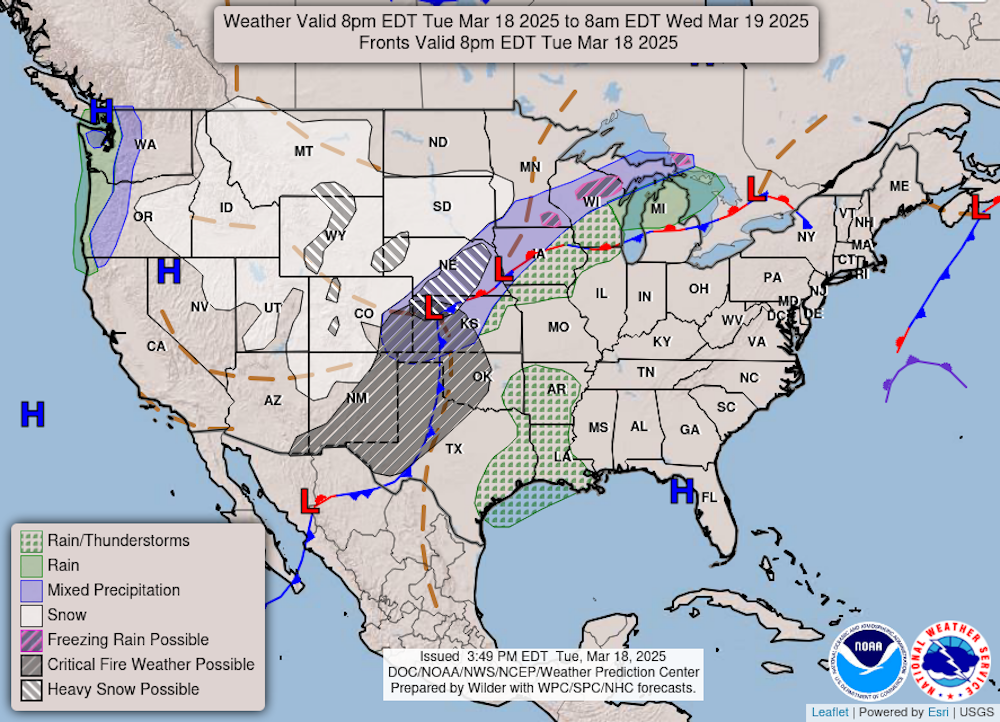
    On this forecast for March 18, 2025, from the National Oceanic and Atmospheric Administration, ‘L’ represents low-pressure systems. The shaded area over New Mexico and west Texas represents strong winds and low humidity that combine to raise the risk of wildfires.
    NOAA Weather Prediction Center

    Other forces related to the Earth’s rotation, friction and gravity can also alter the speed and direction of winds. But it all starts with this change in pressure over a distance – what meteorologists like me call a pressure gradient.

    So how do we get pressure gradients?

    Strong pressure gradients ultimately owe their existence to the simple fact that the Earth is round and rotates.

    Because the Earth is round, the sun is more directly overhead during the day at the equator than at the poles. This means more energy reaches the surface of the Earth near the equator. And that causes the lower part of the atmosphere, where weather occurs, to be both warmer and have higher pressure on average than the poles.

    Nature doesn’t like imbalances. As a result of this temperature difference, strong winds develop at high altitudes over midlatitude locations, like the continental U.S. This is the jet stream, and even though it’s several miles up in the atmosphere, it has a big impact on the winds we feel at the surface.

    Wind speed and direction in the upper atmosphere on March 14, 2025, show waves in the jet stream. Downstream of a trough in this wave, winds diverge and low pressure can form near the surface.
    NCAR

    Because Earth rotates, these upper-altitude winds blow from west to east. Waves in the jet stream – a consequence of Earth’s rotation and variations in the surface land, terrain and oceans – can cause air to diverge, or spread out, at certain points. As the air spreads out, the number of air molecules in a column decreases, ultimately reducing the air pressure at Earth’s surface.

    The pressure can drop quite dramatically over a few days or even just a few hours, leading to the birth of a low-pressure system – what meteorologists call an extratropical cyclone.

    The opposite chain of events, with air converging at other locations, can form high pressure at the surface.

    In between these low-pressure and high-pressure systems is a strong change in pressure over a distance – a pressure gradient. And that pressure gradient leads to strong winds. Earth’s rotation causes these winds to spiral around areas of high and low pressure. These highs and lows are like large circular mixers, with air blowing clockwise around high pressure and counterclockwise around low pressure. This flow pattern blows warm air northward toward the poles east of lows and cool air southward toward the equator west of lows.

    A map illustrates lines of surface pressure, called isobars, with areas of high and low pressure marked for March 14, 2025. Winds are strongest when isobars are packed most closely together.
    Plymouth State University, CC BY-NC-SA

    As the waves in the jet stream migrate from west to east, so do the surface lows and highs, and with them, the corridors of strong winds.

    That’s what the U.S. experienced when a strong extratropical cyclone caused winds stretching thousands of miles that whipped up dust storms and spread wildfires, and even caused tornadoes and blizzards in the central and southern U.S. in March 2025.

    Whipping up dust storms and spreading fires

    The jet stream over the U.S. is strongest and often the most “wavy” in the springtime, when the south-to-north difference in temperature is often the strongest.

    Winds associated with large-scale pressure systems can become quite strong in areas where there is limited friction at the ground, like the flat, less forested terrain of the Great Plains. One of the biggest risks is dust storms in arid regions of west Texas or eastern New Mexico, exacerbated by drought in these areas.

    A dust storm hit Albuquerque, N.M., on March 18, 2025. Another dust storm a few dats earlier in Kansas caused a deadly pileup involving dozens of vehices on I-70.
    AP Photo/Roberto E. Rosales

    When the ground and vegetation are dry and the air has low relative humidity, high winds can also spread wildfires out of control.

    Even more intense winds can occur when the pressure gradient interacts with terrain. Winds can sometimes rush faster downslope, as happens in the Rockies or with the Santa Ana winds that fueled devastating wildfires in the Los Angeles area in January.

    Violent tornadoes and storms

    Of course, winds can become even stronger and more violent on local scales associated with thunderstorms.

    When thunderstorms form, hail and precipitation in them can cause the air to rapidly fall in a downdraft, causing very high pressure under these storms. That pressure forces the air to spread out horizontally when it reaches the ground. Meteorologists call these straight line winds, and the process that forms them is a downburst. Large thunderstorms or chains of them moving across a region can cause large swaths of strong wind over 60 mph, called a derecho.

    Finally, some of nature’s strongest winds occur inside tornadoes. They form when the winds surrounding a thunderstorm change speed and direction with height. This can cause part of the storm to rotate, setting off a chain of events that may lead to a tornado and winds as strong as 300 mph in the most violent tornadoes.

    How a tornado forms. Source: NOAA.

    Tornado winds are also associated with an intense pressure gradient. The pressure inside the center of a tornado is often very low and varies considerably over a very small distance.

    It’s no coincidence that localized violent winds from thunderstorm downbursts and tornadoes often occur amid large-scale windstorms. Extratropical cyclones often draw warm, moist air northward on strong winds from the south, which is a key ingredient for thunderstorms. Storms also become more severe and may produce tornadoes when the jet stream is in close proximity to these low-pressure centers. In the winter and early spring, cold air funneling south on the northwest side of strong extratropical cyclones can even lead to blizzards.

    So, the same wave in the jet stream can lead to strong winds, blowing dust and fire danger in one region, while simultaneously triggering a tornado outbreak and a blizzard in other regions.

    Chris Nowotarski receives funding from the National Science Foundation (NSF), National Aeronautics and Space Administration (NASA), and theDepartment of Energy (DOE).

    ref. What causes the powerful winds that fuel dust storms, wildfires and blizzards? A weather scientist explains – https://theconversation.com/what-causes-the-powerful-winds-that-fuel-dust-storms-wildfires-and-blizzards-a-weather-scientist-explains-252639

    MIL OSI – Global Reports

  • MIL-OSI Global: Atlantic sturgeon were fished almost to extinction − ancient DNA reveals how Chesapeake Bay population changed over centuries

    Source: The Conversation – USA – By Natalia Przelomska, Research Associate in Archaeogenomics, National Museum of Natural History, Smithsonian Institution

    Sturgeon can be several hundred pounds each. cezars/E+ via Getty Images

    Sturgeons are one of the oldest groups of fishes. Sporting an armor of five rows of bony, modified scales called dermal scutes and a sharklike tail fin, this group of several-hundred-pound beasts has survived for approximately 160 million years. Because their physical appearance has changed very little over time, supported by a slow rate of evolution, sturgeon have been called living fossils.

    Despite their survival through several geological time periods, many present-day sturgeon species are at threat of extinction, with 17 of 27 species listed as “critically endangered.”

    Conservation practitioners such as the Virginia Commonwealth University monitoring team are working hard to support recovery of Atlantic sturgeon in the Chesapeake Bay area. But it’s not clear what baseline population level people should strive toward restoring. How do today’s sturgeon populations compare with those of the past?

    VCU monitoring team releases an adult Atlantic sturgeon back into the estuary.
    Matt Balazik

    We are a molecular anthropologist and a biodiversity scientist who focus on species that people rely on for subsistence. We study the evolution, population health and resilience of these species over time to better understand humans’ interaction with their environments and the sustainability of food systems.

    For our recent sturgeon project, we joined forces with fisheries conservation biologist Matt Balazik, who conducts on-the-ground monitoring of Atlantic sturgeon, and Torben Rick, a specialist in North American coastal zooarchaeology. Together, we wanted to look into the past and see how much sturgeon populations have changed, focusing on the James River in Virginia. A more nuanced understanding of the past could help conservationists better plan for the future.

    Sturgeon loomed large for millennia

    In North America, sturgeon have played important subsistence and cultural roles in Native communities, which marked the seasons by the fishes’ behavioral patterns. Large summertime aggregations of lake sturgeon (Acipenser fulvescens) in the Great Lakes area inspired one folk name for the August full moon – the sturgeon moon. Woodland Era pottery remnants at archaeological sites from as long as 2,000 years ago show that the fall and springtime runs of Atlantic sturgeon (Acipenser oxyrinchus) upstream were celebrated with feasting.

    Archaeologists uncover bony scutes – modified scales that resemble armor for the living fish – in places where people relied on sturgeon for subsistence.
    Logan Kistler and Natalia Przelomska

    Archaeological finds of sturgeon remains support that early colonial settlers in North America, notably those who established Jamestown in the Chesapeake Bay area in 1607, also prized these fish. When Captain John Smith was leading Jamestown, he wrote “there was more sturgeon here than could be devoured by dog or man.” The fish may have helped the survival of this fortress-colony that was both stricken with drought and fostering turbulent relationships with the Native inhabitants.

    This abundance is in stark contrast to today, when sightings of migrating fish are sparse. Exploitation during the past 300 years was the key driver of Atlantic sturgeon decline. Demand for caviar drove the relentless fishing pressure throughout the 19th century. The Chesapeake was the second-most exploited sturgeon fishery on the Eastern Seaboard up until the early 20th century, when the fish became scarce.

    Conservation biologists capture the massive fish for monitoring purposes, which includes clipping a tiny part of the fin for DNA analysis.
    Matt Balazik

    At that point, local protection regulations were established, but only in 1998 was a moratorium on harvesting these fish declared. Meanwhile, abundance of Atlantic sturgeon remained very low, which can be explained in part by their lifespan. Short-lived fish such as herring and shad can recover population numbers much faster than Atlantic sturgeon, which live for up to 60 years and take a long time to reach reproductive age – up to around 12 years for males and as many as 28 years for females.

    To help manage and restore an endangered species, conservation biologists tend to split the population into groups based on ranges. The Chesapeake Bay is one of five “distinct population segments” the U.S. Endangered Species Act listing in 2012 created for Atlantic sturgeon.

    Since then, conservationists have pioneered genetic studies on Atlantic sturgeon, demonstrating through the power of DNA that natal river – where an individual fish is born – and season of spawning are both important for distinguishing subpopulations within each regional group. Scientists have also described genetic diversity in Atlantic sturgeon; more genetic variety suggests they have more capacity to adapt when facing new, potentially challenging conditions.

    The study focused on Atlantic sturgeon from the Chesapeake Bay region, past and present. The four archaeological sites included are highlighted.
    Przelomska NAS et al., Proc. R. Soc. B 291: 20241145, CC BY

    Sturgeon DNA, then and now

    Archaeological remains are a direct source of data on genetic diversity in the past. We can analyze the genetic makeup of sturgeons that lived hundreds of years ago, before intense overfishing depleted their numbers. Then we can compare that baseline with today’s genetic diversity.

    The James River was a great case study for testing out this approach, which we call an archaeogenomics time series. Having obtained information on the archaeology of the Chesapeake region from our collaborator Leslie Reeder-Myers, we sampled remains of sturgeon – their scutes and spines – at a precolonial-era site where people lived from about 200 C.E. to about 900 C.E. We also sampled from important colonial sites Jamestown (1607-1610) and Williamsburg (1720-1775). And we complemented that data from the past with tiny clips from the fins of present-day, live fish that Balazik and his team sampled during monitoring surveys.

    Scientists separate Atlantic sturgeon scute fragments from larger collections of zooarchaeological remains, to then work on the scutes in a lab dedicated to studying ancient DNA.
    Torben Rick and Natalia Przelomska

    DNA tends to get physically broken up and biochemically damaged with age. So we relied on special protocols in a lab dedicated to studying ancient DNA to minimize the risk of contamination and enhance our chances of successfully collecting genetic material from these sturgeon.

    Atlantic sturgeon have 122 chromosomes of nuclear DNA – over five times as many as people do. We focused on a few genetic regions, just enough to get an idea of the James River population groupings and how genetically distinct they are from one another.

    We were not surprised to see that fall-spawning and spring-spawning groups were genetically distinct. What stood out, though, was how starkly different they were, which is something that can happen when a population’s numbers drop to near-extinction levels.

    We also looked at the fishes’ mitochondrial DNA, a compact molecule that is easier to obtain ancient DNA from compared with the nuclear chromosomes. With our collaborator Audrey Lin, we used the mitochondrial DNA to confirm our hypothesis that the fish from archaeological sites were more genetically diverse than present-day Atlantic sturgeon.

    Strikingly, we discovered that mitochondrial DNA did not always group the fish by season or even by their natal river. This was unexpected, because Atlantic sturgeon tend to return to their natal rivers for breeding. Our interpretation of this genetic finding is that over very long timescales – many thousands of years – changes in the global climate and in local ecosystems would have driven a given sturgeon population to migrate into a new river system, and possibly at a later stage back to its original one. This notion is supported by other recent documentation of fish occasionally migrating over long distances and mixing with new groups.

    Our study used archaeology, history and ecology together to describe the decline of Atlantic sturgeon. Based on the diminished genetic diversity we measured, we estimate that the Atlantic sturgeon populations we studied are about a fifth of what they were before colonial settlement. Less genetic variability means these smaller populations have less potential to adapt to changing conditions. Our findings will help conservationists plan into the future for the continued recovery of these living fossils.

    The authors do not work for, consult, own shares in or receive funding from any company or organization that would benefit from this article, and have disclosed no relevant affiliations beyond their academic appointment.

    ref. Atlantic sturgeon were fished almost to extinction − ancient DNA reveals how Chesapeake Bay population changed over centuries – https://theconversation.com/atlantic-sturgeon-were-fished-almost-to-extinction-ancient-dna-reveals-how-chesapeake-bay-population-changed-over-centuries-241104

    MIL OSI – Global Reports

  • MIL-OSI Russia: Dmitry Patrushev: Among the priority tasks of Roshydromet is deepening integration with other departments

    Translartion. Region: Russians Fedetion –

    Source: Government of the Russian Federation – An important disclaimer is at the bottom of this article.

    March 20, 2025

    Dmitry Patrushev spoke at a meeting of the Roshydromet board “On the activities of Roshydromet in 2024 and tasks for 2025.”

    Deputy Prime Minister Dmitry Patrushev spoke at a meeting of the Roshydromet board “On the activities of Roshydromet in 2024 and tasks for 2025”. The Deputy Prime Minister emphasized that many areas depend on the timeliness and accuracy of Roshydromet information, so it is necessary to constantly build up competencies, improving the quality of forecasting.

    “Over the years of its work, Roshydromet has built a multifunctional structure that combines human, scientific and technological potential. As a result, today the federal service is among the top five in the world. Such recognition from the professional community is very significant. You are truly implementing unique projects that have no analogues. Among your priority tasks for 2025 and for the future should be deepening integration with other departments and taking into account their needs when forming forecasts. The ability to quickly respond to adverse natural phenomena – including floods, fires, abnormal precipitation or drought – is a matter of ensuring the safety of the population and the stable functioning of the economy,” said Dmitry Patrushev.

    Speaking about the development of the Strategy for Activities in the Field of Hydrometeorology for the Period up to 2036, the Deputy Prime Minister recommended involving experts from the maximum number of industries interested in forecasts.

    In addition, according to the Deputy Prime Minister, digitalization provides opportunities for the development of interdepartmental dialogue. Roshydromet operates more than 85 software products, and a single platform of industry services is also being created.

    Dmitry Patrushev emphasized the importance of continuing the modernization of the state monitoring network. The relevant measures were previously included in the national project “Ecology”, and individual areas are included in the new national project “Ecological Well-being”.

    “The improvement of your observation methods should be based as much as possible on your own scientific and practical base. Roshydromet is quite active in this area. In particular, the ice-resistant self-propelled platform “North Pole” was built at the Admiralty Shipyards using federal funds. This is one of the unique projects that has no analogues in the world. In 2024, the first drifting Arctic polar expedition was completed on its basis, and now the platform is on its second expedition. It will provide an opportunity to obtain additional data on territories that have never been surveyed by Russian scientists before,” the Deputy Prime Minister said.

    In 2025, specialists from the Russian Antarctic expedition have already completely moved to the new wintering complex of the Vostok station in Antarctica. The station is equipped with the most modern equipment, thanks to which polar explorers can work comfortably, fully providing scientific research in Antarctica. In October last year, the vessel Ivan Frolov was laid down. It should become the world’s largest scientific expedition vessel for Antarctica.

    In 2024, six meteorological satellites were launched, bringing the total to 20. In 2025, preparations are planned for flight tests of several more spacecraft.

    Roshydromet, as part of the implementation of the order of the President of Russia, has created a state system of instrumental monitoring of permafrost. Thanks to this, it has become possible for the first time to monitor its dynamics.

    Dmitry Patrushev particularly noted that, on the instructions of the President of Russia, 24 billion rubles will be allocated to increase the salaries of Roshydromet employees in the coming years, and a separate “road map” is being developed to create a system of high-quality personnel training on the instructions of the Government. Its implementation will lead to an increase in enrollment in specialized educational institutions and will help the industry to train real professionals.

    Please note: This information is raw content directly from the source of the information. It is exactly what the source states and does not reflect the position of MIL-OSI or its clients.

    MIL OSI Russia News

  • MIL-OSI United Kingdom: Middle East: Foreign Secretary statement, 20 March 2025

    Source: United Kingdom – Government Statements

    Oral statement to Parliament

    Middle East: Foreign Secretary statement, 20 March 2025

    The Foreign Secretary, David Lammy, has provided an update to the House of Commons on the conflict in Gaza.

    With permission, Madam Deputy Speaker, I will make a statement about the conflict in Gaza.

    In January, I outlined to the House the deal agreed between Israel and Hamas. It was a moment of huge hope and relief.

    In the weeks that followed, hostages cruelly detained by Hamas were reunited with their families and aid blocked by Israel finally flooded into Gaza. A path out of this horrendous conflict appeared open.

    It is therefore a matter of deep regret to have to update the House today on a breakdown of that ceasefire and yet more bloodshed in Gaza.

    On the night of 18 March, Israel launched airstrikes across Gaza. A number of Hamas figures were reportedly killed.

    But it has been reported that over 400 Palestinians were killed in missile strikes and artillery barrages, the majority of them women and children.

    This appears to have been the deadliest single day for Palestinians since the war began. This is an appalling loss of life and we mourn the loss of every civilian.

    Yesterday morning, a UN compound in Gaza was hit. I can confirm to the House that a British National was amongst the wounded. Our priority is supporting them and their family at this time.

    Gaza has been the most dangerous place in the world to be an aid worker.

    I share the outrage of UN Secretary-General Guterres at this incident. The Government calls for a transparent investigation and for those responsible to be held to account.

    The UK is now working closely with partners such as France and Germany, to send a clear message.

    We strongly oppose Israel’s resumption of hostilities. We urgently want to see a return to a ceasefire. More bloodshed is in no-one’s interest. Hamas must release all the hostages and negotiations must resume.

    Madam Deputy Speaker, diplomacy is the only way to achieve security for both Israelis and Palestinians.

    The House will know that the ceasefire in Gaza had lasted for almost two months, the result of dogged efforts by Egypt, Qatar and the United States.

    The deal reached in January saw the nightmare of captivity end for 30 hostages and the bodies of 8 further victims of Hamas returned to their loved ones.

    We all remember the joy of seeing Emily Damari reunited with her mother and family, and the desperately-needed aid had begun to flow back into Gaza – food, medicines, fuel and tents.

    Children in Gaza had respite from relentless fear. The severely injured could cross the border again for treatment. Palestinians had begun to return to their homes and consider how to rebuild their lives.

    In the first days of the ceasefire, the UK moved swiftly to invest in the peace.

    We released £17m in additional emergency humanitarian funding for the promised surge in aid, bringing our total support this year for Palestinians across the region to £129m.

    We accelerated work on the pathway to reconstruction, supporting our Arab partners’ very welcome recent initiative.

    We worked at every level to support negotiations for a permanent ceasefire and the return of every single hostage and backed an extension to phase one of the current deal.

    But negotiations have been gridlocked for several weeks.

    Hamas has been resisting calls for the release of further hostages in return for a longer truce and Israeli forces did not begin to withdraw from the Philadelphi corridor as agreed.

    On 2 March, the Israeli government announced it was blocking all further aid deliveries until Hamas agreed to its terms.

    For weeks now, supplies of basic goods and electricity have been blocked, leaving over half a million civilians once again cut off from clean drinking water and sparking a 200% surge in the price of some basic foodstuffs – a boon to those criminals who use violence to control supplies.

    As I told the House on Monday, this is appalling and unacceptable.

    Ultimately, of course, these are matters for the courts, not governments, to determine but it’s difficult to see how denying humanitarian assistance to a civilian population can be compatible with international humanitarian law.

    Though it’s important to say I could have been a little clearer in the House on Monday, our position remains that Israel’s actions in Gaza are at clear risk of breaching international humanitarian law.

    The consequences of the ceasefire’s breakdown, Madam Deputy Speaker, are catastrophic.

    For the family and friends of the remaining 59 hostages, including Avinatan Or, the agony goes on.

    Hamas’ kidnapping of these people, their treatment of them in captivity, the cruel theatre of their release, depriving them of food and basic rights, these are acts of despicable cruelty.

    Hamas must release them all now.

    And Palestinian civilians, who have already endured so much, now must fear a rerun and a return to days of death, deprivation and destruction. 

    Civilians have once again been issued with evacuation orders by Israel.

    Only 4% of the UN Flash Appeal is funded – not even enough to get through to the end of this month.

    Health centres have had to close, even as the devastated Gazan health service has to treat another surge of those wounded in strikes.

    Madam Deputy Speaker, Hamas can have no role in Gaza’s future.

    A collapsed ceasefire will not bring the hostages home to their families.

    An endless conflict will not bring long term security to Israel. 

    And a deepening war will only set back the cause of regional normalisation and risk further instability – shortly after the Houthis resumed their unacceptable threats to shipping in the Red Sea.

    Madam Deputy Speaker, since the renewed outbreak of hostilities, I have spoken to Secretary Rubio, to EU High Representative Kallas, to UN Emergency Relief Coordinator Tom Fletcher. And I will shortly speak to my Israeli counterpart Gideon Sa’ar and Palestinian Prime Minister Mustafa.

    We and our partners need to persuade the parties that this conflict cannot be resolved by military means.

    We want Israel and Hamas to re-engage with negotiations.

    We continue to condemn Hamas, of course, for their actions on October 7th, their refusal to release the hostages, and their ongoing threat to Israel.

    But we are also resolute in calling on Israel to abide by international law and to lift the unacceptable restrictions on aid and demand the protection of civilians.

    Many months ago, only weeks into office, I concluded that there was a clear risk of Israel breaching international humanitarian law in Gaza.

    It was this risk that I first set out to this House in September which meant that the Government suspended relevant export licences for items for use by the IDF in military operations in Gaza.

    The actions of the last three weeks only reinforce that conclusion.

    Madam Deputy Speaker, in the days and weeks ahead, we will redouble our efforts to restore a ceasefire.

    But we will also continue to work with our partners on the security, governance and reconstruction arrangements. Those issues are not going away.

    There remains no military solution to this conflict. A two-state solution remains the only path to a just and lasting peace.

    At this dispatch box in January, I called the ceasefire deal a glimmer of light in the darkness. It feels like the darkness has returned.

    Former British hostage Emily Damari said the resumption of fighting left her heart “broken, crushed and disappointed”. I am sure she speaks for the whole House.

    But we must preserve hope. For the sake of the remaining hostages and their loved ones, for the people of Gaza, for the future of two peoples that have suffered so much for so long, we will keep striving for a return to the path of peace.

    I commend this statement to the House.

    Updates to this page

    Published 20 March 2025

    MIL OSI United Kingdom

  • MIL-OSI United Kingdom: UN Human Rights Council 58: UK Statement for the General Debate Under Agenda Item 4

    Source: United Kingdom – Executive Government & Departments

    Speech

    UN Human Rights Council 58: UK Statement for the General Debate Under Agenda Item 4

    UK Statement for the General Debate Under Agenda Item 4. Delivered by the UK’s Permanent Representative to the WTO and UN, Simon Manley.

    Thank you, Mr Vice President,

    Just yesterday, we heard in this hall the Commission of Inquiry on Ukraine conclude, for the first time, that enforced disappearances committed by Russia amount to a crime against humanity. And that Russian authorities arbitrarily detain civilians, torture and execute prisoners of war and civilians, steal and indoctrinate Ukrainian children. There must be accountability and a just and lasting peace that ensures Ukraine’s sovereignty and security.

    China continues to persecute and arbitrarily detain Uyghurs, Tibetans, activists, lawyers and journalists like Sophia Huang. In Hong Kong, the sentencing of 45 activists and former politicians under the Beijing-imposed National Security Law, and the ongoing prosecution of Jimmy Lai, underline how rights continue to be eroded. Once again, we call for their release. 

    In Iran, women, girls and minorities face sustained repression. Freedom of expression is curtailed, journalists silenced. Executions have reached appalling levels. 

    Finally, we urge all parties to return to the Gaza ceasefire talks. All hostages must be released. Aid must restart. The recent civilian casualties are appalling. Our thoughts are also with the victims and families of those killed and injured in the UN compound yesterday. The Israeli and Palestinian people deserve a peaceful and secure future based on a two-state solution.

    Updates to this page

    Published 20 March 2025

    MIL OSI United Kingdom

  • MIL-OSI: Intermap’s Insurance Business Starts 2025 With Strong Growth

    Source: GlobeNewswire (MIL-OSI)

    Year-to-date insurance awards surpass $1.1 million

    Two new strategic partnerships with major insurance customers

    DENVER, March 20, 2025 (GLOBE NEWSWIRE) — Intermap Technologies (TSX: IMP; OTCQB: ITMSF) (“Intermap” or the “Company”), a global leader in 3D geospatial products and intelligence solutions, today announced that its global insurance business is off to a strong start in 2025 with awards surpassing $1.1 million from new client subscriptions and multiple renewals.

    Intermap is pleased to announce a new, large multiyear subscription with a major bank-insurance group operating in five European countries. Serving retail, private banking, SME and mid-cap clients, the group has adopted the latest generation of Intermap’s Aquarius RMA solution for natural hazards and climate change risk quantification. Using AI-powered modeling and continually updated 3D terrain data, the solution delivers precise risk assessments throughout the policy lifecycle—from underwriting to claims adjustment—empowering the group to deploy innovative, data-driven strategies for climate and sustainability challenges.

    Intermap also recently secured a major partnership with PREMIUM Insurance Company Limited, which adopted Intermap’s next-generation Aquarius RMA natural hazard solution. This collaboration marks a significant step forward for flood risk management in Europe, ensuring that homeowners and businesses in these markets benefit from more informed and reliable insurance decisions.

    “Providing property insurance in the Czech Republic and Slovakia without high-quality flood maps and robust risk assessment would be increasingly time and labor-intensive,” said Marek Benko, Member of the Board of Directors at PREMIUM Insurance. “By integrating Intermap’s advanced mapping solutions, we are enhancing our underwriting precision, building greater trust with our reinsurers, and ensuring our clients receive the most sustainable coverage possible.”

    “We are seeing increased demand for our applications and solutions in our insurance vertical, driving record revenue early in the year,” said Patrick A. Blott, Intermap Chairman and CEO. “Our data products are one of a kind, making our subscriber base sticky with de-minimis churn.” Mr. Blott continued, “Insurance companies are increasingly leveraging 3D geospatial data to enhance risk assessment and evaluate property vulnerabilities such as flood or wildfire exposure with greater precision. Building upon our 3D foundation data, Intermap incorporates artificial intelligence and machine learning techniques into our NEXTMap solution to create globally available digital elevation models at resolutions as fine as a single meter, offering our insurance clients and other verticals the ability to make unparalleled, data-driven decisions. We look forward to updating the market as we build upon these new wins and execute against our current pipeline of insurance industry opportunities.”

    Fourth Quarter and Full Year 2024 Results and Conference call

    As a reminder, Intermap will report its fourth quarter and full year 2024 results on Thursday, March 27, 2025 at 5:00 pm ET. The Company’s CEO Patrick Blott, CFO Jennifer Bakken and COO Jack Schneider will host a live webinar to review the results, provide Company updates and answer investor questions following the presentation.

    CONFERENCE CALL DETAILS

    Date Thursday, March 27, 2025
    Time 5:00 pm ET
    Link Register
       

    Learn more about Intermap’s global insurance solutions at intermap.com/insurance.

    Intermap Reader Advisory 
    Certain information provided in this news release, including reference to revenue growth, constitutes forward-looking statements. The words “anticipate”, “expect”, “project”, “estimate”, “forecast”, “will be”, “will consider”, “intends” and similar expressions are intended to identify such forward-looking statements. Although Intermap believes that these statements are based on information and assumptions which are current, reasonable and complete, these statements are necessarily subject to a variety of known and unknown risks and uncertainties. Intermap’s forward-looking statements are subject to risks and uncertainties pertaining to, among other things, cash available to fund operations, availability of capital, revenue fluctuations, nature of government contracts, economic conditions, loss of key customers, retention and availability of executive talent, competing technologies, common share price volatility, loss of proprietary information, software functionality, internet and system infrastructure functionality, information technology security, breakdown of strategic alliances, and international and political considerations, as well as those risks and uncertainties discussed Intermap’s Annual Information Form and other securities filings. While the Company makes these forward-looking statements in good faith, should one or more of these risks or uncertainties materialize, or should underlying assumptions prove incorrect, actual results may vary significantly from those expected. Accordingly, no assurances can be given that any of the events anticipated by the forward-looking statements will transpire or occur, or if any of them do so, what benefits that the Company will derive therefrom. All subsequent forward-looking statements, whether written or oral, attributable to Intermap or persons acting on its behalf are expressly qualified in their entirety by these cautionary statements. The forward-looking statements contained in this news release are made as at the date of this news release and the Company does not undertake any obligation to update publicly or to revise any of the forward-looking statements made herein, whether as a result of new information, future events or otherwise, except as may be required by applicable securities law.

    About Intermap Technologies 
    Founded in 1997 and headquartered in Denver, Colorado, Intermap (TSX: IMP; OTCQB: ITMSF) is a global leader in geospatial intelligence solutions, focusing on the creation and analysis of 3D terrain data to produce high-resolution thematic models. Through scientific analysis of geospatial information and patented sensors and processing technology, the Company provisions diverse, complementary, multi-source datasets to enable customers to seamlessly integrate geospatial intelligence into their workflows. Intermap’s 3D elevation data and software analytic capabilities enable global geospatial analysis through artificial intelligence and machine learning, providing customers with critical information to understand their terrain environment. By leveraging its proprietary archive of the world’s largest collection of multi-sensor global elevation data, the Company’s collection and processing capabilities provide multi-source 3D datasets and analytics at mission speed, enabling governments and companies to build and integrate geospatial foundation data with actionable insights. Applications for Intermap’s products and solutions include defense, aviation and UAV flight planning, flood and wildfire insurance, disaster mitigation, base mapping, environmental and renewable energy planning, telecommunications, engineering, critical infrastructure monitoring, hydrology, land management, oil and gas and transportation. 

    For more information, please visit www.intermap.com or contact:
    Jennifer Bakken
    Executive Vice President and CFO
    CFO@intermap.com
    +1 (303) 708-0955

    Sean Peasgood
    Investor Relations
    Sean@SophicCapital.com
    +1 (647) 260-9266

    The MIL Network

  • MIL-OSI Global: The PKK says it will lay down its arms. What are the chances of lasting peace between Turkey and the Kurds? Podcast

    Source: The Conversation – UK – By Gemma Ware, Host, The Conversation Weekly Podcast, The Conversation

    For over 40 years, the Kurdistan Workers Party, the PKK, has waged an armed insurgency against Turkey, fighting for Kurdish rights and autonomy.

    But in late February, Abdullah Öcalan, the PKK’s imprisoned founder, called for the group to lay down its arms and dissolve itself. Days later, the PKK, which is labelled as a terrorist organisation by Turkey, Europe and the US, declared a ceasefire with Turkey.

    In this episode of The Conversation Weekly podcast, we speak to political scientist Pinar Dinc about what’s led to this moment and whether it could be the beginning of a lasting peace between Turkey and the Kurds.

    Despite being imprisoned in solitary confinement since his capture in 1999, Öcalan has remained a central figure in the Kurdish movement, both in Turkey and across the region.

    His call for the PKK to abandon its armed struggle came months after the leader of a Turkish ultra-nationalist political party launched an initiative to bring an end to the conflict.

    Over the past few decades, previous rounds of peace talks between the PKK and Turkey, most notably in 2009 and 2013-15, have collapsed.

    But Pinar Dinc, an associate professor of political science at Lund University in Sweden, says that since the Hamas-led October 7 attacks on Israel and the war in Gaza, the situation in the Middle East has rapidly changed. “It’s mutually beneficial to put an end to this war,” she says. “Both groups recognise the necessity of addressing regional tensions.”

    Dinc says international support for the Kurdish-led Syrian Democratic Forces in north-eastern Syria, and its Rojava revolution, means that Turkey has been forced to recognise a new “Syrian Kurdish reality”. At the same time, she says, the Kurdish movement has also reached a limit in what it can achieve in an era of modern warfare.

     Turkey has a huge army. It’s one of the biggest armies of Nato. Now we see increased use of drones surveillance and advanced weaponry, and I think the PKK guerrillas in the Qandil mountains, what they refer to as the medya defence zones, they’re also realising that this is getting more and more difficult.

    Limited discussions began in March between the Turkish government and Kurdish political parties on a way forward in peace negotiations. Dinc says this is a real opportunity for a broader reconciliation process, but there will be real challenges in the detail of what it means for Turkey’s Kurdish population.

     The PKK is an outcome of structural problems arising from the longstanding oppression and marginalisation of Kurds in Turkey, and addressing these root causes is essential for achieving lasting peace.

    Listen to the conversation with Dinc on The Conversation Weekly podcast.


    This episode of The Conversation Weekly was written and produced by Mend Mariwany. Sound design was by Eloise Stevens and theme music by Neeta Sarl. Gemma Ware is the executive producer.

    Newsclips in this episode from AP Archive, AFP News Agency, Sky News, Med TV, Gazete Duvar, DW News, Al Jazeera English and France 24 English.

    Listen to The Conversation Weekly via any of the apps listed above, download it directly via our RSS feed or find out how else to listen here.

    Pinar Dinc is the principal investigator of the ECO-Syria project, which receives funding from the Strategic Research Area: The Middle East in the Contemporary World (MECW) at the Centre for Advanced Middle Eastern Studies, Lund University, Sweden.

    ref. The PKK says it will lay down its arms. What are the chances of lasting peace between Turkey and the Kurds? Podcast – https://theconversation.com/the-pkk-says-it-will-lay-down-its-arms-what-are-the-chances-of-lasting-peace-between-turkey-and-the-kurds-podcast-252646

    MIL OSI – Global Reports

  • MIL-OSI Africa: EThekwini Municipality commits to building houses for flood victims

    Source: South Africa News Agency

    EThekwini Municipality Mayor Cyril Xaba says the city remains committed to ensuring that permanent houses are built for the families affected by the recent floods.

    Speaking at during an Executive Council (Exco) meeting held this week, Xaba reported that between 19 February and 15 March 2025, the recurring floods have claimed the lives of 15 people and caused extensive damage to infrastructure.

    Xaba said the report received from the Joint Operations Centre indicated that 1 452 houses and 5 939 people were affected. The worst affected areas include Inanda, Ntuzuma, KwaMashu, Pinetown, KwaDabeka and Lamontville.

    Xaba conveyed the council’s heartfelt condolences to the families of the deceased, saying that the city is working with the bereaved families to ensure that their loved ones receive a dignified burial. 

    “Together with the Premier [Thamsanqa Ntuli] and the Chairperson of Trading Services, Mduduzi Nkosi, we visited the affected families in Inanda and Lamontville, including those who have been relocated to family-friendly accommodation in the inner-city. As… [the three spheres of] government, we are committed to ensuring that permanent houses are built for these families,” Xaba said.

    However, Xaba noted the challenges encountered in building permanent houses in identified sites.

    He said the existing community members are not cooperating, either because they themselves are flood victims who have not been allocated houses, or they do not want low-cost houses in their neighbourhood.

    “As the rains persist, we will continue to face the shortage of land to resettle flood victims, considering that the city has 603 informal settlements and some of them are located in flood-prone areas. Working together, we must intensify public awareness campaigns urging people not to settle in flood plains because the frequency and intensity of floods, due to climate change, poses a huge risk to human lives and infrastructure,” Xaba said.

    Since 2017, the city has been experiencing recurring floods, and this has put a huge strain on the city’s water drainage system.

    In eThekwini, stormwater systems are designed to handle a “1-in-10-year” storm event, Xaba said.

    “Our large canals and river protection works are built to withstand 1-in-50 or 1-in-100-year storm events. In the last two months, we have been experiencing heavy downpours that we would ordinarily receive in every 20 – 40 years.

    “It is in this context that we must continue to urge members of the community to dispose of waste in designated places so that during heavy rains, the same waste does not clog our drainage system and flood our homes,” Xaba said. – SAnews.gov.za

    MIL OSI Africa

  • MIL-OSI Africa: Plantation initiatives provide job opportunities 

    Source: South Africa News Agency

    The Minister of Forestry, Fisheries and the Environment, Dr Dion George, has announced initiatives that will significantly contribute to the sustainable management of South Africa’s plantations while creating employment opportunities.

    Through such initiatives, 1461 workers have been employed through the Expanded Public Works Programme, providing the communities within these plantations much-needed work opportunities in Category B and C plantations located in Limpopo, Mpumalanga, Eastern Cape and KwaZulu-Natal.

    “These initiatives reflect our unwavering commitment to sustainable forestry management practices and dedication to fostering economic opportunities in communities across these regions,” George said on Thursday.

    The first initiative is the Department of Forestry, Fisheries and the Environment’s (DFFE) commitment to planting 1 800 hectares annually. 

    It’s part of the department’s strategy to reduce temporary unplanted areas, enhance productivity, and contribute to fibre security in South Africa.

    “By addressing temporary unplanted areas, we envision that our efforts will not only strengthen the forestry sector but will also stimulate economic growth in surrounding communities through job creation and other socio-economic benefits.

    “The department remains committed to promoting the long-term sustainability of South Africa’s plantations while ensuring tangible benefits for communities living near these forestry areas,” the Minister said.

    The second initiative, also linked to the sustainable management of plantations, is the maintenance of land through strategic silvicultural 1 practices in plantations where the target has increased from 2 100 to 6 500 hectares from the 2025/26 financial year. 
    This represents an increase of over 200%.

    These silvicultural activities, which include fire risk reduction, pest and disease management, timber quality improvement, and enhanced accessibility within compartments, are essential to ensuring the long-term sustainability and productivity of these plantations.’

    By implementing these measures, the department aims to improve the value of standing timber, safeguard plantation ecosystems, and support the broader forestry industry. 

    These efforts will also stimulate rural economic growth in surrounding communities through job creation and the protection of vital natural resources. –SAnews.gov.za
     

    MIL OSI Africa

  • MIL-OSI Video: PSA: Displacement Assistance

    Source: United States of America – Federal Government Departments (video statements)

    If you can’t stay in your home because it was damaged by the February floods in Kentucky, FEMA may be able to provide financial assistance while you look for a place to stay.

    https://www.youtube.com/watch?v=XeDYQnXrBFQ

    MIL OSI Video

  • MIL-OSI USA: Next-Generation Water Satellite Maps Seafloor From Space

    Source: NASA

    More accurate maps based on data from the SWOT mission can improve underwater navigation and result in greater knowledge of how heat and life move around the world’s ocean.
    There are better maps of the Moon’s surface than of the bottom of Earth’s ocean. Researchers have been working for decades to change that. As part of the ongoing effort, a NASA-supported team recently published one of the most detailed maps yet of the ocean floor, using data from the SWOT (Surface Water and Ocean Topography) satellite, a collaboration between NASA and the French space agency CNES (Centre National d’Études Spatiales).
    Ships outfitted with sonar instruments can make direct, incredibly detailed measurements of the ocean floor. But to date, only about 25% of it has been surveyed in this way. To produce a global picture of the seafloor, researchers have relied on satellite data.

    [embedded content]
    This animation shows seafloor features derived from SWOT data on regions off Mexico, South America, and the Antarctic Peninsula. Purple denotes regions that are lower relative to higher areas like seamounts, depicted in green. Eötvös is the unit of measure for the gravity-based data used to create these maps.NASA’s Scientific Visualization Studio

    Why Seafloor Maps Matter
    More accurate maps of the ocean floor are crucial for a range of seafaring activities, including navigation and laying underwater communications cables. “Seafloor mapping is key in both established and emerging economic opportunities, including rare-mineral seabed mining, optimizing shipping routes, hazard detection, and seabed warfare operations,” said Nadya Vinogradova Shiffer, head of physical oceanography programs at NASA Headquarters in Washington.
    Accurate seafloor maps are also important for an improved understanding of deep-sea currents and tides, which affect life in the abyss, as well as geologic processes like plate tectonics. Underwater mountains called seamounts and other ocean floor features like their smaller cousins, abyssal hills, influence the movement of heat and nutrients in the deep sea and can attract life. The effects of these physical features can even be felt at the surface by the influence they exert on ecosystems that human communities depend on.

    Mapping the seafloor isn’t the SWOT mission’s primary purpose. Launched in December 2022, the satellite measures the height of water on nearly all of Earth’s surface, including the ocean, lakes, reservoirs, and rivers. Researchers can use these differences in height to create a kind of topographic map of the surface of fresh- and seawater. This data can then be used for tasks such as assessing changes in sea ice or tracking how floods progress down a river.
    “The SWOT satellite was a huge jump in our ability to map the seafloor,” said David Sandwell, a geophysicist at Scripps Institution of Oceanography in La Jolla, California. He’s used satellite data to chart the bottom of the ocean since the 1990s and was one of the researchers responsible for the SWOT-based seafloor map, which was published in the journal Science in December 2024.
    How It Works
    The study authors relied the fact that because geologic features like seamounts and abyssal hills have more mass than their surroundings, they exert a slightly stronger gravitational pull that creates small, measurable bumps in the sea surface above them. These subtle gravity signatures help researchers predict the kind of seafloor feature that produced them.
    Through repeated observations — SWOT covers about 90% of the globe every 21 days — the satellite is sensitive enough to pick up these minute differences, with centimeter-level accuracy, in sea surface height caused by the features below. Sandwell and his colleagues used a year’s worth of SWOT data to focus on seamounts, abyssal hills, and underwater continental margins, where continental crust meets oceanic crust.
    Previous ocean-observing satellites have detected massive versions of these bottom features, such as seamounts over roughly 3,300 feet (1 kilometer) tall. The SWOT satellite can pick up seamounts less than half that height, potentially increasing the number of known seamounts from 44,000 to 100,000. These underwater mountains stick up into the water, influencing deep sea currents. This can concentrate nutrients along their slopes, attracting organisms and creating oases on what would otherwise be barren patches of seafloor.
    Looking Into the Abyss
    The improved view from SWOT also gives researchers more insight into the geologic history of the planet.
    “Abyssal hills are the most abundant landform on Earth, covering about 70% of the ocean floor,” said Yao Yu, an oceanographer at Scripps Institution of Oceanography and lead author on the paper. “These hills are only a few kilometers wide, which makes them hard to observe from space. We were surprised that SWOT could see them so well.”
    Abyssal hills form in parallel bands, like the ridges on a washboard, where tectonic plates spread apart. The orientation and extent of the bands can reveal how tectonic plates have moved over time. Abyssal hills also interact with tides and deep ocean currents in ways that researchers don’t fully understand yet.
    The researchers have extracted nearly all the information on seafloor features they expected to find in the SWOT measurements. Now they’re focusing on refining their picture of the ocean floor by calculating the depth of the features they see. The work complements an effort by the international scientific community to map the entire seafloor using ship-based sonar by 2030. “We won’t get the full ship-based mapping done by then,” said Sandwell. “But SWOT will help us fill it in, getting us close to achieving the 2030 objective.”
    More About SWOT
    The SWOT satellite was jointly developed by NASA and CNES, with contributions from the Canadian Space Agency (CSA) and the UK Space Agency. NASA’s Jet Propulsion Laboratory, managed for the agency by Caltech in Pasadena, California, leads the U.S. component of the project. For the flight system payload, NASA provided the Ka-band radar interferometer (KaRIn) instrument, a GPS science receiver, a laser retroreflector, a two-beam microwave radiometer, and NASA instrument operations. The Doppler Orbitography and Radioposition Integrated by Satellite system, the dual frequency Poseidon altimeter (developed by Thales Alenia Space), the KaRIn radio-frequency subsystem (together with Thales Alenia Space and with support from the UK Space Agency), the satellite platform, and ground operations were provided by CNES. The KaRIn high-power transmitter assembly was provided by CSA.
    To learn more about SWOT, visit:
    https://swot.jpl.nasa.gov
    News Media Contacts
    Jane J. Lee / Andrew WangJet Propulsion Laboratory, Pasadena, Calif.818-354-0307 / 626-379-6874jane.j.lee@jpl.nasa.gov / andrew.wang@jpl.nasa.gov
    2025-040

    MIL OSI USA News

  • MIL-OSI Video: Gaza: Renewed Airstrikes, Blocked Aid & Calls for Ceasefire Amid Humanitarian Crisis| United Nations

    Source: United Nations (Video News)

    Under-Secretary-General for Humanitarian Affairs, Tom Fletcher, today (18 Mar) told the Security Council that as airstrikes resumed across the Gaza Strip overnight and new evacuation orders have been issued by Israeli forces, “once again, the people of Gaza living in abject fear,” and modest gains made during the ceasefire are being destroyed.

    Fletcher, who spoke by VTC from Brussels, said “humanitarian workers remain on the ground” and are “ready to provide lifesaving support to survivors and carry out humanitarian mission,” but “must be allowed to do so.”

    He said, “a ceasefire was in place. Humanitarians were delivering hundreds of trucks every day, saving lives and restoring hope. We demonstrated that when we are allowed to do so, we can deliver aid at scale. Not anymore.”

    Repeated requests to collect aid sitting at Kerem Shalom Crossing, Fletcher said, “have been systematically rejected. Food is rotting and medicines are expiring. No further hostages have been released.”

    He told the Council that “this total blockade of life saving aid, basic commodities and commercial goods will have a disastrous impact on the people in Gaza who remain dependent on a steady flow of assistance into the Strip.”

    The Under-Secretary-General said, “blocking food, water, medicine for people who need them is unconscionable. It also goes against international humanitarian law and the provisional orders of the International Court of Justice.”

    He called for the renewal of the ceasefire and said, “over 48,000 Palestinians have been killed and thousands more are missing. Over 1,200 Israelis have been killed. Over 100,000 Palestinians are injured, many with life-changing wounds. The return to hostilities overnight must cease.”

    Fletcher also told the Council that the humanitarian response must be funded.

    In her address to the Council, United States representative Dorothy Shea said, “the blame for the resumption of hostilities lies solely with Hamas. This brutal terrorist organization has steadfastly refused every proposal and deadline they’ve been presented over the past few weeks, including a bridge proposal to extend the ceasefire beyond Ramadan and Passover to allow time to negotiate a framework for a permanent ceasefire.”

    Shea said, it was “the people of Gaza who will suffer further because of Hamas’s disregard for human life.”

    Palestinian Ambassador Riyad Mansour said, “Palestinians are being killed indiscriminately, are being denied humanitarian aid indiscriminately, are being maimed and detained indiscriminately.”

    He said, “this can never be justified and must stop immediately.”

    Mansour told Council members to act. He said, “you have resolutions. Act. You have power. Act. Or, as my friend, the ambassador of Slovenia said, you become irrelevant. Act according to the power given to you by the charter of the United Nations.”

    For his part, Israeli Ambassador Jonathan Miller said, “we stand firm in our commitment to return the hostages and defeat Hamas, and it is time for the international community to take our commitment seriously. We will bring home every last hostage.”

    Miller said, “Hamas has refused to release our hostages and repeatedly rejected all the offers, both by the US and the mediating countries, even for the period of Ramadan. And thus the return to fighting is a necessity.

    The Israeli Ambassador said, “any discussion of humanitarian suffering that does not begin with the hostage release is not an honest discussion. For months, Israel took unprecedented steps to facilitate humanitarian aid into Gaza. Israel’s war is against Hamas, not Gaza civilians. And yet, despite our efforts, Hamas refuses every opportunity for peace. It refuses to release the hostages.”

    Secretary-General António Guterres expressed his shock at the Israeli airstrikes and strongly appealed for the ceasefire to be respected, for unimpeded humanitarian assistance to be reestablished, and for the remaining hostages to be released unconditionally.

    Full Remarks: https://www.unocha.org/news/renewed-airstrikes-gaza-un-relief-chief-urges-restoration-ceasefire

    https://www.youtube.com/watch?v=mf_MfrYk72k

    MIL OSI Video

  • MIL-OSI: Orezone Gold Reports Record Revenue and Net Income for 2024

    Source: GlobeNewswire (MIL-OSI)

    VANCOUVER, British Columbia, March 20, 2025 (GLOBE NEWSWIRE) — Orezone Gold Corporation (TSX: ORE, OTCQX: ORZCF) (“Orezone” or “Company”) is pleased to report its operational and financial results for the fourth quarter and full year ended December 31, 2024, and its 2025 guidance.   All dollar amounts are in USD unless otherwise indicated and abbreviation “M” means million.

    Highlights

    • Q4-2024 gold production of 36,502 oz, a 37% increase from the previous quarter.  
    • 2024 gold production of 118,746 oz, exceeding the mid-point of guidance.
    • AISC per oz sold of $1,273 for Q4-2024 and $1,447 for 2024.
    • Record revenue of $283.5M from the sale of 118,697 gold oz at an average realized price of $2,384 per oz in 2024. Gold sales remain unhedged to rising gold prices.
    • 2024 Adjusted EBITDA of $117.2M, Net Income attributable to Orezone shareholders of $55.7M and Earnings per Share attributable to Orezone shareholders of $0.14 and $0.13 on a basic and diluted basis, respectively.
    • Liquidity of $103.2M at year-end with cash of $74.0M and undrawn debt of $29.2M available to finance 2025 growth plans.
    • Stage 1 of hard rock expansion progress continues with first gold on track for Q4-2025.
    • Advancing work towards a secondary listing on the Australian Securities Exchange in mid-2025.

    Patrick Downey, President and CEO, commented “Strong Q4-2024 gold production of 36,502 oz helped deliver another record year for revenue of $283.5 million and net income of $64.1 million while meeting annual production guidance for a second consecutive year. Importantly, Orezone commenced construction of its hard rock expansion in the second half of 2024, a main step towards sustained production growth and setting the foundation for a transformational 2025 where we expect to pour first gold on this brownfield expansion in Q4-2025. First stage of the hard rock expansion is expected to increase the Company’s annual gold production to 170,000 – 185,000 oz in 2026.

    With continued strong gold prices and the closing of recent financings, the Company is well-placed to make further strategic investments in its Bomboré Mine by undertaking additional discovery-focused exploration on high potential targets and evaluating an accelerated start to the second stage of the hard rock expansion which would further increase annual gold production to 220,000 – 250,000 oz.

    The accomplishments achieved in 2024 is a testament to the strength of our team underpinned by the support of our community and government partners, and new and existing shareholders. We remain steadfast in our goal of creating lasting value for all stakeholders.”

    Highlights for Fourth Quarter and Year Ended December 31, 2024 and Significant Subsequent Events

    (All mine site figures on a 100% basis)   Q4-2024 Q4-2023 FY2024 FY2023
    Operating Performance          
    Gold production oz 36,502 33,916 118,746 141,425
    Gold sales oz 34,833 33,782 118,697 139,696
    Average realized gold price $/oz 2,632 1,986 2,384 1,940
    Cash costs per gold ounce sold1 $/oz 1,077 1,083 1,233 972
    All-in sustaining costs1 (“AISC”) per gold ounce sold $/oz 1,273 1,246 1,447 1,127
    Financial Performance          
    Revenue $000s 91,837 67,580 283,517 271,491
    Earnings from mine operations $000s 45,321 16,108 117,710 97,150
    Net income attributable to shareholders of Orezone1 $000s 30,091 4,012 55,711 43,146
    Net income per common share attributable to shareholders of Orezone          
    Basic $ 0.06 0.01 0.14 0.12
    Diluted $ 0.06 0.01 0.13 0.12
    EBITDA1 $000s 48,139 15,308 128,307 108,418
    Adjusted EBITDA1 $000s 45,058 26,702 117,233 120,036
    Adjusted earnings attributable to shareholders of Orezone1 $000s 27,550 14,267 45,977 53,665
    Adjusted earnings per share attributable to shareholders of Orezone1 $ 0.06 0.04 0.11 0.15
    Cash and Cash Flow Data          
    Operating cash flow before changes in working capital $000s 52,520 28,167 98,444 123,029
    Operating cash flow $000s 28,020 13,891 57,697 79,950
    Free cash flow1 $000s 12,543 682 11,725 36,172
    Cash, end of period $000s 74,021 19,483 74,021 19,483

    1 Cash costs, AISC, EBITDA, Adjusted EBITDA, Adjusted earnings, Adjusted earnings per share, and Free cash flow are non-IFRS measures. See “Non-IFRS Measures” section below for additional information.

    Full Year 2024 Highlights

    • Outstanding Safety Performance: 5.4M hours worked without a lost-time injury and a low total recordable injury frequency rate of 0.75.
    • Strong Liquidity: Available liquidity of $103.2M at year-end with $74.0M in cash and XOF 17.5 billion ($29.2M) available to be drawn on the Phase II debt facility with Coris Bank International (“Coris Bank”). The Company is well-funded to carry out its 2025 growth plans including the completion of stage 1 of the Phase II hard rock expansion and a minimum 20,000 m diamond drilling exploration program.    
    • Gold Production Guidance Achieved: Gold production of 118,746 oz which exceeded the mid-point of guidance, marking the second consecutive year that the Bomboré Mine has met production guidance since the start up of operations.
    • AISC Per Oz Within Updated Guidance: AISC per oz of $1,447 was within the updated guidance range with operating costs impacted by higher-than-anticipated government royalties and power costs. Relative to original guidance, government royalties were $31 per oz higher due to a better realized gold price and power costs were $57 per oz higher from lower-than-normal grid availability due to regional power issues in the H1-2024. These two cost overrun contributors were both out of the Company’s control and if their cost impacts were removed, original AISC guidance of $1,300 per oz to $1,375 per oz would have been met.
    • Record Annual Revenue: Revenue of $283.5M from the sale of 118,697 gold oz at a realized gold price of $2,384 per oz. The Company’s gold sales remain unhedged to rising gold prices.
    • Record EBITDA, Net Income, and Earnings Per Share: Reported record EBITDA of $128.3M and net income attributable to Orezone shareholders of $55.7M, primarily driven by a 23% increase in the realized gold price from the prior year. Net income per share attributable to Orezone shareholders was a record $0.14 per share on a basic basis and $0.13 per share on a diluted basis.
    • Continued Free Cash Flow Generation: Generated free cash flow of $11.7M with cash flow from operating activities totalling $98.4M after deducting taxes paid of $26.2M but before changes in non-cash working capital. Non-cash working capital increased by $40.7M primarily from the build-up of VAT receivables and long-term ore stockpiles. Cash flow used in investing activities totalled $46.0M as capital expenditures remained elevated as the Company executes on its growth initiatives including the Phase II hard rock expansion.
    • Phase II Hard Rock Expansion on Track for First Gold in 2025: The Company’s Board approved a positive construction decision on stage 1 of the Phase II hard rock expansion on July 10, 2024 after the Company had secured $105M in binding debt and equity commitments described below for the construction. Under stage 1, a 2.5M tonnes per annum (“tpa”) process plant will be built to recover gold from hard rock mineral reserves which is expected to increase future production levels by 50% to over 170,000 oz per annum. First gold for stage 1 of the Phase II expansion remains on track for Q4-2025 with commercial production expected shortly thereafter in early 2026.
    • Phase I Debt Reduced, Bridge Loan Repaid, and Phase II Expansion Financing Secured: Principal repayments totalling XOF 24.0 billion ($39.3M) were made on the Company’s senior borrowings with Coris Bank, including the extinguishment of the XOF 12.0 billion ($19.8M) bridge loan. On August 8, 2024, the Company completed a non-brokered private placement for net proceeds of C$64.8M ($47.3M) with a new cornerstone investor, Nioko Resources Corporation (“Nioko”), a leading West African investment group. On December 19, 2024, the Company successfully upsized its senior debt facility with Coris Bank through a new term loan for XOF 35.0 billion ($58.3M) (“Phase II Term Loan”) to be drawn in multiple tranches as construction progresses. The Company made its first drawdown of XOF 17.5 billion ($27.9M) on the Phase II Term Loan in December 2024.
    • Multi-year Exploration Drill Program Initiated: In August 2024, the Company initiated a multi-year discovery focused drill program with an initial 30,000 m of drilling designed to test the broader size and scale of the Bomboré mineralized system. Initial results from drilling at the North Zone intercepted mineralization 240 m below the current reserve pit limit, including 1.67 g/t gold over 46.00 m, demonstrating the continuity and robustness of the mineralized system at depth, both in terms of grade and overall width (see October 10, 2024 news release).

    Q4-2024 Highlights

    • Gold Production: Quarterly gold production of 36,502 oz increased 37% from Q3-2024 as a result of record plant throughput and improved head grades. Mining extended to Siga East and Siga South pits for a full quarter which contributed a greater blend of soft oxide ore at higher grades to the mill feed.
    • AISC Per Oz: AISC per oz sold was $1,273 per oz, a 23% decrease from Q3-2024, driven mainly by improved gold production as a result of higher grades and better plant throughput.
    • EBITDA, Net Income, and Earnings Per Share: Reported EBITDA of $48.1M and net income attributable to Orezone shareholders of $30.1M. Net income per share attributable to Orezone shareholders was $0.06 per share on both a basic and diluted basis.
    • Free Cash Flow: Generated free cash flow of $12.5M with cash flow from operating activities totalling $52.5M after deducting taxes paid of $6.3M but before changes in non-cash working capital. Cash flow used in investing activities totalled $15.5M as expenditures for the Phase II hard rock expansion began to ramp up.

    Events Subsequent to 2024 Year-End

    • Bought Deal Offering: On March 13, 2025, the Company closed on a public offering of common shares on a bought deal basis with Canaccord Genuity Corp. (“Canaccord”) pursuant to which the Company agreed to sell 42,683,000 common shares at a price of C$0.82 per share for aggregate gross proceeds of C$35,000,060. Net proceeds from the offering will be used to conduct early works for stage 2 of the Phase II hard rock expansion and for additional exploration. Under stage 2, processing capacity of the hard rock plant will double from the 2.5Mtpa design in stage 1 to 5.0Mtpa after completion of stage 2.
    • Over-allotment Exercise: Canaccord has exercised its over-allotment in full on the bought deal offering and has agreed to purchase an additional 6,402,450 common shares at a price of C$0.82 per share for aggregate gross proceeds of C$5,250,009. The purchase of shares from the over-allotment closed on March 19, 2025.
    • Private Placement with Nioko: The Company has announced that Nioko intends to acquire, on a non-brokered private placement basis, for 10,719,659 additional common shares at a price of C$0.82 per share for aggregate gross proceeds of C$8,790,121 to maintain its 19.9% share ownership (before the over-allotment exercise). Closing of this private placement is subject to approval of the TSX and is anticipated to occur in late March 2025.
    • Intention to List on the Australian Securities Exchange (“ASX”): The Company intends to pursue a secondary listing on the ASX by mid-2025, subject to market conditions and the satisfaction of ASX listing requirements as announced in its February 23, 2025 press release. The Company believes a dual listing on the ASX will increase trading liquidity and allow it to access a deeper pool of investors, including specialist mining focused funds.

    2024 Performance and 2025 Guidance

    2024 Performance Compared Against Guidance

    Bomboré Mine (100% basis) Unit Original
    FY2024 Guidance
    Revised
    FY2024 Guidance4
    FY2024
    Actuals
    Gold production Au oz 110,000 – 125,000 Unchanged  118,746
    All-In Sustaining Costs123 $/oz Au sold $1,300 – $1,375 $1,400 – $1,475 $1,447
    Sustaining capital12 $M $14 – $15 Unchanged $16.0
    Growth capital – non Phase II Expansion12 $M $16 – $17 Unchanged $17.6
    Growth capital – Phase II Expansion early works12 $M No guidance provided $3.6 $3.6
    Growth capital – Phase II Expansion12 $M No guidance provided $15.0 – $18.0 $15.3
    1. Non-IFRS measures. See “Non-IFRS Measures” section below for additional information.
    2. Foreign exchange rates used to forecast cost metrics include XOF/USD of 600 and CAD/USD of 1.30.
    3. Government royalties of $160/oz included in original AISC guidance based on an assumed gold price of $2,000 per oz. Government royalties of $200/oz were estimated in the revised AISC guidance from a better gold price realized.
    4. Revised guidance details presented in Q3-2024 MD&A.

    2025 Guidance

    Bomboré Mine (100% basis) Unit FY2025 Guidance
    Gold production Au oz 115,000 – 130,000
    All-In Sustaining Costs123 $/oz Au sold $1,400 – $1,500
    Sustaining capital12 $M $9 – $10
    Growth capital (excluding Phase II Expansion)12 $M $44 – $51
    Growth capital – Stage 1 of Phase II Expansion12 $M $75 – $80
    1. Non-IFRS measure. See “Non-IFRS Measures” section below for additional information.
    2. Foreign exchange rates used to forecast cost metrics include XOF/USD of 600 and CAD/USD of 1.35.
    3. Government royalties included in AISC guidance based on an assumed gold price of $2,600 per oz.

    Gold production in 2025 is forecasted to range between 115,000 to 130,000 oz, with the highest production expected in the fourth quarter from the scheduled start-up of the Phase II hard rock plant. Projected gold production from hard rock reserves is between 5,000 to 10,000 oz with actual production dependent on the timing and ramp-up of the new hard rock circuit. Gold production from the existing Phase I oxide plant is guided between 110,000 to 120,000 oz, similar to that achieved in 2024.

    Mining will be concentrated within three main pits delivering most of the direct feed ore with the H pit in the North Zone, and the Siga East and Siga South pits in the South Zone. The 2025 mine plan calls for 22.4M tonnes to be mined by the mining contractor at a strip ratio of approximately 1.8.   The mining contractor placed new excavators, dump trucks, and support equipment into service in November 2024 and is organizing to mobilize additional equipment to site later this year in preparation for the start-up of hard rock mining.

    AISC in 2025 is expected to range between $1,400 to $1,500 per oz sold. AISC per oz is expected to be comparable to 2024 with a small decrease in head grades, an increased strip ratio, and greater government royalties from a higher assumed gold price offset by lower sustaining capital, higher grid utilization, and higher plant throughput from fewer power interruptions and enhanced maintenance practices.

    Sustaining capital is budgeted to fall within the range of $9M to $10M with expenditures directed towards the completion of tailings storage facility (“TSF”) stage 4 lift, extension of the main haul road and perimeter fencing at the southern end of the mining permit, and other capital improvements to the process plant, camp, and mine support equipment and facilities.

    Growth capital is expected to range between $119M to $131M on four major growth projects:

    No. Growth Capital Description Unit FY2025 Guidance
    I. Phase II Hard Rock Expansion – Stage 1 $M $75 – $80
    II. Permanent Back-up Diesel Power Plant $M $22 – $24
    III. TSF Footprint Expansion – Cell 2 $M $11 – $13
    IV. Resettlement Action Plan (“RAP”) $M $11 – $14
      Growth Capital Total $M $119 – $131
           
      Phase II Hard Rock Expansion – Stage 2 $M No guidance provided

    The Company has reserved guidance on 2025 expenditures for stage 2 of the Phase II hard rock expansion until the Company’s Board of Directors has issued a final investment decision to proceed with stage 2 expected later this year. Stage 2 would increase annual gold production to 220,000 – 250,000 oz.  

    I.      Phase II Hard Rock Expansion – Stage 1

    A new 2.5Mtpa hard rock plant to process fresh and lower transition ore is currently under construction and once completed, will operate in tandem with the existing Phase I oxide plant. The current flowsheet for stage 1 of this brownfield expansion consists of a primary jaw crusher, an 18-hour crushed ore stockpile, a single stage 9MW SAG mill, hydrocyclones, and a carbon-in-leach (“CIL”) circuit consisting of five 15.8 m diameter leach tanks. Loaded carbon will be treated in the shared gold recovery circuit, producing gold doré bars from the existing gold room. Tailings from the CIL circuit will be pumped into the expanded tailings facility.

    The Company completed a comprehensive review of the construction progress and costing as part of its annual budgeting exercise for 2025. From this review, schedule to first gold remains in Q4-2025 with a project budget of $90M – $95M with $75M – $80M forecasted in 2025.

    II.      Permanent Back-Up Diesel Power Plant

    A new diesel power plant will be installed to provide continuous power to both the Phase I oxide plant and Phase II hard rock plant when the national grid is unavailable or unable to provide stable power.

    Following a competitive tender, the Company awarded the engineering, supply, installation, and commissioning of this new power plant to Africa Power Services (“APS”). APS will supply 18 Caterpillar diesel gensets with 1.8MW rated capacity each that will function as back-up units to the grid to meet the 18MW to 20MW load demand of both processing circuits. This new power plant is scheduled for final commissioning in October 2025 and will replace the APS genset rentals that are currently providing power on a back-up basis.

    III.      TSF Footprint Expansion – Cell 2

    The TSF starter dam over the Cell 1 footprint was completed prior to the start of processing operations in 2022. Lifts of the Cell 1 embankment walls have been completed each year to add storage to hold the volume of tailings expected to be generated by the mine for the upcoming year. The stage 4 lift is currently in progress and is slated for completion in June 2025 with costs captured under sustaining capital.

    To optimize costs of future tailings lifts and to meet the higher annual storage requirements from the Phase II hard rock expansion, work to expand the TSF footprint southwards into Cell 2 will begin in 2025 and continue into 2026, and include the HDPE lining of the Cell 2 basin and installation of underdrainage to improve water recovery and dam stability. Cell 2 will cover the ultimate TSF footprint and is designed to ensure that future annual lifts will provide sufficient storage of tailings generated each year by the combined oxide and expanded stage 2 (5Mtpa) hard rock operations.

    IV.      Resettlement Action Plan – Phases II, III, and IV

    RAP Phases II and III commenced in 2023 and will see the construction of three new resettlement communities (MV3, MV2, and BV2) to help relocate households occupying areas within the southern half of the Bomboré mining permit. Both MV3 and MV2 were successfully completed in 2024 followed by the start of BV2 construction in late 2024.

    RAP Phase IV was presented as part of the Environment Social Impact Assessment (“ESIA”) submitted by the Company in 2024 to expand the current mining permit by an additional 5.56 km2.

    Construction costs of $8.0M to $10.0M are forecasted in 2025 to complete the remaining construction of BV2 by October 2025 and for the anticipated start of RAP Phase IV construction in Q4-2025. RAP costs of $3.0M to $4.0M are estimated for compensation, consultants, relocation allowances, and livelihood restoration programs.

    Revenue Protection Program for 2025

    The Company has implemented a low-cost revenue protection program for approximately half of its forecasted gold production in 2025 by purchasing 60,000 oz of put options with a strike price of $2,300 per oz at a cost of $0.8M. These options were acquired in November 2024 from a leading Canadian chartered bank and are structured as a monthly program of 5,000 oz options with option expiries at each month-end.

    The purchase of put options allows the Company to secure margin on its gold sales should gold prices fall significantly while retaining full upside to rising gold prices. The Company invested in these put options due to the large capital programs planned for 2025.

    Bomboré Gold Mine, Burkina Faso (100% Basis)

    Operating Highlights   Q4-2024   Q4-2023   FY2024 FY2023  
    Safety          
    Lost-time injuries frequency rate per 1M hrs 0.00   0.00   0.00 0.00  
    Personnel-hours worked 000s hours 1,326   1,301   5,366 4,394  
    Mining Physicals          
    Ore tonnes mined tonnes 2,063,262   2,883,006   7,889,973 9,247,175  
    Waste tonnes mined tonnes 2,655,783   3,048,669   11,921,398 11,237,079  
    Total tonnes mined tonnes 4,719,045   5,931,675   19,811,370 20,484,254  
    Strip ratio waste:ore 1.29   1.06   1.51 1.22  
    Processing Physicals          
    Ore tonnes milled tonnes 1,652,844   1,449,769   5,928,599 5,749,163  
    Head grade milled Au g/t 0.77   0.82   0.71 0.85  
    Recovery rate % 89.1   88.9   88.2 90.4  
    Gold produced Au oz 36,502   33,916   118,746 141,425  
    Unit Cash Cost          
    Mining cost per tonne $/tonne 3.50   3.05   3.49 3.01  
    Mining cost per ore tonne processed $/tonne 7.37   6.31   8.44 6.77  
    Processing cost $/tonne 7.00   10.84   8.27 10.14  
    Site general and admin (“G&A”) cost $/tonne 4.07   4.85   3.90 3.95  
    Cash cost per ore1tonne processed $/tonne 18.44   22.00   20.61 20.86  
    Cash Costs and AISC Details          
    Mining cost (net of stockpile movements) $000s 12,174   9,146   50,008 38,932  
    Processing cost $000s 11,563   15,719   49,049 58,285  
    Site G&A cost $000s 6,719   7,036   23,124 22,707  
    Refining and transport cost $000s 193   141   497 519  
    Government royalty cost $000s 7,512   5,163   22,739 17,508  
    Gold inventory movements $000s (647 ) (606 ) 892 (2,190 )
    Cash costs on a sales basis $000s 37,514   36,599   146,309 135,761  
    Sustaining capital $000s 4,245   3,558   15,997 14,002  
    Sustaining leases $000s 73   73   292 301  
    Corporate G&A cost $000s 2,511   1,874   9,154 7,325  
    All-In Sustaining Costs1on a sales basis $000s 44,343   42,104   171,752 157,389  
    Gold sold Au oz 34,833   33,782   118,697 139,696  
    Cash costs per gold ounce sold1 $/oz 1,077   1,083   1,233 972  
    All-In Sustaining Costs per gold ounce sold1 $/oz 1,273   1,246   1,447 1,127  

    1 Non-IFRS measure. See “Non-IFRS Measures” section below for additional details.

    Bomboré Production Results

    Q4-2024 vs Q4-2023

    Gold production in Q4-2024 was 36,502 oz, an increase of 8% from the 33,916 oz produced in Q4-2023. The higher gold production is attributable to a 14% increase in plant throughput offset by a 6% decrease in head grades.

    The better head grades in Q4-2023 were from the sequencing of higher-grade pits in earlier periods of the mine plan and greater ore release from more tonnes mined allowing for the stockpiling of lower-grade ore. More tonnes were mined in Q4-2023 as a second mining contractor was utilized to assist with mining volumes.

    Plant throughput of 1.65M tonnes in Q4-2024 hit a new quarterly record as processing operations benefitted from higher hourly throughput, greater blend of soft oxide ore, and less maintenance. Improvements to hourly plant throughput were successfully instituted in July 2024 by increasing the mill power and reducing residence time in the CIL circuit with only a minor effect to recovery rates. Mining at the new Siga East and Siga South pits for a full quarter in Q4-2024 resulted in the release of more tonnes of softer oxide ore while completion of all scheduled major plant maintenance in earlier quarters of the year combined with high grid availability resulted in less plant downtime.

    2024 vs 2023

    Gold production in 2024 was 118,746 oz, a decline of 16% from the 141,425 oz produced in 2023. The lower gold production is attributable to a 16% decrease in head grades and a 2% decrease in plant recoveries, partially offset by a 3% increase in plant throughput.

    Head grades in 2023 were higher from the sequencing of higher-grade pits in earlier periods of the mine plan and the processing of high-grade stockpiles accumulated during the Phase I construction, with such stockpiles being fully depleted by June 2023.

    Plant recoveries were lower in 2024 as a direct result of lower head grades, a greater blend of transition ore, and less residence in the CIL circuit.

    Plant throughput was higher in 2024 from the operating procedures followed in the H2-2024 to maximize hourly plant throughput.

    Bomboré Operating Costs

    Q4-2024 vs Q4-2023

    AISC per gold oz sold in Q4-2024 was $1,273, a 2% increase from $1,246 per oz sold in Q4-2023. The higher AISC is the result of: (a) lower head grades; (b) greater per oz royalty costs from a 33% increase in the realized gold price ($2,632/oz vs $1,986/oz) coupled with higher royalty rates that took effect in October 2023; and (c) increased mining costs attributable to deeper pits, drill-and-blast associated with harder transition ore, and higher strip ratio. This cost increase was partially offset by a reduction in power costs from the switch to lower-cost grid power in February 2024 (92% grid utilization in Q4-2024) and from a 14% jump in plant throughput resulting in economies for fixed costs.

    Cash cost per ore tonne processed in Q4-2024 was $18.44 per tonne, a decrease of 16% from $22.00 per tonne in Q4-2023, as a result of the use of lower-cost grid power and a 14% increase in plant throughput positively impacting unit cost for processing ($7.00/tonne vs $10.84/tonne) and site G&A ($4.07/tonne vs $4.85/tonne), partially offset by a 17% increase in mining costs per ore tonne processed ($7.37/tonne vs $6.31/tonne) attributable to higher strip ratio and unit mining cost.

    Mining cost per tonne has increased in Q4-2024 when compared to Q4-2023 ($3.50/tonne vs $3.05/tonne) as lower benches in the pits in the Northern Zone are mined resulting in longer hauls and more transition material that requires some drill-and-blast prior to excavation and greater rehandle prior to feeding into the dump pocket on the ROM pad combined with more grade control drilling for the new Siga pits.

    Processing costs per ore tonne decreased in Q4-2024 when compared to Q4-2023 ($7.00/tonne vs $10.84/tonne) mainly from the continuing cost benefit of utilizing grid power which has lowered power cost from $5.57/tonne in Q4-2023 to $2.39/tonne in Q4-2024, a drop of $3.18/tonne. Grid performance remained reliable and steady in Q4-2024 with 92% utilization, consistent with utilization in Q3-2024, and a significant improvement from Q2-2024 when grid utilization was 34% as issues with the supply system in Ghana and Côte D’Ivoire temporarily reduced power export into Burkina Faso.

    2024 vs 2023

    AISC per gold oz sold in 2024 was $1,447, a 28% increase from $1,127 per oz sold in 2023. The higher AISC is primarily the result of a 16% decline in head grades, higher government royalties from a better realized gold price and higher royalty rates, higher strip ratio and unit cost for mining, and moderate increases in sustaining capital and corporate G&A, partially offset by a reduction in processing costs from the switch to grid power as the primary power source in February 2024.

    Bomboré Growth Capital Projects

    Grid Power Connection

    The powerline to connect Bomboré to Burkina Faso’s national energy grid was successfully energized in February 2024. As of December 31, 2024, the Company has incurred costs of $19.9M, of which $0.2M was incurred in Q4-2024 and $1.6M in 2024. The Company plans to make minor upgrades to the grid connection in 2025 by installing equipment and software that will reduce the quantity of reactive power and hence, surcharges imposed by SONABEL, the state-owned electricity company of Burkina Faso.

    RAP Phases II and III

    Construction of MV3 and MV2 resettlement sites and the relocation of families to their new homes at these sites were completed in 2024. Construction on the BV2 resettlement site commenced in Q4-2024. Compensation payments to affected residents for loss of land, crops, trees, and private structures were also made in the year.

    As of December 31, 2024, the Company has incurred project-to-date costs of $26.5M for RAP Phases II and III, of which $4.3M was incurred in Q4-2024 and $16.0M in 2024.

    Phase II Hard Rock Expansion

    First gold remains on schedule and costs are trending in line with the most recent control budget. The concentrated scope of this expansion when compared to a greenfield project significantly reduces schedule and budget risks with start-up to benefit from the well-established mining, processing, and maintenance teams already on site.

    Construction of stage 1 of Phase II hard rock expansion was officially approved by the Company’s Board in early July 2024. To maintain first gold by Q4-2025, the Company undertook early work activities in H1-2024 which included front-end engineering and design, geotechnical investigations, additional office and camp accommodations, 18MW SAG mill order placement (subsequently cancelled), and bulk earthworks on the new plant layout.

    Lycopodium Minerals Canada (“Lycopodium”) was awarded the engineering and procurement contract and was chosen for their successful track record of designing and constructing numerous gold plants in West Africa, including the Company’s oxide plant that is currently in operations and exceeding nameplate design.

    Progress and milestones achieved on the expansion in 2024 include:

    • Engineering and drafting progress stood at 52% and ahead of plan. All bulk quantities, including concrete, structural steel, and platework, remain in line with budget.
    • Procurement was at 82% of total supply value with all long lead equipment ordered, including a 9MW SAG mill.
    • Early mobilization of concrete contractor with first concrete pour completed in November, three months ahead of schedule.
    • Tender of the structural, mechanical, and piping (“SMP”) contract with contract awarded shortly after year-end.

    All major site installation contracts (concrete, SMP, electrical and instrumentation, and mill installation) have been awarded to the same contractors that successfully delivered on the Phase I oxide construction.

    As of December 31, 2024, the Company has incurred $15.3M in costs for the Phase II hard rock expansion exclusive of the $3.6M spent on early work activities in 2024.

    NON-IFRS MEASURES

    The Company has included certain terms or performance measures commonly used in the mining industry that is not defined under IFRS, including “cash costs”, “AISC”, “EBITDA”, “adjusted EBITDA”, “adjusted earnings”, “adjusted earnings per share”, and “free cash flow”. Non-IFRS measures do not have any standardized meaning prescribed under IFRS, and therefore, they may not be comparable to similar measures presented by other companies. The Company uses such measures to provide additional information and they should not be considered in isolation or as a substitute for measures of performance prepared in accordance with IFRS. For a complete description of how the Company calculates such measures and reconciliation of certain measures to IFRS terms, refer to “Non-IFRS Measures” in the Management’s Discussion and Analysis for the year ended December 31, 2024 which is incorporated by reference herein.

    CONFERENCE CALL AND WEBCAST

    The consolidated financial statements and Management’s Discussion and Analysis are available at www.orezone.com and on the Company’s profile on SEDAR+ at www.sedarplus.ca. Orezone will host a conference call and audio webcast to discuss its fourth quarter and full year 2024 results on March 20, 2025:

    Webcast
    Date:    Thursday, March 20, 2025
    Time:    8:00 am Pacific time (11:00 am Eastern time)
    Please register for the webcast here:  Orezone 2024 Year-End Results and 2025 Guidance

    Conference Call 
    Toll-free in U.S. and Canada: 1-800-715-9871
    International callers: +646-307-1963
    Event ID: 9731374

    QUALIFIED PERSONS

    The scientific and technical information in this news release was reviewed and approved by Mr. Rob Henderson, P. Eng, Vice-President of Technical Services and Mr. Dale Tweed, P. Eng., Vice-President of Engineering, both of whom are Qualified Persons as defined under NI 43-101 Standards of Disclosure for Mineral Projects.

    ABOUT OREZONE GOLD CORPORATION

    Orezone Gold Corporation (TSX: ORE OTCQX: ORZCF) is a West African gold producer engaged in mining, developing, and exploring its 90%-owned flagship Bomboré Gold Mine in Burkina Faso. The Company completed construction of its oxide only process plant in August 2022 and achieved commercial production on its oxide operations on December 1, 2022. The Company is expanding operations and gold production by constructing stage 1 of a Phase II hard rock plant that is expected to materially increase annual and life-of-mine gold production from the processing of hard rock mineral reserves.   Orezone is led by an experienced team focused on social responsibility and sustainability with a proven track record in project construction and operations, financings, capital markets, and M&A.   

    The technical report entitled Bomboré Phase II Expansion, Definitive Feasibility Study is available on SEDAR+ and the Company’s website.

    Patrick Downey
    President and Chief Executive Officer

    Kevin MacKenzie
    Vice President, Corporate Development and Investor Relations

    Tel: 1 778 945 8977
    info@orezone.com / www.orezone.com

    For further information please contact Orezone at +1 (778) 945-8977 or visit the Company’s website at www.orezone.com.

    The Toronto Stock Exchange neither approves nor disapproves the information contained in this news release.

    Cautionary Note Regarding Forward-Looking Statements

    This press release contains certain information that constitutes “forward-looking information” within the meaning of applicable Canadian Securities laws and “forward-looking statements” within the meaning of applicable U.S. securities laws (together, “forward-looking statements”). Forward-looking statements are frequently characterized by words such as “plan”, “expect”, “project”, “intend”, “believe”, “anticipate”, “estimate”, “potential”, “possible” and other similar words, or statements that certain events or conditions “may”, “will”, “could”, or “should” occur, and include, amongst other statements, the Phase II hard rock expansion will increase annual gold production and is expected to pour first gold in Q4-2025.

    All forward-looking statements are subject to a variety of risks and uncertainties and other factors that could cause actual events or results to differ materially from those projected in the forward-looking statements including, but not limited to, terrorist or other violent attacks, the failure of parties to contracts to honour contractual commitments, unexpected changes in laws, rules or regulations, or their enforcement by applicable authorities; social or labour unrest; changes in commodity prices; unexpected failure or inadequacy of infrastructure, the possibility of project cost overruns or unanticipated costs and expenses, accidents and equipment breakdowns, political risk, unanticipated changes in key management personnel, the spread of diseases, epidemics and pandemics diseases, market or business conditions, the failure of exploration programs, including drilling programs, to deliver anticipated results and the failure of ongoing and uncertainties relating to the availability and costs of financing needed in the future, and other factors described in the Company’s most recent annual information form and management’s discussion and analysis filed on SEDAR+ on www.sedarplus.ca. Readers are cautioned not to place undue reliance on forward-looking statements.

    Forward-looking statements are based on the applicable assumptions and factors management considers reasonable as of the date hereof, based on the information available to management at such time. These assumptions and factors include, but are not limited to, assumptions and factors related to the Company’s ability to carry on current and future operations, including: development and exploration activities; the timing, extent, duration and economic viability of such operations, including any mineral resources or reserves identified thereby; the accuracy and reliability of estimates, projections, forecasts, studies and assessments; the Company’s ability to meet or achieve estimates, projections and forecasts; the availability and cost of inputs; the price and market for outputs, including gold; foreign exchange rates; taxation levels; the timely receipt of necessary approvals or permits; the ability to meet current and future obligations; the ability to obtain timely financing on reasonable terms when required; the current and future social, economic and political conditions; and other assumptions and factors generally associated with the mining industry.

    Although the forward-looking statements contained in this press release are based upon what management of the Company believes are reasonable assumptions, the Company cannot assure investors that actual results will be consistent with these forward-looking statements. These forward-looking statements are made as of the date of this press release and are expressly qualified in their entirety by this cautionary statement. Subject to applicable securities laws, the Company does not assume any obligation to update or revise the forward-looking statements contained herein to reflect events or circumstances occurring after the date of this press release.

    The MIL Network

  • MIL-OSI United Kingdom: Celebrate, commemorate and reflect with VE and VJ 80 Days in Leeds

    Source: City of Leeds

    The Lord Mayor of Leeds invites everyone to join her in marking the commemoration of Victory in Europe and Victory over Japan with an evening of music, word, and song in May.

    This year marks the 80th anniversary of Victory in Europe Day and Victory over Japan Day.

    Victory in Europe Day, known as VE Day, marked the unconditional surrender of the German armed forces on May 8 1945 ending nearly six years of fighting in the European theatre of war. 

    Fighting in the Far East continued for another three months following VE Day, with Japanese forces surrendering on August 14 1945. The surrender of Japan is known as Victory over Japan Day, or VJ Day. Although VJ Day took place on August 14-15, Japan formally surrendered on September 2 1945, which marked the official end of the Second World War. 

    As the country celebrates, commemorates, and reflects on the end of the war, the Lord Mayor of Leeds, Councillor Abigail Marshall Katung will host a civic event at Leeds Minster on the evening of May 10 2025. 

    Invited guests include royal representatives and civic leaders from across West Yorkshire, along with diplomats and ambassadors.

    The event will feature orchestral, choir, and bagpipe performances, contemporary songs of the war era, and personal stories of Leeds people who contributed to the victory. Focusing on a timeline running through the nearly six years of war, the testimonies will not just examine the stories of those who fought, but contributions from the Women’s Land Army, firefighters, the home front in Leeds, and the contribution of the royal family.  

    Music for the event will be provided by the Leeds Philharmonic Chorus, The Bridge Ensemble, the Hummingbirds vocal harmony trio, and the Leeds Pipe Band.

    The Lord Mayor of Leeds, Councillor Abigail Marshall Katung, said: “The Second World War was the costliest conflict in human history, fought to defend the freedoms that we still enjoy today. 

    “Therefore, it is fitting that we as a city mark the 80th anniversary of the end of the war not just with solemnity, but by trying to capture the spirit of that time through music and song, and the stories of the many Leeds people who contributed to victory. 

    “The anniversary is also a time for reflection on the many sacrifices made during that time and to learn from the strength and resilience of communities that came together for a common cause. 

    “I hope you will join me at this special civic event to mark the achievements of a very special generation of people who gave their all for our freedom.”

    The Leader of Leeds City CouncilCouncillor James Lewis, said: “The Second World War was a pivotal moment in world history and Leeds and its people made a critical contribution to the war effort. 

    “Thousands of men and women from Leeds contributed by joining the armed forces and auxiliary organisations. Others by keeping the country fed, with power, heat, and transport, and safe from the threatened invasion through organisations like the Women’s Land Army, the ‘Bevin Boy’ miners, and the Civil Defence Service.

    “As a city, we can be proud of the role our citizens played in delivering victory over tyranny, and it is only right that we mark the occasion with a civic event to celebrate their achievements, commemorate their sacrifices, and reflect on the lessons of a war that changed the world.”

    The VE/VJ Day 80 Leeds event takes place at 7:30pm on May 10 at Leeds Minster. Tickets are £5 with all proceeds being donated to the Royal British Legion Poppy Appeal, however, concessions are available. You can book your ticket by visiting: https://www.leedstickethub.co.uk/whatson-event/80th-anniversary-of-ve-vj-day-commemoration-concert/

    In addition to the civic event, the Lord Mayor and the Lord Lieutenant of West Yorkshire, Ed Anderson CBE, will also attend a short service at the War Memorial in Victoria Gardens, Leeds, at 11am on Thursday May 8 2025, to lay wreaths and remember the contributions of all those who served and gave their lives in the Second World War. 

    The public has also been invited to submit any photographs they may own of the VE and VJ Day celebrations in Leeds to a new collection on the Leeds Libraries historical photo platform, ‘Leodis’. Photography can be submitted by emailing localandfamilyhistory@leeds.gov.uk. If people need help digitising their images, librarians can help at the weekly digital drop-in sessions at community hubs. Details of the drop-in session can be found at https://www.leedsinspired.co.uk/events/digital-drop-ins

    For residents looking to hold a street party, Leeds City Council will, where possible and appropriate, support and administer a scheme to allow neighbours to formally close their street to facilitate a VE & VJ street party event. Applications would need to be received on or before 15th April 2025 for the application to be administered and to be processed in time. More details about closing your road can be found at: https://www.leeds.gov.uk/parking-roads-and-travel/licences-and-permits/play-streets  

    Ends

    MIL OSI United Kingdom

  • MIL-OSI United Kingdom: RSH publishes latest fire safety remediation report

    Source: United Kingdom – Government Statements

    Press release

    RSH publishes latest fire safety remediation report

    All social landlords in England are required to submit quarterly data to RSH and MHCLG

    Today (20 March 2025) the Regulator of Social Housing published the findings from its latest quarterly survey on the fire safety of 11 metre plus buildings in the social housing sector. 

    All social landlords are required to submit quarterly data to RSH and the Ministry of Housing, Communities and Local Government on the fire safety remediation of relevant buildings for which they are responsible. 

    Of the 17,299 relevant buildings reported, 99.9% had fire risk assessments undertaken and 11.1% (1,920) were reported as currently having a life critical fire safety defect relating to the external wall system. 

    73.6% of relevant buildings with a LCFS EWS defect are expected to be remediated within five years. Landlords have said that remediation timelines can slip due to factors such as navigating complex legal arrangements, difficulties sourcing contractors and supply chain delays.  

    Landlords are expected to keep accurate data and rigorous systems in place to make sure all tenants are safe. This includes any necessary mitigating measures to protect residents while works are completed. 

    Since 14 June 2017 a total of 2,545 buildings have been identified as having an EWS-related LCFS defect, with 625 (24.6%) of these buildings having been remediated historically and a further 123 (4.8%) buildings having work completed but awaiting a new building works assessment. 

    RSH will continue to monitor the performance of landlords in remediating 11 metre plus buildings and the progress they are making against their plans. 

    Will Perry, Director of Strategy at RSH, said: 

    “Tenants’ health and safety is non-negotiable and we have a number of tools at our disposal – including these surveys, as well as proactive inspections and responsive engagement – to make sure landlords are making the necessary progress on fire safety remediation.  

    “Boards and councillors have a duty to seek assurance that landlords are meeting legal obligations for building safety, and that risks are being well managed and promptly remedied. 

    “This includes any risks to tenants while work has not been completed.” 

    Notes to editors 

    1. The data referred to in this publication were reported in the Q3 2024/2025 survey, which ran from 13 December 2024 to 22 January 2025, with data being reported as at 31 December 2024. 

    2. Remediation work has started (but not yet completed) on 18.5% (355) of affected buildings 

    3. 29% (434) of landlords reported being responsible for at least one relevant building in this quarter. The majority of these were large landlords (those with 1,000 or more units).   

    4. Landlords reported that work had already started or is complete on 24.9% (478) of affected buildings. 21.1% (406) of affected buildings have a completion date that is beyond ten years or is unclear from the survey response. 

    5. LCFS are defined as defects, shrinkages, faults or other failings in a building that give rise to fire safety risks identified by a Fire Risk Appraisal of External Wall construction or a fire risk assessment (or equivalent) undertaken to industry standards. 

    6. We advise caution in interpreting data changes over time as they may be influenced, at least in part, by a change in the number of reported buildings and their assessment status at each quarter end.

    7. For general enquiries email enquiries@rsh.gov.uk. For media enquiries please see our Media Enquiries page.

    Updates to this page

    Published 20 March 2025

    MIL OSI United Kingdom