Category: Natural Disasters

  • MIL-OSI USA: At Lowell Town Hall, Warren Lays Out Three Ways She’s Fighting Back Against Trump, Musk’s Dangerous Government Takeover

    US Senate News:

    Source: United States Senator for Massachusetts – Elizabeth Warren
    March 19, 2025
    Video of Remarks (YouTube)
    Boston, MA – At a town hall in Lowell, MA on Tuesday, March 18th, U.S. Senator Elizabeth Warren (D-Mass.) laid out her strategy to fight Donald Trump’s and Elon Musk’s dangerous government takeover hurting Massachusetts families and invited neighbors from Lowell to join her in the fight. 
    Transcript: Senator Warren’s Opening Remarks Town Hall in Lowell, MAMarch 18, 2025 
    Senator Elizabeth Warren: It is so good to see all of you. So, look, I’ve got to start out in a pretty hard place. And that is: our country is under assault right now, assault from within.   
    Donald Trump ran for office, promising on Day One to lower costs for American families. He repeated that over and over and over — ran ads on it, talked about it at every rally, said that one thing he could promise: on Day One, he’d lower costs for American families. 
    After he got elected, the very first interview he gave, he said that was why he won, because he made that promise to lower costs for American families. Are your costs any lower? 
    Audience: No! 
    Senator Warren: No, in fact, look at what Donald Trump has been doing since he was sworn in. Here we are going into the third month. Oh, Lord. Going into the third month and what is he doing? He’s trying to end entire agencies in government. 
    We’ve got the Consumer Financial Protection Bureau – woohoo! The cop on the beat so you don’t get cheated on your credit card, on your mortgage, on your car loan, just tried to sweep that completely off the books. Elon Musk tried to kill the CFPB — just take them out. Take them out. 
    The Department of Education, there for our little children, there for people trying to get a college diploma, there to make sure that a good public education is available for all of our kids — and they’re trying to take them out.  
    And as co-president Musk comes through with his chainsaw, he’s getting rid of the “fat” that we don’t need in government. You know, like the nuclear scientists that take care of fissionable material. Getting rid of air traffic controllers, who keep us safe while we’re on airplanes. Getting rid of the people who do the testing to make sure that we can drink the water and breathe the air. Getting rid of the people who inspect food that comes from foreign countries to make sure that we can safely eat it. That’s what he thinks is cutting waste, fraud, and abuse. 
    And understand, they don’t stop there. They also were out trying to cut off our future – end the money that goes into medical research, into scientific research. End the money that goes into higher education. End the money that goes into building the very foundations of our future. That’s what they’re trying to do and they’re throwing it up. They’re throwing up tons of it, every minute.  
    People say to me, “I can’t keep up. I can’t keep up with the headlines. There’s too much going on every day.” Understand this: that is exactly the plan. That is the plan. Because their hope is if you feel overwhelmed, if you can’t keep up with every piece of it, that you will simply cover up your head, give up, and let them do whatever they want. Well, I have to say to them: Not on my watch. Not on my watch. 
    So you look at the list of things they’ve done, and it may feel random to you. It’s like what? And they’re over here doing what? I didn’t even know that thing existed and they did what? There’s a whole lot of that going on, but again, that’s the hope. When you’ve got a really ugly plan that nobody much likes – Democrats don’t like it, Independents don’t like it, and the majority of Republicans don’t like it, you’ve got to find a way to ram it through, with nobody seeing it until it’s too late. 
    So what are they really doing with all those cuts? What is that chainsaw really about? Why shut down these departments? Why take down money that we invest in pediatric cancer research? I’ll tell you what it’s really for. What the Republicans in Congress and Donald Trump and Elon Musk are trying to do is they want to have a $4.7 trillion giveaway to a handful of billionaires and billionaire corporations, paid for on the backs of seniors, veterans, public workers, little kids, and we are here to say no to them. No.  
    So this is really important: the next time you’re feeling a little overwhelmed, the next time you’re thinking, “I’m not sure I’m following this next piece,” stop and say to yourself, “Oh wait, that is the plan. That is the plan. And we are the people who are fighting back.”  
    Here’s why I’m here tonight: I want to tell you three things I’m doing – and you know I come with an ask – I’m going to ask you to do three things, and then we’re going to do some questions, I want to hear from you, and want to talk about other things going on.  
    So what are we doing? What am I trying to do? I’ll tell you what I’m doing. I’m doubling down on the Constitution of the United States of America. 
    I’m putting my chips on the table and let’s just remember — Constitutional Law 101, three parts to government. It is the job of Congress to write the laws and enact the laws. That’s our job. It is the job of the administration to administer those laws, to carry them out faithfully. And it is the job of the courts to go after the administration and hold them accountable if they fail to follow the law.  
    So, Part One for me right now, for a whole lot of folks, is we’re taking Donald Trump and Elon Musk to court. Not once, not twice, we are in over a hundred lawsuits now. And they’re not through, because understand this: what Donald Trump and Elon Musk are doing is illegal. They are violating the law. We’ve just got to say it right out loud. 
    And listen, for any of you who run into your buddies who may have voted for Donald Trump because they thought he was going to lower prices – they say, “Well, he got elected.” Yeah, he got elected, and Republicans control the House and the Senate. If they want to change the law, the Constitution tells us how to do it. You start in Congress, you write new laws, then the administration can administer those laws. But no unelected guy with a chainsaw gets to come out here and shut down agencies and fire people that are working on behalf of the American people. 
    So that’s Part One. We are in court. And the early decisions – look, they’re not all perfect, not every case is going to line up the right way, but it’s looking hopeful. The courts are doing what they should be doing. They’re calling people out who are not following the law. And the latest sign is it’s moving all the way up to Elon Musk by name. So Part One. 
    Alright, Part Two: job in Congress. Go back to what I was talking about earlier. All the noise, all the sand in the gears, all the terrible things they’re trying to do, underlying all that is trying to hand over our government to the billionaires, to a handful of billionaires and billionaire corporations. This is going to be the fight over taxes, and that may sound boring – it is not. It is fundamentally who this government works for. Donald Trump, Elon Musk, a handful of billionaires who stood up there on the podium when Donald Trump was sworn in, they say that the United States’ people, the people of this country, should give them $4.7 trillion in giveaways and make everyone else pay for it. Because that is their vision of America. An America that works even better for the billionaires and even worse for everyone else.  
    I am a Democrat, and what it means to be a Democrat is every one of those guys needs to pay their fair share and we need to invest in Americans. So this fight is the big fight, and this is the fight in front of us. This is the one coming up right away. So that’s going to be the second thing. We’re going to be in this fight everywhere we possibly can.      
    Part Three is I’m doing everything I can, along with others, to help raise a movement. Ultimately, we’ve got the courts, we’ve got Congress, but real power in this nation is the American people. Real power is here, right here in Lowell, Massachusetts. Real power are the people who continue to pay attention, the people who continue to reach out, the people who continue to make their voices heard. 
    That’s why so much of this fight is trying to get people just to give up. Trying to overwhelm them so they’ll just cover up their heads. Trying to say it’s all too complicated, trying to do it all with the emojis, and let’s do this, make fun of people, let’s try to take them down. Because they want you to give up. Because you are the true source of power. 
    So last week, I was not here in Massachusetts, I was in Texas. Bernie is in Iowa. Where was Tim Walz — we’ve got a bunch of people out — Wisconsin, that’s exactly right. But that’s the idea, we’ve got to raise it, we’ve got to raise it together. So those are three things that I’m working on, trying to get all of my friends in the Senate and friends everywhere to work on.
    But I’m here to ask you to be part of this as well. And here are my three asks for you: the first one is tell the stories. We build a grassroots movement one blade of grass at a time. And you can say cut federal employees and it may sound like cutting waste, fraud, and abuse. But when you talk about that you have a child in a pediatric cancer trial that is supported by federal dollars, and taking those federal dollars away can threaten that child’s life, that’s a story that everybody else in America needs to hear. 
    When you’re ready to talk about your neighbor down the street who is trying hard to be able to live independently — serious accident has got to have some home health care — and Elon Musk, the richest man on this planet, thinks that the way we save money is we tell that person, “You don’t get a home health aide, you have to move into a nursing home. That’s all that’s going to be available for you.” And then turns around it says to people who are in nursing homes, there’s not going to be enough support for you. I don’t know what the plan is there. We’re just going to set people out on the corners? Tell those stories. Tell them real. Tell them from your family, tell them from your neighbors, tell them from your cousins, but tell those stories. That’s number one. It is the best possible way to meet people where they are and get them to understand the importance of this fight. 
    Second part: do not underestimate the power of organization. Have I got some Indivisibles here? Power of organization. Any other groups that we’ve got in here? How about unions? Have we got anybody that works with unions? I don’t have to persuade you about the power of organization, right? 
    Organization, but I mean this in every way you can magnify your voice. You got a Facebook group? That’s organization. You got a bunch of friends you went to school with 22 years ago and you still keep in touch? That’s organization. And if some of them don’t live in Massachusetts, that’s even better organization, because this is how we keep moving these stories out. We’re going to push these stories out the door. And organizing keeps us going. So that’s the second part. One voice is loud, but two voices are more than twice as loud, so lots of organization. 
    Third point: take care of yourself. We’ve got to do some self-care and some care for each other. So there’s a reason on the airplane that they always do the little thing about adjust your own mask before trying to help anyone else. You’ve got to keep breathing oxygen.
    You’ve got to stay in this fight. And there are a lot of ways that we can do this, each of us will find our own. I have a very large golden retriever. He might be a little too large. Bruce, however, always just describes him as he’s large-boned. He does like spaghetti, though. Patting a Golden Retriever is part of health. 
    I do a lot of self care in this, and I want to say this for all of you, it also fits with the point about telling stories and organization. If you’ve got more people in the fight with you. You’ve got more people to keep you going when you’re kind of in the down part of this to remind you of the good parts. 
    We have a rule in our office, and that is when anything good happens – and I get it, kind of few and far between sometimes – but when something good happens, when we get a good court decision that comes down, when we see an agency where somebody stands up and says, “Well, I’m just going to have to fire me then, because I’m not leaving without you.” We pass that around and we all stop and feel good about it for a minute, reminding each other that we are in this fight together. 
    So three things I’m working on, three things I’m asking you to work on, because now we get down to the bottom part of this, and that is: this is hard. I never thought our nation would face something like this. An unelected billionaire with a chainsaw is making decisions to get rid of thousands of people that we count on every day to keep this country going.
    I never thought I would be at a time when a President of the United States would be saying, “Yeah, recession, it worked out fine.” I never thought I would be in a place where the Republicans in Congress would be so spineless. But despite all of that, despite what we are up against, despite it all, I am fundamentally optimistic and I am optimistic for this reason. I know what it means to fight a righteous fight.
    This is a righteous fight, and we are in this together. There is no one I would rather fight alongside, but the good people of Lowell, Massachusetts, of all of Massachusetts, and of the United States of America.
    Thank you. 

    MIL OSI USA News

  • MIL-OSI Security: High-Ranking MS-13 Leader Arraigned in Long Island Federal Court on Terrorism and Racketeering Charges After His Arrest in Mexico

    Source: Office of United States Attorneys

    Defendant, Who Was Added to the FBI’s Ten Most Wanted Fugitives List in February, Was a Founding Member of the Transnational Criminal Organization’s Ranfla en las Calles Leadership Structure

    CENTRAL ISLIP, NY – Earlier today, in federal court in Central Islip, Francisco Javier Roman-Bardales, also known as “Veterano de Tribus,” a high-ranking leader of La Mara Salvatrucha, also known as “MS-13,” was arraigned on a four-count indictment charging him, along with a dozen other high-ranking MS-13 leaders, with directing the transnational criminal organization’s unlawful activities in the United States, El Salvador, Mexico, and elsewhere over the past two decades.  Roman-Bardales, who had been a fugitive for nearly three years and was added to the Federal Bureau of Investigation (FBI) Ten Most Wanted Fugitives List last month, was arrested by the FBI on March 18, 2025 at the San Ysidro Port of Entry in San Diego, California.  Roman-Bardales had been located and arrested by Mexican authorities in Veracruz on March 17, 2025, and after it was determined that he was an El Salvadoran citizen with no valid status in Mexico, he was expelled from Mexico.  Roman-Bardales is charged with racketeering conspiracy, conspiracy to provide and conceal material support and resources to terrorists, narco-terrorism conspiracy, and alien smuggling conspiracy.  Today’s proceeding was held before United States District Judge Joan M. Azrack.  Roman-Bardales was ordered detained pending trial in the Eastern District of New York.

    Pamela Bondi, United States Attorney General, John J. Durham, United States Attorney for the Eastern District of New York and Leslie Backschies, Acting Assistant Director in Charge, FBI, New York Field Office, announced the arraignment.

    “MS-13 is a terrorist organization and this case reflects the Department of Justice’s ironclad commitment to putting terrorists behind bars,” stated Attorney General Bondi.  “Members of MS-13 and similar groups should live in fear knowing that we will hunt them down, prosecute them, and deliver swift American justice for their heinous crimes.”

    “The prosecution in the Eastern District of New York of this international fugitive, who is one of the most senior leaders of the MS-13 in the world, is another momentous step in the dismantling of this evil criminal enterprise, whose bloodshed and reign of terror traverses all boundaries,” stated United States Attorney Durham.  “Thanks to the relentless and brave work of United States law enforcement, he will soon face reckoning in a courtroom on Long Island where his transnational criminal organization has impacted so many communities.”

    Mr. Durham expressed his appreciation to the Suffolk County Police Department, Homeland Security Investigations, San Diego (HSI), the FBI’s San Diego Field Office and the Government of Mexico for their assistance.

    “FBI Ten Most Wanted Fugitive Roman-Bardales has been extradited to the United States to be held accountable for the extreme and depraved violence and terror his leadership of MS-13 allegedly brought to the streets of the United States and across North America,” stated FBI Acting Assistant Director in Charge Backschies.  “The FBI, along with our law enforcement partners are committed to eradicating MS-13 and all violent transnational criminal organizations wherever they operate as we protect our nation.”

    As set forth in court filings, Roman-Bardales and his co-defendants are part of MS-13’s command and control structure, consisting of the Ranfla Nacional, Ranfla en Las Calles, and Ranfla en Los Penales.  They exercise significant leadership roles in the organization’s operations in El Salvador, Mexico, the United States, and throughout the world.  Roman-Bardales was himself a founding member of the Ranfla en las Calles and oversaw the “Western Zone” of MS-13 in El Salvador.  In the related case of United States v. Henriquez, et al., a grand jury in the Eastern District of New York previously indicted 14 members of the Ranfla Nacional, who functioned as MS-13’s “Board of Directors.” Formal extradition requests have been submitted by the United States and remain pending for 11 of those defendants who either are or were in custody in El Salvador.

    As further alleged, the defendants have engaged in a litany of violent terrorist activities aimed at influencing the policies of the government of El Salvador (GOES) and at obtaining benefits and concessions from GOES; targeting GOES law enforcement and military officials; employing terrorist tactics such as the use of Improvised Explosive Devices (IEDs) and grenades; operating military-style training camps for firearms and explosives; using public displays of violence to intimidate civilian populations; using violence to obtain and control territory; and manipulating the electoral process in El Salvador.

    Further, these defendants authorized and directed violence in the United States, Mexico, and elsewhere as part of a concerted effort to expand MS-13’s influence and territorial control.  As the leaders of the MS-13 transnational criminal organization, these defendants were an integral part of the leadership chain responsible for supervising MS-13 cliques in the United States that engaged in extreme violence, including countless murders, attempted murders, assaults, and related offenses.  For example, the U.S. Attorney’s Office for the Eastern District of New York has prosecuted hundreds of MS-13 leaders, members, and associates for carrying out more than 80 murders in the Eastern District of New York between 2009 and the present.

    Several of these defendants, including Roman-Bardales, coordinated MS-13’s expansion into Mexico (the Mexico Program), at the direction of the Ranfla Nacional, which was a coordinated effort to maintain MS-13’s continuity of operations in response to law enforcement pressure previously exerted by the United States and GOES.  Additionally, Roman-Bardales and the Mexico Program forged alliances with Mexican cartels, and engaged in narcotics trafficking, immigrant smuggling, extortion, kidnappings, and weapons trafficking.  As alleged in the indictment, the MS-13’s Mexico Program murdered some migrants bound for the United States, including suspected members of the rival 18th Street gang and MS-13 members attempting to flee MS-13 in El Salvador without permission.  Drug trafficking was an important part of MS-13’s moneymaking operation, especially in Mexico, and the defendants used MS-13’s large membership in the United States to generate financial support for MS-13’s terrorist activities in El Salvador.

    This case was brought by Joint Task Force Vulcan (JTFV), which was created to combat MS-13 and comprised of U.S. Attorney’s Offices across the country, including the Eastern District of New York; the Eastern District of Texas; the Southern District of New York; the District of Massachusetts; the District of New Jersey; the Northern District of Ohio; the District of Utah; the Southern District of Florida; the Eastern District of Virginia; the Southern District of California; the District of Nevada; the District of Alaska; and the District of Columbia, as well as the Department of Justice’s National Security Division and the Criminal Division.  Additionally, the FBI; HSI; the U.S. Drug Enforcement Administration; the Bureau of Alcohol, Tobacco, Firearms and Explosives; the United States Marshals Service; the U.S. Bureau of Prisons; and the United States Agency for International Development, Office of Inspector General have been essential law enforcement partners and spearheaded JTFV’s investigations.

    This case is part of Operation Take Back America and an Organized Crime Drug Enforcement Task Force (OCDETF) operation.  Operation Take Back America is a nationwide initiative that marshals the full resources of the Department of Justice to repel the invasion of illegal immigration, achieve the total elimination of cartels and transnational criminal organizations, and protect our communities from the perpetrators of violent crime.  Additional information about the OCDETF Program can be found at https://www.justice.gov/OCDETF.

    The charges in the indictment are allegations and the defendant is presumed innocent unless and until proven guilty.  If convicted of the charges, Roman-Bardales faces up to life in prison or the possibility of the death penalty.

    The government’s case is being handled by the Criminal Section of the Office’s Long Island Division and as part of the work of the Office’s Transnational Criminal Organizations Strike Force.  Assistant United States  Attorneys Justina L. Geraci, Paul G. Scotti, and Megan E. Farrell are in charge of the prosecution, with assistance from Paralegal Specialist Kerryanne Ucci and Automated Litigation Specialist Michael Compitello. 

    The Defendant:

    FRANCISCO JAVIER ROMAN-BARDALES (also known as “Veterano de Tribus”)
    Age: 47
    Ahuachapán, El Salvador and Veracruz, Mexico

    E.D.N.Y. Docket No. 22-CR-429 (JMA)

    MIL Security OSI

  • MIL-OSI United Nations: Gaza: ‘Dramatic escalation’ as bombardments intensify and displacement surges

    Source: United Nations 2

    Peace and Security

    Israeli bombardments continued across Gaza on Wednesday, killing hundreds more people – many of them women and children – and leaving widespread destruction in its wake, according to local authorities. 

    The UN Office for the Coordination of Humanitarian Affairs (OCHA) reported that leaflets were dropped over Beit Lahiya and Beit Hanoun in the shattered-north, as well as eastern Khan Younis in the south, ordering residents once again to leave their homes.

    UN Special Advisers Virginia Gamba and Mô Bleeker warned of an alarming and potentially “irreversible” escalation as Israel intensifies pressure on Hamas to release hostages.

    “Thousands of people have already been displaced”, said UN Deputy Spokesperson Farhan Haq briefing journalists in New York.

    No safe place to go

    As strikes continue following the collapse of the two-month ceasefire, families are scrambling to find shelter.

    In southern Gaza, UN humanitarian partners reported that many have fled from east to west Khan Younis, seeking shelter with relatives or in open areas.

    In Rafah, growing numbers of displaced people are moving back toward the Mawasi area and other locations along the coast, while in the north, those escaping Beit Hanoun have sought safety in UNRWA-run schools in western Gaza City or in Beit Lahiya.

    Meanwhile, OCHA warned that Israeli military operations are expanding into new areas.

    On Wednesday morning, “Israeli forces raided Ein Beit el Ma refugee camp in Nablus, ordering five families to vacate their homes, which were turned into military zones,” said Mr. Haq.

    The families were told not to return for three days. Fearing an extended operation in the camp, about 45 additional families have pre-emptively fled, he added.

    The blockade continues

    The closure of crossings into Gaza – now in its 18th day – is “severely disrupting relief operations and worsening an already catastrophic situation,” noted Mr. Haq.  

    Humanitarian organizations warned that food, potable water, clothing and blankets are in critically short supply.

    UN partners working in food security reported that food distributions have been disrupted due to the deteriorating security situation and the proximity of distribution points to evacuation zones.

    Around 30 community kitchens providing cooked meals were forced to shut down on Tuesday, and those in east Khan Younis and North Gaza remained closed on Wednesday.

    Education has also been affected, with learning activities in 163 temporary learning spaces suspended, leaving thousands of students without access to education.

    Soundcloud

    Immediate steps

    With conditions in Gaza deteriorating by the hour, UN officials are urging all parties to take immediate steps to protect civilians, halt the violence, and work toward a political solution.

    “It is essential that the mutual imperatives of the peace process, integrating aspects of prevention and protection are prioritised urgently,” Mr. Dujarric emphasised.

    Without urgent intervention, officials warn that the humanitarian crisis will only deepen, with devastating consequences for those caught in the crossfire. 

    MIL OSI United Nations News

  • MIL-OSI New Zealand: Further arrest made in Operation Sove – Stokes Valley murder and arson

    Source: New Zealand Police (National News)

    Attributable to Detective Inspector Haley Ryan

    Hutt Valley Police have arrested a fourth person overnight in connection to the murder of Ian David Moller and the arson of his property in Stokes Valley late last year.

    A 26-year-old Upper Hutt man has been charged with murder, arson, conspiring to commit arson and participating in a criminal group.

    The man is due to appear in the Hutt Valley District Court today.

    This arson was one of several fires that had allegedly been intentionally lit at the block of apartments where Mr Moller resided.

    Police continue to investigate three incidents on Hanson Grove, on Thursday 10 October, Monday 14 October and Tuesday 5 November, 

    All three of these incidents occurred in the early hours of the morning.

    If you have information that may assist in our ongoing investigations, please contact Police.

    You can report information to us on 105 either over the phone or online.

    Please reference file number 241105/2249 and quote Operation Sove.

    ENDS

    Issued by Police Media Centre

    MIL OSI New Zealand News

  • MIL-OSI Australia: Fire at Pennington business premises

    Source: South Australia Police

    Police are investigating a fire at a Pennington business premises in the early hours of this morning.

    Police and fire crews were called to the corner of Addison Road and Fortisgreen Avenue about 5.15am on Thursday 20 March by reports of a building fire.

    Fire crews have worked quickly to extinguish the fire and prevented it spreading to neighbouring premises.

    There are no reports of injury.

    Detectives and fire cause investigators will enter and examine the premises later this morning.

    Northbound traffic on Addison Road is restricted and diverted around the scene due to emergency service activity.  Motorists are advised to find an alternate route to avoid delays.

    Anyone who saw or heard any suspicious activity in the area this morning, or has any CCTV or dashcam footage of any vehicles in the area from around 5am, is asked to contact Crime Stoppers on 1800 333 000 or online at www.crimestopperssa.com.au

    MIL OSI News

  • MIL-OSI Asia-Pac: PARLIAMENT QUESTION: LOCATIONS FOR NEW RADARS

    Source: Government of India

    Posted On: 19 MAR 2025 4:27PM by PIB Delhi

    The India Meteorological Department (IMD) has planned new radars across the country, including one at Lahual & Spiti in Himachal Pradesh. Tentative sites where the radars are planned to be installed are given below:

    • 12 no. of C-Band Doppler Weather Radars (DWRs) tentatively at Raipur, Mangalore, Ranchi, Lakshadweep, Malda, Aurangabad, Balasore, Sambalpur, Ahmedabad, Bengaluru, Rupsi & Port Blair.
    • 12 no. of X-Band DWRs tentatively at Pune, Kolkata, Purnea, Varanasi, Wayanad, Bhubaneswar, Dharwad, Lahaul & Spiti, Aligarh, Azamgarh, Jhansi, Lucknow.
    • 10 no. of X-Band DWRs for North East tentatively at Jorhat, Tezpur, Aizawl, Namsai, Silchar, Imphal, Dimapur, Mandala Top, Central Arunachal Pradesh, & Guwahati.
    • In addition, 53 radars (8 S-Band, 20 C-Band, and 25 X-Band) are also planned to be installed across the country under Mission Mausam so that the entire country is brought under radar coverage.

    The locations of the DWRs have been arrived upon considering the gap areas in the coverage of the existing DWR network.

    In addition to the proposed improvement in the radar coverage as mentioned above other observation systems like wind profilers, radio sonde/radio wind, microwave radiometers, etc, are also planned under Mission Mausam. Along with the improvement in the observational network, deployment of high-performance computing infrastructure, advanced Earth system models, integration of artificial intelligence (AI) and machine learning (ML) technologies, etc, under Mission Masuam will help improvement in forecasts on various timescales, especially in location – specific nowcast (forecast up to a few hours) to short-range forecast up to 3 days. The implementation of the Mausam Mission is likely to help (i) in capturing and monitoring all the weather events happening in the country so that no weather system will go undetected, (ii) improve the frequency of nowcasting extreme weather such as thunderstorms, lightening, strong winds, etc. from 3 hrs. to 1 hr. (iii) Improve the short and medium range weather forecast accuracy by about 5-10%. and (iv) improve air quality forecasts by about 5-10% in the major metro cities.

    Entire country will be under radar coverage within next 2-3 years.

    This information was given by Dr. Jitendra Singh, Minister of State (Independent Charge) of the Ministry of Science & Technology and Earth Sciences, in a written reply in the Lok Sabha today.

    ****

    NKR/PSM

    (Release ID: 2112794) Visitor Counter : 37

    MIL OSI Asia Pacific News

  • MIL-OSI USA: DR-4861-WV NR-012 A Second Disaster Recovery Center in McDowell County WV Opening Thursday; Over $10 Million in FEMA Assistance Has Been Approved

    Source: US Federal Emergency Management Agency

    Headline: DR-4861-WV NR-012 A Second Disaster Recovery Center in McDowell County WV Opening Thursday; Over $10 Million in FEMA Assistance Has Been Approved

    DR-4861-WV NR-012 A Second Disaster Recovery Center in McDowell County WV Opening Thursday; Over $10 Million in FEMA Assistance Has Been Approved

    News releaseA Second Disaster Recovery Center in McDowell County, W

    Va

    Opening Thursday March 20; Over $10 Million in FEMA Assistance Has Been ApprovedCHARLESTON, W

    Va

    – A second Disaster Recovery Center (DRC) will be opening in McDowell County at the Board of Education Building at 8:00 a

    m

    on Thursday March 20, 2025

     The opening of this additional DRC coincides with the $10 million milestone in approved FEMA assistance

    FEMA encourages all residents of the impacted counties to register for assistance, including homeowners and renters

    The center is located at: McDowell County (Welch) Disaster Recovery CenterBoard of Education Building900 Mount View High School RoadWelch, WV 24801 Hours of operation:Monday through Friday: 8 a

    m

    to 6 p

    m

     Saturday March 22: 9 a

    m

    to 1 p

    m

    , weather dependentSaturday, March 29: 9 a

    m

    to 1 p

    m

    , weather dependent Closed on Sundays The DRCs located in the table below remain open

    DRCs are open to all, including survivors with mobility issues, impaired vision, and those who are who are Deaf or Hard of Hearing

    Residents of the designated counties can visit any open DRC for assistance

     Mercer County Disaster Recovery CenterMcDowell County Disaster (Bradshaw) Recovery Center Lifeline Princeton Church of God250 Oakvale Road Princeton, WV 24740 Hours of operation:Monday to Friday: 9 a

    m

    – 5 p

    m

    Saturdays: 10 a

    m

    – 2 p

    m

    Closed Sundays Closed March 12, March 22, April 19Bradshaw Town Hall10002 Marshall HwyBradshaw, WV 24817 Hours of operation:Monday to Saturday: 8 a

    m

    to 6 p

    m

    Closed SundaysMingo County Disaster Recovery CenterWyoming County Disaster Recovery CenterWilliamson Campus1601 Armory DriveWilliamson, WV 25661 Hours of operation:Monday through Friday, 8 a

    m

    to 6 p

    m

    Saturdays: 9 a

    m

    to 3 p

    m

    Closed on SundaysWyoming Court House24 Main AvePineville, WV 24874 Hours of operation:Monday through Friday: 8 a

    m

    to 6 p

    m

     Saturdays: 9 a

    m

    to 3 p

    m

    Closed on Sundays Residents in Logan, McDowell, Mercer, Mingo, Wayne, and Wyoming counties who were impacted by the winter flooding between February 15 – 18, 2025 can visit a DRC to apply for assistance, ask questions about their application, speak with representatives from other agencies, including the Small Business Administration, submit receipts for eligible cleanup and repair costs, and more

    Renters may also have eligible costs and should apply for FEMA assistance

    FEMA and SBA staff survey damages in the impacted areas of WV following the February 15-18, 2025 winter flooding

    (FEMA)As a reminder, FEMA disaster assistance comes in the form of grants, which do not need to be repaid, accepting FEMA funds will not affect eligibility for Social Security – including Social Security Disability Insurance (SSDI) and Supplemental Security Income (SSI) – Medicare, Medicaid, Supplemental Nutrition Assistance Program (SNAP) benefits, or other federal benefit programs

    FEMA assistance does not need to be repaid

    Residents should file insurance claims as soon as possible, in addition to submitting an application for FEMA assistance

    By law, FEMA cannot cover expenses that have already been covered by other sources like insurance, crowdfunding, local or state programs, donations, or financial assistance from voluntary agencies

     FEMA remains dedicated to assisting the residents of West Virginia and encourages everyone in Logan, McDowell, Mercer, Mingo, Wayne, and Wyoming counties who were impacted by the winter flooding between February 15 – 18, 2025 to connect with FEMA to identify next steps in your recovery

    For more information on West Virginia’s disaster recovery, visit emd

    wv

    gov, West Virginia Emergency Management Division Facebook page, www

    fema

    gov/disaster/4861, and www

    facebook

    com/FEMA

      ### FEMA’s mission is helping people before, during and after disasters

    Follow FEMA online, on X @FEMA or @FEMAEspanol, on FEMA’s Facebook page or Espanol page and at FEMA’s YouTube account

    Also, follow on X FEMA_Cam

     For preparedness information follow the Ready Campaign on X at @Ready

    gov, on Instagram @Ready

    gov or on the Ready Facebook page

      
    kimberly

    fuller
    Wed, 03/19/2025 – 17:24

    MIL OSI USA News

  • MIL-OSI USA: Disaster Recovery Center Opens in Simpson County

    Source: US Federal Emergency Management Agency

    Headline: Disaster Recovery Center Opens in Simpson County

    Disaster Recovery Center Opens in Simpson County

    FRANKFORT, Ky

    –A Disaster Recovery Center will open tomorrow, March 20, in Simpson County

    Disaster Recovery Centers, operated by the Kentucky Division of Emergency Management and FEMA, offer in-person support to survivors in declared counties as the result of severe storms, straight-line winds, flooding, landslides and mudslides from February

      FEMA representatives can explain available assistance programs, how to apply to FEMA, and help connect survivors with resources for their recovery needs

    The deadline to apply for federal assistance is April 25

    Address: Simpson County Courthouse, 100 Courthouse Square, Franklin KY 42134Hours: 7 a

    m

    to 7 p

    m

    CDT Monday through Saturday and 1 to 7 p

    m

    CDT on SundaysMore Disaster Recovery Centers will continue to open in the counties eligible for disaster assistance

     In addition to FEMA personnel, representatives from the Kentucky Office of Unemployment Insurance, the Kentucky Department of Insurance and the U

    S

    Small Business Administration (SBA) will be available at the recovery centers to assist survivors

    If you are unable to visit the center, there are other ways to apply: online at DisasterAssistance

    gov, use the FEMA mobile app or call 800-621-3362

    If you use a relay service, such as Video Relay Service (VRS), captioned telephone or other service, give FEMA the number for that service

    When you apply, you will need to provide:A current phone number where you can be contacted

    Your address at the time of the disaster and the address where you are now staying

    Your Social Security Number

    A general list of damage and losses

    Banking information if you choose direct deposit

    If insured, the policy number or the agent and/or the company name

    For an accessible video on how to apply for FEMA assistance, go to youtube

    com/watch?v=WZGpWI2RCNw

    For more information about Kentucky flooding recovery, visit www

    fema

    gov/disaster/4860

    Follow the FEMA Region 4 X account at x

    com/femaregion4

    martyce

    allenjr
    Wed, 03/19/2025 – 14:01

    MIL OSI USA News

  • MIL-OSI USA: Public Invited to Appeal or Comment on Flood Maps in Shelby County, Texas

    Source: US Federal Emergency Management Agency

    Headline: Public Invited to Appeal or Comment on Flood Maps in Shelby County, Texas

    Public Invited to Appeal or Comment on Flood Maps in Shelby County, Texas

    DENTON, Texas – Preliminary flood risk information and updated Flood Insurance Rate Maps (FIRMs) are available for review in Shelby County, Texas

    Residents and business owners are encouraged to review the latest information to learn about local flood risks and potential future flood insurance requirements

    The updated maps were produced in coordination with local, state and FEMA officials

    Significant community review of the maps has already taken place, but before the maps become final, community residents can identify any concerns or questions about the information provided and participate in the 90-day appeal and comment period

    The 90-day appeal and comment period will begin on or around March 19, 2025

     Appeals and comments may be submitted through June 17, 2025, for:The cities of Center, Huxley, Joaquin, Tenaha and Timpson and the unincorporated areas of Shelby CountyResidents may submit an appeal if they consider modeling or data used to create the map to be technically or scientifically incorrect

    An appeal must include technical information, such as hydraulic or hydrologic data, to support the claim

    Appeals cannot be based on the effects of proposed projects or projects started after the study is in progress

    If property owners see incorrect information that does not change the flood hazard information — such as a missing or misspelled road name in the Special Flood Hazard Area or an incorrect corporate boundary — they can submit a written comment

    The next step in the mapping process is to resolve all comments and appeals

    Once these are resolved, FEMA will notify communities of the effective date of the final maps

    To review the preliminary maps or submit appeals and comments, visit your local floodplain administrator (FPA)

    A FEMA Map Specialist can identify your community FPA

    Specialists are available by telephone at 877-FEMA-MAP (877-336-2627) or by email at FEMA-FMIX@fema

    dhs

    gov

    The preliminary maps may also be viewed online:The Flood Map Changes Viewer at http://msc

    fema

    gov/fmcv FEMA Map Service Center at http://msc

    fema

    gov/portalThe Base Level Engineering-to-FIRM Viewer at https://webapps

    usgs

    gov/fema/ble_firmFor more information about the flood maps:Use a live chat service about flood maps at floodmaps

    fema

    gov/fhm/fmx_main

    html (just click on the “Live Chat Open” icon)

    Contact a FEMA Map Specialist by telephone at 877-FEMA-MAP (877-336-2627) or by email at FEMA-FMIX@fema

    dhs

    gov

    There are cost-saving options available for those newly mapped into a high-risk flood zone

    Learn more about your flood insurance options by talking with your insurance agent or visiting floodsmart

    gov

    toan

    nguyen
    Wed, 03/19/2025 – 15:11

    MIL OSI USA News

  • MIL-OSI USA: While other states chase Hollywood, California locks in record-breaking film slate

    Source: US State of California 2

    Mar 19, 2025

    What you need to know: 51 projects — including 46 independent features — will generate nearly $580 million in economic activity and employ over 6,490 cast and crew thanks to California’s Film & Television Tax Credit Program.

    HOLLYWOOD — Governor Newsom today announced the California Film Commission selected 51 film projects for the latest round of awards under the California Film & Television Tax Credit Program. This batch represents the most projects ever approved in one application window.

    While other states try to chase California’s on-screen success, everyone knows the Golden State is the entertainment capital of the world – built through decades of innovation and hard work. Today’s awards are vital to keeping production where it belongs – generating thousands of good-paying jobs ‘below the line,’ and supporting the local businesses that rely on a thriving film and television industry.

    Governor Gavin Newsom

    Why this matters

    Collectively, these productions are estimated to spend $346.9 million in wages, generate approximately $577.8 million in qualified expenditures statewide, and are expected to hire 6,490 cast and crew members, with 37,000 background performers hired (measured in days worked).

    This latest allocation round includes an impressive slate of 46 independent and 5 non-independent films, reflecting an unprecedented regional diversity and offering significant economic benefits across the state with 31 projects planning to film in various areas beyond Los Angeles. These projects plan to film more than 360 days in Contra Costa, Oakland, Ojai, Merced, and San Diego Counties, among others.

    “The devastating wildfires in Southern California have presented unprecedented challenges for our film and television community, disrupting more than a dozen productions within our Film & Television Tax Credit Program alone and impacting countless more,” said Colleen Bell, Director of the California Film Commission. “These disruptions have impacted employment for thousands of cast and crew members, affecting everything from production schedules and financing to housing and location access. Now more than ever, this program is a critical tool to help productions recover, keeping jobs and investment here in our state, all while ensuring that California remains the heart of the entertainment industry.”

    Highlights from this round of awards include:
    • Untitled Daniels/Wang Project (NBCUniversal), expected to receive $20.8 million in tax credits, generating estimated wages of $61.9 million and total qualified spending of $106.8 million.
    • Business Women (Twentieth Century Studios), securing $5.7 million in tax credits, estimated wages of $27.6 million, and total qualified spending of $49.4 million.
    • Behemoth! (Dialogue Industries Inc.), projected to bring $36.1 million in total qualified spending and generate $28.9 million in wages, securing $7.4 million in tax credits.
    • Cut Off (Warner Bros. Pictures), receiving $10 million in tax credits, with estimated wages of $28.3 million and total qualified spending of $49.4 million.
    • Untitled Drag Queen Movie (World of Wonder Productions), securing $1.7 million in tax credits, estimated wages of $4.4 million, and total qualified spending of $6.6 million.

    “We are LA filmmakers, with very dear LA friends, who happen to be some of the greatest creative talents we’ve worked with,” said The Daniels and Wang in a joint statement. “On ‘Everything Everywhere All At Once’ we received the California tax credit, and had we not, it would have been utterly impossible to make that film. We were also deeply moved by the CFC’s commitment to supporting local filmmakers and the broader community. We’re thrilled to have the opportunity to film our next project in Los Angeles, creating jobs and opportunities for countless Californians.”

    “Category is: there’s no place like home!” said producer RuPaul Charles. “As someone who’s produced a TV series in Los Angeles for 17 years, I’m thrilled that our feature film, ‘Untitled Drag Queen Movie,’ is receiving tax credits from the California Film Commission. These incentives have been instrumental in supporting our financing. And best of all, we’re getting people back to work in Hollywood.”

    Press Releases, Recent News

    Recent news

    News What you need to know: Governor Newsom streamlined a solar and battery storage project in the Fresno area that would provide clean energy to power up to 300,000 homes. SACRAMENTO –  Governor Gavin Newsom today announced he is taking action to streamline a clean…

    News Sacramento, California – Governor Gavin Newsom today issued a proclamation declaring March 17, 2025 through March 23, 2025, as Women’s Military History Week. The text of the proclamation and a copy can be found below: PROCLAMATION From the Revolutionary War to…

    News What you need to know: California will provide a total of $2.4 billion in utility bill credits this year thanks to the state’s Cap-and-Trade program that funds critical climate action. SACRAMENTO – Today, Governor Gavin Newsom announced millions of Californians…

    MIL OSI USA News

  • MIL-OSI USA: Governor Newsom cuts red tape to accelerate Fresno clean energy project

    Source: US State of California 2

    Mar 19, 2025

    What you need to know: Governor Newsom streamlined a solar and battery storage project in the Fresno area that would provide clean energy to power up to 300,000 homes.

    SACRAMENTO –  Governor Gavin Newsom today announced he is taking action to streamline a clean energy project in Fresno that would power up to 300,000 homes.

    The Governor certified the Cornucopia Hybrid Project in Fresno County utilizing a law to build more, faster that was extended in the historic infrastructure package passed in 2023 with the support of the Legislature. The certification means a streamlined process for legal challenges that can otherwise cause long delays.

    “In California, we’re in the ‘how’ business – we’re moving fast to achieve our world-leading clean energy goals. By fast-tracking critical projects like this one in Fresno, we’re creating good-paying jobs, cutting pollution, and building a cleaner, more reliable energy grid to serve Californians for generations.”

    Governor Gavin Newsom

    Why it matters

    • Cleaner, more reliable energy. The Cornucopia Hybrid Project is poised to deliver 300 megawatts (MW) of renewable solar energy and 300 MW of battery storage. This combination will enable the facility to dispatch carbon-free electricity to the grid during peak demand times, including evening and nighttime hours when renewable generation is limited. 
    • Advancing clean energy goals. The project would help California achieve its world-leading climate and clean energy goals, including powering the state with 90% clean electricity by 2035 and 100% by 2045.
    • Spurring economic growth and creating jobs. The project will generate essential tax revenues for local schools, infrastructure, and emergency services, while boosting the economy with construction and long-term operational jobs.
    • Prioritizing safety. The project aligns with California efforts focused on proactively addressing safety for battery storage systems through comprehensive state-level collaborations and regulatory updates. Governor Newsom recently convened a state-level collaborative to find opportunities to improve safety as the technology continues to evolve. Key initiatives include an update to the California Fire Code happening this year, expected to include enhanced BESS safety standards. 

    A swift path to clean energy

    • SB 7 (2021) allows the Governor to certify eligible clean energy and green housing projects for judicial streamlining under the California Environmental Quality Act (CEQA). This key tool to cut red tape was extended in 2023’s SB 149.
    • Courts must decide CEQA challenges to certified projects within 270 days to the extent feasible – saving months or even years of litigation delays after a project has already passed environmental review, while still allowing legal challenges to be heard.

    How we got here

    • Governor Newsom signed into law a package of bills to accelerate critical infrastructure projects across California that will help build our 100% clean electric grid, ensure safe drinking water and boost the state’s water supply, and modernize our transportation system.
    • By streamlining permitting, cutting red tape, and allowing state agencies to use new project delivery methods, these new laws will maximize taxpayer dollars and accelerate timelines of projects throughout the state, while ensuring appropriate environmental review and community engagement.
    • Over the next ten years, the package will take full advantage of an unprecedented $180 billion in state, local, and federal infrastructure funds and create an estimated 400,000 good-paying jobs. Already, California has put $109 billion to work, creating over 200,000 jobs.
    • Find projects building your community at build.ca.gov

    Press Releases, Recent News

    Recent news

    News Sacramento, California – Governor Gavin Newsom today issued a proclamation declaring March 17, 2025 through March 23, 2025, as Women’s Military History Week. The text of the proclamation and a copy can be found below: PROCLAMATION From the Revolutionary War to…

    News What you need to know: California will provide a total of $2.4 billion in utility bill credits this year thanks to the state’s Cap-and-Trade program that funds critical climate action. SACRAMENTO – Today, Governor Gavin Newsom announced millions of Californians…

    News What you need to know: Governor Newsom and Los Angeles community-based organizations (CBOs) today announced $25 million to advance educational outreach to workers and businesses about vital health, safety, and workplace protections. LOS ANGELES — As rebuilding in…

    MIL OSI USA News

  • MIL-OSI Security: Sampson County Illegal Alien Caught with 30 Kilograms and 9 Firearms Sentenced to 17 Years in Prison

    Source: Office of United States Attorneys

    RALEIGH, N.C. – A man from Sampson County was sentenced today to 17 years in prison after he was caught with 30 kilograms of drugs and 9 firearms. On November 7, 2024, Antonio Tamoya Mondragon pled guilty to his charges.

    According to court documents and other information presented in court, Mondragon, age 45, was born in Mexico and illegally entered the United States. Mondragon started distributing drugs as early as 2008. Law enforcement began investigating Mondragon in 2019 and conducted controlled purchases of pure methamphetamine from him on three occasions.

    The investigation culminated in a traffic stop with follow-on search warrants on April 18, 2023. On that day, law enforcement was conducting early morning surveillance at Mondragon’s house. Mondragon and others appeared to be transferring packages into a car.  In a traffic stop, law enforcement found just under 9 kilograms of cocaine hidden in the car’s headliner. As the traffic stop was executed, law enforcement observed a flurry of activity back at Mondragon’s house followed by a second car departing. This car was later searched. Inside was 7 kilograms of fentanyl, 9 kilograms of cocaine, 2 kilograms of heroin, 144 grams of methamphetamine, and a drug ledger. The car also had 8 guns inside with ammunition. Law enforcement then searched Mondragon’s house and seized $28,881 in cash and another gun. Subsequent interviews and investigation made clear that the drugs, guns, and cash all belonged to Mondragon.

    Daniel P. Bubar, Acting U.S. Attorney for the Eastern District of North Carolina made the announcement after sentencing by U.S. District Judge James C. Dever III. The DEA, Sampson County Sherriff’s Office, and SBI investigated the case and Assistant U.S. Attorney Tyler Lemons  prosecuted the case.

    Related court documents and information can be found on the website of the U.S. District Court for the Eastern District of North Carolina or on PACER by searching for Case No. 7:24-CR-040.

    ###

    MIL Security OSI

  • MIL-OSI Security: Leader of the Lynn Chapter of the Trinitarios Pleads Guilty to Racketeering Conspiracy

    Source: Office of United States Attorneys

    BOSTON – The former leader of the Lynn Chapter of the Trinitarios gang pleaded guilty today to racketeering charges.

    Aaron Diaz Liranzo, a/k/a “Sosa,” 26, pleaded guilty to conspiracy to conduct enterprise affairs through a pattern of racketeering activity, more commonly referred to as RICO conspiracy. U.S. Senior District Court Nathaniel M. Gorton scheduled sentencing for June 25, 2025. Diaz Liranzo was arrested and charged in February 2025 at which time he was the Leader of the Lynn Chapter of the Trinitarios. 

    The Trinitarios is a violent criminal enterprise comprised of thousands of members across the United States. The Trinitarios adhere to a Magna Carta, employ an internal hierarchy to or organize and execute violence, and undertaken extensive efforts to maintain the secrecy of the organization and its members.  

    In February 2025, federal racketeering charges were unsealed against 22 leaders and members of the Trinitarios. The charges were the result of a multi jurisdictional investigation, which began in the aftermath of four murders as well as a series of attempted murders and shootings that took place in Lynn in 2023, allegedly committed by the Trinitarios criminal enterprise and its members. Diaz Liranzo is the sixth Defendant to plead guilty.

    During a period from at least 2021 through 2025, Diaz Liranzo served as the Primera or Number One of the Lynn Chapter of the Trinitarios. Diaz Liranzo admitted to participating in a shooting that took place in March 2019 that targeted multiple rival gang members outside of a Lynn nightclub. The victims were lured there by another member, who posed as a woman who needed a ride. Equipped with a firearm and knowledge of the victims whereabouts and vehicle they were driving, the defendant travelled to the nightclub and opened fire at the vehicle, discharging at least six rounds. During the incident, Diaz Liranzo shot two of the three victims seated in the car. Both victims suffered life-threatening injuries, but ultimately survived the incident.

    The charge of conspiracy to conduct enterprise affairs through a pattern of racketeering activity (also known as “racketeering conspiracy” or “RICO conspiracy”) provides for a sentence of up to life in prison, five years of supervised release and a fine of up to $250,000. Sentences are imposed by a federal district court judge based upon the U.S. Sentencing Guidelines and statutes which govern the determination of a sentence in a criminal case.

    United States Attorney Leah B. Foley; Michael J. Krol, Special Agent in Charge, Homeland Security Investigations in New England; Jodi Cohen, Special Agent in Charge of the Federal Bureau of Investigation, Boston Division; Essex County District Attorney Paul F. Tucker; Massachusetts State Police Colonel Geoffrey D. Noble; and Lynn Police Chief Christopher P. Redd made the announcement. Valuable assistance was provided by the U.S. Attorney’s Office for the District of New Hampshire; U.S. Customs and Border Protection; the Suffolk District Attorney’s Office; the Rockingham County District Attorney’s Office (NH); and the Andover, Boston, Lawrence, Peabody and Salem Police Departments. Assistant U.S. Attorney Philip A. Mallard of the Organized Crime & Gang Unit is prosecuting the case.

    The details contained in the charging documents are allegations. The remaining defendants are presumed innocent unless and until proven guilty beyond a reasonable doubt in a court of law.
     

    MIL Security OSI

  • MIL-OSI USA: Rosen, Colleagues Condemn Trump Administration’s Gutting of the Department of Education

    US Senate News:

    Source: United States Senator Jacky Rosen (D-NV)

    WASHINGTON, DC – U.S. Senator Jacky Rosen (D-NV) joined Senate colleagues in a letter to Secretary of Education Linda McMahon condemning the administration’s reckless and illegal firing of half of the workforce at the U.S. Department of Education, which is tasked with providing funding and support to critical programs that help students succeed. By dismantling the Department of Education while fighting to give more tax cuts to the ultra-wealthy, the Trump Administration is putting at risk federal funding that helps pay teachers’ salaries, support veterans accessing higher education, and protect student’s civil and educational rights.  
    For Nevada, this means threatening the federal agency that provides over 16 percent of the state’s funding for public K-12 education to meet the needs of nearly 700 schools and over 534,000 students. It has also distributed $264 million in Pell Grants to help 57,000 students in Nevada access higher education.
    “As Secretary of Education, you are the foremost public servant responsible for carrying out the Department of Education’s mission to promote student achievement and preparation for global competitiveness by fostering educational excellence and ensuring equal access,” wrote the Senators. “Despite that responsibility, your first act as Secretary was announcing it was your ‘final mission’ to dismantle the Department of Education, fire the public servants who keep it running, and terminate opportunities for students in public schools, colleges, and universities across the country.”
    “We will not stand by as you attempt to turn back the clock on education in this country through gutting the Department of Education,” they continued. “Our nation’s public schools, colleges, and universities are preparing the next generation of America’s leaders—we must take steps to strengthen education in this country, not take a wrecking ball to the agency that exists to do so.”
    The full letter can be found HERE.
    Senator Rosen has been a strong critic of the Trump Administration’s efforts to cut programs Nevadans rely on in order to give tax breaks to the ultra-wealthy. Last week, she voted against Republicans’ partisan continuing resolution that gives President Trump and Elon Musk unprecedented power to withhold funding for critical programs supporting veterans, seniors, and families in Nevada and across the country. Last month, Rosen took to the Senate floor to call out Congressional Republicans for this extreme budget plan that cuts Medicaid to give more tax breaks to the ultra-wealthy.

    MIL OSI USA News

  • MIL-OSI USA: Kaine, Chesapeake Bay State Lawmakers Introduce Bipartisan, Bicameral Legislation to Help Farmers Cut Costs, Enhance Bay Health

    US Senate News:

    Source: United States Senator for Virginia Tim Kaine

    WASHINGTON, D.C. – Today, U.S. Senator Tim Kaine (D-VA), alongside Senators Chris Van Hollen (D-MD), Angela Alsobrooks (D-MD), John Fetterman (D-PA), and Mark Warner (D-VA), announced the introduction of the Chesapeake Bay Conservation Acceleration Act. This legislation would incentivize agricultural conservation practices by providing federal resources to help cut costs for the region’s farmers while improving the health of the Chesapeake Bay. As approximately one-third of the Chesapeake Bay’s 64,000-square-mile watershed is agricultural land, enabling more farmers to implement conservation and environmental resilience measures will help reduce nutrient runoff into the Bay and its tributaries – a significant cause of harm to the health of the Bay’s fisheries and ecosystem. Companion legislation was introduced in the House on a bipartisan basis by U.S. Representatives Rob Wittman (R-VA-01), Sarah Elfreth (D-MD-03), Jen Kiggans (R-VA-02), and Bobby Scott (D-VA-03).

    “Responsible stewardship of the Chesapeake Bay’s ecosystem is crucial to protecting tourism jobs, farmers, and our local seafood industries,” said Kaine. “This legislation will help give Virginia’s agricultural producers—who are especially vulnerable to a changing climate—the support they need to implement smart conservation measures that will reduce pollution in the Chesapeake Bay and ensure the watershed is healthy for generations to come.”

    “The Chesapeake Bay is a national treasure and a regional economic engine – it puts food on our tables, supports the livelihoods of thousands of Marylanders, and serves as a critical habitat for wildlife. This bipartisan legislation will help us both support our farmers and agricultural communities, while providing greater resources to protect the Bay and reducing harmful runoff,” said Van Hollen.

    “The Chesapeake Bay is the heart of Maryland – our state treasure,” said Alsobrooks. “We must do all we can to conserve it. The Bay is one of Maryland’s key economic drivers – supporting the tourism industry, our watermen, and farmers all across the state. And this legislation won’t just support Maryland – it will help Americans across our region access clean drinking water. Let’s get this done.”

    “The Chesapeake Bay is synonymous with Virginia, and it’s crucial that we take meaningful steps to help protect it. I’m proud to introduce this legislation that will boost conservation efforts by providing direct support to the farmers on the ground who are vital to the health and safety of the bay,” said Warner.

    The full text of the bill is available here.

    The Chesapeake Bay Conservation Acceleration Act is endorsed by the Chesapeake Bay Foundation, Choose Clean Water Coalition, and Chesapeake Bay Commission.

    Background on Chesapeake Bay Conservation Acceleration Act

    As extreme weather events and flooding occur with increasing frequency, the Chesapeake Bay region’s farmers are contending with crop damage and runoff of soil and fertilizers, which also carries pollution into waterways. Agricultural conservation practices are one of the most cost-effective solutions to address these urgent problems and they provide multiple benefits. Practices that focus on building healthy soils and maintaining permanent vegetation such as forest buffers can reduce runoff, remove carbon from the atmosphere, and improve the land’s ability to withstand floods, drought, and other extreme conditions. In addition, many practices help producers cut costs and make their farms more resilient to economic shocks by increasing yields.

    The Chesapeake Bay Conservation Acceleration Act focuses federal resources on the approximately 83,000 farms in the Chesapeake Bay watershed to boost voluntary conservation efforts that help achieve water quality goals, increase soil health, and provide economic benefits. Additionally, the legislation provides solutions for developing a more robust agriculture workforce to get more technical assistance on the ground, and it would simplify harvesting invasive blue catfish from the Bay.

    Specifically, this legislation: 

    • Authorizes the Chesapeake Bay States’ Partnership Initiative (CPSI). In May 2022, the U.S. Department of Agriculture (USDA) announced an additional $22.5 million in conservation assistance in fiscal year 2022 to help farmers boost water quality improvements and conservation in the Chesapeake Bay watershed. This administrative action was a significant step toward closing the estimated $737 million investment gap needed to meet agriculture sector nutrient reduction goals. USDA also announced a new task force, jointly with the U.S. Environmental Protection Agency (EPA), to better quantify the voluntary conservation efforts of farmers in the Bay watershed. This legislation codifies these administrative actions, empowering USDA to provide targeted support to Chesapeake Bay watershed farmers.
    • Reforms the Conservation Reserve Enhancement Program (CREP) to boost participation. CREP was once the dominant source of financial and technical assistance for riparian forest buffers in the Chesapeake Bay watershed. However, enrollment has slowed in recent years, despite the cost effectiveness of buffers to address water quality concerns. This bill removes administrative barriers to implementation and allows states to more easily take advantage of legislative improvements to the program.
    • Creates a Chesapeake Bay Watershed Turnkey Pilot Program. This legislation establishes a pilot “turnkey” program for the installation, management, and maintenance of riparian forest buffers (RFB) to be implemented by a third party, where the landowner assigns the cost-share and practice incentive payments to the third party but continues to receive the annual rental payment. This program offers a simple process for landowners who wish to install RFB buffers to apply.
    • Strengthens Chesapeake Bay Watershed Workforce Development. This bill expands the USDA’s National Institute of Food and Agriculture Higher Education Challenge Grant Program to include community college and post-secondary vocational programs, as well as paid work-based learning opportunities. Additional capacity is needed to support the implementation of conservation technical assistance. This legislation will increase the workforce pipeline for trained professionals that work with producers to inform, design, engineer, and install agricultural best management practices in a way that maximizes the benefits for both the producer and the environment. Promoting agricultural conservation courses at institutions that offer one- and two-year programs will help bring students to the workforce more quickly and with a lower student loan debt burden, making these jobs more attractive.
    • Provides Invasive Blue Catfish Inspection Relief. This legislation transfers primary regulatory oversight of domestic wild-caught catfish invasive to the Chesapeake Bay ecosystem from the Department of Agriculture to the Food and Drug Administration. In 2017, all catfish were placed under the regulatory jurisdiction of the USDA Food Safety and Inspection Service, including wild-caught, domestic blue catfish. The establishment of this inspection program has placed constraints on catfish processing in the Bay region.

    “Across the Chesapeake Bay watershed, producers are doing their part to protect the health of their soils and local streams by installing conservation practices. To keep faith with our farmers, we need a strong Farm Bill that enhances the technical and financial support producers need for success,” said Anna Killius, Executive Director of the Chesapeake Bay Commission. “We applaud Senator Van Hollen and all of the original cosponsors of the Chesapeake Bay Conservation Acceleration Act for their forward-thinking approach for the Farm Bill, for our region’s farmers, and for the Chesapeake Bay. “

    “Farmers are essential to restoring the Bay and its waterways. The Chesapeake Bay Conservation Acceleration Act would encourage more farmers to adopt conservation practices that reduce fertilizer and sediment runoff, the largest source of water pollution to the Bay. The bill would also enable more watermen to improve their bottom line by harvesting invasive blue catfish. This would help protect native Bay species and the seafood industry from this voracious predator while supporting the region’s economy. With the staffing turmoil at USDA, the proposals for increasing the number of trained professionals on the ground helping farmers improve water and soil quality are more important than ever,” said Keisha Sedlacek, Federal Director at the Chesapeake Bay Foundation. “The Chesapeake Bay Foundation thanks Reps. Wittman, Scott, Elfreth, and Kiggans and Sens. Van Hollen, Alsobrooks, Fetterman, Kaine, and Warner for reintroducing this bipartisan legislation. We urge Congress to quickly pass a new, more Bay-friendly Farm Bill that includes the smart policy changes outlined in this bill.”

    “With farmers as the original conservationists, we applaud the Chesapeake Bay Conservation Acceleration Act, which will help farmers implement more conservation projects on their land. These projects will not only help local waterways, but also support local economies,” said Kristin Reilly, Director of the Choose Clean Water Coalition. “We thank Senator Chris Van Hollen (D-MD) and Congressman Rob Wittman (R-VA) for their leadership in this effort.” 

    MIL OSI USA News

  • MIL-Evening Report: Rain gave Australia’s environment a fourth year of reprieve in 2024 – but this masks deepening problems: report

    Source: The Conversation (Au and NZ) – By Albert Van Dijk, Professor, Water and Landscape Dynamics, Fenner School of Environment & Society, Australian National University

    Lauren Henderson/Shutterstock

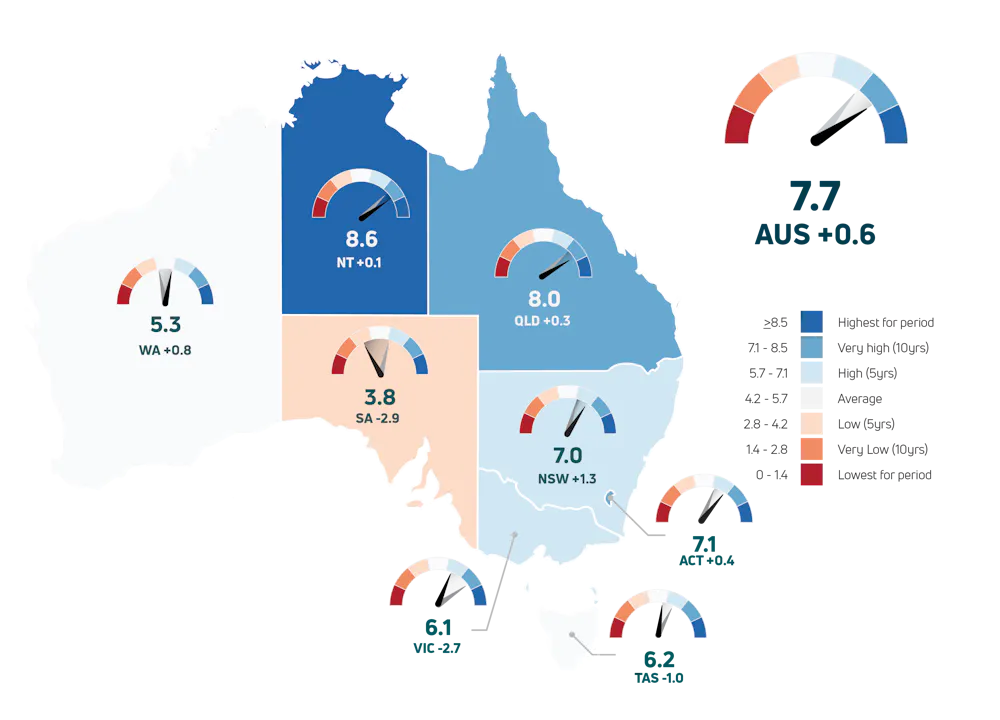
    For the fourth year running, the condition of Australia’s environment has been relatively good overall. Our national environment scorecard released today gives 2024 a mark of 7.7 out of 10.

    You might wonder how this can be. After all, climate change is intensifying and threatened species are still in decline.

    The main reason: good rainfall partly offset the impact of global warming. In many parts of Australia, rainfall, soil water and river flows were well above average, there were fewer large bushfires, and vegetation continued to grow. Overall, conditions were above average in the wetter north and east of Australia, although parts of the south and west were very dry.

    But this is no cause for complacency. Australia’s environment remains under intense pressure. Favourable conditions have simply offered a welcome but temporary reprieve. As a nation we must grasp the opportunity now to implement lasting solutions before the next cycle of drought and fire comes around.

    This snapshot shows the environmental score for a range of indicators in Australia.
    Australia’s Environment Report 2024, CC BY-NC-ND

    Preparing the national scorecard

    For the tenth year running, we have trawled through a huge amount of data from satellites, weather and water measuring stations, and ecological surveys.

    We gathered information about climate change, oceans, people, weather, water, soils, plants, fire and biodiversity.

    Then we analysed the data and summarised it all in a report that includes an overall score for the environment. This score (between zero and ten) gives a relative measure of how favourable conditions were for nature, agriculture and our way of life over the past year in comparison to all years since 2000. This is the period we have reliable records for.

    While it is a national report, conditions vary enormously between regions and so we also prepare regional scorecards. You can download the scorecard for your region at our website.

    Different jurisdictions had quite different environmental scores in 2024.
    Australia’s Environment Report 2024, CC BY-NC-ND

    Welcome news, but alarming trends continue

    Globally, 2024 was the world’s hottest year on record. It was Australia’s second hottest year, with the record warmest sea surface temperatures. As a result, the Great Barrier Reef experienced its fifth mass bleaching event since 2016, while Ningaloo Reef in Western Australia also experienced bleaching.

    Yet bushfire activity was low despite high temperatures, thanks to regular rainfall.

    National rainfall was 18% above average, improving soil condition and increasing tree canopy cover.

    States such as New South Wales saw notable improvements in environmental conditions, while conditions also improved somewhat in Western Australia. Others experienced declines, particularly South Australia, Victoria, and Tasmania. These regional contrasts were largely driven by rainfall – good rains can hide some underlying environmental degradation trends.

    Favourable weather conditions bumped up the nation’s score this year, rather than sustained environmental improvements.

    Mapping the environmental condition score to local government areas reveals poor (red) conditions in the west and the south, with good scores (blue) in the east and north. White is neutral.
    Australia’s Environment Explorer, CC BY-NC-ND

    A temporary respite?

    The past four years show Australia’s environment is capable of bouncing back from drought and fire when conditions are right.

    But the global climate crisis continues to escalate, and Australia remains highly vulnerable. Rising sea levels, more extreme weather and fire events continue to threaten our environment and livelihoods. The consequences of extreme events can persist for many years, like we have seen for the Black Summer of 2019–20.

    To play our part in limiting global warming, Australia needs to reduce its greenhouse gas emissions. Progress is stalling: last year, national emissions fell slightly (0.6%) below 2023 levels but were still higher than in 2022. Australia’s greenhouse gas emissions per person remain among the highest in the world.

    Biodiversity loss remains an urgent issue. The national threatened species list grew by 41 species in 2024. While this figure is much lower than the record of 130 species added in 2023, it remains well above the long-term average of 25 species added per year.

    More than half of the newly listed or uplisted species were directly affected by the Black Summer fires. Meanwhile, habitat destruction and invasive species continue to put pressure on native ecosystems and species.

    The Threatened Species Index captures data from long-term threatened species monitoring. The index is updated annually but with a three-year lag due largely to delays in data processing and sharing. This means the 2024 index includes data up to 2021.

    The index revealed the abundance of threatened birds, mammals, plants, and frogs has fallen an average of 58% since 2000.

    But there may be some good news. Between 2020 and 2021, the overall index increased slightly (2%) suggesting the decline has stabilised and some recovery is evident across species groups. We’ll need further monitoring to confirm whether this represents a lasting turnaround or a temporary pause in declines.

    This graph shows the relative abundance of different categories of species listed as threatened under the EPBC Act since 2000, as collated by the Threatened Species Index.
    Australia’s Environment Report 2024, CC BY-NC-ND

    What needs to happen?

    The 2024 Australia’s Environment Report offers a cautiously optimistic picture of the present. Without intervention, the future will look a lot worse.

    Australia must act decisively to secure our nation’s environmental future. This includes reducing greenhouse gas emissions, introducing stronger land management policies and increasing conservation efforts to maintain and restore our ecosystems.

    Without redoubling our efforts, the apparent environmental improvements will not be more than a temporary pause in a long-term downward trend.

    Australia’s Environment Report is produced by the ANU Fenner School for Environment & Society and the Terrestrial Ecosystem Research Network (TERN), which is enabled by the National Collaborative Research Infrastructure Strategy.

    Albert Van Dijk receives or has previously received funding from several government-funded agencies, grant schemes and programs.

    Shoshana Rapley is a Research Assistant and PhD candidate at the Australian National University and has received funding from the Ecological Society of Australia and BirdLife Australia.

    Tayla Lawrie is a current employee of the Terrestrial Ecosystem Research Network (TERN), funded by the National Collaborative Research Infrastructure Strategy.

    ref. Rain gave Australia’s environment a fourth year of reprieve in 2024 – but this masks deepening problems: report – https://theconversation.com/rain-gave-australias-environment-a-fourth-year-of-reprieve-in-2024-but-this-masks-deepening-problems-report-252183

    MIL OSI AnalysisEveningReport.nz

  • MIL-OSI Security: Mexican National Previously Deported Sentenced to Six Years for Illegal Firearm

    Source: Office of United States Attorneys

    KANSAS CITY, Mo. – A Mexican National illegally residing in Kansas City, Mo., was sentenced in federal court today for illegally possessing a firearm and ammunition.

    Mario Alberto Hernandez-Lugo, 39, was sentenced by U.S. District Judge Greg Kays to six years in federal prison without parole.

    On August 1, 2024, Hernandez-Lugo pleaded guilty to being an illegal alien in possession of a firearm and ammunition.  Hernandez-Lugo admitted he was in possession of a Beretta, 9mm pistol and .45 caliber and 9mm ammunition following his arrest during a traffic stop by Independence, Missouri Police Officers on May 28, 2023.     

    Under federal law it is illegal for any alien knowingly illegally or unlawfully in the United States to possess a firearm or ammunition. Hernandez-Lugo admitted he was in the United States illegally, having been previously deported and removed from the United States.  At sentencing District Judge Greg Kays noted that Hernandez-Lugo had previously been deported or removed from the United States on seven separate occasions. 

    This case is being prosecuted by Assistant U.S. Attorney Jess Michaelsen. It was investigated by the Kansas City and Independence, Missouri Police Departments, and the United States Immigration and Customs Enforcement.

    Project Safe Neighborhoods

    This case is part of Project Safe Neighborhoods (PSN), a program bringing together all levels of law enforcement and the communities they serve to reduce violent crime and gun violence, and to make our neighborhoods safer for everyone. On May 26, 2021, the Department launched a violent crime reduction strategy strengthening PSN based on these core principles: fostering trust and legitimacy in our communities, supporting community-based organizations that help prevent violence from occurring in the first place, setting focused and strategic enforcement priorities, and measuring the results.

    MIL Security OSI

  • MIL-OSI Security: Calhoun County Man Sentenced to 52 Months for Role in the Burglary of a Local Firearms Store

    Source: Office of United States Attorneys

    GREENVILLE, MS – Bryson Latavion Walker, 22, was sentenced today to over four years for his role in the burglary of a federally licensed firearms store.

    According to court documents, just after midnight on August 13, 2024, Walker and three other individuals broke into a federally licensed firearms store in Calhoun City, Mississippi and stole more than a dozen firearms as well as ammunition.

    On March 19, 2025, Chief U.S. District Court Judge Debra M. Brown sentenced Walker to 52 months in federal prison for the offense, to be followed by three years of supervised release. There is no parole in the federal system. The Court further ordered Walker to pay restitution to the store.

    “Every stolen firearm has the potential to wind up in the hands of a criminal, threatening the safety of our citizens and communities,” said U.S. Attorney Clay Joyner.  “We are proud to stand with our state and federal partners to demonstrate unequivocally that thieves who burglarize federal firearms licensees will face prosecution.”

    “Getting guns out of the hands of criminals before it is used in a violent crime is an essential part of our efforts to prevent, reduce, and solve violent crime,” said ATF New Orleans Special Agent in Charge Joshua Jackson. “We continue to identify and hold accountable those who want to illegally obtain firearms. The sentence imposed today sends a message that we will continue to focus our efforts to remove another violent criminal from our streets and keep our neighborhoods safe as the top priority for ATF.”

    The case was investigated by the Oxford Field Division of the Bureau of Alcohol, Tobacco, Firearms, and Explosives, along with the Calhoun County Sheriff’s Office.

    Assistant U.S. Attorney Julie Howell Addison prosecuted the case.

    This case is part of Project Safe Neighborhoods (PSN), a program bringing together all levels of law enforcement and the communities they serve to reduce violent crime and gun violence, and to make our neighborhoods safer for everyone. On May 26, 2021, the Department launched a violent crime reduction strategy strengthening PSN based on these core principles: fostering trust and legitimacy in our communities, supporting community-based organizations that help prevent violence from occurring in the first place, setting focused and strategic enforcement priorities, and measuring the results.

    MIL Security OSI

  • MIL-OSI USA: Luján Celebrates Completion of Critical Water Infrastructure Projects in Rural Doña Ana County, Recognizes New Mexico Workers

    US Senate News:

    Source: United States Senator Ben Ray Luján (D-New Mexico)

    Anthony, N.M. – On Tuesday, U.S. Senator Ben Ray Luján (D-N.M.) visited the Anthony Water Treatment Plant to celebrate the completion of two federally funded water infrastructure projects that he helped to fund in rural Doña Ana County. Senator Luján secured funding for the Border Environment Infrastructure Fund (BEIF), which allowed for the completion of these water infrastructure projects that have now connected rural homes to essential wastewater treatment services.

    “It was a privilege to celebrate the completion of two vital water infrastructure projects in Doña Ana County. I’m proud to have secured funding for these projects through the Environmental Protection Agency and its Border Environment Infrastructure Fund,”said Senator Luján. “Projects like these don’t happen without workers making them happen, and workers don’t work without projects like these.”

    “The new wastewater collection system in Sleepy Farms provides cleaner water, safer sanitation, and reduces the risk of groundwater contamination. In Anthony, the replacement of 23,000 feet of aging water lines ensures consistent, safe drinking water for 1,795 residents by preventing leaks, improving pressure, and reducing water loss,”continued Senator Luján. “Water is life in New Mexico, and we cannot afford to waste a single drop.”

    Project 1: Wastewater Collection System Extension and Improvements for Doña Ana County, New Mexico 

    The Project constructed a new wastewater collection system in an unincorporated area commonly known as Sleepy Farms, and rehabilitated a nearby Lift Station. Both components are near Vado in Doña Ana County, New Mexico. 

    The project will prevent groundwater contamination and reduce the risks of waterborne diseases by providing first-time wastewater collection services to 31 homes in the Sleepy Farms area and eliminating substandard and failing septic systems. The new system will collect an estimated 9,400 gallons per day (GPD) of wastewater for treatment and improve service for an additional 2,050 existing connections by increasing the reliability and efficiency of lift station #7, as well as preventing the risk of up to approximately 400,000 GPD of wastewater spills. 
     
    Project 2: Water Distribution System Improvements for Anthony, New Mexico 
     
    The project rehabilitated nearly 23,000 linear feet of deteriorated water distribution lines in Anthony, NM, to ensure reliable drinking water services for approximately 560 existing residential connections by reducing risks of leaks and line breaks.  An estimated 1,795 residents in Anthony will benefit from the project. 

    Anthony Water and Sanitation District (AWSD) provides water and wastewater services to the community of Anthony NM. AWSD currently provides services to approximately 2,900 residential connections or a population of approximately 9,950. Parts of the utility’s water distribution system date back to the mid-1900’s, have reached the end of their service life, and create maintenance issues for AWSD. 

    This project rehabilitated AWSD’s water lines in the Kaylar and Timbers Subdivisions, which had outdated pipes from the 1950s prone to frequent breaks and water losses. The area had issues with inadequate water flow, lack of fire suppression, and limited access to lines. Upgrades to the system will provide reliable drinking water for around 1,795 people, reduce water losses to under 20%, and improve overall water management, ensuring safer, more sustainable water services.

    MIL OSI USA News

  • MIL-OSI USA: SBA Offers Relief to North Dakota Private Nonprofits Affected by October Wildfires

    Source: United States Small Business Administration

    SACRAMENTO, Calif. – The U.S. Small Business Administration (SBA) announced the availability of low interest federal disaster loans to North Dakota private nonprofit (PNP) organizations who sustained physical damages and economic losses from the wildfires and straight-line winds occurring Oct. 5–6, 2024.

    The disaster declaration covers McKenzie and Williams counties.

    Under this disaster declaration, PNPs providing services of a governmental nature are eligible to apply for physical disaster loans and may borrow up to $2 million to repair or replace damaged or destroyed real estate, machinery and equipment, inventory, and other business assets.

    Applicants may be eligible for a loan amount increase of up to 20% of their physical damages, as verified by the SBA, for mitigation purposes. Eligible mitigation improvements might include insulating pipes, walls and attics, weather stripping doors and windows, and installing storm windows to help protect property and occupants from future damage caused by any disaster.  

    The SBA also offers  Economic Injury Disaster Loans (EIDLs) to help meet working capital needs, such as ongoing operating expenses for PNPs.  EIDL assistance is available regardless of whether the organization suffered any physical property damage. 

    Interest rates are as low 3.25% for PNPs, with terms up to 30 years. Interest does not begin to accrue, and payments are not due, until 12 months from the date of the first loan disbursement. The SBA determines eligibility and sets loan amounts and terms based on each applicant’s financial condition.

    The SBA encourages applicants to submit their loan applications promptly. Applications will be prioritized in the order they are received, and the SBA remains committed to processing them as efficiently as possible.

    To apply online, visit sba.gov/disaster. Applicants may also call SBA’s Customer Service Center at (800) 659-2955 or email disastercustomerservice@sba.gov for more information on SBA disaster assistance. For people who are deaf, hard of hearing, or have a speech disability, please dial 7-1-1 to access telecommunications relay services.

    The deadline to return economic injury applications is Sept. 24.

    ###

    About the U.S. Small Business Administration

    The U.S. Small Business Administration helps power the American dream of business ownership. As the only go-to resource and voice for small businesses backed by the strength of the federal government, the SBA empowers entrepreneurs and small business owners with the resources and support they need to start, grow, expand their businesses, or recover from a declared disaster. It delivers services through an extensive network of SBA field offices and partnerships with public and private organizations. To learn more, visit www.sba.gov.

    MIL OSI USA News

  • MIL-Evening Report: In 2000, Australia was defined by the Olympics, border politics and reconciliation. So what really has changed?

    Source: The Conversation (Au and NZ) – By Joshua Black, Visitor, School of History, Australian National University

    The world had its eyes on Sydney in 2000. A million people lined the harbour to ring in the new millennium (though some said it was actually the final year of the old one) on January 1.

    US television reporters called it “the biggest party in Australian history”. Bill Gates, chairman of Microsoft, whose corporation seemed to represent the coming age, was among those watching on.

    Sydney offered not only a world-leading party, but also a litmus test for the much-feared Y2K bug, which threatened to knock planes out of the sky and bring the global economy to a halt. Australia and New Zealand were said to be the “tripwire for the world’s computer systems”.

    It was fine in the end, although plenty of work had in fact been undertaken behind the scenes to make Australia’s systems more millennium-proof than they might have been.

    This was arguably the defining feature of Australia in the year 2000: a confident display for the world concealing a lot of angst and uncertainty. Australia was the “oldest continent on Earth”, the US broadcasters told their viewers, but it was “much more of an Asian nation”, and much closer to the rest of the world “thanks to technology”.

    Those confident claims would probably have surprised many Australians. Theirs was an old country trying to keep up with a new, interconnected world, and also a relatively young one trying to reconcile itself with the ancient cultures that its settler forebears had dispossessed.

    A curated Australia

    In September, the world’s sporting and political elite, followed by a train of journalists, arrived in Sydney for the 2000 Olympic Games. It had been years in the making, and every level of government was involved. There were no fewer than 47,000 volunteers.

    There was something for everyone in the well-curated opening ceremony. The event opened with the crack of a stockman’s whip and a fleet of flag-waving bushmen on horseback. There were highly sanitised displays of European arrival, pastoral settlement and a tribute to an armour-clad colonial Victorian bushranger that must have baffled those viewers watching from abroad who had not seen a Sidney Nolan painting before.

    Ancient stories and new cultural sensibilities were on display too. There were stylised performances of the Dreaming, striking First Nations dances and the distinctive sounds of the didgeridoo. A section entitled “Arrivals” recognised the importance of migration in the nation’s story.

    A young Aboriginal sprinter, Cathy Freeman, lit the cauldron in what became one of the iconic images of the year. The cauldron’s hydraulics unfortunately got stuck as it ascended, and the flame was mere seconds from snuffing out in what could have been a global embarrassment. But big ambitions incur big risks.

    This global performance of Australian-ness was arrestingly simple: that of a nation confident in its own diversity and capable of catering to everyone’s tastes.

    Even the musical selections seemed to reconcile the needs of the youth (with performances from a young Vanessa Amorosi and even younger Nikki Webster), and the more mature (represented by John Farnham and Olivia Newton-John).

    Australia’s athletes had their best ever showing with 58 medals, including Freeman’s own gold.

    Not quite comfortable, not quite relaxed

    The Olympics masked as much as they revealed.

    In 2000, many white Australians still weren’t sure if theirs was, or should be, a multicultural society.

    The reactionary Pauline Hanson was out of parliament for the time being, but her One Nation Party had won 7.5% of the vote in New South Wales in the March 1999 state election, and nearly 23% of the vote in Queensland the year before.

    Eight weeks before millennium day, Australians had roundly rejected two referendum proposals, one to become a republic, and for a Constitutional preamble that, among other things, recognised Indigenous Australians as “the nation’s first people”.

    But whether Hanson liked it or not, her lifetime had coincided with great demographic and social change.

    In 1976, roughly 1.8% of the population said they were born in Asia or the Middle East. In the 2001 census, 1.6% of the population were born in China or Vietnam alone, and many more were the descendants of migrants from these places.

    The Aboriginal and Torres Strait Islander population had more than doubled over the same period, while those identifying as Christian decreased from nearly 79% in 1976 to 56% in 2001.

    This increasingly diverse Australia claimed to be on a journey to “reconciliation”. That process had been sorely tested during the nasty debates about land rights and the Stolen Generations.

    Corroboree 2000, held on May 27 in Sydney, saw the Council for Aboriginal Reconciliation and the nation’s political leaders present their visions for the next phase of national healing. The leaders symbolically left their handprints on a “reconciliation canvas”.

    The following day, 250,000 Australians walked across the Sydney Harbour Bridge in a moving display of togetherness. John Howard, the prime minister, declined to participate.

    But his treasurer, Peter Costello, made a point of showing up for a similar event in Melbourne that December, leading Victorian Liberals and another 200,000 or so Australians.

    Their different approaches showed that the past was still a troubling present. Howard rebuffed suggestions of a treaty between Indigenous and settler Australians and maintained his refusal to apologise on behalf of the Commonwealth to the Stolen Generations, though all the states had done so by this time.

    The idea of such an apology was not as popular then as it seemed later on. The prime minister was sensitive to the fact that his was “an unpopular view with a lot of people”, but an opinion poll in The Australian newspaper showed a majority of voters were opposed to a national apology.

    Two survivors of the Stolen Generations, Peter Gunner and Lorna Cubillo, sued the Commonwealth for damages in 2000, giving their opponents the chance to challenge the legitimacy of their experiences. None of this looked like a nation that was as “comfortable and relaxed” as Howard had hoped it would be under his watch.

    Border politics

    Australian collective memory often gravitates toward 2001, the year of the Tampa affair and the September 11 terrorist attacks in New York.

    But Australia’s border was already highly politicised in 2000.

    In January, a boat arrived from Indonesia carrying 54 Christians fleeing religious conflict. They spent ten weeks at Port Hedland Immigration Detention facility, from which 39 went back to Indonesia and only 15 moved on to Adelaide to build new lives.

    Port Hedland and other detention centres made the news for all the wrong reasons. There were riots, hunger strikes and multiple breakouts. Authorities responded with upgraded security perimeters, character checks, and strip searches without warrants.

    Frustrated refugees set fire to South Australia’s Woomera facility, which former prime minister Malcolm Fraser publicly condemned as a “hell-hole”.

    In an end-of-year reflection for The Age newspaper, Gary Tippet said there had been a “touch of mean-spiritedness” about the handling of it all. Chris Wallace rightly suggests 2000 was a crucial moment in the “march towards an absolute offshore, extraterritorial approach” to refugees in Australia.

    In the intervening quarter-century, Australian officials have made mean-spiritedness an art form at the border and on the seas.

    First-rate democracy, third-rate economy

    Compared to the many legal challenges that came out of the US presidential contest in November 2000, Australia’s elections looked pretty smooth and sensible. The US seemed to have a backward democracy grafted onto its world-leading, information-age economy.

    Australia looked the opposite: a first-rate democracy with what looked increasingly like a “branch-office economy”.

    Reformers had tried for 20 years to make Australia efficient and competitive, but as one editorial in The Australian Financial Review explained, the country still suffered from its “old economy image”.

    The tech boom would soon become the tech wreck.
    Robert Cianflone/Getty Images

    Certainly, Australia still sold its minerals and farm products to the world in exchange for quality cars and cutting-edge computers.

    With global capitalists still enthralled by the global tech boom (though it was soon to become the “tech wreck”), they had little need for the Aussie dollar.

    The currency’s value declined through the year to just 50 US cents, and it would fall further in the following months. On its own, this mattered little, but a quarter of negative growth at the end of the year meant, as Paul Kelly later wrote, an “election-year recession” seemed a “real threat”.

    In the meantime, the much-debated Goods and Services Tax took effect around midnight on June 30 (a few hours later for businesses trading through the night).

    The 10% consumption tax was a big deal. Costello said in his memoir the “prices of three billion products were to change all at the same time”.

    The measure was politically brave, but soon became unpopular, helping raise petrol prices and alienate small business owners.

    The punters were pretty confident the Howard government was heading for defeat in 2001. They were wrong.

    Between the old and new

    The pace of social change accelerated from 2000.

    In the 2021 census, 2.6% of the population said they were born in India, and a further 3.2% in China and Vietnam. Aboriginal and Torres Strait Islander Australians had more than doubled over two decades, such that they made up 3.2% of the total population in 2021.

    People increasingly related to their economy differently, too. Half of the workforce had been unionised in the 1980s, but coverage fell to roughly a quarter in 2000 and just 12.5% in 2022.

    These and other changes make our politics look different from that of 25 years ago. Nailbiter elections are now more common than thumping majorities and attitudes toward the once-feared “minority government” have softened.

    For all that, many of the challenges of 2000 are still with us.

    Many Australians are less tolerant of overt racism than they once were, but the 2023 Voice referendum and our offshore detention regime remind us that race still matters in this country.

    Kevin Rudd apologised to the Stolen Generations in 2008, but Treaty and Truth-Telling are left unresolved.

    And for all our talk about human capital and the digital economy, resources make up a much higher share of our total export mix today than in 2000.

    A quarter-century on, Australia is still caught between the old and the new.

    Dr Joshua Black is a Postdoctoral Research Fellow at The Australia Institute.

    ref. In 2000, Australia was defined by the Olympics, border politics and reconciliation. So what really has changed? – https://theconversation.com/in-2000-australia-was-defined-by-the-olympics-border-politics-and-reconciliation-so-what-really-has-changed-250791

    MIL OSI AnalysisEveningReport.nz

  • MIL-OSI United Nations: Statement by UNFPA Executive Director Dr. Natalia Kanem on the resumption of attacks on Gaza

    Source: United Nations Population Fund

    UNFPA is shocked by the resumption of airstrikes across the Gaza Strip. Already a meaningful number of civilians have been killed. UN staff have also been caught up in the violence, with staff members tragically killed in attacks this morning. As fighting resumes, the number of dead will soar higher. 
     
    During the ceasefire, UNFPA and partners worked against immense odds to reinstate basic services for women and girls, delivering and equipping makeshift health centres, which have provided critical maternal health care to thousands of pregnant women. The resumption of hostilities and an aid blockade entering its third week, now threaten to erase even these small gains.
     
    This is subjecting women and girls to yet another cycle of deprivation and suffering. A lack of electricity and fuel has disabled hospital operations, and life-saving maternal health medicines have run out, again – particularly dangerous for the one in two pregnant women in Gaza who face a high-risk pregnancy.  
     
    Malnutrition is high among pregnant and breastfeeding women, leading to increased pregnancy complications. Folic acid, multivitamins, and other crucial supplements are on the verge of disappearing. In February, at least one in five newborns were born with complications, including low birth weight, requiring advanced medical care that is now increasingly unavailable. Portable incubators, ultrasound devices, and oxygen pumps, among other essential equipment, are now stalled at the border. 
     
    International humanitarian law is clear: civilians must be protected. They must be assured access to the essentials needed to survive, including food, water, shelter, and healthcare. UNFPA strongly appeals for the ceasefire to be respected. All hostages must be released unconditionally. The unimpeded movement of humanitarian assistance must be established and basic services restored. 
     
    Ultimately, women and girls need a permanent end to hostilities and a pathway to peace.

    MIL OSI United Nations News

  • MIL-OSI USA News: Statement from Secretary Rubio and NSC Waltz on Call with Zelenskyy

    Source: The White House

    “Today, President Donald J. Trump and Ukraine’s President Volodymyr Zelenskyy had a fantastic phone conversation.  President Zelenskyy thanked President Trump for a productive start for the work of the Ukrainian and American teams in Jeddah on March 11th. The meeting of the senior officials from both nations significantly helped in moving toward ending the war. 
     

    President Zelenskyy thanked President Trump for the support of the United States, especially the Javelin missiles that President Trump was first to provide, and his efforts towards peace. The leaders agreed Ukraine and America will continue working together to bring about a real end to the war, and that lasting peace under President Trump’s leadership can be achieved.
     

    President Trump fully briefed President Zelenskyy on his conversation with Russian President Vladimir Putin and the key issues discussed. They reviewed the situation in Kursk and agreed to share information closely between their defense staffs as the battlefield situation evolved.  President Zelenskyy asked for additional air defense systems to protect his civilians, particularly Patriot missile systems, President Trump agreed to work with him to find what was available particularly in Europe.

    The two leaders also agreed on a partial ceasefire against energy. Technical teams will meet in Saudi Arabia in the coming days to discuss broadening the ceasefire to the Black Sea on the way to a full ceasefire. They agreed this could be the first step toward the full end of the war and ensuring security. President Zelenskyy was grateful for the President’s leadership in this effort and reiterated his willingness to adopt a full ceasefire.

    President Trump also discussed Ukraine’s electrical supply and nuclear power plants.  He said that the United States could be very helpful in running those plants with its electricity and utility expertise.  American ownership of those plants would be the best protection for that infrastructure and support for Ukrainian energy infrastructure.

    President Zelenskyy also thanked President Trump for continuing to push humanitarian concerns, including the exchange of POWs.  He noted they had just had a successful exchange and thanked the President for his leadership.  President Trump also asked President Zelenskyy about the children who had gone missing from Ukraine during the war, including the ones that had been abducted.  President Trump promised to work closely with both parties to help make sure those children were returned home.  

    They agreed all parties must continue the effort to make a ceasefire work. The Presidents noted the positive work of their advisors and representatives, especially Secretary Rubio, National Security Advisor Waltz, Special Envoy Kellogg, and others.  The Presidents instructed their teams to move ahead with the technical issues related to implementing and broadening the partial ceasefire. The Presidents instructed their advisors and representatives to carry out this work as quickly as possible. The Presidents emphasized that in further meetings, the teams can agree on all necessary aspects of advancing toward lasting peace and security.”

    MIL OSI USA News

  • MIL-OSI USA: King, Shaheen Stress Important Role of Military Firefighters at Portsmouth Naval Shipyard

    US Senate News:

    Source: United States Senator for Maine Angus King
    WASHINGTON, D.C. — U.S. Senators Angus King (I-ME) and Jeanne Shaheen (D-NH), members of the Senate Armed Services Committee (SASC), are expressing their concerns about the potential loss of Department of Defense (DoD) firefighters on probationary status at Portsmouth Naval Shipyard (PNSY). In a letter to Acting Secretary of the Navy Terrence Emmert, the Senators make clear the importance of having a highly trained firefighting force, and urged the Secretary to provide clear and consistent guidance regarding the seemingly arbitrary hiring freezes and terminations requested by the Trump Administration and Elon Musk’s Department of Government Efficiency (DOGE).
    The effects of inadequate firefighter staffing are profound; insufficient fire protection has the potential to halt shipyard operations, threatening safety for military personnel and undermining national security. ‘Hot work’ — like welding — on submarines in the shipyard will stop if there are not enough firefighters. 
    “We are writing to express deep concern regarding manning challenges faced by Department of Defense firefighters, particularly those responsible for protecting critical naval installations at Portsmouth Naval Shipyard (PNSY). Recent administration actions create a significant degree of uncertainty and operational risk, which demand urgent attention. We urge you to bring clarity to your most valuable asset—the people who serve the Department of the Navy,” began the Senators.
    One of the most pressing concerns is the uncertain job environment for these essential personnel. Probationary firefighters face an alarming risk of termination due to haphazard workforce reductions and unclear guidance on exceptions. While federal police personnel appear to be granted certain protections, there is no specific indication that firefighters are similarly excepted. This lack of clarity has led to unnecessary distress and instability within the workforce,” wrote the Senators.
    Firefighting is an arduous profession requiring specialized training and expertise. At Naval Computer and Telecommunications Station Cutler, it took two years to reach full manning levels, underscoring the challenge of adequately staffing these critical roles. The firefighters at such remote bases are indispensable, as they provide emergency response capabilities in areas without local fire department support. Their work directly supports sensitive national security missions, making their continued employment a matter of national security, not just workforce planning,” the Senators continued.
    As a member of the Senate Armed Services Committee (SASC), and Chairman of the Strategic Forces Subcommittee, Senator King is a steadfast supporter of the Navy and Coast Guard. He recently secured key provisions in the FY 2025 National Defense Authorization Act (NDAA) to support the maritime forces and ensure that America’s military can continue providing best in class services to protect the ‘territory of the brave.’ In 2023, he was honored with the Congressional Sea Services Award by the Navy League Capital Council and accepted it on behalf of the men and women of the sea services and the shipbuilders at Bath Iron Works (BIW) and Portsmouth Naval Shipyard. Additionally, at the personal invitation of Senator King, former Secretary of the Navy Carlos Del Toro visited Maine shipyards, like Portsmouth Naval Shipyard, regularly during his service. Most recently, he expressed gratitude that the Coast Guard funding bill passed the Senate unanimously.
    The full letter sent to Acting Secretary Emmert can be found here and below.
    +++
    We are writing to express deep concern regarding manning challenges faced by Department of Defense firefighters, particularly those responsible for protecting critical naval installations at Portsmouth Naval Shipyard (PNSY). Recent administration actions create a significant degree of uncertainty and operational risk, which demand urgent attention. We urge you to bring clarity to your most valuable asset—the people who serve the Department of the Navy.
    One of the most pressing concerns is the uncertain job environment for these essential personnel. Probationary firefighters face an alarming risk of termination due to haphazard workforce reductions and unclear guidance on exceptions. While federal police personnel appear to be granted certain protections, there is no specific indication that firefighters are similarly excepted. This lack of clarity has led to unnecessary distress and instability within the workforce.
    The potential loss of probationary employees at PNSY would be particularly devastating. If these individuals are terminated, the shipyard would lose an entire shift—amounting to a 22% reduction in its firefighting workforce. This level of loss in staffing would severely compromise emergency response capabilities and overall operational safety.
    Compounding this issue is the seemingly arbitrary hiring freeze, which has abruptly halted employment commitments. Some prospective hires, who had already made significant life changes, including relocating hundreds of miles to accept these positions, were suddenly told to stop and that their hiring would not proceed. This approach not only disrupts lives but also undermines the Department’s ability to attract and retain top-tier firefighting talent in an already competitive job market.
    Firefighting is an arduous profession requiring specialized training and expertise. At Naval Computer and Telecommunications Station Cutler, it took two years to reach full manning levels, underscoring the challenge of adequately staffing these critical roles. The firefighters at such remote bases are indispensable, as they provide emergency response capabilities in areas without local fire department support. Their work directly supports sensitive national security missions, making their continued employment a matter of national security, not just workforce planning.
    Furthermore, the national shortage of firefighters extends beyond the Department, which means that arbitrarily cutting positions and telling personnel to reapply later is not a viable option. Unlike other fields outside of the Department of the Navy, where hiring and layoffs can be more flexible, firefighting requires continuous training and preparedness. A break in service could result in skill degradation and loss of qualified personnel to other sectors that provide greater stability.
    The importance of base fire departments cannot be overstated. Fires do not stop at the gates of a base, and present hazards to the surrounding population. Shipyards are especially vulnerable due to the inherently hazardous nature of their operations. History has demonstrated the catastrophic consequences of shipyard fires, making it imperative that we maintain adequate firefighting staffing levels. Without sufficient personnel, shipyard operations may come to a halt, delaying essential maintenance and production work vital to fleet readiness.
    Ultimately, this is not just a matter of workforce numbers—it is a matter of safety for our military personnel, our local communities, and the security of our nation. The firefighters protecting our bases and shipyards are essential to ensuring operational continuity and emergency preparedness. We urge you to address these concerns and provide clear, consistent guidance to stabilize this critical workforce.
    We appreciate your time and consideration in addressing these urgent matters and look forward to your timely response.
    Sincerely,

    MIL OSI USA News

  • MIL-OSI USA: Mississippi Man Indicted for Federal Civil Rights and Arson Charges for Setting Fire to Mormon Church

    Source: US State of North Dakota

    A federal grand jury in Gulfport, Mississippi, returned a six-count superseding indictment today charging Stefan Day, also known as Stefan Pete Day Rowold, with federal civil rights and arson violations for vandalizing and setting fire to a house of worship.

    According to the superseding indictment, on July 5, 2024, and July 7, 2024, Day set fire to The Church of Jesus Christ of Latter-Day Saints in Wiggins, Mississippi. Counts one and four of the superseding indictment charge Day with arson for setting fire to the church. Counts two and five of the superseding indictment charge Day with intentionally damaging, defacing, and destroying religious real property because of the religious character of the property. Counts three and six of the superseding indictment charge Day with using fire to commit a federal felony offense.

    If convicted, Day faces a minimum penalty of five years in prison and a maximum penalty of 20 years in prison on each of the arson charges, a maximum penalty of 20 years in prison for each of the civil rights charges, and a minimum penalty of ten years in prison for the use of fire to commit a federal felony offense.

    Deputy Assistant Attorney General Mac Warner of the Justice Department’s Civil Rights Division, Acting U.S. Attorney Patrick Lemon for the Southern District of Mississippi, and Special Agent in Charge Robert A. Eikhoff of the FBI Jackson Field Office made the announcement.

    The FBI Jackson Field Office investigated the case, with assistance from the Bureau of Alcohol, Tobacco, Firearms and Explosives, the Mississippi Bureau of Investigation, the Mississippi State Fire Marshal, and the Wiggins Police Department.

    Assistant U.S. Attorney Jonathan Buckner for the Southern District of Mississippi and Trial Attorney Chloe Neely of the Civil Rights Division’s Criminal Section are prosecuting the case.

    An indictment is merely an allegation. All defendants are presumed innocent until proven guilty beyond a reasonable doubt in a court of law.

    MIL OSI USA News

  • MIL-OSI United Nations: Secretary-General Condemns Attacks on United Nations Personnel, Calls for Full Investigation as Staff Member Killed in Gaza

    Source: United Nations MIL OSI b

    The following statement was issued today by the Spokesman for UN Secretary-General António Guterres:

    The Secretary-General was deeply saddened and shocked to learn of the death of a United Nations Office for Project Services (UNOPS) staff member, when two UN guesthouses in Deir al Balah were hit in strikes.  Five other UN personnel were seriously injured.

    The locations of all UN premises are known to the parties to the conflict, who are bound by international law to protect them and maintain their absolute inviolability.

    The Secretary-General strongly condemns all attacks on UN personnel and calls for a full investigation.  He underscores that all conflicts must be conducted in a way that ensures civilians are respected and protected.

    The Secretary-General sends his deepest condolences to the family of the staff member killed.

    Today’s deadly strike brings the number of UN colleagues killed in Gaza since 7 October 2023 to at least 280.

    The incident follows reports from yesterday — which saw the deaths of hundreds, including many children — marking one of the deadliest days in Gaza since late 2023.

    The Secretary-General stresses the need for the ceasefire to be respected to bring an end to the suffering of the people.  Humanitarian aid must reach all people in need.  The hostages must be released immediately and unconditionally.

    He also recalls that international law must be complied with at all times.

    MIL OSI United Nations News

  • MIL-OSI Security: Mississippi Man Indicted for Federal Civil Rights and Arson Charges for Setting Fire to Mormon Church

    Source: United States Attorneys General

    A federal grand jury in Gulfport, Mississippi, returned a six-count superseding indictment today charging Stefan Day, also known as Stefan Pete Day Rowold, with federal civil rights and arson violations for vandalizing and setting fire to a house of worship.

    According to the superseding indictment, on July 5, 2024, and July 7, 2024, Day set fire to The Church of Jesus Christ of Latter-Day Saints in Wiggins, Mississippi. Counts one and four of the superseding indictment charge Day with arson for setting fire to the church. Counts two and five of the superseding indictment charge Day with intentionally damaging, defacing, and destroying religious real property because of the religious character of the property. Counts three and six of the superseding indictment charge Day with using fire to commit a federal felony offense.

    If convicted, Day faces a minimum penalty of five years in prison and a maximum penalty of 20 years in prison on each of the arson charges, a maximum penalty of 20 years in prison for each of the civil rights charges, and a minimum penalty of ten years in prison for the use of fire to commit a federal felony offense.

    Deputy Assistant Attorney General Mac Warner of the Justice Department’s Civil Rights Division, Acting U.S. Attorney Patrick Lemon for the Southern District of Mississippi, and Special Agent in Charge Robert A. Eikhoff of the FBI Jackson Field Office made the announcement.

    The FBI Jackson Field Office investigated the case, with assistance from the Bureau of Alcohol, Tobacco, Firearms and Explosives, the Mississippi Bureau of Investigation, the Mississippi State Fire Marshal, and the Wiggins Police Department.

    Assistant U.S. Attorney Jonathan Buckner for the Southern District of Mississippi and Trial Attorney Chloe Neely of the Civil Rights Division’s Criminal Section are prosecuting the case.

    An indictment is merely an allegation. All defendants are presumed innocent until proven guilty beyond a reasonable doubt in a court of law.

    MIL Security OSI

  • MIL-OSI Global: Revoking EPA’s endangerment finding – the keystone of US climate policies – won’t be simple and could have unintended consequences

    Source: The Conversation – USA – By Patrick Parenteau, Professor of Law Emeritus, Vermont Law & Graduate School

    Several U.S. climate regulations aim to reduce burning of fossil fuels, a driver of climate change. Visions of America/Joseph Sohm/Universal Images Group via Getty Images

    Most of the United States’ major climate regulations are underpinned by one important document: It’s called the endangerment finding, and it concludes that greenhouse gas emissions are a threat to human health and welfare.

    The Trump administration is vowing to eliminate it.

    Environmental Protection Agency Administrator Lee Zeldin referred to the 2009 endangerment finding as the “holy grail of the climate religion” when he announced on March 12, 2025, that he would reconsider the finding and all U.S. climate regulations and actions that rely on it. That would include rules to control planet-warming emissions of greenhouse gases like carbon dioxide and methane from power plants, vehicles and oil and gas operations.

    But revoking the endangerment finding isn’t a simple task. And doing so could have unintended consequences for the very industries Trump is trying to help.

    EPA Administrator Lee Zeldin announces plans to reconsider more than 30 climate regulations.

    As a law professor, I have tracked federal climate regulations and the lawsuits and court rulings that have followed them over the past 25 years. To understand the challenges, let’s look at the endangerment finding’s origins and Zeldin’s options.

    Origin and limits of the endangerment finding

    In 2007, the U.S. Supreme Court ruled in Massachusetts v. EPA that six greenhouse gases are pollutants under the Clean Air Act and that the EPA has a duty under the same law to determine whether they pose a danger to public health or welfare.

    The court also ruled that once the EPA made an endangerment finding, the agency would have a mandatory duty under the Clean Air Act to regulate all sources that contribute to the danger.

    The Court emphasized that the endangerment finding was a scientific determination and rejected a laundry list of policy arguments made by the George W. Bush administration for why the government preferred to use nonregulatory approaches to reduce emissions. The court said the only question was whether sufficient scientific evidence exists to determine whether greenhouse gases are harmful.

    The endangerment finding was the EPA’s response.

    The finding was challenged and upheld in 2012 by the U.S. District Circuit for the District of Columbia. In that case, Coalition for Responsible Regulation v. EPA, the court found that the “body of scientific evidence marshaled by the EPA in support of the endangerment finding is substantial.” The Supreme Court declined to review the decision. The endangerment finding was updated and confirmed by the EPA in 2015 and 2016.

    Challenging the endangerment finding

    The scientific basis for the endangerment finding is stronger today than it was in 2009.

    The Intergovernmental Panel on Climate Change’s latest assessment report, involving hundreds of scientists and thousands of studies from around the world, concluded that the scientific evidence for warming of the climate system is “unequivocal” and that greenhouse gases from human activities are causing it.

    According to the National Climate Assessment released in 2023, the effects of human-caused climate change are already “far-reaching and worsening across every region of the United States.”

    Summer temperatures have climbed in much of the U.S. and the world as greenhouse gas emissions have risen.
    Fifth National Climate Assessment

    During President Donald Trump’s first term, then-EPA Administrator Scott Pruitt considered repealing the endangerment finding but ultimately decided against it. In fact, he relied on it in proposing the Affordable Clean Energy Rule to replace President Barack Obama’s Clean Power Plan for regulating emissions for coal-fired power plants.

    What happens if the EPA revokes the endangerment finding?

    For the Trump administration to now revoke that finding, Zeldin must first recruit new members of the EPA’s Science Advisory Board to replace those dismissed by the Trump administration. Congress created the board in 1978 to provide independent, unbiased scientific advice to the EPA administrator, and it has consistently supported the 2009 endangerment finding.

    Zeldin must then initiate rulemaking in compliance with the Administrative Procedure Act, provide the opportunity for public comment and respond to comments that are likely to be voluminous. This process could take several months if done properly.

    If Zeldin then decides to revoke the endangerment finding, lawsuits will immediately challenge the move.

    Even if Zeldin is able to revoke the finding, that does not automatically repeal all the rules that rely on it. Each of those rules must go through separate rulemaking processes that will also take months.

    Zeldin could simply refuse to enforce the rules on the books while he reconsiders the endangerment finding.

    However, a blanket policy abdicating any enforcement responsibility could be challenged in lawsuits as arbitrary and capricious. Further, the regulated industries would be taking a chance if they delayed complying with regulations only to find the endangerment finding and climate laws still in place.

    Zeldin’s cost argument

    Zeldin previewed his arguments in a news release on March 12.

    His first argument is that the 2009 endangerment finding did not consider costs. However, that argument was rejected by the D.C. Circuit Court in Coalition for Responsible Regulation v. EPA. Cost becomes relevant once the EPA considers new regulations – after the endangerment finding.

    Moreover, in a unanimous 2001 decision, the Supreme Court in Whitman v. American Trucking Associations held that the EPA cannot consider cost in setting air quality standards.

    A repeal could backfire

    Repealing the endangerment finding could also backfire on the fossil fuel industry.

    States and cities have filed dozens of lawsuits against the major oil companies. The industry’s strongest argument has been that these cases are preempted by federal law. In AEP v. Connecticut in 2011, the Supreme Court ruled that the Clean Air Act “displaced” federal common law, barring state claims for remedies related to damages from climate change.

    However, if the endangerment finding is repealed, then there is arguably no basis for federal preemption, and these state lawsuits would have legal grounds. Prominent industry lawyers have warned the EPA about this and urged it to focus instead on changing individual regulations. The industry is concerned enough that it may try to get Congress to grant it immunity from climate lawsuits.

    To the extent that Zeldin is counting on the conservative Supreme Court to back him up, he may be disappointed.

    In 2024, the court overturned the Chevron doctrine, which required courts to defer to agencies’ reasonable interpretations when laws were ambiguous. That means Zeldin’s reinterpretation of the statute is not entitled to deference. Nor can he count on the court overturning its Massachusetts v. EPA ruling to free him to disregard science for policy reasons.

    Patrick Parenteau does not work for, consult, own shares in or receive funding from any company or organization that would benefit from this article, and has disclosed no relevant affiliations beyond their academic appointment.

    ref. Revoking EPA’s endangerment finding – the keystone of US climate policies – won’t be simple and could have unintended consequences – https://theconversation.com/revoking-epas-endangerment-finding-the-keystone-of-us-climate-policies-wont-be-simple-and-could-have-unintended-consequences-252271

    MIL OSI – Global Reports

  • MIL-OSI Global: US isn’t first country to dismantle its foreign aid office − here’s what happened after the UK killed its version of USAID

    Source: The Conversation – USA – By Sarah Stroup, Professor of Political Science; Director, Conflict Transformation Collaborative, Middlebury

    The U.S. and U.K. used to be major funders of global immunization programs for children. AP Photo/Sunday Alamba, File

    The Trump administration’s dismantling of the United States Agency for International Development is unconstitutional, a federal judge ruled on March 18, 2025. The court order to pause the agency’s shuttering came days after Secretary of State Marco Rubio said that 83% of its programs had been cut.

    USAID was created in 1961 as the lead agency for U.S. international development. Until recently, it funded health and humanitarian aid programs in more than 130 countries. Despite the administration’s claim of cost-cutting, USAID was a relatively small and economical operation. Its US$40 billion budget accounted for just 0.7% of annual federal spending. Congress also required regular reporting and evaluations on USAID, helping to ensure substantial oversight of how it spent its taxpayer dollars.

    USAID’s swift destruction has sent shock waves across the globe. But as a scholar of the global humanitarian aid sector and donor agencies, I know this assault on foreign aid is not unprecedented.

    In June 2020, Boris Johnson, then the prime minister of the United Kingdom, used similar claims of budget-tightening to effectively close the Department for International Development, Britain’s equivalent of USAID.

    A COVID merger

    Both the U.S. and British foreign aid programs have long prompted heated debates over the proper relationship between development, diplomacy and national security. The U.S. and Britain have long been among the top five providers of development assistance worldwide, and both USAID and DFID have played leading roles in the development community.

    Countries give foreign aid for both altruistic and self-interested reasons. Treating global diseases and addressing civil conflicts is a way for wealthy Western governments to limit threats that could destabilize their countries, as well as the rest of the world. It also burnishes their reputation and encourages cooperation with other governments.

    Scholars from across the political spectrum and around the world have questioned the general efficacy of foreign assistance, arguing that these programs are designed to serve the interests of donors, not the needs or recipients. Other development experts contend that foreign aid programs, while imperfect, have still made meaningful progress in improving health, education and freedoms.

    Britain’s DFID was created in 1997 as an independent, Cabinet-level department deliberately independent of partisan politics. It quickly developed a reputation as a model donor, even among skeptics of international aid.

    British Prime Minister Boris Johnson announced the DFiD merger in June 2020.
    AP Photo/Kirsty Wigglesworth, file

    For example, a staffer at the international medical charity Doctors without Borders told me in a 2006 interview that he had scoffed at the idea of a politics-free aid agency.

    Yet, he said, he had found DFID “relatively easier to work with” than other donors.

    “I have never heard of someone being told, as a result of accepting DFID funds, what to do, either explicitly or behind closed doors,” he told me.

    But its good reputation could not protect DFID. At the height of the COVID-19 pandemic, Johnson announced that DFID would merge with the Foreign Office, Britain’s equivalent of the State Department, to create a new government agency. By uniting aid and diplomacy, Johnson said, the new Foreign, Commonwealth and Development Office would get “maximum value for the British taxpayer,” and he cited the economic impact of COVID to justify his decision.

    Foreign aid dropped sharply after the merger, from 0.7% of Britain’s gross national income to 0.5% – a cut of about US$6 billion.

    Development professionals decried Johnson’s merger, arguing it could not have happened at a worse time, with the pandemic heightening the need for global health funding. And coming shortly after Brexit, Britain’s withdrawal from the European Union, DFID’s demise further called into question Britain’s commitment to global cooperation.

    Less money, less impact

    Five years later, it’s not clear that dismantling DFID has made British foreign aid more efficient or effective, as Johnson pledged.

    “We have seen evidence of where a more integrated approach has improved the organisation’s ability to respond to international crises and events, which has led to a better result,” reads one 2025 report by the U.K.’s National Audit Office.

    Two departments in one – but not twice the budget.
    Mike Kemp/In Pictures via Getty Images

    Yet, the auditors add, the British government has spent at least £24.7 million – US$32 million – to merge its aid and diplomacy offices, and it failed to track these costs. Nor did the leaders of the merger set out a clear vision for its new purpose.

    Britain’s slimmer new Foreign, Commonwealth and Development Office has also relinquished the U.K.’s past leadership in research and expertise, largely due to pay reductions and restrictions on hiring non-British nationals.

    From the outset, DFID had invested substantially in building expertise in global development, particularly in conflict-ridden states. In 2001, for example, it spent almost 5% of its budget – an unusually high amount – on research and policy analysis to design and assess its programs.

    DFID produced regular case studies of the projects it funded, which included getting Syrian refugee children back in school, building roads that help Rwandan farmers move their products to market, and providing health care after Pakistan’s 2010 floods.

    Given the “development expertise that was lost with the merger,” the U.K. government can no longer conduct “the kind of rigorous, long-term focus necessary to make a real impact,” said the Center for Global Development in a recent report.

    A 2022 study suggests that DFID’s dismantling was a fundamentally political move, “divorced from substantive analysis of policy or inter-institution relationships.”

    Britain’s new Prime Minister Keir Starmer, of the leftist Labour Party, initially promised to boost British foreign aid. But in early March 2025, he backtracked, announcing instead a further cut to foreign aid.

    By 2027, the U.K. government will spend just 0.3% of its budget on overseas aid. That’s roughly $11 billion less than before the merger in 2019.

    ‘Clear and easy target’

    USAID’s budget was much larger than DFID’s, and the administration apparently wants not to streamline U.S. foreign aid but halt it almost entirely. If this effort succeeds, it will have even more severe effects worldwide, at least in the immediate term.

    The global health programs administered by USAIDm which combat diseases such as HIV, tuberculosis and malaria, have received bipartisan and global praise. The PEPFAR program, which USAID helps administer, distributes antiretroviral drugs worldwide. It alone has saved 25 million lives over the past two decades, including the lives of 5.5 million babies born healthy to mothers with HIV.

    Development professionals tend to see independent government agencies such as USAID and DFID as better able to prioritize the needs of the poor because their programming is run separately from partisan policies.

    Yet standalone agencies are also more visible – and so more vulnerable to political targeting.

    DFID was a clear and easy target when Johnson began his pandemic-era budget-slashing. USAID is now suffering a similar fate.

    Sarah Stroup does not work for, consult, own shares in or receive funding from any company or organization that would benefit from this article, and has disclosed no relevant affiliations beyond their academic appointment.

    ref. US isn’t first country to dismantle its foreign aid office − here’s what happened after the UK killed its version of USAID – https://theconversation.com/us-isnt-first-country-to-dismantle-its-foreign-aid-office-heres-what-happened-after-the-uk-killed-its-version-of-usaid-250868

    MIL OSI – Global Reports

  • MIL-OSI USA: 2024 Army Community Partnership Award winners announced

    Source: United States Army

    WASHINGTON – The Department of the Army has announced the seven winners of the 2024 Army Community Partnership Awards.

    “The installations honored this year highlight the excellent commitment to partnering with communities and strengthening those relationships that allow us to provide the best possible resources for Soldiers and their families,” said Lt. Gen. David Wilson, Deputy Chief of Staff, G-9.

    The Army Community Partnership Awards Program seeks to highlight examples of exceptional cooperation and diligence that will encourage continued collaboration to achieve the full potential of community partnerships. The awardees represent partnerships that have improved quality of life for Soldiers and their families, enhanced readiness, driven modernization and contributed to reform initiatives throughout the Army.

    “These partnerships exemplify the collaboration required to enhance our resilience, improve quality of life for our Soldiers and their families, and bolster our operational readiness to meet the needs of our Army today and tomorrow,” said Daniel M. Klippstein, senior official performing the duties of the Assistant Secretary of the Army for Installations, Energy and Environment.

    The Army selected seven winners and their neighboring communities that formed innovative partnerships that improve quality of life for Soldiers and families, enhance readiness, modernize services, provide efficiencies, expand capabilities and strengthen community relations.

    • Fort Leonard Wood and the cities of Saint Robert and Waynesville: Fort Leonard Wood’s new airfield lease project supports the construction of a new non-Army funded terminal critical to the long-term viability of commercial jet service to and from the installation. The new 25-year lease, new terminal, and past investments in planning, improvements, and repairs reiterates long-term commitments from the cities, the FAA and the state of Missouri to maintain accessibility to Fort Leonard Wood. The new terminal will modernize and increase the efficiency of all terminal operational and security services, systems and processes as compared to existing legacy facilities.
    • U.S. Army Garrison Hawaii, Pōhakuloa Training Area and the Hawaii County Fire & Emergency Services: The Mutual Aid Agreement between USAG-HI (PTA) and the Hawaii County Fire & Emergency Services seamlessly integrates resources and joint training exercises. This collaboration is a robust mutual support system enhancing the regional emergency response capabilities. Collaboration between PTA and Hawaii County Fire & Emergency Services maximizes shared resource utilization and operational efficiency.
    • Picatinny Arsenal and the Morris County Municipalities & Fire Districts: The MAA between Picatinny Arsenal and the Morris County Municipalities & Fire Districts provides 24-hour emergency dispatching service at no cost to the Army. The partnership enhances Picatinny’s emergency response capabilities and fills a gap in service availability. By partnering with Morris County, Picatinny Arsenal improved their firefighting capabilities through real-world responses and joint training exercises. The MAA enabled Picatinny to access 24/7 emergency response while also realizing significant cost savings.
    • Fort Carson and the Colorado Springs Utilities: The intergovernmental support agreement between Fort Carson and the Colorado Springs Utilities provides Fort Carson with superior operations and maintenance of electric and gas systems beyond pre-IGSA capabilities. Partnering with CSU enhances Fort Carson’s energy resilience by creating the capability to operate independently in the event of an off-post electrical grid failure. The IGSA created the on-post generation and microgrid capabilities necessary to operate during an off-post blackouts.
    • Fort Bliss and the El Paso Water Utilities Public Service Board: This IGSA between USAG-Fort Bliss and the El Paso Water Utilities Public Service Board provides engineering, technical, project design, consultant services, minor construction, repair, maintenance, geotechnical services, land surveying, soil borings, water quality testing, and water resource planning services associated with and incidental to stormwater management, water quality, water conservation, and those types of capital improvement projects.
    • U.S. Army Garrison Poland and the Republic of Poland: The Polish Provided Logistics Support provides in-kind logistical support to the U.S. Army. The PPLS provides infrastructure, logistical support and munitions storage to facilitate joint military exercises as part of the Enhanced Defense Cooperation Agreement. The availability of pre-positioned equipment and supplies improves the readiness of U.S. forces in the region, enabling a stronger alliance and faster response times.
    • U.S. Army War College and the Cumberland County Department of Public Safety: The MAA between U.S. Army War College and the Cumberland County Department of Public Safety expands operational and mission capabilities by sharing capacity, resources and capabilities. Cooperating with CCDPS has enhanced the War College’s emergency response capabilities. The partnership utilizes joint training and planning, shared emergency response resources, and shared expertise to enhance shared public safety and emergency response capabilities.

    Awardees included partnerships signed in fiscal years 2021-2024 by garrisons, reserve centers and armories. Submissions were evaluated using the following criteria:

    • Improves Soldier/family quality of life
    • Improves or enhances readiness
    • Modernizes a service, system or process
    • Provides cost or other efficiencies
    • Expands capability
    • Improves community relations

    The awards ceremony will be held in the Pentagon Hall of Heroes on April 10, 2025, from 10:00 to 11:00 AM.

    For additional information, please contact the Office of the Deputy Chief of Staff, G-9, usarmy.pentagon.hqda-dcs-g-9.list.sig@mail.mil.

    MIL OSI USA News