Category: Natural Disasters

  • MIL-OSI Russia: SPbGASU named the winning team of the qualifying round of the International Engineering Championship “CASE-IN”

    Translartion. Region: Russians Fedetion –

    Source: Saint Petersburg State University of Architecture and Civil Engineering – Saint Petersburg State University of Architecture and Civil Engineering – Team “C-Key” (Ekaterina Buryak, Alexandra Leonova, Elizaveta Petrova, Alexey Khimichev, Sofia Tarkhanova, Denis Lebedev, Alexander Katsyuba) and Kirill Pivovarov

    The results of the selection round of the student league of the International Engineering Championship “CASE-IN” in the direction of “Architecture, design, construction and housing and public utilities” were summed up at SPbGASU. The defense of case solutions and the award ceremony for the winners took place on March 12.

    CASE-IN was created 13 years ago to promote engineering and technical education and to train future highly qualified specialists. The organizers of the championship are the Nadezhnaya Smena Foundation, the Youth Forum of Mining Leaders Non-Commercial Partnership, AstraLogika LLC, and the presidential platform Russia – the Land of Opportunities. The championship is included in the Science of Winning initiative of the Decade of Science and Technology in Russia.

    According to Marina Malyutina, Vice-Rector for Youth Policy, SPbGASU has been participating in CASE-IN since 2019. According to Marina Viktorovna, this is a fundamental and important decision for an engineering university. Students show good results, the number of those wishing to participate is growing year after year. In the future, they are offered practice, internship, and employment. Previously, the university participated in the “Engineering Design” competency, and the tasks were not entirely specialized. Now, thanks to the Metropolis company, SPbGASU students have the opportunity to apply the specialized knowledge they receive at the university.

    Artem Korolev, director of the Nadezhnaya Smena charity foundation and founder of the CASE-IN International Engineering Championship, shared his plans for the 13th season in a video message: this year, there will be school, student, and special leagues. 280 schools are expected to participate in the school league. More than 220 universities are expected in the student league, 80 of which will host the in-person selection round. A total of 18,500 participants are expected – schoolchildren, students, young professionals, experts, mentors, and curators. The theme of the 13th season is Technological Innovations.

    The first deputy general director of the autonomous non-profit organization “Russia – Land of Opportunities” Gennady Guryanov spoke about the successes of the project in a video message: during its existence, the project has united more than 120 thousand schoolchildren, students and young professionals from Russia and neighboring countries. Since 2019, together with the presidential platform “Russia – Land of Opportunities”, the project provides young people with opportunities for personal, professional and career growth.

    Eight teams spent 21 days solving a case from Metropolis, the initiator of the direction and strategic partner of the championship. Each team brought together students from different directions. Under the guidance of mentors, future architects, builders, and designers developed a hotel and tourist complex in a natural area. The results of their work were assessed by an expert commission, which included representatives of Metropolis and SPbGASU.

    The architectural and design solutions, power supply systems, heating, ventilation and air conditioning systems, general requirements (technology, fire safety, energy efficiency, automation systems) were assessed. The speakers’ fluency in professional terminology, their ability to express and justify their opinions, the clarity and understandability of the slide structure, the logicality of their answers to questions, etc. were also taken into account. After the defenses, the experts provided targeted feedback to the teams assigned to them: they highlighted strengths and growth areas, provided comments and advice on improving the solution.

    Andrey Surovenkov and Olga Bochkareva

    Olga Bochkareva, a member of the expert committee, deputy dean of the Faculty of Economics and Management for academic work, associate professor of the Department of Construction Management, believes that the championship gave students the opportunity to “pump up” their knowledge in practice, to feel that the entire project depends on the joint work. In addition, the competition showed that students of technical specialties need to learn to speak: “Whatever profession students are studying – builder, designer, architect – it is important to be able to “sell” their project. In the modern world, there is no way around it!”

    Andrey Surovenkov, a member of the expert committee and head of the architectural design department, believes that the benefit of the championship is that students from different specialties, who most likely did not know each other before, unite into a team. For the curators, this is also a useful experience – they had to set the vector for creating a good project.

    Participants of the selection round. Ahead is the expert committee: chief architect of the project OOO Metropolis Alexey Bondarenko, Kirill Pivovarov, chief specialist of the design solutions department Alina Sitova, senior lecturer of the department of heat and gas supply and ventilation of SPbGASU Sergey Kashnikov, deputy director of the educational center of digital competencies of SPbGASU Denis Nizhegorodtsev, associate professor of the department of water use and ecology of SPbGASU Alexander Podporin

    Kirill Pivovarov, Chairman of the Expert Commission and Head of the Metropolis Heating, Ventilation and Air Conditioning Department Group, is confident that for the company, the championship is, first and foremost, about attracting new employees. Moreover, employers have the opportunity to evaluate their abilities without an interview or probationary period. For students, this is an opportunity to create. When compiling the assignment, the company was guided by the students’ current capabilities and, at the same time, sought to bring the tasks closer to reality.

    “This is a great experience for the guys in terms of applying their skills in practice. The theory they study at the university is superimposed on a real project here, and this will help them in their future work. Many students are great: they have quite serious projects at the level of practicing designers. I would rate the overall level of work as very high,” said member of the expert commission, senior lecturer of the Department of Heat and Gas Supply and Ventilation Sergey Kashnikov.

    “I regularly participate in assessing student work at a variety of competitions – both within our university and at other venues. I would like to note that it is precisely such competitions that develop students’ extremely important skills of independent work, including as part of project teams. And it is especially pleasant to see that the level of students’ work is growing from year to year,” said Denis Nizhegorodtsev, a member of the expert commission and deputy director of the Educational Center for Digital Competencies.

    Third place went to the YeezyBIM team (mentor – associate professor of the Department of Heat and Gas Supply and Ventilation Viktor Yakovlev). It included Alina Kizchenko (fourth-year bachelor’s degree student of the Faculty of Environmental Engineering and Urban Management, leader/BIM coordinator), Arina Tereshchenko (fourth-year bachelor’s degree student of the Faculty of Architecture, architect), Olga Gavrichenkova (third-year bachelor’s degree student of the Faculty of Environmental Engineering and Urban Management, water use and sanitation engineer), Anna Yarullina (fourth-year bachelor’s degree student of the Faculty of Environmental Engineering and Urban Management, design engineer of internal electrical equipment and lighting), Yaroslav Perevalov (fourth-year bachelor’s degree student of the Faculty of Civil Engineering, designer), Polina Orlova (fourth-year bachelor’s degree student of the Faculty of Environmental Engineering and Urban Management, heating and ventilation engineer).

    The second place was won by the team “Bim Bam Boom” (mentor – assistant of the Department of Design of Architectural Environment Dmitry Fleisher). The team consists of Emilia Sukhareva (fourth-year bachelor’s degree student of the Faculty of Architecture, leader/architect), Kirill Besedin (fourth-year bachelor’s degree student of the Faculty of Civil Engineering, designer), Daniil Goncharenko (fourth-year bachelor’s degree student of the Faculty of Environmental Engineering and Urban Management, heating and ventilation engineer), Mikhail Danilchenko (third-year bachelor’s degree student of the Faculty of Civil Engineering, designer), Kirill Ivanov (fourth-year bachelor’s degree student of the Faculty of Civil Engineering, BIM coordinator), Sergey Sergeev (fourth-year bachelor’s degree student of the Faculty of Environmental Engineering and Urban Management, power supply engineer), Dmitry Sidorchuk (fourth-year bachelor’s degree student of the Faculty of Environmental Engineering and Urban Management, water supply and sanitation engineer).

    “The team decided to implement the current principle of nature-likeness as the most suitable for the given topic. It implies minimizing the impact on the environment and using natural factors for the functioning of the facility. The team worked under the leadership of captain Emilia Sukhareva, a talented student studying at the Department of DAS. Kirill Besedin is the most experienced and proactive member of the team. Daniil Goncharenko, having project experience, successfully implemented the general concept of ventilation and heating. Dmitry Sidorchuk, having extensive experience in participating in competitions of this kind, managed to provide the facility with water supply and sewerage networks. Sergey Sergeev, also an experienced team member, was engaged in the design of power supply networks and showed an excellent result. Mikhail Danilchenko gained his first experience of participating in a team on this project, but he coped with the tasks set by the KR very well. Kirill Ivanov provided BIM technologies throughout the project and in all its areas. Well done!” – summed up Dmitry Fleisher.

    The first place was awarded to the “C-Key” team (mentor – Deputy Dean for Career Guidance, Associate Professor of the Department of Technosphere Safety Alexander Glukhanov). It included Ekaterina Buryak (third-year specialist student of the Faculty of Construction, chief project engineer), Alexandra Leonova (third-year specialist student of the Faculty of Construction, BIM coordinator), Elizaveta Petrova (third-year undergraduate student of the Faculty of Architecture, architect), Sofia Tarkhanova (third-year specialist student of the Faculty of Construction, designer), Denis Lebedev (third-year specialist student of the Faculty of Construction, designer), Alexey Khimichev (third-year undergraduate student of the Faculty of Architecture, architect), Alexander Katsyuba (third-year undergraduate student of the Faculty of Engineering Ecology and Urban Economy, specialist in engineering networks).

    “It was difficult. But we approached the solution comprehensively, followed all the requirements of the technical specifications and achieved the result!” – Ekaterina Buryak is sure.

    “This is the first experience of such live interaction with the subject area. I worked with guys from other specialties, it was very interesting. I learned some programs all over again, I learned a lot of new things in these three weeks. The experience is colossal!” – shared Alexander Katsyuba.

    “We developed the architectural solutions section together with Elizaveta Petrova. And we want to say that this project was very interesting for us from the point of view of interaction between specialists in related fields. It was interesting to track how architectural issues are connected with issues of utility networks, design solutions, how all issues are resolved in the design system,” said Alexey Khimchev.

    The mentor of the winners, Alexander Glukhanov, gave his comment: “The team developed a concept for the development of a tourist cluster on the Black Sea coast. The students created a detailed description of the construction project, took into account the features of the area, the needs of tourists, and the possibilities of using the infrastructure. They created a harmonious arrangement of the park area located in the heart of the territory, the active recreation area and the entrance area, integrated recreation areas and other functional components of the complex. Special attention was paid to the optimal combination of space-planning solutions: they took into account functional, sanitary and hygienic and fire safety requirements.”

    The champions and prize winners of the Architecture, Design, Construction and Housing and Utilities category will be invited to an internship at Metropolis with the prospect of further employment. The winning team will take part in the final competition, which will be held in Moscow at the end of May. We wish them good luck!

    Please note: This information is raw content directly from the source of the information. It is exactly what the source states and does not reflect the position of MIL-OSI or its clients.

    MIL OSI Russia News

  • MIL-OSI Global: Thirty years ago Ukraine got rid of its nuclear arsenal – now the people regret that decision

    Source: The Conversation – UK – By Jennifer Mathers, Senior Lecturer in International Politics, Aberystwyth University

    Around 73% of Ukrainians now want their country to “restore” its nuclear weapons, according to a recent opinion poll. A majority of Ukrainians (58%) were in favour of Ukraine owning nuclear weapons, even if this meant losing western allies.

    This suggests an underlying regret that Ukraine agreed to relinquish the world’s third largest nuclear arsenal as part of the Budapest Memorandum around 30 years ago. This agreement, signed in December 1994, provided security guarantees for Ukraine from the US, the UK and Russia in return for giving up the weapons. Ukraine also agreed it would not acquire nuclear weapons in the future.

    The focus on nuclear weapons is intensifying all over Europe. This week the Polish president, Andrzej Duda, called on the US to station its nuclear weapons in his country to deter Russian attacks. He cited Moscow’s decision to deploy nuclear weapons just across the border in Belarus during 2023 as part of his reasoning.

    Trump’s apparent weakening commitment to Nato has also prompted the French president, Emmanuel Macron, to suggest that France could extend protection of its own nuclear weapons to its allies.

    It’s clear that some Ukrainians now believe that their country would have been less likely to have experienced a Russian invasion if it had held on to its nuclear capacity. Ukrainians now question how much they can rely on other states after the failure of security guarantees that were central to the 1994 agreement.

    The pledges by the US, UK and Russia to protect the sovereignty and independence of Ukraine were put to the test in 2014 when Russia invaded and then annexed Crimea and began providing financial and military backing for militia leaders in eastern Ukraine who claimed to lead pro-Russian separatist movements.


    Read more:
    Are Ukrainians ready for ceasefire and concessions? Here’s what the polls say


    The US and UK imposed economic sanctions against Russia and provided training, equipment and non-lethal weapons to the Ukrainian armed forces. But these measures fell well short of ensuring Ukraine’s sovereignty and were insufficient to help Ukraine retake its territory.

    Similarly, US and UK support for Ukraine since the start of Russia’s full-scale invasion in 2022, although valuable and much appreciated by the Ukrainians, has not been enough to allow Kyiv to completely expel Russian troops from Ukrainian territory.

    What was the Budapest Memorandum?

    What if Ukraine still had nuclear weapons?

    But what if Ukraine had never given up its nuclear weapons? The logic of deterrence suggests that Putin would have not have invaded and attacked a nuclear-armed Ukraine. But the argument that Ukraine should not have surrendered the Soviet nuclear weapons on its territory overlooks the specific circumstances. For while physical components of a nuclear weapons capability – delivery vehicles and nuclear warheads – were within Ukraine’s grasp, the launch codes remained in Moscow, and Russian leaders showed no willingness to relinquish them.

    So, Kyiv would have had no control over whether, when or against whom those weapons might have been used. The risk to Ukraine of becoming the target of another state’s nuclear strike would have been considerable, and the Kyiv government would have been unable to do anything to reduce that risk. Retaining nuclear weapons left over from the Soviet period would have probably made Ukrainians less rather than more secure.


    Read more:
    What is the value of US security guarantees? Here’s what history shows


    Ukraine also lacked the economic resources to maintain the nuclear weapons on its territory, or develop them into a credible deterrent force. In exchange for giving up nuclear weapons, Ukraine received much-needed economic assistance from the west.

    In the 1990s Ukrainian views were shaped by the 1986 accident at the Chernobyl nuclear power plant. This had a devastating and lasting impact on the land and the people in that part of Ukraine, highlighting the risks of the nuclear sector. In 1994, when the Budapest Memorandum was being negotiated, only 30% of Ukrainians were in favour of Ukraine possessing nuclear weapons.

    What now?

    Ukraine would face considerable technical challenges in developing nuclear weapons today, both in creating the necessary quantities of fissile material for warheads and manufacturing delivery vehicles.

    Kyiv would also need to pay for an expensive nuclear weapons development programme at a time when the Ukrainian economy is struggling to supply its soldiers with conventional weapons and meet the needs of civilians.

    And unless Ukraine’s international supporters were on board, Kyiv might face the withdrawal of economic and military aid at a crucial juncture. If Moscow detected any move on Ukraine’s part to develop nuclear weapons, there would be a strong motive for a preemptive Russian strike to put an end to that plan.

    But even though it may not be feasible for Ukraine to develop an independent nuclear deterrent in the short term, Kyiv may feel compelled to pursue a nuclear weapons programme unless Ukraine is provided with serious and reliable security guarantees. With the Trump administration apparently ruling out Nato membership for Ukraine, the onus is on the country’s international supporters to come up with an alternative unless they want to see further nuclear proliferation in Europe.

    Jennifer Mathers does not work for, consult, own shares in or receive funding from any company or organisation that would benefit from this article, and has disclosed no relevant affiliations beyond their academic appointment.

    ref. Thirty years ago Ukraine got rid of its nuclear arsenal – now the people regret that decision – https://theconversation.com/thirty-years-ago-ukraine-got-rid-of-its-nuclear-arsenal-now-the-people-regret-that-decision-251733

    MIL OSI – Global Reports

  • MIL-OSI USA: NIST Releases Reference Material to Aid Gut Microbiome Research

    Source: US Government research organizations

    A unit of RM 8048 consists of four vials each from two dietary pools: omnivore and vegetarian.

    Credit: NIST

    The National Institute of Standards and Technology (NIST) has released a human stool reference material that will help scientists accurately measure the gut microbiome. The initiative aims to speed progress in a cutting-edge field of medical research targeting some of humanity’s most serious and intractable diseases.

    The human gut microbiome is a rich, teeming ecosystem of microorganisms and their byproducts that line the human gastrointestinal tract. Over the last decade, scientists have linked activity in the gut microbiome to obesity, diabetes, mental illness, cancer and other medical conditions. Researchers believe that a new class of drugs targeting the gut microbiome can treat many of these conditions.

    NIST’s Human Gut Microbiome Reference Material consists of eight frozen vials of exhaustively studied human feces suspended in aqueous solution, along with more than 25 pages of data identifying the key microbes and biomolecules the material contains. Scientists, including those working at biopharmaceutical and biotech companies, can use this material to further their research and develop new drugs that target the microbiome, including new treatments that contain living bacteria. bacteria.

    NIST’s stool reference material is “the most precisely measured, scientifically analyzed and richly characterized human fecal standard ever produced,” said NIST molecular geneticist Scott Jackson. “We hope our reference material will lay the foundation for gut microbiome research to thrive and reach its full potential.”

    Gut Microbiome Medicine

    NIST researchers remove a fecal sample from deep freeze for analysis. Samples were stored at minus 80 Celsius.

    Credit: D. Ellisor/NIST

    As unappealing as it may sound, one of the most promising areas of medical and health research involves treatments and medicines derived from human feces.

    Two such drugs have been approved by the FDA to treat recurrent C. difficile infection.  This bacterial infection, commonly picked up in hospitals, is associated with up to 30,000 deaths in the U.S. every year.

    Fecal transplants — literally transplanting stool from one person to another — have also been used to treat recurrent C. difficile infection. This proved so effective, with a success rate of 95%, that researchers are exploring the use of fecal transplants to treat a broad range of other diseases that may involve the gut microbiome, including alcoholic hepatitis, cancer, colitis and many other illnesses.

    Feces-derived treatments work by altering the composition and behavior of the gut microbiome to boost health. Many probiotics sold over the counter at pharmacies today make generic health claims, but they aren’t FDA-approved or thoroughly vetted for clinical efficacy.

    Jackson said the next generation of microbial medicines will be scientifically tested and proved to be efficacious at treating specific diseases. NIST’s reference material will help to make this possible.

    “We are at the beginning of a new era of live microbial therapies,” said Jackson, “This isn’t just wishful thinking. It’s already happening.”

    Why a Reference Material Is Needed

    Gut microbiome research is a fast-moving, highly competitive field. Scientists consistently report breakthroughs, and companies invest billions to develop new drugs. However, the field is still relatively new, and researchers use a variety of methods to measure the human microbiome.  The myriad approaches can, and often do, lead to differing results that cannot be compared in a meaningful way.

    “If you give two different laboratories the same stool sample for analysis, you’ll likely get strikingly different results,” Jackson said.

    Scientists recognize that the wide range of approaches creates problems with reproducibility, where they cannot replicate each other’s results. Reproducibility is considered vital in science as it enables researchers to validate and build upon each other’s experiments.

    The NIST fecal RM aims to help standardize research on the gut microbiome. “It will help ensure accuracy, consistency, comparability and reproducibility in the field,” Jackson said.

    How the Reference Material Can Be Used

    NIST produces over 1,000 reference materials, many for the life sciences, including cholesterol, human DNA and human blood serum. Laboratories use them to ensure accuracy, precision and quality control. NIST’s cholesterol reference material, for example, helps ensure that doctors and patients can trust the accuracy of their cholesterol test results.

    “We are at the beginning of a new era of live microbial therapies. This isn’t just wishful thinking. It’s already happening.”  —Scott Jackson, NIST molecular geneticist

    Among the possible uses for NIST’s stool reference material are:

    • Comparing diverse methods and techniques. The reference material can serve as a “gold standard” or benchmark for evaluating the wide array of approaches researchers and companies use to measure and analyze human feces. The results of these approaches can be compared to NIST’s results and to each other to determine which is best suited to achieving specific objectives.
    • Enabling reproducibility. If two different labs get similar findings using NIST’s reference material, they know that their methods and techniques produce results that can be meaningfully compared.

    How the Reference Material Was Made

    To obtain fecal material, NIST contracted with a medical services company that recruited individuals and collected stool samples from them. The individuals were all healthy adults, including both men and women. Roughly half were vegetarians and half were omnivores. Because diet affects the composition of the gut microbiome, using these two cohorts ensured that the RM captured a broad range of variability. NIST has no information on the individual donors.

    Analyzing the material was a challenge. Fecal matter contains trillions of microorganisms from hundreds of different species, food particles, human cells, and countless proteins, enzymes and metabolites. It is considered one of the most complex biological materials on the planet.

    Over a dozen scientists worked for six years to turn those samples into NIST’s microbiome reference material. They identified more than 150 metabolites using advanced chemical analysis techniques and more than 150 species of microbes based on their genetic signatures.

    They also ensured that the reference material is stable — it’s designed to have a shelf life of at least five years — and homogeneous — every sample is the same, within the bounds of stated uncertainties in the measurements. 

    “Through a lot of trial and error, brainstorming and collaboration with the scientific community, we were able to create a reference material that fulfills the needs of our stakeholders,” Jackson said.

    The reference material includes eight 100-milligram tubes — four from the vegetarian cohort and four from the omnivores — along with a wealth of information about the microbes and metabolites that NIST identified. The NIST team focused special attention on those compounds and organisms thought to be most relevant to human health and new medical treatments.

    “The release of our reference material is a significant step forward,” said Jackson. “We’re moving toward a time when we can all agree on exactly what we’re talking about when we’re discussing the human gut microbiome.”

    MIL OSI USA News

  • MIL-OSI Global: What was the first thing scientists discovered? A historian makes the case for Babylonian astronomy

    Source: The Conversation – USA – By James Byrne, Assistant Teaching Professor in the Herbst Program for Engineering, Ethics & Society, University of Colorado Boulder

    Ancient Babylonians looked to the skies to predict what would happen. mikroman6/Moment via Getty Images

    Curious Kids is a series for children of all ages. If you have a question you’d like an expert to answer, send it to curiouskidsus@theconversation.com.


    What was the first thing scientists discovered? – Jacob, age 9, Santiago, Panama


    All societies have had ways of understanding nature based on their experiences of it. For example, farmers need to understand the seasons and weather to know when to plant and harvest their crops. Hunters need to understand the lives of animals to know how to hunt them.

    This kind of understanding of the natural world isn’t quite the same as science though. Science typically refers to knowledge that’s more organized and formal than that. It’s not just an explanation, but a system that uses observations and experiments to build theories that are recorded, passed on to others and built on.

    With that idea in mind, as a historian of science, my best answer to the question of what the first scientists discovered is Babylonian astronomy.

    The Babylonians lived from about 2,500 to 4,000 years ago in the area that’s now Iraq. What makes Babylonian astronomy stand out as being especially scientific is the careful, organized way in which Babylonian scribes – their keepers of knowledge – observed, recorded and eventually mathematically predicted the ways that the Sun, Moon, stars and planets move in the skies.

    Babylonian astronomy was uniquely scientific

    Before clocks, observing the sky was how people knew the time. During the day you can see the Sun, and at night you can see the stars. Many calendars are based on the skies too. A month is about how long it takes the Moon to go through its phases. A year is one full revolution of the Earth around the Sun.

    But keeping track of time wasn’t the only way the Babylonians used astronomy. Like today’s world, Babylonia could be both predictable and chaotic. The weather changed with the seasons; crops were planted and harvested; festivals were celebrated; people were born, aged and died, all predictably. But a bad harvest might cause high prices for grains and starvation; a king might die young, causing political upheaval; a disease might kill thousands, all unpredictably.

    The stars and planets can seem like that, too. The stars are always in the same places in relation to one another, so you can identify constellations, and those constellations rise and set at regular times over the course of a year. But the planets move around – they’re not always in the same places, and sometimes they even seem to stop and move backward in their paths. Sometimes even more spectacular events occur, such as eclipses.

    An eclipse might have seemed like a powerful omen of something that would happen next.
    Josh Edelson/AFP via Getty Images

    For the Babylonians, those ideas were linked. They saw changes in the motions of the planets or rare events such as eclipses as signs – omens – about what was going to happen on Earth. For example, they might think the shadow of the Earth moving over the Moon in a certain way during a lunar eclipse meant that a flood would also happen.

    The scribes kept a book called Enūma Anu Enlil listing omens and their meanings. So if the seemingly changing motions of the heavens could be predicted, maybe earthly events could be, too. This led the scribes to study astronomy.

    How Babylonian astronomy worked

    The foundation of Babylonian astronomy was kept in a book called MUL.APIN, meaning “The Plough Star,” the name of a constellation. It recorded the positions of the stars, when in the year they would first be visible, the paths of the Sun and Moon, the periods when the planets would be visible in the night sky, and other fundamental astronomical knowledge.

    Later, Babylonian scribes began to keep their Astronomical Diaries, which contained detailed records of the positions of the Moon and planets along with events on Earth such as the weather and the price of grain. In other words, they recorded their observations of both astronomical omens and the events they might have predicted.

    Babylonian scribes used cuneiform to write down records of all kinds.
    mikroman6/Moment via Getty Images

    This kind of careful observation and record-keeping is a major part of science. The Astronomical Diaries were kept for over 700 years, making them maybe the longest-running scientific project ever.

    The records in the Astronomical Diaries helped Babylonian scribes take another scientific step: predicting astronomical events. One part of this was computing what the Babylonians called goal-years: the number of years it took for a planet to return to the same place on the same day. For example, they computed that the period for Venus was eight Babylonian years. So if Venus was somewhere on a particular day, it would be in the same place on the same day eight years later.

    By around the fourth century B.C.E., the scribes developed this knowledge into a system of mathematically predicting astronomical events. They made tables called ephemerides that showed when these events would happen in the future. So Babylonian scribes succeeded in their project: They made the motions of the Sun, Moon and planets predictable.

    Babylonian astronomy and you

    MUL.APIN, the Astronomical Diaries, the ephemerides and all of Babylonian astronomy had a major impact on later astronomers, one that continues to today. Greek astronomers used Babylonian observations to make geometric models of planetary motions, part of the long path toward modern astronomy. The ephemerides were the ancestors of astronomical tables, which still exist. For example, NASA has a table of eclipses online that goes to the year 3000.

    We tell time using the Babylonian system.
    Catherine McQueen/Moment via Getty Images

    But the most familiar thing that comes from Babylonian astronomy is how we tell time. The Babylonians didn’t use a decimal system with units of 10 like we do. Instead, they used a sexagesimal system, with units of 60. Babylonian observations were so important that later people kept Babylonian units for astronomy, even though they used a base 10 system for other things.

    So if you’ve ever wondered why an hour has 60 minutes, and a minute has 60 seconds, it’s because we’ve kept that way of measuring from Babylonian astronomy. Whenever you tell the time, you’re using some of the very oldest science.


    Hello, curious kids! Do you have a question you’d like an expert to answer? Ask an adult to send your question to CuriousKidsUS@theconversation.com. Please tell us your name, age and the city where you live.

    And since curiosity has no age limit – adults, let us know what you’re wondering, too. We won’t be able to answer every question, but we will do our best.

    James Byrne does not work for, consult, own shares in or receive funding from any company or organization that would benefit from this article, and has disclosed no relevant affiliations beyond their academic appointment.

    ref. What was the first thing scientists discovered? A historian makes the case for Babylonian astronomy – https://theconversation.com/what-was-the-first-thing-scientists-discovered-a-historian-makes-the-case-for-babylonian-astronomy-244463

    MIL OSI – Global Reports

  • MIL-OSI Security: Tacoma Man with Lengthy Criminal History Pleads Guilty to Gun and Drug Charges

    Source: Federal Bureau of Investigation (FBI) State Crime Alerts (c)

    Defendant prohibited from possessing firearms due to prior convictions including one connected to gang gun battle in downtown Seattle in 2020

    Seattle – A Tacoma resident, who was previously charged and acquitted in state court in a 2020 downtown Seattle mass shooting, pleaded guilty today in federal court in Seattle to drug trafficking and illegal firearms possession, announced Acting U.S. Attorney Teal Luthy Miller. Marquise Tolbert, 29, of Tacoma, Washington, was arrested in June 2023, and has been in federal custody since that time. Tolbert is scheduled for sentencing by U.S. District Judge Tana Lin on June 18, 2025.

    According to records in the case, Marquise Tolbert admits he possessed a firearm on June 1, 2023. On that day Tolbert was arrested at this Tacoma address on a Washington Department of Corrections (DOC) warrant. A Ruger 5.7 pistol and loaded magazine were found in his residence. Tolbert is prohibited from possessing firearms due to a September 2022 conviction in King County Superior Court for illegally possessing a firearm.

    Investigators with the FBI Safe Streets task force, the DEA, and the Seattle Police Gun Violence Reduction Unit were investigating a drug trafficking organization when Tolbert and his coconspirators were heard on a wiretap discussing a shoot-out in Federal Way. From that point on, investigators worked to identify those who were possessing and using firearms as part of their criminal activity. Investigators heard Tolbert discussing his purchase of the Ruger firearm from another member of the conspiracy.  On the day he bought the gun law enforcement, surveilled Tolbert, followed him to his residence, arrested him, and secured the firearm.

    Additionally, the investigation determined that Tolbert was involved in distributing controlled substances including oxycodone that was being shipped to Washington State from Arizona.

    Illegal firearms possession is punishable by up to 15 years in prison. The drug distribution count is punishable by up to 20 years in prison. Under the terms of the plea agreement, prosecutors will recommend no more than seven years in prison for both counts of conviction. The actual sentence will be determined by Judge Lin after considering the sentencing guidelines and other statutory factors.

    In 2020, Tolbert was involved in a gang shootout at 3rd Avenue and Pine Street in downtown Seattle. One woman was killed, and seven other bystanders were injured in the gun battle. Tolbert was acquitted on murder and assault charges connected to the case. His attorney’s argued he was not the first to fire in the gang related shooting. He was convicted of illegal firearms possession.

    The case was investigated by the FBI, the Seattle Police Department, and the DEA as part of their focus on getting firearms off the streets.

    The case is being prosecuted by Assistant United States Attorneys Stephen Hobbs. 

    MIL Security OSI

  • MIL-OSI: Zoom debuts new agentic AI skills and agents for Zoom AI Companion

    Source: GlobeNewswire (MIL-OSI)

    • Zoom AI Companion expands agentic skills across the entire Zoom platform, using reasoning and memory to take action and orchestrate task execution, conversational self-service, custom agent creation, and more
    • More than 45 new innovations announced, including AI enhancements for Zoom Meetings, Zoom Phone, Zoom Team Chat, Zoom Docs, and Zoom Contact Center, help users get more done, do their best work, and strengthen relationships
    • New Zoom customer experience (CX) innovations include next-generation enhancements to Zoom Virtual Agent chat and the introduction of Virtual Agent for voice, AI intent routing capabilities, and Advanced Quality Management

    ORLANDO, Fla., March 17, 2025 (GLOBE NEWSWIRE) — Today Zoom Communications, Inc. (NASDAQ: ZM) unveiled agentic AI Companion capabilities, new Zoom AI Companion skills, and AI updates across its platform, including Zoom Meetings, Zoom Team Chat, Zoom Docs, Zoom Phone, Zoom Whiteboard, Zoom Contact Center, industry solutions, and more.

    “AI Companion is evolving from a personal assistant to being truly agentic, which signals a major leap forward in how AI can enhance productivity and collaboration at work,” said Smita Hashim, chief product officer at Zoom. “We’re delivering value for our customers through AI agents and agentic skills that solve real customer problems, helping them connect, collaborate, and get more done, all within the Zoom platform our users trust and love.”

    “We’ve been using Zoom AI Companion since it became available, and I’ve seen firsthand how it has transformed our academic and administrative operations,” said Steven Carroll, chief information officer at Saint Leo University. “This technology isn’t just about efficiency; it allows our employees to spend less time on manual tasks and more time on meaningful collaboration, and focus on what matters most: supporting our students’ educational journey.”

    AI Companion takes action with AI skills and agents

    Zoom is elevating AI Companion across its entire platform through AI agentic skills, agents, and models to deliver high-quality results, help users improve productivity, and strengthen relationships.

    • AI Companion will help users get more done by executing on their behalf and managing multi-step actions with the knowledge of which agents and skills to tap into using reasoning and memory to make decisions, solve complex problems, and learn over time, along with task action and orchestration to execute and complete tasks.
    • Additional new agentic skills include calendar management to help schedule meetings and find a time that works for everyone, clip generation for fast clip creation, writing assistance for advanced document creation, and more.
    • AI Companion will also extend to specialized agents that power Zoom Business Services. For customer self-service, Zoom Virtual Agent leverages memory and reasoning skills to deliver empathetic and contextual conversations and task action to resolve complex issues from start to finish. With AI Studio, users can effortlessly create and deploy customizable virtual agents (available in beta later this spring). Zoom Revenue Accelerator users will also be able to benefit from a specialized agent for sales in the coming months to help increase revenue through automated insights, personalized outreach and enhanced prospecting.
    • Coming soon, with Zoom’s open platform, users will be able to interact with third-party agents such as ServiceNow AI Agents and create their own custom agents with specific skill sets to address unique needs, such as streamlining sales RFPs or IT and HR service requests. AI Companion will know when to work with third-party and custom agents to take action and complete tasks.

    Custom AI Companion add-on will allow organizations to customize AI Companion with AI Studio by tailoring it to address their unique needs and drive efficiency.

    • Organizations will be able to create custom meeting templates and custom dictionaries with vocabulary unique to their business or industry, incorporate information from their own data sources, including compatible third-party applications, and use AI Studio to expand AI Companion’s knowledge and skills to help drive decisions and actions and complete tasks.
    • Users will have access to a digital personal AI coach and custom meeting summary templates that will allow users to structure meeting summaries for specific industry verticals or use cases, such as one-on-one meetings, customer intake, or brainstorming meetings.
    • Users will also have access to Custom Avatars for Zoom Clips to help scale video clip creation and avoid multiple takes by using a personalized AI-generated avatar to create clips with a user-provided script. Custom Avatars will be included in the Custom AI Companion add-on and will also be available for purchase separately.
    • The Custom AI Companion add-on is expected to be available for purchase in April for $12 per user per month (personal coach is expected to be available in June).

    As part of Zoom’s federated approach to AI, the Custom AI Companion add-on will incorporate Small Language Models (SLMs) alongside Zoom’s third-party LLMs to deliver industry-leading performance and cost-effectiveness for modern businesses. Zoom’s new SLMs are trained with extensive multilingual data, optimized for specific tasks to perform complex actions, and well-positioned to facilitate multi-agent collaboration.

    Get more done with AI Companion

    With new agentic skills, AI Companion can help users get more done, identify and execute tasks, manage meetings, and more. AI Companion’s agentic skills work across the platform to help reduce manual work so users can focus on what matters most.

    • Zoom Tasks with AI Companion will help users surface, complete, and manage tasks across Zoom Workplace by automatically detecting action items in meeting summaries, chats, and emails, and completing tasks like scheduling follow-up meetings or generating documents from meetings. Tasks will be available in a new tab within Zoom Workplace and can be embedded into a Zoom Doc, creating a central repository to track personal, team, and project tasks from creation to completion. Zoom Tasks is expected to launch at the end of March.
    • Meeting agendas with AI Companion, expected to launch in May, will help users stay organized by using templates or recent agendas to provide recommended content. Hosts will be able to add an agenda timer to sections to keep meetings on track and receive AI-generated live notes during the meeting. After the meeting, hosts will be able to easily share the summary and action items.
    • Live notes for Meetings and Phone, expected to launch in May, will provide real-time summaries during a meeting or phone call to help users catch up quickly, stay on track, focus on real-time topics connected to the agenda, and track updates live.
    • AI Companion for Zoom Phone can now generate voicemail summaries and support the Zoom for Microsoft Teams app. Zoom Phone calls within Microsoft Teams can generate AI Companion call summaries, and prioritize and extract tasks from voicemails.
    • A new voice recorder on the Zoom Workplace mobile app, expected to launch in late March, will transcribe, summarize, and capture action items with AI Companion and create high-quality recordings for in-person conversations, so users can connect without taking notes.
    • AI Companion for Workspace Reservation will show in-office workers when colleagues are expected to be in the office, recommend which days to go into the office based on scheduled meetings and their teammates’ scheduled in-office days, and have AI Companion proactively book a desk or a Zoom Room for them. These updates are expected to launch in May.

    AI Companion helps users do their best work and get better results

    Zoom Docs helps workers create high-quality content more efficiently by providing AI Companion writing assistance, as well as internal and external information search capabilities to help maximize productivity and streamline workflows.

    • Zoom Docs will have enhanced AI Companion capabilities with advanced references and queries that will be able to help a user create a writing plan based on the context, search internal and external information for references, and aggregate them into a high-quality business document based on user instructions. Advanced references and queries are expected to launch in June.
    • Users can prompt AI Companion to automatically create data tables, including from meeting summaries, so that content may be more easily digested and organized in a table format. AI Companion will be able to automatically label the columns so users can quickly see highlights and automate information like categorization and summarization for each record. This feature is expected to be available in July.

    Zoom also announced Zoom Drive, a central repository for meeting and productivity assets such as Zoom Docs, that will make it easier to find and access assets across Zoom Workplace. Zoom Drive is expected to launch in May.

    Zoom AI Companion continues to be included at no additional cost for customers with the paid services in their Zoom user accounts. Specialized AI Companion capabilities, custom agent configurations, and third-party agents may cost an additional fee or be subject to separate pricing.

    Visit the Zoom newsroom for more information on Zoom’s approach to agentic AI and Zoom Workplace enhancements.

    Strengthen relationships with Zoom Business Services

    The Zoom Business Services suite for marketing, customer care, and sales includes AI-first solutions that are tightly integrated with Zoom Workplace and designed to help customer-facing employees strengthen customer relationships and improve customer experiences.

    Zoom Customer Experience (CX)
    Zoom is bringing agentic skills to Zoom Contact Center with specialized AI agents to help revolutionize customer experiences, empower customer service agents, and enhance self-service interactions while maintaining the importance of human connections.

    • New generative AI advancements with agentic AI skills will introduce the next evolution of self-service. Zoom Virtual Agent will offer more natural language skills, handle complex queries, and execute tasks on behalf of customers. To extend these capabilities, Zoom Virtual Agent will be available for voice and chat channels (planned for qualified customer beta later this spring), offering a seamless, always-on experience.
    • AI-intent routing (expected to launch at the end of March), will intelligently route customers to the best-suited agent based on real-time intent detection.
    • With Advanced Quality Management, contact center teams will have access to Auto Quality Management, which will use AI to automatically score up to 100% of customer interactions, and Ask Quality Management, which will deliver a conversational interface for supervisors to directly query transcripts and uncover valuable insights. Advanced Quality Management is expected to launch in May.

    Visit the Zoom newsroom for an in-depth look at Zoom Business Services enhancements, including updates for Zoom Revenue Accelerator and Zoom Events.

    Zoom delivers powerful industry-specific solutions

    • Zoom Workplace for Frontline, expected to launch in April, is a purpose-built, AI Companion-based, mobile solution that gives frontline workers the on-shift communications and work management tools needed to be more connected and efficient in their daily tasks.
    • Zoom Workplace for Clinicians, expected to launch at the end of March, is designed to streamline clinical workflows. It enables doctors, nurses, and practitioners to dedicate more time to patient care and engagement rather than spending valuable time on documentation and administrative tasks. Zoom Workplace for Clinicians will be able to automatically generate clinical notes in the office or a virtual Zoom telehealth appointment so that physicians can focus on what matters most: their patients.
    • Zoom Workplace for Education will provide AI Companion-generated lecture summaries with supporting material that teachers can use to generate assignments and students can use to create study materials (expected to be available in May). Later this year, a live notes feature will enable students to add comments, reactions, and highlights to the live transcripts to engage with lecture content during and post class to further learning.
    • The Zoom hardware certification program is expanding solutions to support industry verticals beginning in April:
      • For education customers, Zoom will add select document cameras, which are intended to capture documents or objects on a table that can be shared in a Zoom virtual meeting or class, to its certified hardware portfolio.
      • For healthcare customers, Zoom will certify select cameras for use in patient rooms, enabling remote observation of patients.

    Some features and products may not be available for all regions and industry verticals.

    About Zoom
    Zoom’s mission is to provide an AI-first work platform for human connection. Reimagine teamwork with Zoom Workplace — Zoom’s open collaboration platform with AI Companion that empowers teams to be more productive. Together with Zoom Workplace, Zoom’s Business Services for sales, marketing, and customer experience teams, including Zoom Contact Center, strengthen customer relationships throughout the customer lifecycle. Founded in 2011, Zoom is publicly traded (NASDAQ:ZM) and headquartered in San Jose, California. Get more information at zoom.com.

    Zoom Public Relations
    Lacretia Nichols
    press@zoom.us

    The MIL Network

  • MIL-OSI USA: Gov. Kemp Declares State of Emergency Ahead of Severe Weather

    Source: US State of Georgia

    ATLANTA – Governor Brian P. Kemp has declared a statewide State of Emergency, effective at noon today, in preparation for the severe and potentially damaging weather front moving into Georgia late this evening and early tomorrow morning. The State of Emergency executive order authorizes the Georgia Emergency Management and Homeland Security Agency (GEMA/HS) to activate the State Operations Center (SOC) and mobilize any needed resources to address potential impacts. Crews will also be on standby to respond to damage and power outages. The State of Emergency will expire at 11:59 p.m. on Tuesday, March 18.

    “This storm will hit at the worst possible time, as people are heading to or already in bed. Before they retire for the evening, I’m urging everyone to be prepared ahead of time and to remain weather aware as long as this system is in the state,” said Governor Brian Kemp. “Given the uncertainty of this storm and the fact it will move through Georgia overnight, individuals and families should prepare now and make plans to stay safe. Just as we’ve made all necessary preparations on the state level ahead of the system’s arrival, Georgians should get ready now and not wait until the storm is already here.”

    Among other provisions, the State of Emergency order prohibits price gouging. Access the full State of Emergency Executive Order here.

    Current Weather Forecast:

    A significant severe weather event is expected across the Southeast this weekend, with a powerful line of storms moving into Georgia late Saturday night through Sunday morning. The main threats will be tornadoes and damaging winds with large hail also possible. 

    While some strong thunderstorms are possible during the day on Saturday, the main window for severe weather will begin late Saturday night in northern and western Georgia. Supercells and a broken line of storms will shift eastward overnight and should move out of Metro Atlanta by sunrise on Sunday. The main window for severe weather in eastern and much of southern Georgia will be after sunrise on Sunday.

    Significant severe weather will be possible anywhere in Georgia Saturday night and Sunday morning. Given the late-night expected arrival of the system, ensure you have multiple ways to receive severe weather warnings and review your tornado safety plans beforehand. Continue to monitor updates from your local National Weather Service office and reliable media outlets through the duration of this event.

    As part of the Office of the Governor, the Georgia Emergency Management and Homeland Security Agency collaborates with local, state and federal governments in partnership with private sector and non-governmental organizations to protect life and property against man-made and natural emergencies. GEMA/HS’s Ready Georgia website and preparedness campaign provides Georgians with the knowledge needed to effectively prepare for disasters. Go to gema.georgia.gov/plan-prepare/ready-georgia for information on developing a custom emergency plan and Ready kit.

    MIL OSI USA News

  • MIL-OSI: ADRF Launches UL 2524 Certified Public Safety Remote Units for its ADXV Series DAS

    Source: GlobeNewswire (MIL-OSI)

    LAS VEGAS, March 17, 2025 (GLOBE NEWSWIRE) — Advanced RF Technologies, Inc. (ADRF), the largest pure-play distributed antenna system (DAS) and repeater provider for 25 years, today announced two new remote units (RU) for its flagship ADXV Series DAS, certified to UL 2524, the Standard for in-building two-way emergency radio communication enhancement systems (ERCES). The solutions will debut at the International Wireless Communication Expo (IWCE) in Las Vegas, NV from March 17-20, 2025 at booth #1139.

    The ADXV-R-25VU-U2 offers dual-band support for VHF/UHF frequency bands and includes space for either one multiplexer or two band-pass filters within the unit. This design eliminates the need for third-party enclosures, streamlining installation and reducing total cost of ownership. The ADXV-R-3378P-U2 offers dual-band support for PS 700/800 bands and allows users to disable unused bands to minimize unwanted noise. ADRF is also introducing the enhanced point of interface card, ADXV-H-POIL-78P-U2, designed to support the new 700/800 MHz remote units.

    The UL 2524 establishes the most stringent standards to ensure reliable communication for emergency responders within and around commercial buildings. It applies to various equipment, including repeaters, transmitters, receivers, signal boosters, remote annunciators, operational consoles, power supply, and battery charging system components. These products are designed for use in compliance with key Model Building and Installation Codes, such as NFPA 1/72/1221/1225, the International Fire Code (IFC) 2015/2018/2021, and FirstNet.

    “We are thrilled to round out our UL 2524 public safety offerings with these new remote units for our flagship ADXV Series DAS,” said Sun Kim, director of engineering at ADRF. “As a public safety communications leader for over a quarter century, we are dedicated to providing the most effective solutions to ensure first responders maintain seamless connectivity throughout every area of a building, safeguarding tenants and occupants during emergencies.”

    The ADXV-R-25VU-U2 includes:

    • Support of 138-174MHz and 380-512 MHz frequencies
    • 25 dBm Composite Output Power
    • Detachable AC/BATT/ANN/AAI wiring terminal blocks for easy installation
    • Support of up to 2 ADRF-BPF-V/U-1 Bandpass Filters or 1 ADRF-MPLX-V/U multiplexer
    • Programmable 3-pin AAI alarm which can be physically cabled as NO or NC
    • An optional 47K Ohm end-of-line resistor board cartridge

    The ADXV-R-3378P-U2 includes:

    • Support of 758-775 MHz and 851-869 MHz
    • Support of Canadian public safety frequencies (768 – 776 MHz and 851-869 MHz)
    • 33 dBm Composite Output Power
    • Detachable AC/BATT/ANN/AAI wiring terminal blocks for easy installation
    • Separate 700/800 MHz downlink (DL) amplifiers to prevent noise from the unused band
    • Programmable 3-pin AAI alarm which can be physically cabled as NO or NC
    • An optional 47K Ohm end-of-line resistor board cartridge

    Additionally, ADRF will debut the new version of its long-range annunciator, the PSR-ANN-U2, for its public safety repeaters, capable of extending the range of visual and audible alarms up to 1,000 feet to allow for more network design flexibility. It also can act as a bridge between the repeater and the fire alarm control panel (FACP) by offering full programmable dry contact outputs to an FACP for enhanced system monitoring and reliability.

    The new remote units and the PSR-ANN-U2 will be commercially available in Spring 2025. Learn more about ADRF’s public safety products by visiting www.adrftech.com.

    About ADRF
    Advanced RF Technologies, Inc. (“ADRF”) is the leading provider of in-building wireless solutions that ensure reliable commercial and public cellular connectivity in venues of any size, shape, and location. Established in 1999 in Burbank, CA, ADRF prides itself on having a customer-centric focus, designing solutions that meet each customer’s unique needs, while providing a pathway to scale for the future. Today, we serve some of the world’s leading enterprises, system integrators, public safety entities, neutral host operators, and wireless service providers. ADRF’s product portfolio of in-building wireless solutions includes Distributed Antenna Systems (DAS), repeaters, Emergency Responder Communication Enhancement Systems (ERCES), antennas, and passive components. ADRF is certified as a Minority Business Enterprise (MBE) and a Women’s Business Enterprise (WBE), has achieved TL 9000 and ISO 9001 certifications, and is a member of the Anterix Active Ecosystem, Forbes Technology Council, IFC, NFPA, Wireless Infrastructure Association (WIA), and Safer Buildings Coalition. www.adrftech.com.

    The MIL Network

  • MIL-OSI Africa: Global crises have hit education hard: 24 years of research offers a way forward for southern Africa

    Source: The Conversation – Africa – By Emmanuel Ojo, Associate Professor, University of the Witwatersrand

    Global crises have shaped our world over the past two decades, affecting education systems everywhere. Higher education researcher Emmanuel Ojo has studied the impact of these disruptions on educational opportunities, particularly in southern Africa.

    He looked at 5,511 peer-reviewed articles published between 2000 and 2024 to explore what the research suggests about making education systems more resilient. Here, he answers some questions about his review.


    What are the global crises that have undermined education?

    In my review I drew up a table documenting how multiple crises have disrupted education systems worldwide.

    The cycle began with the 2000-2002 dot-com bubble collapse, which reduced education funding and slowed technological integration. This was followed by the 2001 terrorist attacks, Severe Acute Respiratory Syndrome (SARS) outbreak (2002-2004), Iraq War (2003-2011), Indian Ocean tsunami (2004), and Hurricane Katrina (2005). The Israeli-Palestinian conflict since 2000, global food crisis (2007-2008), financial crisis (2007-2008), and European debt crisis (2010-2012) continued this pattern of disruption.

    More recently, the Ebola epidemic, COVID-19 pandemic, and Russia-Ukraine war have destabilised education systems. Meanwhile, the ongoing climate crisis creates challenges, particularly in southern Africa where environmental vulnerability is high.

    Who suffers most, and in what ways?

    Education has consistently been among the hardest-hit sectors globally. According to Unesco, the COVID pandemic alone affected more than 1.6 billion students worldwide.

    But the impact is not distributed equally.

    My research shows crises have put vulnerable populations at a further disadvantage through school closures, funding diversions, infrastructure destruction and student displacement. Quality and access decline most sharply for marginalised communities. Costs rise and mobility is restricted. Food insecurity during crises reduces attendance among the poorest students.

    In southern Africa, the Covid-19 disruption highlighted existing divides. Privileged students continued learning online. Those in rural and informal settlements were completely cut off from education.

    Climate change compounds these inequalities. Unicef highlights that climate disasters have a disproportionate impact on schooling for millions in low-income countries, where adaptive infrastructure is limited.

    What’s at stake for southern Africa is the region’s development potential and social cohesion. The widening of educational divides threatens to create a generation with unequal opportunities and capabilities.

    What makes southern African education systems fragile?

    My review focused on the 16 countries of the Southern African Development Community, revealing what makes them vulnerable to crisis impacts.

    Southern Africa’s geographic exposure to climate disasters combines with pre-existing economic inequalities. The region’s digital divide became starkly visible during the Covid-19 pandemic. Some students were excluded from learning by limited connectivity and unreliable electricity.

    The region’s systems also rely on external funding. The Trump administration’s sudden foreign aid freeze was a shock to South Africa’s higher education sector. It has affected public health initiatives and university research programmes.

    Research representation itself is unequal. Within the region, South African researchers dominate and other nations make only limited contributions. This creates blind spots in understanding context-specific challenges and solutions.

    Each successive crisis deepens educational divides, making recovery increasingly difficult and costly. Weaker education systems make the region less able to respond to other development challenges, too.

    How can southern Africa build education systems to withstand crises?

    One striking finding from my review was the surge in educational research after the Covid-19 pandemic began – from 229 studies in 2019 to nearly double that in 2020, with continued rapid growth thereafter. This indicates growing recognition that education systems must be redesigned to withstand future disruptions, not merely recover from current ones.

    Research points to a number of ways to do this:

    • Strategic investment in educational infrastructure, particularly digital technologies, to ensure learning continuity.

    • Equipping educators with skills to adapt teaching methods during emergencies.

    • Innovative, context-appropriate teaching approaches that empower communities.

    • Integration of indigenous knowledge systems into curricula, enhancing relevance, adaptability and community ownership.

    • Interdisciplinary and cross-national research collaborations.

    • Protection of education budgets, recognising education’s role in crisis recovery and long-term stability.

    • Community engagement in education, ensuring interventions are culturally appropriate and widely accepted.

    In my view, African philanthropists have a duty to provide the independent financial base that education systems need to withstand external funding fluctuations.

    What’s the cost of doing nothing?

    The economic and social costs of failing to build resilient education systems are profound and long-lasting. Each educational disruption creates negative effects that extend far beyond the crisis period.

    When students miss critical learning periods, it reduces their chances in life. The World Bank estimates that learning losses from the Covid-19 pandemic alone could result in up to US$17 trillion in lost lifetime earnings for affected students globally.

    Social costs are equally severe. Educational disruptions increase dropout rates, child marriage, early pregnancy, and youth unemployment. These outcomes create broader societal challenges that require costly interventions across multiple sectors.

    Spending on educational resilience avoids those costs.

    The question isn’t whether southern African nations can afford to invest in educational resilience, but whether they can afford not to.

    The choices made today will determine whether education systems merely survive crises or make society better. Evidence-based policies and regional cooperation are essential for building education systems that can fulfil Southern Africa’s human potential.

    – Global crises have hit education hard: 24 years of research offers a way forward for southern Africa
    – https://theconversation.com/global-crises-have-hit-education-hard-24-years-of-research-offers-a-way-forward-for-southern-africa-251833

    MIL OSI Africa

  • MIL-OSI Global: Global crises have hit education hard: 24 years of research offers a way forward for southern Africa

    Source: The Conversation – Africa – By Emmanuel Ojo, Associate Professor, University of the Witwatersrand

    Global crises have shaped our world over the past two decades, affecting education systems everywhere. Higher education researcher Emmanuel Ojo has studied the impact of these disruptions on educational opportunities, particularly in southern Africa.

    He looked at 5,511 peer-reviewed articles published between 2000 and 2024 to explore what the research suggests about making education systems more resilient. Here, he answers some questions about his review.


    What are the global crises that have undermined education?

    In my review I drew up a table documenting how multiple crises have disrupted education systems worldwide.

    The cycle began with the 2000-2002 dot-com bubble collapse, which reduced education funding and slowed technological integration. This was followed by the 2001 terrorist attacks, Severe Acute Respiratory Syndrome (SARS) outbreak (2002-2004), Iraq War (2003-2011), Indian Ocean tsunami (2004), and Hurricane Katrina (2005). The Israeli-Palestinian conflict since 2000, global food crisis (2007-2008), financial crisis (2007-2008), and European debt crisis (2010-2012) continued this pattern of disruption.

    More recently, the Ebola epidemic, COVID-19 pandemic, and Russia-Ukraine war have destabilised education systems. Meanwhile, the ongoing climate crisis creates challenges, particularly in southern Africa where environmental vulnerability is high.

    Who suffers most, and in what ways?

    Education has consistently been among the hardest-hit sectors globally. According to Unesco, the COVID pandemic alone affected more than 1.6 billion students worldwide.

    But the impact is not distributed equally.

    My research shows crises have put vulnerable populations at a further disadvantage through school closures, funding diversions, infrastructure destruction and student displacement. Quality and access decline most sharply for marginalised communities. Costs rise and mobility is restricted. Food insecurity during crises reduces attendance among the poorest students.

    In southern Africa, the Covid-19 disruption highlighted existing divides. Privileged students continued learning online. Those in rural and informal settlements were completely cut off from education.

    Climate change compounds these inequalities. Unicef highlights that climate disasters have a disproportionate impact on schooling for millions in low-income countries, where adaptive infrastructure is limited.

    What’s at stake for southern Africa is the region’s development potential and social cohesion. The widening of educational divides threatens to create a generation with unequal opportunities and capabilities.

    What makes southern African education systems fragile?

    My review focused on the 16 countries of the Southern African Development Community, revealing what makes them vulnerable to crisis impacts.

    Southern Africa’s geographic exposure to climate disasters combines with pre-existing economic inequalities. The region’s digital divide became starkly visible during the Covid-19 pandemic. Some students were excluded from learning by limited connectivity and unreliable electricity.

    The region’s systems also rely on external funding. The Trump administration’s sudden foreign aid freeze was a shock to South Africa’s higher education sector. It has affected public health initiatives and university research programmes.

    Research representation itself is unequal. Within the region, South African researchers dominate and other nations make only limited contributions. This creates blind spots in understanding context-specific challenges and solutions.

    Each successive crisis deepens educational divides, making recovery increasingly difficult and costly. Weaker education systems make the region less able to respond to other development challenges, too.

    How can southern Africa build education systems to withstand crises?

    One striking finding from my review was the surge in educational research after the Covid-19 pandemic began – from 229 studies in 2019 to nearly double that in 2020, with continued rapid growth thereafter. This indicates growing recognition that education systems must be redesigned to withstand future disruptions, not merely recover from current ones.

    Research points to a number of ways to do this:

    • Strategic investment in educational infrastructure, particularly digital technologies, to ensure learning continuity.

    • Equipping educators with skills to adapt teaching methods during emergencies.

    • Innovative, context-appropriate teaching approaches that empower communities.

    • Integration of indigenous knowledge systems into curricula, enhancing relevance, adaptability and community ownership.

    • Interdisciplinary and cross-national research collaborations.

    • Protection of education budgets, recognising education’s role in crisis recovery and long-term stability.

    • Community engagement in education, ensuring interventions are culturally appropriate and widely accepted.

    In my view, African philanthropists have a duty to provide the independent financial base that education systems need to withstand external funding fluctuations.

    What’s the cost of doing nothing?

    The economic and social costs of failing to build resilient education systems are profound and long-lasting. Each educational disruption creates negative effects that extend far beyond the crisis period.

    When students miss critical learning periods, it reduces their chances in life. The World Bank estimates that learning losses from the Covid-19 pandemic alone could result in up to US$17 trillion in lost lifetime earnings for affected students globally.

    Social costs are equally severe. Educational disruptions increase dropout rates, child marriage, early pregnancy, and youth unemployment. These outcomes create broader societal challenges that require costly interventions across multiple sectors.

    Spending on educational resilience avoids those costs.

    The question isn’t whether southern African nations can afford to invest in educational resilience, but whether they can afford not to.

    The choices made today will determine whether education systems merely survive crises or make society better. Evidence-based policies and regional cooperation are essential for building education systems that can fulfil Southern Africa’s human potential.

    Emmanuel Ojo receives funding from National Research Foundation (NRF).

    ref. Global crises have hit education hard: 24 years of research offers a way forward for southern Africa – https://theconversation.com/global-crises-have-hit-education-hard-24-years-of-research-offers-a-way-forward-for-southern-africa-251833

    MIL OSI – Global Reports

  • MIL-OSI Global: The US military has cared about climate change since the dawn of the Cold War – for good reason

    Source: The Conversation – USA – By Paul Bierman, Fellow of the Gund Institute for Environment, Professor of Natural Resources and Environmental Science, University of Vermont

    Military engineers managing supply routes in Greenland in the 1950s paid attention to the weather and climate.
    US Army/Pictorial Parade/Archive Photos/Getty Images

    In 1957, Hollywood released “The Deadly Mantis,” a B-grade monster movie starring a praying mantis of nightmare proportions. Its premise: Melting Arctic ice has released a very hungry, million-year-old megabug, and scientists and the U.S. military will have to stop it.

    The rampaging insect menaces America’s Arctic military outposts, part of a critical line of national defense, before heading south and meeting its end in New York City.

    Yes, it’s over-the-top fiction, but the movie holds some truth about the U.S. military’s concerns then and now about the Arctic’s stability and its role in national security.

    A poster advertises ‘The Deadly Mantis,’ a movie released in 1957, a time when Americans worried about a Russian invasion. The film used military footage to promote the nation’s radar defenses along the Distant Early Warning line in the Arctic.
    LMPC via Getty Images

    In the late 1940s, Arctic temperatures were warming and the Cold War was heating up. The U.S. military had grown increasingly nervous about a Soviet invasion across the Arctic. It built bases and a line of radar stations. The movie used actual military footage of these polar outposts.

    But officials wondered: What if sodden snow and vanishing ice stalled American men and machines and weakened these northern defenses?

    In response to those concerns, the military created the Snow, Ice and Permafrost Research Establishment, a research center dedicated to the science and engineering of all things frozen: glacier runways, the behavior of ice, the physics of snow and the climates of the past.

    It was the beginning of the military’s understanding that climate change couldn’t be ignored.

    Army engineers test the properties of snow on Greenland’s ice sheet in 1955, a critical determinant of mobility on the ice and one that changes rapidly with temperature and climate.
    U.S. Army

    As I was writing “When the Ice is Gone,” my recent book about Greenland, climate science and the U.S. military, I read government documents from the 1950s and 1960s showing how the Pentagon poured support into climate and cold-region research to boost the national defense.

    Initially, military planners recognized threats to their own ability to protect the nation. Over time, the U.S. military would come to see climate change as both a threat in itself and a threat multiplier for national security.

    Ice roads, ice cores and bases inside the ice sheet

    The military’s snow and ice engineering in the 1950s made it possible for convoys of tracked vehicles to routinely cross Greenland’s ice sheet, while planes landed and took off from ice and snow runways.

    In 1953, the Army even built a pair of secret surveillance sites inside the ice sheet, both equipped with Air Force radar units looking 24/7 for Soviet missiles and aircraft, but also with weather stations to understand the Arctic climate system.

    The public reveal of U.S. military bases somewhere – that remained classified – inside Greenland’s ice sheet, in the February 1955 edition of REAL.
    Paul Bierman collection.

    The Army drilled the world’s first deep ice core from a base it built within the Greenland ice sheet, Camp Century. Its goal: to understand how climate had changed in the past so they would know how it might change in the future.

    The military wasn’t shy about its climate change research successes. The Army’s chief ice scientist, Dr. Henri Bader, spoke on the Voice of America. He promoted ice coring as a way to investigate climates of the past, provide a new understanding of weather, and understand past climatic patterns to gauge and predict the one we are living in today – all strategically important.

    Henri Bader describes drilling high on Greenland’s ice sheet in 1956 or 1957 in a Voice of America recording (National Archives), “The Snows of Yesteryear,” and a movie (U.S. Army). Created by Quincy Massey-Bierman.

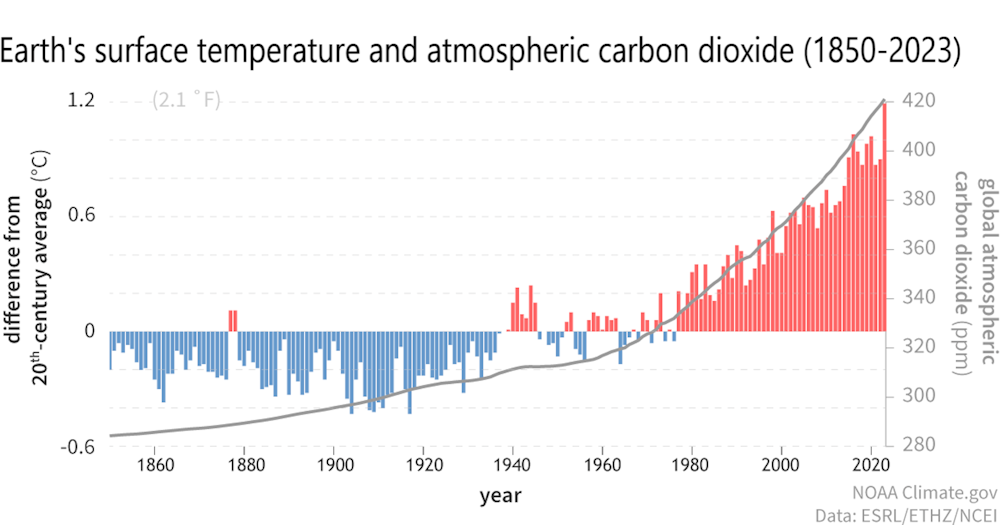
    In the 1970s, painstaking laboratory work on the Camp Century ice core extracted minuscule amounts of ancient air trapped in tiny bubbles in the ice. Analyses of that gas revealed that levels of carbon dioxide in the atmosphere were lower for tens of thousands of years before the industrial revolution. After 1850, carbon dioxide levels crept up slowly at first and then rapidly accelerated. It was direct evidence that people’s actions, including burning coal and oil, were changing the composition of the atmosphere.

    Since 1850, carbon dioxide levels in the atmosphere have spiked and global temperatures have warmed by more than 2.5 degrees Fahrenheit (1.3 Celsius). The past 10 years have been the hottest since recordkeeping began, with 2024 now holding the record. Climate change is now affecting the entire Earth – but most especially the Arctic, which is warming several times faster than the rest of the planet.

    Since 1850, global average temperature and carbon dioxide concentrations in the atmosphere have risen together, reflecting human emissions of greenhouse gases. Red bars indicate warmer years; blue bars indicate colder years.
    NOAA

    Seeing climate change as a threat multiplier

    For decades, military leaders have been discussing climate change as a threat and a threat multiplier that could worsen instability and mass migration in already fragile regions of the world.

    Climate change can fuel storms, wildfires and rising seas that threaten important military bases. It puts personnel at risk in rising heat and melts sea ice, creating new national security concerns in the Arctic. Climate change can also contribute to instability and conflict when water and food shortages trigger increasing competition for resources, internal and cross-border tensions, or mass migrations.

    The military understands that these threats can’t be ignored. As Secretary of the Navy Carlos Del Toro told a conference in September 2024: “Climate resilience is force resilience.”

    A view of aircraft carriers docked at the sprawling Naval Station Norfolk show how much of the region is within a few feet of sea level.
    Stocktrek Images via Getty Images

    Consider Naval Station Norfolk. It’s the largest military port facility in the world and sits just above sea level on Virginia’s Atlantic coast. Sea level there rose more than 1.5 feet in the last century, and it’s on track to rise that much again by 2050 as glaciers around the world melt and warming ocean water expands.

    High tides already cause delays in repair work, and major storms and their storm surges have damaged expensive equipment. The Navy has built sea walls and worked to restore coastal dunes and marshlands to protect its Virginia properties, but the risks continue to increase.

    Planning for the future, the Navy incorporates scientists’ projections of sea level rise and increasing hurricane strength to design more resilient facilities. By adapting to climate change, the U.S. Navy will avoid the fate of another famous marine power: the Norse, forced to abandon their flooded Greenland settlements when sea level there rose about 600 years ago.

    Norse ruins in Igaliku in southern Greenland, illustrated in the late 1800s while flooded at spring tide by sea level, which had risen since the settlement was abandoned around 1400.
    Steenstrup, K.J.V., and A. Kornerup. 1881. Expeditionen til Julianehaabs distrikt i 1876. MeddelelseromGrønland

    Climate change is costly to ignore

    As the impacts of climate change grow in both frequency and magnitude, the costs of inaction are increasing. Most economists agree that it’s cheaper to act now than deal with the consequences. Yet, in the past 20 years, the political discourse around addressing the cause and effects of climate change has become increasingly politicized and partisan, stymieing effective action.

    In my view, the military’s approach to problem-solving and threat reduction provides a model for civil society to address climate change in two ways: reducing carbon emissions and adapting to inevitable climate change impacts.

    The U.S. military emits more planet warming carbon than Sweden and spent more than US$2 billion on energy in 2021. It accounts for more than 70% of energy used by the federal government.

    In that context, its embrace of alternative energy, including solar generation, microgrids and wind power, makes economic and environmental sense. The U.S. military is moving away from fossil fuels, not because of any political agenda, but because of the cost-savings, increased reliability and energy independence the alternatives provide.

    Solar panels generate power on many U.S. military bases. This array at Joint Forces Training Base in Los Alamitos, Calif., generates enough power for more than 15,000 homes and has a backup battery system to provide power when the sun isn’t shining.
    Frederic J . Brown/AFP via Getty Images

    As sea ice melts and Arctic temperatures rise, the polar region has again become a strategic priority. Russia and China are expanding Arctic shipping routes and eyeing critical mineral deposits as they become accessible. The military knows climate change affects national security, which is why it continues to take steps to address the threats a changing climate presents.

    Paul Bierman receives funding from the US National Science Foundation, this work in part supported by grant EAR-2114629.

    ref. The US military has cared about climate change since the dawn of the Cold War – for good reason – https://theconversation.com/the-us-military-has-cared-about-climate-change-since-the-dawn-of-the-cold-war-for-good-reason-246333

    MIL OSI – Global Reports

  • MIL-OSI Europe: ASIA/MYANMAR – Banmaw, fire destroys St Patrick’s Cathedral

    Source: Agenzia Fides – MIL OSI

    photo: www.ucanews.com

    Banmaw (Agenzia Fides) – The Cathedral of Banmaw, a town in the state of Kachin, in Myanmar, was destroyed by fire on Sunday 16 March, on the eve of the feast of St Patrick, the Saint to whom it is dedicated.The Cathedral was allegedly set on fire during operations conducted in the area by soldiers of the SAC (State Administration Council), the military junta that currently holds power in Myanmar.The fire, according to testimonies sent to Fides, broke out at 4 in the afternoon on Sunday, 16th March. The priest’s house, the three-storey building that houses the diocesan offices and the high school had already been set on fire on 26 February.The diocese of Banmaw, established in 2006 and led by Bishop Raymond Sumlut Gam, borders China to the east and covers a largely mountainous area of 10,741 square kilometres. Before the current conflict situation it was inhabited by a civilian population of more than 407,000 (with more than 27,000 baptized Catholics), belonging to different ethnic groups. (PA/FB) (Agenzia Fides, 17/3/2025)
    Share:

    MIL OSI Europe News

  • MIL-OSI USA: Plants Struggled for Millions of Years After the World’s Worst Climate Catastrophe

    Source: US State of Connecticut

    A team of scientists from University College Cork (Ireland), the University of Connecticut (USA), and the Natural History Museum of Vienna (Austria) have uncovered how plants responded to catastrophic climate changes 250 million years ago. Their findings, published in GSA Bulletin, reveal the long, drawn-out process of ecosystem recovery following one of the most extreme periods of warming in Earth’s history: the “End-Permian Event.”

    UConn Department of Earth Sciences Professor and Department Head Tracy Frank, Professor Chris Fielding, and Associate Professor Michael Hren are co-authors on the paper. Frank and Hren performed a series of geochemical analyses through the sedimentary strata recording the event to help tie down ancient climate conditions, and Fielding provided sedimentological data to constrain ancient environmental conditions.

    The End-Permian Extinction, also known as the Great Dying, is the most severe ecological crisis of the past 500 million years.

    “It is believed to have entailed a five-fold increase in atmospheric CO2, global temperature rise of up to 10° C or more, ozone depletion, widespread wildfires, and changes in rainfall patterns across the Earth’s surface,” says Fielding.

    With more than 80% of ocean species wiped out, the end-Permian event was the worst mass extinction of all time. But the impacts of this event for life on land have been elusive. By examining fossil plants and rocks from eastern Australia’s Sydney Basin, researchers have pieced together a multi-million-year story of resilience, recovery, and the long-term effects of climate change following the Great Dying.

    The long, unsteady path to ecosystem recovery

    The fossils from these Australian rocks show that conifers, like modern pines, were some of the earliest to colonize the land immediately after the End-Permian catastrophe. However, the recovery back to flourishing forests was not smooth sailing.

    The researchers discovered that even higher temperatures during the “Late Smithian Thermal Maximum,” approximately 3 million years after the End-Permian Extinction, caused the collapse of these conifer survivors. In turn, they were replaced by tough, shrubby plants resembling modern clubmosses. This scorching period lasted for about 700,000 years and made life challenging for trees and other large plants.

    It wasn’t until a subsequent significant cooling event—the “Smithian-Spathian Event”—that large, but unusual plants called “seed ferns” began to flourish and establish more stable forests. These plants eventually came to dominate Earth’s landscapes for millions of years, paving the way for the lush forests during the Mesozoic “age of dinosaurs.”

    “The first post-apocalyptic floras were ‘opportunistic’ in nature, perhaps the equivalent of what in the modern world are called ‘weeds.’ These plants were mostly small, and were sparsely distributed. Larger trees and other more complex plant types took considerable time to become established as surface conditions gradually improved,” says Fielding.

    After millions of years, the forest ecosystems of the Mesozoic came to look like those from before the end-Permian collapse. But crucially, the plant species that made up the new forests were completely different. “The term ‘recovery’ can be misleading” says Chris Mays, Leader of the Mass Extinction Group at University College Cork, “forests recover eventually, but extinction is forever.”

    What does this mean for us?

    By understanding how ancient plant ecosystems weathered extreme climate swings, researchers hope to learn valuable lessons about how modern plants and ecosystems might cope with today’s climate crisis. Ecosystems depend on a fragile balance, with plants as the backbone of land food webs and climate regulation.

    “This research highlights how crucial plants are, not just as the base of land food chains, but also as natural carbon sinks that stabilize Earth’s climate,” explains Ph.D. student Marcos Amores, the study’s lead author, who spent time in the UConn Earth Science Department as a visiting scholar. “The disruption of these systems can have impacts lasting hundreds of thousands of years, so protecting today’s ecosystems is more important than ever.”

    This deep dive into Earth’s distant past reminds us that plants are unsung heroes of life on Earth—then, now, and in the future.

    “The protracted and complex path back to ‘normality’ after the end-Permian crisis tells us that Earth can recover from devastating environmental tipping points, but that recovery may take periods of time beyond the range of human endurance or even existence,” says Fielding.

    MIL OSI USA News

  • MIL-OSI Economics: Luis de Guindos: Interview with The Sunday Times

    Source: European Central Bank

    Interview with Luis de Guindos, Vice-President of the ECB, conducted by Jon Ihle

    16 March 2025

    The progress of annual inflation, at least up until February, looked like it was going in the wrong direction. Are you still confident that it will converge towards 2% sometime this year?

    The disinflation process is on track. There was a small pick-up inflation in recent months, but this had been expected, mostly on account of unfavourable base effects in November, December and January.

    The main reason for our confidence that inflation will come down to 2% is that all indicators for services and underlying inflation are moving in the right direction. A very important one is compensation per employee. According to recent data and in line with our projections, wage growth is moderating, which will help services inflation to gradually decline.

    At the same time, we need to keep in mind that factors like tariffs and fiscal policy are causing a lot of uncertainty. But taking this into account, we are confident that headline inflation will converge on a sustainable basis towards our 2% medium-term target towards the end of this year or the beginning of next.

    Let’s talk about some of the factors in this uncertain environment. What are the specific factors that are influencing the Governing Council’s thinking about the rate path right now, and how has that changed since the start of the easing cycle?

    We have already reduced interest rates by a total of 150 basis points. This is what we refer to in our monetary policy statement as a “meaningfully less restrictive” stance than at the beginning of the cycle.

    Our projections now show that inflation will converge towards our target in the medium term. But again, we need to consider the uncertainty of the current environment, which is even higher than it was during the pandemic. For instance, our projections don’t include the definitive level of the tariffs imposed by the United States and its trade partners, since the current situation is so volatile.

    Nevertheless, we are confident that inflation is moving towards our target on a sustainable basis, for example due to the moderation in wage growth I mentioned earlier. Even energy prices, which had also resulted in a small pick-up in inflation, have started to decline.

    Markets in the last few weeks have had some very strong reactions to the external environment. I’m thinking of the increase in German bond yields, changing expectations for fewer rate cuts from the ECB and the stock market correction in the United States. Does any of that feed into the ECB’s thinking on the rate path?

    We look at a wide range of indicators, all of which have an impact on our analysis. These include the evolution of wages and of the economy in terms of domestic demand and growth. And we of course look at financing conditions, for which our bank lending survey is very useful.

    It’s true that bond yields have increased due to the new German Government’s budgetary plans and that we have seen a correction in US equities from very high levels. But we also need to try to look through the short-term evolution of markets and distinguish between short-term volatility and permanent or medium-term forces. If we were to be as volatile as the markets, that wouldn’t be very reassuring.

    You said the uncertainty now is even greater than during the pandemic. How would you characterise it? What are the big unknowns at the moment?

    First, the policies of the new US Administration. There’s a lot of talk about tariffs, but it’s not just about that. The new Administration has also been quite clear about deregulating banks, non-banks and crypto-assets. And beyond that, they have announced that they want to modify corporate tax, which could affect capital flows across the Atlantic. In general, what we’re seeing is that the new US Administration isn’t very open to continuing with multilateralism, which is about cooperation across jurisdictions and finding common solutions for common problems. This is a very important change, and a big source of uncertainty.

    Second, and as a result of the new Administration’s attitude towards defence, we have the European Commission’s proposal to increase national defence spending by 1.5% of GDP. This is certainly a decision in the right direction, and it will have an impact on the macroeconomic outlook. We don’t know enough details about the package to make an accurate assessment about its impact on the economy, but it will likely be positive for growth and have a limited impact on inflation.

    Let’s focus on defence. Are you comfortable with national budget rules being relaxed to accommodate more defence spending? Will you need to adjust your monetary policy as those changes in fiscal policy come through?

    We always take fiscal policy into account because it interacts with monetary policy. In this case, we need to know the concrete details of the package before we can make an accurate assessment. How will spending be distributed across items? In terms of economic impact, spending more on military wages is not the same as spending more on weapons. How much will be spent outside of the EU? How is it going to be financed? One part will be common debt, but the package is much larger than that. The rest could be covered by taxes or a reduction in public spending. All of these factors are important to know in order to assess the impact of the package on the economy.

    It looks like we may be moving closer towards a resolution of the war in Ukraine, or at least a ceasefire. Would that be beneficial for the euro area economy? Would it change anything of what you’ve outlined so far?

    From a human standpoint, a peace agreement would obviously be very positive. And in general, it would be beneficial for the economy as well. But we would need to see the exact terms of a potential settlement to know for sure.

    Turning to the United States, what role do you see for the ECB in terms of managing trade shocks and the overall approach of the Trump administration?

    We need to keep in mind that the current situation is very volatile. It seems like every day a new tariff is imposed or one that has already been announced is removed. Hopefully we’ll soon have more clarity on the US Administration’s plans for the time ahead.

    Obviously, a trade war would be a lose-lose situation for everybody. It would have a much worse impact on growth than on inflation. This is because increasing tariffs raises prices at first, but lower growth subsequently offsets this initial price increase. We also need to look not only at bilateral tariffs between the United States and Europe but also at what economists call “trade diversion”. This means that, for example, tariffs imposed by the United States on Chinese goods could redirect trade flows to Europe, along with whatever economic impact that may have.

    Once we have all the details of the final policies, we will be able to better assess their impact based on all these factors. We are now using a baseline scenario and several alternative scenarios with different trade distortions to try to calibrate the impact as best as we can.

    Another aspect of the uncertainty in the United States is the way Trump is changing the relationship of the White House to many of the independent agencies in Washington. One of those might be the Federal Reserve. What would it mean for the ECB if its independence were to erode under President Trump? Has that scenario been discussed at all in the Governing Council?

    No, we haven’t discussed that because we can’t imagine it happening. The independence of the Federal Reserve is enshrined in law. We will always defend the independence of central banks, which is crucial to ensure they can fulfil their mandates.

    There are a lot of question marks over the predictability of the United States. Does Europe need to start thinking about making the euro more of a global reserve currency, if the dollar becomes less reliable?

    The euro is already a reserve currency, and strengthening its role in that respect is not part of our mandate. But keeping inflation low, increasing the potential growth of the European economy, signalling openness to trade agreements with different jurisdictions and making the European Union a model for free trade all over the world – all of this would strengthen the role of the euro as a reserve currency.

    But do you see a need for Europe to step more into that role ahead of the United States?

    I wouldn’t make comparisons with the United States. What Europe should do is maintain the position that it has always had as an open economy, in favour of free trade, the free flow of capital and multilateralism.

    Earlier you said that a trade war would be very detrimental to growth, but we don’t know all the details yet. How has the ECB’s view on euro area growth evolved in the last few months?

    We have downgraded our growth outlook for 2025 and 2026 by 0.2 percentage points. There are two main drivers behind that downward revision. First, uncertainty about the economy in the coming months has clearly dented confidence, and this is having an impact on investment. And second, a possible trade war would reduce net exports.

    Philip Lane has said recently that the conditions in the euro area are right for a pick-up in household consumption. Do you share his optimism that it can increase and maybe drive economic growth?

    All the factors that Philip indicated are correct. Real wages have increased, inflation is declining, interest rates are coming down and financing conditions are better. But still, the reality is that consumption is not picking up.

    This is because consumers don’t always react to developments in their short-term real disposable income. They also consider what might happen with the economy over the medium term, which is clouded in uncertainty. The possibility of a trade war or wider geopolitical conflict has an impact on consumer confidence.

    Eventually, the increase in the factors that Philip pointed out will prevail. But right now, the lack of consumer confidence due to the uncertainty of the world economy is offsetting that effect.

    European households have enormous cash savings at the moment, especially since the pandemic. Christine Lagarde has spoken frequently about turning those cash savings into investment to drive innovation and growth. Are you optimistic that this can become a reality?

    The capital markets union is certainly very important, but looking at the current economic situation in Europe, it’s crucial to put structural reforms in place to make it more productive and competitive. This is also what the Letta and Draghi reports argued.

    Fully integrating the internal market will be key here. It’s very difficult to have a capital markets union if you don’t have an integrated economy for goods and services. There are certainly concrete actions we can take to complete the capital markets union, but we should also focus on removing the internal obstacles to a real single market in Europe.

    There are three key elements here: fully integrating the Single Market, completing the banking union and completing the capital markets union. We must make progress on these three elements in parallel; it will be very difficult to make progress on one of them in isolation.

    Which of those elements would you say the ECB has the most influence on? And what can it do?

    Our mandate is price stability, but we also have an advisory role and produce expert opinions. Our economists and researchers carry out a lot of analytical work on Europe. The European Council and the Commission listen to what we have to say, and we are also accountable to the European Parliament. So we continuously use our voice to make the points that we believe are key to making the European economy more productive and competitive.

    Are you happy with the levels of credit flow from European banks to households and businesses?

    They are on the rise, following the rate cuts and the improvement in financing conditions. Demand for credit is not very strong, at least from a corporate standpoint, although it’s gradually increasing. This has to do with the lack of investor confidence. If you have doubts about the future and you’re waiting to see what will happen with trade, fiscal policy and geopolitical risk, you don’t invest, so you also don’t borrow. But in the case of households, we have started to see a significant increase in demand for mortgages.

    Speaking of housing: in several countries of the euro area, housing is in crisis. There’s an undersupply, and financing isn’t available to everybody that wants to buy a house. Do you think at this stage, nearly 15 years after the financial crisis, that lending rules are still too tight? Have regulators overcorrected on capital rules for banks, harming consumers and households?

    The current situation is very different to the one that we had 15 years ago. As a finance minister in Spain, I was dealing with the burst of a big housing and credit bubble, similar to what we saw in Ireland. Now, residential real estate prices are a big problem, but the drivers aren’t the same as the ones we had back then. From a financing standpoint, the situation is very different because the banks’ solvency is not in question.

    That being said, current developments in house prices are having a very negative impact on young people, who have a lot of trouble accessing housing. In some countries, this may have to do with issues with the rental market and how it is regulated. Policies should be put in place to make housing, mainly in the rental market, much more affordable. At the European level, improving the performance of the rental market will be very important in the near future. We should foster common action to achieve this, because it’s a significant source of social upset.

    But this is for national governments to do, not the ECB. We do need to analyse the situation, however, because not all countries are in the same position with respect to their rental markets. And there are lessons to be learned from the policies some countries have put in place.

    MIL OSI Economics

  • MIL-OSI USA: DLNR News Release – GROUNDED SAILBOAT REMOVED FROM HONOLUA BAY March 15, 2025

    Source: US State of Hawaii

    DLNR News Release – GROUNDED SAILBOAT REMOVED FROM HONOLUA BAY March 15, 2025

    Posted on Mar 15, 2025 in Latest Department News, Newsroom


    STATE OF HAWAIʻI

    KA MOKU ʻĀINA O HAWAIʻI


    DEPARTMENT OF LAND AND NATURAL RESOURCES

    KA ‘OIHANA KUMUWAIWAI ‘ĀINA


    JOSH GREEN, M.D.
    GOVERNOR


    DAWN CHANG
    CHAIRPERSON


    GROUNDED SAILBOAT REMOVED FROM HONOLUA BAY


    FOR IMMEDIATE RELEASE 

    March 15, 2025


    HONOLUA BAY, Maui – The 65-foot catamaran Hula Girl that had become an unwelcome fixture at Maui’s Honolua-Mokulē‘ia Marine Life Conservation District for almost two months, has been removed.


    Its long-awaited exit Friday afternoon brought a collective sigh of relief to the vessel’s owner, Kapalua Kai Sailing, Inc., the salvage crew, and the West Maui community.


    A storm, in addition to a compromised motor, led to the sailing vessel’s undoing in January. Inhibited in its ability to operate and recover, the catamaran was dragged onto Honolua Bay’s rocky shoreline, where it’s been languishing since. The DLNR Division of Boating and Ocean Recreation (DOBOR) and Division of Aquatic Resources (DAR) worked closely with the vessel’s owner to develop and execute the salvage plan.


    Several factors contributed to delays in the boat’s removal including high winds, inclement weather and uncooperative tides. Hiring a company to tackle the salvage also proved challenging. After weeks of refusals and uncertainty, Cates Marine Service, LLC signed on for the job. Owner Randy Cates is a seasoned veteran with decades in the boat salvage business. He’s also no stranger to groundings in the bay.


    The Cates team handled the removal of the luxury yacht Nakoa from Honolua in 2023. Two years later, almost to the day, again with help from Foss Marine, it managed to tug Hula Girl free from the rocks.


    Rigging lines and other preparations on Hula Girl were finalized on Thursday and early Friday. Just after noon on Friday, and on the incoming tide, the Foss Marine tug arrived. Notice was given to surfers and snorkelers in the water to avoid the area. Once the lines were connected between the tug and Hula Girl, the catamaran didn’t put up too much of a fight. The sailing vessel was successfully freed within an hour. 


    An initial damage assessment by a DAR dive team suggested no coral, fish, or invertebrates in the bay were harmed. Another assessment is planned now that the Hula Girl has been moved. Natural resources in nearshore ecosystems often bear the brunt of boat groundings. In this case, it appears at least initially that no fuel or oil was spilled, and no reef was scarred.


    Hula Girl’s next stop is a designated mooring offshore at Māla small boat ramp, where it will undergo an evaluation for temporary repairs before being towed to O‘ahu.


    # # #


    RESOURCES

    (All images/video Courtesy: DLNR)


    HD video – Hula Girl media clips (March 13, 2025):

    https://www.dropbox.com/scl/fi/5tki8qvf8h9xadqm2psct/Hula-Girl-March-13-2025-media-clips.mov?rlkey=cr84k0lz0t3y965dwlu1m1g2w&st=bo9h6jet&dl=0


    HD video – Hula Girl media clips (March 14, 2025:

    https://www.dropbox.com/scl/fi/syp2z7laa5xb35e8xp6v2/Hula-Girl-March-14-2025-media-clips.mov?rlkey=uaw9ix4f3121tpi1rvta0yj5f&st=28ufuug5&dl=0


    Photographs – Hula Girl removal (March 13-14, 2025):

    https://www.dropbox.com/scl/fo/8jeu2r9sa6w9oepg5irjm/AMPW4DykcC-GYvDzZqcPgIA?rlkey=e9bscflp42a3qghy20h0eoo7x&st=wgbgfchu&dl=0


    Media Contact: 

    Ryan Aguilar

    Communications Specialist

    Hawai‘i Dept. of Land and Natural Resources

    808-587-0396 

    Email: [email protected] 

    MIL OSI USA News

  • MIL-OSI Security: San Francisco Tow Company Operator Indicted in Scheme to Burn Competitors’ Tow Trucks Throughout the Bay Area

    Source: Federal Bureau of Investigation (FBI) State Crime News

    Defendant Allegedly Conspired to Set Fire to Tow Trucks to Drive Business to His Towing Companies and to Retaliate Against Competitors

    SAN FRANCISCO – A federal grand jury has indicted Jose Vicente Badillo on one count of conspiracy to commit arson in connection with an alleged scheme to burn tow trucks throughout the San Francisco Bay Area in 2023.  Badillo made his initial appearance in federal district court this morning.

    According to the indictment unsealed earlier today, Badillo, 29, of San Francisco, conspired with others to set fire to at least six tow trucks on four occasions between April 2023 and October 2023.  Specifically, Badillo and his co-conspirators allegedly set fire to and damaged or destroyed (i) two tow trucks in San Francisco on April 4, 2023; (ii) one tow truck in San Francisco on April 29, 2023; (iii) one tow truck in East Palo Alto on July 25, 2023; and (iv) two tow trucks in San Francisco on Oct. 3, 2023.

    The indictment describes that the purpose of the conspiracy was, among other things, to drive more business to two Bay Area-based towing companies with which Badillo was associated—Auto Towing and Specialty Towing—by impeding the business prospects of competitor towing companies, and to retaliate against those same competitors for perceived wrongs.  Badillo allegedly orchestrated the conspiracy and then directed others to set fire to the targeted tow trucks.

    Badillo is next scheduled to appear in district court on March 20, 2025, at 10:30 a.m., before U.S. Magistrate Judge Sallie Kim for arraignment and identification of counsel.  Badillo is facing unrelated federal charges of money laundering and insurance fraud in two other pending cases.

    Acting United States Attorney Patrick D. Robbins, FBI Special Agent in Charge Sanjay Virmani, and IRS Criminal Investigation (IRS-CI) Special Agent in Charge of the Oakland Field Office Linda Nguyen made the announcement.

    An indictment merely alleges that a crime has been committed, and all defendants are presumed innocent until proven guilty beyond a reasonable doubt. If convicted, Badillo faces a maximum sentence of 20 years in prison and a fine of $250,000.  Any sentence following conviction would be imposed by the court only after consideration of the U.S. Sentencing Guidelines and the federal statute governing the imposition of a sentence, 18 U.S.C. § 3553.

    This prosecution is part of an Organized Crime Drug Enforcement Task Forces (OCDETF) investigation. OCDETF identifies, disrupts, and dismantles the highest-level drug traffickers, money launderers, gangs, and transnational criminal organizations that threaten the United States by using a prosecutor-led, intelligence-driven, multi-agency approach that leverages the strengths of federal, state, and local law enforcement agencies against criminal networks.

    Assistant U.S. Attorney Nicholas M. Parker is prosecuting the case with the assistance of Andy Ding and Laurie Worthen. The prosecution is the result of an investigation by the FBI and IRS-CI.  This investigation is assigned to the FBI SF Transnational Organized Crime Task Force, an interagency task force targeting sophisticated organized crime syndicates that engage in, among other offenses, violent crimes, extortion, fraud, arson, and drug trafficking.  The U.S. Attorney’s Office, the FBI, and IRS-CI thank the San Francisco Police Department for its substantial assistance and support in this investigation.

    Jose Vicente Badillo Indictment
     

    MIL Security OSI

  • MIL-OSI Security: Seven Detroit Men Charged for Drug Distribution, Illegal Possession of Weapons, and Money Laundering

    Source: Federal Bureau of Investigation (FBI) State Crime News

    DETROIT – Seven men have been charged in a forty-three-count indictment alleging conspiracy to distribute controlled substances, weapons charges, and money laundering, Acting United States Attorney Julie A. Beck announced.

    Beck was joined in the announcement by Chevoryea Gibson, Special Agent in Charge of the Federal Bureau of Investigations (FBI), Detroit Field Office, and Charles E. Miller, Special Agent in Charge of Internal Revenue Service Criminal Investigation (IRS-CI), Detroit Field Office.

    Tary Holcomb (age 52), Maurice Hill (56), James Thomas (47), Curtis Weathers (52), Jason Ford, Conrad Taylor (48), and Shantonio Brooks (49), all of Detroit, were charged with conspiracy to distribute and possess with the intent to distribute a myriad of controlled substances, including cocaine, crack cocaine, heroin, and fentanyl. If convicted of the conspiracy charge, each of the men faces a mandatory prison sentence of at least 10 years. Holcomb and Thomas each face additional charges for possessing firearms in furtherance of drug trafficking crimes, while Holcomb also faces charges for being a felon in possession of a firearm, and for money laundering activities dating back to January 2023.

    This case is assigned to Judge Edmunds of the United States District Court for the Eastern District of Michigan.

    An indictment is only a formal charging document and is not evidence of guilt. A defendant is entitled to a fair trial in which it will be the government’s burden to prove guilt beyond a reasonable doubt.

    “This case is an example of our zealous commitment to identify and dismantle local drug trafficking organizations that wreak havoc in our community by distributing harmful substances, illegally amassing weapons, and laundering illicit proceeds. This activity puts far too many at risk, and it will not be tolerated in our district,” Acting U.S. Attorney Beck said.

    “The indictment of seven men, accused of conspiring to distribute drugs, illegally possess firearms, and engage in money laundering, was successfully halted due to the tireless and meticulous investigative efforts by our dedicated team at the FBI Detroit Field Office, in close collaboration with our law enforcement partners at the IRS Criminal Investigation. This operation underscores our commitment to protecting the safety of Michigan’s communities,” said Cheyvoryea Gibson, Special Agent in Charge of the FBI in Michigan. “The FBI is unwavering in its mission to investigate and hold accountable those who threaten the well-being and security of our residents, ensuring a safer Michigan for all.”

    “Federal laws that regulate the reporting of financial transactions are in place to detect and stop illegal activities, such as the drug trafficking and money laundering charges levied today,” said Charles Miller, Special Agent in Charge, Detroit Field Office, IRS Criminal Investigation. “CI is committed to enforcing these laws and following the money, wherever it leads.”

    This prosecution is part of an Organized Crime Drug Enforcement Task Forces (OCDETF) investigation. OCDETF identifies, disrupts, and dismantles the highest-level drug traffickers, money launderers, gangs, and transnational criminal organizations that threaten the United States by using a prosecutor-led, intelligence-driven, multi-agency approach that leverages the strengths of federal, state, and local law enforcement agencies against criminal networks.

    This case was investigated by agents from FBI’s Detroit Organized Crime Squad and IRS-CI along with the assistance of U.S. Customs and Border Protection and is being prosecuted by Assistant U.S. Attorney Erin Ramamurthy. 

    MIL Security OSI

  • MIL-OSI Security: Federal Prosecutors Charge 16 Previously Removed Illegal Aliens – Including Convicted Felons – with Illegally Re-entering the U.S.

    Source: Office of United States Attorneys

    LOS ANGELES – Working with U.S. Immigration and Customs Enforcement and other federal law enforcement partners, federal prosecutors in the last two weeks filed charges against 16 defendants who allegedly illegally re-entered the United States after being removed, the Justice Department announced today.

    Many of the defendants charged were previously convicted of felony offenses before they were removed from the U.S., offenses that include sexual abuse of children. One of the defendants is charged in state court with a murder in Inglewood last month.

    The crime of being found in the United States following removal carries a base sentence of up to two years in federal prison, defendants who were removed after being convicted of a felony face a maximum 10-year sentence, and defendants removed after being convicted of an aggravated felony face a maximum of 20 years in federal prison.

    Some of the recently filed cases are summarized below with information contained in court documents.

    • United States v. Saravia-Sanchez

    Jose Cristian Saravia-Sanchez, 30, of El Salvador, was charged via a federal criminal complaint after he was arrested by Inglewood Police Department as a suspect in the February 25 murder of a man who tried to stop Saravia and another individual from stealing a neighbor’s catalytic converter.

    Following the arrest, federal law enforcement determined that Saravia was previously removed in 2013 and returned to the United States illegally. At the time of his arrest on March 6, officers found a firearm in the bathroom of the hotel room in which Saravia barricaded himself, resulting in an hours-long standoff with law enforcement.

    In the complaint, Saravia is charged with being an illegal alien found in the United States and an alien in possession of a firearm. His criminal history includes a felony conviction in Los Angeles Superior Court in May 2023 for taking a vehicle without the owner’s consent. Saravia is in state custody and has been booked for murder.

    The matter was investigated by the Homeland Security Investigations with assistance from the Bureau of Alcohol, Tobacco, Firearm and Explosives, and ICE’s Enforcement and Removal Operations.

    • United States v. Marquina-Sierra

    Francisco Marquina-Sierra, 32, of Mexico, was charged via a federal criminal complaint for being an illegal alien found in the United States after he was previously removed. An immigration judge ordered him removed in December 2013. Marquina’s criminal history includes convictions in Orange County Superior Court for second-degree robbery in 2012 and for child abuse with possible great bodily injury in 2023 for which he was incarcerated in California state prison. On March 12, a federal magistrate judge ordered Marquina jailed without bond. His arraignment is scheduled for April 14 in United States District Court in Santa Ana.

    • United States v. Barreto

    Luis Enrique Barreto, 38, of Mexico, a convicted sex offender, was charged this week in a two-count indictment for allegedly failing to register under the federal Sex Offender Registration and Notification Act (SORNA) and for illegally returning to the United States following removal.

    Barreto, who was found living across from a school when he was arrested, was convicted in 2012 in Orange County Superior Court of lascivious acts with a child 14 or 15 years of age and offender 10 or more years older than victim (lewd act upon a child). In September 2021, Barreto was removed to Mexico, but he returned to the United States by the following year and did not register as a sex offender.

    A federal magistrate judge ordered Barreto jailed without bond pending trial. His arraignment is scheduled for March 18 in United States District Court in downtown Los Angeles.

    Criminal complaints and indictments contain allegations. All defendants are presumed innocent until proven guilty beyond a reasonable doubt in a court of law.

    U.S. Immigration and Customs Enforcement and Homeland Security Investigations are investigating these matters. 

    The criminal cases are being prosecuted by Assistant United States Attorneys in the Domestic Security and Immigration Crimes Section and the General Crimes Section.

    MIL Security OSI

  • MIL-OSI Asia-Pac: CCI Organises 10th Edition of National Conference on Economics of Competition Law

    Source: Government of India

    CCI Organises 10th Edition of National Conference on Economics of Competition Law

    Minister of State, Shri Harsh Malhotra compliments  CCI for its impactful role in curbing abusive conduct of dominant enterprises

    Posted On: 16 MAR 2025 5:43PM by PIB Delhi

    The Competition Commission of India (CCI) organised the 10thNational Conference on Economics of Competition Law in New Delhi today. Shri Harsh Malhotra, Minister of State in the Ministry of Corporate Affairs; and Minister of State in the Ministry of Road Transport and Highways was the Keynote Speaker at the Conference. Smt Ravneet Kaur, Chairperson, Competition Commission of India delivered the Special Address at the Inaugural Session of the Conference. The Conference, which brings together scholars, practitioners, and experts working in the area of economics of competition law, is being organised by the CCI every year since 2016.

    In his Keynote Address, highlighting the high-growth trajectory of the Indian economy, Minister of State Shri Harsh Malhotra underscored the importance of competition law in ensuring fair competition and a level playing field in markets.

    He emphasized the crucial role of the MSME sector, which contributes 80% of manufacturing output, 45% of exports, and 30% of India’s GDP. It is important to watch the interest of stakeholders, including MSMEs, to provide them with fair opportunities to compete and innovate, he said. In this context, he complimented CCI for its impactful role in curbing abusive conduct of dominant enterprises.

    Commending the Commission for its well-considered decisions, he highlighted the need for real-time market monitoring and a collaborative approach to regulation. It is essential to enforce law beyond strict intervention by promoting self-regulation and compliance, he added. He encouraged the Commission to actively engage with stakeholders, including industry associations, and consider their viewpoints. He stressed on the importance of including the younger generation in deliberations to bring fresh and new perspectives. The Government has kept in mind the views of the stakeholders, be it policies, government schemes or regulations, he mentioned. Acknowledging the significance of the Conference, he said that such deliberations and brainstorming sessions would immensely contribute to India’s economic growth in the future.

    The Minister stated that the Ministry of Corporate Affairs (MCA) aims to foster an ecosystem where fair competition benefits both businesses and consumers, leading to dynamic and vibrant marketplaces. He concluded by stating that India’s economic future depends on market strength, which, in turn, relies on fair competition—making it not just a legal or economic necessity but a national responsibility.

    Smt. Ravneet Kaur, Chairperson, CCI, in her Special Address, stated that regulators are adopting a dynamic approach to address the issues emerging in increasingly complex markets and rapid innovation in technology. She said that the goal is to balance innovation with competition, ensuring fair and open markets, where competition and technological progress can coexist. Alluding to Artificial Intelligence (AI) as a driving force in modern markets, Smt. Kaur stressed on the need for regulators to stay abreast and ahead in the AI era to deal with algorithmic collusion, uncover hidden anti-competitive behaviour, and protect consumers in markets increasingly shaped by AI. In this context, she also discussed the role played by Market Studies as a critical tool in proactive regulation. These studies provide a comprehensive analysis of market structures, business models, arrangements amongst players and potential competition issues, she said. 

    Referring to the competition law enforcement regime in India, Smt. Kaur said that the regulatory landscape has evolved significantly with the introduction of the Competition Amendment Act, 2023, to address the emerging challenges and strike a balance between enforcement and market-friendly resolution. She talked about the various regulations introduced in the last one year to operationalise the Competition Amendment Act 2023, with extensive consultations involving all key stakeholders. She further apprised the developments in antitrust enforcement and merger enforcement in 2024. The Competition Commission of India remains committed to fostering fair competition, ensuring market integrity, and enhancing enforcement efficiency, she said.

    The Conference, in addition to the Inaugural Session, featured two technical sessions on ‘Digital Dynamics: Markets, Competition & Innovation’; and ‘Exploring Mergers: Structure, Competition and Synergy’ where researchers presented papers on economics of competition law. The first session was chaired by Dr. Nishant Chadha, Director, Policy and Research, Indian School of Business. Dr. Uday Bhanu Sinha, Professor, Delhi School of Economics chaired the second session.

    The National Conference concluded with a Plenary Session on ‘Settlement and Commitment: A New Era of Trust-Based Fast-Track Market Correction’ which was moderated by Shri Prasanto Kumar Roy, Senior Adviser, FTI Consulting.

    ****

    NB/AD

    (Release ID: 2111638) Visitor Counter : 34

    MIL OSI Asia Pacific News

  • MIL-OSI Asia-Pac: Union Home Minister and Minister of Cooperation Shri Amit Shah addresses 57th annual conference of All Bodo Students’ Union (ABSU) as the Chief Guest in Kokrajhar, Assam

    Source: Government of India

    Union Home Minister and Minister of Cooperation Shri Amit Shah addresses 57th annual conference of All Bodo Students’ Union (ABSU) as the Chief Guest in Kokrajhar, Assam

    Without ABSU, the Bodo Accord would not have been possible, ABSU has played a crucial role in establishing peace and development in Bodoland

    A prominent road in Delhi will be named after Bodopa Upendra Nath Brahma Ji

    Modi government will complete 100 per cent implement of the BTR peace agreement in the next two years

    The Modi government and the Assam government will fulfill the dreams of Bodopa Upendra Nath Brahma Ji

    In the past, there were discussions about unrest, chaos, and separatism in Bodoland, now, the focus is on education, development, and industry

    In the past, where bullets once flew in the Bodoland region, today, Bodo youths are waving the tricolor

    Now, “Mushroom from Bodoland” is also available in Delhi, more than a dozen products from Bodoland have received the GI Tag

    A new beginning has been made by recruiting 400 Bodo youths into the Assam Commando Battalion

    Posted On: 16 MAR 2025 5:24PM by PIB Delhi

    Union Home Minister and Minister of Cooperation Shri Amit Shah today addressed the 57th annual conference of All Bodo Students’ Union (ABSU) as the Chief Guest in Kokrajhar, Assam. On this occasion, Assam Chief Minister Dr. Himanta Biswa Sarma, Speaker of the Legislative Assembly Shri Biswajit Daimary, the Union Home Secretary, and the Director of the Intelligence Bureau (IB), along with several other dignitaries were present.

    In his address, Union Home Minister Shri Amit Shah said that All Bodo Students’ Union (ABSU) has played a significant role in establishing peace, development, and enthusiasm in the region. Without the role of ABSU, the Bodo Accord would not have been possible, and peace would not have been established in Bodoland. On this occasion, Shri Shah also paid tribute to the five thousand martyrs who fought for the peace of Bodoland.

    Shri Amit Shah said that today, when entire Bodoland is following the path shown by its leader, Upendra Nath Brahma Ji, the government has decided to name a prominent road in Delhi as Bodopa Upendra Nath Brahma Marg. He also mentioned that in the first week of April, a program will be held in Delhi where a bust of Upendra Nath Brahma Ji will be unveiled. He said, the Modi government and the Assam government will bring every dream of Bodopa Upendra Nath Brahma Ji to fruition.

    Union Home Minister Shri Amit Shah said that ABSU is advancing education, empowerment, and development. It is due to the efforts of ABSU that today, students are able to take their exams up to the 12th grade in the Bodo language. As a result, our Bodo language has been recognized and will remain alive for many years to come. He further stated that today’s event sends a strong message of the peace established in Bodoland.

    Shri Amit Shah said that when the Bodoland Territorial Region (BTR) peace agreement was signed on January 27, 2020, the opposition was mocking it. However, today, the central government and the Assam government have fulfilled 82 per cent of the conditions of this agreement. He further stated that under the leadership of Prime Minister Shri Narendra Modi, the Government of India will implement 100 per cent of this agreement in the next two years. After that, there will be lasting peace in the BTR.

    Union Home Minister Shri Amit Shah said that under the BTR peace agreement, the government removed the Armed Forces (Special Powers) Act (AFSPA) from the entire BTR area on April 1, 2022. He also mentioned that under the Government of India’s ‘One District, One Product’ (ODOP) program, today, the mushroom from Kokrajhar, known as “Mushroom From Bodoland,” is being included in the menus of hotels in Delhi. This has become possible due to the peace established in Bodoland. He further stated that because of the peace, Bodoland was able to host the ‘Durand Cup’ tournament. He appealed to the athletes of Bodoland to start preparing for the potential Olympics in India in 2036.

    Shri Amit Shah said that more than a dozen products from Bodoland have received the GI (Geographical Indication) Tag. As a result, an industrial environment is gradually being created across the entire BTR area. He mentioned that there was a time when there were discussions about unrest, chaos, and separatism, but now the focus has shifted to education, development, and industry.

    Union Home Minister and Minister of Cooperation said that under the leadership of Prime Minister Modi, the Government of India and the Assam Government have allocated ₹1,500 crore for the development of Bodoland, even though the population of the region is only 3.5 million. He also mentioned that during the tenure of former Prime Minister Atal Bihari Vajpayee, the Bodo language was included in the Eighth Schedule of the Constitution. Additionally, the BTR region was expanded by including the Sonitpur and Biswanath districts.

    Shri Amit Shah said that hundreds of youths have been brought into the mainstream of society. Many weapons were surrendered, and in the last three years, ₹287 crore have been spent on the rehabilitation of 4,881 members of the National Democratic Front of Bodoland (NDFB) in Assam, with 90 per cent of this amount provided by the Modi government. Shri Shah further mentioned that a lot of work has been done for employment and skill development. NGOs have been involved in all sectors, including SIP&RD, KVK, KVIC, animal husbandry, fisheries, and horticulture, to work with the local people and help them progress.

    Union Home Minister said that Assam Chief Minister Dr. Sarma has made a new beginning by recruiting 400 Bodo youths into the Assam Commando Battalion. He further mentioned that under the leadership of Prime Minister Modi, the Government of India has signed agreements with a total of nine insurgent groups in Assam, bringing over 10,000 youths into the mainstream of society.

    Shri Amit Shah said that where once bullets were fired, today Bodo youth are waving the tricolor in their hands. This sight sends a message to the entire country. He added that when the Bodo Accord was signed, not only Bodoland and Assam but the entire country was happy. Just as the people of Bodoland love the country, the entire country loves Bodoland and its people and is committed to the development of its youth.

    Union Home Minister said that the Bathou religion, followed by the people of Bodoland, holds great significance. He explained that Bathou is made up of two elements, and its meaning is “the deep mystery of the creator of the five elements.” The five elements, or panchatatva, include fire, air, earth, sky, and water, which form the foundation of your great religion. He also mentioned that he strives to spread the message of the Bathou religion.

    Shri Amit Shah said that under the leadership of Prime Minister Shri Narendra Modi, the entire Northeast has been freed from issues such as insurgency, movements, blockades, strikes, and violence, and has been ushered onto the path of development. He mentioned that recently, an Investment Summit took place under the leadership of PM Modi and Dr. Himanta Biswa Sarma, which is bringing an investment of ₹5 lakh crore to Assam. He appealed to the Bodo youths to focus on their education and contribute to the peace process. He further stated that the goal is to build such infrastructure in Bodoland that Bodo youths can compete with youth from all around the world. He assured that the Government of India and the Assam Government will leave no stone unturned in the development of Bodoland.

    ****

    RK/VV/PR/PS

    (Release ID: 2111636) Visitor Counter : 114

    Read this release in: Hindi

    MIL OSI Asia Pacific News

  • MIL-OSI USA: Cortez Masto Statement on Vote to Avert Devastating Shutdown

    US Senate News:

    Source: United States Senator for Nevada Cortez Masto

    Washington, D.C. – Today, U.S. Senator Catherine Cortez Masto (D-Nev.) released the following statement announcing she will vote to avert a government shutdown.

    “A government shutdown would be devastating for the American people. It would force tens of thousands of Nevada military personnel, union members, law enforcement agents and nurses to work without pay. Shutting down the government gives President Trump and Elon Musk even more power to cherry-pick who is an essential employee, who they want to fire, and what agencies they want to shutter. And a shutdown would force federal courts to slow work on lawsuits against this administration’s illegal actions. The last government shutdown cost the American economy $11 billion and thousands of hardworking Americans were harmed. I cannot vote for that.

    “This was not an easy decision. I’m outraged by the reckless actions of President Trump, Elon Musk, and Republicans in control of Congress, so I refuse to hand them a shutdown where they would have free reign to cause more chaos and harm. I’m focused on ensuring our veterans, seniors, and working families get their benefits and opposing Republicans’ billionaire tax cut that is going to gut Medicaid. And I’m focused on supporting the lawsuits that are already reinstating illegally fired federal workers.”

    MIL OSI USA News

  • MIL-OSI USA: Senator Hassan Statement on Dangers of a Government Shutdown

    US Senate News:

    Source: United States Senator for New Hampshire Maggie Hassan

    WASHINGTON – U.S. Senator Maggie Hassan (D-NH) released the following statement today after voting to close debate on a government funding measure in order to allow a vote to keep the federal government open:

    “There were no good options in the Senate today. The choice today was between a federal government shutdown that would hurt Granite Staters and Americans, especially our most vulnerable neighbors, or a partisan government funding bill. I have concluded that allowing the federal government to shut down with this President in charge is too dangerous to risk.

    “A federal government shutdown would allow President Trump and Elon Musk to deepen their unilateral attacks on our system of government and the critical services it delivers to our friends and neighbors. President Trump and Elon Musk, who have already taken delight in making our government more chaotic and corrupt, would revel in a federal government shutdown. They would decide which programs to keep running and which employees to furlough or fire altogether, and they would do all this with even fewer checks and balances in place than there are now, because a shutdown would weaken our federal court system. It is unclear when the federal government would fully reopen, but it is clear that countless innocent people would be hurt, and our safety and economy would be weakened.

    “Because I believe that Elon Musk and President Trump would cause even more harm to Granite Staters and Americans during a federal government shutdown than they currently are, and because keeping the federal government functioning would provide support to the people who need it most, I voted today to close debate and allow for a vote to keep the federal government open.”

    MIL OSI USA News

  • MIL-OSI USA: Statement of U.S. Sens. Mark R. Warner and Tim Kaine on the Continuing Resolution

    US Senate News:

    Source: United States Senator for Commonwealth of Virginia Mark R Warner

    WASHINGTON – U.S. Sens. Mark R. Warner and Tim Kaine (both D-VA) issued the following statement:

    “While the government will remain open, we are frustrated that this funding bill gives a blank check to Donald Trump and Elon Musk to continue attacking the federal workforce and dismantling the services Virginians rely on. This bill lacks the meaningful proposals we offered as amendments to rein in and defund DOGE and protect our veterans from being indiscriminately fired – because Republicans blocked them all. As Donald Trump and Elon Musk continue to seek giant tax cuts for billionaires while laying off workers, slashing services, and tanking our economy, we will keep standing up for everyday Virginians, who have had enough of this chaos and lawlessness. That means we are already gearing up for our next fight: forcing a Senate vote on our legislation to challenge Trump’s senseless trade war with Canada, which will only raise costs for Virginians.”  

    MIL OSI USA News

  • MIL-OSI USA: On Senate Floor, Senator Murray Urges No Vote on House Republicans’ CR

    US Senate News:

    Source: United States Senator for Washington State Patty Murray
    Murray: “House Republicans are saying give Trump all this power, or we will shut down the government. But let’s be very clear: that is and always has been a false choice.”
    Murray: “Before I close, I want to say to my constituents who are frightened or scared: I understand your fears. … But your voice matters. Speaking out matters. You elected me to be your voice, and you better believe I’m going to fight for you. So, shoulders up. Keep the faith. We’re going to keep fighting for the America we love.”
    ICYMI: Murray, DeLauro Introduce Short-Term Continuing Resolution, Call on Congress to Pass Bipartisan Funding Bills
    ICYMI: Analysis of Speaker Johnson’s Yearlong CR
    ***WATCH: Senator Murray’s floor remarks***
    Washington, D.C. — Today, Senator Patty Murray (D-WA), Senate Appropriations Committee Vice Chair, spoke on the Senate floor ahead of the cloture vote on House Republicans’ partisan continuing resolution (CR).
    Senator Murray’s remarks, as delivered, are below:
    “M. President, I have made no secret of my opposition to this bill. For weeks, I have been warning about the real dangers of a yearlong CR like the one that has come before us from House Republicans.
    “But before I talk about those dangers and why I will be voting no on cloture and on final passage, I want my colleagues to hear what I have to say. But I do hope that they join me in voting no. I want to talk for a moment about how we did get here.
    “Because I fear some members of Republican leadership may need a history lesson. The fact of the matter is: the only reason we are staring down a shutdown deadline halfway into the fiscal year is because the House Republicans decided to kick the can down the road with a major punt—and because they have repeatedly walked away from the table.
    “This is just the historical record. We were all here for it. We saw what happened.
    “But perhaps it’s worth ticking through once more, because I’ll admit it can get easy to lose track given all that’s happened over the last few months, and just how many times House Republicans have made a deal just to break it in recent years.
    “So I want to give a refresher. It’s been a while since my time as a preschool teacher, but I guess school is back in session. Because I’m not going to let anyone get away with ignoring how Republicans forced us to the edge of a shutdown.
    “Remember, last year, after a bruising FY24 process in which House Republicans made one ridiculous demand after the next and caused one delay after the other, as Appropriations Chair, I worked hard alongside my colleagues, including Senator Collins who is here today, within our Committee to write and pass serious bipartisan, spending bills for this current fiscal year.
    “It was no easy feat. We had less resources at our disposal to make use of and we had even more challenges to address—but we managed to work together—Senator Collins and I, and our committee members—and we cleared all but one of our bills overwhelmingly in Committee. Many of those bills cleared in unanimous votes.
    “Come November, after the election, I was pushing very hard to get our funding bills done and wrapped up by the end of the year. My Democratic colleagues—and even many of my Republican colleagues—wanted to get that done. But Speaker Johnson and Trump chose to kick the can down the road. They chose to.
    “Trump reportedly wanted to make sure his fingerprints were on our spending bills for this fiscal year. And the Speaker not only wanted to please Trump, he was worried about how a messy funding fight might complicate his path to being speaker again. So, the decision was made—and Johnson punted from December to March.
    “Then we negotiated a bipartisan CR to fund the government through March 14th today, along with that we passed disaster relief, and extend critical laws. We reached a bipartisan, bipartisan, bicameral deal. And then House Republicans walked away, and blew that deal up at the last minute.
    “Why? All because the richest man in the entire world sent a bunch of completely inaccurate tweets. And instead of saying “You know what? Actually Elon, you have no clue what you are talking about, these are programs that help my constituents.”
    “House Republicans said, “hmmm let’s put that guy in charge.” They killed the bipartisan agreement, rolled out an altogether different bill not long thereafter, and punted on government funding. That is what happened.
    “And that is essentially what they have been doing ever since—cheering and clapping as Trump and Elon got basic facts wrong, broke laws, blocked funding that our communities needed, dismantled entire agencies, fired veterans, shuttered our Social Security offices, and break government to enrich themselves.
    “And while Trump and Republican leadership were fixating on whether they pass one bill or two for their plan to cut health care for kids to pass more tax cuts for billionaires, a fast approaching deadline was on its way to us, one that’s here now.
    “For the last several months, I have remained at the table, ready to negotiate funding bills. My Democratic counterpart in the House, Rosa DeLauro, and I never left the table. Not once. We made an offer, after an offer, as did our Republican counterparts.
    “My top priority has been, and continues to be, doing what we do every year, which is passing full-year funding bills with the detailed directives that we include in our spending laws every year.
    “I’ve wanted to ensure we continue to provide those and make sure our constituents voices are heard in federal funding, which, I have to say this CR fails to do.
    “But instead of working with us, in good faith, to fund the government in a bipartisan way, Speaker Johnson and Republican leadership walked away and started working on a Republican funding bill—without an ounce, not an ounce, of Democratic input.
    “I remained at the table, and my counterparts on appropriations and I continued to talk to keep the ball rolling. By the end of last week, for all intents and purposes, we had an agreement on topline funding.
    “But the call had been made, the call had already been made. Johnson was in on it, Trump was in on it, Russ Vought was in on it. Johnson decided instead of talking with Democrats it would be easier to have Trump get on the phone and scream and bully House Republicans into submission.
    “He figured if outright intimidation from Trump was enough to convince every Republican to vote for a budget resolution that will cut Medicaid for seniors and kids, then it might also be enough to get them to pass a Republican CR, especially if Trump threatened dissenters with political retribution, which, of course, he did. And that is the bill they rolled out on Saturday and passed earlier this week.
    “Now, as I’ve laid out in depth, the yearlong CR House Republicans sent our way hands a blank check to Elon Musk and Donald Trump to decide how our constituents’ taxpayer dollars get spent all while they cut funding working people count on each and every day.
    “It is anything but a ‘clean CR.’
    “What Republicans are pushing here is not a continuing resolution. In this case CR stands for Complete Resignation. Because what Republicans are doing here is ceding more discretion to two billionaires to decide what does, and does not, get funded in their states.
    “It is a power grab CR.
    “But not only that, it does make serious cuts to domestic funding. It leaves working families in the dust.
    “We are talking about a nearly 50% cut to lifesaving medical research into conditions affecting our servicemembers. It is a giant shortfall in funding for NIH. It is a massive cut in funding for Army Corps projects, and $15 billion less for domestic priorities. M. President, this bill will force Social Security to cut staff and close offices, and make it harder for seniors to get the benefits they spent their careers paying into the system to earn. It creates a devastating shortfall that risks tens of thousands of Americans losing their housing.
    “So, this bill causes real pain for communities across the country. And it empowers Trump and Musk to pick winners and losers, and I guarantee you they will not only go after Democrats.
    “Inexplicably, House Republicans are saying give Trump all this power, or we will shut down the government. Well let’s be very clear: that is and always has been a false choice.
    “The reality is, there were other options House Republicans could have chosen but they chose, they chose to pull out of bipartisan negotiations and send a deeply partisan bill here to the Senate today.
    “Democrats didn’t have an ounce of input into writing this bill, and now House Republicans expect us to support it? That makes zero sense.
    “Let me be clear: in my time in Congress, never, ever has one party written partisan, full-year appropriations bills for all of government and expected the other party to go along without any input.
    “To my colleagues here who want to pass individual appropriations bills in a timely manner for next fiscal year, how are Democrats supposed to trust they will be talking to us in good faith negotiations?
    “After we did the hard work of negotiating overwhelmingly bipartisan appropriations bills last year, only for us to see this today from Republicans in the House. Only for Republicans to now say swallow this partisan House Republican CR, or it will be Democrats that are shutting down the government?
    “That is a false choice, and one we cannot accept going forward.
    “When I cast my vote today, I’m representing the nearly 8 million people in Washington state, and in this democracy, their voices count for something, so you better believe I am not handing over my vote in exchange for nothing. 
    “The choice is not a government shutdown, or passing a bill to write a blank check to Elon Musk. It is not. That is not how this works.
    “On Monday, I rolled out a clean four-week extension to prevent a shutdown and to keep government funded while giving us the time to hammer out a bipartisan agreement. We could still pass it right here, and right now. If any member has any suggestions on what they’d want to see in the CR, I am all ears.
    “House Republicans may have left town already but I am pretty sure they know how to get on a plane. That is their job. Show up and vote. 
    “The bottom line is: this bill will mean more pain and chaos for our country, I cannot support it.
    “And please let’s remember: Republicans control the House, the Senate, and the White House. If you refuse to put forward an offer that includes any Democratic input and you don’t get Democratic votes—that’s on Republicans. If you don’t get any input from Democrats, it’s a Republican vote. A shutdown is on Republicans.
    “The American people rightly understand Republicans have pushed this country towards a shutdown. They do understand Donald Trump has created massive economic uncertainty and is putting us on track for a Republican recession with his indiscriminate layoffs, his illegal funding freeze, his incoherent trade war, and now by threatening a Republican shutdown. 
    “Democrats did not write this bill, we didn’t have any input, but if we had, we sure wouldn’t have handed over more of our power to two billionaires.
    “You can bet we wouldn’t have cut our domestic investments by billions.
    “Democrats did not write this bill, but if we did we would have protected our public schools.
    “Democrats did not write this bill, but if we did we would have put veterans first.
    “And you can bet we wouldn’t have prevented the District of Columbia from spending its own taxpayer dollars and be forced to lay off police and teachers.
    “Democrats did not have any say on this bill, but if we did we would have protected our public lands, your health care, and lifesaving cancer research.
    “So, I hope my Democratic, and yes, my Republican colleagues as well, will join me in voting no on this bill, and swiftly passing a four-week extension so we can hammer out a better, bipartisan solution instead.
    “I am voting no because my constituents should have a say in how their tax dollars are spent.
    “I am voting no because Congress, Congress, each one of us, not Elon Musk should decide which schools or hospitals get funding.
    “I am voting no, and I hope my of colleagues to join me.
    “Before I close, M. President, I want to say to my constituents who are frightened and scared: I understand your fears. Some days I share them.
    “But your voice matters. Speaking out matters. You elected me to be your voice, and you better believe I will keep fighting for you.
    “So, shoulders up. Keep the faith. We stand strong, but do not stand down. We’re going to keep fighting for the America we love.
    “Thank you.”

    MIL OSI USA News

  • MIL-OSI USA: Cassidy Votes to Keep the Government Open

    US Senate News:

    Source: United States Senator for Louisiana Bill Cassidy

    WASHINGTON – U.S. Senator Bill Cassidy, M.D. (R-LA) today released a statement after he voted in support of a continuing resolution to keep the government open.
    “I’m on the same team as President Trump and Speaker Johnson. Despite Democrats stalling, we kept the government open by standing united,” said Dr. Cassidy. “I gladly voted for a bill that kept the flood insurance program going, paid our troops, and cut government waste.”

    MIL OSI USA News

  • MIL-OSI Russia: Financial news: Bank of Russia opens applications for participation in the spring ESG school

    Translartion. Region: Russians Fedetion –

    Source: Central Bank of Russia –

    April 16–18 will pass Spring School “ESG, Sustainable Development and Climate Change” is an intensive full-time educational program of the Bank of Russia and the Higher School of Business of the National Research University Higher School of Economics. Students and postgraduates of Russian universities of any year and specialty who have passed the competitive selection can become its participants.

    Applicants will need to pass online program, which will introduce listeners to the basic concepts and principles of sustainable development. It is also required to write an essay on one of the proposed topics and prepare a summary.

    Submit an application can be done through your personal account on the event website until March 27. The results of the competitive selection will be known by April 4.

    The ESG school offers its students a more in-depth study of sustainable development and climate change issues. The curriculum includes lectures by experts from the Bank of Russia, the Higher School of Business, representatives of the banking sector and companies that are leaders in sustainable development. Students will also analyze practical cases on assessing climate risks and processing ESG data, study international experience and take part in brainstorming sessions.

    All ESG school graduates will receive certificates of completion of training.

    Preview photo: Marina Lysceva / TASS

    Please note: This information is raw content directly from the source of the information. It is exactly what the source states and does not reflect the position of MIL-OSI or its clients.

    Please Note; This Information is Raw Content Directly from the Information Source. It is access to What the Source Is Stating and Does Not Reflect

    HTTPS: //vv. KBR.ru/Press/Event/? ID = 23463

    MIL OSI Russia News

  • MIL-OSI Asia-Pac: PARLIAMENT QUESTION: TARGET OF WORKS AND COMPLAINTS RECEIVED UNDER JJM

    Source: Government of India

    Posted On: 17 MAR 2025 4:48PM by PIB Delhi

    To make provision of tap water supply to every rural household across the country, Government of India in partnership with States, is implementing Jal Jeevan Mission (JJM) – Har Ghar Jal since August, 2019.

    At the start the Mission, only 3.23 Crore (16.7%) rural households were reported to have tap water connections. So far, as reported by States/ UTs as on 12.03.2025, under Jal Jeevan Mission (JJM) – Har Ghar Jal around 12.29 Crore additional rural households have been provided with tap water connections. Thus, as on 12.03.2025, out of 19.36 Crore rural households in the country, more than 15.52 Crore (80.15%) households are reported to have tap water supply in their homes and works for the remaining 3.84 Crore households are at various stages of completion as per saturation plan of the respective State/ UT. State/ UT-wise details are as at below. Further, Hon’ble Finance Minister during her budget speech 2025- 26 has announced extension of Jal Jeevan Mission until 2028 with an enhanced total outlay.

    States have informed that lack of dependable drinking water sources in water-stressed, drought prone and desert areas, presence of geo-genic contaminants in ground water, uneven geographical terrain, scattered rural habitations, delay in release of the matching State share in some States, lack of technical capacity with implementing agencies, Gram Panchayats and local communities to plan, manage, operate & maintain the water supply schemes, rising price of raw materials, delay in obtaining statutory/ other clearances, etc. are few of problems being faced in the implementation of the Mission.

    To address the challenges holistically and overcome these, Government of India has taken a number of steps, inter alia including implementation of Special Assistance to States for Capital Expenditure through M/o Finance for financial assistance as 50-year interest free loan for capital investment projects; nomination of a nodal officer in the Department for coordinating with Central nodal Ministries/ Departments/ agencies to facilitate the States in obtaining Statutory/ other clearances; setting up of State Programme Management Units (SPMUs) and District Programme Management Units (DPMUs) and implementation of “Nal Jal Mitra Programme” for ensuring availability of skilled local persons at village level to bridge the gap in availability of technical skill sets and of HR for programme management;

    Under the Mission, States have been advised for source recharging, viz. dedicated bore well recharge structures, rainwater recharge, rejuvenation of existing water bodies, reuse of greywater, etc., in convergence with other schemes such as MGNREGS, Integrated Watershed Management Programme (IWMP), 15th Finance Commission tied grants to RLBs/ PRIs, State schemes, CSR funds, etc.

    Further, Jal Shakti Abhiyan: Catch the Rain (JSA: CTR) campaign aiming to encourage water conservation at grass-root levels with people’s participation was launched in 2019 in 256 water stressed districts of the country. Morever, recognizing the importance of sustainable water management especially for drinking water availability, JSA-CTR was implemented with the theme “Source Sustainability for Drinking Water” in 2023. Similarly, in 2024, JSA is being implemented with the theme “Nari Shakti se Jal Shakti” from 09.03.2024 to 30.11.2024 emphasizing the pivotal role played by women in the field of water conservation.

    Water being a State subject, States have been empowered to plan, design, approve, implement and operate & maintain drinking water supply schemes. Complaints/ Grievances received at Centre level through Centralized Public Grievance Redress and Monitoring System (CPGRAMS – https://pgportal.gov.in/) and Department’s website (https://jalshakti-ddws.gov.in/) and other physical mediums are transferred to water supply department of respective State Governments for their timely redressal.

    This information was provided by THE MINISTER OF STATE FOR JAL SHAKTI, SHRI V. SOMANNA in a written reply to a question in Rajya Sabha today.

    Annex referred to in part (a) & (b) reply to Rajya Sabha unstarred Question No. 1831 answered on 17.03.2025

    JJM: State/ UT-wise status of tap water connections in rural households as on 12.03.2025

     (Number in lakhs)

    S. No.

    State/ UT

    Total rural HHs

    Rural HHs with tap water supply as on 15.8.2019

    Rural HHs with tap water connection as on date

    Rural HHs yet to be provided with tap water connection

    No.

    %

    No.

    %

    No.

    %

    1.

    A & N Islands

    0.62

    0.29

    46.02

     0.62

     100.00

     –  

     –  

    2.

    Arunachal Pr.

    2.29

    0.23

    9.97

     2.29

     100.00

     –  

     –  

    3.

    DNH & DD

    0.85

    0.00

    0.00

     0.85

     100.00

     –  

     –  

    4.

    Goa

    2.64

    1.99

    75.44

     2.64

     100.00

     –  

     –  

    5.

    Gujarat

    91.18

    65.16

    71.46

     91.18

     100.00

     –  

     –  

    6.

    Haryana

    30.41

    17.66

    58.08

     30.41

     100.00

     –  

     –  

    7.

    Himachal Pr.

    17.09

    7.63

    44.64

     17.09

     100.00

     –  

     –  

    8.

    Mizoram

    1.33

    0.09

    6.91

     1.33

     100.00

     –  

     –  

    9.

    Puducherry

    1.15

    0.94

    81.33

     1.15

     100.00

     –  

     –  

    10.

    Punjab

    34.27

    16.79

    48.98

     34.27

     100.00

     –   

     –  

    11.

    Telangana

    53.98

    15.68

    29.05

     53.98

     100.00

     –  

     –  

    13.

    Uttarakhand

    14.50

    1.30

    8.99

     14.12

     97.38

     0.38

     2.62

    14.

    Ladakh

    0.41

    0.01

    3.48

     0.39

     96.54

     0.01

     3.46

    12.

    Bihar

    167.55

    3.16

    1.89

     160.36

     95.71

     7.19

     4.29

    15.

    Nagaland

    3.64

    0.14

    3.82

     3.37

     92.76

     0.26

     7.24

    16.

    Lakshadweep

    0.13


    0.00

     0.12

     91.41

     0.01

     8.59

    17.

    Sikkim

    1.33

    0.70

    52.96

     1.21

     91.00

     0.12

     9.00

    18.

    Maharashtra

    146.80

    48.44

    33.00

     130.36

     88.80

     16.44

     11.20

    20.

    Uttar Pr.

    267.22

    5.16

    1.93

     236.78

     88.61

     30.44

     11.39

    19.

    Tamil Nadu

    125.28

    21.76

    17.37

     110.85

     88.48

     14.43

     11.52

    21.

    Tripura

    7.51

    0.25

    3.26

     6.40

     85.30

     1.10

     14.70

    27.

    Karnataka

    101.32

    24.51

    24.19

     84.92

     83.81

     16.40

     16.19

    24.

    Meghalaya

    6.51

    0.05

    0.70

     5.33

     81.92

     1.18

     18.08

    23.

    Assam

    72.25

    1.11

    1.54

     58.84

     81.44

     13.41

     18.56

    22.

    J & K

    19.22

    5.75

    29.93

     15.59

     81.12

     3.63

     18.88

    26.

    Chhattisgarh

    50.02

    3.20

    6.39

     40.33

     80.63

     9.69

     19.37

    25.

    Manipur

    4.52

    0.26

    5.74

     3.59

     79.59

     0.92

     20.41

    28.

    Odisha

    88.69

    3.11

    3.50

     67.89

     76.54

     20.81

     23.46

    29.

    Andhra Pr.

    95.53

    30.74

    32.18

     70.51

     73.81

     25.02

     26.19

    30.

    Madhya Pr.

    111.82

    13.53

    12.10

     76.13

     68.09

     35.68

     31.91

    33.

    Rajasthan

    107.75

    11.74

    10.90

     60.11

     55.79

     47.64

     44.21

    34.

    West Bengal

    175.56

    2.15

    1.22

     96.43

     54.93

     79.13

     45.07

    31.

    Jharkhand

    62.56

    3.45

    5.52

     34.25

     54.75

     28.31

     45.25

    32.

    Kerala

    70.77

    16.64

    23.51

     38.48

     54.38

     32.29

     45.62


    Total

    19,36.70

     3,23.63

    16.71

     15,52.19

     80.15

     3,84.51

    19.85

    Source: JJM – IMIS                           HH: Households

    ****

    Dhanya Sanal K

    Director

    (Rajya Sabha US Q1831)

    (Release ID: 2111850) Visitor Counter : 21

    MIL OSI Asia Pacific News

  • MIL-OSI Asia-Pac: India – New Zealand Joint Statement

    Source: Government of India

    Posted On: 17 MAR 2025 2:39PM by PIB Delhi

    At the invitation of the Prime Minister of India, Shri Narendra Modi, the Prime Minister of New Zealand, Rt Hon Christopher Luxon, is on an Official Visit to India on 16-20 March 2025. Prime Minister Luxon, who is on his first visit to India in his current capacity, is visiting New Delhi and Mumbai, and is accompanied by Hon. Louise Upston, Minister for Tourism and Hospitality, Hon. Mark Mitchell, Minister for Ethnic Communities, and Sport and Recreation, and Hon. Todd McClay, Minister for Trade and Investment, Agriculture, and Forestry, and a high-level delegation comprising of officials, and representatives of businesses, community diaspora, media and cultural groups.

    Prime Minister Luxon was accorded a warm and traditional welcome in New Delhi. Prime Minister Modi held bilateral talks with Prime Minister Luxon. Prime Minister Modi will inaugurate the 10th edition of the Raisina Dialogue on 17 March 2025 in New Delhi with Prime Minister Luxon as the Chief Guest delivering the Inaugural Keynote Address. The Prime Minister laid a wreath at Raj Ghat Mahatma Gandhi Memorial and also called on President Droupadi Murmu.

    The Prime Ministers reaffirmed their shared desire to further strengthen the growing bilateral relationship between India and New Zealand which is anchored in shared democratic values and robust people-to-people ties. Both leaders recognized that there remains significant potential for further growth in the bilateral relationship and agreed to cooperate closely in diverse areas, including trade and investment, defence and security, education and research, science and technology, agri-tech, space, mobility of people and sports.

    The Prime Ministers exchanged views on regional and global developments of mutual interest and agreed to strengthen multilateral cooperation. The Prime Ministers recognised that we face an increasingly uncertain and dangerous world. They noted that, as maritime nations, India and New Zealand have a strong and common interest in an open, inclusive, stable and prosperous Indo-Pacific, where the rules-based international order is upheld.

    The Prime Ministers reaffirmed the right of freedom of navigation and overflight and other lawful uses of the seas in accordance with international law, particularly the 1982 United Nations Convention on the Law of the Sea (UNCLOS). The Prime Ministers reaffirmed the need to pursue peaceful resolution of disputes in accordance with international law, particularly UNCLOS.

    The Prime Ministers noted with satisfaction the strong connections between the people of the two countries, with Indian-origin people making up almost six percent of New Zealand’s population. They appreciated the significant contribution of the Indian diaspora in New Zealand and their positive role in facilitating people-to-people ties between the two countries. Both leaders agreed on the significance of ensuring the safety and security of the Indian community, including students, in New Zealand, and of New Zealanders in India and visitors to India.

    Cooperation in trade, investment and financial matters:

    The Prime Ministers welcomed sustained trade and investment flows between India and New Zealand and called for further exploring the potential to expand bilateral trade. They encouraged businesses on both sides to cultivate links; explore emerging economic and investment opportunities to build upon the complementarities of the two economies.

    The Leaders called for greater two-way investment, reflective of the ongoing strong momentum in bilateral cooperation.

    The Prime Ministers agreed to enhance the trade and investment relationship between India and New Zealand to realise its untapped potential and to contribute to inclusive and sustainable economic growth.

    The Prime Ministers welcomed the launch of FTA negotiations for a balanced, ambitious, comprehensive, and mutually beneficial trade agreement to achieve deeper economic integration. The Leaders agreed that a comprehensive trade agreement offers a significant opportunity to enhance trade and economic cooperation. By leveraging each country’s strengths, addressing their respective concerns, and tackling challenges, a bilateral trade agreement can foster mutually beneficial trade and investment growth, ensuring equitable gains and complementarities for both sides. The Leaders committed to designate senior representatives to steer these negotiations to resolution as soon as reasonably possible.

     Within the context of FTA negotiations, the Leaders agreed to discussions between respective authorities on both sides to explore early implementation of cooperation in the digital payments sector.

    The Prime Ministers welcomed the signing of the Authorized Economic Operators Mutual Recognition Arrangement (AEO-MRA) under the aegis of the Customs Cooperation Arrangement (CCA) signed in 2024, which would facilitate easier movement of goods between the two countries by our respective trusted traders through close cooperation between customs authorities, thereby boosting bilateral trade.

    The Leaders welcomed new cooperation on horticulture and forestry, including: the signing of the Memorandum of Cooperation on Horticulture which would enhance bilateral cooperation by promoting knowledge and research exchanges, development of post-harvest and marketing infrastructure; and the signing of a Letter of Intent on Forestry Cooperation that encourages policy dialogues and technical exchanges.

    The Leaders recognized the positive role played by tourism in generating economic growth, increasing business engagements and generating greater understanding between people of the two countries. They welcomed the growing flows of tourists between India and New Zealand. They appreciated the update to the India-New Zealand Air Services Agreement and agreed to encourage their carriers for commencement of direct (non-stop) flight operations between the two countries.

    Political, defence and security cooperation:

    The Prime Ministers recognised the significance of parliamentary exchanges and encouraged regular visits of parliamentary delegations between the two countries.

    The Prime Ministers acknowledged the shared history of sacrifice of Indian and New Zealand service personnel who fought and served alongside one another around the world over the past century.

    The Prime Ministers welcomed sustained progress in defence engagements, including through participation in military exercises, staff college exchanges, regular port calls by naval ships, and exchange of high-level defence delegations. They recalled that the Indian Naval sailing vessel Tarini made a port call at Lyttelton, Christchurch, New Zealand in December 2024. They also referred to the upcoming port call in Mumbai by the Royal New Zealand Navy Ship HMNZS Te Kaha.

    Both Leaders welcomed the signing of the India-New Zealand Memorandum of Understanding for Defence Cooperation. This will further strengthen bilateral defence cooperation and establish regular bilateral defence engagement. Both sides noted the need for ensuring the safety and security of sea lanes of communication and agreed there needs to be regular dialogue to discuss enhancement of maritime safety.

    New Zealand welcomed India joining the Combined Maritimes Forces. Both Leaders welcomed advancement in defence ties during New Zealand command of Command Task Force 150.

    Both Leaders appreciated the regular training exchanges of officers, including at Defence Colleges on reciprocal basis. Both sides agreed for enhanced capacity building cooperation.

    Prime Minister Luxon expressed New Zealand’s interest in joining the Indo-Pacific Oceans Initiative (IPOI). Prime Minister Modi welcomed New Zealand into this partnership with like-minded countries which seek to manage, conserve and sustain the maritime domain. Further cooperation as maritime nations is also being explored between India and New Zealand with discussions taking place between experts on the National Maritime Heritage Complex (NMHC) which is being established at Lothal, Gujarat.

    Cooperation in science & technology and disaster management:

    The two Leaders noted the significance of research, scientific connections, technology partnerships and innovation as an important pillar of the bilateral partnership and called for exploring such opportunities in mutual interest. Both sides stressed the need for stronger collaboration to develop and commercialize technologies in identified areas through closer collaboration between businesses, and industries.

    The two sides recognized the challenges for their economies presented by climate change and the transition to low emissions climate resilient economies. Prime Minister Luxon welcomed India’s leadership in the International Solar Alliance (ISA) and reiterated New Zealand’s strong support as a member since 2024. Prime Minister Modi welcomed New Zealand joining the Coalition for Disaster Resilient Infrastructure (CDRI), which aims at making systems and infrastructure resilient in order to achieve the objectives of the Sustainable Development Goals (SDGs), the Paris Climate Agreement and the Sendai Framework for Disaster Risk Reduction.

    The two Leaders welcomed work towards a Memorandum of Cooperation on earthquake mitigation cooperation between relevant authorities of India and New Zealand, which would facilitate inter alia exchange of experiences in earthquake preparedness, emergency response mechanism, and capacity building.

    Education, mobility, sports and people to people ties:

    Both Prime Ministers agreed that there exists great potential to further strengthen the growing education and community links between India and New Zealand. They encouraged academic institutions of both countries to build future-oriented partnerships focused on areas of mutual interest including in areas of science, innovation, new and emerging technologies.

    The Leaders encouraged the creation of further opportunities for Indian students seeking quality education programmes in New Zealand. They noted the significance of skill development and mobility of skilled personnel to support expanded engagement in sectors, including science, innovation, and new and emerging technologies. The two Leaders agreed, within the context of the trade agreement negotiations, which the Leaders have agreed to launch, to also launch negotiations on an arrangement facilitating the mobility of professionals and skilled workers between the two countries, while also addressing the issue of irregular migration.

    The Leaders welcomed the signature of the refreshed Education Cooperation Arrangement between the Indian Ministry of Education and the New Zealand Ministry of Education. This Arrangement will facilitate the continued exchange of information on India’s and New Zealand’s respective education systems as the basis for strengthening the bilateral education relationship.

    The Leaders noted that India and New Zealand enjoy close sporting links, particularly in cricket, hockey and other Olympic sports. They welcomed the signing of the Memorandum of Cooperation on Sports to foster greater sporting engagement and collaboration between countries. They also welcomed the “Sporting Unity” events planned in 2026, to recognise and celebrate 100 years of sporting contact between India and New Zealand.

    The Prime Ministers acknowledged the importance of robust systems of traditional medicine in India and New Zealand, and welcomed discussions between experts, including science and research experts, on both sides to understand and explore possible areas of cooperation, including through sharing of information and best practices and visits of experts.

    Both Prime Ministers noted the growing interest among New Zealanders in Yoga and Indian music and dance, as well as the free observance of Indian festivals. They encouraged further promotion of bilateral ties including through music, dance, theatre, films, and festivals.

    Cooperation in regional and multilateral fora:

    Both Prime Ministers reaffirmed their commitment to supporting an open, inclusive, stable and prosperous Indo-Pacific where sovereignty and territorial integrity are respected.

    The Leaders noted cooperation between India and New Zealand in various regional fora, including ASEAN-led fora such as the East Asia Summit, the ASEAN Defence Ministers’ Meeting Plus and the ASEAN Regional Forum. The Leaders reaffirmed the importance of these regional bodies and ASEAN centrality for furthering security and prosperity of the Indo-Pacific region and emphasised the importance of all parties maintaining peace and stability in the region.

    Both Leaders emphasized on the importance of an effective multilateral system, centered on a United Nations that is reflective of contemporary realities, as a key factor in tackling global challenges. The two sides stressed the need for UN reforms, including of the Security Council through expansion in its membership, to make it more representative, credible and effective. New Zealand endorsed India’s candidature for permanent membership in a reformed UN Security Council. The two sides agreed to explore the possibility of extending mutual support to each other’s candidatures at the multilateral fora.

    Both Leaders emphasized the importance of upholding the global nuclear disarmament and non-proliferation regime, and acknowledged the value of India joining the Nuclear Suppliers Group in context of predictability for India’s clean energy goals and its non-proliferation credentials.

    Both Leaders reaffirmed their firm support for peace and stability in the Middle East and welcomed the agreement for the release of hostages and ceasefire of January 2025. They reiterated their call for continued negotiations to secure a permanent peace, which includes the release of all hostages and the rapid, safe and unimpeded humanitarian access throughout Gaza. Both Leaders stressed the importance of a negotiated two-State solution, leading to the establishment of a sovereign, viable and independent state of Palestine, and living within secure and mutually recognized borders, side by side in peace and security with Israel.

    The Leaders exchanged views on the war in Ukraine and expressed support for a just and lasting peace based on respect for international law, principles of the UN charter, and territorial integrity and sovereignty.

    The two Leaders reiterated their absolute condemnation of terrorism in all its forms and manifestations, and the use of terrorist proxies in cross-border terrorism. Both stressed the urgent need for all countries to take immediate, sustained, measurable, and concrete action against UN-proscribed terrorist organizations and individuals. They called for disrupting of terrorism financing networks and safe havens, dismantling of terror infrastructure, including online, and bringing perpetrators of terrorism to justice swiftly. The two leaders agreed to cooperate in combating terrorism and violent extremism through bilateral and multilateral mechanisms.

    The two Prime Ministers noted with satisfaction the progress in ongoing bilateral cooperation and reaffirmed their commitment to further strengthen and deepen the bilateral partnership for mutual benefit as well as for the benefit of the Indo-Pacific Region. They called for exploring the potential to deepen bilateral engagement and explore new avenues of cooperation, including in the fields of green and agriculture technologies.

    Prime Minister Luxon thanked Prime Minister Modi and the Government and the people of India for the warmth and hospitality extended to him and to the members of his delegation during his Official Visit to India. Prime Minister Luxon invited Prime Minister Modi to undertake a reciprocal visit to New Zealand.


    ***

    MJPS/ST

    (Release ID: 2111753) Visitor Counter : 107

    MIL OSI Asia Pacific News

  • MIL-OSI Europe: Answer to a written question – Human rights violations by the Cuban regime in the light of the Political Dialogue and Cooperation Agreement between the European Union and Cuba – E-002998/2024(ASW)

    Source: European Parliament

    1. EU development cooperation aims at improving the living conditions of the Cuban population, in the framework of the partnership established under the EU-Cuba Political Dialogue and Cooperation Agreement[1]. No EU funds are channelled through the Cuban authorities. EU funding is directly transmitted to the implementing agencies in charge of the various EU projects, be it United Nations (UN) agencies, agencies of the Member States or European non-governmental organisations.

    2. There has been some progress on each of the priorities agreed in the framework of the EU-Cuba Political Dialogue and Cooperation Agreement and enumerated in its Article 2. In particular, the Agreement has framed EU-Cuba relations through a critical yet constructive engagement. It has supported Cuba’s economic modernisation through the progressive expansion of its private sector, and fostered improvements in human rights, including the adoption of the Family Code[2], the acceptance of 81% of recommendations under the UN Universal Periodic Review, and the recent decision by Cuba to free 553 detainees. It has also encouraged Cuba to advance towards the 2030 Sustainable Development Goals, facilitated dialogue on trade and economic relations, as well as to address the impact of the United States embargo on the island, which also affects EU companies and citizens. The EU is committed to pursue its efforts to achieve additional, more significant results in all areas, with emphasis on the respect of human rights and fundamental freedoms and to promote EU interests.

    3. As indicated, no funds are directed at the Cuban Government. The objective of all EU cooperation initiatives is to support the Cuban population as a whole, which is currently enduring a particularly severe economic crisis, combined recently with other natural hazards such as hurricanes and earthquakes.

    • [1] Council Decision (EU) 2016/2232 of 6/12/2016 — OJ L337.
    • [2] Law 156/2022, Of. Gazette 99 of 27/09/22.
    Last updated: 17 March 2025

    MIL OSI Europe News

  • MIL-OSI Europe: Answer to a written question – Harm done by PP and PSOE governments’ handling of the natural disaster in Valencia caused by a slow-moving storm with heavy rainfall – E-002416/2024(ASW)

    Source: European Parliament

    1. The Nature Restoration Regulation (NRR)[1] entered into force only on 18 August 2024 and specifies the removal of primarily obsolete artificial barriers in order to restore the natural connectivity of rivers and natural functions of the related floodplains and to contribute to the EU’s target of 25 000 km of free-flowing rivers. The NRR explicitly states that Member States shall primarily remove obsolete barriers that are no longer needed for renewable energy production, inland navigation, water supply or flood protection. There is thus no obligation to remove barriers for flood protection that are still in use. Once implemented, the NRR can be expected to have a positive impact on flood prevention: restoring rivers, wetlands, peatlands, forests and floodplains play an important role in preventing or reducing the impacts of extreme weather events such as droughts and floods. Hence, the Commission is not planning to propose the total or partial repeal of the NRR.

    2. The EU has a supporting competence in the area of civil protection. Spain activated the EU Civil Protection Mechanism[2], requesting support in its response to the floods. The Commission cannot take a stance on the Honourable Members’ views of specific national parties.

    3. The Floods Directive[3] established a framework for the management of flood risks, aiming at the reduction of the adverse consequences from flooding. The objectives for risk reduction are determined at national level by the Member States themselves, based on local and regional circumstances. The same applies to the selection and prioritisation of measures aiming to reduce the risk from flooding, provided such measures do not infringe on other legal acts.

    • [1] Under Regulation (EU) 2024/1991 of the European Parliament and of the Council of 24 June 2024 on nature restoration and amending Regulation (EU) 2022/869, OJ L, 2024/1991, 29.7.2024, Member States have 2 years to draw up their National Restoration Plan, including an inventory of river barriers.
    • [2] https://civil-protection-humanitarian-aid.ec.europa.eu/what/civil-protection/eu-civil-protection-mechanism_en
    • [3] Directive 2007/60/EC of the European Parliament and of the Council of 23 October 2007 on the assessment and management of flood, OJ L 288, 6.11.2007, p. 27-34.
    Last updated: 17 March 2025

    MIL OSI Europe News