SYDNEY, 26 February 2025: Greenpeace Australia Pacific has welcomed findings by aninterim senate reportthat “there is limited utility in pursuing nuclear power at this point”, and called for parties to focus on delivering achievable and affordable, renewable energy solutions instead.
“The Senate Inquiry heard evidence from thousands of people and reached the logical conclusion that nuclear is unlikely to be developed in Australia until the mid-2040s at the earliest, is deeply unpopular among Australians, and will be more expensive to build than renewable energy,” Susie Byers, Head of Advocacy, Greenpeace Australia Pacific, said.
“Taking into account the additional significant risks associated with nuclear waste management and accidents, there are dozens of reasons why nuclear just doesn’t make sense for Australia; and not a single proven reason to support it.
“This evidence-based report underscores that the Coalition’s nuclear fantasy is nothing more than a dangerous, nonsensical distraction, and a blatant ploy to keep coal and gas in our system until the 2040s, worsening climate change to deadly extremes.
“Remarks by Coalition MP Andrew Constance revealing the party’s plans to take the Paris Agreement’s 2035 target “off the table” earlier this week further underscore the Coalition’s absolute disinterest in doing anything to stop the worsening bushfires, floods, and storms that have devastated millions of Australians in recent years.
“Nuclear is a waste of Australians’ time, money, and a bet against a safe climate future for all of us. It will also impose potentially catastrophic risks on communities where the reactors and nuclear waste sites will be located.
“Choosing nuclear for Australia’s energy future will threaten our economy, air, land and water, and our kids’ futures, while backing in 100% affordable, safe, proven renewable energy, will strengthen our place in a global clean economy and help avoid unsurvivable consequences of climate change. The choice is clear.
—ENDS—
Note to editors: Greenpeace Australia Pacific’s submission to the inquiry is available here.
For more information or to arrange an interview please contact Vai Shah on 0452 290 082 or [email protected].
Source: United States Senator for Rhode Island Jack Reed
WASHINGTON, DC – U.S. Senator Jack Reed (D-RI) is once again urging the Trump Administration to quickly implement of the Social Security Fairness Act, which will ensure retired teachers, police, firefighters, and other public service workers and their spouses get the full Social Security benefits they earned.
More than 8,600 Rhode Islanders and a total of 3.2 million Americans stand to benefit from the change, thanks to the Social Security Fairness Act, which Senator Reed cosponsored and former President Biden signed into law on January 5.
The new law repealed the Windfall Elimination Penalty (WEP) and Government Pension Offset (GPO), which prevented 3 million government retirees who earned pensions from those careers from collecting their full benefits earned while working outside of government.
“The Trump Administration needs to get into gear and implement the law. Thousands of Rhode Island retirees who served as teachers, police officers, and more have waited long enough to get the benefits they rightfully earned. Instead of focusing on firing people from the Social Security Administration (SSA), the Trump Administration should spend more time and energy getting these checks out the door,” said Senator Reed, a member of the Appropriations Committee who is working to ensure the SSA has enough employees to provide first-rate, personalized customer service to retirees who need assistance.
Senator Reed estimates the average monthly benefit increase is about $360, but many recipients could see monthly raises of $1,000 or more this year. The law is retroactive to January 1, 2024. As a result, many people will eventually receive a significant lump sum for back payments as well as a monthly raise.
Retired public employees who may be eligible can visit SSA’s Social Security Fairness Act website to learn more.
Since the law was signed, there have been multiple and bipartisan efforts to encourage the Trump Administration to start paying Social Security recipients what they are owed.
All Social Security recipients will see a 2.5 percent increase in their benefits this year. The cost-of-living adjustment (COLA) took effect in January, raising the average monthly retirement benefit from $1,927 to $1,976.
Earlier this month, the acting commissioner of the Social Security Administration resigned after clashing with billionaire Elon Musk’s so-called Department of Government Efficiency, after Musk’s personnel attempted to access sensitive government records that included people’s personal information.
Musk and Trump continue to actively mislead about Social Security. Musk amplified a chart showing 9 million people age 130 and over in the system and suggested “there are a lot of vampires collecting Social Security” adding, “This might be the biggest fraud in the history of humanity.”
While there are millions of people in Social Security with no death records because they lived and died before the system was fully automated, there are only 44,000 people with birth dates in 1920 or earlier who are actually getting payments from Social Security.
A July 2024 report from Social Security’s inspector general states that from fiscal years 2015 through 2022, the agency made less than 1 percent in improper payments. Most of the erroneous payments were overpayments to living people and some of it was clawed back.
Source: United States Senator Tommy Tuberville (Alabama)
WASHINGTON – Today, U.S. Senator Tommy Tuberville (R-AL) penned an op-ed on X praising the progress President Trump and DOGE have made during Trump’s first month in office to cut waste, fraud, and abuse in the federal government and save taxpayers’ money.
Read excerpts from the piece below or here.
Trump and DOGE are Making the Federal Government Efficient Again
“Tax season is upon us, and Americans are once again reminded of how much of their hard-earned paychecks is taken by the federal government. Most Americans use this time to reevaluate their spending habits and consider ways to be more fiscally responsible. Unfortunately, the U.S. government doesn’t do the same. The United States is $36 trillion in debt and we are spending nearly $2 trillion more each year than we bring in. If the United States were a business, we’d be dead broke.
Thankfully, President Trump is back in the White House and is working around the clock to audit the federal government. On the campaign trail, President Trump promised to create the Department of Government Efficiency (DOGE), advised by Elon Musk, to take a businesslike approach to auditing waste, fraud, and abuse within the federal government. A majority of Americans support the President’s efforts to cut wasteful spending, and they support the work the DOGE is doing. President Trump is making the Federal Government Efficient Again.
Thanks to President Trump, the D.C. gravy train is being cut off. So far, Elon Musk and his team have saved American taxpayers a staggering $55 billion. Some of the taxpayer-funded programs that DOGE has uncovered are truly astounding. For example, DOGE found that $59 million was sent by FEMA to house illegal immigrants in fancy New York hotels. It was also discovered that taxpayers were on the hook for a $ 168,000 Anthony Fauci exhibit at the National Institutes of Health Museum, which has thankfully been canceled. DOGE also found $9 million in payments to fund woke programs at the Department of Agriculture, including contracts for “Central American gender assessment consultant services” and “Brazilian forest and gender consultants” – whatever that is.
In addition to cutting waste, DOGE is also restoring accountability and transparency. Under the Biden administration, the Pentagon failed its seventh consecutive audit. That’s ridiculous. If a business tried this in the real world, they’d go bankrupt. American taxpayers spend nearly a trillion dollars annually on the U.S. military. The least we can do is provide an accurate accounting of how their money is being spent. To clean this up, President Trump directed Secretary of Defense Pete Hegseth to start cutting the Pentagon budget by 8% in each of the next five years. By restoring fiscal sanity to our armed forces, we will ensure we have the long-term resources to continue defending our interests and national security. […]
Just this weekend, DOGE sent an email to all federal government employees asking for them to submit five things they have accomplished this week. Predictably, the media is throwing a fit about this. When I was a football coach, we had performance reviews where we would discuss an employee’s performance and if they weren’t performing at a certain standard, they would be fired. But apparently, that isn’t allowed in the government.
DOGE has also shone a light on the corrupt relationship between the bureaucrats and the Mainstream Media. White House Press Secretary Karoline Leavitt revealed that more than $8 million taxpayer dollars were used for Politico subscriptions. This doesn’t include other outlets taxpayers have been funding like the New York Times, Associated Press, and Reuters. It is completely inappropriate for taxpayers to be forced to fund the Corporate Media. If American taxpayers want to support these publications, they can subscribe themselves. But most do not, which is perhaps why many of these publications are failing.
Thanks to President Trump, Americans are finally witnessing a government that is by the people and for the people. The fake news media and the D.C. Swamp are in DEFCON level 1 over DOGE, and as far as I’m concerned, that’s a good thing. We should be thanking President Trump and the entire DOGE team for the incredible service they are doing for our country. In fact, as a proud member of the Senate DOGE Caucus, I’m 100% committed to making sure Congress does our part to follow the President’s lead to rightsize the government and cut waste, fraud, and abuse. President Trump promised to fight every day for the American worker – and the hardworking men and women in this country deserve to know that their tax dollars are not being used to fund gender transition surgeries in Africa. Together, we will restore accountability and transparency in Washington and unleash the Golden Age of America.”
Senator Tommy Tuberville represents Alabama in the United States Senate and is a member of the Senate Armed Services, Agriculture, Veterans’ Affairs, HELP, and Aging Committees.
McALLEN, Texas – A 43-year-old Baytown resident has been sentenced for possession with intent to distribute kilogram quantities of meth, announced U.S. Attorney Nicholas J. Ganjei.
David Lee Garza pleaded guilty May 31, 2024.
Chief U.S. District Judge Randy Crane has now ordered Garza to serve 120 months in federal prison to be immediately followed by five years of supervised release. In handing down the sentence, the court considered Garza’s extensive criminal history including a prior conviction for aggravated assault with the use of a firearm and a prior federal conviction for possession with intent to distribute kilogram quantities of cocaine.
“Methamphetamine has devastated cities and towns across the country, and drug dealers that seek to profit off that destruction deserve to be held accountable,” said Ganjei. “Those that traffic this drug in our communities can expect a significant sentence, particularly those who are repeat offenders.”
In January 2024, law enforcement discovered Garza was coordinating the transportation of kilogram quantities of meth from the Rio Grande Valley to the Houston area.
On Jan. 25, 2024, Garza drove from the Houston area to a storage unit in McAllen where he retrieved multiple items. As he left the area, law enforcement conducted a traffic stop on his vehicle and found him in possession of six kilograms of meth. The drugs had a purity level of 99%.
The investigation revealed he had been storing drugs in the local storage unit until they were ready for transport.
Garza will remain in custody pending transfer to a U.S. Bureau of Prisons facility to be determined in the near future.
Drug Enforcement Administration conducted the investigation with the assistance of the Texas Department of Public Safety. Assistant U.S. Attorney Laura Garcia prosecuted the case.
Police are seeking Michael Kane McRae, 44, who has a warrant for his arrest.
We believe Mr McRae will be able to assist with our investigation into several arsons at churches in Masterton on the morning of Saturday 22 February.
We also wish to reiterate our appeal issued yesterday for information about a green Ford Festiva, which was seen leaving one of those fires.
Anyone with information about Michael McRae or sightings of this vehicle is urged to contact Police via 105 online or the 105 phone reporting line, referencing file number 250222/1673.
When it comes to how hard an animal can bite, size always matters.
There may be no truer a case of this than the desert rat-kangaroo (Caloprymnus campestris), known as the ngudlukanta to the traditional custodians of its Country of origin, the Wangkangurru Yarluyandi people.
This small, possibly extinct marsupial from the inhospitable Sturt Stony Desert may have had a solid skull built for hard biting. But not enough to bite through the kinds of foods biologists used to think it ate.
We discovered the lack of chomping power in the skull of this rat-kangaroo while testing new approaches for analysing skull biomechanics.
Our results, published today in the Journal of Experimental Biology, may help with ongoing searches for the elusive species.
Declared extinct 30 years ago, there remains hope the critter might still emerge in some parts of its original home range.
A difficult desert
The Sturt Stony Desert in the far north-east of South Australia is one of the world’s most inhospitable places. Few animals can make it their home.
However, one small marsupial species was known to brave the heat, drought, and scarcity of food: the ngudlukanta.
The desert rat-kangaroo, known as ngudlukanta to the Wangkangurru Yarluyandi people. Hedley Herbert Finlayson, The Red Centre, 1935
Sadly, the tiny desert dweller was officially declared extinct in 1994. Weighing just under 1kg, it would have been a perfect snack for introduced predators like foxes and cats. It was further pushed towards extinction by competition with rabbits, overstocking with cattle and sheep, and poor fire management.
Yet, exciting reports of possible sightings of the ngudlukanta still emerge sporadically. Descriptions of its distinctive compact size, combined with its short face and the hopping gait of a kangaroo, have sparked renewed interest in rediscovering this animal.
In the quest to find this elusive little battler, information about its diet is key. It can help people to keep a closer eye on areas where its favourite foods would be found.
From a bite to a diet
To better understand its diet and feeding behaviour, we turned to the animal’s skull.
The ngudlukanta had a solidly built skull, with a short and wide face. This led researchers to suggest that it could eat harder desert foods like roots, nuts and seeds.
But in our latest analysis, we showed that these assessments were probably incorrect. Instead, the animal’s diet was more likely restricted to softer materials, rather than the tougher foods eaten by some of its harder-headed relatives like the burrowing bettong.
The reason for this? It all comes down to its size.
Previous interpretations of its biting ability had drawn conclusions from comparisons of skull shape between species, but without considering size differences between them.
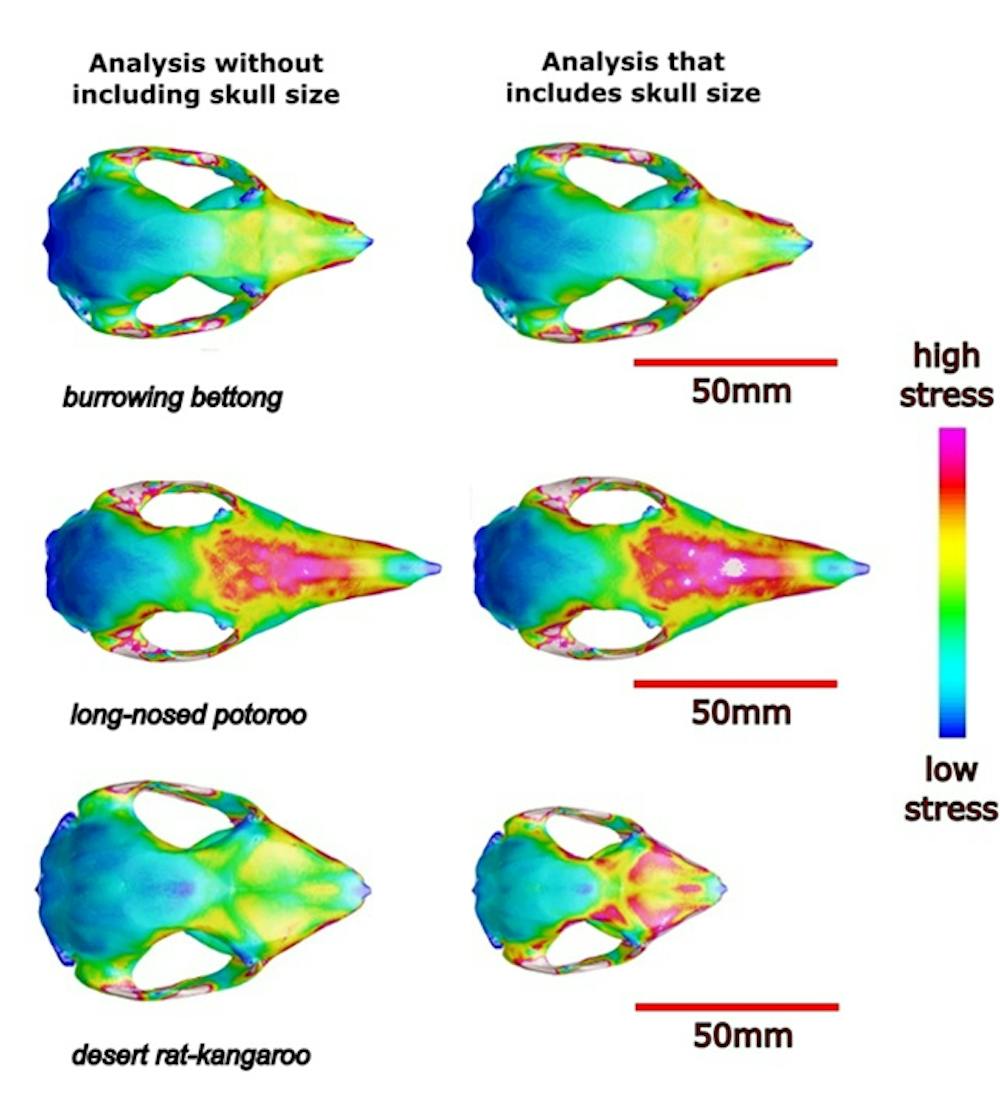
Our results form part of a paper that addresses this issue in the methods that researchers use. We used a method called finite element analysis, which helps to predict how a structure – in this case, a skull – would handle the forces it experiences in the real world.
But what we did differently to other researchers was to keep information about size differences between the skulls in the models.
What did we find?
The skull of the ngudlukanta is definitely efficient at biting, but it is also about one quarter smaller than the skull of the next smallest species in our sample, the northern bettong.
When we included its smaller size in the analysis, the results suggested its relatively short face and robust jaw were unlikely to help it eat harder foods.
Instead, its solid skull features mostly compensated for its small size, but would only allow it to support bites about as hard as those of the long-nosed potoroo – a larger species with a much less efficient skull at biting.
Finite element models simulating the stress of each skull during biting with the front teeth. The stress in the desert rat-kangaroo is more similar to the hard food-eating burrowing bettong when not including its small size in the models. But its stress levels are more like the long-nosed potoroo when including its small size. Authors
Early investigations of stomach contents from the 1930s tell us the ngudlukanta fed mostly on leaves and small amounts of insects. But little further detail exists. A more restricted range of softer, fresher plant materials, as suggested by our analysis, would narrow its range of preferred foods in the deserts it lived in.
Our results therefore paint a picture of a species occupying a delicate position within the desert ecosystem.
An unsolved mystery in a vast desert
In recent years, one of us (Karl Vernes) has mounted several expeditions into the ngudlukanta‘s habitat, hoping to find evidence of its continued existence.
However, finding this tiny marsupial in a vast desert is a challenge – not just because it was probably always rare and elusive, but also because we still know precious little about its ecology.
Eyewitness accounts, remote camera traps, analysis of predator scat (poo) for mammal remains, genetic testing of scats, and the expert ecological knowledge of Traditional Owners have all been used to investigate the possibility of the survival of the ngudlukanta. No definitive evidence has yet emerged.
Whether the ngudlukanta is extinct or not, therefore, remains an unsolved mystery.
But history is replete with examples of rediscovered species believed to be extinct, known as “Lazarus species”. The desert’s vast, inhospitable terrain means it is plausible for a small nocturnal species to be evading detection.
The distinctive short face of the ngudlukanta, alongside its small size and hopping gait, have led eyewitnesses to argue for its persistence. Hedley Herbert Finlayson, The Red Centre, 1935
In fact, the desert rat-kangaroo was already a Lazarus species after its rediscovery in the 1930s. The story of the ngudlukanta therefore serves as a reminder that extinction declarations are not always the end of the story.
If the species is still roaming the most inhospitable regions of the continent, the new knowledge gained from our analysis could help pinpoint areas where the ngudlukanta might persist.
Who knows? The next chapter in the story of this desert-dweller may yet surprise us.
Rex Mitchell has received funding from the Australian Research Council’s Centre of Excellence for Biodiversity and Heritage (CABAH).
Karl Vernes has received funding from the Australian Research Council, the Mohamed bin Zayed Species Conservation Fund, Experiment.com, the Hermon Slade Foundation and Parks Australia. He is a member of the Australian Mammal Society.
Vera Weisbecker receives funding from The Australian Research Council. She is affiliated with The Australian Mammal Society and member of the Australian Greens Party.
Source: People’s Republic of China – State Council News
BEIJING, Feb. 25 — China on Tuesday pledged to intensify efforts to ensure workplace safety and enhance forest and grassland fire prevention.
A video conference focusing on these efforts was held in Beijing on Tuesday, calling for measures to effectively prevent major workplace accidents and fires.
Authorities were urged to advance a three-year campaign that aims to address fundamental issues in workplace safety and strengthen safety management in key sectors and of key products, including gas, electric bicycles, mines and dangerous chemicals.
The meeting called for solid efforts to enhance fire-fighting capacities at the grassroots level and prioritize fire prevention in forests and grasslands.
Zhang Guoqing, a member of the Political Bureau of the Communist Party of China (CPC) Central Committee and vice premier of the State Council, attended the meeting and delivered a speech. Wang Xiaohong, a member of the Secretariat of the CPC Central Committee and state councilor, presided over the conference.
Man charged with aggravated burglary and firearms offences
Wednesday, 26 February 2025 – 9:24 am.
Detectives from Bridgewater Criminal Investigation Branch have charged a 24-year-old man with a series of offences following a recent planned police operation. Police will allege the man was involved in a significant number of firearms burglaries and associated offending in Colebrook and Campania during January and February this year. He was arrested by investigators in Rosny on Tuesday, and several search warrants were subsequently executed across Hobart’s eastern shore. Electronic exhibits, ammunition and a reportedly stolen motorbike were located in the searches. He has been charged with a series of offences including aggravated burglary, motor vehicle stealing, firearms and traffic offences and will appear in the Hobart Magistrates Court today.
Law enforcement was already investigating dark web drug trafficking when defendant was shot near Olallie State Park
Seattle – A King County man, arrested after law enforcement discovered a drug lab and cache of firearms and explosives inside an RV near a state park, was sentenced today to eight years in prison for possession of fentanyl with intent to distribute, unlawful possession of a machinegun, and unlawful possession of destructive devices, announced Acting U.S. Attorney Teal Luthy Miller. Braiden F. Wilson, 29, and his partner, 30- year-old Chandler B. Bennett were arrested following a May 12, 2024, shooting in rural King County. At today’s sentencing hearing U.S. District Judge Lauren King said, the crimes “were egregious… You distributed a large amount of drugs that cause a danger to our community.”
“Mr. Wilson used the dark web to advertise his potentially deadly wares, shipping fentanyl pills across the country,” said Acting U.S. Attorney Miller. “He further placed the lives of the community in danger by stockpiling a cache of weapons and explosives, which he stored adjacent to a state park frequented by the public.”
According to records filed in the case, Homeland Security Investigation (HSI) was investigating Wilson for dealing drugs on the dark web, when King County Sheriff’s deputies were called to the RV near Olallie State Park when Wilson was shot. The deputies noticed that the RV had surveillance cameras and asked to get access to the recorded video to identify the assailant. Bennett refused to allow law enforcement to enter the RV, so they sought a warrant from a King County Judge.
When law enforcement entered the RV, they found a large cache of weapons as well as fentanyl powder, tablets containing fentanyl, and sundry items associated with the manufacture of tablets, including a manual pill press. Law enforcement located more than two and a half kilograms of fentanyl-laced pills. Law enforcement seized 16 firearms, body armor, silencers, and ballistic shields. They also found gun parts made from 3D printers – making them untraceable. There were multiple destructive devices and literature on the chemistry and manufacturing of explosives, as well as literature on how to convert firearms to fully automatic capability.
Agents and officers also searched two storage units associated with Wilson and found two additional pill presses, more controlled substances, and mailing supplies. In all law enforcement seized more than two kilos of fentanyl-laced pills, nearly a kilo of fentanyl powder, and more than three kilos of methamphetamine. Computer and bank records reveal that Wilson distributed controlled substances via his dark web identity more than 2,000 times and he took in more than $287,000 in crypto currency.
Wilson pleaded guilty in October 2024.
Asking for an eight-year prison sentence prosecutors wrote to the court, “Wilson engaged in a comprehensive enterprise to distribute fentanyl-laced pills throughout the country by offering his products for sale on dark web
marketplaces… He maintained a veritable armory while engaged in his drug distribution business. Inside the motorhomes Wilson shared with his co-defendant, investigators found an operable machinegun; silencers designed to muffle the report of a discharged firearm; a shotgun stored in a case designed to look like it carried a musical instrument; destructive devices commonly called pipe bombs; and materials to make more destructive devices.”
“This is another example of great work by our patrol deputies, as they went above and beyond on a call that resulted in taking two dangerous criminals off the street,” said King County Sheriff Patti Cole-Tindall. “Additionally, I am so proud of the work done by our Gun Violence Reduction Unit. That team was able to ensure the proper steps were taken in this investigation, and in partnership with several federal agencies, were able to hold these people accountable and ensure justice was served.”
The case was investigated by Homeland Security Investigation (HSI), the King County Sheriff’s Office, the Bureau of Alcohol, Tobacco, Firearms & Explosives (ATF), the United States Postal Inspection Service (USPIS), the Federal Bureau of Investigation (FBI), and the Drug Enforcement Administration (DEA), with assistance from the Washington State Patrol.
The case is being prosecuted by Assistant United States Attorneys Casey Conzatti and Brian Wynne.
PORTLAND, Maine: A Massachusetts man was sentenced today in U.S. District Court in Portland for being a felon in possession of a firearm.
U.S. District Judge Nancy Torresen sentenced Keon Shine (aka Keylin Hall), 35, to 30 months in prison followed by 3 years of supervised release. Shine pleaded guilty on July 29, 2024.
According to court records, in June 2023, the Lewiston Police Department stopped a vehicle in which Shine was a passenger. A check of the vehicle’s occupants revealed that Shine had previously served six and a half years in federal prison for illegally possessing a firearm and was on federal probation. When questioned by law enforcement, the vehicle’s driver said there was a firearm in the vehicle’s center console. Shine later admitted when questioned by investigators from the Bureau of Alcohol, Tobacco, Firearms and Explosives (ATF) that the Glock firearm recovered belonged to him. Shine’s 2017 conviction in the U.S. District Court for the District of Maine precluded him from possessing a firearm.
The Lewiston Police Department and ATF investigated the case.
Project Safe Neighborhoods: This case is part of Project Safe Neighborhoods (PSN), a program bringing together all levels of law enforcement and the communities they serve to reduce violent crime and gun violence, and to make our neighborhoods safer for everyone.On May 26, 2021, the Department launched a violent crime reduction strategy strengthening PSN based on these core principles: fostering trust and legitimacy in our communities, supporting community-based organizations that help prevent violence from occurring in the first place, setting focused and strategic enforcement priorities, and measuring the results. For more information about Project Safe Childhood, visit https://www.justice.gov/usao-me/psn.
Marc H. Silverman, Acting United States Attorney for the District of Connecticut, announced that GARY GIBSON, JR., 25, of New Haven, was sentenced today by U.S. District Judge Robert N. Chatigny in Hartford to 120 months of imprisonment, followed by four years of supervised release, for a firearm offense stemming from his armed robberies of two convenience stores in May 2023.
According to court documents and statements made in court, shortly after midnight on May 7, 2023, Gibson, brandishing a Glock semiautomatic handgun, robbed the Star Food & Convenience Store, located at 193 Boston Post Road in West Haven. Gibson took approximately $1,860 cash from the register and took cash and an iPhone from an employee of the store.
In the afternoon of May 8, 2023, Gibson entered the 7th Haven Convenience Store, located at 129 Sylvan Avenue in New Haven, and forced an employee to the ground at gunpoint. After taking approximately $5,700 cash from the register and rent money, Gibson fired a shot into the ceiling during a struggle with the employee. Gibson then fled.
New Haven Police, with the assistance of West Haven Police, arrested Gibson in Milford shortly after the New Haven robbery and seized from him the handgun used during the robberies. The gun had an attached laser sight and a loaded 15-round magazine.
Gibson’s criminal history includes six felony convictions for weapon possession, robbery, and larceny offenses. It is a violation of federal law for a person previously convicted of a felony offense to possess a firearm or ammunition that has moved in interstate or foreign commerce.
Gibson has been detained since May 8, 2023. On July 15, 2024, he pleaded guilty to carrying, using, and discharging a firearm during and in relation to a crime of violence.
Judge Chatigny ordered Gibson to pay $7,560 in restitution.
This matter was investigated by the FBI’s Connecticut Violent Crimes Task Force, the New Haven Police Department, and the West Haven Police Department.
The case was prosecuted by Assistant U.S. Attorney Robert S. Ruff through Project Safe Neighborhoods (PSN), the centerpiece of the Department of Justice’s violent crime reduction efforts. PSN is an evidence-based program proven to be effective at reducing violent crime. Through PSN, a broad spectrum of stakeholders work together to identify the most pressing violent crime problems in the community and develop comprehensive solutions to address them. As part of this strategy, PSN focuses enforcement efforts on the most violent offenders and partners with locally based prevention and reentry programs for lasting reductions in crime. For more information about Project Safe Neighborhoods, please visit www.justice.gov/psn.
BOSTON – A member of the violent Boston-based gang H-Block pleaded guilty today in federal court in Boston to drug conspiracy charges.
Jason Bly, 44, of Quincy, pleaded guilty to one count of conspiracy to possess with intent to distribute cocaine and one count of possession with intent to distribute cocaine. U.S. District Court Judge Myong J. Joun scheduled sentencing for June 17, 2025.
According to the charging documents, the H-Block street gang is one of the most feared and influential city-wide gangs in Boston. Originally formed in the 1980s as the Humboldt Raiders in the Roxbury section of Boston, the gang re-emerged in the 2000s as H-Block. Current members of H-Block have a history of violent confrontation with law enforcement, including an incident in 2015 when a member shot a Boston Police officer at point blank range without warning or provocation.
Bly was one of 10 H-Block gang members and associates charged in August 2024 following a multi-year investigation of H-Block beginning in 2021 in response to an uptick in gang-related drug trafficking, shootings and violence. According to court documents, over 500 grams of cocaine, cocaine base (crack cocaine) and fentanyl, as well as over 20,000 doses of drug-laced paper were seized during the investigation.
The investigation identified Bly as a longtime H-Block gang member and a supplier of wholesale quantities of cocaine for distribution. During this investigation, Bly supplied co-defendant and fellow H-Block gang member Avery Lewis with a quarter kilogram of cocaine.
According to court documents, Bly’s criminal history includes a 2016 conviction of attempted assault and battery with a firearm and possession of a firearm without a permit during an incident where he fired several rounds from a firearm in H-Block territory. He also has a 2024 conviction for assault and battery with a dangerous weapon during incident in which he threw a cup of hot coffee in another man’s face during an argument for which he is currently on probation until June of 2025.
Bly is the third defendant to plead guilty in the case. Lewis pleaded guilty on Jan. 21, 2025 and is scheduled to be sentenced on May 13, 2025.
The charges of conspiracy to possess with intent to distribute cocaine and possession with intent to distribute cocaine each provide for a sentence of up to 20 years in prison, at least three years and up to a lifetime of supervised release and a fine of up to $1 million. Sentences are imposed by a federal district court judge based upon the U.S. Sentencing Guidelines and statutes which govern the determination of a sentence in a criminal case.
United States Attorney Leah B. Foley; Boston Police Commissioner Michael Cox; Stephen Belleau, Acting Special Agent in Charge of the Drug Enforcement Administration, New England Field Division; Special Agent in Charge Andrew Murphy of the U.S. Secret Service Boston Field Office; Jodi Cohen, Special Agent in Charge of the Federal Bureau of Investigation, Boston Division; and Jonathan Mellone, Special Agent in Charge of the U.S. Department of Labor, Office of Inspector General, Northeast Region made the announcement. The investigation was supported by the Massachusetts State Police; Suffolk County District Attorney’s Office; Massachusetts Department of Corrections; and the Braintree, Quincy, Randolph and Watertown Police Departments. Assistant United States Attorney John T. Dawley of the Organized Crime & Gang Unit and Jeremy Franker of the Justice Department’s Violent Crime & Racketeering Section are prosecuting the cases.
The case was investigated under the Organized Crime Drug Enforcement Task Forces (OCDETF). OCDETF identifies, disrupts, and dismantles the highest-level criminal organizations that threaten the United States using a prosecutor-led, intelligence-driven, multi-agency approach. For more information about Organized Crime Drug Enforcement Task Forces, please visit Justice.gov/OCDETF.
The details contained in the charging documents are allegations. The remaining defendants are presumed innocent unless and until proven guilty beyond a reasonable doubt in a court of law.
Source: United States Senator for New York Kirsten Gillibrand
Today, U.S. Senators Kirsten Gillibrand and Josh Hawley introduced the bipartisan First Responders Wellness Act, legislation to establish a national mental health hotline for first responders. The bill would also expand mental health services for first responders during major disasters.
“Police officers, firefighters, and EMTs face unique stressors, and as a result, they are at high risk of developing PTSD and other mental health problems,” said Senator Gillibrand. “We owe it to our first responders to do more to help. I am introducing bipartisan legislation to establish a mental health hotline specifically tailored to the needs of first responders and staffed by peer specialists and counselors who have an understanding of the occupational stressors experienced by first responders and have completed trauma-informed training. The bill would also expand professional mental health services for first responders during times of major disasters. I am proud to be introducing this legislation with Senator Hawley and hope to get it passed soon.”
“Congress should prioritize the wellbeing of those first on the scene of life’s crises. That starts with investing in the health and safety of our police officers, firefighters, and EMTs. This bipartisan legislation would provide first responders with the mental health tools they need to cope with past trauma and the resources necessary to support them in their jobs,” said Senator Hawley.
According to the Substance Abuse and Mental Health Services Administration (SAMHSA), first responders face higher rates of behavioral health conditions, such as post-traumatic stress disorder (PTSD) and depression, compared to civilians. Furthermore, a study from the Ruderman Family Foundation found that law enforcement officers and firefighters are more likely to die by suicide than in the line of duty. EMS providers are 1.39 times more likely to die by suicide than the general public, and up to a quarter of all public safety telecommunicators have symptoms of PTSD or depression.
Although first responders are trained to respond to challenging situations, the post-response mental health needs of these professionals often go unaddressed. There is a clear and distinct need for mental health professionals and services that account for the occupational culture and hazards of first responders.
The First Responders Wellness Act would direct the Secretary of Health and Human Services to establish a national mental health hotline for first responders. Specifically, this bill would:
Establish a first responders mental health hotline to provide peer and emotional support, information, brief intervention, and mental or behavioral health and substance use disorder resources.
Require the Secretary of Health and Human Services to submit an annual report to Congress on the hotline and its implementation.
Ensure first responders can receive professional counseling and other mental health services offered through the FEMA Crisis Counseling Assistance and Training Program.
Direct HHS to issue a report on best practices and recommendations to establish a new mobile health care delivery site to provide short-term crisis services to first responders during a major disaster.
This legislation is endorsed by the NYPD Sergeants Benevolent Association, National Association of Police Organizations (NAPO), National Fraternal Order of Police (FOP), Federal Law Enforcement Officers Association, Major Cities Chiefs Association, Port Authority Lieutenants Benevolent Association, Uniformed EMTs, Paramedics, & Fire Inspectors FDNY – Local 2507, NYPD Detectives’ Endowment Association (DEA), and the Nassau County Police Benevolent Association.
“Federal, state, and local law enforcement officers are often exposed to more on-the-job trauma and traumatic events in a week than most people will experience in an entire lifetime,” said NYPD Sergeants Benevolent Association President Vincent Vallelong. “By supporting efforts to expand access to mental health and wellness services, this legislation will provide the NYPD and other police departments with new resources to support the well-being of those who keep our communities safe. That is why we are grateful for Sen. Gillibrand and Hawley’s continued strong leadership on the ‘First Responders Wellness Act’ and working with us to ensure our nation’s police officers have access to the services they need when they need them most.”
“Law enforcement officers routinely encounter highly volatile, chaotic, and dangerous situations which put them in physical jeopardy. There is also overwhelming evidence that the cumulative and corrosive effects of the mental stresses suffered by officers in the line of duty inflict ‘invisible injuries’ which can be just as disabling—or as deadly—as any physical injury,” said Fraternal Order of Police National President, Patrick Yoes. “Too often, this unseen damage goes unaddressed. Our officers need greater access to mental health professionals and services that are culturally competent in the occupational culture and hazards of law enforcement. This legislation, the First Responders Wellness Act, would establish a grant program for law enforcement mental health and wellness professionals and establish a national mental health hotline specifically for law enforcement and other public safety officers. We look forward to working with Senators Gillibrand and Hawley in getting this bill through the Senate.”
“State and local law enforcement officers are our nation’s first responders. They respond to our country’s greatest tragedies, violent crimes, and horrible accidents that are occurring more frequently in our communities. They have seen and experienced horrors that they cannot forget, yet we still expect them each day to protect and serve our communities,” said National Association of Police Organizations Executive Director Bill Johnson. “The least we can do is ensure they have the culturally competent and accessible mental health and wellness services necessary for their wellbeing and that of their families, which is why we support the First Responders Wellness Act. NAPO thanks Senators Gillibrand and Hawley for their leadership and we look forward to working with them to pass this important bill.”
“The First Responders Wellness Act is a significant step toward addressing the mental health needs of federal law enforcement officers and other first responders,” said President Mathew Silverman of the Federal Law Enforcement Officers Association (FLEOA). “Senators Gillibrand and Hawley have led this initiative, working alongside FLEOA, to ensure that first responders have access to a crisis hotline staffed by professionals who truly understand their unique challenges. This effort underscores a growing recognition of the psychological toll faced by first responders and their need for tailored support systems.”
“Supporting our nation’s law enforcement means supporting them in all aspects of their wellness and health care,” said Major Cities Chief Association Executive Director Laura Cooper. “MCCA is proud to support this important bipartisan legislation that will help accomplish that critical goal.”
“The Detectives’ Endowment Association of the NYPD applauds the efforts of the sponsors of this bill to care for the mental health and safety of those, like ourselves, who are daily on the stressful and dangerous front lines of our nation’s emergency situations,” said Detectives’ Endowment Association President Scott Munro.
“First Responders see things daily that are not normal. Most of our work is dealing with crisis and negativity. We need assistance processing and dealing with the mental health issues that our jobs create,” said Nassau County Police Benevolent Association President Tommy Shevlin. “I am honored to support this bill and thankful for Senator Gillibrand and Hawley’s dedication and support to our mental health and wellness.”
“The Port Authority Police Lieutenant’s Benevolent Association proudly supports the efforts of Senator Kristen Gillibrand for her sponsorship of the First Responders Wellness Act,” said Port Authority Police Department Lieutenants Benevolent Association President James Griglio. “Her collaborative efforts with Senator Josh Hawley demonstrate their selfless actions, putting the needs of first responders ahead of political agenda. Senator Gillibrand’s tireless efforts in support of this legislation will have significant impact on the health and well-being of our nation’s first responders for years to come. We sincerely thank Senators Gillibrand and Hawley for all their efforts.
Police have recovered a cache of firearms at a Papatoetoe property overnight.
Earlier in the evening, just before 8.30pm, the Police Eagle helicopter located a vehicle of interest from a previous firearms incident.
Inspector Dave Christoffersen, Area Commander for Counties Manukau West, says in that incident a firearm had allegedly been presented at a person on Monday night.
“After Eagle located the vehicle on Ferndown Avenue, ground staff made an approach to the address it was parked outside,” he says.
“Armed staff voice appealed for the occupants to come outside, to which they complied.”
Police carried out a search of the address.
Inside, numerous firearms along with ammunition were located, Inspector Christoffersen says.
These included: two shotguns, two SKS assault rifles, a MSSA rifle, and hundreds of rounds of ammunition.
Police have since arrested and charged two patched members of the TwoEight Brotherhood gang.
The pair, aged 27 and 34, face 10 charges each relating to the unlawful possession of firearms and ammunition.
They will appear in the Manukau District Court today.
“This is an outstanding result from our frontline staff working to keep the community safe last night,” Inspector Christoffersen says.
“There is no tolerance for intimidation or violence, and we will continue to go after those who are involving themselves in this offending.
“Police will continue to investigate the initial firearms incident from Monday night, which fortunately did not result in any injuries.”
SCOTTSDALE, Ariz., Feb. 25, 2025 (GLOBE NEWSWIRE) — AMMO, Inc. (Nasdaq: POWW, POWWP) (“AMMO,” “we,” “us,” “our” or the “Company”), the owner of GunBroker.com, the largest online marketplace serving the firearms and shooting sports industries, and a leading vertically integrated producer of high-performance ammunition and components, today announced that it received an expected additional deficiency notification letter from the Listing Qualifications Staff of The Nasdaq Stock Market LLC (“Nasdaq”) on February 19, 2025 (the “Notice”). The Notice indicated that the Company was not in compliance with Nasdaq Listing Rule 5250(c)(1) (the “Listing Rule”) as a result of the Company’s failure to timely file its Quarterly Report on Form 10-Q for the quarter ended December 31, 2024 (the “Form 10-Q”), as described more fully in the Company’s Form 12b-25 Notification of Late Filing filed with the Securities and Exchange Commission (the “SEC”) on February 10, 2025 (the “Form 12b-25”). The Listing Rule requires Nasdaq-listed companies to timely file all required periodic financial reports with the SEC.
As reported in the Form 12b-25, the Form 10-Q cannot be filed within the prescribed time period without unreasonable effort or expense because (i) the Audit Committee of the Board of Directors, in consultation with the Company’s management, has determined that the financial statements for certain historical periods must be restated and (ii) an independent investigation (the “Investigation”) conducted by a law firm retained by a Special Committee of the Board of Directors of the Company, while nearing its conclusion, is still ongoing.
The Company has until March 6, 2025, to submit an updated plan to regain compliance with the Listing Rule (the “Updated Plan”). The Company intends to timely submit the Updated Plan. Pursuant to the Notice, if Nasdaq accepts the Updated Plan, Nasdaq has the discretion to grant the Company an exception of up to 180 calendar days (the “Compliance Period”) from the due date of the Company’s initial delinquent filing, or until May 19, 2025, to regain compliance with the Listing Rule. While the Company cannot provide specific timing regarding the filing of the Form 10-Q, the Company continues to work diligently to complete the Form 10-Q and intends to file the Form 10-Q as soon as practicable to regain compliance with the Listing Rule within the Compliance Period.
No assurance can be given that the Company will be able to regain compliance with the Listing Rule or maintain compliance with the other continued listing requirements set forth in the Nasdaq Listing Rules. If the Company does not regain compliance with the Listing Rule within the Compliance Period, Nasdaq could provide notice that the Company’s securities will become subject to delisting. If the Company receives notice that its securities are being delisted, Nasdaq rules permit the Company to appeal any delisting determination by Nasdaq staff to a hearings panel.
The Notice has no immediate effect on the listing of the Company’s common stock or preferred stock on Nasdaq.
About AMMO, Inc.
With its corporate offices headquartered in Scottsdale, Arizona, AMMO designs and manufactures products for a variety of aptitudes, including law enforcement, military, sport shooting and self-defense. The Company was founded in 2016 with a vision to change, innovate and invigorate the complacent munitions industry. AMMO promotes its own branded munitions, including its patented STREAK™ Visual Ammunition, /stelTH/™ subsonic munitions, and armor piercing rounds for military use. For more information, please visit: www.ammo-inc.com.
About GunBroker.com
GunBroker.com is the largest online marketplace dedicated to firearms, hunting, shooting and related products. Aside from merchandise bearing its logo, GunBroker.com currently sells none of the items listed on its website. Third-party sellers list items on the site and Federal and state laws govern the sale of firearms and other restricted items. Ownership policies and regulations are followed using licensed firearms dealers as transfer agents. Launched in 1999, GunBroker.com is an informative, secure and safe way to buy and sell firearms, ammunition, air guns, archery equipment, knives and swords, firearms accessories and hunting/shooting gear online. GunBroker.com promotes responsible ownership of guns and firearms. For more information, please visit: www.gunbroker.com.
This press release contains express or implied “forward-looking statements” within the meaning of the “safe harbor” provisions of the U.S. Private Securities Litigation Reform Act of 1995. Forward-looking statements can be identified by words such as “target,” “believe,” “expect,” “will,” “may,” “anticipate,” “estimate,” “would,” “positioned,” “future,” and other similar expressions that predict or indicate future events or trends or that are not statements of historical matters. These forward-looking statements include, among others, statements regarding the Company’s intent to timely submit the Updated Plan and the Company’s plans and expectations about the completion and filing of the Form 10-Q. Forward-looking statements are neither historical facts nor assurances of future performance. Instead, they are based only on Company management’s current beliefs, expectations and assumptions. Because forward-looking statements relate to the future, they are subject to inherent uncertainties, risks and changes in circumstances that are difficult to predict and many of which are outside of the Company’s control. Important factors that could cause actual results to differ materially from those described in forward-looking statements include, but are not limited to, the timing of completion of the Investigation; Nasdaq’s acceptance of the Updated Plan, and the duration of any extension that may be granted by Nasdaq; the potential inability to meet Nasdaq’s continued listing requirements; uncertainties associated with the Company’s preparation of the Form 10-Q and the related financial statements, including the possibility that accounting errors or corrections will be identified; and the possibility of additional delays in the filing of the Form 10-Q and the Company’s other SEC filings. Therefore, investors should not rely on any of these forward-looking statements and should review the risks and uncertainties described under the caption “Risk Factors” in the Company’s Annual Report on Form 10-K filed with the SEC on June 13, 2024, and additional disclosures the Company makes in its other filings with the SEC, which are available on the SEC’s website at www.sec.gov. Forward-looking statements are made as of the date of this press release, and except as provided by law, the Company expressly disclaims any obligation or undertaking to any update forward-looking statements.
UN humanitarians reported on Tuesday that aid workers in Gaza supporting local health authorities have now managed to vaccinate nearly 550,000 children under 10 – nearly all those it aimed to reach.
The campaign has been extended until Wednesday to ensure full coverage, UN Spokesperson Stéphane Dujarric told journalists at the regular news briefing in New York, citing UN humanitarian coordinators.
As of Monday, the third day of the campaign, some 548,000 children had been inoculated, or 93 per cent of the target population.
Aid efforts continue
Humanitarian partners have been working to expand aid distribution since the fragile ceasefire began last month.
According to latest news reports, the Israeli Government is seeking to extend the first stage of the agreement, threatening to resume fighting without progress in talks this week on phase two.
The World Food Programme (WFP) has delivered over 30,000 metric tonnes of food, with more than 60 community kitchens across the Strip distributing nearly 10 million meals.
Similarly, the UN relief agency for Palestine refugees (UNRWA) has provided food parcels to two million people and flour to 1.3 million.
The UN Food and Agriculture Organization (FAO) also delivered animal feed in northern Gaza for the first time since the ceasefire, benefiting livestock-owning families in Gaza City and Deir al Balah.
Efforts are also underway by partner organizations to repair and reopen schools that had been used as shelters for displaced families in Rafah, Khan Younis, and Deir al Balah.
Biting cold claims lives
Despite the steady flow of aid, children in Gaza continue to suffer.
The head of Gaza’s Ministry of Health reported on Tuesday that six children died from the severe cold in recent days, bringing the total number of cold-related child deaths to 15, Mr. Dujarric said.
Ongoing military operations in the West Bank
In the West Bank the security situation remains volatile, with Israeli military operations in the north leading to further casualties, mass displacement and destruction of essential infrastructure.
A two-day military operation in Qabatiya, Jenin governorate, ended Monday, Mr. Dujarric said.
The operation involved bulldozers and exchanges of fire between Israeli forces and Palestinians, as well as detentions, disruption to electricity lines, water lines, and school closures.
“We once again warn that lethal, war-like tactics are being applied, raising concerns over use of force that exceeds law enforcement standards,” Mr. Dujarric emphasised.
Jacksonville, FL – The U.S. Marshals Service (USMS) Florida/Caribbean Regional Fugitive Task Force (FCRFTF), in coordination with the Jacksonville Sheriff’s Office, on Feb. 14 located and arrested a man wanted on significant violent crimes.
Alvin D. Gay Jr., 33, was wanted out of Duval County for armed robbery and armed burglary, and warrants were issued Feb. 14. Gay is also a suspect in a double shooting that occurred within the same time frame, in which one person died. Gay is alleged to have committed the crimes and fled the scene in a vehicle before law enforcement arrived.
On the same day, FCRFTF and Jacksonville investigators located Gay near the 11000 block of Old St. Augustine Road, where he was taken into custody without incident. Gay was transported to the Jacksonville Sheriff’s Office and booked on the warrants. After being booked on the two current charges, Gay was subsequently charged with murder, attempted murder, felon in possession of a firearm, and tampering with evidence.
The USMS FCRFTF began operations in July 2008. The FCRFTF has partnership agreements with four federal and 86 state and local agencies that operate throughout Florida and the U.S. Virgin Islands. The FCRFTF has apprehended more than 67,000 fugitives since its inception and is always striving to make communities safer.
Source: United States Senator for Maine Angus King
WASHINGTON, D.C. — In a joint hearing before the Senate Veterans Affairs Committee (SVAC) and the House Veterans Affairs Committee (HVAC), Senator Angus King (I-Maine) raised concerns over how mass layoffs at the Department of Veterans Affairs (VA) that closely resemble provisions in Project 2025 will negatively affect veteran benefits and care with Daniel Contreras, the National Commander of the Disabled American Veterans — who echoed the Senator’s worries. The hearing comes the day after the VA announced plans to cut more than 1,400 probationary federal employees in a second round of layoffs. Earlier this month, the VA dismissed more than 1,000 employees; however, some workers have since been reinstated. In addition, job cuts across all government agencies are disproportionally impacting veterans who make up approximately 30% of the federal workforce.
“Thank, Mr. Chairman. I would call to the attention of the DAV a very troubling paragraph in something called Project 2025 which I suspect you have heard of, which seems to be the template for this administration’s approach. Here is the sentence that I hope you will attend to, ‘The next administration should explore how veterans’ reviews should be accelerated with clearance from OMB to target significant cost savings from revising disability rating awards for future claimants.’ And listen to this, ‘while preserving them fully or partially for existing claims.’ Mr. Leader, how do you feel about that idea,” asked Senator King.
“Anything that will take away from veterans’ benefits, we do not support that. We are aware of Project 2025’s initiatives not only to reduce Category 7 and 8, also to tax veterans’ benefits or to look at unemployment benefits as far as social security age. I would say that we would not be in favor of that. One of our critical policy goals outlines that we need to protect those benefits. There will be great opposition to that. We had the Secretary visit at the conference recently and he stated — and we are going to hold him to it — that he is putting veterans first. That would not be putting veterans first,” replied National Commander Contreras.
“I appreciate that. We’ve been talking a lot about the layoffs. In fact, combining the hiring freeze with the normal attrition, we are really down about 5000 people at the VA in the last month. Now, the secretary, when he released his statement last night, said that in fact, veterans will notice a change for the better. My question to you and to the veterans is, tell us if that is what you notice. The power is with the veterans, and you need to use your voice,” said Senator King. “It is hard for me to believe that these cuts which have been made in the last 20 days, as near as I can tell, pretty indiscriminately, are going to change things for the better for the veterans. By the way, talking about bureaucracy, in my view, the person who answers the phone can be as important as the person that delivers the care. If a veteran calls for a health care appointment and there was no one there to answer the phone, that is a denial of benefits, just as sure as if they cannot see the doctor. I hope that the people in this room will hold us accountable and thereby the agency, the department, the new secretary to truly putting veterans first. That is an easy phrase to say, but I look at what is actually being done. Thank you, Mr. Chairman, for the work you are doing.”
Tonight, Senator King will be honored by the Disabled American Veterans as its 2025 Legislator of the Year. Last year, he was recognized by the Wounded Warrior Project as the 2024 Legislator of the Year for his “outstanding legislative effort and achievement to improve the lives of the wounded, ill, and injured veterans.”
Representing one of the states with the highest rates of military families and veterans per capita, Senator King has been a staunch advocate for America’s servicemembers and veterans. A member of the Senate Veterans’ Affairs Committee (SVAC), he works to ensure American veterans receive their earned benefits and that the VA is properly implementing various programs such as the PACT Act, the State Veterans Homes Domiciliary Care Flexibility Act, and the John Scott Hannon Act. Earlier this month, in a letter to VA Secretary Doug Collins, Senator King joined his colleagues in urging for immediate action to secure veterans’ personal information provided by VA or other agencies to Elon Musk and his “Department of Government Efficiency” (DOGE), a measure that would protect millions of veterans’ medical records stored in VA’s computer systems. Previously, Senator King introduced the Lethal Means Safe Storage for Veteran Suicide Prevention Act to provide firearm storage to veterans in an effort to reduce suicides among the veteran population. In addition, he helped pass the Veterans COLA Act, which increased benefits for 30,000 Maine veterans and their families. This past week, Senator King introduced bipartisan legislation alongside SVAC Chairman Senator Jerry Moran (R-KS) to improve care coordination for veterans who rely on both VA health care and Medicare.
Source: United States Senator for Maine Angus King
A full clip of the exchange can be downloaded here
WASHINGTON, D.C. – Today, U.S. Senator Angus King (I-ME) challenged a Trump Administration nominee to outline and justify looming, arbitrary firings that at the Department of Defense that could wreak havoc on national security functions. In a tense exchange during a hearing of the Senate Armed Services Committee (SASC), King pressed Stephen Feinberg, nominee to become the Deputy Secretary of Defense, on whether he would support and institute the continued arbitrary firings of officials across the Department of Defense (DoD) without coming up with a rational process that wouldn’t diminish America’s national security programs.
The hearing comes as the DoD announced a reevaluation of the probationary workforce which seeks to reduce the civilian workforce by 5-8%, including 5,400 probationary workers released just this week. However, probationary employees can also include those recently promoted or transferred from other departments, and not necessarily those that are in “redundant” positions.
Senator King began, “I know there has been a great deal of discussion about potential cuts in the workforce. I am interested in the discussion of 8%, that’s 70,000 people. What I’m interested in of you as a manager, how do you intend to go about that? The cuts that have been occurring throughout the federal government so far have not been very thoughtful. All probationary people, for example, that is not a terribly rational way to make these decisions. There may be great people who are probationary. What will the process be whereby you reduce the Department of Defense workforce by 70,000 people?…I am asking you if that approach is a rational way to reduce a workforce. Fire everyone who has been hired in the last couple of years. Is that a good management practice? Is that what you would have done at [Feinberg’s company]Cerberus?”
“I will say we have over 900,000 civilian employees. While every person counts and is very important, there will be some change,” Mr. Feinberg replied.
Senator King responded, “That is not my question. There has been a stated goal of reducing the workforce by 8%, 70,000 people. You are the chief operating officer. Presumably you will be in charge of the process of reducing the workforce by 70,000 people. I want to know how you will do it and are you going to use the arbitrary yardstick of probationary employees, yes or no?”
“I don’t know the considerations or the detail before that cut. What I can tell you, if I am in there, we will carefully look at the cuts, balance and weigh what we need and what we don’t, and do it in a granular person by person way,” Mr. Feinberg answered.
“Does that answer mean you will not cut all probationary employees arbitrarily? Is that a no? It sounded like it. It is a straightforward question. Are you going to fire all probationary employees first to get to the 70,000, yes or no?” Senator King asked again.
Mr. Feinberg continued to not respond, “I have to look at the detail. I don’t know yet. I don’t know the considerations that were thought through before those cuts were made.”
“You are a smart guy. I don’t understand why you cannot tell me yes or no whether this will be one of the tools you use to reduce the workforce,” Senator King concluded.
Senator King has been consistently sounding the alarm on President Donald Trump’s existential threat to the Constitution and critical functions of government. He most recently gave a speech on the Senate Floor acknowledging the “thoughtless and dangerous” approach to the administration’s arbitrary firings and hiring freezes. He also previously gave a speech on the Senate floor sharing that this administration is doing ‘exactly what the Framers [of the Constitution] most feared” in removing the checks and balances each branch of the government has on each other.
Source: Federal Bureau of Investigation (FBI) State Crime News
NASHVILLE – Twelve members of a drug trafficking conspiracy were sentenced last week for their roles in conspiring to distribute and possess with intent to distribute controlled substances in middle Tennessee and elsewhere, announced Acting United States Attorney Robert E. McGuire for the Middle District of Tennessee.
According to court documents, around 2022, agents with Homeland Security Investigations, the Federal Bureau of Investigation and Drug Enforcement Administration began investigating large shipments of counterfeit fentanyl-laced pills that were inscribed “M30,” methamphetamine, and marijuana that someone was shipping to Tennessee and approximately 16 other states from California. Agents reviewed shipping materials, monitored social media accounts, and conducted surveillance before identifying Matthew Cox as the individual who was shipping these packages to members of the drug trafficking conspiracy. In their messages on social media applications and phones, the defendants discussed drug prices, drug shipments, and quality of the drugs. One defendant, Quortez Duncan, told Cox that he wanted stronger pills to get customers hooked on the pills to increase profits. Cox complied and attempted to send Duncan these pills, but Agents seized them. Agents also learned that another defendant, Khyre McClain, attempted to establish and launder money through a limited liability corporation.
In addition to this evidence of shipments to other states, agents seized packages of drugs that were being shipped to Tennessee. Specifically, on July 25, 2022, HSI agents seized a package from a UPS Store in Sebastopol, California, which was destined for Nashville, Tennessee. This package contained thousands of counterfeit fentanyl-laced pills weighing over two kilograms. The package also contained more than eight pounds of methamphetamine. On August 9, 2022, HSI agents intercepted two additional packages from the Santa Rosa, California, area which were destined for residences in Nashville. One package contained 472 grams of counterfeit fentanyl-laced pills, and the other package contained approximately four pounds of methamphetamine.
After collecting an overwhelming amount of evidence, law enforcement officers executed search warrants at multiple residences in California and Tennessee. They recovered handguns, assault rifles, bulk cash, expensive cars, marijuana, and large amounts of counterfeit fentanyl-laced pills.
“Stopping the trafficking of deadly fentanyl is a major priority of the Department of Justice,” said Acting U.S. Attorney Robert E. McGuire, “these successful prosecutions demonstrate our continued commitment to hit fentanyl traffickers with the full force of the law.”
“These defendants took part in a cross-country conspiracy that brought significant amounts of fentanyl, methamphetamine, and marijuana to Tennessee,” said Special Agent in Charge Joseph E. Carrico of the FBI Nashville Field Office. “The FBI and our law enforcement partners remain committed to holding those accountable who attempt to poison our communities.”
Each defendant was convicted of conspiring to distribute controlled substances. Three defendants were also convicted of unlawfully possessing firearms after previously being convicted of felony offenses. The defendants were sentenced as follows:
Quortez Duncan, age 37, was sentenced to 15 years in federal prison
Mathew Cox, age 28, was sentenced to 11 years and 8 months in federal prison
Jonny Rodriguez-Gonzalez, age 26, was sentenced to 11 years and 2 months in federal prison
Ricardo Molinero-Alcarez, age 29, was sentenced to 10 years in federal prison
Khyre McClain, age 23, was sentenced to 10 years in federal prison
Davontay Holt, age 30, was sentenced to 10 years in federal prison
Marcus Johnson, age 27, was sentenced to 5 years in federal prison
Tristain Orr, age 25, was sentenced to 5 years in federal prison
Ethan Kimes, age 22, was sentenced to 2 years in federal prison
Marquitues Sawyers, age 24, was sentenced to 1 year and 8 months in federal prison
Jahari Armstrong, age 22, was sentenced to 3 years of probation
Jaydan Armstrong, age 22, was sentenced to 3 years of probation
This case was investigated by the Drug Enforcement Administration; Homeland Security Investigations; the U.S. Postal Inspection Service; the Federal Bureau of Investigation, Nashville Field Office; the Tennessee Bureau of Investigation; and the Columbia Police Department. Assistant U.S. Attorneys Ahmed Safeeullah and Rachel Stephens prosecuted this case.
Marc H. Silverman, Acting United States Attorney for the District of Connecticut, announced that MELQUAWN JAMISON, 26, of Waterbury, was sentenced today by U.S. District Judge Stefan R. Underhill in Bridgeport to 60 months of imprisonment, followed by two years of supervised release, for a firearm possession offense.
According to court documents and statements made in court, Jamison was arrested on August 23, 2023, after Waterbury Police had made controlled purchases narcotics from him, or from a third party acting at Jamison’s direction, at his residence. On that date, a court-authorized search of Jamison’s residence revealed cocaine and fentanyl that he intended to distribute, a loaded Ruger SR .45 caliber handgun, and a Glock 23 .40 caliber handgun with extended magazine and fitted with a Glock switch auto sear device, which converted the gun to an automatic weapon.
Jamison’s criminal history includes state felony convictions for sale of narcotics, escape in the first degree, burglary in the third degree, and larceny in the first degree. It is a violation of federal law for a person previously convicted of a felony offense to possess a firearm or ammunition that has moved in interstate or foreign commerce.
Jamison has been detained since his arrest. On September 26, 2024, he pleaded guilty to possession of a firearm in furtherance of a drug trafficking crime.
This matter was investigated by the Bureau of Alcohol, Tobacco, Firearms, and Explosives (ATF) and the Waterbury Police Department. The case was prosecuted by Assistant U.S. Attorney Natasha Freismuth.
This prosecution was brought through the Justice’s Department’s Project Safe Neighborhoods (PSN) program, a program bringing together all levels of law enforcement and the communities they serve to reduce gun violence and other violent crime, and to make our neighborhoods safer for everyone. In May 2021, the Justice Department launched a violent crime reduction strategy strengthening PSN based on these core principles: fostering trust and legitimacy in our communities, supporting community-based organizations that help prevent violence from occurring in the first place, setting focused and strategic enforcement priorities, and measuring the results. For more information about Project Safe Neighborhoods, please visit www.justice.gov/psn.
Governor Kathy Hochul today announced the Metropolitan Transportation Authority completed a brand-new staircase and passageway to the Flushing Line platform and widened staircases at Grand Central Terminal. This is part of the larger Grand Central-42 Street Circulations Improvement Project, that will improve passenger flow and minimize congestion for 480,000 daily customers on the 7 train line.
Crews built a new staircase to the Flushing Line platform and widened existing staircases 25 percent to connect the Lexington Passageway to the existing passageway to improve customer flow. The project also included work to keep the existing infrastructure in a state of good repair, including repairing visible concrete, steel, and paint defects on the Flushing Line cavern roof arch and walls and upgrades to fire alarms and other utilities at the Flushing, Lexington and Shuttle. The project created more than 250 jobs and took advantage of weekend outages along the 7 line to minimize impact to customers.
“New York is home to an incredibly advanced and innovative transit system — and we’re always looking to push the bounds even further,” Governor Hochul said. “The new passageway will improve the connectivity and flow of traffic through Grand Central, and I am dedicated to bettering our riders’ transit experience and keeping New York moving.”
MTA Chair and CEOJanno Lieber said, “A thousand tons of dirt and 140 feet of Manhattan Schist couldn’t get in the way of another on-time and under-budget MTA capital project. We are blasting through bedrock and red tape to deliver more for New Yorkers, no matter what’s happening in Washington.”
MTA Construction and Development President Jamie Torres-Springer said, “The new passageway and widened staircases will greatly improve passenger circulation for hundreds of thousands of daily riders at one of the busiest transfer points in our system. Our team delivered this project on time and under budget, all while minimizing impact on the customers who rely on it. It’s a huge achievement and we’re proud to share it with our customers today.”
New York City Transit President Demetrius Crichlow said, “Critical station upgrades, security updates, and state of good repair work will only improve the already well performing 7 Line. When this project is completed, customers will benefit from better service and a safer experience at Grand Central.”
The project was made possible by the East Midtown Rezoning that was adopted by the City Council a few years ago, which allowed property rent revenues to fund transit improvements.
Last year, crews descended a 55-foot shaft to begin removing 1,000 tons of dirt and performed controlled blasts through the bedrock to create the new passageway beneath 42 St — all while service still operated safely elsewhere in the terminal. Video of the project’s work can be seen here.
As part of the station improvements, which totaled $74.2 million, artwork along the length of the platform was cleaned, re-lit and received a retrofit to accommodate the new stairs. Artist Christopher Sproat’s functional sculpture titled “V-Beam” was commissioned by MTA Arts & Design and installed in 2000. The artwork is suspended from the ceiling with a cantilevered design.
“V-Beam” is made up of large linear stainless-steel assemblages that contain standard station lighting, signage, air circulation, and safety equipment. Sproat explains, “Rather than make an artistic or decorative statement and add it to the station so that the viewer knows ‘this is art,’ I chose to make the entire space exuberant and unique.” “V-Beam” includes a stand-alone “chandelier” sculpture on the east platform mezzanine.
The entire Grand Central-42 Street Circulations Improvement Project, which will be completed later this year, includes replacement of eight escalators, a new fare control area, new wayfinding, lighting, signage, and architectural improvements on the mezzanine, along with additional work to keep existing infrastructure in a state of good repair. Ongoing improvements at the 42 St Connection include making the 42 St-Bryant Park BDFM station fully accessible to all in accordance with the Americans with Disabilities Act (ADA), retail upgrades, state of good repair work and upgrades to fire alarms and other utilities.
Grand Central Partnership President and CEO Fred Cerullosaid, “The much-anticipated completion of this new Flushing Line passageway and staircase is welcome news for the half million subway riders who travel daily on the 7 — many of whom begin or end their daily commute at Grand Central-42 St. We appreciate all of the recent and continuing public and private initiatives to dramatically improve the customer experience of commuters, residents, and visitors in the Midtown East community.”
Source: Federal Bureau of Investigation FBI Crime News (b)
ALBUQUERQUE – A Church Rock man was sentenced to 147 months in prison for charges related to an attack on law enforcement officers on the Navajo Nation.
There is no parole in the federal system.
According to court documents, after midnight on July 22, 2023, officers from the Navajo Police Department and New Mexico State Police responded to reports of a man shooting a gun and making threats near a residence on the Navajo Nation. While investigating, they came under fire from an unknown direction and from an unknown assailant and were forced to take cover. Officers reported hearing the bullets whiz past them and landing in the dirt nearby.
After a prolonged search, Elijah Touchine, 24, an enrolled member of the Navajo Nation, was arrested later that day at a gun store in Gallup, where he was attempting to purchase additional firearms, including an AR-15and ammunition. During questioning, Touchine admitted to shooting at the officers and expressed a desire to “kill every [expletive] police”.
A search of the vehicle Touchine was in revealed a .40 caliber handgun and ammunition in a black bag. Investigators also recovered multiple .40 caliber shell casings at the scene of the shooting.
Upon his release from prison, Touchine will be subject to three years of supervised release.
Acting U.S. Attorney Holland S. Kastrin and Raul Bujanda, Special Agent in Charge of the FBI Albuquerque Field Office, made the announcement today.
The Gallup Resident Agency of the Federal Bureau Investigation investigated this case with assistance from the Navajo Police Department and Department of Criminal Investigation, New Mexico State Police, Gallup Police Department, and McKinley County Sheriff’s Office. Assistant United States Attorney Nicholas Marshall is prosecuting the case.
26 February 2025 – Meridian Energy has reported a net loss after tax of $121 million for the six months ending 31 December 2024, compared to a net profit after tax of $191 million in last year’s interim result.
Operating cash flows were $50 million, down from $303 million in the same period last year.
These results were heavily impacted by the cost of hedge contracts for winter 2024 in the face of one-in-90-year record low inflows and an unexpected and unprecedented shortage of domestic gas. The hedge contracts included calling the largest demand response option with New Zealand’s Aluminum Smelter (NZAS).
EBITDAF fell from $443 million to $257 million and underlying net profit fell from $175 million to a $5 million loss. Both of these are non-GAAP measures.
“The combination of particularly low hydro inflows, low wind and gas shortages made the operating environment for the first half of this financial year as tough as I can recall experiencing,” says Meridian Chief Executive Neal Barclay.
“We took a hit for New Zealand. Meridian put this country’s security of supply first and, as New Zealand’s largest renewable electricity generator, our balance sheet tends to underwrite the mitigation of extended droughts. That’s one of the ways the country benefits from having large and financially strong gentailers. While the situation was particularly challenging, we know we rely on Mother Nature for our fuel and accept the financial impact droughts bring. We prepare the business to deal with these kinds of eventualities, including maintaining a strong and flexible balance sheet.”
“There is plenty of time before the coming winter, but we are highly focused on managing risks to winter 2025 security. We have reached a new agreement with NZAS for them to reduce demand by 50MW and are looking for simple rule changes to access this country’s existing contingent hydro storage. The bigger issue, though, is the structural and significant shortage of domestic gas. New Zealand needs to take urgent action to address this. Gas is the biggest factor in setting spot and future electricity prices,” says Neal Barclay.
With a challenging first half to the financial year, the Meridian Board has decided to maintain the interim dividend at the same level as the prior period, and declared an interim ordinary dividend of 6.15 cents per share. The dividend reinvestment plan will apply to this interim dividend at a 2% discount.
Mr Barclay says that Meridian has continued to build strong momentum to set the business up for future growth. This year, the company expects to commit over $1 billion of capital to new development projects.
“The relatively fast decline in gas resources has put even greater emphasis on the need to deploy new renewable developments as quickly as possible, and also get more out of our existing fleet of hydro and wind generation. In that regard, we’ve had a few wins recently. We’ve reinstated capacity in the generation fleet after resolving transformer issues at Manapōuri and West Wind, and we’ve begun commissioning our Ruakākā grid scale battery. We’ve also made great progress in advancing a development pipeline that will deliver additional megawatts for many years to come,” says Neal Barclay.
Meridian recently announced:
A finalised consent for its 120MW Ruakākā solar development (February) Consent for its 90MW Mt Munro Wind Farm near Eketāhuna (February) A Scheme Implementation Agreement as part of its bid to acquire the remaining shares in NZ Windfarms (February) A Power Purchase Agreement with Harmony Energy / First Renewables in respect of their joint venture to build the 150MW Tauhei Solar Farm in the Waikato (January) A 50-50 joint venture with Nova Energy to build the 400MW Te Rahui solar farm at Rangitāiki near Taupō (December).
The first half of FY25 has also seen tremendous progress in Meridian’s Retail business. Having completed a strategic reset and restructure to enable the business to meet changing technology and consumer needs, the company has launched three new products (Smart Hot Water, Smart EV Charging and the Four Hours Free Plan), with more to come over the remainder of the financial year.
“Customers are responding to these changes, with record numbers signing up. As of 1 January, we had achieved our highest ever market share of electricity connections, with 16.58% across the Meridian and Powershop brands. Our brands also led the industry rankings for new connections in December, with Powershop first and Meridian second, and more than 4,000 connections that month across both brands,” says Neal Barclay.
“The business has weathered an extraordinarily difficult set of circumstances and leveraged our financial strength to ensure the lights stayed on for New Zealand homes and businesses. At the same time, we’ve not backed away from our strategic goals and our customer market share has continued to grow as has our renewable development pipeline.”
Ongoing fighting in the eastern Democratic Republic of the Congo (DRC) between Rwanda-backed M23 rebels and Congolese troops has claimed more lives and forced even more families from their homes.
In an alert on Tuesday, UN aid coordinators OCHA said that six humanitarian workers have been killed since January – the latest victim was shot during clashes last week near a hospital in Masisi Territory about 80 kilometres west of Goma, in North Kivu.
The same clashes reportedly killed three other civilians and injured a child, according to OCHA, which said that more than 100,000 people have been forced to flee their homes due to further clashes last week in Lubero Territory, 250 kilometers north of Goma.
Rape and other violations reported
Because of the insecurity several local health facilities have had to suspend activities. Humanitarian partners on the ground also report that there have been widespread human rights violations amid the fighting, including rape, OCHA said.
Meanwhile, local officials in South Kivu report schools are gradually re-opening in Kalehe Territory, located some 65 kilometres north of the provincial capital Bukavu.
Unexploded ordnance remains a problem in many areas affected by recent fighting, including two schools in the city of Minova, north of Bukavu, according to humanitarian partners.
The head of UN Peacekeeping Operations expressed concern over the humanitarian crisis and loss of life in the DRC during a press conference in South Sudan’s capital, Juba, on Monday.
Jean-Pierre Lacroix stressed that there is no military solution to the crisis and reiterated that while “it’s encouraging to see progress and involvement from stakeholders…the priority is a cessation of hostilities, implementation of decisions from the Luanda Process, and ensuring humanitarian access.”
He added that the UN Mission faces limitations in M23-controlled areas but continues to protect civilians and reduce violence in other areas, safeguarding hundreds of thousands of civilians daily.
Europe faces a ‘cradle to cane’ health crisis, warns WHO
And in a medical update on Tuesday, UN health agency WHO warned that countries across Europe and Central Asia have a major problem with “stagnating” healthcare systems.
According to the World Health Organization (WHO), almost 76,000 children in the region die before their fifth birthday every year.
In addition, non-communicable diseases claim the lives one in six people before they’re 70.
Wide regional variations
WHO’s latest European Health Report showed that under-five mortality ranged from 1.5 to 40.4 deaths per 1,000 live births across 53 countries in the region.
The top causes of death include pre-term birth complications, birth asphyxia and congenital heart anomalies.
Despite much progress in tackling non-communicable diseases across Europe and Central Asia, conditions such as heart and lung disease, stroke and diabetes remain by far the biggest killers.
At least 10 countries have achieved a 25 per cent reduction in premature mortality from these four non-communicable diseases.
Nonetheless, one in six people still die before they reach their 70th birthday from cardiovascular disease, cancer, diabetes or chronic respiratory disease, WHO said.
Chad: Nearly four million could go hungry during lean season
Humanitarians in Chad are warning about the impact of the forthcoming lean season on food security, amid already dire conditions, UN Spokesperson Stéphane Dujarric said on Tuesday.
A regional assessment found that some 2.4 million people are not getting enough to eat, which is expected to rise to 3.7 million people, or 20 per cent of the population, during the lean season from June to August.
More than two million children under the age of five are malnourished, including more than half a million who are suffering from severe acute malnutrition who are at risk of dying in the coming months without the appropriate treatment.
Additionally, nearly 300,000 pregnant and breast-feeding women are suffering from acute malnutrition.
Multiple shocks
Mr. Dujarric told journalists in New York that “this crisis is due to shocks, including natural catastrophes such as floods, which have destroyed croplands, in addition to the increasing price of basic commodities.”
Humanitarians warn that unless significant funding is received before the end of March, there will be no time to prevent a full-scale food security and nutrition crisis.
They are appealing for $1.45 billion to support operations in Chad this year but have so far received under $60 million, roughly four per cent.
NEW ORLEANS, LOUISIANA – Acting U.S. Attorney Michael M. Simpson announced today the Indictment of ROBERT ANTHONY MARSH, JR.(“MARSH”),age 59, of Metairie, was indicted on February 14, 2025, with Possession of Materials Involving the Sexual Exploitation of Minors, in violation of Title 18, United States Code, Section 2252(a)(4)(B) and (a)(2), and Possession of a Firearm by a Convicted Felon, in violation of Title 18, United States Code, Sections 922(g)(1) and 924(a)(8). If convicted of the possession of sexual exploitation materials, MARSH faces a mandatory minimum sentence of ten (10) years and a maximum sentence of twenty (20) years imprisonment, and/or a fine of up to $250,000.00, a term of supervised release of no less than five (5) years and up to life, and a $100.00 mandatory special assessment fee. If convicted of firearm possession by a convicted felon, MARSH faces a maximum sentence of fifteen (15) years imprisonment, a fine of up to $250,000.00, up to three years of supervised release, and a $100.00 mandatory special assessment fee.
According to court documents, MARSH’s home was searched by state law enforcement officials and federal agents on December 19, 2024. At the time of this search, MARSH was on state supervised release for a previous state conviction of Pornography Involving Juveniles. On December 19, 2024, following the search of his home, MARSH was arrested by Louisiana State Probation and Parole for possession of a firearm by a prohibited person and possession of child pornography. Thereafter, MARSH was transferred from state to federal custody in connection with this federal indictment.
Acting U.S. Attorney Simpson reiterated that the indictment is merely a charge and that the guilt of the defendant must be proven beyond a reasonable doubt.
This case was brought as part of Project Safe Childhood, a nationwide initiative to combat the growing epidemic of child sexual exploitation and abuse launched in May 2006 by the Department of Justice. Led by United States Attorney’s Offices and the Criminal Division’s Child Exploitation and Obscenity Section (CEOS), Project Safe Childhood marshals federal, state and local resources to better locate, apprehend and prosecute individuals who exploit children via the Internet, as well as to identify and rescue victims. For more information about Project Safe Childhood, please visit www.projectsafechildhood.gov.
Acting U.S. Attorney Simpson praised the work of the U.S. Department of Homeland Security, Homeland Security Investigations; the Bureau of Alcohol, Tobacco, Firearms and Explosives; the Jefferson Parish Police Department; and the Louisiana Department of Public Safety & Corrections, Probation and Parole. The prosecution of this case is being handled by Assistant U.S. Attorney Brian M. Klebba, Project Safe Childhood Coordinator and Chief of the Financial Crimes Unit.
YOUNGSTOWN, Ohio – Acting United States Attorney Carol M. Skutnik for the Northern District of Ohio has announced sentencings for several defendants who were charged in connection with a 2023 violent crime reduction initiative. The initiative was led by the Bureau of Alcohol, Tobacco, Firearms and Explosives (ATF) with assistance from other federal, state, and local law enforcement partners to focus on the reduction of gun-crime violence.
Malachi Berry, 22, Darvell Jackson, 21, Steven Armstrong, 20, Nimar Linder, 22, Terrez Wilson, 20, Maurice Hardman, 20, all of Cleveland, and Brandon Kimbrough, 24, of Euclid, were each sentenced to imprisonment by U.S. District Judge Benita Y. Pearson after pleading guilty for their roles in a firearms-trafficking conspiracy. Each defendant’s prison sentence will be followed by three years of supervised release.
Malachi Berry was sentenced to 89 months in prison for conspiracy to possess machineguns and conspiracy to engage in the business of dealing firearms without a federal firearms license. According to court documents, he was responsible for arranging the sales of 13 firearms, including ones that were reported stolen and had the serial numbers obliterated. Some of the items intended to be trafficked included machineguns. Berry brokered the firearms sales by recruiting others to sell them after he negotiated the prices.
Darvell Jackson was sentenced to 168 months in prison for conspiracy to possess a machinegun, conspiracy to engage in the business of dealing firearms without a federal firearms license, and possession of a firearm with an obliterated serial number. According to court documents, he sold seven firearms, including at least one stolen firearm and one firearm with an obliterated serial number, some with high-capacity magazines, and four machinegun conversion devices.
Nimar Linder was sentenced to 70 months in prison for conspiracy to engage in the business of dealing firearms without a federal firearms license and for being a felon in possession of a firearm. According to court documents, Linder, a convicted felon, possessed and sold five firearms, including multi-caliber pistols with high-capacity magazines and a pistol with an obliterated serial number.
Terrez Wilson was sentenced to 26 months in prison for possession of a machinegun. According to court documents, he sold a Glock, Model 22, .40 caliber pistol with a machinegun conversion device knowing that the firearm was intended to be trafficked.
Maurice Hardman was sentenced to 33 months in prison for possession of a machinegun and conspiracy to engage in the business of dealing firearms without a federal firearms license. According to court documents, he sold a Glock, Model 32Gen4, .357 caliber Sig-pistol with an affixed machinegun conversion device. In a separate transaction, Hardman sold a Glock, Model 19Gen5, 9mm pistol.
Brandon Kimbrough was sentenced to 29 months in prison for being a felon in possession of a firearm. According to court documents, Kimbrough, a convicted felon, possessed and sold a Taurus, Model G3, and a 9mm pistol with a high-capacity magazine.
Steven Armstrong was sentenced to 26 months in prison for possession of a machinegun. According to court documents, he admitted he could acquire “buttons,” a term used for machinegun conversion devices, and “ghost Glocks,” a term used for privately made, unserialized firearms. Armstrong also sold a machinegun conversion device.
The investigation preceding the indictment was led by the ATF, with assistance from the Cleveland Division of Police, the United States Marshals Service, the Drug Enforcement Administration, the FBI Cleveland Division, the Department of Homeland Security Investigations, the Ohio Bureau of Criminal Investigation, the Ohio Adult Parole Authority, the Ohio Investigative Unit, Customs and Border Protection, Air and Marine Division, the Ohio State Highway Patrol, and the Cuyahoga County Sheriff’s Office. This operation was also part of an Organized Crime Drug Enforcement Task Forces (OCDETF) initiative.
These cases were prosecuted by Assistant United States Attorneys Kelly Galvin and David Toepfer.
COLUMBUS, Ohio – A federal grand jury indicted two separate immigration cases here today involving a previously convicted felon and a repeat immigration crimes offender.
Carlos Gonzales-Hernandez, 55, is charged with illegally reentering the United States after a conviction for an aggravated felony. Gonzales-Hernandez is a citizen of El Salvador.
According to his court documents, Gonzales-Hernandez was detained in January 2025 following a traffic stop in Madison County. He was then transferred into ICE custody. The defendant had been removed from the United States following a local prison sentence for sex offenses. Gonzales-Hernandez was previously convicted in Franklin County Court of Common Pleas of three counts of gross sexual imposition and received a prison sentence of six years.
Elmer Edison Rodriguez-Guzman, 46, is charged with possession of a firearm or ammunition of an illegal alien and with illegally reentering the United States.
Rodriguez-Guzman is a citizen of Honduras and has no legal status in the United States. He has been removed from the United States on numerous prior occasions and either deported to Honduras or allowed to voluntarily return to Mexico.
According to his court documents, Rodriguez-Guzman was in a vehicle that was stopped in Cambridge, Ohio, in July 2024 due to no taillights. Law enforcement officials discovered items including a handgun, a double-barrel shotgun and ammunition. Rodriguez-Guzman was arrested in Guernsey County and then transferred into federal custody.
Illegally reentering the United States is a federal crime punishable by up to two years in prison. If the offender has multiple prior misdemeanor charges, the penalty is increased to 10 years in prison, and if the offender has been previously convicted of an aggravated felony, the defendant faces up to 20 years in prison.
Kelly A. Norris, Acting United States Attorney for the Southern District of Ohio; Jared Murphey, acting Special Agent in Charge, U.S. Immigration and Customs Enforcement’s (ICE) Homeland Security Investigations (HSI) Detroit, and Robert Lynch, Field Office Director, ICE Enforcement and Removal Operations (ERO) Detroit Field Office; announced the cases. Assistant United States Attorney Sheila G. Lafferty is representing the United States in these cases.
An indictment merely contains allegations, and defendants are presumed innocent unless proven guilty in a court of law.
These cases are being prosecuted as part of the Southern District of Ohio Immigration Enforcement Task Force, which dedicates agents, attorneys and other staff to investigating and prosecuting immigration violations.
SALT LAKE CITY, Utah – Kasey Todd Reed, 32, of the Uintah and Ouray Reservation, Utah, was sentenced to 96 months’ imprisonment, and ordered by the court to three years’ supervised release after he committed a violent crime that involved shooting a firearm at his domestic partner’s home.
The sentence, imposed by Senior U.S. District Court Judge David Sam comes after Reed pleaded guilty on December 6, 2024, to being a felon in possession of a firearm and ammunition, and assault with a dangerous weapon with intent to do bodily harm while within Indian Country.
According to court documents, and statements made at Reed’s change of plea and sentencing hearings, on May 30, 2022, Reed was involved in a domestic dispute with his partner, and after being pepper sprayed, Reed threatened to return to the victim’s home to harm her. Upon his return, Reed pointed a loaded .38 five-shot revolver at the victim’s residence and fired five rounds towards the home that housed multiple occupants as he drove past in his vehicle.
Acting United States Attorney Felice John Viti of the District of Utah made the announcement.
The case was investigated by the FBI Salt Lake City Field Office’s Vernal Resident Agency.
Assistant U.S. Attorney Sam Pead of the U.S. Attorney’s Office for the District of Utah prosecuted the case.
This case is part of Project Safe Neighborhoods (PSN), a program bringing together all levels of law enforcement and the communities they serve to reduce gun violence and other violent crime, and to make our neighborhoods safer for everyone. On May 26, 2021, the Department launched a violent crime reduction strategy strengthening PSN based on these core principles: fostering trust and legitimacy in our communities, supporting community-based organizations that help prevent violence from occurring in the first place, setting focused and strategic enforcement priorities, and measuring the results. For more information about Project Safe Neighborhoods, please visit Justice.gov/PSN.
Source: The Conversation – Canada – By Ali Asgary, Professor, Disaster & Emergency Management, Faculty of Liberal Arts & Professional Studies & Director, CIFAL York, York University, Canada
However, little has been discussed from the perspective of post-disaster and post-war reconstruction. Post-conflict reconstruction, as part of post-disaster reconstruction studies, has a very long history, scholarly literature, lessons learned and is one of the well-studied phases of disaster and emergency management.
Where to rebuild
When it comes to where to rebuild or reconstruct after disasters, including human-made disasters such as war and conflict, there are three main options:
Each of these approaches has its advantages, disadvantages and challenges. One of the key principles of post-disaster recovery and reconstruction is minimizing post-disaster relocation.
While a significant majority of post-disaster reconstruction happens in the original locations, there has been reconstruction and resettlement to new locations and beside or inside existing settlements.
Studies show that reconstruction in the original location is generally the most preferred and effective option. People impacted and displaced by war and disasters usually prefer to live in their original community.
In some cases, reconstruction in the original location may still require some forms of temporary resettlement. This temporary relocation is a preferred option when the affected areas do not have enough space or ability to support the population during the reconstruction period, particularly during debris removal and infrastructure restoration.
Past reconstruction efforts in developed and developing countries, show that recovery and reconstruction are more effective, democratic and faster when the impacted population is in charge of the reconstruction process, and remain close to their damaged homes.
The closer a temporary settlement is to the reconstruction site, the better. Proximity allows the impacted population to participate effectively, monitor and benefit from the reconstruction process without distance and accessibility barriers.
This usually occurs when mitigation measures are neither possible nor feasible. This option requires relocating the impacted population and rebuilding everything from scratch. Its success very much depends on the availability of land, resources and the willingness of the impacted population to relocate.
Even when relocation is the only viable option, impacted people must be fully involved and given discretion regarding their place of relocation. Involuntary resettlement programs are impracticable. Even when the population is displaced, studies show that people return to their original homes if they can.
Rebuilding near existing settlements is an extension of this option except that instead of rebuilding in a new location, reconstruction happens beside existing settlements to minimize infrastructure costs.
Trump’s proposal is close to that last option, with three major differences. The first difference is that there is no consultation with Palestinians in Gaza.
The second difference is that the impacted population will be forcefully and involuntarily relocated to settlements in other countries (Egypt and Jordan).
The third difference is that the United States would “own” Gaza, and rebuild it for other purposes and uses, not for the benefit of Palestinians.
As mentioned above, one key justification for rebuilding in a new location is that the original place is not permanently safe. Trump’s proposal assumes that Gaza is not safe for Palestinians but somehow safe for others.
Ali Asgary does not work for, consult, own shares in or receive funding from any company or organisation that would benefit from this article, and has disclosed no relevant affiliations beyond their academic appointment.