Category: Natural Disasters

  • MIL-OSI United Nations: Secretary-General Strongly Condemns Attack on United Nations Peacekeepers Near Beirut Airport

    Source: United Nations 4

    The following statement was issued today by the Spokesman for UN Secretary-General António Guterres:

    The Secretary-General strongly condemns the attack on a United Nations Interim Force in Lebanon (UNIFIL) convoy near Rafik Hariri International Airport, Beirut on 14 February, in which several peacekeepers were injured by a group of protestors on the main road to the airport.  A UNIFIL vehicle was also set ablaze.

    Such attacks are absolutely unacceptable.  The perpetrators must be held accountable.  The safety and security of UN personnel and property must be respected at all times.  Attacks against peacekeepers are in breach of international law, including international humanitarian law as applicable, and may constitute war crimes.

    Our blue helmets are continuing to work in Lebanon to support the parties to uphold their obligations under Security Council resolution 1701 (2006).

    Pursuant to resolution 1701 (2006), UNIFIL must be allowed unrestricted freedom of movement throughout Lebanon in the implementation of its mandated activities.

    The Secretary-General again urges the parties to uphold their obligations and work towards the full implementation of  resolution 1701 (2006) and its ultimate goal, a permanent ceasefire between Lebanon and Israel.

    MIL OSI United Nations News

  • MIL-OSI: VEEA® and VAPOR IO Announce a Strategic Partnership to Provide Turnkey AI-as-a-Service Pioneering Solutions for AI Inferencing, Federated Learning, Agentic AI and AIoT

    Source: GlobeNewswire (MIL-OSI)

    Visit us at Mobile World Congress in Barcelona, Spain, March 3-6, 2025, for demonstrations
    By appointment (marketing@veea.com) in Hall 6, Stand 6A or on M37 Yacht in Port Vell, Barcelona

    NEW YORK, Feb. 17, 2025 (GLOBE NEWSWIRE) — Veea Inc. (NASDAQ: VEEA), a pioneer in hyperconverged heterogenous Multiaccess Edge Computing (MEC) with AI-driven cybersecurity and edge solutions and Vapor IO, the leading developer of Zero Gap™ AI for zero-configuration data centers enabling comprehensive training utilizing a catalog of state of the art models, delivering ultra-low latency AI inferencing with private 5G networks across distributed edge locations, announced a partnership to offer turnkey AI-as-a-Service (AIaaS) to enterprises, municipalities and others without investing in capital-intensive edge devices, servers, networking equipment and data center facilities.

    For enterprise applications, such as Smart Manufacturing, Smart Warehouses, Smart Hospitals, Smart Schools, Smart Construction, Smart Infrastructure, and many others, Veea Edge Platform™ collects and processes the raw data at the Device Edge, where user devices, sensors and machines connect to the network, most importantly, for reasons of low-latency, data privacy and data sovereignty. VeeaWare® full stack software running on VeeaHub® devices and on third-party hardware solutions with GPUs, TPUs or NPUs, such as NVIDIA AGX Orin and Qualcomm Edge AI Box-based hardware on a Veea computing mesh, provide for the full gamut of AI inferencing with cloud-native edge applications and AI-driven cybersecurity with bespoked Agentic AI and AIoT for the specific use cases. Combined with its VeeaCloud management functions, AIoT platform and extension of network slicing through the LAN with SDN and NFV, Veea Edge Platform offers an unrivaled capability for AI inferencing for enterprise use cases at the edge.

    The core of Vapor IO’s Zero Gap AI is built around Supermicro MGX servers with the NVIDIA GH200 Grace Hopper Superchip for high-performance accelerated computing and AI applications. The Zero Gap AI makes it possible to simultaneously deliver AI inferencing and train complex models while supporting 5G private networks, including NVIDIA Aerial-based 5G private network services. Through a PoC together with Supermicro and NVIDIA in Las Vegas, Vapor IO demonstrated how Zero Gap AI customers can receive the benefits of AI inferencing for a range of use cases including by those in mobile environments with the highest level of performance and reliability that may be achieved today. For low-latency use cases, Zero Gap AI is offered as high-performance micro data centers, strategically placed in close proximity where AI inferencing is delivered. Zero Gap AI offering provides for the AI tools, libraries, SDKs, pre-trained models, frameworks and other components that may optionally be employed to develop AI apps.

    “AI represents a new class of software. Just as computing evolved from the client-server architectures to more decentralized models, for most enterprise applications AI will inevitably migrate to the edge sooner rather than later—driven by the need for data sovereignty, real-time processing, lower latency, enhanced security, and greater autonomy. The future of AI is on the edge, where intelligence meets efficiency,” stated Allen Salmasi, co-founder and CEO of Veea. “As the first PCs brought general computing to business customers first, through the partnership with Vapor IO, we intend to accomplish the same by streamlining the application of AI where data is generated at the edge. By integrating scalable computing, storage, hyperconverged networking and AI-driven cybersecurity into a unified system with a cloud-native architecture at Device Edge and VeeaCloud management capabilities together with Vapor IO we have taken much of the uncertainty and friction out of the adoption of AI at the edge.”

    The combined capabilities of Veea Edge Platform and Zero Gap AI, offer a unified, automated platform with orchestration for seamless workload distribution, which enables a new class of collaborative, distributed AI applications as an AI-in-a-Box solution:

    • VeeaCloud management of GPU clusters – Plays a crucial role in balancing performance, scalability, and efficiency for AI inferencing, while utilizing cloud orchestration for resource optimization, model updates, and intelligent workload distribution.
    • Providing On-Demand AI Compute – Eliminates the need for enterprises to invest in costly on-prem AI hardware by offering scalable, GPU-accelerated AI compute at the edge.
    • Enabling AI at Any Scale – Supports AI workloads ranging from lightweight IoT analytics to full-scale deep learning training, ensuring enterprises can adopt AI incrementally or at full scale.
    • Harnessing Agentic AI – Integrates intelligent, autonomous decision-making capabilities that enable AI systems to adapt and optimize their performance in real-time, enhancing the effectiveness of applications across various edge environments.
    • Facilitating Federated Learning – Supports collaborative model training across distributed edge devices while maintaining data privacy, allowing enterprises to leverage insights from decentralized data sources without compromising sensitive information.
    • Supporting Model Hosting & AI Inference – Allows users to deploy, manage, and scale AI models in real-time, with low-latency inference APIs available across edge locations.
    • Offering Bare Metal and Virtualized AI Instances – Users can lease dedicated AI hardware or deploy workloads in multi-tenant GPU/CPU environments, ensuring flexibility for both small and large-scale AI applications.
    • Integrating Edge Storage & AI Data Management – Includes NVMe-based high-speed caching for inference and object storage for large-scale AI datasets, reducing reliance on cloud-based data transfers.
    • Ensuring Seamless Connectivity Options – A range of ultra-low latency connectivity options to optimize AI data transfer between on-prem devices and Edge-to-Edge compute.
    • Reducing AI Deployment Complexity – Automates AI workload orchestration, allowing businesses to expand, migrate, or failover AI models across distributed edge nodes without manual reconfiguration.
    • Accelerating Time-to-Value for AI Deployments – Provides a pre-integrated solution that reduces AI setup time from months to minutes, allowing enterprises to launch AI-powered solutions with minimal friction and on-going maintenance.

    “According to Gartner, 85% of all AI models/projects fail because of poor data quality or little to no relevant data. We have largely addressed this industry pain point most cost-effectively with much reduced complexity and little risk of disappointment through our Edge-to-Edge partnership with Veea,” explained Cole Crawford, Vapor IO’s founder and CEO. “With our substantial ecosystem of major partners and developers, we are well positioned to offer one of the most competitive turnkey real-time AI inferencing capabilities in the market with federated learning, Agentic AI and AIoT to public and private enterprises.”

    About Veea

    Veea Inc. (NASDAQ: VEEA) was formed in 2014 and is headquartered in New York City with a rich history of major innovations in the development of advanced networking, wireless and computing technologies. Veea® has unified computing, communications, edge storage and cybersecurity solutions through fully integrated cloud- and edge-managed products. Veea’s pioneering Multiaccess Edge Computing (MEC) product, developed from the ground up in several compact form factors, brings together the functionality typically provided for through any combination of servers, Network Attached Storage (NAS) devices, routers, firewalls, Wi-Fi APs, IoT gateways, 4G or 5G wireless access, and Cloud Computing by means of multiple hardware, software and systems integrated and maintained by IT/OT professionals.

    Veea Edge Platform™ is a cloud-managed full-stack platform designed to manage multi-vendor heterogeneous devices with a Linux server hosting VeeaWare stack to enable compute capabilities with any combination of GPUs, TPUs, and NPUs on a networking and computing mesh. VeeaHub products are hyperconverged, multi-access and multi-protocol devices that provide for control plane management of heterogeneous devices on any vMesh cluster. This leading-edge solution enables network slicing for seamless connectivity across diverse network environments with Network Function Virtualization (NFV) and advanced Software Defined Networking (SDN) with fixed-line and/or wireless WAN connection, including 5G. AI-driven cybersecurity and Zero Trust Network Access (ZTNA) provide for a highly simplified Secure Access Service Edge (SASE). Its integrated compute and storage support a virtualized software environment enabling cloud-native applications to run in Secured Docker™ containers. Veea Edge Platform provides for end-to-end cloud management of devices, applications and services. Veea Developer Portal and development tools provide for rapid development of edge applications. The combined capabilities with AI-driven intelligence enables unparalleled scalability, security, and operational efficiency for enterprises, IoT ecosystems, and next-gen AI applications.

    Veea has been recognized in 2021 and 2023 by Gartner for the innovativeness and capabilities of its Edge Computing platform. Veea was named a top 10 Edge AI solution provider alongside IBM, Microsoft, AWS and others in Market Reports in its research report published in October 2023. For more information, visit veea.com and follow us on LinkedIn.

    About Vapor IO
    Vapor IO stands at the forefront of the AI revolution, delivering ultra-fast and ultra-low latency solutions on- premises and across distributed edge locations with AI and private 5G networks. The company’s Zero Gap™ AI platform uniquely delivers on-demand GPUs and AI services directly to the locations where it’s needed and through Network-Delivered AI services in 36 key U.S. markets, including cities like Dallas, Las Vegas, and Seattle. Zero Gap AI uses Vapor IO’s Kinetic Grid® infrastructure, Supermicro’s AI-optimized servers, and NVIDIA’s groundbreaking AI silicon, including NVIDIA Aerial 5G private networks, to offer on-demand AI services in top U.S. markets.

    Zero Gap AI is a uniquely cost-effective way for enterprises, municipalities, and cloud providers to implement or expand their AI capabilities without investing in capital-intensive servers, networking equipment and data center facilities. Multiple AI access points in each market can be configured as availability zones, allowing for nearly unlimited degrees of resilience and continuous operating without interruption. Uniquely packaged with spectrum, highly optimized NVIDIA Aerial 5G private network services extend Zero Gap AI services to wherever they’re needed in many markets. Vapor IO’s extensive partner ecosystem can deliver specialized AI solutions built around the Zero Gap platform. From Smart City to Smart Retail, network of partners has the industry know how to build best-in-class solutions. Discover the difference Vapor IO can make with Network-Delivered AI solutions that fit your specific needs. Visit www.zerogap.ai to learn more.

    Zero Gap, Vapor, Kinetic Edge, Kinetic Grid, and Kinetic Edge Exchange are registered trademarks or trademarks of Vapor IO, Inc.

    Forward-Looking Statements
    This press release contains forward-looking statements within the meaning of Section 27A of the Securities Act of 1933, as amended (“Securities Act”) as well as Section 21E of the Securities Exchange Act of 1934, as amended, and the Private Securities Litigation Reform Act of 1995, as amended, that are intended to be covered by the safe harbor created by those sections. Forward-looking statements, which are based on certain assumptions and describe the Company’s future plans, strategies and expectations, can generally be identified by the use of forward-looking terms such as “believe,” “expect,” “may,” “will,” “should,” “would,” “could,” “seek,” “intend,” “plan,” “goal,” “project,” “estimate,” “anticipate,” “strategy,” “future,” “likely” or other comparable terms, although not all forward-looking statements contain these identifying words. All statements other than statements of historical facts included in this press release regarding the Company’s strategies, prospects, financial condition, operations, costs, plans and objectives are forward-looking statements. Important factors that could cause the Company’s actual results and financial condition to differ materially from those indicated in the forward-looking statements. Such forward-looking statements include, but are not limited to, risks and uncertainties including those regarding: the Company’s business strategies, and the risk and uncertainties described in “Risk Factors,” “Management’s Discussion and Analysis of Financial Condition and Results of Operations,” “Cautionary Note on Forward-Looking Statements” and the additional risk described in Veea’s Form 10-Q for the fiscal quarter ended September 30, 2024 and any subsequent filings which Veea makes with the U.S. Securities and Exchange Commission. You should not rely upon forward-looking statements as predictions of future events. The forward-looking statements made in the press release relate only to events or information as of the date on which the statements are made in the press release. We undertake no obligation to update or revise any forward-looking statements, whether as a result of new information, future events or otherwise, after the date on which the statements are made or to reflect the occurrence of unanticipated events except as required by law. You should read this press release with the understanding that our actual future results may be materially different from what we expect.

    The Equity Group

    Devin Sullivan
    Managing Director
    dsullivan@equityny.com

    Conor Rodriguez
    Associate
    crodriguez@equityny.com

    The MIL Network

  • MIL-OSI: Sustain SoCal to Host Second Annual Sustainable Communities: Solutions in Resiliency Conference

    Source: GlobeNewswire (MIL-OSI)

    IRVINE, Calif., Feb. 17, 2025 (GLOBE NEWSWIRE) — via InvestorWire — Sustain Southern California (“Sustain SoCal”) is proud to host the Sustainable Communities: Solutions in Resiliency conference to be held on Thursday, February 20, 2025. The in-person event will take place at The Cove at UCI Beall Applied Innovation, located at 5270 California Ave., Irvine, CA 92617.

    Following its successful launch in 2024, we are pleased to organize the second edition of this event, addressing housing-related concerns, including critical issues such as climate readiness and availability, resilience in the face of environmental disruptions, the changing landscape of insurance, fire safety, and local self-resiliency.

    Given recent fire emergencies in states such as California’s unchecked urbanization, water quality risk as a result of burn zone runoff, and instability in our energy grid, the demand for such a forum has never been greater. This one-of-a-kind conference is where innovation meets sustainability. Among the promising advancements driving the transformation of communities is the integration of digital twin technologies, helping usher in an era of eco-conscious urban development.

    This event will unite industry veterans, renowned pioneers, thought leaders, and policy influencers from Southern California and surrounding regions. Invaluable perspectives and practical insights will be explored, fostering dialogue and collaboration to drive the transformation of communities into vibrant, resilient, and sustainable hubs.

    The conference agenda will include dynamic, insights-rich sessions such as:

    • Housing: How Climate Readiness & Availability Intersect
    • How Beneficial Fire Will Mitigate the Wildfire Crisis: An Environmental Liability Solution
    • Water Management as Key to Disaster Preparedness & Cleanup
    • Wildfire Resilience: How Smart Buildings Safeguard Critical Infrastructure
    • Microgrids & Mobile Energy Units as Emergency Resources

    The event will also feature the Innovator Showcase, a special exhibition where attendees can interact with cutting-edge innovations to help achieve responsible, sustainable urban and suburban living.

    The conference also provides attendees with a unique opportunity to engage directly with key experts, industry peers, enthusiastic researchers, and students.

    C. Scott Kitcher, President and CEO of Sustain SoCal, reiterated the significance of this event: “What began as an event to lay the foundation for Sustain SoCal’s extensive 2025 program has quickly transformed into a complex discussion about climate resilience and emergency preparedness in light of the recent LA fires. This event will examine a multitude of lessons learned when it comes to housing development, the changing landscape of insurance, water quality, the research needed in regards to ecological buffer zones, microgrid applications in times of evacuation and emergency response, and much more. Conversations kicked off during Sustainable Communities: Solutions in Resiliency will be continued throughout the upcoming year in our Communities Working Group, offered to Sustain SoCal Members.”

    For more information and registration details, visit: https://sustainsocal.org/event/sustainable-communities/

    About Sustain SoCal
    Sustain SoCal, a non-profit organization, accelerates sustainability and economic growth through innovation, collaboration and education in Southern California. The organization has a ten-year history in exploring and implementing pragmatic, real-world solutions to the challenges created by growth, change and inefficiency. It conducts conferences, workshops and networking events that lead to initiatives that positively impact our region’s economic progress and sustainability. For more information, please visit www.sustainsocal.org.

    About IBN

    IBN is a cutting-edge communications and digital engagement platform providing tailored Platform Solutions for select private and public companies. Over the course of 18+ years, IBN has introduced over 65+ investor facing brands to the investment public and amassed a collective audience of millions of social media followers. These distinctive investor brands amplify recognition and reach as well as help fulfill the unique needs of our rapidly growing and diverse base of client-partners. IBN will continue to expand our branded network of influential properties as well as leverage the energy and experience of our team of professionals to best serve our clients.

    IBN’s Platform Solutions provide access to: (1) our Dynamic Brand Portfolio (DBP) through 65+ investor facing brands; (2) article and editorial syndication to 5,000+ news outlets; (3) full-scale distribution to a growing social media audience; (4) a network of wire solutions via InvestorWire to effectively reach target markets and demographics; (5) Press Release Enhancement to ensure accuracy and impact; (6) a full array of corporate communications solutions; and (7) total news coverage solutions.

    For more information, please visit https://www.InvestorBrandNetwork.com

    Please see full terms of use and disclaimers on the InvestorBrandNetwork website applicable to all content provided by IBN, wherever published or re-published: http://IBN.fm/Disclaimer

    Corporate Communications

    IBN
    Austin, Texas
    www.InvestorBrandNetwork.com
    512.354.7000 Office
    Editor@InvestorBrandNetwork.com

    The MIL Network

  • MIL-OSI Global: Trump has purged the Kennedy Center’s board, which in turn made him its chair – why does that matter?

    Source: The Conversation – USA – By E. Andrew Taylor, Associate Professor and Director of Arts Management, American University

    Former Kennedy Center President Deborah Rutter walks by The Reach, a major expansion of the performing arts center completed during her tenure. AP Photo/Patrick Semansky

    President Donald Trump dismissed half the appointed trustees of the John F. Kennedy Center for the Performing Arts’ board on Feb. 12, 2025. The remaining board members, most of whom he had recently appointed, then voted to make Trump the center’s chair. The board also fired Deborah Rutter, who had served as the center’s president since 2014 and already planned to step down seven months later.

    The board replaced Rutter with Richard Grenell, who served in the first Trump administration.

    The Conversation U.S. asked E. Andrew Taylor, an arts management scholar, to explain how the Kennedy Center operates and sum up the significance of Trump’s unprecedented interference with its operations.

    Why is the government involved in the Kennedy Center?

    The Kennedy Center, a unique cultural enterprise located along the Potomac River in Washington, has a complex ownership and operating structure. The campus includes three large performance halls, two midsize theaters and many smaller venues and public spaces that host musical, theatrical and dance performances, lectures, exhibits and other special events. In form and function, it looks a lot like other major metropolitan performing arts centers, such as New York City’s Lincoln Center. But its structure is different.

    The Kennedy Center is part of the federal government. Officially, it’s a bureau under the Smithsonian Institution.

    It was originally conceived during the Eisenhower administration and later championed by President John F. Kennedy. It was named after JFK following his assassination.

    The center opened in 1971, with a world premiere of composer Leonard Bernstein’s “Mass.” President Richard M. Nixon did not attend after the FBI warned him of possible anti-war messages encoded in the Latin text that might be designed to embarrass him.

    The center’s current mission statement captures its purpose and goals:

    “As the nation’s cultural center, and a living memorial to President John F. Kennedy, we are a leader for the arts across America and around the world, reaching and connecting with artists, inspiring and educating communities. We welcome all to create, experience, learn about, and engage with the arts.”

    Why does the Kennedy Center have a nonprofit board?

    From the start, the Kennedy Center was planned as a public-private effort. Government funding covers the maintenance, upkeep, security and restoration of the building and grounds.

    Private funds, largely derived from ticket sales, individual donors, foundations and corporations, cover the performances, productions and other programs.

    Those private funds cover more than three-quarters of the Kennedy Center’s budget. Its 2023 annual report explained that its US$286 million in revenue included $152 million from ticket sales, services and fees, $85 million from donations and $45 million from the federal government, with the rest derived from income from its endowment and other sources.

    In accordance with this public-private mix of revenue, the center’s governance has always been a hybrid, with the structure of a nonprofit board but with political appointees.

    The Kennedy Center’s board is authorized by its legislation to solicit and accept private donations, enter into contracts, maintain its halls and grounds, and appoint and oversee professional leadership. For the most part, it has the same responsibilities as any nonprofit board.

    There’s a big exception, however.

    While most nonprofit boards recruit, elect and develop their own membership, the Kennedy Center board consists of government appointees. About two dozen trustees serve by virtue of their government office, such as the librarian of Congress, the secretary of state, the mayor of Washington and the speaker and the minority leader of the U.S. House of Representatives;.

    Up to 36 more are appointed by the president, each serving staggered six-year terms so that they don’t all expire at the same time.

    Singer-songwriter Sara Bareilles performs Elton John’s ‘Goodbye Yellow Brick Road’ with the National Symphony Orchestra in February 2025 at the Kennedy Center’s sold-out Concert Hall.

    Is the board supposed to be nonpartisan?

    The six-year terms reflect a goal of establishing a largely nonpartisan governing board, since presidents usually appoint board members aligned with their own party. Until now, that balance has been the norm. But that outcome wasn’t mandated when Congress passed legislation establishing the Kennedy Center.

    Having a politically balanced board has historically helped the Kennedy Center raise money and attract world-class artists. For example, the 2025 season, as of mid-February, will or has included Alvin Ailey American Dance Theater, jazz pianist Kenny Barron, soprano Renée Fleming, author David Sedaris, comedian Sarah Silverman and touring productions of “Parade” and “Les Misérables.”

    Its in-house productions are often classic works, such as “La Bohème” and Beethoven’s symphonies. Many of the center’s theatrical productions have gone on to Broadway and national tours, including “42nd Street,” “Noises Off” and revivals of “The King and I,” “Annie” and “Spamalot.”

    I’m concerned that many longtime or potential future donors may not want to contribute to a cause that has suddenly become subject to partisan leadership.

    Many artists and creative partners have already begun to sever their ties to the Kennedy Center or cancel upcoming shows at its venues out of an aversion to the board’s dramatic political turn. Some performances and tours tied to the center have been called off for other reasons that haven’t yet been made public.

    Members of the public may balk at attending events at a politically charged venue, especially with so many other performing arts options in and around Washington, reducing ticket sales.

    What does the Kennedy Center chair do?

    Board chairs are in charge of the governing board, expending considerable energy, attention, effort, political muscle and often personal wealth to ensure that the organization can thrive.

    The Kennedy Center’s prior chairs have not been figureheads. Rather, they have been actively engaged in fundraising, strategic planning and public advocacy. The legislation that chartered the center requires that its chair and secretary “shall be well qualified by experience and training to perform the duties of their respective offices.”

    Trump has admitted that he’s never seen a show at the Kennedy Center. He has no prior relevant arts board leadership experience. And he is constrained from serving on a nonprofit board in the state of New York after admitting to the misuse of charitable funds by the now-dissolved Donald J. Trump Foundation.

    David Rubenstein, the board chair ousted by this upheaval, has given the Kennedy Center at least US$111 million, making him the center’s biggest donor ever. The philanthropist spearheaded fundraising for its first major expansion, securing significant support from private corporations and foundations.

    Former Kennedy Center Chair David Rubenstein speaks at an event at the performing arts venue in 2022.
    AP Photo/Kevin Wolf

    Has anything like this happened before?

    No U.S. president has served as a member of the Kennedy Center board before, let alone its chair.

    Presidents do often appoint their friends and allies to government boards and commissions, and often remove appointees of previous administrations. President Joe Biden, for example, removed Sean Spicer – a former Trump press secretary and White House communications director – from the Naval Academy advisory board.

    But that board is leading a strictly governmental body, not a public-private hybrid so dependent on private funding. And the speed and scale of this purge are unprecedented.

    What are the potential consequences?

    All big, multi-venue metropolitan performing arts centers are extraordinarily complex and difficult to manage.

    The John F. Kennedy Center for the Performing Arts is particularly so. It hosts approximately 2,200 performances that draw more than 2 million visitors each year, with an in-house symphony and opera company. It produces the Kennedy Center Honors, which celebrate exceptional American artists with an annual gala, performance and television broadcast, and the Mark Twain Prize, which honors one accomplished American comedic actor, author or performer each year.

    The Kennedy Center hosts an annual event honoring a wide range of performers and other leaders in the arts.

    It’s also a national hub for arts education that serves 2.1 million students and teachers across all 50 states, doubling as an open campus: It offers daily free performances of everything from classical chamber music and ballet to jazz and rock bands.

    Even under the best possible conditions, this is a lot to handle.

    Successful arts nonprofits benefit from a governing board whose members have expertise in the arts, business and philanthropy, are loyal to the mission above themselves, and rigorously follow the law. Beyond those basics, ideal conditions also include having enthusiastic audiences, passionate donors, eager and exceptional artistic collaborators, and creative and administrative teams that are supported and empowered to do their difficult work.

    With Trump’s takeover of the Kennedy Center board, this national cultural center has now, essentially, turned into a branch of the White House. In my view, that’s a disturbing turn of events in a nation that celebrates free and creative expression. It’s also disruptive to a complex, mission-driven enterprise that demands care, loyalty and obedience from its governing board.

    E. Andrew Taylor directs American University’s Arts Management Program. Some of its alumni and students have worked as staff and fellows for The Kennedy Center.

    ref. Trump has purged the Kennedy Center’s board, which in turn made him its chair – why does that matter? – https://theconversation.com/trump-has-purged-the-kennedy-centers-board-which-in-turn-made-him-its-chair-why-does-that-matter-249934

    MIL OSI – Global Reports

  • MIL-OSI Global: Why is water different colors in different places?

    Source: The Conversation – USA – By Courtney Di Vittorio, Assistant Professor of Engineering, Wake Forest University

    Crater Lake in Oregon looks brilliant blue because its water comes from melting snow and is extremely pure. CST Tami Beduhn, NOAA Ship Fairweather/Flickr, CC BY

    Curious Kids is a series for children of all ages. If you have a question you’d like an expert to answer, send it to curiouskidsus@theconversation.com.


    Why is water different colors in different places? – Gina T., age 12, Portland, Maine


    What do you picture when you think of water? An icy, refreshing drink? A crystal-blue ocean stretching to the horizon? A lake reflecting majestic mountains? Or a small pond that looks dark and murky?

    You would probably be more excited to swim in some of these waters than in others. And the ones that seem cleanest would probably be the most appealing. Whether or not you realize it, you are applying concepts in physics, biology and chemistry to decide whether you should leap in.

    The color of water offers information about what’s in it. As an engineer who studies water resources, I think about how I can use the color of water to help people understand how polluted lakes and beaches are, and whether they are safe for swimming and fishing.

    Light and the color of water

    Drinking water normally looks clear, but ponds, rivers and oceans are filled with floating particles. They may be tiny fragments of dirt, rock, plant material or other substances.

    These particles are often carried into the water during storms. Any rainfall that hits the ground and doesn’t go into the soil becomes runoff, flowing downhill until it reaches an open body of water and picking up loose materials along the way.

    Particles in water interact with radiation from the Sun shining on the water’s surface. The particles can either absorb this radiation or reflect it in a different direction – a process known as scattering. What we see with our eyes is the fraction of radiation that is scattered back out of the water’s surface. It strongly affects how water looks to us, including its color.

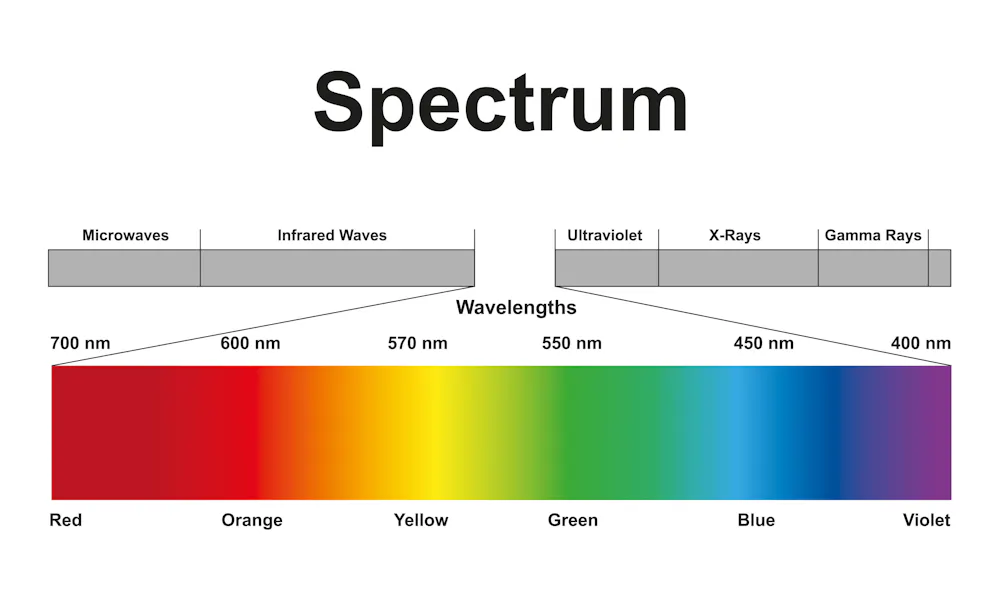
    Visible light forms just a small part of the electromagnetic spectrum, which includes all types of electromagnetic radiation. Within the visible range, different wavelengths of light produce different colors.
    Ali Damouh/Science Photo Library, via Getty Images

    Depending on the properties of the particles in our water sample, they will absorb and scatter radiation at different wavelengths. The light’s wavelength determines the color we see with our eyes.

    Waters that contain lots of sediment – such as the Missouri River, nicknamed the “Big Muddy” – backscatter light across the yellow to red range. This makes the water appear orange and muddy.

    Cleaner, more pure water backscatters light in the blue range, which makes it look blue. One famous example is Crater Lake in Oregon, which lies in a volcanic crater and is fed by rain and snow, without any streams to carry sediment into it.

    Deep waters like Crater Lake look dark blue, but shallow waters that are very clear, such as those around many Caribbean islands, can appear light blue or turquoise. This happens because light reflects off the white, sandy bottom.

    When water contains a lot of plant material, chlorophyll – a pigment plants make in their leaves – will absorb blue light and backscatter green light. This often happens in areas that contain a lot of runoff from highly developed areas, such as Lake Okeechobee in Florida. The runoff contains fertilizer from farms and lawns, which is made of nutrients that cause plant growth in the water.

    Finally, some water contains a lot of material called color-dissolved organic matter – often from decomposing organisms and plants, and also human or animal waste. This can happen in forested areas with lots of animal life, or in heavily populated areas that release wastewater into streams and rivers. This material mostly absorbs radiation and backscatters very little light across the spectrum, so it makes the water look very dark.

    Bad blooms

    Scientists expect water in nature to contains sediments, chlorophyll and organic matter. These substances help to sustain all living organisms in the water, from tiny microbes to fish that we eat. But too much of a good thing can become a problem.

    For example, when water contains a lot of nutrients and heats up on bright sunny days, plant growth in the water can get out of control. Sometimes it causes harmful algal blooms – plumes of toxic algae that can make people very sick if they swim in the water or eat fish that came from it.

    When water bodies become so polluted that they threaten fish and plants, or humans who drink the water, state and federal laws require governments to clean them up. The color of water can help guide these efforts.

    Engineering professor Courtney Di Vittorio and her students collect water samples from High Rock Lake in North Carolina to assess its water quality.

    My students and I collect water samples at High Rock Lake, a popular spot for swimming, boating and fishing in central North Carolina. Because of high chlorophyll levels, algal blooms are occurring there more often. Residents and visitors are worried that these blooms will become harmful.

    Using satellite photos of the lake and our sampling data, we can produce water quality maps. State officials use the maps to track chlorophyll levels and see how they change in space and time. This information can help them warn the public when there are algal blooms and develop new rules to make the water cleaner.


    Hello, curious kids! Do you have a question you’d like an expert to answer? Ask an adult to send your question to CuriousKidsUS@theconversation.com. Please tell us your name, age and the city where you live.

    And since curiosity has no age limit – adults, let us know what you’re wondering, too. We won’t be able to answer every question, but we will do our best.


    Courtney Di Vittorio receives funding from the North Carolina Attorney General’s Office Environmental Enhancement Grant Program (award WFU021PRE1) to collect data at High Rock Lake, NC. She is affiliated with the Yadkin Riverkeepers, an environmental advocacy not-for-profit group, and the North Carolina Lake Management Society.

    ref. Why is water different colors in different places? – https://theconversation.com/why-is-water-different-colors-in-different-places-243895

    MIL OSI – Global Reports

  • MIL-OSI United Nations: DR Congo crisis: WFP condemns looting in Bukavu after M23 rebels move in

    Source: United Nations MIL OSI b

    Peace and Security

    The UN World Food Programme (WFP) has condemned the looting of thousands of tonnes of relief supplies in the city of Bukavu in the eastern Democratic Republic of the Congo (DRC), after Rwanda-backed M23 rebels swept in at the weekend, reportedly meeting little resistance.

    In an online message on Monday, the WFP said that it “condemns the pillage of its warehouses in Bukavu in South Kivu…the food supplies kept there were meant to provide vital support to the most vulnerable families who now face a growing humanitarian crisis”.

    Looters made off with 7,000 tonnes of humanitarian food supplies, the UN agency said, adding that as violence spreads and access to food becomes increasingly difficult, “WFP stands ready to resume essential food aid to the most vulnerable as soon as it is safe to do so”.

    The UN agency also urged all parties to the conflict “to respect their obligations vis-à-vis international humanitarian law”, which includes the protection of civilians and humanitarian workers.

    The development came as M23 fighters made continuing gains in eastern DRC, after taking control of Goma – capital of North Kivu province – at the end of January. Hostilities have continued in this mineral-rich region for decades amid a proliferation of armed groups, forcing hundreds of thousands to flee their homes.

    Aid routes blocked

    In an alert, the top UN aid official in the country, Bruno Lemarquis, warned last Thursday that a shortage of humanitarian routes was threatening the aid operation in the mineral-rich region.

    Before the M23’s latest offensive at the beginning of the year, Mr. Lemarquis recalled that the humanitarian situation in South Kivu was already dire.

    Roughly 1.65 million people, or just over 20 per cent of the province’s population, had been displaced for a wide range of reasons.

    On Saturday, the UN Secretary-General warned of the potential for the conflict to spark a regional war, before calling for “African diplomacy to solve the problem”.

    Speaking on the sidelines of the African Union Summit, António Guterres told journalists that it was “time to silence the guns, it’s time for diplomacy and dialogue. The sovereignty and territorial integrity of the DRC must be respected.”

    MONUSCO, the international UN peacekeeping force in DRC, will continue to provide support, the UN chief continued, although he cautioned that “a peacekeeping force can’t solve the problem because there is no peace to keep”.

    He insisted, on the other hand that the conflict “will be solved if there is an effective African unit and African diplomacy to solve the problem”.

    Mr. Guterres pointed to the crucial importance of efforts such as the recently held joint summit by the South African Development Community in Tanzania, which resulted in a clear pathway for an immediate ceasefire. 

    MIL OSI United Nations News

  • MIL-OSI Europe: AFRICA/DR CONGO – Bukavu in the hands of the M23; the testimony of a local source

    Source: Agenzia Fides – MIL OSI

    Monday, 17 February 2025 war  

    Kinshasa (Agenzia Fides) – “The shops are still closed, but people are still seen on the streets, albeit few. Since yesterday, February 16, the gunfire has stopped. Bukavu is living in apparent peace after being taken over by the M23 rebel movement and the Rwandan army,” reports a Fides source from the local Church in the capital of the province of South Kivu, in the east of the Democratic Republic of Congo.The city was taken after an advance that started from the neighboring province of North Kivu (whose capital fell into the hands of the M23 militias at the end of January). The operation first captured the airport of Kavumu, about thirty kilometers from the city, before the fighters advanced on the capital of South Kivu.”In the days between Friday 14 and Saturday 15 February, I witnessed shootings and looting,” said the Fides source, who wished to remain anonymous. “The soldiers of the Congolese Armed Forces (FARDC) who left the city, left behind many weapons and ammunition. Looting took place mainly in Kadutu, the historic district of the old town where the main local market is held. On Sunday morning, February 16, M23 militiamen and Rwandan soldiers entered the city in a row after approaching it on the highway number 2 that connects the city to Kavumu. Some residents greeted them with cries of joy; we think that this behavior is an expression of fear and also the feeling that the wait for a disturbing event that had been looming for days is finally over.””The authorities had already fled days ago and the population lacked a binding word to get through these moments. Only Archbishop François-Xavier Maroy Rusengo spoke out, asking for Bukavu to be spared from the same fate as Goma, where the invasion of Rwandan and M23 fighters caused a massacre. Civil society turned to the authorities for advice, but to no avail. The general opinion, however, was that, given the unequal balance of power, it was better to welcome the militiamen to avoid a repeat the tragedy of Goma,” the source concluded. (L.M.) (Agenzia Fides, 17/2/2025)
    Share:

    MIL OSI Europe News

  • MIL-OSI Global: Amish voters for Trump? The Amish and the religion factor in Republican electoral politics

    Source: The Conversation – France – By Daniele Curci, PhD Candidate in International and American History, University of Florence

    On November 5, 2024, as millions of Americans headed to the polls, billionaire Elon Musk posted a video on his social media platform X depicting a caravan of Amish individuals travelling via horse and buggy to vote for Donald Trump. The following day, in response to a post expressing gratitude to the Amish for their contribution to Trump’s victory, Musk wrote: “The Amish may very well save America! Thank goodness for them. And let’s keep the government out of their lives.” Musk’s tweets underscore the growing prominence of religion in US politics and the Republican party’s efforts to integrate the Amish into its electorate.

    The Amish and their vote in US history

    The Amish are a Protestant religious community rooted in early European Anabaptist movements. They accept technological advancements selectively, adhering to a distinct way of life marked by simple living, plain dress and a focus on community, distinguishing between what strengthens their social bonds and what might compromise their spiritual path. The Amish are a tiny minority in the US: in 2022, there were approximately 373,620 individuals in a population of around 330 million–slightly more than one in 1,000 Americans. They are predominantly concentrated in the election swing states of Pennsylvania and Ohio, which partly explains Republicans’ interest in courting their support.

    Traditionally, the Amish mainly abstain from voting unless they feel compelled to protect their religious freedoms, preserve their way of life or address critical moral issues. Historically, such instances of electoral participation have occurred only three times.

    The first instance dates back to the 1896 presidential election, when the Republican nominee, William McKinley, campaigned on a platform centred on industrial corporate interests. These interests diverged significantly from those of the Amish, who aligned instead with Democrat William Bryan’s policies advocating for small farmers and the defense of rural America.

    Amish political engagement resurfaced during the 1960 presidential election, which featured Republican Richard Nixon vs Democrat John F. Kennedy. The Amish viewed Kennedy as an ally of the Catholic church, an institution they viewed as intolerant. Consequently, they supported Nixon, a Quaker, whom they saw as a defender of a Protestant America.

    The most recent instances of notable Amish participation occurred amid the presidential election campaigns of Republican George W. Bush in 2000 and 2004. This phenomenon, dubbed “Bush Fever,” saw unprecedented Amish voter turnout. In 2000, 1,342 out of 2,134 registered Amish voters in Lancaster County, Pennsylvania–which has one of the largest Amish communities in the US–cast ballots, achieving a turnout rate of 63%. By 2004, Amish voter registration had increased by 169%, with 21% of eligible adults being registered. This mobilization was spearheaded by Chet Beiler, the son of Amish parents who left the community when he was three. Leveraging his heritage and fluency in Pennsylvania German, a traditional language spoken in many Amish communities, Beiler developed a voter registration strategy targeting the Amish to support Bush’s re-election campaign.

    The religious factor in US politics

    To understand the Republican party’s interest in the Amish, one must examine the increasing centrality of religion in US politics. This phenomenon persists despite a growing number of Americans identifying as non-religious or less religious.

    In the US political context, religion extends beyond faith to encompass cultural identity and social cohesion. Scholars often describe this phenomenon as “Christianism,” a form of nationalism that is bound together by a belonging to Christianity and that emerges, as a form of reaction, within the culture wars. Consequently, a political platform emphasizing Christian principles and rural values has the potential to galvanize segments of the electorate. This dynamic is exemplified by Musk’s tweets about the Amish. Within some parts of the Republican electorate, the Amish are perceived as “guardians of lost values,” embodying a vision of an untainted rural America defined by traditional family structures and an agrarian work ethic. This narrative has been further amplified by Amish PAC, a political action committee established in Virginia in 2016 to rally support for Trump through religiously framed identity politics that advocate for traditional values and oppose abortion rights.

    The influence of religion within the Republican party is further underscored by the ascendancy of the Christian right, a political movement that emerged in the late 1970s. Though not a monolithic entity, it is composed of individuals–primarily evangelical Christians–seeking to shape US politics based on a conservative interpretation of biblical principles and societal values.

    Legislation and the Amish

    Some Republicans have advocated for legislation favourable to the Amish, such as former US representative Bob Gibbs, who won election in the Amish-dominated congressional district of Holmes County, Ohio. In December 2021, Gibbs introduced legislation to allow people with specific religious beliefs such as the Amish, who view photography as a form of idolatry, to be exempt from a requirement of possessing identification documents featuring their photographs “to purchase a firearm from a federally licensed firearms dealer.” In the same month, Gibbs also proposed another bill to benefit the Amish, which would have allowed them to opt out of social security and Medicare wage deductions if they were employed by non-Amish-owned companies.

    Earlier in 2021, the conservative-majority Supreme Court resolved a longstanding dispute between the Amish of Lenawee County, Michigan and local authorities, ruling in favour of the Amish. The issue at the heart of the case concerned wastewater management. Following their religious principles, the Amish typically avoid using modern inventions such as septic systems, and the Amish in Lenawee County used a management method considered noncompliant by health officials. This case followed similar ones involving other Amish communities in Ohio, Minnesota and Pennsylvania. Legal disputes such as these could be leading the Amish to form a more positive view of the Republican party and Trump, both for their advocacy of “less government” and for positioning themselves as defenders of religious freedom.

    The Amish and the 2024 presidential election

    According to the online news source Anabaptist World, media reports suggested that the 2024 presidential election saw a surge in voter registrations among the Amish in Pennsylvania, allegedly contributing to Trump’s victory in the state. The alleged surge was reportedly driven by a reaction to federal legal actions against an Amish farmer accused of selling raw dairy products across state lines, which resulted in cases of Escherichia (E.) coli.

    However, official data from Lancaster County–where the principal Amish settlement in Pennsylvania is located–challenge claims of a massive Amish turnout. The increase in Trump’s vote share in the state, from 48.84% in 2020 to 50.37% in 2024, primarily occurred in urban and suburban areas. For example, by the time the Associated Press declared that Trump had won Pennsylvania, his vote share in Philadelphia had improved by three percentage points. Key suburban counties such as Bucks, Monroe and Northampton, which former president Joe Biden won in 2020, had swung in his favour. And the Republican had also performed better in the Philadelphia-area suburbs of Delaware and Chester counties. These regions, with few Amish residents, experienced substantial shifts, while districts with larger Amish populations saw only modest gains for Trump.

    While the Amish did not become a significant component of Trump’s electoral coalition, voters in some Amish communities may have grown more sympathetic to his candidacy. More importantly, members of the religious group serve as a potent symbol of mobilization and propaganda for the Republican party amid the intensifying polarization of US politics.

    Daniele Curci ne travaille pas, ne conseille pas, ne possède pas de parts, ne reçoit pas de fonds d’une organisation qui pourrait tirer profit de cet article, et n’a déclaré aucune autre affiliation que son organisme de recherche.

    ref. Amish voters for Trump? The Amish and the religion factor in Republican electoral politics – https://theconversation.com/amish-voters-for-trump-the-amish-and-the-religion-factor-in-republican-electoral-politics-247869

    MIL OSI – Global Reports

  • MIL-OSI Global: Heat pumps have a cosiness problem

    Source: The Conversation – UK – By Aimee Ambrose, Professor of Energy Policy, Member of Fuel Poverty Evidence and Trustee of the Fuel Poverty Research Network, Sheffield Hallam University

    How we keep warm at home accounts for 17% of the UK’s greenhouse gas emissions. The UK cannot reach net zero emissions, and end its contribution to climate change, without ending its reliance on natural gas as the dominant source of heating.

    As elsewhere in Europe, heat pumps (which use electricity to draw heat out of the air or ground and circulate it indoors) are regarded as the best way to reduce carbon emissions. But are people ready to ditch their gas boilers?

    My colleagues and I spent three years researching what people need, want and expect from their heating systems by asking 300 people in eight settlements across the UK, Finland, Sweden and Romania about their experiences of trying to keep warm at home. These memories ranged from as early as 1945 to the present day.

    Among the four countries we studied, the uptake of heat pumps is most sluggish in the UK and Romania. In Sweden, heat pumps are an established technology, used to heat homes outside of dense urban areas that tend to be served by heat networks, where a boiler is shared by multiple dwellings and heat pumped to each home through pipes.

    Successive oil crises accelerated the roll-out of electric heating in Sweden during the 1970s. Our participants credited widespread trust in the Swedish government at the time for the successful adoption of heat pumps.

    Relatively low trust in the government makes it more difficult to increase heat pump uptake in the UK, a problem shared by Romania, where, low trust in the government follows decades of communist rule during which energy could be cut off to maintain supply to industries.

    When coal was king and stoves were guilt-free

    We found that there were strong attachments to high-carbon fuels in many of the communities we studied – even where people were committed to a future with low-carbon energy.

    In former coalfields, such as Rotherham in south Yorkshire and Jiu Valley in south-west Romania, people spoke wistfully of the coal industry which provided jobs, housing and plentiful fuel for heating and cooking, except during industrial disputes. The coal fire was where most of our participants let their minds linger.

    The subsequent move to natural gas heating for most UK households, which started in the 1960s, failed to evoke the same enthusiasm. People did acknowledge the benefits of being able to heat the whole home evenly with gas central heating and remembered feeling glad to no longer have to clean out the grate, but this was a less remarkable era in home heating. Participants talked about it in less detail, for less time and with less enthusiasm.

    Many of our Finnish participants, despite having heat pumps or connection to a district heating network, wanted to continue burning wood at home. This treasured practice brought a sense of wellbeing. The intense pleasure of the fireside created a sense of homeliness and enabled cultural traditions such as cooking on a wood fire, plus the multi-sensory experience of a wood-fired sauna.

    Some participants worried about being considered an “environmental criminal” for driving a diesel car, but regarded burning wood as more socially acceptable. Outside of cities, plots of woodland are inherited in some families. Gathering firewood was a ritual many enjoyed and didn’t want to give up.

    Nice, but not sustainable.
    Skylines/Shutterstock

    More affluent participants in the UK also valued their wood burning stoves – a growing trend essentially borrowed from Scandinavian neighbours. Those we interviewed in Sweden also prized their wood burners but usually only in the homes or cabins where they holidayed.

    Thermal delight

    In 1979, US architect Lisa Heschong’s concept of “thermal delight” held that building designers were forgetting the importance of enabling pleasure through heat. Our research participants had not forgotten, however, and confirmed that we seek the most joyous route to warming our bodies.

    While the necessary speed of the net zero transition entails a clean sweep that substitutes fossil-fuelled heating for low-carbon, electric alternatives, our research shows that this may be unappealing to many households.

    The people we met wanted heating options to reflect different needs and preferences. Our participants valued central heating for bringing their houses to a consistent temperature, but this did not preclude a desire for the radiant heat of the log burner on some days. They also wanted the option of plugging in a portable, electric heater when they only needed to heat one room.

    They enjoyed the contrast between the intense warmth of the fireside and a cool bedroom and many regarded an even heat throughout the home as “uninviting” – something that met their needs but not their desires. The experience of different eras of home heating had taught them the value of flexibility and variety, which makes a “clean sweep” to electric heating unattractive.

    These findings do not mean that heat pumps are doomed. Indeed, heat pumps have a lot to offer in terms of reducing heating emissions. What we found does indicate a need for multiple ways to heat the home within scenarios for reaching net zero emissions.

    The transition from coal to gas heating is within living memory in the UK.
    AstroStar/Shutterstock

    Partly, this calls for innovation in home heating technology. There is really no place for burning solid fuels in a net zero future, but a concerted effort between heating researchers, designers and technologists could create a beautiful heat source that acts as a focal point, and offers something akin to the multi-sensory joy of the fireside.

    The findings also indicate the need to change how heating transitions are talked about by the government and energy companies. Away from an implacable duty to switch heating sources and the need for efficiency, and towards the joy and abundance of a heat source that (in the case of heat pumps) offers four times the heat output for the same energy input as a gas boiler.

    The best way to sell the low-carbon heating transition is locally, where the kinds of attachments and allegiances to heat that we have uncovered are best appreciated and understood. Local authorities are typically best placed to do that.


    Don’t have time to read about climate change as much as you’d like?

    Get a weekly roundup in your inbox instead. Every Wednesday, The Conversation’s environment editor writes Imagine, a short email that goes a little deeper into just one climate issue. Join the 40,000+ readers who’ve subscribed so far.


    Aimee Ambrose receives funding from The Collaboration for the Humanities and Social Sciences in Europe (CHANSE) and The Arts and Humanities Research Council (AHRC).

    ref. Heat pumps have a cosiness problem – https://theconversation.com/heat-pumps-have-a-cosiness-problem-249529

    MIL OSI – Global Reports

  • MIL-OSI USA: UConn Researchers Tracking Change in Precious Ecosystems

    Source: US State of Connecticut

    Primary forests, or old-growth forests as they are sometimes called, are epicenters of rich biodiversity, are more resilient than younger forests, and store significantly more carbon than their younger counterparts, to name just a few of the vital roles of these essential and irreplaceable ecosystems. The preservation of primary forests is the focus of global conservation efforts.

    The UConn Global Environmental Remote Sensing (GERS) Lab has developed a new remote sensing method to continuously monitor primary forest loss and determine what factors are driving that loss. Their findings are published in Remote Sensing of Environment.

    Lead author and Department of Natural Resources and the Environment Ph.D. student Falu Hong says that they focused on these key habitats on the island of Hispaniola, which includes Haiti and the Dominican Republic, using satellite images from the years 1996-2022.

    “We used a satellite time series to track primary forest loss, and we focused on these two countries because they have experienced significant primary forest loss and because they are ignored in previous studies, especially Haiti, which is one of the hotspots of biodiversity loss,” says Hong. “We analyzed the forest loss over 27 years of land cover change, which has not been done in previous studies.”

    The researchers analyzed multiple dimensions of forest loss, including the primary forest inside and outside of protected areas and the drivers of forest loss. They applied a method called the COtinuous monitoring of Land Disturbance algorithm (COLD) and remote sensing data from Landsat to create a map of the primary forest loss.

    Ji Won Suh, a postdoctoral researcher in the GERS lab, says this study showcases the power of using Landsat time series data.

    “So few studies focus on primary forests because it is very difficult to map them using remote sensing signals. Sometimes it is difficult to differentiate a secondary forest or regenerated forest from a primary forest, but this study successfully classified those primary forests using a random forest machine learning model.”

    Suh says the accuracy of the map was verified by their collaborator and co-author S. Blair Hedges from Temple University, who is an expert on primary forests on Hispaniola Island.

    “Another unique part of this study is we created a primary forest map over time,” Suh says. “Usually other studies just focused on a one-time event. We can track the loss of primary forests over many years. Our study is a way where we can map the trajectory of loss as it happens and we can analyze why those losses happen.”

    They found the main drivers of primary forest loss in Haiti are fire, which caused around 65% of the observed losses, followed by logging which accounted for about 20% of the primary forest loss, and around 10% of the forest loss was attributed to hurricane damage.

    “We found that in 2016, Hurricane Matthew destroyed around 12% of the primary forest in Haiti, just in one year,” says Hong. “That’s a huge amount of loss. With our map we can visualize the primary forest change and analyze the drivers causing that change. We can also analyze forest fragmentation. Usually, primary forests are homogeneous, but activities like construction or logging result in the forest becoming more and more fragmented. We quantified the fragmentation level of the primary forest which could give good insight into biodiversity conservation and preservation.”

    They also found that primary forest fragmentation is more pronounced in Haiti, where patches of primary forest are smaller and less numerous. Primary forests in both Haiti and the Dominican Republic are located on steep terrain, indicating that primary forests located in flatter and more accessible areas are prone to development and forest destruction.

    This paper is the first step in a larger project, says Hong, where the next steps are to begin expanding the mapping across the Caribbean region to evaluate the impact of primary forest loss on biodiversity change.

    GERS Lab Director and Associate Professor in the Department of Natural Resources and the Environment Zhe Zhu says that as primary forests have the lion’s share of biodiversity, many of the species living there are also endangered, so the preservation of these irreplaceable ecosystems is paramount. Having a reliable method to map primary forests accurately will help in the effort,

    “One thing I want to emphasize about this work is that it is very difficult to identify between different forests like primary dry forests, primary wet forests, and secondary forests, for example. A primary forest may look very similar if the secondary forest is old enough. You can have very subtle human disturbances causing it to no longer be a primary forest. You need to know the driver and how severe the drivers are. You also need to know the resilience of the trees.”

    This work is supported by a $2 million NSF grant with the goal of linking remote sensing to track biodiversity through time.

    “We are treating remote sensing as a time machine to backward and forward to forecast future impacts on biodiversity. It is a very fun project that a lot of us in the GERS lab are working on,” says Zhu.

    Tracking the impacts on biodiversity and the drivers of change is important for conservation and policymaking, and studies like this can yield surprising results and insights into what needs to happen to preserve vital ecosystems like primary forests.

    This work was supported by a grant from the NSF Biodiversity on a Changing Planet (BoCP) program (2326013 and 2326014).

    MIL OSI USA News

  • MIL-Evening Report: Hamas, PIJ slam Israel’s ‘barbaric’ raid on Palestinians at Ofer Prison

    Asia Pacific Report

    Two Palestinian resistance groups have condemned “the brutal assault” on prisoners at Ofer Prison, saying it was “barbaric criminal behaviour that reflects the fascist and terrorist nature of” Israel.

    In the joint statement, Hamas and Palestine Islamic Jihad (PIJ) called the attack a “miserable attempt” by Israel “to restore its shattered prestige”, reports Al Jazeera.

    They called on the world to expose “these inhuman crimes against the prisoners”, which “blatantly violate all international conventions and norms”.

    The statement called on the international community to intervene to protect the “prisoners, stop criminal violations against them, document them and work to hold the criminal occupation leaders accountable”.

    The statement came after Palestinian authorities said Israeli forces had raided a section of Ofer Prison, west of Ramallah in the occupied West Bank, and assaulted detainees.

    “Prisoners were beaten and sprayed with gas,” the Palestinian Prisoners Media Office said.

    Persistent serious allegations of torture and abuse of Palestinian prisoners — many who have not been charged or are held on administrative detention — and beatings right up until the release of detainees under the ceasefire have been made over all six exchange events so far.

    Medical director severely tortured
    Last week, lawyers representing Kamal Adwan Hospital’s medical director Dr Hussam Abu Safiya met him for the first time since he was detained by Israeli forces in north Gaza last December 27.

    He told them he was severely tortured with electric shocks and was being denied needed medication.


    Lawyer spells out torture allegations over Israeli detention of doctor.  Video: Al Jazeera

    Samir Al-Mana’ama, a lawyer with the Al Mazan Center for Human Rights, described his brutal torture in a failed attempt to “extract a confession” from him in an interview with Al Jazeera.

    Al-Mana’ama said Dr Abu Safiya suffered from “an enlarged heart muscle and from high blood pressure” and was beaten up and refused treatment for the heart condition.

    Transferred to Ofter Prison on January 9, he was held in solitary confinement for 25 days and interrogated nonstop by the Israeli army, Israeli intelligence and police, the lawyer added.

    There was “no legal justification” for Abu Safia’s arrest and no evidence against him, the lawyer said.

    Since the interview, Israeli authorities said he was being held under an “unlawful combatant” law — despite his status as a civilian doctor — stripping him of any rights as a detainee.

    Al Jazeera’s Nour Odeh, reporting from Amman in Jordan, said the doctor was one of hundreds of medical workers taken from Gaza by Israeli forces to the notorious Sde Teiman detention camp and other Israeli military prisons.

    MIL OSI AnalysisEveningReport.nz

  • MIL-OSI Russia: Denis Manturov visited the international defense industry exhibition IDEX 2025 in Abu Dhabi

    Translartion. Region: Russians Fedetion –

    Source: Government of the Russian Federation – An important disclaimer is at the bottom of this article.

    Previous news Next news

    Denis Manturov visited the International Defense Industry Exhibition IDEX-2025 in Abu Dhabi

    First Deputy Prime Minister of Russia Denis Manturov, who heads the Russian delegation to the UAE, visited the international conference and exhibition of the defense industry IDEX 2025 in Abu Dhabi. The Russian exposition was also visited by Crown Prince of Abu Dhabi Khaled bin Mohammed Al Nahyan.

    This year, the Russian exposition, the total area of which exceeds 2 thousand square meters, will feature a record number of new weapons, military and special equipment from 40 leading domestic companies. Some models are being demonstrated abroad for the first time. For example, the T-90MS tank in an updated appearance based on the experience of real combat operations, which has unique tactical and technical characteristics. Among the world premieres are also the Pantsir-SMD-E air defense missile and gun system with new guided missiles for destroying UAVs, the Kub-1-1E and Kub-2-2E loitering munitions, and the Kornet-EM ATGM with a remote control and a Bulat guided missile. The Lancet-E loitering munition and the Berezhok combat compartment are being presented in the Middle East for the first time.

    “We selected the most high-tech models that have proven their performance in real combat. The Russian models presented here are different from the others shown at the exhibitions in that they can interact in a complex, successfully resist and defeat the equipment of competitors, who are also present at the exhibition, in real combat,” Denis Manturov noted.

    At IDEX 2025, Russian helicopter manufacturers presented a line of helicopters for the effective work of emergency services. Among them are the latest modification of the Ka-32A11M firefighting helicopter, the Mi-38 helicopter with a high-comfort cabin, as well as the Ansat in two versions: ambulance and police.

    Please note: This information is raw content directly from the source of the information. It is exactly what the source states and does not reflect the position of MIL-OSI or its clients.

    MIL OSI Russia News

  • MIL-OSI Asia-Pac: Text of Vice-President’s address at National Agri-Food and Biomanufacturing Institute, Mohali (Excerpts)

    Source: Government of India

    Posted On: 17 FEB 2025 2:44PM by PIB Delhi

    Every success demands greater success, when we have phenomenal development, exponential economic upsurge, people get aspirational. Expectations soar high and every success therefore, brings in the wake a greater challenge to outperform oneself.

    If we look into our historical past, India was known to be a land of knowledge and wisdom, particularly in science, astronomy and whatnot. Every aspect of human life finds reflection in our Vedas, Upanishads, Puranas. We are a nation that takes pride in having ancient institutions like Nalanda, Takshashila and the kind. Something happened around 11th or 12th century, and there was a digression. Marauders came, invaders came, and they were reckless in destroying our institutions, Nalanda being one of them. Our cultural centres, going to the extent of being so retributive, perversion of a very different kind, that over our religious centres they built their own. The nation faced it. Then came the British rule. Systematically, we got laws that were meant to serve them. We got education that destroyed ours and created not an ecosystem of full exploitation of our talent but then, the best part is, we are springing back.

    The century belongs to Bharat. This is being doubted by no one except some in our country. My appeal to them, as an Indian, as a Bhartiya, our commitment to our nation, belief in the principle of the nation being first, and subscribing to the ideology that no interest—personal, political, or otherwise is higher than national interest. Being citizens of this country is our identity and we need to take pride, for a good reason. No country in the world can claim to have that kind of civilizational depth, that richness of culture. And what does it indicate? Inclusivity. People are misleading. India, in the world, is the nerve center, the epicenter of culture.

    What is inclusivity is best defined in our life. Never ever in history of the civilization. Expansion has been a methodology of our ruling clans. We suffered invasion, never undertook any invasion. In that perspective that no nation in the world has grown so fast in last decade in terms of economic rise or impact of people centric policies as Bharat. Therefore, we are faced with a great challenge, a challenge before our scientists, a challenge before all institutions. The challenge is, we have the largest global population which is aspirational.

    I looked at NABI, I immediately thought of नाभि, नाभि in the human body. And I take the two to be similar. In our religions, Nabi, a birth of rebirth, a center of universe, a symbol of life, connection and vitality, reminding the one taking birth, the source of it, a mark and remnant of the umbilical cord that connects us in the womb of the mother. Your role distinguished audience is no different. You have to nurture every policy that can blossom our motherland, Bharatma, or Bharat Maa ki Atma.

    Most people must learn that while our economy is rising, fifth at the moment, shortly to be third globally. A developed nation would require, there must be an eightfold jump in our per capita income, eightfold that can be brought about only when larger population of this country participates.

    In this perspective, I take it as a great privilege and honor to inaugurate the Advanced Entrepreneurship Skill Development Program. Focus on entrepreneurship and focus on skill development, according to me, is synonymous with focus on development, focus on economic growth.

    This place must be North Star for the farm sector, for rural youth how to be in agro startups and you must be a lighthouse also, if they encounter some difficulties, which are natural. Our ethos of civilisation tell us there is nothing like failure. If an attempt fails, it is not failure. It is a step toward success.

    There was time in ancient India when a village was self-sufficient. वहां खाद्य भी था, व्यवहार भी था, चमड़े का काम भी था सब था। Now, the cooperatives are embedded in the Constitution as an institution.

    There must be evolution of a mechanism in a village or in a cluster of villages where you have micro industries at the farm that add value to the agro produce, that add value to the livestock produced, milk produced. This will help evolve a sustainable society and the nutritional food value will certainly go up. Right now, if you look around, milk is in the villages the only value addition I see is that दूध की छाछ बना देंगे, दही बना देंगे।

    What stops us? From having entrepreneur skills getting into ice creams, paneer, sweets and the kind in a cluster. This is very important because it will generate employment. It will satisfy rural youth.

    Startups are there in tier two and tier three cities. They have to trickle to villages now because agriculture produce is lifeline of economy, raw material for industry and when this takes place, close to the farmland in the rural firmament, evolving as a cluster, economy will take a jump, and people will believe in the farmland.

    How best to earn money out of farm should not be limited only to the agriculture produced. It must extend to marketing, value addition and small industries.

    All institutions in the country will have to pass the litmus test and the litmus test is what you are doing, is there some impact somewhere? In a positive sense, it should be like an earthquake, impact should be felt. A research for the sake of research, a research that is for the self, a research that is to be kept on the shelf, the research that comes out as a personal embellishment is not the research which the nation needs. Research is not giving a paper by scratching the surface. Research is not to impress the one who is ignorant of the subject. Research is to impress those who know the subject as much as you know or more than you know at a global benchmark and that research can’t be just abstract academics. The research has to have impact on what we are doing. I’m sure this is an area where you have enough scope.

    I am son of a farmer, interest of the farmer is in my heart. I know the potential of farmers. I know the potential of the children in farm families. I know the kind of challenges they face right from the beginning. During my time the challenges were more, not any longer. We never imagined Indian household will have a toilet, a gas connection, an electricity connection, an internet connection, something like pipe water on the way, a road connectivity, health center close by. We never thought of that. Good education, it is happening now. Therefore, an ecosystem by transforming our education that brings about equality, labels all, and cuts into inequities is in place.

    Technology transfer to the farm is essential. A farmer is by and large clinging to his tractor. He wants to use the tractor for as long as it can last. Ignorant that the technology of the tractor is undergoing big changes. It is becoming environment friendly, fuel efficient, multifunctional and highly subsidized. There has to be awareness campaign. There has to be awareness campaign to the farmer that you don’t need anybody’s help. You only have to know your inner strength to change your economy to a very high level. Form small groups, market your product at a price of your choice; you can.

    But by and large, I see farm produce is sold when it is not farmers’ market, it is buyers’ market. The government provides facilities to hold on to the stock by massive warehousing and cooperative movement. I can tell you the farm policies of the government are so helping the farmer. The farmer has to know about it. You can play a great role because we cannot allow that our farmers get anything but the very best. No short-change for the farm sector, no short-change for the farmer that has to be our motto. Institutes like yours must have live connect with Krishi Vigyan Kendras, with Institutes of Indian Council of Agriculture Research.

    We need to introspect also. We can feel proud that we are doing good but, like learning, which never stops, your goalpost must be shifting, shifting on one parameter. To what degree is our research, our involvement, making a difference in the life of the ordinary person? Such self-audit, self-assessment, self-introspection will lead to deep reflection. It will fire us with the zeal to serve the nation, and it will be a satisfying experience. The aspirations of our people have been propelled, as I said, by people-centric policies, reaching the ground. We cannot allow our youth to be restive now. They must know what opportunities they have. The son of the farmer, the daughter of the farmer, must get attracted to starting their ventures.

    There were some districts where the district magistrates never wanted to go. Prime Minister Modi created them as aspirational districts with a definite mission, uplift them. The number of their aspirational districts is going down. But bureaucrats who seek to go to those districts, the queue is getting longer because anybody wants to contribute and transform. Prime Minister has now come to the second stage, aspirational blocks, that the district is by and large not aspirational because developed, but some blocks are there. Time for us to nurture aspirational agro zones across rural India

    I am son of a farmer like there was a movie, Son of a Sardar. A son of the farmer will always commit himself to truth.

    ****

    JK/RC/SM

    (Release ID: 2104056) Visitor Counter : 42

    MIL OSI Asia Pacific News

  • MIL-OSI USA: Observing non-earthquake signals on the Yellowstone Seismic Network

    Source: US Geological Survey

    Yellowstone Caldera Chronicles is a weekly column written by scientists and collaborators of the Yellowstone Volcano Observatory. This week’s contribution is from Jamie Farrell, associate research professor with the University of Utah Seismograph Stations and Chief Seismologist of the Yellowstone Volcano Observatory.

    It is well-known that the Yellowstone region, with an average of 1,500-2,500 earthquakes per year, is one of the most-seismically active areas in the western U.S.  The Yellowstone Seismic Network is designed to record the ground shaking from these earthquakes and send the data back to the University of Utah in real time for analysis.  There are a lot of other things that cause the ground to shake, however, and this shaking is recorded by seismic stations in and around Yellowstone.  Most of the time, it is easy to differentiate these signals from those of real earthquakes.

    So, what else besides earthquakes makes the ground shake in Yellowstone?

    Webicorders of Yellowstone Seismic Network stations YMR (West Entrance road) and YNM (Norris Geyser Basin Museum) showing traffic signals (left) and visitors walking (right) during daytime hours.  Both records span the entire 24-hour period of July 23, 2024, MDT. 

    Some of the most common causes of non-earthquake ground shaking are humans and the vehicles that they drive.  As a general guideline, seismic stations are located far away from roads to avoid these signals, but there are some that are close enough to record every car/truck/bus/RV that drives by.  A seismic station that is located near the Madison-West Entrance Road, designated YMR, is notorious for recording road noise. In addition, a seismic station that is located in the Norris Geyser Basin Museum (designated YNM) records the thousands of visitors that walk by it every day during the summer.  Signals that are related to human activity can be identified by their prevalence during the daytime hours and their absence during nighttime hours.

    Signals recorded at station YDD in Yellowstone National Park from the 2022 Hunga Tonga–Hunga Haʻapai volcanic eruption. The seismometer at YDD recorded both the direct seismic phase (top left) as well as the atmospheric Lamb Wave that coupled to the ground as it propagated (top right).  The infrasound microphone at YDD recorded the atmospheric disturbance from the Lamb wave (bottom right) that arrived in Yellowstone ~9 hours after the eruption.  Seismic waves travel through the earth much faster than sound waves travel through the atmosphere, which explains the long delay in timing between when the two signals were recorded.

    Signals related to non-earthquake geologic events far from Yellowstone can sometimes be seen as well.  An example of this is the 2022 Hunga Tonga–Hunga Haʻapai volcanic eruption in the south Pacific.  The volcano is located about 9,742 km (6,053 miles) from Yellowstone National Park, but the signals from that violent eruption are clearly seen on many stations in the Yellowstone Seismic Network.  In fact, that eruption produced two signals that are evident in the Yellowstone seismic record.  The first signal is the direct P-wave (seismic phase) that traveled through the earth from the eruption site to Yellowstone—the wave arrived ~27 minutes after the eruption occurred.  The eruption also produced very powerful atmospheric waves.  The most energetic of these atmospheric waves was something called a Lamb wave, which travelled through the atmosphere but along the Earth’s surface. The Lamb waves from the eruption traveled around the earth 4 times over 6 days.  The first of these arrived in Yellowstone ~9 hours after the eruption—moving at the speed of sound, which is much slower than the speed of earthquake waves through the ground—and is evident on both seismometers and infrasound microphones. This shows that as the Lamb wave propagated along the Earth’s surface, not only did it cause an atmospheric disturbance (as recorded by the infrasound microphone) but energy was also transferred into the Earth (as recorded by the seismometer).  In this sense, the wave was similar to a sonic boom or thunderclap.

    Other non-earthquake signals are sometimes recorded on seismometers around rivers due to ground shaking from large floods in Yellowstone, like those that occurred in June 2022.  Near Yellowstone Lake, seismometers record “icequakes” from cracking of the ice cover during winter, and when the lake is free of ice during summer months ground shaking can be caused by wave action on the lake during daytime hours.  In addition, seismometers record signals related to hydrothermal activity and even hydrothermal explosions.

    Even though these non-earthquake signals are not what the Yellowstone Seismic Network was originally designed to record, they still provide valuable insights into the Yellowstone volcanic and tectonic system.  Scientists are increasingly using these data to better understand the dynamic nature of geologic activity in the Yellowstone region.

    Signals from a suspected icequake that occurred on Yellowstone Lake recorded at Yellowstone Seismic Network stations YLA on Lake Butte (top) and YTP at The Promontory (bottom 3 plots). Plot shows about 2 minutes of data from January 24, 2022, starting at about 7:43:34 p.m. MST.

    MIL OSI USA News

  • MIL-OSI United Kingdom: Queens Drive flooding report published

    Source: City of Liverpool

    Last updated:

    Liverpool City Council has published a Section 19 investigation report into flooding events on Queens Drive in 2023.

    It follows an incident on 26 August 2023, in which Elaine and Philip Marco tragically died when their car became trapped in water.

    Under Section 19 of the Flood and Water Management Act 2010, the Council has a duty to investigate incidents of flooding that are considered to be ‘locally significant’.

    The report was commissioned with engineering firm Mott Macdonald as an independent party, and has now been shared with relevant parties and published.

    You can read the report here: https://liverpool.gov.uk/queensdrivereport

    MIL OSI United Kingdom

  • MIL-OSI United Kingdom: Munich Security Conference: G7 foreign ministers’ statement, February 2025

    Source: United Kingdom – Government Statements

    G7 foreign ministers and the EU gave a joint statement on the margins of the Munich Security Conference on 15 February 2025.

    Foreign Secretary David Lammy with G7 foreign ministers and Vice-President of the European Commission Kaja Kallas at the Munich Security Conference.

    Joint statement:

    The G7 Foreign Ministers of Canada, France, Germany, Italy, Japan, the United Kingdom and the United States of America and the High Representative of the European Union, met on the margins of the Munich Security Conference for the first time under Canada’s 2025 Presidency.

    The G7 members discussed Russia’s devastating war in Ukraine.  They underscored their commitment to work together to help to achieve a durable peace and a strong and prosperous Ukraine and reaffirmed the need to develop robust security guarantees to ensure the war will not begin again.  

    The G7 members welcomed their discussion today with Andrii Sybiha, Minister of Foreign Affairs of Ukraine.  They recalled the G7’s important contribution towards ending the war in Ukraine, including through measures pursuant to the G7 Joint Declaration of Support for Ukraine, by supporting Ukraine financially through the use of extraordinary revenues stemming from Russian Sovereign Assets, by imposing further cost on Russia, if they do not negotiate in good faith, through caps on oil and gas prices, and by making sanctions against Russia more effective. Any new, additional sanctions after February should be linked to whether the Russian Federation enters into real, good-faith efforts to bring an enduring end to the war against Ukraine that provides Ukraine with long-term security and stability as a sovereign, independent country.  The G7 members reaffirmed their unwavering support for Ukraine in defending its freedom, sovereignty, independence and territorial integrity.

    The G7 members discussed the provision to Russia of dual-use assistance by China and of military assistance by DPRK and Iran.  They condemned all such support.

    The G7 members discussed political, security and humanitarian issues in the Middle East, including in Israel, Gaza, Lebanon, Syria and Iran, and their commitment to advancing regional peace and stability.  They underscored the importance of a durable, Israeli-Palestinian peace.  They reaffirmed their support for the full implementation of the ceasefire reached between Israel and Hamas, including for the release of all hostages and the expansion of humanitarian aid in Gaza.  The G7 members stand behind the ongoing efforts of Egypt, Qatar and the United States in continuing to work towards a permanent ceasefire.  They reiterated their unequivocal condemnation of Hamas and the need to ensure that Hamas neither reconstitutes militarily nor participates in governance.  They recognized Israel’s inherent right to self-defence, consistent with international law. 

    The G7 members welcomed the outcomes of the International Conference on Syria, hosted by France on February 13, 2025.  They reiterated their shared commitment to the people of Syria and their support for an inclusive political transition process, in the spirit of UN Security Council Resolution 2254.  They welcomed, as well, positive developments in Lebanon, including the recent election of President Joseph Aoun, the designation of Nawaf Salam as Prime Minister, and the formation of a new government.  The G7 members reaffirmed their commitment to both countries’ stability, sovereignty, and territorial integrity.

    The G7 members unequivocally condemned Iran’s destabilizing actions, including its rapid advancement of uranium enrichment without credible civil justification, its facilitation of terrorism organizations and armed groups across the Middle East and Red Sea, its proliferation of ballistic missiles and drones, and its transnational repression and violation of fundamental human rights.

    The G7 members reiterated their commitment to a free, open and secure Indo-Pacific region, grounded in respect for the rule of law and sovereignty.  They strongly opposed any attempts to change unilaterally the status quo using force and underscored the importance of resolving disputes peacefully.  They strongly opposed China’s attempts to restrict freedom of navigation through militarization and coercive activities in the East and South China Sea. 

    The G7 members expressed serious concern over the DPRK’s nuclear and ballistic missile programs and reaffirmed their commitment to the complete denuclearization of the Korean Peninsula. They demanded that the DPRK abandon all its nuclear weapons, existing nuclear programs, and any other weapons of mass destruction (WMD) and ballistic missile programs in a complete, verifiable, and irreversible manner in accordance with all relevant United Nations Security Council resolutions (UNSCRs). They underscored that direct DPRK support for Russia’s war of aggression against Ukraine marks a dangerous expansion of the conflict, with serious consequences for European and Indo-Pacific security. They urged the DPRK to cease immediately all assistance for Russia’s war of aggression against Ukraine, including by withdrawing its troops. The called upon DPRK to resolve the abductions issue immediately.

    The G7 members also discussed urgent situations of conflict and instability elsewhere in the world, including in the Democratic Republic of the Congo and Sudan, and in Haiti and Venezuela.

    The G7 Foreign Ministers looked forward to their meeting in Canada in Charlevoix, Quebec on March 12-14.

    Updates to this page

    Published 15 February 2025

    MIL OSI United Kingdom

  • MIL-OSI Russia: The day of the end of the Korsun-Shevchenko operation

    Translartion. Region: Russians Fedetion –

    Source: State University of Management – Official website of the State –

    We continue our series of historical materials dedicated to the 80th anniversary of Victory in the Great Patriotic War.

    On February 17, 1944, the Korsun-Shevchenkovsk operation, also known as the Korsun or Cherkasy pocket, ended with a crushing defeat for the German Army Group South.

    In late December 1943 – early January 1944, the 1st Ukrainian Front under General of the Army Nikolai Vatutin and the 2nd Ukrainian Front led by General of the Army Ivan Konev carried out the Zhitomir-Berdichev and Kirovograd offensive operations, during which they surrounded the German group in the area of the city of Korsun-Shevchenkovsky. Thus, a deep salient was formed on the front, which the Germans held in the hope of restoring the front line along the Dnieper and preventing the further advance of the Russians to the southeast.

    The general plan of the Red Army operation was to launch a counterattack at the base of the salient by the adjacent flanks of the 1st and 2nd Ukrainian Fronts. On January 24, 1944, the armies of the right wing of the 2nd Ukrainian Front went on the offensive. Two days later, units and formations of the left flank of the 1st Ukrainian Front joined the operation. Two days later, Konev’s and Vatutin’s troops met in the Zvenigorodka area – the ring around the Germans was closed.

    In early February, the Wehrmacht made several attempts to break out of the encirclement, which had almost 60,000 soldiers. The commander of Army Group South, Erich von Manstein, who had at his disposal such famous divisions as Reich, Grossdeutschland, and Totenkopf, equipped with new Tigers and Panthers, planned not only to pull his own out of the cauldron, but also to encircle and destroy the 5th Guards and 6th Tank Armies of the Soviet troops. Despite certain successes, the Germans were unable to unblock the encircled group in two weeks of fierce fighting.

    On February 16, Manstein gave the encircled troops the order to break through to meet his group with all their might. Having destroyed the faulty equipment, on the night of February 17, under fire from Soviet artillery, the Germans moved to make a mass breakthrough across the Gniloy Tikich River, the marshy banks and cold water of which became a grave for many German soldiers. About half of the encircled units managed to escape from the cauldron, and about 18,000 people were captured. The commander of the encircled group, General Wilhelm Stemmermann, was killed. All equipment and heavy weapons were abandoned. And the use of large tank formations by the relieving group in the conditions of a thaw and muddy roads led to their mass incapacitation. In subsequent battles, this equipment became trophies of the Red Army.

    Despite the fact that the Soviet troops failed to completely destroy the enemy group, the operation was considered successful by the Supreme Command. Ivan Konev was awarded the title of Marshal of the Soviet Union, and Pavel Rotmistrov and Yakov Fedorenko became the first marshals of armored forces – this military rank was introduced the day before. The shortening of the front line made it possible to free up forces for further advance to the east.

    Subscribe to the TG channel “Our GUU” Date of publication: 02/17/2025

    Please note: This information is raw content directly from the source of the information. It is exactly what the source states and does not reflect the position of MIL-OSI or its clients.

    MIL OSI Russia News

  • MIL-OSI Europe: #iubilaeum2025 – Holy Mass on the occasion of the Jubilee of Artists and the World of Culture

    Source: The Holy See

    #iubilaeum2025 – Holy Mass on the occasion of the Jubilee of Artists and the World of Culture, 16.02.2025
    At 10.00 this morning, Fourth Sunday of Ordinary Time, on the occasion of the Jubilee of Artists and the World of Culture, His Eminence Cardinal José Tolentino de Mendonça, prefect of the Dicastery for Culture and Education, presided over Holy Mass in the Vatican Basilica.
    The following is the text of the homily prepared by the Holy Father, read by Cardinal Tolentino de Mendonça:

    In the Gospel we have just heard, Jesus proclaims the Beatitudes to his disciples and to a large crowd of people. We have heard them so many times, and yet they never cease to amaze us: “Blessed are you who are poor, for yours is the kingdom of God. Blessed are you who are hungry now, for you will be filled. Blessed are you who weep now, for you will laugh” (Lk 6:20–21). These words overturn our worldly mentality and invite us to look at reality with new eyes, with God’s gaze, so we can see beyond appearances and recognize beauty even amidst frailty and suffering.
    The second part of the Gospel passage contains harsh and admonishing words: “But woe to you who are rich, for you have received your consolation. Woe to you who are full now, for you will be hungry. Woe to you who are laughing now, for you will mourn and weep” (Lk 6:24–25). The contrast between “blessed are you” and “woe to you” reminds us of the importance of discerning where we find our security.
    As artists and representatives of the world of culture, you are called to be witnesses to the revolutionary vision of the Beatitudes. Your mission is not only to create beauty, but to reveal the truth, goodness and beauty hidden within the folds of history, to give voice to the voiceless, to transform pain into hope.
    We live in a time of complex financial and social crises, but ours is above all a spiritual crisis, a crisis of meaning. Let us ask ourselves questions about time and about purpose. Are we pilgrims or wanderers? Does our journey have a destination, or are we directionless? Artists have the task of helping humanity not to lose its way and to keep a hopeful outlook.
    Be aware, however, that hope is not easy, superficial or abstract. No! True hope is interwoven within the drama of human existence. Hope is not a convenient refuge, but a fire that burns and irradiates light, like the word of God. That is why authentic art always expresses an encounter with mystery, with the beauty that surpasses us, with the pain that challenges us, with the truth that calls us. Otherwise, “woe to us!” The Lord’s warning is stern.
    As the poet Gerard Manley Hopkins wrote, “The world is charged with the grandeur of God. It will flame out, like shining from shook foil”. The mission of the artist is to discover this hidden greatness and reveal it, making it perceptible to our eyes and hearts. The same poet also perceived “the leaden echo” and “the golden echo” in the world. Artists are sensitive to these resonances, and through their work, they engage in discernment about the various echoes of the events of this world and help others to do the same. Men and women who represent the world of culture are called upon to evaluate these echoes, to explain them to us and to show us which path they lead us down: either they are seductive songs of sirens or the authentic appeals to humanity. You are asked to provide insight in order to help distinguish between what is like “chaff scattered by the wind” and what is solid, “like trees planted by streams of water”, capable of bearing fruit (cf. Ps 1:3-4).
    Dear artists, I see in you guardians of beauty who are willing to attend to the brokenness of our world, listen to the cry of those who are poor, suffering, wounded, imprisoned persecuted or refugees. I see in you guardians of the Beatitudes! We live in a time when new walls are being erected, when differences become a pretext for division rather than an opportunity for mutual enrichment. But you, men and women of the world of culture, are called to build bridges, to create spaces for encounter and dialogue, to enlighten minds and warm hearts.
    Some might say: “But what is the use of art in our wounded world? Are there not more urgent, more practical, more pressing things to do?”. And yet, art is not a luxury, but something that the spirit needs. It is not a flight from reality, but a charge, a call to action, an appeal and a cry. Educating about true beauty is educating about hope. And hope is never separated from the drama of existence; it runs through our daily struggles, the hardships of life and the challenges of our time.
    In the Gospel we have heard today, Jesus proclaims as blessed those who are poor, afflicted, meek and persecuted. It is a change of mentality, a revolution of perspective. Artists are called to take part in this revolution. The world needs prophetic artists, courageous intellectuals and creators of culture.
    Let the Gospel of the Beatitudes guide you, and may your art be a herald of a new world. Let us see your poetry! Never cease searching, questioning and taking risks. True art is never easy; it offers the peace of restlessness. And do not forget that hope is not an illusion; beauty is not a utopia. Yours is not a random gift but a calling. Respond, then, with generosity, passion and love.

    MIL OSI Europe News

  • MIL-OSI United Kingdom: Council proposes further increase in payments to care providers

    Source: City of Wolverhampton

    A report will go before Cabinet on Wednesday (19 February) with councillors recommended to approve the proposed increase to help sustain the adult social care market.

    The hourly rate paid to home care providers, for reablement and home based respite, nursing and residential care providers supporting under 65s, older people and older people with dementia, supported living services, Shared Lives and providers of day care services will rise by 6.6% if the proposals are agreed.

    Meanwhile, the agency rate for Direct Payments for adults, carers and children will increase by 6.6%, while the rate for employed personal assistants will rise by 9.91% and self employed personal assistants by 9.33%.

    If the proposals are approved, the new fee structure will be introduced on 7 April, 2025.

    Councillor Jasbir Jaspal, Cabinet Member for Adults and Wellbeing, said: “Our city’s adult social care providers have a vital role to play in supporting our most vulnerable residents, and we are determined to do all we can to support the sector.

    “We know that, like other employers, adult care and support providers are continuing to face a perfect storm of rising costs – compounded by inflation and changes to the National Living Wage and National Insurance – along with recruitment issues and so we are pleased to be able to propose these above inflation increases, despite the well documented pressures the council is also facing at this time.

    “These proposed increases of between 6.6% and 9.91% for the next financial year follow on from the significant increase in rates we announced for 2023 to 2024 of between 7.45% and 9.79% and 11.85% and 20.36% the year before, demonstrating our ongoing commitment to local adult social care providers.”

    She added: “Quality of provision across all adult social care sectors has been factored when considering the proposed care fee increases, and this will be monitored through our improved quality assurance processes to ensure we are delivering high quality services across the city, while delivering value for money for taxpayers.”

    MIL OSI United Kingdom

  • MIL-OSI Australia: Police dog unscathed after arson in Oakden

    Source: South Australia Police

    Police are investigating after a Dog Operations vehicle was set alight over the weekend.

    Just before 10.30pm on Sunday 16 February, police were called to Sussex Court at Oakden in response to a disturbance.

    A Dog Operations patrol was called in to assist and the officer parked the vehicle on Sussex Court.

    PD Jax and his handler exited the car and began searching the area, while PD Gus remained in the rear of the vehicle.

    About 15 minutes later the officer noticed a dark figure near the rear of the vehicle and saw something impact the rear open tailgate and burst into flames.

    The officer quickly approached the vehicle and put the fire out. Thankfully, PD Gus did not require treatment and was unaffected by the fire.

    MFS crews attended and checked the utility and advised only minor damage was caused and it was safe to continue driving.

    Crime Scene officers attended to examine the car and the scene.

    Police are investigating the incident and ask anyone who saw any suspicious activity in the area, has CCTV or dashcam footage or has information that may assist to please contact Crime Stoppers.

    You can anonymously provide information to Crime Stoppers online at www.crimestopperssa.com.au or call 1800 333 000.

    MIL OSI News

  • MIL-OSI Australia: Disaster support for Hilltops after severe storm

    Source: New South Wales Government 2

    Headline: Disaster support for Hilltops after severe storm

    Published: 17 February 2025

    Released by: Minister for Emergency Services


    The Albanese and Minns Governments are activating disaster recovery support for communities in the Hilltops Local Government Area (LGA) following a severe storm on 10 February 2025.

    Assistance measures that may be provided to communities through the Commonwealth-State Disaster Recovery Funding Arrangements (DRFA) include:

    • Support for eligible residents to help meet immediate needs like emergency accommodation.
    • Grants for low income, uninsured residents to replace lost essential household items to maintain a basic standard of living.
    • Grants for low income, uninsured residents to undertake essential structural repairs to restore their homes to a safe and habitable condition.
    • Support for affected local councils and other agencies to help with the costs of cleaning up, keeping the community safe and restoring damaged essential public assets.
    • Concessional interest rate loans for small businesses, primary producers, and nonprofit organisations and grants to sporting and recreation clubs to repair or replace damaged or destroyed property.
    • Freight subsidies for primary producers to help transport livestock and fodder.

    Federal Minister for Emergency Management Jenny McAllister said the funding will help the community clean up sooner and recover faster.

    “Right now communities right across Australia are preparing for, or cleaning up from, the impacts of wild weather, and we are there supporting the,” Minister McAllister said.
    “In NSW, we are working with the Minns Government to ensure communities across Hilltops get the support they need to clean up and recover.”

    NSW Minister for Emergency Services Jihad Dib said the hail storm left significant damage and the SES have been on the ground assisting the community with the cleanup.

    “The NSW SES and emergency services have been helping the people of Harden get back to their daily lives as soon as possible. Emergency services have been assisting the community to make their homes and businesses safe, ensuring they can access groceries
    and essential supplies, and supporting Council in the cleanup and restoration of essential public assets.” Minister Dib said.

    “As a result of this storm there has been a high number of calls to the NSW SES and emergency responders for help, and I would like to thank our volunteers and emergency workers who provided critical support to the community during this time.”

    “I am also pleased that NSW Reconstruction Authority staff are on the ground, providing information, advice and referrals to local services so that people get the support they need.”

    Further information on disaster assistance can be found on the Disaster Assist website.

    MIL OSI News

  • MIL-OSI New Zealand: Free speech failures come home to roost

    Source: ACT Party

    After a rainbow event at Te Atatū Community Centre was stormed and shut down over the weekend, ACT Justice spokesperson Todd Stephenson is calling for cross-party commitment to free speech, freedom of assembly, and the rule of law.

    “A group of Kiwis should be able to get together at a private event to share values and ideas. On Saturday, a group was denied that right. Brian Tamaki’s mob used sheer numbers to push past library staff and shut down a rainbow event.

    “Activists on the political left have spent years embracing cancel culture, deplatforming, and the thug’s veto. Now their conservative opponents are using the exact same tactics.

    “Two years ago, a left-wing mob shut down a transgender-critical event in Albert Park, assaulting some of the attendees. Labour and Green MPs celebrated the success of the thug’s veto – the same MPs who are now aghast at Tamaki’s successful use of the same tactic.

    “When it comes to free speech, you don’t get to pick and choose. Parties on both sides of politics need to loudly and consistently stand up for the rights of not just their allies, but their political opponents, to peacefully assemble and speak.

    “Supporters of the thug’s veto often justify violence on the basis of safety. Brian Tamaki has suggested children at the Te Atatu event were being put at risk. If you think that’s the case, you should call the Police, not call up your mates to deal out vigilante justice. And if it’s found the speaker isn’t breaking any law, you can use your democratic rights to get the law changed. That’s how things work under rule of law and democracy.”

    MIL OSI New Zealand News

  • MIL-OSI New Zealand: Events – Over 100 Firefighters Compete at UFBA National Waterway Challenge

    Source: United Fire Brigades’ Association

    Each year, over 20,000 fires threaten precious homes, businesses, our natural environment and lives across New Zealand. We have seen several large vegetation fires this summer already and they all require one thing – lots of water and brave people to put it there!
    Firefighting relies on timing, technical expertise, and teamwork to save lives and property; the branch on the hose, the hose to the pump, the standpipe to the hydrant, and each person playing their part.
    Since 1885, the United Fire Brigades’ Association (UFBA) Waterway Challenge has helped firefighters test their hose-running and pump-operating skills in a fun, safe, and competitive environment. The track has 19 different setups covering rural and urban approaches to firefighting.
    On Friday 21 and Saturday 22 February at the Tulloch Rugby Park in Mataura, over 130 firefighters from all around the country will be taking part in the Challenge. Including 104 competitors demonstrating their teamwork and firefighting skills that they use to protect property and lives, as they compete in teams against each other and the clock, in the UFBA National Waterway Challenge 2025 (which is held every two years).
    Teams of firefighters will be heading to Mataura from both the North and South Islands, from these volunteer fire brigades: Wellsford, Ahuroa, Silverdale, West Harbour, Te Aroha, Morrinsville, Thames, Mayor View, Havelock North, Carterton, Wainuiomata, Westport, Brunner, Greymouth, Rangiora, Rolleston, Balclutha, Lincoln, Cromwell, Kaitangata, Mossburn, Mataura, and Wyndham.
    Competitors have trained all year, some are highly experienced and we have some fresh faces ready to take on the challenge.
    This event is open to the public, bring the kids along to watch this competitive display of firefighting techniques.
    Location: Tulloch Rugby Park, Mataura Competition date/time: Friday 21 February 0900hrs till 1600hrs (approx.) and Saturday 22 February from 0900hrs till 1400hrs (approx.)
    A century of service in Mataura
    2025 is also a historic year for the Mataura Volunteer Fire Brigade, as they will be celebrating their centennial (100th year). The brigade’s big celebration will be held in November, and the UFBA is proud to be able to bring our national event to the Mataura community who have supported their volunteer fire brigade for 100 years. 
    About the UFBA – for over 140 years the United Fire Brigades’ Association has been the leading association representing firefighters in New Zealand. Today our services support over 14,000 firefighters throughout the fire and emergency services sector by providing advocacy, skills-based challenges, workshops and service honours.

    MIL OSI New Zealand News

  • MIL-Evening Report: The threat of 3D-printed ‘ghost guns’ is growing, but NZ is yet to act on these 3 big legal gaps

    Source: The Conversation (Au and NZ) – By Alexander Gillespie, Professor of Law, University of Waikato

    It’s an unfortunate fact that bad people sometimes want guns. And while laws are designed to prevent guns falling into the wrong hands, the determined criminal can be highly resourceful.

    There are three main ways to source an illegal weapon: find a lawful owner willing to provide one unlawfully, buy one from another criminal, or make your own.

    The first two options aren’t as easy as they sound. The buyer might “know a guy” willing to sell, but the seller generally has good reason to be cautious about who they sell to.

    The price of the right firearm can be high, too, as is how “clean” its history is. No criminal wants to be connected to someone else’s crimes by their weapon’s history.

    Which leads us to the third option. Privately made firearms, manufactured to avoid detection by the authorities, are nothing new. What has grown is the computer-aided manufacture, of which 3D-printing technology is the best known form, enabling manufacture without traditional gunsmithing skills.

    The resulting “ghost guns” will potentially become more prevalent in New Zealand, and are already posing a significant challenge in overseas jurisdictions. With public submissions on the planned rewriting of the Arms Act closing at the end of February, it’s an issue we can’t ignore.

    No room for complacency

    Although blueprints of fully 3D-printed firearms are most common, hybrid designs, conversion kits, and firearms components sold as a kit or as separate pieces, are all gaining ground.

    These are all far more advanced and deadly than the homemade wood and metal weapon used in 2022 to kill former Japanese Prime Minister Shinzo Abe.

    Their ease of manufacture, improved reliability and performance, non-traceability and lower cost all appear to be driving demand. There is also the ideological attraction of avoiding state scrutiny that makes 3D-printing popular with far-right extremist groups.

    New Zealand authorities seized their first 3D-printed firearm in the middle of 2018. As of the end of last year, 58 3D-printed guns and between 200 and 300 firearms parts had been seized.

    This growth mirrors overseas trends. But it’s important to keep the numbers in perspective. Of the 9,662 firearms (including airguns) the New Zealand Police seized between August 2016 and July 2022, the most common were conventional rifles and shotguns.

    However, that is no cause for complacency. If proposed firearms law reforms – such as a new registry – help shrink the black market, we can expect the ghost gun market to grow.

    3D printed guns and gun conversion devices held by the US National Firearm Reference Vault.
    Getty Images

    Gaps in the law

    Legislation passed in 2020 makes the crime of illegal manufacturing (by unlicensed people) punishable by up to ten years’ imprisonment.

    Additional penalties can be added for making certain prohibited items, such as large-capacity magazines. In October last year, an Otago man became the first to be imprisoned in New Zealand for 3D-printing firearms.

    Despite this, and the foreseeable risk, there are several significant gaps in New Zealand law.

    1. Making guns detectable

    Unlike the US and some other countries, New Zealand does not mandate that every gun be detectable by containing enough metal to set off X-ray machines and metal detectors.

    The US also prohibits any firearms with major components that do not show up accurately in standard airport imaging technology.

    2. Penalties for obtaining blueprints

    While the manufacture of 3D-printed firearms is illegal, there is nothing specific in New Zealand law about downloading blueprints.

    There may be scope within existing censorship laws around downloading objectionable material. But this may be limited by the need to classify each plan or blueprint as objectionable. And artificial intelligence means these plans can change and evolve rapidly.

    More wholesale laws covering the computer-aided manufacture of firearms or their individual parts would be preferable.

    Canada, for example, introduced recent changes to firearms law making it a crime to access or download plans or graphics. Knowingly sharing or selling such data online for manufacturing or trafficking is also a crime, with penalties of up to ten years in prison.

    New South Wales, Tasmania and South Australia are all making new laws in this area. In the case of South Australia, offenders face up to 15 years in prison for the possession of 3D-printer firearms blueprints.

    3. Preventing ‘ghost ammunition’

    Privately manufactured firearms still require ammunition to be effective, and the Arms Act is only partly effective in this area.

    Only firearms licence holders can lawfully possess non-prohibited ammunition, and all firearms dealers and ammunition sellers must keep a record of those transactions.

    But that obligation does not apply when firearms licence holders give, share or otherwise supply ammunition among themselves. Furthermore, there are only limited regulations around obtaining the precursors or tools for making ammunition, with only a few key ingredients, like gunpowder, restricted to licence holders.

    This is similar to the Australian approach. But Australia also requires licensed owners to purchase only the type of ammunition required for their specific firearms type.

    Trying to the correct balance here is tricky: the law must be practical to work but also ensure a potential ghost gun market does not create a “ghost ammunition” market, too.

    The ability to privately manufacture firearms, by computer-aided methods in particular, is a foreseeable and potentially hard-to-police problem. But by learning from other jurisdictions and making a few simple law changes, New Zealand can move now to make communities safer.


    The author thanks Clementine Annabell for assisting with the research for this article.


    Alexander Gillespie is a recipient of a Borrin Foundation Justice Fellowship to research comparative best practice in the regulation of firearms. He is also a member of the Ministerial Arms Advisory Group. The views expressed here are his own and not to be attributed to either of these organisations.

    ref. The threat of 3D-printed ‘ghost guns’ is growing, but NZ is yet to act on these 3 big legal gaps – https://theconversation.com/the-threat-of-3d-printed-ghost-guns-is-growing-but-nz-is-yet-to-act-on-these-3-big-legal-gaps-248541

    MIL OSI AnalysisEveningReport.nz

  • MIL-OSI Security: First Woman Presidentially Appointed as United States Attorney for the District of Utah Departs from Post

    Source: Office of United States Attorneys

    SALT LAKE CITY, Utah — The first woman presidentially appointed as the United States Attorney for the District of Utah and sworn into office as the 38th United States Attorney to serve in the State of Utah, leaves the U.S. Attorney’s Office. The Honorable Trina A. Higgins was nominated by President Joseph R. Biden Jr. on January 31, 2022. Her last day as United States Attorney is February 16, 2025.

    Under Higgins’ leadership, the U.S. Attorney’s Office in Utah focused on cases that have the largest impact and cause the most harm to Utah citizens. Working with federal, state, local, and tribal law enforcement partners, the U.S. Attorney’s Office significantly increased the number of financial crime prosecutions in Utah; brought more complex narcotics and firearm cases focused on defendants higher in criminal organizations; and prosecuted many significant violent crime cases, including murders, sexual assaults, child exploitation, human trafficking, robberies, and carjackings.

    During her tenure, The U.S. Attorney’s Office tried 35 jury trials, including three homicides committed in Tribal communities. United States Attorney Higgins was the trial attorney in one case where a man brutally murdered a Navajo woman in front of her two young daughters in the Navajo Nation. The jury found him guilty, and he was sentenced to life in prison.

    United States Attorney Higgins also served on several Attorney General’s Advisory Committee subcommittees for Attorney General Merrick B. Garland. Those included the Environmental Justice Subcommittee, the Terrorism and National Security Subcommittee, and the Native American Issues Subcommittee.

    Maintaining the United States Attorney’s strong partnerships with federal, state, local, and tribal law enforcement agencies, United States Attorney Higgins made it a priority to strengthen and build upon those relationships to pursue justice and better serve the people of Utah.

    Leaders in the law enforcement community offered comments regarding U.S Attorney Higgins’ service.

    “Strong partnerships between law enforcement and prosecutors are essential to upholding the rule of law. U.S. Attorney Higgins has been an invaluable friend to the FBI and a staunch supporter of our mission,” said Mehtab Syed, Special Agent in Charge of the Salt Lake City FBI. “During her tenure, she championed the safety of Utahns, and we thank her for her years of dedicated public service.”

    “United States Attorney Trina Higgins has been an engaged and dedicated law enforcement partner as well as a steadfast advocate of Project Safe Neighborhoods,” said ATF Special Agent in Charge Brent Beavers. “Her extensive experience as a career prosecutor, and unwavering commitment in her pursuit of justice have been pivotal in the successful prosecution of many complex cases.”

    “I would like to thank United States Attorney Higgins for her many years of dedicated service as a federal prosecutor and as the U.S. Attorney for the District of Utah,” said U.S. Marshal Justin Martinez of the District of Utah. “USA Higgins is a consummate professional and has always kept the lines of communication open.  USA Higgins is an extremally effective leader and a real change agent.  She will be greatly missed by the U.S. Marshals Service and every federal, state and local agency she works with.”

    “With appreciation, we thank United States Attorney Higgins for her dedication to DEA efforts in the state of Utah,” said DEA Rocky Mountain Field Division Special Agent in Charge Jonathan Pullen. “Cooperation and hard work between DEA and the U.S. Attorney’s Office for the District of Utah, has led to many successful prosecutions. On behalf of the men and women of DEA, we wish nothing but the best for United States Attorney Higgins now and into the future.”

    “HSI is grateful for its long-standing relationship with United States Attorney Higgins and her staff,” said HSI Utah Assistant Special Agent in Charge Brandon Crane. “The collaboration has had a significant impact on public safety throughout Utah and stands as an example for future collaborations.”

    “United States Attorney Higgins has been a tremendous partner in supporting the U.S. Postal Inspection Service’s efforts to safeguard the U.S. Mail, postal workers, and the public,” said Glen Henderson, Inspector in Charge of the Phoenix Division.  “United States Attorney Higgins was committed to holding accountable those who harm postal employees or exploit the U.S. Mail for illicit activities, including narcotics distribution.  It has been a pleasure to collaborate with United States Attorney Higgins and we wish her continued success in all her future endeavors.”

    “I want to thank United States Attorney Higgins for her partnership and outstanding leadership in working with our local law enforcement agencies,” said Salt Lake County Sheriff Rosie Rivera. “She prioritized complex and violent offender cases to improve safety within the communities we serve.”

    “United States Attorney Trina Higgins’ dedication to justice and service to the community is truly exceptional and will be greatly missed,” said Salt Lake City Police Chief Mike Brown. “Her career as a dedicated prosecutor made our city safer—whether it was prosecuting some of our first Project Safe Neighborhood cases or complex, high-profile, or challenging cases. United States Attorney Higgins handled every case with professionalism and a true sense of duty. Never did she hide from the difficult cases. We will always remember USA Higgins’ compassion for crime victims and their families. She made sure victims’ voices were heard and understood in the pursuit of justice. While we will miss United States Attorney Higgins greatly, I know her legacy will endure through the District of Utah because of her distinguished career.”

    United States Attorney Higgins has been in public service for 30 years. Prior to her leadership role as U.S. Attorney, Higgins served as an Assistant United States Attorney for over two decades and as a Salt Lake County Deputy District Attorney. At the time of her nomination, Higgins was serving as the Mediterranean Legal Advisor at the United States embassies in Valletta, Malta and Nicosia, Cyprus. A Utah native, Higgins earned her undergraduate degree from Weber State University and Juris Doctor degree from the S.J. Quinney College of Law at the University of Utah, where she also worked as an adjunct professor for a decade. 
     

    MIL Security OSI

  • MIL-OSI China: Hamas accuses Israel of blocking patients’ evacuation

    Source: China State Council Information Office

    A Palestinian woman stands in front of the ruins of houses near the Netzarim Corridor in the central Gaza Strip, on Feb. 9, 2025. [Photo/Xinhua]

    The Hamas-run media office in Gaza accused on Sunday Israeli authorities of violating the ceasefire agreement by blocking the departure of the 15th group of patients and wounded individuals through the Rafah border crossing.

    “The occupation continues to breach the ceasefire agreement, as it blocked the departure of the 15th group of patients and wounded today by delaying the release of their travel lists, preventing them from completing exit procedures,” said the media office head Salama Marouf in a statement.

    On Thursday, the media office reported that only 452 wounded and ill individuals, along with 620 companions, had left Gaza in 12 days of operation at the Rafah crossing, which was reopened under the ceasefire agreement.

    According to the statement, the daily average of travelers was 90, falling short of the agreement’s requirement of at least 450 travelers per day, including 150 patients and wounded individuals along with their companions.

    “There are still 15,000 injured and ill people in Gaza who urgently need to travel for treatment outside the Strip amid a severe shortage of medicine and medical supplies due to the ongoing blockade and Israeli aggression since October 7, 2023,” the statement added.

    Also on Sunday, the Gaza-based health authorities warned in a statement of a severe oxygen shortage in the enclave after Israel destroyed 10 oxygen stations during the conflict.

    Hospitals in Gaza are facing an extremely critical oxygen shortage after central stations were burned and destroyed, particularly at Al-Shifa Medical Complex, Al-Rantisi and Al-Durra hospitals, Al-Nasr and Indonesian medical complexes, and the Sheikh Radwan clinic station, the authorities said.

    “The 10 destroyed stations had been meeting the oxygen needs of vital departments, including operating rooms, intensive care units, emergency departments, and neonatal incubators, in addition to the needs of patients at home,” they said.

    The Israeli authorities prevented oxygen stations from entering Gaza’s hospitals, which “will exacerbate the crisis to levels that threaten patients’ lives,” they said, urging international organizations and relevant entities to secure and facilitate the entry of the needed oxygen stations.

    In a separate statement, the health authorities said Gaza hospitals have received seven dead bodies — six retrieved from under the rubble and one newly killed — along with five injuries in the past 24 hours.

    The Palestinian death toll from Israeli attacks on Gaza since the onset of the conflict has risen to 48,219, with 111,665 others injured, they said.

    MIL OSI China News

  • MIL-OSI USA: President Donald J. Trump Approves Emergency Declaration for Kentucky

    Source: US Federal Emergency Management Agency 2

    President Donald J. Trump Approves Emergency Declaration for Kentucky

    WASHINGTON — FEMA announced today that federal disaster assistance is available to the Commonwealth of Kentucky to supplement response efforts to the emergency conditions in the area affected by severe storms, straight-line winds flooding and landslides beginning on Feb. 14 and continuing. The President’s action authorizes FEMA to coordinate all disaster relief efforts to alleviate the hardship and suffering caused by the emergency on the local population, and to provide appropriate assistance to save lives, to protect property, public health and safety and to lessen or avert the threat of a catastrophe. This assistance is for all 120 counties in the Commonwealth of Kentucky. Specifically, FEMA is authorized to identify, mobilize and provide at its discretion, equipment and resources necessary to alleviate the impacts of the emergency. Emergency protective measures, limited to direct federal assistance, will be provided at 75% federal funding.  Jeremy Slinker has been named as the Federal Coordinating Officer for federal response operations in the affected areas.
    amy.ashbridge
    Sun, 02/16/2025 – 21:14

    MIL OSI USA News

  • MIL-OSI USA: Two Weeks Left for Crow Tribe Members to Apply for Disaster Assistance: Applicants Should Keep In Touch With FEMA

    Source: US Federal Emergency Management Agency

    Headline: Two Weeks Left for Crow Tribe Members to Apply for Disaster Assistance: Applicants Should Keep In Touch With FEMA

    Two Weeks Left for Crow Tribe Members to Apply for Disaster Assistance: Applicants Should Keep In Touch With FEMA

    Crow Agency, Mont. – Crow Tribe members who had damage caused by the August 6, 2024 severe storm and straight-line winds have until February 28, 2025 to apply for disaster assistance. They can apply at the Disaster Recovery Center located at the Black Lodge Community Center, I-90 at the Dunmore exit, #503. More than 650 applications have already been submitted. FEMA is asking applicants to stay in touch as there are several steps in the assistance process.Damage InspectionsAfter applying for assistance, a FEMA inspector and a Crow Tribal Guide will call to schedule a time to come to your home. The number may show as “Unknown” or be an out of state area code. Please answer the call and schedule your visit as soon as possible.FEMA letters and next stepsAfter the damage inspection, applicants receive one or more letters on the status of their application. The letter(s) may say ineligible, not approved, or even denied. Don’t be discouraged, FEMA may just need more information. Read each letter to find out what is needed to continue moving the application forward. It may be missing information or a document that is needed. Come to the Disaster Recovery Center for help with next steps. It is helpful to have the nine-digit application number you were given when you applied. This number is included in all correspondence FEMA sends to you — it is very important to use this number.Stay in touch through the Disaster Recovery CenterThe deadline to apply for federal disaster assistance is February 28, 2025, but FEMA will still be here to help. Please visit the Disaster Recovery Center at the Black Lodge Community Center. Bring your letter and any additional requested information with you if possible. Black Lodge Community Center 6772 Crow River Road, Hardin, MT 59034 (I-90 at the Dunmore exit, #503)Hours of operation: 9 a.m. to 4 p.m., Mon.– Sat. (Closed Sundays and holidays)If you have questions or need to check on possible weather delays or closures, call 406-679-0022. 
    Brian.Hvinden
    Fri, 02/14/2025 – 21:40

    MIL OSI USA News

  • MIL-OSI USA: Summary of the 10th DSCOVR EPIC and NISTAR Science Team Meeting

    Source: NASA

    Introduction
    The 10th Deep Space Climate Observatory (DSCOVR) Earth Polychromatic Camera (EPIC) and National Institute of Standards and Technology (NIST) Advanced Radiometer [NISTAR] Science Team Meeting (STM) was held October 16–18, 2024. Over 50 scientists attended, most of whom were from NASA’s Goddard Space Flight Center (GSFC), with several participating from other NASA centers, U.S. universities, and U.S. Department of Energy laboratories. There was one international participant – from Estonia. A full overview of DSCOVR’s Earth-observing instruments was published in a previous article in The Earth Observer and will not be repeated here. This article provides the highlights of the 2024 meeting. The meeting agenda and full presentations can be downloaded from GSFC’s Aura Validation Data Center.
    Opening Presentations
    The opening session of the 10th DSCOVR STM was special. Former U.S., Vice President Al Gore attended the opening session and gave a presentation at the panel discussion “Remote Sensing and the Future of Earth Observations” – see Photo. Gore was involved in the early days of planning the DSCOVR mission, which at that time was known as Triana. He reminisced about his involvement and praised the team for the work they’ve done over the past decade to launch and maintain the DSCOVR mission. Following the STM Opening Session, Gore spoke at a GSFC Engage session in Building 3 later that afternoon on the same topic, but before a wider audience. [Link forthcoming.]
    Following Gore’s remarks, the remainder of the opening session consisted of a series of presentations from DSCOVR mission leaders and representatives from GSFC and National Oceanic and Atmospheric Administration (NOAA). Thomas Neumann [GSFC, Earth Sciences Division (ESD)—Deputy Director] opened the meeting and welcomed Vice President Gore and the STM participants on behalf of the ESD. Adam Szabo [GSFC—DSCOVR Project Scientist] briefly reported that the spacecraft was still in “good health.” The EPIC and NISTAR instruments on DSCOVR continue to return their full science observations. He also gave an update on DSCOVR Space Weather research. Alexander Marshak [GSFC—DSCOVR Deputy Project Scientist] briefly described DSCOVR mission history and the science results based on DSCOVR observations from the first Sun–Earth Lagrange point (hereinafter, the L1 point). He also summarized the major EPIC and NISTAR results to date. At this time, more than 125 papers related to DSCOVR are listed on the EPIC website. Elsayed Talaat [NOAA, Office of Space Weather observations—Director] discussed the future of Earth and space science studies from the L1 point.

    Updates on DSCOVR Operations
    The DSCOVR mission components continue to function nominally. The meeting was an opportunity to update participants on progress over the past year on several fronts, including data acquisition, processing, and archiving, and release of new versions of several data products. The number of people using DSCOVR data continues to increase, with a new Science Outreach Team having been put in place to aid users in several aspects of data discovery, access, and user friendliness.
    Amanda Raab [NOAA, DSCOVR Mission Operations and Systems] reported on the current status of the DSCOVR mission. She also discussed spacecraft risks and issues such as memory fragmentation and data storage task anomalies but indicated that both these issues have been resolved.
    Hazem Mahmoud [NASA’s Langley Research Center (LaRC)] discussed the work of the Atmospheric Science Data Center (ASDC), which is based at LaRC. He showed DSCOVR mission metrics since 2015, focusing on data downloads and the global outreach of the mission. He noted that there has been a significant rise in the number of downloads and an increasing diversity of countries accessing ozone (O3), aerosol, and cloud data products. Mahmoud also announced that the ASDC is transitioning to the Amazon Web Services cloud, which will further enhance global access and streamline DSCOVR data processing.
    Karin Blank [GSFC] covered the discovery of a new type of mirage that can only be seen in deep space from EPIC. The discussion included the use of a ray tracer in determining the origin of the phenomenon, and under what conditions it can be seen.
    Alexander Cede [SciGlob] and Ragi Rajagopalan [LiftBlick OG] gave an overview of the stability of the EPIC Level-1A (L1A) data over the first decade of operation. They explained that the only observable changes in the EPIC calibration are to the dark count and flat field can – and that these changes can be entirely attributed to the temperature change of the system in orbit compared to prelaunch conditions. No additional hot or warm pixels have emerged since launch and no significant sensitivity drifts have been observed. The results that Cede and Rajagopalan showed that EPIC continues to be a remarkably stable instrument, which is attributed to a large extent to its orbit around the L1 point, which is located outside the Earth’s radiation belts and thus an extremely stable temperature environment. Consequently, in terms of stability, the L1 point is far superior to other Earth observation points, e.g., ground-based, low-Earth orbit (LEO), polar orbit, or geostationary Earth orbit (GEO).
    Marshall Sutton [GSFC] discussed the state of the DSCOVR Science Operation Center (DSOC). He also talked about processing EPIC Level-1 (L1) data into L2 science products, daily images available on the EPIC website, and special imaging opportunities, e.g., volcanic eruptions.
    EPIC Calibration
    After 10 years of operation in space, the EPIC instrument on DSCOVR continues to be a remarkably stable instrument. The three presentations describe different ways that are used to verify the EPIC measurements remain reliable.
    Conor Haney [LaRC] reported on anomalous outliers during February and March 2023 from the broadband shortwave (SW) flux using EPIC L1B channel radiances. To ensure that these outliers were not a result of fluctuations in the EPIC L1B channel radiances, both the EPIC radiance measurements and coincident, ray-matched radiance measurements from the Visible Infrared Imaging Radiometer Suite (VIIRS), on the Suomi National Polar-orbiting Partnership (Suomi NPP) platform, were processed using the same deep convective cloud invariant target (DCC-IT) algorithm. This analysis confirmed that the anomalous behavior was due to the DCC-IT algorithm – and not because of fluctuations in the EPIC L1B channel radiances. The improved DCC-IT methodology was also applied to the EPIC L1B radiances. The results indicate that the EPIC record is quite stable with a lower uncertainty than when processed using the previous DCC-IT methodology.
    Igor Geogdzhaev [NASA’s Goddard Institute for Space Studies (GISS)/Columbia University] reported that EPIC Visible–Near Infrared (VIS-NIR) calibration based on VIIRS (on Suomi NPP) data has showed excellent stability, while VIIRS (on NOAA-20 and -21) derived gains agree to within 1–2%. Preliminary analysis showed continuity in the gains derived from Advanced Baseline Imager (ABI) data. (ABI flies on NOAA’s two operational Geostationary Operational Environmental Satellite–Series R satellites – GOES-17 and GOES-18.
    Liang–Kang Huang [Science Systems and Applications, Inc. (SSAI)] reported on updates to the EPIC ultraviolet (UV) channel sensitivity time dependences using Sun-normalized radiance comparisons between EPIC and measurements from the Ozone Mapping and Profiler Suite (OMPS) Nadir Mapper (NM) on Suomi NPP, with coinciding footprints and solar/satellite angles. Huang’s team determined vignetting factors in the sensitivity calibration between 2021–2024, as a function of charge coupled device (CCD) pixel radius and pixel polar angles, using special lunar measurement sequences.
    NISTAR Status and Science with Its Observations
    The NISTAR instrument remains fully functional and continues its uninterrupted data record. The NISTAR-related presentations during this meeting included more details on specific topics related to NISTAR as well as on efforts to combine information from both EPIC and NISTAR.
    Steven Lorentz [L-1 Standards and Technology, Inc.] reported that the NISTAR on DSCOVR has been measuring the irradiance from the sunlit Earth in three bands for more than nine years. The three bands measure the outgoing total and reflected-solar radiation from Earth at a limited range of solar angles. To compare the long-term stability of EPIC and NISTAR responses, researchers developed a narrowband to wideband conversion model to allow the direct comparison of the EPIC multiband imagery and NISTAR SW – see Figure 1 – and silicon photodiode channels. Lorentz presented daily results spanning several years. The comparison employed different detectors from the same spacecraft – but with the same vantage point – thereby avoiding any model dependent orbital artifacts.

    Clark Weaver [University of Maryland, College Park (UMD)] used spectral information from the SCanning Imaging Absorption spectroMeter for Atmospheric CartograpHY (SCIAMACHY), which flew on the European Space Agency’s (ESA) Envisat satellite from 2002–2012, to fill EPIC spectral gaps. He reported on construction of a composite height resolution spectrum that was spectrally integrated to produce SW energy. Weaver explained that he compared the EPIC reflected SW with four-hour averages from Band 4 on NISTAR. He used spectral information from SCIAMACHY to fill in gaps. Weaver also discussed results of a comparison of area integrated EPIC SW energy with observations from NISTAR . 
    Andrew Lacis [GISS] reported on results of analysis of seven years of EPIC-derived planetary albedo for Earth, which reveal global-scale longitudinal variability occurring over a wide range of frequencies – with strong correlation between nearby longitudes and strong anticorrelation between diametrically opposed longitudes. This behavior in the Earth’s global-scale energy budget variability is fully corroborated by seven years of NISTAR silicon photodiode measurements, which view the Earth with 1º longitudinal resolution. This analysis establishes the DSCOVR mission EPIC/NISTAR measurements as a new and unmatched observational data source for evaluating global climate model performance– e.g., see Figure 2.

    Wenying Su [LaRC] discussed global daytime mean SW fluxes within the EPIC field of view produced from January 2016–June 2024. These quasi-hourly SW fluxes agree very well with the Synoptic data product from the Clouds and the Earth’s Radiant Energy System (CERES) instruments (currently flying on the Terra and Aqua, Suomi NPP, and NOAA-20 platforms) with the root mean square errors (rmse) less than 3 W/m2. This SW flux processing framework will be used to calculate NISTAR SW flux when Version 4 (V4) of the NISTAR radiance becomes available. Su noted that SW fluxes from EPIC are not suitable to study interannual variability as the magnitude of EPIC flux is sensitive to the percentage of daytime area visible to EPIC.
    Update on EPIC Products and Science Results
    EPIC has a suite of data products available. The following subsections summarize content during the DSCOVR STM related to these products. The updates focus on several data products and the related algorithm improvements. 
    Total Column Ozone
    Jerry Ziemke [Morgan State University (MSU), Goddard Earth Sciences Technology and Research–II (GESTAR II)] and Natalya Kramarova [GSFC] reported that tropospheric O3 from DSCOVR EPIC shows anomalous reductions of ~10% throughout the Northern Hemisphere (NH) starting in Spring 2020 that continues to the present. The EPIC data, along with other satellite-based (e.g., Ozone Monitoring Instrument (OMI) on NASA’s Aura platform) and ground-based (e.g., Pandora) data, indicate that the observed NH reductions in O3 are due to combined effects from meteorology and reduced pollution, including reduced shipping pollution in early 2020 (during COVID) – see Figure 3. EPIC 1–2 hourly data are also used to evaluate hourly total O3 and derived tropospheric O3 from NASA’s Tropospheric Emissions: Monitoring of Pollution (TEMPO) geostationary instrument. Ziemke explained that comparison of TEMPO data with EPIC data has helped the researchers characterize a persistent latitude-dependent offset in TEMPO total O3 data of ~10–15% from south to north over the North American continent.

    Algorithm Improvement for Ozone and Sulfur Dioxide Products
    Kai Yang [UMD] presented a comprehensive evaluation of total and tropospheric O3 retrievals, highlighting the long-term stability and high accuracy of EPIC measurements. He also validated EPIC’s volcanic sulfur dioxide (SO2) retrievals by comparing them with ground-based Brewer spectrophotometer measurements and summarized EPIC’s observations of SO2 from recent volcanic eruptions.
    Simon Carn [University of Michigan] showed the first comparisons between the EPIC L2 volcanic SO2 product and SO2 retrievals from the Geostationary Environment Monitoring Spectrometer (GEMS) on the Korean GEO-Kompsat-2B satellite. GEMS observes East Asia as part of the new geostationary UV air quality (GEO-AQ) satellite constellation (which also includes TEMPO that observes North America and will include the Ultraviolet–Visible–Near Infrared (UVN) instrument on the European Copernicus Sentinel-4 mission, that will be launched in 2025 to observe Europe and surrounding areas) – but is not optimized for measurements of high SO2 columns during volcanic eruptions. EPIC SO2 data for the 2024 eruption of Ruang volcano in Indonesia are being used to validate a new GEMS volcanic SO2 product. Initial comparisons show good agreement between EPIC and GEMS before volcanic cloud dispersal and confirm the greater sensitivity of the hyperspectral GEMS instrument to low SO2 column amounts.
    Aerosols
    Alexei Lyapustin [GSFC] reported that the latest EPIC aerosols algorithm (V3) simultaneously retrieves aerosol optical depth, aerosol spectral absorption, and aerosol layer height (ALH) – achieving high accuracy. He showed that global validation of the single scattering albedo in the blue and red shows 66% and 81–95% agreement respectively, with Aerosol Robotic Network (AERONET) observations – which is within the expected error of 0.03 for smoke and dust aerosols. Lyapustin also reported on a comparison of EPIC aerosol data collected from 2015–2023 by the Cloud-Aerosol Lidar with Orthogonal Polarization (CALIOP), which flew on the Cloud-Aerosol Lidar and Infrared Pathfinder Satellite Observations (CALIPSO) mission. The results show that ALH is retrieved with rmse ~1.1 km (0.7 mi). ALH is unbiased over the ocean and is underestimated by 450 m (1470 ft) for the smoke and by 750 m (2460 ft) for the dust aerosols over land. 
    Myungje Choi and Sujung Go [both from University of Maryland, Baltimore County’s (UMBC), GESTAR II] presented results from a global smoke and dust characterization using Multi-Angle Implementation of Atmospheric Correction (MAIAC) algorithm. This study characterized smoke and dust aerosol properties derived from MAIAC EPIC processing, examining spectral absorption, ALH, and chemical composition (e.g., black and brown carbon). Regions with smoldering wildfires, e.g., North America and Siberia, exhibited high ALH and a significant fraction of brown carbon, while Central Africa showed lower ALH with higher black carbon emissions.
    Omar Torres [GSFC] discussed how L1 DSCOVR-EPIC observations are being used to study air quality (i.e., tropospheric O3 and aerosols) globally. Torres noted that this application of EPIC-L1 observations is of particular interest in the Southern Hemisphere (SH) where, unlike over the NH, there are currently no space GEO-based air quality measurements – and no plans for them in the foreseeable future.
    Hiren Jethva [MSU, GESTAR II] presented the new results of the aerosol optical centroid height retrieved from the EPIC Oxygen-B band observations. He described the algorithm details, showed retrieval maps, and reviewed the comparative analysis against CALIOP backscatter-weighted measurements. The analysis showed a good level of agreement with more than 70% of matchup data within 1–1.5 km (0.6–0.9 mi) difference.
    Jun Wang [University of Iowa] presented his team’s work on advancing the second generation of the aerosol optical centroid height (AOCH) algorithm for EPIC. Key advancements included: constraining surface reflectance in aerosol retrieval using an EPIC-based climatology of surface reflectance ratios between 442–680 nm; incorporating a dynamic aerosol model to characterize aged smoke particles; and employing a spectral slope technique to distinguish thick smoke plumes from clouds. Results show that both atmospheric optical depth (AOD) and AOCH retrievals are improved in the second generation of AOCH algorithm.
    Olga Kalashnikova [NASA/Jet Propulsion Laboratory (JPL)] reported on improving brown carbon evolution processes in the Weather Research and Forecasting model coupled with Chemistry (WRF-Chem) model with EPIC products. She indicated that DSCOVR product evaluation, using lidar aerosol height measurements from CALIOP, led to an improved operational brown carbon product. To better resolve the temporal evolution of brown carbon, chemical transport models need to include more information about near-source fires.
    Mike Garay [NASA/Jet Propulsion Laboratory (JPL)] discussed constraining near-source brown carbon emissions from 2024 Canadian ‘zombie’ fires with EPIC products. He reported that fires in British Columbia, Canada showed differences in brown carbon emission near the sources.  Garay explained that their investigation has revealed that these differences were related to fire intensity and variations in vegetation/soil content.
    Yuekui Yang [GSFC] presented work that examined the impact of Earth’s curvature consideration on EPIC cloud height retrievals. Biases under the Plane Parallel (PPL) assumption is studied by comparing results using the improved pseudo-spherical shell approximation. PPL retrievals in general bias high and for a cloud with height of 5 km (3 mi), the bias is about 6%.
    Alfonso Delgado Bonal [UMBC] stated that the EPIC vantage point offers a unique opportunity to observe not only the current state of the Earth but also its temporal evolution. By capturing multiple observations of the planet throughout the day, EPIC enables statistical reconstruction of diurnal patterns in clouds and other atmospheric parameters. Bonal’s team focused their research on O3 (primarily tropospheric) over the U.S. to demonstrate the presence of a diurnal cycle in the western regions of the continental U.S. However, ground-based data from PANDORA for specific locations do not support these diurnal variations – underscoring the critical role of space-based O3 retrievals. The proposed methodology is not limited to clouds or O3 but is broadly applicable to other EPIC measurements for the dynamic nature of our planet.
    Elizabeth Berry [Atmospheric and Environmental Research (AER)] presented results from a coincident DSCOVR–CloudSat dataset [covering 2015–2020]. Cloud properties (e.g., cloud height and optical depth) from DSCOVR and CloudSat are moderately correlated and show quite good agreement given differences in the instruments sensitivities and footprints. Berry explained that a machine-learning model trained on the coincident data demonstrates high accuracy at predicting the presence of vertical cloud layers. However, precision and recall metrics highlight the challenge of predicting the precise location of cloud boundaries.
    Anthony Davis [JPL] presented a pathway toward accurate estimation of the cloud optical thickness (COT) of opaque clouds and cloud systems, e.g., supercells, mesoscale convective complexes, and tropical cyclones (TCs). He described the approach, which uses differential oxygen absorption spectroscopy (DOAS) that has resolving power greater than 104 – which is comparable to that of the high-resolution spectrometers on NASA’s Orbiting Carbon Observatory–2 (OCO-2) – but is based upon the cloud information content of EPIC’s O2 A- and B-band radiances. Unlike the current operational retrieval of COT – which uses data from the Moderate Resolution Imaging Spectroradiometer (MODIS) on Terra and Aqua – the DOAS-based technique does not saturate at COT exceeding ~60. According to a popular TC model with two-moment microphysics, COT in a tropical storm or hurricane can reach well into the hundreds, sometimes exceeding 1000. Davis said that once the new COT estimates become available, they will provide new observational constraints on process and forecast models for TCs.
    Ocean
    Robert Frouin [Scripps Institution of Oceanography, University of California] discussed ocean surface radiation products derived from EPIC data. He explained that significant advancements have been achieved in processing and evaluating ocean biology and biogeochemistry products derived from EPIC imagery. V1 updates enhanced accuracy by integrating Modern-Era Retrospective analysis for Research and Applications V2 (MERRA-2) ancillary data and refining calculations for atmospheric and surface parameters. Frouin introduced several diurnal products, including hourly photosynthetically active radiation (PAR) fluxes, spectral water reflectance, and chlorophyll-a concentrations. He said that these new MODIS-derived products have been validated through comparisons with data from the Advanced Himawari Imager on the Japanese Himawar–8 and –9 satellites. In order to address the gaps in these diurnal products, Frouin explained that the team developed a convolutional neural network that has been used effectively to reconstruct missing PAR values with high accuracy.
    Vegetation
    Yuri Knyazikhin [Boston University] reported on the status of the Vegetation Earth System Data Record (VESDR) that provides a variety of parameters including: Leaf Area Index (LAI), diurnal courses of Normalized Difference Vegetation Index (NDVI), Sunlit LAI (SLAI), Fraction of incident Photosynthetically Active Radiation (FPAR) absorbed by the vegetation, Directional Area Scattering Function (DASF), Earth Reflector Type Index (ERTI), and Canopy Scattering Coefficient (CSC). Knyazikhin discussed analysis of the diurnal and seasonal variations of these quantities. EPIC LAI and FPAR are consistent with MODIS-derived measurements of the same parameters.
    Jan Pisek [University of Tartu/Tartu Observatory, Estonia] discussed efforts to derive leaf inclination information from EPIC data. The very first evaluation over Tumbarumba site (in New South Wales, Australia) showed that the angular variation in parameters obtained from EPIC reflects the expected variations due to the erectophile vegetation present at the site.
    Sun Glint
    Tamás Várnai [UMBC, JCET] discussed EPIC observations of Sun glint from ice clouds. The cloud glints come mostly from horizontally oriented ice crystals and have strong impact in EPIC cloud retrievals. Várnai reported that the EPIC glint product is available from the ASDC – see Figure 4. Glint data can help reduce the uncertainties related to horizontally oriented ice crystals and yield additional new insights about the microphysical and radiative properties of ice clouds.

    Alexander Kostinski [Michigan Technology University] explained that because they detected climatic signals (i.e., longer-term changes and semi-permanent features, e.g., ocean glitter), they developed a technique to suppress geographic “noise” in EPIC images that involves introducing temporally (monthly) and conditionally (classifying by surface/cover type, e.g., land, ocean, clouds) averaged reflectance images – see Figure 5. The resulting images display seasonal dependence in a striking manner. Additionally, cloud-free, ocean-only images highlight prominent regions of ocean glitter.

    Jiani Yang [Caltech] reported that spatially resolving light curves from DSCOVR is crucial for evaluating time-varying surface features and the presence of an atmosphere. Both of these features are essential for sustaining life on Earth – and thus can be used to assess the potential habitability of exoplanets. Using epsilon machine reconstruction, the statistical complexity from the time series data of these light curves can be calculated. The results show that statistical complexity serves as a reliable metric for quantifying the intricacy of planetary features. Higher levels of planetary complexity qualitatively correspond to increased statistical complexity and Shannon entropy, illustrating the effectiveness of this approach in identifying planets with the most dynamic characteristics.
    Other EPIC Science Results
    Guoyong Wen [MSU, GESTAR II] analyzed the variability of global spectral reflectance from EPIC and the integrated broadband reflectance on different timescales. He reported that on a diurnal timescale, the global reflectance variations in UV and blue bands are statistically similar – and drastically different from those observed in longer wavelength bands (i.e., green to NIR). The researchers also did an analysis of monthly average results and found that temporal averaging of the global reflectance reduces the variability across the wavelength and that the variability of broadband reflectance is similar to that for the red band on both timescales. These results are mainly due to the rotation of the Earth on diurnal timescale and the change of the Earth’s tilt angle. 
    Nick Gorkavyi [Science Systems and Applications, Inc. (SSAI)] reported that EPIC – located at the L1 point, 1.5 million km (0.9 million mi) away from Earth – can capture images of the far side of the Moon in multiple wavelengths. These images, taken under full solar illumination, can be used to calibrate photographs obtained by lunar artificial satellites. Additionally, he discussed the impact of lunar libration – the changing view of the Moon from Earth, or it’s apparent “wobble” – on Earth observations from the Moon. 
    Jay Herman [UMBC] discussed a comparison of EPIC O3 with TEMPO satellite and Pandora ground-based measurement. The results show that total column O3 does not have a significant photochemical diurnal variation. Instead, the daily observed diurnal variation is caused by weather changes in atmospheric pressure. This measurement result agrees with model calculations.
    Conclusion
    Alexander Marshak, Jay Herman, and Adam Szabo led a closing discussion with ST participants on how to make the EPIC and NISTAR instruments more visible in the community. It was noted that the EPIC website now allows visitors to observe daily fluctuations of aerosol index, cloud fraction, cloud height, and the ocean surface – as observed from the L1 point. More daily products, (e.g., aerosol height and sunlit leaf area index) will be added soon, which should attract more users to the website.
    Overall, the 2023 DSCOVR EPIC and NISTAR STM was successful. It provided an opportunity for participants to learn the status of DSCOVR’s Earth-observing instruments, EPIC and NISTAR, the status of recently released L2 data products, and the science results being achieved from the L1 point. As more people use DSCOVR data worldwide, the ST hopes to hear from users and team members at its next meeting. The latest updates from the mission can be found on the EPIC website. 
    Alexander MarshakNASA’s Goddard Space Flight Centeralexander.marshak@nasa.gov
    Adam SzaboNASA’s Goddard Space Flight Centeradam.szabo@nasa.gov

    MIL OSI USA News

  • MIL-OSI USA: Governor Newsom announces appointments 2.14.25

    Source: US State of California 2

    Feb 14, 2025

    SACRAMENTO – Governor Gavin Newsom today announced the following appointments:

    Melissa Stone, of Elk Grove, has been appointed Chief Deputy Director at the Department of Child Support Services. Stone has been Deputy Director of the Disability Insurance Branch at the Employment Development Department since 2022, where she was previously a Division Chief from 2020 to 2022. She held several roles at the Franchise Tax Board from 2014 to 2020, including Section Manager, Assistant Section Manager, and Compliance Program Manager. Stone was Chief of the Casualty Insurance Section at the Department of Health Care Services from 2011 to 2014, where she was previously Chief of the Overpayments Unit from 2009 to 2011. She earned a Master of Business Administration degree from the University of Phoenix and a Bachelor of Arts in Psychology from California State University, Sacramento. This position does not require Senate confirmation, and the compensation is $189,600. Stone is registered with no party preference.

    Stephanie Weldon, of McKinleyville, has been appointed Deputy Director of the Office of Health Equity at the Department of Public Health. Weldon has been Chief Operations Officer at United Indian Health Services since 2024. She was the Director of the Office of Tribal Affairs at the California Department of Social Services from 2021 to 2024. Weldon was a Program Associate for the Indian Child Welfare Act and Tribal Social Services Specialist at the Child and Family Institute of California from 2020 to 2021. She was Director of Health and Human Services for the Yurok Tribe from 2019 to 2020. Weldon held several roles at the Humboldt County Department of Health and Human Services from 2014 to 2019, including Child Welfare Director, Social Services Branch Director, and Deputy Director. She was Director of Social Services for the Yurok Tribe from 2010 to 2013. Weldon is a member of the Yurok Tribe, National Indian Child Welfare Association, and California Department of Public Health Tribal Equity Advisory Group. She earned a Master of Social Work degree and a Bachelor of Arts degree in Native American Studies from Humboldt State University. This position requires Senate confirmation, and the compensation is $191,868. Weldon is a Democrat.

    Melissa Gear, of Elk Grove, has been appointed Deputy Director of Legislative and Governmental Affairs at the Department of Health Care Access and Information. Gear has been Deputy Director of Board and Bureau Relations at the California Department of Consumer Affairs since 2022. She was the Chief Deputy Legislative Director at the Department of Insurance from 2014 to 2022. Gear was a Legislative Advocate at the California State Teachers’ Retirement System from 2008 to 2014. She was a Legislative Coordinator and Fiscal Coordinator at the California Attorney General’s Office from 2005 to 2008. Gear was a Fiscal and Policy Analyst at the California Legislative Analyst’s Office from 2003 to 2005. She was an Executive Fellow and Legislative Representative at the California Department of Education from 2002 to 2003. She is a Nehemiah Emerging Leaders Program Senior Fellow. Gear earned a Master of Public Health and Administration degree from New York University and a Bachelor of Arts in American Studies from University of California, Berkeley. This position does not require Senate confirmation, and the compensation is $158,400. Gear is a Democrat.

    Daniel Millsap, of Folsom, has been appointed Deputy Director of the Real Estate Services Division at the California Department of General Services. Millsap has been Deputy Director for Capital Outlay Programs at the California Conservation Corps since 2019. He was Project Director III at the California Department of General Services in 2018. Millsap held several positions at the California Department of Parks and Recreation from 2007 to 2018, including Construction Supervisor III, Construction Supervisor II Lead, and Construction Supervisor II. He was Project Manager at 4Leaf, Inc., from 2006 to 2007. Millsap was Regional Health and Safety Officer at Kennedy Jenks Consultants from 2002 to 2006. He was Staff Engineer at Kleinfelder from 2001 to 2002. Millsap is a member of the American Society of Civil Engineers. He earned a Bachelor of Arts degree in Civil Engineering from University of the Pacific. This position does not require Senate confirmation, and the compensation is $195,960. Millsap is a Democrat.

    Katie Hardeman, of Sacramento, has been appointed Chief Deputy Executive Director at the State Board of Education. She has been a Legislative Advocate at the California Teachers Association since 2019. She was a Consultant for the California Assembly Budget Committee from 2013 to 2019. Hardeman was a Senior Legislative Aide for Assemblymember Susan Bonilla at the California State Assembly from 2011 to 2013. She was an Executive Assistant for Assemblymember Jose Solorio at the California State Assembly in 2011. Hardeman was a Legislative Assistant at Johan Klehs and Company from 2009 to 2010. She is a member of the Women’s Leadership Program at Leadership California and a player for the California Storm, a semi-professional women’s soccer team. Hardeman earned a Bachelor of Arts degree in History from California State University, Sacramento. This position does not require Senate confirmation, and the compensation is $210,000. Hardeman is a Democrat.

    Richard Roth, of Riverside, has been appointed to the Unemployment Insurance Appeals Board. Roth was a State Senator at the California State Senate from 2012 to 2024. He was a Managing Member at Roth Carney LLC from 2011 to 2012. Roth was a Managing Partner at Roth Carney Knudsen LLP from 2008 to 2011. He was a Partner at Carney and Delany LLP from 2003 to 2008. Roth was a Partner and Managing Partner at Reid & Hellyer, APC from 1981 to 2003. He served in the United States Air Force from 1975 to 2007, where he retired as a Major General. Roth is a member of the Monday Morning Group of Western Riverside County and Greater Riverside Chambers of Commerce. He earned a Juris Doctor Degree from Emory University and a Bachelor of Arts degree in Political Science from Miami University. This position requires Senate confirmation, and the compensation is $180,840. Roth is a Democrat.

    Seanna Griffis, of Sacramento, has been appointed Special Assistant to the Secretary and Undersecretary at the Government Operations Agency. Griffis has been Legislative Manager at the California Department of Food and Agriculture since 2024. She was an Associate Governmental Program Analyst at the Government Operations Agency from 2022 to 2024. Griffis was Management Services Technician at the California Energy Commission from 2021 to 2022. She was a Paralegal at HealthSentry from 2020 to 2021. Griffis was Legislative Coordinator at the California Veterinary Medical Association from 2019 to 2020. She earned a Bachelor of Science degree in Agricultural Business and Management from the California State University, Chico. The position does not require Senate confirmation, and the compensation is $100,008. Griffis is registered without party preference.

    Christopher Contreras, of Northridge, has been appointed to the Behavioral Health Services Oversight and Accountability Commission. He has been Chief Operating Officer at Brilliant Corners since 2023, where he has held several roles since 2014, including Chief Program Officer, Director of Flexible Housing Subsidy Pool, Associate Director of Flexible Housing Subsidy Pool Operations & Housing Acquisitions and Housing Acquisitions Manager for the Flexible Housing Subsidy Pool. Contreras was a Data Analyst and Surveyor at Data Stream Market Intelligence Inc. from 2008 to 2014. Contreras was a Program Coordinator at the University of California, Santa Barbara Community Housing Office from 2005 to 2007. He earned a Bachelor of Arts degree in Political Science from University of California, Santa Barbara. This position does not require Senate confirmation, and there is no compensation. Contreras is a Democrat. 

    Makenzie Cross, of Elk Grove, has been appointed to the Behavioral Health Services Oversight and Accountability Commission. Cross has been a Youth Leader at KAI Partners since 2024. She was a Service Coordinator for Early Intervention at Alta California Regional Center in 2024. Cross was a Behavioral Specialist at the Center for Social Dynamics from 2022 to 2023. She is a member of Impact 100 Greater Sacramento. Cross earned a Bachelor of Science degree in Biological Sciences from the University of California, Merced. This position does not require Senate confirmation, and there is no compensation. Cross is a Democrat. 

    Robert Callan, Jr., of San Francisco, has been appointed to the Behavioral Health Services Oversight and Accountability Commission. Callan has been a Realtor at Sotheby’s International Realty since 2020. He was a Realtor at McGuire Real Estate from 2005 to 2020. Callan is a member of The Olympic Club, Screen Actors Guild, The Dolphin Club, California Association of Realtors, National Association of Realtors, and San Francisco Association of Realtors. He earned a Bachelor of Arts degree in English from Boston College. This position does not require Senate confirmation, and there is no compensation. Callan is registered with no party preference. 

    Jody Kolbach, of Watsonville, has been appointed to the 14th District Agricultural Association Santa Cruz Fair Board. Kolbach has been the Senior Director of HR Services at Granite Construction since 2025, where she held multiple positions from 2008 to 2021 including Director of HR Transformation and Services, Continuous Improvement Leader, Supply Chain Sourcing Manager, and Senior Finance Analyst. Kolbach was a Worldwide Operations Controller at Seagate Technologies from 2003 to 2008. She earned a Master of Business degree from the University of Phoenix and a Bachelor of Art degree in Accounting from Kansas State University. This position does not require Senate confirmation and there is no compensation. Kolbach is a Democrat.

    Press Releases, Recent News

    Recent news

    News What you need to know: California’s work to pre-deploy resources ahead of this week’s major storms paid off with successful rescue efforts and no major damage reported. SACRAMENTO — Governor Gavin Newsom today praised the proactive emergency response efforts that…

    News SACRAMENTO – Governor Gavin Newsom today announced his appointment of 14 Superior Court Judges: seven in Los Angeles County; one in Modoc County; two in Riverside County; one in San Diego County; one in San Mateo County; one in Tulare County; and one in Ventura…

    News What you need to know: Governor Newsom today announced that the Delta Conveyance Project has received a required permit to advance the project, which will upgrade the State Water Project to allow the state to capture and move more water efficiently.  SACRAMENTO —…

    MIL OSI USA News