Category: Natural Disasters

  • MIL-OSI USA: As New Evidence Shows Trump’s Treasury Officials Misled on DOGE Access to Sensitive Payment Systems, Reed Demands Specific Answers & an End to DOGE Coverup

    US Senate News:

    Source: United States Senator for Rhode Island Jack Reed

    WASHINGTON, DC – New evidence indicates Elon Musk’s lieutenants from the so-called “Department of Government Efficiency” (“DOGE”) were in fact more involved with attempting to access and suspend payments through the U.S. Treasury Department’s highly sensitive payment processing system.

    The New York Times reported on recently uncovered e mails from senior Treasury officials, noting: “emails reviewed by The New York Times show that the Treasury’s chief of staff originally pushed for Tom Krause, a software executive affiliated with Mr. Musk’s so-called Department of Government Efficiency, to receive access to the closely held payment system so that the Treasury could freeze U.S. Agency for International Development payments.

    “In a Jan. 24 email to a small group of Treasury officials, the chief of staff, Dan Katz, wrote that Mr. Krause and his team needed access to the system so they could pause U.S.A.I.D. payments and comply with Mr. Trump’s Jan. 20 executive order to halt foreign aid.”

    Senator Reed and other lawmakers have been seeking answers about how, why, and whether Mr. Musk’s DOGE operatives gained access to highly sensitive personal data and payment information for millions of Americans and businesses.

    After sending a letter to new Treasury Secretary Scott Bessent on February 3 and receiving evasive answers and suspect assurances from Treasury on February 4, U.S. Senator Jack Reed (D-RI), the Ranking Member of the Senate Appropriations Financial Services and General Government (FSGG) Subcommittee, which oversees funding for Treasury, fired off a follow up letter seeking more specific answers to determine exactly who from DOGE has been given access to what Treasury payment and information technology (IT) and what kind of vetting process those people have undergone.

    Reed is particularly alarmed that Treasury officials equivocated in their response that members of DOGE “currently . . . will have read-only access to the coded data” of Treasury’s payment systems. Reed wants to know if anyone from DOGE previously had more access.

    Senator Reed is also seeking to determine what level of access has been granted to Tom Krause, who is currently a big tech CEO and now serves as Elon Musk’s DOGE commander inside the Treasury Department. Does he have access beyond read-only?  While Mr. Krause was apparently granted some type of security clearance, Reed wants to know whether he received any actual vetting and whether other members of DOGE have a similar clearance? 

    Senator Reed is also seeking to determine exactly what permissions DOGE employees have to review Americans’ most sensitive data, such as tax information.  While DOGE employees have access that is “similar” to the permissions provided to others with a need to review this data, such as auditors, that necessarily means that there are “differences,” too, which could have grave consequences for the privacy of all Americans.

    Finally, Senator Reed is seeking information about DOGE attempts to block authorized spending to institutions that are politically disfavored by Trump and Elon Musk.  While Treasury asserts that no payments were “delayed or re-routed,” new reporting indicates that Treasury did, in fact, attempt to block payments.

    Full text of the letter follows:

    February 5, 2025

    The Honorable Scott Bessent, Secretary

    U.S. Department of the Treasury

    1500 Pennsylvania Avenue NW

    Washington, DC 20220

    Dear Secretary Bessent: 

    Thank you for the prompt response from your staff to my letter, dated February 3, 2025, regarding access to U.S. Treasury Department payment systems by surrogates of Elon Musk.  Regrettably, the letter did not address many of the specific questions I asked, and in fact, it raised additional issues that the Department should address.

    Therefore, I respectfully request answers to several follow-up questions by February 10, 2025:


    1.         The response letter states that “currently, Treasury staff members working with Tom Krause, a Treasury employee, will have read-only access to the coded data of the Fiscal Service’s payment systems.” 

    a.         What access does Mr. Krause himself have to these systems?

    b.         Did the access that you initially granted to Mr. Krause or these staff members include permissions beyond “read-only” or access to data with identifiable fields? 

    c.         Are you evaluating whether to provide Mr. Krause and these staff members with additional permissions beyond “read-only” and access to coded data?

    d.         How many Treasury staff members are working with Mr. Krause on this matter?

    2.         The response letter states that “the review at the Fiscal Service has not caused payments for obligations such as Social Security and Medicare to be delayed or re-routed.” 

    a.         Did Tom Krause, or any Treasury staff members working with him, ever attempt to delay or re-route any payments or inquire with career Treasury staff about how to do so?

    b.         Can you commit that Treasury will not delay or re-route any statutorily directed payments?

    3.         The response letter states that “Mr. Krause is subject to the same security obligations and ethical requirements [as other government employees], including a Top Secret security clearance.” 

    a.         Was his clearance granted through the customary practices used for veteran, career Treasury staff members?

    b.         Is his clearance at the level that is customary for the Fiscal Assistant Secretary, which I understand to be TS/SCI with a counterintelligence-scope polygraph?

    4.         For the Treasury staff members working with Mr. Krause who currently have “read-only” access:

    a.         Do they all have security clearances and if so, were these clearances granted through the customary practices used for veteran, career Treasury staff members?

    b.         Are any of them foreign nationals?

    c.         Are any of them designed as a “special government employee” and if so, how many have this designation?

    5.         Have Mr. Krause and the Treasury staff members working with him submitted financial disclosure forms to the Office of Government Ethics?

    Thank you for your attention to this matter, and I look forward to your prompt reply.

    Sincerely,

    -end-

    MIL OSI USA News

  • MIL-OSI USA: Grassley, Johnson Urge President Trump to Protect IRS Whistleblowers from Further Retaliation

    US Senate News:

    Source: United States Senator for Iowa Chuck Grassley

    WASHINGTON – Senate Judiciary Committee Chairman Chuck Grassley (R-Iowa) and Permanent Subcommittee on Investigations Chairman Ron Johnson (R-Wis.) today encouraged President Trump to stand up for the Internal Revenue Service (IRS) whistleblowers who exposed the Biden IRS and Justice Department’s efforts to obstruct the federal criminal investigation into Hunter Biden’s tax offenses. The Office of Special Counsel recently confirmed IRS Supervisory Special Agent Gary Shapley and IRS Special Agent Joseph Ziegler were illegally issued a gag order and retaliated against as a result of their efforts to sound the alarm on those responsible for slow-walking the Hunter Biden investigation.

    “We’ve been informed that the senior IRS management who refused to do their job, rolled over for political corruption at DOJ, and targeted the whistleblowers are still in charge,” the senators wrote. “We’ve been informed that these officials have not stopped the retaliation against Shapley and Ziegler, and the bureaucratic processes that are supposed to protect them are too slow and ineffective.” 

    “You must hold IRS leadership and the retaliators’ feet to the fire,” the senators continued. “You must ensure that these brave whistleblowers no longer face retaliation, which would serve as a great step in restoring the public’s trust in the fair and equal treatment of taxpayers that was so damaged by the blatant corruption and special treatment that provided protection and benefits to the Biden family.”

    “These brave public servants are ready to help reform and modernize the IRS. Your actions to protect them, to support them, and to hold the retaliators accountable will send a message to the entrenched bureaucratic interests that bravery, courage, expertise and integrity will be rewarded and bad conduct will be punished,” the senators concluded.

    February 06, 2025

    VIA ELECTRONIC TRANSMISSION

    The Honorable Donald J. Trump

    President of the United States

    The White House

    Washington, DC

    Dear Mr. President:

    We’ve recently learned that the Office of Special Counsel has confirmed that IRS Supervisory Special Agent (“SSA”) Gary Shapley and IRS Special Agent (“SA”) Joseph Ziegler were illegally issued gag orders and retaliated against by the IRS under the Biden administration.

    These IRS whistleblowers made lawful protected disclosures about the IRS and the Justice Department playing politics by improperly pulling punches in the Hunter Biden tax case. Their whistleblowing exposed to the public that Attorney General Merrick Garland and his Justice Department misled Congress and the public about the role that Biden administration attorneys played in blocking charges against President Biden’s son.

    After blowing the whistle, and at the Justice Department’s direction, the IRS removed the whistleblowers and their entire team from the Biden investigation they had worked diligently for years. It’s been 20 months since the whistleblowers sought relief through the normal administrative and legal processes. While there is now an official finding that the IRS could not support its removal of the whistleblowers, the whistleblowers still face other types of ongoing retaliation every day. 

    This is unacceptable, and you have the power to put a stop to it today.

    We’ve been informed that the senior IRS management who refused to do their job, rolled over for political corruption at DOJ, and targeted the whistleblowers are still in charge.  We’ve been informed that these officials have not stopped the retaliation against Shapley and Ziegler and the bureaucratic processes that are supposed to protect them are too slow and ineffective. 

    You must hold IRS leadership and the retaliators’ feet to the fire.  You must ensure that these brave whistleblowers no longer face retaliation which would serve as a great step in restoring the public’s trust in the fair and equal treatment of taxpayers that was so damaged by the blatant corruption and special treatment that provided protection and benefits to the Biden family.

    These brave public servants are ready to help reform and modernize the IRS.  Your actions to protect them, to support them, and to hold the retaliators accountable will send a message to the entrenched bureaucratic interests that bravery, courage, expertise and integrity will be rewarded and bad conduct will be punished.

    -30-

    MIL OSI USA News

  • MIL-Evening Report: Taking the ‘forever’ out of ‘forever chemicals’: we worked out how to destroy the PFAS in batteries

    Source: The Conversation (Au and NZ) – By Jens Blotevogel, Principal Research Scientist and Team Leader for Remediation Technologies, CSIRO

    Mino Surkala, Shutterstock

    Lithium-ion batteries are part of everyday life. They power small rechargeable devices such as mobile phones and laptops. They enable electric vehicles. And larger versions store excess renewable energy for later use, supporting the clean energy transition.

    Australia produces more than 3,000 tonnes of lithium-ion battery waste a year. Managing this waste is a technical, economic and social challenge. Opportunities exist for recycling and creating a circular economy for batteries. But they come with risk.

    That’s because lithium-ion batteries contain manufactured chemicals such as PFAS, or per- and polyfluoroalkyl substances. The chemicals carry the lithium – along with electricity – through the battery. If released into the environment, they can linger for decades and likely longer. This is why they’ve been dubbed “forever chemicals”.

    Recently, scientists identified a new type of PFAS known as bis-FASIs (short for bis-perfluoroalkyl sulfonimides) in lithium-ion batteries and in the environment. Bis-FASIs have since been detected in soils and waters worldwide. They are toxic – just one drop in an Olympic-size swimming pool can harm the nervous system of animals. Scientists don’t know much about possible effects on humans yet.

    Bis-FASIs in lithium-ion batteries present a major obstacle to recycling or disposing of batteries safely. Fortunately, we may have come up with a way to fix this.

    There’s value in our battery wastes

    Currently, Australia only recycles about 10% of its battery waste. The rest is sent to landfill.

    But landfill sites could leak eventually. That means disposal of battery waste in landfill may lead to soil and groundwater contamination.

    We can’t throw away lithium-ion batteries in household rubbish because they can catch fire.

    So once batteries reach the end of useful life, we must handle them in a way that protects the environment and human health.

    What’s more, there’s real value in battery waste. Lithium-ion batteries contain lots of valuable metals that are worth recycling. Lithium, cobalt, copper and nickel are critical and finite metal resources that are in high demand. The recoverable metal value from one tonne of lithium-ion battery waste is between A$3,000 and $14,000.

    As more lithium-ion batteries explode in flames, waste chiefs say change is necessary (7.30)

    What does this mean for recycling of batteries?

    Battery recycling in Australia begins with collection, sorting, discharging and dismantling, before the metal is recovered.

    Metal recovery can be done via mechanical, high-temperature, chemical or biological methods. But this may inadvertently release bis-FASI, threatening recycling workers and the environment.

    Pyrometallurgy is the most common technique for recycling lithium-ion batteries. This involves incinerating the batteries to recover the metals. Bis-FASIs are incinerated at the same time.

    Yet PFAS chemicals are stable and can withstand high temperatures. The exact temperature needed to destroy PFAS is the biggest unknown in lithium-ion battery recycling.

    Determining this temperature was the focus of our research.

    The solution is hot – very hot!

    We teamed up with chemistry professor Anthony Rappé at Colorado State University in the United States. We wanted to work out the temperature at which bis-FASIs can be effectively incinerated.

    But figuring this out is tricky, not only because of the danger of working with high temperatures.

    The inside of incinerators is a hot mess. Molecules get torn apart. Some recombine to form larger molecules, and others interact with ashes produced during the burning process. This could produce toxic new substances, which then exit through a smokestack into the air outside.

    We don’t want PFAS going out through the smokestack.
    HJBC, Shutterstock

    To make matters worse, it’s not possible to measure all the substances that bis-FASIs break down into, because many of them are unknown.

    To help, we applied the science of quantum mechanics and solved the problem on a computer without ever going into the lab. The computer can accurately simulate the behaviour of any molecules, including bis-FASIs.

    We found that at 600°C, bis-FASI molecules start to separate into smaller fragments. But these fragments are still PFAS chemicals and could be more harmful than their parent chemicals.

    As a consequence, the absence of bis-FASIs in stack exhaust is not enough to deem the process safe. Much higher temperatures of 1,000°C and above are needed to break down bis-FASIs completely into harmless products. This is likely to be much higher than temperatures currently used, although that varies between facilities.

    Based on these findings, we built an innovative model that guides recyclers on how to destroy bis-FASIs during metal recovery by using sufficiently high temperatures.

    How do we avoid future risks?

    We are now collaborating with operators of high-temperature metal recovery and incineration plants to use our model to destroy PFAS in batteries.

    Recycling plants will have to use much higher temperatures to avoid problematic fumes and this will require more energy and financial investment.

    After our new guidance is implemented, we will test the recovered metals, solid residues, and exhausts to ensure they are free from PFAS.

    While we can tackle the PFAS problem now, it remains an expensive undertaking. Metal recovery processes must be upgraded to safely destroy bis-FASIs. Ultimately, consumers are likely to foot the bill.

    However, sending lithium-ion battery waste to landfill will damage the environment and be more expensive in the long run. Landfilling of bis-FASI-containing waste should therefore be avoided.

    Clearly, the battery recycling rate must improve. This is where everyday people can help. In the future, manufacturers should avoid using forever chemicals in batteries altogether. Development of safer alternatives is a key focus of ongoing research into sustainable battery design.

    Jens Blotevogel receives funding from the United States Department of Defense’s Strategic Environmental Research and Development Program.

    Naomi Boxall receives funding from the Australian Government under the National Environmental Science Program.

    ref. Taking the ‘forever’ out of ‘forever chemicals’: we worked out how to destroy the PFAS in batteries – https://theconversation.com/taking-the-forever-out-of-forever-chemicals-we-worked-out-how-to-destroy-the-pfas-in-batteries-242769

    MIL OSI AnalysisEveningReport.nz

  • MIL-OSI Australia: Two charged after police seize homemade firearms, drugs

    Source: Tasmania Police

    Two charged after police seize homemade firearms, drugs

    Friday, 7 February 2025 – 1:31 pm.

    Two people have been charged after police seized two homemade firearms, drugs, and stolen property during a targeted search at Kings Meadows.
    Members of Northern Drugs and Firearms Unit executed a search warrant at the residential address on Thursday 6 February, following reports of an aggravated assault the night prior.
    A man was reportedly inside a vehicle when a person known to him approached the vehicle while in possession of a firearm.
    Nobody was physically injured and the firearm was not discharged.
    As part of their investigations, police searched the Kings Meadows residence and located and seized a loaded homemade .22 pistol fitted with a silencer, a loaded homemade .22 pen gun, ammunition, quantities of methylamphetamine, MDMA, cocaine and prescription medication as well as a motorcycle and box trailer believed to have been stolen.
    A 39 year old Youngtown man was arrested and charged with multiple firearms offences, aggravated assault, unlawful possession of property, motor vehicle stealing and minor drug offences.
    He was detained to appear in the Launceston Magistrates Court today.
    A 24 year old Ravenswood woman was also arrested and charged with firearms offences, aggravated assault and minor drug offences.
    She will appear in the Launceston Magistrates Court in April.
    Detective Acting Inspector Jason Jones said homemade firearms were not only illegal, but dangerous and Tasmania Police remained committed to removing them from the community.
    “We encourage anyone in possession of illegal or homemade firearms to hand them over to police. Tasmania has a permanent firearms amnesty – this allows people with unregistered, unwanted firearms to hand them in without fear of prosecution. There are no penalties associated with surrendering firearms during an amnesty regardless of how they may have come into people’s possession,” he said.
    Anyone with information about illegal or homemade firearms should  contact police on 131 444 or Crime Stoppers anonymously by calling 1800 333 000 or online via crimestopperstas.com.au.

    MIL OSI News

  • MIL-OSI China: More Mideast countries reject Trump’s Gaza relocation plan

    Source: China State Council Information Office

    A Palestinian child is seen on a destroyed building in Jabalia refugee camp in the northern Gaza Strip, on Jan. 29, 2025. [Photo/Xinhua]

    More countries in the Middle East on Thursday voiced their rejection of a proposal by U.S. President Donald Trump to take control of the Gaza Strip and relocate its residents elsewhere.

    On Tuesday, Trump suggested that the United States will take over Gaza and redevelop it after Palestinians are relocated elsewhere. He made these remarks in a joint press conference at the White House with visiting Israeli Prime Minister Benjamin Netanyahu.

    Many Arab and Muslim countries have voiced their opposition to the idea of displacing the Gazans from their homeland.

    The Palestinian presidency on Thursday said that Palestine and its land, history, and holy sites are not for sale, emphasizing that the rights of the Palestinian people are neither negotiable nor subject to compromise.

    In a press statement, Nabil Abu Rudeineh, the spokesman of the Palestinian presidency, said, “The Palestinian people, who have made immense sacrifices in defense of their national rights, will not relinquish even an inch of their land, including the Gaza Strip, the West Bank, and East Jerusalem.”

    Any proposed solutions, he insisted, must align with international legitimacy and the Arab Peace Initiative.

    Egypt reaffirmed its commitment on Thursday to collaborate with international partners and allies to implement plans for Gaza’s early recovery, rubble removal, and reconstruction within a specific timeframe.

    This plan will be implemented as the Palestinians will remain in the Gaza Strip, who refuse to be displaced, according to a statement by the Egyptian Foreign Ministry.

    The statement also rejected “any proposal or vision” that seeks to resolve the Palestinian issue by uprooting the Palestinian people, displacing them from their historical land, or seizing that land, whether temporarily or permanently, while affirming that Egypt will not be “party to any such actions.”

    Algeria on Thursday strongly condemned the proposal aimed at displacing Gaza residents, warning that such moves are part of a broader scheme to undermine the Palestinian national cause.

    In a statement issued by the Ministry of Foreign Affairs, Algeria reiterated its firm stance that achieving lasting peace in the Middle East is inseparable from upholding the rights of the Palestinian people to an independent state.

    Algeria underscored its support for the establishment of an independent and sovereign Palestinian state based on the two-state solution, considering it “the only just and permanent resolution to the Israeli-Palestinian conflict.”

    The Libyan Foreign Ministry on Thursday also rejected any attempt to displace Palestinians from the Gaza Strip and the occupied West Bank.

    “The Ministry of Foreign Affairs and International Cooperation of the State of Libya confirms its firm and supportive position on the inalienable rights of the Palestinian people … foremost among which is the right of the Palestinian people to establish their independent state with Jerusalem as its capital,” the ministry said in a statement.

    “Libya stresses its absolute rejection of any practices aimed at the forced displacement or arbitrary expulsion of Palestinians, changing the demographic composition of the occupied territories, or imposing racist policies that perpetuate the occupation and violate the most basic human rights,” the statement noted.

    It condemned any “acts of violence targeting civilians or acts used as a pretext to perpetuate the occupation and undermine the chances of achieving a just peace.”

    On Wednesday, Turkish President Recep Tayyip Erdogan rejected the proposal during a joint press conference in Ankara with his visiting German counterpart, Frank-Walter Steinmeier.

    “Everyone has a great responsibility in maintaining the ceasefire in Gaza. As the international community, we must continue our efforts for a two-state solution,” Erdogan emphasized.

    In response to Trump’s proposal, Foreign Minister Hakan Fidan said that “neither the region nor we (as Türkiye) can accept such a situation.”

    “The very thought of it is a pointless endeavor. We oppose any initiatives that seek to exclude the people of Gaza from the equation,” Fidan said during a live televised speech.

    “Obviously, it is completely unacceptable, and by no means can it bring peace to the region,” Gulru Gezer, a former Turkish diplomat and foreign policy analyst, told Xinhua on Thursday. “On the contrary, it will only bring greater chaos, not only to Palestine and Israel but to the broader Middle East.”

    During a meeting on Thursday with Palestinian Prime Minister and Foreign Minister Mohammad Mustafa, Arab League (AL) Secretary-General Ahmed Aboul-Gheit reiterated the U.S. proposal for displacing the Gazans was rejected by Arab countries, according to a statement by the AL.

    During the meeting, Aboul-Gheit urged to speed up reconstruction of the Gaza Strip to block the path to the displacement of Gazans.

    “The Palestinian people will not allow the repetition of cleansing Palestinians under the pretext of voluntary or forced exit,” the statement added.

    MIL OSI China News

  • MIL-OSI China: Israel strikes southern, eastern Lebanon amid ceasefire

    Source: China State Council Information Office 3

    This photo shows the destruction caused by the Israeli army in Kfar Shouba, Lebanon, on Feb. 1, 2025. [Photo/Xinhua]

    Israel carried out a series of airstrikes on Thursday, targeting several areas in southern and eastern Lebanon, state-run National News Agency (NNA) reported.

    Israeli warplanes launched multiple raids on the heights of the eastern Mountain Range and an area in the Baalbek district of eastern Lebanon, the NNA reported, adding Israel also launched several airstrikes on targets in southern Lebanon at around 10:35 p.m. local time (2035 GMT).

    Prior to the airstrikes, Israeli aircraft conducted intensive low-altitude flights over the town of Rashaya and western Bekaa, while flying at higher altitudes over the city of Hermel and northern Bekaa in eastern Lebanon. Israeli jets were also seen over Beirut and its suburbs, according to the report.

    These developments come despite the ongoing ceasefire agreement between the Lebanese armed group Hezbollah and the Israeli military, which took effect on Nov. 27, 2024, and was meant to end more than a year of cross-border clashes triggered by the war in Gaza.

    The agreement stipulated that Israel would withdraw from Lebanese territory within 60 days, while the Lebanese army would be deployed along the Lebanese-Israeli border and in the southern region, ensuring that no weapons or militants remain south of the Litani River.

    However, Lebanon’s caretaker government announced on Jan. 27 that it had agreed to extend the ceasefire until Feb. 18, after the initial 60-day period expired without an Israeli withdrawal from southern Lebanon.

    Despite the truce, the Israeli military has continued to launch occasional strikes in Lebanon, claiming they are aimed at eliminating “threats” posed by Hezbollah.

    MIL OSI China News

  • MIL-OSI Australia: UPDATE #2: Arrests – Firearm incident – Coconut Grove

    Source: Northern Territory Police and Fire Services

    The Northern Territory Police Force has arrested a further three males in relation to a firearms incident in Coconut Grove on Tuesday evening.

    Around 5.40pm Thursday 6 February, police executed a search warrant at a residence in Karama where they arrested an adult male aged 19 and a 17-year-old male youth.

    A short time later, a third male aged 19 was arrested at an address in Palmerston.

    The 19-year-old arrested in Karama was charged with multiple offences including Recklessly endangering life – Aggravated, Aggravated robbery, Unlawfully cause serious harm and Go armed in public.

    He is due to face Darwin Local Court on 7 February 2025.

    The 19-year-old was later released pending further investigations, and the 17-year-old youth was conveyed into the care of a responsible adult.

    The Northern Territory Police Force can confirm that this arrest operation is not connected to the recently absconded prisoner arrest operation.

    MIL OSI News

  • MIL-Evening Report: An ‘earthquake swarm’ is shaking Santorini. It could persist for months

    Source: The Conversation (Au and NZ) – By Dee Ninis, Earthquake Scientist, Monash University

    Greece’s government has just declared a state of emergency on the island of Santorini, as earthquakes shake the island multiple times a day and sometimes only minutes apart.

    The “earthquake swarm” is also affecting other nearby islands in the Aegean Sea. It began gradually with numerous very minor (less than magnitude 3) and mostly imperceptible earthquakes in late January. However, at the start of February, the seismic activity intensified as the quakes became larger and more frequent.

    So far, several thousand quakes have been recorded in the last two weeks. As many as 30 a day have been above magnitude 4.0 – most of them at less than 10km depth, which is large and shallow enough to be felt by people living on local islands.

    These larger earthquakes have resulted in rock falls along the islands’ coastal cliffs, as well as minor damage to vulnerable buildings. The largest earthquake so far was magnitude 5.1 on February 6, which was also felt in the capital city, Athens, as well as in Crete and in parts of Turkey more than 240km away.

    Usually a popular tourist destination, Santorini is now virtually empty. Over the past week, some 11,000 holidaymakers and locals have left the island, with many fearing the seismic activity may presage a volcanic eruption.

    So how exactly does an “earthquake swarm” happen? And what might happen in the coming days and weeks?

    No stranger to earthquakes

    This area of the world is no stranger to earthquakes. Greece is one of the most seismically active regions in Europe.

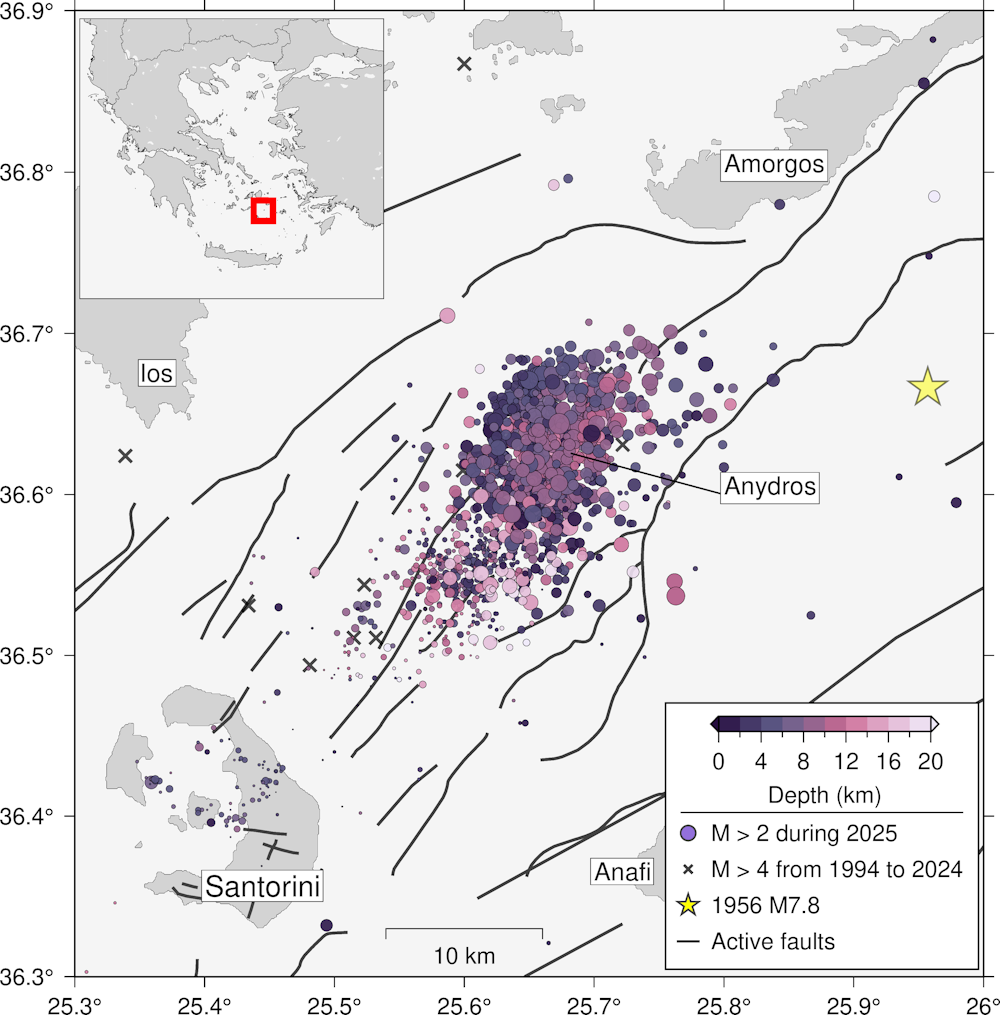
    The current seismic activity is located near Anydros, an uninhabited islet about 30km northeast of Santorini. This region lies within the volcanic arc of the “Hellenic subduction zone”, where the African tectonic plate is slowly sliding beneath the Eurasian plate (and specifically the Aegean microplate). The region hosts volcanoes as well as numerous weak zones in the crust – what earth scientists often call “faults”.

    Santorini itself is a mostly submerged caldera – a crater formed as a result of volcanic activity over the past 180,000 years, with its last eruption in the 1950s. Earthquakes can be connected to volcanic activity – specifically, the movement of magma beneath the surface.

    However, this earthquake sequence is not located beneath Santorini. And local scientists monitoring Santorini have reported no change to indicate the current seismic activity is a forerunner of another Santorini eruption. Instead, the earthquakes appear to align with faults lying between Santorini and the neighbouring island Amorgos.

    Nearby faults are known to have produced earthquakes before. For example, in 1956, a 7.8 magnitude earthquake here also produced a damaging tsunami and was soon followed by a magnitude 7.2 aftershock. More than 53 people died as a result of this earthquake and the aftershock and tsunami. Many more were injured.

    Earthquakes, shown as coloured circles, of the January-February 2025 Anydros swarm, near Santorini, Greece (Source: seismo.auth.gr) and known active faults, depicted as black lines (Source: https://zenodo.org/records/13168947).
    Dee Ninis & Konstantinos Michailos

    No single stand-out event

    Tectonic earthquakes occur when accumulating stress in Earth’s crust is suddenly released, causing a rupture along a fault and releasing energy in the form of seismic waves.

    Typically, moderate to major earthquakes (known as mainshocks) are followed by smaller quakes (known as aftershocks) that gradually diminish in magnitude and frequency over time. This is what seismologists call the mainshock–aftershock sequence.

    Some sequences behave differently and do not exhibit a single stand-out event. Instead, they involve multiple earthquakes of a similar size that take place over days, weeks, or even months. These types of sequences are what seismologists call “earthquake swarms”.

    The 1956 earthquake was a mainshock–aftershock sequence, with aftershocks lasting at least eight months after the mainshock. However, the current ongoing seismic activity near Santorini, at least as of February 7, features thousands of earthquakes, many with magnitudes ranging between 4.0 and 5.0.

    This suggests it is most likely an earthquake swarm.

    Earthquake swarms are often associated with fluid movement in the earth’s crust and the resulting seismic activity is usually less dramatic than the sudden movement of a strong mainshock.

    Seismologists are interested in distinguishing between mainshock–aftershock sequences and earthquake swarms as it can help them better understand the processes that drive these phenomena.

    A larger quake is still possible

    We cannot predict exactly what will come from the earthquake activity near Santorini. Global observations of earthquakes tell us that only a small fraction (about 5%) of earthquakes are foreshocks to larger earthquakes.

    That said, there could still be a possibility that a larger and potentially damaging earthquake could occur there soon.

    Although swarms typically involve earthquakes of lower magnitudes, they can last for days to weeks, or persist for months. They can even slow down, and then intensify again, unsettling locals with intermittent ground shaking.

    Dee Ninis works at the Seismology Research Centre, is Vice President of the Australian Earthquake Engineering Society, and a Committee Member for the Geological Society of Australia – Victoria Division.

    Konstantinos Michailos does not work for, consult, own shares in or receive funding from any company or organisation that would benefit from this article, and has disclosed no relevant affiliations beyond their academic appointment.

    ref. An ‘earthquake swarm’ is shaking Santorini. It could persist for months – https://theconversation.com/an-earthquake-swarm-is-shaking-santorini-it-could-persist-for-months-249278

    MIL OSI AnalysisEveningReport.nz

  • MIL-OSI Global: An ‘earthquake swarm’ is shaking Santorini. It could persist for months

    Source: The Conversation – Global Perspectives – By Dee Ninis, Earthquake Scientist, Monash University

    Greece’s government has just declared a state of emergency on the island of Santorini, as earthquakes shake the island multiple times a day and sometimes only minutes apart.

    The “earthquake swarm” is also affecting other nearby islands in the Aegean Sea. It began gradually with numerous very minor (less than magnitude 3) and mostly imperceptible earthquakes in late January. However, at the start of February, the seismic activity intensified as the quakes became larger and more frequent.

    So far, several thousand quakes have been recorded in the last two weeks. As many as 30 a day have been above magnitude 4.0 – most of them at less than 10km depth, which is large and shallow enough to be felt by people living on local islands.

    These larger earthquakes have resulted in rock falls along the islands’ coastal cliffs, as well as minor damage to vulnerable buildings. The largest earthquake so far was magnitude 5.1 on February 6, which was also felt in the capital city, Athens, as well as in Crete and in parts of Turkey more than 240km away.

    Usually a popular tourist destination, Santorini is now virtually empty. Over the past week, some 11,000 holidaymakers and locals have left the island, with many fearing the seismic activity may presage a volcanic eruption.

    So how exactly does an “earthquake swarm” happen? And what might happen in the coming days and weeks?

    No stranger to earthquakes

    This area of the world is no stranger to earthquakes. Greece is one of the most seismically active regions in Europe.

    The current seismic activity is located near Anydros, an uninhabited islet about 30km northeast of Santorini. This region lies within the volcanic arc of the “Hellenic subduction zone”, where the African tectonic plate is slowly sliding beneath the Eurasian plate (and specifically the Aegean microplate). The region hosts volcanoes as well as numerous weak zones in the crust – what earth scientists often call “faults”.

    Santorini itself is a mostly submerged caldera – a crater formed as a result of volcanic activity over the past 180,000 years, with its last eruption in the 1950s. Earthquakes can be connected to volcanic activity – specifically, the movement of magma beneath the surface.

    However, this earthquake sequence is not located beneath Santorini. And local scientists monitoring Santorini have reported no change to indicate the current seismic activity is a forerunner of another Santorini eruption. Instead, the earthquakes appear to align with faults lying between Santorini and the neighbouring island Amorgos.

    Nearby faults are known to have produced earthquakes before. For example, in 1956, a 7.8 magnitude earthquake here also produced a damaging tsunami and was soon followed by a magnitude 7.2 aftershock. More than 53 people died as a result of this earthquake and the aftershock and tsunami. Many more were injured.

    Earthquakes, shown as coloured circles, of the January-February 2025 Anydros swarm, near Santorini, Greece (Source: seismo.auth.gr) and known active faults, depicted as black lines (Source: https://zenodo.org/records/13168947).
    Dee Ninis & Konstantinos Michailos

    No single stand-out event

    Tectonic earthquakes occur when accumulating stress in Earth’s crust is suddenly released, causing a rupture along a fault and releasing energy in the form of seismic waves.

    Typically, moderate to major earthquakes (known as mainshocks) are followed by smaller quakes (known as aftershocks) that gradually diminish in magnitude and frequency over time. This is what seismologists call the mainshock–aftershock sequence.

    Some sequences behave differently and do not exhibit a single stand-out event. Instead, they involve multiple earthquakes of a similar size that take place over days, weeks, or even months. These types of sequences are what seismologists call “earthquake swarms”.

    The 1956 earthquake was a mainshock–aftershock sequence, with aftershocks lasting at least eight months after the mainshock. However, the current ongoing seismic activity near Santorini, at least as of February 7, features thousands of earthquakes, many with magnitudes ranging between 4.0 and 5.0.

    This suggests it is most likely an earthquake swarm.

    Earthquake swarms are often associated with fluid movement in the earth’s crust and the resulting seismic activity is usually less dramatic than the sudden movement of a strong mainshock.

    Seismologists are interested in distinguishing between mainshock–aftershock sequences and earthquake swarms as it can help them better understand the processes that drive these phenomena.

    A larger quake is still possible

    We cannot predict exactly what will come from the earthquake activity near Santorini. Global observations of earthquakes tell us that only a small fraction (about 5%) of earthquakes are foreshocks to larger earthquakes.

    That said, there could still be a possibility that a larger and potentially damaging earthquake could occur there soon.

    Although swarms typically involve earthquakes of lower magnitudes, they can last for days to weeks, or persist for months. They can even slow down, and then intensify again, unsettling locals with intermittent ground shaking.

    Dee Ninis works at the Seismology Research Centre, is Vice President of the Australian Earthquake Engineering Society, and a Committee Member for the Geological Society of Australia – Victoria Division.

    Konstantinos Michailos does not work for, consult, own shares in or receive funding from any company or organisation that would benefit from this article, and has disclosed no relevant affiliations beyond their academic appointment.

    ref. An ‘earthquake swarm’ is shaking Santorini. It could persist for months – https://theconversation.com/an-earthquake-swarm-is-shaking-santorini-it-could-persist-for-months-249278

    MIL OSI – Global Reports

  • MIL-OSI USA: Kennedy, Moran champion bill to protect veterans’ Second Amendment rights

    US Senate News:

    Source: United States Senator John Kennedy (Louisiana)

    WASHINGTON – Sens. John Kennedy (R-La.) and Jerry Moran (R-Kan.), Chairman of the Senate Committee on Veterans’ Affairs, today led 14 colleagues in introducing the Veterans 2nd Amendment Protection Act. The bill would prevent veterans from losing their Second Amendment right to purchase or own firearms when they receive help managing their Department of Veterans Affairs (VA) benefits.

    “Our veterans should not receive less due process rights than other Americans just because they served our country and asked the federal government for a helping hand. Under the VA’s interpretation of the law, however, unelected bureaucrats punish Louisiana and America’s veterans by forcing them to choose between their Second Amendment rights and getting the help they need as they manage their financial affairs. I’m proud to introduce the Veterans 2nd Amendment Protection Act to stand up for veterans’ constitutional rights by ending this unfair practice,” said Kennedy.

    “Veterans should never be forced to choose between receiving assistance from VA to manage their benefits and their fundamental Second Amendment rights. Our nation should be encouraging veterans to utilize VA services, not discouraging them by denying them due process. The Veterans Second Amendment Protection Act makes certain that the rights of those who have served are protected, and that veterans are not penalized for receiving support that they have earned and deserve. I thank Sen. Kennedy for his partnership in this effort,” said Moran. 

    Rep. Mike Bost (R-Ill.), Chairman of the House Committee on Veterans’ Affairs, introduced the bill in the House of Representatives.

    “It should go without saying that veterans should not be treated like second-class citizens simply because they need help managing their books—but under current law they are. Without a permanent fix in place, VA bureaucrats can continue to strip veterans with fiduciaries of their Second Amendment right with no court ruling in place that they are a danger to themselves or others. It’s as simple as that. I have heard from too many veterans that VA’s current NICS reporting measures prevent them from seeking mental health care at VA—we must change that. I want to thank Chairman Moran, Senator Kennedy, and my House colleagues for working with me last Congress to pass a temporary solution, but veterans need a permanent fix. House and Senate Republicans will fulfill the American people’s mandate to get this bill to President Trump’s desk to protect veterans’ due process and constitutional rights for good,” said Bost. 

    Sens. Chuck Grassley (R-Iowa), Steve Daines (R-Mont.), Marsha Blackburn (R-Tenn.), Pete Ricketts (R-Neb.), Mike Rounds (S.D.), Kevin Cramer (N.D.), Jim Banks (R-Ind.), Thom Tillis (R-N.C.), Bill Cassidy (R-La.), John Boozman (R-Ark.), Rick Scott (R-Fla.), Tommy Tuberville (R-Ala.), Lisa Murkowski (R-Alaska) and Tim Sheehy (R-Mont.) cosponsored the legislation.

    “I take the constitutional right to bear arms very seriously. Our bill would preserve due process for veterans and put a stop to unelected bureaucrats unjustifiably stripping away the Second Amendment rights of those who’ve served,” said Grassley.

    “Veterans must not be required to forfeit the Second Amendment without a careful, constitutional process. Attempting to deprive former servicemembers of firearms for protection or recreation simply because they require assistance managing the benefits they have earned is bureaucracy at its worst. Our legislation would correct this injustice and preserve these law-abiding patriots’ rights,” said Boozman.

    “The veterans who served our country shouldn’t lose their 2nd Amendment rights just because they need financial help,” said Cassidy.

    “Veterans who have served our country deserve the same Second Amendment rights and protections as every other American. This commonsense legislation ensures that veterans aren’t punished simply because they need assistance managing their benefits and guarantees they are not denied their constitutional rights without due process,” said Tillis. 

    “Our veterans have sacrificed so much to defend this great country, and it is critical their God-given right to protect themselves and their families doesn’t rest on judgement of unelected bureaucrats. It takes a lot of courage and humility for our brave veterans to admit that they need help managing their financial benefits. But it shouldn’t place their constitutional freedoms in jeopardy. This bill ends the ability of government workers to take away the Second Amendment freedoms of our veterans when they ask for help with their money unless a judge finds them to be a danger to himself or others. I stand with our veterans and will continue to fight to preserve the freedoms they fought for on the battlefield,” said Tuberville.

    “I’m proud to stand with our veterans to ensure equal protection of their rights with the Second Amendment Protection Act. Our veterans have fought to protect our nation and defend our rights, and they deserve to be treated fairly with the same due process under the law,” said Scott.

    Because of the VA’s interpretation of current law, the VA sends a beneficiary’s name to the FBI’s National Instant Criminal Background Check System (NICS) whenever a fiduciary is appointed to help a beneficiary manage his or her VA benefit payments.

    Ultimately, VA employees decide whether veterans receive help from a fiduciary.

    The bill would prohibit the Secretary of Veterans Affairs from transmitting a veteran’s personal information to NICS unless a relevant judicial authority rules that the beneficiary is a danger to himself or others.

    Vietnam Veterans of America, National Association of County Veterans Service Officers, Veterans of Foreign Wars, The American Legion, Black Veterans Empowerment Council, Military Order of the Purple Heart, National Shooting Sports Foundation, National Rifle Association, Gun Owners of America, AMAC Action, Turning Point Action, Firearms Regulatory Accountability Coalition, National Disability Rights Network and the National Association for Gun Rights support the Veterans 2nd Amendment Protection Act.

    Background:

    • In the 116th Congress, Kennedy introduced the Veterans 2nd Amendment Protection Act. 
    • In the 118th Congress, Kennedy and Moran re-introduced the Veterans 2nd Amendment Protection Act with six co-sponsors. 
    • In Oct. 2023, the Senate passed Kennedy and Moran’s amendment to the Consolidated Appropriations Act based on the Veterans 2nd Amendment Protection Act. The same language passed into law as part of an appropriations package in March 2024.
    • The language included in the appropriations package only provided a temporary solution tied to appropriations. The Veterans 2nd Amendment Protection Act would make the fix permanent and prevent future VA administrations from undoing the work to restore veterans’ due process and Second Amendment rights. 

    The bill text is available here.

    MIL OSI USA News

  • MIL-OSI Security: Northern California Firearms Trafficker Sentenced to 3 Years in Prison

    Source: Office of United States Attorneys

    SACRAMENTO, Calif. — James Lane Winslett, 66, of Corning, was sentenced today by U.S. District Judge Daniel J. Calabretta to three years in prison to be followed by a year of supervised release for unlawfully dealing in and manufacturing firearms without a license, selling a firearm to a convicted felon, and possession of an unregistered firearm, Acting U.S. Attorney Michele Beckwith announced.

    According to court documents, Winslett was a firearms trafficker who sold hundreds of firearms and silencers without a license to deal in or manufacture firearms. Winslett purchased firearm parts online and from licensed dealers, privately manufactured firearms using his home equipment and tools, and sold completed firearms to other people. In 2020, Winslett sold an AR‑15 style privately made firearm to a customer whom Winslett knew was prohibited from possessing firearms because the customer had previously been convicted of a felony.

    Winslett also sold silencers, which he falsely labeled as “fuel filters” or “solvent traps.” In 2021, U.S. Customs and Border Protection seized a parcel addressed to Winslett’s house in Corning. The package contained 25 firearm silencers that were erroneously described as “car fuel filters.” ATF tested the items and determined they were all firearms silencers. Law enforcement later searched Winslett’s home and found 36 silencers, over 30 firearms, additional firearms parts, ammunition, and tools used to privately manufacture firearms.

    Winslett did not and does not have a license to deal in firearms, and none of the silencers he possessed were registered with the National Firearms Registration and Transfer Record as required by federal law.

    This case was the product of an investigation by the Bureau of Alcohol, Tobacco, Firearms and Explosives and Homeland Security Investigations. Assistant U.S. Attorneys Emily G. Sauvageau and Justin Lee prosecuted the case.

    This case is part of Project Safe Neighborhoods (PSN), a program bringing together all levels of law enforcement and the communities they serve to reduce violent crime and gun violence, and to make our neighborhoods safer for everyone. On May 26, 2021, the U.S. Department of Justice launched a violent crime reduction strategy strengthening PSN based on these core principles: fostering trust and legitimacy in our communities, supporting community-based organizations that help prevent violence from occurring in the first place, setting focused and strategic enforcement priorities, and measuring the results.

    MIL Security OSI

  • MIL-OSI USA: Senator Marshall Honors Victims and Families of Wichita, KS Plane Crash on Senate Floor

    US Senate News:

    Source: United States Senator for Kansas Roger Marshall

    Washington, D.C. – U.S. Senator Roger Marshall, M.D. spoke on the Senate floor before passing a resolution to honor the memory of the 67 lives lost in the tragic mid-air collision between American Airlines Flight 5342 and a United States Army helicopter on January 29, 2025. 
    The resolution also commemorates the bravery, dedication, and swift action of the first responders who played a critical role in the recovery efforts under harsh conditions. Shortly after speaking, the resolution passed unanimously through the Senate.
    The full text of the resolution can be found HERE.

    You may click HERE or on the image above to watch Senator Marshall’s full remarks. 
    Quotes from Senator Marshall’s remarks include:
    “It’s been more than a week since that horrific night, but it feels as if it just happened hours ago. It doesn’t seem possible. In the blink of an eye, we lost 67 brave souls. Each morning I wake up hoping it was all just a nightmare, that somehow it wasn’t real, but we all know it was, and it is.”
    “The psalmist writes in the 34th chapter, the Lord is close to the brokenhearted and saves those who are crushed in spirit…It’s times like these, when grief is overwhelming that we hold on to the promise of Scripture and the faith passed down from generation to generation, a faith that’s carried Kansans through hardship and loss.”
    “We remember 1955 a tornado leveled the little city of Udall and 75 Kansans lost their lives. Another horrific plane crash in 1970 carrying the Wichita State University football team and 31 souls were lost, the tornadoes, the storms, the floods, the wildfires, all these disasters have taken too many lives and left so many hearts shattered, and yet through it all, one thing has remained: our faith and the love and support of our families and our communities. That’s what’s carried us before, and that’s what will carry us now.”
    “I fear for the loved ones left behind, because I know this pain never truly goes away, and I know, like my colleagues have said, there’s truly no words that can capture the depth of our sorrow that we all feel right now, and we can’t begin to imagine the grief of these family members. But yet we want you, each to know you don’t stand alone, that we’re with you. We stand beside you. We’re mourning with you. Our communities are wrapping their arms around you in prayer and support.”
     “To speak to the family specifically, we too are broken hearted just like you, and that we’re also crushed in spirit, but yet there’s hope, and we want you to know this, that even in this tragedy, God has not deserted us. He walks with us through these darkest of valleys, and he weeps with those who weep. We’re praying for your strength. We’re praying for God’s comfort and peace to cover you all as we mourn together.”
     “I want to express my deepest gratitude for all the emergency responders and especially the divers who I really believe risked their own lives by jumping into a dark, fast, cold river in search of survivors. Thank you so much for doing that and for doing your job so well. Your courage will not be forgotten.”
    “I said this the night of the tragedy. When one life is lost, it is a tragedy. When many are lost at once, it’s an unbearable sorrow. It’s a heartbreak beyond measure. Again, to the families, we’re with you, and so is our Father in Heaven.”

    MIL OSI USA News

  • MIL-OSI New Zealand: Weather News – Thundery Afternoon for Central North Island before a Summery Weekend – MetService

    Source: MetService

    Covering period of Friday 7 – Monday 10 February – Severe thunderstorms are possible for the central North Island this afternoon and evening (Friday), but  MetService is forecasting more warm and dry weather for most during the weekend.

    A Severe Thunderstorm Watch is in place for the central North Island this afternoon and evening, covering Taupō, Waikato south of Tokoroa, Taumarunui, inland Bay of Plenty, Taranaki and Taihape. Scattered heavy showers, thunderstorms and localised downpours (25 – 40 mm/h) are expected within this area.

    MetService meteorologist Ngaire Wotherspoon comments, “Not everywhere within the Watch area will see a thunderstorm or downpour today, but the potential is there. Localised downpours can cause surface flooding, especially in low-lying areas, so it’s worth keeping an eye on metservice.com as our expert meteorologists will be issuing localised Warnings for severe thunderstorms as they occur.”

    It’s shaping up to be a sunny day for the rest of the North Island today, with toasty forecast high temperatures in the mid-high twenties. The South Island is cloudier, especially over Canterbury and Marlborough where temperatures remain in the teens, but this cloud is forecast to break up this afternoon. The remains of a front over western South Island areas means cloud and a sprinkling of rain will stick around into the weekend.

    Over the weekend, a ridge of high pressure over the North Island means more sunny and warm weather.  There will still be a few showers in central areas. Down south, showers continue in the west while eastern areas get sunny, warm weather to start the weekend. Alexandra has a forecast high of 31°C on Saturday, before temperatures drop as a band of rain reaches Southland at night.

    Wotherspoon details, “Brief rain spreads over Southland and Otago tomorrow night as a front moves north, but it slows and begins to break up heading into Sunday morning. There will be a dip in temperatures for the South Island with this front; Christchurch has a forecast high of 29 °C on Sunday, but is only expected to reach 19 °C on Monday.”  

    The remnants of this front will linger into next week, keeping conditions in the South Island cool and cloudy, while the North Island is in store for more warm and dry conditions.

    MIL OSI New Zealand News

  • MIL-OSI Global: Is DOGE a cybersecurity threat? A security expert explains the dangers of violating protocols and regulations that protect government computer systems

    Source: The Conversation – USA – By Richard Forno, Teaching Professor of Computer Science and Electrical Engineering, and Assistant Director, UMBC Cybersecurity Institute, University of Maryland, Baltimore County

    People protest DOGE’s access to sensitive personal data. AP Photo/Jose Luis Magana

    The Department of Government Efficiency (DOGE), President Donald Trump’s special commission tasked with slashing federal spending, continues to disrupt Washington and the federal bureaucracy. According to published reports, its teams are dropping into federal agencies with a practically unlimited mandate to reform the federal government in accordance with recent executive orders.

    As a 30-year cybersecurity veteran, I find the activities of DOGE thus far concerning. Its broad mandate across government, seemingly nonexistent oversight, and the apparent lack of operational competence of its employees have demonstrated that DOGE could create conditions that are ideal for cybersecurity or data privacy incidents that affect the entire nation.

    Traditionally, the purpose of cybersecurity is to ensure the confidentiality and integrity of information and information systems while helping keep those systems available to those who need them. But in DOGE’s first few weeks of existence, reports indicate that its staff appears to be ignoring those principles and potentially making the federal government more vulnerable to cyber incidents.

    Technical competence

    Cybersecurity and information technology, like any other business function, depend on employees trained specifically for their jobs. Just as you wouldn’t let someone only qualified in first aid to perform open heart surgery, technology professionals require a baseline set of credentialed education, training and experience to ensure that the most qualified people are on the job.

    Currently, the general public, federal agencies and Congress have little idea who is tinkering with the government’s critical systems. DOGE’s hiring process, including how it screens applicants for technical, operational or cybersecurity competency, as well as experience in government, is opaque. And journalists investigating the backgrounds of DOGE employees have been intimidated by the acting U.S. attorney in Washington.

    DOGE has hired young people fresh out of – or still in – college or with little or no experience in government, but who reportedly have strong technical prowess. But some have questionable backgrounds for such sensitive work. And one leading DOGE staffer working at the Treasury Department has since resigned over a series of racist social media posts.

    Wired’s Katie Drummond explains what the magazine’s reporters have uncovered about DOGE staffers and their activities.

    According to reports, these DOGE staffers have been granted administrator-level technical access to a variety of federal systems. These include systems that process all federal payments, including Social Security, Medicare and the congressionally appropriated funds that run the government and its contracting operations.

    DOGE operatives are quickly developing and deploying major software changes to very complex old systems and databases, according to reports. But given the speed of change, it’s likely that there is little formal planning or quality control involved to ensure such changes don’t break the system. Such actions run contrary to cybersecurity principles and best practices for technology management.

    As a result, there’s probably no way of knowing if these changes make it easier for malware to be introduced into government systems, if sensitive data can be accessed without authorization, or if DOGE’s work is making government systems otherwise more unstable and more vulnerable.

    If you don’t know what you’re doing in IT, really bad things can happen. A notable example is the failed launch of the healthcare.gov website in 2013. In the case of the Treasury Department’s systems, that’s fairly important to remember as the nation careens toward another debt-ceiling crisis and citizens look for their Social Security payments.

    On Feb. 6, 2025, a federal judge ordered that DOGE staff be restricted to read-only access to the Treasury Department’s payment systems, but the legal proceedings challenging the legality of their access to government IT systems are ongoing.

    DOGE email servers

    DOGE’s apparent lack of cybersecurity competence is reflected in some of its first actions. DOGE installed its own email servers across the federal government to facilitate direct communication with rank-and-file employees outside official channels, disregarding time-tested best practices for cybersecurity and IT administration. A lawsuit by federal employees alleges that these systems did not undergo a security review as required by current federal cybersecurity standards.

    There is an established process in the federal government to configure and deploy new systems to ensure they are stable, secure and unlikely to create cybersecurity problems. But DOGE ignored those practices, with predictable results.

    For example, a journalist was able to send invitations to his newsletter to over 13,000 National Oceanic and Atmospheric Administration employees through one of these servers. In another case, the way in which employee responses to DOGE’s Fork in the Road buyout offer to federal employees are collected could easily be manipulated by someone with malicious intent – a simple social engineering attack could wrongly end a worker’s employment. And DOGE staff members reportedly are connecting their own untrusted devices to government networks, which potentially introduces new ways for cyberattackers to penetrate sensitive systems.

    However, DOGE appears to be embracing creative cybersecurity practices in shielding itself. It’s reorganizing its internal communications in order to dodge Freedom of Information Act requests into its work, and it’s using cybersecurity techniques for tracking insider threats to prevent and investigate leaks of its activities.

    Lacking management controls

    But it’s not just technical security that DOGE is ignoring. On Feb. 2, two security officials for the U.S. Agency for International Development resisted granting a DOGE team access to sensitive financial and personnel systems until their identities and clearances were verified, in accordance with federal requirements. Instead, the officials were threatened with arrest and placed on administrative leave, and DOGE’s team gained access.

    The Trump administration also has reclassified federal chief information officers, normally senior career employees with years of specialized knowledge, to be general employees subject to dismissal for political reasons. So there may well be a brain drain of IT talent in the federal government, or a constant turnover of both senior IT leadership and other technical experts. This change will almost certainly have ramifications for cybersecurity.

    DOGE operatives now have direct access to the Office of Personnel Management’s database of millions of federal employees, including those with security clearances holding sensitive positions. Without oversight, this access opens up the possibilities of privacy violations, tampering with employment records, intimidation or political retribution.

    Support from all levels of management is crucial to provide accountability for cybersecurity and technology management. This is especially important in the public sector, where oversight and accountability is a critical function of good democratic governance and national security. After all, if people don’t know what you’re doing, they don’t know what you’re doing wrong.

    At the moment, DOGE appears to be operating with very little oversight by anyone in position willing or able to hold it responsible for its actions.

    Mitigating the damage

    Career federal employees trying to follow legal or cybersecurity practices for federal systems and data are now placed in a difficult position. They either capitulate to DOGE staffers’ instructions, thereby abandoning best practices and ignoring federal standards, or resist them and run the risk of being fired or disciplined.

    The federal government’s vast collections of data touch every citizen and company. While government systems may not be as trustworthy as they once were, people can still take steps to protect themselves from adverse consequences of DOGE’s activities. Two good starting points are to lock your credit bureau records in case your government data is disclosed and using different logins and passwords on federal websites to conduct business.

    It’s crucial for the administration, Congress and the public to recognize the cybersecurity dangers that DOGE’s activities pose and take meaningful steps to bring the organization under reasonable control and oversight.

    Richard Forno has received research funding related to cybersecurity from the National Science Foundation (NSF), the Department of Defense (DOD), and the US Army during his academic career since 2010.

    ref. Is DOGE a cybersecurity threat? A security expert explains the dangers of violating protocols and regulations that protect government computer systems – https://theconversation.com/is-doge-a-cybersecurity-threat-a-security-expert-explains-the-dangers-of-violating-protocols-and-regulations-that-protect-government-computer-systems-249111

    MIL OSI – Global Reports

  • MIL-OSI USA: SPC MD 72

    Source: US National Oceanic and Atmospheric Administration

    Mesoscale Discussion 0072
    NWS Storm Prediction Center Norman OK
    0641 PM CST Thu Feb 06 2025

    Areas affected…Parts of middle/eastern TN into southeast KY and
    far southwest VA

    Concerning…Severe Thunderstorm Watch 4…

    Valid 070041Z – 070215Z

    The severe weather threat for Severe Thunderstorm Watch 4 continues.

    SUMMARY…Some threat for a tornado or two, hail, and damaging wind
    will continue through the evening.

    DISCUSSION…A supercell has gradually matured over the last 1-2
    hours to the northeast of Nashville, while other cells continue to
    develop and intensify near and just north of a surface boundary
    across southeast KY. Some increase in low-level flow/shear was noted
    earlier from the KOHX VWP, with short-term guidance suggesting that
    low-level flow will continue to increase this evening as ongoing
    convection spreads eastward into eastern TN and far southeast
    KY/southwest VA. With nocturnal cooling/stabilization expected to be
    only gradual through the evening, MLCAPE will likely remain in the
    500-1000 J/kg range in advance of the ongoing convection, with
    favorable deep-layer shear continuing to support supercell
    structures and potentially one or more semi-organized clusters.

    With only a slow increase in MLCINH expected, ongoing supercells may
    persist through much of the evening, with some potential tendency
    toward modest upscale growth with time. While low-level flow remains
    rather veered, effective SRH in excess of 200 m2/s2 will support
    some tornado threat with any persistent right-moving supercells.
    Otherwise, isolated large hail will be possible, especially with any
    left-moving supercells, while damaging wind could accompany any
    stronger supercells or organized clusters.

    ..Dean.. 02/07/2025

    …Please see www.spc.noaa.gov for graphic product…

    ATTN…WFO…RLX…GSP…MRX…JKL…LMK…OHX…

    LAT…LON 37188239 36728210 36528206 36028259 35718317 35648440
    35698527 35888546 36518537 36898492 37048449 37268346
    37278306 37188239

    MIL OSI USA News

  • MIL-OSI USA: SPC Severe Thunderstorm Watch 4

    Source: US National Oceanic and Atmospheric Administration

    Note:  The expiration time in the watch graphic is amended if the watch is replaced, cancelled or extended.Note: Click for Watch Status Reports.
    SEL4

    URGENT – IMMEDIATE BROADCAST REQUESTED
    Severe Thunderstorm Watch Number 4
    NWS Storm Prediction Center Norman OK
    730 PM EST Thu Feb 6 2025

    The NWS Storm Prediction Center has issued a

    * Severe Thunderstorm Watch for portions of
    Southeast Kentucky
    Northeast Tennessee
    Extreme Southwest Virginia

    * Effective this Thursday night from 730 PM until Midnight EST.

    * Primary threats include…
    Scattered damaging wind gusts to 70 mph possible
    Scattered large hail events to 1.5 inches in diameter possible
    A tornado or two possible

    SUMMARY…Scattered intense storms will track southeastward across
    the watch area for the next few hours, capable of hail and damaging
    winds. A tornado or two is also possible.

    The severe thunderstorm watch area is approximately along and 45
    statute miles north and south of a line from 50 miles northwest of
    Knoxville TN to 30 miles north northeast of Hot Springs NC. For a
    complete depiction of the watch see the associated watch outline
    update (WOUS64 KWNS WOU4).

    PRECAUTIONARY/PREPAREDNESS ACTIONS…

    REMEMBER…A Severe Thunderstorm Watch means conditions are
    favorable for severe thunderstorms in and close to the watch area.
    Persons in these areas should be on the lookout for threatening
    weather conditions and listen for later statements and possible
    warnings. Severe thunderstorms can and occasionally do produce
    tornadoes.

    &&

    AVIATION…A few severe thunderstorms with hail surface and aloft to
    1.5 inches. Extreme turbulence and surface wind gusts to 60 knots. A
    few cumulonimbi with maximum tops to 450. Mean storm motion vector
    27030.

    …Hart

    SEL4

    URGENT – IMMEDIATE BROADCAST REQUESTED
    Severe Thunderstorm Watch Number 4
    NWS Storm Prediction Center Norman OK
    730 PM EST Thu Feb 6 2025

    The NWS Storm Prediction Center has issued a

    * Severe Thunderstorm Watch for portions of
    Southeast Kentucky
    Northeast Tennessee
    Extreme Southwest Virginia

    * Effective this Thursday night from 730 PM until Midnight EST.

    * Primary threats include…
    Scattered damaging wind gusts to 70 mph possible
    Scattered large hail events to 1.5 inches in diameter possible
    A tornado or two possible

    SUMMARY…Scattered intense storms will track southeastward across
    the watch area for the next few hours, capable of hail and damaging
    winds. A tornado or two is also possible.

    The severe thunderstorm watch area is approximately along and 45
    statute miles north and south of a line from 50 miles northwest of
    Knoxville TN to 30 miles north northeast of Hot Springs NC. For a
    complete depiction of the watch see the associated watch outline
    update (WOUS64 KWNS WOU4).

    PRECAUTIONARY/PREPAREDNESS ACTIONS…

    REMEMBER…A Severe Thunderstorm Watch means conditions are
    favorable for severe thunderstorms in and close to the watch area.
    Persons in these areas should be on the lookout for threatening
    weather conditions and listen for later statements and possible
    warnings. Severe thunderstorms can and occasionally do produce
    tornadoes.

    &&

    AVIATION…A few severe thunderstorms with hail surface and aloft to
    1.5 inches. Extreme turbulence and surface wind gusts to 60 knots. A
    few cumulonimbi with maximum tops to 450. Mean storm motion vector
    27030.

    …Hart

    Note: The Aviation Watch (SAW) product is an approximation to the watch area. The actual watch is depicted by the shaded areas.
    SAW4
    WW 4 SEVERE TSTM KY TN VA 070030Z – 070500Z
    AXIS..45 STATUTE MILES NORTH AND SOUTH OF LINE..
    50NW TYS/KNOXVILLE TN/ – 30NNE HSS/HOT SPRINGS NC/
    ..AVIATION COORDS.. 40NM N/S /44NW VXV – 25WSW HMV/
    HAIL SURFACE AND ALOFT..1.5 INCHES. WIND GUSTS..60 KNOTS.
    MAX TOPS TO 450. MEAN STORM MOTION VECTOR 27030.

    LAT…LON 36988464 36958261 35658261 35688464

    THIS IS AN APPROXIMATION TO THE WATCH AREA. FOR A
    COMPLETE DEPICTION OF THE WATCH SEE WOUS64 KWNS
    FOR WOU4.

    Watch 4 Status Report Message has not been issued yet.

    Note:  Click for Complete Product Text.Tornadoes

    Probability of 2 or more tornadoes

    Low (20%)

    Probability of 1 or more strong (EF2-EF5) tornadoes

    Low (5%)

    Wind

    Probability of 10 or more severe wind events

    Mod (50%)

    Probability of 1 or more wind events > 65 knots

    Low (20%)

    Hail

    Probability of 10 or more severe hail events

    Mod (50%)

    Probability of 1 or more hailstones > 2 inches

    Low (20%)

    Combined Severe Hail/Wind

    Probability of 6 or more combined severe hail/wind events

    High (80%)

    For each watch, probabilities for particular events inside the watch (listed above in each table) are determined by the issuing forecaster. The “Low” category contains probability values ranging from less than 2% to 20% (EF2-EF5 tornadoes), less than 5% to 20% (all other probabilities), “Moderate” from 30% to 60%, and “High” from 70% to greater than 95%. High values are bolded and lighter in color to provide awareness of an increased threat for a particular event.

    MIL OSI USA News

  • MIL-OSI USA: Two Strong Winter Storms Expected Through Sunday

    Source: US State of New York

    Governor Kathy Hochul today urged New Yorkers to use caution as two strong winter storms are expected to impact areas throughout the State Friday through Sunday. The first storm will arrive on Friday and impact Central New York and the Mohawk Valley. The second storm that will occur Saturday through Sunday will be more widespread, affecting much of the State. Snowfall rates of up to two inches per hour on Friday and one inch per hour on Saturday in the heaviest bands may create hazardous travel conditions. People should monitor their local forecasts closely and take precautions when travelling in impacted areas.

    “Wind and snow is expected to impact most of the State starting tomorrow, and I have mobilized State resources to respond and assist our local partners in keeping New Yorkers safe,” Governor Hochul said. “New York is no stranger to winter weather, but I encourage everyone to make sure you and your family are prepared, exercise caution if traveling and continue to monitor your local forecast.”

    During the first storm, winds of up to 40 mph with gusts up to 55 mph will impact most of the State through Friday evening. Starting early Friday morning, snow will begin to impact areas from Herkimer to Oswego County and they can expect four inches of snow, with peak accumulations up to a foot in some areas. Peak snowfall rates of up to 2” per hour can be expected and may impact commutes in Central New York and the Mohawk Valley.

    The second storm will begin on Saturday afternoon and continue through Sunday afternoon. Widespread snow will fall across the State with the potential for moderate to heavy accumulations from Central New York to the Capital Region. A widespread four to eight inches of snow is possible in those areas. A widespread three to six inches is expected north of the Thruway. Snowfall rates may exceed one inch per hour. Wind gusts are expected to remain below 35 mph with isolated gusts of up to 40 mph. Snow may change to a mix of rain and snow across New York City and Long Island, Saturday through Sunday morning.

    Lake Effect Snow warnings are in effect for Northern Erie and Genesee counties through Tuesday morning, in Oswego, Lewis and Jefferson counties through Wednesday afternoon and Southern Erie, Wyoming, Chautauqua and Cattaraugus counties through next Thursday morning with significant accumulations possible east of Lakes Ontario and Erie.

    For a complete listing of weather alerts, visit the National Weather Service website. New Yorkers are also encouraged to sign up for emergency alerts by subscribing to NY Alert — a free service providing critical emergency information to your cell phone or computer.

    Agency Preparations

    New York State Division of Homeland Security and Emergency Services
    The Division’s Office of Emergency Management is in contact with their local counterparts and is prepared to facilitate requests for assistance. State stockpiles are staffed and ready to deploy emergency response assets and supplies as needed. The State Watch Center is monitoring the storm track and statewide impacts closely. Winter preparedness tips can be found here.

    New York State Department of Transportation
    The State Department of Transportation is monitoring weather conditions and prepared to respond with 3,701 supervisors and operators available statewide. All field staff are available to fully engage and respond. All available response equipment is ready to deploy and all residencies in impacted locations will remain staffed for 24/7 operations with operators, supervisors, and mechanics throughout the duration of the event and priority cleanup operations.

    Statewide equipment numbers are as follows:

    • 1,639 large plow trucks
    • 350 large loaders
    • 158 medium duty plows
    • 52 tow plows
    • 34 snow blowers
    • 19 graders

    The need for additional resources will be re-evaluated as conditions warrant throughout the event.

    For real-time travel information, motorists should call 511 or visit 511ny.org, New York State’s official traffic and travel information source.

    Thruway Authority
    The Thruway Authority is monitoring the forecast and ready to respond with 689 operators and supervisors available. Statewide equipment numbers and resources are listed below:

    • 347 large and medium duty plow trucks
    • 9 tow plows
    • 65 loaders
    • 98,000+ tons of salt on hand

    Variable Message Signs and social media (X and Facebook) are utilized to alert motorists of winter weather conditions on the Thruway.

    New this snow and ice season, all of the Thruway’s more than 250 heavy-duty plow trucks are equipped with green hazard lights, complementing the standard amber hazard lights. Green lights are intended to improve visibility and enhance safety during winter operations, particularly in low-light conditions and poor weather. Drivers are reminded that Thruway snowplows travel at about 35 miles per hour — which in many cases is slower than the posted speed limit — in order to ensure that salt being dispersed stays in the driving lanes and does not scatter off the roadways. The safest place for motorists is well behind the snowplows where the roadway is clear and treated.

    The Thruway Authority encourages motorists to download its mobile app which is available for free on iPhone and Android devices. The app provides motorists direct access to real-time traffic information, live traffic cameras and navigation assistance while on the go. Motorists can also sign up for TRANSalert e-mails and follow @ThruwayTraffic on X for the latest traffic conditions along the Thruway.

    New York State Department of Public Service
    New York’s utilities have about 5,500 workers available statewide to engage in damage assessment, response, repair and restoration efforts across New York State, as necessary. Agency staff will track utilities’ work throughout the event and ensure utilities shift appropriate staffing to regions that experience the greatest impact.

    New York State Police
    State Police have instructed all Troopers to remain vigilant and will deploy extra patrols to affected areas as needed. All four-wheel drive vehicles are in service and all specialty vehicles, including Utility Terrain Vehicles and snowmobiles, are staged and ready for deployment.

    New York State Department of Environmental Conservation
    DEC Emergency Management staff, Environmental Conservation Police Officers, Forest Rangers and regional staff remain on alert and continue to monitor the developing situation and weather forecasts. Working with partner agencies, DEC is prepared to coordinate resource deployment of all available assets, including first responders, to targeted areas in preparation for potential impacts due to snow.

    DEC reminds those responsible for the removal and disposal of snow to follow best management practices to help prevent flooding and reduce the potential for pollutants like salt, sand, oils, trash and other debris from affecting water quality. Disposal of snow in local creeks and streams can create ice dams, which may cause flooding. Public and private snow removal operators should be aware of these safety issues during and after winter storms. Additional information is available at Division of Water Technical and Operational Guidance Series: Snow Disposal.

    Unpredictable winter weather and storms in the Adirondacks, Catskills and other backcountry areas, can create unexpectedly hazardous conditions. Visitors should be prepared with proper clothing and equipment for snow, ice and the cold to ensure a safe winter experience. Snow depths range greatly throughout the Adirondacks, with the deepest snow at higher elevations in the High Peaks region and other mountains over 3,000 feet. Most lower elevation trails are frozen, including many trails in the Catskill Mountains.

    While some waterways are currently frozen, DEC advises outdoor enthusiasts to review ice safety guidelines before heading out.

    Hikers are advised to temporarily avoid all high-elevation trails as well as trails that cross rivers and streams. Hikers in the Adirondacks are encouraged to check the Adirondack Backcountry Information webpages for updates on trail conditions, seasonal road closures and general recreation information.

    Backcountry visitors should Hike Smart and follow proper safety guidelines. Plan trips accordingly. In an emergency, call 9-1-1. To request Forest Ranger assistance, call 1-833-NYS-RANGERS.

    Office of Parks, Recreation and Historic Preservation
    New York State Park Police and park personnel are on alert and closely monitoring weather conditions and impacts. Response equipment is being fueled, tested and prepared for storm response use. Park visitors should visit parks.ny.gov, check the free mobile app, or call their local park office for the latest updates regarding park hours, openings and closings.

    MIL OSI USA News

  • MIL-OSI Security: Sacramento and Fairfield Residents Indicted for Firearms Offenses

    Source: Office of United States Attorneys

    SACRAMENTO, Calif. — The Project Safe Neighborhoods (PSN) initiative brings together all levels of law enforcement and the communities they serve to reduce violent crime and gun violence. At the core of PSN is setting focused and strategic enforcement priorities that help prevent violence from occurring in the first place. Acting U.S. Attorney Michele Beckwith announces the following indictments in federal PSN cases.

    Marcus Anderson, 26, of Sacramento, was indicted today and charged with nine counts of firearms trafficking, unlicensed firearms dealing, and other firearms charges. According to court documents, from February 2022 to March 2023, Anderson unlawfully trafficked and possessed multiple firearms, and engaged in the business of unlawful firearms dealing in the Sacramento area. Anderson is prohibited from possessing firearms or ammunition because he has multiple state felony convictions. This case is the product of an investigation by the ATF with the assistance of the California Department of Corrections and Rehabilitation’s Special Service Unit, the Placer County Special Investigations Unit, the Sacramento County Sheriff’s Office, and the Sacramento Police Department. Assistant U.S. Attorney Haddy Abouzeid is prosecuting the case.

    Armond Bass, 39, of Fairfield, was indicted on Jan. 23, 2025, and charged with two counts of being a felon in possession of a firearm and ammunition. According to court documents, in October 2024, Bass was found to have possessed a Colt .22‑caliber semi-automatic rifle and ammunition. Bass is prohibited from possessing firearms or ammunition because he has previous felony convictions for domestic violence, possession of a stolen vehicle, and possession of a controlled substance. This case is the product of an investigation by the FBI and the Vacaville Police Department, with assistance from the FBI’s Solano County Violent Crimes Task Force. Assistant U.S. Attorney Charles Campbell is prosecuting the case.

    If convicted of being a felon in possession of a firearm or ammunition, the defendants face a maximum statutory penalty of 15 years in prison and a fine up to $250,000. Anderson also faces up to five years in prison, if convicted for unlicensed firearms dealing. Any sentence, however, would be determined at the discretion of the court after consideration of any applicable statutory factors and the Federal Sentencing Guidelines, which take into account a number of variables. The charges are only allegations; the defendants are presumed innocent until and unless proven guilty beyond a reasonable doubt.

    These cases are part of Project Safe Neighborhoods (PSN), a program bringing together all levels of law enforcement and the communities they serve to reduce violent crime and gun violence, and to make our neighborhoods safer for everyone. On May 26, 2021, the U.S. Department of Justice launched a violent crime reduction strategy strengthening PSN based on these core principles: fostering trust and legitimacy in our communities, supporting community-based organizations that help prevent violence from occurring in the first place, setting focused and strategic enforcement priorities, and measuring the results.

    MIL Security OSI

  • MIL-OSI USA: Sullivan, Colleagues Call for Quick Implementation of the Social Security Fairness Act

    US Senate News:

    Source: United States Senator for Alaska Dan Sullivan

    02.06.25

    WASHINGTON—U.S. Senator Dan Sullivan (R-Alaska) and 27 of his Senate colleagues sent a letter this week to the acting commissioner of the Social Security Administration calling for the immediate implementation of the Social Security Fairness Act to provide full Social Security benefits for millions of public servants impacted by the Windfall Elimination Provision (WEP) and the Government Pension Offset (GPO). The Social Security Fairness Act, which fully repeals the two unfair Social Security provisions, WEP and GPO, was signed into law on January 5, 2025.

    “The Social Security Fairness Act restores full Social Security benefits for the millions of teachers, police officers, firefighters, and other public servants who are unfairly penalized by the Windfall Elimination Provision (WEP) and the Government Pension Offset (GPO),” wrote the senators.

    “The Social Security Administration’s website currently states, ‘SSA expects that it could take more than one year to adjust benefits and pay all retroactive benefits’ owed under the Social Security Fairness Act. We call for the immediate implementation of this legislation to provide prompt relief to the millions of Americans impacted by WEP and GPO,” continued the senators. 

    Senator Sullivan was joined by U.S. Senators Bill Cassidy (R-La.), Lisa Murkowski (R-Alaska), Jerry Moran (R-Kans.), Shelley Moore Capito (R-W.Va.), Deb Fischer (R-Neb.), Susan Collins (R-Maine), John Fetterman (D-Penn.), Ben Ray Lujan (D-N.M.), Sheldon Whitehouse (D-R.I.), Alex Padilla (D-Calif.), John Hickenlooper (D-Co.), Angus King (I-Maine), Jon Ossoff (D-Ga.), Jack Reed (D-R.I.), Dick Durbin (D-Il.), Jeff Merkley (D-Ore.), Jacky Rosen (D-Nev.), Kirsten Gillibrand (D-N.Y.), Tim Kaine (D-Va.), Cory Booker (D-N.J.), Amy Klobuchar (D-Min.), Richard Blumenthal (D-Conn.), Peter Welch (D-Vt.), and Mark Warner (D-Va.).

    Read the full letter here or below:

    Dear Acting Commissioner King,

    We write to you concerning the implementation of the Social Security Fairness Act (Public Law No: 118-273). This legislation passed Congress on an overwhelmingly bipartisan basis on December 21st, 2024 and was signed into law on January 5th, 2025. The Social Security Fairness Act restores full Social Security benefits for the millions of teachers, police officers, firefighters, and other public servants who are unfairly penalized by the Windfall Elimination Provision (WEP) and the Government Pension Offset (GPO).

    The Social Security Administration’s website currently states, “SSA expects that it could take more than one year to adjust benefits and pay all retroactive benefits” owed under the Social Security Fairness Act. We call for the immediate implementation of this legislation to provide prompt relief to the millions of Americans impacted by WEP and GPO. In the interim, we request monthly updates and briefings regarding the status of the Social Security Administration’s progress towards implementing the Social Security Fairness Act. 

    Thank you for your prompt attention to this important matter.  We look forward to your response.

    MIL OSI USA News

  • MIL-OSI USA: Crapo Reintroduces Hearing Protection Act

    US Senate News:

    Source: United States Senator for Idaho Mike Crapo

    Washington, D.C.–U.S. Senator Mike Crapo (R-Idaho) led a group of 28 additional Senate colleagues in reintroducing S. 364, the Hearing Protection Act (HPA).  The HPA would reclassify suppressors to regulate them like a regular firearm.

    “Federal red tape continues to follow the false Hollywood narrative that suppressors are silent, and ignores the reality that they serve a genuine purpose in protecting the hearing of law-abiding American citizens exercising their Second Amendment rights,” said Senator Crapo.  “It is past time Congress removes the burdensome barriers to accessing this equipment for the safety of Idaho’s hunters and sportsmen.”

    Suppressors are currently subject to additional regulatory burdens under the National Firearms Act (NFA).  The HPA would remove suppressors from regulation under the NFA and replace the burdensome federal transfer process with an instantaneous National Instant Criminal Background Check System (NICS) background check.  This would make the purchasing and transfer process for suppressors equal to the process for a rifle or shotgun.  Also, the HPA would put more funding into state wildlife conservation agencies by taxing suppressors under the Pittman-Robertson Act instead of the NFA. 

    Original co-sponsors of the HPA include Senators Jim Risch (R-Idaho), Bill Cassidy (R-Louisiana), Markwayne Mullin (R-Oklahoma), Rick Scott (R-Florida), Roger Marshall (R-Kansas), Kevin Cramer (R-North Dakota), Marsha Blackburn (R-Tennessee), John Boozman (R-Arkansas), Jim Justice (R-West Virginia), Lindsey Graham (R-South Carolina), Mike Rounds (R-North Dakota), Tim Sheehy (R-Montana), Pete Ricketts (R-Nebraska), Thom Tillis (R-North Carolina), Mike Lee (R-Utah), Cindy Hyde-Smith (R-Mississippi), Deb Fischer (R-Nebraska), Cynthia Lummis (R-Wyoming), John Kennedy (R-Louisiana), Jerry Moran (R-Kansas), Steve Daines (R-Montana), Roger Wicker (R-Mississippi), Ted Budd (R-North Carolina), John Hoeven (R-North Dakota), Tom Cotton (R-Arkansas), Josh Hawley (R-Missouri) and Ron Johnson (R-Wisconsin).

    “Silencers and suppressors are non-lethal firearm accessories used by law abiding gun owners across America, and excessive federal regulation is a backdoor attack on the Second Amendment,” said Senator Lee.  “This bill will allow more Americans to protect their hearing and make it easier to exercise their Constitutional rights to keep and bear arms.”

    “Law-abiding Americans across the country use suppressors to protect their hearing during outdoor recreation activities, especially Nebraska’s hunters and sportsmen,” said Senator Fischer.  “The Hearing Protection Act will free us from overly burdensome regulations that infringe on our Second Amendment rights.”

    “Obstructing law-abiding Montanans’ right to use firearm suppressors threatens their health and freedoms,” said Senator Daines.  “We must cut these unnecessary regulations and protect Americans’ Second Amendment rights.”

    “Federal rules and regulations for suppressors don’t make sense and infringe upon the Second Amendment rights for law-abiding gun owners,” said Senator Hyde-Smith.  “The current regulations are overly restrictive, and as a result, too many hunters and their companions are being hurt.  The Hearing Protection Act would bring common sense to how suppressors are regulated, helping hunters and sport shooters in Mississippi and across the country avoid permanent hearing damage.”

    “Big government shouldn’t stand in the way of protecting lawful gun owners’ hearing,” said Senator Kennedy.  “I’m proud to help introduce this bill to make it easier for Louisianians and all Americans to practice their Second Amendment rights safely,” said Kennedy.”

    “Increasing access to hearing protection for sportsmen and hunters is common sense,” said Senator Boozman.  “Law-abiding, responsible gun owners should not have to fight burdensome regulations to enjoy their hobbies safely and with the accessories that can protect their hearing. I am proud to join my colleagues to update unreasonable limitations on suppressors and stand with shooting sports enthusiasts.”

    “Every law-abiding American must have the freedom to protect their hearing while exercising their Second Amendment rights,” said Senator Mullin. “Our bill removes suppressors from the National Firearms Act to cut wait times and stop the government from imposing a tax on Americans trying to protect themselves from hearing damage. The Second Amendment is crystal clear. I will do everything in my power to protect lawful gun ownership and eliminate unnecessary bureaucratic obstacles that infringe on our God-given rights.”

    “The Second Amendment is one of our most important freedoms, and law-abiding Tennesseans should not have to face unnecessary regulations to use their firearms safely without damaging their hearing,” said Senator Blackburn.  “This legislation would improve access to hearing protection equipment for recreational gun users, and I am pleased to join Senator Crapo in introducing this critical bill.”

    “Hunters and recreational shooters rely on suppressors to help protect their hearing while using firearms,” said Senator Moran.  “This legislation modernizes the process for purchasing suppressors by requiring the same background checks as for firearms, while ensuring that hunters, sportsmen and recreational shooters can legally obtain noise suppressors to help make their sport safer.”

    “Americans have a constitutionally guaranteed right to bear arms, and law-abiding citizens should have access to hearing protection equipment like suppressors, which are proven tools for reducing noise and preventing hearing loss,” said Senator Cramer.  “By removing unnecessary government red tape, this bill protects the rights and well-being of gun owners in North Dakota and across the country.”  

    “Burdensome regulations on firearm suppressors are doing more harm than good to sportsmen and women,” said Senator Cotton.  “Our legislation will ensure law-abiding gun owners can easily access hearing protection without having to navigate bureaucratic red tape or exorbitant taxes.”

    “The Hearing Protection Act is a commonsense bill that removes burdensome federal regulations for a firearm accessory that improves firearm safety for hunters and recreational sport shooters,” said Senator Rick Scott.  “I’m proud to protect Americans’ Second Amendment rights and work with my colleagues to pass this bill.”

    “I support the Second Amendment and the rights of law-abiding gun owners, and we should remove unnecessary barriers to safety devices that make recreational shooting safer,” said Senator Johnson.

    “Suppressors offer vital hearing protection for individuals who are hunting and target shooting,” said Senator Hoeven.  “Our legislation cuts red tape and helps responsible gun owners better access this tool to protect their hearing.”

    The Hearing Protection Act is supported by the Academy of Doctors of Audiology, National Shooting Sports Foundation (NSSF), the American Suppressor Association (ASA), Gun Owners of America (GOA) and the National Rifle Association (NRA).

    “The Hearing Protection Act will increase access to important hearing protection for millions of Americans,” said Amyn Amlani, Ph.D., President of the Academy of Doctors of Audiology.  “While the use of conventional hearing protection tools, such as earplugs and earmuffs are fundamental for preventing noise induced hearing loss in firearm users, conventional hearing protection alone does not always offer adequate protection from noise exposure.  Firearm noise suppressors can be an effective supplement to traditional hearing protection.”

    “Senator Mike Crapo’s Hearing Protection Act will have the federal government recognize firearm suppressors as accessories to a firearm that make recreational shooting and hunting a safer experience,” said Lawrence G. Keane, NSSF Senior Vice President and General Counsel. “These safety devices reduce the report of a firearm to a level that won’t cause instant and permanent hearing damage.  Despite Hollywood’s depictions, they do not silence the sound of a firearm.  The focus should be on removing barriers to safe and responsible use of firearms and dedicating resources to ensuring firearms are safeguarded from those who should never possess them.  Strict regulatory control of firearm accessories, and the parts of those accessories that have no bearing on the function of a firearm, is unnecessary and not the wisest use of federal resources.  NSSF thanks Senator Crapo for his leadership for ensuring safe and responsible use of firearms and dedicating necessary resources where they are most needed.”

    “We are grateful to Senator Crapo for standing behind the millions of law-abiding gun owners with his reintroduction of the Hearing Protection Act,” said Knox Williams, President and Executive Director of the American Suppressor Association.  “It’s absurd that our unrestrained federal bureaucracy requires Americans to jump through hoops to buy simple hearing protection devices.  Momentum continues to grow for common sense reforms that would end the stranglehold of government on the rights of her people.  We look forward to working with Senator Crapo and his colleagues to ensure our Second Amendment rights remain a priority.”

    “Gun owners around the world are using suppressors to reduce the impact of noise and hearing loss while using their firearms.  Even in countries with the strictest firearms laws, suppressors are often unregulated products that anyone can buy over the counter.  However, outdated federal law makes it difficult for Americans to access these useful safety devices,” said John Commerford, Executive Director of the NRA Institute for Legislative Action.  “On behalf of our millions of members, the NRA thanks Senator Mike Crapo for introducing this important legislation to roll back the bureaucratic red tape on suppressor ownership in the United States.”

    Full bill text is available here.

    Background:

    On average, suppressors diminish the noise of a gunshot by 20-35 decibels, roughly the same sound reduction provided by earplugs or earmuffs.  The most effective suppressors on the market can only reduce the peak sound level of a gunshot to around 110-120 decibels, which is roughly equivalent to a jackhammer.

    MIL OSI USA News

  • MIL-OSI USA: Hickenlooper, Padilla, Sheehy, Daines Introduce Bipartisan Bill to Create National Wildfire Intelligence Center

    US Senate News:

    Source: United States Senator for Colorado John Hickenlooper

    Interagency office would improve our wildfire responses, increase collaboration between federal agencies

    WASHINGTON – Today, U.S. Senators John Hickenlooper, Alex Padilla, Tim Sheehy, and Steve Daines introduced their bipartisan Wildfire Intelligence Collaboration and Coordination Act of 2025 to improve how the federal government works together to respond to wildfires and handle wildfire recovery.

    “Wildfires don’t care about state lines or forest service boundaries,” said Hickenlooper. “A centralized wildfire intelligence center will speed our response to fires and promote cross-agency collaboration to tackle them.”

    At the federal level, various departments and agencies have their own fire management goals, firefighters, and jurisdictions that determine how they respond to fires. The current division of responsibilities is unnecessarily burdensome and leaves gaps for cross-department collaboration. A national Wildfire Intelligence Center would compile comprehensive information on wildfires to better inform and streamline wildfire responses and recovery by providing states with a central command within the federal government. The center would also enhance monitoring and imaging capabilities beyond what land management agencies can currently achieve.

    This center would be modeled after similar information sharing centers like the National Weather Service and the National Oceanic and Atmospheric Administration’s (NOAA) Water Center, which coordinate information sharing to educate people, improve understanding, and foster collaboration among various federal, state, and academic units.

    Specifically, the Wildfire Intelligence Center would:

    • Establish a Wildfire Intelligence Center between the Departments of Agriculture, Commerce, and Department of the Interior to study, plan, coordinate, and implement the federal wildfire response
    • Provide comprehensive assessment and modeling of wildfires to inform responses, land and fuels management, risk reduction, post-wildfire recovery, and rehabilitation
    • Improve emergency planning with enhanced evacuation plans, power shutoff strategies, and fire response tactics
    • Facilitate coordination and information sharing between departments and state, local, and tribal jurisdictions
    • Leverage cutting-edge technologies for wildfire mitigation and response

    “The devastating Southern California fires are the latest example of increasingly intense and frequent fires ravaging communities within both local jurisdictions and on federal land,” said Padilla. “Wildfires don’t distinguish between our boundaries, and we can’t afford to be siloed in our response. The scale of the wildfire crisis demands a singular, whole-of-government wildfire intelligence center to foster cross-agency collaboration and save lives.”

    “We can all agree that the federal government must do a better job protecting our people, property, public lands, and communities from wildfires, and this bill will go a long way in streamlining our wildland firefighting efforts and best leveraging all available resources to accomplish our shared mission. As the only aerial firefighter in the Senate, I’m proud to be working with folks on both sides of the aisle to deliver commonsense solutions to more effectively fight the devastating threat of wildfires and protect the American people,” said Sheehy.

    “As fire season rapidly approaches for Montana, we need all hands on deck to prevent catastrophic disasters. Sharing information and resources between agencies will undoubtedly help Montana communities take preventive measures and better combat fires and coordinate response efforts,” said Daines.

    “The Wildfire Intelligence Center established by this bill will harness cutting-edge technology to give decision-makers real-time insights across jurisdictions and landscapes, enhancing coordination at every stage of a fire. The tools to tackle the megafire crisis already exist — this bill brings us closer to putting them in the hands of firefighters and land managers where they can make a real impact,” said Matt Weiner, CEO of Megafire Action. “Senators Padilla and Sheehy understand the urgent need to modernize our wildfire management system, and we look forward to working with them to get this bill signed into law and turn that vision into reality.”

    “FAS applauds Senators Padilla and Sheehy for introducing this bill, which would take a crucial step forward in protecting our communities from increasingly severe wildfires. The Wildfire Intelligence Center would bring together expertise at all levels of government to give our firefighters and first responders access to cutting-edge tools and the decision support they need to confront this growing crisis,” said James Campbell, Wildfire Policy Specialist at the Federation of American Scientists.

    “APCIA supports the Wildfire Intelligence Collaboration and Coordination Act introduced by Senator Padilla (D-CA) and Senator Sheehy (R-MT). This bill reflects the bipartisan recommendations of the Wildland Fire Mitigation and Management Commission to create a joint interagency center to improve fire assessment and prediction in the wildland and built environment. With the risk of catastrophic wildfires increasing, Congress must take action to pass bills like this one that will lead to better land and fuels management, reduce risk to communities, and improve fire management and response,” said David A. Sampson, APCIA’s President and CEO.

    The Wildfire Intelligence Collaboration and Coordination Act is endorsed by Megafire Action, Federation of American Scientists, Association of FireTech Innovation, Alliance for Wildfire Resilience, Climate and Wildfire Institute, Rural Voices for Conservation Coalition, The Stewardship Project, Tall Timbers, Grassroots Wildland Firefighters, American Forests, Environmental Defense Fund, and American Property Casualty Insurance Association.

    Full text of the bill is available HERE.

    MIL OSI USA News

  • MIL-OSI USA: Barrasso, Bennet Introduce Bill to Keep Ski Fees Local

    US Senate News:

    Source: United States Senator for Wyoming John Barrasso

    WASHINGTON, D.C. – Today, U.S. Senators John Barrasso (R-Wyo.) and Michael Bennet (D-Colo.) introduced the Ski Hill Resources for Economic Development (SHRED) Act. This bipartisan legislation will allow local National Forests to retain a portion of annual fees paid by ski areas operating on Forest Service lands.

    In exchange for using some of America’s most stunning forestlands, the 124 ski areas operating on Forest Service lands across the country pay fees to the Forest Service that average over $40 million annually. The SHRED Act would establish a framework for local National Forests to retain a portion of ski fees to offset increased recreational use and support local ski permit and program administration. The SHRED Act also provides the Forest Service with the flexibility to direct resources where they are needed the most.

    “Skiing plays an important role in Wyoming’s economy. Wyoming communities and ski areas deserve to reap the benefits of the money earned through ski fees,” said Senator Barrasso. “This money can be used for critical projects like facility and trailhead improvements. It can also be used to limit the impact of wildfires across Wyoming. This bill is a win for skiers, local economies, and the health of our national forests. Keeping ski area fees local will ensure we keep Washington out of the West.”

    “Colorado’s outdoor recreation economy depends on the strong partnership between ski areas, the U.S. Forest Service, and our mountain towns,” said Senator Bennet. “The SHRED Act will support Colorado’s iconic mountain communities and National Forests in maintaining their landscapes for millions of visitors each year. This bill has strong bipartisan support on the ground and in the House and the Senate. Congress should pass this legislation swiftly to support our ski areas and public land recreation management.”

    Co-sponsors of this legislation include U.S. Senators Cynthia Lummis (R-Wyo.), Maggie Hassan (D-N.H.), Jim Risch (R-Idaho), John Hickenlooper (D-Colo.), Mike Crapo (R-Idaho), Jeanne Shaheen (D-N.H.), Steve Daines (R-Mont.), Catherine Cortez Masto (D-Nev.), Tim Sheehy (R-Mont.), and Ron Wyden (D-Ore.).

    This legislation was introduced in the U.S. House of Representatives by Reps. Blake Moore (R-Utah) and Joe Neguse (D-Colo.).

    “Utah is known for having the Greatest Snow on Earth, and skiing is a critical component of our local economy. Our local government knows how to responsibly steward our resources, and the SHRED Act will help us do just that. By allowing the annual fees paid by ski areas to be used for maintenance and improvements, we can ensure these funds directly benefit Utah and other western states,” said Rep. Moore.

    This legislation is supported by the National Ski Area Association and its 124-member ski areas operating on public lands, Outdoor Recreation Roundtable, Colorado Association of Ski Towns, America Outdoors Association, Vail Resorts, and Jackson Hole Mountain Resort.

    “Ski areas across the country appreciate the leadership of Senator Barrasso and Senator Bennet and their unwavering support for outdoor recreation. Retaining ski area permit fees and reinvesting them locally to help the Forest Service keep pace with public recreation demand is key to boosting the agency’s capacity, improving visitor services and expanding access to our nation’s forests for all Americans.” – Michael Reitzell, President & CEO, National Ski Areas Association

    Full text of the legislation can be found here.

    Background:

    The SHRED Act would:

    • Keep Ski Fees Local: By establishing a Ski Area Fee Retention Account to retain the fees that ski areas pay to the Forest Service. For National Forests that generate ski fees, 80 percent of those fees are available for authorized uses at the local National Forest. The remaining 20 percent of those fees would be available to assist any National Forests with winter or broad recreation needs.
    • Support Winter Recreation: In each forest, 75 percent of the retained funds are directly available to support the Forest Service Ski Area Program and permitting needs, process proposals for ski area improvement projects, provide information for visitors and prepare for wildfire. Any excess funds can be directed to other National Forests with winter or broad recreation needs.
    • Address Broad Recreation Needs: In each forest, 25 percent of the retained funds are available to support a broad set of year-round local recreation management and community needs, including special use permit administration, visitor services, trailhead improvements, facility maintenance, search and rescue activities, avalanche information and education, habitat restoration at recreation sites and affordable workforce housing. This set-aside would dramatically increase some Forest Service unit’s budgets to meet the growing visitation and demand for outdoor recreation.

    MIL OSI USA News

  • MIL-OSI Australia: Australia’s climate in 2024: 2nd warmest and 8th wettest year on record

    Source: Weather Warnings – Australia

    06/02/2025

    The Bureau of Meteorology has released its official record of Australia’s climate, water and notable weather events for 2024.

    The Annual Climate Statement 2024 outlines the climate conditions across Australia in 2024. It includes information on temperature, rainfall, water resources, oceans, atmosphere and notable weather events.

    The report confirms that 2024 was Australia’s second-warmest and eighth-wettest year on record.

    Climatology Specialist Nadine D’Argent said that it was warmer than average throughout the year across most of the country.

    “Nationally, spring was the warmest on record, winter was the second warmest on record and summer 2023–24 was the third warmest on record,” Ms D’Argent said.

    “It was the wettest year since 2011, with overall rainfall 28% above average,” Ms D’Argent said.

    “Tropical cyclones brought heavy rainfall to northern parts of Australia early in the year, where there was major flooding.”

    “While much of northern Australia and some inland areas had above average rainfall, it was much drier than usual in Victoria, parts of South Australia and some parts of the west.”

    These dry conditions and low inflows led to reduced water storage levels in some southern regions, including the Murray–Darling Basin. However, Australia’s total surface water storage volume was just under 73% at the end of 2024, which was similar to the end of the previous year.

    Ms D’Argent said Australia’s climate is influenced by global patterns in the oceans and atmosphere.

    “Sea surface temperatures in the Australian region, as well as globally, were the warmest on record in 2024,” Ms D’Argent said.

    “Warmer oceans can increase the amount of moisture available for rainfall in our weather systems.”

    Globally, 2024 was the warmest year on record and the warming in Australia is consistent with global trends.

    Further information about the impact of long-term climate trends is available in the State of the Climate 2024 released by the Bureau and CSIRO in October 2024.

    Facts at a glance:

    2024 was Australia’s second-warmest year on record. Australia’s warmest year on record was 2019.

    The national annual average temperature was 1.46 °C warmer than the long-term average and the warmest since 2019.

    Annual average temperatures were warmer than average for every state and the Northern Territory.

    Both national average maximum and minimum temperatures for the year were above average. The national average minimum temperature for the year was 1.43 °C warmer than the long-term average, making it the warmest annual minimum on record.

    Australia’s overall average rainfall was 596 mm, which is 28% above average.

    Rainfall across northern Australia was 42% above average, making it the fifth-wettest year on record.

    Rainfall across parts of southern Australia was below average.

    Annual sea surface temperatures for the Australian region were the warmest on record.

    The extent of Antarctic sea-ice, which is the area of ocean covered by sea-ice, was below the 1991–2020 average throughout 2024.

    For the full analysis and report on last year’s temperature, rainfall, water resources, climate influences and more:

    State and territory information

    Queensland

    • Queensland overall had 768 mm of rainfall in 2024, which is 23% above average.
    • Rainfall was above average to very much above average for large parts of Queensland, and below average for small parts of the state’s interior and central coast.
    • The annual average temperature for Queensland was 1.63 °C warmer than the long-term average, making 2024 Queensland’s warmest year on record.

    New South Wales (and the ACT)

    • New South Wales overall had 581 mm of rainfall in 2024, which is 4% above average.
    • Rainfall was above average to very much above average for inland areas of New South Wales, and below average for the south-eastern part of the state.
    • The annual average temperature for New South Wales was 1.55 °C warmer than the long-term average, making 2024 the third-warmest year on record for New South Wales.

    Victoria

    • Victoria overall had 529 mm of rainfall in 2024, which is 20% below average.
    • Rainfall was below average to very much below average for most of Victoria.
    • The annual average temperature for Victoria was 1.08 °C warmer than the long-term average, making 2024 Victoria’s equal fifth-warmest year on record.

    Tasmania

    • Tasmania overall had 1269 mm of rainfall in 2024, which is 6% below average.
    • Rainfall was below average to very much below average for western and southern coastal areas of Tasmania.
    • The annual average temperature for Tasmania was 0.77 °C warmer than the long-term average, making 2024 Tasmania’s equal fifth-warmest year on record.

    South Australia

    • South Australia overall had 218 mm of rainfall in 2024, which is 3% below average.
    • Rainfall was above average to very much above average for western and north-eastern parts of South Australia, but below average to very much below average for southern and south-eastern areas of the state.
    • The annual average temperature for South Australia was 1.60 °C warmer than the long-term average, making 2024 South Australia’s second-warmest year on record. South Australia’s warmest year on record was 2013.

    Western Australia

    • Western Australia overall had 461 mm of rainfall in 2024, which is 35% above average.
    • Rainfall was above average to very much above average for most of Western Australia, but below average to very much below average for parts of coastal south-west and north-west Western Australia.
    • The annual average temperature for Western Australia was 1.57 °C warmer than the long-term average, making 2024 Western Australia’s second-warmest year on record. Western Australia’s warmest year on record was 2019.

    Northern Territory

    • The Northern Territory overall had 898 mm of rainfall in 2024, which is 65% above average.
    • Rainfall was above average to very much above average for most of the Northern Territory.
    • Annual rainfall for the Northern Territory was the fourth highest on record, with the highest recorded being in 1974 with 1007 mm.
    • The annual average temperature for the Northern Territory was 0.95 °C warmer than the long-term average. 2024 was Northern Territory’s equal 11th-warmest year on record.

    [ENDS]

    MIL OSI News

  • MIL-OSI New Zealand: Investigations – Fire investigators seek help from Roxburgh community after Town Hall fire

    Source: Fire and Emergency New Zealand

    Fire and Emergency New Zealand investigators looking into the cause of the Roxburgh Town Hall fire yesterday are asking for help from the local community.
    Fire investigator John Smalls says that his team is doing everything they can to get a clear picture of the fire’s progress, and people in Roxburgh may be able to help determine how and where the fire started.
    “We really feel for the community, who are clearly devastated by the loss of their historic building,” he says.
    “That’s why we’re doing everything we can to get a clear picture of what was happening to the building before and during yesterday’s fire.
    “If you have any photographs or footage of the Town Hall from 11am onwards yesterday, please send them through to OtagoRiskReduction@fireandemergency.nz.
    “We’re especially looking for any images that show the back and sides of the building.”
    John Smalls says the call went out to the community this morning and the response has already been terrific.
    “We know how much this building means to local people, both for its current use, and as an important link to Roxburgh’s long history.”

    MIL OSI New Zealand News

  • MIL-OSI USA: Volcano Watch — An assembly of volcano scientists to gather in Hilo

    Source: US Geological Survey

    Volcano Watch is a weekly article and activity update written by U.S. Geological Survey Hawaiian Volcano Observatory scientists and affiliates. Today’s article is by HVO geologist Kendra J. Lynn.

    This cartoon schematic depicts the Kīlauea 2018 lower East Rift Zone eruption and coincident summit collapse. It is the logo for the American Geophysical Union Chapman Meeting on Caldera-Forming Eruptions at Basaltic Volcanoes, to be held in Hilo, Hawaii, from February 9-14, 2025. More info: https://www.agu.org/chapman-basaltic-caldera-forming-eruptions.

    Next week, during February 9-14, volcano scientists from around the world are gathering in Hilo, united by the common goal of understanding caldera-forming eruptions at basaltic volcanoes. 

    The occasion for the assembly is the American Geophysical Union Chapman Conference on Caldera-forming Eruptions at Basaltic Volcanoes: Insights and Puzzles from Kīlauea 2018 and Beyond. The meeting is directly aligned with the U.S. Geological Survey’s Volcano Hazards Program mission—“to enhance public safety and minimize social and economic disruption from volcanic unrest and eruption.”

    Basaltic caldera-forming rift eruptions, like the 2018 eruption of Kīlauea, represent an underappreciated hazard for many global communities, but also a chance to better understand some of Earth’s most active volcanoes. A handful of these eruptions have been documented globally in the last half-century, including at Miyakejima (Japan), Piton de la Fournaise (La Réunion), and Bárðarbunga (Iceland). Kīlauea’s 2018 eruption was its most impactful in centuries, was documented in remarkable detail, and it involved more than one cubic kilometer of basaltic lava flows, a magnitude-6.9 flank earthquake, and a major summit collapse. 

    Observations from Kīlauea and similar eruptions around the globe offer an unprecedented opportunity to understand calderas and associated rift systems and the dynamics of their interplay, but a community-driven synthesis has been lacking, and numerous fundamental scientific questions remain. The experts who will gather on the Island of Hawaiʻi will assess current understanding, share insights, and map out work on critical outstanding issues. Resulting insights should prove valuable when the next large basaltic caldera collapse takes place somewhere on Earth.

    This conference will bring together an interdisciplinary assembly of volcano scientists to contrast observations from historic global caldera-rift eruptions, establish the state-of-the-art understanding, identify important questions, and initiate lasting new research efforts. We will address the causes of these eruptions, the dynamics of basaltic caldera collapses, the interaction between summit calderas and rift zones, the geometry and physical properties of magma storage, and the challenges in forecasting associated hazards. 

    A significant investment in research and monitoring of Hawaii’s volcanoes was made through the Additional Supplemental Appropriations for Disaster Relief Act of 2019 (H.R. 2157), which provided Supplemental funding to USGS for recovery and rebuilding activities in the wake of the 2018 Kīlauea eruption. Results from recent large-scale science experiments at Kīlauea supported by this funding will be shared and discussed at the Chapman. Field trips will give participants an opportunity to visit important sites on the volcano. Finally, teams will be formed to discuss science questions in detail and establish priorities for additional work following the meeting.

    The conference is being organized by U.S. Geological Survey and academic volcano researchers, bringing over 150 scientists together for presentations, discussions, workshops, and field trips. Participants represent 15 countries outside the United States and will include presentations about volcanoes around the world. Roughly 25% of presenters are undergraduate or graduate students, representing a new generation of volcano scientists tackling our field’s biggest challenges. We are very excited that several University of Hawai‘i at Hilo and Mānoa students will be presenting their research at the meeting. Additionally, partners from Hawai‘i County Civil Defense, Hawai‘i Volcanoes National Park, the Hawaiian Volcano Education & Resilience Institute, the Pacific Tsunami Museum, and the Pacific Tsunami Warning Center will participate. 

    During the week of the conference, winning art and haiku submissions from the USGS Hawaiian Volcano Observatory (HVO) Volcano Awareness Month competition will be on display. In addition, a public After Dark in the Park presentation by Icleandic Meteorological Office scientist Gro Pederson will summarize the ongoing volcanic crisis on Reykjanes Peninsula, Southwest Iceland on February 6 in the Kīlauea Visitor Center Auditorium in Hawai‘i Volcanoes National Park. Dr. Pederson is a former USGS HVO volunteer, and her presentation will highlight parallels between Hawaiian and Icelandic volcanoes and their hazards to our communities. 

    We look forward to a productive week learning from our colleagues and partners. E komo mai to the assembly of volcanologists that is soon to arrive!

    Volcano Activity Updates

    Kīlauea is not erupting. Its USGS Volcano Alert level is WATCH.

    The summit eruption at Kīlauea volcano that began in Halemaʻumaʻu crater on December 23 continued over the past week, with one eruptive episode. Episode 8 was active from the evening of February 3 until the evening of February 4. Kīlauea summit has been inflating since episode 8 ended. Resumption of eruptive activity is possible between February 8-11 if summit inflation continues at current rate. Sulfur dioxide emission rates are elevated in the summit region during active eruption episodes. No unusual activity has been noted along Kīlauea’s East Rift Zone or Southwest Rift Zone. 

    Mauna Loa is not erupting. Its USGS Volcano Alert Level is at NORMAL.

    No earthquakes were reported felt in the Hawaiian Islands during the past week.

    HVO continues to closely monitor Kīlauea and Mauna Loa.

    Please visit HVO’s website for past Volcano Watch articles, Kīlauea and Mauna Loa updates, volcano photos, maps, recent earthquake information, and more. Email questions to askHVO@usgs.gov.

    MIL OSI USA News

  • MIL-OSI Australia: Sacred Aboriginal site and habitat for threatened species among additions to NSW national parks

    Source: New South Wales Government 2

    Headline: Sacred Aboriginal site and habitat for threatened species among additions to NSW national parks

    This is one of 12 land acquisitions made in 2024 to expand the network of national parks in NSW by just over 36,000 hectares. It makes more of our natural environment available to the public and delivers on the Minns Labor Government’s commitment to turn around biodiversity loss and restore habitats and ecosystems.

    The 31,500-hectare Broughton Vale Station includes the Kukirrka or Burkes Cave, a sacred Aboriginal birthing cave used for more than 2,000 years, and other significant cultural sites containing artworks and engravings.

    The cave and a nearby freshwater spring were also used by Burke and Wills during their 1860 expedition from Melbourne to the Gulf of Carpentaria, and as a Cobb and Co stopover between Broken Hill and Wilcannia.

    At least 70 threatened species have been recorded close to Broughton Vale Station including purple-wood wattle, Barrier Range dragon, pink cockatoo, Stimson’s python and the creeping Darling pea. It also includes vegetation types and landscapes not found in any other national park in NSW. More than half the property supports the Threatened Ecological Community Neila (Acacia loderi) tall shrubland.

    The property adjoins the recently created Langidoon-Medford State Conservation Area. Together these reserves will permanently protect around 92,000 hectares conserving threatened plant and animal species and cultural landscapes.

    NSW National Parks and Wildlife Service (NPWS) will work with Aboriginal communities to ensure the protection of important cultural sites. NPWS will also carry out feral animal and weed control and ensure fire trail access. Future visitor facilities could include a campsite and walking trails.

    In 2024, the NSW Government secured more than 36,000 hectares to expand existing parks, create new ones and protect critical habitats. Six acquisitions directly protect koala habitat, as part of the Minns Labor Government’s action to save koalas from extinction in NSW.

    The national parks estate covers about 10% of NSW and contains a diverse range of landscapes. NSW records more than 53 million domestic visits to national parks a year, plus many more by international travellers.

    Quote attributable to Minister for the Environment, Penny Sharpe:

    “The sacred site on Broughton Vale Station holds significant cultural and spiritual meaning for Aboriginal communities and we have taken action to preserve it for generations to come.

    “Adding this land to the national parks network is an important step forward in environmental and cultural conservation in NSW. It will also greatly enhance ecological, educational, cultural and tourism opportunities in our Far West.

    “The Minns Labor Government is committed to turning around the loss and restoring habitats, ecosystems and biodiversity, and expanding our national parks is one way we are delivering on that commitment.”

    Quote attributable to Minister for Aboriginal Affairs and Treaty, David Harris:

    “It cannot be understated how fundamental the preservation of this sacred land is for Traditional Owners and the broader community.

    “The Broughton Vale Station contains sites of enormous cultural significance to the local Aboriginal community and I am proud the Minns Labor Government has taken the steps to ensure this Country will be protected for generations to come.”

    Quote regarding Burkes Cave/Kukirrka, attributable to Barkandji elder, Dot Stephens:

    “We haven’t had access to Burkes Cave in many years and being able to return to the site I helped assess in the early 90s is so important in us being able to look after country.

    “When I was told that the Minister had purchased Burkes Cave, I burst into tears. The site is a spiritual place, a woman’s site, and it connects our country from Mutawintji to the Menindee Lakes and beyond.”

    Quote regarding Burkes Cave/Kukirrka, attributable to Barkandji elder, Feona Bates:

    “It is so important that National Parks purchase places like Broughton Vale as it allows us to look after the place.

    “There are men’s and women’s sites on the property, and we need to protect them.”

    Additional land added to the national park system in 2024:

    Koala habitat:

    • Addition to Guula Ngurra National Park

    589 hectares, 25km northwest of Mittagong, to connect Guula Ngurra National Park to Bangadilly National Park. It is in a stronghold area of a known high priority koala population. It is suitable habitat for 30 locally-threatened species including glossy black cockatoo and southern greater glider.

    • Addition to Nymboi-Binderay National Park

    40 hectares, 45km northwest of Coffs Harbour, which provides habitat for 21 threatened fauna species including koala, rufous bettong, gliders, bats, other mammals and birds.

    • Addition to Khatambuhl National Park

    Two areas totalling 1259 hectares, 50km northwest of Taree, linking Bretti Nature Reserve with Khatambuhl Nature Reserve. It is located in a corridor between three koala Priority Population Areas and 70% of the property contains koala feed trees. The habitat is suitable for more than 20 other threatened species including the Manning River helmeted turtle, southern greater glider, white-flowered wax plant, craven grey box, scrub turpentine and stuttering frog.

    • Addition to Cottan-Bimbang National Park

    Two areas, 398 hectares and 487 hectares, 45km northwest of Wauchope have been added to the national park. The land includes 4km of Ralfes Creek, a major tributary of the Hastings River. It is suitable for 22 threatened species, notably koala, southern greater glider, scrub turpentine, magenta lilly pilly and giant barred frog.

    • Addition to Dangelong Nature Reserve

    784 hectares, 20km southeast of Cooma, featuring high to very high-quality koala habitat in the Kybeyan Range, a Southern Tablelands koala hot spot. It is suitable habitat for 25 other threatened species including gang-gang cockatoo, little eagle, hooded robin, dusky woodswallow, spotted-tailed quoll and pale pomaderris.

    • Addition to Barrington Tops National Park

    867 hectares, 60km northeast of Muswellbrook, featuring koalas and glossy black cockatoos as well as habitat for 22 other threatened fauna species including the specked warbler and Davies tree frog which occurs only above 400m in the region.

    Highland wetlands:

    • Addition to Doodle Comer Swamp Nature Reserve

    41 hectares, 60km south of Wagga Wagga, featuring a wetland of national significance. Doodle Comer Swamp is a Declared Aboriginal Place with cultural significance to the Wiradjuri People. The acquisition protects cultural heritage sites, two threatened ecological communities and seven threatened species including the endangered Australasian bittern and Bush stone-curlew.

    • Addition to Little Llangothlin Nature Reserve

    18 hectares, 39km south of Glen Innes, which protects the remainder of the Ramsar-listed wetland Billy Bung Lagoon and its catchment. It contains four Threatened Ecological Communities.

    Cultural Heritage:

    • Butterfly Cave

    26 hectares at West Wallsend which protects the sacred Butterfly Cave and the surrounding cultural landscape, including vital aquifers, traditional journey paths, creeks, stone arrangements and food source areas.

    MIL OSI News

  • MIL-OSI USA: Senators Wicker, Blumenthal Reintroduce Legislation to Protect Amateur Radio Operators

    US Senate News:

    Source: United States Senator for Mississippi Roger Wicker

    WASHINGTON – U.S. Senators Roger Wicker, R-Miss., and Richard Blumenthal, D-Conn., today reintroduced the Amateur Radio Emergency Preparedness Act, which would give amateur radio operators the right to install amateur radio antennas and serve their communities. Many homeowner associations prevent amateur radio operators from installing outdoor antennas on residential properties. However, this communication method has proven to be essential in emergencies and natural disasters, such as hurricanes in states like Mississippi and Connecticut.

    “Mississippians should have access to every possible means of warning for natural disasters, including amateur radio operators. In an emergency, those warnings can mean the difference between life and death,” Senator Wicker said. “The Amateur Radio Emergency Preparedness Act would remove unnecessary roadblocks that could help keep communities safe during emergencies like tornadoes, hurricanes, and fires.”

    “When disaster strikes, amateur radio operators provide vital, often life-saving information, which shouldn’t be hindered by prohibitive rules or confusing approval processes. The Amateur Radio Emergency Preparedness Act eliminates obstacles for ham radio enthusiasts, allowing them to continue their communications and serve their communities in the face of emergencies,” said Senator Blumenthal.

    Background:

    The Amateur Radio Emergency Preparedness Act would limit the scenarios in which homeowner associations could ban, prevent, or require approval for the installation or use of amateur radio antennas.

    Among other provisions, this legislation would:

    • Prohibit homeowner association rules that prevent or ban amateur radio antennas;
    • Clarify the approval process for installing amateur radio antennas; and
    • Give amateur radio operators a private right of action.

    The full text of the legislation can be found here.

    MIL OSI USA News

  • MIL-OSI USA: RELEASE: Mullin, Crapo, Colleagues Reintroduce Hearing Protection Act

    US Senate News:

    Source: United States Senator MarkWayne Mullin (R-Oklahoma)

    Washington, D.C. – U.S. Senators Markwayne Mullin (R-OK), Mike Crapo (R-ID) and 27 of their Senate GOP colleagues reintroduced S. 364, the Hearing Protection Act (HPA). The HPA would reclassify suppressors to regulate them like a regular firearm.

    “Every law-abiding American must have the freedom to protect their hearing while exercising their Second Amendment rights,” said Senator Mullin. “Our bill removes suppressors from the National Firearms Act to cut wait times and stop the government from imposing a tax on Americans trying to protect themselves from hearing damage. The Second Amendment is crystal clear. I will do everything in my power to protect lawful gun ownership and eliminate unnecessary bureaucratic obstacles that infringe on our God-given rights.”

    “Federal red tape continues to follow the false Hollywood narrative that suppressors are silent, and ignores the reality that they serve a genuine purpose in protecting the hearing of law-abiding American citizens exercising their Second Amendment rights,” said Senator Crapo.  “It is past time Congress removes the burdensome barriers to accessing this equipment for the safety of Idaho’s hunters and sportsmen.”

    Suppressors are currently subject to additional regulatory burdens under the National Firearms Act (NFA). The HPA would remove suppressors from regulation under the NFA and replace the burdensome federal transfer process with an instantaneous National Instant Criminal Background Check System (NICS) background check. This would make the purchasing and transfer process for suppressors equal to the process for a rifle or shotgun. Also, the HPA would put more funding into state wildlife conservation agencies by taxing suppressors under the Pittman-Robertson Act instead of the NFA. 

    Sens. Mullin and Crapo are joined on this legislation by Senators Jim Risch (R-ID), Bill Cassidy (R-LA), Rick Scott (R-FL), Roger Marshall (R-KS), Kevin Cramer (R-ND), Marsha Blackburn (R-TN), John Boozman (R-AR), Jim Justice (R-WV), Lindsey Graham (R-SC), Mike Rounds (R-SD), Tim Sheehy (R-MT), Pete Ricketts (R-NE), Thom Tillis (R-NC), Mike Lee (R-UT), Cindy Hyde-Smith (R-MS), Deb Fischer (R-NE), Cynthia Lummis (R-WY), John Kennedy (R-LA), Jerry Moran (R-KS), Steve Daines (R-MT), Roger Wicker (R-MS), Ted Budd (R-NC), John Hoeven (R-ND), Tom Cotton (R-AR), Josh Hawley (R-MO), and Ron Johnson (R-WI).

    The Hearing Protection Act is supported by the Academy of Doctors of Audiology, National Shooting Sports Foundation (NSSF), the American Suppressor Association (ASA), Gun Owners of America (GOA) and the National Rifle Association (NRA).

    “The Hearing Protection Act will increase access to important hearing protection for millions of Americans,” said Amyn Amlani, Ph.D., President of the Academy of Doctors of Audiology.“While the use of conventional hearing protection tools, such as earplugs and earmuffs are fundamental for preventing noise induced hearing loss in firearm users, conventional hearing protection alone does not always offer adequate protection from noise exposure. Firearm noise suppressors can be an effective supplement to traditional hearing protection.”

    “Senator Mike Crapo’s Hearing Protection Act will have the federal government recognize firearm suppressors as accessories to a firearm that make recreational shooting and hunting a safer experience,” said Lawrence G. Keane, NSSF Senior Vice President and General Counsel. “These safety devices reduce the report of a firearm to a level that won’t cause instant and permanent hearing damage. Despite Hollywood’s depictions, they do not silence the sound of a firearm. The focus should be on removing barriers to safe and responsible use of firearms and dedicating resources to ensuring firearms are safeguarded from those who should never possess them. Strict regulatory control of firearm accessories, and the parts of those accessories that have no bearing on the function of a firearm, is unnecessary and not the wisest use of federal resources. NSSF thanks Senator Crapo for his leadership for ensuring safe and responsible use of firearms and dedicating necessary resources where they are most needed.”

    “We are grateful to Senator Crapo for standing behind the millions of law-abiding gun owners with his reintroduction of the Hearing Protection Act,” said Knox Williams, President and Executive Director of the American Suppressor Association. “It’s absurd that our unrestrained federal bureaucracy requires Americans to jump through hoops to buy simple hearing protection devices. Momentum continues to grow for common sense reforms that would end the stranglehold of government on the rights of her people. We look forward to working with Senator Crapo and his colleagues to ensure our Second Amendment rights remain a priority.”

    “Gun owners around the world are using suppressors to reduce the impact of noise and hearing loss while using their firearms. Even in countries with the strictest firearms laws, suppressors are often unregulated products that anyone can buy over the counter. However, outdated federal law makes it difficult for Americans to access these useful safety devices,” said John Commerford, Executive Director of the NRA Institute for Legislative Action. “On behalf of our millions of members, the NRA thanks Senator Mike Crapo for introducing this important legislation to roll back the bureaucratic red tape on suppressor ownership in the United States.”

    Full bill text is available here.

    Background:

    On average, suppressors diminish the noise of a gunshot by 20-35 decibels, roughly the same sound reduction provided by earplugs or earmuffs. The most effective suppressors on the market can only reduce the peak sound level of a gunshot to around 110-120 decibels, which is roughly equivalent to a jackhammer.

    MIL OSI USA News

  • MIL-OSI Security: Richmond felon convicted of illegally possessing firearms

    Source: Office of United States Attorneys

    RICHMOND, Va. – A federal jury convicted a Richmond man today on two counts of being a felon in possession of a firearm.

    According to court records and evidence presented at trial, on Jan. 12, 2022, investigators with the Richmond Police (RPD) Youth and Family Crimes Unit were conducting an investigation at 3443 Walmsley Ave. During that investigation, investigators learned that Randel Douglas Hoggard, 39, and his significant other, K.B. had outstanding arrest warrants and requested the assistance of the U.S. Marshals to complete the arrest at the couple’s Richmond apartment.

    Marshals arrested Hoggard and RPD procured a search warrant for items relevant to the investigation at the apartment. During the search, investigators observed multiple firearms and indicia of narcotics trafficking in the residence. Investigators obtained and executed a second search warrant and recovered four firearms, ammunition, digital scales, and other drug paraphernalia. Hoggard was a convicted felon at the time and could not legally possess firearms or ammunition.

    On Jan. 16, 2024, the Chesterfield County Police Department Homicide Unit, assisted by RPD, the Bureau of Alcohol, Tobacco, Firearms and Explosives, and the Virginia State Police, executed a search warrant at another apartment at 3447 Walmsley Ave. Hoggard was present during the execution of the search warrant. Investigators located a loaded .40 caliber handgun hidden within the void of his closet door. Investigators also located .40 caliber ammunition in the defendant’s bedroom and suspected drugs. Hoggard was arrested on and has been in custody since Jan. 16, 2024.

    Hoggard faces a up to 10 years in prison for the 2022 charge and up to 15 years in prison for the 2024 charge when sentenced on June 3. Actual sentences for federal crimes are typically less than the maximum penalties. A federal district court judge will determine any sentence after considering the U.S. Sentencing Guidelines and other statutory factors.

    Erik S. Siebert, U.S. Attorney for the Eastern District of Virginia; Anthony A. Spotswood, Special Agent in Charge of the Bureau of Alcohol, Tobacco, Firearms and Explosives Washington Field Division; Rick Edwards, Chief of Richmond Police; and Col. Edward F. Carpenter Jr., Chief of Chesterfield County Police, made the announcement after Senior U.S. District Judge Roderick C. Young accepted the verdict.

    Assistant U.S. Attorneys Stephen E. Anthony and Janet Jin Ah Lee is prosecuting the case.

    A copy of this press release is located on the website of the U.S. Attorney’s Office for the Eastern District of Virginia. Related court documents and information are located on the website of the District Court for the Eastern District of Virginia or on PACER by searching for Case No. 3:24-cr-66.

    MIL Security OSI

  • MIL-OSI Economics: IMF Press Briefing Transcript – Julie Kozack

    Source: International Monetary Fund

    February 6, 2025

    INTERNATIONAL MONETARY FUND PRESS BRIEFING

    Washington, D.C. Thursday, February 6, 2025

    P R O C E E D I N G S

    1. KOZACK: Good morning, everyone. It’s great to see you all, here in person and online. Welcome to the first IMF press briefing for 2025. I’m Julie Kozak, Director of the Communication Department. As usual, this briefing is embargoed until 11:00 a.m. U.S. Eastern Time. I’ll start with a few announcements and then I’ll move to take your questions in person, on WebEx, and via the Press Center.

       First, Managing Director Kristalina Georgieva will travel to Ethiopia, the United Arab Emirates, and Saudi Arabia. The Managing Director will visit Ethiopia on February 8th and 9th to meet Prime Minister Abiy and his team, and this visit will take stock of the economic reforms and progress that is being made by the country. She will also meet with stakeholders, including representatives of the private sector.

    The Managing Director will also travel to the United Arab Emirates to participate in the Arab Fiscal Forum on February 10th and the World Government Summit on February 11th where she will deliver keynote remarks. On February 16th and 17th, the Managing Director will participate in a two-day conference in Saudi Arabia on building resilience of emerging market economies. The conference is co-organized by the IMF and the Saudi Finance Ministry.

    The First Deputy Managing Director Gita Gopinath will travel to Japan to join the Article IV mission. She will participate in meetings with the authorities and hold a press conference on February 7th at 10:30 a.m. Tokyo time.

    Finally, Deputy Managing Director Okamura will travel to Japan to participate in a jointly organized IMF-JICA conference on Economic and Fiscal Policy Challenges and Prospects for Asia. And this is scheduled for February 12 and 13.

    And with that I will now open the floor for your questions. For those connecting virtually, please do turn on both your camera and the microphone when speaking. Let’s get started.

    QUESTIONER: Hi,I was just wondering, you mentioned Ethiopia. How concerned are you about sort of countries with large IMF programs which also receive a substantial amount of support from USAID, considering the recent executive order, countries like Ethiopia and Ukraine, for example. Thanks.

    KOZACK: Thanks very much. So with respect to your question, you know we are closely following the announcements and developments regarding USAID. At this stage it’s too early to gauge the precise impact on the countries that it supports. We’ll wait for clarity on the next steps, including any changes to the scope of the work of USAID.

    QUESTIONER: So, the IMF mission is going to start working in Ukraine this month. Could you specify please what main issues will the Fund plan to focus on during the Seventh Review of the EFF program. And the second question is about the pension reform in Ukraine. Ukrainian government committed to starting this reform this year. Could you elaborate on what key changes the IMF expects from Ukraine on this area? Thank you.

    KOZACK: Are there any other questions on Ukraine?

    QUESTIONER: So, according to latest information, the review of the EFF is scheduled to begin this month. When the decision on the disbursement is going to be made and what amount of funds are going to be provided with this fund? And the follow-up, how much money is left in the EFF according to the current situation? Are there any plans to expand this program? Thank you.

    QUESTIONER: Just to follow up on the question about Ethiopia. Obviously, the USAID cuts also affect Ukraine pretty significantly. And I wonder, you know, both in those cases and in all cases involving USAID funding, whether you are working with the US ED here and sort of sending a message about the impact. So, whether you’ve kind of figured it out across the enterprise and across all the countries that the IMF works with as well. Thanks.

    KOZACK: Anything else on Ukraine online? Okay. So, on Ukraine, just to remind everyone of the context. So, on December 20th, the IMF’s Executive Board approved the Sixth Review of the EFF program. That enabled the disbursement of $1.1 billion and that brought total disbursements under the program to $9.8 billion. And the total size of the program, I believe, was $15.6 billion. So, the difference between those two is what would be remaining. At that time, the Board assessed that program performance remained strong. The authorities had met all of the benchmarks and prior actions for the review.

    With respect to the next mission, the technical work for the upcoming review is underway. The mission dates are in the process of being finalized, and once we have them, we’ll be sure to communicate that. During this upcoming mission, the IMF staff will engage with the authorities on fiscal policy, including progress on revenue mobilization, monetary policies for 2025, and also progress in ensuring that debt sustainability and fiscal sustainability are restored. Staff will also be reviewing governance reforms, which remain a key pillar for the program. Based on the approved calendar of disbursements, subject to completion of the next review and, of course, subject to Board approval, Ukraine would have access to about $900 million for that next review.

    With respect to pension reform, the government has committed to launch pension reforms this year in 2025, and they would be spearheaded by the Ministry of Social Policy. And those reforms are supported by external partners, notably the World Bank. What I can also add is that the authorities are in the process of developing a comprehensive set of proposals for pension reforms, but it’s too early to tell exactly what will be included in those proposals and what the changes may be.

    And on the second question, I don’t really have much to add to what I already said, other than obviously we’re paying close attention and we’re awaiting further details.

    QUESTIONER: Hi, good morning. Thank you for taking my question. Just on Syria, can you give us an update if the IMF has made any contact with the new government and if there are any plans to provide a loan package to the country? Thank you.

    KOZACK: We’re closely monitoring, obviously, the situation in Syria, and we stand ready to support the international community’s efforts to assist Syria’s reconstruction as needed and when conditions allow. With respect to our engagement, we have not had a meaningful engagement with Syria since 2009, which was the time of the last Article IV Consultation, and this has been due to the difficult security situation in the country.

    QUESTIONER: I have two questions, and they’re Caribbean-related questions. Can you provide a breakdown of the growth projections for the Caribbean region, more specifically, focusing on St. Kitts and Nevis, and what factors are driving the projected growth or decline outlook for the region, more specifically, the Caribbean region?

    KOZACK: Okay. All right, let me step back and give a little bit of an overview of where we stand, what our view is on the Caribbean. So, following the rapid recovery after the Pandemic, real GDP growth in the region has normalized in recent years. Average GDP growth for the region, and this is excluding Guyana and Haiti, is estimated at 2.2 percent for 2023, 2.4 percent for 2024. And growth, our projection is for growth to remain relatively stable at 2.4 percent in 2025.

    Broadly speaking, there are sort of two groups of countries in the Caribbean. So, we look at tourism-dependent economies, and there we see that growth in tourism economies has slowed as tourism arrivals have returned to pre-Pandemic levels. And then for commodity-exporting countries, they have faced challenges in the energy sector but have overall benefited from robust performance in their non-energy sector, and that has been driven by supportive and economic policies.

    I can also add that inflation in most Caribbean countries has moderated significantly over the past few years, and the decline was due to lower global commodity prices and easing of supply chain disruptions. And we expect inflation to remain moderate in the years to come.

    QUESTIONER: My question is on the comment by Managing Director Georgieva in Davos. MD mentioned in Davos clearly that more cooperation in the regional levels might be needed in the future in such a fragmented world and IMF would support such a movement. And could you give me some more detailed plans?

    KOZACK: Thanks very much for the question. What the Managing Director noted in Davos is that we are seeing shifting patterns in global cooperation, in trade, and in other areas, including financial and capital flows. And of course, as a global institution, what will be important for us is as we engage with our membership, right, to take all of this into account to ensure that we can give our members the best policy advice within our mandate of economic and financial stability.

    QUESTIONER: Thanks so much, Julie. I wanted to ask you very broadly about the changes that are happening in the United States and the tariffs that President Trump has announced. Now the implementation of the tariffs on Canada and Mexico has been delayed to March 1st. And, you know, it’s not clear what will happen there exactly. But one of the, you know, the tariffs on China have stayed in place. China has now announced tariffs that will kick in on February 10th. The IMF has warned repeatedly against rising protectionism and also kind of cataloged the thousands of trade restrictions that have been put in place and growing over time since COVID. Can you just walk us through what your perception is right now? The markets have been really all over the place, you know, sort of up and down depending on the day’s mood. Do you see this period of trade uncertainty that you warned about in the WEO, kind of really affecting and dampening global growth prospects? Thanks.

    KOZACK: Thanks very much. Let me see if anyone else has questions on this broad topic.

    QUESTIONER: Thank you. Yeah, I was just wondering, just to follow on the previous question, how you sort of think about the unpredictability of of these tariffs or the discussions around the tariffs, the uncertainty that that kind of brings up, and potentially how that could affect monetary policy. We’ve seen a lot of analysts talking about how they no longer expect the Fed to cut, or they expect the Fed to cut maybe only once this year. I’m just sort of wondering how you’re kind of in real time or as close to real time as you can, sort of taking on board that unpredictability when you think about the U.S. economy and the impacts for global growth. Thanks.

    KOZACK: Great. And you also had a question.

    QUESTIONER: Yes. Just following up with my colleagues. What sort of study, if any, has the IMF undertaken to better understand the global ramifications of these tariffs? We know they’re on pause for another 30 days or so or less. And what sort of impact would small states that are heavily dependent on the United States feel going forward?

    KOZACK: And let me go online to see if anyone online has a question along these lines.

    QUESTIONER: It is very similar. Just wondering the fact that it’s not just tariffs that have imposed on China, but the threat of tariffs on countries across the EU, Canada, and Mexico, and what effect that has on the global outlook. Thank you.

    KOZACK: Okay. Thank you. Anyone else online want to come in on this topic? Okay. So, what I can say on this issue is we’re following the announcements by the U.S. with respect to tariffs on Chinese goods and potentially Canadian and Mexican goods. We’re following these announcements. We believe that it’s in the interest of all to find a constructive way forward to resolve this issue.

    With respect to the assessment, assessing the full impact of these measures of tariffs, it’s actually going to depend on several factors, and let me lay those out. One of those factors is going to be the responses of the countries concerned. Another factor will be how firms and consumers react. And finally, how the measures evolve over time will also have an impact.

    So, at this stage, that’s what I can share with you. We will, of course, have more information over time and in due course as the situation evolves.

    QUESTIONER: Julie, I’m sorry, I think the question is, like, can you say something about what uncertainty does to the global economy? I mean, you’ve talked about this in WEO’s before, but do you see this as a period of heightened uncertainty now that Trump has taken office? And, you know, what is the impact of that uncertainty on things like investment and all this, you know, the sort of categories of economic indicators that we look at?

    KOZACK: So, I think what I can say is, of course, I would refer you to the WEO for some of those analysis. And again, assessing the full impact of this will include all of the factors that I just laid out. And we would take into account issues related to uncertainty, market reactions, et cetera, in an assessment that we will ultimately undertake as the situation evolves and once we have more information.

    Let me now go online. I see a couple of hands up. So, if you’re online, please go ahead and jump in.

    QUESTIONER: Hi, good morning. Thank you for taking my question. Well, has the letter of intent between the IMF and Argentina been prepared? Or let me ask in a different way. Are the negotiations between Argentina and the IMF already in the final stage?

    KOZACK: Thanks. Other questions on Argentina?

    QUESTIONER: Could you give me any updates on the negotiations of the new agreement and what are the most challenging issues they are facing right now? And also yesterday, Minister Luis Caputo said a new agreement will not imply a devaluation of the peso or the exit of the exchange restrictions the next day. Does the IMF agree with this statement?

    KOZACK: Thanks. Others on Argentina?

    QUESTIONER: Hi, Julie. I was wondering also if you could give some input regarding the meetings that the mission in Buenos Aires had, if they have only been talking to government officials or if they are also contacting unions and other opposition representatives. And also, the new crawling peg of 1 percent has started this February. I was wondering if that was a matter of discussion between the staff and the government.

    KOZACK: Thanks, other questions?

    QUESTIONER: Yes, thank you, Julie. So, my question is also on the crawling peg. So, is the IMF concerned about the greater exchange rate delay generated by this reduction of the crawling peg from 2 percent to 1 percent started the 1st of February?

    KOZACK: Any other questions on Argentina? Okay, I hear two more. Please go ahead.

    QUESTIONER: Hi, Julie, I wanted to know if Argentina has already paid a debt due on February 1st or when is it expected to do so? And if there is a meeting plan between Argentina authorities and the IMF network staff in Washington.

    KOZACK: Thank you. Next.

    QUESTIONER: Good morning. The question is if Argentina and the IMF comes to a new agreement, should it be like we are talking here in Argentina about $5 million? It will be for anything special, for example, to leave what we call cepo, or it depends on the Argentine authorities.

    KOZACK: Any other questions on Argentina? Okay, I do not see anyone coming in.

    So, on Argentina, what I can share is first that, as the Managing Director highlighted after her meeting with President Milei last month, we recognize Argentina’s tremendous progress in reducing inflation, stabilizing the economy, returning to growth, and with poverty finally starting to decline. We continue to engage constructively with the Argentine authorities. And a staff mission did recently visit Buenos Aires to advance discussions on a new program. The new program will aim to build on the gains that have been achieved so far, while also addressing the remaining challenges that the country faces. Constructive and frequent discussions continue, and we will provide further details on next steps when we have them.

    I can also just add that to sustain early gains, there is a shared recognition between the Fund staff and the Argentine authorities about the need to continue to adopt a consistent set of fiscal, monetary, and foreign exchange policies while furthering growth-enhancing reforms. I also know that you have a lot of interest, and there were a lot of detailed questions here, but given that the discussions are continuing and there has been good progress so far, we do want to ensure that there is space for staff and the authorities to continue these constructive discussions. And of course, we will communicate more when we have further details.

    Okay, let us go online because I see a few hands up.

    QUESTIONER: My question is, when do we expect Board of Directors to discuss Egypt Fourth Review?

    KOZACK: Do we have other questions on Egypt?

    QUESTIONER: Hi, I’d like to ask, in addition to that, when the board does discuss Egypt’s Fourth Review, will it also be discussing an additional RSF for Egypt? There have been some reports that Egypt is in line to receive as much as $1 billion.

    KOZACK: Other questions?

    QUESTIONER:  I just wanted to ask, in terms of the assessment of Egypt, but also other countries in the region, to what extent you are calculating additional costs and spending needs that have to do with Gaza and with the potential absorption of Palestinian refugees that has been proposed.

    KOZACK: Okay, any other questions on Egypt? I see I have two questions that have come through the press center, which I will read aloud. So, the first is when will the IMF’s Executive Board complete the Fourth Review of the Extended Arrangement under the Extended Fund Facility for Egypt?

    The second question is regarding the Executive Board’s approval of the Fourth Review of Egypt’s program, could it be this month? Does the IMF have updates on your projections for Egypt’s economy in light of regional updates?

    Let me share with you where we are on Egypt. On December 24, the IMF staff and the Egyptian authorities reached a staff-level agreement on the Fourth Review of the EFF. This review is subject to approval of our Executive Board and subject to that approval, Egypt would have access to about $1.2 billion. Preparations for Board consideration are underway, and the Board meeting is expected to take place in the coming weeks.

    In light of the difficult external conditions and challenging domestic environment, the IMF staff and the Egyptian authorities agreed to recalibrate the fiscal consolidation path, and this was agreed in December, I would highlight, to create fiscal space for critical social programs benefiting vulnerable groups and the middle class while ensuring debt sustainability.

    Looking forward, reform priorities comprise lowering inflation, sustaining exchange rate flexibility, and liberalized access to foreign exchange. In addition, the program aims to boost domestic revenues. It aims to improve the business environment. It aims to accelerate disinvestment or divestment rather and leveling [of] the playing field between state-owned enterprises and the private sector. And of course, it also aims to enhance governance and transparency.

    With respect to the question on the RSF, a policy package of reforms will be considered by the Fund’s Executive Board along with the Fourth Review of Egypt’s program.

    And lastly, there is no connection at the moment between some of the announcements in Gaza and the and the Egypt program.

    QUESTIONER: Hi, I wonder if I can just clarify. On the RSF, you say a policy package of reforms that also presumably comes with some additional funding. Can you confirm whether the amount of up to $1 billion is accurate?

    KOZACK: I can’t confirm now the precise amount of the RSF, but of course as we have more information, we will provide that.

    QUESTIONER: Thank you so much.

    KOZACK: Let us go online. I see another hand online and then we will come back. Just one follow up, a follow up. Go ahead.

    QUESTIONER: You cannot confirm the amount of the RSF. So just so we are clear, are you confirming that there are discussions around an RSF? Thanks.

    KOZACK: Yes, there’s discussions on an RSF and the intention is to present the RSF with its package of reforms to our Executive Board at the same time as we present the Fourth Review of the EFF.

    QUESTIONER: Question about Rwanda and Eastern Congo. I wanted to know, I know that the IMF has programs with both Rwanda and the DRC. And I wanted to know, you know, given the M23 incursion, the fall of Goma, how the programs can react to it, if there is anything you can say about that. And also, obviously, in El Salvador, they changed their cryptocurrency law, but it is also reported that they recently bought 50 bitcoins. So, some people are for the kind of national treasury. Some people are confused in terms of what the contours of the limitations put on. And I wonder if you could comment on that. Thanks a lot.

    KOZACK: Okay, thank you. Any other questions on these countries? DRC, Rwanda, El Salvador?

    Okay, let me start with DRC and I want to start by saying that, you know, we are deeply saddened by the loss of lives and the humanitarian crisis in the Eastern part of DRC. We are closely monitoring the situation, including its potential impact on neighboring countries and the region. And of course, we are also closely monitoring with respect to potential impact on our program.

    With respect to Rwanda, what I can say on Rwanda is simply that the country continues to demonstrate a robust commitment to advancing policy reforms. And In December of 2024, our Executive Board concluded the Fourth Review of Rwanda’s programs.

    With respect to El Salvador, just to step back and remind, IMF staff and the Salvadorian authorities reached a staff-level agreement on December 18th for a new arrangement, a new EFF arrangement. The arrangement would be for about $1.4 billion to support the government’s reform agenda, and this agreement is subject to approval by the IMF’s Executive Board.

    I can also add that as explained in the press release that we issued following the staff-level agreement, the new Fund supported program aims to reduce the potential risks of the bitcoin project. Once in place, purchases of bitcoin will be confined under the program as agreed.

    QUESTIONER: Thank you, Julie. Good morning, everyone. A few things. In Zimbabwe, when you expect a deal for the Staff Monitored Program? And on Lebanon, have you had any contact with the new government? Are there any signs that you are going to be able to work with them? Also on Senegal, can you give us any update on the resolution of the suspension of the financing program there? And lastly, are there any concerns of a drop in the commitment of funding from the U.S.? The 2025 project calls for the U.S. to stop putting money into the World Bank and the IMF. So, are you guys concerned about that?

    KOZACK: Okay, thanks. Starting with Zimbabwe, I do not have an update for you for today on Zimbabwe, but we will come back to you bilaterally.

    On Lebanon, what I can share is that, you know, we welcome the election of General Aoun as president of Lebanon, and we look forward to working with him and his new government to address the challenges facing the Lebanese economy. And just to remind, Lebanon continues to face profound economic challenges, and the conflict had exacerbated an already fragile macroeconomic and social situation. The election of the president, the formation of a new government, as well as the ceasefire, are critical to support policy actions and reforms that would allow the gradual return to the normalization of economic activity in Lebanon.

    And what I can share on Senegal is that we are actively engaged in discussions with the authorities on addressing the misreporting case. Senegal’s Court of Auditors is expected to issue its final report this month. In parallel, IMF staff are working closely with the authorities to identify their capacity development needs and to implement corrective measures needed to address the root causes of the misreporting. These efforts are aimed at enhancing transparency, strengthening accountability, and preventing a recurrence of similar misreporting in the future.

    And I think, on your final question, all I can say here is that the United States is the IMF’s largest shareholder, and it plays an extremely valuable role in helping ensure global financial stability. We have a long history of working with successive U.S. administrations, and we look forward to continuing to do so.

    QUESTIONER: Thanks, Julie. Thank you for taking my question. When do you think we can expect the Executive Board’s approval on the next tranche for the Island Nation? And if there is any delay, what sort of reason is there? Is there more for the government to do? And secondly, the budget for the country is expected in a few weeks. Has the IMF given any input on preparing this budget, given the fact that the country is still in the EFF program?

    KOZACK: Thanks. So, your question was on Sri Lanka? And yes, I see you nodding. So, if anyone else has questions on Sri Lanka, I can take them now. Okay. If not, let me go ahead with Sri Lanka.

    So, on Sri Lanka on November 23rd, IMF staff and the Sri Lankan authorities reached a staff-level agreement on the Third Review of Sri Lanka’s EFF program. Once approved by the IMF’s Executive Board, Sri Lanka will have access to about $333 million in financing. And we expect the Board meeting to take place in the coming weeks.

    Here, I would also just like to take the opportunity to emphasize that Sri Lanka’s ambitious reform agenda is delivering commendable outcomes. The economy expanded by 5.5 percent in the fourth — third quarter of 2024. Average headline and core inflation remain contained well below the target during the fourth quarter of 2024. And international reserves increased to $6.1 billion at the end of 2024.

    With respect to the specific question on the budget, what I can share is that the staff-level agreement that I mentioned, which was reached in November, will be presented to the Executive Board or is subject to Executive Board approval, but it’s also contingent upon, among other things, implementation by the authorities of prior actions, including submission of the 2025 budget that is consistent with parameters identified under the program.

    QUESTIONER: Most of the questions we had have been touched upon, and I would just reinforce as well what colleagues had said earlier about trying to get a sense of what all this uncertainty around tariffs will mean. I know there is a tendency to talk about the policies once they are implemented and the impact. But given the fact that policies get announced and withdrawn and swung around, it seems like the uncertainty has more of the impact than the actual policy. But all that seems to be covered. I will get to — actually, the only outstanding question we have now is if you could update us on the status of the Mozambique program and if there is a risk to that program’s existence right now, given what is going on. That is for our Africa colleagues. Everything else was covered. Thank you so much. I appreciate it.

    1. KOZACK: Thank you very much. So, on Mozambique, what I can share is that the Article IV Consultation and the Fourth Review of the Extended Credit Facility, or ECF, were completed back in July of 2024. An IMF team will visit Maputo in the coming weeks to engage with the new government. We do remain engaged to support the country’s efforts toward remaining macroeconomic stability, accelerating growth and making growth more inclusive, in line with the arrangements. But given that there is a mission in the coming weeks, we will have more to report toward the end of that engagement.

    QUESTIONER: Julie, regarding Russia, are there any developments concerning the postponed mission to Russia to evaluate progress in economy that was stopped in September due to necessity to gather additional information and make additional analysis. Anything we should expect this year, probably? Thank you.

    KOZACK: Unfortunately, I don’t yet have an update for you or a timeline for the Article IV.

    QUESTIONER: One final question. Thank you. Sorry, Julie, I’m going to try again with a sort of a similar question. But, you know, we are seeing a fundamental shift in the global and potentially in the support that is available for developing countries. The United States has ended foreign assistance. It has frozen funding for the World Food Program. It is pulling out of and talking about pulling out of the World Health Organization. These are institutions that are part, writ large, of the Bretton Woods system in which the IMF is such a key player.

    So, I do not think it’s unfair of us to be asking for some guidance from you about how you at an institution like the IMF are approaching this period of time that is marked by uncertainty, not just for the markets or for global trade, but also for the institutions themselves. And, you know, we have seen some initial reports that Elon Musk’s DOGE employees or people who work with DOGE are starting to look at the World Bank and other institutions.

    And I, you know, so I guess we want to hear something from you that is a little bit broader about the time that we’re in and what it means, because it obviously has implications for other countries, too, if they’re going to fill the gap in the developing thing. And, you know, you have been warning for years that the developing economies face a kind of perfect storm of different difficult circumstances. This seems like it adds to, to it. Thanks.

    KOZACK: Thanks very much. Look, what I can say now is really what I’ve been saying. I really do not have much to add other than that we are a global institution. We have a clearly defined mandate to support economic and financial stability globally and just ultimately support growth and employment in the world economy. We are continuing as an institution to remain laser-focused, of course, on that mandate. And we, as a global institution, take our responsibility to serve our membership very, very seriously. And we will continue to do everything that we need to do to serve our membership in the best possible way. You know, we do, as I said, have a long history of working with successive U.S. administrations, and we look forward to continuing to do so as an institution for which the U.S. is our largest shareholder.

    And with this, I’m going to bring this press briefing to an end. Thank you all for your participation today. As a reminder, this briefing is embargoed until 11:00 a.m. Eastern Time today. A transcript will be made available later on IMF.org, and as usual, in case of clarifications, additional queries, or anything else, please reach out to my colleagues at media@mf.org.

    This does conclude our first press briefing of the year. I wish everyone a wonderful day and I do look forward to seeing you next time. Thank you all so much for joining, and please be safe given the weather outside here in D.C. Thank you, everyone.

    * * * * *

    IMF Communications Department
    MEDIA RELATIONS

    PRESS OFFICER:

    Phone: +1 202 623-7100Email: MEDIA@IMF.org

    MIL OSI Economics