Category: Natural Disasters

  • MIL-OSI: Societe Generale: Availability of the third amendment to the 2024 Universal Registration Document

    Source: GlobeNewswire (MIL-OSI)

    AVAILABILITY OF THE THIRD AMENDMENT TO 2024 UNIVERSAL REGISTRATION DOCUMENT
    Regulated Information

    Paris, 31 October 2024

    Societe Generale hereby informs the public that the third amendment to the 2024 Universal Registration Document filed on 11th March 2024 under number D.24-0094, has been filed with the French Financial Markets Authority (AMF) on 31st October 2024 under number D-24-0094-A03.
    This document is made available to the public, free of charge, in accordance with the conditions provided for by the regulations in force and may be consulted in the “Regulated information” section of
    the Company’s website (https://investors.societegenerale.com/en/financial-and-non-financial-information/regulated-information) and on the AMF’s website.

    Press contacts:

    Jean-Baptiste Froville_+33 1 58 98 68 00_ jean-baptiste.froville@socgen.com
    Fanny Rouby_+33 1 57 29 11 12_ fanny.rouby@socgen.com

    Societe Generale

    Societe Generale is a top tier European Bank with more than 126,000 employees serving about 25 million clients in 65 countries across the world. We have been supporting the development of our economies for nearly 160 years, providing our corporate, institutional, and individual clients with a wide array of value-added advisory and financial solutions. Our long-lasting and trusted relationships with the clients, our cutting-edge expertise, our unique innovation, our ESG capabilities and leading franchises are part of our DNA and serve our most essential objective – to deliver sustainable value creation for all our stakeholders.

    The Group runs three complementary sets of businesses, embedding ESG offerings for all its clients:

    • French Retail, Private Banking and Insurance, with leading retail bank SG and insurance franchise, premium private banking services, and the leading digital bank BoursoBank.
    • Global Banking and Investor Solutions, a top tier wholesale bank offering tailored-made solutions with distinctive global leadership in equity derivatives, structured finance and ESG.
    • Mobility, International Retail Banking and Financial Services, comprising well-established universal banks (in Czech Republic, Romania and several African countries), Ayvens (the new ALD I LeasePlan brand), a global player in sustainable mobility, as well as specialized financing activities.

    Committed to building together with its clients a better and sustainable future, Societe Generale aims to be a leading partner in the environmental transition and sustainability overall. The Group is included in the principal socially responsible investment indices: DJSI (Europe), FTSE4Good (Global and Europe), Bloomberg Gender-Equality Index, Refinitiv Diversity and Inclusion Index, Euronext Vigeo (Europe and Eurozone), STOXX Global ESG Leaders indexes, and the MSCI Low Carbon Leaders Index (World and Europe).

    In case of doubt regarding the authenticity of this press release, please go to the end of the Group News page on societegenerale.com website where official Press Releases sent by Societe Generale can be certified using blockchain technology. A link will allow you to check the document’s legitimacy directly on the web page.

    For more information, you can follow us on Twitter/X @societegenerale or visit our website societegenerale.com.

    Attachment

    The MIL Network

  • MIL-OSI Security: Felon in Possession of Firearm Sentenced to 12 Years in Prison Following Shooting at the Palm Beach Gardens Mall

    Source: Federal Bureau of Investigation (FBI) State Crime News

    MIAMI – A felon in possession of a firearm was sentenced to 144 months in prison, following a shooting at the Palm Beach Gardens Mall (The Gardens Mall) on Valentine’s Day.

    Yesterday, U.S. District Judge Aileen M. Cannon imposed an upward variance in sentencing Devon Jamal Graham, 29, to 144 months in prison. Graham previously pled guilty to possession of ammunition by a convicted felon, possession of a firearm and ammunition by a convicted felon, possession with the intent to distribute a controlled substance containing fentanyl and cocaine, and possession of a firearm in furtherance of a drug trafficking crime.

    Kamarcio Mitchell, 29, a second man who was arrested following the shooting at The Gardens Mall, is scheduled to be sentenced on Nov. 21 at 9:30 a.m. before Judge Cannon in Fort Pierce, Fla. Mitchell previously pled guilty to possession of a firearm and ammunition as a convicted felon, and possession with intent to distribute fentanyl.

    On Feb. 14, both Mitchell and Graham were at The Gardens Mall, both separately in possession of a firearm. Mitchell was on the second level of The Gardens Mall near a retail store. Mitchell followed Graham onto the escalator and was manipulating an object under his shirt. Mitchell was then fired upon by Graham and shot. Mitchell fled the mall to the parking lot, leaving a trail of blood. A loaded firearm that had been disassembled was found in the parking lot by police, near the blood trail. Mitchell was later treated for his injury at a local hospital. Upon his later arrest on a federal warrant, authorities discovered Mitchell in possession of a distribution quantity of fentanyl after he unsuccessfully tried to toss the drugs.

    Two firearms were recovered from the vehicle Graham used to travel to the mall, along with a bag containing 35 capsules with a mixture containing fentanyl and a pill bottle with approximately 16 grams of cocaine.

    The recovered firearms had previously travelled in interstate commerce.

    U.S. Attorney Markenzy Lapointe for the Southern District of Florida, Special Agent in Charge Jeffrey B. Veltri of the FBI, Miami Field Office, Special Agent in Charge Christopher A. Robinson of the Bureau of Alcohol, Tobacco, Firearms, and Explosives (ATF), Miami Field Division, U.S. Marshal Gadyaces S. Serralta of the U.S. Marshals Service, Chief Dominick Pape of the Palm Beach Gardens Police Department, and Sheriff Ric Bradshaw of the Palm Beach County Sheriff’s Office announced the sentencing.

    The Office of State Attorney Dave Aronberg for the 15th Judicial Circuit – Palm Beach County provided invaluable assistance. Assistant U.S. Attorneys John McMillan and Shannon O’Shea Darsch are prosecuting the case.

    This case is part of Project Safe Neighborhoods (PSN), a program bringing together all levels of law enforcement and the communities they serve to reduce gun violence and other violent crime, and to make our neighborhoods safer for everyone.  On May 26, 2021, the Department launched a violent crime reduction strategy strengthening PSN based on these core principles: fostering trust and legitimacy in our communities, supporting community-based organizations that help prevent violence from occurring in the first place, setting focused and strategic enforcement priorities, and measuring the results.  For more information about Project Safe Neighborhoods, please visit Justice.gov/PSN.

    Related court documents and information may be found on the website of the District Court for the Southern District of Florida at www.flsd.uscourts.gov or at http://pacer.flsd.uscourts.gov under case number 24-cr-80022.

    ###

    MIL Security OSI

  • MIL-OSI Global: Japan election: voters took aim at an untrustworthy government beset by scandal

    Source: The Conversation – UK – By Julie Gilson, Reader in Asian Studies, University of Birmingham

    Japan’s ruling Liberal Democratic party (LDP) suffered a severe blow on October 27 when, alongside its smaller coalition partner, Komeito, it lost its majority in a snap general election. The ruling coalition took 215 seats, fewer than the 233 required, with the centre-left opposition Constitutional Democratic party making big gains.

    Prime Minister Shigeru Ishiba called the election after winning his bid for party leadership in September. He had hoped to cement his position and draw a line under the tenure of his predecessor, Fumio Kishida, who had stepped down earlier that month amid a string of corruption scandals and public discontent over the rising cost of living.

    Ishiba has admitted that voters, who turned out in their third-lowest numbers in Japan’s post-war era, have dealt the LDP a “severe judgment”. But he has vowed to continue ruling the country.

    For its part, the opposition is not unified and therefore not in a position to offer a viable alternative. However, the ability of Ishiba’s government to push through the changes it needs to win back voter support will be severely restricted if the LDP fails to enter into coalition or garner key allies on particular issues.

    The LDP sits at the heart of the so-called “1955 system”, which has seen the party retain almost uninterrupted government control since the end of the second world war. But recent events have rocked Japanese politics.

    At the end of 2023, the public became aware of funding scandals involving dozens of LDP politicians. They were found to have diverted over ¥600 million (£3 million) of campaign donations into slush funds without recording the transactions as they were legally required to do.

    These scandals involved cabinet ministers and close allies of Kishida, who had already faced criticism over their links with the controversial Unification church. The church, whose members are commonly known as the Moonies, has been called a “dangerous cult” by its critics and is accused of exploiting its members financially.

    Japan’s former prime minister, Shinzo Abe, was shot dead in July 2022 by a man who said he held the church responsible for bankrupting his family. Abe was not a member of the church, but his grandfather was a key figure in its establishment in Japan in the 1950s. Kishida ordered party members to end their ties with the church in the aftermath of Abe’s assassination.

    These scandals have taken place against the backdrop of rising prices, stagnant wages and a generally sluggish economy. Consumer price inflation accelerated to 3% in August, a ten-month high. The dreary outlook contributed to voter disillusionment.

    According to a survey by Tokyo-based news agency Kyodo News, the approval rating of Ishiba’s cabinet fell to 32.1% after the vote, from its pre-election rating of 50.7%.

    The electorate has expressed its doubt that a new government could end the distrust caused by the scandals. Rebuilding this trust will only become harder as the yen continues to fall, and Japan’s economic uncertainty, ageing population, and disaffection among young voters persist.

    Regional insecurity

    The electoral body blow could also weaken Japanese foreign policy, with China emerging as the main beneficiary. To its democratic allies, a stable Japan is crucial for securing geopolitical stability in a region that also includes a dominant China, a belligerent Russia and a nuclear-armed North Korea.

    The LDP has traditionally always had a hawkish foreign policy stance. And in recent decades it has moved towards a desire to revise Japan’s “pacifist” constitution in favour of enabling the military to take a more flexible approach to security threats.

    Kishida was lauded abroad for his foreign policy, having proposed increases in the defence budget and more cooperation with the US in the Indo-Pacific region. And Ishiba has previously advocated for an “Asian Nato” to counter China. He has even visited Taiwan’s capital city, Taipei – much to Beijing’s disapproval.

    At the same time, Komeito’s more conservative position on foreign policy has supported an approach towards building diplomatic bridges with China. But should the LDP enter into coalition with the right-wing Japan Innovation party, which is a possibility given it won 38 seats in the recent election, a more assertive stance towards China may arise.

    Led by politician Nobuyuki Baba, the party supports the revision of Japan’s constitution and an increase in defence spending as a means of countering China’s regional influence.

    That said, a prolonged period of incapacitated politics within Japan presents a good opportunity for China to escalate its incursions into Japanese airspace and military manoeuvres around Taiwan. Japan’s leadership now needs to get its house in order quickly if the balance of security in the Indo-Pacific is to be maintained.

    Julie Gilson does not work for, consult, own shares in or receive funding from any company or organisation that would benefit from this article, and has disclosed no relevant affiliations beyond their academic appointment.

    ref. Japan election: voters took aim at an untrustworthy government beset by scandal – https://theconversation.com/japan-election-voters-took-aim-at-an-untrustworthy-government-beset-by-scandal-242406

    MIL OSI – Global Reports

  • MIL-OSI Global: How the state of our oceans is intrinsically linked to human health – new report

    Source: The Conversation – UK – By Edward H. Allison, Director of Science and Research, WorldFish, CGIAR System Organization

    eedafizie/Shutterstock, CC BY-NC-ND

    A new study published in the journal OneEarth explores how marine biodiversity conservation, human health and wellbeing are connected. The results suggest that marine protected areas can be good for both planet and people. These areas of the ocean are legally recognised by governments as being important for marine conservation. They are protected by putting limits on human activity within and around them.

    Once a government declares a marine protected area, you usually can’t live in it, fish, build a beach resort, start a fish farm or drill for oil in it. The rules vary from place to place, but the idea is to allow nature to flourish by limiting human activity as much as possible.

    With plans to expand ocean protection under the UN-endorsed biodiversity plan’s “30×30” target (which aims to protect 30% of the world’s land and oceans by 2030), it’s important to know how this will affect people as well as nature.

    The study was conducted by the conservation charity World Wide Fund for Nature, Harvard Institute of Public Health and Duke University’s marine laboratory. The team, led by marine conservation scientist Daniel Viana, reviewed all the scientific articles written since 1973 on marine protected areas and their impacts on people.

    They found that, for 234 marine protected areas across the world that have been closely monitored, more than 60% showed improvement in both nature conservation and human wellbeing.


    Swimming, sailing, even just building a sandcastle – the ocean benefits our physical and mental wellbeing. Curious about how a strong coastal connection helps drive marine conservation, scientists are diving in to investigate the power of blue health.

    This article is part of a series, Vitamin Sea, exploring how the ocean can be enhanced by our interaction with it.


    The study included marine protected areas that do allow “sustainable use” through managed and selective fishing activities. These are fishing methods, such as using a hook and line or a fish trap, that don’t cause physical damage to delicate habitats like coral reefs.

    The paper suggests that in most cases, investing in marine protected areas directly benefits the health and livelihoods of people who live near them. Increased harvests of fish and other aquatic foods, such as shellfish and seaweeds, are usually the source of the benefits. Fisherfolk’s incomes increase and community access to nutrient-rich aquatic food improves.

    Sustainably caught fish is a vital source of protein for so many people around the globe.
    M_Kaempfer/Shutterstock, CC BY-NC-ND


    Read more:
    Targets to save 30% of the ocean by 2030 aren’t being met, new report reveals


    The benefits of marine protection for fishing-based livelihoods are largest in small island states that have big marine protected areas, such as Bonnaire, Palau and the Cook Islands, where more than 95% of fish catches are associated with area-based conservation measures.

    Despite ample evidence that marine protection improved access to aquatic food, the authors found surprisingly few studies that directly measured the impact to human nutrition. Only three out of the 237 studies reviewed had studied how creating marine protected areas affected the diets of people living around them. Only one study, in the Philippines, made the link between diets and health outcomes, because, when access to fish in diets improved due to marine conservation, there were fewer stunted children from surrounding communities.

    Plenty more nutrients in the sea?

    Our continents and islands are surrounded by seas, lakes, rivers and floodplains that are populated by edible plants and animals rich in vitamins, minerals and fatty acids. These micronutrients from aquatic foods are highly bioavailable (easily absorbed by the body). If sustainably harvested and made available to nutritionally vulnerable people, they could prevent malnutrition among millions of coastal people.

    The new report has quantified the micronutrient contributions to human diets from the aquatic foods that flourish when marine protected areas are set up. It combines data on the nutrient composition of all the aquatic foods harvested in and around marine protected areas, with fish catch data from the surrounding areas.

    The existing marine protected area network supports 14% of the global supply of six key micronutrients from marine fishing. This is achieved by protecting only 8% of the world’s oceans. By allowing marine life to grow abundantly inside protected areas, nearby fish populations are replenished. So, by conserving marine wildlife, protected areas help to sustain fish and shellfish stocks.

    That means bigger catches, more income from fishing or tourism, and more food. More nutrients means better health. This applies both to marine protected areas with a strict no-take zone, where any form of fishing is banned, and those that allow regulated fishing.

    As populations increase, demand for aquatic food rises. Wild harvests are being supplemented by aquaculture and mariculture – these are freshwater and marine equivalents to growing crops and livestock on land. Over half of the aquatic foods consumed directly by humans are now produced from aquaculture, much of it in inland waters rather than the sea.

    But in many countries, particularly island and coastal nations in the developing world, harvesting wild food from marine ecosystems remains crucial to nourishing the over 3 billion people who get more than 15% of their animal source proteins from aquatic foods.

    Seafood is a rich source of vitamins, minerals and fatty acids.
    WhiteYura/Shutterstock, CC BY-NC-ND

    Despite their potential to address global micronutrient nutrition, aquatic foods have, until recently, been underrepresented in policies and programmes to end hunger and malnutrition. But with data on the nutritional composition of the world’s fish species now available, studies like this can advance an approach called “nutrition-sensitive fisheries and aquaculture”: Instead of fishing to maximise catch or profit, fisheries could be managed to optimise their contribution to human nutrition.

    Linking ocean conservation with human health is an exciting idea but there are gaps in the research. It’s not clear who benefits when income from tourism and fishing increases, or whether increased catches get to those that need it most. In the Maldives for example, more than 80% of reef fish are consumed by tourists, not locals.

    Trying to solve malnutrition with marine protected areas is going to be challenging. Many marine protected areas are not effectively managed. By contrast, 77% of catches from the world’s fisheries come from stocks that are managed sustainably, though they have little room for expansion to meet rising demand. Aquaculture can do that, but the sector is still moving towards sustainability.

    Many key threats to marine ecosystems and wild fisheries, such as climate change and pollution, are not effectively dealt with by local marine habitat protection alone. Despite these challenges, this study highlights that nature-human relationships can be regenerative, rather than exploitative.


    Don’t have time to read about climate change as much as you’d like?

    Get a weekly roundup in your inbox instead. Every Wednesday, The Conversation’s environment editor writes Imagine, a short email that goes a little deeper into just one climate issue. Join the 40,000+ readers who’ve subscribed so far.


    Edward H. Allison currently receives funding from Canada’s International Development Research Center AQUADAPT programme for work on climate adaptive nature-based aquaculture in South East Asia, from the UN Food and Agriculture Organization for work on Implementing ecosystem-based management in S and SE Asia arnd from the multi-donor Trust Fund to the Consultative Group on International Agricultural Research for work on aquatic food systems.

    ref. How the state of our oceans is intrinsically linked to human health – new report – https://theconversation.com/how-the-state-of-our-oceans-is-intrinsically-linked-to-human-health-new-report-242245

    MIL OSI – Global Reports

  • MIL-OSI USA: A Proclamation on National Lung Cancer Awareness Month,  2024

    US Senate News:

    Source: The White House
         Too many Americans know the pain of losing a loved one to lung cancer, the leading cause of cancer death in the United States.  During National Lung Cancer Awareness Month, we honor all those living with lung cancer and their loved ones.  We thank the researchers searching for answers and the medical professionals who are working tirelessly to care for those with lung cancer, and we recommit to ending cancer as we know it.
         Although scientists have made incredible breakthroughs that have improved prevention, detection, and treatment for cancer and saved lives, a lung cancer diagnosis can be terrifying.  This year, nearly 250,000 Americans will be diagnosed with the disease.  Treatment can be grueling.  Medical bills can cause concerns for the whole family.  And the flood of medical information directed toward patients and their caretakers can be overwhelming.  Too often, people feel lost and left behind, especially those who are disproportionately impacted by lung cancer — such as Black men, rural residents, and women under 50 years old.
         Cancer is personal to many families, including mine, so I made fighting cancer a top priority in my Administration.  The First Lady and I began by reigniting the Biden Cancer Moonshot, aiming to cut the cancer death rate by at least 50 percent over the next 25 years.  I also secured $4 billion in bipartisan funding and established the Advanced Research Projects Agency for Health to support scientists, innovators, and public health professionals in driving innovation to prevent, detect, and treat cancer and other life-threatening diseases.
         My Administration is also working around the clock to make cancer treatments more affordable and the treatment process more manageable for families.  We have saved millions of families $800 per year on their health insurance premiums by strengthening Medicaid and the Affordable Care Act.  Through my Inflation Reduction Act, we are capping total out-of-pocket prescription drug costs for Medicare beneficiaries at $2,000 per year, including for cancer drugs, which can cost many times that.  And for the first time ever, families fighting cancer can access patient navigation services that are fully paid for through Medicare, Medicaid, and private insurance — helping guide families through the diagnosis and treatment process and offering them much-needed support.
         My Administration is also committed to preventing cancer by tackling another driver of cancer deaths in this country:  smoking.  To ensure that Americans who want to quit have the support they need, the Department of Health and Human Services created a Framework to Support and Accelerate Smoking Cessation, setting goals and strategies to help our communities reduce smoking.  And the Centers for Disease Control and Prevention launched a $15 million program that will help increase awareness about smoking and options for services to help people quit.  For anyone looking to quit smoking, you can find resources at BeTobaccoFree.gov or smokefree.gov or by calling 877-44U-QUIT.
         My Administration is expanding early detection and screening services because an early diagnosis of lung cancer can save lives.  Together, Federal agencies, community health centers, and other partners are providing early detection knowledge and support services to underserved communities.  I encourage all Americans to talk to their doctors about lung cancer symptoms.
         During National Lung Cancer Awareness Month, we strengthen our commitment to standing by all those facing lung cancer and their families, and we ensure they have access to the care they need.  We also rededicate ourselves to spreading awareness about lung cancer and working to end cancer as we know it, in order to save more lives. 
         NOW, THEREFORE, I, JOSEPH R. BIDEN JR., President of the United States of America, by virtue of the authority vested in me by the Constitution and the laws of the United States, do hereby proclaim November 2024 as National Lung Cancer Awareness Month.  I call upon the people of the United States to speak with their doctors and health care providers to learn more about lung cancer.  I encourage citizens, government agencies, private businesses, nonprofit organizations, the media, and other interested groups to increase awareness about what Americans can do to prevent, detect, and treat lung cancer.
         IN WITNESS WHEREOF, I have hereunto set my hand this thirty-first day of October, in the year of our Lord two thousand twenty-four, and of the Independence of the United States of America the two hundred and forty-ninth.
                                   JOSEPH R. BIDEN JR.

    MIL OSI USA News

  • MIL-OSI Security: Felon Sentenced After Eluding Police While Possessing Loaded Firearms

    Source: United States Bureau of Alcohol Tobacco Firearms and Explosives (ATF)

    TULSA, Okla. – Today, U.S. District Judge Gregory K. Frizzell sentenced Jacob James McCord, 31, of Tulsa, for Eluding a Law Enforcement Officer in Indian Country and being a Felon in Possession of a Firearm and Ammunition. Judge Frizzell ordered McCord to 120 months imprisonment, followed by three years of supervised release.

    According to court documents, in November 2023, McCord was driving a vehicle with fraudulent tags when Sand Springs Police officers attempted to pull him over. Instead of pulling over, McCord led several officers on a pursuit where he endangered the lives of others when he drove over 120 mph. McCord crashed into another vehicle, injuring one person. He was finally stopped and arrested once his vehicle became inoperable. During a search of the vehicle, officers found several loaded firearms.

    Court records show that while McCord was on bond in state court for the November incident, he was pulled over again in December 2023. When officers asked if he had a firearm on him, McCord said no. When officers searched McCord, they found a loaded stolen handgun inside his jacket.

    McCord is a citizen of the Ponca Tribe of Indians of Oklahoma.  He will remain in custody pending transfer to the U.S. Bureau of Prisons.

    The Bureau of Alcohol, Tobacco, Firearms and Explosives, the Sand Springs Police Department, the Oklahoma Highway Patrol, and the Tulsa County Sheriff’s Office investigated the case. Assistant U.S. Attorney Mandy M. Mackenzie prosecuted the case.

    This case is part of Project Safe Neighborhoods (PSN), a program bringing together all levels of law enforcement and the communities they serve to reduce violent crime and gun violence, and to make our neighborhoods safer for everyone. On May 26, 2021, the Department launched a violent crime reduction strategy strengthening PSN based on these core principles: fostering trust and legitimacy in our communities, supporting community-based organizations that help prevent violence from occurring in the first place, setting focused and strategic enforcement priorities, and measuring the results. For more information about PSN, please visit Justice.gov/PSN.

    MIL Security OSI

  • MIL-OSI Security: Fleeing felon found with firearm faces federal fate

    Source: United States Bureau of Alcohol Tobacco Firearms and Explosives (ATF)

    RICHMOND, Va. – A Richmond man pled guilty today to being a felon in possession of a firearm.

    According to court documents, on Feb. 28, 2024, Israel Maleek Mangram, 23, failed to maintain his lane while driving on Interstate 95. A Trooper with Virginia State Police ran the information on the vehicle and learned that the owner had a suspended driver’s license. The Trooper could not see the driver, so he initiated a traffic stop to investigate. Mangram pulled the vehicle onto the right shoulder of the interstate but did not stop. Mangram returned to the travel lanes of the interstate and increased his speed to over 100 mph. After a high-speed chase, Mangram lost control of his vehicle and crashed into a single-family home.

    Mangram tried to climb out of the passenger-side window. The Trooper approached Mangram, who was lying next to the passenger-side of the SUV and ordered Mangram to show his hands. Lying next to Mangram was a handgun. Mangram was convicted of robbery on Aug. 5, 2020. As a previously convicted felon, Mangram cannot legally possess a firearm or ammunition.

    Mangram is scheduled to be sentenced on March 6, 2025, and faces up to 15 years in prison. Actual sentences for federal crimes are typically less than the maximum penalties. A federal district court judge will determine any sentence after considering the U.S. Sentencing Guidelines and other statutory factors.

    Jessica D. Aber, U.S. Attorney for the Eastern District of Virginia; James VanVliet, Acting Special Agent in Charge of the Bureau of Alcohol, Tobacco, Firearms and Explosives Washington Field Division; Colonel Gary T. Settle, Virginia State Police Superintendent; and Colette Wallace McEachin, Commonwealth’s Attorney for the City of Richmond, made the announcement after Senior U.S. District Judge John A. Gibney Jr. accepted the plea.

    Special Assistant U.S. Attorney Katherine E. Groover, an Assistant Commonwealth’s Attorney with the Richmond Commonwealth’s Attorney Office, and Assistant U.S. Attorney Erik S. Siebert are prosecuting the case.

    A copy of this press release is located on the website of the U.S. Attorney’s Office for the Eastern District of Virginia. Related court documents and information are located on the website of the District Court for the Eastern District of Virginia or on PACER by searching for Case No. 3:24-cr-109.

    MIL Security OSI

  • MIL-OSI Global: Sudan’s civil war has left at least 62,000 dead by our estimate − but the true figure could be far higher

    Source: The Conversation – USA – By Sarah Elizabeth Scales, Post-Doctoral Researcher, Department of Environmental, Occupational, and Agricultural Health, University of Nebraska Medical Center

    The ongoing war in Sudan has often been overlooked amid higher-profile conflicts raging across multiple continents. Yet the lack of media and geopolitical attention to this 18-month-long conflict has not made its devastation in terms of human lives any less stark.

    Since fighting broke out in April 2023 between the Sudanese Armed Forces and the paramilitary Rapid Support Forces, both of which had been part of a power-sharing military government, the country has seen the displacement of more than 14 million people and the carving up of the country by geography and ideology.

    And while we may never know the exact death toll, the conflict in Sudan is certainly among the deadliest in the world today.

    As scholars of public health, conflict and human rights and Sudanese-American health workers, we are keenly aware of how fraught it can be to estimate mortality in war for a slew of practical and political reasons. But such estimates are of critical importance: They allow us to understand and compare conflicts, target humanitarian aid for those still at risk, trigger investigations of war crimes, bear witness to conflict and compel states and armed groups to intervene or change.

    The difficult work of counting the dead

    A profound humanitarian crisis is occurring in Sudan, characterized by ethnic cleansing, mass displacement, food scarcity and the spread of disease, complicated further by flooding in the northern states.

    Considering a death toll in such a conflict includes counting not only those who are killed as a direct result of violence – itself a difficult thing to determine in real time – but also those who have died by conflict-exacerbated factors, such as the absence of emergency care, the breakdown of vaccination programs and a lack of essential food and medicine. Estimating this latter death toll, called indirect mortality, presents its own challenge, as the definition itself varies among researchers.

    In congressional testimony, U.S. special envoy to Sudan Tom Perriello recognized the estimation challenges when noting there had been anywhere between 15,000 and 150,000 deaths in Sudan – an exceedingly wide range that was attributable, in part, to the complexity of determining indirect mortality.

    Armed Conflict Location and Event Data (ACLED), a nonprofit specializing in conflict-related data collection, has recorded an average of more than 1,200 direct conflict deaths per month in Sudan, with nearly 19,000 deaths in the first 15 months of the conflict. This figure is similar to the 20,000 deaths estimated by the Sudan Doctors Union and the 19,000 figure used by the Sudan Protection Cluster, a centralized group of U.N. agencies and NGOs that used World Health Organization data.

    ACLED sources its estimates of deaths from traditional media, reports from international NGOs and local observers, supplemented by new media such as verified Telegram and WhatsApp accounts. The Sudan Doctors Union, on the other hand, gives on-the-ground estimates of conflict deaths.

    When available, distinct data sources such as surveys, civil registers and official body counts can make an estimation more accurate. However, this data is often available only in retrospect, after the cessation of conflict. It is therefore critical to use both the available data and precedents from previous conflicts to capture a reasonable estimate of the human costs of an ongoing conflict.

    Internally displaced Sudanese children in Port Sudan, Sudan, on Jan. 3, 2024.
    Omer Erdem/Anadolu via Getty Images

    A 2010 article in The Lancet estimated that there are 2.3 indirect deaths for every direct conflict death, based on data from 24 small-scale surveys conducted in Darfur from 2003 to 2005. As such, using ACLED’s data of 18,916 direct deaths, we estimate that in the current Sudan conflict, there are an additional 43,507 indirect deaths – or more than 62,000 total deaths.

    We believe our estimate is very conservative. When estimating mortality in the ongoing conflict in Gaza, a different group of scholars, also writing in The Lancet, used a multiplier of four indirect deaths for every direct death to estimate the overall mortality there.

    Meanwhile, a report from the Geneva Declaration Secretariat showed an average of 5.8 indirect deaths for every direct death across 13 armed conflicts from 1974 to 2007.

    Using that latter multiplier, the number of indirect deaths in Sudan would jump to nearly 110,000 – meaning the total deaths in the region amount to 130,000 – double our estimate.

    This range is wide, but it acknowledges how difficult it can be to estimate indirect deaths and how they can vary significantly with the shape of a conflict.

    The Sudanese conflict in context

    For all the tremendous loss of life these numbers reflect, they surely underestimate the true human costs of the conflict.

    Sudan already had a fragile and underfunded health system before the fighting started. And compared with other ongoing conflicts such as in Gaza and Ukraine, there was already a more precarious baseline, with higher child mortality and lower life expectancy.

    Since the war in Sudan began, there have been consistent reports of mass killings, forced disappearances, sexual violence, deliberate blocking of food and medicine, and other forms of violence against civilians.

    Much of the violence is ethnically targeted, and the Darfur region – where a full-scale famine has been declared – has suffered disproportionately.

    The destruction of civilian infrastructure and interrupted aid mechanisms are preventing medicine, food, clean water and vaccinations from getting to in-need populations.

    Health care workers and facilities, not only in at-risk Darfur but also throughout the country, have been the target of attacks. Nearly 80% of medical facilities have been rendered inoperable. And at least 58 physicians have been killed, in addition to the many that were targeted in previous crises.

    Given the persistent targeting of health care systems and restricted access to humanitarian corridors, indirect deaths in Sudan are likely to grow as hospitals shut down, even in the capital Khartoum, due to bombardments, ground attacks and a lack of critical supplies.

    The costs for Sudanese children are especially alarming. Thirteen children die per day in Zamzam camp in North Darfur, according to Doctors Without Borders, mostly due to undernutrition and food scarcity.

    And nearly 800,000 Sudanese children will face severe, acute malnutrition through 2024, a condition that requires intensive care and supplemental nutrition merely to prevent death. Even before the conflict, children were severely threatened by a lack of access to care, including basic preventive care such as early immunization.

    Finally, the transmission of communicable diseases thrives in conflicts like the one in Sudan, where there has been widespread population displacement, malnutrition, limited water and sanitation, and lack of appropriate sheltering. In August, a cholera outbreak led to a spiking death rate of more than 31 deaths per 1,000 cholera cases. And instances of such disease effects are likely underestimates in a country lacking health care penetration and monitoring.

    The limitations of estimations

    The massive internal displacement of more than 14 million people in Sudan complicates the estimation of death tolls, as shifting populations make establishing baselines nearly impossible.

    Moreover, there is typically a dearth of official information collected and released during conflicts.

    So establishing a concrete estimate of the true impact of armed conflict often comes after the cessation of hostilities, when expert teams are able to conduct field studies.

    Even then, estimates will require assumptions about direct deaths, indirect-to-direct death ratio and the quality of existing data.

    But as scholars working at the intersection of public health and human rights, we believe such work, however imperfect, is necessary for the documentation of conflict – and its future prevention. And while there are many current global conflicts that require our urgent attention, the conflict in Sudan must not be lost in the mix.

    _Editor’s note: Israa Hassan, a physical medicine and rehabilitation resident at Texas Rehabilitation Hospital-Fort Worth and advocacy director at the Sudanese American Physicians Association, contributed to this article.

    Rohini J Haar receives funding from FCDO.

    Blake Erhardt-Ohren, Debarati Guha Sapir, Khidir Dalouk, and Sarah Elizabeth Scales do not work for, consult, own shares in or receive funding from any company or organization that would benefit from this article, and have disclosed no relevant affiliations beyond their academic appointment.

    ref. Sudan’s civil war has left at least 62,000 dead by our estimate − but the true figure could be far higher – https://theconversation.com/sudans-civil-war-has-left-at-least-62-000-dead-by-our-estimate-but-the-true-figure-could-be-far-higher-242073

    MIL OSI – Global Reports

  • MIL-OSI USA: Rep. Laurel Lee Urges USDA to Expedite Aid for Hurting Florida Agriculture Producers

    Source: United States House of Representatives – Congresswoman Laurel Lee – Florida (15th District)

    Washington, D.C. – Today, Congresswoman Laurel Lee (FL-15) joined Senators Marco Rubio, Rick Scott, Congressman Scott Franklin (FL-18), and the entire Florida delegation in writing Secretary Vilsack to strongly urge the USDA to take immediate action to provide disaster assistance for Florida agricultural producers affected by Hurricanes Helene and Milton. 

    “Agriculture is such an important part of Florida’s 15th District, and after Hurricanes Helene and Milton, our farmers and producers need our support,” said Congresswoman Laurel Lee. “I am urging the USDA to quickly take action and deliver aid to our agriculture producers in Florida who were affected by these disasters so they can get back to feeding America.”

    “The devastation from Hurricanes Debby, Helene and Milton has hit Florida’s farmers hard, and the impacts are rippling through our state. These back-to-back storms wiped out crops, destroyed infrastructure, and put countless livelihoods in jeopardy. The U.S. Department of Agriculture must act swiftly to deliver the critical aid our agricultural producers need to rebuild and recover. Florida can’t do this alone, and our farmers deserve nothing less than our full support,” said Senator Rubio (R-FL).

    “Back-to-back hurricanes have dealt a devastating blow to Florida’s agricultural producers, many of whom are still recovering from the disastrous 2022 season. After four major storms in two years, our farmers and ranchers desperately need help now. One-size-fits-all federal disaster programs consistently fail our state’s agricultural sector, creating onerous application processes and delaying critical aid. After Hurricane Irma in 2017, when USDA administered appropriated funds to Florida through a block grant, the state quickly got help into the hands of our producers. Putting Florida in the driver’s seat made all the difference. Forgoing a federal program in favor of a state solution is a critical, but simple fix,” said Congressman Franklin.

    Specifically, in the letter, the Florida delegation:

    • Emphasize the necessity for the USDA to utilize block grants to distribute aid to Florida and other specialty-crop states, where high volume of disaster program applications overwhelm local Farm Service Agency (FSA) offices and delay assistance for producers;
    • Demand USDA enhance current FSA operations and improve staffing issues;
    • Urge the USDA to provide a budgetary request to House and Senate Appropriations Committees to ensure Congress can appropriate adequate funding for disaster response;
    • Discuss crop insurance reforms to help specialty crop producers recover in tandem with disaster aid; and
    • Reasserts Congress’ desire to collaborate with USDA to ensure proper support for Florida agriculture.

    Hurricane Milton made landfall on Florida’s Gulf Coast just 13 days after Helene and brought high winds, flooding and damage across the entire state. Milton’s path impacted some of Florida’s most productive agricultural areas for fruits, vegetables, dairy, cattle, citrus and other specialty crops. According to the Florida Department of Agriculture and Consumer Services (FDACS), the preliminary estimate of total crop and infrastructure losses ranges from $1.5 to $2.5 billion.

    Congress appropriates relief and disaster funds for the USDA to disburse relief. Currently, it is USDA’s practice to stand up new, unique programs after disasters. These programs are administered by FSA, the USDA subagency charged with helping agricultural producers apply for aid and other USDA assistance programs.

    This practice not only makes the disaster relief process arduous, but also delays delivery of critical assistance for the producers who feed our state and nation. FSA offices across Florida are still having trouble facilitating disaster assistance programs after 2022 Hurricanes Ian and Nicole, which were not in the form of a block grant.

    In contrast, block grants administered by the state expedite disbursement, free up personnel at FSA to efficiently carry out routine programs and provide needed flexibility for states. After Hurricane Irma, Congress appropriated relief to help Florida agriculture and USDA delivered that aid through a block grant to the state. The State of Florida was successful in getting that aid without delay.

    Cosigners include: Rep. Kat Cammack (R-FL-03); Rep. Anna Paulina Luna (R-FL-13); Rep. Neal Dunn (R-FL-02); Rep. Brian Mast (R-FL-21); Rep. Gus Bilirakis (R-FL-12); Rep. Mario Diaz-Balart (R-FL-26); Rep. Laurel Lee (R-FL-15); Rep. Michael Waltz (R-FL-06); Rep. Maria Elvira Salazar (R-FL-27); Rep. Daniel Webster (R-FL-11); Rep. Aaron Bean (R-FL-04); Rep. Bill Posey (R-FL-08); Rep. John Rutherford (R-FL-05); Rep. Darren Soto (D-FL-09); Rep. Byron Donalds (R-FL-19); Rep. Cory Mills (R-FL-7); Rep. Jared Moskowitz (D-FL-23); Rep. Debbie Wasserman Schultz (D-FL-25); Rep. Greg Steube (R-FL-17); Rep. Lois Frankel (D-FL- 22); Rep. Carlos Gimenez (R-FL-28); Rep. Federica Wilson (D-FL-24); Rep. Sheila Cherfilus- McCormick (D-FL-20); Rep. Vern Buchanan (R-FL-16); Rep. Matt Gaetz (R-FL-01); Rep. Kathy Castor (D-FL-14)

    You can read the text of the letter here.

    MIL OSI USA News

  • MIL-OSI USA: Rep. Laurel Lee Announces Winner of 2024 Congressional App Challenge

    Source: United States House of Representatives – Congresswoman Laurel Lee – Florida (15th District)

    Washington, D.C. – Today, Congresswoman Laurel Lee (R-FL) announced Eeshan Sakamuri as the winner of the 2024 Congressional App Challenge for Florida’s 15th District for his app, VeteranCare. Sakamuri, a student at Middleton High School, was inspired to create VeteranCare to fulfill a need he noticed within our local veteran population. VeteranCare serves as a centralized hub for our nation’s veterans to find information on benefits, resources, and community support.

    “Congratulations to Eeshan Sakamuri for winning this year’s Congressional App Challenge for Florida’s 15th District,” said Congresswoman Laurel Lee. “VeteranCare stands to be a tremendous resource for our nation’s heroes all over the country. I was quite impressed by the talent, knowledge, and creativity of each of the students who submitted their apps. This competition is a wonderful way for students to get involved and to inspire the next generation of trailblazers in the STEM, coding, and computer science fields.”

    Advik Aditya from Middleton High School, earned second place for their app, HurricaneHub. HurricaneHub will provide communities with a unified resource hub to keep residents informed, prepared, and connected in the event of a hurricane.

    Ryan Sumiantoro and Alyssa Hayman from Steinbrenner High School earned third place for their app, SkyBoard. This app provides insights and resources for student’s college readiness as well as personal and professional development tools.

    The Congressional App Challenge was created in 2015 by Congress to promote and highlight Science, Technology, Engineering, and Math (STEM) education, and to encourage students to learn coding and computer science skills. The nationwide competition is designed to have students compete against their peers to create an application or “app” for mobile, tablet, or computer devices. Learn more about the Congressional App Challenge here.

    MIL OSI USA News

  • MIL-OSI USA: Valencia Floods

    Source: NASA

    Intense rainfall in southeastern Spain produced deadly and destructive flash floods in the province of Valencia. On October 29, 2024, more than 300 millimeters (12 inches) of rain fell in parts of the province, reported Spain’s meteorological agency, AEMET. In the town of Chiva, nearly 500 millimeters (20 inches) fell in 8 hours.
    The OLI (Operational Land Imager) on Landsat 8 captured this image (right) showing widespread flooding of urban and agricultural lands in and around the coastal city of Valencia on October 30. Sediment-laden floodwaters also filled the channel of the Turia river, which empties into the Balearic Sea (part of the Mediterranean), and the L’Albufera coastal wetlands south of the city. For comparison, the image on the left, also acquired by Landsat 8, shows the same area in late October 2022. (Note that more recent Landsat scenes of the region were cloud-covered or otherwise unfit for an image comparison.)
    The rains came from a high-altitude low-pressure weather system that became isolated from the jet stream, according to AEMET. These storm systems are known locally by the Spanish acronym DANA or more generally as cut-off lows. They occur where cold fronts encounter warm, humid air masses, such as over the Mediterranean Sea. The storms can remain relatively stationary before dissipating, amplifying their flooding potential.
    News outlets reported on October 30 that around 100 people—including at least 40 in the town of Paiporta—died in the flooding, and more remained missing. Infrastructure such as roads, bridges, and rail lines sustained damage, and photos show displaced vehicles and debris filling city streets. A military emergency unit deployed more than 1,100 personnel to support rescue operations in the region.
    NASA Earth Observatory images by Lauren Dauphin, using Landsat data from the U.S. Geological Survey. Story by Lindsey Doermann.

    MIL OSI USA News

  • MIL-OSI Global: World Update: how Israel’s relations with the UN hit rock bottom

    Source: The Conversation – UK – By Jonathan Este, Senior International Affairs Editor, Associate Editor

    With the clock ticking down to November 5 and what just about everyone agrees is the most consequential US presidential election in living memory, various of the Biden administration’s top brass have jetted out to the Middle East for one last try to get a deal over the line.

    The most likely area where progress could be made is the conflict in Lebanon between Israel and Hezbollah. The militant group announced the appointment of a new general secretary on October 29. Naim Qassem is, as the BBC puts it, “one of the few senior Hezbollah leaders who remains alive after Israel killed most of the group’s leadership in a series of attacks”. He is reportedly making noises about possible change in Hezbollah policy that would separate any negotiations over the conflict in Lebanon with any talks over Gaza.

    If true, it’s a major shift from the policy of recently assassinated leader Hassan Nasrallah, which previously indelibly linked a ceasefire in Gaza with the cessation of Lebanon’s rocket attacks on northern Israel. Full details of the deal remain under wraps, but a draft was leaked to Israel’s state broadcaster Kan.

    Post on X by Kann reporter, Suleiman Maswadeh, with details of a proposed Middle East peace deal.
    X

    For Israel’s part, Prime Minister Benjamin Netanyahu has said the initial phase of Israel’s operation inside Lebanon is drawing to a close. As for what comes next, the New York Times reported on October 28 that Netanyahu is “waiting to see who will succeed President Biden before committing to a diplomatic trajectory”.

    The diplomatic trajectory has been made more complicated of late by a big spat between Israel and the UN. The two have had a fractious relationship since the very start. But under the Netanyahu government, things have steadily deteriorated to the stage that Israel actually barred UN secretary general António Guterres from entering the country at the beginning of October.

    This week Israel’s parliament, the Knesset, passed a new law banning the UN relief and works agency (Unrwa) from operating on any territory it controls. Unrwa was set up after the war of 1948 to help displaced Arabs and has since morphed into what an independent review this year said was an “indispensable lifeline” for civilians in Gaza and the West Bank.

    The trouble is that the reason the independent review was reporting at all was that Israel was alleging Unrwa staff had taken part in the October 7 massacres alongside Hamas. Unwra subsequently fired nine staff members. But Israel’s contention that Unrwa is a “rotten tree entirely infected with terrorist operatives” remains unproved.

    Lisa Strömbom of Sweden’s Lund University, who has been following the conflict for many years, has traced the deterioration of relations between Israel and Unrwa over several decades. She now believes that Israel’s ban will make it nigh on impossible for Unrwa to fulfil its mission in Gaza. This can only make things worse for a civilian population in Gaza which is already trying to survive in the most difficult circumstances possible.


    Read more:
    Israel’s relations with the UN hit a new low with Unrwa ban


    The Netanyahu government’s decision to ban Unrwa has been roundly condemned on all sides. Some voices have even called for Israel’s membership of the UN to be suspended. That’s a complicated issue, writes Aidan Hehir, who has published widely on conflict resolution and treaty making.

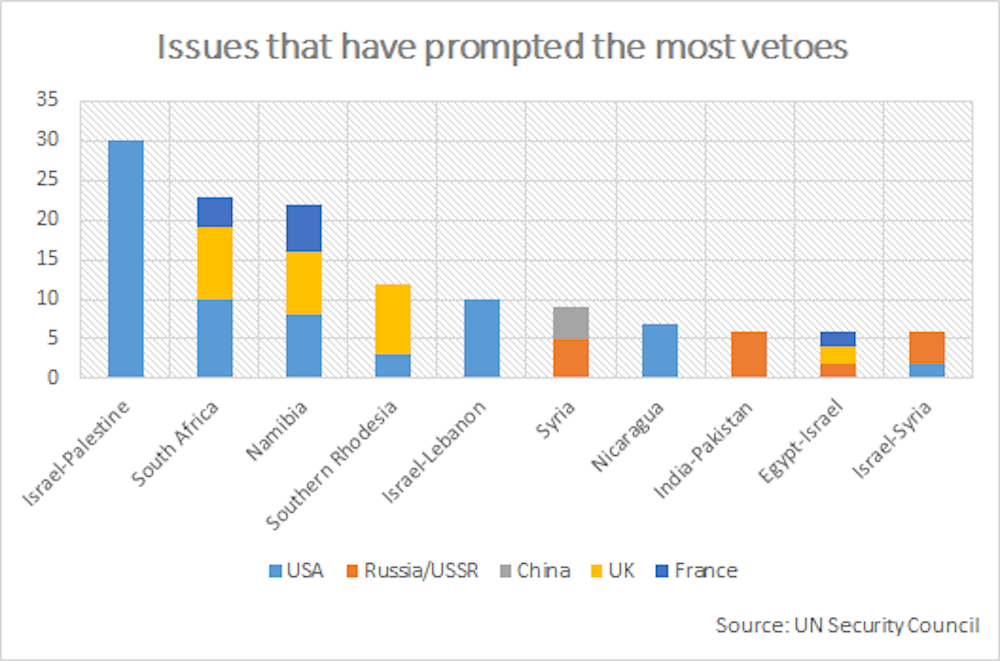
    For a start, it would need to get past the UN security council which means being subject to a veto from any one of the five permanent members (P5). We published an article on this issue some years ago with the help of UN expert Emma McClean, which looked at the issues which had prompted members of the P5 to wield their vetos. It found that Israel-Palestine was hands-down the most common issue that led to a veto – and all those vetoes had been instigated by the US.

    UN security council vetoes.
    UN security council


    Read more:
    Hard Evidence: who uses veto in the UN Security Council most often – and for what?


    So suspending Israel from the UN would appear to be a non-starter. But Hehir tells the story of the way the UN managed to circumvent the P5 and suspend South Africa in 1974 over apartheid. Having failed to get the suspension past the security council after the UK and France vetoed the move, the credentials committee of the general assembly simply refused to renew South Africa’s credentials. It remained suspended for two decades until the end of apartheid in 1994.


    Read more:
    Gaza: can the UN suspend Israel over its treatment of Palestinians? It’s complicated, but yes


    Meanwhile Israel’s assault on Gaza continues and the death toll continues to mount. Israeli Defense Forces (IDF), supported by airstrikes, continue to bombard what the IDF says are Hamas positions in the towns of Beit Lahia and Jabalia but which the Gaza health ministry say are residential buildings sheltering hundreds of civilians. On October 29, the health ministry said at least 93 people, including 25 children, were killed by an Israeli airstrike.


    Now, more than ever, it’s vital to be informed about the important issues affecting global stability. Sign up to receive our weekly World Update newsletter. Every Thursday we’ll you expert analysis of the big stories making international headlines.


    Much of the population of the north of Gaza has been evacuated south of what is known as the Netzarim corridor. Israel’s Haaretz newspaper claims that it’s part of an operation known as the “generals’ plan”, which calls for the north to be cleared of civilian residents and locked down as a military zone. This is presented as a national security measure, but Leonie Fleischmann reports that there are those who believe the military operation will be followed by an influx of Israeli settlers.

    Fleischmann points to a conference held on the Israeli side of the border with north Gaza, attended by members of Netanyahu’s Likud party as well as by several government ministers, which actively promoted the idea of settling north Gaza. Memories and historical legend mingle with ideology that holds Gaza had a Jewish population from biblical times through to 1929, when an Arab revolt killed 133 Jewish people living there and drove the rest out.

    The prospect of a land grab is clearly exercising minds at the UK foreign office. UK ambassador to the United Nations, Barbara Woodward said on October 29: “We reiterate that northern Gaza must not be cut off from the south. Palestinian civilians, including those evacuated from northern Gaza must be permitted to return. There must be no forcible transfer of Gazans from or within Gaza, nor any reduction in the territory of the Gaza Strip.”


    Read more:
    Israel’s ‘generals’ plan’ to clear Palestinians from north of Gaza could pave the way for settlers to return


    All eyes on Washington

    It’s highly unlikely that we’ll know by this time next week who has prevailed in the US presidential election. But the Middle East will be one of the first big ticket items on the Resolute desk.

    The issue has already proved to be a tricky one for Kamala Harris. Her support base is deeply divided on the issue, with large numbers of Democrats – particularly young people, as well as Muslims and black voters – unsettled by her perceived part in the Biden administration’s “steadfast” support for Israel over the past four years.

    It’s hard to tell whether these voters consider that the people of Gaza would fare any better under a Trump White House. But Natasha Lindstaedt and Faten Ghosn believe that Netanyahu’s continuing aggression in Gaza may well play out in the Republican contender’s favour.


    Read more:
    How the Middle East conflict could influence the US election – and why Arab Americans in swing states might vote for Trump


    Meanwhile, to guide us through how the two candidates are likely to approach the big foreign policy issues, we can turn to Garret Martin of the Transatlantic Policy Center at the American University in Washington.


    Read more:
    On foreign policy, Trump opts for disruption and Harris for engagement − but they share some of the same concerns


    World Update is available as a weekly email newsletter. Click here to get our updates directly in your inbox.


    ref. World Update: how Israel’s relations with the UN hit rock bottom – https://theconversation.com/world-update-how-israels-relations-with-the-un-hit-rock-bottom-242632

    MIL OSI – Global Reports

  • MIL-OSI Video: DPR Korea, Lebanon/Humanitarian, Cuba & other topics – UN Daily Press Briefing (31 Oct 2024)

    Source: United Nations (Video News)

    Noon Briefing by Stéphane Dujarric, Spokesperson for the Secretary-General.

    Highlights:
    -Democratic People’s Republic of Korea
    -UNIFIL
    -Lebanon/Humanitarian
    -Occupied Palestinian Territory
    -Ukraine
    -Security Council
    -Deputy Secretary-General
    -Cuba
    -South Sudan
    -West and Central Africa
    -World Cities Day
    -Guest briefing
    -Briefings tomorrow

    Democratic People’s Republic of Korea
    The Secretary-General strongly condemns the launch today of a long-range ballistic missile by the Democratic People’s Republic of Korea (DPRK).
    The DPRK’s continued launches of missiles using ballistic missile technology are clear violations of relevant Security Council resolutions.
    The Secretary-General remains concerned about the situation on the Korean Peninsula. He has consistently called for de-escalation and the full implementation of all relevant Security Council resolutions, as well as for an environment that is conducive to dialogue, and the resumption of talks. 
    Diplomatic engagement remains the only pathway to sustainable peace and the complete and verifiable denuclearization of the Korean Peninsula.

    UNIFIL
    In Lebanon, Blue Helmets – who remain at their positions and continue their essential work to monitor and report to us and the international community what is actually happening on the ground, tell us that intense clashes between Hizbullah and the Israel Defence Forces have been reported in the Khiam area in UNIFIL’s Sector East.
    The Israeli Defence Forces have continued to strike areas across Lebanon, including in the south, Baalbek and near Beirut, with multiple casualties reported. Hizbullah’s rocket fire has reportedly killed five people today near Metula in northern Israel.
    Yesterday, a UNIFIL position near the Blue Line, south of the Shab’a village (Sector East) sustained minor damage to its barracks and a vehicle due to a nearby explosion.
    We once again remind all involved in this conflict of the inviolability of UN premises, and those premises must be respected, as well as our peacekeepers, both uniformed and civilians.
    The intensifying hostilities are, of course, extremely concerning. We urge all actors to stop the violence immediately and avail themselves of the diplomatic initiatives to end this conflict. We continue to support efforts towards de-escalation and a diplomatic solution.
    The UN peacekeeping mission also remains focused on helping local communities. This week, they delivered essential humanitarian aid to the Municipality of Tyre amid a challenging situation in south Lebanon. The aid included medical devices as well as medicines.

    Lebanon/Humanitarian
    On the humanitarian front, as in many conflicts, children and woman bear the brunt of the ongoing hostilities.
    In a statement today, UNICEF’s Executive Director, Catherine Russell, said that 166 children have been killed in Lebanon since October 2023, that is what Lebanese authorities are telling UNICEF, while thousands of others have been injured.
    UNICEF is on the ground providing emergency psychological support to thousands of children and their caregivers.
    For its part, the UN Population Fund says the conflict is also impacting more than 10,000 pregnant women including 1,300 who are expecting to give birth soon amid significant damage to infrastructure and a health system that is extremely strained.
    The displacement crisis remains a key issue. Our humanitarian colleagues are telling us that today, the Israeli army issued new orders for people to leave their homes in several villages as well as in the Rashiedeh Palestinian refugee camp, which is located in the south. This is the first time the Israeli army has called for the evacuation of a Palestinian refugee camp in Lebanon.
    OCHA says that yesterday’s displacement orders and strikes in Baalbek and surrounding areas have forced thousands of people to flee their homes. Many of them spent the night in their vehicles.
    And yesterday, the Humanitarian Coordinator for Lebanon, Imran Riza, visited Akkar in Tripoli, which currently hosts around 70,000 people who have been forced to flee, and are in conditions that you can only imagine.

    Full Highlights: https://www.un.org/sg/en/content/noon-briefing-highlight?date%5Bvalue%5D%5Bdate%5D=31%20October%202024

    https://www.youtube.com/watch?v=M_88Ll_nbRg

    MIL OSI Video

  • MIL-OSI USA: Governor Cooper Highlights Tourism Industry in Western North Carolina at Grandfather Mountain, Surveys Storm Damage in Avery County

    Source: US State of North Carolina

    Headline: Governor Cooper Highlights Tourism Industry in Western North Carolina at Grandfather Mountain, Surveys Storm Damage in Avery County

    Governor Cooper Highlights Tourism Industry in Western North Carolina at Grandfather Mountain, Surveys Storm Damage in Avery County
    bconroy

    Today, Governor Roy Cooper traveled to Grandfather Mountain State Park in Avery County to highlight the importance of supporting Western North Carolina’s tourism industry in the wake of Hurricane Helene. Afterward, the Governor assessed damaged areas and spoke with people impacted by the storm in Banner Elk, where he was joined by Western North Carolina native and Grammy-nominated country musician Eric Church.

    “Today I visited beautiful Grandfather Mountain State Park in Avery County and traveled to Banner Elk to see areas that were damaged during Helene,” said Governor Cooper. “Tourism is a critical part of Western North Carolina’s economy, and there are still many wonderful spots in the region open and accepting visitors. I’m grateful for the work of our federal, state and local responders as well as partners like Eric Church who have given time and effort to help communities in need.”

    This week, Governor Cooper signed a Memorandum of Understanding with Western North Carolina native and country musician Eric Church confirming his commitment that publishing royalties from Church’s recent song, “Darkest Hour,” will help fund response and recovery efforts in the aftermath of Hurricane Helene.

    Unaccounted For People

    The DPS Task Force to locate unaccounted for people has 7 people remaining on this list. The Task Force has handed over remaining work on this to local law enforcement.

    Travel to Western North Carolina

    Some roads are closed because they are too damaged and dangerous to travel. Other roads still need to be reserved for essential traffic like utility vehicles, construction equipment and supply trucks. However, some parts of the area are open and ready to welcome visitors which is critical for the revival of Western North Carolina’s economy. If you are considering a visit to the area, consult DriveNC.gov for open roads and reach out to the community and businesses you want to visit to see if they are welcoming visitors back yet.

    North Carolina National Guard Response

    More than 1,700 Soldiers and Airmen are working in Western North Carolina. Joint Task Force- North Carolina, the task force led by the North Carolina National Guard continues to help with commodity distribution and critical debris removal alongside local government workers, volunteers and  numerous civilian entities to get much-needed help to people in Western North Carolina.

    The U.S. Army Corps of Engineers is helping to assess water and wastewater plants and dams. Residents can track the status of the public water supply in their area through this website.

    FEMA Assistance

    Approximately $195 million in FEMA Individual Assistance funds have been paid so far to Western North Carolina disaster survivors and approximately 239,000 people have registered for Individual Assistance. Over 8,600 people are being helped through FEMA’s Transitional Sheltering Assistance. Nearly 6,200 registrations for Small Business Administration Loans have been filed.

    Nearly 1,800 FEMA staff are in the state to help with the Western North Carolina relief effort. In addition to search and rescue and providing commodities, they are meeting with disaster survivors in shelters and neighborhoods to provide rapid access to relief resources. They can be identified by their FEMA logo apparel and federal government identification.

    North Carolinians can apply for Individual Assistance by calling 1-800-621-3362 from 7am to 11pm daily or by visiting www.disasterassistance.gov, or by downloading the FEMA app. FEMA may be able to help with serious needs, displacement, temporary lodging, basic home repair costs, personal property loss or other disaster-caused needs.

    Help from Other States

    More than 1,750 responders from 39 state and local agencies have performed 153 missions supporting the response and recovery efforts through the Emergency Management Assistance Compact (EMAC). This includes public health nurses, emergency management teams supporting local governments, veterinarians, teams with search dogs and more.

    Beware of Misinformation

    North Carolina Emergency Management and local officials are cautioning the public about false Helene reports and misinformation being shared on social media. NCEM has launched a fact versus rumor response webpage to provide factual information in the wake of this storm. FEMA also has a rumor response webpage.

    Efforts continue to provide food, water and basic necessities to residents in affected communities, using both ground resources and air drops from the NC National Guard. Food, water and commodity points of distribution are open throughout Western North Carolina. For information on these sites in your community, visit your local emergency management and local government social media and websites or visit ncdps.gov/Helene.

    Storm Damage Cleanup

    If your home has damages and you need assistance with clean up, please call Crisis Cleanup for access to volunteer organizations that can assist you at 844-965-1386.

    Power Outages

    Across Western North Carolina, approximately 2,200 customers remain without power, down from a peak of more than 1 million. Overall power outage numbers will fluctuate up and down as power crews temporarily take circuits or substations offline to make repairs and restore additional customers.

    Road Closures

    Some roads are closed because they are too damaged and dangerous to travel. Other roads still need to be reserved for essential traffic like utility vehicles, construction equipment and supply trucks. However, some parts of the area are open and ready to welcome visitors which is critical for the revival of Western North Carolina’s economy. If you are considering a visit to the area, consult DriveNC.gov for open roads and reach out to the community and businesses you want to visit to see if they are welcoming visitors back yet.

    NCDOT currently has more than 2,000 employees and more than 900 pieces of equipment working on damaged road sites.

    Fatalities

    101 storm-related deaths have been confirmed in North Carolina by the Office of Chief Medical Examiner. This number is expected to rise over the coming days. The North Carolina Office of the Chief Medical Examiner will continue to confirm numbers twice daily. If you have an emergency or believe that someone is in danger, please call 911.

    Volunteers and Donations

    If you would like to donate to the North Carolina Disaster Relief Fund, visit nc.gov/donate. Donations will help to support local nonprofits working on the ground.

    For information on volunteer opportunities, please visit nc.gov/volunteernc.

    Additional Assistance

    There is no right or wrong way to feel in response to the trauma of a hurricane. If you have been impacted by the storm and need someone to talk to, call or text the Disaster Distress Helpline at 1-800-985-5990. Help is also available to anyone, anytime in English or Spanish through a call, text or chat to 988. Learn more at 988Lifeline.org.

    If you are seeking a representative from the North Carolina Joint Information Center, please email ncempio@ncdps.gov or call 919-825-2599.

    For general information, access to resources, or answers to frequently asked questions, please visit ncdps.gov/helene.

    If you are seeking information on resources for recovery help for a resident impacted from the storm, please email IArecovery@ncdps.gov.

    ###

    Oct 31, 2024

    MIL OSI USA News

  • MIL-Evening Report: Ancient mud reveals Australia’s burning history over the past 130,000 years – and shows a way through our fiery future

    Source: The Conversation (Au and NZ) – By Michela Mariani, Associate Professor in Physical Geography, University of Nottingham

    Lano Lan / Shutterstock

    Increased land management by Aboriginal people in southeastern Australia around 6,000 years ago cut forest shrub cover in half, according to our new study of fossil pollen trapped in ancient mud.

    Shrubs connect fires from ground cover to the forest canopy, allowing fires to spread and intensify quickly. The reduction in shrub cover, linked to evidence for increasing population size and more widespread landscape use by Aboriginal people, would have dramatically decreased the potential for high-intensity bushfires.

    We also found the shrub layer in modern forests is even greater than it was 130,000–115,000 years ago, when the climate was similar to today’s but there were no people around.

    Our deep-time research shows how important Indigenous cultural practices were for reducing dangerous high-intensity fires. It also suggests a way forward in Autralia’s current fire crisis, which climate change is making worse.

    The trouble with shrubs

    For decades, Australia has tried to manage fires by suppressing them. This strategy may be effective in the short term, but it has led to dire consequences in the long term.

    Over the past 20 years, the forests and woodlands of southeastern Australia have become hotspots for major fires.

    Fire suppression has allowed vegetation, particularly in the shrub layer, to grow without constraint. Shrubby, mid-height vegetation acts as a ladder, enabling fires to spread up from the ground to the forest canopy. This results in more intense and uncontrollable fires.

    Summary timeline of past landscape changes across southeastern Australia. We show changes from pre-human contact (top), through Indigenous population expansion (middle), to the present (post-colonial, bottom).
    Simon Connor, CC BY

    Evidence for denser vegetation comes from tiny, fossilised grains of pollen that are laid down in layers of ancient sediment in wetlands and lake beds. By extracting fossil pollen from mud, scientists can develop a picture of vegetation in the past.

    Our new study used archaeological data and information preserved in ancient mud. We looked at how the vegetation of southeastern Australia changed in response to climate and human management over the past 130,000 years.

    We wanted to see how things changed in key periods: before human arrival in Australia, through periods of Indigenous occupation, and following British colonisation.

    We used sophisticated models to estimate vegetation cover and how it related to human land use at different times.

    Caring for Country

    Indigenous Australians have been the custodians of this continent for millennia. Their journey in Australia started at least 65,000 years ago.

    Direct evidence of cultural burning traces back at least 11,000 years in the Top End, although it may have begun much earlier.

    Indigenous Australian cultural burning practices are complex and varied. However, in many parts of the continent they included regular, controlled burns. These helped to manage vegetation growth and reduce the risk of high-intensity fires.

    Since British colonisation, the landscape of Australia has undergone significant changes, with both more open pastures and more densely vegetated forests. The introduction of European land management practices, including fire suppression, disrupted the fire regimes Indigenous Australians had maintained for thousands of years.

    This suppression-focused approach has led to an accumulation of plant matter, creating a tinderbox ready to ignite.

    A call for change: integrating Indigenous Knowledge

    To address this crisis, a shift in fire management strategies is essential. One promising approach is to integrate Indigenous fire management practices into contemporary fire management plans, working with Traditional Owners to best care for Country.

    This must be done in a way that supports Indigenous livelihoods and fosters connection to Country, not by management agencies simply appropriating Indigenous know-how.

    Indigenous Australians possess hundreds of generations’ worth of experience in managing the country’s fire-prone landscapes. Indigenous-led fire management is already being reinvigorated in northern Australia.

    Our research demonstrates that southeastern forests and woodlands were effectively managed in the past and would also benefit from Indigenous caring-for-Country practices today.

    Reducing dangerous fuels in the shrub layer means less high-intensity fires threatening the bush–urban interface, such as the 2019–20 Black Summer fires.

    Indigenous-led burning at a project site in Tasmania.
    Matthew Newton / RUMMIN Productions

    Higher temperatures and prolonged droughts have created ideal conditions for bushfires to spread. Colonisation has compounded the problems arising from human-driven climate change.

    But there is no fire without fuel. It is the combination of increased biomass and a warming climate that now fuels fires of unprecedented scale and intensity, posing a significant threat to lives, property and ecosystems.

    Australia’s fire crisis is a complex issue that requires a multifaceted solution. By learning from and working with Indigenous practitioners, Australia can develop more effective and sustainable fire management strategies. This collaborative approach offers a path forward to tame the flames and protect the nation’s unique and diverse landscapes.

    Michela Mariani receives funding from the Leverhulme Trust and is affiliated with the Australian Research Council Centre of Excellence for Australian Biodiversity and Heritage (CABAH) and the Centre of Excellence for Indigenous and Environmental Histories and Futures (CIEHF).

    Anna Florin receives funding from the Australian Research Council and is affiliated with the Australian Research Council Centre of Excellence for Australian Biodiversity and Heritage (CABAH).

    Haidee Cadd receives funding from the Australian Research Council and is affiliated with the ARC Centre of Excellence for Australian Biodiversity and Heritage (CABAH).

    Simon Connor receives funding from the Australian Research Council. He is affiliated with CABAH, the Centre of Excellence for Australian Biodiversity and Heritage.

    Matthew Adeleye does not work for, consult, own shares in or receive funding from any company or organisation that would benefit from this article, and has disclosed no relevant affiliations beyond their academic appointment.

    ref. Ancient mud reveals Australia’s burning history over the past 130,000 years – and shows a way through our fiery future – https://theconversation.com/ancient-mud-reveals-australias-burning-history-over-the-past-130-000-years-and-shows-a-way-through-our-fiery-future-239561

    MIL OSI AnalysisEveningReport.nz

  • MIL-OSI USA News: A Proclamation on Critical Infrastructure Security and Resilience Month,  2024

    Source: The White House

         From the energy that powers our homes to the networks that connect us and the systems that protect our health and safety, our critical infrastructure keeps our economy thriving and our communities secure.  This Critical Infrastructure Security and Resilience Month, we recommit to strengthening our country’s critical infrastructure and building an America that is safe and secure for generations to come.

         This year, I signed a National Security Memorandum to secure and enhance the resilience of United States critical infrastructure — updating the policy for the first time in a decade.  This represents the launch of a new era in protecting our infrastructure against all threats and hazards by safeguarding our strong and innovative economy and enhancing our collective resilience to disasters before they happen.  But there is more to do.  Climate change is making natural disasters more frequent, ferocious, and costly — endangering our supply chains, creating more instability for our communities, and straining the critical infrastructure Americans depend on for their livelihoods.  And we need to stay vigilant against adversaries that seek to maliciously target our critical infrastructure, including through cyberattacks.  

         To meet this moment, my Administration made a once-in-a-generation investment in our Nation’s infrastructure — creating an opportunity to build in resilience to all hazards upfront and by design.  Through my American Rescue Plan, Bipartisan Infrastructure Law, Inflation Reduction Act, and CHIPS and Science Act, we are investing billions of dollars to secure and bolster our infrastructure.  That includes improving our electric grid so that people can maintain power in any situation, elevating roads and bridges over possible flood zones, funding community resilience programs, and more.  These investments have not only helped to protect Americans — they have benefited our economy, creating jobs and new possibilities for our communities.  At the NATO summit this year, I announced an arrangement with Canada and Finland to collaborate on the production of polar icebreakers.  The partnership will advance United States economic and national security interests by strengthening our shipbuilding and industrial capacity while simultaneously opening up new trade routes and pushing back against foreign aggression and bolstering our international alliances.  This year, I also announced a United States Port Security Initiative to reverse our dependence on foreign manufactured port equipment.

         Ensuring our Nation is resilient in the face of threats also means working with other nations around the globe to build better, stronger, and more sustainable infrastructure.  At the G7 Summit in June, I was proud to announce the historic progress we have made with our Partnership for Global Infrastructure and Investment.  This initiative will strengthen United States national and economic security for Americans at home and enable sustainable economic growth for partner countries.  To date, we have mobilized $60 billion to create high-quality global infrastructure.  That comes on top of our work with the European Union and African heads of state to develop the Lobito Corridor as well as our work with the Democratic Republic of the Congo and Zambia to expand regional and global trade markets through the Port of Lobito in Angola.  We continue to pursue opportunities to expand our investments across Africa and around the world, including the Indo-Pacific, Central Asia, the Middle East, and the Western Hemisphere.  Investments like these create more shared opportunities, prosperity, and security for everyone.

         Across the Nation, America is writing the greatest comeback story we have ever known — people are putting shovels in the ground, founding new businesses, and creating hope for entire communities.  It is more important now than ever before that we remain vigilant against any threats that seek to undermine our collective security and prosperity. 

         During Critical Infrastructure Security and Resilience Month, we recommit to safeguarding and strengthening our Nation’s critical infrastructure to save lives and allow our Nation to continue doing what it does best:  creating new possibilities.

         NOW, THEREFORE, I, JOSEPH R. BIDEN JR., President of the United States of America, by virtue of the authority vested in me by the Constitution and the laws of the United States, do hereby proclaim November 2024 as Critical Infrastructure Security and Resilience Month.  I call upon the people of the United States to recognize the importance of protecting our Nation’s infrastructure and to observe this month with appropriate measures to enhance our national security and resilience.

         IN WITNESS WHEREOF, I have hereunto set my hand this thirty-first day of October, in the year of our Lord two thousand twenty-four, and of the Independence of the United States of America the two hundred and forty-ninth.

                                   JOSEPH R. BIDEN JR.

    MIL OSI USA News

  • MIL-OSI USA: ARS Hosts 30th Anniversary Ceremony for USDA George E. Brown, Jr. Salinity Laboratory

    Source: US Agriculture Research Service

    ARS Hosts 30th Anniversary Ceremony for USDA George E. Brown, Jr. Salinity Laboratory

    Contact: Amaani Lyle
    Email: Amaani.Lyle@usda.gov

    RIVERSIDE, Calif., Oct. 31, 2024 — The U.S. Department of Agriculture’s (USDA) Agricultural Research Service (ARS) hosted the 30th anniversary ceremony of the U.S. Department of Agriculture George E. Brown, Jr., Salinity Laboratory on the University of California, Riverside campus today.

    The event celebrated decades of research at the laboratory, where ARS teams have pioneered irrigation practices to optimize crop production, leverage conservation through recycled water, and minimize land degradation caused by the omnipresence of natural and man-made salinization, the overabundance of salt.

    Salinization is the buildup of salts and other trace elements in irrigated soils that reduces the productivity of croplands, constituting a long-standing threat to farming in the semi-arid regions of the American West, parts of the Midwest, and throughout the world.

    The Salinity Laboratory’s innovation and leadership in understanding salt-affected soil-plant-water systems for the conservation and protection of our land and water resources and the maintenance of a viable, permanent irrigated agriculture has garnered acclaim from both USDA leadership and UC Riverside collaborators.

    “This milestone anniversary of the U.S. Department of Agriculture George E. Brown, Jr., Salinity Laboratory marks a storied history of our mission to overcome water quality and water scarcity constraints on agriculture and human health,” said Dr. Simon Liu, ARS Administrator. “Our researchers’ work has yielded palpable solutions to address climate change, drought, and competition for resources — factors that reduce the availability of irrigation water and compound risks posed by salinization.”

    ARS Research Leader Todd Skaggs echoed the importance of appropriate salinity control.

    “To meet increasing demands for food amid limited soil and water resources, the nation and much of the world community will continue to look to the USDA Salinity Laboratory for salinity expertise, water quality research, and applications to solve these problems,” Skaggs said. “Protection of soil resources will become even more vital as water conservation, efficiency and quality assurance continue to increase.”

    According to Skaggs, current research focus areas have earned the lab a vanguard position in addressing and eradicating per- and poly-fluoroalkyl substances (PFAS), chemicals of concern whose presence in recycled water may lead to the introduction of these harmful compounds into the human food chain if such waters are used for agricultural crop irrigation.

    “Even low levels of PFAS may accumulate in soils over time and be absorbed by crop roots,” Skaggs explained. “Our team is therefore developing a low-cost, low-energy, environmentally-friendly treatment system for the removal of PFAS from recycled water, and it’s being optimized for application at the greenhouse scale, potentially allowing for production of PFAS-free crops for human consumption.”

    Skaggs also recounted research inflection points in the 1960s and 1970s when ARS scientists quantified the salinity response of a wide variety of agricultural crops and demonstrated that soil salinity could be managed with significantly less water than used in conventional irrigation practices, setting the stage for substantial water conservation.

    “This research enabled the selection of suitable crops for a given irrigation water quality and the data remain the most comprehensive information available on relative crop salt tolerances,” he said.

    By the 1990s, the Salinity Laboratory developed benchmark methods for mapping and monitoring soil salinity across swaths of U.S. farms and agricultural regions, irrigated lands that produce 30% of the nation’s food and fiber and practically all of the nation’s fruits and vegetables.

    The 30th anniversary ceremony highlighted but a fraction of the lab’s deep roots.

    In 1937, the United States Regional Salinity Laboratory was established at the base of Mount Rubidoux in the city of Riverside before adopting a new moniker, United States Salinity Laboratory, in 1951. 

    In 1986, Congressmen George Brown, Jerry Lewis, and Al McCandless of California introduced legislation to replace the aging U.S. Salinity Laboratory with a modern facility on the UCR campus, which supported the project by leasing to the federal government a 7.5-acre site for 50 years at $1 per year. Groundbreaking occurred in 1992 before the facility officially opened in 1995. 

    In 2000, the laboratory name would change once more to George E. Brown, Jr., Salinity Laboratory in memory of Congressman George E. Brown, Jr.

    The laboratory has the distinction of being the only facility in the country specifically devoted to agricultural and environmental issue analysis through basic research on saline and alkali soils, including related reclamation, irrigation, drainage and soil management.  

    Following the ceremony was an open house highlighting current research including breeding of salt-tolerant alfalfa, precision agriculture, and greenhouse-scale treatment systems for removing PFAS from irrigation water.

    ARS and UC Riverside researchers have maintained collaborative relationships, sharing vital resources to achieve common research objectives through cooperative research programs. 

    Leaders who spoke at the ceremony included:

    • Dr. Simon Liu, Administrator, USDA-ARS 
    • Dr. Tara McHugh, Director, Pacific West Area, USDA-ARS 
    • Dr. Marlen Eve, Deputy Administrator, USDA-ARS National Program Staff, Natural Resources and Sustainable Agricultural Systems
    • Peter Atkinson, Interim Dean, UC Riverside College of Natural and Agricultural Sciences
    • Rien van Genuchten, Recipient of the 2023 Wolf Prize in Agriculture

    The Agricultural Research Service is the U.S. Department of Agriculture’s chief scientific in-house research agency. Daily, ARS focuses on solutions to agricultural problems affecting America. Each dollar invested in U.S. agricultural research results in $20 of economic impact.

    MIL OSI USA News

  • MIL-OSI USA: NEWS RELEASE: SEPTEMBER 2024 VISITOR ARRIVALS RECOVERED 96.1 PERCENT COMPARED TO PRE-PANDEMIC SEPTEMBER 2019

    Source: US State of Hawaii

    NEWS RELEASE: SEPTEMBER 2024 VISITOR ARRIVALS RECOVERED 96.1 PERCENT COMPARED TO PRE-PANDEMIC SEPTEMBER 2019

    Posted on Oct 31, 2024 in Latest Department News, Newsroom

    DEPARTMENT OF BUSINESS, ECONOMIC DEVELOPMENT AND TOURISM


    RESEARCH AND ECONOMIC ANALYSIS DIVISION


    JOSH GREEN, M.D.
    GOVERNOR

    JAMES KUNANE TOKIOKA

    DIRECTOR

    1. EUGENE TIAN
      CHIEF STATE ECONOMIST


    FOR IMMEDIATE RELEASE

    October 31, 2024

    SEPTEMBER 2024 VISITOR ARRIVALS RECOVERED 96.1 PERCENT COMPARED TO PRE-PANDEMIC SEPTEMBER 2019


    HONOLULU – Total visitor arrivals in September 2024 represent a 96.1 percent recovery from pre-pandemic September 2019, the best recovery rate since the Maui wildfires (not including February 2024, which had a leap day). Total nominal visitor spending increased 16.3 percent compared to September 2019. According to preliminary statistics from the Department of Business, Economic Development and Tourism (DBEDT), there were 707,486 visitors to the Hawaiian Islands in September 2024, up 7.8 percent from the same month last year. Total visitor spending measured in nominal dollars was $1.45 billion, growth of 4.6 percent from September 2023.

    In September 2024, 688,831 visitors arrived by air service, mainly from the U.S. West and U.S. East. Additionally, 18,655 visitors arrived via out-of-state cruise ships. In comparison, 648,145 visitors (+6.3%) arrived by air and 8,143 visitors (+129.1%) came by cruise ships in September 2023, and 718,042 visitors (-4.1%) came by air and 18,114 visitors (+3.0%) came by cruise ships in September 2019.

    The average length of stay by all visitors in September 2024 was 8.23 days, which was shorter than September 2023 (8.61 days, -4.4%) and September 2019 (8.40 days, -2.0%). The statewide average daily census was 194,156 visitors in September 2024, compared to 188,319 visitors (+3.1%) in September 2023 and 206,169 visitors (-5.8%) in September 2019.

    In September 2024, 359,688 visitors arrived from the U.S. West, an increase from September 2023 (329,347 visitors, +9.2%) and September 2019 (305,808 visitors, +17.6%). U.S. West visitor spending of $663.6 million grew compared to September 2023 ($604.5 million, +9.8%) and was considerably higher than September 2019 ($466.0 million, +42.4%). Daily spending by U.S. West visitors in September 2024 ($228 per person) increased compared to September 2023 ($223 per person, +2.3%) and was significantly more than September 2019 ($179 per person, +27.5%).

    In September 2024, 160,299 visitors arrived from the U.S. East, up from September 2023 (153,737 visitors, +4.3%) and from September 2019 (133,185 visitors, +20.4%). U.S. East visitor spending of $408.9 million increased compared to September 2023 ($404.5 million, +1.1%) and September 2019 ($288.9 million, +41.5%). Daily spending by U.S. East visitors in September 2024 ($274 per person) was slightly less than September 2023 ($275 per person,
    -0.3%) but was much higher than September 2019 ($229 per person, +19.8%).

    There were 64,940 visitors from Japan in September 2024, which was a slight increase from September 2023 (64,580 visitors, +0.6%) but continued to be much lower than September 2019 (143,928 visitors, -54.9%). Visitors from Japan spent $96.2 million in September 2024, compared to $101.3 million (-5.0%) in September 2023 and $196.5 million (-51.0%) in September 2019. Daily spending by Japanese visitors in September 2024 ($240 per person) decreased compared to September 2023 ($243 per person, -1.2%) but was higher than September 2019 ($231 per person, +3.8%).

    In September 2024, 19,188 visitors arrived from Canada, an increase from September 2023 (18,647 visitors, +2.9%), but a decline compared to September 2019 (21,928 visitors, -12.5%). Visitors from Canada spent $43.6 million in September 2024, compared to $48.1 million (-9.3%) in September 2023 and $40.5 million (+7.6%) in September 2019. Daily spending by Canadian visitors in September 2024 ($236 per person) was similar to September 2023 ($236 per person, +0.2%) and was considerably more than September 2019 ($159 per person, +48.8%).

    There were 84,717 visitors from all other international markets in September 2024, comprising visitors from Oceania, Other Asia, Europe, Latin America, Guam, the Philippines, the Pacific Islands and other regions. In comparison, there were 81,833 visitors (+3.5%) from all other international markets in September 2023 and 113,192 visitors (-25.2%) in September 2019.

    Air capacity to the Hawaiian Islands in September 2024 (4,476 transpacific flights with 990,746 seats) increased compared to September 2023 (4,376 flights, +2.3% with 963,916 seats, +2.8%), but declined from September 2019 (4,533 flights, -1.3% with 1,012,883 seats, -2.2%).

    VIEW FULL NEWS RELEASE AND TABLES


    Statement by DBEDT Director James Kunane Tokioka


    The leading contributor to the September 2024 tourism industry performance was the U.S. market with 519,987 visitors and registered as the second highest September visitor count on record (the highest September number occurred in 2022 with 566,189 visitors). The September 2024 U.S. visitor count was 18.4 percent higher than the same month in 2019. For the first nine months of 2024, the U.S. visitor count was 6.0 percent higher than the same period in 2019.


    The rebound of Hawai‘i’s cruise industry, which has surpassed pre-pandemic 2019 levels, was also a contributing factor in September’s performance. Nine out-of-state cruise ships brought 18,655 visitors to the islands in September 2024, more than double the number of visitors who came by cruise ships in September 2023 and 3.0 percent higher than September 2019. For the first nine months of 2024, there were 58 arrivals from out-of-state cruise ships that carried more than 106,000 visitors, a growth of 11.5 percent compared to year-to-date 2019.


    Current airlift and travel agency bookings data indicate that the U.S. market will still be leading Hawai‘i’s tourism recovery in the future months. We expect that the foreign exchange rate will be more favorable to foreign visitors and the international market will improve in the near future. During the first nine months of 2024, the recovery of foreign visitors was at 63.6 percent, while Japanese visitor recovery was at 44.5 percent.


    # # #


    Media Contacts:


    Laci Goshi

    Department of Business, Economic Development and Tourism

    808-518-5480

    [email protected]


    Jennifer Chun

    Director of Tourism Research

    Department of Business, Economic Development and Tourism

    808-973-9446

    [email protected]

    MIL OSI USA News

  • MIL-OSI Europe: Answer to a written question – Disinformation on shared vs exclusive competences – E-001620/2024(ASW)

    Source: European Parliament

    Forests are indispensable for a climate-neutral Europe, resilient, and thriving environment, sustainable bioeconomy and healthy society.

    Many forests in the EU are not in a good state, they suffer heavily from biodiversity loss, ecosystem degradation and climate change, while there is surging demand for forest products and services. The EU has a variety of shared competences that concern forest protection and forestry to address these challenges.

    In line with the objective of the European Green Deal[1] to improve EU’s forested area, both in quality and quantity, in 2021 the Commission adopted the EU Forest Strategy for 2030[2].

    Key actions under this strategy have already been delivered[3], notably the Nature Restoration Law[4] and several guidelines to improve implementation[5].

    The EU also adopted the Deforestation Regulation[6]. Furthermore, the European Agricultural Fund for Rural Development[7] supports interventions that contribute to the achievement of the EU’s environmental and climate objectives such as afforestation, reforestation, fire prevention, and forest ecosystem improvement.

    Since the information available on the state of forests as ecosystems and of the use of forest resources is fragmented, incomparable, and not fit for policy making, resulting in important knowledge gaps, the Commission proposed a Forest Monitoring Law[8], which is currently under examination by co-legislators.

    The Commission will continue to pursue the objectives of the EU Forest Strategy, and will assess progress and the need for further action in this area.

    The Commission is also tackling the threat of disinformation, for example through actions to counter foreign information manipulation and to build societal resilience against disinformation[9].

    • [1] https://commission.europa.eu/strategy-and-policy/priorities-2019-2024/european-green-deal_en
    • [2] https://environment.ec.europa.eu/strategy/forest-strategy_en
    • [3] https://environment.ec.europa.eu/topics/forests_en
    • [4] Regulation (EU) 2024/1991 of the European Parliament and of the Council of 24 June 2024 on nature restoration and amending Regulation (EU) 2022/869, OJ L, 2024/1991, 29.7.2024.
    • [5] Such as the the guidelines on biodiversity friendly afforestation and reforestation [SWD(2023)61], on closer to nature forestry [SWD(2023) 284], on old-growth forests [SWD(2023)62] and on payment for ecosystem services [SWD (2023)285] .
    • [6] Adopted by the European Parliament and Council, Regulation (EU) 2023/1115 of the European Parliament and of the Council of 31 May 2023 on the making available on the Union market and the export from the Union of certain commodities and products associated with deforestation and forest degradation and repealing Regulation (EU) No 995/2010, OJ L 150, 9.6.2023, p. 206-247.
    • [7] https://eur-lex.europa.eu/eli/reg/2021/2115/oj
    • [8] https://environment.ec.europa.eu/publications/proposal-regulation-forest-monitoring-framework_en
    • [9] https://commission.europa.eu/topics/strategic-communication-and-tackling-disinformation_en

    MIL OSI Europe News

  • MIL-OSI United Nations: Experts of the Committee against Torture Welcome Namibia’s Commitment to the Mandela and Bangkok Rules, Ask about Harmful Traditional Practices and Lengthy Pretrial Detention Periods

    Source: United Nations – Geneva

    The Committee against Torture today concluded its consideration of the third periodic report of Namibia, with Committee Experts welcoming the State’s commitment to the Nelson Mandela and Bangkok Rules, international norms on the treatment of prisoners, and raising questions about harmful traditional practices and lengthy pretrial detention periods.

    Erdogan Iscan, Country Rapporteur and Committee Expert, welcomed the commitment of the State party to complying with the Nelson Mandela Rules and the Bangkok Rules.

    Mr. Iscan raised the issue of traditional practices that were harmful to women and girls, including the ritual of Olufuko, which involved child marriage and sexual initiation rites.  Had the State party made progress in terms of awareness-raising as well as eliminating such practices?  What further steps had been taken to prevent and criminalise the practice of forced sterilisation?

    Jorge Contesse, Country Rapporteur and Committee Expert, said pretrial detention seemed to routinely exceed legal limits, with above 50 per cent of the prison population awaiting trial.  The low usage of alternatives to detention and an unaffordable bail system seemed to be contributing to the large backlog of cases of pretrial detainees.  What measures had been adopted to address these challenges?

    Introducing the report, Yvonne Dausab, Minister of Justice of Namibia and head of the delegation, said the Namibian correctional service included human rights instruments, including the Nelson Mandela Rules, in the curriculum at its Training College.  The service had undertaken measures to renovate all the country’s correctional facilities with the aim of improving the living conditions of offenders.

    Ms. Dausab said the Government continued to conduct awareness campaigns targeting traditional and religious leaders on positive gender roles and the elimination of harmful cultural practices.  The Childcare and Protection Act 2015 had measures to protect children from harmful cultural and religious practices, strictly prohibiting child marriage in all setups.

    The delegation said Olufuko had taken on a more cultural image and profile, as opposed to a platform for sexual initiation and child marriage.  That may have been the case in the past, but this had changed over the past 10 to 15 years.  Namibia had taken steps to ensure that acts of enforced sterilisation of individuals were not carried out.

    Pretrial detention could run for any time between six to 12 months, the delegation said, and courts could decide to withdraw charges before the six-month period based on available evidence.  The State party was working to strengthen community courts and establish small claims courts to address overcrowding in prisons and holding cells. Since the report was sent, there had also been parole releases and the President had pardoned some persons.

    In closing remarks, Claude Heller, Committee Chair, said that the Committee understood that the political context in Namibia was difficult.  The Committee would make efforts to provide the State party with relevant and achievable recommendations within its concluding observations.  The Committee was interested in maintaining an open dialogue with the State party through its follow-up mechanism.

    In her concluding remarks, Ms. Dausab said Namibia was committed to addressing all forms of torture and other cruel, inhuman or degrading treatment.  More needed to be done to prevent torture, including the enactment of specific legislation criminalising it.  The Committee’s recommendations would help to enhance mechanisms to prevent torture.

    The delegation of Namibia consisted of representatives from the Ministry of Justice; Ministry of Home Affairs, Immigration, Safety and Security; Namibia Correctional Service; and the Permanent Mission of Namibia to the United Nations Office at Geneva.

    The Committee will issue concluding observations on the report of Namibia at the end of its eighty-first session on 22 November.  Those, and other documents relating to the Committee’s work, including reports submitted by States parties, will be available on the session’s webpage.  Summaries of the public meetings of the Committee can be found here, and webcasts of the public meetings can be found here.

    The Committee will next meet in public on Tuesday, 5 November at 10 a.m. to begin its examination of the second periodic report of Thailand (CAT/C/THA/2).

    Report

    The Committee has before it the third periodic report of Namibia (CAT/C/NAM/3).

    Presentation of Report

    YVONNE DAUSAB, Minister of Justice of Namibia and head of the delegation, said

    Namibia had suffered a great loss at the beginning of the year when the third President, Dr. Hage Gottfried Geingob, a strong champion of human rights, passed away on 4 February 2024.  He was greatly missed.  Additionally, Namibia was currently going through a devastating drought which had impacted food security and economic development; the Government was navigating this climate-related crisis with the assistance of developmental partners. Namibia offered a sincere apology for the non-submission of the written responses to the list of issues.

    The torture bill remained under consideration following deliberations in the National Assembly.  The Convention was directly applicable and enforceable in Namibia without the ‘domestic’ legislation.  Article 144 had been used by Namibian courts which had cited United Nations Conventions in their judgments, making their provisions applicable directly in Namibia. The Namibian Constitution prohibited torture as well cruel, inhuman or degrading treatment or punishment, and the Criminal Procedure Act of 1977 criminalised murder as well as assault, including assault with intent to cause grievous bodily harm. 

    Members of the police force, correctional service and defence force accused of using excessive force were investigated under internal complaints units and those found to have acted outside the scope of what was reasonable in the circumstances were subjected to prosecution.  The Government had also been ordered to pay damages to complainants and their families in civil matters brought due to allegations of assault or use of excessive force by law enforcement officers. 

    The Namibian Constitution prohibited arbitrary arrest or detention and required that an arrested person be brought before a court within 48 hours after the arrest.  All police officials were trained and required to inform an accused person upon arrest of their rights, reasons for their arrest, and charges against them.  The Directorate of Legal Aid within the Ministry of Justice had appointed 69 in-house lawyers across the country to represent members of society who could not afford legal representation. 

    The Government had enhanced the independence of the Ombudsman by reforming the current Ombudsman Act 1990 to make provision for the Ombudsman’s Office to be established as a separate agency in the public service, with its own budget and accounting officer.  The Office of the Ombudsman had launched a training manual against torture for law enforcement agencies, and visited and inspected places of detention, police holding cells, and correctional facilities to monitor human rights compliance.

    Namibia continued to be marred by incidents of gender-based and sexual violence, including online child sexual exploitation.  The Government had developed a national plan of action on gender-based violence 2019-2023 to address the root causes and provide a well-coordinated approach to the prevention, response, monitoring and evaluation of gender-based violence initiatives.  Additionally, Namibia had established special courts for gender-based violence offences country-wide to provide a victim-friendly environment. 

    The Government continued to conduct awareness campaigns targeting traditional and religious leaders on positive gender roles and the elimination of harmful cultural practices.  Namibia had developed and implemented a national plan of action to address violence against children.  The Childcare and Protection Act 2015 had measures to protect children from harmful cultural and religious practices, strictly prohibiting child marriage in all setups. 

    The Ombudsman had been instrumental in ensuring that the Namibian police force was adequately trained on the ‘prevention of torture training manual for police officers.’ The Namibian police force also conducted ongoing workshops to train police officers on human rights.  The Namibian correctional service included human rights instruments in its curriculum, including the Nelson Mandela Rules, at the Namibian Correctional Service Training College.  The service had undertaken measures to renovate all of the country’s correctional facilities with the aim of improving the living conditions of offenders.  The implementation of the Namibian correctional service’s health policy had brought about significant changes in managing communicable diseases such as tuberculosis, HIV and hepatitis, as well as mental health support. 

    All asylum seekers went through a refugee status determination process and those who met the criteria were granted refugee status.  If an application for refugee status was unsuccessful, the applicant was advised they could appeal the decision to the Namibian Refugee Appeal Board. Namibia was implementing the national action plan on statelessness, and a national committee had been established. The review of the legislative framework, which was a key milestone, had begun. 

    The Police Act allowed police officials to be investigated for misconduct and human right violations, inclusive of torture.  Officials found guilty of acting outside the scope of their duties were subject to laid down procedures, including arraignment before a competent court. In Namibia, the State was represented by the Prosecutor General in criminal cases; therefore, the prosecution of all allegations of torture lay with the State.  Ms. Dausab concluded by stating that the Namibian Government remained committed to protecting and promoting human rights in the country. 

    Questions by Committee Experts 

    ERDOGAN ISCAN, Committee Expert and Rapporteur, said the Committee expressed its condolences for the death of Namibia’s third President earlier this year.  The State party did not reply to the list of issues adopted by the Committee and chose to submit a report in May 2021 under the traditional reporting procedure.

    The dialogue with the State party would be conducted against this background.

    Mr. Iscan called on Namibia to continue to support the treaty body system. 

    Had measures been taken to improve prison conditions in conformity with the Nelson Mandela Rules? Research indicated that the total prison population was close to 9,000 inmates, of which 54 per cent were pretrial detainees in police custody.  Occupancy level in the prison system was 75 per cent.  Could the Committee be updated on the current situation?  Could details be provided about the health policy and practice developed by the Namibian correctional service? 

    How many individuals were currently in pretrial detention?  What was the average length of pretrial detention and steps taken to reduce its use?  Could statistical data be provided on deaths in custody; investigations carried out into these deaths; and the number of police or prison staff who had been subjected to criminal or disciplinary punishment in cases involving death in custody? Had there been cases of inter-prisoner violence, and what had been measures implemented in such incidents?

    The Committee noted that corporal punishment was prohibited in schools by the Basic Education Act of 2020, but it still lacked an explicit prohibition in the home. What was the current status of the Correctional Service Act 2012 with respect to explicitly prohibiting corporal punishment following the Supreme Court’s judgment of 5 April 1991?  What steps were being taken to totally prohibit corporal punishment in all settings and develop campaigns for awareness raising?

    Could data on all complaints received by the Ombudsman and the number of complaints received by the Internal Investigation Directorate be provided?  How many of these complaints were investigated and how many resulted in disciplinary sanctions?  Had the perpetrators been punished with appropriate penalties commensurate with the gravity of the crime?  How many complaints had been received concerning sexual abuse and the exploitation of refugees by public officials or non-governmental workers at the Osire refugee camp?  Had these complaints been investigated and prosecuted and had victims obtained redress? 

    The Caprivi high treason trial ended in September 2015 and the Committee noted that about 30 persons were found guilty and sentenced to various imprisonment terms; 79 persons were found not guilty and released from custody.  Could

    information on investigations into or prosecutions of members of the Namibian police force regarding alleged acts of torture of suspected participants in the secession attempt in the Caprivi region in 1999 be provided?  What steps had been taken by the authorities to investigate reports of enforced disappearances in the context of the liberation struggle, including the disappearance of former members of the Southwest Africa People’s Organization?  Had alleged victims and their families obtained redress?

    Was the legislation on excessive use of force compatible with the Convention, as well as the basic principles on the use of force and firearms by law enforcement officials?  Were the reports of excessive use of force by law enforcement officers investigated promptly, effectively and impartially?  Were the perpetrators prosecuted and, if convicted, punished with commensurate penalties?  Were victims of violations remedied adequately?  The Committee had received allegations that members of the police force detained and sexually abused sex workers.  What was the State party’s response to these reports? 

    The Committee took note of the Joint Communication by a group of Special Procedure mandate holders, who examined the document which evaluated the “Joint Declaration by the Federal Republic of Germany and the Republic of Namibia: United in remembrance of our colonial past, united in our will to reconcile, united in our vision of the future”, dated June 2021, and developed observations in connection with international human rights law.  It was understood that follow-up negotiations were ongoing between Namibia and Germany.

    With respect to traditional practices that were harmful to women and girls, including the ritual of Olufuko, which involved child marriage and sexual initiation rites, had the State party made progress in terms of awareness-raising as well as eliminating such practices?  What further steps had been taken to prevent and criminalise the practice of forced sterilisation?  What measures were in place to ensure that all acts of violence that targeted persons on the basis of their sexual orientation or gender identity were properly and promptly investigated and prosecuted? 

    It was reported that the Supreme Court issued a ruling last year recognising the right of spouses of Namibian citizens to regularise their immigration status based on same-sex marriages.  Later, parliament passed legislation banning same-sex marriages.  If enacted, it could nullify the Supreme Court ruling.  What was the current status of this legislation? The Committee had received information that the High Court issued a decision on 21 June 2024, which declared the common law offences of sodomy and unnatural sexual offences unconstitutional. It seemed that the State party continued to criminalise same-sex relationships and the Government had lodged an appeal against this decision which was currently pending before the Supreme Court.  What was the current situation? 

    Could the State party clarify its policy, legislation and practice with respect to prisons, hospitals, schools and institutions that engaged in the care of children, older persons or persons with disabilities?  What was the legal permissibility and use of the measures such as seclusion, physical and chemical restraints, and other restrictive practices? Were net beds and cage beds used in psychiatric and social welfare institutions?  Did the Office of the Ombudsman have unrestricted access to monitor these institutions?  Had any progress been achieved in regard to protecting the human rights of older persons?

    The Committee noted the commitment of the State party to complying with the Nelson Mandela Rules and the Bangkok Rules.  Could the State party clarify its policy, legislation and practice with respect to solitary confinement?  What was the incommunicado detention regime in Namibia?  If the State party maintained this practice, under what circumstances was incommunicado detention authorised and what was the competent organ to authorise incommunicado detention?  Would the State party consider abolishing incommunicado detention? 

    Could Namibia comment on the status of the recommendation to ratify the Optional Protocol to the Convention, and other international instruments to which it was not a party?  Was there any update in this regard? 

    JORGE CONTESSE, Committee Expert and Rapporteur, said torture was currently not a specific criminal offence in Namibia and Namibian law did not expressly criminalise any other forms of cruel, inhuman or degrading treatment or punishment.  Could information be received on the status of the draft prevention of torture bill?  What amendments to the bill sought to bring it further into line with the State party’s obligations under the Convention, as previously recommended by the Committee, including provisions that criminalised the acquiescence and complicity of State officials, or officials acting in an official capacity, to acts of torture?  Were acts amounting to torture subject to a statute of limitations?  Were there any cases where Namibia had invoked the Convention directly before domestic courts? 

    What initiatives had been taken by the State party to enshrine in its legislation fundamental legal safeguards, in particular the right to have access to a lawyer, including the right to access free and effective legal aid; the right to receive a medical examination by an independent physician; the right for individuals, at the time of arrest, to be informed of their rights; the right to be brought promptly before a judge; the right to notify a person of one’s choice of one’s deprivation of liberty; and the obligation of the authorities to maintain detention registers at places of detention?  Were there any cases in which the authorities had failed to comply with these safeguards?  How many such complaints had been registered and what was their outcomes? 

    Were there any cases in which disciplinary measures were taken against officials found responsible for violations?  What complaints mechanisms were available to report violations, and how did they function in practice?  Could the State party specify the circumstances in which a right to counsel could be waived?

    The 2022 annual report of the Ombudsman described visitation and inspection of places of detention in Namibia, noting that some of the most appalling facilities had been closed.  When this happened, where were the detainees who had been held there sent?  What was the timetable for the cleaning and renovation of these facilities?  Pretrial detention seemed to routinely exceed legal limits, with above 50 per cent of the prison population awaiting trial.  In addition, the reported shortcomings in the criminal justice system, such as the significant delays between arrest and trial, the low usage of alternatives to detention, and an inaccessible and unaffordable bail system, seemed to be the contributing factors to the large backlog of cases of pretrial detainees.  What measures had been adopted to address these shortcomings and challenges?

    It was understood that the child justice bill, which had not yet been adopted, endorsed 14 years of age to be considered criminally responsible and abolished the common law presumption.  What was the status and content of the bill?  What measures were adopted to ensure that children were not detained in detention centres for adults?  The Committee understood that no legal provision authorised the Ombudsman to make unannounced visits to places of detention; would the new legislation provide the Ombudsman with such power? 

    Violence against women, including rape, domestic violence, sexual exploitation and abuse of children, and violence against women from indigenous communities, continued to be extremely high, and the root causes of such violence had not been adequately addressed.  According to the national gender-based violence baseline study, “most drivers of gender-based violence were relationship factors that were deeply entrenched within socio–cultural norms and escalated to societal level factors.” What concrete measures had the State party adopted to address these issues, including policies and plans to address ongoing challenges; the number of complaints of gender-based, domestic, or sexual violence received by the authorities; the number of investigations and prosecutions undertaken regarding gender-based, domestic or sexual violence; and the protection and support services available to victims?

    The recommendation to remove the crime of sodomy as a ground for entry refusal into Namibia remained unaddressed.  What measures would the State party adopt to address this and other pending concerns? Could data be provided on the number of asylum applications received during the period under review, the number of successful applications, and the number of asylum seekers whose applications were accepted because they had been tortured or might be tortured if returned to their country of origin? 

    What were the existing appeals mechanisms and other mechanisms in place to identify individuals in need of international protection?  What was the procedure followed when a person invoked this right? Were individuals facing expulsion informed of their right to seek asylum and appeal a deportation decision?  How many stateless persons were living in the country?  What measures were being taken by the State party to mitigate the risk of torture or ill treatment faced by stateless persons. 

    How many law enforcement officials, prison staff, military officers, investigators, judicial personnel and border guards had attended educational programmes which included instruction on the provisions of the Convention against Torture?  How were officers were trained on investigating and handling forms of prohibited ill treatment, like cruel, inhuman or degrading treatment?  To what extent was the Ombudsman responsible for training other law enforcement agencies on investigating torture claims?  What specific initiatives were in place to train officials to prevent the traumatisation of victims of torture or ill treatment.  What steps had been taken to improve methods of investigation, including training programmes on non-coercive interrogation techniques?  Had any training programmes been developed for judges, prosecutors, forensic doctors and medical personnel dealing with detained persons on detecting and documenting the physical and psychological signs of torture?

    Responses by the Delegation 

    The delegation said any international instrument that Namibia ratified became part of their system. Namibia took the work of the treaty bodies very seriously.  Namibia’s prison capacity across the country was around 5,400.  The bed capacity was around 4,700.  Since the report was sent, there had been parole releases, persons had completed their sentences, and the President had pardoned some persons. Pretrial detention could run for any time between six to 12 months.  There was no deliberate attempt on the part of the State to keep people in pretrial detention; the authorities were trying to clear them as quickly as possible to decongest prison facilities. 

    Namibia did not have inter-prison violence in the form that was premeditated, organised, or gang related.  There were isolated incidents of inter-prison fights which were dealt with quickly.  In the rare instances when these incidents occurred, the prisoners would be separated from each other.  Namibia had made a proposal to improve community service orders. 

    It was agreed that the Ombudsman needed to be extricated from the Ministry of Justice. However, there was no evidence that there had been any interference in the work of the Ombudsman.  The Ombudsman bill was ready to go before the National Assembly for Legislative Consultation, which would help with establishing the Office of the Ombudsman.  Currently in Namibia, the Ombudsman was at the level of a judge.  Whether there should be a fixed-term or the security of tenure of the Ombudsman was currently under debate.  Since his appointment, the Ombudsman had been quite vocal about his findings and his displeasure at the conditions of prisons.  The Ombudsman had unfettered access to those facilities; however, unannounced visits could be impractical.  Namibia was doing enough to ensure those institutions which had the mandate to investigate violations of human rights were able to be supported in their work. 

    There had been no prosecutions for prostitution or sex work in Namibia.  There was some fairly outdated legislation, but these laws had not been activated because the State did not feel they were consistent with the spirit of the Namibian Constitution.  Namibia was constantly working on reforming legislation which offended the values of the Constitution.

    The Joint Declaration was the result of an open and frank conversation in Namibia’s National Assembly, reflecting the gravity of the first genocide which took place in Namibia during the twentieth century. 

    Olufuko had taken on a more cultural image and profile, as opposed to a platform for sexual initiation and child marriage.  That may have been the case in the past, but this had changed over the past 10 to 15 years.  Namibia had taken steps to ensure that acts of enforced sterilisation of individuals were not carried out.  The discussion around the reform of abortion and sterilisation was ongoing.  Namibia was concerned about the number of cases of persons who identified as persons of the lesbian, gay, bisexual, transgender and intersex community, who had lost their lives.  However, the State could not say that these crimes happened specifically due to their sexual orientation.  All of those incidents of people who had been killed over the past few months were being investigated and prosecutions would take place. 

    Homosexuality in Namibia was not a crime. 

    Namibia had an excellent proposal for child justice.  The State had engaged in extensive consultation with and received feedback from the United Nations Children’s Fund.  Early next year, the child justice bill would be considered in the Assembly.  Children were kept in facilities separate from adults, and were provided with significant social support.  Gender-based violence was a concern for Namibia.  Every year, the State commemorated the 16 days of violence against women.  There was increasing collaboration between the State and civil society organizations to increase visibility.  The text and the language of legislation combatting rape had been strengthened in 2022, as had the domestic violence legislation. 

    Questions by Committee Experts 

    ERDOGAN ISCAN, Committee Expert and Rapporteur, said the Committee appreciated the fact that they had a high-level delegation here, headed by the Minister in the lead-up to the country’s elections, and wished Namibia all the best in their democratic elections.  The Committee needed information on the reflection of policy and legislation in practice, which was why statistical information was important. 

    Could the State party inform the Committee on the policies, legislation and practices on counter-terrorism measures?  It was a fundamental obligation of States to fight terrorism, while still respecting human rights and the rule of law. 

    Could information be provided on the legislative and executive measures under the state of emergency?  Did they comply with the absolute and non-derogable prohibition of torture? 

    JORGE CONTESSE, Committee Expert and Rapporteur, said it was necessary to have a specific crime which defined the contours of torture.  What were the requirements that members of parliament had, which resulted in seven years of there being no torture bill?  It seemed that the child justice bill moved down the minimum age of criminal responsibility to 12 years; how was this consistent with human rights law? 

    Responses by the Delegation

    The delegation said Namibia’s President could declare a state of emergency in situations where there were natural disasters or threats to the State.  At no time had the declaration of a state of emergency suspended the prohibition of torture or the protection of fundamental rights and freedoms.

    Persons who engaged in terrorist activities against Namibia inside or outside of the State could face life imprisonment.  Law enforcement agencies recently attended training on counterterrorism, which reinforced the obligation to protect human rights and the rule of law.

    The anti-torture bill included definitions of torture and other cruel, inhuman or degrading treatment that were in line with the Convention.  The bill included punishments of imprisonment of varying lengths for acts of torture and other cruel, inhuman or degrading treatment.

    The child justice bill had been developed after broad consultation with international partners. It set the age of criminal responsibility at 12 years, considering the domestic context.

    International human rights instruments ratified by the State were applicable directly before the courts, and the International Covenant on Civil and Political Rights had been applied in one case.

    The Refugee Recognition and Control Act called for compliance with due process regarding detention and expulsions of asylum seekers.  Asylum seekers could be represented by legal practitioners in appeals to detention and expulsion procedures.  Namibia respected the principle of non-refoulement.

    The Government was working to regularise the status of stateless persons.  Under the birth outreach programme, teams had been deployed to rural areas to facilitate birth registration.  Bills promoting civil registration, regularisation and statelessness determination were being considered in Parliament.  Namibia was exerting efforts to eradicate statelessness.

    The Namibian police had conducted investigations into alleged cases of enforced disappearance conducted by two individuals with Angolan citizenship.  These cases had been finalised.  A bill had been developed on the training of police and military officers.  Training was aligned with the Istanbul Protocol and developed skills in investigating allegations of torture and helping victims to access redress. Police officers could not question suspects before informing them of their rights.

    The Constitution prohibited corporal punishment and State legislation prohibited such punishment in school settings.  Schools were mandated to create mechanisms that allowed learners to report incidents of corporal punishment.  In August 2024, a teacher was relieved of his duties following reports of him engaging in corporal punishment of learners.  Parents and guardians needed to respect children’s right to dignity.

    The State party had established an appeal committee and set up regulations to prevent the abuse of legal aid resources.  There had been an increase in applications for legal aid this year, with the number of applications for legal aid having increased to more than 10,000.  Measures were in place to respond to this increase in applications.

    The Mental Health Act of 1973 was outdated and used language that was not consistent with the Convention on the Rights of Persons with Disabilities.  A new bill dealing with mental health had been proposed, which set regulations regarding the limited use of seclusion, coercive methods, and restraint of persons with disabilities, and promoted de-escalation techniques.  The bill called for coercive methods to be removed within two hours at most.  There was a clear prohibition of forced sterilisation of women with mental disabilities in the bill.  It was expected to be finalised next year.

    Questions by Committee Experts 

    ERDOGAN ISCAN, Committee Expert and Country Rapporteur, said that the State’s Constitution and legislation determined that statements made as a result of torture were inadmissible in a court of law.  Were there examples of court cases in which courts had found that evidence was inadmissible because it was obtained through torture?  Had there been investigations into allegations that evidence used in the Caprivi trials was obtained through torture?

    The Committee welcomed that the State party had accepted the simplified reporting procedure, which provided for improved cooperation between the State party and the Committee.  However, the State party had submitted its last report under the traditional procedure. Mr. Iscan called on the State party to submit its next report under the simplified procedure.

    The State party had failed to respond to the Committee’s previous concluding observations and the report on follow-up to concluding observations.  The Committee hoped that the State party would respond to the next concluding observations within the given timeframe.

    JORGE CONTESSE, Committee Expert and Country Rapporteur, said that the torture bill had been pending for a number of years.  The definition of torture within the proposed legislation was very good; it was identical to that of the Convention.  Were there any persons who had been specifically convicted of the crime of torture using the Convention?  It was critical that the anti-torture bill addressed the issues of the statute of limitations and universal jurisdiction.  Article eight of the bill addressed extraterritorial jurisdiction, not universal jurisdiction.

    There was a discrepancy between international human rights law and the child justice bill. What was the domestic context that prevented Namibia from setting the age of criminal responsibility at 14? 

    There was another discrepancy between Namibia’s law on refugee control and international human rights law, which defined the prohibition of non-refoulement as absolute. Why was refoulement allowed in certain circumstances?

    There was a lack of information provided by the State party on allegations of sexual assault by police officers against asylum seekers.  Asylum seekers reportedly lived in settlements with poor conditions. Could the delegation comment on these issues?

    Trafficking in persons reportedly remained prevalent in Namibia.  The rate of reported cases seemed very low, and there was limited progress in investigations and convictions for these cases, with only two convictions between 2014 and 2019.  What progress had been made in tackling trafficking in persons?

    How would the State party address challenges that prevented the Ombudsperson from making unannounced visits to places of detention?

    Another Committee Expert said unannounced inspections of places of detention were an international standard.  The State party needed to reconsider its position on this issue.  Were there time limits for pretrial detention?  It was very impressive that it had been deemed unconstitutional to implement solitary confinement.

    Responses by the Delegation

    The delegation said the State party noted the Committee’s comments regarding the simplified reporting procedure.  There were court cases in which evidence obtained through torture was deemed inadmissible.  In such cases, additional investigations were undertaken into the identified acts of torture.

    The State party also noted the Committee’s concerns and suggestions regarding the anti-torture bill.  Namibia wished to comply with international best practices regarding non-refoulement. Legislation on deportations intended to protect Namibia from external threats while respecting the principle of non-refoulement.

    All allegations of trafficking in persons were taken very seriously.  The judicial system was independent and competent, but had limited resources, which was influencing the rate at which trafficking cases were processed. The State party was exerting efforts to prevent trafficking in persons.

    Any allegations of sexual assault and crimes against the refugee community were investigated. The State party was not aware of allegations of poor conditions in asylum shelters; it would investigate any such allegations if it received them.

    Pretrial detention could be implemented for six to 12 months, and courts could decide to withdraw charges before the six-month period based on available evidence.  The State party was working to strengthen community courts and establish small claims courts to address overcrowding in prisons and holding cells.

    The delegation had taken note of the Committee’s comments regarding unannounced visits to places of detention.  There were no cases in which attempted unannounced visits had been blocked.  The State party would continue conversations on the age of criminal responsibility.

    The Constitutional Court had decided that the implementation of solitary confinement at one prison had been unconstitutional, however, the judgement had not made the implementation of solitary confinement unconstitutional in all contexts.  The imposition of solitary confinement needed to respect legal safeguards and the fundamental freedoms of those subjected to it.

    Questions by a Committee Expert 

    JORGE CONTESSE, Committee Expert and Country Rapporteur, asked if there were examples in which refugees or asylum seekers had threatened national sovereignty. What was the Refugee Control Act trying to address in this regard?  What were the reasons behind setting the age of criminal responsibility at 12?  The possibility of unannounced visits was an effective way to prevent torture and ill treatment in places of detention. Mr. Contesse called for such visits to be conducted.

    Responses by the Delegation

    The delegation said Namibia’s law on refugee control anticipated potential crimes committed by refugees and asylum seekers.  There had been no incidents thus far in which a refugee had threatened national security, but there needed to be a law in place to address such an act.  The domestic court system was sufficiently able to analyse the constitutionality of the Refugee Control Act.

    Concerns had been raised that increasing the age of criminal responsibility would make young children more likely to engage in criminal acts.  The State party noted the Committee’s discomfort regarding this legislation.

    The Ombudsperson was independent and had the opportunity to propose unannounced visits to places of detention.  It and all State actors, as well as civil society, had access to prisons in Namibia. Representatives of the African Union had written extensive reports on prison conditions, which helped the State party to improve these conditions.  Civilians had also taken the State to court concerning prison conditions.

    There were no examples of court cases in which findings of torture had been made, but there were cases in which crimes against humanity had been recognised.  The State party took on board the Committee’s concerns regarding the torture bill.

    Concluding Remarks 

    CLAUDE HELLER, Committee Chair, said that the Committee understood that the political context in Namibia was difficult.  It would make efforts to provide the State party with relevant and achievable recommendations within its concluding observations.  The Committee was interested in maintaining an open dialogue with the State party through its follow-up mechanism.  The dialogue had been rich and was conducted in a constructive spirit.

    YVONNE DAUSAB, Minister of Justice of Namibia and head of the delegation, said the State party had provided information on the efforts it had made to implement the Convention.  The Committee’s recommendations would help to enhance mechanisms to prevent torture. Namibia was committed to addressing all forms of torture and other cruel, inhuman or degrading treatment. More needed to be done to prevent torture, including the enactment of specific legislation criminalising it. The State party was committed to protecting the rights of its people, in consideration of the domestic context. Ms. Dausab closed by thanking the Committee and all who had contributed to the dialogue.


    Produced by the United Nations Information Service in Geneva for use of the media; 
    not an official record. English and French versions of our releases are different as they are the product of two separate coverage teams that work independently.


    CAT24.020E

    MIL OSI United Nations News

  • MIL-OSI USA: Neal Announces $1,000,000 Earmark for New Southbridge Fire Station

    Source: United States House of Representatives – Congressman Richard Neal (D-MA)

    Today, Congressman Richard E. Neal joined Southbridge Town Administrator John Jovan, Jr., Southbridge Fire Department Chief Paul Normandin, Southbridge Fire Department Deputy Chief and Chair of the Fire Station Building Committee Joseph Hulyk, and town officials to announce a $1,000,000 earmark for construction of the new Southbridge Fire Station. 

    The allocation was made possible through Congressionally Direct Spending (CDS) from the U.S. Department of Agriculture’s Rural Housing Service. Congressman Neal included funding for this project in the Fiscal Year 2024 spending bill that was signed into law by President Biden on March 9, 2024. This funding will help address unintended budgetary gaps, ensuring construction of the new Southbridge Fire Station can move forward. 

    “The challenges facing our emergency personnel are numerous, something I know very well from my time as a mayor. Those challenges are exacerbated when you are confronted with a centuries-old station, which is why I fought to secure $1 million in funding for this critical project,” said Congressman Neal. “Firefighters are some of the most selfless members of our communities, putting their lives on the line every day to ensure the safety of others. That is why we must ensure they have the necessary resources to perform their critical work, and for the Southbridge Fire Department, that means a new fire station.” 

    Built in 1899, the Southbridge Fire Station is listed on the National Register of Historic Places with the National Park Service. Having been built when the Fire Department still used horse-drawn equipment, the current station does not meet the needs of a modern fire department, making it difficult to accommodate present day equipment. The current department consists of 31 career and 6 call firefighters who responded to more than 4,000 calls in 2023. 

    “One million dollars in federal funding is welcomed news to the residents of Southbridge for the town’s new fire station,” said Southbridge Deputy Fire Chief Joseph Hulyk. “I look forward to continuing working with Congressman Neal and others representing Massachusetts at the federal level to pursue additional funding opportunities to support completion of this project and ease the burden of Southbridge taxpayers.” 

    A 2018 feasibility study determined that constructing a new facility would be the most cost-effective solution for the Town of Southbridge. Funding secured by Congressman Neal will support the construction of a new station located on Worcester Street that will remedy issues facing the current station, including: 

    • Narrow apparatus bays designed for smaller horse drawn, steam driven equipment that were not constructed to accommodate modern equipment; 
    • Minimal and antiquated floor drains, resulting in runoff when firetrucks remain on the floor; 
    • No separate decontamination area, requiring trucks to be cleaned outside; 
    • Insufficient storage for protective equipment, air tanks, compressor, and ambulance equipment, making them vulnerable to contaminates from exhaust; 
    • No first aid room and a non-ADA compliant public restroom; and 
    • A dispatch center that does not meet national recommendations for emergency communication centers. 

    Under guidelines issued by the Senate and House Appropriations Committees, members of Congress requested CDS funding for projects in their state for Fiscal Year 2024. CDS requests were restricted to a limited number of federal funding streams, and only state and local governments, and eligible non-profit entities, were permitted to receive CDS funding. 

    This project is one of thirteen CDS projects submitted by Congressman Neal, totaling nearly $15 million in investments throughout the First Congressional District of Massachusetts. 

    ###

    MIL OSI USA News

  • MIL-OSI Security: Drug Trafficker Sentenced To 20 Years In Prison Following His Participation In A Fatal Shooting

    Source: United States Bureau of Alcohol Tobacco Firearms and Explosives (ATF)

    Orlando, Florida – U.S. District Judge Roy B. Dalton, Jr. has sentenced Cristian Ponce (32, Orlando) to 20 years’ imprisonment following his role in a fatal, drug-related shooting. Ponce entered a guilty plea on February 13, 2024. 

    According to court documents, on November 2, 2022, at approximately 2 p.m., a drug-related shooting occurred at the Oak Ridge Shopping Plaza in Orlando. Ponce and S.H. had arrived at the shopping plaza in a gray SUV to sell drugs to addicts who congregated there. They had cocaine and fentanyl packaged for individual sale and two loaded firearms in the vehicle. Video surveillance footage shows that when the SUV arrived in the plaza, an individual approached the front passenger side of the vehicle and Ponce gave him a small bag of cocaine. At almost the same time, E.E. and another associate approached the SUV and gunshots were fired into and from the SUV. E.E. was shot, ran a short distance, and fell to the ground. S.H. was also shot. The SUV reversed uncontrollably, flipped over, and crashed in the rear of the plaza. Ponce assisted S.H. out of the SUV and fled before law enforcement arrived. The confrontation was an alleged turf battle over who could sell drugs in the shopping plaza. Both E.E. and S.H. died from their wounds.

    During the following week, Ponce continued to sell drugs. On November 8, 2022, law enforcement observed vehicles and individuals visit Ponce’s residence for short periods of time, consistent with drug dealing. During that time Ponce also sent and received text messages to conduct his drug business.

    On November 11, 2022, at Ponce’s residence in Orlando, law enforcement executed a search warrant related to the shooting. As officers approached the residence, they observed Ponce seated in a vehicle in the driveway with co-defendant Rodney Hernandez. Ponce again had cocaine packaged for individual sale and two loaded firearms inside the vehicle.

    Hernandez previously pleaded guilty for his role in this case. He was sentenced in June 2024 to seven years in federal prison.   

    This case was investigated by the Federal Bureau of Investigation and the Orange County Sheriff’s Office, with assistance from the Bureau of Alcohol, Tobacco, Firearms and Explosives. It was prosecuted by Assistant United States Attorney Lauren Stoia.

    This case is part of Project Safe Neighborhoods (PSN), a program bringing together all levels of law enforcement and the communities they serve to reduce violent crime and gun violence, and to make our neighborhoods safer for everyone. On May 26, 2021, the Department launched a violent crime reduction strategy strengthening PSN based on these core principles: fostering trust and legitimacy in our communities, supporting community-based organizations that help prevent violence from occurring in the first place, setting focused and strategic enforcement priorities, and measuring the results.

    MIL Security OSI

  • MIL-OSI Economics: A stable euro in a strong Europe | Karl Otto Pöhl Lecture to the Frankfurt Society for Trade, Industry and Science

    Source: Bundesbank

    Check against delivery.

    1 Introduction

    Ladies and gentlemen,

    Thank you very much for inviting me. It gives me great pleasure to be here with you today, and I am very honoured to be delivering the Karl Otto Pöhl Lecture.

    My congratulations on this series of lectures. Nine years ago, it premiered at the Bundesbank’s Regional Office in Hesse at the Taunusanlage in Frankfurt. Since then, various prominent people have presented their views of monetary union. Two of them will come up later on in my talk.

    But let’s stay for now with the lecture’s namesake: Karl Otto Pöhl. On 30 May 1990, he addressed the Frankfurt Society for Trade, Industry and Science as President of the Bundesbank, perhaps even standing right here at this lectern.[1]

    Times were turbulent back then: German monetary union had just been decided and needed to be implemented within the space of just a few weeks. At the same time, the Delors Report had outlined the transition to a European Economic and Monetary Union. Its first stage entered into force on 1 July 1990. Germany’s “Frankfurter Allgemeine Zeitung” newspaper wrote back then that the Bundesbank was facing two unprecedented historical challenges.

    As was his nature, Karl Otto Pöhl shied away from neither challenges nor plain speaking. He explained in no uncertain terms where the difficulties and pitfalls of the two monetary unions lay. At the same time, he left no doubt that he would strive tirelessly to ensure that they were a success. He concluded his speech back then with the words: “I am also confident that we will succeed.” This combination of plain speaking, drive and optimism were characteristic of Karl Otto Pöhl – and we could do with more of that today as we strive to overcome the current challenges.

    Karl Otto Pöhl would have turned 95 this year. We owe him a great deal. His work in the Delors Commission resonates to this day: It was under Mr Pöhl’s chairmanship that the Committee of Central Bank Governors drafted the Statute of the European Central Bank. Thus, the European Central Bank was modelled on the Bundesbank and created as an independent central bank that pursues price stability as its primary objective.

    However, Mr Pöhl was also well aware that these institutional pillars alone are not sufficient to permanently uphold a stable currency for Europe. A firm foundation is needed for the pillars to stand upon. This foundation consists of sound public finances, integrated markets and public confidence in the central bank. Then as now, it is important to strengthen this foundation so that the euro can withstand even a storm. I would now like to talk about what this means specifically in the here and now.

    2 Sound public finances in the euro area

    Let’s start with public finances – and a question: Why should they matter to us in the first place? The Eurosystem has the task of shaping monetary policy for the euro area. Fiscal policy is the Member States’ responsibility. Why then do central bankers talk so often about budget deficits, debt ratios and fiscal rules?[2]

    Our mandate provides the answer: Unsound public finances are a threat to price stability. If the debt burden grows steadily in size, people might lose confidence that the government can continue to shoulder this burden without “inflating it away”. Inflation expectations, and therefore inflation itself, could rise. And monetary policy would have to push back more vigorously to keep inflation under control. This, in turn, would come at a greater cost to the economy as a whole.

    That is why we must nip in the bud any impression that central banks are under pressure to set key interest rates lower or maintain higher bond holdings than actually warranted by monetary policy out of consideration for public finances. And that is exactly why we are such outspoken advocates of effective fiscal rules. They are intended as guardrails for sound public finances. Then monetary policy can safeguard price stability, and do so with as little cost to the aggregate economy as possible.

    Fiscal rules were included in the design of European monetary union from the outset. This was thanks, in part, to Karl Otto Pöhl. Even back in the days of the Delors Commission, he was already advocating binding budgetary rules. Mr Pöhl is also said to have been the first to introduce the idea of a 3% deficit rule.

    Since then, the rules have been amended on several occasions. The latest reform entered into force in April 2024. On paper, the earlier rules were not bad at all. In practice, however, they didn’t have the desired effect. One reason was that numerous exceptions and discretionary powers were used to excuse the many instances in which targets were missed. As a result, the majority of euro area countries have debt exceeding the reference value of 60% of GDP, with a few even well above the 100% mark.

    Against this background, the rules were redrawn. In the reform, a great deal of emphasis was placed on national ownership, the intention being to make Member States feel more bound to the thresholds. If this overhaul does indeed lead to the rules having more binding force, that would be very welcome.

    At the same time, however, the commitments must also be ambitious enough to significantly bring down high deficit and debt ratios. Given a number of vulnerabilities in the new framework, this is not a matter of course. For example, the country-specific limits are based on many assumptions, some of which extend far into the future. The spending limits are ultimately a matter of negotiation. And in practice, response times to undesirable developments will be very long.

    The first acid test is imminent. Spending limits for the first planning period are currently being agreed upon. The plans should stake out a path for high deficit and debt ratios to come down reliably. Responsibility for agreeing such plans lies with the Commission and the Council. In my opinion, Germany should act as a role model in this process. That means leading by example and committing to a path on which the rules are applied rigorously.

    Given high levels of debt in the euro area, it is important that the reformed rules work better than the old ones. As I said earlier, sound Member State finances are part of the foundation of a stable economic and monetary union.

    3 Integrated capital markets in Europe

    But they alone are not enough. In his speech back then to the Frankfurt Society for Trade, Industry and Science, Karl Otto Pöhl explained that the emerging economic and monetary union meant, first, an integration of the markets. That was the most important thing of all, he said.[3] In particular, he pointed to the increasing integration of money and capital markets following the lifting of many restrictions on the free movement of capital.

    There were, and still are, a number of reasons why it is important that European financial markets should be as integrated as possible. First, this helps ensure that monetary policy impulses have equal effect throughout the euro area. Second, in the event of an economic shock in one Member State, it makes sure that downstream costs are cushioned across the currency area. This contributes to the stability of the economy as a whole and the financial system. And third, in a deep, liquid capital market with a broad range of products, it is easier for enterprises to find the financing that suits them best. This is particularly true of start-ups and growth companies. They need access to a developed venture capital market. More private capital is also important to boost investment in the green and digital transformation of the European economy. This investment is urgently needed to strengthen the EU’s productivity and competitiveness.

    So you see, everything points to the benefits of a genuine pan-European capital market. And the EU set itself the goal of creating a capital markets union a decade ago. Unfortunately, the reality is still very different.

    Overall, progress on financial integration in the euro area is disappointing. This was the conclusion recently reached in a report by the European Central Bank. It states that “[b]oth price-based and quantity-based financial integration indicators have declined substantially over the past two years, with no sizeable increase since the inception of Economic and Monetary Union. Despite significant legislative efforts over the last decade, cross-border financial market activities and risk sharing have not grown …”.[4]

    This finding demonstrates just how big the task is. But there is also good news: We know fairly exactly where the pain points lie and can start there. Areas for action include, for example, a more vibrant securitisation market, integrated structures in financial supervision, harmonised securities legislation, and better-coordinated national insolvency and accounting rules.

    The new Commission now needs to place the pursuit of a European capital market at the very top of its list of priorities. We must make more rapid progress on this issue than we have done so far. Policymakers have mostly been united behind the abstract objectives. However, they have then too rarely found the strength to agree on concrete measures. A whole host of measures is needed to achieve the objectives. In some cases, they encroach deeply on national law. If real progress is to be made, all parties will have to pull together, i.e. the Commission, the Parliament and the Member States.

    Happily, the topic has gained fresh momentum this year. Be it the statements by the Eurogroup and the ECB Governing Council or the reports by Enrico Letta and Mario Draghi – they are all providing tailwinds. Now is the time to use them!

    The Eurosystem itself is also contributing to success in this area, particularly in terms of financial market infrastructure. For example, we are advocating for new technologies to make it easier to issue, trade and settle financial instruments. In my view, digitalisation opens up fresh opportunities to strengthen the efficiency of European financial markets, while also breaking down boundaries between national financial markets. We have far from exhausted the potential here!

    4 Public confidence in the central bank

    A Europe with integrated markets and sound public finances is a stronger Europe. It is a Europe with stronger resilience in the face of crises, even during turbulent times; a Europe that allows us to shape our future with self-assurance and on the back of our own efforts. Achieving this goes beyond the monetary policy foundation; it also involves the basis of citizens’ trust in the EU.

    The general public should be able to have as much confidence in the EU in future as they do now.[5] We, as the Eurosystem central banks, are also particularly dependent on the confidence and support of the general public.

    We act independently of politics. This independence has been deliberately granted to us for monetary policy so that we can fulfil our mandate free from political influence. We cannot simply take the public’s trust as a given. Only if the people have confidence in us will they accept the independence granted to us. This trust must be earned time and time again – by acting in accordance with our mandate and communicating transparently and comprehensibly with the public. In short: Our deeds and our words should go hand in hand.

    If people have confidence in central banks and their promise of stability, this also helps to anchor inflation expectations.[6] Well-anchored inflation expectations make it easier for the central bank to actually achieve its target. And meeting the inflation target, in turn, reinforces people’s confidence in the central bank. In this way, a virtuous circle is created – a cycle of positive events.

    The Eurosystem has repeatedly demonstrated that its promise of stability was not merely empty words. Perhaps you remember when the then ECB chief economist, Peter Praet, gave his Karl Otto Pöhl Lecture in 2017. At that time, the Eurosystem was struggling with an inflation rate that remained stubbornly below target. Mr Praet explained what the Governing Council had done to counter deflation risks that had emerged since 2014.

    Alternatively, think back to the economic environment back when Christine Lagarde spoke with you two years ago. In autumn 2022, euro area inflation had peaked, even reaching double digits for a time. Against this backdrop, the ECB President underscored the Governing Council’s determination to push inflation down to its 2% target.

    Here, too, words and deeds were aligned: by September 2023, we had raised key interest rates by a total of 450 basis points in ten steps – a move that bore fruit. The inflation rate has since fallen significantly. In September of this year, it was below 2% in the euro area – and that for the first time in over three years. Tomorrow we will get the first estimate for October. Inflation is also likely to have risen slightly again due to base effects in energy.

    Looking beyond the monthly ups and downs, it can be seen that price stability is no longer far off, but the last mile of the journey still needs to be traversed. In particular, services inflation, which has been relatively sluggish in past experience, remains high, standing at 3.9% at last count.

    The ECB Governing Council lowered key interest rates in October for the third time since June. This was appropriate in view of the somewhat more favourable inflation outlook shown by the data. Our data-dependent approach has proven its worth, particularly in view of the prevailing uncertainty. A new forecast will be available to the Governing Council in December, and that will show us whether we are still on track in terms of inflation developments. I advise you to remain cautious and not to rush into anything.

    Monetary policy needs to ensure that the inflation rate stabilises at 2% over the medium term. Adhering to our promise of stability is absolutely crucial if we are to maintain the confidence that the general public have in us, particularly in light of their inflation experiences in recent years. Accessible communication helps with this.[7]

    Karl Otto Pöhl had already come to this realisation, back in a time when central banks were, in some cases, famous (and infamous) for their secrecy. In an interview in 1988, he said: “I am thoroughly convinced that one of my main tasks is to clarify, to explain.”[8]

    Studies also suggest that people with a good financial education tend to trust central banks.[9] We therefore have a strong vested interest in improving the public’s understanding of money, currency and central banks. This is where the Bundesbank’s educational resources, such as lectures at schools, training courses for teachers, teaching materials, explanatory films and the Money Museum, come into play.

    The effects of financial education could extend even further: researchers from the European Central Bank have investigated how people with differing degrees of financial knowledge responded to the interest rate reversal in 2022 and 2023.[10] People with basic and advanced financial knowledge were surveyed over several months. It transpired that both groups expected significantly higher interest rates. However, there were differences between whether the surveyed groups deemed it better to take out loans or to make savings: those with higher financial literacy adjusted their assessments more quickly and to a considerably greater degree. The impact of the course of monetary policy on people’s behaviour therefore also depends on their financial knowledge. As a result, then, greater emphasis on financial literacy could help monetary policy measures to be translated into action on the part of the individual.

    A good general understanding of economics and finance has yet more advantages. For instance, such knowledge enables people to make better decisions about how to spend, save and invest their money. Studies show that financial knowledge has a positive impact on households’ return on investment.[11] Furthermore, it is more likely to prevent them from making expensive mistakes or falling victim to fraud.

    Financial education also affords opportunities for social advancement. It is therefore important to promote the acquisition of such knowledge in society at large. If knowledge about planning for retirement and wealth accumulation is only gleaned from one’s parental home, it is primarily those who are already in positions of privilege who will benefit. This can entrench and even exacerbate societal inequalities.[12]

    It is all the more worrying that, according to a survey carried out within the EU, an average of just over one in two individuals possesses basic financial knowledge.[13] Although Germany’s performance is above average, we still have plenty of room for improvement. The German government’s initiative aimed at strengthening financial education therefore comes as a welcome development. One component of this initiative, a national strategy for financial literacy, is currently under development. The OECD has provided valuable analyses and recommendations that create a sound basis for policy.[14]

    In any case, there is no lack of interest, especially among young people. According to an OECD study, 81% of 14 to 24-year-olds would like to learn more in school about options for retirement provision, 87% about how to handle their money and 73% about investment opportunities.[15] In addition, 78% of young people in Germany want economics to play a greater role in school.[16] A stronger focus on economic and financial topics in the school curriculum would fall on fertile ground, then.

    5 Conclusion

    The Eurosystem is well equipped to maintain stable prices in the euro area through independence and a clear mandate. But in stormy times especially, we need to be firmly anchored upon a strong foundation, comprising elements such as sound public finances, integrated markets and confidence in the central bank. This foundation must be maintained, and, where necessary, re-laid.

    First and foremost, we are, of course, required to say what we are doing and to do what we are saying. Central bankers would be well advised to adhere to this guiding principle. However, what is also clear is that we cannot guarantee the strength of the euro as a currency by acting alone; rather, politicians and society as a whole have their own parts to play. Pöhl’s contemporary Helmut Schlesinger, who recently turned 100 years old, coined the term “stability culture”.[17]

    I would like to close by citing a quote of Karl Otto Pöhl’s that holds as true today as it originally did over 40 years ago: “There is no law of nature stating that we are entitled to live on an “island of stability”. Such a privilege has to be earned through applying a durable stability policy.”[18] Indeed, this is what we in the Eurosystem are working towards on a day-to-day basis, and I am confident that we will succeed.

    Footnotes

    1. Pöhl, K. O., Rede zur deutschen und europäischen Währungsunion vor der Frankfurter Gesellschaft für Handel, Industrie und Wissenschaft, 30 May 1990. 
    2. Allard, J., M. Catenaro, J. Vidal and G. Wolswijk (2013), Central bank communication on fiscal policy, European Journal of Political Economy, Vol. 30.
    3. Pöhl, K. O., Rede zur deutschen und europäischen Währungsunion vor der Frankfurter Gesellschaft für Handel, Industrie und Wissenschaft, 30 May 1990.
    4. European Central Bank, Financial Integration and Structure in the Euro Area, June 2024.
    5. European Commission (2024), Standard Eurobarometer 101 – Spring 2024.
    6. Christelis, D., D. Georgarakos, T. Jappelli and M. van Rooij (2020), Trust in the Central Bank and Inflation Expectations, International Journal of Central Banking, Vol. 16, No 6; Mellina, S. and T. Schmidt (2018), The role of central bank knowledge and trust for the public’s inflation expectations, Deutsche Bundesbank Discussion Paper No 32/2018; Bursian, D. and E. Faia (2018), Trust in the monetary authority, Journal of Monetary Economics, Vol. 98. 
    7. Eickmeier, S. and L. Petersen (2024), Toward a holistic approach to central bank trust, Deutsche Bundesbank Discussion Paper No 27/2024.
    8. Die Macht des Wortes, interview with manager magazin on 1 June 1988.
    9. Niţoi, M. and M. Pochea (2024), Trust in the central bank, financial literacy, and personal beliefs, Journal of International Money and Finance, Vol. 143.
    10. Charalambakis, E., O. Kouvavas and P. Neves (2024), Rate hikes: How financial knowledge affects people’s reactions, The ECB Blog, 15 August 2024. 
    11. Kaiser, T. and A. Lusardi (2024), Financial literacy and financial education: An overview, CEPR Discussion Paper No 19185; Deuflhard, F., D. Georgarakos and R. Inderst (2019), Financial literacy and savings account returns, Journal of the European Economic Association, Vol. 17, No 1.
    12. Lusardi, A., P.-C. Michaud and O. S. Mitchell (2017): Optimal Financial Knowledge and Wealth Inequality, Journal of Political Economy, Vol. 125(2).
    13. Demertzis, M., L. L. Moffat, A. Lusardi and J. M. López (2024), The state of financial knowledge in the European Union, Policy Brief 04/2024, Bruegel.
    14. OECD (2024), Strengthening Financial Literacy in Germany: Proposal for a National Financial Literacy Strategy, OECD Publishing, Paris, https://doi.org/10.1787/81e95597-en.
    15. OECD (2024), Financial literacy in Germany: Supporting financial resilience and well-being, OECD Business and Finance Policy Papers, https://www.oecd.org/en/publications/financial-literacy-in-germany_c7a28393-en.html.
    16. Bertelsmann Stiftung (2024), Factsheet: Wirtschaftspolitische Interessen junger Menschen in Deutschland.
    17. Schlesinger, H., Eine europäische Währung muß genauso stabil sein wie die D-Mark, Handelsblatt, 31 December 1991.
    18. Welt am Sonntag, 12 April 1981.

    MIL OSI Economics

  • MIL-OSI USA: SBA Disaster Assistance Available to Havasupai Tribe Private Nonprofit Organizations

    Source: United States Small Business Administration

    “As communities across the Southeast continue to recover and rebuild after Hurricanes Helene and Milton, the SBA remains focused on its mission to provide support to small businesses to help stabilize local economies, even in the face of diminished disaster funding,” said Administrator Isabel Casillas Guzman. “If your business has sustained physical damage, or you’ve lost inventory, equipment or revenues, the SBA will help you navigate the resources available and work with you at our recovery centers or with our customer service specialists in person and online so you can fully submit your disaster loan application and be ready to receive financial relief as soon as funds are replenished.”

    SACRAMENTO, Calif. – Low-interest federal disaster loans are now available to certain private nonprofit organizations in Havasupai Tribe following President Biden’s federal disaster declaration for Public Assistance as a result of flooding that occurred Aug. 22-23, announced Administrator Isabel Casillas Guzman of the U.S. Small Business Administration. Private nonprofits that provide essential services of a governmental nature are eligible for assistance.

    “Private nonprofit organizations should contact FEMA Public Assistance Branch Chief Michael Gayrard by calling (510) 627-7761 or emailing michael.gayrard@fema.dhs.gov to obtain information about applicant briefings,” said Francisco Sánchez Jr., associate administrator for the Office of Disaster Recovery and Resilience at the Small Business Administration. “At the briefings, private nonprofit representatives will need to provide information about their organization,” continued Sánchez. The Federal Emergency Management Agency will use that information to determine if the private nonprofit provides an “essential governmental service” and is a “critical facility” as defined by law. FEMA may provide the private nonprofit with a Public Assistance grant for their eligible costs. SBA encourages all private nonprofit organizations to apply with SBA for disaster loan assistance.

    SBA may lend private nonprofits up to $2 million to repair or replace damaged or destroyed real estate, machinery and equipment, inventory and other business assets.

    For certain private nonprofit organizations of any size, SBA offers Economic Injury Disaster Loans to help with meeting working capital needs caused by the disaster. Economic Injury Disaster Loans may be used to pay fixed debts, payroll, accounts payable and other bills that cannot be paid because of the disaster’s impact. Economic injury assistance is available regardless of whether the nonprofit suffered any property damage.

    “SBA’s disaster loan program offers an important advantage–the chance to incorporate measures that can reduce the risk of future damage,” Sánchez added. “Work with contractors and mitigation professionals to strengthen your property and take advantage of the opportunity to request additional SBA disaster loan funds for these proactive improvements.”

    The interest rate is 3.25 percent with terms up to 30 years. The deadline to apply for property damage is Dec. 24, 2024. The deadline to apply for economic injury is July 25, 2025.

    Interest does not begin to accrue until 12 months from the date of the first disaster loan disbursement. SBA disaster loan repayment begins 12 months from the date of the first disbursement.

    On October 15, 2024, it was announced that funds for the Disaster Loan Program have been fully expended. While no new loans can be issued until Congress appropriates additional funding, we remain committed to supporting disaster survivors. Applications will continue to be accepted and processed to ensure individuals and businesses are prepared to receive assistance once funding becomes available.

    Applicants are encouraged to submit their loan applications promptly for review in anticipation of future funding.

    Applicants may apply online and receive additional disaster assistance information at SBA.gov/disaster. Applicants may also call SBA’s Customer Service Center at (800) 659-2955 or email disastercustomerservice@sba.gov for more information on SBA disaster assistance. For people who are deaf, hard of hearing, or have a speech disability, please dial 7-1-1 to access telecommunications relay services.

    ###

    About the U.S. Small Business Administration
    The U.S. Small Business Administration helps power the American dream of business ownership. As the only go-to resource and voice for small businesses backed by the strength of the federal government, the SBA empowers entrepreneurs and small business owners with the resources and support they need to start, grow, expand their businesses, or recover from a declared disaster. It delivers services through an extensive network of SBA field offices and partnerships with public and private organizations. To learn more, visit www.sba.gov.

    MIL OSI USA News

  • MIL-OSI USA: Webster Joins Senators Scott & Rubio, Florida Delegation Urging USDA to Expedite Aid for Florida Agricultural Producers

    Source: United States House of Representatives – Congressman Daniel Webster (11th District of Florida)

    Washington, D.C. — Florida Congressman Daniel Webster, R-Clermont, along with Congressman Scott Franklin (R-FL), Senators Rick Scott (R-FL), Marco Rubio (R-FL), and the entire Florida delegation sent a letter to U.S. Department of Agriculture (USDA) Secretary Tom Vilsack urging the USDA to take immediate action to provide disaster assistance for Florida agricultural producers affected by Hurricanes Helene and Milton. 
     
    “These back-to-back major hurricanes have decimated Florida agriculture, our state’s second largest industry, which generates more than $182.6 billion in annual revenue and provides more than 2.5 million jobs,” the members wrote. “As Members of Congress, it is our responsibility to work with USDA to best assist the producers who feed our nation.”
     
    The full text of the letter is below. 
     
    Dear Secretary Vilsack:
     
    We write to strongly urge the U.S. Department of Agriculture (USDA) take immediate action to deliver critical aid to agricultural producers affected by recent hurricanes Helene and Milton. These back-to-back major hurricanes have decimated Florida agriculture, our state’s second largest industry, which generates more than $182.6 billion in annual revenue and provides more than 2.5 million jobs.
     
    Hurricane Milton made landfall on Florida’s Gulf Coast just 13 days after Helene and brought high winds, flooding and damage across the entire state. According to the Florida Department of Agriculture and Consumer Sciences (FDACS), the preliminary estimate of total crop and infrastructure losses ranges from $1.5 to $2.5 billion, and the State of Florida has requested federal agriculture disaster designations for impacted counties in response to both storms.
     
    Milton’s path impacted some of Florida’s most productive agricultural areas for aquaculture, avocados, bell peppers, blackberries, blueberries, broccoli, cabbage, cattle, citrus, christmas trees, corn, cotton, cucumbers, dairy, equine, floriculture, grapes, leafy greens, mangos, other animal products, peaches, peanuts, pecans, potatoes, poultry, rice, snap beans, soybeans, strawberries, sugarcane, sweet corn, tangerines, tomatoes, watermelons, and more. Agricultural lands and agribusiness more than 100 miles away from the eye of the storm experienced tornadoes and other devastating effects which compounded losses.
     
    Block Grants:
     
    In 2018, after Hurricane Irma, Congress appropriated relief to Florida agriculture and USDA delivered that aid through a block grant to the state. The State of Florida was successful in getting that aid to those in need quickly and efficiently. During a House Appropriations Subcommittee on Agriculture hearing held on March 9, 2023, USDA Inspector General Phyllis K. Fong was asked about the effectiveness of this block grant and she stated, “[i]n that instance, FSA successfully partnered with Florida to deliver assistance to the citrus farmers.” She went on to say: “I think that is an example, within your own state, where that kind of block grant program can work.” We ask that you support both an appropriation request and authority to deliver the assistance in the form of a block grant to our state.
     
    USDA must work to deliver aid to communities affected by disasters as quickly and efficiently as possible. FSA offices across Florida are still having trouble facilitating disaster assistance programs designed to help after 2022 Hurricanes Ian and Nicole. However, these funds were not in the form of a block grant and as a result, there are hundreds of producers who are still awaiting assistance.
     
    Creating a new disaster program each time funds are appropriated by Congress not only complicates the disaster relief application process, but also delays delivery of critical assistance for the producers who feed our state and nation. Block grants administered by the state expedite disbursement, free up personnel at FSA to efficiently carry out routine programs and provide needed flexibility for states.
     
    As you are aware, the Block Grant Assistance Act (H.R 662 & S.180) was designed to authorize USDA to administer calendar year 2022 disaster relief via block grants. This would give USDA the ability, when reasonable, to issue block grants and expedite payment to producers. This bill is cosponsored by the entire Florida delegation and unanimously passed the House on June 12, 2023. We remain steadfast in our support for standing block grant authority and continue to urge USDA to support this measure giving them additional flexibility in administering disaster programs.
     
    Farm Service Agency:
     
    Unlike most commodity crop programs, Florida specialty crop programs are disaster based and time consuming to deliver. Additionally, permanent FSA staff are needed in the county offices to administer the USDA disaster programs efficiently and effectively. We ask that USDA approve an expedited review of applications and deployment of existing authority for FSA offices to waive requirements that are redundant or unnecessary.
     
    In many other states, straightforward programs like Agriculture Risk Coverage or Price Loss Coverage enable producers to easily enroll and receive payments. These routine programs influence FSA workload metrics and help the agency prioritize personnel and resources. However, the situation differs significantly in Florida with specialty crops. Most of our programs are disaster-based, which are notably more time-consuming to administer and manage. These factors are not accounted for when allocating staff. As a result, our FSA county offices are not adequately staffed and have not finalized Emergency Relief Program (ERP) and Emergency Conservation Program (ECP) payments to producers for 2022.
     
    Disaster Appropriation:
     
    Per USDA data, losses in agriculture across calendar year 2022 totaled $14 billion, yet Congress only appropriated $3.7 billion in relief to our nation’s producers in the December 2022 omnibus. We recognize this led to difficult decisions on how to distribute the disaster assistance. However, the “Progressive Payment Factor” being applied to ERP 2022 payments was an unnecessary and harmful program flaw that has resulted in the producers who suffered the most severe losses receiving pennies on the dollars in assistance. Federal disaster assistance is never meant to make producers whole, but Congress has a duty to prevent a failure like this from occurring again. We look forward to working with USDA to ensure adequate funding for 2023 and 2024 losses.
     
    Improved Crop Insurance Options:
     
    Crop insurance is another tool USDA can use to improve the farm safety net alongside these suggestions for improving delivery of FSA disaster programs. The 2024 Farm Bill that passed the House Committee on Agriculture includes language to improve crop insurance options for specialty crop growers, including the Temperature Endorsement for Multi-Peril Policies (TEMP) Act (H.R.6186 & S.3253).4 Many of Florida’s specialty crop growers do not have insurance on their crops because of the high price of the premiums and low payouts from claims. The Florida Delegation will continue its efforts to work with USDA to prioritize improving crop insurance options for growers as outlined in the 2024 Farm Bill passed by the House Committee on Agriculture earlier this year.
     
    To ensure USDA and Congress are equipped to provide adequate support for producers, please respond to the following questions and provide the following documents and information no later than November 29, 2024.

    1. A statement of agency policy for utilization of block grants within USDA disaster-based programs.
    2. A document detailing calendar year 2024 calendar year losses up to October 29, 2024, and a budgetary request to the House and Senate Appropriations Committees to ensure adequate funding of relief programs.
    3. An updated document detailing FSA county office leadership, and how many FTEs are employed at each.
    4. A report on the number of FTEs Florida FSA offices need to efficiently administer a disaster-based program to Florida producers.
    5. A plan for strike team deployment to Florida FSA offices including timeline, number of employees and where these teams will be placed.

    As Members of Congress, it is our responsibility to work with USDA to best assist the producers who feed our nation. We appreciate your attention to this urgent matter.
     
    Sincerely,


    ###

    MIL OSI USA News

  • MIL-OSI USA: Casey Trees Workers Vote to Unionize and Prepare for First Contract Negotiations

    Source: US GOIAM Union

    Casey Trees Workers in Washington, D.C. voted in August to unionize with the IAM in a 22-6 vote. Casey Trees was started in 2001 with the goal of restoring, enhancing, and protecting the Capitol’s canopy. In addition to beautifying the District, a robust tree canopy helps lower temperatures on streets and surrounding buildings in the summer, can reduce flooding after storms, and absorbs pollution year round.

    With negotiations coming up soon, workers are collectively deciding their bargaining priorities. The unit includes the public facing Tree Operations department as well as Admin, Education, Communications & Development, and Policy & Land Conservation departments that make the work possible before a shovel ever hits the ground.

    Urban Forester and Tree Planter, Shaveen Roberts, hopes for better pay amidst rising housing costs and more days off during severe inclement weather. Like his coworkers, he enjoys landscaping and working outside. Too often, management takes the love workers have for their professions for granted, excluding them from the decisions that affect them most or making them feel unappreciated. By becoming union members, Casey Trees workers have gained the voice they were seeking, while remaining fulfilled in their work.

    Jonathan Carney, Urban Forester at Casey Trees, helps determine appropriate places to plant trees in DC. In addition to positive environmental and health impacts, adding trees, he says, can add a “sense of place” to otherwise unremarkable pockets of the city. Carney likes his work and wanted a union to codify the aspects of the jobs he enjoys. “Being in a union is for the betterment of all working people.” 

    Michael Carter, Crew Member of three years and DC native, enjoys the ability to plant trees where he’s grown up. Carter was elected to the negotiation committee, where he helps relay concerns from all teams to management. “We’re in the planning stage where we’re trying to get our ideas together, and decide the things we want and are entitled to.”

    Share and Follow:

    MIL OSI USA News

  • MIL-OSI Security: Two sent to prison for roles in cartel-linked human smuggling scheme

    Source: Office of United States Attorneys

    LAREDO, Texas – Two individuals have been sentenced to prison for their roles in an extensive human smuggling conspiracy involving Cartel del Noreste (CDN), announced U.S. Attorney Alamdar S. Hamdani. 

    Laredo resident Francisco Suarez, 20, and Luis Daniel Segura Guzman, 26, a Mexican citizen residing in Laredo. Suarez pleaded guilty Dec. 20, 2023, and Jan. 18, respectively.    

    U.S. District Judge Diana Saldaña has now imposed a 33-month term of imprisonment for Suarez, while Segura received 30 months. Both must serve three years of supervised release following their sentences. Not a U.S. citizen, Guzman is expected to face removal proceedings following his imprisonment. At the hearing, the court heard additional evidence that Suarez and Segura were a part of Los Fantasmas, a gang and alien smuggling organization who works hand-in-hand with Mexican cartels. Judge Saldaña imposed sentencing enhancements that held each responsible for smuggling at least 100 aliens or more. The court commented that both were “committed to this lifestyle” and noted the importance of imposing a sentence that would deter them from becoming involved in this conduct in the future.  

    Another co-conspirator Bernardo Aniceto Garza, 27, Laredo, also pleaded guilty and is set for sentencing Nov. 4.  

    “Cartel del Noreste, a Mexican cartel, is known for engaging in ruthless acts of violence and extortion to support its drug trafficking operations, and in recent years it has added human smuggling to its list of illicit money-making operations, with Facebook and social media becoming invaluable tools to facilitate its new venture,” said Hamdani. “CDN uses these platforms to recruit, coordinate and expand its criminal operations, reaching broader audiences, while putting countless lives at risk. For years, Suarez and Guzman used Facebook to exploit and profit from vulnerable individuals while also evading detection, but thanks to the efforts of my office, those days are now over.”

    On Aug. 23, 2023, authorities discovered a Facebook post that appeared to be advertising transportation services for undocumented aliens via sleeper cabs of tractor trailers. The investigation revealed Segura coordinated the transportation of three undocumented aliens for approximately $8,000 and arranged for a Garza to make the pickup in Laredo that afternoon.

    Authorities were able to apprehend Garza and found two women and a 15-year-old minor inside a parked tractor. All were citizens of Mexico and El Salvador and illegally present in the United States. Law enforcement also discovered a firearm inside the vehicle Garza was driving.   

    On Sept. 16, 2023, authorities encountered Segura in Laredo. He admitted the CDN had recruited him in Mexico to smuggle aliens and that he worked with Suarez to do so. Law enforcement located a cell phone in Segura’s possession that was still logged into the Facebook account used to advertise and coordinate the August smuggling event.  

    Suarez was acting as a scout in a separate smuggling attempt Sept. 19, 2023, when law enforcement arrested him. He admitted he worked for Garza and had provided him with the three migrants authorities caught Garza transporting. The investigation also identified Suarez as a stash house operator responsible for harboring undocumented individuals. 

    An analysis of Segura’s phone revealed his involvement in the smuggling of at least 133 undocumented individuals. Historical data and messages traced Segura’s smuggling activities back to May 2020. The phone also contained detailed information, including photographs and identifying information of suspected migrants, screenshots of smuggling routes and deposit receipts for payments tied to smuggling services. 

    Authorities found similar information on Suarez’s cell phone which included photos of approximately 300 unique individuals illegally smuggled across the border, including children, dating back to September 2022. 

    The men will remain in custody pending transfer to a U.S. Bureau of Prisons facility to be determined in the near future. 

    Homeland Security Investigations, Laredo Police Department and Border Patrol conducted the Organized Crime Drug Enforcement Task Forces (OCDETF) investigation with the assistance of Customs and Border Protection Air and Marine Operations and the Texas Department of Public Safety. OCDETF identifies, disrupts and dismantles the highest-level criminal organizations that threaten the United States using a prosecutor-led, intelligence-driven, multi-agency approach. Additional information about the OCDETF Program can be found on the Department of Justice’s OCDETF webpage. 

    This sentencing is also the result of the coordinated efforts of Joint Task Force Alpha (JTFA). Attorney General Merrick B. Garland established JTFA in June 2021 to marshal the investigative and prosecutorial resources of the Department of Justice, in partnership with the Department of Homeland Security (DHS), to combat the rise in prolific and dangerous human smuggling and trafficking groups operating in Mexico, Guatemala, El Salvador and Honduras. The initiative was expanded to Colombia and Panama to combat human smuggling in the Darién in June 2024. JTFA comprises detailees from U.S. attorneys’ offices along the southwest border including the Southern District of California, districts of Arizona and New Mexico and the Western and Southern Districts of Texas. Dedicated support is provided by numerous components of the Justice Department’s Criminal Division, led by the Human Rights and Special Prosecutions Section, and supported by the Office of Prosecutorial Development, Assistance and Training; Narcotic and Dangerous Drug Section; Money Laundering and Asset Recovery Section; Office of Enforcement Operations; Office of International Affairs; and the Violent Crime and Racketeering Section. JTFA also relies on substantial law enforcement investment from DHS, FBI, Drug Enforcement Adminstration and other partners. To date, JTFA’s work has resulted in over 325 domestic and international arrests of leaders, organizers and significant facilitators of human smuggling, more than 270 U.S. convictions, more than 210 significant jail sentences imposed and forfeitures of substantial assets.

    Assistant U.S. Attorney and JTFA detailee Jennifer Day prosecuted this case.

    MIL Security OSI

  • MIL-OSI Security: Camden County Man Convicted at Trial of Conspiring to Commit Arson of a Bucks County Warehouse

    Source: Office of United States Attorneys

    PHILADELPHIA – United States Attorney Jacqueline C. Romero announced that Ramiz Duka, 61, of Cherry Hill, New Jersey, was convicted today at trial of conspiracy to commit arson.

    The facts at trial established that Duka recruited two men into a conspiracy to set fire to a warehouse located at 1388 Bridgewater Road in Bensalem, Pa., paying them $15,000 to do so. Over the course of several weeks, the three co-conspirators met and planned the arson.

    On December 10, 2022, one of the men recruited to the conspiracy by Duka set fire to the building. During fire suppression operations, one firefighter was seriously injured when a ladder collapsed. Damages from the fire totaled nearly $6 million.

    At sentencing, the defendant faces a mandatory minimum of five years of imprisonment, and a maximum possible sentence of 20 years in prison.

    The case was investigated by Bureau of Alcohol, Tobacco, Firearms and Explosives and the Bensalem Police Department, and is being prosecuted by Assistant United States Attorney Amanda R. Reinitz. Special thanks to the Bensalem Township Fire Rescue and the volunteer firefighter companies in and around Bensalem who responded to the fire.

    MIL Security OSI

  • MIL-OSI Security: Bristol Virginia Man Convicted In Federal Court Of Carjacking And Firearms Charges

    Source: Office of United States Attorneys

    GREENEVILLE, Tenn. – On October 30, 2024, following a three-day trial in the United States District Court in Greeneville, Tennessee, a jury convicted Charles Nile Mixon, 48, of Bristol, Virginia, of Carjacking in violation of 21 U.S.C. § 2119; Using and Brandishing a Firearm During and in Relation to a Crime of Violence, in violation of 18 U.S.C. § 924(c)(1)(A)(ii); Possession of a Firearm by a Convicted Felon in violation of 18. U.S.C. § 922(g)(1), and Possession of a Stolen Firearm, in violation of 18 U.S.C. § 922(j).

    Sentencing is set for March 6, 2024, at 3:00 p.m. before the Honorable Clifton L Corker, United States District Judge, in United States District Court for the Eastern District of Tennessee at Greeneville. Mixon faces a minimum mandatory sentence of twenty-two years in federal prison.

    According to witnesses, court documents, and evidence presented at trial, in the early morning hours of May 24, 2023, Mixon carjacked a victim at gunpoint in the parking lot of a Taco Bell restaurant in Bristol, Tennessee.  Mixon forced the victim to give him the keys to the vehicle and then briefly held the victim at gunpoint inside the car.  As Mixon fled the restaurant’s parking lot with the victim in the passenger seat, the victim jumped from the moving car to escape.  Within minutes, the Bristol Tennessee Police Department located Mixon in the stolen car just as he arrived at the Tennessee/Virginia state line and attempted to stop him.  Mixon refused to stop and fled into Virginia.  Evidence showed that he later dropped the victim’s car at a gas station in Kingsport, Tennessee, before stealing an unattended vehicle at the gas station.

    On May 25, 2023, Mixon woke up a relative to inform them that he had taken the relatives’ firearm and used it to carjack the victim at the Taco Bell.  The relative contacted law enforcement who responded.  Mixon fled, but was arrested after a brief chase from Bristol, Virginia, into Bristol, Tennessee.  A search of Mixon at the time of his arrest recovered the stolen firearm.

    U.S. Attorney Francis M. Hamilton, III of the Eastern District of Tennessee made the announcement.

    The criminal indictment was the result of an investigation by the Bristol Tennessee Police Department and the Bureau of Alcohol, Tobacco, Firearms and Explosives (“ATF”).

    Senior Officer Jared Patrick with the Bristol Tennessee Police Department led the investigation, along with Special Agent Jamie Jenkins of ATF.

    Assistant U.S. Attorneys B. Todd Martin and Emily Swecker represented the United States.

    This case was brought as part of Project Safe Neighborhoods (PSN), a program bringing together all levels of law enforcement and the communities they serve to reduce violent crime and gun violence, and to make our neighborhoods safer for everyone.  On May 26, 2021, the Department launched a violent crime reduction strategy strengthening PSN based on these core principles: fostering trust and legitimacy in our communicates, supporting community-based organizations that help prevent violence from occurring in the first place, setting focused and strategic enforcement priorities, and measuring results.

                                                                                                                    ###

    MIL Security OSI

  • MIL-OSI New Zealand: Investigation launched after firearms incidents

    Source: New Zealand Police (National News)

    An investigation has been launched in the Hawke’s Bay following a number of firearms incidents in the last 24 hours.

    Police have responded to four incidents – the first one at 3pm yesterday, and the most recent at 4am today.

    Three of the incidents involved a firearm allegedly being discharged towards an address – two in Flaxmere, and one in Tamatea.

    The fourth incident was an altercation in Ahuriri about 3.30pm yesterday, involving the occupants of two vehicles, where the parties have presented baseball bats and other weapons at each other. There were no reports of any injuries.

    Work is underway to determine if these incidents are linked.

    Senior Sergeant Caroline Martin says there is no place for this violence in our communities, and Police are working hard to hold these offenders to account.

    “We know incidents like this are distressing for the wider community, and we will have a visible presence in the Hawke’s Bay over the coming days while we investigate.

    “Anyone who sees anything of concern is urged to please let us know immediately via 111 so we can respond accordingly.”

    You can also anonymously report anything of concern via Crimestoppers on 0800 555 111.

    ENDS

    Issued by Police Media Centre

    MIL OSI New Zealand News