Category: Natural Disasters

  • MIL-OSI Analysis: Israel’s relocation plan for Palestinians and fading hopes for a ceasefire

    Source: The Conversation – UK – By Jonathan Este, Senior International Affairs Editor, Associate Editor

    This article was first published in The Conversation UK’s World Affairs Briefing email newsletter. Sign up to receive weekly analysis of the latest developments in international relations, direct to your inbox.


    It was revealing this week to read reports of Benjamin Netanyahu’s meeting with Donald Trump (his third White House visit since Trump’s inauguration in January). There was no sense that the US president upped the pressure on the Israeli prime minister to soften Israel’s conditions in order to secure a ceasefire. Instead the pair appears to have discussed the prospect of moving large numbers of Palestinians out of the Gaza Strip to countries what would, as Netanyahu put it, “give Palestinians a better future”.

    If Israel’s defence minister, Israel Katz, has his way, the future for those Palestinians who want to stay put does indeed look pretty bleak. And the 57,000 people who, according to figures collated by the Hamas-run Gaza health ministry, have lost their lives since the Israeli assault on Gaza began back in October 2023, have no future at all.

    But the plan for the future of Gazan Palestinians that Katz unveiled this week will horrify many too. It involves the construction of a “humanitarian city” at Rafah, close to the Egyptian border at the very southern end of the Strip. Under the plan, people entering the city will be searched for weapons and checked for affiliation to Hamas. Once in, they will not be allowed to leave, except to depart from Gaza altogether.


    Sign up to receive our weekly World Affairs Briefing newsletter from The Conversation UK. Every Thursday we’ll bring you expert analysis of the big stories in international relations.


    This immediately prompted critics to accuse the Israeli government of ethnic cleansing. James Sweeney, an expert in human rights and international law at the University of Lancaster, believes that, if Israel were to carry out Katz’s plan, there would be strong case against political and military leaders for war crimes and crimes against humanity. He argues that the plan amounts at the very least to the forcible transfer of civilians prohibited under the Geneva conventions and the Rome statute, which underpins the International Criminal Court (ICC).

    The snag, as Sweeney sees it, is going to be enforcing international law. While there is an ICC warrant out for the arrests of Netanyahu and his former defence minister, Yoav Gallant, the Israeli prime minister was able to visit Washington without fear of being apprehended. The US doesn’t recognise the ICC and, indeed, the prosecutor that issued the warrant against Netanyahu and Gallant is now subject to US sanctions.


    Read more:
    Plans to relocate Gazans to a ‘humanitarian city’ look like a crime against humanity – international law expert


    Of course, what happens in Gaza tends to reverberate throughout the region. If hundreds of thousands of Palestinian citizens are moved out of Gaza, it’s likely to be to one of the neighbouring countries. When the idea of a Trump Riviera was first mooted earlier this year, the US president said the Palestinian population could be rehomed in Egypt or Jordan – something both those countries pushed back against with alacrity.

    And the powerful Gulf States, which Trump was keen to woo as business partners when he made a tour of the region in May, are also deeply concerned about Israel’s conduct of its military campaign in Gaza. Geopolitics aside, their populations are broadly sympathetic to the Palestinian people, so a plan to force them out of their homes is unacceptable for Gulf leaders.

    Scott Lucas, an expert in Middle East politics at University College Dublin, gives us a broader view of the region. He describes what he calls two “kaleidoscope moments” when one event has changed the entire region. The first was the Hamas attack of October 7. This brought to an abrupt end the process of normalisation of relations between Israel and Saudi Arabia. The second was the 12-day war between Israel and Iran, which has further isolated Israel. Lucas believes for there to be any hope of regional stability and the furthering of Israeli relations with the rest of the region, the war in Gaza must end.


    Read more:
    As Netanyahu meets Trump in Washington, what hope for peace in Gaza? Expert Q&A


    Ali Mamouri, a Middle East scholar at Australia’s Deakin University doesn’t believe there’s much chance of this happening any time soon. Part of this is political: Netanyahu still depends on the far-right elements of his coalition represented by national security minister Itamar Ben-Gvir and finance minister, Bezalel Smotrich. They remain steadfastly opposed to even a ceasefire and want to see Israel expel Palestinians by hook or by crook.

    Also, by prolonging the war, Netanyahu can keep delaying his corruption trial (incidentally, Donald Trump has called for the charges to be dropped altogether).

    And the idea of full statehood for Palestine remains anathema for Israel, as Netanyahu made clear this week talking with journalists after his meeting with Trump when he made clear his insistence that far from pulling Israeli troops out of Gaza, Israel would keep full control of all security matters there: “Now, people will say: ‘It’s not a complete state, it’s not a state.’ We don’t care,” he said.

    Mansour concludes: “The coming weeks will reveal whether Israel chooses the path of compromise and coexistence, or continues down a road that forecloses the possibility of lasting peace.”


    Read more:
    The US has high hopes for a new Gaza ceasefire, but Israel’s long-term aims seem far less peaceful


    Europe must step up over Ukraine

    Just as the picture remains bleak in Gaza, the prospects for peace remain very slim in Ukraine. Although given Donald Trump’s mercurial approach to foreign affairs, it’s also fair to say that anything is possible.

    This week the US president decided to recommence US arms supplies to Ukraine, having previously frozen military aid (although he insists this was done by his defense secretary, Pete Hegseth, and that he was “blindsided” by the move). His relationship with Putin appears to have soured – for the present at least. He said: “We get a lot of bullshit thrown at us by Putin, if you want to know the truth. He’s very nice all of the time, but it turns out to be meaningless.”

    And at the most recent Nato summit in The Hague on June 25, Trump put his signature to a declaration that Russia poses “long-term threat … to Euro-Atlantic security” and that Nato member states retain “their enduring sovereign commitments to provide support to Ukraine”.

    But Stefan Wolff, an expert in international security at the University of Birmingham, believes that Nato’s European members cannot bank on the US as a reliable long-term partner. There are few signs that the US is pressuring Russia to compromise on its maximalist aims, which remain unchanged since it invaded Ukraine in February 2022. So Russia remains the most urgent threat to European security. And it’s a threat that Europe will need to prepare to confront, if necessary without US assistance.

    But there are signs that many European countries are preparing to do just that, Wolff writes. Increased commitments to defence spending are a strong start. As he concludes: “They will not turn Europe into a military heavyweight overnight. But they will buy time to do so.”


    Read more:
    US backs Nato’s latest pledge of support for Ukraine, but in reality seems to have abandoned its European partners


    Understandably, much of the reporting of the war in Ukraine has focused on the human tragedy unfolding in the war-torn country: the enormous casualty list on both sides, civilians killed or forced from their homes in the fighting, and the Ukrainian citizens forced to live under Russian occupation.

    But a new film, which premiered recently at the Tribeca film festival, looks at War Through the Eyes of Animals. Janine Natalya Clark, an expert in transitional justice at the University of Birmingham, has done similar. Clark interviewed a number of Ukrainian natural scientists including botanists, ornithologists, herpetologists (who study reptiles and amphibians) and a marine biologist. She asked them to make sound recordings in their area to reflect on how the war is affecting Ukraine’s flora and fauna.

    What emerged was extraordinary and reflects how the conflict has affected the natural world in both positive and negative ways. Clark believes that this information will be invaluable when it comes to rebuilding Ukraine and in securing justice and reparations for the damage done – not just to humans, but to Ukraine’s animals and the habitats in which they live.


    Read more:
    Sound recordings can give us an animal-eye view of the war in Ukraine


    In Russia, meanwhile, a controversial measure introduced by the Putin government is dividing public opinion. In some parts of the country, schoolgirls who become pregnant are being paid more than 100,000 roubles (nearly £900) for giving birth and raising their babies.

    Jannifer Mathers, a Russia expert at Aberystwyth University, looks at the rise of pronatalism in the face of declining populations and finds it’s not just an issue in Russia, but for many other countries as well, including the US.


    Read more:
    Russia is paying schoolgirls to have babies. Why is pronatalism on the rise around the world?


    World Affairs Briefing from The Conversation UK is available as a weekly email newsletter. Click here to get updates directly in your inbox.


    ref. Israel’s relocation plan for Palestinians and fading hopes for a ceasefire – https://theconversation.com/israels-relocation-plan-for-palestinians-and-fading-hopes-for-a-ceasefire-260933
    MIL OSI Analysis

  • MIL-OSI USA: Following Push from Senator Hassan, VA to Preserve Thousands of Jobs Critical to Veteran Care

    US Senate News:

    Source: United States Senator for New Hampshire Maggie Hassan

    WASHINGTON – Following repeated advocacy by U.S. Senator Maggie Hassan (D-NH), as well as other Senate Democrats, the Department of Veterans Affairs announced this week that it will no longer pursue its planned reduction in force of roughly 80,000 employees, representing nearly 1 in 5 VA employees. Since the Trump Administration announced its plans to fire 80,000 VA employees, Senator Hassan has consistently pressed VA leadership about the proposed reductions, warning that mass firings would jeopardize veterans’ access to the health care, support, and benefits that they have earned. While the announcement from the VA is an important step forward, the VA still expects to shed 30,000 employees this year through retirements and attrition.

    “I am encouraged to see that the VA has listened to the concerns expressed by me and my colleagues, as well as the concerns expressed by veterans in New Hampshire and is no longer pursuing its large-scale reduction of the force at VA. Though I support efforts to eliminate waste and fraud in government, blindly cutting one-fifth of VA’s workforce does not make our government more efficient and instead threatens the care and services that veterans have earned and deserve,” said Senator Hassan. “While this announcement reflects movement in the right direction, the VA has still pushed out thousands of employees who were critical to serving those who have served our country without any clear analysis of the impact. I will continue to push back against any attempts to weaken the VA and dismantle the critical services that it provides for New Hampshire veterans. I will closely monitor the VA’s staffing decisions and speak out against any decisions that result in longer wait times or reduced quality of care.”

    Senator Hassan has voiced strong opposition to the planned workforce reductions at the VA, speaking out about the ways in which the firings would weaken services for America’s veterans and pressing VA officials on the issue in recent months. Following the Trump Administration’s announcement of its plans to cut roughly 80,000 VA staff – nearly 1 in 5 employees – Senator Hassan pressed the VA’s head of human resources and top VA doctor at the time to answer questions about the planned firings, but the answers they provided made clear that the VA had come up with an arbitrary number of employees to fire without first analyzing  the consequences.

    The proposed cuts were particularly concerning given the increased demand for VA services following the implementation of the PACT Act, landmark legislation that Senator Hassan helped develop and pass into law to fundamentally reform how veterans exposed to toxic substances receive health care and benefits. To date, more than 2.4 million PACT Act-related claims have been filed and over 220,000 veterans have enrolled for VA health care under the expanded law, including almost 1,900 Granite Staters. The VA hired thousands of additional staff to meet this intended increase in demand – the very same staff that the Trump Administration planned to fire, threatening to undermine PACT Act veterans’ ability to receive the timely care and benefits they have earned and deserve.

    MIL OSI USA News

  • MIL-OSI USA: The Trump Admin Is Withholding Approx. $20M From WA For The 2025 Wildfire Season. Cantwell: “Why Aren’t We Releasing The Funds?”

    US Senate News:

    Source: United States Senator for Washington Maria Cantwell

    07.10.25

    The Trump Admin Is Withholding Approx. $20M From WA For The 2025 Wildfire Season. Cantwell: “Why Aren’t We Releasing The Funds?”

    During a potentially dire PNW wildfire season, Trump’s Office of Management and Budget claims they are still “evaluating” resources already set aside for the region; Funding being withheld could be spent NOW on firefighting training & equipment, forest management, & landscape restoration

    WASHINGTON, D.C. — Today, U.S. Senator Maria Cantwell (D-WA), senior member of the Senate Committee on Energy and Natural Resources, questioned U.S. Forest Service Chief Tom Schultz about why the Trump Administration is withholding an estimated $20 million from the Washington State Department of Natural Resources (DNR) for the 2025 firefighting season and future fire seasons.  

    President Trump’s Office of Management and Budget (OMB) has not disbursed over $280 million in FY25 State, Private, and Tribal Forestry (SPTF) program funds. This includes grants to states to help train and equip state, local, and volunteer emergency responders and firefighters with the tools and resources they need to put wildfires out safely and quickly. This includes funding for fire academies, personal protection equipment, fire pumps, hoses, nozzles, and other safety gear. Nationally, state, local, and volunteer fire departments respond to roughly 80% of all wildfires each year. Last year DNR, along with local first responders, successfully kept over 93% of fires in Washington state at 10 acres or less.

    Funds from the SPTF can also be used for hazardous fuels work on non-federal land in the wildland urban interface (WUI), to recover land that has been burned, and for forest health management.

    “So where is the resource for the state? I think it’s a budget that’s already been approved. So why aren’t we releasing the funds that go to the community so that they can best prepare for this fire season?” Sen. Cantwell asked during a committee hearing this morning.

    “We are evaluating that right now. We’ve had a lot of feedback from the State Foresters. We’re working with OMB on that question right now, looking at that issue. So, we have not made a determination yet, but that’s something that is being evaluated,” Schultz responded.

    Sen. Cantwell: “So when do you expect that to go out?”

    Schultz: “We expect there probably to be [a] determination in the next several weeks, would be my expectation […] But we don’t– again, we can’t commit that that’s for sure going to go out yet. That’s still under discussion.”

    Sen. Cantwell: “We want to follow the normal process so that the Forest Service is working with others to get the resources into those communities and do the work that they need to do.”

    Last year, DNR received $20,509,589 of SPTF funding and is expecting a similar allocation this year. If FY25 is not apportioned and distributed by the U.S. Forest Service by Sept. 30, DNR may have to reduce Fire Academy Training sessions, which could result in 400 wildland firefighters not receiving training. Also, DNR may not be able to provide financial assistance for hazardous fuels reduction for non-federal lands in the WUI.

    Wildfire risk is above normal for the entire state of Washington, according to the National Interagency Fire Center’s forecast for July through September 2025, with the high risk predicted to persist in Eastern and Central Washington through October.

    The Washington State Department of Natural Resources is currently at Preparedness Level 3 (out of 4 possible levels), with five large wildfires burning in the state. So far this year the department logged 667 wildfires and 16,465 acres burned.

    Video of Sen. Cantwell’s questioning of Schultz is HERE; a transcript is HERE.


    MIL OSI USA News

  • MIL-OSI New Zealand: Campus redevelopment marks new chapter for EIT Hawke’s Bay

    Source: Eastern Institute of Technology

    25 seconds ago

    A limestone mauri stone that survived Cyclone Gabrielle has been placed at the heart of EIT’s Hawke’s Bay campus in Taradale, marking the opening of the new Te Papa o Kiwa quadrant and a fully refurbished student hub.

    The Tim Twist Building, formerly the Twist Library, is now the campus’s main student hub. It houses Te Pārongo (Reception, Information, Library and IT Support) and Te Kuhunga (Registry and Enrolment), bringing key services together in one place.

    The building connects directly to Te Papa o Kiwa – the landing place of Kiwa – the enhanced quad designed as a central point of orientation for students, staff and visitors.

    The redevelopment follows widespread damage to the campus caused by Cyclone Gabrielle in February 2023, when floodwaters from the Tūtaekurī River breached stopbanks and severely affected 85 to 90 per cent of ground-floor buildings. In the aftermath, the focus was firmly on supporting students and restoring key services as quickly and meaningfully as possible.

    At the entrance to the quad sits a limestone mauri stone, formally named Te Taupunga o Parawhenuamea, meaning “the anchor that withstands the floodwaters of Parawhenuamea”, by local kaumatua. Relocated from beneath a kauri tree, the stone symbolises strength, recovery and connection in the wake of the cyclone.

    The stone was placed as part of a dawn ceremony on Tuesday, attended by staff, students, kaumatua and community representatives.
    EIT Operations Lead Glen Harkness said the redevelopment reflects EIT’s commitment to putting students at the centre of recovery.

    “Our main focus has always been our students. This redevelopment symbolises our collective resilience and our commitment to providing a supportive and inspiring environment for all who study and work here,” Harkness said.

    The Tim Twist Building and Te Papa o Kiwa follow the reopening of B Block and Te Ara o Tāwhaki marae in February. B Block, now named Te Pae Hono (a threshold of connection), houses Māori, Pacific and Disability Student Support Services and a multipurpose council room.

    The building also features contemporary Māori and Pacific design elements created in collaboration with Poutiaki Taonga (Archive and Collections Manager) Chris Bryant-Toi, postgraduate artists Kylarni Tamaiva-Eria and Tim Whaitiri-Henderson, kaumātua-led community groups, Chow Hill Architects and other industry professionals.

    Storytelling walls, tāniko-inspired flooring, river motifs and a suspended waka sculpture bring cultural narratives to life within the space.

    “The creative starting point for us was Jacob Scott’s stained glass window representing Tāne, Te Aho a Māui and Te Ara o Tāwhaki Marae.

    From there, we could connect to other cultures and shared histories, taking something seemingly old and revitalising it with cutting-edge digital technology.”

    Chris said the designs reflect both the experience of Cyclone Gabrielle and ongoing rangahau research.

    “We’ve created new imagery that contributes to global conversations around resilience, identity and the climate movement.”

    MIL OSI New Zealand News

  • MIL-OSI USA: Returning Home Safely After the Rowena Fire

    Source: US State of Oregon

    s residents return to areas impacted by the Rowena Fire, safety remains a top priority. The Oregon Department of Emergency Management (OEM), Oregon Department of Environmental Quality (DEQ), and Wasco County strongly recommend property owners not perform cleanup themselves, because of the serious toxic hazard threats posed by burned homes and outbuildings.

    Doing your own cleanup without proper protection puts your health at risk. Burned materials are hazardous and require more than gloves and a mask to protect your health. Buildings constructed before 2004 are likely to contain asbestos, which is carcinogenic.

    If residents do decide to do their own clean-up rather than hiring a qualified contractor, they should wear appropriate personal protective equipment.

    Before entering your property:

    • Wear sturdy shoes, eye goggles, heavy-duty work gloves and an N95 mask when inspecting damage.
    • Watch for hazards such as unstable structures, ash pits, smoldering debris and electrical hazards including downed power lines.
    • Take photos of damage for insurance and recovery documentation.

    Avoid bringing ash from outside to the inside:

    • Don’t let children play on or near any ash. Wash off toys before children play with them.
    • Wash fruits and vegetables from your garden thoroughly before you eat them. Read the OHA Healthy Gardening fact sheet for more tips.
    • Remove shoes before you enter your home or use “sticky mats” in entries and doorways to remove dust and ash from your shoes.
    • Keep pets out of areas where there is any ash. Bathe them when exposed to ash.
    • Wash off any ash right away if it gets on your body or clothing.

    Keep indoor spaces clean from ash. Minimize other pollutants:

    • Protect your home from outside air, this includes proper seals for windows and doors. Home weatherization assistance may be available for people with low income.
    • Use a high-efficiency particulate air (HEPA) or non-ozone producing electrostatic precipitator (ESP) filter in your central air system to filter air throughout your home. There are also DYI air filter tutorials.
    • Make sure any air purifier you buy has an airflow rate of at least two to three times the size of the room.

    See Oregon Health Authority’s Long-Term Wildfire Recovery Healthy Home Advice Fact Sheet for more detailed information.

    Smoke may linger even after flames are out. To protect yourself and your family:

    • Limit time outdoors and keep windows and doors closed.
    • Use air purifiers indoors if available.
    • If you have heart or lung conditions, consult your doctor about potential impacts and monitor symptoms closely.
    • Visit Oregon Smoke Blog for local air quality conditions and tips.

    Additional Cleanup Resources:

    The Oregon Department of Environmental Quality (DEQ) is providing technical assistance and coordinating with subject matter experts to support safe debris management. Guidance on proper cleanup procedures and disposal of fire debris can be found at: https://www.oregon.gov/deq
    Local recovery and safety resources are also available through Wasco County Emergency Management Long-term Recovery page
    Residents are encouraged to sign up for Wasco County Citizen Alert for the latest updates on recovery, road access, and support services.

    For more information on state-led wildfire recovery and preparedness efforts, visit:
    wildfire.oregon.gov

    MIL OSI USA News

  • MIL-OSI USA: ICE San Antonio, federal partner investigation results in the sentencing of an illegal alien from Honduras for his role in an alien smuggling conspiracy

    Source: US Immigration and Customs Enforcement

    SAN ANTONIO – A Honduran national unlawfully residing in the U.S. was sentenced July 9 for his leadership role in a massive alien smuggling conspiracy that spanned three years and involved thousands of aliens from over 11 different countries. The investigation conducted by U.S. Immigration and Customs Enforcement’s Homeland Security Investigations Del Rio, with the assistance of various federal and state law enforcement agencies in South Texas.

    Enil Edil Mejia-Zuniga, also known as Chino, 34, of Olancho, Honduras, was sentenced July 9 by a federal judge to 10 years in prison and three years of supervised release for his role in smuggling thousands of aliens into the United States for financial gain. He was also ordered to pay a $4,500 fine. Mejia-Zuniga pleaded guilty to three counts of bringing an alien to the U.S. for financial gain and aiding and abetting.

    Co-defendants Monica Hernandez-Palma, 33, of Mexico, and Allyson Elsires Alvarez-Zuniga, 26, of Honduras, entered guilty pleas on April 7, and Aug. 21, 2023, respectively, and are awaiting sentencing. Co-defendant Genyi Arguenta-Flores, 32, of Comayagua, Honduras was sentenced to five years in prison on May 12. A final co-defendant is in custody in Mexico pending an extradition request from the U.S.

    “Mejia-Zuniga and his co-conspirators made millions of dollars off the backs of thousands of people whom they smuggled into the U.S,” said Head of the Justice Department’s Criminal Division Matthew R. Galeotti “This case represents the epitome of the ruthless and sophisticated criminal organizations that exploit our borders for personal financial gain. The Criminal Division will not stop investigating these cases until all human smuggling organizations are eradicated and the criminals who operate them are prosecuted.”

    “In an effort to satisfy his greed, Mejia-Zuniga facilitated the illegal movement of thousands of Middle Easterners into the U.S,” said U.S. Attorney Justin R. Simmons for the Western District of Texas. “His actions put our national security at risk. However, thanks to our many federal law enforcement partners, Mejia-Zuniga will no longer be allowed to enrich himself to the detriment of this country.”

    “This sentence sends a clear message to those who exploit our immigration system for personal profit,” said ICE Homeland Security Investigations San Antonio Special Agent in Charge Craig Larrabee. “For more than three years, these individuals operated a transnational smuggling ring driven by greed, moving illegal aliens from 11 countries in blatant disregard of the law. The sentencing in this case is a testament to HSI’s commitment to upholding national security. Human smuggling undermines the security of our borders and disrupts lawful immigration processes. HSI will continue to work tirelessly to protect our national security.”

    “U.S Border Patrol’s Intelligence and Information Task Force played a critical role in supporting Operation Red Tide through extensive research and analysis,” said Chief of USBP Law Enforcement Operations Directorate Scott Good. “Our team’s exploitation of subpoena returns, and identification of key financial patterns helped bring these smugglers to justice. The USBP will continue working with law enforcement agencies at home and abroad to dismantle criminal networks and secure our nation’s borders.”

    According to court documents, from November 2020 through March 2023, the Mejia-Zuniga alien smuggling organization smuggled aliens from Afghanistan, Yemen, Egypt, India, Pakistan, and Colombia, through Eagle Pass, Texas. Aliens primarily contracted with a Pakistani smuggler based in Brazil to be transported to the U.S. In turn, the Brazilian-based smuggler worked with Mejia-Zuniga, who was based in San Antonio, Texas, to facilitate travel of the aliens from South America to the U.S. Mejia-Zuniga directed operations of the ASO and paid drivers, armed “coyotes,” and stash house operators.

    Mejia-Zuniga admitted to smuggling between 2,500 to 3,000 aliens into the U.S in just two years. The organization charged between $6,500 to $12,000 per alien. Mejia-Zuniga admitted that he made $30,000 for every 10 illegal aliens who made it to the Rio Grande River and another $30,000 if those 10 illegal aliens made it to San Antonio.

    One of the smuggled aliens reported paying the organization $20,000 to be brought illegally into the U.S along with his brother. The Mejia-Zuniga ASO directed that alien to a stash house in Monterrey, Mexico, where it housed him with 10 other aliens. The ASO later moved the same alien to a stash house in Piedras Negras, Mexico, with another 20 to 25 aliens. Ultimately, an armed coyote guided the group of aliens across the Rio Grande River. Once across the Rio Grande, the Mejia-Zuniga ASO transported the aliens to a hotel in San Antonio.

    In addition to witness statements, other evidence gathered during the investigation included wire transfers, customer ledgers, foreign identification documents, and photographs of members of the Mejia-Zuniga ASO with firearms.

    HSI Del Rio engaged in an extensive, years-long investigation in Operation Red Tide, which led to the development of this case, with assistance from the U.S. Border Patrol Del Rio Sector, HSI Monterrey, HSI Human Smuggling Unit in Washington, D.C., and U.S. Customs and Border Protection’s National Targeting Center International Interdiction Task Force.

    Trial Attorney Jenna E. Reed of the Criminal Division’s Human Rights and Special Prosecutions Section and Assistant U.S. Attorney Matt Kass for the Western District of Texas are prosecuting the case.

    The investigation and arrests of the defendants in Operation Red Tide were coordinated under Joint Task Force Alpha. JTFA, a partnership with the Department of Homeland Security, has been elevated and expanded by the Attorney General with a mandate to target cartels and other transnational criminal organizations to eliminate human smuggling and trafficking networks operating in Mexico, Guatemala, El Salvador, Honduras, Panama, and Colombia that impact public safety and the security of our borders. JTFA currently comprises detailees from U.S. Attorneys’ Offices along the border. Dedicated support is provided by numerous components of the Justice Department’s Criminal Division, led by HRSP and supported by the Money Laundering and Asset Recovery Section, the Office of Enforcement Operations, and the Office of International Affairs, among others. JTFA also relies on substantial law enforcement investment from DHS, the FBI, the Drug Enforcement Administration, and other partners. To date, JTFA’s work has resulted in more than 390 domestic and international arrests of leaders, organizers, and significant facilitators of alien smuggling; more than 350 U.S. convictions; more than 300 significant jail sentences imposed; and forfeitures of substantial assets.

    Members of the public can report crimes or suspicious activity by calling the ICE Tip Line at 866-DHS-2-ICE (866-347-2423) or by completing the online tip form.

    For more information about HSI San Antonio and its public safety efforts in Central and South Texas, follow HSI San Antonio on X at @HSI_SanAntonio.

    MIL OSI USA News

  • MIL-OSI USA: IN CASE YOU MISSED IT: Rep. Hoyle Releases Recording of Wildfire Preparedness Webinar with Oregon State Fire Marshal

    Source: US Representative Val Hoyle (OR-04)

    July 10, 2025

    For Immediate Release: July 10, 2025 

    EUGENE, OR – Today, Representative Val Hoyle (OR-04) released the recording of yesterday’s Wildfire Preparedness Webinar which she hosted with special guest Oregon State Fire Marshal Mariana Ruiz-Temple. The event provided critical information for Oregonians on how to protect their homes and families as wildfire season intensifies across the state.

    The virtual event covered:

    This webinar is a part of Representative Hoyle’s ongoing work to prioritize wildfire mitigation, community safety, and climate resilience at the federal level. It comes after she introduced the Wildfire Resilient Communities Act with Oregon Senator Jeff Merkley earlier this week, which would provide dedicated federal support to reduce the risk of catastrophic wildfires in Oregon and across the West, while also empowering communities to prepare for wildfires.

    Watch the full recording here.

    ###

    MIL OSI USA News

  • MIL-OSI: Churchill Resources Announces Completion of $700,000 Private Placement

    Source: GlobeNewswire (MIL-OSI)

    TORONTO, July 10, 2025 (GLOBE NEWSWIRE) — Further to its news release of June 26, 2025, Churchill Resources Inc. (“Churchill” or the “Company“) (TSXV: CRI) is pleased to announce the closing of its previously announced non-brokered private placement, consisting of the sale of 14,000,000 common shares of the Company (the “Shares”) at a price of $0.05 per Share for gross proceeds of $700,000 (the “Private Placement”).

    The Company intends to use the proceeds from the Private Placement on the advancement of exploration activities at the Company’s key projects and for general corporate purposes.

    No agency fees, finder’s fees or similar fees were paid in connection with the Private Placement.

    The Share issued pursuant to the Private Placement will be subject to a statutory hold period of four months and one day. The Private Placement remains subject to the final approval of the TSX Venture Exchange (the “TSXV”).

    Certain insiders of the Company acquired an aggregate of 3,000,000 Shares in the Private Placement. Participation by such insiders in the Private Placement was considered a “related party transaction” pursuant to Multilateral Instrument 61- 101 – Protection of Minority Security Holders in Special Transactions (“MI 61-101“). The Company is exempt from the requirements to obtain a formal valuation or minority shareholder approval in connection with the insiders’ participation in the Offering in reliance of sections 5.5(a) and 5.7(1)(a) of MI 61-101. The Company did not file a material change report less than 21 days in advance of the closing of the Private Placement as the participation of the insiders had not been confirmed at that time.

    About Churchill Resources Inc.

    Churchill Resources Inc. is a Canadian exploration company focused on strategic, critical minerals in Canada, principally at its prospective Black Raven, Taylor Brook and Florence Lake properties in Newfoundland and Labrador. The Company’s flagship Black Raven property features a polymetallic metal assemblage with evidence of historical production, representing a unique exploration opportunity as the site of past producers that has never been systematically drilled using modern techniques. The Churchill management team, board, and advisors have decades of combined experience in mineral exploration and in the establishment of successful publicly listed mining companies, both in Canada and around the world. Churchill’s Newfoundland and Labrador projects have the potential to benefit from the province’s large and diversified minerals industry, which includes world class mines and processing facilities, and a well-developed mineral exploration sector with locally based drilling and geological expertise.

    Further Information

    For further information regarding Churchill, please contact:

    Churchill Resources Inc.
    Conan McIntyre, Chief Executive Officer
    Tel. +1 416.272.4738
    Email: cmcintyre@churchillresources.com

    Paul Sobie, President
    Tel. +1 416.365.0930 (o); +1 647.988.0930
    Email: psobie@churchillresources.com

    Cautionary Note Regarding Forward Looking Information
    This news release contains “forward-looking information” and “forward-looking statements” (collectively, “forward-looking statements”) within the meaning of the applicable Canadian securities legislation. All statements, other than statements of historical fact, are forward-looking statements and are based on expectations, estimates and projections as at the date of this news release. Any statement that involves discussions with respect to predictions, expectations, beliefs, plans, projections, objectives, assumptions, future events or performance (often but not always using phrases such as “expects”, or “does not expect”, “is expected”, “anticipates” or “does not anticipate”, “plans”, “proposed”, “budget”, “scheduled”, “forecasts”, “estimates”, “believes” or “intends” or variations of such words and phrases or stating that certain actions, events or results “may” or “could”, “would”, “might” or “will” be taken to occur or be achieved) are not statements of historical fact and may be forward-looking statements.

    In this news release, forward-looking statements relate to, among other things, the proposed use of proceeds of the Private Placement; the receipt of all applicable regulatory approvals; the Company’s objectives, goals and exploration activities conducted and proposed to be conducted at the Company’s properties; future growth potential of the Company, including whether any proposed exploration programs at any of the Company’s properties will be successful; exploration results; potential value to be unlocked at the Company’s properties, the potential for resource discovery and expansion; and future exploration plans and costs and financing availability.

    These forward-looking statements are based on reasonable assumptions and estimates of management of the Company at the time such statements were made. Actual future results may differ materially as forward-looking statements involve known and unknown risks, uncertainties and other factors which may cause the actual results, performance or achievements of the Company to materially differ from any future results, performance or achievements expressed or implied by such forward-looking statements. Such factors, among other things, include: risks related to the completion of the private placement and management changes; the expected benefits to the Company relating to the exploration conducted and proposed to be conducted at the Company’s properties; failure to identify any mineral resources or significant mineralization; uncertainties relating to the availability and costs of financing needed in the future, including to fund any exploration programs on the Company’s properties; fluctuations in general macroeconomic conditions; fluctuations in securities markets; fluctuations in spot and forward prices of gold, silver, base metals or certain other commodities; fluctuations in currency markets (such as the Canadian dollar to United States dollar exchange rate); change in national and local government, legislation, taxation, controls, regulations and political or economic developments; risks and hazards associated with the business of mineral exploration, development and mining (including environmental hazards, industrial accidents, unusual or unexpected formations pressures, cave-ins and flooding); inability to obtain adequate insurance to cover risks and hazards; the presence of laws and regulations that may impose restrictions on mining and mineral exploration; employee relations; relationships with and claims by local communities and indigenous populations; availability of increasing costs associated with mining inputs and labour; the speculative nature of mineral exploration and development (including the risks of obtaining necessary licenses, permits and approvals from government authorities); the unlikelihood that properties that are explored are ultimately developed into producing mines; geological factors; actual results of current and future exploration; changes in project parameters as plans continue to be evaluated; title to properties; and those factors described in the most recently filed management’s discussion and analysis of the Company.

    Although the forward-looking statements contained in this news release are based upon what management of the Company believes, or believed at the time, to be reasonable assumptions, the Company cannot assure shareholders that actual results will be consistent with such forward-looking statements, as there may be other factors that cause results not to be as anticipated, estimated or intended. Accordingly, readers should not place undue reliance on forward-looking statements and information. There can be no assurance that forward-looking information, or the material factors or assumptions used to develop such forward-looking information, will prove to be accurate. The Company does not undertake to release publicly any revisions for updating any voluntary forward-looking statements, except as required by applicable securities law.

    Neither the TSXV nor its Regulation Services Provider (as that term is defined in the policies of the TSXV) accepts responsibility for the adequacy or accuracy of this release.

    The MIL Network

  • MIL-OSI USA: VIDEO: Hickenlooper Honors John Stulp on Senate Floor

    US Senate News:

    Source: United States Senator for Colorado John Hickenlooper
    Hickenlooper: “John was a good man, a great man by any measure. Certainly, he was defined by his unwavering commitment to his family, his neighbors, his friends, and his home state of Colorado. He was the essence of a public servant.”
    WASHINGTON – Today, U.S. Senator John Hickenlooper spoke on the Senate floor in memory of John Stulp, a former advisor to Hickenlooper when he was Governor of Colorado and a leader in the Colorado agricultural and water community.
    “John’s reputation for patient consensus-building is well known throughout our state and trusted throughout our state,” said Hickenlooper on the Senate floor. “We finalized the state’s first-ever Water Plan in November 2015. It certainly would have never happened without his prodigious efforts. He created a framework that will evolve as our state’s climate and demographics continue to evolve. More importantly, in the process, he created an ecosystem, a network of relationships that crossed geographic and political boundaries. And that is one of his many great legacies – his many legacies – that he leaves to Colorado.”
    As Governor of Colorado, Hickenlooper appointed Stulp to serve as his top water policy advisor. Stulp led the creation of the Colorado Water Plan, which was finalized in November 2015. Stulp also served as Colorado’s Commissioner of Agriculture under Governor Bill Ritter and was a former Prowers County Commissioner, a State Board of Land Commissioner, a State Wildlife Commissioner, and a member of the State Board of Agriculture.
    Hickenlooper continued: “If I did believe in gradations of ‘goodness,’ John and Jane Stulp would be at the top. Even with all the great contributions he made to our state, John’s goodness – I think – is what I will miss the most.”
    To download a full video of Hickenlooper’s remarks, click HERE. A full transcript of his remarks is available below:
    “I rise today to honor my great friend John Stulp.
    “John passed away this past Monday, July 7th. He was with his family in Lamar, out on the Eastern Plains – a place that he loved more than anything.
    “John was a good man, a great man by any measure. Certainly, he was defined by his unwavering commitment to his family, neighbors, his friends, and his home state of Colorado.
    “He was the essence of a public servant. 
    “His list of contributions to our state is impressively long.
    “He served as Colorado’s Commissioner of Agriculture during my predecessor Bill Ritter’s governorship. I appreciate Governor Ritter introducing me to him, discovering him for me.
    “John Stulp was a former Prowers County Commissioner – a Democrat commissioner in a county that’s not well known for Democratic commissioners. He was also a former State Board of Land Commissioner, a State Wildlife Commissioner, and a member of the State Board of Agriculture.
    “And, in John’s mind, above all of that, he was a dryland wheat farmer and a cow-calf rancher from Southeast Colorado.
    “John’s reputation for patient consensus-building is well known throughout our state and trusted throughout our state.
    “In 2011, I was the newly-elected governor and Colorado had already experienced a couple years of drought.
    “2011 and 2012 were bad years for drought, and I was convinced that we needed a blueprint – a plan of some sort – to address the gap between the state’s projected growth and its future water supply. To make sure that we had the supply that could match our needs.
    “I recruited John to serve as my top water policy advisor. We made it a cabinet-level position, he came to all our cabinet meetings. He was our ‘Water Czar.’
    “And it was clear to me that we’d be hard pressed to find anyone that could do the work he did.
    “John understood the agricultural community in Colorado better than almost anyone.
    “Maybe that’s why when I first approached him with the idea of a state-wide water plan, he wasn’t immediately convinced – actually he was far from it. He was, I would say, more than skeptical.
    “He knew how hard it would be to map Colorado’s water supply, to chart a plan to conserve water that we might need in the next 50 years, and to get everybody at the table. And in Colorado we talk about how ‘whiskey is for drinking but water is for fighting.’
    “He didn’t think it was a smart idea for me politically as a new governor, to take on an issue that had the potential to be so divisive. 
    “But, he understood that we couldn’t let our rivers and farms at risk of running dry – and that we needed him, Colorado needed him.
    “And he set aside his reservations. Then he rolled up his sleeves and he went to work. He and James Eklund and a lot of other people. It was remarkable to watch them.
    “He criss-crossed the state, hosting roundtables, talking with farmers, listening to stakeholders, really hearing them. Trying to resolve the issues and trying to align their self-interest. 
    “John poured his heart and soul into that plan.
    “And, in the end, John accomplished what, well I think even he previously believed would not be possible.
    “We finalized the state’s first-ever Water Plan in November 2015. It certainly would have never happened without his prodigious efforts.
    “He created a framework that will evolve as our state’s climate and demographics continue to evolve.
    “More importantly, in the process, he created an ecosystem, a network of relationships that crossed geographic and political boundaries. And that is one of his many great legacies – his many legacies – that he leaves to Colorado. 
    “Certainly his family is his greatest legacy, but he did a lot for the ability of Colorado’s future and water.
    “You know, when you travel a lot with someone, you spend a lot of miles with them, and you stay at their home, you share their food, you meet their neighbors, you get a real sense of their ‘goodness.’ 
    “I’m not sure there are gradations of ‘goodness,’ but I have traveled long distances with John Stulp, and I’ve stayed at his home in Prowers County where he and his remarkable wife Jane would cook up a barbecue and get me together with some of their neighbors. 
    “He even loaned my son Teddy a .410 shotgun so he could learn how to shoot.
    “If I did believe in gradations of ‘goodness,’ John and Jane Stulp would be at the very top.
    “Even with all the great contributions he made to our state, I think John’s goodness – the pureness and the deepness of his heart – is what I’ll miss the most.”

    MIL OSI USA News

  • MIL-Evening Report: Does AI actually boost productivity? The evidence is murky

    Source: The Conversation (Au and NZ) – By Jon Whittle, Director, Data61, CSIRO

    Roman Samborskyi/Shutterstock

    There’s been much talk recently – especially among politicians – about productivity. And for good reason: Australia’s labour productivity growth sits at a 60-year low.

    To address this, Prime Minister Anthony Albanese has convened a productivity round table next month. This will coincide with the release of an interim report from the Productivity Commission, which is looking at five pillars of reform. One of these is the role of data and digital technologies, including artificial intelligence (AI).

    This will be music to the ears of the tech and business sectors, which have been enthusiastically promoting the productivity benefits of AI. In fact, the Business Council of Australia also said last month that AI is the single greatest opportunity in a generation to lift productivity.

    But what do we really know about how AI impacts productivity?

    What is productivity?

    Put simply, productivity is how much output (goods and services) we can produce from a given amount of inputs (such as labour and raw materials). It matters because higher productivity typically translates to a higher standard of living. Productivity growth has accounted for 80% of Australia’s income growth over the past three decades.

    Productivity can be thought of as individual, organisational or national.

    Your individual productivity is how efficiently you manage your time and resources to complete tasks. How many emails can you respond to in an hour? How many products can you check for defects in a day?

    Organisational productivity is how well an organisation achieves its goals. For example, in a research organisation, how many top-quality research papers are produced?

    National productivity is the economic efficiency of a nation, often measured as gross domestic product per hour worked. It is effectively an aggregate of the other forms. But it’s notoriously difficult to track how changes in individual or organisational productivity translate into national GDP per hour worked.

    AI and individual productivity

    The nascent research examining the relationship between AI and individual productivity shows mixed results.

    A 2025 real-world study of AI and productivity involved 776 experienced product professionals at US multinational company Procter & Gamble. The study showed that individuals randomly assigned to use AI performed as well as a team of two without. A similar study in 2023 with 750 consultants from Boston Consulting Group found tasks were 18% faster with generative AI.

    A 2023 paper reported on an early generative AI system in a Fortune 500 software company used by 5,200 customer support agents. The system showed a 14% increase in the number of issues resolved per hour. For less experienced agents, productivity increased by 35%.

    But AI doesn’t always increase individual productivity.

    A survey of 2,500 professionals found generative AI actually increased workload for 77% of workers. Some 47% said they didn’t know how to unlock productivity benefits. The study points to barriers such as the need to verify and/or correct AI outputs, the need for AI upskilling, and unreasonable expectations about what AI can do.

    A recent CSIRO study examined the daily use of Microsoft 365 Copilot by 300 employees of a government organisation. While the majority self-reported productivity benefits, a sizeable minority (30%) did not. Even those workers who reported productivity improvements expected greater productivity benefits than were delivered.

    AI and organisational productivity

    It’s difficult, if not impossible, to attribute changes in an organisation’s productivity to the introduction of AI. Businesses are sensitive to many social and organisational factors, any one of which could be the reason for a change in productivity.

    Nevertheless, the Organisation for Economic Co-operation and Development (OECD) has estimated the productivity benefits of traditional AI – that is, machine learning applied for an industry-specific task – to be zero to 11% at the organisational level.

    A 2024 summary paper cites independent studies showing increases in organisational productivity from AI in Germany, Italy and Taiwan.

    In contrast, a 2022 analysis of 300,000 US firms didn’t find a significant correlation between AI adoption and productivity, but did for other technologies such as robotics and cloud computing. Likely explanations are that AI hasn’t yet had an effect on many firms, or simply that it’s too hard to disentangle the impact of AI given it’s never applied in isolation.

    AI productivity increases can also sometimes be masked by additional human labour needed to train or operate AI systems. Take Amazon’s Just Walk Out technology for shops.

    Publicly launched in 2018, it was intended to reduce labour as customer purchases would be fully automated. But it reportedly relied on hiring around 1,000 workers in India for quality control. Amazon has labelled these reports “erroneous”.

    More generally, think about the unknown number (but likely millions) of people paid to label data for AI models.

    AI and national productivity

    The picture at a national level is even murkier.

    Clearly, AI hasn’t yet impacted national productivity. It can be argued that technology developments take time to affect national productivity, as companies need to figure out how to use the technology and put the necessary infrastructure and skills in place.

    However, this is not guaranteed. For example, while there is consensus that the internet led to productivity improvements, the effects of mobile phones and social media are more contested, and their impacts are more apparent in some industries (such as entertainment) than others.

    Productivity isn’t just doing things faster

    The common narrative around AI and productivity is that AI automates mundane tasks, making us faster at doing things and giving us more time for creative pursuits. This, however, is a naive view of how work happens.

    Just because you can deal with your inbox more quickly doesn’t mean you’ll spend your afternoon on the beach. The more emails you fire off, the more you’ll receive back, and the never-ending cycle continues.

    Faster isn’t always better. Sometimes, we need to slow down to be more productive. That’s when great ideas happen.

    Imagine a world in which AI isn’t simply about speeding up tasks but proactively slows us down, to give us space to be more innovative, and more productive. That’s the real untapped opportunity with AI.

    Jon Whittle works at CSIRO which receives R&D funding from a wide range of government and industry clients.

    ref. Does AI actually boost productivity? The evidence is murky – https://theconversation.com/does-ai-actually-boost-productivity-the-evidence-is-murky-260690

    MIL OSI AnalysisEveningReport.nz

  • MIL-OSI Analysis: Why Texas Hill Country, where a devastating flood killed more than 120 people, is one of the deadliest places in the US for flash flooding

    Source: The Conversation – USA (2) – By Hatim Sharif, Professor of Civil and Environmental Engineering, The University of Texas at San Antonio

    A Kerrville, Texas, resident watches the flooded Guadalupe River on July 4, 2025. Eric Vryn/Getty Images

    Texas Hill Country is known for its landscapes, where shallow rivers wind among hills and through rugged valleys. That geography also makes it one of the deadliest places in the U.S. for flash flooding.

    In the early hours of July 4, 2025, a flash flood swept through an area of Hill Country dotted with summer camps and small towns about 70 miles northwest of San Antonio. More than 120 people died in the flooding. The majority of them were in Kerr County, including more than two dozen girls and counselors at one summer camp, Camp Mystic. Dozens of people were still unaccounted for a week later.

    The flooding began with a heavy downpour, with more than 10 inches of rain in some areas, that sent water sheeting off the hillsides and into creeks. The creeks poured into the Guadalupe River.

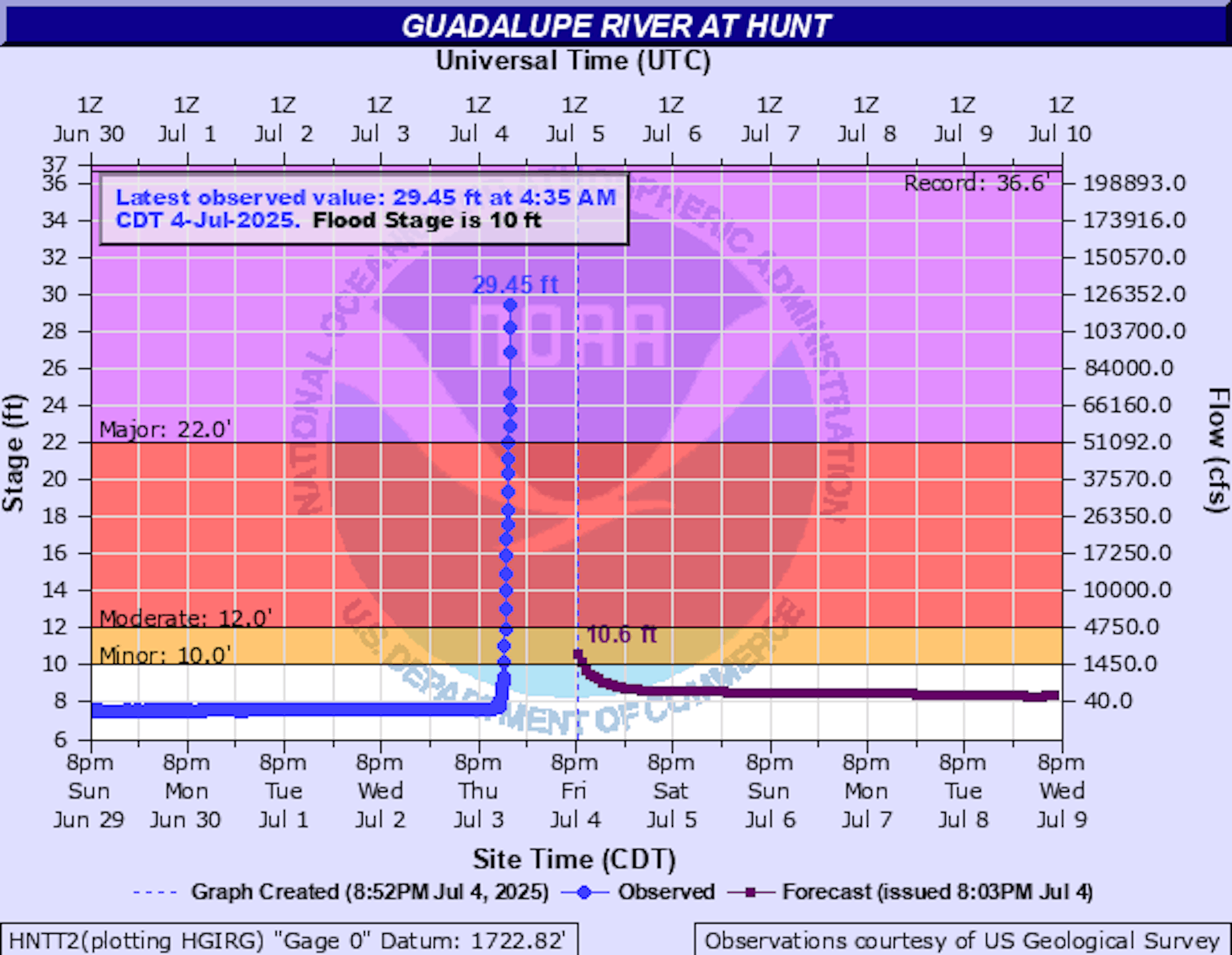
    A river gauge at Hunt, Texas, near Camp Mystic, showed how quickly the river flooded: Around 3 a.m. on July 4, the Guadalupe River was rising about 1 foot every 5 minutes at the gauge, National Weather Service data shows. By 4:30 a.m., it had risen more than 20 feet. As the water moved downstream, it reached Kerrville, where the river rose even faster.

    Flood expert Hatim Sharif, a hydrologist and civil engineer at the University of Texas at San Antonio, explains what makes this part of the country, known as Flash Flood Alley, so dangerous.

    What makes Hill Country so prone to flooding?

    Texas as a whole leads the nation in flood deaths, and by a wide margin. A colleague and I analyzed data from 1959 to 2019 and found 1,069 people had died in flooding in Texas over those six decades. The next highest total was in Louisiana, with 693.

    Many of those flood deaths have been in Hill County. It’s part of an area known as Flash Flood Alley, a crescent of land that curves from near Dallas down to San Antonio and then westward.

    The hills are steep, and the water moves quickly when it floods. This is a semi-arid area with soils that don’t soak up much water, so the water sheets off quickly and the shallow creeks can rise fast.

    When those creeks converge on a river, they can create a surge of water that wipes out homes and washes away cars and, unfortunately, anyone in its path.

    Hill Country has seen some devastating flash floods. In 1987, heavy rain in western Kerr County quickly flooded the Guadalupe River, triggering a flash flood similar to the one in 2025. Ten teenagers being evacuated from a camp died in the rushing water.

    San Antonio, at the eastern edge of Hill Country, was hit with a flash flood on June 12, 2025, that killed 13 people whose cars were swept away by high water from a fast-flooding creek near an interstate ramp in the early morning.

    Why does the region get such strong downpours?

    One reason Hill Country gets powerful downpours is the Balcones Escarpment.

    The escarpment is a line of cliffs and steep hills created by a geologic fault. When warm air from the Gulf rushes up the escarpment, it condenses and can dump a lot of moisture. That water flows down the hills quickly, from many different directions, filling streams and rivers below.

    As temperature rise, the warmer atmosphere can hold more moisture, increasing the downpour and flood risk.

    A tour of the Guadalupe River and its flood risk.

    The same effect can contribute to flash flooding in San Antonio, where the large amount of paved land and lack of updated drainage to control runoff adds to the risk.

    What can be done to improve flash flood safety?

    First, it’s important for people to understand why flash flooding happens and just how fast the water can rise and flow. In many arid areas, dry or shallow creeks can quickly fill up with fast-moving water and become deadly. So people should be aware of the risks and pay attention to the weather.

    Improving flood forecasting, with more detailed models of the physics and water velocity at different locations, can also help.

    Probabilistic forecasting, for example, can provide a range of rainfall scenarios, enabling authorities to prepare for worst-case scenarios. A scientific framework linking rainfall forecasts to the local impacts, such as streamflow, flood depth and water velocity, could also help decision-makers implement timely evacuations or road closures.

    Education is particularly essential for drivers. One to two feet of moving water can wash away a car. People may think their trucks and SUVs can go through anything, but fast-moving water can flip a truck and carry it away.

    Officials can also do more to barricade roads when the flood risk is high to prevent people from driving into harm’s way. We found that 58% of the flood deaths in Texas over the past six decades involved vehicles. The storm on June 12 in San Antonio was an example. It was early morning, and drivers had poor visibility. The cars were hit by fast-rising floodwater from an adjacent creek.

    This article, originally published July 5, 2025, has been updated with the death toll rising.

    Hatim Sharif does not work for, consult, own shares in or receive funding from any company or organization that would benefit from this article, and has disclosed no relevant affiliations beyond their academic appointment.

    ref. Why Texas Hill Country, where a devastating flood killed more than 120 people, is one of the deadliest places in the US for flash flooding – https://theconversation.com/why-texas-hill-country-where-a-devastating-flood-killed-more-than-120-people-is-one-of-the-deadliest-places-in-the-us-for-flash-flooding-260555

    MIL OSI Analysis

  • MIL-OSI United Nations: UNICEF deplores ‘unconscionable’ killing of families lining up for aid in Gaza

    Source: United Nations 2

    Catherine Russell said she was appalled by the reported killing of 15 Palestinians, including nine children and four women, who were waiting in line for nutritional supplements provided by Project Hope, a UNICEF partner organization.

    The incident occurred in Deir Al-Balah. An additional 30 people were injured, including 19 children. News reports indicate that it resulted from an Israel strike. 

    ‘Mothers seeking a lifeline’

    “The killing of families trying to access life-saving aid is unconscionable,” she said in a statement.

    These were mothers seeking a lifeline for their children after months of hunger and desperation.”

    They included Donia, whose one-year-old son, Mohammed, was killed. She reported that the boy had spoken his first words to her just hours earlier.

    “Donia now lies in a hospital bed, critically injured by the blast, clutching Mohammed’s tiny shoe,” said Ms. Russell.  “No parent should have to face such tragedy.”

    A ‘cruel reality’

    For the UNICEF chief, “this is the cruel reality confronting many in Gaza today after months of insufficient aid being allowed into the territory, and parties to the conflict failing to uphold basic responsibilities to protect civilians.”

    She explained that “the lack of aid means children are facing starvation while the risk of famine grows,” warning that “the number of malnourished children will continue to rise until life-saving aid and services are resumed at full scale.”

    “International law is clear: all parties to the conflict have an obligation to protect civilians and ensure the safe and unimpeded delivery of humanitarian assistance,” she said.

    “We call on Israel to urgently review its rules of engagement to ensure full compliance with international humanitarian law, notably the protection of civilians including children, and to conduct a thorough and independent investigation of this incident and all allegations of violations.”

    UN condemns killings

    The UN yet again condemned the killing of civilians in Gaza, Spokesperson Stéphane Dujarric told journalists in New York.

    Furthermore, the UN humanitarian affairs office OCHA “stresses that parties are bound by international humanitarian law to prevent such excessive death and injury of civilians in the midst of war,” he added.

    OCHA reported that another strike on Thursday reportedly hit the office of a humanitarian partner in Gaza City. Three staff there were killed. 

    Fuel running out

    Mr. Dujarric also updated journalists on the dire fuel situation in Gaza, which impacts both the population and humanitarians.

    A UN team managed to bring roughly 75,000 litres of fuel from Israel into the beleaguered enclave on Wednesday, marking the first such provision in 130 days.

    He warned, however, that fuel is still running out and services will shut down if greater volumes do not enter immediately.

    Water services at risk

    We and our humanitarian partners need hundreds of thousands of litres of fuel each day to keep essential lifesaving and life-sustaining operations going, meaning the amount entered yesterday isn’t sufficient to cover even one day of energy requirements,” he said.

    One aid partner reported that fuel shortages could soon cut off supplies of clean drinking water to about 44,000 children, he added, which would further increase the risk of cholera, diarrhoea, dysentery and other waterborne illnesses. 

    Meanwhile, UN partners providing education services said that between October 2023 and this June, 626 temporary learning spaces have been established in Gaza, with 240,000 students enrolled, roughly half of them girls. 

    However, only 299 spaces are currently operational due to the ongoing displacement orders, funding shortfalls and other challenges.

    Aid workers also going hungry

    Humanitarian partners in Gaza – who include first responders, health workers, and aid workers – “continue to deliver food and other assistance under intolerable conditions, and they themselves are facing hunger,” said Mr. Dujarric.

    “A number of our own colleagues are also facing hunger. They also face water scarcity and threats to their personal safety, just like everyone else in Gaza,” he added.

    The Spokesperson reiterated the UN’s long-standing message that “this catastrophic situation must end.”  He stressed that “a ceasefire is not only urgent, it is long overdue,” while also calling for the unconditional and immediate release of all hostages. 

    © UNFPA Palestine

    Some Palestinians have been forced to flee their homes in the West Bank.

    West Bank operations

    Mr. Dujarric also addressed the situation in the West Bank, where humanitarians report and continue to warn of the intensification of Israeli operations in the northern areas.

    These operations are causing massive destruction, driving further humanitarian needs and dampening hopes of thousands of displaced families that they will eventually be able to go back home,” he said.

    “Meanwhile, attacks, harassment and intimidation by Israeli settlers against Palestinians have become a daily reality.”

    He cited a settler attack on 3 July that led to the displacement of the Mu’arrajat East Bedouin community in the central West Bank. 

    “This is the ninth community to be fully displaced in the Ramallah and Jericho areas since January 2023 following the recurrent attacks by Israeli settlers.” 

    MIL OSI United Nations News

  • MIL-OSI USA: PASSED: Cortez Masto’s Bipartisan Bill to Help Americans Recover from Natural Disasters

    US Senate News:

    Source: United States Senator for Nevada Cortez Masto

    Passage of this bipartisan legislation comes as Texas and states across the U.S. experience devastating flooding. In Nevada, wildfires have already burned over 60,000 acres this year.

    Washington D.C. – Today, U.S. Senators Catherine Cortez Masto (D-Nev), John Kennedy (R-La.), Chris Van Hollen (D-Md), and Marsha Blackburn (R-Tenn.) passed their bipartisan bill to provide relief for impacted taxpayers in states that have issued state-level disaster declarations. The Filing Relief for Natural Disasters Act allows the IRS to postpone filing deadlines for taxpayers affected by state declared natural disasters, instead of only presidentially declared federal disasters. The legislation passed the House earlier this year and now heads to President Trump’s desk to be signed into law. 

    Each year, states across the country declare emergencies for events like floods and wildfires. Currently, 21 counties in Texas are under a state-level disaster declaration, but only one county has received a federal disaster declaration. Since January of 2024, the state of Nevada has also issued numerous county disaster declarations following wildfires. But, under current law, families impacted by floods and fires in areas with a state-level disaster declaration are not eligible for any tax relief because the disaster was not also declared by the President of the United States. Cortez Masto’s legislation will change that, ensuring that everyone impacted by fires, floods, and storms gets the tax relief they need.

    “A natural disaster is devastating for anyone. Impacted taxpayers should not have to worry about whether their state’s natural disaster has been recognized by the President for them to receive the support they deserve,” said Senator Cortez Masto. “This bipartisan legislation will ensure that anyone impacted by state-level emergencies can have some peace of mind when filling their taxes.”

    The Filing Relief for Natural Disasters Act would now allow a governor of a state or territory to request the IRS extend federal tax filing deadlines in the event of a state declared emergency or disaster. The legislation would also expand the mandatory federal filing extensions from 60 to 120 days. 

    This bill is just a piece of Senator Cortez Masto’s efforts to ensuring Nevadans have access to resources in the face of natural disasters. Cortez Masto has worked to deliver funding to help improve the resiliency of state infrastructure and has led legislation protect electric grids at military bases and rural water utilities from the effects of extreme weather. She also secured key provisions in the Bipartisan Infrastructure Law which provided billions to fund wildfire prevention efforts in Nevada.

    MIL OSI USA News

  • MIL-OSI USA: Baldwin, Murkowski Introduce Bipartisan Bill to Protect Our Shoreline Communities

    US Senate News:

    Source: United States Senator for Wisconsin Tammy Baldwin
    WASHINGTON, D.C. – Today, U.S. Senators Tammy Baldwin (D-WI) and Lisa Murkowski (R-AK) introduced bipartisan legislation, the Digital Coast Act, to help coastal communities better prepare for storms, cope with varying water levels, and plan for future development. The bill reauthorizes the National Oceanic and Atmospheric Administration’s (NOAA) Digital Coast Program, which Baldwin and Murkowski previously spearheaded to reestablish the program in 2020.
    “The Great Lakes are essential to the Wisconsin way of life and our economy, but make no mistake – they face some serious and unique challenges, and our local communities need tools and information to address them, keep families safe, and support our local businesses,” said Senator Baldwin. “I am proud to once again work with my Democratic and Republican colleagues to support our local coastal communities and ensure they have the resources and data they need to prepare for disasters, keep our water clean and safe, and make smart planning decisions for the future.”
    “As we confront the escalating impacts of climate change, it is crucial our coastal communities remain equipped with the tools and data they need to adapt and thrive,” said Senator Murkowski. “The Digital Coast Program has proven to be a vital resource in this effort, providing essential information and support for our local leaders to make informed decisions.”
    NOAA currently assembles and hosts the Digital Coast Project, a collaborative online database of the most up-to-date coastal information and makes it available to both the public and private sectors. Digital Coast also provides tools for coastal communities to decipher and use the high-tech mapping data to make accurate decisions and smart investments in coastal communities.
    The Digital Coast Act reauthorizes the program and ensures that communities will continue to have the data to make smart choices for economic development, shoreline management, and coastal restoration. The bill supports further development of the current project, including increasing access to uniform, up-to-date data, to help communities get the coastal data they need to respond to emergencies, plan for long-term coastal resilience, and manage their water resources.
    Companion legislation was introduced yesterday in the U.S. House by Representatives Dave Min (D-CA-47) and Rob Wittman (R-VA-01).
    “From extreme weather to competing demands for coastal property, our coastal communities need the best available resources to respond to the mounting threat of climate change,” said Congressman Min. “NOAA’s Digital Coast Program provides essential research and data to address the adverse effects of the climate crisis, all while creating thousands of high tech jobs around America. I’m proud to be leading the charge to protect Orange County’s beautiful coastline.”
    “Virginia’s First District is home to vibrant coastal communities that rely on cutting-edge data and resources to thrive, especially in the face of challenges such as extreme weather and aging infrastructure,” said Congressman Wittman. “I’m proud to help introduce the Digital Coastal Reauthorization Act alongside Rep. Dave Min, legislation that will reauthorize NOAA’s Digital Coast program. This vital program collects and distributes data that will help mitigate future weather-related issues and provide communities with the tools they need to expand and plan for the future.” 
    “Digital Coast represents the best of government at work,” said Sue Schwartz, FAICP, President of the American Planning Association. “It’s innovative, collaborative, efficient, bipartisan, and cost-effective; all while helping local communities make better decisions about how to tackle tough coastal challenges. Planners benefit from access to critical data that shapes the insights they bring to residents and local leaders. The American Planning Association strongly supports the reauthorization of this vital resource for protecting and planning our communities.” 
    “NOAA’s Digital Coast provides a one-stop shop for the data, tools and training that coastal managers and researchers use to learn and do their jobs. As a collaboration between the federal government and partner organizations and used extensively by the public and private sectors, Digital Coast is government at its most effective,” said Derek Brockbank, Executive Director of Coastal States Organization.?“The Digital Coast Act will ensure this important resource for all communities is authorized and funded for the next 5 years.”?  
    “The Digital Coast Program empowers coastal states with the tools and data they need to address real-world challenges—from flooding and hurricanes to smart growth and resource management,” said Ken Nelson, National States Geographic Information Council (NSGIC) President. “Continued federal support is vital to strengthening the geospatial foundation that drives both our economy and our national preparedness. Reauthorizing the Digital Coast Act ensures coastal communities have the high-quality data they need to plan, protect, and prosper.” 
    “To make sure that people can enjoy everything our coasts have to offer, coastal managers need to have the right tools, data and training. The Digital Coast partnership provides those products and services,” said Stephanie Bailenson, US Federal Water Policy Team Lead at The Nature Conservancy. “We’ve seen in our work across the country how Digital Coast helps coastal communities address storms and flooding while strengthening local economies. We’re happy to see the sponsors of the partnership’s reauthorization bill demonstrate the continued bi-partisan support for the partnership.”
    “The provisions of the Digital Coast Reauthorization will modernize the Digital Coast program and provide for the continuation of a sustainable program to utilize geospatial technologies to map and monitor the coastal waterways of the United States, providing an invaluable benefit to the public, and to the professionals whose charge is to protect their health, safety, and welfare,” said Timothy W. Burch, PLS, Executive Director of National Society of Professional Surveyors. 
    “The Digital Coast Program is a balanced approach to environmental protection and economic development in our valuable coastal areas.? This bill reauthorizes and modernizes a successful program that utilizes the talent of the private sector and intergovernmental agencies by providing data and services that are essential to the economic engine that is coastal America, while conserving it’s precious natural resources through geospatial data and related activities,” said John Palatiello, Founder of US Geospatial Executives Organization (U.S. GEO).
    “The Digital Coast Partnership Advocacy Coalition commends Senators Tammy Baldwin (D-WI) and Lisa Murkowski (R-AK) for introducing the Digital Coast Reauthorization Act. The Coalition also wishes to thank Representatives Dave Min (D-CA) and Rob Wittman (R-VA) for their leadership in introducing the companion bill in the House. The strong bipartisan support for this measure is a demonstration of its broad appeal and value to the nation’s communities. By consolidating coastal data from a variety of sources in one place and making it publicly accessible, the National Oceanic and Atmospheric Administration’s (NOAA) Digital Coast program is helping the coastal management community better plan for storms, flooding, natural disasters, and other challenges that impact vulnerable coastal and Great Lakes communities. Data included in the Digital Coast ranges from surveying, mapping, geospatial, economic, demographic and ecosystem data to satellite imagery. In addition to making this data publicly available online, the Digital Coast provides a wide array of visualization and prediction tools that dramatically improve the effectiveness and efficiency of coastal management projects around the country. Over the next 15 years, NOAA predicts a 411 percent return on investment from the Digital Coast program. In addition to the return on investment, the Digital Coast has played a significant role in protecting communities and natural resources from damaging natural disasters. Furthermore, 75 percent of Digital Coast users surveyed by NOAA indicated that their projects would not have been possible without the Digital Coast. By having bipartisan and bicameral introduction of the Digital Coast Reauthorization Act, we deeply appreciate your recognition of the numerous benefits the Digital Coast can provide to coastal communities and those working to make them more resilient,” said John “JB” Byrd, Coordinator, Digital Coast Partnership Advocacy Coalition. 
    “As our coastlines and beaches bear the brunt of extreme weather events, flooding, chronic erosion, sea level rise, and other hazards, coastal communities need every tool at their disposal to make informed decisions and plan for a safer, more resilient future,” said Emma Haydocy, Senior Manager of Coasts and Climate Initiative at the Surfrider Foundation. “NOAA’s Digital Coast program makes invaluable data accessible to the American public in light of these challenges, and reauthorizing and expanding this program will help safeguard vital coastal resources throughout the U.S. for years to come.”
    The legislation is endorsed by Coastal States Organization, American Planning Association, Association of State Floodplain Managers, National Association of Counties, National Society of Professional Surveyors, U.S Geospatial Executives Organization (U.S. GEO), Surfrider Foundation, The Nature Conservancy, National States Geographic Information Council, National Estuarine Research Reserve Association, Quantum Spatial Inc., Wisconsin Society of Land Surveyors, and Digital Coast Partnership Advocacy Coalition.
    Full text of the bill is available here.

    MIL OSI USA News

  • MIL-OSI USA: SPC MD 1630

    Source: US National Oceanic and Atmospheric Administration

    Mesoscale Discussion 1630
    NWS Storm Prediction Center Norman OK
    0200 PM CDT Thu Jul 10 2025

    Areas affected…Northeast New York into Vermont

    Concerning…Severe potential…Watch unlikely

    Valid 101900Z – 102100Z

    Probability of Watch Issuance…20 percent

    SUMMARY…Thunderstorms are beginning to show signs of
    intensification. Damaging winds and large hail will be possible
    through the afternoon, but confidence in thunderstorm coverage
    remains low. Watch issuance is not anticipated at this time.

    DISCUSSION…Weak convection has been percolating across northeast
    NY and VT since late morning, but has recently shown some signs of
    intensification per GOES IR imagery and vertically integrated
    liquid/echo top trends. Some degree of intensification is probable
    as daytime heating continues for the next several hours and MLCAPE
    increases to around 1000 J/kg. Elongated anvils are noted with
    deeper convection, which confirms recent forecast soundings that
    suggest upper-level winds are around 35-45 knots. However, winds
    through much of the CAPE-bearing layer remain near/below 20 knots,
    which is confirmed by recent VWP observations. Given the modest
    lapse rates/buoyancy, it remains unclear whether updrafts will be
    deep enough to sufficiently realize the stronger winds aloft and
    take on more organized supercell structures, especially given
    nebulous forcing for ascent/weak dynamic mid-level cooling.
    Consequently, a few strong/severe storms appear possible, but
    confidence in the overall coverage and longevity of severe
    convection remains limited. Trends will continue to be monitored,
    but watch issuance is currently not anticipated.

    ..Moore/Mosier.. 07/10/2025

    …Please see www.spc.noaa.gov for graphic product…

    ATTN…WFO…GYX…BTV…ALY…

    LAT…LON 45067401 45047151 44547155 44217176 43837204 43517228
    43117281 42897327 42787353 42767391 42877430 43127455
    43497457 43897442 44217428 44567422 44907417 45067401

    MOST PROBABLE PEAK WIND GUST…55-70 MPH
    MOST PROBABLE PEAK HAIL SIZE…UP TO 1.25 IN

    MIL OSI USA News

  • MIL-OSI USA: SPC MD 1631

    Source: US National Oceanic and Atmospheric Administration

    Mesoscale Discussion 1631
    NWS Storm Prediction Center Norman OK
    0220 PM CDT Thu Jul 10 2025

    Areas affected…north-central into eastern Nebraska…far southeast
    South Dakota…western Iowa

    Concerning…Severe potential…Watch likely

    Valid 101920Z – 102145Z

    Probability of Watch Issuance…95 percent

    SUMMARY…Severe storms are expected to develop close to 21Z over
    north-central Nebraska, with activity spreading east/southeast
    across the Missouri River this evening. A tornado and hail risk may
    exist initially, following by a corridor of significant damaging
    wind potential.

    DISCUSSION…Satellite and radar indicate an arcing line of elevated
    thunderstorms over northeast NE, spreading into southeast SD and
    western IA. This activity is supported by theta-e advection with
    southwest flow off the surface, with steep lapse rates aloft.

    Behind this activity, temporary subsidence and clearing exist over
    eastern NE. While initially cool, this air mass should destabilize
    again this evening.

    Meanwhile, a large CU field is currently developing over central and
    north-central NE, near a stationary front. Deep moisture convergence
    will persist in this area, with the cap being breached later this
    afternoon. Aiding cap removal are hot temperatures just downstream
    into northern KS/southern NE, where temperatures are over 100 F.

    Veering winds with height, combined with strong instability, will
    favor slow-moving supercells at first, with tornado and large hail
    risk. With time, a severe MCS is forecast, with increasing damaging
    wind potential. Significant wind gusts over 75 mph appear likely.

    ..Jewell/Mosier.. 07/10/2025

    …Please see www.spc.noaa.gov for graphic product…

    ATTN…WFO…DMX…FSD…OAX…GID…LBF…

    LAT…LON 41029794 41229927 41499983 41949999 42110000 42480001
    42779985 43059917 43089837 43129680 42879615 42379563
    41999555 41449565 41079604 40929644 40979723 41059787
    41029794

    MOST PROBABLE PEAK TORNADO INTENSITY…100-130 MPH
    MOST PROBABLE PEAK WIND GUST…65-80 MPH
    MOST PROBABLE PEAK HAIL SIZE…1.50-2.50 IN

    MIL OSI USA News

  • MIL-OSI USA: SPC MD 1632

    Source: US National Oceanic and Atmospheric Administration

    Mesoscale Discussion 1632

    Mesoscale Discussion 1632
    NWS Storm Prediction Center Norman OK
    0241 PM CDT Thu Jul 10 2025

    Areas affected…much of western Kansas into south-central Nebraska

    Concerning…Severe potential…Watch likely

    Valid 101941Z – 102145Z

    Probability of Watch Issuance…80 percent

    SUMMARY…Storms will develop across much of western Kansas and into
    south-central Nebraska, with damaging wind gusts likely. Isolated
    large hail may also occur.

    DISCUSSION…Satellite imagery shows towering CU developing with a
    surface trough/wind shift from the western OK across KS and into
    south-central NE. Temperatures within this zone are near 100 F,
    while dewpoints have only only mixed down into the mid to upper 50s
    F.

    Given the hot and deeply mixed boundary layer, strong wind gusts
    appear probable. Veering winds with height also suggest some
    cellular mode is possible as well, and isolated hail may occur with
    the strongest storms. However, northeastward propagating mixed-mode
    severe appears most likely.

    ..Jewell/Mosier.. 07/10/2025

    …Please see www.spc.noaa.gov for graphic product…

    ATTN…WFO…GID…LBF…DDC…GLD…

    LAT…LON 38060147 39230067 40340004 40979977 41329961 41489934
    41559895 41379862 41079852 40349859 39689880 38899918
    38159992 37420083 37200155 37240188 37460195 38060147

    MOST PROBABLE PEAK TORNADO INTENSITY…UP TO 95 MPH
    MOST PROBABLE PEAK WIND GUST…65-80 MPH
    MOST PROBABLE PEAK HAIL SIZE…1.00-1.75 IN

    Top/All Mesoscale Discussions/Forecast Products/Home

    MIL OSI USA News

  • MIL-OSI USA: SPC Tornado Watch 501

    Source: US National Oceanic and Atmospheric Administration

    Note:  The expiration time in the watch graphic is amended if the watch is replaced, cancelled or extended.Note: Click for Watch Status Reports.
    SEL1

    URGENT – IMMEDIATE BROADCAST REQUESTED
    Tornado Watch Number 501
    NWS Storm Prediction Center Norman OK
    310 PM CDT Thu Jul 10 2025

    The NWS Storm Prediction Center has issued a

    * Tornado Watch for portions of
    Far Western Iowa
    Northeast Nebraska
    Extreme Southeast South Dakota

    * Effective this Thursday afternoon and evening from 310 PM until
    1000 PM CDT.

    * Primary threats include…
    A couple tornadoes possible
    Scattered damaging winds and isolated significant gusts to 80
    mph likely
    Scattered large hail and isolated very large hail events to 2
    inches in diameter likely

    SUMMARY…Thunderstorm development is anticipated within the very
    unstable airmass across central/northeast NE this afternoon.
    Environmental conditions support initial supercells capable of all
    severe hazards, including large to very large hail and tornadoes.
    Upscale growth is anticipated after the initial cellular mode, with
    the resultant convective line progressing quickly eastward. Strong
    wind gusts are possible within this line, including gusts over 75
    mph.

    The tornado watch area is approximately along and 75 statute miles
    north and south of a line from 5 miles north northwest of Broken Bow
    NE to 10 miles east of Denison IA. For a complete depiction of the
    watch see the associated watch outline update (WOUS64 KWNS WOU1).

    PRECAUTIONARY/PREPAREDNESS ACTIONS…

    REMEMBER…A Tornado Watch means conditions are favorable for
    tornadoes and severe thunderstorms in and close to the watch
    area. Persons in these areas should be on the lookout for
    threatening weather conditions and listen for later statements
    and possible warnings.

    &&

    AVIATION…Tornadoes and a few severe thunderstorms with hail
    surface and aloft to 2 inches. Extreme turbulence and surface wind
    gusts to 70 knots. A few cumulonimbi with maximum tops to 500. Mean
    storm motion vector 27035.

    …Mosier

    SEL1

    URGENT – IMMEDIATE BROADCAST REQUESTED
    Tornado Watch Number 501
    NWS Storm Prediction Center Norman OK
    310 PM CDT Thu Jul 10 2025

    The NWS Storm Prediction Center has issued a

    * Tornado Watch for portions of
    Far Western Iowa
    Northeast Nebraska
    Extreme Southeast South Dakota

    * Effective this Thursday afternoon and evening from 310 PM until
    1000 PM CDT.

    * Primary threats include…
    A couple tornadoes possible
    Scattered damaging winds and isolated significant gusts to 80
    mph likely
    Scattered large hail and isolated very large hail events to 2
    inches in diameter likely

    SUMMARY…Thunderstorm development is anticipated within the very
    unstable airmass across central/northeast NE this afternoon.
    Environmental conditions support initial supercells capable of all
    severe hazards, including large to very large hail and tornadoes.
    Upscale growth is anticipated after the initial cellular mode, with
    the resultant convective line progressing quickly eastward. Strong
    wind gusts are possible within this line, including gusts over 75
    mph.

    The tornado watch area is approximately along and 75 statute miles
    north and south of a line from 5 miles north northwest of Broken Bow
    NE to 10 miles east of Denison IA. For a complete depiction of the
    watch see the associated watch outline update (WOUS64 KWNS WOU1).

    PRECAUTIONARY/PREPAREDNESS ACTIONS…

    REMEMBER…A Tornado Watch means conditions are favorable for
    tornadoes and severe thunderstorms in and close to the watch
    area. Persons in these areas should be on the lookout for
    threatening weather conditions and listen for later statements
    and possible warnings.

    &&

    AVIATION…Tornadoes and a few severe thunderstorms with hail
    surface and aloft to 2 inches. Extreme turbulence and surface wind
    gusts to 70 knots. A few cumulonimbi with maximum tops to 500. Mean
    storm motion vector 27035.

    …Mosier

    Note: The Aviation Watch (SAW) product is an approximation to the watch area. The actual watch is depicted by the shaded areas.
    SAW1
    WW 501 TORNADO IA NE SD 102010Z – 110300Z
    AXIS..75 STATUTE MILES NORTH AND SOUTH OF LINE..
    5NNW BBW/BROKEN BOW NE/ – 10E DNS/DENISON IA/
    ..AVIATION COORDS.. 65NM N/S /52ENE LBF – 55NNE OVR/
    HAIL SURFACE AND ALOFT..2 INCHES. WIND GUSTS..70 KNOTS.
    MAX TOPS TO 500. MEAN STORM MOTION VECTOR 27035.

    LAT…LON 42589967 43079519 40899519 40419967

    THIS IS AN APPROXIMATION TO THE WATCH AREA. FOR A
    COMPLETE DEPICTION OF THE WATCH SEE WOUS64 KWNS
    FOR WOU1.

    Watch 501 Status Report Message has not been issued yet.

    Note:  Click for Complete Product Text.Tornadoes

    Probability of 2 or more tornadoes

    Mod (40%)

    Probability of 1 or more strong (EF2-EF5) tornadoes

    Low (20%)

    Wind

    Probability of 10 or more severe wind events

    Mod (60%)

    Probability of 1 or more wind events > 65 knots

    Mod (60%)

    Hail

    Probability of 10 or more severe hail events

    Mod (60%)

    Probability of 1 or more hailstones > 2 inches

    Mod (60%)

    Combined Severe Hail/Wind

    Probability of 6 or more combined severe hail/wind events

    High (>95%)

    For each watch, probabilities for particular events inside the watch (listed above in each table) are determined by the issuing forecaster. The “Low” category contains probability values ranging from less than 2% to 20% (EF2-EF5 tornadoes), less than 5% to 20% (all other probabilities), “Moderate” from 30% to 60%, and “High” from 70% to greater than 95%. High values are bolded and lighter in color to provide awareness of an increased threat for a particular event.

    MIL OSI USA News

  • MIL-OSI USA: Luján Questions President Trump’s NOAA Administrator Nominee on Putting Facts and Science First

    US Senate News:

    Source: US Senator for New Mexico Ben Ray Luján

    Dr. Neil Jacobs was involved in the 2019 “Sharpiegate,” when President Trump altered a hurricane map to falsely show Hurricane Dorian hitting Alabama, contradicting official forecasts

    Washington, D.C. – U.S. Senator Ben Ray Luján (D-N.M.), a member of the Senate Committee on Commerce, Science, and Transportation, questioned Dr. Neil Jacobs, President Trump’s nominee to lead the National Oceanic and Atmospheric Administration (NOAA), about his commitment to telling the truth during emergencies.

    Dr. Jacobs, who previously served as acting NOAA Administrator during President Trump’s first term, had defended the president’s dissemination of inaccurate weather information during a severe weather emergency. The Committee hearing came in the wake of deadly flooding in New Mexico and Texas, which claimed three lives in Ruidoso.

    MSNBC – All in With Chris Hayes: Trump’s Pick to Lead NOAA Faces Senate

    WATCH: Chris Hayes Highlights Senator Lujan’s Questioning of Dr. Neil Jacobs

    Washington Post – Trump’s NOAA pick stands by budget cuts, calls staffing ‘a top priority’

    “When Sen. Ben Ray Luján (D-New Mexico) asked whether Jacobs believed Americans should have to pay for access to the best forecasting data, he answered no.”

    ABC News – Senate considers Neil Jacobs, ‘Sharpiegate’ scientist, as NOAA administrator

    “When asked by Sen. Ben Ray Luján, D-NM, on Wednesday whether he would “make the same decision again,” Jacobs replied, “There’s probably some things I would do differently.”

    The Hill – Amid bipartisan concern, NOAA nominee pledges to make Weather Service staffing a ‘top priority’

    “Asked by Sen. Ben Ray Luján (D-N.M.) whether he would “sign off on an inaccurate statement due to political pressure in the same event,” Jacobs said no.”

    An excerpt of the exchange is available HERE and below: 

    Sen. Luján: September 1, 2019, when you were NOAA’s acting administrator, President Trump erroneously tweeted Alabama had been hit hard by Hurricane Dorian. 

    Shortly after, the National Weather Service Birmingham office issued the accurate statement, “Alabama will not see any impacts from Dorian.”

    Three days later, President Trump went on TV and displayed a weather map altered with a black Sharpie line to show that Dorian would hit Alabama.

    Two days after that, you helped draft a release rebuking the Birmingham NWS, and repeating President Trump’s baseless claims that Hurricane Dorian could impact Alabama.

    You told the Department of Commerce Office of Inspector General in their investigation that you “definitely felt like our jobs were on the line,” and while you did not like it, you would make the same decision again to edit a less inflammatory statement as the least bad option. Dr. Jacobs, do I have it right? Is that correct?

    Dr. Jacobs: That is what the report found.

    Sen. Luján: You would do nothing differently?

    Dr. Jacobs: There are probably some things I would do differently, and a lot of this that I did after that, I guess, to change any potential future outcome.

    Sen. Luján: I just had constituents die in New Mexico and constituents in Texas. Would you sign off on an inaccurate statement due to political pressure in the same event, yes or no?

    Dr. Jacobs: No.

    Sen. Luján: I appreciate that very much.

    MIL OSI USA News

  • MIL-OSI Video: Sustainable Development Goals Report 2025, Francesca Albanese & other topics – Daily Press Briefing

    Source: United Nations (video statements)

    Noon Briefing by Stéphane Dujarric, Spokesperson for the Secretary-General.

    Highlights:
    Sustainable Development Goals Report 2025
    Francesca Albanese
    Occupied Palestinian Territory
    Lebanon
    Ukraine
    Sudan
    Somalia
    Democratic Republic of the Congo
    Libya
    UN Environment Programme/Report
    Briefings

    SUSTAINABLE DEVELOPMENT GOALS REPORT 2025
    On Monday, in a press conference, the Secretary-General will launch the Sustainable Development Goals Report 2025. He will be joined by the Deputy-Secretary-General Amina Mohammed and our Under-Secretary-General for Economic and Social Affairs, Li Junhua.

    The press conference will take place at 12:45 p.m., just after the noon briefing.

    FRANCESCA ALBANESE
    In response to questions on the sanctions imposed by the United States on Francesca Albanese, the Spokesman said that the imposition of sanctions on special rapporteurs is a dangerous precedent.

    Francesca Albanese, like all other Special UN Human Rights Rapporteurs, is an independent human rights expert appointed by the UN Human Rights Council and reporting to the Human Rights Council. Special Rapporteurs do not report to the Secretary-General, and he has no authority over them or their work.

    That being said, Member States are perfectly entitled to their views and to disagree with the reports by the Special Rapporteurs, but we encourage them to engage with the UN human rights architecture.
    The use of unilateral sanctions against special rapporteurs, or any other UN expert or official is unacceptable.

    OCCUPIED PALESTINIAN TERRITORY
    The Office for the Coordination of Humanitarian Affairs (OCHA) said that a UN team managed to bring about 75,000 litres of fuel from Israel into the Gaza Strip. That is the first such provision in 130 days. As mentioned yesterday during the noon briefing, the UN and its humanitarian partners need hundreds of thousands of litres of fuel each day to keep essential life-saving and life-sustaining operations going, meaning the amount entered yesterday isn’t sufficient to cover even one day of energy requirements. Fuel is still running out and services will shut down if greater volumes do not enter Gaza Strip immediately.

    One partner, for instance, reported that this week that in a matter of days, fuel shortages could cut off supplies of clean drinking water to about 44,000 children that depend on that water source. The lack of fresh water would further increase the risk of waterborne illnesses such as cholera, diarrhea and dysentery. 

    Meanwhile, the Israeli military continues its operations across the Gaza Strip, including shelling and ground incursions. This morning, people waiting to get nutritional supplements were reportedly struck in Deir al Balah. According to Al-Aqsa Hospital, the attack resulted in dozens of casualties, the majority of whom were women and children. 

    In a statement issued today, Catherine Russell, the Executive Director of the UN Children’s Fund (UNICEF), said she was appalled by the reported killing of 15 Palestinians, including nine children and four women, who were just waiting in line for nutritional supplies their children. And I can tell you that the UN, yet again, condemns the killing of civilians in Gaza.

    OCHA stresses that parties are bound by international humanitarian law to prevent such excessive death and injury of civilians in the midst of war.
    All parties must take all feasible precautions to avoid and minimize civilian harm, and indiscriminate attacks are strictly prohibited.

    Another strike today reportedly hit the office of a humanitarian partner in Gaza city; three staff were killed.

    Yesterday, UN partners providing education services said that between October 2023 and June of this year, 626 temporary learning spaces have been established in Gaza, with 240,000 students enrolled, about half of those students are girls. However, UN partners say that only 299 spaces are currently operational due to the ongoing displacement orders, funding shortfalls and other challenges.

    UN humanitarian partners, including first responders, health workers, and aid workers, continue to deliver food and other assistance under intolerable conditions, and they themselves are facing hunger. A number of our own colleagues are also facing hunger. They also face water scarcity and threats to their personal safety, just like everyone else in Gaza.
    As we said, time and again: This catastrophic situation must end. A ceasefire is not only urgent, it is long overdue, and all of the hostages need to be released unconditionally and immediately.

    Full highlights: https://www.un.org/sg/en/content/noon-briefing-highlight?date%5Bvalue%5D%5Bdate%5D=10%20July%202025

    https://www.youtube.com/watch?v=oCq6GB-B6Sk

    MIL OSI Video

  • MIL-OSI Russia: China extends yellow alert for heavy rains

    Translation. Region: Russian Federal

    Source: People’s Republic of China in Russian – People’s Republic of China in Russian –

    An important disclaimer is at the bottom of this article.

    Source: People’s Republic of China – State Council News

    BEIJING, July 10 (Xinhua) — China’s National Meteorological Center (NMC) extended a yellow alert for rainstorms on Thursday evening, warning of the threat of heavy rains in some parts of the country.

    Heavy rain and downpours are forecast to occur in parts of Fujian, Guangdong, Hainan, Yunnan, Guizhou, Sichuan, Jiangxi, Hunan, Jiangsu, Zhejiang, Heilongjiang, Guangxi Zhuang Autonomous Region, Inner Mongolia Autonomous Region, Chongqing Municipality and Taiwan from 8:00 p.m. July 10 to 8:00 p.m. July 11.

    Heavy rainfall of up to 300mm is forecast in parts of Guangdong and Fujian provinces.

    As specified by the meteorological department, in some places in the indicated regions short-term showers with a maximum amount of precipitation of more than 80 mm per hour are possible, accompanied by thunderstorms and squalls.

    The NMC recommended that local authorities prepare for possible heavy rains and take necessary drainage measures in urban areas and agricultural lands.

    China has a four-tier weather warning system, with red representing the highest level of danger, followed by orange, yellow and blue. –0–

    Please note: This information is raw content obtained directly from the source of the information. It is an accurate report of what the source claims and does not necessarily reflect the position of MIL-OSI or its clients.

    .

    MIL OSI Russia News

  • MIL-OSI USA: Rep. Gabe Vasquez and New Mexico Delegation Help Unlock Federal Funds to Support Ongoing Ruidoso Flood Response

    Source: US Representative Gabe Vasquez’s (NM-02)

    WASHINGTON, D.C. – On July 10, 2025, President Trump granted a Direct Federal Assistance emergency declaration for Ruidoso, providing critical federal resources to help the community recover and rebuild after major flooding on Tuesday. This federal emergency declaration comes after U.S. Representative Gabe Vasquez (NM-02) and all members of New Mexico’s Congressional delegation joined Governor Michelle Lujan Grisham in urging the President to declare the Ruidoso flooding a federal emergency. 

    “The impacts of this historic flood require federal resources for adequate recovery and ongoing mitigation efforts, there’s no other way around it,” said Vasquez. “Working with local, state and federal officials, we successfully unlocked crucial disaster funding to address the immediate needs of recovery operations. I will continue to work closely with my colleagues and the Governor to ensure the best and most efficient use of these funds and ensure New Mexicans who were impacted are taken care of.”

    At a press conference this morning, emergency management personnel on the ground said there was a possibility of additional rains and flooding in the Ruidoso area on Saturday, July 12, and that they would continue to monitor the situation and provide timely updates to the public.

    ###

    MIL OSI USA News

  • MIL-OSI Canada: Prime Minister Carney participates in a virtual meeting in support of Ukraine

    Source: Government of Canada – Prime Minister

    Today, the Prime Minister, Mark Carney, participated in a virtual meeting of the Coalition of the Willing.

    The meeting was co-chaired by the Prime Minister of the United Kingdom, Sir Keir Starmer, and the President of France, Emmanuel Macron. It was also attended by many of Canada’s closest allies and partners, including the President of Ukraine, Volodymyr Zelenskyy, and representatives of the United States – senators Lindsay Graham and Richard Blumenthal as well as U.S. Special Envoy General Keith Kellogg.

    The Coalition unequivocally condemned Russia’s latest strikes against Ukraine. They affirmed collective efforts to exert pressure on Russia, including through further sanctions as well as military and financial assistance to Ukraine. Prime Minister Carney raised Canada’s robust support to Ukraine, most recently through a major sanctions package targeting Russia’s shadow fleet and energy revenues; an additional $2 billion in new military support, with funding for drones, ammunition, and armoured vehicles, among other capabilities; and the disbursement of a $2.3 billion loan, to help rebuild Ukraine’s infrastructure and public systems.

    The Coalition underscored their steadfast support for Ukraine’s long-term security and sovereignty, and actions to establish a post-ceasefire force. To advance a just and lasting peace, the Coalition of the Willing will have new permanent headquarters in Paris, with plans in place for a future co-ordination cell in Kyiv.

    Associated link

    MIL OSI Canada News

  • MIL-OSI Security: Armed Carjackers Sentenced To Seven Years In Prison

    Source: United States Bureau of Alcohol Tobacco Firearms and Explosives (ATF)

    CHARLOTTE, N.C. – Two armed carjackers were sentenced to prison today for firearms offenses, announced Russ Ferguson, U.S. Attorney for the Western District of North Carolina. Joseph Jaream Stephens, 23, and Davon Omarion Long, 19, both of Charlotte, were each sentenced to seven years in prison and were ordered to serve five and three years, respectively, under court supervision upon completion of their prison terms.

    Alicia Jones, Special Agent in Charge of the U.S. Bureau of Alcohol, Tobacco, Firearms and Explosives (ATF), Charlotte Field Division, and Chief Johnny Jennings of the Charlotte Mecklenburg Police Department (CMPD), join U.S. Attorney Ferguson in making today’s announcement.

    According to court documents and court proceedings, on April 19, 2024, Long and Stephens approached a vehicle being fueled at the pump of a gas station located on W. Sugar Creek, in Charlotte. Armed with a handgun, Stephens approached from the rear driver’s side and confronted the driver, while Long approached the passenger side of the vehicle and pointed a handgun at two passengers. All three victims abandoned the vehicle and fled. After the victims fled Long got into the front passenger seat, and Stephens got into the driver’s seat. Stephens was unable to re-start the vehicle and both defendants fled on foot. Both men were apprehended across the street from the carjacking in a motel parking lot.

    On February 14, 2025, the defendants pleaded guilty to possession and brandishing of a firearm in furtherance of a crime of violence. They remain in custody pending transfer to the Federal Bureau of Prisons upon designation of a federal facility.

    The ATF and CMPD handled the investigation.

    The U.S. Attorney’s Office in Charlotte prosecuted the case.

    MIL Security OSI

  • MIL-OSI Security: Former City of Raleigh Firefighter Pleads Guilty to Dark Web Drug Trafficking Scheme

    Source: United States Bureau of Alcohol Tobacco Firearms and Explosives (ATF)

    RALEIGH, N.C. – A former City of Raleigh firefighter and his wife have pleaded guilty today to running a large-scale drug trafficking operation involving cocaine, methamphetamine, and other narcotics. Nicholas Banister, 36, and Amanda Banister, 36, admitted to using the dark web and cryptocurrency to distribute drugs across Eastern North Carolina.

    “The defendant, a Raleigh firefighter, served in a position of public trust, but was hiding in plain sight as he and his wife sold numerous types of illegal narcotics around businesses the community frequently visits,” said Acting U.S. Attorney Daniel P. Bubar.  “I’m proud of our federal and state partners at the Bureau of Alcohol Tobacco and Firearms (ATF) and North Carolina Alcohol Law Enforcement (NC ALE) for their hard work, which is holding these individuals accountable and making our community safer.”

    “It is unfortunate to see someone we trust to help keep us protected involved in criminal activities that jeopardize public safety,” said ATF Special Agent in Charge Alicia Jones. “ATF realizes the danger and violence associated with drug trafficking, and we’re proud to work with our local and state law enforcement partners to break up those networks and better protect our communities.”

    “A primary focus for ALE is reducing crime associated with alcohol establishments and protecting the safety of our communities. In this case, undercover ALE special agents conducted a comprehensive investigation that led to the arrest and conviction of two individuals — one of whom had taken an oath to protect others but instead chose to put lives at risk,” said Bryan House, Director of North Carolina Alcohol Law Enforcement. “We’re hopeful this case, along with our continued efforts, will have a positive impact on our state.”

    According to court documents and other information presented in court, Banister conspired with his wife to sell cocaine and methamphetamine on four occasions to an undercover law enforcement officer at the Morgan Street Food Hall in Raleigh. The NC ALE executed a search warrant at Banister’s residence in Raleigh, where they found 1,324.43 grams of methamphetamine, 844 grams of cocaine, over 7 kilograms of marijuana, 382 grams of psilocybin mushrooms, Xanax and Ecstasy pills, 216 units of LSD, 15 grams of dimethyltryptamine (DMT), two firearms, a digital wallet used to store cryptocurrency and $213,810 in U.S. currency. Banister had been selling cocaine, methamphetamine, and LSD every other week for at least a year prior to his arrest. Banister purchased the narcotics from the dark web using cryptocurrency, had them shipped to North Carolina, and then sold them to various buyers, primarily in the Glenwood South area. Banister utilized the Snapchat application to advertise narcotics by providing a “menu” for buyers. The following appeared on Banister’s Snapchat account and was presented in court:

    Banister was employed with the City of Raleigh Fire Department at the time of the charged offenses.

    Both Banister and his wife face a mandatory minimum of 10 years’ imprisonment when sentenced at a later date.

    Daniel P. Bubar, Acting U.S. Attorney for the Eastern District of North Carolina made the announcement after arraignment by U.S. Magistrate Judge Robert T. Numbers II. The NC ALE and the ATF investigated the case and Special Assistant U.S. Attorney (SAUSA) Aria Q. Merle prosecuted the case. SAUSA Merle is a prosecutor with the Wake County District Attorney’s Office assigned to the United States Attorney’s Office to prosecute federal violent crimes and other criminal matters. 

    A copy of this press release is located on our website. Related court documents and information can be found on the website of the U.S. District Court for the Eastern District of North Carolina or on PACER by searching for Case No. 5:25-cr-00106-D.

    MIL Security OSI

  • MIL-OSI: United Fire Group, Inc. announces senior notes offering

    Source: GlobeNewswire (MIL-OSI)

    CEDAR RAPIDS, Iowa, July 10, 2025 (GLOBE NEWSWIRE) — United Fire Group, Inc. (UFG) (Nasdaq: UFCS), a property and casualty insurance holding company, today announced that it has successfully completed a placement of $30 million aggregate principal senior unsecured 9.0% Series B notes due May 31, 2039, (the “notes”) in a private offering (the “offering”) with Ares Alternative Credit funds. Proceeds from the offering will be used to support anticipated growth and for general corporate purposes.

    Stonybrook Capital, LLC served as the company’s exclusive financial advisor in connection with the offering.  

    The notes were offered and sold in a transaction exempt from the registration requirements of the U.S. Securities Act of 1933, as amended (the “Securities Act”), and in the United States only to persons reasonably believed to be “qualified institutional buyers” in reliance on the exemption from registration under the Securities Act provided by Rule 144A and outside the United States to certain non U.S. persons in offshore transactions in reliance on Regulation S under the Securities Act.

    This press release shall not constitute an offer to sell or a solicitation of an offer to buy nor shall there be any sale of these securities in any state in which such offer, solicitation or sale would be unlawful prior to registration or qualification under the securities laws of such state.

    About UFG

    Founded in 1946 as United Fire & Casualty Company, UFG, through its insurance company subsidiaries, is engaged in the business of writing property and casualty insurance. The company is licensed as a property and casualty insurer in 50 states and the District of Columbia, and is represented by approximately 1,000 independent agencies. AM Best assigns a rating of “A-” (Excellent) for members of the United Fire & Casualty Group. For more information about UFG, visit www.ufginsurance.com.

    Disclosure of forward-looking statements

    This release may contain forward-looking statements about our operations, anticipated performance and other similar matters. The Private Securities Litigation Reform Act of 1995 provides a safe harbor under the Securities Act of 1933 and the Securities Exchange Act of 1934 for forward-looking statements. The forward-looking statements are not historical facts and involve risks and uncertainties that could cause actual results to differ from those expected and/or projected. Such forward-looking statements are based on current expectations, estimates, forecasts and projections about the company, the industry in which we operate, and beliefs and assumptions made by management. Words such as “expect(s),” “anticipate(s),” “intend(s),” “plan(s),” “believe(s),” “continue(s),” “seek(s),” “estimate(s),” “goal(s),” “remain(s) optimistic,” “target(s),” “forecast(s),” “project(s),” “predict(s),” “should,” “could,” “may,” “will,” “might,” “hope,” “can” and other words and terms of similar meaning or expression in connection with a discussion of future operations, financial performance or financial condition, are intended to identify forward-looking statements. These statements are not guarantees of future performance and involve risks, uncertainties and assumptions that are difficult to predict. Therefore, actual outcomes and results may differ materially from what is expressed in such forward-looking statements. Information concerning factors that could cause actual outcomes and results to differ materially from those expressed in the forward-looking statements is contained in Part I, Item 1A “Risk Factors” of our Annual Report on Form 10-K for the year ended December 31, 2024 (“2024 Annual Report”), filed with the Securities and Exchange Commission (“SEC”) on February 26, 2025. The risks identified in our 2024 Annual Report and in our other SEC filings are representative of the risks, uncertainties, and assumptions that could cause actual outcomes and results to differ materially from what is expressed in the forward-looking statements. Readers are cautioned not to place undue reliance on these forward-looking statements, which speak only as of the date of this release or as of the date they are made. Except as required under the federal securities laws and the rules and regulations of the SEC, we do not have any intention or obligation to update publicly any forward-looking statements, whether as a result of new information, future events, or otherwise, except as required by law.

    Contact:

    Investor relations
    Email: ir@unitedfiregroup.com

    Media inquiries
    Email: news@unitedfiregroup.com

    The MIL Network

  • MIL-OSI United Nations: Update 301 – IAEA Director General Statement on Situation in Ukraine

    Source: International Atomic Energy Agency (IAEA)

    Ukraine’s Zaporizhzhya Nuclear Power Plant (ZNPP) remains connected to its last remaining main power line following the recent loss of all off-site power on 4 July, an ongoing situation that highlights the heightened nuclear safety and security risks during the conflict, Director General Rafael Mariano Grossi of the International Atomic Energy Agency (IAEA) said today.

    The loss of power– the ninth since the start of the conflict in February 2022 – forced the ZNPP to rely on its backup diesel generators for almost four hours as the plant’s one remaining back-up line remains disconnected after being reportedly damaged by military activity on 7 May. The IAEA team based at the ZNPP site— Europe’s largest nuclear facility — was informed this week that the emergency diesel generator fuel tanks used during the loss of power have since been replenished and the site has enough fuel to enable operation of emergency diesel generators for approximately 20 days, in case of a loss of off-site power event.

    The IAEA team at South Ukraine nuclear power plant (SUNPP) reported that the plant also lost its connection to one 750 kilovolt (kV) off-site power line on 4 July, for approximately the same time as the ZNPP lost off-site power. During that time, the SUNPP continued to receive off-site power from its other 750 kV line and all of its 330 kV power lines. There was no impact on the one unit currently operating, while the other two units continue planned maintenance and refueling activities.

    The IAEA team continued to assess the availability of spare parts necessary for the continued safe operation of the plant by visiting the storage areas for the parts in the thermomechanical and electrical warehouses located within the ZNPP’s site perimeter and will be requesting the findings of recent audits by the ZNPP of spare parts. The team is also expecting to be updated on the delayed procurement of spare parts needed so that the ZNPP can commence annual maintenance of all 20 emergency diesel generators which are essential to safety in case of a loss of off-site power event.

    Also this week, the IAEA team reported that maintenance activities continue at the site, including on one safety train of unit 2 and on the main transformer of unit 4, while maintenance on one safety train of unit 5 is expected to be completed on Friday. Recently, the team also visited all main control rooms where it confirmed the number of operating staff present and recorded safety parameters for all units.

    The IAEA team reported hearing military activity on most days over the past week, including gunfire near the plant on 4 July and three explosions close to the plant on 5 July.

    The IAEA team at the Rivne nuclear power plant (NPP) reported that one reactor continues its planned maintenance and refueling activities, and one other unit was required to temporarily reduce reactor power to enable for the inspection and repair of one of the turbines. The repairs were successfully completed, and the reactor has returned to nominal full power.

    IAEA teams present at all sites — the Khmelnytskyy, Rivne and South Ukraine NPPs and the Chornobyl NPP site — reported hearing air raid alarms on most days over the past week. At the Khmelnytskyy NPP the team was informed that drones were observed as close as five kilometres from the site, while the team at the Rivne NPP had to shelter at its hotel on two separate days and the teams at the Khmelnytskyy and Rivne NPPs sheltered at site today. The team at the Chornobyl NPP site reported hearing the sounds of a drone and anti-aircraft fire at the Chornobyl NPP site on the evening of 9 July, and were informed by the site management that a drone had reportedly flown over the open switchyard and was intercepted by the military. 

    As part of the IAEA’s comprehensive assistance programme to support nuclear safety and security in Ukraine, the Chornobyl NPP site received equipment aimed at enhancing the nuclear security measures at the site and the Khmelnytskyy and South Ukraine NPPs received equipment aimed at enhancing radiation monitoring capabilities. Additionally, the Ukrainian Hydrometeorological Center and the hydrometeorological organizations of the State Emergency Service of Ukraine received multipurpose radiation monitoring devices.

    These deliveries were funded by the European Union, Switzerland and the United Kingdom, and brought the total number of IAEA-coordinated deliveries since the start of the armed conflict to 146.

    MIL OSI United Nations News

  • MIL-OSI USA: US Department of Labor cites Georgia-based Keystone Foods for exposing workers to fire, explosion hazards

    Source: US Department of Labor

    ATLANTA – U.S. Department of Labor safety inspectors cited Keystone Foods, a distributor for Tyson Foods, for allegedly failing to protect employees against fire and explosion hazards at its Camilla, Georgia, poultry plant.   

    The department’s Occupational Safety and Health Administration determined that on Dec. 26, 2024, two workers at the plant, which is a wholly owned subsidiary of Tyson Foods Inc., were seriously burned when a hose filled with oil ruptured, igniting the oil mist and causing a fire and explosion in the boiler room. Inspectors concluded Keystone Foods did not ensure workers followed proper internal procedures nor the manufacturer’s guidelines when conducting maintenance on its boiler pump. 

    OSHA issued Keystone Foods a citation for a serious violation under the OSH Act’s general duty clause and proposed penalties of $16,550.

    The company has 15 business days from receipt of their citations and penalties to comply, request an informal conference with OSHA, or contest the findings before the independent Occupational Safety and Health Review Commission

    Visit OSHA’s website for information on developing a workplace safety and health program. Employers can also contact the agency for information about OSHA’s compliance assistance resources and for free help on complying with OSHA standards

    MIL OSI USA News

  • MIL-OSI USA: Governor Ivey Deploys Search and Rescue Team to Texas

    Source: US State of Alabama

    MONTGOMERY – Governor Kay Ivey on Thursday announced Alabama is assisting Texas in their search and rescue mission following the devastating flooding. The 40-person team being deployed includes Alabama Task Force 1 out of Mobile, Tuscaloosa Fire and Saraland Fire.

    “Search and rescue remains the goal, and Alabama is going to do all we can to lend a helping hand to Texas,” said Governor Ivey. “We are heartbroken in Alabama to have lost two of our own. I pray for Sarah Marsh’s family as they navigate the unimaginable loss of their precious daughter. My prayers are also with the Santanas as they grieve the loss of Camille and are still searching for three members of their family. Truly, we are all grieving alongside these Alabamians, as well as those in Texas and across our country.”

    Immediately following the devastation, Governor Ivey aligned state resources so that the state could quickly act, upon Texas’ call. Yesterday when speaking with reporters, Governor Ivey reiterated Alabama stands ready to assist in the search and rescue efforts.

    This multi-disciplined team is capable of conducting search and rescue response efforts for all hazards, including locating, accessing, medically stabilizing and extricating survivors from impacted structures and areas. Specialized operational personnel include rescue, canine search, medical, hazmat, technical search and communications.

    The governor continued, “I am grateful to all those who are part of the search and rescue mission, and I pray for their safety and for the success of their mission. Y’all, pray for Texas!”

    The team is deploying at 3:00 p.m. today on Thursday. This task force operates in 12-hour periods for up to 14 days.

    ###

    MIL OSI USA News

  • MIL-OSI USA: Welch Speaks on the Anniversary of Vermont Floods 

    US Senate News:

    Source: United States Senator Peter Welch (D-Vermont)

    Welch’s Disaster AID Act filed on the anniversaries of Vermont’s July 2023 and July 2024 floods    
    WASHINGTON, D.C. – U.S. Senator Peter Welch (D-Vt.) commemorated the anniversaries of the July 2023 and July 2024 floods today from the Senate Floor. Senator Welch also urged Congress to take up his Disaster Assistance Improvement and Decentralization (AID) Act, new legislation filed this morning that would cut red tape at FEMA and empower state and local governments to access recovery assistance when it is needed. The Disaster AID Act will support hazard mitigation efforts, make the delivery of disaster aid more efficient and effective, provide technical assistance to small towns, and expedite funding for disaster response. 
    “We had back-to-back floods in 2023 and 2024, doing about a billion dollars-worth of damage. By the end of last year, every county in Vermont—all 14 counties—were hit by flooding. That billion dollars in damages affected homes, it affected businesses, it affected farms,” said Senator Welch. “We’re far from alone in Vermont in having suffered enormous damage from wild weather events… This type of wild weather event can hit any one of our states at any time of its own choosing, and all of our states have been affected at one time or another.”  
    “So, my hope is that we can come together as a Congress to fix FEMA so that its capacity to help our communities—when they have been hurt so hard through no fault of their own—that they’ll be able to get the capacity to make decisions, act, and get their community back on its feet.” 
    Watch Senator Welch’s speech below: 

    Over the course of consecutive summers in July 2023 and July 2024, Vermont experienced severe storms which caused catastrophic flooding, washouts, and mudslides. Homes, farms, businesses, and public infrastructure were destroyed, and communities were left reeling. In the immediate aftermath of the destruction, FEMA provided lifesaving on-the-ground assistance, working with local organizations and the state. In the long-term, however, FEMA’s response has not met the needs of communities.    
    Many of Vermont’s towns operate with limited resources and lack the administrative capacity needed to navigate the complex web of federal disaster assistance—especially in the aftermath of a brutal flood. FEMA has failed to provide necessary support and burdensome FEMA policies have slowed or blocked communities from accessing federal funds. Towns were not empowered to capitalize on their understanding of conditions on the ground. To make matters worse, under the Trump Administration, communities must now contend with uncertain federal funding streams, including for reimbursement of projects already approved and under way.   
    Last week, Senator Welch visited with Vermonters in communities across the state that were impacted by the July 2023 and July 2024 floods—including in Killington, Ludlow, Weston, Barre and Montpelier.  He will travel across northern Vermont in the coming weeks. 
    Senator Welch has been outspoken in opposing any attempt by the Trump Administration to dismantle FEMA. Earlier this year, Senator Welch published a guest essay in The New York Times entitled: “Don’t Kill FEMA. Fix It.” In his piece, Senator Welch outlined why President Trump’s actions to undermine and potentially dissolve FEMA are misguided—but also committed to working to reform the agency’s long-term recovery process.   
    In December 2024, Senator Welch helped shape and pass a comprehensive disaster aid package, which delivered more than $100.4 billion of relief for states like Vermont recovering from climate disasters. The disaster aid package contained many of Senator Welch’s top priorities for the State: dedicated help for Vermont’s flood-impacted farmers, flexible spending through the Community Development Block Grant-Disaster Relief fund, money for FEMA’s Disaster Relief Fund, and support for businesses, among many other important provisions.    
    Learn more about Senator Welch’s work by visiting his website or by following him on social media. 

    MIL OSI USA News