Category: Pandemic

  • MIL-OSI United Kingdom: Dstl to tackle emerging health threats

    Source: United Kingdom – Government Statements

    News story

    Dstl to tackle emerging health threats

    A new collaboration between The Pandemic Institute (TPI) and Dstl, is set to fund vital research into emerging infectious diseases.

    Researchers from both organisations aim to strengthen the UK’s ability to detect, understand and combat known and emerging pathogens.

    Bringing together experts in infectious diseases and pandemic research from different organisations is essential for improving the UK’s ability to prepare for, respond to, and recover from these threats.

    This collaboration will support several research projects drawing on the expertise of both organisations. This includes developing new diagnostic tests, evaluating new therapeutics and using cutting edge technology to better understand viral pathogens.

    There are 9 projects in total. One of which will use artificial intelligence (AI) to predict virus-host interactions, aiding the development of new diagnostics and therapeutics.

    Professor Tom Solomon CBE, Director of The Pandemic Institute, emphasised the importance of the collaboration:

    “The recent global health crises have shown us that we must be proactive rather than reactive when dealing with infectious threats. This collaboration with the Defence Science and Technology Laboratory (Dstl) will ensure that we are at the forefront of scientific innovation, developing tools that could be crucial in preventing future pandemics.”

    Dr Stuart Perkins, Programme Manager at Dstl stated:

    “This joint programme encourages and supports our scientists to work within national multidiscipline teams and will allow Dstl to access novel tools and products, being developed within academia, that could be utilised within the defence and security arena.

    “It generates value for money and ensures cohesion across defence and academic research.

    “The programme strengthens Dstl’s mission to ensure our armed forces maintain operational effectiveness at all times, even in the event they were exposed to infectious agents.”

    This partnership represents an exciting step forward in pandemic preparedness, and helps the UK remain at the cutting edge of infectious disease research.

    Find out more about Dstl’s work and funded projects at TPI.

    Updates to this page

    Published 31 March 2025

    MIL OSI United Kingdom

  • MIL-OSI USA: Hickenlooper Statement on Trump’s EO to End Collective Bargaining for Federal Workers

    US Senate News:

    Source: United States Senator for Colorado John Hickenlooper
    WASHINGTON – Today, U.S. Senator John Hickenlooper released the following statement regarding President Trump’s Executive Order to end collective bargaining with federal labor unions across several federal agencies. The order would impact over one million federal workers, including nurses at the VA who care for veterans and public health researchers working to prevent future pandemics.
    “This executive order strips a million workers of their fundamental right to fight for better working conditions.
    It threatens U.S. national security, public health, and the economy by undermining workers across crucial federal agencies. It jeopardizes critical services that Americans depend on.”
    Hickenlooper is a strong supporter of labor unions and has frequently joined picket lines with striking workers back in Colorado. Last Sunday, Hickenlooper spoke at a National Association of Letter Carriers rally in Denver against Trump’s proposal to privatize the U.S. Postal Service.

    MIL OSI USA News

  • MIL-OSI United Kingdom: Dame June Raine: How innovations are transforming regulation and speeding new treatments to healthcare

    Source: United Kingdom – Government Statements

    News story

    Dame June Raine: How innovations are transforming regulation and speeding new treatments to healthcare

    As Dame June Raine gets ready to pass the baton on after nearly 40 years at the agency, the last five of which she has been CEO, she reflects on how new innovations are transforming regulation and how honoured she feels to have worked with such inspiring people through a period she has not just lived through but helped to shape.

    When I entered the world of regulation in the mid-1980s, approvals for new medicines or the trials investigating them were arduous and subjective, requiring the review of juggernauts of paper files with thousands of graphs and tables of data in each file – not to mention a retentive memory, a very big desk and many painstaking hours of review.

    Fast forward to today, and healthcare product regulation is being transformed by technology. Just as Lord Darzi called for a major tilt to technology in the heath service, so MHRA is working to take time out of the development and review process for transformative medicines and MedTech.

    For example, new AI tools can reduce the length of time taken to assess vital aspects of clinical trial applications from 3 hours to as few as 35 seconds, without compromising on safety. By rapidly pinpointing common errors in applications made by companies to the regulator, AI has sped up the overall assessment process and is helping to make it consistent and predictable.

    The intention of this is not to replace the expertise of our experienced and knowledgeable scientific assessors but rather to give them more time to focus on higher risk analyses and more finely balanced judgements. This will see clinical trials being set up more swiftly, saving companies valuable funds and giving patients quicker access to the potentially life-saving medicines being studied.

    Thanks to successful pilots, this AI technology is now coming on stream in regulation, with international approval of the work we are doing at MHRA. It shows how far regulation has come from the days of paper-based assessments, and how exciting regulation is today – and you don’t often hear the words ‘exciting’ and ‘regulation’ in the same sentence.

    We’re in a new era of medicine – one defined by technological advancements like AI and genomics; a focus on meeting the needs of the individual rather than the whole population. A continued challenge for the next decade will be to ensure that regulation doesn’t just keep pace with this innovation but enables it.

    That’s why last week saw the launch of our first Centres of Excellence of Regulatory Science and Innovation, two of which are driving forward AI and health technology and one active in improving safety through pharmacogenomics.

    As I get ready to pass the CEO baton on after nearly 40 years at the MHRA, the last five of which I have been Chief Executive, I have been reflecting on what has been accomplished during my time holding the reins. My leadership was one dominated by two main events that in many ways came to set the pace and direction of change.

    The first of these was EU Exit, which offered new freedom to form novel international partnerships with trusted healthcare agencies both at home and abroad. Our ACCESS consortium of the regulatory agencies of Australia, Canada, Singapore and Switzerland has created an attractive market for innovative industry of close on 160 million people.

    The second event was one that few saw coming. The COVID-19 pandemic brought devastation and hardship to many people’s lives. But in 10 months it ushered in the level of innovative change you would expect to see in 10 years. When we announced our world-first approval of the COVID-19 vaccine made by Pfizer and BioNTech, we didn’t cut any corners. We developed innovative approaches to delivering the same high scientific standards and worked hand in hand with NICE and the NHS.

    These two seismic events have come to define my leadership, and probably rightly so. But advances in AI and the strides we’ve made towards a more personalised regulatory approach are also vitally important and will set the trajectory for regulation in years to come.

    The next few years will be defining ones for medicines regulation. I have absolutely no doubt that the agency I am leaving behind will continue to step up to the job, never losing sight of paramount importance of patient safety. I feel truly honoured to have worked with inspiring people in a period we have not just lived through but helped to shape.

    I look forward to watching – this time from the sidelines with a much warmer cup of tea in hand.

    Updates to this page

    Published 31 March 2025

    MIL OSI United Kingdom

  • MIL-OSI: Explosive Investigative Thriller Bribe, Inc. to Make U.S. Premiere Amid Global Reckoning Over Corruption

    Source: GlobeNewswire (MIL-OSI)

    Groundbreaking Documentary to Make Its U.S. Debut in Los Angeles April 3, Followed by New York Screening at IFC Center April 15–16

    New York Premiere to Feature Post-Screening Q&As with Three-Time Emmy Award-Winning Director Peter Klein, Moderated by MSNBC’s Ali Velshi and Investigative Reporter Simon Ostrovsky

    LOS ANGELES, March 31, 2025 (GLOBE NEWSWIRE) — Bribe, Inc., the jaw-dropping true story of global corruption, secret codes, whistleblowers and million-dollar bribes, will make its highly anticipated U.S. premiere on Thursday, April 3 at the legendary TCL Chinese 6 Theatres in Hollywood as part of the 25th Annual Beverly Hills Film Festival. The film will also have its New York debut on April 15–16 at the IFC Center in Manhattan.

    Described by The Guardian as “filled with the kind of cloak-and-dagger developments one associates with potboilers and airport novels,” the film plunges viewers deep into the hidden world of global business, where bribery has become a trillion-dollar industry propping up authoritarian regimes, enabling human rights abuses and undermining democracy itself.

    Writer, investigative journalist and the film’s producer Calyn Shaw will attend the screening at the TCL Chinese 6 Theatres. Shaw’s journalism has spanned the globe, from exposing targeted killings in Brazil (The New York Times) to uncovering supply chain breakdowns during the COVID-19 pandemic (PBS Frontline).

    Bribe, Inc. is more than a film—it’s a reckoning,” said Shaw. “This isn’t just about a single scandal. It’s about a global system built on secrets, where power and profit are protected at any cost. The question is: what are we going to do about it?

    In New York, Bribe, Inc. will screen at the IFC Center on April 15 and 16, followed by post-screening Q&As featuring director Peter Klein and director of photography Claire Ward. The discussions will be moderated by Emmy and DuPont-winning reporter Simon Ostrovsky and Ali Velshi, longtime business journalist and MSNBC host. Klein, a three-time Emmy Award-winning producer and director, brings three decades of hard-hitting documentary experience to the film, having created dozens of investigative programs that shine a light on global injustice.

    “This film takes viewers inside a world most people never see—and many in power would prefer stay hidden,” said Klein. “As journalists and filmmakers, we have a duty to shine a light on corruption, not just for shock value, but to ignite change. Bribe, Inc. is our call to action to understand the true cost of corruption.”

    As global enforcement of anti-bribery laws weakens and trust in institutions collapses, Bribe, Inc. emerges as a cinematic gut-punch—an urgent demand for accountability in a world where corruption is routine.

    The film doesn’t shy away from political complicity. It explores Donald Trump’s controversial views on bribery as a tool of global commerce and examines the politicians who have excused corruption as a cost of doing business. On February 10, 2025, President Trump issued an executive order suspending enforcement of the Foreign Corrupt Practices Act (FCPA)—a law enacted in 1977 to prevent U.S. companies from bribing foreign officials. The administration claimed the law’s “overexpansion and unpredictable enforcement” hurt U.S. competitiveness. Critics argue the move may undercut global anti-corruption efforts and signal retreat from ethical business standards.

    Variety praised the film’s revelations as “explosive,” especially for exposing a covert effort by the U.S. Department of Justice to seize jurisdiction and protect blue-chip corporations from scrutiny. From war-torn Iraq to backroom deals in Monaco, Bribe, Inc. forces audiences to follow the money—and confront the consequences. Bribe, Inc. is a real-life political thriller that dares viewers to ask: what kind of world are we really living in—and who’s getting rich off the silence?

    About Bribe, Inc.
    Bribe, Inc. is a real-life political thriller that exposes one of the largest corporate bribery scandals in modern history. Told through the lens of whistleblowers, investigators and journalists, the film uncovers a trillion-dollar corruption network stretching from oil fields in Iraq to boardrooms in Monaco—and all the way to the halls of power in Washington. Directed by Emmy Award-winner Peter Klein and co-produced by investigative journalist Calyn Shaw, Bribe, Inc. reveals how corporations, politicians and regulators conspire to protect a global system built on secrecy and profit. Described by The Guardian as “cloak-and-dagger,” and praised by Variety for its “explosive” revelations, the film challenges audiences to follow the money—and confront the cost of complicity. For more information, visit https://bribeinc.com/.

    Media Contact:
    Ellen Mellody
    570-209-2947
    EMellody@kcsa.com

    The MIL Network

  • MIL-OSI: Investview, Inc. (“INVU”) Reports Full Year 2024 Financial Results, Operational Highlights and a Year-End Message from the CEO

    Source: GlobeNewswire (MIL-OSI)

    $55.4M in Gross Revenue | $8.3M in Net Cash Provided by Operating Activities | Strong Balance Sheet |Share Repurchase Program and Strategic Expansion- for the year ended December 31, 2024

    Haverford, PA, March 31, 2025 (GLOBE NEWSWIRE) — Investview, Inc. (OTCQB: INVU), a diversified financial technology services company that offers multiple business units across key sectors, including a financial education division offering tools, products and content through a global network of independent distributors; a manufacturing division focused on proprietary aesthetics, health, nutrition, & cognitive wellness products for wholesale and retail markets, with strategic plans for global expansion; an early-stage online trading platform that intends to offer self-directed retail brokerage services; and a business unit that owns and operates a sustainable blockchain business focused on bitcoin mining, today reported its full-year 2024 financial results and shared highlights of key operational progress, strategic milestones, and forward-focused initiatives.

    Summary Consolidated Financial Highlights:

    Results of Operations and Net Cash Provided by Operating Activities – Twelve Months Ended December 31, 2024 vs December 31, 2023

    • Gross Revenue (a Non-GAAP measure) decreased 24.0% to $55.4 million for the twelve months ended December 31, 2024, as compared to $72.9 million for the comparable prior year period.
    • Net Revenue decreased 22.9% to $52.4 million for the twelve months ended December 31, 2024, as compared to $67.9 million for the comparable prior year period.
    • Net income from operations decreased 63.2% to $1.7 million for the twelve months ended December 31, 2024, as compared to $4.6 million for the comparable prior year period.
    • Net cash provided by operating activities increased 36.9%, reaching $8.3 million for the twelve months ended December 31, 2024, as compared to $6.1 million for the comparable prior year period, reflecting the results of our disciplined business model.

    Balance Sheet Data-December 31, 2024, vs December 31, 2023

    • Cash and cash equivalents increased by 7.4%, reaching $22.5 million for twelve months ended December 31, 2024, an increase of $1.6 million from $20.9 million at December 31, 2023, even after having repurchased $3.4 million of common stock and $1.1 million for the acquisition of substantially all the assets of Renu Laboratories Inc. during 2024. Our cash balances provide us with working capital that we can direct towards our strategic initiatives and growth investments.
    • Total assets at December 31, 2024 were $31.6 million, a decrease of $2.1 million from $33.7 million of assets at December 31, 2023, mainly due to non-cash depreciation and impairment charges relating to our mining servers and a decrease in deposits with vendors, partially offset by an increase our cash balance, an increase in Bitcoin holdings and the addition of a goodwill balance related to the acquisition of substantially all the assets of Renu Laboratories Inc.
    • Working Capital Balance increased by 30.8% to $16.2 million at December 31, 2024, an increase of $3.8 million from December 31, 2023.
    • Current Ratio is strong, up 14.3%, reaching 2.32 at December 31, 2024, an increase of 0.29 from our previous current ratio of 2.03 at December 31, 2023, confirming our strong balance sheet position.
    • Outstanding debt decreased by 10.0%, to $3.2 million at December 31, 2024, a decrease of $0.4 million, from the $3.6 million of debt at December 31, 2023, with total liabilities also decreasing by $0.5 million during the comparative period.
    • Total stockholders’ equity at December 31, 2024 was $17.2 million, a decrease of $1.6 million or 8.5% from the $18.8 of stockholders’ equity at December 31, 2023, mainly due to the repurchase of common shares during 2024.
    • Common stock issued and outstanding decreased by approximately 20.3% to 1.859 billion shares at the end of December 31, 2024, a decrease of 474 million shares from 2.333 billion shares at December 31, 2023, primarily attributable to strategic stock repurchases aimed at further reducing outstanding share count in an effort to enhance shareholder value.

    Comments on our industry segments and business units

    Our Financial Education and Technology Segment

    iGenius recognized net revenue for the twelve months ending December 31, 2024, of $47.1 million. This reflects a decrease of 16.8% or $9.5 million less than the comparable prior year period. The decrease was largely attributable to a combination of shifts in consumer behavior and demand following the COVID-19 pandemic as individuals re-evaluated their spending priorities, lifestyle habits, and engagement preferences, as well as broader global macroeconomic changes that have caused a general slowdown in direct sales and home-based business. Despite the drop in revenue, we are hopeful that over time we can regain some of the ground that we have lost as we try to build our sales network organically and develop additional product and service offerings that we offer into our sales network. We firmly believe our direct selling model has broad scalable potential beyond financial education. As part of our strategic vision, we expect to be able to expand the product suite available through our sales network—particularly through the introduction of offerings from our myLife Wellness- health, beauty, and wellness division.

    Our Blockchain Technology and Crypto Mining Products and Services Segment

    SAFETek recognized net revenue for the twelve months ending December 31, 2024, of $5.2 million. This reflects a decrease of 54.2% or $6.2 million less than the comparable prior year period. The decrease in net revenue was the result of Bitcoin halving, which cut block rewards by 50%, an increase in network difficulty over 29%, and a government-mandated energy curtailment resulting from low hydroelectric reservoir levels in our host country.

    Despite the challenging environment in which we now operate, in 2024, SAFETek produced 85.92 Bitcoin, navigating industry-wide headwinds including the April halving event, a sharp rise in network difficulty, and a government energy curtailment. While these factors impacted output, they also helped reduce power costs, turning a challenge into a cost-management initiative that we expect will serve us well over time.

    Further, in 2024, we implemented strategic enhancements, including the retirement of older miners, deployment of next-gen ASICs, and consolidation of operations, significantly lowering our hash cost and strengthening our market position. As a result, we remain debt-free on all equipment purchases and maintain flexibility with our strong balance sheet, as we evaluate future expansion opportunities.

    Despite the challenging environment, our long-term view of BTC mining remains cautiously optimistic, and we are maintaining a disciplined and strategic posture while preparing for future expansion should the economic environment return to prior levels.

    Our Manufacturing and Development of Health, Beauty and Wellness Products Segment

    In October 2024, we entered the over-the-counter health, beauty, and wellness market when our subsidiary, myLife Wellness Company (“myLife Wellness”), acquired the business of Renu Laboratories, Inc. (“Renu Labs”), a contract developer and manufacturer, producing both proprietary and non-proprietary health, beauty, and wellness products for third-party clients. This move creates the potential for us to extend our platform into consumer verticals, with a focus on aesthetics, nutrition, and cognitive health. Since the acquisition, we’ve strategically accelerated investment in Renu Labs’ technology, equipment, and talent, resulting in measurable improvements in production and operational efficiency.

    myLife Wellness will serve as both the marketing and e-commerce platform engine for the products developed and manufactured by Renu Labs, with a focus on aesthetics, health, nutrition, and cognitive wellness. These products are expected to be distributed through both retail and wholesale channels. In addition to operating as a standalone platform, myLife Wellness also expects to be able to leverage retail, wholesale, and direct-to-consumer channels through collaboration with our affiliated business platform, iGenius, to promote and offer myLife wellness products to its global membership base and its customers, expanding reach and creating new revenue opportunities.

    We plan to further the development and growth of both Renu Labs and myLife Wellness in 2025, as well as establishing our presence in the health and wellness industry and supporting our broader global growth objectives.

    Our Financial Services Initiatives

    March 2024 marked a major milestone in our fintech initiatives with the acquisition of Opencash Securities LLC—an early-stage registered broker-dealer. Although it has not yet achieved commercial operations, it is our objective to develop Opencash as a modern, mobile-first platform for low-cost, and commission-free trading of stocks, ETFs, and options, targeting accessibility and simplicity for retail investors worldwide. Currently, Opencash is progressing through clearing integration, infrastructure buildout, and testing in preparation for launch.

    Our Opencash initiative is intended to complement our proprietary MPower Trading Systems- Prodigio trading engine, acquired in 2021, and once fully developed, may be expected to yield two synergistic platforms: Opencash for everyday users and OpencashPro for advanced traders. Together, they will offer a seamless, data-driven trading experience.

    Message from Investview’s CEO – Victor Oviedo

    2024 was a transformative year for Investview—one marked by strategic discipline and a focused commitment to delivering long-term shareholder value. Aligned with our capital allocation priorities, we successfully reduced our outstanding debt by 10%, or $0.4 million, bringing it to $3.2 million by year-end. Simultaneously, we advanced our shareholder-focused strategy through a significant reduction in common stock by repurchasing and retiring approximately 474 million shares, a 20.3% decrease in issued and outstanding shares, at a blended 53% discount to the market.

    These actions reflect our continued focus on building intrinsic value while enhancing capital structure efficiency. Importantly, even after executing these initiatives, we concluded the year with a strong cash position of $22.5 million, providing us with both the resilience and flexibility to pursue appropriate investment opportunities, should they arise, pursue strategic acquisitions, and fund the continued development of our platforms.

    Further, the Company recently announced in March 2025 the launch of a $1 million share repurchase program, reaffirming its confidence in the long-term value of its business. This initiative reflects management’s belief that the current market price of its common stock does not accurately reflect the Company’s underlying strength and growth potential.

    Despite a challenging macroeconomic environment and industry headwinds, Investview continues to demonstrate resilience, adaptability, and long-term vision across its dynamic portfolio of business units—including financial education, wellness product manufacturing, sustainable blockchain mining, and a soon-to-launch online trading platform.

    As we look to the future, our aspirations are clear: scale our highest-potential business segments, maintain financial strength, and unlock new sources of value across our ecosystem.

    Entering the Wellness Market with myLife Wellness and Renu Labs

    Our entry into the over-the-counter health, beauty, and wellness market reflects a strategic step in broadening our platform and aligning with growing consumer demand in key wellness categories. This expansion began when our subsidiary, myLife Wellness Company (“myLife Wellness”), acquired the business of Renu Laboratories, Inc. (“Renu Labs”), a contract developer and manufacturer of both proprietary and non-proprietary health, beauty, and wellness products for third-party clients.

    The acquisition provides a pathway for us to extend into consumer verticals with a focus on aesthetics, nutrition, and cognitive health areas that complement our broader long-term growth objectives.

    In addition to myLife Wellness operating as a standalone platform, myLife Wellness also expects to be able to leverage retail, wholesale, and direct-to-consumer channels through collaboration with our affiliated business platform, iGenius, to promote and offer myLife wellness products to its global membership base and its customers, expanding reach and creating new revenue opportunities.

    Since the acquisition, we have made targeted investments in Renu Labs’ technology, equipment, and team. These enhancements have already contributed to improved production capacity and operational efficiency, laying a solid foundation for continued growth and development in this space.

    Positioned for a Breakout Year in 2025 and Beyond

    As we move into 2025, Investview is looking to accelerate growth and drive innovation across all verticals. Our key priorities include:

    • Launching the Opencash trading platform
    • Expanding iGenius’ global distribution network
    • Investing in new products and technology
    • Pursuing strategic and synergistic acquisitions
    • Maintaining a strong cash position and balance sheet discipline
    • We remain cautiously optimistic as to the long-term value of Bitcoin mining, and we intend to take deliberate steps to stabilize operations until favorable conditions return to support the business expansion.

    We enter 2025 with a clear vision, and a strong sense of purpose. Our leadership team is aligned around innovation, execution, and long-term value creation. With $22.5 million in cash, reduced debt, and a motivated team, we are anxious to pursue new opportunities and unlock shareholder value.”

    At Investview, we are not just building for today—we are shaping a future defined by possibility. We believe the best is yet to come.

    About Investview, Inc.

    Investview, Inc., a Nevada corporation, operates a financial technology (FinTech) services company, offering several different lines of business, including a Financial Education and Technology business that delivers a series of products and services involving financial education, digital assets and related technology, through a network of independent distributors; and a Blockchain Technology and Crypto Mining Products and Services business, including leading-edge research, development and FinTech services involving the management of digital asset technologies with a focus on Bitcoin mining and the new generation of digital assets. In addition, we are planning to create a Brokerage and Financial Markets business within the investment management and brokerage industries by, among others, commercializing on a proprietary trading platform we acquired in September 2021. For more information on Investview, please visit: www.investview.com.

    About Opencash Securities LLC

    Brokerage services are provided by Opencash Securities LLC, a member of FINRA and SIPC. Options involve risk and are not suitable for all investors. Please review Characteristics and Risks of Standardized Options prior to engaging in options trading. Opencash Securities LLC does not provide investment advice. Please consult with investment, tax, or legal professionals before making any investment decisions. All investments involve risks, including the possible loss of capital. Check the background of this investment professional on BrokerCheck. Opencash Securities LLC is a wholly-owned subsidiary of Investview, Inc.

    Forward-Looking Statement

    All statements in this release that are not based on historical fact are “forward-looking statements” within the meaning of Section 27A of the Securities Act of 1933 and Section 21E of the Securities Exchange Act of 1934. Forward-looking statements, which are based on certain assumptions and describe our future plans, strategies, and expectations, can generally be identified by the use of forward-looking terms such as “believe,” “expect,” “may,” “should,” “could,” “seek,” “intend,” “plan,” “goal,” “estimate,” “anticipate” or other comparable terms. These forward-looking statements are based on Investview’s current beliefs and assumptions and information currently available to Investview and involve known and unknown risks, uncertainties and other factors which may cause the actual results, performance, or achievements of the Company to be materially different from any future results, performance or achievements expressed or implied by these forward-looking statements. Our forward-looking statements expect that we will ultimately be able to develop retail brokerage operations at Opencash, although it is currently in the pre-revenue and early stage of its operations. We plan to do this by, among others, investing the funds we believe are necessary to develop the infrastructure necessary to achieve retail operations. This includes, among others, the on-boarding of customer support personnel and software developers, the development and implementation of a marketing strategy, the securing of necessary securities clearing arrangements, and the continued development of the online Opencash trading platform and completing its integration with the proprietary algorithmic trading platform we acquired in September 2021. Despite our best efforts, there can be no assurance that we will be able to achieve these objectively on a timely basis, if at all, as the development of an early-stage securities brokerage business involves inherent regulatory and operational risks and uncertainties. Our forward-looking statements also assume that the curtailment in our hydroelectric energy supply will be addressed within the near term and will not continue to have a long-term negative impact on our Bitcoin mining operations, although we are unable to predict when our mining levels will return to pre-2024 levels. More information on potential factors that could affect Investview’s financial results is included from time to time in Investview’s public reports filed with the U.S. Securities and Exchange Commission, including the Company’s most recent Annual Report on Form 10-K, Quarterly Reports on Form 10-Q, and Current Reports on Form 8-K. The forward-looking statements made in this release speak only as of the date of this release, and Investview, Inc. assumes no obligation to update any such forward-looking statements to reflect actual results or changes in expectations, except as otherwise required by law.

    Investor Relations
    Contact: Ralph R. Valvano
    Phone Number: 732.889.4300
    Email: pr@investview.com

    Reconciliation of Gross Revenue to Net Revenue (unaudited)

    As used in this report, Gross Revenues are not a measure of financial performance under United States Generally Accepted Accounting Principles (“GAAP”). Gross Revenues are presented as they are used by management to understand the total revenue before certain items such as refunds, incentives, credits, chargebacks and amounts paid to third party providers. The non-GAAP Gross Revenue measure is a supplement to the GAAP financial information. A reconciliation between Gross Revenue (non-GAAP) and Net Revenue is presented in the table below.

    Gross Revenue (non-GAAP) to Net Revenue reconciliation for the twelve months ended December 31, 2024 is as follows:

        Membership
    revenue
        Mining revenue     Health and wellness product sales     Other Revenue     Total  
    Gross billings/receipts   $ 50,086,839     $ 5,186,606     $ 110,856     $ 23,404     $ 55,407,705  
    Refunds, incentives, credits, and chargebacks     (3,025,549 )           (185 )           (3,025,734 )
    Net revenue   $ 47,061,290     $ 5,186,606     $ 110,671     $ 23,404     $ 52,381,971  

    Gross Revenue (non-GAAP) to Net Revenue reconciliation for the twelve months ended December 31, 2023 is as follows:

        Membership
    Revenue
        Cryptocurrency Revenue     Mining Revenue     Miner Repair Revenue     Total  
    Gross billings/receipts   $ 60,516,836     $ 990,785     $ 11,348,156     $ 23,378     $ 72,879,156  
    Refunds, incentives, credits, and chargebacks     (4,480,784 )                       (4,480,784 )
    Amounts paid to supplier           (477,500 )                 (477,500 )
    Net revenue   $ 56,036,052     $ 513,285     $ 11,348,156     $ 23,378     $ 67,920,871  

    The MIL Network

  • MIL-OSI Global: 23% of South Africa’s children suffer from severe hunger: we tested some solutions – experts

    Source: The Conversation – Africa – By Leila Patel, Professor of Social Development Studies, University of Johannesburg

    A 2024 Unicef report found that 23% of South African children experience severe food poverty, eating less than two of the recommended five food groups per day. Unemployment, food insecurity, limited access to basic services and a lack of knowledge about nutrition all contribute to this. The lead researcher of this multidisciplinary study, Leila Patel, and collaborating researchers Matshidiso Sello and Sadiyya Haffejee suggest ways to tackle this dire situation.

    What’s in place to protect children from poverty?

    Since a call for prioritising the needs of children was adopted by the Mandela government in 1994, much progress has been made in expanding access to education, to immunisations, other primary healthcare services and social grants. Just over 13 million children now receive a child support grant. This has reduced child hunger rates from the high levels seen during the apartheid and immediate post-apartheid eras.

    But the grant doesn’t get to all the children who qualify for it. Around 17.5% of eligible children still don’t receive it. Reasons include a lack of proper documentation, lack of awareness of eligibility criteria and insufficient outreach by government agencies to reach vulnerable populations.

    Also, the grant isn’t close enough to the food poverty line, which is R796 (about US$43) per month per person based on the daily energy intake that a person needs. From 1 April 2025, the child support grant will increase to R560 (about US$30) per month per child.

    Secondly, although school feeding schemes are in place, many children fall outside the net. Close to 10 million children in low income communities in South Africa have access to a school lunch via the National School Nutrition Programme. This programme is an excellent intervention which improves the health of children. However, in 2024, about a quarter of the children who are eligible did not receive school meals. Some of the reasons are procurement issues, funding delays, problems with provisioning, and the impact of the COVID-19 pandemic, when school feeding ceased. Uptake has recovered to some extent but there is a need to improve the quality and effectiveness of the school feeding programme to improve nutritional outcomes.

    You designed a system to help alleviate child poverty: what did it involve?

    The South African Research Chairs Initiative and the Centre for Social Development in Africa at the University of Johannesburg implemented a study to strengthen social and care systems across health, education and social development. The project, which was started in 2020, involved tracking early grade learners and their caregivers in Johannesburg over a three-year period, looking at their health, material circumstances, food security, educational performance and mental health. Our research revealed a concerning picture of child hunger in Johannesburg, Africa’s wealthiest city.

    The number of children in our study who went to bed hungry in the past week decreased from 13.7% in 2020 to 4.9% in 2022. Zero hunger was achieved in 2021 but it increased again in 2022 due to broader economic pressures like rising food prices and unemployment. While stunting rates showed a slight downward trend over the three years (from 13.5% in 2020 to 11.1% in 2022), we observed worrying increases in wasting, a severe form of malnutrition (from 5.6% in 2020 to 20.3% in 2022), and underweight (from 5.6% in 2020 to 11.4% in 2022).

    Increases in wasting may be due to the COVID-19 pandemic and slow economic recovery. Nevertheless, the fluctuating figures underscore the complex interplay of factors contributing to severe child hunger.

    The teams who worked on the project – called the Community of Practice intervention – set about creating a tighter, more supportive net around children experiencing severe and moderate risk. This integrated approach brought together government agencies, NGOs, schools, social workers, families and community leaders, to build sustainable solutions for child wellbeing.

    The focus was on strengthening existing systems and fostering collaboration to ensure that children’s needs were identified and addressed effectively. On average, 157 children were reached each year over a three year period.


    Read more:
    COVID-19 has hurt some more than others: South Africa needs policies that reflect this


    What did you find?

    Several promising practices emerged from the collaborations, demonstrating the potential for positive change. These included:

    • Strengthening school nutrition programmes by improving the quality and consistency of meals received and providing nutrition education through radio and WhatsApp messaging. More children had access to school meals.

    • Tailored interventions: The team conducted screenings to assess the needs of children and their families. Children requiring specific interventions were referred to appropriate services such as child protection services and grants. Caregivers facing mental health challenges were connected to psychosocial support services, and families experiencing hunger were provided with food parcels by NGOs. Providing food top-ups for children resulted in zero hunger in the second year of the pandemic.

    The number of children experiencing learning and social and emotional difficulties decreased between 2020 and 2022. Access to food and nutrition improved, higher vaccination rates were achieved and caregivers were more responsive to their health needs.

    What does this tell you about what needs to change?

    A significant barrier in addressing severe child poverty is the fragmentation of services across the Departments of Health, Basic Education and Social Development. Since the departments run standalone programmes, the synergies between the different social systems are not optimised. Children and their families who need additional support are often referred to the appropriate services, but there is poor follow-up.

    The Integrated School Health Policy of 2012 makes provision for better coordination between these departments. But implementation has been uneven and poor in some instances. Improving and strengthening these inter-connected social systems of service provision across government departments is critical to improving child food poverty outcomes.

    While managing food inflation, economic growth, job creation, and reduced inequality are important longer-term goals, immediate interventions are essential to address severe child food poverty. Failure to do so will compromise school progression and delay their overall health and social wellbeing. Simply improving economic indicators will not automatically translate to food on the table for every child; targeted interventions are vital.

    Ending severe child hunger in South Africa demands a comprehensive and coordinated response, involving government, NGOs, community organisations, schools, and families themselves.

    Leila Patel receives funding from the National Research Foundation for the Communities of Practice (CoP) study for social systems strengthening for better child wellbeing outcomes.

    Matshidiso Valeria Sello receives funding from the Centre of Excellence in Human Development for a project on Household Economic Shocks.

    Sadiyya Haffejee receives funding from the National Research Foundation.

    ref. 23% of South Africa’s children suffer from severe hunger: we tested some solutions – experts – https://theconversation.com/23-of-south-africas-children-suffer-from-severe-hunger-we-tested-some-solutions-experts-252566

    MIL OSI – Global Reports

  • MIL-OSI Africa: 23% of South Africa’s children suffer from severe hunger: we tested some solutions – experts

    Source: The Conversation – Africa – By Leila Patel, Professor of Social Development Studies, University of Johannesburg

    A 2024 Unicef report found that 23% of South African children experience severe food poverty, eating less than two of the recommended five food groups per day. Unemployment, food insecurity, limited access to basic services and a lack of knowledge about nutrition all contribute to this. The lead researcher of this multidisciplinary study, Leila Patel, and collaborating researchers Matshidiso Sello and Sadiyya Haffejee suggest ways to tackle this dire situation.

    What’s in place to protect children from poverty?

    Since a call for prioritising the needs of children was adopted by the Mandela government in 1994, much progress has been made in expanding access to education, to immunisations, other primary healthcare services and social grants. Just over 13 million children now receive a child support grant. This has reduced child hunger rates from the high levels seen during the apartheid and immediate post-apartheid eras.

    But the grant doesn’t get to all the children who qualify for it. Around 17.5% of eligible children still don’t receive it. Reasons include a lack of proper documentation, lack of awareness of eligibility criteria and insufficient outreach by government agencies to reach vulnerable populations.

    Also, the grant isn’t close enough to the food poverty line, which is R796 (about US$43) per month per person based on the daily energy intake that a person needs. From 1 April 2025, the child support grant will increase to R560 (about US$30) per month per child.

    Secondly, although school feeding schemes are in place, many children fall outside the net. Close to 10 million children in low income communities in South Africa have access to a school lunch via the National School Nutrition Programme. This programme is an excellent intervention which improves the health of children. However, in 2024, about a quarter of the children who are eligible did not receive school meals. Some of the reasons are procurement issues, funding delays, problems with provisioning, and the impact of the COVID-19 pandemic, when school feeding ceased. Uptake has recovered to some extent but there is a need to improve the quality and effectiveness of the school feeding programme to improve nutritional outcomes.

    You designed a system to help alleviate child poverty: what did it involve?

    The South African Research Chairs Initiative and the Centre for Social Development in Africa at the University of Johannesburg implemented a study to strengthen social and care systems across health, education and social development. The project, which was started in 2020, involved tracking early grade learners and their caregivers in Johannesburg over a three-year period, looking at their health, material circumstances, food security, educational performance and mental health. Our research revealed a concerning picture of child hunger in Johannesburg, Africa’s wealthiest city.

    The number of children in our study who went to bed hungry in the past week decreased from 13.7% in 2020 to 4.9% in 2022. Zero hunger was achieved in 2021 but it increased again in 2022 due to broader economic pressures like rising food prices and unemployment. While stunting rates showed a slight downward trend over the three years (from 13.5% in 2020 to 11.1% in 2022), we observed worrying increases in wasting, a severe form of malnutrition (from 5.6% in 2020 to 20.3% in 2022), and underweight (from 5.6% in 2020 to 11.4% in 2022).

    Increases in wasting may be due to the COVID-19 pandemic and slow economic recovery. Nevertheless, the fluctuating figures underscore the complex interplay of factors contributing to severe child hunger.

    The teams who worked on the project – called the Community of Practice intervention – set about creating a tighter, more supportive net around children experiencing severe and moderate risk. This integrated approach brought together government agencies, NGOs, schools, social workers, families and community leaders, to build sustainable solutions for child wellbeing.

    The focus was on strengthening existing systems and fostering collaboration to ensure that children’s needs were identified and addressed effectively. On average, 157 children were reached each year over a three year period.


    Read more: COVID-19 has hurt some more than others: South Africa needs policies that reflect this


    What did you find?

    Several promising practices emerged from the collaborations, demonstrating the potential for positive change. These included:

    • Strengthening school nutrition programmes by improving the quality and consistency of meals received and providing nutrition education through radio and WhatsApp messaging. More children had access to school meals.

    • Tailored interventions: The team conducted screenings to assess the needs of children and their families. Children requiring specific interventions were referred to appropriate services such as child protection services and grants. Caregivers facing mental health challenges were connected to psychosocial support services, and families experiencing hunger were provided with food parcels by NGOs. Providing food top-ups for children resulted in zero hunger in the second year of the pandemic.

    The number of children experiencing learning and social and emotional difficulties decreased between 2020 and 2022. Access to food and nutrition improved, higher vaccination rates were achieved and caregivers were more responsive to their health needs.

    What does this tell you about what needs to change?

    A significant barrier in addressing severe child poverty is the fragmentation of services across the Departments of Health, Basic Education and Social Development. Since the departments run standalone programmes, the synergies between the different social systems are not optimised. Children and their families who need additional support are often referred to the appropriate services, but there is poor follow-up.

    The Integrated School Health Policy of 2012 makes provision for better coordination between these departments. But implementation has been uneven and poor in some instances. Improving and strengthening these inter-connected social systems of service provision across government departments is critical to improving child food poverty outcomes.

    While managing food inflation, economic growth, job creation, and reduced inequality are important longer-term goals, immediate interventions are essential to address severe child food poverty. Failure to do so will compromise school progression and delay their overall health and social wellbeing. Simply improving economic indicators will not automatically translate to food on the table for every child; targeted interventions are vital.

    Ending severe child hunger in South Africa demands a comprehensive and coordinated response, involving government, NGOs, community organisations, schools, and families themselves.

    – 23% of South Africa’s children suffer from severe hunger: we tested some solutions – experts
    – https://theconversation.com/23-of-south-africas-children-suffer-from-severe-hunger-we-tested-some-solutions-experts-252566

    MIL OSI Africa

  • MIL-OSI Global: As ‘right to die’ gains more acceptance, a scholar of Catholicism explains the position of the Catholic Church

    Source: The Conversation – USA – By Mathew Schmalz, Professor of Religious Studies, College of the Holy Cross

    In recent years, euthanasia and assisted death rates have risen worldwide. Cavan Images / Raffi Maghdessian via Getty images

    An individual’s “right to die” is becoming more accepted across the globe. Polls show that most Americans support allowing doctors to end a patient’s life upon their request. Assisted suicide is now permitted in 10 U.S. states and in Washington. In 2025,five more states are set to consider “right to die” legislation.

    The “right to die” can refer to several means of dying. In “euthanasia,” death can either be “voluntary” – when a physician administers lethal drugs with the patient’s consent – or “nonvoluntary,” without a person’s consent, as when a person is in a vegetative state. In such cases, consent is usually given by a legal guardian or relative.

    By contrast “assisted suicide” refers to a person being aided in ending their life by being given lethal drugs and then administering the dose themselves. This practice is sometimes called “assisted dying.” These terms make crucial distinctions between who carries out the final act of ending life.

    Worldwide, euthanasia and assisted death rates have risen in recent years.

    In 2023, almost 1 in 20 deaths in Canada were from assisted dying; in the Netherlands, the number reached 5.4% from assisted dying and euthanasia. The Netherlands has also legalized assisted dying related to mental disorders, not just terminal illnesses.

    In November 2024, an assisted dying bill passed the British parliament, with a similar bill now pending in Scotland. Assisted suicide and euthanasia are already legal in Spain, Belgium and Luxembourg, among other countries in Europe and Latin America.

    The right-to-die debate

    Advocates of a person’s right to die argue that individuals should make their own end-of-life decisions because it is their life – and their death. Advocates also maintain that euthanasia and assisted suicide not only prevent further suffering, but also safeguard an individual’s dignity by avoiding senseless pain and severely diminished quality of life.

    However, right-to-die advocates have critics; among the more forceful ones is the Roman Catholic Church. For example, speaking about the potential legalization of euthanasia in France in 2022, Pope Francis argued that euthanasia, in all its forms, only leads to “more killing.”

    But as a scholar of Catholic thought and practice, I also recognize that the Catholic position is a nuanced one. It opposes euthanasia and assisted dying, but it does not support extraordinary or disproportionate treatments when unavoidable death is close at hand.

    ‘A sin against God’

    Francis has called euthanasia and assisted suicide “a sin against God.” He also has linked euthanasia to abortion, saying, “you don’t play with life, not at the beginning, and not at the end.”

    The fullest, most recent explanation of the Catholic view on the right to die can be found in the 2020 Vatican letter “The Good Samaritan,” a title that refers to the biblical story of a stranger who was the only one to assist a man beaten and stripped by robbers.

    The parable of The Good Samaritan.
    David Teniers the Younger/ The Metropolitan Museum of Art

    Agreeing with many other Christian denominations, “The Good Samaritan” letter makes the point that our lives are not our own but belong to God. As God’s creations, we do not have the right to end our own lives. Euthanasia also involves a doctor actively killing their own patient. Euthanasia and assisted suicide thus violate the biblical commandment “thou shalt not kill.”

    Beyond this basic point, the letter maintains that euthanasia undermines society because the right to life is the basis of all other rights. Also, debates about “quality of life” can lead to the idea that “poor-quality” lives have no right to continue.

    A failure of love

    “The Good Samaritan” letter observes that human beings are joined together by compassion – a word that literally means “co-suffering.” In the letter’s words, which have been repeated by Francis many times, euthanasia is “false compassion” because it ignores the “spiritual and interpersonal aspects” of human life such as accompanying – or simply being with – someone in and through their suffering.

    Connected to this opposition to euthanasia and assisted suicide is a point that Francis often makes about “throwaway culture,” which “discards” the poor, needy and dependent. In Francis’ words, euthanasia is “a failure of love.”

    End-of-life care

    Given the Catholic church’s stand against assisted suicide and euthanasia, it might seem surprising that the church does allow refusing “overzealous” treatments that prolong suffering in the face of unavoidable death. Such procedures could include mechanical ventilation or dialysis, for example.

    Catholic ethics would point out that killing is a basic part of the act of assisted suicide and euthanasia. Killing is also the intent behind the action.

    But declining disproportionate treatment is not intended to kill the patient, although death is the foreseeable outcome. Death is the result of the disease, not the result of a method that actively ends the patient’s life. Also, even in terminal cases, normal care, such as providing nutrition and hydration, should be continued unless it causes additional pain.

    A difference that matters

    In the Catholic Church’s view, it matters that there is a difference between assisted suicide and euthanasia, on the one hand, and discontinuing disproportionate care, on the other. The difference lies in the nature of particular actions and the intent behind them.

    And the difference also matters in a broader sense. In the debate between right-to-die advocates and those who, like Francis, oppose them, there are very different understandings of how society should respond to those who suffer.

    Mathew Schmalz is a Roman Catholic and registered as an Independent.

    ref. As ‘right to die’ gains more acceptance, a scholar of Catholicism explains the position of the Catholic Church – https://theconversation.com/as-right-to-die-gains-more-acceptance-a-scholar-of-catholicism-explains-the-position-of-the-catholic-church-146737

    MIL OSI – Global Reports

  • MIL-OSI Global: Bird flu could be on the cusp of transmitting between humans − but there are ways to slow down viral evolution

    Source: The Conversation – USA – By Ron Barrett, Professor of Anthropology, Macalester College

    Workers who are in frequent contact with potentially sick animals are at high risk of bird flu infection. Costfoto/NurPhoto via Getty Images

    Disease forecasts are like weather forecasts: We cannot predict the finer details of a particular outbreak or a particular storm, but we can often identify when these threats are emerging and prepare accordingly.

    The viruses that cause avian influenza are potential threats to global health. Recent animal outbreaks from a subtype called H5N1 have been especially troubling to scientists. Although human infections from H5N1 have been relatively rare, there have been a little more than 900 known cases globally since 2003 – nearly 50% of these cases have been fatal – a mortality rate about 20 times higher than that of the 1918 flu pandemic. If the worst of these rare infections ever became common among people, the results could be devastating.

    Approaching potential disease threats from an anthropological perspective, my colleagues and I recently published a book called “Emerging Infections: Three Epidemiological Transitions from Prehistory to the Present” to examine the ways human behaviors have shaped the evolution of infectious diseases, beginning with their first major emergence in the Neolithic period and continuing for 10,000 years to the present day.

    Viewed from this deep time perspective, it becomes evident that H5N1 is displaying a common pattern of stepwise invasion from animal to human populations. Like many emerging viruses, H5N1 is making incremental evolutionary changes that could allow it to transmit between people. The periods between these evolutionary steps present opportunities to slow this process and possibly avert a global disaster.

    Spillover and viral chatter

    When a disease-causing pathogen such as a flu virus is already adapted to infect a particular animal species, it may eventually evolve the ability to infect a new species, such as humans, through a process called spillover.

    Spillover is a tricky enterprise. To be successful, the pathogen must have the right set of molecular “keys” compatible with the host’s molecular “locks” so it can break in and out of host cells and hijack their replication machinery. Because these locks often vary between species, the pathogen may have to try many different keys before it can infect an entirely new host species. For instance, the keys a virus successfully uses to infect chickens and ducks may not work on cattle and humans. And because new keys can be made only through random mutation, the odds of obtaining all the right ones are very slim.

    Given these evolutionary challenges, it is not surprising that pathogens often get stuck partway into the spillover process. A new variant of the pathogen might be transmissible from an animal only to a person who is either more susceptible due to preexisting illness or more likely to be infected because of extended exposure to the pathogen.

    Even then, the pathogen might not be able to break out of its human host and transmit to another person. This is the current situation with H5N1. For the past year, there have been many animal outbreaks in a variety of wild and domestic animals, especially among birds and cattle. But there have also been a small number of human cases, most of which have occurred among poultry and dairy workers who worked closely with large numbers of infected animals.

    Pathogen transmission can be modeled in three stages. In Stage 1, the pathogen can be transmitted only between nonhuman animals. In stage 2, the pathogen can also be transmitted to humans, but it is not yet adapted for human-to-human transmission. In Stage 3, the pathogen is fully capable of human-to-human transmission.
    Ron Barrett, CC BY-SA

    Epidemiologists call this situation viral chatter: when human infections occur only in small, sporadic outbreaks that appear like the chattering signals of coded radio communications – tiny bursts of unclear information that may add up to a very ominous message. In the case of viral chatter, the message would be a human pandemic.

    Sporadic, individual cases of H5N1 among people suggest that human-to-human transmission may likely occur at some point. But even so, no one knows how long or how many steps it would take for this to happen.

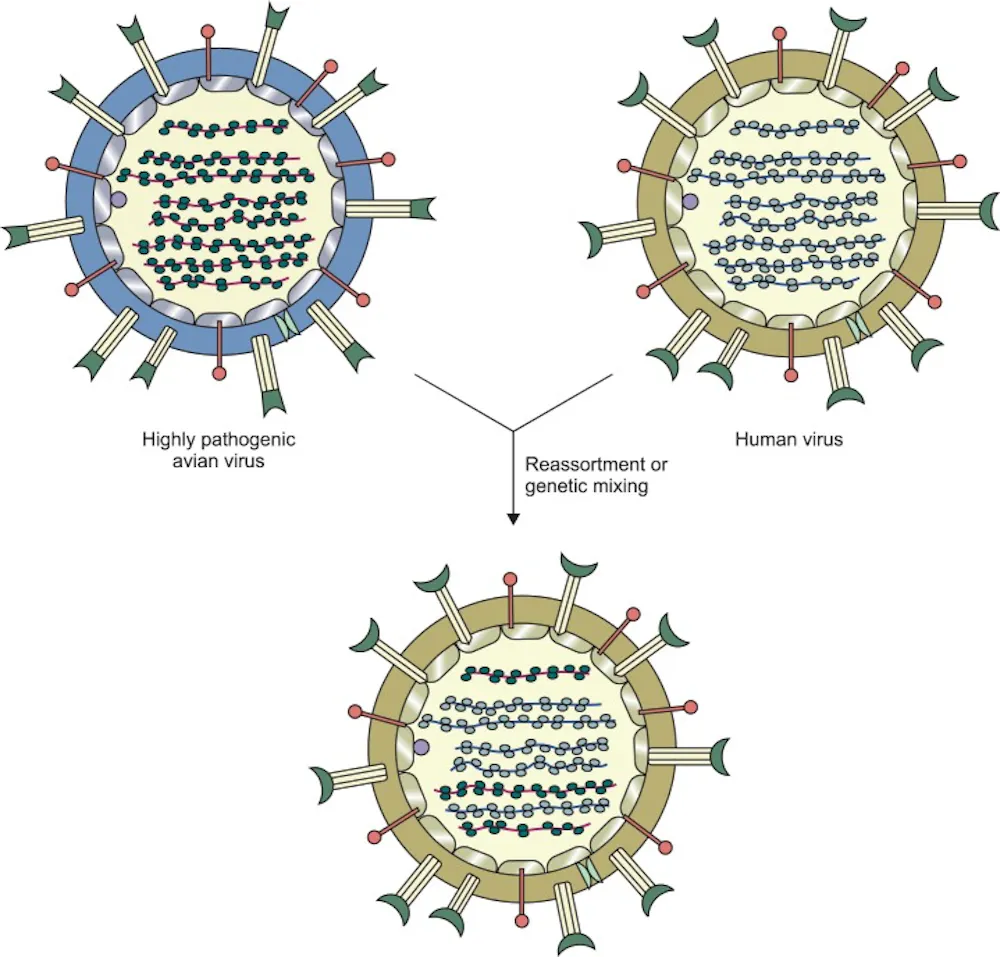
    Influenza viruses evolve rapidly. This is partly because two or more flu varieties can infect the same host simultaneously, allowing them to reshuffle their genetic material with one another to produce entirely new varieties.

    Genetic reshuffling – aka antigenic shift – between a highly pathogenic strain of avian influenza and a strain of human influenza could create a new strain that’s even more infectious among people.
    Eunsun Yoo/Biomolecules & Therapeutics, CC BY-NC

    These reshuffling events are more likely to occur when there is a diverse range of host species. So it is particularly concerning that H5N1 is known to have infected at least 450 different animal species. It may not be long before the viral chatter gives way to larger human epidemics.

    Reshaping the trajectory

    The good news is that people can take basic measures to slow down the evolution of H5N1 and potentially reduce the lethality of avian influenza should it ever become a common human infection. But governments and businesses will need to act.

    People can start by taking better care of food animals. The total weight of the world’s poultry is greater than all wild bird species combined. So it is not surprising that the geography of most H5N1 outbreaks track more closely with large-scale housing and international transfers of live poultry than with the nesting and migration patterns of wild aquatic birds. Reducing these agricultural practices could help curb the evolution and spread of H5N1.

    Large-scale commercial transport of domesticated animals is associated with the evolution and spread of new influenza varieties.
    ben/Flickr, CC BY-SA

    People can also take better care of themselves. At the individual level, most people can vaccinate against the common, seasonal influenza viruses that circulate every year. At first glance this practice may not seem connected to the emergence of avian influenza. But in addition to preventing seasonal illness, vaccination against common human varieties of the virus will reduce the odds of it mixing with avian varieties and giving them the traits they need for human-to-human transmission.

    At the population level, societies can work together to improve nutrition and sanitation in the world’s poorest populations. History has shown that better nutrition increases overall resistance to new infections, and better sanitation reduces how much and how often people are exposed to new pathogens. And in today’s interconnected world, the disease problems of any society will eventually spread to every society.

    For more than 10,000 years, human behaviors have shaped the evolutionary trajectories of infectious diseases. Knowing this, people can reshape these trajectories for the better.

    Ron Barrett does not work for, consult, own shares in or receive funding from any company or organization that would benefit from this article, and has disclosed no relevant affiliations beyond their academic appointment.

    ref. Bird flu could be on the cusp of transmitting between humans − but there are ways to slow down viral evolution – https://theconversation.com/bird-flu-could-be-on-the-cusp-of-transmitting-between-humans-but-there-are-ways-to-slow-down-viral-evolution-250232

    MIL OSI – Global Reports

  • MIL-OSI Global: Massive cuts to Health and Human Services’ workforce signal a dramatic shift in US health policy

    Source: The Conversation – USA – By Simon F. Haeder, Associate Professor of Public Health, Texas A&M University

    The new plan will shrink the Health and Human Services workforce from more than 82,000 to 62,000 employees. Sarah Stierch via Wikimedia Commons, CC BY

    On March 27, 2025, Department of Health and Human Services Secretary Robert F. Kennedy, Jr. announced plans to dramatically transform the department. HHS is the umbrella agency responsible for pandemic preparedness, biomedical research, food safety and many other health-related activities.

    In a video posted that afternoon, Kennedy said the cuts and reorganization to HHS aim to “streamline our agency” and “radically improve our quality of service” by eliminating rampant waste and inefficiency. “No American is going to be left behind,” the health secretary told the nation.

    As a scholar of U.S. health and public health policy, I have written about administrative burdens that prevent many Americans from accessing benefits to which they are entitled, including those provided by HHS, like Medicaid.

    Few experts would deny that the federal bureaucracy can be inefficient and siloed. This includes HHS, and calls to restructure the agency are nothing new

    Combined with previous reductions, these cuts may achieve some limited short-term savings. However, the proposed changes dramatically alter U.S. health policy and research, and they may endanger important benefits and protections for many Americans. They may also have severe consequences for scientific progress. And as some policy experts have suggested, the poorly targeted cuts may increase inefficiencies and waste down the line.

    Health and science in a big-budget agency

    HHS is tasked with providing a variety of public health and social services as well as fostering scientific advancement.

    Originally established as the Department of Health, Education, and Welfare in 1953, HHS has seen substantial growth and transformation over time. Today, HHS is home to 28 divisions. Some of these are well known to many Americans, such as the National Institutes of Health, the Food and Drug Administration and the Centers for Disease Control and Prevention. Others, such as the Center for Faith-Based and Neighborhood Partnerships and the Administration for Community Living, may fly under the radar for most people.

    HHS oversees Medicare, through which 68 million Americans, primarily adults age 65 and older, receive health insurance benefits.
    Richard Bailey/Corbis Documentary via Getty Images

    With an annual budget of roughly US$1.8 trillion, HHS is one of the largest federal spenders, accounting for more than 1 in 5 dollars of the federal budget.

    Under the Biden administration, HHS’s budget increased by almost 40%, with a 17% increase in staffing. However, 85% of that money is spent on 79 million Medicaid and 68 million Medicare beneficiaries. Put differently, most of HHS’ spending goes directly to many Americans in the form of health benefits.

    A new direction for Health and Human Services

    From a policy perspective, the changes initiated at HHS by the second-term Trump administration are far-reaching. They involve both staffing cuts and substantial reorganization.

    Prior to the March 27 announcement, the administration had already cut thousands of positions from HHS by letting go probationary employees and offering buyouts for employees to voluntarily leave.

    Now, HHS is slated to lose another 10,000 workers. The latest cuts focus most heavily on a handful of agencies. The FDA will lose an additional 3,500 employees, and the NIH will lose 1,200. The CDC, where cuts are steepest, will lose 2,400 positions.

    In all, the moves will reduce the HHS workforce by about 25%, from more than 82,000 to 62,000. These changes will provide savings of about $1.8 billion, or 0.1% of the HHS budget.

    Along with these cuts comes a major reorganization that will eliminate 13 out of 28 offices and agencies, close five of the 10 regional offices, reshuffle existing divisions and establish a new division called the Administration for a Healthy America.

    In his latest message, Kennedy noted that this HHS transformation would return the agency to its core mission: to “enhance the health and well-being of all Americans”. He also announced his intention to refocus HHS on his Make America Healthy Again priorities, which involve reducing chronic illness “by focusing on safe, wholesome food, clean water and the elimination of environmental toxins.”

    How HHS’ new reality will affect Americans

    Kennedy has said the HHS overhaul will not affect services to Americans. Given the magnitude of the cuts, this seems unlikely.

    HHS reaches into the lives of all Americans. Many have family members on Medicaid or Medicare, or know individuals with disabilities or those dealing with substance use disorder. Disasters may strike anywhere. Bird flu and measles outbreaks are unfolding in many parts of the country. Everyone relies on access to safe foods, drugs and vaccines.

    The plan to restructure HHS will trim its budget by 0.1%.

    In his announcement, the health secretary highlighted cuts to HHS support functions, such as information technology and human resources, as a way to reduce redundancies and inefficiencies. But scaling down and reorganizing these capacities will inevitably have implications for how well HHS employees will be able to fulfill their duties – at least temporarily. Kennedy acknowledged this as a “painful period” for HHS.

    However, large-scale reductions and reorganizations inevitably lead to more systemic disruptions, delays and denials. It seems implausible that Americans seeking access to health care, help with HIV prevention or early education benefits such as Head Start, which are also administered by HHS, will not be affected. This is particularly the case when conceived rapidly and without transparent long-term planning.

    These new cuts are also further exacerbated by the administration’s previous slashes to public health funding for state and local governments. Given the crucial functions of HHS – from health coverage for vulnerable populations to pandemic preparedness and response – the American Public Health Association predicts the cuts will result in a rise in rates of disease and death.

    Already, previous cuts at the FDA – the agency responsible for safe foods and drugs – have led to delays in product reviews.

    Overall, the likelihood of increasing access challenges for people seeking services or support as well as fewer protections and longer wait times seems high.

    A fundamental reshaping of American public health

    The HHS restructuring should be viewed in a broader context. Since coming to office, the Trump administration has aggressively sought to reshape the U.S. public health agenda. This has included vast cuts to research funding as well as funding for state and local governments. The most recent cuts at HHS fit into the mold of rolling back protections and reshaping science.

    The Trump administration has already announced plans to curtail the Affordable Care Act and roll back regulations that address everything from clean water to safe vaccines. State programs focused on health disparities have also been targeted.

    HHS-funded research has also been scaled back dramatically, with a long list of projects terminated in research areas touching on health disparities, women’s and LGBTQ-related health issues, COVID-19 and long COVID, vaccine hesitancy and more.

    The HHS reorganization also revamps two bodies within HHS, the Office of the Assistant Secretary for Planning and Evaluation and the Agency for Healthcare Research and Quality, that are instrumental in improving U.S. health care and providing policy research. This change further diminishes the likelihood that health policy will be based on scientific evidence and raises the risk for more politicized decision-making about health.

    More cuts are likely still to come. Medicaid, the program providing health coverage for low-income Americans, will be a particular target. The House of Representatives passed a budget resolution on Feb. 25 that allows up to $880 billion in cuts to the program.

    All told, plans already announced and those expected to emerge in the future dramatically alter U.S. health policy and roll back substantial protections for Americans.

    A vision for deregulation

    Regulation has emerged as the most prolific source of policymaking over the last five decades, particularly for health policy. Given its vast responsibilities, HHS is one of the federal government’s most prolific regulators. Vast cuts to the HHS workforce will likely curtail this capability, resulting in fewer regulatory protections for Americans.

    At the same time, with fewer experienced administrators on staff, industry influence over regulatory decisions will likely only grow stronger. HHS will simply lack the substance and procedural expertise to act independently. More industry influence and fewer independent regulators to counter it will also further reduce attention to disparities and underserved populations.

    Ultimately, the Trump administration’s efforts may lead to a vastly different federal health policy – with fewer benefits, services and protections – than what Americans have become accustomed to in modern times.

    Dr. Simon F. Haeder has previously received funding from the Centers for Medicare and Medicaid Services (CMS) of the U.S. Department of Health and Human Services (HHS) .

    ref. Massive cuts to Health and Human Services’ workforce signal a dramatic shift in US health policy – https://theconversation.com/massive-cuts-to-health-and-human-services-workforce-signal-a-dramatic-shift-in-us-health-policy-253316

    MIL OSI – Global Reports

  • MIL-OSI Global: Doctor shortages have hobbled health care for decades − and the trend could be worsening

    Source: The Conversation – USA – By Rochelle Walensky, Bayer Fellow in Health and Biotech, American Academy in Berlin, Senior Fellow in the Women and Public Policy Program, Harvard Kennedy School

    Specialists across numerous fields of medicine are in short supply. sudok1/iStock via Getty Images

    Americans are increasingly waiting weeks or even months to get an appointment to see a health care specialist.

    This delay comes at a time when the population of aging adults is rising dramatically. By 2050, the number of adults over 85 is expected to triple, which will intensify the strain on an already stretched health care system. We wrote about this worsening challenge and its implications for the health care workforce in a January 2025 report in the New England Journal of Medicine.

    We are health care scholars who are acutely aware of the severe shortfall of specialists in America’s health care system. One of us, Rochelle Walensky, witnessed the consequences of this shortage firsthand as the director of the Centers for Disease Control and Prevention from January 2020 to June 2023, during the critical early years of the pandemic.

    The COVID-19 pandemic brought the physician and overall health care workforce shortage to the forefront. Amid the excess daily deaths in the U.S. from COVID-19, many people died of potentially preventable deaths due to delayed care for heart attacks, deferred cancer screenings and overwhelmed emergency departments and intensive care units.

    Even before the pandemic, 80% of U.S. counties lacked a single infectious disease physician. Before going to the CDC, I – Dr. Walensky – was chief of the Division of Infectious Diseases at Massachusetts General Hospital. When COVID-19 hit our hospitals, we were in desperate need of more infectious disease expertise. I was just one of them.

    At the local level, these infectious disease-trained subspecialists provide essential services when it comes to preventing and controlling transmissible outbreaks, carrying out diagnostic testing, developing treatment guidelines, informing hospital capacity planning and offering resources for community outreach. Each of these experts plays a vital role at the bedside and in systems management toward effective clinical, hospital and community responses to infectious disease outbreaks.

    Uneven health care outcomes and access

    For decades, experts have warned of an impending decline in the physician workforce.

    Now, Americans across all regions, specialties and socioeconomic backgrounds are experiencing that decline firsthand or personally.

    The National Center for Health Workforce Analysis projects a national shortage of 140,000 physicians by 2036, with that shortfall spanning multiple specialties, including primary care, obstetrics, cardiology and geriatrics.

    However, some geographic areas in the country – especially some of those with the poorest health – are disproportionately affected. The brunt of the effect will be felt in rural areas: An estimated 56% shortage is predicted in nonmetro areas, versus only 6% in metro areas.

    States such as Massachusetts, New York and Maryland boast the highest density of physicians per 100,000 people, while states such as Idaho, Mississippi and Oklahoma rank among those with the lowest. And even in states with the highest physician density, demand may still overwhelm access.

    Although doctor shortages do not necessarily cause poor health outcomes, regions with fewer physicians tend to have lower life expectancy. The mean life expectancy in Mississippi is six years lower than that of Hawaii and more than four years below the national average. This underscores the substantial differences in health outcomes depending on where you live in the U.S.

    Notably, areas with fewer doctors also see higher rates of chronic conditions such as chronic pulmonary disease, diabetes and poor mental health. This crisis is further exacerbated by the aging baby boomer population, which places increasing demand on an already strained health care system due to rising rates – especially among those over 85 – of multiple chronic diseases, complex health care needs and the concurrent use of multiple medications.

    Rural areas have always had lower access to medical care compared with urban centers, and this divide could get far worse with the looming physician shortage.
    Chalabala/iStock via Getty Images Plus

    How the US reached this point

    Some of these workforce challenges stem from the unintended consequences of policy changes that were originally aimed at improving the rigor of medical education or curtailing a once-anticipated physician glut.

    For example, the 1910 Flexner Report was commissioned to restructure American medical education with the goals of standardizing curricula and improving quality. While the report succeeded at those goals, it was shortsighted in important ways. For instance, it recommended closing rather than strengthening 89 of the 155 existing medical schools at the time. This created medical school deserts that persist in some U.S. regions to this day.

    Additionally, the report further divided the study of medicine, focused on disease, from the study of public health, which is focused on health care systems, populations and society. This separation has led to siloed communication and data systems that continue to hinder coordinated responses to public health crises.

    Decades after the Flexner Report, in 1980, policymakers anticipated a physician oversupply based on medical school enrollment projections and government investments in the medical workforce. In response, funding constraints were introduced by Congress to limit residency and fellowship training slots available after medical school.

    But by the early 2000s, discussions shifted to concerns about physician shortages. Despite the calls for reforms to address the issues more than a decade ago, the funding and training constraints have remained largely unchanged. These have created a persistent bottleneck in postgraduate medical training that requires acts of Congress to reverse.

    Primary care doctors provide continuity for patients; without them, people tend to experience more complex health care needs and poorer outcomes.

    Forces shaping the physician bottleneck

    In the wake of the Dobbs vs. Jackson Women’s Health Organization decision, states with restrictive abortion policies are now facing an emerging and troubling workforce challenge: It may get more difficult to recruit and retain tomorrow’s medical school grads.

    Research surveys suggest that 82% of future physicians, not just obstetricians, prefer to train and work in states that uphold abortion access. While it may seem obvious that obstetricians would want to avoid the increasing liabilities associated with the Dobbs decision, another point is less obvious: Most medical trainees are between the ages of 25 and 35, prime childbearing years, and may themselves want access to a full range of obstetric care.

    And given that 20% of physicians are married to other physicians and an additional 25% to other health professionals, marriage within the health care workforce may also play a substantial role. A physician choosing not to practice in one of the 14 states with limited abortion access, many of which already rank among the poorest in health outcomes and lowest in physician densities, may not only take their expertise but also their partner’s elsewhere.

    Shifting the trajectory

    The doctor shortage requires a combination of solutions, starting with addressing the high cost of medical education and training. Medical school enrollment has increased by only 10% over the past decade, far insufficient to address both the shortage today and the projected growth of the aging population needing care.

    In addition, many students carry large amounts of debt, which frequently limits who can pursue the profession. And existing scholarship and compensation programs have been only modestly effective in incentivizing providers to work in high-need areas.

    In our New England Journal of Medicine report, we laid out several specific strategies that could help address the shortages and the potential workforce crisis. For instance:

    Rather than the traditional medical education model – four years of broad medical training followed by three to seven years of residency – medical schools could offer more specialized training pathways. These streamlined programs would focus on the skills needed for specific medical specialties, potentially reducing training duration and costs.

    Reforming physician compensation could also help address imbalances in the health care system. Specialists and subspecialists typically earn substantially more than primary care doctors, despite the high demand for primary care. Raising primary care salaries and offering incentives, such as student loan forgiveness for physicians in high-need areas, could encourage more doctors to practice where they are needed most.

    Additionally, addressing physician burnout is crucial, particularly in primary care, where administrative burdens such as billing and charting contribute to stress and attrition. Reducing these burdens, potentially through novel AI-driven solutions, could allow doctors to focus more on patient care and less on paperwork.

    These are just an assortment of strategies we propose, and time is of the essence. One thing is certain: The U.S. urgently needs more doctors, and everyone’s health depends on it.

    Dr Rochelle P. Walensky is the Bayer Fellow in Health and Biotech, American Academy in Berlin. She reported receiving personal fees from Madryn Asset Management for serving as a senior policy advisor, Consonance Capital for serving as a senior advisory board member, and Doris Duke Foundation for serving as a trustee; consulting fees from Infectious Diseases Society of America; and nonfinancial support from The Carter Center for being a member of the board of directors outside the submitted work.

    Nicole McCann does not work for, consult, own shares in or receive funding from any company or organization that would benefit from this article, and has disclosed no relevant affiliations beyond their academic appointment.

    ref. Doctor shortages have hobbled health care for decades − and the trend could be worsening – https://theconversation.com/doctor-shortages-have-hobbled-health-care-for-decades-and-the-trend-could-be-worsening-251222

    MIL OSI – Global Reports

  • MIL-OSI Global: Climate change isn’t fair but Tony Juniper’s new book explains how a green transition could be ‘just’

    Source: The Conversation – UK – By Alix Dietzel, Senior Lecturer in Climate Justice, University of Bristol

    Tony Juniper. Jason Bye, CC BY-NC-ND

    Inequality – between the rich and poor or between the powerful and the weak – is the main factor stalling action on environmental problems including biodiversity loss, pollution and climate change, according to British environmentalist Tony Juniper.

    In his new book, Just Earth: How a Fairer World Will Save the Planet, he argues that “if we want to build a secure future, both environmental priorities and social justice must be pursued together”. Much of this is about how decisions are made: “Disadvantaged groups rarely have a say, while those deciding on policy continue to comprise a narrow social segment.”

    It is interesting to see Juniper’s views on the topic of a just transition, given his decades of experience. Juniper has served as the executive director of environmental charity Friends of the Earth, he was a Green party parliamentary candidate in the 2011 general election and previously led The Wildlife Trusts. He is currently chair of Natural England, the official government organisation working for the conservation and restoration of the natural environment.

    His views on this subject certainly matter. His key message that social justice is at the heart of solving environmental problems helps to explain why we have collectively failed to address these.

    This injustice is an issue that has been raised for decades by those most affected by environmental issues, those who work in the environment sector and academics like me who focus on environmental justice.

    The UK environment sector, for example, is notoriously one of the least diverse, with only 3.5% of those working in environmental jobs identifying as an ethnic minority. In addition, the climate change movement is sometimes portrayed by the media as a middle-class preoccupation. Research shows a tendency for mainstream media to position environmentalism as a position of the wealthy. That’s reflected by the use of distancing terminology such as “middle-class tree huggers”.

    However, 39% of UK working class voters experience climate anxiety. That’s only slightly below the 42% of middle-class voters.

    Levels of climate concern have stayed high throughout both the COVID-19 pandemic and cost of living crises, while support for government action on climate mitigation policies, such as decreased meat consumption and flying, has remained steady.

    At the global level, there have always been tensions between developed and developing countries in terms of what is “fair”. Entrenched power dynamics ensure that developed countries have historically won out when deciding what a fair future looks like.

    Most recently, those tensions have been evident in the lack of clarity around how loss and damage will be funded and managed – who will pay out when an island disappears, or a village becomes inhabitable to due drought, for example? There’s also much debate around how a new finance goal should be defined, with huge disagreements between the developed and developing countries.

    As Juniper explains, not only is it unclear what fairness means at global negotiations, there is clear evidence that these tend to favour the more powerful countries, such as the US or members of the EU, and create an unjust regime. Steven Vanderheiden, one of the earliest climate justice philosophers, claims that developing nations are usually offered a “take it or leave it” deal, such as the new finance goal of US$300 billion (£232 billion) or about half of what developing countries were asking for, once developed nations have made decisions without them.

    A fairer vision

    In response to these inequalities and ongoing tensions, Juniper sets out a vision for a fairer, greener society – also known as a just transition.

    A just transition is hard to define. It was once a relatively well demarcated and clearly grounded concept associated with worker’s rights.

    Over time, it has become an increasingly all-encompassing policy objective, untethered from any specific policies, political objectives or priorities. Indeed, while there are certainly overlaps between the different visions of a just transition, significant aspects directly contradict one another.

    Just Earth by Tony Juniper is out now.
    CC BY-NC-ND

    Many of the messages in Juniper’s book have been shouted by those less privileged for decades. By using his platform to amplify the importance of climate justice, he is striving to make a difference. However, the voices of those from affected communities in developing countries, the working class in richer countries, and women (who will be hardest hit by climate change) are somewhat absent.

    Juniper neatly encompasses 40-plus years of global negotiations on climate change and biodiversity, reflecting on core issues blocking progress, such as populism and fossil fuel interests. Getting your head around negotiations is a complex task – and it’s one that Juniper executes very well.

    Juniper also discusses rising inequality, especially post-COVID, and the intersecting relationship between affluence and environmental destruction, with the richest consuming far more than the poorest and the top 10% wealthiest individuals having emitting more greenhouse gases than the poorest 50%.

    He sets out the impacts of consumption, particularly of the wealthiest, and the unfairness of those being hit hardest consuming the least. He carefully dissects why indefinite growth of GDP can no longer be taken as a given.

    Then he sets out his vision for a just transition with a ten-point agenda, including new measures of progress. He suggests focusing on wellbeing and sustainable consumption, not GDP.

    He highlights the importance of financing the future and raising the transition war chest – that involves carbon tax regimes and additional public resources for environmental protection to build climate resilience. He advises switching subsidies to green energy rather than fossil fuels, and also advocates for the use of ecocide law to protect future generations.

    While progress is possible, Juniper is a realist. He outlines how much our culture needs to shift away from consumption, competition, devaluing nature, and towards a fairer society for all. As he puts it: “We have nowhere else to go. There is just Earth.”


    Don’t have time to read about climate change as much as you’d like?

    Get a weekly roundup in your inbox instead. Every Wednesday, The Conversation’s environment editor writes Imagine, a short email that goes a little deeper into just one climate issue. Join the 40,000+ readers who’ve subscribed so far.


    Alix Dietzel does not work for, consult, own shares in or receive funding from any company or organisation that would benefit from this article, and has disclosed no relevant affiliations beyond their academic appointment.

    ref. Climate change isn’t fair but Tony Juniper’s new book explains how a green transition could be ‘just’ – https://theconversation.com/climate-change-isnt-fair-but-tony-junipers-new-book-explains-how-a-green-transition-could-be-just-250671

    MIL OSI – Global Reports

  • MIL-OSI: Ingersoll Rand Recommends Rejection of TRC Capital’s “Mini-Tender” Offer

    Source: GlobeNewswire (MIL-OSI)

    DAVIDSON, N.C., March 31, 2025 (GLOBE NEWSWIRE) — Ingersoll Rand Inc. (NYSE: IR), a global provider of mission-critical flow creation and life sciences and industrial solutions, today announced that it received notice of an unsolicited “mini-tender” offer by TRC Capital Investment Corporation (TRC Capital) to purchase up to 1,500,00 shares of Ingersoll Rand’s common stock at $77.50 per share. The offer price is approximately 4.27% below the closing price of the company’s common stock on The New York Stock Exchange on March 21, 2025 ($80.96), the last trading day before the date of the offer. The offer price is also approximately 2.43% below the closing price of Ingersoll Rand’s common stock on March 28, 2025 ($79.43), the business day prior to this release.

    Ingersoll Rand does not endorse TRC Capital’s offer and is not associated in any way with TRC Capital, its mini-tender offer or the offer documentation.

    Ingersoll Rand recommends that its stockholders reject the offer and not tender their shares in response to TRC Capital’s unsolicited mini-tender offer. This mini-tender offer is at a price below the closing price for the company’s shares (as of the business day prior to this release) and is subject to numerous conditions.

    TRC Capital has made similar unsolicited mini-tender offers for shares of other publicly traded companies. Mini-tender offers seek to acquire less than 5% of a company’s outstanding shares. This strategy enables the offering company to avoid many of the disclosure and procedural requirements that the U.S. Securities and Exchange Commission (SEC) requires for tender offers. As a result, mini-tender offers do not provide investors with the same level of protections as provided by larger tender offers under U.S. federal securities laws.

    The SEC’s website contains important tips for investors regarding mini-tender offers, available at: https://www.sec.gov/about/reports-publications/investorpubsminitend. The SEC’s website advises that mini tender-offers are frequently used to catch investors “off guard” and that investors may end up selling securities at below-market prices.

    Similar to TRC Capital’s mini-tender offers targeted at other companies, these offers put individual investors at risk because they may not realize they are selling their shares at a discount. The offer is also subject to certain conditions. Ingersoll Rand urges stockholders to obtain current stock quotes for their shares of company common stock, to review the terms and conditions of the offer, to consult with their brokers or financial advisers, and to exercise caution with respect to TRC Capital’s mini-tender offer.

    Ingersoll Rand stockholders who have already tendered their shares are advised they may withdraw their shares by following the procedures for withdrawal described in the TRC Capital offer documents prior to the expiration of the offer, which is currently scheduled for one minute after 11:59 p.m., New York City Time, on April 23, 2025.

    Additionally, Ingersoll Rand encourages brokers, dealers, and other investors to review the SEC’s letter regarding broker-dealer mini-tender offer dissemination and disclosure, available at: https://www.sec.gov/divisions/marketreg/minitenders/sia072401.htm.

    Ingersoll Rand requests that a copy of this news release be included with all distribution of materials related to TRC Capital’s offer for shares of Ingersoll Rand’s common stock.

    Forward-Looking Statements

    This news release contains “forward-looking statements” within the meaning of the Private Securities Litigation Reform Act of 1995, including statements related to expectations of Ingersoll Rand Inc. (the “Company” or “Ingersoll Rand”) regarding the performance of its business, its financial results, its liquidity and capital resources and other non-historical statements. These forward-looking statements generally are identified by the words “believe,” “project,” “expect,” “anticipate,” “estimate,” “forecast,” “outlook,” “target,” “endeavor,” “seek,” “predict,” “intend,” “strategy,” “plan,” “may,” “could,” “should,” “will,” “would,” “will be,” “on track to” “will continue,” “will likely result,” “guidance” or the negative thereof or variations thereon or similar terminology generally intended to identify forward-looking statements. All statements other than historical facts are forward-looking statements.

    These forward-looking statements are based on Ingersoll Rand’s current expectations and are subject to risks and uncertainties, which may cause actual results to differ materially from these current expectations. Should one or more of these risks or uncertainties materialize, or should underlying assumptions prove incorrect, actual results may vary materially from those indicated or anticipated by such forward-looking statements. The inclusion of such statements should not be regarded as a representation that such plans, estimates or expectations will be achieved. Important factors that could cause actual results to differ materially from such plans, estimates or expectations include, among others, (1) adverse impact on our operations and financial performance due to geopolitical tensions, natural disaster, catastrophe, global pandemics, cyber events, or other events outside of our control; (2) unexpected costs, charges or expenses resulting from completed and proposed business combinations; (3) uncertainty of the expected financial performance of the Company; (4) failure to realize the anticipated benefits of completed and proposed business combinations; (5) the ability of the Company to implement its business strategy; (6) difficulties and delays in achieving revenue and cost synergies; (7) inability of the Company to retain and hire key personnel; (8) evolving legal, regulatory and tax regimes; (9) changes in general economic and/or industry specific conditions; (10) actions by third parties, including government agencies; and (11) other risk factors detailed in Ingersoll Rand’s most recent Annual Report on Form 10-K filed with the Securities and Exchange Commission (the “SEC”), as such factors may be updated from time to time in its periodic filings with the SEC, which are available on the SEC’s website at http://www.sec.gov. The foregoing list of important factors is not exclusive.

    Any forward-looking statements speak only as of the date of this release. Ingersoll Rand undertakes no obligation to update any forward-looking statements, whether as a result of new information or developments, future events or otherwise, except as required by law. Readers are cautioned not to place undue reliance on any of these forward-looking statements.

    About Ingersoll Rand Inc.

    Ingersoll Rand Inc. (NYSE:IR), driven by an entrepreneurial spirit and ownership mindset, is dedicated to Making Life Better for our employees, customers, shareholders, and planet. Customers lean on us for exceptional performance and durability in mission-critical flow creation and life sciences and industrial solutions. Supported by over 80+ respected brands, our products and services excel in the most complex and harsh conditions. Our employees develop customers for life through their daily commitment to expertise, productivity, and efficiency. For more information, visit www.IRCO.com.

    The MIL Network

  • MIL-OSI: Subsea7 awarded contract offshore Norway

    Source: GlobeNewswire (MIL-OSI)

    Luxembourg – 31 March 2025 – Subsea 7 S.A. (Oslo Børs: SUBC, ADR: SUBCY) today announced the award of a sizeable1 contract by Equinor as technical service provider (TSP) for the Northern Lights Phase 2 project, offshore Norway.

    Subsea7’s scope includes engineering, procurement, construction and installation of a five kilometre CO2 pipeline, as well as installation of integrated satellite structures, umbilicals, tie-in and pre-commissioning activities.

    Project management and engineering will commence immediately at Subsea7’s office in Stavanger, Norway. Fabrication of the pipeline will take place at Subsea7’s spoolbase at Vigra, Norway and offshore operations will be executed in 2026 and 2027.

    Erik Femsteinevik, Vice President for Subsea7 Norway said: “We are excited to continue our collaboration with Equinor TSP and the Northern Lights’ owners Equinor, Shell and TotalEnergies on phase 2 of this ambitious and pioneering project. We look forward to working together to increase the development’s carbon storage capacity to a minimum of five million tonnes per year, and to support the continued development of a new value chain for Norway and Europe.”

    Northern Lights phase 2 is enabled by a grant from the Connecting Europe Facility for Energy (CEF Energy) funding scheme. 

    1. Subsea7 defines a sizeable contract as being between $50 million and $150 million.

    *******************************************************************************
    Subsea7 is a global leader in the delivery of offshore projects and services for the evolving energy industry, creating sustainable value by being the industry’s partner and employer of choice in delivering the efficient offshore solutions the world needs.

    Subsea7 is listed on the Oslo Børs (SUBC), ISIN LU0075646355, LEI 222100AIF0CBCY80AH62.

    *******************************************************************************

    Contact for investment community enquiries:
    Katherine Tonks
    Investor Relations Director
    Tel +44 20 8210 5568
    ir@subsea7.com

    Contact for media enquiries:
    Jan Roger Moksnes
    Communications Manager
    Tel +47 41515777
    janroger.moksnes@subsea7.com
    www.subsea7.com

    Forward-Looking Statements: This document may contain ‘forward-looking statements’ (within the meaning of the safe harbour provisions of the U.S. Private Securities Litigation Reform Act of 1995). These statements relate to our current expectations, beliefs, intentions, assumptions or strategies regarding the future and are subject to known and unknown risks that could cause actual results, performance or events to differ materially from those expressed or implied in these statements. Forward-looking statements may be identified by the use of words such as ‘anticipate’, ‘believe’, ‘estimate’, ‘expect’, ‘future’, ‘goal’, ‘intend’, ‘likely’ ‘may’, ‘plan’, ‘project’, ‘seek’, ‘should’, ‘strategy’ ‘will’, and similar expressions. The principal risks which could affect future operations of the Group are described in the ‘Risk Management’ section of the Group’s Annual Report and Consolidated Financial Statements. Factors that may cause actual and future results and trends to differ materially from our forward-looking statements include (but are not limited to): (i) our ability to deliver fixed price projects in accordance with client expectations and within the parameters of our bids, and to avoid cost overruns; (ii) our ability to collect receivables, negotiate variation orders and collect the related revenue; (iii) our ability to recover costs on significant projects; (iv) capital expenditure by oil and gas companies, which is affected by fluctuations in the price of, and demand for, crude oil and natural gas; (v) unanticipated delays or cancellation of projects included in our backlog; (vi) competition and price fluctuations in the markets and businesses in which we operate; (vii) the loss of, or deterioration in our relationship with, any significant clients; (viii) the outcome of legal proceedings or governmental inquiries; (ix) uncertainties inherent in operating internationally, including economic, political and social instability, boycotts or embargoes, labour unrest, changes in foreign governmental regulations, corruption and currency fluctuations; (x) the effects of a pandemic or epidemic or a natural disaster; (xi) liability to third parties for the failure of our joint venture partners to fulfil their obligations; (xii) changes in, or our failure to comply with, applicable laws and regulations (including regulatory measures addressing climate change); (xiii) operating hazards, including spills, environmental damage, personal or property damage and business interruptions caused by adverse weather; (xiv) equipment or mechanical failures, which could increase costs, impair revenue and result in penalties for failure to meet project completion requirements; (xv) the timely delivery of vessels on order and the timely completion of ship conversion programmes; (xvi) our ability to keep pace with technological changes and the impact of potential information technology, cyber security or data security breaches; (xvii) global availability at scale and commercially viability of suitable alternative vessel fuels; and (xviii) the effectiveness of our disclosure controls and procedures and internal control over financial reporting. Many of these factors are beyond our ability to control or predict. Given these uncertainties, you should not place undue reliance on the forward-looking statements. Each forward-looking statement speaks only as of the date of this document. We undertake no obligation to update publicly or revise any forward-looking statements, whether as a result of new information, future events or otherwise.
    This information is considered to be inside information pursuant to the EU Market Abuse Regulation and is subject to the disclosure requirements pursuant to Section 5-12 the Norwegian Securities Trading Act.
    This stock exchange release was published by Katherine Tonks, Investor Relations, Subsea7, on 31 March 2025 at 12:15 CET.

    Attachment

    The MIL Network

  • MIL-OSI Global: Trump’s tariffs could push grocery prices even higher, but there are steps Canada could take to protect consumers

    Source: The Conversation – Canada – By Mathew Iantorno, Doctoral Candidate, Faculty of Information,, University of Toronto

    The first months of Donald Trump’s presidency have been defined by a single word: tariffs. He has framed tariffs as a panacea to the woes of the American economy, promising they will restore the country’s manufacturing sector and reduce the national deficit.

    As the United States’ largest trading partner, Canada’s smaller economy is poised to suffer the most from a prolonged trade war. Although the price of all consumer goods will be affected, the grocery aisle has become a particular battleground.

    Canadians have remained defiant, with vows to “buy Canadian” already spurring rapid drops in the sale of American products.

    But with calls for the country to strengthen its economic backbone and reduce dependence on the U.S., perhaps it’s also time to consider rebooting Canada’s grocery sector to better serve Canadians as well.


    Read more:
    Canada is now in a trade war with the U.S. — here’s what you need to know to prepare for it


    Canada’s supermarket problem

    Rising grocery bills have been an ongoing concern for Canadians long before Trump’s inauguration. Today, an estimated 18 per cent of Canadians are struggling with food insecurity owing to persistent inflation and the rising cost of living. Food banks saw a record number of monthly visits in 2024 as a result.

    Yet, even as consumers feel the squeeze, Canada’s grocery giants have been posting record profits. Loblaw Companies Limited, whose supermarkets hold a dominant 28 per cent share of the sector, has become the poster child for this trend.

    In the final quarter of 2022, as Canadians were grappling with rapid inflation on their grocery bills, Loblaw posted $529 million in profitsup 30 per cent from the previous year.

    This has led customers to accuse Loblaw and other large grocery chains of profiteering, provoking both a 100,000 signature petition against “greedflation” and a month-long boycott of Loblaw chains. All this while Loblaw was still reeling from a bread price-fixing scandal yielding a $500 million antitrust settlement.


    Read more:
    Food giants reap enormous profits during times of crisis


    In response to the mounting concerns, the federal government met with the heads of Loblaw, Sobeys, Metro, Costco and Walmart in 2023 to discuss stabilizing grocery prices in Canada. Former Prime Minister Justin Trudeau would threaten and later implement amendments to the Competition Act through Bill C-56, although these reforms were focused less on immediately lowering grocery bills and more on giving new tools to Canada’s competition watchdog.

    Investing in the future

    Another area of concern is the initiatives supermarket chains such as Loblaw and Metro have been investing their profits in.

    Since 2020, supermarkets in Canada have invested heavily in self-checkout aisles. While initially a concession to the social distancing measures of the COVID-19 pandemic, these kiosks have become a ubiquitous — and often unwelcome — part of the retail experience for both workers and consumers.

    Beyond the concern that self-checkouts pressure customers to perform more work, they have also increased the precarity of supermarket employees. These technologies generally reduce total worker hours and eliminate well-paying full-time positions, all with an eye towards boosting profit margins.


    Read more:
    The rise of robo-retail: Who gets left behind when retail is automated?


    Loblaw has also invested in automating their fleet of delivery vehicles, jeopardizing jobs in the logistics sector at a time when Canada’s unemployment rate, already struggling to recover, is expected to rise due to Trump’s tariffs.

    There is also the looming concern of dynamic pricing. Following the lead of American grocery stores such as Kroger, chains run by Loblaw, Metro and Sobeys have begun to implement electronic price tags. These tags enable retailers to instantaneously update prices based on supply and demand, similar to surge pricing on ride-sharing apps like Uber.

    Electronic price labels seen at a Walmart in Los Angeles in 2024.
    (Shutterstock)

    While online commentators were quick to mock fast food chain Wendy’s for potentially using dynamic pricing to charge more for a Frosty on a hot day, this practice becomes more problematic as the availability of family staples like baby formula, which already experiences perennial scarcity, are affected by the trade war.

    The sector won’t reform itself

    There is little reason to believe Canada’s grocery industry will reform itself. Many of the pro-consumer and pro-worker initiatives put forth by these chains have amounted to little more than public relations moves.

    The much-lauded COVID hero pay for front-line grocery workers disappeared only months into the pandemic, despite pressure from unions and MPs during the Omicron wave.

    Loblaw’s widely publicized price freeze on No Name products was similarly criticised for its short duration and for merely repackaging seasonal price freezes as a pro-consumer initiative.

    When Loblaw froze prices on No Name products in 2022, its competitor Metro quickly pointed out that seasonal price freezes are in fact a standard industry practice. (CBC News)

    The company’s promise to create a discounted version of its already discounted grocery chain No Frills drew further scepticism, with the stock being entirely sourced from Loblaw brands that generate higher revenue for the company.

    The question remains: what concrete measures can be implemented to safeguard Canadian grocery bills as our country navigates this next crisis?

    Lowering grocery bills for Canadians

    A report from the Broadbent Institute suggests the idea of a windfall profit tax, which would incentivize grocery companies to invest excess profits into price reductions or higher wages.

    A more durable reform would involve creating a central bank-style regulatory entity to oversee the grocery industry, instead of relying on industry-born measures such as Canada’s recently introduced grocery code of conduct.


    Read more:
    The new Grocery Code of Conduct should benefit both Canadians and the food industry


    Federal or provincial legislation could be also passed that places guardrails on dynamic pricing in the grocery aisle, if not banning the controversial practice altogether. Government grants and tax incentive programs could be withheld from companies that invest heavily into automating workforces so the government isn’t inadvertently subsidizing job losses.

    The Competition Bureau’s 2023 report highlights another key issue: there is a need for all levels of government to shift from subsidizing large chains and encourage the growth of independent grocers in the Canadian market, driving down prices for consumers through meaningful, local competition.

    Trump’s trade war has filled Canadians with a newfound pride and motivation to buy local to support the economy. Perhaps it’s time our grocery chains showed the same commitment to the people they serve.

    Mathew Iantorno does not work for, consult, own shares in or receive funding from any company or organisation that would benefit from this article, and has disclosed no relevant affiliations beyond their academic appointment.

    ref. Trump’s tariffs could push grocery prices even higher, but there are steps Canada could take to protect consumers – https://theconversation.com/trumps-tariffs-could-push-grocery-prices-even-higher-but-there-are-steps-canada-could-take-to-protect-consumers-252879

    MIL OSI – Global Reports

  • MIL-OSI Global: AI is for the birds: How machine learning can help predict and manage avian flu outbreaks

    Source: The Conversation – Canada – By Rozita Dara, Assistant Professor, Computer Science, University of Guelph

    The active and ongoing global spread of avian influenza virus has impacted more than 14 million birds in Canada and 160 million in the USA.

    This recent outbreak has resulted in major economic losses, and a rise in egg prices in the past few years. This trend can cause disruptions in poultry supply chain and significant increases in the price of other poultry products.

    A virus like avian influenza is carried by birds, but it can “jump” species and infect livestock such as dairy or sheep or even pets like dogs and cats.


    Read more:
    Bird flu detected in Colorado dairy cattle − a vet explains the risks of the highly pathogenic avian influenza virus


    And most, if not all, human pandemic influenza viruses have had an avian origin in the past few decades. Experts warn it is only a matter of time before we face another pandemic threat.

    The good news is, we are better prepared than ever to meet that challenge. Not just because we have vaccines or treatments, although those are critical. But because we have something that can change the game entirely: artificial intelligence (AI).

    CBC News covers an outbreak of avian flu among Canadian geese in Prince Edward Island.

    Vast amounts of information

    AI can offer much in the way of advance pandemic information and planning. Remember the early days of COVID-19? What if we had more time to prepare? What if health officials had known weeks earlier where the virus was spreading, which neighbourhoods were most at risk, and what we needed to do to stop it?

    AI can analyze vast amounts of information, from wildlife health reports, geographical data, satellite images to social media trends, online content, farm data and even weather patterns to answer some questions about how, when and why pandemics happen. It spots patterns, anomalies and relationships humans cannot see in real-time.

    AI can alert monitors to where an avian influenza outbreak might occur before a region is impacted, how severe an outbreak might be and what type of intervention may be most effective. AI can help responders and governments act quickly, precisely and efficiently.

    Predicting outbreaks

    At the University of Guelph, my research team and I are working on AI solutions to help track and predict the avian influenza outbreaks. Our research — which is currently under review — has used AI to filter out misinformation about avian influenza from social media platforms and Reddit, as well as Google search data, and other online sources.

    This helps us understand public discussion about avian influenza. We have also combined these online activities with other data sources to monitor avian influenza online mentions and trends — we’ve found that AI can use this information to predict if an outbreak might occur in a specific area.

    With the availability of online and social media data, an outbreak surge can be predicted up to four weeks in advance in specific regions.

    Our research team has also created and tested decision support tools that use different types of information from wild bird reports, satellite images, climate change data and farm information. These tools help predict avian influenza outbreaks and how serious they might be in a certain area; through testing, we achieved an accuracy of 85 per cent.

    We’re currently in the process of building a Canadian tool to predict where bird flu might emerge, helping farmers and public health officials get ahead of outbreaks — this could mean the difference between a contained outbreak and a global crisis.

    More than a public health issue

    A sign warning hikers about an avian flu outbreak along the Skerwink Hiking Trail in Newfoundland.
    (Shutterstock)

    Avian influenza spreads through the food chain, wildlife and global trade. An outbreak in poultry can devastate agriculture and threaten our food security. Worse, it can jump to human populations with little warning.

    This issue is not just a public health issue. It is also an economic and social concern. But if we harness AI properly, we can give ourselves a better chance at combating these threats. We can predict where the next outbreak might come from and take action before it spreads.


    Read more:
    Soaring U.S. egg prices and millions of dead chickens signal the deep problems and risks in modern poultry production


    Using AI to predict avian flu outbreaks and spread can be applied to other situations, including other illnesses and the weather and environmental conditions that could contribute to disease spread.

    AI-based decision tools can also include augmented reality that enables the testing of thousands of hypothetical scenarios related to avian influenza. These include how outbreaks might spread, what the impacts of different intervention strategies could be, how changes in the economy and environment might occur, and how the supply chain could be impacted.

    We have the technology in our labs. But to make it work, we need strong partnerships between government, universities, farmers, industry and communities. We need to make sure that we generate high quality data, use the data ethically in a privacy-preserving manner, develop the AI tool responsibly and apply it fairly to ensure that no one is left behind.

    Rozita Dara receives funding from Ontario Ministry of Agriculture, Food and Agribusiness Alliance Tier I, funding and the University of Guelph’s Food from Thought.

    ref. AI is for the birds: How machine learning can help predict and manage avian flu outbreaks – https://theconversation.com/ai-is-for-the-birds-how-machine-learning-can-help-predict-and-manage-avian-flu-outbreaks-252550

    MIL OSI – Global Reports

  • MIL-OSI United Nations: UNDRR 2024 Annual Report

    Source: UNISDR Disaster Risk Reduction

    02

    Strategies, governance and capacity-building

    Target E of the Sendai Framework calls for a substantial increase in the number of countries with national and local DRR strategies by 2020.

    Though a strategy is not the end goal, UNDRR has found that countries with national DRR strategies tend to have more robust DRR governance and a higher prevalence of EWS, demonstrating the value of investment in this fundamental DRR pillar.

    The Government of Jordan has developed its National Disaster Risk Reduction Strategy (2023–2030) in a participatory manner involving different governmental entities, ministries and municipalities, and the Public Security Directorate (Civil Defense), with support from UNDRR and the United Nations Development Programme country office. The strategy also integrates biological hazard risk reduction with the aim of building back better after the COVID-19 pandemic.

    Within the framework of Jordan’s efforts to deal with increasing threats and risks, the National Centre for Security and Crises Management has played a major role in developing two integrated risk registers; the national risk register and the local register for governorates. Both registers aim to improve the kingdom’s capacity to respond to disasters through accurate identification of risks, and enhanced coordination between the local and national levels for improved risk governance.

    Through this effective coordination between the national and local risk registers, Jordan has made great strides in reducing risks and enhancing community resilience, making the kingdom a role model for disaster management and risk reduction at the regional level.

    Morocco, too, has taken concrete steps to strengthen its risk governance. It established the Directorate of Natural Risk Management under the Ministry of Interior as its national DRR coordination mechanism. Morocco also established the National Risk Observatory to collect, analyse and share data on natural hazard risk. Furthermore, Morocco established a National Risk Forecasting Centre for monitoring and alerting, and an Operational Risk Anticipation Centre for forecasting, alerting and risk management assistance systems. Another successful project comprised the generalization of coverage of the entire national territory using multiscale and multi-hazard risk maps (for natural hazards).

    Albania’s National Disaster Risk Reduction Strategy demonstrates widespread integration of concerns related to climate change and triggers the engagement of new sectors, particularly tourism.

    The vision statement explicitly brings together DRR, climate change and sustainable development using the language of resilience, while the document includes a detailed plan of action for DRR implementation that integrates institutions such as the Ministry of Tourism and Environment and the Ministry of Infrastructure and Energy.

    In particular, it articulates the implementation of the ALBAdapt project Climate Services for a Resilient Albania. The Ministry of Tourism and Environment is identified as the lead institution for implementation of a set of activities that offer compounding co-benefits for both DRR and climate change adaptation, including the development of a people-centred MHEWS, the creation of a fully functional and well-resourced National Meteorological and Hydrological Service.

    This integration is supported by articulations elsewhere in the country’s strategic profile, with the National Adaptation Plan 2019 including a priority area entitled “upgrading civil defence preparedness and DRR”. Elsewhere, the National Security Strategy of the Republic of Albania (2023–2028) addresses risks ranging from national security threats to climate change impacts, emphasizing resilience to disasters, while the National Strategy for Development and European Integration (NSDEI) 2022–2030 includes the integration of DRR and climate change adaptation planning among its priorities.

    National DRR strategies are the bedrock for multi-hazard risk governance and the achievement of Sendai Framework targets. These strategies help transform risk knowledge into actions and programmes that save lives and livelihoods. In addition, they serve as guides for mobilizing resources, delegating roles and responsibilities within government, and identifying entry points for non-governmental stakeholder engagement, all leading to more inclusive, sustainable development.

    With 131 countries now reporting having national DRR strategies, and 30 receiving technical support from UNDRR to develop them, this is just a snapshot of the progress being made globally in this important area.

    Under Brazil’s presidency, the Group of 20 (G20) recognized DRR as a critical component of economic resilience. Collaborating closely with UNDRR, Brazil facilitated the adoption of the first-ever G20 Ministerial Declaration on DRR. This landmark declaration emphasized the necessity of accelerating the Sendai Framework for Disaster Risk Reduction’s implementation, aiming to reduce disaster losses by 2030, and called for the development of high-level principles for DRR financing. The work of the G20 DRR Working Group, with UNDRR as the lead knowledge partner, further reflected a comprehensive approach to integrating DRR into economic and social policies.

    UNDRR’s capacity-building continues to go from strength to strength, with nearly 10,000 DRR practitioners being trained in 2024, 77 per cent of whom reported having a better understanding of DRR as a result. At one such workshop in the Global Education and Training Institute in Incheon, Republic of Korea, a remarkable collaboration unfolded – a pioneering workshop uniting experts from UNDRR and the Green Climate Fund (GCF) to empower government stakeholders from Mongolia and Bhutan to mobilize relevant partners and stakeholders and obtain funding for their DRR measures. This joint training begins a process of transforming the daunting challenges of climate change into opportunities for proactive DRR.

    Delegates were empowered by not only technical insights, but also the forging of lasting partnerships. The workshop’s training modules, co-designed by UNDRR and GCF specialists, delved deep into practical tools such as the EW4All Checklist for Gap Analysis, equipping participants to critically assess their national capacities and pinpoint vulnerabilities. “Early warning systems are important components for our national climate change adaptation strategy,” noted Ms. Tserendulam Shagdarsuren, Director General of the Climate Change Department, Ministry of Environment and Tourism in Mongolia, emphasizing how the training illuminated the next steps for their evolving EWS.

    This pilot UNDRR–GCF initiative is part of a broader strategy to replicate capacity-building endeavours in developing countries. Future workshops are planned for countries that are in very different geographic contexts yet face similar challenges (particularly those resulting from climate change), such as Somalia, Togo and the SIDS. These workshops aim to accelerate access to climate finance and enhance DRR measures worldwide.

    In a continuation of the Media Saving Lives programme, UNDRR and partners trained 520 journalists and media practitioners in DRR and risk communications, bringing the total to over 2,500 from 80 countries. Media are an integral part of the EWS delivery chain, and engaging them to build trust between government and communities can be the difference between life and death when disaster hits.

    The rise in global temperatures and the increasing frequency and severity of extreme heat events are rapidly becoming central challenges for nations worldwide. Yet many Member States, cities and societies remain ill-prepared to address this escalating threat. The imperative for enhanced extreme heat risk reduction, governance and management is clear. Without urgent and coordinated action, extreme heat will continue to endanger billions of lives, amplify health risks and threaten the ecosystems upon which we depend.

    In response, the UNDRR/World Meteorological Organization (WMO) Centre of Excellence for Climate and Disaster Resilience – together with the Global Heat Health Information Network, Duke University and WMO Centre of Excellence for Climate and Disaster Resilience partners – has developed an extreme heat decision-support package for countries tackling this global threat. The package includes: international organization resource and ecosystem mapping, readiness reviews and profiles; national best practice analytics; evaluations of heat action plans; and materials for development of an extreme heat maturity index for self-assessment. These materials can enhance collaboration, integrated heat risk governance and policy responses to extreme heat.

    UNDRR’s work and that of United Nations system partners, coupled with increasing demands for assistance from Member States, prompted and informed the United Nations Secretary-General’s Call to Action on Extreme Heat, issued in July 2024, in which he emphasized the need for urgent action if a future characterized by even more devastating heat impacts on lives, economies and ecosystems is to be avoided.

    This work is in turn informing the development of a Common Framework for Heat Risk Governance, led by UNDRR with the Global Heat Health Information Network, and Member States, international organizations and stakeholders. The Framework will receive inputs from (and is designed to bring together) multiple sectors, domains and scales – from agriculture and food systems, to energy systems, transportation, construction materials and design, and urban cooling. It is expected to assist national and subnational decision makers in designing and resourcing integrated actions to reduce extreme heat risk to people, urban and rural ecosystems, and the environment, preventing the loss of lives and livelihoods.

    MIL OSI United Nations News

  • MIL-OSI United Nations: UNDRR Annual Report 2024

    Source: UNISDR Disaster Risk Reduction

    02

    Strategies, governance and capacity-building

    Target E of the Sendai Framework calls for a substantial increase in the number of countries with national and local DRR strategies by 2020.

    Though a strategy is not the end goal, UNDRR has found that countries with national DRR strategies tend to have more robust DRR governance and a higher prevalence of EWS, demonstrating the value of investment in this fundamental DRR pillar.

    The Government of Jordan has developed its National Disaster Risk Reduction Strategy (2023–2030) in a participatory manner involving different governmental entities, ministries and municipalities, and the Public Security Directorate (Civil Defense), with support from UNDRR and the United Nations Development Programme country office. The strategy also integrates biological hazard risk reduction with the aim of building back better after the COVID-19 pandemic.

    Within the framework of Jordan’s efforts to deal with increasing threats and risks, the National Centre for Security and Crises Management has played a major role in developing two integrated risk registers; the national risk register and the local register for governorates. Both registers aim to improve the kingdom’s capacity to respond to disasters through accurate identification of risks, and enhanced coordination between the local and national levels for improved risk governance.

    Through this effective coordination between the national and local risk registers, Jordan has made great strides in reducing risks and enhancing community resilience, making the kingdom a role model for disaster management and risk reduction at the regional level.

    Morocco, too, has taken concrete steps to strengthen its risk governance. It established the Directorate of Natural Risk Management under the Ministry of Interior as its national DRR coordination mechanism. Morocco also established the National Risk Observatory to collect, analyse and share data on natural hazard risk. Furthermore, Morocco established a National Risk Forecasting Centre for monitoring and alerting, and an Operational Risk Anticipation Centre for forecasting, alerting and risk management assistance systems. Another successful project comprised the generalization of coverage of the entire national territory using multiscale and multi-hazard risk maps (for natural hazards).

    Albania’s National Disaster Risk Reduction Strategy demonstrates widespread integration of concerns related to climate change and triggers the engagement of new sectors, particularly tourism.

    The vision statement explicitly brings together DRR, climate change and sustainable development using the language of resilience, while the document includes a detailed plan of action for DRR implementation that integrates institutions such as the Ministry of Tourism and Environment and the Ministry of Infrastructure and Energy.

    In particular, it articulates the implementation of the ALBAdapt project Climate Services for a Resilient Albania. The Ministry of Tourism and Environment is identified as the lead institution for implementation of a set of activities that offer compounding co-benefits for both DRR and climate change adaptation, including the development of a people-centred MHEWS, the creation of a fully functional and well-resourced National Meteorological and Hydrological Service.

    This integration is supported by articulations elsewhere in the country’s strategic profile, with the National Adaptation Plan 2019 including a priority area entitled “upgrading civil defence preparedness and DRR”. Elsewhere, the National Security Strategy of the Republic of Albania (2023–2028) addresses risks ranging from national security threats to climate change impacts, emphasizing resilience to disasters, while the National Strategy for Development and European Integration (NSDEI) 2022–2030 includes the integration of DRR and climate change adaptation planning among its priorities.

    National DRR strategies are the bedrock for multi-hazard risk governance and the achievement of Sendai Framework targets. These strategies help transform risk knowledge into actions and programmes that save lives and livelihoods. In addition, they serve as guides for mobilizing resources, delegating roles and responsibilities within government, and identifying entry points for non-governmental stakeholder engagement, all leading to more inclusive, sustainable development.

    With 131 countries now reporting having national DRR strategies, and 30 receiving technical support from UNDRR to develop them, this is just a snapshot of the progress being made globally in this important area.

    Under Brazil’s presidency, the Group of 20 (G20) recognized DRR as a critical component of economic resilience. Collaborating closely with UNDRR, Brazil facilitated the adoption of the first-ever G20 Ministerial Declaration on DRR. This landmark declaration emphasized the necessity of accelerating the Sendai Framework for Disaster Risk Reduction’s implementation, aiming to reduce disaster losses by 2030, and called for the development of high-level principles for DRR financing. The work of the G20 DRR Working Group, with UNDRR as the lead knowledge partner, further reflected a comprehensive approach to integrating DRR into economic and social policies.

    UNDRR’s capacity-building continues to go from strength to strength, with nearly 10,000 DRR practitioners being trained in 2024, 77 per cent of whom reported having a better understanding of DRR as a result. At one such workshop in the Global Education and Training Institute in Incheon, Republic of Korea, a remarkable collaboration unfolded – a pioneering workshop uniting experts from UNDRR and the Green Climate Fund (GCF) to empower government stakeholders from Mongolia and Bhutan to mobilize relevant partners and stakeholders and obtain funding for their DRR measures. This joint training begins a process of transforming the daunting challenges of climate change into opportunities for proactive DRR.

    Delegates were empowered by not only technical insights, but also the forging of lasting partnerships. The workshop’s training modules, co-designed by UNDRR and GCF specialists, delved deep into practical tools such as the EW4All Checklist for Gap Analysis, equipping participants to critically assess their national capacities and pinpoint vulnerabilities. “Early warning systems are important components for our national climate change adaptation strategy,” noted Ms. Tserendulam Shagdarsuren, Director General of the Climate Change Department, Ministry of Environment and Tourism in Mongolia, emphasizing how the training illuminated the next steps for their evolving EWS.

    This pilot UNDRR–GCF initiative is part of a broader strategy to replicate capacity-building endeavours in developing countries. Future workshops are planned for countries that are in very different geographic contexts yet face similar challenges (particularly those resulting from climate change), such as Somalia, Togo and the SIDS. These workshops aim to accelerate access to climate finance and enhance DRR measures worldwide.

    In a continuation of the Media Saving Lives programme, UNDRR and partners trained 520 journalists and media practitioners in DRR and risk communications, bringing the total to over 2,500 from 80 countries. Media are an integral part of the EWS delivery chain, and engaging them to build trust between government and communities can be the difference between life and death when disaster hits.

    The rise in global temperatures and the increasing frequency and severity of extreme heat events are rapidly becoming central challenges for nations worldwide. Yet many Member States, cities and societies remain ill-prepared to address this escalating threat. The imperative for enhanced extreme heat risk reduction, governance and management is clear. Without urgent and coordinated action, extreme heat will continue to endanger billions of lives, amplify health risks and threaten the ecosystems upon which we depend.

    In response, the UNDRR/World Meteorological Organization (WMO) Centre of Excellence for Climate and Disaster Resilience – together with the Global Heat Health Information Network, Duke University and WMO Centre of Excellence for Climate and Disaster Resilience partners – has developed an extreme heat decision-support package for countries tackling this global threat. The package includes: international organization resource and ecosystem mapping, readiness reviews and profiles; national best practice analytics; evaluations of heat action plans; and materials for development of an extreme heat maturity index for self-assessment. These materials can enhance collaboration, integrated heat risk governance and policy responses to extreme heat.

    UNDRR’s work and that of United Nations system partners, coupled with increasing demands for assistance from Member States, prompted and informed the United Nations Secretary-General’s Call to Action on Extreme Heat, issued in July 2024, in which he emphasized the need for urgent action if a future characterized by even more devastating heat impacts on lives, economies and ecosystems is to be avoided.

    This work is in turn informing the development of a Common Framework for Heat Risk Governance, led by UNDRR with the Global Heat Health Information Network, and Member States, international organizations and stakeholders. The Framework will receive inputs from (and is designed to bring together) multiple sectors, domains and scales – from agriculture and food systems, to energy systems, transportation, construction materials and design, and urban cooling. It is expected to assist national and subnational decision makers in designing and resourcing integrated actions to reduce extreme heat risk to people, urban and rural ecosystems, and the environment, preventing the loss of lives and livelihoods.

    MIL OSI United Nations News

  • MIL-OSI: Aegon announces changes to its Board of Directors

    Source: GlobeNewswire (MIL-OSI)

    The Hague, March 31, 2025 – Aegon today announces the nomination of David Herzog, Lori Fouché and Jay Ralph as new members of its Board of Directors at the company’s Annual General Meeting of shareholders (AGM) which will be held on June 12, 2025. 

    The Board intends to appoint David Herzog as Chair in the second half of 2025. Mr. Herzog will succeed William Connelly. To ensure a smooth transition, the Board will propose the reappointment of Mr. Connelly as a member for an additional year. Subsequently, Mr. Connelly will retire as Chair and member of the Board in the second half of 2025. 

    Mark Ellman, who joined Aegon’s Board in 2017 and whose second term will end in 2025, along with Jack McGarry, who joined the Board in 2021 and whose first term will end in 2025, will be nominated for reappointment at the AGM. Meanwhile, Dona Young, who joined Aegon’s Board in 2013 and whose third term concludes in 2025, will retire. 

    William Connelly commented: “We are delighted to propose David Herzog, Lori Fouché and Jay Ralph as new members of Aegon’s Board. We believe their expertise in insurance and asset management will strengthen the Board’s composition and support the company as we continue to execute our strategy and deliver value to our stakeholders. I would also like to take this opportunity to extend my heartfelt gratitude to Dona Young for her many contributions to Aegon. With her commitment, valuable insights and pragmatic approach, Dona has played an important role in Aegon’s transformation.” 

    David Herzog brings over forty years of life insurance and financial services experience to the Board. Currently serving as a member of the Board of Directors at MetLife, and as Chairman of the Board at DXC Technology, David’s extensive career includes key roles such as Chief Financial Officer and Executive Vice President at American International Group (AIG) from 2008 to 2016. Prior to this, Mr. Herzog was the Chief Financial Officer and Chief Operating Officer at American General Life, following its acquisition by AIG. He also held various executive positions at GenAmerica Corporation and Family Guardian Life, a Citicorp company, adding to his profound insight into the financial services industry.

    Lori Fouché brings over two decades of experience in the financial services industry and has extensive expertise in driving transformation and innovation. Most recently, Ms. Fouché served as Senior Executive Vice President and Advisor to the CEO of TIAA, a US-based provider of retirement and investment solutions, and as CEO of TIAA Financial Solutions. Prior to joining TIAA in 2018, she held several senior positions at Prudential Financial, including Group Head of Individual Solutions, President of Individual Annuities, and CEO of Group Insurance businesses. In addition to her executive roles, Ms. Fouché currently serves on the Board of The Kraft Heinz Company, a global food and beverage company, and Hippo Holdings, a property insurance provider and she is member of the Princeton University Board of Trustees.

    Jay Ralph has had a distinguished career in insurance and asset management including almost 20 years in leadership roles at Allianz SE, a global insurance and asset management company. Mr. Ralph was most recently a member of the Board of Management of Allianz SE and Chairman of both Allianz Asset Management and Allianz Life Insurance Company North America. He has also served on various boards of Allianz SE’s global subsidiaries across Europe and the Americas. Prior to this, he held several senior roles in the financial industry. Mr. Ralph currently sits on the Board of Swiss Re Group and the Siemens Pension Advisory Board. 

    The appointments are subject to shareholder approval and will be included in the agenda of the 2025 AGM, which will be published in May. Once elected by Aegon’s AGM, the appointments will be effective as of the end of that meeting. 

    Contacts

    About Aegon

    Aegon is an international financial services holding company. Aegon’s ambition is to build leading businesses that offer their customers investment, protection, and retirement solutions. Aegon’s portfolio of businesses includes fully owned businesses in the United States and United Kingdom, and a global asset manager. Aegon also creates value by combining its international expertise with strong local partners via insurance joint-ventures in Spain & Portugal, China, and Brazil, and via asset management partnerships in France and China. In addition, Aegon owns a Bermuda-based life insurer and generates value via a strategic shareholding in a market leading Dutch insurance and pensions company.

    Aegon’s purpose of helping people live their best lives runs through all its activities. As a leading global investor and employer, Aegon seeks to have a positive impact by addressing critical environmental and societal issues, with a focus on climate change and inclusion & diversity. Aegon is headquartered in The Hague, the Netherlands, domiciled in Bermuda, and listed on Euronext Amsterdam and the New York Stock Exchange. More information can be found at aegon.com.

    Forward-looking statements
    The statements contained in this document that are not historical facts are forward-looking statements as defined in the US Private Securities Litigation Reform Act of 1995. The following are words that identify such forward-looking statements: aim, believe, estimate, target, intend, may, expect, anticipate, predict, project, counting on, plan, continue, want, forecast, goal, should, would, could, is confident, will, and similar expressions as they relate to Aegon. These statements may contain information about financial prospects, economic conditions and trends and involve risks and uncertainties. In addition, any statements that refer to sustainability, environmental and social targets, commitments, goals, efforts and expectations and other events or circumstances that are partially dependent on future events are forward-looking statements. These statements are not guarantees of future performance and involve risks, uncertainties and assumptions that are difficult to predict. Aegon undertakes no obligation, and expressly disclaims any duty, to publicly update or revise any forward-looking statements. Readers are cautioned not to place undue reliance on these forward-looking statements, which merely reflect company expectations at the time of writing. Actual results may differ materially and adversely from expectations conveyed in forward-looking statements due to changes caused by various risks and uncertainties. Such risks and uncertainties include but are not limited to the following:

    • Unexpected delays, difficulties, and expenses in executing against Aegon’s environmental, climate, diversity and inclusion or other “ESG” targets, goals and commitments, and changes in laws or regulations affecting us, such as changes in data privacy, environmental, health and safety laws;
    • Changes in general economic and/or governmental conditions, particularly in Bermuda, the United States, the Netherlands and the United Kingdom;
    • Civil unrest, (geo-) political tensions, military action or other instability in a country or geographic region;
    • Changes in the performance of financial markets, including emerging markets, such as with regard to:         
      • The frequency and severity of defaults by issuers in Aegon’s fixed income investment portfolios;
      • The effects of corporate bankruptcies and/or accounting restatements on the financial markets and the resulting decline in the value of equity and debt securities Aegon holds;
      • The effects of declining creditworthiness of certain public sector securities and the resulting decline in the value of government exposure that Aegon holds;
      • The impact from volatility in credit, equity, and interest rates;
    • Changes in the performance of Aegon’s investment portfolio and decline in ratings of Aegon’s counterparties;
    • Lowering of one or more of Aegon’s debt ratings issued by recognized rating organizations and the adverse impact such action may have on Aegon’s ability to raise capital and on its liquidity and financial condition;
    • Lowering of one or more of insurer financial strength ratings of Aegon’s insurance subsidiaries and the adverse impact such action may have on the written premium, policy retention, profitability and liquidity of its insurance subsidiaries;
    • The effect of applicable Bermuda solvency requirements, the European Union’s Solvency II requirements, and applicable equivalent solvency requirements and other regulations in other jurisdictions affecting the capital Aegon is required to maintain;
    • Changes in the European Commissions’ or European regulator’s position on the equivalence of the supervisory regime for insurance and reinsurance undertakings in force in Bermuda;
    • Changes affecting interest rate levels and low or rapidly changing interest rate levels;
    • Changes affecting currency exchange rates, in particular the EUR/USD and EUR/GBP exchange rates;
    • Changes affecting inflation levels, particularly in the United States, the Netherlands and the United Kingdom;
    • Changes in the availability of, and costs associated with, liquidity sources such as bank and capital markets funding, as well as conditions in the credit markets in general such as changes in borrower and counterparty creditworthiness;
    • Increasing levels of competition, particularly in the United States, the Netherlands, the United Kingdom and emerging markets;
    • Catastrophic events, either manmade or by nature, including by way of example acts of God, acts of terrorism, acts of war and pandemics, could result in material losses and significantly interrupt Aegon’s business;
    • The frequency and severity of insured loss events;
    • Changes affecting longevity, mortality, morbidity, persistence and other factors that may impact the profitability of Aegon’s insurance products and management of derivatives;
    • Aegon’s projected results are highly sensitive to complex mathematical models of financial markets, mortality, longevity, and other dynamic systems subject to shocks and unpredictable volatility. Should assumptions to these models later prove incorrect, or should errors in those models escape the controls in place to detect them, future performance will vary from projected results;
    • Reinsurers to whom Aegon has ceded significant underwriting risks may fail to meet their obligations;
    • Changes in customer behavior and public opinion in general related to, among other things, the type of products Aegon sells, including legal, regulatory or commercial necessity to meet changing customer expectations;
    • Customer responsiveness to both new products and distribution channels;
    • Third-party information used by us may prove to be inaccurate and change over time as methodologies and data availability and quality continue to evolve impacting our results and disclosures;
    • As Aegon’s operations support complex transactions and are highly dependent on the proper functioning of information technology, operational risks such as system disruptions or failures, security or data privacy breaches, cyberattacks, human error, failure to safeguard personally identifiable information, changes in operational practices or inadequate controls including with respect to third parties with which Aegon does business, may disrupt Aegon’s business, damage its reputation and adversely affect its results of operations, financial condition and cash flows, and Aegon may be unable to adopt to and apply new technologies;
    • The impact of acquisitions and divestitures, restructurings, product withdrawals and other unusual items, including Aegon’s ability to complete, or obtain regulatory approval for, acquisitions and divestitures, integrate acquisitions, and realize anticipated results, and its ability to separate businesses as part of divestitures;
    • Aegon’s failure to achieve anticipated levels of earnings or operational efficiencies, as well as other management initiatives related to cost savings, Cash Capital at Holding, gross financial leverage and free cash flow;
    • Changes in the policies of central banks and/or governments;
    • Litigation or regulatory action that could require Aegon to pay significant damages or change the way Aegon does business;
    • Competitive, legal, regulatory, or tax changes that affect profitability, the distribution cost of or demand for Aegon’s products;
    • Consequences of an actual or potential break-up of the European Monetary Union in whole or in part, or further consequences of the exit of the United Kingdom from the European Union and potential consequences if other European Union countries leave the European Union;
    • Changes in laws and regulations, or the interpretation thereof by regulators and courts, including as a result of comprehensive reform or shifts away from multilateral approaches to regulation of global or national operations, particularly regarding those laws and regulations related to ESG matters, those affecting Aegon’s operations’ ability to hire and retain key personnel, taxation of Aegon companies, the products Aegon sells, the attractiveness of certain products to its consumers and Aegon’s intellectual property;
    • Regulatory changes relating to the pensions, investment, insurance industries and enforcing adjustments in the jurisdictions in which Aegon operates;
    • Standard setting initiatives of supranational standard setting bodies such as the Financial Stability Board and the International Association of Insurance Supervisors or changes to such standards that may have an impact on regional (such as EU), national or US federal or state level financial regulation or the application thereof to Aegon, including the designation of Aegon by the Financial Stability Board as a Global Systemically Important Insurer (G-SII);
    • Changes in accounting regulations and policies or a change by Aegon in applying such regulations and policies, voluntarily or otherwise, which may affect Aegon’s reported results, shareholders’ equity or regulatory capital adequacy levels;
    • Changes in ESG standards and requirements, including assumptions, methodology and materiality, or a change by Aegon in applying such standards and requirements, voluntarily or otherwise, may affect Aegon’s ability to meet evolving standards and requirements, or Aegon’s ability to meet its sustainability and ESG-related goals, or related public expectations, which may also negatively affect Aegon’s reputation or the reputation of its board of directors or its management; and
    • Other risks and uncertainties identified in the Form 20-F and in other documents filed or to be filed by Aegon with the SEC.
    • Reliance on third-party information in certain of Aegon’s disclosures, which may change over time as methodologies and data availability and quality continue to evolve. These factors, as well as any inaccuracies in third-party information used by Aegon, including in estimates or assumptions, may cause results to differ materially and adversely from statements, estimates, and beliefs made by Aegon or third-parties. Moreover, Aegon’s disclosures based on any standards may change due to revisions in framework requirements, availability of information, changes in its business or applicable governmental policies, or other factors, some of which may be beyond Aegon’s control. Additionally, Aegon’s discussion of various ESG and other sustainability issues in this document or in other locations, including on our corporate website, may be informed by the interests of various stakeholders, as well as various ESG standards, frameworks, and regulations (including for the measurement and assessment of underlying data). As such, our disclosures on such issues, including climate-related disclosures, may include information that is not necessarily “material” under US securities laws for SEC reporting purposes, even if we use words such as “material” or “materiality” in relation to those statements. ESG expectations continue to evolve, often quickly, including for matters outside of our control; our disclosures are inherently dependent on the methodology (including any related assumptions or estimates) and data used, and there can be no guarantee that such disclosures will necessarily reflect or be consistent with the preferred practices or interpretations of particular stakeholders, either currently or in future.

    This document contains information that qualifies, or may qualify, as inside information within the meaning of Article 7(1) of the EU Market Abuse Regulation (596/2014). Further details of potential risks and uncertainties affecting Aegon are described in its filings with the Netherlands Authority for the Financial Markets and the US Securities and Exchange Commission, including the 2023 Integrated Annual Report. These forward-looking statements speak only as of the date of this document. Except as required by any applicable law or regulation, Aegon expressly disclaims any obligation or undertaking to release publicly any updates or revisions to any forward-looking statements contained herein to reflect any change in Aegon’s expectations with regard thereto or any change in events, conditions or circumstances on which any such statement is based.

    Attachment

    The MIL Network

  • MIL-OSI: Willis Sustainable Fuels Progresses Teesside SAF Project

    Source: GlobeNewswire (MIL-OSI)

    COCONUT CREEK, Fla., March 31, 2025 (GLOBE NEWSWIRE) — Willis Lease Finance Corporation (NASDAQ: WLFC) (“WLFC” or the “Company”), the leading lessor of commercial aircraft engines and global provider of aviation services, today announced that its subsidiary, Willis Sustainable Fuels (UK) Limited (“WSF”), has entered into license and engineering agreements with two global leaders in sustainable technology, Johnson Matthey and Axens. These partnerships significantly advance WSF’s sustainable aviation fuel (SAF) project in Teesside, Northeastern England. WSF is targeting Q1 2028 to begin commercial operations at its SAF production facility, with an anticipated annual production capacity of 14,000 tonnes (equalling approximately 50,000 litres a day) of SAF.

    “Through this collaboration, WSF will leverage Johnson Matthey’s and Axens’ market-leading technologies to support the production of SAF at our facility in Teesside, UK,” said Amy Ruddock, Senior Vice President, Sustainable Aviation & Corporate Development of WLFC. “Working with industry leaders will allow us to accelerate progress toward our vision for a cleaner, more sustainable future.”

    This project received a grant from the UK Department for Transport’s Advanced Fuels Fund and represents an important step towards the UK government’s 2050 net-zero target and its goal of having five commercial-scale SAF plants under construction by 2025. WSF is currently executing the detailed design phase of the project. McDermott will perform early engineering, procurement, and construction (EPC) related services for the project.

    “Our FT CANS™ technology was developed in partnership with bp and revolutionizes the sustainable fuel sector by enabling production at commercial scale. We look forward to working with Willis Sustainable Fuels on this innovative project that will benefit the UK and beyond,” said Alberto Giovanzana, Managing Director – Licensing at Johnson Matthey

    “Axens is honored to be chosen as a partner in this pivotal energy transition project to support the emergence of the advanced SAF market in the UK. We are dedicated to accompanying Willis every step of the way, ensuring the successful implementation of innovative solutions that drive sustainable progress,” said Jacques Rault, Executive Vice President Technology & Technical Support of Axens.

    The project’s technology is intended to produce 100% SAF that can be seamlessly blended with conventional jet fuel for immediate use with existing commercial aircraft engines. The fuel produced is projected to offer greenhouse gas emissions savings of approximately 80% compared to today’s fuels.

    WSF remains committed to the aviation industry’s transformation to a more sustainable future by investing in, developing and producing scalable solutions to decarbonize aviation. For more information on WSF, visit www.willissustainablefuels.com.

    About Willis Lease Finance Corporation

    Willis Lease Finance Corporation (“WLFC”) leases large and regional spare commercial aircraft engines, auxiliary power units and aircraft to airlines, aircraft engine manufacturers and maintenance, repair, and overhaul providers worldwide. These leasing activities are integrated with engine and aircraft trading, engine lease pools and asset management services through Willis Asset Management Limited, as well as various end-of-life solutions for engines and aviation materials provided through Willis Aeronautical Services, Inc. Through Willis Engine Repair Center®, Jet Centre by Willis, and Willis Aviation Services Limited, the Company’s service offerings include Part 145 engine maintenance, aircraft line and base maintenance, aircraft disassembly, parking and storage, airport FBO and ground and cargo handling services. Willis Sustainable Fuels intends to develop, build and operate projects to help decarbonize aviation.

    Except for historical information, the matters discussed in this press release contain forward-looking statements that involve risks and uncertainties. Do not unduly rely on forward-looking statements, which give only expectations about the future and are not guarantees. Forward-looking statements speak only as of the date they are made, and we undertake no obligation to update them to reflect any change in the Company’s expectations or any change in events, conditions or circumstances on which the forward-looking statement is based, except as required by law. Our actual results may differ materially from the results discussed in forward-looking statements. Factors that might cause such a difference include, but are not limited to: the effects on the airline industry and the global economy of events such as war, terrorist activity and the COVID-19 pandemic; changes in oil prices, rising inflation and other disruptions to world markets; trends in the airline industry and our ability to capitalize on those trends, including growth rates of markets and other economic factors; risks associated with owning and leasing jet engines and aircraft; our ability to successfully negotiate equipment purchases, sales and leases, to collect outstanding amounts due and to control costs and expenses; changes in interest rates and availability of capital, both to us and our customers; our ability to continue to meet changing customer demands; regulatory changes affecting airline operations, aircraft maintenance, accounting standards and taxes; the market value of engines and other assets in our portfolio; and risks detailed in the Company’s Annual Report on Form 10-K and other continuing  and current reports filed with the Securities and Exchange Commission. It is advisable, however, to consult any further disclosures the Company makes on related subjects in such filings. These statements constitute the Company’s cautionary statements under the Private Securities Litigation Reform Act of 1995.

    About Johnson Matthey
    Johnson Matthey is a global leader in sustainable technologies. For over 200 years Johnson Matthey has used advanced metals chemistry to tackle the world’s biggest challenges.

    Many of the world’s leading energy, chemicals and automotive companies depend on Johnson Matthey’s technology and expertise to decarbonise, reduce harmful emissions, and improve their sustainability.

    And now, as the world faces the challenges of climate change, energy supply and resource scarcity, Johnson Matthey is actively providing solutions for its customers. Through inspiring science and continued innovation, we’re catalysing the net zero transition for millions of people every day. For more information visit www.matthey.com.

    About Axens
    The Axens Group (www.axens.net) offers a complete range of solutions for the conversion of oil and biomass into cleaner fuels, the production and purification of major petrochemical intermediates, the chemical recycling of plastics, natural gas treatment and conversion options, water treatment and carbon capture. Their offer includes technologies, equipment, furnaces, modular units, catalysts, adsorbents and related services. Axens is ideally positioned to cover the entire value chain, from feasibility studies to start-up and monitoring of units throughout their lifecycle. This unique position guarantees optimum performance and a reduced environmental footprint. Axens’ international offering is based on highly qualified human resources, modern production facilities and an extensive global network for industrial, technical support and sales services. Axens is an IFP Energies Nouvelles Group company.

    To find out more, visit Axens’ website and follow Axens on X and LinkedIn.

    Contact press: press@axens.net 

     CONTACT: Lynn Mailliard Kohler
      Director, Global Corporate Communications
      (415) 328-4798
      lkohler@willislease.com 

    The MIL Network

  • MIL-OSI Asia-Pac: Prime Minister Shri Narendra Modi lays foundation stone of Madhav Netralaya Premium Centre in Nagpur, Maharashtra

    Source: Government of India

    Prime Minister Shri Narendra Modi lays foundation stone of Madhav Netralaya Premium Centre in Nagpur, Maharashtra

    It is our priority that all citizens of the country get better health facilities: PM

    Even during the most difficult times, new social movements kept taking place in India to keep consciousness awakened: PM

    Rashtriya Swayamsevak Sangh is the modern Akshay Vat of the immortal culture of India, this Akshay Vat is continuously energizing Indian culture and the consciousness of our nation: PM

    When during efforts the focus is on we and not I, when the spirit of nation first is paramount, when the interest of the people of the country is the most important factor in policies and decisions, only then its effect is visible everywhere: PM

    Wherever there is a natural disaster in the world, India stands up to serve wholeheartedly: PM

    Our youth, imbued with the spirit of nation-building, are moving ahead towards the goal of Viksit Bharat by 2047: PM

    Posted On: 30 MAR 2025 2:09PM by PIB Delhi

    The Prime Minister laid the foundation stone of Madhav Netralaya Premium Centre in Nagpur, Maharashtra today. Addressing the gathering, he highlighted the significance of Chaitra Shukla Pratipada, marking the beginning of the sacred Navratri festival. He noted that across the country, festivals such as Gudi Padwa, Ugadi, and Navreh are being celebrated today. He emphasized the importance of the day as it coincides with the birth anniversaries of Bhagwan Jhulelal and Guru Angad Dev. He also acknowledged the occasion as the birth anniversary of the inspirational Dr. K B Hedgewar and the centenary year of the Rashtriya Swayamsevak Sangh’s (RSS) illustrious journey. He expressed his honor in visiting the Smruti Mandir to pay homage to Dr. Hedgewar and Shri Golwalkar Guruji on this momentous day.

    Highlighting the celebration of 75 years of the Indian Constitution during this period and the upcoming birth anniversary of its architect, Dr. Babasaheb Ambedkar, next month, Shri Modi remarked on paying homage to Dr. Ambedkar at Deekshabhoomi and seeking his blessings. He extended greetings to the citizens on Navratri and all other festivals being celebrated. 

    Emphasising the significance of Nagpur as a sacred center of service and acknowledging the expansion of a noble initiative, Shri Modi remarked on the inspiring anthem of Madhav Netralaya, which reflects spirituality, knowledge, pride, and humanity. He highlighted Madhav Netralaya as an institution that has been serving millions for decades, following the ideals of Pujya Guruji, and restoring light to countless lives.

    He noted the foundation stone laying of the new campus of Madhav Netralaya and expressed confidence that this expansion will accelerate its service activities, bringing light to thousands of new lives and dispelling darkness from their lives. He appreciated the efforts of everyone associated with Madhav Netralaya and extended his best wishes for their continued service.

    Reiterating the emphasis laid on ‘Sabke Prayas’ from the Red Fort and highlighting the significant strides made by the country in the healthcare sector, the Prime Minister noted that Madhav Netralaya is complementing these efforts. “Government’s priority is to ensure better healthcare facilities for all citizens, even the poorest should have access to the best possible treatment”, he emphasised, mentioning that no citizen should be deprived of the dignity of life, and senior citizens who have dedicated their lives to the nation should not live in worry about medical treatment. He highlighted the impact of Ayushman Bharat, which has provided free treatment to millions of people. Shri Modi also noted the thousands of Jan Aushadhi Kendras across the country, offering affordable medicines to the poor and middle-class families, saving citizens thousands of crores of rupees. He remarked on the establishment of lakhs of Ayushman Arogya Mandirs in villages over the past decade, providing primary health care through telemedicine to people. He emphasized that these facilities have eliminated the need for citizens to travel hundreds of kilometers for medical tests.

    Underlining the doubling of medical colleges in the country and the tripling of operational AIIMS institutions, Shri Modi said that the number of medical seats has also doubled to ensure the availability of more skilled doctors to serve the people in the future. He emphasized the Government’s efforts to provide opportunities for students to study medicine in their native languages, enabling them to become doctors. He noted that alongside advancements in modern medical science, the country is also promoting its traditional knowledge. He remarked on the global recognition being achieved by India’s yoga and Ayurveda, which are enhancing the nation’s prestige on the world stage.

    Mentioning that the existence of any nation depends on the expansion of its culture and consciousness across generations, the Prime Minister highlighted India’s history of centuries of slavery and invasions, which attempted to dismantle its social structure, yet India’s consciousness remained alive and resilient. “Even during the toughest times, new social movements in India kept this consciousness awakened”, he emphasised, citing the Bhakti movement as an example, where saints like Guru Nanak Dev, Kabir Das, Tulsidas, Surdas, and Maharashtra’s Sant Tukaram, Sant Eknath, Sant Namdev, and Sant Dnyaneshwar infused life into India’s national consciousness with their original ideas. He remarked that these movements broke the chains of discrimination and united society. Underscoring the contributions of Swami Vivekananda, who shook a despairing society, reminded it of its true essence, instilled self-confidence, and ensured that India’s national consciousness remained undimmed, the Prime Minister noted the role of Dr. Hedgewar and Guruji in energizing this consciousness during the final decades of colonial rule. He remarked on the seed of thought sown 100 years ago for the preservation and promotion of national consciousness, which has now grown into a great tree. He highlighted that the principles and ideals give height to this great tree, with lakhs of volunteers as its branches. “Rashtriya Swayamsevak Sangh is the modern Akshay Vat of the immortal culture of India, this Akshay Vat is continuously energizing Indian culture and the consciousness of our nation”, he added.

    Remarking on the natural connection between vision and direction as the new campus of Madhav Netralaya begins its journey, Shri Modi highlighted the significance of vision in life, quoting the Vedic aspiration, “Pashyema Sharadah Shatam,” which means “May we see for a hundred years.” He emphasized the importance of both external vision and inner vision. Recalling the great saint of Vidarbha, Shri Gulabrao Maharaj, known as “Prajnachakshu”, the Prime Minister said, “despite losing his eyesight at a young age, Shri Gulabrao Maharaj authored numerous books”. He noted that while he lacked physical sight, he possessed profound vision, which stems from wisdom and manifests through discernment. He emphasized that such vision empowers both individuals and society. He remarked that the RSS is a sacred endeavor working towards both external and inner vision. He highlighted Madhav Netralaya as an example of external vision and noted that the inner vision has made the Sangh synonymous with service. 

    The Prime Minister quoted scriptures, emphasizing that the purpose of life is service and altruism. He remarked that when service becomes ingrained in values, it transforms into a form of devotion, which is the essence of every RSS volunteer’s life. He highlighted that this spirit of service inspires generations of volunteers to dedicate themselves tirelessly. He noted that this devotion keeps volunteers constantly active, never allowing them to tire or stop. Recalling Guruji’s words that the significance of life lies not in its duration but in its utility, Shri Modi emphasized the commitment to duty, guided by the principles of “Dev to Desh” and “Ram to Rashtra.” He remarked on the selfless work of volunteers in various fields, whether in border villages, hilly regions, or forest areas. He highlighted their involvement in initiatives like Vanvasi Kalyan Ashrams, Ekal Vidyalayas for tribal children, cultural awakening missions, and Seva Bharati’s efforts to serve the underprivileged. Lauding the exemplary work of volunteers during the Prayag Mahakumbh, where they assisted millions through the Netra Kumbh initiative, he emphasized that wherever there is a need for service, volunteers are present. He remarked on the disciplined response of volunteers during disasters like floods and earthquakes, highlighting their selflessness and dedication to service. “Seva is a sacrificial fire, and we burn like offerings, merging into the ocean of purpose”, he quoted.

    Sharing an inspiring anecdote about Guruji, who was once asked why he referred to the Sangh as all-pervasive, Shri Modi said that Guruji compared the Sangh to light, emphasizing that while light may not perform every task itself, it dispels darkness and shows others the way forward. He remarked that Guruji’s teaching serves as a life mantra, urging everyone to become a source of light, remove obstacles, and pave the way for progress. He highlighted the essence of selflessness with the principles, “Not I, but you,” and “Not mine, but for the nation.” 

    Emphasising the importance of prioritizing “we” over “I” and placing the nation first in all policies and decisions, the Prime Minister said that such an approach yields visible positive impacts across the country. He highlighted the need to break the chains that have held the nation back, stressing the importance of moving beyond a colonial mindset. He noted that India is now replacing remnants of colonialism, carried for 70 years with inferiority, with new chapters of national pride. He remarked on the replacement of outdated British laws designed to demean Indians with the new Bharatiya Nyay Sanhita. He highlighted the transformation of Rajpath into Kartavya Path, symbolizing duty over colonial legacy. He also noted the removal of colonial symbols from the Navy’s flag, which now proudly features the emblem of Chhatrapati Shivaji Maharaj. He further acknowledged the renaming of islands in the Andaman region, where Veer Savarkar endured hardships for the nation and Netaji Subhas Chandra Bose sounded the bugle of freedom, to honor the heroes of India’s independence.

    “India’s guiding principle of “Vasudhaiva Kutumbakam” is reaching every corner of the world and is being reflected in India’s actions”, exclaimed Shri Modi, highlighting India’s efforts during the COVID-19 pandemic, providing vaccines to the world as a family. He noted India’s prompt response to natural disasters, including the recent earthquake in Myanmar under “Operation Brahma,” as well as assistance during earthquakes in Türkiye and Nepal and the water crisis in the Maldives. He emphasized India’s role in evacuating citizens of other countries during conflicts and noted that India’s progress is amplifying the voice of the Global South. He remarked that this spirit of global brotherhood stems from India’s cultural values. Highlighting India’s youth as the nation’s greatest asset, brimming with confidence and an enhanced capacity for risk-taking, Shri Modi noted their contributions to innovation, startups, and their pride in India’s heritage and culture. He cited the participation of lakhs of young people in the Prayag Mahakumbh as an example of their connection to India’s eternal traditions. He remarked on the youth’s focus on national needs, their role in the success of “Make in India,” and their vocal support for local products. He emphasized their determination to live and work for the nation, excelling from sports fields to space exploration, driven by a spirit of nation-building. He expressed confidence that India’s youth will lead the nation toward the goal of Viksit Bharat by 2047. The PM highlighted the synergy of organization, dedication, and service as the driving force behind this journey. He remarked that the decades of effort and dedication by the RSS are bearing fruit, writing a new chapter in India’s development.

    The Prime Minister remarked on the contrasting circumstances during the establishment of the RSS in 1925, a time marked by struggle and the overarching goal of independence. He highlighted the significance of the Sangh’s 100-year journey and noted that the period from 2025 to 2047 presents new, ambitious goals for the nation. He recalled Guruji’s inspiring words from a letter, expressing the desire to be a small stone in the foundation of a grand national edifice. He emphasized the need to keep the commitment to service ignited, maintain relentless effort, and realize the dream of a developed India. He reiterated his vision, as shared during the construction of Shri Ram’s temple in Ayodhya, to lay the foundation for a strong India for the next thousand years. The Prime Minister expressed confidence that the guidance of luminaries like Dr. Hedgewar and Guruji will continue to empower the nation. He concluded by affirming the resolve to fulfill the vision of a developed India and honor the sacrifices of generations. 

    Maharashtra Chief Minister Shri Devendra Fadnavis, Union Minister Shri Nitin Gadkari, RSS Sarsanghchalak Dr. Mohan Bhagwat, Swami Govind Devgiri Maharaj, Swami Avdheshanand Giri Maharaj, Dr. Avinash Chandra Agnihotri, and other distinguished guests were present during the occasion.


    ***

    MJPS/SR

    (Release ID: 2116775) Visitor Counter : 149

    MIL OSI Asia Pacific News

  • MIL-OSI Asia-Pac: ‘Yoga for One Earth, One Health’ – Theme for IDY2025: PM in ‘Mann Ki Baat’

    Source: Government of India

    ‘Yoga for One Earth, One Health’ – Theme for IDY2025: PM in ‘Mann Ki Baat’

    It is a matter of pride for all of us that today the curiosity about our yoga and traditional medicine is rising, all over the world: Prime Minister Shri Narendra Modi

    Prime Minister appeals to everyone to include Yoga into their routine and take pride in the country’s traditional wisdom for overall well being

    Posted On: 30 MAR 2025 7:04PM by PIB Delhi

    In his latest Mann Ki Baat address, the Prime Minister Shri Narendra Modi emphasized the importance of fitness in daily life and praised initiatives like the Fit India Carnival and International Yoga Day. While sharing India’s vision for a healthier world population, the PM mentioned, “The theme of Yoga Day 2025 has been kept as ‘Yoga for One Earth One Health’. That is, we wish to make the whole world healthy through yoga.”

    Notably, the Morarji Desai National Institute of Yoga (MDNIY), a premier institute under the Ministry of Ayush, Government of India, has been entrusted with the responsibility of organising activities to mark the International Day of Yoga (IDY) this year on a grand scale. The institute recently unveiled the 100-day countdown to IDY2025 during the Yogamahotsav event held at Vigyan Bhawan, New Delhi on 13 March, 2025.

    During the 120th episode of the popular radio program, the Prime Minister said, “Today along with fitness, the count also plays a big role. Count the number of steps taken in a day, count the number of calories eaten in a day, count the number of calories burnt… amidst all these counts, another countdown is about to begin. The countdown to the International Yoga Day. Now less than 100 days are left for Yoga Day. If you have not yet included yoga in your life, do it now… it is not too late yet. The first International Yoga Day was celebrated 10 years ago on the 21st of June, 2015. Now this day has taken the shape of a grand festival of yoga. This is such a priceless gift from India to humanity, which is going to be very useful for future generations.”

    As the world gears up for International Yoga Day (IDY) 2025, the theme “Yoga for One Earth One Health” takes center stage and a wide range of activities revolving around it is being held. The 2025 theme highlights yoga’s role in promoting physical, mental, and environmental well-being, aligning with global calls for sustainability and unity. It builds on a decade of success since the United Nations recognized June 21 as International Day of Yoga, following India’s proposal in 2014.

    During the Mann Ki Baat programme, the Prime Minister also stated, “It is a matter of pride for all of us that today the curiosity about our yoga and traditional medicine is rising, all over the world. A large number of youths are adopting yoga and Ayurveda as an excellent medium for wellness. For example, there is a South American country, Chile. Ayurveda is rapidly becoming popular there. Last year, during my visit to Brazil, I met the President of Chile. We had a lot of discussions about the popularity of Ayurveda.

    While acknowledging the fast growing popularity of Ayush systems across the globe and the contribution of key stakeholders in this, the PM said, “I have come to know about a team named ‘Somos India’. In Spanish, it means – ‘We are India’. This team has been promoting yoga and Ayurveda for almost a decade. Their focus is on treatment as well as educational programs. They are also getting information related to yoga and Ayurveda translated into the Spanish language. If we talk about last year alone, about 9 thousand people participated in their myriad events and courses. I congratulate all the people associated with this team for their efforts.”

    Prime Minister Shri Narendra Modi also appealed to everyone to include Yoga into their routine and take pride in the country’s traditional wisdom for overall well being.

    10 unique signature events to guide events to International Day of Yoga 2025

    This year IDY activities will revolve around 10 unique signature events to mark the 11th edition of the global event, which makes it the most expansive and inclusive:

    • Yoga Sangama – A synchronised Yoga demonstration at 10,000 locations, aiming for a world record.
    • Yoga Bandhan – Global partnerships with 10 countries to host Yoga sessions at iconic landmarks.
    • Yoga Parks– Development of 1,000 Yoga Parks for long-term community engagement.
    • Yoga Samavesh – Special Yoga programs for Divyangjan, senior citizens, children, and marginalised groups.
    • Yoga Prabhava – A decadal impact assessment on Yoga’s role in public health.
    • Yoga Connect – A Virtual Global Yoga Summit featuring renowned Yoga experts and healthcare professionals.
    • Harit Yoga – A sustainability-driven initiative combining Yoga with tree planting and clean-up drives.
    • Yoga Unplugged– An event to attract young people to Yoga
    • Yoga Maha Kumbh – A week-long festival across 10 locations, culminating in a central celebration led by the Hon’ble Prime Minister.
    • Samyogam – A 100-day initiative integrating Yoga with modern healthcare for holistic wellness.

    Annexure

    The International Day of Yoga (IDY) has become a global wellness movement, uniting millions across countries. Here’s a brief look at its key milestones:

    • IDY 2015 – New Delhi: The first IDY at Rajpath saw 35,985 participants, setting two Guinness World Records.
    • IDY 2016 – Chandigarh: 30,000+ participants gathered at Capitol Complex, including 150 Divyangjan performing Yoga Protocol for the first time. The Prime Minister emphasised Yoga’s role in treating ailments like diabetes.
    • IDY 2017 – Lucknow: 51,000 participants joined at Ramabai Ambedkar Maidan, with Yoga highlighted as affordable ‘health insurance’.
    • IDY 2018 – Dehradun: 50,000+ participants at Forest Research Institute, with the theme “Yoga for Public Health”. ISRO launched BHUVAN-YOGA and Yoga Locator apps.
    • IDY 2019 – Ranchi: Focused on ‘Yoga for Heart Care’, with eco-friendly Yoga accessories benefiting Khadi artisans.
    • IDY 2020 – Virtual: Amid the pandemic, 12.06 crore people joined online. The “My Life, My Yoga” contest attracted entries from 130 countries.
    • IDY 2021 – Virtual: Themed “Yoga for Wellness”, reaching 496.1 million people globally. Iconic celebrations occurred at Times Square, the Eiffel Tower, and Tokyo Skytree.
    • IDY 2022 – Mysuru: 15,000 participants at Mysore Palace, with a ‘Guardian Ring’ global Yoga relay and VR-powered digital exhibition.
    • IDY 2023 – Jabalpur & UN HQ, New York: With 23.44 crore participants, this IDY set two Guinness World Records, including the most significant Yoga session (1.53 lakh participants in Surat). The ‘Ocean Ring of Yoga’ covered 35,000 km.
    • IDY 2024 – Srinagar: Held at SKICC, Srinagar, with 7,000 participants braving the rain. The ‘Yoga for Space’ initiative saw ISRO scientists join in. A Guinness World Record was set in Uttar Pradesh, with 25.93 lakh people pledging to Yoga. 24.53 crore global participants marked this as a historic celebration.

    ****

    MV/AKS

    (Release ID: 2116869) Visitor Counter : 116

    MIL OSI Asia Pacific News

  • MIL-OSI United Kingdom: New services for patients under record pharmacy funding deal

    Source: United Kingdom – Executive Government & Departments

    Press release

    New services for patients under record pharmacy funding deal

    Patients to benefit from new services thanks to funding deal agreed between the government and Community Pharmacy England (CPE).

    • More services for patients at their local pharmacy and record investment for community pharmacies
    • Full-year funding package is the first to be agreed by the sector since 2023
    • Deal with Community Pharmacy England signals government’s first step towards rebuilding community pharmacy through its Plan for Change

    Patients will receive more services as community pharmacies receive record investment in the government’s first step to rebuilding community pharmacy through its Plan for Change. This demonstrates our commitment to rebuild community pharmacy for the long term.

    The Department of Health and Social Care confirmed it has agreed funding with Community Pharmacy England worth an extra £617 million over two years following a six-week consultation with the organisation.

    On top of this, the government is writing off £193 million of debt for community pharmacy owners to give them confidence going into the new financial year on April 1.

    The increase signals the government’s first steps in addressing the years of underfunding and neglect that has left the sector facing significant financial shortfalls.

    The investment comes alongside reforms to deliver a raft of patient benefits, as part of the government’s agenda to shift the focus of care from hospitals into the community, so that people can more easily access care and support on their high streets. The greater range of services provided will not only improve access for patients, but also free up GP time and cut waiting lists by avoiding the need for people to book in to see their GP.

    This includes:

    • Making the ‘morning-after pill’ available free of charge at pharmacies on the NHS for the first time ever, ending the postcode lottery women face in accessing the medicine and reducing inequalities.
    • Offering patients suffering depression convenient support at pharmacies when they are prescribed antidepressants, to boost mental health support in the community.
    • Cutting red tape and bureaucracy to give patients easier access to consultations, with more of the pharmacy team able to deliver a wider number of services such as medicines and prescriptions advice, Pharmacy First services, and carrying out blood pressure checks.
    • Boosting financial incentives for pharmacists to identify patients with undiagnosed high blood pressure and take pressure off GPs.
    • Boosting funding for medicine supply so patients have better access to the medicines prescribed for them. This includes writing off the historic debt linked to dispensing activity during the pandemic and increasing fees linked to dispensing prescriptions.

    Health Minister Stephen Kinnock said:

    Community pharmacists are at the heart of local healthcare, and we want them to play a bigger role as we shift care out of hospitals and into the community through our Plan for Change.

    We’re working to turn around a decade of underfunding and neglect that has left the sector on the brink of collapse.

    This package of record investment and reform is a vital first step to getting community pharmacies back on their feet and fit for the future.

    The agreement shows how this government is working in partnership with community pharmacy to deliver more care for patients closer to their home, freeing up GP appointments, and catching ill-health earlier and preventing it in the first place.

    The deal is the first full-year funding to be agreed by Community Pharmacy England since 2023 after it rejected an offer from the previous administration.

    It includes confirmation of a final funding settlement for this year (2024/25) worth an extra £106 million compared to the previous year, and a further £375 million for 2025/26. It takes the total package for the coming year to £3.073 billion.

    A further £30 million has also been freed up by devolving funding for blood pressure and contraception services to pharmacies.

    In total, the 2025/26 uplift represents a 15% increase in government spending on the previous year, higher than the record 5.8% growth in the total NHS budget.

    Community Pharmacy England Chief Executive Janet Morrison said:

    As highly trusted and accessible healthcare locations, community pharmacies have so much to offer patients and the NHS to help shift more care into communities.

    But we came to these negotiations as a sector in crisis – with the impact of a decade’s worth of real-terms cuts to funding leaving pharmacy businesses fighting to survive, and closures continuing at an alarming rate.

    We are pleased that this settlement takes a positive first step in the right direction for pharmacies, towards stabilisation and a better future.

    A sustainable community pharmacy sector can and must play a huge part in the future of the NHS.

    David Webb, Chief Pharmaceutical Officer for England:

    This positive investment underscores the importance of community pharmacy as an integral part of the NHS team, providing clinical care, optimising the use of medicines, and supporting people in their neighbourhoods to prevent ill-health.

    Thank you to community pharmacists, pharmacy technicians and pharmacy teams across England for your professionalism, innovation and commitment. I look forward to continuing our exciting work together to develop future professional practice, building on the achievements in education and training and workforce development that we have so far progressed.

    Amanda Doyle, National Director – Primary Care and Community Services, said:

    I welcome this funding deal for pharmacies, and I am pleased that community pharmacists will be able to build on their success in supporting patients through expanding their roles in recent years.

    Community pharmacists and their teams are delivering important clinical services for patients in the heart of their local communities, and, through Pharmacy First, patients have been given easy access to support for common conditions, as well as blood pressure checks, oral contraception and vaccinations. This funding secures their good work for patients for the future.

    The government has promised to deliver three big shifts through its 10 Year Health Plan, including moving care from hospitals into the community.

    Community pharmacies will play a vital role in delivering patient services at convenient locations under this plan, as well as helping the government’s wider objectives to build an NHS fit for the future through its Plan for Change.

    Updates to this page

    Published 31 March 2025

    MIL OSI United Kingdom

  • MIL-OSI: TSplus Recognized with Multiple Accolades from Capterra, Software Advice and GetApp in 2025

    Source: GlobeNewswire (MIL-OSI)

    IRVINE, Calif., March 30, 2025 (GLOBE NEWSWIRE) — As TSplus moves into another exciting year, they’re proud to share that they have been honored with multiple recognitions from Gartner Digital Markets brands — Capterra, Software Advice, and GetApp. Their Remote Support product has been featured across several flagship reports released in 2025, reaffirming their commitment to delivering exceptional value to their users.

    TSplus’ Latest Achievements in Remote Support Category

    What Users Are Saying About TSplus

    “Use it every day for ourselves and our customers”
    “Overall: It is all we ever use. Have never considered using anything else for our SME customers.
    Pros: Ease of setup, reliability and security.

    [Source: Capterra]

    “Highly recommended”
    “Overall: Very good experience. I use it daily. During the pandemic it made a difference for remote work (and it still does…)
    Pros: Operation, installation, support, price.

    [Source: Capterra]

    Have you experienced TSplus? Click here to review them on Capterra.

    Looking Ahead for Remote Support and TSplus software

    Adrien Carbonne, TSplus’ CTO, commented: “2025 marks another step forward in our journey, and we’re more committed than ever to evolving TSplus to better meet our customers’ needs. We’re excited for the future and look forward to continuing this journey with our users.”

    About TSplus

    TSplus is a leading provider of remote access and IT support solutions, offering powerful, easy-to-use tools for businesses worldwide. Their suite of products enables secure remote work, troubleshooting, and management from any device, anywhere. For more information, visit www.tsplus.net, and follow them on LinkedIn, X and Facebook.

    About Gartner Digital Markets:

    Gartner Digital Markets is the world’s largest platform for finding software and services. More than 100 million people visit Capterra, GetApp, Software Advice, and UpCity across over 70 localized sites every year to read objective research and verified customer reviews that help them confidently choose the right software and services. Thousands of B2B companies work with Gartner Digital Markets to build their brand, capture buyer demand, and grow their business. For more information, visit https://www.gartner.com/en/digital-markets

    Disclaimer:

    The Gartner Digital Markets badges from Capterra, GetApp, and Software Advice are trademarks and service marks of Gartner, Inc. and/or its affiliates are used herein with permission. All rights reserved. Gartner Digital Markets badges constitute the subjective opinions of individual end-user reviews, ratings, and data applied against a documented methodology; they neither represent the views of, nor constitute an endorsement by, Gartner, Inc. or its affiliates.

    Photos accompanying this announcement are available at:

    https://www.globenewswire.com/NewsRoom/AttachmentNg/bb02d5ef-3c98-4a03-8947-4e094704c04c

    https://www.globenewswire.com/NewsRoom/AttachmentNg/b9f7d41f-7f31-456a-9b1c-0f4c5e2058e7

    https://www.globenewswire.com/NewsRoom/AttachmentNg/e6fdb943-80df-4eb2-9743-0459055c9d11

    Caleb Zaharris
    Marketing Director for TSplus
    Caleb.zaharris@tsplus.net

    The MIL Network

  • MIL-Evening Report: Art for art’s sake? How NZ’s cultural organisations can maintain integrity and still make money

    Source: The Conversation (Au and NZ) – By Ksenia Kosheleva, Doctoral candidate, Marketing, Hanken School of Economics

    Stokkete/Shutterstock

    When Auckland mayor Wayne Brown said in 2022 that the Auckland Art Gallery had the foot traffic of a corner dairy and cast the institution as an “uneconomic” entity, he conceded he was at risk of “being seen as something of a philistine”.

    But the mayor’s comments also highlighted a very real challenge. How can New Zealand cultural organisations secure their future when the value of art and culture is seen through the economic lens of profit?

    And does an overemphasis on profit make cultural groups wary of market and strategy, hampering innovation in the art and culture sector?

    Our research proposes a concept we call “generative coexistence”. We suggest that when market approaches are integrated thoughtfully, market forces and cultural missions can work together and enable each other.

    Why the market vs. culture debate is changing

    For years, cultural organisations were shielded from the market by state funding. But while government support remained relatively consistent, there was no consistent funding strategy. With each budget round being akin to a lottery, calls for change are becoming louder.

    The 2024 budget included significant reductions in arts funding. Cultural organisations were expected to find new ways to stay viable. However, as art institutions turn to practices like sponsorship, ticketed events and merchandising to boost revenue, there’s understandable concern about a potential loss of artistic integrity.

    Yet, market principles and cultural values can be aligned.

    In 2023, the New Zealand Symphony Orchestra launched a digital platform, NZSO+, to stream performances, open rehearsals and artistic talks. Later that year, the NZSO performed to a flock of farm chickens, to support ethical farming and, simultaneously, modernise its brand image.

    The moves raised questions about whether the orchestra’s essence could be nurtured outside of concert halls. At the same time, they showed a possibility for cultural organisations to blend their authentic mission with commercial acumen, without compromising their intrinsic values.

    The NZSO’s streaming strategy didn’t just address a budget shortfall. It allowed the orchestra to reach wider, younger and more diverse audiences who might not otherwise engage with classical music. Through this market-driven approach, the symphony orchestra sustained its core mission of bringing music to all New Zealanders.

    Our research includes examples of cultural groups from around the world. It captures how, rather than seeing commercialisation as a “necessary evil” undermining the arts, cultural groups can use the tensions that come from the competing demands to produce creative solutions.

    Here, generative coexistence allows cultural organisations to adapt in ways that not only keep the lights on but also broaden their impact.

    Wellington’s Te Papa Museum uses blockbuster ticketed exhibitions to attract a wider audience while maintaining its cultural status.
    travellight/Shutterstock

    Generative coexistence in the arts

    We identified three main strategies for organisations in the arts and culture sector designed to help them thrive in a world where financial and cultural goals can seem at odds with each other.

    First, organisations need to embrace the commercial potential of cultural products.

    When approached thoughtfully, the strong commercial appeal of cultural products can support an organisation’s core mission and create a democratic counterbalance against sponsorship dependency.

    Wellington’s Te Papa Museum, for example, creates value through blockbuster ticketed exhibitions that attract a wider audience – such as last year’s Dinosaurs of Patagonia. By using selective commodification processes, Te Papa maintains its educational and cultural status and generates the revenue needed to innovate and expand its reach.

    Cultural organisations also need to adopt an entrepreneurial mindset.

    Organisations worldwide experiment with innovating existing business models to allow for creative and operational freedom. For example, performing art organisations are increasingly moving away from legacy models – such as venue-based events with tickets as the key revenue stream – into hybrid and digitally-led ones.

    Similarly, galleries and art spaces are opting for nomadic models, eschewing permanent locations but maintaining a strong online presence. This enables cultural actors to adapt and lower reliance on funding while creating cultural value.

    Finally, cultural organisations need to look into cross-disciplinary collaborations that align on shared goals. Finding a balance between financial stability and cultural integrity requires recognising opportunities to work together.

    How market and cultural values can coexist

    The New Zealand arts sector is still cautious about non-intuitive collaborations with adjacent fields, such as gaming, fashion or advertising. But partnering with the tech industry holds the promise of new levels of visitor engagement, while staying rooted in the commitment to community enrichment.

    Cultural organisations have to navigate a complex landscape where financial pressures and cultural missions intersect and create tensions.

    Our concept of generative coexistence encourages a more flexible view. Examples from around the globe show it isn’t about choosing between culture and commerce. It’s about turning tensions into a foundation for innovation, accessibility and resilience.

    Arts and culture are neither luxuries nor commodities, but integral parts of a thriving society. We are certain that New Zealand’s creative sector, which is unique, resilient and economically viable, can secure its place in a future that honours both the power of art and the realities of financial sustainability.

    Ksenia Kosheleva receives funding from The Foundation for Economic Education, Finland.

    Julia Fehrer and Kaj Storbacka do not work for, consult, own shares in or receive funding from any company or organisation that would benefit from this article, and have disclosed no relevant affiliations beyond their academic appointment.

    ref. Art for art’s sake? How NZ’s cultural organisations can maintain integrity and still make money – https://theconversation.com/art-for-arts-sake-how-nzs-cultural-organisations-can-maintain-integrity-and-still-make-money-252362

    MIL OSI AnalysisEveningReport.nz

  • MIL-OSI Africa: G20 nations must place inequality at the heart of economic policymaking: Deputy Minister Mohai

    Source: South Africa News Agency

    Department of Planning, Monitoring, and Evaluation (DPME) Deputy Minister Seiso Mohai has stressed the urgency of addressing persistent global inequalities.

    “G20 nations must place inequality at the heart of economic policymaking, as disparities in wealth and development are neither just nor sustainable. The consequences of these inequalities are most pronounced in the Global South, where poverty, unemployment, and a lack of access to essential services continued to hinder progress,” Mohai said.

    The Deputy Minister was delivering a keynote address during a two-day G20 Seminar focused on the theme: “Public Good, Development Finance, and Social Protection”. 

    The seminar was hosted by the DPME in collaboration with the South African Association for Public Administration and Management (SAAPAM) and Tshwane University of Technology (TUT). 

    The seminar was a key part of South Africa’s strategic G20 priorities – to explore innovative solutions for addressing economic disparities, advancing sustainable development, and ensuring social protection for vulnerable communities.

    It provided a platform for fostering dialogue among government officials, academia, civil society, and the private sector, with a focus on tackling challenges such as economic disparities, mobilising development finance, and advancing inclusive social protection policies. 

    Deputy Minister Mohai emphasised the importance of constructive dialogue throughout the seminar. 

    “This gathering provided a unique platform for engagement among key stakeholders. We looked forward to brutally frank debates aimed at addressing the challenges of inequality, unemployment, and poverty.

    “We were encouraged by this partnership between DPME, SAAPAM, TUT, and other academic institutions, civil society, and non-government organizations, and we looked forward to successfully hosting this prestigious G20 seminar,” he said.

    Discussions at the seminar also explored ways to overcome structural barriers to sustainable development, including the mobilisation of innovative financing solutions for climate action and other pressing global issues.

    The seminar focused on the following key areas:

    • Public Good: Ensuring equitable access to essential services and resources for all citizens.
    • Development Finance: Mobilising sustainable funding mechanisms to stimulate economic growth.
    • Social Protection: Strengthening policies aimed at reducing inequality and providing support for the most vulnerable.

    Mohai also highlighted the pivotal role of academia and professional bodies in developing innovative solutions to global development challenges. 

    “South Africa’s engagement with the G20 has been guided by strategic foreign policy pillars, including national interests, the African agenda, South-South cooperation, and multilateralism. Our presidency came at a time when the world faced overlapping global crises such as climate change, inequality, and geopolitical instability, which disproportionately affected developing nations,” he noted.

    The Deputy Minister also reaffirmed South Africa’s commitment to addressing the structural causes of economic disparities

    “Through collaboration, innovation, and shared commitment, we can create a future that is inclusive, resilient, and sustainable,” he stated.

    The two-day seminar featured several distinguished academic dignitaries, including UNISA Vice Chancellor Puleng Lenkabula and Tshwane University Dean, Professor Mashupye Maserumule, among others.

    Professor Maserumule shared valuable insights on the crucial role of an ethical, capable, and professional public service in driving innovation in planning and development. He emphasised the importance of a well-equipped public sector in fostering sustainable growth and effective governance.

    In her address, UNISA Vice Chancellor Lenkabula highlighted the vital role of academia in South Africa’s leadership during the DPME G20 Seminar. She focused on the contribution of academic institutions, research, and higher education can make toward both national and international G20 objectives.

    “Academia plays a pivotal role by conducting research that addresses global challenges on the G20 agenda, such as climate change, global health, economic recovery post-pandemic, and sustainable development,” she said.  

    “South African universities and research institutions have the opportunity to collaborate with their international counterparts to generate data and policy recommendations that support both South Africa’s national interests and the broader goals of the G20,” Prof Lenkabula added. 

    The department said that the outcomes of the seminar will contribute to South Africa’s G20 agenda, focusing on building a future that is inclusive, resilient, and sustainable for all. 

    The event aimed to generate actionable recommendations and innovative policy solutions to guide the global community in confronting critical issues such as inequality, unemployment, and poverty.

    “This seminar marked a critical milestone in South Africa’s leadership of the G20, with a continued focus on fostering solidarity, equality, and sustainability in global development,” the department said. – SAnews.gov.za

    MIL OSI Africa

  • MIL-OSI Africa: International Monetary Fund (IMF) Staff Concludes Visit to Togo

    Source: Africa Press Organisation – English (2) – Report:

    WASHINGTON D.C., United States of America, March 30, 2025/APO Group/ —

    • IMF staff conclude visit to Lomé to discuss macroeconomic policies in the context of the second review of the Extended Credit Facility supported program.
    • Togo’s growth performance remains robust, and inflation is moderating.
    • The authorities have affirmed their commitment to continue advancing policies aimed at strengthening fiscal revenue, making growth more inclusive, and enhancing governance.

    An International Monetary Fund (IMF) staff team, led by Hans Weisfeld, visited Lomé during March 17 – March 28 to discuss macroeconomic developments and policies. This visit took place in the context of the second review of the Extended Credit Facility (ECF)-arrangement that the IMF has been providing to Togo since March 2024.   

    At the conclusion of the visit, Mr. Weisfeld issued the following statement:

    “The IMF team had constructive and productive discussions with the Togolese authorities and commended them on the sustained progress in advancing reforms. 

    “Economic growth reached an estimated 5.3 percent in 2024 and is projected to reach around 5.5 percent over the medium term, barring major adverse shocks. Inflation has continued to slow, to 2.8 percent in February 2025 (annual average).

    “During the visit, IMF staff reiterated the necessity to continue implementing reforms towards a disciplined fiscal approach and a sustainable public debt and to continue reforms to enhance inclusion, improve the business environment, and limit risks.

    “The team will return to Washington, D.C., and will continue discussing with the Togolese authorities, including during the upcoming IMF/World Bank Group Spring Meetings in Washington, D.C. in April. The discussions will focus on making further progress on the structural reform and fiscal policy agenda, among other topics.

    “The IMF approved the ECF-arrangement in March 2024 to help the authorities address the legacies of the shocks experienced since 2020, notably the COVID-19 pandemic and the increase in global food and fuel prices. The Togolese authorities were able to lessen these shocks’ impacts on the Togolese population and their economy, but this came at the price of large fiscal deficits and a rapidly rising debt burden. The arrangement provides financing of US$ 390 million to Togo on favorable terms aims to help the Togolese government implement reforms. These reforms aim at (i) making growth more inclusive while strengthening debt sustainability, and (ii) conducting structural reforms to support growth and limit fiscal and financial sector risks. The IMF concluded the first review under the ECF-arrangement in December 2024.

    “The team expresses their gratitude to the authorities, development partners, and representatives of Togo’s civil society for their constructive engagement and support during this visit.”

    MIL OSI Africa

  • MIL-OSI Asia-Pac: Prime Minister Shri Narendra Modi addresses TV9 Summit 2025

    Source: Government of India

    Prime Minister Shri Narendra Modi addresses TV9 Summit 2025

    Today, the world’s eyes are on India: PM

    India’s youth is rapidly becoming skilled and driving innovation forward: PM

    “India First” has become the mantra of India’s foreign policy: PM

    Today, India is not just participating in the world order but also contributing to shaping and securing the future: PM

    India has given Priority to humanity over monopoly: PM

    Today, India is not just a Nation of Dreams but also a Nation That Delivers: PM

    Posted On: 28 MAR 2025 6:53PM by PIB Delhi

    The Prime Minister Shri Narendra Modi participated in the TV9 Summit 2025 in the Bharat Mandapam, New Delhi today. Addressing the gathering, he extended his best wishes to the entire team of TV9 and its viewers. He said that TV9 had a wide regional audience and added that  now there is a global audience also getting ready. He also welcomed and greeted the Indian diaspora who had connected over teleconference to the event. 

    “Today, the World’s eyes are on India”, remarked the Prime Minister, highlighting that people around the globe are curious about India. He noted that India, which was the 11th largest economy in the world after 70 years of independence, rose to become the 5th largest economy in a span of 7-8 years. Citing a report of the IMF, Shri Modi said that India was the only major economy in the world which had doubled its GDP in the last 10 years. Emphasizing that India had added USD two lakh crore to its economy in the last decade, adding that doubling of the GDP was not just about numbers but had major impacts like moving 25 crore people out of poverty forming a ‘Neo-Middle Class’. He further added that the Neo-middle class was beginning a new life with dreams and aspirations along with contributing to the economy and making it vibrant. “India has the world’s largest youth population”, exclaimed the Prime Minister, noting that the youth were rapidly becoming skilled, thereby accelerating innovation. “India First has become the mantra of India’s foreign policy”, highlighted the Prime Minister. He remarked that while India once followed a policy of maintaining equal distance from all nations, the current approach emphasizes being equally close to all—an “Equi-Closeness” policy. The Prime Minister underscored that the global community now values India’s opinions, innovations, and efforts like never before. He emphasized that the world is keenly observing India today and is eager to understand “What India Thinks Today.”

    Prime Minister highlighted that India is not merely participating in the world order but is actively contributing to shaping and securing the future.  He remarked about India’s vital role in global security, especially during the COVID-19 pandemic. Defying doubts, India developed its own vaccines, ensured rapid inoculation, and supplied medicines to over 150 countries, he added. He emphasized that in times of global crisis, India’s values of service and compassion resonated worldwide, showcasing the essence of its culture and traditions.

    Reflecting on the global context post-World War II, noting how most international organizations were dominated by a few nations, Shri Modi remarked that India’s approach has always prioritized humanity over monopoly, striving for an inclusive and participatory global order. He added that in line with this vision, India has led the way in establishing global institutions for the 21st century, ensuring collective contribution and cooperation. Shri Modi remarked that addressing the challenge of natural disasters, which cause immense damage to infrastructure worldwide, India took the initiative to establish the Coalition for Disaster Resilient Infrastructure (CDRI). CDRI represents a global commitment to strengthening disaster preparedness and resilience, he added. The Prime Minister also highlighted India’s efforts to promote the construction of disaster-resilient infrastructure, including bridges, roads, buildings, and power grids, ensuring they can withstand natural calamities and safeguard communities across the world. 

    Emphasising the importance of global collaboration to tackle future challenges, particularly in energy resources, Shri Modi highlighted India’s initiative of the International Solar Alliance (ISA) as a solution to ensure sustainable energy access for even the smallest nations. He remarked that this effort not only positively impacts the climate but also secures the energy needs of Global South countries. He proudly noted that over 100 countries have joined this initiative. Talking about  the global challenges of trade imbalances and logistics issues, Shri Modi highlighted India’s collaborative efforts with the world to launch new initiatives, including the India–Middle East–Europe Economic Corridor (IMEC). He remarked that this project will connect Asia, Europe, and the Middle East through commerce and connectivity, boosting economic opportunities and providing alternative trade routes. He underscored that this initiative will strengthen the global supply chain.

    Underlining India’s efforts to make global systems more participative and democratic, the Prime Minister remarked on the historic step taken during the G-20 Summit at Bharat Mandapam, where the African Union was made a permanent member of the G-20. He emphasized that this long-standing demand was fulfilled under India’s presidency. Shri Modi underscored India’s role as the voice of Global South countries in global decision-making institutions, highlighting India’s significant contributions in various fields, including International Yoga Day, the WHO Global Centre for Traditional Medicine, and the development of a global framework for Artificial Intelligence. He remarked that these efforts have established India’s strong presence in the new world order. “This is just the beginning, as India’s capabilities on global platforms continue to reach new heights”, he added.

    Noting that 25 years of the 21st century have passed, out of which 11 years have been dedicated to serving the nation under his government, Shri Modi emphasized the importance of reflecting on past questions and answers to understand “What India Thinks Today.” He highlighted the transformation from dependency to self-reliance, aspirations to achievements, and desperation to development. He recalled that a decade ago, the issue of toilets in villages left women with limited options, but today, the Swachh Bharat Mission has provided a solution. He noted that in 2013, discussions about healthcare revolved around expensive treatments, but today, Ayushman Bharat offers a solution. Similarly, he highlighted that kitchens of the poor, once associated with smoke, now benefit from the Ujjwala Yojana. The Prime Minister pointed out that in 2013, women often remained silent when asked about bank accounts, but today, over 30 crore women have their own accounts due to the Jan Dhan Yojana. He also mentioned that the struggle for drinking water, which once required reliance on wells and ponds, has been addressed through the Har Ghar Nal Se Jal Yojana. He emphasized that it is not just the decade that has changed but also the lives of people. He remarked that the world is recognizing and accepting India’s development model. “India is no longer just a ‘Nation of Dreams’ but a ‘Nation That Delivers’”, he added.

    Shri Modi said that when a nation values the convenience and time of its citizens, it transforms the nation’s trajectory. He highlighted that this is precisely what India is experiencing today. He provided an example of the significant changes in the passport application process. He noted that earlier, obtaining a passport was a cumbersome task, involving long waiting times, complex documentation, and limited passport centers, mostly located in state capitals. He emphasized that people from smaller towns often had to arrange for overnight stays to complete the process. The Prime Minister highlighted that these challenges have now been completely transformed. He shared that the number of passport service centers in the country has increased from just 77 to over 550. Additionally, he remarked that the waiting time for obtaining a passport, which used to be as long as 50 days, has now been reduced to just 5-6 days.

    Remarking on the transformation witnessed in India’s banking infrastructure, Shri Modi highlighted that while banks were nationalized 50-60 years ago with the promise of accessible banking services, lakhs of villages still lacked such facilities. He emphasized that this situation has now been changed. The Prime Minister noted that online banking has reached every household, and today, there is a banking touchpoint within every 5-kilometer radius in the country. He stated that the government has not only expanded banking infrastructure but also strengthened the banking system. He highlighted that banks’ Non-Performing Assets (NPA) have significantly reduced, and their profits have reached a record high of ₹1.4 lakh crore. He added that those who looted public money are now being held accountable, sharing that the Enforcement Directorate (ED) has recovered over ₹22,000 crore, which is being legally returned to the victims from whom it was taken.

    Stressing that efficiency leads to effective governance, the Prime Minister highlighted the importance of achieving more in less time, utilizing fewer resources, and avoiding unnecessary expenditures. He remarked that prioritizing “red carpet over red tape” reflects respect for a nation’s resources. He noted that for the past 11 years, this has been a major priority of his government. 

    Mentioning the past practice of accommodating more individuals in ministries, which often led to inefficiencies, Shri Modi highlighted that his government, during its first term, merged several ministries to prioritize the nation’s resources and needs over political compulsions. He provided examples, noting that the Urban Development Ministry and the Housing and Urban Poverty Alleviation Ministry were merged to form the Housing and Urban Affairs Ministry. Similarly, the Ministry of Overseas Affairs was integrated with the Ministry of External Affairs. He also mentioned the merger of the Water Resources and River Development Ministry with the Drinking Water Ministry to create the Jal Shakti Ministry. He emphasized that these decisions were driven by the country’s priorities and the efficient use of resources.

    Underlining the government’s efforts to simplify and reduce rules and regulations, the Prime Minister mentioned that approximately 1,500 outdated laws, which had lost their relevance over time, were abolished by his government. Additionally, around 40,000 compliances were removed. He emphasized that these measures achieved two significant outcomes: relief from harassment for the public and conservation of energy within the government machinery. The Prime Minister provided another example of reform through the introduction of GST. He noted that over 30 taxes were consolidated into a single tax, resulting in substantial savings in terms of processes and documentation.

    Underscoring the inefficiencies and corruption that plagued government procurement in the past, often reported by the media, the Prime Minister said that his government introduced the Government e-Marketplace (GeM) platform to address these issues. He explained that government departments now list their requirements on this platform, vendors place bids, and orders are finalized transparently. This initiative has significantly reduced corruption and saved the government over ₹1 lakh crore. The Prime Minister also emphasized the global recognition of India’s Direct Benefit Transfer (DBT) system. He noted that DBT has prevented over ₹3 lakh crore of taxpayers’ money from falling into the wrong hands. He further highlighted that more than 10 crore fake beneficiaries, including non-existent individuals, who were exploiting government schemes, have been removed from official records.

    Emphasising the government’s commitment to the honest utilization of every taxpayer’s contribution and its respect for taxpayers, Shri Modi highlighted that the tax system has been made more taxpayer-friendly. He remarked that the process of filing Income Tax Returns (ITR) is now much simpler and faster compared to earlier times. He noted that previously, filing ITR without the help of a Chartered Accountant was challenging. Today, individuals can file their ITR online within a short time, and refunds are credited to their accounts within days of filing. The Prime Minister also highlighted the introduction of the Faceless Assessment Scheme, which has significantly reduced the hassles faced by taxpayers. He remarked that such efficiency-driven governance reforms have provided the world with a new governance model.

    Highlighting the transformation India has undergone in the past 10-11 years across every sector and field, the Prime Minister emphasized the significant shift in mindset that has taken place. He remarked that for decades after independence, a mindset was promoted in India that considered foreign goods superior. He noted that shopkeepers would often begin by saying, “This is imported!” when selling products. He emphasized that this situation has now changed and today, people proactively ask, “Is this Made in India?”

    Underscoring India’s remarkable progress in manufacturing excellence, emphasizing the recent achievement of developing the country’s first indigenous MRI machine, Shri Modi said that this milestone will significantly reduce the cost of medical diagnostics in India. He underscored the transformative impact of the ‘Aatmanirbhar Bharat’ and ‘Make in India’ initiatives, which have infused new energy into the manufacturing sector. He noted that while the world once viewed India as a global market, it now recognizes the nation as a major manufacturing hub. The Prime Minister pointed out the success of India’s mobile phone industry, stating that exports have surged from less than one billion dollars in 2014-15 to over twenty billion dollars within a decade. He highlighted India’s emergence as a power center in the global telecom and networking industry. Discussing the automotive sector, the Prime Minister remarked on India’s growing reputation in exporting components. He noted that while India previously imported motorcycle parts in large quantities, today, parts manufactured in India are reaching countries like the UAE and Germany. Shri Modi also highlighted the achievements in the solar energy sector, stating that imports of solar cells and modules have decreased while exports have increased by 23 times. He further emphasized the growth in defense exports, which have risen 21 times over the past decade. He stated that these accomplishments showcase the strength of India’s manufacturing economy and its ability to create new jobs across various sectors.

    The Prime Minister remarked on the significance of the TV9 Summit, emphasizing the detailed discussions and deliberations on various topics that will take place. He highlighted that the ideas and visions shared during the summit will define the nation’s future. He recalled the pivotal moment of the past century when India embarked on a new journey towards independence with renewed energy. He noted India’s achievement in gaining independence in 1947 and stated that, in this decade, the nation is striving towards the goal of a developed India. He emphasized the importance of realizing the dream of a developed India by 2047 and reiterated his statement from the Red Fort that collective efforts are essential to achieve this vision. The Prime Minister commended TV9 for organizing this summit, acknowledging their positive initiative and extended his best wishes for the success of the summit. He lauded the TV9 network for involving over 50 thousand youth in various interactions in mission mode and training the selected youth. He concluded by expressing confidence that the youth will be the biggest beneficiaries of Viksit Bharat in 2047.


    ***

    MJPS/SR

    (Release ID: 2116360) Visitor Counter : 609

    MIL OSI Asia Pacific News

  • MIL-OSI Asia-Pac: President Lai meets British Office Taipei Representative Ruth Bradley-Jones

    Source: Republic of China Taiwan

    Details
    2025-03-21
    President Lai meets Alaska Governor Mike Dunleavy
    On the morning of March 21, President Lai Ching-te met with a delegation led by Alaska Governor Mike Dunleavy. In remarks, President Lai said that Alaska has long been an important trading partner of Taiwan, and that we have built a solid foundation for cooperation in such fields as energy, fisheries, and tourism. The president expressed hope that Taiwan and Alaska will have more frequent engagement and exchanges so that our relations can continue to grow to create prosperous development for both sides. A translation of President Lai’s remarks follows: On behalf of the people of Taiwan, I extend my sincerest welcome to our guests. This is Governor Dunleavy’s first visit to Taiwan, and last night, we both attended the Hsieh Nien Fan (謝年飯) banquet hosted by the American Chamber of Commerce in Taiwan. I am delighted to have this opportunity to meet with Governor Dunleavy today at the Presidential Office for further dialogue. Alaska has long been an important trading partner of Taiwan. Our sister-state relationship was established in 1988, and we have built a solid foundation for cooperation in such fields as energy, fisheries, and tourism. Currently, Taiwan is Alaska’s eighth largest export market and ninth largest source of imports. This goes to show just how close our trade and economic ties are and how much potential there is for further growth. As I said in my remarks at last night’s Hsieh Nien Fan banquet, Taiwan is interested in buying Alaskan natural gas. I am sure that Governor Dunleavy’s visit will help us explore even more opportunities for cooperation and continue to deepen Taiwan-United States relations. In the face of such challenges as expanding authoritarianism, climate change, and pandemics, we look forward to strengthening collaboration between Taiwan and the US. By drawing on our strengths, we can jointly build non-red supply chains to bolster our economic resilience and drive the advancement of global technology. I want to thank the US government for reiterating the importance it attaches to peace and stability across the Taiwan Strait and its opposition to any attempt to change the status quo by force or coercion. These statements backing Taiwan help in maintaining stability across the Taiwan Strait and in the Indo-Pacific region. Once again, I thank Governor Dunleavy for traveling such a long way to Taiwan. We hope to see more frequent engagement and exchanges between Taiwan and Alaska so that our relations can continue to grow, and we can create prosperous development for both sides. Governor Dunleavy then delivered remarks, saying that their trip to visit friends in Taiwan has been fantastic, thanking President Lai for the invitation to meet, and thanking all the staff. Governor Dunleavy said that as the pandemic was raging, the world went from “before COVID” to “after COVID.” Before COVID, he said, the world relied on a number of systems that were in place for decades after World War II involving supply chains, alliances, sources of energy, trading partners, and friends. He went on to say that as we go beyond COVID, we are reestablishing and reevaluating who our friends are, where we are going to get our energy, and who our trading partners are going to be. The governor said that we are creating a new world for the next 50 years with the new administration in Washington, and this is an opportunity for us to reevaluate and reinvest with our friends for the next 50 years in each other, our futures, and our security. Governor Dunleavy stated that one thing is for certain: that Taiwan is a friend of the US and a friend of Alaska, and has been for many, many decades. He said that it is their hope in this trip and subsequent trips to establish an even tighter bond among their friends in Taiwan, the US, and Alaska. The governor also said that we have much in common in that we are members of the Pacific family, are democracies, and believe in freedom, free speech, and capitalism. He indicated that he has much optimism for the future, and that as we reestablish relationships throughout the world, energy is going to be the key and the basis for our economic development, our national security, and our friendship. Governor Dunleavy said that he believes this trip is going to lay the groundwork for a fantastic future between Taiwan, Alaska, and the US, and that with President Lai’s support as well as the support of the US administration, we can work together to build even better relationships.

    Details
    2025-03-20
    President Lai attends AmCham Taiwan 2025 Hsieh Nien Fan
    On the evening of March 20, President Lai Ching-te attended the annual Hsieh Nien Fan (謝年飯) banquet hosted by the American Chamber of Commerce in Taiwan (AmCham Taiwan). In remarks, President Lai pointed out that the United States is now a major source of investment in Taiwan, adding that last year US investment accounted for 11.5 percent of total foreign investment in Taiwan. The president also pointed out that the US has become Taiwan’s largest investment destination, as Taiwan’s direct and indirect investment in the US accounted for more than 40 percent of its total outbound investment last year. President Lai expressed hope that AmCham will continue to offer support in quickly resolving the issue of double taxation, further enhancing the mutually beneficial Taiwan-US economic and trade partnership. He also emphasized that one essential element for our economic prosperity is maintaining security and stability, both regionally and globally. The president expressed his belief that, so long as we coordinate our efforts, we can achieve more in our respective defense industries and build non-red supply chains, advancing peace, stability, and prosperity. A transcript of President Lai’s remarks follows: I’m delighted to be here tonight. I want to wish everyone and their families a happy, healthy, and prosperous year ahead. For many years now, AmCham has acted as a bridge between Taiwan and the US. It not only advocates for Taiwan to various sectors in the US, but also offers advice for the development of Taiwan’s industries. So tonight, I would like to express my deepest gratitude to all our friends from the American business community. The 2025 Business Climate Survey, published by AmCham this January, demonstrates the confidence foreign businesses have in the Taiwan market. We are happy to see that over 80 percent of survey respondents reported stable or increased revenue last year, and around 80 percent expressed confidence in Taiwan’s economic prospects for the coming year. Moreover, 90 percent of businesses surveyed are planning to maintain or expand their investments in Taiwan. The positive developments in Taiwan made by our American friends here tonight, their outlook for the future, and their confidence in Taiwan, are further proof of Taiwan’s ideal environment for investment. The US is now a major source of investment in Taiwan. Last year, US investment accounted for 11.5 percent of total foreign investment in Taiwan. In 2023, Entegris opened a new manufacturing facility in Kaohsiung and Micron launched a new facility in Taichung. Last year, Google further solidified Taiwan as its biggest R&D hub outside of the US by opening a new office here. AMD, Nvidia, and major cloud computing companies from the US have also been choosing Taiwan to expand their presence. Over the past several years, the US has also become Taiwan’s largest investment destination. Taiwan’s direct and indirect investment in the US accounted for more than 40 percent of our total outbound investment last year. Four years ago, TSMC’s [Taiwan Semiconductor Manufacturing Company] investment in facilities in Arizona became the biggest FDI [foreign direct investment] in a greenfield project in US history. And this month, TSMC announced it would expand that investment, breaking another record and highlighting the enduring prosperity shared by Taiwan and the US. In addition to TSMC, Taiwan’s GlobalWafers has built a 12-inch silicon wafer factory in Texas, the biggest in the US. This will be followed by many other industries. These companies are confidently expanding their global presence across the Pacific and eastward into the Americas. The US is moving to reindustrialize its manufacturing industry and consolidate high-tech leadership, as it moves to become a global AI hub. In these efforts, Taiwan is an indispensable partner for the US. While the US is a leader in chip design, Taiwan’s semiconductor manufacturing plays an irreplaceable part in the supply chain. Adapting to the changing geopolitical landscape and the coming era of smart technology, Taiwan will continue to promote its Five Trusted Industry Sectors of semiconductors, AI, military, next-gen communications, and security and surveillance. This will drive the next stage in our economic development. A great time to invest in Taiwan is now. We will continue to better connect relevant government agencies and align with international standards to foster a friendlier investment environment. And I am confident that Taiwanese and American companies can leverage their respective high-tech expertise and invest in each other, boosting growth in industrial innovation and development for both our economies. At the same time, we hope to continue deepening Taiwan-US trade relations. Last year, Taiwan was the seventh largest trading partner of the US, up one spot from the previous year, and bilateral trade grew by 24.2 percent. Taiwan is going to expand procurement from the US of industrial and agricultural products, as well as natural gas. I am very happy to welcome Governor [Mike] Dunleavy of Alaska, who has specially come all the way to Taiwan. Alaska is a source of high-quality natural gas, and its relatively short distance from Taiwan facilitates transportation. So we are very interested in buying Alaskan natural gas because it can meet our needs and ensure our energy security. We hope that AmCham will continue to offer support in quickly resolving the issue of double taxation and removing tax barriers to bilateral investment and trade, further enhancing the mutually beneficial Taiwan-US economic and trade partnership. One essential element for our economic prosperity is maintaining security and stability, both regionally and globally. So we are grateful for the joint leaders’ statement issued by [US] President [Donald] Trump and Japan’s Prime Minister Ishiba Shigeru, in which they expressed their solid support for maintaining peace and stability across the Taiwan Strait. As we face growing authoritarianism, Taiwan will continue to uphold our values of freedom and democracy and will be a responsible actor in regional and global security. Currently, Taiwan’s defense budget stands at about 2.5 percent of GDP. Going forward, the government will prioritize special budget allocations to ensure that our defense budget exceeds 3 percent of GDP. At the same time, we will continue to reform national defense, further enhancing Taiwan’s self-defense capabilities. And we will advance our cooperation with the US and other democracies in upholding regional stability and prosperity. We also welcome continued Taiwan-US cooperation in the defense sector. I believe that, so long as we coordinate our efforts, we can achieve more in our respective defense industries and build non-red supply chains, advancing peace, stability, and prosperity. In closing, I look forward to seeing even greater achievements from Taiwan-US economic and trade cooperation. Thank you. After remarks, President Lai, AmCham Chairperson Dan Silver, American Institute in Taiwan Taipei Office Director Raymond Greene, and Governor Dunleavy raised their glasses in recognition of the strong Taiwan-US friendship.  

    Details
    2025-03-18
    President Lai meets Arizona Governor Katie Hobbs  
    On the afternoon of March 18, President Lai Ching-te met with a delegation led by Arizona Governor Katie Hobbs. In remarks, President Lai said that Taiwan and Arizona enjoy close economic and trade relations, and expressed hope that through our joint efforts, Arizona will become a shining example for Taiwan-United States high-tech collaboration and the creation of non-red supply chains. The president indicated that the next goal for Taiwan and the US is the signing of an agreement for the avoidance of double taxation, which would provide greater incentives for Taiwanese businesses to invest in the US, facilitate the establishment of more comprehensive industry clusters, and generate more job opportunities, representing a win-win outcome for Taiwan-US relations. A translation of President Lai’s remarks follows: I warmly welcome you all to the Presidential Office. Governor Hobbs previously visited Taiwan after taking office in 2023. Her leading a delegation to Taiwan once again demonstrates Arizona’s continued friendship and the importance Arizona attaches to Taiwan. For this, I express my sincerest gratitude, and I welcome you again. In recent years, ties between Taiwan and Arizona have continued to expand and progress. For example, Taiwan Semiconductor Manufacturing Company (TSMC)’s investment in Arizona is the largest greenfield investment in US history. This month, TSMC announced that it would increase its investment in the US by US$100 billion. It plans to build more semiconductor fabrication and research and development facilities in greater Phoenix, transforming the area into a US semiconductor hub. Due to our close industrial engagement, we now have more than 30,000 Taiwanese living in Arizona. I would like to thank Governor Hobbs for taking care of Taiwanese businesses and people. I believe that through our joint efforts, Arizona will become a shining example for Taiwan-US high-tech collaboration and the creation of non-red supply chains. Taiwan and Arizona also enjoy close economic and trade relations. Taiwan is Arizona’s eighth largest export market and fifth largest source of imports. Last December, the first agreement under the Taiwan-US Initiative on 21st-Century Trade officially came into effect. I believe this will help further deepen our trade and economic ties. At present, the next goal for Taiwan and the US is the signing of an agreement for the avoidance of double taxation. I hope that we can work together to achieve this goal as soon as possible. This would provide greater incentives for Taiwanese businesses to invest in the US, facilitate the establishment of more comprehensive local industry clusters, and generate more job opportunities, representing a win-win outcome. With Governor Hobbs’s support, we look forward to continuing to advance Taiwan-US relations and promoting further cooperation and exchanges between Taiwan and Arizona across all domains. I understand that during this visit, you have visited many important companies and exchanged opinions with government agencies on how to strengthen bilateral relations. These efforts all go toward building an even more solid foundation for future Taiwan-US cooperation. Once again, I thank you all for supporting Taiwan and welcome you to visit us often in the future. Governor Hobbs then delivered remarks, stating that under President Lai’s leadership, Taiwan continues to thrive as a global hub for technology, innovation, and advanced manufacturing. She said that she is proud to be back in Taiwan alongside her secretary of commerce, Sandra Watson, as part of a diplomatic and economic delegation from Arizona. Since arriving, she said, they’ve hit the ground running, meeting with key partners, businesses, and leaders, noting that the takeaway from their meetings has been incredibly positive, and that they underscore the strong and enduring partnership between Arizona and Taiwan. Adding that our partnership that is built on shared values, mutual cultural appreciation, and commitment to innovation and economic growth, Governor Hobbs indicated that Arizona and Taiwan’s partnership extends back decades, as Taiwanese fighter pilots have been training at Luke Air Force Base in Phoenix since 1996. She said that we have built a strong base of collaboration across many areas, including technology, workforce, and cultural exchange, and that Arizona is even slated to get its own Din Tai Fung (鼎泰豐), which she expressed she is very thrilled about. Governor Hobbs went on to say that Arizona’s relationship with Taiwan is anchored by its ongoing partnership with TSMC and many Taiwan-based companies in semiconductor and other industries, and that TSMC’s US$165 billion investment in Arizona will help power development of the world’s most advanced technology, such as AI, and promises to cement an unbreakable bond between our two economies.  She stated that as governor, she can say with confidence that her administration is fully committed to strengthening this relationship in every way possible, because when Arizona and Taiwan succeed, we all succeed. Lastly, Governor Hobbs once again expressed gratitude to President Lai and the people of Taiwan for their warm hospitality. She then invited President Lai to Arizona to continue their productive conversations and further strengthen ties between our people and our economies, adding that she knows there is no limit to what we can achieve together, and that she is looking forward to what is to come. The delegation was accompanied to the Presidential Office by American Institute in Taiwan Taipei Office Director Raymond Greene.

    Details
    2025-03-18
    President Lai meets 2025 Yushan Forum participants
    On the afternoon of March 18, President Lai Ching-te met with participants in the 2025 Yushan Forum. In remarks, President Lai thanked the guests for gathering here in Taiwan and discussing ways to enhance regional cooperation, demonstrating that our democratic allies and friends are standing together as we take on the challenges of a new world and a new era. The president reiterated that Taiwan will continue to engage with the world, and we welcome the world to come closer to Taiwan. He stated that Taiwan will continue to work with international partners to deepen cooperation, exchanges, and partnership in various domains and resist the expansion of authoritarianism. Together, the president emphasized, we can pursue regional peace and security and realize a new vision for a free and open, stable and prosperous Indo-Pacific. A translation of President Lai’s remarks follows: I would like to begin by thanking Anders Fogh Rasmussen, former prime minister of Denmark and chairman of the Alliance of Democracies Foundation, for inviting then-President Tsai Ing-wen to address the Copenhagen Democracy Summit via video over five consecutive years since 2020, and for inviting myself to give remarks via video last year. Those opportunities allowed Taiwan to share with the world our motivation for, and our work toward, safeguarding freedom and democracy. I would also like to thank Mr. Janez Janša, former prime minister of the Republic of Slovenia, who has visited Taiwan many times already, for actively elevating the cordial ties between Taiwan and Slovenia during his term as prime minister, helping expand friendship for Taiwan throughout Europe. Today’s guests have traveled a long way to show their strong backing for Taiwan. For this, I express my deepest gratitude. Yesterday was my first time attending the Yushan Forum as president. I saw political leaders and representatives gather here in Taiwan and discuss ways to enhance regional cooperation. The event demonstrated that our democratic allies and friends are standing together as we take on the challenges of a new world and a new era. It was truly moving. As I stated at the opening ceremony, Taiwan will continue to engage with the world, and we welcome the world to come closer to Taiwan. Our government will help guide Taiwanese small- and medium-sized enterprises as they expand into the international market and extend Taiwan’s economic power. I hope that during this visit, our guests will be able to explore more opportunities for cooperation in such fields as AI, smart healthcare, and advanced technologies, and join hands in contributing to the prosperity and development of our democratic allies and friends. Taiwan will continue to work with international partners, building upon the shared values of freedom and democracy, to deepen cooperation, exchanges, and partnership in various domains and resist the expansion of authoritarianism. Together, we can pursue regional peace and security and realize a new vision for a free and open, stable and prosperous Indo-Pacific. And I hope, with the assistance of our guests here today, that we can further strengthen the ties between Taiwan and Europe so that we can all take up the work of maintaining global peace and stability. Once again, I welcome our guests to Taiwan. I look forward to hearing your thoughts in a few moments. I also hope you will visit Taiwan often in the future and continue to experience our vibrant democratic society and culture. Chairman Rasmussen then delivered remarks, saying that it is a great pleasure to be back here in Taipei after meeting with President Lai in 2023. He then thanked President Lai for the Taiwanese hospitality on behalf of the Yushan Forum international visitors and participants, who represent four continents and very different political parties but who are united by one thing – the commitment to democracy. Chairman Rasmussen mentioned that over the past few days, they have met with members of the government, legislature, and civil society in Taiwan. He said that he is more convinced than ever that in a very uncertain world, Taiwan continues to stand as a beacon of democracy, from which people in Europe and in the rest of the world have a lot to learn. Over the past eight years, he has been proud to step up his engagement with Taiwan, he said, as he has always subscribed to the view that freedom must advance everywhere, or else it is in decline everywhere. Chairman Rasmussen noted that they have many interests in making sure Taiwan remains free and that we must always stand up for freedom when it is under assault by a dictator. This is why Ukraine’s fight is also everyone’s fight, he explained. He then praised Taiwan for all of the support it has given to Ukraine since Russia’s invasion and honored the two Taiwanese volunteer soldiers who gave their lives for freedom in Ukraine. Chairman Rasmussen remarked that Taiwan is a strong feature of the Copenhagen Democracy Summit that he convenes each year. His foundation, the Alliance of Democracies, has even been sanctioned by the Chinese government due to its support of Taiwan, he said, which is something he takes as a badge of honor. He added that this year’s Copenhagen Democracy Summit in May will be no different, as they plan to focus on the new world order, urgent measures to strengthen Europe’s military, and the situation in Ukraine. But as the United States pulls back from the transatlantic alliance and Europe focuses more on its own defense, he said, Europe should not retreat from the world. He added that to ensure European security, we need more Europe in the Indo-Pacific, and that is why he has been making the argument for more political and economic cooperation with Taiwan. Chairman Rasmussen praised President Lai’s recent decision to increase Taiwan’s national defense budget to more than 3 percent of GDP, adding that it is important that each nation does what it can for its own defense. The chairman once again thanked President Lai for meeting with them today and for the opportunity to visit Taiwan, a beacon of democracy and liberty in Asia. Also in attendance at the meeting were Chairman of the Czech Senate Committee on Foreign Affairs, Defence and Security Pavel Fischer; Member of the National Security Advisory Board to India’s National Security Council Anshuman Tripathi; former Minister of Foreign Affairs of Poland Anna Fotyga; former Minister of Health of Canada Tony Clement; and former Vice-Minister of Foreign Affairs of the Republic of Lithuania and current Secretary General of the Polish-based Community of Democracies Mantas Adomėnas.

    Details
    2025-03-18
    President Lai meets delegation led by Minister of Foreign Affairs Denzil Douglas of Saint Christopher and Nevis
    On the afternoon of March 18, President Lai Ching-te met with a delegation led by Minister of Foreign Affairs Denzil Douglas of the Federation of Saint Christopher and Nevis. In remarks, President Lai thanked St. Kitts and Nevis for speaking up for Taiwan at major international venues and supporting Taiwan’s international participation. The president expressed hope that our two countries continue to achieve remarkable results through cooperation in such fields as education and training, agricultural development, women’s empowerment, and environmental sustainability, and create even greater well-being for our peoples. A translation of President Lai’s remarks follows: I welcome Minister Douglas and our esteemed guests to Taiwan. Last June, Minister Douglas accompanied Prime Minister Terrance Drew and his wife on their trip to Taiwan. I am delighted to be able to meet and exchange views with Minister Douglas again less than one year later. Your presence fully demonstrates the profound bond between Taiwan and St. Kitts and Nevis. I look forward to the further deepening of our partnership through our exchanges during this visit. Although our two nations are separated by a great distance, we share such universal values as democracy, freedom, and respect for human rights. We also continue to achieve remarkable results through cooperation in such fields as education and training, agricultural development, women’s empowerment, and environmental sustainability. Given that Prime Minister Drew, Minister Douglas, and I all share medical backgrounds, we deeply understand the importance of people’s health. I thus look forward to St. Kitts and Nevis’s climate-smart JNF General Hospital commencing operations as soon as possible thanks to our cooperation. The provision of even higher-quality public health and medical services will yield benefits for many more people. I also believe that by having Taiwan share its experiences in renewable energy and energy-saving technologies, our two countries will jointly drive green industrial transformation and stimulate sustainable development together. I would like to take this opportunity to thank St. Kitts and Nevis for actively speaking up for Taiwan and supporting Taiwan’s participation at such major international venues and organizations as the United Nations General Assembly, the World Health Organization, and the International Civil Aviation Organization. In the future, Taiwan will continue to make critical contributions to the international community. With the support of Minister Douglas and our guests, I look forward to our two countries backing each other on the global stage and continuing to build an even stronger foundation for bilateral cooperation. Let us work together to address the various challenges we face and create even greater well-being for our peoples. Minister Douglas then delivered remarks, first conveying greetings from Prime Minister Drew to President Lai, the government, and the people of Taiwan. He then stated that over the last 41 years since the dawn of their nationhood, the Republic of China Taiwan has steadfastly walked beside St. Kitts and Nevis as a strong and immovable partner. As we reflect on four decades of our journey together, he said, we recognize the unswerving and unwavering spirit that has guided both our nations through trials and challenges. The minister then acknowledged the generous support of Taiwan’s government that has helped St. Kitts and Nevis in its own economic and social development. He went on to say that Taiwan’s partnership with St. Kitts and Nevis has been instrumental in helping them achieve the goals of their sustainable island state agenda. Whether in enhancing food security through the diversification of their agricultural sector, fostering clean energy solutions through the solar PV farm, or advancing healthcare through assistance in building their smart hospital, he said, Taiwan has been a steadfast partner in shaping a much more resilient and sustainable future for the people of their federation. In the spirit of reciprocity and solidarity, Minister Douglas said, St. Kitts and Nevis continues to leverage opportunities on the global stage to request incessantly that Taiwan be given its rightful place in international organizations, where it can make a meaningful contribution to resolving the world’s most critical issues. Minister Douglas indicated that the global challenges we face today demand collective action, and that Taiwan has the innovation, the technology, the knowledge, and the expertise to make a tremendous positive impact on some of the world’s most urgent issues. He said that St. Kitts and Nevis will never grow weary in their own support, but shall continue to sound the clarion call of “let Taiwan in,” as well as advocate for peace to be maintained in the Taiwan Strait. To close, Minister Douglas expressed gratitude for the warm hospitality bestowed upon him and his delegation by Taiwan’s government, remarking that the engagements they had thus far were pregnant with promise, and that they are confident in witnessing a fruitful outcome as we work together to build a prosperous and sustainable future for our peoples. The delegation also included Permanent Secretary in the Ministry of Foreign Affairs Kaye Bass, Permanent Secretary of Economic Development and Investment Adina Richards, and Director in the Ministry of International Trade Sean Lawrence. The delegation was accompanied to the Presidential Office by St. Kitts and Nevis Ambassador Donya L. Francis.

    Details
    2025-03-13
    President Lai holds press conference following high-level national security meeting
    On the afternoon of March 13, President Lai Ching-te convened a high-level national security meeting, following which he held a press conference. In remarks, President Lai introduced 17 major strategies to respond to five major national security and united front threats Taiwan now faces: China’s threat to national sovereignty, its threats from infiltration and espionage activities targeting Taiwan’s military, its threats aimed at obscuring the national identity of the people of Taiwan, its threats from united front infiltration into Taiwanese society through cross-strait exchanges, and its threats from using “integrated development” to attract Taiwanese businesspeople and youth. President Lai emphasized that in the face of increasingly severe threats, the government will not stop doing its utmost to ensure that our national sovereignty is not infringed upon, and expressed hope that all citizens unite in solidarity to resist being divided. The president also expressed hope that citizens work together to increase media literacy, organize and participate in civic education activities, promptly expose concerted united front efforts, and refuse to participate in any activities that sacrifice national interests. As long as every citizen plays their part toward our nation’s goals for prosperity and security, he said, and as long as we work together, nothing can defeat us. A translation of President Lai’s remarks follows: At many venues recently, a number of citizens have expressed similar concerns to me. They have noticed cases in which members of the military, both active-duty and retired, have been bought out by China, sold intelligence, or even organized armed forces with plans to harm their own nation and its citizens. They have noticed cases in which entertainers willingly followed instructions from Beijing to claim that their country is not a country, all for the sake of personal career interests. They have noticed how messaging used by Chinese state media to stir up internal opposition in Taiwan is always quickly spread by specific channels. There have even been individuals making careers out of helping Chinese state media record united front content, spreading a message that democracy is useless and promoting skepticism toward the United States and the military to sow division and opposition. Many people worry that our country, as well as our hard-won freedom and democracy and the prosperity and progress we achieved together, are being washed away bit by bit due to these united front tactics. In an analysis of China’s united front, renowned strategic scholar Kerry K. Gershaneck expressed that China plans to divide and conquer us through subversion, infiltration, and acquisition of media, and by launching media warfare, psychological warfare, and legal warfare. What they are trying to do is to sow seeds of discord in our society, keep us occupied with internal conflicts, and cause us to ignore the real threat from outside. China’s ambition over the past several decades to annex Taiwan and stamp out the Republic of China has not changed for even a day. It continues to pursue political and military intimidation, and its united front infiltration of Taiwan’s society grows ever more serious. In 2005, China promulgated its so-called “Anti-Secession Law,” which makes using military force to annex Taiwan a national undertaking. Last June, China issued a 22-point set of “guidelines for punishing Taiwan independence separatists,” which regards all those who do not accept that “Taiwan is part of the People’s Republic of China” as targets for punishment, creating excuses to harm the people of Taiwan. China has also recently been distorting United Nations General Assembly Resolution 2758, showing in all aspects China’s increasingly urgent threat against Taiwan’s sovereignty. Lately, China has been taking advantage of democratic Taiwan’s freedom, diversity, and openness to recruit gangs, the media, commentators, political parties, and even active-duty and retired members of the armed forces and police to carry out actions to divide, destroy, and subvert us from within. A report from the National Security Bureau indicates that 64 persons were charged last year with suspicion of spying for China, which was three times the number of persons charged for the same offense in 2021. Among them, the Unionist Party, Rehabilitation Alliance Party, and Republic of China Taiwan Military Government formed treasonous organizations to deploy armed forces for China. In a democratic and free society, such cases are appalling. But this is something that actually exists within Taiwan’s society today. China also actively plots ways to infiltrate and spy on our military. Last year, 28 active-duty and 15 retired members of the armed forces were charged with suspicion of involvement in spying for China, respectively comprising 43 percent and 23 percent of all of such cases – 66 percent in total. We are also alert to the fact that China has recently used widespread issuance of Chinese passports to entice Taiwanese citizens to apply for the Residence Permit for Taiwan Residents, permanent residency, or the Resident Identity Card, in an attempt to muddle Taiwanese people’s sense of national identity. China also views cross-strait exchanges as a channel for its united front against Taiwan, marking enemies in Taiwan internally, creating internal divisions, and weakening our sense of who the enemy really is. It intends to weaken public authority and create the illusion that China is “governing” Taiwan, thereby expanding its influence within Taiwan. We are also aware that China has continued to expand its strategy of integrated development with Taiwan. It employs various methods to demand and coerce Taiwanese businesses to increase their investments in China, entice Taiwanese youth to develop their careers in China, and unscrupulously seeks to poach Taiwan’s talent and steal key technologies. Such methods impact our economic security and greatly increase the risk of our young people heading to China. By its actions, China already satisfies the definition of a “foreign hostile force” as provided in the Anti-Infiltration Act. We have no choice but to take even more proactive measures, which is my purpose in convening this high-level national security meeting today. It is time we adopt proper preventive measures, enhance our democratic resilience and national security, and protect our cherished free and democratic way of life. Next, I will be giving a detailed account of the five major national security and united front threats Taiwan now faces and the 17 major strategies we have prepared in response. I. Responding to China’s threats to our national sovereignty We have a nation insofar as we have sovereignty, and we have the Republic of China insofar as we have Taiwan. Just as I said during my inaugural address last May, and in my National Day address last October: The moment when Taiwan’s first democratically elected president took the oath of office in 1996 sent a message to the international community, that Taiwan is a sovereign, independent, democratic nation. Among people here and in the international community, some call this land the Republic of China, some call it Taiwan, and some, the Republic of China Taiwan. The Republic of China and the People’s Republic of China are not subordinate to each other, and Taiwan resists any annexation or encroachment upon our sovereignty. The future of the Republic of China Taiwan must be decided by its 23 million people. This is the status quo that we must maintain. The broadest consensus in Taiwanese society is that we must defend our sovereignty, uphold our free and democratic way of life, and resolutely oppose annexation of Taiwan by China. (1) I request that the National Security Council (NSC), the Ministry of National Defense (MND), and the administrative team do their utmost to promote the Four Pillars of Peace action plan to demonstrate the people’s broad consensus and firm resolve, consistent across the entirety of our nation, to oppose annexation of Taiwan by China. (2) I request that the NSC and the Ministry of Foreign Affairs draft an action plan that will, through collaboration with our friends and allies, convey to the world our national will and broad social consensus in opposing annexation of Taiwan by China and in countering China’s efforts to erase Taiwan from the international community and downgrade Taiwan’s sovereignty. II. Responding to China’s threats from infiltration and espionage activities targeting our military (1) Comprehensively review and amend our Law of Military Trial to restore the military trial system, allowing military judges to return to the frontline and collaborate with prosecutorial, investigative, and judicial authorities in the handling of criminal cases in which active-duty military personnel are suspected of involvement in such military crimes as sedition, aiding the enemy, leaking confidential information, dereliction of duty, or disobedience. In the future, criminal cases involving active-duty military personnel who are suspected of violating the Criminal Code of the Armed Forces will be tried by a military court. (2) Implement supporting reforms, including the establishment of a personnel management act for military judges and separate organization acts for military courts and military prosecutors’ offices. Once planning and discussion are completed, the MND will fully explain to and communicate with the public to ensure that the restoration of the military trial system gains the trust and full support of society. (3) To deter the various types of controversial rhetoric and behavior exhibited by active-duty as well as retired military personnel that severely damage the morale of our national military, the MND must discuss and propose an addition to the Criminal Code of the Armed Forces on penalties for expressions of loyalty to the enemy as well as revise the regulations for military personnel and their families receiving retirement benefits, so as to uphold military discipline. III. Responding to China’s threats aimed at obscuring the national identity of the people of Taiwan (1) I request that the Ministry of the Interior (MOI), Mainland Affairs Council (MAC), and other relevant agencies, wherever necessary, carry out inspections and management of the documents involving identification that Taiwanese citizens apply for in China, including: passports, ID cards, permanent residence certificates, and residence certificates, especially when the applicants are military personnel, civil servants, or public school educators, who have an obligation of loyalty to Taiwan. This will be done to strictly prevent and deter united front operations, which are performed by China under the guise of “integrated development,” that attempt to distort our people’s national identity. (2) With respect to naturalization and integration of individuals from China, Hong Kong, and Macau into Taiwanese society, more national security considerations must be taken into account while also attending to Taiwan’s social development and individual rights: Chinese nationals applying for permanent residency in Taiwan must, in accordance with the law of Taiwan, relinquish their existing household registration and passport and may not hold dual identity status. As for the systems in place to process individuals from Hong Kong or Macau applying for residency or permanent residency in Taiwan, there will be additional provisions for long-term residency to meet practical needs. IV. Responding to China’s threats from united front infiltration into Taiwanese society through cross-strait exchanges  (1) There are increasing risks involved with travel to China. (From January 1, 2024 to today, the MAC has received reports of 71 Taiwanese nationals who went missing, were detained, interrogated, or imprisoned in China; the number of unreported people who have been subjected to such treatment may be several times that. Of those, three elderly I-Kuan Tao members were detained in China in December of last year and have not yet been released.) In light of this, relevant agencies must raise public awareness of those risks, continue enhancing public communication, and implement various registration systems to reduce the potential for accidents and the risks associated with traveling to China. (2) Implement a disclosure system for exchanges with China involving public officials at all levels of the central and local government. This includes everyone from administrative officials to elected representatives, from legislators to village and neighborhood chiefs, all of whom should make the information related to such exchanges both public and transparent so that they can be accountable to the people. The MOI should also establish a disclosure system for exchanges with China involving public welfare organizations, such as religious groups, in order to prevent China’s interference and united front activities at their outset. (3) Manage the risks associated with individuals from China engaging in exchanges with Taiwan: Review and approval of Chinese individuals coming to Taiwan should be limited to normal cross-strait exchanges and official interactions under the principles of parity and dignity, and relevant factors such as changes in the cross-strait situation should be taken into consideration. Strict restrictions should be placed on Chinese individuals who have histories with the united front coming to Taiwan, and Chinese individuals should be prohibited from coming to Taiwan to conduct activities related in any way to the united front. (4) Political interference from China and the resulting risks to national security should be avoided in cross-strait exchanges. This includes the review and management of religious, cultural, academic, and education exchanges, which should in principle be depoliticized and de-risked so as to simplify people-to-people exchanges and promote healthy and orderly exchanges. (5) To deter the united front tactics of a cultural nature employed by Chinese nationals to undermine Taiwan’s sovereignty, the Executive Yuan must formulate a solution to make our local cultural industries more competitive, including enhanced support and incentives for our film, television, and cultural and creative industries to boost their strengths in democratic cultural creation, raise international competitiveness, and encourage research in Taiwan’s own history and culture. (6) Strengthen guidance and management for entertainers developing their careers in China. The competent authorities should provide entertainers with guidelines on conduct while working in China, and make clear the scope of investigation and response to conduct that endangers national dignity. This will help prevent China from pressuring Taiwanese entertainers to make statements or act in ways that endanger national dignity. (7) The relevant authorities must adopt proactive, effective measures to prevent China from engaging in cognitive warfare against Taiwan or endangering cybersecurity through the internet, applications, AI, and other such tools. (8) To implement these measures, each competent authority must run a comprehensive review of the relevant administrative ordinances, measures, and interpretations, and complete the relevant regulations for legal enforcement. Should there be any shortcomings, the legal framework for national security should be strengthened and amendments to the National Security Act, Anti-Infiltration Act, Act Governing Relations between the People of the Taiwan Area and the Mainland Area, Laws and Regulations Regarding Hong Kong & Macao Affairs, or Cyber Security Management Act should be proposed. Communication with the public should also be increased so that implementation can happen as soon as possible. V. Responding to threats from China using “integrated development” to attract Taiwanese businesspeople and youth (1) I request that the NSC and administrative agencies work together to carry out strategic structural adjustments to the economic and trade relations between Taiwan and China based on the strategies of putting Taiwan first and expanding our global presence while staying rooted in Taiwan. In addition, they should carry out necessary, orderly adjustments to the flow of talent, goods, money, and skills involved in cross-strait economic and trade relations based on the principle of strengthening Taiwan’s foundations to better manage risk. This will help boost economic security and give us more power to respond to China’s economic and trade united front and economic coercion against Taiwan. (2) I request that the Ministry of Education, MAC, Ministry of Economic Affairs, and other relevant agencies work together to comprehensively strengthen young students’ literacy education on China and deepen their understanding of cross-strait exchanges. I also request these agencies to widely publicize mechanisms for employment and entrepreneurship for Taiwan’s youth and provide ample information and assistance so that young students have more confidence in the nation’s future and more actively invest in building up and developing Taiwan. My fellow citizens, this year marks the 80th anniversary of the end of the Second World War. History tells us that any authoritarian act of aggression or annexation will ultimately end in failure. The only way we can safeguard freedom and prevail against authoritarian aggression is through solidarity. As we face increasingly severe threats, the government will not stop doing its utmost to ensure that our national sovereignty is not infringed upon, and to ensure that the freedom, democracy, and way of life of Taiwan’s 23 million people continues on as normal. But relying solely on the power of the government is not enough. What we need even more is for all citizens to stay vigilant and take action. Every citizen stands on the frontline of the defense of democracy and freedom. Here is what we can do together: First, we can increase our media literacy, and refrain from spreading and passing on united front messaging from the Chinese state. Second, we can organize and participate in civic education activities to increase our knowledge about united front operations and build up whole-of-society defense resilience. Third, we can promptly expose concerted united front efforts so that all malicious attempts are difficult to carry out. Fourth, we must refuse to participate in any activities that sacrifice national interests. The vigilance and action of every citizen forms the strongest line of defense against united front infiltration. Only through solidarity can we resist being divided. As long as every citizen plays their part toward our nation’s goals for prosperity and security, and as long as we work together, nothing can defeat us.

    MIL OSI Asia Pacific News

  • MIL-OSI USA: Warner & Kaine Respond to Trump’s Latest Attack on the Federal Workforce

    US Senate News:

    Source: United States Senator for Commonwealth of Virginia Mark R Warner
    WASHINGTON – U.S. Sens. Mark R. Warner, Vice Chairman of the Senate Select Committee on Intelligence, and Tim Kaine (both D-VA) issued a statement in response to President Trump’s latest attack on the federal workforce – an executive order targeting collective bargaining rights:
    “This is just another attempt by President Trump to ‘traumatize’ and illegally fire federal workers. Collective bargaining makes the federal workforce stronger, and undermining these rights does nothing to improve our national security. In fact, this order will only make us less safe, as this executive order is only Donald Trump and Elon Musk’s latest gambit to make it easier to fire the people who ensure public safety, prepare for pandemics, respond to natural disasters, and much, much more. This political attack on our civil servants must not stand.”  
     

    MIL OSI USA News