Category: Politics

  • MIL-OSI Australia: Government and public sector workers reach agreement

    Source: New South Wales Government 2

    Headline: Government and public sector workers reach agreement

    Published: 15 October 2024

    Released by: Treasurer, Minister for Industrial Relations


    The NSW Government and the Public Service Association (PSA) have reached agreement on the state’s first multi-year pay agreement for Crown employees in over a decade after months of complex negotiations.

    The agreement covers more than 90,000 public sector workers – nearly a quarter of the state government’s workforce – including prison guards, school assistants and other essential workers.

    Using the government’s new mutual bargaining framework, the PSA and the government have agreed to:

    • Work towards reducing injury rates, to help minimise pressure on the state’s workers compensation scheme.
    • Overhaul redeployment policies to reduce redundancy costs, encouraging workers to stay rather than to leave the public service.
    • Modernise awards to remove redundant allowances, like the “word processing allowance.”

    These savings allowed the government and the PSA to reach agreement on an increase of 11.4 per cent compounded over three years.

    It follows a 4.5 per cent pay rise delivered last year, which was the highest in more than a decade.

    Under this policy, a typical public sector award employee is $5,274.89 better off now than under the previous government’s wage cap.  At the same time, the multi-year agreement creates budget certainty into the future.

    Treasurer Daniel Mookhey said:

    “This agreement is proof that a mature government can bargain to reach a deal that’s good for taxpayers and good for workers.

    “Our mutual gains bargaining system has worked.  In a cost-of-living crisis, we are delivering meaningful pay rises to people.

    “We went to the election promising to scrap the wages cap.  We’ve done that.  And our work continues.

    “I want to thank the PSA leadership and their members for tough but fair negotiations.

    Minister for Industrial Relations Sophie Cotsis said:

    “I welcome the agreement with the Public Service Association and thank them for their advocacy.

    “This is a good step forward but there is always more work to do to ensure we have the best public service in the world.”

    MIL OSI News

  • MIL-OSI Global: IDF actions against UN peacekeepers suggest Israel may be considering occupying part of southern Lebanon

    Source: The Conversation – UK – By Vanessa Newby, Assistant Professor, Institute of Security and Global Affairs, Leiden University

    The United Nations security council has expressed strong concern for the safety of peacekeepers in Lebanon after a series of incidents over the past week in which UN positions have come under fire from the Israel Defense Forces as they continue their push in the south of the country.

    “UN peacekeepers and UN premises must never be the target of an attack,” the security council said on October 14 in a statement adopted by consensus of the 15-member council. It urged all parties to respect the security and safety of the United Nations Interim Force in Lebanon (Unifil) operating in south Lebanon.

    In recent days, the Israel Defense Forces (IDF) have struck the Unifil on several occasions, damaging cameras, shooting directly at peacekeepers and, on October 13, two Israeli tanks entered a UN compound for 45 minutes and set off smoke bombs.

    The same day Israel requested that Unifil withdraw five kilometres back from the blue line which constitutes the de facto border between Israel and Lebanon, to keep them “out of harm’s way”.

    On each occasion, the IDF has either claimed it was acting in self-defence against Hezbollah or that its actions were accidental. These explanations have failed to convince the rest of the world.

    The US, several European countries and the EU have all stated that UN peacekeepers must not be harmed. The UN secretary general, António Guterres, contends these attacks may constitute war crimes and are a breach of both international law and international humanitarian law.


    Read more:
    UN peacekeepers at risk as they deliver protection for civilians in southern Lebanon


    Since 1978, Unifil has lost 337 peacekeepers, making Lebanon the most costly, in human terms, of all the UN peacekeeping operations. But despite these risks it has remained in post. Throughout Unifil’s deployment, IDF has put it under pressure both directly and through a proxy force, the South Lebanon Army (SLA). As such Unifil has a strong institutional memory of staying put in the direst of circumstances which makes it unlikely to recommend a drawdown.

    What’s more, the security council is aware that if Unifil leaves the area, another UN-led conflict resolution mechanism is likely to be required in future. This logic is why Unifil mandates have always been renewed – albeit sometimes for three months or less.

    The biggest threat to Unifil’s deployment is if one or more troop contributing countries decide the risks are too high and withdraw their contingents. The post-2006 Unifil mission comprises the highest number of European troop contingents of all peace operations worldwide with the main contributors being Italy, Spain, Ireland, and France.

    The two sectors that comprise the mission – sector west and sector east – are led by Italy and Spain respectively. The biggest non-EU contributors are India, Ghana, Indonesia and Malaysia. If one or more of these countries were to decide to withdraw troops, this could trigger a reevaluation of the mission’s ability to deploy.

    If Unifil were to leave, it is worth noting that their compounds have a large amount of expensive equipment – much of it owned nationally by the troop contributing countries. The logistical challenge of moving troops and equipment in a battle zone would be very difficult and dangerous.

    Despite the intense fighting, many civilians still remain. The death toll from the hostilities is now estimated to be 2,306 dead and 10,698 wounded. Unifil’s presence remains crucial to monitor the hostilities and wherever possible, provide civilian protection and humanitarian assistance. But for that to be possible, Israel’s allies must continue to exert pressure to ensure that the IDF ceases all attacks on Unifil.

    A new ‘zone of security’?

    One possible reason for the attacks is that the IDF believes ridding the area of Unifil exposes Hezbollah and will enable the IDF to continue their incursion unhindered by the watchful eyes of an international observer.

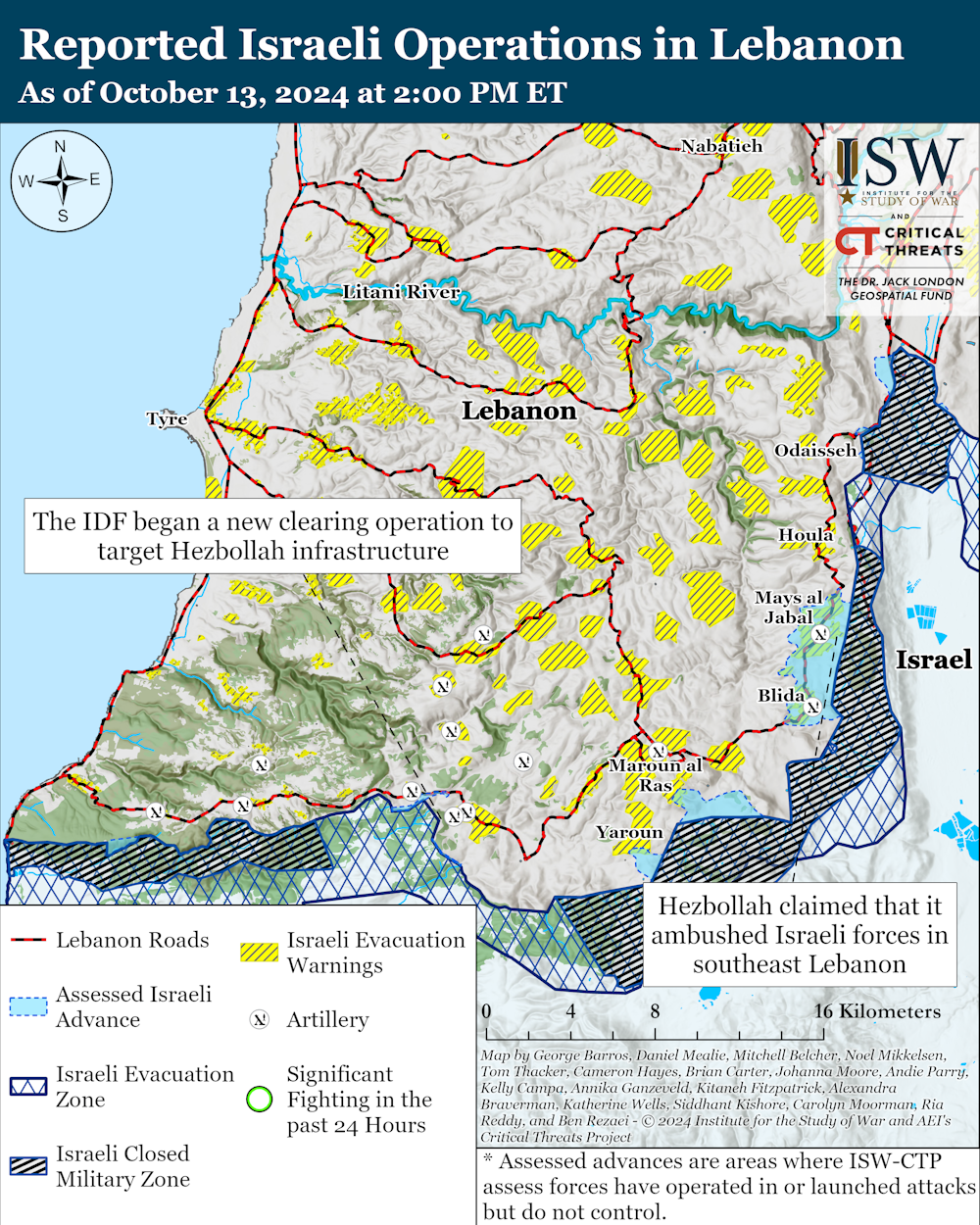
    Israel’s ground offensive in southern Lebanon, October 13 2024.
    Institute for the Study of War

    But there’s another possibility. During the Lebanese civil war, the IDF occupied a section of Lebanese land bordering Israel that was known as the “zone of security”. Its purpose was to serve as a buffer zone for northern Israel, initially designed to protect Israeli citizens from Palestinian militia, and later also from the Shia resistance groups Amal and Hezbollah.

    The Israeli request for Unifil to move five kilometres back from the blue line could mean Israel is considering reestablishing some kind of buffer zone. Several factors point to this being a possibility – although the IDF and the Israeli government may not be aligned on this issue as recent tensions suggest.

    First, the IDF has now deployed units from at least four divisions into Lebanon. The volume of troop numbers deployed is upwards of 15,000 suggesting this incursion is more than a limited operation.

    Second, 29 Unifil compounds lie along the blue line. Were they to be evacuated by the UN, there would be nothing to stop the IDF from moving in and developing them into their own strongholds. While UN positions would need reinforcement and protection equipment, they would nonetheless remain useful.

    Third, in 2006 the IDF tried to destroy Hezbollah from the air and deployed limited haphazard ground incursions. These tactics failed and the prevailing view may now be that the only way to guarantee the safe return of 65,000 Israelis to their homes in northern Israel is through an occupation.

    But unlike the previous occupation, where the IDF was aided by the SLA, Israel currently has no partner in Lebanon, and it is unlikely to find a willing accomplice among the Lebanese population to help them manage the security of a buffer zone. This means IDF troops would directly bear the brunt of attacks from resistance groups, and the northern Israeli villages would be unlikely to remain secure.

    The Netanyahu government’s continued use of military solutions to solve political problems has worrying implications for Israel, Lebanon and the Middle East as a whole. At this stage, Israel looks as if it might be settling back into a conflict that could become another “forever war”.

    Thus far, the tactics used by the IDF would imply they are not thinking ahead to “the day after” and the cost to Israel that would come with the prolonged occupation of a buffer zone.

    This article was written with assistance from John Molloy, lt. col. (rtd.) Irish Defence Forces and former senior Unifil political & civil affairs officer, 2008-2017.

    Chiara Ruffa receives funding from the Swedish Research Council, the Fulbright Commission and the European Commission.

    ref. IDF actions against UN peacekeepers suggest Israel may be considering occupying part of southern Lebanon – https://theconversation.com/idf-actions-against-un-peacekeepers-suggest-israel-may-be-considering-occupying-part-of-southern-lebanon-241297

    MIL OSI – Global Reports

  • MIL-OSI Global: South Africa’s unity government won’t dent poverty and inequality if it follows the same old policies – sociologist

    Source: The Conversation – Africa – By Roger Southall, Professor of Sociology, University of the Witwatersrand

    A recent poll by the Social Research Foundation, a think thank, found that 60% of South Africans thought the government of national unity was working well. It also reported that support for the unity government’s anchor political parties, the African National Congress (ANC) and the Democratic Alliance (DA), had risen since 29 May 2024 when elections were held.

    The poll results came out at the same time as the business press was reporting increased collaboration between business and government, fostered by the unity government. Corporations have reportedly pledged up to R250 million (about US$14.3 million to assist the state to address various logistics crises and help the National Prosecuting Authority prosecute corruption.

    Although we should be cautious about taking such news at face value, it is worth noting that the arrival of the unity government has been accompanied by other good news. For example:

    This adds up to new shoots which suggest a better harvest to come.


    Read more:
    South Africa has a huge gap between the rich and poor – 4 urgent reasons to tackle inequality


    Still, it is wise not to get too excited unless any upturn in the economy benefits the majority of South Africans. As Frans Cronje, director of the Social Research Foundation, has observed, while the unity government may be good for the middle class, there is no sign yet that it is addressing the needs of the poor and the people on the periphery of the economy.

    Unless its benefits become socially inclusive, it might well collapse. We need to take Cronje’s reservations seriously. Note, however, that although the unity government is a coalition, it is led by the African National Congress. And, while all parties agree that they need to put the economy back on track and promote growth, there is little evidence yet that the government is pursuing distinctively new policies.

    Beware complacency

    We are often told that “a rising tide lifts all boats”.

    But this claim owes more to ideology than careful analysis of economic data. In any case, it is a catchphrase which condones inequality. It suggests that as long as living standards increase for the poor, it does not matter if the wealthy gain even more. Indeed, one version is that the more the well-off benefit, the more likely they are to spend and invest their money – that is, to create wealth for others.

    Such complacency is dangerous. Apart from being contentious economically, it poses risks to both democracy and political stability. This is particularly the case in South Africa, which is widely recognised as the most unequal country in the world.

    • High rates of inequality erode social cohesion and trust in democracy. In the May general election, the lowest level of voter turnout since 1994 reflected a worrying decline in support for democracy: from 72% in 2011 to just 43% by 2023.

    • Extremes of inequality are unlikely to lead to the formation of governing coalitions committed to pursuing developmental strategies of benefit to all. As a result, populist parties that tout simplistic solutions may find it easier to win support. As suggested by the unheralded performance of Jacob Zuma’s umKhonto we Sizwe Party in the 2024 election, this is a particular danger in South Africa. Here, the poorer black majority possess potential political power in an economy which remains largely controlled and owned by a richer, white minority. The French economist Thomas Piketty in his latest blockbuster, Capital and Ideology, warns that in such situations, the dangers of a lurch towards authoritarianism are much increased.


    Read more:
    South Africa’s unity government could see a continuation of the ANC’s political dominance – and hurt the DA


    Little prospect of reduction of inequality

    The issue is not whether the unity government is blind to these dangers, but whether the policies it is pursuing are likely to make a dent in the staggering level of inequality.

    If investment and growth do occur, there will be good news down the line – possibly the creation of some 2 million jobs and more financial room for the government to fund social benefits for the poor. But it’s unlikely to have a marked effect on the level of inequality.

    First, the unity government is not promising any great change from policies that have been pursued since 1994, only more efficient implementation. Those policies have somewhat decreased racial disparities, notably by promoting a black middle class, but they have not reduced the overall level of inequality. Indeed, as Piketty shows, this has increased, not decreased, since 1994.

    Second, the unity government’s policies may continue to focus on the reduction of poverty. But this is unlikely to shift the proportions of income between the different classes. As Cronje has hinted, the new government is underpinned by a middle-class coalition, and for this to hang together, the middle class will want to reap its reward.


    Read more:
    South Africa’s new unity government must draw on the country’s greatest asset: its constitution


    Third, history doesn’t offer much hope. Former settler colonies stand out for their exceptionally high levels of inequality. In South Africa, white people always dominated the top earners before 1994. Now they have been joined by high-earning black people, many of them public officials. The top decile’s share of total earning has increased since the end of apartheid. Today it is close to 70%, compared with around 35% in Europe.

    Fourth, we live in an age which Piketty describes as “hyper-capitalism”, in which money and ultra-rich elites are highly mobile. This makes it hard for national governments to tax the rich more. They can leave, or threaten to withdraw their investments to earn higher returns elsewhere. South Africa has already been leaking its millionaires. The unity government will not want to scare any more of them away. So, it’s unlikely to adopt aggressive tax policies in the cause of narrowing inequality.

    The unity government may well promote high growth and if successful, may ameliorate poverty, but it seems unlikely that it will either attempt or succeed in reducing inequality. It may be good for the elite and middle class, but not necessarily for the health of democracy.

    Roger Southall does not work for, consult, own shares in or receive funding from any company or organisation that would benefit from this article, and has disclosed no relevant affiliations beyond their academic appointment.

    ref. South Africa’s unity government won’t dent poverty and inequality if it follows the same old policies – sociologist – https://theconversation.com/south-africas-unity-government-wont-dent-poverty-and-inequality-if-it-follows-the-same-old-policies-sociologist-240697

    MIL OSI – Global Reports

  • MIL-OSI Russia: Vladimir Stroev took part in the Sukharev Readings

    MILES AXLE Translation. Region: Russian Federation –

    Source: State University of Management – Official website of the State –

    On October 11, 2024, the 10th All-Russian scientific and practical conference “Constitutional Foundations of Prosecutor’s Activity (Sukharev Readings)” was held at the University of the Prosecutor’s Office of the Russian Federation, in which the rector of the State University of Management Vladimir Stroev took part.

    The conference is dedicated to the birthday of the outstanding statesman, legal scholar, specialist in the field of criminal law, criminal procedure and criminology Alexander Yakovlevich Sukharev.

    The plenary session and the work of the sections were devoted to the following issues: – constitutional and legal status of the prosecutor’s office of the Russian Federation: history and modernity; – constitutional foundations of prosecutorial activity outside the criminal law sphere; – constitutional foundations of prosecutorial activity in the criminal law sphere.

    Representatives of the Prosecutor General’s Office of the Russian Federation, government bodies and public organizations, prosecutor’s offices, scientific and educational organizations took part in the forum.

    Opening the conference, the rector of the University of the Prosecutor’s Office of the Russian Federation Igor Matskevich addressed the participants with a welcoming speech on behalf of the Deputy Prosecutor General of the Russian Federation Yuri Ponomarev, in which he noted the relevance of the topic of the event, its fundamental nature from the point of view of the place and role of the prosecutor’s office in the system of the state legal mechanism.

    Representatives of the Federation Council Committee on Constitutional Legislation and State Building, the State Duma Committee on Security and Anti-Corruption, the School for Training and Advanced Studies of Prosecutors in Ho Chi Minh City (Vietnam), the Scientific and Educational Center of the Prosecutor General’s Office of the Republic of Azerbaijan, the Institute of Legislation and Comparative Law under the Government of the Russian Federation, Lomonosov Moscow State University, Kutafin Moscow State Law University (MSAL), A. Ya. Sukharev Moscow Academy of the Investigative Committee, V. Ya. Kikot Moscow University of the Ministry of Internal Affairs of Russia and other specialized educational institutions spoke at the plenary and sectional sessions.

    Based on the results of the conference, recommendations were prepared, and it is planned to publish a collection of articles indexed in the RSCI system.

    Subscribe to the TG channel “Our GUU” Date of publication: 10/15/2024

    Please note: This information is raw content directly from the source of the information. It is exactly what the source states and does not reflect the position of MIL-OSI or its clients.

    Please note; This information is raw content directly from the information source. It is accurate to what the source is stating and does not reflect the position of MIL-OSI or its clients.

    Vladimir Stroev took part in the Sukharev Readings

    MIL OSI Russia News

  • MIL-OSI Russia: SPbGASU to create a “single window” for student families

    MILES AXLE Translation. Region: Russian Federation –

    Source: Saint Petersburg State University of Architecture and Civil Engineering – Saint Petersburg State University of Architecture and Civil Engineering – Meeting of Vice-Rector for Youth Policy Marina Malyutina (center) with representatives of student families

    The Saint Petersburg State University of Architecture and Civil Engineering will have a “single window” system for student families. This was announced at a meeting with representatives of such families by Vice-Rector for Youth Policy Marina Malyutina.

    The meeting took place on October 10 in a hybrid format: some students joined it online. Together with the vice-rector, the constructive dialogue was attended by the head of the youth policy department Irina Nuryeva, deputy head of the youth policy department Yulia Romanova, and deputy deans for educational work.

    Marina Malyutina reported that a wide range of measures to support student families is being implemented in St. Petersburg. In order to better know their rights, student parents should carefully study local regulations, in particular, a number of articles of the Social Code of St. Petersburg dated November 22, 2011.

    Yulia Romanova informed about the support measures for student families at various levels, including those provided by SPbGASU. Thus, students of our university can receive a one-time financial aid upon the birth of a child; advisory assistance on family issues and child-rearing issues; individual consultations with a psychologist. In addition, SPbGASU will allocate and equip special-purpose rooms for parents and their preschool-aged children, intended for feeding, changing the child, organizing his rest and leisure. For women who gave birth during the period of study, there is an opportunity to transfer from paid to free education. For students with children under three years old, there is an opportunity to transfer to an individual curriculum. Also among the support measures are New Year’s parties and gifts for children, assistance in employment for women who gave birth during the period of study.

    The “single window” system will allow young parents to quickly resolve any problem. Students learned how exactly this system will be implemented: first, they should contact the employee responsible for working with student families with a request, and he, in turn, will address the request to the relevant departments and coordinate their actions.

    The “single window” system involves the dean’s offices, the department of organization of educational activities, the department of economics, the center for psychological support of students, the center for student entrepreneurship and career. “They are informed about the importance of the task set by our president and the government, and are charged with the result. Our university is joining in solving demographic problems on an equal basis with everyone else,” said Marina Malyutina.

    During the meeting, students received answers to questions about what a student family is and how it differs from a young family, whether studying for a master’s degree is considered obtaining a first higher education, etc. They will receive information materials in the form of a mailing list.

    Please note: This information is raw content directly from the source of the information. It is exactly what the source states and does not reflect the position of MIL-OSI or its clients.

    Please note; This information is raw content directly from the information source. It is accurate to what the source is stating and does not reflect the position of MIL-OSI or its clients.

    http://vvv.spbgasu.ru/nevs-and-events/nevs/in-spbgasu-they will create a single-window-for-student-families/

    MIL OSI Russia News

  • MIL-OSI Economics: Asian Development Blog: Five Sustainable Solutions to Drive Armenia’s Crossroads of Peace Initiative

    Source: Asia Development Bank

    Armenia’s Crossroads of Peace initiative offers a vision of peace and stability through improved infrastructure and trade. It is also a great opportunity to build sustainable infrastructure, improve customs clearance, and promote green trade. Key reforms in road safety and foreign direct investment are essential for long-term success, positioning Armenia as a strategic hub for regional trade.

    Armenia, located in the South Caucasus between Europe and Asia, holds a strategic geographic position as a natural crossroads for east-west and north-south trade routes. 

    Despite closed borders with neighbors to the east and west, Armenia has outlined a vision of open borders through its “Crossroads of Peace” initiative. 

    Supported by investments in road, rail, and border checkpoints, the initiative envisions economic ties and peaceful relations with all neighbors. While improved rail networks and modern roads are a key focus, the initiative must address several factors to ensure long-term success: 

    Make the infrastructure sustainable. The infrastructure investments under the initiative represent a remarkable opportunity to incorporate sustainable infrastructure. Doing so would set a standard for future developments in Armenia and position the country as an early adopter of sustainable infrastructure in the region.

    This can be done through implementing green building standards in the roads, bridges, and related infrastructure, through the use of sustainable, recycled, or low-carbon materials along with enforcing emissions standards for equipment used in construction and maintenance.  

    LED streetlights, which last longer and reduce energy consumption, could be used. Border points can be built or refurbished to meet energy efficient standards and equipped with power supplied from renewable sources.  

    These interventions would limit the carbon footprint of the Crossroads initiative while, in the long run, reducing the overall costs for its implementation.   

    Streamline customs clearance processes. Freight typically follows the least time-consuming and cost-efficient way.  While better roads and rail networks are attractive for transit trade, customs processes need to be streamlined to truly deliver on the desired objective.

    Digitization is the backbone of modern logistics.  For customs processes, it reduces paperwork, corruption, and can drastically cut border wait times. Armenia’s adoption of the Electronic International Road Transport system is a needed advancement that would immediately improve customs clearance efficiency.  

    As Armenia’s neighbors have adopted the system as well, its geographic position along with digitally integrated customs procedures would make it the natural choice for freight movement. And with much of the legal framework agreed and a gap analysis already prepared by the United Nations Economic Commission for Europe, this would seem to be low-hanging fruit on the list to improve logistics and promote regional trade. 

    Armenia is at a critical point in its development trajectory and the Crossroads initiative could be the mechanism to propel it into a regional hub for trade and logistics.

    Promote Green Trade. The Crossroads initiative could be an enabler for Armenia to become an advocate for green trade to yield benefits to future generations. 

    This could be achieved through developing green logistics frameworks that incentivize low-emission transportation assets and eco-friendly packaging for goods. 

    Local campaigns to raise awareness of the benefits of green products and sustainable consumption can help instill these practices in Armenia, while eco-friendly labels on products can help consumers make smart choices when purchasing goods and services.

    Armenia has already renewed its commitment to the Paris Agreement and the government has demonstrated it takes the climate agenda seriously.  Promoting green trade will be another mark on the road to greater sustainability, competitiveness, export diversification, and generally improved value addition.   

    Become an enabling environment for foreign direct investment.  With open borders the Crossroads initiative can attract greater foreign direct investment, which would have sweeping benefits including job creation, greater productivity, increased government revenue, human capital development, and general technological advancements. 

    The regional stability offered by the initiative could be the trigger that entices foreign investors to consider Armenia as a new frontier for opportunity.

    Armenia has shown steady improvements in attracting new businesses, suggesting its legal and regulatory frameworks have become more attractive to foreign investors.  However, Armenia faces stiff regional competition in the South Caucasus from Georgia and will need to accelerate these reforms to redirect investment in the region. 

    The creation of more special economic zones is an important lever for the government to attract investment. Given the integral nature of transport and logistics to the initiative, more zones designed to support better logistics and simplified trade would be a meaningful step to attract the right firms and needed capacity to execute on the increased demand the Crossroads will bring to the region. 

    Create a culture of road safety. With significant investments in road infrastructure, the Crossroads initiative will offer drivers smoother and faster road surfaces. However, without stronger measures to promote a culture of road safety and enforced safety laws, improved conditions could lead to an increase in accidents. 

    Armenia has taken positive steps enacting legislation that requires seat belts and motorcycle helmets, yet on the road it is common to see drivers without either.  The legislation also does not specify restraints for child safety and children are allowed to be seated in the front, both drastically increasing the chances of injury or death in case of accident. 

    A coordinated countrywide awareness-raising campaign on the benefits of seat belts, helmets, and child restraints is necessary, along with legislative actions to identify standards and improve enforcement. 

    Armenia is at a critical point in its development trajectory and the Crossroads initiative could be the mechanism to propel it into a regional hub for trade and logistics.  However, it should not only be framed around building roads, rail, and bridges. It should also deliver on its broader ambitions and create lasting benefits for society.

    MIL OSI Economics

  • MIL-OSI: HPH Announces Change to the Board of Directors

    Source: GlobeNewswire (MIL-OSI)

    GUANGZHOU, China, Oct. 15, 2024 (GLOBE NEWSWIRE) — The board of directors (the “Board”) of Highest Performances Holdings Inc. (NASDAQ: HPH) (“HPH” or the “Company”), today announces that the office of Mr. Peh Chin Hua as Director has been vacated, effective immediately.

    Following the foregoing changes, our board of directors consists of seven directors, three of which are independent directors. Our current directors as of the date of this press release are as follows:

    Name   Position
    Hang Suong Nguyen   Chairwoman of the Board
    Yinan Hu   Vice-Chairman and Chief Executive Officer
    Youjie Kong   Director
    Yong Ren   Director
    Lihong Zhai   Independent Director and the Chairman of Audit Committee
    Min Zhou   Independent Director and the Chairwoman of Nominating and Governance Committee
    Yingying Li   Independent Director and the Chairwoman of Compensation Committee
         

    Forward-looking Statements
    This press release contains forward-looking statements as defined by the Private Securities Litigation Reform Act of 1995. Forward-looking statements include statements concerning plans, objectives, goals, strategies, future events or performance, and underlying assumptions and other statements that are other than statements of historical facts. When HPH uses words such as “may”, “will”, “intend”, “should”, “believe”, “expect”, “anticipate”, “project”, “estimate” or similar expressions that do not relate solely to historical matters, it is making forward-looking statements. Forward-looking statements are not guarantees of future performance and involve risks and uncertainties that may cause the actual results to differ materially from HPH’s expectations discussed in the forward-looking statements. These statements are subject to uncertainties and risks including, but not limited to, the following: HPH’s ability to obtain proceeds from the Agreement; HPH’s goals and strategies; HPH’s future business development; product and service demand and acceptance; changes in technology; economic conditions; the growth of the third-party wealth management industry in China; reputation and brand; the impact of competition and pricing; government regulations; fluctuations in general economic and business conditions in China and the international markets HPH serves and assumptions underlying or related to any of the foregoing and other risks contained in reports filed by HPH with the Securities and Exchange Commission. For these reasons, among others, investors are cautioned not to place undue reliance upon any forward-looking statements in this press release. Additional factors are discussed in HPH’s filings with the U.S. Securities and Exchange Commission, which are available for review at http://www.sec.gov. HPH undertakes no obligation to publicly revise these forward-looking statements to reflect events or circumstances that arise after the date hereof.

    Highest Performances Holdings Inc.

    The MIL Network

  • MIL-OSI Europe: Analysis: UN peacekeepers at risk in southern Lebanon

    Source: Universities – Science Po in English

    United Nations peacekeepers in southern Lebanon have reported a series of incidents over the past few days in which they have been endangered by Israeli Defense Forces (IDF) as Israel continues its incursion into southern Lebanon. From bearing witness to sheltering the local population, the UN Unifil mission has a vital role to play in Lebanon, but at what cost?

    Read the analysis by experts Chiara Ruffa, Professor in political science at Sciences Po Center for International Studies (CERI), and Vanessa Newby, Assistant Professor at the Institute of Security and Global Affairs at Leiden University, initially published by our partner The Conversation.

    United Nations peacekeepers in southern Lebanon have reported a series of incidents over the past few days in which they have been endangered by Israeli Defense Forces (IDF) as Israel continues its incursion into southern Lebanon.

    Two members of the United Nations Interim Force in Lebanon (Unifil) were wounded on October 10 when an Israeli tank fired its weapon at Unifil’s headquarters in the city of Naqoura. They are reported to be receiving treatment in hospital for minor injuries.

    This follows a series of other reports of IDF troops firing on other Unifil positions in recent days. A Unifil statement called on the IDF “and all actors to ensure the safety and security of UN personnel and property and to respect the inviolability of UN premises at all times”.

    For 44 years the presence of UN peacekeepers in southern Lebanon has provided a much-needed measure of predictability and stability on an international fault line that has the potential to trigger a larger war in the Middle East. Its value has often been to shine an international spotlight on events on the ground and to provide humanitarian assistance to the local population.

    The Unifil peacekeeping mission is in an area of southern Lebanon that stretches from the de facto Lebanese border with Israel about 18 miles northwards up to the Litani River. In violation of UN security council resolution 1701, which was issued in 2006 and was designed to bring to an end the 33-day war between Israel and Hezbollah, Israeli tanks have been advancing into southern Lebanon since September 30. Hezbollah is fighting back – and casualties are mounting.

    On October 5, the Israel Defense Forces (IDF) pressed the Unifil Irish Battalion, stationed south-east of Marun al-Ras, to leave its position to allow the IDF to proceed with their invasion. On October 6, Unifil force commander Lt. Gen. Aroldo Lázaro Sáenz denied the request. A Unifil statement said: “Peacekeepers remain in all positions and the UN flag continues to fly.”


    The IDF reportedly ceased their military operations in the area on October 8. This is most likely because their military goals have changed. The rapidly unfolding Israeli military action in Lebanon has now deployed an additional 15,000 troops. This raises questions about the “limited” nature of the IDF’s incursion and its goals.

    Since 1978, Unifil has provided medical services, electricity, generators, language courses, financial aid and water to local communities. The peacekeeping force has also helped to clear millions of square meters of land from anti-personal mines and cluster bombs, releasing farmland for cultivation and preventing injuries or deaths since the 2006 war.

    In 2006, the Unifil mission adopted a new mandate under UN Resolution 1701. Like all newer UN peacekeeping mandates, it contained a protection of civilians clause which authorises Unifil to “protect civilians under imminent threat of physical violence”.

    Israel contends that Hezbollah missile attacks into northern Israel are an indication that Unifil has never fully implemented 1701 – hence the need to invade and destroy the militant group. But protection of civilians is central to Unifil’s mandate. While the IDF claims it is targeting Hezbollah’s military infrastructure and leadership, thousands of civilian lives in southern Lebanon remain at risk.

    It has recently been reported that more than 2,000 civilians have died in the latest Israeli incursion, with more than 9,000 injured and over 608,000 displaced. So, implementation of this protection clause has never been more important.

    Unifil must not become collateral damage

    Unifil’s ability to protect civilians during Israeli incursions has often been challenged because the IDF refused to guarantee the safety of fleeing civilians, either in convoys out of the villages, or in UN compounds.

    The most notorious incident was the Qana incident of 1996, when 106 civilians died while sheltering in the Fijian UN compound. In July 2006, the IDF used a precision guided aerial bomb on a Unifil post. The attack killed four international unarmed military observers working under Unifil operational control, despite repeated verbal warnings from Unifil headquarters to avoid the post. The IDF has also damaged Unifil positions in times of peace. In January 2005 an unarmed French UN observer was killed by IDF tank fire. In January 2015 IDF artillery killed a Spanish peacekeeper.

    So the challenge for Unifil has always been that if they allow civilians to take shelter in their compounds, they risk becoming part of the IDF’s collateral damage.

    Similarly, Hezbollah is also no friend of Unifil. In December 2022, Hezbollah supporters killed an Irish peacekeeper who ventured accidentally into a village just outside the area of operation.

    International witness

    Despite these challenges, Unifil still has a powerful role to play in southern Lebanon. As the fog of war engulfs all the protagonists, Unifil has the ability to bring the world’s attention to the current conflict which may help constrain the parties. It is critical at this time to have an international force bear witness to events on the ground and provide basic humanitarian assistance, monitor and report potential violations and guarantee shelter to the local population whenever possible to help the displaced people that remain within the Unifil area of operation.

    On October 7, the US State Department warned the IDF that it did not want to see military action taken against Unifil or for the peacekeepers to be put in danger in any way. This warning is welcome given the recent disregard for the UN demonstrated by Israel’s prime minister, Benjamin Netanyahu. who, when speaking to the UN general assembly on September 27, labelled the UN “contemptible in the eyes of decent people everywhere”. On October 2, the Israeli government barred UN secretary general António Guterres from entering Israel.

    Israel’s allies must increase the pressure for the IDF to allow Unifil to exercise the protection of civilians clause contained in its mandate. This would mean allowing the peacekeeping force the freedom of movement in south Lebanon to facilitate the delivery of humanitarian aid. The IDF must also guarantee the safety of civilians escaping with Unifil’s assistance from the villages. And the IDF must allow Unifil to establish safe zones for civilians trapped in the conflict, to compensate for the absence of air raid shelters and bunkers in Lebanon.

    While Unifil may not be able to prevent the bloodshed, for now it can continue help to stem the flow, just as it always has.

    MIL OSI Europe News

  • MIL-OSI United Kingdom: Finding Future Advanced Electronics and Electromechanical Devices

    Source: United Kingdom – Executive Government & Departments

    DASA and AWE seek novel technologies in the space domain to enhance the UK’s Defence and Commercial Space Systems resilience and reliability

    • DASA has launched a new Themed Competition: AWE – Advanced Electronics and Electromechanical Devices
    • This competition is funded by AWE
    • The total possible funding available for Phase 1 of this competition is £4 million across two years (including VAT)
    • Competition closes midday on Tuesday 10th December 2024 (GMT)

    The Defence and Security Accelerator (DASA) is pleased to launch a new Themed Competition called AWE – Advanced Electronics and Electromechanical Devices. DASA, in conjunction with AWE, is seeking innovative ideas to approach the following four challenge areas in novel ways:

    1. Power and data transfer across closed metal barriers.
    2. Robust semi-conductor switching for high-voltage applications.
    3. Low delta-T thermo-electric generation.
    4. Low drift inertial sensors.

    Read the full competition document to learn more.

    Key dates and funding

    The total possible funding available for Phase 1 of this competition is £4 million across two years (including VAT). A number of proposals may be funded.

    The deadline to submit a proposal is midday on Tuesday 10th of December 2024 (GMT). Submit via the DASA Online Submission Service for which you will require an account.

    Do you have a relevant solution? Read the full competition document and submit a proposal.

    Background

    The space domain has been identified by the National Protective Security Authority (NPSA) as one of the UK’s critical national infrastructure sectors. The need to increase and assure resilience and reliability of operation, particularly within the space domain in times of tension, is self-evident. Many technology developments are accelerated from the defence sector into the commercial sector. AWE is interested in further enhancing UK-sovereign, resilient, demonstrable capabilities for the space and air domains. Maintaining and developing a UK-sovereign capability is critical to the UK security and prosperity.

    Sourcing and supporting innovation is crucially important to the security of our nation. This competition represents the next step in DASA’s collaboration with AWE and we look forward to seeing what novel innovations the competition finds to address AWE’s challenges in the space domain.

    Anita Friend, Head of DASA

    This competition will enhance AWE’s capability in UK defence, security and commercial air and space domains, helping to keep our nation safe while investing in UK business.

    Lucy, Group Leader Engineering at AWE

    Learn more about the competition and submit a proposal here.

    Supporting events

    Launch Webinar –

    A dial-in session on Tuesday 22 October, providing further detail on the problem space and a chance to ask questions in an open forum. If you would like to participate, please register on the Eventbrite page here.

    1-2-1 –

    A series of 15 minute one-to-one teleconference sessions across Monday 28 and Tuesday 29 October, giving you the opportunity to ask specific questions. Booking is on a first come first served basis. If you would like to participate, please register on the relevant Eventbrite page linked below:

    Book for Monday 28 October

    Book for Tuesday 29 October

    Submit a proposal

    We want novel ideas to benefit end-users working in UK Defence, Security and Commercial air and space domains. If you can provide this, submit a proposal to this competition.

    Updates to this page

    Published 15 October 2024

    MIL OSI United Kingdom

  • MIL-OSI United Kingdom: Research programme to ensure UK economy uses AI to grow safely

    Source: United Kingdom – Executive Government & Departments

    Researchers to be supported in boosting defences against societal risks such as deepfakes and cyber-attacks.

    • Support unveiled for researchers to boost defences against societal risks including deepfakes and cyber-attacks 
    • First phase of AI Safety Institute scheme to provide researchers with up to £200,000 in grants launches 
    • Programme dedicated to ‘systemic AI safety’ to boost public trust as technology is rolled out across the economy

    Researchers focused on boosting society’s resilience against AI risks such as deepfakes, misinformation, and cyber-attacks, can now access government grants to drive forward their work which will help ensure the safety of AI, as the UK taps into its potential to spark economic growth and improvements to public services.

    The scheme launched today (Tuesday 15th October), in partnership with the Engineering and Physical Sciences Research Council (EPSRC) and Innovate UK, part of UK Research and Innovation (UKRI), is focused on how society can be protected from the potential risks of AI. It will also support research to tackle the threat of AI systems failing unexpectedly, for example in the financial sector. 

    Tackling these risks head on will boost public confidence in the technology which holds enormous potential to spark long-term growth, while keeping the UK at the heart of research into responsible and trustworthy AI development. Ensuring public confidence in AI is central to the government’s plans for seizing its potential, as the UK harnesses the technology to drive up productivity and deliver public services which are fit for the future.

    To ensure the UK can continue to harness the enormous opportunities of AI, the government has also committed to introduce highly-targeted legislation for the handful of companies developing the most powerful AI models, ensuring a proportionate approach to regulation rather than new blanket rules on its use.

    Systemic AI safety is focused on the systems and infrastructure where AI is being deployed across different sectors. The programme launched today hopes to spark a broad range of research to identify the critical risks of frontier AI adoption in critical sectors like healthcare and energy services, identifying potential solutions which can then be transformed into long-term tools which tackle potential AI risks in these areas.

    Secretary of State for Science, Innovation, and Technology, Peter Kyle said: 

    My focus is on speeding up the adoption of AI across the country so that we can kickstart growth and improve public services. Central to that plan though is boosting public trust in the innovations which are already delivering real change.

    That’s where this grants programme comes in. By tapping into a wide range of expertise from industry to academia, we are supporting the research which will make sure that as we roll AI systems out across our economy, they can be safe and trustworthy at the point of delivery.

    Launching the formal opening of its Systemic Safety Grants Programme, the UK’s AI Safety Institute is looking to back around 20 projects with funding of up to £200,000 each over the course of its first phase, worth £4 million. In total the fund is worth £8.5 million, first announced at May’s AI Seoul Summit, with the additional cash to become available in due course as further phases are launched. 

    Applicants will be assessed on the potential issues their research could solve and what risks it addresses, having until 26th of November to submit their proposals. 

    AI Safety Institute Chair Ian Hogarth, said:

    This grants programme allows us to advance broader understanding on the emerging topic of systemic AI safety. It will focus on identifying and mitigating risks associated with AI deployment in specific sectors which could impact society, whether that’s in areas like deepfakes or the potential for AI systems to fail unexpectedly.

    By bringing together researcher from a wide range of disciplines and backgrounds into this process of contributing to a broader base of AI research, we’re building up empirical evidence of where AI models could pose risks so we can develop a rounded approach to AI safety for the global public good.

    The AI Safety Institute’s work in evaluating the safety of AI models is just one part of its mission, and the grants programme is set to deliver new research which will ultimately help societies across the world to better manage changes the technology could bring.  

    UK-based organisations are eligible to apply for grant funding via a dedicated website, and the programme’s opening phase will aim to deepen understandings over what challenges AI is likely to pose to society in the near future. Projects can also include international partners, boosting collaboration between developers and the AI research community while strengthening the shared global approach to the safe deployment and development of the technology.  

    Successful applicants will be confirmed in the end of January 2025, with the first round of grants then set to be awarded in February.

    Notes to editors

    Visit AI Safety Institute website for:

    DSIT media enquiries

    Email press@dsit.gov.uk

    Monday to Friday, 8:30am to 6pm 020 7215 300

    Updates to this page

    Published 15 October 2024

    MIL OSI United Kingdom

  • MIL-OSI Africa: South Africa’s unity government won’t dent poverty and inequality if it follows the same old policies – sociologist

    Source: The Conversation – Africa – By Roger Southall, Professor of Sociology, University of the Witwatersrand

    A recent poll by the Social Research Foundation, a think thank, found that 60% of South Africans thought the government of national unity was working well. It also reported that support for the unity government’s anchor political parties, the African National Congress (ANC) and the Democratic Alliance (DA), had risen since 29 May 2024 when elections were held.

    The poll results came out at the same time as the business press was reporting increased collaboration between business and government, fostered by the unity government. Corporations have reportedly pledged up to R250 million (about US$14.3 million to assist the state to address various logistics crises and help the National Prosecuting Authority prosecute corruption.

    Although we should be cautious about taking such news at face value, it is worth noting that the arrival of the unity government has been accompanied by other good news. For example:

    This adds up to new shoots which suggest a better harvest to come.


    Read more: South Africa has a huge gap between the rich and poor – 4 urgent reasons to tackle inequality


    Still, it is wise not to get too excited unless any upturn in the economy benefits the majority of South Africans. As Frans Cronje, director of the Social Research Foundation, has observed, while the unity government may be good for the middle class, there is no sign yet that it is addressing the needs of the poor and the people on the periphery of the economy.

    Unless its benefits become socially inclusive, it might well collapse. We need to take Cronje’s reservations seriously. Note, however, that although the unity government is a coalition, it is led by the African National Congress. And, while all parties agree that they need to put the economy back on track and promote growth, there is little evidence yet that the government is pursuing distinctively new policies.

    Beware complacency

    We are often told that “a rising tide lifts all boats”.

    But this claim owes more to ideology than careful analysis of economic data. In any case, it is a catchphrase which condones inequality. It suggests that as long as living standards increase for the poor, it does not matter if the wealthy gain even more. Indeed, one version is that the more the well-off benefit, the more likely they are to spend and invest their money – that is, to create wealth for others.

    Such complacency is dangerous. Apart from being contentious economically, it poses risks to both democracy and political stability. This is particularly the case in South Africa, which is widely recognised as the most unequal country in the world.

    • High rates of inequality erode social cohesion and trust in democracy. In the May general election, the lowest level of voter turnout since 1994 reflected a worrying decline in support for democracy: from 72% in 2011 to just 43% by 2023.

    • Extremes of inequality are unlikely to lead to the formation of governing coalitions committed to pursuing developmental strategies of benefit to all. As a result, populist parties that tout simplistic solutions may find it easier to win support. As suggested by the unheralded performance of Jacob Zuma’s umKhonto we Sizwe Party in the 2024 election, this is a particular danger in South Africa. Here, the poorer black majority possess potential political power in an economy which remains largely controlled and owned by a richer, white minority. The French economist Thomas Piketty in his latest blockbuster, Capital and Ideology, warns that in such situations, the dangers of a lurch towards authoritarianism are much increased.


    Read more: South Africa’s unity government could see a continuation of the ANC’s political dominance – and hurt the DA


    Little prospect of reduction of inequality

    The issue is not whether the unity government is blind to these dangers, but whether the policies it is pursuing are likely to make a dent in the staggering level of inequality.

    If investment and growth do occur, there will be good news down the line – possibly the creation of some 2 million jobs and more financial room for the government to fund social benefits for the poor. But it’s unlikely to have a marked effect on the level of inequality.

    First, the unity government is not promising any great change from policies that have been pursued since 1994, only more efficient implementation. Those policies have somewhat decreased racial disparities, notably by promoting a black middle class, but they have not reduced the overall level of inequality. Indeed, as Piketty shows, this has increased, not decreased, since 1994.

    Second, the unity government’s policies may continue to focus on the reduction of poverty. But this is unlikely to shift the proportions of income between the different classes. As Cronje has hinted, the new government is underpinned by a middle-class coalition, and for this to hang together, the middle class will want to reap its reward.


    Read more: South Africa’s new unity government must draw on the country’s greatest asset: its constitution


    Third, history doesn’t offer much hope. Former settler colonies stand out for their exceptionally high levels of inequality. In South Africa, white people always dominated the top earners before 1994. Now they have been joined by high-earning black people, many of them public officials. The top decile’s share of total earning has increased since the end of apartheid. Today it is close to 70%, compared with around 35% in Europe.

    Fourth, we live in an age which Piketty describes as “hyper-capitalism”, in which money and ultra-rich elites are highly mobile. This makes it hard for national governments to tax the rich more. They can leave, or threaten to withdraw their investments to earn higher returns elsewhere. South Africa has already been leaking its millionaires. The unity government will not want to scare any more of them away. So, it’s unlikely to adopt aggressive tax policies in the cause of narrowing inequality.

    The unity government may well promote high growth and if successful, may ameliorate poverty, but it seems unlikely that it will either attempt or succeed in reducing inequality. It may be good for the elite and middle class, but not necessarily for the health of democracy.

    – South Africa’s unity government won’t dent poverty and inequality if it follows the same old policies – sociologist
    https://theconversation.com/south-africas-unity-government-wont-dent-poverty-and-inequality-if-it-follows-the-same-old-policies-sociologist-240697

    MIL OSI Africa

  • MIL-OSI Russia: Another residential building under the renovation program will appear in the Kuzminki district

    MILES AXLE Translation. Region: Russian Federation –

    Source: Moscow Government – Government of Moscow –

    A house under the renovation program will be built in the Kuzminki district in the southeast of the capital – an urban development plan for the land plot has already been issued for this purpose. The facility will appear as part of the block development. This was reported by Juliana Knyazhevskaya, Chairman of the Committee for Architecture and Urban Development of Moscow (Moskomarkhitektura).

    “A new house with a maximum area of 27.9 thousand square meters will appear on a plot of one hectare. The new building will be erected at the address: Marshal Chuikov Street, land plot 18a. New residents will receive apartments in a modern house within walking distance of public transport stops and a park complex,” commented Yuliana Knyazhevskaya.

    Earlier Sergei Sobyanin told, that since the beginning of the year, 23 new buildings have been commissioned in the capital and 44 residential complexes have been handed over for occupancy under the renovation program.

    Renovation program approved in August 2017. It concerns about a million Muscovites and provides for the resettlement of 5,176 houses. In 2023 alone, 59 new buildings in the capital were handed over for settlement and the relocation of over 47 thousand people was ensured. Mayor of Moscow instructed to double the pace of implementation of the renovation program.

    Moscow is a leader among regions in terms of construction rates and volumes. Over the past five years, within the framework of the federal project “Housing” of the national project “Housing and Urban Environment”the volume of construction and commissioning of residential properties in the capital has doubled – from three million to five to seven million square meters per year. More information about the national projects being implemented in Moscow can be found find out here.

    Please note: This information is raw content directly from the source of the information. It is exactly what the source states and does not reflect the position of MIL-OSI or its clients.

    Please note; This information is raw content directly from the information source. It is accurate to what the source is stating and does not reflect the position of MIL-OSI or its clients.

    https://vvv.mos.ru/nevs/item/145237073/

    MIL OSI Russia News

  • MIL-OSI Russia: Moscow Receives UN Certificate for Smart City Development Achievements

    MILES AXLE Translation. Region: Russian Federation –

    Source: Moscow Government – Government of Moscow –

    Moscow has received a certificate as part of the UN international initiative United for Smart Sustainable Cities (U4SSC). This was reported by Natalia Sergunina, Deputy Mayor of Moscow.

    U4SSC is a global initiative aimed at improving the quality of urban governance. Its participants adhere to common approaches to measuring the main criteria for the development of megacities.

    “The capital has once again confirmed its status as one of the most technologically advanced megacities in the world. When assessing, experts took into account 90 indicators of innovative development. They cover several key areas – from the economy and the environment to society and culture,” said Natalia Sergunina.

    In particular, international experts noted the almost complete coverage of Moscow with high-speed Internet (98.9 percent). 97 percent of residents use it daily.

    High standards

    Moscow uses potentialall advanced technologies – blockchain, metaverses, the Internet of Things and other innovations. Every year, over 300 IT projects are implemented in the capital, with artificial intelligence already involved in more than 90 of them. Last year alone, 25 Moscow developments were awarded prestigious Russian and international awards in the field of digitalization.

    In 2021, the capital received certificates of compliance with two international standards at once: ISO 37 120 “Sustainable Communities – Indicators for Urban Services and Quality of Life” and ISO 37 122 “Sustainable Cities and Communities – Indicators for Smart Cities”.

    Moscow was awarded a Smart Cities Certificate among the first 10 megacities in the world. The assessment was conducted according to 80 criteria reflecting the effectiveness of the use of technological solutions in all industries.

    City as a service

    Today, the main capital portal mos.ru offers more than 420 electronic services and services, covering all areas – from health care and education to culture and housing and utilities. The number of daily requests from city residents exceeds two million, and the total number of registered users of the portal is 15.9 million, specified in Moscow Department of Information Technology.

    City residents used services and services on the mos.ru portal more than 425 million times in six months

    Thanks to digitalization, residents no longer need to provide more than a billion different certificates. With the help of online tools, Muscovites actively participate in the development of the capital: they make decisions and share proposals. On the platform “City of Ideas”More than 200 thousand initiatives in the fields of healthcare, transport, entrepreneurship and others have been collected. Hundreds of them are implemented annually.

    The project celebrated its 10th anniversary in the spring. “Active Citizen”, which united more than seven million people. With its help, city residents choose which parks, courtyards and squares need to be improved, how clinics and cultural institutions should work, vote for the names of streets and metro stations. More than four thousand decisions have already been implemented.

    Moscow Wins Smart City Grand Prix for Second Time — Sergei Sobyanin

    Please note: This information is raw content directly from the source of the information. It is exactly what the source states and does not reflect the position of MIL-OSI or its clients.

    Please note; This information is raw content directly from the information source. It is accurate to what the source is stating and does not reflect the position of MIL-OSI or its clients.

    http://vvv.mos.ru/nevs/item/145234073/

    MIL OSI Russia News

  • MIL-OSI Russia: Electronics manufacturer becomes resident of Technopolis Moscow SEZ

    MILES AXLE Translation. Region: Russian Federation –

    Source: Moscow Government – Government of Moscow –

    The manufacturer of electronics, single-board computers and peripheral equipment has become a resident of the special economic zone (SEZ) “Technopolis Moscow”. The company “Digital Lab” will produce 21 thousand products annually, and private investments in the project have already amounted to about 200 million rubles. This was reported by the Deputy Mayor of Moscow for Transport and Industry Maxim Liksutov.

    “One of the effective measures to support the city is to localize the enterprise in the special economic zone of the capital. Today, this is the center for the development of advanced, the most high-tech industry in Moscow, which includes six sites. More than 220 enterprises operate here, of which over 110 have resident status and enjoy a number of tax preferences. Increasing the number of SEZ residents is under the special control of Sergei Sobyanin,” said Maxim Liksutov.

    The uniqueness of the products lies in the universal selection of components, which allows for the prompt reconfiguration of production from the release of components for unmanned aerial vehicles (UAVs) to the manufacture of individual parts. Using single-board computers installed on UAVs, it is possible to solve many problems, for example, use an intelligent decision-making system, analyze video from several video cameras, and classify objects.

    “High-tech products of the companies of the SEZ Technopolis Moscow are in significant demand due to their innovativeness, high level of localization and ability to effectively replace imported analogues. Today, residents receive a number of tax benefits, which allows them to significantly increase their investments in development. In particular, residents are exempt from paying taxes on property, land and transport for 10 years. In the industrial park Rudnevo, the new resident of the special economic zone will create more than 120 jobs. The total production area will exceed 1.2 thousand square meters,” added the Minister of the Moscow Government, head of the capital’s Department of Investment and Industrial Policy

    Anatoly Garbuzov.

    Autonomy of production is achieved thanks to unique software and hardware complexes and production of final products. According to the company’s CEO Evgeny Konstantinov, all circuitry and device architecture was created by the company’s specialists, so it is possible to personalize connectors, memory cards and equipment dimensions in accordance with the customer’s preferences. The manufacturer produces not only hardware complexes, but also software ones that can be quickly integrated for specific needs. Another development is communication systems (modems) that allow UAVs to operate in the absence of a global navigation satellite system signal and to switch between frequencies if one of them is suppressed.

    In addition, there is a technical support line for users and a customer feedback form for product improvement.

    Today, the Rudnevo industrial park has created favorable conditions for the development of high-tech companies whose products contribute to the technological sovereignty of the country and ensure independence from imports, noted Gennady Degtyarev, General Director of the Technopolis Moscow SEZ. Residents receive tax and customs preferences. The total investment of enterprises in production at the Rudnevo site has already amounted to 20 billion rubles.

    SEZ Technopolis Moscow is a territory with a special legal status, where a preferential regime of entrepreneurial activity for investors operates. The area of six sites (Pechatniki, Alabushevo, Mikron, MIET, Angstrem, Rudnevo), where high-tech enterprises are located, exceeds 280 hectares. SEZ Technopolis Moscow has been a leader in international and national industry ratings for several years.

    Please note: This information is raw content directly from the source of the information. It is exactly what the source states and does not reflect the position of MIL-OSI or its clients.

    Please note; This information is raw content directly from the information source. It is accurate to what the source is stating and does not reflect the position of MIL-OSI or its clients.

    http://vvv.mos.ru/nevs/item/145213073/

    MIL OSI Russia News

  • MIL-OSI United Kingdom: Israel Defence Forces’ attacks on UNIFIL bases: statement by foreign ministers of France, Germany, Italy and the UK

    Source: United Kingdom – Executive Government & Departments 3

    Foreign ministers of France, Germany, Italy and the UK gave a joint statement on attacks by the Israel Defence Forces against UNIFIL bases.

    Joint statment:

    We, the Foreign Ministers of France, Germany, Italy and the United Kingdom express our deep concern in the wake of recent attacks by IDF on UNIFIL bases, which have left several peacekeepers injured. These attacks must stop immediately. We condemn all threats to UNIFIL’s security.

    Any deliberate attack against UNIFIL goes against international humanitarian law and United Nations Security Council Resolution 1701. The protection of peacekeepers is incumbent upon all parties to a conflict.

    We call on Israel and all parties to uphold their obligations to ensure the safety and security of UNIFIL personnel at all times and to allow UNIFIL to continue carrying out its mandate. We reaffirm the essential stabilizing role played by UNIFIL in southern Lebanon. We underscore the importance of the United Nations in resolving armed conflict and mitigating the humanitarian impact.

    Media enquiries

    Email newsdesk@fcdo.gov.uk

    Telephone 020 7008 3100

    Contact the FCDO Communication Team via email (monitored 24 hours a day) in the first instance, and we will respond as soon as possible.

    Updates to this page

    Published 14 October 2024

    MIL OSI United Kingdom

  • MIL-OSI Australia: Plimsoll Address

    Source: Australian Government – Minister of Foreign Affairs

    Thank you to the Australian Institute for International Affairs and the University of Tasmania for inviting me to give this address, in honour of this great statesperson. 

    With a career that spanned the first four decades of independent Australian foreign policy, there are few who have made a contribution comparable to James Plimsoll – or Jim Plim as he was affectionately known.

    He first made his mark in the late 1940s supporting Foreign Minister Evatt during his presidency of the United Nations General Assembly – support that included ghost-writing Evatt’s book, The Task of Nations.

    He later became Secretary of the Department of External Affairs – which we now know as DFAT…

    He was appointed Ambassador in Washington, Tokyo, Brussels and Moscow… 

    High Commissioner in London and Delhi…

    And even Governor of this great state of Tasmania…

    Among all these lofty appointments, his biographer Jeremy Hearder reflected that the highlight of Plimsoll’s career was serving as Australia’s Ambassador and Permanent Representative to the UN Nations in New York, in the late 1950s and early 1960s.

    And we can understand why. He found himself at the centre of major international issues – and his diplomatic skill meant, in the words of a British colleague, that Plimsoll “exercised an influence on the UN quite disproportionate to Australia’s standing in the world.”

    This was partly because of what the then Secretary of External Affairs, Arthur Tange, described as Plimsoll’s “remarkable capacity… for talking to people in their own terms, freely encouraging them to explain their viewpoints and problems.”

    It is patent that Jim Plim understood deeply how Australia’s interests as a middle power are at stake in the multilateral system.

    Even with all the flaws with the international system, this remains the case today.

    Australia will always be better off in a world that operates by rules that all countries have a say in shaping.

    A world where Australia and other countries have the freedom to decide our own futures, without interference and intimidation.

    A world where we can find collective solutions to our toughest problems.

    Where no country dominates, and no country is dominated.

    I’ve recently returned from the UN General Assembly’s annual High-Level Week, where Australia progressed our most ambitious multilateral agenda in many years.

    I convened meetings of humanitarian leaders and ministers from influential countries to address a serious problem in the international system.

    That is, the growing risk that norms are being eroded in international humanitarian law – what we often refer to as the rules of war.

    We see this in the massive civilian toll in conflicts around the world, and we see this in the increasing numbers of aid workers being killed and kidnapped.

    In order to protect civilians, we must also protect aid workers who deliver the food, water and medicine civilians need to survive.

    Aid workers are the best of humanity. Their dedication to improving the lives of others should not cost them their own.

    Yet 2023 was the deadliest year on record for aid workers, and 2024 is on track to be even worse.

    This has been felt directly by Australians with the IDF’s strike against World Central Kitchen vehicles, which killed Australian Zomi Frankcom and her colleagues.

    This was not a one-off incident. Gaza is the most dangerous place on earth to be an aid worker. More than 300 aid workers have been killed since the start of the conflict.

    Together, the ministerial group I convened agreed to pursue a new Declaration for the Protection of Humanitarian Personnel.

    Work on the Declaration is now underway, with our officials consulting experts and other countries.

    All countries will be invited to join the Declaration, to demonstrate the unity of the international community’s commitment to protect aid workers – and to channel that commitment into action in Gaza, in Sudan, in Ukraine and in all current and future conflicts.

    This is exactly the kind of leadership Australia should be taking in the world.

    We are not a superpower. But we are respected, and at our best we have a reputation for bringing countries together to defend and promote the rules-based order that protects us all.

    From the days helping draft the UN Charter and the Universal Declaration of Human Rights, to Gareth Evans’ leadership on the Chemical Weapons Convention, to our more leading role in the Arms Trade Treaty.

    There’s no doubt that reputation waned through the negative globalist years of the previous government.

    But in driving this Declaration we are demonstrating that Australians are indeed constructive internationalists in the mould of the honouree of this address.

    This brings me back to the book Plimsoll ghostwrote for Evatt, which spelled out our shared responsibility to each other. I quote:

    “We should try to raise standards everywhere in order to practice the simple humanitarian doctrine which is the basis of all morality, namely that we should help our neighbour and relieve misery and suffering… [We] can hardly imagine … the common lot of so many of mankind – disease, low expectation of life, and unrelieved pain; flood, famine and epidemics… These wrongs cry out for redress, and can and must be righted by co-operative international effort.”

    A powerful articulation of the motivation for our humanitarian work.

    And tonight we build on that work. Tonight, I am releasing Australia’s new Humanitarian Policy.

    It is a policy that comprehends the serious problems of our times.

    A climate changing faster than our combined efforts to stop it.

    More people displaced – in fact, more than 117 million people forcibly displaced from their homes.

    More people needing humanitarian assistance – 302 million people this year, up by nearly 30 million in just the last two years.

    More conflict than any time since World War Two. Russia’s invasion of Ukraine. Sudan. Myanmar. And in the Middle East.

    The Albanese Government is committed to humanitarian action which saves lives, alleviates human suffering and builds resilient communities. 

    The Policy outlines the role Australia will play at a time when need is outstripping the world’s capacity to respond and disregard for international humanitarian law is increasing.

    It is a plan of action that is not just about meeting humanitarian needs. It is also about protecting the peace, stability and prosperity that we want for Australia, our region and the world.

    It is a plan that is accountable – to the Australian people, and to the partners and communities we seek to help.

    We will focus on three priorities.

    First, we will build readiness and preparedness, anticipating shocks before they occur and working with our partners to lessen their impact.

    As part of this priority, I announce Australia is providing $5 million to the new Asia-Pacific Regional Humanitarian Fund to pre-position for the next emergency.

    Second, we will respond to crises and disasters, delivering support that meets the needs of crisis-affected populations and protects the most vulnerable, both immediately and over the longer term.

    As part of that effort, I announce $9 million in humanitarian relief to respond to high levels of food insecurity in Yemen. This follows support I announced yesterday for Myanmar, as well as over $80 million in aid to support civilians who have been devastated by the conflicts in Gaza and Lebanon.

    And third, we will reinforce the international humanitarian system, working to take practical and actionable steps to strengthen adherence to international humanitarian law – just as we are doing with the Declaration.

    We act globally, but our focus remains our region. We offer genuine partnerships, based on respect, listening and learning from each other.

    And we are helping build self-reliance, so obviously in Australia’s interests and the region’s interests.

    Now, we know humanitarian assistance can lessen shocks and keep further instability, conflict and displacement at bay.

    But we all want a world where humanitarian assistance is needed far less often.

    This is just one reason why the Albanese Government is acting on climate change.

    We have enshrined our ambitious emissions reduction targets into legislation: 43 per cent by 2030 and net zero by 2050.

    We are transforming our economy.

    Within this decade, 82 per cent of Australia’s electricity generation will be renewable, up from around 32 per cent when we came to office.

    We are building new industries to accelerate our economic transition and to export reliable, renewable energy to the world.

    And we are acting internationally, to respond to our partners.

    By the end of 2025, Australia will offer Climate Resilient Debt Clauses in our sovereign loans.

    And the groundbreaking Australia-Tuvalu Falepili Union treaty entered into force on 28 August – a treaty which provides for both adaptation and mobility with dignity…

    And the first treaty anywhere in the world which provides legal protection for sovereignty in the face of sea level rise.

    But we can’t address climate change on our own, just as we can’t alone resolve all of the conflicts that are driving humanitarian crises.

    What we are doing is using our forthcoming term on the UN Peacebuilding Commission to reform the international peacebuilding and conflict prevention architecture.

    What we are doing is helping Ukraine end Russia’s illegal and immoral war on its own terms.

    Since coming to office, we have more than doubled the military contribution to Ukraine – and Australia is the largest non-NATO contributor to Ukraine’s fight.

    And what we are doing is supporting efforts for long-term peace in the Middle East.

    We have just marked the first anniversary of the October 7 attacks by Hamas.

    We condemn Hamas’ terrorism unequivocally. We call for the release of hostages immediately.

    On that day, Hamas killed 1,200 people: the largest loss of Jewish life on any single day since the Holocaust.

    October 7 is a day that recalls humanity’s darkest memories. 

    The six million European Jews killed in the Holocaust – following thousands of years of persecution and atrocities perpetrated against the Jewish people.

    This long shadow of antisemitism is the history that finally resolved the international community to create the State of Israel.

    At the same time, the world also promised a Palestinian state.

    77 years later, that Palestinian state still does not exist.

    Earlier this year, Australia voted in the General Assembly in support of Palestinian aspirations for full membership of the UN. 

    The international community now must work together to pave a path to lasting peace.

    Australia wants to engage on new ways to build momentum, including the role of the Security Council in setting a pathway for two-states, with a clear timeline for the international declaration of Palestinian statehood.

    The world knows we cannot keep hoping the parties will fix this themselves; nor can we allow any party to obstruct the prospect of peace.

    Because a two-state solution is the only hope of breaking the endless cycle of violence – the only hope to see a secure and prosperous future for both peoples.

    To strengthen the forces for peace across the region and undermine extremism.

    Any future Palestinian state must not be in a position to threaten Israel’s security, with no role for terrorists.

    Right now, the suffering across the region must end.

    In Israel’s response to the attacks, more than 40,000 Palestinians have been killed. More than 11,000 children.

    It is now more than ten months since Australia and 152 other countries voted for a ceasefire in Gaza.

    I repeat that call again. 

    Just as I repeat our call for a diplomatic solution, de-escalation and ceasefire in Lebanon. 

    We want to see civilians on both sides of the Lebanon-Israel border return to their homes and the implementation of UNSC Resolution 1701.

    Australia made our call alongside a number of countries – Canada, European Union, France, Germany, Italy, Japan, Saudi Arabia, United Arab Emirates, the United Kingdom, the United States and Qatar.

    Shortly thereafter, G7 leaders issued a statement in similar terms.

    Yet somehow Mr Dutton accused the Prime Minister of being at odds with our allies. 

    He said the Prime Minister should be condemned for calling for a ceasefire.

    Now Mr Dutton has realised it is he who is at odds with the international community– but he still can’t bring himself to back a ceasefire.

    I can’t recall a single time over the past year that Mr Dutton has called for the protection of civilians, or for the upholding of international law. 

    He never utters a word of concern for innocent Palestinians and Lebanese civilians.

    From the other side, the Greens political party are being just as absolutist.

    Australians are rightly distressed by the catastrophic conflict, and the distress is felt most acutely in our Jewish, Palestinian and Lebanese communities.

    The lived experiences and understandings of our different Australian communities are distinct.

    There is long, complex and disputed history – deeply felt, close to the heart of many.

    And there is a need to acknowledge the real trauma on all sides, to acknowledge each other’s humanity, and to come together – as peacemakers throughout history have done.

    It is incumbent on any Australian Government to play a responsible role in promoting peace – recognising we are not the crucial player in the Middle East, but we have a respected voice. 

    Leaders must govern for the whole country.

    Our country does not benefit from the conflict being reproduced here. 

    Australians are 26 million people, from more than 300 ancestries. We are home to the oldest continuing civilisation on the planet.

    There is vast power in that.

    The ability to see and understand every part of the world.

    Yet it’s also something we need to nurture. 

    If we allow people to divide our community, if we allow conflicts overseas to be reproduced here; if we shout each other down and insist on respective absolutes; the bedrock of our stability, our security and our prosperity is shaken.

    Nothing is more important for our future than ensuring that Australia remains a pluralist nation, welcoming different races, religions and views, united by respect for each other’s humanity and for each other’s right to live in peace.

    As I said, there is vast power in who we are. Our people are the most elemental aspect of our national power. 

    We must deploy that power at this time in our history…

    This time when we face the most dangerous set of circumstances since World War Two. 

    This time when we need to combine our economic power, our cultural power, our strategic, diplomatic and defence power – all to make Australia stronger and more influential in a more contested and challenging world.

    We are making Australia more economically resilient at home, with a Future Made in Australia setting us on a path to be a renewable energy superpower.

    We are making Australia more economically resilient in the world, with the Southeast Asia Economic Strategy to 2040 that harnesses the opportunities from living in the most competitive and fastest growing region in the world – and so we never are over-reliant on one market again.

    We are rebuilding our diplomatic relationships.

    We are doing the work that should have been done a decade ago to again make Australia a partner of choice in the Pacific.

    We don’t just go around picking fights and blowing up relationships.

    We are investing in our credibility as a partner to the region.

    It is by our actions that we have been able to restore trust among the Pacific family.

    And we are stabilising our own relations with China, so we navigate differences wisely.

    Our calm and consistent approach to the China relationship has seen progress on the removal of trade impediments for wine, barley, coal, cotton, timber logs, copper ores and concentrates; and now lobster – almost $20 billion worth of Australian exports back into China.

    We are increasing our collaboration with new partners and traditional partners; with Southeast Asia, with Japan, with India, and through our Quad partnership.

    We are investing in defence cooperation and our own military capabilities, including through AUKUS.

    And we are working together with our partners to uphold the rules and reform the institutions that we helped establish.

    All of these efforts are to shape the strategic calculus of the region, so no potential aggressor thinks the pursuit of conflict is worth the risk.

    This is how we advance the region we want. A region in balance. 

    Where countries, large and small, have the freedom to decide our own futures.

    These are just some of the ways in which the Albanese Government is driving Australia’s most ambitious international engagement in many years. 

    Being a partner to our region, and a leader in our values. 

    Always working toward a more peaceful, stable and prosperous world for all.

    Where sovereignty is respected and civilians are protected. 

    And I would say, furthering the legacy of creative diplomacy and determined statecraft practised by the great Jim Plim himself.

    Thank you.

    MIL OSI News

  • MIL-OSI Europe: Briefing – Confirmation hearings of the Commissioners-designate: Michael McGrath – Democracy, Justice and Rule of Law – 15-10-2024

    Source: European Parliament

    Michael McGrath (born in 1976), is an Irish politician, a member of the Fianna Fáil party, which belongs to the Renew Europe group in the European Parliament. He holds a bachelor’s degree in commerce from University College Cork (1997). Most recently, he was minister for finance (2022-2024) and before that, minister for public expenditure and reform (2020-2022). McGrath has been a member of the lower house of the Irish Parliament (the Oireachtas) for the Cork South-Central constituency since 2007. Between 2011 and 2020 he was lead opposition spokesperson on finance on behalf of Fianna Fáil. Before joining the Irish Parliament, McGrath was an elected local government representative on Cork County Council (2004-2007) and Passage West Town Council (1999-2007). McGrath’s professional experience includes being head of management information and systems at University College Cork (2003-2005), financial controller at RedFM (2001-2003), and a chartered accountant at KPMG (1997-2001), as well as a board member of Léargas (2000-2007). This is one of a set of briefings designed to give an overview of issues of interest relating to the portfolios of the Commissioners designate. All these briefings can be found at: https://epthinktank.eu/commissioner_hearings_2024.

    MIL OSI Europe News

  • MIL-OSI Europe: Briefing – Confirmation hearings of the Commissioners-designate: Apostolos Tzitzikostas – Transport and Tourism – 15-10-2024

    Source: European Parliament

    Apostolos Tzitzikostas has been First Vice-President of the European Committee of the Regions (CoR) since 2022. Having joined the CoR in 2015, he served as its President from 2020 to 2022. Governor of the Central Macedonia Region since 2014, Tzitzikostas has been president of the Association of Greek Regions since November 2019. From 2010 to 2014, Tzitzikostas served as the deputy regional governor for the Central Macedonia Region and head of the Thessaloniki Metropolitan Area. From 2007 to 2009, Tzitzikostas was a member of the Greek Parliament with the Nea Demokratia Party (EPP). Born in 1978, Tzitzikostas graduated in government and international relations at Georgetown University, Washington DC, in 2000. He then earned a master’s degree in European Public Policy and Economics from University College London. This is one of a set of briefings designed to give an overview of issues of interest relating to the portfolios of the Commissioners designate. All these briefings can be found at: https://epthinktank.eu/commissioner_hearings_2024.

    MIL OSI Europe News

  • MIL-OSI Europe: Briefing – Confirmation hearings of the Commissioners-designate: Hadja Lahbib – Preparedness and Crisis Management; Equality – 15-10-2024

    Source: European Parliament

    Hadja Lahbib a member of the Mouvement reformateur (MR) party, which sits with the Renew Europe group in the European Parliament, has been serving as Belgian minister for foreign affairs, European affairs and foreign trade, and federal cultural institutions since 2022. She was elected as a member of the Parliament of the Brussels Capital Region in 2024 but is currently on leave to fulfil her ministerial duties. Before joining the Belgian government, she co-led the Brussels bid for the title of European Capital of Culture 2030. Born in Belgium in 1970 to a family of Algerian Kabyle origin, Lahbib obtained a master’s degree in journalism and communication from the Université Libre de Bruxelles. She then worked as a journalist and presenter for Belgium’s French-speaking public broadcasting company and other broadcasters, where she gained international experience in covering conflict zones, including Afghanistan, Iraq, Israel and the occupied Palestinian territories. She produced several documentaries to highlight injustices, especially those against women in Afghanistan, Kenya and Belgium.

    MIL OSI Europe News

  • MIL-OSI Europe: Briefing – Confirmation hearings of the Commissioners-designate: Ekaterina Zaharieva – Start-ups, Research and Innovation – 15-10-2024

    Source: European Parliament

    Ekaterina Zaharieva is currently a member of the Bulgarian National Assembly, representing the Citizens for European Development of Bulgaria party (EPP). Having served in several Bulgarian governments, Zaharieva held the dual position of deputy prime minister for judicial reform and minister of foreign affairs from 2017 to 2021. Earlier, she served as minister of justice from 2015 to 2017, as deputy prime minister for economic policy and minister of regional developments and public works in 2013 and 2014, and as deputy minister of regional development and public works from 2009 to 2011. Between 2011 and 2015, she acted as head of cabinet and secretary general to the President of the Republic of Bulgaria. After earning a master’s degree in law from Paisii Hilendarski University in Plovdiv, Zaharieva had followed a career as a lawyer, and then as a civil servant from 2017 to 2021. Zaharieva was born in Pazardzhik, Bulgaria, in 1975. This is one of a set of briefings designed to give an overview of issues of interest relating to the portfolios of the Commissioners designate. All these briefings can be found at: https://epthinktank.eu/commissioner_hearings_2024.

    MIL OSI Europe News

  • MIL-OSI Europe: Briefing – Confirmation hearings of the Commissioners-designate: Glenn Micallef – Intergenerational Fairness, Youth, Culture and Sport – 15-10-2024

    Source: European Parliament

    From 2020 to June 2024, Glenn Micallef served as the head of the Secretariat of the Maltese Prime Minister, Robert Abela, as well as his adviser on EU affairs, and as Malta’s sherpa at the European Council. Additionally, from 2021 to 2024 he held the position of president of St John’s Co Cathedral Foundation in Malta. Prior to these roles, Micallef worked as a research analyst for the Maltese Ministry for EU Affairs, focusing on the Council of the EU’s competitiveness configuration. He then headed the unit for external relations and preparations for the 2017 Maltese Presidency of the Council. Following this, Micallef served as the director-general of Malta’s EU Coordination Department at the Foreign Affairs Ministry from 2017 until 2020. Born in 1989, Micallef graduated from the University of Malta with a degree in commerce and economics. He also holds a master’s degree in European politics, law and economics from the same university. This is one of a set of briefings designed to give an overview of issues of interest relating to the portfolios of the Commissioners designate. All these briefings can be found at: https://epthinktank.eu/commissioner_hearings_2024.

    MIL OSI Europe News

  • MIL-OSI Europe: Briefing – Confirmation hearings of the Commissioners-designate: Jessika Roswall – Environment, Water Resilience and a Competitive Circular Economy – 15-10-2024

    Source: European Parliament

    Jessika Roswall is a politician from the Moderate Party in Sweden, affiliated to the European People’s Party (EPP). Prior to her nomination for the post of Commissioner, Roswall was Sweden’s minister for European affairs, from October 2022 to September 2024. Between 2010 and 2022, she served as a member of the Swedish Parliament, holding the position of second vice-president of its EU affairs committee from 2019 to 2022. Roswall was also a member of the ‘transparency councils’ of the Swedish Consumer Agency (2015-2018), the County Administrative Board of Uppsala (2016-2022), and the Authority for Work Environment Expertise (2018-2019). Born in 1972 in the county of Uppsala, Jessika Roswall holds a law degree from Uppsala University. After graduating in 2002, she worked as a lawyer for the law firm Wigert & Placht, from 2002 to 2010.

    MIL OSI Europe News

  • MIL-OSI Europe: Briefing – Confirmation hearings of the Commissioners-designate: Andrius Kubilius – Defence and Space – 15-10-2024

    Source: European Parliament

    Andrius Kubilius has been a Member of the European Parliament since 2019, where he sits in the European People’s Party (EPP) group. He has served among other things as a member of the AFET and ITRE committees and of the Subcommittee on Human Rights (DROI). He has also served as chair of the delegation to the Euronest Parliamentary Assembly and thus also as a member of the Conference of Delegation Chairs, as well as a member of the delegation to the EU-Ukraine Parliamentary Association Committee. Prior to his time in the European Parliament, he served two terms as Lithuania’s prime minister (from 1999 to 2000 and from 2008 to 2012). From 2003 to 2015, Kubilius chaired the Homeland Union (Lithuanian Christian Democrats) party. From 1992 to 2019, he served as a member of the Republic of Lithuania’s national parliament, the Seimas. When not in government, he had various periods when he held the position of leader of the opposition or first deputy speaker, and also had a spell as chair of the Committee on European Affairs. Andrius Kubilius was born in Vilnius, Lithuania, in 1956. He received a degree in physics from Vilnius State University and completed postgraduate studies there too. This is one of a set of briefings designed to give an overview of issues of interest relating to the portfolios of the Commissioners designate. All these briefings can be found at: https://epthinktank.eu/commissioner_hearings_2024.

    MIL OSI Europe News

  • MIL-OSI Europe: Briefing – Confirmation hearings of the Commissioners-designate: Maria Luís Albuquerque – Financial Services and the Savings and Investments Union – 15-10-2024

    Source: European Parliament

    Since 2022, Maria Luís Albuquerque has been independent non-executive director and a member of the Audit, Risk, and Nomination committees at Morgan Stanley and a member of the Operating Team at Horizon Equity Partners. She has been a member of the ISCTE University Institute of Lisbon’s Executive Education Advisory Board since 2019. Prior to her current roles, she was an independent non-executive director (chair of the Sustainability Committee) at the asset management firm Arrow Global Group (2016-2021), and a member of the High-level forum on the capital markets union, an expert group within the European Commission (2019-2020). In her political career, she has served as an elected member of the Municipal Assembly of Almada (2017-2021), a member of the Portuguese Parliament (2015-2019), minister of state and finance (2013-2015), and deputy minister for the treasury (2011-2013). Before that, she was director of the Department of Financial Management at the Portuguese Rail Infrastructure Company, and head of the Issuing and Markets Department at the Portuguese Debt and Treasury Management Agency. Born in 1967, Maria-Luís Albuquerque holds a master’s degree in financial and monetary economics from the Lisbon School of Financial and Monetary Economics (ISEG), and a degree in economics from the University of Lusíada. This is one of a set of briefings designed to give an overview of issues of interest relating to the portfolios of the Commissioners designate. All these briefings can be found at: https://epthinktank.eu/commissioner_hearings_2024.

    MIL OSI Europe News

  • MIL-OSI Europe: Briefing – Confirmation hearings of the Commissioners-designate: Costas Kadis – Fisheries and Oceans – 15-10-2024

    Source: European Parliament

    Costas (Costantinos) Kadis is a scientist with a solid academic profile who has held ministerial portfolios in health, education and agriculture in various Cypriot governments. Kadis is professor of biodiversity conservation at Frederick University, where he also heads the Nature Conservation Unit and has been appointed as deputy president of the University Council. Between 2014 and 2023, Kadis served in two successive Cypriot governments without belonging to a political party. He was minister for education and culture (2014-2018), and minister for agriculture, rural development and environment (2018-2023). In the latter position, he was also responsible for fisheries and marine research. Born in Nicosia in 1967, Kadis graduated and obtained a PhD in biology from the University of Athens. After several research-related positions in Greece and Cyprus, he joined Frederick University in Cyprus in 2005, where he was appointed associate professor, founded the Nature Conservation Unit, and was Dean of the School of Education. He held these positions until 2014, apart from the period from July 2007 to February 2008 when he served as minister of health (as a member of the centre-right Democratic Party (DIKO). Kadis also chaired the Greek Cypriot Environment Committee from 2008 to 2014 as part of the government’s (unsuccessful) efforts to reunify Cyprus. This work did lead to important environmental cooperation agreements with the Turkish Cypriot community. This is one of a set of briefings designed to give an overview of issues of interest relating to the portfolios of the Commissioners designate. All these briefings can be found at: https://epthinktank.eu/commissioner_hearings_2024.

    MIL OSI Europe News

  • MIL-OSI Europe: Briefing – Confirmation hearings of the Commissioners-designate: Magnus Brunner – Internal Affairs and Migration – 15-10-2024

    Source: European Parliament

    Magnus Brunner has been Austria’s federal minister for finance since December 2021. Prior to this role, he served as a state secretary in the Federal Ministry of Climate Protection, Environment, Energy, Mobility, Innovation and Technology from 2020 to 2021. From 2018 to 2020, Brunner was vice-president of the Federal Council of Austria, after having served as a member of this institution from 2009 to 2020. Additionally, he served on the Municipal Council of the Höchst Municipality from 2000 to 2004. From 2009 to 2020 Brunner was a member of the Federal Council of the Austrian People’s Party (ÖVP), affiliated to the European People’s Party (EPP) group in the European Parliament. Brunner’s earlier professional experience includes serving as the political director of the Austrian Economic Association (2002-2005), as well as holding the position of head of corporate development, communication and strategic development at the Austrian energy company Illwerke VKw Group (2006). He was also on the Board of the Austrian energy company OeMAG (2007-2020). Born in 1972, Brunner is a graduate of King’s College London (LLM), the University of Innsbruck and the University of Vienna (where he obtained a PhD in law). This is one of a set of briefings designed to give an overview of issues of interest relating to the portfolios of the Commissioners designate. All these briefings can be found at: https://epthinktank.eu/commissioner_hearings_2024.

    MIL OSI Europe News

  • MIL-OSI Europe: Briefing – Confirmation hearings of the Commissioners-designate: Dan Jørgensen – Energy and Housing – 15-10-2024

    Source: European Parliament

    Dan Jørgensen has most recently served as Danish Minister for Development Cooperation and Minister for Global Climate Policy. His role has been to oversee Denmark’s international development initiatives and global climate policies, including co-facilitating COP28 climate negotiations and co-chairing a number of working groups and alliances. Jørgensen is a member of the Social Democratic Party in Denmark, which is affiliated to the S&D group in the European Parliament. He has been a member of the Danish parliament since 2015 and previously served as Minister for Food, Agriculture and Fisheries, as well as Minister for Climate, Energy and Utilities, where he co-facilitated COP26 and COP27 negotiations and served as chair of the International Energy Agency’s Global Commission on People-Centred Clean Energy Transitions. Jørgensen was a Member of the European Parliament (2004-2013), where he served as vice-chair of the Committee on Environment, president of the Animal Welfare Intergroup and head of the Danish delegation of Social Democrats (2009-2013). Born in 1975, Jørgensen holds a master’s degree in political science from Aarhus University. His professional career also includes academic positions as adjunct professor and external lecturer. This is one of a set of briefings designed to give an overview of issues of interest relating to the portfolios of the Commissioners designate. All these briefings can be found at: https://epthinktank.eu/commissioner_hearings_2024.

    MIL OSI Europe News

  • MIL-OSI Europe: Briefing – Confirmation hearings of the Commissioners-designate: Christophe Hansen – Agriculture and Food – 15-10-2024

    Source: European Parliament

    Christophe Hansen was re-elected as a Member of the European Parliament in June 2024 where he sits in the EPP group and is currently a member of the Committees for International Trade, Employment and Social Affairs, and Transport and Tourism. In the previous parliamentary term, Hansen sat on the Committee on International Trade and the Subcommittee on Tax Matters. He also served as Quaestor for a year, before stepping down after being elected to the Luxembourg Parliament in October 2023. In 2014, Hansen joined the Luxembourg Permanent Representation to the EU, chaired the Council of the EU’s Working Party on the Environment during the Luxembourg Presidency (July-December 2015), and served as an economic and commercial attaché at the Luxembourg Embassy in Brussels. From March 2017 to August 2018, Hansen represented Luxembourg in the European Economic and Social Committee. From 2007 to 2014, he had worked in the European Parliament as a political adviser to the centre-right MEP Astrid Lulling on agriculture, the environment, and economic and monetary affairs. Christophe Hansen was born in 1982 in Wiltz, Luxembourg. He earned a master’s degree in geosciences, environmental sciences and risk management from Louis Pasteur University in Strasbourg in 2007.

    MIL OSI Europe News

  • MIL-OSI Europe: Briefing – Confirmation hearings of the Commissioners-designate: Dubravka Šuica – Mediterranean – 15-10-2024

    Source: European Parliament

    Dubravka Šuica has served as a Member of the European Commission and Vice-President for Demography and Democracy since 2019. She was also the co-chair of the Conference on the Future of Europe. From 2013 to 2019, Šuica was a Member of the European Parliament, where she focused on issues relating to the environment, public health and food safety, and foreign affairs. In 2019, she was a vice-chair of the European People’s Party Group in the European Parliament. As a member of the Croatian Democratic Union (HDZ), Šuica served three terms in the Croatian Parliament, from 2000 until 2011, also holding the position of vice-chair of the EU Integration Committee. From 2001 to 2009, Šuica served two terms as the first female mayor of Dubrovnik, her hometown. In 2006, she was honoured with the World Mayor Award. From 2004 to 2009, Šuica was a board member of the Union of the Association of Towns and Municipalities of Croatia. She later served as a councillor on the Dubrovnik-Neretva County Assembly. She also served as the president of the Croatian Delegation to the Congress of Local and Regional Authorities of the Council of Europe for a decade. Since 2012, she has chaired the HDZ Committee on Foreign Affairs and European Affairs, and has been the vice-president of EPP Women. Born in 1957, Šuica graduated in English and German language and literature. She started her career in education, first as a teacher and later as director of Dubrovnik High School.

    MIL OSI Europe News

  • MIL-OSI Europe: Answer to a written question – Water scarcity is causing serious problems in many parts of Greece – E-001474/2024(ASW)

    Source: European Parliament

    1. Neither the Water Framework Directive[1], the Drinking Water Directive[2] nor the Urban Waste Water Treatment Directive[3] establishes whether the management and supply of water should be done by the public administration or by private entities. Moreover, Article 12 of Directive 2014/23[4] explicitly excludes the water sector from its scope, leaving the organisation and governance of water services a matter of national competence.

    2. Greece is a major beneficiary of EU funding including for water infrastructures. Cohesion Policy[5] supports Greece with more than EUR 1 billion to modernise infrastructures including water transportation and wastewater treatment plants. For instance, in November 2022 Greece received EUR 21.1 million from the Cohesion Policy Funds[6] for upgrading its water infrastructures. Moreover, the European Regional Development Fund[7] and the European Agricultural Fund for Rural Development[8] also co-fund measures in Greece to improve regional water infrastructures. Importantly, the selection of projects under all these funds remains ultimately the responsibility of each Member State. Within Greece’s Recovery and Resilience Plan (RRP)[9], a water regulatory authority has been established with the aim to strengthen the institutional framework, supervise the water sector and ensure the sustainability of water services, while Greece benefits from RRP funding for water supply and water saving infrastructures. Greece also participates in several research and innovation projects of Horizon Europe[10] for water resilience like ‘Water Security for the Planet’[11], ‘PRIMA’[12] and ‘A Soil Deal for Europe’[13].

    • [1] Directive 2000/60/EC of the European Parliament and of the Council of 23 October 2000 establishing a framework for Community action in the field of water policy, OJ L 327, 22.12.2000, p. 1-73, as amended by Commission Directive 2014/101/EU of 30 October 2014, OJ L 311, 31.10.2014, p. 32-35.
    • [2] Directive (EU) 2020/2184 of the European Parliament and of the Council of 16 December 2020 on the quality of water intended for human consumption (recast), OJ L 435, 23.12.2020, p. 1-62.
    • [3] Council Directive 91/271/EEC of 21 May 1991 concerning urban waste-water treatment, OJ L 135, 30.5.1991, p. 40-52.
    • [4] Directive 2014/23/EU of the European Parliament and of the Council of 26 February 2014 on the award of concession contracts, OJ L 94, 28.3.2014, p. 1-64.
    • [5] https://ec.europa.eu/regional_policy/policy/what/investment-policy_en
    • [6] https://ec.europa.eu/regional_policy/funding/cohesion-fund_en
    • [7] https://ec.europa.eu/regional_policy/funding/erdf_en
    • [8] Regulation (EU) 2021/2115 of the European Parliament and of the Council of 2 December 2021 establishing rules on support for strategic plans to be drawn up by Member States under the common agricultural policy (CAP Strategic Plans) and financed by the European Agricultural Guarantee Fund (EAGF) and by the European Agricultural Fund for Rural Development (EAFRD) and repealing Regulations (EU) No 1305/2013 and (EU) No 1307/2013, OJ L 435/1, 6.12.2021.
    • [9] https://commission.europa.eu/business-economy-euro/economic-recovery/recovery-and-resilience-facility/country-pages/greeces-recovery-and-resilience-plan_en
    • [10] https://research-and-innovation.ec.europa.eu/funding/funding-opportunities/funding-programmes-and-open-calls/horizon-europe_en
    • [11] https://www.water4all-partnership.eu/
    • [12] https://prima-med.org/
    • [13] https://research-and-innovation.ec.europa.eu/funding/funding-opportunities/funding-programmes-and-open-calls/horizon-europe/eu-missions-horizon-europe/soil-deal-europe_en
    Last updated: 15 October 2024

    MIL OSI Europe News