Category: Politics

  • MIL-OSI Submissions: Haiti on the brink: Gangs fill power vacuum as current solutions fail a nation in crisis

    Source: The Conversation – Canada – By Greg Beckett, Associate Professor of Anthropology, Western University

    Haiti is facing a multifaceted crisis unlike any in the country’s modern history.

    Haiti recently marked the one-year anniversary of Haiti’s Presidential Transitional Council’s (CPT) new government — an internationally backed effort to restore governance in the country after Prime Minister Ariel Henry was ousted by gangs.

    But rather than charting a path to stability, the CPT remains mired in dysfunction as Haiti’s crisis deepens with no end in sight. Armed gangs now control most of the capital, more than a million Haitians have been displaced and half the country faces acute food insecurity.

    Criminal gangs have taken control of most of the capital city of Port-au-Prince and significant parts of the country. Since 2021, gangs have killed more than 15,000 people and forcibly displaced over a million people.

    Beyond the security situation, there is a dire humanitarian emergency as more than half the country faces severe food insecurity.

    The United Nations says the country may be reaching a point of no return and risks falling into “total chaos.”

    Haitian friends tell me their whole country feels as blocked as the barricaded streets and choke points used by the gangs to control the capital.

    A security crisis paralyzing everything

    The impasse is undoubtedly shaped by entrenched gang violence. Armed groups have been used by political players for political ends in Haiti for decades.

    But now, new, well-organized armed gangs have emerged as political entities in their own right.

    For example, the G9 Alliance, the most notorious of gangs — actually a federation of gangs — is led by former police officer Jimmy “Barbecue” Chérizier.

    Chérizier presents himself on social media as a revolutionary figure fighting the elites, but in the streets of Port-au-Prince most, see him as a violent criminal.

    Last year, the G9 merged with rivals to form a coalition called Viv Ansamn (Live Together). Led by Chérizier and others, the group forced Prime Minister Ariel Henry from power. Henry had become prime pinister after the assassination of Haiti’s last elected head of state, President Jovenel Moïse, in July 2021, despite himself being implicated in the assassination.

    Both Henry and Moïse were accused of paying gangs to maintain control.

    Viv Ansamn’s takeover of the capital confirms gangs have become an autonomous political force. They have since expanded their power through their control over fuel supplies, critical infrastructure and key choke points.

    It’s telling that the gangs have become so powerful despite the presence of a UN-approved, Kenya-led Multinational Security Support (MSS) mission. The mission has been in Haiti since shortly after Henry was forced out of power.

    But with limited scope and funding from donor countries, including the United States, Canada and Ecuador, the mission has failed to achieve any major successes. Indeed, by the UN’s own estimates, gang violence continues to have a “devastating impact” on the population, despite the presence of the mission.

    Last month, the U.S. government designated Viv Ansamn and Gran Grif, Haiti’s two most powerful armed gangs, as terrorist organizations. Canada and others have also imposed sanctions on politicians and gang leaders, and perhaps this could lead to more sanctions against those who most directly benefit from the crisis. But for residents of Port-au-Prince, little has changed on the ground, where many feel the gangs are holding the country hostage.

    Democratic vacuum with no clear path forward

    A common saying in Haiti goes like this: peyi’m pa gen leta, my country has no state. Once a criticism of a particular government, it now feels literal. Haiti has no elected national officials.

    The CPT was established by the Organization of American States after Henry’s ousting, but has has done little to restore democracy. Elections are impossible under the current security conditions.

    Instead, the CPT has become another obstacle to resolution. Mired in internal conflict, some members have been accused of bribery. With no framework for political compromise, the council reflects a system where some key players actually benefit from the political impasse.

    Governing structures that can’t govern

    Haiti is now in uncharted territory. The CPT operates in a legal vacuum, making decisions without a clear mandate or authority.

    Still, the council is moving forward with a controversial plan to rewrite the Haitian constitution. The proposed changes will fundamentally alter Haiti’s government structure, including abolishing the senate and the prime minister, allowing presidents to hold consecutive terms, changing election procedures and allowing dual citizens and Haitians living abroad to run for office.

    This constitutional reform highlights the paradox at the heart of Haiti’s crisis: an institution with questionable legitimacy is attempting to redesign the very framework that would determine its own authority.

    These aren’t just procedural problems: they represent fundamental questions about who has the authority to govern and how decisions get made in a country where democratic institutions have always been fragile.

    International responses miss the mark

    International groups, including the UN, the Organization of American States and the Core Group that includes the United States, Canada and France, have overseen Haiti’s politics for decades. But their influence has often backfired. Many in Haiti see the international community as directly responsible for the current crisis.

    Whatever internal problems have given rise to the current crisis, the role played by the international community in Haiti has undoubtedly contributed to the impasse.

    The MSS mission is a stop gap at best and a liability at worst. It is insufficient for the scale of the crisis.

    Some observers have called for a full UN peacekeeping mission, but there is little support for it and such a mission would likely face resistance within Haiti given the country’s fraught history with international interventions.

    Can the international community undo the damage it has already done? And can Haiti make it through the impasse without the international community?

    Beyond the impasse: What needs to change

    There are no easy solutions. Addressing gang violence without legitimate governing institutions won’t create lasting stability. Yet the path to a legitimate government remains unclear as organizing elections without basic security is unrealistic.

    The international community must stop treating Haiti as a series of separate crises requiring separate responses. The current piecemeal approach treats symptoms while ignoring the underlying causes that block political resolutions.

    For Haitians, the stakes could not be higher. The question isn’t whether change is needed, but whether the international community and Haitian leaders can move beyond the impasse before the situation deteriorates even further.

    Greg Beckett receives funding from the Social Sciences and Humanities Research Council of Canada.

    ref. Haiti on the brink: Gangs fill power vacuum as current solutions fail a nation in crisis – https://theconversation.com/haiti-on-the-brink-gangs-fill-power-vacuum-as-current-solutions-fail-a-nation-in-crisis-257948

    MIL OSI

  • MIL-OSI Submissions: ‘Making decisions closer to the wharf’ can ensure the sustainability of Canada’s fisheries and oceans

    Source: The Conversation – Canada – By Matthew Robertson, Research Scientist, Fisheries and Marine Institute, Memorial University of Newfoundland

    The harbour in Bonavista, Newfoundland. Major reforms could fundamentally reshape fisheries science and management in Canada (Sally LeDrew/Wikimedia commons), CC BY-SA

    During the federal election campaign, Canadian Prime Minister Mark Carney announced that if elected, he would look into restructuring Fisheries and Oceans Canada (DFO). Carney stated that he understood the importance of DFO and of “making decisions closer to the wharf.”

    Carney’s statement was made in response to protesting fish harvesters in Newfoundland and Labrador who decried recent DFO decision-making for multiple fisheries, including Northern cod and snow crab.

    Although addressing industry concerns is important, any change to DFO decision-making must serve the broader public interest, which includes commitments to reconciliation and conserving biodiversity.

    Major reforms could fundamentally reshape fisheries science and management in Canada, yet most Canadians are unaware of how DFO’s science-management process works, or why change might be needed.

    The DFO’s dual mandate

    DFO has long been criticized for its dual mandate, which involves both supporting economic growth and conserving the environment.

    For organizations like DFO to be trusted by the public, they need to produce information and policies that are credible, relevant and legitimate.

    However, DFO’s dual mandates have been viewed as antithetical and have at the least created a perceived conflict of interest. The issue at stake is how science advice from DFO can be considered independent, if it is also supposed to serve commercial interests.

    One solution to this problem would be to shift control over the economic viability of fisheries to provinces. This is not a radical idea by any means, as most of the economic value of the fishery arises after fish are brought to harbour.

    Fishing boats in the town of Clarke’s Harbour, located on Cape Sable Island, Nova Scotia in July 2011.
    (Dennis G. Jarvis/Wikimedia commons), CC BY-SA

    For example, licences to process groundfish like cod, haddock and halibut —which Nova Scotia has just announced will be opened for new entrants following decades of a moratorium — as well as policies governing the purchase of seafood already fall to provinces.

    In 2024, all 13 ministers from the Canadian Council of Fisheries and Aquaculture Ministers indicated a desire for “joint management” between provinces and DFO.

    This was driven driven by a concern that the department has not focused enough on provincial and territorial fisheries issues. This shouldn’t be seen as a criticism of DFO, but rather an opportunity to embrace differentiated responsibility.

    DFO could maintain regulatory control for fisheries, like enforcing the Fisheries Act, defining licence conditions and performing long-term monitoring and assessments. As included in the modernized Fisheries Act, it could still consider the social and economic objectives in decision-making.

    Regional decision-making

    DFO is structured into regions with their own science and management branches, but many decisions end up being made by staff at DFO headquarters in Ottawa. In addition, the federal fisheries minister retains ministerial discretion for almost every decision, something that has been criticized as being inequitable.

    During an interview with researchers looking into fisheries management policy, a regional manager stated that they no longer make decisions:

    “Because of…risk aversion, much more of the decision-making has now been bumped up to higher levels. So I like to facetiously state that I am no longer a manager, I am a recommender.”

    Centralized decision-making can limit communication between regional scientists and managers and federal government policymakers.

    This communication gap can make it difficult for managers to use the latest science and adjust policies quickly and it can also lead to recommended policies that are challenging to implement at the local level.

    Handing management decision-making power to regional fisheries managers could therefore benefit science and policy, and contribute to decisions that are deemed more equitable by those impacted.

    A map representing DFO’s regional structure.
    (Fisheries and Oceans Canada)

    Other countries use a regional management approach. In the United States, marine fisheries are managed by eight regional fishery management councils that use scientific advice from the National Marine Fisheries Service. Although not without their flaws, the successful rebuilding of overfished stocks in the U.S. has been attributed, in part, to the regional council system.

    Governance systems that have multiple but connected centres of decision-making are generally expected to be more participatory, flexible to respond to changes and have improved spatial fit between knowledge and policy actions.

    This type of approach could shift the focus of Ottawa-based managers and the fisheries minister to ensuring national consistency.

    Local stakeholder involvement

    Canada’s current methods for inclusion of social and economic considerations are limited and have produced scientific advice that is not fully separable from rights holder and stakeholder input.

    Most of DFO’s scientific peer-review process is focused on ecological science conducted by DFO scientists. The peer-review process often also involves rights holders and stakeholders. While Indigenous rights holders and community stakeholders may not be trained in the presented analyses, they often contribute to these meetings by describing their knowledge and experiences.

    However, because the meetings are focused on DFO ecological science, they are not designed to formally consider stakeholder and rights holder knowledge. This can lead to two key issues. First, it may blur the line between peer-reviewed science and rights holder and stakeholder input, reducing the credibility of the scientific advice.

    Second, the valuable information provided by rights holders and stakeholders may be overlooked since it is not shared in a setting designed to incorporate it.

    The lack of review of alternative Indigenous knowledge sources and social and economic science during peer-review processes inherently limits the advice that can be provided. It suggests that the government is not benefiting from the opportunity to incorporate diverse knowledge bases.

    These problems could be addressed by developing procedures through which stakeholders and rights holders contribute their local and traditional knowledge to better inform ecological and socio-economic considerations.

    By increasing the number of peer-review platforms, rights holder and stakeholder input could be reviewed similarly to ecological science. This change would likely increase the credibility, legitimacy and salience of information used to inform fishery managers.

    Regardless of how rights holders and stakeholders perspectives are included, the process should be clearly structured and documented.

    By reconsidering DFO’s mandate, decentralizing management decision-making and improving the scientific consideration of varied forms of knowledge, DFO could make decisions that are closer to the wharf.

    Matthew Robertson receives funding from the Canadian Natural Sciences and Engineering Research Council of Canada (NSERC) Discovery Grant and the Fisheries & Oceans Canada (DFO) Atlantic Fisheries Fund (AFF).

    Megan Bailey receives research funding from multiple sources, including NSERC, SSHRC, CIRNAC, Genome Atlantic, Nippon Foundation Ocean Nexus Centre, Ocean Frontier Institute (through a Canada First Research Excellence Fund), and the Canada Research Chairs program.

    Tyler Eddy receives funding from the Natural Sciences and Engineering Research Council of Canada (NSERC) Discovery Grant, Fisheries & Oceans Canada (DFO) Atlantic Fisheries Fund (AFF) and Sustainable Fisheries Science Fund (SFSF), the Canada First Research Excellence Fund (CFREF), and the Crown Indigenous Relations and Northern Affairs Canada (CIRNAC) Indigenous Community-Based Climate Monitoring (ICBCM) Program.

    ref. ‘Making decisions closer to the wharf’ can ensure the sustainability of Canada’s fisheries and oceans – https://theconversation.com/making-decisions-closer-to-the-wharf-can-ensure-the-sustainability-of-canadas-fisheries-and-oceans-254874

    MIL OSI

  • MIL-OSI Submissions: Nineteen Eighty-Four might have been inspired by George Orwell’s fear of drowning

    Source: The Conversation – Global Perspectives – By Nathan Waddell, Associate Professor in Twentieth-Century Literature, University of Birmingham

    George Orwell had a traumatic relationship with the sea. In August 1947, while he was writing Nineteen Eighty-Four (1949) on the island of Jura in the Scottish Hebrides, he went on a fishing trip with his young son, nephew and niece.

    Having misread the tidal schedules, on the way back Orwell mistakenly piloted the boat into rough swells. He was pulled into the fringe of the Corryvreckan whirlpool off the coasts of Jura and Scarba. The boat capsized and Orwell and his relatives were thrown overboard.

    It was a close call – a fact recorded with characteristic detachment by Orwell in his diary that same evening: “On return journey today ran into the whirlpool & were all nearly drowned.” Though he seems to have taken the experience in his stride, this may have been a trauma response: detachment ensures the ability to persist after a near-death experience.

    We don’t know for sure if Nineteen Eighty-Four was influenced by the Corryvreckan incident. But it’s clear that the novel was written by a man fixated on water’s terrifying power.


    This article is part of Rethinking the Classics. The stories in this series offer insightful new ways to think about and interpret classic books and artworks. This is the canon – with a twist.


    Nineteen Eighty-Four isn’t typically associated with fear of death by water. Yet it’s filled with references to sinking ships, drowning people and the dread of oceanic engulfment. Fear of drowning is a torment that social dissidents might face in Room 101, the torture chamber to which all revolutionaries are sent in the appropriately named totalitarian state of Oceania.

    An early sequence in the novel describes a helicopter attack on a ship full of refugees, who are bombed as they fall into the sea. The novel’s protagonist, Winston Smith, has a recurring nightmare in which he dreams of his long-lost mother and sister trapped “in the saloon of a sinking ship, looking up at him through the darkening water”.

    George Orwell in 1943.
    National Union of Journalists

    The sight of them “drowning deeper every minute” takes Winston back to a culminating moment in his childhood when he stole chocolate from his mother’s hand, possibly condemning his sister to starvation. These watery graves imply that Winston is drowning in guilt.

    The “wateriness” of Nineteen Eighty-Four may have another interesting historical source. In his essay My Country Right or Left (1940), Orwell recalls that when he had just become a teenager he read about the “atrocity stories” of the first world war.

    Orwell states in this same essay that “nothing in the whole war moved [him] so deeply as the loss of the Titanic had done a few years earlier”, in 1912. What upset Orwell most about the Titanic disaster was that in its final moments it “suddenly up-ended and sank bow foremost, so that the people clinging to the stern were lifted no less than 300 feet into the air before they plunged into the abyss”.

    Sinking ships and dying civilisations

    Orwell never forgot this image. Something similar to it appears in his novel Keep the Aspidistra Flying (1936) where the idea of a sinking passenger liner evokes the collapse of modern civilisation, just as the Titanic disaster evoked the end of Edwardian industrial confidence two decades beforehand.

    The Titanic disaster had a profound impact on Orwell.
    Wiki Commons

    References to sinking ships and drowning people appear at key moments in many other works by Orwell, too. But did the full impact of the Titanic surface in Nineteen Eighty-Four?

    Sinking ships were part of Orwell’s descriptive toolkit. In Nineteen Eighty-Four, a novel driven by memories of unsympathetic water, they convey nightmares. Filled with references to water and liquidity, it’s one of the most aqueous novels Orwell produced, relying for many of its most shocking episodes on imagery of desperate people drowning or facing imminent death on sinking sea craft.

    The thought of trapped passengers descending into the depths survives in Winston’s traumatic memories of his mother and sister, who, in the logic of his dreams, are alive inside a sinking ship’s saloon.


    Looking for something good? Cut through the noise with a carefully curated selection of the latest releases, live events and exhibitions, straight to your inbox every fortnight, on Fridays. Sign up here.


    There’s no way to prove that the Nineteen Eighty-Four is “about” the Titanic disaster, but in the novel, and indeed in Orwell’s wider body of work, there are too many tantalising hints to let the matter rest.

    Thinking about fear of death by water takes us into Orwell’s terrors just as it takes us into Winston’s, allowing readers to see the frightened boy inside the adult man and, indeed, inside the author who dreamed up one of the 20th century’s most famous nightmares.

    Beyond the canon

    As part of the Rethinking the Classics series, we’re asking our experts to recommend a book or artwork that tackles similar themes to the canonical work in question, but isn’t (yet) considered a classic itself. Here is Nathan Waddell’s suggestion:

    As soon as the news broke of the Titanic’s sinking, literary works of all shapes and sizes started to appear in tribute to the disaster and its victims. As the century went on, and as research into the tragedy developed (particularly after the ships wreckage was discovered in 1985), more nuanced literary responses to the sinking became possible.

    One such response is Beryl Bainbridge’s Whitbread-prize-winning novel Every Man for Himself (1996). It reimagines the disaster from the first-person perspective of an imaginary character, Morgan, the fictional nephew of the historically real financier J. P. Morgan (who was due to sail on the Titanic but changed plans before it sailed).

    This article features references to books that have been included for editorial reasons, and may contain links to bookshop.org. If you click on one of the links and go on to buy something from bookshop.org The Conversation UK may earn a commission.

    Nathan Waddell does not work for, consult, own shares in or receive funding from any company or organisation that would benefit from this article, and has disclosed no relevant affiliations beyond their academic appointment.

    ref. Nineteen Eighty-Four might have been inspired by George Orwell’s fear of drowning – https://theconversation.com/nineteen-eighty-four-might-have-been-inspired-by-george-orwells-fear-of-drowning-251289

    MIL OSI

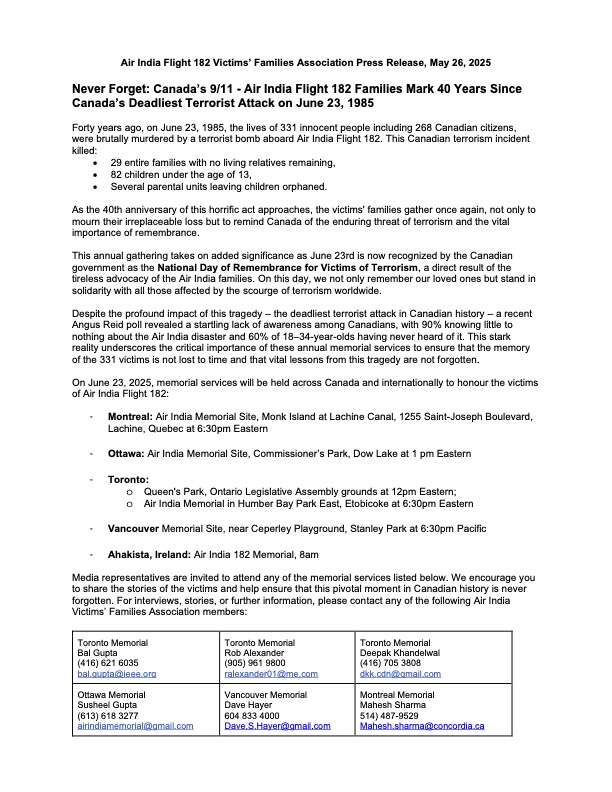
  • MIL-OSI Submissions: Air India crash in Ahmedabad sends reverberations to Canadian families of Air India Flight 182

    Source: The Conversation – Canada – By Chandrima Chakraborty, Professor, English and Cultural Studies; Director, Centre for Global Peace, Justice and Health, McMaster University

    The June 12 Air India crash in Ahmedabad, Gujarat, India, with 230 passengers and 12 crew members aboard is sending deep reverberations through a group of Canadians who know all too well the shock, grief and horror of losing loved ones in hauntingly similar circumstances.

    They are the families of those killed in the bombing of Air India Flight 182 en route from Canada to India 40 years ago this month.

    I work closely with these families as a researcher and advocate. I began interviewing these families in 2014 and have witnessed firsthand their pain, advocacy and emotional turmoil of living in the shadow of a historical event.

    As reports of the Ahmedabad crash came in, the WhatsApp account of the Air India Flight 182 families immediately flooded with expressions of shock, concern, sympathy and memories triggered by the latest incident.

    On June 23, 1985, Flight 182 was brought down by terrorist bombs created and planted on Canadian soil. The devastating mid-air explosion occurred over the Atlantic Ocean near Ireland. It killed all 329 passengers and crew, including 268 Canadians. The crew and most of the passengers were of Indian origin.

    Investigations into the causes of the crash of Air India Flight 171, en route to London’s Gatwick airport, shortly after take-off are still underway. At least 279 people died in the crash, which also impacted people on the ground.

    Acknowledging losses as significant

    A recent public conference at McMaster University commemorated the 40th anniversary of Flight 182, bringing together Indian and Canadian families, researchers, creative artists and community members.

    Book cover for ‘Remembering Air India The Art of Public Mourning,’ edited by Chandrima Chakraborty, Amber Dean and Angela Failler.
    University of Alberta Press

    The conference dealt with critical themes, including the challenge of Flight 182 families recovering from their losses within a climate of broad indifference among their fellow Canadians.

    Regardless of what may have caused the more recent crash in western India, these Canadian families know the shock and loss that a new set of victims’ families are facing, and how important it is to support them.

    Hopefully, the home countries of last week’s crash victims — most of them Indian and British citizens, with at least one Canadian reported to have been aboard — will regard their deaths as significant losses. If so, this would be unlike what the 1985 victims’ families experienced in Canada.

    A little-mourned Canadian tragedy

    In Canada, we have a national day to remember on June 23, 1985. The bombing has been called a Canadian tragedy in a public inquiry report.

    Yet according to a 2023 Angus Reid poll, “nine out of 10 Canadians say they have little or no knowledge of the worst single instance of the mass killing of their fellow citizens.” That essentially means the bombing has yet to penetrate the consciousness of everyday Canadians or evoke shared grief or public mourning.

    The families continue to carry the torch of remembrance as they organize annual memorial vigils every June 23. Few others attend. Many victims’ relatives have died since 1985. Some spouses, siblings or parents are now in their 80s, wondering why the bombing is still not widely discussed in schools or in public discourse.

    The grinding and unsatisfying criminal proceedings, the belated public inquiry and the welcome but lukewarm apology by the Canadian government 25 years after the fact have all contributed to the failure of this tragedy to adhere more solidly to the Canadian consciousness. In fact, many continue to deny the Canadian significance of Flight 182 and view the bombing as a foreign event.

    A torch of remembrance

    At last month’s conference, my research team launched the Air India Flight 182 archive to counter this collective amnesia and lack of acknowledgement.

    Canadian archival consultant and writer Laura Millar has said that archives act as “touchstones to memory” and can aid the process of transforming individual memories into collective remembering. Adopting NYU professor Carol Gilligan’s ethics of care for the archive, we have been consulting with families to find ways to share their grief with the public.

    The Flight 182 memory archive — both physical and digital — serves as a repository for artefacts, first-person narratives, memorabilia and creative works related to the tragedy produced by family members. Family donations of artefacts such as dance videos and pilot wings redirect notions of archives away from a documental deposit. Hopefully, they can move the public to learn and care for the impacts of the Flight 182 bombing.

    The archive is a publicly accessible record of the tragedy, where scholars and everyday citizens can learn about the victims and their families.

    Since the past involves both the present and the future, the archive will enable a meaningful recognition of marginalized voices and histories. It can offer a form of memory justice for those who would otherwise be forgotten by sustaining memory from generation to generation.

    While the archive articulates the demand from families that the bombing of Flight 182 and its aftermath be incorporated into Canadian national consciousness, establishing this archive alone will not be enough to elevate the memory of Flight 182 to the place it deserves.

    But at least it establishes a rich, permanent academic and personal legacy for the community of mourners, and for the Canadian and global public to find it, use it and learn from its many lessons.

    Families of those on board the 1985 flight are preparing to commemorate the 40th anniversary of the terror bombing of Flight 182 that has devastated their lives.

    As we learn more about the tragic Air India Flight 171 crash on June 12, the lessons of Flight 182 will hopefully prevent a new set of families from feeling the pain of indifference on top of the unimaginable agony of loss they’re already experiencing.

    Chandrima Chakraborty receives funding from the Social Sciences and Humanities Research Council of Canada.

    ref. Air India crash in Ahmedabad sends reverberations to Canadian families of Air India Flight 182 – https://theconversation.com/air-india-crash-in-ahmedabad-sends-reverberations-to-canadian-families-of-air-india-flight-182-258991

    MIL OSI

  • MIL-OSI Submissions: Plastics threaten ecosystems and human health, but evidence-based solutions are under political fire

    Source: The Conversation – Canada – By Tony Robert Walker, Professor, School for Resource and Environmental Studies, Dalhousie University

    Negotiations toward a global, legally binding plastics treaty are set to resume this summer, with the United Nations Environment Programme announcing that the Intergovernmental Negotiating Committee on plastic pollution will reconvene in August.

    The committee was established to develop an international legally binding instrument — known as the plastics treaty — to end plastic pollution, one of the fastest-growing environmental threats.


    Read more:
    Here’s how the new global treaty on plastic pollution can help solve this crisis


    Globally, 40 per cent of plastics production goes into the production of single-use plastic packaging, which is the single largest source of plastic waste and is a threat to wildlife and human health. Without meaningful action, global plastic waste is projected to nearly triple by 2060, reaching an estimated 1.2 billion tonnes.

    As the world prepares for another round of talks, Canada’s own plastic problem reveals what’s at stake, and what’s possible for the future.

    Canada’s plastic problem

    Canada is no exception to the global plastic crisis. Nearly half (47 per cent) of all plastic waste in Canada comes from the food and drink sector, contributing 3,268 million tonnes annually. Canadians use 15 billion plastic bags annually and nearly 57 million straws daily, yet only nine per cent of plastics are recycled — a figure that is not expected to improve.

    Most of Canada’s plastic — except for plastic bottles made of PET (polyethylene terephthalate) — are uneconomical or difficult to recycle because of the complexity of mixed plastics used in our economy. As a result, 2.8 million tonnes of plastic waste — equivalent to the weight of 24 CN Towers — end up in landfills every year.

    This is not a trivial problem, as Ontario is projected to run out of landfill space by 2035. Plastic pollution poses growing risks to both urban and rural infrastructure.

    In addition to landfill overflow, around one per cent of Canada’s plastic waste leaks into the environment. In 2016, this was 29,000 tonnes of plastic pollution. Once in the environment, plastics disintegrate into tiny particles, called microplastics (small pieces of plastic less than five millimetres long).

    We drink those tiny microplastic particles in our tap water, and eat them in our fish dinners. Some are even making their way into farmland.

    Plastics are everywhere, including inside us

    More than 93 per cent of Canadians have expressed concerns over single-use plastics used in food packaging and have supported government bans. There is a good reason for concern over the mounting levels of plastics in the environment, in our food and in us.

    Growing evidence indicates that plastics can cause harmful health effects in humans and animals. Microplastics and smaller nanoplastics (less than one micron in length) have been found in humans, including infants and breast milk. They can cause metabolic disorders, interfere with our immune and reproductive systems and cause behavioural problems.

    These health problems may be caused by chemicals added to plastics, including single-use plastics, of which 4,200 chemicals have been identified as posing a hazard to human and ecosystem health.

    It is for these reasons that the Canadian government introduced a ban on single-use plastics in 2022 as part of a plan to reach zero plastic waste in Canada by 2030.

    The decision was based extensive public and industry consultation, as well as decades of data on plastic pollution gathered from the Great Canadian Shoreline Cleanup. This data shows the most common plastic litter items found in the environment across Canada, known as the “dirty dozen” list.

    Six of these items were included in the federal ban. Three eastern Canadian provinces had already implemented single-use plastic bag bans before the federal government, with little to no public or industry opposition. Prince Edward Island was the first Canadian province to implement a province-wide plastic bag ban in July 2019, closely followed by Newfoundland and Labrador and Nova Scotia in October 2020.

    The politics of plastic

    Despite overwhelming scientific consensus, debates around plastic pollution are becoming increasingly politicized.

    In February in the United States, President Donald Trump signed an executive order directing the U.S. government to “stop purchasing paper straws and ensure they are no longer provided within federal buildings.”

    Trump told reporters at the White House: “I don’t think plastic is going to affect a shark very much, as they’re munching their way through the ocean.” Almost 2,000 peer-reviewed studies have reported, however, that more than 4,000 species have ingested or been entangled by plastic litter.

    In Canada, plastic has also become a political flashpoint. During the recent federal election, Conservative Leader Pierre Poilievre said he would scrap the federal government’s ban on single-use plastics and bring back plastic straws and grocery bags. He argued the government’s ban was about “symbolism” rather than “science,” saying, “the Liberals’ plastics ban is not about the environment, it’s about cost and control.”

    His promise would have harmed Canadians by dismissing the overwhelming scientific evidence showing that plastics in our bodies are linked to health impacts. Legislation to ban single-use plastics can be highly effective, ranging from 33 to 96 per cent reductions in plastic waste and pollution in the environment, depending on the policy and jurisdiction.

    Canada’s single-use plastics ban is a great example of evidence-based policymaking. The latest data from the conservation group Ocean Wise shows there was a 32 per cent drop in plastic straws found on Canadian shorelines in 2024 compared to the previous year.

    Science-based policies are needed

    It is indisputable that growing plastic production is directly related to plastic pollution in the environment and in human beings. Increasing plastic pollution is a global threat to human and ecosystem health, regardless of borders and political affiliation.

    As negotiators gear up for another round of talks to finalize a Global Plastics Treaty to end plastic pollution, the need for policies that are supported by scientific evidence is more urgent than ever.

    Future generations deserve a healthy and sustainable planet. The path towards a healthy and sustainable planet requires supporting action based on scientific evidence, not misinforming people with catchy phrases and political rhetoric.

    Tony Robert Walker receives funding from the Natural Sciences and Engineering Research Council of Canada, Canada Foundation for Innovation, and Research Nova Scotia. He is also a non-remunerated member of the Scientists’ Coalition for an Effective Plastics Treaty.

    Miriam L Diamond receives funding from Natural Sciences and Engineering Research Council, Ontario Ministry of Environment, Conservation and Parks, Future Earth, and Environment and Climate Change Canada. She is affiliated with the University of Toronto, serves as a paid expert for the Scientific and Technical Advisory Panel of the Global Environment Facility, and has non-remunerated positions with the International Panel on Chemical Pollution (Vice-Chair), is a member of the Scientist Coalition for an Effective Plastics Treaty, and sits on the board of the Canadian Environmental Law Association.

    ref. Plastics threaten ecosystems and human health, but evidence-based solutions are under political fire – https://theconversation.com/plastics-threaten-ecosystems-and-human-health-but-evidence-based-solutions-are-under-political-fire-256764

    MIL OSI

  • MIL-OSI Submissions: Digital government can benefit citizens: how South Africa can reduce the risks and get it right

    Source: The Conversation – Africa (2) – By Busani Ngcaweni, Visiting Adjunct Professor, Wits School of Governance, University of the Witwatersrand

    The digital revolution is reshaping governance worldwide. From the electronic filing of taxes to digital visa applications, technology is making government services more accessible, efficient and transparent.

    South Africa is making progress in its digital journey. In 2024 it climbed to 40th place out of 193 countries, from 65th place in 2022, in the United Nations e-Government Index. This improvement makes the country one of Africa’s digital leaders, surpassing Mauritius and Tunisia.

    South Africa has identified more than 255 government services for digitisation. Already, 134 are available on the National e-Government Portal. This achievement is remarkable. Nevertheless, the shift to digitisation comes with challenges and risks.

    Some countries have weakened the state’s role by rapidly outsourcing key government functions. But South Africa has the opportunity to build a model of digital transformation that strengthens public institutions rather than diminishes them.

    New technologies must bring tangible benefits for citizens. Digital transformation can improve public administration. But, if mismanaged, it could burden taxpayers with costs.

    Benefits

    Digital transformation comes at a cost. This is particularly true if the state fails to use its procurement power to negotiate reasonable prices. Infrastructure upgrades, cybersecurity measures, software licensing and system maintenance require substantial financial investment.

    The question is whether these expenses are a necessary step towards a more efficient and accessible government.

    Two South African examples illustrate that digital transformation can save money and enhance service delivery quality.

    The first is the South African Revenue Service. Its goal is to ensure that taxpayers and tax advisers can use the service from anywhere and at any time. The changes made more than a decade ago show that digital systems can yield substantial financial gains. After introducing e-filing in 2006, the revenue service streamlined tax processes, reduced inefficiencies and led to higher compliance rates. Ultimately this led to improved revenue collection.

    Similarly, digitising social grant payments has had a number of positive effects. In a chapter of a recent edited volume on public governance, my colleagues and I wrote a case study about how the South African Social Security Agency used basic technologies and platforms like WhatsApp and email to process a grant during the COVID pandemic. It allowed over 14 million people to apply, paid grants to over 6 million beneficiaries during the first phase of the project.

    South African Social Security Agency annual reports show that over 95% of grant beneficiaries receive their payouts electronically through debit cards, instead of going to cash points. This improves security and lets beneficiaries decide when to get and spend their money.

    There are fears that automation could result in massive job losses. But global experience has shown that digitalisation does not necessarily lead to large-scale retrenchments. Instead it can shift the nature of work to other responsibilities.

    The South African Social Security Agency provides a compelling case. Its transition to digital grant payments did not lead to job losses. Similarly, the expansion of e-filing at the revenue service has not resulted in workforce reductions. In both cases efficiencies improved.

    These cases highlight that digital transformation is reshaping roles rather than displacing employees. Public servants are moving into areas such as cybersecurity, data analysis and AI-driven decision-making.

    Shortcomings and pitfalls

    A number of inefficiencies are at play in government services.

    Firstly, most government digital operations still work with outdated paper-based systems. The lack of a uniform digital identity creates bureaucratic inefficiencies and delays.

    Secondly, fragmented procurement of equipment in government has led to duplicated efforts, increased costs and fruitless expenditure.

    Thirdly, different departments often use isolated and incompatible digital systems. This reduce the mutual benefits of digital transformation. The State IT Agency has been blamed for inefficiencies, procurement failures and questionable spending.

    Fourthly, South Africa’s public service remains fragmented. Citizens still struggle to access government services seamlessly. They often move between departments to complete what should be a single transaction.

    Without a centralised system, departments operate in isolation, duplicating efforts, increasing costs and eroding public trust.


    Read more:
    South Africa’s civil servants are missing skills, especially when it comes to technology – report


    Fifth, a lack of skills. Increasing reliance on digital tools requires expertise in data analytics, cloud computing and automation. Many public servants lack the training to take on these new roles. The National Digital and Future Skills Strategy was introduced in September 2020 to bridge this gap, but its effectiveness depends on its implementation.

    Introducing it in 2020 at the height of the COVID-19 pandemic forced government to make digital leaps which otherwise might have taken longer. To sustain services, technology had to be rapidly adopted, including basic things like holding Cabinet meetings online, using a system rapidly developed by the State Information Technology Agency.

    Sixth, security concerns complicate the transformation. As government systems become digital, they become vulnerable to cyberattacks. South Africa must put in place cybersecurity infrastructure to prevent identity theft, data breaches and service disruptions. A cyberattack on one department could affect the entire public sector.

    What needs to be done

    Government must streamline procurement, improve coordination and eliminate inefficiencies to ensure interdepartmental collaboration.

    A single, integrated e-government platform would:

    • cut red tape

    • reduce queues

    • increase efficiency.

    Government needs to upskill civil servants and improve their digital literacy.

    Government must create a seamless e-government system that connects services while protecting citizens’ personal information. The success of digitalisation depends on technological advancements as well as the level of trust citizens have in government systems. Without strong security measures, transparency and accountability, even the most sophisticated digital tools will fail to gain public confidence.

    South Africa has the chance to demonstrate that a strong, capable state can successfully integrate technology while safeguarding public interests. It should take full advantage of offers by Microsoft, Amazon and Huawei to support digital skills training in the public sector in a way that does not advantage one company’s technologies over others. Choices of technology must be user-centric, not based on preferences of accounting officers and chief information officers. Leaders of public institutions must be measured on their ability to digitally transform their organisations.

    Busani Ngcaweni is affiliated with the National School of Government, Wits and Johannesburg Universities.

    ref. Digital government can benefit citizens: how South Africa can reduce the risks and get it right – https://theconversation.com/digital-government-can-benefit-citizens-how-south-africa-can-reduce-the-risks-and-get-it-right-254089

    MIL OSI

  • MIL-OSI Submissions: Digital government can benefit citizens: how South Africa can reduce the risks and get it right

    Source: The Conversation – Africa (2) – By Busani Ngcaweni, Visiting Adjunct Professor, Wits School of Governance, University of the Witwatersrand

    The digital revolution is reshaping governance worldwide. From the electronic filing of taxes to digital visa applications, technology is making government services more accessible, efficient and transparent.

    South Africa is making progress in its digital journey. In 2024 it climbed to 40th place out of 193 countries, from 65th place in 2022, in the United Nations e-Government Index. This improvement makes the country one of Africa’s digital leaders, surpassing Mauritius and Tunisia.

    South Africa has identified more than 255 government services for digitisation. Already, 134 are available on the National e-Government Portal. This achievement is remarkable. Nevertheless, the shift to digitisation comes with challenges and risks.

    Some countries have weakened the state’s role by rapidly outsourcing key government functions. But South Africa has the opportunity to build a model of digital transformation that strengthens public institutions rather than diminishes them.

    New technologies must bring tangible benefits for citizens. Digital transformation can improve public administration. But, if mismanaged, it could burden taxpayers with costs.

    Benefits

    Digital transformation comes at a cost. This is particularly true if the state fails to use its procurement power to negotiate reasonable prices. Infrastructure upgrades, cybersecurity measures, software licensing and system maintenance require substantial financial investment.

    The question is whether these expenses are a necessary step towards a more efficient and accessible government.

    Two South African examples illustrate that digital transformation can save money and enhance service delivery quality.

    The first is the South African Revenue Service. Its goal is to ensure that taxpayers and tax advisers can use the service from anywhere and at any time. The changes made more than a decade ago show that digital systems can yield substantial financial gains. After introducing e-filing in 2006, the revenue service streamlined tax processes, reduced inefficiencies and led to higher compliance rates. Ultimately this led to improved revenue collection.

    Similarly, digitising social grant payments has had a number of positive effects. In a chapter of a recent edited volume on public governance, my colleagues and I wrote a case study about how the South African Social Security Agency used basic technologies and platforms like WhatsApp and email to process a grant during the COVID pandemic. It allowed over 14 million people to apply, paid grants to over 6 million beneficiaries during the first phase of the project.

    South African Social Security Agency annual reports show that over 95% of grant beneficiaries receive their payouts electronically through debit cards, instead of going to cash points. This improves security and lets beneficiaries decide when to get and spend their money.

    There are fears that automation could result in massive job losses. But global experience has shown that digitalisation does not necessarily lead to large-scale retrenchments. Instead it can shift the nature of work to other responsibilities.

    The South African Social Security Agency provides a compelling case. Its transition to digital grant payments did not lead to job losses. Similarly, the expansion of e-filing at the revenue service has not resulted in workforce reductions. In both cases efficiencies improved.

    These cases highlight that digital transformation is reshaping roles rather than displacing employees. Public servants are moving into areas such as cybersecurity, data analysis and AI-driven decision-making.

    Shortcomings and pitfalls

    A number of inefficiencies are at play in government services.

    Firstly, most government digital operations still work with outdated paper-based systems. The lack of a uniform digital identity creates bureaucratic inefficiencies and delays.

    Secondly, fragmented procurement of equipment in government has led to duplicated efforts, increased costs and fruitless expenditure.

    Thirdly, different departments often use isolated and incompatible digital systems. This reduce the mutual benefits of digital transformation. The State IT Agency has been blamed for inefficiencies, procurement failures and questionable spending.

    Fourthly, South Africa’s public service remains fragmented. Citizens still struggle to access government services seamlessly. They often move between departments to complete what should be a single transaction.

    Without a centralised system, departments operate in isolation, duplicating efforts, increasing costs and eroding public trust.


    Read more:
    South Africa’s civil servants are missing skills, especially when it comes to technology – report


    Fifth, a lack of skills. Increasing reliance on digital tools requires expertise in data analytics, cloud computing and automation. Many public servants lack the training to take on these new roles. The National Digital and Future Skills Strategy was introduced in September 2020 to bridge this gap, but its effectiveness depends on its implementation.

    Introducing it in 2020 at the height of the COVID-19 pandemic forced government to make digital leaps which otherwise might have taken longer. To sustain services, technology had to be rapidly adopted, including basic things like holding Cabinet meetings online, using a system rapidly developed by the State Information Technology Agency.

    Sixth, security concerns complicate the transformation. As government systems become digital, they become vulnerable to cyberattacks. South Africa must put in place cybersecurity infrastructure to prevent identity theft, data breaches and service disruptions. A cyberattack on one department could affect the entire public sector.

    What needs to be done

    Government must streamline procurement, improve coordination and eliminate inefficiencies to ensure interdepartmental collaboration.

    A single, integrated e-government platform would:

    • cut red tape

    • reduce queues

    • increase efficiency.

    Government needs to upskill civil servants and improve their digital literacy.

    Government must create a seamless e-government system that connects services while protecting citizens’ personal information. The success of digitalisation depends on technological advancements as well as the level of trust citizens have in government systems. Without strong security measures, transparency and accountability, even the most sophisticated digital tools will fail to gain public confidence.

    South Africa has the chance to demonstrate that a strong, capable state can successfully integrate technology while safeguarding public interests. It should take full advantage of offers by Microsoft, Amazon and Huawei to support digital skills training in the public sector in a way that does not advantage one company’s technologies over others. Choices of technology must be user-centric, not based on preferences of accounting officers and chief information officers. Leaders of public institutions must be measured on their ability to digitally transform their organisations.

    Busani Ngcaweni is affiliated with the National School of Government, Wits and Johannesburg Universities.

    ref. Digital government can benefit citizens: how South Africa can reduce the risks and get it right – https://theconversation.com/digital-government-can-benefit-citizens-how-south-africa-can-reduce-the-risks-and-get-it-right-254089

    MIL OSI

  • MIL-OSI Submissions: B.C.’s mental health law is on trial — and so is our commitment to human rights

    Source: The Conversation – Canada – By Anne Levesque, Associate professor, Faculty of Law, L’Université d’Ottawa/University of Ottawa

    The British Columbia Supreme Court has begun hearing a long-awaited constitutional challenge to the province’s Mental Health Act.

    The case, nearly a decade in the making, is now drawing greater attention in the wake of the tragedy at the Filipino Lapu Lapu Day street festival earlier this year that left 11 people dead in Vancouver.

    The event has shaken many in the community, leaving behind grief and fear. Furthermore, in light of reports that the person accused of the crime was under Mental Health Act supervision, difficult questions arise. The pain is real, and any conversation about mental health must begin with compassion for all of those affected.


    Read more:
    Vancouver SUV attack exposes crowd management falldowns and casts a pall on Canada’s election


    At the same time, it’s important to ensure this moment of reckoning leads to thoughtful dialogue, not reactive policy. Unfortunately, much of the public discourse has become mired in fear and misinformation, creating a false and dangerous choice: that Canada must sacrifice individual rights in order to protect public safety.

    As a legal scholar in equality rights and public interest litigation, I don’t believe Canadians have to choose. A mental health system that respects Canada’s Charter of Rights and Freedoms can also promote safety.

    What’s the case is about?

    The case currently before the B.C. Supreme Court was initiated by the Council of Canadians with Disabilities (CCD), a national human rights organization led by people with disabilities. The group is fighting provisions in the province’s Mental Health Act that strip patients of any right to choose their own health care, or to appoint a loved one to make health care decisions on their behalf.

    The CCD’s motto — “Nothing about us without us” — reflects a longstanding commitment to ensuring that people most affected by policies and systems have a voice in shaping them. This litigation will amplify the voices of people who underwent psychiatric treatment without consent and to shine a light on the deep and lasting harms they have suffered.

    Let’s be clear about what this Charter challenge actually seeks and what it doesn’t. It doesn’t aim to eliminate involuntary hospitalization. It does not change who can be detained, how long they can be held or the legal criteria for involuntary admission.

    What it does seek is something far more modest and humane: to ensure that when psychiatric care is forced, it is delivered with dignity, oversight and the involvement of trusted supporters in accordance with the Canadian Charter of Rights and Freedoms.

    One of the key reforms that CCD has long advocated for is the right for people to name a family member or friend to be involved in treatment decisions. Far from undermining care, this kind of involvement can help bridge the gap between medical necessity and personal dignity.

    It’s a safeguard that respects patients’ values and builds trust, which the current system desperately lacks. And yes, it could even enhance public safety. Reports suggest that a family member of the man accused in the Lapu Lapu mass murders in April was concerned about his deteriorating mental health and had reached out for help just before the tragedy occurred. A more responsive system with the embedded involvement of trusted decision-makers might have made a difference.


    Read more:
    Fraudulent crowdfunding after the Lapu Lapu tragedy highlights the need for vigilance and oversight


    Reforming the Mental Health Act

    British Columbia is currently an outlier in Canada. It’s the only province where people detained under mental health laws are automatically deemed to consent to any treatment authorized by the facility — regardless of their actual wishes or capacity.

    There’s no right to name a substitute decision-maker, no ability to appeal a treatment decision, no independent oversight, and treatment is often imposed through isolation, physical restraints or security force.

    Advocates have been calling for change for decades. But in the wake of the Lapu Lapu attack, some politicians are proposing not a more compassionate or rights-respecting approach, but harsher, more coercive powers over people with mental health issues. That would be a mistake.

    The current system, which experts have long said is inconsistent with human rights, did nothing to prevent this tragedy. Violating the rights of people in crisis did not and will not keep the public safer.

    B.C. Premier David Eby has acknowledged the shortcomings in the current system, but has said that engaging in law reform while litigation is undergoing would pose a risk. Instead, he says it’s better to wait to hear what the court decides before changing the law.

    That logic is arguably akin to a citizen saying it’s risky to stop driving at a speed they know is over the lawful limit until they’re pulled over.

    Pointless to wait

    Waiting for the courts to force change wastes precious time, and public resources, that could be better spent on designing a new, Charter-compliant mental health system in collaboration with experts, service providers, families and people with lived experiences.

    Meanwhile, substantial public funds are being spent on government lawyers to fight a legal battle defending a regime that is clearly unconstitutional and fails both patients and public safety.

    That money would be far better spent consulting with experts, families and people with lived experiences and developing legislation that upholds constitutional rights and keeps communities safe.

    The time for delay is over. The B.C. government must act now to rewrite the Mental Health Act in order to protect the public and respect Charter rights.

    Anne Levesque is co-chair of the Disability Justice Litigation Initiative of the Council of Canadians with Disabilities.

    ref. B.C.’s mental health law is on trial — and so is our commitment to human rights – https://theconversation.com/b-c-s-mental-health-law-is-on-trial-and-so-is-our-commitment-to-human-rights-258671

    MIL OSI

  • MIL-OSI Submissions: Somaliland’s 30-year quest for recognition: could US interests make the difference?

    Source: The Conversation – Africa (2) – By Aleksi Ylönen, Professor, United States International University

    More than three decades after unilaterally declaring independence from Somalia, Somaliland still seeks international recognition as a sovereign state. Despite a lack of formal acknowledgement, the breakaway state has built a relatively stable system of governance. This has drawn increasing interest from global powers, including the United States. As regional dynamics shift and great-power competition intensifies, Somaliland’s bid for recognition is gaining new currency. Aleksi Ylönen has studied politics in the Horn of Africa and Somaliland’s quest for recognition. He unpacks what’s at play.


    What legal and historical arguments does Somaliland use?

    The Somali National Movement is one of the main clan-based insurgent movements responsible for the collapse of the central government in Somalia. It claims the territory of the former British protectorate of Somaliland. The UK had granted Somaliland sovereign status on 26 June 1960.

    The Somali government tried to stomp out calls for secession. It orchestrated the brutal killing of hundreds of thousands of people in northern Somalia between 1987 and 1989.

    But the Somali National Movement declared unilateral independence on 18 May 1991 and separated from Somalia.

    With the collapse of the Somali regime in 1991, the movement’s main enemy was gone. This led to a violent power struggle between various militias.

    This subsided only after the politician Mohamed Egal consolidated power. He was elected president of Somaliland in May 1993.

    Egal made deals with merchants and businessmen, giving them tax and commercial incentives to accept his patronage. As a result, he obtained the economic means to consolidate political power and to pursue peace and state-building. It’s something his successors have kept up with since his death in 2002.

    What has Somaliland done to push for recognition?

    Successive Somaliland governments continue to engage in informal diplomacy. They have aligned with the west, particularly the US, which was the dominant power after the cold war, and the former colonial master, the UK. Both countries host significant Somaliland diaspora communities.

    The US and the UK have for decades flirted with the idea of recognising Somaliland, which they consider a strategic partner. However, they have been repeatedly thrown back by their respective Somalia policies. These have favoured empowering the widely supported Mogadishu government to reassert its authority and control over Somali territories.

    This Somalia policy has been increasingly questioned in recent years, in part due to Mogadishu’s security challenges. In contrast, the Hargeisa government of Somaliland has largely shown it can provide security and stability. It has held elections and survived as a state for the last three decades, though it has faced political resistance and armed opposition.


    Read more:
    Somaliland elections: what’s at stake for independence, stability and shifting power dynamics in the Horn of Africa


    As new global powers rise, Somaliland administrations have pursued an increasingly diverse foreign policy, with one goal: international recognition.

    Hargeisa hosts consulates and representative offices of Djibouti, Ethiopia, Kenya, Taiwan, the UK and the European Union, among others.

    The government has also engaged in informal foreign relations with the United Arab Emirates. The Middle Eastern monarchy serves as a business hub and a destination of livestock exports. Many Somalilanders migrate there.

    Somaliland maintains representative offices in several countries. These include Canada, the US, Norway, Sweden, the UK, Saudi Arabia, Turkey and Taiwan. Hargeisa has alienated China because it has collaborated with Taiwan since 2020. Taiwan is a self-ruled island claimed by China.

    On 1 January 2024, Somaliland’s outgoing president Muse Bihi signed a memorandum of understanding with Ethiopian prime minister Abiy Ahmed for increased cooperation. Bihi implied that Ethiopia would be the first country to formally recognise Somaliland. The deal caused a sharp deterioration of relations between Addis Ababa and Mogadishu.

    Abiy later moderated his position and, with Turkish mediation, reconciled with his Somalia counterpart, President Hassan Mohamud.

    What’s behind US interest in Somaliland?

    The US, like other great powers, has been interested in Somaliland because of its strategic location. It is on the African shores of the Gulf of Aden, across from the Arabian Peninsula. Its geographical position has gained currency recently as Yemeni Houthi rebels strike maritime traffic in the busy shipping lanes. Somaliland is also well located to curb piracy and smuggling on this global trade route.

    The US Africa Command set up its main Horn of Africa base at Camp Lemonnier in Djibouti in 2002. This followed the 11 September 2001 attacks.


    Read more:
    Somaliland’s quest for recognition: UK debate offers hint of a sea change


    In 2017, China, which had become the main foreign economic power in the Horn of Africa, set up a navy support facility in Djibouti. This encouraged closer collaboration between American and Somaliland authorities. The US played with the idea of establishing a base in Berbera, which hosts Somaliland’s largest port.

    With Donald Trump winning the US presidential election in 2024, there were reports of an increased push for US recognition of Somaliland. This would allow the US to deepen its trade and security partnerships in the volatile Horn of Africa region.

    Since March 2025, representatives of the Trump administration have engaged in talks with Somaliland officials to establish a US military base near Berbera. This would be in exchange for a formal but partial recognition of Somaliland.

    What are the risks of US recognition of Somaliland?

    Stronger US engagement with Somaliland risks neglecting Somalia.

    Mogadishu depends on external military assistance in its battle against the advancing violent Islamist extremist group, Al-Shabaab. It also faces increasing defiance from two federal regions, Puntland and Jubaland.

    US recognition would reward Hargeisa for its persistent effort to maintain stability and promote democracy. However, it could encourage other nations to recognise Somaliland. This would deliver a blow to Somali nationalists who want one state for all Somalis.

    Aleksi Ylönen is affiliated with the Center for International Studies, Iscte-Instituto Universitário de Lisboa, and is an associate fellow at the HORN International Institute for Strategic Studies.

    ref. Somaliland’s 30-year quest for recognition: could US interests make the difference? – https://theconversation.com/somalilands-30-year-quest-for-recognition-could-us-interests-make-the-difference-255399

    MIL OSI

  • MIL-OSI Submissions: We have drugs to manage HIV. So why are we spending millions looking for cures?

    Source: The Conversation – Global Perspectives – By Bridget Haire, Associate Professor, Public Health Ethics, School of Population Health, UNSW Sydney

    Alim Yakubov/Shutterstock

    Over the past three decades there have been amazing advances in treating and preventing HIV.

    It’s now a manageable infection. A person with HIV who takes HIV medicine consistently, before their immune system declines, can expect to live almost as long as someone without HIV.

    The same drugs prevent transmission of the virus to sexual partners.

    There is still no effective HIV vaccine. But there are highly effective drugs to prevent HIV infection for people without HIV who are at higher risk of acquiring it.

    These drugs are known as as “pre-exposure prophylaxis” or PrEP. These come as a pill, which needs to be taken either daily, or “on demand” before and after risky sex. An injection that protects against HIV for six months has recently been approved in the United States.

    So with such effective HIV treatment and PrEP, why are we still spending millions looking for HIV cures?

    Not everyone has access to these drugs

    Access to HIV drugs and PrEP depends on the availability of health clinics, health professionals, and the means to supply and distribute the drugs. In some countries, this infrastructure may not be secure.

    For instance, earlier this year, US President Donald Trump’s dissolution of the USAID foreign aid program has threatened the delivery of HIV drugs to many low-income countries.

    This demonstrates the fragility of current approaches to treatment and prevention. A secure, uninterrupted supply of HIV medicine is required, and without this, lives will be lost and the number of new cases of HIV will rise.

    Another example is the six-monthly PrEP injection just approved in the US. This drug has great potential for controlling HIV if it is made available and affordable in countries with the greatest HIV burden.

    But the prospect for lower-income countries accessing this expensive drug looks uncertain, even if it can be made at a fraction of its current cost, as some researchers say.

    So despite the success of HIV drugs and PrEP, precarious health-care systems and high drug costs mean we can’t rely on them to bring an end to the ongoing global HIV pandemic. That’s why we also still need to look at other options.

    Haven’t people already been ‘cured’?

    Worldwide, at least seven people have been “cured” of HIV – or at least have had long-term sustained remission. This means that after stopping HIV drugs, they did not have any replicating HIV in their blood for months or years.

    In each case, the person with HIV also had a life-threatening cancer needing a bone marrow transplant. They were each matched with a donor who had a specific genetic variation that resulted in not having HIV receptors in key bone marrow cells.

    After the bone marrow transplant, recipients stopped HIV drugs, without detectable levels of the virus returning. The new immune cells made in the transplanted bone marrow lacked the HIV receptors. This stopped the virus from infecting cells and replicating.

    But this genetic variation is very rare. Bone marrow transplantation is also risky and extremely resource-intensive. So while this strategy has worked for a few people, it is not a scalable prospect for curing HIV more widely.

    So we need to keep looking for other options for a cure, including basic laboratory research to get us there.

    How about the ‘breakthrough’ I’ve heard about?

    HIV treatment stops the HIV replication that causes immune damage. But there are places in the body where the virus “hides” and drugs cannot reach. If the drugs are stopped, the “latent” HIV comes out of hiding and replicates again. So it can damage the immune system, leading to HIV-related disease.

    One approach is to try to force the hidden or latent HIV out into the open, so drugs can target it. This is a strategy called “shock and kill”. And an example of such Australian research was recently reported in the media as a “breakthrough” in the search for an HIV cure.

    Researchers in Melbourne have developed a lipid nanoparticle – a tiny ball of fat – that encapsulates messenger RNA (or mRNA) and delivers a “message” to infected white blood cells. This prompts the cells to reveal the “hiding” HIV.

    In theory, this will allow the immune system or HIV drugs to target the virus.

    This discovery is an important step. However, it is still in the laboratory phase of testing, and is just one piece of the puzzle.

    We could say the same about many other results heralded as moving closer to a cure for HIV.

    Further research on safety and efficacy is needed before testing in human clinical trials. Such trials start with small numbers and the trialling process takes many years. This and other steps towards a cure are slow and expensive, but necessary.

    Importantly, any cure would ultimately need to be fairly low-tech to deliver for it to be feasible and affordable in low-income countries globally.

    So where does that leave us?

    A cure for HIV that is affordable and scalable would have a profound impact on human heath globally, particularly for people living with HIV. To get there is a long and arduous path that involves solving a range of scientific puzzles, followed by addressing implementation challenges.

    In the meantime, ensuring people at risk of HIV have access to testing and prevention interventions – such as PrEP and safe injecting equipment – remains crucial. People living with HIV also need sustained access to effective treatment – regardless of where they live.

    Bridget Haire has received funding from the National Health and Medical Research Council. She is a past president of the Australian Federation of AIDS Organisations (now Health Equity Matters).

    Benjamin Bavinton receives funding from the National Health and Medical Research Council, the Australian government, and state and territory governments. He also receives funding from ViiV Healthcare and Gilead Sciences, both of which make drugs or drug classes mentioned in this article. He is a Board Director of community organisation, ACON, and is on the National PrEP Guidelines Panel coordinated by ASHM Health.

    ref. We have drugs to manage HIV. So why are we spending millions looking for cures? – https://theconversation.com/we-have-drugs-to-manage-hiv-so-why-are-we-spending-millions-looking-for-cures-258391

    MIL OSI

  • MIL-OSI Submissions: Is Kenya’s president safe in a crowd? Security expert scans VIP protection checklist

    Source: The Conversation – Africa (2) – By Douglas Lucas Kivoi, Principal Policy Analyst, Governance Department, The Kenya Institute for Public Policy Research and Analysis (KIPPRA)

    Protecting any president requires multiple layers of intelligence, physical security and rapid response security protocols. Exact operational details are classified, but there are global best practices in VIP protection.

    The issue of presidential protection in Kenya has become particularly relevant following an incident in early May 2025 when someone in a crowd threw a shoe at President William Ruto during a public event, hitting his hand.

    I have studied policing and security policies in Kenya for over 15 years, interacting closely with the country’s security protocols. In my view this incident exposed several critical security lapses around the elite officers tasked with protecting the president.

    The security of the president is a critical issue in Kenya. The country is exposed to terror groups like the Somalia-based Al-Shabaab and other criminal networks in the region.

    In 2021, a businessman embedded himself into the presidential motorcade and drove into then president Uhuru Kenyatta’s official residence. In 2017, an unidentified man who was said to have illegally accessed the highly protected state house grounds was shot dead by presidential guards.

    There are multiple layers to Kenya’s protection protocols. They include National Intelligence Service officers, the Kenya Defence Force, Presidential Escort Police officers drawn from the highly trained General Service Unit, bomb disposal experts and regular police officers. Their deployment depends on the nature of the presidential engagement.

    While the shoe incident may be passed off as simply embarrassing, it should serve as a wake-up call to tighten security protocols around the president without necessarily compromising his public engagement with citizens.

    What’s in place

    Prior to any presidential visit across the country, security teams conduct a thorough reconnaissance of the destination. This includes coordinating with local policing agencies, clearing airspace, mapping secure transport routes and identifying nearby medical facilities in case of emergencies.

    Presidential motorcade routes are pre-planned and a dry run is made. This often includes mapping alternative routes to avoid predictability should there be assailants along a presidential route. It is common to see some roads temporarily closed and security officers conducting sweeps for any threats or explosives. In areas deemed high risk, counter security sniper teams are covertly deployed in strategic areas.

    Cases of attacks on presidential motorcades are rare in Kenya. However, in 2002 during presidential campaigns, angry opposition supporters stoned then president Daniel Moi’s motorcade. In November 2021, an angry mob hurled rocks at then deputy president Ruto’s motorcade.

    The National Intelligence Service and Presidential Escort Unit covertly scout locations in advance, assessing potential security vulnerabilities. Crowd sizes, and entry and exit points for the head of state are mapped out in advance.

    In cases where meetings are held in town halls or huge tents, attendees are screened using metal detectors and/or physical searches. Uniformed and plainclothes security officers embed themselves in the crowd to monitor any threats.

    The president and any dignitaries accompanying him have at least three layers of security.

    The inner ring consists of close protection officers who are always within an arm’s length of the president to physically thwart any threats. The middle ring has armed security guards who watch for, among others, sudden movements and abnormal behaviour within the crowd. The outer ring consists of regular police and paramilitary units from the General Service Unit who secure the outside perimeter.

    The presidential motorcade is a coordinated convoy of heavily armoured vehicles. It includes lead and chase cars, communication units and emergency response teams. Traffic is managed by local traffic police officers to ensure unobstructed movement. Routes are kept confidential until necessary.

    The president’s security may opt to use a decoy vehicle if there is a security threat, to confuse and derail potential risk sources. In all these cases, there is a contingent of specialised General Service Unit officers, called the Recce unit, that always accompanies the president.

    Kenya’s presidential security precautions follow standard VIP security protection like those for heads of state across the world. However, in some neighbouring countries, for instance, presidents move in heavily armed military convoys. This has not been seen in Kenya.

    If a potential threat is detected, the president is immediately shielded and whisked away to a secure vehicle or evacuated by air in high-risk events. In such cases, the Kenya Defence Forces secures the president.

    Despite stringent security measures, incidents can occur. For instance, in March 2025, a British tourist was fatally hit by a vehicle in Ruto’s motorcade. This prompted investigations and reviews on motorcade safety protocols.

    Such events highlight the challenges of balancing presidential security with public safety, especially in densely populated urban areas.

    Security failures

    The shoe-throwing incident targeting Ruto highlighted five major failures in presidential protection protocols.

    First, crowd screening and access control failures. The alleged assailant was very close to the president, suggesting an inadequate distance between the crowds and the president. The inner ring of security also failed to spot the perpetrator raising a shoe in the air to use as a projectile. This indicates weak front-row eye sweeps and scans by the president’s security.

    Second, there was an apparent delay in security response. The elite officers around the president should have subdued the alleged attacker within seconds. It could mean most had their eyes on the president or cameras, as opposed to scanning the crowds for any sudden movements.

    Third, security allowed the president to stand too close to a crowd that hadn’t been screened. Best practices require a no-go zone of three to five metres for individuals who have not been scanned or screened.

    Fourth, there was an apparent gap in intelligence and threat assessment. Aggressive or agitated people next to the president should draw the attention of security officers. Plainclothes security officers are usually deployed to monitor crowd behaviour. It isn’t enough to rely on uniformed officers.

    Undercover agents are critical for flagging pre-attack signals, such as nervousness or repeated adjustments of positions.

    Fifth, there was no clear evacuation plan for the president. After the incident, the president continued speaking. In high-risk scenarios, protocols often demand instant relocation of the president to a secure vehicle or helicopter, where the military takes over and airlifts him to safety.

    What should change

    Kenya’s presidential security detail may be forced to:

    • increase standoff distance between the president and crowds

    • deploy more plainclothes officers to blend in and monitor crowds around the president

    • mandate stricter screening of those in close proximity to the president

    • conduct more frequent security risks drills for rapid neutralisation of potential threats.

    The exact details of presidential security in Kenya are confidential. However, the overarching structure aims to provide comprehensive protection to the president while maintaining public safety and order during official engagements. No security protocol is 100% foolproof. But a balance needs to be struck between overly aggressive crowd control and accessibility.

    Douglas Lucas Kivoi does not work for, consult, own shares in or receive funding from any company or organisation that would benefit from this article, and has disclosed no relevant affiliations beyond their academic appointment.

    ref. Is Kenya’s president safe in a crowd? Security expert scans VIP protection checklist – https://theconversation.com/is-kenyas-president-safe-in-a-crowd-security-expert-scans-vip-protection-checklist-256268

    MIL OSI

  • MIL-OSI Submissions: Trump’s worldview is causing a global shift of alliances – what does this mean for nations in the middle?

    Source: The Conversation – Global Perspectives – By Dilnoza Ubaydullaeva, Lecturer in Government – National Security College, Australian National University

    Since US President Donald Trump took office this year, one theme has come up time and again: his rule is a threat to the US-led international order.

    As the US political scientist John Mearsheimer famously argued, the liberal international order

    was destined to fail from the start, as it contained the seeds of its own destruction.

    This perspective has gained traction in recent years. And now, Trump’s actions have caused many to question whether a new world order is emerging.

    Trump has expressed a desire for a new international order defined by multiple spheres of influence — one in which powers like the US, China and Russia each exert dominance over distinct regions.

    This vision aligns with the idea of a “multipolar” world, where no single state holds overarching global dominance. Instead, influence is distributed among several great powers, each maintaining its own regional sphere.

    This architecture contrasts sharply with earlier periods – the bipolar world of the Cold War, dominated by the US and the Soviet Union; and the unipolar period that followed, dominated by the US.

    What does this mean for the world order moving forward?

    Shifting US spheres of influence

    We’ve seen this shift taking place in recent months. For example, Trump has backed away from his pledge to end the war between Russia and Ukraine and now appears to be leaving it to the main protagonists, and Europe, to find a solution.

    Europe, which once largely spoke in a unified voice with the US, is also showing signs of policy-making which is more independent. Rather than framing its actions as protecting “Western democratic principles”, Europe is increasingly focused on defining its own security interests.

    In the Middle East, the US will likely maintain its sphere of influence. It will continue its unequivocal support for Israel under Trump.

    Amid shifting global alliances, the Trump administration will continue to support Israel, led by Prime Minister Benjamin Netanyahu.
    noamgalai/Shutterstock

    The US will also involve itself in the region’s politics when its interests are at stake, as we witnessed in its recent strikes on Iranian nuclear facilities.

    This, along with increasing economic ties between the US and Gulf states, suggests US allies in the region will remain the dominant voices shaping regional dynamics, particularly now with Iran weakened.

    Yet it’s clear Trump is reshaping US dynamics in the region by signaling a desire for reduced military and political involvement, and criticising the nation building efforts of previous administrations.

    The Trump administration now appears to want to maintain its sphere of influence primarily through strong economic ties.

    Russia and China poles emerging elsewhere

    Meanwhile, other poles are emerging in the Global South. Russia and China have deepened their cooperation, positioning themselves as defenders against what they frame as Western hegemonic bullying.

    Trump’s trade policies and sanctions against many nations in the Global South have fuelled narratives (spread by China and Russia) that the US does not consistently adhere to the rules it imposes on others.

    Trump’s decision to slash funding to USAID has also opened the door to China, in particular, to become the main development partner for nations in Africa and other parts of the world.

    And on the security front, Russia has become more involved in many African and Middle Eastern countries, which have become less trustful and reliant on Western powers.

    Russian President Vladimir Putin and Chinese leader Xi Xinping see opportunities to spread their influence in the Global South.
    plavi011/Shutterstock

    In the Indo-Pacific, much attention has been given to the rise of China and its increasingly assertive posture. Many of Washington’s traditional allies are nervous about its continued engagement in the region and ability to counter China’s rise.

    Chinese leader Xi Jinping has sought to take advantage of the current environment, embarking on a Vietnam, Malaysia and Cambodia push earlier this year. But many nations continue to be wary of China’s increasing influence, in particular the Philippines, which has clashed with China over the South China Sea.

    Strategic hedging

    Not all countries, however, are aligning themselves neatly with one pole or another.

    For small states caught between great powers, navigating this multipolar environment is both a risk and an opportunity.

    Ukraine is a case in point. As a sovereign state, Ukraine should have the freedom to decide its own alignments. Yet, it finds itself ensnared in great power politics, with devastating consequences.

    Other small states are playing a different game — pivoting from one power to another based on their immediate interests.

    Slovakia, for instance, is both a NATO and EU member, yet its leader, Robert Fico, attended Russia’s Victory Day Parade in May and told President Vladimir Putin he wanted to maintain “normal relations” with Russia.

    Then there is Central Asia, which is the centre of a renewed “great game,” with Russia, China and Europe vying for influence and economic partnerships.

    Yet if any Central Asian countries were to be invaded by Putin, would other powers intervene? It’s a difficult question to answer. Major powers are reluctant to engage in direct conflict unless their core interests or borders are directly threatened.

    As a result, Central Asian states are hedging their bets, seeking to maintain relations with multiple poles, despite their conflicting agendas.

    A future defined by regional power blocs?

    While it is still early to draw definitive conclusions, the events of the past few months underscore a growing trend. Smaller countries are expressing solidarity with one power, but pragmatic cooperation with another, when it suits their national interests.

    For this reason, regional power blocs seem to be of increasing interest to countries in the Global South.

    For instance, the China-led Shanghai Cooperation Organisation has become a stronger and larger grouping of nations across Eurasia in recent years.

    Trump’s focus on making “America Great Again,” has taken the load off the US carrying liberal order leadership. A multipolar world may not be the end of the liberal international order, but it may be a reshaped version of liberal governance.

    How “liberal” it can be will likely depend on what each regional power, or pole, will make of it.

    Dilnoza Ubaydullaeva does not work for, consult, own shares in or receive funding from any company or organisation that would benefit from this article, and has disclosed no relevant affiliations beyond their academic appointment.

    ref. Trump’s worldview is causing a global shift of alliances – what does this mean for nations in the middle? – https://theconversation.com/trumps-worldview-is-causing-a-global-shift-of-alliances-what-does-this-mean-for-nations-in-the-middle-257113

    MIL OSI

  • MIL-OSI Submissions: Iran and Ethiopia have a security deal – here’s why they signed it

    Source: The Conversation – Africa (2) – By Eric Lob, Associate Professor of Politics and International Relations, Florida International University

    Ethiopia and Iran signed a memorandum of understanding (MOU) on 6 May 2025. Under it, their national police agencies will cooperate on security and intelligence. This will include combating cross-border crime, sharing intelligence and building capacity. They will also share experiences and training.

    For Iran, the MOU marks a significant step towards strengthening relations with a regional power that’s strategically located in the Horn of Africa.

    Tehran has been using its security apparatus and military capabilities to establish and expand political and economic ties with countries in Africa. This has included drone transfers to the Ethiopian government that helped it turned the tide of the Tigray war, a separatist struggle in the country’s north that took place from 2020 to 2022.

    Iran has also supplied the Sudanese army with surveillance and combat drones. These have been used against the paramilitary Rapid Support Forces in Sudan’s ongoing civil war.

    The agreement is important for Ethiopia for two reasons.

    Firstly, it’s likely to enable the Ethiopian government in Addis Ababa to combat ethnic militias more effectively. It faces increasing internal instability, including tensions with hostile factions of the separatist Tigray People’s Liberation Front.

    Secondly, the agreement comes after a meeting in Addis Ababa between the Ethiopian police chief, Demelash Gebremichael, and a delegation from Iran’s regional rival, the United Arab Emirates (UAE). The exchange concentrated on investigating and extraditing cross-border criminals.

    Addis Ababa’s willingness to work with regional rivals in the Middle East shows its pragmatic approach to foreign relations. Ethiopia needs all the friends it can muster as an embattled and weakened state. Since the Tigray war, it has battled the rise of ethnic militias and confronted economic adversity. It is also facing renewed hostility with neighbouring Eritrea.

    What Iran stands to gain

    Since 2016, Ethiopia has been a gateway for Iran to gain a foothold in the Horn of Africa. That year, other countries in the region severed relations with Iran. This followed Tehran’s disengagement from sub-Saharan Africa under Hassan Rouhani, who served as president from 2013 to 2021, and his prioritisation of a nuclear deal with the US.

    The severing of ties was also a byproduct of geopolitical pressure exerted by Saudi Arabia and the UAE on countries in the region. The Middle Eastern states wanted to reduce, if not eliminate, Iran’s presence in the Horn of Africa and Red Sea to limit its support for Houthi rebels in the ongoing Yemeni civil war.


    Read more:
    Iran’s intervention in Sudan’s civil war advances its geopolitical goals − but not without risks


    Ethiopia was the first country in sub-Saharan Africa to establish relations with Iran during the 1960s. It was also one of its top trading partners on the continent before and after the 1979 Iranian Revolution.

    Strategically and ideologically, this special relationship was based on the pro-western and anti-communist stances of their monarchs: the Shah of Iran Mohammad Reza Pahlavi, who ruled from 1941 to 1979, and Emperor Haile Selassie, who was in power from 1930 to 1974.

    After the revolution, Iran-Ethiopia relations revived under Mahmoud Ahmadinejad, who served as Iranian president from 2005 to 2013. He pursued an active Africa policy to mitigate Iran’s international isolation and circumvent US sanctions.

    After Rouhani initially downgraded these relations, they were renewed during his second term. This followed US withdrawal from the nuclear deal.

    Relations firmed when Ebrahim Raisi, who served as Iranian president from 2021 to 2024, delivered military drones and other aid to Addis Ababa during the Tigray war.

    What’s in it for Ethiopia

    Ethiopia is facing increasing instability and uncertainty. The Tigray war has depleted the state’s resources. There is an economic crisis caused by rising inflation and unemployment.

    Addis Ababa continues to confront ethnic tensions. Hostile factions of the Tigray People’s Liberation Front remain. It also faces tensions with the Amhara Fano militia, which initially fought alongside the government against Tigrayan forces. Forced disarmament policies and ongoing land disputes caused the militia to take up arms against the government.


    Read more:
    Somaliland-Ethiopia port deal: international opposition flags complex Red Sea politics


    Ethiopian prime minister Abiy Ahmed also faces growing opposition and resistance from his own ethnic group, the majority Oromo, and their Oromo Liberation Army. The reason for their discontent is Abiy’s imposition of centralised rule on their regional state within a federal system.

    The security and intelligence cooperation with Iran could allow Addis Ababa to combat ethnic militias more effectively.

    It would also enable Ethiopia to prepare for another possible war against neighbouring Eritrea.

    Ethiopia and Eritrea normalised relations and fought together against Tigrayan forces. However, tensions between the two countries have been brewing again. These have been triggered by two factors. First, the conditions of the 2022 Pretoria peace agreement caused Eritrea to maintain forces inside Ethiopia. Second are the ambitions of Addis Ababa to acquire a Red Sea port in Somaliland, a breakaway region of Somalia. Eritrea has supported Somalia’s opposition to the deal.

    Regional power games

    This isn’t the first time that Ethiopia has tried working with two regional rivals – Iran and the UAE. The UAE is also among its top trading partners, along with Saudi Arabia.

    In 2016, Ethiopia was the only country in the Horn of Africa that didn’t cut ties with Iran, though it was under pressure from the UAE and Saudi Arabia to do so. The decision was taken by Abiy’s predecessor, Hailemariam Desalegn, whose term ran from 2012 to 2018.

    During the Tigray war, Ethiopia received military drones and other assistance from Iran and the UAE, alongside Turkey.

    The civil war in Sudan has presented an even more complicated story. Ethiopia has vacillated between engaging with the Rapid Support Forces and the Sudanese Armed Forces at different points in the conflict.

    For its part, Iran has supported the Sudanese army. The UAE has backed the paramilitary Rapid Support Forces.

    Ethiopia’s efforts to strengthen its security ties with Iran and the UAE show a unique case of convergence between regional rivals that have otherwise remained on opposite sides of conflicts in countries like Yemen and Sudan.

    Eric Lob does not work for, consult, own shares in or receive funding from any company or organisation that would benefit from this article, and has disclosed no relevant affiliations beyond their academic appointment.

    ref. Iran and Ethiopia have a security deal – here’s why they signed it – https://theconversation.com/iran-and-ethiopia-have-a-security-deal-heres-why-they-signed-it-256486

    MIL OSI

  • MIL-OSI United Kingdom: Three groups to be proscribed

    Source: United Kingdom – Executive Government & Departments

    News story

    Three groups to be proscribed

    Palestine Action, Maniacs Murder Cult and Russian Imperial Movement set to be banned following advice from cross-government experts.

    Three dangerous, terrorist groups will be banned under plans announced by the Home Secretary today.

    A draft proscription order has been laid in Parliament which will proscribe Palestine Action (PA), as well as two further groups: the Maniacs Murder Cult (MMC) and the Russian Imperial Movement (RIM).  

    This will make it a criminal offence to be a member of one of these groups or to invite or recklessly express support for them.

    Parliament will now consider and debate the draft Order and if passed, the Order will make it an offence punishable by up to 14 years in prison to belong to or support the groups.

    Proscription is ideologically neutral. By deciding to proscribe these three organisations, the government is demonstrating its zero tolerance approach to terrorism, regardless of its form or underlying ideology. National security is the government’s first priority and it will not shy away from this responsibility.   

    As previously put to Parliament by the Home Secretary on 23rd June, her intention to proscribe Palestine Action after following its orchestration and enaction of aggressive and intimidatory attacks against businesses, institutions and the public, which has crossed the thresholds established in the Terrorism Act 2000. 

    Home Secretary Yvette Cooper said:    

    National security is the first duty of any government, we will always take the action needed to protect our democracy and national security against different threats. 

    Maniacs Murder Cult, Palestine Action and the Russian Imperial Movement have each passed the threshold for proscription based on clear national security evidence and assessments. 

    The right to protest and the right to free speech are the cornerstone of our democracy and there are countless campaign groups that freely exercise those rights.  Violence and serious criminal damage has no place in legitimate protests.

    These include attacks at Thales in Glasgow in 2022; and last year at Instro Precision in Kent and Elbit Systems UK in Bristol. The attack on the Thales defence factory in Glasgow, caused over £1 million worth of damage to parts essential for submarines. Staff fled for safety as pyrotechnics and smoke bombs were thrown in evacuation areas.  

    Such acts do not represent legitimate acts of protest and the level of seriousness of Palestine Action’s activity has met the test for proscription under the Terrorism Act 2000.   

    MMC is a white supremacist, neo-Nazi organisation that is transnational and predominantly online. It aims to encourage individuals to engage in acts of violence against those it perceives as “anti-social”, to further its causes.   

    MMC leaders and members have claimed a number of violent attacks globally. MMC supplies instructional material which provides information that can be used by an aspiring attacker to increase their capability or motivation to conduct a terrorist attack posing a threat to the UK.   

    Proscription will help deter individuals from engaging with MMC’s violent and misanthropic content. Further supporting social media platforms to remove MMC content and the Police in their efforts to respond to individuals found in possession of such material.    

    RIM is a white supremacist, ethno-nationalist organisation which seeks to create a new Russian Imperial State. Via its paramilitary unit, the Russian Imperial Legion, RIM has fought alongside Russian forces in Putin’s illegal invasion of Ukraine, directly advancing its own ideological causes.   

    RIM manages a paramilitary training programme called Partizan, which increases the capability of attendees to conduct terrorist attacks. In 2016, two Swedish nationals attended Partizan before committing a series of bombings in Gothemburg, Sweden.   

    Proscribing RIM will continue the steadfast support of Ukraine in its resistance to Russian aggression and demonstrate the UK’s commitment to countering future threats from Extreme Right-Wing Terrorists.    

    Should Parliament vote to proscribe, the right to peaceful protest will remain protected. As will the ability to defend the rights of the Palestinian people and to oppose actions of the Israeli government. The government has carefully considered the nature and scale of Palestine Action’s activities to ensure legitimate protest is not affected.  

    The proscription orders will be debated in Parliament during this week. If approved, the orders will come into over the weekend.

    This will mean that a total of 84 organisations are proscribed by the UK.

    Updates to this page

    Published 1 July 2025

    MIL OSI United Kingdom

  • MIL-OSI Russia: Hassle-free moving: almost 20 thousand people have used the super service of the renovation program

    Translation. Region: Russian Federal

    Source: Moscow Government – Government of Moscow –

    From the beginning of 2025, super service services “Moving under the renovation program”Almost 20 thousand people took advantage of this. This was reported by the Minister of the Moscow Government, Head of the Department of Urban Development Policy Vladislav Ovchinsky.

    The super service has been operating on the mos.ru portal since November 2020. With its help, city residents can receive a whole range of electronic services, instructions and notifications regarding resettlement under the renovation program. Users have access to six services: signing up for an apartment inspection, filing an application to eliminate construction defects, uploading documents, signing up for a contract and visiting a notary, as well as assistance in moving.

    “Superservice provides a full cycle of support for city residents – from filing an application to processing documents and organizing the move. This significantly simplifies the procedures for Muscovites and increases the efficiency of the renovation program. One of the most popular online services of superservice is the transportation of things from an old apartment to a new one. Since the beginning of the year, more than 4.9 thousand families have ordered the help of movers and a car. Of these, over 1.6 thousand live in the Eastern Administrative District, about 900 people live in the Northern Administrative District and more than 700 live in the South-Eastern Administrative District,” said Vladislav Ovchinsky.

    With the help of the super service, city residents can receive timely notifications about each stage of the move. Among them are information about the start of the move, letters with an offer of a new apartment, notifications about the need to sign a statement of consent or refusal after inspecting the housing, notifications about the submitted consent or refusal, draft contracts for a new apartment with an invitation to sign the documents, information about the elimination of construction defects if they are detected, as well as notifications about a signed contract with an offer to use assistance with the move.

    Earlier, Sergei Sobyanin reported that more than 18 thousand Muscovites received new housing under the renovation program in 2025.

    As noted in the capital Department of Information Technology, general instructions available in will help you prepare for the move. super service on the mos.ru portal. It explains how the entire process is organized and what documents are required. If you configure the parameters of the move, the resident will be able to familiarize themselves with the scenario of the future resettlement depending on the specific life situation. Muscovites who are already moving will be helped by detailed personalized instructions. It is automatically configured for each user. This speeds up the move and makes it more comfortable.

    The renovation program was approved in August 2017. It concerns about a million Muscovites and provides for the resettlement of 5,176 houses. Sergei Sobyanin ordered to increase the pace of implementation of the program twice as much.

    Moscow is one of the leaders among regions in terms of construction volumes. High rates of housing construction correspond to the goals and initiatives of the national project “Infrastructure for life”.

    Get the latest news quickly official telegram channel the city of Moscow.

    Please note: This information is raw content directly from the source of the information. It is exactly what the source states and does not reflect the position of MIL-OSI or its clients.

    Please Note; This Information is Raw Content Directly from the Information Source. It is access to What the Source Is Stating and Does Not Reflect

    https: //vv.mos.ru/nevs/ite/156056073/

    MIL OSI Russia News

  • MIL-OSI: eQ Plc Members of the Shareholders’ Nomination Committee

    Source: GlobeNewswire (MIL-OSI)

    eQ Plc Stock Exchange Release
    1 July 2025 at 1:00 p.m.

    According to the decision of the eQ Plc’s Annual General Meeting, Shareholders’ Nomination Committee comprises of four members and each of the company’s four largest shareholders, based on the ownership status as of 30 June, is entitled to appoint a member.

    Based on the ownership status of eQ Plc as of 30 June 2025, the shareholders represented in the Nomination Committee are: Fennogens Investments S.A., Rettig Oy Ab, Chilla Capital S.A. and Teamet Oy.

    The representatives of the four largest shareholders in the Shareholders’ Nomination Committee are:

    • Alexandre Labignette, CEO, Fennogens Investments S.A.
    • Roger Lönnberg, Director, Head of Family Office, Rettig Oy Ab
    • Janne Larma, Member of the Board, Chilla Capital S.A.
    • Antti Koskimies, Member of the Board, Teamet Oy

    The tasks of the Nomination Board are annually to:

    • prepare and present to the general meeting a proposal for the number of Board members in accordance with the Articles of Association;
    • prepare and presenting to the general meeting a proposal for the election of the Board members;
    • prepare and present to the general meeting a proposal for the remuneration of the Chair of the Board and the Board members in line with the Company’s remuneration policy for governing bodies; and
    • identify potential candidates for successors to current Board members.

    eQ Plc

    Additional information: Juha Surve, Group General Counsel, tel. +358 9 6817 8733

    Distribution: Nasdaq Helsinki, www.eQ.fi

    eQ Group is a Finnish group of companies specialising in asset management and corporate finance business. eQ Asset Management offers a wide range of asset management services (including private equity funds and real estate asset management) for institutions and individuals. The assets managed by the Group total approximately EUR 13.6 billion. Advium Corporate Finance, which is part of the Group, offers services related to mergers and acquisitions, real estate transactions and equity capital markets.

    More information about the Group is available on our website at www.eQ.fi.

    The MIL Network

  • MIL-Evening Report: Micronesian Summit in Majuro this week aims to be ‘one step ahead’

    By Giff Johnson, editor, Marshall Islands Journal/RNZ Pacific correspondent in Majuro

    The Micronesian Islands Forum cranks up with officials meetings this week in Majuro, with the official opening for top leadership from the islands tomorrow morning.

    Marshall Islands leaders are being joined at this summit by their counterparts from Kiribati, Nauru, Federated States of Micronesia, Guam, Commonwealth of the Northern Mariana Islands, and Palau.

    “At this year’s Leaders Forum, I hope we can make meaningful progress on resolving airline connectivity issues — particularly in Micronesia — so our region remains connected and one step ahead,” President Hilda Heine said on the eve of this subregional summit.

    The Marshall Islands and the Federated States of Micronesia have been negotiating with Nauru Airlines over the past two years to extend the current island hopper service with a link to Honolulu.

    “Equally important,” said President Heine, “the Forum offers a vital platform to strengthen regional solidarity and build common ground on key issues such as climate, ocean health, security, trade, and other pressing challenges.

    “Ultimately, our shared purpose must be to work together in support of the communities we represent.”

    Monday and Tuesday featured official-level meetings at the International Conference Center in Majuro. Tomorrow will be the official opening of the Forum and will feature statements from each of the islands represented.

    Handing over chair
    Outgoing Micronesian Island Forum chair Guam Governor Lourdes Leon Guerrero is expected to hand over the chair post to President Heine tomorrow morning.

    Other top island leaders expected to attend the summit: FSM President Wesley Simina, Kiribati President Taneti Maamau, Nauru Deputy Speaker Isabela Dageago, Palau Minister Steven Victor, Chuuk Governor Alexander Narruhn, Pohnpei Governor Stevenson Joseph, Kosrae Governor Tulensa Palik, Yap Acting Governor Francis Itimai, and CNMI Lieutenant-Governor David Apatang.

    Pacific Islands Forum Secretary-General Baron Waqa is also expected to participate.

    Pretty much every subject of interest to the Pacific Islands will be on the table for discussions, including presentations on education, health and transportation. The latter will include a presentation by the Marshall Islands Aviation Task Force that has been meeting extensively with Nauru Airlines.

    In addition, Pacific Ocean Commissioner Dr Filimon Manoni will deliver a presentation, gender equality will be on the table, as will updates on the SPC and Secretariat of the Pacific Region Environment Programme North Pacific offices, and the United Nations multi-country office.

    The Micronesia Challenge environmental programme will get focus during a luncheon for the leaders hosted by the Marshall Islands Marine Resources Authority on Thursday at its new headquarters annex.

    Bank presentations
    Pacific Island Development Bank and the Bank of Guam will make presentations, as will the recently established Pacific Center for Island Security.

    A special night market at the Marshall Islands Resort parking lot will be featured Wednesday evening.

    Friday will feature a leaders retreat on Bokanbotin, a small resort island on Majuro Atoll’s north shore. While the leaders gather, other Forum participants will join a picnic or fishing tournament.

    Friday evening is to feature the closing event to include the launching of the Marshall Islands’ Green Growth Initiative and the signing of the Micronesian Island Forum communique.

    This article is republished under a community partnership agreement with RNZ.

    MIL OSI AnalysisEveningReport.nz

  • MIL-OSI Africa: African Union Commission Chairperson’s Congratulatory Message on Democratic Republic of the Congo (DRC) Independence Day


    Download logo

    The Chairperson of the African Union Commission, H.E. Mahmoud Ali Youssouf, extends warm congratulations and best wishes to the government and people of the Democratic Republic of the Congo (DRC) as they celebrate their 65th Independence Day.

    This historic occasion marks the liberation of the Congolese people from colonial rule and the birth of a sovereign nation with immense potential. The DRC’s rich cultural heritage, vast natural resources, and resilient people remain a cornerstone of Africa’s development and unity.

    As we celebrate this milestone, we commend the DRC’s efforts in promoting peace, stability, and regional integration. The African Union remains committed to supporting the DRC in its pursuit of sustainable development, democratic governance, and the well-being of its people.

    As you celebrate this day, may the spirit of patriotism and Pan-Africanism guide the nation toward a brighter future.

    Distributed by APO Group on behalf of African Union (AU).

    MIL OSI Africa

  • MIL-OSI Africa: Youth participation in inclusive governance critical for South Sudan’s future


    Download logo

    “Any citizen of sound mind, who is 18 and above, has the right to register and vote in this country’s elections,” stated George Lemi Yata.

    Mr. Yata is the Spokesperson of South Sudan’s National Elections Commission (NEC), the body charged with overseeing the implementation of this long-awaited electioneering process.

    He was speaking at a lecture for some 400 students drawn from four universities in the capital city, Juba, including  Starford International University, Upper Nile University, Catholic University, and the University of Juba.

    In response, participating students had animated discussions: Many contended that it was vital to conduct elections within the prescribed timeframe—currently, December 2026—while others raised questions on the feasibility of holding a credible electoral process without first actioning a national population census and drafting a permanent constitution.

    For his part, Spokesperson Yata, advised youth to embrace their individual roles and responsibilities in building a more peaceful, prosperous future for all South Sudanese.

    “Some 70 percent of South Sudan’s population is under the age of 30,” said Mr. Yata. “The country relies on you to provide energy and dynamism as it prepares to head to the polls. There are opportunities available for each of you to be actively involved: You can join political parties, support campaigns, help enhance civic and voter education, as well as act as electoral observers during polling, ballot counting and tallying of votes.”

    Adrew Makuei, a student reading International Relations says he is ready. “I want to exercise my right to vote and choose leaders I have faith in. But I also realise that there’s much more to be done before we head to the ballot boxes, such as raising awareness among our communities about the role every citizen has to play,” he said.

    Monica Nyandeng, another student, agreed.

    “I’m going to help educate my peers about the Revitalized Peace Agreement, and, of course on why we all need to contribute to a peaceful electoral process,” she stated.

    For his part, Guy Gabriel, the communications advisor for the Reconstituted Joint Monitoring and Evaluation Commission (RJMEC), which oversees, monitors, and evaluates the implementation of the peace agreement, highlighted that a stable peace and security situation is essential for elections.

    “Urgent action is needed to rekindle the peace process,” stated Mr. Gabriel. “it’s vital that  all political detainees are released, reunification of forces is prioritized and Parties to the Revitalized Agreement  desist from unilateral actions.”

    RJMEC wasn’t alone in urging key political players to uphold the peace agreement in letter and spirit. Patrick Oyet, the Chair of the Union of Journalists in South Sudan(UJOSS) and member of the National Constitutional Review Commission, emphasized the importance of the constitution-making process.

    “It’s important to have a constitution because it provides the framework for power structures, guarantees human rights for everyone and sets up laws for the country,” Mr. Oyet said, stressing the need for progress in this regard.

    These real time political challenges are made even more cogent with ongoing regional insecurity, an economic crisis and climate shocks such as floods, explained Grace Maina, a Political Affairs Officer, working with the United Nations Mission in South Sudan (UNMISS).

    “The reason we are bringing you, as young people, together to speak about these issues is because this is your country and your voices matter. So, the more well-informed you are about current affairs, the more you can influence public opinion—in your families, in your neighborhoods and your communities,” she added. “For us, as UNMISS, we stand with this country and its people in their quest for a better, more democratic future.”

    This is an ongoing series of dialogues supported by the UN Peacekeeping mission, RJMEC and Come Let’s Read Initiative, a civil society organization. The next lecture will take place at The Catholic University on Friday, 27 June 2025.

    Distributed by APO Group on behalf of United Nations Mission in South Sudan (UNMISS).

    MIL OSI Africa

  • MIL-OSI Africa: United Nations (UN) Leaders engage World Health Organization (WHO) Botswana to strengthen coordination and multilateral collaboration


    Download logo

    In an expression of strengthened partnership and renewed commitment to multilateralism, the WHO Botswana Country Office recently hosted two high-level courtesy calls from newly appointed UN leaders, Ms. Wenyan Yang, the UN Resident Coordinator in Botswana, and Ms. Nthisana Motsete-Phillips, Botswana’s incoming Permanent Representative to Switzerland and the United Nations in Geneva.

    Ms. Wenyan Yang’s visit formed part of her introductory engagements with UN agencies in Botswana. She was warmly welcomed by the WHO team and WHO Representative Dr. Fabian Ndenzako. During the meeting, Ms. Yang shared her vision of fostering collaboration, innovation, and collective impact within the UN Country Team, stressing the need for creative and integrated approaches amid global financial constraints. “We must find new and more effective ways of working together leveraging our collective strengths to deliver real, measurable change for the people of Botswana,” said Ms. Yang.

    With over 30 years of experience in the UN system, she reaffirmed her commitment to working closely with agencies to deliver results that positively impact the lives of Batswana. Dr. Ndenzako briefed her on WHO’s key areas of support, highlighting national health priorities such as the transition of primary healthcare to local government, the rollout of national health insurance, and the strengthening of health sector coordination. He acknowledged the country’s achievements in areas like HIV control and maternal health, while noting ongoing challenges in achieving universal health coverage and meeting the Sustainable Development Goals (SDGs). Welcoming Ms. Yang’s leadership, Dr. Ndenzako emphasized her crucial role in advocating for stronger coordination within the UN system and aligning support to accelerate Botswana’s national development agenda.

    Meanwhile, WHO Botswana also engaged with Ms. Nthisana Motsete-Phillips as she prepares to assume office in Geneva. Her visit focused on strengthening the relationship between Geneva-based multilateral platforms and in-country implementation. Dr. Ndenzako lauded Botswana’s active voice within the Africa Group and other global health fora and highlighted the critical role of WHO Botswana’s Geneva liaison in bridging global and national priorities. He also drew attention to ongoing global shifts, including shrinking donor budgets, institutional restructuring, and declining development financing, all of which demand strategic engagement by countries like Botswana in global health diplomacy.

    Ms. Motsete-Phillips expressed her intention to serve as a practical and results-oriented bridge between Geneva and national stakeholders. “We must ensure that what is discussed and committed to in Geneva translates into impact on the ground. It is my responsibility to help make that connection real for Botswana,” she said. With a background in the private sector and several years of experience in Switzerland, she pledged to help translate global commitments into tangible, on-the-ground outcomes. She underscored the need for closer coordination between Botswana’s Geneva mission and local UN country teams to ensure coherent policy implementation.

    She also raised concerns about inefficiencies within public institutions and emphasized the importance of accountability and strong follow-through, particularly in managing partnerships and national programmes. Noting the complexity of agendas such as universal health coverage, she called for more realistic and transparent communication strategies. Additionally, she expressed interest in strengthening collaboration with institutions such as the Botswana Vaccine Institute (BVI). Challenging the prevailing classification of Botswana as a middle-income country, Ms. Motsete-Phillips warned that this status often excludes the country from much-needed support. She called for a renewed and nuanced narrative that reflects Botswana’s current realities and development needs.

    Both visits underscored a shared commitment to deepening collaboration, improving coordination at all levels, and ensuring Botswana’s continued active role in shaping and implementing global health and development priorities.

    Distributed by APO Group on behalf of World Health Organization (WHO), Botswana.

    MIL OSI Africa

  • MIL-OSI Africa: Malawi: Police Look on as Peaceful Protesters Assaulted


    Download logo

    On June 26, 2025, about a dozen weapon-wielding men in Malawi attacked demonstrators peacefully protesting the government’s handling of upcoming national elections, Human Rights Watch said today. The police’s apparent unwillingness to intervene to stop the violence or to arrest those responsible raises grave concerns about the government’s ability to conduct the September general election in a fair and impartial manner.

    The incident occurred when Citizens for Credible Elections, a local nongovernmental organization, held protests calling for an independent audit of the voters’ roll and the resignation of top officials of the Malawi Electoral Commission. While people were protesting in Lilongwe, the capital, 10 to 20 men—some wearing masks and carrying sticks, sjamboks (heavy leather whips), and large knives—attacked the demonstrators, injuring several and damaging property as well. Civil society groups and the main opposition Democratic Progressive Party allege that the assailants had links to a youth militia aligned with the ruling Malawi Congress Party (MCP). The MCP is being accused of using fear and intimidation against citizens expressing themselves in the lead-up to the September election.

    “Malawian authorities need to investigate this brutal attack on peaceful demonstrators and ensure that those responsible are appropriately punished,” said Idriss Ali Nassah, senior Africa researcher at Human Rights Watch. “For Malawians to have confidence in the fairness of the upcoming election, they need to be sure the police will respond promptly and impartially to threats or acts violence, no matter who is responsible.”

    Government and law enforcement agencies are responsible for upholding the fundamental rights to freedom of expression and peaceful assembly and for ensuring that demonstrators can safely protest in line with Malawi’s constitution and international standards. The electoral commission’s unwillingness to allow various local organizations access to voter rolls to inspect it for any inconsistencies that can lead to vote rigging has heightened citizens and civil society’s concerns about the fairness of the elections.

    Sylvester Namiwa, head of the Center for Democracy and Economic Development Initiatives and the chief organizer of the protests, told Human Rights Watch that as the protest was about to begin, assailants attacked those who had gathered. He said that while police and other law enforcement officers looked on, the men severely beat him, dragged him toward a Toyota SUV, and attempted to abduct him. He added that he escaped the attempted abduction when police fired tear gas. The attackers then stole a public address system that the protesters were using, damaged several vehicles, and set two cars on fire.

    Namiwa was treated for his injuries at a local hospital.

    A member of Citizens for Credible Elections said that as assailants beat her up, she pleaded with the police for protection. They did not intervene, and the attack left her with a cut on her hand and back injuries.

    Local human rights activists and journalists covering the demonstrations corroborated demonstrators’ accounts, saying that they witnessed police officers watching and not doing anything to protect the protesters, even when it was clear that protesters’ lives were in danger. No assailants were arrested; additionally, police did not respond to media queries about law enforcement’s response to the attacks.

    In November 2024, opposition parties and civil society organizations alleged that the MCP had organized the violent attack of a demonstration for electoral reforms by masked men with weapons. At that time, witnesses accused law enforcement officers of standing by while the masked men assaulted peaceful protesters, just as they did at the June 26, 2025 protests.

    Governments have an obligation under international law to respect, facilitate, and protect the right to freedom of expression and peaceful assembly. Malawi is party to the International Covenant on Civil and Political Rights (ICCPR) and the African Charter on Human and Peoples’ Rights, which sets out these rights. The United Nations Human Rights Committee, the international expert body that monitors compliance with the ICCPR, has stated in a general comment that governments have “positive duties to facilitate peaceful assemblies and to make it possible for participants to achieve their objectives.”

    The African Commission on Human and Peoples’ Rights Guidelines on Freedom of Association and Assembly state that “the rights to freedom of association and assembly are fundamental rights that should underpin all democratic societies in which individuals can freely express their views on all issues concerning their society.” Furthermore, when people express these rights, states are mandated to “protect associations, including their principal and most visible members, from threats, harassment, interference, intimidation or reprisals by third parties and non-state actors.”

    “The Malawian government needs to uphold human rights and the rule of law by investigating, arresting, and appropriately prosecuting both the attackers and those behind the violence,” Nassah said. “Ahead of a crucial general election in September, authorities need to send a strong message that human rights violations will not be tolerated.”

    Distributed by APO Group on behalf of Human Rights Watch (HRW).

    MIL OSI Africa

  • MIL-OSI China: MOFA response to IPAC statement condemning China for alleged plot targeting Vice President Hsiao

    Source: Republic of Taiwan – Ministry of Foreign Affairs

    MOFA response to IPAC statement condemning China for alleged plot targeting Vice President Hsiao

    June 27, 2025  

    The Inter-Parliamentary Alliance on China (IPAC) issued a statement on June 27 condemning China for an alleged plot to engineer a collision with a car carrying Vice President Hsiao Bi-khim during a visit to the Czech Republic in March 2024 when she was serving as vice president-elect. It denounced China for conspiring to engage in an act of state terrorism and said that the planning of such an overt act of politically motivated violence in a foreign country represented the crossing of a threshold and disregard for international diplomatic norms. Expressing solidarity with Vice President Hsiao and with Taiwanese citizens who may be subject to coercion by the Chinese state while traveling abroad, the statement also emphasized that Taiwan’s future should be determined by the Taiwanese people and called upon the governments of IPAC member countries to condemn the PRC’s unacceptable actions.


    The Ministry of Foreign Affairs sincerely appreciates IPAC taking a stand and urging nations to strongly condemn China for seeking to engage in unlawful activities in other countries that amount to state terrorism. The contempt for international diplomatic norms, violent disregard for personal safety, and deliberate and worsening attempts to suppress Taiwan displayed by China in its actions are a clear demonstration of its exceedingly disgraceful and unscrupulous behavior. This is unacceptable to the international community. MOFA once again strongly condemns China and solemnly demands that it issue an apology.

    MIL OSI China News

  • MIL-OSI China: Foreign Minister Lin hosts welcome luncheon for former Japanese Economic Security Minister and current Representative Kobayashi

    Source: Republic of Taiwan – Ministry of Foreign Affairs

    Foreign Minister Lin hosts welcome luncheon for former Japanese Economic Security Minister and current Representative Kobayashi

    • Date:2025-06-27
    • Data Source:TAIWAN-JAPAN RELATIONS ASSOCIATION

    June 27, 2025 

    No. 223 

    Minister of Foreign Affairs Lin Chia-lung hosted a welcome luncheon on June 26 for Takayuki Kobayashi, former Japanese Minister in Charge of Economic Security and current member of the House of Representatives. They exchanged views on issues such as integrated diplomacy, response strategies for countering gray-zone tactics, and Taiwan-Japan cooperation in third countries.

    Minister Lin stated that since assuming office, he had been proactively implementing integrated diplomacy. He said that the policy combined the strengths of the public and private sectors to expand Taiwan’s international presence and promote the Diplomatic Allies Prosperity Project, which aimed to deepen substantive and mutually beneficial relations with diplomatic allies and like-minded countries. He added that Taiwan was pleased that the Japanese government had recently bolstered strategic partnerships with Palau, Paraguay, Guatemala, and other diplomatic allies of Taiwan, and thanked Japan for actively advancing cooperative relations with Taiwan’s allies. He emphasized that Taiwan and Japan faced similar regional security and economic challenges and that the two sides should enhance collaboration and joint strategic responses.

    Furthermore, he indicated that the industries of Taiwan and Japan were highly complementary and that, in the face of China’s aggressive pursuit of global high-tech industry dominance, Taiwan and Japan should work together to build non-red supply chains and boost economic resilience and industrial competitiveness to ensure that democracies steadily keep pace with technological developments worldwide.

    Representative Kobayashi stated that Taiwan and Japan had a close friendship in terms of history, the economy, and personnel exchanges. He expressed hope that the visit would increase his understanding of Taiwan. In addition, he affirmed his desire to help further Taiwan-Japan ties in the future, which would contribute to safeguarding regional peace and stability.

    Also in attendance at the luncheon were Taipei University of Marine Technology President Lu Yao-zhi, Institute for National Defense and Security Research Chief Secretariat Office Director Lin Yen-hung, and Japan-Taiwan Exchange Association Taipei Office Chief Representative Kazuyuki Katayama. The atmosphere was lively and cordial. (E)

    MIL OSI China News

  • MIL-OSI United Kingdom: London building contractor banned as company director and ordered to repay Covid loan funds with interest

    Source: United Kingdom – Government Statements

    Press release

    London building contractor banned as company director and ordered to repay Covid loan funds with interest

    Director disqualification and compensation order for Bounce Back loan abuse

    • Building contractor Tahir Haq overstated his company Integral Maintenance Team Ltd’s turnover by almost £200,000 to obtain a £50,000 Bounce Back loan when it was only entitled to just over £3,000
    • He then failed to provide evidence that all of the funds were used for the economic benefit of his business
    • The High Court banned Haq as a company director for 11 years and ordered him to repay all the money he was not entitled to, plus interest and costs

    A West London building contractor who overstated his company’s turnover by almost £200,000 to secure a maximum-value Covid Bounce Back loan has been banned as a director and ordered to repay the money he was not entitled to.

    Tahir Haq obtained a £50,000 Bounce Back loan for building completion and freight transport company Integral Maintenance Team Ltd, in late 2020.

    However, his company was only entitled to little more than £3,000 under the scheme.

    The 46-year-old, of Norman Avenue, Southall, provided no evidence that some of the funds he received were used for the economic benefit of his business, including cash withdrawals and money which was paid to a housing scheme in Pakistan. Haq supplied no documents which demonstrated that the housing scheme was connected to his company.

    Haq was disqualified as a company director for 11 years at a hearing of the High Court in London on Tuesday 10 June.

    He was also ordered to pay compensation of £46,778, as well as interest on the loan totalling £4,078, and additional costs of £8,107.

    His ban started on Tuesday 1 July.

    Kevin Read, Chief Investigator at the Insolvency Service, said:

    Tahir Haq overstated his company’s turnover by almost £200,000 to secure the maximum Bounce Back loan available.

    Our investigation revealed he used some of this money for personal purposes, including payments to a housing scheme in Pakistan.

    The 11-year disqualification and requirement to repay all the money he was never entitled to demonstrates our commitment to holding directors financially accountable when they misuse Covid support schemes.

    Haq was the sole director of Integral Maintenance Team Ltd, which was set up in July 2018.

    The company’s trading was described on Companies House as ‘other building completion and finishing’ and ‘freight transport by road’.

    Haq secured the £50,000 Bounce Back loan for Integral Maintenance Team Ltd in December 2020, claiming the company’s turnover was £212,800.

    However, receipts into the company bank account for 2019 were only £12,888, meaning he obtained £46,778 more than he should have.

    Haq also failed to explain how at least £34,777 of the Bounce Back loan funds were used to benefit his company. The remaining funds were found to have been used for his business.

    Liquidators were appointed for Integral Maintenance Team Ltd in November 2021.

    The disqualification order prevents Haq from being involved in the promotion, formation or management of a company, without the permission of the court.

    Further information

    Updates to this page

    Published 1 July 2025

    MIL OSI United Kingdom

  • MIL-OSI United Kingdom: Under new management: Pevensey Bay scheme to protect community

    Source: United Kingdom – Government Statements

    Press release

    Under new management: Pevensey Bay scheme to protect community

    Responsibility for 8.5km of frontage returns to Environment Agency after 25 years with a plan to better protect 3,000 properties – eventually rising to 18,000.

    The 8.5km frontage of Pevensey Bay is back under Environment Agency management

    A crucial new coastal defence scheme that will protect thousands of homes and businesses from flooding has been launched at Pevensey Bay beach. 

    The Environment Agency met community representatives on Friday 27 June to launch the short-term Pevensey coastal defence phase of the broader Pevensey Bay to Eastbourne Coastal Management scheme. 

    The short-term project will manage the 8.5km Pevensey Bay frontage for the next two years, with contractor VolkerStevin leading operational beach activities under the oversight of new beach managers Paul Levitt and Amber Carr.  

    Protection for 3,000 properties, rising to 18,000 in the future

    Managing the beach will involve moving thousands of tonnes of shingle along the Sussex shore to reduce flood risk

    The initiative will protect over 3,000 homes and businesses from flooding during this period, while the broader scheme aims to safeguard up to 18,000 properties over the next century. 

    The event marks a significant milestone as operational responsibility returns to the Environment Agency after 25 years of management under a Public-Private Partnership arrangement. 

    Attendees met the project team, saw beach machinery, and joined a guided beach walk to learn about coastal defence operations. 

    Community views are wanted to shape the coast’s long-term strategy

    The new beach managers spoke about the coastal management plans, upcoming beach works and asked residents for their feedback on the Pevensey Bay Community longer-term strategy. This feedback, along with Eastbourne Borough Council’s Seafront Strategy Survey, will help shape a 100-year coastal management plan starting from 2037. 

    Anyone who couldn’t attend still has time to take the survey: Valuing the coast between Pevensey and Eastbourne: now and in the future

    Pevensey Bay is a ‘vital’ line of defence

    Richard Fuller, project lead at the Environment Agency, said: 

    Managing the shingle defences in Pevensey Bay is vital to keeping homes and businesses safe.   

    I’m very pleased to be starting this project and welcoming local residents and media to meet the team and learn more about how we’re managing the coastline now and into the future.

    Paul Levitt, beach manager of Pevensey Bay, said: 

    I feel privileged to be offered this important role where I am entrusted to manage the beach to protect your homes and businesses from coastal flooding. 

    I will ensure regular updates on beach management activities are continued to residents, especially those that live along the beach frontage who are directly affected by our operations.

    The short, medium and long-term phases

    The Environment Agency’s work involves importing sediment and moving thousands of tonnes of shingle by dumper trucks along the Sussex shore to protect the community from flooding risk.

    The short-term project is the first phase of a comprehensive coastal management strategy: 

    • Short-term (2025-2027): Management of 8.5km of Pevensey Bay frontage
    • Medium-term (2027–2037): Combining the 15km Eastbourne and Pevensey Bay coastal frontage under one phase, including upgrades to existing groynes
    • Long-term Strategy (2037 onwards): Development of sustainable approaches to address projected sea level rises of over a metre by the end of the century

    The broader scheme covers 15km of varied coastline featuring chalk cliffs, shingle beaches, long promenades, heritage sites and a large marina, making it one of the most important projects in the country for reducing flood risk. 

    Background

    • Between 2000 and 2025 this 8.5km of beach in Pevensey Bay, East Sussex, was managed by Pevensey Coastal Defence Limited (PCDL) under a Public Private Partnership (PPP) arrangement.
    • The initiative is being delivered by the Environment Agency in partnership with Eastbourne Borough Council, East Sussex County Council, Rother District Council, and Wealden District Council.
    • Regular monitoring and surveys of the beach will continue throughout the project to track shingle volumes and movement.
    • The beach will remain open to the public throughout the works, though visitors should follow safety guidance around working machinery.
    • The Pevensey bay to Eastbourne Coastal Management Scheme community survey is available here: Valuing the coast between Pevensey and Eastbourne: now and in the future
    • Residents living in flood risk areas are urged to check their flood risk, sign up for free flood warnings and keep up to date with the latest situation at www.gov.uk/check-flood-risk, call Floodline on 0345 988 1188 or follow @EnvAgencySW on X for the latest flood updates.

    Updates to this page

    Published 1 July 2025

    MIL OSI United Kingdom

  • MIL-OSI Russia: Sobyanin announced the completion of construction of a kindergarten in the Filimonkovsky district

    Translation. Region: Russian Federal

    Source: Moscow Government – Government of Moscow –

    Construction of a kindergarten for 350 children has been completed in Filimonkovsky District. Sergei Sobyanin reported this in his telegram channel.

    “The building on Nikitina Street will be part of School No. 2120. It is equipped with a gym and music hall, bedrooms, play and club areas, and public spaces. Specialists sought to create a comfortable and safe environment here,” the Moscow Mayor wrote.

    Source: Sergei Sobyanin’s Telegram channel @mos_sobyanin

    The building was constructed of brick, as it has high strength, good sound insulation and heat capacity. Eco-friendly and wear-resistant materials were used for finishing.

    In the group rooms on the first floor, heated floors were installed, and the interiors were decorated in a calm beige-pistachio color scheme, creating a cozy atmosphere.

    Outdoor playgrounds were equipped with shade canopies and modern sports and play equipment. The area was landscaped and improved.

    Schools, hospitals, sports complexes: Moscow has built over 1,140 social facilities since 2011

    Please note: This information is raw content directly from the source of the information. It is exactly what the source states and does not reflect the position of MIL-OSI or its clients.

    Please Note; This Information is Raw Content Directly from the Information Source. It is access to What the Source Is Stating and Does Not Reflect

    https: //vv.mos.ru/mayor/tkhemes/13014050/

    MIL OSI Russia News

  • MIL-OSI Russia: Young “active citizens” will test their knowledge of the capital’s architecture

    Translation. Region: Russian Federal

    Source: Moscow Government – Government of Moscow –

    Platform “Active Citizen for Children” prepared a survey and quiz, which will introduce children to the architectural heritage of the city. Young city dwellers will also be able to play the game and learn about the tallest buildings and monuments of Moscow. Children aged six to 14 are invited to participate.

    The survey and quiz were organized jointly with the capital Department of Cultural Heritage.

    About Moscow’s attractions through virtual skyscrapers

    During the interactive game “This is height!” Young Muscovites can try themselves in the role of builders, as well as test their reaction and attentiveness, while learning more about the architectural landmarks of the city.

    The game participants will have to build virtual skyscrapers by carefully stacking flying blocks. The height of the building will depend on how accurately the player stacks the elements. If the block is placed unevenly, the protruding parts will fall off, reducing the area for the next floors. With each new level, the difficulty of the game increases: the blocks will fly faster, appearing from different sides of the screen. Among them, there will be false objects, such as clouds, which must be skipped.

    After completing the construction of the skyscraper, the player will find out which real Moscow building or monument their result corresponds to. It could be the 58-meter monument “Worker and Kolkhoz Woman”, the 107-meter monument “Conquerors of Space”, the 160-meter Shukhov Tower, the 235-meter main building of Moscow State University or even the 540-meter Ostankino TV Tower. Each building is accompanied by an interesting fact about it.

    Beauty and secrets of city facades

    The quiz participants will have to solve the riddles of buildings decorated with animal sculptures and fairy-tale creatures. This is a great opportunity to take a new look at famous streets and get acquainted with the architectural masterpieces of the city.

    So, children aged six to seven years learn what is on on the backs of griffins, guarding houses, where in Moscow you can find unicorns and what the fairy-tale creature on the facade of the mansion of merchant Nikolai Igumnov can do.

    Participants aged eight to 10 will be introduced to bird motifs old buildings. They will remember what birds decorate one of the capital’s apartment buildings, who hides in the niche under the clock tower of the Rossiya insurance company building, and how many birds can be found on the building of one of Moscow’s train stations.

    Children aged 11–13 will be able to test their knowledge of decoration of iconic buildingsThey will answer questions about how the architect Lev Kekushev “signed” his buildings, what a special type of ceramic tile is called, and will also find out what the owl that decorates Zinaida Pertsova’s house is made of.

    The most impressive houses in Moscow

    Users of the Active Citizen for Children platform will also be able to take the survey and choose the most impressive historical buildings of the capital from 11 architectural masterpieces. Among the options presented is the mansion of Zinaida Morozova on Spiridonovka Street. The building is considered a striking example of early 20th century architecture and stands out for its exquisite decorative design of the facades and rich interior.

    In addition, it will be possible to vote for the Ryabushinsky mansion, which was built for the industrialist and philanthropist Sergei Ryabushinsky and is an outstanding example of Art Nouveau. Its unique façade, created by the architect Fyodor Shekhtel, is distinguished by its characteristic curved lines and rich decor, including carved elements and stained glass. And lovers of the oriental style may prefer the tea house on Myasnitskaya Street, built in 1893 by the tea merchant Sergei Perlov.

    For successfully completing the game, correctly answering quiz questions and participating in the voting, participants will receive children’s points of the city loyalty program “A Million Prizes” . They can be used to obtain goods and services in the section “Prizes” on the Active Citizen for Children platform, as well as on the website of the city loyalty program Million Prizes in the category “Active Citizen for Children”Thus, children can receive tickets for excursions, certificates to shops and cafes, as well as toys and souvenirs.

    “Active Citizen for Children” — is an online platform created specifically for young Muscovites aged six to 14. On the platform, kids can make important decisions for the city. They will find exciting quizzes, games, comics and video stories that introduce Moscow, tell about the history of the city, its development and projects for children.

    The Active Citizen project is being developed by the state institution New Management Technologies together with Department of Information Technology of the City of Moscow.

    The creation, development and operation of the e-government infrastructure, including the provision of mass socially significant services, as well as other services in electronic form, correspond to the objectives of the national project “Data Economy” and the regional project of the city of Moscow “Digital Public Administration”.

    Get the latest news quickly official telegram channel the city of Moscow.

    Please note: This information is raw content directly from the source of the information. It is exactly what the source states and does not reflect the position of MIL-OSI or its clients.

    Please Note; This Information is Raw Content Directly from the Information Source. It is access to What the Source Is Stating and Does Not Reflect

    https: //vv.mos.ru/nevs/ite/156037073/

    MIL OSI Russia News

  • MIL-OSI Russia: The school in the Novo-Peredelkino area is planned to be completed this year

    Translation. Region: Russian Federal

    Source: Moscow Government – Government of Moscow –

    In Novo-Peredelkino, construction of a school for 550 students continues, which will be part of educational complex No. 1238. It is being built as part of the capital’s Address Investment Program at the address: Lukinskaya Street, Building 12. This was reported by the Deputy Mayor of Moscow for Urban Development Policy and Construction Vladimir Efimov.

    “The total area of the school will be 8.8 thousand square meters. Currently, the work on installing facades, installing external and internal utility networks is being completed at the site, and more than half of the finishing work has been completed. The adjacent territory will undergo comprehensive improvement and will be equipped with areas for events, recreation, and sports. The school is more than 80 percent ready, and the city plans to complete its construction this year,” said Vladimir Efimov.

    The school will have three functional blocks: educational, dining and sports. Rest areas will be equipped inside the building.

    “Modern solutions using environmentally friendly and safe materials were used in the interior decoration. The first floor will house a spacious lobby with dressing rooms, a medical unit, as well as universal and specialized classrooms. A small sports hall and a dining room will appear here. The school will create the necessary conditions for children with disabilities, ensuring accessibility and comfort for each student,” said the head of the capital’s Department of Civil Construction. Alexey Alexandrov.

    The building will house a laboratory and research complex, an assembly hall and a sports hall. The upper floors will house general-purpose and specialized classrooms and a choreography hall.

    Chairman of the Moscow State Construction Supervision Authority Anton Slobodchikov noted that the social facility is being built under the supervision of the department. During this time, inspectors conducted nine on-site inspections, assessed the quality of the work and materials used for compliance with the requirements of the design documentation, as well as the approved architectural and urban planning solution.

    Earlier, Sergei Sobyanin said that school construction in Maryina Roshcha will be completed this year.

    The construction of social facilities in Moscow corresponds to the goals and initiatives of the national project “Infrastructure for life”.

    Get the latest news quicklyofficial telegram channel the city of Moscow.

    Please note: This information is raw content directly from the source of the information. It is exactly what the source states and does not reflect the position of MIL-OSI or its clients.

    Please Note; This Information is Raw Content Directly from the Information Source. It is access to What the Source Is Stating and Does Not Reflect

    https: //vv.mos.ru/nevs/ite/156041073/

    MIL OSI Russia News

  • MIL-OSI Russia: More than 1.7 million water quality tests have been conducted in Moscow since the beginning of the year

    Translation. Region: Russian Federal

    Source: Moscow Government – Government of Moscow –

    Since the beginning of the year, specialists from the capital’s municipal services complex have conducted more than 1.7 million water quality tests. This was reported by the Deputy Mayor of Moscow for Housing and Public Utilities and Improvement Petr Biryukov.

    “Currently, the condition of the capital’s water is analyzed by the maximum number of physical, chemical and biological indicators – 200 in total. We monitor the quality of water throughout its entire path – at the water source, water treatment stations and in the distribution network. Over 1.7 million different analyses have already been conducted in January – June of this year,” noted Petr Biryukov.

    The devices monitor changes in the main indicators of water composition around the clock. Data from the analyzers is sent to a single information system, with the help of which specialists can quickly make a decision on changing the technological cleaning modes. Research confirms that the quality of water supplied to Muscovites’ taps complies with all standards.

    Almost three million cubic meters of water are used daily in the capital. There are about 13 thousand kilometers of water supply networks in the city. Water treatment is carried out at four stations – Northern, Eastern, Western and Rublevskaya.

    In addition to laboratory tests, more than 500 automatic control devices help monitor water quality in real time. The results of their analyses are transmitted to the capital’s social and hygienic monitoring system.

    1.3 million water quality tests conducted in Moscow since the beginning of the yearSergei Sobyanin told how city services take care of Moscow and its residents

    The capital pays great attention to the modernization of social and communal infrastructure. The work is carried out in accordance with the goals of the national project “Infrastructure for life”.

    Get the latest news quickly official telegram channel the city of Moscow.

    Please note: This information is raw content directly from the source of the information. It is exactly what the source states and does not reflect the position of MIL-OSI or its clients.

    Please Note; This Information is Raw Content Directly from the Information Source. It is access to What the Source Is Stating and Does Not Reflect

    https: //vv.mos.ru/nevs/ite/156099073/

    MIL OSI Russia News

  • MIL-OSI Russia: More than 400 Muscovites have signed contracts for apartments under the renovation program in a building on Milashenkova Street

    Translation. Region: Russian Federal

    Source: Moscow Government – Government of Moscow –

    More than 400 Muscovites being resettled from old houses have already completed paperwork for apartments in a new building on Milashenkova Street. This was reported by Ekaterina Solovieva, Minister of the Moscow Government, Head of the Moscow Department of City Property.

    “Stage-by-stage inspections of apartments in the residential complex on Milashenkova Street began in April of this year. Now almost all of the more than 550 residents of the three houses on Yablochkova Street being resettled have decided on the choice of housing offered, of which over 400 city residents have already signed contracts with the Department. Muscovites who have a full account on the mos.ru portal can significantly save time and simplify the resettlement process for themselves thanks to the super service

    “Moving under the renovation program”“The first option that becomes available to resettlement participants is uploading electronic copies of personal and title documents to the portal, which are necessary for preparing a draft agreement,” she said.

    The residential complex is located at 7 Milashenkova Street, Building 2. It is not far from the houses being resettled — new residents will not have to register with a new clinic or transfer their children to other kindergartens and schools. The usual shops and recreation areas will remain nearby. But the Fonvizinskaya station on the Lyublinsko-Dmitrovskaya metro line will become closer: it will take just two minutes to walk there.

    “The new building on Milashenkova Street consists of 255 apartments with improved finishing with a total area of over 14 thousand square meters. The residential complex was built taking into account the principles of a barrier-free environment. The entrances have wide passages, and the vestibules and elevator halls are located on the same level, without steps. Pedestrian paths in the courtyard are designed so that it is convenient for both parents with strollers and citizens with disabilities to move around. In addition, the new building provides five apartments for residents with limited mobility – the width of the corridors and doorways has been increased, special handrails have been installed,” said the Minister of the Moscow Government, head of the capital’s Department of Urban Development Policy

    Vladislav Ovchinsky.

    Prepare for the move will help special instruction, added the Department of Information Technology of the City of Moscow. Residents of the capital will learn how to obtain information about the necessary documents for drawing up an agreement, as well as about other useful services.

    Earlier, Sergei Sobyanin reported that more than 18 thousand Muscovites received new housing under the renovation program in 2025.

    The renovation program was approved in August 2017. It concerns about a million Muscovites and provides for the resettlement of 5,176 houses. The Moscow mayor ordered to increase the pace of implementation of the renovation program twice as much.

    Moscow is one of the leaders among regions in terms of construction volumes. High rates of housing construction correspond to the goals and initiatives of the national project “Infrastructure for life”.

    Quickly find out the main news of the capital in official telegram channel the city of Moscow.

    Please note: This information is raw content directly from the source of the information. It is exactly what the source states and does not reflect the position of MIL-OSI or its clients.

    Please Note; This Information is Raw Content Directly from the Information Source. It is access to What the Source Is Stating and Does Not Reflect

    https: //vv.mos.ru/nevs/ite/156055073/

    MIL OSI Russia News