The UK government’s strategy for tackling climate change received a major blow in May when Danish developer Ørsted announced that adverse economic developments had halted its 2.4 gigawatt (GW) Hornsea 4 wind farm in the North Sea.
The government aims to generate at least 43GW of offshore wind power (current capacity is 14.7GW) and 95% of all energy from renewable sources by 2030.
These targets are now in jeopardy. The cancellation of Hornsea 4 follows a similar decision by Swedish developer Vattenfall, which stopped work on its 1.4GW Norfolk Boreas wind farm in 2023.
What is forcing renewable energy developers to pull out when they are due to make their final investment decision?
Get your news from actual experts, straight to your inbox.Sign up to our daily newsletter to receive all The Conversation UK’s latest coverage of news and research, from politics and business to the arts and sciences.
The offshore wind industry is exposed to fluctuations in the prices of raw materials necessary to meet rising global demand for renewable energy. This vital part of the energy transition, alongside the phaseout of fossil fuels, has been impeded by inflation caused by the pandemic and the war in Ukraine.
Building a wind turbine requires significant amounts of steel, copper and aluminium, all of which doubled or tripled in price between 2020 and 2023. Turbine manufacturers have raised prices in an effort to recover recent losses. This affects the profitability forecasts of wind energy developers like Ørsted and the viability of each of their projects.
Impending national and international net zero targets also mean that developers globally are having to make earlier investments in transmission infrastructure. An exponential increase in demand for scarce high-voltage cabling has already led to high-profile cancellations of offshore wind farms in the US.
Rising demand for rare earth metals used to make magnets in turbine generators has also been snared by geopolitical issues. The mining, processing and refining of these metals is dominated by China, which manufactures over 90% of these magnets.
A shortage of boats
Developers need boats to build offshore wind farms. Here lies another strain on the timescales of developers.
Ørsted ceased work on its 2.2GW Ocean Wind development zone off the coast of New Jersey in 2023, citing a vessel delay in its decision to cancel the project.
According to the advocacy group WindEurope, demand for vessels capable of installing foundations and turbines and laying cables will outstrip availability within the next five years. The gap between the two is forecast to skyrocket between 2028 and 2030. This will make it harder to commission the wind farms that the UK government is relying on to reach its 43GW target by the end of the decade.
Delays caused by these issues can result in a problem known as “contract erosion”. In their contracts, developers have a commissioning window within which turbines have to start generating. If they are not operational within this time, they lose their subsidies on a day-by-day basis.
Rising costs mean that even one of the world’s biggest wind farms, Dogger Bank in the North Sea, will not be profitable for its developer, Equinor. As a prospect for generating financial returns, renewable energy still cannot compete with oil and gas.
This is the key argument of economic geographer Brett Christophers in his recent book The Price is Wrong. Christophers argues that, if national governments continue to rely so heavily on private sector investment to build renewable energy, decarbonisation is unlikely to proceed as fast as it needs to. It is simply not profitable enough.
Misguided planning reform
How might the UK defy difficult global conditions and meet its 43GW target by 2030? So far, the government’s main proposal has been to relax timelines for the planning process of wind farms.
Earlier in 2025 it opened a consultation on reforms to the contracts for difference process, which is how developers bid for long-term energy generation contracts, prior to an auction round in summer 2025.
The main proposed change was to allow developers of fixed-bottom offshore wind projects to bid in the auction before receiving a development consent order, or a DCO. A DCO defines the approved scope of a development, taking into account environmental surveys, land rights and developer proposals.
It can take more than two years for a DCO to be awarded. The government hopes that fast-tracking fixed-bottom developments will result in more contracts being awarded in the latest auction, but will this work?
The government is aware of the risks. Planning permission could be refused after a contract has been awarded, and projects without consent face even greater uncertainty over costs than developments that already have a DCO.
The government might be able to get more projects into the pipeline, but the supply chain is already stretched to its limits. Through the state-owned investment body GB Energy, the government has pledged £300 million to bolster the domestic supply chain for components required for offshore wind, like platforms and cabling.
However, this investment largely focuses on new technologies for floating offshore wind, leaving fixed-bottom projects like Hornsea 4 at the mercy of vessel delays and raw material price rises. If something does not change to mitigate costs and increase returns for developers, the government’s 2030 target is in doubt.
Don’t have time to read about climate change as much as you’d like?
When I was 19 years old, I visited New York for ten days on the way to London. I was flying from New Zealand, that small island nation in the South Pacific where all sexual acts between men were still illegal. My body was naive and innocent, but my mind had somehow (partly through conversations with older, less naive students at Auckland University) absorbed essential knowledge about gay life happening elsewhere.
Gay life happened in London, in Paris, in San Francisco. But more than anywhere else, it happened in New York. I was terrified. What would happen to me, in those sinful cities of the plain? With any luck I would be corrupted, and thoroughly de-moralised.
It was November 1982, and Manhattan was freezing, especially after sub-tropical Auckland. On my first day, I walked ten or so blocks south from my hostel in Chelsea to Greenwich Village. My knees trembled, but still they carried me towards my goal. The theme tune from Sesame Street went through my mind: “Come and play, everything’s A-OK, friendly neighbours there, that’s where we meet, can you tell me how to get, how to get to Christopher Street?”
It wasn’t difficult – you just walked south on Seventh Avenue. Where Seventh met Christopher, if you turned right, you passed an improbable number of gay bars and seedy bookstores until you reached the infamous, nefarious Christopher Street pier. I turned left. I walked past the Stonewall Inn, and soon I came to a not-so-seedy bookstore, the Oscar Wilde Memorial Bookshop, where Christopher Street met Gay Street. Intrigued by the name – how could I not be? – I went inside.
Looking for something good? Cut through the noise with a carefully curated selection of the latest releases, live events and exhibitions, straight to your inbox every fortnight, on Fridays. Sign up here.
I was the only customer in the shop. Behind the counter, piled with books, were a woman, and a man. They started talking to me. The man, Edmund White, told me that he was a writer, and the books were copies of his new novel, A Boy’s Own Story (1982). A real novelist! I looked at the book, at the beautiful boy in a lilac vest on its cover – a new hardback. It was too expensive for me.
Sensing that my hesitation was financial, the woman told me that another book by the author, States of Desire: Travels in Gay America (1980), was much cheaper. By the time I left the shop I had a copy of States of Desire, and two invitations. One to join Ed for tea at the New York Institute for the Humanities, and another to hear him read from a novel-in-progress.
He was billed alongside the painter Joe Brainard, who was reading from his own wonderful book, I Remember (1975). “I remember how much, in high school, I wanted to be handsome and popular. I remember when, in high school, if you wore green and yellow on Thursday it meant that you were queer.”
I remember that Edmund’s voice, reading from his book Caracole (1985), was fluent and mellifluous. But I found his prose much more difficult to follow than Brainard’s poetry. After the reading there was a party, with biscuits, rounds of Brie and grapes. Among these confident Americans I was shy, and I thought the Brie was impossibly sophisticated – I had grown up with New Zealand Tasty Cheddar.
Enchanted worlds
I met Ed at the New York Institute for the Humanities on a cold, grey afternoon, and walked with him to his apartment on Lafayette Street. We chatted as we drank tea. “What authors do you like?” he asked me. “What music do you listen to?” He gave me a copy of A Boy’s Own Story, which he signed: “For Hugh, at the beginning of a friendship.”
This was indeed the beginning of a friendship, although I haven’t seen Ed since 1998. I introduced him when he read from yet another novel, The Farewell Symphony (1997), at the University of York. Ed was extrovert and gregarious, whereas I am introverted, often painfully shy – and not good at keeping in touch.
But over the years I have read and reread Ed’s work. His autobiographical novels, his memoirs, his short stories, his travel writing, his criticism, his biography of the French writer Jean Genet, his utilitarian guide to criminal pleasures, The Joy of Gay Sex (1977).
Why does his writing mean so much to me – and to many other queer readers? Ed may have been confident, gregarious, never afraid to speak or to write about his own queer life, and the queer lives of others. But his writing also charted the anxieties, the anguish, the remorse, the self-loathing that were probably a part of every “gay” life in America in the 50s and 60s. And many gay lives in New Zealand in the 80s, for that matter.
In A Boy’s Own Story the narrator remembers the enchantment of a marionette troupe performing Sleeping Beauty at his third birthday party. The performance transported him to a world in which “evil was defeated and love crowned”, in which “things devolved with the logic of art, not life”. Ed himself was such an enchanter: his art may have imitated life, but it also created magical worlds for his readers, enabling them to defeat evil and to find love.
Our lives can imitate art. His art gives us the thrill of articulating what may not be articulated, of speaking the names that dare not be spoken, as when, on the last page of A Boy’s Own Story, the “boy” (now a remembering man) tells us how “scandalised” he was when Mr Beattie, the teacher he is seducing, “asked me to lick the bright red head, to roll my tongue around the head of his penis”. How scandalised and thrilled I was reading those words.
Now Edmund is gone – he passed away on June 3 age 85 – but his enchanted worlds remain. They are there for us to read, and to reread, to inspire us to remember, remember, remember.
Hugh Stevens does not work for, consult, own shares in or receive funding from any company or organisation that would benefit from this article, and has disclosed no relevant affiliations beyond their academic appointment.
Violence has erupted on the streets of cities across southern California over the weekend, as protesters clashed with agents from the US Immigration and Customs Enforcement (ICE) agency detaining people they suspected to be illegal immigrants. The US president, Donald Trump, took the unusual decision on Saturday to deploy 2,000 troops from California’s national guard, despite not being requested to by the state’s governor, Gavin Newsom.
Newsom has threatened to sue Trump over what he has called “an illegal act, an immoral act, an unconstitutional act”. Other California officials have also denounced the move, with Senator Adam Schiff calling it a “dangerous precedent for unilateral misuse of the guard across the country”.
Protests have escalated in California, a Democratic stronghold and a “sanctuary state” where local law enforcement does not cooperate with ICE to detain illegal immigrants.
Get your news from actual experts, straight to your inbox.Sign up to our daily newsletter to receive all The Conversation UK’s latest coverage of news and research, from politics and business to the arts and sciences.
At around 24,000 troops, California’s national guard is the largest in the United States. Each state has its own national guard unit, a reserve force under the control of the governor which can be called upon in times of crisis – often to help out during natural disasters or other emergencies. For example, in January, Newsom activated several thousand troops to aid relief work during the devastating fires that threatened Los Angeles.
In 1992, the then president, George H.W. Bush, backed the call of the then governor of California, Pete Wilson, call to deploy national guard members to quell the South Central LA riots.
Now troops are back on the streets of LA. But this time not at the behest of the governor. Trump’s unilateral decision to take federal control over the national guard pits the president against the state of California – and importantly, against a state that has constantly resisted his anti-immigrant agenda. Newsom is seen by many as a possible contender for the Democratic Party’s nomination in the 2028 presidential election.
Historical precedents
Is there a precedent for this? Yes and no. The Insurrection Act (passed in 1807, but revised several times) authorises the president to call on the national guard in times of crisis or war to supplement state and local forces. This has been codified in title 10 of the US Code, which details the laws of the land.
In the past, former US presidents, Dwight D. Eisenhower, John F. Kennedy and Lyndon B. Johnson all invoked different sections of the Act to protect civil rights, particularly against segregationist states. While the act implies consent between governor and president, it does not require it.
Two examples stand out. On June 11 1963, John F. Kennedy issued executive order 11111 mobilising the national guard to protect desegregation of the University of Alabama, against the wishes of Alabama governor George Wallace.
Wallace’s determination to block the registration of two black students, Vivian Malone and James Hood, produced a produced a sensational media moment when Wallace physically blocked the entrance of the university. Local law enforcement stood by the governor. With the state of Alabama in defiance of federal law, Kennedy saw no alternative but to deploy the guard.
Less than two years later, in March 1965 Lyndon B. Johnson again deployed the guard in Alabama, bypassing Governor Wallace. In February, a state trooper in the town of Marion killed a young voters-rights activist, Jimmie Lee Jackson.
This shooting, along with several violent attacks by the local police on voter registration activists in Selma, inspired a series of marches in support of the 1965 voting rights bill. On the eve of the march from Selma to Montgomery, tensions between local police and civil rights protesters were at a high.
Civil rights activists, including Martin Luther King Jr, lead a march from Selma to Montgomery in Alabama, March 1965, to support the right to safe voter registration. Wikimedia Commons
In response, Johnson bypassed Wallace and called in the national guard to ensure, as he put it, the rights of Americans “to walk peaceably and safely without injury or loss of life from Selma to Montgomery”.
Before last Saturday, this was the last time a president circumvented the authority of the state governor in deploying the guard. But even in this instance, there was an implied request from Wallace, who explicitly requested federal aid in the absence of state resources.
The subtext here is that Wallace did not want to be seen to call up the national guard himself, so he forced Johnson to make that decision, allowing him to claim that the president was trampling on state sovereignty.
Insurrection Act
This is not the current situation in California. The LAPD is the third largest police force in the US, with over just under 9,000 sworn officers. While its ranks have shrunk in recent years, it has been responding to the recent protests and unrest. There is no reason to think that Newsom would hesitate to call in the national guard if warranted.
In reality, Trump has invoked the Insurrection Act to protect ICE agents. Indeed, the national guard has a complicated history of responding to civil unrest. The current situation is in stark contrast with the past, and faces serious questions of legitimacy.
It is difficult not to see this as the latest move by the Trump administration to subjugate California. In early January Trump threatened to withhold federal aid to rebuild after the wildfires. In past months he threatened to withdraw all of the state’s federal funding to punish it for its stance on campus protests and the inclusion of transgender athletes in women’s sports.
Unlike his predecessors, Trump has not mobilised the national guard to protect civil rights against a hostile police force. Instead, he appears to be using this as leverage to undermine a political opponent he views as blocking his agenda. Circumventing gubernatorial powers over the national guard in this way has no precedent and heralds the next stage in an extended conflict between the president and the state of California.
Sinead McEneaney does not work for, consult, own shares in or receive funding from any company or organisation that would benefit from this article, and has disclosed no relevant affiliations beyond their academic appointment.
Source: The Conversation – UK – By Sophie Davies, Lecturer in Nutrition & Dietetics, Cardiff School of Sport and Health Sciences, Cardiff Metropolitan University
It’s not something people often talk about at the dinner table, but your gut health plays a huge role in your overall wellbeing. And one of the most common conditions affecting the large intestine is diverticular disease.
Diverticular disease or diverticulosis is where small bulges or pouches (called diverticula) form in the wall of the colon, often due to a weakening in the muscle layer. These pouches are usually harmless, but in some cases they can become inflamed or infected – a condition known by the slightly different name of diverticulitis.
Around 70% of people in western countries will have developed diverticular disease by the time they reach 80. It’s also increasingly showing up in younger adults, which may be linked to the low-fibre, highly processed nature of many modern diets. UK dietary surveys show that people are currently consuming only 60% of their recommended daily fibre intake.
Get your news from actual experts, straight to your inbox.Sign up to our daily newsletter to receive all The Conversation UK’s latest coverage of news and research, from politics and business to the arts and sciences.
The reasons some people develop diverticular disease and others don’t aren’t fully understood. However, several factors have been identified as contributors, including the structure and movement of the colon, diet, fibre intake, obesity, physical activity and genetics.
Most people with diverticular disease don’t experience symptoms. However, some may report pain or discomfort in the lower left side of the abdomen – often worse after eating – as well as bloating, diarrhoea or constipation. These symptoms can mimic other digestive disorders such as irritable bowel syndrome (IBS), making diagnosis more complex.
Despite how common it is, diverticular disease is often misunderstood. Many people have no symptoms at all, while others experience ongoing digestive discomfort.
Diverticulitis (when diverticula in the colon become inflamed or infected) is usually marked by more severe symptoms, including constant abdominal pain, a high temperature, nausea, and in some cases, changes in bowel habits. These symptoms warrant urgent medical attention, as untreated diverticulitis can lead to complications.
Thankfully, small changes in diet and lifestyle can make a big difference and outdated advice is quickly being replaced by evidence based recommendations. Historically, people with diverticular disease were told to avoid foods like nuts, seeds and popcorn out of fear that they might get stuck in the diverticula and cause inflammation. However, this idea has now been debunked.
Updated guidance from the National Institute for Health and Care Excellence confirms there is no need to avoid these foods unless specifically advised to do so by a healthcare professional.
What does help is a high-fibre diet. Fibre softens stools and makes them easier to pass, which helps reduce pressure in the colon and prevent constipation – one of the known risk factors for diverticulitis. When stools are small and hard, they may become lodged in the diverticula, increasing the chance of inflammation or infection.
In addition to eating more fibre, staying well hydrated and being physically active also support healthy digestion. Water helps fibre do its job, while regular movement can encourage normal bowel function and reduce the risk of complications.
If you’re unable to meet fibre targets through food alone, your doctor or dietitian may recommend fibre supplements or mild laxatives.
Official UK guidance advises adults to eat at least 30g of fibre per day. Some simple ways to do this include starting your day with a high-fibre breakfast cereal and adding fresh or dried fruit. Switching to wholemeal or granary breads, choosing wholewheat pasta or brown rice, and including more lentils, chickpeas, beans and vegetables in your meals can all help.
For example, grated carrot, red lentils or kidney beans can easily be added to mince-based dishes, while raw vegetables such as peppers or carrots work well with dips like hummus or guacamole.
When increasing your fibre intake, it’s best to do so gradually. A sudden jump in fibre can cause bloating or gas, so give your digestive system time to adapt.
By making small, sustainable changes to your diet and lifestyle – like eating more fibre, staying hydrated and moving your body – you can reduce your risk of discomfort and complications. With up-to-date medical advice and a balanced approach to nutrition, it’s entirely possible to keep your gut happy, healthy and functioning well for years to come.
Sophie Davies does not work for, consult, own shares in or receive funding from any company or organisation that would benefit from this article, and has disclosed no relevant affiliations beyond their academic appointment.
Why do humans have language and other animals apparently don’t? It’s one of the most enduring questions in the study of mind and communication. Across all cultures, humans use richly expressive languages built on complex structures, which let us talk about the past, the future, imaginary worlds, moral dilemmas and mathematical truths. No other species does this.
Yet we are fascinated by the idea that animals might be more similar to us than it seems. We delight in the possibility that dolphins tell stories or that apes can ponder the future. We are social and thinking creatures, and we love to see our reflection in others. That deep desire may have influenced the study of animal cognition.
Over the past two decades, studies of thinking and language in animals, especially those highlighting similarities with human abilities, have flourished in academia and attracted extensive media coverage. A wave of recent studies reflects a growing momentum.
Two recent papers, both in top-tier journals, focus on our closest relatives: chimpanzees and bonobos. They claim these apes combine vocalisations in ways that suggest a capacity for compositionality, a key feature of human language.
Get your news from actual experts, straight to your inbox.Sign up to our daily newsletter to receive all The Conversation UK’s latest coverage of news and research, from politics and business to the arts and sciences.
In simple terms, compositionality is the capacity to combine words and phrases into complex expressions, where the overall meaning derives from the meanings of the parts and their order. It is what allows a finite set of words to generate an infinite range of meanings. The idea that great apes might do something similar has been presented as a potential breakthrough, hinting that the roots of language may lie deeper in our evolutionary past than we thought.
But there is a catch: combining elements is not enough. A fundamental aspect of compositionality in human language is that it is productive. We do not just reuse a fixed set of combinations; we generate new ones, effortlessly. A child who learns the word “wug” can instantly say “wugs” without having heard it before, applying rules to unfamiliar elements.
That flexible creativity gives language its vast expressive power. Yet while animal calls can be combined, nobody has observed animals doing this to create new meanings in an open-ended productive manner. They don’t scale into the layered meanings that human language achieves. In short: there are no wugs in the wild.
The sequence hypothesis
Rather than chasing grammar in animals, a more grounded approach asks what cognitive difference might explain the gap we observe between humans and other animals. One such idea is the sequence hypothesis, developed by researchers at the Centre for Cultural Evolution in Stockholm, to which we are both connected. It proposes that humans have a unique ability to recognise and remember the exact sequential order of events or elements – including words in language.
Studies over the past few years provide strong evidence that non-human animals, including our closest relatives, represent order only approximately. For example, recent experiments with bonobos, including the world-famous Kanzi, show that in 2,400 trials, these apes did not learn to distinguish a sequence of yellow and blue from a sequence of blue and yellow on a screen.
Humans, on the other hand, instantly grasp this difference. This capacity enables us to understand unknown compositional linguistic expressions like “wug killer” and “killer wug”, a shift in sequence that flips meaning entirely.
Recent theoretical studies using artificial intelligence (AI) have shown that recognising and remembering sequences may allow not only for distinguishing short expressions like “killer wug” and “wug killer”, but also for extracting the hierachical structures and grammatical categories that enable open-ended compositionality from linguistic input during learning.
This kind of mental precision does not just power language. It changes how we see the world, breaking experience into far more distinct situations. But a richer world is also a more complex one to learn because the number of possible combinations explodes.
This may have resulted in the co-evolution of human mental capacities and our unusually long childhood. The learning costs that come with sequence memory may explain why no other animal has taken this path.
This isn’t to exclude all other species entirely here. The similarities observed between neanderthals and our prehistoric culture implies that the two groups were mentally quite alike. We cannot exclude that cultural and linguistic abilities evolved before the common ancestor of modern humans and neanderthals, more than half a million years ago.
Animal communication
If the sequence hypothesis is correct, then grammar, planning and abstract thought in non-human animals are often being inferred from behaviours that may be explained by simpler well-studied learning mechanisms. If so, a bonobo combining gestures or a bird eliciting a sequence of calls reflect clever learning and instinct, but not true compositional meaning.
If animals cannot represent sequences faithfully – and we see no evidence that they can – many apparent parallels with human language fall apart. The temptation to see ourselves in animals is strong, especially when their behaviour seems familiar. But surface resemblance does not necessarily imply the same underlying mechanisms.
If animals have more language-like capacities than suggested here, a relevant question is why these similarities are so difficult to detect. After decades of research on dolphin intelligence and communication in larger whales, for instance, we still cannot communicate with them using any language-like code.
Animals have evolved rich and effective ways to interact and survive in a hostile world. As a matter of fact, theoretical work suggests that in a world without language, non-human great apes and pigeons would learn more efficiently and thus have greater chances of survival than a human.
Nonetheless, we see no signs of their communication stretching flexibly across time and space or building up networks of abstract concepts in the way human language does. If we want to reach a better understanding of the fascinating communication systems of other animals, perhaps humans are not the best model.
Anna Jon-And receives funding from from the Swedish Research Council and has received funding from Knut and Alice Wallenberg Foundation.
Johan Lind has received funding from the Swedish Research Council and Knut and Alice Wallenberg Foundation.
Source: The Conversation – UK – By Nicholas Burton, Professor, Department of Leadership and Human Resource Management, Northumbria University, Newcastle
For many, the Clarks brand is a byword for sturdy school shoes and functional footwear for those of more mature years. The manufacturing and retailing company was set up two centuries ago in Somerset, England, in the shadows of Glastonbury Tor, by brothers Cyrus and James Clark. In 2025, it is celebrating its 200th anniversary and remains a formidable force both on the high street and online.
Less well known is that the Clark brothers, like chocolatier families Cadbury and Rowntree, were Quakers. This small religious community has produced a remarkable and disproportionate number of scientists, thinkers and campaigners for justice, peace and human rights. In addition, its contribution of ethical businesses has dominated many industries in the UK.
The Lloyds and Barclays of the banking dynasties were Quakers. The Jacobs (of biscuits and crackers fame) were Quakers. So were the Rathbones (fund management), the Penroses (founders of Waterford Crystal) and the Waterhouse family (accountancy), to name just a few.
The Quakers – more formally known as the Religious Society of Friends (Quakers) – have a history of nearly 400 years in Britain and the US. While Quakerism has Christian foundations, Quakers also emphasise moral commitments to peace, truth, integrity, simplicity and equality – the five testimonies in Quaker theology. These came to define how Quakers approach the world, and their businesses.
Get your news from actual experts, straight to your inbox.Sign up to our daily newsletter to receive all The Conversation UK’s latest coverage of news and research, from politics and business to the arts and sciences.
As early Quakers were deemed radical and challenged the established church, they became persecuted by the state during the 17th century. They were excluded from political and public life, as well as from universities. Perhaps as a direct consequence, Quakers became highly active entrepreneurs and came to dominate many industries through a combination of their testimonies and outward entrepreneurial action.
This led to the reputation that Quaker firms had for trustworthiness and integrity. Their impact was perhaps so acute as to represent a distinctive form of ethical entrepreneurship.
While not all Quakers were engaged in commerce, and not all those who were succeeded, a disproportionate number did. Such commercial success is all the more intriguing, as the Quakers were a very small (and, from the mid-18th century, declining) minority of the UK population (about 20,000 in total today).
Zero-waste beginnings
Quaker values and the entrepreneurial spirit are woven through the history of Clarks. For example, the original business idea by James in 1825 to produce sheepskin slippers was born of a desire to eliminate waste, with slippers produced from off-cuts of sheepskin rugs.
Like many Quaker businesses, Clarks has always supported social and environmental causes. Family members took a central role in the anti-abolitionist movement and in women’s suffrage.
It also invested a proportion of its profits in local community amenities, such as building homes, constructing classrooms, funding a theatre, a library, an open-air swimming pool, a town hall and playing fields near the company’s base in Street, Somerset.
Today, Clarks continues to play an active community role. It champions corporate responsibility and high sustainability criteria in its business operations and supply chains. This focus draws interesting parallels with the modern social enterprise sector, and ethical, purpose-driven business accreditation schemes such as B Corporation status, which assesses profit-making firms on their environmental, social and governance credentials.
The moral commitments of the members of the Clarks family in these formative years of the firm have left their mark and shaped its later development. The 200-year history of the firm represents a close affinity between the values of the company and the values of Quakers.
However, all firms from time to time face challenges to the way they do business. The balance between economics and ethics can be a fine line to tread. It’s no different for Clarks. Struggling to survive the impact of the COVID pandemic in 2020, and with losses mounting, the Clark family sold its stake to a private equity firm.
Within 12 months, Clarks workers accused the new owners of betraying the company’s philanthropic roots by threatening them with dismissal if they did not accept significant pay cuts. Clarks said at the time that renegotiating workers’ terms would be a “very last resort” and that almost half of the workers in the distribution centre in question would receive a pay rise.
The dispute involved strike action and mediation, eventually leading to a resolution. Afterwards, Clarks said in a joint statement with the Community union that the resolution had protected workers’ livelihoods and recognised their loyalty to the firm.
This demonstrated how firms can face repeated cycles of crises, including competitive, financial and economic shocks that bring debates about ethics into focus. These crisis events are typically more acute when a founder, CEO or family departs, and especially when those involved with the company honour its tradition and legacy. Rathbones, the fund management company with Quaker origins, was faced with similar challenges when the family was no longer actively involved.
Yet despite the economic and financial pressures that Clarks faced in this exceptional period, the firm is also attempting to protect the core of its moral backbone. It echoes an affinity – albeit a more distant one – with the Quakerism of the founding family.
This stance can potentially be fragile, however. Businesses must remain viable as businesses – and only last year Clarks was facing up to a difficult trading environment by cutting 150 office staff. Indeed, the previous conversation within the firm and the community about betrayal clearly expresses a strong moral view, shaped by the links to Quaker values. It is also a conversation about the future strength of those ties, and one that places values at the heart of its future.
Nicholas Burton does not work for, consult, own shares in or receive funding from any company or organisation that would benefit from this article, and has disclosed no relevant affiliations beyond their academic appointment.
The UK government’s proposed immigration reforms emphasise the need for migrants to learn English in order to integrate successfully.
Some of the new measures announced include raising the level of English language skills required from migrants that wish to work in the UK.
Those who wish to settle permanently will also need to demonstrate a stronger grasp of English. In the future they may also be asked to demonstrate how their command of the language has improved since they arrived.
Get your news from actual experts, straight to your inbox.Sign up to our daily newsletter to receive all The Conversation UK’s latest coverage of news and research, from politics and business to the arts and sciences.
Yet in a press conference to launch the reforms, Keir Starmer adopted a different line. He argued that linguistic integration should be viewed as a matter of “fairness”.
“When people come to our country, they should also commit to integration, to learning our language, and our system should actively distinguish between those that do and those that don’t,” Starmer said. “I think that’s fair.”
In linking learning English with fairness, Starmer seems to be making a claim about the ethics of linguistic integration. However, his remarks frame this as a one-sided deal. Migrants must meet English language requirements to earn the right to stay in the UK.
No mention is made of the possibility that fairness in this context may also entail an obligation on government, or society more broadly, to take steps to ensure that learning English is a practical option for all migrants.
The government’s proposed reforms related to learning English adopt a similar approach. They include a series of steps that will be taken to increase the level of English competence expected from those settling in the UK.
But aside from a vague commitment to improve access to English language classes, the government has not proposed detailed measures to help migrants to meet these language demands.
This is despite the fact that researchers and practitioners working in the field of language education for migrants have long argued that access to learning English for speakers of other languages is highly uneven and chronically underfunded.
It is not unreasonable for a society to set out certain broad obligations for migrants as part of the integration process, such as learning a common public language. This is now relatively common across many European democracies.
What’s more, for those who settle in the UK from countries where English is not spoken, acquiring the language will support efforts to enter the labour market and simplify the challenge of navigating new health, social security, housing and education systems.
However, if Keir Starmer is concerned with fairness, then he should arguably consider how integration can be understood as a two-way process. This would mean acknowledging that there are roles and responsibilities for the government and citizens of the host society, as well as for migrants.
This is particularly relevant when considering the role of language in integration because applied linguistic research shows that second-language acquisition can be a difficult task. Success varies according to factors that are not necessarily within the control of individual learners, such as age, level of education and wealth.
Inclusive integration
More nuanced understandings of linguistic integration also stress that the process should not be viewed as one where the aim is for migrants simply to not stand out linguistically.
Rather, the aim should be to help migrants – many of whom may already be multilingual – to adjust their linguistic repertoires in a way that allows them to settle in their new communities.
Alongside opportunities to acquire languages deemed essential for employment and engagement with public bodies, this may also entail opportunities to access other languages that play a role in the social life of the host society.
For example, including the Welsh language as part of provision for speakers of other languages in Wales has been seen as a way to develop a distinct sense of belonging.
Furthermore, the process of linguistic integration should acknowledge the languages that migrants bring with them. As they build a new life, they should be afforded space to reflect on what role these languages will play in their social interactions.
This type of approach potentially offers a more inclusive route to linguistic integration. It affirms newcomers as valued members of society, not just as learners but also as contributors to the social and cultural life of their new communities.
Huw Lewis is currently contributing to a Leverhulme-funded research project entitled The Ethics of Linguistic Integration
Gwennan Higham is currently contributing to a Leverhulme-funded research project entitled The Ethics of Linguistic Integration
Leigh Oakes is currently the Principal Investigator on a Leverhulme-funded research project entitled the Ethics of Linguistic Integration
In our study we asked parents through an online survey and focus group discussions in Hamilton and Peel Region to tell us what they envision for a future national school food program.
Eighty-three per cent of the respondents were women; respondents self-identfied as South Asian (eight per cent), Black (five per cent), Indigenous (four per cent), Middle Eastern (four per cent), Southeast Asian (three per cent), Latino (three per cent), East Asian (three per cent) and white (70 per cent).
Forty-three per cent of households were classified as experiencing some level of food insecurity, with 41 per cent having an annual household income of less than $69,999.
Ninety-six per cent of survey respondents said they want their child to participate in a school food program, and 77 per cent said they would be willing to pay some amount for it. In parent focus groups, and teacher interviews, participants cited such benefits as:
Improving the nutritional quality of what students eat;
Reducing the consumption of highly processed foods;
Improving behaviour, learning, mental health and energy levels;
And connections to curriculum like nutrition and food literacy education.
Participants saw affordability as one of the major barriers to an accessible program. Suggestions for funding models ranged from universal free programs to government-funded programs subsidized by optional parent contributions, and corporate donor funding.
Most parents and teachers were adamant that programs be universally accessible with nutritious and diverse food options for all students regardless of ability to pay.
In Saskatchewan and Ontario, school food is severely underfunded relative to other provinces and territories. Saskatchewan and Ontario’s per capita investments are four times lower than the national median of 63 cents per student per day: Nova Scotia contributes $3.30 whereas Saskatchewan and Ontario are at the bottom of the pack at three and nine cents per student per day respectively. That’s based on an annual average of 190 school days per year across Canada.
Without significant funding increases from those provincial governments, none of the hopes and dreams for a National School Food Program in Saskatchewan and Ontario will come to fruition.
Challenges and opportunities ahead
While the need for more funding is paramount, there are also logistical issues to tackle. Without commercial-grade kitchens in elementary schools, some survey respondents suggested centralized food preparation models by upgrading existing neighbourhood or high school infrastructure, from which meals could be distributed to local schools.
Others were in favour of contracting local food businesses as providers. A few parents raised the concern that school boards might contract large food conglomerates, resulting in a situation where corporate profit compromises food quality.
Teachers voiced the need for adequate staffing and volunteer support so as not to unduly burden school staff. Some parents and teachers felt strongly about minimizing packaging waste. As one teacher stated:
“I would be concerned about the environmental impact, going from trying to conserve and be mindful of what we use, like reusable containers, to a disposable model … I think it would send a poor message to kids who we’re asking to protect their environment.”
The topic of how much time students have to eat arose frequently in discussions. In Ontario, many schools at the elementary level adhere to a two-break or balanced day model, where students have a “nutrition break” in the morning with recess, and another in early afternoon (instead of two short recesses and a mid-day window for lunch/recess). This may be a reason why parents and some teachers say that kids don’t have enough time to eat.
Diversity and inclusion
In addition to logistical operations and accessibility, parents and teachers voiced the need to consider social and cultural diversity and inclusion. They noted the diversity of student dietary requirements and preferences — from food allergies/intolerances and cultural and religious foods to concerns about what respondents referred to as their “picky eaters.”
Teachers pointed out that halal and/or vegetarian foods must be made available. The oversight of food safety and offering a diversity of healthy food choices was mentioned repeatedly by parents.
Meals and ingredients could be posted in weekly or monthly menus — like they are in in France, for example — to ensure students and their families are aware of what is being served.
Programs engaged with students, community
There was enthusiasm for exposing kids to culturally diverse menu options that would make students from all backgrounds feel included and welcome.
While some parents were concerned that their kids might not eat foods they’re unfamiliar with, others thought it would be great to expose them to new foods that they might eat at school even if they wouldn’t at home.
Some parents were excited about the prospect of community involvement, including volunteers but also students in food prep, distribution and cleanup. Beyond the school community, some proposed fostering partnerships with local farms, community gardens and local food providers.
In sum, participants voiced the need for flexible programs that could be tailored to specific school, family and community needs — with clear communication with all families and school staff about the school food programs’ goals and operations.
Much more work to do
We have a tremendous need and opportunity in Canada to strengthen our food system and food security with the National School Food Program.
We have just begun this project with the commitment of some federal, provincial and municipal funding, but there is much more work to do in developing school food programs in each part of the country.
No matter how these programs end up evolving, parents and teachers in Hamilton and Peel Region have clearly voiced their desire for equity — school food program accessibility, regardless of family income. They also want to see food offerings meeting students’ diverse dietary requirements, and the inclusion of student, family, educator and local community partners.
Source: The Conversation – Canada – By Dr Bhavini Gohel, Clinical Associate Professor, Cumming School of Medicine, University of Calgary
Wildfires are already burning in parts of Canada, and as they do, many communities are already facing the familiar thick haze as smoke drifts in.
Smoke from wildfires has already led Environment Canada to issue air quality warnings for much of Ontario. In Toronto, smoke led to the city briefly having the worst air quality in the world.
Anyone who has experienced wildfire smoke knows how it can leave you with a scratchy throat, stinging eyes and impact your lungs. However, smoke can also affect your brain. Tiny airborne pollutants found in smoke have been linked to increased risk of stroke, dementia and flare-ups in neurological diseases like multiple sclerosis (MS).
These effects can disproportionately impact older adults, people with disabilities, Indigenous Peoples and those living in low-income communities. This isn’t just about climate. It’s about equity, and health systems need to catch up.
Canada’s 2023 wildfire season was the worst on record, and as climate change worsens wildfires, it may be a sign of what’s to come.
Animation of Canada’s 2023 wildfire season by cartographer Peter Atwood, using NASA data to show the daily spread of fires and smoke across the country. (Peter Atwood)
A direct path to the brain
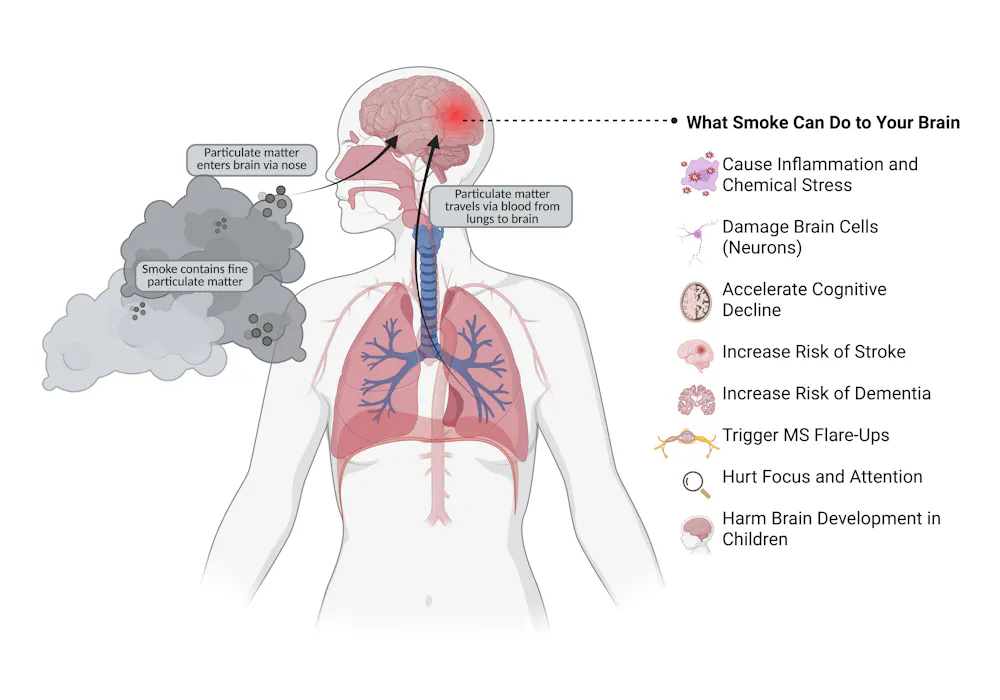
Alongside harmful gases and heavy metals, wildfire smoke contains fine particulate matter, also known as PM2.5. These tiny particles can travel deep into your lungs, slip into your bloodstream and even reach your brain. Some even bypass the lungs entirely, entering the brain directly through the nose.
After entering the brain, these toxins can cause inflammation and stress, damage nerve cells and even accelerate cognitive decline. Studies have linked exposure to air pollution to an increased risk of stroke and dementia. Even short-term spikes in smoke exposure, like those during wildfires, lead to a surge in emergency visits for strokes, especially among people over 65.
A 2022 experiment had thousands of adults participate in an online attention task under smoky conditions. It found that just a three-hour spike in fine particulate matter, typical of a heavy smoke episode, led to measurably worse attention scores. This fits other evidence that breathing smoke makes people mentally foggy, forgetful or fatigued.
Fine particulate matter in wildfire smoke can reach the brain via the lungs or nose, causing inflammation, neuronal damage, and raising the risk of stroke, dementia, cognitive decline, and MS flare-ups. (Muskaan Muse Laroyia)
For people already living with neurological conditions like MS or Parkinson’s disease, the stakes are even higher. Exposure to fine particulate pollution has been linked with increased hospital admissions for MS relapses, particularly in young patients. Other research points to worsening symptoms of epilepsy and cognitive decline under extreme heat and polluted air conditions.
Despite these mounting risks, neurological health considerations have been largely absent from wildfire preparedness initiatives and public health responses. That needs to change.
If you want to stay informed about local smoke exposure, tools like AQmap can help you track PM2.5 levels in real time across Canada.
Each of these groups faces unique and compounding challenges during smoke events. For example, older adults are more vulnerable to the cardiovascular and neurological effects of smoke. They also face greater barriers to accessing filtered environments.
People with disabilities or chronic illnesses, including those with neurological conditions, often can’t relocate during smoke events and may rely on power-dependent medical devices that can fail during climate emergencies.
Low-income families are more likely to live in housing without proper air filtration or cooling. These same communities often face higher baseline rates of neurological disease.
Children and adolescents are particularly susceptible to the harmful neurological effects of wildfires. Because their brains are still developing and they breathe more air per body weight than adults, children are especially vulnerable to harmful pollutants.
These populations aren’t just more exposed, they also have fewer resources to respond.
Rethinking Canada’s health systems
Recognizing these inequities, we are developing a climate-health equity framework for Canada, with a specific focus on neurological health. Our interdisciplinary team is asking: how can we build health systems that protect vulnerable brains during climate emergencies?
Health-care workers in Alberta Health Services have designed the Climate-Resilient Acute Care Clinical Operations Framework. This framework supports hospitals in becoming both greener and more resilient, ensuring care can continue during wildfires, floods and extreme heat events.
Importantly, it also centres the needs of equity-deserving populations, integrating climate adaptation into emergency care, supply chains, staffing and patient communication.
What needs to change?
Public awareness must expand beyond respiratory health. Neurological effects of smoke should be included in public health messaging, especially for high-risk groups.
Health systems must be climate-ready, with clean air shelters, evacuation protocols and services tailored to meet the needs of neurological patients.
Communities need support, from funding for air filtration to co-ordinated outreach during smoke events. Indigenous-led fire stewardship and community health initiatives should be part of national planning. Supporting Indigenous-led fire stewardship not only strengthens wildfire response but also respects Indigenous sovereignty and traditional ecological knowledge.
Clinicians must be empowered to address climate-related health risks. Training in environmental health, including its impact on the brain, is increasingly essential.
Wildfire season is back, and with it, an urgent need to protect more than just our lungs. The science is clear: breathing smoky air affects our minds, especially for those already facing health and social vulnerabilities.
Climate change is a brain health issue. Building a healthier, more equitable future requires us to treat it that way, starting now.
Dr Bhavini Gohel works for the Canadian Coalition for Green Healthcare.
Muskaan Muse Laroyia does not work for, consult, own shares in or receive funding from any company or organisation that would benefit from this article, and has disclosed no relevant affiliations beyond their academic appointment.
Ghana’s national agenda often focuses on the country’s large number of young people. In fact a less noticed demographic transformation is reshaping society: the country’s older population is growing rapidly. According to Ghana Statistical Service estimates,
people aged 60 and above are projected to make up over 12% of the total population by 2050, more than doubling the 2021 estimate of 6.8%.
And more of these older adults are ageing alone.
That’s because of Ghana’s transition from extended to nuclear family systems, coupled with rural–urban and international migration. Traditionally, older Ghanaians aged within multi-generational households, with care provided by children and extended family. But today, migration patterns have intensified, with over 50% of the population living in urban areas, leaving many elders behind in rural communities or isolated in city slums.
I recently conducted a study across six Ghanaian communities (urban and rural). Drawing from 52 interviews, I explored the emotional, social and economic implications of ageing alone.
The participants in the study echoed a common theme: the erosion of intergenerational family structures, leaving the elderly socially and emotionally isolated.
As a 73-year-old widow participant who lives in a city put it:
My daughter is in Canada. My son lives in Kumasi, but he rarely visits. I live alone, and if I fall sick, I just wait. Sometimes, I pray someone will notice.
Such stories are no longer anecdotal outliers. Nationally representative data from the Ghana Living Standards Survey and WHO SAGE Ghana Wave 2 also reveal an uptick in solitary living among older adults, particularly widowed women and those without formal pensions. Over 22% of older respondents in urban Ghana reported living alone, a sharp contrast to previous decades, where co-residence with adult children was the norm. Many older Ghanaians don’t have reliable caregivers.
As a PhD candidate in population studies at the University of Ghana, I focus on health-related quality of life among older adults. This article draws from my doctoral fieldwork in urban and rural Ghana, using qualitative interviews to uncover the lived realities of ageing alone.
The study highlights a gap in Ghana’s ageing policies: they overlook solitary elders who live without daily family support.
The paper calls for integrated social protection for older adults living alone. That would include subsidised healthcare, community outreach services, emergency care networks, and community-based mental health interventions.
What old people had to say
Focus group discussions revealed that older adults struggle with emotional loneliness, financial anxiety and health system constraints. Despite the presence of pension associations, many older adults feel forgotten. Spiritual activities and reading offer moments of solace, but limited National Health Insurance Scheme coverage, rising living costs, and declining family support deepen the hardship.
Focus groups revealed that older women were particularly vulnerable due to widowhood, land insecurity and declining support from children. Men, while respected, felt idle and underutilised. Participants spoke of finding strength in farming, faith and fellowship, but felt forgotten in national development planning.
Ghana’s National Ageing Policy (2010) promises integrated care, but older adults, especially women, are slipping into the cracks of urban anonymity.
Ageing here is not just biological, it is physical, psychological and economic. My broader research affirms that the majority of older adults in Ghana worked in the informal sector. They therefore have no access to formal pensions or post-retirement income security.
Participants in my most recent research shared how they felt:
I was a seamstress all my life. Now my eyes are failing. No pension, no money. I survive on cassava and prayer. – 66-year-old retired woman
Ageing in Ghana is like walking into a forest — you disappear quietly. No one sees you. — 69-year-old woman
This statement underscores the gendered experience of ageing, where women often face greater economic and emotional vulnerability due to widowhood, longer life expectancy, and social neglect.
We are not dying yet. We want to matter again. – 70-year-old man
We have houses, but not homes anymore. – 75-year-old man
What next
The implications of this neglect are staggering. According to the World Health Organization, loneliness and social isolation among the elderly are associated with a 50% increased risk of dementia, depression and premature death. In Ghana, there are added challenges of inaccessible health facilities and cultural stigma about ageing. Yet most people aren’t talking about it.
Ghana introduced the National Ageing Policy in 2010 to promote the health, security and participation of older people in national development. But many elderly people still live without affordable healthcare, age-friendly infrastructure or a regular income.
What Ghana needs now is not another grand policy document. It needs practical, community-rooted and state-supported action.
Decentralised community geriatric care: Train district-level health volunteers in geriatric care, and equip them with basic tools to support older people in their homes.
Pension and informal sector integration: Extend Ghana’s pension framework to informal sector workers.
Public awareness campaigns: Reframe ageing in national media not as decline but as contribution, highlighting elder wisdom, resilience, and ongoing social relevance.
Urban planning for ageing: Incorporate age-friendly elements like ramps, benches, toilets and signage into development plans.
None of this is charity. It is a strategic investment. In 2021, Ghana spent less than 0.5% of its national health budget on elderly-specific care. That is fiscally short-sighted. Healthier, engaged older adults reduce family burdens, boost social capital, and can even contribute economically by training and mentoring others.
In the communities I visited, I encountered grassroots interventions worth scaling up: church youth groups providing weekly food support, pensioners’ associations checking in on members, and intergenerational community storytelling sessions that rebuild emotional bonds.
In Ghana’s Akan tradition, elders are considered living libraries. Their absence from the communal space is not just a social loss, it is a cultural erasure.
If the elderly are neglected, anyone may wake up on the wrong side of the demographic line one day, wondering if they too will be forgotten.
Andrew Kweku Conduah does not work for, consult, own shares in or receive funding from any company or organisation that would benefit from this article, and has disclosed no relevant affiliations beyond their academic appointment.
Source: The Conversation – Africa – By Philip Harrison, Professor School of Architecture and Planning, University of the Witwatersrand
South African president Cyril Ramaphosa met senior leaders of Johannesburg and Gauteng, the province it’s located in, in March 2025 to discuss ways to arrest the steep decline in South Africa’s largest city.
Ramaphosa announced a two-year-long presidential intervention to tackle some of the city’s most pressing issues. It is to be led by the Presidential Johannesburg Working Group with eight cross-governmental and multi-stakeholder workstreams.
Johannesburg was established 130 years ago, where the world’s largest-ever gold deposits were discovered. It grew rapidly in the early 20th century and became the country’s economic heartland and largest population centre. Like all South African cities, it was deeply scarred by apartheid policies. People were divided by racially defined groups. Good services and a strong economy benefited a minority, and a black majority were pushed into impoverished ghettos.
But, for about the first two decades of post-apartheid rule from 1994, Johannesburg led the country with innovation and progressive change. It pioneered the new local government system, institutional reforms, new practice on city strategy and planning, pro-poor service delivery, and modern transport infrastructure.
Today, however, the city is in a dire state. Over the past decade, roughly coinciding with the arrival of messy coalition governance in 2016, sound political leadership, administrative stability and financial management have crumbled. Underinvestment in infrastructure maintenance has led to collapsing services. Public trust is deteriorating among increasingly frustrated communities. This was evident in local election results. It also shows up in recent data released by the Gauteng City-Region Observatory on public trust in local government.
Corruption in many parts of the city is an endemic complicating factor.
The presidential intervention is designed to address this complex interplay between embedded legacies and failings post-apartheid. The workstreams involving city officials and concerned stakeholders are generating ideas for priority actions. There is also a new energy in the city government, with the executive mayor and members of his mayoral committee making turnaround promises.
This long overdue attention is heartening. But some caution is called for. While some “quick wins” are needed, there will be no easy turnaround. The best prospect is likely to be a process of recovery that will require patience and methodical attention over the long term. A city cannot be repaired in the way an automobile can. A city has a trillion moving parts and is in a constant state of makeover, as dynamics of economy, technology, demography, environment, society, politics, and more, interact and produce change.
The question is not whether a city is fixed – it can never finally be – but rather what trajectory it is on. For Johannesburg, the question is how to exit the downward spiral and begin the process of reconstruction.
We are a group who previously worked in the City of Johannesburg as officials, who are now academics with decades of experience observing local governance trends and dynamics, or scholars engaged in civil society coalitions or communities mobilising around the crisis. Some of us have been involved in the Presidential Johannesburg Working Group over the last few months.
Our view is that there are four areas needing urgent but sustained attention.
Focus areas
The first is the need for a joint effort across national, provincial and municipal government to resolve the crisis. We are pleased that this has begun. The political leadership in the city (and of the province) failed to grasp the opportunity provided by the post-2024 election national compromises to put together a broad-based government of local unity to lead reconstruction. There is no option now but to pursue an inter-governmental initiative led by national government with the committed involvement of the other spheres.
Only genuine collaboration will succeed.
In this respect, the Presidential Johannesburg Working Group holds promise. But what will be needed is careful, concerted work focused first on short-term priorities. Then, over years, on key structural challenges facing the city.
Second, the city needs civil society in all its forms to hold a careful balance between keeping up the pressure on municipal government, constantly holding it accountable to its residents, and working with government to help it solve problems. The Joburg Crisis Alliance, Jozi-my-Jozi, WaterCAN and similar initiatives are claiming well-recognised and respected voice in the affairs of the municipality.
Johannesburg needs a city government that is open to this scrutiny, accepting the need for transparency, and open to the help that civil society can offer.
To raise the level of accountability and collaboration, a clear programme of restoration has to be communicated openly to the public. Milestones and expenditure requirements need to be set that allow for constant monitoring. There must be open council meetings, and regular online and in-person briefings.
Also required are new mechanisms for citizen-based monitoring. These may include trained citizen monitors reporting on service delivery. Alternatively, the establishment of a sort of “Citizen’s Council” which meets regularly to receive reports from these monitors and the city administration.
International examples include the Bürgerrat model. This is now fully institutionalised in parts of Germany and Austria to strengthen local democracy and accountability. In this model, citizens are randomly selected to sit on a council which monitors performance of local government and provides new ideas.
Another approach could be for civil society organisations to be invited to a Citizen’s Council that would act in support of the oversight processes of the elected Municipal Council.
Third, there has to be a solution to unstable coalition governments. These seem to be structured to facilitate separate political fiefdoms where spoils can be divided in the allocation of portfolios. At minimum, the presidential intervention must provide for a check and balance on processes where bureaucratic appointments and budgetary allocations may serve the interests of cronyism. For example, there should be transparency and rigour in appointments to the boards of Johannesburg’s municipally owned companies.
Regulatory reforms are required in the political arena. This should include rules for the distribution of seats on the municipal executive and the election of mayors. Between January 2023 and August 2024 a tiny minority party held the mayoralty because the larger parties could not agree on a mayoral selection or, more cynically, to ensure that the executive mayor could not call large parties to account.
More importantly, though, there has to be a change in political culture. This is a longer-term process.
Fourth, the problems run far deeper than what bureaucratic reorganisation can achieve.
The longer-term project is to build a capable administration with clear political direction and oversight but insulated from personal agendas and factional battles. The administration became confused and demoralised because of the political instability over an extended period. There are, however, still many capable and committed public servants in the city bureaucracy. The focus should be on working with them to rebuild the administration, making it a place where talent and initiative are recognised and rewarded.
Restored political leadership and a rejuvenated administration is needed for a long term process, extending far beyond the quick wins. This process will involve refurbishing the decaying network infrastructure, restoring financial stability, reestablishing social trust and returning confidence to the city’s economy.
2025 marks 30 years since the first democratic local elections. National government is looking seriously at sweeping municipal reforms. And the next municipal election – likely to be held at the end of 2026 – is an opportunity to make a deep transformation effort. Citizens can ensure that parties contesting the election place Johannesburg’s recovery at the heart of their agenda.
Philip Harrison has received funding from South Africa’s National Research Foundation in support of the South African Research Chair in Spatial Analysis and City Planning.
The Gauteng City-Region Observatory receives core grant funding from the Gauteng Provincial Government.
Lorena Nunez Carrasco received funding from the National Research Foundation in support of research on the South African response on COVID-19
Rashid Seedat receives funding from Gauteng Provincial Government for the Gauteng City-Region Observatory. He is affiliated with the Ahmed Kathrada Foundation as a member of the Board of Trustees.
The Lancet has released its second global commission report on Adolescent Health and Wellbeing. Adolescents are defined as 10- to 24-year-olds. The report builds on the first one, done in 2016. The latest report presents substantial original research that supports actions it recommends to be taken across sectors as well as at global, regional, country and local level. The co-chairs of the commission, Sarah Baird, Alex Ezeh and Russell Viner, together with the youth commissioners lead, Shakira Choonara, give a guide to the report’s findings.
What were the key findings?
The report noted significant improvements in some aspects of adolescent health and wellbeing since the 2016 report. These include reductions in:
communicable, maternal and nutritional diseases, particularly among female adolescents
the burden of disease from injuries
substance use, specifically tobacco and alcohol
teenage pregnancy.
It also found that there had been an increase in age at first marriage and in education, especially for young women.
Despite this progress, adolescent health and wellbeing is said to be at a tipping point. Continued progress is being undermined by rapidly escalating rates of
non-communicable diseases and mental disorders, accompanied by threats from compounding and intersecting megatrends. These include climate change and environmental degradation, the growing power of commercial influences on health, rising conflict and displacement, rapid urbanisation, and the aftermath of the COVID-19 pandemic.
These megatrends are outpacing responses from national governments and the international community.
What’s unique about today’s cohort of adolescents?
Born between 2000 and 2014, this is the first cohort of humans who will live their entire life in a time when the average annual global temperature has consistently been 0.5°C or higher above pre-industrial levels.
At roughly 2 billion adolescents, they are the largest cohort of adolescents in the history of humanity. And this number will not be surpassed as populations age and fertility rates fall in even the poorest countries.
They are the first generation of global digital natives. They live in a world of immense resources and opportunities, with unprecedented connectedness made possible by the rapid expansion of digital technologies. This is true even in the hardest-to-reach places.
Growing participation in secondary and tertiary education is equipping adolescents of all genders with new economic opportunities and providing pathways out of poverty.
These opportunities, however, are not being realised for most adolescents. Increasing numbers continue to grow up in settings with limited opportunities. In addition, investments in adolescent health and wellbeing continue to lag relative to their population share or their share of the global burden of disease.
Investments in adolescents accounted for only 2.4% of the total development assistance for health in 2016-2021. This was despite the fact that adolescents accounted for 25.2% of the global population in that period and 9.1% of the total burden of disease. We use development assistance as a measure because, while governments also invest in adolescents, it’s difficult to account for how much this is. For example, when a government supports a health facility, it serves the entire population.
Yet, the report provides evidence to show that the return on investments in adolescent health and wellbeing is highly cost-effective and at par with investments in children.
What’s the news for adolescents in Africa?
The report recognises the special place of Africa in the global future of adolescents. It notes that, by the end of this century, nearly half of all adolescents will live in Africa.
Currently, adolescents in Africa experience higher burdens of communicable, maternal and nutritional diseases, at more than double the global average for both male and female adolescents. They also have a higher prevalence of anaemia, adolescent childbearing, early marriage and HIV infection. They are much less likely to complete 12 years of schooling and more likely to not be in education, employment, or training.
Female adolescents in sub-Saharan Africa have the highest adolescent fertility rate at 99.4 births per 1,000 female adolescents aged 15-19 (the global average is 41.8). They have also experienced the slowest decline between 2016 and 2022.
Globally, there was progress in reducing child marriage between 2016 and 2022. But in eight countries in 2022, at least one in three female adolescents aged 15–19 years was married. All but one of these eight countries were in sub-Saharan Africa. Niger (50.2%) and Mali (40.6%) had the highest proportion of married female adolescents.
The practice of child marriage is declining in south Asia and becoming more concentrated in sub-Saharan Africa. As the report notes:
it continues because of cultural norms, fuelled by economic hardships, insurgency, conflict, ambiguous legal provisions, and lack of political will to enforce legal provisions.
What should be Africa’s focus areas?
Beyond adolescent sexual and reproductive health concerns in sub-Saharan Africa, obesity is increasing fastest in the region. This illustrates the vulnerability of adolescents to the power of commercial interests.
Since 1990, obesity and overweight has increased by 89% in prevalence among adolescents aged 15–19 years in sub-Saharan Africa. This is the largest regional increase.
The absence of data on adolescents is a problem. Adolescents in sub-Saharan Africa are absent in many data systems. For example, data on adolescent mental health in sub-Saharan Africa is virtually absent.
Stronger data systems are needed to understand and track progress on the complex set of determinants of adolescent health and wellbeing.
Another area of concern is the massive inequities within countries, often gendered or by geography. While female adolescents in Kenya are experiencing substantial declines in the burden of HIV and sexually transmitted infections, adolescent males are experiencing increasing burdens. In South Africa, years of healthy life lost to maternal disorders show more than 10-fold differences between the Western Cape and North West provinces.
Where there’s been strong political leadership, remarkable changes have been seen. Take the case of Benin Republic. The adolescent fertility rate in the country declined from 26% in 1996 to 20% in 2018 and child marriage from 39% to 31% over the same period. Strong political leadership has also led to substantial reductions in female genital mutilation or cutting. This fell from 12% of girls in Benin in 2001 to 2% in 2011–12 among 15–19-year-old girls in Benin Republic. Political leadership also facilitated the expansion, by the national parliament in 2021, of the grounds under which women, girls, and their families could access safe and legal abortion.
But for every country that takes positive steps to protect the health and wellbeing of adolescents, several others regress.
The last decade has witnessed regression in several countries. In 2024, The Gambia attempted to repeal a 2015 law criminalising all acts of female genital mutilation or cutting. In 2022, Nigeria’s federal government ordered the removal of sex education from the basic education curriculum.
What are the recommended courses of action?
The report calls for a multisectoral approach across multiple national ministries and agencies, including the office of the head of state, and within the UN system.
Coordination and accountability mechanisms for adolescent health and wellbeing also need to be strengthened.
Laws and policies are needed to protect the health and rights of adolescents, reduce the impact of the commercial determinants of health, and promote healthy use of digital and social media spaces and platforms.
Strong political leadership at local, national, and global levels is essential.
The report also calls for prioritised investments, the creation of enabling environments to transform adolescent health and wellbeing, and the development of innovative approaches to address complex and emerging health threats.
It calls for meaningful engagement of adolescents in policy, research, interventions and accountability mechanisms that affect them.
Without these concerted actions, we risk failing our young people and losing out on the investments being made in childhood at this second critical period in their development.
The current adverse international aid climate is particularly affecting adolescents as much development assistance relates to gender and sexual and reproductive health. Concerted action in addressing adolescent health and wellbeing is an urgent imperative for sub-Saharan Africa.
Alex Ezeh is a fellow at the Stellenbosch Institute for Advanced Study (Stias).
Russell Viner and Sarah Baird do not work for, consult, own shares in or receive funding from any company or organisation that would benefit from this article, and have disclosed no relevant affiliations beyond their academic appointment.
The Paiter-Suruí people have a culture deeply rooted in their land: the Sete de Setembro Indigenous Land (TISS), on the border of Rondônia and Mato Grosso in the southwestern Brazilian Amazon. Known as Paiterey Karah, this territory is home to rich biodiversity. However, increasing human encroachment has triggered socio-cultural and territorial challenges that now threaten the transmission of traditional wisdom.
The region’s wildlife includes several primate species—some now at risk of extinction due to deforestation and environmental degradation. Within their traditional memory, the Paiter-Suruí hold extensive knowledge about these animals, which are integral to their cultural heritage. This includes the 10 species of neotropical primates identified and named by the Paiter-Suruí, all native to their territory.
Of these 10 species, five appear on the International Union for Conservation of Nature’s (IUCN) Red List, a global benchmark for conservation status of fauna and flora. Among them, three—Ateles chamek, Chiropotes albinasus, and Pithecia mittermeieri—are considered extremely rare, according to Paiter tradition.
Ethnoprimatology studies the intersections between humans and non-human primates. In this field, the Paiter-Suruí have developed a complex traditional knowledge system relating to the primate species in their territory.
Because it is inherently interdisciplinary, ethnoprimatology connects biology and anthropology, allowing a deeper analysis of how human and primate lives intertwine—both ecologically and culturally.
My research used an ethnoprimatological approach grounded in qualitative methodology, drawing on key practices from biological and cultural anthropology.
The study
This research aimed to document the breadth of Paiter-Suruí knowledge about the primates within the Sete de Setembro Indigenous Land, examining both the cultural and ecological significance of these animals, as well as their uses—for food, handicrafts, traditional medicine, and timekeeping based on animal vocalizations.
Using an interdisciplinary approach, I holistically examined the biological, ecological, and socio-cultural factors shaping the human-primate relationship in this region.
For data collection, I used several techniques: free listing, collective semi-structured interviews, participant observation—immersing myself in daily community life for deeper understanding—and audiovisual recordings.
Interviews included community members aged 20 to 80, with special attention to elders, who are the main custodians of traditional primate knowledge. However, women and young hunters were also included to enrich the information gathered.
Through the free list technique, which asks participants for open-ended answers without restrictions, I identified 10 primate species recognized and named by the Paiter-Suruí.
The primates of the territory
Among the 10 primate species documented in the Sete de Setembro Indigenous Land, three are traditionally used as food, while four have special symbolic importance, woven into key cultural, ecological, and mythological aspects of the Paiter cosmology.
An illustrative case is the red-necked night monkey—called Yaah in Paiter. Elders say this species is excluded from the community’s typical primate classifications and instead regarded as an omen. Hearing its call or unexpectedly seeing one signals the approach of external enemies or impending death in the community.
While exploring these cultural ties to the region’s primates, I also observed the practice of rearing infant animals, especially among girls. Species such as Alouatta puruensis (howler monkey), Saimiri ustus (squirrel monkey), and Mico nigriceps (black-headed marmoset) are commonly involved.
In Paiter-Suruí society, adolescent girls often care for offspring of monkeys hunted by the community, as well as other small animals outside their typical diet. Encouraged by parents, this tradition is a vehicle for socialization and passing down valued skills. By raising young animals, girls develop emotion, empathy, nurturing skills, and hands-on experience seen as foundational for motherhood in Paiter tradition.
Beyond developing caretaking abilities, these interactions strengthen symbolic and emotional connections with local wildlife—especially primates—reinforcing ideals of belonging, reciprocity, and respect for nature. These practices demonstrate the interplay among social learning, interspecies relations, and ecological wisdom passed down through generations.
Community members also reported declining populations of certain primate species, including two—Yaah (Aotus nigriceps) and Arimẽ-Iter (Ateles chamek)—that hold special cultural significance. The latter became a central focus of my research.
The endangered Arimẽ-Iter
The black-faced spider monkey (Ateles chamek), or Arimẽ-Iter to the Paiter, is classified as endangered on the IUCN Red List. Its sacred status and diverse roles led me to propose it as a ‘Cultural Key Species’ for the Paiter-Suruí.
In various Indigenous communities, certain biological species are of exceptional cultural importance and are called Cultural Key Species. Defined by their significant role, many uses and deep integration in community life, these species embody the interdependence between people and their environment.
For the Paiter-Suruí, the black-faced spider monkey (Ateles chamek) stands out for its multiple uses and appears to meet the criteria of a Cultural Key Species.
Based on field observations, I cataloged five uses the Paiter-Suruí associate with this species:
· Food: The meat of Ateles chamek (called Sobag) is an important protein source in the Paiter-Suruí diet.
· Traditional dishes: Its meat is used in cultural recipes, often with Mamé—a flatbread made from corn flour. This practice passes down culinary knowledge and highlights the species’ nutritional, medicinal, and symbolic value in the community.
· Handicrafts: Spider monkey teeth are made into body ornaments (Sogap Arimẽ Ikaáp)—such as necklaces and bracelets—which reflect status or ceremonial participation and reinforce ties between people and local fauna.
· Medicine: The animal’s lard is traditionally applied to wounds (Ikawah), part of the community’s oral ethnopharmacological knowledge passed down by elders and healers.
· Caretaking: When infants are orphaned through hunting, adolescent girls may raise young spider monkeys. This reinforces learning about caretaking and builds affectionate, reciprocal ties between people and primates (Yatĩga), reflecting broader values of coexistence with nature.
Together with ancestral stewardship of spider monkey habitats, these uses highlight the species’ role as essential for cultural preservation and identity among the Paiter-Suruí.
Territorial and environmental management plan
Facing growing socio-environmental challenges, the Paiter have created internal policies for territorial management, grassroots political organization, and culturally centered development—all to protect their culture and traditional knowledge.
This laid the foundation for the Territorial and Environmental Management Plan (PGTA) for the Sete de Setembro Indigenous Land, launched in 2000 as a comprehensive framework guiding conservation, resource management, and recognition of cultural practices.
In my research, I examine TISS land management practices, focusing on the protection of primates as essential to ecological preservation. These animals are vital both for maintaining natural balance and for the cultural continuity of the territory.
Of the 10 primate species recognized by the Paiter, five now qualify as threatened under the IUCN Red List. However, the PGTA currently lacks targeted conservation measures for these at-risk populations. My findings suggest the management plan could serve as a platform to protect local primates.
Ultimately, enacting effective conservation efforts for these ethno-species is critical to the coexistence of the region’s biodiversity and the traditional knowledge of the Paiter-Suruí.
Fabrício Gatagon Suruí não presta consultoria, trabalha, possui ações ou recebe financiamento de qualquer empresa ou organização que poderia se beneficiar com a publicação deste artigo e não revelou nenhum vínculo relevante além de seu cargo acadêmico.
Despite serving as crucial guardians of biodiversity, traditional communities continue to be systematically excluded from developing and managing protected areas. This often subtle, silent exclusion has fueled persistent, complex socio-environmental conflicts, harming both conservation and the welfare of Indigenous peoples, riverside populations, Afro-Brazilian quilombola communities, and smallholder farmers.
A recent study, “Socio-environmental Conflicts and Traditional Communities in Protected Areas: A Scientometric Analysis,” published in the Journal for Nature Conservation, mapped how scientific literature has examined these conflicts over time.
Researchers from the Federal University of Western Pará (UFOPA), the Federal University of Pará (UFPA), the University of International Integration of Afro-Brazilian Lusophony (UNILAB), and the Vale Institute of Technology (ITV) collaborated on the study as part of the National Institute of Science and Technology in Synthesis of Amazonian Biodiversity (INCT-SynBiAm) and the Eastern Amazon Biodiversity Research Program (PPBio-AmOr).
The team reviewed 263 scientific articles published worldwide between 1990 and August 2024, sourced from Scopus and Web of Science. Their analysis revealed significant gaps in research on this topic and offered recommendations for more just, inclusive, and effective management of protected territories.
What does science reveal about these conflicts?
The research shows not only a rise in conflicts involving traditional communities and protected zones, but also their diversity. The main sources of tension are:
1. Access to subsistence resources: Local prohibitions—often unilaterally enacted—restrict fishing, hunting, gathering, and subsistence agriculture, all vital for food and income. These constraints sever longstanding traditions of sustainable resource use, leading to food insecurity and marginalization.
2. Exclusionary management of protected areas: Community voices are rarely included in decisions about protected area creation or management. The absence of prior consultation and disregard for traditional knowledge often yield policies disconnected from local realities. Such centralized management breeds resentment and undermines conservation; participatory governance is essential to socio-environmental justice.
A study in Chile involving Aymaras, Atacameñas, and Mapuche-Huilliches communities found that while participatory practices and technical support from the CONAF forest agency improved perceptions, dissatisfaction persists due to initial exclusion. Many continue to assert ancestral land rights and demand meaningful input, highlighting the urgent need to build trust and align conservation with social justice.
3. Conflicts involving wildlife: Local communities contend with damaged crops, attacks on domestic animals, and even threats to personal safety. Large mammals such as elephants, lions, jaguars, and buffalo are the main culprits. Habitat loss and depleted food sources exacerbate these incidents. Peaceful coexistence requires inclusive, context-specific solutions.
4. Territorial disputes and land rights: Many protected areas overlap with territories long used by traditional peoples. Disavowed land rights provoke legal battles, forced displacement, and greater insecurity, compounding social challenges. Formal recognition of collective land title is key to reducing conflict and ensuring autonomy; these disputes exemplify the global fight for territorial justice.
In Mexico, a recent study documents the impact of land privatization, livestock expansion, plantations, and urbanization in the protected areas of Veracruz, Chiapas, and Morelos. It generated a land market that is disrupting Indigenous and peasant communities and threatening both their territories and forest conservation.
5. Cultural and socioeconomic disruption: Establishing protected areas can upend ways of life rooted in symbolic, generational relationships with nature. Prohibiting customary practices disrupts rituals, beliefs, and the intergenerational transmission of knowledge, silently eroding local cultures.
In the United States, Australia, and New Zealand, studies have noted frequent friction between Indigenous groups, recreational visitors, and managing agencies. Issues include access to sacred sites and resources on traditional lands, visitor infrastructure, permitted activities, and even place names.
6. Lack of recognition and real participation: When communities are denied a voice in decisions, historical inequities deepen, fueling conflict. Despite legal progress, many traditional groups remain excluded from governance. Without meaningful participation, environmental policy fails to address local needs—highlighting the urgent need for community leadership and real power-sharing in conservation.
Italy’s Monti Sibillini National Park in the Central Apennines offers an instructive case: rural depopulation has coincided with rising friction between environmental managers and locals. Imposed bureaucratic guidelines, unresponsiveness to community aspirations, and challenging collaboration between the park and municipalities have generated mutual frustration and hostility. This underscores the need for “knowledge democracy” and truly participatory stewardship that respects diverse ways of living on the land.
Within Brazil, the same types of socio-environmental strife observed worldwide are especially acute in national protected areas. Research shows that even in sustainably managed zones like Extractive Reserves, communities regularly face resource restrictions and limited decision-making power—a recipe for lingering resentment and compromised conservation. Centralized authority and denial of customary land rights often lead to drawn-out disputes, mirroring patterns across the Global South.
These findings highlight Brazil’s urgent need for strong co-management models—mechanisms that value local knowledge and foster territorial justice.
Such tensions cluster in nature reserves and national parks, where regulatory regimes often disregard local lifeways and worldviews. Although the law guarantees consultation and participation mechanisms like free, prior, and informed consultation, they are often ignored or implemented ineffectively.
Another key finding: 66.54% of studies focused on non-Indigenous populations, while only 16.73% examined Indigenous peoples exclusively. This imbalance exposes the under-representation of research attentive to the full range of traditional communities.
Such gaps hinder efforts to understand these peoples’ rich cultural and ecological realities—and in turn, weakens recognition of their expertise and the value of their knowledge for global biodiversity conservation. Scientific consensus now affirms the vital role these communities play in preservation, yet too often they are treated as problems to be managed, not as collaborative partners.
Why does conservation demand inclusion?
Ensuring traditional communities participate in planning and stewarding protected lands is not only a matter of justice, but fundamental to effective conservation. Sustainable outcomes depend on their involvement. This study underscores the urgent need for public policies that are both inclusive and tailored to local conditions, embedding traditional knowledge as an indispensable part of conservation solutions, not as an obstacle.
Worldwide, co-management experiments show that community involvement fosters compliance with conservation rules, improves governance, and delivers stronger socio-environmental benefits.
Shifting the focus to Amazonian science
While most studies reviewed focus on countries in the Global South—like Brazil and India—research production is dominated by institutions in the Global North. This reflects persistent “parachute science”: fieldwork by foreign scientists in rich biodiversity zones, often excluding local scientists and communities from the research process. Such projects often leave little local benefit, treating Amazonian residents as data collectors or study subjects.
To address this, efforts must shift toward empowering Amazonian scientific institutions and researchers, strengthening their role in shaping conservation and research agendas, and realizing epistemic justice. Investments are especially needed in institutions serving remote, often overlooked regions of the Amazon.
With robust support, these institutions can fill crucial gaps—producing research attuned to local realities, expanding our understanding of Amazonian ecosystems, and inspiring new generations of scientists.
Researchers living and working in the Amazon possess deep, context-sensitive knowledge of the territory, enabling them to pose more relevant questions and craft solutions suited to regional challenges and opportunities. Their scholarship, in ongoing dialogue with both environment and community, enriches global science and yields practical advances that matter for daily life in the forest.
Proximity to Indigenous, riverside, and urban populations also enables more authentic community participation in research. When research projects originate from local priorities and perspectives, they strengthen communities, help protect biodiversity, and affirm the possibility of uniting science, social justice, and climate action.
Leandro Juen has a productivity grant from the National Council for Scientific and Technological Development (CNPq), research projects funded by CNPq, the Coordination for the Improvement of Higher Education Personnel (CAPES), the Amazon Foundation for Studies and Research (FAPESPA) and the BRC Biodiversity Consortium.
Everton Silva, Fernando Abreu Oliveira, Fernando Geraldo de Carvalho, James Ferreira Moura Junior, José Max B. Oliveira-Junior, Karina Dias-Silva e Mayerly Alexandra Guerrero Moreno não presta consultoria, trabalha, possui ações ou recebe financiamento de qualquer empresa ou organização que poderia se beneficiar com a publicação deste artigo e não revelou nenhum vínculo relevante além de seu cargo acadêmico.
Source: The Conversation – USA – By Joshua Lens, Associate Professor of Instruction of Sport & Recreation Management, University of Iowa
Former Arizona State University swimmer Grant House is one of the plaintiffs in the class action lawsuit filed against the NCAA.Mike Comer/NCAA Photos via Getty Images
The business of college sports was upended after a federal judge approved a settlement between the NCAA and former college athletes on June 6, 2025.
After a lengthy litigation process, the NCAA has agreed to provide US$2.8 billion in back pay to former and current college athletes, while allowing schools to directly pay athletes for the first time.
Joshua Lens, whose scholarship centers on the intersection of sports, business and the law, tells the story of this settlement and explains its significance within the rapidly changing world of college sports.
What will change for players and schools with this settlement?
The terms of the settlement included the following changes:
The NCAA and conferences will distribute approximately $2.8 billion in media rights revenue back pay to thousands of athletes who competed since 2016.
Universities will have the ability to enter name, image and likeness, or NIL, agreements with student-athletes. So schools can now, for example, pay them to appear in ads for the school or for public appearances.
Each university that opts in to the settlement can disburse up to $20.5 million to student-athletes in the 2025-26 academic year, a number that will likely rise in future academic years.
Athletes’ NIL agreements with certain individuals and entities will be subject to an evaluation that will determine whether the NIL compensation exceeds an acceptable range based on a perceived fair market value, which could result in the athlete having to restructure or forego the deal.
The NCAA’s maximum sport program scholarship limits will be replaced with maximum team roster size limits for universities that choose to be part of the settlement.
Why did the NCAA agree to settle with, rather than fight, the plaintiffs?
In 2020, roughly 14,000 current and former college athletes filed a class action lawsuit, House v. NCAA, seeking damages for past restrictions on their ability to earn money.
For decades, college athletics’ primary governing body, the NCAA, permitted universities whose athletics programs compete in Division I to provide their athletes with scholarships that would help cover their educational expenses, such as tuition, room and board, fees and books. By focusing only on educational expenses, the NCAA was able to reinforce the notion that collegiate athletes are amateurs who may not receive pay for participating in athletics, despite making money for their schools.
A year later, in 2021, the U.S. Supreme Court unanimously ruled in a separate case, Alston v. NCAA, that the NCAA violated antitrust laws by limiting the amount of education-related benefits, such as laptops, books and musical instruments, that universities could provide to their athletes. The ruling challenged the NCAA’s amateurism model while opening the door for future lawsuits tied to athlete compensation.
It also burnished the plaintiffs’ case in House v. NCAA, compelling college athletics’ governing body to take part in settlement talks.
What were some of the key changes that took place in college sports after the Supreme Court’s decision in Alston v. NCAA?
Following Alston, the NCAA permitted universities to dole out several thousand dollars in what’s called “education benefits pay” to student-athletes. This could include cash bonuses for maintaining a certain GPA or simply satisfying NCAA academic eligibility requirements.
But contrary to popular belief, the Supreme Court’s Alston decision didn’t let college athletes be paid via NIL deals. The NCAA continued to maintain that this would violate its principles of amateurism.
With over a dozen states looking to pass similar laws, the NCAA folded on June 30, 2021, changing its policy so athletes could accept NIL compensation for the first time.
Will colleges and universities be able to weather all of these financial commitments?
Universities and their athletics departments, on the other hand, will have to reallocate resources or cut spending. Some will cut back on travel expenses for some sports, others have paused facility renovations, while other athletic departments may resort to cutting sports whose revenue does not exceed their expenses.
As Texas A&M University athletic director Trev Alberts has explained, however, that college sports does not have a revenue problem – it has a spending problem. Even in the well-resourced Southeastern Conference, for example, many universities’ athletics expenses exceed its revenue.
Do you see any future conflicts on the horizon?
Many observers hope the settlement brings stability to the industry. But there’s always a chance that the settlement will be appealed.
More potential challenges could involve Title IX, the federal gender equity statute that prohibits discrimination based on sex in schools.
What if, for example, a university subject to the statute distributes the vast majority of revenue to male athletes? Such a scenario could violate Title IX.
NCAA President Charlie Baker, who has served in his role since 2023, has overseen major changes in conference governance and athlete compensation. David J. Griffin/Icon Sportswire via Getty Images
On the other hand, a university that more equitably distributes revenue among male and female athletes could face legal backlash from football athletes who argue that they should be entitled to more revenue, since their games earn the big bucks.
And as I pointed out in a recent law review article, an athlete or university may challenge
the new enforcement process that will attempt to limit athletes’ NIL compensation within an acceptable range that is based on a fair market valuation.
The NCAA and the conferences named in the lawsuit have hired the accountancy firm Deloitte to determine whether athletes’ compensation from NIL deals fall within an acceptable range based on a fair market valuation, looking to other collegiate and professional athletes to set a benchmark range. If athletes and universities have struck deals that are too generous, both could be penalized, according to the terms of the settlement.
Finally, the settlement does not address – let alone solve – issues facing international student-athletes who want to earn money via NIL. Most international student-athletes’ visas, and the laws regulating them, heavily limit their ability to accept compensation for work, including NIL pay. Some lawmakers have tried to address this issue in the past, but it hasn’t been a priority for the NCAA, as it has lobbied Congress for a federal NIL law.
Joshua Lens owns The Compliance Group, which provides NCAA compliance consulting services for universities and conferences.
Source: The Conversation – USA – By Kendall Deas, Assistant Professor of Education Policy, Law, and Politics, University of South Carolina
Originally developed as a tool to help Black children attend better schools, school voucher programs now serve a different purpose.Drazen via Getty Images
School voucher programs that allow families to use public funds to pay tuition to attend private schools have become increasingly popular.
The first vouchers were offered in the 1800s to help children in sparsely populated towns in rural Vermont and Maine attend classes in public and private schools in nearby districts.
After the U.S. Supreme Court’s 1954 Brown v. Board of Education decision, in which justices ruled that separating children in public schools on the basis of race was unconstitutional, segregationists used vouchers to avoid school integration.
More recently, school voucher programs have been pitched as a tool to provide children from low-income families with quality education options.
As a scholar who specializes in education policy, law and politics, I can share how current policies have strayed from efforts to support low-income Black children.
History of school voucher programs
Over time, as school voucher policies grew in popularity, they evolved into education subsidies for middle-class families. Peter Dazeley/Getty Images
Research from education history scholars shows that more recent support for school choice was not anchored in an agenda to privatize public schools but rooted in a mission to support Black students.
Over time, as school voucher policies grew in popularity, they evolved into subsidies for middle-class families to send their children to private and parochial schools.
School choice policies have also expanded to include education savings account programs and vouchers funded by tax credit donations.
School voucher programs can negatively impact the quality of public schools serving Black students. Connect Images via Getty Images
States looking to add or expand school choice and voucher programs have adopted language from civil rights activists pushing for equal access to quality education for all children. For example, they contend that school choice is a civil right all families and students should have as U.S. citizens. But school voucher programs can exclude Black students and harm public schools serving Black students in a host of ways, research shows.
Since the Brown v. Board ruling, school voucher programs have been linked to racial segregation. These programs were at times used to circumvent integration efforts: They allowed white families to transfer their children out of diverse public schools into private schools.
For example, private schools that receive voucher funding are not always required to adopt the same antidiscrimination policies as public schools.
School voucher programs can also negatively impact the quality of public schools serving Black students.
As some of the best and brightest students leave to attend private or parochial ones, public schools in communities serving Black students often face declining enrollments and reduced resources.
In cities such as Macon, Georgia, families say that majority Black schools lack resources because so many families use the state’s voucher-style program to attend mostly white private schools.
Moreover, the cost of attending a private or parochial school can be so expensive that even with a school voucher, Black families still struggle to afford the cost of sending children to these schools.
Vouchers can siphon school funding
Voucher programs can disproportionately affect funding in majority Black school districts. kali9/Getty Images
Research from the Economic Policy Institute, a nonpartisan, nonprofit think tank based in Washington, D.C., shows that voucher programs in Ohio result in majority Black school systems such as the Cleveland Metropolitan School District losing millions in education funding.
Another example is the Marion County School District, a South Carolina system where about 77% of students are Black.
Marion County is in the heart of the region of the state known as the “Corridor of Shame,” known for its inadequate funding and its levels of poor student achievement. The 17 counties along the corridor are predominantly minority communities, with high poverty rates and poor public school funding because of the area’s low tax base due to a lack of industry.
On average, South Carolina school districts spent an estimated US$18,842 per student during the 2024-25 school year.
In Marion County, per-student funding was $16,463 during the 2024-2025 school year.
By comparison, in Charleston County, the most affluent in the state, per-student funding was more than $26,000.
Returning voucher policy to its roots
Rather than focus on school choice and voucher programs that take money away from public schools serving Black students, I argue that policymakers should address systemic inequities in education to ensure that all students have access to a quality education.
Establishing restrictions on the use of funds and requiring preferences for low-income Black students could help direct school voucher policies back toward their intent.
It would also be beneficial to expand and enforce civil rights laws to prevent discrimination against Black students.
These measures would help ensure all students, regardless of background, have access to quality education.
Kendall Deas does not work for, consult, own shares in or receive funding from any company or organization that would benefit from this article, and has disclosed no relevant affiliations beyond their academic appointment.
Yet as fascination with America’s founding endures, controversy colors how the revolution is taught across the United States. From contested efforts by The New York Times “1619 Project” to put slavery at the center of America’s story, to attempts to limit teaching about race and racism, partisanship surrounds the teaching of American history. Anniversaries can inspire public passion, but they can also open old wounds.
As an American historian and a naturalized citizen of the United States, I regard the American Revolution with both personal and professional interest. The fact that I grew up in the United Kingdom amuses my students to no end whenever we discuss the Revolutionary War. Sometimes, in my British-accented English, I remind them I did not personally grow up with King George. Teaching history is encouraging students to think critically about the past without dictating what emotions they should feel – patriotic or otherwise.
Sadly, in the U.S., the sort of objective historical knowledge once taken for granted now appears to be waning. According to the National Assessment of Educational Progress, just 13% of eighth graders in 2023 ranked “proficient” in American history. A 2010 survey found that 26% of adults could not identify from whom America declared its independence, with China, Mexico and France among the responses.
America divorcing France would have been news to Gilbert du Motier, better known as the Marquis de Lafayette. His commitment to the new country not only helped secure its independence, but it also helped solidify American identity decades later.
Key alliance
A privileged aristocrat who served in both the American and French revolutions, Lafayette went to war at age 19. Commissioning and equipping his own expedition across the Atlantic in 1777, he fought in many battles against the British, including decisive action at Yorktown. Earning George Washington’s confidence, Lafayette attained the rank of major general in the Continental Army.
‘The reception of Lafayette at Mount Vernon, home of Washington,’ painted by Herman Bencke around 1875. Bencke & Scott/Library of Congress
Lafayette’s enrollment in the U.S. military predated the 1778 alliance between his home country and the United States. Eventually, France’s alliance turned the tide against Great Britain on land and at sea. By the war’s end, the French had supplied some 12,000 soldiers, 22,000 sailors and dozens of warships to the American cause, plus huge financial resources. When Lafayette volunteered, however, he was one of just a few foreign volunteers – and the most acclaimed.
“Nowadays,” as historian Sarah Vowell conceded, Americans think of Lafayette as “a place, not a person.” But an abundance of cities, counties and thoroughfares named after the revolutionary hero attest to his former celebrity. During World War I, U.S. troops sailed to France under the slogan “Lafayette here we come,” promising to repay America’s debt of gratitude to France.
A growing country
Older Americans may recall the U.S. bicentennial of 1976, marked with much pageantry and even a state visit by Queen Elizabeth II. America’s semicentennial, however – the 50th anniversary of independence – played a far greater role shaping the idea of America in the minds of its citizens.
Lafayette starred in the buildup to this 1826 commemoration, the first of its kind at the national level. President James Monroe, a fellow veteran of the War of Independence, invited Lafayette to be “the guest of America,” honored as the last living major general of the Continental Army. Beginning in July 1824, at the age of 66, Lafayette embarked on a triumphal tour of all 24 states then comprising the union – nearly double the original 13.
As Lafayette headed west, borne by horse-drawn carriage, steamboat and canal barge, he journeyed across a changing America. Nowhere was America’s economic and demographic growth more evident than Cincinnati, where a crowd of 50,000 welcomed Lafayette in May 1825. Once a small frontier town, Cincinnati was growing faster than any comparably sized city in the nation: Its population increased from around 15,000 to roughly 115,000 in the quarter century following Lafayette’s visit.
He addressed his audience with emotion: “The highest reward that can be bestowed on a revolutionary veteran is to welcome him with a sight of the blessings which have issued from our struggle for independence, freedom and equal rights.”
Lafayette gave human face to America’s national commemoration. He granted citizens of frontier states like Ohio – hitherto excluded from the revolutionary narrative – license to celebrate themselves. High turnouts in western stops such as Cincinnati reflected enthusiasm for grand spectacles. They also reflected the growth of America’s print media, which had advertised his visit, and improved transportation in formerly remote regions of the country.
Lafayette’s tour culminated with a September 1825 state banquet in Washington, D.C., hosted by the new president, John Quincy Adams. Adams – the son of America’s second president, John Adams – praised “that tie of love, stronger than death,” connecting Lafayette “for the endless ages of time, with the name of Washington.”
Rose-colored glasses
The enthusiasm that welcomed Lafayette 200 years ago was authentic. But like all good history lessons, Lafayette’s legacy is open to interpretation.
His grand tour cemented the myth of “the Era of Good Feelings”: a golden age of American political harmony. In reality, the seeds of America’s civil war were already evident. Missouri’s 1820 admission to the union threatened the country’s precarious balance between states that opposed slavery and states that allowed it – a crisis Thomas Jefferson warned was “a fire bell in the night.”
Likewise, Lafayette’s lionization in the western United States coincided with the ongoing forced removal of Indigenous people. Ohio, for example, forcibly removed its last Native American tribe in 1843.
Despite the uses and abuses of historical memory and the aversion of modern historians toward hero-worship, Lafayette remains a charismatic figure – a “citizen of two worlds” who championed both abolitionism and women’s rights. I believe his fading public memory indicates a troubling amnesia. America’s anniversary offers the opportunity to reconsider his legacy, alongside revolutionary stories of Americans from all walks of life.
As Lafayette wrote home following the British army’s surrender in 1781: “Humanity has won its battle. Liberty now has a country.”
Matthew Smith does not work for, consult, own shares in or receive funding from any company or organization that would benefit from this article, and has disclosed no relevant affiliations beyond their academic appointment.
When people use the term “Orwellian,” it’s not a good sign.
It usually characterizes an action, an individual or a society that is suppressing freedom, particularly the freedom of expression. It can also describe something perverted by tyrannical power.
It’s a term used primarily to describe the present, but whose implications inevitably connect to both the future and the past.
But while Orwell believed in the existence of an objective truth about history, he did not necessarily believe that truth would prevail.
President Donald Trump signed an executive order to determine whether ‘public monuments, memorials, statues, markers, or similar properties … have been removed or changed to perpetuate a false reconstruction of American history.’ Anna Moneymaker/Getty Images
Winners write the history
During World War II, the Nazis broadcast reports on German radio describing nonexistent air raids over Britain.
Orwell knew about those reports and wrote: “Now, we are aware that those raids did not happen. But what use would our knowledge be if the Germans conquered Britain? For the purposes of a future historian, did those raids happen, or didn’t they?”
The answer, Orwell wrote, was, “If Hitler survives, they happened, and if he falls, they didn’t happen. So with innumerable other events of the past ten or twenty years. … In no case do you get one answer which is universally accepted because it is true: in each case you get a number of totally incompatible answers, one of which is finally adopted as the result of a physical struggle. History is written by the winners.”
As Orwell wrote in “1984,” his final, dystopian novel, “Who controls the past controls the future. Who controls the present controls the past.”
Power, Orwell appreciated, allowed those who possessed it to create their own historical narrative. It also allowed those in power to silence or censor opposing narratives, quashing the possibility of productive dialogue about history that could ultimately allow truth to come out.
The Ministry of Truth
The desire to eradicate counternarratives drives Winston Smith’s job at the ironically named Ministry of Truth in “1984.”
The novel is set in Oceania, a geographical entity covering North America and the British Isles and which governs much of the Global South.
Oceania is an absolute tyranny governed by Big Brother, the leader of a political party whose only goal is the perpetuation of its own power. In this society, truth is what Big Brother and the party say it is.
The regime imposes near total censorship so that not only dissident speech but subversive private reflection, or “thought crime,” is viciously prosecuted. In this way, it controls the present.
But it also controls the past. As the party’s protean policy evolves, Smith and his colleagues are tasked with systematically destroying any historical records that conflict with the current version of history. Smith literally disposes of artifacts of inexpedient history by throwing them down “memory holes,” where they are “wiped … out of existence and out of memory.”
At a key point in the novel, Smith recalls briefly holding on to a newspaper clipping that proved that an enemy of the regime had not actually committed the crime he had been accused of. Smith recognizes the power over the regime that this clipping gives him, but he simultaneously fears that power will make him a target. In the end, fear of retaliation leads him to drop the slip of newsprint down a memory hole.
The contemporary U.S. is a far cry from Orwell’s Oceania. Yet the Trump administration is doing its best to exert control over the present and the past.
As part of efforts to purge references to gay people, U.S. Defense Secretary Pete Hegseth has ordered the removal of gay rights advocate Harvey Milk’s name from a Navy ship. Screenshot, Military.com
Other erasures have included the deletion of content on government sites related to the life of Harriet Tubman, the Maryland woman who escaped slavery and then played a pioneering role as a conductor of the Underground Railroad, helping enslaved people escape to freedom.
The administration also directed the removal of content concerning the Tuskegee Airmen, the group of African American pilots who flew missions in World War II.
Over the past several months, many of Trump’s opponents have bemoaned the fecklessness of the Democratic Party in mounting an effective opposition to the president’s agenda.
Current proponents of the “anti-woke” agenda at both the federaland state level are focused on reshaping educational curricula in a way that will make it inconceivable for future generations to question their historical claims.
Orwell’s “1984” ends with an appendix on the history of “Newspeak,” Oceania’s official language, which, while it had not yet superseded “Oldspeak” or standard English, was rapidly gaining ground as both a written and spoken dialect.
According to the appendix, “The purpose of Newspeak was not only to provide a medium of expression for the worldview and mental habits proper to the devotees of [the Party], but to make all other modes of thought impossible.”
Orwell, as so often in his writing, makes the abstract theory concrete: “The word free still existed in Newspeak, but it could only be used in such statements as ‘This dog is free from lice’ or ‘This field is free from weeds.’ … political and intellectual freedom no longer existed even as concepts.”
The goal of this language streamlining was total control over past, present and future.
If it is illegal to even speak of systemic racism, for example, let alone discuss its causes and possible remedies, it constrains the potential for, even prohibits, social change.
It has become a cliché that those who do not understand history are bound to repeat it. As George Orwell appreciated, the correlate is that social and historical progress require an awareness of, and receptivity to, both historical fact and competing historical narratives.
Laura Beers does not work for, consult, own shares in or receive funding from any company or organization that would benefit from this article, and has disclosed no relevant affiliations beyond their academic appointment.
While many Americans do not trust national news, they still say they have faith in local news. iStock/Getty Images Plus
Many Americans say they have lost trust in national news – but most still believe they can rely on the accuracy of local news.
In 2023, trust in national newspapers, TV and radio reached historic lows. Just 32% of Americans said they have a “great deal” or “fair amount” of trust in these news sources. In 1976, by comparison, 72% of Americans said they had a “great deal” or “fair amount” of trust in mass media, including newspapers, TV and radio.
And in 2021, the United States ranked last among 46 countries in the trust citizens placed in news outlets.
Yet even as the local news industry is declining in the U.S. – more than 3,200 local and regional newspapers have closed since 2005 – Americans still place much more trust in local news than they do in national news.
In 2024, 74% of Americans said they had “a lot of” or “some” trust in their local news organizations, and 85% believed their local news outlets are at least somewhat important to their community.
Despite their trust in local news, many Americans are not willing to pay for it. Only 23% of Americans who say they pay for online news report paying for a local or regional newspaper.
News organizations in the U.S. have long relied on commercial business practices – such as advertising from companies and subscriptions from readers – that have not been financially sustainable since the mid-2000s.
Newspapers’ advertising revenue peaked around 2005 and has since rapidly declined from more than $49 billion a year in 2005 to less than $10 billion in 2020, according to the Pew Research Center. This drop was driven by the rise of the internet.
As a result, the U.S. has lost more than a third of its local and regional newspapers since 2004.
Now, “news deserts” have become more common. This term describes places where there are not enough reliable news sources to help people get information about their local communities.
Of the local newspapers that remain, 80% are weeklies, as opposed to the daily local newspapers that were more common in the past.
Americans also read local newspapers less than they once did. Since 2015, print and digital circulation numbers have dropped 40% for weekday news editions and 45% for Sunday editions among locally focused daily newspapers and their websites.
Despite local news’ problems with declining revenue and readership, Americans still trust local news – and this trust crosses partisan lines.
A 2024 Pew Research Center survey found that both Republicans and Democrats think local journalists are in touch with their local communities. The majority of Democrats and Republicans in this survey agreed that local news media “report news accurately,” “are transparent about their reporting,” “cover the most important stories/issues” and “keep an eye on local political leaders.”
This might be because local newspapers can focus on issues people encounter in their day-to-day lives rather than on national politics. In many cases, readers are also able to more easily connect with local journalists in their communities and share story ideas or feedback.
Local news gives constituents information they need to monitor whether their local leaders are implementing campaign promises. People who regularly follow local news are more likely to participate in politics, including voting in local elections, contacting a local public official and attending a town hall meeting.
A man reads the New York Post, a local New York City paper, on Nov. 5, 2008, in Grand Central Station. Don Emmert/AFP via Getty Images
Some Americans started relying more heavily on national news when local newspapers shut down, which research shows led to increases in political polarization. My research found that when people trust a partisan-leaning national news source, for example, they’re very likely to agree with the partisan-slanted news stories published by that source.
As nonpartisan local newspapers have vanished or downsized, partisan-leaning online local news content has cropped up over the past several years. These sites publish news stories that are focused on local issues but approach it with a partisan bent. As a result, people looking for local news information may take in unreliable information that is presented as local news and interpret it as trustworthy.
Verifying the origins and intentions of information continues to be paramount for news consumers to make sure they are receiving accurate information – including when it comes to local news.
While the local news industry continues to face financial problems, research shows that local journalists could consider new content ideas to increase readers’ interest, such as engaging with community members by answering their specific questions.
Meanwhile, I believe that news consumers should consider whether they are willing to pay for and continuously support the local news they say that they trust. Without that support, their trusted local news source may disappear.
Jennifer Hoewe does not work for, consult, own shares in or receive funding from any company or organization that would benefit from this article, and has disclosed no relevant affiliations beyond their academic appointment.
Source: The Conversation – USA – By Michael A. Little, Distinguished Professor Emeritus of Anthropology, Binghamton University, State University of New York
If people stopped having babies, how long would it be before humans were all gone? – Jeffrey
Very few people live beyond a century. So, if no one had babies anymore, there would probably be no humans left on Earth within 100 years. But first, the population would shrink as older folks died and no one was being born.
Even if all births were to suddenly cease, this decline would start slowly.
Eventually there would not be enough young people coming of age to do essential work, causing societies throughout the world to quickly fall apart. Some of these breakdowns would be in humanity’s ability to produce food, provide health care and do everything else we all rely on.
Food would become scarce even though there would be fewer people to feed.
As an anthropology professor who has spent his career studying human behavior, biology and cultures, I readily admit that this would not be a pretty picture. Eventually, civilization would crumble. It’s likely that there would not be many people left within 70 or 80 years, rather than 100, due to shortages of food, clean water, prescription drugs and everything else that you can easily buy today and need to survive.
Sudden change could follow a catastrophe
To be sure, an abrupt halt in births is highly unlikely unless there’s a global catastrophe. Here’s one potential scenario, which writer Kurt Vonnegut explored in his novel “Galapagos”: A highly contagious disease could render all people of reproductive age infertile – meaning that no one would be capable of having babies anymore.
A lot of these works are science fiction involving a lot of space travel. Others seek to predict a less fanciful Earth-bound future where people can no longer reproduce easily, causing collective despair and the loss of personal freedom for those who are capable of having babies.
Two of my favorite books along these lines are “The Handmaid’s Tale,” by Canadian writer Margaret Atwood, and “The Children of Men,” by British writer P.D. James. They are dystopian stories, meaning that they take place in an unpleasant future with a great deal of human suffering and disorder. And both have become the basis of television series and movies.
In the 1960s and 1970s, many people also worried that there would be too many people on Earth, which would cause different kinds of catastrophes. Those scenarios also became the focus of dystopian books and movies.
‘The Last Man on Earth’ is an American postapocalyptic comedy television series about what might happen after a deadly virus wipes out most of the people in the world.
Heading toward 10 billion people
To be sure, the number of people in the world is still growing, even though the pace of that growth has slowed down. Experts who study population changes predict that the total will peak at 10 billion in the 2080s, up from 8 billion today and 4 billion in 1974.
The U.S. population currently stands at 342 million. That’s about 200 million more people than were here when I was born in the 1930s. This is a lot of people, but both worldwide and in the U.S. these numbers could gradually fall if more people die than are born.
One thing that will be important as these patterns change is whether there’s a manageable balance between young people and older people. That’s because the young often are the engine of society. They tend to be the ones to implement new ideas and produce everything we use.
Also, many older people need help from younger people with basic activities, like cooking and getting dressed. And a wide range of jobs are more appropriate for people under 65 rather than those who have reached the typical age for retirement.
Declining birth rates
In many countries, women are having fewer children throughout their reproductive lives than used to be the case. That reduction is the most stark in several countries, including India and South Korea.
The declines in birth rates occurring today are largely caused by people choosing not to have any children or as many as their parents did. That kind of population decline can be kept manageable through immigration from other countries, but cultural and political concerns often stop that from happening.
At the same time, many men are becoming less able to father children due to fertility problems. If that situation gets much worse, it could contribute to a steep decline in population.
Neanderthals went extinct
Our species, Homo sapiens, has been around for at least 200,000 years. That’s a long time, but like all animals on Earth we are at risk of becoming extinct.
Consider what happened to the Neanderthals, a close relative of Homo sapiens. They first appeared at least 400,000 years ago. Our modern human ancestors overlapped for a while with the Neanderthals, who gradually declined to become extinct about 40,000 years ago.
Some scientists have found evidence that modern humans were more successful at reproducing our numbers than the Neanderthal people. This occurred when Homo sapiens became more successful at providing food for their families and also having more babies than the Neanderthals.
If humans were to go extinct, it could open up opportunities for other animals to flourish on Earth. On the other hand, it would be sad for humans to go away because we would lose all of the great achievements people have made, including in the arts and science.
In my view, we need to take certain steps to ensure that we have a long future on our own planet. These include controlling climate change and avoiding wars. Also, we need to appreciate the fact that having a wide array of animals and plants makes the planet healthy for all creatures, including our own species.
Hello, curious kids! Do you have a question you’d like an expert to answer? Ask an adult to send your question to CuriousKidsUS@theconversation.com. Please tell us your name, age and the city where you live.
And since curiosity has no age limit – adults, let us know what you’re wondering, too. We won’t be able to answer every question, but we will do our best.
Michael A. Little does not work for, consult, own shares in or receive funding from any company or organization that would benefit from this article, and has disclosed no relevant affiliations beyond their academic appointment.
Imagine finding out your friends hosted a dinner party and didn’t invite you, or that you were passed over for a job you were excited about. These moments hurt, and people often describe rejection in the language of physical pain.
While rejection can be emotionally painful, it can also teach us something.
I am a social psychology researcher, and research my colleagues and I have conducted shows that rejection can serve as a learning signal – shaping how people navigate relationships and decide whom to attempt to connect with in the future.
But why does being excluded hurt so much? From an evolutionary standpoint, our brains likely evolved to treat social rejection as a threat. For our ancestors, losing social bonds meant losing access to protection, resources, and cooperation – making social connection and belonging a fundamental human need. In other words, rejection hurts to alert you that your welfare is in danger.
Early neuroscience studies seemed to support this idea. When people were left out of a simple virtual ball-tossing game, their brain activity mirrored the response to physical pain, showing activation of a brain region called the anterior cingulate cortex.
Later studies suggested a different explanation: Perhaps it wasn’t just the pain of rejection that triggered this brain activity, but also the surprise of it. In this view, the brain responded differently to negative feedback and unexpected feedback. What might your brain do with this unexpected feedback?
Social lives aren’t defined by isolated moments of rejection. You learn through interactions: You get to know people, read their intentions, revise your assumptions and try to make sense of mixed signals. People might turn you down for all sorts of reasons – some understandable, others harder to accept. You then reflect on what these experiences mean, adjustyour behavior, and if you cross paths with them again, you get another chance to decide how you want to engage.
This is where our research takes a next step: We examine how people learn from social rejection and acceptance over time and how they use these past experiences to build future connections, deciding on whom to invest in building relationships with and whom to let go.
Rejection as an experience to learn from
My colleagues and I designed a dynamic experiment that mimics the structure of real social decisions. Using behavioral tests, brain imaging and computational modeling, we studied how people learn from repeated social feedback.
Our college-aged participants played a multi-round economic game while undergoing brain scans. First, they created personal profiles for themselves answering questions about times they were honest and trustworthy, and were told that other players would read these profiles to get to know them better. These other players, who assumed the role of “Deciders,” would then rank participants – “Responders” – in the order they wanted to play with them.
In each round, Responders were either accepted or rejected by Deciders. This depended on two things: how highly they had been ranked and how many slots the computer had allowed for that round. In reality, Responders weren’t paired with real people; the Deciders’ rankings and number of slots were generated by the computer.
Participants could receive a high rank but still get rejected if there were not enough slots. That scenario is like not receiving an invitation to a wedding due to a very tight budget – the outcome is disappointing but understandable because you know you were excluded due to circumstances and that your friend still values you. Or participants could receive a poor rank but still get accepted if there were a lot of slots. This would be similar to being picked last for a team – still getting a chance to play despite knowing you were not as desired.
This unique design allowed us to tease apart how people learn from two types of feedback. When you’re accepted, your brain notes that feeling included results in a rewarding experience. Your brain also calculates relational value, which indicates how much you think others value you. In the case of our study, relational value was indicated by how highly Responders were ranked by the Decider.
If accepted by a Decider, Responders would receive a pot of money that would triple. Responders would then get to decide whether to give half of the tripled amount back to the Decider or keep all to themselves, putting trust and reciprocity to test.
We found that Responders were more likely to choose Deciders who had accepted them and rated them highly, learning from both kinds of feedback. With neuroimaging, we identified that these learning mechanisms were distinctly tracked by different regions in the brain.
Brain areas that researchers previously foundto be active in social rejection studies, like the anterior cingulate cortex, were also activated when participants received feedback about how much they were valued. Interestingly, this activity didn’t just reflect pain or surprise; it reflected a recalibration of their perceived social worth, as this brain activity occurred when participants changed their beliefs about how others rank them.
Together, these findings suggest that the brain is doing more than reacting to rejection or reward – it’s in fact learning from it. Each social interaction helps people update internal models of who values them and who doesn’t, shaping future decisions about whom to trust, approach or avoid.
When it comes to social relationships, the two learning systems we studied here – how people respond to rewards and how they track relational value – serve an important role in interpreting social interactions and adjusting behavior. To maintain healthy relationships, you need to disentangle social rewards from how much you think others value you.
You sometimes need to recognize that your friend still values you even if they might disappoint you, like missing a birthday party for a valid reason. Without this kind of understanding, relationships can become unstable.
In fact, some mental health conditions reflect problems in these very processes. For example, borderline personality disorder is often marked by volatile relationships and intense reactions to both kindness and perceived slights.
By unpacking how people learn from acceptance and rejection, our study offers a foundation to better understand both healthy social behavior and the struggle to connect.
Begüm Babür does not work for, consult, own shares in or receive funding from any company or organization that would benefit from this article, and has disclosed no relevant affiliations beyond their academic appointment.
Paddy Hill spent more than 16 years in prison for murders he did not commit. One of the so-called Birmingham Six who were wrongfully convicted for the Birmingham pub bombings in 1974, he was proof that exoneration and financial compensation do not fix a miscarriage of justice.
When I met him in July 2023, more than 30 years after his release from prison, his ordeal continued to haunt him. He was in his late 70s, looking frail and far from the “12 and a half stone” man he was in Parkhurst Prison. He had very little appetite and was in poor health. The little sleep he was able snatch was marred by screaming nightmares.
Neither of us knew it at the time, but this was to be his final interview. He died aged 80, on December 30 2024. I sat down to talk with Hill in his living room. Struggling to control his emotions, he told me: “Sometimes I sit in the bedroom … and I’m crying my eyes out like a child and I don’t know what the fuck happened … I’ve been so fucking screwed up.”
The ITV docudrama Mr Bates vs the Post Office thrust wrongful convictions into mainstream consciousness in January 2024 – a quarter of a century after the Post Office began prosecuting sub-postmasters and mistresses for fraud, theft, and false accounting and 15 years after Rebecca Thomson’s Computer Weekly article exposing the Horizon IT system as the potential culprit.
Now the public could finally see the human impact of miscarriages of justice on these upstanding – and, more importantly, innocent – members of their communities. Public outrage followed.
But despite the mass quashing of hundreds of convictions, and amid promises of speedy financial compensation, progress has been pitiful. While collecting a National Television Award in September 2024, former sub-postmistress Jo Hamilton confirmed that out of the “555 group”, those involved in the litigation which exposed the Horizon scandal, “more than 300 haven’t been paid yet, including Sir Alan Bates”.
Sadly, this timescale is far from unusual. In July 2023, Andrew Malkinson finally had his 2003 rape conviction overturned after several unsuccessful appeals, including unsuccessful applications in 2012 and 2020 to the Criminal Cases Review Commission (CCRC), the independent body which investigates potential miscarriages of justice.
Crucially, the CCRC did not commission the DNA testing that finally exonerated him and did not review police files which would have shown that Greater Manchester Police had withheld crucial evidence at his trial.
Malkinson spent 17 years in prison maintaining his innocence. Perversely, he could have been released sooner had he falsely confessed. He was eventually exonerated thanks to the help of the charity Appeal, which commissioned those crucial DNA tests and unearthed the disclosure failures.
The CCRC has since acknowledged in an independent review that it “failed Mr Malkinson” with chairperson Helen Pitcher OBE (whose recent resignation was welcomed by the Ministry of Justice) eventually expressing “sincere regret and an unreserved apology on behalf of the commission”. All of this happened 12 months after Malkinson called on the CCRC to apologise to him. Malkinson said it was “shameful” that the CCRC has kept private the names of those responsible for his ordeal and delayed the publishing of the report highlighting its mishandling of his case.
The true number of miscarriages of justice is unknown. In the UK, the CCRC referral rate averages 2% including appeals of sentence. In the US, estimates of wrongful conviction and imprisonment range from 6% to 15.4%.
The Insights section is committed to high-quality longform journalism. Our editors work with academics from many different backgrounds who are tackling a wide range of societal and scientific challenges.
Inevitably, some innocent people will have their appeals denied and will remain convicted for the rest of their lives. The trauma of remaining legally guilty of a crime you did not commit cannot be overstated.
But persistent psychological ill-effects can be seen even in those who have been formally exonerated, including long-term effects on their employment and relationships.
I’ve been examining cases like this as part of a research project into the experiences of people who suffer grave miscarriages of justice. Working with Dr Mandy Winterton at Edinburgh Napier University, I interviewed several men who have been imprisoned for crimes they did not commit.
As academics with psychology and sociology backgrounds, we were predominantly interested in how victims were affected by such injustices. Previous research has documented the litany of mental health and social effects on those who have been wrongfully convicted and exonerated, and the flaws in the criminal justice system that are to blame. But little attention has been paid to individual experiences. While there were clear commonalities in the men’s stories, they all had unique perspectives.
Of the people we spoke to, Hill and a man called Jimmy Boyle spoke to us on the record and specifically requested that they be named. I have given the other men featured here pseudonyms to protect their anonymity.
Paddy Hill
Hill’s story is particularly harrowing. On November 21 1974, shortly after 8pm, bombs exploded in two pubs in Birmingham, England, killing 21 people and injuring around 200 others. They were attributed to the Provisional Irish Republican Army (IRA), which had detonated many bombs in the West Midlands in the previous year.
Hill and his friends were arrested at Heysham Docks as they were boarding the ferry to Belfast to attend the funeral of an old friend who had been a member of the IRA. Hill said that they were initially interviewed at Morecambe police station in Lancashire, and the West Midlands Police took over their questioning the next day.
Hill and his co-accused were, says Hill, tortured by the West Midlands serious crime squad. They were subjected to anti-Irish verbal abuse, hours-long beatings over several days, mock executions, were burned with cigarettes, and deprived of sleep, food and drink. Unable to withstand this, four of the six men eventually signed false confessions, condemning them all to life imprisonment in 1975 for the murders. The six men brought a civil action against the West Midlands Police which was thrown out in 1980 by Lord Denning.
These shocking revelations eventually reached the public consciousness thanks to investigative journalist and former Labour MP Chris Mullin, who uncovered evidence of police wrongdoing and corruption. His work informed the group’s court of appeal hearing in 1987. However, the convictions were upheld by Lord Chief Justice Lane. It was only at their second appeal in 1991, after Mullin had uncovered more evidence of their innocence, that they were finally exonerated.
Despite other lines of enquiry which could have led to the real bombers – including a confession and several named suspects – the Crown Prosecution Service (CPS) decided in 2023 that there was insufficient evidence to prosecute, denying justice to the families of those killed and injured.
The impact on Hill’s family was enormous. With such public vitriol for the Birmingham Six, his wife and children had to move house regularly and change their names to avoid being recognised. He told me:
Everywhere they went, sooner or later somebody found out who they were and then they’d pick on them. And sometimes my kids were going to school and they couldn’t even remember what fucking name they were supposed to be using, they were that confused.
Hill’s marriage ended while he was in prison. “I told her to divorce me. I said: ‘Meet someone, you want to get married, don’t worry about me.’ And that was it.”
He later remarried, but his relationship with his children was irretrievably destroyed. “Along the way I lost my own kids, because I came out of jail and I didn’t feel nothing for my kids. I still don’t … I’ve spent more time here with you than I have done in the last 20 fucking years with my kids.”
Though he was referred to psychologists for support, he told me none were able to help him. Over and above the pains of imprisonment, the wrongfully convicted are betrayed by the very people that we are led to believe are there to protect us. The justice system has wrought on them the worst injustice, and many will suffer from enduring anger and mistrust of authorities.
When we met, Hill was still consumed by his anger and felt badly let down: “Over the years I realised I was never going to get any professional help from the government, even though we have it in writing that they have a duty of care towards us – but they’ve never done nothing to help us … If they did, they would acknowledge what they’ve done wrong.”
Up until his death, Hill had spent much of the past 30 years helping other survivors of miscarriages of justice. Initially intending to spend his first 12 months of freedom campaigning, he “got involved with the families, and it was then I realised how bad the families had it … That’s what kept me going, coming out and campaigning.”
He established the Miscarriages of Justice Organisation (Mojo), a Glasgow-based charity dedicated to supporting the wrongfully convicted. It provides advocacy for clients in prison, aftercare and reintegration services, and dedicated psychological support offered pro-bono by a clinical psychologist.
But the demand far exceeds Mojo’s ability to help, and it may take several months for a case to be assessed. Euan McIlvride, the organisation’s legal officer, told me it typically receives “250 applications a year, and we will probably support only ten of those because the rest of them don’t meet the requirements for our support … We have finite resources.”
For Hill, keeping busy provided some relief from thinking about his ordeal.
…When you aren’t doing something, all you’re going to do is sit there and think … about things you don’t fucking want to think about. I don’t know what happens to me when I go to sleep … [My wife] hears me screaming … kicking and punching everything … I’ll be watching television and all of a sudden … BANG! It’s like a non-stop video going through your head all the time.
Chained to a radiator
The Police and Criminal Evidence Act 1984 (Pace), which came to effect in 1986, aimed to reduce miscarriages of justice by balancing the powers of the police and the public. Pace provides safeguards for suspects during questioning, puts a limit on how long suspects can be questioned for, and insists that interviews be recorded.
This makes it easier to detect when protocols have not been followed or there may have been mistreatment or intimidation.
It doesn’t prevent such wrongdoing, however.
I spoke with one man, who I am calling Mark, who was wrongfully convicted of murder in 1988. He told me there were over one hundred breaches of Pace in his case, including being handcuffed to a hot radiator, being denied food and water, and being denied a solicitor.
One of his co-accused, a vulnerable adult, had also falsely confessed to the crime. Mark lost his first appeal in 1990 but his case went to the CCRC when it was established in 1997. The CCRC brought in another police force to investigate. He said:
When I saw [their] report … I nearly fell off my chair and nearly choked on my coffee … Everything I had said all those years ago … the handcuffing to the radiators, they proved it. All the breaches of the Police and Criminal Evidence Act … that we were interviewed off the record … Making up notes and stuff like that. I couldn’t believe it. I knew we were going home.
He subsequently pursued a civil action against the police which was settled out of court, with the force insisting the settlement did not mean it was admitting liability.
Mark also suffered a marital breakdown, after he and his wife lost their baby daughter while he was on remand:
It ripped the guts out of my marriage, you know. My wife was only 17-18, same age as me … She had a husband inside and she lost a child. And you’ve got to look at the economical impact and the mental impact it had on her … She was just as much a victim as what I was.
He started taking drugs in prison: “I didn’t care if I lived or died because I had lost everything, as far as I was concerned.”
But Mark turned himself around, got off drugs and availed himself of all the education he had access to, including law and human rights, to build the strongest possible case for his appeal. With the aid of a human rights lawyer the CCRC referred his conviction in 1998, which was then quashed by the Court of Appeal in 1999. He had spent 11 years in prison as a convicted murderer.
‘The innocence test’
After his exoneration, Mark was successful in securing over £600,000 compensation for his ordeal, though he had over £37,000 deducted for “saved living expenses”. A House of Lords ruling in 2007 deemed that those receiving compensation for a miscarriage of justice can have the amount reduced to account for “savings” made while in prison – for costs such as food, housing and other bills that they would have had to pay had they not been wrongfully incarcerated.
Considering the difficulties people face accessing any financial compensation for their wrongful imprisonment, this adds further insult to injury. The rule has since been scrapped following the high-profile Malkinson case – but deductions made prior to this are not being reimbursed.
Mark was given no financial counselling or support, and he rapidly spent the money – more than he had ever had in his life – while trying to block out his pain:
By the time six months had gone, I’d spent the hundred grand [interim payment] on wine, women, drugs … ’cause I couldn’t cope with what was going on … That was my way of blotting out all the things I saw in prison.
The money also caused a rift in his family – something echoed by others I have spoken to. After the death of his mother, his family “went their own ways”.
Nowadays, only a small proportion of those exonerated will ever receive financial compensation due to the requirements of the so-called “innocence test”.
The Criminal Justice Act 1988 made it difficult for applicants to receive compensation because there had to be a newly discovered fact – not available at the time of their original trial – that they could use to make the case that they had suffered a miscarriage of justice.
The definition of what constitutes a miscarriage of justice has become more restrictive over time, meaning an applicant now must provide evidence, beyond reasonable doubt, of their innocence. In the absence of a key witness admitting to falsifying their statement or DNA evidence proving innocence, this is unlikely.
Like Hill, Mark struggled to adjust after his exoneration and release, and found support to be woefully lacking:
I had nobody to talk to, no money, no job, no house. I didn’t have any prospects. I phoned up my solicitor … I remember saying: ‘Why did you get me out?’ It was difficult to adjust … I slept with a hammer … under my pillow – I was very paranoid … All they did was give me tablets and told me to get on with my life. No counselling. Nothing. They didn’t know what to do with people like me.
Mark still suffers with post-traumatic stress disorder and depression, and has never been able to work a normal job. He continues to campaign for the wrongfully convicted and to increase awareness of miscarriages of justice. He credits this work with giving him a sense of purpose.
Jimmy Boyle – not innocent enough?
I also spoke to James Boyle, who was acquitted at retrial of historical sexual offences after he had spent five years in prison. Boyle, from Rutherglen, who likes to be known as Jimmy, has always maintained these offences never happened.
From the outset, Boyle found processes quite at odds from how we are told they are supposed to be. He said: “Things that you should have: for example, presumption of innocence – nonsense, it doesn’t exist. None of these rights exist in reality.” He claims that lines of evidence undermining the allegations against him were not investigated. Further, he encountered professionals in the criminal justice system who he says were incompetent and even “malicious” and “criminal”.
To add further insult, he was later told that he was not considered exonerated because he did not provide evidence proving his innocence (he failed the “innocence test”). As a result, the General Teaching Council for Scotland did not reinstate him and he was unable to return to his teaching career which he had found enormously fulfilling.
Like others I have spoken to, Boyle, now in his 60s, hasn’t been able to work since his release:
There was so much involved, and fighting with the Teaching Council – you know, it was full time. It really was full time when you’re dealing with these agencies … I do plenty [at Mojo] – I’ve spoken at a number of events … But I had to continue fighting my own fight.
Martin: total lack of victim support
Miscarriages of justice have a huge effect on a person’s mental health. But my research found the impact begins long before a conviction – with effects such as anxiety, trauma and depression resulting from the wrongful allegation.
Martin (not his real name) detailed the difficulties he experienced from his initial wrongful allegation of rape – including isolation, lack of advice, and a lack of appropriate mental health support. He said:
I kept [the rape allegations] to myself and it was horrific, because I didn’t know what was going to happen … Once I was charged … I went to my GP because I was severely depressed. I could barely function. [Counselling] was actually making things worse rather than better … I had looked online … There’s victim support and there’s witness support, but if you’ve been accused there is absolutely nothing.
It took over three years from the initial allegation to court proceedings, during which time two other allegations of rape and indecent assault were made and charges were brought. Martin kept the allegations from his employers and friends:
You don’t mention it because if you mention it, you’re opening the box and then that becomes a big thing – and God help how you’re going to feel at the end of that conversation.
Convicted of rape and indecent assault (the second and third charges), he was sentenced to four years in prison, but successfully appealed on the basis that the Moorov doctrine was misapplied.
Moorov is a principle of Scottish law which allows evidence of one crime to corroborate evidence of another. As the charges against him were considered to corroborate one another, having been acquitted of the key (first) charge he should have been acquitted of all. Instead, he spent about a year in prison – yet he considers himself fortunate.
The guy [Andrew Malkinson] that won his appeal the other day spent 17 years in prison. I only spent one. And although I shouldn’t have spent any, it could have been a hell of a lot worse. There are a lot of people that haven’t been able to clear their names, there are a lot of people that have spent a long time in prison. I spent one year and managed to clear my name, so I should be thankful for what little happiness I’ve managed to get out of it.
Martin was fortunate in that he’d had a good education and had taken detailed notes during his trial, which assisted his appeal. He also helped other prisoners who were struggling to complete required forms for themselves, and managed to get a job in the prison kitchen.
Since his release, he has pursued a law degree, eager to use his experience for positive change in the justice system. “I think it’s given me a new perspective really … You know what, life’s too short – let’s just get on with it.”
What needs to be done?
People wrongly accused of crimes are in dire need of support from the moment the initial allegation is made, to help them navigate the complex legal processes and challenging psychological effects of being wrongly accused.
Currently there is woefully inadequate mental health support at all stages, from initial allegation to post-release.
Of course, there are many guilty people in prison who protest their innocence – but support should not be denied to those who maintain their innocence.
Reforms are needed to make it easier for an innocent person to appeal their conviction. The CCRC has suffered a decline in funding, from £9.24 million in 2004 to £6 million in 2022. Over this period, the workload has more than doubled while the Ministry of Justice has reduced CCRC commissioners’ terms of employment from full-time salaried positions to one-day-a-week contracts, making the workload unsustainable.
People may also face significant barriers in accessing evidence that would exonerate them such as police files, without which they have little hope of a successful appeal. This was evident in the Malkinson case, where the charity Appeal accessed the police files the CCRC had refused to look at.
The lack of accountability and consequences for those who purposely harm innocent people causes further anger and distress to the wrongfully accused and convicted. Yet those affected rarely even receive an apology. This needs to change.
Finally, there needs to be greater public awareness of wrongful convictions and allegations, their causes and consequences, and an understanding of their devastating and long-term effects. As Hill told me the year before he died:
People think you come out and they give you a few quid … [then you] walk off into the sunset and live happily ever after. If only. I would love to go to bed at night like an ordinary fucking person … without waking up so angry and tense.
To hear about new Insights articles, join the hundreds of thousands of people who value The Conversation’s evidence-based news. Subscribe to our newsletter.
This work was supported by the BA/Leverhulme Trust grant SRG1819190884. Many thanks to Dr Mandy Winterton, co-Investigator on this research, and to the Miscarriages of Justice Organisation (MOJO) for supporting us by facilitating access to clients.
Faye Skelton is affiliated with the Miscarriages of Justice Organisation having joined the Board of Directors in April 2025.
Source: The Conversation – UK – By Victoria Mapplebeck, Professor in Digital Arts, Royal Holloway University of London
Ten years ago I was at a preview screening at the British Film Institute (BFI) of short films shot and set in London. My smartphone-filmed short, 160 Characters, was part of the programme and told the story of me raising my son Jim alone.
I was excited to have my film included, but by the end of the night I was a little less euphoric. I was one of only a handful of women directors screening work that night and almost every film in the programme was set on a council estate, featuring one-dimensional characters who were either mad, bad or sad.
At the post-screening drinks, I met some of the male directors who’d written and directed those films. Several of them had put between £20,000 and £40,000 of their own money into their productions, hoping their short would be the calling card to their first feature. Having a “day job” was not a concept they seemed to have come across.
Flash forward a decade and I’m at a Reclaim The Frame preview screening of Daisy May Hudson’s feature drama Lollipop, watching her receive a standing ovation from an audience who – like me – were bowled over by the authenticity and power of her storytelling .
Looking for something good? Cut through the noise with a carefully curated selection of the latest releases, live events and exhibitions, straight to your inbox every fortnight, on Fridays. Sign up here.
Lollipop is a BBC Films-funded feature drama which tells the story of Molly (Posy Sterling), recently out of a prison after serving a four-month sentence. She comes out to find she has lost her council housing and custody of her kids. Molly finds herself in the mother of all catch-22s: she can’t get housing because she doesn’t have her kids living with her, but she can’t get them back without a roof over her head.
On the surface, this film could read like another council estate melodrama. But Lollipop is the polar opposite of middle class fantasies of working class life. When Hudson was writing it she drew on her own experience of homelessness, explored in her debut feature documentary, Half Way (2015).
In Half Way, Hudson, her mum and her kid sister find themselves stuck in “half way” hostels in an endless battle with council bureaucrats who meet their escalating housing crisis with a continual chorus of “computer says no”.
There’s a great scene in which Hudson’s sister complains that the film is too heavy and that she’s sick of talking about their “trauma”. She jokes: “I was thinking we need to liven this documentary up, it’s really dull and miserable and boring, we just talk about doom and gloom stuff.” She goes on to mimic Hudson’s line of questions about how they’re all “feeling”.
Hudson’s decision to keep that scene in gave us a much needed reminder of how many documentary directors fall into the trap of “poverty porn” in which the money shot is the tear rolling down your protagonist’s cheek.
The trailer for Lollipop.
Watching Lollipop with an audience of mainly women, there were a lot of tears but also lots of laughter. Hudson continues to see the importance of humour in her stories as a way of enriching and empowering her characters. She explains in the film’s production notes: “Although Lollipop is grounded in real-life, I never want to see women as victims on screen, because we’re so full of life, there’s so much about us.”
In Hudson’s entirely female cast, Molly and her best mate Amina (Idil Ahmed) are fierce single mums who transform the challenges they face into laugh-out-loud moments of comedy. The film is about the power of their friendship, their love for their kids and their sense of humour.
When it came to casting, Hudson wanted to work with women actors – professionals and first timers – who could relate to what the characters were going through. In the film’s production notes, Hudson explains:
I come from a lived experience background, and it was really important to me that I worked with women with lived experience … women who felt full and rounded, not perfect. Every woman you see in the film is someone trying to do their best. We’re humans. We’re messy, and our beauty is in our messiness.
Hudson’s work is part of a new wave of film and TV drama and comedy written and directed by women who are empowered rather than disempowered by their messiness.
Cash Carraway’s Rain Dogs (2023), Sophie Willan’s Alma’s Not Normal (2020), Michelle de Swarte’s Spent (2024) and Charlotte Regan’s debut feature drama, Scrapper (2023) are all part of an emerging genre of stories in which we finally see working class characters who are well written and relatable. Every one of these directors has mined the highs and lows of their own lives to create these funny, flawed, complex and ultimately believable characters.
The trailer for Rain Dogs.
Rain Dogs*, for instance,* follows the roller-coaster journey of Costello (Daisy May Cooper), a single mum battling to find a permanent home for her and her nine-year-old daughter. Carraway has said of her series:
We don’t see interesting single mothers in TV. We don’t really see that many interesting people living in poverty. If we do, it’s always politicised. I wanted to make it entertaining.
Hudson echoes these sentiments. Speaking to me over the phone, she explains:
Lollipop isn’t issue-led. I don’t want to shout from the rooftops and talk about everything that’s wrong with the world. Yes, the context is these things that I care strongly about. But ultimately, I want audiences to come away, feeling: Wow, isn’t love a magical thing?“
Hudson’s mantra in both life and film is to: “Turn your pain into power and into medicine.” Her women characters have an alchemy and agency we rarely see in the black and white council estate films that became such a staple of UK independent films in the 80s and 90s. Hudson’s women aren’t victims or martyrs, the magic of Lollipop is that she has created fascinating real characters – and captured them in glorious technicolour.
Victoria Mapplebeck does not work for, consult, own shares in or receive funding from any company or organisation that would benefit from this article, and has disclosed no relevant affiliations beyond their academic appointment.
When I started horse riding lessons at the age of eight, I was told that if a horse had its ears forward that was a good sign, and if horse had its ears back it wasn’t happy. Those riding lessons sparked a fascination with equine behaviour that is still with me and inspires my research.
Yet when I carried out my new study into horse facial expressions I was still surprised at how complex equine communication can be.
Horses are a social species with wild and feral populations living in complex societies. They form relatively stable herds or “bands”, typically made up of a stallion protecting his group of mares. The ranges of these bands overlap, and the need to share space and resources means that effective communication is essential for horses.
Get your news from actual experts, straight to your inbox.Sign up to our daily newsletter to receive all The Conversation UK’s latest coverage of news and research, from politics and business to the arts and sciences.
We also know that facial expressions are an important method of communication for horses. In a 2016 study, equine cognition researcher Jen Wathan and her colleagues demonstrated this when they showed a group of horses images of another horse.
The horse in the images was displaying one of three different facial expressions: aggression, positive attention and relaxation. Horses were more likely to approach the images of the horse showing positive attention and relaxation. They tended to avoid the horse showing aggression. This shows that horses can use the expression of another horse to infer that animal’s intent.
Equine facial communication is therefore, understandably, of significant interest to those working with and around horses. Go to any stables, as I did when I was young, and you will hear talk of which signals to look out for. You will quickly learn that the ears are important. However, in recent years, scientists have become interested in the more subtle cues that are often overlooked.
Research into horse facial expressions began in 2014 with identifying indicators of pain to try and improve horse welfare. More recently, there have been a number of studies that have looked at facial expressions outside of pain contexts. These have, however, been restricted to a small number of usually human-created, contexts.
For example, in 2024 animal behaviour researchers Romane Phelipon and colleagues examined the facial expressions of horses when they were being led towards a bucket of feed and allowed to eat. They were also shown the bucket of feed and then prevented from eating it.
In the positive situation, horses had a lower neck position, their ears forward, and their upper lip extended forwards. In the more frustrating situation, horses held their neck higher, with their ears backward or to the side.
My team wanted to extend what we know about equine facial behaviour into contexts that don’t involve humans, and to identify the expressions that horses use when communicating with each other.
To do this we used something called the equine facial action coding system (EquiFACS). This involves two types of code: action units, which correspond to the contraction of particular facial muscles; and action descriptors, which correspond to more general facial movements.
There are already similar codes for a variety of primate and domestic species, including cats and dogs. This makes them useful for making comparisons between species and for studying the evolution of facial behaviour.
We observed groups of domestic horses out at pasture. Whenever they interacted with one another we would hit record on our video camera and film the facial expressions they made. This gave us a bank of 805 expressions, which were coded using EquiFACS.
We categorised the expressions based on the behaviour they were associated with, such as a kick threat or friendly contact. Then we used network analysis techniques to assess how the individual action units and action descriptors work together to create the overall facial expression. Network analysis is a statistical method usually used to study social networks, but which also works well for understanding how the different areas of the face work together.
This created a catalogue that identified 22 discrete facial expressions. These included expressions from a range of aggressive, friendly, playful and alert interactions. Some movements are used across several contexts, for instance rotated and flattened ears which can indicate aggression or playfulness.
When making a threat, horses have their ears rotated backwards and flattened downwards. They often lower their head, raise the inner corner of their brow, and/or flare their nostrils.
Most interesting are facial expressions during play, which are highly dynamic. They involve a range of different facial movements, often in quick succession. Movements include depressed lower lips, raised chins, parted lips, wide-open mouths, rotated and flattened ears, increased visibility of eye whites, and noses pushed forward.
We also identified similarities between the facial expressions horses make during play and the play faces used by primates and carnivores. Primates and carnivores often use an open-mouthed expression to indicate that an interaction is playful. This can help prevent misunderstandings about the intent of an interaction, and is particularly useful during rough-and-tumble play. The fact that this expression is also used by horses suggests that it evolved much further back than scientists believed.
Anyone who needs a way to assess a horse’s subjective experience can benefit from our catalogue, from researchers through to those working with horses. I certainly wish I had had it over the many years I spent riding, and later working, at my local riding school.
Our results also highlight the importance of looking beyond our primate cousins if we are to gain a comprehensive understanding of facial expressions and their evolutionary origins.
Kate Lewis does not work for, consult, own shares in or receive funding from any company or organisation that would benefit from this article, and has disclosed no relevant affiliations beyond their academic appointment.
Source: The Conversation – UK – By Stephen Clear, Lecturer in Constitutional and Administrative Law, and Public Procurement, Bangor University
Since returning to office, Donald Trump has often called the US legal system into question. He has criticised judges as activists, challenged the role of the courts and insisted some firms do free legal work in support of his administration’s causes to make up for working for some of his political opponents.
Meanwhile, Vice-President J.D. Vance has advised US Supreme Court chief justice John Roberts that he ought to be “checking the excesses” of the lower courts.
And Stephen Miller, deputy White House chief of staff, said: “We are living under a judicial tyranny,” after the US Court of International Trade ruled the president didn’t have the power to impose international trade tariffs. Meanwhile, judges are asking for more security to protect them from threats.
Trump’s federal investigations and volley of executive orders (presidential directives that don’t require legislative approval by Congress) have also put enormous pressure on law firms. And a recent report shows that both trust in law firms’ independence, and even the rule of law itself, is perceived as under threat in the US. But what does this mean, and why is it important?
Get your news from actual experts, straight to your inbox.Sign up to our daily newsletter to receive all The Conversation UK’s latest coverage of news and research, from politics and business to the arts and sciences.
The president has taken action against law firms in two prominent ways:
First, by federal investigation. Specifically, letters to a group of 20 law firms from the Equal Employment Opportunity Commission. These demanded information about their diversity, equality and inclusion (DEI) policies, based on the proposition that any sort of treatment of underrepresented groups that appeared preferential to them in policy, or practice, was unequal treatment for other groups, and, consequently, discriminatory.
Second, the president has passed numerous executive orders introducing punitive measures on specific law firms that previously represented clients opposing his administration, or employed attorneys involved in past investigations against him. His administration has also revoked government contracts and suspended security clearance from buildings. In practice, the orders would prevent attorneys from accessing from where they work, such as courthouses and federal agencies.
In response, some prominent law firms have sought to mitigate the fallout with the Trump administration by entering into agreements with it. These have included pledging US$1 billion (£730,000,000) in pro bono (free) legal services supporting causes aligned with Trump’s agenda.
For example, support for veterans, representing police officers, and antisemitism prevention. Noteworthy is that law firm Paul, Weiss, Rifkind, Wharton & Garrison have now agreed to discontinue certain DEI policies, in addition to committing US$40 million (£29.4 million) in pro bono work for the president’s causes. In response the Trump administration has now lifted restrictions against them.
Judges say they are under threat.
More broadly, it has been reported that 70% of the US Justice Department civil rights division’s attorneys are leaving their posts. The mass exodus is believed to be part of attempts to reshape the division into one focused on enforcing executive orders.
The consequences of these developments are that the president’s actions have led to a significant realignment in the legal professions. Some US attorneys have reported that law firms are now more hesitant to engage in pro bono work that could be viewed as opposing the administration’s policies.
By contrast, some lawyers are now trying to establish independent firms aimed at defending civil servants and challenging federal overreach, ensuring at least some, albeit less resourced, support for underrepresented groups.
Trump criticizes judges and legal activists.
Other lawyers have sought legal action against the orders as unconstitutional interference. Some of these have led to success. For example, Perkins Coie challenged theirs and got it struck down. The concern here centred around their representation of Democratic presidential candidate Hillary Clinton. In arriving at the decision, the district judge ruled the president’s actions to be an “overt attempt to suppress and punish certain viewpoints”.
Why this matters
These developments call into question the balance between governmental influence and the independence of lawyers in upholding the rule of law. Lawyers must be impartial in representing their clients in order to effectively represent their interests, and allow the judiciary to fulfil their duty of checks and balances on the government’s decisions.
When unfettered power is wielded by the government, and the law is undermined, scope for monitoring the constitutionality of decision making is compromised.
The rule of law is a foundational principle of western democracies. It means that everyone is subject to the law, including governments. Laws must be applied equally, fairly and consistently, and no one is above them.
In essence, laws govern the nation, not arbitrary decisions by individuals in power. In that sense, following the rule of law helps prevent tyranny, protect people’s rights and liberties, and ensures a stable and predictable society.
In order to deliver these objectives, an independent legal sector is needed. Trump’s actions are a threat to achieving this cornerstone US constitutional principle. Some have gone as far as to suggest that by entering into agreements with Trump, law firms have become subsidiaries of his administration.
A recent study on trust in the rule of law found that Americans’ trust in lawyers was already undermined, even before the second Trump administration.
The results, based on public attitudes in 2024, compared public perceptions in Germany, the Netherlands, Spain, Italy, Norway, the UK and the US. Norway and the UK ranked highest in respect of trust in the rule of law (81% and 74% respectively), and Spain and Italy were least trusted (49% and 43%).
The results for the US are interesting. Around 71% of American respondents stated that they had a high level of trust in the rule of law. Yet the country came third from the bottom under the metric “you feel like you are in good hands in US courts”.
The reasons for this are implied in the responses to the other questions in the survey. The US performed second worst (just behind Spain) in respect of belief that judges could be biased. The US also performed worst of all in the category where the public were asked if lawyers were impartial (just 41% agreed).
In interpreting these results it is important to note that the survey was conducted in 2024, prior to Trump’s second term. But anti-elite and anti-judge rhetoric pointing to arguments for more presidential power and less judicial oversight had already been prominent in the first Trump term, and the 2024 campaign.
The results expose the already fragile nature of trust in the legal sector in the US, and underline how this could be ramped up further after the announcements in recent weeks.
Stephen Clear does not work for, consult, own shares in or receive funding from any company or organisation that would benefit from this article, and has disclosed no relevant affiliations beyond their academic appointment.
Fitness enthusiasts have debated the question for decades: is it better to do cardio before or after lifting weights? Until recently, the answer has largely been down to preference – with some enjoying a jog to warm up before hitting the weights, while others believe lifting first is better for burning fat.
But a new study may have finally answered this long disputed question.
According to the study, the order of your workout does significantly affect how much fat you lose. Participants who performed weight training before cardio lost significantly more fat and became more physically active throughout the day compared to those who did cardio first.
The researchers recruited 45 young men aged 18-30 years who were classified as obese. The researchers split participants into three groups for 12 weeks. One group was a control group. This meant they stuck to their usual lifestyle habits and didn’t make any changes to their exercise regime.
Get your news from actual experts, straight to your inbox.Sign up to our daily newsletter to receive all The Conversation UK’s latest coverage of news and research, from politics and business to the arts and sciences.
The other two groups exercised for 60 minutes three times weekly. Participants were also given sports watches to objectively track daily movement. This helped the researchers avoid reliance on self-reporting, which can often be inaccurate.
Both exercise groups followed identical training programmes, differing only in exercise sequence. Strength training involved actual weights, with participants performing exercises such as the bench press, deadlift, bicep curl and squat. The cardio sessions involved 30 minutes of stationary cycling.
Participants in both groups experienced improvements in their cardiovascular fitness, muscle strength and body composition – specifically, they lost fat mass while gaining lean muscle mass. Interestingly, cardiovascular fitness improvements were similar regardless of sequence – echoing recent findings that exercise order has limited impact on cardiovascular adaptations.
But the real differences emerged when it came to fat loss and muscle performance. Participants who lifted weights first experienced significantly greater reductions in overall body fat and visceral fat – the type of fat most strongly linked to cardiovascular disease risk.
They also increased their daily step count by approximately 3,500 steps compared to just 1,600 steps for the cardio-first group. Additionally, the weights-first approach enhanced muscular endurance and explosive strength.
Why exercise sequence matters
The reason behind these findings is tied to how your body uses energy.
Resistance training depletes muscle glycogen stores – the sugar that’s stored in the muscles which acts as your body’s quick-access fuel. Imagine glycogen as petrol in your car’s fuel tank. When you lift weights first, you effectively drain this fuel tank, forcing your body to switch energy sources.
With glycogen stores already low, when you transition to cardio, your body must rely more heavily on fat reserves for energy. It’s akin to a hybrid car switching to battery power once the petrol runs low. This metabolic shift helps explain the greater fat loss seen in the weights-first group.
This recent study’s findings align with broader research. A comprehensive systematic review published in 2022 found resistance training alone can significantly reduce body fat and visceral fat, the type linked to chronic diseases. Muscles are metabolically active tissues, continuously burning calories even at rest, which amplifies these effects.
Conversely, performing cardio first might compromise your strength training effectiveness. Cardio uses up glycogen stores, leaving muscles partially depleted before you even lift a weight. It also induces fatigue and may reduce your muscles’ ability to produce explosive power and strength.
A recent systematic review on concurrent training (the practice of combining both resistance and aerobic exercise within the same program) supports this – highlighting that explosive strength gains might diminish if aerobic and strength training occur in the same session, especially if cardio is performed first.
These findings align with other research on concurrent training. A systematic review and meta-analysis examining exercise sequence effects found that resistance-first protocols produced significantly superior strength improvements compared to endurance-first training.
The American Heart Association’s 2023 statement on resistance training confirmed resistance exercise significantly improves lean body mass and reduces fat, especially when combined with other exercise types. However, resistance training alone was found less effective in improving cardiovascular health. This underscores the importance of including cardio in your exercise routine.
However, it is worth noting the study’s limitations. As it only involved obese young men, this means we don’t know how the results will apply to women, older adults or those with different body compositions. A 2024 review suggests adaptations may differ by sex, indicating the need for further research involving diverse populations.
The 12-week duration also may not capture long-term changes. Results also specifically only apply to concurrent training – performing both exercises in the same session.
Moreover, the study did not account for nutritional intake, sleep patterns or stress levels, all of which can significantly influence body composition outcomes. Future research should incorporate these factors to offer even more comprehensive guidance.
Workout sequence
Whether you prefer to do cardio before or after lifting weights, the message is clear: both will improve overall health. The only difference is that weight training before cardio provides advantages for fat loss, abdominal fat reduction and increased daily physical activity.
Interestingly, resistance training boosts confidence and energy levels, naturally encouraging more movement throughout the day, further aiding fat loss.
If cardiovascular fitness is your primary goal, the sequence matters less, as both ways equally boost aerobic fitness. However, if fat loss and optimising daily activity are your main objectives, evidence strongly supports placing resistance training first.
Jack McNamara does not work for, consult, own shares in or receive funding from any company or organisation that would benefit from this article, and has disclosed no relevant affiliations beyond their academic appointment.
Australian journalist Lauren Tomasi was in the middle of a live cross, covering the protests against the Trump administration’s mass deportation policy in Los Angeles, California. As Tomasi spoke to the camera, microphone in hand, an LAPD officer in the background appeared to target her directly, hitting her in the leg with a rubber bullet.
Earlier, reports emerged that British photojournalist Nick Stern was undergoing emergency surgery after also being hit by the same “non-lethal” ammunition.
The situation in Los Angeles is extremely volatile. After nonviolent protests against raids and arrests by Immigration and Customs Enforcement (ICE) agents began in the suburb of Paramount, US President Donald Trump issued a memo describing them as “a form of rebellion against the authority of the government of the United States”. He then deployed the National Guard.
‘Can’t you just shoot them?’
As much of the coverage has noted, this is not the first time the National Guard has been deployed to quell protests in the US.
In 1970, members of the National Guard shot and killed four students protesting the war in Vietnam at Kent State University. In 1992, the National Guard was deployed during protests in Los Angeles following the acquittal of four police officers (three of whom were white) in the killing of a Black man, Rodney King.
Trump has long speculated about violently deploying the National Guard and even the military against his own people.
During his first administration, at the height of the Black Lives Matter protests, former Secretary of Defence Mark Esper alleged that Trump asked him, “Can’t you just shoot them, just shoot them in the legs or something?”
Trump has also long sought to other those opposed to his radical agenda to reshape the United States and its role in the world. He’s classified them as “un-American” and, therefore, deserving of contempt and, when he deems it necessary, violent oppression.
During last year’s election campaign, he promised to “root out the communists, Marxists, fascists and the radical left thugs that live like vermin within the confines of our country”. Even the Washington Post characterised this description of Trump’s “political enemies” as “echoing Hitler, Mussolini”.
In addition, Trump has long peddled baseless conspiracies about “sanctuary cities”, such as Los Angeles. He has characterised them as lawless havens for his political enemies and places that have been “invaded” by immigrants. As anyone who has ever visited these places knows, that is not true.
It is no surprise that in the same places Trump characterises as “disgracing our country”, there has been staunch opposition to his agenda and ideology.
That opposition has coalesced in recent weeks around the activities of ICE agents, in particular. These agents, wearing masks to conceal their identities, have been arbitrarily detaining people, including US citizens and children, and disappearing people off the streets. They have also arrested caregivers, leaving children alone.
As Adam Serwer wrote in The Atlantic during the first iteration of Trump in America, “the cruelty is the point”.
The Trump administration’s mass deportation program is deliberately cruel and provocative. It was always only a matter of time before protests broke out.
In a democracy, nonviolent protest by hundreds or perhaps a few thousand people in a city of ten million is not a crisis. But it has always suited Trump and the movement that supports him to manufacture crises.
White House Deputy Chief of Staff Stephen Miller, a key architect of the mass deportations program and a man described by a former adviser as “Waffen SS”, called the protests “an insurrection against the laws and sovereignty of the United States”. Trump himself also described protesters as “violent, insurrectionist mobs”.
Nowhere does the presidential memo deploying the National Guard name the specific location of the protests. This, and the extreme language coming out of the administration, suggests it is laying the groundwork for further escalation.
The administration could be leaving space to deploy the National Guard in other places and invoke the Insurrection Act.
Incidents involving the deployment of the National Guard are rare, though politically cataclysmic. It is rarer still for the National Guard to be deployed against the wishes of a democratically elected leader of a state, as Trump has done in California.
A broader assault on democracy
This deployment comes at a time of crisis for US democracy more broadly. Trump’s longstanding attacks against independent media – what he describes as “fake news” – are escalating. There is a reason that during the current protests, a law enforcement officer appeared so comfortable targeting a journalist, on camera.
The Trump administration is also actively targeting independent institutions such as Harvard and Columbia universities. It is also targeting and undermining judges and reducing the power of independent courts to enforce the rule of law.
Under Trump, the federal government and its state-based allies are targeting and undermining the rights of minority groups – policing the bodies of trans people, targeting reproductive rights, and beginning the process of undoing the Civil Rights Act.
Trump is, for the moment, unconstrained. Asked overnight what the bar is for deploying the Marines against protesters, Trump responded: “the bar is what I think it is”.
We should treat Trump and his openly authoritarian administration as a failure, not just of our party system or our legal system, but of our Constitution and its ability to meaningfully constrain a destructive and system-threatening force in our political life.
While the situation in Los Angeles is unpredictable, it must be understood in the broader context of the active, violent threat the Trump administration poses to the US. As we watch, American democracy teeters on the brink.
Emma Shortis is Director of International and Security Affairs at The Australia Institute, an independent think tank.
A no-holds-barred and very public blow-up between the world’s richest man and the president of the United States has had social media agog in recent days, with each making serious accusations against the other.
And while tech billionaire Elon Musk appears to have cooled the spat somewhat – deleting some of his more incendiary social media posts about Donald Trump – the president still appears to be in no mood to make up, warning Musk of “very serious consequences” if he backs Democrats at the mid-term elections in 2026.
Tensions erupted over Trump’s “One Big Beautiful Bill” (OBBB). The OBBB proposes extensive tax cuts which could add roughly US$3 trillion (A$4.62 trillion) to the US national debt.
After stepping down from his role as advisor to Trump, Musk criticised the OBBB as “disgusting abomination” that would “burden America [sic] citizens with crushing unsustainable debt”. Trump returned fire, suggesting “Elon was ‘wearing thin’, I asked him to leave […] and he just went CRAZY!”.
In a dramatic escalation, Musk responded by calling for Trump’s impeachment. Musk also tweeted allegations that Trump was implicated in the Epstein files related to child sex offender Jeffrey Epstein. He has since deleted those tweets.
Why has the much-hyped “bromance” between Musk and Trump suddenly ended? And what was the basis of their alliance in the first place?
Musk in politics
Like many billionaires, Musk had previously been hesitant to get involved in frontline politics. He says he voted for Hillary Clinton in 2016 and Joe Biden in 2020, but claimed in 2021 “I would prefer to stay out of politics”.
In early 2024, Musk was still claiming to be politically non-aligned, suggesting he would not donate to either presidential campaign.
This apparent neutrality ended following the attempted assassination of Trump at a July 2024 campaign rally, with Musk immediately endorsing Trump.
In reality, Musk’s conversion to the MAGA movement long predated the assassination attempt. Musk’s hyperactive Twitter/X account shows a steady radicalisation.
Across 2020-2024, Musk engaged with accounts sharing MAGA and far-right conspiracy theories. These include the antisemitic Great Replacement Theory, and the related South African white genocide conspiracy. Musk’s posts also show the obsession with opposing diversity, equity and inclusion (DEI) policies characteristic of the MAGA movement.
After endorsing Trump, Musk spent US$288 million (A$444 million) supporting Trump’s election and appeared at campaign events around the country.
Musk’s support for Trump was both ideological and pragmatic.
From tax cuts to immigration restrictions to opposing DEI, there were clearly many ideological commonalities between Musk and Trump.
There were also clear practical benefits for both men. Trump gained the financial backing of the world’s wealthiest man. Musk gained not only unparalleled access to the US president, but also a role leading the new Department of Government Efficiency (DOGE).
DOGE: success and failure
Early reporting on the second Trump presidency noted the omnipresence of Musk, who at one point moved into Trump’s Mar-a-Lago resort to be close to the president.
However, observers were sceptical about the potential effectiveness of DOGE, and Musk’s claim it would save the government US$2 trillion (A$3.02 trillion).
In the early months of the Trump administration, Musk cut government programs and employees at a remarkable rate. The USAID program was particularly hard hit, as were the Department of Education and the Consumer Financial Protection Bureau.
As the spending cuts picked up pace, Musk began to attract more controversy. Critics questioned the apparent power wielded by the unelected billionaire. Musk’s ties to the far right were also in the spotlight after he appeared to perform two “Roman salutes”, which many observers believed to be a Nazi salute.
Trump clips Musk’s wings
Musk’s apparent rampage through government did not last long. As Trump’s executive appointees assumed control of their departments, Musk and DOGE experienced increasing resistance. After a series of fractious cabinet meetings, Trump reportedly reduced the power of DOGE in March.
Political attention was also clearly affecting Musk’s businesses. The negative publicity has significantly damaged the Tesla brand, leading to declining sales around the world and repeated falls in Telsa’s share price.
On May 1, Musk announced he would be leaving DOGE, claiming the department had saved the government US$180 billion (A$277 billion) in spending. This number is likely an exaggeration, but still falls well short of his original target.
Musk has learned a harsh lesson in politics – that the complexities of government resist simple reform and cannot be easily rolled back in the way a CEO might slim down a company.
For Trump, his manoeuvring of Musk appears to be another smart political move. As the public face of DOGE, Musk bore the negative rap for early government cuts and chaos. Having used his money and reputation, Trump dispensed with Musk as he has with so many advisers and appointees before.
The falling out
Musk departed his role in a muted White House ceremony, where Trump thanked him for his service and presented him with a ceremonial “golden key” to the White House.
However, behind the public show of civility, tension was brewing over Trump’s One Big Beautiful Bill.
Trump and Musk had originally claimed that the US$2 trillion (A$3.02 trillion) in DOGE savings could be used to fund a substantial tax cut. With the efficiency savings not eventuating, Musk worried the OBBB would significantly increase US public debt.
Unable to convince Trump or other Republican legislators, Musk took to X, launching a “Kill the Bill” campaign that ultimately led to his incendiary showdown with Trump.
For his part, Trump has belittled Musk, suggesting Musk only opposed the OBBB because it cut subsidies for electric vehicles.
Though the subsidy cuts will affect Tesla, Musk has previously supported eliminating subsidies. Musk’s anger at the OBBB is more likely driven by the realisation he has been played by Trump.
What now?
Trump has used and discarded many other powerful figures in his chaotic political career. Musk has more power than most, and might be able to strike back at Trump.
Yet, with his public reputation and brands already tarnished, Musk would be ill-advised to pick further fights with Trump and his adoring MAGA movement.
Accordingly, Musk has indicated over the weekend he is open to a détente. Tesla investors will no doubt be relieved if Musk makes good on his pledge to step back from politics and return to his businesses.
More concerning are the prospects for democracy. With wealth and power continuing to concentrate in a handful of billionaires, voters appear reduced to the role of viewers forced to watch the reality TV drama unfold.
Though Trump appears to have won this round of billionaire battle royale, whatever happens next, democracy is the real loser.
Henry Maher does not work for, consult, own shares in or receive funding from any company or organisation that would benefit from this article, and has disclosed no relevant affiliations beyond their academic appointment.
Living forever has become the wellness and marketing trend of the 2020s. But cheating death – or at least delaying it – will come at a price.
What was once the domain of scientists and the uber rich is increasingly becoming a consumer product. Those pushing the idea, spearheaded by tech billionaire Bryan Johnson’s “Don’t Die” movement, believe death isn’t inevitable, but is a solvable problem.
But while the marketing is reaching the masses, this is still very much a luxury product. Immortality is being sold as exclusive, aspirational and symbolic. It’s not just about living longer – it’s about signalling status, controlling biology and being your “best future self”.
Tapping into long-held fears
What’s known as “terror management theory” puts forward the idea that humans and other animals have an instinctive drive for self-preservation. But humans are not only self-aware, they are also able to anticipate future outcomes – including the inevitability of death.
The messaging behind the push to extend life taps into this internal tension between knowledge of our own mortality and the self-preservation instinct. And to be fair, it is not a new phenomenon.
Cryonics – the preservation of bodies and brains at extremely low temperatures with the hope medical advancements will allow for their revival at some point in the future – was first popularised in Robert Ettinger’s 1962 book The Prospect of Immortality.
What’s truly new is how death is being marketed – not as fate, but as a flaw. Longevity isn’t just about living longer; it’s about turning mortality into a design problem, something to delay, manage and eventually solve.
“Biohacking” sells the idea that with the right data, tools and discipline, you can upgrade your biology – and become your best, most future-proof self.
The brands behind the living forever movement sell control, optimisation and elite identity. Ageing becomes a personal failure. Anti-ageing is self-discipline. Consumers are cast as CEOs of their own health – tracking sleep, fixing their gut and taking supplements.
But the real pitch is to consumers: buy back time, one premium subscription at a time. Johnson’s company Blueprint offers diagnostics, supplements and exercise routines bundled into monthly plans starting at $333 and climbing to over $1,600.
Longevity products promise more than health. They promise time, control and even immortality. But the quest to live forever, or at least a lot longer, raises moral and ethical questions about who benefits, and what kind of world is being created.
Without thoughtful oversight, these technologies risk becoming tools of exclusion, not progress. Because if time becomes a product, not everyone will get to check out at the same counter.
Amy Errmann does not work for, consult, own shares in or receive funding from any company or organisation that would benefit from this article, and has disclosed no relevant affiliations beyond their academic appointment.
The enamel that forms the outer layer of our teeth might seem like an unlikely place to find clues about evolution. But it tells us more than you’d think about the relationships between our fossil ancestors and relatives.
In our new study, published in the Journal of Human Evolution, we highlight a different aspect of enamel. In fact, we highlight its absence.
Specifically, we show that tiny, shallow pits in fossil teeth may not be signs of malnutrition or disease. Instead, they may carry surprising evolutionary significance.
You might be wondering why this matters. Well, for people like me who try to figure out how humans evolved and how all our ancestors and relatives were related to each other, teeth are very important. And having a new marker to look out for on fossil teeth could give us a new tool to help fit together our family tree.
Uniform, circular and shallow
These pits were first identified in the South African species Paranthropus robustus, a close relative of our own genus Homo. They are highly consistent in shape and size: uniform, circular and shallow.
Initially, we thought the pits might be unique to P. robustus. But our latest research shows this kind of pitting also occurs in other Paranthropus species in eastern Africa. We even found it in some Australopithecus individuals, a genus that may have given rise to both Homo and Paranthropus.
The enamel pits have commonly been assumed to be defects resulting from stresses such as illness or malnutrition during childhood. However, their remarkable consistency across species, time and geography suggests these enamel pits may be something more interesting.
The pitting is subtle, regularly spaced, and often clustered in specific regions of the tooth crown. It appears without any other signs of damage or abnormality.
Two million years of evolution
We looked at fossil teeth from hominins (humans and our closest extinct relatives) from the Omo Valley in Ethiopia, where we can see traces of more than two million years of human evolution, as well as comparisons with sites in southern Africa (Drimolen, Swartkrans and Kromdraai).
The Omo collection includes teeth attributed to Paranthropus, Australopithecus and Homo, the three most recent and well-known hominin genera. This allowed us to track the telltale pitting across different branches of our evolutionary tree.
What we found was unexpected. The uniform pitting appears regularly in both eastern and southern Africa Paranthropus, and also in the earliest eastern African Australopithecus teeth dating back around 3 million years. But among southern Africa Australopithecus and our own genus, Homo, the uniform pitting was notably absent.
A defect … or just a trait?
If the uniform pitting were caused by stress or disease, we might expect it to correlate with tooth size and enamel thickness, and to affect both front and back teeth. But it doesn’t.
What’s more, stress-related defects typically form horizontal bands. They usually affect all teeth developing at the time of the stress, but this is not what we see with this pitting.
The uniform, even nature of the pitting suggests a genetic origin rather than environmental factors such as malnutrition or disease. Towle et al. / Journal of Human Evolution
We think this pitting probably has a developmental and genetic origin. It may have emerged as a byproduct of changes in how enamel was formed in these species. It might even have some unknown functional purpose.
In any case, we suggest these uniform, circular pits should be viewed as a trait rather than a defect.
A modern comparison
Further support for the idea of a genetic origin comes from comparisons with a rare condition in humans today called amelogenesis imperfecta, which affects enamel formation.
About one in 1,000 people today have amelogenesis imperfecta. By contrast, the uniform pitting we have seen appears in up to half of Paranthropus individuals.
Although it likely has a genetic basis, we argue the even pitting is too common to be considered a harmful disorder. What’s more, it persisted at similar frequencies for millions of years.
A new evolutionary marker
If this uniform pitting really does have a genetic origin, we may be able to use it to trace evolutionary relationships.
We already use subtle tooth features such as enamel thickness, cusp shape, and wear patterns to help identify species. The uniform pitting may be an additional diagnostic tool.
For example, our findings support the idea that Paranthropus is a “monophyletic group”, meaning all its species descend from a (relatively) recent common ancestor, rather than evolving seperatly from different Australopithecus taxa.
And we did not find this pitting in the southern Africa species Australopithecus africanus, despite a large sample of more than 500 teeth. However, it does appear in the earliest Omo Australopithecus specimens.
So perhaps the pitting could also help pinpoint from where Paranthropus branched off on its own evolutionary path.
An intriguing case
One especially intriguing case is Homo floresiensis, the so-called “hobbit” species from Indonesia. Based on published images, their teeth appear to show similar pitting.
If confirmed, this could suggest an evolutionary history more closely tied to earlier Australopithecus species than to Homo. However, H. floresiensis also shows potential skeletal and dental pathologies, so more research is needed before drawing such conclusions.
More research is also needed to fully understand the processes behind the uniform pitting before it can be used routinely in taxonomic work. But our research shows it is likely a heritable characteristic, one not found in any living primates studied to date, nor in our own genus Homo (rare cases of amelogenesis imperfecta aside).
As such, it offers an exciting new tool for exploring evolutionary relationships among fossil hominins.
Ian Towle does not work for, consult, own shares in or receive funding from any company or organisation that would benefit from this article, and has disclosed no relevant affiliations beyond their academic appointment.