Category: Russian Federation

  • MIL-OSI Global: AI-controlled fighter jets may be closer than we think — and would change the face of warfare

    Source: The Conversation – UK – By Arun Dawson, PhD Candidate, Department of War Studies, King’s College London

    F-35 Lightning II combat jet. U.S. Air Force photo by Staff Sgt. Darlene Seltmann

    Could we be on the verge of an era where fighter jets take flight without pilots – and are controlled by AI? US R Adm Michael Donnelly recently said that an upcoming combat jet could be the navy’s last one with an pilot in the cockpit. That marks a striking, if not entirely surprising, shift in thinking about the future of aerial warfare.

    The US Navy is not alone. Other programmes to develop next generation fighter jets are also touting uncrewed options as a distinct possibility.

    However, we have been here before. Senior leaders in the US Navy said they believed the last crewed fighter jet had been procured in 2015. As far back as 1957, premature obituaries were being written for the fighter pilot era. So is there anything different now?

    The ability of a fighter jet to manoeuvre, accelerate, and maintain high speeds, crucial for air combat, is called kinematic performance. Estimates are as high as 80% on how much pilots reduce kinematic performance. Though this figure may be disputed, there is no question that uncrewed aircraft enjoy several key advantages.

    Without the need for life support systems such as ejection seats and oxygen supplies, these aircraft can perform in ways that are beyond the scope of piloted aircraft. But additional trends are pushing militaries to reconsider the role of the human pilot altogether.

    Systems enabled by artificial intelligence (AI) are already demonstrating superior performance in military exercises. In existing remotely piloted aircraft, a human operator remains in control. This model is known as “human-in-the-loop”. AI is now enabling the possibility of human-on-the-loop (where humans take a step back, supervising and intervening if necessary) and even “human-out-of-the-loop” systems (in which AI selects and engages targets autonomously).

    The latter category, while controversial, may offer decisive advantages. In scenarios where milliseconds matter, a fully autonomous system could outperform any human operator, to the extent that senior defence leaders have expressed a willingness to trust AI with lethal decision-making under certain conditions. Others add that autonomous systems could adhere more rigorously to the laws of armed conflict compared with a human operator.

    Unpiloted combat jets also offer potential financial savings. Fighter jets are expensive to build, operate and maintain, not least because of the training and equipment needed to support pilots. A 2011 study found that the life cycle cost of a surveillance drone was roughly half that of a comparable piloted platform. And cheaper aircraft are important because of the likely losses which will be inflicted on air forces in the event of a conflict with Russia or China.

    Another advantage of fully autonomous aircraft is risk mitigation. As Nato militaries grapple with a shortage of trained pilots for potential conflicts between states, uncrewed systems offer a way to restore the balance without putting lives at risk of death or capture.

    An F-16 Fighting Falcon undergoes modifications as part of the Venom autonomous fighter jet programme at Eglin Air Force Base, Florida.
    US Air Force / Samuel King Jr

    Therefore, one option for militaries is to expand the use of remotely piloted aircraft – drones similar to those deployed in Iraq and Afghanistan. Crucially, this would ensure humans maintain control over weapons use. The only difference with the present would be in making these systems the backbone of the fleet, rather than supplementary systems struggling to operate in hostile airspace. This would require upgrading them with state-of-the-art technologies like stealth. This helps fighters jets reduce their chances of being detected by the enemy’s radar and infrared (heat) sensors.

    A step up from this would be autonomous combat aircraft, carrying the advantages of on- or off-the-loop technologies. The US Air Force’s Project Venom is training AI in modified F-16 jets for eventual transfer to drones. These drones will operate alongside crewed aircraft, as part of mixed human and machine teams. But if this AI software was retained on the F-16s (or transferred to more advanced fighter jets), it could produce a squadron of autonomous jets just as capable as those piloted by humans.

    A more radical idea is to forgo traditional fighter jets altogether. Proponents of this vision imagine swarms of low-cost, expendable drones working together to overwhelm enemy defences. While current drones have limitations in range, payload, and labour requirements, true “swarming” could change the equation.


    Read more:
    How a new wave of fighter jets could transform aerial combat


    Current limitations

    So what is stopping militaries from pressing ahead with these options? A few things. AI isn’t ready, yet. Machine learning – a subset of AI where algorithms learn from experience – underpins all this. But it still struggles with the inherent ambiguity and creativity of war. Simply putting tyres on an aircraft can thwart computer vision – the field of AI that allows computers to interpret images and videos. So training AI to operate in the full range of possible combat situations is a mammoth task. In the words of one air force commander, “robotified warfare…is centuries away”.

    The US military has used AI agents to pilot the X-62A Vista aircraft.
    USAF / Kyle Brasier

    Another issue concerns communications, since remotely operated drone systems, especially interconnected, swarming ones, need data links. Given how much adversaries are investing in jamming these signals, designs may be pushed in opposite directions: either keeping a pilot onboard or embracing autonomy so the aircraft can keep fighting, even if it is cut off.

    Yet the real limit may be a fear of crossing the Rubicon. While the US and its allies have a de facto “no first use” policy on fully autonomous weapons, the demands of warfare against an enemy willing to use such systems may erode these norms.

    So, the navy’s statement is a warning: the age of the human fighter pilot might be ending. But it’s the next war that could make that decision for us.

    Arun Dawson does not work for, consult, own shares in or receive funding from any company or organisation that would benefit from this article, and has disclosed no relevant affiliations beyond their academic appointment.

    ref. AI-controlled fighter jets may be closer than we think — and would change the face of warfare – https://theconversation.com/ai-controlled-fighter-jets-may-be-closer-than-we-think-and-would-change-the-face-of-warfare-254447

    MIL OSI – Global Reports

  • MIL-OSI Russia: GUU invites you to an open-door cleanup with Vice-Rector Pavel Pavlovsky

    Translartion. Region: Russians Fedetion –

    Source: State University of Management – Official website of the State –

    On April 19, 2025, in the A.S. Khlobystov Square, which is also called the “Khlobystov People’s Park”, as part of a clean-up day organized by the Vykhino-Zhulebino District Administration of Moscow, the State University of Management will hold an event for applicants, the Open Doors Clean-up Day.

    What is this Open Doors Saturday?

    GUU invites Moscow schoolchildren to try out a new unusual format as part of the current admission campaign to universities. The clean-up day at the Khlobystov People’s Park will be a preliminary event for applicants on the eve of the traditional Open Day at GUU, scheduled for April 27.

    In addition to directly helping Moscow with its spring cleanup, schoolchildren will be able to ask questions about the admissions campaign to the First Vice-Rector of the University Pavel Pavlovsky in a relaxed working environment.

    Date: April 19 Time: 10:00 – 13:00 Place: A.S. Khlobystov Square (address: Khlobystov St., 12-14)

    Come and ennoble yourself and the capital!

    Subscribe to the tg channel “Our State University” Announcement date: 04/17/2025

    Please note: This information is raw content directly from the source of the information. It is exactly what the source states and does not reflect the position of MIL-OSI or its clients.

    MIL OSI Russia News

  • MIL-OSI Russia: SPbPU and Borlas Group: a new impetus for the development of additive technologies for Russian industry

    Translartion. Region: Russians Fedetion –

    Source: Peter the Great St Petersburg Polytechnic University – Peter the Great St Petersburg Polytechnic University –

    Peter the Great St. Petersburg Polytechnic University and Borlas Group (part of Softline Group) signed a strategic partnership agreement to train students and specialists from industrial enterprises in technological innovations: the implementation of additive technologies, Russian engineering software, the use of AI tools; as well as to create engineering and production centers for additive laser technologies together with leading Russian industrial enterprises.

    Borlas Group and Peter the Great St. Petersburg Polytechnic University have agreed to develop long-term cooperation in the scientific, educational and innovative fields to train students and employees of industrial enterprises in the implementation of additive technologies, generative design, topological optimization in the design of products for 3D printing, the use of AI tools, integration with PLM systems and engineering software, as well as their readiness to participate in the creation of laser technology centers together with leading Russian industrial enterprises.

    “We are actively working on retraining and upgrading the qualifications of industrial specialists, taking into account the specialized areas in the field of modern and promising technologies. The use of additive technologies allows Russian enterprises to improve the quality of production, reduce material costs and project implementation times,” said SPbPU Rector Andrey Rudskoy. “The result of our cooperation with the Borlas Group should be high-quality professional training of university graduates, the creation of a personnel reserve of the enterprise from among young specialists with the relevant competencies in the field of high-tech production.”

    We are pleased to cooperate with the highly professional team of SPbPU as a strategic partner in the joint development of innovative technologies for leading industrial enterprises and the opportunity to thus contribute to the development and improvement of the efficiency of Russian industry. I am confident that our joint work will bring excellent results, – noted the President of the Borlas Group Alexey Ananyin.

    Peter the Great St. Petersburg Polytechnic University is one of the largest technical universities in the country with historically strong scientific schools, having undeniable results and achievements in scientific, educational and innovative activities. The strategic goal of SPbPU is the modernization and development of the university as a globally competitive scientific and educational center integrating multidisciplinary scientific research and world-class technologies and being one of the world’s leading universities.

    The Borlas Group has 30 years of successful experience in automating Russian industrial enterprises, with a staff of about 600 certified specialists with experience in developing and implementing the main classes of industrial software, including for critical information infrastructure facilities.

    The Softline Group of Companies has transformed from a provider of solutions in the field of digital transformation and information security into an investment and technology holding with a focus on innovation. Today, the Softline Group of Companies is a leader in a number of technology market segments, with more than 30 years of experience and a wide regional presence in Russia, Kazakhstan, Uzbekistan, Vietnam, Indonesia and the UAE.

    Over the past three years, more than 15 new companies have entered the GC perimeter, the product portfolio has significantly expanded due to innovative solutions in the field of artificial intelligence, laser technologies, cloud computing and information security. The number of employees has grown from 5 to 11 thousand people, more than half of whom are engineers and developers. Currently, Softline GC is forming several clusters, which will include both the current companies of the Group and those newly acquired as a result of M

    The Borlas Group is one of the founders and leading players in the information technology market in Russia and the CIS. For over 30 years, Borlas has been confirming its reputation as a reliable and professional partner, offering customers an individual approach and modern tools for solving current management problems: IT consulting, development and implementation of corporate information systems, business applications and product lifecycle management systems, construction of IT infrastructure and comprehensive security systems, as well as cloud services and functional and technical support for implemented solutions.

    Softline Group of Companies (PJSC Softline) is an investment and technology holding company, a leader in a number of technology market segments, with more than 30 years of experience and a broad regional presence in Russia, Kazakhstan, Uzbekistan, Vietnam, Indonesia and the UAE.

    PAO Softline is a public company, whose shares and bonds are traded on the Moscow Exchange (ticker – SOFL). The group focuses on new technologies and consists of several clusters:

    artificial intelligence and development of custom and mass-produced software; production of high-tech equipment, including computer systems and laser technologies; development of information security solutions; implementation of complex IT projects.

    Softline Group is a platform for consolidating IT companies and forming new IT clusters for their entry into capital markets and growth financing. Softline Group provides them with synergy by accessing its client base in the markets where it operates.

    The company has over 11,000 qualified employees, more than half of whom are engineers and developers. The company has over 100,000 clients from all sectors of the economy. Currently, Softline Group is one of the fastest growing companies in the industry with an average annual growth rate of over 30%. In 2024, its turnover exceeded 120.6 billion rubles.

    Photo archive

    Please note: This information is raw content directly from the source of the information. It is exactly what the source states and does not reflect the position of MIL-OSI or its clients.

    MIL OSI Russia News

  • MIL-OSI Russia: Stuck on the Internet: How much time do children spend on online activities

    Translartion. Region: Russians Fedetion –

    Source: State University Higher School of Economics – State University Higher School of Economics –

    On average, a schoolchild spends 48 hours a week studying, which is comparable to a six-day workweek for an adult. Experts spoke about this at the round table “Assessment of areas of children’s well-being for the purpose of developing human potential and developing evidence-based social policy,” which was held as part of XXV Yasinsky (April) International Scientific Conference.

    The event was opened by the Vice-Rector of the National Research University Higher School of Economics, Director Institute of Social Policy HSE University Liliya Ovcharova. She noted that children’s well-being is one of the key topics not only on the global agenda, but also in Russian national projects.

    The Vice-Rector of the HSE identified two trends that are of greatest concern to experts today: children’s health, including mental health, and their life in the digital environment. “The Internet and gadgets make leisure more accessible and diverse, but at the same time, it is worth considering that the length of time spent in the digital reality is also a threat today,” she emphasized.

    The OECD report notes that the optimal time that children and adolescents can spend online without negatively affecting their health and well-being is 2 hours on a working day and 4 hours on a weekend. In reality, children spend much more time in the digital environment.

    Head of the departmental project office of the Federal Agency for Youth Affairs Leyla Zotova spoke about the measures implemented within the framework of the national project “Youth and Children”. According to her, the national project covers all the main components of children’s well-being: family, environment, relationships with peers, emotional intelligence, support and encouragement of initiatives, physical activity, creativity.

    Deputy Vice-Rector of the National Research University Higher School of Economics, Head Center for Research on Population Well-Being and Time Budgets Maria Nagernyak and the center’s expert Natalia Mikhailova spoke about a study devoted to the time budgets of Russian children. The project “Perception of the quality of life by children and parents and children’s time budgets” was implemented within the framework of the project of the world-class Scientific Center “Center for Interdisciplinary Research on Human Potential“.

    The study involved over 1,200 parents and their children aged 5–17, with both parents and children filling out questionnaires. It turned out that, on average, a schoolchild spends 48 hours a week studying, which is comparable to a six-day workweek for an adult. In high school (14–17 years old), girls have less time for leisure compared to middle school (11–13 years old), while boys have a stable time. Children of parents with higher education spend more free time on educational activities on weekdays, on average, while children of parents without higher education spend significantly more time on online games on weekdays.

    The most fashionable activities among children and their friends are online games, watching short videos and attending sports clubs. On average, children spend about 5.5 hours with gadgets on a weekday, and this time increases with age. Children of parents with a higher level of well-being are more involved in educational and active leisure than children of parents with a lower level of well-being.

    Vyacheslav Tikhomirov, Head of the Moscow Bureau of the Regional Office of the United Nations Children’s Fund (UNICEF) for Europe and Central Asia, and Karen Avanesyan, Statistician and Monitoring Specialist of the UNICEF Department of Data, Analysis, Planning and Monitoring, shared their international experience and reported on the results of a comparative analysis of children’s well-being in different countries. Kuralai Mukhambetova and Gulaziya Isakhova, representatives of the L.N. Gumilyov Eurasian National University (Kazakhstan), and Olga Melnik, an expert from the Belarusian State Pedagogical University named after Maxim Tank, shared their countries’ experience in studying and assessing children’s well-being.

    The round table was also attended by the Vice-Rector for Development of the Russian State University for the Humanities Sergey Pilipenko and the CEO of the company “Mikhailov and Partners. Analytics” Lyudmila Goryunova, who touched on the topic of bullying and cybersecurity of Russian schoolchildren.

    Please note: This information is raw content directly from the source of the information. It is exactly what the source states and does not reflect the position of MIL-OSI or its clients.

    MIL OSI Russia News

  • MIL-OSI USA: Babbidge Library Exhibit Offers Powerful Images of War, and Hope, Created by Ukrainian Children

    Source: US State of Connecticut

    In the drawing, two little children hold hands, the taller figure with shoulder-length hair.

    The shorter figure has hair cropped short, and holds a teddy bear in their other hand, one of the toy’s eyes missing and portrayed as an X.

    Between the two is an umbrella, seemingly their only protection from what’s falling from the sky above them – a cluster of ominous black bombs.

    ‘With faith in victory,’ an original drawing by Anastasiia B., a 14-year-old from Ukraine, from the ‘Children Draw War, Not Flowers’ exhibit, on display at the Babbidge Library until August 1, 2025. (Contributed image)

    The umbrella is striped – yellow, blue, yellow – in the colors of the flag of the artist’s home country: Ukraine.

    It’s a simple drawing, but poignant, and made ever more so by the fact that the artist who created the work, entitled “With faith in victory,” was only 14 years old when they drew it in September 2022, seven months after Russia launched a military invasion of Ukraine.

    This drawing, and many others like it – created by Ukrainian children during the ongoing Russo-Ukraine War – are on display at the UConn Library’s Homer Babbidge Library as part of the “Children Draw War, Not Flowers” exhibit, which opened on April 8.

    In the fall of 2022, the Cherkasy Regional Universal Scientific Library, funded by the School of Information at San Jose State University in California, held a drawing competition in 40 public regional libraries in communities where over 220,000 displaced Ukrainians resided.

    Children from the ages of 6 to 18 created more than 450 drawings documenting their experiences of war, trauma, and hope. Those drawings are now part of “Children Draw War, Not Flowers,” which has traveled to a number of institutions but will reside at UConn Storrs until later this summer.

    Its stop at UConn was made possible by a collaboration with Ulia Gosart from San Jose State University, an assistant professor, scholar, writer, and human rights activist who received her bachelor’s degree from Kiev University of Arts in Ukraine and her master’s in library and information science from Southern Connecticut State University, according to Jean Cardinale ’04 MS, head of communication and marketing for the UConn Library.

    “Since the invasion of Ukraine in 2022, Gosart has been supporting Ukrainian libraries by raising awareness and fundraising through programming, including curating this traveling exhibit,” says Cardinale. “She supports her community engaged in war through the power of libraries, and the UConn Library was honored to be asked to take part in her important work.”

    The “Children Draw War, Not Flowers” exhibit includes 70 drawings depicting weapons, loss, soldiers, and destroyed buildings and artifacts. But the drawings also show symbols of hope and pride. The blue and yellow colors of the Ukrainian flag are abundant. Angels hover over Ukrainian soldiers. Sunflowers and storks, images of national solidarity, hang over depictions of war.

    The exhibit’s goal, explains Cardinale, is to help visitors gain greater understanding of the realities Ukrainian people – and especially Ukrainian children – face in the midst of war.

    “Thankfully, living through war is something most of us have not had to experience, and we are geographically so far away that it’s easy to disassociate from what is happening,” Cardinale says. “When you see these pieces where children have drawn themselves amid bombings, fires, and saying goodbye to their homes and their families, you see the trauma that effects children of war.”

    The exhibit at the Babbidge Library also includes drawings from the Mia Farrow Collection, donated to the UConn Library’s Archives & Special Collections in 2009, that were made by refugee children escaping war and ethnic cleansing at the Djabal Refugee Camp in Eastern Chad in 2002.

    “Our Archives & Special Collections has many collections that focus on documenting human rights violations and struggles for social justice in the United States and internationally,” says Cardinale. “Their guiding principles are to enable us to understand the past to inspire our future. Displaying these two collections of drawings together shows parallels in how children have used art to express their feelings during war.”

    For children who may not yet know who to talk with about their feelings, art encourages them to explore their emotions and perceptions through their creativity, Cardinale notes. The images these children have created during two different conflicts, occurring decades apart, show the similarities of their struggles in a powerful and visual way.

    ‘Ukraine will win!’ an original drawing by Yana Kh., an 8-year-old from Ukraine, from the ‘Children Draw War, Not Flowers’ exhibit, on display at the Babbidge Library until August 1, 2025. (Contributed image)

    The exhibit also serves as a reminder that Ukrainian and Ukrainian American students at UConn continue to feel the ongoing impact of the war that may not always be clearly visible to the community at large.

    “We have had the opportunity to connect with the Ukrainian Students Association here at UConn, and at the exhibit’s opening reception, they brought their personal experiences of family members directly affected by the war,” she says. “So, it also serves as a reminder that our students may be experiencing many different challenges that we don’t see and deserve some grace during this stressful time of the semester.”

    “Children Draw War, Not Flowers” will be on display at the Gallery on the Plaza at the Homer Babbidge Library in Storrs through August 1, 2025.

    To view drawings from the “Children Draw War, Not Flowers” collection online, please visit Ukrainian Cultural Heritage Online at gallery.sucho.org/collections.

    For more information about this and other exhibits at the UConn Library, as well as collections maintained by the library’s Archives & Special Collections, visit lib.uconn.edu.

    MIL OSI USA News

  • MIL-OSI Global: The Thucydides Trap: Vital lessons from ancient Greece for China and the US … or a load of old claptrap?

    Source: The Conversation – Global Perspectives – By Andrew Latham, Professor of Political Science, Macalester College

    Retreat of the Athenians from Syracuse during a battle of the Peloponnesian War, from Cassell’s ‘Universal History,’ published in 1888. Ken Welsh/Design Pics/Universal Images Group via Getty Images)

    The so-called Thucydides Trap has become a staple of foreign policy commentary over the past decade or so, regularly invoked to frame the escalating rivalry between the United States and China.

    Coined by political scientist Graham Allison — first in a 2012 Financial Times article and later developed in his 2017 book “Destined for War” — the phrase refers to a line from the ancient Greek historian Thucydides, who wrote in his “History of the Peloponnesian War,” “It was the rise of Athens and the fear that this instilled in Sparta that made war inevitable.”

    At first glance, this provides a compelling and conveniently packaged analogy: Rising powers provoke anxiety in established ones, leading to conflict. In today’s context, the implication seems clear – China’s rise is bound to provoke a collision with the United States, just as Athens once did with Sparta.

    But this framing risks flattening the complexity of Thucydides’ work and distorting its deeper philosophical message. Thucydides wasn’t articulating a deterministic law of geopolitics. He was writing a tragedy.

    History repeats as tragedy?

    Thucydides fought in the Peloponnesian War on the Athenian side. His world was steeped in the sensibilities of Greek tragedy, and his historical narrative carries that imprint throughout. His work is not a treatise on structural inevitability but an exploration of how human frailty, political misjudgment and moral decay can combine to unleash catastrophe.

    That tragic sensibility matters. Where modern analysts often search for predictive patterns and system-level explanations, Thucydides drew attention to the role of choice, perception and emotion. His history is filled with the corrosive effects of fear, the seductions of ambition, the failures of leadership and the tragic unraveling of judgment. This is a study in hubris and nemesis, not structural determinism.

    Much of this is lost when the phrase “Thucydides Trap” is elevated into a kind of quasi-law of international politics. It becomes shorthand for inevitability: power rises, fear responds, war follows.

    But Thucydides himself was more interested in why fear takes hold, how ambition twists judgment and how leaders — trapped in a narrowing corridor of bad options — convince themselves that war is the only viable path left. His narrative shows how conflict often arises not from necessity, but from misreading, miscalculation and passions unmoored from reason.

    Even Allison, to his credit, never claimed the “trap” was inescapable. His core argument was that war is likely but not inevitable when a rising power challenges a dominant one. In fact, much of Allison’s writing serves as a warning to break from the pattern, not to resign oneself to it.

    Traditional Russian wooden dolls depict China’s President Xi Jinping and U.S. President Donald Trump.
    AP Photo/Dmitri Lovetsky

    In that sense, the “Thucydides Trap” has been misused by commentators and policymakers alike. Some treat it as confirmation that war is baked into the structure of power transitions — an excuse to raise defense budgets or to talk tough with Beijing — when in fact it ought to provoke reflection and restraint.

    To read Thucydides carefully is to see that the Peloponnesian War was not solely about a shifting balance of power. It was also about pride, misjudgment and the failure to lead wisely.

    Consider his famous observation, “Ignorance is bold and knowledge reserved.” This isn’t a structural insight — it’s a human one. It’s aimed squarely at those who mistake impulse for strategy and swagger for strength. Or take his chilling formulation, “The strong do what they will and the weak suffer what they must.” That’s not an endorsement of realpolitik. It’s a tragic lament on what happens when power becomes unaccountable and justice is cast aside.

    Seen in this light, the real lesson of Thucydides is not that war is preordained, but that it becomes more likely when nations allow fear to cloud reason, when leaders mistake posturing for prudence and when strategic decisions are driven by insecurity rather than clarity.

    Thucydides reminds us how easily perception curdles into misperception — and how dangerous it is when leaders, convinced of their own virtue or necessity, stop listening to anyone who disagrees.

    It ain’t necessarily so.
    Dan Kitwood/Getty Images

    The real lessons of Thucydides

    In today’s context, invoking the Thucydides Trap as a justification for confrontation with China may do more harm than good. It reinforces the notion that conflict is already on the rails and cannot be stopped. But if there is a lesson in “The History of the Peloponnesian War,” it is not that war is inevitable but that it becomes likely when the space for prudence and reflection collapses under the weight of fear and pride. Thucydides offers not a theory of international politics, but a warning — an admonition to leaders who, gripped by their own narratives, drive their nations over a cliff.

    Avoiding that fate requires better judgment. And above all, it demands the humility to recognize that the future is not determined by structural pressures alone, but by the choices people make.

    This article is part of a series explaining foreign policy terms commonly used, but rarely explained.

    Andrew Latham does not work for, consult, own shares in or receive funding from any company or organization that would benefit from this article, and has disclosed no relevant affiliations beyond their academic appointment.

    ref. The Thucydides Trap: Vital lessons from ancient Greece for China and the US … or a load of old claptrap? – https://theconversation.com/the-thucydides-trap-vital-lessons-from-ancient-greece-for-china-and-the-us-or-a-load-of-old-claptrap-252954

    MIL OSI – Global Reports

  • MIL-OSI Global: Thailand’s fragile democracy takes another hit with arrest of US academic

    Source: The Conversation – Global Perspectives – By Adam Simpson, Senior Lecturer, International Studies, University of South Australia

    Despite the challenges faced by local democratic activists, Thailand has often been an oasis of relative liberalism compared with neighbouring countries such as Myanmar, Laos and Cambodia.

    Westerners, in particular, have been largely welcomed and provided with a measure of protection from harassment by the authorities. Thailand’s economy is extremely dependent on foreign tourism. Many Westerners also work in a variety of industries, including as academics at public and private universities.

    That arrangement now seems under pressure. Earlier this month, Paul Chambers, an American political science lecturer at Naresuan University, was arrested on charges of violating the Computer Crimes Act and the lèse-majesté law under Section 112 of Thailand’s Criminal Code for allegedly insulting the monarchy.

    Chambers’ visa has been revoked and he now faces a potential punishment of 15 years in jail.

    The lèse-majesté law has become a common tool for silencing Thai activists. At least 272 people have been charged under the law since pro-democracy protests broke out in 2020, according to rights groups.

    Its use against foreigners has, until now, been limited. No foreign academic has ever been charged with it. Because of the law, however, most academics in Thailand usually tread carefully in their critiques of the monarchy.

    The decision to charge a foreign academic, therefore, suggests a hardening of views on dissent by conservative forces in the country. It represents a further deterioration in Thailand’s democratic credentials and provides little optimism for reform under the present government.

    Thailand’s democratic deficit

    Several other recent actions have also sparked concerns about democratic backsliding.

    Following a visit by Prime Minister Paetongtarn Shinawatra to China in February, the government violated domestic and international law by forcibly returning 40 Uyghurs to China.

    The Uyghurs had fled China a decade earlier to escape repression in the western Xinjiang region and had been held in detention in Thailand ever since. They now potentially face worse treatment by the Chinese authorities.

    Then, in early April, Thailand welcomed the head of the Myanmar junta to a regional summit in Bangkok after a devastating earthquake struck his war-ravaged country.

    Min Aung Hlaing has been shunned internationally since the junta launched a coup against the democratically elected government in Myanmar in 2021, sparking a devastating civil war. He has only visited Russia and China since then.

    In addition, the military continues to dominate politics in Thailand. After a progressive party, Move Forward, won the 2023 parliamentary elections by committing to amend the lèse-majesté law, the military, the unelected Senate and other conservative forces in the country ignored the will of the people and denied its charismatic leader the prime ministership.

    The party was then forcibly dissolved by the Constitutional Court and its leader banned from politics for ten years.

    In February, Thailand’s National Anti-Corruption Commission criminally indicted 44 politicians from Move Forward for sponsoring a bill in parliament to reform the lèse-majesté law. They face lifetime bans from politics if they are found guilty of breaching “ethical standards”.

    Even the powerful former prime minister, Thaksin Shinawatra, whose daughter is also the current prime minister, is not immune from the lèse-majesté law.

    He was indicted last year for allegedly insulting the monarchy almost two decades ago. His case is due to be heard in July.

    This continued undermining of democratic norms is chipping away at Thailand’s international reputation. The country is now classified as a “flawed democracy” in the Economist Intelligence Unit’s Democracy Index, with its ranking falling two years in a row.


    Read more:
    Thailand’s democracy has taken another hit, but the country’s progressive forces won’t be stopped


    Academic freedom at risk

    The lèse-majesté law has always represented something of a challenge to academic freedom in Thailand, as well as freedom of speech more generally. Campaigners against the law have paid a heavy price.

    The US State Department has provided a statement of support for Chambers, urging the Thai government to “ensure that laws are not used to stifle permitted expression”. However, given the Trump administration’s attacks on US universities at the moment, this demand rings somewhat hollow.

    Academic freedom is a hallmark of democracies compared with authoritarian regimes. With the US no longer so concerned with protecting academic freedom at home, there is little stopping flawed democracies around the world from stepping up pressure on academics to toe the line.

    The undermining of democracy in the US is already having palpable impacts on democratic regression around the world.

    With little international pressure to adhere to democratic norms, the current Thai government has taken a significant and deleterious step in arresting a foreign academic.

    In the future, universities in Thailand, as in the US, will find it harder to attract international talent. Universities – and the broader society – in both countries will be worse off for it.

    Adam Simpson does not work for, consult, own shares in or receive funding from any company or organisation that would benefit from this article, and has disclosed no relevant affiliations beyond their academic appointment.

    ref. Thailand’s fragile democracy takes another hit with arrest of US academic – https://theconversation.com/thailands-fragile-democracy-takes-another-hit-with-arrest-of-us-academic-254706

    MIL OSI – Global Reports

  • MIL-OSI Russia: Missions and challenges of youth policy: what universities should strive for

    Translartion. Region: Russians Fedetion –

    Source: State University Higher School of Economics – State University Higher School of Economics –

    Universities have always been considered as something more than just a place for training personnel. In each historical period, they were given different goals, and different requirements were imposed depending on the stage of development of the country and society. What the university of the future should be like and how to build a youth policy in it were discussed by representatives of more than 40 universities from all over the country at a strategic session that took place at the National Research University Higher School of Economics on April 11–12.

    In recent years, the concept of youth policy has been undergoing a transformation: today, its tasks in universities are not just to provide leisure time for young people, but to fully and comprehensively develop their personality. Universities are beginning to work on building unified ecosystems of youth policy, in which each student can be unique and have their own development trajectory. At the same time, institutional support for the youth policy sphere is also in need of modernization. How to set up a system of grant competitions with a focus on supporting long-term systemic projects? How to understand students’ requests and build response support measures?

    At the opening of the strategic session, the head of Rosmolodezh Grigory Gurov spoke about the priorities of youth policy and the opportunities provided by the department, and also recalled the advantages of the grant competition. “Grants are not just funds for the implementation of a project. This is an opportunity to get acquainted with the work of state and public institutions, this is a protected opportunity to implement your project, bring public benefit, and gain competencies,” he emphasized.

    Deputy Minister of Science and Higher Education of the Russian Federation Olga Petrova thanked her colleagues from Rosmolodezh and the Higher School of Economics, emphasizing the importance of creating a unified system of work with young people. “Do not be afraid to interact with each other in your projects, within the subject, take into account inter-university collaborations. We are strengthening our common unified system of students, the implementation of youth policy among students, using all the tools and mechanisms that exist,” she said, welcoming the participants of the event.

    HSE Vice-Rector Dmitry Zemtsov, one of the ideologists of the strategic session, delivered the opening lecture-challenge “Students’ Dreams and the University Mission”. He noted that universities have always implemented the mission of social development, but at each historical stage and in each state they understood it differently. According to him, today there is a certain crisis of this concept, the issue is relevant for the entire global scientific community, at the same time it opens up opportunities for the transition to evidence-based youth policy, in which decision-making and development of measures are based on data and research.

    Director Institute of Education HSE University Evgeny Terentyev presented the results of a large-scale empirical study conducted by HSE together with 12 other Russian universities over the past three years. Scientists identified first-year students’ attitudes towards the role of higher education, their perception of its value, and their expectations of learning.

    The strategy session also included lectures by the chief research fellow Project-training laboratory “Youth policy” HSE Alexey Tokarev “The Image of the Future in the Mass Consciousness of Young People: Applied Sociology”, Director of the Resource Center of Rosmolodezh Pavel Khlopin “Modern Challenges of Education in the Sphere of Education”, Director Center for Sociology of Higher Education HSE Ivan Gruzdev “What young people are silent about and how can we find out about it” and others.

    The first day of the strategic session ended with the business game “Grad Kitezh”, the main objective of which was to demonstrate to the participants the importance of keeping the key goal and mission of their activities in focus. Having reflected on the results of the game, on the second day the teams spoke at a pitch session with a presentation of the best university solutions in the field of youth policy.

    Summing up the results of the strategic session, HSE expert Alexandrina Klyus and HSE Deputy Vice-Rector Ilya Yaskov called on students to treat their studies at the university as a very important job that serves the benefit of not only the university and the region, but the entire country. “Universities are always on the frontier, they really are the drivers of development, it is at the university that knowledge is born, which is then transformed into production and economic growth,” Ilya Yaskov summed up.

    Please note: This information is raw content directly from the source of the information. It is exactly what the source states and does not reflect the position of MIL-OSI or its clients.

    MIL OSI Russia News

  • MIL-OSI Global: Why is Donald Trump failing to bring peace to Ukraine like he promised?

    Source: The Conversation – UK – By Jennifer Mathers, Senior Lecturer in International Politics, Aberystwyth University

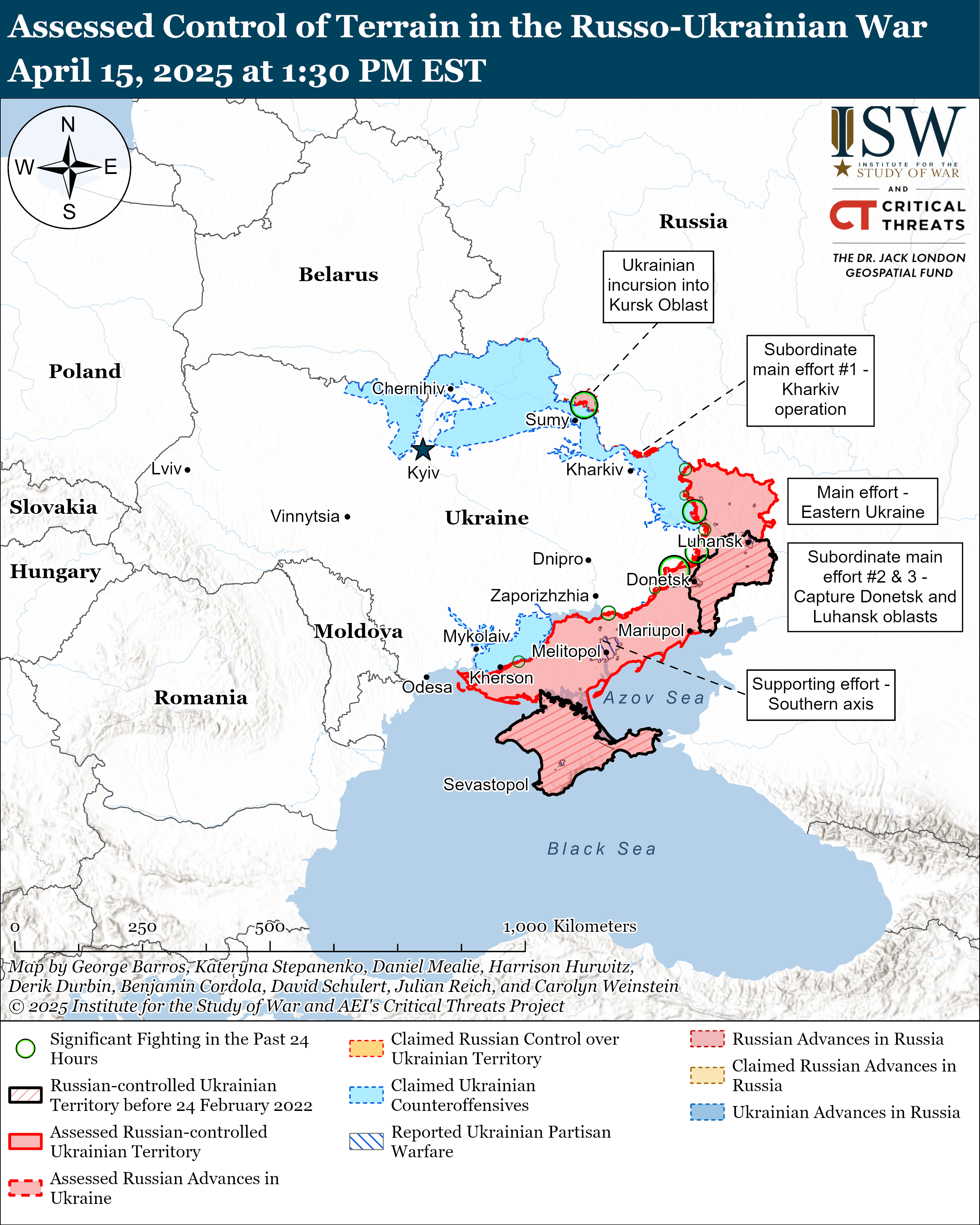
    Ending Russia’s war in Ukraine was one of Donald Trump’s campaign promises, and one that he famously boasted could be achieved in 24 hours. But three months after taking office, the Trump administration has only managed to negotiate a partial ceasefire that has done nothing to stop the fighting.

    On April 13, for example, Russia fired ballistic missiles into the city of Sumy in north-eastern Ukraine, killing at least 35 civilians gathered to celebrate Palm Sunday and injuring over 100 more.

    Military attacks have continued despite numerous meetings between senior Russian and US officials, and phone conversations where Trump and his Russian counterpart, Vladimir Putin, have spoken directly.

    So, why are Trump’s efforts to end the war struggling to get off the starting blocks? The most important reason is that Russia is blocking progress. Moscow has created obstacles, deployed delaying tactics and has generally muddied the waters.

    Fighting in Ukraine has continued as Washington and Moscow discuss the future of Ukraine.
    Institute for the Study of War

    Trump’s major initiative is his proposal for a 30-day general ceasefire to prepare the way for broader peace negotiations. While Ukraine’s president, Volodymyr Zelensky, agreed to this immediately when it was proposed in March, Putin did not. He instead offered a counter proposal: a partial ceasefire banning attacks on energy infrastructure.

    Russia relies heavily on the export of energy, especially oil, to fund the war. But Ukraine has been systematically targeting Russia’s oil refineries and storage facilities, mainly using domestically produced drones. Ukraine is estimated to have destroyed 10% of Russia’s refining capacity since the beginning of 2025.

    By narrowing the scope of the ceasefire, Putin was able to shield Russia’s energy production while continuing to attack Ukraine. Moscow needs the fighting to continue to achieve its openly stated goal of controlling all of Donetsk, Luhansk, Kherson and Zaporizhzhia, the four regions of Ukraine it claimed to annex in 2022.

    Another Russian tactic has been to take every opportunity to present a list of demands for Ukrainian concessions. These include Kyiv giving up its claims to Ukrainian territory occupied by Russia, abandoning its goal of joining Nato, and reducing its armed forces significantly. Russia also wants Ukraine to agree to a change of political leadership.

    This tactic is important for two reasons. First, Russia’s demands make it clear that Moscow envisages the war as the first stage in a longer-term plan to exercise control over all of Ukraine, not only the annexed territories. And second, repeatedly stating Russia’s demands gets them into the public discourse.

    When journalists – or, especially, US officials – repeat them, as Trump’s special envoy Steve Witkoff did recently, they gain an air of legitimacy. This creates the expectation that a peace agreement will comply with Moscow’s agenda.

    Russia is also good at deflecting attention away from ending the war. Sometimes Putin does this with flattery and by appealing to Trump’s sense of self-importance.

    In an interview about his March trip to Moscow, Witkoff glided over his failure to secure a pledge from the Russians to agree to a general ceasefire and instead conveyed a touching story demonstrating Putin’s regard for Trump.

    Putin apparently told Witkoff that he went to church and prayed for Trump’s recovery after he narrowly escaped an assassination attempt during the election campaign. Putin also sent Witkoff back to the US with a portrait of Trump, painted by an artist who is known for producing flattering portraits of Putin himself.

    Another effective tactic of deflection involves money. Russian officials dangle the prospect of lucrative deals involving trade and investment in front of Trump administration officials. This was evidently the focus of much of the first meeting between US and Russian officials in Saudi Arabia in February, although it was convened to discuss plans for peace.

    It is also probably the reason for Kirill Dmitriev’s visit to Washington at the beginning of April. Dmitriev, a figure close to Putin and head of Russia’s sovereign wealth fund, confirmed to journalists that his discussions encompassed possible deals with the US involving rare-earth metals, exploiting resources in the Arctic, and resuming direct flights between the US and Russia.

    Trump’s role

    While Russia places obstacles in the path of peace, Trump and his officials do nothing to remove them. This allows Moscow to continue waging war without constraints.

    Despite Trump’s occasional tough talk about running out of patience with Moscow, as well as his threats of secondary tariffs on countries that buy oil from Russia, no measures that would put pressure on Russia have been implemented.

    Trump has instead made excuses for Moscow. He described the attack on Sumy as a “mistake”, and has expressed admiration for Putin for dragging his feet to get a better deal with Washington.

    This contrasts sharply with Trump’s dealings with Ukraine. Zelensky was publicly humiliated during his meeting with Trump and US vice-president, J.D. Vance, in the Oval Office in February. Trump has even accused Zelensky of starting the war, which was launched by a mass invasion of Russian forces.

    Trump and his team have shown far less interest in Ukraine’s security needs than in striking a lucrative deal to extract the country’s natural resources. The prospect of the Trump administration negotiating a peace agreement that the Ukrainians would accept seems remote.

    So, where does this leave the peace process? When the partial ceasefire arrangement comes to an end later in April, Washington will have to decide whether to resume its efforts to secure a general ceasefire or chart a new course.

    Based on his track record so far, Trump might just blame the Ukrainians for refusing to surrender to Russia’s terms, abandon attempts to reach a negotiated settlement to the war, and go straight to reestablishing normal relations with Russia.

    Jennifer Mathers does not work for, consult, own shares in or receive funding from any company or organisation that would benefit from this article, and has disclosed no relevant affiliations beyond their academic appointment.

    ref. Why is Donald Trump failing to bring peace to Ukraine like he promised? – https://theconversation.com/why-is-donald-trump-failing-to-bring-peace-to-ukraine-like-he-promised-254546

    MIL OSI – Global Reports

  • MIL-OSI Russia: Light-dynamic fountain in the park of the Tsaritsyno museum-reserve is being prepared for the new season

    Translartion. Region: Russians Fedetion –

    Source: Moscow Government – Government of Moscow –

    In the park of the Tsaritsyno Museum-Reserve, they have begun preparing the light-dynamic musical fountain for the new season. This was reported by the Deputy Mayor of Moscow for Housing and Public Utilities and Improvement Petr Biryukov.

    “The specialists of the city economy complex carried out work to de-mothball the fountain. This is the only hydraulic structure in the capital that is covered with an inflatable dome during the winter. The protective structure was dismantled, after which the fountain was washed, the engineering systems were checked and it began to be prepared for the opening of the new season,” said Pyotr Biryukov.

    The dome that covers the fountain is made of polyvinyl chloride. It consists of eight sectors, each weighing 400 kilograms. The parts of the dome are connected by four thousand bolts and the same number of plates that hold 64 embedded parts. An air supply system is constantly operating to maintain the shape of the structure.

    The fountain in the park of the Tsaritsyno Museum-Reserve is very popular with city residents and is considered one of the most beautiful sights of the capital. Two years ago, specialists carried out a major overhaul of the structure, completely updating the acoustic system and electronic control system, sound amplifiers, underwater lights, pumping equipment, electrical and water supply systems. In addition, they repaired the granite facing of the bowl, parapets, stairs and the paved area around the fountain.

    Modern equipment and communications have made it possible to add brightness of colors, dynamics and variety of effects. Updated independent control lines of the fountain’s light and jet design allow creating a virtually unlimited number of artistic compositions.

    The musical light-dynamic fountain consists of almost four thousand lamps and more than 800 jets. Thanks to the work of 82 pumps, the jets are able to rise to a height of 15 meters to musical accompaniment.

    Please note: This information is raw content directly from the source of the information. It is exactly what the source states and does not reflect the position of MIL-OSI or its clients.

    Please Note; This Information is Raw Content Directly from the Information Source. It is access to What the Source Is Stating and Does Not Reflect

    https: //vv.mos.ru/nevs/ite/152737073/

    MIL OSI Russia News

  • MIL-OSI Russia: SPbPU and the Republic of Tatarstan signed four cooperation agreements

    Translartion. Region: Russians Fedetion –

    Source: Peter the Great St Petersburg Polytechnic University – Peter the Great St Petersburg Polytechnic University –

    The program of the visit of the representative delegation of the Republic of Tatarstan to the Polytechnic included the signing of several cooperation agreements. The rais of the Republic of Tatarstan Rustam Minnikhanov and the vice-governor of St. Petersburg Vladimir Knyaginin participated in the solemn ceremony.

    The cooperation between the Ministry of Education and Science of the Republic of Tatarstan and Peter the Great St. Petersburg Polytechnic University will contribute to the effective development of higher education in both subjects of the Federation, the training of highly qualified specialists, continuous professional development of workers, and the integration of professional education and science. The basis for achieving these goals should be joint relevant scientific, technical, educational, innovative, investment, production, and socio-economic projects and programs. The document was signed by the Minister of Education and Science of the Republic of Tatarstan Ilsur Khadiullin and the Rector of SPbPU Andrey Rudskoy.

    The agreement provides for the unification of the partners’ efforts for the comprehensive development of a system for training scientific and engineering personnel, the involvement of students and young scientists in real scientific research and experimental design developments, and the creation of a new material base for the implementation of educational programs and scientific research projects.

    Other areas of cooperation include: modernization of the education system, improvement of the quality of educational services, advanced training of managers and teaching staff of educational institutions of the Republic of Tatarstan; popularization of science, development of scientific and technical creativity of young people, etc.

    Innopolis University has also joined the cooperation with the Polytechnic University. Having signed the agreement, SPbPU Rector Andrey Rudskoy and Innopolis University Director Iskander Bariyev expressed their desire for strategic interaction between the universities in the field of methodological, educational and scientific activities. The agreement provides for the modernization of current educational programs and the development of new ones, including online ones. An important part of the cooperation will be joint scientific research, including the creation of a specialized laboratory for the development of composite materials for robotic systems and unmanned aircraft. Other areas of cooperation include: organizing academic mobility for teachers and students; popularization of scientific research; joint design, technological and experimental work in the field of robotics and mechatronics, the search for and design of new materials with specified properties, additive technologies, artificial intelligence; participation in the audit of Russian companies and enterprises, including an assessment of the level of their digital maturity, robotics and digital transformation; organization and holding of conferences, meetings, exhibitions and other events on current issues of industrial robotics, etc.

    Almetyevsk State Technological University “Higher School of Oil” has signed an agreement with the Polytechnic University to work together on innovative methods of engineering education, conduct scientific research and implement scientific, educational and creative projects, including within the framework of the federal project “Advanced Engineering Schools”. The document was signed by Andrey Rudskoy and Rector Alexander Dyakonov.

    Kazan National Research Technical University named after A. N. Tupolev-KAI has become a strategic partner of Polytechnic University. The agreement signed by Acting Rector Kirill Okhotkin and Rector of SPbPU Andrey Rudskoy provides for joint activities in scientific, educational, research and innovation spheres and support for large-scale scientific and industrial projects, including within the framework of advanced engineering schools. The partners agreed to use their scientific infrastructure and combine competencies to implement joint projects in such priority areas as: composite material structures; additive, laser and plasma technologies; information and control systems; radio photonics; quantum technologies; electromagnetic compatibility; microelectronics; digital modeling of elements of manned and unmanned transport systems; artificial intelligence.

    “We have very close ties with the Republic of Tatarstan through the Academy of Sciences,” commented Vladimir Knyagin, Vice-Governor of St. Petersburg. “For our St. Petersburg branch of the Russian Academy of Sciences, Tatar colleagues are not only partners, but also, in many cases, cooperators in research. There is an exchange of personnel, research topics, and knowledge. And the fact that today we have the head of the republic testifies to the official recognition of the importance of such interaction.”

    After the signing ceremony, another ceremonial procedure took place — the awarding of representatives of the Polytechnic University. For fruitful cooperation and significant contribution to strengthening the socio-economic potential of the Republic of Tatarstan, Rustam Minnikhanov presented medals “100 years of the formation of the Tatar Autonomous Soviet Socialist Republic” to Vice-Rector for Digital Transformation Alexey Borovkov, Director of the Institute of Mechanical Engineering, Materials and Transport Anatoly Popovich and Academic Secretary of SPbPU Dmitry Karpov.

    During the visit, the delegation of Tatarstan visited several specialized scientific and production sites of the Polytechnic University. Thus, in the Laboratory of Light Materials and Structures, the guests got acquainted with the technologies of additive electric arc growth and friction stir welding. Director of the Institute of Mechanical Engineering, Materials and Transport Anatoly Popovich presented the competencies of SPbPU in the field of large-scale 3D metal printing, spoke about the equipment used, and demonstrated product samples. The partners also saw the advanced developments of the Polytechnic University in the field of additive laser technologies, visitedNetwork engineering center and other workshops.

    In the experimental design bureau of the Advanced Engineering School of SPbPU “Digital Engineering” (OKB PISH), guests from Tatarstan got acquainted with breakthrough developments and research in the field of unmanned aerial vehicles (UAVs), aircraft manufacturing, engine and rocket engineering, as well as robotics, implemented using approaches to systemic digital engineering based on the Digital Platform for the Development and Application of Digital Twins CML-Bench®.

    Vice-Rector for Digital Transformation of SPbPU, Head of the Advanced Engineering School of SPbPU “Digital Engineering” Alexey Borovkov presented to the guests a line of multifunctional devices – a family of electric unmanned aerial vehicles “Snegir”: the “Snegir-1” model and its improved version VTOL (Vertical Take Off and Landing – vertical takeoff and landing) “Snegir-1.5”. Alexey Ivanovich emphasized that the development of the UAV “Snegir-1.5” was carried out using virtual test benches and testing grounds, as well as using the domestic Digital platform CML-Bench®, which made it possible to optimize the design methods of unmanned aircraft systems and their components. The project is being implemented within the framework of the federal initiative “Development, standardization and serial production of unmanned aircraft systems and components” of the national project “Unmanned aircraft systems”, which was launched in accordance with the Strategy for the development of unmanned aviation of the Russian Federation until 2030 and for the future until 2035.

    Alexey Borovkov noted that leading specialists of the Advanced Engineering School of SPbPU “Digital Engineering” are developing technologies and a demonstrator of a software package for the automated design of electric propeller-motor groups of unmanned aerial vehicles, and demonstrated the results of the development and manufacture of a prototype of the CML_03 electric motor for unmanned aerial vehicles with improved technical characteristics. The development is based on multi-criteria optimization methods and interdisciplinary calculation methods.

    Speaking about the promising projects of the SPbPU Ecosystem of Technological Development, Aleksey Borovkov focused on the strategic tasks planned and already implemented jointly with the partner of the SPbPU – the scientific institution “Engineering and Design Center for Support of Operation of Space Technology” to create tooling kits and quality control for the manufacture of tank structures of the Angara family of launch vehicles using advanced technologies. In addition, the vice-rector announced the start of a project to create a prototype of the CML-Aeroplane, where the key task is multi-criteria optimization of the design taking into account aerodynamics, flight dynamics, strength, fuel efficiency and cost.

    As part of the project activities of the structural divisions of the SPbPU Technological Development Ecosystem, a scientific and technological reserve has been formed that allows us to carry out cross-industry technology transfer and accelerate the design of complex and new products thanks to the CML-Bench® Digital Platform, which stores information on solving similar problems, concluded Alexey Ivanovich.

    The guests were interested in the activities of the Student Design Bureau (SDB), which operates within the structure of the SPbPU Advanced Engineering School Design Bureau. SDB is a unique educational and practical platform where students, under the guidance of university teachers and specialists from industrial partners, acquire basic engineering competencies through participation in real R&D, and also have the opportunity to implement their own initiatives in the field of technological creativity. As an example, Alexey Borovkov cited the development of the SPbPU Advanced Engineering School student team CML®-Bots – the combat robot “Laska”. This project became the winner of the International Robot Fighting Championship in India in April 2025 and a number of Russian student competitions earlier.

    “The Battle of Robots is a prestigious championship where engineers compete in creating the most effective combat vehicles,” noted Alexey Ivanovich. “Our students not only achieve victories, but also constantly improve the design, deepening their knowledge in robotics, mechanics and physics. The acquired skills allow them to find non-standard, interdisciplinary solutions to complex engineering problems, which is extremely important for future professional activities.”

    Photo archive

    Please note: This information is raw content directly from the source of the information. It is exactly what the source states and does not reflect the position of MIL-OSI or its clients.

    MIL OSI Russia News

  • MIL-OSI Russia: Fragmentation and Block Formation: How the Global Economy is Changing

    Translartion. Region: Russians Fedetion –

    Source: State University Higher School of Economics – State University Higher School of Economics –

    Within the framework XXV Yasinsky (April) International Scientific Conference The former head of the Bank of Russia, professor of the Department of Finance and Credit of the Faculty of Economics of Moscow State University, Sergei Dubinin, gave an honorary report. He spoke about the transformation of the global monetary and financial system and the Russian economy.

    As Sergey Dubinin noted, one of the main trends that became noticeable after the pandemic and is observed now is the fragmentation of the global world economy. “This fragmentation today constitutes some stage, a phase of globalization. It was initially understood as deglobalization, complete collapse, but it quickly became clear that the situation is not quite like that,” the speaker noted. Fragmentation leads to a slowdown in international trade, and to an increase in barriers to the movement of goods, services, labor, and restrictions on the spread of technology. These trends are causing concern among many experts.

    Fragmentation is very noticeable in the relations between countries. Blocks are being created that are oriented towards the US and China. There are also so-called neutral states, intermediary countries. For example, India or Mexico, they “want to be intermediaries in both trade and financial transactions,” says Sergey Dubinin. “Economic relations are developing more actively within the blocks. Both trade [transactions] and capital movement between the blocks are facing restrictions, in particular tariffs,” he says. At the same time, the latest news about the increase in tariffs by US President Donald Trump is strengthening these trends, the expert notes.

    Against the backdrop of events in the global economy, confidence in American securities has declined. “It was a safe haven,” notes Sergei Dubinin. “And that was the advantage of the American financial market system, when even in the conditions of a crisis that began on the US market, US government securities were considered the best insurance asset. And very large amounts of money were directed there.” And in recent years, there has been a noticeable decline in investments in these securities.

    “Right now there is an acute phase in the relationship between China and the United States. It can lead to various consequences, both for political and economic life,” the expert notes. And here it is important to understand what position Russia wants to take. “Recently, we have heard a lot of talk about Russian-American joint economic projects,” says Sergey Dubinin. One point of view is that it is better to take the position of an intermediary country than to unilaterally focus on one country.

    The former head of the Central Bank also spoke about the state of the Russian financial sector. He noted that despite numerous sanctions, the position of banks remains stable. The volume of net profit of banks in 2024 reached more than 4 trillion rubles. According to him, there are currently just over 300 credit institutions left on the market, and only 35 banks were unprofitable. He recalled that “during the period from 2010 to 2020, 681 banks were closed.”

    As a result, according to Sergei Dubinin, a “highly concentrated and fairly stable” system has now emerged. The top ten largest Russian banks, which include systemically important players, account for almost 80% of the banking system’s assets. At the same time, “quality indicators remain quite good.”

    Please note: This information is raw content directly from the source of the information. It is exactly what the source states and does not reflect the position of MIL-OSI or its clients.

    MIL OSI Russia News

  • MIL-OSI Russia: Russian Conversation Club Continues to Help Foreign Students

    Translartion. Region: Russians Fedetion –

    Source: Saint Petersburg State University of Architecture and Civil Engineering – Saint Petersburg State University of Architecture and Civil Engineering – Master class on painting matryoshka dolls. In the center – Chairman of the Council of Foreign Students Antonia Angelova

    In the second semester of the 2024/25 academic year, traditional meetings of the Russian Conversation Club (RCC), organized by the Council of Foreign Students (CFS) of SPbGASU, continued. Classes are held at the Student Leisure and Creativity Center “Kirpich” on Fontanka, 123, under the leadership of the Deputy Chairman of the CFS, Sabrinakhon Solehzoda.

    The Russian Conversation Club brings together foreign students to study Russian language and culture. Its uniqueness lies in the combination of language practice and acquaintance with cultural and historical aspects of Russia. The club also provides foreign students with adaptation assistance. The meetings are held in an informal and friendly atmosphere, which allows each participant to feel comfortable.

    Since 2020, more than 400 students from different countries have become members of the club. Students from other universities (St. Petersburg State University, Baltic State Technical University, St. Petersburg State Marine Technical University, Russian State Pedagogical University), as well as employees of the St. Petersburg Youth House and the Admiralty Youth Center, also participated in the RRC.

    The current academic semester included events dedicated to the Maslenitsa and Martenitsa holidays, as well as a creative workshop where students immersed themselves in a creative atmosphere, painting the symbol of Russia – the matryoshka doll. On the back of the matryoshka dolls, participants encrypted wishes for future students using the Glagolitic alphabet – the ancient Slavic alphabet. These messages will be waiting for new students to inspire them to study the language and culture.

    Antonia Angelova, Chairperson of the SIO, says: “The Russian Conversation Club, created in 2020, has already held more than 120 meetings. Unlike traditional language courses, our club includes elements of cultural events, which makes the learning process more exciting and multifaceted. Taking into account our own experience of participating in conversation clubs, we have developed our own approach, which is effective in developing communication and adaptation skills in foreign students.”

    The Council of Foreign Students invites everyone to the meetings of the Russian Conversation Club, where participants immerse themselves in the culture of different nations, meet like-minded people and discuss interesting topics. Join us!

    Russian conversation club VKontakte

    Please note: This information is raw content directly from the source of the information. It is exactly what the source states and does not reflect the position of MIL-OSI or its clients.

    MIL OSI Russia News

  • MIL-OSI Russia: Sobyanin announced the start of restoration of the historic building of the Morozov Hospital

    Translartion. Region: Russians Fedetion –

    Source: Moscow Government – Government of Moscow –

    Work on modernizing the Morozov Children’s Hospital continues. Specialists have begun restoring building No. 10. Sergei Sobyanin reported this in his telegram channel.

    “The building on 4th Dobryninsky Lane is a cultural heritage site of regional significance. Work is planned on the facade and roof. Inside the building, for example, we will restore the brickwork of the walls, the Monier vaults in the basement, and restore the floors made of Mettlach ceramic tiles,” the Moscow Mayor wrote.

    Source: Sergei Sobyanin’s Telegram channel @Mos_Sobyanin

    All work will be carried out as part of a comprehensive modernization Morozov Children’s Hospital. In 2017, a children’s medical building was built there — the largest in the country. In the fall of 2022, the renovated pediatric building No. 1 began operating.

    Currently, specialists are renovating buildings No. 15, 16 and 17. In addition, comprehensive improvement of the territory is planned.

    Please note: This information is raw content directly from the source of the information. It is exactly what the source states and does not reflect the position of MIL-OSI or its clients.

    Please Note; This Information is Raw Content Directly from the Information Source. It is access to What the Source Is Stating and Does Not Reflect

    https: //vv.mos.ru/mayor/tkhemes/12630050/

    MIL OSI Russia News

  • MIL-OSI Asia-Pac: Curtain Raiser: India Steel 2025

    Source: Government of India

    Curtain Raiser: India Steel 2025

    “India set to host the largest international steel event in Mumbai from April 24–26, 2025”

    Hon’ble Prime Minister to inaugurate the flagship event of Steel Industry

    Posted On: 17 APR 2025 3:14PM by PIB Delhi

    The India Steel 2025 is set to take place from *24 April to 26 April, 2025*, at the Bombay Exhibition Centre in Mumbai. This 6th edition of the biennial international exhibition and conference will bring together leading stakeholders from across the global steel value chain to discuss the future trajectory of the sector, with a sharp focus on growth, sustainability, resilience, and innovation.

    India is on a trajectory to achieve a production capacity of 300 million tonnes and a per capita consumption of 160 kg by 2030, in line with the National Steel Policy.  Keeping in view this  ambitious growth in the steel sector, the conference is being organised to unlock new opportunities for inter-state and international collaboration, facilitate knowledge exchange, and showcase India’s policy reforms and infrastructure initiatives aimed at enhancing the ease of doing business across the steel value chain.

    The Hon’ble Prime Minister of India will address  the premier Steel Industry event of the country  on 24th April 2025 through Video conferencing , in the esteemed presence of dignitaries including  Hon’ble Minister of Steel and Heavy Industries Shri H. D. Kumaraswamy, Hon’ble Minister of State for Steel and Heavy Industries Shri Bhupathi Raju Srinivasa Varma, Hon’ble Chief Minister of Maharashtra Shri Devendra Phadnavis  and Hon’ble Chief Minister of Chattisgarh Shri Vishu Deo Sai. 

    The conference will see presence of high-level participation from various Central Ministries and States including Chief Ministers and Union Ministers indicating the critical importance of Steel as an important clog in the wheel of Atmanirbhar Bharat.  Among those who will grace the program with their presence include Union Ministers, Hon’ble Minister of Steel and Heavy Industries Shri H. D. Kumaraswamy, Minister of Commerce and Industry Shri Piyush Goyal, Hon’ble Minister of Railways Shri. Ashwini Vaishnaw, Hon’ble Minister of New & Renewable Energy and Consumer Affairs Shri Pralhad Venkatesh Joshi, Hon’ble Minister of Mines Shri G. Kishan Reddy , Hon’ble Minister of State for Steel and Heavy Industries Shri Bhupathi Raju Srinivasa Varma,  Hon’ble Chief Minister of Maharashtra, Shri Devendra Fadnavis, Hon’ble Chief Minister of Chhattisgarh, Shri Vishnu Deo Sai  and Hon’ble Chief Minister of Odisha, Shri Mohan Charan Majhi.  They  will preside over key sessions of the conference, reflecting the multi-sectoral relevance of steel in India’s economic and industrial strategy.

    Senior officials of the Government of India, including Secretary, Ministry of Electronics and Information Technology (MeitY), Secretary, Ministry of Steel and Secretary, Ministry of Coal will also chair key sessions during the event.

     The event will also have a presence of global Industry leaders and senior Foreign dignitaries leading  high-level  delegations, including the Deputy Minister of Industry and Trade of the Russian Federation, Ambassadors of Australia, Mozambique, and Mongolia, reflecting the deepening international engagement and strategic cooperation in the steel sector.

    Key highlights of the International Conference-cum-Exhibition includes:

    – Exhibition and Innovation Showcase: Displaying cutting-edge technologies and advancements in the steel industry.

    – Roundtable Conferences: Discussions on sector-specific topics, international collaboration, and emerging trends including CEOs roundtable and Sectoral roundtables.

    – Reverse Buyer-Seller Meet (RBSM): Facilitating trade opportunities and fostering new business engagements.

    – International Engagement: Country specific sessions involving key steel-producing nations, including the South Korea, Sweden, Australia, and Mongolia. These discussions will explore joint research, technology transfer, and resilient supply chains to de-risk India’s steel production and drive global competitiveness.

    The event will also focus on themes like augmenting domestic consumption, showcasing futuristic steel applications, and fostering global partnerships

    With more than 12,000 business visitors, 250 exhibitors, and 1,200 conference delegates representing various sectors, Government departments, State Governments, country delegations, and domestic and international buyers from India and abroad, the conference would be one of the biggest Steel event globally.

    *********

    TPJ/NJ

    (Release ID: 2122393) Visitor Counter : 36

    MIL OSI Asia Pacific News

  • MIL-OSI Russia: Where will the high-speed trains to St. Petersburg stop in Moscow?

    Translartion. Region: Russians Fedetion –

    Source: Moscow Government – Government of Moscow –

    Four stops for high-speed rail (HSR) trains to St. Petersburg will be prepared in the capital. This was announced by the Deputy Mayor of Moscow for Transport and Industry Maxim Liksutov.

    “On the instructions of Russian President Vladimir Putin, we continue working on the high-speed railway project to St. Petersburg. There will be four stops for high-speed trains in Moscow: Leningradsky Station, Rizhskaya, Petrovsko-Razumovskaya and Zelenograd-Kryukovo. In total, at the four high-speed railway stops, it will be possible to transfer to 14 metro stations and Moscow Central Diameters, as well as to ground city transport. Each station will become a real city railway station and will be equipped with everything necessary for passengers. It will become more convenient for residents of not only Moscow, but also the nearest Moscow region,” said Maxim Liksutov.

    Thanks to the location of the intermediate stations, residents of the north of Moscow and nearby cities in the Moscow region will be able to significantly save travel time without unnecessary trips to the center.

    For residents of the Timiryazevsky and Marfino districts, as well as those traveling from the north of the Moscow region – from Lobnya, Dolgoprudny, Khimki and other cities – Petrovsko-Razumovskaya is suitable. Here you can transfer from the first and third Moscow Central Diameters, as well as two metro lines – Serpukhovsko-Timiryazevskaya and Lyublinsko-Dmitrovskaya. For residents of Dolgoprudny, the trip to St. Petersburg will be cut in half – to about 2.5 hours without unnecessary transfers.

    Residents of the Ostankino, Maryina Roshcha, and Alekseevsky districts will be able to use the convenient Rizhskaya city station. Here you can transfer to three diameters at once, as well as to two metro lines, including the Big Circle. Travel time to St. Petersburg from Rizhskaya will be just over two hours.

    It will also become more convenient for residents of Zelenograd, as well as the Molzhaninovsky District and Khimki: new high-speed trains will stop at the Zelenograd-Kryukovo station. For residents of Khimki, with the appearance of a new station in Zelenograd, the travel time to the Northern capital will be reduced from five to two and a half hours.

    The Moscow-St. Petersburg HSR-1 will connect the country’s largest urban agglomerations, where more than 40 million people live in total — about 30 percent of Russia’s population. Travel time between Moscow and St. Petersburg will be reduced almost twofold, to two hours and 15 minutes.

    The launch of the highway will also help develop tourism and business, and create new jobs. Environmentally friendly rail transport will reduce harmful emissions into the atmosphere and reduce the number of road accidents.

    To launch the VSM-1, a completely new high-speed rolling stock will be developed, which will reach speeds of up to 400 kilometers per hour. The contract with the manufacturer for the supply of 41 such trains was signed in 2024. In total, 43 trains will be produced and supplied for the VSM-1 by the end of 2030, taking into account the previously concluded contract.

    Please note: This information is raw content directly from the source of the information. It is exactly what the source states and does not reflect the position of MIL-OSI or its clients.

    Please Note; This Information is Raw Content Directly from the Information Source. It is access to What the Source Is Stating and Does Not Reflect

    https: //vv.mos.ru/nevs/ite/152698073/

    MIL OSI Russia News

  • MIL-OSI Russia: The investor has restored the premises in a historic building on Bolshaya Nikitskaya Street

    Translartion. Region: Russians Fedetion –

    Source: Moscow Government – Government of Moscow –

    The new owner has put in order a non-residential premises with an area of almost 44 square meters, located in a cultural heritage site of regional significance on Bolshaya Nikitskaya Street (building 22/2). This was reported by the Minister of the Moscow Government, head of the capital’s Department of City Property Maxim Gaman.

    “The investor purchased a 43.7 square meter space in a historic building (at 22/2 Bolshaya Nikitskaya Street) from the city at a competition, recognized as a cultural heritage site of regional significance. In 1905, the editorial office of the Bolshevik newspaper Vpered was located here. The space restored by the entrepreneur is the third one that was purchased from the capital in this building at a competition. In total, more than 270 square meters of space in the building have been put in order thanks to the new owners,” said Maxim Gaman.

    The building on Bolshaya Nikitskaya Street was built in 1902–1904 by Major General Vladimir Semenkovich according to the design of architect Karl Treiman as a tenement house. The ground floor housed shops, the second floor housed offices, and the upper floors housed inexpensive housing. During the year of the first Russian revolution, the building housed the editorial office of the Bolshevik newspaper Vperyod, where articles by Vladimir Lenin, Anatoly Lunacharsky, and Vaclav Vorovsky were published. After 1917, it housed communal apartments, and the lower floors were used for trade.

    Currently, it is a residential apartment building, although part of the space, as before, is used for commercial purposes. For example, there are several cafes, shops, a beauty salon. The building is located in the city center with developed infrastructure, from here you can walk to the Okhotny Ryad metro station, so the house has high investment potential.

    According to investor Dmitry Kletsky, in accordance with the terms of the agreement, a project was first prepared to adapt the premises for modern use, and then work was carried out in agreement with the capital’s Department of Cultural Heritage: redevelopment, replacement of flooring, waterproofing, equipping a kitchenette, equipping it with plumbing and an electric stove.

    The entrepreneur may use the premises at his own discretion, but on condition that the chosen type of activity does not pose a threat to the historical building. The investor is obliged to maintain the cultural heritage site in proper technical, sanitary and fire safety condition.

    Representatives of the capital Department of City Property And Department of Cultural Heritage are part of a specialized commission for monitoring compliance with the terms of competitions for the sale of cultural heritage sites. It evaluates how buyers fulfill their obligations. If they are not fulfilled properly, the city has the right to fine the violator or terminate the contract with him.

    The investor has restored the premises in a historic building on Kuznetsky Most StreetInvestors have restored 14 premises in historic buildings in Moscow since 2017

    Please note: This information is raw content directly from the source of the information. It is exactly what the source states and does not reflect the position of MIL-OSI or its clients.

    Please Note; This Information is Raw Content Directly from the Information Source. It is access to What the Source Is Stating and Does Not Reflect

    https: //vv.mos.ru/nevs/ite/152702073/

    MIL OSI Russia News

  • MIL-OSI Russia: Business game from the company “Samolet”: students of SPbGASU tried themselves in the role of developers

    Translartion. Region: Russians Fedetion –

    Source: Saint Petersburg State University of Architecture and Civil Engineering – Saint Petersburg State University of Architecture and Civil Engineering – Students working on a residential development concept

    A business game organized by the construction company Samolet took place in the Growth Point space of SPbGASU.

    Students were able to immerse themselves in the developer’s profession: participants had to model their own project in the Leningrad Region – develop a concept for residential development, take into account social infrastructure and analyze economic indicators. All decisions were made in a team and under the guidance of experienced company specialists.

    During the game, students not only gained practical experience, but also learned more about career opportunities in the development industry, the specifics of project team work, and key skills that are in demand in the labor market.

    “Such events are an important part of professional orientation. They help future specialists make an informed choice of career path, as well as establish direct contact with industry representatives,” noted Ekaterina Abolina, Director of the Center for Student Entrepreneurship and Career at SPbGASU.

    Please note: This information is raw content directly from the source of the information. It is exactly what the source states and does not reflect the position of MIL-OSI or its clients.

    MIL OSI Russia News

  • MIL-OSI China: 2nd round of indirect talks between Iran, US to be held in Rome

    Source: China State Council Information Office

    Italy’s capital Rome will be the venue for the second round of indirect negotiations between Tehran and Washington, Iran’s Deputy Foreign Minister Kazem Gharibabadi said.

    “Up to this point that we are speaking, we have received no new request from the other side for changing the location of the negotiations and Rome will be the venue for the second round,” Gharibabadi said in a live televised interview on Wednesday.

    The location of the talks was not a sensitive issue for the Iranian side. “We should concentrate on the main content and job,” he said.

    Regardless of the negotiations’ venue, Oman will continue to facilitate and mediate them, the official added.

    Iranian Foreign Minister Seyed Abbas Araghchi met with U.S. special presidential envoy Steve Witkoff in Oman’s capital Muscat on Saturday over Tehran’s nuclear program, with both sides describing the meeting as “constructive.”

    The talks in Muscat followed U.S. President Donald Trump’s statement in early March that he had sent a letter to Iranian leaders, delivered through the United Arab Emirates, proposing negotiations on Iran’s nuclear program. Iran later agreed on indirect talks.

    Iran signed a nuclear deal in July 2015 with six major countries — Britain, China, France, Germany, Russia and the United States. Under the deal, Tehran agreed to limit its nuclear activities in exchange for sanctions relief.

    However, Trump unilaterally pulled his country out of the deal in May 2018 during his first term and reimposed sanctions on Iran, prompting Tehran to scale back its commitments under the deal. Since then, efforts to revive the nuclear agreement have made little progress.

    MIL OSI China News

  • MIL-OSI Russia: Students of SPbGASU presented their projects of a concert complex for Brest in the Republic of Belarus

    Translartion. Region: Russians Fedetion –

    Source: Saint Petersburg State University of Architecture and Civil Engineering – Saint Petersburg State University of Architecture and Civil Engineering – Meeting at the regional executive committee

    On April 14, a meeting of fourth-year students and teachers of the Faculty of Architecture of SPbGASU Daria Boytsova and Oleg Fedorov with the chief architect of the region Nikolai Vlasyuk took place in the Executive Committee of the Brest Region (Republic of Belarus). The meeting was also attended by teachers and students of the Department of Architecture of the Brest State Technical University (BrSTU). The event became the next stage of cooperation between the two universities, including in project activities. During the meeting, projects for a multifunctional concert complex in Brest, developed by students of the Departments of Architectural Design and Design of the Architectural Environment of SPbGASU, were presented.

    Arina Aleksanova presented a project where the Belarusian national pattern “fire” is used in the volumetric-spatial solution of the complex and the architecture of the facades, giving expressiveness and cultural identity. In addition, the use of light accents is envisaged, imitating the flickering of flame, which enhances the emotional perception of the object in the evening.

    Elza Sharipova’s concept refers to the image of medieval Brest in the engraving by E. Dahlberg. The author of the project noted the vertical tripartite structure of the city fabric, which was reflected in the appearance of the concert hall.

    Maria Kondakova proposes to include a number of multi-level public spaces in the structure of the complex, from where a view of one of Brest’s waterways will open up.

    Valeria Ganeeva used a technique typical for fortification structures: the formation of embankments and inclined walls. This approach is intended to preserve the memory of the place and remind us of the heroic history of the city.

    Margarita Kotikova reflected the synergy of nature, art and history in her concept: her building should consist of three integral volumes, united by a common structure, which personifies the flow of water, music and time.

    The project of the multifunctional complex, developed by Sofia Krivdina, reflects the key features of the Belarusian cultural and natural heritage: Belovezhskaya Pushcha, national ornament and the tradition of lighting lanterns before sunset. The central volume of the hall is associated with a powerful source of light and is covered with a translucent membrane. The design of the ramp and the restaurant supports were inspired by the Belovezhskaya Pushcha motifs. The visual identity of the project is given by the perforated pattern in the decoration of the facades, based on the traditional Belarusian ornament.

    The historical fact about the development of Brest at the intersection of two rivers and trade routes became the basis of Irina Zaplatkina’s concept. The permeability of the ground floor space and the central atrium with a system of viewing arches reflect the “path” and “hope”. The movement along the street is accompanied by an exposition dedicated to the traditions and culture of Brest residents. An active system of dominants emphasizes the dynamism of society. All this should have a strong emotional impact on visitors.

    The Chief Architect of the Brest Region and BrSTU teachers highly appreciated the projects of SPbGASU students. Our students will continue working on the concert hall project and the concept for the development of the embankment in Brest.

    Please note: This information is raw content directly from the source of the information. It is exactly what the source states and does not reflect the position of MIL-OSI or its clients.

    MIL OSI Russia News

  • MIL-OSI Economics: 17 April 2025 Kamchatka Falconry Centre expands cooperation with the region’s tourism industry The Kamchatka Falconry Centre, a resident of the Kamchatka Advanced Development Territory (ADT), and the Kamchatka Tourism Industry Association (KTIA), which unites 59 companies in the region’s tourism industry, signed a cooperation agreement that provides for the inclusion of the Centre’s excursion programmes in the region’s eco-routes. The agreement was the result of an earlier general meeting of KTIA members, which discussed the development of the tourism industry in Kamchatka Territory.

    Source: Eastern Economic Forum

    17 April 2025

    Kamchatka Falconry Centre expands cooperation with the region’s tourism industry

    The Kamchatka Falconry Centre, a resident of the Kamchatka Advanced Development Territory (ADT), and the Kamchatka Tourism Industry Association (KTIA), which unites 59 companies in the region’s tourism industry, signed a cooperation agreement that provides for the inclusion of the Centre’s excursion programmes in the region’s eco-routes. The agreement was the result of an earlier general meeting of KTIA members, which discussed the development of the tourism industry in Kamchatka Territory.

    The cooperation agreement signed today with KTIA will be a powerful stimulus for the development not only of the Falconry Centre, but also of eco-tourism in the region and Russia as a whole. This cooperation will provide an opportunity to introduce guests to the amazing world of birds of prey and will become an important tool for popularizing environmental culture and drawing attention to nature conservation issues. Tourism, based on the principles of respect for the environment, contributes to the formation of a careful attitude towards nature,” said Kristina Alekseeva, Director of the Kamchatka Falconry Centre.

    Thus, the document defines the general principles of partnership, which opens wide opportunities for travel companies to promote and organize visits to this unique site. In order to simplify the interaction, a draft model agreement between travel agencies and the Centre has been developed, taking into account all legal aspects. An important stage was the approval of the tariffs for visits for individual travellers and organized groups, ensuring a balance between the interests of both tourists and the Centre itself. Special attention was paid to seasonality and its impact on the content of excursions, which will allow to offer guests the most interesting and relevant programmes depending on the time of year. Tourists will have access to a detailed description of all the proposed excursions, allowing them to get acquainted with the programme in advance and choose the most suitable option. It is noted that group and individual visits, as well as special programmes for school groups are available for tourists and residents of the peninsula. In addition, regulations for visiting the Kamchatka Falconry Centre have been developed and approved, ensuring bird safety and comfort for all visitors.

    Active cooperation with the Kamchatka Falconry Centre in 2025 will be an important step in the development of eco-tourism in the region and will attract more tourists interested in wildlife observation, as well as increase the visibility of Kamchatka as an attractive eco-tourism destination internationally. KTIA member tour companies will be key partners in creating new tourism products and providing quality and safe service to our guests,” noted Elena Lassal, Chairperson of KTIA.

    The Kamchatka Falconry Centre was established in 2017 in close cooperation with experts from Arab countries and Russia, with the support of the Roscongress Foundation. The project is implemented in accordance with order of the President of the Russian Federation No. Pr-1991 dated 25 September 2019 and is aimed at rehabilitation, conservation and introduction of rare species of hunting birds.

    The investment platform of the Roscongress Foundation – RC Investments – acts as a co-investor of the project, creating conditions for scientific initiatives. Earlier in 2024, the Roscongress Foundation and the Kamchatka Falconry Centre signed a cooperation agreement with the Supreme Council for Ecology of the Kingdom of Bahrain. Under this partnership, joint conservation initiatives, exchange of experience and development of technologies for the conservation of rare birds of prey are being implemented. Joint projects will be presented at international venues, including the Eastern Economic Forum and the St. Petersburg International Economic Forum. Tourism programmes of the Kamchatka Falconry Centre will be presented at the Let’s Travel! Tourism Forum to be held in Moscow at VDNKh on 10–15 June 2025.

    According to the Far East and Arctic Development Corporation (FEDC), residents of Kamchatka Territory are implementing 148 projects, of which 53 have already been successfully put into operation. Businesses have invested over RUB 91 billion in the region’s economy and created jobs for over 9,600 residents of the region.

    Residents of ADT have access to reduced insurance premiums of up to 7.6% for 10 years, zero property and profit taxes for the first 5 years, the possibility of obtaining land and infrastructure support, application of the free customs zone procedure, promotion of products and services, legal protection and other effective tools for accelerated start-up and comfortable business operations.


    Read more

    MIL OSI Economics

  • MIL-OSI Russia: AtomSkills: Polytech strengthens its position in training engineering personnel

    Translartion. Region: Russians Fedetion –

    Source: Peter the Great St Petersburg Polytechnic University – Peter the Great St Petersburg Polytechnic University –

    The tenth international industry championship of professional skills AtomSkills 2025 was held in Yekaterinburg — a large-scale competition among students and specialists of the nuclear industry. The organizer is the state corporation Rosatom. This year, the Civil Engineering Institute presented its team in the student league. These are fifth-year students of the specialist program Dmitry Zharkov, Alina Doroshenko, Tatyana Slobodanyuk and Vitaly Naumovich. The experts from the ICI were employees of the Higher School of Industrial, Civil and Road Construction Alexander Mitin and Mikhail Safoshkin. They participated in the development of the competition task and the assessment of the works, which emphasizes the high level of involvement of the institute in the development of professional standards.

    The ISI team competed in the Engineering Design competency. Participants had to develop a project for a capital construction project, including design solutions, technological aspects, and electrical systems. The team also had to create a full-fledged information model of the building. Particular attention was paid to working with modern domestic software to fill the information model with all the necessary data.

    At the championship, agreements were reached on cooperation with leading technical universities, which opens up new prospects for joint educational and scientific projects.

    “Participation in AtomSkills is an important step in the professional development of our students,” noted Alexander Mitin, assistant of the Higher School of Construction and Urban Development. “The students not only tested their knowledge in practice, but also received a unique opportunity to communicate with potential employers and leading specialists in the construction industry. Such experience is extremely important for the formation of sought-after professional competencies in our students.”

    Participation in AtomSkills was an incredibly valuable experience for me. Strong training in TIM at the Polytechnic University allowed me to confidently work with information modeling at the competition. We not only applied the knowledge in practice, but also saw how TIM is implemented in real projects within the Rosatom state corporation. This is a completely new level of understanding the profession, – shared his impressions Dmitry Zharkov, a specialist in information modeling from the ISI team.

    The ISI team successfully demonstrated a high level of professional competence and returned with new knowledge, contacts and opportunities for further growth. Participation in the prestigious international industry championship AtomSkills clearly demonstrates the compliance of ISI students’ training with modern professional standards and creates new opportunities for improving the institute’s educational programs.

    Please note: This information is raw content directly from the source of the information. It is exactly what the source states and does not reflect the position of MIL-OSI or its clients.

    MIL OSI Russia News

  • MIL-OSI Russia: A drama about Vladimir Mayakovsky will be filmed at the Moskino cinema park

    Translartion. Region: Russians Fedetion –

    Source: Moscow Government – Government of Moscow –

    IN cinema park “Moskino” decorations will appear that replicate the architecture of Moscow at the beginning of the 20th century. They will be needed for filming a drama about the life of Vladimir Mayakovsky.

    A team of specialists headed by the chief artist of the cinema park, Sergei Fevralev, worked on the creation of the scenery for Moscow during the times of constructivism. He has dozens of sites to his credit, including those beloved by filmmakers and visitors to the cinema park, Moscow of the 1940s, Center of Moscow, Cowboy Town, Deaf Village, and others.

    The author’s main task was to embody the ambitions of the artists of the 1910s–1930s — the founders of constructivism. Massive, clear and unusual forms of buildings became a vivid embodiment of the political and creative ideas of that time. For the realism of filming, real rails will be installed on the location, along which a tram from the early 20th century will run.

    “The impetus for the emergence of constructivism was the rapid scientific and technological progress in the second half of the 19th century. The agrarian and rural world was replaced by industrial cities. People moved there en masse from villages, gender relations and family structure changed, the role of religious traditions faded, and faith in the power of technology grew stronger. Large-scale changes in society gave birth to a whole generation of radical artists and then architects who became the founders of constructivism. Our task was to embody these changes in the external appearance of the buildings of the new natural site and convey the dramaturgy through the scenery,” said Sergei Fevralev.

    Filming of the biographical series about Vladimir Mayakovsky will begin in the summer of 2025. The plot will tell about the difficult relationship between the poet and the mysterious woman, whom he loved all his life. The production will be handled by the film company that created the film “One Hundred Years Ago”, the series “Fisher” and “Prestige”. The director of the project will be Ovez Narliev.

    The Moskino cinema park is part of Sergei Sobyanin’s “Moscow – City of Cinema” project and an object of the Moscow cinema cluster, which is being developed by the capital Department of Culture. 24 natural sites, four pavilions and six infrastructure facilities have already been set up here, including the sets “Center of Moscow”, “Moscow in the 1940s”, “Vitebsk Station”, “Yurovo Airport”, “Cathedral Square of Moscow”, “Deaf Village”, “County Town”, “Cowboy Town”, “St. Petersburg Bar” and other sites.

    The Moscow Film Cluster is an infrastructure facility, services and facilities for filmmakers, which are being developed by the Moscow Government as part of the Moscow — City of Cinema project. Its structure includes the Moskino Film Park, the Maxim Gorky Film Studio (sites on Sergei Eisenstein Street and Valdaisky Proyezd), the Moskino Film Commission, as well as a film factory, a network of cinemas and the Moskino film platform.

    Please note: This information is raw content directly from the source of the information. It is exactly what the source states and does not reflect the position of MIL-OSI or its clients.

    Please Note; This Information is Raw Content Directly from the Information Source. It is access to What the Source Is Stating and Does Not Reflect

    https: //vv.mos.ru/nevs/ite/152630073/

    MIL OSI Russia News

  • MIL-OSI Russia: Investors will be able to restore three premises in the capital’s historic buildings

    Translartion. Region: Russians Fedetion –

    Source: Moscow Government – Government of Moscow –

    The city will put up for auction three non-residential premises located in cultural heritage sites of regional significance. This was announced by the Deputy Mayor of Moscow for Urban Development Policy and Construction Vladimir Efimov.

    “The city will put up for auction three non-residential premises in historical buildings in the Central and Southern administrative districts. Their total area is about 660 square meters. According to the terms of the sale, the new owners must comply with security obligations. This will guarantee the preservation of the capital’s architectural heritage,” said Vladimir Efimov.

    Entrepreneurs buy cultural heritage sites or parts of them at auctions and always put them in order before using them. As a result, the unique architecture of the city is preserved, and businesses have the opportunity to develop in areas with high business, consumer and tourist activity.

    All premises are conveniently located – close to Moscow metro stations.

    Properties in historic buildings are attractive not only because of the potential for a large flow of customers, but also because they are located in developed areas of the city with high business activity.

    “All three premises occupy the basements of residential buildings. In the Meshchansky and Presnensky districts, the area of the objects is about 50 square meters, which is suitable for opening a small point of sale. Not far from the Shabolovskaya metro station, a premises with an area of almost 560 square meters will be put up for auction. The future owner will be able to open, for example, a co-working center there,” added the Minister of the Moscow Government, head of the capital’s Department of City Property

    Maxim Gaman.

    One of the premises is located in the Tryndins’ apartment building on Bolshaya Lubyanka, a cultural heritage site of regional significance. On Krasnaya Presnya, the commercial premises are located in the apartment building of merchant Moisei Kochubei. On Lesteva Street, a premises in the Khavsko-Shabolovsky residential complex from 1927-1930, built according to the design of architects N. Travin and B. Blokhin, which is also a cultural heritage site of regional significance, will be put up for auction.

    All information about the premises put up for auction is presented on the capital’s investment portal. You can learn more about them, study the lot documentation and the rules for conducting auctions in the section “Property from the city”The organizer of the auctions is Moscow City Department of Competition Policy.

    The development of electronic services for entrepreneurs is being implemented within the framework of the national project “Data Economy”.

    Investors can purchase a large space in a historic building on Lesteva StreetThe city will put up for auction the premises in the Tryndins’ apartment building

    Please note: This information is raw content directly from the source of the information. It is exactly what the source states and does not reflect the position of MIL-OSI or its clients.

    Please Note; This Information is Raw Content Directly from the Information Source. It is access to What the Source Is Stating and Does Not Reflect

    https: //vv.mos.ru/nevs/ite/152679073/

    MIL OSI Russia News

  • MIL-OSI Russia: The city opened a tender for the right to implement a large-scale investment project in Zelenograd Administrative Okrug

    Translartion. Region: Russians Fedetion –

    Source: Moscow Government – Government of Moscow –

    The city has opened a tender for the right to implement a large-scale investment project in the Zelenograd Administrative District (ZelAO). This was announced by the Deputy Mayor of Moscow for Transport and Industry Maxim Liksutov.

    “We support the construction of modern industrial infrastructure on behalf of Sergei Sobyanin. This contributes to the localization of high-tech production in the capital and the emergence of new high-paying jobs. Thus, the city has opened a tender for the implementation of a large-scale investment project in Zelenograd Administrative Okrug. The winner of the auction will be able to build an enterprise in the automotive, light, pharmaceutical, food or construction industries,” said Maxim Liksutov.

    After signing the agreement on the implementation of a large-scale investment project, a land lease agreement will be concluded with the auction winner for a period of three years. During this time, the investor will have to build an industrial and production facility in Zelenograd Administrative Okrug with a total area of at least 4.7 thousand square meters and localize production.

    “The city has been holding auctions for the right to implement large-scale investment projects since 2024. Practice shows that this approach allows the investor to significantly reduce the approval period and quickly begin implementing the project, since the winner of the auction receives a pre-prepared land plot from the city: changes are made to the land use and development rules, and the types of permitted use of the land plot for the construction of an industrial facility are determined,” emphasized the Minister of the Moscow Government, head of the capital’s Department of Investment and Industrial Policy

    Anatoly Garbuzov.

    The city has already concluded the first agreement within the framework of the new approach to identifying investors for the implementation of large-scale investment projects. Minister of the Moscow Government, Head of the Moscow Department of City Property Maxim Gaman clarified that an agreement on the implementation of a large-scale investment project in the Novokosino area was signed with the only bidder. It provides for the subsequent lease of a land plot of 0.86 hectares for a period of five years. The investor will be able to build a production facility of 14 thousand square meters and choose its purpose based on the established list of types of permitted use.

    Today, more than 90 large-scale investment projects are being implemented in the capital, under which industrial enterprises will appear in different areas of the city and create about 60 thousand new jobs.

    Please note: This information is raw content directly from the source of the information. It is exactly what the source states and does not reflect the position of MIL-OSI or its clients.

    Please Note; This Information is Raw Content Directly from the Information Source. It is access to What the Source Is Stating and Does Not Reflect

    https: //vv.mos.ru/nevs/ite/152699073/

    MIL OSI Russia News

  • MIL-OSI Russia: In April and May, traffic patterns will temporarily change in several districts of the capital

    Translartion. Region: Russians Fedetion –

    Source: Moscow Government – Government of Moscow –

    On April 18, 19, 23, 29 and 30, as well as on May 3, 4, 7 and 9, temporary traffic restrictions will be in effect in the city. They will affect the Central (CAD), Western (ZAO) (section of the MKAD closure in the Mozhaisk Highway area) and South-Eastern (SEAD) administrative districts. There will also be changes in the operation of pedestrian crossings. In addition, parking will be temporarily prohibited in restricted areas.

    Where traffic will be blocked

    April 18–19

    In connection with preparations for the Victory Parade, traffic on the outer side of the Moscow Ring Road (MKAD) from Minskoye to Novorizhanskoye Highway will be restricted from 18 April 22:00 to 19 April 22:00. During this time, the section of Novorizhanskoye Highway from building 3, building 1 to MKAD, Volgogradsky Prospekt from MKAD to the Third Transport Ring, Projected Drive No. 3502 and Shosseyny Drive will be closed.

    April 23

    On April 23, from 9:00 p.m. until the end of the event, sections of Tverskaya Street from Mokhovaya Street to Tverskoy Boulevard and from Bolshaya Bronnaya to Bolshaya Sadovaya will be closed to traffic. The following streets will be inaccessible to traffic: 1-ya Tverskaya-Yamskaya, Mokhovaya, Okhotny Ryad, Bolshaya Nikitskaya and the exit onto Tverskaya from the Mayakovskaya metro station from house 2, building 2 to house 2, building 1 on 1-ya Tverskaya-Yamskaya Street. Short-term closures of traffic are possible on Tverskoy and Strastnoy Boulevards, as well as on Bolshoi Putinkovsky Lane.

    April 29 and May 3

    On April 29 and May 3, a number of streets will be closed from 10:30 p.m. During this period, it will be impossible to drive along the streets of Serafimovich, Bolshaya Polyanka, Novy Arbat, Vozdvizhenka, Mokhovaya, Sadovaya-Kudrinskaya, Bolshaya Sadovaya, Sadovaya-Triumfalnaya, Sadovaya-Karetnaya, 1st and 2nd Brestskiy. In addition, traffic will be closed on Novinsky Boulevard, Borovitskaya Square, Bolshoy and Maly Kamenny Bridges. Traffic will be opened as the column passes. Parking will be prohibited on the closed sections from 12:01 a.m. on April 28 until 3:00 a.m. on May 4.

    April 29 and 30, May 3, 4, 7 and 9

    On April 29 and May 3 from 16:30 to 19:00, on May 7 and 9 from 05:00 to 08:00, traffic will be closed on Proektiruemy Proezd No. 3502 and Shosseyny Proezd, along Zemlyanoy Val, Marxistskaya, Sadovaya-Chernogryazskaya, Sadovaya-Spasskaya, Sadovaya-Karetnaya, Bolshaya Sadovaya and Sadovaya-Kudrinskaya streets. In addition, it will be impossible to drive along Volgogradsky Prospekt from Lyublinskaya to Abelmanovskaya Street, Taganskaya Square, Novinsky Boulevard, and along the Garden Ring – on the section from Bolshaya Spasskaya Street to the Samotechnaya overpass. The restrictions will affect the Mayakovsky Tunnel and Oruzheyny Lane. Parking in restricted areas will also be prohibited from 00:01 on April 28 until 03:00 on May 4 and from 00:01 on May 6 until 13:00 on May 9.

    Due to the events, the traffic pattern in the Taganskaya Square area will temporarily change. From 16:30 on April 29 to 03:00 on April 30, from 16:30 on May 3 to 03:00 on May 4, and from 05:00 to 13:00 on May 7 and 9, two-way traffic will be organized on sections of Taganskaya Street from Rogozhsky Val Street to Tovarishchesky Lane, in Mayakovsky Lane, Marxist Lane, and on the section of Aleksandr Solzhenitsyn Street from Taganskaya Square to Stanislavsky Street.

    On April 29 and May 3, from 17:30 until the end of the event, and on May 7 from 05:30 until the end of the event, traffic will be closed on Tverskaya, 1st Tverskaya-Yamskaya and Mokhovaya streets. The changes will affect Okhotny Ryad, Balchug, Bolshaya Nikitskaya, Bolotnaya, Sadovnicheskaya, Solyanka and Petrovka streets. It will also be impossible to drive along the central embankments, such as Moskvoretskaya, Kremlevskaya, Goncharnaya, Kotelnicheskaya, Ustinskaya, Podgorskaya, Sofiyskaya, Raushskaya, Bolotnaya, Sadovnicheskaya and Kadashevskaya.

    Traffic will be temporarily prohibited on Novaya and Staraya Squares, Kitaygorodsky Proezd, Lubochny Lane, Bolshoy and Maly Moskvoretsky and Chugunny Bridges.

    On April 29 and May 3 from 10:00 PM until the end of the event and on May 7 from 10:00 AM until the end of the event, traffic will be closed on Tverskoy Boulevard, as well as on Strastnoy Boulevard from Tverskaya Street to Naryshkinsky Proyezd and on Bolshoy Putinkovsky Lane from Malaya Dmitrovka Street to Tverskaya. Parking will be prohibited there from 12:01 AM on April 28 until 3:00 AM on May 4 and from 12:01 AM on May 6 until 1:00 PM on May 9.

    On April 29 and May 3 from 11:30 pm until the end of the event and on May 7 from 10:00 am until the end of the event, it will be impossible to drive on Bolshoy and Maly Kamenny Bridges, Vozdvizhenka, Sadovaya-Kudrinskaya, Bolshaya Sadovaya, Sadovaya-Triumfalnaya, 1st and 2nd Brestskiy, Sadovaya-Karetnaya, Sadovaya-Spasskaya, Sadovaya-Chernogryazskaya, Marxistskaya, Bolshaya Polyanka, Novy Arbat and Zemlyanoy Val streets. Volgogradsky Prospekt from Abelmanovskaya to Lyublinskaya Streets, Oruzheiny Lane, Proektiruemy Proezd No. 3502 and Shosseyny Proezd will be closed. Parking will be prohibited from 12:01 am on April 28 until 3:00 am on May 4 and from 12:01 am on May 6 until 1:00 pm on May 9.

    May 9

    On May 9, from 05:30 until the end of the event, Tverskaya, 1st Tverskaya-Yamskaya, Mokhovaya, Bolshaya Nikitskaya, Bolotnaya and Sadovnicheskaya streets will be closed to traffic. It will be impossible to drive along Okhotny Ryad, Balchug, Solyanka and Petrovka streets. Traffic will also be closed along the central embankments, such as Moskvoretskaya, Kremlevskaya, Goncharnaya, Kotelnicheskaya, Ustinskaya, Podgorskaya, Sofiyskaya, Prechistenskaya, Raushskaya, Bolotnaya, Sadovnicheskaya and Kadashevskaya. Novaya and Staraya Squares, Kitaygorodsky Proezd, Lubochny Lane, Bolshoy and Maly Moskvoretsky and Chugunny Bridges will be temporarily closed. It will also be impossible to drive along 1st and 2nd Raushsky Lanes.

    On this day, from 10:00 until the end of the event, traffic will be closed on the streets Petrovka, Rozhdestvenka, Bolshaya Polyanka, Bolshaya Dmitrovka, Bolshaya Yakimanka, Sadovaya-Kudrinskaya, Sadovaya-Triumfalnaya, 1st and 2nd Brestskiy, Sadovaya-Spasskaya, Marksistskaya, in Oruzheyny Lane, on the section of Volgogradsky Prospekt from Lyublinskaya to Abelmanovskaya Street. The section of the Garden Ring from Bolshaya Spasskaya Street to the Samotechnaya overpass will also be inaccessible for travel. Parking will be prohibited on the closed sections from 00:01 on May 8 to 13:00 on May 9.

    Changes in the operation of pedestrian crossings

    On April 29, as well as May 3, 7 and 9, some underground pedestrian crossings will be temporarily closed in the Central and South-Eastern Administrative Districts. Restrictions will be introduced on sections of Volgogradsky Prospekt, Garden Ring, Tverskaya Street:

    — April 29, May 3 — from 17:30 until the end of the event;

    — May 7 and 9 — from 05:00 until the end of the event.

    On the section of the Garden Ring from the Mayakovskaya metro station to Novy Arbat Street and on Novy Arbat, underground pedestrian crossings will be closed:

    — April 29, May 3 — from 22:00 until the end of the event;

    — May 7 and 9 — from 10:00 until the end of the event.

    An underground pedestrian crossing across Tverskaya Street will be opened in the area of the Mayakovskaya metro station.

    Detailed information about the changes is posted on the website Traffic Management CenterDrivers are asked to be attentive and plan their route in advance.

    Please note: This information is raw content directly from the source of the information. It is exactly what the source states and does not reflect the position of MIL-OSI or its clients.

    Please Note; This Information is Raw Content Directly from the Information Source. It is access to What the Source Is Stating and Does Not Reflect

    https: //vv.mos.ru/nevs/ite/152682073/

    MIL OSI Russia News

  • MIL-OSI Economics: IronHusky updates the forgotten MysterySnail RAT to target Russia and Mongolia

    Source: Securelist – Kaspersky

    Headline: IronHusky updates the forgotten MysterySnail RAT to target Russia and Mongolia

    Day after day, threat actors create new malware to use in cyberattacks. Each of these new implants is developed in its own way, and as a result gets its own destiny – while the use of some malware families is reported for decades, information about others disappears after days, months or several years.

    We observed the latter situation with an implant that we dubbed MysterySnail RAT. We discovered it back in 2021, when we were investigating the CVE-2021-40449 zero-day vulnerability. At that time, we identified this backdoor as related to the IronHusky APT, a Chinese-speaking threat actor operating since at least 2017. Since we published a blogpost on this implant, there have been no public reports about it, and its whereabouts have remained unknown.

    However, recently we managed to spot attempted deployments of a new version of this implant, occurring in government organizations located in Mongolia and Russia. To us, this observed choice of victims wasn’t surprising, as back in 2018, we wrote that IronHusky, the actor related to this RAT, has a specific interest in targeting these two countries. It turned out that the implant has been actively used in cyberattacks all these years although not reported.

    Infection through a malicious MMC script

    One of the recent infections we spotted was delivered through a malicious MMC script, designed to be disguised as a document from the National Land Agency of Mongolia (ALAMGAC):

    Malicious MMC script as displayed in Windows Explorer. It has the icon of a Microsoft Word document

    When we analyzed the script, we identified that it is designed to:

    • Retrieve a ZIP archive with a second-stage malicious payload and a lure DOCX file from the file[.]io public file storage.
    • Unzip the downloaded archive and place the legitimate DOCX file into the %AppData%CiscoPluginsX86binetcUpdate folder
    • Start the CiscoCollabHost.exe file dropped from the ZIP archive.
    • Configure persistence for the dropped CiscoCollabHost.exefile by adding an entry to the Run registry key.
    • Open the downloaded lure document for the victim.

    Having investigated the CiscoCollabHost.exe file, we identified it as a legitimate executable. However, the archive deployed by the attackers also turned out to include a malicious library named CiscoSparkLauncher.dll, designed to be loaded by the legitimate process through the DLL Sideloading technique.

    We found out that this DLL represents a previously unknown intermediary backdoor, designed to perform C2 communications by abusing the open-source piping-server project. An interesting fact about this backdoor is that information about Windows API functions used by it is located not in the malicious DLL file, but rather in an external file having the logMYFC.log relative path. This file is encrypted with a single-byte XOR and is loaded at runtime. It is likely that the attackers introduced this file to the backdoor as an anti-analysis measure – since it is not possible to determine the API functions called without having access to this file, the process of reverse engineering the backdoor essentially turns into guesswork.

    By communicating with the legitimate https://ppng.io server powered by the pipingserver project, the backdoor is able to request commands from attackers and send back their execution results. It supports the following set of basic malicious commands:

    Command name Command description
    RCOMM Runs command shells.
    FSEND Downloads files from the C2 server.
    FRECV Uploads files to the C2 server.
    FSHOW Lists directory contents.
    FDELE Deletes files.
    FEXEC Creates new processes.
    REXIT Terminates the backdoor.
    RSLEE Performs sleeping.
    RESET Resets the timeout counter for the C2 server connection.

    As we found out, attackers used commands implemented in this backdoor to deploy the following files to the victim machine:

    • sophosfilesubmitter.exe, a legitimate executable
    • fltlib.dll, a malicious library to be sideloaded

    In our telemetry, these files turned out to leave footprints of the MysterySnail RAT malware, an implant we described back in 2021.

    New version of MysterySnail RAT

    In observed infection cases, MysterySnail RAT was configured to persist on compromised machines as a service. Its malicious DLL, which is deployed by the intermediary backdoor, is designed to load a payload encrypted with RC4 and XOR, and stored inside a file named attach.dat. When decrypted, it is reflectively loaded using DLL hollowing with the help of code implemented inside the run_pe library.

    Just as the version of MysterySnail RAT we described in 2021, the latest version of this implant uses attacker-created HTTP servers for communication. We have observed communications being performed with the following servers:

    • watch-smcsvc[.]com
    • leotolstoys[.]com
    • leotolstoys[.]com

    Having analyzed the set of commands implemented in the latest version of this backdoor, we identified that it is quite similar to the one implemented in the 2021 version of MysterySnail RAT – the newly discovered implant is able to accept about 40 commands, making it possible to:

    • Perform file system management (read, write and delete files; list drives and directories).
    • Execute commands via the cmd.exe shell.
    • Spawn and kill processes.
    • Manage services.
    • Connect to network resources.

    Compared to the samples of MysterySnail RAT we described in our 2021 article, these commands were implemented differently. While the version of MysterySnail from 2021 implements these commands inside a single malicious component, the newly discovered version of the implant relies on five additional DLL modules, downloaded at runtime, for command execution. These modules are as follows:

    Internal module ID Internal module name Module DLL name Module description
    0 Basic BasicMod.dll Allows listing drives, deleting files, and fingerprinting the infected machine.
    1 EMode ExplorerMoudleDll.dll (sic!) Allows reading files, managing services, and spawning new processes.
    2 PMod process.dll Allows listing and terminating running processes.
    3 CMod cmd.dll Allows creating new processes and spawning command shells.
    4 TranMod tcptran.dll Allows connecting to network resources.

    However, this transition to a modular architecture isn’t something new – as we have seen modular versions of the MysterySnail RAT deployed as early as 2021. These versions featured the same modules as described above, including the typo in the ExplorerMoudleDll.dll module name. Back then, we promptly made information about these versions available to subscribers of our APT Intelligence Reporting service.

    MysteryMonoSnail – a repurposed version of MysterySnail RAT

    Notably, a short time after we blocked the recent intrusions related to MysterySnail RAT, we observed the attackers to continue conducting their attacks, by deploying a repurposed and more lightweight version of MysterySnail RAT. This version consists of a single component, and that’s why we dubbed it MysteryMonoSnail. We noted that it performed communications with the same C2 server addresses as found in the full-fledged version of MysterySnail RAT, albeit via a different protocol – WebSocket instead of HTTP.

    This version doesn’t have as many capabilities as the version of MysterySnail RAT that we described above – it was programmed to have only 13 basic commands, used to list directory contents, write data to files, and launch processes and remote shells.

    Obsolete malware families may reappear at any time

    Four years, the gap between the publications on MysterySnail RAT, has been quite lengthy. What is notable is that throughout that time, the internals of this backdoor hardly changed. For instance, the typo in the ExplorerMoudleDll.dll that we previously noted was present in the modular version of MysterySnail RAT from 2021. Furthermore, commands implemented in the 2025 version of this RAT were implemented similarly to the 2021 version of the implant. That is why, while conducting threat hunting activities, it’s crucial to consider that old malware families, which have not been reported on for years, may continue their activities under the radar. Due to that, signatures designed to detect historical malware families should never be discontinued simply because they are too old.

    At Kaspersky’s GReAT team, we have been focusing on detecting complex threats since 2008 – and we provide sets of IoCs for both old and new malware to customers of our Threat Intelligence portal. If you wish to get access to these IoCs and other information about historical and emerging threats, please contact us at intelreports@kaspersky.com.

    MIL OSI Economics

  • MIL-OSI Russia: Renovation program: two residential complexes built in Kosino-Ukhtomsky district

    Translartion. Region: Russians Fedetion –

    Source: Moscow Government – Government of Moscow –

    Two residential complexes were built under the renovation program in the Kosino-Ukhtomsky district. Their total area is over 20 thousand square meters. This was reported by the Minister of the Moscow Government, Head of the Department of Urban Development Policy Vladislav Ovchinsky.

    “In total, the two new residential complexes will have 173 apartments with a total area of over 10,000 square meters. Five of them are for people with disabilities, with increased corridor and doorway widths and special plumbing. For the convenience of residents, elevators have been installed in the entrances, rooms for concierges and storage areas for strollers and bicycles have been equipped. The first floors are non-residential – in the future, social and household infrastructure facilities will open there. Active recreation and sports areas have appeared in the adjacent territory near the new buildings, and CCTV cameras and outdoor lighting have been installed for the safety and comfort of city residents,” noted Vladislav Ovchinsky.

    The new buildings were erected on Chernoye Ozero Street (building 7 and building 8) in an area with developed urban and transport infrastructure. Nearby are bus stops (Chernoye Ozero Street, Kosinskaya Fabrika, Bolshaya Kosinskaya Street, 24, and Orenburgskaya Street), as well as educational institutions, a children’s clinic, a community center, shops, and cafes.

    “The entire construction cycle of buildings under the renovation program was supervised by Mosgosstroynadzor. During this period, a total of 24 control and supervision events took place: inspectors checked the quality of construction work, finishing, installation of engineering systems and completed landscaping. Based on the results of the final inspections, the committee issued conclusions on the compliance of objects with design documentation and approved architectural solutions,” added the Chairman of the Committee for State Construction Supervision of the City of Moscow (Mosgosstroynadzor) Anton Slobodchikov.

    Earlier Sergei Sobyanin told on resettlement under the renovation program in the Timiryazevsky district.

    The renovation program was approved in August 2017. It concerns about a million Muscovites and provides for the resettlement of 5,176 houses.

    Earlier Sergei Sobyanin instructed to double the pace of implementation of the renovation program.

    Moscow is one of the leaders among regions in terms of construction volumes. High rates of housing construction correspond to the goals and initiatives of the national project “Infrastructure for life”.

    Please note: This information is raw content directly from the source of the information. It is exactly what the source states and does not reflect the position of MIL-OSI or its clients.

    Please Note; This Information is Raw Content Directly from the Information Source. It is access to What the Source Is Stating and Does Not Reflect

    https: //vv.mos.ru/nevs/ite/152694073/

    MIL OSI Russia News

  • MIL-OSI Russia: Students of SPbGASU undergo internship in China

    Translartion. Region: Russians Fedetion –

    Source: Saint Petersburg State University of Architecture and Civil Engineering – Saint Petersburg State University of Architecture and Civil Engineering – Students of SPbGASU in the construction laboratory of Henan Urban Engineering University

    As part of the academic mobility program, 37 students of the St. Petersburg State University of Architecture and Civil Engineering are undergoing an internship at the Henan University of Urban Development (PRC). The visit, organized in accordance with the cooperation agreement between the two universities, will last from April 1 to 25.

    The program includes a variety of activities that will immerse you in Chinese culture and introduce you to the Chinese construction industry.

    Sabrinahon Solehzoda, a second-year Master’s student in the Faculty of Civil Engineering, shared her impressions of the internship: “We live and study on the campus of Henan University of Urban Planning. The campus is the first thing that struck us in Pingdingshan, where the university is located. It is like a separate city, but only for students, where there is everything you need for life. We visited many sights: Chaiya Shan Mountain, Yao Shan Mountain, the Big Buddha, the Museum of Architecture. We also had a trip to another city – Wuhan, where we saw the sights and visited Wuhan University of Technology, presented our university, told about St. Petersburg. We were given books about architecture and construction in the PRC. In China, all the people are very kind and responsive: in the first days, when we still did not understand anything, not a single passerby refused to help.”

    Ekaterina Tsygankova, a first-year student of the Master’s program in the Faculty of Civil Engineering, also spoke about how the trip was going: “We visited various laboratories and workshops, and saw how TIM technologies work in China. During practical classes, we were able to use construction equipment, which significantly broadened our horizons and allowed us to compare it with what is used in Russia. We were able to get acquainted with the specifics of the educational process in Chinese universities. In addition to the Henan University of Urban Development, we visited the Wuhan Institute of Technology and Pingdingshan University. We had a unique opportunity to visit a Chinese construction site and observe the work.

    In addition, we were able to take part in the Russian-Chinese drawing and watercolour competition. This is a great opportunity to demonstrate our creative abilities, exchange cultural experiences and meet talented students from China. We listened to lectures on our specialty, took courses on Chinese culture and language learning. This allowed us to better adapt to the new environment and quickly make friends. In addition, we visited temples and monasteries, climbed mountains, visited museums and even tried on national costumes. Each day of the program was memorable and eventful.”

    According to Ekaterina, the trip was an unforgettable experience for her. The knowledge and connections she gained will help her build a career in the construction industry.

    Please note: This information is raw content directly from the source of the information. It is exactly what the source states and does not reflect the position of MIL-OSI or its clients.

    MIL OSI Russia News

  • MIL-OSI China: UN celebrates Chinese Language Day with immersive cultural experience

    Source: China State Council Information Office 3

    The United Nations (UN) marked its 16th Chinese Language Day on Tuesday at its New York headquarters, offering an immersive cultural experience that blended Chinese poetry and music.

    This year’s event, “Poetic China: Rhymes and Romance,” featured Chinese poetry readings, musical performances, and an exhibition on Chinese characters. More than 400 UN diplomats, staff and international guests attended.

    The event showcased a performance by the UN singers, who, dressed in traditional costumes, sang the iconic Chinese folk song “Jasmine.” Additionally, UN staff and diplomats read excerpts from classic Chinese texts, including the Book of Poetry and the Book of Changes, as well as a poem by Chinese artificial intelligence company DeepSeek, exploring the lyrical beauty of the Chinese language.

    Zach Danz, a UN staff member and one of the readers, began learning Chinese a decade ago while studying theater at a university in Shanghai. Though he acknowledged the challenges of mastering the language, Danz expressed how enriching he finds the experience of exploring Chinese culture.

    During the opening ceremony, Fu Cong, China’s permanent representative to the UN, remarked that poetry is deeply embedded in the soul of the Chinese people. He noted that Chinese classical poetry, which dates back over 3,000 years, marks the beginning of a rich cultural tradition.

    Fu highlighted that “Chinese is stepping ever more confidently onto the world stage, becoming a bridge that crosses cultures, fosters understanding and helps forge consensus.”

    He further emphasized that the event is “more than just one language” but “a celebration of dialogue among civilizations,” something needed more than ever today.

    The UN’s Language Days, introduced in 2010, promote multilingualism and cultural diversity, ensuring the equal use of the six official UN languages: Arabic, Chinese, English, French, Russian and Spanish.

    Chinese Language Day is celebrated on April 20, around the time of Guyu (Rain of Millet), the sixth of the 24 solar terms in the traditional Chinese lunisolar calendar. This date honors Cangjie, the legendary figure believed to have invented Chinese characters. 

    MIL OSI China News