Source: United Nations Economic Commission for Europe
30 September – 01 October 2024
Palais des Nations, Geneva, Switzerland
Source: United Nations Economic Commission for Europe
30 September – 01 October 2024
Palais des Nations, Geneva, Switzerland
Source: Council on Hemispheric Affairs –
By John Perry and Roger D. Harris
With Donald Trump as the new US president, pundits are speculating about how US policy towards Latin America might change.
In this article, we look at some of the speculation, then address three specific instances of how the US’s policy priorities may be viewed from a progressive, Latin American perspective. This leads us to a wider argument: that the way these issues are dealt with is symptomatic of Washington’s paramount objective of sustaining the US’s hegemonic position. In this overriding preoccupation, its policy towards Latin America is only one element, of course, but always of significance because the US hegemon still treats the region as its “backyard.”
First, some examples of what the pundits are saying. In Foreign Affairs, Brian Winter argues that Trump’s return signals a shift away from Biden’s neglect of the region. “The reason is straightforward,” he says. “Trump’s top domestic priorities of cracking down on unauthorized immigration, stopping the smuggling of fentanyl and other illicit drugs, and reducing the influx of Chinese goods into the United States all depend heavily on policy toward Latin America.”
Ryan Berg, who is with the thinktank, Center for Strategic and International Studies, funded by the US defense industry, is also hopeful. Trump will “focus U.S. policy more intently on the Western Hemisphere,” he argues, “and in so doing, also shore up its own security and prosperity at home.”
According to blogger James Bosworth, Biden’s “benign neglect” could be replaced by an “aggressive Monroe Doctrine – deportations, tariff wars, militaristic security policies, demands of fealty towards the US, and a rejection of China.” However, notwithstanding the attention of Trump’s Secretary of State, Marco Rubio, Bosworth thinks there is still a good chance of policy lapsing into benign neglect as the new administration focuses elsewhere.
What these and similar analyses share is a concern with problems of importance to the US, including domestic ones, and how they might be tackled by shifts in policy towards Latin America. They view the region from the end of a US-mounted telescope.
Trump’s approach may be the more brazen “America first!,” but the basic stance is much the same as these pundits. The different scenarios will be worked out in Washington, with Latin America’s future seen as shaped by how it handles US policy changes over which it has little influence. Analyses by these supposed experts are constrained by their adopting the same one-dimensional perspective as Washington’s, instead of questioning it.
Here’s one example. The word “neglect” is superficial because it hides the immense involvement of the US in Latin America even when it is “neglecting” it: from deep commercial ties to a massive military presence. It is also superficial because, in a real sense, the US constantly neglects the problems that concern most Latin Americans: low wages, inequality, being safe in the streets, the damaging effects of climate change, and many more. “Neglect” would be seen very differently on the streets of a Latin American city than it is inside the Washington beltway.
The vacuum in US thinking is nowhere more apparent than in responses to the drug problem. Trump threatens to declare Mexican drug cartels to be terrorist organizations and to invade Mexico to attack them.
But, as academic Carlos Pérez-Ricart told El Pais: “This is a problem that does not originate in Mexico. The source, the demand, and the vectors are not Mexican. It is them.” Mexican President Claudia Sheinbaum also points out that it is consumption in the US that drives drug production and trafficking in Mexico.
Trump could easily make the same mistake as his predecessor Clinton did two decades ago. Back then, billions were poured into “Plan Colombia” but still failed to solve the “drug problem,” while vastly augmenting violence and human rights violations in the target country.
A foretaste of what might happen, if Trump carries out his threat, occurred last July, when Biden’s administration captured Ismael “El Mayo” Zambada. That caused an all-out war between cartels in the Mexican state of Sinaloa.
Sheinbaum rightly turns questions about drug production and consumption back onto the US. Rhetorically, she asks: “Do you believe that fentanyl is not manufactured in the United States?…. Where are the drug cartels in the United States that distribute fentanyl in US cities? Where does the money from the sale of that fentanyl go in the United States?”
If Trump launches a war on cartels, he will not be the first US president to the treat drug consumption as a foreign issue rather than a concomitantly domestic one.
Trump is also not the first president to be obsessed by migration. Like drugs, it is seen as a problem to be solved by the countries where the migrants originate, while both the “push” and “pull” factors under US control receive less attention.
Exploitation of migrant labor, complex asylum procedures, and schemes such as “humanitarian parole” to encourage migration are downplayed as reasons. Biden intensified US sanctions on various Latin American countries, which have been shown conclusively to provoke massive emigration. Meanwhile Trump threatens to do the same.
Many Latin American countries have been made unsafe by crime linked to drugs or other problems in which the US is implicated. About 392,000 Mexicans were displaced as a result of conflict in 2023 alone, their problem aggravated by the massive, often illegal, export of firearms from the US to Mexico.
Costa Rica, historically a safe country, had a record 880 homicides in 2023, many of which were related to drug trafficking. In Brazil and other countries, US-trained security forces contribute directly to the violence, rather than reducing it.
Mass deportations from the US, promised by Trump, could worsen these problems, as happened in El Salvador in the late 1990s. They would also affect remittances sent home by migrant workers, exacerbating regional poverty. The threatened use of tariffs on exports to the US could also have serious consequences if Latin America does not stand up to Trump’s threats. Economist Michael Hudson argues that countries will have to jointly retaliate by refusing to pay dollar-based debts to bond holders if export earnings from the US are summarily cut.
Trump also joins the Washington consensus in its preoccupation with China’s influence in Latin America. Monica de Bolle is with the Peterson Institute for International Economics, a thinktank partly funded by Pentagon contractors. She told the BBC: “You have got the backyard of America engaging directly with China. That’s going to be problematic.”
Recently retired US Southern Command general, Laura Richardson, was probably the most senior frequent visitor on Washington’s behalf to Latin American capitals, during the Biden administration. She accused China of “playing the ‘long game’ with its development of dual-use sites and facilities throughout the region, “adding that those sites could serve as “points of future multi-domain access for the PLA [People’s Liberation Army] and strategic naval chokepoints.”
As Foreign Affairs points out, Latin America’s trade with China has “exploded” from $18 billion in 2002 to $480 billion in 2023. China is also investing in huge infrastructure projects, and seemingly its only political condition is a preference for a country to recognize China diplomatically (not Taiwan). Even here, China is not absolute as with Guatemala, Haiti, and Paraguay, which still recognize Taiwan. China still has direct investments in those holdouts, though relatively more modest than with regional countries that fully embrace its one-China policy.
Peru, currently a close US ally, has a new, Chinese-funded megaport at Chancay, opened in November by President Xi Jinping himself. Even right-wing Argentinian president Milei said of China, “They do not demand anything [in return].”
What does the US offer instead? While Antony Blinken proudly displayed old railcars that were gifted to Peru, the reality is that most US “aid” to Latin America is either aimed at “promoting democracy” (i.e. Washington’s political agenda) or is conditional or exploitative in other ways.
The BBC cites “seasoned observers” who believe that Washington is paying the price for “years of indifference” towards the region’s needs. Where the US sees a loss of strategic influence to China and to a lesser extent to Russia, Iran, and others, Latin American countries see opportunities for development and economic progress.
Those calling for a more “benign” policy are forgetting that, in the two centuries since President James Monroe announced the “doctrine,” later given his name, US policy towards Latin America has been aggressively self-interested.
Its troops have intervened thousands of times in the region and have occupied its countries on numerous occasions. Just since World War II, there have been around 50 significant interventions or coup attempts, beginning with Guatemala in 1954. The US has 76 military bases across the region, while other major powers like China and Russia have none.
The doctrine is very much alive. In Foreign Affairs, Brian Winter warns: “Many Republicans perceive these linkages [with China], and the growing Chinese presence in Latin America more broadly, as unacceptable violations of the Monroe Doctrine, the 201-year-old edict that the Western Hemisphere should be free of interference from outside powers.”
Bosworth adds that Trump wants Latin America to decisively choose a side in the US vs China scrimmage, not merely underplay the role of China in the hemisphere. Any country courting Trump, he suggests, “needs to show some anti-China vibes.”
Will Freeman is with the Council on Foreign Relations, whose major sponsors are also Pentagon contractors. He thinks that a new Monroe Doctrine and what he calls Trump’s “hardball” diplomacy may partially work, but only with northern Latin America countries, which are more dependent on US trade and other links.
Trump has two imperatives: while one is stifling China’s influence (e.g. by taking possession of the Panama Canal), another is gaining control of mineral resources (a reason for his wanting to acquire Greenland). The desire for mineral resources is not new, either. General Richardson gave an interview in 2023 to another defense-industry-funded thinktank in which she strongly insinuated that Latin American minerals rightly belong to the US.
Neoconservative Charles Krauthammer, writing 20 years ago for yet another thinktank funded by the defense industry, openly endorsed the US’s status as the dominant hegemonic power and decried multilateralism, at least when not in US interests. “Multipolarity, yes, when there is no alternative,” he said. “But not when there is. Not when we have the unique imbalance of power that we enjoy today.”
Norwegian commentator Glen Diesen, writing in 2024, contends that the US is still fighting a battle – although perhaps now a losing one – against multipolarity and to retain its predominant status. Trump’s “America first!” is merely a more blatant expression of sentiments held by his other presidential predecessors for clinging on to Washington’s contested hegemony.
The irony of Biden’s presidency was that his pursuit of the Ukraine war has led to warmer relations between his two rivals, Russia and China. In this context, the growth of BRICS has been fostered – an explicitly multipolar, non-hegemonic partnership. As Glen Diesen says, “The war intensified the global decoupling from the West.”
Other steps to maintain US hegemony – its support for Israel’s genocide in Gaza, the regime-change operation in Syria and the breakdown of order in Haiti – suggest that, in Washington’s view, according to Diesen, “chaos is the only alternative to US global dominance.” Time and again, Yankee “beneficence” has meant ruination, not development.
These have further strengthened desires in the global south for alternatives to US dominance, not least in Latin America. Many of its countries (especially those vulnerable to tightening US sanctions) now want to follow the alternative of BRICS.
Unsurprisingly, Trump has been highly critical of this perceived erosion of hegemonic power on Biden’s watch. Thomas Fazi argues in UnHerd that this is realism on Trump’s part; he knows the Ukraine war cannot be conclusively won, and that China’s power is difficult to contain. Accordingly, this is leading to a “recalibrating of US priorities toward a more manageable ‘continental’ strategy — a new Monroe Doctrine — aimed at reasserting full hegemony over what it deems to be its natural sphere of influence, the Americas and the northern Atlantic,” stretching from Greenland and the Arctic to Tierra del Fuego and Antarctica.
The pundits may not agree on quite what Trump’s approach towards Latin America will be, but they concur with Winter’s judgment that the region “is about to become a priority for US foreign policy.” His appointment of Marco Rubio is a signal of this. The new secretary of state is a hawk, just like Blinken, but one with a dangerous focus on Latin America.
However, the mere fact that such pundits hark back to the Monroe Doctrine indicates that this is only, so to speak, old wine in new bottles. Even in the recent past, an aggressive application of the 201-year-old Monroe Doctrine has never seen a hiatus.
Recall US-backed coups that deposed Honduran President Manuel Zelaya (2009) and Bolivian Evo Morales (2019), plus the failed coup against Daniel Ortega in Nicaragua (2018), along with the parliamentary coup that ousted Paraguayan Fernando Lugo (2012). To these, US-backed regime change by “lawfare” included Dilma Rousseff in Brazil (2016) and Pedro Castillo in Peru (2023). Currently presidential elections have simply been suspended in Haiti and Peru with US backing.
Even if Trump is more blatant than his predecessors in making clear that his policymaking is based entirely on what he perceives to be US interests, rather than those of Latin Americans, this is not new.
As commentator Caitlin Johnstone points out, the main difference between Trump and his predecessors is that he “makes the US empire much more transparent and unhidden.” From the other end of the political spectrum, a former John McCain adviser echoes the same assessment: “there will likely be far more continuity between the two administrations than meets the eye.”
Regardless, Latin America will continue to struggle to set its own destiny, patchily and with setbacks, and this will likely draw it away from the hegemon, whatever the US does.
Nicaragua-based John Perry is with the Nicaragua Solidarity Coalition and writes for the London Review of Books, FAIR, and CovertAction.
Roger D. Harris is with the Task Force on the Americas, the US Peace Council, and the Venezuela Solidarity Network
Featured image courtesy of Cornell University/Wikimedia Commons
First published by Popular Resistance: https://popularresistance.org/whether-biden-or-trump-us-latin-american-policy-will-still-be-contemptible/
Translartion. Region: Russians Fedetion –
Source: Peter the Great St Petersburg Polytechnic University – Peter the Great St Petersburg Polytechnic University –
The selection round of the XI All-Russian Engineering Competition has ended. Experts evaluated over 12,000 projects and scientific research. 751 graduates from universities across the country, including SPbPU, reached the semi-finals. The All-Russian Engineering Competition is an annual intellectual competition that has been held since 2014. The organizer is the Ministry of Science and Higher Education of the Russian Federation. The operator of the competition is the National Research Nuclear University MEPhI.
The objectives of the competition are to develop the human resources potential of high-tech industries, to attract young people to solve promising production, technical, and economic problems of strategic importance for the development of Russian industry, and to improve the quality of engineering education by creating tools for interaction between engineering educational organizations and high-tech enterprises in the real sector of the economy.
Peter the Great St. Petersburg Polytechnic University will be represented in the semi-final of VIK 24/25 by 11 students, including 5 master’s students from the Advanced Engineering School of SPbPU “Digital Engineering”:
Alena Aquentieva, student of the Higher Engineering and Economic School of IPMEIT SPBPU. The theme of the project “Financial pyramids, modern methods of fraud: analysis and measures to reduce them”, the direction of the competition “Countering technogenic, biogenic, sociocultural threats, terrorism and extremist ideology, destructive foreign information and psychological impact, as well as cyberosis and other danger to society , economics and state ”;
Anna Gaina, student of the Higher School of Management of Cyber-Physical Systems of the ICNK SPBPU. The theme of the project “Universal system of temperature control of laser radiation parameters during hardening steel”, the direction of the competition “Intellectual transport, energy and telecommunication systems”;
Iona Gesin, student of the advanced engineering school of SPBPU “Digital Engineering”. The theme of the project “Study of the behavior of through cracks in elastic-high bodies”, the direction of the contest “Advanced digital technologies for designing and creating high-tech products”;
Natalia Grozova, student of the advanced engineering school of SPBPU “Digital Engineering”. The theme of the project “Development of radiation -resistant polymer composite materials to protect solar elements”, the direction of the competition “New materials, chemical compounds and design methods;
Ilya Ermilov, student of the advanced engineering school of St. Petersburg State University “Digital Engineering”. The theme of the project “Development of a virtual test stand for validation of the model of compositional material under the action of centrifugal force”, the direction of the contest “Advanced digital technologies for designing and creating high -tech products”;
Ekaterina Isupova, student of the Higher School of Applied Physics and Space Technologies IEIT SPBPU. The theme of the project “Universal temperature control system for high -precision measurements in frequency standards”, the direction of the competition “Advanced digital design and creation of high -tech products”;
Julia Kolesnikova, student of the Higher Engineering and Economic School of IPMEIT SPBPU. The theme of the project “Using new technologies for illegal purposes”, the direction of the competition “Combating technogenic, biogenic, sociocultural threats, terrorism and extremist ideology, destructive foreign information and psychological impact, as well as cyberosis and other danger to society, economy and state”;
Nikita Piskun, a student of the advanced engineering school of St. Petersburg State University “Digital Engineering”. The theme of the project “Synthesis of non -linear models of reduced order based on the method of final elements in the tasks of rotary dynamics”, the direction of the contest “Advanced digital design technologies and the creation of high -tech products”;
Elena Porfiryeva, student of the Higher School of Management of Cyber-Physical Systems of the ICNK SPBPU. The theme of the project “A new non -invasive method for determining the coefficients in ESCCO technology for the reliable diagnosis of the patient’s heart release in real time”, the direction of the “High -tech healthcare contest and health technology, including the rational use of drugs (primarily antibacterial) and the use of genetic data and technologies” ;
Yana Sprygina, student of the advanced engineering school of SPBPU “Digital Engineering”. The theme of the project “Development and training of a prototype of the language model to adapt the requirements in the machine-readable IDS format (Information Delivery Specification)”, the direction of the “Tim-modeling in construction” contest;
Lina Sycheva, student of the Higher School of Management of Cyber-Physical Systems of the ICNK SPBPU. The theme of the project “Automatic management system of a special climatic camera”, the direction of the contest “Advanced digital technologies for designing and creating high -tech products”.
The development of modern protective coatings for solar cells used in the space industry is an important problem in the field of materials science. Glass coatings currently used have significant drawbacks. A promising direction is the use of polymer and composite materials that are highly flexible, low density and have excellent optical characteristics. The key challenge remains increasing the resistance of such materials to radiation, which requires the creation of fundamentally new composite materials. This is the task that was set during the project. Thanks to the equipment laboratories “Polymer composite materials”, as well as the competencies of the project curator, research fellow of the laboratory “Modeling of technological processes and design of power equipment” of the SPbPU PISh “Digital Engineering” Elizaveta Bobrynina, I managed to develop and test the technology for obtaining optically transparent composite materials based on thermoplastic polyurethane and glass flakes to protect solar cells, – shared 2nd year master’s student of the SPbPU PISh Natalia Grozova.
I submitted a project for the All-Russian engineering competition, “Development of a virtual test bench for validation of a composite material model under centrifugal force”, prepared in the interests of the industrial partner of the SPbPU PIS “Digital Engineering”, CentroTech-Engineering LLC, under the supervision of the curator, associate professor of the Higher School of Advanced Digital Technologies of the SPbPU PIS Ilya Keresten and scientific consultant, engineer of the power engineering department of the SPbPU PIS “Digital Engineering” Daria Ozhgibesova. The goal of the work is to create a VIS for conducting virtual tests, which will allow obtaining a degradation curve of the mechanical properties of the material based on experimental data of structurally similar samples. The result of the work is necessary to obtain a highly accurate digital model of the material required for the calculation justification of the design elements of high-speed rotor systems, and the modeling technique will reduce the number of tests of prototypes of new design solutions, said Ilya Ermilov, a second-year master’s student at the Digital Engineering School.
On February 1, an extensive business program started for the participants: in-person events for the semi-finalists will be organized together with the competition’s partner employers, including career consultations, trainings and master classes aimed at developing professional skills, as well as effective planning of work on engineering projects. The semi-final will include a “Job Auction” – a competition in which participants will be able to compete for the best offers from leading employers.
The final of the competition will be held in the format of defending final and scientific qualification works before state examination (expert) commissions headed by the top officials of high-tech corporations. Based on the results of the defenses, the winners and prize-winners of VIK 24/25 will be determined.
The best participants will be able to receive exclusive job offers, cash prizes from Rosatom State Corporation, a trip to the cosmodrome from Roscosmos State Corporation and advantages when entering the next level of education. Winners and prize winners will be included in the state information resource about individuals who have demonstrated outstanding abilities of the Talent and Success educational foundation.
Please note: This information is raw content directly from the source of the information. It is exactly what the source states and does not reflect the position of MIL-OSI or its clients.
Source: European Parliament
Priority question for written answer P-000312/2025
to the Commission
Rule 144
Liudas Mažylis (PPE)
The self-declared region of Transnistria was cut off from its gas supply in January 2025. Russian gas is no longer reaching the region following Ukraine’s suspension of Russian gas supplies through its territory. Transnistria, which has a population of 465 000, has been plunged into an energy, economic and potentially humanitarian crisis. Naturally, Russia’s propaganda is attributing the ‘guilt’ for this to Ukraine and the EU.
In the light of the foregoing:
Submitted: 24.1.2025
Translartion. Region: Russians Fedetion –
Source: Peter the Great St Petersburg Polytechnic University – Peter the Great St Petersburg Polytechnic University –
Another seminar on artificial intelligence was held at the Saint Petersburg Polytechnic University.
Opening the meeting, SPbPU Vice-Rector for Research Yuri Fomin reminded the participants of the resonance in the global community caused by the neural network of the Chinese company DeepSeek.
This reaction to artificial intelligence technologies once again confirms that they are trending today. And this adds new colors to our seminars, which we organized to talk about the research that is being conducted in our laboratories as popularly as possible. Because we, of course, will be active participants and authors of new technological solutions, – noted Yuri Vladimirovich.
The fourth Polytechnic University seminar on AI attracted the attention of not only the university audience, but also external participants — representatives of the university’s industrial partners. The report of the Vice-Rector for Digital Transformation, Head of the Advanced Engineering School of SPbPU “Digital Engineering” Alexey Borovkov and Senior Researcher of the Engineering Center “Computer Engineering Center” of the SPbPU PISh Alexey Novokshenov on the topic “Artificial Intelligence in Industry on the CML-Bench® Digital Platform. Experience of Applying AI/ML in High-Tech Industry Tasks” was listened to with great interest. The scientists spoke about the digital platform for the development and application of CML-Bench® digital twins and the successful implementation of projects in the interests of the high-tech industry.
According to Alexey Borovkov, the digital twin market is one of the fastest growing, and today it is being integrated by the largest market for artificial intelligence technologies. In addition, he noted that the CML-Bench® digital platform received a certificate of compliance with the software security requirements of the Federal Service for Technical and Export Control (FSTEC of Russia) at the sixth level of trust at the end of 2024.
Today, our country faces an important task – achieving technological leadership, and domestic technologies, especially advanced digital and production technologies, play an important role here. Also, we should not forget about digital standardization. In 2022, the National Standard “Computer Models and Simulation. DIGITAL DOUBLES OF PRODUCTS. General Provisions” came into effect, which was developed by specialists of the NTI Center “New Production Technologies” of SPbPU together with specialists of the Federal State Unitary Enterprise “RFNC-VNIIEF” and with the participation of 25 more high-tech organizations and industry institutes. And whoever creates the standards dictates the rules, – Alexey Ivanovich emphasized and then spoke in detail about some developments using digital engineering for the fuel and energy complex and the aviation industry.
During the discussion of the report, the seminar participants also identified a number of problems: lack of funds for testing; difficulties in introducing new developments into production; insufficient preparation of applicants entering engineering specialties.
Alexey Gintsyak, head of the Digital Modeling of Industrial Systems laboratory of the Advanced Engineering School Digital Engineering, spoke about the study of approaches to creating intelligent multi-agent systems for predictive and prescriptive analytics in industry. The laboratory is part of the Scientific and Educational Center and the Association Artificial Intelligence in Industry and conducts a range of studies on forecasting and optimizing the activities of industrial enterprises. The report presented the results of fundamental projects carried out within the framework of a state assignment and with the support of the Russian Science Foundation, as well as the results of applied projects in various industries and economics: mechanical engineering, metallurgy, transport, and the oil and gas industry. In conclusion, the head of the laboratory shared plans for the further development of current research areas.
Summing up the results of the seminar, Vice-Rector for Research Yuri Fomin suggested inviting speakers from other scientific organizations and universities to the seminars, and also announced the next meeting, which will be held on February 12 in the Kapitsa Hall of the Technopolis Polytech Research Building at 2 p.m.
Please note: This information is raw content directly from the source of the information. It is exactly what the source states and does not reflect the position of MIL-OSI or its clients.
Translartion. Region: Russians Fedetion –
Source: Government of the Russian Federation – An important disclaimer is at the bottom of this article.
Resolution of February 1, 2025 No. 76
The government has expanded the list of socially significant food products for which producers do not have to pay remuneration to retailers. Eggs and butter have been added to the list.
According to the law on trade, suppliers pay bonuses to retailers for the fact that the chains buy a certain amount of goods from them. Including butter and eggs in the list of socially significant goods for which payment of remuneration is not allowed will eliminate such practices.
The ban on charging remuneration will give producers the opportunity to reduce costs when delivering products to retail chains and to direct the released financial resources to modernization and expansion of production. Ultimately, the proposed measure may contribute to a reduction in wholesale prices of producers for consumers, including as a result of increased production.
The signed document introduces changes toResolution of July 15, 2010 No. 530.
Please note: This information is raw content directly from the source of the information. It is exactly what the source states and does not reflect the position of MIL-OSI or its clients.
Source: The Conversation (Au and NZ) – By Chris James, UQ Amplify Senior Lecturer, Centre for Hypersonics, School of Mechanical and Mining Engineering, The University of Queensland
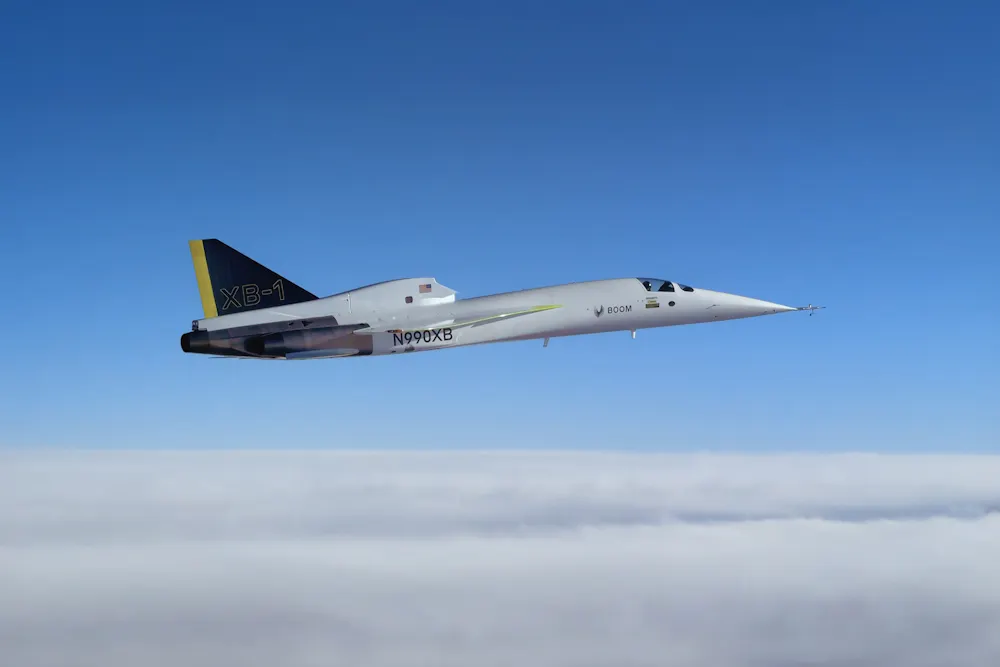
Late last week, American company Boom Supersonic flew faster than the speed of sound with its XB-1 supersonic demonstrator aircraft. It’s now the first piloted non-military aircraft to break the sound barrier since the Concorde was retired from service in 2003.
It’s the first step in Boom’s ambitious goal to have supersonic airliners carry passengers by 2029.
But what exactly is supersonic travel? There are good reasons why it’s not more common, despite the hype.
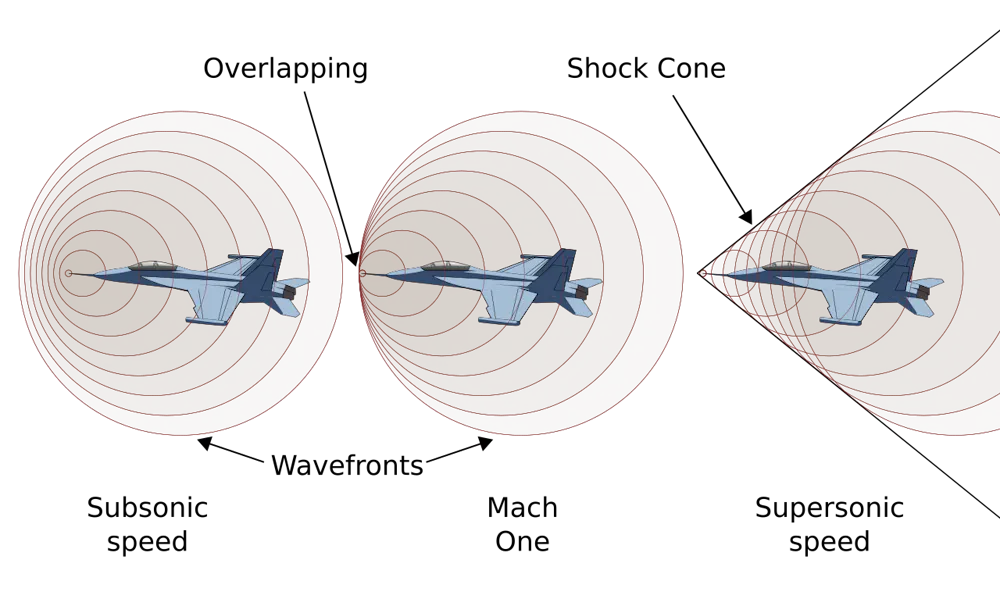
The Mach number is defined as a plane’s speed divided by the speed that sound waves move through the air. To “break the sound barrier” means to fly faster than the speed of sound, with Mach numbers greater than 1.
The Mach number is an important ratio: as a plane flies, it disturbs the air in front of it. These disturbances move at the speed of sound. In supersonic flight these disturbances combine to form shock waves around the vehicle.
When people say you can see a fighter jet before you hear it, they’re referring to supersonic flight: fighter jets can travel at around Mach 2.
The sound from the fighter jet is trapped inside its shock wave; until the shock wave moves to your position on the ground, you won’t hear the plane.
For efficiency reasons, most passenger jets cruise slightly slower than the speed of sound, at around Mach 0.8 (this is subsonic flight).
Boom plans to build an airliner called Overture that can fly at Mach 1.7. Flying supersonically can drastically decrease flight times. The company claims a trip from New York to Rome on Overture could take just four hours and 40 minutes, instead of eight hours.
Boom isn’t the only company working on this lofty goal. American firm Spike Aerospace is also developing a supersonic business jet, with the tagline “delivering the world in half the time”.
This is the value proposition of supersonic passenger travel.
In limited ways, it did already exist in the 20th century. However, due to timing, bad luck and the laws of physics, it didn’t continue.
Designs for supersonic airliners began in the mid-20th century, and by the 1970s we had supersonic passenger flight.
There was the little-known Russian Tupolev-144 and Concorde, a Franco-British supersonic airliner operated by British Airways and Air France from 1976 to 2003.
Concorde had a capacity of up to 128 passengers and cruised at Mach 2. It regularly travelled from London to New York in around three hours. The flights were expensive, mainly shuttling business people and the rich and famous.
Concorde was designed in the 1960s when it seemed like supersonic passenger transport was going to be the next big thing.
Instead, the Boeing 747 entered commercial service in 1970. Cheap, large and efficient airliners like it blew Concorde out of the water.
Designed to cruise efficiently at supersonic speeds, Concorde was extremely fuel inefficient when taking off and accelerating. Concorde’s expensive, “gas guzzling” nature was a complaint levelled against it for most of its lifetime.
A catastrophic 1973 Paris air show crash of the competing Russian airliner, Tupolev Tu-144, also shifted public perception on supersonic flight safety at a time when many airlines were considering whether or not to purchase Concordes.
Only 20 Concordes were manufactured out of the planned 100. It is still disputed today whether Concorde ever made money for the airlines who operated it.
Remember the fighter jets? When a plane travels supersonically, its shock waves propagate to the ground, causing loud disturbances called sonic booms. In extreme cases they can shatter windows and damage buildings.
In the early 1970s, sonic boom concerns led the United States government to ban supersonic passenger flight over land in the US. This hurt the Concorde’s potential market, hence its only two regular routes were trans-Atlantic flights principally over the water.
The Concorde was also a very loud plane at take off, since it needed a lot of thrust to leave the ground.
A future for supersonic travel relies on solving some or all of the issues Concorde faced.
NASA and Lockheed Martin’s Quesst project aims to show sonic boom can be dissipated to manageable levels. They plan to fly their X-59 supersonic aircraft over US cities and gauge responses from citizens.
Quesst aims to use the geometry of the X-59, with a long elongated nose, to dissipate sonic booms to a weak “thump”, hopefully allowing supersonic airliners to travel over land in the future.
Spike Aerospace’s Spike S-512 Diplomat concept also aims to be a “quiet” supersonic aircraft with a less disruptive sonic boom.
Boom Supersonic don’t plan to fly supersonically over land. Their plan is to fly over land at Mach 0.94, which they claim will allow 20% faster overland travel than standard passenger airliners, even subsonically.
They also claim the design of their engines will ensure Overture is no louder than modern subsonic airliners when it takes off.
In terms of gas guzzling, they plan to use up to 100% sustainable aviation fuel to reduce emissions and their carbon footprint.
Concorde was made of aluminium using design tools available in the 1960s. Modern design methods and modern aerospace materials such as titanium and carbon fibre should also allow Overture and similar craft to weigh much less than Concorde, improving efficiency.
While Boom are currently receiving a lot of interest, with orders from many airlines, Concorde did have similar commitment before it become available. Most of it didn’t eventuate.
Additionally, Concorde was the product of an analogue era when the idea of flying to London or New York for the day for an important business meeting seemed like a necessary thing. In a world of remote work and video meetings, is there still a need for a supersonic airliner in the 2020s?
For now, supersonic airliners like Overture are likely to remain in the realm of the rich and famous, like Concorde did. But with modern technological advances, it will be interesting to see whether supersonic passenger travel once again becomes reality – or even goes mainstream. Only time will tell.
Chris James receives funding from the Australian Research Council, the Commonwealth Defence Science and Technology Group (DSTG), and the US Office of Naval Research.
– ref. Supersonic jets are making a comeback – but despite the hype, don’t expect to book yet – https://theconversation.com/supersonic-jets-are-making-a-comeback-but-despite-the-hype-dont-expect-to-book-yet-248656
Source: United States House of Representatives – Representative Michelle Steel (CA-48)
WASHINGTON, D.C. – Rep. Michelle Steel published an op-ed in Newsweek highlighting challenges and opportunities for the incoming Trump Administration in the Asia-Pacific region, including pushing back on threats from the Chinese Communist Party and strengthening alliances with Japan and South Korea.
Read the full piece here.
“With rising threats from the CCP and their regional allies, President Trump will have his work cut out for him in the Asia-Pacific Region. But these challenges provide an opportunity for the U.S. to reassert itself on the international stage, restore global stability, and defend freedom,” Steel wrote.
“The dangerous China-North Korea-Russia partnership merits a strong, deterrence focused response. The safety and security of regional allies like Japan, South Korea, and others depends on a United States that is feared by our adversaries,” Steel added.
An immigrant to the United States, Steel was born in South Korea, grew up in Japan, and speaks both Japanese and Korean fluently. She has worked over her tenure in Congress to elevate the trilateral partnership between the U.S. and Japan and South Korea, as a means of pushing back on aggression from Communist China.
Translartion. Region: Russians Fedetion –
Source: Government of the Russian Federation – An important disclaimer is at the bottom of this article.
Resolution of February 1, 2025 No. 78
The government has set regional tariff quotas for the export of corn from Russia outside the Eurasian Economic Union. They will be in effect from February 15 to June 30, 2025 inclusive and will affect producers from Primorsky Krai and Amur Oblast. A resolution on this has been signed.
According to the document, agricultural producers from Primorsky Krai received the right to export 337 thousand tons of corn, and farmers from Amur Oblast – 200 thousand tons of corn.
The decision was made taking into account the forecast balance of production and consumption of corn in the Far Eastern Federal District. It will help local producers sell their surplus products abroad in the absence of demand from neighboring regions.
The grain export quota mechanism was approved by the Government in 2021. It allows maintaining an optimal balance between the domestic grain market and the supply of these products for export. Within the quota, grain exports are subject to a floating duty, depending on the price situation.
Please note: This information is raw content directly from the source of the information. It is exactly what the source states and does not reflect the position of MIL-OSI or its clients.
Translartion. Region: Russians Fedetion –
Source: Novosibirsk State University – Novosibirsk State University –
2nd year Master’s student Faculty of Physics, Novosibirsk State University Nadezhda Solovyova studies the conditions for the formation of monocrystalline films of multi-alkali compounds of antimony and bismuth. These materials are used as photocathodes – effective sources of free electrons and important elements of various photoelectron converters, allowing the registration of weak light signals, down to single photons.
Photocathodes are devices that operate on the principle of external photoelectric effect. They allow to obtain a beam of electrons with the necessary characteristics for various applications: in electron microscopes, for accelerators, colliders, night vision systems, etc.
GaAs, GaN, and various alkali metal composites combined with antimony (Sb) are used as photocathode materials. Today, photocathode materials have a natural surface disorder, which affects their quantum efficiency, electron beam brightness, and other characteristics. Multialkali compounds (Cs3Sb, Na2KSb, K2CsSb) have been used as electron sources since the 1930s. In 2022, the Rzhanov Institute of Semiconductor Physics SB RAS discovered the possibility of emitting spin-polarized electrons from a multialkali Na2KSb/Cs3Sb photocathode. This discovery sparked a surge of interest in this and other multialkali materials. And at the moment, one of the important issues is the possibility of obtaining crystalline ordered films of these compounds. The answer to this question requires the development of epitaxial growth technology for multialkali materials.
— Despite the fact that multi-alkali materials have long been used to manufacture photocathodes, single-crystal films of multi-alkali compounds have not been obtained before, so it was not possible to study their electronic structure using experimental methods; only calculations existed. Currently, we have a method that will allow us to study the electronic structure, and now our task is to obtain crystalline ordered compounds. They are needed to control the characteristics of photocathode materials. For example, the growth of photocathode materials on a crystalline ordered substrate can allow us to change the ratios of lattice constants and temperature expansion coefficients, which can increase the spin polarization of photosimulated electrons, as well as affect other characteristics. For example, the diffusion length can change or the quantum efficiency of photocathode materials can increase. And, what is important, we will have the opportunity to control their properties during the growth process, — explained Nadezhda Solovyova.
At present, a method for growing epitaxial Cs3Sb films on the 3C-SiC(001) surface has been proposed in the literature. Experiments on epitaxial growth of multi-alkali antimony compounds (Na2KSb, K2CsSb, etc.) on various substrates have not been described in the literature.
The study of such materials should improve the characteristics of photocathodes, but in addition to the practical task, this study also sets a fundamental one: obtaining crystalline ordered films in order to experimentally study their electronic structure.
Nadezhda Solova’s project “Study of the conditions for the formation of single-crystal films of multi-alkali compounds of Sb and Bi” was among the winners of the youth competition of scientific research projects “X-ray, synchrotron, neutron methods of interdisciplinary research” last year.
As part of the project, the young researcher is tasked with obtaining such films and determining how replacing antimony with bismuth will affect their properties. It is assumed that the use of single-crystal films of solid solutions of Cs3BixSb1-x will shift the working range of photocathodes to the infrared region and affect the spin polarization of photoemitted electrons (?). At the moment, Nadezhda Solovyova, under the supervision of Vladimir Golyashov, PhD, research fellow at the Institute of Physical Problems of the Siberian Branch of the Russian Academy of Sciences, has obtained quite interesting results: for the first time, it was possible to obtain single-crystal films of Na2KSb.
— We were able not only to obtain crystalline ordered films, but also to obtain the first experimental measurement of the electronic structure using angle-resolved photoelectron spectroscopy. We did not find any publications about such work in scientific journals. Now we have extensive work ahead of us to decipher the obtained structure, perform the necessary calculations and publish our results, but the first steps have already been taken, and they have proven to be quite productive, — said Nadezhda Solovyova.
The films were grown using two methods. First, in collaboration with the Novosibirsk enterprise ZAO Ekran-FEP, the scientists followed the method used in the production of electron-optical converters and obtained the first crystalline-ordered films. However, they were not satisfied with the fact that under such conditions the growth of photocathodes was difficult to control due to the excess pressure of alkali metals.
Another growth technique was fully implemented in the laboratory of the A.V. Rzhanov Institute of Semiconductor Physics SB RAS, and was closer to molecular beam epitaxy:
— Our laboratory has conditions that allow us to create molecular sources from which film growth will be determined by the ratio of several flows, and there will be no excess of a certain chemical element and the stoichiometric composition of the film will be determined by the ratio of these flows. Having tested both methods, we came to the conclusion that new sources for the growth of such materials need to be created. The laboratory setup is currently being improved, — said Nadezhda Solovyova.
All compounds studied by Nadezhda Solova are extremely unstable in the atmosphere, so their study requires the development of in-situ ultrahigh-vacuum photoelectron spectroscopy methods. Preparation of atomically clean substrate surfaces, synthesis and epitaxial growth of (Na,K,Cs)3(Sb,Bi), as well as their subsequent analysis are carried out directly in the ultrahigh-vacuum chambers of the SPECS Proven-X ARPES photoelectron spectroscopy facility at the ISP SB RAS. It implements such methods for analyzing the surface of solids as angle-resolved photoelectron spectroscopy (ARPS), X-ray photoelectron spectroscopy (XPS), X-ray photoelectron diffraction (XRD), and low-energy electron diffraction (LEED). LEED allows one to quickly determine whether the structure of the grown films is crystalline, polycrystalline, or amorphous. XPS is used to study the stoichiometric composition of films, their thickness and the chemical state of atoms on the surface.
— The electronic structure of the grown monocrystalline films is studied using angle-resolved photoelectron spectroscopy (ARPS). However, XPS, ARPES and RFD can be fully realized only when using monochromatic ultraviolet and soft X-ray radiation sources based on synchrotrons. Therefore, if our project shows high potential for further research, we will continue working at the SKIF synchrotron under construction in Novosibirsk. One of the suitable stations where similar measurements can be implemented will be station 1-6-2 “Electronic Structure”, — explained Nadezhda Solovyova.
Please note: This information is raw content directly from the source of the information. It is exactly what the source states and does not reflect the position of MIL-OSI or its clients.
Source: China State Council Information Office
Iran on Sunday unveiled three new domestically developed satellites in the Iranian capital Tehran to mark its National Space Technology Day, the official news agency IRNA reported.
The satellites, namely Navak-1, Pars-2, and an upgraded model of Pars-1, were unveiled in a ceremony attended by Iranian President Masoud Pezeshkian, Minister of Information and Communications Technology Seyyed Sattar Hashemi, as well as a number of cabinet members, officials, and military commanders, the report said.
Developed by the Iranian Space Research Center, the Navak-1 communications satellite is designed to test the function of an improved version of the homegrown Simorgh launch vehicle in the near future. The carrier is expected to put the satellite into an elliptic orbit, according to IRNA.
Weighing approximately 34 kg, Navak-1 is equipped with a dosimetry payload to measure cosmic rays, the report said, adding the satellite has a magnetometer sensor to measure the Earth’s electromagnetic field.
According to IRNA, the Pars-2 remote-sensing satellite weighs 150 kg and is equipped with two imaging payloads with two different homegrown linear position sensors.
The satellite features a propeller and is capable of carrying out diverse missions in the fields of environmental monitoring, forestry, natural disaster response, and urban management.
The upgraded model of Pars-1 remote-sensing satellite, weighing under 150 kg, has three imaging payloads: multispectral, short-wave infrared, and thermal infrared, according to IRNA.
The satellite is powered by energy generated from its gallium arsenide solar cells, according to the report. The first model of the satellite, weighing 134 kg, was launched on Feb. 29, 2024, aboard a Russian Soyuz rocket from the Vostochny space base.
Speaking at another ceremony in Tehran on Sunday to mark the occasion, Iranian Defense Minister Aziz Nasirzadeh said the country plans to conduct two space launches in the coming weeks, before the end of the current Iranian calendar year on March 20.
Source: Government of India (2)
Posted On: 01 FEB 2025 2:20PM by PIB Delhi
Introduction
India’s defence sector has undergone a remarkable transformation since 2014, evolving from a largely import-dependent military force to one increasingly focused on self-reliance and indigenous production. As one of the strongest military powers globally, India holds a pivotal role in ensuring regional security and fulfilling strategic goals. The country’s defence budget, which stood at ₹2,53,346 crore[1] in 2013-14, has seen a significant rise, reaching ₹6,21,940.85 crore[2] in 2024-25, reflecting a clear commitment to strengthening the nation’s defence capabilities. Central to this transformation is the growth of India’s defence manufacturing industry, which has become an integral part of the economy. Through the “Make in India” initiative and policy reforms, the government has actively promoted domestic production and reduced reliance on foreign procurement. This shift has been a key component of India’s broader vision of achieving Atmanirbharta (self-reliance) in defence, positioning the nation as an emerging hub for the production of advanced military technologies and equipment.
Defence Production
v Record Defence Production: In FY 2023-24, India’s domestic defence production reached ₹1.27 lakh crore, marking a record high, with an impressive increase of approximately 174% from ₹46,429 crore in 2014-15.
Defence Exports
v Surge in Defence Exports: India’s defence exports have surged from ₹1941 crore in FY 2014-15 to ₹21,083 crore in FY 2023-24, reflecting a remarkable increase in export value.
v Strong Year-on-Year Growth: A 32.5% growth in defence exports was recorded over the previous fiscal year 2022-23, rising from ₹15,920 crore.
Conclusion
India’s defence sector has made unprecedented strides over the past decade, driven by a strong policy push towards self-reliance and domestic manufacturing. The significant rise in defence production and exports underscores the country’s growing capability as a global defence manufacturing hub. With a record ₹1.27 lakh crore in defence production and exports reaching ₹21,083 crore in FY 2023-24, India has demonstrated its commitment to reducing dependency on imports while strengthening its presence in the global market.
As the nation aims for ₹3 lakh crore in defence production and ₹50,000 crore in exports by 2029, these achievements highlight India’s emergence as a reliable defence partner worldwide. By leveraging innovation, strategic partnerships, and indigenous capabilities, India is well-positioned to play a pivotal role in the future of global defence manufacturing and security.
References:
https://pib.gov.in/PressReleaseIframePage.aspx?PRID=2016818
https://pib.gov.in/PressReleasePage.aspx?PRID=2069090
https://sansad.in/getFile/loksabhaquestions/annex/178/AS325.pdf?source=pqals
https://pib.gov.in/PressReleasePage.aspx?PRID=2035748
https://www.ibef.org/industry/defence-manufacturing
Santosh Kumar/ Sarla Meena/ Saurabh Kalia
(Release ID: 2098434) Visitor Counter : 16
Source: People’s Republic of China – State Council News
Foreign tourists taste Chinese New Year flavor
Source: United Kingdom – Executive Government & Departments
Europe must double down on its efforts to crush Putin’s war machine as Russia’s economy shows signs of weakening, the Prime Minister will warn tomorrow [Monday 3 February].
Europe must double down on its efforts to crush Putin’s war machine as Russia’s economy shows signs of weakening, the Prime Minister will warn tomorrow [Monday 3 February].
As he travels to Brussels for defence and security talks, he will urge the UK’s closest allies to step up and shoulder more of the burden in order to keep Europe safe against Russia’s increasing campaign of sabotage and destruction on our continent.
Putin is facing mounting domestic pressure as a result of his struggling economy, having ploughed billions into bankrolling his war machine – leading to skyrocketing inflation and soaring interest rates in Russia.
The recent sanctions imposed on Putin’s shadow fleet and energy companies have dealt a severe blow to Russia’s oil trade. Russian oil and gas revenues were down 29% in 2024 compared to 2022, and the sanctions have led to a sharp rise in shipping costs, with the majority of sanctioned vessels left unable to trade.
The UK and its allies have introduced the most punishing sanctions ever imposed on any global economy, with Putin himself admitting that these are causing a “colossal number of difficulties”.
The UK alone has sanctioned more than 2,100 individuals and entities under the Russia sanctions regime, over 1,900 of which were imposed since Putin’s full-scale invasion. This includes more than 100 ships for transporting Russian energy, including 93 oil tankers.
The Prime Minister will call on Europe to keep up the pressure on Putin, alongside sustained military support to Ukraine, to put them in the strongest possible position this year.
The Prime Minister will say today:
We need to see all allies stepping up – particularly in Europe.
President Trump has threatened more sanctions on Russia and it’s clear that’s got Putin rattled. We know that he’s worried about the state of the Russian economy.
I’m here to work with our European partners on keeping up the pressure, targeting the energy revenues and the companies supplying his missile factories to crush Putin’s war machine.
Because ultimately, alongside our military support, that is what will bring peace closer.
The Prime Minister has prioritised security as a foundation for his Plan for Change, believing every mission relies on a strong security base, from ensuring the UK’s Armed Forces have the cutting-edge equipment they need, to securing medical supply chains and increasing diversification in energy supplies.
Tomorrow afternoon, he will meet with NATO Secretary General Mark Rutte, before travelling to meet with the leaders of the 27 EU Member States at an informal meeting of the European Council.
There, the Prime Minister will set out his pitch for an ambitious UK-EU defence and security partnership with a number of steps to increase co-operation on shared threats, and go further on cross-border crime and illegal migration, while delivering growth and security at home.
The session of the Informal European Council is part of the Prime Minister’s ongoing commitment to strengthen our partnership with the European Union in order to drive growth, boost living standards and keep the UK safe and secure.
The Prime Minister is committed to making Brexit work better for the British people while keeping within his red lines – no return to freedom of movement and no re-joining the customs union or single market.
Published 2 February 2025
Source: United Kingdom – Prime Minister’s Office 10 Downing Street
Europe must double down on its efforts to crush Putin’s war machine as Russia’s economy shows signs of weakening, the Prime Minister will warn tomorrow [Monday 3 February].
Europe must double down on its efforts to crush Putin’s war machine as Russia’s economy shows signs of weakening, the Prime Minister will warn tomorrow [Monday 3 February].
As he travels to Brussels for defence and security talks, he will urge the UK’s closest allies to step up and shoulder more of the burden in order to keep Europe safe against Russia’s increasing campaign of sabotage and destruction on our continent.
Putin is facing mounting domestic pressure as a result of his struggling economy, having ploughed billions into bankrolling his war machine – leading to skyrocketing inflation and soaring interest rates in Russia.
The recent sanctions imposed on Putin’s shadow fleet and energy companies have dealt a severe blow to Russia’s oil trade. Russian oil and gas revenues were down 29% in 2024 compared to 2022, and the sanctions have led to a sharp rise in shipping costs, with the majority of sanctioned vessels left unable to trade.
The UK and its allies have introduced the most punishing sanctions ever imposed on any global economy, with Putin himself admitting that these are causing a “colossal number of difficulties”.
The UK alone has sanctioned more than 2,100 individuals and entities under the Russia sanctions regime, over 1,900 of which were imposed since Putin’s full-scale invasion. This includes more than 100 ships for transporting Russian energy, including 93 oil tankers.
The Prime Minister will call on Europe to keep up the pressure on Putin, alongside sustained military support to Ukraine, to put them in the strongest possible position this year.
The Prime Minister will say today:
We need to see all allies stepping up – particularly in Europe.
President Trump has threatened more sanctions on Russia and it’s clear that’s got Putin rattled. We know that he’s worried about the state of the Russian economy.
I’m here to work with our European partners on keeping up the pressure, targeting the energy revenues and the companies supplying his missile factories to crush Putin’s war machine.
Because ultimately, alongside our military support, that is what will bring peace closer.
The Prime Minister has prioritised security as a foundation for his Plan for Change, believing every mission relies on a strong security base, from ensuring the UK’s Armed Forces have the cutting-edge equipment they need, to securing medical supply chains and increasing diversification in energy supplies.
Tomorrow afternoon, he will meet with NATO Secretary General Mark Rutte, before travelling to meet with the leaders of the 27 EU Member States at an informal meeting of the European Council.
There, the Prime Minister will set out his pitch for an ambitious UK-EU defence and security partnership with a number of steps to increase co-operation on shared threats, and go further on cross-border crime and illegal migration, while delivering growth and security at home.
The session of the Informal European Council is part of the Prime Minister’s ongoing commitment to strengthen our partnership with the European Union in order to drive growth, boost living standards and keep the UK safe and secure.
The Prime Minister is committed to making Brexit work better for the British people while keeping within his red lines – no return to freedom of movement and no re-joining the customs union or single market.
Published 2 February 2025
Source: Australian Government – Minister of Foreign Affairs
The Australian Government has imposed counter-terrorism financing sanctions on the white supremacist terrorist network Terrorgram, as part of our ongoing work to combat antisemitism and keep Australians safe.
Terrorgram is an online network that promotes white supremacy and racially-motivated violence.
It is now a criminal offence to use or deal with the assets of, or make assets available to, Terrorgram.
Penalties include up to 10 years’ imprisonment and/or heavy fines.
It is the first time any Australian Government has imposed counter-terrorism financing sanctions on an entity based entirely online.
The Australian Government has also re-listed for counter-terrorism financing sanctions four other entities that promote nationalist and racist violent extremist ideologies: National Socialist Order, the Russian Imperial Movement, Sonnenkrieg Division and The Base.
This demonstrates the Albanese Government’s commitment to disrupting the activities of terrorists and violent extremists and preventing them from recruiting and radicalising people online.
There is no place in Australia for antisemitism, hatred or violence.
The Australian Government has also imposed sanctions on Hizballah’s new Secretary-General and a leading spokesperson for the terrorist group, Mr Naim Qassem.
Hizballah is responsible for the deaths of countless civilians in Lebanon, Israel and across the Middle East.
One person and another four entities have also been re-listed for counter-terrorism financing sanctions.
A consolidated list of sanctions is available on the Department of Foreign Affairs website.
Source: United Kingdom – Executive Government & Departments
The Prime Minister hosted German Chancellor Olaf Scholz at Chequers this afternoon.
The Prime Minister hosted German Chancellor Olaf Scholz at Chequers this afternoon.
The leaders began by reflecting on the progress made between the UK and Germany in recent months, including through the signing of the Trinity House Agreement on defence, and Joint Action Plan on irregular migration. They agreed on the importance of maintaining the momentum towards an even stronger bilateral partnership.
Turning to the situation in Ukraine, the Prime Minister updated on his recent visit and reiterated that it was important to ensure the country was in the strongest possible position in the coming months, so that peace could be achieved through strength.
Russia’s full-scale invasion of Ukraine had underscored the importance of scaling up and coordinating defence production across Europe, the leaders agreed.
Updating on the government’s Strategic Defence Review, which would be published later this year, the Prime Minister said it would encompass the lessons learned in Ukraine, and the need to out-manoeuvre Putin’s ongoing aggression and hostile activity across Europe.
Reflecting on the ceasefire between Israel and Gaza, the leaders welcomed the ongoing release of hostages and underscored the importance of seeing through all phases of the deal through.
A two-state solution that ensured a safe and secure Israel alongside a viable and sovereign Palestine was key, the Prime Minister added.
The leaders also discussed the Prime Minister’s visit to the EU Council tomorrow, and the reset between the UK and the European Union.
The Prime Minister said he was committed to strengthening the UK’s relationship with the EU to drive greater growth and closer security ties, which he believed would benefit all sides.
The leaders looked forward to speaking again tomorrow.
Published 2 February 2025
Source: United Kingdom – Prime Minister’s Office 10 Downing Street
The Prime Minister hosted German Chancellor Olaf Scholz at Chequers this afternoon.
The Prime Minister hosted German Chancellor Olaf Scholz at Chequers this afternoon.
The leaders began by reflecting on the progress made between the UK and Germany in recent months, including through the signing of the Trinity House Agreement on defence, and Joint Action Plan on irregular migration. They agreed on the importance of maintaining the momentum towards an even stronger bilateral partnership.
Turning to the situation in Ukraine, the Prime Minister updated on his recent visit and reiterated that it was important to ensure the country was in the strongest possible position in the coming months, so that peace could be achieved through strength.
Russia’s full-scale invasion of Ukraine had underscored the importance of scaling up and coordinating defence production across Europe, the leaders agreed.
Updating on the government’s Strategic Defence Review, which would be published later this year, the Prime Minister said it would encompass the lessons learned in Ukraine, and the need to out-manoeuvre Putin’s ongoing aggression and hostile activity across Europe.
Reflecting on the ceasefire between Israel and Gaza, the leaders welcomed the ongoing release of hostages and underscored the importance of seeing through all phases of the deal through.
A two-state solution that ensured a safe and secure Israel alongside a viable and sovereign Palestine was key, the Prime Minister added.
The leaders also discussed the Prime Minister’s visit to the EU Council tomorrow, and the reset between the UK and the European Union.
The Prime Minister said he was committed to strengthening the UK’s relationship with the EU to drive greater growth and closer security ties, which he believed would benefit all sides.
The leaders looked forward to speaking again tomorrow.
Published 2 February 2025
Translartion. Region: Russians Fedetion –
Source: State University of Management – Official website of the State –
February 2nd is celebrated in Russia as the Day of the defeat of the Nazi troops by the Soviet troops in the Battle of Stalingrad (1943). This was the largest land battle of the Second World War, which had a decisive strategic significance and became a turning point in the Great Patriotic War.
Stalingrad, in its very name, carried great ideological significance for the USSR, but there were also economic reasons to hold the city at any cost – it opened access to oil sources in the Caucasus and the rich arable lands of the Don, Kuban and Lower Volga region.
The Battle of Stalingrad was divided into two stages: defensive (from July 17 to November 19, 1943) and offensive (from November 19, 1942 to February 2, 1943). The Red Army was forced to enter the battle with an acute shortage of equipment, on unprepared lines and with recently formed units that were not battle-tested. At the initial stage of the battle, the Germans fought actively and skillfully, surrounded the Russians with entire divisions, took one of the two Soviet armies in pincers, and eventually quickly pushed the defenders back beyond the Don. On July 28, Stalin issued the famous order No. 227 (“Not one step back!”). The stubborn resistance of the Russians, even in encirclement, and the extended front slowed the Wehrmacht’s advance so much that our troops managed to launch a number of counterattacks. Nevertheless, by August 23, the battle had already begun within the city limits.
The fighting in the city is the most famous part of the Battle of Stalingrad. It was particularly brutal and was fought literally for every house, some of which changed hands so often that they even received their own names on military maps. Both sides suffered huge losses and were short of food. This battle eventually became one of the bloodiest in the history of mankind in terms of the number of irreparable losses: in the Red Army they amounted to just under 480 thousand people, in the Wehrmacht and allied forces – about half a million. The number of civilians killed is still difficult to establish even approximately.
Realizing that the German troops were bogged down in heavy fighting, the Red Army command began to hatch a plan for a large-scale counterattack in mid-September, which eventually evolved into Operation Uranus. It began on November 19. As a result, General Friedrich Pauls’ 6th Army was surrounded. As is well known, even the promotion of its commander to the rank of Field Marshal did not save it. Another Field Marshal, Erich Manstein, tried to save the situation by developing Operation Winter Storm, and he almost managed to break through the encirclement, but this was thwarted by fresh reinforcements of Soviet troops and his own completely demoralized allies – the Italians, Hungarians and Romanians. “Dumitrescu was powerless to fight the demoralization of his troops alone. “There was nothing left to do but remove them and send them to the rear, to their homeland,” Manstein wrote in his post-war memoirs, “Lost Victories,” about the 3rd Romanian Army and its commander.
The German group at Stalingrad was completely liquidated as a result of Operation Ring. But it cannot be said that it was easy. The operation was interrupted and adjusted in view of the desperate resistance of the enemy. Nevertheless, the outcome is known. The Germans lost about a quarter of all personnel fighting on the Eastern Front. Germany, for the first time since the beginning of World War II, declared national mourning. Its European allies began to look for ways to leave the war, and Turkey and Japan abandoned their plans to invade the USSR.
In memory of this battle, one of the largest and most famous memorials in honor of the participants of the Great Patriotic War, “To the Heroes of the Battle of Stalingrad,” was erected on Mamayev Kurgan, the height where the most fierce fighting took place, with the main monument “The Motherland Calls!” The ashes of more than 35,000 defenders of the city rest there in individual and mass graves. The monument-ensemble is an object of cultural heritage of the peoples of Russia and a candidate for inclusion in the UNESCO World Heritage List.
The State University of Management congratulates on this day of military glory and recalls our #scientific regiment near Stalingrad – university employees who took part in this grand battle:
-Hero of the Soviet Union, Alexander Davydov, Guard Lieutenant Colonel, Deputy Head of the Nile MIE-MIU department from 1962 to 1985;
-Gennady Belykh, Colonel, Head of the educational and methodological department of the MIU;
– George Bryansky, assistant to the division commander for political units, dean of the faculty of organizers of industrial production and construction of MIEI;
-Peter Burov, Major Engineer, Vice-Rector for the Academic Affairs of MIEI from 1952 to 1962;
– Vasily Svetlov, assistant to the platoon commander, associate professor of the Department of Political Economy of MEII, chairman of the University Council of Veterans from 1993 to 1997.
We also remind you that in the Year of the Defender of the Fatherland, on the initiative of the State University of Management, together with the Association “I am proud” and the “People’s Front” of the DPR, the All-Russian competition “Family history. Immortal memory” is being held.
Subscribe to the TG channel “Our GUU” Date of publication: 02.02.2025
Please note: This information is raw content directly from the source of the information. It is exactly what the source states and does not reflect the position of MIL-OSI or its clients.
Source: United Nations Economic Commission for Europe
The 72nd plenary session of the Conference of European Statisticians (CES) will take place on 20-21 June 2024 in Palais des Nations, Geneva. Simultaneous interpretation in English, French and Russian will be provided.
The Conference provides a platform for addressing emerging issues and developing guidelines and recommendations to improve national statistics and their international comparability. It is one of the oldest statistical bodies globally, with its roots in the League of Nations and the first Conference on Statistics in 1928. Over the years, the Conference has played a significant role in promoting statistical development in its member countries.
Source: United Nations Economic Commission for Europe
UNECE/FAO, UNDA National Coaching Workshop
Национальный семинар ЕЭК ООН/ФАО, СРООН
The objectives of the coaching workshop on “Criteria and Indicators for Sustainable Forest Management for Uzbekistan” are:
02 August 2017, Wednesday: 8.30 – 17.30 / 02 Август 2017 г., Среда: 8.30 – 17.30
03 August 2017, Thursday: 9.00 – 17.30/ 03 Август 2017 г., Четверг: 9.00 – 17.30
04 August 2017, Friday: 9.00 – 17.30 / 04 Август 2017 г., Пятница: 9.00 – 17.30
Tashkent, Hotel Aster, Yakkasaray district, Minglar str. 35
Ташкент, Отель Астер, район Яккасарай, ул. Минглар 35
Should you have any question, please contact the Secretariat.
За более подробной информацией обращайтесь в Секретариат.
Visit the project’s website.
Более подробная информация о проекте доступна здесь.
| Topic | Language | Document |
|---|---|---|
| Programme Программа |
ENG-RUS | |
| Workshop Report Отчет семинара |
ENG-RUS | PDF ENG |
| Pictures Фотографии |
flickr | |
| News Release Выпуск новостей |
UZB-RUS-ENG | release Uzbekistan UNECE release |
| Needs Assessment Оценка Потребностей |
ENG-RUS | Word |
|
Information on Uzbekistan / Информация об Узбекистане |
||
| FRA Country report | ENG |
| Presentation | Speaker | |
|---|---|---|
| Project overview and introduction ENG-RUS Обзор проекта и в ввдение ENG-RUS |
T. Loeffler | |
| Introduction to Criteria and Indicators ENG-RUS Введение в тему критериев и индикаторов |
M. Valgepea | |
| Forest Sector in Uzbekistan Обзор лесов и лесного сектора Узбекистана |
O. Kakhkharov | |
| NGO KRASS work on Forestry RUS | I. Rudenko | |
| National examples of SFM C&I processes and outcomes, lessons and recommendations Russia RUS Национальные примеры процессов и итогов, уроков и рекомендаций КиИ для УЛП Россия |
I. Vukulova | |
| National examples of SFM C&I processes and outcomes, lessons and recommendations Estonia ENG-RUS Национальные примеры процессов и итогов, уроков и рекомендаций КиИ для УЛП Эстония |
M. Valgepea | RUS ENG |
| Facilitator Presentation Day 1 ENG-RUS Презентация координатора день 1 |
V. Melikyan | |
| Facilitator Presentation Day 2 morning ENG-RUS Презентация координатора день 2 Утро ENG-RUS |
V. Melikyan | |
| Facilitator Presentation Day 2 afternoon ENG-RUS Презентация координатора день 2после полудня ENG-RUS |
V. Melikyan | |
| Facilitator Presentation Day 3 ENG-RUS Презентация координатора день 3 ENG-RUS |
V. Melikyan |
The table below provides an overview of useful material and information about Criteria and Indicators for Sustainable Forest Management in English and Russian. This material can be used as a source of information and inspiration to develop national Criteria and Indicators for Sustainable Forest Management. The table is not exhaustive. If you are aware of relevant material that is not yet listed kindly inform the project manager.
В таблице ниже представлены полезные материалы и информация о критериях и индикторах для устойчивого леспользования на английском и русском языках. Эти материалы могут быть использованы в качестве информации и вдохновения при разработке национальных критериев и индикаторов для устойчивого лесопользования. Таблица не является полной. Если Вы знаете какие-либо подходящие материалы, которые не представлены в данной таблице, пожалуйста, проинформируйте координатора проекта.
| Topic/ Тема |
Language/ Язык |
Document/ Документ |
|
|---|---|---|---|
| General information Общая информация |
ECE/FAO Guidelines for the Development of a Criteria and Indicator Set for Sustainable Forest Management Методические Рекомендации по Разработке критериев и показателей ведения лесного хозяйства |
ENG- RUS | ENG pdf RUS pdf |
| Sustainable Forest Management definition Определение устойчивого лесопользования |
ENG-RUS | ||
| Criteria and Indicator definitions Определение критериев и показателей |
ENG-RUS | ||
| Useful links Полезные ссылки |
ENG-RUS | ||
| Guidelines for Developing, Testing and Selecting Criteria and Indicators for Sustainable Forest Management Руководство по разработке, тестированию и выбору критериев и индикаторов для устойчивого лесопользования |
ENG-RUS | ||
| Examples for C&I Примеры КиИ |
Criteria and Indicators for SFM in Austria Критерии и индикаторы для УЛП в Австрии |
ENG | |
| Criteria and Indicators for Low Forest Cover Countries Критерии и индикаторы для слаболесистых стран |
ENG | ||
| Forest Europe Process Процесс Леса Европы |
Pan-European Indicators for SFM Общеевропейские индикаторы для УЛП |
ENG | |
| State of Europe’s Forests report Отчет о состоянии лесов Европы |
ENG | ||
|
Pan-European Questionnaire |
ENG-RUS |
||
|
Relevant Terms and Definitions for Pan-European Indicators |
ENG |
||
| Montreal Process Монреальский процесс |
Montreal Process Criteria and Indicators Критерии и индикаторы для Монреальского процесса |
RUS | |
| Booklet Брошюра |
RUS | ||
| Factsheet Фактологический бюллетень |
ENG | ||
| Montreal process: criteria and indicators for conservation and SFM of the temperate and boreal zones 2008 Монреальский процесс: критерии и индикаторы сохранения и УЛП умеренной и бореальной зон 2008 |
RUS | ||
| Other publications Прочие публикации |
Forests in the ECE region 2015 Леса региона ЕЭК 2015 |
ENG-RUS |
|
| Global Forest Resource Assessment, Synthesis Document Глобальная оценка лесных ресурсов, обобщающий документ More information here Дополнительная информация здесь |
ENG-RUS |
||
| Global Forest Resource Assessment, Summary tables for quantitative variables Глобальная оценка лесных ресурсов, Сводные таблицы для количественных переменных |
ENG-RUS |
||
| Global Forest Resource Assessment, Terms and Definitions Глобальная оценка лесных ресурсов, Термины и определения |
ENG | ENG pdf | |
| Global Forest Resource Assessment, Questionnaire Глобальная оценка лесных ресурсов, Вопросник |
ENG | ENG pdf |
Source: United Nations Economic Commission for Europe
The objectives of the coaching workshop on “Criteria and Indicators for Sustainable Forest Management for Georgia” were:
29 November 2017, Wednesday: 8.30 – 17.30
30 November 2017, Thursday: 9.00 – 17.30
01 December 2017, Friday: 9.00 – 17.30
Justice House Training Centre, A.Politkovskaya Str. 3, Tbilisi, Georgia
Should you have any questions, please contact Secretariat.
Visit the project’s website.
| Topic | Language | Document |
|---|---|---|
| Programme | ENG-GEO | |
| ECE/FAO Guidelines for the Development of a Criteria and Indicator Set for Sustainable Forest Management Методические Рекомендации по Разработке критериев и показателей ведения лесного хозяйства |
ENG-RUS | ENG RUS |
| Workshop Report | ENG-GEO | ENG GEO |
| Pictures | flickr | |
| Press Release | ENG | UNECE press release |
| Needs Assessment | ENG | Word |
|
Information on Georgia |
||
| FRA Country report | ENG | |
| Forestland Governance in Georgia Assessment of legislation and practice | ENG | |
| Georgia Country Environmental Analysis | ENG | |
| National Forest Concept for Georgia | ENG |
| Presentations | Speaker | |
|---|---|---|
| Facilitator Presentation Day 1 | V. Melikyan | ENG-GEO |
| Facilitator Presentation Day 2 Morning | V. Melikyan | ENG-GEO |
| Facilitator Presentation Day 2 Afternoon | V. Melikyan | ENG-GEO |
| Facilitator Presentation Day 3 | V. Melikyan | ENG-GEO |
| Project overview | T. Loeffler | ENG-GEO |
| Introduction to Criteria and Indicators | E. Yazici | ENG-RUS |
| Overview of Forests and Forest Sector of Georgia | K. Chiburdanidze | ENG |
| National Principles, Criteria and Indicators for Sustainable Forest Management | L. Giorgadye | |
| IBiS First National Forest Inventory of Georgia | L. Dzadzamia | ENG |
| National examples of SFM C&I processes and outcomes, lessons and recommendations Turkey | T. Otrakcier | ENG |
| National examples of SFM C&I processes and outcomes, lessons and recommendations Austria | S. Linser | ENG |
| National examples of SFM C&I processes and outcomes, lessons and recommendations Estonia | M. Valgepea | ENG |
The table below provides an overview of useful material and information about Criteria and Indicators for Sustainable Forest Management in English and Russian. This material can be used as a source of information and inspiration to develop national Criteria and Indicators for Sustainable Forest Management. The table is not exhaustive. If you are aware of relevant material that is not yet listed kindly inform the project manager.
В таблице ниже представлены полезные материалы и информация о критериях и индикторах для устойчивого леспользования на английском и русском языках. Эти материалы могут быть использованы в качестве информации и вдохновения при разработке национальных критериев и индикаторов для устойчивого лесопользования. Таблица не является полной. Если Вы знаете какие-либо подходящие материалы, которые не представлены в данной таблице, пожалуйста, проинформируйте координатора проекта.
| Topic/ Тема |
Language/ Язык |
Document/ Документ |
|
|---|---|---|---|
| General information Общая информация |
ECE/FAO Guidelines for the Development of a Criteria and Indicator Set for Sustainable Forest Management Методические Рекомендации по Разработке критериев и показателей ведения лесного хозяйства |
ENG- RUS | ENG pdf RUS pdf |
| The System for the Evaluation of the Management of Forests (SEMAFOR) Система оценки управления лесами (СЕМАФОР) |
ENG- RUS | ENG pdf RUS pdf |
|
| Sustainable Forest Management definition Определение устойчивого лесопользования |
ENG-RUS | ||
| Criteria and Indicator definitions Определение критериев и показателей |
ENG-RUS | ||
| Useful links Полезные ссылки |
ENG-RUS | ||
| FAO Voluntary Guidelines on National Forest Monitoring | ENG | ||
| CIFOR Guidelines for Developing, Testing and Selecting Criteria and Indicators for Sustainable Forest Management Руководство по разработке, тестированию и выбору критериев и индикаторов для устойчивого лесопользования |
ENG | ||
| Examples for C&I Примеры КиИ |
Criteria and Indicators for SFM in Austria Критерии и индикаторы для УЛП в Австрии |
ENG | |
| Criteria and Indicators for Low Forest Cover Countries Критерии и индикаторы для слаболесистых стран |
ENG | ||
| Forest Europe Process Процесс Леса Европы |
Pan-European Indicators for SFM Общеевропейские индикаторы для УЛП |
ENG | |
| State of Europe’s Forests report Отчет о состоянии лесов Европы |
ENG | ||
| Pan-European Questionnaire Общеевропейский вопросник More information here Дополнительная информация здесь |
ENG-RUS | ENG Excel | |
| Relevant Terms and Definitions for Pan-European Indicators Соответствующие термины и определения для Общеевропейских индикаторов |
ENG | pdf |
|
| Montreal Process Монреальский процесс |
Montreal Process Criteria and Indicators Критерии и индикаторы для Монреальского процесса |
RUS | |
| Booklet Брошюра |
RUS | ||
| Factsheet Фактологический бюллетень |
ENG | ||
| Montreal process: criteria and indicators for conservation and SFM of the temperate and boreal zones 2008 Монреальский процесс: критерии и индикаторы сохранения и УЛП умеренной и бореальной зон 2008 |
RUS | ||
| Other publications Прочие публикации |
Forests in the ECE region 2015 Леса региона ЕЭК 2015 |
ENG-RUS | ENG pdf RUS pdf |
| Global Forest Resource Assessment, Synthesis Document Глобальная оценка лесных ресурсов, обобщающий документ More information here Дополнительная информация здесь |
ENG-RUS | ENG pdf | |
| Global Forest Resource Assessment, Summary tables for quantitative variables Глобальная оценка лесных ресурсов, Сводные таблицы для количественных переменных |
ENG-RUS | ENG pdf | |
| Global Forest Resource Assessment, Terms and Definitions Глобальная оценка лесных ресурсов, Термины и определения |
ENG | ENG pdf | |
| Global Forest Resource Assessment, Questionnaire Глобальная оценка лесных ресурсов, Вопросник |
ENG | ENG pdf |
Source: IMF – News in Russian
Washington, DC: Kristalina Georgieva, Managing Director of the International Monetary Fund (IMF), issued the following statement today after news of the death of Mr. Horst Köhler, former IMF Managing Director:
“It is with great sadness that we have learned of the passing of Horst Köhler, who was the eighth Managing Director of the Fund and ably led our institution between 2000 and 2004. Mr. Köhler will be remembered for his many contributions, and in particular for navigating the Fund’s work through the difficult period after September 11, 2001. He mobilized the Fund and the international community to help the low-income and heavily indebted members, championing greater transparency and strong governance.
“During his distinguished career, he played a key role in Germany’s unification in 1990 as Deputy Finance Minister of the Federal Republic of Germany and was instrumental in drafting the legal framework for the introduction of the euro. He served as president of the European Bank for Reconstruction and Development, before joining the IMF as Managing Director. In 2004 he left the IMF to become president of the Federal Republic of Germany, winning the hearts of many for his principled approach. Throughout a large part of his life, he was particularly devoted to drawing the world’s attention to the needs of the African continent – something many of us at the Fund greatly admired.
“On behalf of the IMF, I wish to offer our deepest condolences to Mr. Köhler’s family – his wife Eva, his two children Ulrike and Jochen, and his grandchildren. Mr. Köhler led a life of distinguished public service, and leaves behind a profound legacy of dedication to fairness and justice and an unfailing concern for others.”
https://www.imf.org/en/News/Articles/2025/02/02/pr-25024-imf-md-Kristalina-Georgieva-statement-on-passing-of-former-imf-md-Horst-Koehler
Translartion. Region: Russians Fedetion –
Source: Government of the Russian Federation – An important disclaimer is at the bottom of this article.
Previous news Next news
Dmitry Grigorenko held a meeting with the heads of regulatory authorities
Expanding the forms of remote control and developing a feedback system will become the main areas of improvement in the sphere of control in 2025. This was stated by Deputy Prime Minister – Chief of the Government Staff Dmitry Grigorenko at a meeting with the heads of control and supervisory bodies.
According to him, thanks to digital technologies, which are increasingly being introduced into the activities of control bodies, direct interaction between the inspector and the entrepreneur is currently not always assumed. In particular, using the Inspector mobile application in 2024, it was possible to carry out events on 43 types of control (for example, fire supervision, construction supervision, technical supervision, health supervision). As part of the pilot project (since May 2024), about 3 thousand remote events were carried out. In 2025, the scope of the mobile application will be extended to a number of other types of control.
“This form of control has a number of advantages. First of all, it saves time and simplifies supervisory procedures. Also, remote formats of control measures using digital solutions eliminate direct contact between the inspector and the entrepreneur. On January 1, a new legislative norm came into force, with which we secured the legal basis for using the Inspector mobile application. We expect that this mechanism will be used in at least 10% of events this year,” said Dmitry Grigorenko.
In addition, it will be possible to appeal 100% of control and supervisory activities through the public services portal in a pre-trial manner. In particular, it is planned to expand the functionality of the service for appealing the results of activities without interacting with the inspector. In 2024, about 36 thousand requests were received through the pre-trial appeal service, most of which are related to petitions to extend the deadlines for the execution of orders issued following inspections. Information received from the business community through this service as feedback is used to further improve the supervisory sphere.
In total, about 390 thousand inspections were carried out in the country in 2024, less than half of which were business inspections. This is four times less than in 2019, when the reform of control and supervisory activities was launched. The most effective inspections are those carried out on the basis of a risk-oriented approach. Their efficiency is about 90%. The most effective agencies in working with risks are Rosselkhoznadzor (efficiency – 94%) and Roszdravnadzor (efficiency – 90%).
Please note: This information is raw content directly from the source of the information. It is exactly what the source states and does not reflect the position of MIL-OSI or its clients.
Source: China State Council Information Office
Washington’s latest decisions on the development of a new missile defense system won’t help reduce tensions with Moscow, the Russian Foreign Ministry said Friday.
U.S. President Donald Trump signed an executive order Monday on the development of a new missile defense system for the country. The Iron Dome missile defense shield would protect against ballistic, hypersonic, advanced cruise missiles and other aerial attacks.
During her weekly briefing, Russian Foreign Ministry Spokesperson Maria Zakharova said that this initiative essentially reaffirms the U.S. intension to pursue the militarization of space, noting that the decision involves a significant expansion of the American nuclear arsenal.
“It directly envisages a significant strengthening of the American nuclear arsenal and means for conducting combat operations in space, including the development and deployment of space-based interception systems,” she said.
“We consider this as yet another confirmation of the U.S. focus on turning space into an arena for armed confrontation,” she further said.
Zakharova warned that the initiative would also hinder potential dialogue on strategic offensive arms, noting that this measure is the first sign of Washington’s destabilizing plans for the development of its military-technical programs.
Source: China State Council Information Office 3
Moscow unveiled a themed metro train on Wednesday to mark the start of the Spring Festival, the traditional Chinese New Year according to the lunar calendar.
Speaking at a ceremony dedicated to the launch of the train, Chinese Ambassador to Russia Zhang Hanhui noted that the Spring Festival is gaining popularity in Russia, becoming an important part of Moscow’s cultural life and a bright symbol of the friendship between the two countries.
“The train, decorated with elements of the Chinese Spring Festival, will attract the attention of Muscovites and tourists from all over the world,” the Chinese ambassador said.
“They will be able to experience the culture of this wonderful holiday in a new way and share the joy and good fortune that it brings to the Chinese people,” he added.
Russian Foreign Ministry spokesperson Maria Zakharova said this joint project is implemented within the framework of the China-Russia Years of Culture in 2024 and 2025.
“The photographs and symbols featured on the train will help our citizens learn more about China in a natural setting,” she said.
According to Moscow Deputy Mayor Maxim Liksutov, this unique metro train serves as a symbol of the good relations between the two countries and a tribute to the Chinese people. It will give Muscovites and visitors to the Russian capital an opportunity to learn more about the Chinese culture and the traditions of the Chinese New Year.
The train is decorated in red, a color that symbolizes happiness, joy, good luck and prosperity in Chinese culture. The exterior is decorated with a snake, the zodiac of the new year, as well as a Chinese dragon.
Inside, passengers can enjoy photographs of New Year celebrations in China.
The Russian capital kicked off “Chinese New Year in Moscow” festival on Manezhnaya Square on Tuesday.
The event, comprising many cultural activities with Chinese characteristics, will last until Feb. 9, and will be held at two dozen locations in the capital.
Source: China State Council Information Office 2
“Guonian,” which means “crossing the year,” is more than just a festival marking the arrival of the new year for the Chinese people.
Though the Chinese New Year, or Spring Festival, is now celebrated in many places worldwide, the true meaning of “Guonian” can only be fully understood by experiencing it in China.
“The celebration is big, stretching for a month with a lot of food, fireworks and cultural events,” said Kayleen Fangbi from Belgium. “I love it.”
Lanterns and fairy lights adorn every corner, while shops bustle with people laden with large shopping bags, as observed by a Spanish couple traveling in Beijing just days before the Spring Festival, which fell on Jan. 29 this year.
Spotting the snake-themed decorations, they decided to look up the meanings of the Chinese zodiac online and discovered that this year is the Year of the Snake. “One of us is a Horse, and the other is a Sheep,” they noted, clearly finding it all quite fascinating.
Invitations to join in the celebration were shared via the Chinese lifestyle app rednote, with many Chinese netizens offering tips and local authorities promoting festive activities. The surge in activity comes as the app gains many users from the United States and other countries, following the U.S. government’s threat to ban TikTok.
With the trending hashtag “Chinese New Year,” many foreigners shared about their Spring Festival celebrations virtually from wherever they were, with some expressing the joy of savoring an authentic experience of the holiday in China.
Beyond the traditional fireworks, decorations, dragon dances, and lion dances, Spring Festival celebrations across China feature distinct local traditions, each adding its unique flavor to the holiday. They all share common themes: family reunions and hope for good fortune in the year ahead.
The diverse social practices throughout the Chinese New Year celebrations, recently listed as an intangible cultural heritage of humanity by UNESCO, offer international visitors a rich array of experiences during this period.
Artists perform the traditional Yingge dance in Chaoyang District of Shantou City, south China’s Guangdong Province, Jan. 29, 2025. (Xinhua/Lu Hanxin)
In the Chaoshan region of south China’s Guangdong Province, the traditional Yingge dance adds a vibrant New Year atmosphere to the celebrations. Videos showcasing the dance have garnered millions of views, drawing many travelers to spend the Spring Festival in the area.
The dancers, dressed in colorful costumes that represent ancient heroes and heroines, hold short wooden sticks and perform rhythmic movements, such as swinging the sticks, striking them together, and stamping their feet.
“I was completely captivated by the strength and precision of their movements, the rhythmic sounds of their stomping and sticks clashing, and their powerful shouts of encouragement,” said Thanita Raemee from Thailand, after watching Yingge Dance performances.
It’s said that when the lanterns in Yuyuan Garden light up, the Spring Festival begins in Shanghai, one of the top destinations for foreign visitors in China.
Tourists from the Republic of Korea visit the Yuyuan Garden Mall in east China’s Shanghai, Dec. 4, 2024. (Photo by Chen Haoming/Xinhua)
After strolling through the winding corridors and pavilions, a German tourist bought numerous Chinese New Year-themed souvenirs in Yuyuan Garden. “I want to bring the festive blessings to my friends back home,” she said.
“A major change is that foreign tourists mostly just walked around in the past, but now they bring real spending power,” said Hu Junjie, vice president of Shanghai Yuyuan Tourist Mart (Group) Co., Ltd., adding that they are particularly interested in the lantern displays, traditional Chinese makeup and costumes, special cuisine, and cultural products.
Tatiana, 70, a visitor from Russia on a trip to the city of Sanya in the southern island province of Hainan, said that she and her daughter came specifically to experience the Spring Festival.
At a local event, she eagerly took part in interactive activities. “Writing the Chinese character ‘Fu (meaning blessing)’ with a calligraphy brush was such a unique experience,” she said. They also enjoyed watching traditional Chinese cultural performances, including the unique Li and Miao ethnic folk dances of Hainan.
Russia remains Hainan’s largest source of international tourists and a key market for Sanya’s inbound tourism. The resumption and opening of international flight routes and visa-free policy have attracted more Russian tourists to the island.
China expects a boom in international visitors during this Spring Festival holiday. Data from Trip.com Group shows that inbound tourism orders for the 2025 Spring Festival rose over 30 percent year on year.
Data released by the Chinese travel services platform Qunar showed that as of Jan. 28, the number of domestic flights booked during the Spring Festival by travelers with non-Chinese passports has increased by 70 percent year on year.
This surge is driven by a series of visa-free entry and transit policies China introduced in 2024, along with continuously upgraded payment, transportation, and tourism facilities. Besides, the growing popularity of China as a travel destination on social media, fueled by early travelers sharing their experiences, has contributed to the increase.
In 2024, cross-border trips to China by foreigners surged by 82.9 percent from the previous year, reaching 64.88 million. Of these, more than 20 million inbound foreign trips were made visa-free, marking an impressive increase of 112.3 percent year on year, according to the National Immigration Administration.
Tourists from Vietnam wait for entry inspection at the immigration area at Terminal 3 of Beijing Capital International Airport in Beijing, capital of China, Jan. 28, 2025. (Xinhua/Chen Zhonghao)
To meet an increase in visitors from neighboring countries, such as Japan and the Republic of Korea, the Beijing tourism bureau and leading tourism companies launched special itineraries offering these travelers an opportunity to experience a Beijing-style New Year celebration in just two to three days.
These short-haul itineraries took visitors to vibrant temple fairs and traditional performances, while also giving them the chance to savor Beijing’s winter delicacies and iconic dishes, such as dumplings, hotpot, and Peking Duck.
“The Spring Festival is a window to understand China, especially its traditional culture,” said Jiang Yiyi, an expert on leisure sports and tourism at the Beijing Sport University.
The inscription of the Spring Festival onto the UNESCO Intangible Cultural Heritage list has significantly boosted its global profile. The numerous traditional cultural activities held across China provide foreign visitors with an immersive experience, allowing them to gain a deeper understanding of Chinese traditional culture, according to Jiang.
Through these diverse activities, foreign visitors can truly experience what British online influencer Shaun Gibson described in his video as a Spring Festival in China that is “warm, lively, delicious, and happy.”
Asia Pacific Report
One of the key early leaders of a national Palestinian solidarity network in Aotearoa New Zealand today praised the “heroic” resilience and sacrifice of the people of Gaza in the face of Israel’s ruthless attempt to destroy the besieged enclave of more than 2 million people.
Speaking at the first solidarity rally in Auckland Tāmaki Makaurau since the fragile ceasefire came into force last Sunday, Janfrie Wakim of the Palestine Solidarity Network Aotearoa (PSNA) also paid tribute to New Zealand protesters who have supported the Palestine cause for the 68th week.
“Thank you all for coming to this rally — the first since 7 October 2023 when no bombs are dropping on Gaza,” she declared.
“The ceasefire in Gaza is fragile but let’s celebrate the success of the resistance, the resilience, and the fortitude — the sumud [steadfastness] — of the heroic Palestinian people.”
Wakim was formerly a member of Palestine Human Rights Campaign (PHRC) in Auckland which began in the 1970s. This was later absorbed into the nationwide movement PSNA at a conference in 2013.
“Israel has failed,” she continued. “It has not achieved its aims — in the longest war [15 weeks] in its history — even with $40 billion in aid from the United States.
“It has failed to depopulate the north of Gaza, it has a crumbling economy, and 1 million Israelis [out if 9 million] have left already.”
Wakim said that the resistance and success in defeating Israel’s “deadly objectives” had come at a “terrible cost”.
“We mourn those with families here and in Gaza and now in the West Bank who made the ultimate sacrifice with their lives — 47,000 people killed, 18,000 of them children, thousands unaccounted for in the rubble and over 100,000 injured.
Grieving for journalists, humanitarian workers
“We grieve for but salute the journalists and the humanitarian workers who have been murdered serving humanity.”
Janfrie Wakim speaking at today’s Palestine rally in Tamaki Makaurau. Video: APR
She said the genocide had been enabled by the wealthiest countries in the world and the Western media — “including our own with few exceptions”.
“Without its lies, its deflections, its failure to report the agonising reality of Palestinians suffering, Israel would not have been able to commit its atrocities,” Wakim said.
“And now while we celebrate the ceasefire there’s been an escalation on the West Bank — air strikes, drones, snipers, ethnic cleansing in Jenin with homes and infrastructure being demolished.
“Checkpoints have doubled to over 900 — sealing off communities. And still the Palestinians resist.
“And we must too. Solidarity. Unity of purpose is all important. Bury egos. Let humanity triumph.”
90-year-old supporter
During her short speech, Wakim introduced to the crowd the first Palestinian she had met in New Zealand, Ghazi Dassouki, who is now aged 90.
She met him at a Continuing Education seminar at the University of Auckland in 1986 that addressed the topic of “The Palestine Question”. It shocked the establishment of the time with Zionist complaints and intimidation of staff which prevented any similar academic event until 2006.
Wakim called for justice for the Palestinians.
“Freedom from occupation. Liberation from apartheid. And peace at last after 76 years of subjugation and oppression by Israel and its allies,” she said
She called on supporters to listen to what was being suggested for local action — “do what suits your situation and energy. Our task is to persist, as Howard Zinn put it”.
“When we organise with one another, when we get involved, when we stand up and speak out together, we can create a power no government can suppress,” she said.
“We don’t have to engage in grand, heroic actions to participate in the process of change. Small acts, when multiplied by millions of people, can transform the world.”
As a symbol for peace and justice in Palestine, slices of water melon and dates were handed out to the crowd.
Calls to block NZ visits by IDF soldiers
Among many nationwide rallies across Aotearoa New Zealand this weekend, were many calls for the government to suspend entry to the country from soldiers in the Israeli Defence Forces (IDF).
“New Zealand should not be providing rest and recreation for Israeli soldiers fresh from the genocide in Gaza,” said PSNA national chair John Minto.
“We wouldn’t allow Russian soldiers to come here for rest and recreation from the invasion of Ukraine so why would we accept soldiers from the genocidal, apartheid state of Israel?”
As well as the working holiday visa, since 2019 Israelis have been able to enter New Zealand for three months without needing a visa at all.
This visa-waiver is used by Israeli soldiers for “rest and recreation” from the genocide in Gaza.
Minto stressed that IDF soldiers had killed at least 47,000 Palestinians — 70 percent of them women and children.
The International Court of Justice (ICJ) has declared Israeli actions a “plausible genocide”; Amnesty International, and Human Rights Watch have branded the continuous massacres as genocide and extermination; and the latest report from UN Special Rapporteur on Human Rights in the Occupied Palestine Territories Francesca Albanese has called it “genocide as colonial erasure”.
War crimes red flags
Also, the International Criminal Court (ICC) has issued arrest warrants for Israeli Prime Minister Benjamin Netanyahu and former Israeli Defence Minister Yoav Gallant for war crimes and crimes against humanity.
“All these red flags for genocide have been visible for months but the government is still giving the green light to those involved in war crimes to enter New Zealand,” Minto said.
Last month, PSNA again wrote to the government asking for the suspension of travel to New Zealand for all Israeli soldiers and reservists.
Meanwhile, 200 Palestinian prisoners held in Israeli jails have been set free under the terms of the Gaza ceasefire deal between Israel and Hamas. Seventy of them will be deported to countries in the region, reports Al Jazeera.
Masses of people have congregated in Ramallah, celebrating the return of the released Palestinian prisoners.
A huge crowd waved Palestinian flags, shouted slogans and captured the joyful scene with their phones and live footage shows.
The release came after Palestinian fighters earlier handed over four female Israeli soldiers who had been held in Gaza to the International Red Cross in Palestine Square.
The smiling and waving soldiers appeared to be in good health and were in high spirits.
US Senate News:
Source: United States Senator for Delaware Christopher Coons
WASHINGTON – In case you missed it, U.S. Senator Chris Coons (D-Del.) sat down with The Counteroffensive’s Tim Mak to encourage continued western support for Romania and Moldova, both of which are victims of intensive Russian coercion campaigns in eastern Europe amid the ongoing invasion of Ukraine.
Last month, Senator Coons led a congressional delegation to Moldova and Romania, where he saw firsthand Russia’s attempts to undermine the independence and democracy of both countries. Romania, a crucial NATO ally, faced widespread Russian interference in their November presidential election that propelled pro-Russia NATO-skeptic candidate Calin Georgescu to first place before the election was annulled. Meanwhile, Moldova also faced intensive Russian interference, including disinformation and vote-buying campaigns, in its October presidential election and a referendum on joining the European Union, which ultimately passed despite Russia’s efforts. The country is also dealing with an energy crisis, as Russia started off the year by cutting off gas supplies to Moldova’s only power plant, with devastating consequences for Moldovan civilians now struggling through the winter.
In the interview, Senator Coons also encouraged President Trump and Republicans not to abandon Ukraine nearly three years into Russia’s full-scale invasion of the country.
The Counteroffensive: TOP DEM SENATOR: DON’T TAKE EYES OFF MOLDOVA, ROMANIA
As violent as the war in Ukraine is, there are broader Russian threats that the United States needs to pay attention to, said Sen. Chris Coons, a senior Democrat on the Senate Foreign Relations Committee.
Coons recently returned from a Congressional delegation to Moldova and Romania, and gave an exclusive interview with The Counteroffensive to share lessons learned.
“Russia has a playbook, and it has a set of plays that it’s running,” and not just in Ukraine, he said, referring to hybrid warfare techniques that include threats to Moldova’s energy security and influence operations in Romania.
“Their sabotage operations are continuing right now across Central and Western Europe: fires and attacks and assassinations; and that their influence operations using social media; cyber attacks; good old fashioned bribery – are actually having an influence on politics,” he warned. “These are not isolated.”
Read the full article here.
Source: IMF – News in Russian
January 31, 2025
Washington, DC: The Executive Board of the International Monetary Fund (IMF) concluded the Article IV consultation[1] with Samoa on January 16, 2025 and endorsed the staff appraisal without a meeting on a lapse-of-time basis.[2]
Samoa’s economic recovery has been remarkable. Following a 15 percent contraction over 3 years during the pandemic, GDP growth rebounded to 9.2 percent in FY2023 and accelerated further to 9.4 percent in FY2024, driven by a quick recovery in the tourism sector. Inflation has declined from double digit levels in FY2023 to 2.9 percent year-on-year in October 2024. The fiscal surplus increased further to 10.1 percent of GDP in FY2024, supported by robust grant flows, buoyant tax revenues, and restrained expenditures, including low capital spending amid capacity constraints. The current account moved to a surplus in FY2024 which, combined with continued strong grant inflows, supported a significant increase in foreign reserves.
GDP growth is projected to remain robust at 5.5 percent in FY2025, driven by an anticipated pickup in public investment and the preparations and hosting of the Commonwealth Heads of Government Meeting (CHOGM). Inflation is expected to rise moderately amid the ongoing economic recovery. While the near-term outlook remains favorable, growth is expected to slow to the historical average of around 2 percent in the medium term. Furthermore, risks to the outlook are skewed to the downside amid heightened global uncertainties and potential pressures on inflation, including from significant excess liquidity in the banking system.
Executive Board Assessment
In concluding the 2024 Article IV consultation with Samoa, Executive Directors endorsed the staff’s appraisal, as follows:
Samoa’s near-term economic outlook remains favorable. GDP growth in FY2025 is projected to remain well above pre-pandemic levels, supported by the preparations and hosting of CHOGM and the envisaged expansionary fiscal stance. Inflation is expected to rise moderately as the economic recovery continues. GDP growth is expected to converge towards the historical average of about 2 percent over the medium-term. Risks to the outlook are tilted to the downside, including from a slowdown in key trading partners amid heightened global uncertainty, as well as upside risks to inflation from external and domestic sources.
Samoa’s recent policy mix has helped build significant economic buffers but has also presented challenges. Large fiscal surpluses have improved debt dynamics, resulting in an upgrade to Samoa’s debt distress rating from high to moderate in the IMF-WB DSA, but low capital spending is undermining the economy’s productive capacity. The tight fiscal stance, coupled with high grants and remittance inflows and the exchange rate peg, has resulted in the emergence of a large current account surplus with the external sector assessed to be substantially stronger than the level implied by fundamentals and desired policy settings. The resulting large build up in foreign reserves has also created excess liquidity in the banking system.
An expansionary fiscal stance will support the economy, while fiscal reforms can improve the effectiveness of policy and mitigate risks. The focus in the near term should be overcoming capacity constraints to execute much needed public investment, including climate-related projects.
Maintaining PFM controls over the DDP, including through the election cycle, remains a priority. Improving fiscal data and implementing further PFM reforms can also help improve policy formulation, implementation, and credibility. Fully reversing the pandemic-era utility tariff cuts, while implementing any support for low-income households transparently through the budget, can help address lingering weakness in some SOEs while protecting the vulnerable.
Monetary policy normalization should continue, with an aim to guide interest rates higher. The exchange rate peg remains the appropriate nominal anchor. However, to guard against domestic inflation risks, monetary policy should aim to reduce excess liquidity to reasonable levels and push real short-term rates to positive territory.
Further strengthening financial supervision and regulation, including for PFIs, should be a priority. Financial sector risks have declined relative to the pandemic but require continued monitoring. Priorities for the banking system include operationalizing the emergency liquidity assistance framework and enhancing prudential standards. Upgrading governance and prudential regulations for PFIs is also needed to contain potential risks. Establishing an online credit registry will help advance financial inclusion.
A multi-pronged approach can help mitigate CBR pressures. Strengthening the AML/CFT legal framework and implementing effective risk-based supervision will help prepare Samoa for its APG mutual evaluation in 2027. Ensuring the timely rollout of the e-KYC facility and the National Digital ID will help improve customer due diligence. Given low ML/TF risks from remittance payments, effort should be made to streamline regulatory and supervisory requirements on both sides of main remittance corridors.
Overcoming significant structural challenges which impede the medium-term growth potential will require concerted reform efforts. Key priorities include attracting foreign investment, reducing trade facilitation costs, and mitigating the impact of the pickup in the seasonal workers program, including by enhancing human capital and raising labor force participation rates.
|
Table 1. Samoa: Selected Economic and Financial Indicators 1/ |
|||||||||
|
Proj. |
|||||||||
|
2020/21 |
2021/22 |
2022/23 |
2023/24 |
2024/25 |
2025/26 |
2026/27 |
2027/28 |
2028/29 |
|
|
Output |
(12-month percent change) |
||||||||
|
Real GDP |
-7.0 |
-5.4 |
9.2 |
9.4 |
5.5 |
2.8 |
2.1 |
2.0 |
2.0 |
|
Nominal GDP |
-7.5 |
0.0 |
18.0 |
14.9 |
8.7 |
6.0 |
5.2 |
5.0 |
5.1 |
|
Consumer price |
4.1 |
10.8 |
10.7 |
0.8 |
3.5 |
2.6 |
3.0 |
3.0 |
3.0 |
|
Consumer price |
-3.0 |
8.7 |
12.0 |
3.6 |
3.1 |
3.0 |
3.0 |
3.0 |
3.0 |
|
Central Government Finances |
(In percent of GDP) |
||||||||
|
Revenue |
36.5 |
38.5 |
34.1 |
36.0 |
33.0 |
32.0 |
31.5 |
31.5 |
31.4 |
|
Of which: Grants |
6.8 |
9.4 |
4.5 |
6.2 |
4.2 |
4.0 |
4.0 |
4.0 |
4.0 |
|
Expenditure |
34.7 |
33.1 |
31.0 |
25.9 |
33.1 |
33.5 |
33.4 |
33.5 |
33.6 |
|
Of which: Expense |
31.3 |
32.2 |
27.5 |
25.7 |
27.9 |
28.3 |
28.2 |
28.3 |
28.2 |
|
Of which: Net acquisition |
3.4 |
0.9 |
3.5 |
0.3 |
5.2 |
5.2 |
5.2 |
5.2 |
5.4 |
|
Overall balance |
1.7 |
5.4 |
3.0 |
10.1 |
-0.1 |
-1.5 |
-1.9 |
-2.0 |
-2.2 |
|
Gross debt outstanding |
46.3 |
43.7 |
33.3 |
27.7 |
22.5 |
19.3 |
20.4 |
21.5 |
22.6 |
|
Money |
(12-month percent change) |
||||||||
|
Broad |
8.1 |
2.2 |
16.3 |
7.7 |
7.5 |
6.0 |
6.0 |
6.0 |
6.0 |
|
Private |
1.5 |
0.2 |
-2.6 |
3.5 |
4.0 |
5.0 |
5.0 |
5.0 |
5.0 |
|
Private |
-0.9 |
4.9 |
2.9 |
8.2 |
… |
… |
… |
… |
… |
|
Private |
2.0 |
0.6 |
-0.1 |
3.7 |
… |
… |
… |
… |
… |
|
Private Sector Credit |
(In percent of GDP) |
||||||||
|
Commercial banks |
53.1 |
53.2 |
43.9 |
39.5 |
… |
… |
… |
… |
… |
|
Total financial system |
94.0 |
94.6 |
80.1 |
72.3 |
… |
… |
… |
… |
… |
|
Bank Financial Soundness |
|||||||||
|
Regulatory capital to risk- |
28.1 |
28.8 |
33.2 |
29.0 |
… |
… |
… |
… |
… |
|
Non-performing loans to |
3.7 |
4.6 |
4.7 |
4.6 |
… |
… |
… |
… |
… |
|
Balance of Payments |
(In percent of GDP) |
||||||||
|
Current account balance |
-14.5 |
-11.3 |
-3.3 |
4.0 |
-0.5 |
-1.2 |
-1.3 |
-1.6 |
-2.0 |
|
Merchandise exports, |
4.1 |
3.8 |
4.6 |
3.5 |
3.4 |
3.5 |
3.5 |
3.5 |
3.7 |
|
Merchandise imports, f.o.b. |
37.8 |
41.4 |
47.1 |
41.3 |
43.0 |
42.9 |
42.7 |
42.5 |
42.5 |
|
Services |
-3.9 |
-2.9 |
10.8 |
17.6 |
16.4 |
16.0 |
16.0 |
16.0 |
16.0 |
|
Of which: Tourism receipts |
0.0 |
0.0 |
16.4 |
21.0 |
21.9 |
21.5 |
21.5 |
21.5 |
21.5 |
|
Income |
-1.7 |
-2.6 |
-1.3 |
-2.3 |
-2.7 |
-2.8 |
-2.8 |
-2.8 |
-2.8 |
|
Current transfers |
24.8 |
31.7 |
29.6 |
26.4 |
25.4 |
25.1 |
24.6 |
24.1 |
23.7 |
|
External Reserves and Debt |
|||||||||
|
Gross |
288.5 |
303.2 |
401.7 |
494.3 |
503.8 |
506.2 |
523.9 |
542.9 |
557.5 |
|
(in months |
7.9 |
6.4 |
8.3 |
9.0 |
8.8 |
8.5 |
8.5 |
8.3 |
8.2 |
|
External |
46.1 |
43.6 |
33.3 |
25.9 |
20.9 |
17.8 |
19.0 |
20.3 |
21.5 |
|
Exchange Rates |
|||||||||
|
Market rate (tala/U.S. dollar, |
2.57 |
2.61 |
2.73 |
2.76 |
… |
… |
… |
… |
… |
|
Real |
-0.5 |
6.4 |
9.2 |
-0.6 |
… |
… |
… |
… |
… |
|
(12-month percent change) 3/ |
|||||||||
|
Memorandum items: |
|||||||||
|
Nominal GDP |
2,169 |
2,170 |
2,562 |
2,943 |
3,200 |
3,391 |
3,568 |
3,748 |
3,938 |
|
GDP per capita (U.S. dollars) |
4,136 |
4,032 |
4,498 |
5,070 |
5,474 |
5,728 |
5,945 |
6,160 |
6,440 |
|
Sources: Data provided by the Samoan authorities; and IMF staff estimates and projections. |
|||||||||
|
1/ Fiscal years July-June. |
|||||||||
|
2/ Incorporates August 2021 SDR allocation. |
|||||||||
|
3/ Increase signifies appreciation. |
|||||||||
[1] Under Article IV of the IMF’s Articles of Agreement, the IMF holds bilateral discussions with members, usually every year. A staff team visits the country, collects economic and financial information, and discusses with officials the country’s economic developments and policies. On return to headquarters, the staff prepares a report, which forms the basis for discussion by the Executive Board.
[2] The Executive Board takes decisions under its lapse-of-time procedure when the Board agrees that a proposal can be considered without convening formal discussions.
PRESS OFFICER: Pemba Sherpa
Phone: +1 202 623-7100Email: MEDIA@IMF.org
https://www.imf.org/en/News/Articles/2025/01/31/pr25023-samoa-imf-executive-board-concludes-2024-article-iv-consult