Category: Science

  • MIL-OSI Global: Are Chinese investors grabbing Zambian land? Study finds that’s a myth

    Source: The Conversation – Africa – By Yuezhou Yang, Research Fellow, London School of Economics and Political Science

    Media coverage of Chinese land investments in African agriculture often reinforces narratives of a “weak African state” and the “Chinese land grab”, highlighting power imbalances between the actors involved in these land deals.

    Are Chinese actors grabbing land in Africa and jeopardising local people’s land rights and food security?

    China’s “Agriculture Going Out” policy, launched in 2007 as part of its broader “Going Out” strategy, was reinforced by the Belt and Road Initiative from 2013. Backed by these policies, Chinese foreign direct investment in Africa rose from US$74.81 million in 2003 to US$4.99 billion in 2021. By 2020, US$1.67 billion was invested in African agriculture, with nearly two-thirds targeting cash crop cultivation. Zambia ranked among the top ten African countries receiving Chinese foreign direct investment and loans.

    My research on Zambian agriculture finds that Chinese land grabbing is a myth. Instead, Chinese investors have preferred different investment models according to the specific rules of land access, transfer and control of three land tenure systems in Zambia.

    What ties the three types of Chinese agricultural investments together is this: land institutions matter. Whether it’s central government rules or traditional authority, these systems shape how foreign investment happens and what impact it has.


    Read more:
    Foreign agriculture investments don’t always threaten food security: the case of Madagascar


    Each of the three models raises new opportunities and challenges for rural development and land governance. These findings matter because they offer insights into the future of land rights, livelihoods and state-building in African countries.

    Not all land is the same

    After independence, all land in Zambia was vested in the president, held in trust for the people. Today, the country still operates under a dual land system, as outlined in the 1995 Lands Act. State land, managed by the central government, includes both private and government leaseholds. Customary land, on the other hand, remains under the authority of traditional chiefs. The exact proportion of state and customary land in Zambia is contested, with estimates of customary land ranging widely from 94% to 54%.

    This tenure distinction is significant because each type of land is governed by different rules regarding foreign access and ownership, which shape how foreign investors choose their investment models.

    Over four months of fieldwork in Zambia, I gathered data on 50 Chinese agricultural projects (41 remained active) through 96 qualitative interviews. These projects were spread across three types of land tenure: private leasehold (37), government leasehold (1), and customary land (3).

    Model 1: Commercial farm on private land

    My fieldwork data showed that the majority of Chinese agricultural investments in Zambia are located on private leasehold land, typically following the commercial farm model. This type of land functions much like private property, held under 99-year leases that can be bought, sold or transferred. Investors use it for large-scale farming operations, such as maize, soybean and wheat production.

    Even in these seemingly privatised spaces, however, state power remains influential. When Zambia proposed a draft National Land Policy in 2017 aimed at tightening rules for foreign land ownership, Chinese investors responded strategically. Many began aligning their projects with Zambia’s development priorities, emphasising contributions to local food security, donating to charities, and promoting themselves as responsible corporate actors.

    Model 2: Farm block on government land

    In northern Zambia, for example, a Chinese company partnered with the government to develop a farm block on state-owned land that had been converted from customary tenure for national development. Unlike the commercial farm model, the government played a central role, selecting the investor, managing the land and negotiating the deal. The project promised infrastructure and jobs, enhancing the political standing of local officials.

    But this kind of state-led development works only when the promises are delivered. In other areas where farm blocks failed to materialise, traditional chiefs reclaimed the land. In the northern case, actual physical infrastructure investment helped reinforce state authority.

    Model 3: Contract farming on customary land

    The third model is very different. For instance, a Chinese agribusiness company arranged contract farming deals with over 50,000 smallholders in Zambia’s Eastern Province. Instead of buying or leasing land, the company provided seeds and bought cotton from farmers after harvest. This let the company access land informally, without triggering the legal and political risks of converting customary land to leasehold.

    Operating on customary land posed challenges for investors. When farmers defaulted on loans or engaged in side-selling, companies had limited legal recourse and often had to negotiate with chiefs and local communities rather than the state. In such contexts, traditional authorities – not the central government – wielded the decisive power over land and its governance.

    Why this matters

    In a world where land deals are often controversial, understanding how local rules shape global investment is crucial. It’s not just about who buys the land, but under what terms, and how those terms are enforced. African governments are not just passive bystanders; they’re active players who use land institutions to negotiate power and development.


    Read more:
    China and Africa: Ethiopia case study debunks investment myths


    This research urges us to look beyond the headlines about “land grabs” and instead focus on the everyday politics of land. If African states want to steer rural development on their own terms, understanding and strengthening land institutions – both statutory and customary – is key.

    This research is developed from Yuezhou Yang’s MRes/PhD project, which is supported by funding from the China Scholarship Council 201708040015.

    ref. Are Chinese investors grabbing Zambian land? Study finds that’s a myth – https://theconversation.com/are-chinese-investors-grabbing-zambian-land-study-finds-thats-a-myth-257644

    MIL OSI – Global Reports

  • MIL-OSI Africa: Are Chinese investors grabbing Zambian land? Study finds that’s a myth

    Source: The Conversation – Africa – By Yuezhou Yang, Research Fellow, London School of Economics and Political Science

    Media coverage of Chinese land investments in African agriculture often reinforces narratives of a “weak African state” and the “Chinese land grab”, highlighting power imbalances between the actors involved in these land deals.

    Are Chinese actors grabbing land in Africa and jeopardising local people’s land rights and food security?

    China’s “Agriculture Going Out” policy, launched in 2007 as part of its broader “Going Out” strategy, was reinforced by the Belt and Road Initiative from 2013. Backed by these policies, Chinese foreign direct investment in Africa rose from US$74.81 million in 2003 to US$4.99 billion in 2021. By 2020, US$1.67 billion was invested in African agriculture, with nearly two-thirds targeting cash crop cultivation. Zambia ranked among the top ten African countries receiving Chinese foreign direct investment and loans.

    My research on Zambian agriculture finds that Chinese land grabbing is a myth. Instead, Chinese investors have preferred different investment models according to the specific rules of land access, transfer and control of three land tenure systems in Zambia.

    What ties the three types of Chinese agricultural investments together is this: land institutions matter. Whether it’s central government rules or traditional authority, these systems shape how foreign investment happens and what impact it has.


    Read more: Foreign agriculture investments don’t always threaten food security: the case of Madagascar


    Each of the three models raises new opportunities and challenges for rural development and land governance. These findings matter because they offer insights into the future of land rights, livelihoods and state-building in African countries.

    Not all land is the same

    After independence, all land in Zambia was vested in the president, held in trust for the people. Today, the country still operates under a dual land system, as outlined in the 1995 Lands Act. State land, managed by the central government, includes both private and government leaseholds. Customary land, on the other hand, remains under the authority of traditional chiefs. The exact proportion of state and customary land in Zambia is contested, with estimates of customary land ranging widely from 94% to 54%.

    This tenure distinction is significant because each type of land is governed by different rules regarding foreign access and ownership, which shape how foreign investors choose their investment models.

    Over four months of fieldwork in Zambia, I gathered data on 50 Chinese agricultural projects (41 remained active) through 96 qualitative interviews. These projects were spread across three types of land tenure: private leasehold (37), government leasehold (1), and customary land (3).

    Model 1: Commercial farm on private land

    My fieldwork data showed that the majority of Chinese agricultural investments in Zambia are located on private leasehold land, typically following the commercial farm model. This type of land functions much like private property, held under 99-year leases that can be bought, sold or transferred. Investors use it for large-scale farming operations, such as maize, soybean and wheat production.

    Even in these seemingly privatised spaces, however, state power remains influential. When Zambia proposed a draft National Land Policy in 2017 aimed at tightening rules for foreign land ownership, Chinese investors responded strategically. Many began aligning their projects with Zambia’s development priorities, emphasising contributions to local food security, donating to charities, and promoting themselves as responsible corporate actors.

    Model 2: Farm block on government land

    In northern Zambia, for example, a Chinese company partnered with the government to develop a farm block on state-owned land that had been converted from customary tenure for national development. Unlike the commercial farm model, the government played a central role, selecting the investor, managing the land and negotiating the deal. The project promised infrastructure and jobs, enhancing the political standing of local officials.

    But this kind of state-led development works only when the promises are delivered. In other areas where farm blocks failed to materialise, traditional chiefs reclaimed the land. In the northern case, actual physical infrastructure investment helped reinforce state authority.

    Model 3: Contract farming on customary land

    The third model is very different. For instance, a Chinese agribusiness company arranged contract farming deals with over 50,000 smallholders in Zambia’s Eastern Province. Instead of buying or leasing land, the company provided seeds and bought cotton from farmers after harvest. This let the company access land informally, without triggering the legal and political risks of converting customary land to leasehold.

    Operating on customary land posed challenges for investors. When farmers defaulted on loans or engaged in side-selling, companies had limited legal recourse and often had to negotiate with chiefs and local communities rather than the state. In such contexts, traditional authorities – not the central government – wielded the decisive power over land and its governance.

    Why this matters

    In a world where land deals are often controversial, understanding how local rules shape global investment is crucial. It’s not just about who buys the land, but under what terms, and how those terms are enforced. African governments are not just passive bystanders; they’re active players who use land institutions to negotiate power and development.


    Read more: China and Africa: Ethiopia case study debunks investment myths


    This research urges us to look beyond the headlines about “land grabs” and instead focus on the everyday politics of land. If African states want to steer rural development on their own terms, understanding and strengthening land institutions – both statutory and customary – is key.

    – Are Chinese investors grabbing Zambian land? Study finds that’s a myth
    – https://theconversation.com/are-chinese-investors-grabbing-zambian-land-study-finds-thats-a-myth-257644

    MIL OSI Africa

  • MIL-OSI Global: Stone tools from a cave on South Africa’s coast speak of life at the end of the Ice Age

    Source: The Conversation – Africa – By Sara Watson, Assistant Professor, Indiana State University

    The Earth of the last Ice Age (about 26,000 to 19,000 years ago) was very different from today’s world.

    In the northern hemisphere, ice sheets up to 8 kilometres tall covered much of Europe, Asia and North America, while much of the southern hemisphere became drier as water was drawn into the northern glaciers.

    As more and more water was transformed into ice, global sea levels dropped as much as 125 metres from where they are now, exposing land that had been under the ocean.

    In southernmost Africa, receding coastlines exposed an area of the continental shelf known as the Palaeo-Agulhas Plain. At its maximum extent, it covered an area of about 36,000km² along the south coast of what’s now South Africa.

    This now – extinct ecosystem was a highly productive landscape with abundant grasslands, wetlands, permanent water drainage systems, and seasonal flood plains. The Palaeo-Agulhas Plain was likely most similar to the present day Serengeti in east Africa. It would likely have been able to support large herds of migratory animals and the people who hunted them.

    We now know more about how these people lived thanks to data from a new archaeological site called Knysna Eastern Heads Cave 1.

    The site sits 23 metres above sea level on the southern coast of South Africa overlooking the Indian Ocean. You can watch whales from the site today, but during the Ice Age the ocean was nowhere to be seen. Instead, the site looked out over the vast grasslands; the coast was 75 kilometres away.

    Archaeological investigation of the cave began in 2014, led by Naomi Cleghorn of the University of Texas. This work shows that humans have been using the site for much of the last 48,000 years or more. Occupations bridge the Middle to Later Stone Age transition, which occurred sometime between about 40,000 and 25,000 years ago in southern Africa.

    That transition is a time period where we see dramatic changes in the technologies people were using, including changes in raw materials selected for making tools and a shift towards smaller tools. These changes are poorly understood due to a lack of sites with occupations dating to this time. Knysna Eastern Heads Cave 1 is the first site on the southern coast that provides a continuous occupational record near the end of the Pleistocene (Ice Age) and documents how life changed for people living on the edge of the Palaeo-Agulhas Plain.

    Before the Ice Age, people there collected marine resources like shellfish when the coastline was close to the site. As the climate began to cool and sea levels dropped, they shifted their focus to land-based resources and game animals.

    I am one of the archaeologists who have been working here. In a new study, my colleagues and I analysed stone tools from the cave that date to about 19,000 to 18,000 years ago, and discussed how the techniques used to make them hint at the ways that prehistoric people travelled, interacted, and shared their craft.

    Based on this analysis, we think the cave may have been used as a temporary camp rather than a primary residence. And the similarity of the tools with those from other sites suggests people were connected over a huge region and shared ideas with each other, much like people do today.

    Robberg technology of southern Africa

    In human history, tools were invented in a succession of styles (“technologies” or “industries”), which can indicate the time and place where they were made and what they were used for.

    The Robberg is one of southern Africa’s most distinctive and widespread stone tool technologies. Robberg tools – which we found at the Knysna site – are thought to be replaceable components in composite tools, perhaps as barbs set into arrow shafts, used to hunt the migratory herds on the Palaeo-Agulhas Plain.

    We see the first appearance of Robberg technology in southern Africa near the peak of the last Ice Age around 26,000 years ago, and people continued producing these tools until around 12,000 years ago, when climate conditions were warmer.


    Read more:
    What stone tools found in southern tip of Africa tell us about the human story


    The particular methods and order of operations that people used to make their tools is something that is taught and learned. If we see specific methods of stone tool production at multiple sites, it indicates that people were sharing ideas with one another.

    Robberg occupations at Knysna date to between 21,000 and 15,000 years ago, when sea levels were at their lowest and the coastline far away.

    The Robberg tools we recovered were primarily made from rocks that were available close to the site. Most of the tools were made from quartz, which creates very sharp edges but can break unpredictably. Production focused on bladelets, or small elongated tools, which may have been replaceable components in hunting weapons.

    Some of the tools were made from a raw material called silcrete. People in South Africa were heat treating this material to improve its quality for tool production as early as 164,000 years ago. The silcrete tools at Knysna were heat treated before being brought to the site. This is only the second documented instance of the use of heat treatment in Robberg technology.

    Silcrete is not available near Knysna. Most of the accessible deposits in the area are in the Outeniqua mountains, at least 50 kilometres inland. We’re not sure yet whether people using the Knysna site were travelling to these raw material sources themselves or trading with other groups.

    Archaeological sites containing Robberg tools are found in South Africa, Lesotho and Eswatini, indicating a widespread adoption by people across southern Africa. The tools from the Knysna site share many characteristics with those from other sites, which suggests people were sharing information through social networks that may have spanned the entire width of the continent.


    Read more:
    65,000-year-old ‘stone Swiss Army knives’ show early humans had long-distance social networks


    Yet there are other aspects that are unique to the Knysna site. Fewer tools are found in the more recent layers than in deeper layers, suggesting that people were using the site less frequently than they had previously. This may suggest that during the Ice Age the cave was used as a temporary camp rather than as a primary residential site.

    Left with questions

    Stone tools can only tell us so much. Was Knysna Eastern Heads Cave 1 a temporary camp? If so, what were they coming to the cave for? We need to combine what we learned from the stone tools with other data from the site to answer these questions.


    Read more:
    Ancient human DNA from a South African rock shelter sheds light on 10,000 years of history


    Something we can say with confidence is that we have a very long and rich history as a species, and our innovative and social natures go back a lot further in time than most people realise. Humans living during the last Ice Age had complex technologies to solve their problems, made art and music, connected with people in other communities, and in some places even had pet dogs.

    Despite the dramatic differences in the world around us, these Ice Age people were not very different from people living today.

    Sara Watson works for the FIeld Museum of Natural History and Indiana State University

    ref. Stone tools from a cave on South Africa’s coast speak of life at the end of the Ice Age – https://theconversation.com/stone-tools-from-a-cave-on-south-africas-coast-speak-of-life-at-the-end-of-the-ice-age-258317

    MIL OSI – Global Reports

  • MIL-OSI Global: Pride, pages and performance: Why drag story time matters more than ever

    Source: The Conversation – Canada – By Phillip Joy, Assistant Professor, Applied Human Nutrition, Mount Saint Vincent University

    June is Pride month. It is a time for lesbian, gay, bisexual, transgender, queer, Two-Spirit, intersex and other sexuality- and gender-diverse (LGBTQ+) communities to come together to celebrate identities, build communities and advocate for justice and equality.

    This year’s pride carries added weight. As American legal scholar Luke Boso writes, “fear has taken hold in private, interpersonal, and public reactions,” following the rhetoric and policies promoted by United States President Donald Trump.

    His current term has been marked by a growing push to erase LGBTQ+ identities and limit queer expression in public life. Within this month of Pride, the Trump administration is planning to rename the USNS Harvey Milk naval ship, named after the late civil rights leader Harvey Milk.

    The implications of such actions, however, aren’t limited to the U.S. Similar patterns of anti-LGBTQ+ rhetoric have been documented across democratic countries, where drag events and other expressions of queer visibility have become flashpoints for harassment as far-right groups try to build support and spread anti-LGBTQ+ views.

    But with fear also comes hope. Even as events like drag story times have become targets of anti-LGBTQ+ legislation and protests, communities continue to organize, resist and affirm their right to public joy and visibility.

    Our research, recently funded by Social Sciences and Humanities Research Council of Canada, explores drag story times with the hope to learn more about how drag story time leaders select books, and how these events can foster best practices in literacy and inclusive education.


    Read more:
    5 things to know about Drag Queen Story Time


    Drag story time as educational event

    Drag story times are more than just community events. They are creative, educational spaces often held in public venues such as libraries, schools or community centres. Typically led by a drag performer, these sessions invite children, along with parents, caregivers and educators, to enjoy storybooks that highlight themes like acceptance, self-expression, diversity and joy.

    Reading aloud with children serves as an avenue for the development of language and literacy. Young children can engage with vocabulary, content and ideas to construct meaning through texts that they may not, yet, have the skills to read on their own.

    At their core, drag story time events offer opportunities for child-centred literacy practices, such as dialogue and interactions throughout the “read aloud,” to encourage children to consider ideas and connect them as the story moves along.

    Reading aloud to children is a powerful way to nurture emotional, social and cognitive growth. Stories offer children what literacy scholars call mirrors (reflective ways to see themselves), windows (into understanding others) and “sliding glass doors,” — vantages for imagining new perspectives. When children encounter characters and families who reflect a range of lived experiences, it opens the door to conversations about empathy, acceptance and identity.

    What books are being read?

    A recent content analysis, by information sciences researcher Sarah Barriage and colleagues of 103 picture books read during drag story times in the U.S. found that few explicitly featured LGBTQ+ identities.

    The lead characters were predominantly white, cisgender, heterosexual and able-bodied, with only seven per cent of books featuring trans, non-binary or intersex leads, and another seven per cent portraying same-sex or undefined relationships. While this represents an increase in LGBTQ+ representation compared to other studies of story time books and classroom libraries, the overall percentage remains low.

    The findings of this study, while based on a small sample size, suggest that contrary to popular perception, drag story times, while featuring drag artists leading read-aloud sessions, are not consistently grounded in explicitly LGBTQ+ narratives.

    Rather, the books may be story-time favourites, (such as selections from Mo Williams’ Pigeon series), or texts that tend to promote broadly inclusive and affirming messages of individuality, confidence, empathy, inclusion and imagination (such as Todd Parr’s It’s Okay to Be Different).

    Books representing range of experiences

    This gap highlights the importance of thoughtfully selecting books that reflect a wider range of experiences, including LGBTQ+ main characters and stories. When children are shown diverse characters and stories, they begin to understand the world from multiple perspectives.

    Researchers with expertise in children’s early literacy recommend that books for interactive read-alouds with children should reflect both the children’s communities and communities different from their own. Such books can spark meaningful conversations, encourage critical thinking and help cultivate empathy and respect for difference. This prepares young readers for life in a multicultural society and helps build a more inclusive and compassionate world view.

    Euphoria: being gender-aligned, authentic

    Apart from the specific book content shared with children at drag story time, these events provide opportunities for children and families to engage with diverse gender and sexuality expressions in a safe, inclusive setting with their caregivers. Such exposure does not cause confusion in children, but rather supports healthy development by fostering empathy, self-awareness and acceptance.

    This may come from or be expressed through the euphoria or joy that comes from feeling aligned and authentic in your gender. The idea of “gender euphoria” comes from within the trans community as a way to push back against the narrow narrative that trans lives are defined only by dysphoria, trauma or discomfort.

    Instead, gender euphoria highlights the positive side that come with expressing or affirming one’s gender identity. It can look different for everyone, from a quiet sense of contentment to a powerful feeling of joy.

    Communities affirm their right to public joy and visibility. Drag Queen Barbada de Barbades, who has led story times, seen in Montréal.
    (Jennifer Ricard/Wikimedia), CC BY

    Queer joy

    Queer joy is also a feature of drag story time, and is more than just feeling good. it is about living fully, even in the face of adversity. It is an act of resistance to a world that often tells queer and trans people they should not exist. Children still die because of hateful anti-LGTBQ+ speech.

    Together, gender euphoria and queer joy remind us that LGBTQ+ lives can be full of strength, creativity, connection and celebration.

    When children see diversity reflective in creative, positive and affirming ways, such as through stories, role models and community engagement, they are more likely to feel a sense of belonging and develop confidence in expressing their own identities. In this way, drag story times contribute meaningfully to both individual well-being and broader efforts towards inclusion.

    Best literacy and inclusion practices

    As part of our research, we plan to attend drag story times to learn more about current practices in Nova Scotia. At the national level, we will talk with performers about their experiences, practices, support and training needs and their goals and motivations.

    Then we’ll co-host a workshop with performers and educators to share knowledge and build skills that combine the artistry of drag with best practices in literacy and inclusive education.

    Drag story times can be a healthy and supportive way for children to develop their sense of gender and sexuality identity, both within themselves and others.

    Phillip Joy receives funding from The Social Sciences and Humanities Research Council of Canada (SSHRC).

    Andrea Fraser receives funding from The Social Sciences and Humanities Research Council of Canada (SSHRC).

    Conor Barker receives funding from the Social Studies and Humanities Research Council (SSHRC).

    ref. Pride, pages and performance: Why drag story time matters more than ever – https://theconversation.com/pride-pages-and-performance-why-drag-story-time-matters-more-than-ever-258508

    MIL OSI – Global Reports

  • MIL-OSI Africa: Stone tools from a cave on South Africa’s coast speak of life at the end of the Ice Age

    Source: The Conversation – Africa – By Sara Watson, Assistant Professor, Indiana State University

    The Earth of the last Ice Age (about 26,000 to 19,000 years ago) was very different from today’s world.

    In the northern hemisphere, ice sheets up to 8 kilometres tall covered much of Europe, Asia and North America, while much of the southern hemisphere became drier as water was drawn into the northern glaciers.

    As more and more water was transformed into ice, global sea levels dropped as much as 125 metres from where they are now, exposing land that had been under the ocean.

    In southernmost Africa, receding coastlines exposed an area of the continental shelf known as the Palaeo-Agulhas Plain. At its maximum extent, it covered an area of about 36,000km² along the south coast of what’s now South Africa.

    This now – extinct ecosystem was a highly productive landscape with abundant grasslands, wetlands, permanent water drainage systems, and seasonal flood plains. The Palaeo-Agulhas Plain was likely most similar to the present day Serengeti in east Africa. It would likely have been able to support large herds of migratory animals and the people who hunted them.

    We now know more about how these people lived thanks to data from a new archaeological site called Knysna Eastern Heads Cave 1.

    Archaeologists at Knysna Eastern Heads Cave 1. Sara Watson, Author provided (no reuse)

    The site sits 23 metres above sea level on the southern coast of South Africa overlooking the Indian Ocean. You can watch whales from the site today, but during the Ice Age the ocean was nowhere to be seen. Instead, the site looked out over the vast grasslands; the coast was 75 kilometres away.

    Archaeological investigation of the cave began in 2014, led by Naomi Cleghorn of the University of Texas. This work shows that humans have been using the site for much of the last 48,000 years or more. Occupations bridge the Middle to Later Stone Age transition, which occurred sometime between about 40,000 and 25,000 years ago in southern Africa.

    That transition is a time period where we see dramatic changes in the technologies people were using, including changes in raw materials selected for making tools and a shift towards smaller tools. These changes are poorly understood due to a lack of sites with occupations dating to this time. Knysna Eastern Heads Cave 1 is the first site on the southern coast that provides a continuous occupational record near the end of the Pleistocene (Ice Age) and documents how life changed for people living on the edge of the Palaeo-Agulhas Plain.

    Before the Ice Age, people there collected marine resources like shellfish when the coastline was close to the site. As the climate began to cool and sea levels dropped, they shifted their focus to land-based resources and game animals.

    Archaeologists working at Knysna Eastern Heads site. Sara Watson, Author provided (no reuse)

    I am one of the archaeologists who have been working here. In a new study, my colleagues and I analysed stone tools from the cave that date to about 19,000 to 18,000 years ago, and discussed how the techniques used to make them hint at the ways that prehistoric people travelled, interacted, and shared their craft.

    Based on this analysis, we think the cave may have been used as a temporary camp rather than a primary residence. And the similarity of the tools with those from other sites suggests people were connected over a huge region and shared ideas with each other, much like people do today.

    Robberg technology of southern Africa

    In human history, tools were invented in a succession of styles (“technologies” or “industries”), which can indicate the time and place where they were made and what they were used for.

    The Robberg is one of southern Africa’s most distinctive and widespread stone tool technologies. Robberg tools – which we found at the Knysna site – are thought to be replaceable components in composite tools, perhaps as barbs set into arrow shafts, used to hunt the migratory herds on the Palaeo-Agulhas Plain.

    Stone tools, Robberg technology. Sara Watson, Author provided (no reuse)

    We see the first appearance of Robberg technology in southern Africa near the peak of the last Ice Age around 26,000 years ago, and people continued producing these tools until around 12,000 years ago, when climate conditions were warmer.


    Read more: What stone tools found in southern tip of Africa tell us about the human story


    The particular methods and order of operations that people used to make their tools is something that is taught and learned. If we see specific methods of stone tool production at multiple sites, it indicates that people were sharing ideas with one another.

    Sites in southern Africa where Robberg technology has been found. Sara Watson, Author provided (no reuse)

    Robberg occupations at Knysna date to between 21,000 and 15,000 years ago, when sea levels were at their lowest and the coastline far away.

    The Robberg tools we recovered were primarily made from rocks that were available close to the site. Most of the tools were made from quartz, which creates very sharp edges but can break unpredictably. Production focused on bladelets, or small elongated tools, which may have been replaceable components in hunting weapons.

    Some of the tools were made from a raw material called silcrete. People in South Africa were heat treating this material to improve its quality for tool production as early as 164,000 years ago. The silcrete tools at Knysna were heat treated before being brought to the site. This is only the second documented instance of the use of heat treatment in Robberg technology.

    Silcrete is not available near Knysna. Most of the accessible deposits in the area are in the Outeniqua mountains, at least 50 kilometres inland. We’re not sure yet whether people using the Knysna site were travelling to these raw material sources themselves or trading with other groups.

    Archaeological sites containing Robberg tools are found in South Africa, Lesotho and Eswatini, indicating a widespread adoption by people across southern Africa. The tools from the Knysna site share many characteristics with those from other sites, which suggests people were sharing information through social networks that may have spanned the entire width of the continent.


    Read more: 65,000-year-old ‘stone Swiss Army knives’ show early humans had long-distance social networks


    Yet there are other aspects that are unique to the Knysna site. Fewer tools are found in the more recent layers than in deeper layers, suggesting that people were using the site less frequently than they had previously. This may suggest that during the Ice Age the cave was used as a temporary camp rather than as a primary residential site.

    Left with questions

    Stone tools can only tell us so much. Was Knysna Eastern Heads Cave 1 a temporary camp? If so, what were they coming to the cave for? We need to combine what we learned from the stone tools with other data from the site to answer these questions.


    Read more: Ancient human DNA from a South African rock shelter sheds light on 10,000 years of history


    Something we can say with confidence is that we have a very long and rich history as a species, and our innovative and social natures go back a lot further in time than most people realise. Humans living during the last Ice Age had complex technologies to solve their problems, made art and music, connected with people in other communities, and in some places even had pet dogs.

    Despite the dramatic differences in the world around us, these Ice Age people were not very different from people living today.

    – Stone tools from a cave on South Africa’s coast speak of life at the end of the Ice Age
    – https://theconversation.com/stone-tools-from-a-cave-on-south-africas-coast-speak-of-life-at-the-end-of-the-ice-age-258317

    MIL OSI Africa

  • MIL-OSI Russia: HSE and the Russian Ministry of Construction signed a cooperation agreement at SPIEF-2025

    Translation. Region: Russian Federal

    Source: State University Higher School of Economics – State University Higher School of Economics –

    As part of the St. Petersburg International Economic Forum 2025, the National Research University Higher School of Economics (HSE) and the Ministry of Construction, Housing and Utilities of the Russian Federation (Minstroy of Russia) signed a cooperation agreement aimed at creating a sustainable partnership in the field of scientific research, education and expert and analytical support.

    The parties intend to combine the academic resources and scientific expertise of the HSE with the practical tasks of the Russian Ministry of Construction to improve the quality and effectiveness of state policy in the construction industry and housing and utilities. The agreement provides for the implementation of joint research projects aimed at studying the key problems and development prospects of the industry. Particular attention will be paid to issues of standard design, economic efficiency of design documentation, as well as the introduction of information modeling technologies for capital construction projects.

    HSE and the Russian Ministry of Construction have agreed to develop and implement educational programs, including professional retraining and advanced training for specialists in the construction industry. The programs will cover a wide range of topics – from legal and regulatory aspects to estimating and digitalization of design.

    HSE will also provide expert support to the initiatives of the Russian Ministry of Construction in the formation and development of a standard design institute, improvement of information modeling technologies and creation of a register of cost-effective design documentation for capital construction projects for social and other purposes.

    “The Ministry of Construction is carrying out important work for the country, on which the future of Russia and the well-being of our fellow citizens depend. The construction of new housing and infrastructure is underway throughout the country, our cities are acquiring a new look, a well-appointed environment is being created, new regions are being restored. The Ministry regularly faces various challenges – from training qualified personnel to increasing the economic efficiency of investments, and the Higher School of Economics has developments in many of these areas. We are confident that our educational, expert and scientific research assistance to the Ministry of Construction of Russia will serve the sustainable development of the domestic construction industry and the achievement of national development goals,” said HSE Rector Nikita Anisimov.

    “Modernization and construction of infrastructure, improvement of housing conditions and quality of the urban environment for citizens remains one of the priorities of the construction industry and housing and communal services complex of the country. The implementation of these tasks becomes possible thanks to qualified specialists who have the necessary knowledge and experience. In this regard, one of the areas to which the Ministry of Construction pays special attention is the personnel, scientific and resource provision of the construction industry and professional transformation. Of course, cooperation with one of the leading universities of the country, the National Research University Higher School of Economics, will allow creating a sustainable partnership in the field of formation of modern educational programs and scientific research,” noted the head of the Ministry of Construction of Russia Irek Faizullin.

    The agreement underlines the importance of dialogue between science and the state and opens new horizons for the effective integration of scientific and practical knowledge in the interests of sustainable development of the Russian construction industry.

    Please note: This information is raw content directly from the source of the information. It is exactly what the source states and does not reflect the position of MIL-OSI or its clients.

    MIL OSI Russia News

  • MIL-OSI Banking: Secretary-General of ASEAN delivers Opening Remarks at the Pre-Event Dinner of AMMSTI-21, in Jakarta

    Source: ASEAN

    Dr. Kao Kim Hourn, Secretary-General of ASEAN, this evening delivered Opening Remarks at the Pre-Event Dinner of the 21st ASEAN Ministerial Meeting on Science, Technology and Innovation (AMMSTI-21), where he reaffirmed the critical role of AMMSTI in guiding ASEAN’s STI progress over nearly five decades. SG Dr. Kao also highlighted the ASEAN 2045: Our Shared Future, calling for inclusive innovation, digital transformation, and global partnership, all of which are core to AMMSTI’s agenda moving forward.
     
    Download the full opening remarks here.


    The post Secretary-General of ASEAN delivers Opening Remarks at the Pre-Event Dinner of AMMSTI-21, in Jakarta appeared first on ASEAN Main Portal.

    MIL OSI Global Banks

  • MIL-OSI Global: Extreme weather’s true damage cost is a mystery – that’s a problem for understanding storm risk

    Source: The Conversation – USA – By John Nielsen-Gammon, Regents Professor of Atmospheric Sciences, Texas A&M University

    Hail can be destructive, yet the cost of the damage often isn’t publicly tracked. NOAA/NSSL

    On Jan. 5, 2025, at about 2:35 in the afternoon, the first severe hailstorm of the season dropped quarter-size hail in Chatham, Mississippi. According to the federal storm events database, there were no injuries, but it caused $10,000 in property damage.

    How do we know the storm caused $10,000 in damage? We don’t.

    That estimate is probably a best guess from someone whose primary job is weather forecasting. Yet these guesses, and thousands like them, form the foundation for publicly available tallies of the costs of severe weather.

    If the damage estimates from hailstorms are consistently lower in one county than the next, potential property buyers might think it’s because there’s less risk of hailstorms. Instead, it might just be because different people are making the estimates.

    Hail damage in Dallas in June 2012.
    Rondo Estrello/Flickr, CC BY-SA

    We are atmospheric scientists at Texas A&M University who lead the Office of the Texas State Climatologist. Through our involvement in state-level planning for weather-related disasters, we have seen county-scale patterns of storm damage over the past 20 years that just didn’t make sense. So, we decided to dig deeper.

    We looked at storm event reports for a mix of seven urban and rural counties in southeast Texas, with populations ranging from 50,000 to 5 million. We included all reported types of extreme weather. We also talked with people from the two National Weather Service offices that cover the area.

    Storm damage investigations vary widely

    Typically, two specific types of extreme weather receive special attention.

    After a tornado, the National Weather Service conducts an on-site damage survey, examining its track and destruction. That survey forms the basis for the official estimate of a tornado’s strength on the enhanced Fujita scale. Weather Service staff are able to make decent damage cost estimates from knowledge of home values in the area.

    They also investigate flash flood damage in detail, and loss information is available from the National Flood Insurance Program, the main source of flood insurance for U.S. homes.

    Tornadoes in May 2025 destroyed homes in communities in several states, including London, Ky.
    AP Photo/Timothy D. Easley

    Most other losses from extreme weather are privately insured, if they’re insured at all.

    Insured loss information is collected by reinsurance companies – the companies that insure the insurance companies – and gets tabulated for major events. Insurance companies use their own detailed information to try to make better decisions on rates than their competitors do, so event-based loss data by county from insurance companies isn’t readily available.

    Losing billion-dollar disaster data

    There’s one big window into how disaster damage has changed over the years in the U.S.

    The National Oceanic and Atmospheric Administration, or NOAA, compiled information for major disasters, including insured losses by state. Bulk data won’t tell communities or counties about their specific risk, but it enabled NOAA to calculate overall damage estimates, which it released as its billion-dollar disasters list.

    From that program, we know that the number and cost of billion-dollar disasters in the United States has increased dramatically in recent years. News articles and even scientific papers often point to climate change as the primary culprit, but a much larger driver has been the increasing number and value of buildings and other types of infrastructure, particularly along hurricane-prone coasts.

    Critics in the past year called for more transparency and vetting of the procedures used to estimate billion-dollar disasters. But that’s not going to happen, because NOAA in May 2025 stopped making billion-dollar disaster estimates and retired its user interface.

    Previous estimates can still be retrieved from NOAA’s online data archive, but by shutting down that program, the window into current and future disaster losses and insurance claims is now closed.

    Emergency managers at the county level also make local damage estimates, but the resources they have available vary widely. They may estimate damages only when the total might be large enough to trigger a disaster declaration that makes relief funds available from the federal government.

    Patching together very rough estimates

    Without insurance data or county estimates, the local offices of the National Weather Service are on their own to estimate losses.

    There is no standard operating procedure that every office must follow. One office might choose to simply not provide damage estimates for any hailstorms because the staff doesn’t see how it could come up with accurate values. Others may make estimates, but with varying methods.

    The result is a patchwork of damage estimates. Accurate values are more likely for rare events that cause extensive damage. Loss estimates from more frequent events that don’t reach a high damage threshold are generally far less reliable.

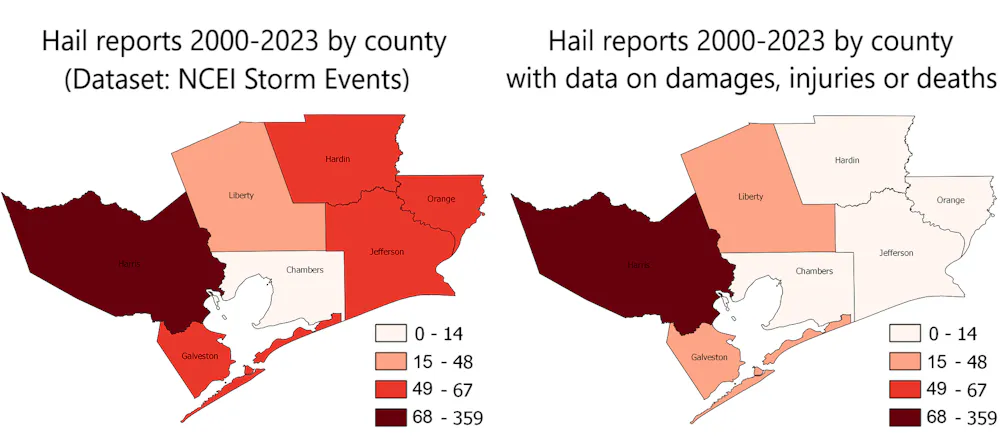
    The number of severe hail reports in southeast Texas listed in the National Centers for Environmental Information’s storm events database is strongly correlated with population. The county with the most reports and greatest detail in those reports is home to Houston. Hailstorms in the three easternmost counties are rarely associated with damage estimates.
    John Nielsen-Gammon and B.J. Baule

    Do you want to look at local damage trends? Forget about it. For most extreme weather events, estimation methods vary over time and are not documented.

    Do you want to direct funding to help communities improve resilience to natural disasters where the need is greatest? Forget about it. The places experiencing the largest per capita damages depend not just on actual damages but on the different practices of local National Weather Service offices.

    Are you moving to a location that might be vulnerable to extreme weather? Companies are starting to provide localized risk estimates through real estate websites, but the algorithms tend to be proprietary, and there’s no independent validation.

    4 steps to improve disaster data

    We believe a few fixes could make NOAA’s storm events database and the corresponding values in the larger SHELDUS database, managed by Arizona State University, more reliable. Both databases include county-level disasters and loss estimates for some of those disasters.

    First, the National Weather Service could develop standard procedures for local offices for estimating disaster damages.

    Second, additional state support could encourage local emergency managers to make concrete damage estimates from individual events and share them with the National Weather Service. The local emergency manager generally knows the extent of damage much better than a forecaster sitting in an office a few counties away.

    Third, state or federal governments and insurance companies can agree to make public the aggregate loss information at the county level or other scale that doesn’t jeopardize the privacy of their policyholders. If all companies provide this data, there is no competitive disadvantage for doing so.

    Fourth, NOAA could create a small “tiger team” of damage specialists to make well-informed, consistent damage estimates of larger events and train local offices on how to handle the smaller stuff.

    With these processes in place, the U.S. wouldn’t need a billion-dollar disasters program anymore. We’d have reliable information on all the disasters.

    John Nielsen-Gammon receives funding from the National Oceanic and Atmospheric Administration and the State of Texas.

    William Baule receives funding from NOAA, the State of Texas, & the Austin Community Foundation.

    ref. Extreme weather’s true damage cost is a mystery – that’s a problem for understanding storm risk – https://theconversation.com/extreme-weathers-true-damage-cost-is-a-mystery-thats-a-problem-for-understanding-storm-risk-257105

    MIL OSI – Global Reports

  • MIL-OSI Global: New start date for the Anthropocene proposed – when humans first changed global methane levels

    Source: The Conversation – UK – By Vincent Gauci, Professorial Fellow, School of Geography, Earth and Environmental Sciences, University of Birmingham

    Robsonphoto/Shutterstock

    Humans have been reshaping the environment for at least 10,000 years. But the Anthropocene is the name given to the specific period of Earth history during which humans have had a global effect on the planet’s climate and ecosystems. Despite formal rejection as a geological epoch, it’s widely understood within academic research as useful shorthand for the age of human interference in the Earth system.

    Various dates have been proposed for when the anthropocene effectively began, from the early 17th century to the mid-20th century, when the first atomic weapons were detonated. My new research into atmospheric methane concentration supports the idea of an early date, when European arrival in the Americas first had a notable impact on the atmosphere, but slightly before previous estimates.

    Ice cores – cylinders of ice drilled from glaciers and ice sheets – provide important evidence of historical changes in the global atmospheric composition. It is from these records that a date for the Anthropocene’s pre-industrial beginnings was first proposed in 2015 by two Earth systems scientists at the University College London, Simon Lewis and Mark Maslin.

    They suggested that an unprecedented drop in the level of CO₂ in the atmosphere that was recorded in ice cores – known as the “Orbis spike” – dates back to 1610. This unusually low level reflects additional atmospheric CO₂ absorption into trees from forest regrowth in the Americas following European arrival in the late 1400s.


    Get your news from actual experts, straight to your inbox. Sign up to our daily newsletter to receive all The Conversation UK’s latest coverage of news and research, from politics and business to the arts and sciences.


    From European arrival in 1492 and colonisation in the 1500s, the introduction of disease, mostly smallpox, resulted in demographic collapse of around 50 million people across the Americas. Lewis and Maslin proposed that, as millions of hectares of farmland went untended, forests could regrow and this increased CO₂ removal from the atmosphere.

    This happened in sufficient quantities to be recorded in glacial ice. And that change became a global marker for the start of the so-called Anthropocene.


    Read more:
    Why the Anthropocene began with European colonisation, mass slavery and the ‘great dying’ of the 16th century


    My own research into changing methane concentrations indicates that the Anthropocene began slightly earlier than that, in 1592. Ice core records show a minimum atmospheric methane concentration exactly 100 years after explorer Christopher Columbus first set foot in the Americas. This, I believe, strengthens support for the hypothesis put forward by Lewis and Maslin a decade ago.

    In a paper published in Nature Reviews, Earth and Environment, I consider the effects of global fluctuations in how trees and forests exchange methane. Methane is a greenhouse gas that is around 80 times more powerful than carbon dioxide over a 20-year period. Crucially, methane has a short lifetime of just under ten years, so any ice core record will be far more responsive to changes to the methane cycle than that of longer-lived CO₂.


    Read more:
    Methane is pitched as a climate villain – could changing how we think about it make it a saviour?


    Trees are a methane sink

    So what’s the link to trees? Trees and their woody bark surfaces, despite their biologically inert appearance when compared to leaves, are important interfaces of methane exchange. In swamps and forested floodplains like the Amazon, they are exit points of methane to the atmosphere from the saturated soils where the methane is formed by anaerobic soil microbes.

    However, last year, my team uncovered how the more extensive areas of forest growing on free-draining soils interact with atmospheric methane. The trees host microbes that directly remove methane from the atmosphere.

    This is one of two mechanisms that, together, might explain an unprecedented drop in atmospheric methane concentrations recorded in Antarctic ice cores in the first century following European arrival in the Americas. This would support Lewis and Maslin’s idea that regrowing forests in that period had global effects.

    With more trees growing on abandoned farmland, there was more woody tree surface area in contact with the atmosphere. This meant more methane being taken up by the microbes they host.

    Measuring methane uptake of trees.
    Vincent Gauci, CC BY-NC-ND

    The second mechanism relates to how trees intercept incoming rainfall. Some rainfall is re-evaporated before reaching the soil. Any rain reaching the soil may then be taken up by tree roots and released back to the atmosphere. The rest moves into the soil or washes off into rivers and wetlands.

    It is possible that the spike in forest regrowth led to more evaporation and transpiration. So more water was released by the trees back to the atmosphere and less washed off over the soil surface.

    This limited water flowing into wetlands. Those wetlands are a major methane source. So a small shrinkage in wetland area, combined with more trees absorbing atmospheric methane, could have reduced the atmospheric methane concentration and explain the minimum methane levels observed in 1592.

    When exactly the Anthropocene began may be an argument that has been overtaken by the decision to not label it a new epoch. Indeed, it’s possible that forest clearance for early agriculture by humans around 5,000-8,000 years ago in the mid-Holocene, (a period of relative climate stability in the Neolithic period) contributed to the atmospheric methane increase observed in Antarctic ice from that time.

    As well as an ancient trace of human influence over our forests, the ice core methane records provide a chance to evaluate newly discovered processes operating in the world’s forests. This is something I’m now investigating with my colleague Peter Hopcroft, a palaeoclimate modeller at the University of Birmingham.

    Whether through forest clearances for early agriculture or through the effects on forests of massive depopulation of Indigenous peoples following European contact, these traces of our past influence point to something significant: that there has always been an intimate and evolving connection between humanity and the natural world. A connection so fundamental that, for the vast span of our existence as a species, we have been inseparable from nature itself.


    Don’t have time to read about climate change as much as you’d like?

    Get a weekly roundup in your inbox instead. Every Wednesday, The Conversation’s environment editor writes Imagine, a short email that goes a little deeper into just one climate issue. Join the 45,000+ readers who’ve subscribed so far.


    Vincent Gauci receives funding from or has received funding from the Natural Environment Research Council, The Royal Society, Spark Climate Solutions, AXA Research Fund, Defra and the JABBS Foundation.

    ref. New start date for the Anthropocene proposed – when humans first changed global methane levels – https://theconversation.com/new-start-date-for-the-anthropocene-proposed-when-humans-first-changed-global-methane-levels-258834

    MIL OSI – Global Reports

  • MIL-OSI Global: Britain’s plan for defence AI risks the ethical and legal integrity of the military

    Source: The Conversation – UK – By Elke Schwarz, Professor of Political Theory, Queen Mary University of London

    Autonomous technology on the battlefield may not look like ‘killer robots’, but still has huge ethical implications. TSViPhoto/Shutterstock

    In an unstable geopolitical climate, the UK’s strategic defence review focused on improving national resilience, from critical infrastructure security to technology and innovation. Many of the review’s recommendations have to do with transforming defence through artificial intelligence (AI) and autonomy, to make the armed forces “ten times more lethal”.

    These recommendations and investments – drones, autonomous systems and £1 billion for a “digital targeting web” that would connect weapons systems – may well make the armed forces more lethal. But this comes at a risk to the ethical and legal integrity of the military.

    A key part of international humanitarian law is the principle of precautions in attack. This requires that those planning an attack must do everything they feasibly can to ensure that targets are of a military nature. Similar is the principle of distinction, which mandates that civilians must never become a target.

    In armed conflict, these principles are meant to protect civilians. They require human judgement — the ability to weigh up context, intent and likely outcomes. But how might they be upheld when humans are embedded in AI systems, which prioritise speed and scale in decision-making and action?


    Get your news from actual experts, straight to your inbox. Sign up to our daily newsletter to receive all The Conversation UK’s latest coverage of news and research, from politics and business to the arts and sciences.


    An AI-enabled digital targeting web, like the one proposed in the strategic review, connects information (sensors) and action (weapons), enabling faster identification and elimination of potential targets. These webs would be able to identify and suggest possible targets considerably faster than humans. In many cases, leaving soldiers with only a few minutes, or indeed seconds, to decide whether these targets are appropriate or legitimate in legal or ethical terms.

    One example already in use is the Maven Smart System, which was recently procured by Nato. This system could make it possible for small army teams to make up to “1,000 tactical decisions an hour”, according to a report by the US thinktank the Center for Security and Emerging Technology.

    Legal scholars have argued that the prioritisation of speed with AI in conflict “leaves little room for human judgement” or restraint.

    Unlike other technologies used in war, AI is more than an instrument. It is part of a cognitive system of humans and machines, which makes human control a lot more complicated than operating a fleet of tanks.

    Proponents of autonomous weapons and AI targeting systems often argue that this technology would make warfare more precise, dispassionate and humane. However, military ethics scholar Neil Renic and I have shown how it can instead lead to an erosion of moral restraint, creating a war environment where technological processes replace moral reasoning.


    Read more:
    Silicon Valley’s bet on AI defence startups and what it means for the future of war – podcast


    Training the data

    The strategic defence review lauds autonomy as providing “greater accuracy”, but this is complicated by technical and human limitations. Instead of providing greater accuracy in targeting, AI-enabled systems threaten to undermine the principle of distinction and precaution.

    AI systems also bear technical challenges for something as complex and dynamic as warfare. AI-supported systems are only as good as the data on which they are trained. Appropriate, comprehensive and up-to-date data is hard to come by in conflict, and dynamics can change quickly.

    This is particularly true in urban conflicts. Understanding the complexities of a situation on the ground is difficult enough for human military personnel, without bringing in AI.

    New AI models, in particular, bear risks. AI large language models are known to “hallucinate” – produce outputs that are erroneous or made up. As these systems are integrated into defence, the risks of technological failure become more pronounced.

    AI could significantly speed up targeting technology.
    Yuri A/Shutterstock

    There is also a considerable risk of this technology enabling uncontrolled escalation and conflict at speed – what scholars have described as a “flash war”. Escalation from crisis to war, or escalating a conflict to a higher level of violence, could come about due to erroneous indications of attack, or a simple sensor or computer error.

    Consider an AI system alerting commanders of a hostile tank approaching a border area. With potentially only minutes to spare, time for verification of the incoming information is sparse. Commanders may “prioritise rapid response over thorough analysis”. If the tank turns out to be a school bus, this response could have further retaliatory consequences.

    Unpredictable systems could also give leaders false impressions of their capabilities, leading to overconfidence or encouraging preemptive attacks. This all may lead to greater global instability and insecurity.

    Responsible AI

    The UK government has shown that it is aware of some of these risks. Its 2022 report on responsible AI in defence emphasised ethics in the use of AI. It specified that the deployment “of AI-enabled capabilities in armed conflict needs to comply fully with [international humanitarian law]”, including the principles of distinction, necessity, humanity and proportionality.

    The report also notes that responsible and ethical use of AI systems requires reliability and human understanding of the AI system and its decisions.

    The strategic defence review, on the other hand, notes that the speed with which technologies develop is outpacing regulatory frameworks. It says that “the UK’s competitors are unlikely to adhere to common ethical standards in developing or using them”.

    This might be so, but it should not open the door to a less ethical and responsible development or use of such systems by the UK. Ethics is not only about how we treat others, but also about who we are.

    The UK still has an opportunity to shape global norms around military AI — before a generation of unaccountable systems becomes the default. But that window for action is closing rapidly.

    Elke Schwarz is affiliated with the International Committtee for Robot Arms Control (ICRAC)

    ref. Britain’s plan for defence AI risks the ethical and legal integrity of the military – https://theconversation.com/britains-plan-for-defence-ai-risks-the-ethical-and-legal-integrity-of-the-military-258149

    MIL OSI – Global Reports

  • MIL-OSI Global: Iran air strikes: Republicans split over support for Trump and another ‘foreign war’

    Source: The Conversation – UK – By Richard Hargy, Visiting Research Fellow in International Studies, Queen’s University Belfast

    After returning early from the G7 summit in Canada, Donald Trump met with his national security team to be briefed on the escalating Israel-Iran conflict. It became clear that Trump was considering direct US military support for the Israelis.

    This has the potential to cause a split among the president’s supporters between the Republican hawks (traditional interventionists) on one side and the Maga isolationists on the other.

    During his three presidential campaigns, Trump condemned former presidents for leading America into “ridiculous endless wars”. This isolationist tilt won him plaudits with his base of those who supported him for his populist promises to “make America great again” (Maga).

    In their work on US attitudes to foreign policy and US overseas involvement, Elaine Kamarck and Jordan Muchnick of the Brookings Institution – a non-profit research organisation in Washington – looked at a range of evidence in 2023.


    Get your news from actual experts, straight to your inbox. Sign up to our daily newsletter to receive all The Conversation UK’s latest coverage of news and research, from politics and business to the arts and sciences.


    They found Republicans supporting less global involvement from the US had increased from 40% to 54% from 2004 to 2017. At that time only 16% of voters supported increasing US troop presence abroad, and 40% wanted a decrease, they found. They related this change in attitudes to Trump’s foreign policy position.

    Fast forward to his second term, and many in the Maga camp are fiercely opposed to Trump’s current posturing about leading the US into another conflict in the Middle East. Over the past few days the White House has doubled down on the line that Trump keeps repeating: “Iran can not have a nuclear weapon”.

    As Trump edges closer to committing the US to joining Israel in air strikes on Iran, Steve Bannon, a staunch Trump ally, argued that allowing the “deep state” to drive the US into conflict with Iran would “blow up” the coalition of Trump support.

    Meanwhile, Conservative podcaster Tucker Carlson denounced those Republicans supporting action against Iran as “warmongers” and said they were encouraging the president to drag the US into a war.

    Congresswoman Majorie Taylor Greene, in an unusual break with Trump, openly criticised the president’s stance on the Israel-Iran conflict, writing on X: “Foreign wars/intervention/regime change put America last, kill innocent people, are making us broke, and will ultimately lead to our destruction.”

    Other prominent Republican senators, including Josh Hawley and Rand Paul, have urged the president to avoid US involvement in an offensive against Iran.

    Another Republican congressman, Thomas Massie, has gone even further. He has joined with a coalition of Democrats in filing a House resolution under the War Powers Resolution of 1973, which would seek to prevent Trump from engaging in “unauthorized hostilities” with Iran without Congressional consent.

    These Republicans may believe their views are popular with their electoral base. In an Economist/YouGov poll in June 2025, 53% of Republicans stated that they did not think the US military should get involved in the conflict between Israel and Iran.

    But Donald Trump does seem to enjoy widespread support in the US for his position that the US cannot allow Iran to develop a nuclear weapon. According to CNN data analysis, 83% of Republicans, 79% independents, and 79% of Democrats, agree with the president’s position on this issue. This slightly confusing split suggests there could be US voter support for air strikes, but it’s clear there would not be that same support for troops on the ground.

    Resistance from ultra-Trump die-hards, however, might put them on the wrong side of the president in the long-term. Greg Sargent, a writer at The New Republic magazine, believes that, “people become enemies of Trump not when they substantively work against some principle he supposedly holds dear, but rather when they publicly criticize him … or become an inconvenience in any way”.

    So why is Trump, to the dismay of many from within the Maga faithful, seemingly abandoning the anti-war tenet of his “America first” doctrine? Jacob Heilbrunn, editor of The National Interest magazine, thinks that “now that Israel’s assault on Iran appears to be successful, Trump wants in on the action”.

    The president has several prominent Republican hawks urging him to do exactly that, and order the US Air Force to deploy their “bunker-buster bombs”“ to destroy Iran’s underground arsenals. One of these is Senator Lindsey Graham.

    Earlier this week on Fox News, he told Trump to be “all in … in helping Israel eliminate the nuclear threat. If we need to provide bombs to Israel, provide bombs. If we need to fly planes with Israel, do joint operations.”

    Former Republican Senate leader Mitch McConnell is also advocating US military action. He told CNN: “What’s happening here is some of the isolationist movement led by Tucker Carlson and Steve Bannon are distressed we may be helping the Israelis defeat the Iranians,” adding that its “been kind of a bad week for the isolationists” in the party.

    Donald Trump talks about potential involvement in air strikes.

    The same Economist/YouGov poll mentioned earlier showed that the stance taken by these Republicans – that Iran poses a threat to the US – is a position shared by a majority of GOP voters, with 69% viewing Iran as either an immediate and serious threat to the US, or at least somewhat of a serious threat.

    Always an interventionist?

    Some believe that Trump’s evolving attitude towards American military involvement in the worsening crisis in the Middle East, however, is not a volte-face on isolationism, or an ideological pivot to the virtues of attacking Iran. Ross Douthat of the New York Times has observed that Trump “has never been a principled noninterventionist” and that “his deal-making style has always involved the threat of force as a crucial bargaining chip”.

    It is always difficult to fully determine what Trump’s foreign policy doctrine actually is. It is useful, however, to reflect on some of the president’s overseas actions from his first term.

    In April 2018, following a suspected chemical weapons attack by the forces of Syrian president Bashar al-Assad in a Damascus suburb, Trump ordered US air strikes in retaliation for what he called an “evil and despicable attack” that left “mothers and fathers, infants and children thrashing in pain and gasping for air”.

    This led the editor-in-chief of The Atlantic magazine, Jeffrey Goldberg, to describe Trump as “something wholly unique in the history of the presidency: an isolationist interventionist”.

    Richard Hargy does not work for, consult, own shares in or receive funding from any company or organisation that would benefit from this article, and has disclosed no relevant affiliations beyond their academic appointment.

    ref. Iran air strikes: Republicans split over support for Trump and another ‘foreign war’ – https://theconversation.com/iran-air-strikes-republicans-split-over-support-for-trump-and-another-foreign-war-259314

    MIL OSI – Global Reports

  • MIL-OSI Global: Could trees know when the summer solstice is?

    Source: The Conversation – UK – By Andrew Hacket-Pain, Senior Lecturer, School of Environmental Sciences, University of Liverpool

    cashcashcash/Shutterstock

    People have been celebrating the summer solstice with elaborate rituals since prehistoric times. But humans aren’t the only species to take mark June 21 as a special time. Studies are showing the summer solstice is an important cue for plants too.

    Recent studies, including one of my own, have proposed that trees may use the longest day of the year as a key marker for their growth and reproductive cycles. The solstice seems to act like a calendar reminder for trees.


    Many people think of plants as nice-looking greens. Essential for clean air, yes, but simple organisms. A step change in research is shaking up the way scientists think about plants: they are far more complex and more like us than you might imagine. This blossoming field of science is too delightful to do it justice in one or two stories.

    This story is part of a series, Plant Curious, exploring scientific studies that challenge the way you view plantlife.


    For example, at the solstice, trees growing in cold places slow down the creation of new wood cells and focus their energy on finishing already formed but still incomplete cells. This ensures trees have time to complete cell construction before winter hits. Incomplete cells are damaged by freezing winter temperatures, rendering them useless for water transport the following year.

    Along similar lines, trees use the solstice to fine-tune the “winding down”, or senescence, of their leaves in preparation for autumn. Senescence allows the tree to reabsorb critical nutrients from the leaves before they fall. This process is timed to balance missing out on sunlight from “winding down” too early, against leaving it too late and losing nutrients if still-green leaves are killed by autumn frosts.

    Stonehenge has been part of summer solstice celebrations since ancient times.
    Ria Sh/Shutterstock

    Satellite observations of forests, and controlled experiments in greenhouses, reveal that warmer temperatures immediately prior to the solstice cause the onset of leaf browning to start earlier that autumn. In contrast, warmer temperatures just after the solstice slow down the senescence process.

    This means a longer transition period from green to fully brown leaves. This fine-tuning enables trees to extend the period of photosynthesis in years when temperatures stay warmer for longer, so they don’t miss out on these favourable conditions.

    But not all scientists is convinced. From an evolutionary perspective, the solstice may not be the best seasonal marker for timing these transitions. For example, in forests in the far north, leaves do not appear until early June, only days before the solstice, and the growing season can extend late into October. In these forests, using the solstice to initiate the winding down process makes little sense for trees that have only just started growing for the year.

    Nevertheless, there is more consensus about plants using the solstice to synchronise reproduction.

    In many plants, especially trees from the temperate mid-latitudes, the number of seeds they produce varies dramatically year on year, known as masting. A large European beech tree can produce hundreds of thousands of seeds in a bumper year (a “mast event”) and forgo reproduction altogether in other years.

    Beech trees vary their annual seed production in step, often on a continental scale. They do this to increase the efficiency of their reproduction.

    Beech trees coordinate their reproduction.
    Gabriele Rohde/Shutterstock

    A small moth, Cydia fagiglandana, lays its eggs in beech flowers. When the grubs hatch, they eat and destroy the developing seeds. Cycles of famine and bumper years help protect their seeds from these moths.

    UK beech trees typically lose less than 5% of their seeds to Cydia because the cycles starve the moths into low numbers ready for masting years. But when trees are out of sync, seed loss can increase to over 40%.

    For decades we have known that beech mast events happen in the year after a warm summer. These warmer temperatures trigger an increase in the formation of flower buds. More flower buds usually lead to a greater crop of seeds that autumn.

    Scientists have long puzzled over how beech trees across Europe seem to use the same seasonal window to control mast events. Their seed production is determined by temperatures in late June and early July, irrespective of where they grow in Europe. But how can a beech tree know the date?

    In my team’s 2024 study, we showed that they use the solstice as a seasonal marker. As soon as the days start to shorten after the solstice, beech trees across Europe seem to simultaneously sense the temperature.

    Anywhere temperatures are above average in the weeks following the solstice can expect to have a mast event the next year. Weather conditions in the weeks before the solstice, by contrast, seem to be irrelevant. As seen on weather maps, warm and cool spells tend to occur simultaneously over large areas.

    This allows beech trees to maximise the synchrony of their reproduction, whether that is investing in a mast year (warm temperatures), or forgoing reproduction for a year (low temperatures). Using a fixed marker like the solstice is the key to achieving this synchrony, and the benefits that come from it.

    Note how bumper seed crops and failures tend to be regionally synchronised, and occasionally occur as pan-European events.
    Andrew Hacket Pain, CC BY-NC-ND

    The evidence for this phenomenon has come from observations across dozens of forests across Europe. However, my research group is collaborating with about a dozen other groups in Europe to test this effect by manipulating the temperature of beech branches before and after the solstice at different sites. Ongoing research I am involved with seems to show flowering genes are activated at the summer solstice.

    Also, studies into the circadian rhythms of plants show they have mechanisms in their molecules that allow them to detect and respond to tiny changes in day length. This is the basis for that extraordinary scale of synchronised reproduction.

    If the weather is warm over the next month or so, then there is a good chance that beech trees in your local area will have heavy seed crops next autumn. What’s more, trees across the UK and into northern and central Europe will probably be doing the same.

    Andrew Hacket-Pain has received funding from UKRI, Defra and the British Council.

    ref. Could trees know when the summer solstice is? – https://theconversation.com/could-trees-know-when-the-summer-solstice-is-259309

    MIL OSI – Global Reports

  • MIL-OSI Africa: Tanzania celebrates and honors Akinwumi Adesina’s impactful legacy as President of the African Development Bank

    Source: Africa Press Organisation – English (2) – Report:

    The Government of the United Republic of Tanzania, on 14 June, has honored the President of the African Development Bank Group (www.AfDB.org) Dr Akinwumi Adesina describing him as “a visionary leader, a tireless son of Africa who has dedicated his life to transform the narrative of the continent.”

    President Samia Suluhu Hassan praised Adesina’s vital role in the development of her country’s economy, singling out large-scale infrastructure projects financed by the Bank.

    During a two-day visit to Tanzania that began on Friday, Bank president Dr Akinwumi Adesina was invited on a tour of some of the Bank-financed infrastructure projects that are transforming Tanzania’s economy and strengthening its regional and international roles. This includes a new international airport and a major highway that encircles the administrative capital of Dodoma.

    The Tanzanian leader highlighted projects in other sectors, such as agriculture and energy, that are financed by the Bank.

    “This is in addition to the construction of a modern Standard Gauge Railway line that will link Tanzania to Burundi and the Democratic Republic of Congo,” said President Suluhu Hassan.

    The African Development Bank Group has invested $9 billion in Tanzania since it started its operations in the country in 1971. Total financial support over the last 10 years under Adesina’s leadership stands at $4.73 billion, equivalent to 53% of the Bank’s lending to Tanzania over the past 54 years.

    “On behalf of the people of Tanzania, I express our gratitude to the African Development Bank for being a dependable partner of our country’s development journey,” the Tanzanian President said.

    Referencing the Bank’s transformative impact, Tanzania’s President Samia Suluhu Hassan told Adesina, “Your visionary leadership has brought significant socio-economic change to Tanzania and across Africa.”

    To cheers from the crowd President Suluhu Hassan announced, “I have accepted a recommendation by the Ministry of Works to rename the Dodoma Outer Ring Road as the Dr Akinwumi Adesina Road.”

    Adesina, accompanied by his wife, Grace Yemisi Adesina, was visibly moved to tears.

    The newly named 112-kilometer dual carriageway is a strategic link in the Cape to Cairo continental corridor. It will decongest Tanzania’s fast-growing administrative capital and enhance regional connectivity.

    The Bank provided $138 million in funding for the project, with an additional $42 million from the Africa Growing Together Fund and $34.69 million from the Government of Tanzania.

    Earlier, Adesina surprised the crowd when he delivered a lengthy portion of his speech in Kiswahili, the national language of Tanzania, which is widely spoken in East and Central Africa. After recognizing all dignitaries in Kiswahili, he went on to thank President Suluhu Hassan for the warm and generous hospitality accorded to him, first in the City of Peace, Dar es Salaam, and in the attractive city of Dodoma.

    “Mheshimiwa Rais Samia Suluhu Hassan, ningependa kukushukuru kwa mapokezi yako ya upendo na ukarimu tuliopewa jana katika jiji la amani, Dar es Salaam na hapa pia katika jiji lenye mvuto la Dodoma. Nimefurahi sana kuwa hapa Dodoma,” Adesina said as the crowd cheered him on.

    Earlier, on Friday 13 June, Adesina was awarded a Doctor of Science Honorary Degree (Honoris Causa) from the prestigious University of Dar es Salaam.

    The citation highlighted Adesina’s leadership and “lifelong dedication to public service, evidence-based policymaking, and pan-African progress.”

    It read further: “Dr Adesina exemplifies the rare blend of academic brilliance, visionary leadership, and practical impact that honorary doctorates are meant to recognize. His emphasis on inclusive growth, innovation, and economic resilience makes him a beacon of integrity, excellence, and servant leadership.”

    The honorary degree was bestowed on Adesina by the Chancellor of the University and former President Jakaya Mrisho Kikwete, who said, “I would like to tell Tanzanians, the African Development Bank has been a major anchor of Tanzania’s development sector. When it comes to infrastructure, no institution comes close to the African Development Bank.”

    Addressing the graduating class, Adesina spoke of his humble beginnings, emphasizing resilience, character, and unity. “Success cannot be achieved alone,” he said, inviting the students to rise, link hands, and repeat together: “Together, we will succeed and make a difference.”

    In his congratulatory remarks, Finance Minister Mwigulu Nchemba said, “Tanzania is proud to stand among the nations celebrating this remarkable journey and enduring legacy.”

    From Dar es Salaam, Adesina, accompanied by former President Kikwete and Finance Minister Nchemba, took the Standard Gauge Railway train for the three-hour, 450-kilometre journey to Dodoma.

    The African Development Bank Group has established a syndication strategy to mobilize $1.2 billion in conjunction with Deutsche Bank, Société Générale, and other partners for the 651-kilometre extension of the electrified Standard Gauge Railway that will connect Tanzania to Burundi and the Democratic Republic of Congo.

    The project financing, signed during the 2024 Africa Investment Forum Market Days and includes more than $85 million from the Bank’s concessional financing window, the African Development Fund, a mix of Partial Credit Guarantees totaling $994.3 million across some sections of the railway, complemented by $247 million from the Government of Tanzania in counterpart financing. Initial disbursement from the African Development Fund and partner, the OPEC Fund, is expected by July 2025.

    Adesina said, “This railway line is a cornerstone of East Africa’s regional integration vision, aimed at delivering a modern, cost-effective, and high-capacity transport system anchored on the port of Dar es Salaam and linking landlocked nations.”

    “Our shift from traditional road systems to integrated transport solutions is helping position Tanzania as a key logistics and trade hub in the region,” he added.

    Accompanied by Adesina, President Suluhu Hassan travelled across more than 30 kilometers of the Dodoma Outer Ring Road, stopping along the way at the Bank-funded Msalato International Airport which is expected to be completed by the end of 2026. The state-of-the-art airport features a 3.6-kilometre landing strip—one of the longest in East Africa, with a capacity to accommodate Airbus A380 aircraft.

    The African Development Bank has provided over $198 million to finance the Msalato International Airport project with $23 million coming from the African Development Fund and $50 million from the African Grow Together Fund.

    – on behalf of African Development Bank Group (AfDB).

    Media contact:
    Christin Roby
    Regional Communication Officer for East Africa
    Communication and External Relations
    Email: media@afdb.org

    About the African Development Bank Group:
    The African Development Bank Group is Africa’s premier development finance institution. It comprises three distinct entities: the African Development Bank (AfDB), the African Development Fund (ADF) and the Nigeria Trust Fund (NTF). On the ground in 41 African countries with an external office in Japan, the Bank contributes to the economic development and the social progress of its 54 regional member states. For more information: www.AfDB.org

    Media files

    Download logo

    MIL OSI Africa

  • MIL-OSI: Haivision Announces Availability of Latest Release of the Kraken Video Processing Platform with Shield AI Object Detection

    Source: GlobeNewswire (MIL-OSI)

    MONTREAL, June 19, 2025 (GLOBE NEWSWIRE) — Haivision (TSX: HAI), a leading global provider of mission-critical, real-time video networking and visual collaboration solutions, today announced the availability of the latest release of the Kraken video processing platform with Shield AI object detection, bringing the power of AI to full motion video and metadata processing, and enabling quick and life-saving decision making.

    Designed for intelligence, surveillance, and reconnaissance (ISR) and situational awareness applications, Kraken encodes, transcodes, and transports high quality video and metadata in real-time, even in environments where network bandwidth is unpredictable or limited. The latest update to Kraken features the availability of a new option – Shield AI’s Sentient Tracker, an AI-powered software for superior object detection for multi-domain operations.

    Tracker uses AI and two decades of computer vision research and development to detect moving objects in full-motion video, turning raw data into actionable intelligence with speed and efficiency. It can detect moving objects on land such as vehicles and people and in maritime settings stationary and moving targets such as boats, vessels, individuals, and life jackets.

    Kraken’s advanced capabilities enable real-time transcoding of live video streams to ensure downstream system compatibility, while also transporting essential metadata such as object detection and tracking information within the full-motion video (FMV) stream. When integrated with Shield AI’s Tracker software, the solution can automatically detect and track objects in live video captured by crewed or uncrewed aircraft operating in complex land and maritime environments. Downstream systems can use the combined video with augmented tracking information either as overlays of tracking boxes or as inputs to common operating picture tools like TAK or ATAK. Together, these capabilities streamline the ISR workflow, enabling faster, more informed decision-making in mission-critical operations.

    “The latest release of Kraken with Tracker brings the best of breed tracking algorithms from Shield AI to real-time FMV – making it possible for our users to obtain AI-enabled insights to their streams anywhere Kraken can run – on purpose-built hardware at the tactical edge, on servers in the data center, or in the cloud,” said John Leipper, Defense Product Manager, Haivision.

    “We’re excited to collaborate with Haivision to integrate our advanced AI object detection technology with their defense-certified Kraken video processing software,” said Christian Gutierrez, Vice President of Hivemind Engineering at Shield AI. “By combining Tracker with Haivision’s trusted ISR video ecosystem, we’re enabling customers to seamlessly apply AI within existing video workflows for faster, more informed decision-making.” Kraken is a cornerstone solution in Haivision’s ISR video solutions portfolio, including the recently announced Kraken X1 Rugged video transcoder, Makito X4 Rugged video encoder, Makito X1 Rugged video encoder, and Haivision Play ISR video player, products which adhere to rigorous cybersecurity and interoperability standards for use within defense networks.

    Trusted globally to support critical missions, Shield AI is a deep-tech company building state-of-the-art autonomy software products and defense aircraft. Shield AI’s advanced artificial intelligence and computer vision technology empower defense, government, and public safety organizations to rapidly transform raw data into actionable intelligence, enhancing decision-making and operational effectiveness. Committed to innovation, security, and reliability, Shield AI solutions integrate seamlessly into existing defense workflows, supporting mission success in complex environments worldwide.

    Deployed and trusted worldwide, Haivision’s mission-critical video solutions help aerospace, enterprise, government, military, and public safety organizations make informed decisions faster. Haivision’s video wall systems for command centers, video distribution solutions, and ISR video technology fuel real-time analysis and decision-making. To learn more about the combined Tracker and Kraken solution, watch the recent webinar with Haivision and Shield AI experts: AI Object Detection from Anywhere.

    About Haivision 
    Haivision is a leading global provider of mission-critical, real-time video networking and visual collaboration solutions. Our connected cloud and intelligent edge technologies enable organizations globally to engage audiences, enhance collaboration, and support decision-making. We provide high-quality, low-latency, secure, and reliable live video at a global scale. Haivision open-sourced its award-winning SRT low-latency video streaming protocol and founded the SRT Alliance to support its adoption. Awarded four Emmys® for Technology and Engineering from the National Academy of Television Arts and Sciences, Haivision continues to fuel the future of IP video transformation. Founded in 2004, Haivision is headquartered in Montreal and Chicago with offices, sales, and support located throughout the Americas, Europe, and Asia. To learn more, visit Haivision at www.haivision.com.

    Contact:
    Lamia Milonas
    PR and Communications Manager 
    (514) 799-8105

    The MIL Network

  • MIL-OSI: Haivision Announces Availability of Latest Release of the Kraken Video Processing Platform with Shield AI Object Detection

    Source: GlobeNewswire (MIL-OSI)

    MONTREAL, June 19, 2025 (GLOBE NEWSWIRE) — Haivision (TSX: HAI), a leading global provider of mission-critical, real-time video networking and visual collaboration solutions, today announced the availability of the latest release of the Kraken video processing platform with Shield AI object detection, bringing the power of AI to full motion video and metadata processing, and enabling quick and life-saving decision making.

    Designed for intelligence, surveillance, and reconnaissance (ISR) and situational awareness applications, Kraken encodes, transcodes, and transports high quality video and metadata in real-time, even in environments where network bandwidth is unpredictable or limited. The latest update to Kraken features the availability of a new option – Shield AI’s Sentient Tracker, an AI-powered software for superior object detection for multi-domain operations.

    Tracker uses AI and two decades of computer vision research and development to detect moving objects in full-motion video, turning raw data into actionable intelligence with speed and efficiency. It can detect moving objects on land such as vehicles and people and in maritime settings stationary and moving targets such as boats, vessels, individuals, and life jackets.

    Kraken’s advanced capabilities enable real-time transcoding of live video streams to ensure downstream system compatibility, while also transporting essential metadata such as object detection and tracking information within the full-motion video (FMV) stream. When integrated with Shield AI’s Tracker software, the solution can automatically detect and track objects in live video captured by crewed or uncrewed aircraft operating in complex land and maritime environments. Downstream systems can use the combined video with augmented tracking information either as overlays of tracking boxes or as inputs to common operating picture tools like TAK or ATAK. Together, these capabilities streamline the ISR workflow, enabling faster, more informed decision-making in mission-critical operations.

    “The latest release of Kraken with Tracker brings the best of breed tracking algorithms from Shield AI to real-time FMV – making it possible for our users to obtain AI-enabled insights to their streams anywhere Kraken can run – on purpose-built hardware at the tactical edge, on servers in the data center, or in the cloud,” said John Leipper, Defense Product Manager, Haivision.

    “We’re excited to collaborate with Haivision to integrate our advanced AI object detection technology with their defense-certified Kraken video processing software,” said Christian Gutierrez, Vice President of Hivemind Engineering at Shield AI. “By combining Tracker with Haivision’s trusted ISR video ecosystem, we’re enabling customers to seamlessly apply AI within existing video workflows for faster, more informed decision-making.” Kraken is a cornerstone solution in Haivision’s ISR video solutions portfolio, including the recently announced Kraken X1 Rugged video transcoder, Makito X4 Rugged video encoder, Makito X1 Rugged video encoder, and Haivision Play ISR video player, products which adhere to rigorous cybersecurity and interoperability standards for use within defense networks.

    Trusted globally to support critical missions, Shield AI is a deep-tech company building state-of-the-art autonomy software products and defense aircraft. Shield AI’s advanced artificial intelligence and computer vision technology empower defense, government, and public safety organizations to rapidly transform raw data into actionable intelligence, enhancing decision-making and operational effectiveness. Committed to innovation, security, and reliability, Shield AI solutions integrate seamlessly into existing defense workflows, supporting mission success in complex environments worldwide.

    Deployed and trusted worldwide, Haivision’s mission-critical video solutions help aerospace, enterprise, government, military, and public safety organizations make informed decisions faster. Haivision’s video wall systems for command centers, video distribution solutions, and ISR video technology fuel real-time analysis and decision-making. To learn more about the combined Tracker and Kraken solution, watch the recent webinar with Haivision and Shield AI experts: AI Object Detection from Anywhere.

    About Haivision 
    Haivision is a leading global provider of mission-critical, real-time video networking and visual collaboration solutions. Our connected cloud and intelligent edge technologies enable organizations globally to engage audiences, enhance collaboration, and support decision-making. We provide high-quality, low-latency, secure, and reliable live video at a global scale. Haivision open-sourced its award-winning SRT low-latency video streaming protocol and founded the SRT Alliance to support its adoption. Awarded four Emmys® for Technology and Engineering from the National Academy of Television Arts and Sciences, Haivision continues to fuel the future of IP video transformation. Founded in 2004, Haivision is headquartered in Montreal and Chicago with offices, sales, and support located throughout the Americas, Europe, and Asia. To learn more, visit Haivision at www.haivision.com.

    Contact:
    Lamia Milonas
    PR and Communications Manager 
    (514) 799-8105

    The MIL Network

  • MIL-OSI Global: Trump administration’s conflicting messages on Chinese student visas reflect complex US-China relations

    Source: The Conversation – USA – By Meredith Oyen, Associate Professor of History and Asian Studies, University of Maryland, Baltimore County

    The U.S. announced plans to scrutinize and revoke student visas for students with ties to the Chinese Communist Party or whose studies are in critical fields, but appears to have reconsidered. The decision and apparent about-face could have a wide-ranging impact on both nations. LAW Ho Ming/Getty Images

    President Donald Trump appears to have walked back plans for the U.S. State Department to scrutinize and revoke visas for Chinese students studying in the country.

    On June 11, 2025, Trump posted on his social media platform TruthSocial that visas for Chinese students would continue and that they are welcome in the United States, as their presence “has always been good with me!”

    The announcement came weeks after Secretary of State Marco Rubio announced that his department would begin scrutinizing and revoking student visas for Chinese nationals with ties to the Chinese Communist Party, or whose studies are in critical fields.

    The contradictory moves have led to confusion among Chinese students attending college or considering studying in the United States.

    Over time, Chinese nationals have faced barriers to studying in the U.S. As a scholar who studies relations between the two nations, I argue that efforts to ban Chinese students in the United States are not unprecedented, and historically they have come with consequences.

    Student visas under fire

    The Trump administration laid out the terms for revoking or denying student visas to Chinese nationals but then backtracked.
    STAP/Getty Images

    Since the late 1970s, millions of Chinese students have been granted visas to study at American universities. That total includes approximately 277,000 who studied in the United States in the 2023-2024 academic year.

    It is difficult to determine how many of these students would have been affected by a ban on visas for individuals with Chinese Community Party affiliations or in critical fields.

    Approximately 40% of all new members of the Chinese Communist Party each year are drawn from China’s student population. And many universities in China have party connections or charters that emphasize party loyalty.

    The “critical fields” at risk were not defined. A majority of Chinese students in the U.S. are enrolled in math, technology, science and engineering fields.

    A long history

    Since the late 1970s, the number of Chinese students attending college in the U.S. has increased dramatically.
    Kenishiroite/Getty Images

    Yung Wing became the first Chinese student to graduate from a U.S. university in 1852.

    Since then, millions of Chinese students have come to the United States to study, supported by programs such as the “Chinese Educational Mission,” Boxer Indemnity Fund scholarships and the Fulbright Program.

    The Institute for International Education in New York estimated the economic impact of Chinese students in the U.S. at over US$14 billion a year. Chinese students tend to pay full tuition to their universities. At the graduate level, they perform vital roles in labs and classrooms. Just under half of all Chinese students attending college in the U.S. are graduate students.

    However, there is a long history of equating Chinese migrants as invaders, spies or risks to national security.

    After the outbreak of the Korean War in 1950, the U.S. Department of Justice began to prevent Chinese scholars and students in STEM fields – science, technology, engineering and math – from returning to China by stopping them at U.S. ports of entry and exit. They could be pulled aside when trying to board a flight or ship and their tickets canceled.

    In one infamous case, Chinese rocket scientist Qian Xuesen was arrested, harassed, ordered deported and prevented from leaving over five years from 1950 to 1955. In 1955, the United States and China began ambassadorial-level talks to negotiate repatriations from either country. After his experience, Qian became a much-lauded supporter of the Communist government and played an important role in the development of Chinese transcontinental missile technology.

    During the 1950s, the U.S. Department of Justice raided Chinatown organizations looking for Chinese migrants who arrived under false names during the Chinese Exclusion Era, a period from the 1880s to 1940s when the U.S. government placed tight restrictions on Chinese immigration into the country. A primary justification for the tactics was fear that the Chinese in the U.S. would spy for their home country.

    Between 1949 and 1979, the U.S and China did not have normal diplomatic relations. The two nations recognized each other and exchanged ambassadors starting in January 1979. In the more than four decades since, the number of Chinese students in the U.S. has increased dramatically.

    Anti-Chinese discrimination

    The idea of an outright ban on Chinese student visas has raised concerns about increased targeting of Chinese in the U.S. for harassment.

    In 1999, Taiwanese-American scientist Wen Ho Lee was arrested on suspicion of using his position at Los Alamos National Laboratory in New Mexico to spy for China. Lee remained imprisoned in solitary confinement for 278 days before he was released without a conviction.

    In 2018, during the first Trump administration, the Department of Justice launched its China Initiative. In its effort to weed out industrial, technological and corporate espionage, the initiative targeted many ethnic Chinese researchers and had a chilling effect on continued exchanges, but it secured no convictions for wrongdoing.

    Trump again expressed concerns last year that undocumented migrants from China might be coming to the United States to spy or “build an army.”

    The repeated search for spies among Chinese migrants and residents in the U.S. has created an atmosphere of fear for Chinese American communities.

    Broader foreign policy context

    An atmosphere of suspicion has altered the climate for Chinese international students.
    J Studios/Getty Images

    The U.S. plan to revoke visas for students studying in the U.S. and the Chinese response is being formed amid contentious debates over trade.

    Chinese Ministry of Foreign Affairs spokesperson Lin Jian accused the U.S. of violating an agreement on tariff reduction the two sides discussed in Geneva in May, citing the visa issues as one example.

    Trump has also complained that the Chinese violated agreements between the countries, and some reports suggest that the announcement on student visas was a negotiating tactic to change the Chinese stance on the export of rare earth minerals.

    When Trump announced his trade deal with China on June 11, he added a statement welcoming Chinese students.

    However, past practice shows that the atmosphere of uncertainty and suspicion may have already damaged the climate for Chinese international students, and at least some degree of increased scrutiny of student visas will likely continue regardless.

    Meredith Oyen does not work for, consult, own shares in or receive funding from any company or organization that would benefit from this article, and has disclosed no relevant affiliations beyond their academic appointment.

    ref. Trump administration’s conflicting messages on Chinese student visas reflect complex US-China relations – https://theconversation.com/trump-administrations-conflicting-messages-on-chinese-student-visas-reflect-complex-us-china-relations-258351

    MIL OSI – Global Reports

  • MIL-OSI Global: The term ‘lone gunman’ ignores the structures that enable violence

    Source: The Conversation – USA – By Art Jipson, Associate Professor of Sociology, University of Dayton

    Members of law enforcement agencies search for shooting suspect Vance Boelter at a house on June 15, 2025, in Belle Plaine, Minn. AP Photo/George Walker IV

    When shots rang out in Minnesota, targeting state Democratic politicians, the headlines quickly followed a familiar script: a mentally unstable suspect and the well-worn label “lone gunman.”

    According to media reports, the Minnesota gunman, Vance Luther Boelter, was a deeply religious anti-abortion activist and a conservative who supported President Donald Trump.

    The term lone gunman, routinely deployed in the aftermath of mass shootings and political violence – that the suspect was simply acting alone, so there’s no one or nothing else to blame – may offer a comforting explanation, but it’s dangerously simplistic.

    It obscures the conditions that made the violence possible in the first place. It casts the perpetrator as an isolated anomaly – mentally unwell, unpredictable, detached from broader movements or ideologies.

    As a scholar of extremism, I argue that the use of this term ignores the larger symptoms of deeper societal failures such as rising political extremism, systemic hate or the normalization of violent rhetoric.

    The lone gunman myth

    The idea of the lone gunman has long held sway in American public discourse, with perhaps no example more iconic than the assassination of President John F. Kennedy. The Warren Commission that was set up to investigate concluded that Lee Harvey Oswald acted alone, a finding still contested by many.

    But more significant than the historical debate is how the lone gunman label became entrenched in the national psyche. It presents a digestible narrative, one that absolves institutions of responsibility and short-circuits more difficult questions about what conditions produced the attacker in the first place.

    More recent examples reveal how this myth continues to serve as a shield against systemic scrutiny.

    After the 2012 mass shooting that killed 12 people and injured 70 others at a movie theater in Aurora, Colorado, media coverage quickly centered on James Holmes’ mental state, with little emphasis on the culture of gun access, misogyny or disaffection with peers that shaped his actions.

    Similarly, after Dylann Roof murdered nine Black churchgoers in Charleston, South Carolina, in 2015, early coverage emphasized his apparent isolation and mental state. However, he had openly stated his motivations in a racist manifesto and had long-standing connections to white supremacist ideology that motivated and shaped his violence.

    Radicalization is rarely solitary

    In most cases, so-called lone wolves are not as isolated as the term implies. Researchers have increasingly shown that radicalization is a social process.

    Individuals absorb extremist views through online echo chambers, algorithmic recommendation systems, peer validation and reinforcement from political and media figures.

    Robert Bowers’ lawyers claimed in a public court filing that he was suffering from schizophrenia and structural and functional brain impairments.
    AP Photo/Matt Rourke

    This is evident in cases like that of Robert Bowers, who killed 11 people at the Tree of Life Synagogue in Pittsburgh in 2018. Bowers’ defense attorneys said in a March 2023 court filing that he had been diagnosed with schizophrenia. Though he acted alone, Bowers was deeply embedded in far-right networks on the social media platform Gab, where he echoed white nationalist and antisemitic conspiracy theories.

    Similarly, Payton Gendron, who killed 10 Black people in a Buffalo supermarket in 2022, cited previous mass shooters as inspiration and plagiarized sections of a white nationalist manifesto. His radicalization was nourished in extremist online forums on platforms such as 4chan and Discord.

    Even attacks without manifestos or explicit ideological tracts often follow recognizable scripts. The El Paso shooter, who killed 23 people in a Walmart in 2019, wrote that he was targeting Hispanics as part of a defense against an “invasion” of immigrants – echoing language used by some conservative analysts, pundits and political figures in mainstream U.S. media and government.

    Again and again, attackers are seen to be acting in ways that align with a broader rationalization or ideology, even if they do not carry official membership in a particular group or organization.

    The politics of the ‘lone gunman’

    Importantly, the lone gunman narrative is applied unevenly, especially along racial lines.

    White perpetrators are frequently described as mentally ill or troubled loners. Their violence is compartmentalized as the result of personal demons. In contrast, as the Sentencing Project – which is working to address racial disparities in the criminal justice system – has shown, Black, Muslim or immigrant suspects are often held up as proof of a broader threat: religious, ethnic or cultural.

    This double standard not only reinforces racial stereotypes but also shapes how law enforcement and the media view violence committed by white actors – as an aberration rather than a pattern.

    The media can play a crucial role in perpetuating the lone gunman myth.
    Consider how swiftly the media and politicians labeled the 2016 Orlando nightclub shooting, perpetrated by Omar Mateen, as an act of Islamist terrorism. Even though Mateen had no meaningful connections to any terrorist groups, his Islamic religious beliefs were used to construct a narrative that he was part of a global threat.

    By contrast, the FBI hesitated to call Dylann Roof’s actions “racial terrorism.” Terrorism is defined as a form of political violence, where the threat or use of physical force by individuals or groups is not only intended to influence or disrupt governmental authority but to instill fear and force political change. The FBI designated Roof’s crime as a hate crime perpetrated by a disturbed young man.

    This distinction between calling Roof’s attack a hate crime rather than racially motivated terrorism sparked significant criticism from scholars, activists and commentators. Many argued that Roof’s white supremacist motives and the symbolic target, a historic Black church, made it a clear case of racial terrorism.

    Moving toward a more honest understanding

    This asymmetry matters.

    I argue that it shapes public perception, policy responses and resource allocation. It allows white supremacist violence to flourish under the radar, often dismissed until it becomes undeniable – usually after multiple lives have been lost.

    At the same time, politicians are frequently reluctant to acknowledge the ideological underpinnings of such violence, particularly when those ideologies overlap with their own rhetoric or voter base.

    After the 2022 mass shooting in Buffalo, where the gunman explicitly cited the “Great Replacement theory” in his manifesto, several Republican politicians who had previously echoed similar anti-immigrant rhetoric condemned the violence but avoided addressing the ideology behind it. The Great Replacement theory is a white supremacist conspiracy theory that falsely claims white populations are being deliberately replaced by nonwhite immigrants, especially Muslims, Latinos or Black people, through immigration, higher birth rates and federal government policy.

    Despite the shooter’s clear ideological motivation, once again many officials focused on mental illness or the violence as an isolated case of extremism. The impact of the messages about immigration and demographic change in contributing to a climate of racial fear and conspiracy were left unacknowledged.

    The Department of Homeland Security has repeatedly identified white supremacist violence as one of the top domestic terrorism threats. Investigations related to domestic terrorism and violence have increased significantly over the past few years. In a 2023 interview with “PBS NewsHour,” Seamus Hughes of the University of Nebraska Omaha’s National Counterterrorism, Innovation, Technology and Education Center said that “the FBI was investigating 850 people three years ago. Now they’re investigating 2,700.”

    Yet meaningful, structural reforms, whether in tech and social media regulation, gun control or public education, have remained elusive. I believe connecting the larger social, political and cultural issues that surround extreme violence is critical to building healthy communities.

    Art Jipson does not work for, consult, own shares in or receive funding from any company or organization that would benefit from this article, and has disclosed no relevant affiliations beyond their academic appointment.

    ref. The term ‘lone gunman’ ignores the structures that enable violence – https://theconversation.com/the-term-lone-gunman-ignores-the-structures-that-enable-violence-259107

    MIL OSI – Global Reports

  • MIL-OSI Africa: Deputy President calls for solidarity as global landscape changes

    Source: South Africa News Agency

    Deputy President Paul Mashatile has highlighted the importance of solidarity and collaboration in today’s rapidly evolving global landscape. 

    Delivering a public lecture at St. Petersburg State University, the Deputy President explained that South Africa’s Presidency of the Group of 20 (G20) comes at a time characterised by geopolitical tensions and economic disparities.

    “As we gather here today, amidst the tumultuous global crises characterised by rising geopolitical tensions, trade wars, unemployment, inequality, poverty, armed conflicts, and climate catastrophe, it has become very clear that the world needs solidarity now more than ever,” the Deputy President said on Thursday. 

    Deputy President Mashatile arrived in Russia this week for a working visit aimed at strengthening economic and trade ties between the two nations. 

    The visit focuses on enhancing economic cooperation between the two countries in sectors such as agriculture, automotive, energy, and mining industries, as well as cooperation in science and technology.

    South Africa’s G20 Presidency

    Deputy President Mashatile’s speech highlighted South Africa’s role as the current chair of the G20 and its commitment to addressing pressing global challenges.

    South Africa’s G20 Presidency theme: “Solidarity, Equality and Sustainability” articulates the necessary principles of fostering a more inclusive global community. 

    “Only through exercising solidarity and identifying with each other’s struggles can we do justice to the notion of international community or ‘Ubuntu’.”

    Deputy President Mashatile reiterated the importance of global solidarity, urging those present to work together to create a more equitable world. 

    “We aim to capitalise on the prospects of globalisation while limiting its risks and ensuring that the benefits of economic progress and technological advancement are shared by all,” he said.

    He called for unity, adding that “we must build upon that legacy and strengthen our cooperation in science, technology, research, and innovation”.

    Universities like St. Petersburg State University can play a pivotal role in bridging the priorities of BRICS, the African Union, and the G20.
     “Our future lies in knowledge economies, and your institution is a natural partner in this effort,” Mashatile added.

    The country’s second-in-command praised the university’s Faculty of International Relations and the Institute for African Studies for their engagement with scholars across Africa. 

    He extended an invitation for deeper collaborations with leading South African institutions, emphasising the mutual benefits that such partnerships could foster.

    The Deputy President highlighted the university’s impressive legacy, noting that it has produced numerous renowned figures, including President Vladimir Putin and the Russian revolutionary Vladimir Lenin. 

    “The presence of so many renowned scholars, leaders, and diplomats here today is a testament to the university’s continued relevance in shaping discourse on global affairs.” 

    The Deputy President reflected on the historical ties between South Africa and Russia, expressing gratitude for the support received during the anti-apartheid struggle. 

    Despite the prevailing geopolitical environment, he said South Africa is steadfast in its commitment to this course. 

    “… And with our G20 Presidency, we possess a unique opportunity to influence the global discourse on critical issues.” 

    Sustainable Development Goals

    The G20 has a significant role to play in fostering global cooperation, collaboration and partnership to achieve the Sustainable Development Goals (SDGs) of the 2030 Agenda.

    He announced the country’s G20 Presidency will, through its four overarching priorities, seek to address challenges that stifle the ability of the Global South to achieve desired levels of growth and development. 

    In addition, South Africa will take steps to enhance disaster resilience and response. 

    The country also aims to ensure debt sustainability for low-income nations, mobilise financing for a Just Energy Transition, and seek to leverage critical minerals for inclusive growth and sustainable development. – SAnews.gov.za
     

    MIL OSI Africa

  • MIL-OSI United Kingdom: New data laws will make life easier for British people, cutting life admin, easing traffic and speeding up roadworks

    Source: United Kingdom – Government Statements

    Press release

    New data laws will make life easier for British people, cutting life admin, easing traffic and speeding up roadworks

    British people will benefit from new laws which will make their day-to-day lives easier – from slashing grocery bills and cutting traffic jams to speeding up NHS diagnoses – as the government delivers on manifesto commitments.

    The Data Use and Access Bill now has Royal Assent.

    • Data (Use and Access) Bill becomes law – to unleash the power of data to help working people save money and time. 
    • New data regime will reduce time people spend stuck in traffic and give NHS staff more time with patients.  
    • New laws will inject £10 billion into the British economy over ten years, helping the government deliver on its growth mission in the Plan for Change and key manifesto commitments.

    It comes as the Data (Use and Access) Act has today (19th June) received Royal Assent, unleashing the power of data into the British society and economy. 

    The new data regime is set to pump £10 billion into the British economy over the next decade – by cutting NHS and police bureaucracy, speeding up roadworks, and turbocharging innovation in tech and science. 

    Measures in the Act will ensure healthcare information – like a patient’s pre-existing conditions, appointments and tests – can easily be accessed in real time across all NHS trusts, GP surgeries and ambulance services, no matter what IT system they are using. Enabling data sharing across platforms will save NHS staff 140,000 hours a year in admin, giving them more time to care for patients and make better informed decisions for them more quickly – speeding up diagnoses and treatments for the British people.  

    Delivering on a manifesto commitment, the Act boosts the development of technology such as price comparison apps that can provide hyper personalised experiences to people so they can save money and time with bills and food shops. The new laws will broaden the access that third parties, like energy suppliers, have to consumer data.

    For example, consumers will be able to share data on their energy usage which will help create more accurate price comparisons, informing what utility provider best suits their needs. This measure will give consumers the ability to compare utility prices, find better deals, and reduce their energy use, as well as foster tech innovation and boost competition, which will ultimately grow the UK economy.   

    Technology Secretary Peter Kyle said:

    For too long, previous governments have been sitting on a goldmine of data, wasting a powerful resource which can be used to help families juggle food costs, slash tedious life admin, and make our NHS and police work smarter.

    These new laws will finally unleash that power for hardworking people – putting cash back in pockets and boosting vital public services, all part of our Plan for Change.

    Secretary of State for Health and Social Care, Wes Streeting, said:

    This is a game-changing moment for UK healthcare.

    No longer will patients be left waiting needlessly for treatment as NHS staff battle “computer says no” bureaucracy.

    We’re making it easier for GPs, nurses, and paramedics to access the information they need, when they need it, safely, securely and at speed.

    Only by challenging the status quo and cutting through red tape can we truly deliver our Plan for Change and an NHS Fit for the Future.

    Another key manifesto commitment the Act will deliver on is legislation to help bereaved parents get the answers they deserve when social media activity is linked to the death of their child. The new laws will establish a data preservation process that will require Ofcom, when notified by a coroner, to issue a data preservation notice to social media companies supporting their investigations into the death.

    The data regime will also ease the frustrations of traffic by creating a National Underground Asset Register, a map of the country’s underground pipes and cables, which will allow construction workers to instantly see their exact location – information which currently takes 6 days to access. Slashing the average data-sharing process to 6 seconds, workers in the field will have quick access to a rich view of buried assets, helping them make more informed decisions on how to carry out works safely and efficiently – speeding up roadworks and closures and reducing delays for those on the road.

    By legislating on digital verification services and introducing trusted digital verification tools, people will be able to prove their identity online more easily. This will simplify important tasks such as renting a flat and starting work. The measures will give companies who provide tools for verifying identities the ability to get certified against the government’s stringent trust framework of standards, and receive a ‘trust mark’ to use as a result. As well as increasing trust in the market, these efficiency gains will boost the UK economy by £4.3 billion over the next decade.

    Notes to editors

    Further details on the specific measures can be found here.

    Today we also announce the launch of a recruitment campaign for 7 Non-Executive members to the board of the new Information Commission, which will be established by the Data (Use and Access) Act 2025 to replace the Information Commissioner’s Office (ICO) as the UK’s data regulator. This is an important step in modernising the ICO and ensuring that the regulator has a diversity of skills, experience and perspectives at the top of the organisation. The closing date for applications is Friday 1 August 2025. We encourage applications from talented individuals from all backgrounds and across the whole of the United Kingdom.

    DSIT media enquiries

    Email press@dsit.gov.uk

    Monday to Friday, 8:30am to 6pm 020 7215 3000

    Updates to this page

    Published 19 June 2025

    MIL OSI United Kingdom

  • MIL-OSI Economics: Secretary-General of ASEAN meets with AMMSTI Chair 2025

    Source: ASEAN – Association of SouthEast Asian Nations

    Dr. Kao Kim Hourn, Secretary-General of ASEAN, today met with H.E. Laksana Tri Handoko, ASEAN Ministerial Meeting on Science, Technology and Innovation (AMMSTI) Chair 2025 and Chairman of the National Research and Innovation Agency (BRIN) of the Republic of Indonesia, on the sidelines of the AMMSTI-21, in Jakarta, Indonesia. They recognised Indonesia’s strong leadership in shaping ASEAN’s STI future, including through the launch of ASEAN Plan of Action on STI (APASTI) 2026–2035, among others. SG Dr. Kao also tabled a proposal for an AMMSTI–Dialogue Partner platform at the ministerial level to secure deeper global partnership. Both sides reaffirmed STI as a vital force for a resilient, competitive, and future-ready ASEAN.

    The post Secretary-General of ASEAN meets with AMMSTI Chair 2025 appeared first on ASEAN Main Portal.

    MIL OSI Economics

  • MIL-OSI Global: Anti-ageing drug rapamycin may extend life almost as effectively as restricting calories – our new research

    Source: The Conversation – UK – By Zahida Sultanova, Post Doctoral Research Fellow, School of Biological Sciences, University of East Anglia

    There’s a better way. Africa Studio/Shutterstock

    For centuries, humans have searched for ways to extend life. Alchemists never found the philosopher’s stone, but scientists have consistently shown that a longer life can be attained by eating less – at least in certain lab animals. But can we find a way to live longer while still enjoying our food?

    Compounds that mimic the biological effects of dieting could be the answer, and the two most popular diet-mimicking drugs are rapamycin and metformin. In a new study, my colleagues and I found that rapamycin prolongs life almost as consistently as eating less, whereas metformin does not.

    Eating less, or dietary restriction, has been the gold standard for achieving a longer life ever since a study nearly a century ago in which laboratory rats that ate less surprised scientists by outliving their well-fed lab mates.

    But for many people, sticking to a permanent diet is hard and far from enjoyable. Also, if taken to extremes, it can even be bad for health. That is why we wanted to know whether drugs that are dieting mimics could bring the same benefit of eating less without the unwanted side-effects.

    Rapamycin was first discovered in bacteria living in Easter Island soil in the 1970s, and medical professionals now use it to prevent organ-transplant rejection, as it is a powerful immunosuppressant. It works by blocking a molecular switch that tells cells when nutrients are abundant.

    Metformin, meanwhile, is a synthetic descendant of a compound found in French lilac (also known as goat’s rue) and is widely prescribed to control blood sugar in type 2 diabetes. Both drugs are involved in the body’s ability to sense nutrients and energy, so biologists like us hoped they might copy the mechanisms activated by eating less.

    To find out, we pooled the results of many studies to see if there were any overall patterns. We carefully examined thousands of scientific papers to finally home in on 167 studies on eight vertebrate species, from fish to monkeys, that provided sufficient details on survival and how the study was done. Then we compared three longevity strategies: eating less, taking rapamycin and taking metformin.

    We found that eating less still came out on top as the most consistent way to prolong life in all animals but rapamycin was close behind. Metformin, in contrast, showed no clear benefit. The life-extension effect of eating less was the same in both sexes, and it didn’t matter whether the diet plan involved eating smaller portions or intermittent fasting.

    That makes rapamycin one of the most exciting leads for new anti-ageing therapies. Ageing might not be considered a disease, but it is a risk factor behind many diseases from cancer to dementia. If we slow that underlying process, the benefit will be extra years of quality life and lower healthcare bills as the world’s population grows older.

    Rapamycin was first isolated from bacteria found in the soil on Easter Island.
    JHVEPhoto/Shutterstock.com

    Encouraging early signs, but we’re not quite there yet

    However, there are some important points to consider. First, we discovered considerable variation from experiment to experiment with some studies even showing that eating less or taking rapamycin reduced lifespan.

    Also, most of the evidence originates from mice and rats that have many of our genes but are clearly not exactly like us.

    Finally, rapamycin may have side-effects such as repressing immunity and reproduction. Researchers are now investigating milder doses of rapamycin to see if they provide the advantages without the side-effects.

    The preliminary signs are encouraging. In an ongoing human rapamycin trial, volunteers given low, intermittent doses of rapamycin have experienced positive effects on indicators of healthspan. For metformin, the human trial is still in progress and the findings are expected to be out in a few years time.

    For now, nobody should run to their doctor asking for prescriptions of rapamycin to live longer. But this drug, extracted from obscure soil bacteria, shows us that interfering with a single molecular pathway can be enough to mimic the benefits of eating less. The challenge is to use this discovery to produce therapies that make us healthier for longer without compromising our quality of life – or our taste for the occasional slice of chocolate cake.

    Dr. Zahida Sultanova works for the University of East Anglia and is funded by the Leverhulme Trust. She is a member of European Society of Evolutionary Biology (ESEB) and Ecology and Evolutionary Biology Society of Turkey (EkoEvo).

    ref. Anti-ageing drug rapamycin may extend life almost as effectively as restricting calories – our new research – https://theconversation.com/anti-ageing-drug-rapamycin-may-extend-life-almost-as-effectively-as-restricting-calories-our-new-research-259169

    MIL OSI – Global Reports

  • MIL-OSI United Kingdom: New guidance issued for environmental impact assessments

    Source: United Kingdom – Executive Government & Departments

    Press release

    New guidance issued for environmental impact assessments

    Guidance offers greater clarity to offshore oil and gas developers.

    • New guidance provides clarity on how the global environmental impacts of proposed oil and gas projects in licensed fields should be assessed, following Supreme Court ruling.

    • Offshore developers will now be able to submit their applications for consent to develop already-licensed oil and gas fields.

    • Follows the Spending Review announcement of £9.4 billion for carbon capture and storage projects, including Acorn in Aberdeenshire, in a major step forward for the government’s plan to put the North Sea at the heart of Britain’s clean energy future.

    Offshore oil and gas developers to benefit from greater clarity and stability, as new guidance responds to last year’s landmark Supreme Court ruling for the North Sea.   

    The government has acted decisively to respond to the independent Supreme Court, which ruled before this government took office that the global environmental effects of burning oil and gas are an inevitable consequence of extraction projects. This ruling means that North Sea operators for the first time are required to consider the impact of burning the extracted oil and gas in environmental impact assessments. 

    The new guidance, published today (19 June), will ensure the full effects of fossil fuel extraction on the environment are recognised in consenting decisions. It sets out how environmental impacts of oil and gas should be assessed, providing a clear way forward for the industry. 

    Offshore developers will now be able to submit their applications for consent to extract oil and gas in already-licensed fields, a process which has been on pause since the Finch Supreme Court judgment. When deciding on an application, the Energy Secretary will consider the significance of a project’s environmental impact, while taking into account and balancing relevant factors on a case-by-case basis – such as the potential economic impact and other implications of the project. 

    The publication brings greater clarity for Britain’s oil and gas sector, as the government continues its work with the industry to build a clean energy future for the North Sea. It comes as last week’s Spending Review confirmed £9.4 billion for carbon capture and storage projects – marking a major step forward in the government’s mission to make the UK a clean energy superpower that will drive economic growth, create jobs and deliver the government’s Plan for Change. 

    Energy Minister Michael Shanks said: 

    This new guidance offers clarity on the way forward for the North Sea oil and gas industry, following last year’s Supreme Court ruling.  

    It marks a step forward in ensuring the full implications of oil and gas extraction are considered for potential projects and that we ensure a managed, prosperous, and orderly transition to the North Sea’s clean energy future, in line with the science.  

    We are working with industry, trade unions, local communities and environmental groups to ensure the North Sea and its workers are at the heart of Britain’s clean energy future for decades to come – supporting well-paid, skilled jobs, driving growth and boosting our energy security.

    The new guidance is aimed at applications for projects in North Sea oil and gas fields that are already licensed. 

    Today’s publication follows decisive action from the government to consult on the required changes – hearing from the industry, NGOs, trade unions, academia and members of the public – in light of the Court’s ruling a year ago this week.  

    The update follows news last week that the government will provide around £200 million to progress the Acorn project in Aberdeenshire, subject to business case, as part of the £9.4 billion commitment in the Spending Review for carbon capture and storage projects across the UK. Industry predicts the Acorn project will support approximately 15,000 jobs at peak construction – bolstering the region’s proud energy history and delivering on the Plan for Change.    

    The investment is just one part of the government’s plan to bring growth, jobs and investment to the North Sea. Later this year, the government will respond to its consultation on how to support a successful clean energy transition for the North Sea and its workers – and on the commitment not to issue new licences to explore new oil and gas fields. 

    Support to help oil and gas workers maximise the opportunities of the clean energy transition is already underway. Earlier this year, the government confirmed Aberdeen as one of four key growth regions for clean energy – alongside Cheshire, Lincolnshire and Pembrokeshire – and launched pilots to help workers in these areas access jobs in new clean energy industries. 

    Oil and gas workers will also get help to move into these sectors, thanks to a new energy ‘skills passport’ launched this year – led by Offshore Energies UK and RenewableUK, and backed by UK and Scottish Governments. This tool will support workers into careers in offshore wind initially, before being expanded to other renewables roles later this year.    

    Notes to editors:  

    • The guidance published today on assessing effects of downstream scope 3 emissions on climate is supplementary to existing guidance on Environmental Impact Assessments for oil and gas extraction projects.  

    • This guidance is intended to assist developers in understanding the Environmental Impact Assessment process. It is not intended to provide a definitive statement of the law or to constitute legal advice.   

    • Developers remain responsible for ensuring that their environmental statements are prepared by competent experts and should seek technical and legal advice as necessary. 

    • The government’s response to the consultation on the guidance for assessing effects of downstream scope 3 emissions on climate has also been published on gov.uk. 

    • Offshore developers will now be able to submit their applications for consent to extract oil and gas in already-licensed fields. There is no change to the legislation and the process remains the same. Environmental statements are subject to public notice requirements for 30 days. The Energy Secretary may request further information if required in order for a decision to be reached and such further information may be subject to a further public notice period. The Energy Secretary will then make a decision on whether or not to agree to the grant of consent, once all the relevant information has been provided. This means the government does not anticipate taking any decisions until Autumn at the earliest, on applications received following the new guidance.

    Updates to this page

    Published 19 June 2025

    MIL OSI United Kingdom

  • MIL-OSI: Kaz Resources LLC and Cove Kaz Capital LLC Announce 2025 Work Programs to Advance Critical Minerals Projects in Kazakhstan

    Source: GlobeNewswire (MIL-OSI)

    NEW YORK, June 19, 2025 (GLOBE NEWSWIRE) — Kaz Resources and Cove Kaz Capital LLC, Portfolio companies of Cove Capital LLC, are pleased to announce the launch of their respective 2025 work programs across its key critical mineral assets in Kazakhstan. These initiatives reflect a shared commitment to accelerating on-the-ground activity across our licensed concessions, tailings, and the joint venture projects with Kazakhstan’s national partners.

    Key Highlights of the 2025 Work Programs:

    • Kaz Resources LLC will continue advancing its exploration program across its concession portfolio in East Kazakhstan. Building on the success of its 2024 drilling campaign, the Company will initiate follow-up resource development activities, including step-out and infill drilling, surface geochemical sampling, and targeted geophysical surveys. These efforts will focus on high-priority ore zones delineated for their lithium and polymetallic prospectivity, with the objective of expanding known historical mineralization and defining drill-ready targets for future resource estimation.
    • Kaz Resources LLC has initiated a comprehensive metallurgical test work and pilot plant program to evaluate the recovery of lithium, tantalum-niobium, and other critical minerals from historical tailings located on its licensed concessions. The program will involve systematic tailings sampling, detailed mineralogical analysis, and a pilot-scale processing phase. The objective is to develop a viable process flow sheet to support a fast-tracked development strategy aimed at bringing the tailings into commercial production.
    • Cove Kaz Capital LLC, through its newly formed joint venture, Akbulak REE Ltd., is advancing the Akbulak Rare Earth Project in partnership with Qazgeology JSC, Kazakhstan’s national geological company, and subsidiary of Kazakhstan’s national mining company, Tau-Ken Samruk. The joint venture is in the process of obtaining final approval from the Ministry of Industry and Construction for the transfer of the exploration license to Akbulak REE Ltd., which is established under the AIFC legal framework.

      Concurrently, the joint venture is preparing to initiate initial exploration activities at the Akbulak site in the Kostanay region. The program will begin with a desktop review of historical geological data, surface mapping, structural and alteration analysis, targeted sampling, and metallurgical testing, forming the groundwork for a staged exploration campaign.

    The Akbulak Rare Earth Project hosts a historical resource of 380,000 tons of rare earth oxides, including neodymium and praseodymium, key elements in permanent (NdFeB) magnets, and yttrium, utilized in electronics, medicine, and materials science applications.

    Pini Althaus, CEO of Kaz Resources, commented:

    “The 2025 programs reflect the momentum we’ve built since entering Kazakhstan in 2023, and our intention to deliver tangible progress across our exploration assets, strategic tailings, and rare earths development. This is a coordinated step forward, aligned with Kazakhstan’s resource development goals, which include establishing a fully-integrated supply chain, and meeting US and global critical mineral supply chain needs.”

    “This partnership represents a practical example of how international cooperation can accelerate resource development in Kazakhstan. We look forward to seeing tangible results from the Akbulak project and continuing our productive collaboration with the private sector,” said Dauren Abuov, Acting CEO of Qazgeology JSC.

    These efforts mark a continuation of both companies’ contribution to Kazakhstan’s role as a critical minerals partner and regional development leader.

    For further information, please contact:

    Brandon McGrath
    Samantha O’Neil
    info@covecapital.com.au

    About Cove Capital LLC

    Cove Capital was founded in 2015. With offices in Melbourne and New York (head office), Cove Capital invests in mining, renewable energy, and clean technology. Since 2018, Cove Capital has been at the forefront of investment and development in critical minerals projects. Cove Capital, under the visionary leadership of Mr. Pini Althaus, brings unparalleled knowledge and extensive experience to the critical minerals industry.

    About Qazgeology

    Qazgeology is Kazakhstan’s national geological exploration company, and a wholly owned subsidiary of national mining company, Tau-Ken Samruk, dedicated to the discovery and development of the country’s mineral wealth. Through strategic partnerships and cutting-edge research, Qazgeology plays a pivotal role in advancing Kazakhstan’s mining industry and unlocking new resources for future development.

    About Tau-Ken Samruk

    Tau-Ken Samruk is the national mining company of Kazakhstan, overseeing the efficient development of the country’s mineral resources. Committed to innovation and sustainability, Tau-Ken Samruk collaborates with domestic and international partners to enhance the competitiveness of Kazakhstan’s mining sector and support economic growth.

    The MIL Network

  • Climate change: As the planet hits record temperatures, what is the science is telling us?

    Source: Government of India

    Source: Government of India (4)

    Concentrations in the atmosphere of carbon dioxide, the main greenhouse gas, reached a fresh high of 422 parts per million in 2024 the European Union’s Copernicus Climate Change Service (C3S) has said.

    After another record-breaking year for global temperatures in 2024, pressure is rising on policymakers to step up efforts to curb climate change.

    The last global scientific consensus on the phenomenon was released in 2021 through the Intergovernmental Panel on Climate Change, but scientists say evidence shows global warming and its impacts have since been unfolding faster than expected.

    Here is some of the latest climate research:

    CRITICAL POINT

    The world may already have hit 1.5 degrees Celsius (2.7 F) of warming above the average pre-industrial temperature – a critical threshold beyond which it is at risk of irreversible and extreme climate change, scientists say.

    A group of researchers made the suggestion in a study released in November based on an analysis of 2,000 years of atmospheric gases trapped in Antarctic ice cores.

    Scientists have typically measured today’s temperatures against a baseline temperature average for 1850-1900. By that measure, the world is now at nearly 1.3 C (2.4 F) of warming.

    But the new data suggests a longer pre-industrial baseline, based on temperature data spanning the year 13 to 1700, which put warming at 1.49 C in 2023, the study published in the journal Nature Geoscience said.

    OCEAN CHANGES

    The warming of the Atlantic could hasten the collapse of a key current system, which scientists warn could already be sputtering.

    The Atlantic Meridional Overturning Circulation (AMOC), which transports warm water from the tropics to the North Atlantic, has helped to keep European winters milder for centuries.

    Research in 2018 showed that AMOC has weakened by about 15% since 1950, while research published in February 2024 in the journal Science Advances suggested it could be closer to a critical slowdown than previously thought.

    In addition, with the world in the throes of a fourth mass coral bleaching event — the largest on record — scientists fear the world’s reefs have passed a point of no return.

    Scientists will be studying bleached reefs from Australia to Brazil for signs of recovery over the next few years if temperatures fall.

    EXTREME WEATHER

    Ocean warming is not only fuelling stronger Atlantic storms, it is also causing them to intensify more rapidly, with some jumping from a Category 1 to a Category 3 storm in just hours.

    Growing evidence shows this is true of other ocean basins. In October 2024 Hurricane Milton needed only one day in the Gulf of Mexico to go from tropical storm to the Gulf’s second most powerful hurricane on record, slamming Florida’s west coast.

    Warmer air can also hold more moisture, helping storms carry and eventually release more rain. As a result, hurricanes are delivering flooding even in mountain towns like Asheville, North Carolina, inundated in September 2024 by Hurricane Helene.

    FORESTS AND FIRES

    Global warming is drying waterways and sapping moisture from forests, creating conditions for bigger and hotter wildfires from the U.S. West and Canada to southern Europe and Russia’s Far East.

    Research published in October in Nature Climate Change calculated that about 13% of deaths associated with toxic wildfire smoke during the 2010s could be attributed to the climate effect on wildfires.

    Brazil’s Amazon in 2024 was in the grip of its worst and most widespread drought since records began in 1950. River levels sank to all-time lows last year, while fires ravaged the rainforest.

    That added concern to scientific findings earlier last year that between 10% and 47% of the Amazon will face combined stresses of heat and drought from climate change, as well as other threats, by 2050.

    That could push the Amazon past a tipping point, with the jungle no longer able to produce enough moisture to quench its own trees, at which point the ecosystem could transition to degraded forests or sandy savannas.

    Globally, forests appear to be struggling. A July 2024 study found that forests overall failed to absorb the year before as much carbon dioxide from the atmosphere as in the past, due largely to the Amazon drought and wildfires in Canada. That means a record amount of CO2 entered the atmosphere.

    In addition, scientists with the U.S. National Oceanic and Atmospheric Administration found in December 2024 that while the vast Arctic tundra has been a carbon sink for thousands of years, rising wildfire emissions mean the tundra is now releasing more carbon than it stores.

    VOLCANIC SURGE

    Scientists fear climate change could even boost volcanic eruptions. In Iceland, volcanoes appear to be responding to rapid glacier retreat. As ice melts, less pressure is exerted on the Earth’s crust and mantle.

    (REUTERS)

  • MIL-OSI Russia: Interview with Alexey Overchuk for the Vedomosti newspaper.

    Translation. Region: Russian Federal

    Source: Government of the Russian Federation – An important disclaimer is at the bottom of this article.

    Alexey Overchuk: “A change in the technological order is taking place”

    Deputy Prime Minister Alexei Overchuk discusses the nature of the changes taking place in international trade, the struggle of countries for access to rare earth minerals, and the establishment of new trade relations for Russia in an interview with Vedomosti.

    Interview with Alexey Overchuk for the Vedomosti newspaper

    Question: Vedomosti, together with Roscongress and economists, prepared a report for the SPIEF on the topic of “Global Development Opportunities.” The main trend that experts are currently noting is the fragmentation of the global economy. In your opinion, what balance of power may be established in the near future?

    A. Overchuk: Indeed, fragmentation of the world economy, or deglobalization, is happening. This has an economic background.

    Globalization emerged in the late 1940s and early 1950s as a response to the economic and social successes of the socialist economy. In the United States, it was seen as a threat to a way of life based on private property.

    In this global confrontation, the USSR and its allies were excluded from global supply chains, financial restrictions were imposed on them, export controls were applied, obstacles were created to obtaining export revenues, and conditions were created for the diversion of resources to unproductive expenditures, such as the arms race and peripheral military conflicts. The policy of containment put the USSR in a position where its revenue opportunities were narrowed and its expenditure obligations increased. The calculation was that at some point the country’s budget, formed on the basis of a strict planning system, would cross the break-even point and the state would not be able to fulfill its obligations to the Soviet people.

    At the same time, in exchange for participating in the containment policy, the United States created the most favorable conditions for the development of the countries that supported them. They were provided with access to cheap finance, technology, education, and security guarantees. Thus, these countries were freed up funds that could be used for development, and market conditions and freedom of capital movement made it possible to build the most effective international supply chains. Investments were placed where they gave the greatest return, which made it possible to better saturate the market with goods. An international trade system was formed that sought to ensure free access of goods to foreign markets, including the most capacious consumer market on the planet.

    The United States bore the burden of maintaining this system for decades, but also, thanks to the strength of its domestic market, it was able to turn a blind eye to tariff restrictions and barriers to American exports in the markets of friendly countries. Many of these countries took advantage of globalization, which demonstrated the advantages of a market economy. It was not emphasized that this success was financed by the largest economy in the world. The outcome of the confrontation between the two economic systems is known, and, obviously, the point of further bearing these costs has diminished. Today, countries that have enjoyed the benefits of globalization for 70 years are forced to pay their own bills, costs and their structure are changing, and this is pushing the world to find a new balance.

    Question: Why did fragmentation begin now?

    A. Overchuk: These processes are long and are now just becoming noticeable. Over the past 30 years, there has been a series of economic crises and regional conflicts that have diverted resources and influenced the growth of national debt. The United States allowed a trade imbalance and barriers to its exports. Trust in the dollar-based international financial system has been undermined. The freezing of Russian foreign assets and talk of their confiscation have called into question the security of property rights. New technologies have emerged. Internal problems have accumulated. Apparently, [US President Donald] Trump wondered: why continue to bear this global burden when solving the accumulated internal problems requires corresponding expenses? All this has a complex effect.

    In addition, the pandemic has highlighted the weaknesses of the global economy. China has gone into isolation, causing supply disruptions to global markets. The vulnerability of international commodity flows and dependence on foreign suppliers, for example, of the same chips, began to be perceived as a security threat. There has come an understanding that the global economy does not always work as we would like, it is necessary to reduce the transport shoulder, move production closer to consumers, and even better, especially when it comes to security issues, not to transfer technology and develop our own production.

    Question: How would you identify the potential fault lines of global economic fragmentation?

    A. Overchuk: The modern world is connected by complex economic threads, and if they begin to break, their recreation in other regions will require very large investments, the justification of which will often be questionable. At the same time, processes have already been launched that are throwing the global system out of balance and forcing the formation of new cooperation chains and the search for new balances. In this environment, countries will be attracted to the largest economies of their regions. Obviously, such factors as the presence of domestic consumer demand capable of ensuring the necessary level of sustainable independent development, the presence of science and a production base that supports technological sovereignty, own resources necessary to ensure food and energy security, as well as the development of a new economy will play a role here. Availability of water will be critical. The presence of a civilizational community and a common language for communication will play a role. Not many regions of the planet that, despite fragmentation, will continue to maintain ties with each other fall under this description.

    Question: The trade deficit has been the main reason for the double- and triple-digit tariffs in the US. What are the long-term consequences of the US tariffs?

    A. Overchuk: They will negotiate and look for a balance of interests. First, they announced an increase in tariffs and made it clear to their partners how everything could suddenly change and become bad, and then they rolled back and negotiations began. Tariffs are a double-edged sword. Their growth entails an increase in prices for imported consumer goods, which affects inflation, leads to a drop in real incomes, etc. It is unlikely that anyone wants to go this route completely, but some positions of American exports may improve. The main goal of these efforts is to create conditions for the relocation of production to North America. A self-sufficient macro-region with a huge consumer market and global export opportunities is being formed here. Such shifts do not happen quickly, so the coming years will be spent in a joint search for new equilibrium points, which will be very dynamic. Agreements will be reached and quickly revised.

    Question: We discussed with experts how difficult it will be for China to overcome this. They are focused on the domestic market, but the export economy still accounts for a significant part of the GDP. How will this hit China, even if they agree to reduce duties to reasonable levels?

    A. Overchuk: China is making a lot of efforts to improve people’s living standards and increase domestic consumption. Its progress in this area is obvious. On the other hand, it is, of course, an export-oriented economy that has extracted maximum benefits from globalization and has become one of the most technologically advanced on the planet. The international trade system has made the economies of the United States and China interdependent like no other. The state of relations between them determines the well-being of the entire world, and both countries understand the consequences of their abrupt rupture. At the same time, it is known that China’s growth is now perceived in the United States as a threat to its leadership. Hence the use of export control measures and the withdrawal of assets of American companies. In addition, recreating the international supply chains formed in and around China will require attracting an unbearable volume of investment. This will take time. So there will be agreements on some positions.

    At the same time, China is actively diversifying its export markets. As a country with a strategic vision, China has been working on implementing its Belt and Road Initiative for over 10 years, creating favorable conditions for promoting its goods, services, technologies, and knowledge to foreign markets. This is a global project. Geography does not allow us to talk about it as a macro-region, but rather as a global network structure with the center of economic gravity in China.

    Question: It used to be that the production process was distributed across different countries: raw materials were mined here, processing and assembly took place – design and software work took place there… If the value chains were to be broken, how would production and international trade take place?

    A. Overchuk: It will not come to a complete break. The world is very complex now. Hundreds and thousands of individual components and parts are produced in dozens of countries and cross state borders dozens of times before they are put together into a final product that is consumed on some completely different side of the world. The changes that are taking place lead to changes in the cost structure of production and delivery of goods and services to end consumers, which does not go unnoticed by investors and they react to it. In addition, the global economic system has shown its vulnerabilities. Some things will continue to be created as a product resulting from coordinated global efforts, while others will be localized within individual macro-regions and countries. Much of this is based on economic calculations, while others are dictated by the current global situation.

    Particular attention should be paid to new types of resources for the new economy. After all, countries with technologies do not always have a sufficient resource base. Therefore, international supply chains connecting different regions of the world are likely to receive new content. Countries with technologies will strive to develop their own production, and therefore the need for cross-border knowledge transfer will decrease. End consumers will have access to user devices connected to computing power located in countries that own technological solutions and intellectual property rights. The main flows of global income will also be directed there. Such technological dependence will be avoided by those who can independently develop the relevant competencies and protect their market. Potentially, there are three or four macro-regions on the planet that are already doing this or will be able to do so.

    Question: Is it economically feasible to do everything in one country?

    A. Overchuk: It is economically expedient to optimize costs, i.e. to distribute production in such a way that the best competitive conditions are achieved for each specific product on the consumer market. This is how it worked under globalization. On the other hand, there are factors of technological sovereignty, food and energy security. Some countries can afford greater dependence on external circumstances, some less. Their income level will also depend on this.

    Question: So this is a question of national security and sovereignty?

    A. Overchuk: This is at the intersection of interests, ambitions and opportunities.

    Question: If we resume trade relations with the US, is it possible to increase trade turnover? Last year it was a 30-year low – $3.5 billion. Compared to the economies these are, one could say there was simply no trade turnover.

    A. Overchuk: Our trade turnover with one of the two largest economies in the world (China. – Vedomosti) exceeds $244 billion. With Belarus we have $51 billion, with Armenia it exceeded $12 billion. Therefore, as they say, when there is practically nothing, Russian-American mutual trade has good potential. Taking into account the low base effect, trade turnover with the USA will grow rapidly if such decisions are made.

    The United States is currently attracting investors to its country and seeking to create new production facilities. Even taking into account the capacity of the North American market, the United States will be interested in increasing its exports. From this point of view, the EAEU is about 190 million consumers with good purchasing power living within the perimeter of the common customs contour. In other words, this is a promising market for the United States. As for the reverse flow of goods from the EAEU, we see interest in access to critical minerals and rare earths, which Central Asia, located between China, Afghanistan, Iran, the Caspian Sea and Russia, is rich in. Investing in the creation of modern high-tech production facilities in North America requires ensuring guaranteed supplies of raw materials, which makes the existence of secure supply chains critically necessary. The most cost-effective and secure route from Central Asia to North America lies north of Kazakhstan to the Baltic and the Barents Sea. There are other areas of mutual interest, so there is certainly potential.

    Question: This year marks the 10th anniversary of the Greater Eurasian Partnership idea. It was planned that the EAEU would be “coupled” with other associations that already exist on the continent. Which ones have more prospects?

    A. Overchuk: Various integration associations are being formed on the large Eurasian continent today. There is the EU, the EAEU, the CIS, and ASEAN. China is developing its Belt and Road project. The SCO has recently been paying increasing attention to issues of improving transport connectivity on the continent and creating common investment mechanisms for development. These are already mechanisms for linking participating economies.

    If we talk about the EAEU, work is underway to develop international transport corridors that will play a central role in the overall transport framework of Greater Eurasia, integration with the Chinese Belt and Road initiative is being carried out, industrial cooperation projects that build value chains are being supported, trade barriers are being reduced, and the free trade zone is being expanded. This is what is already being done.

    Of particular importance for the EAEU is the development of trade relations with the countries of the Global South and the formation of better conditions for promoting exports from our countries to this market, as well as saturating our common market with their products. These efforts contribute to the development of mutual trade with India, Iran, Pakistan, Afghanistan, and further – with Southeast Asia, with Africa. These are all rapidly developing markets with good demographics, and there is prospect there.

    Question: Since you mentioned Afghanistan… The Supreme Court lifted the terrorist status of the Taliban, the de facto authorities of the country. How do you think this could change the approaches to the implementation of international projects in the country and Russia’s participation in them?

    A. Overchuk: Russia has a varied history with this country, and many people have questions about the normalization of relations with the Taliban movement. What should be understood here? For the first time in many years, a situation has developed in Afghanistan where the central government controls the entire territory of the country and seeks to ensure peaceful conditions. Representatives of Afghanistan say that they are interested in living in peace with their neighbors and developing their own economy. The results of these efforts are already noticeable. Automobile transit from Russia, from Central Asia through Afghanistan to Pakistan has begun.

    The Afghans have proposed a list of projects: from the construction of residential buildings to power plants, from road construction to the production and processing of agricultural products. Any government interested in improving life in its country will take such actions. It is in our interests for Afghanistan to be a peaceful state, and for people to be engaged in peaceful life. We want to contribute to this. Especially since the leadership of this country demonstrates a positive attitude towards Russia.

    Question: On the issue of Eurasian transport corridors. There is North-South. Iraq has spoken about its intention to build a branch from Iran. There is Turkey’s “Development Road” project – from the Persian Gulf through Iraq to Turkey and Europe. Can this also be connected somehow? Or are they competitors?

    A. Overchuk: There are many initiatives in the transport and logistics sector on the continent. Countries are striving to develop international transport corridors. As a result, a single transport framework of Greater Eurasia will be formed. The totality of these efforts, even competing with each other, will strengthen transport connectivity in the macro-region and promote the development of its economies. Everyone in Greater Eurasia will benefit from this. But peace is needed for this.

    Question: We have a free trade zone with Vietnam. Are there any similar agreements planned with India, with which our trade is growing?

    A. Overchuk: The purpose of such agreements is to simplify trade conditions, reduce costs for business by improving the accessibility of foreign markets, which leads to an increase in mutual trade, complementarity and growth of the economies of the participating countries. The EAEU member states view India as the largest and geographically closest market in Eurasia to our union, with which it is possible to conclude a free trade agreement. Together with our partners in the EAEU and the CIS, we are working to improve transport connectivity with India and create better conditions for the mutual movement of goods between our markets. Afghanistan, Iran and Pakistan are also interested in developing such infrastructure. The free trade agreement with Iran entered into force in May this year. Preparations were underway with Pakistan to launch the first freight train between our countries. Our vision of Greater Eurasia, among other things, includes the formation of a continental transport framework, which, where possible, will be supported by free trade agreements. It is clear that what is now starting to happen between Iran and Israel is pushing this prospect back and slowing down the economic development of the countries in the region.

    Consultations are underway on the issue of the agreement with India. We see that India is also working in this direction, concluding agreements with other countries, for example with the UAE or, most recently, in May, with Britain, developing trade and economic ties with the USA. The totality of such efforts of many countries is forming a new network of mutually beneficial ties and relations between states and international integration associations.

    Question: What are the positions of the parties?

    A. Overchuk: The positions of the parties will be set out in the signed document.

    Question: You said that it is important to strengthen good-neighborly relations in order to counter external challenges that are growing every year. In this regard, what prospects do you see for the development of the EAEU? Is it possible to expand the number of its participants?

    A. Overchuk: The EAEU has already reached a very high level of economic integration. Five equal member states have access to a large common market, have put in place a mechanism to support industrial cooperation and are jointly expanding the free trade zone, providing better competitive conditions for their exports. In general, the EAEU has resolved the problems of food and energy security, and transport connectivity is being strengthened. Last year, the GDP growth rates of the EAEU member states exceeded the world average. All this does not go unnoticed, and an increasing number of countries are showing interest in closer cooperation with our integration association.

    As for the accession of new states to the EAEU, this is always their sovereign decision, taken based on an analysis of the pros and cons that the respective economies will receive. Countries comprehensively assess the impact of integration on individual sectors of their economy, investment attraction, the labor market, their foreign economic and foreign policy relations with other countries. For our part, we also consider these models, assess how the opening of our markets to potential member states will affect our economies, as well as how the structure of their economies will be transformed. We understand that for the economies of our closest neighbors, joining the EAEU will create new opportunities for growth and development.

    Question: We have observer countries in the EAEU. As if joining is the next step for them?

    A. Overchuk: Observer states in the EAEU are Uzbekistan, Iran, Cuba. This status gives the country the opportunity to gain access to materials, documents, have the opportunity to participate at the expert level in working meetings, can state their positions there, and also take part in regular meetings at the level of heads of government and heads of state. The EAEU is the largest economic integration association in our region, and, understanding its logic, they can make more informed decisions for interaction and development of their economies.

    The EAEU is a leading trading partner, for example, for Uzbekistan. At the same time, Uzbekistan is a member of the CIS, where there is also a free trade zone for goods and services. In addition, Uzbekistan has certain advantages in customs clearance of goods going to our markets. Russian business is actively investing in the economy of this country. Our countries have a flexible set of economic integration tools and have the choice to act as they see fit. If any country ever considers it promising to join the EAEU, it will make a corresponding request, and the EAEU member states will consider it.

    Question: There is also the issue of distribution of duties in the EAEU. Could this be a barrier for countries to join?

    A. Overchuk: The system of distribution of customs duties is designed in such a way that the accession of a new member state will require a revision of the existing shares due to each state. This is part of the accession process, during which all countries will agree on a new distribution formula, which directly affects the size of customs revenues of each participant in the integration association. However, even if we imagine that the country will incur losses, it will still ultimately benefit from access to a larger market, participation in cooperation chains, resources and the economic growth associated with all this. All this is taken into account, and the experience of the EAEU shows that agreements are always found. So there is no barrier here – there will be negotiations, and this is normal.

    Question: It seems that there is a threat of the opposite process – a reduction in the number of EAEU participants. Armenia recently adopted a law on striving to join the EU. At the end of 2024, you said that Yerevan’s trade with it was falling, while with the EAEU it was growing. The Armenian Foreign Ministry said in May that they had not submitted applications to the EU and intended to work in the EAEU. How do you assess such conflicting signals?

    A. Overchuk: In 2014, before joining the EAEU, Armenia’s per capita GDP was approximately $3,850. Thanks to barrier-free access to the EAEU market, this figure exceeded $8,500 in 2024. Mutual trade with the EAEU in 2024 reached $12.7 billion. For comparison: the volume of mutual trade between Armenia and the EU in 2024 was $2.3 billion. Providing the republic with food and energy on favorable terms also contributes to the sustainable and dynamic development of Armenia as our ally. Armenia’s economic success is a demonstration of the advantages of the interaction model within the EAEU. On the one hand, this is what shapes reality in Armenia, and on the other hand, there are people in Armenia who believe that developing relations with the EU opens up more prospects for their country than interaction with the EAEU. Ultimately, this will be the choice of the Armenian people, and we will always respect it.

    Currently, there is a discussion in Armenia and practical measures are being taken to get closer to the EU. This is already having a negative economic effect. Back in September of last year, I drew the attention of my colleagues to the fact that due to the rapprochement with the EU, Russian entrepreneurs are starting to be more cautious about doing business with Armenia. According to our estimates, our mutual trade turnover last year already lost about $2 billion. This year, we have already lost $3 billion, and the overall decline by the end of the year will obviously be $6 billion. For a country with a GDP of about $26 billion, these are very noticeable figures. And this is only the reaction of Russian business to the Armenian discussion about rapprochement with the EU.

    It is obvious that the EAEU and the EU are incompatible. It is impossible to be in two unions at the same time. Moreover, Brussels, despite the fact that many in Armenia do not want a break, will not allow Yerevan to have normal relations with Russia in the current conditions. Therefore, when the people of Armenia go to make their choice, they will need to imagine how this will affect the lives of ordinary people and what will happen next.

    For example, in 2022, Brussels closed the skies of Europe to Russian air carriers. The European perspective means that Yerevan will also have to stop air traffic with Russia, since decisions will be made elsewhere. Of course, people will adapt and start flying via Tbilisi, but this means that families will not be able to communicate with their loved ones in Russia as easily, or grandchildren from Russia cannot simply be put on a direct flight to Yerevan and sent to their relatives for the summer. Of course, the flow of tourists from Russia – and this is the main source of tourist income – will come to naught, which will affect the hotel and restaurant business, and this will also affect retail.

    Europe has closed for Russian hauliers and retaliatory measures have been introduced against European hauliers. Today, at the borders of the Union State of Russia and Belarus with the EU, cargo is being re-coupled, and then it is pulled by a vehicle with Russian or Belarusian license plates. The European perspective means that Armenian trucks will also come to Verkhniy Lars, re-coupled and return back to Armenia. There may be many such everyday examples in the future.

    This year, the dynamics of Armenia’s trade with the EU has shown growth, while Armenian exports to the EU are declining. Unfortunately, Armenia has already made a decision to simplify the procedure for processing documents on conformity assessment of food products imported to Armenia from non-EAEU member states. Because of this seemingly inconspicuous decision, in addition to the fact that foreign goods will begin to create competition within Armenia and displace Armenian producers, Russia will need to assess the threats to its market. The authors of this document expect that the EAEU will not be able to open its market to goods that do not meet its requirements, which means that Russia will need to strengthen control in Upper Lars, which will be felt by many bona fide Armenian producers selling their goods to Russia, and this will cause their dissatisfaction with the actions of Russia and the EAEU. We are being placed in such conditions, and the ultimate goal of these efforts, as the EU wants, is a complete break between Russia and Armenia. Whether the Armenians want this is a question they will have to answer. In today’s reality, given the state of relations between Russia and the EU, this is exactly how life looks, and people need to know about it.

    The law declaring the beginning of the process of joining the EU has already been adopted, and we have a tradition of taking the law seriously. It is a difficult situation: once again, it will be the choice of the people of Armenia, and we will respect it. We want to develop multifaceted ties with Armenia. Armenian employers and regions are also in favor of developing ties with Russia, they are talking about the urgent need to increase the number of checkpoints.

    Question: From the point of view of global development trends, can the EU somehow be part of the Greater Eurasian space?

    A. Overchuk: Someday, maybe. The main problem of the European Union is the lack of its own resources, and Europeans have long understood this well. Every time the world stood on the threshold of a new industrial revolution, the question of access to resources arose. If you recall the Treaty of Versailles, then significant attention was paid to coal, and if you recall the post-war agreements in the 20th century, then the discussion was about gas and oil. In the context of the transition to a new economic order, Europe is seeking to gain access to resources that it does not have, but which are necessary to maintain its position in the new world.

    The EU is the largest developed market with high purchasing power of the population. In the current conditions, the EU ceases to be a purely economic union, while it is losing its production base, in a number of important positions it depends on foreign technologies, and the most effective transport routes pass through the Union State. A more sober assessment of the situation would help Brussels peacefully fit into global trends, become part of Greater Eurasia and largely maintain its standard of living.

    Question: BRICS, which includes Brazil, Russia, India, China, South Africa, the UAE, Iran, Egypt, Ethiopia and Indonesia, has been expanding very rapidly in recent years – up to and including 2024. What opportunities does Russia have in BRICS? Is further expansion possible?

    A. Overchuk: BRICS is a unique platform: there are no big, small, senior or junior. It appeared relatively recently and, one might say, is still feeling out possible options for interaction, comparing the positions of the parties and, due to its global nature and respectful attitude to the opinions of all partners, is careful in forming institutional mechanisms for interaction. Discussions take place on an equal footing, without mentoring, moralizing or imposing someone else’s positions. Everyone has the opportunity to convey their point of view, and if others share it, it is reflected in the final documents, which, as a rule, reflect positions on issues on the global agenda, and also define a joint vision of development.

    BRICS does not oppose itself to the existing international institutions and does not seek to replace them, most likely, it develops a joint position for work within them. At the same time, without opposing itself to the existing international structures, BRICS does not exclude the creation of alternative structures. For example, the New Development Bank has been created. There is an exchange of experience, knowledge, approaches, and certain positions are being developed at the interdepartmental level. There is in-depth interaction along the lines of finance ministries, central banks, tax authorities, transport workers and other areas. This in itself is very valuable and, in the case of joint interest, can begin to acquire specifics.

    Other important points that are probably not paid much attention to: BRICS does not include countries whose relations were burdened by a colonial past, and there is no division into developed and developing countries. All this makes it attractive for many countries of the world.

    Question: The BRICS countries are very geographically divided by regions: there are integration associations that are geographically more compact – the EAEU, the EU, NAFTA. That is, this is not an integration process and organization, but rather a club, like the G20 or an alternative to the G7?

    A. Overchuk: The advantage of BRICS is that it is not really a regional association. Its wide geographical distribution ensures the presence of various points of view on this platform, reflecting regional characteristics and vision. Countries that play a leading role in their regions participate there. Many of them are centers of economic attraction in their regions, and in this sense BRICS can become a coordinating support for the interaction of future macro-regions. And this gives BRICS additional weight, not to mention the fact that BRICS is today economically larger than the G7.

    Question: What are Russia’s prospects with the Association of Southeast Asian Nations (ASEAN)? Is a free trade zone possible with this association?

    A. Overchuk: Interaction in the EAEU-ASEAN format is developing. EAEU and ASEAN days are held at the ASEAN and EEC venues. Last year, a session on “Economic Integration and Connectivity of ASEAN and Northern Eurasia Macroregions” was held as part of the ASEAN Business Investment Summit, where the conjugation of their economic potentials was discussed. Over the past 10 years, mutual trade between Russia and ASEAN countries has grown by more than 80%. Cooperation will develop, but, of course, the relocation of production, changes in tariff policy, and the need to create conditions for development in the EAEU member states require a careful assessment of the consequences of concluding free trade agreements, which our five countries always do.

    And then there is APEC, which includes the USA, China, Japan, Mexico, Canada, Australia and other countries of the Pacific Ocean basin, where the idea of creating a free trade zone was also previously promoted. The world is trying out interaction in various formats, in which, in principle, everyone shares common points of view regarding a set of global challenges.

    Question: You have previously predicted that there will be a struggle between countries for access to rare earth minerals. The United States and Ukraine recently signed an agreement on access to them. Why have rare earth minerals become such an important resource?

    A. Overchuk: The fall in the cost of memory storage and the data streams continuously generated by the Internet of Things, along with the ability to work with unstructured data, have pushed the corporate world to create digital services based on algorithms and predictive analytics methods that allow us to predict the behavior of both various systems and individual users. In turn, all this has paved the way for the development of large language models and artificial intelligence, which requires a lot of energy. A little earlier, global concern about the growth of the average temperature on the planet and the need to switch to clean energy sources became more acute. The synergy of these changes leads to a point beyond which, as famous classics wrote, other production forces and production relations begin to operate. All this began to move actively about 15-17 years ago. So if you follow these processes, what is happening becomes clear.

    The technological order is changing, and this always requires new resources. When we depended – still depend, however – on the internal combustion engine, oil was the main resource. Today, the world is changing – and critical minerals and rare earths are becoming priority resources. But no serious investor will start investing until they have calculated all the risks and are completely confident in the control over the uninterrupted supply of raw materials.

    In the modern world, everyone strives to breathe fresh air, have access to clean water and prevent the planet’s temperature from rising. Achieving these noble goals requires restructuring the economy, closing old and organizing new production facilities, which creates a new demand and structure for the consumption of raw materials. For example, the transition to electric vehicles entails an increase in demand for lithium, copper, nickel and other so-called critical materials. Previously, these resources were not needed in such quantities, but today the situation has changed. Therefore, an assessment is made of global reserves, in which countries they are located, to what extent they will be able to meet the expected demand.

    There are studies that suggest that maintaining someone’s usual level of consumption, for example, two cars in each family, may raise the issue of a shortage of critical materials on the planet. It is clear that the economy of shared consumption has arrived and it is becoming more convenient to order a taxi or rent a car through an app than to buy one, but nevertheless, the issue of resource shortage is present. Therefore, those who have the appropriate technologies and an understanding of the development vector are striving to gain control over critical materials and rare earths. What happened in Ukraine with the signing of the well-known agreement is one illustration of the process. This is really very critical for the development of society, ensuring leadership positions in the global economy and maintaining the usual level of consumption. Those who do not yet fully understand this – enter into contracts with foreign companies to develop their reserves.

    Question: In addition to new types of resources, the issue of world hunger is also being discussed. It is believed that consumption will change, food preferences will change. For example, there is an opinion that there will not be enough meat for everyone, there will be plant food.

    A. Overchuk: At the recent Astana Forum, the FAO Director General said that Kazakhstan could theoretically feed 1 billion people. This is a very serious figure, given that the area under grain crops in Kazakhstan is about 15 million hectares, while in the world it is about 700 million hectares. This is only about Kazakhstan. Russia has more areas, better water supply, and higher yields. In addition, if we talk about the production and export of fertilizers to global markets, Russia and Belarus have strong positions here. Our macro-region is very well positioned in terms of ensuring its own food security and has unique export potential. If we are not hindered in receiving income from the sale of grain and food, then the problems of hunger in the world will be less acute.

    And of course, it is necessary to help needy countries develop food production, overcome poverty and increase incomes. This potential has not yet been exhausted either.

    Question: Another trend that is being talked about all over the world is the demographic problem: the aging population, the declining birth rate, even in India. This also directly affects the economy through labor resources, demand. How can we solve this problem here in Northern Eurasia? Attract labor from South Asia, ASEAN, Africa?

    A. Overchuk: A decrease in the supply of labor in the labor market leads to an increase in its cost and inflation. The import of cheap labor allows us to solve current problems, but in the longer term it reduces incentives to increase labor productivity, transition to new technologies and leads to economic backwardness. Given the advantages that Northern Eurasia has, it is already attracting migrants from South Asia and Africa.

    In some places, the demographic problem is considered to be population decline, while in others, on the contrary, it is population growth. Some places experience a labor shortage, while in others, there is an oversupply and pressure on social infrastructure. In general, Northern Eurasia looks rather balanced. Uzbekistan, Tajikistan and Kazakhstan are recording rapid growth: for example, in Uzbekistan in 2024, with a population of almost 38 million people, 962,000 children were born. So the problems are different everywhere.

    Northern Eurasia is a single civilizational space with a common language of communication and worldview. This unity is the greatest advantage of all the peoples inhabiting our region, and therefore it is very important to preserve and support it. It is these efforts, as well as technological development and increased labor productivity, that will allow us to preserve our uniqueness and provide what is necessary for the further development of our macro-region in the new world.

    Question: Now the status of the world’s factory belongs to China. There is the US, which is transferring production to itself with the help of a trade war. There is ASEAN, for example, where even China is transferring production because there is cheap labor there. There is Africa. What new future layouts for the global division of labor do you see?

    A. Overchuk: These processes are constantly happening in the world. 70 years ago, the main production facilities were located in the USA and Europe. Then they moved to Japan, then to South Korea and China. Now the ASEAN countries are growing, and Africa is starting to develop. Every time one of the countries reached a certain level of development and income, investors had a question about the advisability of moving assets to economies that require lower costs. The impetus for making such decisions, as a rule, is a change in the cost of labor and, for example, tariff measures. Access to water and energy, the environment for doing business are also important. China has now reached a point of development where it itself has begun to move its production, and not only to the ASEAN countries, but also to the North American free trade zone, and is actively working with Africa.

    This process has been repeated in one form or another in different countries at different times. Assessing the features of the current stage, it is necessary to pay attention to the reduction in the share of live labor in the cost structure, which is happening due to the widespread introduction of new technologies, including artificial intelligence. This is what makes it possible to return production to highly developed countries with traditionally high labor costs. The advantage will be with those who master the technology and access to resources, but this will also increase the income gap, which will pose very serious social issues for these countries, including the need for a wider distribution of private property and the income it creates.

    Question: What will this changing world be like in the medium and long term, and what will be Russia’s role in it?

    A. Overchuk: In terms of purchasing power parity, Russia is one of the four leading economies in the world, which makes it the center of economic gravity of Northern Eurasia. Russia and its allies in the EAEU and the CIS have everything they need for confident development in the world of the future. Together, we have a literate and relatively large population, we have technologies and all the necessary resources, including water, we do not have acute problems with food and energy security, and we are expanding the free trade zone. The CIS countries have everything they need for success, which will be possible if we complement each other, develop integration, and jointly build ties with other macro-regions of the emerging world.

    Please note: This information is raw content directly from the source of the information. It is exactly what the source states and does not reflect the position of MIL-OSI or its clients.

    MIL OSI Russia News

  • MIL-OSI Economics: Christine Lagarde: Strengthening economies in a stormy and fragmenting world

    Source: European Central Bank

    Speech by Christine Lagarde, President of the ECB, at the ninth Annual Research Conference “Economic and financial integration in a stormy and fragmenting world” organised by the National Bank of Ukraine and Narodowy Bank Polski in Kyiv, Ukraine

    Kyiv, 19 June 2025

    It is an honour to be here in Kyiv – a city that has come to symbolise resilience, dignity and the enduring spirit of freedom. Kyiv stands not only as the heart of Ukraine, but as a beacon of what it means to hold fast to democratic values in the face of immense challenge.

    As the great Ukrainian poet Taras Shevchenko once wrote, “In your own house – your own truth. Your own strength and freedom.” Ukraine’s fight today reminds all of Europe of this powerful truth: our security and prosperity rely on unity, on integration with our neighbours.

    In the face of Russia’s unjustified war of aggression, Ukrainians have demonstrated extraordinary courage and resilience in defence of their country.

    In my remarks today, and in keeping with the theme of this conference, I would like to reflect on the historical lessons we have learned about strengthening and integrating economies in an increasingly stormy and fragmented world.

    Experience shows that closer ties with the European neighbourhood can provide a strong foundation for Ukraine to rebuild and emerge stronger. And as geopolitical tensions rise and global supply chains fragment, the case for deeper regional cooperation has never been clearer.

    Europe’s own long history of integration offers valuable insights that can help guide Ukraine’s path forwards. Two key lessons stand out.

    First, while deeper integration increases the potential rewards, it also raises the risks if not managed wisely. Sound domestic policy frameworks are essential to maximise growth and safeguard stability.

    Second, the benefits of integration are neither automatic nor permanent. Maintaining them depends on continuous reform – but reforms must also deliver tangible improvements for people’s lives, and do so relatively quickly.

    The benefits of integration in a fragmenting world

    During the Cold War, the Iron Curtain fractured the European economy. Trade between East and West fell by half. This division was like imposing a 48% tariff – leading to immense welfare losses and isolating the Eastern bloc from global markets.[1]

    But the transformation since Europe’s eastern enlargement has been nothing short of remarkable. On average, countries that joined the EU in 2004 have nearly doubled their GDP per capita over the past two decades.

    Critically, this was not just about catching up from a low base. Between 2004 and 2019, the EU’s new Member States saw their GDP per capita grow 32% more than comparable non-EU countries.[2] The difference was deeper economic integration – and those that were already highly embedded in the regional economy gained the most.

    While all new members experienced gains, countries with stronger integration into regional value chains recorded nearly 10 percentage points higher GDP per capita growth compared with less integrated peers – regardless of geographic proximity.[3]

    This difference was driven mainly by technology and productivity spillovers. ECB research shows that a 10% increase in productivity among western EU firms translated into a 5% productivity gain for central and eastern European firms linked to their supply chains.[4]

    The case for regional integration is therefore clear – and in today’s increasingly fragmented geopolitical landscape, it has become even more compelling.

    First, regional integration underpins growth.

    European economies are highly open, which means a world splintering into rival trading blocs poses clear risks to prosperity. Yet Europe’s most important trading partner is Europe itself: around 65% of euro area exports go to other European countries, including the United Kingdom, Switzerland and Norway. For Ukraine too, Europe is the principal trading partner, accounting for over 50% of its goods trade in 2024.

    By deepening economic ties – more closely linking neighbouring economies – we can reduce our exposure to external shocks. Rising trade within our region can help offset losses in global markets.

    Second, regional integration strengthens resilience.

    One consequence of geopolitical fragmentation is the realignment of supply chains toward trusted partners. Nearly half of firms involved in external trade have already revised their strategies – or intend to do so – including relocating parts of their operations closer to home.[5] While this trend reduces strategic dependencies, it can also raise costs.

    Yet large integrated regions can mitigate these costs by replicating many of the benefits of globalisation at the regional level. Supply chains can be reorganised regionally, allowing each country to specialise based on its comparative advantage within regional value chains.

    Ukraine stands to benefit significantly from expanding these networks across the region – and the EU stands to benefit, too, from having Ukraine as a partner.[6]

    In the automotive sector, for example, Ukrainian firms already produce around 7% of all wire harnesses used in EU vehicles.[7] As the industry shifts towards electric vehicles, which require more complex wiring systems, Ukraine’s manufacturing base is well positioned to scale up and play a larger role in the EU value chain.

    Equally transformative is Ukraine’s drone industry, which has become one of the most advanced in the region. Drones are not only a critical component of modern warfare, but also a technology with substantial spillover effects and far-reaching dual-use applications.

    Indeed, the country’s ambitious goal of producing 4.5 million drones by 2025 has accelerated innovation in materials science, battery technology and 3D printing. These advances are already finding civilian applications in sectors such as logistics, agriculture and emergency response.

    In short, for both existing EU members and neighbouring countries like Ukraine, regional integration is both a path to prosperity and a strategic anchor in an increasingly fragmented world.

    Managing the risks of integration

    But examining the experience of countries that have used regional integration as a platform for growth and reform reveals two important lessons.

    The first is that if integration is not accompanied by appropriate reforms, it can create new vulnerabilities – especially in the financial sphere.

    Financial integration often brings volatile capital inflows, which can make it difficult to distinguish sustainable growth from unsustainable excesses in real time.

    One way this can happen is when productivity gains in tradable sectors, such as manufacturing, drive up wages in those sectors, which then spill over into higher wages in non-tradable sectors and push up overall inflation.[8]

    While this effect is a normal feature of catching-up, it can make it easy to mistake genuine convergence for economic overheating. If foreign capital is in fact driving financial imbalances – such as unsustainable real estate booms – countries may exhibit the same patterns of rising wages and inflation, masking underlying vulnerabilities.

    Another potential distortion is that capital inflows can significantly affect government fiscal positions by boosting tax revenues and creating the illusion of permanently greater fiscal space. This often leads to procyclical fiscal policies, with governments increasing spending or cutting taxes during boom periods – only to face fiscal stress when inflows reverse or growth slows.

    Both dynamics have been visible during Europe’s recent experience with regional integration.

    After the eastern enlargement, financial integration accelerated rapidly. Between 2003 and 2008, the new Member States experienced an extraordinary surge in capital inflows, averaging over 12% of GDP annually – twice the typical level for emerging markets globally.[9]

    Initially, this rapid financial integration brought clear benefits: it expanded access to credit, fuelled growth and enabled much-needed development. However, in many countries, foreign capital was disproportionately channelled into consumption and construction booms, while tax revenues rose sharply on the back of property transactions and buoyant domestic demand.[10] This led to widespread misallocation of private capital and inefficient public spending.

    Capital flows then reversed sharply when the global financial crisis struck, exposing these imbalances. Between December 2008 and May 2013, external bank liabilities in non-euro area central and eastern European countries declined by an average of 27% – with some countries experiencing drops of more than 50%.[11]

    Yet the risks associated with financial integration can be avoided. Not all countries in the region were affected equally. Those that performed better typically shared two key features.

    First, they had clear policies to channel foreign investment into productive sectors. Strong industrial strategies, a skilled workforce and integration into global supply chains helped direct capital towards manufacturing and tradable services – sectors that drive export growth and are less prone to unsustainable booms and asset bubbles.[12]

    Second, they maintained robust financial policy frameworks. Tighter capital requirements, active macroprudential measures and countercyclical buffers strengthened domestic banking sectors and curbed excessive mortgage lending. These tools enabled those countries to absorb large capital inflows without creating destabilising imbalances.[13]

    The lesson is clear: as countries integrate into the region, strong domestic policy frameworks are critical to ensuring that capital inflows support long-term growth rather than generating financial instability or inefficient allocation.

    This insight is especially relevant for Ukraine today as it charts its path towards recovery. If reconstruction proceeds as planned, the country could attract significant capital inflows over the next decade. But without the right safeguards, that capital risks being misallocated – undermining long-term productivity instead of strengthening it.

    There are encouraging signs. The EU–Ukraine Association Agreement and Deep and Comprehensive Free Trade Area have already driven significant reforms in the financial sector. Ukraine’s banking regulation now aligns with more than 75% of EU standards, covering critical areas such as capital adequacy, governance and auditing.[14]

    The National Bank of Ukraine has adopted a risk-based supervisory model inspired by the Single Supervisory Mechanism – the system of banking supervision in Europe – markedly improving oversight. Despite extremely challenging circumstances, Ukraine is also modernising its capital markets – consolidating exchanges, upgrading settlement systems and strengthening regulatory enforcement to attract long-term investors.

    These reforms are already delivering results: in 2023, Ukraine’s banking sector remained profitable and well capitalised despite the ongoing war – an outcome that would have been unthinkable a decade ago.

    Still, further progress is essential, especially in fiscal governance. Strengthening public investment management will be critical to ensure that reconstruction funds are allocated transparently and efficiently.

    This is not just about meeting external standards. It is about ensuring that every euro, and every hryvnia, delivers real returns for the Ukrainian people.[15]

    Making integration sustainable

    However, reforms cannot be treated as a one-time effort.

    So, the second key lesson is that the benefits of regional integration are neither automatic nor permanent. Sustaining them requires continuous reform – and, just as importantly, it requires citizens to see visible, tangible improvements in their daily lives.

    In this context, there are two risks to watch out for.

    The first is that institutional reform momentum can fade if economic benefits do not follow quickly.

    Deeper regional integration typically begins with aligning framework conditions, such as legal systems, regulation and public administration. These areas often improve rapidly. But for the economic gains to materialise, domestic entrepreneurs and foreign investors must respond to the new incentives created – and this takes time.

    In the long run, evidence shows that countries with initially weaker institutions benefit the most from adopting higher standards.[16] But in the short run, if people only see the effort and not the payoff, public support for further reforms can weaken, putting long-term convergence at risk.

    The second risk is that structural shifts in the economy may weaken the link between integration and economic convergence over time.

    The integration of goods markets has traditionally driven convergence almost automatically, as foreign direct investment flows to countries with lower land and labour costs, supply chains relocate and lower-income countries benefit from technology transfers.

    As I mentioned earlier, this will remain an important mechanism even in an era of supply chain reshoring. But countries cannot rely on it as heavily as in the past. Future growth in intra-EU trade is expected to depend increasingly on services – particularly digital services.

    However, research shows that services sector activity tends to concentrate in larger, more affluent urban areas that exhibit the hallmarks of a knowledge economy: high tertiary education rates, strong technology and science sectors and robust digital infrastructure.[17]

    This means that deeper integration alone will not guarantee broad-based convergence across all regions. Over time, countries will need to invest more in education, skills and digitalisation to ensure they can build high levels of human capital.

    Maintaining the path of convergence is therefore not easy. But slowing down reform efforts is not the answer – especially in the shock-prone world we face today.

    There is a clear link between strong institutions and economic resilience. ECB research indicates that, during the pandemic, regions with lower institutional quality experienced – all else equal – an additional decline of around 4 percentage points in GDP per capita compared with the ten regions with the highest quality of government.[18]

    As our economies are increasingly buffeted by global turbulence, institutional backsliding therefore risks creating a vicious circle: repeated shocks can undermine economic convergence and further erode public confidence in the reform process.

    The best way for countries to sustain reform momentum is to recognise the importance of maintaining public support and, as far as possible, pair governance improvements with a focus on sectors where they have a clear competitive edge – and where deeper integration with the region can unlock significant and rapid growth opportunities.

    This way, the benefits of reforms will be felt more quickly and more widely.

    Ukraine is well positioned to put this into practice. Its IT sector is already relatively strong: IT services exports reached nearly USD 7 billion in 2023, making it one of the country’s leading export sectors despite the war.[19]

    Ukraine also produces around 130,000 STEM graduates each year – exceeding Germany and France[20] – and it ranks among the top five countries globally for certified IT professionals.[21] Successful IT clusters are active in several cities, and major foreign firms – including Apple, Microsoft, Boeing and Siemens – have established R&D operations in the country.

    A dynamic defence tech ecosystem is also taking shape[22], with Ukrainian start-ups attracting almost half a billion US dollars in funding in 2024 – surpassing many of their peers across central and eastern Europe.[23] Experience from countries like Israel suggests that such a foundation can enable the country to emerge as a broader technology hub in the years ahead.

    If Ukraine stays the course on institutional reform and continues to adapt its economy to new opportunities, despite the stormy environment, it can emerge as a vital engine of growth and a key contributor to the region’s future.

    Conclusion

    Let me conclude.

    Ukraine stands at a pivotal moment – facing the hardships of war, the challenge of reconstruction and the opportunity of deeper regional integration.

    In a world marked by shifting geopolitical realities, such integration offers a clear path to recovery and lasting prosperity.

    The recent history of regional integration shows not only its immense benefits, but also the importance of managing transitional risks through robust policy frameworks. It also underlines the need to sustain reform over time by ensuring that people feel its benefits.

    I am confident that Ukraine will be able to fully realise its economic potential, turning the upheaval of today into the foundation for a dynamic future.

    As Ivan Franko, one of Ukraine’s greatest poets, once wrote: “even though life is but a moment and made up of moments, we carry eternity in our souls.”

    This enduring spirit captures the resilience and potential of Ukraine’s people and its economy – a spirit that will continue to drive advancement and renewal in the years ahead.

    MIL OSI Economics

  • MIL-OSI USA: New Mexico Battles Wildfires

    Source: NASA

    As extreme drought gripped parts of New Mexico in June 2025, firefighters battled large wildland fires in the southwestern part of the state. The two largest were the Buck and Trout fires, which, as of June 18, had together burned more than 80,000 acres (32,000 square kilometers) since igniting on June 11 and 12, respectively. High winds, low humidity, and dry tinder—grass, brush, and timber—have fueled their rapid spread.
    The OLI (Operational Land Imager) on Landsat 8 captured these images of the fires on June 14, 2025. Burned area is evident in the false-color images, which show shortwave infrared, near infrared, and visible light (bands 7-5-4). This band combination makes it easier to identify unburned vegetated areas (green) and the recently burned landscape (brown). Bright orange indicates the infrared signature of actively burning fires. The Trout fire, burning about 10 miles (16 kilometers) north of Silver City, is shown above. The Buck fire, burning to the north of the Trout fire, is below.

    NASA fire tracking tools showed the Trout fire perimeter had grown significantly larger in the days after Landsat captured these images. By June 18, it had reached the edge of Lake Roberts and threatened communities along Sapillo Creek. Residents of about 2,000 homes live within evacuation zones and have been forced to leave, according to news reports. NASA fire tracking tools showed less growth of the Buck fire, which was 25 percent contained on June 18.
    On June 17, New Mexico’s governor issued an emergency declaration in response to the Trout fire, which allowed emergency responders to request additional support from federal or other entities. More than 875 firefighting personnel were responding to the fire on June 18, including hotshot crews, hand crews, dozers, helicopters, and fixed-wing aircraft, according to InciWeb. As of that date, the blaze was zero percent contained, though no infrastructure had been reported as damaged or destroyed. Several communities downwind of the Trout fire faced hazardous air quality.
    NASA Earth science missions have detected elevated levels of certain gases and particles around the fire that can contribute to poor air quality. The TEMPO (Tropospheric Emissions: Monitoring of Pollution) mission, for instance, detected plumes of nitrogen dioxide and formaldehyde streaming from the fire on June 17. TEMPO is the first space-based instrument designed to continuously measure air quality above North America with the resolution of a few square miles.
    NASA’s satellite data are part of a global system of observations that are used to track fire behavior and analyze emerging trends. Among the real-time wildfire monitoring tools that NASA makes available are FIRMS (Fire Information for Resource Management System), the Worldview browser, and the Fire Event Explorer.
    NASA Earth Observatory images by Michala Garrison, using Landsat data from the U.S. Geological Survey. Story by Adam Voiland.

    MIL OSI USA News

  • MIL-OSI USA: Curiosity Blog, Sols 4573-4574: Welcome to the Uyuni Quad

    Source: NASA

    Written by Lauren Edgar, Planetary Geologist at USGS Astrogeology Science Center
    Earth planning date: Monday, June 16, 2025
    Over the weekend Curiosity successfully wrapped up activities at the “Altadena” drill site and got back on the road. The approximately 48-meter drive (about 157 feet) was successful, and placed the rover in the next mapping quadrangle (informally referred to as a quad). 
    As a reminder, the rover’s exploration area has been divided into 1.5 kilometer by 1.5 kilometer square quads, and each quad is named after a town of less than 100,000 people. As Curiosity explores features within a quad, we assign informal target names that correspond to geologic formations and features from that town on Earth.
    Uyuni, Bolivia, is the gateway city near the world’s largest salt flats (salars), and it seems like an appropriate name as Curiosity explores drier depositional environments higher in the Mount Sharp stratigraphy. The team is excited to use some new target names that will draw from Uyuni and surrounding areas, including the Atacama Desert in Chile, which hosts many Mars analog sites including eolian features, studies of life in extreme environments, and some of the world’s great observatories. A fitting theme for this next phase of exploration!
    As for today’s two-sol plan, we have a good balance of contact science, remote sensing, and another long drive. The team planned APXS and MAHLI on a nodular bedrock target named “Flamingo” to assess its chemistry and texture. In the targeted remote sensing block, the science team planned a Mastcam mosaic of “Los Patos” to characterize a depression which may be related to a small impact crater or boxwork structures, along with a Mastcam image of “La Lava” to investigate an interesting dark block. There are also several Mastcam mosaics of nearby troughs to assess active surface processes, and documentation images for ChemCam observations. The plan includes a ChemCam LIBS observation on a target named “Tacos” to assess the local bedrock, and a long-distance RMI mosaic to evaluate sedimentary structures at “Mishe Mokwa” butte. Then the rover will drive about 56 meters (about 184 feet) to the southwest, and take post-drive imaging to prepare for the next plan. On the second sol, Curiosity will complete a ChemCam calibration target activity, a Mastcam data management activity, and a few Navcam activities to monitor clouds and dust in the atmosphere.
    We’re looking forward to exploring more of Uyuni as we work our way toward the larger exposure of boxwork structures that lie ahead, and the clues they hold to ancient Mars conditions.

    MIL OSI USA News

  • MIL-OSI USA: DLNR News Release – INCREASED FUNDING, UPDATED EQUIPMENT, ENHANCED MONITORING AND ENGAGED COMMUNITIES, June 18, 2025

    Source: US State of Hawaii

    DLNR News Release – INCREASED FUNDING, UPDATED EQUIPMENT, ENHANCED MONITORING AND ENGAGED COMMUNITIES, June 18, 2025

    Posted on Jun 18, 2025 in Latest Department News, Newsroom


    STATE OF HAWAIʻI

    KA MOKU ʻĀINA O HAWAIʻI


    JOSH GREEN, M.D.

    GOVERNOR


    DEPARTMENT OF LAND AND NATURAL RESOURCES

    KA ‘OIHANA KUMUWAIWAI ‘ĀINA


    DAWN CHANG
    CHAIRPERSON

    INCREASED FUNDING, UPDATED EQUIPMENT, ENHANCED MONITORING AND ENGAGED COMMUNITIES

    Wildfire & Drought LOOKOUT! Campaign Highlights New Era of Wildfire and Drought Awareness


    FOR IMMEDIATE RELEASE

    June 18, 2025


    LĪHUʻE, Kaua‘i — At a news conference here today, state, county and nonprofit organizations involved in wildfire noted that since the devastating series of fires in August 2023, people are finally beginning to pay attention to the risk. They also emphasized that many parts of Hawai‘i continue to be impacted by prolonged drought conditions. Drought is already impacting an estimated 386,000 people across the state.


    During the 10th Wildfire & Drought LOOKOUT! campaign kickoff, Mike Walker, state protection forester with the DLNR Division of Forestry and Wildlife (DOFAW) commented, “When I started the job in 2017, DOFAW had a wildfire suppression budget of $600,000. One fire in California would use that amount in a matter of hours. By 2023, the division was able to get about $4 million for fire suppression.”


    It took fires on Maui and Hawai‘i Island, including the deadly Lahaina fire on August 8, 2023, to bring Hawai‘i’s overall lack of funding support for firefighting efforts, suppression and prevention costs into sharp focus. “So, unfortunately it does really take a tragedy for people to wake up and realize we have a problem and start to address it,” Walker added. DOFAW and its partners had long sought better support for wildland fire efforts.


    This year could see a repeat of severe wildland fire conditions due to increasing drought conditions, particularly now in the eastern part of the state.


    The U.S. Drought Monitor of June 12 shows extreme drought conditions on the north slopes of Mauna Kea, and a sliver of southeast Hawai‘i Island. The rest of the island is experiencing abnormally dry or moderate drought conditions.


    All of Maui Nui (Maui, Moloka‘i, Lāna‘i, Kahoolawe) is in moderate-to-severe drought. The south sides of O‘ahu and Kaua‘i and all of Ni‘ihau currently have abnormally dry conditions.


    Genki Kino, a forecaster in the Honolulu Office of the National Weather Service said,

    “We just had the second-driest wet season in the last 30 years. We’re already seeing vegetation dry out, turn brown and become more receptive to wildfire ignitions. Over the next few months, drier conditions will likely persist with drought conditions worsening across the entire state. We urge everyone to be aware of forecasts calling for windy and dry conditions that often lead to elevated fire danger.

    DLNR Chair Dawn Chang, who also co-leads the state drought council, echoed the concerns from a drought perspective. “This is early June, and we just saw a fire start on here on Kaua‘i last week, a larger one on Maui, just three days ago, and one on O‘ahu at Schofield Barracks. As drought conditions intensify, so too will the fire danger. The two go hand-in-hand and this is why, again this year, we continue to encourage water conservation measures, not only for firefighting purposes, but long-term for the preservation of fresh drinking water supplies.”

    The visibility of the Hawai‘i Wildfire Management Organization (HWMO), which co-leads the Wildfire & Drought LOOKOUT! initiative with DLNR, has risen tremendously and internationally since the 2023 fire events.

    Elizabeth Pickett, HWMO Co-Executive Directed commented, “We’ve been on the forefront of providing science-based information, education and outreach about wildfire for the past 25 years. Until 2023, we flew under the radar, but now many people are energized about protecting the homes and communities from wildfire.”

    For example, the national Firewise USA campaign, which HWMO administers, has grown exponentially from 14 communities across Hawai‘i to more than 30 in the application process or already approved. “Clearly people are beginning to understand the risks they, their families and their livelihoods face when wildfires are looming,” Pickett said.

    The amount of financial support from state and county governments, along with new firefighting apparatus and improved technology, is a long list. But, as Kaua‘i Fire Chief Mike Gibson noted, it takes years from the time you order a new truck or pumper for them to arrive.

    “Fire engines from the time we order them, take about four years before they’re delivered. Brush trucks help us the most because they’re four-wheel drive. Over the past four years, we’ve ordered six new ones. By the end of this summer, we expect to finally get our first three,” Gibson said.

    The 2025 Wildfire & Drought LOOKOUT! campaign includes radio, television and social media PSAs and written and visual resources to help people, agencies and the media develop messages they can use in their communities, with neighbors, or with mass audiences. Island-specific resources are listed in the attachment.

    “This effort has always been very collaborative, with more than 30 partners across the state involved. Sharing information and resources is a critical piece toward making Hawai‘i more fire safe and aware,” Pickett concluded.

    Similarly, Chang added, “The Hawai‘i Drought Council has dozens of stakeholders including government agencies, water suppliers, private industry and agricultural interests. We’re all in this together and the more we can work together doesn’t mean we can stop natural forces, but it does mean that we can try and not exacerbate the risks or outcomes because we lacked awareness and action.”

    # # #

    RESOURCES

    (All images/video courtesy: DLNR)

    HD video, interviews, and photographs:

    Island-specific resources and explanation attached


    HD video – Zoom recording of Wildfire & Drought LOOKOUT! news conference (June 18, 2025):https://www.dropbox.com/scl/fi/A9J7OD8ZWAYN078UTOMF6/Wildfire-and-Drought-News-Conf-Zoom.mp4?rlkey=umx1qe193atilp2bcl9ovrkls&st=6o2artdl&dl=0


    Links to clean HD video and photographs of the Wildfire & Drought LOOKOUT news conference will be distributed separately.


    Media Contact: 

    Dan Dennison

    Communications Director

    Hawaiʻi Dept. of Land and Natural Resources

    808-587-0396

    Email: Dlnr.comms@hawaii.gov

    MIL OSI USA News

  • MIL-OSI Europe: Answer to a written question – Horizon Europe funding wokeism – E-001128/2025(ASW)

    Source: European Parliament

    The Commission is aware of the funding of MEN4DEM[1]. The project will contribute to the expected impact of the Horizon Europe area of intervention on democracy and governance[2]. The call under which the project is funded stated that the implementation of the research activities should develop evidence-based innovations, policies and policy recommendations that expand political participation, social dialogue, civic engagement, gender equality and inclusiveness[3].

    The preparation of the work programmes and calls of Horizon Europe are guided by the programme’s operational objectives, as outlined in the Specific Programme Decision[4]. For the area of intervention on democracy and governance, under cluster 2 ‘Culture, creativity and inclusive society[5]’, these objectives aim to strengthen democracy, the rule of law, and fundamental rights.

    In addition, a collaborative and consultative process with stakeholders, Member States and experts, ensures that the calls’ topics are relevant and aligned with the programme’s objectives.

    The selection of projects for funding is based on an independent evaluation by external experts, assessing submitted proposals against three criteria: excellence, impact, and quality and efficiency of the implementation. Apart from social sciences and humanities, Horizon Europe funds research on other key thematic sectors, including artificial intelligence, health, energy, and environment.

    Overall, and during its first three years of implementation, Horizon Europe could not fund nearly seven out of ten high-quality proposals[6] due to a lack of sufficient budget[7].

    • [1] https://cordis.europa.eu/project/id/101177356.
    • [2] I.e. the reinvigoration of democratic governance through, among others, the expansion of active and inclusive citizenship (see Horizon Europe Strategic Plan 2021-2024, p. 45 at https://op.europa.eu/s/z5ah).
    • [3] https://europa.eu/!JHk7XR, pp. 12-23.
    • [4] Council Decision (EU) 2021/764 of 10 May 2021, https://eur-lex.europa.eu/eli/dec/2021/764/oj/eng.
    • [5] https://research-and-innovation.ec.europa.eu/funding/funding-opportunities/funding-programmes-and-open-calls/horizon-europe/cluster-2-culture-creativity-and-inclusive-society_en.
    • [6] Proposals with an evaluation score above the minimum quality threshold defined in the call.
    • [7] See the communication Horizon Europe: Research and Innovation at the heart of competitiveness, COM(2025) 189 final, at https://europa.eu/!897NPW.

    MIL OSI Europe News