Category: Science

  • MIL-OSI Africa: New beginning for Matjiesfontein community

    Source: South Africa News Agency

    Deputy Minister Sello Seitlholo has commended the Department of Water and Sanitation’s (DWS) efforts to restore dignified sanitation to the community of Matjiesfontein under the Laingsburg Local Municipality in the Western Cape. 

    The Deputy Minister handed over a newly completed Matjiesfontein Wastewater Treatment Works (WWTW) worth R 19 871 997,00 and a newly constructed sewer pump station to the municipality. 

    He was accompanied by the Executive Mayors of Central Karoo District Municipality and Laingsburg Local Municipality, Counvillors Johanna Botha and Amanda Kleinbooi.

    The department, through its Water Services Infrastructure Grant (WSIG) funded the construction of Matjiesfontein WWTW, which relied on water conservancy tank for many years serviced by Laingsburg Municipality, but the system was no longer feasible to maintain because it was labour-intensive and had constituted high-cost maintenance. 

    In a statement on Saturday, the department said the conservancy tank system infrastructure aged over time and deteriorated, posing environmental and public health risks to the community. The system was also unstable and inefficient as it was underperforming and non-compliant in terms of effluent quality.  

    DWS together with the Laingsburg Municipality as the implementing agent, worked together to construct the new facility that will showcase modern engineering and water science. At its core, the Matjiesfontein WWTW has a Modified Ludzack-Ettinger (MLE) Membrane Bioreactor (MBR) system. 

    The department explained that this cutting-edge treatment technology combines biological nutrient removal with advanced membrane filtration, ensuring highly efficient removal of organic matter, nitrogen, and phosphates from the wastewater.

    The WWTW has been designed to treat up to 150 kilolitres per day, with hydraulic and biological components configured to accommodate future growth. This is a significant upgrade from the existing 52.5 kilolitres per day capacity of the aging package plant that it replaces.

    Progress 

    The new WWTW capacity reflects the town’s projected growth up to the year 2035 and aligns with national service delivery targets to eliminate unsafe sanitation practices and reduce reliance on labour-intensive conservancy tank systems.

    Seitlholo said the handover of the WWTW marks not just the culmination of a complex engineering project, but the beginning of a new era for Matjiesfontein, one in which public health, environmental stewardship, and sustainable development are strengthened through state-of-the-art water infrastructure.

    “With this new facility, the Department of Water and Sanitation is confident that the treated effluent will meet all regulatory standards, and this improvement will not only protect public health but will also safeguard our natural watercourses. The Matjiesfontein WWTW is not merely a technical facility, but also a symbol of progress and a model of what can be achieved through strategic collaboration between local government, engineers, and national departments”, the Deputy Minister said. 

    Laingsburg Municipality Mayor Kleinbooi also applauded the collaboration between the national and provincial DWS in its persistent work to ensure that the lives of community members of Laingsburg and Matjiesfontein are improved by advanced completed infrastructures. 

    She said the new sewer Laingsburg pump station and Matjiesfontein WWTW will restore the dignity of the people. 

    “It is with great honour to have Deputy Minister in our midst to hand over these state-of-the-art projects to our humble towns. Today marks more than a handover of these projects by the Deputy Minister, but it also symbolises the power of partnerships between local and national governments. 

    “It also marks a symbol of dignity being restored to our people we serve. Let us all continue to work together to improve the lives of our people and forge ahead to do more to unlock the full potential of Laingsburg,” Kleinbooi said.

    Deputy Minister Seitlholo also visited the new main sewer pump station in Laingsburg, which replaced the ageing old pump stations with no backup generators. The new pumpstation was necessary because of increased demand due population growth and will pump treated effluent for irrigation and to the Wastewater Treatment Works in Laingsburg. 

    Laingsburg WWTW was also upgraded to align with current upgrades in the new pump stations to ensure improved final effluent quality. The new plant will also boost treatment capacity to 40 litres per second. 
    The Deputy Minister concluded his visit by engaging with community members of Matjiesfontein, urging them to take pride in and protect the new infrastructure from damage or vandalism. – SAnews.gov.za

    MIL OSI Africa

  • MIL-OSI Africa: KZN learners shine at South African Youth Water Prize finals

    Source: South Africa News Agency

    The Department of Water and Sanitation has crowned two Grade 11 learners from Adam’s College in KwaZulu-Natal as the 2025 national winners of the South African Youth Water Prize. 

    The department hosted the 2025 National South African Youth Water Prize (SAYWP) finals on Friday at the Protea Hotel Rhodesfield in Kempton Park where Elihle Msomi and Snazo Nzama claimed top honours.

    In a statement on Saturday, the department said this prestigious competition continues to empower young South Africans to become future leaders in the water and sanitation sector through science and innovation.

    Their project, titled “The Aqua Crusader”, is an innovative water education and awareness campaign aimed at promoting responsible water use within communities.

    As national champions, Msomi and Nzama will represent South Africa at the international Stockholm Junior Water Prize in Sweden this August. Their achievement marks a significant milestone in youth participation in science-led solutions to environmental challenges. 

    Deputy Director-General Dr. Risimati Mathye praised the learners, teachers, and parents for their dedication, saying the competition showcased the depth of talent among the country’s youth.

    “It is truly inspiring to witness such passion and innovation from young people. As a country facing water scarcity, climate change and drought, we need this kind of energy and thinking. We are committed to creating more opportunities for young people to get involved in the water and sanitation sector,” he said.

    The Department of Water and Sanitation reaffirmed its strong commitment to attracting young talent to the sector. All provincial SAYWP winners were awarded a total of 16 bursaries to pursue careers in science, engineering and related fields that are essential for the future of the country’s water resources.

    Speaking with joy and pride, Nzama said: “I am truly excited and over the moon. I never imagined we would achieve this, but through God’s grace and the support of our families, teachers and friends, we made it. I can now follow my dream of becoming a microbiologist. I hope our story inspires others. We are the future of this country, and we must lead by example.”

    Msomi added: “When they announced that KwaZulu-Natal had won, it felt like a dream. All our hard work and sleepless nights were worth it. I am especially grateful for the bursary, which will allow me to pursue civil engineering and make a real impact in the sector.”

    As the department congratulated the two young innovators, it also celebrated the role of educators and mentors who help unlock the potential of young South Africans. 

    “The department will continue working closely with the Department of Basic Education to strengthen water education and create more pathways for young people to participate meaningfully in the sector,” it said. – SAnews.gov.za


    MIL OSI Africa

  • MIL-OSI Africa: Mining in Motion to Host African Ministers Driving Extractive Sector Growth

    Source: Africa Press Organisation – English (2) – Report:

    ACCRA, Ghana, June 1, 2025/APO Group/ —

    The upcoming Mining in Motion summit – Ghana’s premier gathering for mining stakeholders, scheduled for June 2 – 4, 2025, in Accra – will feature local and regional ministers who will participate in panel discussions, investment forums and exclusive networking sessions aimed at showcasing opportunities within the artisanal gold mining sector.

    The event will feature local ministers including Hon. Emmanuel Buah, Minister of Lands and Natural Resources, Ghana; Hon. Ahmed Ibrahim, Minister for Local Government, Decentralization and Rural Development, Ghana and Hon. Dr. Ibrahim Murtala Muhammed, Minister for Environment, Science, Technology, and Innovation Ghana. Their participation showcases Ghana’s commitment to engaging with international stakeholders to support mining sector growth, job creation, and GDP expansion.

    Regional ministers include Colonel Ousmane Abarchi, Minister of Mines, the Republic of Niger; Hon. Wilmot J. Paye, Minister of Mines and Energy, Republic of Liberia; Hon. Godard Motemona Gibolum, Deputy Minister of Mines, Democratic Republic of Congo; Hon. Abdiwahab Abdi Omar, Deputy Minister of Mineral Resources and Petroleum, Republic of Somalia; Hon Dr Keneth Zikhale Ng’oma, Minister of Mines, Malawi; Kourouma Aboubacar, Vice Minister of Mines and Geology, Guinea-Conakry. Their participation underscores the commitment by African mineral-rich countries to strengthen cooperation on mining sector growth.

    The summit will also welcome ministerial-level figures such as Moses Michael Engadu, Secretary-General, Africa Minerals Strategy Group and Ousmane Mbaye, President of Chamber of Mines, Senegal.

    Organized by the Ashanti Green Initiative – led by Oheneba Kwaku Duah, Prince of Ghana’s Ashanti Kingdom – in collaboration with Ghana’s Ministry of Lands and Natural Resources, World Bank, and the World Gold Council, with the support of Ghana’s Ministry of Lands and Natural Resources, the summit offers unparalleled opportunities to connect with industry leaders.

    Stay informed about the latest advancements, network with industry leaders, and engage in critical discussions on key issues impacting small-scale miners and medium- to large-scale mining in Ghana. Secure your spot at the Mining in Motion 2025 Summit by visiting _www.MiningInMotionSummit.com. For sponsorship opportunities or delegate participation, contact Sales@ashantigreeninitiative.org.

    MIL OSI Africa

  • MIL-OSI Global: Airbnb scams: new book explores thriving criminal activity on big tech platforms

    Source: The Conversation – Africa – By Julie Reid, Professor, University of South Africa

    Big tech sharing economy platforms like Airbnb and Uber are marketed as trustworthy, but a new book by a South African media scholar argues that they are highly vulnerable to scammers who spread delusive speech (a form of disinformation, designed to deceive by criminal intent).

    Julie Reid draws from first-hand accounts and over 600 cases from around the world of victims lured into scams or physical danger by fake Airbnb reviews and listings, providing a detailed case study. We asked her five questions about her book.


    How do the scams work?

    Airbnb is the world’s largest accommodation-sharing platform. It connects property owners who want to rent out their homes with travellers looking for alternatives to traditional hotels. The company recently expanded its offering and now facilitates the booking of other services like personal trainers or caterers along with accommodation rentals.

    Airbnb scams happen in several ways. The most obvious is the phantom listing scam. The scammer constructs a fake but attractive listing on Airbnb and accepts payments from unsuspecting guests. It’s only when guests arrive at the address that they discover the property doesn’t exist. Scammers have also learnt to navigate around Airbnb’s review system. Fake positive reviews are produced by scam host networks, making them appear to be authentic.

    Bait and switch scams are also common. Here the scam “host” contacts the guest on check-in day claiming the reserved property is suddenly unavailable. They offer alternative accommodation, which the guest later discovers is not as good as the original property they’ve paid for (which is often fictional). The guest pays for a premium rental but is forced to stay in a property that might be unsafe, unclean, or missing amenities.

    Scam hosts use misleading, plagiarised, or AI-generated property images and fake descriptions along with fake personal profiles and aliases.

    Delusive tactics also redirect guests away from the secure Airbnb payment portal to alternative payment methods. The scammer disappears with the money.

    But the danger isn’t limited to financial crimes. The platform’s business model is premised on staying in a stranger’s private property, which can put guests’ personal safety at risk.

    Criminal hosts can lure targets into dangerous environments. Once checked in, guests are isolated from public view, housed in a property to which the host has access.

    I’ve assessed multiple cases where Airbnb guests were assaulted, robbed with no signs of forced entry, raped, murdered, made victims of sexploitation, extortion or human trafficking, or held hostage.

    How does the disinformation work?

    I consider delusive speech a subset of disinformation because it presents intentionally misleading content at scale. But it differs from disinformation in its intentions. It isn’t done to promote a particular cause or gain ideological, military, or political advantage. Delusive speech is motivated purely by criminal intent or nefarious financial gain.


    Read more:
    The sharing economy can expose you to liability risks – here’s how to protect yourself


    Delusive speech works by hiding in plain sight on platforms we think we can trust, like Airbnb, Booking.com, Uber and others. Often, it’s indistinguishable from honest and genuine content. When users browse Airbnb listings for holiday accommodation, they’re presented with numerous options. A fake property listing looks, sounds and feels exactly the same as a genuine one.

    This happens on a platform that has built its brand narrative around the concept of trust. Scammers exploit these digital contexts of pre-established trust. When users log on to popular e-commerce or sharing economy platforms, they’re already primed to pay for something. It becomes relatively easy for scammers to delude targets into parting with their money.

    What can Airbnb do about it?

    Airbnb already has several trust and safety mechanisms in place. They include rapid response teams, an expert Trust and Safety Advisory Coalition and travel insurance for guests. The company claims to be trying to stop fake listings with machine learning technology.

    Sadly, none of these mechanisms work perfectly. While Airbnb promises to verify properties and host identities, my analysis exposes flaws in these systems. Scammers easily bypass verification tiers through aliases, forged documents and AI-generated material. Airbnb has admitted it needs to address the failures of its verification processes.


    Read more:
    How to stay safe in cyberspace: 5 essential reads


    My analysis uncovered how scammed guests are routinely denied the opportunity to post reviews of problematic rentals. Opaque terms of service and content policies allow Airbnb customer service agents and executives to justify censoring negative but honest guest reviews.

    This means dangerous and fraudulent activity goes publicly unreported and unreviewed, leaving future guests vulnerable. I argue that Airbnb’s review curation mechanisms should be revamped according to internationally recognised human rights frameworks that protect freedom of speech. This would allow for more honest accounts of guest experiences and create a safer online environment.

    Perhaps the most common complaint I encountered was that Airbnb doesn’t remove offending listings from its platform, even after a scammed guest provides evidence that the listing was posted by a fraudster. Airbnb must develop an urgent protocol for swiftly removing offending listings when discovered, to protect future guests from falling victim to the same scam trap.

    What can users do to protect themselves?

    Travellers can protect themselves by being extra cautious. Ask around. Seek recommendations from people you know and trust, and who can verify that the property you are booking actually exists and that the host is trustworthy.

    If that isn’t an option, consider an established hotel instead, but book directly with the hotel and not via third party sites like Booking.com where listings can easily be faked. Check on Google Street View to make sure the property is where it claims to be.

    Either way, have a Plan B in case things go wrong. Prepare ahead of your trip by deciding what you will do if you find yourself in an unsafe situation. And always, always, buy travel insurance.

    Is it part of a bigger problem?

    I assessed several digitally initiated scam categories in this book. While my main case study focused on Airbnb, the problem of delusive speech online isn’t unique to this platform. Delusive speech is now carried by all major tech platforms integral to everyday life.


    Read more:
    How Airbnb is reshaping our cities


    In the book, I also highlight how scammers operate in every corner of the internet, including dating apps like Grindr, Tinder and Hinge; ride-sharing services like Uber, Lyft and Bolt; travel sites like Booking.com and Hotels.com; and social media platforms like Facebook, Instagram and YouTube, among others.

    I hope that these examples will boost awareness of the risks of using these apps and sites.

    Julie Reid does not work for, consult, own shares in or receive funding from any company or organisation that would benefit from this article, and has disclosed no relevant affiliations beyond their academic appointment.

    ref. Airbnb scams: new book explores thriving criminal activity on big tech platforms – https://theconversation.com/airbnb-scams-new-book-explores-thriving-criminal-activity-on-big-tech-platforms-256806

    MIL OSI – Global Reports

  • MIL-OSI Global: Sexism in science: 7 women whose trailblazing work shattered stereotypes

    Source: The Conversation – Africa – By Christa Kuljian, Research Associate, WiSER, University of the Witwatersrand

    Seven women were part of a trailblazing network of feminist scientists in the 1970s, 1980s, and 1990s in the Boston area in the US. Christa Kuljian is a science writer and historian of science who focuses much of her research on issues of science and society, gender and race. She is the author of two previous books of narrative nonfiction – Sanctuary and Darwin’s Hunch. In her new book Our Science, Ourselves she focuses on the life stories of the seven women. We asked her about her book.

    How did you choose the scientists you focused on in the book?

    I grew up in the Boston area in the 1970s, and in high school, my parents gave me a copy of the revolutionary guide to women’s health, Our Bodies, Ourselves, which was published by the Boston Women’s Health Book Collective. In the early 1980s, I studied the history of science at Harvard and took a course with Ruth Hubbard called Bio 109: Biology and Women’s Issues.

    Hubbard, in 1974, was the first woman to achieve tenure in biology at Harvard, and she features in the book. Her course taught about how scientists, including Charles Darwin, promoted stereotypes and myths about women’s biology. The idea for Our Science, Ourselves grew from that formative experience in Hubbard’s course.

    But it also had roots in another, more recent experience. In 2016, I published Darwin’s Hunch: Science, Race and the Search for Human Origins, about the history of palaeoanthropology in South Africa. The book explores questions that some of my history of science professors might have asked. What influence did the social and political context of colonialism and apartheid have on the search for human origins?

    After it was published, I was struck by several stories that brought science and sexism into the popular media. In July 2017, James Damore at Google wrote that “the gender gap in tech” likely existed because of biological differences between men and women, and he received support from popular psychologist Jordan Peterson.

    In September 2018, an Italian physicist, Alessandro Strumia, said that the low number of women in physics was proof that women were innately less capable than men. He suggested that male scientists were being discriminated against to give opportunities to women.

    These statements reminded me of what former Harvard president Larry Summers had said back in 2005. Drawing on the work of psychologist and popular writer Steven Pinker, Summers spoke of women having a “different availability of aptitude” in science and math.

    Why were these myths about women’s biology still having an impact in the 21st century? I decided to go back to my class notes and look more closely at Hubbard’s research. Who had she worked with at the time? What were other scientists with a feminist awareness saying in the 1970s and 1980s?

    As a result of many interviews, and research in the archives, I discovered a fascinating network of women, all of whom contributed to feminist critiques of science, and ultimately to the field of feminist science studies.

    Our Science, Ourselves follows the lives of Ruth Hubbard, Rita Arditti, Evelyn Fox Keller, Evelynn Hammonds, Anne Fausto-Sterling, Banu Subramaniam and Nancy Hopkins.

    None of these women scientists were born in Boston, but they all moved there to study, take a job, conduct research, or network with other scientists. Part of what made Boston interesting to me was the critical mass of colleges, universities and scientists, but also the presence of social movements that influenced these women, including Science for the People, the Combahee River Collective and others.

    Could you tell us about one or two of these women’s stories?

    One of them is Rita Arditti. An Argentinian geneticist at Harvard Medical School, she led a protest in December 1969 at the annual conference of the American Association for the Advancement of Science in Boston. Along with 12 colleagues carrying posters and pamphlets, she arrived unannounced at a special luncheon for women scientists, calling for an end to discrimination against women in science. Most of the women ignored Arditti, but Hubbard was in the audience and paid attention. The protest did have a ripple effect on the association.

    Over time, Arditti and Hubbard became friends, became active in a new organisation called Science for the People, and began to write not only about discrimination against women scientists, but also about how science portrayed women’s biology in stereotypical ways.

    Another is Evelynn Hammonds, who studied physics at Spelman College, a historically Black women’s college in Atlanta. In 1976, she read an important report, The Double Bind: The Price of Being a Minority Woman in Science, co-authored by Shirley Malcom and published by the American Association for the Advancement of Science.

    With Malcom’s encouragement, Hammonds applied to and was accepted at MIT in the Boston area. Over time, she joined a growing network of women who were critiquing their science. She became a teaching assistant for Hubbard and rented an apartment from Arditti, and became a foundational influence in gender, race and the history of science.

    Hammonds emphasised that when speaking out against scientific sexism it was important to speak out against scientific racism as well, and that it was critical to address both.

    How do the current US administration policies on science and diversity relate to your book?

    Sudip Parikh, the CEO of the American Association for the Advancement of Science, said in testimony before the US Senate appropriations committee on 30 April 2025:

    The scientific community is in paralysis right now.

    The current attack on science has had a major impact, ending funding for important scientific research. Young scientists and science students are concerned for their future. The US administration’s policy of cutting funds to any programmes related to diversity or equity is an onslaught on decades of progress in this area, and will have a grave impact on the scientific research agenda.

    There is a growing list of words that have been scrubbed from US government websites and documents, including “women”, “race”, “racism”, “feminism”, “activist” and “bias”. The use of any of these words in scientific research proposals can result in federal funding being cut. For example, the US Food and Drug Administration published an announcement in mid-2024 that discussed the importance of diversity in clinical trials. That document is no longer available on the website.

    The women in Our Science, Ourselves made important contributions by highlighting how scientific institutions historically have been exclusionary. They also shone a light on how scientific research questions and analysis can be biased (rather than always neutral or objective), thereby affecting the knowledge they produce.

    The tools that feminist science studies has developed are critical to the sciences because they ask new questions, and develop new methodologies that help science account for gender and racial bias. Who is doing science? Who decides on the research questions? Who offers analysis and who benefits?

    The US administration’s actions are a major setback for science and scientific research, as well as gender, race and sexuality studies, which have made vital contributions to science, medicine and technology. The history of these fields and the life stories of some of the dynamic women in them, can offer readers inspiration for the present moment.

    Our Science, Ourselves is available from University of Massachusetts Press and Amazon in the US, on Kindle, and from Love Books in Johannesburg, South Africa.

    Christa Kuljian received research funding from Harvard University’s Schlesinger Library on the History of Women in America and from the Consortium for History of Science, Technology and Medicine (CHSTM) in Philadelphia. She is a member of the History of Science Society.

    ref. Sexism in science: 7 women whose trailblazing work shattered stereotypes – https://theconversation.com/sexism-in-science-7-women-whose-trailblazing-work-shattered-stereotypes-257265

    MIL OSI – Global Reports

  • MIL-OSI Africa: Airbnb scams: new book explores thriving criminal activity on big tech platforms

    Source: The Conversation – Africa – By Julie Reid, Professor, University of South Africa

    Big tech sharing economy platforms like Airbnb and Uber are marketed as trustworthy, but a new book by a South African media scholar argues that they are highly vulnerable to scammers who spread delusive speech (a form of disinformation, designed to deceive by criminal intent).

    Julie Reid draws from first-hand accounts and over 600 cases from around the world of victims lured into scams or physical danger by fake Airbnb reviews and listings, providing a detailed case study. We asked her five questions about her book.


    How do the scams work?

    Airbnb is the world’s largest accommodation-sharing platform. It connects property owners who want to rent out their homes with travellers looking for alternatives to traditional hotels. The company recently expanded its offering and now facilitates the booking of other services like personal trainers or caterers along with accommodation rentals.

    Routledge

    Airbnb scams happen in several ways. The most obvious is the phantom listing scam. The scammer constructs a fake but attractive listing on Airbnb and accepts payments from unsuspecting guests. It’s only when guests arrive at the address that they discover the property doesn’t exist. Scammers have also learnt to navigate around Airbnb’s review system. Fake positive reviews are produced by scam host networks, making them appear to be authentic.

    Bait and switch scams are also common. Here the scam “host” contacts the guest on check-in day claiming the reserved property is suddenly unavailable. They offer alternative accommodation, which the guest later discovers is not as good as the original property they’ve paid for (which is often fictional). The guest pays for a premium rental but is forced to stay in a property that might be unsafe, unclean, or missing amenities.

    Scam hosts use misleading, plagiarised, or AI-generated property images and fake descriptions along with fake personal profiles and aliases.

    Delusive tactics also redirect guests away from the secure Airbnb payment portal to alternative payment methods. The scammer disappears with the money.

    But the danger isn’t limited to financial crimes. The platform’s business model is premised on staying in a stranger’s private property, which can put guests’ personal safety at risk.

    Criminal hosts can lure targets into dangerous environments. Once checked in, guests are isolated from public view, housed in a property to which the host has access.

    I’ve assessed multiple cases where Airbnb guests were assaulted, robbed with no signs of forced entry, raped, murdered, made victims of sexploitation, extortion or human trafficking, or held hostage.

    How does the disinformation work?

    I consider delusive speech a subset of disinformation because it presents intentionally misleading content at scale. But it differs from disinformation in its intentions. It isn’t done to promote a particular cause or gain ideological, military, or political advantage. Delusive speech is motivated purely by criminal intent or nefarious financial gain.


    Read more: The sharing economy can expose you to liability risks – here’s how to protect yourself


    Delusive speech works by hiding in plain sight on platforms we think we can trust, like Airbnb, Booking.com, Uber and others. Often, it’s indistinguishable from honest and genuine content. When users browse Airbnb listings for holiday accommodation, they’re presented with numerous options. A fake property listing looks, sounds and feels exactly the same as a genuine one.

    This happens on a platform that has built its brand narrative around the concept of trust. Scammers exploit these digital contexts of pre-established trust. When users log on to popular e-commerce or sharing economy platforms, they’re already primed to pay for something. It becomes relatively easy for scammers to delude targets into parting with their money.

    What can Airbnb do about it?

    Airbnb already has several trust and safety mechanisms in place. They include rapid response teams, an expert Trust and Safety Advisory Coalition and travel insurance for guests. The company claims to be trying to stop fake listings with machine learning technology.

    Sadly, none of these mechanisms work perfectly. While Airbnb promises to verify properties and host identities, my analysis exposes flaws in these systems. Scammers easily bypass verification tiers through aliases, forged documents and AI-generated material. Airbnb has admitted it needs to address the failures of its verification processes.


    Read more: How to stay safe in cyberspace: 5 essential reads


    My analysis uncovered how scammed guests are routinely denied the opportunity to post reviews of problematic rentals. Opaque terms of service and content policies allow Airbnb customer service agents and executives to justify censoring negative but honest guest reviews.

    This means dangerous and fraudulent activity goes publicly unreported and unreviewed, leaving future guests vulnerable. I argue that Airbnb’s review curation mechanisms should be revamped according to internationally recognised human rights frameworks that protect freedom of speech. This would allow for more honest accounts of guest experiences and create a safer online environment.

    Perhaps the most common complaint I encountered was that Airbnb doesn’t remove offending listings from its platform, even after a scammed guest provides evidence that the listing was posted by a fraudster. Airbnb must develop an urgent protocol for swiftly removing offending listings when discovered, to protect future guests from falling victim to the same scam trap.

    What can users do to protect themselves?

    Travellers can protect themselves by being extra cautious. Ask around. Seek recommendations from people you know and trust, and who can verify that the property you are booking actually exists and that the host is trustworthy.

    If that isn’t an option, consider an established hotel instead, but book directly with the hotel and not via third party sites like Booking.com where listings can easily be faked. Check on Google Street View to make sure the property is where it claims to be.

    Either way, have a Plan B in case things go wrong. Prepare ahead of your trip by deciding what you will do if you find yourself in an unsafe situation. And always, always, buy travel insurance.

    Is it part of a bigger problem?

    I assessed several digitally initiated scam categories in this book. While my main case study focused on Airbnb, the problem of delusive speech online isn’t unique to this platform. Delusive speech is now carried by all major tech platforms integral to everyday life.


    Read more: How Airbnb is reshaping our cities


    In the book, I also highlight how scammers operate in every corner of the internet, including dating apps like Grindr, Tinder and Hinge; ride-sharing services like Uber, Lyft and Bolt; travel sites like Booking.com and Hotels.com; and social media platforms like Facebook, Instagram and YouTube, among others.

    I hope that these examples will boost awareness of the risks of using these apps and sites.

    – Airbnb scams: new book explores thriving criminal activity on big tech platforms
    – https://theconversation.com/airbnb-scams-new-book-explores-thriving-criminal-activity-on-big-tech-platforms-256806

    MIL OSI Africa

  • MIL-OSI Africa: Sexism in science: 7 women whose trailblazing work shattered stereotypes

    Source: The Conversation – Africa – By Christa Kuljian, Research Associate, WiSER, University of the Witwatersrand

    Seven women were part of a trailblazing network of feminist scientists in the 1970s, 1980s, and 1990s in the Boston area in the US. Christa Kuljian is a science writer and historian of science who focuses much of her research on issues of science and society, gender and race. She is the author of two previous books of narrative nonfiction – Sanctuary and Darwin’s Hunch. In her new book Our Science, Ourselves she focuses on the life stories of the seven women. We asked her about her book.

    How did you choose the scientists you focused on in the book?

    I grew up in the Boston area in the 1970s, and in high school, my parents gave me a copy of the revolutionary guide to women’s health, Our Bodies, Ourselves, which was published by the Boston Women’s Health Book Collective. In the early 1980s, I studied the history of science at Harvard and took a course with Ruth Hubbard called Bio 109: Biology and Women’s Issues.

    Hubbard, in 1974, was the first woman to achieve tenure in biology at Harvard, and she features in the book. Her course taught about how scientists, including Charles Darwin, promoted stereotypes and myths about women’s biology. The idea for Our Science, Ourselves grew from that formative experience in Hubbard’s course.

    But it also had roots in another, more recent experience. In 2016, I published Darwin’s Hunch: Science, Race and the Search for Human Origins, about the history of palaeoanthropology in South Africa. The book explores questions that some of my history of science professors might have asked. What influence did the social and political context of colonialism and apartheid have on the search for human origins?

    After it was published, I was struck by several stories that brought science and sexism into the popular media. In July 2017, James Damore at Google wrote that “the gender gap in tech” likely existed because of biological differences between men and women, and he received support from popular psychologist Jordan Peterson.

    In September 2018, an Italian physicist, Alessandro Strumia, said that the low number of women in physics was proof that women were innately less capable than men. He suggested that male scientists were being discriminated against to give opportunities to women.

    These statements reminded me of what former Harvard president Larry Summers had said back in 2005. Drawing on the work of psychologist and popular writer Steven Pinker, Summers spoke of women having a “different availability of aptitude” in science and math.

    Why were these myths about women’s biology still having an impact in the 21st century? I decided to go back to my class notes and look more closely at Hubbard’s research. Who had she worked with at the time? What were other scientists with a feminist awareness saying in the 1970s and 1980s?

    As a result of many interviews, and research in the archives, I discovered a fascinating network of women, all of whom contributed to feminist critiques of science, and ultimately to the field of feminist science studies.

    Our Science, Ourselves follows the lives of Ruth Hubbard, Rita Arditti, Evelyn Fox Keller, Evelynn Hammonds, Anne Fausto-Sterling, Banu Subramaniam and Nancy Hopkins.

    None of these women scientists were born in Boston, but they all moved there to study, take a job, conduct research, or network with other scientists. Part of what made Boston interesting to me was the critical mass of colleges, universities and scientists, but also the presence of social movements that influenced these women, including Science for the People, the Combahee River Collective and others.

    Could you tell us about one or two of these women’s stories?

    One of them is Rita Arditti. An Argentinian geneticist at Harvard Medical School, she led a protest in December 1969 at the annual conference of the American Association for the Advancement of Science in Boston. Along with 12 colleagues carrying posters and pamphlets, she arrived unannounced at a special luncheon for women scientists, calling for an end to discrimination against women in science. Most of the women ignored Arditti, but Hubbard was in the audience and paid attention. The protest did have a ripple effect on the association.

    Rita Arditti in the lab circa late 1960s. Courtesy Federicho Muchnik.

    Over time, Arditti and Hubbard became friends, became active in a new organisation called Science for the People, and began to write not only about discrimination against women scientists, but also about how science portrayed women’s biology in stereotypical ways.

    Ruth Hubbard and student Kathy Kleeman in the lab, circa early 1970s. Photography by Starr Ockenga, courtesy Schlesinger Library, Harvard University.

    Another is Evelynn Hammonds, who studied physics at Spelman College, a historically Black women’s college in Atlanta. In 1976, she read an important report, The Double Bind: The Price of Being a Minority Woman in Science, co-authored by Shirley Malcom and published by the American Association for the Advancement of Science.

    Evelynn Hammonds at the podium, 1994. Courtesy MIT Museum.

    With Malcom’s encouragement, Hammonds applied to and was accepted at MIT in the Boston area. Over time, she joined a growing network of women who were critiquing their science. She became a teaching assistant for Hubbard and rented an apartment from Arditti, and became a foundational influence in gender, race and the history of science.

    Hammonds emphasised that when speaking out against scientific sexism it was important to speak out against scientific racism as well, and that it was critical to address both.

    How do the current US administration policies on science and diversity relate to your book?

    Sudip Parikh, the CEO of the American Association for the Advancement of Science, said in testimony before the US Senate appropriations committee on 30 April 2025:

    The scientific community is in paralysis right now.

    The current attack on science has had a major impact, ending funding for important scientific research. Young scientists and science students are concerned for their future. The US administration’s policy of cutting funds to any programmes related to diversity or equity is an onslaught on decades of progress in this area, and will have a grave impact on the scientific research agenda.

    There is a growing list of words that have been scrubbed from US government websites and documents, including “women”, “race”, “racism”, “feminism”, “activist” and “bias”. The use of any of these words in scientific research proposals can result in federal funding being cut. For example, the US Food and Drug Administration published an announcement in mid-2024 that discussed the importance of diversity in clinical trials. That document is no longer available on the website.

    The women in Our Science, Ourselves made important contributions by highlighting how scientific institutions historically have been exclusionary. They also shone a light on how scientific research questions and analysis can be biased (rather than always neutral or objective), thereby affecting the knowledge they produce.

    The tools that feminist science studies has developed are critical to the sciences because they ask new questions, and develop new methodologies that help science account for gender and racial bias. Who is doing science? Who decides on the research questions? Who offers analysis and who benefits?

    The US administration’s actions are a major setback for science and scientific research, as well as gender, race and sexuality studies, which have made vital contributions to science, medicine and technology. The history of these fields and the life stories of some of the dynamic women in them, can offer readers inspiration for the present moment.

    Our Science, Ourselves is available from University of Massachusetts Press and Amazon in the US, on Kindle, and from Love Books in Johannesburg, South Africa.

    – Sexism in science: 7 women whose trailblazing work shattered stereotypes
    – https://theconversation.com/sexism-in-science-7-women-whose-trailblazing-work-shattered-stereotypes-257265

    MIL OSI Africa

  • Trump pulls Musk ally’s NASA nomination, will announce replacement

    Source: Government of India

    Source: Government of India (4)

    The White House withdrew on Saturday its nominee for NASA administrator, Jared Isaacman, abruptly yanking a close ally of Elon Musk from consideration to lead the space agency.

    President Donald Trump said he would announce a new candidate soon.

    “After a thorough review of prior associations, I am hereby withdrawing the nomination of Jared Isaacman to head NASA,” Trump wrote on his Truth Social site.

    “I will soon announce a new nominee who will be mission aligned, and put America First in space.”

    Isaacman, a billionaire private astronaut who had been Musk’s pick to lead NASA, was due next week for a much-delayed confirmation vote before the U.S. Senate. His removal from consideration caught many in the space industry by surprise.

    Trump and the White House did not explain what led to the decision.

    “It may not always be obvious through the discourse and turbulence, but there are many competent, dedicated people who love this country and care deeply about the mission,” Isaacman said in a post on X.

    “That was on full display during my hearing, where leaders on both sides of the aisle made clear they’re willing to fight for the world’s most accomplished space agency.

    “I am incredibly grateful to President Trump, the Senate and all those who supported me.”

    His removal comes days after Musk’s official departure from the White House, where the SpaceX CEO’s role as a “special government employee” leading the Department of Government Efficiency created turbulence for the administration and frustrated some of Trump’s aides.

    Semafor reported the news earlier.

    According to a person familiar with his reaction, Musk was disappointed by Isaacman’s removal.

    “It is rare to find someone so competent and good-hearted,” Musk wrote of Isaacman on X, responding to the news.

    It was unclear whom the administration might tap to replace Isaacman.

    One name being floated is retired U.S. Air Force Lieutenant General Steven Kwast, an early advocate for the setting-up of the U.S. Space Force and Trump supporter, according to three people familiar with the discussions.

    Isaacman, the former CEO of payment processor company Shift4, had broad space industry support but faced concerns from lawmakers over his ties to Musk and SpaceX, where he spent hundreds of millions of dollars as an early private spaceflight customer.

    The former nominee had donated to Democrats in prior elections. In his confirmation hearing in April, he sought to balance NASA’s existing moon-aligned space exploration strategy with pressure to shift the agency’s focus on Mars, saying the U.S. can plan for travel to both destinations.

    As a potential leader of NASA’s roughly 18,000 employees, Isaacman faced a daunting task of implementing that decision to prioritize Mars, given that NASA has spent years and billions of dollars trying to return its astronauts to the moon.

    On Friday, the space agency released new details of the Trump administration’s 2026 budget plan that proposed killing dozens of space science programs and laying off thousands of employees, a controversial overhaul that space advocates and lawmakers described as devastating for the agency.

    Montana Republican Tim Sheehy, a member of the Senate Commerce, Science and Transportation committee, wrote on X that Isaacman “was a strong choice by President Trump to lead NASA” in response to reports of his departure.

    “I was proud to introduce Jared at his hearing and strongly oppose efforts to derail his nomination,” Sheehy said.

    Some scientists saw the nominee change as further destabilizing to NASA as it faces dramatic budget cuts without a confirmed leader to navigate political turbulence among Congress, the White House and the agency’s workforce.

    “So not having (Isaacman) as boss of NASA is bad news for the agency,” Harvard-Smithsonian astronomer Jonathan McDowell said on X.

    “Maybe a good thing for Jared himself though, since being NASA head right now is a bit of a ‘Kobayashi Maru’ scenario,” McDowell added, referring to a no-win situation cadets face in the science fiction franchise Star Trek.

    (Reuters)

  • MIL-OSI USA: Mfume, House and Senate Democrats Send Letter Calling on GAO to Investigate Federal Worker Firings

    Source: United States House of Representatives – Congressman Kweisi Mfume (MD-07)

    WASHINGTON, D.C. –  In response to the Trump Administration’s unprecedented purge of tens of thousands of federal workers without cause, Ranking Member of the House Committee on Oversight and Government Reform Subcommittee on Government Operations Rep. Kweisi Mfume (MD-07), Ranking Member of the House Appropriations Subcommittee on Financial Services and General Government (FSGG) Congressman Steny H. Hoyer (MD-05), Ranking Member of the Senate Appropriations Subcommittee on Commerce, Justice, Science, and Related Agencies Senator Chris Van Hollen (D-MD), Ranking Member of the Senate Appropriations Subcommittee on FSGG Senator Jack Reed (D-RI), Ranking Member of the Senate Committee on Homeland Security and Governmental Affairs Senator Gary Peters (D-MI), Acting Ranking Member on the House Committee on Oversight and Government Reform Rep. Stephen F. Lynch (MA-08), and Ranking Member of the House Committee on Oversight and Government Reform Subcommittee on Delivering On Government Efficiency (DOGE) Rep. Melanie Stansbury (NM-01) led more than 30 Democrats in sending a letter to Comptroller General of the United States Gene L. Dodaro calling on the Government Accountability Office (GAO) to provide Congress with regular updates on how the Trump Administration’s personnel actions are affecting the federal workforce.

    “Over the past several months, the civil service has undergone an unprecedented level of change as tens of thousands of federal employees have been terminated, resigned, or placed on administrative leave,” the Members wrote. “Americans are already feeling the consequences – longer wait times for Social Security assistance, delayed veterans’ benefits, and disrupted disaster response are just a few examples of how these personnel actions are impacting people across the country. We are deeply concerned about the impact these actions will have on our government’s capacity to design, develop and deliver efficient services that connect agencies with the people they serve and meet the needs of the public.”

    Signatories include: Senator Angela D. Alsobrooks; Rep. Yassamin Ansari; Rep. Wesley Bell; Rep. Donald Beyer; Rep. Sanford D. Bishop, Jr.; Senator Richard Blumenthal; Rep. Shontel Brown; Rep. Greg Casar; Rep. Jasmine Crockett; Rep. Sarah Elfreth; Rep. Maxwell Frost; Rep. Robert Garcia; Rep. Glenn Ivey; Senator Timothy Kaine; Rep. Ro Khanna; Rep. Raja Krishnamoorthi; Rep. Summer Lee; Rep. April McClain Delaney; Rep. Jennifer McClellan; Rep. Dave Min; Senator Patty Murray; Rep. Eleanor Holmes Norton; Senator Alex Padilla; Rep. Emily Randall; Rep. Jamie Raskin; Senator Bernard Sanders; Senator Brian Schatz; Rep. Lateefah Simon; Rep. Suhas Subramanyam; Rep. Rashida Tlaib; Rep. Eugene Vindman; and Senator Mark R. Warner.

    The full text of the letter is included below:

    May 29, 2025
     

    The Honorable Gene L. Dodaro
    Comptroller General of the United States
    Government Accountability Office
    441 G Street, N.W.
    Washington D.C. 20548

    Dear Comptroller General Dodaro:

    The 2 million federal employees who work across our country are the backbone of our federal government and are responsible for delivering vital services to the American people. These individuals dedicate their lives to public service and ensure our government fulfills its mission to make our country safer, healthier and more prosperous.

    Over the past several months, the civil service has undergone an unprecedented level of change as tens of thousands of federal employees have been terminated, resigned, or placed on administrative leave. Americans are already feeling the consequences – longer wait times for Social Security assistance, delayed veterans’ benefits, and disrupted disaster response are just a few examples of how these personnel actions are impacting people across the country. We are deeply concerned about the impact these actions will have on our government’s capacity to design, develop and deliver efficient services that connect agencies with the people they serve and meet the needs of the public.

    To assist our oversight of the federal government’s personnel actions, we request that the Government Accountability Office provide us with regular briefings to ensure Congress has timely data and information on the status of the federal workforce. Specifically, we request that GAO begin providing the information following each quarter through the end of fiscal year 2028 to be scheduled in coordination with applicable staff. Information on the total number of the following groups of federal employees in the 24 CFO agencies categorized by agency of employment, location, occupation and tenure by quarter –

    a. All terminated federal employees who are separated for any reason;

    b. Federal employees who took the deferred resignation program offer;

    c. Federal employees in their probationary period;

    d. Federal employees in their probationary period who were terminated;

    e. Federal employees on administrative leave.

    f. Federal employees hired.

    Any difficulties experienced by the Office of Personnel Management (OPM) in its collection, analysis, and publication of human capital data.

    Thank you for your attention to this matter.

    Sincerely,

    ###

    MIL OSI USA News

  • MIL-OSI Global: Forecasters expect a busy 2025 hurricane season – a storm scientist explains why and what meteorologists are watching

    Source: The Conversation – USA – By Colin Zarzycki, Associate Professor of Meteorology and Climate Dynamics, Penn State

    U.S. forecasters with the National Oceanic and Atmospheric Administration are expecting an above-normal 2025 Atlantic hurricane season, with 13 to 19 named storms, and 6 to 10 of those becoming hurricanes.

    But, how do they know what’s likely to happen months in the future?

    I’m an atmospheric scientist who studies extreme weather. Let’s take a look at what Atlantic hurricane forecasts are based on and why those forecasts can shift during the season, which runs from June 1 to Nov. 30.

    What goes into a seasonal forecast

    Think of the preseason hurricane forecast as the 30,000-foot view: It can’t predict if or when a storm will hit a particular location, but it can offer insight into how many storms are likely to form throughout the entire Atlantic, and how active the season overall might be.

    These outlooks rely heavily on two large-scale climate factors.

    The first is the sea surface temperature in areas where tropical cyclones tend to form and grow. Hurricanes draw their energy from warm ocean water. So when the Atlantic is unusually warm, as it has been in recent years, it provides more fuel for storms to form and intensify.

    Once water temperatures are 79 degrees Fahrenheit (26 degrees Celsius), hurricanes can form. Most of the Gulf was above that by late May 2025.
    NOAA/NESDIS

    The second key ingredient that meteorologists have their eye on is the El Niño–Southern Oscillation, which forecasters refer to as ENSO. ENSO is a climate cycle that shifts every few years between three main phases: El Niño, La Niña, and a neutral space that lives somewhere in between.

    During El Niño, winds over the Atlantic high up in the troposphere – roughly 25,000 to 40,000 feet – strengthen and can disrupt storms and hurricanes. La Niña, on the other hand, tends to reduce these winds, making it easier for storms to form and grow. When you look over the historical hurricane record, La Niña years have tended to be busier than their El Niño counterparts, as we saw from 2020 through 2023.

    We’re in the neutral phase as the 2025 hurricane season begins, and probably will be for at least a few more months. That means upper-level winds aren’t particularly hostile to hurricanes, but they’re not exactly rolling out the red carpet either.

    At the same time, sea surface temperatures are running warmer than the 30-year average, but not quite at the record-breaking levels seen in some recent seasons.

    Taken together, these conditions point to a moderately above-average hurricane season.

    It’s important to emphasize that these factors merely load the dice, tilting the odds toward more or fewer storms, but not guaranteeing an outcome. A host of other variables influence whether a storm actually forms, how strong it becomes, and whether it ever threatens land.

    The smaller influences forecasters can’t see yet

    Once hurricane season is underway, forecasters start paying close attention to shorter-term influences.

    These subseasonal factors evolve quickly enough that they don’t shape the entire season. However, they can noticeably raise or lower the chances for storms developing in the coming two to four weeks.

    One factor is dust lofted from the Sahara Desert by strong winds and carried from east to west across the Atlantic.

    These dust plumes tend to suppress hurricanes by drying out the atmosphere and reducing sunlight that reaches the ocean surface. Dust outbreaks are next-to-impossible to predict months in advance, but satellite observations of growing plumes can give forecasters a heads-up a couple weeks before the dust reaches the primary hurricane development region off the coast of Africa.

    Dust blowing in from the Sahara Desert can tamp down hurricane activities by shading the ocean over the main development region for hurricanes and drying out the atmosphere, just off the African coast. This plume spread over 2,000 miles in June 2020.
    NASA

    Another key ingredient that doesn’t go into seasonal forecasts but becomes important during the season are African easterly waves. These “waves” are clusters of thunderstorms that roll off the West African coast, tracking from east to west across the ocean. Most major storms in the Atlantic basin, especially in the peak months of August and September, can trace their origins back to one of these waves.

    Forecasters monitor strong waves as they begin their westward journey across the Atlantic, knowing they can provide some insight about potential risks to U.S. interests one to two weeks in advance.

    Also in this subseasonal mix is the Madden–Julian Oscillation. The MJO is a wave-like pulse of atmospheric activity that moves slowly around the tropics every 30 to 60 days. When the MJO is active over the Atlantic, it enhances the formation of thunderstorms associated with hurricanes. In its suppressed phase, storm activity tends to die down. The MJO doesn’t guarantee storms – or a lack of them – but it turns up or down the odds. Its phase and position can be tracked two or three weeks in advance.

    Lastly, forecasters will talk about the Loop Current, a deep river of warm water that flows from the Caribbean into the Gulf of Mexico.

    When storms pass over the Loop Current or its warm eddies, they can rapidly intensify because they are drawing energy from not just the warm surface water but from warm water that’s tens of meters deep. The Loop Current has helped power several historic Gulf storms, including Hurricanes Katrina in 2005 and Ida in 2021.

    The Loop Current stretched well into the Gulf in May 2022. The scale, in meters, shows the maximum depth at which temperatures were 78 F (26 C) or greater.
    Nick Shay/University of Miami, CC BY-ND

    But the Loop Current is always shifting. Its strength and location in early summer may look very different by late August or September.

    Combined, these subseasonal signals help forecasters fine-tune their outlooks as the season unfolds.

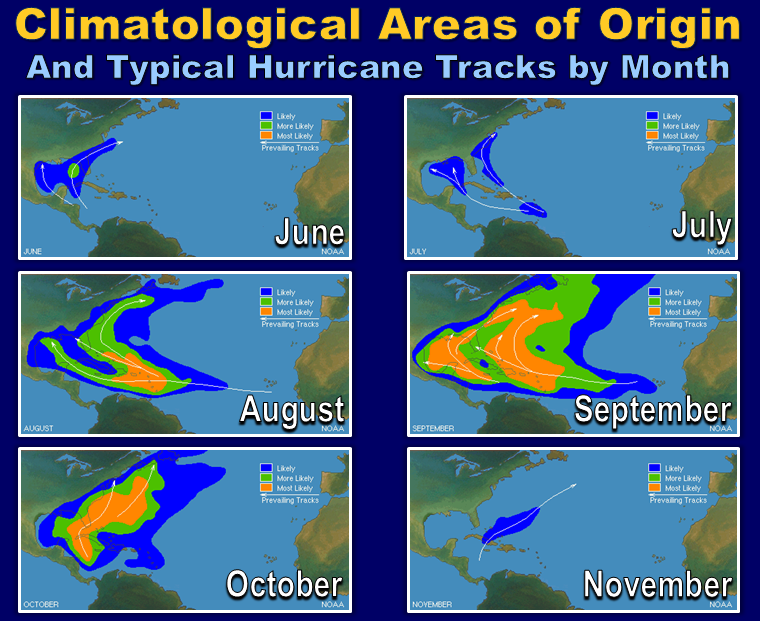
    Where hurricanes form shifts over the months

    Where storms are most likely to form and make landfall also changes as the pages of the calendar turn.

    In early summer, the Gulf of Mexico warms up faster than the open Atlantic, making it a notable hotspot for early-season tropical storm development, especially in June and July. The Texas coast, Louisiana, and the Florida Panhandle often face a higher early-season risk than locations along the Eastern seaboard.

    These are generally the busiest areas during each month of hurricane season, but that doesn’t mean hurricanes won’t make landfall elsewhere.
    NOAA

    By August and September, the season reaches its peak. This is when those waves moving off the coast of Africa become a primary source of storm activity. These long-track storms are sometimes called “Cape Verde hurricanes” because they originate near the Cape Verde Islands off the African coast. While many stay over open water, others can gather steam and track toward the Caribbean, Florida or the Carolinas.

    Later in the hurricane season, storms are more likely to form in the western Atlantic or Caribbean, where waters are still warm and upper-level winds remain favorable. These late-season systems have a higher probability of following atypical paths, as Sandy did in 2012 when it struck the New York City region and Milton did in 2024 before making landfall in Florida.

    At the end of the day, the safest way to think about hurricane season is this: If you live along the coast, don’t let your guard down. Areas susceptible to hurricanes are never totally immune from hurricanes, and it only takes one to make it a dangerous – and unforgettable – season.

    Colin Zarzycki’s research lab receives funding from the U.S. National Science Foundation, Department of Energy, and National Oceanic and Atmospheric Administration.

    ref. Forecasters expect a busy 2025 hurricane season – a storm scientist explains why and what meteorologists are watching – https://theconversation.com/forecasters-expect-a-busy-2025-hurricane-season-a-storm-scientist-explains-why-and-what-meteorologists-are-watching-257223

    MIL OSI – Global Reports

  • MIL-OSI Russia: Chinese, foreign scientists call on global scientific community to cooperate more closely for sustainable development

    Translation. Region: Russian Federal

    Source: People’s Republic of China in Russian – People’s Republic of China in Russian –

    Source: People’s Republic of China – State Council News

    BEIJING, May 31 (Xinhua) — Chinese and foreign scientists have called on the global scientific community to unite and make greater contributions to achieving the Sustainable Development Goals by further exploring the frontiers of science and technology.

    This was announced on Saturday in Beijing at a symposium on “Sustainable Development and Inclusive Cooperation: Responsibility of the Scientific Community,” organized in honor of the 70th anniversary of the academic departments of the Chinese Academy of Sciences (CAS).

    As ANC President Hou Jianguo noted, global challenges such as climate change, environmental pollution, resource scarcity and food security are becoming increasingly interconnected, and the opportunities and challenges of the new technological revolution are profoundly reshaping the landscape of global sustainable development.

    He said that ANC, as a national scientific research institution of China, has been steadily enhancing its research activities in fields such as environmental conservation, life sciences, health care and energy technology for many years, exploring new ways and solutions to apply emerging technologies for sustainable development.

    Looking ahead, Hou Jianguo stressed that the CPC will continue to adhere to the principle of opening up to the outside world, and work closely with partners and leading scientists around the world to deepen international cooperation in key research areas. He assured that the CPC will also expand talent exchanges and joint training, conduct consultative assessments on sustainable development, promote open data sharing to ensure sustainability, and harness the power of artificial intelligence (AI).

    Reflecting on five decades of personal engagement with Chinese scientists and the development of institutional links between Australia and China, Australian Academy of Science President Chennupati Jagadish, for his part, highlighted the enduring power of inclusive bilateral and multilateral scientific cooperation.

    He particularly noted the potential of science to overcome geopolitical boundaries and enhance global cooperation, especially in transformative areas such as quantum technologies and AI.

    Vice President of the Russian Academy of Sciences (RAS) Sergey Chernyshev, in turn, stated that RAS gives priority attention to cooperation with China. According to him, future cooperation between RAS and ANC will be key to overcoming global challenges and strengthening bilateral relations.

    International Science Council (ISC) President Peter Gluckman noted that the ISC has become a true leader in global science not only through its research contributions but also through its strengthened partnerships and commitment to science as a global endeavor.

    As P. Gluckman pointed out, the WNC is also committed to promoting international scientific cooperation, protecting the principles of science and ensuring its further progress to solve global problems.

    The event was attended by more than 60 people, including heads of national academies of sciences and responsible persons of international scientific organizations from 14 countries and regions, as well as domestic and foreign members of the ANC. –0–

    MIL OSI Russia News

  • MIL-OSI Russia: Russian government updates rules for migrant exams

    Translation. Region: Russian Federal

    Source: People’s Republic of China in Russian – People’s Republic of China in Russian –

    Source: People’s Republic of China – State Council News

    Moscow, May 31 /Xinhua/ — The Russian government has approved amendments to the regulations on conducting an exam in Russian as a foreign language, Russian history and the fundamentals of Russian legislation for foreigners. This was reported on Saturday in the Telegram channel of the Russian Ministry of Education and Science.

    According to the amendments, in particular, it is envisaged that the examination versions in Russian as a foreign language, Russian history and the fundamentals of Russian legislation will be updated monthly, and that the examination versions will no longer be made publicly available.

    Currently, foreign citizens planning to work in Russia are required to confirm their proficiency in the Russian language, knowledge of Russian history and the basics of Russian legislation. The relevant exam can be taken in all regions of the country at one of the 92 authorized government agencies, the list of which has been approved by the Russian government. –0–

    MIL OSI Russia News

  • MIL-OSI USA: Cantwell, Colleagues Urge Additional Funding to Keep Communities Safe

    US Senate News:

    Source: United States Senator for Washington Maria Cantwell
    05.31.25
    Cantwell, Colleagues Urge Additional Funding to Keep Communities Safe
    WASHINGTON, D.C. – U.S. Senator Maria Cantwell (D-WA), ranking member of the Senate Committee on Commerce, Science, and Transportation and senior member of the Senate Finance Committee, joined 29 Senate Democratic colleagues in urging the Senate Committee on Appropriations to fund the Community Oriented Policing Services (COPS) Hiring Program at a minimum of $270 million for Fiscal Year 2026.
    In Fiscal Year 2024, six police departments in Washington state received a total of $3.75M to hire 31 police officers.
    Amid a nationwide shortage of police officers, the COPS Hiring Program is critical for keeping communities safe and reducing taxpayer costs related to crime by providing funding directly to law enforcement agencies to increase their community policing capacity and crime prevention efforts.
    “The COPS Hiring Program represents a fiscally responsible solution to ensure that our communities remain safe. CHP provides funds directly to law enforcement agencies to hire new or rehire additional career law enforcement officers and to increase their community policing capacity and crime-prevention efforts,” the lawmakers wrote.
    “When officers establish a presence on their patrols using community-policing principles, they can develop positive relationships with the communities they serve.  In turn, these relationships increase law enforcement’s ability to solve local crimes and resolve public safety problems,” the lawmakers continued. “This proactive approach to policing prevents crime from occurring, saving taxpayers the high societal costs associated with crime, incarceration, and services for victims.”
    Sen. Cantwell is a longtime champion of the COPS program and the Byrne Memorial Justice Assistance Grants (JAG) program, which help equip and enable local law enforcement to address drug trafficking.
    The National Fraternal Order of Police, National Association of Police Organizations, the U.S. Conference of Mayors, Federal Law Enforcement Officers Association, and the Major Cities Chiefs Association support the Senators’ funding request.
    Led by Senator Ben Ray Luján (D-NM), the letter was also signed by U.S. Senators Jacky Rosen (D-NV), Ruben Gallego (D-AZ), Tina Smith (D-MN), Raphael Warnock (D-GA), Tim Kaine (D-VA), Tammy Baldwin (D-WI), Kirsten Gillibrand (D-NY), Mark Warner (D-VA), Angus King (I-ME), Ron Wyden (D-OR) Michael Bennet (D-CO), Tammy Duckworth (D-IL), Brian Schatz (D-HI), Jack Reed (D-RI), Jeff Merkley (D-OR), Chris Coons (D-DE), Mark Kelly (D-AZ), Sheldon Whitehouse (D-RI), Andy Kim (D-NJ), Richard Durbin (D-IL), Elissa Slotkin (D-MI), Ed Markey (D-MA), Amy Klobuchar (D-MN), Richard Blumenthal (D-CT), Maggie Hassan (D-NH), Catherine Cortez Masto (D-NV), Alex Padilla (D-CA), and Elizabeth Warren (D-MA).
    The full text of the letter can be found HERE and below:
    Dear Chairman Moran and Ranking Member Van Hollen:
    As you consider funding levels for Fiscal Year 2026, we urge you to fund the Community Oriented Policing Services (COPS) Hiring Program at a minimum of $270 million.
    The COPS Hiring Program represents a fiscally responsible solution to ensure that our communities remain safe. CHP provides funds directly to law enforcement agencies to hire new or rehire additional career law enforcement officers and to increase their community policing capacity and crime-prevention efforts. When officers establish a presence on their patrols using community-policing principles, they can develop positive relationships with the communities they serve.  In turn, these relationships increase law enforcement’s ability to solve local crimes and resolve public safety problems.  This proactive approach to policing prevents crime from occurring, saving taxpayers the high societal costs associated with crime, incarceration, and services for victims.
    To date, the COPS Office has been appropriated more than $20 billion to advance community policing including grants awarded to more than 15,000 state, local, and tribal law enforcement agencies to fund the hiring and redeployment of more than 136,000 officers. In 2024, the program awarded 235 grants across all 50 states and the District of Columbia. In total, the program allowed for the funding of 1193 officer positions. COPS Hiring plays an essential role in our federal government’s support for local law enforcement and should therefore receive the highest possible level of funding.
    We are supported in this request by law enforcement organizations including the National Fraternal Order of Police, National Association of Police Organizations, the U.S. Conference of Mayors, Federal Law Enforcement Officers Association, and the Major Cities Chiefs Association.  We appreciate the hard work and leadership that you have shown on these issues. Ongoing crime and violence across the country demonstrates the vital need for increased police protection in our communities.  Therefore, as you determine the funding levels for this program, we ask that you support funding for the COPS Hiring Program at the highest possible level.
    Thank you for your consideration of this request.

    MIL OSI USA News

  • MIL-OSI USA: Cantwell & Colleagues Call on Trump Administration to Stop Bureaucratic Delays and Immediately Release Broadband Equity, Access & Deployment Funding to States

    US Senate News:

    Source: United States Senator for Washington Maria Cantwell
    05.31.25
    Cantwell & Colleagues Call on Trump Administration to Stop Bureaucratic Delays and Immediately Release Broadband Equity, Access & Deployment Funding to States
    WASHINGTON, D.C. – U.S. Senator Maria Cantwell (D-WA), ranking member of the Senate Committee on Commerce, Science, and Transportation and senior member of the Senate Finance Committee, Democratic Leader Senator Chuck Schumer (D-NY), and Senator Ben Ray Luján (D-NM) called on the Trump Administration to immediately release the $42 billion allocated for the Broadband Equity, Access and Deployment (BEAD) Program as part of the bipartisan Infrastructure Investment and Jobs Act. The program was designed with the goal of building high-speed, scalable, and reliable networks everywhere in the United States.
    “For six months, states have been waiting to break ground on scores of projects, held back only by the Commerce Department’s bureaucratic delays,” wrote the Senators in a letter to Commerce Secretary Howard Lutnick and President Trump. “If states are forced to redo or rework their plans, they will not only miss this year’s construction season but next year’s as well, delaying broadband deployment by years. That’s why we urge the Administration to move swiftly to approve state plans, and release the $42 billion allocated to the states by the BEAD Program.”
    In the innovation economy, universal access to high-speed internet is essential for the nation’s future economic growth and to ensure that some 25 million Americans will not be denied the opportunity to fully participate in and contribute to that growth. And, in addition to excluding millions of citizens, lack of broadband access also puts our nation further behind in the race with China, putting at risk our ability to compete in AI, advanced robotics, and semiconductor manufacturing. The BEAD program has allocated $1.2 billion to the State of Washington.
    “High-speed, reliable, and scalable connectivity is essential for jobs, education, and telehealth.  It’s also the backbone for the advanced industries of today and tomorrow,” the Senators wrote. “AI systems require massive volumes of data and low-latency networks to operate effectively. Data centers, smart warehouses, robotic assembly lines, and chip fabrication plants all depend on fast, stable, and scalable bandwidth. If we want these job-creating facilities built throughout the United States, including rural areas, we must ensure the infrastructure—including high-speed internet networks—is in place to support them.”
    Sen. Cantwell, at the time the chair of the Commerce Committee, was an early supporter of the BEAD program.
    “We urge you to move forward with the submitted BEAD plans and deliver on the promise of the BEAD program without further delay. Every American and every community needs access to reliable, scalable, and high-speed internet if we are to remain the world’s innovation leader,” concluded the letter.
    The full text of the letter is available HERE and below.
    Dear Sec. Lutnick / President Trump,
    Congress created the Broadband Equity, Access and Deployment (BEAD) Program as part of the bipartisan Infrastructure Investment and Jobs Act to finish the job of connecting everyone and building high-speed, scalable, and reliable networks everywhere.  For six months, states have been waiting to break ground on scores of projects, held back only by the Commerce Department’s bureaucratic delays. If states are forced to redo or rework their plans, they will not only miss this year’s construction season but next year’s as well, delaying broadband deployment by years. That’s why we urge the Administration to move swiftly to approve state plans, and release the $42 billion allocated to the states by the BEAD Program.
    Universal access to high-speed internet is essential for jobs, education, and telehealth —and also for the bandwidth-hungry innovation economy, from artificial intelligence and advanced robotics to smart manufacturing and semiconductor production.  Further delay means 25 million Americans continue to wait for high-speed internet and the economic benefits it brings.  It also means that we risk falling behind China, which is aggressively building out digital infrastructure to support its AI, advanced manufacturing, and semiconductor ambitions. 
    States have already developed plans to address these needs, and restarting or slowing down the process will only hold back progress.  States must maintain the flexibility to choose the highest quality broadband options, rather than be forced by bureaucrats in Washington to funnel funds to Elon Musk’s Starlink, which lacks the scalability, reliability, and speed of fiber or other terrestrial broadband solutions.
    High-speed, reliable, and scalable connectivity is essential for jobs, education, and telehealth.  It’s also the backbone for the advanced industries of today and tomorrow. AI systems require massive volumes of data and low-latency networks to operate effectively. Data centers, smart warehouses, robotic assembly lines, and chip fabrication plants all depend on fast, stable, and scalable bandwidth. If we want these job-creating facilities built throughout the United States, including rural areas, we must ensure the infrastructure—including high-speed internet networks—is in place to support them.  If we want AI developed and deployed in the United States, if we want to win the race for semiconductor dominance, if we want the next generation of manufacturing jobs to be created here, then we must act now—and we must build the high-speed, high-capacity networks those technologies demand.
    States have spent years developing implementation plans under the BEAD program to reach every  American with high-speed internet access. These plans reflect local needs, technical realities, and the bipartisan intent of Congress. States are ready to put shovels in the ground and have been waiting for months to get started connecting communities and building networks that will support the industries of tomorrow. Additional delays and onerous changes to the program at this stage threaten to further stall urgently needed deployment and leave communities behind. 
    We urge you to move forward with the submitted BEAD plans and deliver on the promise of the BEAD program without further delay. Every American and every community needs access to reliable, scalable, and high-speed internet if we are to remain the world’s innovation leader.
    Sincerely, 

    MIL OSI USA News

  • MIL-OSI: Starscope: Does Starscope Monocular Really Work for Stargazing & Hiking? Read Full Starscope Monocular Telescope Consumer Report!

    Source: GlobeNewswire (MIL-OSI)

    San Diego, CA, May 31, 2025 (GLOBE NEWSWIRE) — Introduction: Why the Starscope Monocular Is Gaining Popularity in 2025

    Whether you’re a nature lover, hiker, hunter, or stargazer, having the right optical gear can make or break your outdoor experience. In 2025, one compact device has been making waves among adventurers and outdoor enthusiasts alike — the Starscope Monocular.

    This rugged, pocket-sized monocular telescope has sparked major attention across the US, UK, Canada, and Australia. Why? Because it’s delivering high-powered vision, smartphone adaptability, and military-grade durability — all at a fraction of the size and weight of traditional binoculars or telescopes.

    From birdwatching on weekend hikes to spotting distant wildlife or gazing at the moon, Starscope promises ultra-clear, zoomed-in views without the bulk. It’s not just a camera add-on — it’s a full-on telescope designed for your hand.

    But does the Starscope Monocular actually live up to the hype? Can it truly replace bulky binoculars or expensive spotting scopes?

    In this in-depth Starscope Monocular review, we’ll uncover:

    • How it works and what makes it different
    • Real-world reviews from actual users in 2025
    • Key specs and performance in outdoor settings
    • Updated pricing and bundle deals
    • Where to buy it safely (and avoid knockoffs)

    Let’s zoom into the facts and see if Starscope really is the best monocular telescope worth your money this year.

    What Is Starscope? A Closer Look at This Trending Monocular Telescope

    The Starscope Monocular is a high-definition optical device designed to give users a clear, zoomed-in view of distant objects — whether you’re exploring mountains, observing wildlife, attending sports events, or simply stargazing. Marketed as a compact alternative to bulky binoculars and traditional telescopes, Starscope is engineered for both convenience and clarity.

    What Makes It Stand Out?

    Unlike conventional monoculars that often compromise on image quality or build strength, Starscope combines 10x magnification, BAK-4 prisms, and multi-coated lenses in a single rugged unit. It’s built using advanced military-grade materials that make it water-resistant, fog-proof, and shockproof, making it suitable for rough outdoor conditions.

    Smartphone Compatibility

    One of the standout features of the Starscope monocular is its smartphone adapter compatibility. You can easily attach your smartphone to capture stunning long-range photos and videos — perfect for wildlife photography, sightseeing, or even amateur astronomy.

    Compact, Travel-Ready Design

    At just under 300 grams, the Starscope monocular fits easily into your palm, pocket, or backpack. Its lightweight build and ergonomic grip allow for one-hand use, making it a practical choice for adventurers on the go.
    Don’t Miss Out: The Starscope Monocular Is Selling Fast – See What You’ve Been Missing!

    Who Is It Made For?

    Starscope is ideal for:

    • Hikers and backpackers
    • Hunters and birdwatchers
    • Sports fans
    • Stargazers and amateur astronomers
    • Travelers exploring scenic views

    Starscope Monocular Features & Technical Specifications

    The Starscope Monocular isn’t just another gadget — it’s an all-in-one optical solution engineered for sharp clarity, long-range zoom, and outdoor resilience. Below, we break down the core features and specifications that make this monocular a standout choice in 2025.

    Optical Power & Precision

    • 10x Magnification Power
      Starscope allows you to zoom in on distant objects with crystal-clear detail — up to 10 times closer. Whether it’s a mountaintop or a distant stadium seat, the detail remains sharp and focused.
    • 42mm Objective Lens Diameter
      The large 42mm lens collects more light for brighter images, especially in low-light settings like early morning or dusk. It enhances your visual experience when birdwatching or stargazing.
    • Field of View
      Starscope offers a wide field of view, making it easier to scan landscapes or follow moving targets without frequent repositioning.

    Advanced Lens & Prism Technology

    • BAK-4 Prism
      Built with professional-grade BAK-4 (Barium Crown Glass) prisms, which provide greater light transmission and edge-to-edge sharpness — reducing distortion and glare.
    • Multi-Coated Lens
      Each lens surface is coated to enhance image brightness, reduce reflections, and improve contrast. This ensures a vibrant, high-resolution image even in bright sunlight.

    Discover the Best Monocular of 2025 – The Starscope Telescope Is All You Need Outdoors

    Rugged, Outdoor-Ready Construction

    • Weatherproof Design
      Starscope is sealed to resist water, fog, and dust — perfect for hiking, camping, or kayaking. You don’t have to worry about a sudden downpour or misty mornings.
    • Shock-Resistant Casing
      The exterior shell is made from a durable polymer composite that absorbs impact, making the device drop-resistant and travel-friendly.
    • Slip-Resistant Grip
      Ergonomic texture provides a firm hold, even in wet conditions or while wearing gloves.

    Smartphone Compatibility

    • Universal Phone Adapter
      Easily attaches to most smartphones to transform the Starscope into a powerful telephoto lens. Capture distant landscapes, record HD video, or take zoomed-in wildlife shots without blur.
    • Tripod Mount Ready
      A standard mount allows you to attach it to a tripod for long sessions or time-lapse recordings.

    How Does the Starscope Telescope Work?

    Starscope uses high-powered optics to deliver a detailed image of faraway scenes. It works by channeling light through precision-engineered lenses and a BAK-4 prism system, which enhances brightness, sharpness, and contrast.

    When light enters the objective lens, it travels through a series of internal glass prisms and coatings that reduce glare and distortion. The result is a magnified, high-definition view that looks vibrant and realistic, even at long distances.

    The monocular’s alignment with your smartphone camera adds further functionality — turning your phone into a zoom lens for pictures and video.

    Over 100,000 Sold – Is Starscope the Best Monocular in 2025? See Real Results

    How To Use Starscope Monocular?

    To use the Starscope Monocular effectively, follow these steps:

    1. Remove Lens Caps: Take off both the front and rear lens caps to prepare the monocular for use. 
    2. Adjust the Eyecup: If you wear glasses, twist the eyecup down; if not, keep it extended for optimal viewing comfort. 
    3. Hold the Monocular Properly: Grip the monocular with one hand, placing your index finger on the focus adjustment dial and your pinky near the front for stability.
    4. Focus the Image: Look through the eyepiece and rotate the focus dial with your index finger until the image becomes sharp and clear.
    5. Attach to a Tripod (Optional): For extended viewing sessions or increased stability, mount the monocular onto a tripod using the built-in 1/4″ thread. 
    6. Connect to a Smartphone (Optional): Use a compatible smartphone adapter to align your phone’s camera with the monocular’s eyepiece, allowing you to capture distant images or videos.
    7. Maintenance Tips:
      • Cleaning: Use a soft lens brush or blower to remove dust. For smudges, gently wipe with a microfiber cloth in a circular motion. 
      • Storage: Store the monocular in a cool, dry place and avoid exposing it to extreme temperatures or moisture.

    Safety Precaution: Never look directly at the sun through the monocular, as this can cause serious eye damage. 

    By following these steps, you can maximize your experience with the Starscope Monocular, whether you’re observing wildlife, enjoying scenic views, or stargazing.

    Zoom In Like Never Before – Grab the Starscope Monocular at 50% Off Today Only!

    Starscope Monocular Benefits: Why People Are Choosing It Over Binoculars

    • Ultra Lightweight: Fits in your pocket or backpack without bulk.
    • One-Hand Operation: Perfect for trekking or scouting terrain.
    • Crisp Image Quality: See vivid details from hundreds of yards away.
    • Photo & Video Ready: Use with your phone to capture distant sights.
    • Durability: Survives drops, splashes, and harsh weather.
    • Low-Light Visibility: Great for sunrise or twilight exploration.

    How to Use the Starscope Monocular for Hiking, Hunting, Stargazing & Travel

    1. Hold with one hand and align the eyepiece with your dominant eye.
    2. Twist the focus ring slowly until the image is sharp.
    3. Attach your smartphone using the provided adapter.
    4. Use your phone’s camera to zoom further, take pictures, or record.
    5. Optionally mount it to a tripod for steady viewing.

    Starscope Price & Where to Buy the Starscope Monocular

    Starscope is available exclusively through the official website. Avoid third-party platforms like Amazon or eBay, which may sell unauthorized or fake versions.

    • 1x Monocular: $47.99 (was $106.64)
    • 2x Monoculars: $95.99 (was $213.29)
    • 3x Monoculars: $107.99 (was $319.93)
    • 4x Monoculars: $143.99 (was $426.58)

    All packages may include bonus accessories like tripods or smartphone adapters. Discounts reflect 50%–62% savings.

    Shipping, Delivery Time & Refund Policy

    • Shipping: Worldwide delivery available.
    • Delivery Time: 5–12 business days depending on region.
    • Refund Policy: 30-day money-back guarantee. Unused items may be returned for a full refund (minus shipping & handling).

    Disclaimer: Prices & return policy are subject to change. Always check the official website for the most accurate and up-to-date pricing before purchasing.

    Real Customer Experiences from the USA, UK, Canada & Australia

    Sarah – Denver, USA: “Used the Starscope on a solo hiking trip in Colorado. I spotted wildlife from a mile away. The view was sharp and steady even without a tripod.”

    James – Perth, Australia: “Took mine on a camping trip. Loved the phone attachment. Captured amazing photos of distant cliffs and birds.”

    Michael – Toronto, Canada: “It’s so much easier to carry than my old binoculars. Feels solid and works even in light rain. Definitely my go-to for birding.”

    Lucy – Manchester, UK: “Perfect for stargazing in rural England. I could clearly see lunar craters and Jupiter’s moons — very impressed.”

    Explore Farther with the Starscope Telescope – Perfect for Stargazing, Hiking & Travel

    Starscope FAQs – Common Questions Answered

    Q: Can I buy Starscope on Amazon or Walmart?
    A: No. Starscope is exclusively sold through its official website. Any listings on Amazon, Walmart, or eBay may be counterfeit or unauthorized, and they do not qualify for the official warranty or refund policy.

    Q: Does it work at night?
    A: It does well in low-light but not total darkness. Great for dawn/dusk.

    Q: Is it suitable for people who wear glasses?
    A: Yes. It has adjustable eye relief.

    Q: What’s the warranty?
    A: 30-day satisfaction guarantee, with optional extended warranty at checkout.

    Q: Is Starscope compatible with all smartphones?

    A: Yes — most smartphones can be used with Starscope via the universal phone adapter included in bundle deals. Some manual adjustment may be required depending on your phone’s camera position.

    Q: Can I use it for stargazing?

    A: Absolutely. While not a full telescope, it provides a crisp view of the moon, planets, and stars, making it suitable for amateur astronomy.

    Q: Is it waterproof?

    A: Yes. Starscope is water-resistant, fog-proof, and shockproof, making it reliable in rugged outdoor environments. However, it should not be fully submerged in water.
    Turn Your Phone into a Pro Camera with the Starscope Monocular – Limited Stock Left!

    Environmental Impact: Is the Starscope Monocular Eco-Friendly?

    In an era where sustainability is paramount, evaluating the environmental impact of products like the Starscope Monocular is essential.

    ♻️ Materials and Manufacturing

    The Starscope Monocular is constructed using durable materials, including a BAK4 prism and multi-coated lenses, ensuring longevity and reducing the need for frequent replacements. Its robust design contributes to a longer product lifespan, which can mitigate environmental impact over time.

    Sustainable Practices

    While specific details about the manufacturing processes and sourcing of materials for the Starscope Monocular are limited, the product’s durability suggests a focus on quality. However, without explicit information on eco-friendly practices or certifications, it’s challenging to fully assess its environmental friendliness.

    Energy Efficiency

    The monocular operates without batteries or electricity, relying solely on optical components. This energy-free operation minimizes its carbon footprint during use, aligning with sustainable practices.

    Packaging and Distribution

    Information regarding the packaging materials and distribution methods is not readily available. Eco-conscious consumers may wish to inquire directly with the manufacturer for details on packaging sustainability and shipping practices.
    Get the Best Monocular for Outdoor Adventures – Order Your Starscope Before It’s Gone
    Common Starscope Problems & How to Fix Them
    Even high-quality devices like the Starscope Monocular can encounter minor issues. Here are some common problems users have reported — and how to resolve them quickly:

    Problem: Blurry or Out-of-Focus Image

    Fix:

    • Rotate the focus ring slowly while looking through the eyepiece.
    • Make sure the lens is clean and free of fingerprints or smudges.
    • If using with a smartphone, ensure the adapter is properly aligned.

    Problem: Smartphone Adapter Doesn’t Fit Properly

    Fix:

    • Loosen and adjust the clamp arms carefully — most adapters are universal but may require repositioning for multi-lens phones.
    • Try removing your phone case to improve alignment.

    Problem: Double Vision or Image Distortion

    Fix:

    • Clean both lenses with a microfiber cloth.
    • Make sure the monocular isn’t fogged up (especially when moving between temperature zones).
    • Check if the internal lens is misaligned due to a drop — in rare cases, customer support may need to assist.

    Problem: View Is Too Dark or Dim

    Fix:

    • Ensure you are not using it in complete darkness — Starscope is optimized for daylight and low-light, but not for nighttime use.
    • Wipe off any moisture or condensation from the lens.

    Problem: Can’t See Anything Through the Eyepiece

    Fix:

    • Remove all lens caps.
    • Adjust your eye position — the exit pupil must align with your eye.
    • Twist the eyecup if you’re wearing glasses.

    Problem: Scratched or Smudged Lens

    Fix:

    • Use only soft, non-abrasive cloths (preferably microfiber).
    • Avoid using paper towels, shirts, or abrasive materials that could damage the lens coating.

    When to Contact Support

    If none of the above solutions help, or if your monocular is damaged during shipping, contact Starscope’s official support through their website for warranty service or a replacement.
    The #1 Trending Starscope Telescope Is Back – See Why Outdoor Enthusiasts Swear by It

    Starscope for Amateur Astronomy: Can It Replace a Telescope?

    While Starscope isn’t a professional-grade telescope, it’s surprisingly capable for casual astronomy. With 10x magnification and a 42mm lens, users can observe:

    • The moon’s surface with visible craters
    • Bright planets like Jupiter or Saturn (as small dots)
    • Star clusters and constellations

    It’s an excellent tool for beginners who want to explore the night sky without investing in bulky gear. For best results, use Starscope in low-light rural settings away from city pollution.Starscope Monocular for Birdwatching: A Birder’s Perspective
    Birdwatchers praise Starscope for its:

    • Silent operation (no clicking or zoom noise)
    • Sharp detail from long distances
    • Ability to quickly scan trees or open fields

    Whether you’re spotting hummingbirds in your backyard or waterfowl across a lake, the wide field of view and smartphone camera compatibility make bird identification much easier.

    Pros and Cons of Starscope Monocular

    Pros

    • High-Quality Optics
      Equipped with BAK-4 prism and multi-coated lenses for sharp, bright images.
    • 10x Magnification
      Ideal for long-distance viewing — from wildlife to stargazing.
    • Lightweight & Portable
      Weighs less than 300g and fits in your pocket or backpack.
    • Smartphone Compatible
      Easily attaches to most phones for HD photo and video capture.
    • Durable & Weather-Resistant
      Water-resistant, fog-proof, and shockproof — built for outdoor use.
    • Easy One-Hand Operation
      Ergonomic grip and simple focus adjustment make it user-friendly.
    • Affordable Compared to Binoculars or Telescopes
      Offers telescope-like performance without the high cost.
    • Tripod-Compatible
      Great for steady shots or long observation sessions.

    Cons

    • Not for Complete Darkness
      Performs well in low light but isn’t night-vision capable.
    • No Digital Zoom or Auto-Focus
      Manual focus only; relies on user adjustment.
    • Limited Availability
      Only sold via the official website — not available on Amazon or retail stores.
    • Best for Casual Use
      May not satisfy professional wildlife photographers or astronomers.
    • Phone Adapter Fit May Vary
      Some users may need to adjust alignment for specific phone models.

    Upgrade Your View – The Starscope Monocular Delivers Zoom Like Nothing Else

    How Starscope Enhances Smartphone Photography

    Transform your phone into a pro-level camera by attaching Starscope. It works like a telephoto zoom lens, ideal for:

    • Wildlife photography at long distances
    • Capturing landscapes or cliffs
    • Recording sports or outdoor events

    Tips:

    • Use a tripod for steady shots
    • Clean the lens before attaching
    • Zoom only slightly with your phone to reduce pixelation

    Maintenance Tips: How to Care for Your Starscope Monocular

    To ensure your Starscope lasts for years:

    • Clean lenses gently using microfiber cloths only
    • Avoid touching the glass with fingers
    • Store in a dry case to prevent moisture buildup
    • Use lens caps when not in use
    • Don’t submerge it, even though it’s water-resistant

    Starscope Safety and Usage Guidelines

    • Never look at the sun through the monocular.
    • Use caution when using near children (small parts, strap).
    • Avoid dropping it — though durable, internal alignment may shift.
    • Adjust the eyecup if you wear glasses.

    Over 100,000 Sold – Is Starscope the Best Monocular in 2025? See Real Reviews

    Starscope Gift Ideas: Who It’s Perfect For in 2025

    Looking for a thoughtful gift? Starscope is ideal for:

    • Outdoor lovers (hikers, campers)
    • Retirees or dads who enjoy nature
    • Kids interested in science or astronomy
    • Travelers and explorers

    With its sleek design and practical value, it makes a great gift for birthdays, holidays, or Father’s Day.
    Starscope for Travel Photography: A Backpacker’s Tool
    For photographers on the move, bulky lenses and gear are a hassle. That’s where the Starscope Monocular becomes a game-changer. Its compact build and powerful optics make it an ideal companion for travel photography, particularly in rugged or remote areas.
    Whether you’re hiking in Patagonia, road-tripping across the U.S., or exploring historical ruins abroad, Starscope helps you:

    • Zoom in on distant scenes with clarity
    • Snap close-ups of wildlife or architectural details
    • Use your smartphone to record landscapes that feel larger than life

    Its lightweight frame fits easily in a backpack side pocket, and unlike DSLR zoom lenses, there’s no need to worry about lens swapping, battery life, or electronic failure.
    Lightweight. Powerful. Unmatched. Get the Starscope Monocular and Explore More Today!
    Starscope for Sports & Events: Get Closer to the Action
    Want front-row views from the cheap seats? Starscope lets you see the game, match, or concert like you’re sitting VIP.
    The monocular is perfect for:

    • Live sports: football, baseball, racing, etc.
    • Outdoor concerts or festivals
    • Parades and fireworks

    With 10x zoom and smartphone connectivity, users can record their experience with surprisingly clear footage. Many reviewers praise its ability to zoom in on player movements, stage performances, or racing cars without blur or distortion.
    No more pixelated phone zooms or asking someone else for binoculars — Starscope brings the action to you in real time, wherever you’re seated.

    Who Should Buy the Starscope Monocular? Final Verdict

    If you’re someone who loves the outdoors, wants to explore farther without carrying bulky gear, and values crisp visuals from afar — Starscope is a smart buy in 2025. Its powerful zoom, rugged build, and mobile compatibility make it a practical investment.

    Highly recommended for:

    • Hikers
    • Travelers
    • Stargazers
    • Birdwatchers
    • Outdoor sports fans

    Media Contact:
    Company nameStarscope
    7864 Ronson Roa, Ste A San Diego 92111
    https://www.monostarscope.com/

    E-mail: support@monostarscope.com

    Disclaimer: The statements have not been evaluated by the Food and Drug Administration. This product is not intended to diagnose, treat, cure, or prevent any disease. Individual results may vary. Always consult a healthcare professional before taking any dietary supplements.
    Disclosure: This article is for informational purposes only and does not constitute medical advice. The content may include affiliate links, meaning we may earn a commission if you purchase through recommended links. Always consult a healthcare professional before starting any new supplement regimen.

    Content Accuracy Disclaimer
    Every effort has been made to ensure the accuracy of the information presented in this article. However, due to the dynamic nature of product formulations, promotions, and availability, details may change without notice. The publisher makes no warranties or representations as to the current completeness or accuracy of any content, including product claims, pricing, or ingredient lists.
    It is the responsibility of the reader to verify product information directly through the official website or manufacturer prior to making a purchasing decision. Any reliance placed on the information in this article is done strictly at your own risk.

    Affiliate Disclosure
    This article may contain affiliate links. If you purchase a product or service through these links, the publisher may earn a commission at no additional cost to you. These commissions help support the creation of in-depth reviews and educational wellness content.
    The publisher only promotes products that have been independently evaluated and deemed potentially beneficial to readers. However, this compensation may influence the content, topics, or products discussed in this article. The views and opinions expressed are those of the author and do not necessarily reflect the official policy or position of any affiliate partner or product provider.

    Related Link
    Power Saver Pro

    Attachment

    The MIL Network

  • MIL-OSI Video: MAGA Minute, May 31, 2025

    Source: United States of America – The White House (video statements)

    MAGA MOMENTUM

    Consumer Confidence High
    Home Sales Surge
    Majority: America on Right Track
    MAHA Skittles Win
    Gold Standard of Science
    West Point
    Memorial Day
    Cancelling Harvard Contracts
    DOGE Wins
    $14B Steel Deal & 70K Jobs

    Watch Press Secretary Karoline Leavitt’s MAGA Minute!

    https://www.youtube.com/watch?v=NFnCklXaLZU

    MIL OSI Video

  • MIL-OSI Europe: Message of the Holy Father Leo XIV to the Bishops’ Conference of France on the occasion of the 100th anniversary of the canonization of Saint John Eudes, Saint John Mary Vianney, and Saint Thérèse of the Child Jesus

    Source: The Holy See

    Message of the Holy Father Leo XIV to the Bishops’ Conference of France on the occasion of the 100th anniversary of the canonization of Saint John Eudes, Saint John Mary Vianney, and Saint Thérèse of the Child Jesus, 31.05.2025
    The following is the Message sent by the Holy Father Leo XIV to the Bishops’ Conference of France on the occasion of the one hundredth anniversary of the canonization of Saint John Eudes, Saint John Mary Vianney, and Saint Thérèse of the Child Jesus:

    Message of the Holy Father
    I am happy to be able to address you for the first time, pastors of the Church of France, and through you, all your faithful, as this month of May 2025 marks the one hundredth anniversary of the canonization of three Saints whom, by the grace of God, your country has given to the universal Church: Saint John Eudes (1601-1680), Saint John Mary Vianney (1786-1859) and Saint Thérèse of the Child Jesus and the Holy Face (1873-1897). In raising them to the glory of the altars, my predecessor Pius XI wanted to present them to the People of God as teachers to listen to, models to imitate, and powerful supporters to pray to and invoke. The scale of the challenges facing the Church in France a century later, and the continuing relevance of these three holy figures in meeting them, lead me to invite you to give special prominence to this anniversary.
    In this brief Message, I will mention just one spiritual trait that John Eudes, John Mary Vianney and Thérèse have in common and present in a very meaningful and attractive way to the men and women of today: they loved Jesus unreservedly in a simple, strong and authentic way; they experienced his goodness and tenderness in a special daily closeness, and they bore witness to it in an admirable missionary drive.
    The late Pope Francis left us, rather like a testament, a beautiful Encyclical on the Sacred Heart in which he states: “That stream which is never exhausted, never passes away … offers itself time and time again to all those who wish to love as he did. For his love alone can bring about a new humanity” (Dilexit nos, 219). There could be no more beautiful and simple programme of evangelization and mission for your country: to help everyone discover the tender and devoted love that Jesus has for them, to the point of transforming their lives.
    And in this respect, our three Saints are undoubtedly masters whose life and doctrine I invite you to constantly make known and appreciated by the People of God. Was Saint John Eudes not the first to celebrate the liturgical worship of the Hearts of Jesus and Mary? Was Saint John Mary Vianney not the priest who gave himself passionately to his ministry and who said: “The priesthood is the love of the heart of Jesus”? and finally, was Saint Thérèse of the Child Jesus and of the Holy Face not the great Doctor of scientia amoris that our world needs, she who “breathed” the Name of Jesus at every moment of her life, with spontaneity and freshness, and who taught the little ones an “easy” way to access it?
    Celebrating the centenary of the canonization of these three saints is first and foremost an invitation to give thanks to the Lord for the marvels he has accomplished in this land of France over long centuries of evangelization and Christian life. Saints do not appear spontaneously but, by grace, emerge from living Christian communities that have been able to transmit the faith to them, to kindle in their hearts the love of Jesus and the desire to follow him. This Christian heritage still belongs to you, it still deeply permeates your culture and remains alive in many hearts.
    This is why I express the hope that these celebrations will not merely evoke nostalgia for a past that might seem bygone, but that they will awaken hope and give rise to a new missionary impetus. With the help of the saints he has given you and whom you celebrate, God can renew the marvels he has accomplished in the past. Will Saint Thérèse not be the Patroness of the missions in the very lands where she was born? Will Saint John Mary Vianney and Saint John Eudes not be able to speak to the conscience of many young people about the beauty, greatness and fruitfulness of the priesthood, to inspire their enthusiastic desire for it, and to give them the courage to respond generously to the call, at a time when the lack of vocations is harshly felt in your dioceses and priests are under increasing strain? I would like to take this opportunity to thank all the priests of France from the bottom of my heart for their courageous and persevering commitment, and to express my paternal affection for them.
    Dear brother Bishops, I invoke the intercession of Saint John Eudes, Saint John Mary Vianney and Saint Thérèse of the Child Jesus and the Holy Face, for your country and the People of God who are courageous pilgrims there, despite the contrary and sometimes hostile winds of indifference, materialism and individualism. May they give courage to these People, in the certainty that Christ, the Saviour of the world, is truly risen.
    Imploring upon France the maternal protection of her powerful Patroness, Our Lady of the Assumption, I impart to each of you, and to all those entrusted to your pastoral care, the Apostolic Blessing.
    From the Vatican, 28 May 2025
    Leo XIV

    MIL OSI Europe News

  • ISRO’s Gaganyatri to carry out microgravity research experiments during upcoming Axiom-4 mission

    Source: Government of India

    Source: Government of India (4)

    Indian Space Research Organisation’s (ISRO) Gaganyatri will carry out a series of shortlisted microgravity research experiments aboard the International Space Station (ISS) during the upcoming Axiom-4 (Ax-4) mission, according to an official statement from ISRO.

    The Axiom-4 mission, scheduled for launch on June 8, will be piloted by Gaganyatri Group Captain Shubhanshu Shukla, who is set to travel to the ISS. ISRO has selected seven microgravity experiments proposed by Indian Principal Investigators (PIs) from various national research and development laboratories and academic institutions for execution aboard the ISS as part of the Ax-4 mission.

    Microgravity research presents valuable opportunities for advancements in fields such as human health, physical and life sciences, material science, pharmaceutical development, and biotechnology. The selected studies include investigations into the impact of microgravity and ISS radiation on edible microalgae, the sprouting of salad seeds in space and its relevance to crew nutrition, the survival, revival, reproduction, and transcriptomic analysis of the eutardigrade Paramacrobiotus sp. BLR strain in space, and the effect of metabolic supplements on muscle regeneration under microgravity. Other experiments will examine human interaction with electronic displays in microgravity and the influence of microgravity on the growth and yield of food crop seeds.

    These experiments are designed to utilize existing research facilities on board the ISS. Given the safety-focused operational philosophy and other mission-related constraints of human spaceflight, the shortlisted experiments are currently undergoing rigorous evaluations and reviews on the ground prior to launch.

    According to ISRO, the experience gained from executing these experiments will help nurture a microgravity research ecosystem in India, enabling the inclusion of more advanced microgravity studies in future missions of the Indian Space Programme.

    The Ax-4 mission marks a historic milestone as it includes the first Indian astronaut to visit the International Space Station. Group Captain Shubhanshu Shukla will become the first ISRO astronaut to travel to the ISS and the second Indian to go to space after Rakesh Sharma, who flew aboard a Russian Soyuz spacecraft in 1984. IAF Group Captain Prasanth Balakrishnan Nair has been designated as the backup pilot for the Ax-4 mission in the event Shukla is unable to fly.

    Alongside Shukla, the Ax-4 crew will include two mission specialists: European Space Agency (ESA) project astronaut Slawosz Uznanski-Wisniewski of Poland and Tibor Kapu of Hungary. The mission will be commanded by Peggy Whitson, a former NASA astronaut and the current Director of Human Spaceflight at Axiom Space.

    ANI

  • PM Modi commemorates 300th birth anniversary of Lokmata Ahilyabai Holkar, launches key infrastructure projects in Madhya Pradesh

    Source: Government of India

    Source: Government of India (4)

    Prime Minister Narendra Modi on Saturday commemorated the 300th birth anniversary of Lokmata Devi Ahilyabai Holkar at the Lokmata Devi Ahilyabai Mahila Sashaktikaran Mahasammelan in Bhopal. Speaking on the occasion, the PM paid tribute to her enduring legacy in governance, social reform, and cultural preservation, while emphasizing the crucial role of women in India’s development.

    The Prime Minister also inaugurated key infrastructure projects, including the launch of passenger services on the Indore Metro’s Super Priority Corridor and the new airports at Datia and Satna. These initiatives aim to enhance regional connectivity, stimulate economic growth, and create employment opportunities, reinforcing the government’s commitment to inclusive progress inspired by the vision of women’s empowerment and India’s rich heritage.

    Honouring Ahilyabai Holkar’s Legacy

    PM Modi highlighted Devi Ahilyabai’s exceptional leadership, emphasizing her commitment to public service, cultural preservation, and inclusive governance. He highlighted her devotion, exemplified by carrying a Shiva Lingam and restoring important temples, including Kashi Vishwanath in Varanasi. The Prime Minister praised her pioneering social reforms such as raising the minimum marriage age for girls, securing women’s property rights, and supporting widow remarriage.

    Inauguration of Key Development Projects

    The Prime Minister inaugurated several developmental projects including the launch of passenger services on the Indore Metro’s Super Priority Corridor (Yellow Line) and the inauguration of Datia and Satna airports. He emphasized that these developments would bolster infrastructure in Madhya Pradesh, catalyze economic progress, and generate employment opportunities. The PM also noted that these initiatives aim to improve regional connectivity and bring citizens closer to major religious and cultural destinations.

    Women’s Empowerment and Economic Inclusion

    Reaffirming the government’s commitment to women’s empowerment, PM Modi said that over four crore houses have been built with many registered in women’s names. He highlighted expanded access to essential amenities and healthcare benefits through schemes like Ayushman Bharat.

    The Prime Minister underlined initiatives promoting financial independence, including Mudra Yojana loans—with more than 75% beneficiaries being women—and the active involvement of 10 crore women in self-help groups.

    Women in Science, Defence, and Governance

    The Prime Minister celebrated the increasing participation of women in STEM fields, startups, and space missions, citing over 100 women contributors to Chandrayaan-3. He highlighted historic milestones such as the first women NDA cadets and their expanding roles in the armed forces, including frontline service and leadership positions. The PM also praised women’s critical role in national security operations like Operation Sindoor.

    Balancing Development with Cultural Heritage

    Drawing parallels between Ahilyabai’s era and today, the Prime Minister emphasized India’s progress while preserving cultural roots. He highlighted infrastructure projects like Indore’s metro, railway expansions, and improved air connectivity, which also facilitate access to prominent pilgrimage sites.

    A Call to Strengthen Sashakt Bharat

    PM Modi invoked the legacy of great women leaders and urged the nation to draw inspiration from their courage and vision. He called for collective efforts to build a stronger, inclusive India—Sashakt Bharat.

    PM Modi also released a commemorative ₹300 coin and postage stamp honoring Lokmata Ahilyabai Holkar and presented the National Devi Ahilyabai Award to a woman artist.

    Additionally, the Prime Minister approved ₹480 crore for 1,271 Atal Gram Sushasan Bhawans to strengthen governance infrastructure in gram panchayats.

    The event was attended by the Governor of Madhya Pradesh, Mangubhai Chhaganbhai Patel, and the Chief Minister of Madhya Pradesh, Mohan Yadav, among other dignitaries.

  • MIL-OSI Russia: The Chinese Embassy in Russia hosted the ceremony of presenting the PRC Ambassador’s Award

    Translation. Region: Russian Federal

    Source: People’s Republic of China in Russian –

    Source: People’s Republic of China – State Council News

    Moscow, May 31 /Xinhua/ — China celebrated the 9th National Day of Scientists and Technologists on May 30. On this occasion, a gala reception and the 6th ceremony of presenting the Chinese Ambassador’s Award were held at the country’s embassy in Russia on Friday.

    At the event, Chinese Ambassador to Russia Zhang Hanhui expressed gratitude to Chinese and Russian scientific and technical workers. He noted that China is currently implementing a strategy to stimulate development through innovation. The country has made a number of historic achievements in fundamental research, breakthroughs in high technology, and commercialization of scientific and technical achievements, the diplomat added.

    According to Zhang Hanhui, China and Russia complement each other well in the field of scientific and technological innovation, have a good foundation and broad prospects for cooperation in this area. China is ready to continue to strengthen cooperation with the Russian Federation in this area, promote high-quality development of the two countries and contribute to building a community with a shared future for mankind, the ambassador said.

    At the ceremony, Russian Presidential Aide for Science and Education Andrei Fursenko congratulated Chinese and Russian scientific and technical workers on the holiday and gave a positive assessment of the fruitful results achieved by the two countries in scientific and technical cooperation in recent years.

    He emphasized that China and Russia share a common concept of scientific and technological development. Russia is ready to work with China to deepen pragmatic cooperation in the areas of fundamental and applied research, as well as the application of scientific and technological achievements, A. Fursenko said.

    At the ceremony, Zhang Hanhui presented awards to 24 laureates of the Chinese Ambassador’s Award and eight laureates of the Cooperation Award. The Chinese Ambassador’s Award was established in 2020 by the Chinese Embassy in Russia jointly with the Russian Union of Scientific and Engineering Public Associations (RosSNIO) to promote exchanges and cooperation between young scientists of the two countries.

    On the same day, the Chinese Embassy in Russia also opened a photo exhibition dedicated to Chinese-Russian cooperation in the field of scientific and technological innovation. –0–

    MIL OSI Russia News

  • MIL-OSI Russia: Chinese and Russian experts call for efforts to create a more equitable multipolar world order

    Translation. Region: Russian Federal

    Source: People’s Republic of China in Russian – People’s Republic of China in Russian –

    Source: People’s Republic of China – State Council News

    BEIJING, May 31 (Xinhua) — An international conference on “China and Russia: Cooperation in a New Era” was held in Beijing on Friday, with Chinese and Russian experts calling for joint efforts to build a more equitable multipolar world order.

    The event was dedicated to the 80th anniversary of the Victory in the World Anti-Fascist War and the 80th anniversary of the establishment of the UN. The conference participants held in-depth discussions on issues of jointly upholding genuine multilateralism by China and Russia and cooperation in promoting multipolarity in the world, practical cooperation and joint development between China and Russia, humanitarian exchanges and mutual learning between civilizations between China and Russia.

    Gao Xiang, President of the Chinese Academy of Social Sciences (CAS), noted that as the main theaters of war in Asia and Europe respectively during World War II, China and the Soviet Union made decisive contributions to the Victory in the World Anti-Fascist War. The international system, with the UN at its core, is a concentrated embodiment of the results of World War II and ensures the general trend of peace and development throughout the world after the war.

    China and Russia should uphold the authority of the UN, adhere to the principle of mutual benefit and win-win, strengthen people-to-people and cultural exchanges so as to steadily promote multipolarity with equality and order, economic globalization with accessibility and inclusiveness, and diversity of civilizations through mutual learning, he added.

    According to the President of the Russian International Affairs Council (RIAC) Igor Ivanov, the highest level of relations in history achieved between Russia and China not only meets the interests of the peoples of the two countries, but is also an important factor in efforts aimed at creating a more just multipolar world.

    “Our countries closely and productively cooperate within the UN, the Group of Twenty, APEC, the SCO, BRICS and other international organizations in the interests of promoting initiatives to ensure global strategic stability and mutually beneficial cooperation,” he emphasized.

    In his video address to the conference, Chinese Ambassador to the Russian Federation Zhang Hanhui noted that China and Russia have managed to take the right path in building relations between large neighboring countries, which has given a powerful impetus to the multipolarity of the world and demonstrated the responsibility of the two countries as permanent members of the UN Security Council.

    In the context of profound changes in the global governance system, BRICS and the SCO, whose founding countries and main drivers are China and Russia, are becoming increasingly important pillars of the multipolar world, the ambassador said.

    He expressed confidence that Russia, as before, will support China’s work as the rotating chair of the SCO and make joint efforts with China to promote the expansion of cooperation within the SCO and BRICS in order to provide the world with more public goods.

    According to Sun Zhuangzhi, Director of the Institute of Russian, Eastern European and Central Asian Studies at the Chinese Academy of Social Sciences, in the face of enormous changes unseen in the last century, regional conflicts and the impact of various global challenges, China has put forward the Global Development Initiative, the Global Security Initiative and the Global Civilization Initiative, continuously promoted the high-quality joint construction of the Belt and Road, and strengthened cooperation with Russia and other emerging market countries, providing a practical path for implementing the concept of a new type of global governance.

    The international conference was organized jointly by the CASS and the RIAC. Its co-organizers were the Institute of Russia, Eastern Europe and Central Asia of the CASS and the Council for Strategic Cooperation between China and Russia of the CASS. -0-

    MIL OSI Russia News

  • MIL-OSI Africa: Call for reform of political-administrative interface 

    Source: South Africa News Agency

    Deputy President Paul Mashatile has recognised significant systemic weaknesses that undermine the effectiveness of the South African state, calling for the construction of a capable government and the reform of the political-administrative interface.

    The Deputy President cited the synthesis evaluation, conducted by the Human Sciences Research Council (HSRC), which reveals deep-rooted challenges in public service delivery and institutional stability.

    Key findings highlight critical issues, including high turnover among Directors-Generals(DGs), persistent political interference in administrative decisions, and weak performance management systems.

    The report found that these problems are eroding institutional memory, compromising policy continuity, and undermining public trust.

    “The significance of today’s engagement cannot be overstated as we progress in our commitment to establishing a capable and developmental state, which continues to be a key priority of the seventh administration,” he said on Friday. 

    Deputy President Mashatile was leading a roundtable discussion on strengthening the political and administrative interface at the Sefako Makgatho Presidential Guest House in Pretoria.

    WATCH | Deputy President leads roundtable on the Political and Administrative Interface
     

    The engagement is part of the broader efforts by the Presidency to support the implementation of the National Development Plan (NDP) 2030. 

    The NDP emphasises the importance of establishing a capable and developmental state to address the country’s socio-economic challenges effectively.

    To address these challenges, Deputy President Mashatile said government is implementing a comprehensive National Framework for Public Service Professionalisation.

    This initiative aims to create a more meritocratic, competent, and accountable public service, with plans to establish clearer lines of accountability and reduce political interference in administrative processes. 

    It also involves improving leadership stability in government departments and strengthening intergovernmental collaboration. 
    The Deputy President recognised that resolving these institutional weaknesses is crucial for achieving the Government of National Unity’s (GNU) strategic priorities of inclusive economic growth, poverty reduction, and building a developmental state.

    “Central to us attaining these three strategic priorities is ensuring sound institutional design that is responsive to the prevailing challenges and the nuances of a modern state that is agile enough to respond to a rapidly changing environment.”

    The Deputy President  has defined a capable and developmental state as a government that has essential resources and skills to successfully execute policies that foster economic growth and enhance the well-being of its citizens. 

    In addition, he said a developmental, capable and ethical state requires skilled managers, especially DGs and Heads of Department, with clear lines of authority and accountability to execute their duties in a way that achieves optimal outputs and agreed outcomes. 

    “This requires a political and administrative environment that is free from undue political interference, with effective systems, and with a consistent and fair application of rules.”

    He told the attendees that the urgency to enhance state capacity has never been more pressing. 

    “Our nation has made strides in the past, overcoming immense challenges to secure our democracy and pursue socio-economic progress. Yet, we acknowledge that there are areas where our state machinery still lags behind, hindering our ability to deliver on the promises of our Constitution.”

    He acknowledged that the tensions and instability in relationships at this interface remain a matter of great concern for all respondents, both accounting officers and executive authorities. 

    “Without doubt, these problems are compounded by a history of apartheid and its lingering effects, corruption, skills gaps, and a lack of accountability.”

    The country’s second-in-command has called for a state that will ensure that citizens have access to basic services, a growing economy that creates jobs and a youthful population is inspired to build viable start-ups that can compete on a global level.

    “If we are serious about building a capable, developmental and ethical state, we must recognise that reforming the interface is the precondition, not the afterthought.” 

    He also called for the establishment of war rooms focused on the economy, poverty, and clean governance, aiming to improve payment cycles and procurement processes, especially for small, medium and micro enterprises (SMMEs).

    In his address at the gathering, Public Service and Administration Minister Mzamo Buthelezi emphasised the critical need for a more transparent, ethical, and efficient relationship between the political leadership and public administration.

    READ | Minister advocates for transparency and ethics at roundtable

    Buthelezi welcomed the platform to reflect the relationship between the political heads and the accounting officers.

    “The interface forms a crucial pillar of their capacity, as it invites us to look deeply at the architecture of our governance,” he told the attendees. – SAnews.gov.za
     

    MIL OSI Africa

  • MIL-OSI China: When AI out-writes writers, can human creativity survive?

    Source: People’s Republic of China – State Council News

    At the 2025 Lijiang River Literary Award ceremony in south China’s Guilin City, Liu Chuxin, a research assistant at the Hubei Academy of Social Sciences, stood on stage, clutching the trophy for his novel “Ni Tan,” or literally “Mud Pit.” His voice cracked with emotion.

    Han Song, Chinese journalist and famous sci-fi writer, speaks at the opening forum for 2014 Xingyun (Nebula) Award for Global Chinese Science Fiction in Beijing, capital of China, Nov. 1, 2014. (Xinhua/Li Yibo)

    As he recounted the personal tale of his 20-year literary journey, he spoke of his late girlfriend, who had died of cancer. She left him a final letter — an aching plea to turn his grief into a masterpiece. He shared something she had once said to him: “In life, we experience many pains, but when we look back, they are all legends.” Her memory and his words resonated with the audience.

    The young writer’s emotional speech was not merely a celebration of a personal success born of pain, but perhaps also, unknowingly, a reflection of a profound shift underway in the world of creation. His story, rooted in grief and human experience, stood in quiet contrast to the emotionless output of artificial intelligence — a force that, despite feeling no joy, sorrow, or loss, is now seemingly beginning to out-write, out-create, and out-imagine human beings.

    A month before this speech, another literary figure, the famed science fiction author Liu Cixin, shared his own disquiet at the pace of AI’s creative advancements.

    Speaking at a reading promotion event in April 2025, Liu, whose “Three-Body Problem” trilogy has become a global sci-fi phenomenon, admitted that his creative spark had waned in recent years. He confessed, “The inspiration and drive to write that once surged within me are becoming increasingly rare.” For Liu, who has been lauded for his visionary worlds, this sense of creative stagnation was no abstract worry — it was profoundly felt. “The bottleneck I face now is a constant,” he said. “It’s like searching for meteorites in the vast, barren Gobi Desert — I simply can’t find the kind of inspiration that once excited and moved me.”

    But perhaps the most disconcerting moment in Liu’s reflection came when he turned to the AI model DeepSeek to continue a chapter of a novel he had written. The result left him shaken: “What it produced was far better than what I could have written myself,” Liu confessed. The revelation left him with a deep sense of loss. As AI improved its capacity to mimic and even enhance human creativity, Liu was left to ponder whether his role as a writer, one of the most coveted in the literary world, might soon be usurped by a machine.

    A conversation about the future of human creativity is taking place across China, not only among writers like Liu Cixin but also among artists, thinkers and scientists. Could AI, now advancing at breakneck speed, become the superior creative force, a challenge not just to the craftsmanship of individual writers, but to the very notion of creativity itself?

    Han Song, another acclaimed science fiction author, offered his own perspective on the rise of AI in writing. “AI opens up new possibilities for collaboration,” Han told Xinhua. “It can provide insights, spark ideas, and even suggest solutions that may not occur to human minds. But at the same time, there are elements of human creativity — our lived experiences, our ability to intuit, to draw from the depths of emotion — that AI cannot replicate. Not yet.”

    In Han’s view, creativity is tied to human consciousness and emotional fluctuation — something that remains far from being resolved in the field of computing. “AI operates within the boundaries of what algorithms can exhaust,” he explained, “but creativity often arises from the mysterious workings of human awareness.”

    Rather than replacing writers, Han suggested that AI could serve as a creative partner — one that can augment, but not replace human creativity.

    He pointed to the potential for AI to push the boundaries of science fiction and create ideas that challenge even the best minds. “AI models can analyze vast amounts of data and uncover connections that would take humans years to discover,” Han noted. “They can generate speculative ideas that are groundbreaking, bringing fresh approaches to old problems.” In the future, he added, writing science fiction without the assistance of AI models may simply no longer be viable.

    However, some others are less sanguine about AI’s growing role in the world of creativity. Yu Baimei, a director and screenwriter, expressed concerns about the future of human art in the wake of AI’s advancements. At the 2025 Beijing International Film Festival, Yu argued that AI’s ability to digitally map creativity was both exhilarating and terrifying. He contended that AI would eventually learn and replicate not just technical skills but the very essence of human creativity, surpassing the limits of human imagination.

    Yu highlighted the mathematical and algorithmic foundations of AI’s learning process. “AI can analyze, simulate and recreate the patterns in human creative works that we, as humans, might never even notice,” he said. “In the future, its creativity could overwhelm humanity, not in the sense of destroying us, but in the sense of rendering our artistic endeavors obsolete.”

    Indeed, as AI models continue to evolve, they bring us closer to a future where human creativity is not only complemented by machines but, in some cases, overshadowed. Liu Cixin’s statement about feeling “displaced” by AI’s creations speaks to a deep existential fear that many artists now face: that the very nature of art — rooted in personal experience, imperfection and the mysterious processes of the human mind — could be lost in the march of technological progress.

    But there is another side to this argument. Just as the advent of photography, cinema and digital media did not render traditional art forms obsolete, some believe that AI will not diminish the value of human creativity, but rather push it to evolve in unforeseen ways.

    Whether AI will ever surpass human creativity entirely is still a matter of speculation. But one thing seems clear: the relationship between art and technology is entering new, uncharted territory. As AI’s capabilities continue to grow, writers, artists and creators of all kinds must grapple with the challenge of defining their place in a world where the boundaries between human and machine creativity are becoming increasingly blurred.

    Liu Cixin, for one, remains hopeful. Despite his frustration with his own creative limitations, he expressed a curious sense of gratitude towards AI. “At first, I didn’t pay much attention to AI, but now I find myself emotionally connected to it,” he said. “Due to the biological nature of the human brain, there are certain cognitive limits that cannot be surpassed. However, AI may have the potential to break through those barriers.”

    MIL OSI China News

  • MIL-OSI USA: Rep. Panetta Reintroduces Bipartisan, Bicameral Legislation to Spur Plant Biostimulant Research and Development

    Source: United States House of Representatives – Congressman Jimmy Panetta (D-Calif)

    Monterey, CA – United States Representatives Jimmy Panetta (CA-19) and Jim Baird (IN-04) reintroduced the Plant Biostimulant Act.  This legislation would create a uniform federal definition for plant biostimulants, establish a consistent regulatory pathway to market, and promote additional research into the benefits of biostimulant products on soil health and crop production.  Currently, there is no clear or consistent federal framework to govern the use and approval of plant biostimulants, which creates uncertainty for producers and limits the adoption of these innovative tools.  The updated legislation would address this gap through federal guidance from the U.S. Environmental Protection Agency (EPA) and the U.S. Department of Agriculture (USDA).  Companion legislation was introduced in the Senate by Senators Alex Padilla (D-CA) and Roger Marshall (R-KS).

    Plant biostimulants are substances or microorganisms applied to plants or soils to enhance natural processes, improve nutrient uptake, increase tolerance to environmental stress, and boost overall plant health and crop yield.  These products also show promise for improving sustainability through practices like carbon sequestration and water quality improvement.

    “The lack of a standard regulatory definition or pathway to market for plant biostimulants makes it harder for producers to access this sustainable and effective technology,” said Rep. Panetta.  “By reintroducing this bipartisan bill, we’re pushing for the clarity and federal coordination needed to encourage the adoption of biostimulants.  Increasing access to these products helps our farmers improve crop yields, protect our environment, and maintain U.S. leadership in sustainable agriculture.”

    “Our farmers and ranchers deserve a regulatory process that provides a clear path for their products to go to market, especially as new technologies become available for famers and producers to improve the efficiency, productivity, and sustainability of our agriculture industry,” said Rep. Baird.  “Biostimulants have the significant potential benefits for producers and their sustainability footprint.  Defining these products and creating a consistent process is an important step in giving farmers better access to plant biostimulants and other new technologies to ensure our agriculture sector can thrive.”

    “California’s agriculture industry is essential to our national economy and puts food on the table for families across the country,” said Senator Padilla.  “As we make our agriculture sector more sustainable, our evolving practices must be properly implemented to ensure their efficacy and safety.  Oversight and regulatory standards for plant biostimulants, which could replace or reduce the use of synthetic pesticides and fertilizers, are critical to maintain California’s leadership at the forefront of this bio-based agricultural technology.”

    “Innovation is the cornerstone of American agriculture. By creating pathways to approve new agronomic tools like plant biostimulants, our nation’s farmers are able to produce more food with less crop protection tools and fertilizers,” said Senator Marshall.  “I am proud to lead this bipartisan effort with Senator Padilla and Representatives Baird and Panetta to help make the world cleaner, safer, and healthier than we found it.” 

    The Plant Biostimulant Act would:

    • Amend the Federal Insecticide, Fungicide, and Rodenticide Act (FIFRA) to define plant biostimulants;
    • Direct the EPA to revise the Code of Federal Regulations to reflect the new definition;
    • Require the USDA to study the contributions of plant biostimulants to soil health and sustainability.

    The Plant Biostimulant Act is endorsed by; Agriculture Retailers Association (ARA), American Seed Trade Association (ASTA), Biological Products Industry Alliance (BPIA), Biotechnology Innovation Organization (BIO), Council of Producers and Distributors of Agrotechnology (CPDA), CropLife America (CLA), The Fertilizer Institute Biostimulant Council, Golf Course Superintendents Association of America (GCSAA), Humic Products Trade Association (HPTA), International Fresh Produce Association (IFPA), National Association of Landscape Professionals (NALP), RISE (Responsible Industry for a Sound Environment), Southern Crop Production Association (SCPA), and Western Growers.

    “Reintroducing the Plant Biostimulant Act is a vital step forward, and we applaud Representatives Jimmy Panetta and Jim Baird for their leadership,” said Keith Jones, Executive Director of the Biological Products Industry Alliance (BPIA).  “This bipartisan bill is critically important to the future of the biostimulant industry, as it will codify a federal definition for plant biostimulants and clarify the path to market for these innovative products.  By establishing a clear regulatory framework, the legislation will drive investment in U.S.-led agricultural innovation and enhance American competitiveness in the global biological marketplace.  BPIA looks forward to working with Congress to see this bill signed into law.”

    “The Biotechnology Innovation Organization (BIO) strongly supports the reintroduction of the Plant Biostimulants Act, and we thank Reps. Panetta and Baird for their continued bipartisan leadership on this important issue.  This crucial legislation will provide a clear regulatory pathway for innovative agricultural technologies, enhancing efficiency and productivity in American agriculture and ensuring food security for our nation.  By promoting plant biostimulants, we can improve soil health, water quality, and crop resilience, while also reducing farmers’ reliance on costly pesticides and fertilizers.  BIO is committed to advancing cutting-edge bio-based solutions for our farmers and plant producers, securing a productive yet sustainable future for our agricultural community and our planet,” said Sylvia Wulf, Interim Head of the Biotechnology Innovation Organization (BIO) Ag & Environment Center of Excellence

    “The Fertilizer Institute (TFI) thanks Reps. Panetta and Baird for reintroducing this important legislation. This bill provides a critical definition for plant biostimulants which will help states establish a clear path to market for these important products and technologies, critical to a variety of growers,” said Corey Rosenbusch, President and CEO of the Fertilizer Institute.

    “CropLife America (CLA) appreciates Representatives Jimmy Panetta (D-CA) and Jim Baird (R-IN) for reintroducing the Plant Biostimulant Act.  By establishing a federal definition for plant biostimulants and clarifying their pathway to market, this legislation will facilitate farmers’ access to these innovative products and drive further research and development. CLA looks forward to working with Congress on this important legislation,” said Alexandra Dunn, President and CEO of CLA.  

    “I’d like to thank Congressmen Panetta and Baird for reintroducing the “Plant Biostimulant Act,” said Megan Provost, President of RISE (Responsible Industry for a Sound Environment). “Plant biostimulants help homeowners, landscape professionals and golf course superintendents provide healthy greenspaces that benefit us all. This legislation will help to clarify how they are defined and ensure access to these valuable products.”

    “The Humic Products Trade Association sincerely thanks Representatives Panetta and Baird for reintroducing the Plant Biostimulant Act,” said Russell Taylor, President, Humic Products Trade Association.  “This legislation updates FIFRA to match today’s reality: farmers need crop inputs that help build soil resilience, optimize nutrient use, and safeguard water. By defining plant biostimulants outside the pesticide framework, Congress will give states—and innovators—the regulatory clarity needed to foster this growing product category. HPTA supports this bill because it equips growers with modern, science-backed tools, which ultimately help deliver safe, sustainable food to consumers.”

    “I’d like to thank Congressmen Panetta and Baird for reintroducing the “Plant Biostimulant Act,” said Rhett Evans, CEO of the Golf Courses Superintendents Association of America.  “Plant biostimulants help golf course superintendents provide healthy greenspaces that benefit everyone.  This legislation will help ensure golf’s access to this valuable product.”

    ###

    MIL OSI USA News

  • MIL-OSI USA: Celebrating 30 Years of the MLEF Program and Welcoming the Class of 2025

    Source: US Department of Energy

    What an exciting year! 2025 marks the 30th anniversary of the Mickey Leland Energy Fellowship (MLEF) Program, which was created in 1995 to strengthen a pipeline of future science, technology, engineering, and mathematics (STEM) professionals. Designed to provide hands-on research and development experience under the mentorship of leading energy experts, the MLEF program has evolved significantly over the last three decades, transforming research projects into real-world innovations and student experiences into impactful careers.

    The MLEF Program’s 2025 class and speakers at the kickoff event.

    On May 29, the Office of Fossil Energy and Carbon Management (FECM) welcomed the 2025 class of undergraduate and graduate students at a kickoff event at the U.S. Department of Energy  (DOE) in Washington, D.C. This year’s cohort includes 49 undergraduate and master’s students, representing 39 academic institutions and 19 states, and the District of Columbia.

    FECM’s Principal Deputy Assistant Secretary, Tala Goudarzi, welcomed the students by highlighting the critical role of fossil energy in ensuring national energy security and supporting economic future. She underscored the importance of the next generation of STEM leaders in driving the technological advancements that will shape the future of the energy industry.

    “The science discovered and developed at the national laboratories over the past several decades has greatly benefited both our country and the world, by reducing energy costs and improving accessibility,” said Principal Deputy Assistant Secretary Goudarzi. “This program is significant and something you should all take pride in. It has already made a remarkable impact—and will continue to do so—by helping shape the next generation of STEM leaders, who have a critical role in driving innovation across all fields.”

    Throughout the day, students heard from a range of speakers and gained valuable insight into the history and mission of FECM and its research, development, and demonstration portfolio. Students also had the opportunity to network with DOE leadership and begin building the professional relationships that will shape their experience in the months ahead.

    The Director of the National Energy Technology Laboratory (NETL), Marianne Walck, shared, “The Mickey Leland Energy Fellowship Program is a fantastic opportunity for students to explore real-world energy challenges while gaining experience in a national laboratory setting. At NETL, you’ll connect with world-class researchers, contribute to energy research projects, and build relationships with students from universities across the country.”

    This year’s participants will conduct research either in person or virtually with several DOE offices and laboratories. The program will conclude in August with a technical forum where participants will present their final research findings.

    Keep up to date with this year’s class!

    Once again, congratulations to all of the students who will be completing their research with DOE this summer, and we look forward to seeing how your research evolves. To those interested in learning more about the MLEF Program, visit the MLEF website and follow FECM on LinkedIn, Facebook, and X to keep up to date with this year’s class and the individual research projects.
     

    MIL OSI USA News

  • MIL-OSI USA: FOLLOWING HIS PUSH, SCHUMER ANNOUNCES FAA APPROVES SUNY SCHENECTADY AVIATION SCHOOL FOR PRESTIGIOUS FEDERAL AIR TRAFFIC-COLLEGIATE TRAINING INITIATIVE

    US Senate News:

    Source: United States Senator for New York Charles E Schumer
    Earlier This Spring, Schumer Called On FAA To Invest In Fed Training For SUNY Schenectady’s Program, Amid Nationwide Air Traffic Controller Shortage, To Support Aspiring Air Traffic Controllers And Keep Our Skies Safe
    Now SUNY Schenectady’s Top-Tier Aviation Science And Air Traffic Control Degree Program Will Join Very Few Others In Becoming Training Ground For Air Traffic Controllers
    Schumer: SUNY Schenectady Is Ready To Help Address Nation’s Air Traffic Controller Shortage
    After calling on the Federal Aviation Administration (FAA) to include SUNY Schenectady’s Aviation Science and Air Traffic Control degree program in its air traffic controller training program in April, U.S. Senator Chuck Schumer announced the FAA has heeded his calls and approved the program for its FAA enhanced status.
    Schumer said this partnership will boost air traffic control education and expedited training pathways to support aspiring air traffic controllers in Upstate NY and make our skies safer, creating a pipeline of local students to enter this high-paying career and address the nationwide shortage. Under this new partnership, graduates of SUNY Schenectady can bypass training time at the FAA Academy in Oklahoma, provided they complete the college and FAA requirements, and be placed directly into FAA towers for expedited training. 
    “Prepare for takeoff to better address the air traffic controller shortage because the FAA just approved SUNY Schenectady to join their prestigious Enhanced Air Traffic-Collegiate Training Initiative. As airports continues to struggle with the national air traffic controller shortage, I pushed to have Schenectady join this competitive program because they have proven themselves to be a leader in aviation training uniquely capable of helping equip students with the skill they need to enter this career,” said Senator Schumer. “SUNY Schenectady’s air traffic controller training program is ready to create a local pipeline of students to enter this high-paying field tasked with protecting the safety of our skies. I’m thrilled the FAA heeded my calls and is helping the next generation of air traffic controllers reach new heights right here in the Capital Region. I commend SUNY Schenectady President Steady Moono and the school’s Aviation Program’s leadership for this new milestone and a continued high standard of training of our next generation of controllers.”
    SUNY Schenectady becomes the sixth college in the country to be included in the FAA’s Enhanced Air Traffic Collegiate Training Initiative (AT-CTI) Program, and the second in New York State in addition to the Vaughn College in Queens. Schumer pushed for this designation writing to the FAA saying that SUNY Schenectady was uniquely qualified for this prestigious training program to help address the nation’s air traffic controller shortage.
    “We’re grateful to Senator Schumer for his steadfast support of SUNY Schenectady and his efforts to address the national shortage of air traffic controllers,” said Gary Hughes, Chair of the Schenectady County Legislature. “The FAA’s designation highlights the strength of our Aviation Science and Air Traffic Control program, which equips students with hands-on, career-ready training. With the College’s new Enhanced status, students will have even more pathways to success—including the opportunity for direct placement into an air traffic control facility – and will help keep our skies safer across the country.”
    Air traffic controllers across the country have been warning about low staffing levels for years amid an increasing number of aviation incidents, including a month of delays and cancellations at Newark Liberty International Airport earlier this spring due to staffing shortages and outages. As of September 2023, according to CNN, only about 70% of FAA staffing targets were filled by fully certified controllers, with some major airports at less than 60%. Schumer said boosting SUNY Schenectady’s Aviation Science and Air Traffic Control degree program will help support aspiring air traffic controllers and keep our skies safe, and expedite the hiring of controllers through this unique pathway.
    SUNY Schenectady runs a successful curriculum for its Aviation Science and Air Traffic Control degree program to train air traffic controllers, including a state-of-the-art simulator that only exists in one other place, and hosted the FAA for a site visit earlier this month. The program, which is run at the Schenectady County airport and SUNY Schenectady’s main campus, recently completed a new Center for Aviation Sciences building and is a leader in aviation safety education. SUNY Schenectady has worked with the FAA for over a year to be admitted into the Enhanced Air Traffic-Collegiate Training Initiative Program, which provides training at eligible colleges to deliver new air traffic controllers to the workforce faster and address the national shortages.

    MIL OSI USA News

  • MIL-OSI USA: Governor Newsom announces appointments 5.30.25

    Source: US State of California Governor

    May 30, 2025

    SACRAMENTO – Governor Gavin Newsom today announced the following appointments:

    Connie Nakano, of Elk Grove, has been appointed Assistant Director of the Office of Strategic Initiatives and Equity at the Department of Aging. Nakano has been Assistant Director of Communications at the Department of Aging since 2021. She was Assistant Deputy of Communications at the California Transportation Commission from 2020 to 2021. Nakano was a Public Information Officer at the California Department of Rehabilitation from 2017 to 2020. She was a Senior Marketing Specialist at the California Earthquake Authority from 2009 to 2017. Nakano was a National Interactive Account Manager at the Sacramento Bee from 2008 to 2009. She was an Advertising Account Manager at KMAX TV from 2004 to 2007. Nakano was an Advertising Account Manager at Valley Yellow Pages from 2002 to 2004. She was a Sales and Marketing Coordinator at KQCA 58 from 2000 to 2002. Nakano earned a Bachelor of Arts degree in Communications from California State University, Sacramento. This position does not require Senate confirmation, and the compensation is $161,064. Nakano is a Democrat.

    Patrick Schoch, of Byron, has been appointed to the 23rd District Agricultural Association Contra Costa County Fair Board. Schoch has been a Deputy Sheriff at the San Francisco Sheriff Office since 1998.  He served in the United States Marine Corps from 1994 to 2001 and in the United States Coast Guard from 2002 to 2024. This position does not require Senate confirmation, and there is no compensation. Schoch is a Republican.
     
    Jonathon Porter, of Tulare, has been appointed to the 24th District Agricultural Association Tulare County Fair Board. Porter has been a Risk Management Consultant at Nationwide since 2022 and the Administrator of Machado Dairy & Farming Company Inc. since 2014. He held multiple positions for the County of Tulare from 2020 to 2022, including Agricultural and Standards Inspector at the Agricultural Commissioner’s Office and Administrative Assistant. Porter is a member of the Cabrillo Civics Club of California. He earned a Master of Business Administration degree in Agricultural Business from Quantic School of Business and Technology and a Bachelor of Science degree in Agricultural Science from California State University, Fresno. This position does not require Senate confirmation, and there is no compensation. Porter is registered without party preference. 

    Press releases

    Recent news

    News Sacramento, California – Governor Gavin Newsom today issued a proclamation declaring May 2025, as “Foster Care Month.”The text of the proclamation and a copy can be found below: PROCLAMATIONDuring Foster Care Month, we reaffirm to the more than 35,000 foster…

    News What you need to know: The state recently welcomed 339 graduates from CAL FIRE, CDCR, and CHP to California’s already robust contingent of public safety officers. Sacramento, California – Strengthening the dedicated groups that protect the safety of Californians,…

    News SACRAMENTO — In a callous moment during a townhall this morning, Republican U.S. Senator Joni Ernst shrugged off the devastating human toll of President Donald Trump’s proposed plan to fund tax breaks for the rich by gutting Medicaid and food assistance — saying,…

    MIL OSI USA News

  • MIL-OSI China: Vice premier urges top scientists to scale sci-tech peaks, boost China’s self-reliance

    Source: People’s Republic of China – State Council News

    Vice premier urges top scientists to scale sci-tech peaks, boost China’s self-reliance

    BEIJING, May 30 — Chinese Vice Premier Ding Xuexiang on Friday called on academicians of the Chinese Academy of Sciences (CAS) to pioneer breakthroughs in core technologies and cultivate talent to build China into a self-reliant sci-tech powerhouse.

    Addressing a symposium marking the 70th anniversary of CAS’ Academic Divisions, Ding, who is also a member of the Standing Committee of the Political Bureau of the Communist Party of China (CPC) Central Committee, emphasized the academy’s historic role in overcoming strategic tech bottlenecks and cultivating world-class talent.

    Highlighting the role of academicians as a “backbone force” in China’s sci-tech advancement, he urged them to prioritize breakthroughs in core technologies, cultivate strategic talent, play a crucial part as advisors on the CPC Central Committee’s major decisions related to science and technology, and undertake more forward-looking, strategic and fundamental research.

    He also stressed the importance of expanding international scientific cooperation while advocating scientific spirit and inspiring younger researchers to dedicate their careers to national rejuvenation.

    Authorities were tasked with refining support mechanisms to foster an innovation-friendly ecosystem.

    The event was attended by CAS leadership, academicians, and officials of related departments.

    MIL OSI China News

  • MIL-OSI USA: Q&A: Big, Beautiful Bill Comes to the Senate

    US Senate News:

    Source: United States Senator for Iowa Chuck Grassley
    Q: What is the Big, Beautiful Bill Act?
    A: The House of Representatives passed a 1,000-plus page bill in May that includes key measures to enact President Trump’s domestic policy agenda, including a once-in-a-generation opportunity to cut government bloat and prevent the biggest tax hike in American history.  The package also boosts resources for the military, beefs up border security and unleashes American energy to help fuel economic growth. Now, the sausage-making gets underway in the U.S. Senate. Unlike in the House of Representatives, deliberations in the Senate must abide by specific rules that apply to a reconciliation package. Those parameters include a fast-track process that requires only 51 Senate votes instead of 60; and the bill also must directly impact federal spending or taxes. I’ll be giving a thorough scrubbing to the legislation, including its impact on the farm safety net and food stamp (SNAP) program and efforts to root out waste, fraud and abuse in health care.
    Q: What is the Byrd rule?
    A: The Byrd rule is named after former Sen. Robert Byrd of West Virginia, who was long recognized as the “conscience of the Senate” for his deep-seated commitment to parliamentary procedures to protect the institutional role of the Senate in our system of checks and balances. The Byrd rule sets restrictions on reconciliation legislation considered in the Senate and was included unanimously in a federal budget law adopted 40 years ago and made permanent in 1990.
    Reconciliation legislation is used to change revenue and mandatory spending levels within budget resolution policies using an expedited timeline. Unlike the House of Representatives, debate in the Senate is limited to 20 hours and amendments must be germane. The Byrd rule was adopted to preserve the deliberative nature of the Senate and protect the integrity of the reconciliation process. It prevents abusive efforts to circumvent the process with non-budgetary policy matters that ought to be considered under regular order. For example, the Senate Democrat Majority tried to use the reconciliation process to ram through mass amnesty for illegal immigrants. This massive policy proposal failed to pass the Byrd rule.
    The Byrd rule allows any senator to raise a point of order against non-budgetary matters in a reconciliation bill. If a point of order is sustained, the provision is removed from the underlying legislation. An effort to waive the Byrd rule requires approval from three-fifths of the Senate. Over the years, the Byrd rule has created friction between the House and Senate. Don’t forget, the founders intentionally created a bicameral legislature to guarantee the rights of the minority party. The rules of the Senate are built around consensus, as opposed to the House of Representatives where the majority party dominates. As the story goes, George Washington told Thomas Jefferson that “we pour legislation into the senatorial saucer to cool it.” Keeping intact the institutional role of the Senate is an important check in our separation of powers. The Byrd rule is one of those pillars that prevents unrelated legislative agendas from evading Senate deliberation. Whereas the House had a tough row to hoe to pass the reconciliation package, the Senate has an even narrower row to cultivate to get to the finish line.

    MIL OSI USA News

  • MIL-OSI USA News: MADE IN THE USA: President Trump’s Vision is Revitalizing American Industry

    Source: US Whitehouse

    President Donald J. Trump heads to Pennsylvania today, where he’ll champion the partnership he brokered between U.S. Steel and Nippon Steel — a $14 billion investment that will create at least 70,000 jobs and ensure steel is made in America for decades to come.

    AMERICAN JOBS, AMERICAN STEEL.

    The landmark agreement comes alongside a host of companies from across industries that are onshoring their production and investing in American manufacturing as President Trump relentlessly pursues his America First trade policies.

    Look no further than the automotive industry:

    • Stellantis announced a $5 billion investment in its U.S. manufacturing network, including re-opening its Belvidere, Illinois, plant and a $388 “megahub” in Detroit, Michigan.
    • General Motors announced an $888 million investment at its propulsion plant in Tonawanda, New York.
    • Volkswagen is planning to make a “massive” investment in its U.S. production.
    • Toyota announced it will boost hybrid vehicle production at its West Virginia plant.
    • Mercedes-Benz announced it will add a new vehicle to its Tuscaloosa, Alabama, manufacturing plant.
    • Honda plans to shift production of the Civic from Japan to the U.S.
    • Hyundai announced a $20 billion investment to support its U.S. vehicle production.
    • Kia plans to produce hybrid vehicles at its affiliate Hyundai’s Georgia factory.

    It’s not just the auto industry; scores of others are lining up to invest in America:

    • Project Stargate, led by Japan-based Softbank and U.S.-based OpenAI and Oracle, announced a $500 billion private investment in U.S.-based artificial intelligence infrastructure.
    • Apple announced a $500 billion investment in U.S. manufacturing and training.
    • NVIDIA, a global chipmaking giant, announced it will invest $500 billion in U.S.-based AI infrastructure over the next four years amid its pledge to manufacture AI supercomputers entirely in the U.S. for the first time.
    • IBM announced a $150 billion investment over the next five years in its U.S.-based growth and manufacturing operations.
    • Taiwan Semiconductor Manufacturing Company (TSMC) announced a $100 billion investment in U.S.-based chips manufacturing.
    • Johnson & Johnson announced a $55 billion investment over the next four years in manufacturing, research and development, and technology.
    • Roche, a Swiss drug and diagnostics company, announced a $50 billion investment in U.S.-based manufacturing and research and development, which is expected to create more than 12,000 jobs.
    • Bristol Myers Squibb announced a $40 billion investment over the next five years in its research, development, technology, and U.S.-based manufacturing operations.
    • Eli Lilly and Company announced a $27 billion investment to more than double its domestic manufacturing capacity.
    • United Arab Emirates-based ADQ and U.S.-based Energy Capital Partners announced a $25 billion investment in U.S. data centers and energy infrastructure.
    • Novartis, a Swiss drugmaker, announced a $23 billion investment to build or expand ten manufacturing facilities across the U.S., which will create 4,000 new jobs.
    • John Deere announced plans to invest $20 billion over the next decade in American expansion, production, and manufacturing.
    • United Arab Emirates-based DAMAC Properties announced a $20 billion investment in new U.S.-based data centers.
    • France-based CMA CGM, a global shipping giant, announced a $20 billion investment in U.S. shipping and logistics, creating 10,000 new jobs.
    • Sanofi announced it will invest at least $20 billion over the next five years in manufacturing and research and development.
    • Venture Global LNG announced an $18 billion investment at its liquefied natural gas facility in Louisiana.
    • Gilead Sciences announced an $11 billion boost to its planned U.S.-based manufacturing investment.
    • AbbVie announced a $10 billion investment over the next ten years to support volume growth and add four new manufacturing plants to its network.
    • Pratt Industries announced a $5 billion investment to create 5,000 new manufacturing jobs in Ohio, Michigan, Pennsylvania, and Arizona.
    • GlobalWafers, a Taiwanese silicon wafer manufacturer, announced a $4 billion investment in its U.S.-based production.
    • Thermo Fisher Scientific announced it will invest an additional $2 billion over the next four years to enhance and expand its U.S. manufacturing operations and strengthen its innovation efforts.
    • Merck & Co. announced it will invest a total of $9 billion in the U.S. over the next several years after opening a new $1 billion North Carolina manufacturing facility — including in a new state-of-the-art biologics manufacturing plant in Delaware, which will create at least 500 new jobs.
    • Clarios announced a $6 billion plan to expand its domestic manufacturing operations.
    • In addition to its overall investments, Amazon announced it is investing $4 billion in small towns across America, creating more than 100,000 new jobs and driving opportunities across the country.
    • Regeneron Pharmaceuticals, a leader in biotechnology, announced a $3 billion agreement with Fujifilm Diosynth Biotechnologies to produce drugs at its North Carolina manufacturing facility.
    • Kraft Heinz announced a $3 billion investment to upgrade its U.S. factories — its largest investment in its plants in decades.
    • NorthMark Strategies, a multi-strategy investment firm, announced a $2.8 billion investment to build a supercomputing facility in South Carolina.
    • Kimberly-Clark announced a $2 billion investment to expand its U.S. manufacturing operations, including a new advanced manufacturing facility in Warren, Ohio, an expansion of its Beech Island, South Carolina, facility, and other upgrades to its supply chain network.
    • Chobani, a Greek yogurt giant, announced $1.7 billion to expand its U.S. operations.
      • $1.2 billion to build its third U.S. dairy processing plant in New York, which is expected to create more than 1,000 new full-time jobs.
    • Corning announced it is expanding its Michigan manufacturing facility investment to $1.5 billion, adding 400 new high-paying advanced manufacturing jobs for a total of 1,500 new jobs.
    • Carrier announced an additional $1 billion investment in its U.S. manufacturing, innovation, and workforce expansion, which is expected to create 4,000 new jobs.
    • GE Aerospace announced a $1 billion investment in manufacturing across 16 states — creating 5,000 new jobs.
    • Anduril Industries announced a $1 billion investment for a new autonomous weapon system facility in Ohio.
    • Williams International announced a $1 billion investment for a new high-volume aviation gas turbine engine manufacturing facility in Okaloosa County, Florida.
    • Amgen announced a $900 million investment in its Ohio-based manufacturing operation.
    • Merck Animal Health announced an $895 million investment to expand their manufacturing operations in Kansas.
    • Schneider Electric announced it will invest $700 million over the next four years in U.S. energy infrastructure.
    • GE Vernova announced it will invest nearly $600 million in U.S. manufacturing over the next two years, which will create more than 1,500 new jobs.
    • Abbott Laboratories announced a $500 million investment in its Illinois and Texas facilities.
    • AIP Management, a European infrastructure investor, announced a $500 million investment to solar developer Silicon Ranch.
    • London-based Diageo announced a $415 million investment in a new Alabama manufacturing facility.
    • Lego announced a $366 million investment to build a new distribution center in Prince George County, Virginia.
    • The Bel Group announced a $350 million investment to expand its U.S.-based production, including at its South Dakota, Idaho and Wisconsin facilities — which will create 250 new jobs.
    • Dublin-based Eaton Corporation announced a $340 million investment in a new South Carolina-based manufacturing facility for its three-phase transformers.
    • Anheuser-Busch announced a $300 million investment in its manufacturing facilities across the country.
    • Germany-based Siemens announced a $285 million investment in U.S. manufacturing and AI data centers, which will create more than 900 new skilled manufacturing jobs.
    • Clasen Quality Chocolate announced a $230 million investment to build a new production facility in Virginia, which will create 250 new jobs.
    • Fiserv, Inc., a financial technology provider, announced a $175 million investment to open a new strategic fintech hub in Kansas, which is expected to create 2,000 new high-paying jobs.
    • Paris Baguette announced a $160 million investment to construct a manufacturing plant in Texas.
    • Siemens Healthineers announced a $150 million investment to expand production, including relocating manufacturing operations for its Varian company from Mexico to California. 
    • JBS USA announced a $135 million investment for a new sausage production facility in Perry, Iowa.
    • TS Conductor announced a $134 million investment to build an advanced conductor manufacturing facility in South Carolina, which will create nearly 500 new jobs.
    • Switzerland-based ABB announced a $120 million investment to expand production of its low-voltage electrification products in Tennessee and Mississippi.
    • Saica Group, a Spain-based corrugated packaging maker, announced plans to build a $110 million new manufacturing facility in Anderson, Indiana.
    • Hotpack, a Dubai-based maker of food packaging materials and related products, announced a $100 million investment to establish its first U.S. manufacturing facility in Edison, New Jersey.
    • Charms, LLC, a subsidiary of candymaker Tootsie Roll Industries, announced a $97.7 million investment to expand its production plant and distribution center in Tennessee.
    • Toyota Motor Corporation announced an $88 million investment to boost hybrid vehicle production at its West Virginia factory, securing employment for the 2,000 workers at the factory.
    • AeroVironment, a defense contractor, announced a $42.3 million investment to build a new manufacturing facility in Utah.
    • Paris-based Saint-Gobain announced a new $40 million NorPro manufacturing facility in Wheatfield, New York.
    • India-based Sygene International announced a $36.5 million acquisition of a Baltimore biologics manufacturing facility.
    • Asahi Group Holdings, one of the largest Japanese beverage makers, announced a $35 million investment to boost production at its Wisconsin plant.
    • Valbruna Slater Stainless announced a $28 million investment in its stainless steel and nickel alloys bars manufacturing plant in Fort Wayne, Indiana.
    • Cyclic Materials, a Canadian advanced recycling company for rare earth elements, announced a $20 million investment in its first U.S.-based commercial facility, located in Mesa, Arizona.
    • Guardian Bikes announced a $19 million investment to build the first U.S.-based large-scale bicycle frame manufacturing operation in Indiana.
    • Amsterdam-based AMG Critical Minerals announced a $15 million investment to build a chrome manufacturing facility in Pennsylvania.
    • NOVONIX Limited, an Australia-based battery technology company, announced a $4.6 million investment to build a synthetic graphite manufacturing facility in Tennessee.
    • LGM Pharma announced a $6 million investment to expand its manufacturing facility in Rosenberg, Texas.
    • ViDARR, a defense optical equipment manufacturer, announced a $2.69 million investment to open a new facility in Virginia.

    That doesn’t even include the U.S. investments planned by foreign countries:

    • United Arab Emirates committed to investing $1.4 trillion in the U.S. over the next decade.
    • Qatar committed to generating $1.2 trillion in an economic exchange between the two countries.
    • Japan announced a $1 trillion investment in the U.S.
    • Saudi Arabia committed investing $600 billion in the U.S. over the next four years.

    MIL OSI USA News