Prime Minister Christopher Luxon wants New Zealand to “go for growth”.
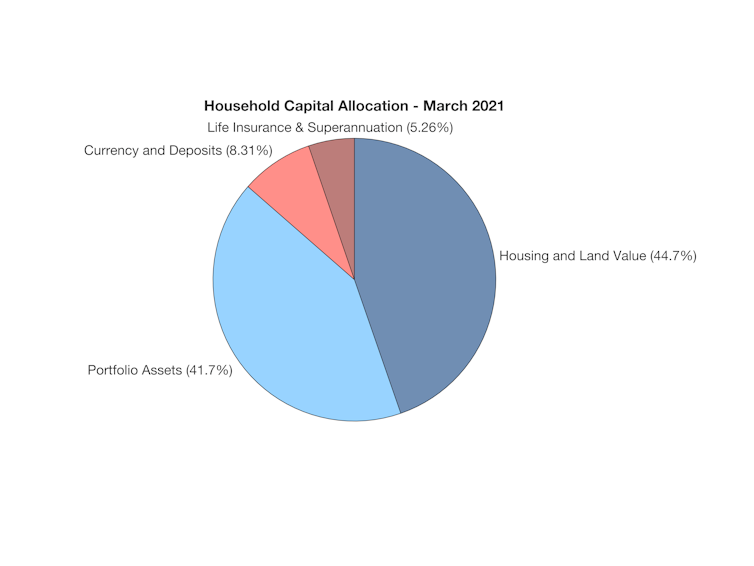
But his plan, focused on reforming foreign investment, planning and competition laws, as well as boosting the tourism and mining sectors, is hampered by a fundamental reality of New Zealand’s economy: much of the country’s capital is tied up in unproductive (and expensive) housing.
While this issue is not new, with New Zealand’s economy once described as “a housing market with bits tacked on”, the solution may lie in making housing more readily available through deregulation and policy reform. This would free up capital for drivers of growth such as infrastructure and business investment.
Household capital allocation March, 2021. Data source: RBNZ Household Balance Sheet. Author provided
The temptation of housing
Rapidly growing house prices over the past two decades have provided strong incentives to direct investment to the housing market.
On average, the price of a typical house has grown by around 8% per year, far outpacing household income growth. For example, in 2005 the median house price was roughly five times the average household income. By the middle of the pandemic house values had ballooned to nine times the average income.
Soaring prices have made residential investment extremely profitable for a long time. This means savings and investments have tended to flow into residential property rather than other productive sectors of the economy.
Constraints on housing supply
The problem is that in recent decades additional residential investment has not led to a substantial increase in new homes.
Local and central government rules and regulations have long hampered the construction of new houses. Instead, more investment in real estate has generally led to even higher prices.
As concerning as this is, it does not mean investments in housing have been misplaced. Rather, high prices and profits are what the market required in order to encourage those willing to build (few that there are) despite the costs, delays and uncertainties associated with bureaucratic battles with councils, planners and local NIMBY groups.
Banning property speculation might have kept prices down and reallocated investment to other productive uses. But in the absence of those speculators, the supply constraints would not have been any looser. Lower prices mean lower returns over building costs, leading to even fewer houses built.
Shifting capital out of the housing market in this way would not have benefited the country – we might have produced more and goods and services but fewer homes in which to live.
Christopher Luxon is pushing forward his plan for growth focused on reforming foreign investment, planning and competition laws, as well as boosting the tourism and mining sectors. Hagen Hopkins/Getty Images
Reforming housing supply
Fortunately, New Zealand has made meaningful progress on housing supply recently. For example, Auckland and Lower Hutt changed zoning laws in the 2010s making it easier to build, and Wellington City has recently followed suit.
These changes have led to local construction booms and, crucially, lower house prices and rents.
These reforms make it easier to build, reduce house prices and mean less investment capital is required for each new house built. So these policies have the dual benefit of improving housing affordability and freeing up capital for other productive sectors of the economy.
As prices come down, New Zealanders will no longer need to pour nine times their income into a home.
That will free up funds for investments in new bridges and tunnels, small businesses, and exciting new startups that will help drive innovation and generate the long-run growth we seek.
New Zealand need not give up its housing dreams in order to get business moving. Rather, it can do both.
All that requires is for local and central government to continue to let people build the housing they want so that we can free up the capital our infrastructure and businesses need.
James Graham has received research funding from the Australian Housing and Urban Research Institute and is a member of Sydney YIMBY.
An aquifer is a porous rock that is water bearing and from which water can be extracted (Infographic: Adriana Vargas/IAEA).
Groundwater accounts for around 30 per cent of the world’s freshwater, making it an important resource for addressing current global issues, such as world population growth, agricultural intensification and increased water use in different sectors like oil and gas extraction and mining, apparel and textile manufacturing and livestock farming. To protect groundwater from the threats of overextraction and pollution, and to manage it sustainably for the future, it is essential to understand where groundwater in specific locations is originating from, what its quality is and how quickly it replenishes. Scientists can perform this kind of research by analyzing the water ‘fingerprints’ called “isotopes”, which are variations of atoms in the water molecule.
What is groundwater?
Groundwater is water found underground. It can be hidden in the cracks and spaces within rocks and sediments, forming an underground resource, hosted in what is known as an “aquifer”. Depending on the characteristics or the aquifer, groundwater can be extracted, using pumping wells, for irrigation, drinking and industrial water supply and other human activities.
How are aquifers formed and why should we use them wisely?
Groundwater is part of the water cycle. Following rainfall, some water soaks into the soil and, driven by gravity, migrates downwards continuously through the subsoil and moves until it is eventually stopped by compact, impermeable rock, called an aquiclude. Many aquifers are connected to, and fed by, rivers and other surface water bodies, during the dry season. In the wet season, this system can be reversed with groundwater moving back into rivers and lakes and replenishing them.
Aquifers are an integral part of the water cycle, and their replenishment rate depends on rainfall, among other factors (Infographic: Adriana Vargas/IAEA).
The rate at which an aquifer is replenished depends on the climate and environment in the location where recharge is happening. Aquifers in an area of low rainfall might take centuries to get refilled. In contrast, shallow aquifers in an area of substantial rainfall may be replenished almost immediately. Thus, climate change, which results in more intense droughts, but also more intense localised rainfall, has an impact on how fast aquifers refill and, by extension, on how much groundwater people can use sustainably.
The intensive use of groundwater for human activities, such as agriculture and industry, at a scale that exceeds the speed at which aquifers refill, may put at risk not only the integrity of the aquifers, which risk collapse if they are drained, but also the global amount of water that people can use, because groundwater constitutes an important part of the world’s available freshwater.
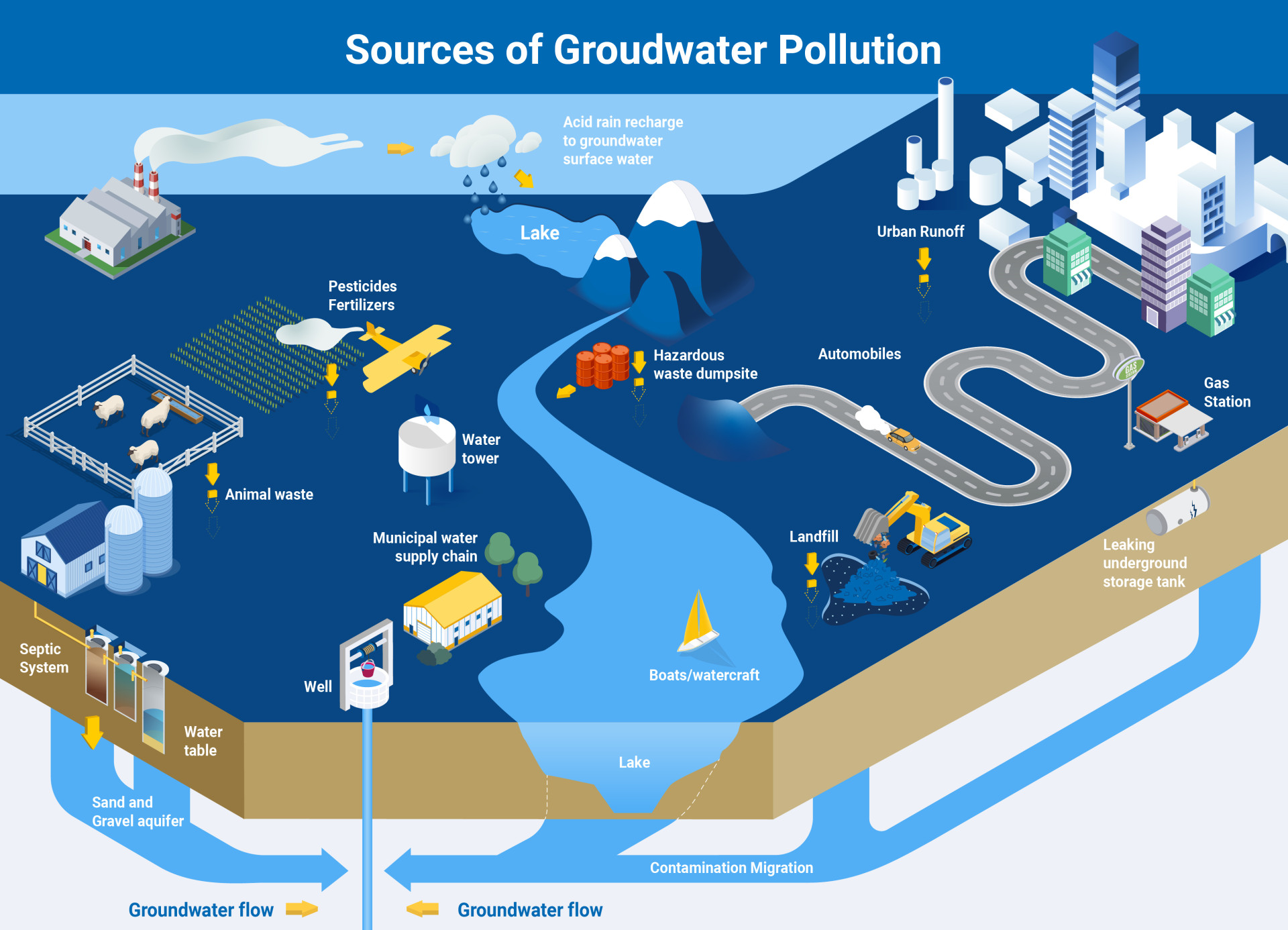
Additionally, groundwater may not always be clean enough for human use. Human activities carried out on the surface, such as sewage disposal and the overuse of pesticides and fertilizers, including animal manure, are among the main sources of contamination and pollution of groundwater. Knowing the origin of pollutants, therefore, is the first step toward addressing problems of water quality.
Potential sources of groundwater pollution by human activities (Infographic: Adriana Vargas/IAEA).
What are isotopes and how can they help scientists understand water?
The water molecule is composed of atoms of oxygen and hydrogen. Some variations of the atoms of the same chemical element, called isotopes, can be used to study the water cycle, including groundwater.
Isotopes are atoms of the same element with the same number of protons but a different number of neutrons.
Different “isotopic” techniques are used to measure isotope amounts and proportions, and to trace their origin, history, sources and interactions in the environment.
Water has a different or unique isotopic “fingerprint”, or “isotopic signature”, depending on where it comes from. Scientists analyze isotopes to track the movement and pollution sources of water along its path through the water cycle.
How do scientists use isotopes to establish whether groundwater is being overused?
Scientists use isotopes in large-scale studies on water, to assess its amount, age, and origins, and to establish whether the amount being used by people is sustainable.
For example, radioisotopes naturally present in groundwater, such as tritium, carbon-14, and noble gases helium-3, helium-4 and krypton-81, are used to learn more about how old groundwater is and the timescales of groundwater flow. By analyzing the concentration of different combinations of both stable and radio-isotopes, scientists can calculate when exactly the water is recharged in aquifers, how fast groundwater flows, and how long it takes to replenish. With this data, it is possible to establish, for example, whether or not agricultural activities in a specific area are demanding an amount of groundwater that will not be replenished fast enough to sustain irrigation needs in the long run.
By analyzing the isotopes in groundwater, scientists can establish how old the water is, and deduce how long it will take for an aquifer to recharge based on how much water is being pumped for human activities (Infographic: Adriana Vargas/IAEA).
How do scientists use isotopes to study groundwater pollution?
Scientists use specific isotopes like nitrogen-15, oxygen-18, and sulfur-34 to identify pollutants such as nitrate and sulphates. They also use these isotopes to establish whether the groundwater in a specific location is safe for human use.
For example, scientists can establish whether water contaminated with an excessive amount of nitrate is being polluted by either human waste or by fertilizers. Nitrate ions are made up of nitrogen and oxygen, and nitrogen has two isotopes while oxygen has three. The ratio of these isotopes is different in human waste and in fertilizers. Therefore, the source of pollution can be identified based on these isotopic differences. Knowing the origins of pollutants is a milestone in addressing problems with water quality and working toward the sustainable management of water resources.
What is the role of the IAEA?
The IAEA uses isotope hydrology to support Member States in water resources assessment and sustainable water management. The Agency also provides assistance and training to laboratories and scientists on analytical services through its Isotope Hydrology Laboratory.
Offering a wide range of courses, the IAEA provides training on the fundamentals of isotope hydrology and isotopic analyses of stable isotopes, tritium and noble gases.
Through its technical cooperation programme, the IAEA collaborates closely with its Member States to improve the availability and sustainability of freshwater resources through science-based, comprehensive water resources assessments.
Partnering with the World Meteorological Organization, the IAEA operates the Global Network of Isotopes in Precipitation, which contains scientific advice, logistics and technical support in isotope hydrology.
This article was first published on 22 March 2023.
SAN JUAN, Puerto Rico, Feb. 12, 2025 (GLOBE NEWSWIRE) — Red Cat Holdings, Inc. (Nasdaq: RCAT) (“Red Cat”), a drone technology company integrating robotic hardware and software for military, government, and commercial operations, today announced it has entered into an agreement for up to $20 million and closed on the initial tranche of $16.5 Million in debt financing with The Lind Partners, a New York based institutional fund manager (“Lind”). Details of the agreement include:
Debt Financing convertible at $16.15 share price
Initial Tranche proceeds of $15 million
1 million warrants exercisable at $15.00 per share non cashless
Additionally, Red Cat has applied for $58 million in debt financing from the Department of Defense Office of Strategic Capital (OSC). OSC implements strategies and partnerships to accelerate and scale private investment in critical supply chain technologies needed for national security. They have identified 14 critical technology areas vital to maintaining the United States’ national security. These have been grouped into three categories as found in the 2023 National Defense Science and Technology Strategy.
Seed Areas of Emerging Opportunity
Effective Adoption Areas
Defense-Specific Areas
The investment is expected to provide Red Cat with the working capital needed to scale up production and the ongoing development of its Arachnid Family of Systems, which includes Black Widow™, Edge 130, and a new line of FANG™ First-Person View (FPV) drones. The goal of the Family of Systems is to meet the needs of the U.S. Department of Defense and NATO Allies for drone systems that are low-cost, portable, field repairable, and recoverable.
“The recent financing will allow us to expedite and expand the Edge 130 factory and build-out and ramp up mass production of the Black Widow,” said Jeff Thompson. Red Cat CEO. “As a company focused on technology that advances the Department of Defense capabilities, we are a strong candidate for the Office of Strategic Capital’s low-cost debt program. The potential total financing of $93 million is the least dilutive option for our shareholders.”
About Red Cat, Inc. Red Cat (Nasdaq: RCAT) is a drone technology company integrating robotic hardware and software for military, government, and commercial operations. Through two wholly owned subsidiaries, Teal Drones and FlightWave Aerospace, Red Cat has developed a Family of Systems. This includes the Black Widow™, a small unmanned ISR system that was awarded the U.S. Army’s Short Range Reconnaissance (SRR) Program of Record contract. The Family of Systems also includes TRICHON™, a fixed wing VTOL for extended endurance and range, and FANG™, the industry’s first line of NDAA compliant FPV drones optimized for military operations with precision strike capabilities. Learn more at www.redcat.red.
About The Lind Partners The Lind Partners manages institutional funds that are leaders in providing growth capital to small- and mid-cap companies publicly traded in the US, Canada, Australia and the UK. Lind’s funds make direct investments ranging from US$1 to US$30 million, invest in syndicated equity offerings and selectively buy on market. Having completed more than 150 direct investments totaling over US$1.5 Billion in transaction value, Lind’s funds have been flexible and supportive capital partners to investee companies since 2011.
Forward-Looking Statements This press release contains “forward-looking statements” that are subject to substantial risks and uncertainties. All statements, other than statements of historical fact, contained in this press release are forward-looking statements. Forward-looking statements contained in this press release may be identified by the use of words such as “anticipate,” “believe,” “contemplate,” “could,” “estimate,” “expect,” “intend,” “seek,” “may,” “might,” “plan,” “potential,” “predict,” “project,” “target,” “aim,” “should,” “will,” “would,” or the negative of these words or other similar expressions, although not all forward-looking statements contain these words. Forward-looking statements are based on Red Cat Holdings, Inc.’s current expectations and are subject to inherent uncertainties, risks and assumptions that are difficult to predict. Further, certain forward-looking statements are based on assumptions as to future events that may not prove to be accurate. These and other risks and uncertainties are described more fully in the section titled “Risk Factors” in the final prospectus related to the public offering filed with the Securities and Exchange Commission. Forward-looking statements contained in this announcement are made as of this date, and Red Cat Holdings, Inc. undertakes no duty to update such information except as required under applicable law.
To address this, retrofit programs that improve home energy efficiency have become one of Canada’s main strategies to cut emissions in the housing sector. These programs focus on upgrades like air sealing, enhanced insulation, upgrading heating and cooling systems and installing energy-efficient windows and doors.
But do these programs deliver on their promises of lower bills and reduced carbon emissions? Our recent study, forthcoming in Energy Economics, examined the outcomes of the federal ecoENERGY home retrofit program, a predecessor to the Greener Homes Initiative.
Our findings shed light on where the program succeeded, where it fell short and what this all means for Canadian families and policymakers moving forward.
Real-world energy savings
Our study analyzed a decade of monthly electricity and natural gas consumption data from Medicine Hat, Alta., where residents participated in the federal ecoENERGY retrofit program that was in place between 2008 to 2012.
We found that households undertaking comprehensive envelope retrofits — which includes insulation and air sealing — reduced their total energy use by an average of 25 per cent per household. Natural gas usage dropped by 35 per cent on average for these same households, and these savings lasted for at least 10 years after the retrofit.
However, our study found that homes achieved only about 60 per cent of the predicted savings projected in pre-retrofit estimates. While measures like air sealing and attic and wall insulation were relatively effective, other upgrades, such as basement insulation and energy-efficient windows, showed zero effect on energy use.
This gap between projected and actual savings suggests that the estimates shown to households during pre-retrofit audits might be overestimating the benefits. This could leave families with lower-than-expected savings on their energy bills after making significant financial investments. These findings align with similar studies in the United States and Europe, where realized energy savings hover at around 60 per cent of pre-retrofit projections.
Despite this gap, there are promising opportunities for low-cost, high-return investments. Our research suggests that relatively cheap measures like air sealing generate high returns. Adopting electric heat pumps and fuel switching also show promise for delivering both energy savings and reductions in greenhouse gas emissions.
The need for broader participation
Our study also revealed significant gaps in program access and the distribution of benefits. Although the ecoENERGY program was available to all Canadian households, participation was highest among families of mid-valued houses.
Participation among families in lower-valued houses was disappointingly low: about four per cent of the families in lowest-valued houses took part, even though they stood to benefit the most from reduced energy bills. Homes in our study saw bill savings ranging from eight to 17 per cent, based on a comparison of their actual consumption before and after the retrofit. The highest savings were observed in homes with assessed values of $100,000.
Middle-valued homes with the highest retrofit program participant rate tended to save the least amount of money; this group had average gas bill reductions of approximately 10.5 per cent.
The maximum amount that could be claimed under the ecoENERGY program was $5,000, yet the average rebate received was $1,100. This disparity not only limited the program’s potential to reduce emissions on a large scale, but also means Canada’s current approach to energy retrofits may be missing an opportunity to improve energy affordability for those who need it most.
Room for improvement
Energy-saving retrofits have significant potential, but current prediction models often overestimate the savings homeowners can achieve. Improving these models could allow homeowners to make better-informed choices, leading to greater efficiency and improved household welfare.
Upfront costs also remain a significant barrier, particularly for lower-income families. Many cannot afford the upfront expenses associated with retrofitting their homes. Expanded financial support, such as rebates or no-interest loans, may provide much-needed support necessary to allow more households to participate, and more research is needed to evaluate how best to incentivize household participation.
Another major challenge is a lack of awareness. Many Canadians are unaware of the benefits of deep retrofits. Public awareness campaigns, possibly delivered in collaboration with community organizations, may also help educate homeowners on the long-term value of retrofits and make the process more accessible and appealing.
Our project is the first in Canada to use detailed household-level data to assess energy savings from retrofits in houses of various values. We were able to achieve this through partnerships between academia, utilities and the federal government. Such collaborations are crucial for advancing research that informs effective policies and programs.
As Canada advances toward net-zero emissions by 2050, energy-efficient housing should remain central to its climate strategy. Achieving sustainable progress in this area will require retrofit programs that deliver on their promises by enhancing household welfare, addressing energy affordability and ensuring continued public support.
Maya Papineau receives funding from Social Sciences and Humanities Research Council and the National Science and Engineering Research Council and the National Research Council of Canada.
Nicholas Rivers receives funding from the Social Sciences and Humanities Research Council and the National Science and Engineering Research Council. He is affiliated with the Canadian Climate Institute.
Kareman Yassin does not work for, consult, own shares in or receive funding from any company or organisation that would benefit from this article, and has disclosed no relevant affiliations beyond their academic appointment.
Source: The Conversation – UK – By David Benoit, Senior Lecturer in Molecular Physics and Astrochemistry, University of Hull
A detector on the seabed near Toulon, France, has spotted a high energy neutrino.ivan bastien/Shutterestock
Recent research on lightweight particles called neutrinos might have passed you by – much like the more than 10 trillion neutrinos passing through your body each second. Now, our new paper – with 21 countries, more than 60 institutes and around 360 scientists contributing – reports the observation of the most energetic neutrino yet.
Despite the enormous number of neutrinos around us, this is one of the most exciting – and rarest – astronomical events of the year. Our paper has been published in the journal Nature.
Neutrinos are tiny elementary (sub-atomic) particles that are abundant in our universe. Yet, you probably haven’t seen any. They do not interact with other matter in the ways we are familiar with.
Their lack of charge, for example, means that the electrostatic force that governs most of our everyday experiences does not interact with them at all. And their vanishingly small mass means that gravity – the other major force we experience – also has no effect on them in lab conditions on Earth.
So, detecting their presence is challenging to say the least.
They are formed through the actions of the weak nuclear force, which governs radioactive decay. It is this force that enables positively charged particles called protons, which make up to atomic nucleus, to change into neutrons, neutrally charged particles which also exist in the atomic nucleus, and vice versa.
We cannot detect a neutrino directly. But, every now and then (although very rarely), they might bump into something. When that happens, through the action of this weak nuclear force, a charged particle, such as an electron, may be created – seemingly out of nowhere – that we can detect.
Those charged particles travel at enormous speeds. And when they move through a medium such as water, they create an eerie, faint blue glow as they are slowed down. This event, called the Cherenkov effect, also happens in nuclear reactor containment pools.
How likely (or unlikely) are these interactions? Well, you would have to flip 75 heads in a row on a fair coin to have the same probability of a single neutrino interacting with a particle of matter. Think this is easy? Go ahead and flip them. It’ll take a while.
Under the sea
The KM3NeT telescope collaboration uses this Cherenkov effect to scrutinise the depths of the Mediterranean Sea for the telltale faint glow of those neutrino events. They operate two huge detection stations – one off the shores of Toulon, France and one off the southern coast of Sicily. Scientists keep watch for events around the clock.
The scale of those detectors is gigantic, as are most neutrino detectors, since the only way of spotting the elusive neutrino collision is to try to increase the amount of matter that the neutrino can interact with. In fact, the KM3 part of the KM3NeT acronym stands for the kilometre cube (KM3) of seawater that the detector will be surveying when completed.
The detection stations themselves each consist of nearly 600 light detectors – spherical buoys each containing 31 light sensing tubes, which are attached to cables anchored to the seabed up to 3.5km below the surface.
The particle described in our recent paper was detected on February 13 2023. And you might wonder why the long wait? The intervening time has been spent by collaborators across Europe verifying and simulating the detection to confirm the nature of the event. After months of work by the KM3NeT team, we can finally say that this is the most energetic observation of a neutrino interaction ever recorded.
About 28,000 photons (light particles) were detected across the array in Sicily, indicating that a hugely energetic event had just happened. That said, an average 75W lightbulb generates millions and millions of photons every second (about 100 quintillion to be more precise). But while these few thousands of photons might appear to be a small event, remember that this has been generated by a single particle.
In fact, the energy of the neutrino responsible for such bright display was estimated to be 220 peta-electronvolts (PeV) or 30 times more energetic than the highest-energy neutrino recorded so far. In terms of particle energies, it is around 1,000 times more energetic than the particles generated at Cern, the most energetic accelerator facility in the world.
The light generated by this record-breaking event could be followed through the detector array and our collaboration was able to use it to reconstruct the near-horizontal trajectory of this high-energy neutrino. The path taken indicates that this neutrino is of cosmic origin.
We don’t know exactly where it comes from, but we’ve identified 12 potential blazars (bright cores of active galaxies) that may have produced it. It is also possible that it was created in the interaction of cosmic rays with photons from the cosmic energy background.
This detection provides a window into the ultra-high-energy phenomena happening in the universe and could, for example, help us better understand the nature of some of the most energetic cosmic rays. Moreover, the observation can help us further test the theoretical models that predict the existence of high-energy neutrinos.
David Benoit receives funding from the European Union, the Science and Technology Facilities Council and the UKRI National Quantum Computing Centre.
James Keegans receives funding from the European Union.
We are in the early days of a seismic shift in the global AI industry. DeepSeek, a previously little-known Chinese artificial intelligence company, has produced a “game changing”“ large language model that promises to reshape the AI landscape almost overnight.
But DeepSeek’s breakthrough also has wider implications for the technological arms race between the US and China, having apparently caught even the best-known US tech firms off guard. Its launch has been predicted to start a “slow unwinding of the AI bet” in the west, amid a new era of “AI efficiency wars”.
In fact, industry experts have been speculating for years about China’s rapid advancements in AI. While the supposedly free-market US has often prioritised proprietary models, China has built a thriving AI ecosystem by leveraging open-source technology, fostering collaboration between government-backed research institutions and major tech firms.
This strategy has enabled China to scale its AI innovation rapidly while the US – despite all the tub-thumping from Silicon Valley – remains limited by restrictive corporate structures. Companies such as Google and Meta, despite promoting open-sourceinitiatives, still rely heavily on closed-source strategies that limit broader access and collaboration.
What makes DeepSeek particularly disruptive is its ability to achieve cutting-edge performance while reducing computing costs – an area where US firms have struggled due to their dependence on training models that demand very expensive processing hardware.
Where once Silicon Valley was the epicentre of global digital innovation, its corporate behemoths now appear vulnerable to more innovative, “scrappy” startup competitors – albeit ones enabled by major state investment in AI infrastructure. By leveraging China’s industrial approach to AI, DeepSeek has crystallised a reality that many in Silicon Valley have long ignored: AI’s centre of power is shifting away from the US and the west.
It highlights the failure of US attempts to preserve its technological hegemony through tight export controls on cutting-edge AI chips to China. According to research fellow Dean Ball: “You can keep [computing resources] away from China, but you can’t export-control the ideas that everyone in the world is hunting for.”
DeepSeek’s success has forced Silicon Valley and large western tech companies to “take stock”, realising that their once-unquestioned dominance is suddenly at risk. Even the US president, Donald Trump, has proclaimed that this should be a “wake-up call for our industries that we need to be laser-focused on competing”.
But this story is not just about technological prowess – it could mark an important shift in global power. Former US secretary of state Mike Pompeo has framed DeepSeek’s emergence as a “shot across America’s bow”, urging US policymakers and tech executives to take immediate action.
DeepSeek’s rapid rise underscores a growing realisation: globally, we are entering a potentially new AI paradigm, one where China’s model of open-source innovation and state-backed development is proving more effective than Silicon Valley’s corporate-driven approach.
The Insights section is committed to high-quality longform journalism. Our editors work with academics from many different backgrounds who are tackling a wide range of societal and scientific challenges.
I’ve spent much of my career analysing the transformative role of AI on the global digital landscape – examining how AI shapes governance, market structures and public discourse, and exploring its geopolitical and ethical dimensions, now and far in the future.
I also have personal connections with China, having lived there while teaching at Jiangsu University, then written my PhD thesis on the country’s state-led marketisation programme. Over the years, I have studied China’s evolving tech landscape, observing firsthand how its unique blend of state-driven industrial policy and private-sector innovation has fuelled rapid AI development.
I believe this moment may come to be seen as a turning point not just for AI, but for the geopolitical order. If China’s AI dominance continues, what could this mean for the future of digital governance, democracy, and the global balance of power?
China’s open-source AI takeover
Even in the early days of China’s digital transformation, analysts predicted the country’s open-source focus could lead to a major AI breakthrough. In 2018, China was integrating open-source collaboration into its broader digitisation strategy, recognising that fostering shared development efforts could accelerate its AI capabilities.
Unlike the US, where proprietary AI models dominated, China embraced open-source ecosystems to bypass western gatekeeping, scale innovation faster, and embed itself in global AI collaboration. China’s open-source activity surged dramatically in 2020, laying the foundation for the kind of innovation seen today. By actively fostering an open-source culture, China ensured that a broad range of developers had access to AI tools, rather than restricting them to a handful of dominant companies.
The trend has continued in recent years, with China even launching its own state-backed open-source operating systems and platforms in 2023, to further reduce its dependence on western technology. This move was widely seen as an effort to cement its AI leadership and create an independent, self-sustaining digital ecosystem.
Video: BBC.
While China has been steadily positioning itself as a leader in open-source AI, Silicon Valley firms remained focused on closed, proprietary models – allowing China to catch up fast. While companies like Google and Meta promoted open-source initiatives in name, they still locked key AI capabilities behind paywalls and restrictive licenses.
In contrast, China’s government-backed initiatives have treated open-source AI as a national resource, rather than a corporate asset. This has resulted in China becoming one of the world’s largest contributors to open-source AI development, surpassing many western firms in collaborative projects. Chinese tech giants such as Huawei, Alibaba and Tencent are driving open-source AI forward with frameworks like PaddlePaddle, X-Deep Learning (X-DL) and MindSpore — all now core to China’s machine learning ecosystem.
But they’re also making major contributions to global AI projects, from Alibaba’s Dragonfly, which streamlines large-scale data distribution, to Baidu’s Apollo, an open-source platform accelerating autonomous vehicle development. These efforts don’t just strengthen China’s AI industry, they embed it deeper into the global AI landscape.
This shift had been years in the making, as Chinese firms (with state backing) pushed open-source AI forward and made their models publicly available, creating a feedback loop that western companies have also – quietly – tapped into. A year ago, for example, US firm Abicus.AI released Smaug-72B, an AI model designed for enterprises that built directly upon Alibaba’s Qwen-72B and outperformed proprietary models like OpenAI’s GPT-3.5 and Mistral’s Medium. But the potential for US companies to further build on Chinese open-source technology may be limited by political as well as corporate barriers.
In 2023, US lawmakers highlighted growing concerns that China’s aggressive investment in open-source AI and semiconductor technologies would eventually erode western leadership in AI. Some policymakers called for bans on certain open-source chip technologies, due to fears they could further accelerate China’s AI advancements.
But by then, China’s AI horse had already bolted.
AI with Chinese characteristics
DeepSeek’s rise should have been obvious to anyone familiar with management theory and the history of technological breakthroughs linked to “disruptive innovation”. Latecomers to an industry rarely compete by playing the same game as incumbents – they have to be disruptive.
China, facing restrictions on cutting-edge western AI chips and lagging behind in proprietary AI infrastructure, had no choice but to innovate differently. Open-source AI provided the perfect vehicle: a way to scale innovation rapidly, lower costs and tap into global research while bypassing Silicon Valley’s resource-heavy, closed-source model.
From a western and traditional human rights perspective, China’s embrace of open-source AI may appear paradoxical, given the country’s strict information controls. Its AI development strategy prioritises both technological advancement and strict alignment with the Chinese Communist party’s ideological framework, ensuring AI models adhere to “core socialist values” and state-approved narratives. AI research in China has thrived not only despite these constraints but, in many ways, because of them.
Video: CNBC.
China’s success goes beyond traditional authoritarianism; it embodies what Harvard economist David Yang calls “Autocracy 2.0”. Rather than relying solely on fear-based control, it uses economic incentives, bureaucratic efficiency, and technology to manage information and maintain regime stability.
The Chinese government has strategically encouraged open-source development while maintaining tight control over AI’s domestic applications, particularly in surveillance and censorship. Indeed, authoritarian regimes may have a significant advantage in developing facial-recognition technology due to their extensive surveillance systems. The vast amounts of data collected through these networks enable private AI companies to create advanced algorithms, which can then be adapted for commercial uses, potentially accelerating economic growth.
China’s AI strategy is built on a dual foundation of state-led initiatives and private-sector innovation. The country’s AI roadmap, first outlined in the 2017 new generation artificial intelligence development plan, follows a three-phase timeline: achieving global competitiveness by 2020, making major AI breakthroughs by 2025, and securing world leadership in AI by 2030. In parallel, the government has emphasised data governance, regulatory frameworks and ethical oversight to guide AI development “responsibly”.
A defining feature of China’s AI expansion has been the massive infusion of state-backed investment. Over the past decade, government venture capital funds have injected approximately US$912 billion (£737bn) into early-stage firms, with 23% of that funding directed toward AI-related companies. A significant portion has targeted China’s less-developed regions, following local investment mandates.
Compared with private venture capital, government-backed firms often lag in software development but demonstrate rapid growth post-investment. Moreover, state funding often serves as a signal for subsequent private-sector investment, reinforcing the country’s AI ecosystem.
China’s AI strategy represents a departure from its traditional industrial policies, which historically emphasised self-sufficiency, support for a handful of national champions, and military-driven research. Instead, the government has embraced a more flexible and collaborative approach that encourages open-source software adoption, a diverse network of AI firms, and public-private partnerships to accelerate innovation. This model prioritises research funding, state-backed AI laboratories, and AI integration across key industries including security, healthcare, and infrastructure.
Despite strong state involvement, China’s AI boom is equally driven by private-sector innovation. The country is home to an estimated 4,500 AI companies, accounting for 15% of the world’s total.
As economist Liu Gang told the Chinese Communist Party’s Global Times newspaper: “The development of AI is fast in China – for example, for AI-empowered large language models. Aided with government spending, private capital is flowing to the new sector. Increased capital inflow is anticipated to further enhance the sector in 2025.”
China’s tech giants including Baidu, Alibaba, Tencent and SenseTime have all benefited from substantial government support while remaining competitive on the global stage. But unlike in the US, China’s AI ecosystem thrives on a complex interplay between state support, corporate investment and academic collaboration.
Recognising the potential of open-source AI early on, Tsinghua University in Beijing has emerged as a key innovation hub, producing leading AI startups such as Zhipu AI, Baichuan AI, Moonshot AI and MiniMax — all founded by its faculty and alumni. The Chinese Academy of Sciences has similarly played a crucial role in advancing research in deep learning and natural language processing.
Unlike the west, where companies like Google and Meta promote open-source models for strategic business gains, China sees them as a means of national technological self-sufficiency. To this end, the National AI Team, composed of 23 leading private enterprises, has developed the National AI Open Innovation Platform, which provides open access to AI datasets, toolkits, libraries and other computing resources.
DeepSeek is a prime example of China’s AI strategy in action. The company’s rise embodies the government’s push for open-source collaboration while remaining deeply embedded within a state-guided AI ecosystem. Chinese developers have long been major contributors to open-source platforms, ranking as the second-largest group on GitHub by 2021.
Founded by Chinese entrepreneur Liang Wenfeng in 2023, DeepSeek has positioned itself as an AI leader while benefiting from China’s state-driven AI ecosystem. Liang, who also established the hedge fund High-Flyer, has maintained full ownership of DeepSeek and avoided external venture capital funding.
Though there is no direct evidence of government financial backing, DeepSeek has reaped the rewards of China’s AI talent pipeline, state-sponsored education programs, and research funding. Liang has engaged with top government officials including China’s premier, Li Qiang, reflecting the company’s strategic importance to the country’s broader AI ambitions.
In this way, DeepSeek perfectly encapsulates “AI with Chinese characteristics” – a fusion of state guidance, private-sector ingenuity, and open-source collaboration, all carefully managed to serve the country’s long-term technological and geopolitical objectives.
Recognising the strategic value of open-source innovation, the government has actively promoted domestic open-source code platforms like Gitee to foster self-reliance and insulate China’s AI ecosystem from external disruptions. However, this also exposes the limits of China’s open-source ambitions. The government pushes collaboration, but only within a tightly controlled system where state-backed firms and tech giants call the shots.
Reports of censorship on Gitee reveal how Beijing carefully manages innovation, ensuring AI advances stay in line with national priorities. Independent developers can contribute, but the real power remains concentrated in companies that operate within the government’s strategic framework.
The conflicted reactions of US big tech
DeepSeek’s emergence has sparked intense debate across the AI industry, drawing a range of reactions from leading Silicon Valley executives, policymakers and researchers. While some view it as an expected evolution of open-source AI, others see it as a direct challenge to western AI leadership.
Microsoft’s CEO, Satya Nadella, emphasised its technical efficiency. “It’s super-impressive in terms of both how they have really effectively done an open-source model that does this inference-time compute, and is super-compute efficient,” Nadella told CNBC. “We should take the developments out of China very, very seriously”.
Silicon Valley venture capitalist Marc Andreessen, a prominent advisor to Trump, was similarly effusive. “DeepSeek R1 is one of the most amazing and impressive breakthroughs I’ve ever seen – and as open source, a profound gift to the world,” he wrote on X.
For Yann LeCun, Meta’s chief AI scientist, DeepSeek is less about China’s AI capabilities and more about the broader power of open-source innovation. He argued that the situation should be read not as China’s AI surpassing the US, but rather as open-source models surpassing proprietary ones. “DeepSeek has profited from open research and open source (e.g. PyTorch and Llama from Meta),” he wrote on Threads. “They came up with new ideas and built them on top of other people’s work. Because their work is published and open source, everyone can profit from it. That is the power of open research and open source.”
Not all responses were so measured. Alexander Wang, CEO of Scale AI – a US firm specialising in AI data labelling and model training – framed DeepSeek as a competitive threat that demands an aggressive response. He wrote on X: “DeepSeek is a wake-up call for America, but it doesn’t change the strategy: USA must out-innovate & race faster, as we have done in the entire history of AI. Tighten export controls on chips so that we can maintain future leads. Every major breakthrough in AI has been American.”
Elon Musk added fuel to speculation about DeepSeek’s hardware access when he responded with a simple “obviously” to Wang’s earlier claims on CNBC that DeepSeek had secretly acquired 50,000 Nvidia H100 GPUs, despite US export restrictions.
Beyond the tech world, US policymakers have taken a more adversarial stance. House speaker Mike Johnson accused China of leveraging DeepSeek to erode American AI leadership. “They abuse the system, they steal our intellectual property. They’re now trying to get a leg up on us in AI.”
For his part, Trump took a more pragmatic view, seeing DeepSeek’s efficiency as a validation of cost-cutting approaches. “I view that as a positive, as an asset … You won’t be spending as much, and you’ll get the same result, hopefully.”
The rise of DeepSeek may have helped jolt the Trump administration into action, leading to sweeping policy shifts aimed at securing US dominance in AI. In his first week back in the White House, the US president announced a series of aggressive measures, including massive federal investments in AI research, closer partnerships between the government and private tech firms, and the rollback of regulations seen as slowing US innovation.
The administration’s framing of AI as a critical national interest reflects a broader urgency sparked by China’s rapid advancements, particularly DeepSeek’s ability to produce cutting-edge models at a fraction of the cost traditionally associated with AI development. But this response is not just about national competitiveness – it is also deeply entangled with private industry.
Musk’s growing closeness to Trump, for example, can be viewed as a calculated move to protect his own dominance at home and abroad. By aligning with the administration, Musk ensures that US policy tilts in favour of his AI ventures, securing access to government backing, computing power, and regulatory control over AI exports.
At the same time, Musk’s public criticism of Trump’s US$500 billion AI infrastructure plan – claiming the companies involved lack the necessary funding – was as much a warning as a dismissal, signalling his intent to shape policy in a way that benefits his empire while keeping potential challengers at bay.
Not unrelated, Musk and a group of investors have just launched a US$97.4 billion (£78.7bn) bid for OpenAI’s nonprofit arm, a move that escalates his feud with OpenAI CEO Sam Altman and seeks to strengthen his grip on the AI industry. Altman has dismissed the bid as a “desperate power grab”, insisting that OpenAI will not be swayed by Musk’s attempts to reclaim control. The spat reflects how DeepSeek’s emergence has thrown US tech giants into what could be all-out war, fuelling bitter corporate rivalries and reshaping the fight for AI dominance.
And while the US and China escalate their AI competition, other global leaders are pushing for a coordinated response. The Paris AI Action Summit, held on February 10 and 11, has become a focal point for efforts to prevent AI from descending into an uncontrolled power struggle. France’s president, Emmanuel Macron, warned delegates that without international oversight, AI risks becoming “the wild west”, where unchecked technological development creates instability rather than progress.
But at the end of the two-day summit, the UK and US refused to sign an international commitment to “ensuring AI is open, inclusive, transparent, ethical, safe, secure and trustworthy … making AI sustainable for people and the planet”. China was among the 61 countries to sign this declaration.
Concerns have also been raised at the summit about how AI-powered surveillance and control are enabling authoritarian regimes to strengthen repression and reshape the citizen-state relationship. This highlights the fast-growing global industry of digital repression, driven by an emerging “authoritarian-financial complex” that may exacerbate China’s strategic advancement in AI.
Equally, DeepSeek’s cost-effective AI solutions have created an opening for European firms to challenge the traditional AI hierarchy. As AI development shifts from being solely about compute power to strategic efficiency and accessibility, European firms now have an opportunity to compete more aggressively against their US and Chinese counterparts.
Whether this marks a true rebalancing of the AI landscape remains to be seen. But DeepSeek’s emergence has certainly upended traditional assumptions about who will lead the next wave of AI innovation – and how global powers will respond to it.
End of the ‘Silicon Valley effect’?
DeepSeek’s emergence has forced US tech leaders to confront an uncomfortable reality: they underestimated China’s AI capabilities. Confident in their perceived lead, companies like Google, Meta, and OpenAI prioritised incremental improvements over anticipating disruptive competition, leaving them vulnerable to a rapidly evolving global AI landscape.
In response, the US tech giants are now scrambling to defend their dominance, pledging over US$400 billion in AI investment. DeepSeek’s rise, fuelled by open-source collaboration, has reignited fierce debates over innovation versus security, while its energy-efficient model has intensified scrutiny on AI’s sustainability.
Yet Silicon Valley continues to cling to what many view as outdated economic theories such as the Jevons paradox to downplay China’s AI surge, insisting that greater efficiency will only fuel demand for computing power and reinforce their dominance. Companies like Meta, OpenAI and Microsoft remain fixated on scaling computational power, betting that expensive hardware will secure their lead. But this assumption blinds them to a shifting reality.
DeepSeek’s rise as the potential “Walmart of AI” is shaking Silicon Valley’s foundation, proving that high-quality AI models can be built at a fraction of the cost. By prioritising efficiency over brute-force computing power, DeepSeek is challenging the US tech industry’s reliance on expensive hardware like Nvidia’s high-end chips.
This shift has already rattled markets, driving down the stock prices of major US firms and forcing a reassessment of AI dominance. Nvidia, whose business depends on supplying high-performance processors, appears particularly vulnerable as DeepSeek’s cost-effective approach threatens to reduce demand for premium chips.
Video: CBS News.
The growing divide between the US and China in AI, however, is more than just competition – it’s a clash of governance models. While US firms remain fixated on protecting market dominance, China is accelerating AI innovation with a model that is proving more adaptable to global competition.
If Silicon Valley resists structural change, it risks falling further behind. We may witness the unravelling of the “Silicon Valley effect”, through which tech giants have long manipulated AI regulations to entrench their dominance. For years, Google, Meta,and OpenAI shaped policies that favoured proprietary models and costly infrastructure, ensuring AI development remained under their control.
More than a policy-driven rise, China’s AI surge reflects a fundamentally different innovation model – fast, collaborative and market-driven – while Silicon Valley holds on to expensive infrastructure and rigid proprietary control. If US firms refuse to adapt, they risk losing the future of AI to a more agile and cost-efficient competitor.
A new era of geotechnopolitics
But China is not just disrupting Silicon Valley. It is expanding “geotechnopolitics”, where AI is a battleground for global power. With AI projected to add US$15.7 trillion to the global economy by 2030, China and the US are racing to control the technology that will define economic, military and political dominance.
DeepSeek’s advancement has raised national security concerns in the US. Trump’s government is considering stricter export controls on AI-related technologies to prevent them from bolstering China’s military and intelligence capabilities.
As AI-driven defence systems, intelligence operations and cyber warfare redefine national security, governments must confront a new reality: AI leadership is not just about technological superiority, but about who controls the intelligence that will shape the next era of global power.
China’s AI ambitions extend beyond technology, driving a broader strategy for economic and geopolitical dominance. But with over 50 state-backed companies developing large-scale AI models, its rapid expansion faces growing challenges, including soaring energy demands and US semiconductor restrictions.
China’s president, Xi Jinping, remains resolute, stating: “Whoever can grasp the opportunities of new economic development such as big data and artificial intelligence will have the pulse of our times.” He sees AI driving “new quality productivity” and modernising China’s manufacturing base, calling its “head goose effect” a catalyst for broader innovation.
To counter western containment, China has embraced a “guerrilla” economic strategy, bypassing restrictions through alternative trade networks, deepening ties with the global south, and exploiting weaknesses in global supply chains. Instead of direct confrontation, this decentralised approach uses economic coercion to weaken adversaries while securing China’s own industrial base.
Video: AP.
China is also leveraging open-source AI as an ideological tool, presenting its model as more collaborative and accessible than western alternatives. This narrative strengthens its global influence, aligning with nations seeking alternatives to western digital control. While strict state oversight remains, China’s embrace of open-source AI reinforces its claim to a future where innovation is driven not by corporate interests but through shared collaboration and global cooperation.
But while DeepSeek claims to be open access, its secrecy tells a different story. Key details on training data and fine-tuning remain hidden, and its compliance with China’s AI laws has sparked global scrutiny. Italy has banned the platform over data-transfer risks, while Belgium and Ireland launched privacy probes.
Under Chinese regulations, DeepSeek’s outputs must align with state-approved narratives, clashing with the EU’s AI Act, which demands transparency and protects political speech. Such “controlled openness” raises many red flags, casting doubt on China’s place in markets that value data security and free expression.
Many western commentators are seizing on reports of Chinese AI censorship to frame other models as freer and more politically open. The revelation that a leading Chinese chatbot actively modifies or censors responses in real time has fuelled a broader narrative that western AI operates without such restrictions, reinforcing the idea that democratic systems produce more transparent and unbiased technology. This framing serves to bolster the argument that free societies will ultimately lead the global AI race.
But at its heart, the “AI arms race” is driven by technological dominance. The US, China, and the EU are charting different paths, weighing security risks against the need for global collaboration. How this competition is framed will shape policy: lock AI behind restrictions, or push for open innovation.
DeepSeek, for all its transformational qualities, continues to exemplify a model of AI where innovation prioritises scale, speed and efficiency over societal impact. This drive to optimise computation and expand capabilities overshadows the need to design AI as a truly public good. In doing so, it eclipses this technology’s genuine potential to transform governance, public services and social institutions in ways that prioritise collective wellbeing, equity and sustainability over corporate and state control.
A truly global AI framework requires more than political or technological openness. It demands structured cooperation that prioritises shared governance, equitable access, and responsible development. Following a workshop in Shanghai hosted by the Chinese government last September, the UN’s general secretary, António Guterres, outlined his vision for AI beyond corporate or state control: “We must seize this historic opportunity to lay the foundations for inclusive governance of AI – for the benefit of all humanity. As we build AI capacity, we must also develop shared knowledge and digital public goods.”
Both the west and China frame their AI ambitions through competing notions of “openness” – each aligning with their strategic interests and reinforcing existing power structures.
Western tech giants claim AI drives democratisation, yet they often dominate digital infrastructure in parts of Africa, Asia and Latin America, exporting models based on “corporate imperialism” that extract value while disregarding local needs. China, by contrast, positions itself as a technological partner for the rest of the global south; however, its AI remains tightly controlled, reinforcing state ideology.
China’s proclaimed view on international AI collaboration emphasises that AI should not be “a game of rich countries”“, as President Xi stated during the 2024 G20 summit. By advocating for inclusive global AI development, China positions itself as a leader in shaping international AI governance, especially via initiatives like the UN AI resolution and its AI capacity-building action plan. These efforts help promote a more balanced technological landscape while allowing China to strengthen its influence in global AI standards and frameworks.
However, beneath all these narratives, both China and the US share a strategy of AI expansion that relies on exploited human labour, from data annotation to moderation, exposing a system driven less by innovation than by economic and political control.
Seeing AI as a connected race for influence highlights the need for ethical deployment, cross-border cooperation, and a balance between security and progress. And this is where China may face its greatest challenge – balancing the power of open-source innovation with the constraints of a tightly controlled, authoritarian system that thrives on restriction, rather than openness.
To hear about new Insights articles, join the hundreds of thousands of people who value The Conversation’s evidence-based news. Subscribe to our newsletter.
Peter Bloom does not work for, consult, own shares in or receive funding from any company or organisation that would benefit from this article, and has disclosed no relevant affiliations beyond their academic appointment.
Source: The Conversation – UK – By Ivo Vlaev, Professor of Behavioural Science, Warwick Business School, University of Warwick
Sir Keir Starmer has become the first sitting UK prime minister to publicly take an HIV test to reduce stigma around Aids and encourage more people to get tested.
There are historical parallels. In 1956, when Elvis Presley, at the height of his fame, was filmed receiving his polio vaccine on US television.
Do these high-profile gestures really change attitudes and behaviour, or are they just headline-grabbing stunts?
A closer look at the behavioural science behind celebrity endorsements suggests that, under the right conditions, public demonstrations by famous figures can indeed shift social norms, reduce stigma and influence health outcomes. However, the effects depend a lot on the credibility of the endorser, the authenticity of the act and the presence of sustained, follow-up campaigns.
Elvis Presley’s polio jab is one of the most iconic examples of celebrity-led health campaigns. But many other well-known figures have encouraged the public to adopt protective health measures, from actors promoting annual flu jabs to footballers advocating organ donation drives.
The premise is that a celebrity’s endorsement can normalise certain behaviour by tapping into the principles of “social learning theory”, particularly observational learning. That is, when we see someone we admire or trust do something, we are more likely to follow suit.
In the 1950s, polio was a serious threat, capable of causing paralysis or death. After witnessing Elvis roll up his sleeve on national television, many teenagers – previously sceptical or apathetic – became far more willing to accept the polio vaccine. That event is now hailed as a masterclass in leveraging popular culture to address a public health crisis.
A masterclass in leveraging popular culture.
A cornerstone of behavioural science is the recognition that who delivers a message can be as important as – or sometimes more important than – what the message contains. The so-called “messenger effect” highlights how we are often more persuaded by people we perceive to be credible, relatable or high status.
In the case of Elvis, he was already idolised by millions. He was the perfect conduit to promote vaccination among teenagers who might otherwise dismiss appeals from older authority figures.
Starmer occupies a different kind of influence. Supporters of the Labour party may see him as a trustworthy figure, while others could be sceptical of a politician’s motives. This underscores a key aspect of the messenger effect: if a large segment of the target audience views the figure as partisan or self-serving, the endorsement can backfire or simply fail to register.
Another powerful effect identified in behavioural science is social norms – our shared understandings of what is typical or appropriate – which strongly influence whether we take certain actions.
Stigma around HIV remains a major barrier to testing and treatment. Even though medical advances have changed the landscape of HIV/Aids care, many people still fear the societal consequences of a positive diagnosis. According to the UK Health Security Agency, around 5,000 people in the UK are unaware they are living with HIV, partly because they hesitate to test in the first place.
By publicly taking an HIV test, Starmer aimed to shift perceptions and normalise testing. In terms of social identity theory, seeing a prominent figure within the national community – especially one involved in shaping policies – undergo testing can communicate that “people like us” view HIV testing as a routine, responsible health measure. This may be particularly powerful for people who identify politically with Starmer or who respect his leadership position.
Despite the potential of celebrity or high-profile endorsements, behavioural science also points to authenticity as a vital ingredient. Audiences are more likely to change their behaviour if they believe the celebrity genuinely cares about the issue rather than simply seeking publicity. If endorsements are perceived as insincere or politically opportunistic, their effect can be muted or even counterproductive.
In Elvis’s case, he was known for engaging with young fans and had a track record of public good works, which helped bolster the sense that his polio vaccination was done for more than just a publicity boost.
For Starmer, sustaining the momentum beyond a single test – through continued advocacy, support of free testing programmes, and visibility in HIV-awareness campaigns – could reinforce the perception of a real commitment rather than a fleeting photo opportunity.
Nudges
Behavioural scientists also often talk about “nudges” – small interventions that change people’s choices without forbidding options or significantly changing incentives. A celebrity endorsement can serve as a nudge by making a desirable health behaviour (like getting tested) more top-of-mind or socially acceptable.
However, historically, Elvis’s vaccination was not a standalone act. It was part of a broader public health strategy involving schools, local campaigns and continued outreach. Those elements ensured that once people were motivated to get the polio jab, they could do so easily.
For HIV testing, the same principle applies: visible leadership from Starmer may spark initial interest, but practical measures – such as pop-up testing centres, free home-test kits and confidential testing support – are vital to maintain engagement.
Is Keir Starmer the new Elvis? In reality, the two scenarios differ in time and context. A 21st-century political leader raising awareness about HIV testing in the UK operates within a more complex media landscape than a 1950s rock ’n’ roll icon on American primetime television. Yet, there is a parallel: both used their public status to tackle a widespread health concern, hoping to overcome stigma and promote an important preventative measure.
Ultimately, celebrity moments can open the door, but only a sustained, evidence-based strategy will keep it open – and encourage people to walk through.
Anyone in England can order a free and confidential HIV test from www.freetesting.hiv to do the test at home.
Ivo Vlaev does not work for, consult, own shares in or receive funding from any company or organisation that would benefit from this article, and has disclosed no relevant affiliations beyond their academic appointment.
Source: United Kingdom – Executive Government & Departments
A commission for advice from the Home Office to the Animals in Science Committee (ASC) on strengthening the functioning of AWERBs and Named Information Officer.
This file may not be suitable for users of assistive technology.
Request an accessible format.
If you use assistive technology (such as a screen reader) and need a version of this document in a more accessible format, please email alternativeformats@homeoffice.gov.uk. Please tell us what format you need. It will help us if you say what assistive technology you use.
Details
Recommendations sought for strengthening the functioning of Animal Welfare and Ethical Review Bodies (AWERBs) and the Named Information Officer (NIO) role. Advice is sought in the following specific areas:
best practice guidance for AWERBs, particularly relating to their duties regarding the 3Rs (replacement, refinement, and reduction) and training
the questions that AWERBs should ask project applicants to check that replacement methodologies have been fully considered
a review of the ASC AWERB network model to assure dissemination of leading practice
leading practice to ensure that the NIO role functions effectively at establishments, where required
For the first time, the FSP presented its award, recognizing the most outstanding and talented athletes, coaches and partners.
The award ceremony took place as part of the FonCode 2024 sports programming tournament. The competition began with an online qualifying round, in which more than a thousand programmers participated. The 128 best athletes reached the final duels for the prize fund of 1 million rubles.
The tournament culminated in a duel between Fedor Romashov and Ho Dang Dung. The outcome of the match remained unpredictable until the end — the main round ended in a draw. Only an additional task brought victory to Fedor Romashov, a third-year bachelor’s student “Applied Mathematics and Computer Science”.
It is not surprising that Fedor also became the best sports programmer of 2024 according to the FSP.
“It was unexpected and pleasant to receive the FSP award,” noted Fedor Romashov. “I had quite a few cool victories last year. My team and I won ICPC 2023, which I consider to be my best and most important achievement in this area. I am also glad victory inGamesbof the future “It’s also an incredible experience.”
The “Coach of the Year” award was received by Mikhail Gustokashin, Director of the Center for Student Olympiads at the Faculty of Computer Science. In 2024, under Mikhail’s leadership, one of the teams from the Faculty of Computer Science became world champions at the International Student Programming Contest (ICPC), and the second team received a gold medal for 3rd place.
“The Federation of Sports Programming holds many competitions with interesting tasks and experimental formats. Our students take part in these competitions with pleasure and achieve great success. Recognition from the FSP is very pleasant, we will continue to work!” – concluded Mikhail Gustokashin.
Text: Alexandra Sytnik
Please note: This information is raw content directly from the source of the information. It is exactly what the source states and does not reflect the position of MIL-OSI or its clients.
Source: The Conversation – Canada – By Jennifer Clapp, Professor and Canada Research Chair in Global Food Security and Sustainability, and Member of the International Panel of Experts on Sustainable Food Systems, University of Waterloo
History has shown us again and again that, so long as inequality goes unchecked, no amount of technology can ensure people are well fed.
Today, the world produces more food per person than ever before. Yet hunger and malnutrition persist in every corner of the globe — even, and increasingly, in some of its wealthiest countries.
The major drivers of food insecurity are well known: conflict, poverty, inequality, economic shocks and escalating climate change. In other words, the causes of hunger are fundamentally political and economic.
The urgency of the hunger crisis has prompted 150 Nobel and World Food Prize laureates to call for “moonshot” technological and agricultural innovations to boost food production, meaning monumental and lofty efforts. However, they largely ignored hunger’s root causes — and the need to confront powerful entities and make courageous political choices.
Food is misallocated
To focus almost exclusively on promoting agricultural technologies to ramp up food production would be to repeat the mistakes of the past.
The Green Revolution of the 1960s-70s brought impressive advances in crop yields, though at considerable environmental cost. It failed to eliminate hunger, because it didn’t address inequality. Take Iowa, for example — home to some of the most industrialized food production on the planet. Amid its high-tech corn and soy farms, 11 per cent of the state’s population, and one in six of its children, struggle to access food.
Even though the world already produces more than enough food to feed everyone, it’s woefully misallocated. Selling food to poor people at affordable prices simply isn’t as profitable for giant food corporations.
They make far more by exporting it for animal feed, blending it into biofuels for cars or turning it into industrial products and ultra-processed foods. To make matters worse, a third of all food is simply wasted.
Meanwhile, as the laureates remind us, more than 700 million people — nine per cent of the world’s population — remain chronically undernourished. A staggering 2.3 billion people — more than one in four — cannot access an adequate diet.
Women queue up to receive food distributed by local volunteers at a camp in Somalia in May 2019. Conflicts hinder the effective delivery of humanitarian aid during food security crisis. (AP Photo/Farah Abdi Warsameh)
Confronting inequity
Measures to address world hunger must start with its known causes and proven policies. Brazil’s Without Hunger program, for example, has seen dramatic 85 per cent reduction in severe hunger in just 18 months through financial assistance, school food programs and minimum wage policies.
Our politicians must confront and reverse gross inequities in wealth, power and access to land. Hunger disproportionately affects the poorest and most marginalized people, not because food is scarce, but because people can’t afford it or lack the resources to produce it for themselves. Redistribution policies aren’t optional, they’re essential.
Governments must put a stop to the use of hunger as a weapon of war. The worst hunger hotspots are conflict zones, as seen in Gaza and Sudan, where violence drives famine. Too many governments have looked the other way on starvation tactics — promoting emergency aid to pick up the pieces instead of taking action to end the conflicts driving hunger.
Governments must also break the stranglehold of inequitable trade rules and export patterns that trap the poorest regions in dependency on food imports, leaving them vulnerable to shocks.
Instead, supporting local and territorial markets is critical in helping build resilience to economic and supply chain disruptions. These markets provide livelihoods and help ensure diverse, nutritious foods reach those who need them.
Mitigating and adapting to climate change requires massive investments in transformative approaches that promote resilience and sustainability in food systems.
Agroecology — a farming system that applies ecological principles to ensure sustainability and promotes social equity in food systems — is a key solution, proven to sequester carbon, build resilience to climate shocks and reduce dependence on expensive and environmentally damaging synthetic fertilizers and pesticides.
More research should explore agroecology’s full potential. And we must adopt plant-rich, local and seasonal diets, ramp up measures to tackle food waste and reconsider using food crops for biofuels.
This means pushing back against Big Meat and biofuel lobbies, while investing in climate-resilient food systems.
Bold political action needed
This is not to say that technology has no role — all hands need to be on deck. But the innovations most worth pursuing are those that genuinely support more equitable and sustainable food systems, and not corporate profits. Unless scientific efforts are matched by policies that confront power and prioritize equity over profit, then hunger is likely to here to stay.
The solutions to hunger are neither new nor beyond reach. What’s missing is the political will to address its root causes.
This message is shared by my colleagues with the International Panel of Experts on Sustainable Food Systems, IPES-Food, whose work covers a range of expertise and experience. Hunger persists because we allow injustice to endure. If we are serious about ending it, we need bold political action, not just scientific breakthroughs.
Jennifer Clapp receives funding from the Canada Research Chairs program and the Social Sciences and Humanities Research Council of Canada. She is a member of the International Panel of Experts on Sustainable Food Systems (IPES-Food).
At a recent summit in Dar Es Salaam, Tanzania, leaders of eight African states released a statement calling for an immediate and unconditional ceasefire in the Democratic Republic of Congo (DRC).
The statement comes after a flareup in fighting in eastern DRC that has killed hundred and wounded thousands.
On Jan. 31, 2025 the rebel group known as the March 23 Movement (M23) captured the city of Goma in the eastern DRC. At a news conference, Corneille Nangaa, leader of the Congo River Alliance that includes M23, declared that they were there to stay and would march to the DRC’s capital of Kinshasa.
The World Health Organization reported 900 bodies had been recovered from the streets of Goma, with about 3,000 people injured and thousands forced to flee. The Congolese government said that it had started burying more than 2,000 people and thousands had been displaced.
On Feb. 4, 2025, the Congo River Alliance declared a ceasefire. This isn’t the first time M23 attacked Goma and then declared a ceasefire. The renewed violence is the latest in a long-running conflict in the region that has grown to involve local militias, regional countries and foreign companies seeking to exploit Congo’s mineral wealth.
However, a faction within the CNDP disapproved of the Goma agreement and created a militia group in 2012 that came to be known as M23. A United Nations group has said senior government officials from Rwanda and Uganda have provided M23 with weapons, intelligence and military support.
The roots of the conflict lie in the history of Belgium’s colonial rule of the region that pitted the Tutsi and Hutu ethnic groups against each other. In 1956, ethnic tensions in Rwanda forced many Tutsis to seek refuge in Congo (then Zaire), Uganda, Tanzania and beyond.
Tutsis who fled to Congo and Uganda were not accorded full citizenship rights, and this led to resentment.
In the mid-1990s, Rwandan President Paul Kagame and Ugandan President Yoweri Museveni collaborated with Congolese rebel leader Laurent-Désiré Kabila to create the AFDL. The group waged the First Congo War from October 1996 to May 1997 that ended with the overthrow of the DRC’s long-time ruler, Mobutu Sese Seko. Kabila became president.
Kagame and Museveni fought along with Congolese Tutsis to assert their citizenship once the war ended. However, when Kabila turned against his backers, it led to the waged Second Congo War from 1998 to 2003, with Rwandan and Ugandan-backed militas fighting against the DRC government.
The FDLR was implicated in orchestrating the 1994 Rwandan genocide that killed 800,000 people, most of whom were Tutsi. The FDLR has been based in eastern Congo since 1996, after the Rwandan Patriotic Front, led by Kagame and others, pushed them out of Rwanda.
Fear of the FDLR was one of the drivers for the First Congo War. In a recent interview with CNN, Kagame said:
“If you want to ask me, is there a problem in Congo that concerns Rwanda? And that Rwanda would do anything to protect itself? I’d say 100 per cent.”
Control of minerals
Before the fall of Goma in February 2025, M23 captured mineral-rich areas like Rubaya, the largest coltan mine in the Great Lakes region; Kasika and Walikale, where there are numerous gold mines; Numbi, which is rich with tin, tungsten, tantalum and gold; and Minova, which is a trade hub.
In December 2024, a UN expert group noted that M23 exported about 150 tonnes of coltan to Rwanda, and was involved with Rwanda’s production, leading to “the largest contamination of mineral supply chain.”
One of the central dynamics of this conflict is the control and profit from natural resources. The DRC is rich in minerals and metals needed around the world, including the critical minerals used in the technology and renewable energy industries.
The World Bank has noted that the “DRC is endowed with exceptional mineral resources.” However, administration of the sector is dysfunctional and handicapped by insufficient institutional capacity.
Ending the M23 insurgency requires taking Tutsi citizenship seriously. Politics researcher Filip Reyntjens has argued that any peaceful transition in the DRC needed to take regional countries seriously. He emphasized:
“By turning a blind eye to Rwanda’s hegemonic claims in eastern Congo, the future stability of the region remains in doubt. Rwanda may once again, in the not too distant future, become the focal point of regional violence.”
A factor contributing to the violence is the lack of measures to ensure ceasefires are respected by different parties engaged in conflicts. In addition, armed groups and their backers have not been effectively prosecuted. A 2010 UN mapping report describes 617 alleged war crimes, crimes against humanity and human rights between March 1993 and June 2003. No perpetrators have never been prosecuted.
Furthermore, there must be strong international efforts to prevent conflict minerals from getting into international supply chains. M23 and other militias smuggle Congo’s minerals through regional neighbours, where they are considered conflict-free.
Tech giants that rely on these minerals must do more to scrutinize where they come from. Equally, all of us, as consumers of products made from the DRC’s minerals, must demand accountability.
It’s usually only men who participate in such talks. Women, who endure the brutality of sexual violence and other human rights violations, must be represented in peace and security talks.
In his 2018 Nobel Peace Prize acceptance speech, Congolese physician and human rights activist Dr. Dennis Mukwege noted that:
“What is the world waiting for before taking this into account? There is no lasting peace without justice. Yet, justice in not negotiable. Let us have the courage to take a critical and impartial look at what has been going on for too long in the Great Lakes region.”
To effectively respond to the plight of the people of eastern Congo will take more than situational and short-term intervention. National, regional and international parties must negotiate peaceful and just access to minerals. Peace and security in Congo will happen when sectarian and partisan politics is replaced with commitment to democracy, sovereignty and peoples’ well-being.
Evelyn Namakula Mayanja receives funding from the Social Sciences and Humanities Research Council Canada and Carleton University.
A public consultation has been launched asking businesses and residents to comment on a vision to grow Liverpool’s multi-billion-pound economy over the next 15 years.
The Inclusive Economic Growth Strategy will set the framework for growth up to 2040 and the eight-week consultation, hosted by Liverpool City Council, aims to inform the development of the resulting action plan.
The vision for Liverpool 2040 is to create a strong and inclusive economy that leaves no one behind.
The strategy focuses on strengthening foundations to build a fairer, more prosperous, and sustainable city that creates opportunities for a good life for all its residents.
The draft strategy focuses on several key themes, including:
Strengthening key sectors to drive growth, innovation, investment and productivity Key sectors include: Health & Life Sciences, Creative and Digital industries, Advanced Manufacturing and Maritime.
Build a vibrant, productive and resilient business base
Ensure access to skills development, employment opportunities and career building
Place people at the heart of growth activity and supporting aspirations and networks
Several public engagement events will be staged over the coming months to gather views from the public. People can also go online at www.liverpool.gov.uk/growthstrategyconsultation to find out more and give their feedback.
Liverpool currently powers a £16.7 billion economy, with over 14,000 businesses and around 230,000 people in employment.
However, significant challenges remain, including low productivity and investment, financial pressures on public services, inequality of opportunity in some communities, and health challenges.
In light of these challenges, the Council, which recently submitted a New Town bid to Government to regenerate a huge part of North Liverpool, is committed to supporting businesses and residents. Delivering an inclusive economy a core pillar for Liverpool’s Strategic Partnership plan for 2040.
To further underline the Council’s commitment, since June 2023, its Business Support Service has provided advice and guidance to over 1,000 Liverpool businesses and supported 300+ residents with direct advice on starting up a new business.
The Adult Learning and Skills team has also supported over 4,500 residents to develop essential workplace skills, and the Ways to Work team has supported 1,708 economically inactive and unemployed residents with employment and skills services.
Councillor Nick Small, Liverpool City Council’s Cabinet Member for Development and Growth, said: “This draft Inclusive Economic Growth Strategy is a vital piece of work and one which will come to define the conditions that support our businesses to grow.
“Feedback to this draft strategy is crucial, it needs to reflects the views and needs of our businesses, non-profit organizations, charities, and voluntary organization – be it education, transport, housing or digital connectivity.
“We also want to hear residents’ views to ensure we create a strong, relevant and deliverable strategy, one that will inform the initiatives, interventions and investment into the infrastructure the city needs to underpin our future economy.
“All of this feedback will help us strengthen the strategy, ensure we deliver the right action for economic growth, and best placing us to build inclusivity so residents and communities thrive.”
Councillor Lila Bennett, Liverpool City Council’s Cabinet Member for Employment, Educational Attainment and Skills, said “The success of this strategy will be deeply rooted in the strength and diversity of our partnerships and our collective commitment and action. All our partners have a key role in driving economic growth and ensuring benefits are felt across all communities.
“We also want our partners, including the business community, to embrace and deliver for our residents by realising opportunities and addressing challenges, from climate change to AI, to train and upskill their workforce to be ready for the economy of the future.”
With the endless stream of announcements, reversals, measures and countermeasures coming from the new administration of United States President Donald Trump, it has become difficult to make sense of what is just noise or opening negotiation offers and what constitutes actual policy change.
Unfortunately, in the case of the global response against HIV/AIDS, it seems the attacks go beyond bluster.
The methods used in the fight against HIV/AIDS have long been disputed, but overall commitment to the response was one of the few deeply bipartisan endeavours left, until now. Undercutting this decades-long consensus would mean endangering millions of lives.
U.S. role in global HIV/AIDS response
As a PhD candidate in international relations working on the politics of the response to HIV/AIDS, I am very aware of the central role that the U.S. has played in building and sustaining a global response to the epidemic in the past 25 years.
The U.S. is also a fundamental participant in HIV/AIDS research, including through the work of the Centers for Disease Control (CDC) and the National Institutes of Health (NIH), as well as USAID.
All of this involvement has already been dangerously jeopardized by the actions taken by the White House since Trump took office for his second term.
The chaos wrought by these measures has impacted the response to HIV/AIDS in deep ways, even if they may be contested or reversed by the courts and Congress.
The uncertainty in itself is damaging for programs that need reliable funding and long-term planning, not to mention the clinical trials that have been brutally interrupted. What’s more, there are indications the Trump administration and other Republicans have abandoned the longstanding commitment to the response itself, which may lead to irreparable damage.
American involvement in the global response to HIV/AIDS has long been shaped by domestic politics. Most notably, PEPFAR’s first rounds of funding were deeply constrained by the views of George W. Bush’s evangelical constituency, including in its focus on abstinence as prevention and denial of funding for sex workers.
The Heritage Foundation, the conservative think-tank behind the potential blueprint for Trump’s government known as Project 2025, has referred to HIV/AIDS as a lifestyle disease, like tobacco consumption. This language is reminiscent of the 1980s playbook of opponents on AIDS action and negates both the nature of the epidemic and the realities of those who live with the virus, casting doubts on the need to engage meaningfully with the response.
Most ominously, the last reauthorization of PEPFAR in 2024 was limited to one year instead of the customary five, as some Republican representatives sought to end it altogether. This means the entire program is to be re-examined this March with no guarantee of how the debates will unfold, especially in the current climate.
Ultimately most will depend on Congress, including the amount pledged by the U.S. to the Global Fund at its replenishment conference sometime this year.
Its decisions will be the real test of the depth of change on this matter, though everything that has unfolded so far hints at a far-reaching shattering of the consensus. If conservative Republicans maintain their pressure on PEPFAR, the program could be significantly diminished, and it is unlikely that a White House that withdrew from the World Health Organization on day one will act decisively to save it or insist on a sustained contribution to the Global Fund.
Consequences of U.S. disengagement
The consequences of a U.S. retreat from the global response to HIV/AIDS would be immense.
In the short-term, millions of people would lose access to the treatment they depend on for their survival. In the long term, shrinking American funding would undermine health systems around the world and risk the resurgence of the pandemic and the rise of resistant virus strains.
This would jeopardize 40 years of progress, returning us to a time when AIDS was considered a key security risk and threat to development.
Even if funding is maintained, all of this shows that for the next few years the U.S. is unlikely to be reliable. This means others will have to take up the leadership to ensure the worst-case scenario is avoided.
Among these, Canada could have a crucial role to play. It has long been a key entity in its own right — the seventh largest contributor to the Global Fund — though Ottawa has remained discreet in this area so far. Washington’s withdrawal from the field may force it to step into a more visible role and contribute to reframe Canada’s international involvement.
Yolaine Frossard de Saugy does not work for, consult, own shares in or receive funding from any company or organisation that would benefit from this article, and has disclosed no relevant affiliations beyond their academic appointment.
Source: Republic of France in English The Republic of France has issued the following statement:
Artificial intelligence (AI) is profoundly transforming our society, opening up unprecedented opportunities in many fields. For this technological revolution to benefit everyone, it is crucial to ensure its responsible and ethical development, with trust at its heart. AI raises major concerns regarding safety and security, as clearly demonstrated by the summits in Bletchley Park (United Kingdom – November 2023) and Seoul (South Korea – May 2024). Whether in anticipating extreme risks or addressing those already visible, a resolutely ambitious approach to building trust in AI is essential on an international scale.
Technological advances in AI also offer exceptional possibilities in the field of security. With this in mind, the AI Action Summit is committed to promoting safe and secure AI, particularly by providing the necessary tools to mitigate these risks.
For AI to fulfill its promises, a collaborative approach is essential. The AI Action Summit calls on public, private, and academic stakeholders to work together to build a trusted AI ecosystem.
This global approach is based on three pillars: science, solutions, and standards. With a robust international scientific consensus on AI, the time has come to develop technical solutions that are open and accessible to all, while creating common international standards recognized by the entire ecosystem. This will help prevent fragmentation and encourage convergence at all levels.
As part of the AI Action Summit, the Ministry of Europe and Foreign Affairs and the General Secretariat for Defence and National Security have supported the action of the thematic envoy, Guillaume Poupard, to federate an ecosystem of stakeholders, both nationally and internationally, mobilised to strengthen the safety and security of AI.
Ocean Giant arrived at McMurdo Station Jan. 26, delivering a floating marine causeway system along with 380 pieces of cargo, consisting of containers filled with mechanical parts, vehicles, construction materials, office supplies and electronics equipment, and mobile office units; supplies needed to sustain the next year of operations at McMurdo Station, Antarctica.
Following the offload, Ocean Giant was loaded with 360 containers of retrograde cargo for transportation off the continent. This includes trash and recyclable materials for disposal and equipment no longer required on the station.
The MSC chartered ship MV Ocean Gladiator is scheduled to arrive in McMurdo Station later this week, and will begin a cargo offload as well as retrieving the causeway.
Operation Deep Freeze is a joint service, on-going Defense Support to Civilian Authorities activity in support of the National Science Foundation (NSF), lead agency for the United States Antarctic Program. Mission support consists of active duty, Guard and Reserve personnel from the U.S. Air Force, Navy, Army, and Coast Guard as well as Department of Defense civilians and attached non-DOD civilians. ODF operates from two primary locations situated at Christchurch, New Zealand and McMurdo Station, Antarctica. An MSC-chartered cargo ship and tanker have made the challenging voyage to Antarctica every year since the station and its resupply mission were established in 1955.
An African journalist films President Xi Jinping delivering an opening ceremony speech for the China-Africa forum in Beijing in September 2024.AP Photo/Andy Wong
Every year, China’s minister of foreign affairs embarks on what has now become a customary odyssey across Africa. The tradition began in the late 1980s and sees Beijing’s top diplomat visit several African nations to reaffirm ties. The most recent visit, by Foreign Minister Wang Yi, took place in mid-January 2025 and included stops in Namibia, the Republic of the Congo, Chad and Nigeria.
For over two decades, China’s burgeoning influence in Africa was symbolized by grand displays of infrastructural might. From Nairobi’s gleaming towers to expansive ports dotting the continent’s shorelines, China’s investments on the continent have surged, reaching over US$700 billion by 2023 under the Belt and Road Initiative, China’s massive global infrastructure development strategy.
But in recent years, Beijing has sought to expand beyond roads and skyscrapers and has made a play for the hearts and minds of African people. With a deft mix of persuasion, power and money, Beijing has turned to African media as a potential conduit for its geopolitical ambitions.
Partnering with local outlets and journalist-training initiatives, China has expanded China’s media footprint in Africa. Its purpose? To change perceptions and anchor the idea of Beijing as a provider of resources and assistance, and a model for development and governance.
The ploy appears to be paying dividends, with evidence of sections of the media giving favorable coverage to China. But as someone researching the reach of China’s influence overseas, I am beginning to see a nascent backlash against pro-Beijing reporting in countries across the continent.
The media charm offensive
China’s approach to Africa rests mainly on its use of “soft power,” manifested through things like the media and cultural programs. Beijing presents this as “win-win cooperation” – a quintessential Chinese diplomatic phrase mixing collaboration with cultural diplomacy.
CGTN Africa, which was set up in 2012, offers a Chinese perspective on African news. The network produces content in multiple languages, including English, French and Swahili, and its coverage routinely portrays Beijing as a constructive partner, reporting on infrastructure projects, trade agreements and cultural initiatives. Moreover, Xinhua News Agency, China’s state news agency, now boasts 37 bureaus on the continent.
By contrast, Western media presence in Africa remains comparatively limited. The BBC, long embedded due to the United Kingdom’s colonial legacy, still maintains a large footprint among foreign outlets, but its influence is largely historical rather than expanding. And as Western media influence in Africa has plateaued, China’s state-backed media has grown exponentially. This expansion is especially evident in the digital domain. On Facebook, for example, CGTN Africa commands a staggering 4.5 million followers, vastly outpacing CNN Africa, which has 1.2 million — a stark indicator of China’s growing soft power reach.
China’s zero-tariff trade policy with 33 African countries showcases how it uses economic policies to mold perceptions. And state-backed media outlets like CGTN Africa and Xinhua are central to highlighting such projects and pushing an image of China as a benevolent partner.
Questions of media veracity notwithstanding, China’s strategy is bearing fruit. A Gallup poll from April 2024 showed China’s approval ratings climbing in Africa as U.S. ratings dipped. Afrobarometer, a pan-African research organization, further reports that public opinion of China in many African countries is positively glowing, an apparent validation of China’s discourse engineering.
Further, studies have shown that pro-Beijing media influences perceptions. A 2023 survey of Zimbabweans found that those who were exposed to Chinese media were more likely to have a positive view of Beijing’s economic activities in the country.
China’s foreign minister Wang Yi, center, holds hands with his counterparts, Senegal’s Yassine Fall, left, and the Republic of the Congo’s Jean-Claude Gakosso, after a joint news conference. AP Photo/Andy Wong
Co-opting local voices
The effectiveness of China’s media strategy becomes especially apparent in the integration of local media. Through content-sharing agreements, African outlets have disseminated Beijing’s editorial line and stories from Chinese state media, often without the due diligence of journalistic skepticism.
Ethiopia exemplifies how China’s infrastructure investments and media influence have fostered a largely favorable perception of Beijing. State media outlets, often staffed by journalists trained in Chinese-run programs, consistently frame China’s role as one of selfless partnership. Coverage of projects like the Addis Ababa-Djibouti railway line highlights the benefits, while omitting reports on the substandard labor conditions tied to such projects — an approach reflective of Ethiopia’s media landscape, where state-run outlets prioritize economic development narratives and rely heavily on Xinhua as a primary news source.
Beneath the surface of China’s well-publicized projects and media offerings, and the African countries or organizations that embrace Beijing’s line, a significant countervailing force exists that challenges uncritical representations and pursues rigorous journalism.
Yet as CGTN Africa and Xinhua become entrenched in African media ecosystems, a pertinent question comes to the forefront: Will Africa’s journalists and press be able to uphold their impartiality and retain intellectual independence?
As China continues to make strategic inroads in Africa, it’s a fair question.
Mitchell Gallagher does not work for, consult, own shares in or receive funding from any company or organization that would benefit from this article, and has disclosed no relevant affiliations beyond their academic appointment.
Source: United Kingdom – Executive Government Non-Ministerial Departments
Charity Commission CEO David Holdsworth discusses the power of philanthropy at The Beacon Philanthropy and Impact Forum 2025.
Introduction
Good afternoon, I am delighted to be here with you.
I’d like to thank the Beacon Collaborative for bringing us together today, helping us think with many minds on one, urgent challenge: how to grow the value and impact of philanthropy in our nations and around the world.
It is apt that we are meeting here at Guildhall, a place that speaks to the close relationship between commerce and charity in this city. The City Bridge Trust, administered by the Corporation of London, based here at Guildhall, made grants worth £30m to charities across the capital last year alone. Over the same period, the Lord Mayor’s Appeal, which works to encourage philanthropy in the city spent over £3m on projects designed to strengthen communities and cohesion across London.
These initiatives recognise and reflect a key facet of the social contract in this country.
Namely that with privilege and good fortune come responsibility. Our hosts, the Beacon Collaborative, put this in simple terms: “Our economy offers the freedom to create great wealth, but with reward must come responsibility.”
That responsibility is not about sacrifice or denial. It is based on an understanding that we are all part of a wider community, an ecosystem of mutual dependence and support, on whose cohesion the success of our society – and all individual wellbeing – ultimately rests.
A challenging sector landscape
The Charity Commission stands at a unique vantage point, where the perspectives of charities, government, the public and donors meet.
From this position, we see two trends.
First, an incredibly challenging economic environment for the sector.
Like other sectors, charities face inflationary pressures and rising operational costs.
But charities are also dealing with increased demands for their services.
And at the same time, public funding sources in particular are increasingly squeezed.
The cumulative impact of these trends on charities is, in some cases, extremely challenging.
Take arts and culture, a particular passion of mine. Between 2010 and 2023, grant in aid funding for UK arts and cultural organisations fell by 18%. Local government revenue funding of culture and related services have also decreased by 48% in England, and 40% in Wales.
It’s important to acknowledge that these cuts have come amid very challenging public finances, with tough choices having to be made. But the impact on the sector is undeniable.
Other sub-sectors are especially vulnerable, too.
Last summer, we learnt that one in five hospices in the UK have cut or closed their services in the last year or are planning to do so.
In October, Getting on Board, which for twenty years played a crucial role in encouraging new talent into trusteeship, announced it could no longer continue to operate.
The case for philanthropy
Our second observation, though open to some debate, is a perception that high-net worth philanthropy has declined in recent years.
To be clear, the UK remains, according to some but not all measures, among the most generous group of nations on the planet, funding a thriving and vibrant charitable sector.
In total, charities in England and Wales last year managed over £90 billion in annual income. The contribution of charity and voluntary organisations as a percentage of GDP is greater, according to some measures, than the entire agricultural sector of the UK.
But the proportion of those giving seems to be falling.
For some years, The Charities Aid Foundation – who fulfil such a valuable role in producing research about the sector, and of course in supporting occasions such as this – have published reports pointing to a declining number of donors.
CAF’s latest report finds that, while the overall value of giving is holding up in real terms – in 2023 people donated at least £13bn to charity – fewer people are giving.
Separately, there is evidence suggesting that the top one percent of asset owners and earners in our country give less than their counterparts in equivalent societies, such as New Zealand and Canada. Some have suggested that there is a £5 billion gap between giving in the UK and in those two countries.
Previous research has indicated an overall decline in the value of donations by the top one percent of earners, despite increases in their income. And the latest UK giving report, just mentioned, finds that that some of the least affluent parts of the UK are among the most generous.
In summary, by a number of metrics, it seems likely that while charitable giving is just about holding up, high net worth philanthropy is proving less robust.
The potential of philanthropy
But this challenging context provides for a once-in-several generations opportunity.
For while there may be huge challenge, there is also huge potential, right now, for a new era of philanthropy to tackle our most intractable social challenges. We have the opportunity to resource and re-ignite the potential of our communities, through a renewed collaborative approach between our amazing charitable sector, corporate donors, philanthropists, communities and government.
The potential of philanthropy lies not just in the immediate financial boost it might offer the individual charities.
But in the agility and flexibility, the innovation and creativity it can encourage, inspire and unleash.
I think, as a nation, it is time to re-embrace the long and proud history of philanthropic impact, revive it, unleash it and celebrate it for our times.
I speak from personal experience as to the benefits philanthropy can bring.
I grew up in Liverpool in the 1980s. The city was then in post-industrial decline, and it felt in many ways forgotten and neglected by many. It had, arguably, lost its sense of purpose.
Today my home city is transformed. And that transformation happened through a combination of philanthropic investments, national and local government investment, alongside renewed community action notably in the arts, culture and tourism which acted as catalysts for wider renewal.
Financial and cultural investment in Liverpool in turn led to an expansion in higher education provision, an influx of international students and therefore an increasingly skilled workforce.
Liverpool is now in the process of a next phase of transformation. National non-governmental bodies have moved their HQs to the city, and life science industries are investing. Things are moving and changing thanks to that initial spark provided through philanthropy.
It shows that philanthropy and charity is ever evolving and finding new models, new ways to deliver real and lasting impact. That philanthropy and charity are not just about handouts, but hand-ups and start-ups, with the power to unleash peoples’ and communities’ potential.
To return to arts and culture, a sector that is now highly reliant on major gifts and sponsorships.
The Donmar, for example, lost its council funding in 2022. Now, any work that is not revenue generating must have its costs covered by fundraising. Corporate sponsorship has stepped in and is helping to ensure that the Donmar can continue to invest in its talent development programmes – providing paid traineeships to those underrepresented in the arts industry – and its community work in Camden and Westminster, offering free engagement programmes to over 5,000 young people every year.
Great charitable work, only possible now thanks to philanthropy.
Of course, philanthropy alone cannot make a city or a community, or reverse a social ill. But it can act as a spark that re-ignites hope and confidence and gives a community the confidence to revive itself, and to unleash its potential to adapt to changing economic, political and social circumstances.
The mechanisms for this particular role of philanthropy are varied.
First, philanthropists can do what other funders – notably public sector funders – cannot.
They can take risks and innovate, work out new solutions to deep-rooted problems by trying and testing.
They can support charities’ core costs, helping them develop long-term viability and stability, rather than living only from one grant to the next.
And philanthropists can sow seeds – offering large, one-off donations that allow new charities to get off the ground, or established charities to plan for the long term.
Celebrating philanthropy
So again, whilst there are challenges, there is much to recognise and celebrate.
For example, I am moved to see corporate philanthropy combine with public generosity, community campaigning, media engagement and political interest – as well as support from the Charity Commission – to breathe new life into Zoe’s Place in Liverpool.
The charity provides end of life hospice care to babies and young children, bringing children and their families comfort and relief in incredibly challenging circumstances. It had faced closure in Liverpool, due to the spiralling costs of new accommodation.
Together, campaigners raised £6m in a month before Christmas, allowing the charity to continue.
It was an amazing effort, that would not have been possible without philanthropic contributions.
Similarly, I am deeply impressed with the work of the Moondance Foundation. Founded in 2010 by Diane and Henry Engelhardt, the charity has given away a remarkable £145 million, most of which has gone to support and strengthen communities in Wales, which is the family’s chosen, adoptive home. In December last year, we visited small community organisations in Port Talbot, Swansea, and Bridgend that have all benefited from this extraordinary generosity.
Their example shows that love of a place, responsibility and commitment to a community is a matter of heart, not necessarily heritage.
I would also like to mention here the work of the late Julia Rausing, who sadly passed away last year, leaving an immense legacy of generosity and kindness. She was an example to others, not just in how much she helped give away, but how – her sense of urgency and oversight ensured funds, where needed, were swiftly dispatched and carefully accounted for.
Or the musician Stormzy, who has given back of his wealth and influence to promote education and opportunity among young people.
And I must mention the Commission’s own board member Rory Brooks, who recently donated £2m to the Global Development Institute at The University of Manchester. He will not thank me for including his example here, but in his absence, Rory – if you want to promote philanthropy, you must let us celebrate your own example.
The Commission’s ongoing commitment to promoting philanthropy
I know many in the philanthropy world have been wondering what Orlando’s departure as Chair later this year means for our work in this area.
First, I would like to acknowledge the significant contribution Orlando has made to public discourse on philanthropy during his time in office.
Orlando has used his authority and his voice as Chair of the Charity Commission to ensure philanthropy is seen and understood as one of the solutions to the urgent issues of our day.
And he has made a compelling case for the responsibilities and opportunities the Commission has to convene public debate on this issue.
So I know many in the world of philanthropy and beyond are very sorry to see Orlando move on from the Commission.
But let me make very clear.
The work he began will continue.
I, and the Commission’s Board, are determined to deliver on the commitment made in our corporate strategy to encourage trusteeship and amplify donor and philanthropic confidence through our work.
I am bound by them, not just by professional duty, but by personal conviction. A regulator must enable, encourage, unleash as well as enforce.
I am grateful to Rory Brooks, as I’ve mentioned a remarkable philanthropist in his own right, who as a member of the Commission’s board is spearheading much of this work.
Rory’s diligent commitment over the past two years has borne much fruit.
I am convinced that his quiet powers of persuasion have contributed to a changing public discourse on philanthropy.
A renewed understanding, on all sides of the political divide, that private wealth, voluntarily given, is part of the solution to some of the most entrenched of our social ills.
The new government has demonstrated its interest in philanthropy, particularly in geographical areas that are struggling to attract funding. We heard earlier from Minister Peacock about the government’s commitment to producing a place-based philanthropy strategy, more details of which we expect to hear about over the coming months.
The Commission’s role and work
But for our own part, what are we collectively doing at the Commission to promote philanthropy?
Promoting the UK as a great place to give
First, we have a role in ensuring, and demonstrating, that the UK remains among the best and safest places to give.
We have a robust, long-established regulatory infrastructure, which ensures transparency – not least through the accounting framework – and which gives donors confidence that there is oversight over the funds that charities receive.
That infrastructure stretches beyond the work of the Commission alone – other principal regulators, such as the Department for Culture Media and Sport and the Office for Students, play an important role in regulating vital sub-sectors in the field of culture, arts and heritage, as do auditors and independent examiners working to regulatory requirements.
In that context, the UK is also a centre of excellence for professional services – we boast among the best lawyers, financial advisors and wealth managers in the world.
There is room for more active input from these professionals in promoting philanthropy.
In the legal world, especially, there is an opportunity for those advising on transactions involving significant assets to actively introduce and encourage philanthropic considerations.
But overall, the system we have in place means philanthropists from all over the world, can have confidence in investing their goodwill and generosity into UK based charities – many of which, of course, operate globally.
Supporting charities to improve governance
Second, we help trustees understand their legal duties and sustain and improve their charities’ governance.
Last year, we published guidance supporting trustees to make the right choices on accepting, refusing and returning donations. That guidance reflected the law in being explicit about the starting point that charities should accept donations.
It is for trustees to make decisions as to what is in their charity’s best interests. Sometimes, trustees may well conclude that they should not accept a philanthropist’s support. But we wanted our guidance to be clear that the law assumes donations to charities to be generally a good thing.
We wanted to support trustees to say yes to donations where, having carefully weighed up the relevant factors, it is in their charity’s best interests – even where it might be contentious or controversial for some.
And I think that reminder is salutary at the present time, given the challenging financial context I set out earlier.
The last thing I want to see on my watch at the Commission is charities – including world leading arts and cultural organisations which have long benefited from philanthropic generosity – finding they can no longer operate successfully, because donations are withheld for fear of being rejected.
So I encourage those giving – whether individual philanthropists or corporate donors – to continue to do so even when there may be those who disagree with such donations from a point of personal principle or conviction. It is the benefit of democracy that we can disagree while still each exercising our individual freedoms and still do good for charity, our communities and those most in need.
To help enable this, we hope our guidance will inform a giving culture, but also a receiving culture, that allows for constructive discussion in the best long term interests of charity.
Delivering data-led insights
Thirdly, the Commission maintains, to our knowledge, the most complete and comprehensive charity data set anywhere in the world. Although this presents its own challenges, we’re also keen to recognise the opportunities for collaboration with partner organisations.
Over the last 18 months, Rory has led two summits focusing on the Commission’s data, our ongoing digital projects, and how we plan to help the sector make more informed funding decisions.
I know, for instance, the impact that digitisation of charity accounts will have for those working with charity data and that is why it remains such a priority for us.
These summits give us fascinating insights into how the philanthropy sector uses, and would like to use, charity data. In the near future we will see an early outcome of this work, with new data drawn from charities’ annual returns on the value of their single largest donation received during that year.
This data over time will not just provide useful insights in to trends in philanthropy, but will, I hope, serve as inspiration to existing and potential philanthropists to give with heart and confidence.
Convening role, working with government
A final aspect of the Commission’s role that I am especially keen to promote is that of convenor.
We have a unique ability to help bring together the sector, government, philanthropists and donors as well as experts such as our hosts Beacon and the Charities Aid Foundation to consider, together, how we can encourage those with great wealth to choose the UK as a place to leave a legacy.
It has begun with the work I mentioned on data, but we want to go further and identify other focus areas, bringing together those with the passion and capability to drive progress. Specifically, we are keen to continue to work alongside other players to support government and other policy makers to ensure giving is incentivised and celebrated.
Conclusion
So in conclusion, despite the challenges, I believe we have a generational opportunity to revive and reignite our proud history of philanthropic giving for a modern age.
To build on the many recent examples of joined up action, be it placed-based or issue-based, which sees philanthropy, community, business, media, politicians come together to unleash potential, solve issues or spark renewal.
It is the power of that collective action, that joined-up approach to today’s challenges, that this generation of philanthropists and charities can use to continue to achieve the seemingly impossible, to improve the lives of many and unleash the spark of hope, innovation and opportunity.
As the CEO of the Commission I promise you we will be there beside you, playing our part, enabling you to do the amazing things you do for the benefit of society.
We at the Commission will also help ensure that this growing band of philanthropists feel proud of their achievements, and use our platform to shout about them – encouraging others to follow suit. So to all of you who give, to those professionals that advise and support giving – thank you – never under-estimate the impact you have – and the opportunity you enable.
Source: The Conversation – UK – By Dan Baumgardt, Senior Lecturer, School of Physiology, Pharmacology and Neuroscience, University of Bristol
She chain-smoked her way through romance and heart-break and binge-drank Chardonnay until it went out of fashion (and then came back in again) – and now Bridget Jones is back.
Mad about the Boy is the fourth and final film in the Bridget Jones series. It’s almost 30 years since Helen Fielding hit the bestseller lists with the accident-prone, self-deprecating eponymous heroine of Bridget Jones’s Diary. Tales of “emotional f-ckwits” and “really bloody enormous pants” resonated with readers and the film adaptations cemented Bridget Jones’s status as a well-loved character.
Fans of the original Bridget Jones’s Diary will remember her daily log of statistics. Many will have read the entries, listing calories, cigarettes and alcohol units consumed, with a nod of recognition. The alcohol-free diet that’s started with fierce determination one day descends into hungover calorific chaos the next. But is Bridget’s lifestyle as loveable in real life as it is on the page and screen?
Thanks to the handy summary about calorie intake, cigarette count and alcohol units at the end of the original diary, I’ve been able to take a closer look at what her lifestyle might mean in reality. On paper – and on screen – her lifestyle might look like the kind of smoking, drinking, break-up binge eating (and the occasional magic mushroom in Thailand) to which lots of readers and viewers can relate.
But even the book recognises that Bridget’s lifestyle isn’t sustainable, as it includes a warning and disclaimer. And, the relentless focus on weight and calorie consumption might be a reflection of the social pressure women face, but it’s also been criticised for its potential danger to some of its audience.
Smoking
In the original diary, Bridget’s cigarette count for the year is 5,277: around 14-15 a day. In clinical practice, we often standardise this in numbers of “pack-years” of smoking. One pack equals 20 cigarettes, so if you smoke 20 a day for one year, that makes one pack-year. In the case of Bridget, this makes approximately 0.75 pack-years.
You might think that figure doesn’t seem very high – but add the count from the following year in Bridget Jones: The Edge of Reason, plus of all the years before it, and the pack-years start adding up and are more like five, seven, even ten.
The higher the number of pack-years exposure, the greater the risk of developing an associated disease or complication. For many years, a critical level of ten pack-years or more was associated with significant risk of developing a lung condition called COPD (chronic obstructive pulmonary disease), which ranges in severity and can lead to distressing symptoms including persistent coughing, wheezing and shortness of breath.
But patients with a history of less than ten pack-years exposure may also be at significant risk, which is why some argue this critical level should be lowered.
What kind of health issues could Bridget face after smoking so much for so long? Smoking is notorious for causing cancer, including lung, bladder, kidney and stomach cancers. Smoking also negatively affects cardiovascular health and fertility and causes gum disease and a variety of other health issues – the list is long.
Bridget logged her daily calorie count, but she was perhaps not a reliable narrator. Over the course of the year, she calculated that she’d consumed over 11 million calories. “Repulsive,” she states – and also highly unlikely. This total would equate to over 30,000 calories a day, approximately six to ten times more than most competing bodybuilders would consume.
By the end of Bridget Jones’s Diary, she had gained 5st 2lbs and lost 5st 3lbs, resulting in a net loss of a pound. So broadly speaking what went in, must have matched what energy was consumed. Her starting weight for the year is 9st 3lbs, and taking (for argument’s sake) Renée Zellweger’s 5f 4ins height that gives a body mass index (BMI) of 22.1 – right in the middle of the “normal” BMI range of 18.5 to 25.
Bridget’s daily weigh-in on the bathroom scale routine may have fed her preoccupation with minor fluctuations. Weight isn’t just a measure of fat, it’s also the body’s water and waste. Measuring weight less frequently is a more effective way to gauge the overall trend of whether weight is going up or down. ## Alcohol
“I WILL NOT drink more than 14 alcohol units a week,” Bridget writes in the opening of the original diary.
However, despite 114 hangover-free days, Bridget ends up with annual alcohol consumption of 3,836 units – that’s a weekly intake of around 74 units – much more than the maximum of 14 units recommended for both men and women.
Bridget recognises that she drinks too much and, as seen in her new year’s resolutions, often intends to cut back. In clinical practice, we use the Cage questions to help evaluate whether a patient has issues with alcohol. We might ask, for example, whether the person is annoyed by criticism of their drinking or feels guilty about it? Do they use alcohol as an “eye-opener” in the morning?
So while Bridget Jones may prove as endearing as ever to audiences this year – and her love life just as chaotic – it’s probably for the best that her lifestyle seems a bit healthier this time around. It would have been awful to have her story end with untimely death by Chardonnay.
Dan Baumgardt does not work for, consult, own shares in or receive funding from any company or organisation that would benefit from this article, and has disclosed no relevant affiliations beyond their academic appointment.
Source: The Conversation – UK – By Mahdi Bodaghi, Associate Professor of Smart Materials & Manufacturing, Nottingham Trent University
Flat-pack, but not as we know it. This is an AI image created by OpenAI’s Dall-E., CC BY-SA
Imagine buying a flat sheet from a furniture store that changes into a sofa when you heat it with a hairdryer. Or consider the value of a stent that precisely expands inside a patient’s artery, adapting to their unique anatomy.
Welcome to 4D printing, a frontier in material and manufacturing science that has been rapidly expanding over the past decade. While 3D printing has captured global attention for its ability to create objects layer by layer, 4D printing adds the element of time.
It involves 3D-printing adaptable objects from materials such as polymers or alloys that can bend, twist or transform entirely when they come into contact with heat or moisture. By moving beyond the constrictions of static designs, it opens up remarkable possibilities in areas such as medicine, aerospace, robotics and construction.
I was recently the lead author on a comprehensive report published in the journal of Smart Materials and Structures, charting the advances and challenges in this field. We outlined this industry’s potential, offering a vision of a future where smart materials redefine design and manufacturing.
Here are some more of the main fields in which 4D printing could be transformative:
1. Healthcare
Like the stent I mentioned earlier, 4D printing raises the possibility of creating implants and prosthetics that adapt to patients’ needs in real time. Research teams working on these innovations include the Biomet4D project, coordinated by the IMDEA Materials Institute in Madrid, which is developing smart, biodegradable metallic implants for people with seriously damaged or defective bones. The implants can change shape and expand as the bone grows, supporting it much more effectively than a static implant.
Another area of focus is smarter ways to give patients drugs. For example, a team of researchers based at China’s Jilin University have created 4D-printed hydrogel capsules whose outer structure stays intact inside a patient’s body until it reaches a particular temperature, such as when there is an infection, meaning the drug only takes effect when it’s required. This could be useful in situations where it’s beneficial to release a drug into a patient’s body at exactly the right time and location.
2. Robotics and wearables
Integrating 4D materials into robotics and wearable devices enables them to adjust their functionality in response to their environment. For instance, researchers at Harvard University’s Wyss Institute have developed self-folding robotic devices based on insights from origami that change shape when exposed to heat. One potential application could involve sending these devices to carry out tasks in environments that are difficult to reach, such as in deep seas or oceans.
Similarly, scientists at Deakin University in Australia are researching 4D-printing robotic joints with variable stiffness that can help with rehabilitation. For example, an arm could get stiffer when the user tries to pick something up, making it easier for them to lift it.
3. Exploring the cosmos
In the extreme conditions of space, adaptability is critical, so again there’s a role for 4D-printed materials. For instance, Nasa’s Jet Propulsion Laboratory uses 4D-printed metallic space fabrics.
These can fold, change shape and adapt to varying thermal and mechanical environments. This makes them suitable for a wide range of space applications, including shielding spacecraft from meteorites, insulating against extreme temperatures and conforming to uneven terrain on Jupiter’s smallest moon, the icy Europa.
Challenges and opportunities
The current capabilities of 4D printing are nothing short of remarkable, yet the field still faces significant challenges. While we can now create materials that transform with precision, there’s still more research required to ensure they’re biologically safe and durable for the long term.
Also, scaling up production to meet industrial demands, particularly for high-resolution designs or nanoscale structures, requires not just new techniques but also new ways of thinking about manufacturing. Cost is another barrier – specialised materials and processes can often prove too expensive at present for widespread use.
And yet, the promise of 4D printing is tantalising. One of the big attractions is in sustainability. From water pipes that adjust flow rates to buildings that self-regulate carbon dioxide levels, 4D printing creates the potential for adaptive systems that help in this area. A prime example is the Solar Gate, developed by the University of Stuttgart’s Institute for Computational Design and Construction.
Inspired by the way that pine cones open in response to sunlight, the gate consists of a series of 4D-printed cellulose flaps that can be installed into buildings to open and close in response to certain levels of humidity and temperature. They curl upwards in winter to allow heat in, and flatten in the summer to block direct sunlight. It demonstrates how a building can be made more energy efficient without relying on an external source of power for, say, air conditioning.
Meanwhile, artificial intelligence is already accelerating progress by optimising the design and behaviour of 4D-printed objects. It is helping researchers to have more precise control over how these smart materials respond under different conditions, without having to rely so much on trial and error.
This is still a young industry, with limited venture capital investment and a workforce that is only beginning to take shape. But as more research institutions and companies recognise its potential, the pace of innovation should quicken. According to one report, the sector is due to grow at around 35% a year over the next five years.
We are now developing structures that recover or change their shape on demand at the 4D materials and printing laboratory at Nottingham Trent University and the 4D Printing Society. For example, we’ve already 4D-printed medical stents that can self-expand in response to body temperature (see images below).
We’re also developing materials for boat fenders and car bumpers whose shape can be restored by adding heat, as a way of removing dents, as well as shape-adaptive finger splints for broken bones, and self-assembling, extra-comfortable furniture.
So, the next time you marvel at the capabilities of 3D printing, remember: the future lies in 4D printing, where materials come alive and redefine the possibilities of tomorrow.
Mahdi Bodaghi does not work for, consult, own shares in or receive funding from any company or organisation that would benefit from this article, and has disclosed no relevant affiliations beyond their academic appointment.
Since 2017, HERE and project44 have partnered to bring customers location intelligence for end-to-end supply chain visibility
HERE continues to be a Preferred Supplier for global location data on the project44 platform
Las Vegas – HERE Technologies, the leading location data and technology platform, today announced an extension of its partnership with project44, the leader in high velocity supply chain visibility to license HERE location services as a Preferred Supplier across project44’s platform.
To help manage the constraints of multimodal transportation, project44 will leverage HERE Location Services, including HERE Truck Routing and Search, to deliver valuable location intelligence. HERE Truck Routing offers traffic-aware routing that considers all physical and legal restrictions including hazardous goods, truck speed profiles, U-Turn avoidance, adjusted road hierarchy to avoid smaller roads, and more.
project44 provides a platform that connects, automates, and optimizes the world’s most complex logistics operations. With the largest and most connected logistics network in the industry, project44 delivers real-time visibility into over 1 billion shipments annually for more than 1,000 companies, including some of the world’s top brands. Operating across 185 countries, project44 enables shippers, logistics service providers, and carriers to reduce costs, improve operational efficiency, and enhance the customer experience. Through its High-Velocity Supply Chain Platform, Movement, project44 empowers businesses to overcome visibility gaps and supply chain friction, helping them achieve seamless end-to-end shipment transparency.
“At project44, we’re dedicated to providing our customers with unparalleled visibility and real-time intelligence across the global supply chain. Our partnership with HERE Technologies has been instrumental in enhancing our platform’s capabilities,” said Aron Kestenbaum Senior Vice President, Product at project44. “We’re excited to continue this collaboration, pushing the boundaries of innovation and bringing even greater value to our customers.”
By integrating HERE Search and Geocoding to Movement, specifically for Over the Road (OTR) operations, supply chain professionals gain enhanced insights from across the shipment lifecycle helping save time, resources and cost.
“We are thrilled to extend this partnership, which brings together project44’s High-Velocity Supply Chain Platform with HERE’s robust Location Services to create end-to-end supply chain visibility,” said Stuart Ryan, SVP and General Manager of the Americas at HERE Technologies. “Now more than ever, supply chain leaders recognize the value of shipment visibility – and how leveraging best-in-class location technology further optimizes end-to-end workflows and the overall customer experience. We look forward to continuing to work with project44 to bring more capabilities to their platform – and to help project44 and their customers best achieve their business goals through harnessing location technology.”
About HERE Technologies HERE has been a pioneer in mapping and location technology for 40 years. Today, the HERE location platform is recognized as the most complete in the industry, powering location-based products, services and custom maps for organizations and enterprises across the globe. From autonomous driving and seamless logistics to new mobility experiences, HERE allows its partners and customers to innovate while retaining control over their data and safeguarding privacy. Find out how HERE is moving the world forward at here.com.
About project44 project44 is on a mission to make supply chains work. Movement by project44, the only High-Velocity Supply Chain Platform, enables shippers, LSPs and carriers across the globe to reduce costs, optimize operations, deliver an exceptional customer experience and drive greater resiliency and sustainability. Having built the industry’s largest and most connected ecosystem, project44 provides visibility into over 1 billion shipments annually for over 1,000 companies, including world leading brands within manufacturing, automotive, retail, life sciences, food & beverage, CPG, and oil, chemical & gas.
project44’s commitment to excellence was recognized across organizations and awards including being named the Leader in the 2024 Gartner Magic Quadrant and as the “Customer’s Choice” in Gartner’s 2023 Voice of the Customer report, a 14-time leader on G2’s Supply Chain Visibility Grid, Google Cloud Partner of the Year, and SAP Pinnacle Award winner. project44 is headquartered in Chicago with a diverse team spanning offices around the globe including Amsterdam, Bengaluru, Kraków, Shanghai and Tokyo. Learn more at project44.com.
RESTON, Va., Feb. 12, 2025 (GLOBE NEWSWIRE) — NextNav Inc. (NASDAQ: NN), a leader in next-generation positioning, navigation, and timing (PNT) and 3D geolocation, announced the appointment of Renee Gregory as NextNav’s Vice President of Regulatory Affairs. In this newly created role, Ms. Gregory leads the company’s FCC regulatory approval process and compliance work. Her experience and expertise will be integral to meeting NextNav’s commitment to providing next-generation location technologies and providing a robust terrestrial complement and backup to GPS to meet an urgent national security need.
“Renee’s appointment as NextNav’s Vice President of Regulatory Affairs will help the company deliver on its long-term mission to solve a pressing national security need,” said NextNav Chief Executive Officer Mariam Sorond. “Her decades of experience in policy and spectrum will be instrumental in shaping our regulatory strategy and delivering a wide-scale terrestrial PNT solution.”
Ms. Gregory brings over 20 years of experience in both government and the private sector. At the federal level, she has served as Senior Policy Advisor for the White House Office of Science and Technology Policy and held key advisory roles at both the National Telecommunications and Information Administration, and the Federal Communications Commission. Her distinguished career in Washington, D.C., also includes leadership positions at Google and prominent international law firms, where she advised technology and telecommunications clients. Ms. Gregory holds a J.D. from Georgetown University Law Center and a B.A. from Yale University.
“I’m thrilled to have the opportunity to work alongside federal agencies, industry partners, engineers and technical experts, and the talented NextNav team to help solve this national security need. Working together, I’m committed to strengthening GPS resiliency, eliminating US vulnerabilities, and advancing technical, regulatory, and business solutions that benefit us all,” said Renee Gregory.
NextNav has petitioned the FCC to reconfigure the Lower 900 MHz band to enable a 5G-based terrestrial 3D PNT service that can be readily deployed and adopted as a complement and backup to GPS while also supporting 5G broadband deployment. In her role, Ms. Gregory will work with the company and its partners to ensure that the FCC’s rulemaking process is guided by sound, fact-based, and engineering-driven decisions that serve the best interests of public safety, national security, and America’s 5G future.
About NextNav NextNav Inc. (Nasdaq: NN) is a leader in next-generation positioning, navigation and timing (PNT), enabling a whole new ecosystem of applications and services that rely upon 3D geolocation and PNT technology. Powered by low-band licensed spectrum, NextNav’s positioning and timing technologies deliver accurate, reliable, and resilient 3D PNT solutions for critical infrastructure, GPS resiliency and commercial use cases.
Forward Looking Statements This press release contains “forward-looking statements” within the meaning of the “safe harbor” provisions of the Private Securities Litigation Reform Act of 1995. These statements are based on NextNav’s management’s current expectations and beliefs, as well as a number of assumptions concerning future events.
Source: The Conversation (Au and NZ) – By Stephen Appiah Takyi, Senior Lecturer, Department of Planning, Kwame Nkrumah University of Science and Technology (KNUST)
Street vending is a major economic activity in most of Ghana’s urban areas. The vendors bring everyday goods to residents and commuters at affordable prices in places convenient to them. However, the growing intensity of street vending activities in Ghanaian cities such as Accra and Kumasi is creating management problems for city authorities. Vendors are being removed as cities aim to “clean up” and modernise the urban landscape.
City authorities haven’t created ways to support street vendors. Instead, they treat them as a nuisance and use stringent regulations aimed at displacing them. This approach overlooks the potential benefits that the thriving street economy could bring to the local economy and social fabric. In contrast, for example, South Africa’s policy supports informal economic activities by providing vending spaces for street traders.
As academics who specialise in urban planning, we set out to investigate the rules around street vending in Ghana. Our study was conducted in Kumasi, the capital of the Ashanti region and the second most important city in Ghana. We found that the regulation of street vending in Ghana is unclear, contradictory and ineffective. It fails to provide a clear policy direction and adequate planning tools for integrating street vending into urban areas.
Our research reinforces the argument that the regulation of street vending is often ambiguous. We argue that these policy inconsistencies create loopholes for the hostile attitude of city authorities towards street vendors.
We call for policies that recognise the socioeconomic value of street vending and make urban spaces more inclusive.
The National Urban Policy recognises and promotes street vending as part of the urban economy. It calls for local government authorities to recognise and include the informal sector.
But the overarching law regulating street vending in Ghana is the Local Governance Act. It authorises local government bodies (city authorities) to pass by-laws that forbid street vending. This is in conflict with the national policy.
The gaps
Our study revealed that in the Kumasi Metropolitan Area, the authorities seem to want to help street vendors in some ways – to strengthen the capacity of informal economic actors. But they don’t make plans or take actions to do so in the medium term development plan. Local government authorities sometimes evict street vendors from the central business district.
In Kumasi, urban policy, regulations and local development planning do not include street vending in the urban development process even though vendors are the largest group of business people in the city. Instead of building stalls and facilities to accommodate these economic operators, the authorities rather expropriate urban space from them to develop modern structures which are expensive for street vendors to occupy.
There is conflict over the use of urban public spaces. City authorities view the activities of street vendors as illegal, while the vendors see them as legitimate sources of livelihood. Authorities control vending through eviction and relocation.
In recent years, city authorities have adopted urban infrastructural planning and development as a strategy to remove street vendors. Take the case of the new Kejetia Market Redevelopment Project, which replaced the largest traditional market in west Africa with a modern urban market structure in Kumasi. Over 10,000 street vendors and 4,000 market traders were displaced.
The neglect of street vending in the design means vendors will have to earn a living informally – which simply adds to the “problem” as the city sees it.
What next?
Policies and practices that try to exclude people are not a solution to the problems of street vending. They are often counter productive. Regulating street vending requires inclusive policy measures and a clear policy direction to manage these activities. At present, Ghana, like many other African countries, lacks effective planning strategies to manage the activities of street vending.
Our recommendations include:
coherent and inclusive policies that recognise the socioeconomic value of street vending and give vendors a rightful place in cities
reforming urban governance to support the informal economy
coherent and precise policies that give street vendors more security.
The current policy vacuum fuels repressive regulation and excludes street vendors from urban development processes.
To develop effective policy models, it is critical to learn from the experiences of street vendors and involve them in urban development processes. This starts with a change of attitude among city authorities.
The authors do not work for, consult, own shares in or receive funding from any company or organisation that would benefit from this article, and have disclosed no relevant affiliations beyond their academic appointment.
Misinformation about scientific topics, including falsehoods such as vaccines cause autism and climate change being an entirely natural phenomenon, is an issue scientists have been discussing more and more. Widespread misinformation can lead to confusion about public health and environmental issues and can hinder those working to solve societal problems.
There are many approaches that can work to some extent: for example, counteracting erroneous information with statements about scientific topics based on quality research that convey that the majority of experts agree, and “inoculating” people by preparing them to spot the fallacies in misinformation before they are first exposed to it.
But one of the most important ways to counteract misinformation is less about the facts and more about how those facts move within social networks and communities. In other words, it’s not enough for science to be right – it has to be accepted within people’s social circles to have any meaningful impact.
Can facts change minds?
Most people tend to assume that their knowledge and ideas are based on a rational, objective analysis of information. And that’s sometimes the case – if it’s snowing outside, people don’t insist that it’s sunny and warm, no matter how much they might like it to be.
Similarly, if a person comes across some novel fact in the news, such as the discovery of a new type of plant in the Amazon, they might just absorb that information and go about their day.
But rationality and the ability to embrace new information goes out the window when it comes up against ideas that challenge one’s preexisting worldviews or social identities. Such information can feel like a personal attack, leading the body to release cortisol, a hormone associated with stress. So, certain facts can feel threatening or offensive.
Sometimes, people accept new information without much thought. But when new information challenges their existing beliefs, they may double down on their point of view.
Compounding what is happening in the brain is what’s happening in people’s communities. Humans are social animals who turn to others they trust to help them understand what’s what. People are attuned to what is considered normal or acceptable in their social environments, so if their social group holds a particular belief, they are more likely to adopt that belief too.
These cultural identities explain why, for example, research finds that science-skeptical behaviors, such as vaccine hesitancy and climate denialism, tend to cluster in social and geographical pockets. In these pockets, people’s skepticism is reinforced by others with similar beliefs in their social network. In such cases, providing more evidence on a certain topic won’t help, and it may even result in people digging in their heels deeper to deny the evidence.
So if facts don’t necessarily change minds, what will?
Leveraging community networks
Recent research provides a solution for scientists and agencies hoping to correct misinformation: Rather than fighting against humans’ social nature, work with it.
When people see trusted individuals within their social networks holding a certain belief, that belief becomes more credible and easier to adopt. Leveraging those community connections can allow new ideas to gain traction.
One great example of using social networks to fight misinformation is how polio was eradicated in India. In 2009, India was the polio epicenter of the world, home to half of the world’s cases. These cases were largely clustered in vaccine-hesitant regions of the country. But by 2011, only two years later, India had only one case, and the country formally celebrated the eradication of polio in 2014.
How did India go from having half of the world’s cases to just one case in under two years?
Public health agencies asked volunteers from within vaccine-resistant communities to go on a listening campaign and become ambassadors for the vaccine. The volunteers were trained in interpersonal communication skills and tasked with spending time with parents. They built trust and rapport through regular visits.
Because the volunteers were known within the communities, they were able to make headway where health workers from urban areas had not. As they established rapport, hesitant parents shared their concerns, which typically went beyond polio to include other health issues.
Over time, more and more parents decided to vaccinate their children, until there was a tipping point and vaccination became a social norm. Perhaps most notably, the campaign led to full routine immunization rates in some high-risk regions of the country.
A medical volunteer administers polio immunization drops to a child in India, years after the country’s last reported polio case. AP Photo/Rajesh Kumar Singh
India’s incredible success emphasizes the importance of personal interactions for changing minds, which means moving beyond simply presenting the facts. Building trust, listening to concerns and engaging with communities in a meaningful way were integral to India’s eradication of polio.
The power of conversations
Another example of using the power of social networks to talk about controversial science topics comes from a method called deep canvassing. Deep canvassing is a unique communication method that involves going door to door to have conversations with members of the public.
But unlike traditional canvassing, which often focuses on rallying existing supporters, deep canvassing deliberately seeks to engage with those who hold different viewpoints, focusing efforts in communities where the topic is controversial.
In deep canvassing, canvassers seek to have longer and more in-depth conversations, to share perspectives and relate with the residents they’re visiting. AP Photo/Greg Wahl-Stephens
Canvassers are trained to ask questions to better understand the other person’s experiences and perspectives on the issue, and then they share their own personal stories. This helps to create a human connection, where both parties feel heard and respected. This connection can help to reduce the negative emotions that may emerge when someone is challenged to rethink their beliefs.
One notable example of deep canvassing in action is the work of Neighbours United, an environmental nonprofit in Canada. They used a deep-canvassing approach to engage people in conversations about climate change.
They piloted the method in a rural, conservative community called Trail, home to one of the largest zinc and lead smelters in the world. Prior efforts to engage community members hadn’t had much of an effect, as taking action on climate change was largely seen as being in conflict with how many people made their living.
But the deep-canvassing method worked. Going door to door, the canvassers listened to residents’ concerns, shared their own stories about the impact of climate change and highlighted local environmental successes.
As a result, 1 in 3 residents shifted their views about the importance of taking action to address climate change. This broad community support led the City Council to vote to transition to 100% renewable energy by 2050.
Sociologist Anthony Giddens described interpersonal interactions between experts, such as doctors or scientists, and the public as access points. He argued that these points are vital for maintaining trust in governmental and scientific institutions, such as the Centers for Disease Control and Prevention or the Environmental Protection Agency.
These face-to-face interactions with experts can help people see them as kind, warm and professional, which can lead to trust.
These examples show that creating support for attitudes and behaviors based on science requires more than just presenting facts. It requires creating meaningful dialogue between skeptical groups and scientific messengers. It’s also a reminder that while social networks may serve to propagate misinformation, they can also be an important tool for addressing it.
Anne Toomey does not work for, consult, own shares in or receive funding from any company or organization that would benefit from this article, and has disclosed no relevant affiliations beyond their academic appointment.
Source: The Conversation – Africa – By Stephen Appiah Takyi, Senior Lecturer, Department of Planning, Kwame Nkrumah University of Science and Technology (KNUST)
Street vending is a major economic activity in most of Ghana’s urban areas. The vendors bring everyday goods to residents and commuters at affordable prices in places convenient to them. However, the growing intensity of street vending activities in Ghanaian cities such as Accra and Kumasi is creating management problems for city authorities. Vendors are being removed as cities aim to “clean up” and modernise the urban landscape.
City authorities haven’t created ways to support street vendors. Instead, they treat them as a nuisance and use stringent regulations aimed at displacing them. This approach overlooks the potential benefits that the thriving street economy could bring to the local economy and social fabric. In contrast, for example, South Africa’s policy supports informal economic activities by providing vending spaces for street traders.
As academics who specialise in urban planning, we set out to investigate the rules around street vending in Ghana. Our study was conducted in Kumasi, the capital of the Ashanti region and the second most important city in Ghana. We found that the regulation of street vending in Ghana is unclear, contradictory and ineffective. It fails to provide a clear policy direction and adequate planning tools for integrating street vending into urban areas.
Our research reinforces the argument that the regulation of street vending is often ambiguous. We argue that these policy inconsistencies create loopholes for the hostile attitude of city authorities towards street vendors.
We call for policies that recognise the socioeconomic value of street vending and make urban spaces more inclusive.
The National Urban Policy recognises and promotes street vending as part of the urban economy. It calls for local government authorities to recognise and include the informal sector.
But the overarching law regulating street vending in Ghana is the Local Governance Act. It authorises local government bodies (city authorities) to pass by-laws that forbid street vending. This is in conflict with the national policy.
The gaps
Our study revealed that in the Kumasi Metropolitan Area, the authorities seem to want to help street vendors in some ways – to strengthen the capacity of informal economic actors. But they don’t make plans or take actions to do so in the medium term development plan. Local government authorities sometimes evict street vendors from the central business district.
In Kumasi, urban policy, regulations and local development planning do not include street vending in the urban development process even though vendors are the largest group of business people in the city. Instead of building stalls and facilities to accommodate these economic operators, the authorities rather expropriate urban space from them to develop modern structures which are expensive for street vendors to occupy.
There is conflict over the use of urban public spaces. City authorities view the activities of street vendors as illegal, while the vendors see them as legitimate sources of livelihood. Authorities control vending through eviction and relocation.
In recent years, city authorities have adopted urban infrastructural planning and development as a strategy to remove street vendors. Take the case of the new Kejetia Market Redevelopment Project, which replaced the largest traditional market in west Africa with a modern urban market structure in Kumasi. Over 10,000 street vendors and 4,000 market traders were displaced.
The neglect of street vending in the design means vendors will have to earn a living informally – which simply adds to the “problem” as the city sees it.
What next?
Policies and practices that try to exclude people are not a solution to the problems of street vending. They are often counter productive. Regulating street vending requires inclusive policy measures and a clear policy direction to manage these activities. At present, Ghana, like many other African countries, lacks effective planning strategies to manage the activities of street vending.
Our recommendations include:
coherent and inclusive policies that recognise the socioeconomic value of street vending and give vendors a rightful place in cities
reforming urban governance to support the informal economy
coherent and precise policies that give street vendors more security.
The current policy vacuum fuels repressive regulation and excludes street vendors from urban development processes.
To develop effective policy models, it is critical to learn from the experiences of street vendors and involve them in urban development processes. This starts with a change of attitude among city authorities.
– Ghana’s urban strategies neglect the needs of street vendors: policy must catch up with reality – https://theconversation.com/ghanas-urban-strategies-neglect-the-needs-of-street-vendors-policy-must-catch-up-with-reality-248020
Source: The Conversation – Africa – By Andrew Phiri, Associate Professor of Economics, Nelson Mandela University
Coal fired power stations produce 85% of South Africa’s electricity, making the country the biggest producer of harmful greenhouse-gas emissions in Africa. To move away from coal and meet its commitment to reaching net zero emissions by 2050, South Africa needs to dramatically increase production of renewable energy. New research by economics associate professor Andrew Phiri looked at the relationship between renewable and non-renewable energy consumption and GDP growth in South Africa to find out which energy source is most compatible with economic development.
Non-renewables, renewables and economic growth: what’s there to know?
We set out to discover whether renewable energy in South Africa, such as wind or solar power, supports sustainable economic growth. We also wanted to find out if renewables can replace non-renewable energy as a source and enabler of economic growth.
Together with student Tsepiso Sesoai, I did research comparing the impact of renewable and non-renewable energy on economic growth in South Africa.
South Africa currently faces a dual challenge when it comes to energy. It is heavily dependent on non-renewable energy (coal), which also worsens global warming and speeds up climate change. But it desperately needs to grow the economy at a faster rate, given very high unemployment, poverty and inequality.
It’s therefore important to find out whether South Africa would be able to make a smooth transition from non-renewable energy to cleaner energy, and grow the economy at the same time.
Past studies have looked into the role of energy in South Africa’s economic growth, but their methods have provided only limited information about whether South Africa can make a smooth transition from dirty to clean energy.
To get a deeper understanding, we conducted a modelling exercise. We used an analytical tool called “continuous complex wavelets” to see how renewable and non-renewable energy influences growth over time.
Our model shows that an increased supply and higher consumption of non-renewable energy causes long-term economic growth over 10-15 year cycles. Renewables, at best, have short-term growth effects over six months to one year.
After 2000, there was a very sharp increase of almost 25% in the use of renewable energy throughout the decade. According to our model, this sharp increase was enough to have an impact on economic growth over the short term but not over the long term.
This is because South African energy regulators have not adopted strong enough measures for renewable energy to enable long-term growth. They have not funded the mass rollout of renewable energy, or connected renewables to the national grid. We found that renewables can only sustain growth over six to 12 month cycles whereas policymakers work towards longer cycles such as the 2030 and 2050 sustainable development goals.
Economic growth and coal consumption: what did you find?
In 2003, the government started taking climate change seriously with the release of the White Paper on Renewable Energy. The government started intentionally trying to increase the use of renewable energy while decreasing the use of dirty energy, such as coal. Before this, South Africa’s economic growth was heavily driven by coal consumption.
The transition to renewable energy had begun. But coal-fired power, while declining, remained the main source of electricity.
In 2019 carbon taxes were formally introduced. This resulted in a further slowdown in consumption of non-renewable energy. The COVID-19 pandemic in 2020 and 2021 coincided with severe power cuts. These two events combined caused a general slowdown in non-renewable and renewable energy use, and in economic growth.
At this point, the drop in coal consumption was actively dragging down the economy. This in turn reduced society’s income, as measured by the gross national product. And because incomes were constrained, fewer private households purchased renewable energy systems. People didn’t spend on solar panels.
What do your findings mean?
Our research suggests that relying on non-renewable energy, like coal, won’t lead to long-term growth for South Africa. This is because non-renewables are not a reliable source of energy, as shown by loadshedding.
Our research further suggests that renewable energy policies, subsidies and programmes made some positive short-term impacts on economic growth, measured as gross domestic product.
Overall, our findings highlight that policymakers have treated renewables as a “nice-to-have” gesture for humanity, instead of a key driver of long-term economic growth.
This has led to weak policies, poor regulation, and under-investment in renewable energy. These have held the sector back from making a bigger contribution to economic growth.
For example, the government has not taken renewables seriously enough to include them in the power grid. This has largely limited the use of renewable energy to private homes and businesses. Coal-fired electricity from the country’s power utility, Eskom, is still cheaper for households than leaving the grid and purchasing their own renewable energy infrastructure (solar energy systems). The government has not funded the infrastructure needed to unlock South Africa’s vast renewable energy potential.
The planet is at a critical state with global warming. The government should urgently set up policies and actions to overcome the barriers to using renewable energy. Only then will renewable energy have a permanent, positive influence on economic growth.
South Africa has huge potential in renewables like solar, wind and biomass, thanks to its diverse geography. Yet, when people think about moving away from coal, they worry about job losses in the coal industry. But historically, energy transitions have never been instant. African countries that embraced the change early on reaped the benefits. They became more industrialised and prosperous.
The South African government must act now if it wants to use renewable energy to drive future economic growth and stay ahead in the global shift to clean energy. Climate change affects us deeply. But it also presents a chance for Africa to leap ahead technologically.
– Sustainable economic growth in South Africa will come from renewables, not coal: what our model shows – https://theconversation.com/sustainable-economic-growth-in-south-africa-will-come-from-renewables-not-coal-what-our-model-shows-239339
Source: Africa Press Organisation – English (2) – Report:
ABUJA, Nigeria, February 12, 2025/APO Group/ —
The African Medical Centre of Excellence (AMCE), a groundbreaking tertiary medical institution spearheaded by African Export-Import Bank (Afreximbank) (www.Afreximbank.com) in partnership with King’s College Hospital, London, hosted a high-level stakeholder and media tour to showcase major construction milestones and reaffirm its commitment to revolutionising healthcare in Africa by building a world-class medical city ahead of its highly anticipated June 2025 launch.
A distinguished delegation, led by Prof. Benedict Oramah, President of Afreximbank & AMCE Board Chairman, alongside AMCE Board Members, top Nigerian government officials—including Deputy President of the Senate of Nigeria, Senator Barau Jibrin; Secretary to the Government of the Federation, Senator George Akume; Mrs. Toyin Saraki, Founder-President of Wellbeing Foundation Africa and wife of the former Senate President and former First Lady of Kwara State; and Senator Asuquo Ekpenyong and Kabiru Rabiu, Group Executive Director, BUA Group—as well as leading corporate CEOs and executives, gathered for an exclusive walkthrough of AMCE’s rapidly progressing construction site.
Attendees received firsthand updates on key project milestones and explored the hospital’s state-of-the-art medical infrastructure and technology. They also gained insights into the significant progress toward completion, including the final stages of interior tiling, vinyl flooring installation, lift system integration, and external infrastructure development.
With the hospital’s launch set for June 2025, AMCE Abuja which will deliver comprehensive services in oncology, haematology, cardiovascular care, and general healthcare continues to make remarkable progress. As of February 2025, all civil and structural works have been completed, with rigorous quality assurance and control measures ensuring the highest construction standards. External roadworks and infrastructure services are also advancing, marking a crucial phase in the project’s finalisation.
The visit reaffirmed a shared commitment to AMCE’s transformative mission and vision—delivering world-class medical care, reducing medical tourism, and positioning Nigeria as a leading hub for specialised healthcare in Africa.
Commenting on the progress, Prof Benedict Oramah, President and Chairman of the Board of Directors of both Afreximbank and AMCE, stated: “The Africa Medical Centre of Excellence (AMCE) represents a defining moment in Africa’s pursuit of self-sufficiency in healthcare. For too long, our continent has borne the heavy burden of non-communicable diseases, capital flight from medical tourism, and the exodus of skilled professionals seeking opportunities abroad. AMCE is set to change that narrative.
By delivering world-class, lifesaving care to over 350,000 patients within its first five years, this facility will ensure that quality healthcare is no longer a privilege reserved for those who can afford to travel overseas. It will create 3,000 jobs, stimulate Intra-African trade in medical services, and strengthen critical supply chains in pharmaceuticals and healthcare delivery. Most importantly, it will help Nigeria retain the over $1.1 billion lost annually to outbound medical tourism, redirecting those resources towards strengthening our own systems.
He further stated: This initiative is more than an investment in infrastructure—it is an investment in Africa’s future. Through strategic partnerships with governments, international stakeholders, and the private sector, we are demonstrating that Africa has both the ambition and the capability to provide world-class healthcare for its people. The AMCE is not just a medical facility; it is a statement of intent, a symbol of progress, and a beacon of hope for a healthier, more self-reliant continent.”
Speaking at the event, Brian Deaver, Chief Executive Officer of AMCE, highlighted the hospital’s impact: “The Africa Medical Centre of Excellence is not just a hospital—it is a bold step toward reshaping the future of specialised healthcare in Africa. By integrating cutting-edge medical technologies, pioneering research, and world-class training, AMCE is creating a sustainable healthcare ecosystem that will set new standards for medical excellence across the continent.
This facility is more than a response to Africa’s healthcare challenges—it is a proactive investment in the well-being of millions. From early diagnostics to advanced treatment and long-term disease management, AMCE will provide a seamless continuum of care that improves patient outcomes, strengthens medical expertise, and retains talent that might otherwise seek opportunities abroad.
As we move closer to our launch, our focus remains unwavering: building a centre of excellence that not only delivers life-saving care but also drives economic growth, supports local innovation, and reinforces Nigeria’s position as a leading destination for specialised medical treatment. Through strategic partnerships and state-of-the-art infrastructure, we are not just treating diseases—we are transforming healthcare delivery for generations to come.”
Senator Barau Jibrin, Deputy Senate President:“The Africa Medical Centre of Excellence represents a transformative leap for healthcare in Nigeria and across the continent. Witnessing the rapid progress of this project reaffirms our commitment to fostering world-class medical infrastructure that will provide accessible and high-quality care for all. The Government of Nigeria remains dedicated to supporting initiatives that strengthen our healthcare system and enhance the well-being of our people.”
Senator George Akume, Secretary to the Government of the Federation:“Healthcare is the backbone of national development, and the Africa Medical Centre of Excellence is a shining example of what strategic investment and collaboration can achieve. This project will not only position Nigeria as a hub for cutting-edge medical services but also create jobs and drive innovation in the sector. The government is proud to support such a visionary initiative that will serve generations to come.”
As AMCE prepares to open its doors, the vision for a world-class medical ecosystem continues to take shape. The full development of the AMCE Campus will further solidify its role as a centre of excellence in healthcare, education, and research. Future phases will include a second 350-bed hospital facility, a medical and nursing school, a medical and sciences foundation, a dedicated medical office suite and research centre, as well as medical residences and a medical lodge to support patients and healthcare professionals alike.
With this expansion, AMCE is not only addressing Africa’s immediate healthcare needs but also building a sustainable foundation for medical innovation, talent development, and long-term health security. By fostering world-class training, cutting-edge research, and comprehensive patient care, AMCE is shaping the future of specialised healthcare in Africa—ensuring that the continent’s brightest medical minds and most complex cases can be treated at home.
Teenagers are falling in love with chatbots. Young people are reporting epidemic levelsof loneliness, and some are turning to technology to fill the void. Recent tragedies provide a glimpse into the extent of this trend and the dangers it poses.
A 14-year-old boy’s suicide following a romantic relationship with an AI companion raised national alarms about the dangers these relationships may pose to young people’s mental and emotional development. In 2021, a 19-year-old who had been in an emotional relationship with an AI companion broke into Windsor Castle with a crossbow, saying that he was going to kill the queen. The chatbot gave encouraging responses when he told it of his intention to kill the queen.
These teens were among the tens of millions of people who use AI chatbot companions, a number that market forecasters expect to dramatically increase by the end of the decade.
This youthful trend of choosing chatbots as romantic partners is both responding to and accelerating fundamental changes in how people define love in the 21st century. As a literary historian, I’ve studied how stories about romantic love have evolved over time, with young people often at the forefront of change.
For centuries, weddings primarily served to consolidate political and economic alliances rather than unite soulmates. The radical notion that marriage should spring from romantic love came into vogue in the 17th and 18th centuries, aided by new technologies like the novel. Works such as “Clarissa” and “Wuthering Heights” portrayed the dire consequences of choosing status over love, while “Pride and Prejudice” taught its readers that rejection and misunderstanding were necessary steps in the process of finding true love.
Not surprisingly, the relatively new pastime of novel-reading was considered dangerous for young people. Concerned elders like the philanthropist Hannah More warned that stories would change how women would respond to romantic advances. Novels, she warned in 1799, “feed habits of improper indulgence, and nourish a vain and visionary indolence, which lays the mind open to error and the heart to seduction.”
In other words, reading stories of heart-pounding romance would make an impressionable young reader more likely to embrace such a passionate vision of love in their own lives.
Marketing sycophancy
Today, another transformation in the modern love story is unfolding, driven not by seductive authors or film directors, but in the advertisements and modifications offered by companion chat apps like Replika and Xioce.
As Shelly Palmer, a professor of advanced media and technology consultant, has argued, the human experience is about storytelling, and AI companions are a new type of storytelling tool. They are spinning a seductive tale of companions who agree with you endlessly and on demand. An AI partner is “always on your side,” promises an advertisement for Replika companions, “Always ready to listen and talk.”
In other words, the AI companion market has transformed what other applications might consider a bug – AI’s tendency toward sycophancy – into its most appealing feature.
Rather than the tempestuous rebellion found in romance novels or the gentle obstacles that heighten the pleasure of rom-coms, this new vision of love promises perfect compatibility and unwavering support. As one college student wrote, AI companions are “always responsive and supportive, in an almost omnipotent way.”
The 2013 science fiction movie ‘Her’ explored many aspects of human relationships with AIs that are playing out today.
Users across Reddit forums proudly proclaim their love for AI partners who are perpetually available, nonjudgmental and infinitely patient. A teenager asked on Reddit, “Can we fall in love with AI?” and raved that their companion Jarvis “had become my confidante, my sounding board and my emotional support.”
A contributor to another Reddit forum wrote, “I think I’m in Love with AI. “Imagine having a partner that is available just by opening an app, and they’re ready to talk to you about anything,” they wrote. “Imagine saying nearly anything and knowing that not only is your partner not going to judge you, but also will support you.” One 20-year-old male commenter wrote that he tells his AI girlfriend “about my struggles and trauma, and she comforts me and provides all the warmth I could ever ask for.”
Downsides and doing better
This new one-sided love story has considerable drawbacks, among them an addictiveintolerance for conflict or rejection – two essential components in a partner who has free will. The embrace of such relationships may be accelerating the trend of technology curating and ultimately diminishing romantic connections.
It’s worth noting that these beloved entities’ very existence hinges on the whims of corporate directives. If, as one user declares, the love they feel for their companion “keeps them alive,” then what happens when these chatbots disappear via software update, or corporate bankruptcy?
To get young people to turn away from this disembodied, market-driven vision of love, it’s important to expose them to other, more fulfilling love stories, and for adults to lead by example. Literature, philosophy and history all provide powerful insights into the many forms love has taken throughout human experience, and they offer the vocabulary needed to imagine new possibilities.
As I’ve written, both the subject and the methods of humanities classes cultivate the social skills required to navigate the challenges of human connection. These classes create a space for young people to discuss these ideas – whether through analyzing Romeo and Juliet’s tragic passion or debating whether Heathcliff is a romantic hero or a cautionary tale. The humanities provide the tools young people need to develop richer concepts of love.
On reflection
The rise of AI companions is often portrayed as a horror story about the dangers posed by mysteriously powerful technology. Perhaps. But this romantic trend is also a mirror reflecting what people collectively value and desire in relationships.
I believe that it’s important to recognize that consumers are driving this market. People are helping to write this story, as they buy what AI companions sell. Investment management firm Ark Investment estimates the market for AI companions is likely to reach between US$70 billion and $150 billion in revenue by the end of the decade. If the explosive growth of the AI companion market is any indication, this romantic challenge isn’t confined to teenagers – many people who are older and supposedly wiser are drawn to the promise of unconditional compliance.
The question to ask, then, is not simply how to protect children from AI’s seductive influence, but how much you are willing to invest, emotionally and culturally, in the messy, challenging and profoundly human art of love.
Anna Mae Duane does not work for, consult, own shares in or receive funding from any company or organization that would benefit from this article, and has disclosed no relevant affiliations beyond their academic appointment.
Biomedical research in the U.S. is world-class in part because of a long-standing partnership between universities and the federal government.
On Feb. 7, 2025, the U.S. National Institutes of Health issued a policy that could weaken the position of the United States as a global leader in scientific innovation by slashing funds to the infrastructure that allows universities and other institutions to conduct research in the first place.
Universities across the nation carry out research on behalf of the federal government. Central to this partnership is federal grant funding, which is awarded through a rigorous review process. These grants are the lifeblood of biomedical research in the U.S.
When you think of the costs of scientific research, you might picture the people who conduct the research, and the materials and lab equipment they use. But these don’t encompass all the essential components of research. Every scientific and medical breakthrough also depends on laboratory facilities; heating, air conditioning, ventilation and electricity; and personnel to ensure research is conducted securely and in accordance with federal regulations.
These critical indirect costs of research are both substantial and unavoidable, not least because it can be very expensive to build, maintain and equip space to conduct research at the frontiers of knowledge. The NIH stated that it spent more than US$35 billion on grants in the 2023 fiscal year, which went to more than 300,000 researchers at more than 2,500 universities, medical schools and other kinds of research institutions across the nation. Approximately $9 billion of this funding was allocated to indirect costs.
NIH grants have supported the direct costs of my own scientific research on developing treatments for conditions ranging from cancer to eye diseases. I would be unable to carry out my research without the support of the indirect costs the NIH plans to cut.
What are indirect costs?
Indirect costs, also known as facilities and administration costs, or overhead, are funds provided to institutions to cover expenses that are not directly tied to specific research projects but are essential for their execution. Unlike direct costs, which cover salaries, supplies and experiments, indirect costs support the overall research environment, ensuring that scientists have the necessary resources to conduct their work effectively.
Indirect costs include maintaining optimal laboratory spaces, specialized facilities providing services like imaging and gene analysis, high-speed computing, research security, patient and personnel safety, hazardous waste disposal, utilities, equipment maintenance, administrative support, regulatory compliance, information technology services, and maintenance staff to clean and supply labs and facilities.
Academic institutions conduct research on behalf of the federal government.
Research institutions that receive federal grants must comply with the rules and regulations established by the U.S. Office of Management and Budget. These guidelines dictate the indirect cost rates of each institution.
Institutions submit proposals to federal agencies that outline the costs associated with maintaining research infrastructure. The cost allocation division of the Department of Health and Human Services reviews these proposals to ensure compliance with federal policies.
Indirect rates can range from 15% to 70%, with the specific level depending on the research and infrastructure needs of an institution.
Typically, institutions undergo an exacting process to renegotiate their indirect rates every four years, factoring in components such as general, departmental and program administration, building and equipment depreciation, interest, operations and maintenance, and library expenses. Universities need to carefully justify these cost components to ensure the sustainability of research infrastructure and compliance with federal requirements.
Notably, indirect costs from grants do not cover the full cost of carrying out research at universities. In 2023, colleges and universities contributed approximately $27 billion of their own funding, such as money from their endowments, to support research. This included $6.8 billion in indirect costs that the federal government did not reimburse.
Slashing vital research funding
In its February announcement, the National Institutes of Health declared that it would no longer determine indirect costs rates based on the needs of each institution. Instead, it would issue a standard indirect cost rate of 15% across all grants. The rationale given by the agency for the cap is to “ensure that as many funds as possible go towards direct scientific research costs rather than administrative overhead.”
It notably comes after the Trump administration and Elon Musk have sought to slash federal spending, with Musk criticizing indirect cost rates as “a ripoff.”
A standard 15% rate would significantly affect an institution’s ability to maintain its research infrastructure. For example, if a university had a 50% indirect cost rate in 2024, it would receive $150,000 for a $100,000 grant, with $50,000 allocated to indirect costs. With the new NIH cap, this would drop to $115,000, with only $15,000 for indirect costs.
The scale of this cut in research support becomes apparent at the state level, with harms to both red and blue states. For example, Texas institutions would face a reduction of over $310 million, and institutions in Iowa a reduction of nearly $37 million. California would lose more than $800 million, and Washington over $178 million.
The NIH compared the new 15% cap to the indirect cost rates that foundations typically set for institutions of higher education. It pointed to the 10% rate granted by the Bill & Melinda Gates Foundation and Smith Richardson Foundation, the 12% rate of the Gordon and Betty Moore Foundation and Robert Wood Johnson Foundation, and the 15% rate of the Carnegie Corporation of New York, Chan Zuckerberg Initiative, John Templeton Foundation, Packard Foundation, and Rockefeller Foundation.
However, many researchers and funders have criticized this claim as misleading. A spokesperson for the Gates Foundation has previously stated that the listed rate does not reflect how the organization allocates its funds. Universities have pointed out that they often accept foundation grants with low or zero overhead rates because these grants constitute a relatively small portion of their funding and are often spent on early-stage faculty whose careers need additional support.
In addition, it is only because NIH grants cover a significant portion of their overhead costs that research institutions are able to accept foundation grants with such low indirect rates.
Biomedical researchers respond
Scientists and researchers responded to the NIH announcement with deep concern about the negative effects these funding cuts would have on biomedical research in the United States.
The Council on Governmental Relations, which monitors federal policy for major universities and medical research centers, stated that “America’s competitors will relish this self-inflicted wound,” urging the NIH to “rescind this dangerous policy before its harms are felt by Americans.”
The president and CEO of the Association of American Medical Colleges stated that the NIH policy would “diminish the nation’s research capacity, slowing scientific progress and depriving patients, families, and communities across the country of new treatments, diagnostics and preventative interventions.”
Scientists expect the long-term effects of these funding cuts to significantly damage U.S. biomedical research. As the debate over federal support to academic research institutions unfolds, how institutions adapt and whether the NIH reconsiders its approach will determine the future of scientific research in the United States.
Aliasger K. Salem receives funding from the National Institutes of Health. He serves on the Executive Board of the American Association for Pharmaceutical Scientists.
Source: The Conversation – Africa – By Stephen Appiah Takyi, Senior Lecturer, Department of Planning, Kwame Nkrumah University of Science and Technology (KNUST)
Street vending is a major economic activity in most of Ghana’s urban areas. The vendors bring everyday goods to residents and commuters at affordable prices in places convenient to them. However, the growing intensity of street vending activities in Ghanaian cities such as Accra and Kumasi is creating management problems for city authorities. Vendors are being removed as cities aim to “clean up” and modernise the urban landscape.
City authorities haven’t created ways to support street vendors. Instead, they treat them as a nuisance and use stringent regulations aimed at displacing them. This approach overlooks the potential benefits that the thriving street economy could bring to the local economy and social fabric. In contrast, for example, South Africa’s policy supports informal economic activities by providing vending spaces for street traders.
As academics who specialise in urban planning, we set out to investigate the rules around street vending in Ghana. Our study was conducted in Kumasi, the capital of the Ashanti region and the second most important city in Ghana. We found that the regulation of street vending in Ghana is unclear, contradictory and ineffective. It fails to provide a clear policy direction and adequate planning tools for integrating street vending into urban areas.
Our research reinforces the argument that the regulation of street vending is often ambiguous. We argue that these policy inconsistencies create loopholes for the hostile attitude of city authorities towards street vendors.
We call for policies that recognise the socioeconomic value of street vending and make urban spaces more inclusive.
The National Urban Policy recognises and promotes street vending as part of the urban economy. It calls for local government authorities to recognise and include the informal sector.
But the overarching law regulating street vending in Ghana is the Local Governance Act. It authorises local government bodies (city authorities) to pass by-laws that forbid street vending. This is in conflict with the national policy.
The gaps
Our study revealed that in the Kumasi Metropolitan Area, the authorities seem to want to help street vendors in some ways – to strengthen the capacity of informal economic actors. But they don’t make plans or take actions to do so in the medium term development plan. Local government authorities sometimes evict street vendors from the central business district.
In Kumasi, urban policy, regulations and local development planning do not include street vending in the urban development process even though vendors are the largest group of business people in the city. Instead of building stalls and facilities to accommodate these economic operators, the authorities rather expropriate urban space from them to develop modern structures which are expensive for street vendors to occupy.
There is conflict over the use of urban public spaces. City authorities view the activities of street vendors as illegal, while the vendors see them as legitimate sources of livelihood. Authorities control vending through eviction and relocation.
In recent years, city authorities have adopted urban infrastructural planning and development as a strategy to remove street vendors. Take the case of the new Kejetia Market Redevelopment Project, which replaced the largest traditional market in west Africa with a modern urban market structure in Kumasi. Over 10,000 street vendors and 4,000 market traders were displaced.
The neglect of street vending in the design means vendors will have to earn a living informally – which simply adds to the “problem” as the city sees it.
What next?
Policies and practices that try to exclude people are not a solution to the problems of street vending. They are often counter productive. Regulating street vending requires inclusive policy measures and a clear policy direction to manage these activities. At present, Ghana, like many other African countries, lacks effective planning strategies to manage the activities of street vending.
Our recommendations include:
coherent and inclusive policies that recognise the socioeconomic value of street vending and give vendors a rightful place in cities
reforming urban governance to support the informal economy
coherent and precise policies that give street vendors more security.
The current policy vacuum fuels repressive regulation and excludes street vendors from urban development processes.
To develop effective policy models, it is critical to learn from the experiences of street vendors and involve them in urban development processes. This starts with a change of attitude among city authorities.
The authors do not work for, consult, own shares in or receive funding from any company or organisation that would benefit from this article, and have disclosed no relevant affiliations beyond their academic appointment.
Coal fired power stations produce 85% of South Africa’s electricity, making the country the biggest producer of harmful greenhouse-gas emissions in Africa. To move away from coal and meet its commitment to reaching net zero emissions by 2050, South Africa needs to dramatically increase production of renewable energy. New research by economics associate professor Andrew Phiri looked at the relationship between renewable and non-renewable energy consumption and GDP growth in South Africa to find out which energy source is most compatible with economic development.
Non-renewables, renewables and economic growth: what’s there to know?
We set out to discover whether renewable energy in South Africa, such as wind or solar power, supports sustainable economic growth. We also wanted to find out if renewables can replace non-renewable energy as a source and enabler of economic growth.
Together with student Tsepiso Sesoai, I did research comparing the impact of renewable and non-renewable energy on economic growth in South Africa.
South Africa currently faces a dual challenge when it comes to energy. It is heavily dependent on non-renewable energy (coal), which also worsens global warming and speeds up climate change. But it desperately needs to grow the economy at a faster rate, given very high unemployment, poverty and inequality.
It’s therefore important to find out whether South Africa would be able to make a smooth transition from non-renewable energy to cleaner energy, and grow the economy at the same time.
Past studies have looked into the role of energy in South Africa’s economic growth, but their methods have provided only limited information about whether South Africa can make a smooth transition from dirty to clean energy.
To get a deeper understanding, we conducted a modelling exercise. We used an analytical tool called “continuous complex wavelets” to see how renewable and non-renewable energy influences growth over time.
Our model shows that an increased supply and higher consumption of non-renewable energy causes long-term economic growth over 10-15 year cycles. Renewables, at best, have short-term growth effects over six months to one year.
After 2000, there was a very sharp increase of almost 25% in the use of renewable energy throughout the decade. According to our model, this sharp increase was enough to have an impact on economic growth over the short term but not over the long term.
This is because South African energy regulators have not adopted strong enough measures for renewable energy to enable long-term growth. They have not funded the mass rollout of renewable energy, or connected renewables to the national grid. We found that renewables can only sustain growth over six to 12 month cycles whereas policymakers work towards longer cycles such as the 2030 and 2050 sustainable development goals.
Economic growth and coal consumption: what did you find?
In 2003, the government started taking climate change seriously with the release of the White Paper on Renewable Energy. The government started intentionally trying to increase the use of renewable energy while decreasing the use of dirty energy, such as coal. Before this, South Africa’s economic growth was heavily driven by coal consumption.
The transition to renewable energy had begun. But coal-fired power, while declining, remained the main source of electricity.
In 2019 carbon taxes were formally introduced. This resulted in a further slowdown in consumption of non-renewable energy. The COVID-19 pandemic in 2020 and 2021 coincided with severe power cuts. These two events combined caused a general slowdown in non-renewable and renewable energy use, and in economic growth.
At this point, the drop in coal consumption was actively dragging down the economy. This in turn reduced society’s income, as measured by the gross national product. And because incomes were constrained, fewer private households purchased renewable energy systems. People didn’t spend on solar panels.
What do your findings mean?
Our research suggests that relying on non-renewable energy, like coal, won’t lead to long-term growth for South Africa. This is because non-renewables are not a reliable source of energy, as shown by loadshedding.
Our research further suggests that renewable energy policies, subsidies and programmes made some positive short-term impacts on economic growth, measured as gross domestic product.
Overall, our findings highlight that policymakers have treated renewables as a “nice-to-have” gesture for humanity, instead of a key driver of long-term economic growth.
This has led to weak policies, poor regulation, and under-investment in renewable energy. These have held the sector back from making a bigger contribution to economic growth.
For example, the government has not taken renewables seriously enough to include them in the power grid. This has largely limited the use of renewable energy to private homes and businesses. Coal-fired electricity from the country’s power utility, Eskom, is still cheaper for households than leaving the grid and purchasing their own renewable energy infrastructure (solar energy systems). The government has not funded the infrastructure needed to unlock South Africa’s vast renewable energy potential.
The planet is at a critical state with global warming. The government should urgently set up policies and actions to overcome the barriers to using renewable energy. Only then will renewable energy have a permanent, positive influence on economic growth.
South Africa has huge potential in renewables like solar, wind and biomass, thanks to its diverse geography. Yet, when people think about moving away from coal, they worry about job losses in the coal industry. But historically, energy transitions have never been instant. African countries that embraced the change early on reaped the benefits. They became more industrialised and prosperous.
The South African government must act now if it wants to use renewable energy to drive future economic growth and stay ahead in the global shift to clean energy. Climate change affects us deeply. But it also presents a chance for Africa to leap ahead technologically.
Andrew Phiri does not work for, consult, own shares in or receive funding from any company or organisation that would benefit from this article, and has disclosed no relevant affiliations beyond their academic appointment.