Category: Science

  • MIL-OSI Global: LA flash flood watch: Rain on wildfire burn scars can trigger destructive debris flows − a geologist explains how

    Source: The Conversation – USA – By Jen Pierce, Professor of Geosciences, Boise State University

    A debris flow channel in a severely burned watershed in Idaho. Amirhossein Montazeri/Boise State University, CC BY-ND

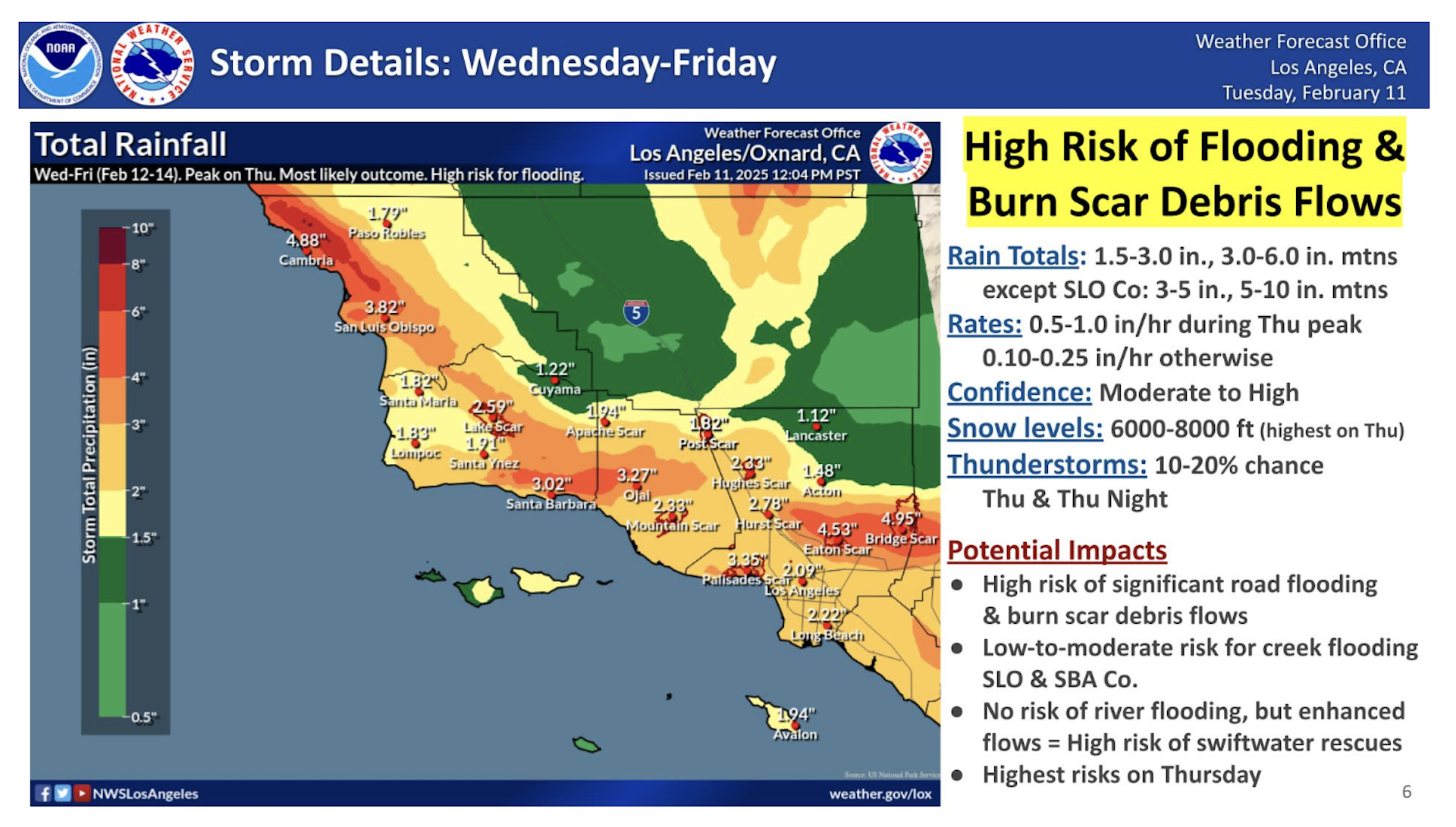
    As the Los Angeles area begins cleaning up from devastating wildfires, city officials and emergency managers are worried about what could come next. The National Weather Service issued a flash flood watch for the region for Feb. 13, 2025, when the heaviest rain from an atmospheric river is forecast.

    Rain on burned hillslopes can trigger dangerous floods and debris flows. Those debris flows can move with the speed of a freight train, picking up or destroying anything in their path. They can move tons of sediment during a single storm, as Montecito, just up the coast from Los Angeles, saw in 2018.

    What causes debris flows, sometimes called mudflows, and why are they so common and dangerous after a fire? I am a geologist whose research focuses on pyrogeomorphology, which is how fire affects the land. Here’s what we know.

    How debris flows begin

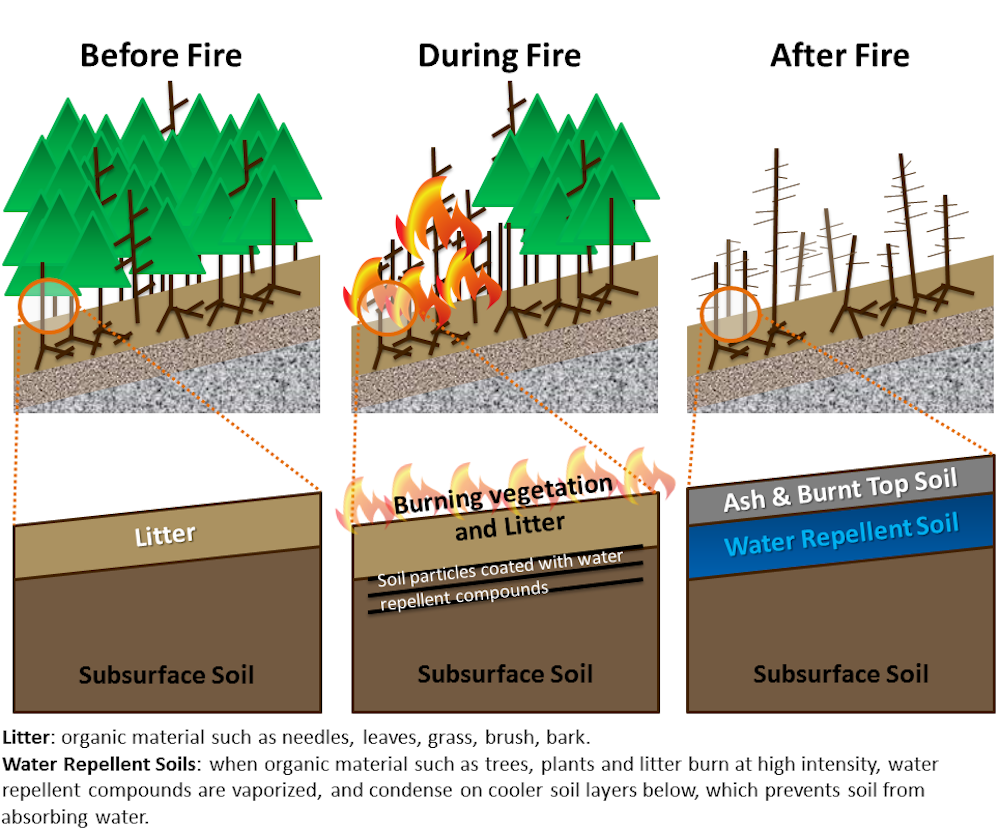
    When severe fires burn hillslopes, the high heat from the fires, sometimes exceeding 1,000 degrees Fahrenheit (538 degrees Celsius), completely destroys trees, shrubs, grass and structures, leaving behind a moonscape of gray ash. Not only that, the heat of the fire actually burns and damages the soil, creating a water-repellent, or hydrophobic, layer.

    What once was a vegetated hillslope, with leaves and trees to intercept rain and spongy soils to absorb water, is transformed into a barren landscape covered with ash, and burned soil where water cannot soak in.

    Illustrations show how fire can change the soil and landscape.
    National Weather Service

    When rain does fall on a burned area like this, water mixes with the ash, rocks and sediment to form a slurry. This slurry of debris then pours downhill in small gullies called rills, which then converge to form bigger and bigger rills, creating a torrent of sediment, water and debris rushing downhill. All this debris and water can transform small streams and usually dry gullies into a danger zone.

    Because the concentration of sediment is so high, especially when there is a large amount of ash and clay, debris flows behave more like a slurry of wet cement than a normal stream. This fluid can pick up and move large boulders, cars, trees and other debris rapidly downhill.

    A firefighter walks through knee-deep mud while checking for victims after a debris flow hit Montecito, Calif., in January 2018.
    Wally Skalij/Los Angeles Times via Getty Images

    In January 2018, a few weeks after the Thomas fire burned through the hills above Montecito, a storm triggered debris flows that killed 23 people and damaged at least 400 homes.

    What controls size and timing of debris flows

    The geography of the land, burn severity, storm intensity and soil characteristics all play important roles in if, when and where debris flows occur.

    Fire and debris flow scientists with the U.S. Geological Survey use these variables to create models to predict the likelihood and possible hazards from postfire debris flows. They are already developing maps to help residents, emergency managers and city officials prepare and predict postfire debris flows in 2025 burn areas in Los Angeles.

    The U.S. Geological Survey modeled debris flow risks after the Palisades Fire near Los Angeles. The map shows some of the highest-risk areas if hit by 15 minutes of rain falling at just under 1 inch (24 millimeters) per hour.
    USGS

    Some of the triggers of debris flows are literally part of the landscape.

    For example, the slope angle in a watershed and the amount of clay in the soil are important. Watersheds with gentle slopes – generally less than about 23 degrees – and a lack of clay and silt-sized particles are unlikely to produce debris flows.

    Other key factors that contribute to postfire debris flows relate to the proportion of the watershed that is severely burned and the intensity and duration of the rainstorm event.

    Early important research in the field of pyrogeomorphology demonstrated that while large, intense storms are more likely to cause large, intense debris flows, even small rainstorms can produce debris flows in burned areas.

    Debris flows are becoming more common

    A whopping 21.8 million Americans live within 3 miles of where a fire burned during the past two decades, and that population more than doubled from 2000 to 2019. A recent study from central and northern California indicates that nearly all the observed increases in area burned by wildfires in recent decades are due to human-caused climate change.

    The warming climate is also increasing the likelihood of more extreme downpours. The amount of moisture the atmosphere can hold increases by about 7% per degree Celsius of warming, leading to more intense downpours, particularly from ocean storms. In California, scientists project increases in rainfall intensity of 18% will result in an overall 110% increase in the probability of major debris flows.

    Jon Frye, of Santa Barbara Public Works, shows what happened in the January 2018 Montecito debris flow and why the risks to downslope communities would continue for several years. Source: County of Santa Barbara, 2018.

    Studies using models of fire, climate and erosion rates estimate that the amount of sediment flowing downhill after fires will increase by more than 10% in nine out of every 10 watersheds in the western U.S.

    Even without rain, debris on fire-damaged slopes can be unstable. A small slide in Pacific Palisades shortly after a fire burned through the area split a home in two. A phenomenon called “dry ravel” is a dominant form of hillslope erosion following wildfires in chaparral environments in Southern California

    Preparing for debris flow risks

    Research on charcoal pieces from ancient debris flows has shown fires and erosion have shaped Earth’s landscape for at least thousands of years. However, the rising risk of wildfires near populated areas and the potential for increasingly intense downpours mean a greater risk of damaging and potentially deadly debris flows.

    As their populations expand, community planners need to be aware of those risks and prepare.

    This article, originally published Jan. 23, 2025, has been updated with a flash flood watch issued.

    Jen Pierce receives funding from the National Science Foundation and is the chair of the Quaternary Geology and Geomorphology division of the Geological Society of America.

    ref. LA flash flood watch: Rain on wildfire burn scars can trigger destructive debris flows − a geologist explains how – https://theconversation.com/la-flash-flood-watch-rain-on-wildfire-burn-scars-can-trigger-destructive-debris-flows-a-geologist-explains-how-247770

    MIL OSI – Global Reports

  • MIL-OSI USA: UConn Waterbury Poised for Expansion with New Building’s Imminent Opening

    Source: US State of Connecticut

    UConn Waterbury’s local footprint is growing significantly with the expansion of several of its academic, research, and administrative operations into a historic building adjacent to the downtown campus.

    The six-story building at 36 N. Main St. has undergone extensive renovation by Green Hub Development III, LLC., which is leasing about 26,300 square feet to UConn to expand the University’s offerings in nursing, allied health, and other programs.

    UConn has been moving equipment and furnishings into the building and started using some of the space already over the winter, with the rest to be occupied starting later this month.

    They include clinic-style nursing and health care simulation rooms, research facilities, study lounges, office and administrative space, a spacious former banquet room, and other areas suitable for maker space, incubator studios, classes, and large gatherings.

    UConn’s plan to expand its nursing education programs into the building is particularly noteworthy given the high demand in that profession, both statewide and specifically in Waterbury and the Naugatuck Valley region.

    “UConn Waterbury’s expansion into this historic space is an investment in our students, faculty, and the greater community,” says Fumiko Hoeft, UConn Waterbury’s campus dean and chief administrative officer, and a neuroscientist and UConn professor of psychological sciences.

    The Odd Fellows Building at 36 N. Main St. in Waterbury sits around the corner from the UConn Waterbury campus on Jan. 27, 2025. About 26,300 square feet of the building’s interior was recently renovated to provide additional space for various programs at UConn Waterbury. (Sydney Herdle/UConn Photo)

    “With the new facilities, we are strengthening our role as an educational and economic driver in the Naugatuck Valley,” she says. “We are honored to be part of this building’s next chapter. Its transformation aligns with our commitment to innovation, workforce development, and community partnerships.”

    The growth of UConn Waterbury’s campus and academic offerings complements the UConn Strategic Plan, which includes ensuring that the campuses in Waterbury, Hartford, Stamford, and Avery Point offer signature programs that are destinations within UConn.

    “The spirit of every UConn campus is unique, and we are looking closely at their academic offerings and facilities to best build on those strengths and opportunities, in alignment with our university-wide strategic plan,” says Anne D’Alleva, UConn’s provost and executive vice president for academic affairs.

    “At UConn Waterbury, the new space fits perfectly with that vision,” she adds. “Our academic programs and research will grow and thrive there, and further underscore UConn’s role as a core element of this richly diverse, innovative city and region.”

    UConn’s Board of Trustees approved the expansion plans in 2023, which are part of a larger commitment to strengthen the University’s presence and partnerships in the Naugatuck Valley.

    They include UConn’s deep involvement in the Waterbury Promise scholarship program, under which many dozens of Waterbury graduates are attending the University; and the establishment and growth of the allied health sciences major on the campus.

    UConn Waterbury also prides itself on providing a tight-knit community that serves students’ individual needs while ensuring they can access world-class UConn programs in undergraduate and graduate-level fields that lead to strong, satisfying career paths.

    “The demand for skilled professionals is higher than ever. UConn Waterbury’s expansion directly aligns with our mission to prepare students for high-demand careers, ensuring that our regional workforce remains strong and competitive,” says Cathy Awwad, president and chief executive officer of the Northwest Regional Workforce Investment Board (NRWIB).

    UConn Waterbury’s new space in the building at 36 N. Main St. will also be ideal for serving current students while also advancing community partnerships with schools, the City of Waterbury, the regional business community, and other groups.

    The six-story building, originally built for the local chapter of the International Order of Odd Fellows social group, is in a prime downtown location and dates to 1895.

    Its renovation was funded through a state grant to the City of Waterbury along with Green Hub’s private funding. It was modernized for today’s needs while retaining key elements of its history, including Venetian Gothic exterior features overlooking the Waterbury Green and the ornate ceiling in its former banquet hall.

    “This project has been years in the making, and seeing it come to life is a testament to UConn’s commitment to Waterbury and the region,” says former Waterbury Mayor Neil O’Leary, who was deeply involved in the project and other partnerships with the University during and after his time in office.

    “This expansion is more than just a physical footprint; it’s an investment in the next generation of healthcare professionals, entrepreneurs, and community leaders,” he says.

    The building is around the corner from UConn Waterbury’s East Main Street location, with easy access between the back courtyard of the campus and an entrance to the newly leased space.

    It will house clinical simulation spaces, clinical and cognitive neuroscience research dry and wet laboratories, a maker space, and an incubator studio.

    It will also provide resources for humanities and social sciences, including the HACER Lab, a hub for humanistic inquiry, research, and pedagogy developed in collaboration with Waterbury students and community partners, the Ideas + Impact initiative and other learning communities focused on social impact, sustainability, and health-related projects.

    These facilities will be used by programs in nursing, allied health, psychological sciences, urban and community studies, humanities and social sciences, business, and community partnerships.

    Additionally, it will serve as the home for the Haskins Global Literacy Hub, a newly formed partnership between Yale, UConn Global Affairs, and UConn Waterbury focused on promoting education and conducting cutting-edge research to enhance literacy globally.

    A large nursing simulation lab with equipment sits on the fifth floor of the Odd Fellows Building in Waterbury on Jan. 27, 2025. About 26,300 square feet of the building’s interior was recently renovated to provide additional space for various programs at UConn Waterbury. (Sydney Herdle/UConn Photo)

    “Having UConn expand in downtown Waterbury strengthens our local economy, creates new opportunities for students, and enhances the city’s reputation as a center for education and innovation. This project is a great example of how partnerships between the city, state, and private sector can drive meaningful change,” Waterbury Mayor Paul Pernerewski says.

    Programs and activities in the space will also advance UConn Waterbury’s connections with local schools and others as a location for community events.

    For instance, on a recent morning, scores of local high school students visited UConn Waterbury for the kickoff of the Waterbury Robotics Institute to be based at the campus. The initiative, a collaboration with First Robotics, will bring students from the city’s high schools and middle schools to campus to work on projects with their peers, UConn students, and UConn faculty mentors.

    They were among the first to use the newly leased space at 36 N. Main St., with several of the student groups testing and demonstrating their robots in the large collaborative learning room on the building’s second floor.

    “This expansion will have a lasting impact not only on UConn students, but also on Waterbury’s middle and high schoolers who aspire to pursue careers in healthcare, technology, business, and other growing fields,” says Waterbury Public Schools Interim Superintendent Darren Schwartz.

    “The increased access to cutting-edge learning spaces and mentorship opportunities will strengthen our student college and career readiness,” he says.

    The Odd Fellows Building has a rich history in the City of Waterbury, and its restoration and use by UConn carries strong emotional and economic significance to the area.

    Built at a cost of $100,000 and said to be among the finest of its time in the region, the building’s opening in 1895 drew more than 5,000 members of the group from around the East Coast and was featured in the New York Times.

    In fact, the opening was marked by a parade and the event was so important to the city that all factories and schools were closed for the day, and all business shut down at noon, according to another Times article.

    A clothing store occupied the first floor for about its first five years in addition to the meeting rooms and social spaces used by the Odd Fellows and others on the higher floors. Later, the popular Grieve, Bissett & Holland department store was in the building from 1902 until the mid-1960s.

    The structure had been unused for more than 15 years before the renovation.

    “Restoring this landmark building and giving it a new purpose has been incredibly rewarding,” says Joe Gramando, Green Hub’s managing partner. “UConn’s presence here ensures that this space will remain a vibrant part of Waterbury’s future, serving students, researchers, and the broader community for years to come.”

    MIL OSI USA News

  • MIL-OSI: Wilbur You and You Capital Investment Firm Partner with Sol Nutrition, Inc. to Revolutionize Herbal Supplements

    Source: GlobeNewswire (MIL-OSI)

    SCOTTSDALE, Ariz., Feb. 12, 2025 (GLOBE NEWSWIRE) — You Capital Investment Firm, led by Managing Partner Wilbur You, is proud to announce its strategic equity partnership with Sol Nutrition, Inc., a premier herbal supplement company owned by renowned wellness expert Dr. Liu. This collaboration is set to redefine the global herbal supplement industry by combining world-class investment expertise with cutting-edge nutritional science.

    With a shared vision of promoting holistic well-being, this partnership will fuel Sol Nutrition’s expansion and innovation, ensuring the production of the highest-quality herbal supplements. Based in Scottsdale, Arizona, Sol Nutrition is already recognized for its commitment to natural, scientifically backed formulations, and with the support of You Capital, the company is poised for significant growth and market impact.

    “This partnership marks a new era for the health and wellness industry,” said Wilbur You, Managing Partner of You Capital. “Dr. Liu and Sol Nutrition have built an incredible foundation, and we are excited to provide the resources and strategic guidance to elevate their reach and influence.”

    Dr. Liu, Founder of Sol Nutrition, added, “Our mission has always been to deliver the world’s best herbal supplements, and with the backing of You Capital, we are now in a position to bring our vision to a global audience. Together, we will set new standards in quality and innovation.”

    Dr. Liu is a highly respected doctor and the owner of Eastern Medicine, where she has built a reputation for excellence in holistic healing. She has served a distinguished clientele from all over the world, offering tailored wellness solutions that integrate traditional and modern medical practices. Her expertise and influence in the health and wellness industry further solidify Sol Nutrition’s standing as a leader in herbal supplementation.

    This investment underscores You Capital’s commitment to fostering businesses that prioritize health, sustainability, and excellence. The partnership will enable Sol Nutrition to enhance its research and development, expand its product offerings, and strengthen its global distribution network.

    Wilbur You brings a wealth of business acumen to this partnership, having successfully built and scaled Youtech, a full-service digital marketing and technology agency. Under his leadership, Youtech has grown into a nationally recognized firm specializing in marketing, digital strategy, and business transformation. His experience in scaling businesses and leveraging innovative marketing strategies will play a crucial role in positioning Sol Nutrition as a global leader in the herbal supplement industry.

    For media inquiries, please contact:
    Jessica Starman
    jessica@elev8newmedia.com
    (888) 461-2233

    About You Capital Investment Firm
    You Capital Investment Firm specializes in strategic partnerships and equity investments that drive business growth and industry innovation. Led by Managing Partner Wilbur You, the firm focuses on transformative opportunities in health, technology, and sustainable industries.

    About Sol Nutrition, Inc.
    Sol Nutrition, Inc. is a leading herbal supplement company dedicated to creating science-backed, high-quality natural products. Under the leadership of Dr. Liu, Sol Nutrition continues to pioneer advancements in holistic health and wellness.

    The MIL Network

  • MIL-OSI Russia: Dmitry Chernyshenko: More than 90 thousand schoolchildren and students took part in the competition “Science. Territory of Heroes”

    Translartion. Region: Russians Fedetion –

    Source: Government of the Russian Federation – An important disclaimer is at the bottom of this article.

    Welcome speech by Dmitry Chernyshenko to the participants of the popular science competition “Science. Territory of Heroes”

    The final of the popular science competition “Science. Territory of Heroes” for schoolchildren and students from all over the country took place at the National Center “Russia”. Deputy Prime Minister Dmitry Chernyshenko addressed the participants with a welcoming speech.

    The Deputy Prime Minister emphasized the advantages of the profession of a scientist and spoke about the opportunities it opens up for young people.

    “The profession of a scientist in Russia is becoming increasingly popular and prestigious. Our scientists are real superheroes! We are in fifth place in the world in terms of the number of people engaged in research and development. Almost every second scientist in Russia is under 40 years old. The competition “Science. Territory of Heroes” is also gaining popularity. More than 90 thousand schoolchildren and students from all over the country have already become its participants. By involving tens of thousands of young researchers in the scientific field, we are solving one of the main tasks of the Decade of Science and Technology announced by President Vladimir Putin,” said Dmitry Chernyshenko.

    Participants in the final of the popular science competition “Science. Territory of Heroes”

    He added that the country’s future will depend on talented youth. The government will continue to support young people and create conditions so that the path in science is not so difficult and leads to success.

    The head of the Ministry of Education and Science, Valery Falkov, congratulated the winners of the competition and noted that today more and more young people want to connect their lives with science.

    “All necessary conditions are being created for scientific creativity in our universities and scientific organizations, including the opening of youth laboratories, the updating of the equipment base, and serious grant support. I would like to separately note the strengthening of cooperation between universities, research institutes and the real sector of the economy,” the minister added.

    This year, 10 talented children from all over the country competed in the final duel – from Zavolzhye to Chelyabinsk Oblast. Young researchers answered scientific questions, talked to young scientists and famous popularizers of science, including Doctor of Physical and Mathematical Sciences, Professor of the Institute of Laser and Plasma Technologies of the National Research Nuclear University “MEPhI” Vladimir Reshetov, Ambassador of the project – biologist Ilya Gomyranov.

    Third place went to Andrey Khokhlov from Michurinsk, second place went to Timofey Kovalev from Pskov. First place was awarded to Alexander Valov from Klin.

    They received additional points for admission to the Bauman Moscow State Technical University, as well as awards from the competition partner companies. Rosatom State Corporation provided three winners with the opportunity to undergo career consultations, the purpose of which is to help build an individual professional path. Beeline awarded one winner with a grant of 200 thousand rubles for conducting research work and improving competencies in the chosen field. The remaining finalists received gift certificates and prizes from the competition partners, and also took part in an interactive tour of the Sber office.

    The winners of the competition will receive individual internships at the country’s leading scientific centers: the Far Eastern Federal University, the Interuniversity Student Campus of the Eurasian World-Class Scientific and Educational Center, and the Joint Institute for Nuclear Research. There, the students will gain unique experience in scientific research, study the areas in which they plan to develop in the future, and meet practicing scientists from the scientific field that interests them.

    The competition “Science. Territory of Heroes” is held annually within the framework of national projects of Russia and is part of the “Science of Winning” initiative of the Decade of Science and Technology.

    Please note: This information is raw content directly from the source of the information. It is exactly what the source states and does not reflect the position of MIL-OSI or its clients.

    MIL OSI Russia News

  • MIL-OSI Europe: AMERICA/USA – Pope Francis shares with the US bishops the concern about migration policy and mass deportations

    Source: Agenzia Fides – MIL OSI

    Tuesday, 11 February 2025

    White House official page on Facebook

    Vatican City (Agenzia Fides) – “I have followed closely the major crisis that is taking place in the United States with the initiation of a program of mass deportations. The rightly formed conscience cannot fail to make a critical judgment and express its disagreement with any measure that tacitly or explicitly identifies the illegal status of some migrants with criminality. The act of deporting people who in many cases have left their own land for reasons of extreme poverty, insecurity, exploitation, persecution or serious deterioration of the environment, damages the dignity of many men and women, and of entire families, and places them in a state of particular vulnerability and defenselessness”.This is what Pope Francis emphasizes in a letter to the Catholic bishops of the United States with regard to the country’s current migration policy and in particular the mass deportations initiated by President Donald Trump.” I am writing today to address a few words to you in these delicate moments that you are living as Pastors of the People of God who walk together in the United States of America,” the Pope explains in the letter. In this context, the Bishop of Rome also recalls the Book of Exodus, which describes “the journey from slavery to freedom that the People of Israel traveled.”The biblical text “invites us to look at the reality of our time, so clearly marked by the phenomenon of migration, as a decisive moment in history,” said the Pope, who recalled “the infinite and transcendent dignity of every human person.”Jesus Christ, “the Son of God, in becoming man,” also experienced “the drama of immigration,” the Pope emphasizes in the letter. And he quotes the words with which Pius XII “began his Apostolic Constitution on the Care of Migrants, which is considered the “Magna Carta” of the Church’s thinking on migration, where it says: “The “infinite and transcendent dignity,” of the human person surpasses and sustains every other juridical consideration that can be made to regulate life in society.”Hence the harsh judgment with regard to the US government’s deportation policy. While it is necessary to “recognize the right of a nation to defend itself and keep communities safe from those who have committed violent or serious crimes while in the country or prior to arrival.” “But worrying about personal, community or national identity, apart from these considerations, easily introduces an ideological criterion that distorts social life and imposes the will of the strongest as the criterion of truth.”In the final part of the message, the Pope thanks the US bishops for their work and efforts on behalf of migrants and refugees. “I exhort all the faithful of the Catholic Church, and all men and women of good will, not to give in to narratives that discriminate against and cause unnecessary suffering to our migrant and refugee brothers and sisters. With charity and clarity we are all called to live in solidarity and fraternity, to build bridges that bring us ever closer together, to avoid walls of ignominy and to learn to give our lives as Jesus Christ gave his for the salvation of all,” the Pope concluded. (F.B.) (Agenzia Fides, 11/2/2025)
    Share:

    MIL OSI Europe News

  • MIL-OSI Russia: GUU and Expobank: partnership for the sake of future entrepreneurs

    Translartion. Region: Russians Fedetion –

    Source: State University of Management – Official website of the State –

    On February 12, 2025, a ceremony of signing a cooperation agreement between the university and Expobank JSC took place at the State University of Management.

    The following represented GUU at the meeting: Rector Vladimir Stroyev, Vice-Rector Dmitry Bryukhanov and Director of the Institute of Economics and Finance Galina Sorokina. The delegation of guests was represented by the Chairman of the Board of Expobank Kirill Nifontov, Director of HR Galina Weisband, Head of Recruitment and Youth Affairs Oksana Schwartz and Head of Corporate Culture and Internal Communications Olga Chervova.

    Rector of the State University of Management Vladimir Stroyev greeted the guests and handed over the opening remarks to the Director of the Institute of Economics and Finance Galina Sorokina, who briefly spoke about the goals of the meeting and introduced the history of the university. Galina Petrovna especially emphasized that the origin of the university can rightfully be traced back to the Aleksandrovsky Commercial School, which was the first educational institution in Russia that trained entrepreneurs.

    Vladimir Stroyev noted that in many ways the State University of Management positions itself as an entrepreneurial university. And although the main emphasis in accordance with the requirements of the era and state tasks is on training industry managers, no one is going to leave the entrepreneurial track either. Moreover, now is the best time for banks to fully engage in educational processes, because by 2030 the Strategy for the Development of the Education System will have already changed significantly in favor of training engineers, doctors, teachers and specialists in the natural sciences.

    The rector also spoke about the project-based learning system at the State University of Management, for which one day a week is allocated in the curriculum from the first year. Vladimir Vitalyevich advised selecting personnel from the very beginning of the training, because by the 3rd or 4th year, the best students are usually already employed. To participate in the programs, you only need to assign a curator, no financial investments are needed. There are a lot of motivated students at the university, the main thing for the employer is to pick them up in time.

    Galina Sorokina added that various scholarship programs, which banks often limit themselves to, are just an additional opportunity for goal-oriented senior students to prove themselves and expand their resumes, while in reality they are already focused on other jobs.

    Kirill Nifontov, Chairman of the Board of Expobank, noted that all of the above is interesting to him not only as an employer, but also as a father of four children. He said that the private bank he represents is the 30th largest in Russia in terms of capital. The financial institution sees its mission in cultivating an entrepreneurial spirit, revealing the potential of clients and young businessmen.

    “We strive to solve complex problems, we grow actively, we find free niches in which we become leaders, we buy out the assets of large Western companies that have left. We consciously focus on young people, we involve and train them. The average age of our employees is 38 years old,” said Kirill Nifontov.

    The guest also complained about the “early aristocratization” of young specialists, who quickly get used to the increased attention of employers and lose motivation for development. This is why Expobank is concluding an agreement with the State University of Management in order to train specialists for itself.

    During the conversation, Kirill Nifontov asked a burning question: “Is it possible to learn entrepreneurship or is it an innate skill?” Vladimir Stroyev admitted that this question is often raised in discussions, and his opinion is that everything can be taught, but not everyone is destined to become Musk or Jobs; for this, innate talent is needed.

    After the signing ceremony, the guests from Expobank were given a tour of the State University of Management. Kirill Nifontov was clearly interested in asking the director Marina Grigorieva about the details of admission and education, organizational processes and youth trends, and his colleagues were amazed at the advanced equipment of the classrooms. Then the tour moved to the Media Center, where the bankers were introduced to the internal educational platform – the Digital Building of our university. At the end of the visit, the representatives of Expobank were shown the auditorium GU-307, which will be allocated to the bank for the arrangement and image support of its brand within the walls of the State University of Management.

    Subscribe to the TG channel “Our GUU” Date of publication: 02/12/2025

    Please note: This information is raw content directly from the source of the information. It is exactly what the source states and does not reflect the position of MIL-OSI or its clients.

    MIL OSI Russia News

  • MIL-OSI Asia-Pac: Union Minister Shri Rajiv Ranjan Singh alias Lalan Singh inaugurates 14th Asian Fisheries and Aquaculture Forum (14AFAF)

    Source: Government of India (2)

    Union Minister Shri Rajiv Ranjan Singh alias Lalan Singh inaugurates 14th Asian Fisheries and Aquaculture Forum (14AFAF)

    India has risen as the world’s second-largest fish producer under the Prime Minister’s visionary leadership: Shri Rajiv Ranjan Singh

    Kisan Credit Card scheme extended to the fishers & fish farmers: Union Minister

    Research institutes should undertake capacity building initiative involving KVKs to improve the adoption of scientific practices by fishers and farmers: Union Minister Shri Rajiv Ranjan Singh

    Shri Rajiv Ranjan Singh also inaugurates the 14AFAF Expo

    Posted On: 12 FEB 2025 5:03PM by PIB Delhi

    Union Minister of Fisheries, Animal Husbandry & Dairying and Panchayati Raj Shri Rajiv Ranjan Singh alias Lalan Singh inaugurated 14th Asian Fisheries and Aquaculture Forum (14AFAF) at Pusa Campus in New Delhi today, marking a significant milestone in global fisheries and aquaculture. Speaking on the occasion, Shri Rajiv Ranjan Singh highlighted the Government of India’s commitment to sustainable fisheries.  He accentuated that India has risen as the world’s second-largest fish producer under the Prime Minister’s visionary leadership and Pradhan Mantri Matsya Sampada Yojana (PMMSY). The Minister also emphasized that India is implementing cutting-edge digital solutions such as National Digital Fisheries Platform and vessel monitoring, transponders, and emergency alerts to ensure the safety of fishermen at sea. He also informed that the Kisan Credit Card scheme has been extended to the fishers and fish farmers and various insurance schemes to the fisheries’ sector were also introduced. He further applauded the ICAR for its technological offerings, recognizing its contributions in the fisheries development in the country. Further he stressed that the research institutes should undertake capacity building initiative involving KVKs to improve the adoption of scientific practices by fishers and farmers. He also inaugurated the 14AFAF expo, a major highlight, bringing together the stakeholders from state fisheries departments, academia, research institutions and the industry to showcase technological advancements.


    Dr. Himanshu Pathak, Secretary, DARE, and DG, ICAR highlighted that 75 new fisheries technologies and improved fish varieties developed by ICAR, emphasizing ICAR’s commitment to sustainable, carbon-neutral fisheries and aquaculture for long-term industry resilience.

    Dr. Abhilaksh Likhi, Secretary, Department of Fisheries, Ministry of Fisheries Animal Husbandry and Dairying, Government of India, highlighted the Government’s transformative initiatives, substantial investments, and the vital role of startups in driving innovation for India’s blue economy.

    ‘Padma Shri’ Dr. S. Ayyappan, former Secretary, DARE, and DG, ICAR, highlighted India’s leadership in fisheries research and described 14AFAF as the Mahakumbh of fisheries researchers from Asia.

    Dr. Essam Yassin Mohammed, Director General, WorldFish, Malaysia, spoke on global innovations in fisheries and applauded India for its transformation initiatives in sustainable aquaculture.

    Prof. Neil Loneragan, President, Asian Fisheries Society, Kuala Lumpur, emphasized the significance of international collaboration in advancing the fisheries sector globally.

    Dr. J.K. Jena, Deputy Director General (Fisheries Science), ICAR, and Convener of 14AFAF, in his welcome address, stated that the forum will play a crucial role in shaping the future of fisheries and aquaculture. He highlighted that the event features over 20 lead presentations by renowned experts from India and abroad, with 1,000 participants from 24 countries.

    The session also saw the release of different publications & technologies by the dignitaries. The event was organized by the Asian Fisheries Society (AFS), Kuala Lumpur, in collaboration with the Indian Council of Agricultural Research (ICAR), the Department of Fisheries (DoF), Government of India, and the Asian Fisheries Society Indian Branch (AFSIB), Mangalore.

    Hosting the 14th AFAF in India after 15 years highlights the country’s growing prominence in global fisheries and aquaculture. With a rapidly expanding blue economy, progressive policies, and scientific advancements, India is emerging as a key player in sustainable fisheries. This forum serves as an opportunity to showcase India’s contributions, strengthen global partnerships and drive sustainable aquaculture initiatives for the future.

    *****

    MG/KSR

    (Release ID: 2102338) Visitor Counter : 14

    MIL OSI Asia Pacific News

  • MIL-OSI USA: Governor Newsom announces appointments 2.11.25

    Source: US State of California 2

    Feb 11, 2025

    SACRAMENTO – Governor Gavin Newsom today announced the following appointments:

    Karen Morrison, of Sacramento, has been appointed Director at the California Department of Pesticide Regulation. Morrison has held multiple positions at the Department of Pesticide Regulation since 2018, including Chief Deputy Director and Science Advisor since 2022, Assistant Director and Chief Science Advisor from 2019 to 2022, and Environmental Program Manager and Science and Policy Advisor from 2018 to 2019. She was a Senior Environmental Scientist and Policy Advisor at the California Department of Resources, Recycling, and Recovery from 2014 to 2018. Morrison was a Science and Technology Policy Fellow at the California Council on Science and Technology from 2013 to 2014. She earned a Doctor of Philosophy degree in Chemistry from the University of Illinois, Urbana Champaign, and she earned a Bachelor of Science degree in Chemistry from Harvey Mudd College. This position requires Senate confirmation, and compensation is $213,651. Morrison is registered without party preference. 

    Nicholas Lutton, of Fresno, has been appointed to the State Council on Developmental Disabilities. Lutton was the Program Manager at Family Voices of California from 2022 to 2024. He was an Educational Resource Specialist at EPU Children’s Center from 2019 to 2022. Lutton is a member of the Editorial Board at the American Association of Pediatrics and Fresno County In-Home Services Advisory Committee. This position does not require Senate confirmation, and the compensation is $100 per diem. Lutton is a Democrat.

    Eric Bergersen, of Long Beach, has been appointed to the Physician Assistant Board. Bergersen has been the Regional Medical Director at Bicycle Health Medical Group since 2020. He was the APC Director at VEP Healthcare from 2018 to 2020. Bergersen was an Emergency Medicine Physician Assistant at VEP Healthcare from 2017 to 2019. He was a Clinical Consultant at GYANT from 2018 to 2019. Bergersen was the Lead Emergency Department Technician at Beth Israel Deaconess Medical Center from 2012 to 2015. He is a member of Physician Assistants in Virtual Medicine and Telemedicine. Bergersen earned a Master of Science degree in Health Care Administration from Oklahoma State University, a Master of Science degree in Physician Assistant Studies from George Washington University, and Bachelor of Science in Behavioral Neuroscience from Northeastern University. This position does not require Senate confirmation, and the compensation is $100 per diem. Bergersen is a Democrat.

    Ed Perez, of Sacramento, has been appointed to the Physician Assistant Board. Perez was a manager at Labor Relations and Performance Management, California Department of Water Resources from 2019 to 2024. He was a Labor Relations Specialist, Department of Water Resources from 2015 to 2019. Perez was a Labor Relations Specialist & Labor Relations Analyst at the California Department of Corrections and Rehabilitation from 2013 to 2015. He is a member of the Asian Pacific American Public Affairs Association (APAPA), the Hamptons Community Foundation, the Hamptons Owners Association, the Gardenland-Northgate Neighborhood Association, and a Community Activist with AARP. This position does not require Senate confirmation, and the compensation is $100 per diem. Perez is a Democrat.

    Drake Dillard, of Los Angeles, has been reappointed to the California Commission on Disability Access, where he has served since 2020. Dillard has been a Senior Project Manager at Perkins & Will since 2014. He was a Senior Healthcare Architect at Parsons from 2007 to 2013. Dillard was a Project Architect at Kaiser Permanente from 1989 to 1998. He is a member of the Crenshaw Design Review Panel, American Institute of Architects and the National Organization of Minority Architects. Dillard earned a Master of Arts degree in Architecture from Howard University and a Bachelor of Arts degree in Architecture from the University of Illinois Urbana-Champaign. This position requires Senate confirmation, and the compensation is $100 per diem. Dillard is registered without party preference.

    Jaqueline Jackson, of San Diego, has been reappointed to the California Commission on Disability Access, where she has served since 2020. Jackson has been a Non-Profit Management Consultant since 1994. She was Development Director and Consultant for the San Diego Center for the Blind from 2002 to 2004. Jackson was Director of Charter School Development for Norman and Norman Inc. from 1996 to 2005. She was an Education Consultant for the School Futures Research Foundation from 1994 to 1996. Jackson was the Director of Education for Health and Family Support Services at the San Diego Urban League from 1988 to 1994. She is a member of the City of San Diego Accessibility Advisory Board, City of San Diego Senior Affairs Advisory Board, and the County of San Diego Registrar of Voters Accessibility Advisory Committee. Jackson earned a Master of Education degree from the University of San Diego and a Bachelor of Arts degree in Psychology from California State University, San Diego. This position requires Senate confirmation, and the compensation is $100 per diem. Jackson is a Democrat.

    Press Releases, Recent News

    Recent news

    News What you need to know: Across all of state government, highly-specialized personnel and response equipment are on the ground working to protect communities statewide from storm impacts.  Los Angeles, California – With another significant winter storm system…

    News What you need to know: Governor Gavin Newsom issued an executive order today ordering the state to ensure that childcare providers impacted by the recent wildfires in Los Angeles are aware of their potential eligibility for Disaster Unemployment Assistance and…

    News What you need to know: The fastest large-scale debris removal in modern state history began today in Altadena and the Pacific Palisades, in roughly half the time it took to start similar operations after the devastating 2018 Woolsey Fire.  LOS ANGELES – Governor…

    MIL OSI USA News

  • MIL-OSI Russia: The Future Managers Tournament will be held at the State University of Management

    Translartion. Region: Russians Fedetion –

    Source: State University of Management – Official website of the State –

    This weekend, February 15 and 16, the State University of Management will host the in-person stage of the Social Science Olympiad for schoolchildren, “Future Managers Tournament.”

    The Olympiad is held annually at several venues and includes two stages. The first is the qualifying (correspondence) stage, which was held from November 2024 to February 2025 using distance learning technologies.

    The venues for the second (face-to-face) stage will be: Moscow (SMU), Nalchik, Rostov-on-Don. The face-to-face round involves schoolchildren completing tasks that reveal their in-depth social science knowledge. Results of the correspondence round.

    The current academic year has seen a more than threefold increase in the number of participants in the correspondence round of the Olympiad. More than 700 children completed the tasks! Among the participants: 11th graders represented 32 regions of the Russian Federation, 10th graders – 23 regions, 9th graders – 15. In the face-to-face round, 177 participants are expected from Moscow and the region, other regions of Central Russia, the Urals and the Caucasus: from 11th graders – 62 participants, 10th graders – 76 schoolchildren, 9th graders – 39.

    The number of participants in the “Future Managers Tournament” has increased significantly compared to previous seasons, thanks to the active involvement of students from partner schools of the State University of Management.

    The winners and prize winners of the second round of the Olympiad “Tournament of Future Managers” will receive preferences when entering the State University of Management: 4 additional points to the Unified State Exam score. The awarding of the winners and prize winners will take place in April in the Scientific Library of the State University of Management.

    Subscribe to the tg channel “Our State University” Announcement date: 02/12/2025

    Please note: This information is raw content directly from the source of the information. It is exactly what the source states and does not reflect the position of MIL-OSI or its clients.

    MIL OSI Russia News

  • MIL-OSI USA: Sols 4450-4451: Making the Most of a Monday

    Source: NASA

    Earth planning date: Monday, Feb. 10, 2025
    Last Saturday around 20:00 Pacific Standard Time I saw a 22-degree halo encircling our mostly-full Moon and Mars; an entire planet hanging in the sky between our Moon and the atmospheric phenomenon. As I took in the view I wondered what our rover was doing at that moment… turns out the Sun had just risen over Gale crater and Curiosity was still asleep, waiting for her alarm to go off in about 2.5 hours for another full day of science. 
    She wouldn’t start the weekend’s drive until Monday morning about 1:30, while I was still asleep waiting for my alarm to sound at 5:15. The drive’s data arrived on Earth about 5:30, and told us we drove until our time-of-day limit for driving — stopping about 36 meters (about 118 feet) away from Friday’s location. Unfortunately, our right-front wheel was shown to be perched on some tall rocks and we couldn’t quantify the drop risk if we unstowed the arm. We decided to play it safe and keep the arm stowed instead.
    Today’s two-sol plan would normally be in “nominal” sols — meaning we’d get a full day of science and a drive on the second sol — but due to some DSN downtime on Earth we moved our drive to the first sol, therefore switching to “restricted” sols a bit earlier than usual after our last soliday. Even though we couldn’t plan contact science, we’re making the most of our plan with almost 90 minutes of remote sensing. Mastcam will take an approximately 24-frame stereo mosaic of Wilkerson butte to the north, and ChemCam will shoot their laser at a rock in our workspace named “Carbon Canyon,” as well as three separate RMI mosaics! We’ll then attempt to drive until our time-of-day limit of about 15:00 local Gale time, hopefully getting us to a more stable spot on Wednesday for contact science. The second sol contains our usual dust-devil surveys with Navcam, atmospheric opacity measurements with Mastcam, and a blind LIBS on a piece of bedrock the rover chooses autonomously.
    Written by Natalie Moore, Mission Operations Specialist at Malin Space Science Systems

    MIL OSI USA News

  • MIL-OSI USA: NASA, SpaceX Invite Media to Watch Crew-10 Launch to Space Station

    Source: NASA

    Media accreditation is open for the launch of NASA’s 10th rotational mission of a SpaceX Falcon 9 rocket and Dragon spacecraft, carrying astronauts to the International Space Station for a science expedition. The agency’s SpaceX Crew-10 mission is targeting launch on Wednesday, March 12, from Launch Complex 39A at NASA’s Kennedy Space Center in Florida.
    The launch will carry NASA astronauts Anne McClain as commander and Nichole Ayers as pilot, along with JAXA (Japan Aerospace Exploration Agency) astronaut Takuya Onishi and Roscosmos cosmonaut Kirill Peskov as mission specialists. This is the first spaceflight for Ayers and Peskov, and the second mission to the orbiting laboratory for McClain and Onishi.
    Media accreditation deadlines for the Crew-10 launch as part of NASA’s Commercial Crew Program are as follows:

    International media without U.S. citizenship must apply by 11:59 p.m. on Thursday, Feb. 13.
    U.S. media and U.S. citizens representing international media organizations must apply by 11:59 p.m. EST on Sunday, Feb. 23.

    All accreditation requests must be submitted online at:
    https://media.ksc.nasa.gov
    NASA’s media accreditation policy is online. For questions about accreditation or special logistical requests, email: ksc-media-accreditat@mail.nasa.gov. Requests for space for satellite trucks, tents, or electrical connections are due by Friday, Feb. 21.
    For other questions, please contact NASA Kennedy’s newsroom at: 321-867-2468.
    Para obtener información sobre cobertura en español en el Centro Espacial Kennedy o si desea solicitar entrevistas en español, comuníquese con Antonia Jaramillo: 321-501-8425, o Messod Bendayan: 256-930-1371.
    For launch coverage and more information about the mission, visit:
    https://www.nasa.gov/commercialcrew
    -end-
    Joshua Finch / Claire O’SheaHeadquarters, Washington202-358-1100joshua.a.finch@nasa.gov / claire.a.o’shea@nasa.gov
    Steve Siceloff / Stephanie PlucinskyKennedy Space Center, Florida321-867-2468steven.p.siceloff@nasa.gov / stephanie.n.plucinsky@nasa.gov
    Kenna PellJohnson Space Center, Houston281-483-5111kenna.m.pell@nasa.gov

    MIL OSI USA News

  • MIL-OSI Asia-Pac: HKSAR Government holds seminar on 2024-2035 master plan on building China into a leading country in education

    Source: Hong Kong Government special administrative region

         President Xi Jinping delivered an important speech at the National Conference on Education last September, following which the 2024-2035 master plan on building China into a leading country in education (master plan) was issued, setting out a roadmap for the national education development in the next 10 years. The Hong Kong Special Administrative Region (HKSAR) Government today (February 12) held a seminar on the master plan at the Central Government Offices. Vice Minister of Education Mr Wu Yan was invited to deliver a keynote speech to enable different sectors to obtain a deeper understanding of the significance of the master plan. The Chief Secretary for Administration, Mr Chan Kwok-ki, and the Secretary for Education, Dr Choi Yuk-lin, delivered the opening and closing addresses respectively.
          
         The master plan is the first national action plan themed on building a leading country in education with the key mission to support the country’s modernisation in all aspects. It clearly proposed to establish a mechanism for co-ordinating and promoting the integration of education, technology and talent by leveraging the support of education to technology and talent. The master plan also set out the close collaboration with the development of the innovation and technology hub in the Guangdong-Hong Kong-Macao Greater Bay Area and the building of a high-calibre talent hub and platforms for talent attraction and retention, thereby enhancing the overall effectiveness of the innovation system.
          
         Speaking at the seminar, Mr Chan said that the Resolution of the Communist Party of China (CPC) Central Committee on Further Deepening Reform Comprehensively to Advance Chinese Modernization adopted in the Third Plenary Session of the 20th Central Committee of the CPC suggested that Hong Kong be built into an international hub for high-calibre talent. The HKSAR Government has been proactively creating favourable room for development for talent from different backgrounds, and fostering synergistic development of nurturing talent, gathering talent and science and technology, to enable talent to make Hong Kong their home and give full play to their strengths for contribution to the high-quality development of Hong Kong and the country.
          
         He pointed out that the HKSAR Government established the Committee on Education, Technology and Talents with him as the Chairman at the end of last year to enhance the systemic, holistic and synergistic nature of policies, which target the manpower demand of Hong Kong’s strategic positioning of “eight centres”. It aims to promote integrated development of education, technology and talent from the top and fully implement the work of invigorating the country through science and education.
          
         Speaking at the seminar, Dr Choi said that with the rapid development of education in the country in the coming 10 years, Hong Kong’s education will also thrive. The Education Bureau (EDB) will keep its principles and be innovative to tie in with the national strategy of invigorating the country through science and education, and grasp the development opportunities offered by the country’s initiatives such as the Belt and Road and the Greater Bay Area to push forward with Hong Kong’s education development.
          
         She stressed that the EDB will deepen Hong Kong’s role as an international post-secondary education hub, pooling together talent with a view to consolidating and developing Hong Kong’s education strengths. Apart from boosting the comprehensive strengths of tertiary education and forging new development competitive edges with digital education, the EDB will also create multiple pathways for young generations, further enhance students’ whole-person development, and raise teachers’ professional qualities and capabilities to achieve the goal of cultivating values and nurturing people.
          
         A number of participants also shared their views at the seminar.
          
         The seminar today was attended by around 400 participants, including representatives from the Ministry of Education, the Hong Kong and Macao Work Office of the CPC Central Committee, and the Hong Kong and Macao Affairs Office of the State Council; Hong Kong deputies to the National People’s Congress; Hong Kong Standing Committee members of the Chinese People’s Political Consultative Conference; members of the Legislative Council Panel on Education; the EDB directorate; representatives from the councils of universities and post-secondary institutions; representatives from school councils and principals’ associations in relation to kindergartens, primary schools and secondary schools, and representatives from relevant education organisations and advisory and statutory bodies.

    MIL OSI Asia Pacific News

  • MIL-OSI Asia-Pac: ANRF Launches Call for Proposals Under J. C. Bose Grant (JBG)

    Source: Government of India

    Posted On: 12 FEB 2025 4:47PM by PIB Delhi

    The Anusandhan National Research Foundation (ANRF) has announced the launch of the J. C. Bose Grant (JBG), a new scheme, to recognize the outstanding performance and contributions of senior Indian scientists and engineers through this extra-mural funding opportunities to enhance their research in cutting-edge scientific and technological areas.

    The ANRF, an apex body to provide high-level strategic direction of scientific research in the country as per recommendations of the National Education Policy (NEP) aims to seed, grow and promote research and development (R&D) and foster a culture of research and innovation. It will support capacity building at all levels to strengthen the research ecosystem of the country.

    The J. C. Bose Grant is designed to support senior-level researchers who have demonstrated exceptional achievements, with evidence of excellence such as publications records and research outcomes, patents, technology transfers, awards, and grants etc. across various domains of science and technology (S&T) including agriculture, medicine, as well as humanities and social sciences at the interfaces of S&T.

    Participants must be active, senior Indian scientists or researchers with a proven track record of excellence, holding at least a Professor-level position or equivalent at an Indian institution/university.

    This grant provides an annual research funding of Rs. 25 lakhs for a duration of five years. Additionally, an annual overhead of Rs. 1.0 lakh will be provided to the implementing institution. If the Principal Investigator (PI) superannuates, during the term of the grants, it can be continued subject to the host institutions willingness to host the PI. The grant can be availed until the age of 68.

    For more details on eligibility, funding guidelines, and application procedures, please visit the ANRF Portal at https://www.anrfonline.in/ANRF/jcbose_anrf .

    ***

    NKR/PSM

    (Release ID: 2102312) Visitor Counter : 22

    MIL OSI Asia Pacific News

  • MIL-OSI Asia-Pac: India – France Joint Statement on the visit of Shri Narendra Modi, Hon’ble Prime Minister of India to France

    Source: Government of India

    Posted On: 12 FEB 2025 3:22PM by PIB Delhi

    At the invitation of the President of the French Republic, H.E. Mr. Emmanuel Macron, the Prime Minister of India, Shri Narendra Modi, paid a visit to France on 10-12 February 2025. On 10 and 11 February 2025, France and India co-chaired the Artificial Intelligence Action Summit, gathering Heads of State and Government, leaders of international organizations, small and large enterprises, representatives of academia, non-governmental organizations, artists and members of civil society, in order to build on the important milestones reached during the Bletchley Park (November 2023) and Seoul (May 2024) summits. They underlined their commitment to take concrete actions to ensure that the global AI sector can drive beneficial social, economic and environmental outcomes in the public interest. Prime Minister Modi congratulated President Macron on France’s successful organization of AI Action Summit. France welcomed India’s hosting of the next AI Summit.

    This was Prime Minister Modi’s sixth visit to France, and follows President Macron’s visit to India in January 2024 as the Chief Guest for the 75th Republic Day of India. Prime Minister Modi and President Macron held bilateral discussions on the entire gamut of the exceptionally strong and multifaceted bilateral cooperation and on global and regional matters. Both leaders also went to Marseille where President Macron hosted a private dinner for Prime Minister Modi, reflecting the excellent relationship between the two leaders. They jointly inaugurated India’s Consulate General in Marseille. They also visited the International Thermonuclear Experimental Reactor facility.

    President Macron and Prime Minister Modi reaffirmed their shared vision for bilateral cooperation and international partnership, outlined in the Joint Statement issued following President Macron’s State Visit to India in January 2024 and in the Horizon 2047 Roadmap published during the visit of Prime Minister Modi to France in July 2023 as the Chief Guest of the Bastille Day Celebrations on the occasion of the 25th anniversary of the Strategic Partnership. They commended the progress achieved in their bilateral cooperation and committed to accelerating it further across its three pillars.

    The two leaders reiterated their call for reformed and effective multilateralism to sustain an equitable and peaceful international order, address pressing global challenges and prepare the world for emerging developments, including in the technological and economic domains. The two leaders stressed, in particular, the urgent need for the reform of the United Nations Security Council and agreed to coordinate closely in multilateral fora, including on UNSC matters. France reiterated its firm support for India’s permanent membership of the UNSC. The two leaders agreed to strengthen conversations on regulation of use of the veto in case of mass atrocities. They held extensive discussions on long-term global challenges and current international developments and agreed to intensify their global and regional engagement, including through multilateral initiatives and institutions.

    Acknowledging the paramount importance of advancing scientific knowledge, research and innovation, and recalling the long and enduring engagement between India and France in those areas, President Macron and Prime Minister Modi announced the grand inauguration of the India-France Year of Innovation in New Delhi in March 2026 by launching its Logo.

    Partnership for Security and Sovereignty

    Recalling the deep and longstanding defence cooperation between France and India as part of the Strategic Partnership, President Macron and Prime Minister Modi welcomed the continuation of the cooperation of air and maritime assets in line with the ambitious Defence Industrial Roadmap agreed in 2024. Both leaders commended progress in collaboration in construction of Scorpene submarines in India, including indigenization, and in particular the work carried out with a view to the integration of DRDO developed Air Independent Propulsion (AIP) into P75-Scorpene submarines and the analyses conducted regarding the possible integration of the Integrated Combat System (ICS) into the future P75-AS submarines. Both leaders welcomed the commissioning of the sixth and final submarine of the P75 Scorpene-class project, INS Vaghsheer, on 15 January 2025.Both sides welcomed the ongoing discussions in missiles, helicopter engines and jet engines. They also welcomed the excellent cooperation between the relevant entities in the Safran group and their Indian counterparts. Prime Minister Modi also invited the French Army to take a closer look at the Pinaka MBLR, emphasizing that an acquisition of this system by France would be another milestone in Indo-French defence ties. In addition, President Macron welcomed the decision to include India as an observer to the Eurodrone MALE programme managed by OCCAR, which is another step forward in the growing strength of our partnership in defence equipment programmes.

    Both leaders appreciated the regular conduct of military exercises in all domains including maritime exercises and joint patrolling by maritime patrol aircraft. They noted the recent visit of the French Carrier Strike Group Charles De Gaulle to India in January 2025, followed by the Indian Navy’s participation in the French multinational exercise La Perouse, and the future conduct of the Varuna exercise in March 2025.

    They welcomed the launch of FRIND-X (France-India Defence Startup Excellence) in Paris on 5-6 December 2024, involving the DGA and the Defence Innovation Agency, in line with the vision enshrined in HORIZON 2047 and the India-France Defence Industrial Roadmap. This collaborative platform brings together key stakeholders across both defence ecosystems, including defence startups, investors, incubators, accelerators, and academia, fostering a new era of defence innovation and partnership.

    In order to deepen the research and development partnerships in defence, both leaders stressed on the early launch of an R&D framework through a Technical Arrangement for cooperation in defence technologies between DGA and DRDO. Inaddition, both leaders welcomed the ongoing discussions between L’Office National d’Etudes et de Recherches Aérospatiales (ONERA) and Defence Research and Development Organisation (DRDO) to identify technologies for R&D partnerships. Further, India welcomes the participation of Indian students, alongside French students, in the challenge on distributed intelligencelaunched recently by Interdisciplinary Center for Defence and Security from the Institut Polytechnique de Parisand encourages organizing of more joint challenges in the future to evoke the interest of students in defence.

    Both leaders had a detailed conversation on international issues, including on the Middle-East and the war in Ukraine. They agreed to pursue their efforts to coordinate and remain closely engaged on a regular basis.

    The two leaders recalled the launch of the India-Middle East-Europe Corridor (IMEC) on the margins of the G20 Summit in Delhi in September 2023 and agreed to work together more closely on implementing the initiative. Both leaders stressed the importance of IMEC to foster connectivity, sustainable growth trajectories and access to clean energy across these regions. In this regard, they acknowledged the strategic location of Marseille in the Mediterranean Sea.

    They underlined the key importance of strengthening EU-India relations, in view of the upcoming India-EU summit at the earliest possible in New Delhi.

    They appreciated the growing cooperation in trilateral format with Australia and with the United Arab Emirates. They commended the joint military exercises that took place between France, India and the United Arab Emirates, as well as the participation of India, France and Australia in each others’ multilateral military exercises. At the invitation of the United Arab Emirates and India, France joined the Mangrove Alliance for Climate. They directed their concerned officials to work together with officials from the Governments of United Arab Emirates and Australia, towards identifying concrete projects of trilateral cooperation in the field of economy, innovation, health, renewable energy, education, culture, and the maritime domain, including under the IPOI and IORA as identified during the focal points meeting held virtually last year for both the trilateral dialogues.

    The two leaders underlined their common commitment to a free, open, inclusive, secure and peaceful Indo-Pacific region.

    They reiterated their desire to continue to deepen bilateral cooperation in the space sector. Taking note of the substantial contribution of the first two sessions of the India-France Strategic Space Dialogue to furthering this objective, they agreed to hold its third session in 2025. They commended the strength of the partnership between CNES and ISRO and supported the development of collaborations and synergies between their space industries.

    The two leaders reaffirmed their unequivocal condemnation of terrorism in all its forms and manifestations, including cross-border terrorism. They called for the disruption of terrorism financing networks and safe havens. They further agreed that no country should provide safe haven to those who finance, plan, support, or commit terrorist acts. The leaders also called for concerted action against all terrorists, including through designations of individuals affiliated with groups that are listed by the UN Security Council 1267 Sanctions Committee. The two sides emphasized the importance of upholding international standards on anti-money laundering and combating the financing of terrorism, consistent with Financial Action Task Force recommendations. Both countries reiterated their commitment to work together in FATF, No Money For Terror (NMFT) and other multilateral platforms.

    They commended the cooperation between the National Security Guard (NSG) of India and the Groupe d’Intervention de la Gendarmerie Nationale (GIGN) for agency-level cooperation in the field of counter-terrorism. The two leaders welcomed the outcomes of the counter-terrorism dialogue held in April 2024, reflecting the growing India – France counter-terrorism and intelligence cooperation. The two leaders also looked forward to the successful organization of Milipol 2025 in New Delhi.

    They welcomed the ongoing discussions to create a comprehensive framework for an enhanced bilateral cooperation in the civil aviation sector, which are at advanced stages.

    Prime Minister Modi and President Macron launched an India-France Roadmap on Artificial Intelligence (AI), rooted in the philosophical convergence in their approaches focusing on the development of safe, open, secure and trustworthy artificial intelligence. They welcomed the inclusion of Indian startups at the French Startup Incubator Station F. They also welcomed the expanded possibilities for using India’s real-time payment system – Unified Payments Interface (UPI) – in France. The two leaders reiterated the strategic significance of cyberspace and their wish to strengthen their coordination at the United Nations regarding the application of international law and the implementation of the framework for responsible State behaviour in cyberspace, as well as the need to address issues arising from the proliferation of malicious cyber tools and practices. They looked forward to the next India-France Strategic Cybersecurity and Cyberdiplomacy Dialogues to be held in 2025.

    Partnership for the Planet

    Prime Minister Modi and President Macron stressed that nuclear energy is an essential part of the energy mix for strengthening energy security and transitioning towards a low-carbon economy. Both leaders acknowledged the India-France civil nuclear ties and efforts in cooperation on the peaceful uses of nuclear energy, notably in relation with the Jaitapur Nuclear Power Plant Project. They welcomed the first meeting of the Special Task Force on Civil Nuclear Energy, and welcomed the signing of a letter of intent on Small Modular Reactor (SMR) and Advanced Modular Reactor (AMR) and the Implementing Agreement between India’s GCNEP, DAE and France’s INSTN, CEA for cooperation in training and education of nuclear professionals.

    The two leaders reaffirmed their countries’ commitment to jointly address the environmental crises and challenges including climate change and promoting sustainable lifestyles. The leaders welcomed the renewal of bilateral cooperation in the field of environment between the Ministries of Environment. Both leaders reiterated their commitment to the principles established by the Paris Pact for People and the Planet for reform of the international financing system towards supporting vulnerable countries in addressing both the eradication of poverty and the preservation of the planet. Both leaders affirmed the significance of United Nations Oceans Conference (UNOC-3) as an important milestone in international efforts towards conservation and sustainable use of oceans. In the context of upcoming UNOC-3 to be held in Nice in June 2025, France and India recognize the importance of the Agreement on the Conservation and Sustainable Use of Marine Biological Diversity Beyond Areas of Natural Jurisdiction (BBNJ Agreement), as one of the pillars of inclusive and holistic international ocean governance. Having already signed the treaty, they called for its entry into force at the earliest. Prime Minister Modi offered India’s support to France for UNOC-3 in June 2025.

    They lauded the launching of the India-France Indo-Pacific Triangular Development Cooperation, aiming to support climate- and SDG-focused projects from third countries in the Indo-Pacific region. The two leaders welcome the partnership between Proparco and the concerned Indian microfinance institutions for an equity agreement of 13 million Euros in the areas of financial inclusion and women empowerment. They also commended the strong and fruitful cooperation within the framework of the Franco Indian presidency of the Coalition for Disaster Resilient Infrastructure and the International Solar Alliance.

    Noting the record level of bilateral trade in 2024, they acknowledged that there is vast untapped potential for trade and investment between the two countries. Both leaders highlighted the need to maintain strong confidence for companies investing in France and in India. They commended the numerous economic cooperation projects announced in 2024 in the field of urban development. They recalled the participation of India as guest of honor of the 7th Choose France Summit in Versailles in May 2024. The two leaders were delighted with the organization of the bilateral CEOs Forum in November 2024 and February 2025.

    The two leaders expressed their satisfaction with the unprecedented momentum initiated for cooperation between the two Ministries of Health, with the first mission in Paris of India’s Ministry for Health and Family Welfare last January. Digital health, anti-microbial resistance and exchange of health professionals have been identified as the main priorities for bilateral cooperation in 2025. The two leaders welcomed the signature of a Letter of Intent between PariSante Campus and the C-CAMP (Centre for Molecular Platforms), and the creation of the Indo-French Life Sciences Sister Innovation Hub.

    Partnership for the People

    Recalling the ambition underpinning the Letter of Intent signed on the occasion of Prime Minister Modi’s visit to France in July 2023, President Macron and Prime Minister Modi welcomed the signature of the Agreement between the National Museum in Delhi and France Muséums Développement in December 2024. This agreement paves the way for further collaboration as well as broader museum cooperation including training of Indian professionals. France offered to continue consultations on its participation in the development of the National Maritime Heritage Complex.

    To celebrate the 60th Anniversary of the signing of the first cultural agreement between India and France in 1966, both sides agreed to undertake multiple cultural exchanges and programs in the context of the Year of Innovation 2026 which is a cross-sectoral initiative that includes culture.

    Prime Minister Modi congratulated President Macron on the successful organization of the Paris Olympics and Paralympics 2024 and thanked President Macron’s willingness to share France’s experience and expertise regarding the organization and securing of major international sporting events in the context of India’s bid to host the Olympics and Paralympics Games in 2036.

    Both Leaders welcomed the launch of a regional edition of the Raisina Dialogue focusing on Mediterranean issues in Marseille in 2025, to foster high-level dialogue involving representatives of governments, industry leaders, experts on trade and connectivity issues and other relevant stakeholders with an aim to enhance trade and connectivity between the Mediterranean and the Indo-Pacific regions.

    Both leaders welcomed the successful launch in September 2024 of the International Classes Scheme under which Indian students are taught French as a foreign language, and methodology and academic contents in highly reputed French universities in France during one academic year, before entering their chosen curricula in France. It will create conducive conditions to increase student mobility and meet the target of 30,000 Indian students in France by 2030. In that regard, they welcomed the rising number of Indian students in France, with 2025 figures expected to reach an unprecedented 10,000.

    Both leaders also welcomed the operationalization of the Young Professionals Scheme (YPS) under India-France Migration and Mobility Partnership Agreement (MMPA) which will facilitate two way mobility of youth and professionals, further strengthening the bonds of friendship between people of India and France. Moreover, both leaders stressed on early conclusion of the Memorandum of Understanding to foster cooperation in the fields of skill development, vocational education and training which will create opportunities for both countries to strengthen cooperation in this field.

    To foster their dynamic and comprehensive Strategic Partnership, both countries committed to constantly deepen their long-term cooperation following the ambitions expressed in the bilateral Horizon 2047 Roadmap.

    ***

    MJPS/SR/SKS

    (Release ID: 2102247) Visitor Counter : 146

    MIL OSI Asia Pacific News

  • MIL-OSI Asia-Pac: List of Outcomes: Visit of the Prime Minister to France

    Source: Government of India

    Posted On: 12 FEB 2025 3:20PM by PIB Delhi

    S. No. MoUs/ Agreements/ Amendments Areas

    1.

    India France Declaration on Artificial Intelligence (AI)

    Technology & Innovation, S&T

    2.

    Launch of the Logo for the India-France Year of Innovation 2026

    Technology & Innovation, S&T

    3.

    Letter of Intent between Department of Science and Technology (DST), Government of India and Institut National de Recherche en Informatique et en Automatique (INRIA) France to establish the Indo-French Center for the Digital Sciences

    Technology & Innovation, S&T

    4.

    Agreement for hosting 10 Indian Startups at the French Start-up incubator Station F

    Technology & Innovation, S&T

    5.

    Declaration of Intent on establishment of partnership on Advanced Modular Reactors and Small Modular Reactors

    Civil Nuclear Energy

    6.

    Renewal of MoU between Department of Atomic Energy (DAE), India and Commissariat à l’Energie Atomique et aux Energies Alternatives of France (CAE), France concerning cooperation with Global Center for Nuclear Energy Partnership (GCNEP)

    Civil Nuclear Energy

    7.

    Implementing Agreement between DAE of India and CEA of France concerning cooperation between GCNEP India and Institute for Nuclear Science and Technology (INSTN) France

    Civil Nuclear Energy

    8.

    Join Declaration of Intent on Triangular Development Cooperation

    Indo-Pacific/ Sustainable Development

    9.

    Joint Inauguration of India’s Consulate in Marseille

    Culture/ People-to-People

    10.

    Declaration of Intent between The Ministry for the Ecological Transition, Biodiversity, Forests, Marine Affairs and Fisheries and The Ministry of Environment, Forest and Climate Change in the Field of Environment.

    Environment

    ***

    MJPS/SR/SKS

    (Release ID: 2102246) Visitor Counter : 143

    MIL OSI Asia Pacific News

  • MIL-OSI Asia-Pac: Prime Minister holds bilateral talks with President of France

    Source: Government of India

    Posted On: 12 FEB 2025 3:24PM by PIB Delhi

    In a special gesture reflecting the personal rapport between the two leaders, Prime Minister Shri Narendra Modi and President Emmanuel Macron flew together from Paris to Marseille in the French Presidential Aircraft yesterday. They held discussions on the full spectrum of bilateral relations and key global and regional issues. This was followed by delegation level talks after arrival in Marseille. The leaders reaffirmed their strong commitment to the India-France Strategic Partnership, which has steadily evolved into a multifaceted relationship over the past 25 years.

    The talks covered all aspects of the India-France strategic partnership. The two leaders reviewed cooperation in the strategic areas of Defence, Civil Nuclear Energy and Space. They also discussed ways to strengthen collaboration in the fields of Technology and Innovation. This area of partnership assumes greater salience in the backdrop of the just concluded AI Action Summit and the upcoming India-France Year of Innovation in 2026. The leaders also called for enhancing trade and investment ties and in this regard welcomed the report of the 14th India- France CEOs Forum.

    ⁠Prime Minister and President Macron expressed satisfaction at the ongoing collaboration in the fields of health, culture, tourism, education and people-to-people ties. They committed to further deepen engagement in the Indo-Pacific and in global forums and initiatives.

    Joint Statement outlining the way forward for India- France ties was adopted after the talks. Ten outcomes in the areas of Technology and Innovation, Civil Nuclear Energy, Triangular Cooperation, Environment, Culture and People to People relations were also finalized (list attached).

    President Macron hosted a dinner in honour of Prime Minister in the coastal town of Cassis, near Marseille. Prime Minister invited President Macron to visit India.

    List of Outcomes: Visit of the Prime Minister to France (10-12 February 2025)

    S. No. MoUs/ Agreements/ Amendments Areas

    1.

    India France Declaration on Artificial Intelligence (AI)

    Technology & Innovation, S&T

    2.

    Launch of the Logo for the India-France Year of Innovation 2026

    Technology & Innovation, S&T

    3.

    Letter of Intent between Department of Science and Technology (DST), Government of India and Institut National de Recherche en Informatique et en Automatique (INRIA) France to establish the Indo-French Center for the Digital Sciences

    Technology & Innovation, S&T

    4.

    Agreement for hosting 10 Indian Startups at the French Start-up incubator Station F

    Technology & Innovation, S&T

    5.

    Declaration of Intent on establishment of partnership on Advanced Modular Reactors and Small Modular Reactors

    Civil Nuclear Energy

    6.

    Renewal of MoU between Department of Atomic Energy (DAE), India and Commissariat à l’Energie Atomique et aux Energies Alternatives of France (CAE), France concerning cooperation with Global Center for Nuclear Energy Partnership (GCNEP)

    Civil Nuclear Energy

    7.

    Implementing Agreement between DAE of India and CEA of France concerning cooperation between GCNEP India and Institute for Nuclear Science and Technology (INSTN) France

    Civil Nuclear Energy

    8.

    Join Declaration of Intent on Triangular Development Cooperation

    Indo-Pacific/ Sustainable Development

    9.

    Joint Inauguration of India’s Consulate in Marseille

    Culture/ People-to-People

    10.

    Declaration of Intent between The Ministry for the Ecological Transition, Biodiversity, Forests, Marine Affairs and Fisheries and The Ministry of Environment, Forest and Climate Change in the Field of Environment.

    Environment

    ***

    MJPS/SR/SKS

    (Release ID: 2102249) Visitor Counter : 87

    MIL OSI Asia Pacific News

  • MIL-OSI Asia-Pac: List of Outcomes: Visit of the Prime Minister to France (10-12 February 2025)

    Source: Government of India (2)

    Posted On: 12 FEB 2025 3:20PM by PIB Delhi

    S. No. MoUs/ Agreements/ Amendments Areas

    1.

    India France Declaration on Artificial Intelligence (AI)

    Technology & Innovation, S&T

    2.

    Launch of the Logo for the India-France Year of Innovation 2026

    Technology & Innovation, S&T

    3.

    Letter of Intent between Department of Science and Technology (DST), Government of India and Institut National de Recherche en Informatique et en Automatique (INRIA) France to establish the Indo-French Center for the Digital Sciences

    Technology & Innovation, S&T

    4.

    Agreement for hosting 10 Indian Startups at the French Start-up incubator Station F

    Technology & Innovation, S&T

    5.

    Declaration of Intent on establishment of partnership on Advanced Modular Reactors and Small Modular Reactors

    Civil Nuclear Energy

    6.

    Renewal of MoU between Department of Atomic Energy (DAE), India and Commissariat à l’Energie Atomique et aux Energies Alternatives of France (CAE), France concerning cooperation with Global Center for Nuclear Energy Partnership (GCNEP)

    Civil Nuclear Energy

    7.

    Implementing Agreement between DAE of India and CEA of France concerning cooperation between GCNEP India and Institute for Nuclear Science and Technology (INSTN) France

    Civil Nuclear Energy

    8.

    Join Declaration of Intent on Triangular Development Cooperation

    Indo-Pacific/ Sustainable Development

    9.

    Joint Inauguration of India’s Consulate in Marseille

    Culture/ People-to-People

    10.

    Declaration of Intent between The Ministry for the Ecological Transition, Biodiversity, Forests, Marine Affairs and Fisheries and The Ministry of Environment, Forest and Climate Change in the Field of Environment.

    Environment

    ***

    MJPS/SR/SKS

    (Release ID: 2102246) Visitor Counter : 8

    MIL OSI Asia Pacific News

  • MIL-OSI Global: We interviewed hundreds of Israelis and Gazans – here’s why we fear for the ceasefire

    Source: The Conversation – UK – By Nils Mallock, PhD Candidate, Department of Psychological and Behavioural Science, London School of Economics and Political Science

    As the ceasefire agreement between Israel and Hamas enters its fourth week, attention is now focusing on its more difficult second phase. And already the prospects of this proceeding as originally planned are looking extremely fragile.

    Hamas said it will delay the release of more Israeli hostages, arguing that Israel has breached the ceasefire conditions. Benjamin Netanyahu, the Israeli prime minister, has responded with the threat that if the hostage exchange doesn’t take place as scheduled then the fighting in Gaza would start again.

    Any agreement can only hold if it is supported by ordinary people, and if it reflects their perspectives – something easily overlooked in the public debate and foreign policy engagement.

    We conducted large representative surveys in Israel and Gaza in early January, days before the ceasefire was announced. This consisted of interview with over 1,400 respondents in a demographically matched online panel of the Jewish Israeli population, and as part of an in-person survey in Gaza. Respondents were matched by age, occupation, gender, education and religious group.

    Our findings have not been peer reviewed yet, but a preliminary report is available at the Open Science Foundation repository.

    Our data shows why 16 months of extreme violence and suffering have created psychological barriers to peace. They also suggest ways to achieve a more positive future.

    The immediate findings are sobering. In Israel, opposition to a two-state solution remains at an all-time high, with 62% of participants rejecting the idea – up from 46% before October 7.

    Nearly half of Israelis we spoke to were against living side by side, and one in five dismissed even the possibility of personal contact with Palestinians.

    In Gaza, the prospects of living side by side with Israelis are equally deemed unrealistic. Less than 31% of respondents supported any interpersonal contact. And less than half saw the formation of two states as an option to end the conflict.

    Contrary to one popular belief, direct exposure to the war does not by itself explain these increased hostilities. The attacks by Hamas on and since October 7 have left profound scars and reopened historical trauma for many, as have Israel’s relentless military attacks throughout Gaza.

    But according to our data, having immediate family members affected by the war or experiencing displacement was not associated with more extreme attitudes. For all the aggression taking place so far, the psychological blast radius is bigger than the physical one.

    Love and hate

    The key roadblock to peace may lie in each side’s understanding of why the other engages in violence. We asked Israelis and Palestinians why people from their group supported violence during the war, and why people from the other side supported violence. We found a profound asymmetry in both populations.

    Palestinians and Israelis said that attacks from their side were more motivated by what psychologists call “ingroup love” (care and concern for their own people) than by “outgroup hate” (passionate dislike of the other side). Yet both Israelis and Palestinians thought that the other side’s violence was more motivated by hatred.

    Why is this important? Social psychological studies demonstrate that the belief that we are hated by another group decreases our desire and optimism for diplomatic solutions, instead leading to an inclination to either separate from or destroy the other. Indeed, surveys conducted in September 2024 by the Palestinian Center for Policy and Survey Research found that most Israelis and Palestinians believed that the other side intended to commit genocide.

    Our data now shows that the more Israelis believed that Gazans were more motivated by outgroup hate than ingroup love, the more likely they were to believe that the October 7 attacks indicated genocidal intent.

    On both sides, it was this belief that the other was motivated by hate that explains the strengthened desire for social separation and blocking acceptance of reconciliation proposals. Nobody wants to interact with a group they think is predominantly hate driven.

    This is bad news for those attempting to implement and expand the ceasefire against these challenges. Perceived outgroup hate weakens their ability to recruit popular support for peace and strengthens the hand of spoilers.

    Bridging the divides

    Not all indicators are worsening, however. Snapshots of public opinion do not capture the way views can change. Compared to six months ago, more Israelis now favour diplomatic efforts over continued military action to resolve the crisis. And if the new hostage release deal holds firm, this trend may continue.

    Our research suggests that there is a hardened radical group making up about 20% in both populations who appear to resist any compromise on their moral and political beliefs. But most populations show fluctuating attitudes over time and in response to changing conditions. As violence becomes less salient, views may shift.

    Nevertheless, we should not ignore each side’s misperception of the motives of the other, but instead try to correct them. Research shows that correcting misperceptions of norms can be difficult, but when successful can change attitudes and behaviour.

    The risk now lies in a too narrow focus among current decision-makers – a delegitimised and fragmented Palestinian leadership, an infighting Israeli government, and a transaction-minded administration in Washington – seeking to secure political deals that deliver results on paper.

    For the ceasefire to endure, the policy focus will need to shift to bridging a deeper psychological divide.

    Jeremy Ginges receives funding from the U.S. National Science Foundation.

    Nils Mallock does not work for, consult, own shares in or receive funding from any company or organisation that would benefit from this article, and has disclosed no relevant affiliations beyond their academic appointment.

    ref. We interviewed hundreds of Israelis and Gazans – here’s why we fear for the ceasefire – https://theconversation.com/we-interviewed-hundreds-of-israelis-and-gazans-heres-why-we-fear-for-the-ceasefire-249522

    MIL OSI – Global Reports

  • MIL-OSI Canada: Statement on Inclusive and Sustainable Artificial Intelligence for People and the Planet

    Source: Government of Canada – Prime Minister

    1. Participants from over 100 countries, including government leaders, international organisations, representatives of civil society, the private sector, and the academic and research communities gathered in Paris on February 10 and 11, 2025, to hold the AI Action Summit. Rapid development of AI technologies represents a major paradigm shift, impacting our citizens, and societies in many ways. In line with the Paris Pact for People and the Planet, and the principles that countries must have ownership of their transition strategies, we have identified priorities and launched concrete actions to advance the public interest and to bridge digital divides through accelerating progress towards the Sustainable Development Goals (SDGs). Our actions are grounded in three main principles of science, solutions – focusing on open AI models in compliance with countries frameworks – and policy standards, in line with international frameworks.
    2. This Summit has highlighted the importance of reinforcing the diversity of the AI ecosystem. It has laid an open, multi-stakeholder and inclusive approach that will enable AI to be human rights based, human-centric, ethical, safe, secure and trustworthy while also stressing the need and urgency to narrow the inequalities and assist developing countries in artificial intelligence capacity-building so they can build AI capacities.
    3. Acknowledging existing multilateral initiatives on AI, including the United Nations General Assembly Resolutions, the Global Digital Compact, the UNESCO Recommendation on Ethics of AI, the African Union Continental AI Strategy, and the works of the Organization for Economic Cooperation and Development (OECD), the Council of Europe and European Union, the G7 including the Hiroshima AI Process and G20, we have affirmed the following main priorities: 
    • Promoting AI accessibility to reduce digital divides

    • Ensuring AI is open, inclusive, transparent, ethical, safe, secure and trustworthy, taking into account international frameworks for all 

    • Making innovation in AI thrive by enabling conditions for its development and avoiding market concentration driving industrial recovery and development

    • Encouraging AI deployment that positively shapes the future of work and labour markets and delivers opportunity for sustainable growth

    • Making AI sustainable for people and the planet

    • Reinforcing international cooperation to promote coordination in international governance

    To deliver on these priorities: 

    • Founding members have launched a major Public Interest AI Platform and Incubator, to support, amplify, decrease fragmentation between existing public and private initiatives on Public Interest AI and address digital divides. The Public interest AI Initiative will sustain and support digital public goods and technical assistance and capacity building projects in data, model development, openness and transparency, audit, compute, talent, financing and collaboration to support and co-create a trustworthy AI ecosystem advancing the public interest of all, for all and by all. 

    • We have discussed, at a Summit for the first time and in a multi-stakeholder format, issues related to AI and energy. This discussion has led to sharing knowledge to foster investments for sustainable AI systems (hardware, infrastructure, models), to promoting an international discussion on AI and environment, to welcoming an observatory on the energy impact of AI with the International Energy Agency, to showcasing energy-friendly AI innovation.
    • We recognize the need to enhance our shared knowledge on the impacts of AI in the job market, though the creation of network of Observatories, to better anticipate AI implications for workplaces, training and education and to use AI to foster productivity, skill development, quality and working conditions and social dialogue.
    1. We recognize the need for inclusive multistakeholder dialogues and cooperation on AI governance. We underline the need for a global reflection integrating inter alia questions of safety, sustainable development, innovation, respect of international laws including humanitarian law and human rights law and the protection of human rights, gender equality, linguistic diversity, protection of consumers and of intellectual property rights. We take notes of efforts and discussions related to international fora where AI governance is examined. As outlined in the Global Digital Compact adopted by the UN General Assembly, participants also reaffirmed their commitment to initiate a Global Dialogue on AI governance and the Independent International Scientific Panel on AI and to align on-going governance efforts, ensuring complementarity and avoiding duplication. 
    2. Harnessing the benefits of AI technologies to support our economies and societies depends on advancing Trust and Safety. We commend the role of the Bletchley Park AI Safety Summit and Seoul Summits that have been essential in progressing international cooperation on AI safety and we note the voluntary commitments launched there. We will keep addressing the risks of AI to information integrity and continue the work on AI transparency. 
    3. We look forward to next AI milestones such as the Kigali Summit, the 3rd Global Forum on the Ethics of AI hosted by Thailand and UNESCO, the 2025 World AI Conference and the AI for Good Global Summit 2025 to follow up on our commitments and continue to take concrete actions aligned with a sustainable and inclusive AI.

    Signatory countries: 

    1. Armenia
    2. Australia
    3. Austria
    4. Belgium
    5. Brazil
    6. Bulgaria
    7. Cambodia
    8. Canada
    9. Chile
    10. China
    11. Croatia
    12. Cyprus
    13. Czechia
    14. Denmark
    15. Djibouti
    16. Estonia
    17. Finland
    18. France
    19. Germany
    20. Greece
    21. Hungary
    22. India
    23. Indonesia
    24. Ireland
    25. Italy
    26. Japan
    27. Kazakhstan
    28. Kenya
    29. Latvia
    30. Lithuania
    31. Luxembourg
    32. Malta
    33. Mexico
    34. Monaco
    35. Morocco
    36. New Zealand
    37. Nigeria
    38. Norway
    39. Poland
    40. Portugal
    41. Romania
    42. Rwanda
    43. Senegal
    44. Serbia
    45. Singapore
    46. Slovakia
    47. Slovenia
    48. South Africa
    49. Republic of Korea
    50. Spain
    51. Sweden
    52. Switzerland
    53. Thailand
    54. Netherlands
    55. United Arab Emirates
    56. Ukraine
    57. Uruguay
    58. Vatican
    59. European Union
    60. African Union Commission

    MIL OSI Canada News

  • MIL-OSI Russia: “It’s better not to postpone a good deed”: the winners of the NIRS-2024 competition were awarded

    Translartion. Region: Russians Fedetion –

    Source: State University Higher School of Economics – State University Higher School of Economics –

    On February 10, the HSE hosted an awards ceremony for the winners and laureates of the 2024 Best Student Research Paper Competition. 1,916 papers were submitted to the competition, 320 people became winners and laureates, and the awards ceremony was held in four sections: social sciences, economic and managerial sciences, exact sciences, humanities, and creative industries.

    “An achievement to build on”

    The winners and laureates of the social sciences section were congratulated by the first vice-rector of the National Research University Higher School of Economics Vadim Radaev. He said that the audience included those who had started doing research while still students, and noted: “You did the right thing: it is better not to postpone a good deed.”

    Vadim Radaev recalled that the NIS competition was first held in 2003 in five areas, and now there are 25 of them, with students not only from HSE but also from other Russian universities participating. Each application was read by at least two experts, there were more than a thousand of them in total, and they did this voluntarily and free of charge. The First Vice-Rector also thanked the experts and organizers of the competition.

    First Vice Dean Faculty of Social Sciences Mikhail Mironyuk called winning the competition an achievement that he should build on in his future studies and career: enroll in master’s and postgraduate programs, find work in laboratories and research institutes.

    Deputy Dean for Research Faculty of Law Alexander Larichev reported that the competition included research on various sections of jurisprudence, as well as interdisciplinary research. “Your works contain a fresh, non-trivial view, and this allows us to achieve new interesting results,” he added.

    “We were able to convince the experts”

    Vice-Rector of the National Research University Higher School of Economics Sergey Roshchin spoke at the section on economic and managerial sciences. He called the victory in the research competition no less important than receiving a university diploma.

    “I am glad that among the winners of the NRS competition are students and graduates not only of HSE, but also of other universities. It is important to understand that beyond your usual environment there is a community that is moving in the same direction, solving similar problems and, perhaps, ahead of you in some ways,” the vice-rector added.

    Dean Faculty of Economic Sciences Sergey Pekarsky said that the competencies demonstrated by the winners and laureates of the NIRS competition are needed always and everywhere. One of them is the ability to persuade: they were able to convince the experts that their works are the best.

    According to the deputy director Higher School of Business HSE Igor Tsarkov, despite the importance of applied work in the field of management, “there is no more practical thing than a good theory,” and the NIRS competition contains many works completed in accordance with research canons. Associate Professor St. Petersburg School of Economics and Management Irina Sizova emphasized that the students demonstrated the ability not only to work with data, but also to collect it.

    First Vice Dean Faculty of World Economy and World Politics Igor Kovalev recalled that the competition participants achieved success with the support of their scientific supervisors, and advised not to lose contact with them.

    “The moment of triumph of the mind”

    Opening the section on humanities and creative industries, Ivan Gruzdev, Director of Internal Research and Academic Student Development at HSE, called the award ceremony for winners and laureates “a moment of triumph of the mind,” since the smartest students are sitting in the audience.

    Dean Faculty of Humanities Felix Azhimov stated that engineering and natural science disciplines are a priority all over the world today, but humanities are still in great demand. This cannot be explained by “escape from mathematics” (especially since, for example, linguists need it). The reason for the interest is different. By studying the humanities, a person demonstrates his best moral qualities, including honesty and willingness to take responsibility.

    Scientific and technological progress is certainly of decisive importance, the director clarified. Institute of Media Faculty of Creative Industries Ernest Matskyavichyus, but if there are no humanities scholars, who will tell people that it has taken place? At the same time, it is important for media workers not to turn into “pure artisans”, they value the fundamental knowledge that is provided at the HSE. In his opinion, students here conduct research, demonstrating a new view, in which there are fewer prejudices, more courage and drive.

    Deputy Dean for Research St. Petersburg School of Humanities and Arts Renata Goroshkova said that the winners and laureates of the NIRS competition are on the right path, which is “not always easy and not strewn with diamonds,” but, in her opinion, “the most interesting of all possible.”

    Feedback and recognition

    At the exact sciences section, HSE Vice-Rector Elena Odoevskaya asked students about their impressions of the NIRS competition. During an informal conversation, it became clear, in particular, that for them the competition is an opportunity to receive not only feedback, but also recognition that they are interested in participating in the HSE students and young scientists academic development project “Republic of Scientists“.

    “I would really like our partnership not to end with a diploma from the research competition and a beautiful photograph, so that you establish communication with scientists and the university administration, so that you can continue to remain in our wonderful science,” said Elena Odoevskaya. In her opinion, it is important to retain each winner and laureate of the competition in the scientific field.

    Dean Faculty of Chemistry Vitaly Kotov emphasized that HSE holds various scientific competitions for students, and if at the NIRS competition research is assessed anonymously, then at another competition, organized by the Faculty of Chemistry, participants first present their work on stands, and then give flash reports.

    Answering the question of the first vice-dean Faculty of Computer Science Tamara Voznesenskaya, what qualities a scientist should have, the students named patience, critical thinking and curiosity. She, in turn, noted that people who are characterized by curiosity find it difficult to do routine work in companies even for big money, and spoke about the opportunities for development in the scientific field.

    “The Turning Point”

    Every year, students from different campuses of the HSE participate in the research competition, and in 2024, representatives of the St. Petersburg campus achieved significant success. In the Management program, they took almost all the prizes. Among them are students of the bachelor’s program “International Business and Management“Sofia Ilyakova and Shahzodakhon Shavkatjon kizi Botirova, who took first place.

    “Our research focuses on the factors that influence the success of crowdfunding campaigns in the Russian film industry on the Planeta.ru platform. We examined two levels of campaign success – reaching 50% and 100% of the target amount, showing that success depends on the number of people who supported the project, the duration of the campaign and the stated goal. We also developed recommendations for managers in the film industry,” said Sophia.

    In the Psychology category, third place was taken by students from the Master’s programData Analytics for Business and Economics» Ekaterina Kalganova and Daria Levanovich. They studied the impact of participation in events held in coworking spaces on the formation of team creativity of employees.

    “My future plans include developing and deepening this research. I am also attracted by the prospect of publishing an article in one of the scientific journals. I am sure that winning a prize in the competition will be a turning point in my academic development,” Ekaterina noted.

    In the category “World Economy”, a student from China, Wang Jinhai, distinguished himself by taking first place. He also became a laureate in the category “Finance”. At the St. Petersburg campus, he is studying in the master’s program “Global and Regional History” and is convinced that science is his calling.

    “My research interests are quite broad. I am currently working on several other studies, the topics of which are interesting in the Russian context, and I have already submitted several articles to leading journals devoted to social sciences. I hope that winning the NIRS competition will help me interact with Russian scientists and contribute to a better understanding of their approaches to studying economics and finance,” Wang Jinhai noted.

    “Participation is already a success”

    Second place in the direction of “Urban studies, urban and transport planning” was taken by fourth-year students of the bachelor’s program “Urban planning» Zoya Ermokhina, Elizaveta Dekkusheva, Anna Kochetkova, Dmitry Moiseyev and Amira Tsarbaeva. The team was formed in the second year, and since then they have been writing scientific papers together.

    Their research for the research competition was devoted to the topic of anniversaries as drivers of urban space modernization. “The topic was suggested by our scientific supervisor Anton Valerievich Gorodnichev, and we compared 11 cases of holding anniversaries in Russia, starting with the millennium of Kazan in 2005 and ending with the millennium of Suzdal in 2024. We identified three types of modernization: an image anniversary, that is, transformations for the promotion of the city, an anniversary for solving local problems, and a mixed type,” explains Amira.

    “Our work is unique because no one before us has considered an anniversary as a modernization process. But an anniversary changes the urban space: new objects are built, infrastructure is created, improvements are carried out,” adds Dmitry. According to Elizaveta, they heard about the NRS competition from the first days of their studies at the HSE. “Even participating in it is already a success,” she says.

    Student of the Master’s program “Systems and software engineering» Ilya Derezovsky took third place in the Computer Science category. “This is my first experience of participating in a research competition, as well as the experience of writing my first serious scientific publication. Therefore, winning the competition was doubly unexpected and pleasant,” he says.

    The young scientist conducted a study in which he had to come up with an informative, visual and aesthetic way to visualize data as part of one of his projects NUL process-oriented information systems under the supervision of Alexey Mitsyuk, a senior research fellow at this laboratory and deputy dean for research at the Faculty of Computer Science. Ilya notes that he received positive experience in scientific work and the desire to continue developing in the academic environment thanks to the support of his colleagues at the laboratory.

    “The atmosphere of HSE’s scientific laboratories is unique, charged with the energy of people interested in their topic, incredibly valuable experience, support and knowledge. HSE is the best place to try yourself in science, and the research is one of the most significant events at the university, where many young researchers begin their careers,” says Ilya Derezovsky.

    Please note: This information is raw content directly from the source of the information. It is exactly what the source states and does not reflect the position of MIL-OSI or its clients.

    MIL OSI Russia News

  • MIL-OSI Russia: Amur tiger, anteaters and potto: how the Moscow Zoo’s scientific department helps preserve rare animals

    Translartion. Region: Russians Fedetion –

    Source: Moscow Government – Government of Moscow –

    Balancing the diet of African potto primates, making recommendations for improving the conditions of rare and endangered species, and trying to collect data on the world’s most secretive and least studied animals are the challenges facing Moscow Zoo. On February 12, it celebrates its 161st birthday. The zoo is not only an entertainment venue where you can see exotic representatives of the fauna and, without leaving the capital, take a trip through the jungle, savannah and desert. Scientists also work here who study the behavior and characteristics of animals, try to create conditions for them close to the natural environment, and make every effort to preserve and reproduce rare species on the planet.

    We tell you what the zoo’s scientific department is working on, why giant anteaters have become the focus of specialists’ attention, and whether it is possible to see a Pallas’s cat in the steppe.

    From the South American sector to zoological books

    The Moscow Zoological Garden was founded in 1864 by Professor of Natural Sciences Karl Roullier and his students Anatoly Bogdanov and Sergey Usov. From the very beginning, scientists planned to collect here rare animals, birds and fish living not only in different parts of the Russian Empire, but also in distant hot countries. Inquisitive visitors were allowed here, but the zoo was never a fairground attraction, but a serious research center.

    “It is thanks to the efforts of zoos that we have managed to save species that are on the verge of extinction. Among them are the sable, the Przewalski’s horse, David’s deer, the bison, and the California condor,” says Sergei Khlyupin, head of the scientific department of the Moscow Zoo.

    Today, the scientific department has a team of five employees. It also includes a sector of South American inhabitants, where giant anteaters, capybaras, llamas, vicuñas and guanacos are kept.

    “For example, giant anteaters last lived in the Moscow Zoo in the late 1970s. When they were brought here again, we began collecting information about the care of these animals, observing their behavior, and sharing data with colleagues from other zoos around the world,” notes Sergei Khlyupin.

    In addition, the scientific department includes a library. “It contains 16 thousand books on zoology, some of which were published back in the 19th century. The collection is constantly being expanded. Now access to scientific literature is open to everyone. You can come with your passport, sign up, get a user card and read the publications in the reading room,” says the mos.ru source.

    Natural habitat

    According to Sergei Khlyupin, one of the main tasks of his employees is to help preserve endangered representatives of the planet’s fauna.

    “Zoos create conditions as close to natural as possible so that animals do not lose their behavioral repertoire. In this way, we will have the opportunity, if necessary, to release extinct species into the wild (this is one of the main goals of zoos), where they can survive,” notes Sergey Khlyupin.

    During the day, zoologists watch animals on monitors: the broadcast from video cameras is conducted around the clock. They process the received data, enter it into computer programs and tables.

    In 2024, Moscow Zoo staff began working on a project to assess the welfare of capybaras.

    “We answer questions from a special questionnaire every day: how the animals behave, what they react to, how often they eat, and so on. This protocol was adapted to assess the conditions of keeping capybaras, methodological recommendations were developed, and a background assessment of the level of well-being was conducted. At the end of the year, together with colleagues from the Sakhalin and Leningrad zoos, the Limpopo zoo (Nizhny Novgorod) and the Moskvarium, we assessed the well-being of the capybaras. Next, we plan to adapt the methodology for other animals,” says Sergey Khlyupin.

    The results are published in the annual collection of scientific research of the Moscow Zoo. It was first published in the 90s of the 20th century under the direction of Vladimir Spitsyn, who held the position of director at the time. The publication also includes articles from zoological organizations of the world, translated into Russian.

    Zen, bamboo and native climate: how pandas Rui and Dingding spent their first five years at the Moscow Zoo“Katyusha is a mother’s girl”: how a baby panda lives in the Moscow ZooHouse on the lawn: how capybaras live in the Moscow Zoo

    The right diet for potto

    The staff of the scientific department are currently preparing the next collection of scientific research of the Moscow Zoo in two volumes for publication. Among the articles there will also be works devoted to the African primates potto.

    “There are six pottos in the zoo: three males and the same number of females. These are small primates native to Africa. They cannot jump and move quite slowly. Visitors are often surprised that these animals are primates. Pottos are rare representatives of the fauna, and you will hardly ever see them in other zoos. The difficulty is that these semi-apes are endemic to the western part of Central Africa, live in forests, become active at night, move silently, can sit motionless for hours, hiding from predators, and almost never come down from the trees. Therefore, it is not easy to observe them in the wild,” explains Anna Kizik, a senior researcher at the Moscow Zoo.

    Previously, when pottos were brought to zoos, the animals were fed dairy products and fruits, thinking that this was suitable food for mammals from the tropics. However, such a diet led to metabolic disorders in the prosimians, and their lifespan was shortened. Employees of the scientific department of the Moscow Zoo tested more than 50 types of products and found out that the inhabitants of Africa do not like sweets, eat watery fruits from trees only in the rainy season, and in drought they feed on resin and hunt insects.

    “Although they have the same conditions in the zoo all year round, the air temperature is always 23 degrees, their biological clocks work properly: pottos clearly sense the change of seasons, so they need to be fed in accordance with these internal ‘sensors’,” adds the mos.ru interlocutor.

    It was also possible to find out that pottos are social animals and love to communicate with their relatives. At the same time, they can have different characters and habits. For example, some prefer to sleep longer, while others do not.

    Pottos at the Moscow Zoo have created three families, and one of the females is the daughter of an older couple. “The birth of a baby is our achievement, since pottos usually do not reproduce in captivity. When we introduced the female to a single male, their relationship was very touching. At first, they looked at each other for a long time, and then the future husband gave his favorite hammock to his bride,” laughs Anna Kizik.

    From the Zoo to Expeditions

    Another area of activity for the scientific department employees is participation in expeditions. Thus, in the spring of 2024, a delegation from the Moscow Zoo went to the Kalmyk reserve “Chernye Zemli”.

    “We usually go on an expedition when we need to help animals in trouble or collect additional information about their life in the wild. In Kalmykia, we had to assess the health of saigas and check them for infectious diseases, including pasteurellosis, which is dangerous for them. In the spring, the animals have a breeding season, during which veterinarians can notice weak individuals leaving the pack and collect the necessary material. We also visited Altai, where we discussed with colleagues the preservation of snow leopards and manuls in the wild – the rarest cats in Russia. We installed camera traps to observe them. We managed to see one manul in person, despite the fact that they almost always hide from people,” says Sergey Khlyupin.

    And in October last year, specialists from the Moscow Zoo visited the Land of the Leopard National Park, the Sikhote-Alin Nature Reserve, the Utes rehabilitation center, the Tiger Center interregional public organization, and the Primorsky Zoo in the Far East. “We discussed wolverines, Far Eastern leopards, Amur tigers, Himalayan bears, and yellow-throated martens, as well as the goals and objectives of further cooperation,” says our interlocutor.

    The Moscow Zoo’s scientific department cooperates with various research institutes, reserves, national parks and other nature conservation organizations throughout the country and beyond. After all, the planet is one and maintaining its ecosystem is a common cause.

    Slow and careful: Moscow Zoo’s collection has been replenished with pottos“Active Citizens” have chosen a name for the cub of the endangered brown hyenaAn American mink has taken up residence at the Moscow Zoo for the first time in 40 yearsTwo more Malayan bear cubs have arrived at the Moscow ZooWorkaholic meerkats and artist pandas: what the inhabitants of the Moscow Zoo are learning

    Please note: This information is raw content directly from the source of the information. It is exactly what the source states and does not reflect the position of MIL-OSI or its clients.

    Please Note; This Information is Raw Content Directly from the Information Source. It is access to What the Source Is Stating and Does Not Reflect

    https: //vv.mos.ru/nevs/ite/149997073/

    MIL OSI Russia News

  • MIL-OSI Canada: Statement from Minister McLean on International Day of Women and Girls in Science

    Statement from Minister McLean on International Day of Women and Girls in Science
    zaburke

    Minister of Education and Minister responsible for the Women and Gender Equity Directorate Jeanie McLean has issued the following statement:

    “On February 11 we celebrate International Day of Women and Girls in Science, an opportunity to recognize the remarkable contributions of women and girls in scientific research and careers. Today, we uplift trailblazers like nuclear physicist Harriet Brooks, neuro-psychiatrist Lillian Dyck and health researcher Dr. Janet Smylie. From these past groundbreakers to today’s innovators, these incredible women in STEM continue to pave the way for women to take their rightful place in academia and make significant contributions to research.

    “This day also reminds us of the work still ahead. Despite progress that has been made, women and girls continue to face systemic barriers in pursuing scientific careers. Women make up 47.3 per cent of the Canadian labour force and 34 per cent of STEM degree holders and yet still represent only 23 per cent of Canadians working in science and technology.

    “This inequity stems from deeply rooted gender stereotypes and prejudices which can discourage girls from pursuing scientific studies and careers. Closing the gender gap in science requires dismantling these stereotypes, highlighting role models to inspire youth and fostering inclusive environments through policies and actions. Right here in the Yukon, inspiring work is being done to recruit and retain girls, women and gender-diverse individuals in science—helping to shape a future where everyone has the opportunity to succeed.

    “Diversity drives progress and innovation and this International Day of Women and Girls in Science is a powerful reminder of the need to break down barriers and create opportunities for all. By championing gender equity, fostering inclusive environments, and celebrating the achievements of women and girls in science, we can unlock new discoveries, solve complex challenges, and build a brighter future for all.”
     

    MIL OSI Canada News

  • MIL-OSI Asia-Pac: Education master plan seminar held

    Source: Hong Kong Information Services

    The Hong Kong Special Administrative Region Government today held a seminar on China’s 2024-2035 master plan to become a leading country in education, with Vice Minister of Education Wu Yan delivering a keynote speech to give representatives of various sectors a deeper understanding of the plan.

    The seminar was attended by around 400 participants. Chief Secretary Chan Kwok-ki and Secretary for Education Choi Yuk-lin delivered the opening and closing addresses, respectively.

    The master plan was issued following an important speech by President Xi Jinping at the National Conference on Education last September. It sets out a roadmap for national education development over the next 10 years.

    The plan proposes a mechanism for co-ordinating and promoting the integration of education, technology and talent. It also outlines pathways for the development of an “innotech” hub in the Greater Bay Area, the establishment of a high-calibre talent hub, and systems for talent attraction and retention, in order to boost innovation.

    Mr Chan highlighted that a resolution, adopted in the Third Plenary Session of the 20th Central Committee of the Communist Party of China (CPC), to deepen reforms advancing the nation’s modernisation proposed that Hong Kong be built into an international hub for high-calibre talent.

    He elaborated that the Hong Kong SAR Government is committed to pursuing the development of talent from different backgrounds, fostering synergistic talent development, and supporting science and technology to draw talent to the city and contribute to high-quality development in Hong Kong and the country at large.

    Mr Chan said that the Committee on Education, Technology & Talents – which he chairs and which was established at the end of last year – will strive to shape the development of systemic, holistic and synergistic policies that respond to the manpower needs of Hong Kong’s “eight centres” strategy. It will also promote the integration of education, technology and talent and the country’s invigoration through science and education, he added.

    Stating that education in Hong Kong will thrive with its rapid development in the country overall in the coming 10 years, Ms Choi said the Education Bureau will deepen the city’s role as an international post-secondary education hub.

    Besides boosting the comprehensive strengths of Hong Kong’s tertiary education sector and forging new competitive edges through digital education, the bureau will create multiple pathways for young generations, enhance students’ “whole-person” development, and raise teachers’ capacity to cultivate values and nurture people, she added.

    MIL OSI Asia Pacific News

  • MIL-OSI: Intapp opens Lisbon Research and Development Centre

    Source: GlobeNewswire (MIL-OSI)

    PALO ALTO, Calif., Feb. 12, 2025 (GLOBE NEWSWIRE) — Intapp (NASDAQ: INTA), a leading global provider of AI-powered solutions for professionals at advisory, capital markets, and legal firms today announced that it has opened a new office in Lisbon, Portugal. The Lisbon Research and Development (R&D) Centre will be an innovation hub for the Intapp R&D team based in western Europe. There they will help develop the Intapp vertical AI solutions that top global accounting, consulting, investment banking, legal, private capital, and real assets firms rely on for modernization and growth.

    “We’re excited to open the Lisbon R&D Centre,” said Michele Murgel, Chief People and Places Officer at Intapp. “Our first priority is to build a world-class team that will develop new solutions that bring the power of automation and intelligence to professional and financial services firms. Lisbon’s tech ecosystem — including top engineering and tech talent –– along with its reputation for innovation and a vibrant community — make it the perfect location for our innovation hub.”

    Intapp has more than 10 professionals already working in Portugal, and is currently recruiting for 15 additional roles. Many of these roles will focus on R&D, including front- and back-end developers, quality assurance specialists, application security professionals, and DevOps engineers. Support, services, and operational roles are also open.

    Intapp’s Lisbon R&D Centre will also offer an internship program in 2025 to provide engineering and computer science students with hands-on project experience, and to develop a pipeline of entry-level talent.

    “We’re thrilled to launch our internship program at Intapp’s Lisbon R&D Centre. It provides a unique opportunity for talented students to gain hands-on experience with the latest technology,” said Hugo Sampaio, Director of Product Development Operations and Strategy at Intapp. “This program allows us to mentor the next generation of innovators while benefiting from fresh perspectives that drive creativity and enhance our AI-powered solutions.”

    “We are delighted with Intapp’s decision to locate its new R&D Centre in Lisbon. This new venture reflects confidence in Portugal and exemplifies the type of projects AICEP aims to attract — ventures that add value to our economy and leverage the exceptional quality of local talent,” said Ricardo Arroja, Chairman & CEO of AICEP – Portugal Trade & Invest. “In Lisbon, Intapp will find a local vibrant and multicultural ecosystem, where talent plays a strategic role in the success of ventures such as the new R&D Centre. We are confident that the services and products developed locally will have a global impact and contribute to further develop Intapp’s product portfolio. We wish all the best to Intapp’s Lisbon R&D Centre. Bem-vindos!”

    Intapp’s Lisbon R&D Centre is located in Parque das Nações, a vibrant area in the heart of Lisbon’s tech corridor. Intapp chose Parque das Nações for its blend of modern infrastructure, accessibility, and technological innovation. Well located near Oriente Station, and surrounded by green spaces and a scenic riverside promenade, the area offers a perfect balance of convenience and leisure.

    As a hub for tech companies and startups, Parque das Nações fosters a dynamic professional community, making it an ideal location for Intapp. The office’s open-concept design encourages collaboration, while modern meeting rooms and workspaces — equipped with advanced technology and ergonomic standing desks — reflect Intapp’s commitment to innovation and employee well-being.

    Since going public in 2021, Intapp has expanded to over 1,200 employees globally across North America, Europe, and Asia Pacific. Intapp’s culture emphasizes accountability, responsibility, and growth in a diverse, inclusive, and collaborative environment. Team members support each other in a positive, open atmosphere that fosters creativity, approachability, and teamwork. The company is committed to creating a modern work environment that’s connected yet flexible, supporting both professional success and work-life balance.

    About Intapp 
    Intapp software helps professionals unlock their teams’ knowledge, relationships, and operational insights to increase value for their firms. Using the power of Applied AI, we make firm and market intelligence easy to find, understand, and use. With Intapp’s portfolio of vertical SaaS solutions, professionals can apply their collective expertise to make smarter decisions, manage risk, and increase competitive advantage. The world’s top firms — across accounting, consulting, investment banking, legal, private capital, and real assets — trust Intapp’s industry-specific platform and solutions to modernize and drive new growth. For more information, visit intapp.com and LinkedIn.

    Contact:
    Ali Robinson
    Global Media Relations Director
    press@intapp.com

    The MIL Network

  • MIL-OSI Economics: Empowering Future Leaders: Samsung Innovation Campus at Malawi University of Science & Technology Celebrates Successful Graduates

    Source: Samsung

    Samsung in collaboration with the Malawi University of Science and Technology (MUST) recently hosted an award ceremony where 31 students graduated from the Samsung Innovation Campus (SIC). SIC is a global Corporate Social Responsibility (CSR) flagship programme that seeks to improve the nation’s youth employment in the technology sector.
     
    The partnership between MUST and Samsung was officiated at the end of 2023, targeting youth on the African continent who are tertiary students or unemployed, with the aim of empowering them to develop their Fourth Industrial Revolution (4IR) skills. The SIC programme is aimed at training underserved youths with 21st Century technology knowledge and skills to enable them to stand a better chance of earning a living through employment or business opportunities.
     
    The graduation – a celebration of excellence in technology was attended by the Principal Secretary of the Ministry of Youth and Sports in Malawi, Mr Isaac Katopola as well as representatives from the Ministry of Education and the Information Communication Technology Association of Malawi (ICTAM).
     
    The guest of honour at the graduation, Mr Katopola outlined how this coding and software development training is contributing directly to job creation, innovation and entrepreneurship in Malawi. He explained how this MUST-SIC programme is in precise alignment with the country’s long-term development vision: “the Human Capital Development and Enablement in Malawi 2063”.
     
    Mr Katopola said: “In today’s world, coding and programming skills are essential because they allow youth to compete in both local and international platforms. The MUST graduates’ ability to code will now open doors to global markets, entrepreneurship and innovation. These skills will enable these Malawian young people to become problem solvers, innovators and creators rather than just consumers of any technology that is available to them.


    “This coding training is an enabler and a significant contributor to the attainment and realisation of Malawi’s development vision. He added that this vision is dependent on well educated, high skilled and innovative work force. And by equipping young people with digital skills and programming knowledge, we are all ensuring that they can actively participate in 4IR and drive technological advancement.”
    Through the SIC programme, MUST in partnership with Samsung have now had the opportunity to develop 4IR skills by teaching Coding and Programming (C&P) education in Python.
     
    Yolanda Chisi, a SIC beneficiary said: “I’m grateful to both Samsung and MUST for bringing this SIC programme into our country and for providing the unemployed youth of Malawi access to technological advancement. This SIC programme has not only provided us with technical skills in C&P, but also other critical soft skills, such as work readiness, communication and teamwork. These technical and soft skills combined are already helping to promote and turn us into talented young individuals who will shape the future of our society.”


    By providing the unemployed youth in Malawi with relevant skills and knowledge, the SIC programme is empowering the next generation of leaders and innovators, poised to drive positive change and economic growth in the country. The inclusion of C&P in education has ensured that the selected individuals are able to learn at their own pace, improve their understanding of key technological concepts as well as develop critical thinking and problem-solving skills.
     
    MUST Vice Chancellor, Professor Address Malata, added: “As MUST, we feel that our partnership with Samsung is critical to the advancement of both our educators and students’ knowledge, skills and experience. We are, therefore, thrilled to be part of a programme that is playing a vital role in harnessing the talent of Malawi’s youth and ultimately, contributing positively to the development of our future leaders.”
     
    Lefa Makgato, Corporate Social Responsibility Manager for Samsung Electronics in Southern Africa concluded: “We are happy to see a group of passionate and talented students graduating from the SIC programme. With this programme focusing on future technological innovation such as Coding and Programming – as Samsung, we are now able to re-affirm our commitment to creating opportunities that will see the youth becoming technology innovators.”


    MIL OSI Economics

  • MIL-OSI United Kingdom: Working with nature to boost nation’s flood resilience: New evidence of natural flood management benefits

    Source: United Kingdom – Executive Government & Departments

    Environment Agency publication captures latest research about natural flood management to help understand what works best where

    Nature can play a major role in improving the nation’s resilience to flooding and coastal erosion, updated research from the Environment Agency underlines.  

    The Environment Agency has today (Wednesday 12 February) published a new Working with Natural Processes Evidence Directory, updating the internationally recognised product first released in 2017.  

    Informed by significant scientific research including more than 700 papers, the directory summarises the latest evidence for 17 natural flood management (NFM) measures relating to river and floodplain, woodland, run-off, and coast and estuary management.  

    NFM protects, restores and emulates the natural functions of rivers, floodplains, catchments and the coast to reduce flooding and coastal erosion. It takes many different forms and can be implemented in urban and rural areas, on rivers, and on estuaries and coasts.   

    The directory shows the wide variety in the benefits of the different measures.   

    Among the findings, catchment woodland is shown not only to help reduce flood risk but also to provide benefits for soil, biodiversity and water quality, alongside access to nature.  

    The review showed catchment woodland can reduce the height of flood water, with the greatest reductions during smaller events. One study in Cumbria suggested the flow of flood water was slowed by 14-50% in woodland compared to pasture.  

    The latest science also showcases the significant wider benefits of saltmarsh and mudflat restoration, including their ability to store large amounts of carbon, helping to mitigate climate change. They can also filter sediments and nutrients, improving water quality.    

    Managed realignment at Steart Marshes in Somerset created 250 hectares of saltmarsh. A recent study showed the marsh was storing 36.6 tonnes of carbon per hectare per year following restoration, a number which compares favourably with woodland.  

    For the first time, the updated directory includes emerging evidence for three new measures, highlighting the potential flood risk reduction and wider benefits of coastal reefs, submerged aquatic vegetation, and beavers. There is still more to learn about these measures, including understanding what the best depth for oysters to grow and develop while also effectively reducing wave energy is. 

    The new Working with Natural Processes directory demonstrates that the evidence for NFM has grown significantly, building confidence in the flood risk reduction and wider benefits.  

    The directory provides a new evidence baseline for NFM, helping to inform future investment decisions and support the selection of measures on the ground.  

    Julie Foley, Environment Agency Director of Flood Risk Strategy and National Adaptation, said:

    With climate change increasing the threats of flooding and coastal erosion, we must work together with nature to boost resilience across the country.  

    That’s why the Environment Agency is mainstreaming the use of natural flood management alongside the use of traditional engineered defences.  

    Our £25 million Natural Flood Management Programme was shaped by the Working with Natural Processes Evidence Directory. Through this fund we are testing our approaches to future investment and the delivery of natural flood management.

    New evidence also demonstrates the benefits of combining multiple NFM measures. The five-year Littlestock Brook trial on the River Evenlode in Oxfordshire tested several measures at the same time, including putting in woody dams, creating 230m of new water courses, and planting 14.4 hectares of new woodland. Results from the trial show reductions in the height of flood waters of up to 55.2% across all the storms analysed. 

    Research suggests the Evenlode project will help remove 8,199 tonnes net of carbon dioxide to the atmosphere, attributed to creating the woodland and agroforestry. 

    The Salmons Brook NFM project in Enfield, north London, combined planting 200 hectares of woodland with reducing the width of the channel by 75% and installing 46 bunds in a rural catchment. Modelling found that, during a once-in-a-25-year storm, the combination could reduce flood flows by half and peak water levels by 10-30cm in the urban areas downstream, with the effectiveness expected to increase with the woodland’s maturity. 

    Kathryn Brown, The Wildlife Trusts Director of Climate Change and Evidence, said:

    Getting the best evidence to support our collective efforts to build resilience is critically important.  

    I’m delighted to see the latest science on natural flood management coming together in one place through the Environment Agency’s Evidence Directory, with a focus on co-benefits – and to see new recognition of the role beavers can play in natural flood management.

    This well-used directory has been pivotal in supporting NFM work across the country, including through The Wildlife Trusts.

    The findings of the original report are widely referenced in the International Guidelines on Natural and Nature-Based Features for Flood Risk Management, an international guide produced by the US Army Corps of Engineers.  

    Publishing the new Working with Natural Processes evidence directory meets the Environment Agency’s commitment in its Flood and Coastal Erosion Risk Management Strategy Roadmap to update the report by 2026.

    Updates to this page

    Published 12 February 2025

    MIL OSI United Kingdom

  • MIL-OSI United Nations: COP29: ‘Now is the time to fast-track, not backtrack’ on the path to net-zero

    Source: United Nations MIL OSI b

    Climate and Environment

    Meeting on Thursday with non-governmental entities in Baku for the COP29 climate talks, UN Secretary-General António Guterres highlighted the crucial role that cities, regions, businesses and financial institutions must play in driving the worldwide effort towards reaching net-zero emissions by mid-century.

    “We need a massive global effort to steer our world onto a path to safety; you are out in the front…helping consumers, investors and regulators understand what credible net-zero looks like,” said the Secretary-General.

    As violent weather inflicts human tragedy and economic destruction worldwide and with efforts to limit the rise in global temperature to 1.5 degrees Celsius slipping away, Mr. Guterres convened the high-level meeting of non-State actors to spotlight their actions and strategies since 2022, in line with key recommendations issued in a report he launched at COP27 in Shram-el-Sheikh.

    ‘The path to safety’

    The report, Integrity Matters, set out 10 recommendations that serve as a “how-to” guide for credible, accountable net-zero pledges. They detail what non-State actors need to consider at each stage of their progress towards achieving net-zero ambitions and tackling the climate crisis.

    Put simply, net zero refers to the balance between the amount of greenhouse gas produced and the amount that is removed from the atmosphere. Reaching this goal requires cooperation between businesses and financial institutions, and other entities working alongside governments.

    UNFCCC/Kiara Worth

    UN Secretary-General António Guterres pictured onscreen at the COP29 High-Level event: Implementation of the report “Integrity Matters” by the High-level Expert Group on the Net-Zero Emissions Commitments of Non-State Entities (HLEG).

    ‘Fast-track, not backtrack’

    On Thursday, the Secretary-General thanked the non-State actors for taking the lead in the global efforts towards the net-zero goal, but said: “Now, we need others to follow.”

    He first urged all non-State actors to create robust, accountable transition plans by COP30 next year. The plans must be consistent with limiting global temperature rise to 1.5C, and chart a course to net zero by 2050, through milestones in 2025, 2030, 2035, and beyond.

    “They must chart a course to fossil fuel phase-out – based in the science. They must disclose policies on lobbying and policy engagement. And they must commit to deep decarbonization across the entire value chain,” said Mr. Guterres

    He also stressed that all such plans must not rely on dubious offsets, including for so-called Scope 3 emissions, or indirect emissions, such as those produced by purchased goods and services, business travel or waste disposal.

    “Now is the time to fast-track, not backtrack; the time for ambition and transparency. Not greenwashing,” he stated.

    Work together with governments

    Mr. Guterres called for moving from voluntary pledges to mandatory rules. “The future of humanity is at stake. Action cannot be optional. Disclosing credible transition plans, that align with 1.5 degrees must be mandatory for corporates and financial institutions.”

    The UN chief also urged businesses, financial institutions, cities, regions and more, to work with governments on their national climate action plans, or NDCs, due by COP30.

    “Help governments ensure that they provide policy and regulatory certainty on a 1.5[C]-aligned future. We must make sure that governments facilitate the work of other actors in this regard, and not that they complicate the work of other actors in compliance with the 1.5[C] aligned future,” said the UN chief.

    Later in the day, Mr. Guterres is expected to meet with a group of climate scientists and civil society actors, including young climate activists. 

    Want to know more? Check out our special events page, where you can find all our coverage of COP29, including stories and videos, explainers and our newsletter.

    MIL OSI United Nations News

  • MIL-OSI United Nations: COP29 climate talks end with $300 billion annual pledge, Guterres calls deal a ‘base to build on’

    Source: United Nations MIL OSI b

    Climate and Environment

    Rich nations pledged to contribute at least $300 billion annually to the global fight against climate change as UN climate talks came to a contentious end early Sunday morning in Baku. Developing nations who had sought over $1 trillion in assistance called the agreement “insulting” and argued it did not give them the vital resources they required to truly address the complexities of the climate crisis.

    After two weeks of intense negotiations, delegates at COP29, formally the 29th Conference of Parties to the UN Framework Convention on Climate Change (UNFCCC), agreed to provide this funding annually, with an overall climate financing target to reach “at least $1.3 trillion by 2035”.

    Soundcloud

    Countries also agreed on the rules for a UN-backed global carbon market. This market will facilitate the trading of carbon credits, incentivizing countries to reduce emissions and invest in climate-friendly projects.

    These were among the big-ticket issues decided upon as the summit, underway since 11 November in the enormous Baku Stadium in the Azerbaijan capital, ran into double overtime

    Other steps forward at COP29 included: 

    This summit had been dubbed the ‘climate finance COP’, and representatives from all countries were seeking to establish a new, higher climate finance goal. 

    The target, or new collective quantified goal (NCQG), will replace the existing $100 billion goal that is due to expire in 2025.

    In the closing days at COP29, negotiating teams from the developed and developing worlds were deadlocked over a final deal, with reports that representatives for least developed countries and the Alliance of Small Island States (AOIS) had walked out of the talks.

    ‘A more ambitious outcome’

    Reacting to the outcome, UN Secretary-General António Guterres said that while an agreement at COP29 was absolutely essential to keep the 1.5-degree limit alive, “I had hoped for a more ambitious outcome – on both finance and mitigation – to meet the great challenge we face.”

    But he continued, this agreement provides a base on which to build and added: It must be honoured in full and on time. Commitments must quickly become cash. All countries must come together to ensure the top-end of this new goal is met.”

    For many vulnerable nations, it represents a glimmer of hope—but only if commitments translate into swift action. “Commitments must quickly become cash,” the Secretary-General stressed, urging all countries to work together to meet the upper end of the new financial goal.

    Beyond finance, COP29 built on previous gains in emissions reduction targets, the acceleration of the energy transition, and a long-sought agreement on carbon markets. These achievements come despite an “uncertain and divided geopolitical landscape,” which threatened to derail negotiations.

    The UN chief commended negotiators for finding common ground, noting, “You have shown that multilateralism – centred on the Paris Agreement – can find a path through the most difficult issues.”

    ‘An insurance policy for humanity’

    UN Climate Change Executive Secretary Simon Stiell described the new finance goal agreed at COP29 as “an insurance policy for humanity.”

    “This deal will keep the clean energy boom growing and protect billions of lives.  It will help all countries to share in the huge benefits of bold climate action: more jobs, stronger growth, cheaper and cleaner energy for all. But like any insurance policy – it only works – if the premiums are paid in full, and on time.

    He acknowledged that no country got everything they wanted, and that the world leaves Baku with a mountain of work to do. “So, this is no time for victory laps. We need to set our sights and redouble our efforts on the road to Belém,” in the eastern Amazonian region of Brazil, which is set to host COP30 next year.

    ‘Weak, insulting deal’

    While some delegations applauded the deal, many from the developing world, including Bolivia and Nigeria, expressed their deep disappointment at what they argued was an “insultingly low” financing target and that the agreed text failed to significantly build on an agreement last year at COP28 in Dubai calling for nations to “transition away from fossil fuels”.

    India’s representative strongly denounced the new goal, calling it a “paltry sum” and emphasizing, “We seek a much higher ambition from the developed countries [and the amount agreed] does not inspire trust that we will come out of this grave problem of climate change.”

    A representative from a group of small island nations said: “After this COP29 ends, we cannot just sail off into the sunset. We are literally sinking,” and the conference outcome highlighted “what a very different boat our vulnerable countries are in, compared to the developed countries”.

    UNFCCC/Kiara Worth

    Civil society actors at COP29 in Baku, Azerbaijan, advocate for climate financing initiatives.

    Sierra Leone’s representative said African nations were disappointed in the outcome, which “signals a lack of goodwill by developed countries.” Indeed, the $300 billion deal was “less than a quarter of what science shows is needed and barely enough to forestall a climate catastrophe”.

    Striking a different tone, a representative from the delegation of the European Union said the new climate finance goal would “simply will bring much, much more private money on the table, and that is what we need. And with these funds, we are confident we will reach the 1.3 trillion objective.”

    Want to know more? Check out our special events page, where you can find all our coverage of COP29, including stories and videos, explainers and our newsletter.

    MIL OSI United Nations News

  • MIL-OSI Europe: Minutes – Tuesday, 11 February 2025 – Strasbourg – Final edition

    Source: European Parliament 2

    PV-10-2025-02-11

    EN

    EN

    iPlPv_Sit

    Minutes
    Tuesday, 11 February 2025 – Strasbourg

    IN THE CHAIR: Christel SCHALDEMOSE
    Vice-President

    1. Opening of the sitting

    The sitting opened at 09:00.


    2. Preparedness for a new trade era: multilateral cooperation or tariffs (debate)

    Council and Commission statements: Preparedness for a new trade era: multilateral cooperation or tariffs (2025/2551(RSP))

    Adam Szłapka (President-in-Office of the Council) and Maroš Šefčovič (Member of the Commission) made the statements.

    The following spoke: Jörgen Warborn, on behalf of the PPE Group, Iratxe García Pérez, on behalf of the S&D Group, Klara Dostalova, on behalf of the PfE Group, Daniele Polato, on behalf of the ECR Group, Karin Karlsbro, on behalf of the Renew Group, Anna Cavazzini, on behalf of the Verts/ALE Group, Manon Aubry, on behalf of The Left Group, René Aust, on behalf of the ESN Group, Michał Szczerba, Kathleen Van Brempt, Christophe Bay, Stephen Nikola Bartulica, Marie-Pierre Vedrenne, who also answered a blue-card question from Manon Aubry, Diana Riba i Giner, Lynn Boylan, Fabio De Masi, Juan Ignacio Zoido Álvarez, who also answered a blue-card question from Petras Gražulis, Yannis Maniatis, Anna Bryłka, Svenja Hahn, who also answered a blue-card question from Damian Boeselager, Majdouline Sbai, Rudi Kennes, Lídia Pereira, who also answered a blue-card question from João Oliveira, Bernd Lange, Jorge Buxadé Villalba, who also answered a blue-card question from Cristina Maestre, Sophie Wilmès, Virginijus Sinkevičius, Željana Zovko, Stefano Bonaccini, András László, who also answered a blue-card question from Radan Kanev, Barry Cowen, Luděk Niedermayer, who also answered a blue-card question from Maria Grapini, Raphaël Glucksmann, Ľubica Karvašová, Sebastião Bugalho, Javier Moreno Sánchez, Nicolás Pascual de la Parte, Loucas Fourlas, Dirk Gotink and Salvatore De Meo.

    The following spoke under the catch-the-eye procedure: Vytenis Povilas Andriukaitis, Sebastian Tynkkynen and Billy Kelleher.

    IN THE CHAIR: Roberts ZĪLE
    Vice-President

    The following spoke under the catch-the-eye procedure: Lukas Sieper.

    The following spoke: Maria Grapini on the organisation of the debate.

    The following spoke: Maroš Šefčovič and Adam Szłapka.

    The debate closed.


    3. Continuing the unwavering EU support for Ukraine, after three years of Russia’s war of aggression (debate)

    Council and Commission statements: Continuing the unwavering EU support for Ukraine, after three years of Russia’s war of aggression (2025/2528(RSP))

    Adam Szłapka (President-in-Office of the Council) and Marta Kos (Member of the Commission) made the statements.

    The following spoke: Michael Gahler, on behalf of the PPE Group, Yannis Maniatis, on behalf of the S&D Group, Csaba Dömötör, on behalf of the PfE Group, Adam Bielan, on behalf of the ECR Group, Petras Auštrevičius, on behalf of the Renew Group, Villy Søvndal, on behalf of the Verts/ALE Group, Danilo Della Valle, on behalf of The Left Group, Petras Gražulis, on behalf of the ESN Group, Rasa Juknevičienė, Kathleen Van Brempt, Pierre-Romain Thionnet, Reinis Pozņaks, Marie-Agnes Strack-Zimmermann, who also answered a blue-card question from Alexander Sell, Mārtiņš Staķis, Jonas Sjöstedt, Petar Volgin, Ľuboš Blaha, Sandra Kalniete, Sven Mikser, Viktória Ferenc, Alberico Gambino, Hilde Vautmans, Sergey Lagodinsky, Hans Neuhoff, Fabio De Masi, Michał Szczerba, Thijs Reuten, Petra Steger, Jaak Madison, Bernard Guetta, Markéta Gregorová, Zsuzsanna Borvendég, Pekka Toveri, Pina Picierno, Michał Dworczyk, Helmut Brandstätter, Nicolás Pascual de la Parte, Raphaël Glucksmann, Sebastian Tynkkynen, Davor Ivo Stier, Marcos Ros Sempere, Arkadiusz Mularczyk, Reinhold Lopatka, who also answered a blue-card question from Alexander Jungbluth, Tonino Picula, Mika Aaltola, who also answered a blue-card question from Merja Kyllönen, Tobias Cremer, Riho Terras and Ana Miguel Pedro.

    The following spoke under the catch-the-eye procedure: Hélder Sousa Silva, Juan Fernando López Aguilar, Dainius Žalimas, Siegbert Frank Droese and Ondřej Dostál.

    The following spoke: Marta Kos and Adam Szłapka.

    Motions for resolutions to be tabled under Rule 136(2) would be announced at a later stage.

    The debate closed.

    Vote: next part-session.

    (The sitting was suspended for a few moments.)


    IN THE CHAIR: Roberta METSOLA
    President

    4. Resumption of the sitting

    The sitting resumed at 12:22.


    5. Formal sitting – Address by Ruslan Stefanchuk, Speaker of the Verkhovna Rada

    The President made an address to welcome Ruslan Stefanchuk, Speaker of the Verkhovna Rada.

    Ruslan Stefanchuk addressed the House.

    (The sitting was suspended for a few moments.)


    6. Resumption of the sitting

    The sitting resumed at 12:42.


    7. Voting time

    For detailed results of the votes, see also ‘Results of votes’ and ‘Results of roll-call votes’.


    7.1. Conclusion of an agreement between the European Union and the government of the People’s Republic of Bangladesh on certain aspects of air services *** (vote)

    Recommendation on the draft Council decision on the conclusion of the Agreement between the European Union and the People’s Republic of Bangladesh on certain aspects of air services [10844/2024 – C10-0111/2024 – 2015/0188(NLE)] – Committee on Transport and Tourism. Rapporteur: Tomas Tobé (A10-0005/2025)

    (Majority of the votes cast)

    DRAFT COUNCIL DECISION

    Approved (P10_TA(2025)0008)

    Parliament consented to the conclusion of the agreement.

    (‘Results of votes’, item 1)


    7.2. Conclusion, on behalf of the Union, of the Protocol (2024-2029) implementing the Fisheries Partnership Agreement between the European Community and the Republic of Cabo Verde *** (vote)

    Recommendation on the draft Council decision on the conclusion, on behalf of the European Union, of the Protocol (2024-2029) implementing the Fisheries Partnership Agreement between the European Community and the Republic of Cabo Verde [11267/2024 – C10-0087/2024 – 2024/0133(NLE)] – Committee on Fisheries. Rapporteur: Paulo Do Nascimento Cabral (A10-0004/2025)

    (Majority of the votes cast)

    DRAFT COUNCIL DECISION

    Approved (P10_TA(2025)0009)

    Parliament consented to the conclusion of the agreement.

    (‘Results of votes’, item 2)


    7.3. Renewal of the Agreement on cooperation in science and technology between the European Community and Ukraine *** (vote)

    Recommendation on the draft Council decision on the renewal of the Agreement on cooperation in science and technology between the European Community and Ukraine [14848/2024 – C10-0196/2024 – 2024/0240(NLE)] – Committee on Industry, Research and Energy. Rapporteur: Borys Budka (A10-0007/2025)

    (Majority of the votes cast)

    DRAFT COUNCIL DECISION

    Approved (P10_TA(2025)0010)

    Parliament consented to the renewal of the agreement.

    (‘Results of votes’, item 3)


    7.4. European Central Bank – annual report 2024 (vote)

    Report on European Central Bank – annual report 2024 [2024/2054(INI)] – Committee on Economic and Monetary Affairs. Rapporteur: Anouk Van Brug (A10-0003/2025)

    The debate had taken place on 10 February 2025 (minutes of 10.2.2025, item 13).

    (Majority of the votes cast)

    MOTION FOR A RESOLUTION

    Adopted (P10_TA(2025)0011)

    (‘Results of votes’, item 4)

    (The sitting was suspended at 12:53.)


    IN THE CHAIR: Javi LÓPEZ
    Vice-President

    8. Resumption of the sitting

    The sitting resumed at 12:58.


    9. Approval of the minutes of the previous sitting

    The minutes of the previous sitting were approved.


    10. The need to address urgent labour shortages and ensure quality jobs in the health care sector (debate)

    Commission statement: The need to address urgent labour shortages and ensure quality jobs in the health care sector (2025/2529(RSP))

    Roxana Mînzatu (Executive Vice-President of the Commission) made the statement.

    The following spoke: Dennis Radtke, on behalf of the PPE Group, Gabriele Bischoff, on behalf of the S&D Group, Gerald Hauser, on behalf of the PfE Group, Ruggero Razza, on behalf of the ECR Group, Vlad Vasile-Voiculescu, on behalf of the Renew Group, Maria Ohisalo, on behalf of the Verts/ALE Group, Leila Chaibi, on behalf of The Left Group, Tomislav Sokol, Estelle Ceulemans, Marie-Luce Brasier-Clain, Aurelijus Veryga, Brigitte van den Berg, Tilly Metz, Catarina Martins, Jan-Peter Warnke, Liesbet Sommen, Vytenis Povilas Andriukaitis, Pál Szekeres, Adrian-George Axinia, Olivier Chastel, Pernando Barrena Arza, Maria Zacharia, András Tivadar Kulja, Marianne Vind, Margarita de la Pisa Carrión, Michele Picaro, Kathleen Funchion, Adam Jarubas, Nicolás González Casares, Marie Dauchy, Beatrice Timgren, Elena Nevado del Campo, Johan Danielsson, Valérie Deloge, Mariateresa Vivaldini, Romana Tomc, who also answered a blue-card question from João Oliveira, and Alessandra Moretti.

    IN THE CHAIR: Roberts ZĪLE
    Vice-President

    The following spoke: Philippe Olivier, Claudiu-Richard Târziu, Marit Maij, Malika Sorel, Francesco Ventola, Victor Negrescu and Evelyn Regner.

    The following spoke under the catch-the-eye procedure: Sérgio Humberto, Maria Grapini, Oihane Agirregoitia Martínez, Ana Miranda Paz, João Oliveira, Lefteris Nikolaou-Alavanos, Dennis Radtke, Idoia Mendia and Rudi Kennes.

    The following spoke: Roxana Mînzatu.

    The debate closed.


    11. Boosting vocational education and training in times of labour market transitions (debate)

    Council and Commission statements: Boosting vocational education and training in times of labour market transitions (2025/2530(RSP))

    Adam Szłapka (President-in-Office of the Council) and Roxana Mînzatu (Executive Vice-President of the Commission) made the statements.

    The following spoke: Dennis Radtke, on behalf of the PPE Group, Romana Jerković, on behalf of the S&D Group, Catherine Griset, on behalf of the PfE Group, Chiara Gemma, on behalf of the ECR Group, Brigitte van den Berg, on behalf of the Renew Group, Li Andersson, on behalf of The Left Group, Marcin Sypniewski, on behalf of the ESN Group, Maravillas Abadía Jover, Hannes Heide and Pál Szekeres.

    IN THE CHAIR: Pina PICIERNO
    Vice-President

    The following spoke: Georgiana Teodorescu, Laurence Farreng, Nikos Pappas, Fidias Panayiotou, Gheorghe Falcă, Idoia Mendia, Elisabeth Dieringer, Marlena Maląg, Anna-Maja Henriksson, Andrzej Buła, Marc Angel, Mélanie Disdier, Ivaylo Valchev, Sérgio Humberto, who also answered a blue-card question from João Oliveira, Sabrina Repp, Annamária Vicsek, Elena Donazzan, Eleonora Meleti, Isilda Gomes, Juan Carlos Girauta Vidal, Vilija Blinkevičiūtė and Marie Dauchy.

    The following spoke under the catch-the-eye procedure: Nina Carberry, Nikolina Brnjac, Marcos Ros Sempere, Alicia Homs Ginel, Kateřina Konečná and Lukas Sieper.

    The following spoke: Glenn Micallef (Member of the Commission) and Adam Szłapka.

    The debate closed.


    12. Wider comprehensive EU-Middle East strategy (debate)

    Council and Commission statements: Wider comprehensive EU-Middle East strategy (2024/3015(RSP))

    Adam Szłapka (President-in-Office of the Council) and Dubravka Šuica (Member of the Commission) made the statements.

    The following spoke: David McAllister, on behalf of the PPE Group, Yannis Maniatis, on behalf of the S&D Group, Jorge Martín Frías, on behalf of the PfE Group, Ana Miranda Paz, on certain remarks made by the previous speaker, Rihards Kols, on behalf of the ECR Group, Hilde Vautmans, on behalf of the Renew Group, Hannah Neumann, on behalf of the Verts/ALE Group, Lynn Boylan, on behalf of The Left Group, Petras Gražulis, on behalf of the ESN Group, Antonio López-Istúriz White, Hana Jalloul Muro, António Tânger Corrêa, Joachim Stanisław Brudziński, Urmas Paet, Villy Søvndal, João Oliveira, who also answered a blue-card question from Ana Miranda Paz, Alexander Sell, Nikolaos Anadiotis, Hildegard Bentele, Francisco Assis, György Hölvényi, Marion Maréchal, Irena Joveva and Martin Schirdewan.

    IN THE CHAIR: Nicolae ŞTEFĂNUȚĂ
    Vice-President

    The following spoke: Ruth Firmenich, Ingeborg Ter Laak, Lucia Annunziata, Cristian Terheş, Abir Al-Sahlani, Elena Yoncheva, Andrey Kovatchev, Evin Incir, Emmanouil Fragkos, Billy Kelleher, Alice Teodorescu Måwe, Davor Ivo Stier, Michał Szczerba, Wouter Beke, Nicolás Pascual de la Parte and Reinhold Lopatka.

    The following spoke under the catch-the-eye procedure: Vytenis Povilas Andriukaitis, Sebastian Tynkkynen, Ana Miranda Paz, Marc Botenga and Diana Iovanovici Şoşoacă.

    The following spoke: Dubravka Šuica and Adam Szłapka.

    The debate closed.


    13. Escalation of violence in the eastern Democratic Republic of the Congo (debate)

    Council and Commission statements: Escalation of violence in the eastern Democratic Republic of the Congo (2025/2553(RSP))

    Adam Szłapka (President-in-Office of the Council) and Dubravka Šuica (Member of the Commission) made the statements.

    The following spoke: Ingeborg Ter Laak, on behalf of the PPE Group, Marit Maij, on behalf of the S&D Group, Thierry Mariani, on behalf of the PfE Group, Alberico Gambino, on behalf of the ECR Group, Hilde Vautmans, on behalf of the Renew Group, Sara Matthieu, on behalf of the Verts/ALE Group, Marc Botenga, on behalf of The Left Group, Petras Gražulis, on behalf of the ESN Group, Wouter Beke, Francisco Assis, György Hölvényi, Charles Goerens, Majdouline Sbai, Marcin Sypniewski, Lukas Mandl, Laura Ballarín Cereza, Jan-Christoph Oetjen, Saskia Bricmont, Hildegard Bentele, Murielle Laurent, Yvan Verougstraete, Giorgio Gori and Udo Bullmann, who also declined to take a blue-card question from Lukas Sieper.

    The following spoke under the catch-the-eye procedure: Juan Fernando López Aguilar.

    The following spoke: Dubravka Šuica and Adam Szłapka.

    The following spoke: Hilde Vautmans, again on the subject of the debate.

    Motions for resolutions tabled under Rule 136(2) to wind up the debate: minutes of 13.2.2025, item I.

    The debate closed.

    Vote: 13 February 2025.


    14. Welcome

    On behalf of Parliament, the President welcomed a delegation from the National Assembly of the Republic of Serbia, who had taken a seat in the distinguished visitors’ gallery.


    15. Political crisis in Serbia (debate)

    Council and Commission statements: Political crisis in Serbia (2025/2554(RSP))

    Adam Szłapka (President-in-Office of the Council) made the statement on behalf of the Council.

    IN THE CHAIR: Katarina BARLEY
    Vice-President

    Marta Kos (Member of the Commission) made the statement on behalf of the Commission.

    The following spoke: Davor Ivo Stier, on behalf of the PPE Group, Tonino Picula, on behalf of the S&D Group, Annamária Vicsek, on behalf of the PfE Group, Alessandro Ciriani, on behalf of the ECR Group, Helmut Brandstätter, on behalf of the Renew Group, Vladimir Prebilič, on behalf of the Verts/ALE Group, Konstantinos Arvanitis, on behalf of The Left Group, Petr Bystron, on behalf of the ESN Group, Loucas Fourlas, Alessandra Moretti, Thierry Mariani, Şerban Dimitrie Sturdza, Eugen Tomac, Gordan Bosanac, Kostas Papadakis, Reinhold Lopatka, Thijs Reuten, Ilhan Kyuchyuk, Rasmus Nordqvist, Zoltán Tarr, Matjaž Nemec, Irena Joveva (The President explained how the interpreting system worked), Matej Tonin, Andreas Schieder, Dan Barna and Tomislav Sokol.

    The following spoke under the catch-the-eye procedure: Seán Kelly, Nikos Papandreou, Sebastian Tynkkynen, Lukas Sieper and Diana Iovanovici Şoşoacă.

    The following spoke: Marta Kos and Adam Szłapka.

    The debate closed.


    16. US AI chip export restrictions: a challenge to European AI development and economic resilience (debate)

    Question for oral answer O-000001/2025 by Borys Budka, on behalf of the ITRE Committee, to the Commission: US AI chip export restrictions: a challenge to European AI development and economic resilience (B10-0002/2025) (2025/2539(RSP))

    Borys Budka moved the question.

    Henna Virkkunen (Executive Vice-President of the Commission) answered the question.

    The following spoke: Wouter Beke, on behalf of the PPE Group, Matthias Ecke, on behalf of the S&D Group, Kris Van Dijck, on behalf of the ECR Group, Bart Groothuis, on behalf of the Renew Group, András László, on behalf of the PfE Group, Virginijus Sinkevičius, on behalf of the Verts/ALE Group, Dario Tamburrano, on behalf of The Left Group, Eszter Lakos, who also answered a blue-card question from András László, Lina Gálvez and Barbara Bonte.

    IN THE CHAIR: Ewa KOPACZ
    Vice-President

    The following spoke: Francesco Torselli, Michał Kobosko, Alexandra Geese, Aura Salla, Maria Grapini, Paulius Saudargas, Elisabeth Grossmann, Mirosława Nykiel, Brando Benifei, Paulo Cunha and Oliver Schenk.

    The following spoke under the catch-the-eye procedure: Kamila Gasiuk-Pihowicz, Marc Botenga, Kateřina Konečná, Seán Kelly and Lukas Sieper.

    The following spoke: Henna Virkkunen.

    The debate closed.


    17. Protecting the system of international justice and its institutions, in particular the International Criminal Court and the International Court of Justice (debate)

    Council and Commission statements: Protecting the system of international justice and its institutions, in particular the International Criminal Court and the International Court of Justice (2025/2555(RSP))

    Adam Szłapka (President-in-Office of the Council) and Michael McGrath (Member of the Commission) made the statements.

    The following spoke: Alice Teodorescu Måwe, on behalf of the PPE Group, Francisco Assis, on behalf of the S&D Group, András László, on behalf of the PfE Group, Małgorzata Gosiewska, on behalf of the ECR Group, Raquel García Hermida-Van Der Walle, on behalf of the Renew Group, Mounir Satouri, on behalf of the Verts/ALE Group, Mimmo Lucano, on behalf of The Left Group, Hana Jalloul Muro, Alessandro Ciriani, who also answered a blue-card question from Raquel García Hermida-Van Der Walle, Catarina Vieira, Gaetano Pedulla’, Brando Benifei, Jaume Asens Llodrà, who also answered a blue-card question from João Oliveira, Rima Hassan (the President reminded the speaker of the rules on conduct), Chloé Ridel, Benedetta Scuderi, Alessandro Zan and Ana Miranda Paz.

    The following spoke under the catch-the-eye procedure: Juan Fernando López Aguilar, Billy Kelleher, Tineke Strik, João Oliveira, Lukas Sieper and Vytenis Povilas Andriukaitis.

    The following spoke: Michael McGrath and Adam Szłapka.

    The following spoke: Raquel García Hermida-Van Der Walle, concerning the last intervention by the Council (the President gave explanations).

    The debate closed.


    18. Explanations of vote

    Written explanations of vote

    Explanations of vote submitted in writing under Rule 201 appear on the Members’ pages on Parliament’s website.


    19. Agenda of the next sitting

    The next sitting would be held the following day, 12 February 2025, starting at 09:00. The agenda was available on Parliament’s website.


    20. Approval of the minutes of the sitting

    In accordance with Rule 208(3), the minutes of the sitting would be put to the House for approval at the beginning of the afternoon of the next sitting.


    21. Closure of the sitting

    The sitting closed at 20:52.


    ATTENDANCE REGISTER

    Present:

    Aaltola Mika, Abadía Jover Maravillas, Adamowicz Magdalena, Aftias Georgios, Agirregoitia Martínez Oihane, Agius Peter, Agius Saliba Alex, Alexandraki Galato, Allione Grégory, Al-Sahlani Abir, Anadiotis Nikolaos, Anderson Christine, Andersson Li, Andresen Rasmus, Andriukaitis Vytenis Povilas, Androuët Mathilde, Angel Marc, Annemans Gerolf, Annunziata Lucia, Antoci Giuseppe, Arias Echeverría Pablo, Arimont Pascal, Arłukowicz Bartosz, Arnaoutoglou Sakis, Arndt Anja, Arvanitis Konstantinos, Asens Llodrà Jaume, Assis Francisco, Attard Daniel, Aubry Manon, Auštrevičius Petras, Axinia Adrian-George, Azmani Malik, Bajada Thomas, Baljeu Jeannette, Ballarín Cereza Laura, Bardella Jordan, Barley Katarina, Barna Dan, Barrena Arza Pernando, Bartulica Stephen Nikola, Bartůšek Nikola, Bay Nicolas, Bay Christophe, Beke Wouter, Beleris Fredis, Bellamy François-Xavier, Benea Adrian-Dragoş, Benifei Brando, Benjumea Benjumea Isabel, Beňová Monika, Bentele Hildegard, Berendsen Tom, Berger Stefan, Berg Sibylle, Berlato Sergio, Bernhuber Alexander, Biedroń Robert, Bielan Adam, Bischoff Gabriele, Blaha Ľuboš, Blinkevičiūtė Vilija, Blom Rachel, Bloss Michael, Bocheński Tobiasz, Bogdan Ioan-Rareş, Bonaccini Stefano, Bonte Barbara, Borchia Paolo, Borrás Pabón Mireia, Borvendég Zsuzsanna, Borzan Biljana, Bosanac Gordan, Bosse Stine, Botenga Marc, Boyer Gilles, Boylan Lynn, Brandstätter Helmut, Brasier-Clain Marie-Luce, Braun Grzegorz, Brejza Krzysztof, Bricmont Saskia, Brnjac Nikolina, Brudziński Joachim Stanisław, Bryłka Anna, Buchheit Markus, Buczek Tomasz, Buda Daniel, Buda Waldemar, Budka Borys, Bugalho Sebastião, Buła Andrzej, Bullmann Udo, Burkhardt Delara, Buxadé Villalba Jorge, Bystron Petr, Bžoch Jaroslav, Camara Mélissa, Canfin Pascal, Carberry Nina, Cârciu Gheorghe, Carême Damien, Casa David, Caspary Daniel, Cassart Benoit, Castillo Laurent, del Castillo Vera Pilar, Cavazzini Anna, Cavedagna Stefano, Ceccardi Susanna, Ceulemans Estelle, Chahim Mohammed, Chaibi Leila, Chastel Olivier, Chinnici Caterina, Cifrová Ostrihoňová Veronika, Ciriani Alessandro, Cisint Anna Maria, Clausen Per, Cormand David, Corrado Annalisa, Costanzo Vivien, Cotrim De Figueiredo João, Cowen Barry, Cremer Tobias, Crespo Díaz Carmen, Cristea Andi, Crosetto Giovanni, Cunha Paulo, Dahl Henrik, Danielsson Johan, Dauchy Marie, Dávid Dóra, David Ivan, Decaro Antonio, de la Hoz Quintano Raúl, Della Valle Danilo, Deloge Valérie, De Masi Fabio, De Meo Salvatore, Deutsch Tamás, Dibrani Adnan, Diepeveen Ton, Dieringer Elisabeth, Dîncu Vasile, Disdier Mélanie, Dobrev Klára, Doherty Regina, Doleschal Christian, Dömötör Csaba, Do Nascimento Cabral Paulo, Donazzan Elena, Dorfmann Herbert, Dostalova Klara, Dostál Ondřej, Droese Siegbert Frank, Düpont Lena, Dworczyk Michał, Ecke Matthias, Ehler Christian, Ehlers Marieke, Eriksson Sofie, Erixon Dick, Eroglu Engin, Estaràs Ferragut Rosa, Ezcurra Almansa Alma, Falcă Gheorghe, Farantouris Nikolas, Farreng Laurence, Farský Jan, Ferber Markus, Ferenc Viktória, Fernández Jonás, Fidanza Carlo, Firea Gabriela, Firmenich Ruth, Fita Claire, Flanagan Luke Ming, Fourlas Loucas, Fourreau Emma, Fragkos Emmanouil, Freund Daniel, Frigout Anne-Sophie, Friis Sigrid, Fritzon Heléne, Froelich Tomasz, Funchion Kathleen, Furet Angéline, Furore Mario, Gahler Michael, Gál Kinga, Gálvez Lina, Gambino Alberico, García Hermida-Van Der Walle Raquel, Garraud Jean-Paul, Gasiuk-Pihowicz Kamila, Geadi Geadis, Geese Alexandra, Geier Jens, Geisel Thomas, Gemma Chiara, Georgiou Giorgos, Gerbrandy Gerben-Jan, Germain Jean-Marc, Gerzsenyi Gabriella, Geuking Niels, Gieseke Jens, Giménez Larraz Borja, Girauta Vidal Juan Carlos, Glavak Sunčana, Glück Andreas, Glucksmann Raphaël, Goerens Charles, Gomart Christophe, Gomes Isilda, Gómez López Sandra, Gonçalves Bruno, Gonçalves Sérgio, González Casares Nicolás, González Pons Esteban, Gori Giorgio, Gosiewska Małgorzata, Gotink Dirk, Gozi Sandro, Grapini Maria, Gražulis Petras, Gregorová Markéta, Grims Branko, Griset Catherine, Gronkiewicz-Waltz Hanna, Groothuis Bart, Grossmann Elisabeth, Grudler Christophe, Gualmini Elisabetta, Guarda Cristina, Guetta Bernard, Guzenina Maria, Hadjipantela Michalis, Hahn Svenja, Haider Roman, Halicki Andrzej, Hansen Niels Flemming, Hassan Rima, Hauser Gerald, Häusling Martin, Hava Mircea-Gheorghe, Hazekamp Anja, Heide Hannes, Heinäluoma Eero, Henriksson Anna-Maja, Herbst Niclas, Herranz García Esther, Hetman Krzysztof, Hohlmeier Monika, Hojsík Martin, Holmgren Pär, Hölvényi György, Homs Ginel Alicia, Humberto Sérgio, Ijabs Ivars, Imart Céline, Incir Evin, Inselvini Paolo, Iovanovici Şoşoacă Diana, Jalloul Muro Hana, Jamet France, Jarubas Adam, Jerković Romana, Joński Dariusz, Joron Virginie, Jouvet Pierre, Joveva Irena, Juknevičienė Rasa, Jungbluth Alexander, Kabilov Taner, Kalfon François, Kaliňák Erik, Kaljurand Marina, Kalniete Sandra, Kamiński Mariusz, Kanev Radan, Kanko Assita, Karlsbro Karin, Kartheiser Fernand, Karvašová Ľubica, Katainen Elsi, Kefalogiannis Emmanouil, Kelleher Billy, Keller Fabienne, Kelly Seán, Kemp Martine, Kennes Rudi, Kircher Sophia, Knafo Sarah, Knotek Ondřej, Kobosko Michał, Köhler Stefan, Kohut Łukasz, Kokalari Arba, Kolář Ondřej, Kollár Kinga, Kols Rihards, Konečná Kateřina, Kopacz Ewa, Körner Moritz, Kountoura Elena, Kovatchev Andrey, Krah Maximilian, Krištopans Vilis, Kruis Sebastian, Krutílek Ondřej, Kubín Tomáš, Kuhnke Alice, Kulja András Tivadar, Kulmuni Katri, Kyllönen Merja, Kyuchyuk Ilhan, Lagodinsky Sergey, Lakos Eszter, Lalucq Aurore, Lange Bernd, Langensiepen Katrin, Laššáková Judita, László András, Latinopoulou Afroditi, Laurent Murielle, Laureti Camilla, Laykova Rada, Lazarov Ilia, Lazarus Luis-Vicențiu, Le Callennec Isabelle, Leggeri Fabrice, Lenaers Jeroen, Lewandowski Janusz, Lexmann Miriam, Liese Peter, Lins Norbert, Løkkegaard Morten, Lopatka Reinhold, López Javi, López Aguilar Juan Fernando, López-Istúriz White Antonio, Lövin Isabella, Lucano Mimmo, Luena César, Lupo Giuseppe, McAllister David, Madison Jaak, Maestre Cristina, Magoni Lara, Maij Marit, Maląg Marlena, Manda Claudiu, Mandl Lukas, Maniatis Yannis, Maran Pierfrancesco, Marczułajtis-Walczak Jagna, Maréchal Marion, Mariani Thierry, Marino Ignazio Roberto, Marquardt Erik, Martín Frías Jorge, Martins Catarina, Marzà Ibáñez Vicent, Matthieu Sara, Mavrides Costas, Mayer Georg, Mazurek Milan, Mažylis Liudas, Mebarek Nora, Mehnert Alexandra, Meimarakis Vangelis, Meleti Eleonora, Mendes Ana Catarina, Mendia Idoia, Mertens Verena, Mesure Marina, Metsola Roberta, Metz Tilly, Mikser Sven, Milazzo Giuseppe, Minchev Nikola, Miranda Paz Ana, Montero Irene, Montserrat Dolors, Morace Carolina, Moreira de Sá Tiago, Moreno Sánchez Javier, Moretti Alessandra, Motreanu Dan-Ştefan, Mularczyk Arkadiusz, Müller Piotr, Mureşan Siegfried, Nagyová Jana, Nardella Dario, Navarrete Rojas Fernando, Negrescu Victor, Nemec Matjaž, Nesci Denis, Neuhoff Hans, Neumann Hannah, Nevado del Campo Elena, Nica Dan, Niebler Angelika, Niedermayer Luděk, Niinistö Ville, Nikolaou-Alavanos Lefteris, Nikolic Aleksandar, Ní Mhurchú Cynthia, Noichl Maria, Nordqvist Rasmus, Novakov Andrey, Nykiel Mirosława, Obajtek Daniel, Ódor Ľudovít, Oetjen Jan-Christoph, Ohisalo Maria, Oliveira João, Olivier Philippe, Omarjee Younous, Ó Ríordáin Aodhán, Ozdoba Jacek, Paet Urmas, Pajín Leire, Palmisano Valentina, Panayiotou Fidias, Papadakis Kostas, Papandreou Nikos, Pappas Nikos, Pascual de la Parte Nicolás, Patriciello Aldo, Paulus Jutta, Pedro Ana Miguel, Pedulla’ Gaetano, Pellerin-Carlin Thomas, Peltier Guillaume, Penkova Tsvetelina, Pennelle Gilles, Pereira Lídia, Pérez Alvise, Peter-Hansen Kira Marie, Petrov Hristo, Picaro Michele, Picierno Pina, Picula Tonino, Piera Pascale, Pimpie Pierre, Piperea Gheorghe, de la Pisa Carrión Margarita, Pokorná Jermanová Jaroslava, Polato Daniele, Polfjärd Jessica, Popescu Virgil-Daniel, Pozņaks Reinis, Prebilič Vladimir, Princi Giusi, Pürner Friedrich, Rackete Carola, Radev Emil, Radtke Dennis, Rafowicz Emma, Ratas Jüri, Razza Ruggero, Rechagneux Julie, Regner Evelyn, Repasi René, Repp Sabrina, Ressler Karlo, Reuten Thijs, Riba i Giner Diana, Ricci Matteo, Ridel Chloé, Riehl Nela, Ripa Manuela, Ros Sempere Marcos, Roth Neveďalová Katarína, Rougé André, Ruissen Bert-Jan, Ruotolo Sandro, Rzońca Bogdan, Saeidi Arash, Salini Massimiliano, Salis Ilaria, Salla Aura, Sanchez Julien, Sancho Murillo Elena, Saramo Jussi, Sardone Silvia, Šarec Marjan, Sargiacomo Eric, Satouri Mounir, Saudargas Paulius, Sbai Majdouline, Sberna Antonella, Schaldemose Christel, Schenk Oliver, Scheuring-Wielgus Joanna, Schieder Andreas, Schilling Lena, Schwab Andreas, Scuderi Benedetta, Seekatz Ralf, Sell Alexander, Serrano Sierra Rosa, Serra Sánchez Isabel, Sidl Günther, Sienkiewicz Bartłomiej, Sieper Lukas, Simon Sven, Singer Christine, Sinkevičius Virginijus, Sippel Birgit, Sjöstedt Jonas, Śmiszek Krzysztof, Smith Anthony, Smit Sander, Sokol Tomislav, Solier Diego, Solís Pérez Susana, Sommen Liesbet, Sonneborn Martin, Sorel Malika, Sousa Silva Hélder, Søvndal Villy, Staķis Mārtiņš, Stancanelli Raffaele, Ştefănuță Nicolae, Steger Petra, Stier Davor Ivo, Storm Kristoffer, Stöteler Sebastiaan, Stoyanov Stanislav, Strack-Zimmermann Marie-Agnes, Streit Joachim, Strik Tineke, Strolenberg Anna, Sturdza Şerban Dimitrie, Stürgkh Anna, Sypniewski Marcin, Szczerba Michał, Szekeres Pál, Szydło Beata, Tamburrano Dario, Tânger Corrêa António, Tarczyński Dominik, Tarquinio Marco, Tarr Zoltán, Târziu Claudiu-Richard, Tavares Carla, Tegethoff Kai, Teodorescu Georgiana, Teodorescu Måwe Alice, Terheş Cristian, Ter Laak Ingeborg, Terras Riho, Tertsch Hermann, Thionnet Pierre-Romain, Timgren Beatrice, Tinagli Irene, Tobé Tomas, Tolassy Rody, Tomac Eugen, Tomašič Zala, Tomaszewski Waldemar, Tomc Romana, Tonin Matej, Topo Raffaele, Torselli Francesco, Tosi Flavio, Toussaint Marie, Tovaglieri Isabella, Toveri Pekka, Tridico Pasquale, Trochu Laurence, Tsiodras Dimitris, Tudose Mihai, Turek Filip, Tynkkynen Sebastian, Uhrík Milan, Vaidere Inese, Valchev Ivaylo, Vălean Adina, Van Brempt Kathleen, Van Brug Anouk, van den Berg Brigitte, Vandendriessche Tom, Van Dijck Kris, Van Lanschot Reinier, Van Leeuwen Jessika, Vannacci Roberto, Van Overtveldt Johan, Van Sparrentak Kim, Varaut Alexandre, Vasconcelos Ana, Vasile-Voiculescu Vlad, Vautmans Hilde, Vedrenne Marie-Pierre, Ventola Francesco, Verougstraete Yvan, Veryga Aurelijus, Vešligaj Marko, Vicsek Annamária, Vieira Catarina, Vilimsky Harald, Vincze Loránt, Vind Marianne, Vistisen Anders, Vivaldini Mariateresa, Volgin Petar, von der Schulenburg Michael, Vondra Alexandr, Voss Axel, Vozemberg-Vrionidi Elissavet, Vrecionová Veronika, Vázquez Lázara Adrián, Waitz Thomas, Walsh Maria, Walsmann Marion, Warborn Jörgen, Warnke Jan-Peter, Wąsik Maciej, Wawrykiewicz Michał, Wcisło Marta, Wechsler Andrea, Weimers Charlie, Werbrouck Séverine, Wiesner Emma, Wiezik Michal, Wilmès Sophie, Winkler Iuliu, Winzig Angelika, Wiseler-Lima Isabel, Wiśniewska Jadwiga, Wölken Tiemo, Wolters Lara, Yar Lucia, Yoncheva Elena, Zacharia Maria, Zalewska Anna, Žalimas Dainius, Zan Alessandro, Zarzalejos Javier, Zdechovský Tomáš, Zdrojewski Bogdan Andrzej, Zijlstra Auke, Zīle Roberts, Zingaretti Nicola, Złotowski Kosma, Zoido Álvarez Juan Ignacio, Zovko Željana, Zver Milan

    Excused:

    Andrews Barry, Di Rupo Elio, Strada Cecilia, Temido Marta

    MIL OSI Europe News

  • MIL-OSI United Kingdom: Growing evidence of the benefits of natural flood management

    Source: United Kingdom – Executive Government & Departments

    We reviewed the latest research on natural flood management and updated the Working with natural processes evidence directory.

    Saltmarsh restoration. Image credit: Environment Agency

    Working with natural processes (WWNP) or natural flood management (NFM) protects, restores or emulates the natural functions of rivers, floodplains, catchments and the coast to reduce flooding and coastal erosion.   

    The updated Working with natural processes evidence directory was published in February 2025. It summarises the latest evidence for 17 NFM measures relating to river and floodplain, woodland, run-off, and coast and estuary management.

    The directory shows NFM evidence has grown in recent years, building our confidence in the flood risk and wider benefits these approaches can bring.   It provides a new evidence baseline for NFM, helping to inform future investment decisions and support the selection of measures on the ground.

    These benefits vary across measures and help us understand what works best and where. There is still more to learn about NFM, but the research gaps are closing and are becoming more detail orientated.  

    Among the findings, the evidence is telling us that:

    • catchment woodlands can reduce the height of flood water, with the greatest reductions during smaller events
    • there is growing research that soil and land management can help with flood resilience, especially in grasslands
    • for some NFM measures, the wider benefits are even greater than the benefits to flood risk such as with floodplain or river restoration
    • ponds in floodplain areas can reduce flood risk by decreasing flows and storing water
    • run-off pathway management can reduce flood risk by storing water, and slowing the flow downstream and includes wider benefits related to water resources and biodiversity
    • the flood risk benefits of saltmarsh and mudflat restoration, dune management and beach nourishment is consolidating 
    • restoring salt marshes and mudflats offers significant environmental benefits including storing carbon 
    • there is emerging science on the flood reduction benefits of beavers, coastal reefs, and submerged aquatic vegetation – these are new additions to the directory

    Further details about the findings are available in the Working with natural processes research report and literature review.

    Quick guides for each of the 17 NFM measures covered in the evidence directory are included on the summaries page.

    Updates to this page

    Published 12 February 2025

    MIL OSI United Kingdom