Category: Science

  • MIL-OSI Global: The ‘nocebo effect’ in IBS: Why gluten might not be the real problem

    Source: The Conversation – Canada – By Caroline Seiler, PhD, McMaster University

    One-third of patients with irritable bowel syndrome aslo have disordered eating habits and perceptions about food that may cause symptoms in and of themselves. (Shutterstock)

    Many people find that wheat or gluten cause them to react in some way: Some people have a wheat allergy, some have the autoimmune condition celiac disease, but the majority find they have some sort of intolerance or sensitivity to wheat and gluten.

    This is challenging to diagnose because there still aren’t any reliable biomarkers to confirm gluten or wheat sensitivity, and clinicians typically rely on patient self-reports.

    In irritable bowel syndrome (IBS), patients experience gastrointestinal symptoms without any visible damage to the digestive tract. Many patients with IBS believe that specific foods, like gluten or wheat, trigger their symptoms, prompting them to exclude these foods from their diets without consulting a dietitian or their doctor.

    Unsurprisingly, about a third of IBS patients develop disordered eating habits and perceptions about food that may cause symptoms in and of themselves, such as orthorexia, or an unhealthy preoccupation with healthy eating. This may cause a “nocebo effect,” where patients experience symptoms due to their beliefs and expectations about a substance they assume is causing their issues but is actually inert — a “nocebo.”

    Identifying the true sensitivities for patients with IBS is a controversial research area, with some studies finding gluten avoidance to be beneficial versus others finding it to have [no significant effect.
    (Shutterstock)

    As a nutrition researcher at McMaster University’s Farncombe Institute, I’m a member of a team that ran a clinical trial to find out whether wheat, gluten or a gluten-free nocebo caused symptoms in IBS. And the results were surprising: even though some patients experienced worse symptoms from gluten or wheat, they weren’t very different from the nocebo, with similar proportions of patients reacting to each.

    These results are similar to other published studies. Identifying the true sensitivities for patients with IBS is a controversial research area, with some studies finding gluten avoidance to be beneficial versus others finding it to have no significant effect.

    Researchers from the United Kingdom and the Netherlands published an innovative study from the Lancet medical journal. Patients with reported gluten sensitivity were divided into four groups: Two groups were given gluten-free bread, but one of these groups was told it contained gluten and one was told it didn’t. Two other groups were given bread that did contain gluten, with one group believing it was gluten-free and the other believing it contained gluten.

    The results showed that the patients who ate gluten and were also told they were eating gluten had significantly worse symptoms than the other three groups.

    Why are people concerned about gluten?

    Patients with IBS are often left to navigate conflicting online resources and test new diets to treat their symptoms.
    (Shutterstock)

    Given the controversial evidence that not only gluten, but other wheat components like fermentable carbohydrates or immune-stimulating proteins, may exacerbate IBS symptoms, it’s possible for this hot topic to get blown out of proportion or taken out of context, contributing to nutrition misinformation.

    All of these factors — that it is often diagnosed by excluding all other options, the significant psychological component, the division in the scientific community and clinicians who often discount patients’ experiences — make treatment difficult for patients with this disorder.

    As a result, patients with IBS are often left to navigate conflicting online resources and test new diets to treat their symptoms.

    How patients respond to evidence

    When researchers challenge patients with gluten, wheat or a nocebo, they rarely report the personalized results back to the patients and see how this information impacts patient behaviour.

    At McMaster University, we wanted to see how presenting personalized nutrition information would affect our patients. After providing them with personal results about their gluten and wheat reactions, we followed up with patients after six months or more to see how this impacted their beliefs, behaviours and symptoms.

    Again, we were in for a surprise! Patients largely kept similar beliefs about gluten, maintained a gluten-free diet and had consistent symptoms even after learning that most of them did not react to gluten or wheat. This begs the question: when people more generally learn new information that conflicts with an existing belief, what may help them to change accordingly?

    The role of psychology in treating IBS

    IBS has been long understood as a disorder of the gut-brain interaction. Psychological treatments are being increasingly investigated to minimize patient fears of foods, or nocebo effects, and to treat IBS symptoms more generally. At Harvard, a recent study found that exposure-based cognitive behavioural therapy (CBT) showed promise to improve IBS symptoms in five sessions with a nurse practitioner.

    Similarly, CBT correlated with shifts in brain networks and the gut microbiome, or gut bacteria, that were also correlated with improvements in gastrointestinal symptoms. At the University of Calgary, virtually delivered yoga was highly feasible and helped improve symptoms for patients with IBS.

    However, IBS is a complex disorder which may be exacerbated due to many different causes, and psychological treatment will likely be only one component of an effective treatment plan for many patients.

    Diet plays an important role in human health, but how it does so — especially among those with gastrointestinal diseases — becomes complicated by the emotional aspects of eating and the real needs for people to have nutritious, well-balanced diets without risking malnutrition. If you have concerns that certain foods, like gluten, trigger your symptoms, it’s a good idea to consult your doctor or a registered dietitian.

    Caroline Seiler receives funding from the Canadian Institutes of Health Research.

    ref. The ‘nocebo effect’ in IBS: Why gluten might not be the real problem – https://theconversation.com/the-nocebo-effect-in-ibs-why-gluten-might-not-be-the-real-problem-241553

    MIL OSI – Global Reports

  • MIL-OSI Global: Slow vote-counting, flip-flopping leads, careful certification and the weirdness of the Electoral College – people who research elections look at what to expect on election night

    Source: The Conversation – USA – By Jeff Inglis, Politics + Society Editor, The Conversation US

    What should you make of the flood of information about the election? Dilok Klaisataporn/iStock / Getty Images Plus

    As Election Day arrives, people’s feelings of eagerness and anxiety can intensify. It’s normal to want to know the results, but it’s also important to make sure that when the results are announced, they’re accurate.

    The Conversation U.S. has covered many aspects of the election, including the mechanics of tallying and reporting the votes. Here are selections from some of those articles:

    1. How long did it take to count votes in 2020?

    In 2020, Election Day was Nov. 3. While some results emerged that evening and over the subsequent days, it was not until four days later, Nov. 7, that The Associated Press called the race for Joe Biden over Donald Trump.

    Waiting can be unsatisfying, wrote John M. Murphy, a communications scholar at the University of Illinois at Urbana-Champaign, but it’s key to getting accurate results.

    Murphy warned: “People tend to see what they want to see. … Partisans want that beautiful picture of triumph, blue or red seas cascading across screens on election night.” But, he observed, that might be a mirage – and realizing it’s a mirage means one thing: “Wait. … Wait until we know it’s real.”


    Read more:
    A new president will be elected − but it may take some time to determine who wins


    Election officials count ballots at the Allegheny County elections warehouse in Pittsburgh in 2020.
    Jeff Swensen/Getty Images

    2. Why do candidates’ leads change as the results emerge?

    Every state counts votes slightly differently. Some, like Colorado, allow election workers to begin counting absentee ballots in advance of Election Day, while in other states, like Illinois, the count can’t even start until the polling places close at the end of Election Day.

    In addition, various communities report their results in different ways. Some may release preliminary results every so often while the counting continues, while others may wait until counting is fully complete before announcing any results.

    That’s why vote counts change over time: Partial results are updated, and additional results are added to statewide tallies. In a 2020 article, Kristin Kanthak, a political science professor at the University of Pittsburgh, went through the whole process, including the release of partial results:

    “Importantly … this doesn’t mean the system is ‘rigged.’ Actually, it means the system is transparent to a fault,” she wrote.


    Read more:
    How votes are counted in Pennsylvania: Changing numbers are a sign of transparency, not fraud, during an ongoing process


    3. How do we know the results are accurate?

    Election officials take their jobs very seriously and work hard to count all the eligible votes accurately while under great pressure. They have specific rules and processes for how to handle ballots and vote-counting.

    Derek Muller, an election-law scholar at the University of Notre Dame, explained those steps in detail, highlighting the focus on verifiable facts rather than people’s opinions about the process:

    Certifying an election is a rather mundane task. … It is little more than making sure all precincts have reported and the arithmetic is correct. But it is an important task, because it is the formal process that determines who won the most votes.”


    Read more:
    No, local election officials can’t block certification of results — there are plenty of legal safeguards


    Washoe County employees in Nevada open ballots as they begin processing mailed ballots in the 2024 primary election.
    AP Photo/Andy Barron

    4. Who invented the Electoral College?

    Of course, the candidate who gets the most votes doesn’t necessarily win the presidency. The official decision is made by the Electoral College.

    Phillip VanFossen, a civics educator at Purdue University, explained that the Constitutional Convention in the summer of 1787 came up with three ideas, but couldn’t agree. Determined to find common ground, even if it was imperfect, the delegates told 11 men to come up with a solution, which was the Electoral College.

    VanFossen explained that “with this compromise system, neither public ignorance nor outside influence would affect the choice of a nation’s leader. (The delegates) believed that the electors would ensure that only a qualified person became president. And they thought the Electoral College would serve as a check on a public who might be easily misled, especially by foreign governments.”


    Read more:
    Who invented the Electoral College?


    5. Why does the US still have an Electoral College?

    Other nations were inspired by the U.S. Constitution, but not for long, as Westminster College political scientist Joshua Holzer explained:

    None have been satisfied with the results. And except for the U.S., all have found other ways to choose their leaders.”

    Many people in the U.S. also aren’t satisfied with the Electoral College, and Holzer identifies one effort under way to replace it without amending the Constitution. But even that won’t ensure that the person who becomes president is supported by at least half of the people who cast ballots.


    Read more:
    No country still uses an electoral college − except the US


    ref. Slow vote-counting, flip-flopping leads, careful certification and the weirdness of the Electoral College – people who research elections look at what to expect on election night – https://theconversation.com/slow-vote-counting-flip-flopping-leads-careful-certification-and-the-weirdness-of-the-electoral-college-people-who-research-elections-look-at-what-to-expect-on-election-night-241340

    MIL OSI – Global Reports

  • MIL-OSI Russia: SUM Renews Traditions: The University Hosted the D.S. Lvov National Economic Forum

    Translation. Region: Russian Federation –

    Source: State University of Management – Official website of the State –

    On October 30, 2024, the National Economic Forum named after D.S. Lvov was held at the Information Technology Center of the State University of Management, within the framework of which a new master’s educational program of the Eurasian Network University “Economics of Integration Processes in the Eurasian Economic Union” was opened.

    The plenary session was attended by: Vice-Rector of the State University of Management Maria Karelina, Co-Chair of the Forum, Corresponding Member of the Russian Academy of Sciences, Head of the Department of Institutional Economics of the State University of Management Georgy Kleiner, Corresponding Member of the Russian Academy of Sciences, Director of the Central Economics and Mathematics Institute of the Russian Academy of Sciences Albert Bakhtizin, Head of the Scientific Direction “Macroeconomics and Institutional Theory” of the Central Economics and Mathematics Institute of the Russian Academy of Sciences Viktor Dementyev, Director of the Department of Support of New Businesses of the State Corporation “Rosatom” Dmitry Baidarov, Academician of the Russian Academy of Sciences, Head of the Department of Economic Policy and Economic Measurements of the Institute of Economics and Finance of the State University of Management Sergey Glazyev. The moderator was Director of the IEF of the State University of Management Galina Sorokina.

    The renewal of the tradition of holding the Forum will allow the State University of Management to advance in economic science. This was stated by the Vice-Rector of the State University of Management Maria Karelina. Addressing all participants, students of Academician Dmitry Lvov and future economists, she also noted that this decision will contribute to interdisciplinary research, which is especially relevant today.

    It should be noted that this year marks the 70th anniversary of Dmitry Lvov’s graduation from the Moscow Ordzhonikidze Engineering and Economics Institute (now the State University of Management). The head of the Department of Institutional Economics at our university, Georgy Kleiner, delivered a report to the audience. Georgy Borisovich drew attention to the fact that not many economists offered their economic paradigm to the world. Academician Lvov saw the essence of economics in the fusion of material factors, spiritual quests, emotions and institutional influences. It is thanks to this science that we are a society. A person is not only the main resource of the economy, but also a beneficiary, a source of progress. He should not be a hostage to the economic system, but a part of it. Dmitry Lvov’s key idea was that the economy should be a link between man and humanity. It was to study such global issues that Academician Lvov created the first Department of Institutional Economics in Russia at the State University of Management.

    During the active work of Dmitry Lvov, the Internet had not yet penetrated into all spheres of life, but today the academician’s speeches would be constantly on everyone’s lips, because he outraged the space with uncomfortable questions. This was very subtly noted by the director of the Central Economics and Mathematics Institute of the Russian Academy of Sciences, Albert Bakhtizin. Back in 2004, he drew attention to the depopulation of Russia, the unfair division of resources, noted the importance of contacts with China, described the instruments of pressure of the USA on other countries, that is, he saw the contours of the future world order. The speaker analyzed modern economic problems in detail, in particular, he noted that even experts in the USA understand how harmful excessive dollarization is for the world economy.

    Viktor Dementyev, head of the Macroeconomics and Institutional Theory research department at the Central Economics and Mathematics Institute of the Russian Academy of Sciences, gave a report on the topic of “The Resilience of Russian Regional Economies under Different Shocks.” According to him, the modern economy has experienced four shocks: the Great Recession of 2009, the sanctions wave of 2015, the pandemic, and, of course, the second wave of sanctions, which is still ongoing. Research has shown that entities that are resilient to one shock are also resilient to others. But at the same time, methods for successfully overcoming one crisis do not always work under another.

    Dmitry Baidarov, Director of the Department for Support of New Businesses at the Rosatom State Corporation, expressed the opinion that economic challenges facing Russia did not appear after the start of the SVO or during the pandemic – they have always been there, it’s just that the attitude towards them was different before. The history of Rosatom shows that if you pay attention to a gap in the economy in time, you can quickly and effectively fill it. For example, the corporation currently fulfills 88% of global orders for the construction of nuclear power facilities. Dmitry Baidarov regretfully noted that the paradigm of a competitive rather than a partnership economy, imported from outside, still prevails in Russia. The speaker said that Rosatom only realized two years ago how much engineers and economists are needed in production, and there are almost none left on the labor market, so the focus of the State University of Management on training just such specialists is very timely.

    Sergey Glazyev, Head of the Department of Economic Policy and Economic Measurements at the Institute of Economics and Finance at the State University of Management, said that Dmitry Lvov was his academic advisor, with whom they substantiated the priorities of Russia’s new economic development and discussed the need to create state corporations as opposed to the fragmentation of production cycles. China has followed this path and achieved a lot, and we are facing dynamic catch-up, which is also impossible without the creation of state corporations. For an economic breakthrough, we need not just a sharp increase in investment, but targeted investment lines. The experience of Asian economies shows that this is the only way it works. If we followed the ideas of Lvov, who claimed that money cannot be a moral value and the core of the economy, we would already be world leaders along with India and China, where this is carefully monitored.

    The second part of the plenary session was no less interesting and productive. It was dedicated to the opening of the educational program of the Eurasian Network University “Economics of Integration Processes in the Eurasian Economic Union”.

    The program was presented by the Vice-Rector of the State University of Management Dmitry Bryukhanov, who noted that questions about the “fifth freedom”, freedom of knowledge, are becoming increasingly loud today, so the opening of the new program is fully supported by the Ministry of Science and Higher Education of the Russian Federation and Rossotrudnichestvo. The Vice-Rector reported that the program was developed with the assistance of the Eurasian Economic Commission and about 20 master’s students have already been enrolled, and training will start this week. The process will be hybrid, for which a special information environment has been developed.

    One of the developers of the program, Deputy Director of the Department of Macroeconomic Policy of the Eurasian Economic Commission Kanybek Azhekbarov wished all applicants good studies and drew the attention of those gathered to the fact that the program was created on the basis of additional professional education, which has already trained 40 specialists.

    The head of the program, Sergey Glazyev, thanked the Ministry of Science and Higher Education of the Russian Federation, the government of Kyrgyzstan and the State University of Management for their support. He shared plans to expand the program and noted that the Eurasian Economic Union and its labor market cannot effectively exist without a common educational space, and the State University of Management is an excellent platform to begin forming it.

    At the end of the new program, students were presented with a symbolic pass to the State University of Management. After the break, the Forum continued in sections and round tables.

    Subscribe to the TG channel “Our GUU” Date of publication: 10/30/2024

    Please note: This information is raw content directly from the source of the information. It is exactly what the source states and does not reflect the position of MIL-OSI or its clients.

    MIL OSI Russia News

  • MIL-OSI USA: Buckle Up: NASA-Funded Study Explores Turbulence in Molecular Clouds

    Source: NASA

    3 min read

    On an airplane, motions of the air on both small and large scales contribute to turbulence, which may result in a bumpy flight. Turbulence on a much larger scale is important to how stars form in giant molecular clouds that permeate the Milky Way.

    In a new NASA-funded study in the journal Science Advances, scientists created simulations to explore how turbulence interacts with the density of the cloud. Lumps, or pockets of density, are the places where new stars will be born. Our Sun, for example, formed 4.6 billion years ago in a lumpy portion of a cloud that collapsed.

    “We know that the main process that determines when and how quickly stars are made is turbulence, because it gives rise to the structures that create stars,” said Evan Scannapieco, professor of astrophysics at Arizona State University and lead author of the study. “Our study uncovers how those structures are formed.”

    Giant molecular clouds are full of random, turbulent motions, which are caused by gravity, stirring by the galactic arms and winds, jets, and explosions from young stars. This turbulence is so strong that it creates shocks that drive the density changes in the cloud.

    The simulations used dots called tracer particles to traverse a molecular cloud and travel along with the material. As the particles travel, they record the density of the part of the cloud they encounter, building up a history of how pockets of density change over time. The researchers, who also included Liubin Pan from Sun Yat Sen University in China, Marcus Brüggen from the University of Hamburg in Germany, and Ed Buie II from Vassar College in Poughkeepsie, New York, simulated eight scenarios, each with a different set of realistic cloud properties.  

    [embedded content]

    This animation shows the distribution of density in a simulation of a turbulent molecular cloud. The colors represent density, with dark blue indicating the least dense regions and red indicating the densest regions. Credit: NASA/E. Scannapieco et al (2024)

    The team found that the speeding up and slowing down of shocks plays an essential role in the path of the particles.  Shocks slow down as they go into high-density gas and speed up as they go into low-density gas. This is akin to how an ocean wave strengthens when it hits shallow water by the shore.   

    When a particle hits a shock, the area around it becomes more dense. But because shocks slow down in dense regions, once lumps become dense enough, the turbulent motions can’t make them any denser.  These lumpiest high-density regions are where stars are most likely to form.

    While other studies have explored molecular cloud density structures, this simulation allows scientists to see how those structures form over time. This informs scientists’ understanding of how and where stars are likely to be born.

    “Now we can understand better why those structures look the way they do because we’re able to track their histories,” said Scannapieco.

    This image shows part of a simulation of a molecular cloud. The colors represent density, with dark blue indicating the least dense regions and red indicating the densest regions. Tracer particles, represented by black dots, traverse the simulated cloud. By examining how they interact with shocks and pockets of density, scientists can better understand the structures in molecular clouds that lead to star formation.
    NASA/E. Scannapieco et al (2024)

    NASA’s James Webb Space Telescope is exploring the structure of molecular clouds. It is also exploring the chemistry of molecular clouds, which depends on the history of the gas modeled in the simulations. New measurements like these will inform our understanding of star formation.

    MIL OSI USA News

  • MIL-OSI Canada: Minister Valdez announces agreement to deliver health innovations to First Nations communities

    Source: Government of Canada News (2)

    News release

    October 30, 2024 – Toronto, Ontario

    The federal government is committed to helping small and medium-sized businesses bring their innovations to life from coast to coast to coast and ensuring that people can benefit from their creative ideas and solutions.

    Today, the Honourable Rechie Valdez, Minister of Small Business, announced that the First Nations Health Authority (FNHA) will join the Coordinated Accessible National (CAN) Health Network. This partnership will enable FNHA to deliver health care innovations developed by small and medium-sized businesses to over 200 First Nations communities across British Columbia.

    Through the federal government’s $42 million investment, the CAN Health Network is connecting small businesses delivering medical innovations with hospitals and health care providers, which gives these providers market-ready solutions to address health care challenges.

    For health tech entrepreneurs, this initiative provides the tools and connections needed to access the Canadian health care market. Through the CAN Health Network, they can test their innovations, connect with the government procurement process and access opportunities that help them scale and grow.

    In the nearly five years since it launched, the network has successfully connected 74 Canadian businesses working in health technology with different orders of government across the country. This initiative is enabling entrepreneurs across Canada to grow, all while strengthening our universal health care system by encouraging homegrown innovation.

    Quotes

    “By investing in the CAN Health Network, our government is simultaneously helping small and medium-sized businesses bring their innovative health care solutions to life and helping patients benefit from these groundbreaking technologies. With the First Nations Health Authority joining the CAN Health Network, First Nations communities across British Columbia will benefit from the latest Canadian health care innovations. Congratulations to both organizations for coming together.”
    — The Honourable Rechie Valdez, Minister of Small Business

    “The addition of the First Nations Health Authority to the Network is an important step in honouring our commitment to expand our vision and mission across the country and to support Indigenous communities. Since its launch in 2019, and with the investment and support of the Government of Canada, the CAN Health Network has welcomed 42 leading health care operators, or “Edges,” supported more than 74 companies, generated more than $550 million to date and created more than 2,000 jobs across the nation. With the support of Minister Valdez and the Government of Canada, the CAN Health Network unifies regions and leverages the diversity of individuals and organizations to lead the new health care economy.”
    — Dr. Dante Morra, Chair, CAN Health Network

    “Joining the CAN Health Network enables the First Nations Health Authority to amplify First Nations voices in health care innovation. Through this partnership, we’re increasing opportunities for First Nations–led approaches to enhancing access to health care. We are also helping to build the foundations for a system that is culturally safe, inclusive and respectful of First Nations peoples in British Columbia and Canada.”

    – Richard Jock, CEO, First Nations Health Authority

    Quick facts

    • The Government of Canada has invested $42 million since 2019 to support the growth and expansion of the Coordinated Accessible National (CAN) Health Network.

    • Since its launch, the CAN Health Network has grown to include 42 Edges. Edges are health care operators, including health authorities and organizations.

    • To date, the CAN Health Network has supported 74 innovative Canadian health care technology businesses.

    • Under the initiative, 92 commercialization projects have been rolled out.

    • As of March 2024, 2,020 jobs have been created.

    • The CAN Health Network has helped generate more than $550 million in revenue.

    Associated links

    Contacts

    Callie Franson
    Senior Communications Advisor and Issues Manager
    Office of the Minister of Small Business
    callie.franson@ised-isde.gc.ca
    613-297-5766

    Media Relations
    Innovation, Science and Economic Development Canada
    media@ised-isde.gc.ca

    Stay connected

    Follow Canada Business on social media.
    X (Twitter): @canadabusiness | Facebook: Canada Business | Instagram: @cdnbusiness

    For easy access to government programs for businesses, download the Canada Business app.

    MIL OSI Canada News

  • MIL-OSI Asia-Pac: PRESIDENT OF INDIA’S GREETINGS ON THE EVE OF DIWALI

    Source: Government of India

    Posted On: 30 OCT 2024 5:28PM by PIB Delhi

    The President of India, Smt. Droupadi Murmu has sent greetings to her fellow citizens on the eve of Diwali.

    In a message, the President has said, “On the auspicious occasion of Diwali, I extend my warm greetings and good wishes to all Indians living in India and abroad.

    Diwali is a festival of happiness and enthusiasm. This festival symbolises the victory of knowledge over ignorance and good over evil. Various communities in India and abroad celebrate this festival with a great zeal. This festival also kindles hope for a brighter future.

    On the auspicious occasion of Diwali, we should illuminate our conscience, adopt virtues of love and compassion, and promote social harmony. This festival is also an opportunity to help the deprived and needy and share our happiness with them.

    Let us be proud of the glorious heritage of India. With faith in goodness, let us celebrate a pollution-free Diwali and pledge to build a healthy, prosperous and responsible society”.

    Please click here to see the President’s Message:-


    *****

     MJPS/VJ/BM

    (Release ID: 2069592) Visitor Counter : 51

    MIL OSI Asia Pacific News

  • MIL-OSI USA: The Marshall Star for October 30, 2024

    Source: NASA

    Editor’s Note: Starting Nov. 4, the Office of Communications at NASA’s Marshall Space Flight Center will no longer publish the Marshall Star on nasa.gov. The last public issue will be Oct. 30. To continue reading Marshall news, visit nasa.gov/marshall.

    Blake Stewart, lead of the Thrust Vector Control Test Laboratory inside Building 4205 at NASA’s Marshall Space Flight Center, explains how his team tests the mechanisms that steer engine and booster nozzles of NASA’s SLS (Space Launch System) rocket to a group of Marshall team members Oct. 24. The employees were some of the more than 500 team members who viewed progress toward future Artemis flights on bus tours offered by the SLS Program. Building 4205 is also home to the Propulsion Research and Development Laboratory that includes 26 world-class labs and support areas that help the agency’s ambitious goals for space exploration. The Software Integration Lab and the Software Integration Test Facility are among the labs inside supporting SLS that employees visited on the tour. (NASA/Sam Lott)

    A group of Marshall team members gather below the development test article for the universal stage adapter that will be used on the second variant of SLS, called Block 1B. The universal stage adapter is located inside one of the high bays in building 4619. The universal stage adapter will connect the Orion spacecraft to the SLS exploration upper stage. With the exploration upper stage, which will be powered by four RL10-C3 engines, SLS will be capable of lifting more than 105 metric tons (231,000 pounds) from Earth’s surface. This extra mass capability enables SLS to send multiple large payloads to the Moon on the same launch. (NASA/Sam Lott)

    Marshall team members view the Orion Stage Adapters for the Artemis II and Artemis III test flights inside Building 4708. The Orion Stage Adapter, built at Marshall, connects the rocket’s interim cryogenic propulsion stage to the Orion spacecraft. The Orion Stage Adapter for Artemis II is complete and ready to be shipped to Kennedy Space Center. The Oct. 24 tours featured four stops that also included opportunities to see the Artemis III launch vehicle stage adapter, and the development test article for the SLS Block 1B universal stage adapter that will begin flying on Artemis IV. Additionally, programs and offices such as the Human Landing Systems Development Office and the Science and Technology Office hosted exhibits in the lobby of Building 4220, where employees gathered for the tours. (NASA/Jonathan Deal)
    › Back to Top

    By Serena Whitfield
    In conjunction with National Disability Employment Awareness Month, NASA’s Marshall Space Flight Center held anagencywide virtual event hosted by the Office of Diversity and Equal Opportunity on Oct. 24.
    Marshall team members watched the Webex event in Building 4221.

    In alignment with the month’s national theme, “Access to Good Jobs for All,” the program highlighted the perspectives of people with disabilities in the workplace as they navigate the work lifecycle – from applying, to onboarding, career growth and advancement, and day-to-day engagements.
    The event began with Marshall Associate Director Roger Baird welcoming NASA team members.
    “NASA is dedicated to inclusive hiring practices and providing pathways for good jobs and career success for all employees, including workers with disabilities,” Baird said. “Some ways we do this is through targeted recruitment of qualified individuals with disabilities through accessible vacancy announcements, outreach to students with disabilities, and community partnerships.”
    NASA also utilizes Schedule A Authority, a non-competitive Direct Hiring Authority to hire people with disabilities without competition.
    Baird introduced event moderator Joyce Meier, logistics manager at Marshall, who welcomed panelists Casey Denham, Kathy Clark, Paul Spann, and Paul Sullivan, all NASA team members. The panelists from the disability community discussed their work lifecycles, lessons learned in the workplace, and shared a demonstration on colorblindness and its impact.
    Denham discussed some of the best practices for onboarding employees with neurodiversity, a term used to describe people whose brains develop or work differently than the typical brain.

    Clark talked about what can be done to continue raising awareness and advocating for disability rights. She said NASA empowers its workforce with knowledge so they can be informed allies to team members with disabilities and foster a safe and inclusive working environment. 
    Spann gave insight into practical steps employers can take to accommodate candidates with deafness, and Sullivan spoke about some key considerations NASA managers should keep in mind to make the job application process more accessible to candidates with low vision.
    Guest speaker Chip Dobbs, supply management specialist at Marshall, talked about his personal experiences with being deaf. Dobbs has worked at NASA for 29 years and said he has never let his disability hold him back, but instead uses it as a gateway to inspire and connect with others.
    The event ended with closing remarks from Tora Henry, director of the Office of Diversity and Equal Opportunity at Marshall. The virtual event placed importance on planning for NASA’s future by promoting equality and addressing the barriers people with disabilities face in the workplace. 
    “As we celebrate National Disability Employment Awareness Month, keep in mind that NASA’s mission of exploring the unknown and pushing the boundaries of human potential requires the contributions of every mind, skill set, and perspective,” Baird said. “Our commitment to inclusivity ensures that no talent goes untapped, and no idea goes unheard because together, we’re not just reaching for the stars, we’re showing the world what’s possible when everyone has a seat at the table.”
    A recording of the event is available here. Learn more about NASA’s agencywide resources for individuals with disabilities as well as the agency’s Disability Employment Program.
    Whitfield is an intern supporting the Marshall Office of Communications.
    › Back to Top

    By Wayne Smith
    Farley Davis, manager of the Environmental Engineering and Occupational Health Office at NASA’s Marshall Space Flight Center, has received a 2024 Blue Marble Award from the agency.
    NASA’s Office of Strategic Infrastructure, Environmental Management Division presented the 2024 Blue Marble Awards on Oct. 8 at the agency’s Johnson Space Center. The Blue Marble Awards Program recognizes teams and individuals demonstrating exceptional environmental leadership in support of NASA’s missions and goals. In 2024, the awards included five categories: the Director’s Award, Environmental Quality, Excellence in Energy and Water Management, Excellence in Resilience or Climate Change Adaptation, and new this year: Excellence in Site Remediation. 

    Davis was recognized for “exceptional leadership and outstanding commitment above and beyond individual job responsibilities, to assist Marshall and the agency in enabling environmentally sound mission success.”
    “The award was unexpected, and I am very thankful to receive the Environmental Management Director’s Blue Marble Award,” said Davis, who has been at Marshall for 33 years. “Collectively, Marshall’s environmental engineering team has made this award possible with their diligent support for many years keeping the center’s environmental compliance at the forefront. I will cherish the award for the rest of my life.”
    June Malone, director of the Office of Center Operations at Marshall, credited Davis for his environmental leadership and mentoring team members.
    “Farley’s attitude of professionalism and personal responsibility for the development and implementation of well-grounded environmental programs has increased Marshall’s sustainability and prevented pollution,” Malone said. “His tireless leadership has resulted in compliance with federal, state, and local environmental laws and regulations, and his creative solution-oriented approaches to environmental stewardship have restored contaminated areas.”
    Charlotte Bertrand, director of the Environmental Management Division at NASA Headquarters, said it was an honor to select Davis for the 2024 Blue Marble Director’s Award.
    “Farley’s incredibly distinguished career with NASA reflects the award’s intention to recognize exceptional leadership by an individual in assisting the agency in enabling environmentally sound mission success,” Bertrand said.
    Please see the awards program for additional information.
    Smith, a Media Fusion employee and the Marshall Star editor, supports the Marshall Office of Communications.
    › Back to Top

    By Wayne Smith
    When human exploration of Mars becomes a reality and more than just the stuff of science fiction, Brooke Rhodes will be eager to investigate what astronauts discover on the Red Planet.
    From listening to her talk about her work as an engineer at NASA’s Marshall Space Flight Center, it’s easy to grasp her excitement about the future of human space exploration and NASA’s Moon to Mars architecture.

    “I can’t wait for the Mars rovers to have some human company,” said Rhodes, who recently began a detail as the chief of Marshall’s Avionics and Software Ground Systems Test Branch. “I need to know if we can grow Mark Watney (of The Martian movie fame) quantities of potatoes up there. Everything we do to prepare to return humans to the Moon and establish a presence in deep space is building toward putting boots on Mars. It’s an honor and a privilege to be even a small part of it.”
    Rhodes also appreciates the responsibility she takes on in any form in NASA’s exploration missions to benefit humanity. After all, she has worked on hardware for the International Space Station and has had supporting roles for the Mars Ascent Vehicle and Artemis missions.
    “We at Marshall hold an incredible amount of responsibility: responsibility for the welfare of the crew on the space station, responsibility for the welfare of the crew on the Artemis missions, and even the welfare of humanity through the responsibility we have for science on the station and elsewhere,” said Rhodes, who is from Petal, Mississippi, and has worked at Marshall for seven years. “When your missions are as critical as ours, it’s nearly impossible to not be motivated.”
    Now, on to Mars.
    Question: What is your position and what are your primary responsibilities?
    Rhodes: I recently began the detail as the branch chief of the Avionics and Software Ground Systems Test Branch, ES53. Our branch is primarily responsible for the development of hardware-in-the-loop and software development facilities for the Artemis and MAV (Mars Ascent Vehicle) missions. My home organization is ES61, the Instrument Development, Integration and Test Branch, where I’ve been responsible for the integration and testing of International Space Station payloads for the past several years.

    Question: What has been the proudest moment of your career and why?
    Rhodes: One really cool moment that sticks out was the first time I saw hardware I had been responsible for being used in space. I spent several years as the integration and test lead of the Materials Science Research Rack (MSRR) Sample Cartridge Assemblies (SCAs) and we shipped our first batch of SCAs to the space station in 2018. That shipment was the culmination of years of intense effort and teamwork, so to see them onboard and about to enable materials science was an incredible feeling. There was a moment in particular that felt a bit surreal: prior to our SCA shipment the crew discovered they were missing a couple of fasteners from the onboard furnace, so we had those shipped to us from Europe and I packed them into the SCA flight foam before they shipped to the launch site. The next time I saw those fasteners they were being held up to a camera by one of the crew members, asking if those were the ones they needed for the furnace. Putting fasteners into foam didn’t take much effort, but what it represented was much bigger: being a small part of an international effort to enable science off the Earth, for the Earth, was an incredible moment I’ll carry with me for the rest of my career.
    Question: Who or what inspired you to pursue an education/career that led you to NASA and Marshall?
    Rhodes: I had a couple of lightbulb moments my junior year of high school that eventually set me on my current career path. I very specifically recall sitting in my physics I class and learning how to calculate the planetary motion of Jupiter and thinking I had never learned about anything cooler. Even then, though, NASA didn’t really enter my thoughts. Growing up, working for NASA didn’t even occur to me as something people could actually do – being a “rocket scientist” was just an abstract concept people threw around to indicate something was difficult.
    That changed later when the same teacher who had been teaching us planetary motion took us on a field trip to Kennedy Space Center. The tour guide showing us around the Vehicle Assembly Building was a young employee who said he had majored in aerospace engineering at the University of Tennessee. That was the second lightbulb moment: here was a young person from the Southeast, just like me, who had done something tangible in order to work for NASA. That seemed easy enough, so I decided to major in aerospace engineering at Mississippi State and one day work for NASA. That turned out to not be easy, but definitely doable.
    While at Mississippi State, I was able to complete three NASA internships, one at the Jet Propulsion Laboratory and two at Marshall. Eventually, I was hired on full-time at NASA’s Johnson Space Center, but wound up making my way back to Marshall, where I’ve been ever since. There’s no place on the planet better for enthusiasts of both aerospace engineering and football.

    Interestingly, my physics I teacher’s name was Mrs. Rhodes, and I used to joke with my classmates that I wanted to be Mrs. Rhodes when I grew up. I didn’t actually mean that literally, but then I married Matthew Rhodes and did, indeed, become Mrs. Rhodes.
    Question: What advice do you have for employees early in their NASA career or those in new leadership roles?
    Rhodes: Scary is good. If you aren’t stepping out of your comfort zone you probably aren’t growing, and if you’re experiencing imposter syndrome, you’re probably the right person for the job.
    Question: What do you enjoy doing with your time while away from work?
    Rhodes: While away from work I tend to invest too much of my mental wellbeing into football. To recover from the stresses of work and my football teams being terrible, I like to explore National Parks. The U.S. has some of the most diverse scenery anywhere in the world, and I love getting outside and exploring it.
    Smith, a Media Fusion employee and the Marshall Star editor, supports the Marshall Office of Communications.
    › Back to Top

    Most stars form in collections, called clusters or associations, that include very massive stars. These giant stars send out large amounts of high-energy radiation, which can disrupt relatively fragile disks of dust and gas that are in the process of coalescing to form new planets.
    A team of astronomers used NASA’s Chandra X-ray Observatory, in combination with ultraviolet, optical, and infrared data, to show where some of the most treacherous places in a star cluster may be, where planets’ chances to form are diminished.

    The target of the observations was Cygnus OB2, which is the nearest large cluster of stars to our Sun – at a distance of about 4,600 light-years. The cluster contains hundreds of massive stars as well as thousands of lower-mass stars. The team used long Chandra observations pointing at different regions of Cygnus OB2, and the resulting set of images were then stitched together into one large image.
    The deep Chandra observations mapped out the diffuse X-ray glow in between the stars, and they also provided an inventory of the young stars in the cluster. This inventory was combined with others using optical and infrared data to create the best census of young stars in the cluster.
    In a new composite image, the Chandra data (purple) shows the diffuse X-ray emission and young stars in Cygnus OB2, and infrared data from NASA’s now-retired Spitzer Space Telescope (red, green, blue, and cyan) reveals young stars and the cooler dust and gas throughout the region.
    In these crowded stellar environments, copious amounts of high-energy radiation produced by stars and planets are present. Together, X-rays and intense ultraviolet light can have a devastating impact on planetary disks and systems in the process of forming.
    Planet-forming disks around stars naturally fade away over time. Some of the disk falls onto the star and some is heated up by X-ray and ultraviolet radiation from the star and evaporates in a wind. The latter process, known as “photoevaporation,” usually takes between five and 10 million years with average-sized stars before the disk disappears. If massive stars, which produce the most X-ray and ultraviolet radiation, are nearby, this process can be accelerated.
    The researchers using this data found clear evidence that planet-forming disks around stars indeed disappear much faster when they are close to massive stars producing a lot of high-energy radiation. The disks also disappear more quickly in regions where the stars are more closely packed together.
    For regions of Cygnus OB2 with less high-energy radiation and lower numbers of stars, the fraction of young stars with disks is about 40%. For regions with more high-energy radiation and higher numbers of stars, the fraction is about 18%. The strongest effect – meaning the worst place to be for a would-be planetary system – is within about 1.6 light-years of the most massive stars in the cluster.
    A separate study by the same team examined the properties of the diffuse X-ray emission in the cluster. They found that the higher-energy diffuse emission comes from areas where winds of gas blowing away from massive stars have collided with each other. This causes the gas to become hotter and produce X-rays. The less energetic emission probably comes from gas in the cluster colliding with gas surrounding the cluster.
    Two separate papers describing the Chandra data of Cygnus OB2 are available. The paper about the planetary danger zones, led by Mario Giuseppe Guarcello (National Institute for Astrophysics in Palermo, Italy), appeared in the November 2023 issue of the Astrophysical Journal Supplement Series, and is available here. The paper about the diffuse emission, led by Juan Facundo Albacete-Colombo (University of Rio Negro in Argentina) was published in the same issue of Astrophysical Journal Supplement, and is available here.
    NASA’s Marshall Space Flight Center manages the Chandra program. The Smithsonian Astrophysical Observatory’s Chandra X-ray Center controls science operations from Cambridge, Massachusetts, and flight operations from Burlington, Massachusetts.
    NASA’s Jet Propulsion Laboratory (JPL) managed the Spitzer Space Telescope mission for the agency’s Science Mission Directorate until the mission was retired in January 2020. Science operations were conducted at the Spitzer Science Center at Caltech. Spacecraft operations were based at Lockheed Martin Space in Littleton, Colorado. Data are archived at the Infrared Science Archive operated by IPAC at Caltech. Caltech manages JPL for NASA.
    › Back to Top

    NASA recently evaluated initial flight data and imagery from Pathfinder Technology Demonstrator-4 (PTD-4), confirming proper checkout of the spacecraft’s systems including its on-board electronics as well as the payload’s support systems such as the small onboard camera. Shown is a test image of Earth taken by the payload camera, shortly after PTD-4 reached orbit. This camera will continue photographing the technology demonstration during the mission. 

    Payload operations are now underway for the primary objective of the PTD-4 mission – the demonstration of a new power and communications technology for future spacecraft. The payload, a deployable solar array with an integrated antenna called the Lightweight Integrated Solar Array and anTenna, or LISA-T, has initiated deployment of its central boom structure. The boom supports four solar power and communication arrays, also called petals. Releasing the central boom pushes the still-stowed petals nearly three feet away from the spacecraft bus. The mission team currently is working through an initial challenge to get LISA-T’s central boom to fully extend before unfolding the petals and beginning its power generation and communication operations.
    Small spacecraft on deep space missions require more electrical power than what is currently offered by existing technology. The four-petal solar array of LISA-T is a thin-film solar array that offers lower mass, lower stowed volume, and three times more power per mass and volume allocation than current solar arrays. The in-orbit technology demonstration includes deployment, operation, and environmental survivability of the thin-film solar array.  
    “The LISA-T experiment is an opportunity for NASA and the small spacecraft community to advance the packaging, deployment, and operation of thin-film, fully flexible solar and antenna arrays in space. The thin-film arrays will vastly improve power generation and communication capabilities throughout many different mission applications,” said John Carr, deputy center chief technologist at NASA’s Marshall Space Flight Center. “These capabilities are critical for achieving higher value science alongside the exploration of deep space with small spacecraft.”

    [embedded content]
    NASA teams are testing a key technology demonstration known as LISA-T, short for the Lightweight Integrated Solar Array and anTenna. It’s a super compact, stowable, thin-film solar array that when fully deployed in space, offers both a power generation and communication capability for small spacecraft. LISA-T’s orbital flight test is part of the Pathfinder Technology Demonstrator series of missions. (NASA)

    The Pathfinder Technology Demonstration series of missions leverages a commercial platform which serves to test innovative technologies to increase the capability of small spacecraft. Deploying LISA-T’s thin solar array in the harsh environment of space presents inherent challenges such as deploying large highly flexible non-metallic structures with high area to mass ratios. Performing experiments such as LISA-T on a smaller, lower-cost spacecraft allows NASA the opportunity to take manageable risk with high probability of great return. The LISA-T experiment aims to enable future deep space missions with the ability to acquire and communicate data through improved power generation and communication capabilities on the same integrated array.
    The PTD-4 small spacecraft is hosting the in-orbit technology demonstration called LISA-T. The PTD-4 spacecraft deployed into low Earth orbit from SpaceX’s Transporter-11 rocket, which launched from Space Launch Complex 4E at Vandenberg Space Force Base in California on Aug. 16. Marshall designed and built the LISA-T technology as well as LISA-T’s supporting avionics system. NASA’s Small Spacecraft Technology program, based at NASA’s Ames Research Center and led by the agency’s Space Technology Mission Directorate, funds and manages the PTD-4 mission as well as the overall Pathfinder Technology Demonstration mission series. Terran Orbital Corporation of Irvine, California, developed and built the PTD-4 spacecraft bus, named Triumph.
    › Back to Top

    By Paola Pinto
    For more than two decades, the NASA Short-term Prediction Research and Transition Center (SPoRT) within the NASA Earth Science Office at Marshall Space Flight Center has been at the forefront of developing and maintaining decision-making tools for meteorological predictions.

    Jonathan Brazzell, a service hydrologist at the National Weather Service (NWS) office in Lake Charles, Louisiana, highlighted a recent example of SPoRT’s impact while he was doing forecasting for Texas streams.
    Brazzell, who manages the South Texas and South Louisiana regions, emphasized the practical applications and significant impacts of the Machine Learning model developed by NASA SPoRT to predict future stream heights, known as the SPoRT Streamflow A.I. During a heavy rainfall event this past spring, he noted the challenge of forecasting flooding beyond 48 hours. SPoRT has worked closely with the NWS offices to develop a machine learning tool capable of predicting river flooding beyond two days and powered by the SPoRT Land Information System.
    “Previously, we relied on actual gauge information and risk assessments based on predicted precipitation,” Brazzell said. “Now, with this machine learning, we have a modeling tool that provides a much-needed predictive capability.”
    During forecasted periods of heavy precipitation from early to mid-May, Brazzell monitored potential flooding events and their magnitude using NASA SPoRT’s Streamflow-AI, which provided essential support to the Pine Island Bayou and Big Cow Creek communities in south Texas.
    Streamflow A.I. enabled local authorities to provide advance notice, allowing residents to prepare adequately for the event. Due to the benefit of three to seven-day flood stage predictions, the accurate forecasts helped county officials decide on road closures and evacuation advisories; community officials advised residents to gather a seven-day supply of necessities and relocate their vehicles, minimizing disruption and potential damage.
    Brazzell highlighted specific instances where the machine learning outputs were critical. For example, during the event that peaked around May 6, Streamflow A.I. accurately predicted the rise in stream height, allowing for timely road closures and advisories. These predictions were shared with county officials and were pivotal in their decision-making process.

    Brazzell shared that integrating SPoRT’s machine learning capabilities with their existing tools, such as flood risk mapping, proved invaluable. Although the machine learning outputs had been operational for almost two years after Hurricane Harvey, this season has provided their first significant applications in real-time scenarios due to persistent conditions of below-normal precipitation and ongoing drought.
    He also mentioned the broader applications of Streamflow A.I., including its potential use in other sites beyond those currently being monitored. He expressed interest in expanding the use of machine learning stream height outputs to additional locations, citing the successful application in current sites as a compelling reason for broader implementation.
    NASA SPoRT users’ experiences emphasize how crucial advanced prediction technologies are in hydrometeorology and emergency management operations. Based on Brazzell’s example, it is reasonable to say that the product’s ability to provide accurate, timely data greatly improves decision-making processes and ensures public safety. The partnership between NASA SPoRT and operational agencies like NOAA/NWS and county response teams demonstrates how research and operations can be seamlessly integrated into everyday practices, making a tangible difference in communities vulnerable to high-impact events.
    As the Streamflow A.I. product continues to evolve and expand its applications, it holds significant promise for improving disaster preparedness and response efforts across various regions that experience different types of flooding events.
    The Streamflow-AI product provides a 7-day river height or stage forecasts at select gauges across the south/eastern U.S. You can find the SPoRT training item on Streamflow-AI here.
    Pinto is a research associate at the University of Alabama in Huntsville, specializing in communications and user engagement for NASA SPoRT.
    › Back to Top

    NASA has selected All Native Synergies Company of Winnebego, Nebraska, to provide custodial and refuse collection services at the agency’s Marshall Space Flight Center.

    The Custodial and Refuse Collection Services III contract is a firm-fixed-price contract with an indefinite-delivery/indefinite-quantity provision. Its maximum potential value is approximately $33.5 million. The performance period began Oct. 23 and will extend four and a half years, with a one-year base period, four one-year options, and a six-month extension.
    This critical service contract provides custodial and refuse collection services for all Marshall facilities. Work under the contract includes floor maintenance, including elevators; trash removal; cleaning drinking fountains and restrooms; sweeping, mopping, and cleaning building entrances and stairways.
    › Back to Top

    MIL OSI USA News

  • MIL-OSI USA: USAID Announces New Project to Strengthen Systems that Prevent, Detect, and Respond to New and Emerging Health Threats

    Source: USAID

    Today, the United States Agency for International Development announced a new project that will strengthen the capacity of our partner countries to prevent, detect, and respond to the increasing occurrence and severity of epidemics, pandemics, and novel infectious disease threats.  

    Under the new project, Strengthening Infectious Disease Detection Systems (STRIDES), USAID will work with partner countries to build more reliable, safe and secure laboratory and disease surveillance systems, as well as more effective data management and reporting platforms – systems that are critical to preventing new and emerging infectious disease threats from spreading widely and rapidly.

    In more than 50 countries, USAID is strengthening the specific components necessary for strong global health security and pandemic preparedness. The work of STRIDES will be integral to these efforts, and to USAID’s role in achieving the United States commitment to apply a whole-of-government, science-based approach to strengthening global health security, as laid out in the U.S. Global Health Security Strategy and the National Biodefense Strategy and Implementation Plan for Countering Biological Threats, Enhancing Pandemic Preparedness, and Achieving Global Health Security. 

    STRIDES will be implemented by a consortium led by FHI 360 and consisting of other partners including PATH, Black & Veatch and Panagora Group, and six regional-based public health organizations: Amref Health Africa, African Society for Laboratory Medicine, Prisma, Africa One Health University Network, Southeast Asia One Health University and The Eastern Mediterranean Public Health Network.

    MIL OSI USA News

  • MIL-Evening Report: How do children learn good manners?

    Source: The Conversation (Au and NZ) – By Sophia Waters, Senior Lecturer in Writing, University of New England

    Pexels/Anna Shvets

    Ensuring kids have manners is a perennial preoccupation for parents and caregivers.

    How, then, do you teach good manners to children?

    Modelling good manners around the home and in your own interaction with others is obviously crucial.

    But there’s a clear uniting theme when it comes to manners in Australia: in Australian English, good manners centre on honouring personal autonomy, egalitarianism and not appearing to tell people what to do.

    Which manners matter most in Australia?

    Some of the most important manners in Australian English are behavioural edicts that focus on particular speech acts: greeting, requesting, thanking and apologising.

    These speech acts have a set of words associated with them:

    • hello
    • hi
    • may I please…?
    • could I please…?
    • thank you
    • ta
    • sorry
    • excuse me.

    Good manners make people feel comfortable in social situations by adding predictability and reassurance.

    They can act as signposts in interactions. Anglo cultures place a lot of weight on egalitarianism, personal autonomy and ensuring we don’t tell people what to do.

    If you want to get someone to do something for you – pass you a pen, for example – you frame the request as a question to signal that you’re not telling them what to do.

    You’ll also add one of the main characters in Anglo politeness: the magic word, “please”.

    This framing recognises you don’t expect or demand compliance. You’re acknowledging the other person as an autonomous individual who can do what they want.

    If the person does the thing you’ve asked, the next step is to say “thank you” to recognise the other person’s autonomy. You’re acknowledging they didn’t have to help just because you asked.

    ‘Say ta!’
    DGLimages/Shutterstock

    The heavy hitters

    The words “please” and “thank you” are such heavy hitters in Australian English good manners, they’re two of the words that language learners and migrants learn first.

    They can help soften the impact of your words. Think, for example, of the difference between “no” and “no, thank you”.

    Of course, there are times when “no” is a full sentence. But what if someone offered you a cup of tea and you replied “no” without its concomitant “thank you” to soften your rejection and acknowledge this offer didn’t have to be made? Don’t be surprised if they think you sound a bit rude.

    The other big players in Australian English good manners are “sorry” and “excuse me”. Much like in British English, the Australian “sorry” means many things.

    These can preface an intrusion on someone’s personal space, like before squeezing past someone in the cinema, or on someone’s speaking turn.

    Interrupting or talking over someone else is often heavily frowned on in Australian English because it is often interpreted as disregarding what the other person has to say.

    But in some cultures, such as French, this conversational style is actively encouraged. And some languages and cultures have different conventions around what good manners look like around strangers versus with family.

    Good manners involve saying certain words in predictable contexts.

    But knowing what these are and when to use them demonstrates a deeper cultural awareness of what behaviours are valued.

    Talking over someone else is often heavily frowned on in Australian English.
    MDV Edwards/Shutterstock

    How do children learn manners?

    As part of my research, I’ve analysed parenting forum posts about “good manners”. Some believe good manners should be effortless; one parent said:

    Good manners shouldn’t be something that a child has to think about […] teach them correctly at home from day one, manners become an integral part of the way they view things.

    Another forum user posited good modelling was the key, saying:

    the parent has to lead by example, rather than forcing a child to say one or the other.

    One study, which involved analysis of more than 20 hours of videorecorded family dinner interactions collected in Italy, found mealtimes are also sites where parents control their children’s conduct “through the micro-politics of good manners.”

    By participating in mealtime interactions, children witness and have the chance to acquire the specific cultural principles governing bodily conduct at the table, such as ‘sitting properly’, ‘eating with cutlery’, and ‘chewing with mouth closed’.

    Yet, they are also socialised to a foundational principle of human sociality: one’s own behavior must be self-monitored according to the perspective of the generalised Other.

    In Australian English, that means regulating your behaviour to make sure you don’t do something that could be seen as “rude”. As I argued in a 2012 paper:

    While child socialisation in Anglo culture involves heavy discouragement of rudeness, French does not have a direct equivalent feature […] French children are taught ça ne se fait pas, ‘that is not done’. Where the French proscribe the behaviours outright, the Anglos […] appeal to the image one has of oneself in interpersonal interactions.

    In Anglo English, the penalties for breaches could be other people’s disapproval and hurting their feelings.

    Good manners form part of the bedrock for human sociality.
    Shutterstock

    Why are good manners important?

    Good manners affect our interactions with others and help us build positive relationships.

    Fourteenth century English bishop and educator, William of Wykeham, declared that “manners maketh the man”.

    John Hopkins University Professor Pier Forni called them a “precious life-improvement tool.”

    The “Good Manners” chart, based on a set of rules devised by the Children’s National guild of Courtesy in UK primary schools in 1889, was issued to Queensland primary schools until the 1960s.

    It tells kids to remember the golden rule to “always do to others as you would wish them to do to you if you were in their place.”

    Good manners form part of the bedrock for human sociality. Childhood is when we give kids foundational training on interacting with others and help them learn how to be a culturally competent member of a society.

    Sophia Waters does not work for, consult, own shares in or receive funding from any company or organisation that would benefit from this article, and has disclosed no relevant affiliations beyond their academic appointment.

    ref. How do children learn good manners? – https://theconversation.com/how-do-children-learn-good-manners-237133

    MIL OSI AnalysisEveningReport.nz

  • MIL-Evening Report: State of the Climate 2024: Australia is enduring harsher fire seasons, more ocean heatwaves and sea-level rise

    Source: The Conversation (Au and NZ) – By Neil Sims, Senior Research Scientist, CSIRO

    ArliftAtoz2205, Shutterstock

    Worldwide, greenhouse gas emissions are still increasing, and temperatures are rising across land and sea.

    But what is climate change doing to Australia, the driest inhabited continent? The latest CSIRO and Bureau of Meteorology State of the Climate Report report highlights that Australia’s climate is continuing to warm.

    Extreme fire weather is increasing. Sea levels are rising. Marine heatwaves are becoming more intense and frequent. And oceans are getting more acidic. All of these come with serious consequences for Australia’s environment and communities.

    Australia’s land is already 1.5°C hotter

    On land, Australia has warmed by an average of 1.51°C since 1910. Our oceans have heated up by 1.08°C on average since 1900.

    This doesn’t mean we’ve breached the Paris Agreement goal of holding climate change to 1.5°C or less, because this goal is based on the long-term average of both land and ocean temperatures. But Australia’s land and seas are now at record levels of heat.

    Globally, 2023 was the hottest year on record – so far. But Australia’s warmest recorded year was 2019.

    Why the difference? Between 2020 and early 2023, three consecutive La Niña events have kept Australia wetter and cooler than during most of the past decade, leading to fewer heat extremes than in 2019. Even so, these years were still warmer than most years before 2000.

    As Australia keeps warming, extreme heat events will become more frequent and more extreme. Extreme heatwaves cause more deaths in Australia than any other natural hazard , peaking at 830 heat-related deaths during Australia’s hottest year in 2019.


    More heat waves, longer fire seasons

    Australia is notoriously fire prone. But fires differ hugely, from low-intensity grassfires through to enormous bushfires that consume forests. When extreme fire weather arrives – hot, dry and windy – small fires can turn large very quickly.

    Extreme fire weather is more frequent and more intense than in previous decades. Hotter conditions dry out grass and leaf litter, producing more fuel for fire. This has led to larger and more frequent forest fires, especially in the southeast of Australia over the past 30 years. Dangerous fire weather will be more common in the future, and the fire seasons will continue to lengthen.

    In extreme fire years such as the Black Summer of 2019-20, when large areas of Australia’s east coast burned, carbon dioxide emissions from bushfires and prescribed burns can actually outweigh Australia’s total emissions that year. However, these emissions are offset in large part when trees and shrubs regrow.

    Drier in the south, wetter in the north

    Climate change is driving a major divergence in where rain falls in Australia.

    In northern Australia, average wet-season rainfall is now about 20% higher than 30 years ago.

    But in southwestern Australia, rainfall in the cooler, growing-season months has declined 16%, and in the southeast by 9% in recent decades.

    More rain in these regions now falls in heavy, short-lived rainfall events.

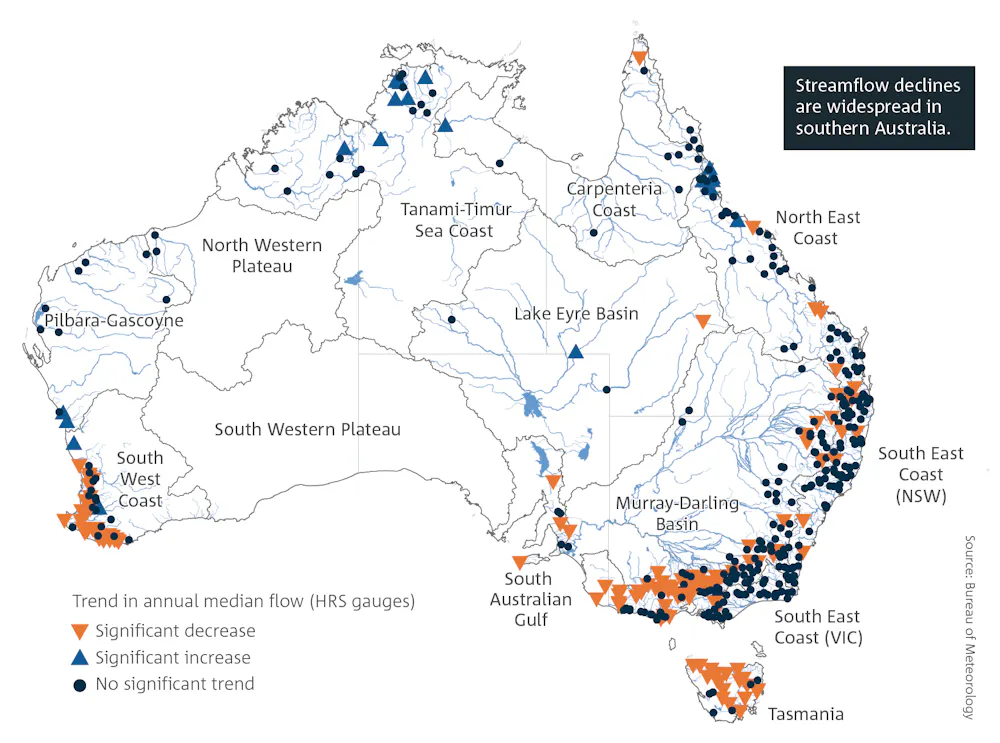
    These changes are also reflected in our rivers, with significantly lower flows for about one third of the gauges in the south. Australia-wide, only 4% of our river gauges are measuring increased flows, and almost all of these are in the north.

    Flows are declining in most rivers in Australia’s south due in part to reduced rainfall, while most rivers in the north are seeing increased flows linked to higher rainfall. This map shows trends in annual median streamflow from available river gauge data in the 1970−2023 period.
    CSIRO/Bureau of Meteorology, CC BY-NC-ND

    Hotter oceans, rising seas

    Almost all (90%) of the extra heat trapped by greenhouse gases has gone into the oceans. Oceans are getting rapidly hotter. This matters because ocean heat strongly influences weather patterns in Australia.

    Australia’s oceans are warming faster than the global average. But the oceans off south-east Australia and the Tasman Sea are a particular hotspot and are now warming at twice the global average.

    As the seas warm, they expand. This thermal expansion is one of the main contributors to rising sea levels. Around Australia, sea levels have risen 22 centimetres since 1900 – with half of that since 1970.

    More emissions equals more heat

    Avoiding the worst damage from climate change is conceptually simple and unequivocal: rapidly reduce greenhouse gases in the atmosphere will help Australia meet its net zero 2050 target.

    Tasmania’s northwest tip has some of the cleanest air in the world, which is why it was chosen to host the Kennaook/Cape Grim Baseline Air Pollution Station. For 48 years, this station has been recording concentrations of greenhouse gases. The picture it captures is stark.

    Carbon dioxide (CO₂) concentrations are now about 51% higher than pre-industrial levels, while concentrations of methane and nitrous oxide, both strong greenhouse gases, continue to increase. Their rate of atmospheric accumulation has rapidly increased in recent years even as some regions and some sources have begun to see emissions slow or even decline, such as reduced CO₂ emissions from land clearing, globally and in Australia.

    Global CO₂ emissions from fossil fuel use have been increasing since the beginning of the Industrial Revolution, and increased by 1.1% from 2022 to 2023, reaching the highest annual level ever recorded.

    The warming has led to an increase in the frequency of extreme heat events over land and in the oceans.
    Leah-Anne Thompson, Shutterstock

    Australia’s carbon contribution

    This year, the State of the Climate report for the first time quantifies Australia’s major human and natural carbon sources and sinks and how they contribute to global CO₂ levels.

    It shows the average annual carbon content embedded in Australia’s fossil fuel exports between 2010 and 2019 (1,055 megatonnes) was more than double the average annual national carbon emissions over the same period (455 Mt). However, the emissions of these carbon exports are accounted in the countries where the fossil fuels are used.

    It also demonstrates the importance of maintaining the integrity of our natural land ecosystems. Ecosystems are Australia’s most important carbon sinks, but their effectiveness as sinks depends on factors including the future evolution of the climate and how it will affect rainfall and wildfire regimes.

    Australia’s Carbon Budget 2010-2019. A product of the National Environmental Science Program – Climate Systems Hub; and a contribution to the Global Carbon Project – Regional Carbon Cycle Assessment and Processes-2.
    Source: NESP-2

    What lies ahead for Australia?

    Australia’s warming is expected to continue, which will lead to more extreme heat events, lower rainfall in some regions, and longer droughts.

    We can expect to see more intense rainfall events, even in regions where average rainfall falls or stays the same.

    Sudden intense rains make flooding more likely, especially in urban areas where concrete and tarmac prevent the ground from soaking up excess water and in low-lying coastal areas where rising sea levels amplify damage from other climate hazards.

    Climate change is already here. Through multiple lines of data and evidence, we have tracked what it is doing to make Australia hotter, more prone to floods and fires, and cutting river flows in the south where most of us live.

    If warming continues, these trends will get worse over time. Understanding these changes and the impacts to Australia will help manage climate risk, now and in the decades to come.

    Blair Trewin, Senior Research Scientist at the Bureau of Meteorology, contributed to this article

    Pep Canadell receives funding from the National Environmental Science Program – Climate Systems Hub

    Neil Sims does not work for, consult, own shares in or receive funding from any company or organisation that would benefit from this article, and has disclosed no relevant affiliations beyond their academic appointment.

    ref. State of the Climate 2024: Australia is enduring harsher fire seasons, more ocean heatwaves and sea-level rise – https://theconversation.com/state-of-the-climate-2024-australia-is-enduring-harsher-fire-seasons-more-ocean-heatwaves-and-sea-level-rise-242191

    MIL OSI AnalysisEveningReport.nz

  • MIL-Evening Report: Earth’s climate will keep changing long after humanity hits net-zero emissions. Our research shows why

    Source: The Conversation (Au and NZ) – By Andrew King, Senior Lecturer in Climate Science, The University of Melbourne

    Shutterstock

    The world is striving to reach net-zero emissions as we try to ward off dangerous global warming. But will getting to net-zero actually avert climate instability, as many assume?

    Our new study examined that question. Alarmingly, we found reaching net-zero in the next few decades will not bring an immediate end to the global heating problem. Earth’s climate will change for many centuries to come.

    And this continuing climate change will not be evenly spread. Australia would keep warming more than almost any other land area. For example if net-zero emissions are reached by 2060, the Australian city of Melbourne is still predicted to warm by 1°C after that point.

    But that’s not to say the world shouldn’t push to reach net-zero emissions as quickly as possible. The sooner we get there, the less damaging change the planet will experience in the long run.

    New research examines if climate change will stop once the world reaches net-zero emissions.
    Shutterstock

    Reaching net-zero is vital

    Global greenhouse gas emissions hit record highs in 2023. At the same time, Earth experienced its hottest year.

    Analysis suggests emissions may peak in the next couple of years then start to fall. But as long as emissions remain substantial, the planet will keep warming.

    Most of the world’s nations, including Australia, have signed up to the Paris climate agreement. The deal aims to keep global warming well below 2°C, and requires major emitters to reach net-zero as soon as possible. Australia, along with many other nations, is aiming to reach the goal by 2050.

    Getting to net-zero essentially means nations must reduce human-caused greenhouse gas emissions as much as possible, and compensate for remaining emissions by removing greenhouse gases from the atmosphere elsewhere. Methods for doing this include planting additional vegetation to draw down and store carbon, or using technology to suck carbon out of the air.

    Getting to net-zero is widely considered the point at which global warming will stop. But is that assumption correct? And does it mean warming would stop everywhere across the planet? Our research sought to find out.

    Centuries of change

    Computer models simulating Earth’s climate under different scenarios are an important tool for climate scientists. Our research used a model known as the Australian Community Climate and Earth System Simulator.

    Such models are like lab experiments for climate scientists to test ideas. Models are fed with information about greenhouse gas emissions. They then use equations to predict how those emissions would affect the movement of air and the ocean, and the transfer of carbon and heat, across Earth over time.

    We wanted to see what would happen once the world hit net-zero carbon dioxide at various points in time, and maintained it for 1,000 years.

    We ran seven simulations from different start points in the 21st century, at five-year increments from 2030 to 2060. These staggered simulations allowed us to measure the effect of various delays in reaching net-zero.

    We found Earth’s climate would continue to evolve under all simulations, even if net-zero emissions was maintained for 1,000 years. But importantly, the later net-zero is reached, the larger the climate changes Earth would experience.

    Warming oceans and melting ice

    Earth’s average temperature across land and sea is the main indicator of climate change. So we looked at that first.

    We found this temperature would continue to rise slowly under net-zero emissions – albeit at a much slower rate than we see today. Most warming would take place on the ocean surface; average temperature on land would only change a little.

    We also looked at temperatures below the ocean surface. There, the ocean would warm strongly even under net-zero emissions – and this continues for many centuries. This is because seawater absorbs a lot of energy before warming up, which means some ocean warming is inevitable even after emissions fall.

    Over the last few decades of high greenhouse gas emissions, sea ice extent fell in the Arctic – and more recently, around Antarctica. Under net-zero emissions, we anticipate Arctic sea ice extent would stabilise but not recover.

    In contrast, Antarctic sea ice extent is projected to fall under net-zero emissions for many centuries. This is associated with continued slow warming of the Southern Ocean around Antarctica.

    Importantly, we found long-term impacts on the climate worsen the later we reach net-zero emissions. Even just a five-year delay would affect on the projected climate 1,000 years later.

    Delaying net-zero by five years results in a higher global average surface temperature, a much warmer ocean and reduced sea ice extent for many centuries.

    Australia’s evolving climate

    The effect on the climate of reaching net-zero emissions differs across the world.

    For example, Australia is close to the Southern Ocean, which is projected to continue warming for many centuries even under net-zero emissions. This warming to Australia’s south means even under a net-zero emissions pathway, we expect the continent to continue to warm more than almost all other land areas on Earth.

    For example, the models predict Melbourne would experience 1°C of warming over centuries if net-zero was reached in 2060.

    Spell out GMST (global mean surface temperature?) in chart? Is listed as global average in caption??

    Net-zero would also lead to changes in rainfall in Australia. Winter rainfall across the continent would increase – a trend in contrast to drying currently underway in parts of Australia, particularly in the southwest and southeast.

    Knowns and unknowns

    There is much more to discover about how the climate might behave under net-zero.

    But our analysis provides some clues about what climate changes to expect if humanity struggles to achieve large-scale “net-negative” emissions – that is, removing carbon from the atmosphere at a greater rate than it is emitted.

    Experiments with more models will help improve scientists’ understanding of climate change beyond net-zero emissions. These simulations may include scenarios in which carbon removal methods are so successful, Earth actually cools and some climate changes are reversed.

    Despite the unknowns, one thing is very clear: there is a pressing need to push for net-zero emissions as fast as possible.

    Andrew King receives funding from the ARC Centre of Excellence for 21st Century Weather and the National Environmental Science Program.

    Tilo Ziehn receives funding from the ARC Centre of Excellence for 21st Century Weather and the National Environmental Science Program.

    ref. Earth’s climate will keep changing long after humanity hits net-zero emissions. Our research shows why – https://theconversation.com/earths-climate-will-keep-changing-long-after-humanity-hits-net-zero-emissions-our-research-shows-why-241692

    MIL OSI AnalysisEveningReport.nz

  • MIL-Evening Report: 215 million hectares of forest – an area bigger than Mexico – could grow back by itself, if we can just leave it alone

    Source: The Conversation (Au and NZ) – By Brooke Williams, Research Fellow, School of Biology & Environmental Science, Queensland University of Technology

    Gustavo Frazao/Shutterstock

    About 215 million hectares of land – an area bigger than Mexico – could be reforested naturally and without costly manual planting, our new research shows.

    This would allow us to offset around 23.4 gigatonnes of global carbon emissions over the next three decades. That’s about 50 years worth of Australia’s carbon emissions (assuming 2023 emission rates continue).

    Extensive and effective forest restoration is crucial to mitigating climate change and conserving biodiversity.

    It’s vital we find cost-effective ways to get and keep more trees in the ground. One way to do this is just to let forests grow back by themselves. However, this isn’t possible in all deforested lands, as certain environmental conditions are needed for this approach to work.

    Our research identified land where this approach had strong potential.

    Allowing forests to grow back naturally in deforested areas, such as this degraded land in Brazil, could be more cost-effective than manual reforestation projects.
    Author provided

    The benefits of natural regeneration

    Globally, 65% of original tropical forest extent has been lost to make way for human development such as agriculture, roads, and urbanisation. Deforestation has contributed to climate change and biodiversity loss.

    We’ve also lost a worrying amount of what researchers call “ecosystem services”, meaning the benefits people derive from nature, such as clean water.

    Forest restoration is an important strategy for reversing the damage.

    Our paper, published in the journal Nature, looked at where natural regeneration is likely to be successful due to the surrounding environmental conditions.

    Natural regeneration is important because it is sometimes better than manual tree planting, which includes the costs of saplings, manual labour, fertilisation and maintenance.

    Using manual techniques in degraded landscapes can be expensive. It can also be less effective in terms of native biodiversity recovery and keeping water systems functioning well.

    Natural regeneration is a less costly alternative. That means allowing forests to grow back on their own or with carefully planned human intervention.

    For example, natural reforestation may cost between $US12 and $3,880 per hectare. By contrast, active regeneration methods in the tropics would cost between $105 and $25,830 per hectare.

    Natural regeneration restoration methods often have better long-term success and biodiversity outcomes than full manual tree-planting.

    Studies have found that biodiversity “success” – meaning richer biodiversity and more species – can be up to 56% higher when natural regeneration approaches were used (rather than manual planting projects).

    It’s vital we find cost-effective ways to get and keep more trees in the ground.
    Richard Whitcombe/Shutterstock

    Where might natural reforestation projects succeed?

    Until now, it’s not always been clear how to predict areas where natural regeneration is most likely to occur. That’s made it hard to do large-scale natural regeneration projects.

    Our research addresses this gap. We identified the best areas to roll out natural approaches in the tropics.

    We focused on tropical forested regions because they are particularly important.

    Their biodiversity is unparalleled and they provide vast economic, cultural, and recreational services to people.

    They also grow much faster than other forest types, and many large tropical forests have already been cleared and degraded.

    Factors that make a forest likely to regenerate naturally include:

    • the amount of surrounding forest
    • distance to existing forest and
    • soil organic carbon content

    This suggests areas with higher levels of landscape degradation and intensive land uses would be less likely to regenerate naturally.

    We found suitable environmental conditions for natural regeneration occur across:

    • 98 million hectares in the Neotropics (which includes many areas in South and Central America)

    • 90 million hectares in the Indomalayan tropics (which includes many areas in Southeast Asia, Malaysia, and India)

    • 25.5 million hectares in the continent of Africa

    Up to 52% of this natural regeneration could occur in just five countries: Brazil, Indonesia, China, Mexico, and Colombia.

    This suggests these countries would be excellent candidates for large scale natural regeneration projects.

    We also found that 29 other countries have at least one million hectares each that could be naturally reforested.

    We identified 400,000 hectares of deforested lands with potential for natural forest regeneration in the Australian tropics.

    Fixing forests will also improve biodiversity.
    Martin Prochazkacz/Shutterstock

    The world has committed to fixing forests

    The world has committed to ambitious forest restoration targets in order to substantially increase the area of forest ecosystems by 2050.

    These commitments include the Bonn Challenge, which aims to restore 350 million hectares by 2030.

    Another is Target 2 of the recently adopted Global Biodiversity Framework, which calls for 30% of the area of degraded ecosystems to be restored by 2030.

    Achieving these targets, especially for nations with emerging economies, will not be possible using active restoration techniques alone. This due to cost and feasibility constraints.

    To assist with this global task, we have made our dataset publicly available and free to use.

    Local communities at the centre

    Encouraging natural regeneration remains a major challenge, particularly on privately held and communally managed land because it can mean reduced land available for other uses.

    Providing local people with training and support to grow, harvest and market products sourced from naturally regenerating forests is also crucial. This could help keep young naturally regenerating forests standing and growing.

    This income could supplement or replace payments landowners and local people currently receive to look after land and prevent it from being deforested. Payment-based approaches are not always sustainable in the long term.

    Currently, many forests are controlled and managed by central or national governments. Giving local and Indigenous communities control over their forests would help encourage restoration that meets local needs.

    However, this requires appropriate technical support and monitoring.

    Importantly, our analysis does not define where restoration activities should or should not occur. We only show where natural forest regeneration is possible or more likely to succeed.

    We echo calls to ensure restoration occurs as equitably as possible, and foregrounds the needs of local people.

    Forest restoration should be as equitable as possible, and foreground the needs of local people.
    WNDR Worlds/Shutterstock

    Let’s give it a chance

    Natural forest regeneration presents an opportunity to restore vast areas of forest cheaply and effectively. It can help mitigate the effects of climate change and help countries meet their emissions reduction targets.

    Other benefits include conserving biodiversity, regulating water resources, reducing erosion, and making ecosystems more resilient.

    Recognising the massive regeneration capacity of tropical forests is key.

    It’s also crucial it occurs alongside protecting intact forests, and reducing deforestation.

    Robin Chazdon is the global co-director of the Assisted Natural Regeneration Alliance. She is a senior fellow with the World Resources Institute’s Global Restoration Initiative.

    Brooke Williams does not work for, consult, own shares in or receive funding from any company or organisation that would benefit from this article, and has disclosed no relevant affiliations beyond their academic appointment.

    ref. 215 million hectares of forest – an area bigger than Mexico – could grow back by itself, if we can just leave it alone – https://theconversation.com/215-million-hectares-of-forest-an-area-bigger-than-mexico-could-grow-back-by-itself-if-we-can-just-leave-it-alone-236696

    MIL OSI AnalysisEveningReport.nz

  • MIL-Evening Report: How light can shift your mood and mental health

    Source: The Conversation (Au and NZ) – By Jacob Crouse, Research Fellow in Youth Mental Health, Brain and Mind Centre, University of Sydney

    llaszlo/Shutterstock

    This is the next article in our ‘Light and health’ series, where we look at how light affects our physical and mental health in sometimes surprising ways. Read other articles in the series.


    It’s spring and you’ve probably noticed a change in when the Sun rises and sets. But have you also noticed a change in your mood?

    We’ve known for a while that light plays a role in our wellbeing. Many of us tend to feel more positive when spring returns.

    But for others, big changes in light, such as at the start of spring, can be tough. And for many, bright light at night can be a problem. Here’s what’s going on.

    An ancient rhythm of light and mood

    In an earlier article in our series, we learned that light shining on the back of the eye sends “timing signals” to the brain and the master clock of the circadian system. This clock coordinates our daily (circadian) rhythms.

    “Clock genes” also regulate circadian rhythms. These genes control the timing of when many other genes turn on and off during the 24-hour, light-dark cycle.

    But how is this all linked with our mood and mental health?

    Circadian rhythms can be disrupted. This can happen if there are problems with how the body clock develops or functions, or if someone is routinely exposed to bright light at night.

    When circadian disruption happens, it increases the risk of certain mental disorders. These include bipolar disorder and atypical depression (a type of depression when someone is extra sleepy and has problems with their energy and metabolism).

    Light on the brain

    Light may also affect circuits in the brain that control mood, as animal studies show.

    There’s evidence this happens in humans. A brain-imaging study showed exposure to bright light in the daytime while inside the scanner changed the activity of a brain region involved in mood and alertness.

    Another brain-imaging study found a link between daily exposure to sunlight and how the neurotransmitter (or chemical messenger) serotonin binds to receptors in the brain. We see alterations in serotonin binding in several mental disorders, including depression.

    Our mood can lift in sunlight for a number of reasons, related to our genes, brain and hormones.
    New Africa/Shutterstock

    What happens when the seasons change?

    Light can also affect mood and mental health as the seasons change. During autumn and winter, symptoms such as low mood and fatigue can develop. But often, once spring and summer come round, these symptoms go away. This is called “seasonality” or, when severe, “seasonal affective disorder”.

    What is less well known is that for other people, the change to spring and summer (when there is more light) can also come with a change in mood and mental health. Some people experience increases in energy and the drive to be active. This is positive for some but can be seriously destabilising for others. This too is an example of seasonality.

    Most people aren’t very seasonal. But for those who are, seasonality has a genetic component. Relatives of people with seasonal affective disorder are more likely to also experience seasonality.

    Seasonality is also more common in conditions such as bipolar disorder. For many people with such conditions, the shift into shorter day-lengths during winter can trigger a depressive episode.

    Counterintuitively, the longer day-lengths in spring and summer can also destabilise people with bipolar disorder into an “activated” state where energy and activity are in overdrive, and symptoms are harder to manage. So, seasonality can be serious.

    Alexis Hutcheon, who experiences seasonality and helped write this article, told us:

    […] the season change is like preparing for battle – I never know what’s coming, and I rarely come out unscathed. I’ve experienced both hypomanic and depressive episodes triggered by the season change, but regardless of whether I’m on the ‘up’ or the ‘down’, the one constant is that I can’t sleep. To manage, I try to stick to a strict routine, tweak medication, maximise my exposure to light, and always stay tuned in to those subtle shifts in mood. It’s a time of heightened awareness and trying to stay one step ahead.

    So what’s going on in the brain?

    One explanation for what’s going on in the brain when mental health fluctuates with the change in seasons relates to the neurotransmitters serotonin and dopamine.

    Serotonin helps regulate mood and is the target of many antidepressants. There is some evidence of seasonal changes in serotonin levels, potentially being lower in winter.

    Dopamine is a neurotransmitter involved in reward, motivation and movement, and is also a target of some antidepressants. Levels of dopamine may also change with the seasons.

    But the neuroscience of seasonality is a developing area and more research is needed to know what’s going on in the brain.

    How about bright light at night?

    We know exposure to bright light at night (for instance, if someone is up all night) can disturb someone’s circadian rhythms.

    This type of circadian rhythm disturbance is associated with higher rates of symptoms including self-harm, depressive and anxiety symptoms, and lower wellbeing. It is also associated with higher rates of mental disorders, such as major depression, bipolar disorder, psychotic disorders and post-traumatic stress disorder (or PTSD).

    Why is this? Bright light at night confuses and destabilises the body clock. It disrupts the rhythmic regulation of mood, cognition, appetite, metabolism and many other mental processes.

    But people differ hugely in their sensitivity to light. While still a hypothesis, people who are most sensitive to light may be the most vulnerable to body clock disturbances caused by bright light at night, which then leads to a higher risk of mental health problems.

    Bright light at night disrupts your body clock, putting you at greater risk of mental health issues.
    Ollyy/Shutterstock

    Where to from here?

    Learning about light will help people better manage their mental health conditions.

    By encouraging people to better align their lives to the light-dark cycle (to stabilise their body clock) we may also help prevent conditions such as depression and bipolar disorder emerging in the first place.

    Healthy light behaviours – avoiding light at night and seeking light during the day – are good for everyone. But they might be especially helpful for people at risk of mental health problems. These include people with a family history of mental health problems or people who are night owls (late sleepers and late risers), who are more at risk of body clock disturbances.


    Alexis Hutcheon has lived experience of a mental health condition and helped write this article.

    If this article has raised issues for you, or if you’re concerned about someone you know, call Lifeline on 13 11 14.

    Jacob Crouse receives funding from Wellcome Trust and National Health and Medical Research Council.

    Professor Hickie is a Professor of Psychiatry and the Co-Director of Health and Policy, Brain and
    Mind Centre, University of Sydney. He has led major public health and health service development
    in Australia, particularly focusing on early intervention for young people with depression, suicidal
    thoughts and behaviours and complex mood disorders. He is active in the development through
    codesign, implementation and continuous evaluation of new health information and personal
    monitoring technologies to drive highly-personalised and measurement-based care. He holds a 3.2%
    equity share in Innowell Pty Ltd that is focused on digital transformation of mental health services.

    Emiliana Tonini does not work for, consult, own shares in or receive funding from any company or organisation that would benefit from this article, and has disclosed no relevant affiliations beyond their academic appointment.

    ref. How light can shift your mood and mental health – https://theconversation.com/how-light-can-shift-your-mood-and-mental-health-231282

    MIL OSI AnalysisEveningReport.nz

  • MIL-Evening Report: Collisions between planes and birds follow seasonal patterns and overlap with breeding and migration – new research

    Source: The Conversation (Au and NZ) – By Tirth Vaishnav, PhD Candidate in Ecology and Biodiversity, Te Herenga Waka — Victoria University of Wellington

    Getty Images

    Bird strikes with aircraft pose a serious threat to human safety. The problem dates back to the early days of aviation, with the first death of a pilot recorded in 1912 when an aircraft crashed into the sea after striking a gull.

    Since then, 795 lives have been lost to collisions between aircraft and birds, not to mention the countless bird fatalities.

    As aircraft get faster, quieter, larger and more numerous, the risk of serious accidents increases accordingly. Every year, the aviation industry incurs damages worth billions of dollars.

    To mitigate this problem, airports around the world implement wildlife hazard management, including dispersing flocks away from the runway, tracking local bird movements and managing potential food sources such as landfills and farms near the aerodrome.

    In our recent study, we zoomed out from the local airport and examined seasonal and hemispheric trends in bird strikes.

    We found they peak in late summer and autumn in both hemispheres, but the annual distribution differs between the northern and southern hemispheres. Seasonal trends in bird strikes were seemingly influenced by avian breeding and migration patterns.

    Airports deploy noise barriers and reflective walls to keep birds away from the runway.
    Getty Images

    Seasonal patterns

    To assess seasonal patterns in bird strikes, we gathered information for individual airports from existing literature and online sources. Our dataset includes 122 airports in 16 countries and five continents.

    For each hemisphere, we determined the time of year with the overall highest number of bird strikes and the spread of strikes through the year.

    We found that bird strikes peaked in late August in the northern hemisphere and in early April in the southern hemisphere. Strikes were relatively more seasonal in the north, while they had a greater annual spread in the south.

    For instance, strikes in New York or Oslo in the northern hemisphere were considerably higher in August compared to other times of the year, while in Wellington or Durban in the southern hemisphere, strikes occurred more consistently throughout the year.

    Birds strikes are more seasonal in the northern hemisphere and more distributed across the year in the southern hemisphere.
    Author provided, CC BY-SA

    Bird strikes peaked in the autumn season in each hemisphere. Autumn is generally when young birds fledge and take to the skies. There may be two explanations for why bird strikes are higher during this time of year.

    1. For young birds, avoiding foreign objects in the flight path may be a learned behaviour. This would result in juveniles being struck at a higher rate.

    2. The greater number of birds in the air during autumn due to the influx of fledglings may result in more strikes, with adults and juveniles being struck at random.

    Links to bird migration

    Seasonal peaks in bird strikes were more pronounced in the north compared to the south. Approximately 80% of the southern hemisphere’s surface is water and the solar energy absorbed by the oceans leads to a more stable thermal regime.

    Conversely, the surface of the northern hemisphere is mostly land, leading to greater fluctuations in temperature. Birds migrate in response to these environmental factors and this influences global avian distributions and abundances.

    The intensity of migration is, therefore, much stronger in the northern hemisphere compared to the southern hemisphere, where local bird abundances are more stable seasonally.

    Our findings bridge a gap between aviation safety and macroecology. Airport authorities can use this information in several ways.

    • Wildlife officers can optimise their bird strike mitigation efforts by allocating more resources in the autumn months, particularly in northern regions.

    • Management plans for “problem” species such as gulls are often adapted from existing plans for similar species at other airports. Information on patterns in bird strikes may help in customising these plans to local bird behaviour.

    • Bird strikes are a global issue, so better standardisation in reporting bird strike statistics could improve our ability to analyse them at a global scale.

    Finally, with climate change altering the seasonal timing of cyclical events, such as avian breeding seasons and migration patterns, it may be crucial to forecast the impact of these changes on the seasonal trends in bird strikes.

    To some degree, bird strikes may be inevitable. But with the cooperation of aviation authorities, scientists and policy makers, we may be able to minimise their frequency and intensity.

    Tirth Vaishnav does not work for, consult, own shares in or receive funding from any company or organisation that would benefit from this article, and has disclosed no relevant affiliations beyond their academic appointment.

    ref. Collisions between planes and birds follow seasonal patterns and overlap with breeding and migration – new research – https://theconversation.com/collisions-between-planes-and-birds-follow-seasonal-patterns-and-overlap-with-breeding-and-migration-new-research-241238

    MIL OSI AnalysisEveningReport.nz

  • MIL-Evening Report: Not too big, not too small: why modern humans are the ideal size for speed

    Source: The Conversation (Au and NZ) – By Christofer Clemente, Assistant Professor in Evolutionary Biomechanics, University of the Sunshine Coast

    The fastest animal on land is the cheetah, capable of reaching top speeds of 104 kilometres per hour. In the water, the fastest animals are yellowfin tuna and wahoo, which can reach speeds of 75 and 77 km per hour respectively. In the air, the title of the fastest level flight (excluding diving) goes to the white-throated needletail swift, at more than 112 km per hour.

    What do all of these speedy creatures have in common? None of them are particularly big, nor particularly small for the group of animals they represent. In fact, they are all intermediately sized.

    The reason for this is a bit of a mystery. As animals increase in mass, several biological features change as well. For example, in general leg length steadily increases. But clearly long legs are not the answer, since the largest land animals, like elephants, are not the fastest.

    But my colleagues and I have taken a key step towards solving this mystery. By using a scaleable, virtual model of the human body, we were able to explore the movement of the limbs and muscles, find out what limits speed, and gain important insights into the evolution of the human form over thousands of years.

    From a mouse-sized human to a giant

    Since the early 2000s scientists have been building OpenSim – a freely available, virtual model of the human body, complete with all its bones, muscles and tendons.

    This model has been used in various scientific studies to understand human movement, explore exercise science and to help model the effects of surgery on soft tissues.

    In 2019 a group of Belgium researchers took this one step further, and built a physics-based simulation using OpenSim. Rather than telling the model how to move, they asked it to move forward at a certain speed. The model then figured out which combinations of muscles to activate so it could walk, or run, at the prescribed speed.

    But what if we took this even further and scaled the model down to the size of a mouse? Or what if we scaled the model up to the size of an elephant? Then we could see which models could run – and how fast.

    Predictive muscle-driven simulations of 5kg, 50kg, and 500kg musculoskeletal models moving at 2.25 metres per second.

    This is exactly what my team did. We took the standard human model (75kg), and made smaller and smaller models down to 100 grams. We also made the models bigger, up to 2,000kg, and challenged them to run as fast as they could.

    Getting the mass just right

    Several fascinating things happened when we did this.

    First, the 2,000kg model couldn’t move. Nor could the 1,000kg model. In fact, the largest model that could move was 900kg, suggesting an upper limit to the human form. Beyond this size we need to change shape in order to move.

    We also found that the fastest model was not the biggest nor smallest. Instead, it was around 47kg, a similar weight to an average cheetah. Crucially, we could look under the hood and see why this was so.

    The curve that explains the shape of the maximum running speed with mass is the same shape as the curve, which explains the max ground force with mass. This makes sense: to move faster, you need to push off the ground harder.

    So why couldn’t larger models push harder off the ground? It appeared the larger models were limited by their muscles.

    A muscle’s ability to produce force depends on the cross sectional area of that muscle. And as animals increase in size, the mass of their muscles gets bigger faster than their cross-sectional area.

    This means the muscles of larger animals are relatively weaker. The muscles begin to “max out” above the max speed – and so the model has to slow down.

    At the other end of the spectrum, the miniature models have relatively stronger muscles, but have a problem with gravity. They are just too light. They try to push on the ground to produce a large force, but this just causes their body to leave the ground earlier.

    To try to produce more force on the ground, they crouch their limbs, just like mice or cats do. This allows them to stay on the ground longer and so produce more force, just like you might when doing a standing jump. But this takes time. And the longer you take to produce force, the slower your stride will be and you still won’t run faster.

    So a trade off between ground force and stride frequency begins, and doesn’t end until you reach the intermediate size, where your mass is just right.

    The pattern of speed and size for running animals (in blue), showing intermediately size species (like the cheetah) are typically the fastest. Computer-generated models of humans (right), which are then scaled in size from a mouse to a horse (orange dots), show the same pattern, revealing the underlying biomechanical reasons.
    Christofer Clemente et al.

    As fast as we will get

    What might all of this say about human evolution?

    We know throughout history that the size of modern humans and extinct human species – a collective group known as “hominins” – has varied significantly, from the roughly 30kg Australopithecus afarensis that existed roughly 3.5  million years ago, to the roughly 80kg Homo erectus  from nearly 2 million years ago.

    So generally body mass has tended to increase – and presumably so too has our running speed. Homo naledi, which existed around 300,000 years ago and weighed around 37kg, and Homo floresiensis, which existed around 50,000 years ago and weighed around 27kg, must have had to sacrifice some speed for their small size.

    The average body mass of modern adult humans is around 62kg – a little heavier than the 47kg peak weight that our modelling found, but still close to that ideal size.

    Interestingly, many of our fastest long distance runners such as Eliud Kipchoge weigh around 50kg.

    So based on our new research, we now know humans today are about as fast as we will get – without large changes to our muscular form.

    Christofer Clemente receives funding from an ARC Discovery grant (DP230101886)

    ref. Not too big, not too small: why modern humans are the ideal size for speed – https://theconversation.com/not-too-big-not-too-small-why-modern-humans-are-the-ideal-size-for-speed-241668

    MIL OSI AnalysisEveningReport.nz

  • MIL-OSI USA: Cambodia stops publishing details of new citizenships issued to foreigners – The Straits Times

    Source: United States Institute of Peace

    SINGAPORE – Cambodia has stopped publishing data on new citizenships issued by the kingdom to foreigners, in the wake of the $3 billion money laundering probe in Singapore.

    Checks by The Straits Times and investigative journalism group, Organised Crime and Corruption Reporting Project (OCCRP), showed that the last time new citizenship details were published was in February.

    The latest Royal Gazette, published on Sept 27, did not contain any new citizenship data.

    Observers had zoomed in on the ease of access to Cambodian citizenship and passports after it emerged that nine of the 10 foreigners arrested in August 2023 in the probe in Singapore held Cambodian passports.

    All 10 were originally from China, which does not recognise dual citizenship.

    In 2018, Cambodia moved to allow foreign immigrants to request citizenship through the naturalisation process.

    To be granted citizenship, foreigners have to maintain good behaviour and morality, and have no convictions for serious crime.

    They must also legally reside in Cambodia for more than seven years, be able to speak Khmer, and understand the local culture and history.

    Of the nine foreigners apprehended in Singapore, at least five were convicted for online gambling or were wanted by the authorities in China.

    They are Wang Dehai, Vang Shuiming, Su Jianfeng, Chen Qingyuan and Su Wenqiang.

    Another 17 associates of the 10 foreigners held Cambodian passports as well.

    They include Su Binghai, Su Yongcan, Wang Huoqiang, Su Shuiming, Su Shuijun, Su Fuxiang and Chen Mulin.

    Cambodia had averaged around 50 new citizens every month between January 2020 and August 2023, with details published monthly in the Royal Gazette.

    After the raids in Singapore, the kingdom granted citizenship status to only four individuals in total between September 2023 and December 2023.

    A representative from the Royal Embassy of Cambodia in Singapore told ST on Sept 18 that it could not confirm the figures as it does not have access to the data.

    The representative added that he was unable to confirm if Cambodia’s citizenship by investment scheme, or naturalisation process, is still in place.

    ST had also reached out to government spokesman Pen Bona, the Prime Minister’s spokesman Meas Sophorn, the office of the council of ministers, and Cambodia’s immigration office.

    Established in 1996, the kingdom’s law on nationality also allows foreigners to obtain citizenship through investment in the nation.

    Under the law, foreigners who invest a minimum of US$300,000 (S$384,000) in the country, or donate at least US$250,000 to the economy, will have the right to apply for citizenship.

    Mr Jacob Sims, a visiting expert on transnational crime at the United States Institute of Peace, told ST that for years, Cambodia’s citizenship for investment scheme has served as a channel for individuals from sophisticated organised crime syndicates to migrate.

    Said Mr Sims: “The removal of that data from the public record helps to obscure the nature of the relationship between Cambodian state actions and those criminals, as well as the sheer volume of monied crime actors Cambodia has absorbed in recent years.”

    By removing the once publicly available data, Cambodia can protect those who have purchased citizenship while shielding the government from international scrutiny, he said.

    Associate Professor Kristin Surak from the London School of Economics and Political Science said that not all countries strictly vet citizenship by investment applications.

    She added: “I would say the scheme is very easy to exploit in Cambodia because the government does not do its due diligence. It has issues with corruption and does not have an effective bureaucratic process to ensure applications are properly checked and vetted.”

    Name changes have also made it harder for the authorities to track criminals.

    Dr Surak, the author of The Golden Passport: Global Mobility For Millionaires, pointed out that many applicants in the past have changed their names.

    “This makes it extremely easy for someone to take on a new identity, making Cambodia a target for those with criminal intent to take advantage of,” she added.

    One such example is casino kingpin She Zhijiang. ST previously reported on She and his links to scam operations in Myanmar and Cambodia.

    She, who was originally from China, became a naturalised citizen of Cambodia in 2017. He then changed his name to Tang Kriang Kai.

    He was arrested in Thailand in August 2022 and is currently fighting deportation to China.

    Businessman David Yong, chief executive of Evergreen Group Holdings, had similarly obtained Cambodian citizenship.

    Yong, who is currently facing four charges in Singapore of falsifying accounts, obtained Cambodian citizenship some time in 2023 and changed his name to Duong Dara.

    He was arrested on Aug 1, just three months after he appeared in Netflix series Super Rich In Korea.

    Yong’s lawyer said in court that he had surrendered his Cambodian passport to the authorities in Phnom Penh in June 2024.

    In response, the authorities in Singapore said they wrote several times to their Cambodian counterparts in August to confirm the fact, but have yet to receive any reply.

    Of the 10 foreigners convicted in Singapore’s largest money laundering case, eight were deported to Cambodia – which has an extradition treaty with China.

    Wang Dehai was deported to the UK, while Vang Shuiming was deported to Japan.

    MIL OSI USA News

  • MIL-OSI USA: Golden questions regulators over proposed reduction to herring quota

    Source: United States House of Representatives – Congressman Jared Golden (ME-02)

    WASHINGTON — Congressman Jared Golden (ME-02) today sent a letter to the National Oceanic and Atmospheric Administration (NOAA) and New England Fishery Management Council (NEFMC) questioning the methodology regulators used as the basis for a nearly 90 percent reduction to the Atlantic herring fishery quota for the next three years. The fishery supplies the primary bait used in the lobster fishery. 

    “Once again, Maine fishermen find themselves on the verge of economic ruin due to federal regulations based on incomplete and inadequate data. In my conversations with fishermen, it has always been clear that their top concerns are the sustainability of the stock and the ability for it to be harvested by future generations,” Golden wrote. “That is why these decisions must always be based on scientifically sound, comprehensive data that incorporates the invaluable input of those most impacted — the harvesters themselves.”

    A July assessment by NOAA claims that the population of herring capable of reproducing is at 26 percent of the agency’s target. This sparked a proposal from NEFMC to reduce the species’ annual catch limit by 89 percent from 2025-2027 — the lowest level in the history of the Council’s Atlantic Herring Fishery Management Plan. However, Maine fishermen have expressed concern that the research vessel used to measure the herring stock is unable to operate in the areas fishermen actually target the species, instead trawling at depths fishermen avoid due to the low concentration of herring.

    According to the Maine Department of Marine Resources, Atlantic herring landings in Maine during 2019 totaled an estimated 13 million pounds and $5.8 million in ex-vessel value. 

    “NEFSA is thankful that Congressman Golden is drawing criticism to the massive, 90 percent cut to the herring quota for the next two years. Very little attention has been given to this action which will eliminate more commercial fishermen from their livelihoods,” commercial fishermenJerry LeemanandDustin Delano, CEO and COO of the New England Fishermen’s Stewardship Association, respectively, said. “We thank Congressman Golden for his efforts and hope the council will reconsider its egregious decision to further decimate the commercial fishing fleet.”

    “We’re grateful to Rep. Golden for speaking out against this misinformed change to the herring quota. Moving forward with a near total cut would be absolutely devastating for fishermen, the lobster industry, and the coastal communities that depend on them,” Virginia Olsen, commercial lobsterman and director of the Maine Lobstering Union said. “It’s more proof that he is not afraid to work across party lines to support fishermen and that matters to me.” 

    Golden’s letter pressed the agencies on whether they also include industry-based surveys like those considered by Canadian regulators, how spawning data is collected if both regulators and fishermen avoid operating in herrings’ spawning waters, and why there was not an economic impact study conducted during the process.

    “My main concern with this seemingly unreasonable quota reduction is that these fishermen will be forced to switch over to a less desirable species of fish. Next season, when everyone has to substitute herring with something else, the increased demand in these alternative baits will make the already rising cost of doing business hard for these fishermen hard to justify fishing in the spring, early summer, and late fall…” Alex Poke, general manager at the Winter Harbor co-op said. “…I expect there to be more frequent and longer periods where I can’t find any bait for the lobster fishermen here at the co-op.”

     “Thank you to Rep. Golden for highlighting these ill-informed quota reductions. These reductions will have crushing economic impacts on my family and our community,” Branden Loveyjoy, a herring fisherman and bait dealer from Columbia said. “I, too, am concerned about the sustainability of the fishery and the next generation, but these reductions go too far without the data to inform them.” 

    Full text of Golden’s letter can be found here, and is included below in full:

    +++


    October 30, 2024

    Michael Pentony
    Regional Administrator
    Greater Atlantic Regional Fisheries Office
    NOAA Fisheries
    55 Great Republic Drive
    Gloucester, MA 01930


    Jon Hare, PhD
    Science and Research Director
    Northeast Fisheries Science Center
    NOAA Fisheries 
    166 Water Street
    Woods Hole, MA 02543


    Cate O’Keefe, PhD
    Executive Director 
    New England Fishery Management Council
    50 Water Street, Mill 2
    Newburyport, MA 01950

    Dear Administrator Pentony, Dr. Hare, and Dr. O’Keefe: 

    I am writing to seek additional information regarding the action the New England Fishery Management Council (NEFMC) recently took to reduce the Atlantic herring fishery quota by nearly 90 percent for fishing year 2025-2027. Based on conversations I have had with Maine fishermen, I am concerned that this decision by the NEFMC was predicated on inaccurate and incomplete surveys and estimates of spawning stock biomass data that also fails to account for the potential economic impacts on fishing communities.

    As you know, the Atlantic herring fishery is an essential part of Maine’s marine economy and is the most important pelagic fishery resource in the state. According to the Maine Department of Marine Resources, in 2019 Atlantic herring landings in Maine were around 13 million pounds, valued at an estimated $5.8 million ex-vessel. This fishery also supplies the primary bait used in our lobster fishery, one of the most valuable in the nation at $464 million. Together, these fisheries employ thousands of Mainers through dealers and seafood processors, vessel and trap manufacturers, restaurants, and other coastal businesses.. 

    That is why I was alarmed when the NEFMC passed new specifications for the Atlantic herring fishery that will result in the lowest catch limits in the history of the Atlantic Herring Fishery Management Plan. This is despite the fact that for some time, I have heard from fishermen who have expressed their concerns about the Henry B. Bigelow (Bigelow), the sole survey vessel used by the federal government to determine the abundance and health of the inshore Atlantic herring stock. While the Bigelow may be a capable vessel – when operational – for conducting trawling operations in depths of 600 feet or greater, due to potential gear conflicts and bottom conditions closer to the coast, it is unable to tow in the areas that Maine’s herring fishermen utilize most. 

    This is particularly true in the interior of area 1A, which is between one and 20 nautical miles from shore. It is here where fishermen are telling me that they are observing herring in volumes they have not seen in recent years, while the Bigelow trawls areas in which they would never consider fishing. Moreover, due to major mechanical issues in the Spring of 2023, the vessel was prevented from conducting tows for the three-year stock assessments for any of the fisheries it samples – including Atlantic herring. The discrepancy between the experience of harvesters and the practical limitations of the Bigelow raises legitimate questions as to whether or not federal regulators are capturing accurate and complete data of the herring stock that is then being used to inform fishing quotas. 

    In order to better understand the methodology behind the NEFMC’s decision-making for setting a 90 percent quota reduction for Atlantic herring, I would appreciate your answers to the following questions:
     

    1. The Canadian herring fishery utilizes industry boats and fishermen who know how to operate the vessels and the gear required to target a particular fish species effectively. Has the NEFMC considered industry-based surveys that utilize the observations of experienced herring fishermen when making quota decisions or to validate assessments conducted by the Bigelow? 

    2.      Fishermen intentionally avoid spawning areas; if they catch spawned herring, they risk being shut down by federal regulators. If the Bigelow is not operating during these spawning seasons or in these areas, and fishermen are prohibited from catching spawned fish, how is this data collected? 

    3.      Based on the Atlantic herring quotas in the motion the NEFMC voted to approve for 2025-2027, we are certain to see crippling economic conditions for those fishermen and other fisheries that are dependent on herring. Why was no shore-side economic impact study conducted to understand the socioeconomic harm these proposed reductions would cause?

    Once again, Maine fishermen find themselves on the verge of economic ruin due to federal regulations based on incomplete and inadequate data. In my conversations with fishermen, it has always been clear that their top concerns are the sustainability of the stock and the ability for it to be harvested by future generations. That is why these decisions must always be based on scientifically sound, comprehensive data that incorporates the invaluable input of those most impacted – the harvesters themselves. 

    I will continue to monitor this situation closely and appreciate your attention to this important matter. 


    ###

    MIL OSI USA News

  • MIL-OSI USA: 56th Security Consultative Meeting Joint Communique

    Source: United States Department of Defense

    1. The 56th United States (U.S.)-Republic of Korea (ROK) Security Consultative Meeting (SCM) was held in Washington, D.C., on October 30, 2024. U.S. Secretary of Defense Lloyd J. Austin III and ROK Minister of National Defense Kim Yong Hyun led their respective delegations, which included senior defense and foreign affairs officials. On October 17, 2024, the U.S. Chairman of the Joint Chiefs of Staff, General Charles Q. Brown Jr., and ROK Chairman of the Joint Chiefs of Staff, Admiral Kim Myung-soo, presided over the 49th ROK-U.S. Military Committee Meeting (MCM).

    2. The Secretary and the Minister reaffirmed that the U.S.-ROK Alliance is the linchpin of peace, stability, and prosperity on the Korean Peninsula and beyond based on our shared values, including freedom, human rights, and the rule of law. The two leaders reviewed progress taken during 2024 to implement the “Defense Vision of the U.S.-ROK Alliance,” including enhancing extended deterrence against the Democratic People’s Republic of Korea (DPRK), modernizing Alliance capabilities based on science and technology cooperation, and strengthening solidarity and regional security cooperation with like-minded partners. They noted that the SCM has played a pivotal role in developing the ROK-U.S. Alliance into a Global Comprehensive Strategic Alliance and would continue maintaining its role as a core consultative mechanism to discuss the future development of the Alliance and provide strategic direction.  The two leaders also provided direction and guidance for continued progress in 2025 through a newly endorsed framework of U.S.-ROK bilateral defense consultative mechanisms that effectively and efficiently support Alliance objectives.  Both concurred that the current U.S.-ROK Alliance is stronger than ever and reaffirmed the two nations’ unwavering mutual commitment to a combined defense posture to defend the ROK as stated in the U.S-ROK Mutual Defense Treaty, and as reflected in the Washington Declaration. The two leaders also resolved to continue to strengthen the Alliances’ deterrence and defense posture against DPRK aggression and promote stability on the Korean Peninsula and throughout the region.

    3. The Secretary and the Minister reviewed the current security environment in and around the Korean Peninsula and discussed cooperative measures between the two nations. The Secretary and Minister expressed grave concern that the DPRK continues to modernize and diversify its nuclear and ballistic missile capabilities.  The two sides condemned the DPRK’s multiple missile launches, including ballistic missiles, its attempted launches of a space launch vehicle, and Russian-DPRK arms trade as clear violations of existing UN Security Council resolutions (UNSCRs).  They noted that these actions present profound security challenges to the international community and pose an increasingly serious threat to peace and stability on the Korean Peninsula and throughout the Indo-Pacific region, as well as in the Euro-Atlantic region.

    4. Secretary Austin reiterated the firm U.S. commitment to provide extended deterrence to the ROK, utilizing the full range of U.S. defense capabilities, including nuclear, conventional, missile defense, and advanced non-nuclear capabilities.  He noted that any nuclear attack by the DPRK against the United States or its Allies and partners is unacceptable and would result in the end of the Kim regime in line with the 2022 U.S. Nuclear Posture Review.  He highlighted the increased frequency and routinization of U.S. strategic asset deployments as committed to by President Biden in the Washington Declaration, and noted that these were tangible evidence of the U.S. commitment to defend the ROK.

    5. The two leaders highly appreciated the work of the Nuclear Consultative Group (NCG) inaugurated following the Washington Declaration.  Both applauded the completion on July 11, 2024, of “United States and Republic of Korea Guidelines for Nuclear Deterrence and Nuclear Operations on the Korean Peninsula,” which represents tremendous progress of the NCG commended and endorsed by President Biden and President Yoon. The two leaders affirmed that the completion of the Guidelines established the foundation for enhancing ROK-U.S. extended deterrence in an integrated manner.  Minister Kim noted that, through such progress, the ROK-U.S. Alliance was elevated to a nuclear-based alliance. The two leaders stressed that the principles and procedures contained in the Guidelines enable Alliance policy and military authorities to maintain an effective nuclear deterrence policy and posture.  The Secretary and Minister also welcomed the successful execution of the ROK-U.S. NCG table-top simulations and table-top exercises to enhance decision-making about nuclear deterrence and operations, and planning for potential nuclear contingencies on the Korean Peninsula.  Both sides affirmed that the full capabilities of the two countries would contribute to the Alliance’s combined deterrence and defense posture, and in this regard the Secretary welcomed the recent establishment of the ROK Strategic Command.  The Secretary and Minister directed the NCG to continue swift progress on NCG workstreams, including security protocols and expansion of information sharing; nuclear consultation processes in crises and contingencies; nuclear and strategic planning; ROK conventional support to U.S. nuclear operations in a contingency through conventional-nuclear integration (CNI); strategic communications; exercises, simulations, training, and investment activities; and risk reduction practices.  They noted that such efforts would be coordinated to strengthen capabilities of the ROK and United States to enhance U.S.-ROK extended deterrence cooperation in an integrated manner, and looked forward to receiving regular updates on NCG progress activities at future SCMs.

    6. The two sides pledged to continue coordinating efforts to deter DPRK’s nuclear threat with the Alliance’s overwhelming strength, while continuing to pursue efforts through sanctions and pressure to dissuade and delay DPRK’s nuclear development.  Both leaders stressed the importance of full implementation of UNSCRs by the entire international community, including the People’s Republic of China (PRC) and Russia, both permanent members of the UN Security Council.  The two leaders urged the international community to prevent and respond to DPRK’s sanctions evasion so that it abandons its illegal nuclear and ballistic missile development.  To this end, they decided to work closely with each other and the international community to combat the DPRK’s illegal and malicious cyber activities, cryptocurrency theft, overseas laborer dispatches, and ship-to-ship transfers.  The Secretary and Minister expressed concern that Russia-DPRK military cooperation, which has been intensified since the signing of a Comprehensive Strategic Partnership Treaty between the two, is deepening regional instability.  The two leaders made clear that military cooperation, including illegal arms trade and high-technology transfers between Russia and the DPRK, constitute a clear violation of UNSCRs, and called on Russia to uphold its commitments.  The two leaders also strongly condemned in the strongest terms with one voice that the military cooperation between Russia and the DPRK has expanded beyond transfers of military supplies to actual deployment of forces, and pledged to closely coordinate with the international community regarding this issue. 

    7. Both leaders reiterated the willingness of their Presidents to pursue dialogue and diplomacy, backed by a robust and credible deterrence and defense posture.  In this regard, Secretary Austin expressed support for the goals of the ROK’s Audacious Initiative and President Yoon’s vision of a free, peaceful, and prosperous unified Korean Peninsula, and welcomed President Yoon’s desire to open a path for serious and sustained diplomacy with the DPRK.  Both sides reaffirmed that they remain open to dialogue with the DPRK without preconditions and pledged to continue close coordination.

    8. The Minister and the Secretary noted concerns that the DPRK’s claims of “two hostile countries,” and activities near the Military Demarcation Line (MDL) could threaten peace and the Armistice on the Korean Peninsula.  The two leaders strongly condemned DPRK’s activities that raise tension on the Korean Peninsula, such as multiple unmanned aerial vehicle (UAV) infiltrations in the past, as well as the recent unilateral detonation of sections of inter-Korean roads and ongoing launches of “filth and trash balloons,” and urged the DPRK to immediately cease such activities.  The Secretary and the Minister concurred that the Armistice Agreement remains in effect as an international norm guaranteeing the stable security order on the Korean Peninsula, and that all parties of the Korean War should abide by it while it remains in force.  Both sides noted that the Northern Limit Line (NLL) has been an effective means of separating military forces and preventing military tension over the past 70 years, and urged the DPRK to respect the NLL.

    9. Secretary Austin and Minister Kim reaffirmed the role of the United Nations Command (UNC) in implementing, managing, and enforcing the Korean Armistice Agreement, deterring DPRK aggression, and coordinating a multinational, united response in case of contingencies on the Korean Peninsula.  They reaffirmed that UNC has successfully contributed to those aims for more than 70 years and continues to carry out its mission with the utmost respect for the sovereignty of ROK, the primary host nation.  Both sides welcomed the successful organization of the second ROK-UNC Member States Defense Ministerial Meeting and expressed their appreciation for UNC Member State contributions.  They welcomed the addition of Germany to UNC, and noted that peace and prosperity in the Indo-Pacific, including the Korean Peninsula, and Euro-Atlantic regions are increasingly connected.  The two leaders are determined to continue seeking the expanded participation in UNC by like-minded countries that share the values of the 1953 Washington Declaration, anchored in the principles of the UN Charter and mandates of relevant UNSCRs. Secretary Austin thanked Minister Kim for the ROK’s efforts to support the UNC’s role to maintain and enforce the Armistice Agreement, and to support the defense of the ROK against DPRK aggression.  In this regard, the Secretary and Minister both highlighted their desire to expand combined exercises, information sharing, and interoperability between the ROK, the Combined Forces Command, and UNC Member States.

    10. The Secretary and the Minister also noted the critical role that U.S. forces in the ROK have played for more than 70 years and reaffirmed that U.S. Forces Korea (USFK) continues to play a decisive role in preventing armed conflict on the Korean Peninsula, and in promoting peace and stability in Northeast Asia.  Secretary Austin reiterated the U.S. commitment to maintain current USFK force levels to defend the ROK. 

    11. The Secretary and Minister also reviewed the work of the various bilateral mechanisms such as the U.S.-Korea Integrated Defense Dialogue (KIDD).  They welcomed efforts to enhance information sharing through the U.S. Shared Early Warning System (SEWS) for strengthening the Alliance’s detection capabilities in response to advancing DPRK missile threats.  They also commended the work of the Counter-Missile Working Group (CMWG) and reviewed “the Joint Study on Alliance Comprehensive Counter-Missile Strategy” aimed at informing recommendations for counter-missile capabilities and posture of ROK and United States.  The Secretary and Minister also discussed concrete efforts to strengthen cooperation in space and cyber to robustly deter and defend against growing threats.  They endorsed efforts by the Space Cooperation Working Group (SCWG) to improve space situational awareness information sharing and interoperability, and acknowledged the need to expand ROK participation in exercises and training that can strengthen Alliance space capability and improve resilience against growing space threats.  In particular, the Secretary also welcomed ROK participation in the Joint Commercial Operations (JCO) cell to leverage space industry and strengthen allied space capabilities.  The Secretary and Minister also pledged to deepen cyber cooperation through the Cyber Cooperation Working Group and improve coordination through cyber defense exercises, such as Cyber Alliance and Cyber Flag.  Overall, both leaders expressed appreciation for the continuing cooperation to ensure the Alliance’s space, cyber, and counter-missile efforts to keep pace with the evolving threats posed by the DPRK.

    12. Noting the importance of science and technology (S&T) cooperation, the Secretary and Minister decided to establish the Defense Science and Technology Executive Committee (DSTEC) at the Vice-Minister-Under Secretary level within this year, to guide and prioritize Alliance defense S&T cooperation.  They noted priority areas for cooperation including autonomy, artificial intelligence, and crewed-uncrewed teaming are particularly vital to ensure the ROK is able to achieve the goals of Defense Innovation 4.0 and modernize Alliance capabilities.  Both leaders also welcomed future S&T cooperation related to quantum technologies, future-generation wireless communication technologies, and directed energy to ensure that S&T advancements enhance the combined capabilities of the Alliance.  This included efforts to identify potential areas of collaboration on AUKUS Pillar II.  The Secretary welcomed the Minister’s proposal to host a Defense Science and Technology conference in 2025, and concurred that the DSTEC should leverage this conference to baseline and prioritize Alliance defense S&T collaboration.

    13. The Secretary and Minister also reviewed efforts to improve the interoperability, interchangeability, and resilience of the U.S. and ROK defense industrial base.  They underscored the need to improve efficient and effective collaboration in the development, acquisition, fielding, logistics, sustainment, and maintenance of defense capabilities, and to ensure that S&T advancements are swiftly and seamlessly transitioned into acquisition and sustainment efforts.  Both leaders welcomed progress under the U.S. Regional Sustainment Framework (RSF) and welcomed ROK participation in a Maintenance, Repair, and Overhaul (MRO) pilot project on Air Force aviation maintenance.  The two leaders noted that this pilot project could lead to more bilateral co-sustainment opportunities, and also expand defense industrial collaboration with like-minded partners in the region in light of the ROK’s key role in the Partnership for Indo-Pacific Industrial Resilience (PIPIR) contact group.  The Secretary and Minister also noted with satisfaction the recent U.S. Navy contract with ROK shipyards to conduct MRO services for U.S. vessels, and underscored the potential to expand such work to improve the resilience of the Alliance’s posture in the Indo-Pacific Region.  The Secretary and Minister also recognized the need to improve reciprocal market access to deepen defense industrial cooperation and enhance supply chain resiliency, and are committed to accelerate cooperation with the goal of signing the Reciprocal Defense Procurement Agreement next year based on guidance from both Presidents.

    14. The Secretary and the Minister received and endorsed the MCM Report to the SCM presented by the U.S. Chairman of the Joint Chiefs of Staff, General Charles Q. Brown.  They welcomed the efforts of General Brown, Admiral Kim, and the MCM to enhance military plans, posture, training, exercises, and efforts to coordinate U.S.-ROK Combined Forces Command (CFC) activities and enhance military strength of the Alliance.  The Secretary and Minister concurred that the Freedom Shield 24 (FS 24) and Ulchi Freedom Shield 24 (UFS 24) exercises, which included realistic threats from the DPRK advancing nuclear, missile, space, and cyber threats, enhanced the Alliance’s crisis management and strengthened deterrence and defense capabilities.  In addition, they assessed that combined field training exercises (FTX), which were more extensive than the past year and conducted in land, maritime and air domains, enhanced interoperability and combined operations execution capabilities.  Based on such outcomes, both leaders decided to continue strengthening combined exercises and training in line with the rapidly changing security environment of the Korean Peninsula, and further decided that future combined exercises should include appropriate and realistic scenarios including responses to DPRK nuclear use.  The Secretary and the Minister also emphasized that ensuring consistent training opportunities for USFK is critical to maintaining a strong combined defense posture.  Secretary Austin noted the efforts of ROK Ministry of National Defense (MND) to improve the training conditions for U.S. and ROK forces and stressed the importance of maintaining close cooperation between USFK and MND for the joint use of ROK facilities and airspace for training. 

    15. Given the growth and diversification of the DPRK’s chemical, biological, radiological, and nuclear (CBRN) weapons and delivery systems, both leaders assessed efforts and works to ensure execution of Alliance missions under a CBRN-challenged environment.  In particular, they welcomed progress by the Countering Weapons of Mass Destruction Committee (CWMDC), including the expansion of information sharing required for nuclear elimination operations consistent with the Nuclear Weapons Non-proliferation Treaty (NPT), and the strengthening of cooperation to prevent proliferation of WMD in the Indo-Pacific region. Both leaders welcomed continued multinational counter-proliferation activities in the region amidst advancements of DPRK nuclear and missile program and intensification of arms trade between Russia and the DPRK following the Comprehensive Strategic Partnership Treaty.  Secretary Austin expressed appreciation for ROK contributions to various global security efforts such as Proliferation Security Initiative (PSI), and the Minister and the Secretary concurred on the importance of maintaining cooperative efforts to enforce relevant counter-proliferation UNSCRs.

    16. The Secretary and Minister also reviewed the progress and works to fulfill the Conditions-based Wartime Operational Control (OPCON) Transition Plan (COTP).  Both leaders reaffirmed that the conditions stated in the bilaterally approved COTP must be met before wartime OPCON is transitioned in a stable and systematic manner.  They received the results of the annual U.S.-ROK bilateral evaluation on the capabilities and systems for conditions #1 and #2 based on the bilaterally-approved assessment criteria and standards.  Both leaders affirmed that there was a significant progress of this year’s bilateral evaluation on readiness posture and capabilities, and pledged to continue close consultations between the ROK and the United States. for the establishment of the Future-CFC.  The Secretary and the Minister also reaffirmed that Future-CFC Full Operational Capability (FOC) Certification would be pursued when the results of the bilateral evaluation on the capabilities and systems of conditions #1 and #2 meet the mutually approved levels.  Regarding condition #3, the Secretary and the Minister decided to remain in close consultation for the assessment of the security environment.  Both sides pledged to support continued evaluation and progress in wartime OPCON transition implementation through annual MCMs and SCMs, and affirmed that the wartime OPCON transition would strengthen ROK and Alliance capabilities and the combined defense posture. 

    17. The Secretary and the Minister reviewed the regional security environment, and plans to expand U.S.-ROK security cooperation throughout the Indo-Pacific region to support maintaining a free and open Indo-Pacific that is connected, prosperous, secure, and resilient.  They also reaffirmed support for Association of Southeast Asian Nation (ASEAN) centrality and the ASEAN-led regional architecture as well as regional efforts of the Pacific Islands Forum.  In particular, the two leaders noted the importance of enhancing cooperation during the implementation of both the ROK and U.S. respective strategies for the Indo-Pacific region.  To this end, the Secretary and the Minister endorsed the “Regional Cooperation Framework for U.S.-ROK Alliance Contributions to Security in the Indo-Pacific,” and discussed priorities areas and partners to better respond to the complex regional and global security situation.  After reviewing the work of the ROK-U.S. Regional Cooperation Working Group (RCWG), both leaders reaffirmed their commitment to strengthen defense cooperation with ASEAN members and work together with the Pacific Island Countries to contribute to regional security.  The Secretary and the Minister also acknowledged the importance of preserving peace and stability in the Taiwan Strait as reflected in the April 2023 “Joint Statement in Commemoration of the 70th Anniversary of the Alliance between the United States of America and the Republic of Korea.”  

    18. The Secretary and the Minister reflected on the remarkable progress made during 2024 to fulfill the historic understandings at the Camp David Summit.  They welcomed the Memorandum of Cooperation on the Trilateral Security Cooperation Framework (TSCF), signed by the Ministers and the Secretary of the United States, ROK, and Japan in July, along with enhanced sharing of missile warning information and efforts to systematically conduct trilateral exercises, including the first execution of the multi-domain trilateral exercise FREEDOM EDGE.  The Secretary and the Minister reaffirmed their commitment to continuing to promote and expand trilateral security cooperation including senior-level policy consultations, trilateral exercises, information sharing, and defense exchange cooperation.

    19. The two sides also took the opportunity to reaffirm that expediting the relocation and return of U.S. military bases in the ROK is in the interests of both countries, and decided to work closely to ensure the timely return of the bases in accordance with the Status of Forces Agreement (SOFA) and related agreements.  The two leaders noted the significance of the complete construction of Yongsan Park, and pledged to expedite the remaining return of Yongsan Garrison.  The Minister and the Secretary also reaffirmed their mutual commitment to discuss the return of other U.S. military bases through regular consultations through SOFA channels to reach mutually acceptable outcomes in the future.

    20. Secretary Austin expressed his gratitude that the ROK is contributing toward ensuring a stable environment for U.S. Forces Korea.  The Secretary and Minister also welcomed the recent conclusion of consultations related to a 12th Special Measures Agreement (SMA), and concurred that it would greatly contribute to the strengthening of the U.S.-ROK combined defense posture.

    21. Secretary Austin and Minister Kim affirmed that the discussions during the 56th SCM and the 49th MCM contributed to strengthening the U.S.-ROK Alliance with a vision toward the further development of a truly global alliance.  The two leaders commended the U.S. and ROK military and civilian personnel that worked to strengthen the bond of the Alliance, and expressed appreciation for their shared commitment and sacrifice.  Both sides expect to hold the 57th SCM and 50th MCM in Seoul at a mutually convenient time in 2025.

    MIL OSI USA News

  • MIL-OSI: Compass Diversified Reports Third Quarter 2024 Financial Results

    Source: GlobeNewswire (MIL-OSI)

    WESTPORT, Conn., Oct. 30, 2024 (GLOBE NEWSWIRE) — Compass Diversified (NYSE: CODI) (“CODI” or the “Company”), an owner of leading middle market businesses, announced today its consolidated operating results for the three months ended September 30, 2024.

    “Despite a dynamic macroeconomic environment, we had another great quarter,” said Elias Sabo, CEO of Compass Diversified. “Our differentiated business model and strong operating companies position us to create long-term value for all stakeholders. In the third quarter, we saw double-digit sales growth driven by continued demand in our Branded Consumer businesses. Our Industrial businesses are stabilizing and delivered low single-digit growth in the quarter. Given our momentum, we are raising our 2024 outlook and believe we are well positioned for growth in 2025 and beyond.”

    Third Quarter 2024 Financial Summary vs. Same Year-Ago Period (where applicable)

    • Net sales up 11.8% to $582.6 million and up 6.6% on a pro forma basis.
    • Branded Consumer net sales up 9.2% on a pro forma basis to $399.2 million.
    • Industrial net sales up 1.2% to $183.4 million.
    • Income from continuing operations of $31.5 million vs. loss from continuing operations of $14.0 million.
    • Net income of $31.5 million vs. net loss of $3.8 million.
    • Adjusted Earnings, a non-GAAP financial measure, up 65% to $48.7 million vs. $29.6 million.
    • Adjusted EBITDA, a non-GAAP financial measure, was up 28% to $114.0 million vs. $89.0 million

    Recent Business Highlights

    • On October 24, 2024, CODI paid a third quarter 2024 cash distribution of $0.25 per share on its common shares.
    • On October 16, 2024, CODI announced a $100 million share repurchase program through December 31, 2024, subject to extension by the Company’s board.
    • On October 1, 2024, Altor Solutions, a subsidiary of CODI and a leading designer and manufacturer of custom protective and cold-chain packaging solutions for the industrial and life sciences markets, completed the acquisition of Lifoam Industries, a manufacturer and distributor of temperature-controlled shipping solutions.
    • On August 26, 2024, CODI announced the appointment of Stephen Keller as Chief Financial Officer.

    Third Quarter 2024 Financial Results

    Net sales in the third quarter of 2024 were $582.6 million, up 11.8% compared to $521.1 million in the third quarter of 2023. This was driven by the Company’s acquisition of The Honey Pot Co. in January 2024 and continued strong sales growth at Lugano and BOA. On a pro forma basis, assuming CODI had acquired The Honey Pot Co. on January 1, 2023, net sales were up 6.6%.

    On a pro forma basis, Branded Consumer net sales increased 9.2% to $399.2 million compared to the third quarter of 2023.

    Industrial net sales increased 1.2% to $183.4 million compared to the third quarter of 2023.

    Operating income for the third quarter of 2024 was $70.3 million compared to $17.4 million in the third quarter of 2023. Operating income in the third quarter of 2024 reflected higher gross profit at the Company’s Branded Consumer businesses, offset by increased SG&A and amortization expense from the acquisition of The Honey Pot Co. in the first quarter of 2024.

    Income from continuing operations in the third quarter of 2024 was $31.5 million compared to a loss from continuing operations of $14.0 million in the third quarter of 2023, primarily driven by strong growth at Lugano and BOA and the Company’s acquisition of The Honey Pot Co. in January 2024. In the prior year, the Company recognized an impairment charge of $32.6 million at Velocity that drove the loss in the third quarter.

    Net income in the third quarter of 2024 was $31.5 million compared to a net loss of $3.8 million in the third quarter of 2023.

    Adjusted Earnings (see “Note Regarding Use of Non-GAAP Financial Measures” below) for the third quarter of 2024 increased 65% to $48.7 million compared to $29.6 million a year ago. CODI’s weighted average number of shares outstanding in the third quarter of 2024 was 75.65 million compared to 71.88 million in the prior year third quarter.

    Adjusted EBITDA (see “Note Regarding Use of Non-GAAP Financial Measures” below) in the third quarter of 2024 was $114.0 million, up 28% compared to $89.0 million in the third quarter of 2023. The increase was primarily due to strong results at Lugano and BOA, and the addition of The Honey Pot Co. in the first quarter of 2024. Management fees incurred during the third quarter were $18.8 million.

    Liquidity and Capital Resources

    As of September 30, 2024, CODI had approximately $71.9 million in cash and cash equivalents, $110 million outstanding on its revolver, $377.5 million outstanding in term loans, $1 billion outstanding in 5.250% Senior Notes due 2029 and $300 million outstanding in 5.000% Senior Notes due 2032.

    As of September 30, 2024, the Company had no significant debt maturities until 2027 and had net borrowing availability of approximately $486.6 million under its revolving credit facility.

    Third Quarter 2024 Distributions

    On October 3, 2024, CODI’s board of directors declared a third quarter distribution of $0.25 per share on the Company’s common shares. The cash distribution was paid on October 24, 2024, to all holders of record of common shares as of October 17, 2024.

    The board also declared a quarterly cash distribution of $0.453125 per share on the Company’s 7.250% Series A Preferred Shares (the “Series A Preferred Shares”). The distribution on the Series A Preferred Shares covers the period from, and including, July 30, 2024, up to, but excluding, October 30, 2024. The distribution for such period was payable on October 30, 2024, to all holders of record of Series A Preferred Shares as of October 15, 2024.

    The board also declared a quarterly cash distribution of $0.4921875 per share on the Company’s 7.875% Series B Preferred Shares (the “Series B Preferred Shares”). The distribution on the Series B Preferred Shares covers the period from, and including, July 30, 2024, up to, but excluding, October 30, 2024. The distribution for such period was payable on October 30, 2024, to all holders of record of Series B Preferred Shares as of October 15, 2024.

    The board also declared a quarterly cash distribution of $0.4921875 per share on the Company’s 7.875% Series C Preferred Shares (the “Series C Preferred Shares”). The distribution on the Series C Preferred Shares covers the period from, and including, July 30, 2024, up to, but excluding, October 30, 2024. The distribution for such period was payable on October 30, 2024, to all holders of record of Series C Preferred Shares as of October 15, 2024.

    2024 Outlook

    As a result of CODI’s strong financial performance in the third quarter, the Company is raising its Adjusted EBITDA and Adjusted Earnings outlook (see “Note Regarding Use of Non-GAAP Financial Measures” below). For the full year 2024, CODI now expects consolidated pro-forma subsidiary Adjusted EBITDA of between $510 million and $525 million. This is inclusive of The Honey Pot Co. as if it was owned from January 1, 2024.

    Of this range, CODI now expects its Branded Consumer vertical to deliver between $390 million to $400 million and its Industrial vertical to deliver between $120 million to $125 million. These estimates are based on the summation of the Company’s expectations for its current subsidiaries in 2024, absent additional acquisitions or divestitures, and excludes corporate expenses such as interest expense, management fees paid by CODI and corporate overhead.

    CODI expects to earn Adjusted EBITDA (see “Note Regarding Use of Non-GAAP Financial Measures” below), which includes management fees and corporate expenses, of between $420 million and $435 million for the full year 2024. Adjusted EBITDA only includes results from The Honey Pot Co. from the date of acquisition.

    The Company further expects Adjusted Earnings to be between $155 million and $165 million (see “Note Regarding Use of Non-GAAP Financial Measures” below) for the full year 2024.

    In reliance on the unreasonable efforts exception provided under Item 10(e)(1)(i)(B) of Regulation S-K, CODI has not reconciled 2024 subsidiary Adjusted EBITDA, 2024 Adjusted EBITDA or 2024 Adjusted Earnings to their comparable GAAP measure because it does not provide guidance on Income (Loss) from Continuing Operations or Net Income (Loss) or the applicable reconciling items as a result of the uncertainty regarding, and the potential variability of, these items. For the same reasons, CODI is unable to address the probable significance of the unavailable information, which could be material to future results.

    Conference Call

    In conjunction with this announcement, CODI will host a conference call on October 30, 2024, at 5:00 p.m. E.T. / 2:00 p.m. PT with the Company’s Chief Executive Officer, Elias Sabo, the Company’s Chief Financial Officer, Stephen Keller, and Pat Maciariello, the Chief Operating Officer of Compass Group Management. A live webcast of the call will be available on the Investor Relations section of CODI’s website. To access the call by phone, please go to this link (registration link) and you will be provided with dial in details. To avoid delays, we encourage participants to dial into the conference call 15 minutes ahead of the scheduled start time. A replay of the webcast will also be available for a limited time on the Company’s website.

    Note Regarding Use of Non-GAAP Financial Measures

    Adjusted EBITDA and Adjusted Earnings are non-GAAP measures used by the Company to assess its performance. We have reconciled Adjusted EBITDA to Income (Loss) from Continuing Operations and Adjusted Earnings to Net Income (Loss) on the attached schedules. We consider Income (Loss) from Continuing Operations to be the most directly comparable GAAP financial measure to Adjusted EBITDA and Net Income (Loss) to be the most directly comparable GAAP financial measure to Adjusted Earnings. We believe that Adjusted EBITDA and Adjusted Earnings provides useful information to investors and reflect important financial measures as each excludes the effects of items which reflect the impact of long-term investment decisions, rather than the performance of near-term operations. When compared to Net Income (Loss) and Income (Loss) from Continuing Operations, Adjusted Earnings and Adjusted EBITDA, respectively, are each limited in that they do not reflect the periodic costs of certain capital assets used in generating revenues of our businesses or the non-cash charges associated with impairments, as well as certain cash charges. The presentation of Adjusted EBITDA allows investors to view the performance of our businesses in a manner similar to the methods used by us and the management of our businesses, provides additional insight into our operating results and provides a measure for evaluating targeted businesses for acquisition. The presentation of Adjusted Earnings provides insight into our operating results.

    Pro forma net sales is defined as net sales including the historical net sales relating to the pre-acquisition periods of The Honey Pot Co., assuming that the Company acquired The Honey Pot Co. on January 1, 2023. We have reconciled pro forma net sales to net sales, the most directly comparable GAAP financial measure, on the attached schedules. We believe that pro forma net sales is useful information for investors as it provides a better understanding of sales performance, and relative changes thereto, on a comparable basis. Pro forma net sales is not necessarily indicative of what the actual results would have been if the acquisition had in fact occurred on the date or for the periods indicated nor does it purport to project net sales for any future periods or as of any date.

    Adjusted EBITDA, Adjusted Earnings and pro forma net sales are not meant to be a substitute for GAAP measures and may be different from or otherwise inconsistent with non-GAAP financial measures used by other companies.

    About Compass Diversified

    Since its IPO in 2006, CODI has consistently executed its strategy of owning and managing a diverse set of highly defensible, middle-market businesses across the industrial, branded consumer and healthcare sectors. The Company leverages its permanent capital base, long-term disciplined approach, and actionable expertise to maintain controlling ownership interests in each of its subsidiaries, maximizing its ability to impact long-term cash flow generation and value creation. The Company provides both debt and equity capital for its subsidiaries, contributing to their financial and operating flexibility. CODI utilizes the cash flows generated by its subsidiaries to invest in the long-term growth of the Company and has consistently generated strong returns through its culture of transparency, alignment and accountability. For more information, please visit compassdiversified.com.

    Forward Looking Statements

    Certain statements in this press release may be deemed forward-looking statements within the meaning of the Private Securities Litigation Reform Act of 1995. Forward-looking statements include, but are not limited to, statements as to our future performance or liquidity, such as expectations regarding our results of operations and financial condition, our 2024 Subsidiary Adjusted EBITDA, our 2024 Adjusted EBITDA, our 2024 Adjusted Earnings, our pending acquisitions and divestitures, and other statements with regard to the future performance of CODI. We may use words such as “plans,” “anticipate,” “believe,” “expect,” “intend,” “will,” “should,” “may,” “seek,” “look,” and similar expressions to identify forward-looking statements. The forward-looking statements contained in this press release involve risks and uncertainties. Actual results could differ materially from those implied or expressed in the forward-looking statements for any reason, including the factors set forth in “Risk Factors” and elsewhere in CODI’s annual report on Form 10-K and its quarterly reports on Form 10-Q. Other factors that could cause actual results to differ materially include: changes in the economy, financial markets and political environment, including changes in inflation and interest rates; risks associated with possible disruption in CODI’s operations or the economy generally due to terrorism, war, natural disasters or social, civil and political unrest; future changes in laws or regulations (including the interpretation of these laws and regulations by regulatory authorities); environmental risks affecting the business or operations of our subsidiaries; disruption in the global supply chain, labor shortages and high labor costs; our business prospects and the prospects of our subsidiaries; the impact of, and ability to successfully complete and integrate, acquisitions that we may make; the ability to successfully complete when we’ve executed divestitures agreements; the dependence of our future success on the general economy and its impact on the industries in which we operate; the ability of our subsidiaries to achieve their objectives; the adequacy of our cash resources and working capital; the timing of cash flows, if any, from the operations of our subsidiaries; and other considerations that may be disclosed from time to time in CODI’s publicly disseminated documents and filings. Undue reliance should not be placed on such forward-looking statements as such statements speak only as of the date on which they are made. Although, except as required by law, CODI undertakes no obligation to revise or update any forward-looking statements, whether as a result of new information, future events or otherwise, you are advised to consult any additional disclosures that CODI may make directly to you or through reports that it in the future may file with the SEC, including annual reports on Form 10-K, quarterly reports on Form 10-Q and current reports on Form 8-K.

    Investor Relations

    Compass Diversified
    irinquiry@compassdiversified.com

    Gateway Group
    Cody Slach
    949.574.3860
    CODI@gateway-grp.com

    Media Relations
    Compass Diversified
    mediainquiry@compassdiversified.com

    The IGB Group        
    Leon Berman
    212-477-8438
    lberman@igbir.com

    Compass Diversified Holdings
    Condensed Consolidated Balance Sheets
     
           
      September 30, 2024   December 31, 2023
    (in thousands) (Unaudited)    
    Assets      
    Current assets      
    Cash and cash equivalents $ 71,948   $ 450,477
    Accounts receivable, net   412,688     318,241
    Inventories, net   939,361     740,387
    Prepaid expenses and other current assets   100,550     94,715
    Total current assets   1,524,547     1,603,820
    Property, plant and equipment, net   186,555     192,562
    Goodwill   1,004,084     901,428
    Intangible assets, net   1,062,425     923,905
    Other non-current assets   183,803     195,266
    Total assets $ 3,961,414   $ 3,816,981
           
    Liabilities and stockholders’ equity      
    Current liabilities      
    Accounts payable and accrued expenses $ 293,267   $ 250,868
    Due to related party   18,116     16,025
    Current portion, long-term debt   12,500     10,000
    Other current liabilities   37,337     35,465
    Total current liabilities   361,220     312,358
    Deferred income taxes   135,777     120,131
    Long-term debt   1,763,687     1,661,879
    Other non-current liabilities   198,849     203,232
    Total liabilities   2,459,533     2,297,600
    Stockholders’ equity      
    Total stockholders’ equity attributable to Holdings   1,236,965     1,326,750
    Noncontrolling interest   264,916     192,631
    Total stockholders’ equity   1,501,881     1,519,381
    Total liabilities and stockholders’ equity $ 3,961,414   $ 3,816,981
           
    Compass Diversified Holdings
    Consolidated Statements of Operations
    (Unaudited)
     
      Three Months Ended September 30,   Nine Months Ended September 30,
    (in thousands, except per share data)   2024       2023       2024       2023  
    Net sales $ 582,623     $ 521,065     $ 1,649,508     $ 1,491,887  
    Cost of sales   308,045       295,754       873,989       844,871  
    Gross profit   274,578       225,311       775,519       647,016  
    Operating expenses:              
    Selling, general and administrative expense   158,754       132,944       460,914       396,963  
    Management fees   18,758       18,471       55,689       51,536  
    Amortization expense   26,798       23,955       80,547       71,906  
    Impairment expense         32,568       8,182       32,568  
    Operating income   70,268       17,373       170,187       94,043  
    Other income (expense):              
    Interest expense, net   (27,358 )     (27,560 )     (77,494 )     (80,353 )
    Amortization of debt issuance costs   (1,005 )     (1,005 )     (3,014 )     (3,034 )
    Gain (loss) on sale of Crosman   388             (24,218 )      
    Other income (expense), net   (78 )     1,045       (4,327 )     2,100  
    Net income (loss) from continuing operations before income taxes   42,215       (10,147 )     61,134       12,756  
    Provision for income taxes   10,754       3,837       40,960       15,077  
    Income (loss) from continuing operations   31,461       (13,984 )     20,174       (2,321 )
    Income from discontinued operations, net of income tax         8,950             21,790  
    Gain on sale of discontinued operations         1,274       3,345       103,495  
    Net income (loss)   31,461       (3,760 )     23,519       122,964  
    Less: Net income from continuing operations attributable to noncontrolling interest   9,397       5,721       22,632       13,390  
    Less: Net income from discontinued operations attributable to noncontrolling interest         673             725  
    Net income (loss) attributable to Holdings $ 22,064     $ (10,154 )   $ 887     $ 108,849  
                   
    Amounts attributable to Holdings              
    Income (loss) from continuing operations $ 22,064     $ (19,705 )   $ (2,458 )   $ (15,711 )
    Income from discontinued operations         8,277             21,065  
    Gain on sale of discontinued operations, net of income tax         1,274       3,345       103,495  
    Net income (loss) attributable to Holdings $ 22,064     $ (10,154 )   $ 887     $ 108,849  
                   
    Basic income (loss) per common share attributable to Holdings              
    Continuing operations $ 0.08     $ (0.45 )   $ (1.18 )   $ (1.00 )
    Discontinued operations         0.12       0.04       1.69  
      $ 0.08     $ (0.33 )   $ (1.14 )   $ 0.69  
                   
    Basic weighted average number of common shares outstanding   75,645       71,881       75,437       71,996  
                   
    Cash distributions declared per Trust common share $ 0.25     $ 0.25     $ 0.75     $ 0.75  
     
    Compass Diversified Holdings
    Net Income (Loss) to Non-GAAP Adjusted Earnings and Non-GAAP Adjusted EBITDA
    (Unaudited)
     
      Three Months Ended September 30,   Nine Months Ended September 30,
    (in thousands)   2024       2023       2024       2023  
    Net income (loss) $ 31,461     $ (3,760 )   $ 23,519     $ 122,964  
    Income from discontinued operations, net of tax         8,950             21,790  
    Gain on sale of discontinued operations, net of tax         1,274       3,345       103,495  
    Net income (loss) from continuing operations $ 31,461     $ (13,984 )   $ 20,174     $ (2,321 )
    Less: income from continuing operations attributable to noncontrolling interest   9,397       5,721       22,632       13,390  
    Net income (loss) attributable to Holdings – continuing operations $ 22,064     $ (19,705 )   $ (2,458 )   $ (15,711 )
    Adjustments:              
    Distributions paid – preferred shares   (6,345 )     (6,045 )     (18,491 )     (18,136 )
    Amortization expense – intangibles and inventory step up   26,798       23,956       84,553       73,081  
    Impairment expense         32,568       8,182       32,568  
    Tax effect – impairment expense         (4,308 )           (4,308 )
    (Gain) loss on sale of Crosman   (388 )           24,218        
    Tax effect – loss on sale of Crosman               7,254        
    Stock compensation   4,769       2,750       13,026       7,598  
    Acquisition expenses               3,479        
    Integration services fee   875             1,750       2,375  
    Other   963       349       1,368       1,129  
    Adjusted Earnings $ 48,736     $ 29,565     $ 122,881     $ 78,596  
    Plus (less):              
    Depreciation expense   10,366       11,994       31,763       35,255  
    Income tax provision   10,754       3,837       40,960       15,077  
    Interest expense   27,357       27,560       77,494       80,353  
    Amortization of debt issuance costs   1,005       1,005       3,014       3,034  
    Tax effect – loss on sale of Crosman             (7,254 )      
    Income from continuing operations attributable to noncontrolling interest   9,397       5,721       22,632       13,390  
    Distributions paid – preferred shares   6,345       6,045       18,491       18,136  
    Other (income) expense   79       (1,045 )     4,327       (2,100 )
    Adjusted EBITDA $ 114,039     $ 88,990     $ 314,308     $ 246,049  
     
    Compass Diversified Holdings
    Net Income (Loss) from Continuing Operations to Non-GAAP Consolidated Adjusted EBITDA Reconciliation
    Three Months Ended September 30, 2024
    (Unaudited)
     
        Corporate     5.11     BOA   Ergobaby   Lugano   PrimaLoft   THP   Velocity Outdoor   Altor   Arnold   Sterno   Consolidated
    Income (loss) from continuing operations   $ (8,715 )   $ 9,737     $ 3,902     $ (3,229 )   $ 24,272     $ (4,273 )   $ (160 )   $ 1,831     $ 2,682   $ 2,260   $ 3,154     $ 31,461  
    Adjusted for:                                                
    Provision (benefit) for income taxes           1,782       1,451       136       8,342       (2,315 )     (20 )     (2,223 )     1,466     1,196     939       10,754  
    Interest expense, net     27,238       (2 )     (4 )                 (10 )     (3 )     (1 )         139           27,357  
    Intercompany interest     (41,375 )     3,334       4,925       2,116       15,080       4,480       2,907       2,038       1,735     1,816     2,944        
    Depreciation and amortization     118       5,617       5,402       2,053       2,699       5,337       4,166       1,397       4,080     2,340     4,960       38,169  
    EBITDA     (22,734 )     20,468       15,676       1,076       50,393       3,219       6,890       3,042       9,963     7,751     11,997       107,741  
    Other (income) expense           13       (110 )     17       (68 )     1       25       (164 )     58         (81 )     (309 )
    Noncontrolling shareholder compensation           544       1,504       232       459       828       540       186       237     4     235       4,769  
    Integration services fee                                         875                           875  
    Other                                                         880     83       963  
    Adjusted EBITDA   $ (22,734 )   $ 21,025     $ 17,070     $ 1,325     $ 50,784     $ 4,048     $ 8,330     $ 3,064     $ 10,258   $ 8,635   $ 12,234     $ 114,039  
     
    Compass Diversified Holdings
    Net Income (Loss) from Continuing Operations to Non-GAAP Consolidated Adjusted EBITDA Reconciliation
    Three Months Ended September 30, 2023
    (Unaudited)
     
                                                 
        Corporate     5.11     BOA   Ergobaby   Lugano   PrimaLoft   Velocity Outdoor   Altor   Arnold   Sterno   Consolidated
    Income (loss) from continuing operations   $ (13,750 )   $ 5,834     $ 4,257     $ (261 )   $ 14,584   $ (4,893 )   $ (28,881 )   $ 5,042     $ 2,103   $ 1,981     $ (13,984 )
    Adjusted for:                                            
    Provision (benefit) for income taxes           1,920       865       (620 )     4,210     (2,566 )     (2,951 )     1,460       876     643       3,837  
    Interest expense, net     27,525       (2 )     (4 )               (3 )     38             6           27,560  
    Intercompany interest     (34,708 )     5,477       1,571       2,144       8,930     4,635       3,633       2,549       1,706     4,063        
    Depreciation and amortization     380       6,573       5,930       2,033       2,081     5,361       3,272       4,215       2,126     4,984       36,955  
    EBITDA     (20,553 )     19,802       12,619       3,296       29,805     2,534       (24,889 )     13,266       6,817     11,671       54,368  
    Other (income) expense           98       (63 )           71     (9 )     (425 )     (362 )     8     (363 )     (1,045 )
    Noncontrolling shareholder compensation           258       736       312       472     262       228       234       8     240       2,750  
    Impairment expense                                       32,568                       32,568  
    Other                                                       349       349  
    Adjusted EBITDA   $ (20,553 )   $ 20,158     $ 13,292     $ 3,608     $ 30,348   $ 2,787     $ 7,482     $ 13,138     $ 6,833   $ 11,897     $ 88,990  
     
    Compass Diversified Holdings
    Net Income (Loss) from Continuing Operations to Non-GAAP Consolidated Adjusted EBITDA Reconciliation
    Nine Months Ended September 30, 2024
    (Unaudited)
                                                     
        Corporate     5.11     BOA   Ergobaby   Lugano   PrimaLoft   THP   Velocity Outdoor   Altor   Arnold   Sterno   Consolidated
    Income (loss) from continuing operations   $ (21,151 )   $ 18,594     $ 16,248     $ (6,337 )   $ 59,257     $ (5,261 )   $ (7,764 )   $ (53,368 )   $ 6,076   $ 6,169     $ 7,711     $ 20,174
    Adjusted for:                                                
    Provision (benefit) for income taxes           4,792       3,920       516       20,010       (1,731 )     (2,589 )     7,074       3,192     3,182       2,594       40,960
    Interest expense, net     77,280       (3 )     (16 )           3       (15 )     (28 )     53           220             77,494
    Intercompany interest     (122,209 )     10,114       15,716       6,364       40,417       13,526       7,827       7,620       5,612     5,313       9,700      
    Depreciation and amortization     552       17,198       16,251       6,427       7,571       15,987       14,811       6,679       12,250     6,754       14,850       119,330
    EBITDA     (65,528 )     50,695       52,119       6,970       127,258       22,506       12,257       (31,942 )     27,130     21,638       34,855       257,958
    Other (income) expense     462       86       22       12       (61 )     5       (5 )     25,734       2,722     (9 )     (423 )     28,545
    Non-controlling shareholder compensation           1,630       4,352       738       1,662       1,823       1,157       556       741     13       354       13,026
    Impairment expense                                               8,182                       8,182
    Acquisition expenses                                         3,479                             3,479
    Integration services fee                                         1,750                             1,750
    Other                                         90                 880       398       1,368
    Adjusted EBITDA   $ (65,066 )   $ 52,411     $ 56,493     $ 7,720     $ 128,859     $ 24,334     $ 18,728     $ 2,530     $ 30,593   $ 22,522     $ 35,184     $ 314,308
     
    Compass Diversified Holdings
    Net Income (Loss) from Continuing Operations to Non-GAAP Consolidated Adjusted EBITDA Reconciliation
    Nine Months Ended September 30, 2023
    (Unaudited)
                                                 
        Corporate     5.11     BOA   Ergobaby   Lugano   PrimaLoft   Velocity Outdoor   Altor   Arnold   Sterno   Consolidated
    Income (loss) from continuing operations   $ (40,914 )   $ 11,850     $ 15,151     $ (1,114 )   $ 31,468     $ (5,500 )   $ (36,862 )   $ 12,244   $ 6,911     $ 4,445     $ (2,321 )
    Adjusted for:                                            
    Provision (benefit) for income taxes           3,990       2,224       (1,272 )     10,295       (3,125 )     (5,905 )     4,094     3,264       1,512       15,077  
    Interest expense, net     80,123       (4 )     (9 )           4       (9 )     232           16             80,353  
    Intercompany interest     (99,433 )     15,698       5,032       6,484       22,660       13,343       10,070       8,183     5,078       12,885        
    Depreciation and amortization     1,056       19,866       17,436       6,112       6,971       16,084       10,023       12,558     6,248       15,016       111,370  
    EBITDA     (59,168 )     51,400       39,834       10,210       71,398       20,793       (22,442 )     37,079     21,517       33,858       204,479  
    Other (income) expense     (128 )     (103 )     117       29       (5 )     130       (1,179 )     201     (1 )     (1,161 )     (2,100 )
    Non-controlling shareholder compensation           988       2,069       936       1,312       219       686       800     26       562       7,598  
    Impairment expense                                         32,568                       32,568  
    Integration services fee                                   2,375                             2,375  
    Other                                                         1,129       1,129  
    Adjusted EBITDA   $ (59,296 )   $ 52,285     $ 42,020     $ 11,175     $ 72,705     $ 23,517     $ 9,633     $ 38,080   $ 21,542     $ 34,388     $ 246,049  
     
    Compass Diversified Holdings
    Non-GAAP Adjusted EBITDA
    (Unaudited)
                   
      Three Months Ended September 30,   Nine Months Ended September 30,
    (in thousands)   2024       2023       2024       2023  
                   
    Branded Consumer              
    5.11 $ 21,025     $ 20,158     $ 52,411     $ 52,285  
    BOA   17,070       13,292       56,493       42,020  
    Ergobaby   1,325       3,608       7,720       11,175  
    Lugano   50,784       30,348       128,859       72,705  
    PrimaLoft   4,048       2,787       24,334       23,517  
    The Honey Pot Co.(1)   8,330             18,728        
    Velocity Outdoor   3,064       7,482       2,530       9,633  
    Total Branded Consumer $ 105,646     $ 77,675     $ 291,075     $ 211,335  
                   
    Niche Industrial              
    Altor Solutions   10,258       13,138       30,593       38,080  
    Arnold Magnetics   8,635       6,833       22,522       21,542  
    Sterno   12,234       11,897       35,184       34,388  
    Total Niche Industrial $ 31,127     $ 31,868     $ 88,299     $ 94,010  
    Corporate expense   (22,734 )     (20,553 )     (65,066 )     (59,296 )
    Total Adjusted EBITDA $ 114,039     $ 88,990     $ 314,308     $ 246,049  

    (1) The above results for The Honey Pot Co. do not include management’s estimate of Adjusted EBITDA, before the Company’s ownership of $3.9 million for the nine months ended September 30, 2024, and $5.1 million and $20.9 million, respectively, for the three and nine months ended September 30, 2023. The Honey Pot Co. was acquired on January 31, 2024.

    Compass Diversified Holdings
    Net Sales to Pro Forma Net Sales Reconciliation
    (unaudited)
                   
      Three Months Ended September 30,   Nine Months Ended September 30,
    (in thousands)   2024     2023     2024     2023
                   
    Net Sales $ 582,623   $ 521,065   $ 1,649,508   $ 1,491,887
    Acquisitions(1)       25,560     10,671     82,447
    Pro Forma Net Sales $ 582,623   $ 546,625   $ 1,660,179   $ 1,574,334

    (1) Acquisitions reflects the net sales for The Honey Pot Co. on a pro forma basis as if the Company had acquired The Honey Pot Co. on January 1, 2023.

    Compass Diversified Holdings
    Subsidiary Pro Forma Net Sales
    (unaudited)
                   
      Three Months Ended September 30,   Nine Months Ended September 30,
    (in thousands)   2024     2023     2024     2023
                   
    Branded Consumer              
    5.11 $ 139,218   $ 135,213   $ 387,393   $ 385,695
    BOA   45,607     37,281     142,670     113,390
    Ergobaby   21,755     23,218     71,530     71,785
    Lugano   118,584     78,735     320,981     203,571
    PrimaLoft   13,686     10,930     61,518     57,619
    The Honey Pot(1)   31,545     25,560     86,563     82,447
    Velocity Outdoor   28,809     54,469     77,419     126,348
    Total Branded Consumer $ 399,204   $ 365,406   $ 1,148,074   $ 1,040,855
                   
    Niche Industrial              
    Altor Solutions   52,129     59,215     157,746     181,613
    Arnold Magnetics   46,103     41,819     130,545     122,047
    Sterno   85,187     80,185     223,814     229,819
    Total Niche Industrial $ 183,419   $ 181,219   $ 512,105   $ 533,479
                   
    Total Subsidiary Net Sales $ 582,623   $ 546,625   $ 1,660,179   $ 1,574,334

    (1) Net sales for The Honey Pot Co. are pro forma as if the Company had acquired this business on January 1, 2023.

    Compass Diversified Holdings
    Condensed Consolidated Cash Flows
    (unaudited)
     
      Three Months Ended September 30,   Nine Months Ended September 30,
    (in thousands)   2024       2023       2024       2023  
                   
    Net cash provided by (used in) operating activities $ (29,227 )   $ 19,713     $ (77,610 )   $ 56,952  
    Net cash provided by (used in) investing activities   (16,177 )     (13,538 )     (352,251 )     104,291  
    Net cash provided by (used in) financing activities   47,516       (8,308 )     50,882       (157,927 )
    Foreign currency impact on cash   1,466       (484 )     449       150  
    Net increase (decrease) in cash and cash equivalents   3,578       (2,617 )     (378,530 )     3,466  
    Cash and cash equivalents – beginning of the period(1)   68,370       67,354       450,478       61,271  
    Cash and cash equivalents – end of the period(2) $ 71,948     $ 64,737     $ 71,948     $ 64,737  

    (1) Includes cash from discontinued operations of $4.7 million at January 1, 2023.

    (2) Includes cash from discontinued operations of $0.1 million at September 30, 2023.

    Compass Diversified Holding
    Selected Financial Data – Cash Flows
    (unaudited)
                   
      Three Months Ended September 30,   Nine Months Ended September 30,
    (in thousands)   2024       2023       2024       2023  
                   
    Changes in operating assets and liabilities $ (99,778 )   $ (36,806 )   $ (253,902 )   $ (128,920 )
    Purchases of property and equipment $ (15,588 )   $ (9,933 )   $ (34,507 )   $ (38,537 )
    Distributions paid – common shares $ (18,913 )   $ (17,974 )   $ (56,577 )   $ (54,012 )
    Distributions paid – preferred shares $ (6,345 )   $ (6,045 )   $ (18,491 )   $ (18,136 )

    The MIL Network

  • MIL-OSI: Altair Signs Definitive Agreement with Siemens to be Acquired for $10.6 Billion

    Source: GlobeNewswire (MIL-OSI)

    TROY, Mich., Oct. 30, 2024 (GLOBE NEWSWIRE) — Altair (Nasdaq: ALTR), a global leader in computational intelligence, today announced that it has entered into a definitive agreement to be acquired by Siemens, a leading technology company focused on industry, infrastructure, mobility, and healthcare. Altair stockholders will receive $113.00 per share in cash, representing an equity value of approximately $10.6 billion.  The $113.00 per share cash consideration represents a 19% premium to the closing price of Altair common stock on October 21, 2024, the last trading day prior to media speculation regarding a potential transaction, and a 13% premium to Altair’s unaffected all-time high closing price.

    “This acquisition represents the culmination of nearly 40 years in which Altair has grown from a startup in Detroit to a world-class software and technology company. We have added thousands of customers globally in manufacturing, life sciences, energy and financial services, and built an amazing workforce, and innovative culture,” said James Scapa, Altair’s founder and CEO. “We believe this combination of two strongly complementary leaders in the engineering software space brings together Altair’s broad portfolio in simulation, data science, and HPC with Siemens’ strong position in mechanical and EDA design.  Siemens’ outstanding technology, strategic customer relationships, and honest, technical culture is an excellent fit for Altair to continue its journey driving innovation with computational intelligence.”

    “Acquiring Altair marks a significant milestone for Siemens. This strategic investment aligns with our commitment to accelerate the digital and sustainability transformations of our customers by combining the real and digital worlds. The addition of Altair’s capabilities in simulation, high performance computing, data science, and artificial intelligence together with Siemens Xcelerator will create the world’s most complete AI-powered design and simulation portfolio,” said Roland Busch, President and CEO of Siemens AG. “It is a logical next step: we have been building our leadership in industrial software for the last 15 years, most recently, democratizing the benefits of data and AI for entire industries.”

    Approvals and Timing

    The transaction, which was unanimously approved by the Altair Board of Directors, is expected to close in the second half of 2025, following the receipt of regulatory approvals, Altair stockholder approval and the satisfaction of customary closing conditions. Upon completion of the transaction, Altair’s common stock will no longer be listed on any public stock exchange.

    Third Quarter 2024 Financial Results

    In a separate press release, Altair today announced its third quarter fiscal year 2024 financial results.  The press release is available on the Investor Relations section of the Company’s website.  In light of the announced transaction with Siemens, Altair has cancelled its earnings conference call previously scheduled for 5:00 p.m. ET / 2:00 p.m. PT this afternoon, October 30, 2024.

    Advisors

    Citi and J.P. Morgan Securities LLC are serving as financial advisors to Altair, and Davis Polk & Wardwell LLP and Lowenstein Sandler LLP are serving as the Company’s legal advisors.  

    About Altair
    Altair is a global leader in computational intelligence that provides software and cloud solutions in simulation, high-performance computing (HPC), data analytics, and AI. Altair enables organizations across all industries to compete more effectively and drive smarter decisions in an increasingly connected world – all while creating a greener, more sustainable future. To learn more, please visit www.altair.com

    About Siemens

    Siemens AG (Berlin and Munich) is a leading technology company focused on industry, infrastructure, mobility, and healthcare. The company’s purpose is to create technology to transform the everyday, for everyone. By combining the real and the digital worlds, Siemens empowers customers to accelerate their digital and sustainability transformations, making factories more efficient, cities more livable, and transportation more sustainable. Siemens also owns a majority stake in the publicly listed company, Siemens Healthineers, a leading global medical technology provider shaping the future of healthcare. In fiscal 2023, which ended on September 30, 2023, the Siemens Group generated revenue of €74.9 billion and net income of €8.5 billion. As of September 30, 2023, the company employed around 305,000 people worldwide on the basis of continuing operations. Further information is available on the Internet at www.siemens.com.

    Important Information and Where to Find It

    This communication relates to a proposed transaction between Altair and Siemens Industry Software Inc. (“Parent”). In connection with this proposed transaction, Altair will file a Current Report on Form 8-K with further information regarding the terms and conditions contained in the definitive transaction agreements and a proxy statement on Schedule 14A or other documents with the United States Securities and Exchange Commission (the “SEC”). This communication is not a substitute for any proxy statement or other document that Altair may file with the SEC in connection with the proposed transaction. INVESTORS AND SECURITY HOLDERS OF ALTAIR ARE URGED TO READ THE PROXY STATEMENT, INCLUDING THE DOCUMENTS INCORPORATED BY REFERENCE INTO THE PROXY STATEMENT, AND OTHER DOCUMENTS THAT MAY BE FILED WITH THE SEC CAREFULLY AND IN THEIR ENTIRETY IF AND WHEN THEY BECOME AVAILABLE BECAUSE THEY WILL CONTAIN IMPORTANT INFORMATION. The definitive proxy statement, when available, will be mailed to stockholders of Altair as applicable. Investors and security holders will be able to obtain free copies of these documents, when available, and other documents filed with the SEC by Altair through the website maintained by the SEC at http://www.sec.gov. Copies of the documents filed with the SEC by Altair will be available free of charge on Altairs internet website at https://investor.altair.com or by contacting Altair’s primary investor relations contact by email at ir@altair.com or by phone at (248) 614-2400.

    Participants in Solicitation

    Altair, Parent, Siemens AG, their respective directors and certain of their respective executive officers may be considered participants in the solicitation of proxies in connection with the proposed transaction. Information about the directors and executive officers of Altair, their ownership of Altair common shares, and Altair’s transactions with related persons is set forth in its Annual Report on Form 10-K for the fiscal year ended December 31, 2023, which was filed with the SEC on February 22, 2024 (and which is available at https://www.sec.gov/ix?doc=/Archives/edgar/data/0001701732/000095017024018804/altr-20231231.htm), in its proxy statement on Schedule 14A for its 2024 Annual Meeting of Stockholders in the sections entitled “Corporate Governance Matters,” “Security Ownership of Certain Beneficial Owners and Management” and “Transactions with Related Persons”, which was filed with the SEC on April 5, 2024 (and which is available at https://www.sec.gov/ix?doc=/Archives/edgar/data/0001701732/000119312524087903/d722499ddef14a.htm), certain of its Quarterly Reports on Form 10-Q and certain of its Current Reports on Form 8-K.

    These documents can be obtained free of charge from the sources indicated above. Additional information regarding the participants in the proxy solicitations and a description of their direct and indirect interests, by security holdings or otherwise, will be contained in the proxy statement and other relevant materials to be filed with the SEC when they become available.

    No Offer or Solicitation

    This communication is for informational purposes only and is not intended to and shall not constitute an offer to buy or sell or the solicitation of an offer to buy or sell any securities, or a solicitation of any vote or approval, nor shall there be any sale of securities in any jurisdiction in which such offer, solicitation or sale would be unlawful prior to registration or qualification under the securities laws of any such jurisdiction.

    Forward Looking Statements

    This communication contains “forward-looking statements” within the Private Securities Litigation Reform Act of 1995. Any statements contained in this communication that are not statements of historical fact, including statements regarding the proposed transaction, including the expected timing and closing of the proposed transaction; Altair’s ability to consummate the proposed transaction; the expected benefits of the proposed transaction and other considerations taken into account by the Altair Board of Directors in approving the proposed transaction; the amounts to be received by stockholders and expectations for Altair prior to and following the closing of the proposed transaction, may be deemed to be forward-looking statements. All such forward-looking statements are intended to provide management’s current expectations for the future of Altair based on current expectations and assumptions relating to Altair’s business, the economy and other future conditions. Forward-looking statements generally can be identified through the use of words such as “believes,” “anticipates,” “may,” “should,” “will,” “plans,” “projects,” “expects,” “expectations,” “estimates,” “forecasts,” “predicts,” “targets,” “prospects,” “strategy,” “signs,” and other words of similar meaning in connection with the discussion of future performance, plans, actions or events. Because forward-looking statements relate to the future, they are subject to inherent risks, uncertainties and changes in circumstances that are difficult to predict. Such risks and uncertainties include, among others: (i) the timing to consummate the proposed transaction, (ii) the risk that a condition of closing of the proposed transaction may not be satisfied or that the closing of the proposed transaction might otherwise not occur, (iii) the risk that a regulatory approval that may be required for the proposed transaction is not obtained or is obtained subject to conditions that are not anticipated, (iv) the diversion of management time on transaction-related issues, (v) risks related to disruption of management time from ongoing business operations due to the proposed transaction, (vi) the risk that any announcements relating to the proposed transaction could have adverse effects on the market price of the common stock of Altair, (vii) the risk that the proposed transaction and its announcement could have an adverse effect on the ability of Altair to retain customers and retain and hire key personnel and maintain relationships with its suppliers and customers, (viii) the occurrence of any event, change or other circumstance or condition that could give rise to the termination of the Merger Agreement, dated October 30, 2024, with Siemens (the “Merger Agreement”), including in circumstances requiring Altair to pay a termination fee, (ix) the risk that competing offers will be made; (x) unexpected costs, charges or expenses resulting from the merger, (xi) potential litigation relating to the merger that could be instituted against the parties to the Merger Agreement or their respective directors, managers or officers, including the effects of any outcomes related thereto, (xii) worldwide economic or political changes that affect the markets that Altair’s businesses serve which could have an effect on demand for Altair’s products and impact Altair’s profitability and (xiii) disruptions in the global credit and financial markets, including diminished liquidity and credit availability, changes in international trade agreements, including tariffs and trade restrictions, cyber-security vulnerabilities, foreign currency volatility, swings in consumer confidence and spending, raw material pricing and supply issues, retention of key employees, increases in fuel prices, and outcomes of legal proceedings, claims and investigations. Accordingly, actual results may differ materially from those contemplated by these forward-looking statements. Investors, therefore, are cautioned against relying on any of these forward-looking statements. They are neither statements of historical fact nor guarantees or assurances of future performance. Additional information regarding the factors that may cause actual results to differ materially from these forward-looking statements is available in Altair’s filings with the SEC, including the risks and uncertainties identified in Part I, Item 1A – Risk Factors of Altair’s Annual Report on Form 10-K for the year ended December 31, 2023 and in Altair’s other filings with the SEC. The list of factors is not intended to be exhaustive.

    These forward-looking statements speak only as of the date of this communication, and Altair does not assume any obligation to update or revise any forward-looking statement made in this communication or that may from time to time be made by or on behalf of Altair.

    Media Relations
    Jennifer Ristic
    216-849-3109
    jristic@altair.com 

    Investor Relations
    Stephen Palmtag
    669-328-9111
    spalmtag@altair.com 

    The MIL Network

  • MIL-Evening Report: Not the time to share: NZ needs to rethink multi-bed hospital rooms

    Source: The Conversation (Au and NZ) – By Cindy Towns, Senior Lecturer, University of Otago Wellington, University of Otago

    As New Zealand agonises over its hospitals – where they are, how they should be staffed and how they should be funded – a key element in the debate is being missed: the need for single rooms in all public hospitals.

    It’s currently normal for patients to stay in shared rooms with up to five other people. In some hospitals this includes accommodating men and women in the same room, despite serious safety and ethical concerns.

    But it shouldn’t be this way. For a number of reasons, including infection control, privacy and cost, new hospitals and renovations need to be based on single occupancy rooms.

    Our new research brings together both the clinical and ethical arguments for single rooms for all patients as the most basic standard of care.

    Infection control

    Many may view shared rooms as a cost saving. But one of the key arguments for individual rooms in hospitals is the cost and harm of infections and bacterial resistance.

    Single rooms reduce risks by eliminating exposure to shared infection sources such as touched surfaces, unfiltered air, toilets and water systems.

    They also reduce the need for room transfers within the hospital which increase the risk for infection transmission between patients.

    There is strong evidence single occupancy rooms result in reduced infections in intensive care units. And further research has also found single occupancy reduces hospital transmission of COVID-19.

    In New Zealand, single rooms are prioritised for patients known to be infectious. But the key word here is known. This policy fails to recognise that a large proportion of transmissible infections are unknown at the time of ward placement.

    However, even when infection is known, our hospitals cannot meet basic guidelines due to the lack of single rooms. Only 30% of Wellington and Hutt hospital rooms are single occupancy, for example.

    Without single occupancy as the standard in hospitals, infection control will remain compromised.

    Delirium and dementia

    Individual rooms are also required for older adults. New Zealand’s population is ageing; as a result, patients with delirium and dementia needing hospitalisation will increase.

    Delirium affects about 25% of patients in hospital and is associated with a longer stay, more complications and an increased risk for death.

    Delirium prevention and management requires a low-stimulus environment, undisrupted sleep, and control of light and noise which cannot be achieved in shared hospital rooms.

    Research has shown a reduction in delirium with single rooms.

    The behavioural and psychological symptoms of dementia also pose significant challenges in hospital. Symptoms include hallucinations, delusions, sleep disturbance, depression, inappropriate sexual behaviour and aggression.

    These can be highly distressing for the patient and those around them and – like delirium – cannot be managed to a basic standard of care within a shared room.

    Dementia prevalence will more than double by 2050. And yet New Zealand hospitals are ill-prepared to accommodate this rise in demand.

    The right to security, privacy and dignity

    Shared rooms in hospitals clearly undermine clinical care, but they also violate human and patient rights.

    One of the most fundamental human rights is “security of person”. Nobody should have to share rooms with patients who are agitated, aggressive or sexually inappropriate due to delirium or dementia.

    Unfortunately, patients frequently share with those who are unable to manage their own behaviour. While the risks to women have been highlighted, no patient should be endangered or frightened by another patient’s behaviour.

    Dignity and privacy are also a fundamental patient rights, with privacy covered by by both the Health Information Privacy Code and the Health and Disability patient Code of Rights.

    Hospital patients often need assistance with dressing, showering and toileting. Many admissions involve vomiting, diarrhoea or incontinence. And design that relies on curtains to maintain privacy renders this right farcical.

    Research and complaints clearly show patients do not believe their privacy is adequately protected in shared spaces.

    Some may argue for multi-bed rooms on the basis that some patients prefer company. However patient surveys on privacy and confidentiality are overwhelmingly in favour of single occupancy.

    Factoring in cost

    While there is an increase in up-front costs when building single rooms due to the larger hospital footprint, research has found there is no convincing economic evidence in favour of multi-bed rooms.

    The potential savings for future pandemics – in mortality, patient transfers and disease transmission – should not be underestimated. Improved management of delirium and dementia, will also decrease length of stay and cost.

    The argument for single occupancy hospital rooms on clinical, ethical and legal grounds is collectively unequivocal.

    New Zealand needs to follow international best practice and introduce single occupancy rooms as a basic standard for new hospital builds and upgrades.

    Not doing so would ignore the lessons learnt in the COVID-19 pandemic, fail to account for the needs of an ageing population and continue to render New Zealand’s code of patient rights a fairy tale.

    The authors do not work for, consult, own shares in or receive funding from any company or organisation that would benefit from this article, and have disclosed no relevant affiliations beyond their academic appointment.

    ref. Not the time to share: NZ needs to rethink multi-bed hospital rooms – https://theconversation.com/not-the-time-to-share-nz-needs-to-rethink-multi-bed-hospital-rooms-241573

    MIL OSI AnalysisEveningReport.nz

  • MIL-OSI Asia-Pac: FS continues to explore business opportunities for Hong Kong in Riyadh, Saudi Arabia (with photos)

    Source: Hong Kong Government special administrative region

         The Financial Secretary, Mr Paul Chan, together with a delegation, had their second day of visit in Riyadh, Saudi Arabia, yesterday (October 30, Riyadh time).     In the morning, Mr Chan attended the listing ceremony for the first exchange-traded fund (ETF) in Saudi Arabia that invests in Hong Kong stocks at the Saudi Exchange. This product is the result of collaboration between Albilad Bank of Saudi Arabia and Hong Kong’s CSOP Asset Management Limited.     Mr Chan highlighted that as the largest ETF in the Middle East, it will attract more regional investors and broaden funding sources for the Hong Kong market, while diversifying the investment product offerings in the Saudi market, fostering the development of its ETF market, creating a win-win situation.     He also noted that after the first ETF investing in the Saudi market was listed in Hong Kong last November, this marks the Saudi Arabia’s first ETF investing in Hong Kong stocks. He believes that more diversified products will emerge in the future, providing investors from the Middle East with convenient channels to invest in Hong Kong and Mainland China, and enhancing the two-way flow of capital between Hong Kong and Saudi Arabia, and fostering greater connectivity and more vibrant development of the capital markets in both regions.     Mr Chan and some delegation members also attended a breakfast meeting hosted by Hong Kong Exchanges and Clearing Limited (HKEX) to discuss capital market connectivity between Asia and the Middle East.     During his keynote speech at the breakfast meeting, Mr Chan elaborated on Hong Kong’s significant role and function in the global capital market. He pointed out that Saudi Arabia’s Vision 2030 has brought major reforms and opportunities, promoting capital investment from Asian markets. With its unique advantage of “one country, two systems”, Hong Kong has become the premier international financial centre connecting the Middle East with the Chinese market, particularly in three key areas: a deep and broad fund-raising market, asset and wealth management, and green and sustainable finance.  They provide diverse investment offerings for investors and enterprises in the Middle East, and providing financial support to regional economic development and green transformation.     The breakfast meeting included a discussion session moderated by HKEX’s Chief Executive Officer (CEO), Ms Bonnie Chan, featuring remarks from CEO of the Saudi Exchange, Mr Mohammed Al-Rumaih; Deputy Chief Executive of the Hong Kong Monetary Authority, Mr Darryl Chan, and CEO of Standard Chartered Group, Mr Bill Winters.     At noon, Mr Chan called on the Ambassador Extraordinary and Plenipotentiary of the People’s Republic of China to the Kingdom of Saudi Arabia, Mr Chang Hua, to brief him on Hong Kong’s latest economic developments and exchange views on China-Saudi co-operation and economic relations.     In the afternoon, Mr Chan co-hosted a capital markets roundtable with Chairman of the Saudi Capital Market Authority, Mr Mohammed bin Abdullah Elkuwaiz. Representatives from regulatory bodies and a number of asset management institutions attended to discuss the latest developments in the financial markets of both regions and to explore further co-operation opportunities.     Later, Mr Chan met with Governor of the Saudi Central Bank, Mr Ayman Alsayari, to discuss advancing connectivity in investment and financial markets between Hong Kong and Saudi Arabia and the Middle East, as well as co-operation in digital finance.     In the evening, the Hong Kong Science and Technology Parks Corporation held the “Hong Kong Tech Disrupt” event, featuring over 20 startups in green technology, biotechnology, artificial intelligence and robotics, etc. They showcased their research products and sought to connect with investors and business partners.     Yesterday, a number of delegation members also attended the “Future Investment Initiative” event and delivered speeches, continuing to tell the good story of China and Hong Kong.     ???     Mr Chan and the delegation will continue their final day of visit in Riyadh today (October 31, Riyadh time).

    MIL OSI Asia Pacific News

  • MIL-OSI USA: Defense Secretary Lloyd J. Austin III and South Korean Defense Minister Kim Yong Hyun Hold Joint Media Availability

    Source: United States Department of Defense

    PENTAGON PRESS SECRETARY MAJOR GENERAL PAT RYDER: Well, good afternoon and thank you for being here today. Ladies and gentlemen, it is my pleasure to introduce Secretary of Defense Lloyd J. Austin and Republic of Korea Minister of National Defense Kim Yong Hyun. The secretary and the minister will deliver opening remarks and then we’ll have time to take a few questions.

    Please note that I will moderate and call on journalists. And with that, Secretary Austin, over to you sir. SECRETARY OF DEFENSE LLOYD AUSTIN: Thanks, Pat. Good afternoon, everybody and thanks for being here. Minister Kim, let me again welcome you and your team to the Pentagon. It’s our honor to host our allies in the Republic of Korea for our 56th Security Consultative Meeting. The SCM is the annual capstone event for the US-ROK Alliance. It brings our defense leaders together to tackle shared challenges and to deepen our friendship.

    For more than 70 years, our alliance has been the foundation of peace and stability on the Korean Peninsula. Our two proud democracies share a vision of a free and open Indo-Pacific and we stand shoulder to shoulder against those who would upend the status quo. Now we’re closely tracking the unprecedented level of direct military cooperation between Russia and the DPRK. In our meetings today, we shared our deep concerns about the deployment of DPRK troops to Russia.

    We also discussed how we’re going to work together with our allies and partners to respond to this dangerous and destabilizing escalation. The evidence now suggests that North Korea has sent around 10,000 soldiers to train in eastern Russia and some of these DPRK troops have already moved closer to Ukraine.

    And we’re seeing them outfitted with Russian uniforms and provided with Russian equipment. And I am increasingly concerned that the Kremlin plans to use these North Korean soldiers to support Russia’s combat operations in Russia’s Kursk region near the border with Ukraine. And let me remind you that Russia signed on to the UN Security Council resolutions agreeing not to provide military assistance to North Korea.

    Of course, we know that Putin has gone tin cupping to get weapons from the DPRK and Iran. Turning to a pariah state like North Korea for troops just underscores how much trouble he is in. And we take this very seriously. We urge the Kremlin to change course and we fully understand the security implications for both Europe and the Indo-Pacific.

    Putin will not prevail in Ukraine even with more help from North Korea, but these deeply concerning developments only underscore the importance of our alliance with the ROK and other allies and partners committed to shared security and prosperity. Now, Minister Kim and I had an outstanding meeting today.

    Our discussions move the ball forward to modernize and deepen our alliance that will help protect the security of the Korean Peninsula and shape the future of the Indo-Pacific. It was with a sense of urgency we’ve delivered on a shared security objectives that we set forth just a year ago in a defense vision of the US-ROK Alliance.

    The US Department of Defense and the ROK Ministry of National Defense signed the Nuclear Consultative Group guidelines in July and later that month I traveled to Japan to join an historic trilateral ministerial meeting with the ROK and Japan. It was held in Tokyo for the first time as envisioned by the 2023 Camp David Summit.

    Now I assured Minister Kim today that the United States remains fully committed to the defense of the ROK and our extended deterrence commitment remains ironclad. That commitment is backed by the full range of America’s conventional missile defense, nuclear and advanced non-nuclear capabilities. We’ve also returned to large scale exercises with our ROK allies and that strengthening our combined readiness and our interoperability.

    We’re also working together to tackle shared security challenges across the Indo-Pacific. So today Minister Kim and I endorsed a framework to expand our cooperation throughout the region based on our shared values and common interests. We also discussed the important role of the United Nations Command, which reflects the international community’s long-standing commitment to peace on the peninsula.

    And earlier this year with support from the ROK, we accepted Germany as the 18th member state of the UNC. Moving forward, we’ll build on our momentum and will expand the scope and scale of our cooperation. We’ll use our strategic advantages and innovation in our defense industrial bases to bring cutting edge tech to our warfighters.

    Now our alliance has always been rooted in our shared commitment to act together in the interests that brought us together seven decades ago have continued to grow stronger. Today’s discussion again underscored our shared vision for this alliance’s future. So, Minister Kim, thanks for your leadership and your commitment to this proud alliance.

    We got a lot done today and I look forward to doing even more tomorrow in the US-ROK 2+2 with Secretary Blinken and Minister Cho and thanks very much and now let me turn it over to Minister Kim. SOUTH KOREAN DEFENSE MINISTER KIM YONG-HYUN: (Via interpreter) Good afternoon. This is the Minister of National Defense of the Republic of Korea, Kim Yong-hyun. I find it highly meaningful to conduct my first overseas defense diplomatic engagements after my inauguration here at the Pentagon, the heart of safeguarding liberal democracy. Today at the SCM, Secretary Austin and I reviewed the work of implementing the defense vision of the ROK-US alliance over the last year.

    In addition, we reaffirmed that the ROK-US alliance remains more robust than ever, even amid complex international security crisis. While asserting its theory of hostile two nations. North Korea continues to escalate tensions on the Korean Peninsula through detonation of sections of inter-Korean roads. In order to deter and respond to DPRK, provocations and

    threats, Secretary Austin and I agreed to maintain an overwhelming combined defense posture and engage in close coordination and responses.

    In particular, we made it clear that DPRK’s ongoing practice of sending filth and trash balloons constitutes a violation of the armistice agreement and called for an immediate cessation of this activity with one voice. Furthermore, we condemned in the strongest terms with a unified voice, the unlawful military cooperation between North Korea and Russia, which directly violates the rules-based order through the deployment of North Korean forces to Russia and arms trade and pledged to closely work with the international community.

    This July, the defense authorities of Korea and the United States completed the NCG Joint Guidelines through the Nuclear Consultative Group, thereby elevating the ROK-US alliance to an unequivocal nuclear based alliance. Building on these guidelines, Secretary Austin and I will diligently pursue the NCG tasks in a substantive manner to enhance the execution capabilities of extended deterrence of ROK and US equal partners.

    Throughout this process, the ROK Strategic Command will be a key unit in the execution of the ROK-US conventional nuclear integration, CNI, operations. Secretary Austin reaffirmed the United States’ unwavering commitment to providing extended deterrence to the Republic of Korea by utilizing the full range of its military capabilities.

    In addition, as tangible evidence of the US commitment to the defense of the ROK, Secretary Austin reiterated that the frequency and intensity of US strategic asset deployment would be increased and made regularized in accordance with President Biden’s commitment in the Washington Declaration. The ROK and the United States will further enhance their — continue to further enhance the Alliance’s capabilities and posture in response to nuclear and missile threats through implementing combined exercises that reflect the North Korean nuclear threats.

    Secretary Austin and I agreed to strengthen security cooperation in the region based on the respective Indo-Pacific strategies of our two countries. The nuclear and missile threat from North Korea is now an existential threat, not only to the ROK, but also to the Indo-Pacific region. We had a shared understanding that the ROK-US-Japan Trilateral Security Cooperation Framework signed this July represents a historic milestone in trilateral security cooperation.

    We will continue to further enhance it. In particular, we highly appreciated the achievements of freedom to exercise the first multi-domain training and have decided to conduct a second training in the near future. In today’s meeting, Secretary Austin and I approved the regional cooperation framework for ROK-US Alliance contributions to security in the Indo-Pacific, demonstrating our commitment to cooperation both domestically and internationally.

    Based on the framework, we will expand substantive cooperation with ASEAN and Pacific Island nations, enhancing the level and broadening the scope of the ROK-US Alliance.

    Secretary Austin and I pledge to strengthen cooperation in science and technology and defense industry based on the defense vision of the alliance.

    We plan to establish a vice minister level defense Science and Technology executive committee within this year to explore the application of cutting-edge science and technology in the defense sector as well as cooperation on all cause Pillar 2. Furthermore, we acknowledge the significance of securing supply chain resilience and modernizing alliance capabilities and pledge to engage in active cooperation in the defense industry sector.

    In this regard, Secretary Austin welcomed ROK’s participation in the US MRO pilot project and underscored the efforts to expand cooperation between our two countries. For more than 70 years, the ROK-US Alliance has overcome countless challenges establishing itself as one of the world’s most premier and exemplary alliances.

    Through the 56th Security Consultative Meeting, Secretary Austin and I reaffirmed our resolve to leap forward as a stronger alliance in response to uncertain future challenges. As the minister of National Defense, I will work closely with Secretary Austin so that the ROK-US Alliance serves as a linchpin of peace and stability in the world extending beyond the Korean Peninsula.

    I deeply appreciate Secretary Austin’s active support for the successful meeting we had today. We go together, [untranslated]. Thank you. MAJ. GEN. RYDER: Thank you very much, gentlemen. Our first question will go to Phil Stewart, Reuters. Q: To Secretary Austin, how soon do you believe that North Korean soldiers may enter the fight against Ukrainian forces in Kursk? Are we talking days or weeks? And do you believe there’s anything the international community can still do to stop that deployment? And to Mr. Kim, does this deployment increase the risk of war on the Korean Peninsula?

    And does this change South Korea’s willingness to provide lethal direct aid to Ukraine? If not, why not? SEC. AUSTIN: Well, Phil, as you heard me say in my opener (pause for translation)— Phil, as you heard me say in my opener, we believe that the DPRK has sent some 10,000 troops into eastern Ukraine and there they’ve been drawing equipment and conducting some training. And some of those troops have begun to make their way towards the border of Ukraine in the Kursk region.

    Whether or not they’ll be employed in the fight, is left to be seen yet. But certainly, if they are employed, then that’s very disturbing. And so, we remain concerned that they’re going to use these troops in combat. I won’t speculate on the timing of employment. Again, this is something we’re going to continue to watch and we’re going to continue to work with allies and partners to discourage Russia from employing these troops in combat.

    Again, this is a violation of the UN security agreement. So, this is pretty serious. Again, we’re going to continue to watch it and continue to work with our allies and partners to discourage it, so (pause for translation) Phil, to be clear, violation of UN sanctions. Q: Do you mean eastern Ukraine? SEC. AUSTIN: I’m sorry? Q: I thought you said deployed to eastern Ukraine. Yeah? Q: Did you mean eastern Ukraine or Eastern Russia that they had deployed to? SEC. AUSTIN: They had deployed to Eastern Russia and then they’re making their way west towards the Ukrainian border, sorry about that. DEFENSE MINISTER KIM YONG-HYUN: (Via interpreter) I’d like to answer the question regarding the increase in the possibility of war breaking out on the Korean Peninsula following the North Korean’s troops deployment to Russia. I do not necessarily believe that the North Korean troops deployment to Russia results in the changes in the possibility of war breaking out on the Korean Peninsula.

    However, I believe this can result in the escalation of the security threats on the Korean Peninsula. This is because there is a high possibility that North Korea, in exchange for their troops deployment, would ask for cutting edge technology transfer. There is a high chance that they would, in exchange for their deployment, North Korea is very likely to ask for technology transfers in diverse areas, including the technologies relating to tactical nuclear weapons technologies related to their advancement of ICBM, also those regarding reconnaissance satellite and those regarding SSBNs as well.

    There is also a high chance that they will try to replace their equipment that have been taken a lot of time, so therefore old technologies or equipment. I believe such changes in the technological situation of North Korea can pose an increase in the escalation of security threats on the Korean Peninsula.

    However, one thing to consider is that as we have witnessed in the Russia-Ukraine war, the conventional weapon capabilities of Russia is not as formidable as we expected it to be. Therefore, even with the possibility of Russia’s cutting-edge technology flowing into North Korea and thereby resulting in the advancement of North Korea’s military technology, I believe it is possible for us to overcome such challenges based on our robust ROK-US alliance and ROK-US-Japan trilateral security cooperation.

    And through these cooperation, I believe we can secure enough and sufficient capability in order to overcome such security challenges. In short, I would rather see the results or impacts of the deployment as an increase that can result. I believe the deployment can result in the security threats on the Korean Peninsula and it could also have a destabilizing impact on the security of the Korean Peninsula, but I don’t believe it is going to be any changes in the possibility of war breaking out on the Korean Peninsula.

    MR. RYDER: Thank you both. Our next question will go to Ji Hun Kim, Yonhap News Agency. Q: (Via interpreter) This is Reporter Kim from Yonhap Agency, and first I have a question to direct it to Minister Kim. Last year’s munition deal between Korea’s corporation and the United States is an exemplary case where Korea was able to provide support toward United States in accordance with the mutual defense treaty. And do you have any additional plans to give indirect support to Ukraine by supplying munitions to the United States in an indirect way?

    And also, there’s another question about the trash and filth balloons. Korea has been showing consistently the kind of response — Korea has been showing response such as collecting the trash balloons after they were dropped on the territory of Korean Peninsula, or they have consistently asked North Korea to cease the release of trash balloons.

    Do you have any additional measures in order to respond to such release of trash or filth balloons from North Korea? And this question, the last question is directed to both Minister Kim and Secretary Austin. North Korea has consistently shown their anti-humanitarian provocations. Do you have any messages in mind that you can deliver to Kim Jong Un and North Korea? DEFENSE MINISTER KIM YONG-HYUN: (Via interpreter) So the first question about munitions supply to United States, I have to give you an answer that at the current moment, nothing is determined. And for your second question about Korea’s response to North Korea’s release of trash and filth balloons, in today’s meeting, Secretary Austin and I have confirmed that the deployment of trash and filth balloons are a violation of armistice agreement. And as the release of trash and filth balloons is a provocation that poses a safety threat to our people, we have been using the response of first identifying and then tracking and then after we found out the location of the dropping. And then we checked if there is any biological or chemical weapons in it after we have gone through all the tests, then we collected those balloons.

    These measures were taken under our assessment that this is the best and most optimal way of guaranteeing and confirming the safety of our people and that this is the way to protect our people in our best way. However, North Korea is crossing the line with various methods of provocations and we are open to all alternatives when it comes to the risk — when it comes to our response to North Korea’s provocation.

    On your third question, I recall it was if I have any message toward — that I have to Kim Jong Un. I believe the essence of North Korean troop deployment is the possibility of expansion of the war. And this results from the intervention of the third party, which is North Korea. And such possibility is resulting in grave concerns of European countries, including Ukraine.

    And the deployment is — North Korea is joining the collusion of Russia’s illegal aggression and invasion, and therefore I see that the deployment is Kim Jong Un’s attempt to maintain

    its dictatorship and Kim Jong Un didn’t hesitate to sell out its young people and troops as cannon fodder mercenaries. I believe such activities is a war crime that is not only anti-humanitarian but also anti-peaceful.

    Therefore, I would like to strongly condemn the activity of Kim Jong Un and I believe all responsibility from the results of the deployment belong to Kim Jong Un. We call for Kim Jong Un’s immediate withdrawal of his troops in our strongest terms. Thank you.

    SEC. AUSTIN: Thank you for the question. I don’t have any messages for the leadership of DPRK. I call upon them to cease their potentially destabilizing behavior in both the Indo-Pacific region and now in the European theater as well. And like my colleague here, Minister Kim, I call upon them to withdraw their troops out of Russia.

    It does have the potential of lengthening the conflict or broadening the conflict if that continues. MR. RYDER: Our next question will go to Courtney Kube, NBC. Q: Thank you. Mr. Secretary, you told Phil that you — the US will continue to watch this deployment and work with allies to discourage it. But how specifically can the US or the international community actually stop? Is there anything the US can do? And you just said that that this does have the potential for broadening the conflict.

    Does that mean that you see the possibility that if in fact Russian troops are fighting alongside North Korean troops that that means other countries could send troops perhaps even to fight alongside the Ukrainians in an advisory level or fighting or anything? And then just one more, this is my real question. Those were follow ups.

    My real question is just what happens when North Korean troops are killed by US provided weapons? And then Minister Kim, do you see any signs that North Korea plans to interfere in the US elections? We — your DIA said today that DPRK may be ready to launch an ICBM, perhaps a nuclear weapon.

    Is there any indication that that could be or other actions that they may be taking could be specifically to interfere with the US election? Thank you. You only get one. SEC. AUSTIN: So Courtney, the first of your 20 questions here was whether or not we can stop the DPRK from sending troops. We certainly can work with others to discourage this — this kind of behavior. But I didn’t mean to imply that we can stop that. But certainly, their actions have consequences as all actions have consequences.

    And we need to be mindful of that. In terms of what could happen, you mentioned my reference to potentially broadening this conflict. Yes, it could encourage others to take action, different kinds of action, but I won’t speculate on what could exactly happen. But we — there are a number of things that could happen.

    And what happens when DPRK soldiers are killed with US provided weapons? Well, if the DPRK soldiers are fighting alongside Russian soldiers in this conflict and attacking Ukrainian soldiers, Ukrainian soldiers have the right to defend themselves and they will do that with the weapons that we provided and others have provided.

    That’s to be expected. But if they are fighting alongside of — of Russian soldiers, they are co-belligerents and you have every reason to believe that those kinds of things will happen, that they will be killed and wounded as a result of battle. DEFENSE MINISTER KIM YONG-HYUN: (Via interpreter) Thank you for giving 20 questions to Secretary Austin, but only one for me. I’m so happy. So on your question about the possibility that North Korea attempts to interfere with US presidential election, my short answer is that the possibility is not high. I believe there isn’t a high chance of them attempting to interfere with the election.

    However, I believe there is a high chance that they would want to exaggerate their existence around the season of US presidential election before and after the election. The expected courses of action that North Korea could take in their attempt to provoke could be either their launch of ICBM or their seventh nuclear tests. MR. RYDER: Thank you. Our final question will go to Ji-ho Yang, Chosun. Q: (Via interpreter) This is Reporter Yang from Chosun Daily. First, I have a question to Minister Kim. The main opposition party of Republic of Korea has expressed their opposition to North Korea’s dispatch of analysis team and Korean delegation to Ukraine. So from your perspective, Minister Kim, what do you think is the role that Korean military can play in Ukraine?

    And I have another — I have a question to Secretary Austin. So it is my understanding that the current assessment of the United States DOD is that North Korea did deploy troops to Ukraine — to Russia, however, they were not involved in any combats at the moment. So however, some are claiming that North Korean troops that are — are already being deployed are being — are already being in engagement.

    So like, what would be your standard to determine whether the participation of these North Korean troops will be deployment or actual participation in combat operations? And also you have — US DOD has also made a statement that the North Korean troops who are in Russia will also be classified as enemies that can be attacked by — by US weapons that are supplied to Ukraine.

    So could you give a little more elaboration on this statement? This concludes my question. DEFENSE MINISTER KIM YONG-HYUN: So I recall the question was about our observers and monitoring teams of Korea that are — that are and could be sent to Ukraine. So throughout the history in many different wars, including the Iraq war, there have been many

    cases where we have sent monitoring teams or lesson learned analysis team to the countries that are currently — that were in war.

    The role of such observers or analysis team play in the war is mainly analysis of the trends of the modern warfare or different aspects of modern welfare. And especially as we have confirmed North Korean troops were deployed to Russia, I believe it could serve as a great opportunity for our analysis team or observer to learn the movements or trends of the North Korean troops.

    In many wars there — we have witnessed many new and diverse weapon systems continuously popping up and also we were able to witness many different modern tactics in the war. I believe if we can collect such information diligently and then utilize it for our future safety of — and stability of our country, I believe it can serve as an opportunity for us to provide better protection to our — the people of Republic of Korea.

    I believe it is an obvious task that our military should play to send observers and analysis team to the Russia-Ukraine war. And I — I would even say that if we don’t send our observers or analysis team, it would mean that we are not faithfully doing our jobs. SEC. AUSTIN: So thank you for your question. As I understand it, the first question was what was our — what is our standard for determining whether or not the DPRK troops are actually fighting or in the fight. And the second question was whether or not they can be engaged with US weapons. So I think standards are pretty easy.

    If they’re fighting, if they’re attacking Ukrainian soldiers and they are co-belligerents, they’re a part of this fight, that’s fairly easy to determine. And it’s not certain that they will be introduced into this fight. But clearly 10,000 soldiers, and some of them are moving west towards the Ukrainian border, then there’s a good likelihood that they will be employed, but we’ll see.

    We won’t speculate. We’ll collect evidence. They’re doing this because Putin has lost a lot of troops, a lot of troops. And you know, he has a choice of either getting other people to help him or he can mobilize. And he doesn’t want to mobilize because then the people in Russia will begin to understand the extent of his losses of their losses.

    So there’s a good likelihood that these troops will be introduced into combat, not certain, but I think the likelihood is pretty high. But this is not a sign of strength. It’s a sign of weakness. Putin has not achieved one strategic objective in two and a half years against a force that was far inferior to his force. That’s a sign of weakness. Again, he’s gone to other countries for weapons and munitions and now he’s going to other countries for people. And as I said earlier, if they are fighting and they’re co-belligerents, they’re attacking Ukrainian troops and the Ukrainian troops have the right to defend themselves, and we have every expectation that they will.

    They’ll use their own weapons. They’ll use the weapons that they’ve been provided, and that won’t be a surprise to anyone. But this doesn’t have to happen. Putin can end this war

    today. It was his choice to launch this war. He’s not achieved his objectives. He can end this war and he should end this war.

    Otherwise, we’ll see a lot more losses on both sides and that’s really highly unnecessary. But I think in terms of our standards for determining whether or not they’re fighting, they’re in the fight, I think it’ll be pretty easy to determine that. OK. MAJ. GEN. RYDER: Secretary Austin, Minister Kim, thank you both, gentlemen. Ladies and gentlemen, that’s all the time we have available today. This concludes our press briefing. Thank you.

    MIL OSI USA News

  • MIL-OSI China: China publishes world’s first international standard for stem cell data

    Source: People’s Republic of China – State Council News

    BEIJING, Oct. 30 — The world’s first international standard for stem cell data, ISO8472-1, has been officially released, the Institute of Zoology of the Chinese Academy of Sciences said Wednesday.

    This standard is expected to enhance global stem cell data management and make contributions to the advancement of stem cell research and applications, according to the institute.

    As biotechnology advances rapidly worldwide, stem cell data is proliferating. However, the lack of international standards for stem cell data has resulted in issues such as unregulated data management and low efficiency in data sharing and application.

    ISO8472-1, co-formulated by experts from China, Japan, the Republic of Korea, Germany, the United Kingdom, the United States, France, and other countries, stipulates a framework for the interoperability of stem cell data. It is applicable to related databases, data management systems, web interfaces, and more in the field of stem cell research.

    The release of ISO8472-1 will provide standard and guidance for data management in the field of stem cells and offer a systematic framework for the development of subsequent international standards for stem cell data, said Qiao Gexia, director of the Institute of Zoology.

    MIL OSI China News

  • MIL-OSI USA: Suzy DiMont Works at the Intersection of Research and Action

    Source: US National Renewable Energy Laboratory

    Distinguished Member of Operations Staff Is Busy Making the World a Better Place


    Suzy DiMont is a force to be reckoned with.

    Suzy DiMont. Photo by Werner Slocum, NREL 

    Since she was hired at the National Renewable Energy Laboratory (NREL) in 2014, the Energy and Sustainability manager has evolved from an intern to a program manager and integral member of the Women’s Network Employee Resource Group (ERG). On the Intelligent Campus team, she is involved with all things sustainability, including the annual commuter survey, Site Sustainability Plan, and climate resilience planning and was also a key contributor to the NREL Smart Labs initiative, which NREL uses to meet sustainability goals.

    DiMont is actively engaged in her community and is always looking for ways to give back. Annually, she participates in the Bike MS NREL team ride to raise funds for multiple sclerosis (MS) research. As a member of the Women’s Network, she regularly mentors NREL peers and helps enable pathways for the professional advancement of women.

    Earlier this year, DiMont was named a Distinguished Member of Operations Staff for her “dedication to advancing NREL’s mission and making meaningful strides toward a sustainable and clean energy future.” As a member of the Intelligent Campus Program, she is the primary point of contact with the U.S. Department of Energy’s Golden Field Office and manages NREL’s electric vehicle supply equipment rollout and cost recovery program and NREL’s energy and water utility billing.

    When asked if she ever gets time to rest amid numerous projects, leadership roles, and community engagement activities, DiMont responded, “I do rest, I do rest. Well, I have a toddler now, so I don’t rest.”

    Then, always finding a way to make others shine, DiMont said, “It’s not just me doing it. I couldn’t do it by myself. I work with a lot of really great people all over the lab.”

    During her decade at the laboratory, DiMont has collaborated with diverse groups across NREL and is constantly getting involved with new projects related to sustainability. Although this line of work may seem custom fit, her path from student to educator to engineer to Sustainability manager was far from linear.

    Suzy DiMont, husband Neil, and Kosol Kiatreungwattana on their first Bike MS Ride. Photo by Suzy DiMont, NREL 

    A Lifelong Love for Learning

    As a child, DiMont did not long to settle into a perfect career. Instead, her innate curiosity sparked a desire to learn and participate in as many activities as possible.  

    “I don’t know if I ever really had a dream that I wanted to work,” DiMont said. “I always had a dream that I wanted to learn. I really liked school, I liked all topics, I liked everything. Math, reading, art, history, science—I wanted to do all of it.”

    DiMont’s desire to be a well-rounded learner drew her to a liberal arts education at Hamilton College in New York.

    At Hamilton, she explored a variety of majors—psychology, art, French, and archeology—before landing on anthropology and mathematics.

    Her first job after college was teaching math at the Solebury Boarding School in Pennsylvania. The role was intimidating because, although DiMont was a lifelong learner, she had no practice developing formal lesson plans for grade schoolers. She learned how to write tests that were appropriately challenging for students and experienced the joys of being a dorm mom for the girls on campus. DiMont also realized teaching was not her calling.

    After leaving Solebury, DiMont joined AmeriCorps, an independent U.S. government agency focused on service and volunteerism, and began working for the “I Have a Dream” Foundation. DiMont worked with students at under-resourced schools on dropout prevention and helped the students, known as “dreamers,” realize their aspirations and connected them with support.

    One of DiMont’s former dreamers, Anakary Valenzuela, is now a business support administrative associate for NREL’s Mechanical and Thermal Engineering Sciences (MTES) directorate. She remembers meeting DiMont as a sophomore at Centaurus High School in Lafayette, Colorado.

    Valenzuela had been a dreamer since second grade and was all too familiar with the influx of AmeriCorps members who served for a year then moved onto the next opportunity. DiMont was different. She stayed with the program for three years—long enough to see the cohort of students graduate high school—and she took a genuine interest in the lives of students she mentored.

    When Anakary Valenzuela was a student, the “I Have a Dream” Foundation hosted an event to celebrate high school graduation. Photo from Casie Zalud Photography

    “She was the best AmeriCorp we ever had,” Valenzuela said. “I would go to her for advice. She would mentor me. [She was] my counselor, my friend. She would always stay extra hours to talk to us if it had to do with homework or college prep or advising us on what type of college we should go to or major [we should declare]. And then she would drive us home.”

    Their friendship extended well beyond Valenzuela’s high school graduation as DiMont informally mentored Valenzuela throughout college and encouraged her to apply at NREL. After Valenzuela was hired, DiMont encouraged her to get involved with the Women’s Network and Hispanic and Latinx Alliance and invited her to ERG meetings and dinners to make friends and build her network.

    “She inspires me to do more. I feel like I am part of her family,” Valenzuela said. “I can always count on her, she’s always been there. I don’t know how she does everything, but I’m so grateful that we crossed paths in this lifetime.”

    From Educator to Engineer

    During her three years with AmeriCorps, DiMont realized she could pursue her dual loves for mathematics and community engagement with a career in engineering. Working with low-income students exposed disparities in the lack of access to civil infrastructure. She saw engineering as a way to make infrastructure and transportation equitable for all.

    DiMont enrolled in the Engineering and Developing Communities graduate program at the University of Colorado (CU) Boulder. DiMont got involved in the Renewable and Sustainable Energy Institute, known as the RASEI program, now a joint program between NREL and CU Boulder.

    The university was DiMont’s introduction to NREL, via one of the laboratory’s vocal supporters: former NREL research technician Marc Landry.

    “What an incredible human,” DiMont said. “He would not stop talking about NREL and what a wonderful place it was … an unbelievable mind.”

    During one of the first events DiMont attended as an intern in 2014, Xcel Energy awarded NREL the Self-Direct Achievement Award. Photo from Suzy DiMont, NREL 

    During graduate school, DiMont pondered a career in international development work. She and her then boyfriend, now husband, traveled to Bolivia with a South Dakota Engineers Without Borders program to participate in a water development project. Although the work was important, she felt it was better to stay in Boulder.

    “To do international development work well, you have to be part of that community, and you have to invest in that community and spend time there and be there,” DiMont said. “You can’t just swoop in with technology. It’s not kind; it’s not effective.”

    After hearing Landry sing NREL’s praises for so many years, DiMont decided to apply for a sustainability internship at NREL.

    ‘Sustainability Is a Marathon, not a Sprint’

    As DiMont evolved from an intern into her current role, much of her work folded into the Intelligent Campus program, which leverages NREL campuses to advance research and achieve operational excellence by deploying cutting-edge control and analytics technology. Or in DiMont’s words, her job “sits at the intersection of research and making things happen.”

    She focuses on creating programs and strategies to implement changes regarding energy efficiency, the kind of energy NREL uses, and getting to net zero. However, DiMont acknowledged that “sustainability is a marathon, not a sprint.” For NREL to achieve its sustainability goals, the right folks—including researchers, subject matter experts, communicators, and technicians—need to come together and stay excited about work ahead.

    “A lot of what we do won’t have an impact for a while. That’s why it’s important to keep a generational lens,” DiMont said. “It’s not always easy, but having a great team makes it possible. They can commiserate with you, they support you, they back you up.”

    The NREL Waste Reduction and Pollution Prevention Team was recognized for a DOE Sustainability Award in 2016. Right to left: Ali Mohagheghi, Kenneth Proc, Kevin Donovan, Ellen Fortier, Laura Justice, Nancy Stovall, Laurie Snyder, Suzy DiMont and Susan Chadwick. Photo by Dennis Schroeder, NREL

    Making the World a Better Place for All

    When it comes to making the world a better place, for DiMont, that starts with making NREL a better place. As an early member of the Women’s Network, Suzy advocates for diversity in STEM (science, technology, engineering, and mathematics). The Women’s Network is one of NREL’s 11 ERGs and provides a platform for promoting women in leadership and the workforce.

    “I think the Women’s Network is so important, because there is still, especially in research in STEM, so much discrimination against women, people of color, women with intersectional identities, folks that are marginalized in some way,” DiMont said.

    For many, the biggest hurdle is staying in a career field if you see few people who look like you or share your experiences.

    “It’s a huge loss, because these are the fields where we need a diversity of thought, people that don’t see the world the same way, that think about problems differently, people that lead differently,” DiMont said. “You need that diversity in a field where you’re looking for innovation and new things. To reach everyone on the planet, you must have that diversity to be successful.”

    During her tenure at NREL, DiMont has witnessed major changes in the ways NREL promotes diversity, equity, and inclusion and credits much of this change to NREL’s women in leadership, such as Bobi Garrett, NREL’s former chief operating officer, and Julie Baker, deputy laboratory director for Laboratory Operations.

    Suzy DiMont and her child Sebastian. Photo from Suzy DiMont, NREL

    “It’s incredible to be around these powerful women,” DiMont said. “It’s very inspiring.”

    As a mother, DiMont wants to make the world a better place for her child. Living in a world impacted by climate change causes many to feel anxious and depressed about the future. For DiMont, knowing that humans caused climate change means humans are also part of the solution. She hopes to impart this optimism onto the next generation.

    “I want my child to live in a world where he sees engineers and expects them to be women,” DiMont said. “I want him to feel like he has agency and can be part of these solutions.”

    It is a lot of work and the job is not easy, but for DiMont, making the world better for the next generation is what it is all about.

    “When do I rest?” DiMont asked. “I’ve got this time to do what I can do with it. I put in my energy when I can, then I unplug. I unplug and put my energy in other places. It’s just about being present for the things you are doing in that moment.”  

    Learn more about NREL’s commitments to sustainability and resilience.

    MIL OSI USA News

  • MIL-OSI Asia-Pac: LCQ2: Development of private museums

    Source: Hong Kong Government special administrative region

    LCQ2: Development of private museums
    LCQ2: Development of private museums
    ************************************

         ​Following is a question by the Hon Ma Fung-kwok and a reply by the Acting Secretary for Culture, Sports and Tourism, Mr Raistlin Lau, in the Legislative Council today (October 30): Question:      In the National 14th Five-Year Plan, the country has expressed unequivocal support for developing Hong Kong into an East-meets-West centre for international cultural exchange. It is learnt that while private museums are recognised as facilitating the preservation of arts and culture and are booming in many places across the globe, the development of private museums in Hong Kong has all along been constrained by the lack of suitable venues, high maintenance costs, as well as the lack of government support, accreditation, promotion and publicity, etc, some private museums have even ceased operations as a result. In this connection, will the Government inform this Council: (1) whether it knows the number of private museums and their operating conditions in the past three years, including the ratio of fee-charging to free admission, attendances, the ratio of those on the promotion list of the Government or the relevant organisations, as well as the number of private museums facing operating difficulties; whether any applications to operate a private museum have been rejected; (2) among the existing private museums, of the number of those which have received support (including one-off or regular funding) from the Government or the relevant organisations; whether any requests for support by a museum have been rejected by the Government, and of the purpose for which support was requested; and (3) whether it has plans to introduce an accreditation scheme for private museums or extend the scope of application of the Museums Regulation to cover private museums and to centralise the promotion of local museums, so as to enrich the contents of Hong Kong’s tourism in arts and culture, and facilitate the development of Hong Kong into an East-meets-West centre for international cultural exchange? Reply: President,      Museums are an important part of cultural inheritance and dissemination. The Government has been committed to supporting the development of cultural software in Hong Kong through public museums. Currently, 15 museums and two art spaces are managed by the Leisure and Cultural Services Department (LCSD) in accordance with the Public Health and Municipal Services Ordinance (Chapter 132), each with different focuses and themes, covering the three major areas of art, history and science, bringing different cultural experiences to citizens and tourists. The LCSD continues to invest a lot of resources in improving the facilities and enriching the content of its museums. The renovation of the Hong Kong Museum of Art in recent years is an important example.           The current-term Government is committed to fostering cultural development with a view to developing Hong Kong into an East-meets-West centre for international cultural exchange, and has announced that the number of museums under the LCSD will be further increased to continue to enrich Hong Kong’s cultural landscape and bring new impetus to cultural development to meet the general public’s demand for museums. From the cultural policy perspective, in addition to operating and developing public museums, the Government also welcomes the establishment of private museums by individuals or organisations to complement with public museums, which is conducive to the diversified development of the cultural ecology of Hong Kong. The LCSD museums have detailed plans from planning, construction to operation to achieve the Government’s public policy mission, while private museums have higher development autonomy, fewer restrictions, and can also be operated in a more commercial manner. Therefore, when the Government considers supporting private museums and formulating related policies, it must take into account the overall resource allocation and evaluate relative priorities of projects to avoid unnecessary pressure on public funds. Having regard to the uniqueness on the history, theme, scale, operating mode, and financial situation of individual museums, the Government currently does not have plans to formulate a set of standard mechanisms to support the operation of private museums, however, if resources permit, we will consider providing different forms of support to the operation of individual private museums, based on the Government’s policy objectives, expectations of society, and the actual situation of individual museums.      In consultation with relevant bureaux/departments, my reply to the question raised by the Hon Ma Fung-kwok is as follows: (1) and (2) The Government does not maintain data on the number and operating conditions of private museums. As far as we know, there are dozens of private museums in Hong Kong, covering different themes such as culture, arts, history, folklore and education. Currently, the Hong Kong Maritime Museum (HKMM) is the only private museum subvented by the Government. It rents Central Pier No. 8 at nominal rent and receives Government subvention to support its operation. The HKMM recorded approximately 66 100, 52 800 and 106 200 visitors respectively in the last three financial years (i.e. April 1, 2021 to March 31, 2024), among which free visitors account for about 30 per cent, mainly school tour groups.      In addition to subvention, the Government welcomes organisations interested in operating museums to apply for subsidy for cultural, arts projects or activities, such as the Springboard Grants and the Project Grants under the Arts Capacity Development Funding Scheme managed by the Culture, Sports and Tourism Bureau (CSTB), the Project Grant and Matching Fund Scheme from Hong Kong Arts Development Council (HKADC) and the Lord Wilson Heritage Trust, to support the museum’s operations or to organise events. For example, the HKADC provided funding to a private museum’s training programme in 2023.           Non-government organisations and social enterprises, if interested in operating a private museum on vacant government land, can submit an application for “Use of Vacant Government Land for Community, Institutional or Non-Profit Making Purposes on Short Term Basis”. The Government will consider whether to grant the short term tenancy at nominal rent in accordance with policy objectives and established assessment criteria. In 2024, the CSTB provided policy support at nominal rent for two short-term tenancy applications for the use of private museums. These two applications are currently being considered together with other applications by relevant departments.           Private museums may also consider participating in the global network of the International Council of Museums (ICOM) by referring to and adhering to the professional and ethical standards established by the ICOM, thereby improving the quality of their museums to attract more visitors and gain more chances of mutual support and collaboration with other museums. The ICOM, established in 1946, is an international organisation of museums and museum professionals committed to the conservation, continuation and communication to society of the world’s natural and cultural heritage. The major museums under the LCSD are members of the ICOM. Non-governmental cultural and museum organisations including the West Kowloon Cultural District Authority, the HKMM, the Art Museum of the Chinese University of Hong Kong, the University Museum and Art Gallery of the University of Hong Kong and MILL6 Foundation are also members of the Council. (3) As mentioned above, the Government encourages the diversified development of Hong Kong’s cultural ecology and currently has no plans to launch a private museum certification system or regulate the operation of private museums through legislation. Nonetheless, the LCSD museums have been collaborating with other local museums from time to time, and promoting these museums through different platforms and channels. One of the most obvious examples is the Muse Fest HK organised by the LCSD every year since 2015, inviting different local museums and cultural institutions to become partners, allowing citizens and tourists to visit different museums in the city and experience Hong Kong’s rich and unique culture, history and artistic diversity. In addition, the LCSD museums and private museums also from time to time lend collections to each other or collaborate in organising various activities, including exhibitions, lectures and seminars.      In addition, the Hong Kong Tourism Board (HKTB) has been promoting unique museums, including public and private museums and related activities to tourists through its website (discoverhongkong.com), social platforms and tourist information centres, etc, such as M+, Hong Kong Palace Museum, Hong Kong Museum of Medical Sciences and Hong Kong News-Expo. The HKTB also introduces Hong Kong’s museums through social media. For example, it has collaborated with the Mainland social media Xiaohongshu to launch the Hong Kong Citywalk Guide, which introduces five unique Citywalk routes for roaming around Hong Kong, including the Museum Walk route.

     
    Ends/Wednesday, October 30, 2024Issued at HKT 15:11

    NNNN

    MIL OSI Asia Pacific News

  • MIL-OSI Asia-Pac: Speech by SITI at Green Tech Summit 2024 (English only) (with photo)

    Source: Hong Kong Government special administrative region

    Speech by SITI at Green Tech Summit 2024 (English only) (with photo)
    Speech by SITI at Green Tech Summit 2024 (English only) (with photo)
    ********************************************************************

         Following is the speech by the Secretary for Innovation, Technology and Industry, Professor Sun Dong, at the Hong Kong Green Tech Summit 2024 today (October 30): Alice Chow (President of Stanford GSB Hong Kong Alumni Club), Jason Tu (Founder and CEO of MioTech), and participants of the Hong Kong Green Tech Summit 2024,      I am delighted to join you today at this important occasion, the first ever Hong Kong Green Tech Summit 2024 – The Tech Afternoon, where leading experts, policymakers, and innovators gather to discuss and explore the latest advancements in innovation and technology (I&T), with a focus on green technology and sustainable practices.        In the face of intensifying climate change challenges, promoting green transformation to achieve sustainable development is a crucial issue for countries worldwide. Hong Kong has pooled together numerous green tech enterprises and talent, giving it a significant advantage in fostering the development of green tech. There are more than 250 green-technology companies now in the two I&T flagships in Hong Kong, i.e. the Hong Kong Science Park and Cyberport, with some equipped with globally competitive technologies and having successfully tapped into Mainland and overseas markets. This also enables Hong Kong to contribute its strengths to addressing global climate issues. Green tech plays a vital role in supporting the reduction of carbon emissions and environmental protection, serving as a key engine for accelerating green transformation. Promoting the development of green tech is a long-term and challenging task. Throughout this process, stakeholders from various fields collaborate across sectors to identify pain points and needs in the low-carbon transition of different industries. They jointly develop and refine solutions, and support and promote applications, aiming to balance environmental protection and societal needs while driving economic development.      Under the National 14th Five-Year Plan, Hong Kong is positioned to be an international I&T centre. The Hong Kong SAR Government has been attaching much importance to enhancing the I&T ecosystem in Hong Kong by rolling out various initiatives in recent years, and I am pleased to share with you that Hong Kong ranked first in Asia and third globally among the world’s top 100 emerging ecosystems in the Global Startup Ecosystem Report 2024. We also ranked second worldwide in the “Technology” Factor and 10th overall in the World Digital Competitiveness Ranking 2023 published by the International Institute for Management Development.       In fact, Hong Kong has robust capability in basic research and development (R&D). Our city is the only one in Asia with five of the world’s top 100 universities. In addition, the level of internationalisation among our I&T talent is world-leading, with four of our universities ranked among the world’s top 10 most international universities. These, coupled with our robust intellectual property protection regime, could help pool global innovation resources to Hong Kong.      To support the development of various I&T industries, including green tech, the Government has been proactively enhancing Hong Kong’s I&T ecosystem, which hinges on the comprehensive development of and positive interaction among the upstream, midstream and downstream sectors. To this end, the Government has been actively promoting interactive development of the upstream, midstream and downstream sectors.      To further promote upstream basic R&D, we endeavour to consolidate Hong Kong’s R&D strengths and strengthen universities’ capacity for breakthrough researches. The Government has been implementing different initiatives to fund R&D projects, including those on green technologies. For example, the Green Tech Fund provides focused funding support to R&D projects that can help Hong Kong decarbonise and enhance environmental protection. In addition, the I&T Fund provides funding to R&D projects in various technology areas, including green tech.      The R&D Centres established by the Government have been carrying out R&D work in different areas, including green tech. For example, one of the centres developed a new generation of materials incorporating plant stems into biodegradable plastics, which could aid the production of eco-friendly products at a competitive cost.      To support the transformation and realisation of the R&D outcomes in the midstream, we launched the $10 billion Research, Academic and Industry Sectors One-plus Scheme (RAISe+) last year, to fund, on a matching basis, research teams from universities with good potential to become successful start-ups to transform and commercialise their R&D outcomes. We welcome investors around the world to explore collaboration opportunities with the universities in Hong Kong and invest in their RAISe+ projects.      As for the promotion of downstream development of new industrialisation, we have launched the $10 billion New Industrialisation Acceleration Scheme this year to provide funding support for enterprises in industries of strategic importance to set up new smart production facilities in Hong Kong. Such industries include life and health technology, along with AI and data science, advanced manufacturing and new energy technology industries, etc. To further support our tech enterprises, the Government introduced enhancement measures to the New Industrialisation Funding Scheme to encourage local manufacturers to switch to smart manufacturing. The scheme benefits enterprises to, among others, upgrade and transform by adopting green technology.      In addition, to give further impetus to the promotion of new industrialisation, the Chief Executive has announced in his 2024 Policy Address (PA) that a $10 billion I&T Industry-Oriented Fund will be set up to form a fund-of-funds to channel more market capital to invest in specified emerging and future industries of strategic importance.      Hong Kong’s two I&T flagships, the Hong Kong Science and Technology Parks Corporation and Cyberport, have been providing technology start-ups with incubation programmes and one-stop support services. These I&T parks have nurtured a group of passionate and high-quality green tech companies. The 2024 PA also announced the launch of the I&T Accelerator Pilot Scheme with a funding allocation of $180 million at a one-to-two matching ratio between the Government and the institution, up to a subsidy ceiling of $30 million, with an aim to attract professional start-up service providers with proven track records in and beyond Hong Kong to set up accelerator bases in Hong Kong.      Ladies and gentlemen, Hong Kong is fully committed to positioning as an international I&T centre. I would like to express my sincere appreciation to the Stanford GSB Hong Kong Alumni Club and MioTech for hosting this meaningful event. I encourage all participants to engage in meaningful discussions, share best practices, and forge collaborations that will drive real change. Together, let us embrace the opportunities before us and solidify Hong Kong’s position as a global leader in green tech.      Thank you.

     
    Ends/Wednesday, October 30, 2024Issued at HKT 15:15

    NNNN

    MIL OSI Asia Pacific News

  • MIL-OSI Asia-Pac: LCQ11: Supply of hostel places of post-secondary institutions

    Source: Hong Kong Government special administrative region

         â€‹Following is a question by the Hon Benson Luk and a written reply by the Secretary for Education, Dr Choi Yuk-lin, in the Legislative Council today (October 30):
     
    Question:
     
         The Third Plenary Session of the 20th Central Committee of the Communist Party of China (the CPC Central Committee) adopted the Resolution of the CPC Central Committee on Further Deepening Reform Comprehensively to Advance Chinese Modernization, in which support for Hong Kong’s position to become an international hub for high-calibre talents was stated. Moreover, last year’s Policy Address proposed to build Hong Kong into an international hub for post-secondary education by increasing the admission quota of non-local students to Government-funded post-secondary institutions. According to a recent report published by an organisation, it was envisaged that by 2028, the shortfall in hostel places for students of local post-secondary institutions would further increase to some 120 000. In this connection, will the Government inform this Council:
     
    (1) whether it has projected and compiled statistics on the respective (i) numbers, (ii) proportions and (iii) hostel application proportions of local and non-local students in post-secondary institutions in the coming five years; given that the Government has, starting from the current academic year, increased the admission quota of non-local students to Government-funded post-secondary institutions to 40 per cent, of the current nationality distribution of the non-local students;
     
    (2) whether it knows (i) the respective proportions of local and non-local students in post-secondary institutions who were successfully allocated with hostel places upon application and (ii) their terms of hostel residence in the past 10 years; whether various post-secondary institutions have set a limit on the term of hostel residence; if a limit has been set, of the details (set out in a table), and whether the Government has plans to extend the term of hostel residence for students;
     
    (3) given that the Government established in 2018 the Hostel Development Fund with some $10.3 billion to provide six University Grants Committee-funded universities with an additional 13 473 hostel places, whether it has compiled statistics on the current number of hostel places provided by universities across the territory; of the Government’s projected growth in the supply of university hostel places in the coming five years, and the shortfall in hostel places when set against students’ demand for accommodation; whether it will consider injecting funds into the Fund again in the future; if so, of the details; if not, the reasons for that;
     
    (4) whether it will study allocating idle lands in the vicinity to the post-secondary institutions concerned for the construction of academic buildings or hostels, or consider relaxing the plot ratio of land adjacent to universities in rural areas to allow for greater flexibility in university expansion; if so, of the details; if not, the reasons for that; and
     
    (5) given that as indicated in the paper submitted by the Government to the Subcommittee on Matters Relating to the Development of the Northern Metropolis of this Council in April this year, 19 post-secondary institutions had participated in the engagement activity of the Northern Metropolis University Town (NMUT) and submitted proposals, whether the Government has estimated the number of post-secondary institutions that can be accommodated by the NMUT, and whether sites have been reserved for hostel purposes; if so, of the expected number of hostel places to be provided; if not, the reasons for that?
     
    Reply:
     
    President,
     
         The 2023 Policy Address stated building Hong Kong into an international post-secondary education hub and a cradle of future talents. The 2024 Policy Address also announced further measures to nurture future talents and to create the “Study in Hong Kong” brand. At the same time, the Government will set up the Committee on Education, Technology and Talents to be chaired by the Chief Secretary for Administration. The Committee will co-ordinate and promote the integrated development of education, science and technology and talent, so as to enhance convergence and coherence and formulate policies to promote the synergistic development of nurturing talents, gathering talents and science and technology, as well as to facilitating international high-calibre talents to stay in Hong Kong. Developing Hong Kong into an international post-secondary education hub is also one of the three major strategies. My reply to the various parts of the Hon Benson Luk’s question is as follows:
     
    (1) The enrolment ceiling of non-local students in University Grants Committee (UGC)-funded taught programmes has been doubled from a level equivalent to 20 per cent of local student places in the 2023/24 academic year (AY) to 40 per cent with effect from the 2024/25 AY. There are no restrictions on research postgraduate programmes. It is important to note that all non-local students pursuing UGC-funded taught programmes do not receive public funding, and the number of such non-local students is accounted for separately from local student places. This ensures that the study opportunities for local students will not be affected.
     
         In the 2023/24 AY, the total number of local students pursuing full-time locally-accredited publicly-funded and self-financing programmes was about 158 300, whereas there were about 64 200 non-local students. As far as UGC-funded taught programmes (i.e. undergraduate, sub-degree and taught post-graduate programmes) are concerned, the actual number of non-local students was about 14 900 while that of local students was about 76 400; the proportion of non-local students was about 19 per cent. The non-local students come from over 100 places of origin. In the 2023/24 AY, the numbers of students by study levels and by places of origin are tabulated below:
     

    Programme types
    Numbers of students

    Places of origin
    Grand total

    Local
    Non-local

    Mainland China
    Other non-local
    Total

    UGC-funded taught programmes
    76 359
    10 450
    4 419
    14 869
    91 228

    UGC-funded research post-graduate programmes
    1 373
    7 372
    813
    8 185
    9 558

    Non-UGC-funded taught programmes
    79 870
    34 410
    822
    35 232
    115 102

    Non-UGC-funded research postgraduate programmes
    654
    5 561
    397
    5 958
    6 612

    Grand Total
    158 256
    57 793
    6 451
    64 244
    222 500

    Note: If research postgraduate students are financed by the UGC-funded universities using both UGC and external funds, they will be counted towards different sources on a pro-rata basis. Figures may not add up to the corresponding totals due to rounding.
     
         As for student hostels, the relative proportion of applications from local students and non-local students of the UGC-funded universities at the beginning of the 2023/24 AY is 55 per cent and 45 per cent respectively. Looking ahead, we envisage that universities will continue to take into account their capacity in promoting the advantages of our higher education sector around the world using the “Study in Hong Kong” brand, with a view to gradually admitting more non-local students to study in Hong Kong. Self-financing programmes will also flourish. As our post-secondary education sector in Hong Kong continues to enhance quality and expand capacity, the corresponding demand for student hostels will increase. We are delighted to explore flexible and innovative ways with the institutions and different stakeholders to increase the supply of student hostels.
     
    (2) Based on the data provided by the UGC-funded universities, the success rate of local students and non-local students in hostel applications in the past ten AYs (2014/15 to 2023/24 AY) is at Annex. We do not maintain information on the terms of residence of local students and non-local students.
     
         The specific arrangements for hostel allocation are formulated by the UGC-funded universities and there is generally no upper limit set for the terms of residence. The universities are encouraged to reflect the priorities of different groups of students for hostel accommodation in the allocation mechanism, having regard to the practical needs and educational benefits, while maintaining suitable flexibility to ensure that resources of student hostels are utilised properly.
     
    (3) and (4) Under the Hostel Development Fund (HDF), the UGC-funded universities are provided with a capital grant covering up to 75 per cent of the construction costs for 15 student hostel projects to provide a total of about 13 500 additional hostel places, with a target for gradual completion by 2027. Based on the data provided by the UGC-funded universities, the total number of hostel places (including publicly-funded, privately-funded and temporary hostel places) available for allocation in September 2023 was around 37 600. Taking into account the future supply from the projects under HDF, the number of hostel places will gradually increase to around 50 000 in the coming few years, to cater for the needs of students, including those arising from the additional intake.
     
         Under the prevailing mechanism, the universities may apply to the Government for granting additional sites for campus expansion if they have strong justifications and specific proposals, which will then be considered by the bureaux and departments concerned from relevant perspectives such as policy, resources, practical circumstances, planning and land administration, etc. The universities could also as necessary apply for a relaxation of development parameters for the proposed sites, including building height restrictions and plot ratios, etc, which will be processed in accordance with the statutory procedures and established arrangements by the Town Planning Board and relevant departments.
     
         To improve hostel facilities, the Chief Executive announced in the 2024 Policy Address that the Government would launch a pilot scheme to streamline the processing of applications in relation to planning, lands and building plans, so as to encourage the market to convert hotels and other commercial buildings into student hostels on a self-financing and privately-funded basis, increasing the supply of student hostels. The Government will also make available suitable sites for the private sector to build new hostels, having regard to market demand. The Development Projects Facilitation Office under the Development Bureau will provide one-stop advisory and facilitation services for these projects.
     
    (5) The Government has earmarked over 80 hectares of land in the Northern Metropolis for the Northern Metropolis University Town (NMUT), and will encourage local post-secondary institutions to introduce more branded programmes, research collaboration and exchange projects with renowned Mainland and overseas institutions in a flexible and innovative manner. We will retain flexibility in the planning process to facilitate the development of student hostels.
     
         Relevant Government departments are still discussing the site planning of the NMUT at this stage. We plan to publish the Northern Metropolis University Town Development Conceptual Framework in the first half of 2026.

    MIL OSI Asia Pacific News

  • MIL-OSI: Catapult Signs New Multi-Year Deal with the Rugby Football Union, Premiership Rugby, and Premiership Women’s Rugby

    Source: GlobeNewswire (MIL-OSI)

    Boston, MA, Oct. 30, 2024 (GLOBE NEWSWIRE) — Catapult (ASX: CAT), the global leader in sports technology solutions for professional teams, today announced a new deal with the Rugby Football Union, Premiership Rugby, and Premiership Women’s Rugby that will bring Catapult’s innovative athlete monitoring technology and video integration to rugby union in England. The strategic partnership marks a significant milestone in advancing athlete performance with the national England men’s and women’s rugby teams, Premiership Rugby, and Premiership Women’s Rugby.

    As the preferred provider of athlete monitoring technology, Catapult will make available to the men’s and women’s national teams, Premiership Rugby, and Premiership Women’s Rugby teams its full performance analysis suite, including the Catapult Vector System, offering a comprehensive understanding of both team and individual performance. The integration of Catapult Vector with MatchTracker gives coaches a detailed visualization of on-field dynamics, allowing them to sort, filter, and rapidly access insights enabling practitioners and coaching staff to identify patterns and trends in player performance. Additionally, Focus captures multi-angle video and data during games and practices, enhancing decision-making and tactical adjustments. Together, these tools will empower the Rugby Football Union, Premiership Rugby, and Premiership Women’s Rugby practitioners and coaches to make informed choices on strategy, athlete performance, and injury management.

    The agreement also includes the Catapult Vector Rugby Analytics Suite, Elite Vests with integrated heart rate, and ClearSky Local Positioning System (LPS) to further enhance player performance tracking and analysis. The Catapult Vector Rugby Analytics Suite is specifically designed for rugby, employing advanced algorithms to monitor key actions such as scrums, kicks, lineout jumps, and contact involvements. The Elite Vest for women athletes optimizes sensor placement for improved heart rate signal quality, while the Elite Vest for men athletes enhances fit and data accuracy with an inlaid chest band that stabilizes sensors during intense movement. ClearSky LPS will be installed in national team venues including the Allianz Stadium and Honda England Rugby Performance Centre in addition to a number of domestic training venues including for teams such as Bristol Bears and Gloucester Rugby providing low-latency, real-time data during training and matches.

    “We are excited to begin this new partnership with three of the world’s most respected rugby organizations, the Rugby Football Union, Premiership Rugby, and Premiership Women’s Rugby,” said Kieran Dannatt, Vice President of Strategic Partnerships and Development of Catapult. “By investing in Catapult’s technology, the Rugby Football Union, Premiership Rugby, and Premiership Women’s Rugby are building a sustainable model for the future of rugby. This partnership ensures that the Rugby Football Union, Premiership Rugby, and Premiership Women’s Rugby teams have cutting-edge technology that enhances both team and individual athlete performance and player care, further solidifying English rugby’s position as a leader in rugby innovation.”

    With Catapult, the Rugby Football Union, Premiership Rugby, and Premiership Women’s Rugby will gain significant advantages in data management and sharing across club, league, and game levels. Each national and domestic team using Catapult will establish its own performance thresholds and operational zones, enabling tailored training strategies throughout the season. This data will seamlessly synchronize with the league’s and domestic team’s overall data architecture, enhancing information flow and improving insights across all levels of rugby. Additionally, Rugby Football Union, Premiership Rugby, and Premiership Women’s Rugby players will benefit from consolidating their performance data directly to Catapult OpenField Cloud. This integration will enable enhanced performance analysis, strategic planning, and collaboration across teams, leagues and the National Governing Body.

    “It has been a long-time objective to align player tracking technology across all areas of the professional game,” said Duncan Locke, Head of Technical Performance at the Rugby Football Union. “The partnership between the Rugby Football Union, Premiership Rugby, Premiership Women’s Rugby and Catapult will provide players and practitioners access to a range of best in class products to optimize how players are managed and drive game-wide insights through standardized data capture and integrated data and video analysis. Utilizing Catapult ClearSky technology we can now monitor performance with unprecedented precision. This not only elevates individual and team performance understanding, but also supports player management through consistently and efficiently capturing and monitoring player workloads and movement patterns across all club and international environments, aligning with the Rugby Football Union’s commitment to player welfare and safety.”

    ”Premiership Rugby is excited to partner with Catapult Sports, making available the latest player tracking technology to our teams,” said Matt Cross, Head of Science and Medical Operations at Premiership Rugby. “By providing practitioners with comprehensive and individualized data using Catapult technology, we empower them to make informed decisions to prioritize player performance and safety. It has been a long-term ambition to align player-tracking technology across the elite game in England, and this partnership provides the opportunity to make this technology available to clubs, allowing for seamless data sharing to support players transitioning across different environments from both a performance and welfare perspective.”

    “As a player, having access to detailed performance insights like this is a game-changer for us and ensures every player in Premiership Women’s Rugby can operate at the highest level,” said Marlie Packer, Co-Captain for the Saracens Women. “Catapult athlete monitoring technology will allow us to track our progress, manage our workload, and refine our skills in ways we couldn’t before as we play in the best women’s league in the world. It’s exciting to know that we’re supported by tools designed to prioritize both our performance and our long-term health. This partnership is helping us elevate our game and align with the highest standards in rugby.”

    To learn more about Catapult’s solutions for Rugby, visit https://www.catapult.com/sports/rugby

    About Catapult 

    Catapult exists to unleash the potential of every athlete and team on earth. Operating at the intersection of sports science and analytics, Catapult products are designed to optimize performance, avoid injury, and improve return to play. Catapult works with more than 4,200 elite teams in over 40 sports across more than 100 countries globally. To learn more about Catapult or to inquire about accessing performance analytics for a team or athlete, visit us at catapult.com. Follow us at @CatapultSports on social media for daily updates.

    About Rugby Football Union
    The RFU is the national governing body for rugby union in England.  The organisation aims to enrich lives, introduce more people to rugby union and develop the sport for future generations. The goal is to achieve this by strengthening and uniting rugby union in England and producing consistently winning England teams.

    The RFU is a members’ organisation of professional and amateur rugby clubs, referee societies and Constituent Bodies (geographic or national unions of clubs) that reinvests all profits back into the sport.

    About Premiership Rugby
    Premiership Rugby is the organisation that manages the top league in English club rugby – Gallagher Premiership Rugby.

    It acts for its shareholder clubs in all major commercial and strategic negotiations with media and sponsorship partners of the league, as well as with other rugby governing bodies.

    About Premiership Women’s Rugby
    Premiership Women’s Rugby has been established to deliver a ten-year strategy for women’s rugby in England. As part of that strategy a new, nine-team, Premiership Women’s Rugby league has been launched as a partnership with the Rugby Football Union (RFU) and the clubs.

    The ambition for Premiership Women’s Rugby is built on a new vision and mission to carry the organisation through the next decade and create a generation of players and fans inspired by world-class club competition.

    In the first, historic, season Gloucester-Hartpury were crowned champions, beating Bristol Bears 36-24 in an unforgettable Final at Sandy Park.

    The MIL Network

  • MIL-OSI Russia: Preparations for the 2025 admission campaign have started: the Academic Council of the State University of Management discussed all the nuances

    Translation. Region: Russian Federation –

    Source: State University of Management – Official website of the State –

    On October 29, 2024, a meeting of the Academic Council of the State University of Management was held. Those gathered discussed the results of the 2024 admissions campaign and preparations for organizing admissions in 2025.

    The meeting began traditionally with a formal part. Irina Merkulova and Nikolay Malyshkin received associate professor certificates, Sergey Lenshin was awarded a diploma of the national Father’s Recognition award in the nomination “Scientific Works and Research in the Field of Demography and Culture”. Of course, they did not forget to congratulate the birthday boys of the month, after which the council members began the official part.

    The first issue on the agenda was the nomination of GUU teachers for the academic title of associate professor. Council Secretary Marina Zhukova reported on the documents submitted by the candidates and the decisions made following their consideration. Those gathered made their choice by secret ballot.

    Acting Vice-Rector Nikolai Mikhailov made a proposal to petition for the nomination of SUM employees for departmental awards of the Ministry of Science and Higher Education of the Russian Federation, which was unanimously supported.

    Head of the International Cooperation Department Inessa Bogatyreva informed those gathered about the development of the university’s international activities and the organization of training foreign students at our university.

    “The most popular areas of study among foreign citizens are management and economics. Significantly fewer applicants enter law, state and municipal administration, personnel management, advertising and public relations, business informatics and hotel business,” noted Inessa Yuryevna.

    Head of the Department for Organizing Admissions of Applicants Vadim Dikikh presented a report on the results of the admissions campaign for undergraduate, graduate and postgraduate programs in 2024.

    “This year, we used new tools for accepting applicants on a targeted basis, new practices for working with applicants. As in the previous year, the vast majority of applications were submitted digitally. Among the interesting facts, I would like to note the reluctance of applicants to answer phone calls, preferring to communicate exclusively via messengers, which is also worth considering in future work,” the speaker emphasized.

    Continuing the topic, Vadim Dikikh presented for approval regulatory and legal acts on the organization of admission in 2025 for bachelor’s and master’s degree educational programs and training of scientific personnel in postgraduate studies.

    The meeting also discussed structural changes at the State University of Management, approved new continuing education programs, and agreed on student nominations for the E. T. Gaidar scholarship and tuition discounts.

    Subscribe to the TG channel “Our GUU” Date of publication: 10/30/2024

    Please note: This information is raw content directly from the source of the information. It is exactly what the source states and does not reflect the position of MIL-OSI or its clients.

    MIL OSI Russia News