Category: Science

  • MIL-OSI Russia: Alexander Novak: Russia is preparing to present its climate strategy at the international conference COP29 in Baku

    MILES AXLE Translation. Region: Russian Federation –

    Source: Government of the Russian Federation – An important disclaimer is at the bottom of this article.

    Previous news Next news

    Alexander Novak, Alexey Overchuk and Maxim Reshetnikov took part in a meeting on the use of the results of the first stage of the most important innovative project of national importance “Russian Climate Monitoring System” in the formation of state climate policy measures

    Deputy Prime Minister Alexander Novak took part in a meeting on the use of the results of the first stage of the most important innovative project of national importance (IIP GN) “Russian Climate Monitoring System” in the formation of state climate policy measures. The event took place at the Government Coordination Center.

    The meeting was also attended by Deputy Prime Minister Alexey Overchuk, Minister of Economic Development Maxim Reshetnikov, Presidential Aide on Climate Issues Ruslan Edelgeriev, representatives of the Government, the Ministry of Education and Science, the Ministry of Natural Resources, the Ministry of Energy, the Ministry of Construction, the Ministry of Industry and Trade, the Ministry of Agriculture, the Ministry of Transport, the Ministry of Foreign Affairs, Roshydromet, Roscosmos, business, the scientific community, fuel and energy companies, etc.

    The parties discussed the results of the work of the Federal State Budgetary Institution “Yu. A. Izrael Institute of Global Climate and Ecology” on adjusting the coefficients for greenhouse gas emissions in various industrial sectors – from agriculture to energy, petrochemistry and municipal solid waste management as part of the preparation of the draft National Inventory of Anthropogenic Emissions from Sources and Absorption by Sinks of Greenhouse Gases for 1990-2022. Data from Rosleskhoz, Earth remote sensing systems, etc. were used to adjust the coefficients. The second stage of the VIP GZ was instructed to be finalized.

    The monitoring system will ensure the formation of reliable and internationally recognized scientific data for assessing anthropogenic and natural flows of climate-active substances on the territory of the Russian Federation, and will also allow for the implementation of further measures to achieve the national goals set by the President, including in the field of ecology and climate.

    The Director of the Institute of Public Forecasting of the Russian Academy of Sciences reported on forecasts of greenhouse gas emissions and absorption for the implementation of the goals of the Strategy for Socioeconomic Development with Low Greenhouse Gas Emissions until 2050.

    Alexander Novak thanked the scientists for their work and instructed them to coordinate the new data with industry plans for investment in emission reduction projects and environmental programs. The Ministry of Economic Development will have to finalize and coordinate with federal executive authorities the draft presidential decree on establishing a target indicator for greenhouse gas emissions for 2035 and the draft operational plan.

    Please note: This information is raw content directly from the source of the information. It is exactly what the source states and does not reflect the position of MIL-OSI or its clients.

    Please note; This information is raw content directly from the information source. It is accurate to what the source is stating and does not reflect the position of MIL-OSI or its clients.

    http://government.ru/nevs/52927/

    EDITOR’S NOTE: This article is a translation. Apologies should the grammar and or sentence structure not be perfect.

    MIL OSI Russia News

  • MIL-OSI Security: U.S. Marshals Arrest Serial Rapist in Washington

    Source: US Marshals Service

    Washington, DC – The U.S. Marshals Service for the District of Columbia Superior Court, in cooperation with the Metropolitan Police Department Sexual Assault Cold Case Unit, as well as other law enforcement partners, executed an arrest warrant for Ernesto Ramon Mercado in connection with five sexual offenses that occurred within the District of Columbia between 2008 and 2012.

    Following his arrest, Mercado was arraigned at DC Superior Court on three counts of first-degree sexual abuse with aggravating circumstances and five counts of second-degree sexual abuse with aggravating circumstances in connection with a series of six unsolved, forensically linked home invasion burglary/rape offenses. Five of the attacks occurred in the Georgetown area of Northwest Washington and the sixth occurred just off the campus of the University of Maryland in College Park, Maryland. Evidence testing in all six cases yielded the same unknown male DNA profile.

    Each of the victims had described waking up after a night out to find someone with them in their residence. A man would be on top of them or beside them in their bed, raping or attempting to rape them. The man would run away when the victim screamed or began to fight back.

    Investigators suspect Mercado as the perpetrator of dozens of unsolved cases of voyeurism, burglary and other offenses across the region in this same time period, though he has not been charged in those crimes. This is an ongoing investigation led by the Cold Case Sexual Assault Initiative, a collaboration between the Metropolitan Police Department and the U.S. Attorney’s Office. Significant assistance is being provided by the U.S. Marshal’s Service’s Superior Court Unit, the FBI Investigative Genetic Genealogy Team, FBI’s Baltimore and Washington Field Offices, the D.C. Department of Forensic Sciences, and the Arlington County Police Department.

    MIL Security OSI

  • MIL-OSI USA: Department of Defense Awards $50 Million in Research Equipment Grants to HBCUs and Minority-Serving Institutions

    Source: United States Department of Defense

    The Department of Defense today announced awards totaling $50.1 million to 98 university researchers at historically black colleges and universities (HBCUs) and minority-serving institutions (MIs) for the acquisition of research and scientific equipment. The grants, which range up to $800,000 individually, will support 21 HBCUs and 49 MIs, including one tribal college, across 26 states and the District of Columbia.

    This year’s awards continue the DoD HBCU/MI Research and Education Program’s support of transformative research in critical defense technology areas. “Investing in the research and development capacity of our academic partners remains a top priority for the Department of Defense,” said Mrs. Evelyn Kent, director of the DoD HBCU/MI Program and Outreach. “Equipping universities with relevant instrumentation and other equipment is imperative for advancing novel research aligned with defense science and technology priorities while fostering innovation at the institutions. These awards help enrich the curricula offered to scholars pursuing science, technology, engineering, and mathematics degrees and support the training of the next-generation workforce.”

    Using a merit-based competition administered by the Army Research Office under policy and guidance from the Office of the Under Secretary of Defense for Research and Engineering, the department selected the 98 winners from 152 proposals requesting $82 million in total funding. Proposals were evaluated by the Army Research Office, the Office of Naval Research, and the Air Force Office of Scientific Research. The list of awardees is available here.

    DoD has a longstanding relationship with HBCUs and MIs, which it regards as strategic, if under-utilized, assets for advancing fundamental science and building the nation’s STEM talent pool — critical foundations for maintaining the United States’ technology advantage against pacing global competitors.

    About USD(R&E)

    The Under Secretary of Defense for Research and Engineering (USD(R&E)) is the Chief Technology Officer of the Department of Defense. The USD(R&E) champions research, science, technology, engineering, and innovation to maintain the U.S. military’s technological advantage. Learn more at http://www.cto.mil or visit us on LinkedIn at https://www.linkedin.com/company/ousdre.

    MIL OSI USA News

  • MIL-OSI USA: 40 Years Ago: STS-41G – A Flight of Many Firsts and Records

    Source: NASA

    The 13th flight of the space shuttle program and the sixth of Challenger, STS-41G holds many distinctions. As the first mission focused almost entirely on studying the Earth, it deployed a satellite, employed multiple instruments, cameras, and crew observations to accomplish those goals. The STS-41G crew set several firsts, most notably as the first seven-member space crew. Other milestones included the first astronaut to make a fourth shuttle flight, the first and only astronaut to fly on Challenger three times and on back-to-back missions on any orbiter, the first crew to include two women, the first American woman to make two spaceflights, the first American woman to conduct a spacewalk, and the first Canadian and the first Australian-born American to make spaceflights.
    Left: The STS-41G crew patch. Right: The STS-41G crew of Jon A. McBride, front row left, Sally K. Ride, Kathryn D. Sullivan, and David C. Leestma; Paul D. Scully-Power, back row left, Robert L. Crippen, and Marc Garneau of Canada.
    In November 1983, NASA named the five-person crew for STS-41G, formerly known as STS-17, then planned as a 10-day mission aboard Columbia in August 1984. When assigned to STS-41G, Commander Robert L. Crippen had already completed two missions, STS-1 and STS-7, and planned to command STS-41C in April 1984. On STS-41G, he made a record-setting fourth flight on a space shuttle, and as it turned out the first and only person to fly aboard Challenger three times, including back-to-back missions. Pilot Jon A. McBride, and mission specialists Kathryn D. Sullivan from the Class of 1978 and, David C. Leestma from the Class of 1980, made their first flights into space. Mission specialist Sally K. Ride made her second flight, and holds the distinction as the first American woman to return to space, having flown with Crippen on STS-7. The flight marked the first time that two women, Ride and Sullivan, flew in space at the same time. In addition, Sullivan holds the honor as the first American woman to conduct a spacewalk and made her second flight and holds the distinction as the first American woman to return to space, having flown with Crippen on STS-7. The flight marked the first time that two women, Ride and Sullivan, flew in space at the same time. In addition, Sullivan holds the honor as the first American woman to conduct a spacewalk, and Leestma as the first of the astronaut Class of 1980 to make a spaceflight.
    Columbia’s refurbishment following STS-9 ran behind schedule and could not meet the August launch date, so NASA switched STS-41G to the roomier and lighter weight Challenger. This enabled adding crew members to the flight. In February 1984, NASA and the Canadian government agreed to fly a Canadian on an upcoming mission in recognition for that country’s major contribution to the shuttle program, the Remote Manipulator System (RMS), or robotic arm. In March, Canada named Marc Garneau as the prime crewmember with Robert B. Thirsk as his backup. NASA first assigned Garneau to STS-51A, but with the switch to Challenger transferred him to the STS-41G crew. On June 1, NASA added Australian-born and naturalized U.S. citizen Paul D. Scully-Power, an oceanographer with the Naval Research Laboratory who had trained shuttle crews in recognizing ocean phenomena from space, to the mission rounding out the seven-person crew, the largest flown to that time. Scully-Power has the distinction as the first person to launch into space sporting a beard.
    Left: Space shuttle Challenger returns to NASA’s Kennedy Space Center (KSC) in Florida atop a Shuttle Carrier Aircraft following the STS-41C mission. Middle: The Earth Resources Budget Satellite during processing at KSC for STS-41G. Right: Technicians at KSC process the Shuttle Imaging Radar-B for the STS-41G mission.
    The STS 41G mission carried a suite of instruments to study the Earth. The Earth Radiation Budget Satellite (ERBS), managed by NASA’s Goddard Space Flight Center in Greenbelt, Maryland, contained three instruments, including the Stratospheric Aerosol and Gas Experiment-2 (SAGE-2), to measure solar and thermal radiation of the Earth to better understand global climate changes. NASA’s Office of Space and Terrestrial Applications sponsored a cargo bay-mounted payload (OSTA-3) consisting of four instruments. The Shuttle Imaging Radar-B (SIR-B), managed by NASA’s Jet Propulsion Laboratory in Pasadena, California, and an updated version of SIR-A flown on STS-2, used synthetic aperture radar to support investigations in diverse disciplines such as archaeology, geology, cartography, oceanography, and vegetation studies. Making its first flight into space, the 900-pound Large Format Camera (LFC) took images of selected Earth targets on 9-by-18-inch film with 70-foot resolution. The Measurement of Air Pollution from Satellites (MAPS) experiment provided information about industrial pollutants in the atmosphere. The Feature Identification and Location Experiment (FILE) contained two television cameras to improve the efficiency of future remote sensing equipment. In an orbit inclined 57 degrees to the Equator, the instruments aboard Challenger could observe more than 75% of the Earth’s surface. 
    The Orbital Refueling System (ORS), managed by NASA’s Johnson Space Center in Houston, while not directly an Earth observation payload, assessed the feasibility of on-orbit refueling of the Landsat-4 remote sensing satellite, then under consideration as a mission in 1987, as well as Department of Defense satellites not designed for on-orbit refueling. In the demonstration, the astronauts remotely controlled the transfer of hydrazine, a highly toxic fuel, between two tanks mounted in the payload bay. During a spacewalk, two crew members simulated connecting the refueling system to a satellite and later tested the connection with another remotely controlled fuel transfer. Rounding out the payload activities, the large format IMAX camera made its third trip into space, with footage used to produce the film “The Dream is Alive.”
    Four views of the rollout of space shuttle Challenger for STS-41G. Left: From inside the Vehicle Assembly Building (VAB). Middle left: From Firing Room 2 of the Launch Control Center (LCC). Middle right: From the crawlerway, with the LCC and the VAB in the background. Right: From atop the VAB.
    Left: The STS-41G astronauts answer reporters’ questions at Launch Pad 39A during the Terminal Countdown Demonstration Test. Right: The STS-41G crew leaves crew quarters and prepares to board the Astrovan for the ride to Launch Pad 39A for liftoff.
    Following the STS-41C mission, Challenger returned to KSC from Edwards Air Force Base in California on April 18. Workers in KSC’s Orbiter Processing Facility refurbished the orbiter and changed out its payloads. Rollover to the Vehicle Assembly Building (VAB) took place on Sept. 8 and after workers stacked Challenger with its External Tank and Solid Rocket Boosters, they rolled it out of the VAB to Launch Pad 39A on Sept. 13. Just two days later, engineers completed the Terminal Countdown Demonstration Test, a final dress rehearsal before the actual countdown and launch, with the astronaut crew participating as on launch day. They returned to KSC on Oct. 2 to prepare for the launch three days later.
    Left: Liftoff of space shuttle Challenger on the STS-41G mission. Middle: Distant view of Challenger as it rises through the predawn skies. Right: The Earth Resources Budget Satellite just before the Remote Manipulator System released it.
    Space shuttle Challenger roared off Launch Pad 39A at 7:03 a.m. EDT, 15 minutes before sunrise, on Oct. 5, 1984, to begin the STS-41G mission. The launch took place just 30 days after the landing of the previous mission, STS-41D. That record-breaking turnaround time between shuttle flights did not last long, as the launch of Discovery on STS-51A just 26 days after Challenger’s landing set a new record on Nov. 8.
    Eight and a half minutes after liftoff, Challenger and its seven-member crew reached space and shortly thereafter settled into a 218-mile-high orbit, ideal for the deployment of the 5,087-pound ERBS. The crew noted that a 40-inch strip of Flexible Reusable Surface Insulation (FRSI) had come loose from Challenger’s right-hand Orbiter Maneuvering System (OMS) pod, presumably lost during launch. Mission Control determined that this would not have any impact during reentry. Ride grappled the ERBS with the shuttle’s RMS but when she commanded the satellite to deploy its solar arrays, nothing happened. Mission Control surmised that the hinges on the arrays had frozen, and after Ride oriented the satellite into direct sunlight and shook it slightly on the end of the arm, the panels deployed. She released ERBS about two and a half hours late and McBride fired Challenger’s steering jets to pull away from the satellite. Its onboard thrusters boosted ERBS into its operational 380-mile-high orbit. With an expected two-year lifetime, it actually operated until October 14, 2005, returning data about how the Earth’s atmosphere absorbs and re-radiates the Sun’s energy, contributing significant information about global climate change.
    Left: The SIR-B panel opens in Challenger’s payload bay. Right: Jon A. McBride with the IMAX large format camera in the middeck. 
    Near the end of their first day in space, the astronauts opened the panels of the SIR-B antenna and activated it, also deploying the Ku-band antenna that Challenger used to communicate with the Tracking and Data Relay System (TDRS) satellite. The SIR-B required a working Ku-band antenna to downlink the large volume of data it collected, although it could store a limited amount on onboard tape recorders. But after about two minutes, the data stream to the ground stopped. One of the two motors that steered the Ku antenna failed and it could no longer point to the TDRS satellite. Mission Control devised a workaround to fix the Ku antenna in one position and steer the orbiter to point it to the TDRS satellite and downlink the stored data to the ground. Challenger carried sufficient fuel for all the maneuvering, but the extra time for the attitude changes resulted in achieving only about 40% of the planned data takes. The discovery of the 3,000-year-old lost city of Udar in the desert of Oman resulted from SIR-B data, one of many interesting findings from the mission.
    Left: The shuttle’s Canadian-built Remote Manipulator System or robotic arm closes the SIR-B panel. Middle: The patch for Canadian astronaut Marc Garneau’s mission. Right: Spiral eddies in the eastern Mediterranean Sea.
    During the second mission day, the astronauts lowered Challenger’s orbit to an intermediate altitude of 151 miles. Flight rules required that the SIR-B antenna be stowed for such maneuvers but the latches to clamp the antenna closed failed to activate. Ride used the RMS to nudge the antenna panel closed. From the orbiter’s flight deck, Leestma successfully completed the first ORS remote-controlled hydrazine fuel transfer. Garneau began working on his ten CANEX investigations related to medical, atmospheric, climatic, materials and robotic sciences while Scully-Power initiated his oceanographic observations. Despite greater than expected global cloud cover, he successfully photographed spiral eddies in the world’s oceans, particularly notable in the eastern Mediterranean Sea.
    Left: Mission Specialists Kathryn D. Sullivan, left, and Sally K. Ride on Challenger’s flight deck. Right: Payload Specialists Marc Garneau and Paul D. Scully-Power working on a Canadian experiment in Challenger’s middeck.
    The third day saw the crew lower Challenger’s orbit to 140 miles, the optimal altitude for SIR-B and the other Earth observing instruments. For the next few days, all the experiments continued recording their data, including Garneau’s CANEX and Scully-Power’s oceanography studies. Leestma completed several scheduled ORS fuel transfers prior to the spacewalk. Preparations for that activity began on flight day 6 with the crew lowering the cabin pressure inside Challenger from the normal sea level 14.7 pounds per square inch (psi) to 10.2 psi. The lower pressure prevented the buildup of nitrogen bubbles in the bloodstreams of the two spacewalkers, Leestma and Sullivan, that could result in the development of the bends. The two verified the readiness of their spacesuits.
    Left: David C. Leestma, left with red stripes on his suit, and Kathryn D. Sullivan during their spacewalk. Middle: Leestma, left, and Sullivan working on the Orbital Refueling System during the spacewalk. Right: Sullivan, left, and Leestma peer into Challenger’s flight deck during the spacewalk.
    On flight day 7, Leestma and Sullivan, assisted by McBride, donned their spacesuits and began their spacewalk. After gathering their tools, the two translated down to the rear of the cargo bay to the ORS station. With Sullivan documenting and assisting with the activity, Leestma installed the valve assembly into the simulated Landsat propulsion plumbing. After completing the ORS objectives, Leestma and Sullivan proceeded back toward the airlock, stopping first at the Ku antenna where Sullivan secured it in place. They returned inside after a spacewalk that lasted 3 hours and 29 minutes, and the crew brought Challenger’s cabin pressure back up to 14.7 psi.
    STS-41G crew Earth observation photographs. Left: Hurricane Josephine in the Atlantic Ocean. Middle: The Strait of Gibraltar. Right: Karachi, Pakistan, and the mouth of the Indus River.
    False color image of Montreal generated from SIR-B data.
    Left: Traditional inflight photo of the STS-41G crew on Challenger’s flight deck. Right: Robert L. Crippen with the orange glow generated outside Challenger during reentry.
    Left: Kathryn D. Sullivan photograph of NASA’s Kennedy Space Center (KSC) in Florida during Challenger’s approach, minutes before touchdown. Middle: Space shuttle Challenger moments before touchdown at N KSC at the end of the STS-41G mission. Right: The crew of STS-41G descends from Challenger after completing a highly successful mission.
    During their final full day in space, Challenger’s crew tidied the cabin for reentry and completed the final SIR-B and other Earth observations. On Oct. 13, the astronauts closed the payload bay doors and fired the OMS engines over Australia to begin the descent back to Earth. Because of the mission’s 57-degree inclination, the reentry path took Challenger and its crew over the eastern United States, another Shuttle first. Crippen guided the orbiter to a smooth landing at KSC, completing a flight of 8 days, 5 hours, and 24 minutes, the longest mission of Challenger’s short career. The crew had traveled nearly 3.3 million miles and completed 133 orbits around the Earth.
    Left: Missing insulation from Challenger’s right hand Orbiter Maneuvering System pod as seen after landing. Middle: Missing tile from the underside of Challenger’s left wing. Right: Damage to tiles on Challenger’s left wing.
    As noted above, on the mission’s first day in space the crew described a missing strip of FRSI from the right-hand OMS pod. Engineers noted additional damage to Challenger’s Thermal Protection System (TPS) after the landing, including several tiles on the underside the vehicle’s left wing damaged and one tile missing entirely, presumably lost during reentry. Engineers determined that the water proofing used throughout the TPS that allowed debonding of the tiles as the culprit for the missing tile. To correct the problem, workers removed and replaced over 4,000 tiles, adding a new water proofing agent to preclude the recurrence of the problem on future missions.
    Read recollections of the STS-41G mission by Crippen, McBride, Sullivan, Ride, and Leestma in their oral histories with the JSC History Office. Enjoy the crew’s narration of a video about the STS-41G mission.

    MIL OSI USA News

  • MIL-OSI USA: NASA: New Insights into How Mars Became Uninhabitable

    Source: NASA

    5 min read

    NASA’s Curiosity rover, currently exploring Gale crater on Mars, is providing new details about how the ancient Martian climate went from potentially suitable for life – with evidence for widespread liquid water on the surface – to a surface that is inhospitable to terrestrial life as we know it.

    This is an artist’s concept of an early Mars with liquid water (blue areas) on its surface. Ancient regions on Mars bear signs of abundant water – such as features resembling valleys and deltas, and minerals that only form in the presence of liquid water. Scientists think that billions of years ago, the atmosphere of Mars was much denser and warm enough to form rivers, lakes, and perhaps even oceans of water. As the planet cooled and lost its global magnetic field, the solar wind and solar storms eroded away to space a significant amount of the planet’s atmosphere, turning Mars into the cold, arid desert we see today.
    NASA/MAVEN/The Lunar and Planetary Institute

    Although the surface of Mars is frigid and hostile to life today, NASA’s robotic explorers at Mars are searching for clues as to whether it could have supported life in the distant past. Researchers used instruments on board Curiosity to measure the isotopic composition of carbon-rich minerals (carbonates) found in Gale crater and discovered new insights into how the Red Planet’s ancient climate transformed.

    “The isotope values of these carbonates point toward extreme amounts of evaporation, suggesting that these carbonates likely formed in a climate that could only support transient liquid water,” said David Burtt of NASA’s Goddard Space Flight Center in Greenbelt, Maryland, and lead author of a paper describing this research published October 7 in the Proceedings of the National Academy of Sciences. “Our samples are not consistent with an ancient environment with life (biosphere) on the surface of Mars, although this does not rule out the possibility of an underground biosphere or a surface biosphere that began and ended before these carbonates formed.”

    Isotopes are versions of an element with different masses. As water evaporated, light versions of carbon and oxygen were more likely to escape into the atmosphere, while the heavy versions were left behind more often, accumulating into higher abundances and, in this case, eventually being incorporated into the carbonate rocks. Scientists are interested in carbonates because of their proven ability to act as climate records. These minerals can retain signatures of the environments in which they formed, including the temperature and acidity of the water, and the composition of the water and the atmosphere.

    The paper proposes two formation mechanisms for carbonates found at Gale. In the first scenario, carbonates are formed through a series of wet-dry cycles within Gale crater. In the second, carbonates are formed in very salty water under cold, ice-forming (cryogenic) conditions in Gale crater.

    “These formation mechanisms represent two different climate regimes that may present different habitability scenarios,” said Jennifer Stern of NASA Goddard, a co-author of the paper. “Wet-dry cycling would indicate alternation between more-habitable and less-habitable environments, while cryogenic temperatures in the mid-latitudes of Mars would indicate a less-habitable environment where most water is locked up in ice and not available for chemistry or biology, and what is there is extremely salty and unpleasant for life.”

    These climate scenarios for ancient Mars have been proposed before, based on the presence of certain minerals, global-scale modeling, and the identification of rock formations. This result is the first to add isotopic evidence from rock samples in support of the scenarios.

    The heavy isotope values in the Martian carbonates are significantly higher than what’s seen on Earth for carbonate minerals and are the heaviest carbon and oxygen isotope values recorded for any Mars materials. In fact, according to the team, both the wet-dry and the cold-salty climates are required to form carbonates that are so enriched in heavy carbon and oxygen.

    “The fact that these carbon and oxygen isotope values are higher than anything else measured on Earth or Mars points towards a process (or processes) being taken to an extreme,” said Burtt. “While evaporation can cause significant oxygen isotope changes on Earth, the changes measured in this study were two to three times larger. This means two things: 1) there was an extreme degree of evaporation driving these isotope values to be so heavy, and 2) these heavier values were preserved so any processes that would create lighter isotope values must have been significantly smaller in magnitude.”

    This discovery was made using the Sample Analysis at Mars (SAM) and Tunable Laser Spectrometer (TLS) instruments aboard the Curiosity rover. SAM heats samples up to nearly 1,652 degrees Fahrenheit (almost 900°C) and then the TLS is used to analyze the gases that are produced during that heating phase.

    Funding for this work came from NASA’s Mars Exploration Program through the Mars Science Laboratory project. Curiosity was built by NASA’s Jet Propulsion Laboratory (JPL), which is managed by Caltech in Pasadena, California. JPL leads the mission on behalf of NASA’s Science Mission Directorate in Washington. NASA Goddard built the SAM instrument, which is a miniaturized scientific laboratory that includes three different instruments for analyzing chemistry, including the TLS, plus mechanisms for handling and processing samples.

    By William Steigerwald

    NASA’s Goddard Space Flight Center, Greenbelt, Maryland

    Media contacts:

    Nancy Neal-Jones/Andrew Good

    NASA’s Goddard Space Flight Center, Greenbelt, Md./Jet Propulsion Laboratory, Pasadena, Calif.

    301-286-0039/818-393-2433

    nancy.n.jones@nasa.gov / andrew.c.good@jpl.nasa.gov

    Karen Fox / Molly Wasser

    Headquarters, Washington

    202-358-1600

    karen.c.fox@nasa.gov / molly.l.wasser@nasa.gov

    MIL OSI USA News

  • MIL-OSI United Kingdom: The AI Compute Connection: Canada and the UK strengthen ties

    Source: United Kingdom – Executive Government & Departments

    The SIN Canada team organized a mission to the UK to deepen collaboration in the field of AI compute and gain insights into the UK’s supercomputing landscape.

    AI Mission during visit to the UK.

    The race for supercomputing power is heating up globally, with nations recognizing its pivotal role in training the next generation of AI models. Canada and the UK have emerged as leading players in this field, with a shared vision to harness the potential of AI for the benefit of society. To further solidify this partnership, the SIN Canada team organized a high-level inward mission to the UK (15-18 July 2024) aimed at deepening collaboration in the dynamic field of AI compute. The Canadian delegation visited the UK with the aim of gaining invaluable insights into the UK’s supercomputing landscape. This mission was underpinned by the Memorandum of Understanding (MoU) signed in early 2024 by the UK and Canadian governments, which established a cooperative framework for future collaboration in AI compute.

    The delegation, comprised of some of the most senior officials from Innovation, Science and Economic Development Canada, Board level representatives of Canada’s world-leading AI institutes (MILA, Amii, and Vector), as well as CIFAR, Communications Security Establishment, and the Digital Research Alliance of Canada. The program was packed with visits to cutting-edge facilities like Isambard-AI in Bristol and the exascale project in Edinburgh. Offering a firsthand experience of the UK’s supercomputing capabilities and these complex and technical programmes.

    A core focus of the mission was to understand the policy development behind the UK’s compute investments, exascale investment and the AI Research Resource. In April 2024, Prime Minister Trudeau announced Canada investment of CA$2 (£1.2) billion to launch a new AI Compute Access Fund and Canadian AI sovereign compute strategy. As the sector develops, officials are keen to learn from the UK’s experience in building such large-scale infrastructure. Additionally, the delegation sought insights into the UK’s project management and procurement approaches, access policies, and strategies for addressing the challenges of energy consumption associated with supercomputing – sustainable infrastructure is one element of the MoU.

    The mission also provided an opportunity to explore the UK’s approach to AI safety and security. Meetings with the UK National Cyber Security Centre and the AI Safety Institute were crucial in understanding the measures being taken to mitigate risks associated with AI development. British and Canadian cyber security centres including endorsing the UK’s Guidelines for secure AI system development. Beyond technical discussions, the delegation engaged enjoyed in high-level networking events, including a cocktail reception at the Royal Society and a lunch at Canada House. These events facilitated valuable dialogue with key stakeholders in the UK AI ecosystem.

    One participant said:

    … It was a masterfully organized and assembled group of visits in a whirlwind format. The mission achieved more than I anticipated in terms of breadth and depth of topic areas, tours, knowledge sharing. To say that the visit was inspirational would be an understatement. Rather, having seen what is possible and underway in the UK, I would venture to say that it has motivated a re-evaluation of what we believe could be possible, not only in Canada, but also in what partnerships and cooperation might be sparked between Canada and the UK in the realm of AI, compute infrastructure, and AI safety. It truly brought to life the true spirit of the UK-Canada MoU …

    This SIN Canada-led inward mission marks a significant step forward in the Canada-UK AI collaboration. By sharing knowledge and best practices, both countries can accelerate their progress in developing world-class supercomputing infrastructure. The ultimate goal was to create an environment where AI research and innovation can flourish, driving economic growth and addressing societal challenges.

    As the world becomes increasingly reliant on AI, partnerships like the one between Canada and the UK will be essential for shaping the future of this transformative technology. There will likely be a return visit in February 2025 to further cement UK-Canada AI collaboration and strengthen connections between UK and Canadian AI experts.

    For more information on this activity, please contact Mario Rivero-Huguet, Head of Science and Innovation (Montreal) at mario.rivero-huguet@fcdo.gov.uk

    Updates to this page

    Published 7 October 2024

    MIL OSI United Kingdom

  • MIL-OSI Global: Many stable atoms have ‘magic numbers’ of protons and neutrons − 75 years ago, 2 physicists discovered their special properties

    Source: The Conversation – USA – By Artemis Spyrou, Professor of Nuclear Physics, Michigan State University

    The linear accelerator at the Facility for Rare Isotope Beams, where researchers study rare isotopes of elements. Facility for Rare Isotope Beams

    The word magic is not often used in the context of science. But in the early 1930s, scientists discovered that some atomic nuclei – the center part of atoms, which make up all matter – were more stable than others. These nuclei had specific numbers of protons or neutrons, or magic numbers, as physicist Eugene Wigner called them.

    Maria Goeppert Mayer won the 1963 Nobel Prize in physics.
    Argonne National Laboratory, CC BY-NC-SA

    The race to figure out what made these nuclei so stable began. Understanding these magic numbers would allow scientists to predict the properties of other nuclei, such as their mass or how long they are expected to live. With that, scientists could also predict which combinations of protons and neutrons can result in a nucleus.

    The solution to the puzzle came in 1949 from two directions simultaneously. In the U.S., physicist Maria Goeppert Mayer published an explanation, at the same time as a group of scientists led by J. Hans D. Jensen in Germany found the same solution.

    Hans Daniel Jensen won the 1963 Nobel Prize in physics.
    The Nobel Foundation

    For their discovery, the two physicists each got a quarter of the 1963 Nobel Prize in physics. We’re two nuclear scientists whose work is built on Goeppert Mayer’s and Jensen’s discoveries 75 years ago. These magic numbers continue to play an important role in our research, only now we can study them in nuclei that live for just a fraction of a second.

    Stability in the atom

    The atom is a complex system of particles. It’s made up of a central nucleus consisting of protons and neutrons, called nucleons, with electrons orbiting around the nucleus.

    Nobel prize-winning physicist Niels Bohr described these electrons in the atom as existing in a shell structure. The electrons circulate around the nucleus in particular energy levels, or orbits. These orbits have specific energies, and each orbit can hold only so many electrons.

    Chemical reactions result from interactions between the electrons in two atoms. In Bohr’s model, if an electron orbit is not already filled, then it’s easier for the atoms to exchange or share those electrons and induce chemical reactions.

    The Bohr model of the atom.
    AG Caesar/Wikimedia Commons, CC BY-SA

    One class of elements, the noble gases, hardly ever react with other elements. In noble gases, the electrons occupy completely filled orbits, and as a result the atoms greedily hold onto their electrons instead of sharing and undergoing a chemical reaction.

    In the 1930s, scientists wondered whether protons and neutrons might also occupy orbits, like electrons. But nobody could show this conclusively. For more than a decade, the scientific community was unable to describe the nucleus in terms of individual protons and neutrons. Scientists used a more simplified picture, one that treated protons and neutrons as one single system, like a drop of water.

    Magic numbers

    In 1949, Goeppert Mayer and Jensen developed the so-called shell model of the nucleus.
    Protons and neutrons occupy particular orbits, analogous to electrons, but they also have a property called spin – similar to a spinning top. Goeppert Mayer and Jensen found that when combining the two properties in their calculations, they were able to reproduce the experimental observations.

    Through some experiments, they found that nuclei with certain magic numbers of neutrons or protons are unusually stable and hold onto their nucleons more than researchers previously expected, just like how noble gases hold onto their electrons.

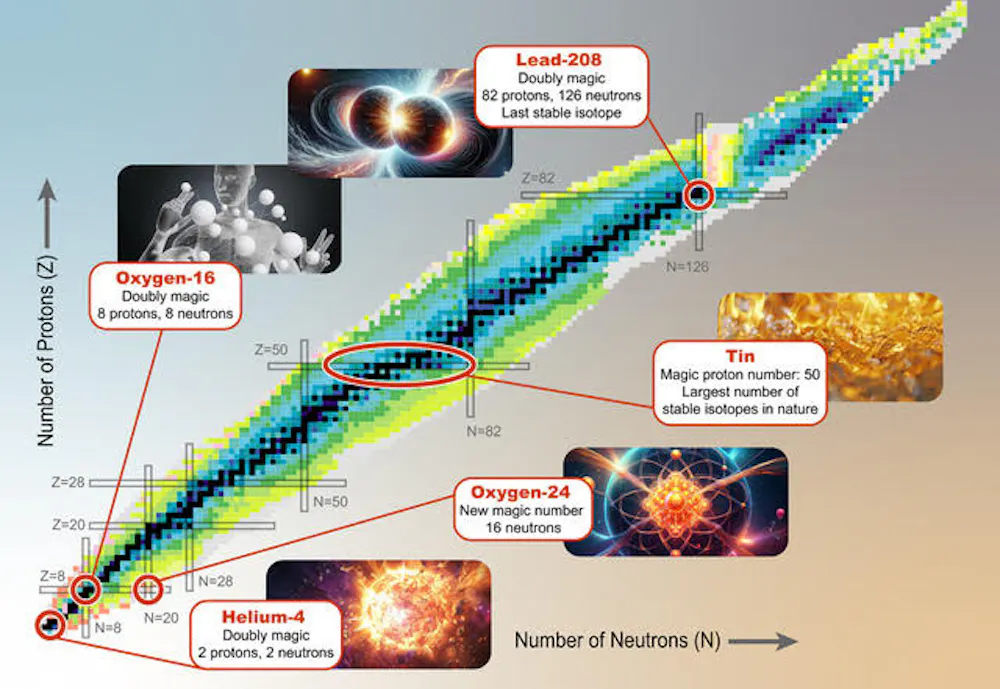
    The magic numbers known to scientists are 2, 8, 20, 28, 50, 82 and 126. They are the same for both protons and neutrons. When a nucleus has a magic number of protons or neutrons, then the particular orbit is filled, and the nucleus is not very reactive, similar to the noble gases.

    For example, the element tin has a magic number of protons. Tin always has 50 protons, and its most common isotope has 70 neutrons. Isotopes are atoms of the same element that have a different number of neutrons.

    There are nine other stable isotopes of tin that can exist – it’s the element with the largest number of stable isotopes. A stable isotope will never spontaneously change into a different element, which is what happens to radioactive isotopes.

    Helium, with two protons and two neutrons, is the lightest “doubly magic” nucleus. Both its neutron count and its proton count are a magic number. The forces that hold the helium-4 nucleus together are so strong that it’s impossible to attach another proton or neutron. If you tried to add another proton or neutron, the resulting atom would fall apart instantaneously.

    On the other hand, the heaviest stable nucleus in existence, lead-208, is also a doubly magic nucleus. It has magic numbers of 82 protons and 126 neutrons.

    Many stable isotopes have magic numbers of protons and neutrons.
    The Facility for Rare Isotope Beams

    Examples of magic numbers and stable nuclei exist everywhere – but scientists couldn’t explain them without the introduction of the shell model.

    Stable nuclei in nature

    The shell structure in nuclei tells researchers about how elements are distributed across the Earth and throughout the universe.

    One of the most abundant elements on our planet and in the human body is oxygen, in particular the isotope oxygen-16.

    With eight protons and eight neutrons, oxygen-16 has an extremely stable nucleus. A nearby star produced the oxygen we find on Earth through nuclear reactions in its core sometime before the solar system was formed.

    Since oxygen nuclei are doubly magic, these nuclei in the star did not interact very much with other nuclei. So more oxygen was left around to eventually act as an essential ingredient for life on Earth.

    In her Nobel lecture, Maria Goeppert Mayer talked about the work she did with physicist Edward Teller. The two had attempted to describe how these elements formed in stars. In the 1930s, it was impossible for them to explain why certain elements and isotopes were more abundant in stars than others. She later found that the increased abundances corresponded to nuclei with something in common: They all had magic numbers of neutrons.

    With the shell model and the explanation of magic numbers, the production of elements in stars was possible and was published in 1957.

    Scientists today continue to use ideas from the nuclear shell model to explain new phenomena in nuclear science. A few accelerator facilities, such as the Facility for Rare Isotope Beams, where we work, aim to create more exotic nuclei to understand how their properties change compared with their stable counterparts.

    At the Facility for Rare Isotope Beams, scientists produce new isotopes by accelerating stable isotopes to about half the speed of light and smashing them at a target. Out of the pieces, we select the rarest ones and study their properties.

    Possibly the most profound modern discovery is the fact that the magic numbers change in exotic nuclei like the type we create here. So, 75 years after the original discovery, the race to discover the next magic number is still on.

    Artemis Spyrou receives funding from the US National Science Foundation.

    Sean Liddick receives funding from the Department of Energy, Office of Science and the Department of Energy, National Nuclear Security Administration.

    ref. Many stable atoms have ‘magic numbers’ of protons and neutrons − 75 years ago, 2 physicists discovered their special properties – https://theconversation.com/many-stable-atoms-have-magic-numbers-of-protons-and-neutrons-75-years-ago-2-physicists-discovered-their-special-properties-239690

    MIL OSI – Global Reports

  • MIL-Evening Report: One of science’s greatest achievements: how the rapid development of COVID vaccines prepares us for future pandemics

    Source: The Conversation (Au and NZ) – By Paul Griffin, Professor, Infectious Diseases and Microbiology, The University of Queensland

    Since COVID was first reported in December 2019, there have been more than 775 million recorded infections and more than 7 million deaths from the disease. This makes COVID the seventh-deadliest pandemic in recorded history.

    Factors including climate change, disruption of animal habitats, poverty and global travel mean we’re only likely to see more pandemics in the future.

    It’s impossible to predict exactly when the next pandemic will happen, or what it will be. But experts around the world are working to prepare for this inevitable “disease X”.

    One of the cornerstones of being prepared for the next pandemic is being in the best possible position to design and deploy a suitable vaccine. To this end, scientists and researchers can learn a lot from COVID vaccine development.

    A look back

    After SARS-CoV-2 (the virus that causes COVID) was discovered, vaccine development moved very quickly. In February 2020 the first batch of vaccines was completed (from Moderna) and the first clinical trials began in March.

    An mRNA vaccine from Pfizer/BioNTech was the first to be approved, on December 2 2020 in the United Kingdom. Approvals for this and other vaccines, including shots developed by Moderna (another mRNA vaccine) and Oxford/AstraZeneca (a viral vector vaccine), followed elsewhere soon afterwards.

    Previously the fastest vaccine developed took around four years (for mumps in the 1960s). Had COVID vaccines taken this long it would mean we would only just be rolling them out this year.

    An estimated 13.72 billion COVID vaccine doses have now been administered, with more than 70% of the world’s population having received at least one dose.

    The rapid development and rollout of COVID vaccines is likely to be one of the greatest achievements of medical science ever. It also means we are in a much better position to respond to future emerging pathogens.

    New vaccine technology

    A lot of work over many years prepared us to develop COVID vaccines as quickly as we did. This included developing new platforms such as viral vector and mRNA vaccines that can be adapted quickly to new pathogens.

    While scientists had been working on mRNA vaccines for decades before the COVID pandemic, the COVID shots from Pfizer/BioNTech and Moderna were the first mRNA vaccines to be approved for human use.

    These vaccines work by giving our body instructions (the “m” in mRNA stands for messenger) to make SARS-CoV-2 spike proteins. These are proteins on the surface of the virus which it uses to attach to our cells. This means when we encounter SARS-CoV-2, our immune system is poised to respond.

    This technology will almost certainly be used to protect against other diseases, and could potentially help with a future pandemic.

    In the meantime, scientists are working to improve mRNA technology even further. For example, “self-amplifying RNA” has the potential to enhance immune responses at lower doses compared with conventional mRNA.

    mRNA vaccines teach our bodies to make SARS-CoV-2’s spike protein.
    Kateryna Kon/Shutterstock

    While our current COVID vaccines are safe and very effective at protecting against severe disease, they’re not perfect. We may never be able to achieve a “perfect” vaccine, but some additional properties we’d like to see in future COVID vaccines include being better at reducing transmission, lasting longer, and needing to be updated less often as new variants emerge.

    Even now there are many COVID vaccines in clinical trials. So hopefully, COVID vaccines that improve on the initial shots will be available relatively soon.

    Other desirable attributes include vaccines we can administer by alternate routes to needles. For COVID and other diseases such as influenza, we’re seeing significant developments locally and internationally on vaccines than can be administered via skin patches, through the nose, and even orally.

    Some challenges

    Developing vaccines for COVID was a huge challenge, but one that can mostly be judged a success. Research has estimated COVID vaccines saved 14.4 million lives across 185 countries in just their first year.

    However, the story of COVID vaccination has also had many other challenges, and arguably a number of failures.

    First, the distribution of vaccines was not equitable. Analysis of the initial rollout suggested nearly 80% of eligible people in high-income countries were vaccinated, compared with just over 10% in low-income nations.

    Supply of vaccines was an issue in many parts of the world, so expanding local capacity to enable more rapid production and distribution of vaccines will be important for the next pandemic.

    Further, adverse events linked to COVID vaccines, such as rare blood clots after the AstraZeneca vaccine, affected perceptions of vaccine safety. While every serious adverse event is significant, these incidents were very rare.

    However, these issues exacerbated other challenges that hampered vaccine uptake, including the spread of misinformation.

    Misinformation remains a problem now and will probably still be prevalent whenever we face the next pandemic. Addressing this challenge involves understanding what’s deterring people from getting vaccinated, then informing and educating, addressing misinformation both about vaccination and the risks of the disease itself.

    Restoring and building trust in public health authorities also needs to continue to be a focus. Trust in governments and health authorities declined during the COVID pandemic, and evidence shows lower trust is associated with lower vaccine uptake.

    The COVID vaccine rollout faced a variety of challenges.
    Yuganov Konstantin/Shutterstock

    Ongoing preparation

    There’s no doubt our recent experience with COVID, particularly the rapid development of multiple safe and effective vaccines, has put us in a better position for the next pandemic.

    This didn’t happen by accident. There was a lot of preparation even before COVID was first discovered that facilitated this. Organisations like the Coalition for Epidemic Preparedness Innovations (CEPI) have been supporting research to develop vaccines rapidly to respond to a new threat for some time.

    CEPI has an ongoing program that aims to be able to develop a vaccine against a new threat, or disease X, in just 100 days. While COVID vaccines have been a huge achievement, work continues in the hope we will be able to develop a vaccine even faster next time.

    This article is part of a series on the next pandemic.

    Paul Griffin is a director and scientific advisory board member of the immunisation coalition. He has served on Medical Advisory Boards including for AstraZeneca, GSK, MSD, Moderna, Biocelect/Novavax, Seqirus and Pfizer and has received speaker honoraria including from Seqirus, Novartis, Gilead, Sanofi, MSD and Janssen.

    ref. One of science’s greatest achievements: how the rapid development of COVID vaccines prepares us for future pandemics – https://theconversation.com/one-of-sciences-greatest-achievements-how-the-rapid-development-of-covid-vaccines-prepares-us-for-future-pandemics-228787

    MIL OSI AnalysisEveningReport.nz

  • MIL-Evening Report: Ocean protection accounts for 10% of fish in the world’s coral reefs – but we could save so much more

    Source: The Conversation (Au and NZ) – By Joshua Cinner, Professor & ARC Laureate Fellow, Thriving Oceans Research Hub, School of Geosciences, University of Sydney

    Ocean fish populations have fallen dramatically in the past half-century, and climate change is expected to make the problem worse. Governments have designated “marine protected areas”, where where human activity is constrained to protect ocean life. But have these efforts worked?

    About 8% of Earth’s oceans are protected, including about 3% where fishing is banned altogether. Our new study of nearly 2,600 tropical coral reefs around the world is the first to examine whether these areas have helped fish populations.

    We found about one in ten kilograms of fish on coral reefs is the result of efforts such as marine protected areas and other restrictions on fishing. This is promising news. But our study also reveals great room for improvement.

    A video discussing how Earth’s fish stocks are declining.

    Getting to grips with marine protection

    Maintaining healthy fish populations is important. Many communities depend on fishing for their food and livelihoods. And fish play a vital role in ocean ecosystems.

    Marine protected areas are a key policy tool used to increase fish populations. They cover a range of ocean areas including lagoons, coastal waters, deep seabed waters and coral reefs.

    The areas go by several names, including marine parks and conservation zones. Some, where fishing is prohibited, are known as no-take zones.

    Governments often quote figures on the area of ocean protected when seeking to tout their conservation policies. For example in Australia, we are told the federal, state and territory governments have established marine parks covering 4.3 million square kilometres or 48% of our oceans.

    But the extent to which marine protected areas actually conserve marine life varies enormously from place to place. So simply counting up the protected ocean area doesn’t tell you much about what has actually been achieved.


    Measuring success

    We and our colleagues wanted to assess the extent to which marine protection efforts have increased the amount of fish on coral reefs.

    We developed a computer model based on about 2,600 reefs across the global tropics, which includes reefs in the Pacific, Indian, and Atlantic oceans. From that, we estimated the amount of fish currently on each reef – measured in the kilograms of fish per hectare, or “biomass”.

    The estimations were based on information such as:

    • environmental conditions such as ocean temperature and the type of habitat where the reef is located

    • the intensity of fishing activity, known as “fishing pressure”

    • how strong the protection is – for example whether it bans fishing, or just restricts it

    • the level of compliance with no-take zones.

    We then simulated what would happen if we changed the type of protection strategy in each location while keeping everything else the same.

    We ran a few scenarios:

    • no coral reef conservation existed anywhere and all reefs could be fished without constraint

    • sites currently fished without constraint (which amounted to over half of our sites) had restrictions in place

    • fishing was prohibited on 30% of all reefs.

    And the results?

    We found both marine protected areas and other fishing restrictions account for about 10% of the fish “biomass” on reefs. In other words, about one in ten kilograms of fish on coral reefs is due to protection efforts.

    No-take zones punch above their weight. Of the fish biomass attributable to protection efforts, about 20% comes from just 3% of sites in no-take zones. This proportion would be even higher if illegal fishing in no-take zones was stamped out.

    But we found any type of fishing restriction was useful. If everywhere currently fished without constraint was subject to some level of protection – such as banning nets or spear guns – the biomass of fish globally would be another 10.5% higher, our study found. This essentially matches all conservation efforts to date.

    Our modelling also showed fish on coral reefs could be increased by up to 28% globally if the area of no-take zones rose to 30%.

    But these reefs must be chosen strategically. That’s because protection strategies can lead to wildly different results, depending on local conditions. For example, sites with lower fishing pressure in the surrounding seascape got a bigger boost from protection than places surrounded by intensive fishing effort.

    This may be because at heavily fished locations, algae often overtakes coral as the dominant feature. Algae is less fish-friendly than coral, so fish populations may not bounce back quickly even when fishing pressure is reduced.

    Grounds for optimism

    Our study tested the mettle of global coral reef conservation. On one hand, we found conservation efforts have made a contribution to the amount of fish on global coral reefs, which provides grounds for cautious optimism.

    But on the other hand, this contribution is quite modest. Our study shows much greater gains could be made not only by expanding protected marine areas, but also by improving compliance in existing ones.

    Most nations have signed a global agreement to protect 30% of Earth’s land and waters by 2030. That means the amount of ocean in marine protected areas globally will increase nearly fourfold in just six years.

    As governments continue this task, we hope our results help identify ocean sites that will benefit most from protection.

    Joshua Cinner receives funding from the Australian Research Council and National Geographic Society. He is a Fellow of the Academy of Social Sciences in Australia and the International Coral Reef Society.

    Iain R. Caldwell is affiliated with the Wildlife Conservation Society

    ref. Ocean protection accounts for 10% of fish in the world’s coral reefs – but we could save so much more – https://theconversation.com/ocean-protection-accounts-for-10-of-fish-in-the-worlds-coral-reefs-but-we-could-save-so-much-more-239188

    MIL OSI AnalysisEveningReport.nz

  • MIL-OSI Translation: 03/10/2024 Armed Forces Innovation Forum 2024

    MIL AXIS Translation. Region: Polish/Europe –

    Fuente: Gobierno de Polonia en poleco.

    Armed Forces Innovation Forum 202403.10.202416 in energy in 2024 The 4th edition of the Armed Forces Innovation Forum of the Republic of Poland will be held in the complex of the Military University of Technology, a flagship undertaking of the Ministry of National Defence, constituting a meeting platform for the army, science and industry.

    FORO DE ASSUMPTIONS:Placing emphasis on the role of innovation in the development of the Polish Armed Forces and the need for the Ministry of National Defence to take decisive action in this direction.Promoting innovation in building and strengthening the capabilities of the Polish Armed Forces.Increasing competitiveness among project contractors – an opportunity for innovative enterprises.Specialization, building and strengthening the potential of domestic research and development entities and industries in the area of new and breakthrough technologies.Promoting new international tools as an opportunity for the development of innovation.Promoting the use of the capabilities of the Polish space industry in meeting the needs of the Polish Armed Forces as part of the implementation of the operational domain of space.FORO GOALS:UNDERTAKING ACTIONS FOR THE DEVELOPMENT OF THE INNOVATION SYSTEM IN THE FORUM is a good platform for starting a debate on the needs of the Polish Armed Forces and the possibilities of meeting them through the use of new solutions, including dual-use technologies. The implementation of this goal requires the creation of an appropriate system that promotes innovation in the RON, which is also to be served by the currently developed departmental innovation strategy. Initiating a debate on the role of tactical level commanders in the process of identifying, developing and using dual-use products for the needs of the Polish Armed Forces. PERFORMING THE FUNCTION OF A MEETING PLATFORM FOR THE ARMY, SCIENCE AND INDUSTRY A platform for meetings of representatives of the army, science and industry. During the sessions (discussion panels), a discussion will be held on the needs of the Polish army and the opportunities and innovation in science and industry in Poland and around the world. During the Forum, experiences will be exchanged and cooperation will be established between representatives of various environments. PRESENTATION OF CONCEPTS AND SOLUTIONS BY RESEARCH CENTRES, UNIVERSITIES AND POLISH INDUSTRY The Innovation Forum enables the presentation of new concepts and ideas that may have an impact on increasing the potential of the Polish Armed Forces, while at the same time being a platform for cooperation, exchange of information and experiences with research centers, universities and representatives of the Polish defense industry. Participation in the Forum of Polish Scientists is an opportunity for them to use their ideas and concepts for the benefit of Poland’s security and defence. STRENGTHENING COOPERATION FOR POLAND’S DEFENCE AND SECURITY The Forum has become one of many mechanisms that support the use of the research potential of Polish centers and the discovery of new opportunities among Polish scientific entities (or among Polish scientists). THEMATIC PANELS Three thematic panels will be held during the Forum: Dual-use technologies – a new trend that will pass, or a way to build the capabilities of the Polish Armed Forces? The prospect of developing the innovation system in the Ministry of National Defense. The area of outer space – the needs of the Polish Armed Forces and the capabilities of Polish industry and science. FORO PARTICIPATION IN THE INNOVATION OF THE ARMED FORCES 2024 The Forum will be held in a stationary form on October 16, 2024. The event will be a closed conference, in which invited participants will participate guests. An online broadcast will be held simultaneously for interested representatives of the world of science, industry, the Polish army and communities dealing with security and defense. Please send your online applications by October 11 to the electrifying director: forum@mon.gov.pl. Participation will be confirmed via the link to the online broadcast of the event. In case of questions or concerns, please contact the electrifying director: forum@mon.gov.pl.

    MILES AXIS

    EDITOR’S NOTE: This article is a translation. Apologies should the grammar and/or sentence structure not be perfect.

    MIL Translation OSI

  • MIL-OSI Global: The youth-led research giving voice to teen mothers in Uganda

    Source: The Conversation – Canada – By Doris Kakuru, Professor, School of Child and Youth Care, University of Victoria

    Pregnancy can be a stressful enough time for any expecting mother, but it can be even more so for teenage girls navigating the added challenges they face. (Shutterstock)

    The global rate of teen pregnancies has been decreasing in recent decades. According to the World Health Organization, worldwide adolescent birth rates have decreased from 64.5 births per 1,000 women aged 15–19 years in 2000 to 41.3 births per 1,000 women in 2023.

    However, those numbers can differ significantly by region. Every year, around 21 million teenage girls in developing countries become pregnant, and around 12 million give birth.

    In Uganda, the teenage pregnancy rate remains among the highest in Sub-Saharan Africa, at 25 per cent. Cultural and religious norms often make adolescent sexuality a highly sensitive subject. Many girls can be ostracized or face marginalization if they become pregnant. And the long-term impacts on their lives can be significant. Almost 60 per cent of school dropouts in Uganda are due to pregnancy, and many never return to the education system.

    Pregnancy can be a stressful enough time for any expecting mother, but it can be even more so for a pregnant teenager in places where engaging in sexual relations is taboo, especially for girls.

    Along with colleagues in Uganda and Canada, we are conducting a community-engaged research project to understand the experiences of young mothers. Our project, Centering Marginal Voices, aims to build research and advocacy skills for young mothers in Uganda.

    A clip outlining the Centering Marginal Voices project.

    Community-engaged research

    Community-engaged research has emerged in social work as an important approach that empowers communities experiencing particular issues to make decisions concerning those issues. This approach cultivates long-term relationships and promotes the development of sustainable solutions for community problems.

    One form of this approach focuses on engaging youth in researching about their experiences with the issues affecting their lives. This can boost our understanding as researchers and make young people feel heard and empowered.

    Engaging young people in research requires clear communication, the use of appropriate channels of communication, constant feedback and listening. It can also mean providing logistical support like transportation or food, among other things. It is vital for researchers to listen to young people when they describe what they need to be participants in the research process.

    Many adolescent girls already face vulnerabilities and challenges when it comes to their reproductive health. Pregnancy can often add another layer of complexity to those challenges.

    While there is much discussion about teenage pregnancy in Uganda, rarely are young mothers given platforms to speak their truths to help policymakers understand and address the root causes. Their voices are muted and their lived experiences are not represented in policy.

    Teen motherhood presents girls with numerous challenges. They must navigate parenthood while still at a young age. They must figure out ways to support their children while still being dependents themselves. They also have to make important decisions and provide child care with limited experience to draw from, and manage their health needs alongside maternal care, among others.

    Their ability to conduct research may be influenced by a combination of these factors and by the skills they have, how they navigate relational dynamics, and the stigmatization they face being teen mothers.

    A webinar with the researchers and young mothers on the Centering Marginal Voices project.

    Centering young mothers in research

    As we began the research process, we held consultative meetings with community leaders who identified 40 young mothers from urban and rural parts of Uganda. We engaged the young mothers in discussions about their life journeys and in team building exercises. We later divided them into groups based on their villages. Each group then selected two peers to continue on the project as 12 youth peer researchers.

    When conducting this kind of community-engaged project, it is important for researchers to consider the ways they approach and include youth participants:

    Consent — Our first aim with the 12 selected young mothers was to seek consent from their parents or guardians. The young mothers also told us to speak with their live-in partners, whom we had not initially considered. They spoke to their parents or guardians, who were already expecting our team and eased the consent process for us.

    Communication — Young mothers in the capital Kampala preferred phone calls, WhatsApp and physical meetings. However, those in the rural areas did not all have smartphones or understand social media. This posed a challenge as our project entailed them conducting surveys using smartphones. We therefore revised our training to include basics on how to use the smartphone.

    Designing tools — We further engaged the youth peer researchers to refine our research tools. They helped us rephrase questions in local languages, especially those related to sexual relations.

    Mutual support — The youth peer researchers were trained to lead a survey and collect quantitative data from 766 participants in total. They prioritized teamwork and support, with some collecting more data than others. They also requested autonomy in scheduling their data collection to balance their research activities with their maternal duties and caring for their families.

    Navigating environments — The young mothers provided us with a descriptive tour of their environments. They advised us on where to go and how to behave when visiting. They always accompanied us within their community, acting as our guides.

    Young mothers know best about their own experiences, and this accords them a legitimate space in research as researchers. Practitioners and planners should be intent on being open to meaningfully engaging them while learning from them.

    Doris Kakuru has received funding from the Social Sciences and Humanities Research Council of Canada. The Centering Marginal Voices project is supported by a consortium partnership of Makerere University, Nascent Research and Development Organization, and the University of Victoria.

    Jacqueline Nassimbwa does not work for, consult, own shares in or receive funding from any company or organisation that would benefit from this article, and has disclosed no relevant affiliations beyond their academic appointment.

    ref. The youth-led research giving voice to teen mothers in Uganda – https://theconversation.com/the-youth-led-research-giving-voice-to-teen-mothers-in-uganda-239876

    MIL OSI – Global Reports

  • MIL-OSI New Zealand: East Coast students get a taste of the future at successful careers day | EIT Hawke’s Bay and Tairāwhiti

    Source: Eastern Institute of Technology – Tairāwhiti

    3 mins ago

    School students from the East Coast were given a taste of the future at a successful discovery day organised by EIT’s Education 2 Employment team.

    School students from the East Coast were given a taste of the future at a successful discovery day held at Ngata College in Ruatoria recently.

    The event, organised by EIT’s Education 2 Employment team, saw hundreds of students from the region get a chance to engage with tertiary institutes, pathway providers and employers.

    Education 2 Employment (e2e) encourages the coordination and support of employers and the local business community to be involved in vocational education, employment and development opportunities for young people. The primary goal of the e2e programme is to help connect industry with schools so that students can identify possible career pathways.

    Twenty-seven organisations were represented at the event in Ruatoria last month. While the event was aimed at senior school students, year seven and eight and even younger students also attended.

    Among the companies and organisations attending to connect with the students were local and regional businesses, Government agencies like IRD, and educational institutes including EIT and others from outside the region.

    Adrianna Wilson, Education 2 Employment Advisor for EIT Tairāwhiti, says that the aim of the event was to expose students to what opportunities were out there.

    “We wanted them to see that there are local employers and ones further afield who can offer them a pathway to a career of their choice.”

    “For an example, we had Mātai Medical Research Institute there, so if a student was interested in going into that career, what’s the pathway for them?”

    School students from the East Coast were given a taste of the future at a successful discovery day organised by EIT’s Education 2 Employment team.

    Adrianna says the event was staged in a way that engaged the students and got them interested in potential careers.

    “Every employer or business had an interactive activity. Some had honey pots representing apiculture, civil infrastructure had roading games, the police services had drug goggles and were in their police cars. We also had a Media House there which did portraits of the students, STEM were there doing science activities, and we had the Department of Conservation discussing survival, trapping and other outdoor skills.”

    “We also had a game where they were given a bingo card with symbols that represented each employer or industry. And they had to go and either ask questions or do the interactive activity and get it ticked off by the employer. At the end, they all got a prize if they filled their bingo card. They had to ask questions and engage.”

    Adrianna says the aim is to make the event an annual occurrence.

    “It is a rewarding time for both students and participating organisations as the students get to see what career opportunities there are and employers are exposed to the talent coming through.”

    MIL OSI New Zealand News

  • MIL-OSI USA: Sols 4325-4326: (Not Quite) Dipping Our Toes in the Sand

    Source: NASA

    3 min read

    Earth planning date: Friday, Oct. 4, 2024

    If you read this blog very often, you know that nearly every time the rover stops for science, MAHLI and APXS focus on interesting (and accessible!) rocks as targets. The rover science team is, after all, built with a lot of geologists. But geology is not all rocks, all the time — sand is former rock that if buried and pressurized long enough will become rock again. Today was time for sand to shine, as the workspace was cut by troughs of sand of different colors and brightnesses, and it had been nearly 500 sols since we acquired our last dedicated sand measurement with APXS and MAHLI. The “Pumice Flat” target was one of the brighter sand patches while “Kidney Lake” was one of the darker sand patches. APXS uses a special placement mode over sand targets so the instrument gets close, but not too close, to the loose material which could foul up the instrument. Not-rock was also the purview of our environmental observations. Navcam is scheduled for imaging seeking out clouds and dust devils, and changes in the sand and dust on top of the rover deck. Both Navcam and Mastcam will make observations to measure the amount of dust in the atmosphere. REMS will keep track of our weather with regular measurements, RAD will monitor our radiation environment, and DAN will look through rock for signs of water beneath our drive path.

    Unsurprisingly, the rest of the rover could not ignore bedrock. We managed to squeeze in DRT cleaning of a nice bedrock slab, “Ribbon Fall,” for MAHLI-only imaging. In places, the bedrock slabs were cut by thin veins of darker gray material, similar to dark gray materials we saw in the bedrock on the other side of Gediz Vallis. ChemCam targeted one of these dark gray examples at “Black Divide,” and also rastered across some of the prominent layers visible in the vertical faces in the workspace at the aptly named “Profile View.” 

    Our imaging efforts could be roughly divided between looking back at our path through Gediz Vallis from our new and higher perspective, and looking ahead to what awaits us. ChemCam planned RMI mosaics back toward a field of the white stones we spent time studying in Gediz Vallis and toward a part of the edge of Gediz Vallis that we did not explore previously. Mastcam looked back at the part of the edge of Gediz Vallis we just traversed, “Pilot Peak,” for clues as to why it sits higher than the bedrock farther from the channel edge. They also targeted “Clyde Spires,” which was a gravel ridge in Gediz Vallis of interest as we drove by it initially. Looking ahead, Mastcam imaged a puzzling gray rock sitting atop the bedrock slabs south of us at target “Buena Vista Grove,” and further south still, they planned a large mosaic covering a very big rock — the spectacular “Texoli” butte that has loomed and will continue to loom over our path for months to come.

    Written by Michelle Minitti, Planetary Geologist at Framework

    MIL OSI USA News

  • MIL-OSI Europe: Ensuring a More Equitable Future for All With CARE Scholar Isha Agarwal

    Source: Universities – Science Po in English

    Students in front of the entrance at 1 St-Thomas (credits: Pierre Morel)

    Virtual Undergraduate Open House day on 30 November 2024

    Come meet our teams and students at our campuses.

    Sign-up

    Virtual Graduate Open House day on 19 october 2024

    Meet faculty members, students and representatives and learn more about our 30 Master’s programmes.

    Sign-up

    MIL OSI Europe News

  • MIL-OSI USA: USGS Coastal Change Experts Warn of Heightened Risks for Florida’s West Coast as Hurricane Milton Approaches in the aftermath of Helene

    Source: US Geological Survey

    ST. PETERSBURG, Fla. – U.S. Geological Survey experts project that Hurricane Milton, expected to make landfall on Florida’s west coast as early as Wednesday, will bring significant coastal change. 

    Currently, 95 percent of the sandy beaches on Florida’s west coast are forecasted to become inundated—meaning continuously covered by ocean water—from Milton, according to a USGS coastal change forecast issued Monday. This is the most severe level of coastal change and can cause flooding behind sand dunes that may impact coastal communities. 

    USGS experts estimate Milton’s waves and surge have the potential to cause both 100 percent of all ocean-facing beaches in Florida to experience erosion and overwash. Overwash occurs when water levels reach higher than the top of dunes. When a beach is overwashed, sand can be pushed and deposited inland, causing significant changes to coastal landscapes and blocking roadways. Overwash can reduce the height of protective sand dunes, alter beach profiles, and leave areas behind the dunes more vulnerable to future storms. 

    “The significance of the coastal change forecast for Milton’s impact to the Florida west coast cannot be overstated as I believe communities are more vulnerable to this storm’s impacts due to the erosion that occurred recently from Helene,” said Kara Doran, a USGS supervisory physical scientist who works on the coastal change forecast. “Our initial analysis looking at imagery collected by the National Oceanic and Atmospheric Administration after Helene shows most of the west coast experienced overwash or inundation and complete erosion of dunes, so those protective dunes are no longer in place for many locations.”

    According to the National Hurricane Center, Milton may bring life-threatening storm surge along with hurricane-force winds, and heavy rain. 

    This USGS coastal change forecast for Milton is a worst-case scenario that can provide vital insights to help emergency management officials make informed decisions. 

    USGS coastal change forecasts will continue to be updated (here: https://marine.usgs.gov/coastalchangehazardsportal/ui/alias/ptc92024) as the storm approaches land and real-time coastal change forecasts for individual locations along the coast are available in the Total Water Level and Coastal Change Forecast Viewer. 

    As the USGS continues to take all appropriate preparedness actions in response to Milton, those in the storm’s projected path can visit Ready.gov for tips on creating emergency plans and putting together an emergency supply kit. 

    Learn more about USGS hurricane science.

    MIL OSI USA News

  • MIL-OSI Europe: Leading the International Conversation on Climate Action With CARE Scholar Evelyn Mang

    Source: Universities – Science Po in English

    Students in front of the entrance at 1 St-Thomas (credits: Pierre Morel)

    Virtual Undergraduate Open House day on 30 November 2024

    Come meet our teams and students at our campuses.

    Sign-up

    Virtual Graduate Open House day on 19 october 2024

    Meet faculty members, students and representatives and learn more about our 30 Master’s programmes.

    Sign-up

    MIL OSI Europe News

  • MIL-OSI USA: Study Finds Forever Chemicals Are More Toxic As Mixtures

    Source: US Department of Health and Human Services – 3

    research news

    UB PhD student Karla Ríos-Bonilla (left) and Diana Aga, director of the UB RENEW Institute, are authors on a study that assessed the mixture toxicity of per- and polyfluoroalkyl substances (PFAS), also known as forever chemicals. Photo: Meredith Forrest Kulwicki

    By TOM DINKI

    Published October 4, 2024

    A first-of-its-kind study has measured the toxicity of several types of per- and polyfluoroalkyl substances (PFAS), better known as “forever chemicals,” when mixed together in the environment and in the human body.

    The good news: Most of the tested chemicals’ individual cytotoxicity and neurotoxicity levels were relatively low. 

    The bad news: The chemicals acted together to make the entire mixture toxic.

    “Though they are structurally similar, not all forever chemicals are made equal — some are more potent, others less. When mixed, all components contributed to the mixture’s cytotoxicity and neurotoxicity,” says the study’s first-author, Karla Ríos-Bonilla, a UB chemistry PhD student.

    “In the laboratory assays we used in this study, most of the types of PFAS that we tested did not appear to be very toxic when measured individually. However, when you measure an entire sample with multiple PFAS, you see the toxicity,” adds study co-author Diana Aga, SUNY Distinguished Professor, director of the RENEW Institute and Henry M. Woodburn Chair in the Department of Chemistry.

    This research was conducted in collaboration with Beate Escher of the Helmholtz Centre for Environmental Research (UFZ), Leipzig, Germany, where Ríos-Bonilla did the in vitro toxicity experiments in the high-throughput screening facility CITEPro. It was published Sept. 11 in Environmental Science and Technology, a journal of the American Chemical Society.

    The study is novel in that it assesses mixture toxicity of PFAS. These synthetic compounds have been widely used in consumer products — from nonstick pans to makeup — for decades, and they can take hundreds to thousands of years to break down, if ever. They are estimated to be in at least 45% of the nation’s drinking water and in the blood of practically every American, and they have been linked to cancer and neurodevelopmental disorders.

    Earlier this year, U.S. Environmental Protection Agency (EPA) issued the first-ever drinking water standards for six kinds of PFAS. However, it is estimated that there are over 15,000 varieties present in the environment. Only a handful of these chemicals have standards and are regulated. 

    “There are six PFAS that can be regulated because we know a lot about them and their toxicity. Unfortunately, we cannot regulate other forms of PFAS until their toxicities are known,” says Aga, who is principal investigator of the EPA STAR grant that funded the research. “We need to set maximum contamination levels for each PFAS that is proportional to their toxicity. To regulate contaminants, it is crucial to know their relative potencies when they occur as mixtures in the environment, along with their predicted environmental concentrations.” 

    Other co-authors from UB are G. Ekin Atilla-Gokcumen, Dr. Marjorie E. Winkler Distinguished Professor and associate chair of the Department of Chemistry, and Judith Cristobal, senior research scientist.

    Ríos-Bonilla is also supported by a graduate fellowship from the National Institute of Environmental Health Sciences (NIEHS) of the National Institutes of Health (NIH). 

    PFOA, PFOS major contributors to mixture toxicity

    To conduct the study, researchers created their own PFAS mixtures, one that is representative of an average American’s blood serum, and the other of surface water samples found in the U.S. Ríos-Bonilla used data from the U.S. Centers for Disease Control and Prevention and from the U.S. Geological Survey to determine the average concentration ratios of PFAS in human blood and in surface water, respectively. 

    They then tested these mixtures’ effects on two cell lines: one that tests for mitochondrial toxicity and oxidative stress, and the other for neurotoxicity.

    Of the 12 PFAS spiked in the water mixture, perfluorooctanoic acid (PFOA) — commonly used in nonstick pans and firefighting foam — was the most cytotoxic, making up to 42% of the mixture’s cytotoxicity.

    On the other hand, both PFOA and perfluorooctane sulfonic acid (PFOS) contributed roughly the same cytotoxicity (25%) to the neurotoxicity assay, despite both contributing only 10 and 15% to the mixture in terms of concentration, respectively. 

    The blood mixture had four PFAS present, but PFOA again was the most cytotoxic to both cell lines. Despite its molar contribution being only 29%, PFOA triggered 68% of the cytotoxicity in the cytotoxicity assay, and 38% in the neurotoxicity assay.

    Interestingly, when researchers analyzed the toxicity of the extracts from real biosolid samples collected from a municipal wastewater treatment plant, very high toxicities were observed, despite the measured low concentrations of PFOA and other PFAS in the sample. 

    “This means that there are many more PFAS and other chemicals in the biosolids, which have not been identified, that contribute to the toxicity of the extracts observed,” Aga says.

    Synergistically versus additive

    One of researchers’ goals was to determine if PFAS acts synergistically. This is when two or more chemicals’ combined effect is greater than the sum effect of the individual chemicals. However, their findings indicate that the effect of PFAS is concentration-additive: meaning that an established mixture toxicity prediction model can be used to predict the combined effect of mixtures. 

    “As up to 12 PFAS in the mixtures acted concentration-additive for cytotoxicity and specific neurotoxicity, it is likely that the thousands of other PFAS that are in commerce and use are also acting in the same manner,” Escher says. “Mixtures pose more of a risk than individual PFAS. As they act and occur in mixtures, they ought to be regulated as mixtures.”

    Researchers say the results of this study will also be very useful in assessing effectiveness of remediation efforts. Breaking down PFAS can sometimes create harmful byproducts that cannot be detected by chemical analysis, so measuring the toxicity of a sample after treatment may be the only way to judge whether a remediation technology is effective.

    “Toxicity assays can be a complimentary tool when analytical chemistry doesn’t give you all the answers, especially when the identities of contaminants in the mixture are unknown, which is the case in many polluted sites,” Aga says.

    MIL OSI USA News

  • MIL-OSI United Nations: UNECE/FAO Team of Specialists on Forest Communication – Forest Communicators’ Network annual meeting and workshop

    Source: United Nations Economic Commission for Europe

    Hosted by the Czech Ministry of Agriculture and the Faculty of Forestry and Wood Sciences of the Czech University of Life Sciences, participants will learn about the latest best practices in forest communication and trends in forestry in Europe. This will include the role of innovative technology in impactful communication, such as artificial intelligence, ChatGPT, virtual reality and 360° videos. There will be an opportunity to put these new tools into practice in the urban parks and gardens of one of Europe’s greenest cities.

    There will also be a unique focus on urban forestry with a half-day field trip to visit the City of Prague Forests (LHMP). LHMP manages over 2,900 hectares of forests and meadows in Prague, cares for the city’s parks, gardens, orchards and memorial trees, and manages a rescue station for wildlife.

    In addition, participants are invited to submit proposals for 5-minute lightning talks that show examples of impactful communication on forests, trees and wood. The topic this year will be: “Making a change with powerful communication”. Please send proposals and confirm your participation to [email protected].

    MIL OSI United Nations News

  • MIL-OSI USA: Rep. Stansbury Hosts Democratic Leader Hakeem Jeffries for Community Conversation

    Source: United States House of Representatives – Representative Melanie Stansbury (N.M.-01)

    ALBUQUERQUE — Congresswoman Melanie Stansbury (NM-01) was proud to welcome Democratic Leader Hakeem Jeffries for a community conversation at the New Hope Full Gospel Baptist Church in Albuquerque.

    The conversation brought together community members, local leaders, and advocates to discuss pressing issues impacting New Mexicans. Leader Jeffries and Rep. Stansbury touched on a broad range of topics including how Democrats are delivering for Americans in tangible ways like lowering costs for Americans, expanding access to healthcare, protecting the environment, and ensuring our democracy stays secure.

    “I am so proud to welcome Leader Jeffries to our beautiful state and share the stage with him and to showcase all the work Democrats are doing for New Mexicans,” said Stansbury. “We have brought millions of dollars back to New Mexico through federal programs, legislation, and Community Project Funding that support education, housing, healthcare, infrastructure, and economic development. We will continue this momentum – including tackling pressing issues such as climate change, economic inequality, and access to quality education as we continue to work for New Mexico and our communities.”

    “House Democrats will continue to lean into lowering housing costs and growing the middle class with a particular emphasis on access to affordable homeownership,” said Leader Jeffries. “Being able to purchase a home, keeping that home and being able to pass it onto the next generation is central to the great American dream. And we will fight to maintain the principles of free and fair elections and ensure the right to vote, which John Lewis would always say to us, is sacred, is sacrosanct and is essential to the integrity of our democracy. We have to push back against the extreme right-wing efforts to take it away, so one of our top priorities in Congress will be to pass the John Robert Lewis Voting Rights Advancement Act.”

    Find photos from the event here. 

    Since taking office, Rep. Stansbury has secured more than a billion dollars in funding for New Mexico’s First Congressional District, including more than $44.5 million for 37 community projects for public safety, economic development, and other needs. 

    Some of what Congresswoman Stansbury has delivered to New Mexico’s First Congressional District include: 

    Crime Prevention and Public Safety: 

    • Last month, the Congresswoman introduced the Stop the Opioid Pill Presser and Fentanyl Act (STOPP Fentanyl Act) to disrupt global criminal networks and suppliers of illicit drugs like fentanyl. 

    Behavioral Health Resources: 

    • In Congress, Rep. Stansbury has secured millions for NM-01 to improve community well-being through behavioral health-focused solutions. This includes leading efforts to secure funding for mental health and addiction recovery programs, such as workforce development, school-based support, crisis intervention, and veterans’ suicide prevention. 

    Gun Violence and Safety: 

    • Congresswoman Stansbury has cosponsored key bills aimed at addressing gun safety, including the Keep Americans Safe Act, the SAFES Act, the Identify Gun Stores Act, the Gun Violence Prevention Research Act of 2023, the Break the Cycle of Violence Act), and the AMMO Act. 
    • These bills focus on universal background checks, bans on military-style rifles and untraceable weapons, and enhancing research and oversight related to gun violence and ammunition. 

    Reproductive Rights: 

    • Congresswoman Stansbury voted to defend reproductive rights against the House GOP’s systematic efforts to criminalize abortion and abortion providers. 
    • Rep. Stansbury joined other House Democrats to sponsor legislation to restore Roe vs. Wade, condemn violence and attacks on healthcare facilities, personnel, and patients, and to pass the Women’s Health Protection Act
    • Rep. Stansbury co-sponsored a resolution by House Democrats to condemn attacks on abortion clinics that threaten the safety of patients and health care workers. 
    • Rep. Stansbury also voted to pass the Ensuring Access to Abortion Act and the Right to Contraception Act to safeguard access to contraception and the right of pregnant individuals across the nation to travel to seek safe, legal care. 

    Economy and Jobs: 

    • Rep. Stansbury helped pass the Bipartisan Infrastructure Law, Inflation Reduction Act, and the CHIPS and Science Act and her bill the Partnerships for Energy Security and Innovation Act, to invest in our infrastructure, tackle climate change, and build a clean energy economy. 
    • The Congresswoman led the Rail Worker and Community Safety Act to improve federal rail safety regulations, including mandates for a two-person crew, changing the ways hazardous materials can be transported, increasing funding for rail safety inspectors, and codifies mandatory sick leave for all rail workers. 
    • Rep. Stansbury co-sponsored the Protecting the Right to Organize Act (PRO ACT) which is a comprehensive bill aimed at strengthening labor rights by amending key labor laws to enhance protections for workers, particularly in union organizations and collective bargaining efforts. 

    Water Access and Water Rights:

    • Since her time in the New Mexico Statehouse, the Congresswoman has been a leader in fighting for access to clean water and securing water rights for communities across New Mexico. 
    • She introduced the Water Data Act to establish a framework for standardizing water data across federal agencies, so data is interoperable and easily accessible to water managers and communities.   
    • She also introduced the Rio Grande Water Security Act providing necessary operational flexibility for water managers in the Rio Grande Basin.  The bill also reauthorizes a vital lifeline to address the irrigation infrastructure needs of the Pueblo nations who have used these waters for countless generations.   

    Environmental Justice and Protection:

    • Along with her work in other areas, the Congresswoman has been a champion for climate protections and ensuring a just transition occurs during the efforts to address the climate crisis in communities in New Mexico and across the country. 
    • She co-sponsored several pieces of legislation, including House Resolution 37 – Acknowledging a Climate Emergency, the Civilian Climate Corps for Jobs and Justice Act, the Environmental Justice For All Act, the Promoting Youth Mental Health and Well-Being in a Changing Climate, the Climate and Health Protection Act, and the Excess Urban Heat Mitigation Act. 

    Housing: 

    • Congresswoman Stansbury has been focused on bringing more affordable housing to New Mexicans and has championed several bills including the Affordable Housing Credit Improvement Act of 2023, the Expansion of Attainable Homeownership Through Manufactured Housing Act of 2023, the Eviction Protection Act of 2023, the Housing for All Act of 2023, the Ending Homelessness Act of 2023, the Affordable Housing Stability During Shutdowns Act of 2023. 
    • Some of her legislative actions include working closely with local tribal leaders to address concerns regarding a lack of funding to meet tribal housing needs in New Mexico and across the country. 

    Healthcare: 

    • The Congresswoman is focused on lowering the costs of healthcare for all New Mexicans and ensuring people who need care can find it when needed. Some of her work includes introducing the Stopping Addiction and Falls for the Elderly (SAFE) Act, the Small Practice, Underserved, and Tural Support Program Extension Act, the Public Health Nursing Act, the Keep Physicians Serving Patients Act, and co-sponsoring the Telehealth Access for Tribal Communities Act of 2024 and the Protecting Access to Ground Ambulance Medical Services Act. 

    ### 

    MIL OSI USA News

  • MIL-OSI Global: Wealthier Canadians live longer and are less likely to be dependent as they age, new research finds

    Source: The Conversation – Canada – By Marie-Louise Leroux, Professeure titulaire en Sciences Economiques, Université du Québec à Montréal (UQAM)

    Population aging is a growing challenge for developed countries like Canada, with significant implications for health care and long-term care systems. In OECD (Organisation for Economic Co-operation and Development) countries, the population of people aged 80 and above is projected to more than double by 2050, reaching 9.8 per cent of the population.

    This demographic shift highlights the increasing demand for high-quality long-term care services. Older individuals frequently experience limitations in daily living activities, such as dressing, washing and household tasks.

    By 2050, half of people aged 65 or older in OECD nations are expected to report some limitation in daily living, and dementia cases are projected to reach 42 million. Canada is not exempt from this trend.


    Read more:
    Enabling better aging: The 4 things seniors need, and the 4 things that need to change


    In Québec, for instance, around 315,000 individuals require help with daily activities — a number expected to nearly double by 2050.

    As the number of elderly people needing care grows, the demand for long-term care services will present significant financial challenges for both individuals and governments. Understanding the economic and demographic factors driving long-term care needs, as well as their implications, is crucial for building a more equitable and robust care system.

    Low-income individuals face double penalty

    Research has shown that while life expectancy has increased, it’s unevenly distributed across socioeconomic groups. Factors such as age, ethnicity, gender, income and education play a significant role in determining longevity.

    In Canada, men in the top five per cent of earners live, on average, 11 per cent longer than those in the bottom five per cent. For women, the longevity gap between those with the highest earnings and the lowest earnings is 3.6 years. These findings are consistent with research from other countries, including the United States.

    However, research on the relationship between income and loss of autonomy is still limited. Some studies suggest that lower socioeconomic status is associated with poorer health outcomes and higher disability rates among older adults.

    In the United Kingdom and the U.S., individuals in the bottom third of wealth distribution live seven to nine fewer years without disability compared to those in the top third. Similarly, in Europe, less wealthy individuals have a higher likelihood of becoming dependent and they remain dependent longer.

    Understanding these socioeconomic disparities is crucial for shaping public policy and identifying which groups are the most vulnerable. Low-income individuals face a double penalty: they are both more likely to need long-term care and they are less financially equipped to bear the associated costs.

    As a result, public long-term care policies might consider prioritizing the support of low-income individuals, since wealthier individuals can more easily afford care.

    High-income Canadians live longer

    Our research explored the relationships between longevity, dependency and income using data from a 2016 survey of 2,000 Canadians aged 50 to 69.

    The data combined both subjective self-reports with objective data about the likelihood of living to age 85, developing limitations in daily living activities or entering a nursing home. Financial resources were measured through reported income and savings.

    Our findings show that Canadians with higher incomes are more likely to live to age 85 and are less likely to become dependent. After controlling for several socioeconomic factors, we found that a one per cent increase in income was associated with the following:

    • nearly a five per cent increase in survival probability;
    • a one per cent decrease in the likelihood of having limitations in daily living activities;
    • and a two per cent decrease in the likelihood of entering a long-term care home.

    The relationship between income and dependency was particularly strong among individuals in the top third of the income distribution. This suggests that financial resources play a significant role in extending life and maintaining independence as people age.

    Interestingly, despite their lower objective likelihood of needing nursing home care, higher-income individuals perceived themselves as more likely to require it. A one per cent increase in income was associated with a four per cent increase in the self-reported probability of entering a nursing home, even though the actual probability of this happening dropped by two per cent.

    This discrepancy may be explained by wealthier individuals considering other factors, such as their financial resources and the possibility of receiving care at home from a professional caregiver.

    Targeted support is needed

    The socio-demographic relationships from our study have important implications for designing equitable long-term care policies. Wealthier individuals tend to live longer and are less often dependent, meaning they are in a better position to pay for long-term care expenses.

    On the other hand, low income individuals are more likely to become dependent and may experience greater financial strain if they need to pay for long-term care costs over an extended period, potentially driving them into poverty.

    Our findings recommend that provincial and territorial governments should adopt redistributive policies for long-term care. These policies could involve providing additional subsidies aimed at low-income older individuals, either as a preventive measure or when they first become dependent.

    This approach aligns with the proposal made by Québec Health Minister Réjean Hébert in 2015, who suggested implementing “autonomy insurance” to help retirees above a certain age manage long-term care costs.

    Redistributive policies are critical not only because low-income individuals have fewer financial resources, but also because they face a higher likelihood of dependency. Without targeted support, these individuals could be left struggling to afford the care they need. Designing policies that recognize these disparities can help ensure a more equitable and sustainable long-term care system in Canada.

    Marie-Louise Leroux receives funding from FRQSC and SSHRC-CRSH. She is affiliated with CIRANO (Montréal) and CESifo (Munich).

    Marie Connolly receives funding from FRQSC and SSHRC-CRSH. She is affiliated with CIRANO (Montréal).

    ref. Wealthier Canadians live longer and are less likely to be dependent as they age, new research finds – https://theconversation.com/wealthier-canadians-live-longer-and-are-less-likely-to-be-dependent-as-they-age-new-research-finds-240081

    MIL OSI – Global Reports

  • MIL-OSI: Waldencast plc Announces Board Appointments and Annual General Meeting

    Source: GlobeNewswire (MIL-OSI)

    NEW YORK, Oct. 07, 2024 (GLOBE NEWSWIRE) — Waldencast plc (NASDAQ: WALD) (“Waldencast” or the “Company”), a global multi-brand beauty and wellness platform, announced today that Hind Sebti, Kelly Brookie and Roberto Thompson have been appointed to its board of Directors (the “Board”), effective September 26, 2024. These executives bring extensive professional experience further enhancing the breadth of talent and expertise possessed by the Board. Ms. Brookie will replace Sarah Brown who has informed the Board of her intention to not renew her mandate ahead of the Company’s Annual General Meeting. The Company also announced that its Annual General Meeting is scheduled for October 28, 2024 during which the Company’s shareholders will be asked to vote on the renewal of Class I and Class II directors. Following this announcement, the Board will include 11 members, each of whom possesses significant expertise, particularly in the beauty, financial and consumer products sectors.

    Hind Sebti is the co-founder and Chief Growth Officer of Waldencast. Ms. Sebti has more than 20 years of experience leading and managing beauty brands across multiple categories and stages during her tenures at L’Oréal and Procter & Gamble. Ms. Sebti co-founded Waldencast Ventures alongside Mr. Brousset in 2019. Ms. Sebti brings in-depth knowledge and understanding of the beauty industry as well as consumer insights to identify and invest in the next-generation beauty brands. Importantly, Ms. Sebti plays a key role in helping portfolio brands scale, leveraging her extensive multi-category and brand management experience. Previously, Ms. Sebti also served as Chief Executive Officer of Waldencast Brands, a subsidiary of Waldencast Ventures, to incubate and commercialize new brands, where she led the brand creation process, with a focus on creative and operational optimization, through all stages from conception and product development to go-to-market strategy.

    Kelly Brookie retired from Deloitte in 2020 with over 25 years of experience in financial accounting and reporting, internal controls and governance matters. As an Audit Partner, Ms. Brookie worked with companies on accounting and auditing matters, transactions, transformation and strategic risks. At Deloitte, Ms. Brookie served consumer products, manufacturing, distribution, and retail companies. Throughout her career, she has performed audit services for public and private companies as well as gained experience with audit committees in performing the required communications and procedures. She is active in supporting multiple non-profit organizations, including serving on Boards and committees. Ms. Brookie is a Certified Public Accountant and a member of the American Institute of Certified Public Accountants. She received her Bachelor’s Degree in Political Science from the University of Washington and a Master of Accounting from University of Southern California. Ms. Brookie will be serving as a member of the Audit and Governance Committee.

    Roberto Thompson Motta received a BS in Mechanical Engineering from Pontifícia Universidade Católica do Rio de Janeiro and an MBA from The Wharton School of the University of Pennsylvania. Mr. Thompson was a co-founder and board member of 3G Capital, a global investment firm headquartered in New York. Mr. Thompson is currently a strategic advisor to the Board of Directors of AB InBev and has served as board member since 2004. Mr. Thompson has also served on the Board of Directors of AmBev S.A., Restaurant Brands International, Lojas Americanas S.A., São Carlos Empreendimentos e Participações S.A. and StoneCo Ltd. He was one of the founding partners of GP Investments Ltd. and a member of its Board of Directors until 2010. Mr. Thompson is a member of The Graduate Executive Board of The Wharton School of the University of Pennsylvania, and of The International Council of The Metropolitan Museum of Art in New York. He is also a Patron of the Museum of Modern Art of São Paulo. Mr. Thompson will be serving as a member of the Finance Committee.

    Felipe Dutra, Chairman of the Board stated: “We are pleased to announce that Hind, Kelly and Roberto are joining our Board of Directors. Each bring distinct and diverse skill sets that we believe will be highly valuable to us as we execute our long-term vision. These appointments reflect the Company’s commitment to maintaining a strong and diverse Board and we look forward to their collective contributions as we execute the strategy that maximizes the power, performance and growth of our brands.”

    The Company extends its sincere thanks to Ms. Brown for her dedicated service and valuable contributions during her tenure, including in her role as chair of the Company’s Nominating and Corporate Governance Committee as well as member of the Audit Committee.

    Annual General Meeting

    The Company will hold its 2024 annual meeting of shareholders (the “Annual General Meeting”) on October 28, 2024, at 5:00 p.m. BST, at Michelin House, 81 Fulham Rd., London SW3 6RD, United Kingdom. Only those persons entered on the register of members of the Company as at September 24, 2024 (the “Record Date”) shall be entitled to attend or vote at the Annual General Meeting in respect of the number of shares registered in their name at that time. As of the Record Date, the Company had 122,584,658 ordinary shares outstanding, consisting of 111,518,130 Class A ordinary shares outstanding and 11,066,528 Class B ordinary shares outstanding.

    Materials made available in connection with the Annual General Meeting are available on the Company’s website at https://ir.waldencast.com/financial-information/annual-meeting.

    About Waldencast plc

    Founded by Michel Brousset and Hind Sebti, Waldencast’s ambition is to build a global best-in-class beauty and wellness operating platform by developing, acquiring, accelerating, and scaling conscious, high-growth purpose-driven brands. Waldencast’s vision is fundamentally underpinned by its brand-led business model that ensures proximity to its customers, business agility, and market responsiveness, while maintaining each brand’s distinct DNA. The first step in realizing its vision was the business combination with Obagi Medical and Milk Makeup. As part of the Waldencast platform, its brands will benefit from the operational scale of a multi-brand platform; the expertise in managing global beauty brands at scale; a balanced portfolio to mitigate category fluctuations; asset light efficiency; and the market responsiveness and speed of entrepreneurial indie brands. For more information please visit: https://ir.waldencast.com/.

    Obagi Medical is an industry-leading, advanced skin care line rooted in research and skin biology, refined with a legacy of 35 years’ experience. First known as leaders in the treatment of hyperpigmentation with the Obagi Medical Nu-Derm® System, Obagi Medical products are designed to diminish the appearance of premature aging, photodamage, skin discoloration, acne, and sun damage. More information about Obagi Medical is available on the brand’s website at http://www.obagi.com.

    Founded in 2016, Milk Makeup quickly became a cult-favorite among the beauty community for its values of self-expression and inclusion, captured by its signature Live Your Look, its innovative formulas and clean ingredients. The brand creates vegan, cruelty-free, clean formulas from its Milk Makeup HQ in Downtown NYC. Currently, Milk Makeup offers over 300 products through its US website http://www.MilkMakeup.com, and its retail partners including Sephora in North America, Europe, the Middle East and Australia and Cult Beauty and Selfridges in the UK.

    Contacts:

    Investors
    ICR
    Allison Malkin
    waldencastir@icrinc.com

    Media
    ICR
    Brittney Fraser/Alecia Pulman
    waldencast@icrinc.com

    The MIL Network

  • MIL-OSI USA: NASA Welcomes Dominican Republic as 44th Artemis Accords Signatory

    Source: NASA

    The Dominican Republic is the latest nation to sign the Artemis Accords and joins 43 other countries in a commitment to advancing principles for the safe, transparent, and responsible exploration of the Moon, Mars and beyond with NASA.
    “NASA is proud to welcome the Dominican Republic signing of the Artemis Accords as we expand the peaceful exploration of space to all nations,” said NASA Administrator Bill Nelson. “The Dominican Republic has made important strides toward a shared future in space and is now helping guide space exploration for the Artemis Generation.”
    Sonia Guzmán, ambassador of the Dominican Republic to the United States, signed the Artemis Accords on behalf of the country on Oct. 4. The country also will confirm its participation in a high-level meeting of Artemis Accords signatories taking place Monday, Oct. 14, during the International Astronautical Congress in Milan, where furthering implementation of the principles will be discussed.
    “This marks a historic step in our commitment to international collaboration in space exploration,” said Guzmán. “This is not just a scientific or technological milestone – it represents a future where the Dominican Republic contributes to the shared goals of peace, sustainability, and innovation beyond our planet. By joining the global effort to explore the Moon, Mars, and beyond, we are also expanding the opportunities particularly for our young Dominicans in science, education, and economic development.”
    In 2020, the United States and seven other nations were the first to sign the Artemis Accords, which identified an early set of principles promoting the beneficial use of space for humanity. The accords are grounded in the Outer Space Treaty and other agreements including the Registration Convention, the Rescue and Return Agreement, as well as best practices and norms of responsible behavior that NASA and its partners have supported, including the public release of scientific data. 
    The commitments of the Artemis Accords and efforts by the signatories to advance implementation of these principles support the safe and sustainable exploration of space. More countries are expected to sign in the coming weeks and months.
    For more information about NASA’s programs, visit:

    Home Page

    -end-
    Meira Bernstein / Elizabeth ShawHeadquarters, Washington202-358-1600meira.b.bernstein@nasa.gov / elizabeth.a.shaw@nasa.gov

    MIL OSI USA News

  • MIL-OSI USA: NSF congratulates laureates of the 2024 Nobel Prize in physiology or medicine 

    Source: US Government research organizations

    Two scientists shared the prize for the discovery of microRNA and its role in post-transcriptional gene regulation 

    The U.S. National Science Foundation congratulates Victor Ambros and Gary Ruvkun for their Nobel Prize in physiology or medicine. Their breakthrough discovery of microRNAs, a fundamental component of how gene activity is regulated, transformed our knowledge of cell development and the kinds of genetic material contained within the cells in all types of organisms. Their groundbreaking discovery has led to advances in medicine, agriculture and other fields.

    Prior to Ambros and Ruvkun’s work, the consensus was that gene expression—the process that controls how a cell can become a specific type of cell like skin or heart even if the DNA contained within all cells is the same—is regulated by specialized proteins known as transcription factors. The discovery of microRNAs and their role in selecting the instructions needed for a specific cell type dramatically altered the understanding of the process and has led to a more in-depth understanding of how cells develop, and what occurs when that development goes awry.

    NSF has supported the research work of Ambros, including his early work to identify the first microRNA ever discovered, and that discovery resulted in one of the key publications cited by the Nobel Prize committee.

    “Today, we honor the researchers whose groundbreaking discoveries related to microRNAs have led to advancements that are saving lives and advancing the bioeconomy in ways that were not possible just a couple of decades ago,” said NSF Director Sethuraman Panchanathan. “To these newest laureates, I extend my sincere congratulations on receiving the most prestigious scientific award in the world and also my gratitude for your steadfast dedication to promoting the progress of science.”

    Select NSF Awards

    MIL OSI USA News

  • MIL-OSI Asia-Pac: DELIVERY OF AMMUNITION CUM TORPEDO CUM MISSILE BARGE, LSAM 21 (YARD 131)

    Source: Government of India

    Posted On: 04 OCT 2024 9:39PM by PIB Delhi

    The delivery of ‘Ammunition Cum Torpedo Cum Missile Barge, LSAM 21’, 7th Barge of 11 x ACTCM Barge Project, built by MSME Shipyard, M/s Suryadipta Projects Pvt Ltd, Thane for Indian Navy, was undertaken on 04 Oct 24 at Naval Dockyard, Mumbai for NAD(Karanja). The Induction Ceremony was presided over by Cmde SV Shidore, AGM (PR), ND (Mbi)

    The contract for building 11 X ACTCM Barge was signed between MoD and M/s Suryadipta Projects Pvt Ltd, Thane on 05 Mar 21. Induction of these Barges would provide impetus to operational commitments of IN by facilitating Transportation, Embarkation and Disembarkation of articles/ ammunition to IN Platforms both alongside jetties and at outer harbours.

    These Barges are indigenously designed and built under relevant Naval Rules and Regulation of Indian Register of Shipping. The model testing of the Barge during design stage was undertaken at Naval Science and Technological Laboratory, Visakhapatnam. These Barges are proud flag bearers of Make in India initiative of Government of India.

    _______________________________________________________________

    VM/SKY              

    (Release ID: 2062253) Visitor Counter : 62

    MIL OSI Asia Pacific News

  • MIL-OSI Asia-Pac: Union Home Minister and Minister of Cooperation Shri Amit Shah inaugurated and laid the foundation stone of various development works worth Rs. 329 crore in Gandhinagar, Gujarat, today

    Source: Government of India

    Union Home Minister and Minister of Cooperation Shri Amit Shah inaugurated and laid the foundation stone of various development works worth Rs. 329 crore in Gandhinagar, Gujarat, today

    For the first time in India, Prime Minister Shri Narendra Modi has started medical science education in local languages

    The 425-bedded hospital being built with an outlay of Rs244 core will fulfill the health related needs of the people of Mansa for the next 25 years

    Recently, Delhi Police has seized drugs worth Rs 5600 crore and destroyed the international drug syndicate involved in it

    After Modi government came into power, it destroyed the drugs trade which was growing rapidly in the entire North India including Jammu and Kashmir, Punjab, Haryana and Delhi

    Only Narendra Modi government can achieve the resolve for a Nasha-Mukt Bharat

    Gujarat government has seized drugs worth Rs.8500 crores in just 3 years

    Modi ji has started a campaign to make people healthy with a holistic approach

    Medical education will be started in Gujarati in Mansa Medical College

    Children of Gujarat will become doctors after getting medical education in their own language and it will begin from Mansa

    In 10 years from 2004 to 2014, 1,52,000 kg of drugs worth Rs 768 crore were seized, while in the 10 years of Modi government from 2014 to 2024, 5,43,600 kg of drugs worth Rs 27,600 crore have been seized

    Posted On: 04 OCT 2024 9:36PM by PIB Delhi

    Union Home Minister and Minister of Cooperation Shri Amit Shah today inaugurated and laid the foundation stones for various development projects worth Rs.329 crore in Gandhinagar, Gujarat. Several dignitaries, including Gujarat Chief Minister Shri Bhupendra Patel, were present on this occasion.

    In his address, Shri Amit Shah highlighted that the Gujarat government is working on the construction of a 425-bed hospital at a cost of ₹244 crores for the residents of Mansa. He mentioned that this 425-bed hospital will cater to the health needs of the people of Mansa for the next 25 years. He also noted that today, the inauguration, foundation laying, and e-inauguration of 10 development projects of the Mansa Municipality are taking place, along with the foundation laying and inauguration of other development projects costing ₹329 crores.

    Union Home Minister said that a beautiful Chandrasar Lake has been developed in Mansa, and efforts have been made to supply water from the Narmada River to this lake. He mentioned that the work of connecting a total of 16 lakes, including Chandradu, Malan, Malai, including previously built 13 lakes in the state, and supplying of Narmada water to them has been completed this monsoon season. He added that this will raise the water level in all surrounding areas and improve agricultural yield, leading to the prosperity of farmers.

    Shri Amit Shah mentioned that the foundation-laying projects include the civil hospital, beautification of Malan Lake, programs for Sasni and Malan lakes, a community hall in Ranyapur, double-laning of the Pilvai-Mahudi road, and a dry waste segregation plant. Moreover, the new hospital will provide all facilities, such as a critical care trauma center, orthopedic surgery, pediatric department, medicine, gynecology, physiotherapy, dialysis, X-ray, CT scan, and MRI, all available in a single building for everyone.

    Union Home Minister and Minister of Cooperation stated that Prime Minister Shri Narendra Modi has initiated the teaching of medical science in local languages for the first time in India. He mentioned that medical courses

    MIL OSI Asia Pacific News

  • MIL-OSI USA: FDA Roundup: October 4, 2024

    Source: US Food and Drug Administration

    For Immediate Release:

    Today, the U.S. Food and Drug Administration is providing an at-a-glance summary of news from around the agency: 

    • On Monday, Oct. 7, the Science Board to the FDA will convene to receive an update from the New Alternative Methods subcommittee and hear details about the FDA’s reorganization, implemented on Oct. 1, and includes significant updates to the Office of the Chief Scientist and the creation of a unified Human Foods Program. This meeting is open to the public and prior registration is not required. Attendees can access the meeting here.
    • On Thursday, the FDA Office of Women’s Health (OWH) released its updated Women’s Health Research Roadmap. The Roadmap, provides a science-based framework to address women’s health research questions and to build women’s health science into the FDA’s research activities and outlines priority areas in which new or further research is needed and serves as a catalyst for research collaborations both internal and external to the FDA. 

      “The updated roadmap serves as a guide to drive research that will address the health needs of women and bridge knowledge gaps to improve health outcomes.,” said Kaveeta Vasisht, M.D., Pharm.D., FDA’s Associate Commissioner for Women’s Health and Director, Office of Women’s Health. 

      The Roadmap will be used by OWH as a tool to promote women’s health research, advance strategic and diverse research investments, and maximize research impact.

    • On Thursday, the FDA posted a new video in the “FDA In Your Day” series. In this video Chief Medical Officer, Dr. Hilary Marston, discusses the importance of making a game plan for fall respiratory virus season. 
    • On Thursday, the FDA approved Opdivo (nivolumab) with platinum-doublet chemotherapy as neoadjuvant treatment, followed by single-agent nivolumab after surgery as adjuvant treatment, for adults with resectable (tumors ≥ 4 cm and/or node positive) non-small cell lung cancer (NSCLC) and no known epidermal growth factor receptor (EGFR) mutations or anaplastic lymphoma kinase (ALK) rearrangements. Adverse reactions were similar to those occurring in other clinical trials of nivolumab with chemotherapy. Of those who received neoadjuvant nivolumab, 5.3% were unable to undergo surgery due to adverse reactions compared with 3.5% in the placebo arm. In addition, 4.5% who received neoadjuvant treatment and surgery in the nivolumab arm had delays in surgery due to adverse reactions compared with 3.9% in the placebo arm. See the prescribing information for additional safety information. Full prescribing information for Opdivo will be posted on Drugs@FDA.
    • On Thursday, the FDA updated the outbreak advisory, Investigation of Illnesses: Diamond Shruumz-Brand Chocolate Bars, Cones, & Gummies to include additional cases.
    • On Thursday, the FDA published a list of unsafe imported radiation-emitting products for consumers. The FDA has significant concerns about potentially hazardous radiation-emitting electronic products that importers try to bring into the U.S. To help protect public health, the FDA publishes “Import Alerts” along with information about unsafe radiation-emitting products. Each alert lists the reason for the alert, what products or manufacturers are affected, what FDA laws and/or regulations appear to have been violated, and other information. The FDA also publishes a list of known radiation-emitting electronic products that have failed safety testing and are hazardous to use. However, this is not an exhaustive list. Consumers should be aware that even electronic products — that are not on the alerts list — may be hazardous if used unsafely. When using radiation-emitting electronic products, consumers should follow safety instructions.
    • On Tuesday, the FDA announced a new, streamlined approach for processing complaints, including whistleblower complaints related to FDA-regulated products. The public will be able to direct complaints about foods and dietary supplements to the Human Foods Program through online reporting forms, and by phone to 1-888-SAFEFOOD. 
    • On Tuesday, the FDA’s Center for Devices and Radiological Health (CDRH) announced that breakthrough designated devices reviewed in the Office of Radiological Health and the Division of Ophthalmic Devices are eligible to enroll in the Total Product Life Cycle (TPLC) Advisory Program (TAP) Pilot. Additionally, CDRH provided a resource for innovators and collaborators: TAP Pilot Engagement Tips that is intended to provide considerations that may help foster productive engagement between medical device sponsors and non-FDA parties including patients, payers, and health care providers during the medical device design and development process.
    • Last week, the FDA approved its 60th biosimilar since the start of the biosimilars program. The FDA celebrates the successful growth of the program and its impact on expanded treatment options for patients.

    Related Information

    ###

    Boilerplate

    The FDA, an agency within the U.S. Department of Health and Human Services, protects the public health by assuring the safety, effectiveness, and security of human and veterinary drugs, vaccines and other biological products for human use, and medical devices. The agency also is responsible for the safety and security of our nation’s food supply, cosmetics, dietary supplements, radiation-emitting electronic products, and for regulating tobacco products.


    Inquiries

    Consumer:
    888-INFO-FDA

    MIL OSI USA News

  • MIL-OSI USA: SBA Announces 14 New Awards for Regional Innovation Cluster Network to Drive Nationwide Small Business Growth, Job Creation and Innovation

    Source: United States Small Business Administration

    WASHINGTON– Today, Administrator Isabel Casillas Guzman, head of the U.S. Small Business Administration (SBA) and the voice in President Biden’s Cabinet for America’s more than 34 million small businesses, announced the expansion of the SBA’s Regional Innovation Cluster (RIC) network with 14 new awards. These awards aim to enhance the reach and impact of the SBA’s support for innovative small businesses and entrepreneurial support organizations across the country.

    “As the Biden-Harris Administration continues to deliver historic investments in America that strengthen innovation, manufacturing, and emerging industries, these 14 new awardees will serve as vital hubs connecting entrepreneurs with the resources needed to develop cutting-edge technologies critical to the nation’s economic and security priorities,” said Administrator Guzman. “Our nation’s entrepreneurs develop and commercialize innovative technologies in areas of global importance, including biotechnology, cybersecurity, smart manufacturing, and sustainable agriculture. The SBA’s Regional Innovation Cluster network helps America’s entrepreneurs start and scale their businesses in these highly competitive industries with a focus on leveraging regional strengths and collaboration –strengthening America’s competitiveness.”

    “For the first time, the SBA is tailoring funding for emerging and mature clusters,” said Bailey DeVries, Associate Administrator for SBA’s Office of Investment and Innovation. “The SBA recognizes innovation clusters across industries and technology verticals are at different stages in their lifespan, and the varied funding levels right-sizes our awards so clusters can grow and improve their support of small businesses and startups.”

    The SBA launched the RIC Initiative in September 2010 to promote and support the development of clusters, which are geographically concentrated groups of interconnected businesses, suppliers, service providers, and associated institutions in a particular industry or field across the country. Clusters act as a networking hub for small businesses, convening several resources to help navigate the funding, procurement, and supply-chain opportunities in a specific industry. They also assist businesses in matching cutting-edge technology to industry needs and increase the number of innovative small businesses and entrepreneurs in the nation’s supply chain.

    “For 14 years, the RIC Initiative has had an incredible impact in communities and industries across the country, supporting startups and small businesses as they enter the nation’s supply chain. We look forward to continuing to expand our nation’s innovation ecosystem and ensuring small businesses can match their cutting-edge technologies to industry opportunities,” said SBA’s Investment and Innovation Ecosystems Director Brittany Sickler.

    This funding makes awards for the first time at two funding levels: emerging and mature clusters. Emerging clusters develop and deploy small business support services in their designated regions and industries, and the RIC Initiative enables them to scale their current and future programming to reach more small businesses. Mature clusters have experience building and implementing programming to support small businesses, and the RIC Initiative enables them to increase the effectiveness of programming and operations to reach more small businesses and strengthen existing and new partnerships.

    The new Regional Innovation Clusters are:

    1. AgTech Innovation Alliance will support AgriFoodTech small businesses in California’s Central Valley.
    2. Applied Research Institute will support small businesses in the biotech industry across central Indiana.
    3. Bounce Innovation Hub will support small businesses developing novel materials for medical devices and wearable sensors in Northeast Ohio.
    4. Celdara Medical will support life science small businesses across Vermont, New Hampshire, Maine, Delaware, and Rhode Island.
    5. CleanTech Alliance Washington will support small businesses in the clean technology industry in Washington state.
    6. Hyperion Technologies will support small businesses developing clean technologies in the Four Corners region of Arizona, New Mexico, Utah, and Colorado.
    7. Integrative Business Services will support artificial intelligence and optics small businesses in Southern Arizona.
    8. LSI Business Development will support small, advanced manufacturers in Utah
    9. RIoT will support small businesses building internet of things (IoT) and data economy technologies in North Carolina.
    10. Shadow Ridge Analytics will support small businesses in the advanced engineering and critical materials industries in Southwest Montana.
    11. Southwestern College Foundation will support small businesses in the manufacturing and biotechnology industries in San Diego and Imperial Counties in California.
    12. StartUp Junkie Consulting will support small businesses in leveraging Lithium for the clean energy and electric vehicle transition across Northeast Texas, Southern Arkansas, Northern Louisiana, and West Mississippi.
    13. The Water Council will support small businesses in the water and resiliency industry in Wisconsin.
    14. UpSurge Baltimore will support small businesses in cybersecurity and biotechnology industries across the Baltimore metropolitan area.

    To learn more about the RIC Initiative, including current RICs, please visit: Regional Innovation Clusters | U.S. Small Business Administration (sba.gov).

    ###

    About SBA’s Office of Investment and Innovation
    The U.S. Small Business Administration (SBA) Office of Investment and Innovation (OII) leads programs that provide the U.S. growth-oriented small business and startup community with access to financial capital, networks, assistance, and R&D funds to develop commercially viable innovations. Our work is underpinned by public-private partnerships that help small businesses on their trajectory from idea to IPO. Learn more at Office of Investment and Innovation (OII).

    About the U.S. Small Business Administration
    The U.S. Small Business Administration makes the American dream of business ownership a reality.  As the only go-to resource and voice for small businesses backed by the strength of the federal government, the SBA empowers entrepreneurs and small business owners with the resources and support they need to start, grow, or expand their businesses, or recover from a declared disaster. It delivers services through an extensive network of SBA field offices and partnerships with public and private organizations. Learn more at http://www.sba.gov.

    MIL OSI USA News

  • MIL-OSI Asia-Pac: New artificial synaptic chip mimicking biological synapses to transform information technology

    Source: Government of India

    Posted On: 04 OCT 2024 3:47PM by PIB Delhi

    Scientists have created an artificial synaptic device that emulates the behaviour of biological synapses to transform information technology through more efficient computing models.

    They have used two-dimensional electron gas in oxide heterostructures for integrating architecture inspired by the biological brain, also called neuromorphic architecture and logic operations on a single chip.

    Modern computers inherently segregate memory and computation into independent physical units based on ’von Neumann computing’– a system which is like a set of instructions that tells the computer how to handle information and perform tasks. This requires separate units for reading and executing complex operations, and then returning the results to memory, which slows computing. This can create a “bottleneck,”. Especially if the computer needs to handle a lot of instructions and data at the same time, it can get slowed down because everything has to travel along the same path.

    On the other hand, a human brain is a sophisticated, dynamic, reconfigurable system with direct memory access, with neurons conducting the computational operations. Neuromorphic electronics, inspired by the intricate workings of the biological brain, offer the potential to transform information technology through more efficient computing models.

    Scientists at the Institute of Nano Science and Technology (INST), Mohali (Punjab), an autonomous institution of the Department of Science and Technology (DST), Government of India used a new approach that follows the working principal of human brains to overcome the challenges of ’von Neumann computing’.

    They utilized the two-dimensional electron gas (2DEG) within the EuO-KTaO3 (KTO) oxide heterostructure to develop a chip which exhibited neuromorphic properties as well as showed a large change in resistivity known as resistive switching behaviour.

    Current is generated at EuO-KTaO3 interface due to shining of light and this persists even after the light is turned off (demonstrating high persistent photoconductivity) resulting in optoelectronic properties necessary for replicating cognitive functions such as sensory perception, learning, and memory.

    The developed chip not only mimics the short- and long-term plasticity observed in biological synapses but also performs logic gate operations, significantly enhancing its versatility and potential for integration in advanced neuromorphic systems.

    Supported by the DST’s Nanomission, and CSIRin the form of a sophisticated, custom-made instrument called a combinatorial pulsed laser deposition setup, Prof. Suvankar Chakraverty Professor at INST, Mohali (Punjab), haveproduced 2DEG at the interface composed of chemicals EuO and KTaO3acting as artificial synaptic device showing neuromorphic properties.The researchwas published in the journal ‘Applied Physics Letter’.

    Neuromorphic design in oxide interfaces can facilitate more energy-efficient and quicker information processing, enhanced AI capabilities, and improved device miniaturisation. These systems may learn and change with time, resulting in more personalized and responsive technology. Furthermore, their resilience and fault tolerance make them perfect for important applications that will ultimately improve everyday life, including healthcare, education, and environmental sustainability.

    Publication details:https://doi.org/10.1063/5.0219906

    Figure showing the EuO-KTO interface as an artificial synaptic device mimicking the biological synaptic behaviour, showing neuromorphic properties, volatile to non-volatile switching, and can act as logic gates.

    ***

    NKR/DK

    (Release ID: 2061991) Visitor Counter : 26

    MIL OSI Asia Pacific News

  • MIL-OSI Asia-Pac: Novel polymer nanocomposite creates base for road safety sensor for accident prone turnings

    Source: Government of India

    Posted On: 04 OCT 2024 3:48PM by PIB Delhi

    A prototype of a road safety sensor that can be implanted at high-risk turning points where accidents are frequent, has been developed from a new polymer nanocomposite with pressure sensing and energy harvesting properties.

    Scientists are constantly trying to develop new materials for self-powered energy generating and pressure sensing devices and using them for several applications. Flexible, portable, long-lasting, and wearable sensors and energy harvesting devices can play an essential part in today’s artificial intelligence era. Polymers and nanoparticles serve critical roles in today’s flexible electronic systems.

    Researchers from Centre for Nano and Soft matter Sciences (CeNS), Bengluru have developed a polymer nanocomposite for pressure sensing and energy harvesting applications and used it to invent a prototype of a road safety sensor.

    The prototype may be implanted in the movable ramp and secured to the road just 100 meters before acute and fatal turning points. Thus, any vehicle approaching from the opposite side will see the signal on a screen and be alerted. This prototype works on the principle of piezoelectric effect so it can generate energy that can be stored and used further to power electronic gadgets as well.  

    The novel polymer nanocomposite, from which the prototype has been crafted, has been made of transition metal dichalcogenide.

    The scientists, Shri Ankur Verma, Dr. Arjun Hari Madhu, Dr. Subash Cherumannil Karumuthil synthesized vanadium disulfide (VS2) with a very high surface charge which has the capacity of improving the piezoelectric characteristics of polymers. Polymer nanocomposite films were prepared by integrating these nanoparticles at various concentrations into a well-known piezoelectric polymer, poly (vinylidene difluoride) (PVDF).

    Further they investigated how the surface charge of nanoparticles will affect the piezoelectric properties of polymer nanocomposite.  In addition, a laboratory-scale demonstration of a road safety sensor and smart door was established, with the prototype as a pressure sensor.

    This study demonstrates that PVDF-VS2nanocomposites will provide significant value to flexible, long-term energy generating and pressure sensing applications. This work was recently published in the Journal of Material Chemistry A and an Indian patent application filed.

    This study is part of an ongoing project Materials for self powered energy generating and pressure sensing devices” funded by Department of Science and Technology under INSPIRE –faculty fellowship programme.

    Publication details: DOI: https://doi.org/10.1039/D3TA07335A

    Patent number: 202341071356 on October 19, 2023.

    ******

    NKR/DK

    (Release ID: 2061992) Visitor Counter : 24

    MIL OSI Asia Pacific News

  • MIL-OSI Asia-Pac: Department of Science and Technology successfully completed preparatory phase activities for Special Campaign 4.0

    Source: Government of India

    Department of Science and Technology successfully completed preparatory phase activities for Special Campaign 4.0

    Ministers of State, Secretary and Joint Secretary & Nodal Officer of SCDPM 4.0 spearheading DST’s implementation plans and strategies for a successful campaign

    Posted On: 04 OCT 2024 3:49PM by PIB Delhi

    The Special Campaign 4.0 launched by the Government, with Department of Administrative Reforms & Public Grievances as the nodal department, has gained significant momentum in its preparatory phase. The Special Campaign 4.0 will be entering the Implementation Phase from 2nd October to 31st October 2024, preceded by Preparatory Phase from 16th September 2024 to 30th September, 2024.

    During the preparatory phase, Department of Science and Technology (DST) has identified pending VIP references, Public Grievances, Parliamentary Assurances. The list of offices for Swachhata Campaign has also been identified and the volume of electronic/ automobile/ office scrap to be disposed has also been assessed in its Headquarters as well as in Subordinate Offices and Autonomous Bodies. Plans have been finalized for freeing up of office spaces by way of digitization of documents and weeding of records.

    DST has successfully uploaded the targets for the Preparatory phase of the Campaign on the Special Campaign 4.0 web portal. DST along with its AIs and Subordinate offices has identified 257 cleanliness campaign sites; 26496 physical and 383 e-files for review; 42 pending public grievances and 8 appeals for disposal.

    In addition to above, various large scale awareness generation and campaign advocacy programme have been planned during implementation phase through PIB statements, and various platforms of social media.

    ***

    NKR/DK

    (Release ID: 2061993) Visitor Counter : 14

    MIL OSI Asia Pacific News