Category: Science

  • MIL-OSI Canada: Statement by the Prime Minister on Dr. Geoffrey E. Hinton being awarded the 2024 Nobel Prize in Physics

    Source: Government of Canada – Prime Minister

    The Prime Minister, Justin Trudeau, today issued the following statement on British-Canadian physicist Dr. Geoffrey E. Hinton being awarded the 2024 Nobel Prize in Physics:

    “I join Canadians and the international science community to congratulate Dr. Geoffrey E. Hinton on being named the 2024 Nobel Prize laureate in Physics.

    “World-renowned for his discoveries and inventions in artificial neural networks, Dr. Hinton is being recognized for his work alongside his American colleague Dr. John Hopfield. Their work is revolutionizing the way we understand, interact, and adapt to artificial intelligence (AI). With his Nobel Prize win, Dr. Hinton is now the seventh Canadian to receive this prestigious award.

     “Dr. Hinton is a stalwart in his field. Celebrated as one of the ‘Godfathers of AI’, he brings decades of leading expertise in AI research as a professor Emeritus at the University of Toronto’s Department of Computer Science, and the current Chief Scientific Advisor at the Vector Institute in Toronto – one of our three national AI institutes.

    “Dr. Hinton is also an outspoken advocate for the responsible development and adoption of AI, educating the world about the benefits and challenges this technology poses.

    “Canada is at the forefront of AI technology thanks to trailblazers like Dr. Hinton. His curiosity for discovery and contributions to innovation will inspire generations to come. On behalf of all Canadians, I congratulate him on his remarkable achievement.”

    MIL OSI Canada News

  • MIL-OSI USA: USGS experts responding simultaneously to two major natural hazards

    Source: US Geological Survey

    RESTON, Va. – As U.S. Geological Survey staff prepare for Hurricane Milton to hit Florida’s west coast as soon as Wednesday, agency experts are still dealing with the after-effects of Hurricane Helene that made landfall in Florida late last month and continued a path of destruction north through Georgia, North Carolina, South Carolina and Tennessee.

    While USGS experts are deploying wave sensors and forecasting coastal change in anticipation of Milton’s arrival, many of their agency colleagues have been hard at work mapping landslides, repairing and replacing damaged streamgages, and analyzing sensor data to provide the science information needed to help emergency responders and local officials with ongoing Helene recovery efforts.

    “Thank you to all our USGS employees and our partners for their dedication and commitment in supporting hurricane response efforts throughout the region,” said Holly Weyers, USGS Southeast Regional Director. “I’ve seen remarkable resiliency exhibited by our entire team in the face of incredible challenges. I’m proud of all our USGS employees and our partners and their ability to work together to find effective solutions, even in the most demanding situations, as we continue to support the needs of the communities in the affected areas. You have all made a remarkable difference.”

    To meet requests for local technical assistance, USGS activated its landslide event team last week to collect remotely sensed imagery and map landslides to gain a better picture of the extent and severity of landslide impacts. USGS continues to support requests from the North Carolina and Tennessee geological survey offices to identify landslide locations and landslide impacts to state transportation networks and the infrastructure environments. Hurricanes are known to lead to landslide and debris flow hazards in the southern Appalachian Mountains so experts at the USGS Geologic Hazards Science Center helped create a multi-agency Landslides Observations Dashboard to map landslides associated with Helene and aid state officials in determining the extent and severity of landslide occurrence and impacts. At time of publication, the dashboard shows more than 450 landslides across North Carolina, South Carolina, Tennessee and Virginia, with nearly 320 of these having impacted rivers, roads or structures. 

    Two USGS landslide experts conducted aerial reconnaissance flights between October 3 and October 5 in partnership with U.S. Fish & Wildlife Services to obtain a better understanding of the extent and severity of landslide impacts in the southern Appalachian region. USGS experts continue to review the data and imagery from these flights to confirm locations of some landslides and assist local authorities as they work to protect lives and vital infrastructure. 

    Locations of landslides identified by the team can be viewed on the USGS Landslide Observations Dashboard.

    Well before deadly Hurricane Helene made landfall September 26 on the Florida Big Bend region, USGS water monitoring, coastal storm hazards, and modeling experts were preparing for its arrival and gathering data needed to help emergency managers and communities prepare for and respond to the onset of the large and powerful storm.

    Days prior to the storm striking, hydrographers from the USGS Caribbean Florida Water Science Center in Davie, Florida, deployed wave sensors and barometric pressure sensors to monitor large waves and surge along the coasts. USGS also activated seasonal hurricane real-time gauges in Florida and USGS crews in several other states in Helene’s projected track maintained streamgages critical to helping with flood forecasting. 

    After making landfall as a Category 4 storm with 140 mph winds, Hurricane Helene caused coastal flooding along the entire west coast of Florida and damaged multiple gauging stations that are operated out of the Caribbean Florida Water Science Center. Due to the speed of the storm, the state did not receive a high amount of rainfall, so there was minimal inland flooding and USGS teams were not deployed for high water measurements. 

    Helene quickly moved north and further inland, bringing heavy rain and destructive winds across Georgia and the southern Appalachian region, resulting in widespread power outages. Areas such as Atlanta, eastern Tennessee, and western North Carolina experienced extreme or record high river levels, flash floods, landslides, and extensive river flooding. The mountainous terrain around Asheville, North Carolina, and upstate South Carolina worsened the flooding, creating dangerous conditions for local communities.

    The storm saturated the region and many USGS streamgages recorded extreme and historic water levels. Several gauges exceeded the peak of record in north Georgia and western parts of the Carolinas. According to the USGS Asheville field office, dozens of sites serviced by the office observed peak gauge heights that exceeded the current ratings following the storm runoff. Major basins affected included the French Broad and Catawba Basins in western North Carolina, urban tributaries of the Chattahoochee Basin in low-lying parts of Atlanta, and the Ogeechee and Savannah River Basin in Georgia and South Carolina. USGS officials estimated 10 to 20 gauges in Asheville and the upstate South Carolina area were damaged or inundated because of the storm.

    USGS experts from the South Atlantic Water Science Center and the Lower Mississippi-Gulf Water Science Center conducted post-storm field operations at safely accessible sites, obtaining high-flow measurements, completing repairs and needed equipment checks, and conducting verifications for streamgages that were inundated but not destroyed during the catastrophic flooding. USGS crews from the Virginia-West Virginia Water Science Center field offices in Marion and Leetown conducted discharge measurements and water-quality sampling in the New River, Shenandoah, and Potomac basins. The most significant flooding was found in the New River basin, with the peak at New River at Galax reaching the second highest peak of record ever documented. New River at Glen Lynn, at the West Virginia border, reached the fourth highest peak on record, which dates back over 100 years.

    With federal and state emergency response agencies conducting extensive rescue and recovery operations, and numerous washed out and blocked roads in the region causing unsafe conditions, it’s no surprise that USGS teams were limited in their immediate ability to assess damage to streamgage networks and replace equipment in several states. Response team members estimate that some locations where streamgages are located still won’t be accessible for at least several weeks. 

    Despite some limitations, dozens of USGS experts were able to safely deploy to other areas to collect sensors, repair gauges and gather scientific data about the storm surge and flooding Helene caused. A USGS team retrofitted a radar gauge at the Nolichucky River below the Nolichucky Dam in Tennessee to bring data back online, while a second team conducted survey work to verify peaks of record at several locations in Tennessee where crest stage gauges were either overtopped or destroyed. In North Carolina, crews from the USGS Asheville and Raleigh field offices continue to repair damaged gauges, flag and survey high water marks, and conduct post-storm field operations for completion of indirect discharge measurements needed for more than 40 streamgages.

    USGS scientists and field crews in Florida continue to access the damage to the streamgage network and replace equipment across three of the hardest hit counties in the state. Crews also retrieved the 13 wave sensors that were deployed between Venice and Panama City days before the hurricane hit the Florida coast. The sensors measure water levels and provide insight on wave height and frequency, storm tide and storm surge. USGS scientists are analyzing the collected data to help identify areas hit the hardest by storm surge and guide emergency responders and local officials with recovery efforts. The resulting information can be used to fine-tune future storm surge and coastal change forecasts during what is proving to be a busy hurricane season. 

    MIL OSI USA News

  • MIL-OSI Global: Hurricane Milton explodes into a powerful Category 5 storm as it heads for Florida − here’s how rapid intensification works

    Source: The Conversation – USA – By Zachary Handlos, Atmospheric Science Educator, Georgia Institute of Technology

    Hurricane Milton rapidly intensified into a dangerous Category 5 hurricane on Oct. 7, 2024, as it headed across the Gulf of Mexico toward Florida. Twenty-four hours earlier, it was barely a Category 1 storm.

    As its wind speed increased, Milton became one of the most rapidly intensifying storms on record. And with 180 mph sustained winds and very low pressure, it also became one of the strongest storms on the planet in 2024.

    Less than two weeks after Hurricane Helene’s devastating impact, this kind of storm was the last thing Florida wanted to see. Hurricane Milton was expected to make landfall as a major hurricane late on Oct. 9 or early Oct. 10 and had already prompted widespread evacuations.

    Hurricane Milton’s projected storm track, as of midday Oct. 7, 2024, shows how quickly it grew from formation into a major hurricane (M). Storm tracks are projections, and Milton’s path could shift as it moves across the Gulf of Mexico. The cone is a probable path and does not reflect the storm’s size.
    National Hurricane Center

    So, what exactly is rapid intensification, and what does global climate change have to do with it? We research hurricane behavior and teach meteorology. Here’s what you need to know.

    What is rapid intensification?

    Rapid intensification is defined by the National Weather Service as an increase in a tropical cyclone’s maximum sustained wind speed of at least 30 knots – about 35 mph within a 24-hour period. That increase can be enough to escalate a storm from Category 1 to Category 3 on the Saffir-Simpson scale.

    Milton’s wind speed went from 80 mph to 175 mph from 1 p.m. Sunday to 1 p.m. Monday, and its pressure dropped from 988 millibars to 911.

    The National Hurricane Center had been warning that Milton was likely to become a major hurricane, but this kind of rapid intensification can catch people off guard, especially when it occurs close to landfall.

    Hurricane Michael did billions of dollars in damage in 2018 when it rapidly intensified into a Category 5 storm just before hitting near Tyndall Air Force Base in the Florida Panhandle. In 2023, Hurricane Otis’ maximum wind speed increased by 100 mph in less than 24 hours before it hit Acapulco, Mexico. Hurricane Ian also rapidly intensified in 2022 before hitting just south of where Milton is projected to cross Florida.

    What causes hurricanes to rapidly intensify?

    Rapid intensification is difficult to forecast, but there are a few driving forces.

    • Ocean heat: Warm sea surface temperatures, particularly when they extend into deeper layers of warm water, provide the energy necessary for hurricanes to intensify. The deeper the warm water, the more energy a storm can draw upon, enhancing its strength.
    Sea surface temperatures have been warm in the Gulf of Mexico, where Hurricane Milton was crossing just northwest of the tip of Mexico’s Yucatan Peninsula on Oct. 7, 2024. A temperature of 30 degrees Celsius is equivalent to 86 degrees Fahrenheit.
    NOAA
    • Low wind shear: Strong vertical wind shear – a rapid change in wind speed or direction with height – can disrupt a storm’s organization, while low wind shear allows hurricanes to grow more rapidly. In Milton’s case, the atmospheric conditions were particularly conducive to rapid intensification.

    • Moisture: Higher sea surface temperatures and lower salinity increase the amount of moisture available to storms, fueling rapid intensification. Warmer waters provide the heat needed for moisture to evaporate, while lower salinity helps trap that heat near the surface. This allows more sustained heat and moisture to transfer to the storm, driving faster and stronger intensification.

    • Thunderstorm activity: Internal dynamics, such as bursts of intense thunderstorms within a cyclone’s rotation, can reorganize a cyclone’s circulation and lead to rapid increases in strength, even when the other conditions aren’t ideal.

    Research has found that globally, a majority of hurricanes Category 3 and above tend to undergo rapid intensification within their lifetimes.

    How does global warming influence hurricane strength?

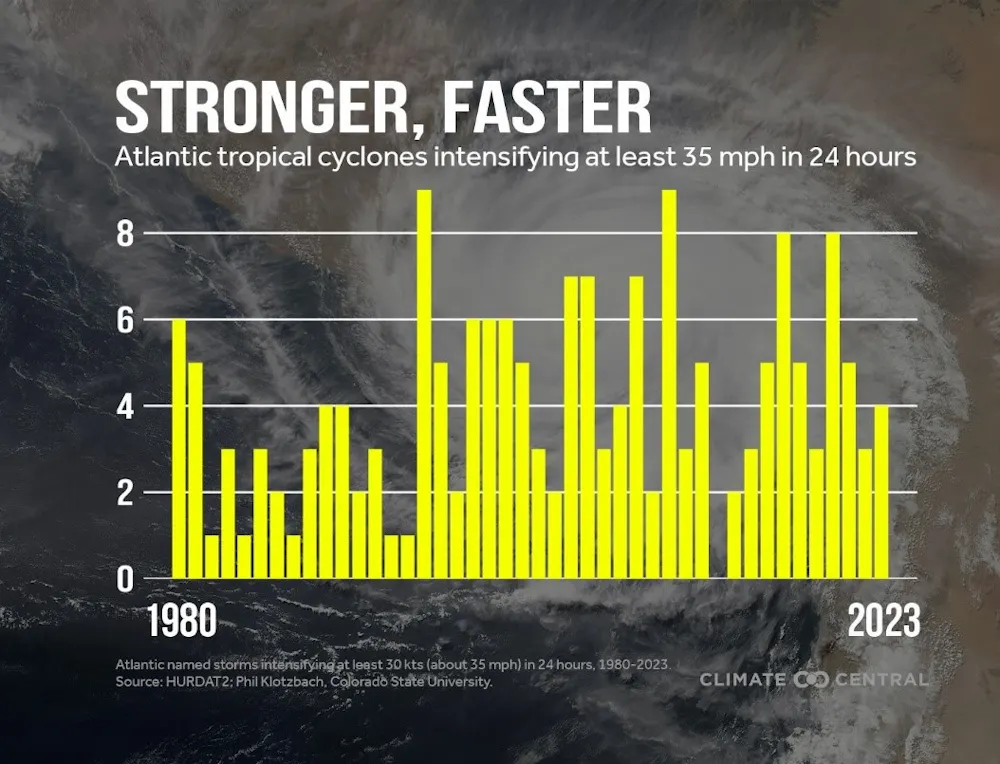
    If it seems as though you’ve been hearing about rapid intensification a lot more in recent years, that’s in part because it’s happening more often.

    The annual number of tropical cyclones in the Atlantic Ocean that achieved rapid intensification each year between 1980-2023 shows an upward trend.
    Climate Central, CC BY-ND

    A 2023 study investigating connections between rapid intensification and climate change found an increase in the number of tropical cyclones experiencing rapid intensification over the past four decades. That includes a significant rise in the number of hurricanes that rapidly intensify multiple times during their development. Another analysis comparing trends from 1982 to 2017 with climate model simulations found that natural variability alone could not explain these increases in rapidly intensifying storms, indicating a likely role of human-induced climate change.

    How future climate change will affect hurricanes is an active area of research. As global temperatures and oceans continue to warm, however, the frequency of major hurricanes is projected to increase. The extreme hurricanes of recent years, including Beryl in June 2024 and Helene, are already raising alarms about the intensifying impact of warming on tropical cyclone behavior.

    Zachary Handlos receives funding from the National Science Foundation. He is affiliated with the American Meteorological Society as the incoming chair of their Board on Higher Education. He is also an academic faculty partner of the Georgia Climate Project.

    Ali Sarhadi receives funding from NSF and Georgia Tech.

    ref. Hurricane Milton explodes into a powerful Category 5 storm as it heads for Florida − here’s how rapid intensification works – https://theconversation.com/hurricane-milton-explodes-into-a-powerful-category-5-storm-as-it-heads-for-florida-heres-how-rapid-intensification-works-240754

    MIL OSI – Global Reports

  • MIL-OSI USA: President Signs Bipartisan, Bicameral Bill Co-Led by Allred to Streamline Federal Permitting for Microchip Projects

    Source: United States House of Representatives – Congressman Colin Allred (TX-32)

    Building Chips in America Act will support billions in domestic manufacturing investments by streamlining federal reviews 

    Washington, D.C. – Last week, President Biden signed into law the Building Chips in America Act co-led by Congressman Colin Allred (D-TX-32) to help bring microchip manufacturing back to America by streamlining project approvals while maintaining environmental protections for clean air and water. Congressman Michael McCaul (R-TX-10) helped lead the House bill along with a bipartisan coalition of members who introduced the legislation together, which passed the House last month. 

    “In order for Texas to continue leading in semiconductor chip research and manufacturing,  we must ensure these projects can get approved in a timely manner,” said Allred. “The Building Chips in America will do just that, all while creating good paying jobs. I thank Congressman McCaul for working with me on this legislation and I am so proud our bipartisan bill was signed into law by the President.”

    Following the passage of the CHIPS and Science Act, companies throughout the semiconductor supply chain have announced plans to invest hundreds of billions in new domestic manufacturing projects. Under current law, these CHIPS Act investments require extra environmental reviews under the National Environmental Policy Act (NEPA), even for projects that already have permits and are underway. The Building Chips in America Act will ensure these reviews are completed in a timely manner by streamlining approvals for ongoing projects and providing the Secretary of Commerce with better tools for efficient oversight.

    The bill was also led in the House by Congresswoman Jen Kiggans (R-VA-02), Congressman Scott Peters (D-CA-50) and Congressman Brandon Williams (R-NY-22). The Building Chips in America Act was led in the Senate by U.S. Senators Mark Kelly (D-AZ), Todd Young (R-IN), Bill Hagerty (R-TN) and Sherrod Brown (D-OH). 

    Allred championed the passage of the CHIPS and Science Act, and now, following the passage of the landmark bill, the Department of Commerce has announced billions in federal investments to support domestic manufacturing projects in Texas. Including  $6.4 billion for Samsung in Taylor, $1.6 billion for Texas Instruments in North Texas and $400 million for GlobalWafers in Sherman, TX and Missouri. 


    ###

    MIL OSI USA News

  • MIL-OSI USA: School of Pharmacy Welcomes Keynote Speaker for 2024 Professionalism Ceremony

    Source: US State of Connecticut

    A UConn graduate and experienced healthcare industry leader, Zembrowski currently serves as the Director of Dermatology Marketing Development at Regeneron Pharmaceuticals, where he has supported the growth of the blockbuster brand DUPIXENT for the past 6 years. 

    Zembrowski, who graduated from UConn’s School of Pharmacy in 2007, has held leadership roles at major healthcare companies including Regeneron, Allergan, and Nestlé Health Science. In his current role at Regeneron, he leads marketing efforts for Dupixent, a key dermatology treatment, overseeing scientific marketing, and key opinion leader initiatives. Throughout his career, he has successfully launched award-winning campaigns, and played a key role in product launches in multiple disease states.

    Some of his notable career achievements include launching Direct-to-Consumer (TV advertising) for Regeneron and leading a global line launch for Nestle. Zembrowski is also dedicated to mentoring future healthcare leaders. He established the Bryan Zembrowski Pharmaceutical Industry Scholarship, which has supported UConn student pharmacists since 2007, and has mentored students through programs at both Rutgers University and UConn.

    Bryan Zembrowski

    In addition to his Doctor of Pharmacy degree from UConn, Zembrowski holds a Bachelor of Science in Biochemistry from Boston College and has completed executive training in leadership and digital marketing from Rutgers University and the Center for Creative Leadership.

    His keynote speech is sure to inspire and encourage UConn’s future pharmacists as they step into the evolving healthcare field.

    MIL OSI USA News

  • MIL-OSI Australia: University Medallist joins Ballarat graduates in milestone celebration

    Source: Federation University

    More than 430 Federation University Australia students will celebrate their education milestones across three graduation ceremonies in Ballarat this week.

    Among them will be University Medallist Kara Sewart, who is being recognised for embracing a range of study and research opportunities that have come her way.

    When Kara began her undergraduate science degree, she was not sure where she wanted her career to ‘land’, just that she hoped her passion for wildlife and sustainability could one day help contribute towards large scale conservation.

    Now, with that degree completed, including two overseas study programs, Kara is taking her passion to the next level, working with the New South Wales government on the release of captive-bred threatened species the Eastern Bristlebird as part of honours studies.

    Her overseas study programs included a New Colombo Plan (NCP) fellowship to study in Sri Lanka in 2023 where she was immersed in local culture and learnt about the environmental challenges of the region and restoration projects being championed by the University of Peradeniya.

    This was followed by a prestigious NCP scholarship to undertake a semester-long overseas study program where she completed a tropical biodiversity research project at the University of Brunei.

    “I had some incredible experiences, including visiting a research centre situated in a remote rainforest only accessible by boat, spotting hornbills, setting up camera traps to search for carnivorous cats, and even delivering a lecture to Bruneian high school students on Australian biodiversity,” Kara said.

    “Saying yes to unique and interesting opportunities has been a consistent choice throughout my degree and exposed me to some amazing experiences in both an academic and personal capacity.

    “I am proud of the work I have put in over the last few years and feel honoured to have it recognised at such a large scale. I had to make some sacrifices while trying to balance my professional, personal, and academic life but am happy I committed to university and got the most I could out of my degree.”

    Federation University’s Vice-Chancellor and President, Professor Duncan Bentley said Kara’s willingness to make the most of the experiences available during her studies, her excellent academic record, and constructive collaboration with her peers, made her a worthy recipient of this year’s University Medal.

    “We offer our congratulations to Kara and all students graduating this month and hope they take a moment with family and friends to reflect on all they have achieved,” Professor Bentley said.

    “We are delighted to see our graduates celebrate their success and carry their knowledge and passion into their communities.”

    Graduation ceremonies will be held at Founders Theatre, Mt Helen Campus, on Tuesday, 8 October and Wednesday, 9 October.

    More than 620 graduates across the University’s campuses will mark the academic milestone in front of family, friends and classmates in October.

    For more information about studying science at Federation University, visit http://www.federation.edu.au/science.  

    MIL OSI News

  • MIL-OSI United Kingdom: expert reaction to study on MRI scans and brain damage/long-lasting Covid-19 symptoms

    Source: United Kingdom – Executive Government & Departments

    A study published in Brain looks at MRI scans and brain damage associated with long lasting Covid-19 symptoms. 

    Prof Paul Mullins, Professor in Neuroimaging, University of Bangor, said:

    Does the press release accurately reflect the science?

    “The press release is a fairly good reflection of the science, although it does over sell the ability of the data to explain long COVID.

    Is this good quality research?  Are the conclusions backed up by solid data?

    “This is a piece of research using sophisticated imaging techniques to provide data not available from clinical imaging scanners. The imaging is good and shows that there are differences in the brain stem of patients who were hospitalised with COVID-19, with greater changes in patients with more severe COVID.

    How does this work fit with the existing evidence?

    “This fits with some earlier work showing a change in the specific measure, QSM, from this group, and also other work showing long term changes on such sophisticated brain scanning. This finding adds to our knowledge about which regions of the brain COVID impacts, showing change in those regions involved in respiration and other autonomic functions.

    Have the authors accounted for confounders?  Are there important limitations to be aware of?

    “The authors have attempted to account for most confounders, however, there is some limitation with the small number of patients scanned, and the use of a single time point. This is understandable considering that the study took place during the first waves of the pandemic with associated lockdowns and complications. 

    What are the implications in the real world?  Is there any overspeculation? 

    “This data shows that there may be an increase in iron deposition within the brain stem regions – which likely reflects inflammation – however the technique is not able to determine if this is ongoing inflammation, or the result of past inflammations, so it is likely too early for the authors to conclude that persistent inflammation is present in the brain stem, and that this is the cause of long covid, from this data set alone.

    Does this study conclusively prove what causes long COVID?

    “While this study does not conclusively prove the causes of long COVID, it does point a finger at one possible suspect for some of the symptoms experienced.

    What does this tell us about how long COVID should be treated now and in the future?

    “It is not clear that this shows much in the way of possible treatments for long COVID once it has occurred, but it perhaps does point to the need to reduce inflammatory responses during initial COVID infection and response, as lower inflammation was related to smaller changes in the QSM measure used.”


    ‘7-Tesla quantitative susceptibility mapping in COVID-19: brainstem effects and outcome associations.’ by Catarina Rua et al. was published in Brain at 0:01 UK time on Tuesday 08 October 2024.

    DOI: 10.1093/brain/awae215

    Declared interests

    Prof Paul Mullins “is a professor in neuroimaging at Bangor University and the Director of the Masters in Neuroimaging degree at Bangor University, has received European funding for the use of Neuroimaging in ageing and dementia studies in the past, and has received UKRI funding for research into the use of nutraceuticals for brain health. Professor Mullins researches brain metabolism and physiology, and the brain’s response to environmental stresses, including hypoxia as might be experienced during server acute COVID-19 infections.”

    MIL OSI United Kingdom

  • MIL-OSI United Kingdom: OS named future operator of National Underground Asset Register

    Source: United Kingdom – Executive Government & Departments

    Geospatial Commission appoint Ordnance Survey to operate the National Underground Asset Register, with the service transitioning to public beta in spring 2025.

    • Ordnance Survey appointed future operator of NUAR 
    • NUAR to be incorporated into the National Mapping Service’s public task and run on a cost recovery basis 
    • Move to public beta service in spring 2025 will allow eligible organisations to roll NUAR out across their workforces 

    The public are set to benefit from reduced disruptions to essential public services as the Ordnance Survey (OS) is today (8 October) announced as the future operator of the National Underground Asset Register (NUAR). 

    NUAR is improving the efficiency and safety of the way we install, maintain, operate and repair our buried infrastructure by providing secure access to data about the water, gas, electricity and telecommunications pipes and cables beneath our feet. 

    Currently workers must contact multiple organisations and wait on average over six days just to get the information they need. With NUAR, they can get that information instantly, any time of the day, any day of the year. This means planners and excavators get access to the data they need, when they need it, to carry out their work effectively and safely. NUAR also includes features to keep data secure and improve its quality over time. 

    This will lead to economic growth of at least £400 million per annum through increased efficiency of data sharing and excavations, fewer accidental strikes on underground pipes and cables, and reduced disruptions for the public and businesses. It will also contribute to the building of the infrastructure needed across the country, such as new roads, rail and houses.

    Baroness Jones of Whitchurch, Parliamentary Under-Secretary of State, Department for Science, Innovation and Technology said: 

    We are committed to unlocking the power of data to reduce disruptions to the public and help deliver economic growth across the UK. From spring, NUAR will minimise the chance of accidental damage to the pipes and cables beneath our feet, protecting the supply of gas, water and electricity to our homes and businesses. 

    By harnessing the Ordnance Survey’s centuries of expertise in managing critical national geographic data, we will ensure this service can deliver for the public and industry from Newcastle to Newport and Brighton to Belfast.

    The Geospatial Commission will retain long-term policy and performance oversight of the service. The OS Board has agreed to operate NUAR as part of its public task and on a cost recovery basis. In the upcoming months, the services will begin transitioning from AtkinsRéalis, who collaborated with the Geospatial Commission to develop the award-winning NUAR minimum viable product, to OS.  

    Plans are in place for NUAR to evolve from its current status as a minimum viable product, where use is constrained to testing and feedback, into a public beta service by spring. From that point NUAR will be able to be used in real-life situations by any eligible asset owners, their contractors and accredited surveyors to help ensure safe digging and excavation.

    Nick Bolton, Chief Executive Officer, Ordnance Survey said: 

    We are excited to apply our expertise in mapping Great Britain above ground, to the infrastructure below it. This innovative digital map shows how collaboration, between private sector and government, can bring huge economic benefit to the nation. Being trusted to operate a critical national asset, such as NUAR, is recognition of our enduring capabilities and we are delighted to be responsible for running this service.

    Heidi Mottram, Chief Executive Officer, Northumbrian Water Group said: 

    Ever since we collaborated with Ordnance Survey and others to design and produce the forerunner of NUAR at Northumbrian Water Group’s Innovation Festival in 2018, we have always felt this system, which benefits utilities and customers alike, should be hosted and managed not-for-profit in the public sector. Our planning and operation teams have fully embraced NUAR and this move to our national mapping agency is welcomed.

    Ashley Behan, Street Works and Permitting Manager, Lincolnshire County Council said: 

    As one of the first Highway Authority users of the NUAR platform, we are pleased to see public authority management of NUAR come to fruition, with its transfer to Ordnance Survey. As the National Mapping Service for Great Britain and one of the developers of NUAR, Ordnance Survey has a unique insight into mapping systems and how the platform works, and we are looking forward to seeing how it develops under their stewardship. 

    The centralisation and consistency of asset information NUAR provides is invaluable and will be key to the sector moving forward, safeguarding the country’s vital underground networks in a more structured way.

    Tom Duncan, Head of Design and Records, GTC said: 

    As an active user and supporter of the NUAR platform, I am pleased to see it transition to Ordnance Survey as its permanent home. This move should enhance the management of data relating to underground assets and improve collaboration across sectors, ultimately contributing to safer and more efficient infrastructure planning.

    Dr Lawrence J Smith, Technical Information Manager, Thames Water said: 

    We are delighted to hear that Ordnance Survey has been selected as the public authority to lead the next phase of NUAR’s evolution. Having collaborated closely with Ordnance Survey for several decades, we have confidence in their capabilities and in their ability to undertake this role. The NUAR application is becoming an increasingly vital asset in ensuring the safety of both our workforce and customers. At Thames Water, we fully support this announcement.

    Background

    NUAR is an emerging digital service, which provides instant access to a map of underground assets (i.e. pipes and cables) in England, Wales and Northern Ireland. Scotland already benefits from a system of this kind, known as the Scottish Community Apparatus Data Vault (or Vault for short), and the Geospatial Commission has worked closely with colleagues in the Scottish Government on this development. 

    OS is Great Britain’s National Mapping Service and has been mapping the surface of Great Britain since 1791. As part of its public task, it manages, maintains and provides access to the National Geographic Database, which contains over 500 million features and is updated over 20,000 times a day. OS data and services underpin critical activities across the country, such as getting ambulances to patients quickly, registering to vote and the provision of energy, water and broadband.

    NUAR has recently won the ‘Digital Innovation in Productivity’ category at the Digital Construction Awards, and been shortlisted for the following awards:  

    • New Civil Engineer (NCE) Awards 2024 – Technology Solutions Provider of the Year 

    • Digital Construction Awards 2024 – Digital Innovation in Health, Safety and Wellbeing 

    • Management Consultancies Association awards 2024 – Performance Improvement in the Public Sector Award 

    • Association for Project Management awards 2024 – Programme of the Year

    DSIT media enquiries

    Email press@dsit.gov.uk

    Monday to Friday, 8:30am to 6pm 020 7215 300

    Updates to this page

    Published 8 October 2024

    MIL OSI United Kingdom

  • MIL-OSI United Kingdom: Game-changing tech to reach the public faster as dedicated new unit launched to curb red tape

    Source: United Kingdom – Executive Government & Departments

    Science Secretary launches new Regulatory Innovation Office today to speed up public access to new technologies.

    New Regulatory Innovation Office Bringing new technologies to the public, faster.

    • Regulatory Innovation Office to reduce the burden of red tape and speed up access to new technologies that improve our daily lives – from AI in healthcare to emergency delivery drones
    • Search begins for a Chair to lead the office, driving economic growth through regulatory reform that enables innovation
    • New Office delivers on a key manifesto commitment and is among steps to back business in buildup to UK hosting International Investment Summit

    New technologies, like AI for better treatments in our NHS and drones delivering emergency supplies to all corners of the UK, could reach the public faster through a dedicated new office that will reduce the burden of red tape on innovation and help kickstart economic growth.

    The new Regulatory Innovation Office (RIO) will reduce the burden for businesses hoping to bring new products and services to the market in some of the UK’s fastest-growing sectors through innovations like –AI training software for surgeons to deliver more accurate surgical treatments for patients and drones which can improve business efficiency and quickly send critical deliveries to remote parts of the country.

    To do so, it will support regulators to update regulation, speeding up approvals, and ensuring different regulatory bodies work together smoothly. It will work to continuously inform the government of regulatory barriers to innovation, set priorities for regulators which align with the government’s broader ambitions and support regulators to develop the capability they need to meet them and grow the economy.

    The announcement comes ahead of further plans to reduce the burden of red tape and support the government’s key mission of kickstarting growth across the country. The new Office will also help set the scene for when the UK hosts the International Investment Summit on Monday 14 October, where the Chancellor will make clear that the UK is “open for business” as the government resets relations with trading partners around the globe.

    The launch of the RIO comes hot on the heels of a raft of public and private investments announced on Sunday (6 October) aimed at transforming cancer treatments for patients while bringing a wave of cutting-edge UK-made MedTech products to the global market.

    The RIO’s mission will initially support the growth of four fast-growing areas of technology making a difference to people’s lives before backing further technologies and sectors as the Office evolves. These are: 

    • Engineering biology – this is the use of synthetic biology and biotechnology to create new products and services derived from organic sources. These technologies can improve health with new treatments like innovative vaccines, help create cleaner fuels and make food production more efficient and sustainable such as through pest resistant crops and cultivated meat. The new RIO will help regulators to bring those products to market safely and more quickly – realising the environmental and health benefits they can bring to our lives.
    • Space – the UK’s space industry is growing fast, supporting everything from GPS on phones to vital communication systems, as new innovations improve our weather forecasting to disaster response systems. To sustain this growth, regulatory reform is needed for greater agility and clarity help foster competition, encourage investment, and open up market access. 
    • Artificial Intelligence and digital in healthcare – with increasing pressures on the NHS, AI is set to revolutionise healthcare delivery so doctors can diagnose illnesses faster and improve patient care. It will help run hospitals more efficiently with medical staff able to spend less time on administration, cutting waiting times and it could enable more personalised medicines, tailoring treatment to individuals. RIO will support the healthcare sector to deploy AI innovations safely, improving NHS efficiency and patients’ health outcomes.
    • Connected and autonomous technology – autonomous vehicles like drones can deliver emergency supplies to remote areas quickly and efficiently and work to approve this technology could play a key part in supporting emergency services to keep people safe. Greater support could also enable more drones to be used by businesses across the UK, building on projects like the drone service used by Royal Mail to deliver to Orkney and improving efficiency.

    The cross-cutting nature of these emerging technologies, which do not fit neatly into existing regulatory frameworks can mean a slower process in getting them onto the market. The new Office will work closely with government departments including the Department for Transport, the Department for Health and Social Care, and the Department for Environment Food and Rural Affairs to address regulatory barriers in these initial growth areas.

    The new office will also bring regulators together and working to remove obstacles and outdated regulations to the benefit of businesses and the public, unlocking the power of innovation from these sectors to generate tens of billions of pounds for the UK economy in the coming years. 

    Science and Technology Secretary, Peter Kyle, said:

    The launch of the Regulatory Innovation Office, a key manifesto commitment, is a big step forward in bringing the UK’s most promising new technologies to the public faster and safely while kickstarting economic growth. 

    By speeding up approvals, providing regulatory certainty and reducing unnecessary delays, we’re curbing the burden of red tape so businesses and our public services can innovate and grow, which means more jobs, a stronger economy, and a better quality of life for people across the UK.  

    From breakthroughs that could help doctors diagnose illnesses earlier to satellite navigation for more accurate weather forecasting and getting emergency supplies to where they are needed, quickly and effectively, RIO will make sure UK companies are at the forefront of the next generation of technologies.

    The Science and Technology Secretary is also looking to appoint the RIO’s first Chair to lead the charge in backing business and safe innovation, and work with regulators and partners to shape a regulatory environment that is fit for the future. Applications are now being welcomed for an ambitious, visionary leader committed to driving that change.

    The organisation has been established within DSIT, where it will incorporate the existing functions of the Regulatory Horizons Council and the Regulators’ Pioneer Fund.

    Alongside the launch of the RIO, the government is already making progress in developing regulatory frameworks for emerging technologies, becoming the first country to outline how it will approach quantum regulation, offering certainty to the sector and encouraging the responsible development of the technology.  

    This is set out in our response to the Regulatory Horizon Council’s report on quantum technologies, also published today. It marks a crucial first step in regulating innovation in a technology that will increasingly underpin powerful computers, secure communications and advanced sensors, in sectors from healthcare to national security.   

    Alongside this package of announcements, today we are announcing:

    • A £1.6 million award to the Food Standards Agency (FSA) as part of round one of the Engineering Biology Sandbox Fund, which aims to test innovative regulatory approaches for products like cultivated meat. Cell-cultivated products are foods created through the isolation of cells from meat, seafood, fat, offal or eggs which are grown in a controlled environment. It could result in food production which is more environmentally friendly and sustainable, using just 1% of the land used for animal equivalents, while increasing food security. Programmes like this will help bring innovative food products to shop shelves safely but without unnecessary delay and at lower costs, giving consumers more choice.
    • The publication of new voluntary screening guidance for synthetic nucleic acid. These technologies allow companies to ‘print’ DNA and RNA, enabling academics and businesses to study and engineer biological systems that help sectors like healthcare and accelerate our path to net-zero. The guidance emphasises the government’s intent for a pro-innovation culture in the engineering biology ecosystem through providing well-defined guardrails for customers and producers of synthetic nucleic acid.

    DSIT media enquiries

    Email press@dsit.gov.uk

    Monday to Friday, 8:30am to 6pm 020 7215 300

    Updates to this page

    Published 8 October 2024

    MIL OSI United Kingdom

  • MIL-OSI USA: Rep. Watson Coleman Gathers Community Partners to Celebrate $715,000 in Funding for Delaware River Basin Commission

    Source: United States House of Representatives – Congresswoman Bonnie Watson Coleman

    October 07, 2024

    Today, Congresswoman Bonnie Watson Coleman (NJ-12) visited the Delaware River Basin Commission’s (DRBC) West Trenton offices, joined by New Jersey Deputy Commissioner of Environmental Protection Jane Rosenblatt Birkhofer, DRBC Executive Director Steve Tambini, DRBC Deputy Executive Director Kristen Bowman Kavanagh, Trenton Mayor Reed Gusciora, Ewing Mayor Bert Steinmann and invited guests and partners in Greater Trenton.

    The Congresswoman announced $715,000 in funding, which she secured for the second year in a row, to support DRBC’s water resources work in the region. This funding came as a part of the omnibus government funding legislation that Congress passed March 23rd. Together with prior funding, the DRBC has committed to set aside a total of $1 million to advance climate resilience.

    “Clean water is not a luxury, it’s a basic human right,” said Rep. Bonnie Watson Coleman (NJ-12). “This $715,000 federal investment will help ensure the over 14 million Americans who rely on the Delaware River Basin for drinking, agriculture, and industrial usage continue to have access to a clean source of water. It will support the 600,000 jobs and $20 billion in industrial activity that the river facilitates. And it will make our communities more resilient to the growing impacts of climate change. I am so grateful to the Delaware River Basin Commission for the crucial work they do to support our communities. And to the Biden-Harris Administration for making this investment possible.”

    “The DEP is proud to partner with the Delaware River Basin Commission to protect this critical waterway serving millions of residents and multiple communities across four states,” said New Jersey Department of Environmental Protection Deputy Commissioner Jane Rosenblatt Birkhofer. “By working together and through the Commission, we are securing a more resilient New Jersey. DEP thanks Congresswoman Watson Coleman not only for her leadership, but her unwavering commitment to protecting the vital resources of the Delaware River Basin.”

    “Congresswoman Watson Coleman is a true champion for the Greater Trenton community and the water resources of the Delaware River Basin,” said DRBC Executive Director Steve Tambini. “With support from our federal and state partners, DRBC is embarking on agency-wide work to enhance the resilience of the Basin’s water resources into the future, and we are thrilled to accept this funding for the benefit of over 14 million people in four states.”

    “Today’s announcement by Congresswoman Bonnie Watson Coleman highlights the critical importance of investing in our water resources and climate resilience,” said Mayor W. Reed Gusciora. “Securing $715,000 in funding for the Delaware River Basin Commission for the second consecutive year is a testament to her unwavering dedication and leadership. This investment not only strengthens our state’s environmental initiatives but also serves as an example of how we can unite and collaborate across jurisdictions to enhance climate resilience, ensuring a legacy of clean and safe water for future generations.”

    “Getting this funding is a huge win for our community,” said Mayor Bert H. Steinmann. “Thanks to Congresswoman Watson Coleman, we’re making sure our water stays clean and safe, which is vital for everyone. It takes a lot of teamwork to tackle these big issues, and the Delaware River Basin Commission has been a great partner in this. We’re all about rolling up our sleeves and working together—whether it’s building new infrastructure or keeping our waterways healthy for the long haul. This money is going to help us do just that.”

    Following the funding announcement, the Commission and Congresswoman Waston Coleman’s staff hosted Trenton community partners to hear about recent projects and funding opportunities.

    “Partnership is core to our work, and only through partnership can we face the challenges posed by a changing climate to our shared waters. This committed funding fuels our goals for collaborative and meaningful progress,” said DRBC Deputy Executive Director Kristen Bowman Kavanagh. “We were pleased to welcome so many partners working in the Greater Trenton community to highlight their work and connect with our staff to learn about funding opportunities.”

    “From supporting local events and initiatives to engaging in critical environmental projects, Princeton Hydro is proud to play a role in shaping a more sustainable, inclusive, and vibrant Trenton,” said Geoffrey M. Goll, PE, President, Princeton Hydro. “Trenton has welcomed our business with open arms, and we are grateful to be part of this community. We hope to inspire other businesses to join us here in Trenton.”

    “It is such a pleasure to work alongside so many incredible partners to ensure a sustainable future for the Greater Trenton community, where residents are experiencing disproportionate impacts of climate change,” said Jay Watson, Co-Executive Director, New Jersey Conservation Foundation. “New Jersey Conservation Foundation is proud to play a role in the protection of critical natural resources in our capital city and across the state.”

    “The African American Cultural Collaborative of Mercer County is proud to participate in honoring Congresswoman Bonnie Watson Coleman and recognizing the impactful contributions of DRBC,” said Latarsha Burke, CEO/Executive Director of The African American Cultural Collaborative of Mercer County. “Since 2020, in partnership with NJ Legislative District 15, Mercer County Administration, and the City of Trenton, we have successfully produced the annual Juneteenth Celebration. Thanks to the investment and support of DRBC and many others, the Juneteenth Celebration has become a cherished event that unites people of all races and ethnicities. It is now our most anticipated event of the year!”

    About the Delaware River Basin

    The Delaware River Basin spans 13,539 square miles, includes parts of four states, all or portions of 42 counties, 868 municipalities, multiple government entities and jurisdictions, and twenty-two congressional districts. The Basin serves 14.2 million users including 2 million in New Jersey. 

    About the Delaware River Basin Commission

    The DRBC is a federal/interstate government agency created in 1961 by concurrent compact legislation, marking the first time that the federal government and a group of states joined together as equal partners in a river basin planning, development and regulatory agency. The five Commission members are the governors of the Basin states (Delaware, New Jersey, New York and Pennsylvania) and the commander of the U.S. Army Corps of Engineers’ North Atlantic Division, who represents the federal government.

    Commission Signatory funding supports DRBC engineering, science, research, monitoring and regulatory programs providing: clean and healthy water for people and wildlife; water resiliency to address climate change and extreme conditions such as floods and droughts; water availability and economic growth by having enough water to meet all of our current and future needs; and water equity to ensure that everyone in our communities share equally in the benefits and stewardship of our shared water resources.

    To learn more about the Commission, please visit http://www.drbc.gov or follow DRBC on X at @DRBC1961.

    MIL OSI USA News

  • MIL-OSI USA: October is National Dyslexia Awareness Month

    Source: United States House of Representatives – Congressman Bruce Westerman (AR-04)

    October is officially marked as National Dyslexia Awareness Month. This creates an opportunity to shed light on the most common learning disability in the United States, one that affects millions of Americans every day. Dyslexia is not a measure of intelligence, but a unique way of how the brain processes language which ultimately presents challenges in reading and writing. This month is about raising awareness and advocating for the proper tools and resources needed to help those with dyslexia unlock their full potential. It is unfortunate that, as the most common learning disability, dyslexia remains woefully misunderstood and unnoticed. Because of this, the inability to provide better resources for educators and parents only continues to hold us back. By fostering a better understanding of dyslexia, we can create a more successful and inclusive environment for all learners.

    As the co-chair of the Congressional Dyslexia Caucus, I have been a proud advocate in the halls of Congress for science-based approaches to bolster support for those who experience learning disabilities due to dyslexia. But on a more personal level, as a former school board president and the husband of a teacher, I understand firsthand the importance of providing helpful resources for educators to assist those with dyslexia and all learning disabilities. Last year, I was proud to sponsor legislation, The 21st Century Dyslexia Act, which emphasizes the need for a more modern understanding of the definition of dyslexia. Instead of the more overly broad definition of dyslexia as a Specific Learning Disability (SLD), it would be included in the list of disabilities that are under the definition of a “child with disability.” Additionally, I recently introduced a Resolution recognizing October 2024 as National Dyslexia Awareness Month. This resolution was an important step in ensuring that educators and parents are aware of the prevalence of dyslexia and can give their students the learning resources they need. I am once again proud to have supported this resolution and am grateful to my colleagues from the House and the Senate who made this a bipartisan and bicameral effort. 

    As we continue through the month of October, it is important to understand that dedicating a month to dyslexia awareness is a noble cause, but it is only the first step. True change and progress will come from the continued search for improved resources and creating environments where people with dyslexia can succeed in learning. It’s time for dyslexia to no longer be a barrier to greater understanding and learning. My hope is that we can commit to finding the resources needed to support evidence-based policy not only in the month of October but throughout the year.

    MIL OSI USA News

  • MIL-Evening Report: Manawanui sinking: an expert explains why a speedy cleanup will be crucial – and the main challenges ahead

    Source: The Conversation (Au and NZ) – By Christopher Battershill, Professor in Coastal Science, University of Waikato

    HMNZS Manawanui arrives at Devonport Naval Base in 2019 still bearing its original Norwegian name,
    Edda Fonn.
    Getty Images

    Speed will be of the essence as salvage crews attempt to stop fuel leaking from the sunken New Zealand naval ship off the coast of Samoa.

    The HMNZS Manawanui ran aground last weekend on a reef about one nautical mile off the south coast of Upolu, Samoa’s most populated island. The specialist dive and hydrographic vessel was on its third deployment, conducting a reef survey, when it caught fire and sank.

    Manawanui listing on the reef, October 6.
    Samoa Fire and Emergency Services Authority via Facebook

    The ship has come to rest at a depth of up to 150 metres, which means it may be relatively undisturbed even during storms. Any hull cracks from the impact should not be exacerbated.

    But depth makes the salvage operation challenging. Crew may need decompression chambers, and there’s only a narrow window of time to seal any fuel leaks – and, ideally, pipe out more than 900 tonnes of marine diesel the ship carries.

    Fuel leaks the first priority

    The Manawanui’s sinking is a marine disaster. But it arguably poses a lesser risk than the oil spill caused by the container ship MV Rena, which ran aground near the Astrolabe Reef off Tauranga in 2011.

    The Rena was loaded with 1,368 containers, some of which contained hazardous materials, as well as 1,700 tonnes of heavy fuel oil. It also carried thousands of tonnes of dairy products, which effectively fertilised the ocean and caused massive algal blooms, visible from space.

    The fuel oil on board the Manawanui is lighter. Its most toxic short-chain hydrocarbons will likely evaporate with wave action. But if the remaining slick washes up on beaches, it will be harder to remove. During low tides, it will be running onto the reef, likely killing off corals and fish in a swath moving inshore or driven by wind and currents.

    The salvage crew’s first focus will probably be on mitigating fuel leaks. But they will also need to clean up any crushed coral and contaminated sediment around the reef and wreck as quickly as possible, as it may have been exposed to the ship’s anti-fouling paint. In calm weather this would be possible as it’s shallow on the reef crest.

    Ships in the past have been painted with the anti-fouling paint Tributylin. It has now been banned because of its toxicity, but many ships simply painted over it with modern paints. Any damage to the hull could expose old layers. Without a thorough cleanup, this could preclude coral recovery.

    My experience, and that of colleague’s both in New Zealand and in tropical Australia, shows a speedy cleanup can make all the difference for the environmental recovery after ships ground on reefs and sometimes sink.

    When the Malaysian-flagged container ship Bunga Teratai Satu ran into the Sudbury Reef in the Great Barrier Reef in 2001, the vessel was refloated without losing any cargo or fuel. But it had scraped against the reef, spreading tributyltin-coated fragments. The salvage operation cleaned up the toxic material and the coral was on a recovery trajectory within four years.

    In contrast, the sinking of the Shen Neng 1 in 2010 flattened 8,000 square metres of reef east of Great Keppel Island on Queensland’s Capricorn coast. While the ship was also refloated and removed, there was no cleanup and no signs of coral recovery a decade after the disaster.

    Should oil dispersants be used?

    All 75 crew and passengers have been taken off the Manawanui by life rafts and other boats that came to the rescue. A Court of Inquiry is under way to establish exactly what caused the sinking.

    Rescued crew and passengers from Manawanui on Upolu’s southern coast.
    Samoa Fire and Emergency Services Authority via Facebook

    The focus is now on mitigating environmental impacts.

    At this point, there are no signs of oil on the beaches where the vessel sank, but locals are reporting an oil-like substance in the water around the wreck.

    Should fuel oil spill ashore, locals will have to find ways of harnessing the public for the beach cleanup. When the oil slick from the Rena contaminated local beaches, thousands of volunteers helped with the recovery operation.

    Locals will likely also face decisions about using oil dispersants, which break up oil into smaller droplets into the water column.

    At the time of the Rena operation, there was a public outcry against the use of dispersants because they spread the pollution further into the marine environment, and the chemical combination of oil and dispersant can be more toxic than either alone.

    The use of dispersants makes sense however, if an oil spill threatens turtle nesting areas for example, as it did when the cargo ship Pacific Adventurer was caught in a cyclone off Queensland in 2009 and 270 tonnes of oil created a 5.5 kilometre long slick.

    The reef where the Manawanui struck is well known for its large population of sea turtles, which come to feed in the area. They are likely to sense the pollution and eventually stay away, as will pelagic fish.

    Given the area is the local villagers’ food basket and a tourist destination, any deleterious effects on the coastal environment and coral reefs will be keenly felt. As in Aotearoa, the intimate bond between people and the sea is profound. Drawing on past experiences will empower speedy action and hasten ecological restoration.

    Christopher Battershill received funding from the Ministry for the Environment to examine the environmental effects of the MV Rena ship wreck. He is affiliated with the Oil Pollution Advisory Committee and has previously worked with the Australian Institute of Marine Science.

    ref. Manawanui sinking: an expert explains why a speedy cleanup will be crucial – and the main challenges ahead – https://theconversation.com/manawanui-sinking-an-expert-explains-why-a-speedy-cleanup-will-be-crucial-and-the-main-challenges-ahead-240775

    MIL OSI AnalysisEveningReport.nz

  • MIL-Evening Report: An unbroken night’s sleep is a myth. Here’s what good sleep looks like

    Source: The Conversation (Au and NZ) – By Amy Reynolds, Associate Professor in Clinical Sleep Health, Flinders University

    Bricolage/Shutterstock

    What do you imagine a good night’s sleep to be?

    Often when people come into our sleep clinic seeking treatment, they share ideas about healthy sleep.

    Many think when their head hits the pillow, they should fall into a deep and restorative sleep, and emerge after about eight hours feeling refreshed. They’re in good company – many Australians hold the same belief.

    In reality, healthy sleep is cyclic across the night, as you move in and out of the different stages of sleep, often waking up several times. Some people remember one or more of these awakenings, others do not. Let’s consider what a healthy night’s sleep looks like.

    Sleep cycles are a roller-coaster

    As an adult, our sleep moves through different cycles and brief awakenings during the night. Sleep cycles last roughly 90 minutes each.

    We typically start the night with lighter sleep, before moving into deeper sleep stages, and rising again into rapid eye movement (REM) sleep – the stage of sleep often linked to vivid dreaming.

    If sleeping well, we get most of our deep sleep in the first half of the night, with REM sleep more common in the second half of the night.

    Deepest sleep usually happens during the first half of the night.
    Verin/Shutterstock

    Adults usually move through five or six sleep cycles in a night, and it is entirely normal to wake up briefly at the end of each one. That means we might be waking up five times during the night. This can increase with older age and still be healthy. If you’re not remembering these awakenings that’s OK – they can be quite brief.

    What does getting a ‘good’ sleep actually mean?

    You’ll often hear that adults need between seven and nine hours of sleep per night. But good sleep is about more than the number of hours – it’s also about the quality.

    For most people, sleeping well means being able to fall asleep soon after getting into bed (within around 30 minutes), sleeping without waking up for long periods, and waking feeling rested and ready for the day.

    You shouldn’t be feeling excessively sleepy during the day, especially if you’re regularly getting at least seven hours of refreshing sleep a night (this is a rough rule of thumb).

    But are you noticing you’re feeling physically tired, needing to nap regularly and still not feeling refreshed? It may be worthwhile touching base with your general practitioner, as there a range of possible reasons.

    Common issues

    Sleep disorders are common. Up to 25% of adults have insomnia, a sleep disorder where it may be hard to fall or stay asleep, or you may wake earlier in the morning than you’d like.

    Rates of common sleep disorders such as insomnia and sleep apnoea – where your breathing can partially or completely stop many times during the night – also increase with age, affecting 20% of early adults and 40% of people in middle age. There are effective treatments, so asking for help is important.

    Beyond sleep disorders, our sleep can also be disrupted by chronic health conditions – such as pain – and by certain medications.

    There can also be other reasons we’re not sleeping well. Some of us are woken by children, pets or traffic noise during the night. These “forced awakenings” mean we may find it harder to get up in the morning, take longer to leave bed and feel less satisfied with our sleep. For some people, night awakenings may have no clear cause.

    A good way to tell if these awakenings are a problem for you is by thinking about how they affect you. When they cause feelings of frustration or worry, or are impacting how we feel and function during the day, it might be a sign to seek some help.

    If waking up in the night is interfering with your normal day-to-day activities, it may indicate a problem.
    BearFotos/Shutterstock

    We also may struggle to get up in the morning. This could be for a range of reasons, including not sleeping long enough, going to bed or waking up at irregular times – or even your own internal clock, which can influence the time your body prefers to sleep.

    If you’re regularly struggling to get up for work or family needs, it can be an indication you may need to seek help. Some of these factors can be explored with a sleep psychologist if they are causing concern.

    Can my smart watch help?

    It is important to remember sleep-tracking devices can vary in accuracy for looking at the different sleep stages. While they can give a rough estimate, they are not a perfect measure.

    In-laboratory polysomnography, or PSG, is the best standard measure to examine your sleep stages. A PSG examines breathing, oxygen saturation, brain waves and heart rate during sleep.

    Rather than closely examining nightly data (including sleep stages) from a sleep tracker, it may be more helpful to look at the patterns of your sleep (bed and wake times) over time.

    Understanding your sleep patterns may help identify and adjust behaviours that negatively impact your sleep, such as your bedtime routine and sleeping environment.

    And if you find viewing your sleep data is making you feel worried about your sleep, this may not be useful for you. Most importantly, if you are concerned it is important to discuss it with your GP who can refer you to the appropriate specialist sleep health provider.

    Amy Reynolds receives funding from the National Health and Medical Research Council, the Medical Research Future Fund, the Australian Research Council, the Lifetime Support Authority, and has received consulting and/or speaker fees from industry-funded sources including Compumedics, Teva Pharmaceuticals and Sydney Trains.

    Claire Dunbar received funding from The Hospital Research Foundation for their PhD Scholarship and previously from Flinders University development grants.

    Hannah Scott receives research funding from Re-Time Pty Ltd, Compumedics Ltd, the American Academy of Sleep Medicine Foundation, and Flinders University.

    Nicole Lovato receives funding from the Australian Research Council, the National Health and Medical Research Council, the Medical Research Future Fund, the Hospital Research Foundation, the Lifetime Support Authority, and industry including ResMed, Phillips, and ReTime.

    Gorica Micic does not work for, consult, own shares in or receive funding from any company or organisation that would benefit from this article, and has disclosed no relevant affiliations beyond their academic appointment.

    ref. An unbroken night’s sleep is a myth. Here’s what good sleep looks like – https://theconversation.com/an-unbroken-nights-sleep-is-a-myth-heres-what-good-sleep-looks-like-238069

    MIL OSI AnalysisEveningReport.nz

  • MIL-OSI China: NASA, SpaceX postpone Europa Clipper mission launch

    Source: China State Council Information Office

    NASA and SpaceX are standing down from the launch attempt of the agency’s Europa Clipper mission due to anticipated hurricane conditions in the area, NASA said on Monday.

    The mission was originally planned to launch on Oct. 10 from the Kennedy Space Center in Florida.

    Hurricane Milton is expected to move from the Gulf of Mexico this week eastward to the Space Coast. High winds and heavy rain are expected in the Cape Canaveral and Merritt Island regions on Florida’s east coast.

    Launch teams have secured Europa Clipper spacecraft in SpaceX’s hangar at Launch Complex 39A at the Kennedy Space Center ahead of the severe weather, and the center began hurricane preparations Sunday, according to NASA.

    NASA will determine the next launch opportunity. Europa Clipper has launch windows until Nov. 6.

    The mission’s main science goal is to determine whether there are places below the surface of Jupiter’s icy moon, Europa, that could support life, according to NASA.

    Europa Clipper spacecraft will conduct detailed reconnaissance of Europa and investigate whether the icy moon could have conditions suitable for life. The spacecraft will perform dozens of close flybys of Europa, gathering detailed measurements to investigate the moon, according to NASA. 

    MIL OSI China News

  • MIL-OSI Economics: [World Mental Health Day] Enabling a Better Understanding of the Mind-Body Connection Through Advanced Health Research

    Source: Samsung

    Mental health impacts nearly every aspect of our daily lives — from physical health to relationships with friends, family and communities, as well as productivity at work and beyond. Despite the critical role mental health plays in overall well-being, the majority of available technologies are centered around physical health. Samsung is committed to fostering innovative health solutions for both today and tomorrow which is why we frequently collaborate with leading medical institutions and universities to leverage advanced technologies and explore new possibilities in health and wellness.
     
    In support of World Mental Health Day, Samsung is highlighting ongoing research programs with Massachusetts General Hospital, MIT Media Lab, Brigham & Women’s Hospital and Tulane University School of Medicine, Heart and Vascular Institute. These studies dive deep into the mind-body connection by examining various health indicators including depression, mood, resilience and even cardiovascular diseases to deliver more comprehensive and preventative health solutions for all.
     
     
    Enabling Depression Prevention & Detection With Massachusetts General Hospital

     
    Massachusetts General Hospital (MGH) has been analyzing the correlation between depression and various biomarkers by evaluating the health metrics of 150 participants with different levels of depression using the Galaxy Watch. The study aims to validate the correlations between depression and biometrics — such as participants’ patterns of biometric data, activity level, sleep stage, duration and latency on both weekends and weekdays — to identify more detailed characteristics. The findings will be used to introduce a mental health index, allowing users to better understand their mental state and take proactive measures
     
     
    Supporting Well-Being Through Better Sleep With MIT Media Lab

     
    MIT Media Lab has expanded the understanding of sleep’s role in well-being by linking sleep patterns to overall health. Approximately 200 college students participated in the study, tracking their sleep over a month and self-evaluating across five well-being indicators every morning — including alertness, happiness, energy, health and calmness. The study found strong associations between sleep and well-being with both sleep duration and sleep regularity directly affecting them. By utilizing a mixed-effect random forest (MERF) model, MIT Media Lab was able to predict the participants’ self-reported well-being based on their sleep patterns with a mean absolute error of 11-15 points on a 100-point scale which closely matched their self-evaluation results. This outcome highlights the link between sleep and well-being as well as the possibility of personalized well-being assessment and management through the analysis of sleep patterns.
     
     
    Helping Rapid Recovery With Brigham & Women’s Hospital

     
    Brigham & Women’s Hospital (BWH) is studying the relationship between biomarkers and an individual’s resilience, or how quickly one recovers from major stressors. As a holistic measure, resilience captures the capacity of the body and mind to withstand major events such as disease and surgery. For a first use case, they are monitoring patients before, during and after undergoing transcatheter aortic valve replacement (TAVR) surgery. The Galaxy Watch tracks participants’ lifestyle patterns and health conditions in real time while the data is automatically collected and analyzed using the Samsung Health Research Stack, a system designed to increase the efficiency and accuracy of large-scale research. This study aims to uncover insights into recovery and the ability to withstand stressors — not only to help inform medical decisions but also to help individuals understand how they can be prepared in both mind and body for any challenges that may come.
     
     
    Identifying Cardiovascular Risks With Tulane University School of Medicine

     
    Mental health has a well-established relationship with reduced risk of future cardiovascular disease. Tulane University School of Medicine is utilizing data from the Galaxy Watch and Samsung Health SDK to create biomarkers for early detection of cardiovascular disease risk factors. The study will closely monitor thousands of participants from diverse demographics and areas of high prevalence of cardiovascular diseases and risk factors for up to three years. Each participant’s health records and biometric data will then be analyzed to examine complex and interconnected health factors. Samsung and Tulane’s Heart and Vascular Institute hope to identify factors that impact cardiovascular disease with a goal of developing algorithms for individual cardiovascular disease prediction and prevention.
     
    “At Samsung, we are committed to supporting the health community by unlocking new frontiers that were previously impossible to explore,” said Dr. Hon Pak, Senior Vice President and Head of Digital Health Team, MX Business at Samsung Electronics. “That’s why we collaborate with leading medical institutions and accelerate research focused on the mind-body connection, leveraging our sensor technology and combined expertise to deliver truly holistic and preventative health solutions.”
     
     
    About Massachusetts General HospitalMassachusetts General Hospital, founded in 1811, is the original and largest teaching hospital of Harvard Medical School. The Mass General Research Institute conducts the largest hospital-based research program in the nation, with annual research operations of more than $1 billion and comprises more than 9,500 researchers working across more than 30 institutes, centers and departments. MGH is a founding member of the Mass General Brigham healthcare system.
     
    About the MIT Media LabAt the intersection of engineering, design, science, and art, the MIT Media Lab is an interdisciplinary creative playground rooted in academic excellence, made up of dozens of research groups, initiatives, and centers working collaboratively on hundreds of projects. Our overarching research themes address global challenges from well-being and cryptocurrencies to robotics and sustainable futures. Committed to diversity, equity, and inclusion, the MIT Media Lab collaborates with corporations, governments, NGOs, donors, and others around the globe to drive impactful change across sectors. Learn more at media.mit.edu.
     
    About Brigham and Women’s HospitalBrigham and Women’s Hospital is a world-class academic medical center based in Boston, Massachusetts. The Brigham serves patients from New England, across the United States and from 120 countries around the world. A major teaching hospital of Harvard Medical School, Brigham and Women’s Hospital has a legacy of clinical excellence that continues to grow year after year.
     
    The Brigham network includes 1,200 doctors throughout New England working across 150 outpatient practices. An international leader in virtually every area of medicine, the Brigham has led numerous medical and scientific breakthroughs that have improved lives around the world.
     
    U.S. News & World Report recognizes Brigham and Women’s Hospital among the best hospitals in many specialty areas, including cancer, heart and vascular, diabetes and endocrine disorders, ear, nose and throat, gastroenterology and GI surgery, geriatric care, gynecology, neurology and neurosurgery, orthopedics, pulmonology, rheumatology, and urology.
     
    About Tulane University School of MedicineFounded in 1834 as the Medical College of Louisiana, Tulane University School of Medicine is one of the oldest medical schools in the United States. Established to combat yellow fever and smallpox in New Orleans, the school is a leading institution known for medical education, research, and patient care. Over the years, it has significantly contributed to medicine, including groundbreaking research and innovative treatments. Today, Tulane continues its legacy of excellence, training the next generation of healthcare leaders and advancing medical knowledge.
     
    Tulane Medicine recruits top faculty, researchers, and students from around the world so they can collaborate and develop groundbreaking medical research and surgical advances. From new drugs to innovative care techniques, or the invention of the binocular microscope to robotic surgeries, we remain a constant presence at the forefront of modern medical innovation. Tulane Medicine equips the next generation of medical professionals — whether scientific or clinical — with a broad set of tools to succeed in a rapidly changing world. When you see the Tulane Shield, you always know that the future of medicine… is here.

    MIL OSI Economics

  • MIL-OSI China: 2024 Nobel Prize in Medicine honors 2 scientists for discovering mircoRNA

    Source: China State Council Information Office

    Portraits of the 2024 Nobel laureates in Physiology or Medicine, Victor Ambros and Gary Ruvkun, are seen at the Karolinska Institute in Stockholm, Sweden, on Oct. 7, 2024. [Photo/Xinhua]

    The 2024 Nobel Prize in Medicine was awarded Monday to two American scientists, Victor Ambros and Gary Ruvkun, for their discovery of microRNA and its role in post-transcriptional gene regulation.

    MicroRNAs are a new class of tiny RNA molecules that are essential in gene regulation. It is now known that the human genome codes for over 1,000 microRNAs.

    The Nobel Assembly said that the pair’s surprising discovery revealed an entirely new dimension to gene regulation. “MicroRNAs are proving to be fundamentally important for how organisms develop and function,” the assembly added.

    The announcement marked the start of this year’s Nobel Prize award season. The Nobel announcements will proceed with the physics prize on Tuesday, followed by chemistry on Wednesday, and literature on Thursday. The Nobel Peace Prize will be revealed on Friday, and the Nobel Memorial Prize in Economic Sciences will be announced on Oct. 14.

    MIL OSI China News

  • MIL-OSI China: DPRK top leader says would never allow destruction of balance of force on Korean peninsula

    Source: China State Council Information Office

    The top leader of the Democratic People’s Republic of Korea (DPRK) would never allow the destruction of the balance of force on the Korean peninsula, but develop defence science and industry to bolster up the war deterrent for self-defence “limitlessly,” the official Korean Central News Agency (KCNA) reported on Tuesday.

    Kim Jong Un, general secretary of the Workers’ Party of Korea and president of the State Affairs of the DPRK, made the remarks during a speech at the Kim Jong Un University of National Defence on Monday.

    During the address to the teaching staff and students of the elite military academy, Kim underscored the validity of the DPRK’s logic of building self-defence capability, saying the country should have physical strength capable of always deterring the enemy and keeping the situation under control, according to the KCNA report.

    He also stressed the need to “neutralize the imperialists’ aggressive and adventurous military activities with absolute superiority of the defence sci-tech capabilities,” the KCNA said.

    MIL OSI China News

  • MIL-OSI Australia: Antarctic season begins

    Source: Australian Government – Antarctic Division

    Australia’s Antarctic science and logistics season has started, with RSV Nuyina leaving Hobart on a six-week resupply voyage to Davis research station.
    The ship has 100 expeditioners on board, two helicopters, a hot pink Antarctic tractor, 240,000 litres of water, 13 tonnes of dry food and more than 20 tonnes of fresh and frozen food.
    It marks the start of an ambitious year for science and infrastructure at Australia’s Antarctic and sub-Antarctic stations.

    “We’re all very excited to be underway,” Voyage Leader Anthea Fisher said.
    “We’ve been chatting to the team who are down at Davis – they’ve been there for a year now – and they’re pretty excited for us to turn up too, to resupply the station and bring them home again.”
    The journey south will take 15 days and require the ship to break ice for the last nine or ten kilometres.
    “At this time of year there’s a section of ice breaking through the pack ice and then the fast ice,” the voyage leader said.
    “We’ll break into that and park about a kilometre out from station and once we’re parked in there, people will be able to just walk off the ship across the ice to station.”
    The trades team travelling to Davis will aim to complete work on a new reverse osmosis plant, which creates drinking water from sea water.
    Along with a third water tank installed last year, it will give the station the water capacity it needs to support station populations in future.
     “Davis station doesn’t have a fresh water source so we have to produce fresh water from salt water via a desalination plant and then store that water for most of the year until we can produce fresh water for a short window in summer,” Construction Supervisor for summer, Tom de Leon, said.
    “A huge amount of planning goes into making sure we don’t run out of materials.
    “There’s no Bunnings down there we can duck into so we have to think very carefully about what we bring and what we use when we’re down there.”
    There are also science project teams on board.
    “We have an important season of science ahead of us this year, kicking off with this first voyage,” Head of the Australian Antarctic Division’s Science Branch, Rhonda Bartley, said.
    Two seabird scientists on board will stop at Davis for a few weeks to monitor local seabird colonies and look for any signs of avian influenza in bird populations and seals near the station. They will then go to Mawson research station for the rest of the summer season to monitor and conduct research on penguins and flying seabirds.
    “We haven’t had any signs of avian influenza in East Antarctica yet but it’s really important that we have people there to look for those signs and assess the impacts of any outbreak,”
     “We’re also very concerned for the health and welfare of our expeditioners so a lot of our planning is around having good biosecurity measures in place and being able to respond to protect our people.”
    Three scientists on the voyage from the Cleaner Antarctica program – which assesses and remediates legacy waste at Antarctic and sub-Antarctic stations – will also carry out work at Davis before transiting to Mawson for the summer’s program of works.
    Three scientific technicians are doing the round trip to maintain key geophysical and atmospheric monitoring equipment on board Nuyina.
    In December, scientists will return to Bunger Hills for the third and final year of the Denman Terrestrial Campaign, which aims to increase our understanding of the glacier’s stability and possible contribution to sea level rise, through research projects carried out inland.
    After the scientists leave in January, trades teams and expeditioners will start the mammoth task of packing the camp up and remediating the site.
    Then in February, RSV Nuyina leaves for the 60-day Denman Marine Voyage, the ship’s first dedicated marine science journey.
    The voyage will take 60 scientists from a range of universities and disciplines to the Denman Glacier region so they can study the system from the sea.
    This content was last updated 14 hours ago on 8 October 2024.

    MIL OSI News

  • MIL-OSI Economics: New ADB Country Director for Azerbaijan Assumes Office

    Source: Asia Development Bank

    BAKU, AZERBAIJAN (7 October 2024) — The Asian Development Bank (ADB) has appointed Sunniya Durrani-Jamal as its new Country Director for Azerbaijan. She joined the Azerbaijan Resident Mission today to officially commence her role.

    Ms. Durrani-Jamal will lead ADB’s operations in Azerbaijan and manage the bank’s relationships with the government and other stakeholders. She will oversee the preparation and implementation of the bank’s new country partnership strategy (CPS). The new CPS will build on ADB’s existing work in Azerbaijan, and its strategic focus areas will be aligned with the government’s development strategy and ADB’s Strategy 2030.

    “It is an honor to lead ADB’s efforts in Azerbaijan, a country of rich culture and significant economic potential,” said Ms. Durrani-Jamal. “My priority is to extend ADB’s enduring collaboration with the government, help diversify the economy and improve the quality of life for people in Azerbaijan. This includes expanding renewable energy, addressing climate change, and helping the Caucasus nation transition to a private-sector-led green economy.”

    Azerbaijan’s 10-year development strategy, Azerbaijan 2030: National Priorities for Socio-Economic Development, outlines the country’s ambitions to develop a sustainable and competitive economy, foster an inclusive society, improve human capital, transition to green growth, and improve infrastructure.

    As Asia and the Pacific’s climate bank, ADB is also supporting Azerbaijan’s Presidency of COP29, including via capacity building ahead of the landmark United Nations climate summit set to take place in Baku next month

    Ms. Durrani-Jamal has more than 25 years’ professional experience, including 16 years with ADB where she has held key senior roles. These include country director for Cambodia, senior advisor to ADB’s vice president for east Asia, southeast Asia, and the pacific; and senior economist.

    Ms. Durrani-Jamal holds a master’s degree in economics (human development) from the University of Sussex, United Kingdom, and a master of science in economics (monetary policy) from Quaid-i-Azam University, Pakistan. She succeeds outgoing Country Director Candice McDeigan who held this position from 2021.

    Since Azerbaijan joined the bank in 1999, ADB has committed more than $5 billion in sovereign and private sector assistance, including in transport, energy, health care, and agriculture.

    ADB is committed to achieving a prosperous, inclusive, resilient, and sustainable Asia and the Pacific, while sustaining its efforts to eradicate extreme poverty. Established in 1966, it is owned by 69 members—49 from the region.

    MIL OSI Economics

  • MIL-OSI Asia-Pac: Appointment of Director of Hong Kong International Legal Talents Training Office announced

    Source: Hong Kong Government special administrative region

    Appointment of Director of Hong Kong International Legal Talents Training Office announced
    Appointment of Director of Hong Kong International Legal Talents Training Office announced
    ******************************************************************************************

         The Department of Justice announced today (October 8) that following an open recruitment exercise, Dr Yang Ling will take up the appointment as the Director of the Hong Kong International Legal Talents Training Office. Dr Yang will take up the appointment on November 1. The Secretary for Justice, Mr Paul Lam, SC, welcomed the appointment.     Commenting on Dr Yang’s appointment, Mr Lam said, “Dr Yang is a recognised scholar in international legal and dispute resolution with extensive management experience, including from her time at the Hong Kong International Arbitration Centre. I am confident that she will be able to lead the office to take forward the policy initiatives of developing Hong Kong as a capacity-building centre for legal talent in domestic, foreign and international law.”     The Hong Kong International Legal Talents Training Office has been set up to serve as the co-ordinating body to take forward the establishment of the Hong Kong International Legal Talents Training Academy set out in the 2023 Policy Address. The Office will also serve as the secretariat for the Hong Kong International Legal Talents Training Expert Committee, which has been established and formed by three advisory boards comprising eminent legal experts and scholars from renowned international, Mainland and local legal organisations, and universities as members. Members of the Expert Committee are appointed in their personal capacity, and the list of membership is set out in the Appendix.     Capitalising on Hong Kong’s bilingual common law system and international status, the Academy will regularly organise practical training courses, seminars, international exchange programmes and more to promote exchanges among talent in regions along the Belt and Road. It will also provide training for talent in the practice of foreign-related legal affairs for the country, and nurture legal talent conversant with international law, common law, civil law and the country’s legal system. This initiative will be conducive in consolidating Hong Kong’s position as an international legal and dispute resolution services centre in the Asia-Pacific region.     A brief biographical note of Dr Yang is set out below:     Dr Yang was admitted to the Chinese Bar in 2004 and currently holds the position of the Deputy Secretary-General and Head of China Relations of the Hong Kong International Arbitration Centre (HKIAC). She obtained an LL.M. in International Law in 2006 and a PhD in 2009 from Wuhan University. Prior to joining the HKIAC in 2018, she was an Associate Professor at the East China University of Political Science and Law where she taught international arbitration for more than eight years. In addition, she was a visiting scholar at the University of Aix-en-Provence Marseille III in 2008 and at Boston University School of Law in 2017. Dr Yang has published widely on issues of international dispute resolution and arbitration in China, and currently serves as Executive Editor-in-Chief for the Shanghai International Arbitration Review. She has also been appointed as an arbitrator.

     
    Ends/Tuesday, October 8, 2024Issued at HKT 11:30

    NNNN

    MIL OSI Asia Pacific News

  • MIL-OSI Asia-Pac: Legal training office director named

    Source: Hong Kong Information Services

    The Department of Justice announced today that Yang Ling will take up the appointment as Director of the Hong Kong International Legal Talents Training Office with effect from November 1.

    Secretary for Justice Paul Lam welcomed Dr Yang’s appointment, which was made following an open recruitment exercise, noting that she is a recognised scholar in international legal and dispute resolution with extensive management experience, including her time at the Hong Kong International Arbitration Centre.

    “She will be able to lead the office to take forward the policy initiatives of developing Hong Kong as a capacity-building centre for legal talent in domestic, foreign and international law,” he added.

    The International Legal Talents Training Office has been set up to serve as the co-ordinating body to take forward the establishment of the Hong Kong International Legal Talents Training Academy set out in the 2023 Policy Address.

    The office will also serve as the secretariat for the Hong Kong International Legal Talents Training Expert Committee, which was formed by three advisory boards comprising eminent legal experts and scholars from renowned international, Mainland and local legal organisations, and universities as members.

    Capitalising on Hong Kong’s bilingual common law system and international status, the academy will regularly organise training courses, seminars, international exchange programmes and more to promote exchanges among talent in regions along the Belt & Road.

    It will also provide training for talent in the practice of foreign-related legal affairs for the country, and nurture legal talent conversant with international law, common law, civil law and the country’s legal system.

    Dr Yang was admitted to the Chinese Bar in 2004 and currently holds the position of Deputy Secretary-General and Head of China Relations of the Hong Kong International Arbitration Centre (HKIAC).

    Prior to joining the HKIAC in 2018, Dr Yang was Associate Professor at the East China University of Political Science & Law where she taught international arbitration. She was also a visiting scholar at the University of Aix-en-Provence Marseille III in 2008 and at Boston University School of Law in 2017.

    MIL OSI Asia Pacific News

  • MIL-Evening Report: 700 million plastic bottles: we worked out how much microplastic is in Queensland’s Moreton Bay

    Source: The Conversation (Au and NZ) – By Elvis Okoffo, PhD candidate in Environmental Science, The University of Queensland

    M-Productions/Shutterstock

    When it rains heavily, plastic waste is washed off our streets into rivers, flowing out to the ocean. Most plastic is trapped in estuaries and coastal ecosystems, with a small fraction ending up offshore in the high seas.

    In the coastal ocean, waves and tides break down plastic waste into smaller and smaller bits. These micro and nanoplastics linger in the environment indefinitely, impacting the health of marine creatures from microorganisms all the way up to seabirds and whales, which mistake them for food.

    When we look at the scale of the problem of microplastics (smaller than 5mm) and nanoplastics (defined as 1 micrometer or less), we find something alarming. Our new research shows the shallow embayment of Moreton Bay, off Brisbane in Southeast Queensland now has roughly 7,000 tonnes of accumulated microplastics, the same as 700 million half-litre plastic bottles.

    This bay accumulates plastics fast, as the Brisbane River funnels the city’s waste into it, along with several other urban rivers. The research hasn’t yet been done, but we would expect similar rates of microplastics in Melbourne’s Port Phillip Bay and Sydney Harbour.

    Our research shows how much plastic waste from a big city makes it into its oceans.

    Brisbane’s Moreton Bay has mangroves and seagrass meadows as well as a port and many urban rivers.
    Ecopix/Shutterstock

    Plastic buildup in Moreton Bay

    What volume of microplastics does a large city accumulate offshore? It’s hard to measure this for cities built on open coastlines. That’s because sediments and microplastics are rapidly washed away from the original source by waves and currents.

    But Moreton Bay is different. The large sand islands, Moreton (Mugulpin) and North Stradbroke (Minjerribah) Islands largely protect the bay from the open ocean. This is why the bay is better described as an enclosed embayment. These restricted bays act as a trap for sediments and pollutants, as waves and currents have limited ability to wash them out. These bays make it possible to accurately measure a city’s microplastic build-up.

    The bay supports a range of marine habitats from mangroves, seagrass and coral reefs, as well as an internationally recognised wetland for migrating seabirds. Dugong and turtles have long grazed the seagrass in Moreton Bay’s shallow protected waters, while dolphins and whales are also present. But microplastic buildup may threaten their existence.

    Most types of plastic are denser than water, which means most microplastics in coastal seas will eventually sink to the seafloor and accumulate in sediment. Mangroves and seagrass ecosystems are particularly good at trapping sediment, which means they trap more microplastics.

    We wanted to determine whether Moreton Bay’s varying ecosystems had accumulated different amounts of plastics in the sediment.

    We measured the plastic stored in 50 samples of surface sediment (the top 10cm) from a range of different ecosystems across Moreton Bay, including mangroves, seagrass meadows and mud from the main tidal channels.

    The result? Microplastics were present in all our samples, but their concentrations varied hugely. We found no clear pattern in how plastics had built up. This suggests plastics were entering the bay from many sources.

    We tested for seven common plastics: polycarbonate (PC), polyethylene (PE), polyethylene terephthalate (PET), poly (methyl methacrylate) (PMMA), polypropylene (PP), polystyrene (PS), and polyvinyl chloride (PVC).

    Of these, the most abundant microplastic was polyethylene (PE). This plastic is widely used for single-use plastic items such as chip packets, plastic bags and plastic bottles. It’s the most commonly produced and used plastic in Australia and globally.

    In total, we estimate the bay now holds about 7,000 tonnes of microplastic in its surface sediments.

    In our follow-up paper we explored how rapidly these plastics had built up over time. We took two sediment cores from the central part of the bay, where sediment is accumulating. Cores like this act as an archive of sediment and environmental changes over time.

    The trend was clear. Before the 1970s, there were no microplastics in Moreton Bay. They began appearing over the next three decades. But from the early 2000s onwards, the rate rose exponentially. This is in line with the soaring rate of plastic production and use globally. Our analysis shows a direct link between microplastic concentration and population growth in Southeast Queensland.

    The challenge of measuring microplastics

    To date, we have had limited knowledge of how much plastic is piling up on shallow ocean floors. This is because measuring microplastics is challenging. Traditionally, we’ve used observation by microscope and a technique called absorption spectroscopy, in which we shine infrared light on samples to determine what it’s made up of. But these methods are time-consuming and can only spot plastic particles larger than 20 micrometres, meaning nanoplastics weren’t being measured.

    Our research team has been working to get better estimates of microplastic and nanoplastic using a different technique: pyrolysis-gas chromatography mass spectrometry. Here, a sample is dissolved in a solvent and then heated until it vaporises. Once in vapour form, we can determine the concentration of plastic and what types of plastics are present.

    This method can be used to estimate how much plastic pollution is present in everything from water to seafood to biosolids and wastewater.

    What’s next?

    It’s very likely microplastics are building up rapidly in other restricted bays and harbours near large cities, both in Australia and globally.

    While we might think microplastics are safe once buried in sediment, they can be consumed by organisms that live in the sediments. Currents, tides and storms can also wash them out again, where marine creatures can eat them.

    This is not a problem that will solve itself. We’ll need clear management strategies and policies to cut plastic consumption and improve waste disposal. Doing nothing means microplastics will keep building up, and up, and up.

    Elvis Okoffo receives funding from the Goodman Foundation, The Australian Academy of Science and The Australian Research Council (ARC) Training Centre for Hyphenated Analytical Separation Technologies (HyTECH).

    Alistair Grinham has received funding from state and federal government, industry and NGOs. He has an honorary role at the University and works for environmental monitoring company Fluvio.

    Ben Tscharke receives funding from the Australian Criminal Intelligence Commission and the Australian Research Council.

    Helen Bostock receives funding from the Australian Research Council.

    Kevin Thomas receives funding from the Australian Criminal Intelligence Commission, Australian Research Council, Goodman Foundation, Minderoo Foundation, National Health and Medical, Research Council, Queensland Corrective Services, Queensland Health and Research Council of Norway.

    ref. 700 million plastic bottles: we worked out how much microplastic is in Queensland’s Moreton Bay – https://theconversation.com/700-million-plastic-bottles-we-worked-out-how-much-microplastic-is-in-queenslands-moreton-bay-238892

    MIL OSI AnalysisEveningReport.nz

  • MIL-Evening Report: Australia will protect a vast swathe of the Southern Ocean, but squanders the chance to show global leadership

    Source: The Conversation (Au and NZ) – By Andrew J Constable, Adviser, Antarctica and Marine Systems, Science & Policy, University of Tasmania

    The Albanese government has today declared stronger protections for the waters around Heard Island and McDonald Islands, one of Australia’s wildest, most remote areas. The marine park surrounding the islands will be extended by 310,000 square kilometres, quadrupling its size.

    Announcing the decision, Environment Minister Tanya Plibersek said Heard Island and McDonald Islands – about 4,000 kilometres southwest of Perth – are a “unique and extraordinary part of our planet. We are doing everything we can to protect it.”

    But the announcement, while welcome, is a missed opportunity on several fronts.

    Important areas around the islands remain unprotected, despite a wealth of scientific evidence pointing to the need for safeguards. On this measure, the government could have done far more to protect this unique wildlife haven.

    A special place

    Heard Island and McDonald Islands are a crucial sanctuary for marine life in the Southern Ocean. The land and surrounding waters support a food chain ranging from tiny plankton to fish, invertebrates, seabirds and marine mammals such as elephant seals and sperm whales.

    Both the marine and land environments of the islands are globally recognised for their ecological significance, and include species not found elsewhere in Australia.

    In 2002, a marine reserve was declared over the islands and parts of the surrounding waters. The reserve was extended in 2014.

    The expansion announced today means most waters around the islands have protection. The new safeguards primarily extend to foraging areas for seals, penguins and flying birds such as albatrosses.

    The expansion covers some deep water areas but excludes important deeper water locations including underwater canyons and seamounts, and a feature known as Williams Ridge.

    This is an important oversight that compromises the strength of the expanded protections.

    The protections do not extend to an important undersea feature known as William’s Ridge.

    The science is clear

    In March this year, my colleagues and I released a report showing existing protections for Heard Island and McDonald Islands were no longer adequate and should urgently be expanded.

    The report drew on more than two decades’ of research and new scientific understanding. In particular, we found climate change was warming the waters around the islands, posing risks to marine life such as the mackerel icefish.

    The icefish lives in shallow water and is an important food source for other animals. To maintain the islands’ biodiversity as the climate warms, we recommended extending the existing marine reserve to cover more shallow waters in the east, and protecting currently unprotected deeper waters.

    Today’s announcement does not protect these deeper waters. This is a major shortcoming. Our report showed deeper water areas to the east of Heard Island are significant to the region’s biodiversity, and to its ability to cope with warmer seas under climate change.

    The government says its decision came after extensive consultation with a range of parties – including the fishing industry and conservation groups.

    Heard Island and McDonald Islands host valuable fisheries for Patagonian toothfish and mackerel icefish. The footprint of fishing operations has expanded over the past 30 years.

    The fishery for mackerel icefish uses a range of methods including bottom trawling. This is the only fishery in the Southern Ocean to use bottom trawling methods. This is a damaging fishing technique that uses towed nets to catch fish and other marine species on or near the seabed.


    Read more:
    These extraordinary Australian islands are teeming with life – and we must protect them before it’s too late


    Deeper water areas to the east of Heard Island are significant to the region’s biodiversity.
    Wikimedia/Tristannew, CC BY

    A range of non-target fish species, especially skates, are accidentally caught by the fisheries around Heard Island and McDonald Islands. Skates are a vulnerable species because they are slow to grow and mature. Indicators suggest skate bycatch is too high.

    The new measures should have prevented fishing in some deeper waters to reduce pressure on this and other vulnerable species. In particular, bottom trawling should have been prohibited.

    As climate change worsens and fishing activity continues, the area must be managed to take account of these dual pressures. The management should also maximise the resilience of species imperilled by climate change, such as mackerel icefish – a cold-adapted species not found anywhere else in Australia’s marine zone.

    My colleagues and I proposed deep-sea protections over about 30% of the existing fishing grounds around Heard Island and McDonald Islands. Catch limits would not have been adjusted, and the fisheries were not likely to have been substantially affected.

    The decision to allow fishing, including bottom-trawling, in some areas of high conservation value means other measures will be needed to protect marine life in deep areas under pressure from climate change.

    An opportunity missed

    Today’s announcement follows a decision by the government last year to triple the size of Macquarie Island Marine Park. The move was largely in keeping with the science, and both protected important biodiversity regions and provided for fisheries.

    The protection awarded to Heard Island and McDonald Islands falls short of this standard. It fails to protect vulnerable marine species from climate change and fishing, and squanders a chance for Australia to show international leadership.

    Andrew J Constable received part funding from Pew Charitable Trusts and Australian Marine Conservation Society to produce the independent report on “Understanding the marine ecosystems surrounding Heard Island and McDonald Islands (HIMI) and their conservation status”.

    ref. Australia will protect a vast swathe of the Southern Ocean, but squanders the chance to show global leadership – https://theconversation.com/australia-will-protect-a-vast-swathe-of-the-southern-ocean-but-squanders-the-chance-to-show-global-leadership-240789

    MIL OSI AnalysisEveningReport.nz

  • MIL-OSI USA: October 9, 2024 CDI Monthly Meeting: Statement of Interest Lightning Presentations

    Source: US Geological Survey

    The October 9, 2024 CDI monthly virtual meeting will feature 90-second lightning presentations from the statements of interest submitted to the CDI Request for Proposals.

    Join us at our monthly meeting on October 9, 2024 from 11:00 am – 12:30 pm Eastern Time to hear lightning talks from our FY 2025 CDI Statement of Interest submitters!

     ID Project Title
    A Enabling Accurate Positioning: Critical Updates needed in GIS Protocols to Support Lunar and Planetary Science
    B Leveraging the National Water Model to Inform Binational Management of Invasive Carp in North America
    C Is it me or the data source? Providing real-time download reliability metrics to users
    D Incorporating landscape change into a climate-driven water model for California
    E Development of machine-learning models for delineating areas of high groundwater discharge potential
    F Scaling-up phenological date matching for invasive species mapping: a free opensource workflow
    G In-Person Git/Software Release Workshop for USGS and Python/R Data Retrieval Demo for Open Science
    H Develop a natural language processing web application to analyze large amounts of text
    I Big Carp, Bigger Data: Creating an API for the Riverine Acoustic Fish Telemetry (RAFT) Network
    J Increasing understanding of large river dynamics through an open-source bedform toolbox
    K Speedy Trends: An R package to rapidly estimate trends for big data
    L An application for automation and streamlining of workflow for modeling of time-series data
    M GeoDRAW (Geospatial Data Retrieval and Alignment Workflow) to advance data-visualization and earth systems model development
    N Data quality control for everyone: a course and recipes for well-documented data workflows in R
    O Automated evaluation of interpolation techniques available in ArcGIS Pro
    P Terrestrial Remote Sensing Data Ingestion with PyHAT (Python Hyperspectral Analysis Tool)
    Q Seeing Below the Surface: Geospatial Delivery of Hi-Res Aquatic Ecosystem Data from Autonomous Underwater Vehicles
    R Developing a web-based data repository and inference tool for sediment fingerprinting
    S An open-source workflow combining 3DEP and NAIP data to support meadow conservation and restoration 
    T Community Tools for Standardized Glacier Change Research
    U Bridging the learning gap in the R computing environment using Water-Quality Data
    V Understanding and streamlining environmental DNA QA/QC analysis
    W Advancing the Geophysical Survey (GS) data standard and GSPy toolbox
    X An Open-Source Workflow for Point Cloud based Geomorphic Change Detection and Sediment Budget Analysis
    Y Snakemake training: Building data pipelines in Python
    Z Standard North American Fish Sampling Data Webtool: Sharing, Improving and Maintaining 

    Find abstracts and more information, including how to join, on SharePoint or by joining the CDI mailing list.

    MIL OSI USA News

  • MIL-OSI USA: Kugler, The Global Fight Against Inflation

    Source: US State of New York Federal Reserve

    Thank you, Isabel, and thank you for the opportunity to speak here at the ECB today.1 I am particularly pleased to be part of this year’s conference because the theme you have chosen has, for some time now, also been a theme of my career as an academic and public servant. Every day, of course, central bankers must bridge science and practice, drawing on the insights that research provides, specifically, because the economy and the world are continuously subject to new circumstances. We must do so, and put those insights into practice, because everyone in the United States, and in Europe, and around the world, depends on a healthy and growing economy, and depends on policymakers making the right decisions to help keep it that way.

    But well before I came to the Federal Reserve, I was also bridging science and practice. First, as a labor economist, when, for example, I was exploring how employment, productivity, and earnings are influenced not only by educational attainment and experience, but also by policies. Later, as chief economist at the Department of Labor, I brought science to bear in carrying out its mission of supporting workers. As the U.S. representative at the World Bank, economic science was likewise crucial in deciding how to best direct the institution’s resources to where they were needed the most. In each of these roles, I have learned a bit more about the need to balance rigorous scientific understanding of the problems that people face with the real-world experiences of those people, which sometimes do not fit so neatly into an economic theorem or principle.
    Most recently, my colleagues and I on the Federal Open Market Committee (FOMC) have been focused on the very practical task of reducing inflation while keeping employment at its maximum level. To understand the recent experience of high inflation in the United States, it is helpful to consider how inflation behaved around the world after the advent of the COVID-19 pandemic. In the remainder of my remarks, I will discuss the global dimensions of the recent bout of high inflation in different economies, both comparing similarities and contrasting differences, with a special emphasis on the factors that enabled the United States to achieve disinflation while having stronger economic activity relative to its peers. I will then conclude with some comments on the U.S. economic outlook and the implications for monetary policy.
    Starting with the similarities in our inflationary experiences, in early 2020, a worldwide pandemic disrupted the global economy and ultimately caused a surge of inflation around the world. Global goods production was hobbled, transportation and other aspects of supply chains became entangled, and there were significant labor shortages, all combining to cause a severe imbalance between supply and demand in much of the world. Sharp increases in commodity prices were exacerbated by Russia’s invasion of Ukraine. The result was a global escalation of inflation. As you can see by the black line on slide 2, a measure of world headline inflation in 26 economies accounting for 60 percent of global gross domestic product (GDP) rose to a degree that had not been experienced since the early 1980s.
    This worldwide increase of inflation was synchronized and widespread across advanced and emerging economies. To measure the synchronization and breadth of this inflationary period, Federal Reserve Board researchers have employed a dynamic factor model to estimate a common component of inflation across these 26 economies.2 As you can see by the blue line on slide 2, the estimated global component accounts for a large share of the variation of headline inflation among these economies after inflation began rising sharply in 2021. This evidence is consistent with the familiar story of widespread lockdowns, shutdowns of manufacturing plants in different parts of the world, disrupted logistic networks, increases in shipping costs, and longer delivery times. In the recovery, we also saw globally higher demand for commodities, intermediate inputs, and final goods and services, with demand exceeding a still-constrained supply.
    Indeed, one important contributor to the recent co-movement in inflation across the world has been food and energy prices. As you know, most of the time variations in inflation are heavily influenced by food and energy prices, which tend to be more volatile than the prices for other goods and services. Because many food and energy commodities are traded internationally, retail prices paid by consumers also tend to have some degree of global synchronization. Thus, as you would expect, the black line in the left chart on slide 3 shows that food and energy inflation faced by consumers around the world—here called noncore inflation—rose substantially in the recent inflationary episode. Moreover, world noncore inflation is largely accounted for by its global component in yellow, thus also showing a high degree of global synchronization.
    Another thing we can say about the recent worldwide escalation of inflation is how widely diffused it was across different price categories. Core inflation excludes food and energy prices, and it includes many categories more exposed to domestic conditions such as housing and medical services. Yet, as shown by the black and red lines in the right chart on slide 3, the recent rise in core inflation showed a high degree of global synchronization, with the global component accounting for a large share of the post-pandemic inflation. Looking back in history, this is the first time since the 1970s that we saw a rise in core inflation so widespread across such a large number of countries. Moreover, underlying this rise in core inflation in the United States and other advanced economies, research carried out by Federal Reserve Board economists shows that there was a widespread rise in prices across the whole range of categories within the core basket.3
    Academics and policymakers have debated about the possible reasons explaining the recent co-movement of inflation around the world. The COVID-19 pandemic was a global phenomenon and had effects on supply and demand that were similar in many countries. On the supply side, businesses closed, affecting goods production and the provision of services. There were labor shortages due to illness, social distancing, early retirements, and declines in immigration, with all of these factors making it harder to produce goods and services.4 Production disruptions and labor shortages propagated around the world due to long and intricate supply chains forged over several decades of growing globalization in trade. The imbalance between supply and demand widened as consumers switched their spending from services to goods, straining transportation capacity that further disrupted supply chains.5 This re-allocation of demand from services to goods also strained the ability of firms to produce, as they struggled to find qualified workers due to the needed re-allocation of workers across sectors.6 This demand was also likely fueled by the fiscal response to COVID-19 in 2020 and 2021. All of these factors drove up costs, and there were others. Russia’s war on Ukraine intensified the increases in energy and food commodity prices during the recovery from the pandemic. And the interaction of these different forces also likely played a role.7 For example, as Asia increased production to meet higher demand for goods in the U.S., this may have driven up wages and other input costs in Asia, increasing demand for imports from other places and, in turn, raising costs there, and so on. My assessment is that both supply and demand contributed to the recent global inflationary episode, including in the United States, with international trade of goods, including commodities, and services playing an important role in disseminating these forces around the world.
    One salient aspect of past inflationary episodes is the observation that core inflation typically falls more slowly than it increases. As we can see by the red lines on slide 4, world core inflation rose more quickly than it decreased in the three most recent episodes of significant inflation and disinflation—from a trough in 1972 to a new trough in 1978; from 1978 to a trough in 1986; and then the recent episode, from the end of 2020 through the first quarter of 2024. In these episodes, the escalation of four-quarter core inflation increased by an average of 7/10 percentage point per quarter to its peak, while it decreased by an average of only 3/10 percentage point per quarter to the trough.8
    Still, it is important that central bankers not only compare similarities across economies in the recent inflation fight, but also contrast the differences. Notably, another important feature of the last three inflation and disinflation periods is that though the share of core inflation explained by the common component increases when inflation rises, this share decreases when inflation falls, as can be seen by the black shaded areas of the three panels on slide 4. This suggests that while the reasons underlying the co-movement of inflation across the world—such as global supply disruptions and commodity price shocks—may have been important when prices were increasing, they have been less important when prices have decreased. This evidence indicates that factors that vary from economy to economy become more relevant in the disinflationary period.
    Economic researchers have raised several possible explanations for the different inflation trajectories experienced by different economies during this post-pandemic period. For example, some point to differences in the magnitudes of the demand and supply imbalances driven by the shutdown and reopening of each economy, with this imbalance possibly playing a larger role on inflation in the euro area relative to the United States.9 While noting that differences in the size of fiscal stimulus in different countries were likely important, the targeting of that stimulus also differed, in some cases with a greater emphasis on addressing supply disruptions.10 Global factors also affect various economies differently, with studies showing that the exposures to fluctuations in commodity prices are an important issue.11 For instance, Europe was heavily affected by natural gas shortages related to Russia’s war on Ukraine, while gas supplies in the United States were more plentiful during this period. Also, supply chains were untangled at different speeds in different parts of the world, with, for instance, low water levels in the Panama Canal and attacks in the Red Sea by Houthi rebels affecting different shipping routes differently around the world. And, last but not least, differences in labor market tightness very likely played a role, with evidence pointing to its importance in the United States in driving up nominal wage growth, a factor that likely helped keep employment and economic activity at healthy levels.12
    Researchers at the Board of Governors also find that differences in the pace of disinflation across countries have been largely driven by different trajectories of services price inflation.13 As shown on slide 5, they find that the dispersion of inflation across countries peaked in 2023 and has been declining since then for headline and core goods, but not so much for core services inflation, with housing developments helping to account for the differences in services inflation. Other cross-country research suggests that wage developments help explain services inflation dynamics.14 Indeed, services inflation from both the United States and the euro area have been elevated. Still, while U.S. housing services inflation has been running higher than the wage-driven nonhousing component, the reverse is true in the euro area.
    While the cross-country differences during the recent bout of high inflation have emerged more prominently during the disinflationary period, economic growth has been very heterogenous since the onset of the COVID-19 pandemic. Generally speaking, the U.S. has experienced a significantly stronger recovery than other advanced economies. As we can see in the left panel on slide 6, real GDP has grown substantially more in the United States since 2021. This is also the case with respect to the larger components of GDP, such as consumption and investment, shown in the right two panels.
    In explaining why the U.S. has managed to bring down inflation and experience strong economic activity, I believe that the combination of restrictive monetary policy together with convex supply curves can help explain these developments.15 In addition, there are three supply-related factors that have also made significant contributions to the combination of rapid disinflation together with continued and resilient growth.
    First, there are important factors that have affected total factor productivity differently across countries. For instance, the U.S. has seen greater business dynamism, as reflected in a higher rate of new business formation, shown in the left panel on slide 7. This is important because while most new firms fail, a small share of those that survive grow rapidly and make significant contributions to aggregate productivity.16 Moreover, the pandemic-era business creation surge has been particularly strong in high-tech sectors, such as computer systems design as well as research and development services.17 In fact, we have also seen greater growth in total factor productivity in the U.S. relative to other advanced economies, as shown in the right figure on slide 7. In addition, while the artificial intelligence (AI) technology is still in its nascency, U.S. businesses across different sectors of the economy are investing in and adopting AI. According to the Business Trends and Outlook Survey of the Census, more than 20 percent of companies in 15 sectors have adopted AI.18 It may be too early to tell, but additional productivity gains may be coming from tasks that are enhanced by AI through process improvements.19
    Second, we have seen a stronger rate of labor productivity growth in the United States as shown in the left panel on slide 8.20 The economic policy response to the pandemic in the U.S. was robust, but it was different from the response in many other advanced economies. In other economies, the emphasis was on maintaining employment, and specifically keeping workers employed in their existing firms when the pandemic arrived. This was the case, for example, in the euro area, and the middle panel indeed shows that the unemployment rate peaked several times higher in the United States. This approach minimized euro-area job losses, but it may have limited the flow of workers to more-productive sectors of the economy, which is supported by Federal Reserve Board research showing substantially more sectoral re-allocation of workers in the United States compared to the euro area, as seen in the right figure on slide 8.21
    Third, the U.S. labor supply has grown in the post-pandemic period. The labor force participation rate increased solidly, especially from the beginning of 2021 through the middle of 2023, and the U.S. population increased strongly because of high levels of immigration. While recent immigration flows into some European countries have been comparable in proportion to those into the U.S., as seen in the left figure on slide 9, new immigrants may have contributed relatively more to U.S. growth because they often integrate more quickly into the labor force, as seen in the right figure.22
    Finally, and turning our focus to monetary policy, this stronger economic performance, with falling inflation, has allowed the FOMC to be patient about the timing in reducing our policy rate. This performance gave us time to strongly focus on the inflation side of our mandate. And this, together with the bump in inflation early this year, helps explain why we began to ease monetary policy to less-restrictive levels only after other central banks of advanced economies had done so. But now, the combination of significant ongoing progress in reducing inflation and a cooling in the labor market means that the time has come to begin easing monetary policy, and I strongly supported the decision by the FOMC in our September meeting to cut the federal funds rate by 50 basis points.
    Looking ahead, while I believe the focus should remain on continuing to bring inflation to 2 percent, I support shifting attention to the maximum-employment side of the FOMC’s dual mandate as well. The labor market remains resilient, but I support a balanced approach to the FOMC’s dual mandate so we can continue making progress on inflation while avoiding an undesirable slowdown in employment growth and economic expansion. If progress on inflation continues as I expect, I will support additional cuts in the federal funds rate to move toward a more neutral policy stance over time.
    Still, my approach to any policy decision will continue to be data dependent and to rely on multiple and diverse sources of data to form my view of how the economy is evolving. For instance, I am closely monitoring the economic effects from Hurricane Helene and from geopolitical events in the Middle East, since these could affect the U.S. economic outlook. If downside risks to employment escalate, it may be appropriate to move policy more quickly to a neutral stance. Alternatively, if incoming data do not provide confidence that inflation is moving sustainably toward 2 percent, it may be appropriate to slow normalization in the policy rate.
    As I have described, the escalation of inflation unleashed by the pandemic was global in scope, and the fight to reduce inflation has also been global. Each of our economies faces its own unique mixture of challenges, but by comparing our similarities and contrasting our differences, I believe we can learn from each other’s experiences.
    In conclusion, let me thank those of you in this room who contribute to bridging science and practice. For those working on the policy side, thank you for the hard work you do each day to analyze the economic data that allows not only policymakers like me, but also consumers and businesses to gain a better understanding of ongoing developments in the global economy. On the academic side, thank you for your creativity and ingenuity in asking policy-relevant questions and pushing the boundaries of our understanding of an ever-changing economic landscape.

    1. The views expressed here are my own and are not necessarily those of my colleagues on the Federal Reserve Board or the Federal Open Market Committee. Return to text
    2. See Danilo Cascaldi-Garcia, Luca Guerrieri, Matteo Iacoviello, and Michele Modugno (2024), “Lessons from the Co-Movement of Inflation around the World,” FEDS Notes (Washington: Board of Governors of the Federal Reserve System, June 28). Return to text
    3. I refer to updated estimates from the following works: Hie Joo Ahn and Matteo Luciani (2020), “Common and Idiosyncratic Inflation,” Finance and Economics Discussion Series 2020-024 (Washington: Board of Governors of the Federal Reserve System, March; revised August 2024); and Eli Nir, Flora Haberkorn, and Danilo Cascaldi-Garcia (2021), “International Measures of Common Inflation,” FEDS Notes (Washington: Board of Governors of the Federal Reserve System, November 5). Return to text
    4. See Danilo Cascaldi-Garcia, Musa Orak, and Zina Saijid (2023), “Drivers of Post-Pandemic Inflation in Selected Advanced Economies and Implications for the Outlook,” FEDS Notes (Washington: Board of Governors of the Federal Reserve System, January 13). Return to text
    5. See Gianluca Benigno, Julian di Giovanni, Jan J.J. Groen, and Adam I. Noble (2022), “The GSCPI: A New Barometer of Global Supply Chain Pressures,” Staff Reports 1017 (New York: Federal Reserve Bank of New York, May). Return to text
    6. See Francesco Ferrante, Sebastian Graves, and Matteo Iacoviello (2023), “The Inflationary Effects of Sectoral Reallocation,” Journal of Monetary Economics, vol. 140, supplement (November), pp. S64–S81. Return to text
    7. See Paul Ho, Pierre-Daniel Sarte, and Felipe Schwartzman (2022), “Multilateral Comovement in a New Keynesian World: A Little Trade Goes a Long Way (PDF),” Working Paper Series 22-10 (Richmond: Federal Reserve Bank of Richmond, November). Return to text
    8. For the 1972–78 period, we define the inflation ascent path as 1972:Q3 to 1974:Q4, while its descent path is 1975:Q1 to 1978:Q2. For the 1978–86 period, we define the inflation ascent path as 1978:Q3 to 1980:Q2, while its descent path is 1980:Q3 to 1986:Q2. For the 2020–24 period, we define the inflation ascent path as 2021:Q1 to 2022:Q4, while its descent path is 2023:Q1 to 2024:Q1 because it is the latest available data. Return to text
    9. See Domenico Giannone and Giorgio Primiceri (2024), “The Drivers of Post-Pandemic Inflation,” NBER Working Paper Series 32859 (Cambridge, Mass.: National Bureau of Economic Research, August). Return to text
    10. For the economic effects on the size of fiscal stimuli, see Oscar Jorda and Fernanda Nechio (2023), “Inflation and Wage Growth since the Pandemic,” European Economic Review, vol. 156, 104474. Return to text
    11. See Christiane Baumeister, Gert Peersman, and Ine Van Robays (2010), “The Economic Consequences of Oil Shocks: Differences across Countries and Time (PDF),” in Renee Fry, Callum Jones, and Christopher Kent, eds., Inflation in an Era of Relative Price Shocks (Sydney: Reserve Bank of Australia), pp. 91–128; and Andrea De Michelis, Thiago Ferreira, and Matteo Iacoviello (2020), “Oil Prices and Consumption across Countries and U.S. States,” International Journal of Central Banking, vol. 16 (March), pp. 3–43. Return to text
    12. For the effects of labor market tightness on price and wage inflation, see Olivier J. Blanchard and Ben S. Bernanke (2022), “What Caused the U.S. Pandemic-Era Inflation?” NBER Working Paper Series 31417 (Cambridge, Mass.: National Bureau of Economic Research, June); Olivier J. Blanchard and Ben S. Bernanke (2024), “An Analysis of Pandemic-Era Inflation in 11 Economies,” NBER Working Paper Series 32532 (Cambridge, Mass.: National Bureau of Economic Research, May). Return to text
    13. See Maria Aristizabal-Ramirez, Dylan Moore, and Eva Van Leemput (forthcoming), “What Goes Up Together Must Not Come Down Together: An Analysis of Services Disinflation,” Forthcoming as an International Finance Discussion Paper (Washington: Board of Governors of the Federal Reserve System). Return to text
    14. See Pongpitch Amatyakul, Deniz Igan, and Marco Jacopo Lombardi (2024), “Sectoral Price Dynamics in the Last Mile of Post-COVID-19 Disinflation,” BIS Quarterly Review, March, pp. 45–57. Return to text
    15. See Adriana D. Kugler (2024), “Disinflation without a Rise in Unemployment? What Is Different This Time Around,” speech delivered at the 2024 Stanford Institute for Economic Policy Research Economic Summit, Stanford University, Stanford, Calif., March 1. Return to text
    16. See Titan Alon, David Berger, Robert Dent, and Benjamin Pugsley (2018), “Older and Slower: The Startup Deficit’s Lasting Effects on Aggregate Productivity Growth,” Journal of Monetary Economics, vol. 93 (January), pp. 68–85; and Ryan Decker, John Haltiwanger, Ron Jarmin, and Javier Miranda (2014), “The Role of Entrepreneurship in U.S. Job Creation and Economic Dynamism,” Journal of Economic Perspectives, vol. 28 (Summer), pp. 3–24. Return to text
    17. See Ryan Decker and John Haltiwanger (2024), “High Tech Business Entry in the Pandemic Era,” FEDS Notes (Washington: Board of Governors of the Federal Reserve System, April 19). Return to text
    18. In data released September 23, 2024, the share of firms reporting the use of AI to perform tasks previously done by employees in producing goods or services was 27 percent. Return to text
    19. See Lisa D. Cook (2024), “Artificial Intelligence, Big Data, and the Path Ahead for Productivity,” speech delivered at “Technology-Enabled Disruption: Implications of AI, Big Data, and Remote Work,” a conference organized by the Federal Reserve Banks of Atlanta, Boston, and Richmond, Atlanta, October 1. Return to text
    20. See Francois de Soyres, Joaquin Garcia-Cabo Herrero, Nils Goernemann, Sharon Jeon, Grace Lofstrom, and Dylan Moore (2024), “Why Is the U.S. GDP Recovering Faster than Other Advanced Economies?” FEDS Notes (Washington: Board of Governors of the Federal Reserve System, May 17). Return to text
    21. See Joaquin García-Cabo, Anna Lipińska, and Gaston Navarro (2023), “Sectoral Shocks, Reallocation, and Labor Market Policies,” European Economic Review, vol. 156 (July), 104494. Return to text
    22. See Courtney Brell, Christian Dustmann, and Ian Preston (2020), “The Labor Market Integration of Refugee Migrants in High-Income Countries,” Journal of Economic Perspectives, vol. 34 (Winter), pp. 94–121. Return to text

    MIL OSI USA News

  • MIL-OSI Global: When medicines don’t work: eliminating neglected tropical diseases will reduce drug resistance – a win for all

    Source: The Conversation – Africa – By Francisca Mutapi, Professor in Global Health Infection and Immunity. and co-Director of the Global Health Academy, University of Edinburgh

    A major health challenge of our time is when drugs no longer work to treat infections. This happens when the agents that cause infections – they may be bacteria, viruses or fungi – become resistant to the drugs.

    Antimicrobials are a broad range of medications that act on microbes – like bacteria, fungi, viruses, or parasites. Antibiotics, for instance, are one type of antimicrobial working against bacteria.

    Resistance to antimicrobial drugs therefore makes it difficult to treat and prevent a wide range of infections.

    Antibiotic resistance compromises public health programmes, such as TB treatments. It can also compromise other medical interventions where treatment is needed to prevent infection, like surgery, caesarean sections or cancer treatment.

    The main causes of antimicrobial resistance are the misuse and overuse of antimicrobials in humans, animals and plants.

    Antimicrobial resistance leads to more deaths and illness in Africa compared to anywhere else. The continent recorded 21% of the global antimicrobial resistance related deaths in 2019. In that year, over 1.05 million deaths in Africa were associated with antimicrobial resistance. This poses an exceptional health threat.

    Worryingly, antimicrobial resistance related deaths are predicted to increase globally. The trend is already being observed in Africa. For example, the latest data shows that the share of E. coli infections resistant to cephalosporins (the antibiotic used to treat them) is rising.

    To change this, it’s necessary to reduce the burden of diseases that require antimicrobial treatment.

    One group of infectious diseases prevalent in Africa are the neglected tropical diseases (NTDs). There are already effective tools to prevent and even eliminate them. But every year, millions of people are infected and treated for them using antimicrobials. This increases the risk of spreading resistance.

    Having been involved in the design and implementation of large-scale neglected tropical diseases control programmes, I argue for a push to eliminate these diseases. This must be done through integrated approaches, including preventive medicine, water and sanitation, and controlling the agents that spread the diseases.

    Even countries where neglected tropical diseases are not common should make this push, as part of global health security.

    Controlling neglected tropical diseases

    Neglected tropical diseases are a group of 21 diverse conditions capable of causing long term health and economic challenges.

    They are caused by a variety of pathogens including worms, bacteria, fungi and viruses. Of these diseases, six are treated with antibiotics: buruli ulcer, leishmaniasis, leprosy, onchocerciasis, trachoma and yaws.

    Globally, millions of people with neglected tropical diseases are treated with antimicrobials every year.

    One of the most effective public health approaches for controlling neglected tropical diseases is preventative chemotherapy, which involves mass drug administration, where people are treated without diagnosis. Nonetheless, it is not sustainable, both in terms of cost and because it increases the risk of antimicrobial resistance.

    However, preventative chemotherapy is a necessary and effective tool for reducing infection and disease. Since 2012, over 600 million people have been cured of neglected tropical disease infection this way.

    An example of this is Zimbabwe’s control programme for schistosomiasis (an acute disease caused by parasitic worms), which I’ve been involved with. Preventative chemotherapy was administered to about 5 million children every year between 2012 and 2019. Infection levels were reduced from 32% to just under 2% in children aged 6-15.

    The latest World Health Organization report from 2022 indicated that just under 1.7 billion people globally required preventative chemotherapy. Of these just under 600 million are in Africa.

    Another risk for an increase in antimicrobial resistance is that the antibiotics used to treat neglected tropical diseases are also used to treat other infections. For example, azithromycin (for treating trachoma and yaws) is used also to treat other bacterial infections including bronchitis, pneumonia and sexually transmitted diseases.

    Already, of the six neglected tropical diseases that are treated with antibiotics, five have documented drug resistance. This trend will only increase.

    It’s therefore vital that neglected tropical diseases are eliminated so that fewer antibiotics and antimicrobials are used. This also protects people from other dangerous infections.

    Ready-made tools

    The good news is that the tools to eliminate neglected tropical diseases already exist.

    Within the past decade, 51 countries have eliminated at least one neglected tropical disease. Underlying these successes are the use of multiple tools, cross-sectoral strategies and sustained efforts to prevent and treat infections.

    ”>

    In the case of diseases which are transmitted by animals or insects (vectors), it’s about controlling the vector. For instance, killing the flies that transmit onchocerciasis parasites or snail hosts for schistosomiasis.

    Similarly, provision of safe water and sanitation facilities is critical for disease elimination. For example, the organisms that cause some diseases spend some stages of their life in faeces (poop). So, when faeces are poorly disposed of, they can contaminate the environment and the disease can be passed on.

    The World Health Organization has set a target of 100 countries eliminating at least one neglected tropical disease by 2030.

    This would be a massive health and economic win for countries where the diseases are prevalent.

    It will also lead to a reduction in antimicrobial use – which is a vital global health goal.

    Francisca Mutapi receives funding from the Aspen Global Innovation Programme, Scottish Funding Council funding to the University of Edinburgh, Academy of Medical Sciences, British Academy and the Royal Society.
    Francisca Mutapi is the Deputy Director of the Tackling Infections to Benefit Africa (TIBA) Partnership and Deputy Board Chair of Uniting to Combat NTDS

    ref. When medicines don’t work: eliminating neglected tropical diseases will reduce drug resistance – a win for all – https://theconversation.com/when-medicines-dont-work-eliminating-neglected-tropical-diseases-will-reduce-drug-resistance-a-win-for-all-239658

    MIL OSI – Global Reports

  • MIL-OSI Russia: “Argonauts-2024”: more than four hundred students and schoolchildren applied to participate in the journalism competition

    MILES AXLE Translation. Region: Russian Federation –

    Source: Novosibirsk State University – Novosibirsk State University –

    All-Russian Student Journalism Competition named after Alexander Goryunov “The Argonauts” has finished accepting participants’ work. This year, 414 media projects from 34 Russian cities have applied to participate.

    The student section received 245 applications, the school section – 128. The third section, “Art Journalism,” received 40 applications. Works were accepted in several nominations at once.

    The following nominations were included in the school section: press; television journalism; radio journalism; photojournalism; multimedia project. In the student section: print; television journalism; radio journalism; photojournalism; multimedia project. In a separate nomination, “ART-journalism” named after Yulia Barmaeva, works were accepted that were made about culture and people of culture.

    — We have been holding this competition for the thirteenth year. And it is very pleasing that the number of people wishing to participate is not decreasing. For us, this means, first of all, that students and even schoolchildren are still interested in the profession of “Journalist”. We see that the children are not indifferent to the life of the country, the lives of individuals, bright personalities. I am sure that many winners of “Argonauts” will become the pride of this profession over time. We have already begun checking the submitted works. And I can say that among them there are almost no routine, template ones, — noted Olga Dmitrievna Zhuravel, Doctor of Philological Sciences, Head of direction “Journalism” at NSU.

    The winners and prize winners of the competition will receive an invitation to participate in the Argonaut School, which will be held on October 28-29, 2024, at the Boiling Point – Novosibirsk and NSU. This event will become a platform for exchanging experiences, gaining new knowledge and skills. The School will end with awarding the winners of the competition.

    — I participated in the Argonauts when I was still in school. I applied in the Press nomination, Interview sub-nomination and took third place with my work on the topic of animal protection. I was awarded a certificate of honor, which I was later able to attach to my creative portfolio when applying for the Journalism program at NSU. This year, I applied for the second time, only in the student section. It included my video stories about the Kronotsky State Nature Reserve, which I shot during my summer internship. In the Multimedia Project nomination, my team and I submitted our collective work with a longread about children’s camps. Based on the results of the competition, I want to see how modern trends in journalism have changed since my school days, what current schoolchildren are doing, how this can be compared with what was before, see how students are now performing and what they focus on in their work, – shared her thoughts about this year’s competition fourth-year student of the Journalism program at NSU Elizaveta Elster.

    Please note: This information is raw content directly from the source of the information. It is exactly what the source states and does not reflect the position of MIL-OSI or its clients.

    Please note; This information is raw content directly from the information source. It is accurate to what the source is stating and does not reflect the position of MIL-OSI or its clients.

    http://www.nsu.ru/n/media/nevs/education/argonauts-2024-more than-four-hundred-students-and-schoolchildren-applied-for-participation-in-journalism/

    EDITOR’S NOTE: This article is a translation. Apologies should the grammar and or sentence structure not be perfect.

    MIL OSI Russia News

  • MIL-OSI USA: FACT SHEET: Biden-⁠ Harris Administration Holds Workforce Hub Convening in Milwaukee, Announces Commitments to Expand Pathways into Good-Paying  Jobs

    US Senate News:

    Source: The White House
    Today, President Biden announced new actions from his Investing in America agenda to connect Milwaukee, Wisconsin residents to good-paying jobs, including replacing lead pipes and upgrading infrastructure through the Milwaukee Workforce Hub. The city’s Hub is one of nine Investing in America Workforce Hubs launched by the Biden-Harris Administration to ensure all Americans —including women, people of color, veterans, and other that have been historically left behind–have access to job opportunities, and the training needed to fill them. This announcement comes during President Biden’s visit to Milwaukee, where he announced EPA’s final rule to replace lead pipes within a decade and announced $2.6 billion in new funding to deliver clean drinking water nationwide. Thanks to funding from President Biden’s Bipartisan Infrastructure Law, infrastructure projects totaling nearly $100 million are in the works across the City of Milwaukee. As part of these investments, the city has begun replacing 100 percent of its lead service lines, reducing the timeline for replacement from 60 years to 10 years in alignment with the President’s goal. The Biden-Harris Administration will create thousands of jobs for Milwaukee residents through these investments, and will continue to collaborate with local organizations, ensuring the city is training the skilled workers needed to accomplish these projects. The City of Milwaukee and the Milwaukee Metropolitan Sewerage District are leading the charge in creating workforce opportunities for the community. Today, collaborators in the Milwaukee Workforce Hub are announcing commitments that will expand pathways into these good-paying jobs to meet the President’s goal. Scaling Up and Expanding Apprenticeships Registered apprenticeships are the gold-standard model for training a new generation of workers in the skilled trades and provide pathways to high-quality jobs for women and other historically underrepresented groups. Since taking office, the Biden-Harris Administration has invested more than $730 million to expand Registered Apprenticeships and pre-apprenticeships nationwide, leading to the hiring of more than 1 million apprentices. In Milwaukee, local organizations are taking steps to use more apprentices on public projects and prioritize graduates of local pre-apprenticeship programs which serve underrepresented populations. These steps build on the city’s existing program, which puts residents on a path to a journey-level position in a skilled trade.    In total, these actions will create opportunities for hundreds of new apprentices and help to grow certified pre-apprenticeship programs serving underrepresented populations, including high school students from Milwaukee Public Schools. These opportunities include:
    The City of Milwaukee’s Department of Public Works and Milwaukee Water Works will run a pilot from 2025 to 2027 and require that 10 percent of all labor hours within each craft go to apprentices—half of whom must come from certified pre-apprenticeship programs that serve residents of Milwaukee who are currently underrepresented in apprenticeships. The new requirement would apply to multiple major road construction bids totaling $102 million, including a $36 million Reconnecting Communities project to reconnect communities divided by a road that prioritizes vehicle traffic over bikers and pedestrians, and a $24.3 million RAISE project to make complete streets improvements along one and a half miles of Villard Ave, including raised bike lanes, signal improvements, and curb extensions. The pilot will apply to all contracts replacing at least 300 lead service lines, creating 175 apprentice jobs and covering an estimated $82 million of lead service line replacement funding from President Biden’s Bipartisan Infrastructure Law.
    Milwaukee Metropolitan Sewerage District (MMSD) will also change their procurement policies to require apprenticeships for all crafts working on all their projects, helping to bring new workers into specialized crafts like pipefitting and operating engineers. For 2025, this policy would apply to construction bids totaling approximately $90 million for the reclamation facilities, the conveyance system, and flood management projects. This policy is estimated to create at least 80 apprentice jobs, 40 percent of whom will be required to come from certified pre-apprentice programs serving traditionally-underrepresented residents of Milwaukee.  
    The Wisconsin Department of Transportation (WisDOT) continues its efforts to develop a local workforce to build state highways. Currently, WisDOT has implemented a Federal Highway Administration pilot on a $65 million freeway project which sets incentives for local residency workforce and apprentice requirements as part of federally funded highway projects. The department will consider the use of the special provisions in future projects to grow this effort in the Milwaukee area.
    Milwaukee area unions and postsecondary providers have committed to increase their apprenticeship classes as demand for apprentices on public contracts increases—projecting to increase classes by at least 200 apprentices. Specific union level increases include 50 new apprentices from the Laborers’ International Union of North America, 70 from the International Association of Bridge, Structural, Ornamental and Reinforcing Iron Workers, 75 from the United Brotherhood of Carpenters and Joiners of America, and 20 from International Brotherhood of Electrical Workers.
    The City of Milwaukee’s Environmental Collaboration Office will also implement a Community Benefits Agreement as it builds a new public Electric Vehicle (EV) charging network in the city through a nearly $15 million federal grant from US Department of Transportation. This Community Benefits Agreement will require electrician apprentices on each EV charging installation and include local hire requirements consistent with the City of Milwaukee’s Resident Preference Program.  At least 40 percent of the chargers will be put in historically disadvantaged communities.
    Expanding Pipelines into Apprenticeship
    These expanded registered apprenticeship slots will create new opportunities for hundreds of workers in the Milwaukee area. The Milwaukee Workforce Hub will work to ensure every resident has access to these opportunities, by investing in pre-apprenticeship programs that offer disadvantaged communities a chance to develop the skills and work experience needed to succeed in these apprenticeships. As a result of the Milwaukee Workforce Hub, dedicated funding for pre-apprenticeships in the area will grow by at least $650,000.
    The Wisconsin Regional Training Partnership/Building Industry Group & Skilled Trades Employment Program (WRTP | BIG STEP) currently serves 1,000 individuals every year and has been a leader in the Milwaukee construction sector for decades. In the coming months and years, WRTP | BIG STEP will lead the workforce hub’s construction sector coordination and job training, convening industry partners to develop workforce programs that provide Milwaukee residents access to good-paying and union job in the skilled trades. New investments include:
    MMSD will invest $350,000 in WRTP | BIG STEP for certified pre-apprenticeship programs, including transportation assistance, stipends while participants are in training, and on-going placement and retention for first-year apprentices.
    Employ Milwaukee and philanthropic organizations will invest up to $400,000 in additional funding for WRTP | BIG STEP, including capacity building to increase participation in apprenticeship-readiness initiatives. Employ Milwaukee, the workforce board for Milwaukee, will use formula funds from the U.S. Department of Labor to support innovative customized training cohorts in to meet the needs of the local construction industry with a goal of training 60-80 workers.
    Unions in the Milwaukee region will expand their investment in WRTP | BIG STEP. Unions have been investing about $625,000 per year in this pre-apprenticeship program, which trained over 1,000 people in 2023. Over the next two years, regional trades are striving to increase their investments in WRTP | BIG STEP to at least 3 cents per hour of member work on regional mega projects, including a $3.3 billion data center being built by Microsoft in Southeast Wisconsin. Unions will also partner with Milwaukee Public Schools to prepare students for pre-apprenticeship programs.
    Providing Supportive Services
    The Milwaukee Workforce Hub will also support residents as they begin working in these growing fields, by helping residents with supportive services, including career navigation services and stipends. These investments will help ensure that workers have the resources and skills they need for continued success in the industry.
    The Wisconsin Department of Transportation will invest $507,000 in workforce development through the Highway Construction Skills Training (HCST) program. WRTP | BIG STEP receives $143,800 in funding from WisDOT to run HCST. This year, WisDOT used grant funding from US DOT to lead a pilot to expand stipends and supportive services for job training participants in HCST. Lessons learned from the pilot, will be used to look at where stipends and higher supportive services help increase graduates in the program. 
    MMSD is partnering with Employ Milwaukee and Milwaukee Community Services Corps to provide career navigation services and paid work experience for 64 participants in water sector careers with $1 million from the U.S. Department of Labor. The funding also supports the development of water industry career pathways and competency maps in partnership with the Council for Adult & Experiential Learning.
    Additional Federal Support for Workforce Development
    In addition to commitments from partners, the Biden-Harris Administration is making millions in direct investments in Milwaukee to support job training and upskilling to meet the need for these historic investments.
    EPA’s Great Lakes Restoration Initiative will incorporate key workforce development and labor best practices into the estimated $320 million in Bipartisan Infrastructure Law and other funding to clean up the Milwaukee Estuary Area of Concern. EPA will, for the first time, incorporate Project Labor Agreements into contract task orders with an estimated $275 million in Bipartisan Infrastructure Law funding. This initiative will support local and regional jobs cleaning up contaminated sediments in the Milwaukee Estuary Area of Concern. In addition, EPA is collaborating with local organizations to support local workforce development as part of the estimated $45 million in activities to restore important habitats across Milwaukee.
    The City of Milwaukee Water Works is partnering with Employ Milwaukee to upskill at least 60 city of Milwaukee workers in occupations to support the replacement of lead service lines. Employ Milwaukee is using $500,000 from the U.S. Department of Labor Community Project Funding to fund this partnership.
    Employ Milwaukee also received a $5 million Building Pathways to Infrastructure Grant from the U.S. Department of Labor that will prepare more than 480 unemployed and underemployed individuals for high-demand infrastructure jobs, including advanced manufacturing, information technology, and professional, scientific, and technical service occupations that support the growing sectors of renewable energy, transportation, and broadband infrastructure. Over $900,000 from this grant is going to the Milwaukee Area Technical College to assist underrepresented populations in accessing academic and non-academic support to enter civil engineering and drafting occupations that will support transportation and water investments from the Biden-Harris Administration. Other partners in the grant include Waukesha Area Technical College, Wisconsin Department of Workforce Development Bureau of Apprenticeship Standards, WOW Workforce Board, MKE Tech Hub, City of Milwaukee, and a variety of employers.
    The City of Milwaukee is investing more than $25 million in American Rescue Plan (ARP) funding to remediate lead paint. To help meet that demand, the City provided $3 million for Employ Milwaukee’s Healthy Homes Construction Careers Program, which is designed to connect trained workers with lead abatement certifications to contractors who are paid by the City of Milwaukee Health Department to remediate high lead risk homes. The training is free to the student, including the cost of training, certification, exam fees, stipends, incentives, and wages during work experience. To date, 344 workers had been enrolled in training so far.
    The Wisconsin Biohealth Tech Hub received nearly $50 million through President Biden’s CHIPS and Science Act to establish the region as a leader in personalized medicine. Biden-Harris Administration funding for the Wisconsin Tech Hub will create inclusive talent pipelines that can help develop and deploy cutting edge medical technologies; addressing workforce challenges that often face new industries.

    MIL OSI USA News

  • MIL-OSI USA: White  House Press Call by Deputy Chief of Staff Natalie Quillian, EPA Administrator Michael Regan, and a Senior Administration Official Previewing the President Trip to  Wisconsin

    US Senate News:

    Source: The White House
    Via Teleconference
    11:34 A.M. EDT
    MR. FERNÁNDEZ HERNÁNDEZ:  Hi.  Good morning, everyone.
    Thank you for joining today’s press call to preview President Biden’s trip to Wisconsin and the Biden-Harris administration’s efforts to ensure every community has access to clean, safe drinking water.
    Today’s call will begin with on-the-record remarks from White House Deputy Chief of Staff Natalie Quillian and EPA Administrator Michael Regan.  After their remarks, we will have a question-and-answer period, which will be on background and attributable to “senior administration officials.”
    As a reminder, the contents of this call and the written materials you received over email are embargoed until tomorrow, October 8th at 5:00 a.m. Eastern.
    With that, I will turn it over to Natalie.  
    MS. QUILLIAN:  Great.  Thank you.  And thank you all for joining us today. 
    I’d like to begin with the big picture.  So, since day one, the president and the vice president have been clear that all Americans, no matter where they come from, should have access to their most basic needs, including being able to turn on the tap and drink clean drinking water without fear.
    We know that there is no safe level of lead exposure.  Lead service lines pose a severe health risk, especially in our children, damaging the brain and kidneys.
    That’s why the president committed to replace every lead pipe in the country within a decade.
    But he didn’t stop there.  He secured over $50 billion to deliver clean water through his Bipartisan Infrastructure Law, including $15 billion in dedicated funding for lead pipe replacement.
    Since then, Americans have had their lead pli- — pipes replaced, especially in disadvantaged communities, many of which are communities of color that shoulder most of the burden of lead poisoning.
    And tomorrow, the president is furthering his commitments to provide clean, lead-free water nationwide. 
    He’ll be traveling to Milwaukee, Wisconsin, to announce EPA’s final rule that will require water systems nationwide to replace lead service lines within 10 years.  He will also announce an additional $2.6 billion from his Bipartisan Infrastructure Law for drinking water upgrades and lead pipe replacements.
    This funding not only provides clean drinking water, but this effort is also creating good-paying jobs, many of them union jobs, in replacing lead pipes and delivering clean water.
    This investment will accelerate lead pipe replacement, helping to deliver clean water to families, kids, and communities across the nation.
    And in Wisconsin, we’re already seeing the results.  Wisconsin has an estimated 340,000 lead pipes, the 10th most lead pipes of any state.  And because of the president’s Bipartisan Infrastructure funding, Milwaukee’s lead pipe replacement timeline has accelerated from 60 years just down to 10 years.
    And Milwaukee is now actively replacing lead pipes, using union labor, prioritizing replacements in disadvantaged communities with the most need.
    And this announcement comes as part of the president’s commitment to spend his remaining months in office sprinting to the finish and delivering on his historic Investing in America agenda, which is improving the lives of Americans and planting the seeds for a better, more prosperous future for decades to come.
    And now I’d like to turn it over to an amazing leader who is helping make this all possible, Administrator Regan. 
    Administrator.
    ADMINISTRATOR REGAN:  Well, good morning, everyone.  And thank you all for joining this call.
    (Inaudible) in implementing President Biden and Vice President Harris’s Investing in America agenda.  Your partnership is helping EPA (inaudible). 
    Since the earliest days of this administration, and even before, President Biden had a vision to build a 100 percent (inaudible).
    (Inaudible) understands the urgency of getting the lead out of communities, because he and Vice President Harris know that ensuring everyone has access to clean water is a moral imperative.
    We know that over 9 million legacy lead pipes continue to deliver water to homes across the country.  But the science has been clear for decades: There is no safe level of lead in our drinking water. 
    In children, lead can severely harm mental and physical development, slow down learning, and irreversibly damage the brain.  In adults, lead can cause (inaudible) and even cancer.
    But thanks to President Biden and Vice President Harris, we are moving farther and faster than ever before to address this critical issue.
    PARTICIPANT:  Do we have an audio issue, Angelo?
    MR. FERNÁNDEZ HERNÁNDEZ:  Yep.  Can we try your connection one more time?
    PARTICIPANT:  Hold on one second.  We’re troubleshooting.  Sorry, everybody.  Hold on one second.
    We — anything — is this better, Angelo?  This is Nick with Administrator Regan.
    MR. FERNÁNDEZ HERNÁNDEZ:  Yep, that is better.
    PARTICIPANT:  Okay.  Should we start from the top or is there a certain point we should pick up at?
    MR. FERNÁNDEZ HERNÁNDEZ:  Let’s start at the top.  Thank you.
    PARTICIPANT:  Okay.  Thank you.
    ADMINISTRATOR REGAN:  Well, good morning, everyone.  And thank you all for joining today’s call. 
    And I’d like to start by thanking the president’s deputy chief of staff, Natalie Quillian.  Natalie, I’m so grateful for your leadership in implementing President Biden and Vice President Harris’s Investing in America agenda.  Your partnership is helping EPA to make a lasting, tangible difference in communities all across the country. 
    Since the earliest days of this administration and even before, President Biden had a vision to build a 100 percent lead-free future.
    The president understands the urgency of getting the lead out of communities because he and Vice President Harris know that ensuring everyone has access to clean water is a moral imperative.
    We know that over 9 million legacy lead pipes continue to deliver water to homes across our country.  But the science has been clear for decades: There is no safe level of lead in our drinking water.  In children, lead can severely harm mental and physical development, slow down learning, and irreversibly damage the brain.  In adults, lead can cause increased blood pressure, heart disease, decreased kidney function, and cancer.
    But thanks to President Biden and Vice President Harris, we are moving farther and faster than ever before to address this critical issue, and EPA is at the center of the solution. 
    I am very proud to announce that today, EPA has taken another historic step forward to ensure safe, clean drinking water for every child and every person in our nation.  Today, my agency is issuing a final rule requiring drinking water systems across the country to identify and replace lead pipes within 10 years.  The rule also requires increased rigorous drinking water testing and a lower threshold for communities to act on and protect people from lead in drinking water. 
    And these actions will help protect millions across this country.  In fact, our new rule will protect up to 900,000 infants from having low birth weight, reduce up to 1,500 cases of premature death from heart disease, prevent up to 200,000 IQ points lost in children, and help close the water equity gap every single year.  But these benefits not only protect public health, they can also reduce health care costs, improve school performance, and boost economic productivity. 
    In addition to finalizing this historic rule today, EPA is also announcing $2.6 billion in new funding under the president’s Bipartisan Infrastructure Law to help cities and states fund infrastructure upgrades to accelerate the removal of lead pipes. 
    Folks, there has never been more federal funding available to remove lead pipes.  And let me just add that investing in our water infrastructure is not only an investment in public health, it’s an investment in local economies.  For every $1 billion invested in water infrastructure, we create approximately 15,500 jobs. 
    President Biden is the president who is finally putting an end to this generational public health crisis, and, folks, delivering a lead-free America is President Biden’s legacy.
    This is a matter of public health, a matter of environmental justice, a matter of basic human rights, and it is finally being met with the urgency it demands.  President Biden has kept his promises, and he is fighting every single day for a cleaner, safer, and healthy America. 
    I’m truly grateful to everyone who helped us reach this moment, particularly those in EPA’s Office of Water, who worked tirelessly to finalize this rule. 
    With today’s announcement, we have more than enough reason to be optimistic about what’s possible for the future of our country and the future of our planet. 
    Now, with that, I’m happy to take a few questions.  Thank you.
    MR. FERNÁNDEZ HERNÁNDEZ:  Thank you, Administrator, and thank you, Natalie.  With that, we will move to the question-and-answer portion of the call.  As a reminder, this will be on background and attributable to “senior administration officials” as they identify themselves.  Comments from Natalie and the administrator will be attributable to them specifically.
    As some of you have done, please use the “raise hand” function on Zoom, and we will take a few of your questions.
    Okay.  As you’re called upon, please identify yourself and your outlet.  We will start with Aamer. You should be unmuted now.
    Q    Hi.  Thank — thank all three of you for doing this.  Two questions.  One, can you just give us a little bit of a preview of, in Wisconsin, where the president will be visiting and sort of how he will be highlighting this announcement?
    And then, secondly, is there any disappointment in the president — considering the significance of this announcement — that Senator Baldwin won’t be taking part?  Thanks.
    MS. QUILLIAN:  I can — this is Natalie.  I can answer that.  I don’t think we have any specifics yet on exactly — to share where he will be visiting, but as soon as we do, we’ll make sure you have those.  And I think it’s fair to say he will highlight the historic investments that we have made so far, including an additional $2.6 billion that he’ll be — he will be announcing tomorrow, as well as highlighting the stories of Americans whose lead pipes in Wisconsin are being replaced or have been replaced and the impact that’s had on their families and their children. 
    And then we’re — you know, Senator Baldwin is a — an amazing partner of this administration and leading the charge in the Bipartisan Infrastructure Law.  So, we are just pleased to have such a great partner like her in Wisconsin.
    MR. FERNÁNDEZ HERNÁNDEZ:  Thank you, Natalie. 
    We will go to Rachel next.  You should be unmuted now. 
    Q    Great.  Thank you, guys, for doing this and for taking my question.  I recall in the proposed rule, there had been some concerns raised about exemptions that could leave some places with lead pipes for significantly longer.  I recall Chicago being one of them — having lead pipes possibly for 40 or 50 years, even with these — this rule.  Is this still the case in the final rule?  And could you also send us a copy of the final rule on embargo?
    ADMINISTRATOR REGAN:  Well, Rachel, thank you for that question.  And let me just say that the final rule is significantly more stringent than the proposal was.  Some of those numbers that you raised just here and now, those numbers have been slashed significantly.  So, what I would like to say is we are very sure that 99 percent of these cities will meet the deadline, and we’re still taking a look at those that fit in that 1 percent category. 
    But let me be very clear:  Those that may fit in that 1 percent category, we will aggressively pursue a timeline that stays in line with the president’s vision. 
    Q    Could you give us some idea of, you know — you said those numbers have been slashed.  Can you give us an example and how much it’s been slashed by? 
    SENIOR ADMINISTRATION OFFICIAL:  Well, I’ll just say — and then I’ll turn it over to — to [senior administration official], who is the expert in our water office.  But, you know, the stringency — the off-ramp, if you will — is a significantly much higher hurdle to obtain, first and foremost.  We have really whittled down the flexibility in this rule. 
    And, you know, secondly, this rule is a significant, significant step forward.  But we can’t forget — forget the resources from the Bipartisan Infrastructure Law and other programs in the water office that will help these cities achieve the president’s vision. 
    [Senior administration official], I don’t know if you want to add anything to that. 
    SENIOR ADMINISTRATION OFFICIAL:  Thank you, [senior administration official].  I would just add only that, as you know, Rachel, the numbers associated with number of lead service lines that exist in places like Chicago at this point are estimates.  And as we get more information about what number of lead service lines exist, then, through the inventories that will be created — the first one is due October 16th, for example — we’ll be in a better position to determine whether communities actually need more time.  And we’ll go through a process for that.
    I will add to that that in communities like Chicago, we’re not only looking at and tracking where — how many lead service lines or whether they need extension, but we’re working extensively to ensure that they receive financing to tackle some of those lead service line issues. 
    For example, recently, we announced a $336 million loan to the city of Chicago for replacing lead service lines.  And I know that Chicago is working with other cities in the Midwest and the Great Lakes regions to share best practices to accelerate the removal of lead service lines. 
    MR. FERNÁNDEZ HERNÁNDEZ:  Thank you.  We will go to Annie next.  You should be unmuted now.
    Q    Hi.  Annie Snider from Politico.  I have two questions.  First of all, I hope you can speak to the vice president’s involvement in this.  If I recall correctly, her office briefed the proposed rule, and my understanding is that she played an important role in the regulatory use of this. 
    And then, second of all, this rule is coming out well within the Congressional Review Act window.  Are you concerned at all about this rule getting targeted if Republicans take control of Congress and the White House next year?
    SENIOR ADMINISTRATION OFFICIAL:  Well, let me just say that the vice president, as you have stated, has been a significant partner to EPA as we have traveled the country and really highlighted the president’s vision, which is a 100 percent lead-free future, as well as helping the public understand the implications of lead exposure. 
    And so, the vice president has been very, very involved.  We have had a number of good, solid policy discussions.  And that engagement with the vice president, under the president’s leadership, has led to a very, very strong rule, as well as a very strong strategy for how we deploy these resources in the cities and towns that need it the most. 
    So, we’re very, very proud of our partnership with the vice president. 
    MR. FERNÁNDEZ HERNÁNDEZ:  Okay.  We will go to Emma next.  You should be unmuted now.  (Inaudible.)
    Q    Hi.  This is Emma Gardner for Inside EPA at Inside Washington Publishers.  Thank you so much for doing this.  I just have a couple of questions. 
    One, I’d be interested if you could give us a specific action level threshold in terms of parts per billion in the new rule.  And, secondly, I would love to know how the new rule approaches lead service lines that run underneath private land and if there are any incentives for landowners to replace them — the — those pipes themselves.
    SENIOR ADMINISTRATION OFFICIAL:  Emma, I’ll take a stab at answering your two-part question.  The first question was, if I heard you correctly: What — what’s the action level in the new Lead and Copper Rule improvements?  It’s 10 parts per billion.  That’s the action level, which, as you know, previously was 15 parts per billion. 
    Just one thing to note: In terms of private side, our rule requires that for full li- — full lead service line replacement where systems have access to the full lead service line.  And we know that there are a variety of rules and laws out there that may influence whether or not a community have — has access to that or requires permission for a local entity to — to enter into private property.
    In the event that there’s private property that needs to be entered into and permission needs to be granted, the rule requires that systems ask the member of the — the owner of the property four different times about — for permission to replace that lead service line in two wholly different ways.  So, we’re trying to ensure that water systems around the country, where they do have lead service lines that are in private property, have a persistent way to get in touch with the landowner to get permission to replace them.
    MR. FERNÁNDEZ HERNÁNDEZ:  Thank you.  We will go to Jacob next.  You should be unmuted now. 
    Q    Hey, folks.  Thanks so much for doing this.  I also have a two-part question.  Firstly, just trying to follow up on a question from a previous reporter that I don’t think was totally answered, but could you just speak a little bit to the degree to which you’re concerned about, you know, efforts to overturn this rule through CRA efforts in Congress in, you know, a future Republican-led Congress? 
    And, secondly, can you speak to what conversations you had with stakeholders, particularly water service providers, and — and thinking about possible legal challenges that this rule might face, especially as the Supreme Court has, you know, limited the ability of the government to — to issue these sorts of regulations moving forward.  Thanks.  
    ADMINISTRATOR REGAN:  Well, thank you, Jacob, for that question.  I’ll take the first part, and [senior administration official] can follow. 
    Listen, this rule is grounded in science and within the four corners of our statutory authority.  And we have measured a number of times.  We’ve measured twice and we’re cutting once here.  We believe that it’s on solid legal footing, supported by the science. 
    And listen, the outcomes are undeniable.  If you look at protecting up to 900,000 infants from being born with low birth weight or the reducing of 1,500 cases of premature death from heart disease, the cost benefits are at a 13-to-1 ratio. 
    This is an opportunity to reduce lead exposure to millions of families all across the country, and we believe we’ve done it in a very strategic way, a legally sound way, supported by the science.  And the health benefits of this rule are undeniable.
    SENIOR ADMINISTRATION OFFICIAL:  Mr. Administrator, the second part of the question was regarding conversations with stakeholders.  And I would just say that we had repeated conversations with stakeholders throughout this process. 
    We also received over 200,000 comments on the proposed rule.  The vast majority of them were supportive of the rule.  We met with stakeholders throughout this process.  We visited the cities where lead service lines are currently being replaced.
    And we know that, as the administrator mentioned at the beginning, that this rule is built on actions that have already been taken and already underway both in states and communities across this country.  There are four states that already have requirements to replace lead service lines in 10 years — from Illinois to Michigan to Rhode Island to New Jersey.  There are communities throughout this country that, before this rule was in — put in place, where they’ve already been engaged in removing lead service lines — from Milwaukee to Detroit to Cincinnati to Pittsburgh. 
    All across the country, communities are supportive and engaged in this effort today.
    MS. QUILLIAN:  Angelo, can I just — this is Natalie.  Can I just jump in on the first question, too, to add to what Administrator Regan said?
    Look, I think that we believe and hope that ending the poisoning of our kids from lead water should and could be a bipartisan priority.  And, indeed, we’ve seen many Republicans vote for the Bipartisan Infrastructure Law that made this possible. 
    Now Wiscon- — Wisconsin’s other senator, Ron Johnson, did not vote for it, but we do think that this should be a bipartisan priority.  And I hope that all of our — our members of Congress would vote for keeping our water clean rather than continuing to have lead in the water.
    MR. FERNÁNDEZ HERNÁNDEZ:  Thank you, Natalie.  We will have time for two more questions. 
    Let’s go to Michael.  You should be unmuted now.
    Q    Hey.  Thank you for this.  Appreciate the time, as always.  Just two kind of follow-up questions to some of the other questions that have been asked here.  Can you confirm that the 10 percent action level is not intended to be an individual homes action level? 
    And then, secondly, how does the final rule deal with if — if a — if a water system exceeds the 90 percent of — you know, tests above 10 parts per billion, are — is that water system required to provide free filters to its citizens?
    SENIOR ADMINISTRATION OFFICIAL:  Mr. Administrator, let me take a stab at answering that question. 
    Thank you, Mr. Hawthorne, for your question. 
    I can confirm that the 10 percent action level is throughout the system, as you indicated.  It’s not just on an individual home.  But any individual who has an action level exceedance — it’s the 90th percentile, as you know, Mr.  Hawthorne.  But any individual household that has an exceedance of the action level will be required to be communicated with, get their test results, and be able to take action immediately. 
    In addition to that, if the action level is exceeded on a repeated basis — four times in a five-year period, for example — then the community will be required to make filters available to all of the residents in the community, not merely the residents where the action level was repeated — reported.
    MR. FERNÁNDEZ HERNÁNDEZ:  Thank you. 
    And our final question will come from Miranda.  You should be unmuted now.
    Q    Hi.  Thanks for taking our questions. 
    What are you hearing from water providers about progress they’ve made on their inventories?  And any — you know, do — do you expect them to, you know, meet the — the October 16th deadline?  Or could there — could there be some — are you hearing about any challenges so far on that front?  Thank you. 
    ADMINISTRATOR REGAN:  Well, thank you for the question, Miranda.  And we fully believe, as [senior administration official] has indicated, that these systems are, in many cases, moving forward already. 
    I think it’s important for us to note that we know through conversations that these systems can step up and they can meet the challenge.  We have designed a very durable, strong rule that is grounded in the science, grounded in the law.  And we expect these water systems to step up and meet this rule, because under no circumstances do we want our children exposed to lead poison in their drinking water. 
    And as Natalie indicated, this is a bipartisan effort here.  There have been folks on both sides of the aisle for a number of years who have been calling for the removal of lead service lines, which are the largest source of lead exposure in this country. 
    And so, we fully believe that everyone can step up in a very cost-effective way and comply with this rule, and that is our expectation. 
    MR. FERNÁNDEZ HERNÁNDEZ:  Thank you, Administrator.  And that’s all the time that we have today.
    As a reminder, the contents of this call and the materials you received over email are embargoed until 5:00 a.m. Eastern tomorrow. 
    If you have any questions, please feel free to follow up with us, and thank you again for joining you.
    12:00 P.M. EDT

    MIL OSI USA News

  • MIL-OSI United Kingdom: The future of authorising cell-cultivated products and news on the Food Standards Agency funding from their Chief Scientific Advisor Prof Robin May

    Source: United Kingdom – Executive Government & Departments

    Many people hope and believe that one part of how we get to Net Zero will be by reducing meat eating in our diets. Much has been written about lab based meat but to move from the excitement and ambition we need to do hard science. Science on which kinds of approaches will produce tasty alternatives. Science on how we can ensure those products are safe to eat. And science on how to ensure they are nutritious and as good for our health as they will be for the environment.

    Thanks to a major funding grant to be announced on Tuesday, the FSA will embark on a project to assess and evaluate the science that will ultimately take some of these cell cultivated meats to our supermarket shelves. 

    To coincide with this announcement, the SMC invited the FSA’s Chief Scientific Advisor Professor Robin May to brief journalists on how the FSA will spend the money, and elaborate on the steps the FSA will take in coming years to regulate and license these future foods.

    Speakers included:

    Professor Robin May, Chief Scientific Advisor, Food Standards Agency

    Joshua Ravenhill, Head of Policy Priorities, Food Standards Agency

    MIL OSI United Kingdom