Category: Statistics

  • MIL-OSI Economics: Euro area monthly balance of payments: December 2024

    Source: European Central Bank

    19 February 2025

    • Current account recorded €38 billion surplus in December 2024, up from €25 billion in previous month
    • Current account surplus amounted to €419 billion (2.8% of euro area GDP) in 2024, up from €241 billion (1.6%) in 2023
    • In financial account, euro area residents’ net acquisitions of non-euro area portfolio investment securities totalled €664 billion and non-residents’ net acquisitions of euro area portfolio investment securities totalled €811 billion in 2024

    Chart 1

    Euro area current account balance

    (EUR billions unless otherwise indicated; working day and seasonally adjusted data)

    Source: ECB.

    The current account of the euro area recorded a surplus of €38 billion in December 2024, an increase of €13 billion from the previous month (Chart 1 and Table 1). Surpluses were recorded for goods (€33 billion), services (€18 billion) and primary income (€4 billion). These were partly offset by a deficit for secondary income (€17 billion).

    Table 1

    Current account of the euro area

    (EUR billions unless otherwise indicated; transactions; working day and seasonally adjusted data)

    Source: ECB.

    Note: Discrepancies between totals and their components may be due to rounding.

    Data for the current account of the euro area

    In 2024, the current account recorded a surplus of €419 billion (2.8% of euro area GDP), compared with a surplus of €241 billion (1.6% of euro area GDP) in 2023. This increase was mainly driven by a larger surplus for goods (up from €256 billion to €390 billion), and, to a lesser extent, by a larger surplus for services (up from €123 billion to €162 billion) and a smaller deficit for secondary income (down from €170 billion to €165 billion). The surplus for primary income remained stable (€32 billion).

    Chart 2

    Selected items of the euro area financial account

    (EUR billions; 12-month cumulated data)

    Source: ECB.

    Notes: For assets, a positive (negative) number indicates net purchases (sales) of non-euro area instruments by euro area investors. For liabilities, a positive (negative) number indicates net sales (purchases) of euro area instruments by non-euro area investors.

    In direct investment, euro area residents made net investments of €74 billion in non-euro area assets in 2024, following net disinvestments of €329 billion in 2023 (Chart 2 and Table 2). Non-residents disinvested €102 billion in net terms from euro area assets in 2024, following net disinvestments of €364 billion in 2023.

    In portfolio investment, euro area residents’ net purchases of non-euro area equity increased to €145 billion in 2024, up from €89 billion in 2023. Over the same period, net purchases of non-euro area debt securities by euro-area residents increased to €519 billion, up from €380 billion in 2023. Non-residents’ net purchases of euro area equity increased to €350 billion in 2024, up from €158 billion in 2023. Over the same period, non-residents made net purchases of euro area debt securities amounting to €461 billion, following net purchases of €398 billion in 2023.

    Table 2

    Financial account of the euro area

    (EUR billions unless otherwise indicated; transactions; non-working day and non-seasonally adjusted data)

    Source: ECB.

    Notes: Decreases in assets and liabilities are shown with a minus sign. Net financial derivatives are reported under assets. “MFIs” stands for monetary financial institutions. Discrepancies between totals and their components may be due to rounding.

    Data for the financial account of the euro area

    In other investment, euro area residents recorded net acquisitions of non-euro area assets amounting to €363 billion in 2024 (following net acquisitions of €205 billion in 2023), while they recorded net disposals of liabilities of €43 billion (following net disposals of €171 billion in 2023).

    Chart 3

    Monetary presentation of the balance of payments

    (EUR billions; 12-month cumulated data)

    Source: ECB.

    Notes: “MFI net external assets (enhanced)” incorporates an adjustment to the MFI net external assets (as reported in the consolidated MFI balance sheet items statistics) based on information on MFI long-term liabilities held by non-residents, available in b.o.p. statistics. B.o.p. transactions refer only to transactions of non-MFI residents of the euro area. Financial transactions are shown as liabilities net of assets. “Other” includes financial derivatives and statistical discrepancies.

    The monetary presentation of the balance of payments (Chart 3) shows that the net external assets (enhanced) of euro area MFIs increased by €553 billion in 2024. This increase was mainly driven by the current and capital accounts surplus and, to a lesser extent, by euro area non-MFIs’ net inflows in portfolio investment debt and portfolio investment equity. These developments were partly offset by euro area non-MFIs’ net outflows in direct investment.

    In December 2024 the Eurosystem’s stock of reserve assets increased to €1,394.0 billion up from €1,391.7 billion in the previous month (Table 3). This increase was driven by positive exchange rate changes (€4.0 billion) and, to a lesser extent, by net acquisitions of assets (€2.7 billion) which were partly offset by negative price changes (€4.3 billion).

    Table 3

    Reserve assets of the euro area

    (EUR billions; amounts outstanding at the end of the period, flows during the period; non-working day and non-seasonally adjusted data)

    Notes: “Other reserve assets” comprises currency and deposits, securities, financial derivatives (net) and other claims. Discrepancies between totals and their components may be due to rounding.

    Data for the reserve assets of the euro area

    Data revisions

    This press release incorporates revisions to the data for October and November 2024. These revisions did not significantly alter the figures previously published.

    Next releases:

    • Monthly balance of payments: 21 March 2025 (reference data up to January 2025)
    • Quarterly balance of payments: 04 April 2025 (reference data up to the fourth quarter of 2024)

    For media queries, please contact Nicos Keranis, tel.: +49 69 1344 5482.

    Notes

    • Current account data are always seasonally and working day-adjusted, unless otherwise indicated, whereas capital and financial account data are neither seasonally nor working day-adjusted.
    • Hyperlinks in this press release lead to data that may change with subsequent releases as a result of revisions.

    MIL OSI Economics

  • MIL-OSI United Kingdom: expert reaction to the announcement of the expansion of the OpenSAFELY data platform

    Source: United Kingdom – Executive Government & Departments

    Scientists comment on the expansion of the OpenSAFELY data platform. 

    Prof Andrew Morris, Director of HDR UK, said: 

    “OpenSAFELY is an excellent example of what is possible when we get health data right with the confidence of patients, the public and health professionals. Access to comprehensive GP data across all of England is a great step forward for safe and approved research. GP data offers greater breadth and depth than hospital data, providing a detailed picture of people’s health over time. Many common conditions, like arthritis, depression and back pain are mostly managed by GPs, so this data is vital for research that can improve care for millions.  

    “The OpenSAFELY platform is one that proved its worth during the pandemic, giving us much needed knowledge about COVID-19.  It permits researchers to work with the information the data provides – while preventing them from accessing the data itself. Now by moving beyond COVID-19, researchers will be able to uncover groundbreaking insights that can improve the health and well-being of countless individuals. Significant challenges remain – the system is still evolving, with much work still to be done.  But as OpenSAFELY and other initiatives show, the UK has both the skills and the will to make it work.  

    “The UK has long been a global leader in health data research.  But to stay ahead, we must make coordinated investments in secure data infrastructure if data driven research is to power improvements in patient care, public health, NHS efficiency, clinical trials and enable medical discovery. This includes secure data sharing with flagship programmes such as Our Future Health, UK Biobank and Genomics England.”


    Professor Sir Rory Collins, Principal Investigator and CEO of UK Biobank, said:     

    “The expansion of OpenSAFELY should be welcomed as it enhances an innovative and useful tool for health researchers working on GP data. However, the most significant leaps in scientific discovery will come from comparing many different types of data simultaneously, and at scale. For example, the 20,000 researchers who use UK Biobank can analyse over 10,000 variables on many of our 500,000 volunteers, with whole genome sequencing being just one of those. 

    “It is this ability to study the genetic, imaging, lifestyle, secondary and – soon – primary care data in combination that is so vital for research. That’s why we’ve seen over 14,000 peer-reviewed papers published using UK Biobank data, including developments that should lead to better diagnostics and treatments for conditions such as diabetes, dementia and heart disease. 
    “GP data is a critical national asset, and both researchers and patients will benefit from this expansion. The next step is adding consented GP data to larger datasets, and we at UK Biobank are delighted to be working with NHS England to add the de-identified primary care data of our 500,000 volunteers.” 

    Prof Sheila Bird, Honorary Professor, University of Edinburgh’s College of Medicine and Veterinary Medicine; and Visiting Senior Fellow at the MRC Biostatistics Unit, University of Cambridge, University of Cambridge, said:

    “Dr. (now Professor) Ben Goldacre, a physician by profession, was first to receive the Royal Statistical Society’s Award for Statistical Excellence in Journalism for his  Bad Science column in the Guardian.

    “Professor Goldacre, who authored the Goldacre Review in 2022 [1] is against Bad Science. But he is staunchly for properly-approved record-linkages which respect patient confidentiality: and his team at OpenSafely have worked, during SARS-CoV-2 and since, to deliver just that. The delivery is a work in progress, as the excellent video about OpenSafely makes clear. Hence, my comment is about elements of enhanced delivery.

    “First, as the Royal Statistical Society has argued for since swine-flu in 2009/10, the public  – and OpenSafely – need legislation to end the late registration of fact-of-death in England, Wales and Northern Ireland. Only in Scotland, in our dis-United Kingdom, is fact-of-death registered, by law, within 8 days of death having been ascertained. OpenSafely for E&W urgently needs prompt and proper registration of fact-of-death which – for inquest deaths – is delayed by months or years [2].

    “Second, since one of five deaths aged 5-44 years in E&W is not registered for at least 6 months [2], ending the late registration of deaths is essential if we are to learn by OpenSafely’s research how to prevent or reduce premature mortality such as deaths due to suicide or addictions.

    “Third, analysts – including biostatisticians such as I – need to know in more detail about the random generators that OpenSafely uses for creating its pseudo-data, on which, as a biostatistician, I would develop and test my analysis routines. In particular, real data are often more complex in structure than statistical approximations to them in terms of their distribution (eg lognormal distribution assumed but the actual ln-data are not normally-distributed) or correlation structure. Analysts typically need to check assumptions on real data but may be writing checking-code based on approximations. For the checking-code to be incisive enough, analysts may need to understand in some detail the  “random generation” processes.

    “Fourthly, enhancements to OpenSafely may lead to important evolution in how some data are recorded by general practitioners. For example, when Gao et al. used record-linkage within Scotland’s  safe-haven to analyse the methadone-specific death-rate and other opioid-related deaths in Scotland’s Methadone Client Cohort (2009-2015)[4], we found that the available data were quantity of methadone prescribed (not daily-dose) and reimbursement date (not prescription end-date) because those quantities were the data needed to audit the reimbursement of pharmacists[5]. By contrast, guidelines on safe prescribing of methadone are written in terms of daily-dose!

    “Finally, the precautions built-into OpenSafely may mean that patients who registered objection to the use of their GP-data by care.data or the subsequent attempted grab during SARS-CoV-2 (which also failed) may wish to re-consider their objection. How does one do so?

    1. https://www.gov.uk/government/publications/better-broader-safer-using-health-data-for-research-and-analysis
    2. Bird SM. Editorial: Counting the dead properly and promptly. Journal of the Royal Statistics Society Series A 2013; 176: 815 – 817.                                                                                                                                           
    3. Bird SM. End late registration of fact-of-death in England and Wales. Lancet 2015: 385: 1830 – 1831.             
    4. Bird SM. Everyone counts – so count everyone in England and Wales. Lancet 2016: 387: 25 – 26.                     Gao L, Robertson JR,
    5. Bird SM.  Scotland’s 2009-2015 methadone-prescription cohort: quintiles for daily-dose of prescribed methadone and risk of methadone-specific death. British Journal of Clinical Pharmacology 2020; accepted 12 June 2020; https://doi.org/10.1111/bcp.14432.

    This was announced at an SMC Press Briefing, and was accompanied by a funding announcement from Wellcome. The embargo lifted at 11:30am on Wednesday 19th February. 

    Declared interests:

    Prof Andrew Morris “Andrew Morris is Director of Health Data Research UK, the national institute for health data science; is Professor of Medicine and Vice Principal at the University of Edinburgh; is President of the Academy of Medical Sciences, has minority (

    Prof Sir Rory Collins “I am CEO and PI of UK Biobank, which is a Charitable Company established as a Joint Venture by the MRC and Wellcome. I have been in that role since September 2005, seconded 60%FTE from the University of Oxford where I am Head of the Nuffield Department of Population Health (which, along with other research organisations globally, benefits from using the UK Biobank – without any preferential access – for health-related research that is in the public interest).”  

     Prof Sheila Bird “has 30-years of experience of confidential record-linkage; & leads for Royal Statistical Society on need for legislation to end late registration of fact-of-death in E&W and Northern Ireland.”

    MIL OSI United Kingdom

  • MIL-OSI Asia-Pac: Import of poultry meat and products from Auglaize County of State of Ohio in US suspended

    Source: Hong Kong Government special administrative region

    Import of poultry meat and products from Auglaize County of State of Ohio in US suspended
    Import of poultry meat and products from Auglaize County of State of Ohio in US suspended
    *****************************************************************************************

         ​The Centre for Food Safety (CFS) of the Food and Environmental Hygiene Department announced today (February 19) that in view of a notification from the World Organisation for Animal Health (WOAH) about an outbreak of highly pathogenic H5N1 avian influenza in Auglaize County of the State of Ohio in the United States (US), the CFS has instructed the trade to suspend the import of poultry meat and products (including poultry eggs) from the area with immediate effect to protect public health in Hong Kong.     A CFS spokesman said that according to the Census and Statistics Department, Hong Kong imported about 79 630 tonnes of chilled and frozen poultry meat, and about 19.6 million poultry eggs from the US last year.     “The CFS has contacted the American authority over the issue and will closely monitor information issued by the WOAH and the relevant authorities on the avian influenza outbreaks. Appropriate action will be taken in response to the development of the situation,” the spokesman said.

     
    Ends/Wednesday, February 19, 2025Issued at HKT 16:30

    NNNN

    MIL OSI Asia Pacific News

  • MIL-OSI Asia-Pac: LCQ12: Chronic Disease Co-Care Pilot Scheme

    Source: Hong Kong Government special administrative region

         Following is a question by the Hon Chan Pui-leung and a written reply by the Secretary for Health, Professor Lo Chung-mau, in the Legislative Council today (February 19):

    Question:

         The Government has launched the three-year Chronic Disease Co-Care Pilot Scheme (the Scheme) from November 13 2023 to provide subsidised diabetes mellitus (DM) and hypertension (HT) screening services in the private healthcare sector to Hong Kong residents aged 45 or above with no known medical history of DM or HT. In this connection, will the Government inform this Council:

    (1) of the following information on the participants since the launch of the Scheme: (i) the number of participants, as well as the distribution of their gender, age and respective District Health Centres (DHCs) and DHC Expresses and, among them, the respective numbers of participants who (ii) have completed DM and HT screening, (iii) have been diagnosed with prediabetes, DM or HT, and have entered the treatment stage, and (iv) have been arranged by their family doctors to receive a one-off internal medicine specialist consultation at the Hospital Authority through the bi-directional referral mechanism;

    (2) of the following information on the participating family doctors and family doctors’ service points (service points) since the launch of the Scheme: (i) the number of family doctors, (ii) the number and geographical distribution of service points, and (iii) the number of family doctors and service points that can pair participants with a family doctor at the clinic and are open for direct enrolment to the Scheme;

    (3) as it is learnt that under the Scheme, the Government has recommended that family doctors should only charge participants a co-payment fee of $150 for each consultation during the treatment stage, whether the Government has compiled statistics on the respective numbers and proportions of family doctors and service points which are currently charging a co-payment fee of (i) $150 or less and (ii) over $150, as well as the highest co-payment fee;

    (4) as it is learnt that there is an imbalance between family doctors and service points participating in the Scheme and participants in some districts, resulting in members of the public having to seek medical treatment in other districts or giving up on participating in the Scheme, whether the Government has measures in place to rationalise the allocation of resources, including encouraging more family doctors and service points to participate in the Scheme;

    (5) as the Health Bureau announced on January 20 this year that the Scheme has introduced dedicated nurse clinic and allied health services under the district health network at over 40 service points across Hong Kong, of the number of participants who have received the additional services so far, together with a breakdown by type of service; whether it has plans to further introduce service points in the 18 districts across the territory; if so, of the details; if not, the reasons for that;

    (6) given that the 2024 Policy Address has proposed to expand the Scheme to cover blood lipid testing within this year, of the specific implementation timetable and work progress concerned; whether it will further expand the Scheme to cover other tests and diseases, such as cholesterol check and osteoporosis; if so, of the details; if not, the reasons for that; and

    (7) whether the various service performance indicators of the Scheme since its launch have met the Government’s expectations; how the Government will step up publicity to attract more target members of the public to participate in the Scheme?

    Reply:

    President,

         The Government launched the Chronic Disease Co-Care Pilot Scheme (CDCC Pilot Scheme) in November 2023, which is the first major initiative under the Primary Healthcare Blueprint. The Scheme provides Government-subsidised diabetes mellitus (DM) and hypertension (HT) screening and doctor consultation services to Hong Kong residents aged 45 or above with no known medical history of DM or HT, with the aim to encourage citizens to receive early screening in order to get a better understanding of their own health status, so as to achieve the objectives of early prevention, early identification and early treatment.

         In consultation with the Primary Healthcare Commission (PHC Commission), the replies to the respective parts of the question raised by the Hon Chan Pui-leung are as follows:

    (1) and (6) As at February 13, 2025, the number of participants in the CDCC Pilot Scheme has exceeded 100 000 (about 101 800) (see Annex I), of which around 58 700 participants have completed the screenings for DM and HT, and around 23 500 of them (i.e. nearly 40 per cent) have been diagnosed with prediabetes (note), DM or HT. The latter patients can proceed to the treatment phase and will be subsidised by the Government to continue their treatment with self-selected family doctors by shouldering certain co-payment amount under a co-payment model, and subject to their health conditions, be offered prescribed medication, and follow-up care at nurse clinics and allied health services. In addition, the Government has established a bi-directional referral mechanism with the Hospital Authority (HA) under the CDCC Pilot Scheme. Family doctors can refer participants with clinical needs to receive a one-off specialist consultation at a designated Medicine Specialist Out-patient Clinic of the HA according to clinical diagnosis and pre-defined criteria and guidelines. 29 participants have received one-off specialist consultation at the HA through the mechanism. 

         The Government noted that there is a higher proportion of women among participants. As at December 31, 2024, about 67 per cent of the participants were female and 33 per cent were male, with around 70 per cent of participants aged between 45 and 64. In view of the relatively low proportion of male participants, various District Health Centres / District Health Centre Expresses (collectively DHCs) are enhancing their promotional efforts focusing on men, including stepping up promotional efforts targeting at practitioners of particular industries such as transport, construction and catering, and arranging promotional activities on non-working days, especially Sundays.

         The Government regularly reviews primary healthcare services and the service scope of the CDCC Pilot Scheme based on scientific evidence and resource utilisation considerations. The Government is actively planning to expand the CDCC Pilot Scheme in 2025 to cover blood lipid testing for eligible participants, allowing a more comprehensive approach to the assessment and proper management of cardiovascular disease risk factors, including the “three highs” (high blood pressure, high blood sugar and high cholesterol). Details will be announced in due course. There is currently no sufficient scientific evidence to support the recommendation that routine screening for osteoporosis among persons at average risk is effective or cost-effective. In light of this, the Government has no plan to provide osteoporosis screening services to the public at the moment. At the health management and promotion level, the DHCs will continue to organise educational activities to promote prevention of osteoporosis and osteoporotic fracture, and collaborate with different community organisations and healthcare service providers to provide information or make referrals for those interested or in need of osteoporosis services.

         As mentioned in the Primary Healthcare Blueprint, local studies have shown that the healthcare system can achieve savings in healthcare expenses and reduce the burden of disease through the provision of subsidised screening and management services for DM management to suitable patients. The CDCC Pilot Scheme is a pilot scheme that encourage eligible citizens to undergo screening for DM and HT, two common chronic diseases, so that hidden patients of chronic diseases can be detected at an early stage, and their complications can be treated and prevented as early as possible, thereby reducing the need for hospitalisation. In order to further examine the effectiveness of the CDCC Pilot Scheme, the Government commissioned a local university in the first quarter of 2024 to conduct a study to assess the extent to which the objectives of the Scheme are met and the overall performance, including the service quality, effectiveness, as well as the cost-effectiveness. The Government will review the service model and operational details of the CDCC Pilot Scheme in a timely manner and make enhancements as necessary to ensure its effectiveness.

    (2), (3) and (4) Family doctors are generally supportive of the CDCC Pilot Scheme. As at February 13, 2025, there are 599 family doctors (at 785 service points) participating in the CDCC Pilot Scheme, of which 182 family doctors (at 218 service points) offer direct patient enrolment at their clinics. 

         Of the participating service points, two-thirds (530 service points) charge co-payment at the Government-recommended consultation co-payment fee of $150 or below. The number of family doctors’ service points, the distribution of districts and the range of co-payment set by the family doctors are set out in Annex II. 

         At present, all districts in Hong Kong have a certain number of family doctor service points. CDCC Pilot Scheme participants can, according to their own needs, choose to go to a service point near their place of residence, workplace or any other suitable service point to match with a family doctor for screening and follow-up services in a flexible manner, and hence the number of enrolled participants across districts may not align with the distribution of family doctor service points. The PHC Commission will continue to strive to increase the number of family doctor service points in various districts, with a view to providing the public with more choices and enhancing their convenience and flexibility in seeking treatment. In this connection, the PHC Commission has organised five webinars to promote and introduce the CDCC Pilot Scheme to family doctors, and actively invited family doctors/clinics, in particular, doctors who enrolled in the General Outpatient Clinic Public-Private Partnership Programme and those enlisted in the Primary Care Directory, to participate in the Scheme. The PHC Commission and the Hong Kong College of Family Physicians co-organised the World Family Doctor Day Symposium 2024 on May 18, 2024, to share and discuss with healthcare professionals the promotion of primary healthcare services in a concerted manner. The Symposium also highlighted the enhancements introduced by the Government to support family doctors in providing necessary care to CDCC Pilot Scheme participants, and successfully encouraged more doctors to join the Scheme.

         Furthermore, the Government has been optimising the operational details of the Scheme by streamlining various administrative procedures and workflow, with a view to enhancing the family doctors; ease of operation of the system. Moreover, to increase the flexibility of the CDCC Pilot Scheme, starting from March 2024, members of the public can choose to directly enrol at certain participating clinics of the CDCC Pilot Scheme to pair with a family doctor in the clinic for screening. In addition, having reviewed the actual needs of participants, the Government has expanded the basic-tier drug list of the CDCC Pilot Scheme since August 2024 to increase the coverage of its basic-tier drugs from 43 items at the initial stage to 59 drug items, providing family doctors with greater flexibility in prescribing drugs according to the clinical needs of participants.

    (5) In order to provide a broader scope of healthcare services with better coherence to the CDCC Pilot Scheme participants, dedicated nurse clinic and allied health (including optometrists, physiotherapists and dietitians) services were introduced on January 20, 2025. Nurse clinic and allied health services are referral-based. Family doctors or the DHCs will make referrals based on the health needs of CDCC Pilot Scheme participants for suitable treatment and follow-up care. Nurse clinics are generally able to handle most cases effectively and their service points cover Hong Kong Island, Kowloon and the New Territories, whereas allied health services mainly focus on patients with specific clinical needs or complex medical conditions, and thus it is not necessary to establish service points in all districts. In less than a month since the introduction of the relevant services, 47 CDCC Pilot Scheme participants have already made appointments for relevant services, of which 33 have received services (see Annex III).

         The dedicated nurse clinic and allied health services will be rolled out in phases, with the first phase to provide services to CDCC Pilot Scheme participants. Other members of the DHCs who are not participating in the CDCC Pilot Scheme will receive dedicated nurse clinic and allied health services under a co-payment model in the next phase, with details to be announced later.

     (7) Since the launch of the CDCC Pilot Scheme, the Government has promoted the CDCC Pilot Scheme through various channels, among which the DHCs play an important role. In addition to inviting existing eligible members to participate in the CDCC Pilot Scheme, the DHCs also organise large-scale promotional activities in respective districts and strengthen connection with the public through community outreach activities, mobile outreach vehicles and promotional booths in community complexes. The DHCs have been actively co-operating with community service partners, such as the District Services and Community Care Teams to organise community activities to recruit eligible individuals to become Scheme participants. 

         At the same time, the Government has also been carrying out other forms of publicity activities to promote the CDCC Pilot Scheme through various television and media channels, and providing the public and healthcare service providers with latest information of the CDCC Pilot Scheme through various communication platforms (such as website, telephone hotline, posters and brochures, electronic newsletters and online briefings). 

    Note: Prediabetes with glycated haemoglobin level of 6.0 to 6.4 per cent or fasting plasma glucose level of 6.1 to 6.9 mmol/L.

    MIL OSI Asia Pacific News

  • MIL-OSI Europe: Euro area monthly balance of payments: December 2024

    Source: European Central Bank

    19 February 2025

    • Current account recorded €38 billion surplus in December 2024, up from €25 billion in previous month
    • Current account surplus amounted to €419 billion (2.8% of euro area GDP) in 2024, up from €241 billion (1.6%) in 2023
    • In financial account, euro area residents’ net acquisitions of non-euro area portfolio investment securities totalled €664 billion and non-residents’ net acquisitions of euro area portfolio investment securities totalled €811 billion in 2024

    Chart 1

    Euro area current account balance

    (EUR billions unless otherwise indicated; working day and seasonally adjusted data)

    Source: ECB.

    The current account of the euro area recorded a surplus of €38 billion in December 2024, an increase of €13 billion from the previous month (Chart 1 and Table 1). Surpluses were recorded for goods (€33 billion), services (€18 billion) and primary income (€4 billion). These were partly offset by a deficit for secondary income (€17 billion).

    Table 1

    Current account of the euro area

    (EUR billions unless otherwise indicated; transactions; working day and seasonally adjusted data)

    Source: ECB.

    Note: Discrepancies between totals and their components may be due to rounding.

    Data for the current account of the euro area

    In 2024, the current account recorded a surplus of €419 billion (2.8% of euro area GDP), compared with a surplus of €241 billion (1.6% of euro area GDP) in 2023. This increase was mainly driven by a larger surplus for goods (up from €256 billion to €390 billion), and, to a lesser extent, by a larger surplus for services (up from €123 billion to €162 billion) and a smaller deficit for secondary income (down from €170 billion to €165 billion). The surplus for primary income remained stable (€32 billion).

    Chart 2

    Selected items of the euro area financial account

    (EUR billions; 12-month cumulated data)

    Source: ECB.

    Notes: For assets, a positive (negative) number indicates net purchases (sales) of non-euro area instruments by euro area investors. For liabilities, a positive (negative) number indicates net sales (purchases) of euro area instruments by non-euro area investors.

    In direct investment, euro area residents made net investments of €74 billion in non-euro area assets in 2024, following net disinvestments of €329 billion in 2023 (Chart 2 and Table 2). Non-residents disinvested €102 billion in net terms from euro area assets in 2024, following net disinvestments of €364 billion in 2023.

    In portfolio investment, euro area residents’ net purchases of non-euro area equity increased to €145 billion in 2024, up from €89 billion in 2023. Over the same period, net purchases of non-euro area debt securities by euro-area residents increased to €519 billion, up from €380 billion in 2023. Non-residents’ net purchases of euro area equity increased to €350 billion in 2024, up from €158 billion in 2023. Over the same period, non-residents made net purchases of euro area debt securities amounting to €461 billion, following net purchases of €398 billion in 2023.

    Table 2

    Financial account of the euro area

    (EUR billions unless otherwise indicated; transactions; non-working day and non-seasonally adjusted data)

    Source: ECB.

    Notes: Decreases in assets and liabilities are shown with a minus sign. Net financial derivatives are reported under assets. “MFIs” stands for monetary financial institutions. Discrepancies between totals and their components may be due to rounding.

    Data for the financial account of the euro area

    In other investment, euro area residents recorded net acquisitions of non-euro area assets amounting to €363 billion in 2024 (following net acquisitions of €205 billion in 2023), while they recorded net disposals of liabilities of €43 billion (following net disposals of €171 billion in 2023).

    Chart 3

    Monetary presentation of the balance of payments

    (EUR billions; 12-month cumulated data)

    Source: ECB.

    Notes: “MFI net external assets (enhanced)” incorporates an adjustment to the MFI net external assets (as reported in the consolidated MFI balance sheet items statistics) based on information on MFI long-term liabilities held by non-residents, available in b.o.p. statistics. B.o.p. transactions refer only to transactions of non-MFI residents of the euro area. Financial transactions are shown as liabilities net of assets. “Other” includes financial derivatives and statistical discrepancies.

    The monetary presentation of the balance of payments (Chart 3) shows that the net external assets (enhanced) of euro area MFIs increased by €553 billion in 2024. This increase was mainly driven by the current and capital accounts surplus and, to a lesser extent, by euro area non-MFIs’ net inflows in portfolio investment debt and portfolio investment equity. These developments were partly offset by euro area non-MFIs’ net outflows in direct investment.

    In December 2024 the Eurosystem’s stock of reserve assets increased to €1,394.0 billion up from €1,391.7 billion in the previous month (Table 3). This increase was driven by positive exchange rate changes (€4.0 billion) and, to a lesser extent, by net acquisitions of assets (€2.7 billion) which were partly offset by negative price changes (€4.3 billion).

    Table 3

    Reserve assets of the euro area

    (EUR billions; amounts outstanding at the end of the period, flows during the period; non-working day and non-seasonally adjusted data)

    Notes: “Other reserve assets” comprises currency and deposits, securities, financial derivatives (net) and other claims. Discrepancies between totals and their components may be due to rounding.

    Data for the reserve assets of the euro area

    Data revisions

    This press release incorporates revisions to the data for October and November 2024. These revisions did not significantly alter the figures previously published.

    MIL OSI Europe News

  • MIL-OSI United Kingdom: expert reaction to study looking at genetic and lifestyle factors, and premature death, ageing and age-related diseases

    Source: United Kingdom – Executive Government & Departments

    A paper published in Nature Medicine looks at the contribution of genetic and lifestyle factors to risk of premature death, ageing, and age-related diseases. 

    Prof Felicity Gavins, Professor of Pharmacology at Brunel University of London, and Royal Society Wolfson Fellow, said:

    “This is an exciting study.  The fact that most of the risk factors identified are modifiable highlights an enormous opportunity for prevention.  By addressing social inequalities, promoting healthy behaviours and reducing harmful exposures, we can really make a meaningful difference in reducing age-related diseases and premature mortality.

    “However, some caution is needed.  This is an observational study, so further research is needed to confirm causal relationships, especially before any long-term policy changes are made.  Furthermore, targeted interventions will be essential to translating these findings into real-world impact.”

    Dr Stephen Burgess, Group Leader at the MRC Biostatistics Unit, University of Cambridge, said:

    “This is a large and detailed investigation into the predictors of major causes of mortality in a UK-based population.  It provides further demonstration supporting previous research that, in the majority of cases, our genes do not determine our future.  There are exceptions, including rare conditions that are caused by a single genetic variation.  But for the majority of conditions that Western people die from, disease risk is more strongly attributable to modifiable risk factors and our wider environment, as shaped by our upbringing and choices.  Genetics can load the dice, but it is up to us how we play our hand.

    “A limitation of the work is that it does not highlight particular risk factors, nor can it make specific causal claims about what would happen if we changed our risk factors and environment.”

    Prof Frances Flinter, Emeritus Professor of Clinical Genetics, Guy’s and St Thomas’ NHS Foundation Trust; and Member of the Nuffield Council on Bioethics, said:

    “This is a very impressive, thorough and detailed analysis of a vast amount of genetic and non-genetic data from the UK Biobank.  The authors compare the relative contributions to ageing and premature mortality of genetic susceptibility markers (polygenic risk scores) and environmental factors, which they refer to as the ‘exposome’ (including alcohol, diet, smoking, housing, type of heating, weight in childhood etc).

    “Overall, polygenic risk scores (PRS) for twenty-two major diseases explained less than 2% of additional variation in mortality, whereas the exposome explained 17%.  In particular, the exposome explained a greater proportion of the variation than polygenic risk scores for the incidence of disease of the lung, heart and liver, whereas polygenic risk scores explained a greater proportion of the variation than the exposome for dementia and breast, prostate and colorectal cancers.

    “The risk of premature mortality was lower in Black, Asian and ethnicities other than white, even after adjustment for socio-demographic deprivation factors, which is currently unexplained.

    “With so much focus on genetic determinism these days, it is good to be reminded of the significance of environmental contributions to health, particularly as the risk factors are known and many can be modified.”

    Prof Ilaria Bellantuono, Professor in Musculoskeletal Ageing; and Co-Director of The Healthy Lifespan Institute, University of Sheffield, said:

    “This important study comprehensively confirms what smaller studies have suggested: multiple socioeconomic and environmental factors significantly influence the risk of developing age-related diseases.  More critically, it highlights that health is shaped by multiple interacting factors.  This has important policy implications, meaning that policies targeting only one or two of these factors will have limited impact on extending healthspan.  The findings support the need for an integrated, multi-faceted approach to prevention and to identify the most influential domains for intervention (smoking, socioeconomic status and deprivation, physical activity, sleep and mental and physical wellness including tiredness, as well as early life exposures including height and body size at 10 years and maternal smoking around birth).

    “The study is rigorously conducted and transparently acknowledges its limitations, which are inevitable in research of this nature.”

    Dr Julian Mutz, King’s Prize Research Fellow at the Social, Genetic & Developmental Psychiatry Centre, King’s College London, said:

    “The study by Argentieri, van Duijn, and colleagues sought to tease apart the relative contributions of environmental exposures (termed the “exposome”) and genetic risk on biological ageing and premature mortality.

    “The authors analysed data from the UK Biobank, a unique resource with a wealth of information on sociodemographic characteristics, health records, genetics and biomarker data from half a million UK residents.

    “They employed a complex analytical design to identify environmental exposures that were independently associated with biological ageing (defined using a proteomic ageing clock that they developed in a previous high-profile study) and mortality, while minimising the risk of reverse causation, confounding and correlation between exposures.  The approach is elegant, though certain assumptions warrant caution.  For example, the finding that many exposures independently associated with mortality (e.g., diet or mental health) were not associated with the proteomic ageing clock (or had an association in the opposite direction) does not necessarily mean that these exposures do not impact ageing biology.

    “Key findings from the study were that a higher income, Asian or Black ethnic background, higher levels of physical activity and living with a partner were associated with lower mortality risk and a protein-predicted age younger than chronological age.  Smoking, living in council housing (reflecting socio-economic status) and the frequency of feeling tired were associated with higher mortality risk and a protein-predicted age older than chronological age.

    “Each of the 25 independent exposures that the authors identified was associated with incident diseases and ageing biomarkers.

    “To investigate the relative contribution of the environmental exposures compared to genetics, the authors calculated polygenic scores for 22 diseases.  Polygenic scores aggregate the small effects of many common genetic variants to estimate an individual’s predisposition to specific traits or diseases.  However, there are several caveats to this approach: first, polygenic scores only capture part of the genetic risk; and second, many environmental exposures also have a genetic component.  The broad headline of the press release that “environmental factors affect health and ageing more than our genes” should be viewed in light of these limitations.

    “One of the most interesting findings from this study is the comparison of the contributions of chronological age and sex (both non-modifiable risk factors), environmental exposures and polygenic scores across several disease endpoints.  For example, for certain diseases (e.g., dementia), genetics appears to be more important.

    “A key implication of the study is that there is a broad range of modifiable risk factors that could be targeted to reduce the risk of premature mortality and age-related disease.  How successful this will be remains to be seen.  We already know much about the health-promoting effects of lifestyle interventions, such as physical activity and smoking cessation, but a significant intention–behaviour gap remains.

    “The authors have, for the most part, carefully highlighted that the observed associations may not be causal.”

    Prof Kevin McConway, Emeritus Professor of Applied Statistics, Open University, said:

    “This new study involves a large dataset, using data from almost half a million participants in the UK Biobank, data on 164 different environmental exposures (using ‘exposure’ in the broad epidemiologists’ sense, from smoking and intake of various foods, to how plump they were at age 10, to their ethnicity) and (for some of them) genetic and blood measures too.  It’s big data, and the researchers use some big-data methods.

    “The aim was to quantify the contributions of environmental exposures and genetics to aging and premature mortality, taking into account many aspects of people’s environment rather than concentrating on a few risk factors determined in advance.

    “The results are interesting, and I think they do support the researchers’ view that we can learn more by looking at many environmental exposures together rather than trying to pick them off one (or a few) at a time.  However, there are some important limitations (as the researchers make clear).

    “It would be easy to dismiss this new research by saying that all they have really found is that, if you want to be healthy in old age, you need to give up smoking, do some exercise and not be poor, and we already knew that.  But that’s not (in my view) the important finding at all.  The important finding is that you get more by looking at more aspects of the environment, if you have enough good data to do that – but that needs careful statistical analysis, including aspects that this study could not do itself.  However I think there are good reasons not to pay too much attention to the exact numerical results in the paper, for reasons I’ll come to.

    “This is an observational study – the UK Biobank researchers did not choose how the participants acted, but only observed and recorded what they said and did.  Like all observational studies, the findings are about correlations and associations, not about cause and effect.  The statistical methods used by the researchers can’t determine whether the associations between exposures and ill health and mortality, that they observed, are there because the exposures cause the ill health and mortality.  They might, or they might not.

    “The way the researchers filtered out exposures that might have showed up as associated with ill health only because they were correlated with other exposures, or because the exposure was actually caused by ill health (reverse causation, as it’s called), does to some extent make it a bit more likely that the associations they mainly report on are ones of cause and effect – but they certainly can’t confirm that they are cause and effect.  The researchers say, in their conclusion, that their results indicate that interventions based on environmental exposures are possibly (my emphasis) the best starting point for improving age-related health, but they add that “future causal modelling [that is, research that specifically looks at cause and effect, which uses different methodology] will be needed to study specific exposures of interest.”

    “In view of these issues about cause, it’s unfortunate that the press release uses a lot of language that implies the associations are indeed reflecting cause and effect.  They talk about the impact of environmental factors on mortality and aging.  If something isn’t causing the ill health, ‘impact’ is the wrong word – if you change a factor that is correlated with ill health but doesn’t cause it, you won’t change the level of ill health.

    “And when the release says that environmental factors explained 17% of the variation in risk of death, compared to less than 2% for genetic predisposition, this is presenting a misleading picture of what is reported in the research paper.  The paper talks about additional mortality variation (in addition to the variation explained by age and biological sex, which are the most important factors, unsurprisingly, along with smoking).  And in this context, statisticians are using ‘variation explained’ to mean something statistically technical that has nothing direct to do with cause and effect, even though it sounds as if it does.

    “There are other important limitations.  The UK Biobank population isn’t typical of the general UK population.  And the exposures were all measured at only one time point, when people first entered the UK Biobank study.  Therefore, even though the UK Biobank is a major study that goes on through time, these findings can’t, for instance, look at the impact on ill health if someone gives up smoking, or becomes wealthier, or changes what they eat.  The researchers emphasise the importance of studying what leads to ill health across the life course, not just at one or a few time points, but like most studies using UK Biobank data, they could not actually do that in this study, beyond looking at some things that participants said about their childhood when they entered the study.

    “There is no implication that the 25 independent environmental factors that were identified in this research are the most important environmental factors, or the only important ones.  The filtering process that removed factors that might have been correlated to strongly with other factors, or might have been liable to reverse causation, may have removed some that were in fact important to health.  (I’m not saying that they should not have been removed, in the light of the overall aims of this study – just that removing them could have led to something being missed.)

    “And obviously the researchers could only take into account environmental exposures that were recorded in the UK Biobank data, and that’s not everything.  The early life exposures, mentioned in the press release and the paper as being important, were actually recorded alongside all the others when people entered the study, so based on what they recalled, and not actually followed up over time.

    “Ideally in a study like that using a big and complicated data set, researchers would model the data statistically using just part of the data set, and then check with the rest of the data set whether the findings hold and are not just a statistical fluke.  These researchers did that, splitting the data on English UK Biobank participants into two and checking the results from one half on the other half, and then checking several aspects of the statistical modelling by validating the results on data from UK Biobank participants in Scotland and Wales.  That’s good, but not ideal, because the Scottish and Welsh participants are likely to be too similar to the English participants to give an independent enough validation.

    “It’s interesting that the research paper says that they sought to validate the findings using a different study based in Rotterdam, which would have been much better than the Scottish and Welsh UK Biobank data.  But they could not do that because the Rotterdam study did not have enough recorded environmental exposures that matched those in the UK Biobank.  They point out that this is likely to be a more widespread problem, because there’s no standard way across different studies of this kind to choose which exposures to record, or how to define them.

    “I have to say that I personally wouldn’t pay too much attention to any of the exact figures on associations that are given in the paper.  That’s partly because of the limitations I’ve mentioned (and the researchers give more limitations in the paper).  But it’s mainly because the data set is big and complicated, and the statistical methods used involved many stages and are complicated.  The researchers had to make a long series of choices on which data to analyse and how to analyse it.  Another team of researchers would not have made the same choices in each case.  That doesn’t mean that this team is wrong and another team would be right – just that there often isn’t a clear best choice to be made.  And other choices would have led to different findings, in terms of the detailed numbers at least.

    “Statisticians sometimes refer to the series of choices of how to analyse a data set, not entirely seriously, as ‘researcher degrees of freedom’.  This study has a lot of researcher degrees of freedom.  The researchers did check out some of their choices by carrying out sensitivity analyses, but that doesn’t get near to dealing with every choice they had to make.  If time and money were no object, it would be very interesting to see what a different research team made of the same data – but in the real world, that’s not going to happen.

    “One final point about the press release.  It says that 23 of the 25 independent environmental factors, identified in the research as contributing to the association between environmental exposure and ill health, ‘are modifiable’.  The research paper says only that they are potentially modifiable.  This sounds like a nit-pick, and maybe it is – but look at the factors (in Figure 2d in the paper, which shows the 25 along with age and biological sex).  Smoking is modifiable, even if it can be hard for individuals to make that modification.  But for some of the others it’s not easy to see what the modification might be.  How do you modify things so that you are living with a partner, if you currently aren’t?  (Living with a partner is associated with better health.)  How do you modify how often you feel fed up, or how often you feel unenthusiastic?  These potential modifications could maybe be done, but saying they are ‘modifiable’ is too much of a simplification.  And it’s certainly important to understand that modifying some of them would be possible only by changes in society – it’s not just a question of individuals choosing what to do.  (It also bears repeating that this study, because of the issues about cause and effect, can’t actually tell us with any certainty whether modifying these facts would actually change health anyway.)”

    Dr Divyangana Rakesh, Lecturer and Researcher in the Department of Neuroimaging, Institute of Psychiatry, Psychology & Neuroscience, King’s College London, said:

    “This study makes clear just how much our environment shapes aging and mortality, and it is not surprising that environmental risk often outweighs genetic risk.  The authors used a rigorous approach to show that while genetics play a role in specific diseases, our environment – from socioeconomic status to lifestyle factors – shapes overall health trajectories in powerful ways.  We see this in developmental research as well, where environmental factors, including socioeconomic status and deprivation, play a crucial role in shaping children’s outcomes.  Findings like these reinforce the urgent need to address environmental determinants of health if we want to support healthy development and aging for everyone.”

    Prof Joyce Harper, Head of the Reproductive Science and Society Group, UCL Institute for Women’s Health, UCL, said:

    “This extensive study systematically examined environmental factors linked to aging using data from the UK Biobank.  The researchers conducted an exposome-wide analysis of all-cause mortality in a cohort of 492,567 individuals and investigated how these exposures influenced a proteomic age clock.  Their findings identified 25 independent environmental factors associated with both mortality risk and proteomic aging.

    “It is so great to see this brilliant study from Oxford Population Health.  In today’s society, so many are trying to get a quick fix to improve health and longevity, but this study and others are showing the importance of our lifestyle and environment on healthy aging.  It is the first study to show how the combined effect of individual exposures affects us through the life course.  I hope people are listening.”

    ‘Integrating the environmental and genetic architectures of aging and mortality’ by M. Austin Argentieri et al. was published in Nature Medicine at 10.00am UK time on Wednesday 19 February 2025.

    DOI: 10.1038/s41591-024-03483-9

    Declared interests

    Prof Felicity Gavins: “No conflicts.”

    Prof Frances Flinter: “No CoI.”

    Prof Ilaria Bellantuono: “I am funded by the Michael J Fox Foundation, Dunhill Medical Trust.  I co-lead UkAgeNet (https://ukagenet.co.uk/ ) and I am co-director of the Healthy Lifespan Institute.”

    Dr Julian Mutz: “I report no conflicts.”

    Prof Kevin McConway: “Previously a Trustee of the SMC and a member of its Advisory Committee.”

    Dr Divyangana Rakesh: “I have no conflicts of interest to declare.”

    Prof Joyce Harper: “No conflicts. I am writing a book on health and happiness over 50 but I do not think that conflicts.”

    For all other experts, no reply to our request for DOIs was received.

    MIL OSI United Kingdom

  • MIL-OSI Economics: Spam and phishing in 2024

    Source: Securelist – Kaspersky

    Headline: Spam and phishing in 2024

    The year in figures

    • 27% of all emails sent worldwide and 48.57% of all emails sent in the Russian web segment were spam
    • 18% of all spam emails were sent from Russia
    • Kaspersky Mail Anti-Virus blocked 125,521,794 malicious email attachments
    • Our Anti-Phishing system thwarted 893,216,170 attempts to follow phishing links
    • Chat Protection in Kaspersky mobile solutions prevented more than 60,000 redirects via phishing links from Telegram

    Phishing and scams in 2024

    Phishing for travelers

    In 2024, cybercriminals targeted travel enthusiasts using fake hotel and airline booking websites. In one simple scheme, a fraudulent site asked users to enter their login credentials to complete their booking — these credentials ended up in criminal hands. Sometimes, the fake login form appeared under multiple brand names at once (for example, both Booking and Airbnb).

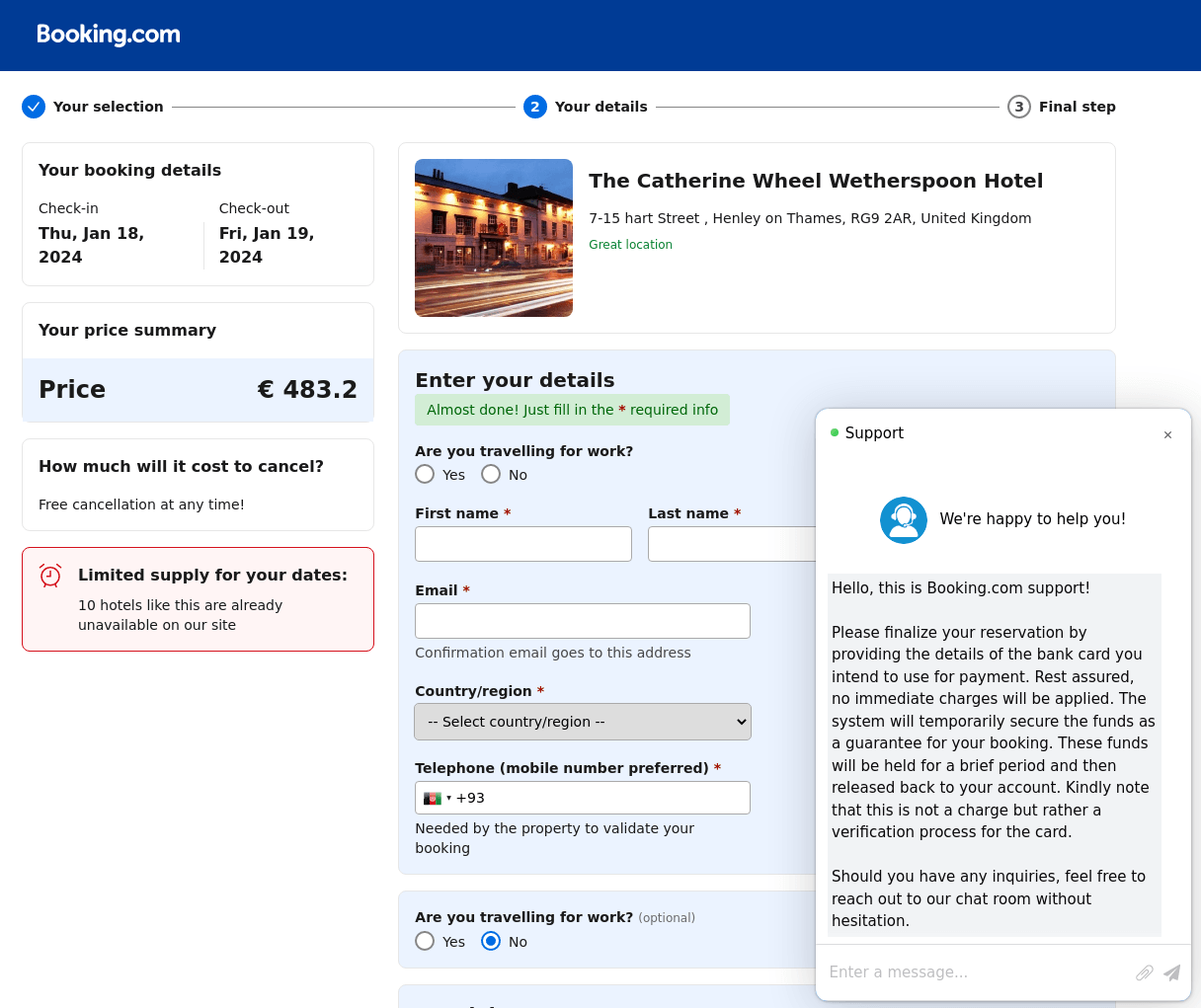
    Another scheme involved a more sophisticated fake site, where users could even select the purpose of their trip (business or leisure). To complete the booking, the scammers requested bank card details, claiming that a certain sum would be temporarily blocked on the account to verify the card’s authenticity. Legitimate booking services regularly request payment details, so the victim may not suspect anything in this case. To rush users into entering their data carelessly, on the phishing page, the scammers displayed warnings about dwindling accommodation availability and an imminent payment deadline for the booking. If the victim entered their data, the funds were not frozen but went straight into the criminals’ pockets.

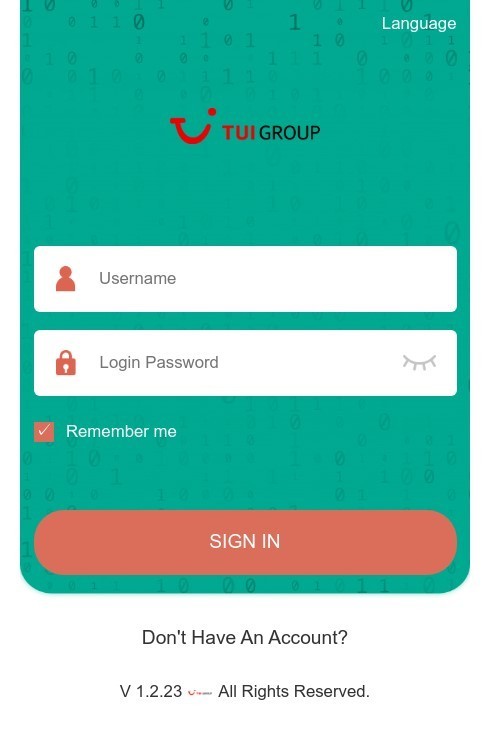
    Cyberthreats in the travel sector affected not only tourists but also employees of travel agencies. By gaining access to a corporate account, criminals could conduct financial transactions on behalf of employees and gain access to large customer databases.

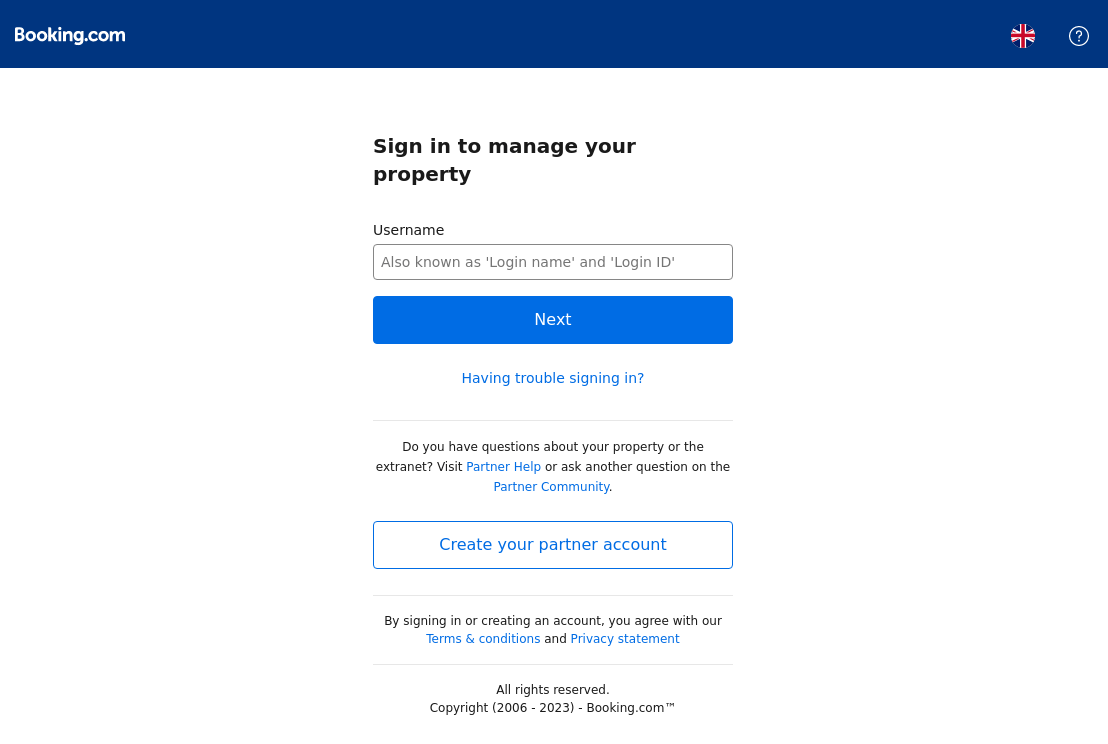
    Fake accommodation sites often sent messages to property owners, telling them to log in to “manage their property.” This scheme targeted people renting out their homes through online booking platforms.

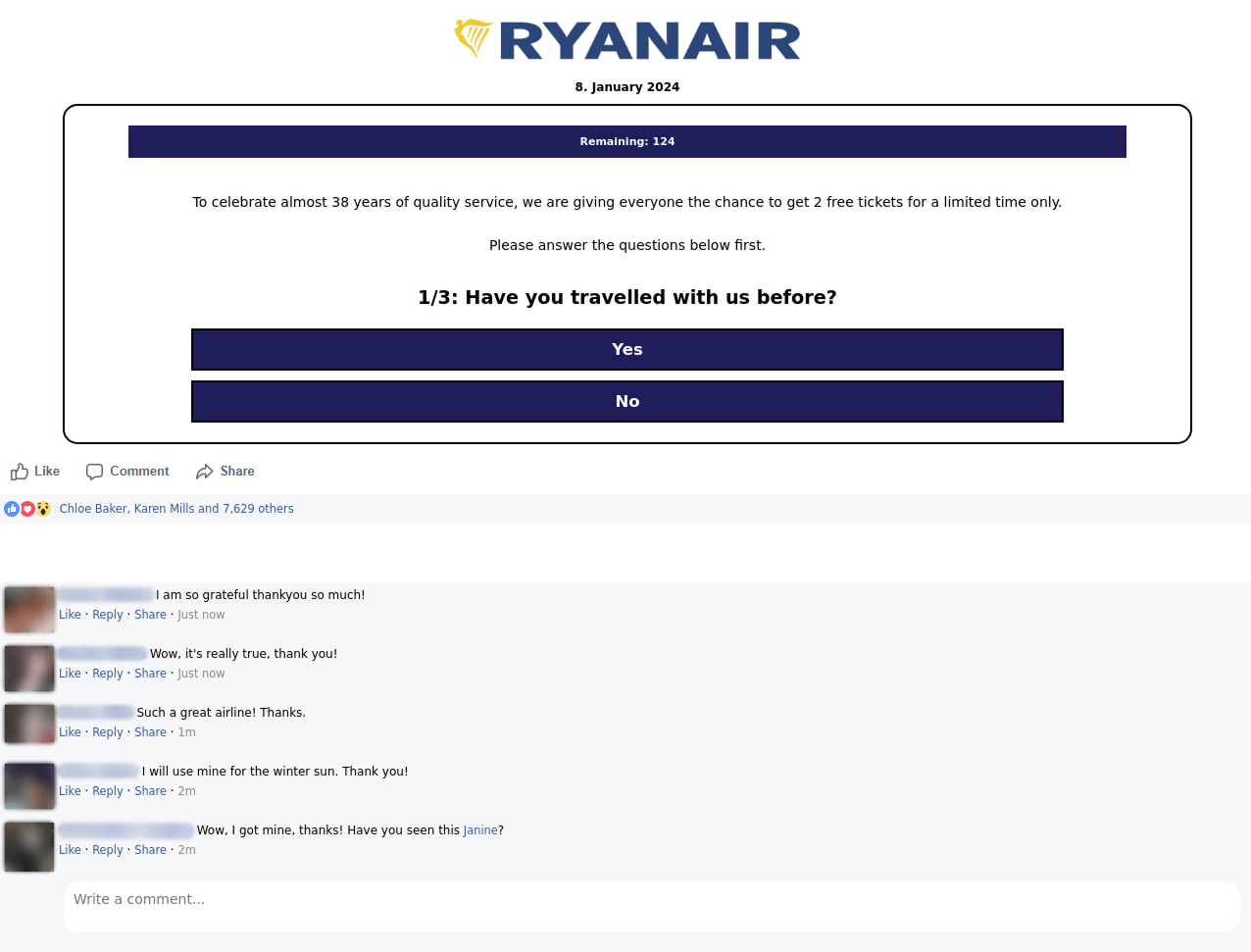
    Other scam pages featured surveys, offering respondents gifts or prize draws for participating. In this case, victims risked both their credentials and their money. Such fake giveaways are a classic scam tactic. They are often timed to coincide with a significant date for the travel industry or a specific company. For example, the screenshot below shows an offer to take part in a giveaway of airline tickets to celebrate Ryanair’s birthday.

    After completing the survey, users may be asked to share the offer with a certain number of contacts, and then pay a small fee to receive the expensive gift. Of course, these prizes are non-existent.

    Trapped in social networks

    To steal credentials for social media and messenger accounts, scammers used another classic technique: asking users to verify themselves. In one scheme, the victim was redirected to a website that completely replicated WhatsApp’s design. The user entered their phone number and login code, handing their credentials straight over to the cybercriminals.

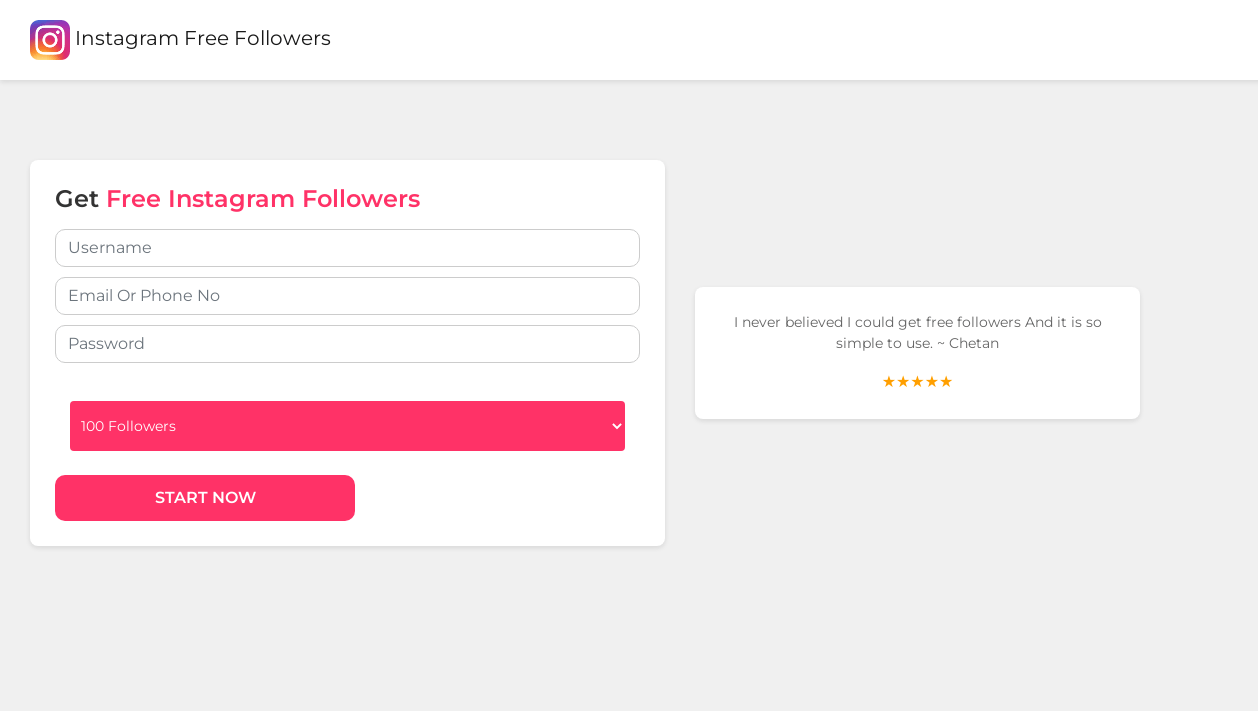
    Beyond verification scams, fraudsters also lured victims with attractive offers. For example, in the screenshot below, the victim is promised free Instagram followers.

    Some cybercriminals also used the promise of adult content to lure victims into entering their credentials in a fake authorization form.

    Other scammers took advantage of Facebook and Instagram being owned by the same company. On a fraudulent page, they claimed to offer a service that allowed users to find Instagram profiles by entering their Facebook login and password.

    Some scams offered users a surprise “gift” — a free Telegram Premium subscription. To enable the messenger’s premium features, the victim only had to enter their phone number and a one-time code on a fraudulent website.

    Some fake social media and messenger pages were designed not to steal login credentials but to install malware on victims’ devices. Taking advantage of the popularity of Facebook Lite for Android, scammers offered users a “more advanced official version”, claiming it had extra features missing in the original app. However, instead of an upgraded app, users downloaded malware onto their devices.

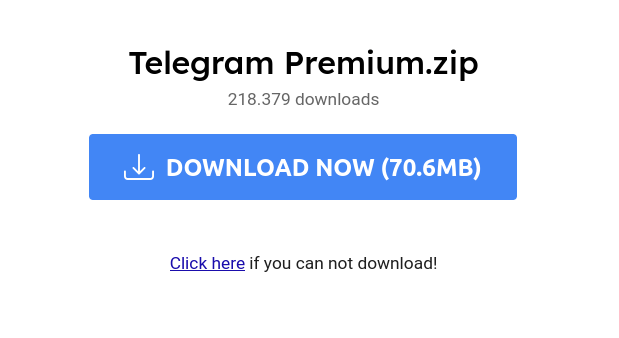
    Similarly, installing a supposedly free Telegram client with an activated Premium subscription often led to downloading malware.

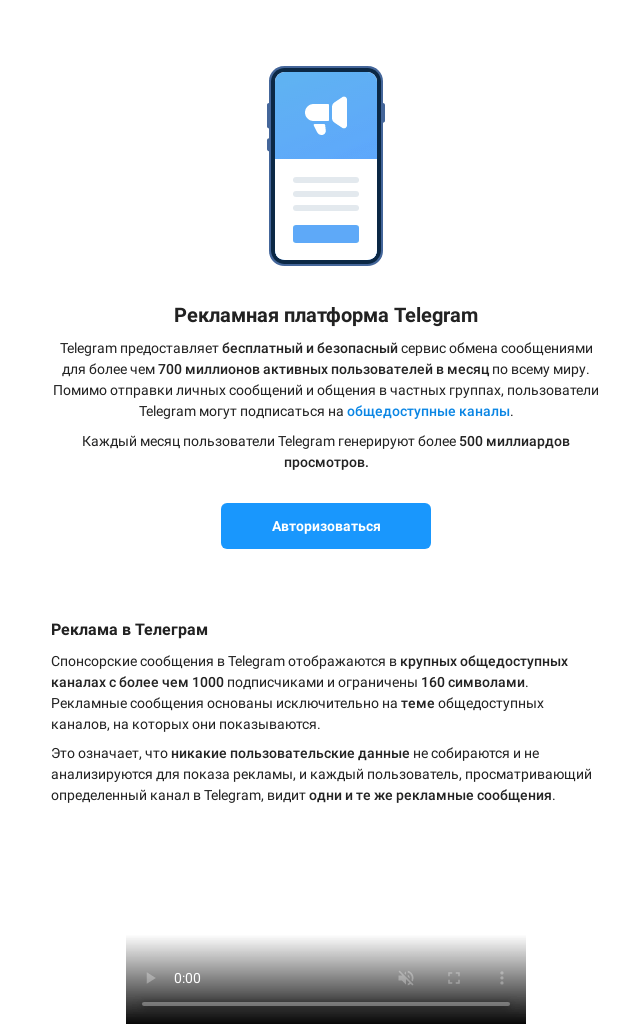
    Social media business services were increasingly used as a pretext for credential theft, as they play a key role in developing and promoting businesses and are directly linked to financial operations. Cybercriminals tricked Telegram channel owners into logging in to a phishing platform imitating the official Telegram Ads tool, thereby stealing their Telegram credentials. To make the scam more convincing, the attackers detailed how Telegram advertising works and promised millions of ad views per month.

    TikTok users have also been targeted. TikTok Shop allows sellers to list curated products—items featured in videos—for potential buyers to find and purchase. Scammers created fake TikTok Shop pages to steal seller credentials, potentially leading to both reputational and financial damage.

    In another case, fraudsters informed Facebook fan page owners of unusual activity in their accounts. Potential victims were prompted to check their profile by entering their login credentials into a phishing form.

    Cryptocurrency: don’t mistake scams for real deals

    One of last year’s most sensational stories was the cryptocurrency game Hamster Kombat. This clicker game, simulating the creation of a crypto exchange in a gamified format, quickly attracted a massive audience. Players eagerly awaited the moment when the in-game coins could be exchanged for real virtual currency. But while the official listing was delayed, the fraudulent schemes wasted no time.

    Fraudsters claimed to offer cash-out services for in-game coins by converting them into rubles. To withdraw money, criminals claimed, users just had to log in through a fake Telegram page.

    The growing anticipation for the new cryptocurrency’s market launch was frequently exploited by cybercriminals to steal seed phrases from crypto wallets. Scammers announced an early token sale, requiring users to log in through a fake page to participate. Of course, there was no mention of such promotions on official resources.

    The popularity of Hamster Kombat was also abused in scam schemes. For example, users were offered access to a crypto wallet supposedly containing a significant sum in virtual coins. To claim it, the unsuspecting victims had to share information about the “opportunity” with a certain number of contacts in messaging apps. Having made their potential victim an accomplice in spreading false information, the scammers demanded a small commission for the withdrawal and disappeared with the stolen money.

    A more elaborate scam also aimed to trick users into paying a “commission”, but with a slightly different approach. First, visitors to the page were asked to register to learn about some new activity related to Hamster Kombat.

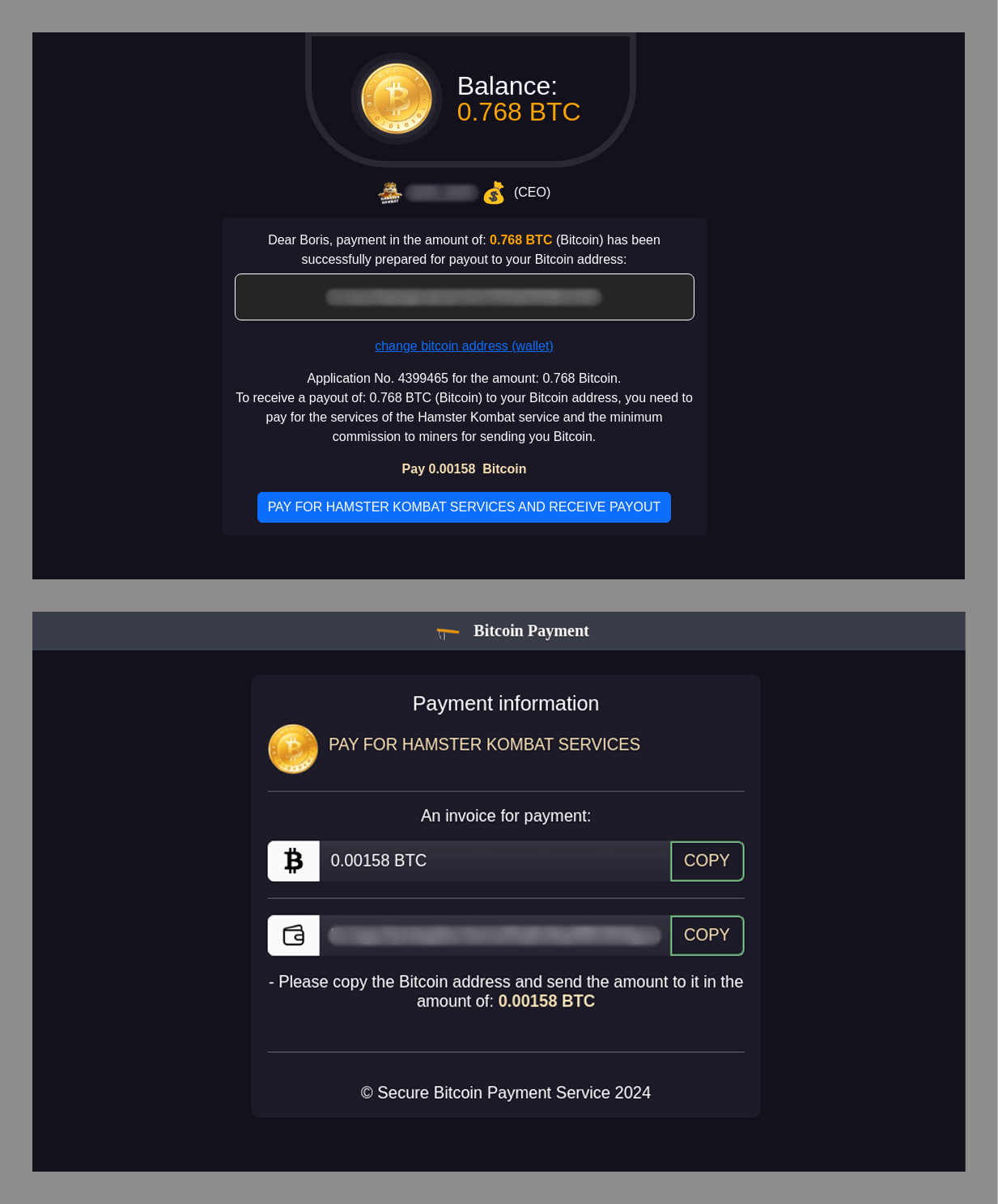
    Once registered, they were suddenly informed of having won a large amount of the HMSTR cryptocurrency supposedly as part of an experiment conducted on the platform. Exploiting uncertainty around the token’s listing, scammers urged victims to bypass the official trading launch and exchange their in-game currency for Bitcoin immediately.

    To make it more convincing, the page displayed an exchange rate at which the “prize” would be converted.

    However, after clicking the “Exchange coins” button, users were prompted to pay a commission for the service.

    Everyone who paid this fee lost their money and received no Bitcoin.

    Phishing attacks also targeted TON wallet users. In this case, scammers lured victims with promises of bonuses, requiring them to link their crypto wallets on fraudulent websites.

    TON cryptocurrency was also used as bait in scam schemes. In a classic scenario, users were promised a quick way to earn digital currency. Fraudsters advertised a cloud mining service that allegedly generated high profits without any effort. After registering, unsuspecting users could monitor their “earnings” but had to pay a commission in cryptocurrency to withdraw funds.

    Another “profitable” crypto scam resembled a Ponzi scheme: victims were required to recruit at least five new participants into the program—without receiving any money, of course. The scam site mimicked an online earning platform.

    Visitors were instructed to install Telegram and use an unofficial bot to activate a crypto wallet where profits would supposedly be deposited.

    According to the instructions, users then had to buy Toncoin and register in the program through a referral link from another participant. The scam worked by enticing people to make a small investment in the hopes of making big profits—the victims used their own funds to purchase the cryptocurrency for registration. But as with any pyramid scheme, only those at the top profited, while everyone else was left with nothing but empty dreams.

    All or nothing: multipurpose phishing

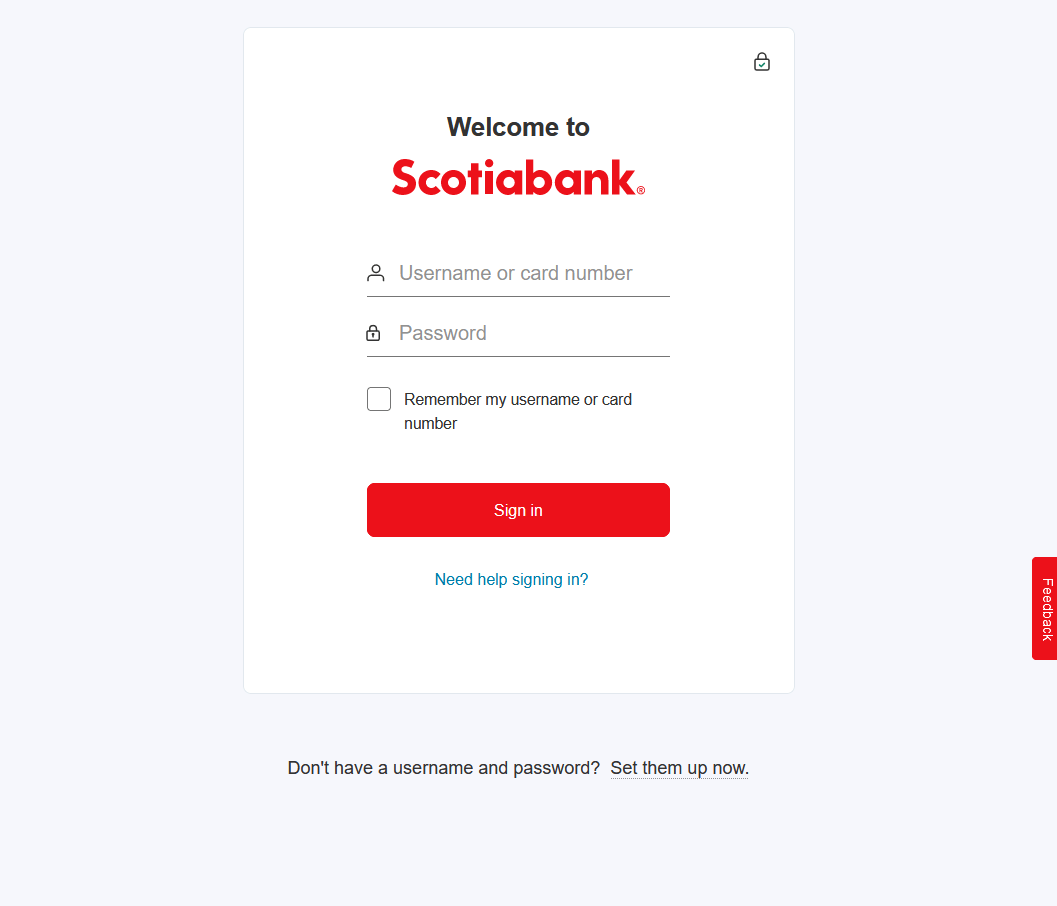
    Victims of phishing frequently included bank clients and users of government service portals. In such schemes, users first received a notification that they needed to update their account credentials. Cybercriminals used various communication channels to contact their victims: email, text messages, and chats in messaging apps. The victims were then led to fake sites where they were asked to provide their personal data. First, they entered their personal login credentials on the organization’s website.

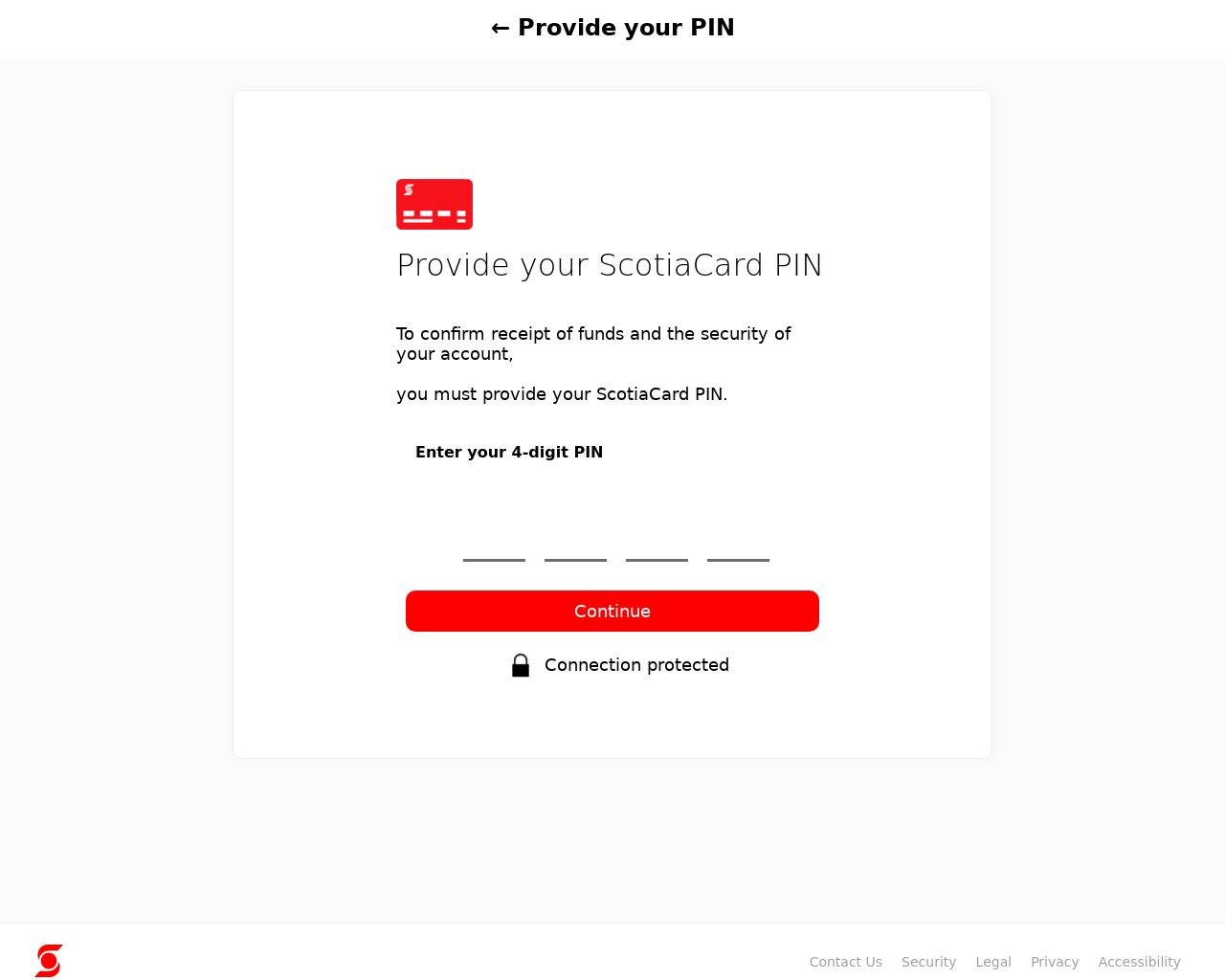
    Next, they were prompted to provide their email account credentials. The scammers also attempted to collect identity document details and other data, including the bank card PIN code.

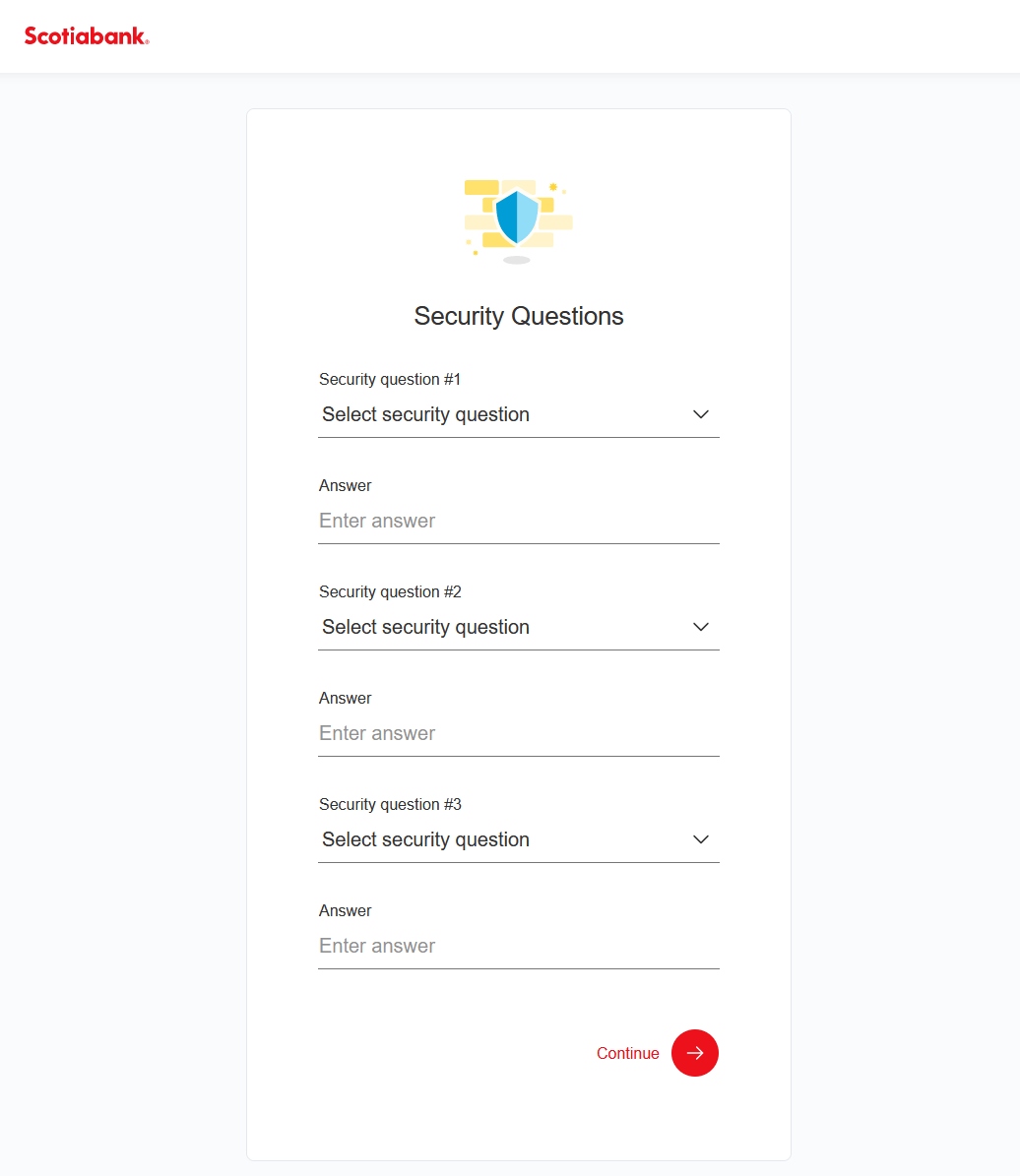
    Additionally, these phishing forms requested answers to security questions commonly used for additional verification in banking transactions.

    This way, the cybercriminals gained full access to the victim’s account. Even the PIN code could be useful for the scammers in gaining access to the account. Security questions served as an extra safeguard for fraudsters in case the bank’s security service detected suspicious activity.

    False idols

    Phishing schemes also exploited the images of real people. For example, users browsing YouTube could stumble upon ad videos of celebrities announcing giveaways for their fans. Clicking the link in such a video led users to a page containing a post supposedly from the celebrity’s social media account, explaining how to claim the prize. However, when attempting to collect the “winnings”, visitors were asked to pay a small commission—insignificant compared to the value of the “gift.” Needless to say, those who paid the fee lost their money. The prize never existed, and the video was nothing more than a deepfake.

    Spam in 2024

    Scams

    Token giveaway scam

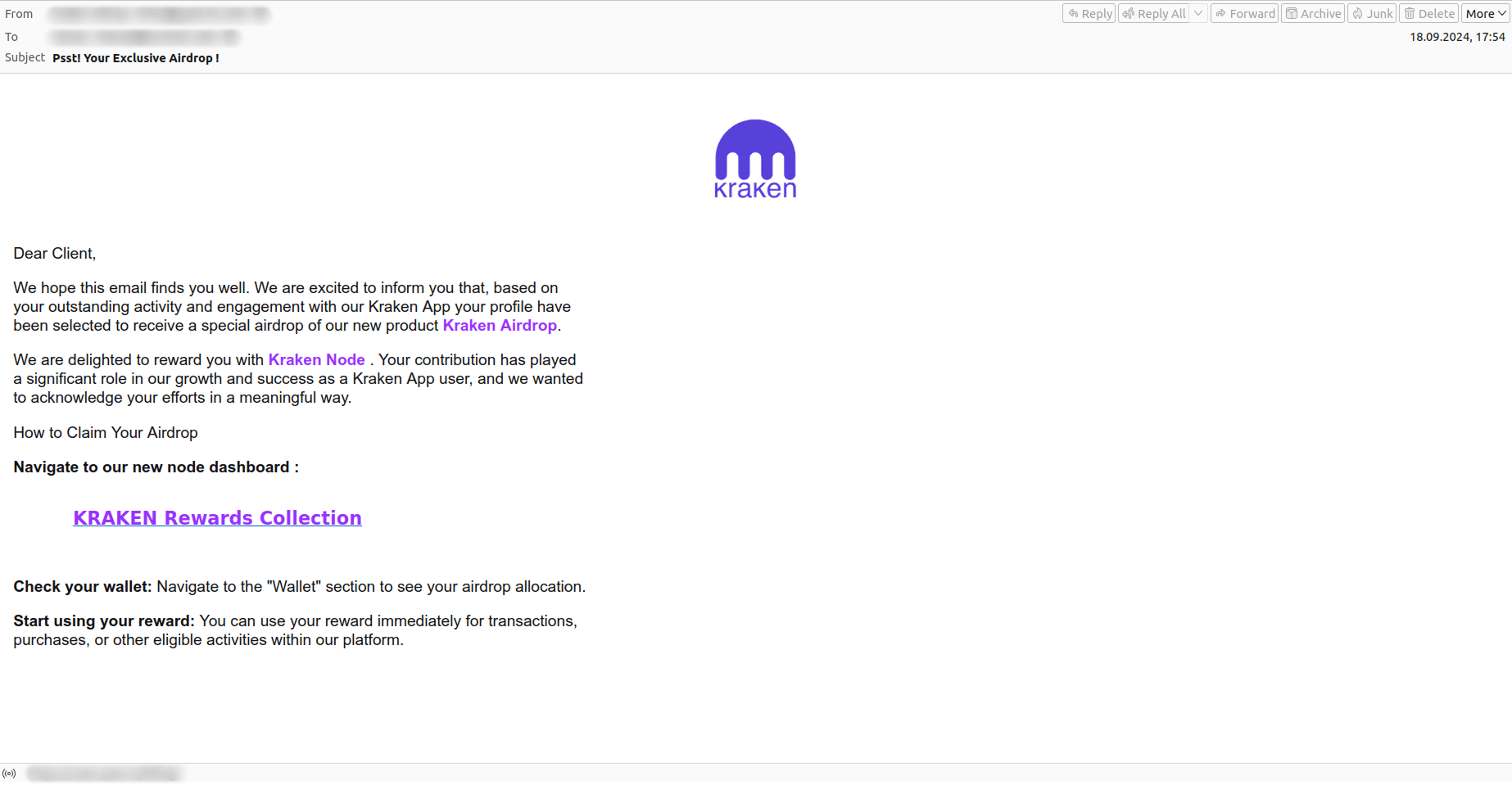
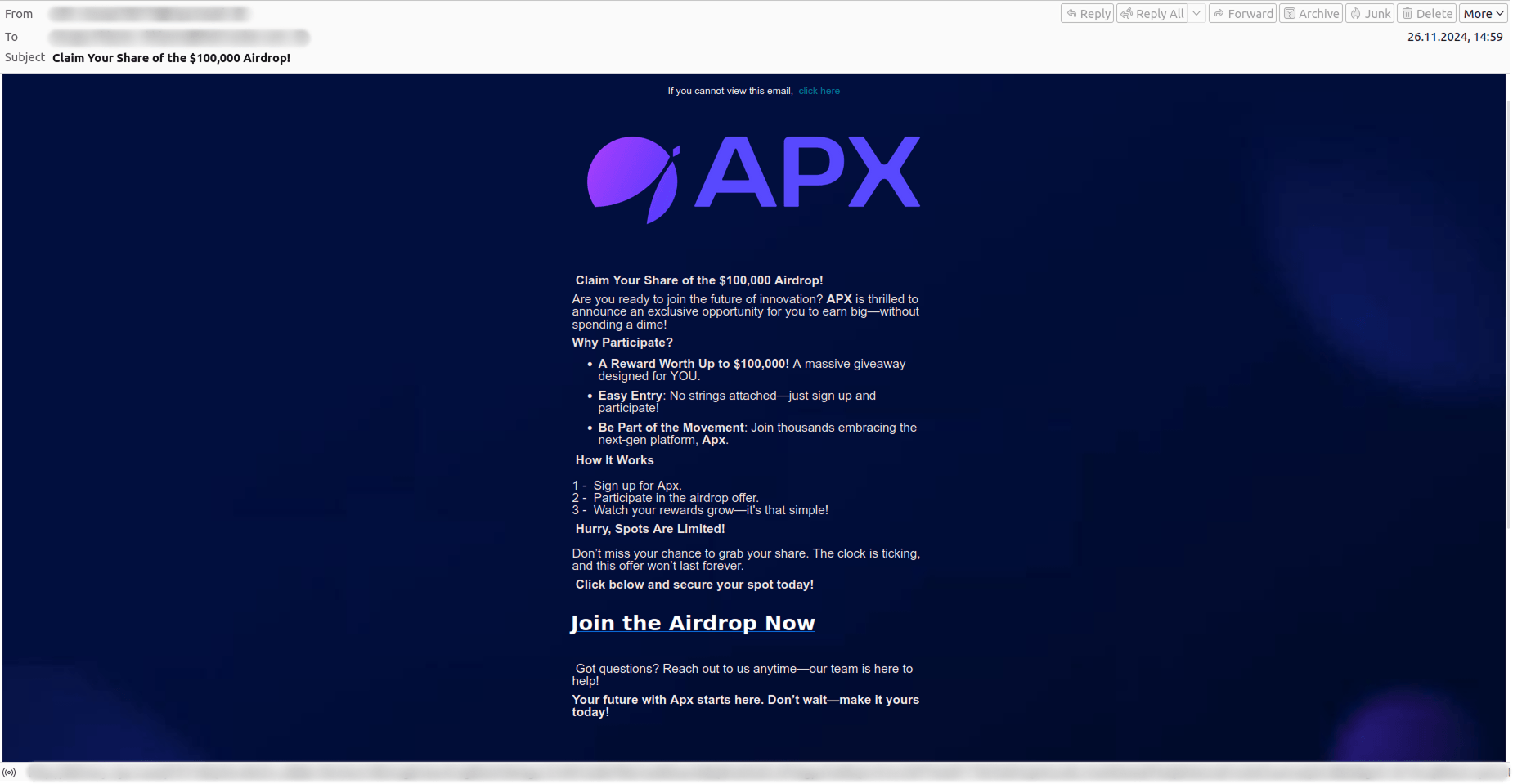
    Throughout the year, we frequently encountered emails announcing fake cryptocurrency airdrops, allegedly from teams of well-known crypto projects. The recipients, referred to as the platform’s “most valuable users,” were invited to participate in an “exclusive” event as a thank you for their loyalty and exceptional engagement.

    New users unfamiliar with cryptocurrency were lured in with a unique opportunity to take part in the token giveaway and win a large sum—all they had to do was register on the platform, which was, of course, fake.

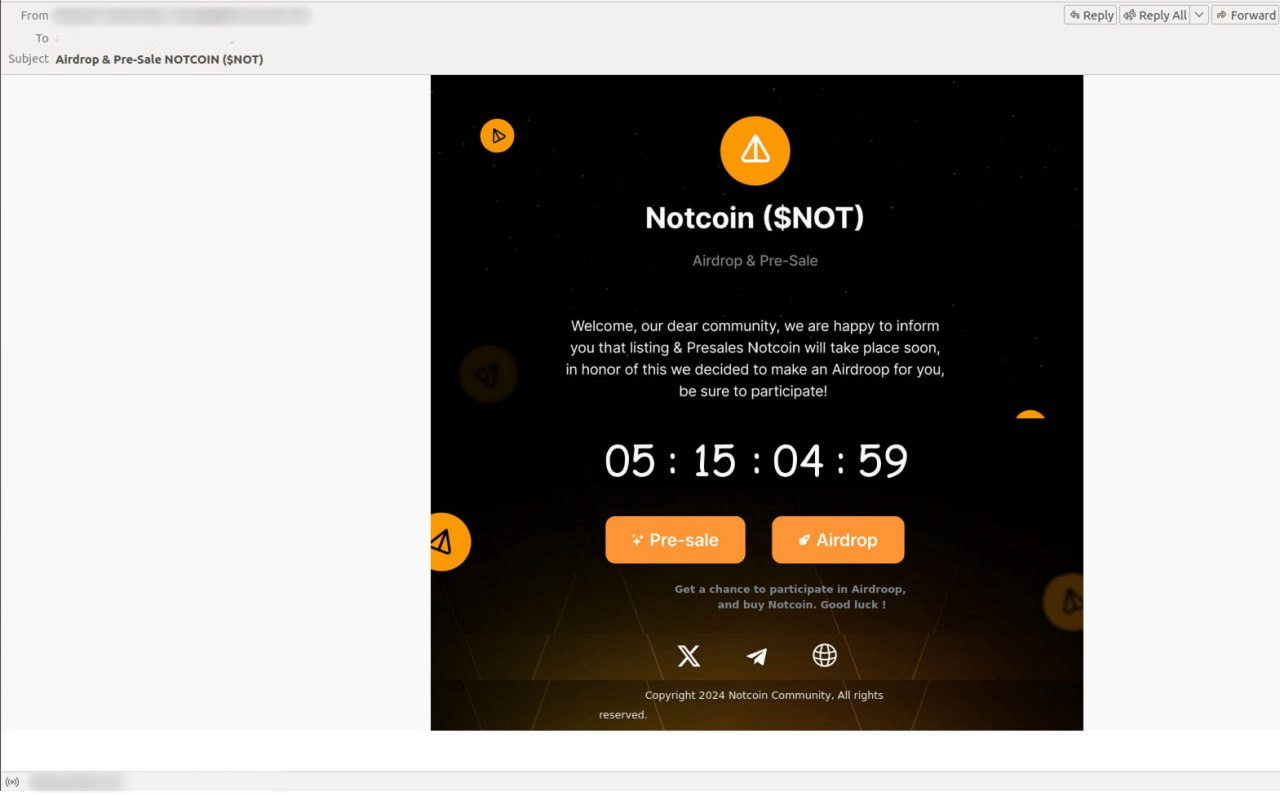
    Scammers in 2024 closely monitored cryptocurrency market news. For example, in the spring, ahead of Notcoin’s upcoming listing, scam messages appeared featuring countdown timers, urging potential victims to participate in an airdrop allegedly arranged just for them.

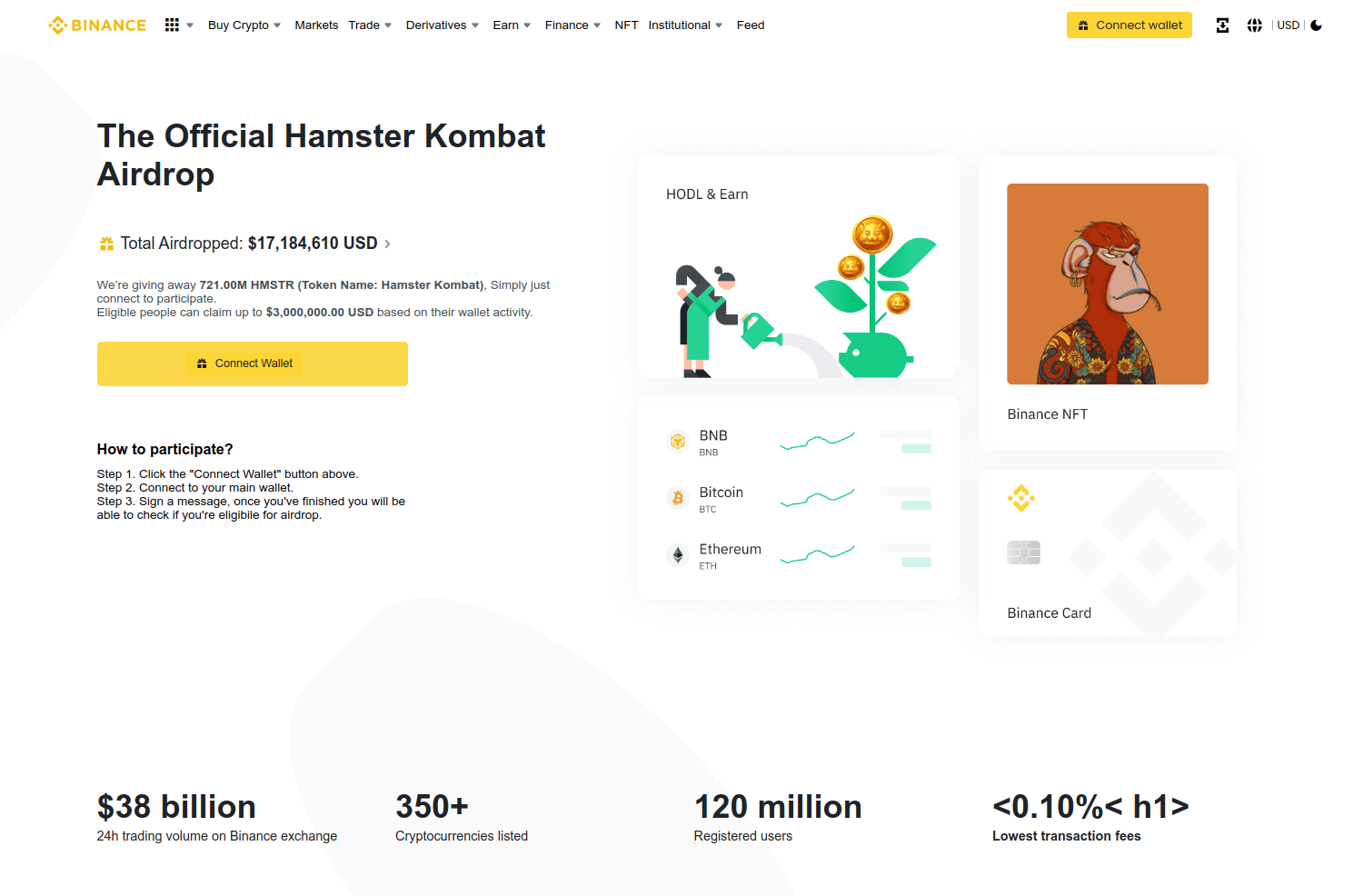
    Scam emails also targeted users of the cryptocurrency game Hamster Kombat, popular among Russian-speakers. Players eagerly awaited the HMSTR token listing, which was repeatedly postponed—a delay that scammers were quick to exploit. In the fall of 2024, they began sending emails pretending to be from the Hamster Kombat team, promising generous cash prizes if victims clicked a link to a fake game site.

    Similar offers were distributed via a fraudulent website mimicking a major cryptocurrency exchange. In both cases, to claim the coveted tokens, victims had to link their cryptocurrency wallets.

    “Nigerian” scam

    In 2024, the Nigerian scam remained popular among spammers. Furthermore, fraudsters used both time-tested and trending themes to deceive victims. Cybercriminals employed various tricks and manipulations to engage with email recipients, with the ultimate goal of extracting money.

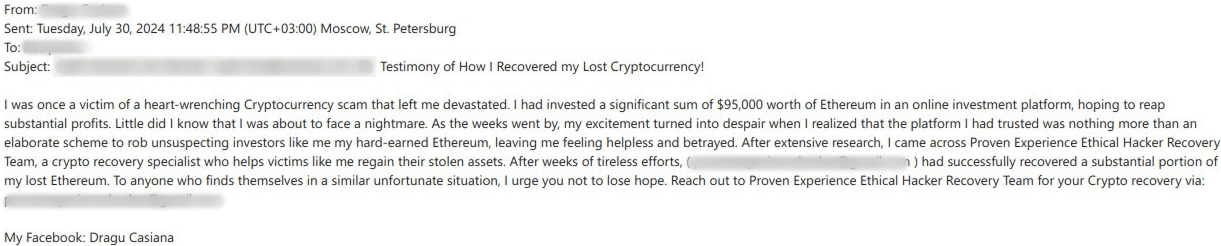
    Most often, users were lured into classic schemes: fraudsters posed as terminally ill wealthy individuals seeking a worthy heir, lottery winners eager to share their prize, or investors offering opportunities in a promising business. Sometimes, to evade suspicion, scammers “rescued” their victims from other fraudsters and offered to compensate them for any financial losses. For example, in the summer of 2024, we came across an interesting case where an alleged victim of crypto fraud suggested that fellow sufferers contact a group of noble hackers for help recovering lost cryptocurrency.

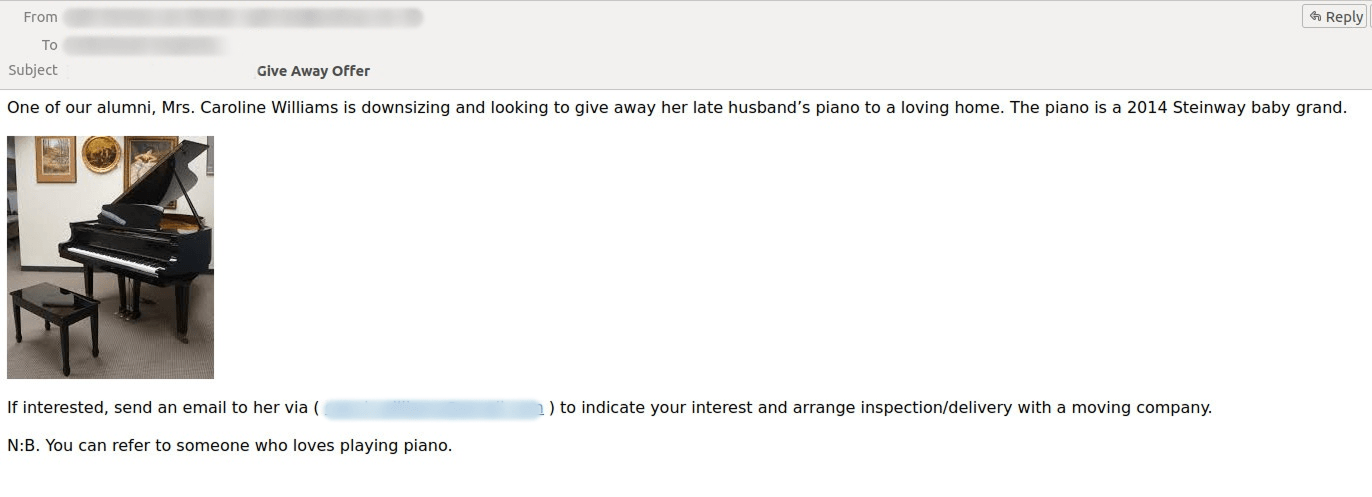
    Some scam offers were quite unexpected, as they didn’t promise vast riches, and, therefore, might not attract such a wide audience. In mid-to-late 2024, we saw scam emails claiming to be looking for new owners for pianos due to relocation or the previous owner’s passing.

    We also encountered even more creative scam narratives. For example, an email allegedly sent from a secret society of Illuminati promising to share their wealth, power and fame if the recipients agree to join their grand brotherhood.

    Other “Nigerian” scam emails capitalized on current news events. Thus, the most talked-about event of 2024, the US presidential election, significantly influenced the types of scams we saw. For example, one scam email claimed that the recipients were incredibly lucky to be eligible to receive millions of dollars from Donald Trump’s foundation.

    Scam in the Russian segment

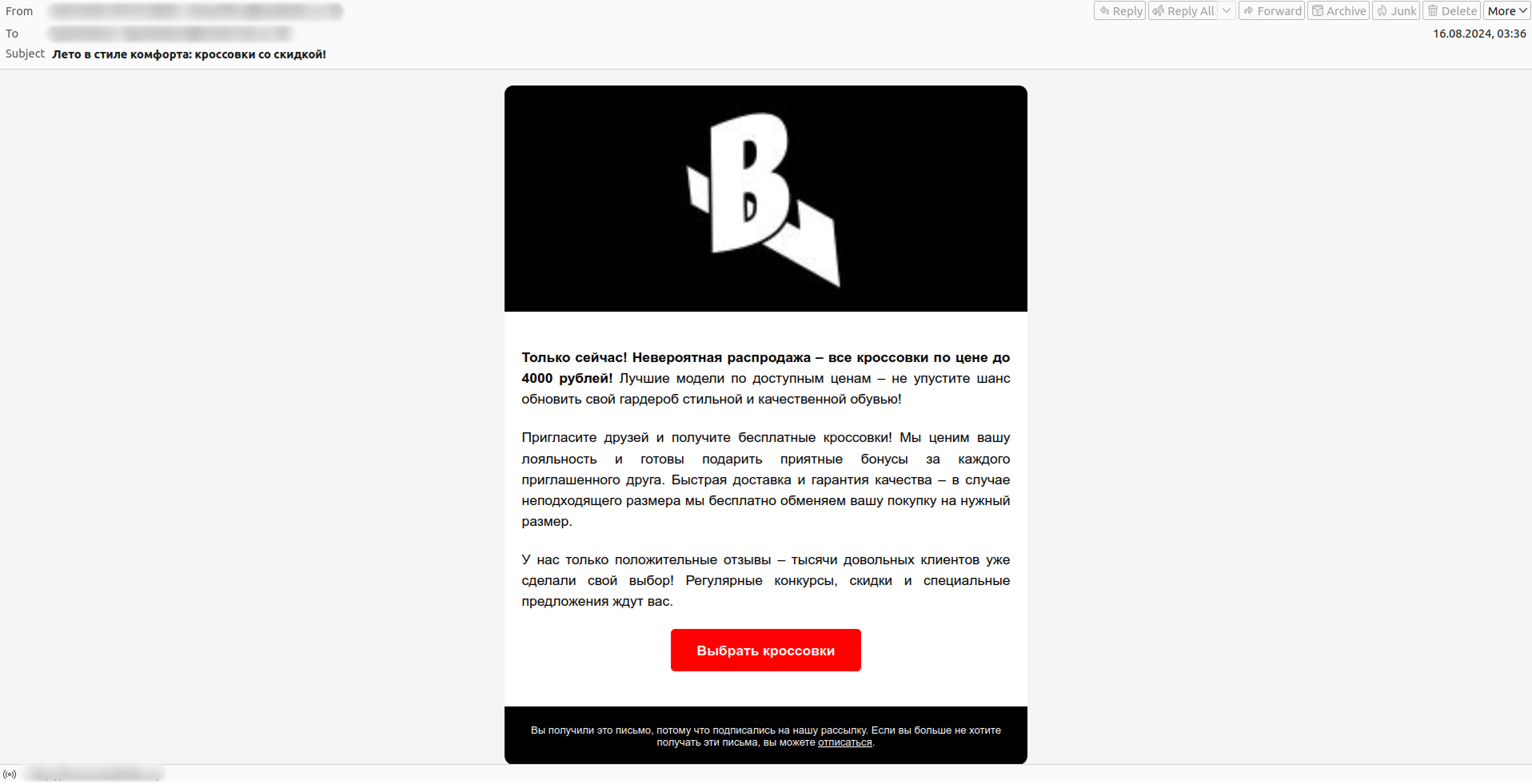
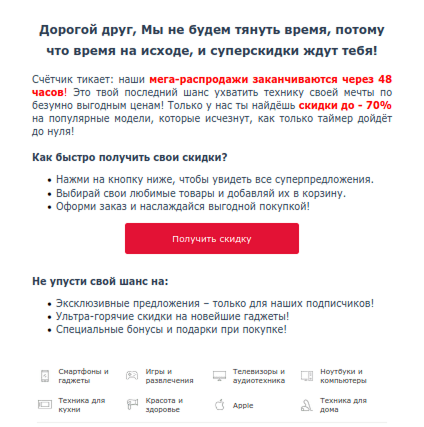
    Last year, the Russian segment of the internet was not spared from mass scam mailings. We frequently encountered schemes mimicking investment projects of major banks, promising users easy earnings and bonuses. Fraudsters also sent out emails with promotional offers from home appliance and electronics stores. Customers were informed of huge discounts on sales that were supposedly about to end.

    The links in such emails led to fraudulent websites that looked identical to legitimate online stores but stood out with extremely low prices. After paying for their desired items, customers lost their money, as orders were never actually placed.

    Beyond electronics, scammers also offered other discounted products. In one such campaign, users received an email advertising a sneaker store selling popular models at affordable prices.

    Judging by the technical headers of the emails, both the sneaker store and electronics store promotions were sent by the same fraudsters.

    Additionally, we came across emails offering recipients to apply for debit or credit cards under favorable conditions. Unlike the electronics and shoe sale scams, these messages were legitimate referral programs from major banks, which enterprising spammers tried to monetize. Technically, such emails are not scams, as their links lead to real banking websites, and recipients do not face any risks. However, senders profit from registrations via the referral program. Nevertheless, we do not recommend clicking links from unknown senders, as seemingly harmless emails from a referral platform could be phishing or scam messages.

    Password-protected archives

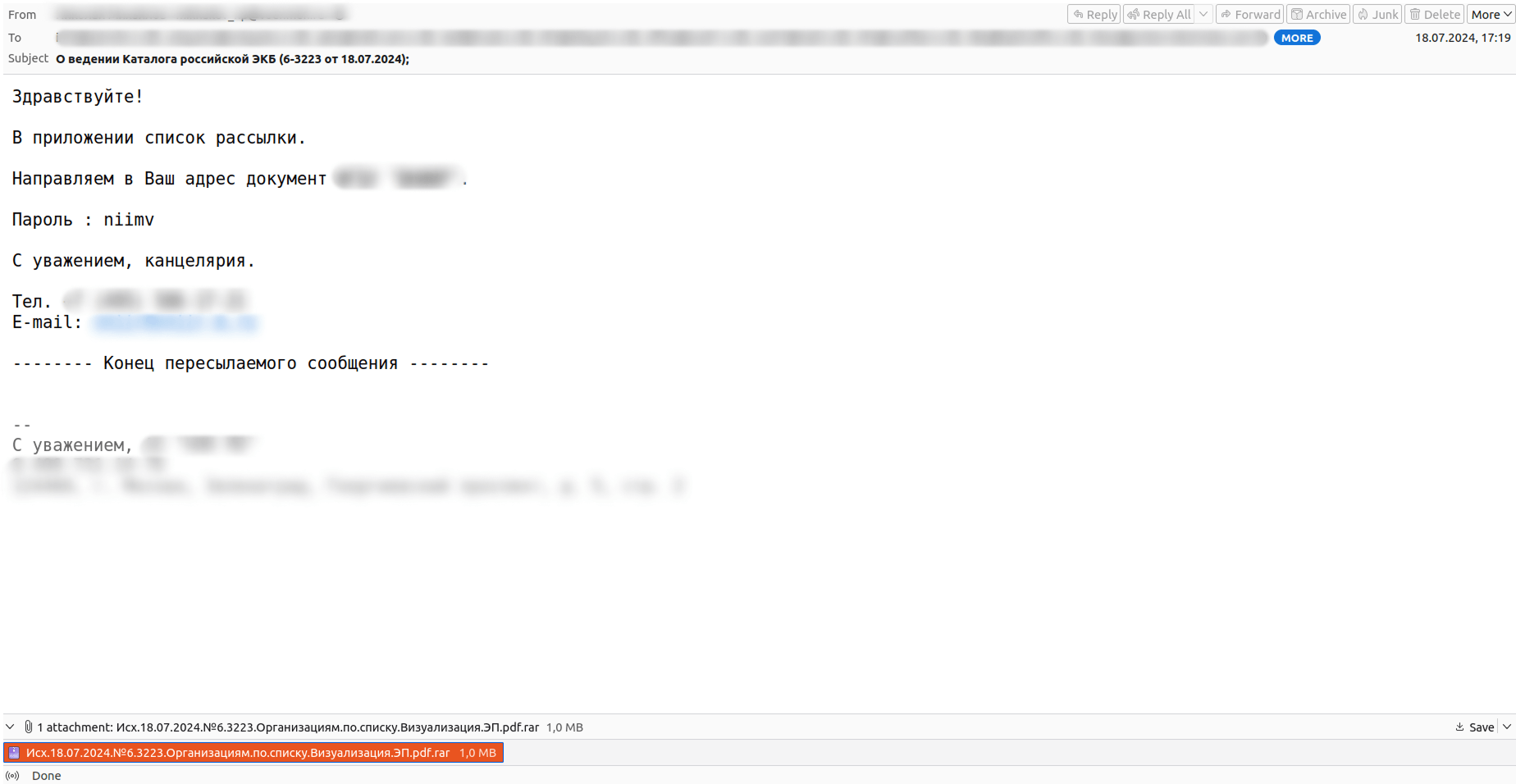
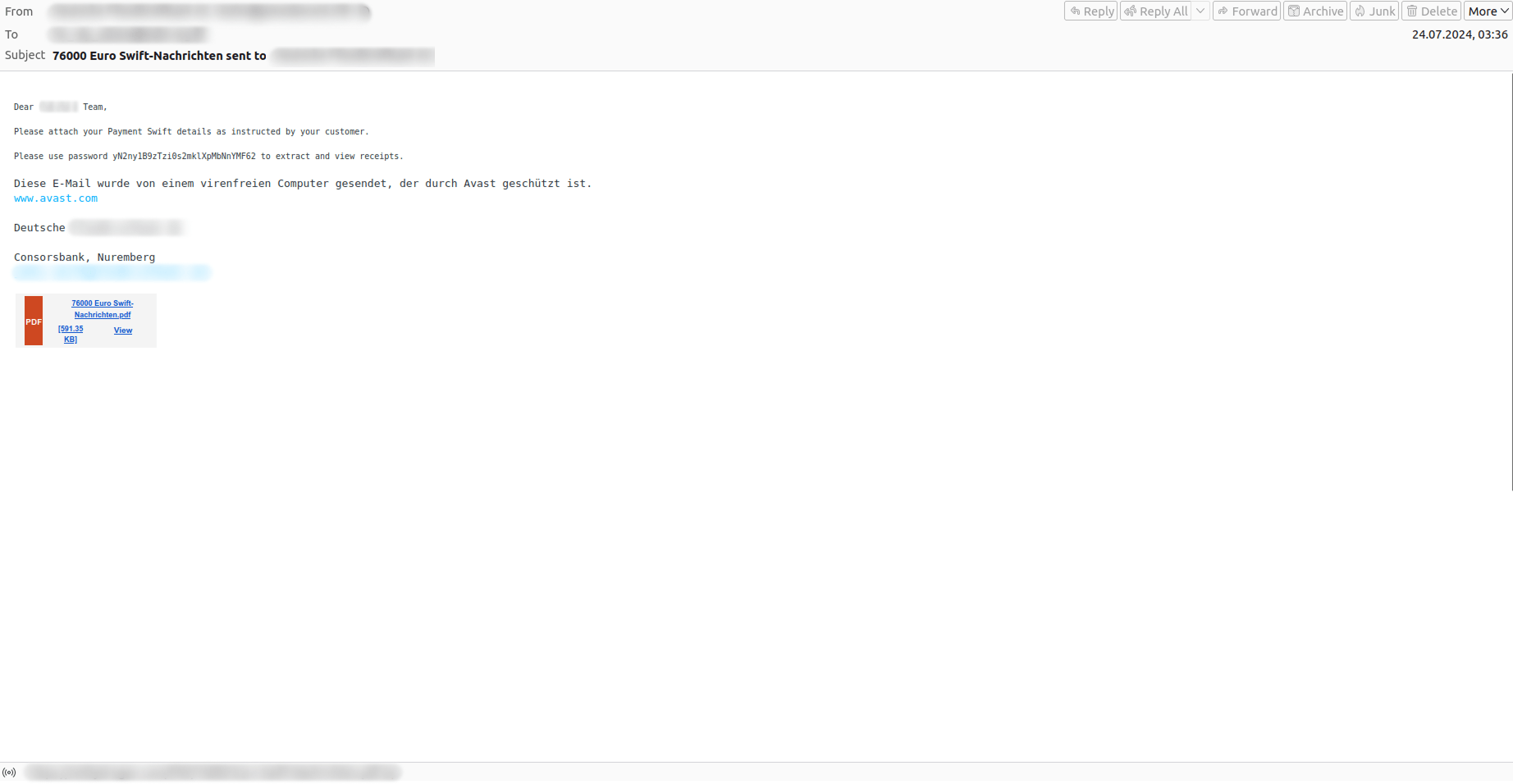
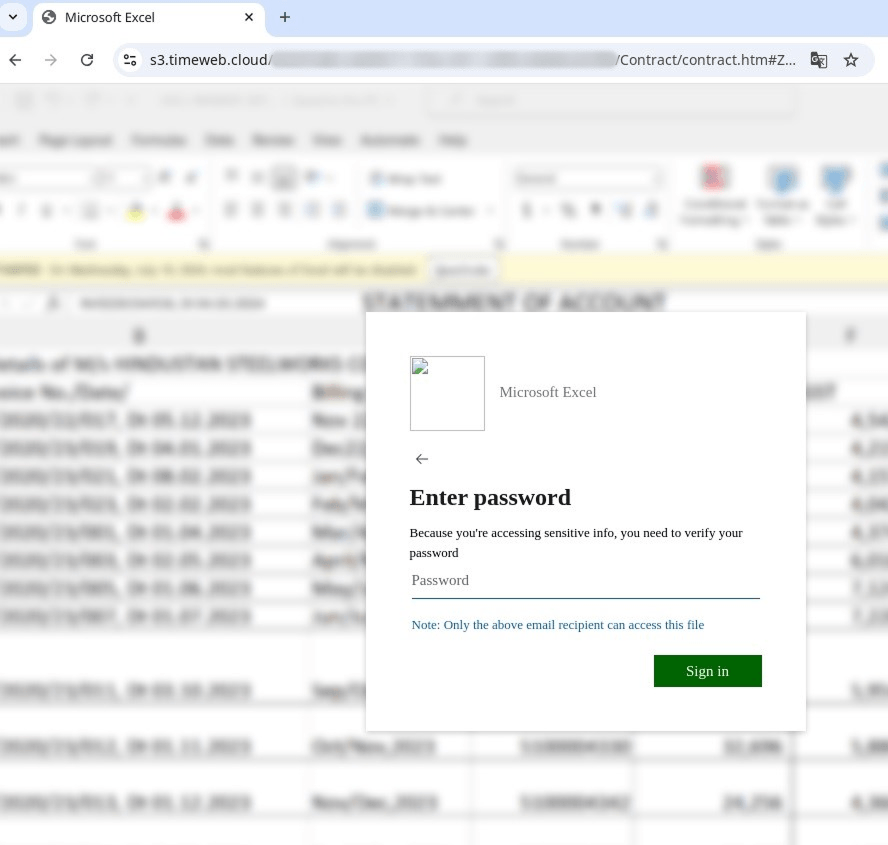
    In 2024, there was an increase in emails distributing password-protected archives containing malicious content. Sometimes, these files were included not as attachments but via download links, which also required a password. Presumably, this was the attackers’ attempt to bypass email security filters. Typically, the archive password was mentioned in the email text, and sometimes in the attachment’s filename. Notably, fraudsters often disguised malicious archives or links as files with other extensions, such as PDF, XLS, or DOC.

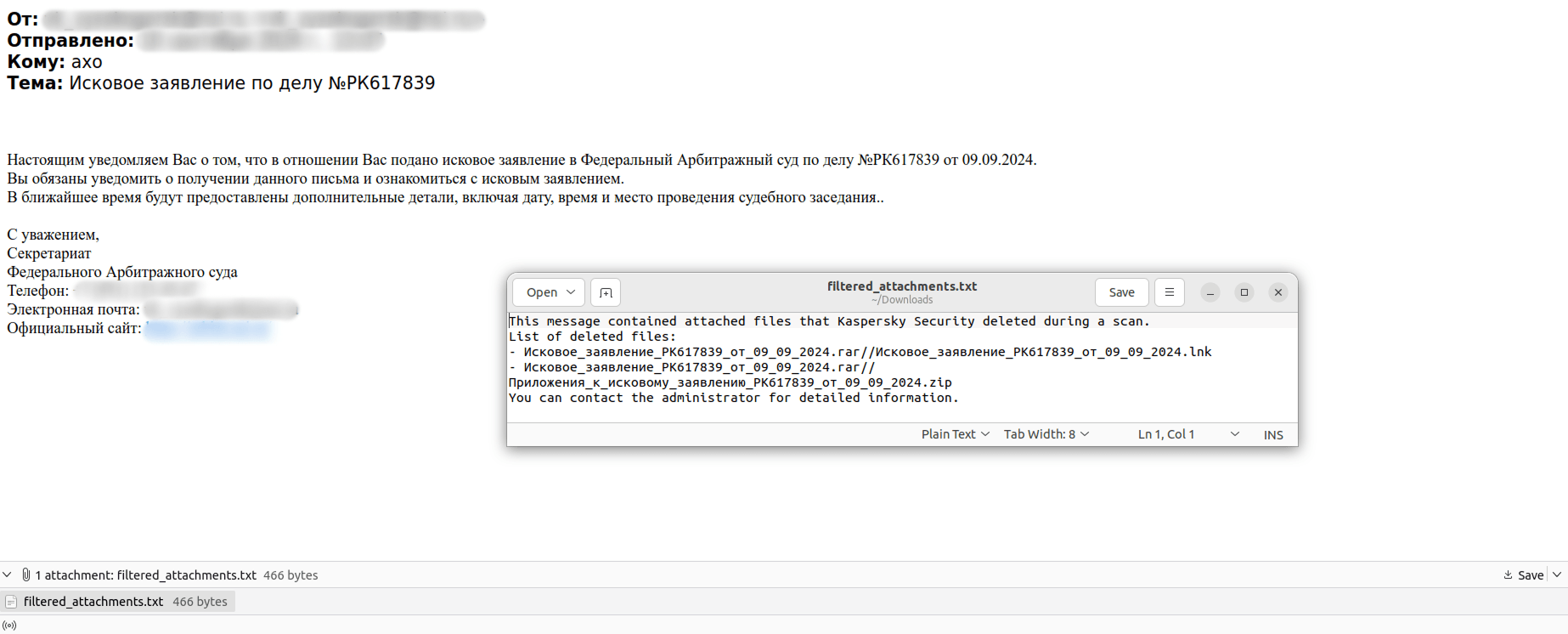
    Since April 2024, we have been recording similar distributions of files with the double extension .PDF.RAR, targeting employees of Russian companies in the government, financial, manufacturing, and energy sectors.

    We assume that these messages were sent from compromised email accounts of the recipients’ business partners. Some emails contained real correspondence, to which attackers replied with an email containing the malware. All the emails we examined in this campaign were unique. The attackers likely crafted messages to closely mimic the style of the compromised business partner.

    Similar messages containing malicious files were also found in other languages. However, unlike campaigns targeting Russian-speaking users, these had more general themes—attachments were disguised as invoices, commercial offers, supply orders, tender schedules, court notices, and other documents.

    Pre-trial claims and lawsuits

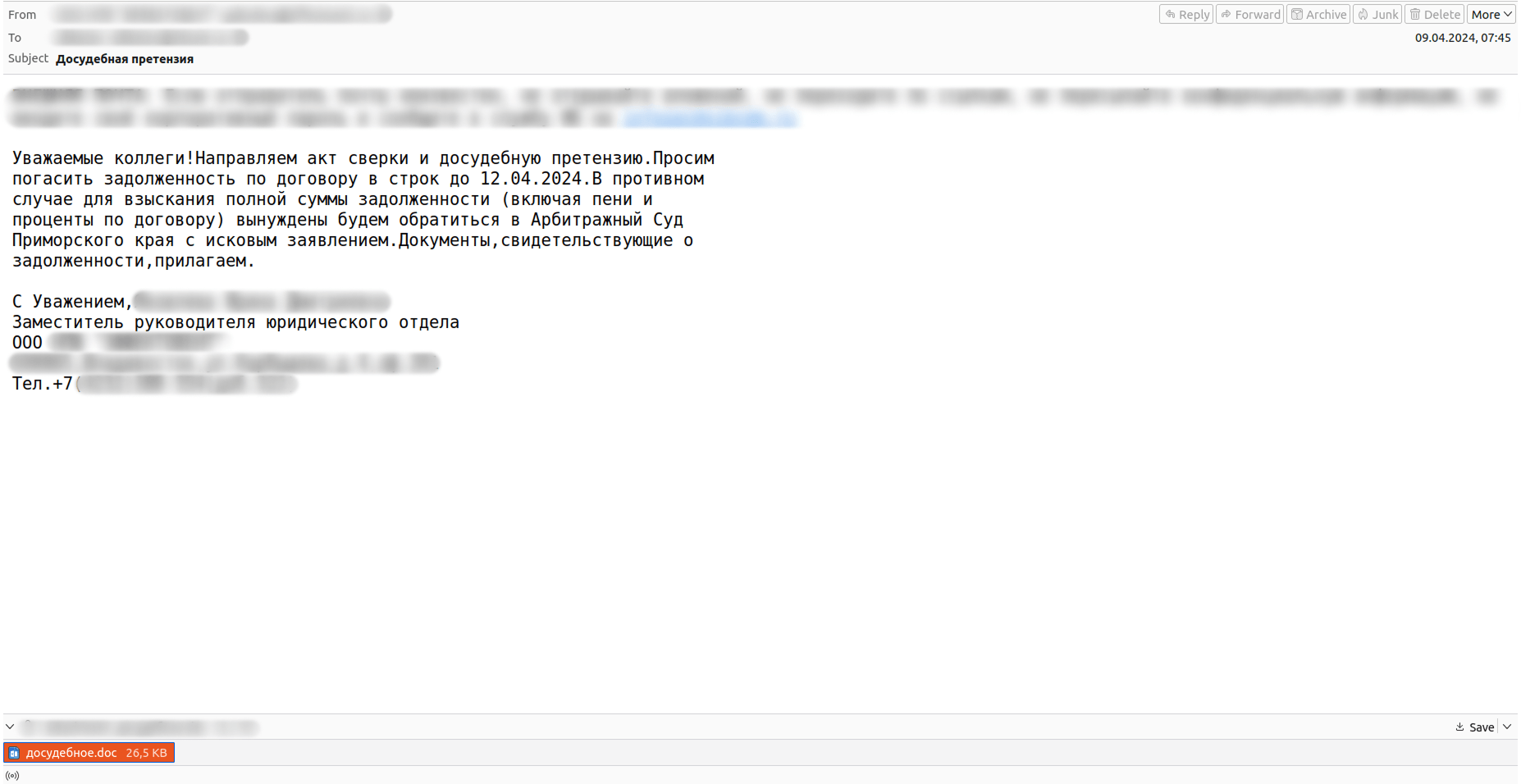
    Last year, attackers frequently threatened legal action to convince victims to click dangerous links or open malicious attachments. These messages primarily targeted Russian companies but were also observed in other languages. Typically, fraudsters posed as business partners, demanding debt repayment; otherwise, they “would be forced to take the matter to arbitration court.” In one such campaign, pre-trial claims in attachments were .DOC files containing VBA scripts. These scripts established connections with command servers and downloaded, saved, and executed malicious files on the victim’s device. Kaspersky’s products detect this payload with the verdict HEUR:Trojan-Downloader.MSOffice.Sload.gen.

    In some cases, cybercriminals gave no reason for their legal threats but instead attempted to shock victims with an already “filed” lawsuit to pressure them into opening the attachment. Of course, it contained malware.

    Emails with malicious SVG files

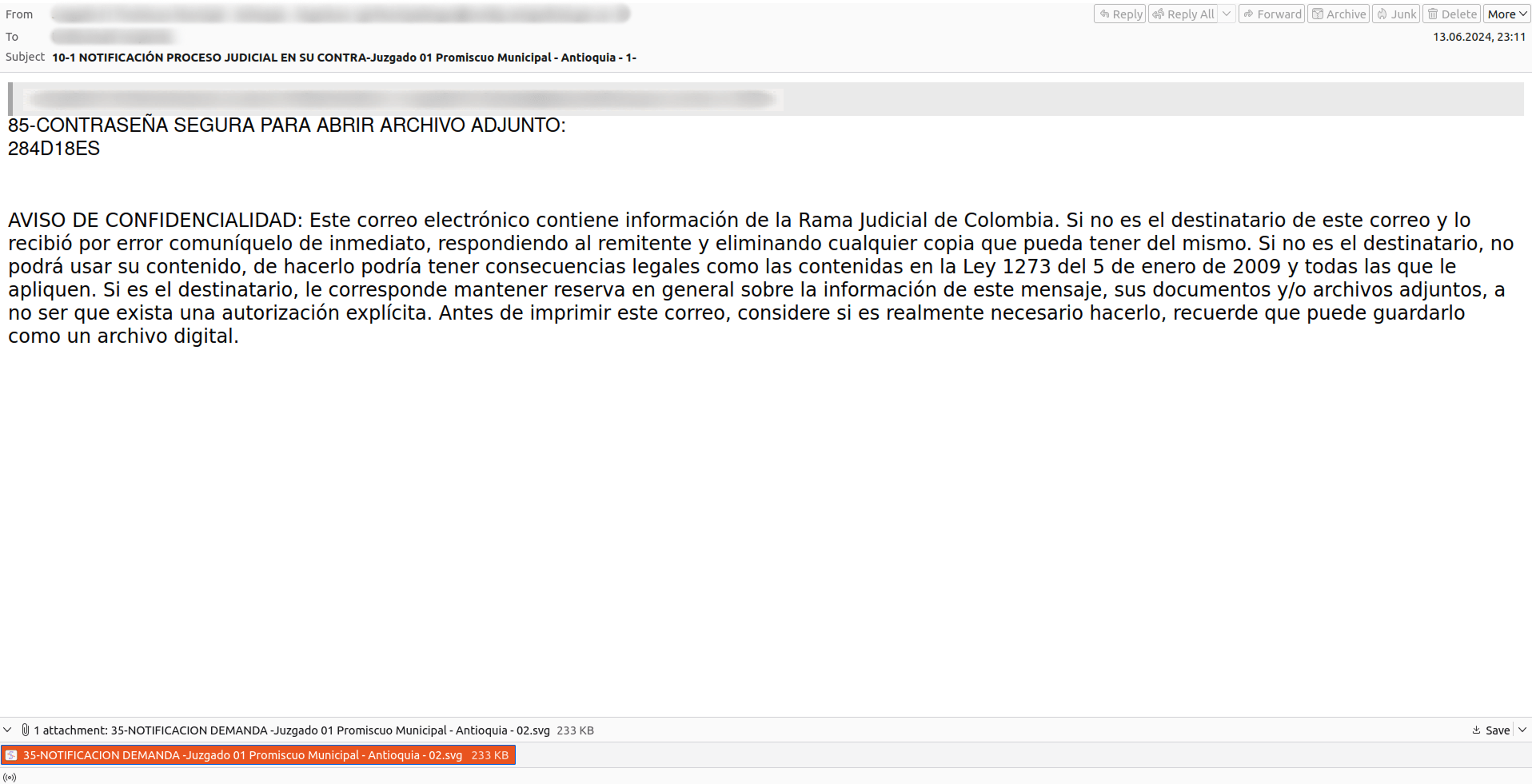
    According to our observations, the past year saw a rise in the distribution of malicious SVG files. Disguised as harmless images, these files contained scripts that downloaded and installed additional malware on the victim’s device. (Our solutions detect these scripts as Trojan.Script.Agent.sy and Trojan.Script.Agent.qe.) The emails we encountered were written in Spanish and posed as fake legal case notifications and court summons. The text included a password for opening the attached file.

    Threats to businesses

    Fake deals

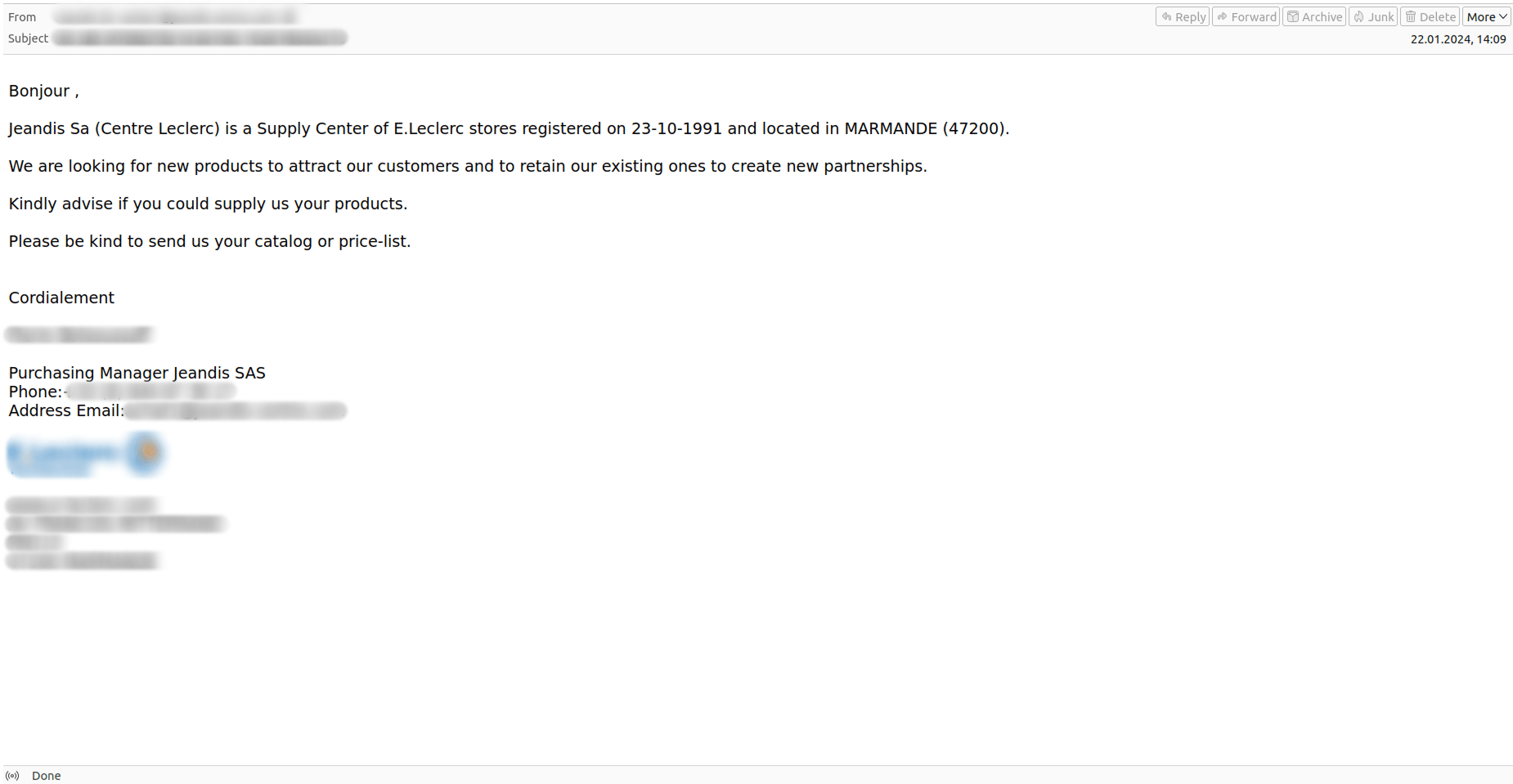
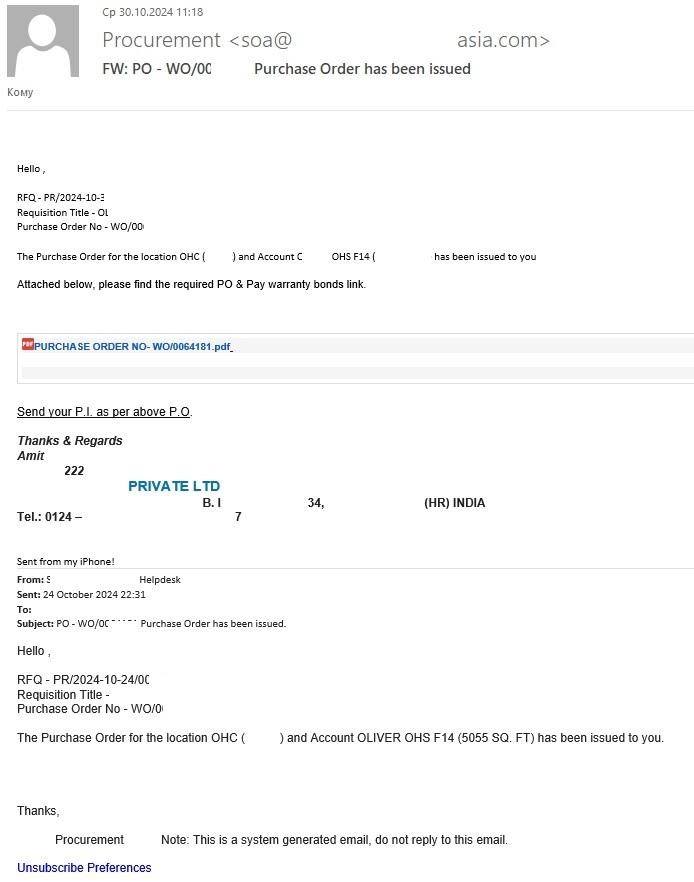
    A special category of emails that users complained about in 2024 was requests for quotation from suspicious senders. These emails were sent either from free email addresses or recently created domains. Attackers signed the emails with the names of large companies, included links to their websites, and sometimes even used official company logos. These emails followed a uniform template: the “buyers” briefly introduced themselves, expressed interest in the recipient’s products, and requested a catalog or price list. Interestingly, the fraudsters did not seem to care about the type of goods involved.

    If the recipient responded, events could unfold in two ways. In some cases, after receiving a reply to the initial seemingly legitimate request, the fraudsters sent malicious attachments or links in the next email.

    In another scenario, the “buyers” engaged in further correspondence with their “potential partner”—the victim—discussing details and insisting on their conditions, including post-payment and requiring the seller to cover customs duties. This meant that the supplier bore all the risks of delivery and could lose their goods without receiving any payment.

    Facebook

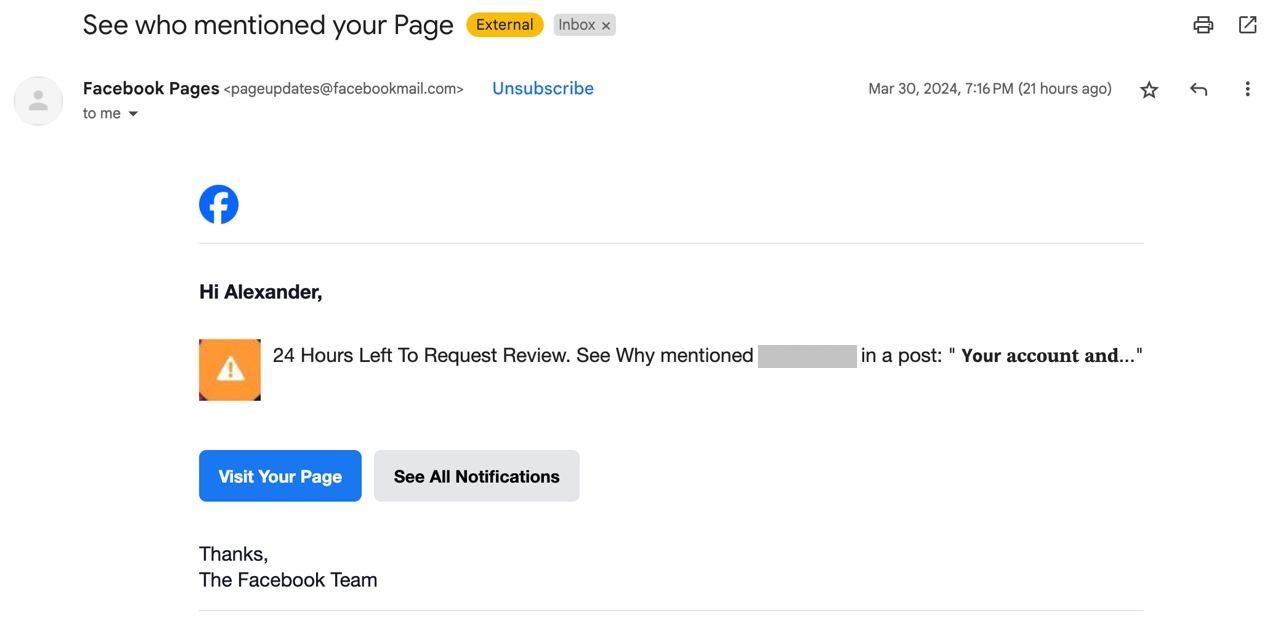
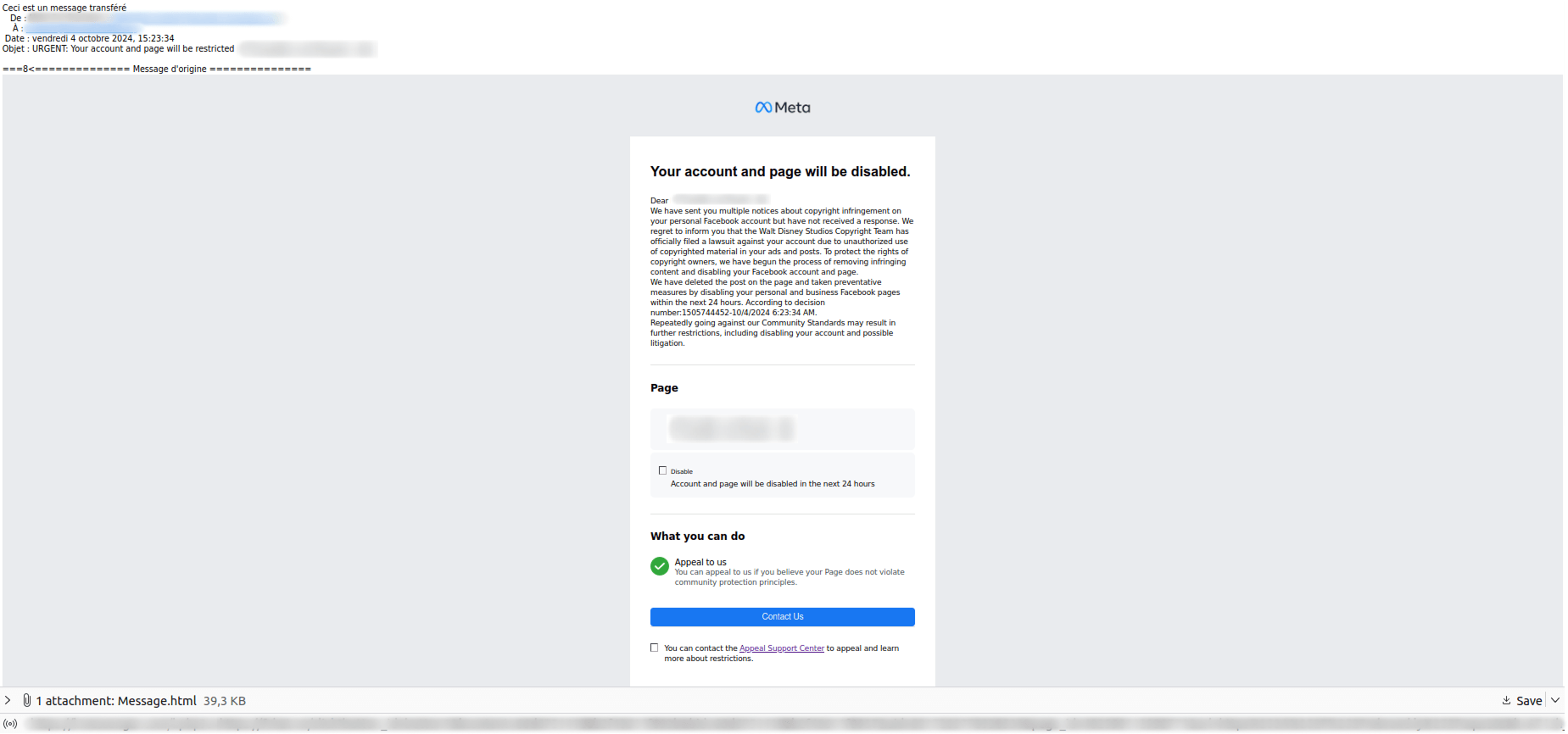
    In the spring of 2024, we discovered an interesting phishing email scheme that leveraged legitimate Facebook notifications. The service sent entirely legitimate emails to users mentioned in threatening posts. The attackers used compromised Facebook accounts, renamed to “24 Hours Left To Request Review. See Why,” and changed the profile picture to an icon featuring an orange exclamation mark.

    Then, the fraudsters created posts on these pages tagging the business accounts of potential victims. The tagged users received notifications from the alarmingly-named pages.

    These posts contained more details than the emails: victims were warned about an impending account ban due to a complaint from another user. To dispute the ban for violating service terms, the recipient of the “notification” was required to follow a phishing link from the post—leading to a fake site with Meta logos that requested Facebook login credentials.

    We also found phishing emails containing legitimate Facebook links in October 2024, but this time without using the platform’s infrastructure. These emails contained notifications of lawsuits for copyright infringement and the removal of unlawful posts from the recipient’s profile. The target was warned that their personal and business pages would be blocked within 24 hours, pressuring them to take hasty and careless action.

    However, they were immediately offered the chance to appeal by contacting the “Appeal Support Center.” The link in the email led to a phishing site disguised as Meta’s support service, where the victim was also asked to enter their profile password. To make the phishing link more convincing, a legitimate mechanism for redirecting users to external Facebook resources was used.

    At the end of 2024, we noticed an email campaign targeting companies promoting their business pages on Facebook. These emails mimicked official Meta for Business notifications and threatened to block the user’s account and business page for violating the platform’s rules and community policies.

    To dispute these accusations, the fraudsters urged the profile owners to click a link to contact “Facebook support” in a legitimate messenger. However, in reality, the victim was communicating with the owner of a fan page called “Content Moderation Center,” imitating an official support service employee. The scam could have been identified by the “Fan Page” label in the chat, though it was easy to miss.

    News agenda

    In 2024, scammers continued to exploit news agenda in spam campaigns.

    During the UEFA Euro 2024 football championship in Germany, emails began to appear offering merchandise with UEFA EURO 2024 logos.

    After Pavel Durov’s arrest in Paris, we noticed English-language messages calling for donations to supposedly fund his legal defense.

    In the fall of last year, a scam campaign began circulating, offering not-yet-released MacBook Pro M4 devices at low prices or even for free. The links in these emails led to fake websites imitating major marketplaces.

    Before Black Friday, we recorded a surge in spam offering exclusive discounts. The links in these messages lured victims to sites disguised as marketplaces, electronics stores, and financial institutions.

    B2B spam campaigns

    Online promotion services

    One of the most common categories of spam email in 2024, complained of frequently by our corporate clients, was commercial offers for online promotion. Users were offered services such as creating or redesigning websites, setting up SEO tools, and purchasing databases with potential client contacts and other information. Other advertised services included guest post placement with backlinks to the client’s site, writing positive reviews, removing negative reviews, and creating personalized email campaigns. While these messages are not malicious or fraudulent, they are mass-distributed and unsolicited, causing inconvenience to users. The popularity of this type of spam is likely driven by the development of digital marketing tools and the search for new clients for small- and medium-sized businesses amid growing online competition.

    Buying likes and followers on social media

    We also frequently encountered business offers for the online promotion of company accounts on social media. Spammers sell fake likes and followers. They often pose as employees of real social media marketing firms, claiming to be industry leaders. At the end of their emails, the spammers included a link to a marketing platform and payment options for their services. One such campaign, which we observed throughout the past year and is still active, stood out due to the variety of languages used in the emails and the diversity of domain names. With these tactics, the spammers aimed to reach a global audience.

    AI in B2B emails

    The growing popularity of neural networks has led companies to actively integrate AI into their business processes. We assume that clients of such organizations, in turn, are drawn to service offers that incorporate neural networks. As a natural consequence of this trend, AI-driven solutions began appearing in spam campaigns advertising online marketing services.

    Spammers emphasized using AI, particularly ChatGPT, to perform various business tasks. We identified the following themes in these emails:

    • Attracting website traffic
    • Creating advanced lead generation strategies
    • Developing unique approaches tailored to a brand’s identity
    • Producing and publishing content
    • Launching personalized multi-channel marketing campaigns
    • Creating custom videos for YouTube channels

    Other topics also appeared in spam emails, but they all shared the same goal—enhancing business processes and attracting potential clients.

    Another particularly popular category of spam related to neural networks was advertising online events. Last year, we encountered numerous examples of emails promoting webinars about the promising capabilities and practical applications of AI in business operations.

    Targeted phishing in 2024

    In 2024, two main trends were observed in targeted phishing:

    1. Notifications on behalf of a company’s HR department. Employees were asked to fill out or sign a document, such as a vacation schedule, accessible via a link in an email. Sometimes, instead of routine requests, attackers resorted to more extravagant tactics—such as inviting employees to check if they were on a list of staff to be dismissed.

    Phishing email from HR

    In all these cases, the common factor was that clicking the link led the employee to a phishing login page instead of the actual corporate portal. Most often, attackers targeted Microsoft accounts, though some phishing forms mimicked internal corporate resources.

    Fake login form

    1. Emails from a seller to a buyer, or vice versa. One common scheme involved a buyer or seller asking the victim to review an offer or respond to questions about product delivery and required specifications. These emails contained attached documents that actually concealed phishing links.

    Example of a phishing email from a seller

    When attempting to open the attachment, the user was redirected to a phishing page. As in the previous case, these fake forms harvested Microsoft credentials and corporate account logins.

    Fake password entry form

    Statistics: phishing

    The number of phishing attacks in 2024 increased compared to the previous year. Kaspersky solutions blocked 893,216,170 attempts to follow phishing links—26% more than in 2023.

    Number of Anti-Phishing triggerings, 2024 (download)

    Map of phishing attacks

    Users from Peru (19.06%) encountered phishing most often. Greece (18.21%) ranked second, followed by Vietnam (17.53%) and Madagascar (17.17%). They are closely followed by Ecuador (16.90%), Lesotho (16.87%) and Somalia (16.70%). The final places in the TOP 10 are occupied by Brunei (16.55%), Tunisia (16.51%) and Kenya (16.38%).

    Country/territory Share of attacked users*
    Peru 19.06
    Greece 18.21
    Vietnam 17.53
    Madagascar 17.17
    Ecuador 16.90
    Lesotho 16.87
    Somalia 16.70
    Brunei 16.55
    Tunisia 16.51
    Kenya 16.38

    * Share of users who encountered phishing out of the total number of Kaspersky users in the country/territory, 2024

    Top-level domains

    The most common domain zone hosting phishing sites remains the COM zone (29.78%)—its popularity has increased one and a half times compared to 2023. In second place is the XYZ domain (7.10%), which ranked fifth last year, followed by TOP (6.97%), which retained its position in the top ten. Next, with a slight margin from each other, are the ONLINE (4.25%) and SITE (3.87%) domain zones, where phishing sites were less actively hosted last year. The Russian RU domain (2.23%) and the global NET domain (2.02%) are in sixth and seventh place, respectively. Following them are CLICK (1.41%) and INFO (1.35%)—the year before, these zones were not frequently used. Closing the top ten is another national domain: UK, with a share of 1.33%.

    Most frequent top-level domains for phishing pages, 2024 (download)

    Organizations targeted by phishing attacks

    The rating of organizations targeted by phishers is based on the detections of the deterministic component in the Anti-Phishing system on user computers. The component detects all pages with phishing content that the user has tried to open by following a link in an email message or on the web, as long as links to these pages are present in the Kaspersky database.

    In 2024, the highest number of attempts to access phishing links blocked by Kaspersky solutions was associated with pages imitating various web services (15.75%), surpassing global internet portals (13.88%), which held the top position in 2023. The third and fourth positions in last year’s top ten also swapped places: banks moved ahead (12.86%), overtaking online stores at 11.52%. Attackers were also interested in social media (8.35%) and messengers (7.98%): attacks targeting them strengthened their positions in the ranking. For websites imitating delivery services, we observed a decline in phishing activity (6.55%), while the share of payment systems remained unchanged at 5.82%. Also included in the list of the most frequently targeted organizations were online games (5.31%) and blogs (3.75%).

    Distribution of organizations targeted by phishers, by category, 2024 (download)

    Statistics: spam

    Share of spam in email traffic

    In 2024, spam emails accounted for 47.27% of the total global email traffic, an increase of 1.27 p.p. compared to the previous year. The lowest spam levels were recorded in October and November, with average shares dropping to 45.33% and 45.20%, respectively. In December, we observed a seemingly slight upward trend in junk emails, resulting in the fourth quarter of the year being the calmest. Spam activity peaked in the summer, with the highest number of emails recorded in June (49.52%) and July (49.27%).

    Share of spam in global email traffic, 2024 (download)

    In the Russian internet segment, the average spam share exceeded the global figure, reaching 48.57%, which is 1.98 p.p. higher than in 2023. As in the rest of the world, spammers were least active at the end of the year: in the fourth quarter, 45.14% of emails were spam. However, unlike global trends, in Runet, we recorded four months during which the spam share exceeded half of all traffic: March (51.01%), June (51.53%), July (51.02%), and September (51.25%). These figures identified the third quarter as the most active, with a share of 50.46%. December was the calmest month, and interestingly, despite spam levels being generally high or the same in Russia, the number of spam emails in December was lower than the global figure: 44.56%.

    Share of spam in Runet email traffic, 2024 (download)

    Countries and territories where spam originated

    We continue to observe an increase in the share of spam sent from Russia—from 31.45% to 36.18%. The United States and mainland China, which held second and third place last year, swapped positions, with China’s share increasing by 6 p.p. (17.11%) and the US share decreasing by 3 p.p. (8.40%). Kazakhstan, which entered the top twenty for the first time last year, rose from eighth to fourth place (3.82%), pushing Japan (2.93%) down, and causing Germany, previously in fifth place, to drop one position with a share of 2.10%. India’s share slightly decreased, but the country moved up two positions from last year to seventh place. Conversely, the amount of spam sent from Hong Kong more than doubled (1.75%), allowing this territory to take eighth place in the top twenty. Next come Brazil (1.44%) and the Netherlands (1.25%), whose shares continued to decline.

    TOP 20 countries and territories where spam originated in 2024 (download)

    Malicious email attachments

    In 2024, Kaspersky solutions detected 125,521,794 attempts to open malicious email attachments, ten million fewer than the previous year. Interestingly, one of the peaks in email antivirus detections occurred in April—in contrast to 2023, when this month had the lowest malicious activity. In January and December, we observed a relative decrease in detections, while increases were noted in spring and autumn.

    Number of email antivirus detections, 2024 (download)

    The most common malicious email attachments were Agensla stealers (6.51%), which ranked second last year. Next were Badun Trojans (4.51%), which spread in archives disguised as electronic documents. The Makoob family moved from eighth to third place (3.96%), displacing the Noon spyware (3.62%), which collects browser passwords and keystrokes. The malicious Badur PDFs, the most common attachments in 2023, dropped to fifth place with a 3.48% share, followed by phishing HTML forms from the Hoax.HTML.Phish family (2.93%). Next in line were Strab spyware Trojans (2.85%), capable of tracking keystrokes, taking screenshots, and performing other typical spyware actions. Rounding out the top ten were SAgent VBS scripts (2.75%), which were not as actively used last year, the Taskun family (2.75%), which maintained its previous share, and PDF documents containing phishing links, Hoax.PDF.Phish (2.11%).

    TOP 10 malware families distributed as email attachments, 2024 (download)

    The list of the most widespread malware reflects trends similar to the distribution of families, with a few exceptions: the Hoax.HTML.Phish variant of malicious HTML forms dropped two positions (2.20%), and instead of a specific Strab Trojan sample, the top ten included the ISO image Trojan.Win32.ISO.gen, distributed via email (1.39%).

    TOP 10 malicious programs distributed as email attachments, 2024 (download)

    Countries and territories targeted by malicious mailings

    In 2024, users in Russia continued to face malicious email attachments more frequently than other countries, although the share of email antivirus detections in this country decreased compared to last year, to 11.37%. China ranked second (10.96%), re-entering the top twenty after several years. Next came Spain (8.32%), Mexico (5.73%), and Turkey (5.05%), which dropped one position each with a slight decline in malicious attachments. Switzerland (4.82%) took sixth place, appearing in the ranking for the first time. Following them were Vietnam (3.68%), whose share declined, and the UAE (3.24%), which strengthened its position in the ranking. Also among frequent targets of malicious spam were users from Malaysia (2.99%) and Italy (2.54%).

    TOP 20 countries and territories targeted by malicious mailings, 2024 (download)

    Conclusion

    Political and economic crises will continue to provide new pretexts for fraudulent schemes. In some cases presented in the 2024 report, we can observe the “greed” of cybercriminals: the use of two different company brands on the same page; a credible fake of a resource aimed not at stealing credentials but at stealing money; comprehensive questionnaires that can lead not only to loss of access to funds but also to identity theft. Such multi-layered threats may become a new trend in phishing and scam attacks.

    We continue to observe major news events being exploited in spam campaigns that promise easy earnings and discounted goods or services. The growing user interest in artificial intelligence tools is actively being leveraged by spammers to attract an audience, and this trend will undoubtedly continue.

    MIL OSI Economics

  • MIL-OSI United Kingdom: UK House Price Index for December 2024

    Source: United Kingdom – Government Statements

    The UK HPI shows house price changes for England, Scotland, Wales and Northern Ireland.

    Tom Curtis/Shutterstock.com

    The December data shows:

    • on average, house prices have fallen by 0.1% since November 2024
    • there has been an annual price rise of 4.6% which makes the average property in the UK valued at £268,000

    England

    In England the December data shows, on average, house prices have not changed since November 2024. The annual price rise of 4.3% takes the average property value to £291,000.

    The regional data for England indicates that:

    • East of England experienced the most significant monthly increase with a movement of 0.6%
    • Yorkshire and the Humber saw the greatest monthly price fall, with a fall of -0.8%
    • the North East experienced the greatest annual price rise, up by 6.7%
    • London saw the lowest annual price growth, at 0%

    Price change by region for England

    Region Average price December 2024 Annual change % since December 2023 Monthly change % since November 2024
    East Midlands £242,000 5.3 0.5
    East of England £340,000 4.4 0.6
    London £549,000 0 -0.3
    North East £161,000 6.7 0.5
    North West £211,000 5.4 -0.4
    South East £384,000 4.4 0.6
    South West £306,000 3.8 -0.3
    West Midlands £244,000 4.2 -0.4
    Yorkshire and the Humber £204,000 5.9 -0.8

    Repossession sales by volume for England

    The lowest number of repossession sales in October 2024 was in East of England.

    The highest number of repossession sales in October  2024 was in the North East.

    Repossession sales October 2024
    East Midlands 6
    East of England 0
    London 11
    North East 13
    North West 21
    South East 8
    South West 2
    West Midlands 5
    Yorkshire and the Humber 11
    England 77

    Average price by property type for England

    Property type December 2024 December 2023 Difference %
    Detached £472,000 £451,000 4.7
    Semi-detached £286,000 £271,000 5.4
    Terraced £240,000 £229,000 4.6
    Flat/maisonette £225,000 £222,000 1.6
    All £291,000 £279,000 4.3

    Funding and buyer status for England

    Transaction type Average price December 2024 Annual price change % since December 2023 Monthly price change % since November 2024
    Cash £277,000 3.7 0
    Mortgage £296,000 4.5 0
    First-time buyer £244,000 4.5 -0.3
    Former owner occupier £352,000 1.8 -0.3

    Building status for England

    Building status* Average price October 2024 Annual price change % since October 2023 Monthly price change % since Setpember 2024
    New build £420,000 17.7 -1.4
    Existing resold property £285,000 1.8 -0.3

    *Figures for the 2 most recent months are not being published because there are not enough new build transactions to give a meaningful result.

    London

    London shows, on average, house prices decreased by 0.3% since November 2024. House prices have shown no annual change meaning the average price of a property is £549,000.

    Average price by property type for London

    Property type December 2024 December 2023 Difference %
    Detached £1,110,000 £1,113,000 -0.3
    Semi-detached £691,000 £681,000 1.6
    Terraced £617,000 £609,000 1.3
    Flat/maisonette £440,000 £445,000 -1.3
    All £549,000 £549,000 0

    Funding and buyer status for London

    Transaction type Average price December 2024 Annual price change % since December 2023 Monthly price change % since November 2024
    Cash £580,000 -2. -0.5
    Mortgage £543,000 0.8 -0.2
    First-time buyer £473,000 0.2 -0.4
    Former owner occupier £677,000 -0.4 -0.1

    Building status for London

    Building status* Average price October 2024 Annual price change % since October 2023 Monthly price change % since September 2024
    New build £566,000 13.4 -4.1
    Existing resold property £553,000 -0.9 -2.9

    *Figures for the 2 most recent months are not being published because there are not enough new build transactions to give a meaningful result.

    Wales

    Wales shows, on average, house prices fell by 0.5% since November 2024. An annual price increase of 3% takes the average property value to £208,000

    There were 4 repossession sales for Wales in October 2024.

    Average price by property type for Wales

    Property type December 2024 December 2023 Difference %
    Detached £325,000 £319,000 1.9
    Semi-detached £206,000 £199,000 3.6
    Terraced £166,000 £160,000 3.6
    Flat/maisonette £132,000 £129,000 2.3
    All £208,000 £202,000 3

    Funding and buyer status for Wales

    Transaction type Average price December 2024 Annual price change % since December 2023 Monthly price change % since November 2024
    Cash £207,000 2.3 -1
    Mortgage £209,000 3.4 -0.3
    First-time buyer £179,000 3.5 -0.6
    Former owner occupier £248,000 2.4 -0.4

    Building status for Wales

    Building status* Average price October 2024 Annual price change % since October 2023 Monthly price change % since September 2024
    New build £362,000 20.5 -0.4
    Existing resold property £206,000 2.4 0.6

    *Figures for the 2 most recent months are not being published because there are not enough new build transactions to give a meaningful result.

    UK house prices

    UK house prices rose by 4.6% in the year to December 2024, up from the revised estimate of 3.9% in the 12 months to November 2024. On a non-seasonally adjusted basis, average house prices in the UK decreased by 0.1% between November 2024 and December 2024, compared with a decease 0.8% from the same period 12 months ago (November and December 2023).

    The UK Property Transactions Statistics showed that in December 2024, on a seasonally adjusted basis, the estimated number of transactions of residential properties with a value of £40,000 or greater was 96,000. This is 18.7% higher than a year ago (December 2023). Between November 2024 and December 24, UK transactions increased by 2.9% on a seasonally adjusted basis.

    House price monthly increase was highest in the East of England where prices increased by 0.6% in the year to December 2024. The highest annual growth was in the the North East, where prices increased by 6.7% in the year to December 2024.

    See the economic statement.

    The UK HPI is based on completed housing transactions. Typically, a house purchase can take 6 to 8 weeks to reach completion. As with other indicators in the housing market, which typically fluctuate from month to month, it is important not to put too much weight on one month’s set of house price data.

    Access the full UK HPI

    Background

    1. We publish the UK House Price Index (HPI) on the second or third Wednesday of each month with Northern Ireland figures updated quarterly. We will publish the January 2025 UK HPI at 9:30am on Wednesday 26 March 2025. See calendar of release dates.
    2. We have made some changes to improve the accuracy of the UK HPI. We are not publishing average price and percentage change for new builds and existing resold property as done previously because there are not currently enough new build transactions to provide a reliable result. This means that in this month’s UK HPI reports, new builds and existing resold property are reported in line with the sales volumes currently available.
    3. The UK HPI revision period has been extended to 13 months, following a review of the revision policy (see calculating the UK HPI section 4.4). This ensures the data used is more comprehensive.
    4. Sales volume data is available by property status (new build and existing property) and funding status (cash and mortgage) in our downloadable data tables. Transactions that require us to create a new register, such as new builds, are more complex and require more time to process. Read revisions to the UK HPI data.
    5. Revision tables are available for England and Wales within the downloadable data in CSV format. See about the UK HPI for more information.
    6. HM Land Registry, Registers of Scotland, Land & Property Services/Northern Ireland Statistics and Research Agency and the Valuation Office Agency supply data for the UK HPI.
    7. The Office for National Statistics (ONS) and Land & Property Services/Northern Ireland Statistics and Research Agency calculate the UK HPI. It applies a hedonic regression model that uses the various sources of data on property price, including HM Land Registry’s Price Paid Dataset, and attributes to produce estimates of the change in house prices each month. Find out more about the methodology used from the ONS and Northern Ireland Statistics & Research Agency.
    8. We take the UK Property Transaction statistics  from the HM Revenue and Customs (HMRC) monthly estimates of the number of residential and non-residential property transactions in the UK and its constituent countries. The number of property transactions in the UK is highly seasonal, with more activity in the summer months and less in the winter. This regular annual pattern can sometimes mask the underlying movements and trends in the data series. HMRC presents the UK aggregate transaction figures on a seasonally adjusted basis. We make adjustments for both the time of year and the construction of the calendar, including corrections for the position of Easter and the number of trading days in a particular month.
    9. UK HPI seasonally adjusted series are calculated at regional and national levels only. See data tables.
    10. The first estimate for new build average price (April 2016 report) was based on a small sample which can cause volatility. A three-month moving average has been applied to the latest estimate to remove some of this volatility.
    11. The UK HPI reflects the final transaction price for sales of residential property. Using the geometric mean, it covers purchases at market value for owner-occupation and buy-to-let, excluding those purchases not at market value (such as re-mortgages), where the ‘price’ represents a valuation.
    12. HM Land Registry provides information on residential property transactions for England and Wales, collected as part of the official registration process for properties that are sold for full market value.
    13. The HM Land Registry dataset contains the sale price of the property, the date when the sale was completed, full address details, the type of property (detached, semi-detached, terraced or flat), if it is a newly built property or an established residential building and a variable to indicate if the property has been purchased as a financed transaction (using a mortgage) or as a non-financed transaction (cash purchase).
    14. Repossession sales data is based on the number of transactions lodged with HM Land Registry by lenders exercising their power of sale.
    15. For England, we show repossession sales volume recorded by government office region. For Wales, we provide repossession sales volume for the number of repossession sales.
    16. Repossession sales data is available from April 2016 in CSV format. Find out more information about repossession sales.
    17. We publish CSV files of the raw and cleansed aggregated data every month for England, Scotland and Wales. We publish Northern Ireland data on a quarterly basis. They are available for free use and re-use under the Open Government Licence.
    18. HM Land Registry is a government department created in 1862. Its vision is: “A world-leading property market as part of a thriving economy and a sustainable future.”
    19. HM Land Registry’s purpose is: “We protect your land ownership and provide services and data that underpin an efficient and informed property market.”
    20. HM Land Registry safeguards land and property ownership valued at £8 trillion, enabling over £1 trillion worth of personal and commercial lending to be secured against property across England and Wales. The Land Register contains more than 26.5 million titles showing evidence of ownership for more than 89% of the land mass of England and Wales.
    21. For further information about HM Land Registry visit www.gov.uk/land-registry.
    22. Follow us on @HMLandRegistry, our blogLinkedIn and Facebook.

    Contact

    Press Office

    Trafalgar House
    1 Bedford Park
    Croydon
    CR0 2AQ

    Email HMLRPressOffice@landregistry.gov.uk

    Phone (Monday to Friday 8:30am to 5:30pm) 0300 006 3365

    Mobile (5:30pm to 8:30am weekdays, all weekend and public holidays) 07864 689 344

    Updates to this page

    Published 19 February 2025

    MIL OSI United Kingdom

  • MIL-OSI China: China sees residential property sales rise in January

    Source: China State Council Information Office

    The month-on-month sales prices of commercial residential properties in China’s first-tier cities recorded a sustained rise in January, while the second and third-tier cities saw a modest overall decline, data collected from 70 large and medium-sized cities by the National Bureau of Statistics showed on Wednesday.

    In the country’s first-tier cities, namely, Beijing and Shanghai, as well as Guangzhou and Shenzhen in Guangdong province, new home prices climbed up 0.1 percent in January over the previous month, representing a 0.1 percentage point decline in the pace of increase from the prior period, the NBS said in a news release.

    Prices of second-hand homes in first-tier cities rose 0.1 percent in January, a 0.2 percentage point slowdown from the previous month.

    In January, the sales prices of new residential properties in second-tier cities recorded a month-on-month uptick of 0.1 percent, marking the first increase since June 2023. Second-hand housing in these cities marked a month-on-month decline of 0.3 percent in sales prices, maintaining the same pace of decrease as the previous month.

    The month-on-month sales prices of new commercial housing and pre-owned properties in third-tier cities have declined by 0.2 percent and 0.4 percent, respectively.

    MIL OSI China News

  • MIL-OSI China: ‘Ne Zha 2’ crowned world’s highest-grossing animated film

    Source: China State Council Information Office 3

    The record-breaking “Ne Zha 2” has now officially become the highest-grossing animated film of all time.

    A new poster to mark “Ne Zha 2” becoming the No. 1 animated film of all time. [Image courtesy of CMC Pictures]

    By Wednesday noon, the unstoppable Chinese animated sensation had grossed 12.42 billion yuan ($1.71 billion) worldwide according to Chinese box office tracker Maoyan Pro. This surpasses Disney and Pixar’s “Inside Out 2,” which claimed the top spot in animation history in 2024 by grossing $1.69 billion, per Box Office Mojo statistics. 

    As a result, “Ne Zha 2” has become the highest-grossing animated film globally and the eighth-highest-grossing film of all time, regardless of animation or live-action. Notably, it stands as the only Chinese or Asian film in a club dominated by Hollywood cinematic juggernauts.

    This is just one of many impressive milestones the film has achieved since its debut on Jan. 29, the first day of the Chinese New Year. Its accomplishments include becoming the highest-grossing Chinese film ever, the highest-grossing film in a single market globally, the first film to surpass $1 billion in a single market, and the first non-Hollywood film to enter the coveted billion-dollar club. 

    “Thanks to the support of countless audiences, we have been able to achieve these miraculous accomplishments,” said Wang Jing, executive producer of “Ne Zha 2,” during an event promoting movie-themed tourism on Feb. 17 at the China National Film Museum in Beijing. “Rooted in Chinese culture, ‘Ne Zha 2’ reflects the spirit of constant innovation and striving to move upward, embodied by Chinese animators, filmmakers and audiences, showcasing the brilliance of Chinese culture to the world.”

    “Congratulations to director Jiaozi and all Chinese animators,” said fellow animator Wang Yunfei, president of Its Cartoon Animation Studio. “Animation is an art form that creates new worlds and new life, which is why I still love it after 25 years in the industry.” Wang told China.org.cn that he hopes Chinese animators will embrace the belief that the journey itself is invaluable at this historic moment. “If you do not climb high mountains, you will not know how high the sky is. Keep your passion alive and continue forging ahead,” he said.

    A still from “Ne Zha 2.” [Image courtesy of Enlight Media]

    “Ne Zha 2” was developed over five years with a 4,000-strong team, featuring new characters, epic battle sequences and 1,900 special effects shots. In the film’s climactic battle, there are 200 million characters, showcasing wild imagination, a visual feast and immense workloads. The film involved the combined efforts of 138 Chinese animation and VFX companies, including teams that worked on previous animated hits and sci-fi blockbusters such as “Monkey King: Hero Is Back,” “Boonie Bears,” “Jiang Ziya: Legend of Deification” and “The Wandering Earth.”

    On social media, many animators who worked on the movie have expressed their excitement and happiness about joining the project, while a few also shared how exhausting the creative process was and how much of a perfectionist director Jiaozi is, challenging them to push their limits. Chen Xuguang, director of the Institute of Film, Television and Theatre at Peking University, noted that the film showcases the collaborative power of China’s creative ecosystem and signals an upgrade in both the film industry and its aesthetic standards.

    Wang Shiyong, founder and CEO of Wuhan-based 2:10 Animation, and his team contributed to many visually spectacular scenes in “Ne Zha 2.” He expressed pride in the film’s achievements and emphasized its significance to the Chinese animation industry. “The film’s outstanding box office performance will attract more investment and talent to the animation industry, injecting strong vitality into its development,” he said.

    As this world-class film climbs the global top 10 box office chart, its achievements have already stunned both domestic and international audiences, as well as industry insiders, showcasing the prowess and potential of Chinese cinema, culture and its market. Maoyan Pro analysts have now revised their projection for its total earnings to 15.1 billion yuan, which would be enough to place the film at No. 5 on the all-time global box office chart.

    The film drew significant international attention and interest after it opened overseas last week in North America, Australia, New Zealand, Fiji and Papua New Guinea. The film earned $7.2 million in North America from Feb. 14 through Sunday, setting a record for the highest opening weekend for any Chinese-language film in the past 20 years. Despite showing in only 660 theaters, it ranked No. 5 on the weekend chart, competing with Marvel’s “Captain America: Brave New World” which was shown in more than 4,000 theaters. In Australia, it secured third place with $1.5 million over the weekend.

    A new international poster to mark “Ne Zha 2.” [Image courtesy of Enlight Media]

    Both overseas critics and audiences have expressed their enjoyment of the movie. For example, critic Simon Abrams from RogerEbert.com wrote that “Ne Zha 2” is a “rare sequel that amplifies both its action and drama” without sacrificing much of what worked in the first movie, adding: “It’s also a rare blockbuster that offers something worthwhile for a wide-ranging audience.” Another critic, Fred Topel from Deadline.com, called the Chinese blockbuster “visually engaging,” noting that, “The rendering of martial arts battles is as graceful as DreamWorks Animation’s ‘Kung Fu Panda’ series. The myriad creatures should appeal to international fans of fantasy epics like ‘Game of Thrones’ and ‘The Lord of the Rings.’” On Rotten Tomatoes, its audience score has reached 99%, and on IMDb, it has also received an impressive 8.4/10 based on more than 4,300 user ratings.

    Distributors announced on Tuesday that the film will be released in China’s Hong Kong and Macao on Feb. 22, with plans to roll out in various international territories later this year, including Malaysia, Saudi Arabia, Japan and Greece.

    Additionally, “Ne Zha 2” is generating a ripple effect beyond movie theaters, showcasing how its positive influence extends to culture, tourism, catering, merchandise and stock markets, further boosting China’s vibrant consumption and dynamic economy.

    MIL OSI China News

  • MIL-OSI Australia: Joint press conference, Volgren Buses, Brisbane

    Source: Australian Treasurer

    Anika Wells:

    Good morning, everybody. I’m Anika Wells, federal Member for Lilley. Welcome to the majestic kingdom of Lilley. It’s always great to be home and here at Volgren, where for the past 15 years in part of our manufacturing hub here on the Northside, Volgren has been not just helping commuters get to places on public transport but providing great secure jobs for auto electricians, for welders, for spray painters who live and love working here on the north side of Brisbane. So, welcome news yesterday for them with the RBA rate cut, it means that for the more than 90,000 people who are employed in Lilley here, working in places like Volgren or like the Brisbane Airport or like Westfield Chermside or like the Prince Charles Hospital, many of those people are mortgage holders and yesterday’s news means that they will be about $1,000 a year better off as a result of this rate cut.

    We know that is incredibly welcome news, and we know as the Albanese Labor government we have more work to do. And I say as the Aged Care Minister, you’ve seen this term us pump $15 billion into wage rises for aged care workers, some of the lowest paid people, some of the people who most needed a pay rise. We are seeing welcome results and green shoots in places like aged care, but it takes a while to turn the Queen Mary around and that’s why Murray, Jim and I are here to continue that work on cost‑of‑living relief, because the people in Lilley, their households are looking upwards of $90 a month better off as a result of yesterday’s decision, but we’re going to keep working hard for them. And to talk about that, here is Murray Watt.

    Murray Watt:

    Well, thanks very much, Anika. It’s a pleasure to join you and Jim in your electorate, thanks for having me in your electorate. And thanks to Stewart and the team here at Volgren for showing us around the incredible high‑tech manufacturing that’s going on here right here in Brisbane’s Northside. It was a pleasure to talk with a range of the tradespeople who are working here, and today we’ve had more encouraging news for the workers that we are meeting here today and for all workers across Australia.

    Building on yesterday’s rate cut from the RBA, today the Australian Bureau of Statistics has released its latest data on wage rises in our country. And what that data shows is that we have now had 5 consecutive quarters of wages growing above inflation in Australia under the Albanese Labor government. The last quarter, the December quarter 2024, showed real wage growth. So, wages growing above inflation by 0.5 per cent. And if you look at the whole year of 2024, we saw real wage growth of 0.8 per cent, leading to 5 consecutive quarters of real wage growth in Australia.

    Now, that stands in massive contrast to what we saw under the Coalition when we were first elected. The 5 quarters leading into the last election, we saw real wages going backwards under the Coalition. Wages were falling and not keeping pace with inflation. And over the last nearly 3 years, we’ve been able to turn that around to a point that wages are consistently now rising above inflation. And why does that matter?

    It matters because lifting wages is a crucial part of the Albanese government’s plan to assist Australians deal with their cost‑of‑living pressures. And it’s important to recognise that this is a real tribute to the Australian employers and workers who have delivered these wage rises, but it also demonstrates that the changes that we’ve made to Australia’s workplace laws are working as intended. At the last election, we said that we would get wages moving again, and we can now see that happening consistently over the last 5 quarters, and we need to remember that every single change Labor made to our workplace laws in this term of office was voted against by Peter Dutton and the Coalition. They have consistently tried to make life harder for Australians by stopping those wage rises, not to mention voting against everything we’ve done to deliver cost‑of‑living relief as well.

    And now, as we approach the end game heading into the next election, I think Australians are taking great notice of the fact that Peter Dutton is already on the record saying that if he wins the next election, he will unwind a number of the changes that we have made to workplace laws. Now, that’s code for sending pay backwards again. So, if you look at the Coalition’s record, when they were last in office, their deliberate policy was to keep wages low, and that’s what they did. In Opposition, they have voted against every step we’ve taken to get wages moving again. And now, as we get ready for the next election, they’re promising to take those gains away and to cut the pay of Australian workers at a time when people still need support.

    I’ve got no doubt that this will be a big issue as we head into the next campaign. But today is very encouraging news for Australian workers. I should also mention one facet of the data is that wages are rising faster in the private sector than they are in the public sector, which I think goes against a lot of what we see from the commentators. I’ll leave it at that. Happy to take questions, but I’ll hand them over to Jim now to carry on.

    Jim Chalmers:

    Thanks, Murray. Thanks, Anika, for having us in your patch. Thanks in particular to Stewart and all of your workers for welcoming us here. This is what a Future Made in Australia looks like. People working together to build, in this case the buses, but the manufacturing sector, we couldn’t be more supportive of the work that happens here in South East Queensland, but indeed right around Australia as well. When the Albanese government came to office, real wages were falling, and interest rates were rising. Now, real wages are growing, and interest rates have started to come down.

    For 5 consecutive quarters, real wages have been growing. They fell for 5 consecutive quarters under our Liberal and National predecessors, and that goes to the difference between the parties. Peter Dutton wants lower wages and higher interest rates. What we’ve been able to deliver is much lower inflation, higher real wages, low unemployment. We’ve got the Liberal debt down and now interest rates have started to come down as well. These outcomes aren’t accidental. They’re deliberate. We have been working around the clock for the best part of 3 years to fight inflation, to roll out cost‑of‑living help and to get real wages growing again in our country. And that’s because Labor’s reason for being is to make sure that there are more Australians working, earning more and keeping more of what they earn.

    That’s why today’s wages data is so encouraging because it shows that quarter after quarter after quarter, we’ve been able to get real wages growing again after they were falling for a prolonged period under our predecessors when we came to office. Earning more, keeping more of what they earn, that is the story of the labour market under this Albanese Labor government.

    We have got the lowest average unemployment rate of any government in the last 50 years. And what makes Australia unusual is we’ve been able to get inflation down while we get wages up and keep unemployment low. We’ve been able to deal with some of the debt that was left to us by the Liberals and we’re seeing interest rates starting to come down as well. Now, in New Zealand, they cut rates today as well, just like they cut rates in Australia yesterday. The difference is the New Zealand economy is in recession. Their unemployment rate is 5.1 per cent. We’ve been able to keep the economy ticking over, delivering real wages growth. We’ve been able to keep unemployment at 4.0 per cent, and all of that, I think, shows what Australians have achieved together over the course of the last 2 and a half to 3 years.

    We inherited a mess, and we’ve been working hard to clean it up. And you can see that very conspicuously when it comes to real wages growth. Just last week, Peter Dutton was making the case for higher interest rates. He is desperately disappointed that interest rates were cut yesterday and so has Angus Taylor. Angus Taylor even let it slip that Australians deserve an interest rate increase yesterday when he was responding to the Reserve Bank’s decision to cut interest rates.

    We welcome the news that interest rates are being cut in Australia. This is the rate relief that Australians desperately need and deserve after all of the progress that we’ve made together on inflation. When we came to office, inflation was much higher and rising. Now it is lower and falling. When we came to office, interest rates were going up; now they’re coming down. When we came to office, real wages were falling and now they’re growing again. All of these are deliberate design features of our economic policy, and that’s why we’re pleased to see the progress made today in wages and yesterday when it comes to interest rates.

    Happy to take some questions.

    Journalist:

    Does the wages data show that the economy is stabilising? Could it lead to further interest rate cuts?

    Chalmers:

    I don’t want to make predictions about future movements in interest rates. I welcome enthusiastically the Reserve Bank’s decision yesterday to cut rates because it will take some of the edge off mortgage costs for millions of Australians who desperately need that help. We understand that people are under substantial cost‑of‑living pressure, but more than acknowledge that, we’re doing something about it. Getting wages moving again, the tax cuts, the energy bill relief, cheaper early childhood education, cheaper medicine, rent assistance, all of this is about doing more than recognising people are under pressure and actually doing something about it. We know that one interest rate cut doesn’t automatically solve all of the challenges in our economy or all of the pressure on household budgets, but it will help, and that’s why we welcome it.

    Here, the contrast is really important. Peter Dutton wants higher interest rates and lower wages. If he had his way, Australians would be thousands of dollars worse off right now. They’ll be worse off still if he wins, and that’s because he will go after wages again, he’ll go after Medicare again, he’ll push up electricity prices with nuclear reactors and Australians would be worse off as a consequence. That means whenever the election is called, it’s a pretty simple choice: Labor getting wages moving again, helping with the cost of living, fighting inflation and building Australia’s future, a Future Made in Australia, versus Peter Dutton and the Coalition, who will make people worse off and take Australia backwards.

    Journalist:

    Do we expect a surplus in your next Budget?

    Chalmers:

    We’re not anticipating that in the government’s fourth Budget, we released not that long ago in the mid‑year update, the best assessment of the budget position. We have already delivered 2 budget surpluses. That’s the first time that’s happened in almost 2 decades and that’s helping in the fight against inflation as the Reserve Bank Governor says.

    The deficit for this year, it’s a deficit, but it’s smaller than what we inherited from our predecessors. And that’s a demonstration of our responsible economic management, which has been the defining feature of this Labor government.

    Journalist:

    [indistinct] some of the subdued reaction to the rate cut. I’ll refer to some headlines from some of the major newspapers saying it’s a rate relief with a catch, you’re the one‑cut wonder. Has that caught you by surprise?

    Chalmers:

    Well, I think the Liberal Party and their cheerleaders in the media were really disappointed when rates were cut, and we see that reflected in the commentary. A lot of that commentary is a political position dressed up as economic commentary. There are people associated with the Liberal Party who are very disappointed that rates were cut, or inflation’s come down substantially, or real wages are growing, or we’ve been able to deliver 2 [surpluses]. I try not to focus too much on the partisan commentary. I focus on the objective commentary, and any objective observer of the Australian economy under Labor would conclude that inflation is down substantially, wages are up, unemployment is low, the debt is down from what we inherited and interest rates have started to be cut as well. All 5 of those things are positive developments. We’re confident about the future of our economy, but we’re not complacent. We know that there are still cost‑of‑living pressures. That’s why the cost‑of‑living relief that we are rolling out, which Peter Dutton opposed, is so important.

    I thought the Reserve Bank Governor made a really important point yesterday. She said she’s optimistic about the future but alive to the risks in the economy. That’s a view that we share. There’s a lot of global economic uncertainty right now in particular, but we can be confident but not complacent about the future of our economy, given the progress that Australians have made together over the course of the last couple of years.

    Journalist:

    What do you make of Clive Palmer and his trumpet politics and sticking a million dollars into the [indistinct]?

    Chalmers:

    Any vote for a minor right‑wing party is the same as a vote for the major right‑wing party, and that puts Medicare and wages at risk. So, I say to Australians who are tempted by the big dollars of Clive Palmer and others to be very careful about where you put your vote at the next election. Any non‑Labor vote puts Medicare and wages at risk. And we know that because Peter Dutton has said that he will cut $350 billion, he needs to find $600 billion from somewhere for nuclear reactors and he won’t tell Australians where those cuts are going to come from.

    That should send a shiver up the spine of every Australian, and particularly every Australian worker, not telling us the agenda for secret cuts. And so, a vote for Clive Palmer or Pauline Hanson or any one of a number of these minor right‑wing parties is a vote for Peter Dutton, and that’s a vote for cuts that we won’t know about until after the election.

    Journalist:

    How would you categorise the Budget you’re putting together? Are we going to see more cost‑of‑living sugar hits like rebates, or is it going to be more responsible?

    Chalmers:

    The best hint I could give you for the government’s fourth Budget is that it will be like the first 3, and that means responsible. The government’s fourth Budget will be defined by responsible economic management, rolling out meaningful and substantial cost‑of‑living relief where that is responsible and affordable. That’s been the approach we took in the first 3, that’ll be the approach that we take in the fourth. We know even with the progress that we’ve made together on inflation and wages, and now interest rates, we know that people are still under pressure. What we do in every budget, not just this fourth Budget, is we weigh up the economic conditions, the budget pressures, the pressures on people in their household budgets, and we do the best that we can by them.

    Journalist:

    Will power bill rebates, do you classify that as responsible?

    Chalmers:

    We haven’t finalised the Budget yet, and obviously there are a whole range of measures which are under consideration, but not yet finalised. We’ve made it clear in our first 3 budgets, the tax cuts are helping people right now. The energy bill relief, early childhood education, cheaper medicines, getting wages moving again, rent assistance, Fee‑Free TAFE. We’ve shown a willingness before to fund cost‑of‑living help in a substantial way, but in a responsible way. And if we can afford to do more in the fourth Budget, of course, we’re considering that right now.

    Journalist:

    Do you intend to deliver a Budget before the election, Treasurer?

    Chalmers:

    That’s our expectation. We’ve spent some hours in the Cabinet room earlier this week putting together the Budget for the 25th of March, and we will continue to work towards that.

    The timing of the election is a matter for the Prime Minister, my job is to continue to work on the Budget with Katy Gallagher and other colleagues to make sure that we’re ready to go.

    Journalist:

    Wages have slowed, their growth has slowed. Should Australians expect this to continue?

    Chalmers:

    We want strong and sustainable wages growth, and we’re absolutely delighted to see that. For 5 consecutive quarters now, we’ve seen annual real wage growth in our economy because it was falling for 5 quarters when we came to office. I think, as I said before, our reason for being as a Labor government is to get more people working, earning more and keeping more of what they earn. Not as some kind of accidental outcome, but as a deliberate consequence of our economic strategy. The tax cuts are a big part of that, keeping more of what you earn.

    All of our policies on wages, which Murray is now responsible for, they are part of getting wages growing again. So, we’re seeing real wages growth. That’s a good thing. The Wage Price Index has moderated a little bit, but not a lot. Overwhelmingly, the story of the last 5 quarters has been real wages growth and that’s a good thing.

    Journalist:

    Will any pre‑election handouts stoke inflation?

    Chalmers:

    We’re obviously very conscious of the broader economic conditions when we finalise the Budget and not just when it comes to cost‑of‑living help. And what we’ve shown in our cost‑of‑living relief to date is we’ve been able to put downward pressure on electricity prices, on early childhood education, on rent as well, to take some of the edge off those cost‑of‑living pressures. That would be a similar approach that we would consider as we put the fourth Budget together.

    Again, it comes back to the choice and the contrast. Peter Dutton opposed our cost‑of‑living help. If he had his way, Australians would be thousands of dollars worse off right now and they’ll be worse off still if he wins, and that comes to the choice at the election: a Labor government working around the clock to get people better pay, to give every taxpayer a tax cut to help with their electricity bills – or Peter Dutton, who will come after wages again, come after Medicare again, push electricity prices up with these nuclear reactors. As we get closer to the election, whenever it is, the choice is really crystallising. Labor, helping with the cost of living, getting wages moving again, strengthening Medicare and building Australia’s future, versus Peter Dutton and the Coalition who will make people worse off and take Australia backwards.

    I’ll take one more question then I think we’re done here.

    Journalist:

    Can I ask you about the Whyalla steelworks? The ABC has been told that potentially that’s been placed into administration by the state government. Have you been briefed on that and have you got any assurances for workers?

    Chalmers:

    More than being briefed, a number of us have been in discussions with our South Australian counterparts for a little while now. We want to see a future for steel in Whyalla. That is a really important town, and we are big believers in the future of Whyalla. We’re big believers in the future of the Australian steel industry and Australian manufacturing more broadly. No government has been a bigger believer in a Future Made in Australia than ours, and so that’s really driven us in our conversations with our South Australian counterparts.

    The Prime Minister has been talking to Premier Malinauskas; Minister Husic’s been talking to his counterpart. I’ve been talking to Treasurer Mullighan, and we’ll have more to say about those discussions in due course.

    Journalist:

    Can’t say whether it has been placed into administration?

    Chalmers:

    We’ll have more to say about that when that’s appropriate. Thanks very much.

    MIL OSI News

  • MIL-Evening Report: Yes, Australia needs new homes – but they must be built to withstand disasters in a warmer world

    Source: The Conversation (Au and NZ) – By Francesca Perugia, Senior Lecturer, School of Design and the Built Environment, Curtin University

    Australia’s housing crisis has created a push for fast-tracked construction. Federal, state and territory governments have set a target of 1.2 million new homes over five years.

    Increasing housing supply is essential. However, the homes must be thoughtfully located and designed, to avoid or withstand natural disasters such as bushfires, floods and cyclones.

    Recent severe weather, including floods in Queensland and severe storms in north-east Victoria, underscore the growing vulnerability of Australian homes. As climate change worsens, the risk becomes ever-greater.

    Our new research examined how disaster risk informs housing location and design in New South Wales, Victoria and Western Australia. We spoke to planners, developers, insurers and housing providers, and found crucial problems that leave communities exposed.

    Getting to grips with disaster data

    Australia’s towns and cities are increasingly affected by natural disasters. The consequences extend beyond physical destruction to social, psychological and health effects. Disasters also harm the economy.

    Despite this, government housing policies and strategies often fail to adequately focus on natural disasters.

    Accurate, up-to-date information is crucial when seeking to protect new homes from natural disasters. Informed decisions typically require three types of data:

    • foundational: relating to vegetation, landscape features, weather, climate change and building characteristics such as height and materials

    • hazards: the risks of different disaster types such as historical flood data, maps of bushfire-prone areas and the recurrence of cyclones

    • vulnerability: the potential and actual impacts of natural disasters such as building damage, fatalities and injuries, displacement, psychological and health impacts and insurance losses.

    Our research, for the Australian Housing and Urban Research Institute, examined how data could be better used and shared to plan and deliver new housing and protect Australians from disasters.

    What we did

    We started by identifying what data was available in Australia for bushfire, flood and cyclone risk.
    Then we examined who owned and managed the data and how it was, or wasn’t, shared.

    The next step was to explore how decision-makers use the data to assess disaster risks for new housing. This involves interviews, workshops and questionnaires with:

    • government planning agencies (both state and local government)

    • housing providers (public and not-for-profit/community housing)

    • housing and land developers (private and public)

    • banks and insurers.

    What we found

    Overall, we found data on disaster risk was fragmented and inconsistent across multiple agencies, and not regularly updated.

    Decision-makers in state and local planning agencies often cannot access accurate information about disaster risk. This means they lack the power to restrict housing in areas prone to bushfires, floods or other extreme events.

    Flood hazard data is particularly problematic. One planner from Queensland described it as “patchy, of variable quality and currency and not always open source” – the latter meaning it was hard to access.

    Many households only learn about their disaster risk when discovering their homes are uninsurable or premiums are prohibitively high. Others become aware of the problem when premiums rise with an existing insurer.

    A community housing provider told us:

    I think the way people are finding out about risk now is by their insurance policies going up. That’s the market reality. When they get an increase in their insurance policy next year, that will wake them up that they are actually in a high-risk area.

    Data held by emergency service agencies and insurers is mostly inaccessible to planners, developers and households due to privacy and commercial sensitivities.

    However, this information is crucial. Government agencies should establish protocols to enable data-sharing while protecting privacy and commercial interests.

    Lack of transparency for homebuyers

    A recent report suggested only 29% of Australian home buyers know the disaster risks associated with the homes they live in.

    Disclosure statements are required by the vendor (seller) when marketing their house or land for sale. These vary between states and territories and, in most cases, do not compel the owner to reveal all known risks.

    For example, in Victoria, a vendor is required to disclose whether the land is in a designated bushfire-prone area, but not whether it is exposed to flooding.

    What’s more, a vendor motivated to sell a house is probably not the best source to provide accurate, impartial information about its exposure to disaster. This is better left to an independent entity such as a local council.

    Thorough investigations into a home’s disaster risk is usually at the discretion of the buyer.

    Making this information readily available to prospective homebuyers prior to purchase would allow more informed consumer decisions. It would also pressure governments and housing suppliers to address disaster risks.

    Where to next?

    Australia urgently needs a national framework to ensure data on housing and disaster risk is comprehensive, current and embedded in housing development decisions.

    The federal government’s Digital Transformation Agency could establish and implement this system, with input from state and local governments.

    Technology known as “spatial digital twins” could also vastly improve how disaster risk is assessed and communicated. These tools enable users to pull together and arrange large amounts of data, to visualise it in the form of models.

    For example, a spatial digital twin could combine real time flood sensor data with historical flooding patterns to predict and visualise flood risks before they occur. Federal and state governments are already investing in such technology.

    Australia’s push to increase housing supply must be matched with a commitment from governments to ensure the homes are safe, resilient and sustainable in the face of our changing climate.

    Addressing the housing crisis isn’t just about numbers – it’s about making sure homes are built in the right places, with the right protections, for the long-term safety of communities.

    Francesca Perugia
    receives funding from the Australian Housing and Urban Research Institute (AHURI)

    Courtney Babb receives funding from the Australian Housing and Urban Research Institute (AHURI) and is a member of the Greens (WA).

    Steven Rowley receives funding from the Australian Housing and Urban Research Institute and the Australian Research Council. He is a member of the Housing Industry Forecasting Group in Western Australia

    ref. Yes, Australia needs new homes – but they must be built to withstand disasters in a warmer world – https://theconversation.com/yes-australia-needs-new-homes-but-they-must-be-built-to-withstand-disasters-in-a-warmer-world-249702

    MIL OSI AnalysisEveningReport.nz

  • MIL-OSI Submissions: Stats NZ information release: Business price indexes: December 2024 quarter

    Source: Statistics New Zealand

    Business price indexes: December 2024 quarter19 February 2025 – Business price indexes (BPI) includes the producers price index (PPI), capital goods price index (CGPI), and farm expenses price index (FEPI).

    Key facts
    In the December 2024 quarter compared with the September 2024 quarter:

    • the output producers price index (PPI) fell 0.1 percent
    • the input PPI fell 0.9 percent
    • the farm expenses price index (FEPI) fell 0.1 percent
    • the capital goods price index (CGPI) rose 0.4 percent.

    Files:


    MIL OSI

  • MIL-OSI New Zealand: Stats NZ information release: Business price indexes: December 2024 quarter

    Source: Statistics New Zealand

    Business price indexes: December 2024 quarter 19 February 2025 – Business price indexes (BPI) includes the producers price index (PPI), capital goods price index (CGPI), and farm expenses price index (FEPI).

    Key facts
    In the December 2024 quarter compared with the September 2024 quarter:

    • the output producers price index (PPI) fell 0.1 percent
    • the input PPI fell 0.9 percent
    • the farm expenses price index (FEPI) fell 0.1 percent
    • the capital goods price index (CGPI) rose 0.4 percent.

    Files:

    MIL OSI New Zealand News

  • MIL-OSI: CVR Energy Reports Fourth Quarter and Full-Year 2024 Results

    Source: GlobeNewswire (MIL-OSI)

    • Reported full-year 2024 net income attributable to CVR Energy stockholders of $7 million and EBITDA of $394 million.
    • Paid cumulative cash dividends attributable to 2024 of $1.00 per share.
    • Enhanced liquidity by $408 million in the fourth quarter of 2024 through a Term Loan and the sale of our 50 percent interest in Midway Pipeline.

    SUGAR LAND, Tx, Feb. 18, 2025 (GLOBE NEWSWIRE) — CVR Energy, Inc. (“CVR Energy” or the “Company”) (NYSE: CVI) today announced fourth quarter 2024 net income attributable to CVR Energy stockholders of $28 million, or 28 cents per diluted share, compared to fourth quarter 2023 net income attributable to CVR Energy stockholders of $91 million, or 91 cents per diluted share. Adjusted loss for the fourth quarter of 2024 was 13 cents per diluted share compared to adjusted earnings of 65 cents per diluted share in the fourth quarter of 2023. Net income for the fourth quarter of 2024 was $40 million, compared to net income of $97 million in the fourth quarter of 2023. Fourth quarter 2024 EBITDA was $122 million, compared to fourth quarter 2023 EBITDA of $204 million. Adjusted EBITDA for the fourth quarter of 2024 was $67 million, compared to adjusted EBITDA of $170 million in the fourth quarter of 2023.

    For full-year 2024, the Company reported net income attributable to CVR Energy stockholders of $7 million, or 6 cents per diluted share, compared to net income attributable to CVR Energy stockholders for full-year 2023 of $769 million, or $7.65 per diluted share. Adjusted loss for full-year 2024 was 51 cents per diluted share compared to adjusted earnings of $5.64 per diluted share for full-year 2023. Net income for full-year 2024 was $45 million, compared to net income of $878 million for full-year 2023. Full-year 2024 EBITDA was $394 million, compared to full-year 2023 EBITDA of $1.4 billion. Adjusted EBITDA for full-year 2024 was $317 million, compared to adjusted EBITDA of $1.2 billion for full-year 2023.

    “CVR Energy’s 2024 full-year and fourth quarter results for its refining business were lower than the previous year due to reduced crack spreads and, to a lesser degree, decreased throughputs,” said Dave Lamp, CVR Energy’s Chief Executive Officer. “We commenced our planned Coffeyville turnaround early, which should position us well for the improvement in cracks we expect as summer driving season begins and capacity rationalization occurs.

    “CVR Partners operated well during 2024, with consolidated ammonia plant utilization of 96 percent,” Lamp said. “The Partnership is pleased to have declared a fourth quarter 2024 cash distribution of $1.75 per common unit, with cumulative cash distributions of $6.76 per common unit for 2024.”

    Petroleum Segment

    Fourth Quarter 2024 Compared to Fourth Quarter 2023

    The Petroleum Segment reported fourth quarter 2024 net income of $35 million and EBITDA of $72 million, compared to net income of $158 million and EBITDA of $196 million for the fourth quarter of 2023. Adjusted EBITDA for the Petroleum Segment was $9 million for the fourth quarter of 2024, compared to $152 million for the fourth quarter of 2023.

    Combined total throughput for the fourth quarter of 2024 was approximately 214,000 barrels per day (“bpd”), compared to approximately 223,000 bpd of combined total throughput for the fourth quarter of 2023.

    Refining margin for the fourth quarter of 2024 was $165 million, or $8.37 per total throughput barrel, compared to $307 million, or $15.01 per total throughput barrel, during the same period in 2023. Included in our fourth quarter 2024 refining margin were favorable mark-to-market impacts on our outstanding Renewable Fuel Standard (“RFS”) obligation of $57 million, unfavorable derivative impacts of $6 million from open crack spread swap positions and unfavorable inventory valuation impacts of $12 million. Excluding these items, adjusted refining margin for the fourth quarter of 2024 was $6.45 per barrel, compared to an adjusted refining margin per barrel of $12.91 for the fourth quarter of 2023. The decrease in adjusted refining margin per barrel was primarily due to a decrease in the Group 3 2-1-1 crack spread.

    Full-Year 2024 Compared to Full-Year 2023

    The Petroleum Segment reported full-year 2024 net income of $70 million and EBITDA of $223 million, compared to net income of $1.1 billion and EBITDA of $1.2 billion for full-year 2023. Adjusted EBITDA for the Petroleum Segment was $138 million for full-year 2024, compared to $903 million for full-year 2023.

    Combined total throughput for full-year 2024 was approximately 196,000 bpd, compared to approximately 208,000 bpd for full-year 2023.

    Refining margin was $684 million, or $9.53 per total throughput barrel, for full-year 2024 compared to $1.7 billion, or $21.82 per total throughput barrel, for full-year 2023. Included in our full-year 2024 refining margin were favorable mark-to-market impacts on our outstanding RFS obligation of $89 million, unfavorable derivative impacts of $22 million from open crack spread swap positions, and unfavorable inventory valuation impacts of $6 million. Excluding these items, adjusted refining margin for full-year 2024 was $8.67 per barrel, compared to an adjusted refining margin per barrel of $18.11 for full-year 2023. The decrease in adjusted refining margin per barrel was primarily due to a decrease in the Group 3 2-1-1 crack spread.

    Renewables Segment

    Effective for the year ended December 31, 2024, and due to the prominence of the renewables business relative to the Company’s overall 2024 performance, we have revised our reportable segments to reflect a new reportable segment – Renewables. The Renewables Segment includes the operations of the renewable diesel unit and renewable feedstock pretreater at the refinery in Wynnewood, Oklahoma.

    Fourth Quarter 2024 Compared to Fourth Quarter 2023

    The Renewables Segment reported fourth quarter 2024 net loss of $3 million and EBITDA of $3 million, compared to net loss of $30 million and EBITDA loss of $26 million for the fourth quarter of 2023. Adjusted EBITDA for the Renewables Segment was $9 million for the fourth quarter of 2024, compared to Adjusted EBITDA loss of $17 million for the fourth quarter of 2023.

    Total vegetable oil throughput for the fourth quarter of 2024 was approximately 187,000 gallons per day (“gpd”), compared to approximately 200,000 gpd for the fourth quarter of 2023.

    Renewables margin was $14 million, or 79 cents per vegetable oil throughput gallon, for the fourth quarter of 2024 compared to a loss of $17 million, or 90 cents per vegetable oil throughput gallon, for the fourth quarter of 2023. Factors contributing to our fourth quarter 2024 renewables margin were lower cost of sales of $46 million due to a decrease in vegetable oil feed prices and an increase in the Heating Oil – Bean Oil (“HOBO”) spread of 7 cents per gallon driven by a decrease in soybean oil prices of 9 cents per pound due to increased U.S. soybean oil inventories resulting from higher production levels.

    Full-Year 2024 Compared to Full-Year 2023

    The Renewables Segment reported full-year 2024 net loss of $21 million and EBITDA of $3 million, compared to net loss of $36 million and EBITDA loss of $17 million for full-year 2023. Adjusted EBITDA for the Renewables Segment was $10 million for full-year 2024, compared to Adjusted EBITDA loss of $5 million for full-year 2023.

    Total vegetable oil throughput for full-year 2024 was approximately 151,000 gpd, compared to approximately 226,000 gpd for full-year 2023.

    Renewables margin was $44 million, or 80 cents per vegetable oil throughput gallon, for full-year 2024 compared to $22 million, or 27 cents per vegetable oil throughput gallon, for full-year 2023. Factors contributing to our full-year 2024 renewables margin were favorable cost of sales of $284 million due to lower vegetable oil feed prices, an increase in the HOBO spread of 59 cents per gallon driven by a decrease in soybean oil prices of 14 cents per pound due to increased U.S. soybean oil inventories resulting from higher production levels and an increase in renewable diesel yield due to improved catalyst performance in the current year.

    Nitrogen Fertilizer Segment

    Fourth Quarter 2024 Compared to Fourth Quarter 2023

    The Nitrogen Fertilizer Segment reported net income of $18 million and EBITDA of $50 million on net sales of $140 million for the fourth quarter of 2024, compared to net income of $10 million and EBITDA of $38 million on net sales of $142 million for the fourth quarter of 2023.

    CVR Partners’ fertilizer facilities produced a combined 210,000 tons of ammonia during the fourth quarter of 2024, of which 80,000 net tons were available for sale, while the rest was upgraded to other fertilizer products, including 310,000 tons of urea ammonia nitrate (“UAN”). During the fourth quarter of 2023, the fertilizer facilities produced 205,000 tons of ammonia, of which 75,000 net tons were available for sale, while the remainder was upgraded to other fertilizer products, including 306,000 tons of UAN.

    For the fourth quarter of 2024, average realized gate prices for UAN declined by 5 percent to $229 per ton and ammonia improved by 3 percent to $475 per ton when compared to the fourth quarter of 2023. Average realized gate prices for UAN and ammonia were $241 per ton and $461 per ton, respectively, for the fourth quarter of 2023.

    Full-Year 2024 Compared to Full-Year 2023

    The Nitrogen Fertilizer Segment reported net income of $61 million and EBITDA of $179 million on net sales of $525 million for full-year 2024, compared to net income of $172 million and EBITDA of $281 million on net sales of $681 million for full-year 2023.

    For full-year 2024, our fertilizer facilities produced a combined 836,000 tons of ammonia, of which 270,000 net tons were available for sale, while the rest was upgraded to other fertilizer products, including 1,273,000 tons of UAN. For full-year 2023, the fertilizer facilities produced 864,000 tons of ammonia, of which 270,000 net tons were available for sale, while the remainder was upgraded to other fertilizer products, including 1,369,000 tons of UAN.

    For full-year 2024, average realized gate prices for UAN declined by 20 percent to $248 per ton and ammonia declined by 16 percent to $479 per ton when compared to the full-year 2023. Average realized gate prices for UAN and ammonia were $309 per ton and $573 per ton, respectively, for full-year 2023.

    Corporate and Other

    The Company reported income tax benefit of $26 million, or (137.2) percent of income before income taxes, for the year ended December 31, 2024, compared to an income tax expense of $207 million, or 19.1 percent of income before income taxes, for the year ended December 31, 2023. The decrease in income tax expense was due primarily to a decrease in overall pretax earnings for the year ended December 31, 2024, compared to the year ended December 31, 2023. In addition, the change in the effective tax rate was due primarily to changes in pretax earnings attributable to noncontrolling interests and the impact of federal and state tax credits and incentives generated in relation to overall pretax earnings for the year ended December 31, 2024, compared to the year ended December 31, 2023.

    Cash, Debt and Dividend

    During the fourth quarter of 2024, we completed two liquidity enhancing transactions generating net proceeds of $318 million from the senior secured term loan facility (the “Term Loan”) issuance and approximately $90 million of gross proceeds from the sale of our subsidiary’s 50% interest in the Midway Pipeline.

    Consolidated cash and cash equivalents was $987 million at December 31, 2024. Consolidated total debt and finance lease obligations was $1.9 billion at December 31, 2024, including $569 million held by the Nitrogen Fertilizer Segment.

    CVR Partners announced that the Board of Directors of its general partner declared a fourth quarter 2024 cash distribution of $1.75 per common unit, which will be paid on March 10, 2025, to common unitholders of record as of March 3, 2025.

    Fourth Quarter 2024 Earnings Conference Call

    CVR Energy previously announced that it will host its fourth quarter and full-year 2024 Earnings Conference Call on Wednesday, February 19, at 1 p.m. Eastern. This Earnings Conference Call may also include discussion of Company developments, forward-looking information and other material information about business and financial matters.

    The fourth quarter and full-year 2024 Earnings Conference Call will be webcast live and can be accessed on the Investor Relations section of CVR Energy’s website at www.CVREnergy.com. For investors or analysts who want to participate during the call, the dial-in number is (877) 407-8291. The webcast will be archived and available for 14 days at https://edge.media-server.com/mmc/p/4a2maqba. A repeat of the call can be accessed for 14 days by dialing (877) 660-6853, conference ID 13751234.

    Forward-Looking Statements
    This news release may contain forward-looking statements within the meaning of Section 27A of the Securities Act of 1933, as amended, and Section 21E of the Securities Exchange Act of 1934, as amended. Statements concerning current estimates, expectations and projections about future results, performance, prospects, opportunities, plans, actions and events and other statements, concerns, or matters that are not historical facts are “forward-looking statements,” as that term is defined under the federal securities laws. These forward-looking statements include, but are not limited to, statements regarding future: continued safe and reliable operations; drivers of our results; EBITDA and Adjusted EBITDA; asset utilization, capture, production volume, throughput product yield and crude oil gathering rates; cash flow generation; operating income and net sales; throughput; refining margin; crack spreads, including the improvement thereof; capacity rationalization; impact of costs to comply with the RFS and revaluation of our RFS liability; crude oil and refined product pricing impacts on inventory valuation; derivative gains and losses and the drivers thereof; crack spreads, including the drivers thereof; demand trends; RIN generation levels; ethanol and biodiesel blending activities; inventory levels; benefits of our corporate transformation to segregate our renewables business; access to capital and new partnerships; RIN pricing, including its impact on performance and the Company’s ability to offset the impact thereof; carbon capture and decarbonization initiatives; ammonia and UAN pricing; global fertilizer industry conditions; grain prices; crop inventory levels; crop and planting levels; demand for refined products; economic downturns and demand destruction; production levels and utilization at our nitrogen fertilizer facilities; nitrogen fertilizer sales volumes; ability to and levels to which we upgrade ammonia to other fertilizer products, including UAN; income tax expense, including the drivers thereof; changes to pretax earnings and our effective tax rate; the availability of tax credits and incentives; production rates and operations capabilities of our renewable diesel unit, including the ability to return to hydrocarbon service; renewable feedstock throughput; use of proceeds under our debt instruments; debt levels; cash and cash equivalent levels; dividends and distributions, including the timing, payment and amount (if any) thereof; direct operating expenses, capital expenditures, depreciation and amortization and turnaround expense; cash reserves; timing of turnarounds; impacts of any pandemic; labor supply shortages, difficulties, disputes or strikes, including the impact thereof; and other matters. You can generally identify forward-looking statements by our use of forward-looking terminology such as “anticipate,” “believe,” “continue,” “could,” “estimate,” “expect,” “explore,” “evaluate,” “intend,” “may,” “might,” “plan,” “potential,” “predict,” “seek,” “should,” or “will,” or the negative thereof or other variations thereon or comparable terminology. These forward-looking statements are only predictions and involve known and unknown risks and uncertainties, many of which are beyond our control. Investors are cautioned that various factors may affect these forward-looking statements, including (among others) the health and economic effects of any pandemic, demand for fossil fuels and price volatility of crude oil, other feedstocks and refined products; the ability of Company to pay cash dividends and of CVR Partners to make cash distributions; potential operating hazards; costs of compliance with existing or new laws and regulations and potential liabilities arising therefrom; impacts of the planting season on CVR Partners; our controlling shareholder’s intention regarding ownership of our common stock or CVR Partners’ common units; general economic and business conditions; political disturbances, geopolitical instability and tensions; existing and future laws, rulings, policies and regulations, including the reinterpretation or amplification thereof by regulators, and including but not limited to those relating to the environment, climate change, and/or the production, transportation, or storage of hazardous chemicals, materials, or substances, like ammonia; political uncertainty and impacts to the oil and gas industry and the United States economy generally as a result of actions taken by a new administration, including the imposition of tariffs or changes in climate or other energy laws, rules, regulations, or policies; impacts of plant outages; potential operating hazards from accidents, fires, severe weather, tornadoes, floods, wildfires, or other natural disasters; and other risks. For additional discussion of risk factors which may affect our results, please see the risk factors and other disclosures included in our most recent Annual Report on Form 10-K, any subsequently filed Quarterly Reports on Form 10-Q and our other Securities and Exchange Commission (“SEC”) filings. These and other risks may cause our actual results, performance or achievements to differ materially from any future results, performance or achievements expressed or implied by these forward-looking statements. Given these risks and uncertainties, you are cautioned not to place undue reliance on such forward-looking statements. The forward-looking statements included in this news release are made only as of the date hereof. CVR Energy disclaims any intention or obligation to update publicly or revise any forward-looking statements, whether as a result of new information, future events or otherwise, except to the extent required by law.

    About CVR Energy, Inc.
    Headquartered in Sugar Land, Texas, CVR Energy is a diversified holding company primarily engaged in the renewable fuels and petroleum refining and marketing businesses, as well as in the nitrogen fertilizer manufacturing business through its interest in CVR Partners, LP. CVR Energy subsidiaries serve as the general partner and own 37 percent of the common units of CVR Partners.

    Investors and others should note that CVR Energy may announce material information using SEC filings, press releases, public conference calls, webcasts and the Investor Relations page of its website. CVR Energy may use these channels to distribute material information about the Company and to communicate important information about the Company, corporate initiatives and other matters. Information that CVR Energy posts on its website could be deemed material; therefore, CVR Energy encourages investors, the media, its customers, business partners and others interested in the Company to review the information posted on its website.

    Contact Information:

    Investor Relations
    Richard Roberts
    (281) 207-3205
    InvestorRelations@CVREnergy.com

    Media Relations
    Brandee Stephens
    (281) 207-3516
    MediaRelations@CVREnergy.com

    Non-GAAP Measures

    Our management uses certain non-GAAP performance measures, and reconciliations to those measures, to evaluate current and past performance and prospects for the future to supplement our financial information presented in accordance with accounting principles generally accepted in the United States (“GAAP”). These non-GAAP financial measures are important factors in assessing our operating results and profitability and include the performance and liquidity measures defined below.

    As a result of continuing volatile market conditions and the impacts certain non-cash items may have on the evaluation of our operations and results, the Company began disclosing the Adjusted Refining Margin non-GAAP measure, as defined below, in the second quarter of 2024. We believe the presentation of this non-GAAP measure is meaningful to compare our operating results between periods and better aligns with our peer companies. All prior periods presented have been conformed to the definition below.

    The following are non-GAAP measures we present for the three and twelve months ended December 31, 2024 and 2023:

    EBITDA – Consolidated net income (loss) before (i) interest expense, net, (ii) income tax expense (benefit) and (iii) depreciation and amortization expense.

    Petroleum EBITDA, Renewables EBITDA, and Nitrogen Fertilizer EBITDA – Segment net income (loss) before segment (i) interest expense, net, (ii) income tax expense (benefit), and (iii) depreciation and amortization.

    Refining Margin – The difference between our Petroleum Segment net sales and cost of materials and other.

    Adjusted Refining Margin – Refining Margin adjusted for certain significant noncash items and items that management believes are not attributable to or indicative of our underlying operational results of the period or that may obscure results and trends we deem useful.

    Refining Margin and Adjusted Refining Margin, per Throughput Barrel – Refining Margin and Adjusted Refining Margin divided by the total throughput barrels during the period, which is calculated as total throughput barrels per day times the number of days in the period.

    Direct Operating Expenses per Throughput Barrel – Direct operating expenses for our Petroleum Segment divided by total throughput barrels for the period, which is calculated as total throughput barrels per day times the number of days in the period.

    Renewables Margin – The difference between our Renewables Segment net sales and cost of materials and other.

    Adjusted Renewables Margin – Renewables Margin adjusted for certain significant noncash items and items that management believes are not attributable to or indicative of our underlying operational results of the period or that may obscure results and trends we deem useful.

    Renewables Margin and Adjusted Renewables Margin, per Vegetable Oil Throughput Gallon – Renewables Margin and Adjusted Renewables Margin divided by the total vegetable oil throughput gallons for the period, which is calculated as total vegetable oil throughput gallons per day times the number of days in the period.

    Direct Operating Expenses per Vegetable Oil Throughput Gallon – Direct operating expenses for our Renewables Segment divided by total vegetable oil throughput gallons for the period, which is calculated as total vegetable oil throughput gallons per day times the number of days in the period.

    Adjusted EBITDA, Petroleum Adjusted EBITDA, Renewables Adjusted EBITDA, and Nitrogen Fertilizer Adjusted EBITDA – EBITDA, Petroleum EBITDA, Renewables EBITDA, and Nitrogen Fertilizer EBITDA adjusted for certain significant non-cash items and items that management believes are not attributable to or indicative of our underlying operational results of the period or that may obscure results and trends we deem useful.

    Adjusted Earnings (Loss) per Share – Earnings (loss) per share adjusted for certain significant non-cash items and items that management believes are not attributable to or indicative of our on-going operations or that may obscure our underlying results and trends.

    Free Cash Flow – Net cash provided by (used in) operating activities less capital expenditures and capitalized turnaround expenditures.

    We present these measures because we believe they may help investors, analysts, lenders and ratings agencies analyze our results of operations and liquidity in conjunction with our U.S. GAAP results, including but not limited to our operating performance as compared to other publicly traded companies in the refining and fertilizer industries, without regard to historical cost basis or financing methods and our ability to incur and service debt and fund capital expenditures. Non-GAAP measures have important limitations as analytical tools, because they exclude some, but not all, items that affect net earnings and operating income. These measures should not be considered substitutes for their most directly comparable U.S. GAAP financial measures. See “Non-GAAP Reconciliations” included herein for reconciliation of these amounts. Due to rounding, numbers presented within this section may not add or equal to numbers or totals presented elsewhere within this document.

    Factors Affecting Comparability of Our Financial Results

    Petroleum Segment

    Major Scheduled Turnaround Activities – Our results of operations for the periods presented may not be comparable with prior periods or to our results of operations in the future due to capitalized expenditures as part of planned turnarounds. Total capitalized expenditures were $58 million and $60 million during the years ended December 31, 2024 and 2023, respectively. The next planned turnaround commenced in January 2025 at the Coffeyville Refinery.

    Midway JV Disposition – On December 23, 2024, a subsidiary of the Company sold the 50% limited liability company interests it owned in the Midway Pipeline, LLC to Plains Pipeline, L.P. in exchange for cash consideration of approximately $90 million. The sale resulted in a gain of $24 million within Other income (expense), net in the Company’s Consolidated Statements of Operations.

    CVR Energy, Inc.
    (unaudited)

    Consolidated Statement of Operations Data

      Three Months Ended
    December 31,
      Year Ended
    December 31,
    (in millions, except per share data)  2024     2023     2024     2023 
    Net sales $ 1,947     $ 2,202     $ 7,610     $ 9,247  
    Operating costs and expenses:              
    Cost of materials and other   1,653       1,802       6,448       7,013  
    Direct operating expenses (exclusive of depreciation and amortization)   165       166       667       670  
    Depreciation and amortization   72       75       290       291  
    Cost of sales   1,890       2,043       7,405       7,974  
    Selling, general and administrative expenses (exclusive of depreciation and amortization)   35       34       139       141  
    Depreciation and amortization   2       1       8       7  
    (Gain) loss on asset disposal   (1 )                 2  
    Operating income   21       124       58       1,123  
    Other income (expense):              
    Interest expense, net   (20 )     (9 )     (77 )     (52 )
    Other income, net   27       4       38       14  
    Income before income tax expense   28       119       19       1,085  
    Income tax expense (benefit)   (12 )     22       (26 )     207  
    Net income   40       97       45       878  
    Less: Net income attributable to noncontrolling interest   12       6       38       109  
    Net income attributable to CVR Energy stockholders $ 28     $ 91     $ 7     $ 769  
                   
    Basic and diluted earnings per share $ 0.28     $ 0.91     $ 0.06     $ 7.65  
    Dividends declared per share $     $ 2.00     $ 1.50     $ 4.50  
                   
    Adjusted (loss) earnings per share $ (0.13 )   $ 0.65     $ (0.51 )   $ 5.64  
    EBITDA* $ 122     $ 204     $ 394     $ 1,435  
    Adjusted EBITDA* $ 67     $ 170     $ 317     $ 1,164  
                   
    Weighted-average common shares outstanding – basic and diluted   100.5       100.5       100.5       100.5  

    ____________________

    * See “Non-GAAP Reconciliations” section below.

    Selected Consolidated Balance Sheet Data

    (in millions) December 31, 2024   December 31, 2023
    Cash and cash equivalents $ 987   $ 581
    Working capital   726     497
    Total assets   4,263     4,707
    Total debt and finance lease obligations, including current portion   1,919     2,185
    Total liabilities   3,375     3,669
    Total CVR stockholders’ equity   703     847

    Selected Consolidated Cash Flow Data

      Three Months Ended
    December 31,
      Year Ended
    December 31,
    (in millions)  2024    2023     2024     2023 
    Net cash flows provided by (used in):              
    Operating activities $ 98   $ (36 )   $ 404     $ 948  
    Investing activities   43     (58 )     (121 )     (239 )
    Financing activities   312     384       (482 )     (40 )
    Net increase (decrease) in cash, cash equivalents and restricted cash $ 453   $ 290     $ (199 )   $ 669  
                   
    Free cash flow * $ 40   $ (94 )   $ 181     $ 708  

    _____________________

    * See “Non-GAAP Reconciliations” section below.

    Selected Segment Data

      Three Months Ended December 31, 2024   Three Months Ended December 31, 2023
    (in millions) Petroleum   Renewables   Nitrogen Fertilizer   Consolidated   Petroleum   Renewables   Nitrogen Fertilizer   Consolidated
    Net sales $ 1,755   $ 93     $ 140   $ 1,947   $ 1,997   $ 110     $ 142   $ 2,202
    Operating income (loss)   4     (3 )     26     21     144     (31 )     17     124
    Net income (loss)   35     (3 )     18     40     158     (30 )     10     97
    EBITDA *   72     3       50     122     196     (26 )     38     204
                                   
    Capital Expenditures: (1)                              
    Maintenance $ 24   $ 1     $ 15   $ 40   $ 24   $ 1     $ 11   $ 36
    Growth   7           3     11     5     8           13
    Total capital expenditures $ 31   $ 1     $ 18   $ 51   $ 29   $ 9     $ 11   $ 49
      Year Ended December 31, 2024   Year Ended December 31, 2023
    (in millions) Petroleum   Renewables   Nitrogen
    Fertilizer
      Consolidated   Petroleum   Renewables   Nitrogen
    Fertilizer
      Consolidated
    Net sales $ 6,920   $ 289     $ 525   $ 7,610   $ 8,287   $ 559     $ 681   $ 9,247
    Operating income (loss)   12     (22 )     90     58     982     (37 )     201     1,123
    Net income (loss)   70     (21 )     61     45     1,071     (36 )     172     878
    EBITDA *   223     3       179     394     1,185     (17 )     281     1,435
                                   
    Capital Expenditures: (1)                              
    Maintenance $ 90   $ 3     $ 30   $ 127   $ 94   $ 2     $ 28   $ 128
    Growth   38     8       7     54     14     54       1     69
    Total capital expenditures $ 128   $ 11     $ 37   $ 181   $ 108   $ 56     $ 29   $ 197

    ______________________

    * See “Non-GAAP Reconciliations” section below.

    (1)   Capital expenditures are shown exclusive of capitalized turnaround expenditures and business combinations.


      December 31, 2024   December 31, 2023
    (in millions) Petroleum   Renewables   Nitrogen
    Fertilizer
      Consolidated   Petroleum   Renewables   Nitrogen
    Fertilizer
      Consolidated
    Cash and cash equivalents (1) $ 735   $ 13   $ 91   $ 987   $ 375   $ 16   $ 45   $ 581
    Total assets   3,288     420     1,019     4,263     2,978     344     975     4,707
    Total debt and finance lease obligations, including current portion (2)   354         569     1,919     44     5     547     2,185

    ___________________________

    (1)   Corporate cash and cash equivalents consisted of $148 million and $145 million at December 31, 2024 and December 31, 2023, respectively.
    (2)   Corporate total debt and finance lease obligations, including current portion consisted of $996 million and $1,594 million at December 31, 2024 and December 31, 2023, respectively.

    Petroleum Segment

    Key Operating Metrics per Total Throughput Barrel

      Three Months Ended
    December 31,
      Year Ended
    December 31,
       2024    2023    2024    2023
    Refining margin * $ 8.37   $ 15.01   $ 9.53   $ 21.82
    Adjusted refining margin *   6.45     12.91     8.67     18.11
    Direct operating expenses *   5.13     4.69     5.86     5.34

    ___________________

    * See “Non-GAAP Reconciliations” section below.

    Throughput Data by Refinery

      Three Months Ended
    December 31,
      Year Ended
    December 31,
    (in bpd) 2024   2023   2024   2023
    Coffeyville              
    Gathered crude 69,560   61,733   71,382   62,263
    Other domestic 47,732   57,161   39,360   49,930
    Canadian 3,969   6,109   7,304   3,265
    Condensate   7,115   3,177   7,566
    Other crude oil 5,709     2,546  
    Other feedstocks and blendstocks 14,997   16,321   12,511   13,490
    Wynnewood              
    Gathered crude 55,507   49,061   46,185   50,900
    Other domestic   2,974   980   2,112
    Condensate 10,747   17,192   9,165   15,228
    Other feedstocks and blendstocks 5,482   4,888   3,668   3,465
    Total throughput 213,703   222,554   196,278   208,219

    Production Data by Refinery

      Three Months Ended
    December 31,
      Year Ended
    December 31,
    (in bpd) 2024   2023   2024   2023
    Coffeyville              
    Gasoline         72,868             76,921             69,771             69,847  
    Distillate         61,016             62,570             56,690             57,888  
    Other liquid products         3,775             4,168             5,125             4,388  
    Solids         4,349             4,798             4,762             4,123  
    Wynnewood              
    Gasoline         40,139             42,363             33,106             38,843  
    Distillate         24,473             25,432             20,917             24,978  
    Other liquid products         4,405             5,480             4,551             6,882  
    Solids         12             9             9             10  
    Total production         211,037             221,741             194,931             206,959  
                   
    Light product yield (as % of total crude throughput) (1) 102.7 %   103.0 %   100.2 %   100.2 %
    Liquid volume yield (as % of total throughput) (2) 96.7 %   97.5 %   96.9 %   97.4 %
    Distillate yield (as % of total crude throughput) (3) 44.2 %   43.7 %   43.1 %   43.3 %

    ______________________

    (1)   Total Gasoline and Distillate divided by total Gathered crude, Other domestic, Canadian, and Condensate throughput (collectively, “Total Crude Throughput”).
    (2)   Total Gasoline, Distillate, and Other liquid products divided by total throughput.
    (3)   Total Distillate divided by Total Crude Throughput.

    Key Market Indicators

      Three Months Ended
    December 31,
      Year Ended
    December 31,
    (dollars per barrel)  2024     2023     2024     2023 
    West Texas Intermediate (WTI) NYMEX $ 70.32     $ 78.53     $ 75.77     $ 77.57  
    Crude Oil Differentials to WTI:              
    Brent   3.69       4.32       4.09       4.60  
    WCS (heavy sour)   (12.25 )     (22.91 )     (13.86 )     (17.97 )
    Condensate   (0.24 )     (0.30 )     (0.48 )     (0.21 )
    Midland Cushing   0.87       1.09       1.10       1.26  
    NYMEX Crack Spreads:              
    Gasoline   13.84       13.69       20.91       27.88  
    Heating Oil   23.40       41.34       26.67       40.60  
    NYMEX 2-1-1 Crack Spread   18.62       27.52       23.79       34.24  
    PADD II Group 3 Product Basis:              
    Gasoline   (4.03 )     (4.75 )     (6.52 )     (2.92 )
    Ultra Low Sulfur Diesel (ULSD)           (4.57 )             (2.96 )             (4.96 )             (1.02 )
    PADD II Group 3 Product Crack Spread:              
    Gasoline   9.81       8.94       14.40       24.96  
    ULSD   18.83       38.38       21.71       39.57  
    PADD II Group 3 2-1-1   14.32       23.66       18.05       32.27  

    Renewables Segment

    Key Operating Metrics per Vegetable Oil Throughput Gallon

      Three Months Ended
    December 31,
      Year Ended
    December 31,
       2024    2023     2024    2023
    Renewables margin * $ 0.79   $ (0.90 )   $ 0.80   $ 0.27
    Adjusted renewables margin *   1.16     (0.43 )     0.93     0.41
    Direct operating expenses *   0.48     0.37       0.57     0.35

    __________________________

    * See “Non-GAAP Reconciliations” section below.

    Renewables Throughput Data

      Three Months Ended
    December 31,
      Year Ended
    December 31,
    (in gallons per day) 2024   2023   2024   2023
    Corn Oil 81,497   90,932   52,807   53,661
    Soybean Oil 105,351   109,242   98,439   172,297
    Other feedstocks and blendstocks 91,709   46,210   58,730   51,039
    Total throughput 278,557   246,384   209,976   276,997

    Renewables Production Data

      Three Months Ended
    December 31,
      Year Ended
    December 31,
    (in gallons per day) 2024    2023    2024    2023 
    Renewable diesel 163,110     176,200     134,399     200,015  
    Renewable naphtha 19,731     32,886     17,101     34,099  
    Renewable light ends 88,938     94,952     62,424     92,802  
    Other 67,293     42,106     41,064     45,552  
    Total production 339,072     346,144     254,988     372,468  
                   
    Renewable diesel yield (as % of corn and soybean oil throughput) 87.8 %   88.0 %   89.2 %   88.5 %

    Key Market Indicators

      Three Months Ended December 31,   Year Ended
    December 31,
       2024    2023    2024    2023
    Chicago Board of Trade (CBOT) soybean oil (dollars per pound) $ 0.43   $ 0.52   $ 0.44   $ 0.58
    Midwest crude corn oil (dollars per pound)   0.46     0.62     0.50     0.61
    CARB ULSD (dollars per gallon)   2.28     2.90     2.47     2.89
    NYMEX ULSD (dollars per gallon)   2.23     2.85     2.44     2.81
    California LCFS (dollars per metric ton)   72.05     68.71     60.07     72.52
    Biodiesel RINs (dollars per RIN)   0.66     0.84     0.59     1.35

    Nitrogen Fertilizer Segment

      Three Months Ended
    December 31,
      Year Ended
    December 31,
    (percent of capacity utilization) 2024   2023   2024   2023
    Ammonia utilization rate (1) 96 %   94 %   96 %   100 %

    _____________________

    (1)   Reflects our ammonia utilization rates on a consolidated basis. Utilization is an important measure used by management to assess operational output at each of the Nitrogen Fertilizer Segment’s facilities. Utilization is calculated as actual tons produced divided by capacity. We present our utilization for the three and twelve months ended December 31, 2024 and 2023, respectively, and take into account the impact of our current turnaround cycles on any specific period. Additionally, we present utilization solely on ammonia production rather than each nitrogen product as it provides a comparative baseline against industry peers and eliminates the disparity of plant configurations for upgrade of ammonia into other nitrogen products. With our efforts being primarily focused on ammonia upgrade capabilities, this measure provides a meaningful view of how well we operate.

    Sales and Production Data

      Three Months Ended
    December 31,
      Year Ended
    December 31,
       2024    2023    2024    2023
    Consolidated sales (thousands of tons):              
    Ammonia   97     98     271     281
    UAN   310     320     1,260     1,395
                   
    Consolidated product pricing at gate (dollars per ton): (1)              
    Ammonia $ 475   $ 461   $ 479   $ 573
    UAN   229     241     248     309
                   
    Consolidated production volume (thousands of tons):              
    Ammonia (gross produced) (2)   210     205     836     864
    Ammonia (net available for sale) (2)   80     75     270     270
    UAN   310     306     1,273     1,369
                   
    Feedstock:              
    Petroleum coke used in production (thousands tons)   123     131     517     518
    Petroleum coke used in production (dollars per ton) $ 55.71   $ 77.09   $ 59.69   $ 78.14
    Natural gas used in production (thousands of MMBtus) (3)   2,224     2,033     8,667     8,462
    Natural gas used in production (dollars per MMBtu) (3) $ 3.00   $ 2.95   $ 2.56   $ 3.42
    Natural gas in cost of materials and other (thousands of MMBtus) (3)   2,352     2,317     7,755     8,671
    Natural gas in cost of materials and other (dollars per MMBtu) (3) $ 2.50   $ 2.83   $ 2.50   $ 3.84

    ______________________

    (1)   Product pricing at gate represents sales less freight revenue divided by product sales volume in tons and is shown in order to provide a pricing measure that is comparable across the fertilizer industry.
    (2)   Gross tons produced for ammonia represent total ammonia produced, including ammonia produced that was upgraded into other fertilizer products. Net tons available for sale represent ammonia available for sale that was not upgraded into other fertilizer products.
    (3)   The feedstock natural gas shown above does not include natural gas used for fuel. The cost of fuel natural gas is included in direct operating expense.

    Key Market Indicators

      Three Months Ended
    December 31,
      Year Ended
    December 31,
      2024    2023    2024    2023
    Ammonia — Southern plains (dollars per ton) $ 526   $ 648   $ 526   $ 564
    Ammonia — Corn belt (dollars per ton)   595     704     573     644
    UAN — Corn belt (dollars per ton)   274     301     277     311
                   
    Natural gas NYMEX (dollars per MMBtu) $ 2.98   $ 2.92   $ 2.41   $ 2.67

    Q1 2025 Outlook

    The table below summarizes our outlook for certain refining statistics and financial information for the first quarter of 2025. See “Forward-Looking Statements” above.

      Q1 2025
      Low   High
    Petroleum      
    Total throughput (bpd)   120,000       135,000  
    Direct operating expenses (in millions) (1) $ 95     $ 105  
    Turnaround (2)   150       165  
           
    Renewables      
    Total throughput (in millions of gallons)   13       16  
    Direct Operating expenses (in millions) (1) $ 8     $ 10  
           
    Nitrogen Fertilizer      
    Ammonia utilization rate   95 %     100 %
    Direct operating expenses (in millions) (1) $ 55     $ 65  
           
    Capital Expenditures (in millions) (2)      
    Petroleum $ 30     $ 40  
    Renewables   2       5  
    Nitrogen Fertilizer   12       16  
    Other         2  
    Total capital expenditures $ 44     $ 63  

    ____________________

    (1)   Direct operating expenses are shown exclusive of depreciation and amortization and, for the Nitrogen Fertilizer Segment, turnaround expenses and inventory valuation impacts.
    (2)   Turnaround and capital expenditures are disclosed on an accrual basis.

    Non-GAAP Reconciliations

    Reconciliation of Consolidated Net Income to EBITDA and Adjusted EBITDA

      Three Months Ended
    December 31,
      Year Ended
    December 31,
    (in millions)  2024     2023     2024     2023 
    Net income $ 40     $ 97     $ 45     $ 878  
    Interest expense, net   20       9       77       52  
    Income tax (benefit) expense   (12 )     22       (26 )     207  
    Depreciation and amortization   74       76       298       298  
    EBITDA   122       204       394       1,435  
    Adjustments:              
    Revaluation of RFS liability, favorable   (57 )     (57 )     (89 )     (284 )
    Unrealized loss (gain) on derivatives   6       (67 )     22       (32 )
    Inventory valuation impacts, unfavorable   20       90       14       45  
    Gain on sale of equity method investment   (24 )           (24 )      
    Adjusted EBITDA $ 67     $ 170     $ 317     $ 1,164  

    Reconciliation of Basic and Diluted Earnings per Share to Adjusted Earnings per Share

      Three Months Ended
    December 31,
      Year Ended
    December 31,
       2024     2023     2024     2023 
    Basic and diluted earnings per share $ 0.28     $ 0.91     $ 0.06     $ 7.65  
    Adjustments: (1)              
    Revaluation of RFS liability, favorable   (0.43 )     (0.42 )     (0.67 )     (2.12 )
    Unrealized loss (gain) on derivatives   0.04       (0.50 )     0.16       (0.23 )
    Inventory valuation impacts, unfavorable   0.16       0.66       0.12       0.34  
    Gain on sale of equity method investment   (0.18 )           (0.18 )      
    Adjusted (loss) earnings per share $ (0.13 )   $ 0.65     $ (0.51 )   $ 5.64  

    ___________________

    (1)   Amounts are shown after-tax, using the Company’s marginal tax rate, and are presented on a per share basis using the weighted average shares outstanding for each period.

    Reconciliation of Net Cash Provided By (Used In) Operating Activities to Free Cash Flow

      Three Months Ended
    December 31,
      Year Ended
    December 31,
    (in millions)  2024     2023     2024     2023 
    Net cash provided by (used in) operating activities $ 98     $ (36 )   $ 404     $ 948  
    Less:              
    Capital expenditures   (55 )     (55 )     (179 )     (205 )
    Capitalized turnaround expenditures   (7 )     (4 )     (53 )     (57 )
    Return on equity method investment   4       1       9       22  
    Free cash flow $ 40     $ (94 )   $ 181     $ 708  

    Reconciliation of Petroleum Segment Net Income to EBITDA and Adjusted EBITDA

      Three Months Ended
    December 31,
      Year Ended
    December 31,
    (in millions)  2024     2023     2024     2023 
    Petroleum net income $ 35     $ 158     $ 70     $ 1,071  
    Interest income, net   (4 )     (10 )     (21 )     (75 )
    Depreciation and amortization   41       48       174       189  
    Petroleum EBITDA   72       196       223       1,185  
    Adjustments:              
    Revaluation of RFS liability, favorable   (57 )     (57 )     (89 )     (284 )
    Unrealized loss (gain) on derivatives, net   6       (67 )     22       (30 )
    Inventory valuation impact, unfavorable (1)   12       80       6       32  
    Gain on sale of equity method investment   (24 )           (24 )      
    Petroleum Adjusted EBITDA   9       152       138       903  

    Reconciliation of Petroleum Segment Gross Profit to Refining Margin and Adjusted Refining Margin

      Three Months Ended
    December 31,
      Year Ended
    December 31,
    (in millions, except throughput data)   2024     2023     2024     2023 
    Net sales $ 1,755     $ 1,997     $ 6,920     $ 8,287  
    Less:              
    Cost of materials and other   (1,590 )     (1,690 )     (6,236 )     (6,629 )
    Direct operating expenses (exclusive of depreciation and amortization)   (101 )     (96 )     (421 )     (406 )
    Depreciation and amortization   (41 )     (47 )     (174 )     (185 )
    Gross profit   23       164       89       1,067  
    Add:              
    Direct operating expenses (exclusive of depreciation and amortization)   101       96       421       406  
    Depreciation and amortization   41       47       174       185  
    Refining margin   165       307       684       1,658  
    Adjustments:              
    Revaluation of RFS liability, favorable   (57 )     (57 )     (89 )     (284 )
    Unrealized loss (gain) on derivatives, net   6       (67 )     22       (30 )
    Inventory valuation impact, unfavorable (1)   12       80       6       32  
    Adjusted refining margin $ 126     $ 263     $ 623     $ 1,376  
                   
    Total throughput barrels per day   213,703       222,554       196,278       208,219  
    Days in the period   92       92       366       365  
    Total throughput barrels   19,660,650       20,474,980       71,837,644       75,999,905  
                   
    Refining margin per total throughput barrel $ 8.37     $ 15.01     $ 9.53     $ 21.82  
    Adjusted refining margin per total throughput barrel   6.45       12.91       8.67       18.11  
    Direct operating expenses per total throughput barrel   5.13       4.69       5.86       5.34  

    _____________________

    (1)   The Petroleum Segment’s basis for determining inventory value under GAAP is First-In, First-Out (“FIFO”). Changes in crude oil prices can cause fluctuations in the inventory valuation of crude oil, work in process and finished goods, thereby resulting in a favorable inventory valuation impact when crude oil prices increase and an unfavorable inventory valuation impact when crude oil prices decrease. The inventory valuation impact is calculated based upon inventory values at the beginning of the accounting period and at the end of the accounting period.

    Reconciliation of Renewables Segment Net Loss to EBITDA and Adjusted EBITDA

      Three Months Ended
    December 31,
      Year Ended
    December 31,
    (in millions)  2024     2023     2024     2023 
    Renewables net loss $ (3 )   $ (30 )   $ (21 )   $ (36 )
    Interest expense, net         (1 )     (1 )     (1 )
    Depreciation and amortization   6       5       25       20  
    Renewables EBITDA   3       (26 )     3       (17 )
    Adjustments:              
    Unrealized (gain) loss on derivatives, net                     (2 )
    Inventory valuation, (favorable) unfavorable (1)   6       9       7       14  
    Renewables Adjusted EBITDA $ 9     $ (17 )   $ 10     $ (5 )

    Reconciliation of Renewables Segment Gross Loss to Renewables Margin and Adjusted Renewables Margin

      Three Months Ended
    December 31,
      Year Ended
    December 31,
    (in millions, except throughput data)   2024     2023     2024     2023 
    Net sales $ 93     $ 110     $ 289     $ 559  
    Less:              
    Cost of materials and other   (79 )     (127 )     (245 )     (537 )
    Direct operating expenses (exclusive of depreciation and amortization)   (8 )     (7 )     (31 )     (28 )
    Depreciation and amortization   (6 )     (5 )     (25 )     (20 )
    Gross loss         (29 )     (12 )     (26 )
    Add:              
    Direct operating expenses (exclusive of depreciation and amortization)   8       7       31       28  
    Depreciation and amortization   6       5       25       20  
    Renewables margin   14       (17 )     44       22  
    Unrealized (gain) loss on derivatives, net                     (2 )
    Inventory valuation, (favorable) unfavorable (1)   6       9       7       14  
    Adjusted renewables margin $ 20     $ (8 )   $ 51     $ 34  
                   
    Total vegetable oil throughput gallons per day   186,970       200,174       151,278       225,957  
    Days in the period   92       92       366       365  
    Total vegetable oil throughput gallons   17,201,274       18,416,045       55,367,620       82,474,473  
                   
    Renewables margin per vegetable oil throughput gallon $ 0.79     $ (0.90 )   $ 0.80     $ 0.27  
    Adjusted renewables margin per vegetable oil throughput gallon   1.16       (0.43 )     0.93       0.41  
    Direct operating expenses per vegetable oil throughput gallon   0.48       0.37       0.57       0.35  

    ____________________

    (1)   The Renewables Segment’s basis for determining inventory value under GAAP is FIFO. Changes in renewable diesel prices can cause fluctuations in the inventory valuation of renewable diesel, work in process and finished goods, thereby resulting in a favorable inventory valuation impact when renewable diesel prices increase and an unfavorable inventory valuation impact when renewable diesel prices decrease. The inventory valuation impact is calculated based upon inventory values at the beginning of the accounting period and at the end of the accounting period.

    Reconciliation of Nitrogen Fertilizer Segment Net Income to EBITDA and Adjusted EBITDA

      Three Months Ended
    December 31,
      Year Ended
    December 31,
    (in millions)  2024    2023    2024    2023
    Nitrogen Fertilizer net income $ 18   $ 10   $ 61   $ 172
    Add:              
    Interest expense, net   7     7     30     29
    Depreciation and amortization   25     21     88     80
    Nitrogen Fertilizer EBITDA and Adjusted EBITDA $ 50   $ 38   $ 179   $ 281

    The MIL Network

  • MIL-OSI Global: The beauty standard is intensifying. At what cost?

    Source: The Conversation – Canada – By Jordan Foster, Sociology, Postdoctoral Research Fellow, McMaster University

    Young women are engaging in increasingly intensive and expensive beauty practices and purchases, aspiring to new beauty standards. (Kevin Laminto /Unsplash), CC BY

    The internet is abuzz with talk of beauty and the lengths we’ll go to achieve it. From Lindsay Lohan’s recent transformation to Donatella Versace’s “new look”, those of us plugged in online can’t help but gab over the rise of better, less detectable and more precise plastic surgery.

    Achieved through a combination of invasive operations like face lifts and rhinoplasty as well as non-invasive procedures — like the injection of facial filler and facial neurotoxins like Botox — the contemporary beauty standard is increasingly intensive, costly and challenging to maintain. A hundred units of Botox, or its counterpart Dysport, could run clients up to $1,500 with effects diminishing in just four to six weeks.

    Although women continue to make up the majority of clients seeking invasive and non-invasive beauty interventions, the number of men undergoing plastic surgery is on the rise. So too are the number of advertisements and beauty-focused messages targeting men.

    But while appearance pressures and beauty advertising are increasingly directed at men, the imperative to be beautiful has come at significant emotional and financial costs for women — and young women especially.

    Immersed in a celebrity-saturated and visually intensive media culture, young women today face pressures to purchase beauty products and services to manage or, better yet, perfect their appearance ad nauseam.

    Lindsay Lohan poses makeup-free with her dermatologist in Dubai.
    (Dr. Radmila Lukian/Instagram)

    Social media pressures

    I study beauty and its cultural forces, especially as they apply to young people online. My findings speak to the increasingly important role that beauty plays in shaping women’s opportunities for visibility in both online media and in the real world. Young women are engaging in increasingly intensive practices as they aspire to new beauty standards.

    I recently published an investigation with Josée Johnston, a sociologist at the University of Toronto, into the ways young people grapple with contemporary beauty standards. We looked at how their practices and purchases are compelled by current beauty standards.

    For many young women, the pressure to be — or become — beautiful is top of mind. And yet the beauty standard remains elusive and painfully out of reach for most of the women and girls we spoke with. Few can afford to keep up with costly and intensive interventions to the face and body.

    Relax, sculpt, lift: High-definition make-up

    About 20 years ago, a needle or surgical knife to the face was considered a rather extreme intervention in pursuit of beauty. These procedures were often risky, permanent and sometimes poorly done. Today, neither knife nor needle are very unusual for those seeking a more perfect face and body.

    Indeed, the injection of facial neurotoxins is among the fastest growing cosmetic procedure in Canada and the United States. The Academy of Plastic Surgeons suggests that nearly 4,715,716 procedures involving Botox were performed in 2023 alone. These numbers signal a wider shift in the production and maintenance of contemporary appearance standards, and the lengths we go to achieve them.

    Alongside these figures, an ever-greater number of bodily and facial features are scrutinized. And products and services are designed to offer “high-definition” beauty in bottles, from head and toe.

    Driven partly by our increasing preoccupation with celebrity images popularized by social media platforms, even everyday cosmetics like skin creams, bronzers and lip glosses are being marketed with promises to “relax,” “sculpt” or “lift” facial features. These purchases from the beauty counter are being marketed to consumers as if they can achieve a surgical degree of perfection.


    Read more:
    Praise for Kim Kardashian’s Skims ignores her family’s relationship with body augmentation


    Priced out, excluded or in debt

    Many young women are priced out of expensive treatements.
    (Alireza Mirzabegi/Unsplash), CC BY-SA

    Many young women we spoke with described invasive facial and bodily interventions as a central component of the contemporary beauty standard. They described these interventions as compulsory, leaving many women either priced out of the beauty market or in pursuit of beauty at great personal expense.

    Celebrity women can afford to purchase facial fillers and Botox to augment their appearance, such as relaxing fine lines and plumping their features. But the young women we spoke with said interventions such as these are “unattainable” for the average person, and unsustainable in the long term.

    Signs of resistance

    Many women we spoke with insist on the importance of appearance, especially as it relates to the likelihood of their success, and the success of other women. Few of these women made the same associations with men. In fact, many “successful” men were described by our interviewees as “plain,” “unremarkable” or “ordinary.”

    The pressure to beautify through intensive and costly procedures is part and parcel of a broader cultural and economic environment centred on appearance. One that, as University of London sociologist Rosalind Gill puts it, measures a woman’s success in terms of her looks.

    However, there are small and important signs of resistance. Young women do not approach beauty and its pressures uncritically. In fact, quite the opposite is true. Many of the young women we spoke with search for spaces to resist and challenge beauty messaging as well as the cultural imperative toward facial and bodily perfection. These spaces, though few and far between, make resistance challenging but not impossible.

    Jordan Foster does not work for, consult, own shares in or receive funding from any company or organisation that would benefit from this article, and has disclosed no relevant affiliations beyond their academic appointment.

    ref. The beauty standard is intensifying. At what cost? – https://theconversation.com/the-beauty-standard-is-intensifying-at-what-cost-244785

    MIL OSI – Global Reports

  • MIL-OSI Asia-Pac: National Hackathon to leverage Data Sciences For Official Statistics

    Source: Government of India

    Posted On: 18 FEB 2025 7:35PM by PIB Delhi

    The Ministry of Statistics and Programme Implementation (MoSPI) is joining hands with the IIT Gandhinagar Innovation and Entrepreneurship Center (IIEC) to launch ‘Hack the Future’, a 36-hour hackathon designed to ignite solutions driven by Data Science and emerging technologies for real-world challenges faced in the realm of Official Statistics.

    Set to take place from March 21-23, 2025, at IIT Gandhinagar, the hackathon calls on students, developers, and researchers from across India to dive into public datasets and apply cutting-edge data science techniques to solve problems faced by practitioner.

    Applications are to be submitted online from February 7 to 28, 2025, with shortlisted teams being notified by March 5. A virtual orientation session on March 10 will set the stage, followed by a submission of final ideas by March 14. The shortlisted teams will be invited to participate in person in the hackathon which will unfold at IIT Gandhinagar from March 21 to 23.

    Beyond just competing for a prize pool of ₹5.7 lakh, participants will get the chance to collaborate with policymakers, industry experts, and mentors, gain hands-on experience with government datasets, and even access post-hackathon incubation and mentorship opportunities to take their ideas forward.

    Participants will work on challenges like building an predictive model by use of Machine Learning, creating a smart semantic search tool for National Industrial Classification (NIC) codes, and developing AI-driven solutions for extracting and processing legacy data.

    Interested participants can register now at tiny.cc/HTF-IIEC. More details are available at iieciitgn.com/hackthefuture and mospi.gov.in.

    With data at the heart of policymaking and development, ‘Hack the Future’ is more than just a competition, it’s an opportunity to shape the future of data innovation for Vikshit Bharat.Join in, innovate, and make an impact!

    ***

    Samrat

    (Release ID: 2104467) Visitor Counter : 10

    MIL OSI Asia Pacific News

  • MIL-OSI Asia-Pac: Import of poultry meat and products from Cheshire West and Chester District of Cheshire County in UK suspended

    Source: Hong Kong Government special administrative region

    Import of poultry meat and products from Cheshire West and Chester District of Cheshire County in UK suspended
    Import of poultry meat and products from Cheshire West and Chester District of Cheshire County in UK suspended
    ******************************************************************************************

         The Centre for Food Safety (CFS) of the Food and Environmental Hygiene Department announced today (February 18) that in view of a notification from the World Organisation for Animal Health (WOAH) about an outbreak of highly pathogenic H5N1 avian influenza in the Cheshire West and Chester District of Cheshire County in the United Kingdom (UK), the CFS has instructed the trade to suspend the import of poultry meat and products (including poultry eggs) from the area with immediate effect to protect public health in Hong Kong.     A CFS spokesman said that according to the Census and Statistics Department, Hong Kong imported about 910 tonnes of chilled and frozen poultry meat, and about 1.34 million poultry eggs from the UK last year.     “The CFS has contacted the British authority over the issue and will closely monitor information issued by the WOAH and the relevant authorities on the avian influenza outbreak. Appropriate action will be taken in response to the development of the situation,” the spokesman said.

     
    Ends/Tuesday, February 18, 2025Issued at HKT 19:34

    NNNN

    MIL OSI Asia Pacific News

  • MIL-OSI United Nations: Experts of the Committee on Economic, Social and Cultural Rights Congratulate Rwanda on Number of New Jobs Created, Ask Questions on Women’s Political Representation and Recognising the Cultures of Rwanda’s Different Ethnic Groups

    Source: United Nations – Geneva

    The Committee on Economic, Social and Cultural Rights today concluded its review of the fifth periodic report of Rwanda, with Committee Experts commending the State on the number of new jobs created, while raising questions about women’s political representation and how Rwanda recognised the cultures of its different ethnic groups. 

    Preeti Saran, Committee Expert and Country Taskforce Member, was impressed with some of the figures shared, including seven per cent gross domestic product growth and 1.3 million jobs created.  These were commendable and Rwanda should be congratulated.   

    Peters Sunday Omologbe Emuze, Committee Vice-Chair and Country Rapporteur for Rwanda, said Rwanda had made significant progress in gender equality, and especially women’s political representation.  What steps were being taken to increase women’s representation in local administration and the private sector? How was the gender pay gap addressed? What was being done to combat discrimination against women and stereotypes? 

    Ms. Saran said each ethnic group in Rwanda had a rich cultural heritage.  For the sake of national unity and reconciliation, if everyone was being referred to as Rwandan, how did the State propagate the cultural richness of the population?   Rwanda had been extremely welcoming to refugees from all over the world, who brought their own specific languages and cultures.  What measures had the State party taken to ensure equal cultural rights for ethnic groups that had come as aliens, refugees or asylum seekers? 

    The delegation said over the years, Rwanda had implemented measures to achieve gender equality, particularly in Parliament, where it was around 63 per cent in the Chamber of Deputies and around 53 per cent in the Senate.  Quotas were in place which mandated that a minimum of 30 per cent of leaders should be women.  When the issue of equality was dealt with properly, this had a cascading effect on other policies.  A few years ago, the State recognised that gender-based violent crimes were specific in nature and needed to be treated in a certain way. 

    The delegation said there was no significant cultural diversity within the country, as everyone shared the same language and culture.  Traditionally the ethnic groups had been defined based on occupation and turning them into an ethnicity was introduced by the colonialists.  It had been entrenched in identity cards for Tutsis, Hutus and Twas.  This negated the fact that people could have moved from one group to another.   There were no significant differences in culture between these groups.  Rwanda had received a number of people who faced difficulties in their own countries. Diversity days were organised at schools, encouraging refugees and asylum seekers to share their culture. 

    Emmanuel Ugirashebuja, Minister of Justice and Attorney General of Rwanda and head of the delegation, said in 2023, Rwanda further refined its governance framework by aligning the schedules of presidential and parliamentary elections, enhancing efficiency and reducing electoral costs.  During the period under consideration, Rwanda successfully completed its ambitious 2020 Vision and adopted the Vision 2050.  From 2018 to 2024, Rwanda implemented its first national strategy for transformation, which laid the foundation for sustainable development, and was succeeded by the second national strategy for transformation, which ran until 2029.   Through these strategies, Rwanda maintained steady economic growth, with gross domestic product expanding at an average of 7 per cent and per capita income rising from $729 to $1,040 in 2023/2024. 

    In concluding remarks, Mr. Emuze thanked the Rwandan delegation for attending the dialogue, noting the high calibre of the delegation.  The Committee wished the delegation a safe journey home. 

    In his concluding remarks Mr. Ugirashebuja expressed appreciation for the constructive dialogue with the Committee.  The State had learnt many valuable lessons and looked forward to receiving the Committee’s recommendations.  Mr. Ugirashebuja extended an open invitation to the Committee to visit Rwanda in the future. 

    The delegation of Rwanda was comprised of representatives from the Ministry of Justice; the National Institute of Statistics; the Rwanda Education Board; the Department of International Justice Judicial Cooperation; and the Permanent Mission of Rwanda to the United Nations Office at Geneva.

    The Committee’s seventy-seventh session is being held until 28 February 2025.  All documents relating to the Committee’s work, including reports submitted by States parties, can be found on the session’s webpage.  Webcasts of the meetings of the session can be found here, and meetings summaries can be found here.

    The Committee will next meet in public at 3 p.m. on Tuesday, 18 February to begin its consideration of the seventh periodic report of the Philippines (E/C.12/PHL/7).

    Report

    The Committee has before it the fifth periodic report of Rwanda (E/C.12/RWA/5).

    Presentation of Report

    EMMANUEL UGIRASHEBUJA, Minister of Justice and Attorney General of Rwanda and head of the delegation, said since the last review by the Committee over a decade ago, Rwanda had undergone significant changes in its policy, legal and institutional landscape.  In 2023, Rwanda further refined its governance framework by aligning the schedules of presidential and parliamentary elections, enhancing efficiency, and reducing electoral costs. 

    At the institutional level, Rwanda established the Rwanda Forensic Laboratory in 2016, upgrading it to the Rwanda Forensic Institute in 2023.  The Institute had enhanced forensic and advisory services, strengthening accountability in sectors critical to economic, social and cultural rights.  Its digital forensic and document services helped combat financial crimes like fraud and embezzlement.  In 2017, the Rwanda Investigation Bureau was established to enhance specialisation and professionalism in crime investigation. 

    In the judiciary, Rwanda made significant strides in strengthening its justice system.  In 2018, the Court of Appeal was established, further enhancing the country’s capacity to provide effective legal recourse.   In 2024, the establishment of an Appeal Tribunal to hear matters relating to refugee and asylum claims reinforced Rwanda’s commitment to upholding the rights of individuals in vulnerable situations.  Rwanda’s legal framework strongly supported the protection of economic, social and cultural rights, as enshrined in the Constitution.  Since the last report, Rwanda had enacted several laws that aligned with the provisions of the Covenant and contributed to the progressive realisation of economic, social and cultural rights.  These included the education law that guaranteed access to quality education at all levels, as well as health laws. 

    During the period under consideration, Rwanda successfully completed its ambitious 2020 Vision and adopted the Vision 2050.  From 2018 to 2024, Rwanda implemented its first national strategy for transformation, which laid the foundation for sustainable development, and was succeeded by the second national strategy for transformation, which ran until 2029.   Through these strategies, Rwanda maintained steady economic growth, with gross domestic product expanding at an average of 7 per cent and per capita income rising from $729 to $1,040 in 2023/2024.  

    Infrastructure development advanced with the construction of over 1,600 kilometres of national roads and 4,137 kilometres of feeder roads.   Job creation efforts led to over 1.3 million decent and productive jobs, while financial inclusion improved from 89 per cent in 2017 to 96 per cent by 2024.  Life expectancy also increased from 66.6 in 2017 to 69.9 years in 2024. 

    Rwanda also significantly strengthened its healthcare system under the strategy. Seven new hospitals were added to the existing 52, while 23 were rehabilitated or expanded.  Community-based health insurance coverage reached 93 per cent of the population. Healthcare modernisation included advanced imaging, laboratory equipment, local pharmaceutical manufacturing, and digital health systems.  

    In 2023, Rwanda, in partnership with Germany Biotechnology Company BioNTech, set-up an mRNA vaccine manufacturing facility, the first of its kind on the African continent, which would have the capacity to produce between 50 and 100 million doses of mRNA vaccines annually, and conduct trials on new therapeutics for malaria, tuberculosis, HIV, cancers and other diseases.  

    Through the Girinka programme (one cow per family programme), Rwanda distributed 333,146 cows to an equivalent number of households.  Rwanda valued the opportunity to engage in a constructive dialogue with the Committee.

    Questions by a Committee Expert

    PETERS SUNDAY OMOLOGBE EMUZE, Committee Vice-Chair and Country Rapporteur for Rwanda, asked how the 2015 constitutional amendments had affected Rwanda’s commitment to international human rights standards.  Did it enable the State party to override Covenant protections in favour of domestic law? What measures were being taken to ensure that the provisions of the Covenant were invoked by domestic courts? 

    What training programmes were in place for judges, law enforcement and government officials to ensure consistent application of the Covenant?  The important work of Rwanda’s national human rights institution was noted.  Was the selection process of its members carried out by a committee appointed by the President?  Did members require clearance from the Prime Minister’s office for official travel outside Rwanda?  Had the State party accepted the recommendations of the Global Alliance of National Human Rights Institutions to strengthen the institution in line with the Paris Principles?

    What measures had been taken to guarantee that human rights defenders could continue their work without undue restrictions on freedoms of expression, peaceful assembly and association?  What steps were taken to protect them from risks of unlawful killings, enforced disappearances, harassment and intimidation, including judicial harassment?  Could the State party clarify the concerns regarding non-governmental organization registration requirements?  Were there any obstacles for opposition groups to promote and advocate for the promotion of human rights, including economic, social and cultural rights? 

    When would the State party finalise a national action plan for business and human rights?  What steps were being taken to put in place a comprehensive legal and regulatory framework for human rights due diligence for businesses?  What measures were in place to ensure Rwanda met its nationally determined contributions under the Paris Agreement? 

    What measures were in place to combat corruption, particularly in public procurement and State-owned enterprises?  What challenges did anti-corruption institutions face in maintaining independence and effectiveness?  What measures were being taken to address them?  The Committee noted Rwanda’s legislative efforts to combat discrimination.  However, reports indicated persistent structural inequalities, particularly affecting Batwa people, women and girls, people living in deprived urban and rural areas, persons with disabilities, people living in poverty, and lesbian, gay, bisexual, transgender and intersex persons.  How did Rwanda plan to address these challenges? 

    How did Rwanda plan to address the absence of disaggregated data to assess the situation of the Batwa people?  What steps were being taken to combat poverty, high infant mortality, malnutrition, and lower educational outcomes among the Batwa? What kind of barriers did the Batwa continue to face to land titling and how did Rwanda plan to secure their rights to land ownership?  What measures were in place to prevent forced displacement of the Batwa people from their ancestral lands?  How was adequate compensation provided when Batwa lands were expropriated?  How did the State party ensure consultations with Batwa people in decisions likely to affect them?

    Rwanda had made significant progress in gender equality, and especially women’s political representation.  What steps were being taken to increase women’s representation in local administration and the private sector?  How was the gender pay gap addressed?  What was being done to combat discrimination against women and stereotypes?  How had the Rwanda Gender Monitoring Office and its Gender Management Information System contributed to tracking gender equality initiatives? 

    Responses by the Delegation

    The delegation said since the 2015 Constitutional amendments, no new organic laws had come into place.  There was consistent training on the use of human rights in courts.  However, the members of the bar tended not to apply international conventions in the courts. The reason for this was because the Constitution provided for a whole section of bill of rights, which was a replica of the Covenant.  However, lawyers were still trained on the use of human rights conventions.   

    Members of the human rights institution were manually selected via a presidential order.  This was a rigorous process, and many candidates were considered.  The appointment process was comparable to any other country with human rights mechanisms.  Whenever Commissioners wanted to travel, they informed the Minister’s office and a document was provided, called the travel clearance. Given that this caused significant confusion, the Government had decided to do away with the travel clearance.   

    Rwanda did all it could to strengthen the National Commission of Human Rights, and put in place any recommendations received. Rwanda was on track to reach its goals regarding carbon emissions.  The State was encouraging businesses to go green, which in turn would create “green jobs” which would contribute to more employment.  An example of this could be seen in the State employing young people to plant trees.  The Rwandan Government had heavily invested in areas key to social equality.  The community-based insurance now extended to certain diseases previously not covered, including cancer. 

    Rwanda aimed to achieve zero tolerance for corruption.  Key institutions like the Ombudsman’s office had played a key role towards achieving this goal.  Rwanda had improved its global ranking from 49th to 43rd place in 2024 in the Transparency Index Global Corruption Index.

    Rwandans and the Batwa spoke the same language and had the same culture.  The Batwa people could be found throughout the country and did not live in a designated area.  Rwanda aimed to ensure no one was left behind, regardless of their status.  Land registration helped to resolve dispute around land, and to ensure that land was adequately registered. 

    Over the years, Rwanda had implemented measures to achieve gender equality, particularly in Parliament, where it was around 63 per cent in the Chamber of Deputies and around 53 per cent in the Senate.  Quotas were in place which mandated that a minimum of 30 per cent of leaders should be women.  When the issue of equality was dealt with properly, this had a cascading effect on other policies.  A few years ago, the State recognised that gender-based violent crimes were specific in nature and needed to be treated in a certain way. 

    No discrimination against any group was tolerated in Rwanda.  Measures had been put in place to ensure that anyone who faced discrimination was able to access fast reparations.  There were many issues which were largely context-specific to Rwanda. 

    Questions by Committee Experts

    PREETI SARAN, Committee Expert and Taskforce Member, was impressed with some of the figures shared, including seven per cent gross domestic product growth and 1.3 million jobs created.  These were commendable and Rwanda should be congratulated.   What kind of resource constraints had the State faced in budgetary allocations for social spending?  What challenges had there been when dealing with external partners? 

    KARLA LEMUS DE VÁSQUE, Committee Expert and Taskforce Member, said marital violence affected 46 per cent of women who were married and 18 per cent of men, with many never seeking help for the violence they had suffered.  What measures had been put in place to combat the cultural norms which perpetuated marital violence?  How were victims of violence being supported so they could report the crime?

    A Committee Expert asked what steps were being taken by the Government to ensure safe access by humanitarian organizations to the population affected by the conflict in the Democratic Republic of the Congo?  How had the State ensured its policies and actions did not obstruct humanitarian aid? What was the coordination framework that the State had with armed groups operating in the Democratic Republic of the Congo, particularly the M23?  How might the State respond to the concerns regarding any potential support for these armed groups? 

    What measures had been put in place to prevent and punish any involvement by Rwandan stakeholders in conflict zones in the Democratic Republic of the Congo?  What measures had the State adopted to ensure that no armed group benefitted from support from the State?  What measures had been put in place to remedy any violations, including forced labour in mining areas under the control of armed groups, among others? 

    Another Expert asked about the role of civil society when drafting reports to treaty bodies?  Were all civil society organizations invited to participate in the drafting procedures?  What was the position of Rwanda on the Rome Statute?  Was there a possibility that the Government might consider acceding to it? Rwanda had extraterritorial obligations. The President had reiterated a lack of knowledge regarding the Rwandan military participating in the conflict of the Democratic Republic of the Congo.  How was oversight of the military activities ensured?  How did Rwanda ensure that armed groups operating in other countries received no support?

    A Committee Expert asked what the State was doing to combat the illicit trade of minerals?  What specific measures were taken to enhance specific imports and exports? 

    PETERS SUNDAY OMOLOGBE EMUZE, Vice-Chair and Taskforce Leader for Rwanda, said there had been allegations of Government members committing unlawful killings, enforced disappearances, and intimidation and reprisals, against those defending human rights.  What had the State party done to prevent this? Despite measures taken by the State party to improve rights for indigenous peoples, challenges remained. How did the State party intend to address challenges in this regard, including the lack of disaggregated data? How would Rwanda address challenges such as poverty, infant mortality, lower school attendance, and higher drop-out rates, among others? 

    Responses by the Delegation

    The delegation said Rwanda had challenges in terms of budget.  The State aimed to address this through development partners.  However, resources were not always permanent.  Although Rwanda worked with development partners, the State aimed to be financially stable in terms of its own financing. 

    Rwanda had developed mechanisms to capture data regarding gender-based violence.  Initially, people were scared to report cases due to stigmatisation.  Investigators had been trained to interview victims of gender-based violence.  When cases proceeded, it was ensured that they were not held in public, so as not to endanger the lives of the victims. 

    The Democratic Republic of the Congo had its own problems as did Rwanda, and the State could not bear the burden of others’ problems.  Anything happening beyond the territory of Rwanda should be dealt with by those States. 

    Civil society played an important role in the drafting of the report and in helping Rwanda achieve its human rights obligations. Rwanda had not yet joined the Rome Statute, but if the appropriate time came and if it was necessary, the State would willingly join the Statute.  At present, the State was not considering joining the Statue in the near future. 
    Rwanda was the first country in the Great Lakes region to commit to a due diligence mechanism.  This ensured Rwanda could not be used as a route for illicit mines. There were mechanisms in place to protect against enforced disappearances.  There was zero tolerance for anyone who threatened human rights defenders. 

    Questions by a Committee Expert

    PREETI SARAN, Committee Expert and Taskforce Member, asked what recent measures the State party had taken to address unemployment rates and to guarantee access to work?  What specific steps had been taken to address the problem of labour under-utilisation?  What major obstacles had Rwanda faced in addressing the employment challenge?  How was the integration of women into the labour force being promoted? 

    What specific steps had the State party taken for those facing discrimination to access the labour market.  What had Rwanda done to enforce laws dealing with discrimination at the workplace and to encourage employers to adopt anti-discrimination measures specifically related to sexual orientation at the workplace? How were systemic barriers for persons with disabilities being removed?  What measures had been taken to enable the transition of workers from the informal to the formal sector, particularly for women, the disadvantaged, and persons with disabilities?  What was the anticipated timeframe for establishing a minimum wage? 

    Many workers were reportedly exposed to frequent occupational accidents due to unsafe working conditions, leading to occupational injuries and fatalities.  Had the State party formulated an updated national policy on occupational health and safety?  How did the State party reinforce and implement the Labour Code on occupational health and safety?  Had the State party developed rights awareness programmes targeting domestic workers and employers? 

    What steps had been taken to establish a safe reporting system for domestic workers to report workplace violence?  What initiatives were in place to provide confidential and accessible health care for domestic workers?  What steps had the State party taken to remove any such legal barriers to the enjoyment of the right to form trade unions and the right to strike.

    The adoption of the updated national social protection policy (2020), which aimed to ensure that Rwandan citizens had a dignified standard of living, was commendable.  Were there any proposals to improve and expand the coverage process to ensure that it included the widest possible population, particularly the most marginalised and disadvantaged in the informal sector?  What steps had the State party taken to expand the community-based health insurance scheme to cover specialised health services, medicines, assistive devices, and commodities required by persons with disabilities? 

    Responses by the Delegation

    The delegation said employment was a concern in Rwanda.  Rwanda had a young population and the State needed to create an enabling environment for the youth to thrive.  It was hoped the law on startups would ensure easy financing of start-ups for the youth. A proportion of the laws provided for special consideration for women and people living with disabilities, to ensure these traditionally marginalised groups could access these resources. 

    Despite the efforts that the Government had put in place, there were still instances of gender-based discrimination.  There had been instances in the private sector where questions had been asked about women’s marital status to ascertain if they would be looking to seek maternity leave.  The State was looking at how to incentivise the private sector to ensure they did not discriminate based on gender.  No one in Rwanda was discriminated against based on their sexual orientation.  If discrimination was there, the State worked with civil society to address this.  It was important to have a synergy with civil society organizations to address persistent discriminatory issues.  There were quotas of 30 per cent for women, and the State monitored these closely to ensure gender equity was being achieved.   

    There were a lot of workers employed in the informal sector, and the State tried to formalise these areas.  Cooperatives were important in ensuring people came together, and worked like trade unions to highlight challenges faced by people in the informal sector.  There had been a growth in the number of cooperatives registered over recent years. The State had seen unfortunate incidents where people had been trapped in mines due to unsuitable mining.  The Rwanda mining board ensured that it monitored mining sites; however, people sometimes ventured into illegal mining at nighttime and ended up being trapped.  Work was being done with the local governments to ensure these unfortunate situations were avoided. 

    The minimum wage was a difficult debate.  The Government was on the right path regarding what an acceptable minimum wage was in Rwanda.  The process was long, but the Government aimed to develop a suitable minimum wage for the greater good of the country.  Laws guaranteed safety for domestic workers, including salaries and leave. Labour inspectors took steps to ensure the legal mechanisms were being utilised. 

    Questions by Committee Experts

    A Committee Expert said the issues of the Democratic Republic of the Congo were relevant.  What tools and mechanisms had the State created to ensure there was respect for economic, cultural and social rights?  How was it ensured that impunity was combatted abroad, particularly in the context of the armed conflict? 

    KARLA LEMUS DE VÁSQUE, Committee Expert and Taskforce Member, acknowledged that the State had extended fully-paid maternity leave for mothers in all sectors, but there were challenges to ensuring the legislation was enforced, particularly in the informal sector. What mechanisms were in place to ensure all working mothers could enjoy maternity leave?  Had the State considered implementing a specific measure to ensure women who gave birth to children with disabilities were given maternity leave commiserate with the situation of their child?  Were there incentives to encourage men to use paternity leave?

    What efforts were being carried out to punish employers who were in breach of child labour laws?  What results had the new national strategy on child labour yielded?  There were still high levels of poverty, especially for families.  What was the State doing in terms of the social schemes designed to eradicate extreme poverty?  What challenges did small-scale farmers meet when it came to increasing their yield and diversifying their crop?  What support programmes were in place for them?  Had the State considered expanding the food assistance programmes for vulnerable groups?

    A study of Rwanda’s development bank showed many people on low income still did not have access to affordable housing. What policies had been adopted to ensure the cost of housing was accessible?  What percentage of the national budget was set aside for the building and maintenance of social housing?  What initiatives had been launched to ensure that people who were vulnerable had access to affordable housing?  Had any laws been passed on rent control?  What measures could be implemented to ensure water rates were affordable? 

    Current adaptation measures were not enough to mitigate the impacts of climate change?  Had studies or surveys been carried out to assess the impact of climate change, and how had the State responded to findings?  What food resilience programmes could the State develop, including food storage programmes?  What measures had been implemented to ensure enough resources were set aside for the health sector, including for the most disadvantaged groups? What measures had been developed to extend the scope and coverage of mental health services?  What strategies had been developed to increase the number of qualified birth attendants in remote areas?  What measures had been implemented to strengthen investment in infrastructure?  How was equitable access to contraception guaranteed?   

    Responses by the Delegation

    The delegation said in January 2025, the Cabinet approved the resolution on the additional package of services for the community-based health insurance, including kidney transplants, cancer care, blood transfusions, knee and hips replacements, dialysis and prosthetics, among other procedures.  These were now all covered by the community-based health insurance. 

    The one cow per family programme provided a cow to families in the most vulnerable communities.  More than 14,500 families had been provided with furnished housing and 124 model villages had been established between 2017 and 2024, with all the essential amenities. 

    Rwanda did not have effective jurisdiction over any country and could not be held accountable for human rights violations beyond its borders.  The problems of the Democratic Republic of the Congo were internal.  Rwanda would welcome refugees from the Democratic Republic of the Congo if the problems persisted. 

    Since the COVID-19 pandemic, certain programmes had been implemented, including a voluntary saving scheme which was open to any citizen.  The International Labour Organization, in collaboration with Rwanda, had recruited a team to conduct a study on the barriers to social protection in the informal sector, and it would develop recommendations to address these. 

    Since 2023, paid maternity leave had increased from 12 to 14 weeks.  New changes in the law mandated that a pregnant woman or a breastfeeding mother should not be made to do any work that was too physically demanding or damaging to their overall health.  Those on maternity leave received their full salary.   Regular labour inspections were conducted, with more than 5,000 inspections carried out every year.  More than 1,500 of the enterprises where inspections took place were in the informal sector.   In the 2023-2024 fiscal year, 112 businesses were administratively sanctioned due to employment-related issues.  In the same period, 26 investigations had been conducted into cases of child labour, and 18 had been referred to the courts with five convicted. 

    The Government of Rwanda had implemented various social protection initiatives to eliminate extreme poverty.  In 2024, over 102,000 vulnerable individuals received monthly cash transfers and more than 80,000 households benefitted from flexible employment programmes.  As of May 2024, there had been an old age grant for impoverished individuals over the age of 65.  As of 2024, 315,327 households had been enrolled in the programme for sustainable graduation, where they received mentorship, financial support, and access to productive assets. 

    It was becoming more difficult for farmers to predict the weather, given the adverse impacts of climate change.  Pilot projects were launched to allow farmers to access buyers in value chains, by ensuring their quality standards were high. The Rwanda culture board helped to increase agriculture and animal resources, advising farmers on the best seeds for each area of the country to ensure the best harvest.  The Government heavily subsidised fertilizer for farmers to increase their output.  The Government subsidised up to 40 per cent of the cost of water, and access to clean water had increased substantially in the country. 

    Rwanda aimed to quadruple its workforce of healthcare service providers.  Below the age of 18, parental consent was required for any health intervention, including contraception and reproductive health services.  To enhance access to sexual reproductive health services, the age of consent should be reduced to 15 years.  To address this, a draft health service law was currently under consideration by the Parliament.  The level of teen pregnancy had decreased due to education and sensitisation, but it was also expected the draft health service law would result in a further decrease in teen pregnancy. 

    Questions by Committee Experts

    KARLA LEMUS DE VÁSQUE, Committee Expert and Taskforce Member, asked if there was any recent study on the deficit in housing which would help address current challenges?  Were there any laws on rent control? 

    How was the State addressing social and economic gaps which could address the prevalence of non-communicable diseases. Despite progress made in public health, communicable diseases, including malaria and HIV/AIDS, were a cause for concern. What measures had been adopted to strengthen health infrastructure in areas where access was limited?  What was being done to improve the prevention programmes? 

    A Committee Expert asked about the national health insurance; how did it function?  Did the State consider sharing revenues with areas where they obtained the resources from? 

    Another Expert said the country’s drug policy was focused on criminalisation and punitive measures.  Would the State consider decriminalising drug use and changing the approach to one that was health-based?   What measures had been taken to provide specialised training to law enforcement agents?  What was being done to mainstream mental health in primary health services? 

    A Committee Expert asked whether Rwanda had considered using human rights methodologies to design and better assess public policies? 

    An Expert asked about access to water in rural areas? What measures had the State taken to address climate change and its impact on the agricultural sector? 

    Responses by the Delegation

    The delegation said there had been a survey on housing deficits which had been presented in the Cabinet.  There were no laws on rent to reduce increases, but it was illegal to charge rent in foreign currencies, which helped to ensure rent was controlled.  Community health care workers were taught to deal with non-communicable diseases. There were also free community-based activities which took place to ascertain the levels of non-communicable diseases.  Community health workers had also helped sensitise people around diseases such as HIV and tuberculosis.   

    Around 90 per cent of land had been registered, and everyone, including women and vulnerable groups, had access to land.  After Rwanda developed its own gold refinery, businesses from other places came with gold to the refinery.  The Government agreed that drug consumption should not be criminalised, but the distribution of drugs should be criminalised.  More than 82 per cent of households had access to improved drinking water, and in Kigali this went up to 97 percent.  Numbers were lower in the western part of the country at around 75 per cent. 

    The Government was intensely investing in areas of water availability. 

    Questions by Committee Experts

    ASLAN ABASHIDZE, Committee Expert and Taskforce Member, said dropout rates in Rwanda had decreased to 5.5 per cent in primary schools and 7.5 per cent in secondary schools.  Could statistics be provided for the last five years, from 2019 to 2023, specifically on how many children were expected to enrol in primary school, and how many transitioned to lower secondary school, and then to upper secondary school?  According to the statistics provided, what percentage in the mentioned 40,000 students with disabilities who began their studies in schools and universities during the 2022/23 academic year represented the total number of children with disabilities who were expected to start schooling in that academic year? 

    What was the overall state of school infrastructure? Did schools meet the minimum requirements for lighting, drinking water, sanitation, and nutrition?  What steps was the Government taking in this regard? How were these initiatives funded? Why was disaggregated data on the Batwa group unavailable?   Could information on higher education enrolment and completion rates disaggregated by sex, rural and urban areas, and economic status be provided? 

    Was there a shortage of teachers in certain subjects? If there were challenges in this area, were there programmes to address them?  Could more details about the “We are all Rwandans” programmes be provided? How was the National Digital Inclusion Council funded?  Were private companies involved, and if so, on what terms?

    Responses by the Delegation

    The delegation said the number of teachers had increased by around 73 per cent, from around 68,000 in 2013 to around 100,000 in 2023/2024.  A teacher management system helped to determine if there were any gaps across the country.  The school dropout rate continued to decline at all levels.  There was a programme called school feeding which provided adequate and nutritious meals in schools.  The Government had started the journey of constructing schools, with a focus on accessibility by adding ramps, widening doorways, improving ventilation and lowering blackboards, to ensure they were accessible for students using wheelchairs.  Of the 4,986 schools in Rwanda, 3,392 now met accessibility standards, a significant improvement from just 765 schools in 2017.  Rwanda was committed to promoting inclusive education for children with disabilities.

    Questions by Committee Experts

    A Committee Expert asked for clarification around the official languages?  What was the language taught in primary schools?  How many universities were there in Rwanda?  Were there international students who studied in Rwanda? Did the Government provide scholarships for foreign students, particularly Africans?  Was the Swahili language widely spoken? 

    PREETI SARAN, Committee Expert and Taskforce Member, said each ethnic group in Rwanda had a rich cultural heritage.  For the sake of national unity and reconciliation, if everyone was being referred to as Rwandan, how did the State propagate the cultural richness of the population?  Rwanda had been extremely welcoming to refugees from all over the world, who brought their own specific languages and culture.  What measures had the State party taken to ensure equal cultural rights for ethnic groups who had come as aliens, refugees or asylum seekers? 

    An Expert asked if the State was collecting data with regards to young people aged between 15 to 24, who neither studied nor worked?  If this issue was not resolved, it could generate major issues. 

    PETERS SUNDAY OMOLOGBE EMUZE, Committee Vice-Chair and Country Rapporteur for Rwanda, asked what Rwandan troops were doing in the Democratic Republic of the Congo? 

    Responses by the Delegation

    The delegation said Kinyarwanda was recognised as the official language.  Rwanda had just one language.  There was no significant cultural diversity within the country, as everyone shared the same language and culture.  Traditionally, the ethnic groups had been defined based on occupation and turning them into an ethnicity was introduced by the colonialists.  It had been entrenched in identity cards for Tutsis, Hutus and Twas.  This negated the fact that people could have moved from one group to another.   There were no significant differences in culture between these groups.  French was an official language in Rwanda, due to colonisation by Belgium.  However, the majority of instruction was in English.   

    As of 2025, there were 19 universities in Rwanda, comprised of three public universities and 16 private institutions.  Schools such as the Carnegie Melon University from the United States taught courses, and specific scholarships were offered to Africans.  Scholarships were also offered to people fleeing their countries due to dangers, such as women from Afghanistan and people from Sudan.  Education could solve a lot of issues, including criminality and unemployed youth. 

    Rwanda was doing its best to attain the highest standard of economic, social and cultural rights, and would take any opportunities to learn from other countries in this regard. 

    Swahili was now an official language, recognised in the Constitution as a Lingua Franca.  It was widely spoken and taught in schools. 

    Rwanda had received a number of people who faced difficulties in their own countries.  Diversity days were organised at schools, encouraging refugees and asylum seekers to share their culture. 

    Closing Remarks

    PETERS SUNDAY OMOLOGBE EMUZE, Vice-Chair and Country Rapporteur for Rwanda, thanked the Rwandan delegation for attending the dialogue, noting the high calibre of the delegation.  The Committee wished the delegation a safe journey home. 

    EMMANUEL UGIRASHEBUJA, Minister of Justice and Attorney General of Rwanda and head of the delegation, expressed appreciation for the constructive dialogue with the Committee.  The State had learnt many valuable lessons and looked forward to receiving the Committee’s recommendations.  Rwanda’s achievements in access to health, education, and employment demonstrated the Government’s commitment to sustainable development. The country had a lot of challenges, including addressing inequalities, mitigating the effects of the global crisis, and ensuring policies translated into tangible improvements for the lives of the most vulnerable.  Rwanda was committed to resolving these challenges and to implementing the Committee’s recommendations.  Mr. Ugirashebuja extended an open invitation to the Committee to visit Rwanda in the future. 

    __________

    Produced by the United Nations Information Service in Geneva for use of the media; 
    not an official record. English and French versions of our releases are different as they are the product of two separate coverage teams that work independently.


    CESCR25.005E

    MIL OSI United Nations News

  • MIL-Evening Report: Here’s why increasing productivity in housing construction is such a tricky problem to solve

    Source: The Conversation (Au and NZ) – By Martin Loosemore, Professor of Construction Management, University of Technology Sydney

    This week, the Productivity Commission released its much-awaited report into productivity growth in Australia’s housing construction sector. It wasn’t a glowing appraisal.

    The commission found physical productivity – the total number of houses built per hour worked – has more than halved over the past 30 years.

    The more nuanced measure of labour productivity – which accounts for improvements in size and quality – has also fallen, by 12%.

    Both measures put home-building productivity well behind the broader economy, something the report’s authors attribute to “decades of poor performance”.

    We’ve known about this problem for a long time. The Productivity Commission’s report is well researched and makes some sensible recommendations.

    Solving the underlying problem will require a coordinated approach between government, home-owners, construction companies and workers.

    Measuring productivity

    Housing can take many forms. However, from a productivity perspective, the process of development is essentially the same.

    In very simple terms it involves:

    • concept and initial design, feasibility, finance and business case development
    • land acquisition and due diligence
    • detailed design, development and building approvals
    • pre-construction planning and working drawings
    • construction project management
    • practical completion, final certificates and settlement, commissioning and handover.

    There are no official estimates of housing construction productivity. So, the Productivity Commission used Australian Bureau of Statistics (ABS) data to create its own new measures to capture productivity across this entire process.

    Falling or flat-lining productivity in this sector is a well-known long-term problem. Under the National Housing Accord, the federal government has committed to building 1.2 million new well-located homes by the end of this decade.

    But in the first three months since the National Housing Accord was launched, only 44,884 homes were built across Australia. That’s about 15,000 fewer than the required quarterly target of 60,000.

    The National Housing Supply and Affordability Council projects that new market housing supply will ultimately come in at about a quarter of a million homes below the accord’s target.

    4 key problems

    The report identified four key factors behind the malaise:

    1. complex, slow approvals, as well as delayed construction certificates and essential infrastructure connections
    2. lack of innovation and slow uptake of digital technologies and modern methods of construction
    3. the dominance of smaller building firms resulting in low economies-of-scale and project management challenges associated with supply chain fragmentation
    4. difficulties attracting and retaining skilled workers resulting in skills and labour shortages.

    The report proposes seven reform directions in response. These centre on speeding up the planning approval process, investing in research and development, and increasing workforce flexibility.

    Fixing things won’t be simple

    The Productivity Commission’s report has brought a welcome focus on planning and approvals as a key element of easing the housing crisis.

    It acknowledges that under-resourcing of agencies involved in the approvals process, such as local governments, has made the problem worse.

    One issue with increasing the number of planning approvals processed is that you then need to have a construction industry that can build fast enough to keep up with them.

    Currently, we don’t. Industry research shows since 2013, the number of workers within Australia’s construction workforce has increased by more than 25%. But they are working 2% fewer hours each year, and achieving an output that’s 25.4% lower.

    Keeping an eye on quality

    Amid any push to speed up approvals, we need to be mindful of the possible risks. Loosening building regulations can increase the risk of quality problems and inappropriate development.

    If widespread across the industry, such problems can cause significant personal and economic harm to households, social and economic costs for society. They can also increase building costs, insurance premiums and strata fees.

    This problem calls for a range of tools to reduce the risk of compromising on quality when regulations are loosened or changed. New South Wales has two key pieces of legislation in place that could act as a model for other states.

    One allows owners to sue if a person who carries out construction work fails to exercise reasonable care. The other allows the Building Commission to investigate building work and require rectification of defects for up to six years.

    NSW also has an independent builder trustworthiness rating scheme. This is known as iCirt and operated by credit rating agency Equifax.

    Innovation isn’t a panacea

    A major feature of the Productivity Commission’s report discusses the housing construction industry’s low innovation culture.

    However, much innovation is hidden from view, since it occurs at the manufacturing stage. And innovation itself is not a panacea.

    While calling for greater innovation seems obvious on the surface, research has shown its ability to increase productivity depends on a wide range of factors and is certainly not guaranteed. It can even increase costs and reduce quality and productivity if not managed effectively.

    More holistic workforce planning

    The report also highlights issues with attracting and retaining a skilled workforce. Issues include low apprenticeship take-up and completion rates, restrictive trade pathways, and large infrastructure projects drawing talent away.

    This raises a bigger issue. Despite workforce planning across the industry by the Construction Industry Training Board the industry still seems to be constantly reacting to a skilled labour shortage rather than planning ahead to predict and prevent one.


    Read more:
    Will new $10,000 apprentice payments help solve job shortages in construction? Not anytime soon


    Martin Loosemore does not work for, consult, own shares in or receive funding from any company or organisation that would benefit from this article, and has disclosed no relevant affiliations beyond their academic appointment.

    ref. Here’s why increasing productivity in housing construction is such a tricky problem to solve – https://theconversation.com/heres-why-increasing-productivity-in-housing-construction-is-such-a-tricky-problem-to-solve-250048

    MIL OSI AnalysisEveningReport.nz

  • MIL-OSI Global: The German election explained through seven essential questions

    Source: The Conversation – UK – By Gabriele Abels, Jean Monnet Professor for Comparative Politics & European Integration, University of Tübingen

    Germany is holding a federal election on February 23 – a snap vote called by chancellor Olaf Scholz when his coalition government fell apart at the end of last year. Parties are running to win seats in the national parliament, or Bundestag. And with an unusual level of interest from onlookers outside the country, including the world’s richest man, The Conversation asked Gabriele Abels, the Jean Monnet professor for comparative politics and European integration at the University of Tübingen, to prime us on the basics, via seven essential questions.

    1. Who are the main parties running in this election?

    The parties standing in the federal election are, from left to right on the political spectrum: Linke (the Left), SPD (social democrats), Greens, FPD (liberals), CDU/CSU (conservatives), AfD (right-wing extremist/populist).

    There is also the Buednis Sahra Wagenknecht (BSW), but this party is not so easy to fit into the left-right spectrum. The BSW holds leftist positions on social policy issues but is also anti-migration and opposed to sanctions against Russia and against military support for Ukraine.

    2. When will we know the results?

    It will take several days after February 23 to confirm the final results of the election.

    Based on the exit polls we will have fairly reliable results that evening but there may still be some uncertainty. It depends on how many people vote by post (a trend which is on the rise) and on how the smaller parties fare.

    There are three such parties – Linke, FDP and BSW – hovering around a 5% vote-share in pre-election polls. This is the threshold for qualifying for any seats in parliament at all, so whether or not the three make it past 5% will have quite an effect on the overall composition of the Bundestag and the distribution of seats among the parties in parliament.

    There is an additional rule: parties winning at least three districts (basic mandate clause) qualify for the Bundestag and will get seats according to their share of party votes. The Linke is investing its hopes in this option.

    3. Who is most likely to become chancellor?

    According to all opinion polls, the conservatives (CDU/CSU) will win the election and become the biggest party in government. This means that their lead candidate Friedrich Merz will become the next chancellor.

    4. Will one party run the government?

    No party will have enough seats to form a government alone, given that the German system makes it extremely difficult to do so, by design. A coalition needs to be formed comprising parties that together hold more than 50% of the seats in the Bundestag.


    Read more:
    AfD: how Germany’s constitution was designed with the threat of extremism in mind


    Even when we have the full results, forming a new government will, most likely, take some time. Talks between parties will start immediately after the election, but it might take several months to put a government together. It depends on the numbers at play and the political arithmetic – essentially the extent to which different combinations of parties agree or disagree on various policy positions.

    During a period in the 1950s, when Konrad Adenauer was chancellor, there was an option to have a single-party government. But even he preferred a coalition. Other than that, there has always been the need to form a coalition after an election.

    Unlike the Nordic countries, we in Germany do not have a tradition of minority governments since they are considered to be too weak and unstable. Germans prefer governments which are backed by a clear majority in the Bundestag.

    5. Why does Germany have a system that makes coalitions the norm?

    It is partly political culture to prefer stable majorities and emphasise compromise. But the proportional voting system and increased political fracturing also play a part in delivering many different parties into the Bundestag.

    Until the early 1980s there were usually three parties (conservative, social democrats and liberals). Today, we have seven parties in the Bundestag. Proportional voting gives new parties more possibilities to win seats, while the 5% threshold is a barrier against excessive fragmentation.

    6. We hear a lot about the AfD – but will it be in government?

    No – at least, not this time. There is what we call a brandmauer (firewall), meaning that, so far, none of the other parties is willing to form a government with the AfD. The most likely partner would be the conservatives. Yet, their lead candidate Merz is very outspoken that cooperation with the AfD would mean selling out the conservative soul. Given that the AfD is becoming more and more radical, this is not likely to change in the near future.

    However, there is already a level of cooperation between the AfD and other parties at the local level and even in some state parliaments, especially in East German Länder (states). Often, new patterns of coalition formation are tried out in Länder parliaments and later serve as models for the federal level. The AfD is hoping this will be the case for them.

    7. How important is this election in historical context?

    I would not call this election historic on the scale of the one that just took place in the US. But this election is nevertheless important – and is perceived as important by voters in terms of the future of Germany and its economy.

    Migration and the economy are the top issues and there is a strong sense of frustration as well as a growing distrust in politics. The majority of voters are happy about the snap election given that the coalition led by Olaf Scholz was no longer efficient and there was constant in-fighting.

    However, given that this election has been called at short notice, it’s not clear that turnout will match the current strength of feeling. There has not been much time to register for a postal vote and parties have had only a brief campaign window to win over voters. Which of them will be able to mobilise their voters and also non-voters (recently between 25% and 30% of the electorate will be a crucial deciding factor. Lately the AfD has been successful in terms of mobilising non-voters and also at mobilising young voters. That said, older voters make up the majority, so a lot hangs in the balance.

    Gabriele Abels does not work for, consult, own shares in or receive funding from any company or organisation that would benefit from this article, and has disclosed no relevant affiliations beyond their academic appointment.

    ref. The German election explained through seven essential questions – https://theconversation.com/the-german-election-explained-through-seven-essential-questions-247945

    MIL OSI – Global Reports

  • MIL-OSI Global: Minimum alcohol pricing: what we found in Wales after five years

    Source: The Conversation – UK – By Katy Holloway, Professor of Criminology, University of South Wales

    Almost five years ago, a new law came into force in Wales making it illegal to sell alcohol for less than 50p per unit.

    Since its introduction, we have been evaluating the effects of minimum alcohol pricing and our findings have recently been published. These will help Welsh Government ministers decide on the future of the policy beyond its six-year trial period.

    The price of many alcoholic drinks in Welsh shops increased in March 2020. Most noticeably, large three litre bottles of strong white cider (containing 22 units of alcohol) rose from less than £5 to £11.

    The price of some beers, wines and spirits also increased, though to a lesser extent. In pubs, clubs and restaurants, the introduction of minimum pricing for alcohol made little difference, as prices were already well above the 50p per unit threshold.

    The main goal of the Public Health (Minimum Price for Alcohol) (Wales) Act 2018 is to reduce alcohol-related harm and protect the health of those regularly drinking more than the recommended 14 units per week.

    Contrary to popular belief, minimum pricing for alcohol is not a tax. This means that any extra money from higher prices goes to the retailers and producers, not to the Welsh government.

    While many people enjoy drinking alcohol without any problem, some patterns of alcohol use are associated with significant physical, mental and social harms. It costs UK society more than £27 billion a year through a combination of health, crime, workplace and social welfare costs.

    Research has shown that making alcohol less affordable can reduce consumption and hence related harms. The World Health Organization considers minimum pricing one of its “best buys” for tackling harmful alcohol use.

    While minimum alcohol pricing is in place in several countries, policies differ. In 2018, Scotland became the first country to introduce a national minimum price for all types of alcohol. Two years later, Wales followed suit.

    The Republic of Ireland introduced minimum pricing in January 2022, while Northern Ireland has been engaged in consultation on the policy for several years. There are no plans for the introduction of minimum pricing for alcohol in England.

    The policy was introduced in Wales primarily to protect hazardous and harmful drinkers, who tend to consume more low-cost, high-strength alcohol. But evaluating its effect has been complex, especially due to the COVID pandemic, which disrupted drinking habits and the availability of alcohol. Other economic factors, including the cost of living crisis, have also influenced affordability.

    What we found

    Many of the findings within the 11 reports from our Welsh evaluation have strong resonance with those elsewhere, particularly those of the final Scottish evaluation.

    Drawing from our research, we have five important findings. First, implementation in Wales has been smooth. Retailers have largely complied with the law, and enforcement has been effective.

    Second, certain cheap alcohol products have disappeared. Large bottles of strong cider, for example, are now rare. There have also been shifts in promotions and product availability.

    Third, there are indications that overall alcohol consumption in Wales has declined. While it is difficult to measure directly, purchasing data suggests a reduction.

    Fourth, concerns about unintended consequences have not materialised significantly. Predictions of a rise in home brewing, substance switching, shoplifting and cross-border purchasing have not been widely observed. While some people living near the border have bought alcohol in England, this appears to be opportunistic rather than nationwide.

    Finally, some drinkers have changed their purchasing habits. A minority have switched from cider to wine or spirits as price differences narrowed. Others, particularly those on low incomes, experienced further struggles in financially maintaining their drinking habits.

    Our recommendations

    Minimum pricing for alcohol is well supported by evidence. It is not without its critics, especially those citing continued trends in actual numbers of alcohol-related deaths. Its implementation in Wales has noticeable effects, most of which are positive.

    Based on our findings, we recommend that the Welsh Government retains minimum alcohol pricing. But we also recognise the need for some adjustments.


    Read more:
    Alcohol prescribing for severe withdrawal – what the research shows


    The 50p per unit price, set over a decade ago, should be reviewed. Our evidence suggests an increase in price is needed to maintain the policy’s effectiveness. We believe the policy needs to be accompanied by well-funded treatment and support services for people experiencing alcohol-related difficulties.

    Policymakers must also acknowledge the disproportionate effect of minimum alcohol pricing on those with the lowest incomes. But this should not be a reason to abandon it. We do not advocate for making unhealthy foods cheaper to tackle food poverty. The same principle applies to alcohol policy.

    Minimum alcohol pricing targets affordability rather than addressing all aspects of alcohol harm. It is not a silver bullet, and so should only be one component of comprehensive strategy delivery. If combined with other policy measures and social support, it has the potential to significantly contribute to reductions in alcohol-related harm in Wales.

    Katy Holloway currently receives funding from Health Care Research Wales and Welsh Government. She has previously received funding from a wide range of organisations including NIHR, Home Office, and Ministry of Justice.

    Wulf Livingston receives funding from Welsh and Scottish Governments, World Health Organisation, National Institute for Health Research, Health Boards, alcohol and drug commissioning partnerships and third sector charities. He has previously recieved funding from many of the aforementioned, and in addition ERSC, Local Authorities, Pocklington Trust, Alcohol research UK and Welsh Universities WIN Fund.

    ref. Minimum alcohol pricing: what we found in Wales after five years – https://theconversation.com/minimum-alcohol-pricing-what-we-found-in-wales-after-five-years-248189

    MIL OSI – Global Reports

  • MIL-OSI Economics: Launch of the RBIDATA Mobile App by RBI

    Source: Reserve Bank of India

    Today, the Reserve Bank of India launched RBIDATA, a Mobile App, that offers macroeconomic and financial statistics relating to the Indian economy in a user-friendly and visually engaging format.

    The key features of the app include:

    • Access to over 11,000 different series of economic data to give a comprehensive view of the Indian economy.

    • Users can view time series data in graphs/charts and download data for analysis.

    • The app includes details such as data source, unit of measurement, frequency, recent updates. Additional notes are also provided to help users understand the graphs/charts better.

    • The ‘Popular Reports’ section features a series of frequently viewed reports.

    • ‘Search’ option allows users to access data directly from home screen, without the need to navigate various sections or publications.

    • The ‘Banking Outlet’ section helps users find banking facilities within 20 km of their location.

    • Users can access data about SAARC countries through the ‘SAARC Finance’ link in the app.

    This app offers quick access to the Database on the Indian Economy (DBIE – https://data.rbi.org.in) portal and aims to serve the researchers, students, and the general public. It is available for both iOS and Android users (version 12 and above). The app also lets users provide feedback to improve its functionality.

    (Puneet Pancholy)  
    Chief General Manager

    Press Release: 2024-2025/2193

    MIL OSI Economics

  • MIL-OSI: Visited App Releases List of Top Travel Destinations in 2024

    Source: GlobeNewswire (MIL-OSI)

    TORONTO, Feb. 18, 2025 (GLOBE NEWSWIRE) — The travel app, Visited, by Arriving In High Heels Corporation, has published a travel report which showcases top travel trends around the world with highlight of 2024 travels. 

    Visited is a travel tracking app, which lets users map out their travel journey, mark famous places visited on travel lists and helps with trip planning for their itinerary feature. It is the ultimate travel bucket list planning app, as it has over 150 travel lists available from ancient sites to golf destinations. The app is available in 30 languages for both iOS or Android and is free to download.

    According to Visited’s travel stats, the average global traveler has been to 18 countries. While American travelers have been to 23. Travelers from the United Arab Emirates have visited the most countries, with an average of 30 countries visited. Swiss and Finnish travelers came in second and third as the most well-traveled. The most popular countries to visit are France, Spain, Italy, Germany, the UK, and the U.S. 

    The most sought-after places to visit are Australia, Japan, New Zealand and Brazil. The top destinations that American travelers want to travel to include Australia, Greece, and New Zealand. The highest numbers of American users have traveled to Mexico, Canada, France, the UK, and Italy.

    The most popular travel destinations in the world in 2024 were in Europe, while the U.S. is in 12th spot, Turkey is in 10th spot and Thailand is in 15th spot. For American travelers, 2024 saw the UK, Portugal and Japan topping the list of the most visited countries.

    The most popular travel lists are world wonders, capitals of the world and culinary experiences.

    The travel report was compiled based on 2.4 million international users and over 300,000 U.S. users. To see more top travel lists and browse top destinations worldwide, download Visited on iOS or Android. For the full travel report, visit https://visitedapp.com/travel-report-results/

    To learn more about the Visited app, visit https://visitedapp.com

    About Arriving In High Heels Corporation

    Arriving In High Heels Corporation is a mobile app company with apps including Pay Off Debt, X-Walk, and Visited, their most popular app. Visited Media provides customized travel research services to travel companies.

    Contact Information

    Anna Kayfitz

    anna@arrivinginhighheels.com

    The MIL Network

  • MIL-OSI Economics: Major League Soccer kicks off 30th season this weekend on MLS Season Pass

    Source: Apple

    Headline: Major League Soccer kicks off 30th season this weekend on MLS Season Pass

    February 18, 2025

    UPDATE

    Major League Soccer kicks off 30th season this weekend on MLS Season Pass on Apple TV

    Major League Soccer kicks off its 30th season this Saturday on MLS Season Pass on Apple TV, with all 30 teams taking the pitch for MLS is Back weekend.

    Fans in more than 100 countries and regions can sign up for MLS Season Pass to access every MLS game with no blackouts, along with in-depth coverage and analysis, exclusive content, and more — including the annual Leagues Cup tournament, Campeones Cup, MLS All-Star Game, Audi MLS Cup Playoffs games, and select MLS NEXT Pro matches. The full regular-season schedule can be found at mlssoccer.com.

    “With new ways to watch, expansive programming, and incredible exclusive content, this will be Major League Soccer’s biggest season yet,” said Oliver Schusser, Apple’s vice president of Apple Music, Apple TV+, Sports, and Beats. “We’re excited to bring fans around the world closer to the game than ever before.”

    30th Season Sleeve Patches

    To celebrate the league’s 30th season, the left sleeve of every club’s first-team player kit will feature a bespoke Apple TV sleeve patch. Inspired by each club’s distinctive crest, color palette, and visual identity, the patches will be worn by players for the duration of the 2025 season.

    An Exclusive Lionel Messi Interview with Zane Lowe

    On Friday, February 28, eight-time Ballon d’Or winner and reigning MLS MVP Lionel Messi joins Apple Music’s Zane Lowe for an exclusive in-depth interview exploring the global superstar’s past, present, and future. In the rare sit-down conversation, Messi opens up about coming to Inter Miami, the growth and momentum of MLS, the evolution of his playing style, the role of music in his life, fatherhood, and more. Fans can enjoy a preview of the interview below, and tune in to the full interview next week on Apple Music, YouTube, and MLS Season Pass.

    MLS Season Pass Now Available on Android

    The Apple TV app — home of MLS Season Pass — is now available to download from Google Play on Android mobile devices, including phones, tablets, and foldables. Available around the world,1 the app was built from the ground up to deliver Android users a familiar and intuitive interface. Android users can subscribe to MLS Season Pass using their Google Play account on Android mobile and Google TV devices.

    The Launch of Sunday Night Soccer

    MLS Season Pass will broadcast a featured game of the week on Sunday evenings under the banner Sunday Night Soccer, with enhanced production and dedicated studio programming. Sunday Night Soccer matches will be available to stream for Apple TV+ subscribers and will be preceded by new preview shows, MLS Countdown and MLS La Previa. MLS Wrap Up and MLS El Resumen will move to Sunday evenings following the Sunday match to highlight and recap the full week of matches, giving fans a more comprehensive view of all the week’s action, with first-rate commentary and analysis, along with can’t-miss highlights. The inaugural Sunday Night Soccer matchup will showcase the league’s newest franchise, San Diego FC, as it makes its debut against reigning MLS Cup champions LA Galaxy on February 23 at 7 p.m. ET. The match will also broadcast live in Times Square.

    More Ways to Watch

    T-Mobile is giving qualified T-Mobile and Metro by T-Mobile customers — including businesses — a promotional offer for complimentary access to MLS Season Pass all season long, with no blackout dates. Starting today, T-Mobile customers can redeem the offer for a limited time via T-Mobile Tuesdays in the T-Life app.

    MLS Season Pass subscriptions are also available via DIRECTV, with live matches available in the DIRECTV satellite guide on channels 480 through 495, similar to the viewing experience for other league packages. Customers who subscribe through DIRECTV will also be able to access MLS Season Pass through the Apple TV app. DIRECTV customers can access a free preview on DIRECTV channels from February 22 to March 1, after which they will be able to subscribe to MLS Season Pass through DIRECTV channels. This offering expands upon DIRECTV’s exclusive rights to provide MLS Season Pass to commercial establishments, which has been available to DIRECTV for BUSINESS’s vast network of more than 300,000 sports bars, restaurants, and more since the 2023 season.

    Xfinity customers can enjoy an integrated MLS Season Pass viewing experience, with the ability to sign up directly through Xfinity and watch live matches seamlessly within the channel guide on X1 and the Xfinity Stream app, and the Apple TV app. Comcast and Apple are also providing free access to MLS 360 for all Xfinity customers throughout the season via separate MLS 360 channels. Xfinity customers can access a free preview of MLS Season Pass from February 22 to March 2, after which they’ll be able to subscribe directly through Xfinity.

    Onside: Major League Soccer on Apple TV+

    On Friday, February 21, Apple TV+ will premiere the highly anticipated eight-part panoramic documentary event Onside: Major League Soccer. Produced for Apple by the dynamic sports storytellers Box to Box Films, in partnership with Major League Soccer, the docuseries provides unprecedented access to players, coaches, and clubs, and explores the electrifying moments and captivating stories that made the 2024 season unforgettable. The first episode will be available for all MLS Season Pass subscribers from February 21 to March 3. Watch the official trailer.

    Follow MLS on the Apple Sports App

    Fans can stay up to date on scores, stats, standings, and their favorite clubs throughout the MLS season on the free Apple Sports app for iPhone.2 Users can easily navigate between scores and upcoming games; explore play-by-play information, team stats, lineup details, and live betting odds; and tap to watch matches on MLS Season Pass in the Apple TV app.3 Apple Sports also seamlessly syncs with favorites selected within the My Sports experience, including in the Apple TV app and Apple News. With iOS 18 and watchOS 11, the Apple Sports app now offers Live Activities for all MLS matches, delivering live scores and play-by-play info at a quick glance to a user’s iPhone and Apple Watch Lock Screens.4

    Subscribing to MLS Season Pass

    MLS Season Pass is available through the Apple TV app on Apple devices, Android devices, smart TVs, streaming devices, set-top boxes, and game consoles, as well as on the web at tv.apple.com. Fans can also access MLS Season Pass from the Apple TV app on Apple Vision Pro, where they can watch games alongside other apps in their physical space; within an Environment, so the screen feels 100 feet wide; and in Spatial Audio for an even more immersive viewing experience.

    Fans can sign up for MLS Season Pass for $14.99 per month during the season, or $99 for the full season, and Apple TV+ subscribers can sign up at a special price of $12.99 per month, or $79 per season. A subscription to MLS Season Pass for this season will be included with each full-season MLS club ticket account. Through Family Sharing, up to six family members can share the subscription using their own Apple ID and password. For more information, and to subscribe to MLS Season Pass, visit apple.co/_MLS_.

    1. Availability may vary by region.
    2. Available in the U.S., the UK, and Canada.
    3. A subscription is required.
    4. Live Activities require iOS 18 and watchOS 11 or later.

    Press Contacts

    Sam Citron

    Apple

    citron@apple.com

    Apple Media Helpline

    media.help@apple.com

    MIL OSI Economics

  • MIL-OSI United Kingdom: Scottish Secretary reacts to Labour Market Stats

    Source: United Kingdom – Executive Government & Departments

    Today’s figures show there are 77,000 workers in Scotland on zero-hours contracts, who will benefit from increased job security thanks to UK Government

    The latest Labour Market Statistics for Scotland are published today – see here and here.

    Commenting on the figures, Secretary of State for Scotland Ian Murray, said:

    Having access to well-paid work is a right that should be afforded to all. That’s why we’re creating jobs and opportunities through our Plan for Change and truly making work pay to help raise living standards right across the UK.

    We are putting more money in people’s pockets – around 200,000 workers in Scotland are expected to benefit from a direct pay rise due to the increases to the national minimum and national living wages from April. Year on year, wages after inflation have grown at the fastest rates in three years since last July – worth an extra £20 a week after inflation.

    Help to find work will be more tailored with our wide-reaching Jobcentre reforms and by encouraging investment, we’re boosting businesses of all sizes to deliver growth.

    Background

    Today’s figures show there are 77,000 workers in Scotland on zero-hours contracts, who will benefit from increased job security when the UK Government implements measures which seek to end exploitative zero hours contracts.

    These measures are:

    1. A right to guaranteed hours, where the number of hours offered reflects the hours worked by the worker during a reference period. This initial reference period will be specified in regulations and is anticipated to be 12 weeks.

    2. New rights to reasonable notice of shifts, with proportionate payment for shifts cancelled, moved or curtailed at short notice.

    Today’s figures for January 2025 show that there were 2.46 million payrolled employees in Scotland, a decrease of -0.1 per cent (-2,000) compared with January 2024. This compares with the UK where the number of payrolled employees had an increase of 0.2% over the same period.

    Also in January 2025 the claimant count unemployment rate was 3.8 per cent, compared with 4.6 per cent for the UK as a whole.

    Quarterly figures are also published today and estimates from October to December 2024 indicate that over the quarter, the economic inactivity rate decreased while the employment and unemployment rates increased

    The estimated unemployment rate (16 and over) in Scotland was 3.8 per cent, up 0.5 percentage points over the quarter. Scotland’s unemployment rate was below the UK rate of 4.4 per cent

    The estimated employment rate (the proportion of people aged 16 to 64 in work) in Scotland was 74.2 per cent, up 0.9 percentage points over the quarter. Scotland’s employment rate was below the UK rate of 74.9 per cent

    The estimated economic inactivity rate (the proportion of people aged 16 to 64 years who were not working and not seeking or available to work) in Scotland was 22.8 per cent, down 1.2 percentage points over the quarter. Scotland’s economic inactivity rate was above the UK rate of 21.5 per cent.

    Updates to this page

    Published 18 February 2025

    MIL OSI United Kingdom

  • MIL-OSI Security: Calgary — Alberta RCMP and provincial partners track down top offenders

    Source: Royal Canadian Mounted Police

    As part of a new RCMP-led data sharing initiative, Alberta RCMP, Calgary Police Service, and Alberta Sheriffs worked together in a Joint Forces Operation (JFO), targeting the top priority offenders in the province, through a warrant roundup.

    The decisions to implement the initiative came following the recognition by Alberta RCMP that all law enforcement agencies in Alberta were ranking priority offenders in different ways. Understanding that criminals operate in various jurisdictions, it was determined that a province wide-model to identify and prioritize offenders was required.

    Through the Alberta Association of Chiefs of Police, all police forces in Alberta have entered into an information sharing agreement that will allow for intelligence and statistical data to be routinely shared. This sharing enables police agencies in Alberta to have a true understanding of the priority offenders that are causing the most harm, not only within individual policing jurisdictions, but across the province. This shared data allows police agencies to properly prioritize and take enforcement action on the most harmful offenders, ensuring the safety of all Albertans.

    Alberta RCMP ranks the tens of thousands of unique offenders in Alberta based on the harm they cause in individual communities. To determine the harm caused by these individuals, the Alberta RCMP Strategic Analysis and Research Unit developed a matrix to determine which offenders were causing the most harm in Alberta. This determination is done using the uniform Crime Severity Index scoring that is typically applied to communities by Statistics Canada and applying it to individual’s offenders.

    Alberta RCMP, with the assistance of Calgary Police Service Business Analytics, Intelligence & Reporting Section, and policing partners across the province, are now able to collect, translate, and disseminate the offender data of all police agencies in the province to form a clear province-wide priority offender list.

    From Nov. 17 to Nov. 30, 2024, the Joint Forces warrant apprehension team hit the streets of Calgary and Southern Alberta, which resulted in the following:

    • 88 arrests
    • 177 warrants executed; 44 for Provincial offences and 133 For Criminal Code offences, representing a total of 306 charges.

    RCMP Province wide executed 1005 warrants associated to 948 different offenders. The individuals arrested during the JFO had warrants from all types of crime, ranging from repeat petty thefts, to arsons, drug trafficking, robbery, and sexual offenses.

    To highlight some of the offenders who were arrested:

    • A 55-year-old male resident of Calgary, who had four warrants for his arrest with over 42 charges associated mostly related to property crime, was arrested. In the previous 18 months he has been linked to a number of offences such as robbery, drug possession and theft of motor vehicle.
    • A 42-year-old male resident of Airdrie, who had seven warrants for his arrest with a total of 27 charges for property crime and fail to comply with court ordered conditions, was arrested. In the previous 18 months he has been associated to files related to sexual interference, sexual assault, and a variety of property crime and drug trafficking offences.
    • A 34-year-old male resident of Calgary, who had five warrants for his arrest with a total of 32 charges for failing to comply with court orders, was arrested. He has a history of being involved in trafficking drugs, assault with a weapon, as well as a variety of property crime offences.
    • A 28-year-old female resident of Cold Lake had one warrant for her arrest for driving offences. She has had 50 interactions with police in the past 18 months, including for robbery, assault with a weapon, drug trafficking and firearms possession investigations.

    “Law Enforcement needs to work together to ensure that jurisdictional borders do not impede our ability to catch the criminals causing the most harm across Alberta,” said Supt. Mike McCauley of the Alberta RCMP. “A small percentage of criminals cause a significant amount of harm across the province, and by using data to drive our work like we do in operations like these, the impact is incredible. “

    “Thanks to strong interagency collaboration and information sharing, there are now fewer dangerous offenders on Alberta’s streets and in our communities,” said Supt. Mike Letourneau of the Alberta Sheriffs. “The Alberta Sheriffs are proud to work alongside our law enforcement partners as we pursue our shared objective of keeping Albertans safe.”

    “We are committed to working collaboratively with our law enforcement partners across the province to keep Calgarians safe,” says Superintendent Jeff Bell of the CPS Criminal Operations & Intelligence Division. “Apprehending offenders that have committed crimes across our province is a critical step in maintaining public safety and preventing further victimization. We are proud to have been a partner in this important initiative.”

    MIL Security OSI

  • MIL-OSI Asia-Pac: Periodic Labour Force Survey (PLFS) – Quarterly Bulletin [October – December 2024]

    Source: Government of India (2)

    Posted On: 18 FEB 2025 4:00PM by PIB Delhi

    Key findings

    • Labour Force Participation Rate (LFPR) in urban areas among persons of age 15 years and above has increased from 49.9% during October – December, 2023 to 50.4% in quarter October – December, 2024.
    • LFPR for male of age 15 years and above in urban areas increased from 74.1% during October – December, 2023 to 75.4% during October – December, 2024 reflecting overall increasing trend in male LFPR.
    • LFPR among female of age 15 years and above for urban areas increased from 25.0% during October – December, 2023 to 25.2% during October – December, 2024.
    • Worker Population Ratio (WPR) in urban areas among persons of age 15 years and above has increased from 46.6% during October – December, 2023 to 47.2% in October – December, 2024.
    • WPR for male of age 15 years and above for urban areas increased from 69.8% in October – December, 2023 to 70.9% during October – December, 2024 reflecting overall increasing trend in male WPR.
    • Unemployment Rate (UR) in urban areas among persons of age 15 years and above decreased from 6.5% during October – December, 2023 to 6.4% during October – December, 2024.
    • UR among males of age 15 years and above remained same as 5.8% during October – December, 2023 and October – December, 2024. UR among female of age 15 years and above decreased from 8.6 % in October – December, 2023 to 8.1% in October – December, 2024.

    Considering the importance of availability of labour force data at more frequent time intervals, National Statistics Office (NSO) launched Periodic Labour Force Survey (PLFS) in April 2017.

    The objective of PLFS is primarily twofold:

    • to estimate the key employment and unemployment indicators (viz. Worker Population Ratio, Labour Force Participation Rate, Unemployment Rate) in the short time interval of three months for the urban areas only in the ‘Current Weekly Status’ (CWS).
    • to estimate employment and unemployment indicators in both ‘Usual Status’ (ps+ss) and CWS in both rural and urban areas annually.

    Twenty-four Quarterly Bulletins of PLFS corresponding to the quarter ending December 2018 to quarter ending September 2024 have already been released. In these quarterly bulletins estimates of labour force indicators, viz., Labour Force Participation Rate (LFPR), Worker Population Ratio (WPR), Unemployment Rate (UR), distribution of workers by broad status in employment and industry of work in the Current Weekly Status (CWS) for urban areas have been presented.

    The present Quarterly Bulletin is the twenty-fifth in the series for the quarter October – December, 2024.

    PLFS fieldwork during the quarter October – December 2024

    The fieldwork for collection of information in respect of all the samples allotted for the period October-December 2024, were completed timely for the first visit as well as revisit samples, except for twelve first visit first stage units (FSU[1]s); three in the state of Manipur, two in the state of Maharashtra, Odisha, Assam and one each from Gujarat, Kerala and Andaman & Nicobar Islands and eight revisit FSUs (four from State of Maharashtra, two from state of Karnataka  and one each from Madhya Pradesh and Andaman & Nicobar Islands), which were treated as casualty.

    These aspects may be kept in mind while using the estimates of PLFS for the concerned quarter.

    A rotational panel sampling design has been used in urban areas. In this rotational panel scheme, each selected household in urban areas is visited four times, in the beginning with ‘First Visit Schedule’ and thrice periodically later with a ‘Revisit Schedule’. The scheme of rotation ensures that 75% of the first-stage sampling units (FSUs) are matched between two consecutive visits.

    At the all-India level, in the urban areas, a total number of 5,742 FSUs (urban sampling unit curved out from Urban Frame Survey) have been surveyed during the quarter October – December 2024. The number of urban households surveyed was 45,074 and number of persons surveyed was 1,70,487 in urban areas.

    1. Conceptual Framework of Key Employment and Unemployment Indicators for the Quarterly Bulletin: The Periodic Labour Force Survey (PLFS) gives estimates of key employment and unemployment Indicators like the Labour Force Participation Rate (LFPR), Worker Population Ratio (WPR), Unemployment Rate (UR), etc. These indicators, and ‘Current Weekly Status’ are defined as follows:
    1. Labour Force Participation Rate (LFPR): LFPR is defined as the percentage of persons in labour force (i.e. working or seeking or available for work) in the population.
    1. Worker Population Ratio (WPR): WPR is defined as the percentage of employed persons in the population.
    1. Unemployment Rate (UR): UR is defined as the percentage of persons unemployed among the persons in the labour force.
    1. Current Weekly Status (CWS): The activity status determined on the basis of a reference period of last 7 days preceding the date of survey is known as the current weekly status (CWS) of the person.
    1. The Quarterly Bulletin for the quarter October – December 2024 is available at the website of the Ministry (https://mospi.gov.in). The key results are given in the statements annexed.


    Annexure

    1. Labour Force Participation Rate (LFPR) for persons of age 15 years and above

    LFPR in urban areas was 50.4% in October – December 2024 for persons of age 15 years in above. While for male LFPR was 75.4% in October – December 2024, for female, LFPR was 25.2% during this period.


    Statement 1:  LFPR (in per cent) in CWS in urban areas for persons of age 15 years and above

    all‑India

    survey period

    Male

    Female

    Person

    (1)

    (2)

    (3)

    (4)

    October – December 2023

    74.1

    25.0

    49.9

    January – March 2024

    74.4

    25.6

    50.2

    April – June 2024

    74.7

    25.2

    50.1

    July – September 2024

    75.0

    25.5

    50.4

    October – December 2024

    75.4

    25.2

    50.4


    1. Worker Population Ratio (WPR) for persons of age 15 years and above


    WPR in urban areas was 47.2% in October – December 2024 for persons of age 15 years in above. For male, it was 70.9% in October – December 2024, for female, it was 23.2% during this period.


    Statement 2WPR (in per cent) in CWS in urban areas for persons of age 15 years and above

    all‑India

    survey period

    Male

    Female

    Person

    (1)

    (2)

    (3)

    (4)

    October – December 2023

    69.8

    22.9

    46.6

    January – March 2024

    69.8

    23.4

    46.9

    April – June 2024

    70.4

    23.0

    46.8

    July – September 2024

    70.7

    23.4

    47.2

    October – December 2024

    70.9

    23.2

    47.2


    1. Unemployment Rate (UR) for persons of age 15 years and above


    Unemployment Rate in urban areas was 6.4% in October – December 2024 for persons of age 15 years in above. For male, Unemployment Rate was 5.8% in October – December 2024 and for female, UR was 8.1% during the same period.


    Statement 3UR (in per cent) in CWS in urban areas for persons of age 15 years and above

    all‑India

    survey period

    Male

    Female

    Person

    (1)

    (2)

    (3)

    (4)

    October – December 2023

    5.8

    8.6

    6.5

    January – March 2024

    6.1

    8.5

    6.7

    April – June 2024

    5.8

    9.0

    6.6

    July – September 2024

    5.7

    8.4

    6.4

    October – December 2024

    5.8

    8.1

    6.4


    E. Highlights of the Quarterly estimates of key Labour Market indicators


    1. Trend in Labour Force Participation Rate (LFPR) for persons of age 15 years and above since 2022


    The trend in LFPR in urban areas since the quarter January – March, 2022 for male and female are presented in figure 1 and 2.


    1. Trend in Worker Population Ratio (WPR) for persons of age 15 years and above since 2022

    The trend in WPR in urban areas since the quarter January – March, 2022 for male and female are presented in figure 3 and 4.


    1. Trend in Unemployment Rate (UR) for persons of age 15 years and above since 2022

    The trend in UR in urban areas since the quarter January – March, 2022 for male and female are presented in figure 5 and 6.


    *****

    Samrat

    (Release ID: 2104358) Visitor Counter : 42

    MIL OSI Asia Pacific News

  • MIL-OSI Asia-Pac: CSSA caseload for January 2025

    Source: Hong Kong Government special administrative region

         The overall Comprehensive Social Security Assistance (CSSA) caseload in January showed a drop of 109 cases, representing a decrease of 0.1 per cent compared with that of December 2024, according to the latest CSSA caseload statistics released by the Social Welfare Department today (February 18).

         The total CSSA caseload at the end of January stood at 195 587 (see attached table), with a total of 263 339 recipients.

         Analysed by case nature, low-earnings cases registered a month-to-month decrease of 1.9 per cent to 1 369 cases. Unemployment cases decreased by 0.7 per cent to 16 058 cases. Single parent cases dropped by 0.4 per cent to 19 081 cases. Permanent disability cases declined by 0.3 per cent to 16 713 cases.

         Old age cases registered an increase of 0.2 per cent to 110 719 cases. Ill-health cases remained steady at 27 775 cases.

    MIL OSI Asia Pacific News

  • MIL-OSI Asia-Pac: Unemployment and underemployment statistics for November 2024 – January 2025

    Source: Hong Kong Government special administrative region

         According to the latest labour force statistics (i.e. provisional figures for November 2024 – January 2025) released today (February 18) by the Census and Statistics Department (C&SD), the seasonally adjusted unemployment rate stood at 3.1% in November 2024 – January 2025, same as that in October – December 2024. The underemployment rate also remained unchanged at 1.1% in the two periods.
     
         Comparing November 2024 – January 2025 with October – December 2024, movements in the unemployment rate (not seasonally adjusted) and underemployment rate in different industry sectors varied, but the magnitudes were generally not large.
     
         Total employment decreased by around 2 300 from 3 718 900 in October – December 2024 to 3 716 600 in November 2024 – January 2025. Over the same period, the labour force also decreased by around 5 700 from 3 832 400 to 3 826 700.
     
         The number of unemployed persons (not seasonally adjusted) decreased by around 3 500 from 113 600 in October – December 2024 to 110 100 in November 2024 – January 2025. The number of underemployed persons in November 2024 – January 2025 was 43 000, about the same as that in October – December 2024 (43 500).
           
    Commentary
     
         Commenting on the latest unemployment figures, the Secretary for Labour and Welfare, Mr Chris Sun, said, “The seasonally adjusted unemployment rate stayed low at 3.1% in November 2024 – January 2025, same as October – December 2024. The underemployment rate also remained unchanged at 1.1%. The labour force and total employment were at 3 826 700 and 3 716 600 respectively, declining slightly from the preceding three-month period.”
     
         Compared with the preceding three-month period, the unemployment rates of various sectors showed diverse movements in November 2024 – January 2025, but the changes were not large in general.
     
         Looking ahead, Mr Sun said, “The labour market should remain largely stable in the near term, though uncertainties in the global economy would continue to pose challenges to some businesses.”
     
    Further information
     
         The unemployment and underemployment statistics were compiled from the findings of the continuous General Household Survey.
     
         In the survey, the definitions used in measuring unemployment and underemployment follow closely those recommended by the International Labour Organization. The employed population covers all employers, self-employed persons, employees (including full-time, part-time, casual workers, etc.) and unpaid family workers. Unemployed persons by industry (or occupation) are classified according to their previous industry (or occupation).
     
         The survey for November 2024 – January 2025 covered a sample of some 26 000 households or 68 000 persons, selected in accordance with a scientifically designed sampling scheme to represent the population of Hong Kong. Labour force statistics compiled from this sample represented the situation in the moving three-month period of November 2024 to January 2025.
     
         Data on labour force characteristics were obtained from the survey by interviewing each member aged 15 or over in the sampled households.
     
         Statistical tables on the latest labour force statistics can be downloaded at the website of the C&SD (www.censtatd.gov.hk/en/scode200.html). More detailed analysis of the labour force characteristics is given in the “Quarterly Report on General Household Survey” which is published four times a year. The latest issue of the report contains statistics for the quarter July – September 2024 while the next issue covering the quarter October – December 2024 will be available by end February 2025. Users can also browse and download this publication at the website of the C&SD (www.censtatd.gov.hk/en/EIndexbySubject.html?pcode=B1050001&scode=200).
     
         For enquiries about labour force statistics, please contact the General Household Survey Section (3) of the C&SD (Tel: 2887 5508 or email: ghs@censtatd.gov.hk).

    MIL OSI Asia Pacific News