Category: Statistics

  • MIL-OSI United Kingdom: Councillor Penberthy on World Homeless Day

    Source: City of Plymouth

    Today, Thursday 10 October, Councillor Chris Penberthy, Cabinet Member for Housing, Communities and Cooperative Development, marks World Homeless Day.

    Chris said: “I have made no secret of the fact that Plymouth, like many other towns and cities across the UK, is in the midst of a housing crisis.

    “As I speak today, there are more than 300 households living in temporary accommodation.

    “These numbers are just those we know about. They don’t include people who are sofa-surfing, rough sleepers or people who, for whatever reason, have not registered with us.

    “These families are not just statistics. They are people who want what should be, in 2024, a basic human right; somewhere to call home.

    “Today, on #WorldHomelessDay, I pledge to continue the work that we do to support people who find themselves homeless, to continue our push for more truly affordable housing, to keep working with our partners to support our most vulnerable rough sleepers and to make the tough decisions needed to ease the crisis here in Plymouth.”

    MIL OSI United Kingdom

  • MIL-OSI USA: Kamalanomics Continues To Crush Americans

    Source: US House of Representatives Republicans

    The following text contains opinion that is not, or not necessarily, that of MIL-OSI –

    Kamalanomics Continues To Crush Americans

    Washington, October 10, 2024

    American families are having to choose between filling up their gas tanks, heating their homes, or putting food on the table because of failed Kamalanomics. In September, the Consumer Price Index (CPI) showed Kamalaflation remains a tax on all Americans, and it isn’t going away anytime soon. Since Joe Biden and Kamala Harris took office, inflation has risen by 20.5%. The failed economic policies of Kamala Harris and Joe Biden continue to put Americans last. 
     
    MAKE NO MISTAKE: We cannot afford another four years of failed Far Left Democrat policies. We must return to the successful economic agenda Republicans implemented under President Trump which created the strongest economy in history and put Americans first. 
     
    KAMALANOMICS BY THE NUMBERS:

    • Inflation is a tax on ALL Americans. 
    • When Joe Biden and Kamala Harris took office, inflation was at just 1.4%.
    • Since Joe Biden and Kamala Harris took office, inflation has risen by 20.5%.
    • Americans are paying more for just about everything because of inflation. Since Biden and Harris took office: 
      • Food at elementary and secondary schools 69.7%. 
      • Eggs are UP 69.2%. 
      • Motor vehicle insurance is UP 56.5%. 
      • Admission to sporting events is UP 46.4%.
      • Lodging away from home including hotels and motels is UP 42.4%.  
      • Gasoline (all types) is UP 38.4%.  
      • Baby food and formula are UP 31.0%. 
      • Veterinarian services are UP 29.9%. 
      • Cookies are UP 29.1%. 
      • Uncooked ground beef is UP 28.2%. 
      • Bakery products are UP 27.2%. 
      • Chicken is UP 25.0%. 
      • Airline fares are UP 24.5%. 
      • Bread is UP 23.9%. 
      • Pork chops are UP 23.0%. 
      • Lunchmeats are UP 22.3%.  
      • Milk is UP 16.2%.  
    • Americans are spending $13,300 more annually to buy the basics because of Kamalaflation, compared to three years ago.
    • Real wages remain lower than when Biden-Harris first took office.
    • Inflation-adjusted average weekly earnings were $397.90 when Biden-Harris took office and are now $384.29 – the Bureau of Labor Statistics adjusts to 1982-1984 dollars – meaning Americans have seen a 3.4% decrease under Biden-Harris.
    • Kamalaflation outpaced wages for a majority of Biden’s presidency – both year-over-year real average hourly earnings and real average weekly earnings were negative for 25 months.
    • Interest rates have remained at a 23-year high.   
    • Nearly half of Americans consider themselves “broke.” 
    • Two-thirds of Americans report living paycheck-to-paycheck.
    • Americans need a six-figure salary to afford a typical home in nearly half of U.S. states
    • In September, the unemployment rate remained high, at 4.1%.
    • Over the past 12 months, 825,000 native-born Americans lost employment, while 1.2 million foreign-born workers found jobs.
    • There are over 6.8 million Americans who are unemployed which is up from a year ago at 6.3 million.
      • The labor force participation rate remains well below pre-pandemic levels. 
    • In September, the labor force participation rates decreased for the following demographics:
      • Women, 16 years and over.
      • White women, 20 years and over.
      • Black or African American women, 20 years and over.
      • Asian Americans. 
      • Hispanic or Latino Americans.
      • Hispanic or Latino men, 20 years and over.
      • Hispanic or Latino women, 20 years and over.
    • Since July of 2023 versus July of 2024, there has been a net zero job growth. 
    • In August, it was announced that 818,000 jobs that the Harris-Biden Administration claimed to have created aren’t there.
      • The BLS revised down its total tally of jobs created from March 2023 through March 2024 by 818,000.
      • This included 115,000 manufacturing jobs. 
      • The revision is the largest in 15 years. 
      • In addition to these revisions, the August jobs report revealed the employment in June and July combined is 86,000 lower than previously reported.
    • The Biden-Harris Administration deserves no credit for economic growth. 
      • Republican-led states are leading the way creating jobs and leading economic growth.
      • The latest state jobs report shows that 16 of the top 20 states for  jobs recovered since the coronavirus pandemic began are led by Republican governors, and 16 of the states have Republican-controlled legislatures.  

    MIL OSI USA News

  • MIL-Evening Report: It’s time to talk about how the media talks about sexual harassment

    Source: The Conversation (Au and NZ) – By Rawan Nimri, Lecturer in Tourism and Hospitality, Griffith University

    Sexual harassment is all too common in hospitality and tourism. One Australian survey found almost half of the respondents had been sexually harassed, compared to about one in three in workplaces more generally.

    Hospitality and tourism are marked by intense and close interpersonal interactions and dismissive treatment by some customers, including verbal and physical aggression, bullying and sexual suggestions.

    Workers who are young, female, low-paid and casual are especially vulnerable.

    The scandals at the Merivale Hospitality Group and Sydney’s Swillhouse restaurant are only the most recent.

    The widely held view that “the customer is always right” gives customers power. The power imbalance is magnified where tipping makes up a substantial part of workers’ earnings.

    What newspapers report

    To examine how sexual harassment is reported, we identified about 2,000 newspaper articles across a number of countries published between 2017 and 2022 dealing with the treatment of hotel room attendants, airline cabin crew and massage therapists. We zeroed in on 273 for closer analysis.

    This was a period in which the public awareness of sexual harassment climbed with the rise of the #MeToo movement and media coverage probably peaked.

    Media coverage matters because of its effect on public opinion.

    Computer-assisted thematic analysis showed four different types of coverage, some overlapping, relating to legal matters, celebrities, power dynamics, and calls to action.

    The language used varied according to the countries in which the newspapers were located.

    In the United States and the United Kingdom, the accused were often described by their social or economic status, with cases involving famous people getting a lot of attention. In Asia and Africa, the reports focused on basic details such as the offender’s age and where they lived.

    Women infantilised

    But universally we found the terms used to describe victims were highly gendered and dated in ways that suggested subservience and undermined their professional skills. Cabin crew were called “air hostesses”. Room attendants were called “maids”.

    Framing these professionals as modern-day servants has the potential to foster and perpetuate an expectation that sexual harassment is to be expected.

    Reports involving celebrity harassers highlighted victims’ narratives with emotionally charged quotes using words such as “awful” and “terrible”. These words were perhaps intended to evoke empathy for the victims but also serve to further victimise them.

    Female aggression under-reported

    In all cases, women were heavily featured as victims but never as aggressors. It is a gender bias that does not match the established statistics, which show that almost one-quarter of aggressors are women.

    This misrepresentation creates a skewed understanding of who commits and suffers from sexual harassment. It has the potential to discourage victims of harassment by women from coming forward.

    It’s important for the tourism industry to foster secure and dignified working conditions. But it is also important that the media reflect the actual behaviour of aggressors and victims.

    Done better, reporting could help

    The media could play a crucial role in bringing about better policies and practices in these industries by emphasising the severe consequences of ignoring the problem and the benefits of taking proactive steps.

    More respectful and accurate reporting might be able to help drive lasting change, making a positive difference in the lives of the skilled workers on whom so many of us depend.

    The authors do not work for, consult, own shares in or receive funding from any company or organisation that would benefit from this article, and have disclosed no relevant affiliations beyond their academic appointment.

    ref. It’s time to talk about how the media talks about sexual harassment – https://theconversation.com/its-time-to-talk-about-how-the-media-talks-about-sexual-harassment-238771

    MIL OSI AnalysisEveningReport.nz

  • MIL-OSI Banking: Global goods trade on track for gradual recovery despite lingering downside risks

    Source: World Trade Organization

    In the October 2024 update of “Global Trade Outlook and Statistics,” WTO economists note that global merchandise trade turned upwards in the first half of 2024 with a 2.3% year-on-year increase, which should be followed by further moderate expansion in the rest of the year and in 2025. The rebound comes on the heels of a -1.1% slump in 2023 driven by high inflation and rising interest rates. World real GDP growth at market exchange rates is expected to remain steady at 2.7% in 2024 and 2025. 

    Inflation by the middle of 2024 had fallen sufficiently to allow central banks to cut interest rates.  Lower inflation should raise real household incomes and boost consumer spending, while lower interest rates should raise investment spending by firms.

    Director-General Ngozi Okonjo-Iweala said: “We are expecting a gradual recovery in global trade for 2024, but we remain vigilant of potential setbacks, particularly the potential escalation of regional conflicts like those in the Middle East. The impact could be most severe for the countries directly involved, but they may also indirectly affect global energy costs and shipping routes. Beyond the economic implications, we are deeply concerned about the humanitarian consequences for those affected by these conflicts.”

    “It is imperative that we continue to work collectively to ensure global economic stability and sustained growth, as these are fundamental to enhancing the welfare of people worldwide. In the past three decades since the WTO was established, per capita incomes in low- and middle-income economies have nearly tripled. We must continue our efforts to foster inclusive global trade,” DG Okonjo-Iweala said.

    Diverging monetary policies among major economies could lead to financial volatility and shifts in capital flows as central banks bring down interest rates. This might make debt servicing more challenging, particularly for poorer economies. There is also some limited upside potential to the forecast if interest rate cuts in advanced economies stimulate stronger than expected growth without reigniting inflation.

    Regional trade outlook

    “The latest forecasts for world trade in 2024 and 2025 only show modest revisions since the last Global Trade Outlook and Statistics report in April, but these projections do not capture some important changes in the regional composition of trade. Historical trade volume data have been revised substantially, including downward revisions to European exports and imports back to 2020.  There have also been notable changes in GDP forecasts by region, including a 0.4 percentage point upgrade to North America’s growth, which could influence trade flows in other regions as well,” WTO Chief Economist Ralph Ossa said.

    Europe is now expected to post a decline of 1.4% in export volumes in 2024; imports will meanwhile decrease by 2.3%. Germany’s economy contracted by 0.3% in the second quarter, with manufacturing indicators hitting 12-month lows in September. European exports have been dragged down by the region’s automotive and chemicals sectors. A slump in EU exports of automotive products is worrying due to the potential impact on the sector’s extensive supply chains. Meanwhile, organic chemical exports — some associated with medicines — are returning to normal trends following a surge during the COVID-19 pandemic. EU machinery imports also plummeted, particularly from China. This trend extends beyond geopolitical tensions, affecting imports from the United States, the Republic of Korea and Japan. Meanwhile, rising imports from India and Viet Nam suggest their growing roles in global supply chains.

    Asia’s export volumes will grow faster than those of any other region this year, rising by as much as 7.4% in 2024. The region saw a strong export rebound in the first half of the year driven by key manufacturing economies such as China, Singapore and the Republic of Korea. Asian imports show divergent trends: while China’s growth remains modest, other economies such as Singapore, Malaysia, India and Viet Nam are surging. This shift suggests their emerging role as “connecting” economies, trading across geopolitical blocs, thereby potentially mitigating the risk of fragmentation.

    South America (1) is rebounding in 2024, recovering from weaknesses in both exports and imports experienced in 2023. North American trade is largely driven by the United States although Mexico stands out with stronger import growth compared to the region as a whole. Mexican imports are rebounding after a contraction in 2023, underscoring the country’s growing role as a “connecting” economy in trade.

    Africa’s export growth is in line with the global trend. It has been revised downward from the April forecast, driven by an overall revision of Africa’s trade statistics, and a greater-than-expected weakening in Europe’s imports, Africa’s main trade partner. In April, WTO economists forecasted a contraction in the CIS region’s (2) imports for 2024, but now it is projected to post 1.1% growth, driven by stronger-than-expected GDP expansion. The Middle East had a major revision in its data, explaining the discrepancy between the April forecast and the current projections.

    Merchandise exports of least-developed countries (LDCs) are projected to increase by 1.8% in 2024, marking a slowdown from the 4.6% growth recorded in 2023. Export growth is expected to pick up in 2025, reaching 3.7%. Meanwhile, LDC imports are forecast to grow 5.9% in 2024 and 5.6% in 2025, following a 4.8% decline in 2023. These projections are underpinned by GDP growth estimates for LDCs of 3.3% in 2023, 4.3% in 2024 and 4.7% in 2025.

    Trade in services

    The short-term outlook for services is more positive than for goods, with 8% year-on-year growth in the US dollar value of commercial services trade recorded in the first quarter of 2024. Comprehensive services statistics for the second quarter will be released later in October, but data for available reporters through June suggest that relatively strong growth is likely to be sustained in the second quarter as well. 

    The services new export orders index rose to 51.7 in August, its highest level since July 2023. The services Purchasing Managers’ Index remained firmly in expansion territory at 52.9 as of August, although it did turn down in September.

    The full report is available here.

    Detailed quarterly and annual trade statistics can be downloaded from the WTO Stats portal. In addition, the interactive tool WTO | World Trade Statistics 2023 presents key data and trends for international trade, allowing users to view the latest trends, in terms of both value and volume, using filters to display the data by economy, region, selected grouping, product group and services sector.

    Share

    MIL OSI Global Banks

  • MIL-OSI Canada: Brampton resident pleads guilty for failing to declare over $227,000 USD at Canadian border

    Source: Government of Canada News

    News release

    October 10, 2024      Niagara on the Lake, Ontario   Canada Border Services Agency/Royal Canadian Mounted Police   

    In early October 2023, two travellers arrived at the Canada Border Services Agency (CBSA) Queenston Bridge port of entry in Niagara-on-the-Lake, Ontario. Both travellers declared that they did not have more than $10,000 cash with them. Upon secondary examination, CBSA officers found $227,453 USD concealed in the vehicle. It was determined at the time with the exchange rate to have a value of over $312,200 CDN.

    The CBSA seized the currency under the Proceeds of Crime (Money Laundering) and Terrorist Financing Act (PCMLTFA) and detained the occupants for suspicion of smuggling under the Customs Act. The Royal Canadian Mounted Police (RCMP) Niagara-on-the-Lake Border Integrity Unit then began a criminal investigation which identified the cash as belonging to the passenger of the car.

    Chandrakant Patel (56) of Brampton was charged with:

    • Fail to declare currency greater than $10,000.00 contrary to Section 12(1) of the PCMLTFA.

    On September 9, 2024, Patel pled guilty to the charge.

    The RCMP is committed to working with its partners to protect the residents and communities of Canada. Collaboration with the CBSA continues to provide positive results for Canada. The RCMP also acknowledges the hard work of the Financial Transactions and Reports Analysis Centre of Canada (FINTRAC) for the detection, prevention and deterrence of money laundering and the financing of terrorist activities.

    Additional multimedia

    Quotes

    “The Niagara-on-the-Lake Border Integrity Program is committed to working with our partners, the CBSA and FINTRAC, on joint concerns and responsibilities. This investigation highlights our dedication to working together to stop money laundering across our country.”

    Sgt. Lepa Jankovic, Non-commissioned Officer in charge, Niagara-on-the-Lake detachment.

    “Stopping currency obtained through proceeds of crime from crossing borders is part of the commitment of the Canada Border Services Agency to keep our communities safe. This seizure and investigation demonstrates the consequences for smugglers, and those perpetuating the cycle of organized crime.”

    Christine Durocher, Regional Director General, Southern Ontario Region, Canada Border Services Agency

    Quick facts

    • For the latest enforcement statistics, visit Canada Border Services Agency seizures.

    • Travelling with CAD$10,000 or more? Sending it by mail or courier? Declare it.

    • The RCMP Niagara-on-the-Lake Border Integrity Unit is tasked with the prevention and detection of cross-border smuggling both to and from Canada. This unit supports four CBSA ports of entry and works jointly with the CBSA on larger criminal investigations that start at the port. The unit is also tasked with protecting the border area between the ports from Cobourg on Lake Ontario to Port Burwell on Lake Erie. The members of the unit will often be found in boats ensuring vessels are complying with reporting requirements when entering Canada. 

    • The CBSA works closely in an investigative capacity with its law enforcement partners such as the RCMP, and other domestic and international law enforcement partners, to combat the impact that cross-border criminal activity is having on our communities.

    • If you have any information related to smuggling, drug importation, trafficking, or possession, or wish to report other criminality, you can contact the Ontario RCMP at 1-800-387-0020, the confidential CBSA Border Watch toll-free line at 1-888-502-9060 or anonymously through Crime Stoppers at 1-800-222-8477 (TIPS), at any time.

    Contacts

    RCMP O Division (Ontario)
    Communications & Media Relations
    media.relations.rcmp-Ontario-relations.medias.grc@rcmp-grc.gc.ca

    Website: RCMP in Ontario
    X: @RCMPONT
    Facebook: RCMP.Ontario
    Instagram: rcmpontario
    YouTube: RCMPGRCPOLICE

    Canada Border Services Agency
    Media Relations
    media@cbsa-asfc.gc.ca 
    1-877-761-5945 or 613-957-6500

    Website:  http://www.cbsa-asfc.gc.ca
    X: @CanBorderSOR
    Facebook: CanBorder
    Instagram: CanBorder
    YouTube:  CanBorder

    MIL OSI Canada News

  • MIL-OSI USA: Transcript: World Mental Health Day Festival

    Source: US State of New York

    Earlier today, Governor Kathy Hochul participated in a fireside chat at The Project Healthy Minds World Mental Health Day Festival. World Mental Health Day was established on October 10, 1992 by the World Federation for Mental Health. Since then, it has been observed every year with the aim of raising awareness in the global community about critical mental health agendas through collaboration with various partners to take action and create lasting change.

    VIDEO of the event is available on YouTube here and available in TV quality (h.264, mp4) format here.

    AUDIO of the Governor’s remarks is available here.

    PHOTOS of the event are available on the Governor’s Flickr page.

    A rush transcript of the Governor’s remarks is available below:

    Linsey Davis, ABC News: Good morning, everyone. Good morning, and thank you so much for joining us on this World Mental Health Day. We are excited to have this conversation with regard to mental health — America’s fraying social fabric — which is such a necessary and worthwhile conversation to have. And we are so glad to have with us Kathy Hochul, the 57th Governor of New York — first female Governor of New York.

    Governor Hochul: Yes. Thank you, everybody.

    Linsey Davis, ABC News: And not only do we have in her an advocate when it comes to mental health reform, but also with abortion rights and gun safety and beyond. But in particular, today we’re going to really talk about the status of mental health when it comes to our youth both in the State of New York and beyond, because a number of the initiatives that you’ve actually started are really a model that the rest of the country is looking at and implementing. And so, we just thank you so much for taking the time to have this really critical and necessary conversation.

    You know, it’s been said that if you’re not afraid, you’re not paying attention. And I think that is certainly true of these times when we think about — whether it’s natural disasters or the global conflict in Ukraine or Israel, and the slightly contentious election for President that we’re in the midst of — but all of these have ramifications when it comes to our young people. And I want to get to that larger crisis that’s taking place, but first I want to talk about — further compounding all of this — is that there are still lingering effects from COVID-19.

    Governor Hochul: That’s exactly right. I would put that at the top of the list of what maybe precipitated this unusual time in our history where we’re finding that childhood is no longer a time of joy. It is enormously stressful. And to see kids in middle school and high school in particular that are really devolving into a dark place — and this is not from me reading books. This is from me spending two years on the road convening young people in libraries and classrooms and different community centers all over the State, and asking them what’s going on. Why are these statistics that we’re seeing about — particularly young women contemplating suicide and actually following through with it — happening? The depression, the anxiety — all these parallel factors are going on at a time when people are not recovered from the pandemic.

    And I say that to adults and they don’t even think about it anymore because their resiliency was baked into them. As adults, you’ve been through a lot. When you are a 12-year-old or a 16-year-old, you don’t have those natural coping skills. And those kids today are still talking about the pandemic that we have put in the rear view mirror.

    But parallel with that was the rise in social media algorithms that are addictive. So, this was the imperfect storm that — the collision of which — has affected the mental health of our kids, and we have to do something about it because we’re the adults in the room, we’re the adults in their lives and they’re asking us, as one young woman said to me, “You have to save us from ourselves. We cannot put down the phones, we cannot break the addiction.” And I have to do something. I’m the first woman governor, but also I’m the first mom governor whose kids have gone through this, and I see so many family members and so, I applaud you. And also Project Healthy Mind for putting a spotlight on something that four or five years ago I don’t think there would have been as much interest in, but now even the Surgeon General has declared this a crisis. And we, in leadership positions, have no option but to act, and I’ve been doing this for years.

    Linsey Davis, ABC News: And when you talk about the stress, anxiety, uncertainty in particular that kids are feeling — give us an idea of some of the initiatives, some of the specific steps that your administration is taking.

    Governor Hochul: Well, number one, when I first became governor three years ago, I knew that there’s still a stigma about seeking help. I mean, I’ve been working on this in the addictive space — opioid addiction — and so people don’t want to get help. Mental health, it seems like you’re admitting a weakness if you seek help. I’m glad to see there’s been an evolution where more people are open about it and talking about it on social media platforms and podcasts, and programs like this that allow people to feel more comfortable with the fact that we’re all imperfect. Sometimes we need help at different points in our lives. But when it came down to what I could do as governor — $1 billion I put on the table. I said, “This means we’re serious.” The whole array of services, whether it’s in schools — which I think is one of the most important places [for there to be] mental health services and clinics inside our schools — to help kids who are starting to show signs of fraying from the stress. If we help them now, we don’t have to commit them to a lifetime of needing services and help later. So, it’s right in the classroom, all the way to dealing with the challenge of homelessness and mental health challenges on our subways — we have embedded teams that are professionals, they’re caring, I’ve met with them so many times, I’ve been there with them — they meet individuals who others may walk by and be afraid of and say, “You know, that person could do harm to myself or my baby in the stroller. I’m a senior citizen going to a doctor’s appointment.” There’s a fear that’s embedded in all of us when you see something that is unknown to you.

    So, let’s get people help. They do not deserve to live on the subways and in our streets; we get them supportive housing so there’s money involved in that as well; opening up more mental health beds.

    During the pandemic — people don’t know this — thousands of beds dedicated for providing mental health services in our hospitals were converted to COVID beds. And then afterward I said, “Well, why aren’t they all back online? I’m tracking the numbers. Why do we have such a shortage in places like New York City? Why is there a shortage of hospital beds available to treat people who need these services?” Well, it turns out that the reimbursement rates were higher for a hospital, more profit could be made if you kept them as non-psychiatric beds because those costs are higher.

    So I said, “That’s not okay.” I closed the gap so they can make the money they need to make on Medicaid provided beds, so that was taken care of. And also making those — bringing them back online. So it’s everything from the classroom to reducing the stigma in countless ways, programs like this, money for programming and supportive services.

    Everything we can think of, we’re trying to do. But my job is to make sure we don’t start another whole generation of young people who are held captive to these algorithms. We have nation leading legislation, and I’ll tell you, taking on the tech companies is not the easiest thing in life to do, but we forced them to adhere to what we’re saying in New York.

    In New York State, as a result of laws that I enacted just a few months ago and with the support of Common Sense Media and other great organizations and our advocates, no longer can social media companies unsolicited — and bombard young people with addictive algorithms without them asking for it. Their parents have to be okay with that. I don’t think too many parents are going to say that’s okay.

    They also cannot send notifications all night long to our kids who need a good night’s sleep. They’re exhausted. You don’t function at a high level as an adult, but certainly not a young person supposed to sit for eight hours a day and be paying attention when you haven’t slept at night because you cannot put down that addictive feature, which is your phone.

    And so that’s where we are now, and again, talking about what’s happening in schools. Stood up to the social media companies. We are a tech society. We are a tech state. We’re a tech city. I welcome the tech companies. This is not an ‘us against them,’ it is saying, “You know better. You are all executives who probably have children. Do you really want your kids to be seeing these dark images and being drawn into places?”

    You put in the word ‘suicide,’ it’s not teaching you how to get help and supportive and uplifting messages to help you heal, it teaches you how to commit suicide. That’s what I’m talking about. There are messages that are not appropriate for young people.

    They can, on their own, go to social media sites, but don’t be taking personal information you have collected about a child that you have gathered, and now use that to hold them captive. That’s the cycle we’re going to break here in the State of New York, and I hope every other state follows suit.

    Linsey Davis, ABC News: And these are, as you’ve said — yes, there’s applause there — first in the nation social media laws that you are taking to protect our children. But beyond that, you just finished a listening tour with regard to — I guess, that has informed some of your decisions to try to have this initiative to ban cell phones in schools. I’m curious what made you decide, “You know what, we have to do this,” and what has been the reaction, the feedback that you’ve been getting?

    Governor Hochul: Great question. Again, I wanted to hear from parents, teachers, students themselves, administrators, school boards, principals, everybody. So, these are the people I’ve been gathering.

    And what I have universally heard is that school districts and school boards don’t want to be the heavies. They know this should happen, and those who are courageous enough to go forward already, and some school districts have, I know Lackawanna in Western New York, where I was born in the City of Lackawanna, they’ve done it; there’s a number in Westchester; Schoharie County was the first that I could think of that had a widespread unveiling of this. They said it was hard at first, and parents were resistant. Teachers didn’t know what would happen, they didn’t want to be the cell phone police, they wanted to just teach. But they are the happiest school district in our state — I’m going to go out on a limb here. Because the school superintendent said to me, “We heard something we haven’t heard in years, children’s voices – children’s voices at lunch, physical education, in the hallways.”

    Linsey Davis, ABC News: They’re actually interacting with each other.

    Governor Hochul: They’re talking, they’re sometimes yelling at each other. Sometimes there’s things — he says, “They’re not always friendly.” But he says, “And they’re making eye contact with each other.” I mean, think about what happens when you spend your day like this. You lose those human interaction skills that we expect young people to graduate from school having developed. And what happens to an 18-year-old, who does not have that because we’ve allowed this phenomenon and this distraction all day long. And they don’t develop that. When they go to a workplace, they want to get a job at Hudson Yards and be part of a team and, and the creative collisions that come up with the brilliant ideas that New York City is known for. It’s not going to happen because we’ve not allowed them to emerge as fully functioning adults by letting this distraction – And teachers, I’ll tell you, when I say distraction — 74 percent of teachers in the United States of America say this is such a distraction they want them gone because they’re in competition. One teacher said, “I don’t even want to teach anymore. I’m in competition with this cell phone, and they’re not looking at me, they’re not paying attention. I’m trying to create a bond and a relationship with them. And I, by the end of this school year, I’ve thrown in the towel, I can’t do this anymore.” So the teachers want it. School districts want me to be the heavy. I said, “I get blamed for everything anyhow, just add it to the list, right?” It’s like, “I can take it, don’t worry about me.” So I said, “I’ll be the heavy because this is right.”

    The parents are the ones you worry about, right? And I’m a mom. My kids were in middle school during Columbine. So that shapes how you feel, that insecurity when the most, you know, your most precious person in the world to you is your child going off to kindergarten. And again, I still sometimes think about how I cried for days when my kid’s going off to kindergarten. Then they go off to college, it’s like, bye, give us a call once in a while.

    So, but, it’s hard. And when you see this — the shootings, the mass shootings, we did an event with Gabby Giffords yesterday on gun violence, and thank you for raising that. We have the toughest gun laws in the country, by the way, and the lowest — third lowest homicide rate by the — third lowest in the nation. So that’s another focus, but it ties into anxiety that parents have and they feel now that because they have to be connected with their kids all day long and, and especially if there’s a crisis on the school grounds. There’s the worst nightmare of all: a school shooter on the loose near your child. I also was thinking, well, maybe this is going be too hard for parents because, you know, it’s a lot to ask and they’re going to be worried.

    When I talk to law enforcement, and they said to me, “Tell the parents and we’ll tell them — if there is an active shooter on the grounds, in the building — the last thing you want your child to be doing is looking for their cell phone, starting to record things, talking to their friends, calling their parents.” He said, “They need to be focused on the adult in the room who will lead them to safety.” And that was my aha moment. I said, “You’re right. Parents need to know that.” So, there’s that safety issue, but also, my kids are adults now. They didn’t have cellphones in school. They’re — it did not happen during their era. Our job is not to raise kids. Our job is to raise adults. Fully functioning adults who know how to interact with others, who are not so attached to their parents every hour of the day throughout school. At some point, you do have to cut the cord. The apron strings as they used to say. No one knows what an apron is anymore, so I don’t say that. I had to make one at Home Ec because they wouldn’t teach us real skills, okay? I wanted to work on cars, with the guys in the shop, but they didn’t let us, okay? So, you have to cut the ties at some point.

    And one first grade teacher said to me, and I love talking to teachers, she says, “I’m fed up with the fact that every child, every six-year-old in my first grade class, has a smartwatch on that the parents send so they can be in touch with their child throughout the day, and they’re like, ‘Oh, the teacher was mean to me, Mommy.’”

    They said they’re getting phone calls from parents: “‘I just got sent to the office.’ Why are you sending my little girl to the office?” So, it’s not functioning. And so, parents, I know it’s hard because you need to go back to a time when you grew up, your parents did not keep track of you all day long. You did not have them as a crutch. And my God, if you forgot your lunch, two options: Borrow one of your friends, see if you can share a sandwich, or the next day, don’t forget. And you won’t forget the next day, right? Oh, because I hear that. “What if they forget their lunch? What if they have to make their after school plans?” Well, we’ll give them the phone back after school and maybe they’ll learn the skill of pre-planning their day. So, I want them to learn coping skills, resiliency and emerge as part of our New York State workforce — fully functioning — and we are the barriers because we’re not being the heavies and saying no, and that’s the path I’m on. I have to work with our Legislature. I have to do a lot more education on this because it’s a change. But, none of us had it and we turned out okay, right?

    Linsey Davis, ABC News: I want to switch gears here for a minute because we are talking about — obviously, in the news — the devastation from Hurricane Milton, and when it comes to national disaster relief, quite often we’re talking about money to build homes and jobs back again, food and all of that. But, when it comes to mental health assistance, what do you think the role of the state and federal government is at that point?

    Governor Hochul: They’re absolutely right about the devastation — so many New Yorkers have a connection to Florida, right? My father’s home, my sister’s home, my brother’s home and my aunt’s home — all in St. Petersburg, heavily damaged. My aunt’s home was already demolished two weeks ago. So, we have connections that are tighter than most other states, so I immediately sent our resources. I said, “Tell the governor we’re on our way.” And, we sent helicopters, search and rescue — 65 people are down there now, we’ll send more.

    So, there’s that side of it, but the trauma inflicted on a community after an event like this is something we cannot overlook. This is like a community that has gone through a mass shooting. I refer back to Buffalo again. We had to provide mental health services to the survivors of the Tops shooting when ten people were gunned down and slaughtered in a grocery store in 2022 because of the color of their skin, and that’s what that white supremacist 18-year-old said he was going to do.

    That community is trying to heal, but you need to provide services so we went in, our mental health teams went in to help them heal. The same thing should happen in communities where you see these people sobbing, standing their whole — everything they’ve built their whole lives, the baby pictures are in a puddle on the street and their wedding album and their clothes.

    It is so hard to see your whole life wiped away, and if we don’t think that has an effect on your mental health and your sense of security forever, then we are wrong. So, we need to be more intentional and provide resources to local social service agencies and say, “Once the storm is cleaned up, don’t assume their lives are cleaned up — that they’re back to normal.” And so, being sensitive to that in government is the smart way to do it. These people need our help and that’s what government is there to do.

    Linsey Davis, ABC News: And we’re just about out of time, but I do want to ask one last question — which I think is a large overarching issue — which is, how do you destigmatize the idea of mental health? Because, a lot of people still — there is a fear or an embarrassment that I need a little help. I need to talk to somebody about this.

    Governor Hochul: That’s when you get the validators that people trust. It’s the hip hop artists, it’s the athletes, it’s the people that, people are watching their — I watch “Only Murders in the Building.” I mean, is that building actually here? I can’t find it. I keep walking around.

    Linsey Davis, ABC News: I think it’s on the Upper West Side.

    Governor Hochul: Okay, I keep walking around trying to find it. I walk around the City all the time. No one knows it’s me, because I can put on a baseball hat and jeans and no one knows who I am, so it’s great. So, I’m always walking around doing things.

    But, more people who do that — I think because we are a society that’s impacted by influencers— Taylor Swift talks about it. I think that’s an important part of it because it’s really hard to break out of that, especially for men, I believe. But I’m really proud of even family members who say, “I have my weekly check in telehealth services with my therapist.” like, thank you. That’s smart, and tell your other friends you’re doing that.

    And I do think that the telehealth services help destigmatize. You don’t have to get up and go into an office and sit in a waiting room, and you might know somebody and you’re all kind of like — I think that’s a brilliant innovation that creates accessibility, even on your cell phone. I’ve got my appointment, I can talk to somebody.

    So, it has gotten much easier and stigma is a powerful negative force on people who should be seeking help. Whether it’s from fentanyl addiction, or opioid addiction. I did commercials on this when I was Lieutenant Governor, trying to destigmatize getting help for those addictions and services that are provided.

    Same thing with mental health. So, there’s not one answer, but forums like this, sharing information — I just talked about mental health on a podcast not long ago, and it’s getting out there. So, I will do my role. Anything I can do in state government, you know. Whether it’s public awareness campaigns, we always are doing this, but I’m open to ideas. I really am.

    We don’t have all the answers, and I want to be helpful. I want to be not just investing, the government investing the most money ever, but having the best results. And it is my state where people dealt with the epicenter of the pandemic, we have to recognize that.

    And we’re the ones who are very anxious about crime. I can tell everybody in the whole City that the crime rates, the murder rate in New York City is almost as low as it was in the 1960s. We have plummeted. Shootings are way down — but I can’t tell you to feel good about that. And that’s what we wrestle with. I want to change the psychology around this and it’s hard, but we have to take it on and say, “I want people to feel good about the City.” Not just, “I’m supposed to feel better because the numbers are down.” I don’t expect that. What I want to do is make people feel that they’re safer, that their kids are going to be okay. And just try to remove some of the stress that is part of everyday life here, because this is an extraordinary place.

    And the benefits so outweigh the negative, and we have to keep focusing on the positive — because life is good. And people sometimes just need a little bit of help, and pulling them upwards and letting them grow. Letting them just really flourish, you know? And mental health is such an important part, it’s the foundation of everything. It’s everything.

    Linsey Davis, ABC News: Well, I think that forums like this, conversations like this, are so helpful. And step one, two three, right? Just to talk about it.

    And we appreciate so much you taking this time — your leadership and the initiatives that you have in order to try to make things better in particular, not just for us, but for our youth. And by extension of our youth, for all of us as the adults. So, we thank you so much. And we thank all of you for being such very intensive listeners today.

    And we do want to remind everybody here — I say it to you as I say it to myself as well, that we have to keep mental health top of mind, right? That is just as important as any other aspect of our wellness.

    And so, again, on this mental health day. We just thank you all so much for taking the time to be together.

    MIL OSI USA News

  • MIL-OSI Submissions: Crypto – Bitcoin’s price this Halloween: new record looms? Finance experts’ survey

    Source: Finbold

    There is a long-standing belief within cryptocurrency circles that ‘Uptober’ gives way to the Halloween effect—a period between the end of October and the end of May when markets trend higher.

    To find out what Bitcoin’s price could be during Halloween 2024, Finbold interviewed five finance professionals and revealed that BTC is expected to, on average, hit $69,400 on the spookiest of holidays.

    There is also some variance in the forecasts despite the general optimism, and the average of the upper bounds of the target ranges would see the cryptocurrency trade at $70,400 on Halloween and of the lowest at $59,400.

    Furthermore, the most bullish individual target hopes for a BTC climb to $85,000 on October 31, while the lowest is worried about a drop to $35,000.

    Therefore, Bitcoin’s price this Halloween is expected to be 101.16% higher than in October 2023.

    Finance experts who participated in the survey include the CEO of Joy Wallet, the CEO of ForexMT4Indicators, HodlMaven’s owner and investment research manager at Gold IRA Investment Guy, and the founder of Stock Dork.

    Bitcoin poised for a record Halloween price in 2024

    Nonetheless, Bitcoin is likely to experience a strong October and is already at its highest ‘Uptober’ prices compared to every preceding year, save for 2021. Furthermore, as Andreja Stojanovic, the co-author of the research, pointed out:

    “Should the average expert price target be reached, BTC would set a new record for its Halloween price as it would be $8,100 higher than three years earlier, almost twice as high as in 2023, and more than ten times higher than in 2017 or 2018.”

    Finally, despite expert bullishness and market optimism, October may bring negative surprises for BTC.

    Notably, recent Middle East expectations severely depressed the cryptocurrency’s price at the beginning of the month, and the danger of a further expansion of the war runs high.

    Read the full story with statistics: https://finbold.com/bitcoins-price-this-halloween-new-record-looms-finance-experts-survey/

    MIL OSI – Submitted News

  • MIL-OSI Russia: Financial news: Bank of Russia lifts PSC limit on mortgages until March 31, 2025 (10.10.2024)

    MILES AXLE Translation. Region: Russian Federation –

    Source: Central Bank of Russia –

    The Board of Directors of the Bank of Russia adopted solution from October 10, 2024 to March 31, 2025, there will be no restrictions for credit institutions total cost of credit (TCC) for mortgage consumer loans for the purchase (construction) of housing or land.

    This decision will allow banks to reflect in mortgage rates the latest changes in the situation in the main segments of the financial market, including those that have developed under the influence of decisions on the key rate, without the risk of violating the requirements of the law on the maximum level of the APR. Thus, the possibility of obtaining mortgage loans by borrowers will remain – albeit at higher rates, but without an additional increase in the cost of housing.

    The risks of increasing the debt burden of mortgage borrowers will be limited by the macroprudential surcharges already in effect.

    To enable mortgage lenders to better adapt to changing market conditions, the Bank of Russia is considering the possibility of permanently lifting the limit on the APR in mortgages.

    For other products of credit institutions and all loans of microfinance institutions, credit consumer cooperatives (including agricultural ones) and pawnshops, the limitation of the APR remains.

    When using the material, a link to the Press Service of the Bank of Russia is required.

    Please note: This information is raw content directly from the source of the information. It is exactly what the source states and does not reflect the position of MIL-OSI or its clients.

    Please note; This information is raw content directly from the information source. It is accurate to what the source is stating and does not reflect the position of MIL-OSI or its clients.

    http://vvv.kbr.ru/press/PR/?file=63864183471356979shBANK_SECTOR.htm

    MIL OSI Russia News

  • MIL-OSI Economics: IADC Nigeria Chapter Hosts HSE Awards & Technical Session

    Source: International Association of Drilling Contractors – IADC

    Headline: IADC Nigeria Chapter Hosts HSE Awards & Technical Session

    The 2024 IADC Nigeria Chapter HSE Awards and Technical Session was held on 13 September. Chapter Chairman Mr. Chuks Enwereji discussed workplace stress during the event’s safety moment. He then delivered an update on the state of the Nigeria Oil & Gas industry, providing valuable insights into the current landscape. 

    A special mention was given to the Petroleum Training Institute (PTI) IADC Student Chapter, the first of its kind in Nigeria. The chairman celebrated the presence of students from the PTI Student Chapter, recognizing the importance of nurturing future talent. Since its inception, the PTI IADC Student Chapter has organized several initiatives, including technical sessions and inter-level drilling quiz competitions, demonstrating their passion for industry excellence. The PTI Student Chapter extended its deepest gratitude to both IADC Headquarters and the IADC Nigeria Chapter for their continuous support.

    Guest speakers delivered thought-provoking presentations. Mrs. Ihuoma Okorie, CEO of Clintas Energy Resources Limited, addressed the critical topic “Competency Training in the Oil & Gas Industry.” Engr. Mercy Ntuk, HSSE Lead at Unitech Drilling Company Limited, followed with an engaging session on the topic “Developing and Sustain Competency in Critical Roles.” 

    The Chapter honored Member companies that actively participated in the 2023 Incident Statistics Program (ISP), with their reports meticulously analyzed by the HSE Committee. A total of ten companies submitted their 2023 reports, and after careful review, Shelf Drilling Offshore Services Limited emerged as the top performer for their exemplary safety practices. The following companies were recognized:

    • Aviam Offshore Engineering Company Limited
    • Charlvon Limited
    • Depthwize Nigeria Limited
    • Geoplex Drillteq Limited
    • Ocean Deep Drilling ESV Nigeria Limited
    • Pacific International Drilling West Africa Limited
    • Selective Marine Oil and Gas Limited
    • OES Energy Services
    • Unitech Drilling Company Limited
    • Shelf Drilling Nigeria Limited

    The 2024 HSE Awards & Technical Session was a resounding success, bringing together key industry stakeholders, government and regulatory agencies, and directors of  Member companies. It was a vibrant and interactive event filled with enriching presentations, valuable insights, and a strong sense of collaboration within the industry.

    MIL OSI Economics

  • MIL-OSI Economics: IADC South Central Asia Chapter & ONGC Organize 8th Drilling Operations Incident Review Committee Meeting

    Source: International Association of Drilling Contractors – IADC

    Headline: IADC South Central Asia Chapter & ONGC Organize 8th Drilling Operations Incident Review Committee Meeting

    The IADC South Central Asia (SCA) Chapter and the Oil and Natural Gas Corporation (ONGC) hosted the 8th Drilling Operations Incident Review Committee (DOIRC) meeting on 24 August. This was the second event with an integrated Onshore and Offshore focus, and it was held at NBP Green Heights in Mumbai. 

    The event witnessed active participation from over 280 attendees of different companies, including 130 online participants from offshore and onshore E&P installations in the Indian subcontinent. Attendees included leaders and key executives from ONGC, drilling companies, and other organizations, demonstrating a shared commitment to safety in drilling operations across the region.

    The safety moment by the HSE Manager of Greatship emphasized the role of human factors in incidents and highlighted the importance of compliance with safety management systems and procedures in the workplace.

    DOIRC Chairman Shri VV Prasad expressed his gratitude to IADC SCAC Chairman & Director (T&FS) ONGC Shri OP Singh for his continuous guidance and support in establishing DOIRC as a structured platform for engagement and collaboration on safety issues in the Indian Drilling Industry. He emphasized that the goal of zero incidents is achievable when safety becomes a shared responsibility.

    In his inaugural address, Sh. O.P. Singh appreciated the continuous efforts made by IADC in collaboration with ONGC to create a safe culture and a safe work environment. A more efficient work environment can be achieved by integrating the guiding principles of the Five M’s – Men, Machine, Material, Method, and Management. He emphasized that digitalization plays a pivotal role in the transformation to latest technologies. The industry needs to support a digital safety culture, enhancing its safety protocols and being prepared for future challenges.    

    The Head of HSE ONGC Mumbai presented an action taken report on previous DOIRC recommendations, their compliance status along with initiatives taken, milestones achieved, and HSE statistics for Quarter-1 of FY 2024-25. Eight incidents from the last quarter were presented by respective rig managers, sharing their root cause analysis learnings from these incidents and corrective actions implemented.

    In his concluding address, Chief of HSE at ONGC advised that the learnings from the incidents discussed at DOIRC should be effectively communicated and implemented across all ONGC installations.

    Mr. Narendra Jindal, Vice chairman of IADC SCA Chapter & Country – Head of Operations at Shelf Drilling, offered the closing remarks and vote of thanks.

    MIL OSI Economics

  • MIL-OSI Global: Hurricane Milton: Flooded industrial sites and toxic chemical releases are a silent, growing threat

    Source: The Conversation – USA – By James R. Elliott, Professor of Sociology, Rice University

    An industrial storage tank overturned by Hurricane Helene in Asheville, N.C., shows the power of fast-moving floodwater. Sean Rayford/Getty Images

    Hundreds of industrial facilities with toxic pollutants are in Hurricane Milton’s path as it heads toward Florida, less than two weeks after Hurricane Helene flooded communities across the Southeast.

    Milton, expected to make landfall as a major hurricane late on Oct. 9, is bearing down on boat and spa factories along Florida’s west-central coast, along with the rubber, plastics and fiberglass manufacturers that supply them. Many of these facilities use tens of thousands of registered contaminants each year, including toluene, styrene and other chemicals known to have adverse effects on the central nervous system with prolonged exposure.

    Farther inland, hundreds more manufacturers that use and house hazardous chemicals onsite lie along the Interstate 4 and Interstate 75 corridors and their feeder roads. And many are in the path of the storm’s intense winds and heavy rainfall.

    Black dots indicate facilities in EPA’s 2022 Toxic Release Inventory within Hurricane Milton’s projected impact zone.
    Rice University Center for Coastal Futures and Adaptive Resilience, CC BY-ND

    Helene’s heavy rainfall in late September 2024 flooded industrial sites across the Southeast. A retired nuclear power plant just south of Cedar Key, Florida, was flooded by Helene’s storm surge.

    In disasters like these, the industrial damage can unfold over days, and residents may not hear about releases of toxic chemicals into water or the air until days or weeks later, if they find out at all.

    Yet pollution releases are common.

    After Hurricane Ian broadsided Florida’s western coast in 2022, runoff that included hazardous materials from damaged storage tanks and local fertilizer mining facilities, in addition to millions of gallons of wastewater, was visible from space, spilling across the coastal wetlands into the Gulf of Mexico. A year earlier, Hurricane Ida triggered more than 2,000 reported chemical spills.

    During Hurricane Harvey in 2017, floodwater surrounded chemical facilities near Houston. Some caught fire as cooling systems failed, releasing huge volumes or pollutants into the air. Emergency responders and residents, who didn’t know what risks they might face, blamed the chemicals for causing respiratory illnesses.

    Many types of toxic material can spread, settle and change the long-term health and environmental safety of surrounding communities – often with little notice to residents. Our team of environmental sociologists and anthropologists has mapped hazardous industrial sites across the country and paired them with hurricanes’ projected impact maps to help communities hold nearby facilities accountable.

    Major polluters on Gulf Coast at high risk”

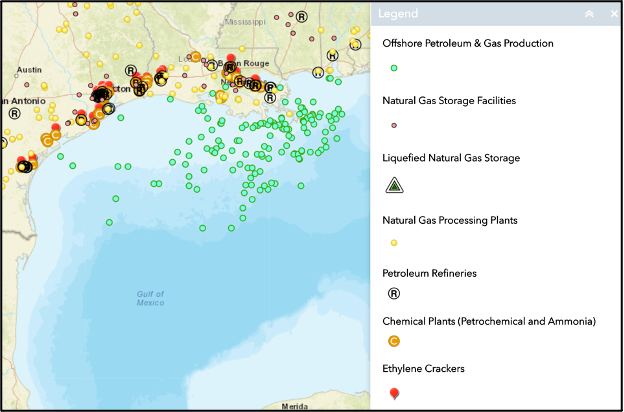
    The risks from industrial facilities are most obvious along the U.S. Gulf Coast, where many major petrochemical complexes are clustered in harm’s way. These refineries, factories and storage facilities are often built along rivers or bays for easy shipping access.

    But those rivers can also bring storm surge flooding that can raise the ocean by several feet during hurricanes. The storm surge from Helene was over 10 feet above ground level in Florida’s Big Bend and over 6 feet in Tampa Bay. With Milton, forecasters warning of a 10- to 15-foot storm surge at Tampa Bay.

    A boom surrounds flooded railcars to try to contain leaks at a chemical plant in Braithwaite, La., after Hurricane Isaac in 2012.
    AP Photo/David J. Phillip

    A recent study found evidence of two to three times more pollution releases during hurricanes in the Gulf of Mexico than during normal weather from 2005 to 2020.

    The effects of these pollution releases fall disproportionately on low-income communities and people of color, further exacerbating environmental health risks.

    Why residents may not hear about toxic releases

    The statistics are disconcerting, yet they get little attention. That is because hazardous releases remain largely invisible due to limited disclosure requirements and scant public information. Even emergency responders often don’t know exactly which hazardous chemicals they are facing in emergency situations.

    The U.S. Environmental Protection Agency requires major polluters to file only very general information about chemicals and on-site risks in their risk management plans. Some large-scale fuel storage facilities, such as those holding liquefied natural gas, are not even required to do that.

    These risk management plans outline “worst-case” scenarios and are supposed to be publicly accessible. But, in reality, we and others have found them difficult to access, heavily redacted and housed in federal reading rooms with limited access. The reason local officials and national scientific review panels often give for the secrecy is to protect the facilities from terrorist attack.

    Oil storage tanks and industrial facilities line the Houston Ship Channel, which is vulnerable to storm surge from Gulf of Mexico hurricanes.
    AP Photo/David J. Phillip

    Adding to this opacity is the fact that many states – including those along the Gulf – suspend restrictions on pollution releases during emergency declarations. Meanwhile, real-time incident notifications from the National Response Center – the federal government’s repository for all chemical discharges into the environment – typically lag by a week or more,

    We believe this limited public information on rising chemical threats from our changing climate should be front-page news every hurricane season. Communities should be aware of the risks of hosting vulnerable industrial infrastructure, particularly as rising global temperatures increase the risk of extreme downpours and powerful hurricanes.

    Mapping the risks nationwide to raise awareness

    To help communities understand their risks, our team at Rice University’s new Center for Coastal Futures and Adaptive Resilience investigates how industrial communities in flood-prone areas nationwide can better adapt to such threats, socially as well as technologically.

    Our interactive map shows where elevated future flood risks threaten to inundate major polluters that we identify using the EPA’s Toxic Release Inventory.

    The U.S. has several hot spots with clusters of flood-prone polluters. Houston’s Ship Channel, Chicago’s waterfront steel industries and the harbors at Los Angeles and New York/New Jersey are among the biggest.

    Three of the biggest hot spots, where large numbers of industrial facilities with toxic materials face elevated future flood risks, are in the Northeast, the northwestern Gulf Coast and the southern end of the Great Lakes.
    Rice University Center for Coastal Futures and Adaptive Resilience, CC BY-ND

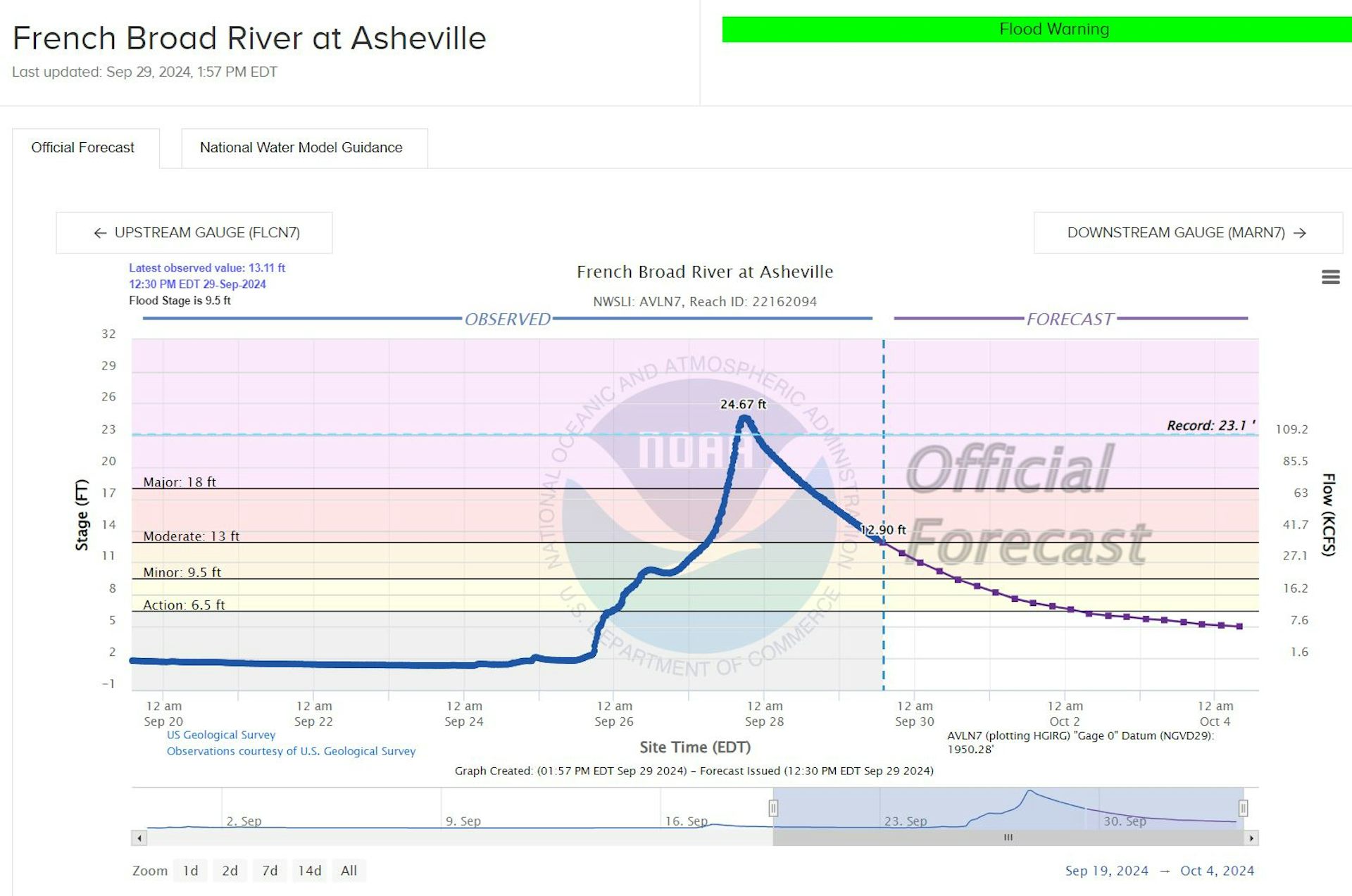
    But, as Helene revealed, there can also be great concern in less obvious spots. Inland, particularly in the mountains, runoff can quickly turn normally tame rivers into fast-rising torrents. The French Broad River at Asheville, North Carolina, rose about 12 feet in 12 hours during Helene and set a new flood stage record.

    When hurricanes and tropical storms are headed for the U.S., our interactive maps show where major polluters are located in the storm’s projected cone of impact. The maps identify hazardous flood-prone facilities down to the address, anywhere in the country.

    Knowledge is the first step

    Knowing where these sites are located is only the first step. Often, it’s up to communities themselves, many of them already overexposed and historically underserved, to raise concerns and demand strategies for mitigating the health, economic and environmental risks that industrial sites at risk of flooding and other damage can pose.

    These discussions can’t wait until a disaster is on the way. By knowing where these risks may be, communities can take steps now to build a safer future.

    This article, originally published Sept. 30, has been updated with Hurricane Milton.

    James R. Elliott receives funding from the National Science Foundation and the National Renewable Energy Lab.

    Dominic Boyer receives funding from the National Science Foundation, NOAA and Texas Sea Grant.

    Phylicia Lee Brown has nothing to disclose.

    ref. Hurricane Milton: Flooded industrial sites and toxic chemical releases are a silent, growing threat – https://theconversation.com/hurricane-milton-flooded-industrial-sites-and-toxic-chemical-releases-are-a-silent-growing-threat-239977

    MIL OSI – Global Reports

  • MIL-OSI Economics: IADC Nigeria Chapter Hosts HSE Awards & Technical Session

    Source: International Association of Drilling Contractors – IADC

    Headline: IADC Nigeria Chapter Hosts HSE Awards & Technical Session

    The 2024 IADC Nigeria Chapter HSE Awards and Technical Session was held on 13 September. Chapter Chairman Mr. Chuks Enwereji discussed workplace stress during the event’s safety moment. He then delivered an update on the state of the Nigeria Oil & Gas industry, providing valuable insights into the current landscape. 

    A special mention was given to the Petroleum Training Institute (PTI) IADC Student Chapter, the first of its kind in Nigeria. The chairman celebrated the presence of students from the PTI Student Chapter, recognizing the importance of nurturing future talent. Since its inception, the PTI IADC Student Chapter has organized several initiatives, including technical sessions and inter-level drilling quiz competitions, demonstrating their passion for industry excellence. The PTI Student Chapter extended its deepest gratitude to both IADC Headquarters and the IADC Nigeria Chapter for their continuous support.

    Guest speakers delivered thought-provoking presentations. Mrs. Ihuoma Okorie, CEO of Clintas Energy Resources Limited, addressed the critical topic “Competency Training in the Oil & Gas Industry.” Engr. Mercy Ntuk, HSSE Lead at Unitech Drilling Company Limited, followed with an engaging session on the topic “Developing and Sustain Competency in Critical Roles.” 

    The Chapter honored Member companies that actively participated in the 2023 Incident Statistics Program (ISP), with their reports meticulously analyzed by the HSE Committee. A total of ten companies submitted their 2023 reports, and after careful review, Shelf Drilling Offshore Services Limited emerged as the top performer for their exemplary safety practices. The following companies were recognized:

    • Aviam Offshore Engineering Company Limited
    • Charlvon Limited
    • Depthwize Nigeria Limited
    • Geoplex Drillteq Limited
    • Ocean Deep Drilling ESV Nigeria Limited
    • Pacific International Drilling West Africa Limited
    • Selective Marine Oil and Gas Limited
    • OES Energy Services
    • Unitech Drilling Company Limited
    • Shelf Drilling Nigeria Limited

    The 2024 HSE Awards & Technical Session was a resounding success, bringing together key industry stakeholders, government and regulatory agencies, and directors of  Member companies. It was a vibrant and interactive event filled with enriching presentations, valuable insights, and a strong sense of collaboration within the industry.

    MIL OSI Economics

  • MIL-OSI Economics: IADC South Central Asia Chapter & ONGC Organize 8th Drilling Operations Incident Review Committee Meeting

    Source: International Association of Drilling Contractors – IADC

    Headline: IADC South Central Asia Chapter & ONGC Organize 8th Drilling Operations Incident Review Committee Meeting

    The IADC South Central Asia (SCA) Chapter and the Oil and Natural Gas Corporation (ONGC) hosted the 8th Drilling Operations Incident Review Committee (DOIRC) meeting on 24 August. This was the second event with an integrated Onshore and Offshore focus, and it was held at NBP Green Heights in Mumbai. 

    The event witnessed active participation from over 280 attendees of different companies, including 130 online participants from offshore and onshore E&P installations in the Indian subcontinent. Attendees included leaders and key executives from ONGC, drilling companies, and other organizations, demonstrating a shared commitment to safety in drilling operations across the region.

    The safety moment by the HSE Manager of Greatship emphasized the role of human factors in incidents and highlighted the importance of compliance with safety management systems and procedures in the workplace.

    DOIRC Chairman Shri VV Prasad expressed his gratitude to IADC SCAC Chairman & Director (T&FS) ONGC Shri OP Singh for his continuous guidance and support in establishing DOIRC as a structured platform for engagement and collaboration on safety issues in the Indian Drilling Industry. He emphasized that the goal of zero incidents is achievable when safety becomes a shared responsibility.

    In his inaugural address, Sh. O.P. Singh appreciated the continuous efforts made by IADC in collaboration with ONGC to create a safe culture and a safe work environment. A more efficient work environment can be achieved by integrating the guiding principles of the Five M’s – Men, Machine, Material, Method, and Management. He emphasized that digitalization plays a pivotal role in the transformation to latest technologies. The industry needs to support a digital safety culture, enhancing its safety protocols and being prepared for future challenges.    

    The Head of HSE ONGC Mumbai presented an action taken report on previous DOIRC recommendations, their compliance status along with initiatives taken, milestones achieved, and HSE statistics for Quarter-1 of FY 2024-25. Eight incidents from the last quarter were presented by respective rig managers, sharing their root cause analysis learnings from these incidents and corrective actions implemented.

    In his concluding address, Chief of HSE at ONGC advised that the learnings from the incidents discussed at DOIRC should be effectively communicated and implemented across all ONGC installations.

    Mr. Narendra Jindal, Vice chairman of IADC SCA Chapter & Country – Head of Operations at Shelf Drilling, offered the closing remarks and vote of thanks.

    MIL OSI Economics

  • MIL-OSI USA: Salinas Announces New Actions to Fight Fentanyl and Addiction in Oregon

    Source: United States House of Representatives – Representative Andrea Salinas (OR-06)

    Salem, OR  Today, Congresswoman Andrea Salinas (OR-06) announced new legislative actions she is taking to address the fentanyl and addiction crisis in Oregon. Rep. Salinas was joined by local law enforcement, county officials, and patient advocates for the announcement, which follows her successful post-Measure 110 listening tour earlier this year.
     

    Click here to download a recording of the press conference


    “Throughout my first term, I have been working to stop the flow of fentanyl into our communities and provide law enforcement with the tools they need to keep us safe, while also expanding access to treatment and recovery services. That is why I decided to embark on a “Life After Measure 110” listening tour earlier this year,” said Rep. Salinas. “During that tour, I met with law enforcement, district attorneys, county commissioners, and patient advocates to hear directly from the folks who know best how I – as a Member of Congress – can support their efforts and help them tackle this problem at the federal level. As a result of those conversations, I am proud to announce a series of new actions that I am taking to solve this problem and continue moving Oregon forward.”

    During her announcement, Rep. Salinas outlined policies, letters, and funding efforts that are the product of conversations she had with local officials during her county-by-county listening tour. These actions include:

    • New legislation to increase the size of in-patient facilities that are eligible for Medicaid coverage and provide funding for facilities to subsequently increase their capacity.
    • Additional legislation that Rep. Salinas has cosponsored to help stop the flow of fentanyl and other dangerous drugs into our country and improve our mental and behavioral health infrastructure.
    • Letters to state and federal partners to convey concerns related to the implementation of House Bill 4002, as well as the lack of federal resources for the Oregon-Idaho High Intensity Drug Trafficking Area (HIDTA).
      • Click here to read Rep. Salinas’ letter to Speaker Fahey and Senate President Wagner
      • Click here to read Rep. Salinas’ letter to Oregon-Idaho HIDTA Executive Director Gibson
    • Requests for increased federal funding for the Substance Abuse and Mental Health Services Administration’s (SAMHSA) Center for Behavioral Health Statistics & Quality (CBHSQ), Comprehensive Addiction and Recovery Act First Responders grants, and Rural Opioid Technical Assistance Regional Centers (ROTA-R).

    Several local officials and law enforcement officers joined Rep. Salinas for her announcement, expressing gratitude for her listening tour and bipartisan approach to solving the fentanyl and addiction crisis. 

    “I want to thank you for the listening tour, with listening being the key word,” said Marion County Sheriff Nick Hunter. “This is not just one layer that we need to address. This is multiple layers, from the prevention side to the treatment side, but also the vulnerability of our addicted population and truly addressing the enforcement side of trying to get those drugs off our streets. I appreciate the direction you’re taking with this bipartisan approach [of] “we need to do this for our state” – because this is a health crisis, not a law enforcement crisis – and everybody is involved in what that solution or pathway to get better looks like.”

    “I really appreciate the Congresswoman’s visit to our county and getting the perspective of multiple counties. This bottom-up approach to policymaking is going to bear a ton of fruit in communities across the United States,” said Polk County Commissioner Jeremy Gordon.

    In addition to the new actions announced today, Rep. Salinas already supported several other policies prior to her listening tour that would help law enforcement combat and prevent fentanyl from entering our communities. Rep. Salinas voted with Republicans and Democrats to pass the HALT Fentanyl Act, which would increase criminal penalties for fentanyl-related substances and help save lives. She also supports the Smart Border Protection Act, which would deploy additional personnel to our Southern Border and prevent these dangerous drugs from entering the United States. Beyond legislation, Rep. Salinas consistently meets with local law enforcement to discuss how Congress can better support their efforts to get fentanyl under control.

    At the same time, Rep. Salinas has championed bills that would expand access to affordable treatment and supported more funding for school-based and community health centers that often help people who are struggling with substance use disorders. She also recently requested federal funding for the Beaverton Behavioral Health Court, which provides wraparound services to prevent people with substance use disorders from entering the criminal justice system if it can be avoided.

    ###

    MIL OSI USA News

  • MIL-OSI Australia: Reappointment of Australian statistician

    Source: Australian Treasurer

    The Albanese Government has reappointed Dr David Gruen AO as the full‑time Australian Statistician to the Australian Bureau of Statistics (ABS) for a further five years, beginning on 11 December 2024.

    Dr Gruen has served as the Australian Statistician since 2019, providing outstanding leadership of the ABS through a unique period in history.

    Dr Gruen is one of Australia’s best and most experienced economists and has a distinguished record of public service. He previously served as Deputy Secretary in the Department of Prime Minister and Cabinet and in the Department of the Treasury.

    The professional manner in which Dr Gruen has led the ABS meant that during the COVID‑19 pandemic the ABS provided rapid statistics to guide policy responses during a period of unprecedented economic uncertainty, and again after the pandemic to assess how it changed Australia’s economy and society.

    He is a distinguished, innovative and respected leader who has led the agency to streamline data collection and harness existing data sources, improving the quality, reliability and timeliness of statistics, which is helping to better inform important public policy issues.

    The ABS has curated major longitudinal data assets, including the Person Level Integrated Data Asset (PLIDA) and Business Longitudinal Analysis Data Environment (BLADE) datasets, which are being used extensively by researchers in government and academia, including research that has informed the work of the Competition Taskforce.

    Alongside his role as Australian Statistician, Dr Gruen was appointed by the Australian Public Service Commissioner as the inaugural Head of Data Profession.

    The Data Professional Stream ensures the entire APS workforce has the data capabilities to harness the growth in the availability and value of data across the public service.

    The ABS is Australia’s national statistical agency and provides trusted, independent, timely and relevant data, statistics and insights to inform Government policy.

    MIL OSI News

  • MIL-OSI New Zealand: Household spending exceeds income in June 2024 quarter – Stats NZ media and information release: National accounts (income, saving, assets, and liabilities): June 2024 quarter

    Source: Statistics New Zealand

    Household spending exceeds income in June 2024 quarter 10 October 2024 – New Zealand household saving decreased to -$479 million in the June 2024 quarter as household spending increased while net disposable income fell, according to figures released by Stats NZ today.

    Seasonally adjusted household spending increased 1.0 percent to $60 billion in the June 2024 quarter. The increase in household expenditure was driven by spending on services and non-durable goods like groceries, partly offset by a decrease in spending on durable goods like motor vehicles.

    Household net disposable income decreased 0.9 percent to $59 billion in the June 2024 quarter. Total household income decreased 0.2 percent, falling for the first time since the start of the reported series in 2016.

    Household net disposable income is the amount of money a household has once all income such as wages, interest, and child support, and income payable such as taxes have been accounted for. It represents the money available for a household to save, spend, or invest.

    Visit our website to read this news story and information release and to download CSV files:

    MIL OSI New Zealand News

  • MIL-OSI Submissions: Household spending exceeds income in June 2024 quarter – Stats NZ media and information release: National accounts (income, saving, assets, and liabilities): June 2024 quarter

    Source: Statistics New Zealand

    Household spending exceeds income in June 2024 quarter10 October 2024 – New Zealand household saving decreased to -$479 million in the June 2024 quarter as household spending increased while net disposable income fell, according to figures released by Stats NZ today.

    Seasonally adjusted household spending increased 1.0 percent to $60 billion in the June 2024 quarter. The increase in household expenditure was driven by spending on services and non-durable goods like groceries, partly offset by a decrease in spending on durable goods like motor vehicles.

    Household net disposable income decreased 0.9 percent to $59 billion in the June 2024 quarter. Total household income decreased 0.2 percent, falling for the first time since the start of the reported series in 2016.

    Household net disposable income is the amount of money a household has once all income such as wages, interest, and child support, and income payable such as taxes have been accounted for. It represents the money available for a household to save, spend, or invest.

    Visit Statistics NZ’s website to read this news story and information release and to download CSV files:

    MIL OSI

  • MIL-OSI Australia: Screen Australia announces $8.1 million of production funding for 15 projects

    Source: Australia Government Statements 4

    10 10 2024 – Media release

    L-R: Love Adjacent director Louise Alston, Watching You creators Alexei Mizin and Ryan van Dijk, and Arisa Trew from online development project, Level Up (photo credit: Mathias Scherrer).
    Screen Australia has announced over $8.1 million in production funding for 15 projects spanning feature film, television and online content. This significant investment reflects Screen Australia’s ongoing commitment to fostering innovative storytelling and content that engages audiences across genres and platforms.
    Among the funded projects are Zac Power, a new animated family feature from Flying Bark Productions and Cheeky Little Media, based on the popular book series of the same name; Leviticus, the latest feature from Causeway Films, the production company behind the global breakout success Talk to Me; romantic comedy Love Adjacent; Stan’s psychological thriller series Watching You; and online series Hoops, from the creative team behind the popular TikTok documentary Transathletica.
    Screen Australia CEO Deirdre Brennan said, “These latest projects reflect the depth of creative storytelling that defines the Australian screen industry. We support projects that entertain and resonate with audiences. Our aim is to champion authentic local voices and ensure our sector remains at the forefront of global storytelling.”
    “For the 2023/24 financial year, Screen Australia invested over $85 million across all 57 funding programs, including over $5.5 million through the First Nations Department, and issued 205 final certificates through the Producer Offset with a total value of $413 million. Demand on Screen Australia support remained high, with the agency supporting just under a third of all applications received. We’ll continue to seek ways to provide impactful support within our limited capacity, prioritising audience connection, industry value and cultural relevance.”
    Over the past year, Australian projects demanded global attention with 61 Australian projects selected for international film festivals and events. Amongst those titles, online series Videoland took out Best Comedy series at the prestigious Festival Series Mania, critically acclaimed debut feature Shayda won the Sundance Audience Award, and Furiosa and Australia/Ireland Co-production The Surfer starring Nicholas Cage led the Australian contingent hosting World Premieres at Cannes Film Festival. Funding stories that reflect and connect remains a focus and in 2023/24, the agency supported a breadth of titles that highlight local screen talent including drama series Top End Bub, feature film JIMPA and a new slate of children’s content including DO NOT WATCH THIS SHOW, an animated adaptation of the popular children’s book series by comedian and author Andy Lee.
    “Our focus is firmly on the future. We’re building a sustainable screen economy that both adapts and inspires. I’m thrilled by the international recognition of our stories and excited for the pipeline of projects set to release before the end of the year including films Memoir of a Snail and The Moogai, along with series’ Thou Shalt Not Steal, Four Years Later and Plum – I can’t wait for Australians to experience them,” continued Brennan.
    The projects funded for production include:

    Chasing Millions: A crime drama set in Belfast 2004, where Northern Ireland has been at peace for six years, but old enmities and mistrust remain. Chasing Millions tells the story of the biggest bank heist in Irish, British (and Australian) history making reluctant partners of ambitious Australian police officer, Diana, with gruff, veteran Northern Irish detective, Crawford, as they investigate and seek to solve the crime while navigating their way through the minefield of a fragile peace. An official Irish-Australian co-production with Irish director Stephen Burke (Maze) at the helm, based on a script by Stephen Burke and Katherine Thomson (Schapelle, House of Hancock). Producers are Jane Doolan (Maze, Wolf) of Mammoth Films, Ireland and Michael Wrenn (Audrey) of Invisible Republic, Australia. It has received major production investment from Screen Ireland, with local distribution by Bonsai Films and international sales by Level K.
    Displaced: A six-part comedy sci-fi series for YouTube that follows a dysfunctional physicist who is accidentally sent back in time and in the process, tries to fix her future by mentoring her younger self. Displaced is a comedy about depression, queerness, making trouble, healing an inner child, and being seen. It is from writer/director Molly Daniels (The InBESTigators, Wispy), writer/producer Jem Splitter (Galacticare) and producer Rachael Morrow. Displaced is produced and developed in association with VicScreen and financed with support from the Community Broadcasting Foundation.
    Hoops: From the team behind Transathletica on TikTok, Hoops documents the journey of Transgender Basketballer Lexi Rodgers and her fight to be ruled eligible to play with a NBL1 South team. After a major setback in 2023, Lexi spends the year jumping through hoops – determined against all odds to play in the 2024 season. Hoops is from writer/director Hannah McElhinney, writer Rudy Jean Rigg and executive producer Jamie Searle of Transathletica, with Eliza Bone (Letter for the King) producing.
    Leviticus: The latest horror feature film from the production company behind box office hit Talk to Me, Leviticus is the story of two teenage boys living in a conservative Christian community in regional Victoria, Naim and Ryan. When their attraction to each other is identified by the local pastor, the pair are subjected to a conversion ritual which unknowingly releases an entity that terrorises the town. Leviticus is from writer/director Adrian Chiarella (Totally Completely Fine), and producers Hannah Ngo (Latecomers) and Samantha Jennings and Kristina Ceyton of Causeway Films. It is financed in association with Salmira Productions, and developed and produced in association with VicScreen, who is also supporting post, digital and visual effects (PDV). PDV is also supported by Kojo Studio, with local distribution by Maslow Entertainment and international sales by Studio 301 Films.
    Love Adjacent: When food critic Maggie writes a review that causes top chef Ryan’s restaurant to go under, he is forced to retreat back home and start again from scratch. Coincidentally in the same town for her sister’s wedding, Maggie is determined to continue taking down what Ryan is serving up, that is until catastrophe strikes and Maggie desperately needs Ryan’s help to make her sister’s wedding happen. Love Adjacent is a romantic comedy feature film directed by Louise Alston (Back of the Net) and written by Sarah Mayberry (Neighbours) and Christopher Gist (The Broken Shore), with Kate Whitbread (The Caterpillar Wish) and Spencer McLaren (This Little Love of Mine) producing. It is produced in association with VicScreen, with Umbrella Entertainment distributing locally and Film Seekers managing international sales.
    Posthumous: In this drama, horror feature film, Zoe returns to her family home and estranged father to find some semblance of comfort after her life falls apart, but the discovery of a mysterious videotape threatens to undo everything she knew about her deceased mother’s final days and her own birth. Amidst their shared grief, Zoe and her father face a powerful supernatural force as long-buried events are exposed, and must be reckoned with. Posthumous is from writer/director/producer Josh Tanner (Wandering Soul) and writer/producer Jade van der Lei (6 Festivals), with Joel Anderson (Lake Mungo) executive producing. It is funded in association with Screen Queensland. Financed with support from the Gold Coast Screen Incentive, with local distribution by Kismet Movies.
    Saccharine: In this psychological horror feature from Carver Films (Run Rabbit Run), a lovelorn medical student becomes terrorised by a hungry ghost after taking part in an obscure weight-loss craze: eating human ashes. Saccharine is from writer/director/producer Natalie Erika James and producers Anna McLeish and Sarah Shaw, the team behind Relic. It is produced in association with VicScreen, with local distribution by Maslow Entertainment and international sales by XYZ Films.
    Watching You: A six-part gripping psychological thriller for Stan based on J.P Pomare’s novel The Last Guests. Watching You is created for television by Alexei Mizin and Ryan van Dijk and produced by Jason Stephens and Bree-Anne Sykes. Helen Bowden, Cailah Scobie and Alicia Brown are executive producing. It has received major production investment from Stan and is financed with support from Screen NSW through the Made in NSW Fund. Post, digital and visual effects supported by Screen NSW. Financed in association with and distributed by ITV Studios.
    Zac Power: Based on the popular book series of the same name, Zac Power is an animated family feature from Flying Bark Productions (200% Wolf, 100% Wolf) and Cheeky Little Media (Kangaroo Beach, Ginger and the Vegesaurs). Zac Power’s position as the top teenage spy is compromised after a brilliant new agent arrives. When his recklessness allows an ostentatious supervillain to steal a high-tech weapon, Zac is forced to confront his own flaws and team up with his rival. The film is directed by Alexs Stadermann and David Webster and written by Fin Edquist, John Armstrong, Lawrence Leung and Erica Harrison. It is financed in association with the Australian Children’s Television Foundation.

    Also announced today are 27 television dramas, 23 feature films and six online projects that will share in over $1.7 million of development funding. Of these, 24 projects have been supported through the Generate Fund, 26 through the Premium Fund and six through the Online Development Fund.
    The projects include online action adventure series Amy the Pirate; family music drama feature Piano Mums, following a promising teenage pianist and exploring the power of music and love of family; Skip Ahead project Life of Kea that has been developed into a television drama series; and a second season of the TikTok docuseries Sextistics, which continues to explore the statistics to create a snapshot of gender, sexuality and identity within Australia.
    For the list of projects funded across scripted feature films, scripted television, online and development in the 2023/24 financial year, visit:

    For full details on feature films funded for production so far in the 2024/25 financial year, click here.
    Download PDF
    Media enquiries
    Maddie Walsh | Publicist
    + 61 2 8113 5915  | [email protected]
    Jessica Parry | Senior Publicist (Mon, Tue, Thu)
    + 61 428 767 836  | [email protected]
    All other general/non-media enquiries
    Sydney + 61 2 8113 5800  |  Melbourne + 61 3 8682 1900 | [email protected]

    MIL OSI News

  • MIL-OSI USA: Kaine Leads Push to Examine Ageism’s Impacts on Quality and Equity of Health Care

    US Senate News:

    Source: United States Senator for Virginia Tim Kaine
    WASHINGTON, D.C. — Today, on Ageism Awareness Day, U.S. Senator Tim Kaine (D-VA), a member of the Senate Health, Education, Labor and Pensions (HELP) Committee, led a group of senators in sending a letter to the Agency for Healthcare Research and Quality (AHRQ) requesting that the agency examine the impact of ageism on quality and equity of care, patient safety, and health outcomes. Ageism in health care is associated with a decreased likelihood that older adults will receive care that meets medical guidelines, an increased likelihood that they are not properly reimbursed for care, and exclusion from clinical trials and other research that is available to the public generally.
    “While ageism is often subtle, it is woven into our workforce, our health care system, and our everyday interactions,” wrote the senators.
    “Ageism within health care leads to poorer health outcomes, avoidable morbidity, and costly preventable adverse events. Ageism costs the health care system $63 billion annually. In health care, ageism is expressed in our policies, the practices of health care providers, and negative assumptions held by older adults themselves,” they continued.
    The senators specifically asked the AHRQ for answers to the following questions:
    What is the full scope of ageism within health care?
    What is the impact of ageism and intersectionality on both the micro and macro levels of health care related to health equity and outcomes?
    What is the evidence for interventions to address ageism and promote age inclusivity in health care?
    Kaine has long worked to address the needs of older Americans. This past July, he helped secure key provisions in the HELP committee-passed bill to reauthorize the Older Americans Act, which supports a wide range of programs and services to help older Americans remain in their homes and connected to their communities.
    In addition to Kaine, the letter was signed by Senators Bob Casey (D-PA), Angus King (I-ME) and Bernie Sanders (I-VT).
    Full text of the senators’ letter is available here and below.
    Dear Dr. Valdez:
    We write to express our concern about the complexity and pervasive nature of ageism in health care and request that the Agency for Healthcare Research and Quality (AHRQ) examine the impact of ageism on quality and equity of care, patient safety, and health outcomes.
    While ageism is often subtle, it is woven into our workforce, our health care system, and our everyday interactions. Ageism undermines older adults and their contributions to our communities. Research shows that 81 percent of adults aged 50-80 report experiencing internal ageism, 65 percent are exposed to ageist messages, and 45 percent face ageism in interpersonal interactions. These staggering statistics demonstrate how ingrained ageism is in our society.
    Ageism refers to stereotypes, prejudice, and discrimination directed towards people on the basis of their age. While ageism is often subtle, it is woven into our workforce, our health care system, and our everyday interactions. Ageism undermines older adults and their contributions to our communities. Research shows that 81 percent of adults aged 50-80 report experiencing internal ageism, 65 percent are exposed to ageist messages, and 45 percent face ageism in interpersonal interactions. These staggering statistics demonstrate how ingrained ageism is in our society.
    Ageism within health care leads to poorer health outcomes, avoidable morbidity, and costly preventable adverse events. Ageism costs the health care system $63 billion annually. In health care, ageism is expressed in our policies, the practices of health care providers, and negative assumptions held by older adults themselves. At the macro level, ageism is complex and reflected in health care access issues which result in older adults being less likely to receive care consistent with medical guidelines, payment policies that do not adequately reimburse for complex care needed for older adults, and exclusion or underrepresentation of older adults in clinical trials and other research.
    At the micro level, practices such as the use of ageist language and elder speak, exclusion of older patients from plan of care conversations, and variations in treatment practices due to a patient’s age all affect patients’ quality of care. Self-directed ageism can also lead to adverse outcomes for a patient if their beliefs on aging lead them to believe that the symptoms they are experiencing should be considered a “normal” part of aging. For example, while some cognitive decline is expected as we age, memory loss, confusion, changes in behavior, and inability to complete activities of daily living are all signs of changes in cognitive ability that need to be evaluated by a medical professional. Moreover, people who internalize ageist societal messages tend to have poorer physical, cognitive, and mental health. The reverse is also true—individuals who internalize positive aging messages are likely to exhibit benefits in physical, cognitive, and mental health—highlighting the need to promote age inclusivity.
    We respectfully request that AHRQ examine this issue and provide a synthesis of existing evidence on ageism in health care to inform efforts to reduce ageism within the health care system. Specifically, we request your assistance to answer the following questions:
    What is the full scope of ageism within health care?
    What is the impact of ageism and intersectionality on both the micro and macro levels of health care related to health equity and outcomes?
    What is the evidence for interventions to address ageism and promote age inclusivity in health care?
    With AHRQ’s mission to improve the quality, safety, and equity of health care, we believe your organization is well suited to support Congress’ effort to address ageism in health care. Results of the requested review will help inform practice, quality improvement efforts, education of health professionals, and policy.

    MIL OSI USA News

  • MIL-OSI Australia: Opinion piece: Albanese good for growth in the west

    Source: Australian Treasurer

    The most recent growth statistics showed that the Australian economy faces some strong headwinds. In an environment where global growth is subdued, the national economy grew just 0.2 per cent in the June 2024 quarter. Yet Western Australia’s growth was considerably faster. With a quarterly growth rate of 0.9 per cent, Western Australia tied with South Australia as the fastest‑growing state in the nation.

    There are other positive signs. Investment in WA continues to grow, reflecting business confidence in WA’s future. In the past financial year, the value of new capital expenditure in Western Australia rose 18.5 per cent in the mining industry and 16.9 per cent in non‑mining industries. This new investment accounts for nearly a quarter of Australia’s new private investment, showing that WA continues to punch above its weight.

    As pro‑growth progressives, we recognise that government has a role to play in boosting the growth rate and continuing to build on WA’s economic success. Higher productivity also increases the speed limit of the economy, allowing Australians to live longer, and live better.

    What are the best policies to encourage growth? As the nation’s most export‑oriented state, international settings are of particular significance for Western Australia. Since coming to office, the Albanese government has sought to stabilise Australia’s relationships with our major trading partners.

    Under the former Coalition government, China effectively closed the door to many of our exports. Since May 2022, as a result of the Albanese government’s calm and consistent approach – in concert with a great deal of hard work and advocacy by industry – most of the Australian products previously subject to impediments have been able to re‑enter China’s market. That includes coal, cotton, timber logs, barley, and wine. Trade impediments imposed by China on around $20 billion of Australian exports remain on less than $1 billion.

    We have also worked to build stronger partnerships with countries throughout our region. Foreign Minister Penny Wong and Trade Minister Don Farrell have worked to diversify our trading relationships, by leading a diplomatic and business push into countries throughout the South East Asia and the Pacific.

    A key element is the development of a new South East Asia Economic Strategy, based on a report that the government commissioned from Nicholas Moore, the former CEO of the Macquarie Group, titled ‘Invested: Australia’s Southeast Asia Economic Strategy to 2040’. This strategy aims to boost trade and investment by enhancing economic engagement and leveraging Australia’s strengths: a well‑capitalised corporate sector, sophisticated capital markets, and a substantial national savings pool.

    In the mining sector, the government’s production tax incentive scheme seeks to nurture the critical minerals and green hydrogen industries. These tax credits aim to secure Australia’s critical mineral supply chain and assist with the energy transition in economically productive ways. Yet, remarkably Peter Dutton has opposed production tax incentives. His position puts him at odds with both major parties in Western Australian – Liberal and Labor. As Resources Minister Madeleine King puts it, Dutton’s stance is ‘anti‑resources and anti‑WA’.

    Another important part of Labor’s pro‑growth productivity agenda is competition reform. The last big wave of national competition policy took place in the 1990s, when consumers were given more choice about their electricity provider and a host of unnecessary regulations were scrapped. During the 2000s and 2010s, Australia experienced a rise in market concentration and markups, and a drop in economic dynamism. Too many industries have become dominated by too few companies. Disappointing productivity performance in the 2010s is likely linked to the lack of competition in many Australian markets and Australian consumers have suffered.

    Last year, our government established a competition taskforce in the Australian Treasury, mandated to identify reforms that would create a more competitive economy that drives down costs. This year, the Albanese government has introduced the biggest shakeup of our merger laws in half a century, aiming to ensure that the merger control system is simpler, quicker, and more efficient. Our reforms will ensure quicker approvals for low‑risk mergers but that the competition watchdog sees all high‑risk mergers through mandatory reporting thresholds.

    Another priority of the competition taskforce is the reform of non‑compete clauses. One in 5 Australian workers have a clause in their employment contract that limits their ability to move to a competing company. Non‑compete clauses slow wage growth and impede new business formation. In the United States, the government has estimated that scrapping non‑compete clauses would boost wages by US$500 for the typical worker, and lead to the creation of 8,000 more businesses annually. In Australia, we are actively considering the best way to address the adverse effects of non‑compete clauses.

    These are just some examples of how the Albanese government, with the states and territories, is revitalising the National Competition Policy to deliver more jobs, more startups, and more prosperity. Western Australia is on board with National Competition Policy and stands to share the benefits.

    Being pro‑growth is not about being anti‑fairness. Indeed, the best way to deliver for the most vulnerable is through a growing economy, where everyone can share in the gains. By choosing openness, encouraging dynamism, and strengthening competition, we can get a better deal and expand opportunities for consumers, workers, and households in Western Australia.

    MIL OSI News

  • MIL-OSI NGOs: Sub-Saharan Africa: Sharp rise in use of death penalty across region

    Source: Amnesty International –

    Executions more than tripled in 2023, while death sentences increased by 66% in the region

    Fresh call for abolition on World Day Against Death Penalty, with Kenya, Zimbabwe and Gambia leading the way

    ‘It’s time for all countries to move away from this cruel, inhuman and degrading punishment once and for all’ – Oluwatosin Popoola

    Sub-Saharan African countries on the cusp of abolition must ban the death penalty immediately, paving the way for others around the world to follow in their footsteps, said Amnesty International on World Day Against the Death Penalty (10 October).

    Last year, Amnesty documented a sharp increase in the use of the death penalty across sub-Saharan Africa, when recorded executions more than tripled and death sentences increased by 66% from 298 to 494. Somalia was the only country in the region known to have carried out executions.

    Death sentences were recorded in 14 African countries, an overall decrease of two compared to 2022.  However, there were increases in recorded death sentences in some countries, including Ghana (seven to 10); Mali (eight to 13); and Nigeria (77 to 246).

    Despite these bleak statistics, Kenya and Zimbabwe and Gambia are edging closer towards abolition. Kenya and Zimbabwe currently have bills tabled to abolish the death penalty for all crimes, while Gambia has begun a constitutional amendment process that will effectively abolish the death penalty. So far, 24 out of 53 countries across sub-Saharan Africa have abolished the death penalty for all crimes.

    Oluwatosin Popoola, Amnesty International’s legal advisor on the death penalty, said:

    “Although the sub-Saharan Africa region saw a surge in both recorded executions and recorded death sentences in 2023, Gambia, Kenya and Zimbabwe have the opportunity to buck that trend in the region.

    “Countries that still retain the death penalty in their laws often resort to the death penalty believing the punishment can make their people and communities safer. However, that is a misconception. The death penalty does not have a unique deterrent effect, and it violates the right to life as proclaimed in the Universal Declaration of Human Rights.

    “Countries that still retain the death penalty are an isolated minority as the world continues to move away from this cruel punishment. The more countries that abolish the death penalty for all crimes, the more isolated the remaining countries will become and the weaker their position on the death penalty will be. It’s time for all countries to move away from this cruel, inhuman and degrading punishment once and for all.”

    Progress in the region: Kenya

    Gambia, Kenya and Zimbabwe have not carried out an execution in more than a decade, while each country has commuted multiple death sentences in the same period. The last known execution in Kenya was in 1987, and although the country does not have an official moratorium on executions it has an established practice of not carrying them out. Kenyan courts continue to impose death sentences, but the country continues to make good progress against the death penalty. In 2023, 606 commutations of death sentences were granted, while four bills to abolish the death penalty are currently pending in Parliament.

    Progress in the region: Zimbabwe

    The last known execution in Zimbabwe was carried out in 2005 even though courts continue to impose death sentences. President Emmerson Mnangagwa, who assumed office in 2017, has also made his opposition to the death penalty clear.

    Oluwatosin Popoola explained:

    “Zimbabwe’s president was himself sentenced to death for ‘terrorism’ as a young man due to his involvement in Zimbabwe’s liberation struggle. He narrowly avoided execution as he was below the age of 21 at the time and was sentenced to ten years in prison instead. The president knows what it’s like to be facing the death penalty and he now has the opportunity to ensure no one else goes through that.”

    Last December, the Death Penalty Abolition Bill was published in the official gazette in Zimbabwe and the Government announced its support for it this February. The bill is currently pending before parliament.

    Progress in the region: Gambia

    The last execution in Gambia was carried out in 2012, when nine soldiers were executed by firing squad. However, since President Adama Barrow assumed office in 2017, Gambia has made significant progress in abolishing the death penalty: the country has established an official moratorium on executions, become party to an international treaty aiming at the abolition of the death penalty, and regularly commutes death sentences.

    The global picture

    In 2023, Amnesty recorded a sharp rise in  executions globally, with 1,153 executions, an increase of 31% (270) from the 883 known executions in 2022. This year has continued a disturbing trend with an alarming surge in executions in Iran and Saudi Arabia, a decision in Democratic Republic of Congo to resume executions, and Taiwan’s Supreme Court failing to abolish the death penalty. So far, 113 countries around the world have abolished the death penalty for all crimes.

    MIL OSI NGO

  • MIL-OSI China: China calls on US to lift sanctions

    Source: China State Council Information Office

    People visit the China Homelife USA expo at the Los Angeles Convention Center in Los Angeles, the United States, on Sept. 11, 2024. [Photo/Xinhua]

    Stable China-United States business ties would contribute to the security and stability of global industrial supply chains, fostering a favorable policy environment for collaboration between companies from both sides, said market watchers and business executives on Wednesday.

    China’s Ministry of Commerce said on Tuesday that China has called on the US to promptly lift sanctions on Chinese companies and enhance the business environment for its firms operating in the US.

    During a phone call with US Secretary of Commerce Gina Raimondo on the same day, China’s Minister of Commerce Wang Wentao expressed serious concerns over US policies on semiconductors, targeting China, and restrictions on Chinese intelligent connected vehicles.

    It is necessary to clarify national security boundaries in the economic and trade fields, as it is conducive to maintaining the security and stability of global industrial supply chains and creating a favorable policy environment for cooperation between the business communities from the two countries, Wang stressed.

    This conversation was part of the institutional communication arrangement between the commerce authorities of both countries, said the Ministry of Commerce.

    As many global industries, such as electronics, automotive and pharmaceuticals, rely on components and materials sourced from both China and the US, a stable relationship can minimize disruptions and prevent production delays and supply shortages in many business areas, said Wang Zhongmei, a researcher at the Institute of World Economy of Shanghai Academy of Social Sciences.

    Zhang Yongjun, a researcher at the China Center for International Economic Exchanges in Beijing, warned that given various factors such as the upcoming US election in early November, it is critical to view Sino-US economic and trade relations with caution.

    In the short term, there will be challenges, but in the long run, the trend of mutually beneficial cooperation between China and the US remains unchangeable, said Zhang.

    “For US companies, China is an indispensable market,” he added. “If trade tensions escalate, these companies may once again urge the US government to adopt a more proactive and balanced economic and trade policy. Business needs can, to a certain extent, influence government actions.”

    According to the 2024 Kearney FDI (foreign direct investment) Confidence Index, reflecting investors’ expectations for FDI over the next three years, China’s global ranking has risen from seventh to third place.

    “Multinational companies initially looked at China as a supplier and then as a huge market. But now, increasingly, we are looking at China as an innovation center,” said Andrew Wu, general manager of the China branch of US-based commercial data and analytics firm Dun & Bradstreet.

    Also viewing China as crucial to its global business strategy, Willie Tan, CEO of Skechers China, South Korea and Southeast Asia, said that despite external challenges, China remains a crucial market for global brands. Its vast consumer base, strategic importance in global supply chains and ongoing commitment to reform and innovation create significant opportunities.

    With over 3,500 stores in China, the US footwear brand plans to continue market expansion in the coming years.

    Mark Jaffe, CEO of the Greater New York Chamber of Commerce, said that no one wants to halt cooperation and exchange between the two countries. China and the US have already established long-term partnerships in fields such as artificial intelligence and pharmaceuticals.

    In the face of increasingly intense global competition, Jaffe said it will be necessary for the two sides to further expand and deepen trade relations in the future.

    In the first eight months of 2024, the US remained China’s third-largest trading partner, with the total trade value between the two countries reaching 3.15 trillion yuan ($446.21 billion), up 4.4 percent year-on-year and accounting for 11 percent of China’s total foreign trade value, statistics from the General Administration of Customs showed.

    MIL OSI China News

  • MIL-OSI New Zealand: Government Cuts – Toll on public service coming clearer as redundancy costs and sick leave soar – PSA

    Source: PSA

     Redundancy costs total nearly $50m so far – highest since 2010
     Sick leave jumps to record levels
    Annual workforce data provides a sobering snapshot of the damage the Government’s cost cutting drive is inflicting on public services and workers.
    The directive by the incoming government last year to cut costs and jobs has seen thousands of public service workers sacked or take voluntary redundancy.
    “This is such a sad snapshot of the damage being done to public services,” said Kerry Davies National Secretary for the Public Service Association Te Pūkenga Here Tikanga Mahi.
    “We know there is much worse to come as the full picture of the Government’s reckless and poorly thought through cuts becomes clearer.”
    The data shows taxpayers shelled out $48.8m in redundancy payments for 865 workers, driven by cuts at MBIE, Social Development, Statistics NZ and across the public service. This is the highest payout since 2010 when the last National-led government down-sized the public service.
    “Based on what we know to date in terms of cuts, it’s likely that the cost to taxpayers will grow to the hundreds of millions of dollars, and to what end? That’s money that could be invested in our health system which is struggling to meet the health needs of New Zealanders right now.
    “This is just more evidence the Government has got its priorities all wrong.
    “The bill will also grow from here as the Government has made clear its plan to continue its ideological obsession with cutting the size of the public service.
    “The cost to New Zealand will be even higher as the public service is stripped of resources and skilled workers to meet the health needs of Kiwis, to support small businesses, to secure our borders and to meet the challenges of climate change and infrastructure.”
    The data also shows the toll that restructuring is having on workers. Sick leave was at record levels in the June year with an average of 10.2 days taken off.
    “Change is hard on workers – it causes huge stress for them and their families and disrupts the delivery of public services. This toll is only going to rise sadly.
    “However, it is heartening to see the gender pay gap continuing to fall and that it remains well below that of the private sector. That partly reflects the past Government’s commitment to improve pay for those on lower and middle incomes, many of whom are women and the great leadership shown by the public sector.
    “We hope this government’s austerity drive and the forcing of departments to meet wage increases out of base lines doesn’t turn back this hard-won progress. It’s particularly important with 62% of public service workers being female.”

    MIL OSI New Zealand News

  • MIL-Evening Report: Australia’s child support system can put single mothers at risk of poverty and financial abuse

    Source: The Conversation (Au and NZ) – By Kay Cook, Professor and Research Director, School of Arts, Social Sciences and Humanities, Swinburne University of Technology

    KieferPix/Shutterstock

    Australia’s child support system can not only increase women’s poverty, but can actually facilitate financial abuse, according to our recent research.

    Child support is an important system that aims to share the financial burden of raising children between separated parents.

    But there are some serious problems with the way it operates, putting already vulnerable women further at risk.

    Drawing on the experiences of 675 single mothers, we sought to examine women’s experience with the child support system from start to finish.

    Our research suggests four key changes could improve both women’s safety and financial wellbeing.

    How does child support work?

    Where deemed necessary, child support arrangements typically require one separated parent to make payments to the other, on a regular basis.

    How much is paid and how it is collected can vary in different circumstances.

    The amount agreed to be paid in child support can take in a range of factors, such as the cost of childcare.
    AKIRA_PHOTO/Shutterstock

    In some families, a child support recipient’s income will be too high to receive the family tax benefit – a key payment that assists with the costs of raising children.

    In this instance, a family can decide for itself how much will be paid, to whom, and how.

    This is called self management, but it is very difficult to navigate when abuse is present in a relationship.

    For families that do collect the family tax benefit, separated parents can use Services Australia to calculate the amount that will be paid.

    Services Australia will consider factors including what it costs to care for and educate a child, as well as the difference in income between the two parents.

    Once the amount has been calculated, separated parents can transfer payments privately between themselves, an approach called “private collect”.

    Alternatively, this group can also use a service called “agency collect” to manage the transfer. Here, Services Australia collects the funds from the paying parent, then gives it to the agreed recipient.

    For parents using agency collect, payments can also be “garnisheed” – deducted from a paying parent’s salary.

    The system is failing the most vulnerable

    Government reports reveal that across the agency collect system, a staggering $1.7 billion is owed to a third of single-parent households, representing 475,000 children.

    The vast majority of this money is owed to women, two-thirds of whom have children in their care 86% or more of the time.

    The vast majority of single parents are single mothers.
    FotoDuets/Shutterstock

    Losing out on payments

    Across the child support system, 28% of paying parents fail to submit tax returns on time, reducing the accuracy of assessments.

    Centrelink’s Family Tax Benefit A (the first part of a two-part payment) is linked to child support, with every dollar of child support above a certain threshold reducing this payment by 50 cents.

    Concerningly, while reports indicate that 60% of single mothers receiving income support have experienced violence prior to separation, less than 15% receive exemptions from having to seek child support on the basis of this violence.

    By not applying for either child support or an exemption, single mothers could lose a significant portion of their Family Tax Benefit A payments.

    These sobering statistics are only part of the picture. Others remain invisible.

    There are another 500,000 or so children in the private collect system. Many of their situations are a mystery. Services Australia doesn’t know how much those women and children are owed, as they don’t trace this amount and assume that payments are fully compliant.

    What we uncovered

    Our mixed methods survey of 675 single mothers asked women about their experiences in the child support system from start to finish.

    We asked women how they made various decisions about child support, such as when to apply for it and when to change how it is collected and calculated.

    Many women avoid chasing what’s owed to them for fear of retaliation from an ex-partner.
    rigsbyphoto/Shutterstock

    78% of women reported experiencing some form of violence at the time of separation.

    But the research also showed how the nature of this abuse can change post-separation, when financial abuse becomes the primary mechanism.

    Just over half the women reported currently experiencing either emotional or psychological abuse, and 60% financial abuse.

    Women shared they were often fearful of retaliation from their ex-partner if they applied or changed child support payment arrangements.

    I was advised not to apply at the time because of the family violence and he had made threats to kill me so [it] was recommended I didn’t give him any reason to act on this so I went without child support for some period of time.

    Others had to ask for an exemption to apply.

    A Centrelink social worker changed my son’s father to unknown so I wouldn’t be murdered.

    The results show how the current system’s logic can force women to risk their financial welfare to ensure their own safety.

    I withdrew my application to avoid further conflict by telling CSA [Child Support Agency] there was a private agreement but there isn’t and he doesn’t pay anything.

    Often, women are paying back debts to Centrelink due to retrospective changes in their ex-partner’s income or level of care, at the same time they themselves are owed thousands of dollars in child support arrears.

    I’ve at times been living on as little at $72 a week of FTB [Family Tax Benefit] as my sole income to feed, house, clothe and educate myself and two children. I don’t understand how that is possible.

    How could we fix it?

    Based on our findings, our report makes four recommendations that could bring about meaningful improvements, give women choices to suit their family, and create a system that is safe.

    1. De-link family payments from child support.

    2. Co-design family violence processes in the child support system.

    3. Move all payment collections back to being handled by the tax office.

    4. Make all payment debts owed to and enforced by the Commonwealth.

    Any meaningful solution to this problem will need to include the voices of victim survivors, advocates, researchers and social support organisations to co-design an effective system.


    The authors would like to acknowledge the assistance of Terese Edwards, chief executive of Single Mother Families Australia (SMFA), in the preparation of the report.

    Terese and SMFA provided in-kind support in the form of survey design feedback and recruitment assistance. Terese also contributed to writing the report.

    Kay Cook receives funding from the Australian Research Council in the form of a Discovery Project grant. She is Secretary of The Australian Sociological Association (TASA) and a Member of the federal Economic Inclusion Advisory Committee. She is the PhD supervisor of Terese Edwards, CEO of Single Mother Families Australia.

    Adrienne Byrt is a Postdoctoral Research Fellow on a Discovery Project funded by the Australian Research Council.

    Ashlea Coen’s research assistant position for this research was funded by Swinburne University of Technology.

    Marg Rogers received funding from the Commonwealth-funded Manna Institute for her Postdoctoral Fellowship in 2022-24.

    ref. Australia’s child support system can put single mothers at risk of poverty and financial abuse – https://theconversation.com/australias-child-support-system-can-put-single-mothers-at-risk-of-poverty-and-financial-abuse-240917

    MIL OSI AnalysisEveningReport.nz

  • MIL-OSI Asia-Pac: Import of poultry meat and products from Province of Ferrara of Emilia-Romagna Region in Italy suspended

    Source: Hong Kong Government special administrative region

         The Centre for Food Safety (CFS) of the Food and Environmental Hygiene Department announced today (October 10) that in view of a notification from the World Organisation for Animal Health (WOAH) about an outbreak of highly pathogenic H5N1 avian influenza in the Province of Ferrara of the Emilia-Romagna Region in Italy, the CFS has instructed the trade to suspend the import of poultry meat and products (including poultry eggs) from the area with immediate effect to protect public health in Hong Kong.

         A CFS spokesman said that according to the Census and Statistics Department, Hong Kong imported about 40 tonnes of frozen poultry meat and about 10 000 poultry eggs from Italy in the first six months of this year.

         “The CFS has contacted the Italian authority over the issue and will closely monitor information issued by the WOAH and the relevant authorities on the avian influenza outbreak. Appropriate action will be taken in response to the development of the situation,” the spokesman said.

    MIL OSI Asia Pacific News

  • MIL-OSI China: China launches nationwide sample survey of population changes

    Source: People’s Republic of China – State Council News

    BEIJING, Oct. 10 — China will conduct a nationwide sample survey of population changes this year to accurately and promptly monitor the country’s demographic development and provide basic information for its population policies, the National Bureau of Statistics (NBS) said Thursday.

    From Oct. 10 to Nov. 30, selected residents will be asked about their basic information, including age, gender, ethnic groups, educational levels, job positions, marital and fertility status and housing conditions.

    The reference time for the survey will be Nov. 1, 2024, said the NBS.

    MIL OSI China News

  • MIL-OSI Asia-Pac: Results of monthly survey on business situation of small and medium-sized enterprises for September 2024

    Source: Hong Kong Government special administrative region

    Results of monthly survey on business situation of small and medium-sized enterprises for September 2024
    Results of monthly survey on business situation of small and medium-sized enterprises for September 2024
    ******************************************************************************************

         The Census and Statistics Department (C&SD) released today (October 10) the results of the Monthly Survey on Business Situation of Small and Medium-sized Enterprises (SMEs) for September 2024.      The current diffusion index (DI) on business receipts amongst SMEs increased from 41.3 in August 2024 in the contractionary zone to 41.6 in September 2024, whereas the one-month’s ahead (i.e. October 2024) outlook DI on business receipts was 47.0. Analysed by sector, the current DIs on business receipts, despite below the 50-mark, rose by varying degrees in September 2024 as compared with previous month for many surveyed sectors, particularly for the logistics (from 35.9 to 40.3) and restaurants (from 34.7 to 36.5).            The current DI on new orders for the import and export trades increased from 43.4 in August 2024 to 44.5 in September 2024, whereas the outlook DI on new orders in one month’s time (i.e. October 2024) was 46.1. Commentary      A Government spokesman said that overall business sentiment among SMEs stabilised in September, and their expectations on the business situation in one month’s time turned better. The overall employment situation also improved further in September.      The spokesman added that while various uncertainties in the external environment may have some negative impacts, US interest rate cut should bode well for business sentiment. The Central Government’s latest policy measures for supporting the Mainland economy as well as its various measures benefitting Hong Kong will also provide support. The Government will monitor the situation closely. Further information      The Monthly Survey on Business Situation of Small and Medium-sized Enterprises aims to provide a quick reference, with minimum time lag, for assessing the short-term business situation faced by SMEs. SMEs covered in this survey refer to establishments with fewer than 50 persons engaged. Respondents were asked to exclude seasonal fluctuations in reporting their views. Based on the views collected from the survey, a set of diffusion indices (including current and outlook diffusion indices) is compiled. A reading above 50 indicates that the business condition is generally favourable, whereas that below 50 indicates otherwise. As for statistics on the business prospects of prominent establishments in Hong Kong, users may refer to the publication entitled “Report on Quarterly Business Tendency Survey” released by the C&SD.      The results of the survey should be interpreted with care. The survey solicits feedback from a panel sample of about 600 SMEs each month and the survey findings are thus subject to sample size constraint. Views collected from the survey refer only to those of respondents on their own establishments rather than those on the respective sectors they are engaged in. Besides, in this type of opinion survey on expected business situation, the views collected in the survey are affected by the events in the community occurring around the time of enumeration, and it is difficult to establish precisely the extent to which respondents’ perception of the business situation accords with the underlying trends. For this survey, main bulk of the data were collected around the last week of the reference month.      More detailed statistics are given in the “Report on Monthly Survey on the Business Situation of Small and Medium-sized Enterprises”. Users can browse and download the publication at the website of the C&SD (www.censtatd.gov.hk/en/EIndexbySubject.html?pcode=B1080015&scode=300).      Users who have enquiries about the survey results may contact Industrial Production Statistics Section of the C&SD (Tel: 3903 7246; email: sme-survey@censtatd.gov.hk).

     
    Ends/Thursday, October 10, 2024Issued at HKT 16:30

    NNNN

    MIL OSI Asia Pacific News

  • MIL-OSI NGOs: UK: Don’t abandon people in crisis: Public want more from Government this World Homelessness Day

    Source: Amnesty International –

    78% of UK adults say that people with direct experience of homelessness should be included when developing policies to tackle homelessness 

    The majority (72%) believe that homelessness is a major problem in the UK and should be given urgent priority by Government, with 73% saying they are not doing enough to help 

    Nearly three quarters (73%) agree that having access to a home is a fundamental human right and should be protected by law 

    “Government strategy is only a piece of paper without action. We need action now for those facing winter in unsuitable temporary accommodation or experiencing life on the streets.” – Jen Clark 

    The latest annual Government statistics on October 4th showed a 12.3% rise in homelessness and with people trapped in temporary accommodation at an all-time high since records began. * 

    On World Homelessness Day (October 10th), Amnesty International UK has published new data showing what the UK public think about political action, which reveals homelessness is seen as a major UK problem and that the Government must do more, including developing solutions with those who have direct experience. 

    In his first press conference as Prime Minister, Keir Starmer said: ‘The principle I operate to is those with skin in the game know what’s best for their communities’ and nearly eight in ten polling respondents** agreed that those with lived experience of homelessness should be included when developing policies to tackle this. 

    Amnesty is calling on the Government to invite those with lived experience of homelessness, to hear firsthand what immediate solutions there are to both the current emergency and longer-term strategy. Urgent action is needed to protect people as the rise in homelessness shows us that many people will be facing a life-or-death situation this winter without safe and secure housing. 

    At a roundtable hosted by the human rights organisation, people with lived experience shared their desire for their voices to be heard and how without the protection of everyday rights they feel oppressive stigma from society.  

    Tony said: “As a person who has been homeless in the past, I know how difficult it is to get out of homelessness. The Prime Minister said it is people with the skin in the game who know what is best for their community. So, listen to us.”  

    *The following names have been anonymised 

    Lucy said: “You think like everyone is judging you, they’re thinking you chose it, that it’s your choice, whereas it is not. I was an asylum seeker it was not my choice. Then I became a refugee and asked to leave the accommodation, that was not my choice. Then I became homeless, that was not my choice. If I did not take a shower for a long time, that was not my choice because I did not have the shower facility.”   

    Dillon said: “We all see homeless people in doorways, you see Councils building aggressive architecture. And this all sort of shows how we think of people experiencing homelessness as being some kind of scourge on society. What we really need to be doing is flipping that over and realising its society being the scourge on its most vulnerable.”  

    Jody said: “To tackle stigma we need to be more compassionate towards others and understand how it makes people feel.” 


    Jen Clark, Economic and social rights lead at Amnesty International UK, said:  

    “This World Homelessness Day, the public back Amnesty’s call for Government to involve those with direct experience to create solutions to end this horrifying crisis for good.  

    “Homelessness is often the result of a devastating domino effect triggered by poor decision making within siloed Government departments who repeatedly fail to protect our basic human rights and dignity. 

    “Whilst the Ministry of Housing, Communities and Local Government has announced the development of a strategy to end homelessness, this is not new – strategy is only a piece of paper without action. We still do not know when, with who or how this strategy will be developed. We need solutions developed with those with skin in the game and we need urgent action now for those facing winter in unsuitable temporary accommodation or experiencing life on the streets.” 

    Additional findings from the poll, conducted in September 2024, showed that:  

    A third (35%) of UK adults say they are worried that themselves or someone they know may become homeless in the next 12 months.  

    Among those who are renting in the UK, either privately, or through their local council or housing association, approaching half (47%) say they are worried that they, or someone they know, will become homeless in the next 12 months. This was highest at 47% with young adults aged 16-34. 

    MIL OSI NGO

  • MIL-OSI Europe: Investing in sustainable economic growth and solidarity and safeguarding EU financial interests through our 2023 budget

    Source: EuroStat – European Statistics

    European Commission Press release Brussels, 10 Oct 2024 The Commission welcomes the European Court of Auditor (ECA)’s extensive work on its Annual Report on the 2023 EU budget published today and takes note of the ECA’s valuable insights as regards the regularity of the EU budget implementation.

    MIL OSI Europe News

  • MIL-OSI Africa: Promising progress on eye health in African region, but challenges remain

    Source: Africa Press Organisation – English (2) – Report:

    BRAZZAVILLE, Congo (Republic of the), October 10, 2024/APO Group/ —

    Despite important progress towards integrating eye health into primary health care services in African countries, a dire shortage of financial resources, combined with the concentration of scarce human resources in urban areas and low community awareness, continues to threaten the gains.

    One in every six blind people globally live in Africa, along with 26 million others grappling with some degree of visual impairment. Yet statistics show that despite the onerous burden, only 14% of people who need cataract surgery receive it, while more than 80% of people with shortsightedness receive no treatment. The comparative figure for North America, Australasia, western Europe and the Asia-Pacific region, meanwhile, is lower than 10%.

    In addition, only 12% of people in Africa who need glasses or surgical interventions to address blurred vision will receive the necessary care, at significant economic cost to countries. The global estimated costs of uncorrected refractive errors and cataracts is US$14.3 billion annually.

    World Health Organization (WHO) in the African Region is recording a decrease in vision loss due to Vitamin A deficiency, onchocerciasis and trachoma, but emerging eye health challenges are rising. These are related to ageing populations, unhealthy lifestyles, and noncommunicable diseases.

    “The focus on eye care is critical, given the multiple positive impacts of good vision on all aspects of life, from overall well-being to academic achievements. The contribution to economic growth is also significant, raising the urgency of building on the gains already made, while addressing the emerging challenges,” said Dr Matshidiso Moeti, WHO Regional Director for Africa, on World Sight Day today.

    WHO’s current focus in the region is to support countries to integrate eye health services at primary care level, as part of universal health coverage.  However, with severely limited human resources, the achievement of Integrated People-Centred Eye Care demands innovative interventions, dedicated community engagement, and cross-sectoral coordination of services.

    Over the past two years, WHO has provided technical support to six African countries, including Ethiopia, Ghana, Niger, Nigeria, Somalia and Zambia. The work began with the completion of national situational analyses, followed by the development of strategic plans and monitoring frameworks. Operational planning and costing of interventions and resources was also completed, specifically in relation to workforce needs, and the integration of eye care indicators into existing health information systems frameworks.

    To support countries towards the achievement of the global target of increasing the number of people with access to appropriate spectacles (known as effective coverage of refractive error or eREC) to 40% by 2030, WHO launched the SPECS 2030 initiative. Still in its initial stages, Liberia and Mozambique have begun implementation.

    Meanwhile, WHO also launched a free self-assessment tool designed to support countries to promote healthy habits and raise eye care awareness. Launched last year, the WHOeyes tool, available in multiple languages, is u used to check visual acuity, while also providing educational messaging.

    Other support has included the dissemination of strategic documents such as the World report on vision, which outlines WHO’s recommendations for integrated, people-centred eye care, and the launch of the WHO’s Eye Care in Health Systems: Guide for action.

    MIL OSI Africa