Category: Statistics

  • MIL-OSI Global: No antidote for bad polls: Recalling the New York Times’ 1956 election experiment in shoe-leather reporting

    Source: The Conversation – USA – By W. Joseph Campbell, Professor Emeritus of Communication, American University School of Communication

    President Dwight Eisenhower and his wife, Mamie, left, with Vice President Richard Nixon and his wife, Pat, greet crowds after Adlai Stevenson conceded defeat on Nov. 7, 1956. Bettmann/Getty Images

    In response to national pollsters’ failure in forecasting election outcomes in 1948 and 1952, The New York Times pursued in 1956 a weekslong, multistate exercise in on-the-ground reporting to assess public opinion about the presidential race.

    The Times’ experiment, which these days would be recognized as “shoe-leather reporting,” included two dozen journalists assigned to four teams that, in all, traveled to 27 battleground states over several weeks before the election – a rematch between President Dwight D. Eisenhower, a Republican, and his Democratic rival, Adlai E. Stevenson.

    The reporting teams interviewed scores of Americans from all walks of life in an attempt to gauge voter preferences qualitatively – without relying on the data of preelection polls. One of the participating Times reporters declared afterward that the teams-based campaign coverage represented “a new departure in journalism.”

    In unintended testimony to the challenges of measuring public opinion across a sprawling country, the Times’ coverage was no significant improvement over the polls. The Times’ reporting notably failed to anticipate the magnitude of Eisenhower’s reelection — a lopsided victory in which he carried 41 states.

    In its final report before the election, the Times concluded that Eisenhower would win reelection but would fail to match the sweep of his landslide four years earlier. As it turned out, Eisenhower easily exceeded the dimensions of his victory in 1952, when his winning margin was 10.5 percentage points.

    The Times’ coverage also failed to foresee Eisenhower’s state victories in 1956 in Virginia, Oklahoma and West Virginia, and markedly underestimated the president’s support in Connecticut, Illinois, Michigan, Minnesota, Pennsylvania and Texas, among other states.

    The Times’ reporting experiment proved an imperfect substitute to election polling, as I discussed in a research paper presented recently to the American Journalism Historians Association. In the paper, I defined “shoe-leather reporting” as the gathering of newsworthy content through in-person interviews, document searches and on-the-scene observations. The idiom presumes that journalists will pursue fieldwork so energetically as to wear out their shoes.

    “Shoe-leather reporting” has been long celebrated in American media; a widely published journalism educator has described the practice as “mythical” and “one of a very few gods an American journalist can officially pray to.”

    New York Times staffer Max Frankel was taken off the rewrite desk in 1956 and sent knocking on doors ‘to gather voter sentiment’ in Wisconsin, Texas, Virginia and Missouri.
    Ban Martin/Archive Photos/Getty Images

    Crises skew projections

    The Times’ experiment in 1956 represents an exceptional case study about both the appeal and limitations of detailed, interview-based reporting as a method for measuring public opinion in a presidential race, especially when dramatic international events occur shortly before the election.

    Such was the case in 1956, when the Egyptian government seized the Suez Canal, prompting military intervention by Israeli, British and French armed forces — a response that Eisenhower deplored. About the same time, Soviet tanks were ordered into Hungary to crush an uprising against communist rule and install a regime compliant to Moscow.

    The international crises may have boosted the margin of victory for Eisenhower, an Army general during World War II, in a rally-round-the-president effect.

    It was, in any event, polling failure that inspired the Times’ campaign coverage experiment.

    Eight years earlier, in 1948, the polls, the press and pundits anticipated that Republican Thomas E. Dewey would oust Democrat Harry S. Truman, who had become president on the death of Franklin D. Roosevelt in 1945.

    But on the strength of a vigorous, cross-country campaign, Truman prevailed over Dewey and two minor-party candidates to win.

    The leading national pollsters of the time — George Gallup, Archibald Crossley and Elmo Roper — all predicted Dewey’s easy victory. Roper announced in early September 1948 that Dewey was so far ahead that he would stop releasing survey results. Dewey, said Roper, would win “by a heavy margin.”

    Truman, who predicted that pollsters would be “red-faced” on the day after the election, carried 28 states and 303 electoral votes. His margin of victory over Dewey, who won 16 states and 189 electoral votes, was 4.5 percentage points. J. Strom Thurmond of the segregationist Dixiecrat Party carried four Deep South states and 39 electoral votes.

    Not tied to ‘arithmetic of polls’

    Not surprisingly, Gallup, Crossley and Roper turned exceedingly cautious in evaluating the 1952 presidential race, maintaining as the campaign closed that either candidate could win.

    Eisenhower, they said, seemed to hold a narrow lead but that Stevenson was closing fast. Or as the Times said in reporting about a public gathering of the pollsters shortly before the election: “The poll takers gave a slight edge in the popular vote to … Eisenhower, the Republican candidate, but this was their dilemma: How fast is … Stevenson, the Democratic nominee, catching up?”

    Equivocation did not serve the pollsters well. None of them anticipated Eisenhower’s sweeping victory — a 39-state landslide.

    The Times did not editorially rebuke pollsters for their misfire in 1952, but the newspaper’s editors, wrote Pulitzer Prize-winning journalist Max Frankel in his memoir, had “lost confidence in polls.”

    To cover the 1956 presidential election, the Times de-emphasized opinion polls in favor of its own intensive, on-the-ground reporting that focused on states where the presidential race was believed to be closely contested.

    The New York Times sent reporters across the country to interview people like these men listening to Democratic Party presidential candidate Adlai Stevenson on his October 1956 whistle-stop tour of the Midwest.
    Bert Hardy/Picture Post/Hulton Archive/Getty Images

    Frankel, who rose through the ranks to become the Times’ executive editor, recalled being taken off the rewrite desk in 1956 and sent knocking on doors “to gather voter sentiment. I drove through odd precincts of Milwaukee and Austin (Texas), Arlington (Virginia) and St. Joseph (Missouri), feeding notes” to a colleague on one of the reporting teams.

    The teams typically spent three days in a state, conducting interviews “with political scientists and policemen, leading politicians and bartenders, laborers, housewives and farmers,” the newspaper said.

    The Times described its grassroots reporting as “surveys,” although they were not quantitative samples.

    “Team members found value in not being tied to the arithmetic of polls,” one of the participants, Donald D. Janson, wrote in a post-election assessment for the Nieman Reports, a journalism industry publication.

    “The scope and depth of the venture was a new departure in journalism,” Janson declared.

    The process was impressionistic, even idiosyncratic. “Each reporter,” Janson wrote, “was free to judge each response, from politician and voter alike, for reliability.”

    The Times published 36 state-specific preelection reports, including nine based on reporters’ follow-up visits to states where outcomes were expected to be especially close.

    In its wrap-up report two days before the election, the Times said it “seemed doubtful” that Eisenhower’s margin “would be as great as it was in 1952.” In fact, Eisenhower’s victory in 1956 far surpassed that of 1952; in the rematch, he crushed Stevenson by more than 9.5 million votes.

    The Times conceded in an after-election article that its teams-based coverage “did not anticipate the magnitude of the President’s victory,” which it attributed to the Suez crisis and turmoil in Hungary. The crises, the Times said, “apparently gave the final impetus to the Eisenhower landslide.”

    No antidote for bad polls

    The 1956 experiment in shoe-leather reporting was no rousing success. “There was some feeling,” Janson wrote afterward, “that the Times should stick to reporting trends and let the pollsters make the forecasts.”

    Preelection polls by Gallup and Roper in 1956 accurately pointed to Eisenhower’s victory but overstated the president’s popular vote. Eisenhower won by 15 points; Gallup and Roper estimated his margin of victory would be 19 points. By 1956, Crossley had sold his business and retired from preelection polling.

    Roper declared himself “personally pleased” by the outcome but reluctant to take “any bows for perfect accuracy.”

    Given the unreliability of preelection polls in the late 1940s and early 1950s, the Times had ample reason to experiment in seeking a more precise understanding of popular opinion. But as results of the 1956 election demonstrated, shoe-leather reporting was no antidote for the wayward polls.

    W. Joseph Campbell does not work for, consult, own shares in or receive funding from any company or organization that would benefit from this article, and has disclosed no relevant affiliations beyond their academic appointment.

    ref. No antidote for bad polls: Recalling the New York Times’ 1956 election experiment in shoe-leather reporting – https://theconversation.com/no-antidote-for-bad-polls-recalling-the-new-york-times-1956-election-experiment-in-shoe-leather-reporting-237523

    MIL OSI – Global Reports

  • MIL-OSI Economics: Group of Exceptional Students Graduate: 4th Cohort of Samsung-UWC Software Development Programme

    Source: Samsung

    At a graduation ceremony held on Tuesday, 08 October 2024, Samsung celebrated the achievements of the 4th Cohort in the University of the Western Cape (UWC) Software Development (SWD) programme. This Samsung sponsored programme aims to enhance the graduating students’ prospects of employment as well as address the problem of youth unemployment in the province and the country as a whole.


    South Africa, like many countries globally, grapples with the challenge of youth unemployment. This is supported by statistics indicating a 45,5% unemployment rate among young individuals (aged 15-34 years), in contrast to the national average of 32,9% in the first quarter of 2024”, according to Statistics SA.”  The Western Cape is no exception to this alarming trend.
     
    In response to the country’s youth unemployment issues and a way to assist government to address this challenge, Samsung launched a R280-million worth Equity Equivalent Investment Programme (EEIP) in 2019. The company is now celebrating five years of this EEIP programme’s sustained success. This EEIP programme is projected to have a measurable impact on job creation and a contribution of nearly R1-billion to the South African economy at large. Five years in and Samsung’s EEIP programme has managed to train 539 youth in SWD and artisanal skills.
     
    Jose Frantz, Deputy Vice Chancellor: research and innovation, University of the Western Cape said: “We firmly believe in the transformative power of higher education to empower youth. The Future-Innovation Lab at UWC exemplifies this commitment by equipping previously disadvantaged youth with the skills and experiences necessary to succeed in an AI-driven economy. By bridging the gap between education and industry, this initiative not only addresses the pressing issue of youth unemployment but also fosters a culture of innovation and resilience. As we celebrate the upcoming graduation of the fourth cohort, we recognize the importance of such programs in nurturing the next generation of leaders and change-makers. Together, we can create a future where every young person has the opportunity to thrive and contribute meaningfully to society.”
     
    This SWD programme that is part of Samsung’s EEIP has ensured sustained ICT investment in historically disadvantaged universities, which in turn has helped to enhance the prospects of employment in the country’s youth. Importantly, this SWD programme has provided an opportunity to previously disadvantaged youth to gain skills in software development and digital social innovation with the ultimate aim of opening doors to employment or further training. Samsung strives for a 100% absorption rate of all the students in its training programmes.
     
    Lenhle Khoza, Manager for B-BBEE and Transformation at Samsung South Africa said: “As Samsung, we would like to congratulate this group of brilliant students. From the start of this programme, our focus has been on capacity building in ICT training and development. With these software development skills, we are confident that these UWC students will now be able to play a crucial role in the digital economy.”


    For Samsung, this graduation of the fourth cohort in this SWD programme is a clear indication of how successful partnerships with institutions of higher learning such as UWC are helping to address the country’s societal challenges through the development of digital solutions.
     
    And according to UWC, the 41 students that participated in the SWD programme have gained proficiency in high-demand coding languages, software architecture, web and mobile app development as well as database management and more. The hands-on and project-based approach has ensured that graduates emerge not just with theoretical knowledge, but also with the practical skills demanded by the modern job market.
     
    With hands-on, real-world experience provided through creativity and fun in a learning and working environment, these UWC students will now be able to successfully apply their new skills, which are highly sought-after in the country’s digital economy.


    “As Samsung, we’ve always prioritised the need to demonstrate a measurable outcome on the country’s youth in all our education-focused initiatives. This SWD is no exception, in collaboration with UWC – we have ensured that these graduating students are employable and that some are able to attain permanent employment through our partner network,” concluded Khoza.
    _________________________
    *Source – Unemployment in South Africa: A Youth Perspective | Statistics South Africa (statssa.gov.za)

    MIL OSI Economics

  • MIL-OSI United Kingdom: Social Security Advisory Committee reappointments

    Source: United Kingdom – Executive Government & Departments

    The Social Security Advisory Committee have reappointed Carl Emmerson and Phil Jones.

    The Secretary of State for Work and Pensions has confirmed the reappointment of Carl Emmerson and Phil Jones as Members of the Social Security Advisory Committee (SSAC). The reappointments extend Carl and Phil’s membership to 31 July 2026.

    Appointments and reappointments to the Committee are made by the Secretary of State for Work and Pensions and are regulated by the Commissioner for Public Appointments. The reappointment has been made in line with the Governance Code on Public Appointments.

    Carl Emmerson

    Carl Emmerson is Deputy Director of the Institute for Fiscal Studies (IFS), a Fellow of the Academy of Social Sciences, an editor of the annual IFS Green Budget and a Director of the Pensions Review. His research includes issues around the UK’s public finances, and household retirement saving decisions. He is also a member of the advisory panel of the Office for Budget Responsibility, and the UK Statistics Authority’s Methodological Assurance Review Panel.

    Phil Jones

    Since October 2021 Phil Jones has been Chief Executive of the Welsh Social Enterprise, Business in Focus, which provides a suite of business support services across Wales, including the delivery of the Welsh Government’s flagship ‘Business Wales’ service.

    Phil was previously the Director of Prince’s Trust Cymru for 5 years and, before that, the Wales Area Manager for The Royal British Legion.  Phil also served in the Armed Forces for over 25 years as an officer in The Royal Welsh.
    About the Committee

    The Social Security Advisory Committee is an independent advisory body of the Department for Work and Pensions. Its statutory remit is to:

    • to provide advice and assistance to the Secretary of State, whether in response to a specific request or on its own initiative
    • to scrutinise secondary legislation relating to social security for the benefit of the Secretaries of State for Work and Pensions or the Department for Social Development in Northern Ireland, and Parliament

    The Committee Membership comprises:

    • Dr Stephen Brien (Chair)
    • Les Allamby
    • Bruce Calderwood
    • Rachel Chiu
    • Carl Emmerson
    • Daphne Hall
    • Professor Stephen Hardy
    • Jacob Meagher
    • Philip Jones
    • Dr Suzy Walton

    Contact SSAC

    Further enquiries should be directed to the Committee Secretary:

    Social Security Advisory Committee
    7th Floor Caxton House
    Tothill Street
    London
    SW1H 9NA

    Email: ssac@ssac.gov.uk

    Tel: 0300 046 0323

    Updates to this page

    Published 8 October 2024

    MIL OSI United Kingdom

  • MIL-OSI China: Regular Press Conference of the Ministry of National Defense on September 26 2024-10-08 Senior Colonel Zhang Xiaogang, spokesperson for the Ministry of National Defense (MND) of the People’s Republic of China (PRC), releases news at a regular press conference on the afternoon of September 26, 2024.

    Source: People’s Republic of China – Ministry of National Defense 2

    Senior Colonel Zhang Xiaogang, spokesperson for the Ministry of National Defense (MND) of the People’s Republic of China (PRC), answers questions at a regular press conference on the afternoon of September 26, 2024. (mod.gov.cn/Photo by Zhang Zhicheng)

    (The following English text of the press conference is for reference. In case of any divergence of interpretation, the Chinese text shall prevail.)

    Zhang Xiaogang: Friends from the media, good afternoon. Welcome to this month’s regular press conference of the Ministry of National Defense.

    I have four pieces of news at the top.

    The first one.

    At the invitation of the Ministry of National Defense of Laos, the rotating chair of ASEAN, a working group of China’s Ministry of National Defense attended the ASEAN Defense Senior Officials’ Meeting-Plus in Vientiane on Sep. 26th. During the meeting, the Chinese side had discussions with representatives of other parties on international and regional security landscape, and advocated to jointly promote the Global Security Initiative, strengthen strategic communication and deepen defense cooperation to consolidate regional peace and stability.

    The second one.

    China’s Ministry of National Defense hosted the 21st Expert Working Group (EWG) meeting of the Shanghai Cooperation Organization(SCO) Defense Ministers’ Meeting in PLA National Defense University in Beijing from September 25th to 26th. Representatives from SCO member states and the Secretariat exchanged views on military cooperation at the event. This is the first EWG meeting under the SCO Defense Ministers’ Meeting hosted by China after its assumption of the rotating presidency. It’s also the first time for Belarus to attend as a full member of the SCO.

    The third one.

    At the invitation of the South African Navy, PLA Navy ship (PLANS) Xuchang from the 46th naval task group for escort missions will participate in the International Navy Day in Cape Town in early October. During the event, PLANS Xuchang will participate in the international fleet review and host an Open Day activity. In addition, it will have a maritime drill with the South African Navy.

    The fourth one.

    The Chinese government and the Organization for the Prohibition of Chemical Weapons(OPCW) will co-host the third training course on medical aid and protection against chemical weapons in PLA Air Force Medical University from October 13th to 19th. Over 30 participants from more than 20 State Parties including Germany, Brazil and Morocco will participate in the training. They will focus on topics such as the symptom, diagnose and treatment of chemical weapons poisoning, the medical transportation and classification of the injured by chemical weapons, and organization and implementation of medical recue in dealing with chemical weapons. In the spirit of the Chemical Weapons Convention, the course is to strengthen rescue and response capabilities against chemical weapons, enhance capacity-building in medical protection and treatment, and contribute to the building of a community with a shared future for mankind.

    Senior Colonel Zhang Xiaogang, spokesperson for the Ministry of National Defense (MND) of the People’s Republic of China (PRC), releases news at a regular press conference on the afternoon of September 26, 2024. (mod.gov.cn/Photo by Zhang Zhicheng)

    Question: There are growing interaction between the Chinese and US militaries in recent time. The commanders of the PLA Southern Theatre Command and US Indo-PACOM had a video phone call. US Deputy Assistant Secretary of Defense for China attended the 11th Beijing Xiangshan Forum and the two sides had the 18th Defense Policy Coordination Talks. What’s your comment on the current China-US mil-mil relations and what interaction the two sides will have in the future?

    Zhang Xiaogang: President Xi Jinping and President Joe Biden had a successful meeting in San Francisco last November, and the two leaders talked on the phone this April. They have set the direction for a sound, stable and sustainable China-US relationship. At present, there is a stabler momentum in the overall and defense relations between China and the US. The two militaries maintain high-level strategic communication, policy communication, institutionalized dialogues and exchanges in specialized fields. These engagements could help enhance mutual understanding, avoid miscalculation, and manage and control risks.

    We require the US side to recalibrate its strategic perception on China, return to a sensible and practical China policy, and respect China’s major concerns. The US should make concerted efforts with China in the principle of mutual respect, peaceful coexistence and win-win cooperation to stabilize and improve the mil-mil relationship through candid, effective and constructive dialogues and cooperation.

    Question: I have two questions. First, according to a recent statement by the United States Indo-Pacific Command (USINDOPACOM), the United States urges China to reconsider using dangerous and coercive strategies that may escalate tensions in the South China Sea and other regions, What’s your comment? Second, at the news conference of the 15th China International Aviation and Aerospace Exhibition yesterday, the deputy commander of the PLA Air Force said that many new types of aircraft developed by the PLAAF in recent years will be exhibited this time. Netizens are all eager to see the H-20 bomber. Can you provide us with more information?

    Zhang Xiaogang: It is the US and its allies who is creating risks. Their vessels and aircraft have been conducting frequent close-in reconnaissance in China’s vicinity, trespassing into China’s territorial seas or administered maritime and air space, harassing routine exercises of the Chinese side, and taking irresponsible and dangerous moves. These operations severely undermine China’s sovereignty and security interests, put the safety of Chinese and their own personnel at risk, and jeopardize regional peace and stability. According to preliminary statistics, by September this year, the US military has sent about 1500 aircraft to China’s vicinity for reconnaissance or harassment, which fully showcased that the US side is a provocative and disruptive actor.

    We urge the US side stop false narratives, stop dangerous and provocative operations, and strictly discipline its troops on the ground. The Chinese military is on high alert and will take legitimate and necessary measures to respond to provocation and safeguard China’s sovereignty, security and development interests.

    On your second question, I think relevant departments will release information in due course and you can follow that.

    Question: On the morning of September 25th, China launched an intercontinental ballistic missile into the Pacific after 44 years. Does this mean that China is accelerating the development of its nuclear forces? Will there be any change in China’s nuclear policy?

    Zhang Xiaogang: This ICBM launch is to test our weapon and training performance. It is a legitimate and routine arrangement for military training. China nuclear policy is very stable, consistent and predictable. We strictly follow a nuclear policy of no first use of nuclear weapons and pursue a nuclear strategy of self-defense. China does not seek any arms race. We have promised not using or threatening to use nuclear weapons against no-nuclear-weapon states or nuclear-weapon-free zones. China will continue to keep its nuclear capabilities at the minimum level required for national security.

    Senior Colonel Zhang Xiaogang, spokesperson for the Ministry of National Defense (MND) of the People’s Republic of China (PRC), answers questions at a regular press conference on the afternoon of September 26, 2024. (mod.gov.cn/Photo by Zhang Zhicheng)

    Question: The Standing Committee of the 14th National People’s Congress recently approved the National Defense Education Law, which will come into effect on September 21. Please give us more details about the amendment of this law.

    Zhang Xiaogang: Defense makes a country and its people safe. The amendment of the national defense education law focuses on 4 aspects. First, it confirms the CPC’s leadership over defense education, and requires building a system with centralized and unified leadership, clear division of responsibilities, and civil-military coordination. Second, it emphasizes the combination of defense education at school and military service publicity. There are requirements to improve defense education at school to raise students’ awareness of perform military service in accordance with the law. Third, it regulates that the outline for military training for students should be co-drafted by relevant agencies for educational under the State Council and the CMC. Higher education institutes and high schools should organize military training based on the outline to strengthen military skills training and temper the will and discipline of students. Fourth, it asks to expand the scope and channels for defense education. Local governments can use opportunities of major festivals, commemorative days and thematic events to carry out extensive activities on defense education to strengthen the awareness for national defense in the society.

    Question: US Army Secretary said recently that he discussed with Japan’s Defense Minister about deploying US Army multi-domain special task groups during his visit to Japan. Some analysts say it means the US may deploy Typhon mid-range missile system to Japan. What’s your comment?

    Zhang Xiaogang: We are closely following relevant moves. US deployment of mid-range missiles in the Asia-Pacific Region will intensify arms race, threaten regional countries and undermine global strategic balance. China is firmly opposed to it. What Asia-Pacific needs is peace and prosperity rather than conflict and confrontation. We urge the US side to stop this dangerous move and do not create tensions in the region. The Japanese side should stay cautious and do not invite the wolf into the house, otherwise, it would only push itself into a dangerous situation. The Chinese side will take resolute and effective measures to respond in accordance with the developments of the situation and its own needs.

    Question: The US Deputy Secretary of State Kurt Campbell recently said at a meeting of the US House Foreign Affairs Committee that China poses the greatest challenge to the United States and the China threat is more serious than the Cold War. The 2022 National Defense Strategy report issued by the Commission on the National Defense Strategy said that the United States, due to its outdated defense strategy, unreasonable military structure, and inadequate capacity of the defense industry, is unable to handle the dual threats from China and Russia. What’s your comment?

    Zhang Xiaogang: In recent years, by perceiving China with its own hegemonic thinking and the Chinese military from a perspective of competition and threat, the US has gone too far to play up the alleged “China military threat”. Its intention is nothing more than finding an excuse for expanding its own military power. Records have shown that the US side is the biggest challenge to world peace and a source of future global warfare. China is opposed to US Cold War thinking and its narratives or actions that intensify confrontation and undermine China’s strategic security and interests.

    China is a contributor to world peace and development and a defender of the international order. We stay committed to a defensive defense policy. China’s defense and military modernization is to safeguard its own security and interests and contributes to world peace. Playing the China card won’t help the us to solve its own problems. We require the US to have a sensible and objective view on China and China’s military development and strategic intentions. It should put more efforts on things that can help shore up China-US bilateral relations and consolidate regional peace and stability.

    Question: The 2024 Quad Leaders Summit issued a joint statement which did not mention China directly but criticized coercive and intimidating maneuvers in the South China Sea. It also announced to launch a first-ever Quad-at-sea Ship Observer Mission by coast guards of the four countries in 2025. What’s your comment?

    Zhang Xiaogang: Relevant joint statement uses vague languages to cover its malicious intention to target China. It needs to be emphasized that China has indisputable sovereignty over Nanhai Zhudao and its adjacent waters. It is fully legitimate, justified and beyond reproach for China to conduct constructions on our own territory and carry out law-enforcement operations in waters and airspace under our jurisdiction. Though not directly concerned in the South China Sea issue, the US, Japan, India and Australia are resorting to microphone diplomacy to criticize and smear China and stir up troubles and mislead the public. In particular, the US has deployed offensive weapons in the region, worked with its allies to step up military exercises, and conduct close-in reconnaissance against China’s islands and reefs. Talking about militarization, coercion, bullying, and bloc confrontation in the South China Sea, I think the US deserves these labels more than any other country.

    Joint maritime operations carried out by relevant countries should contribute to regional peace and stability, and not harm the interests of any third party. The Chinese side is firmly opposed to actions that may stir up troubles and escalate tensions in the South China Sea. We will firmly defend our own sovereignty, security and maritime rights and interest, and maintain peace and stability in the South China Sea.

    Senior Colonel Zhang Xiaogang, spokesperson for the Ministry of National Defense (MND) of the People’s Republic of China (PRC), answers questions at a regular press conference on the afternoon of September 26, 2024. (mod.gov.cn/Photo by Zhang Zhicheng)

    Question: Both China and India have recently made positive statements about de-escalating the situation in their border area, and the Chinese foreign ministry also spoke of disengagement of troops in four areas, including the Galwan Valley. There is a great deal of expectation that there will be disengagement in other areas along the border. What is your comment, please?

    Zhang Xiaogang: For quite some time, under the guidance of the two state leaders, China and India have maintained communications with each other through diplomatic and military channels, including between the two foreign ministers, between the Chinese foreign minister and Indian national security adviser, and through the Working Mechanism for Consultation and Coordination on India-China Border Affairs (WMCC), and the Corps Commander Level Meetings. Through these discussions and communications, the two sides were able to reduce their differences and build some consensus. They have agreed to strengthen dialogues, accommodate each other’s legitimate concerns, and reach a resolution at an early date that is acceptable to both sides. Before that day comes, the two sides will continue to consolidate the outcomes, strictly abide by bilateral agreements on border issues and confidence-building measures to jointly safeguard peace and tranquility along the border.

    Question: I have two questions. First, Chinese and Nepalese militaries had a joint training, the Sagarmatha Friendship-2024, in late September in south China’s Chongqing. Can you give us more details? Second, the PLA used a Z-9 helicopter to stop and dispel an intruding Philippine reconnaissance aircraft from Huangyan Dao. What is your comment, please?

    Zhang Xiaogang: On your first question. The Chinese and Nepalese armies are carrying out Sagarmatha Friendship-2024 joint military training. With troops in mixed units, this training focuses on joint counter-terrorism operations in urban neighborhoods and covers comprehensive subjects including multidimensional search, check point setting and blockade, stalking, rescue with arms, evacuation under cover, and clearing and screening. Alongside the training, the two sides also organized activities such as sports games, art performance and cultural exchanges. The Sagarmatha Friendship is a signature program between the Chinese and Nepalese militaries, and it is the 4th of its kind this year. The PLA will work with the Nepalese side to strengthen military trust and substantive cooperation, and build a closer China-Nepal community of shared future in the new era.

    On your second question. The Huangyan Dao is an inalienable part of Chinese territory and China has indisputable sovereignty over it and its adjacent waters. For some time now, the Philippine side has been sending public or military vessels and aircraft to intrude into the airspace and maritime waters of Huangyan Dao without the approval of the Chinese side, which has seriously violated China’s sovereignty and undermined regional peace and stability. The Chinese side has taken necessary measures in accordance with law to stop and dispel these Philippine ships and aircraft and our operations have been professional and restrained. We will continue to take necessary measures to safeguard our territorial sovereignty and maritime rights and interests in Huangyan Dao.

    Question: It is reported that on September 25th, frigates from the JMSDF transited through the Taiwan Strait. Does the Chinese side know about this? What is your comment, please?

    Zhang Xiaogang: On September 25th, Japanese destroyer Sazanami, Australian destroyer the HMAS Sydney, and New Zealand supply ship the HMNZS Aotearoa conducted transit operations through the Taiwan Strait. The PLA stayed on high alert and monitored the transit. We are opposed to such provocations in the name of the so-called “freedom of navigation” that send wrong signals to the “Taiwan independence” separatist forces and undermine China’s sovereignty and security.

    The Taiwan question is an internal affair of China that brooks no foreign interference. We urge relevant countries to respect the One China principle, stop mudding the water on this question, and stop undermining peace and stability in the Taiwan Strait. The PLA will remain on high alert and take all necessary measures to counter any threats and provocations.

    Question: I have two questions. First, according to media reports, the Russian military has sent maritime and air forces to participate in China’s Northern/Interaction-2024 exercise. Can you give us more details? Second, the Philippine Coast Guard (PCG) ship 9701 has withdrew from Xianbin Jiao and the PCG said it would send another ship to the reef and would not let it become a second Huangyan Dao. Philippine Defense Secretary said that if China removes the Philippine ship grounded at Ren’ai Jiao, it would be an act of war. What’s your comment? 

    Zhang Xiaogang: According to this year’s cooperation plan between Chinese and Russian militaries, the Russian military participated in Exercise Beibu Unity-2024 organized by the PLA Northern Theater Command in relevant waters and airspace of the Sea of Japan and the Sea of Okhotsk from September 10th to 27th. More than 10 vessels and over 30 aircraft from the two sides were involved. The exercise is an effective test on interoperability of the two militaries in tactical commanding and joint operations. It further deepened strategic coordination between the two militaries and contributed to maintaining regional peace and stability and addressing security challenges.

    After the exercise, relevant Chinese and Russian navy task groups will conduct joint maritime patrols in relevant waters of the Pacific.

    The Philippine side recently pulled out PCG 9701 which had been illegally anchored in the lagoon of Xianbin Jiao. It is the only right way forward and is conducive to restoring peace and stability in relevant waters. China has indisputable sovereignty over Nansha Qundao and its adjacent waters, including Ren’ai Jiao and Xianbin Jiao. We will take firm countermeasures against any act that infringes China’s territorial sovereignty and maritime rights and interests. Actions that violate the Declaration on the Conduct of Parties in the South China Sea (DOC) and undermine regional peace and stability are unwelcomed. We urge the Philippine side not to have illusion and miscalculation and stop making any risky and futile provocations.

    Senior Colonel Zhang Xiaogang, spokesperson for the Ministry of National Defense (MND) of the People’s Republic of China (PRC), answers questions at a regular press conference on the afternoon of September 26, 2024. (mod.gov.cn/Photo by Zhang Zhicheng)

    Question: It is reported that China has recently sent marine troops to Brazil to participate in the Operation Formosa 2024 multilateral exercise. Can you give us more details?

    Zhang Xiaogang: A contingent from the PLAN Marine Corps participated in the Operation Formosa-2024 multinational joint exercise in Brazil recently. The subject of the exercise is joint landing and counter-landing operations. It is the first time for China to participate in the exercise and the Chinese troops had good exchanges with other participating forces. The exercise helped build trust and friendship, and strengthened the capability of participating countries in jointly addressing security challenges.

    Question: According to media reports, the Chinese military recently hosted demining courses for Cambodia and Laos. Can you give us more information?

    Zhang Xiaogang: The PLA Army Engineering University hosted two demining courses for personnel from Cambodia and Laos respectively from July 1st to September 27th. Senior delegations from Cambodia and Laos, and representatives from the UN Mine Action Service(UNMAS), the International Committee of the Red Cross (ICRC), and the ASEAN Regional Mine Action Center attended the graduation ceremony, and spoke highly of the demining courses as well as the graduation drills.

    Cambodia and Laos are the most severely affected regions by mines. The Chinese military attaches great importance to international cooperation on demining, and takes cooperation and assistance on Humanitarian Mine Action (HMA) as an important step for building a community with a shared future for mankind and implementing the Global Security Initiative. Over the past 20-plus years, we have trained over 700 demining professionals from more than 20 countries, and sent demining EWG abroad to conduct on-site teaching multiple times. The Chinese military will continue to strengthen substantive cooperation with militaries in the region, and make contributions to international humanitarian demining cause.

    Question: Recently the promotional video Cui Huo (Being Tempered)  received a lot of coverage from both domestic and foreign media. Can you give us more information?

    Zhang Xiaogang: The promotional video Cuihuo (Being Tempered) co-produced by the CMC Political Work Department, the Office of the Central Cyberspace Affairs Commission and the China Media Group started airing on CCTV-1 on September 11. It was simultaneously uploaded to major web portals and covered by more than 300 Chinese and foreign media. Views and clicks of the video have reached 5.37 billion. The video represents innovative efforts of the military to promote Xi Jinping Thought on Strengthening the Military online, and another masterpiece after two promotional videos Zhuiguang (Chasing Light) and Zhumeng (Following Dream).

    Cuihuo is about how the military is raising political awareness and improving combat readiness. It tells touching and thought-provoking stories about ordinary service members from multiple perspectives, reflecting enhanced political loyalty of the people’s military and its solidarity and confidence in building a strong military. The popularity of these promotional videos shows the strength of Xi Jinping Thought on Strengthening the Military, and the confidence and resolve of the Chinese military to achieve its centenary goal.

    Question: Taiwan’s defense authorities recently submitted to the legislative body its budget for 2025 which amounts to 667b TWD (148b RMB). According to another report, Taiwan’s army will purchase many types of UAVs for monitoring and attack in urban battlefields. What’s your comment?

    Zhang Xiaogang: Sticking to its policy of “Taiwan Independence”, the DPP authorities have been ignoring public opinion, making irresponsible moves and going further down the dangerous path of seeking independence by force. The more they spend on purchasing weapons, the more insecure people in Taiwan will feel. This strategy will only push Taiwan closer to the brinks of war. We warn the DPPD authorities that those who do wrong things will court its own destruction. More weapons will not change the fate of Taiwan Independence. The PLA has full capabilities to smash all separatist attempts for TWI and defend China’s sovereignty and territorial integrity.

    Question: What’s the type of the ICBM launched yesterday by the PLA rocket force? What signal is the PLA trying to send to the international community?

    Zhang Xiaogang: On the test launch of the ICBM, we have released information on that in a timely manner, and I have no more information to add. I want to emphasize that this test launch is in line with international law and practice and is not directed at any country or target.

    Question: According to reports, the first F-16V fighter Taiwan bought from the US will be delivered at the end of September. And 26 UAV manufacturers recently visited Taiwan. Chief of the Taipei Office of the America Institute in Taiwan said recently that there was a possibility for the US and Taiwan to jointly manufacture weapons. Meanwhile, some media reports said there are large numbers of moldy bulletproof vests and expired ammunitions in weapons assisted by the US to Taiwan. What’s your comment?

    Zhang Xiaogang: We are firmly opposed to any official and military contact between the US and China’s Taiwan region. Currently, the biggest threat to peace and stability across the Taiwan Strait is separatist activities by the forces for Taiwan Independence and acquiesced support provided by external forces. Whether it’s US arms sale to Taiwan or so-called joint manufacturing of weapons, the true purpose is never protecting Taiwan but using the DPP authorities as a dumb cash machine to dump obsolete and stockpiled weapons and feed the US military-industrial complex. We warn the DPP authorities that the fate of a pawn is being abandoned. Those courting the US to damage Taiwan will be punished by time and justice. The PLA will take all necessary measures to defeat any separatist attempt for Taiwan Independence and foreign interference.

    Question: In the video Cui Huo, we heard a J-20 pilot saying in an interview that he can never forget the moment when he saw the Taiwan island while flying in his aircraft. This sparked conjectures that the stealth fighter J-20 also participated in a patrol over Taiwan. Can you confirm that?

    Zhang Xiaogang: Taiwan is a part of the Chinese territory. The PLA fighters can go there as they want. There is no need to be surprised.

    Senior Colonel Zhang Xiaogang, spokesperson for the Ministry of National Defense (MND) of the People’s Republic of China (PRC), answers questions at a regular press conference on the afternoon of September 26, 2024. (mod.gov.cn/Photo by Zhang Zhicheng)

    Question: I have two questions. The first is about the continued tensions in Lebanon. Recently, the engineering detachment of the Chinese peacekeeping forces in Lebanon successfully cleared an undetonated rocket shell. What is your comment on the incident? Second, the national security adviser from the Philippines recently said that they plan to purchase mid-range missiles and will continue to use America’s Typhon missile system for training, which means the system may continue to stay in the Philippines. What is your comment on that?

    Zhang Xiaogang: On your first question, China is closely following the security situation in Lebanon, and we will further strengthen the security protection of our troops.

    On your second question. China has made our opposition clear concerning US deployment of mid-range missiles in the Philippines under the cover of military exercises. We urge the US side to correct this wrong move and withdraw the missile system to fulfill its prior promise. The Philippine side should not have any miscalculation. Binding itself to the US chariot would only bring damages to itself. China has many options in its toolkit. We will take effective measures to respond in accordance with the developments of the situation.

    Question: I have two questions. First, on September 26th, the defense authorities in Taiwan said that they monitored several PLA aircraft flying around the Taiwan Strait. Experts say the exercise was to prevent foreign interference. Can you tell us the purpose of this exercise? Second, about yesterday’s ICBM launch, which countries has China informed beforehand? The Japanese government said that it was not informed. Can you comment on that? Some experts say that this launch may increase tensions in this region. What’s your comment?

    Zhang Xiaogang: On your first question, it is legitimate and reasonable for the PLA to organize exercises and training activities in the sea and airspace around Taiwan Island. We will continue to strengthen military training and combat readiness, and regularly organize relevant military operations.

    On your second question, the test launch of the ICBM by the PLA Rocket Force is consistent with international law and practices. Before the launch, we have issued warnings specifying the prohibited time and areas and informed several countries in advance through military and diplomatic channels. This fully demonstrates the openness and transparency of the PLA.

    Question: Japan’s defense ministry announced a large-scale restructuring of its maritime self-defense force to establish a new marine corps and alert contingency. It also plans to increase defense budget and build a small satellite network. Some analysts say Japan may assist US intervention in the Taiwan Straits.

    Zhang Xiaogang: We have noticed relevant moves by the Japanese side. In recent years, Japan has been accelerating restructuring of its combat forces and build-up in new domains, and developing long-range attack capabilities. There is a growing tendency for Japan to return to its militarist past, which violates its Pacifist Constitution and purely defensive defense, and challenges the post-war international order. We urge the Japanese side to take lessons from history, be cautious in military security and contributes to regional peace and stability instead of the opposite.

    Question: I have two questions. First, the US Navy recently issued a strategic guideline on naval operations that claimed that the Chinese mainland has the greatest capabilities in the world in ship manufacturing and that the US should be prepared for a conflict with China in 2027. What is your comment, please? Second, the Chinese Ministry of State Security exposed a hacker organization called “Anonymous 64”, saying that the people behind this organization are from the Taiwan military. What is your comment, please?

    Zhang Xiaogang: On your first question, I think this rhetoric from the US side exposes again its Cold War mindset and militant nature. I have to stress that China has no intention of challenging or replacing the United States. The goal of our development is to deliver a better life for the Chinese people and provide new opportunities for world peace and development. China is on the course to build a strong nation and realize national rejuvenation through the Chinese path to modernization. No foreign forces can stop this trend. The Chinese military fears no threats or challenges, and will take firm actions to safeguard national sovereignty, security and development interests.

    On your second question, you can inquire about relevant authorities for more information.

    Question: The American website, Defense News, recently reported that the US plan to provide Taiwan with nearly US$570 million worth of “security assistance” has come to the final stage. This is by far the largest package assistance from the US to Taiwan region, which will be spent on training, reserves, anti-armor weapons, air defense, UAVs, and other subjects to protect Taiwan from military attacks from the Chinese mainland. What is your comment, please?

    Zhang Xiaogang: We have noticed relevant reports. China is consistently opposed to the US selling weapons to the Taiwan region. What it has done has grossly violated the One China principle and the three China-US Joint Communiques, severely undermined China’s sovereignty and security interests, and sent very wrong signals to “Taiwan independence” separatist forces. It must be pointed out that the US attempt to contain China with Taiwan, to root for the DPP authorities and to bloat the arrogance of “Taiwan independence” separatist forces by providing military assistance and selling weapons to them, will do nothing but undermine the peace and stability across the Taiwan Strait. These actions will eventually backfire to burn the United States itself.

    We urge the US side to stop military collusion with Taiwan and stop arming Taiwan in any way in order to maintain the relations between the two countries and the two militaries. Taiwan belongs to China. It is just across the strait from the mainland, and we will never let it drift away. The PLA will never back down in safeguarding national sovereignty and territorial integrity. We will take firm actions to defeat any attempts at Taiwan independence and any interference by foreign forces.

    Question: The website of Taiwan defense authorities recently released information that they have received detected mainland forces conducting joint landing exercises in waters near Dachengwan in Dongshan, Fujian Province. The exercise involved many types of fighters, helicopters and UAVs coupled with amphibious ships and RO-RO cargo ships loaded with ground forces. Taiwan defense authorities said they will closely monitor the exercise. What is your comment, please?

    Zhang Xiaogang: The relevant exercise is a routine arrangement within the PLA’s annual plan aimed to improve the capabilities of our troops for fulfilling missions and tasks. The PLA fears no reconnaissance or harassment against its operations. The DPP authorities should be fully aware of the strong capabilities and firm will of the PLA, see clearly that “Taiwan independence” will never succeed, and completely abandon their separatist illusion.

    Senior Colonel Zhang Xiaogang, spokesperson for the Ministry of National Defense (MND) of the People’s Republic of China (PRC), answers questions at a regular press conference on the afternoon of September 26, 2024. (mod.gov.cn/Photo by Zhang Zhicheng)

    Zhang Xiaogang: In a few days, we are going to celebrate the 75th birthday of the PRC. In our epic journey in the past 75 years, Chinese people, under the leadership of the CPC, have made remarkable and historical achievements. Over the past 75 years, under the absolute leadership of the CPC, the people’s military has grown stronger through wars, challenges, reforms and transformation. It is always an iron great wall in defending national sovereignty, security, and development interests, and a staunch force for world peace and stability. Today, China is building a strong country and advancing national rejuvenation through Chinese modernization, and the Chinese military is forging ahead to achieve its centenary goal and build itself into a world-class military. Here, allow me to wish enduring peace and great prosperity to our great motherland!

    MIL OSI China News

  • MIL-OSI United Kingdom: Stoke-on-Trent tops table for homeless prevention

    Source: City of Stoke-on-Trent

    Published: Tuesday, 8th October 2024

    Stoke-on-Trent City Council has maintained its position as one of the best performing councils in England for preventing and relieving homelessness – for the fifth consecutive year.

    This is despite the number of households approaching the authority for homelessness support increasing by over a quarter in a 12-month period.

    The latest homelessness figures released by the Ministry of Housing, Communities and Local Government (MHCLG) have revealed that over 3,000 households approached Stoke-on-Trent City Council between April 2023 and March 2024 compared to 2,353 in 2022/23.

    During that period, the council completed a homeless assessment for 2,052 households and accepted a duty to support them with their homelessness in 99 per cent of cases.

    The authority closed just under 2,000 cases, helping four out of five people to either stay in their current home or move to a new home where the threat of homelessness was removed. This was the fourth highest rate of successful outcomes in the country, and the best in the West Midlands.

    It also provided advice and signposted all households who needed further assistance to support services which can help.

    Councillor Chris Robinson, cabinet member for housing and planning, said: “These figures show, once again, what a fantastic job the council’s Housing Solutions Team and all of our partners are doing to prevent people becoming homeless in the city, and supporting them to find suitable alternative accommodation when they do.

    “These last 12 months have seen a big increase in the number of people approaching the service as the impact of cost of living and housing challenges continue to be seen. Despite that, the team and our wide range of partners have risen to the challenge and continue to deliver outcomes that make a real difference to people’s lives.

    “Homelessness can have a devastating impact on wellbeing, particularly for families with children, and we will continue to explore how we can better support those that find themselves at risk of losing their homes, including alternatives to bed and breakfast accommodation.”

    Councillor Robinson added: “The main reasons people become homeless are through the ending of a private tenancy and family and friends no longer being prepared to provide accommodation. So, it is essential that people contact us as early as possible so we can work with them keep them in their current homes or make a planned move where this is not possible.

    “We have a range of services that can help people threatened with homelessness including our Housing Needs Officers who can negotiate with landlords and family members, the Citizens Advice Bureau who can provide advice on debt and tenancy issues and Glow and New Era who can support victims of domestic abuse.”

    Stoke-on-Trent City Council has much lower rates of people in temporary accommodation, including families with children, than comparable local authorities despite having a slightly higher number of people in bed and breakfast accommodation.

    This afternoon, Cabinet approved a report which outlines its plans for the future of nightly paid accommodation in the city.

    The decision, which will improve standards for families who find themselves homeless in Stoke-on-Trent, gives accommodation providers the chance to join a supplier’s bank enabling the council to offer individuals and families alternative temporary accommodation and ending the reliance on local hotels and B&Bs.

    Anyone concerned about losing their home can contact Stoke-on-Trent City Council’s Housing Solutions Team on 01782 233696 or 01782 234234 outside office hours or visit the website.

    Alternatively, support is available via our Community Lounges and Family Hubs.

    MIL OSI United Kingdom

  • MIL-OSI USA: WSJ: The DCCC’s Abortion Distortion Campaign

    Source: US National Republican Congressional Committee

    The following text contains opinion that is not, or not necessarily, that of MIL-OSI –


    October 8, 2024


    The DCCC is lying about Republicans’ position on abortion. It’s so egregious that the Wall Street Journal editorial board took aim at their variations of this Handmaid’s Tale fiction.”

    In case you missed it…

    The Abortion Distortion Campaign
    Wall Street Journal
    The Editorial Board
    October 7, 2024 
    https://www.wsj.com/opinion/the-abortion-distortion-campaign-election-politics-ca91ec2e?st=uj2LpZ&reflink=article_copyURL_share

    The Democratic Congressional Campaign Committee is running variations of this Handmaid’s Tale fiction, with ads accusing House Republican candidates of wanting to “allow state governments to track pregnant women to prosecute them if they get an abortion.”
     
    The alleged source for this claim is the Heritage Foundation’s Project 2025 policy paper, which hasn’t been adopted by the GOP as a party and Mr. Trump has disavowed many times. But even Project 2025 doesn’t propose such a registry. Its hardly radical idea is for the Centers for Disease Control and Prevention to expand its collection of anonymous state statistics about abortions and miscarriages.
     
    The idea is to better understand the scope and complications of certain procedures. There is no call for personal or pregnancy information at a federal or a state level. And by the way, the pro-abortion rights Guttmacher Institute collects data on the incidence of abortion and related issues without controversy.
     
    The abortion distortion playbook has spread far and wide in Democratic campaigns. In California’s 22nd House district, GOP Rep. David Valadao has said he opposes a national abortion ban and supports abortion exceptions for rape, incest and the life of the mother.
     
    Yet challenger Rudy Salas is running an ad implying that Mr. Valadao supports no exception for rape. “Washington Republicans want to criminalize abortion, even when a woman has been raped or is facing a medical emergency,” the ad says, ending with “David Valadao, what if that was your daughter, or your sister?” The answer is that Mr. Valadao supports her right to an abortion.
     
    In New York’s 17th district, Democrat Mondaire Jones is running an ad with a banner that says Rep. Mike Lawler “would ban abortions in New York.” Mr. Jones says in the ad that the Republican platform “would ban abortions even here in New York.”
     
    Except that the GOP platform doesn’t include a ban and Mr. Lawler doesn’t support one. While Mr. Lawler personally opposes abortion with exceptions for rape, etc., he has said he does “respect the will of the state’s voters whom the Supreme Court have given exclusive jurisdiction over the abortion issue.” Albany Democrats are as likely to pass an abortion restriction as Iran is to approve same-sex marriage.

    Read the full editorial here.


    MIL OSI USA News

  • MIL-OSI United Nations: UNECE helps Moldova move towards more energy efficient building sector

    Source: United Nations Economic Commission for Europe

    The building sector is the largest consumer of energy in the Republic of Moldova, representing 53 per cent of final energy consumption in 2022, with public sector buildings accounting for less than one-fifth and residential buildings for the rest. The crucial aspect that influences energy efficiency is the aging building stock as 72 per cent of buildings were constructed between 1951 and 1990, and nowadays lack modern energy efficiency measures. 

    These statistics underscore the significant role that buildings play in energy demand, overshadowing other sectors such as transport (30 per cent) and industry (8 per cent), and highlight the urgency of addressing energy consumption in the building sector amid the energy crisis. 

    The International Forum on “Innovative Solutions for Scaling Up Energy Efficiency in Buildings” held in Chisinau on 3-4 October 2024, aimed at addressing this challenge by connecting the best technologies and practices for building new and retrofitting older assets, through innovative business models and identifying the needed investments for a more sustainable energy future in Moldova. 

    At the Forum, UNECE shared its extensive experience on the strategic vision and the necessary policy interventions to improve energy efficiency, which would involve:  

    • Comprehensive regulatory frameworks in place, encompassing energy efficiency standards, building codes, and market structures that facilitate the electrification of key sectors like heating and transportation. These frameworks create a solid foundation for transitioning to cleaner energy systems while promoting the widespread adoption of energy-efficient technologies. Buildings, as essential components of future energy systems, play a critical role by not only consuming energy but also helping to balance energy demand and supply through on-site generation and active participation in the electricity market. 

    • Guaranteeing access to modern energy-efficient technologies, with implementation strategies adapted to local conditions, such as the cost of capital, resource availability, and skill levels of the local workforce. This approach ensures that solutions are both economically feasible and effective in a longer term. 

    • Tackling the behavioural barriers to fully unlock the energy efficiency potential and ensure broader adoption of available solutions. This includes addressing habits, perceptions, and resistance to change that often hinder the adoption of new technologies and practices. 

    • Development of a national talent strategy, focusing on the training of future workers, enhancing the skills of the current workforce, and developing retention programmes. Such a strategy is vital as it ensures that a capable and knowledgeable labour force is available to support the transition to a more energy-efficient economy. 

    • Bridging the digital divide, as many modern energy-efficient technologies rely on digital tools and infrastructure not only for their proper functioning, but importantly for seizing the system-wide optimization potential. Without equitable access, certain population groups could fall behind. 

    UNECE continues to assist its member States in scaling up energy efficiency, which is crucial to meeting global sustainability goals, supporting environmental protection, social inclusion, and economic development. 

    MIL OSI United Nations News

  • MIL-OSI Global: As an ethical hacker, I can’t believe the risks people routinely take when they access the internet in public

    Source: The Conversation – UK – By Christopher Patrick Hawkins, Lecturer in Cyber Security and Computer Science, University of Staffordshire

    In the modern world we are all constantly connected, but this comes with risks. As most cybersecurity specialists will tell you, the biggest vulnerability in any system is the user – whether at home or work.

    The most common ways in which hackers break into systems are via attacks on users such as phishing, rather than by breaching technical infrastructure. As much as 94% of all malware is delivered via email, while phishing is the primary means of attack in 41% of all incidents. This risk is also increasing, with 75% of security experts reporting an overall rise in cyberattacks year on year in 2023.

    Many corporate IT teams have been spending heavily on training users to be more wary of such attacks. However, this has tended to focus on best practice in the workplace. In public areas, where people’s guards might be lowered, it’s quite a different story.

    I’ve recently seen several examples of this for myself. As a certified ethical hacker with years of experience in cybersecurity and contributing to cybercriminal investigations, I can’t tell you how easy it is for these kinds of situations to be exploited by bad actors.

    In the first incident, I was in a shop buying some household items. While I queued, staff were asking customers for email addresses to send them e-receipts for their items.

    This might sound innocent, and it’s surely better for the environment than paper receipts, but it could easily be exploited by a savvy hacker who might be listening. Combined with contextual information such as location, item and cost, they could craft a phishing email that would probably fool most people. It could be an invite to complete a feedback survey, for instance, or a discount code for their next visit to the same store.

    On another occasion I was at a live concert. While we waited for the show to begin, an individual in front of me was browsing his phone. From observing for just a short time, I ascertained his name, job, address, vehicle, phone number and even bank balance. Again, this could have been used by a hacker in a number of malicious ways, including posing as the individual to steal their identity or even coercing them to act against their employer, say by threatening to reveal sensitive information.

    We therefore all need to be mindful of the information that we are exposing to strangers when we are in public. Equally, we need to think about what devices we are using, and what we are connecting them to.

    Unsecured network risks

    While at the same concert, I saw numerous people connecting to the stadium wifi, which was totally unprotected and required no authentication. When you log in to an unsecured network, it exposes your device to risks such as evil twin attacks.

    Evil twin attacks involve the attacker creating a wifi hotspot, which can be set to any name they choose, such as “stadium wifi 2” or whatever. When an unprotected device connects to this network, the attacker can potentially steal the data they are transmitting.

    It can also be used for other nefarious purposes such as snooping on confidential networks, injecting malware into downloads or “man-in-the-middle” attacks in which the hacker poses as the other person in a communication, again usually to steal information.

    People can be exposed to similar threats on unsecured networks through another hacking ruse known as packet sniffing. This is where a hacker uses a program to monitor the data moving over the network and steal information.

    Connecting now …
    Alexander Supertramp

    You can avoid these risks by logging in from a virtual private network (VPN), not that I saw anyone doing that at the concert. More generally, people can protect themselves from identity theft by, for instance, having anti-phishing systems in their inboxes.

    However, the easiest defence of all is to be alert to the risks and take sensible precautions in public. By protecting your data and devices, no matter where you are, you can avoid becoming one of the victims.

    Christopher Patrick Hawkins does not work for, consult, own shares in or receive funding from any company or organisation that would benefit from this article, and has disclosed no relevant affiliations beyond their academic appointment.

    ref. As an ethical hacker, I can’t believe the risks people routinely take when they access the internet in public – https://theconversation.com/as-an-ethical-hacker-i-cant-believe-the-risks-people-routinely-take-when-they-access-the-internet-in-public-240599

    MIL OSI – Global Reports

  • MIL-OSI Global: Flooded industrial sites and toxic chemical releases are a silent, growing threat in hurricanes like Milton and Helene

    Source: The Conversation – USA – By James R. Elliott, Professor of Sociology, Rice University

    An industrial storage tank overturned by Hurricane Helene in Asheville, N.C., shows the power of fast-moving floodwater. Sean Rayford/Getty Images

    Hundreds of industrial facilities with toxic pollutants are in Hurricane Milton’s path as it heads toward Florida, less than two weeks after Hurricane Helene flooded communities across the Southeast.

    Milton, expected to make landfall as a major hurricane late on Oct. 9, is bearing down on boat and spa factories along Florida’s west-central coast, along with the rubber, plastics and fiberglass manufacturers that supply them. Many of these facilities use tens of thousands of registered contaminants each year, including toluene, styrene and other chemicals known to have adverse effects on the central nervous system with prolonged exposure.

    Farther inland, hundreds more manufacturers that use and house hazardous chemicals onsite lie along the Interstate 4 and Interstate 75 corridors and their feeder roads. And many are in the path of the storm’s intense winds and heavy rainfall.

    Black dots indicate facilities in EPA’s 2022 Toxic Release Inventory within Hurricane Milton’s projected impact zone.
    Rice University Center for Coastal Futures and Adaptive Resilience, CC BY-ND

    Helene’s heavy rainfall in late September 2024 flooded industrial sites across the Southeast. A retired nuclear power plant just south of Cedar Key, Florida, was flooded by Helene’s storm surge.

    In disasters like these, the industrial damage can unfold over days, and residents may not hear about releases of toxic chemicals into water or the air until days or weeks later, if they find out at all.

    Yet pollution releases are common.

    After Hurricane Ian broadsided Florida’s western coast in 2022, runoff that included hazardous materials from damaged storage tanks and local fertilizer mining facilities, in addition to millions of gallons of wastewater, was visible from space, spilling across the coastal wetlands into the Gulf of Mexico. A year earlier, Hurricane Ida triggered more than 2,000 reported chemical spills.

    During Hurricane Harvey in 2017, floodwater surrounded chemical facilities near Houston. Some caught fire as cooling systems failed, releasing huge volumes or pollutants into the air. Emergency responders and residents, who didn’t know what risks they might face, blamed the chemicals for causing respiratory illnesses.

    Many types of toxic material can spread, settle and change the long-term health and environmental safety of surrounding communities – often with little notice to residents. Our team of environmental sociologists and anthropologists has mapped hazardous industrial sites across the country and paired them with hurricanes’ projected impact maps to help communities hold nearby facilities accountable.

    Major polluters on Gulf Coast at high risk”

    The risks from industrial facilities are most obvious along the U.S. Gulf Coast, where many major petrochemical complexes are clustered in harm’s way. These refineries, factories and storage facilities are often built along rivers or bays for easy shipping access.

    But those rivers can also bring storm surge flooding that can raise the ocean by several feet during hurricanes. The storm surge from Helene was over 10 feet above ground level in Florida’s Big Bend and over 6 feet in Tampa Bay. With Milton, forecasters warning of a 10- to 15-foot storm surge at Tampa Bay.

    A boom surrounds flooded railcars to try to contain leaks at a chemical plant in Braithwaite, La., after Hurricane Isaac in 2012.
    AP Photo/David J. Phillip

    A recent study found evidence of two to three times more pollution releases during hurricanes in the Gulf of Mexico than during normal weather from 2005 to 2020.

    The effects of these pollution releases fall disproportionately on low-income communities and people of color, further exacerbating environmental health risks.

    Why residents may not hear about toxic releases

    The statistics are disconcerting, yet they get little attention. That is because hazardous releases remain largely invisible due to limited disclosure requirements and scant public information. Even emergency responders often don’t know exactly which hazardous chemicals they are facing in emergency situations.

    The U.S. Environmental Protection Agency requires major polluters to file only very general information about chemicals and on-site risks in their risk management plans. Some large-scale fuel storage facilities, such as those holding liquefied natural gas, are not even required to do that.

    These risk management plans outline “worst-case” scenarios and are supposed to be publicly accessible. But, in reality, we and others have found them difficult to access, heavily redacted and housed in federal reading rooms with limited access. The reason local officials and national scientific review panels often give for the secrecy is to protect the facilities from terrorist attack.

    Oil storage tanks and industrial facilities line the Houston Ship Channel, which is vulnerable to storm surge from Gulf of Mexico hurricanes.
    AP Photo/David J. Phillip

    Adding to this opacity is the fact that many states – including those along the Gulf – suspend restrictions on pollution releases during emergency declarations. Meanwhile, real-time incident notifications from the National Response Center – the federal government’s repository for all chemical discharges into the environment – typically lag by a week or more,

    We believe this limited public information on rising chemical threats from our changing climate should be front-page news every hurricane season. Communities should be aware of the risks of hosting vulnerable industrial infrastructure, particularly as rising global temperatures increase the risk of extreme downpours and powerful hurricanes.

    Mapping the risks nationwide to raise awareness

    To help communities understand their risks, our team at Rice University’s new Center for Coastal Futures and Adaptive Resilience investigates how industrial communities in flood-prone areas nationwide can better adapt to such threats, socially as well as technologically.

    Our interactive map shows where elevated future flood risks threaten to inundate major polluters that we identify using the EPA’s Toxic Release Inventory.

    The U.S. has several hot spots with clusters of flood-prone polluters. Houston’s Ship Channel, Chicago’s waterfront steel industries and the harbors at Los Angeles and New York/New Jersey are among the biggest.

    Three of the biggest hot spots, where large numbers of industrial facilities with toxic materials face elevated future flood risks, are in the Northeast, the northwestern Gulf Coast and the southern end of the Great Lakes.
    Rice University Center for Coastal Futures and Adaptive Resilience, CC BY-ND

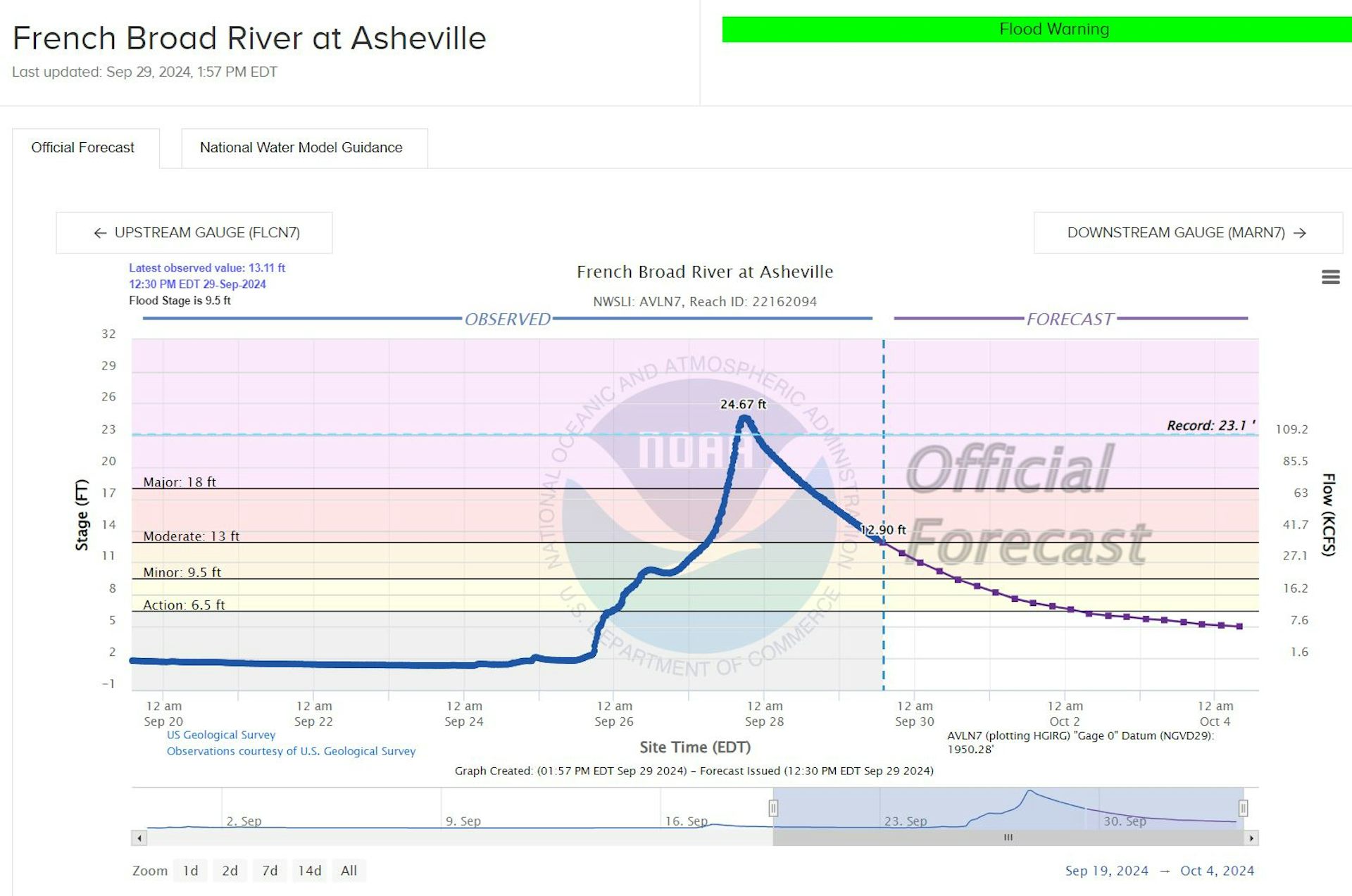
    But, as Helene revealed, there can also be great concern in less obvious spots. Inland, particularly in the mountains, runoff can quickly turn normally tame rivers into fast-rising torrents. The French Broad River at Asheville, North Carolina, rose about 12 feet in 12 hours during Helene and set a new flood stage record.

    When hurricanes and tropical storms are headed for the U.S., our interactive maps show where major polluters are located in the storm’s projected cone of impact. The maps identify hazardous flood-prone facilities down to the address, anywhere in the country.

    Knowledge is the first step

    Knowing where these sites are located is only the first step. Often, it’s up to communities themselves, many of them already overexposed and historically underserved, to raise concerns and demand strategies for mitigating the health, economic and environmental risks that industrial sites at risk of flooding and other damage can pose.

    These discussions can’t wait until a disaster is on the way. By knowing where these risks may be, communities can take steps now to build a safer future.

    This article, originally published Sept. 30, has been updated with Hurricane Milton.

    James R. Elliott receives funding from the National Science Foundation and the National Renewable Energy Lab.

    Dominic Boyer receives funding from the National Science Foundation, NOAA and Texas Sea Grant.

    Phylicia Lee Brown has nothing to disclose.

    ref. Flooded industrial sites and toxic chemical releases are a silent, growing threat in hurricanes like Milton and Helene – https://theconversation.com/flooded-industrial-sites-and-toxic-chemical-releases-are-a-silent-growing-threat-in-hurricanes-like-milton-and-helene-239977

    MIL OSI – Global Reports

  • MIL-OSI: Spartan Capital Releases Q3 2024 Performance Overview and Technical Outlook

    Source: GlobeNewswire (MIL-OSI)

    New York, NY, Oct. 08, 2024 (GLOBE NEWSWIRE) — Spartan Capital Securities, LLC is pleased to announce the release of its Q3 2024 Performance Overview and Technical Outlook. Prepared by market strategist Gianpaolo Raffo, this comprehensive report provides an in-depth analysis of market trends, sector performances, and projections for the next quarter.

    Published on October 2nd, 2024, the review explores the behavior of major indices and market sectors, incorporating key statistics and visualizations to encapsulate the third quarter’s activities. Through this report, Spartan Capital aims to provide valuable insights into market dynamics and sentiment, assisting clients in navigating the complexities of the investment landscape.

    During Q3, Spartan Capital reported growth across multiple sectors, with a particular emphasis on the S&P 500, Nasdaq, and significant market movements. “Our Q3 analysis provides essential context for understanding the current market environment and making future investment decisions,” remarked Gianpaolo Raffo. “We remain committed to delivering precise and actionable insights to our clients.”

    Spartan Capital’s dedication to excellence in financial analysis and client service is evident in the careful preparation of this report. As markets evolve, Spartan Capital continues to lead with guidance grounded in rigorous research and market expertise.

    To read the full Q3 2024 Performance Overview, including comprehensive analyses and insights, please visit our website at https://spartancapital.com/quarterly-overview-q3-2024/.

    About Spartan Capital Securities, LLC:

    Spartan Capital Securities, LLC is a premier full-service financial firm, offering expert investment advice to high-net-worth individuals and institutional clients. Known for its extensive market knowledge, strategic risk management, and personalized service, Spartan Capital and CEO John Lowry exemplify integrity and professionalism in the financial services industry.

    Contact:
    Kim Monchik
    45 Broadway, 19th Floor
    New York, NY 10006
    Info@spartancapital.com

    The MIL Network

  • MIL-OSI Canada: BATVN publishes an overview of the Canadian repo market

    Source: Bank of Canada

    Today, the Bankers’ Acceptance Transition Virtual Network (BATVN), established by the Canadian Fixed-Income Forum (CFIF) to support the transition away from BAs, published an overview of the Canadian repo market. This informational paper provides background information on the Canadian repo market and highlights that repos could be a viable BA replacement for some investors and that the disappearance of BAs could potentially be an important catalyst to help develop a tri-party repo market in Canada.

    This paper does not, and is not intended to, constitute investment or legal advice. It is provided for general information purposes only.

    To further help with this effort and bring more transparency to a core Canadian funding market, the Bank of Canada, in collaboration with the Collateral Infrastructure and Market Practices Advisory Group (CIMPA) published the Canadian Repo Market Fact Sheet. This report provides statistics on trading activity in the Canadian repo market.

    About CFIF

    The Canadian Fixed-Income Forum (Forum) is a senior level industry-wide committee established by the Bank of Canada to discuss developments in fixed-income market structure and functioning, market practices, and related policy issues. The goals of the Forum are to:

    • enhance the efficiency and resilience of the Canadian fixed-income market;
    • improve the quality, clarity and market-wide understanding of Canadian fixed-income trading practices;
    • evaluate and propose changes to market infrastructure;
    • communicate any recommendations and analysis to oversight authorities, regulators, industry groups and other market participants as needed.

    The Forum will not discuss monetary policy or policy issues directly relating to the size and distribution of the federal government’s debt programme which are covered through other fora.

    About the BATVN

    The BA Transition Virtual Network consists of members from close to 30 institutions, primarily representing the major buy-side investors active in BAs. Members include insurance companies, pension funds, money market funds, the major BA issuing banks and their dealers, as well as other relevant stakeholders. Member institutions account for approximately 60% of end-investor BA purchases.

    About CIMPA

    The Collateral Infrastructure and Market Practices Advisory Group (CIMPA) is an industry-wide working group created under CFIF to promote the well-functioning of the Canadian securities and financing markets through improved operational efficiency, reduced market segmentation and industry coordination on related issues and initiatives. The goals of the working group are to:

    • improve interconnectedness, standardization, and automation of securities flows;
    • support market functioning through promotion of best practices for clearing, settlement, margining and risk management;
    • facilitate broad adoption of the recently introduced Canadian Collateral Management Service (CCMS), Canada’s first tri-party service launched by TMX and Clearstream;
    • provide an information hub on Canadian collateral developments;
    • build consensus on relevant issues.

    Market inquiries:

    CFIF Secretariat
    Financial Markets Department
    Bank of Canada
    613‑782‑7913

    Media Relations
    Bank of Canada

    MIL OSI Canada News

  • MIL-OSI United Nations: Experts of the Committee on the Elimination of Discrimination against Women Commend the Lao People’s Democratic Republic for Elevating Gender Equality to the National Level, Raise Questions on the Treatment of Women Human Rights Defenders and on Human Tra

    Source: United Nations – Geneva

    The Committee on the Elimination of Discrimination against Women today concluded its consideration of the tenth periodic report of the Lao People’s Democratic Republic, with Committee Experts commending the State for elevating the issue of gender equality to the national level, while raising questions on its treatment of women human rights defenders, and how it was combatting human trafficking.

    Jie Xia, Committee Expert and Country Rapporteur, said the Committee commended the Lao People’s Democratic Republic for elevating the issue of gender equality to the national level through domesticating the Convention, developing a law on gender equality, and developing a national action plan and strategy on gender equality, among other measures. 

    A Committee Expert said the Committee had received several names of female human rights defenders who had been poorly treated by the Government and the judiciary.  Could the State party outline recent efforts to review and amend any existing laws, regulations, or decrees that may unduly restrict freedom of expression to ensure that these legal frameworks complied with international human rights standards, including the Convention? What measures was the State taking to investigate the disappearance, maltreatment and deaths of female human rights activists? 

    Another Expert said the Lao People’s Democratic Republic continued to be a renowned source of origin for migrant workers as well as increasingly becoming a country of transit and destination for sexual exploitation and human trafficking.  What were some of the key policies that the National Steering Committee on Anti-Human Trafficking had introduced and implemented in terms of effective anti-trafficking measures?  How was the implementation of the national plan on anti-trafficking carried out?  How did the State ensure that the security forces were working effectively to address the prevalence of trafficking within the Golden Triangle Special Economic Zone? 


    The delegation said the Committee operated on reports from non-governmental organizations, which were often exaggerated.  It was important to look at the reality in the country, rather than organizations that operated reports, which sometimes fit the category of disinformation.  For example, regarding the cases of the so-called female human rights defenders, they were not human rights defenders. They had organised propaganda against the State and had violated criminal law, and were therefore prosecuted and imprisoned. 

    The delegation said a national commission on human trafficking had been established at the provincial, district and national levels.  Focus was directed to the protection of victims.  Trainings were conducted for law enforcement staff on how to identify victims of trafficking, how to refer their cases, and how to further protect them.  The Women’s Union had expanded the shelter services to six provinces in the country. There was a police headquarters located within the Golden Triangle to prevent violations of human rights. Companies operating in this area were encouraged to ensure their staff received medical examinations. 

    Introducing the report, Chansoda Phonethip, Vice President of the Lao People’s Democratic Republic Women’s Union and Vice President of the National Commission for the Advancement of Women, Mothers and Children, and head of delegation, said the promotion and protection of women’s rights were at the core of the Government policy of the Lao People’s Democratic Republic.  In 2019, the National Assembly adopted the law on gender equality, which introduced a wide range of measures to address gender disparities across various sectors.  Under this law, gender-based discrimination was classified as a criminal offense. The Lao People’s Democratic Republic was dedicated to eliminating child marriage through strengthening legal and administrative frameworks, investing in education, and encouraging communities to collectively address the challenges posed by harmful practices such as early marriage and pregnancy. 

    In closing remarks, Ms. Phonethip thanked the Committee for the dialogue, which helped the Lao People’s Democratic Republic fulfil its obligations under the Convention. The Committee’s insights were instrumental to advancing the rights of women and girls in the country.  The State welcomed any support from the international community to help in meeting its obligations under the Convention. 

    Esther Eghobamien-Mshelia, Committee Vice Chair, thanked the delegation for the constructive dialogue with the Committee, which helped it to better understand the situation of women and girls in the Lao People’s Democratic Republic.

    The delegation of the Lao People’s Democratic Republic was comprised of representatives from the National Commission for the Advancement of Women, Mothers and Children; the Ministry of Foreign Affairs; the Lao Women’s Union; and the Permanent Mission of the Lao People’s Democratic Republic to the United Nations Office at Geneva.

    The Committee on the Elimination of Discrimination against Women’s eighty-ninth session is being held from 7 October to 25 October.  All documents relating to the Committee’s work, including reports submitted by States parties, can be found on the session’s webpage.  Meeting summary releases can be found here.  The webcast of the Committee’s public meetings can be accessed via the UN Web TV webpage.

    The Committee will next meet in public at 10 a.m. on Wednesday, 9 October to consider the fifth periodic report of Saudi Arabia (CEDAW/C/SAU/5).

    Report

    The Committee has before it the tenth periodic report of the Lao People’s Democratic Republic (CEDAW/C/LAO/10).

    Presentation of Report

    CHANSODA PHONETHIP, Vice President of the Lao People’s Democratic Republic Women’s Union and Vice President of the National Commission for the Advancement of Women, Mothers and Children, and head of delegation, said the promotion and protection of women’s rights were at the core of the Government policy of the Lao People’s Democratic Republic.  All citizens, regardless of sex, had equal rights in political, economic, social and family life, in compliance with the principles and norms of the Convention. The Government had implemented supportive measures in response to the COVID-19 pandemic, which was a key challenge for the country.  These included financial subsidies which particularly targeted unemployed individuals and women factory workers, with a total of 61,511 people benefitting from these initiatives.  The Government also introduced two national agendas, one focusing on addressing economic and financial difficulties, and the other on combatting drug trafficking. 

    In 2019, the National Assembly adopted the law on gender equality, which introduced a wide range of measures to address gender disparities across various sectors. Under this law, gender-based discrimination was classified as a criminal offense.  Over 50 laws had been revised and newly adopted over the past five years, including those aimed at improving women’s rights and ensuring gender equality. The Government had made great efforts to provide legal aid free of charge for disadvantaged people, as outlined in the law on lawyers, and the decree on legal aid.  The Lao People’s Democratic Republic actively maintained three national mechanisms for promoting gender equality and empowering women. These included the Government, represented by the National Commission for the Advancement of Women, Mothers and Children; the mass organization, represented by the Lao People’s Democratic Republic Women’s Union; and the legislature, represented by the National Assembly’s Women’s Caucus. 

    The Government remained committed to reviewing and strengthening its legal frameworks to further enhance protection from violence, particularly through the law on the protection and development of women and the law on the protection of the rights and interests of children.  The State had strengthened its national mechanisms for assisting women and girls who were victims of violence by adopting the “No Wrong Door” approach, ensuring that victims could access essential services, including healthcare, legal aid, and coordinated case management.  Counselling and protection centres had also been extended to five provinces.

    Awareness raising on gender-based violence was conducted and legal information and resources, such as handouts, posters and brochures on violence were widely distributed. 

    The Lao People’s Democratic Republic was dedicated to eliminating child marriage through strengthening legal and administrative frameworks, investing in education, and encouraging communities to collectively address the challenges posed by harmful practices such as early marriage and pregnancy.  The Government undertook a national study on early marriage and pregnancy, which would guide the formulation of policies and action plans to effectively tackle these issues.  The Government was also committed to protecting and supporting children affected by early marriage, ensuring their successful reintegration into society.  The State was dedicated to preventing human trafficking, with a strong focus on vulnerable groups, particularly women in border regions and high-risk communities. 

    Despite advancements made, the representation of female members in the Ninth National Assembly did not meet the set target of 30 per cent.  In response, the Government was actively undertaking a comprehensive review to identify the underlying factors contributing to this decline, particularly focusing on the various barriers that women faced in attaining high-ranking positions.  The outcomes of this study would serve to address these challenges and promote the participation of women in the upcoming elections for the Tenth National Assembly in 2026.  On the other hand, the number of female members of Provincial People’s Assemblies was higher than the set target.  Most recently, three women were promoted to the rank of Brigadier General, a historical moment in the Lao People’s Democratic Republic army. 

    The Government was actively promoting healthier lifestyles by raising awareness about sanitation, nutrition, and comprehensive pre- and post-natal care for women. Recent data reflected a significant decrease in the maternal mortality rate, now at 36.6 per 100,000 live births.  Ms. Phonethip said in 2026, the Lao People’s Democratic Republic would celebrate the forty-fifth anniversary of its ratification of the Convention. While significant achievements had been made in more than four decades, there were still challenges to overcome. It was hoped that the constructive dialogue with the Committee would produce meaningful outcomes. 

    Questions by Committee Experts

    JIE XIA, Committee Expert and Country Rapporteur, thanked the State party for sending a high-level delegation.  The Committee welcomed positive measures taken by the State party since 2018 to advance the status of women, promote gender equality, and eliminate discrimination against women.  The Committee commended the Lao People’s Democratic Republic for elevating the issue of gender equality to the national level through domesticating the Convention, developing a law on gender equality, and developing a national action plan and strategy on gender equality, among other measures. 

    It was noted that the Criminal Code penalised discriminatory acts based on gender.  Had there been any actions taken to directly penalise gender-based discrimination?  How many cases had been brought under article 204?  The Committee commended the Lao People’s Democratic Republic for domesticating the Convention; what measures had been taken to advance this process?  Could the judiciary apply the relevant laws in its rulings?  How many trainings had covered the Convention?  Could up to date information be provided on efforts made to implement the law on gender equality and the third national strategy on gender equality?  Did the State party encourage mediation through legal means?  How was it ensured that people did not escape legal sanctions by taking advantage of mediation? 

    A Committee Expert said the State party had repeatedly declared it was not able to establish a human rights institution in line with the Paris Principles.  What obstacles did the State party face in this regard?  If a female leader wished to establish a federal liberal party for the upcoming elections, would this be allowed?  If not, why not? 

    There were reports that the Government severely restricted non-governmental organizations. Women rights groups were confined to working through the Lao People’s Democratic Republic Women’s Union, which was a State body.  The Penal Code was also used to prosecute activists and restrict freedom of assembly. The Committee had received several names of female human rights defenders who had been poorly treated by the Government and the judiciary?  Could the State party outline recent efforts to review and amend any existing laws, regulations, or decrees that may unduly restrict freedom of expression to ensure that these legal frameworks complied with international human rights standards, including the Convention?  What measures was the State taking to investigate the disappearance, maltreatment and deaths of female human rights activists?  Was there a public site where detailed statistics related to sex and gender were published annually? 

    Another Expert commended the State party for its initiatives, including training programmes for women in leadership roles.  However, the Committee was concerned that the State party had not instituted temporary special measures to improve specific situations for women and girls.  What was the State party’s concerns regarding the use of temporary special measures?  What steps had been taken to demonstrate the values of temporary special measures and to provide explanations to the general public on the failure to employ these measures?  Would the State party consider the adoption of temporary special measures to fulfil the rights of disadvantaged women and ensure their participation in all areas of life?  What steps was the State party taking to collaborate with stakeholders, including civil society, to implement temporary special measures? 

    Responses by the Delegation

    The delegation said the Penal Code provided for the criminalisation of discrimination against women, and stated that anyone who discriminated against women due to gender would be punished, including by deprivation of liberty and fines.  There had been no cases enacted in the courts so far. The Government paid attention to the functioning of the mediation unit.  It was important to prioritise this mechanism to help avoid people going to the courts, which took time.  Harmony and non-confrontation were important in the Lao People’s Democratic Republic. This was why the Government placed significant importance on the functioning of the village mediation unit. Anyone dissatisfied with the outcome of the mediation unit could escalate it to the courts. 

    The Lao People’s Democratic Republic was preparing for the fourth cycle of the Universal Periodic Review early next year, and was working hard in this regard.  Several recommendations pertained to the Convention, which was a key focus of the Government.  The State was also preparing for the forthcoming visit of the Special Rapporteur on cultural rights in November this year.  Law dissemination campaigns were conducted to people in the provinces.  The budget reflected the implementation of the law on gender equality. 

    The delegation said the Government recognised the importance of national human rights institutions.  The Paris Principles had been studied carefully and research had been conducted on examples of such institutions in different countries.  Workshops had been organised, including with Commissioners from India, Indonesia and Myanmar, to learn how their national human rights institutions worked.  The State had different mechanisms in place and a new commission would involve increased resources.  There were established human rights focal points in each sector and issues could be conveyed through them.  Sometimes, taskforces were established to investigate particular human rights issues. The Lao People’s Democratic Republic was trying to strengthen the current mandates of what they had now. Only 118 Member States of the United Nations had established human rights commissions; in Asia, this number was only 15. 

    The Committee operated on reports from non-governmental organizations, which were often exaggerated.  It was important to look at the reality in the country, rather than organizations that operated reports, which sometimes fit the category of disinformation.  For example, regarding the cases of the so-called female human rights defenders, they were not human rights defenders. They had organised propaganda against the State and had violated criminal law, and were therefore prosecuted and imprisoned.  They used the pretext of freedom of expression to violate the law.  Freedom of expression had limits; it was not absolute. 

    The Lao People’s Democratic Republic planned to conduct an economic survey.  From 2017, the State had made efforts to improve existing databases throughout the sectors.  The Government had made efforts to mobilise women to take part in elections. Capacity training was provided to women. An action plan was in place to empower women to hold leadership positions in the commerce sector.  Women were present in all branches of the economy. 

    Questions by Committee Experts

    A Committee Expert was pleased to hear that the Lao People’s Democratic Republic was considering establishing a human rights institution; how long would this process take? How many cases related to gender-based discrimination were conducted in the State party before the courts in the last five years, and how did they end?  It was sad to hear about the State’s general position regarding human rights defenders.  However, it was pleasing to hear the Criminal Code was being reviewed to enhance freedom of expression; how long would this review process take? 

    Another Expert asked what were the concerns and challenges the State faced in regard to using temporary special measures to advance the rights of women in the country? Could these measures be used to reallocate resources to women? 

    Responses by the Delegation 

    The delegation said it was not practical for the State to provide a timeline on establishing a national human rights institution, as they were learning from other countries and strengthening existing mechanisms.  In some cases, people misused and abused human rights treaties, using freedom of expression as a pretext.  In the case of one woman in prison, she had used propaganda to distort information and criticise the Government.  Every 10 years, the Government amended the Constitution and focused on articles which were relevant.  Next year, the Government would organise a population Census which would be gender disaggregated.  This would be used to prepare the next five-year development plan. 

    There were plans to increase the number of women in Government by 2026.  A survey would be conducted to determine why there were decreasing numbers of female parliamentarians.  Regarding temporary special measures, there were challenges in human and financial resources, as well as changing the mindsets of some people who still discriminated against women.  There were few cases of gender discrimination in the courts due to the use of the peaceful mediation resolution, which prevented cases from going to the courts. 

    Questions by Committee Experts

    A Committee Expert said the Lao People’s Democratic Republic had yet to promulgate a national action plan for women, peace and security, in accordance with the Committee’s recommendations.  Would the State consider including the rise of artificial intelligence and its impact on women’s security in the plan?  Would the impact of militarisation be addressed?  What was being done to address harmful stereotypes of women and girls, particularly in rural areas?  Would the law on domestic violence be revised to address cybercrime against women and scams against impoverished women?  It was concerning that there was no specific law against spousal rape.  Would affirmative consent be included as an essential component of rape?  Economic turmoil had led to an increase in domestic violence and child marriage. How would economic policies take the most vulnerable into account?  What steps had been taken to assess the impact of the economic crisis on women? 

    Another Expert commended the State’s efforts to address trafficking in persons, including through the enactment of the 2016 anti-trafficking law and the inclusion of article 215 in the 2018 Penal Code, which criminalised both sex and labour trafficking.  The national plan on anti-trafficking in persons combatting and prevention phase III (2021-2025) and the establishment of the National Steering Committee on Anti-Human Trafficking were positive steps.  However, the Lao People’s Democratic Republic continued to be a renowned source of origin for migrant workers as well as increasingly becoming a country of transit and destination for sexual exploitation and human trafficking. What were some of the key policies that the Committee had introduced and implemented in terms of effective anti-trafficking measures?  How was the implementation of the national plan on anti-trafficking carried out? 

    Concerns persisted around the prevalence of trafficking within the Golden Triangle Special Economic Zone.  Sources reported the sale and trafficking of girls as young as 13 and 14 to China increasingly happening unrestricted through flourishing internet trade.  How did the State ensure that the security forces were working effectively to address such challenges?  What specific actions were being taken to combat the impunity in the Special Economic Zone?  How did the Government plan to strengthen the capacity of law enforcement and judiciary personnel to investigate, prosecute, and secure convictions in trafficking cases? 

    It was positively noted that under the national plan of action on anti-trafficking in persons, a temporary shelter for victims of trafficking in persons was established. Did the State party have any plans to strengthen survivor services and increase resources as well as expand the capacity of shelters, legal aid services, and vocational training programmes, particularly in provinces with higher trafficking risks and women and girls from rural and ethnic minority communities?  Given that many trafficking cases involved border crossings, how was work done with cross-border countries to strengthen the approach against trafficking?  Did the State’s COVID-19 response plan address the heightened risk of trafficking? 

    Responses by the Delegation

    The delegation said that the Lao People’s Democratic Republic was translating the Association of Southeast Asian Nations’ women, peace and security plan and would disseminate this.  The State’s national plan of action for 2026 to 2030 was being drafted, and women, peace and security would be integrated into this.  Workshop seminars were organised to look at the traditional practice. To ensure gender equality, the Lao People’s Democratic Republic Women’s Union had made efforts to develop guidelines for domestic violence and promote the reproductive health of women. Projects had been piloted in six provinces in the country. 

    A national commission on human trafficking had been established at the provincial, district and national levels.  Focus was directed to the protection of victims.  The Government focused on preventing trafficking in persons, particularly for women working in factories and those living in remote villages.  The Government also organised anti-human trafficking days in July each year, at the central and local levels.  Trainings were conducted for law enforcement staff on how to identify victims of trafficking, how to refer their cases, and how to further protect them. 

    The Women’s Union had expanded the shelter services to six provinces in the country.  After being rescued, victims were referred to the Union and were provided with shelter and mental and physical support, and they were then reintegrated back into society.  Work was done with the Ministry of Justice to ensure victims could receive justice and the traffickers could be prosecuted.  From June 2024, professional training had been provided for more than 600 people in the area of human trafficking.  There was a police headquarters located within the Golden Triangle to prevent violations of human rights.  Companies operating in this area were encouraged to ensure their staff received medical examinations.  The Government of the Lao People’s Democratic Republic had developed a legal framework on human trafficking.

    Rape was clarified within the Penal Code; however, the element of affirmative consent was not present. The State needed to explore this option and conduct studies in this regard.  The Lao People’s Democratic Republic had made efforts to cooperate within the multilateral framework and on bilateral mechanisms with neighbouring countries. 

    In the Lao People’s Democratic Republic, more than 200,000 people had been infected by COVID-19. More than 60,000 had died of the virus. The country still faced the continuing impact of COVID-19, and was in the process of recovering.  The country had been faced with economic and financial difficulties, as well as natural disasters and climate change.  The Government had taken concrete measures to address this situation, including for women, to ensure no one was left behind. 

    Questions by Committee Experts

    A Committee Expert commended the Lao People’s Democratic Republic for making equality a driver towards peace.  The number of women in parliament had improved to 22 per cent, and there was a parliamentary commission, which was positive.  However, parity meant 50/50; it needed to be seen as a relevant solution to poverty.  In the absence of political pluralism, how could the electoral base be expanded to ensure women had access to political parties and leadership?  How could it be ensured that there was a large-scale effort to ensure women had access to voting and being candidates?  How could these developments be accelerated?  What initiatives could be undertaken to ensure real parity for women in the life of the party and the central congress?  What role could the Women’s Union play to train candidates and create momentum?  What could be done to support civil society?  What initiatives could be taken to help women participate in a more effective way?  How was it ensured that ethnic minorities could participate in local development? 

    Another Expert underscored the importance of documentation as proof of nationality. The guide to birth registration and other measures were well noted.  Was information on birth registration from provinces gathered on an annual basis?  What had the percentage increase in registration been?  What target had been reached as of today?  What were the key challenges and what incentives were being considered for the still unregistered 30 per cent?  Was disaggregated data on registrations available?  What measures and incentives were taken to improve birth registration and encourage ethnic minority groups and rural women to register births?  How was the documentation system used to track the State party’s migrant women population?  Could stateless children or children born to immigrant women obtain the nationality of the Lao People’s Democratic Republic?  How many had been granted nationality so far? 

    Responses by the Delegation

    The delegation said female diplomats in the Lao People’s Democratic Republic played an impressive role in the country’s foreign affairs work.  In 2024, out of 914 diplomats working in the Ministry, 322 were female diplomats, representing 32.5 per cent.  Of 27 ambassador posts, five were women, which was equivalent to 19 per cent.  Of three minister posts, one was a woman.  When there were opportunities such as scholarships, the policy now stated these should be offered to female diplomats first.  This month, the Lao People’s Democratic Republic Women’s Union had successfully completed hosting the Association of Southeast Asian Nations’ Women Entrepreneurs’ Conference 2024.   

    The Ministry of Home Affairs had carried out many activities to raise awareness of birth registration, including printing, publishing and distributing information. If a child was born to stateless parents who had fully integrated into the Lao People’s Democratic Republic culture, the child could obtain nationality on request.  There were several conditions, including speaking the language and respecting the Constitution.  These laws aimed to reduce statelessness.  There were not many stateless people in the Lao People’s Democratic Republic.

    Questions by Committee Experts

    A Committee Expert said the Committee welcomed that the State party was making efforts to increase the enrolment of girls and women in education.  However, there was a significant gender gap in non-traditional fields, including science, technology, engineering and mathematics. What concrete measures had been taken to ensure parents understood the importance of sending girls to schools? How was the effectiveness of gender-sensitive curricula ensured in order to change gender stereotypes from an early age?  What were the specific measures to increase the access of girls to education? 

    What were the plans to provide necessary education in native languages?  What steps were being taken to improve the infrastructure and resources in schools in remote areas?  What steps were being taken to ensure quality access to education for all women and girls with disabilities?  How would the State party sustain the school lunch programme in rural and remote areas?  How was the issue of child marriage monitored and addressed?  Parents needed to understand that education was important for girls; maybe training and awareness raising was needed for the parents. 

    Another Expert said that since the 1990s, the State party had made efforts to increase women’s participation in the labour market.  Yet despite this, women’s participation had steadily declined since 2012. The gender pay gap in the capital showed that 52 per cent of women employed took home only 77 per cent of men’s average wages.  What were the legislative measures for ensuring equal pay and equal and just working conditions?  What was the State’s assessment of the sharp decrease in women’s participation in the labour market, and what was being done to combat this?  How would these plans target women in vulnerable groups?  What policies were in place to protect migrant women workers?  What were the measures provided under the sexual harassment law? 

    A Committee Expert said the Lao People’s Democratic Republic had approved a decree to establish health insurance which was positive.  One of the key issues recognised by the Government was HIV/AIDS. What were the main results of efforts taken to prevent HIV/AIDS?  What steps had been taken to adopt HIV/AID legislation to expand access to services and combat discrimination?  Could updated information on rural women be provided, including access to services? What was the main reason for the criminalisation of abortion?  What were the main barriers which women and girls in poverty faced when accessing health services?  What access did women in detention have to reproductive health services?

    Responses by the Delegation

    The delegation said a group of parents had been created in primary schools to enable them to understand the importance of education.  Lunch boxes had been created for poor students and those who lived in rural areas, which had seen an increase in school enrolment.  A new curriculum had been developed for the schools and teachers had been trained on this.  Scholarships were provided to poor students and job training was provided to give students access to the labour market.  The law on disability aimed to protect the rights of those with disabilities. Within this law, children with disabilities could access educational facilities, the same as anyone else. Special equipment was provided to help these children receive an education.  The Lao People’s Democratic Republic provided tools for developing skills in the labour market. 

    The delegation said a national action plan had been implemented to combat HIV/AIDS and sexually transmitted diseases.  In addition to reducing the stigma, the 161 HIV/AIDS centres provided counselling services, with 11 centres providing treatment.  Testing kits for HIV detection were distributed within the communities.  Poor women could give birth in public hospitals free of charge.  In each detention centre, there were medical staff on hand to provide healthcare to detainees.  Other statistics would be provided in writing. 

    Questions by Committee Experts

    A Committee Expert commended the State party’s efforts to expand social protection coverage. Despite institutional efforts, feminised poverty persisted, and women continued to face great difficulties in gaining access to economic, social and cultural activities.  Could comprehensive data be provided on how women had benefitted from the small and medium enterprise law?  What targeted policies and measures existed to increase access to finances for women?  What gender-specific outcomes existed to demonstrate effectiveness and uptake in the banking sector? 

    What steps were being taken to adopt specific legislation on women’s rights to land? How could women’s roles at village and community levels be increased?  Could updated information be provided on measures taken to allow women in the informal sector to access benefits?  What was the impact of national and international cooperation programmes?  What plans existed to develop opportunities for women in sports?  How strong was the country’s economic, social and cultural framework on gender commitment? 

    Another Expert noted the different actions taken by the Lao People’s Democratic Republic to integrate gender equality into different sectors, including in agriculture and fisheries, to benefit rural women and other marginalised groups. However, there were clear gender gaps in the implementation of Government policies.  What concrete actions would the State party consider taking to ensure the effective implementation of Government initiatives to benefit vulnerable women?  How was gender-responsive climate financing integrated in the national budget?  What concrete steps had been taken to increase rural and other vulnerable women’s access to quality social services? 

    The Committee had received reports of indigenous people evicted from their ancestral land. What steps was the Lao People’s Democratic Republic taking to preserve ancestral land and mitigate the gendered impact of the climate crisis?  What concrete steps were being taken to protect the Hmong people from forceful evictions from their land?  What concrete steps were being taken to provide compensation to women evicted from their land? 

    A Committee Expert said the Constitution of the Lao People’s Democratic Republic called for the independence of the judiciary.  How was the Supreme Court trained on the rule of law and the independence of the judiciary? Did women human rights defenders have access to free legal counsel?  How were the village chiefs who were trained to implement the laws monitored?  It was understood that customary laws were part of a traditional system, but these might be outdated in 2024 and could create a stigma for women.  Women were often abandoned with their children in a time of profound economic crisis. Would the State consider social security and childcare arrangements? 

    Responses by the Delegation 

    The delegation said a law existed in the Lao People’s Democratic Republic which defined the right for individual or legal entities to use land, without any discrimination on the grounds of gender.  These were part of the efforts to promote women’s access to land.  The Lao People’s Democratic Republic was in the process of transforming the economy to make it digitalised.  The State had joined the international community in the Global Digital Compact.  Social protection efforts gave women in vulnerable situations top priority. Women were covered as a target group under the Government policy under the Sustainable Development Goals.  The issue of land was very important as many women were engaged in agriculture.  For this reason, the Government aimed to ensure women had access to land.  The Government had a legislative framework on the law of land. 

    Within the legal system of the Lao People’s Democratic Republic, a foreigner could not own land, but had the right to use the land.  The country prioritised the need for foreign investors to protect the environment.  Foreign entities did not own 50 per cent of land in the Lao People’s Democratic Republic. 

    A committee had been appointed to implement the climate action plan.  Human resources were allocated to implement this plan. Trainings on national disasters were provided in the provinces.  The national disaster preparedness plan had been piloted. Gender equality was mainstreamed across policies in all sectors.  A vaccination campaign was conducted to help prevent communicable disease.  Guidelines were developed to help increase the quality of health coverage. 

    The Lao People’s Democratic Republic Women’s Union was in the process of revising the law on the protection of women.  Specific rights had been added, including for the labour market.  The Government issued a decree on lifelong learning in 2020 to develop a policy for rural women and girls to have access to education. 

    Agriculture was the basis of the economy of the Lao People’s Democratic Republic.  A group of female farmers had been established which provided benefits, including generating income for their families. Currently, the Lao People’s Democratic Republic did not have a specific law on anti-discrimination.  However, the Government had adopted the law on gender equality.  Civil and criminal proceedings were required to be conducted on the basis that all civilians were equal before the law. 

    Campaigns were organised around land ownership to ensure all women understood their rights when it came to inheriting land, as well as the importance of putting their name on the land title.  The Lao People’s Democratic Republic categorically rejected the allegations of forced evictions.  Before being relocated, people were extensively consulted. 

    Closing Remarks

    CHANSODA PHONETHIP, Vice President of the Lao People’s Democratic Republic Women’s Union and Vice President of the National Commission for the Advancement of Women, Mothers and Children and head of delegation, thanked the Committee for the dialogue, which helped the Lao People’s Democratic Republic fulfil its obligations under the Convention.  The Committee’s insights were instrumental to advancing the rights of women and girls in the country.  The Lao People’s Democratic Republic would address the challenges highlighted by the Committee.  The State welcomed any support from the international community to help in meeting its obligations under the Convention. 

    ESTHER EGHOBAMIEN-MSHELIA, Committee Vice Chair, thanked the delegation for the constructive dialogue with the Committee, which helped it to better understand the situation of women and girls in the Lao People’s Democratic Republic.


    Produced by the United Nations Information Service in Geneva for use of the media; 
    not an official record. English and French versions of our releases are different as they are the product of two separate coverage teams that work independently.


    CEDAW24.024E

    MIL OSI United Nations News

  • MIL-OSI New Zealand: Stats NZ information release: Tatauranga umanga Māori – Statistics on Māori businesses: June 2024 quarter

    Source: Statistics New Zealand

    Tatauranga umanga Māori – Statistics on Māori businesses: June 2024 quarter – information release – 8 October 2024 – Tatauranga umanga Māori – Statistics on Māori businesses: June 2024 quarter presents information on one subset of Māori businesses that contribute to our country’s economy. This release includes data on Māori authorities and related businesses. It does not cover all Māori businesses in Aotearoa New Zealand.

    Māori authorities are defined as businesses that receive, manage, and/or administer assets held in common ownership by iwi and Māori. Māori authorities are largely identified through their tax codes as registered with Inland Revenue. Any business within a Māori authority ownership group is also included for the purposes of Tatauranga umanga Māori.

    Key facts
    In the June 2024 quarter, around 1,450 Māori authorities and related businesses were in the Tatauranga umanga Māori population.

    All figures are actual values and are not adjusted for seasonal effects.

    In the June 2024 quarter compared with the June 2023 quarter:

    • the total value of sales by Māori authorities was $1,057 million, up $4.3 million (0.4 percent)
    • the total value of purchases by Māori authorities was $774 million, down $25 million (3.2 percent)
    • the total number of filled jobs for Māori authorities was 12,100, up 390 jobs (3.3 percent)
    • the total value of earnings by employees of Māori authorities was $219 million, up $15 million (7.4 percent)
    • Māori authorities exported $216 million worth of goods, up $5.6 million (2.7 percent).

    Visit our website to read this information release and to download CSV files:

    MIL OSI New Zealand News

  • MIL-OSI Submissions: Stats NZ information release: Tatauranga umanga Māori – Statistics on Māori businesses: June 2024 quarter

    Source: Statistics New Zealand

    Tatauranga umanga Māori – Statistics on Māori businesses: June 2024 quarter – information release – 8 October 2024 – Tatauranga umanga Māori – Statistics on Māori businesses: June 2024 quarter presents information on one subset of Māori businesses that contribute to our country’s economy. This release includes data on Māori authorities and related businesses. It does not cover all Māori businesses in Aotearoa New Zealand.

    Māori authorities are defined as businesses that receive, manage, and/or administer assets held in common ownership by iwi and Māori. Māori authorities are largely identified through their tax codes as registered with Inland Revenue. Any business within a Māori authority ownership group is also included for the purposes of Tatauranga umanga Māori.

    Key facts
    In the June 2024 quarter, around 1,450 Māori authorities and related businesses were in the Tatauranga umanga Māori population.

    All figures are actual values and are not adjusted for seasonal effects.

    In the June 2024 quarter compared with the June 2023 quarter:

    • the total value of sales by Māori authorities was $1,057 million, up $4.3 million (0.4 percent)
    • the total value of purchases by Māori authorities was $774 million, down $25 million (3.2 percent)
    • the total number of filled jobs for Māori authorities was 12,100, up 390 jobs (3.3 percent)
    • the total value of earnings by employees of Māori authorities was $219 million, up $15 million (7.4 percent)
    • Māori authorities exported $216 million worth of goods, up $5.6 million (2.7 percent).

    Visit Statistics NZ’s website to read this information release and to download CSV files:


    MIL OSI

  • MIL-OSI New Zealand: Media are invited to the 378 Recruit Wing graduation

    Source: New Zealand Police (National News)

    New Zealand Police is pleased to announce the 378-recruit wing will be graduating from their initial training course on Thursday morning 10 October in front of whānau and friends.

    Attending the ceremony will be Assistant Commissioner Jevon McSkimming and the Police executive, Hon Mark Mitchell the Minister for Police, Hon Casey Costello, Associate Minister for Police along with Wing Patron, Hon Hekia Parata.

    Wing 378’s prize-winners are spread across five policing districts, namely Auckland City, Bay of Plenty, Eastern, Tasman and Canterbury.

    More details about statistics, prize winners and other recruits will be shared after graduation on Thursday.

    Patron details:

    The Honourable Hekia Parata (Ngāi Tahu and Ngāti Porou) has provided 41 years of public service to New Zealand.

    She began her public service career with the Ministry of Foreign Affairs after graduating from the University of Waikato with a Bachelor of Arts and Master of Arts in Māori Studies. Hekia was a Member of Parliament, representing the National Party, from 2008 until 2017 when she retired.  Since then she’s has had several appointments to ministerial inquiries, such as leading the 2023 inquiry into forestry land use after Cyclone Gabrielle.

    Graduation day:

    Media are welcome to attend the graduation parade which takes place at 10am at The Te Rauparaha Arena, Porirua.

    Please RSVP to the Police Media Centre as soon as possible:  media@police.govt.nz

    ENDS

    Issued by Police Media Centre

    MIL OSI New Zealand News

  • MIL-OSI Submissions: Comparable but tailored occupational classifications for Australia and New Zealand – Stats NZ media release

    Source: Statistics New Zealand

    Comparable but tailored occupational classifications for Australia and New Zealand – release – 8 October 2024 – The Australian Bureau of Statistics and Statistics New Zealand announced today, that while maintaining comparability, each country will introduce their own tailored occupational statistical classifications.

    The joint Australian and New Zealand Standard Classification of Occupations (ANZSCO) was established in 2006. The labour markets in both countries have changed and the differences are greater than when the joint management of the occupation classification commenced. 

    Australian Statistician Dr David Gruen and New Zealand Government Statistician Mr Mark Sowden said the decision is mutual and have committed to continue working together to maintain Trans-Tasman and international comparability as a priority. 

    The two agencies will develop concordances to map between classifications to maintain comparability, data continuity and time-series analysis. 

    Visit Statistics NZ’s website to read this news story:

    MIL OSI

  • MIL-OSI New Zealand: Comparable but tailored occupational classifications for Australia and New Zealand – Stats NZ media release

    Source: Statistics New Zealand

    Comparable but tailored occupational classifications for Australia and New Zealand – release – 8 October 2024 – The Australian Bureau of Statistics and Statistics New Zealand announced today, that while maintaining comparability, each country will introduce their own tailored occupational statistical classifications.

    The joint Australian and New Zealand Standard Classification of Occupations (ANZSCO) was established in 2006. The labour markets in both countries have changed and the differences are greater than when the joint management of the occupation classification commenced. 

    Australian Statistician Dr David Gruen and New Zealand Government Statistician Mr Mark Sowden said the decision is mutual and have committed to continue working together to maintain Trans-Tasman and international comparability as a priority. 

    The two agencies will develop concordances to map between classifications to maintain comparability, data continuity and time-series analysis. 

    Visit our website to read this news story:

    MIL OSI New Zealand News

  • MIL-OSI USA: Smith Statement on Biden’s Jobs Report Rhetoric

    Source: United States House of Representatives – Congressman Adrian Smith (R-NE)

    Washington, D.C. – Today, Congressman Adrian Smith (R-NE) released the following statement after President Biden made comments on the latest jobs report.

    “President Biden should take a moment and reflect before celebrating the latest jobs report. Under his presidency, the Bureau of Labor Statistics has consistently needed to downgrade its jobs estimates—including a massive reduction of over 800,000 jobs in March of this year. As long as Biden-Harris policy fails to address our nation’s labor shortage, lost trade opportunities for American producers, and other problems our country is facing, inflation and poor economic recovery will continue to harm American families.”

    ###

    MIL OSI USA News

  • MIL-OSI Australia: Wake-up call for phone-wielding drivers

    Source: South Australia Police

    Drivers clocked up 2544 fines during the first week of expiations snapped by South Australia’s new mobile phone detection cameras, with at least three people expected to lose their licence.

    Following a three-month grace period, week-one data from 19 September 2024 to 25 September 2024 shows, pleasingly, driver behaviour has improved.

    However, a concerning number of offenders are still choosing to “flirt with death”, suffering expensive repercussions including a $556 fine plus a $102 Victims of Crime levy and three demerit points.

    Reviewed by a trained SAPOL adjudicator, of the 2604 potential incidents, 2544 or 97.70 per cent received an expiation notice. Day one alone saw 405 notices issued.

    Across five metropolitan camera locations, the first week’s rate of expiation notices has averaged 0.24 per cent compared to 0.37 per cent in the last week of the grace period.

    “This demonstrates people are hearing the call that illegal mobile phone use on our roads will not be tolerated,” South Australia Police (SAPOL) Traffic Services Branch Officer in Charge, Superintendent Darren Fielke said.

    “But it defies all reason some drivers are still putting their lives and others at risk by using their phones when behind the wheel. Use includes having the phone in your lap, under or on your body or touching or being touched by any part of your body except in certain circumstances.

    “In only one week, 2544 motorists were detected, and no one can say we didn’t warn them. The fact certain drivers were caught multiple times across several of the camera locations is unbelievable.”

    Two registered vehicle owners will receive six expiations for detections, and another will be issued with five. All three are expected to lose their licences.

    “Disappointingly, our records show the registered vehicle owners that were detected five times and more in the first week had also received warning letters during the grace period,” Superintendent Fielke revealed.

    “Our continued message to drivers is simple; leave your phone alone while driving, or you might pay the ultimate price.”

    In 2024 so far, distraction has been a contributing factor in 2101 casualty collisions, with 23 lives lost and 221 serious injuries suffered.

    Mobile phone detection cameras are in place across five high-risk locations, monitoring 13 lanes. All five locations have had warning signs installed.

    First week expiation data shows, of the 2544 expiations issued, 702 were detected at North South Motorway, Regency Park, 580 at Southern Expressway, Darlington, 553 at South Road, Torrensville, 473 at Port Road, Hindmarsh and 236 at Port Wakefield Road, Gepps Cross (vehicle volume 1,061,589).

    South Road, Torrensville was identified as having the highest percentage of expiations sent considering vehicle volume, and Southern Expressway, Darlington the lowest.

    Mobile phone detection cameras were introduced across the five sites between 19 June and 18 September 2024, and during the three-month expiation grace period, SAPOL sent 68,252 warning notices for mobile phone offences.

    Two other camera locations are currently being considered and are expected to be in place during 2025.

    Visit Think! Road Safety for further information about mobile phone detection cameras.

    *No new photos are available from phone camera detections

    Data table

    Distracted Driving Statistics for 19 September 2024 to 25 September 2024 Inclusive

    Vehicle Volume

    Total Incidents
    (Potential Offences)

    Expiation Notices Sent

    % Expiation Notices Sent

    % Expiation Notices

    1,061,589

    2604

    2544

    0.24%

    97.70%

    MIL OSI News

  • MIL-Evening Report: I have a stuffy nose, how can I tell if it’s hay fever, COVID or something else?

    Source: The Conversation (Au and NZ) – By Deryn Thompson, Eczema and Allergy Nurse; Lecturer, University of South Australia

    Lysenko Andrii/Shutterstock

    Hay fever (also called allergic rhinitis) affects 24% of Australians. Symptoms include sneezing, a runny nose (which may feel blocked or stuffy) and itchy eyes. People can also experience an itchy nose, throat or ears.

    But COVID is still spreading, and other viruses can cause cold-like symptoms. So how do you know which one you’ve got?

    Remind me, how does hay fever cause symptoms?

    Hay fever happens when a person has become “sensitised” to an allergen trigger. This means a person’s body is always primed to react to this trigger.

    Triggers can include allergens in the air (such as pollen from trees, grasses and flowers), mould spores, animals or house dust mites which mostly live in people’s mattresses and bedding, and feed on shed skin.

    When the body is exposed to the trigger, it produces IgE (immunoglobulin E) antibodies. These cause the release of many of the body’s own chemicals, including histamine, which result in hay fever symptoms.

    People who have asthma may find their asthma symptoms (cough, wheeze, tight chest or trouble breathing) worsen when exposed to airborne allergens. Spring and sometimes into summer can be the worst time for people with grass, tree or flower allergies.

    However, animal and house dust mite symptoms usually happen year-round.

    Ryegrass pollen is a common culprit.
    bangku ceria/Shutterstock

    What else might be causing my symptoms?

    Hay fever does not cause a fever, sore throat, muscle aches and pains, weakness, loss of taste or smell, nor does it cause you to cough up mucus.

    These symptoms are likely to be caused by a virus, such as COVID, influenza, respiratory syncytial virus (RSV) or a “cold” (often caused by rhinoviruses). These conditions can occur all year round, with some overlap of symptoms:


    Natasha Yates/The Conversation

    COVID still surrounds us. RSV and influenza rates appear higher than before the COVID pandemic, but it may be due to more testing.

    So if you have a fever, sore throat, muscle aches/pains, weakness, fatigue, or are coughing up mucus, stay home and avoid mixing with others to limit transmission.

    People with COVID symptoms can take a rapid antigen test (RAT), ideally when symptoms start, then isolate until symptoms disappear. One negative RAT alone can’t rule out COVID if symptoms are still present, so test again 24–48 hours after your initial test if symptoms persist.

    You can now test yourself for COVID, RSV and influenza in a combined RAT. But again, a negative test doesn’t rule out the virus. If your symptoms continue, test again 24–48 hours after the previous test.

    If it’s hay fever, how do I treat it?

    Treatment involves blocking the body’s histamine release, by taking antihistamine medication which helps reduce the symptoms.

    Doctors, nurse practitioners and pharmacists can develop a hay fever care plan. This may include using a nasal spray containing a topical corticosteroid to help reduce the swelling inside the nose, which causes stuffiness or blockage.

    Nasal sprays need to delivered using correct technique and used over several weeks to work properly. Often these sprays can also help lessen the itchy eyes of hay fever.

    Drying bed linen and pyjamas inside during spring can lessen symptoms, as can putting a smear of Vaseline in the nostrils when going outside. Pollen sticks to the Vaseline, and gently blowing your nose later removes it.

    People with asthma should also have an asthma plan, created by their doctor or nurse practitioner, explaining how to adjust their asthma reliever and preventer medications in hay fever seasons or on allergen exposure.

    People with asthma also need to be alert for thunderstorms, where pollens can burst into tinier particles, be inhaled deeper in the lungs and cause a severe asthma attack, and even death.

    What if it’s COVID, RSV or the flu?

    Australians aged 70 and over and others with underlying health conditions who test positive for COVID are eligible for antivirals to reduce their chance of severe illness.

    Most other people with COVID, RSV and influenza will recover at home with rest, fluids and paracetamol to relieve symptoms. However some groups are at greater risk of serious illness and may require additional treatment or hospitalisation.

    For RSV, this includes premature infants, babies 12 months and younger, children under two who have other medical conditions, adults over 75, people with heart and lung conditions, or health conditions that lessens the immune system response.

    For influenza, people at higher risk of severe illness are pregnant women, Aboriginal people, people under five or over 65 years, or people with long-term medical conditions, such as kidney, heart, lung or liver disease, diabetes and decreased immunity.

    If you’re concerned about severe symptoms of COVID, RSV or influenza, consult your doctor or call 000 in an emergency.

    If your symptoms are mild but persist, and you’re not sure what’s causing them, book an appointment with your doctor or nurse practitioner. Although hay fever season is here, we need to avoid spreading other serious infectious.

    For more information, you can call the healthdirect helpline on 1800 022 222 (known as NURSE-ON-CALL in Victoria); use the online Symptom Checker; or visit healthdirect.gov.au or the Australian Society of Clinical Immunology and Allergy.

    Deryn Thompson is affiliated with Loreal, Ego Pharmaceuticals and Quality Use of Medicines Alliance having received honorariums for educational talks or advisory work.

    ref. I have a stuffy nose, how can I tell if it’s hay fever, COVID or something else? – https://theconversation.com/i-have-a-stuffy-nose-how-can-i-tell-if-its-hay-fever-covid-or-something-else-240453

    MIL OSI AnalysisEveningReport.nz

  • MIL-Evening Report: Productivity is often mistaken for wages. What does it really mean? How does it work?

    Source: The Conversation (Au and NZ) – By David Peetz, Laurie Carmichael Distinguished Research Fellow at the Centre for Future Work, and Professor Emeritus, Griffith Business School, Griffith University

    Alexey_Rezvykh/Shutterstock

    Australia’s productivity growth has reverted to the same stagnant pattern as before the pandemic, according to the Productivity Commission’s latest quarterly report.

    Productivity is complex and often misunderstood in media and policy debates. So before we read too much into this latest data, here are six key things to understand about productivity.

    1. It’s about quantities, not costs

    Productivity “measures the rate at which output of goods and services are produced per unit of input”. So it’s about how many workers does it take to make how many widgets?

    Most Australian workplace managers don’t know how to measure productivity correctly.

    If someone says “higher wages mean lower productivity”, they don’t know what they’re talking about. Wages aren’t part of the productivity equation. People often cite “productivity” as a reason for a policy they like because they can’t say “we like higher profits”.

    In fact, high wages can encourage firms to introduce new technology that improves productivity. If labour becomes more expensive, it may be more profitable for firms to invest in labour-saving technology.

    But lower productivity isn’t always a bad thing. Sometimes higher selling prices can lower productivity. It seems odd, but works like this: if prices for commodities such as iron ore or coal are high, it becomes profitable for mining companies to dig through more rock to get to it.

    This takes more time. But it’s now worth extracting these small quantities, because they’re so valuable. For this reason, with high commodity prices, mining labour productivity fell by 13% between 2019-20 and 2022-23. Mining productivity had the largest negative impact on national productivity growth in 2022-23.

    2. Productivity is directed by management, not workers

    The biggest single factor that shapes productivity is technology. Who’s responsible for what technology a business introduces? Management. Workers often don’t have much of a say.

    OECD research suggests new technology such as artificial intelligence (AI) meets lower resistance from employees when they are consulted over its introduction. That’s because new technology makes their firms more competitive and they want to keep their jobs.

    Not surprisingly, there’s lots of research showing management that engages and consults workers gets greater output.

    Output will also be better with an educated and skilled workforce. If people can do more things with their brains, they’ll be more productive.

    3. Measuring productivity is dodgier the more complex it gets

    Measuring labour productivity – output per unit of labour input – is fairly straightforward if you’ve got a single output that is sold in a free market, and you’re looking at a single input (labour). It’s not hard to measure, or describe, the number of cars produced per worker in a week.

    It gets very tricky when you’re looking at multi-factor productivity (output per unit of, say, labour-and-capital input). Economists can’t even describe the denominator. (What even is a unit of “labour-and-capital”?) So they express what they measure as an index (giving it a value of 100 in some base year). All sorts of bold assumptions get made.

    Estimates are highly creative. In its report, the Productivity Commission looked at revisions to quarterly growth figures and found productivity estimates are “constantly being revised”.

    On almost a third of occasions, initial estimates are out by 0.5 percentage points or more. When your estimate is that productivity increased by 0.5% – the number for the year to this June quarter – the potential for error is huge.

    Even more creative assumptions are made when you try to measure productivity in the public sector, when the market is not the aim.

    Productivity is higher in classrooms when there are fewer teachers per student. At least, the bean-counters will tell you that, but the students will tell you the opposite.

    So you should be very wary when someone says the “productivity challenge is […] greater and more pressing in the non-market sector”, when the meaning is so contested.

    4. It is best measured over long periods

    Productivity growth is so erratic, that you can tell very little from one quarter’s figures. “Revise, revise, revise again”, as the PC report said.

    Often the best thing to do, as the Australian Bureau of Statistics recognised long ago is to average it over the whole of a “growth cycle”, that is, between one peak of growth and the next.

    Trouble is, growth cycles vary in length, and the end point is not easy to pick when it happens, only later.


    Growth averaged over a long period is a lot more meaningful than growth measured over a short period. At least the Productivity Commission showed five-year averages alongside it’s latest quarterly estimates. But chances are your start date will be at a different stage in the growth cycle to your end date, so it’s not that good a measure.

    5. Productivity is falling here and overseas

    In Australia, productivity growth has been on a long-term decline since the 1960s, with a brief, unsustained upturn in the mid 1990s.

    That pattern gives pause for thought: if big reforms to competition policy, industrial relations and wage fixing were aimed at improving productivity growth, why was that unsustainable, and why did it then continue to decline? It pays to remember that a lot of reforms people advocate in the name of productivity growth have quite different aims and effects anyway.

    Internationally, the picture is not much different.

    Productivity growth across industrialised countries has unevenly but gradually declined since the 1950s and 1960s. The world-wide adoption of what were often called neoliberal reforms from the 1980s failed to improve productivity growth.

    6. Productivity growth once drove living standards. Not any more

    In theory, higher labour productivity enables higher living standards. In practice, that is driven by the ability of workers to negotiate for higher wages.


    It depends on how you measure it and what years you focus on, but from at least the early 2010s, productivity growth was much faster than hourly compensation per employee.

    Again, it’s not just Australia. The OECD calls this the “decoupling” of wages and productivity.

    Just because something can increase potential earnings growth, it does not follow that it will.

    As a university employee and since then, David Peetz has undertaken research over many years with occasional financial support from governments from both sides of politics, employers and unions. He has been and is involved in several Australian Research Council-funded and approved projects, some of which included contributions from an employer body, a superannuation fund, and two unions. The projects do not concern the subject matter of this article.

    ref. Productivity is often mistaken for wages. What does it really mean? How does it work? – https://theconversation.com/productivity-is-often-mistaken-for-wages-what-does-it-really-mean-how-does-it-work-240113

    MIL OSI AnalysisEveningReport.nz

  • MIL-OSI: TGS Q3 2024 Operational Update

    Source: GlobeNewswire (MIL-OSI)

    OSLO, Norway (8 October 2024) – TGS, a leading global provider of energy data and intelligence routinely publishes a quarterly operational update six working days after quarter-end.

    The table below shows TGS’s normalized Ocean Bottom Node (OBN) crew count:  


    2022


    2023


    2024

    Q1 Q2 Q3 Q4 Q1 Q2 Q3 Q4 Q1 Q2 Q3
    Normalized crewcount1  

    2.9


    3.2


    3.2


    2.3


    2.6


    3.2


    3.2


    1.9


    1.9


    2.7


    3.8

    1) The table shows average number of crews in operation when assuming a normalized crew size. In Q3 2024 all crews were used for contract work. If crews are used for multi-client in the future that will be disclosed.
      
    The table below shows TGS’s streamer vessel allocation:

    Allocation of active seismic 3D vessel capacity2  


    2022


    2023


    2024

      Q1 Q2 Q3 Q4 Q1 Q2 Q3 Q4 Q1 Q2 Q3
    Contract 39% 41% 60% 63% 51% 34% 16% 25% 36% 28% 20%
    Multi-client 16% 24% 28% 12% 23% 41% 70% 31% 30% 36% 57%
    Steaming 8% 14% 8% 16% 11% 13% 6% 18% 7% 14% 6%
    Yard 6% 9% 3% 3% 2% 10% 4% 14% 6% 6% 2%
    Stacked/Standby 31% 12% 1% 6% 13% 2% 4% 12% 21% 16% 15%
    Number of vessels 6 6 6 6 6 6 7 7 7 6 6

    2) The statistics include only active seismic 3D vessels (capacity working on New Energy Solutions projects are excluded). The Ramform Victory was brought into operation in Q3 2023, and the Ramform Vanguard was converted to a dual-purpose seismic and offshore wind vessel in Q2 2024. The two cold-stacked vessels are excluded from the statistics.

    Based on a preliminary financial review TGS expects Q3 2024 multi-client investment to be approximately USD 132 million.

    The table below shows pro-forma multi-client investment:

    In USD million  

    2022


    2023


    2024

      Q1 Q2 Q3 Q4 Q1 Q2 Q3 Q4 Q1 Q2 Q3
    Multi-client investment  

    60


    70


    129


    90


    163


    125


    181


    106


    106


    92


    132

    Kristian Johansen, CEO at TGS, commented: “I am very pleased to see strong utilization of our OBN crews in Q3, where we had one crew in West Africa, two crews in the Gulf of Mexico and one crew in Europe. Demand for our OBN services continues to be strong and we achieved a solid order inflow during the quarter. Our seismic streamer vessel utilization in Q3 ended at 77%, a sequential increase, but still below the approximately 85% level we consider full utilization, when adjusting for steaming and yard time. Active tenders for streamer contract work have increased significantly over the summer. We expect that higher contract bidding activity in combination with the synergy effects of a larger multi-client project portfolio, will improve our streamer vessel utilization going forward.”

    TGS will release its Q3 2024 results at 07:00 a.m. CEST on 24 October 2024. CEO Kristian Johansen and CFO Sven Børre Larsen will present the results at 09:00 a.m. CEST during a live presentation and webcast. The presentation will take place at House of Oslo, Ruseløkkveien 34, 0251 Oslo and is open to the public.

    The webcast can be followed live via this link:
    https://channel.royalcast.com/landingpage/hegnarmedia/20241024_5/

    For more information, visit TGS.com (http://www.tgs.com) or contact:

    Bård Stenberg, VP IR & Communication
    Tel.: +47 992 45 235
    E-mail: investor@tgs.com

    About TGS
    TGS provides advanced data and intelligence to companies active in the energy sector. With leading-edge technology and solutions spanning the entire energy value chain, TGS offers a comprehensive range of insights to help clients make better decisions. Our broad range of products and advanced data technologies, coupled with a global, extensive and diverse energy data library, make TGS a trusted partner in supporting the exploration and production of energy resources worldwide. For further information, please visit http://www.tgs.com (https://www.tgs.com/).

    Forward Looking Statement
    All statements in this press release other than statements of historical fact are forward-looking statements, which are subject to a number of risks, uncertainties and assumptions that are difficult to predict and are based upon assumptions as to future events that may not prove accurate. These factors include volatile market conditions, investment opportunities in new and existing markets, demand for licensing of data within the energy industry, operational challenges, and reliance on a cyclical industry and principal customers. Actual results may differ materially from those expected or projected in the forward- looking statements. TGS undertakes no responsibility or obligation to update or alter forward-looking statements for any reason.

    The MIL Network

  • MIL-OSI Economics: Unchanged loan demand from private customers despite lower interest rates

    Source: Danmarks Nationalbank

    Lending survey

    Statistics period: 3rd quarter 2024

    Banks and mortgage institutions in Danmarks Nationalbank’s lending survey overall report unchanged loan demand from their existing private customers in the third quarter of 2024. This even though interest rates have fallen during the quarter as a result of the central banks’ interest rate cuts. However, roughly one out of four of the institutions surveyed expect loan demand to increase slightly in the 4th quarter. The expectation is justified, among other things with the lower interest rates, which can lead to greater conversion activity and more housing transactions. The remaining institutes expect unchanged loan demand in the 4th quarter. Some of these institutes estimate that interest rates have not fallen sufficiently to have a significant impact on the demand for loans from private customers.


    Change in loan demand from private customers

    Note:

    The Danmarks Nationalbank’s lending survey includes 20 of the largest banks and mortgage credit institutions in Denmark. The net figure is calculated based on the institutes’ response to the loan demand. The responses are based on a 5-point scale ranging from -100 to 100. -100 means “decreased significantly,” -50 is “decreased slightly,” 0 is “unchanged,” 50 is “increased slightly,” and 100 is “increased significantly.” The banks’ responses are weighted according to their respective market shares, resulting in a net figure for the response. Find chart data in the Statbank.

    MIL OSI Economics

  • MIL-Evening Report: Politics with Michelle Grattan: Danielle Wood on the keys to growing Australia’s weak productivity

    Source: The Conversation (Au and NZ) – By Michelle Grattan, Professorial Fellow, University of Canberra

    “Productivity” might sound a nerdy word to many, but improving it is vital for a more affluent life for Australians in coming years. At the moment it is languishing.

    Investigating ways in which our national productivity can be improved is at the heart of the work of the Productivity Commission, headed by Danielle Wood.

    Wood is an economist and former CEO of the Grattan Institute. Picked by Treasurer Jim Chalmers for the PC job, she has already acquired a reputation for being willing to express forthright views, even when they don’t suit the government. She joins us today to talk about the tasks ahead, the commission’s work and some of the current big issues.

    On Australia’s weak productivity numbers, Wood highlights what steps the government can and can’t take:

    There’s a lot in productivity that’s outside of government’s control. So we sometimes talk about it like it’s something that government does to the economy. There’s a lot around technology, the pace of change and diffusion of change that are critically important for productivity that’s largely outside of government’s hands.

    There’s no sort of single lever that you pull that makes all the difference. And, you know, if you looked at the Productivity Commission’s last big review of productivity released at the start of last year, you definitely get that sense.

    If I was to pick just a small number […] of what I think are critically important areas. Sensible, durable, long-term market-based approach to climate policy that’s going to allow us to make the huge transition, including the energy transition that we need in the lowest possible cost way. That’s hugely important for long-run productivity. Housing: fixing the housing challenge and that’s got to go to some pretty serious work being done on planning policy, which I think is really important.

    Then I would point to policies that support the rollout of new technologies. As I said before technological change is critical for productivity growth. So policies that build the right environment, particularly for big changes in technology like AI. So there you’re looking at the regulatory environment, your data policies, your IP policies. They all need to be working together.

    If I can sneak in one more, I would put the government’s announcement that it will revitalise national competition policy, and I think that’s a really exciting one. And if it’s done well, if they can actually get the states to come to the table and agree on areas where we can reduce regulatory and other barriers to competition across the country, that’s a really important lever for getting economic dynamism moving again.

    How has working from home has affected productivity?

    Look, it’s a very big change, and you don’t often get these kinds of really sharp structural shifts in behaviour and in labour markets, and we’re still learning about it.

    The research tends to suggest that hybrid work, so working at home sometimes and in the office sometimes, […] doesn’t seem to have negative productivity impacts If anything, slightly positive productivity benefits, and it has big benefits to individuals in terms of giving them flexibility, avoiding the commute and particularly for things like women’s workforce participation. I think it’s been really helpful and positively influential.

    On the other hand, fully remote work, which is rarer – there is some evidence if you’re not ever coming into the office, you miss out on some of the spill-over benefits of sharing ideas, the kind of water-cooler effects, training and development.

    I work from home one day a week, on Monday, and I do no meetings or calls on that day. And I do all my deep, deep work on Monday, and then the rest of the week I’m in the office and back to back.

    With housing policy front and centre and a debate about whether changes to negative gearing and the capital gains discount should be made, Wood hoses down how much difference that would make:

    It’s not a silver bullet on the house price front. There may be other reasons that you make those changes, particularly if you were doing a kind of broader base tax reform exercise. I would say that you’d want to have those on the table. But when it comes to housing challenges, there’s probably some bigger ones there. The ones […] around planning, around construction productivity, around workforce, are going to be more important in the long term to getting the housing challenge right.

    Wood was initially had concerns about the Future Made in Australia policy. Now she says she now is pleased with where the government has landed:

    Look, I’m certainly very pleased with the guardrails that the government have put in place. I think the publishing of the national interest framework, which puts a lot more economic rigour around the assessments of particular sectors looking for support, was a really important development.

    Certainly puts my mind at ease that there is a lot of rigour around who gets support. Because as you said there is always a risk with these types of policies that we end up wasting money for supporting industries that don’t have a good case for economic support from the taxpayer.

    — Transcript —

    Michelle Grattan: Danielle Wood is almost a year into her post as head of the Productivity Commission. A leading economist and formerly chief of the think tank the Grattan Institute, Wood has taken the Commission’s message out into the public arena. She’s been refreshingly forthright in her willingness to critique government policies, most notably the Future Made in Australia industry policy, for which legislation is due to pass Parliament soon. Languishing productivity is one of Australia’s major economic challenges. In this podcast, Danielle Wood joins us to discuss this and other issues.

    Danielle Wood in your relatively brief time as head of the Productivity Commission, you’ve been out and about and publicly vocal a good deal more, I think, than your predecessors, sometimes criticising government policies. Did you decide on this strategy when you accepted the job? And how important do you think it is for the head of key institutions like the Commission and indeed the Reserve Bank to be willing to use their voices even when that might make the Government squirm a bit?

    Danielle Wood: A very interesting question, Michelle. Look, I mean, I have been out and about a lot, and I certainly did make that a deliberate strategy. And that’s largely because I think organisations like the Productivity Commission have a really important role in informing and shaping debate and making the case for difficult policy reform. I think it’s true to say that any time I say something that might be seen as politically inconvenient for the government the media get excited. And there’s probably a lot more reporting on those comments than perhaps a lot of the other commentary I’ve been making. Making those sort of criticisms is definitely not something I do lightly. But I think there are circumstances where the PC has deep expertise and research in areas. And I think if the policy’s not as well designed as it could be that there can be a case for independent agencies like the PC to speak up. And in doing so I really hope that makes the debate stronger. I think it makes the policy responses stronger. And I think we’re fortunate to have a system with the degree of political maturity that allows that to happen. You know, there are actually not that many countries with an independent, broad ranging policy institution like the Productivity Commission. The fact that governments of various stripes have supported that role over several decades now – I think it makes it a really important and unique part of the policy landscape.

    Michelle Grattan: Now productivity in Australia is languishing. What are the reasons, do you think, for this? And what are the top performing countries when it comes to productivity and how are they performing better?

    Danielle Wood: This is a complicated one and I think it’s really important to differentiate, as I’ll do, Michelle, between what’s happened since COVID and the more business as usual world pre-COVID, because we’ve been on this crazy rollercoaster ride when it comes to productivity in the post-COVID period. It shot up very rapidly early on in COVID as we shut down parts of the economy because they were the lower productivity services sectors that mechanically made it go up. We then came down that hump as things reopened.

    On the other side of COVID we’ve also had a very strong labour market just because of the very fast increase in working hours we’ve seen as unemployment’s come down, as borders have reopened, as people are working more hours. Our capital stock hasn’t kept up and that’s kept productivity really subdued in the post-COVID period. So we’re running at only about half a percent in the year to June.

    In that period, most countries have been going through similar challenges. The US actually stands out as a very strong performer in this post-COVID period and we’re doing some work with the RBA at the moment looking at that and trying to understand that – it may be because of their COVID policies or because they’ve got a fairly substantial investment boom underway. It can be about differences in the labour market. But we’re looking at that question.

    The more substantive piece, given that a lot of that is about the macro environment, is really the question of what are we recovering to? You’ll recall that that decade sandwiched between COVID and the GFC leading up to 2020 saw really weak productivity growth. We were running about 1.1% a year on average – the lowest level in 60 years. That was not just an Australian phenomenon. At that point, if you looked around the industrialised world, we saw that same sluggish productivity growth basically everywhere.

    There’s a number of structural factors at play that we think contributed to that. One is the expansion of services sectors– they tend to be lower productivity. We’ve seen fewer gains from technological advancements – at least up to that point technology hadn’t played the same role in driving productivity improvements as it had in the past. A reduction in economic dynamism, so fewer new businesses being started, fewer people changing jobs. And just more generally lower levels of investment – it looked like businesses were scarred in a post-GFC world and were not investing in the way they had in the past. So there’s a lot of common factors across countries. The real question going forward is can we break free of some of those constraints and see productivity moving again?

    Michelle Grattan: So what would you say would be the three most productivity enhancing measures that Australia could take in the short term?

    Danielle Wood: You’re really going to try and pin my colours to the mast Michelle! So two things I think are really important to say at the outset of this conversation. First, there’s a lot in productivity that’s outside of government’s control. So we sometimes talk about it like it’s something that government does to the economy. There’s a lot around technology, the pace of change and diffusion of change that are critically important for productivity, largely outside of government’s hands.

    The other thing to say is it’s a game of inches. You actually need governments to move across a range of different policy fronts at once. There’s no single lever that you pull that makes all the difference. And if you look at the Productivity Commission’s last big review of productivity released at the start of last year, you definitely get that sense. There were 70 recommendations, five big areas for reform.

    But if I was to pick just a small number of critically important areas, and we will take some political constraints off the table here maybe for the purposes of this conversation… a sensible, durable, long-term market-based approach to climate policy that’s going to allow us to make the huge transition, including the energy transition that we need in the lowest possible cost way. That’s hugely important for long-run productivity.

    Housing. Fixing the housing challenge. And that’s got to go to some pretty serious work being done on planning policy, which I think is really important. But there are a lot of other barriers to housing supply around the regulatory environment and workforce. And that matters because if you can’t build houses where people live close to jobs, if people can’t get into housing, they have reduced capacity to start their own businesses and take risks in the economy. That is a big drag on productivity over time.

    Then I would point to policies that support the rollout of new technologies. As I said before, technological change is critical for productivity growth. So policies that build the right environment, particularly for big changes in technology like AI. There you’re looking at the regulatory environment, your data policies, your IP policies. They all need to be working together, of course we need to manage the risks associated with these new technologies, but we don’t want to be putting unnecessary impediments that would slow down technological change across the economy.

    So those are three big areas. Actually, if I can sneak in one more… the Government has announced that it will revitalise national competition policy, and I think that’s a really exciting one. And if it’s done well, if they can actually get the states to come to the table and agree on areas where we can reduce regulatory and other barriers to competition across the country, that’s a really important lever for getting economic dynamism moving again.

    Michelle Grattan: Just on housing, there’s been a lot of controversy lately, of course, around negative gearing and the discount. Do you think that it would be useful to change negative gearing arrangements and the capital gains discount? The Grattan Institute, where you came from, was a supporter of change. Do you agree with that?

    Danielle Wood: You know, it’s not something that the Productivity Commission has done work on so I can’t talk about it from a PC perspective.

    Michelle Grattan: But you are, beyond tax, you’re a tax expert.

    Danielle Wood: Yes, indeed. But look, what we said in that Grattan work, which I think is important, is it’s not a silver bullet on the house price front. There might be other reasons that you make those changes, particularly if you were doing a kind of broader base tax reform exercise I would see that you’d want to have those on the table. But when it comes to housing challenges, there’s probably some bigger ones there. You know, the ones I was talking about before around planning, around construction productivity, around workforce, that are going to be more important in the long term to getting the housing challenge right.

    Michelle Grattan: So you would say it is a second-order issue in terms of housing policy?

    Danielle Wood: In terms of housing affordability that’s right. But there may be other reasons that you would look at it if you were looking at the tax system more broadly.

    Michelle Grattan: Now, you mentioned services before, and they’re obviously an increasingly large part of our economy, and yet it’s hard to define productivity in this sector. For example, if you have a carer spending a longer time with a person in a nursing home, is that actually increasing productivity? Probably not, but it has other obvious benefits. So how do you deal with this non-market part of the economy?

    Danielle Wood: It’s an incredibly important question and it’s a very difficult one, and I think there are two parts to it. So the thing you’re picking up with your aged care example is essentially the challenge of trying to measure service quality. Across the national accounts when we work out productivity we try and adjust for quality, and I think the ABS does that really well in some areas like housing and technology, there are ways that they control for quality change over time, but that is very hard to do in services.

    The PC did some recent work where we looked at this question for health and we tried to control for improvements in health outcomes across a range of chronic diseases. And what we found is productivity is much higher than what would be measured using traditional techniques because we’ve seen these really big improvements in outcomes for treating chronic diseases that don’t get captured in the statistics. And that gets even harder, as you say, in areas like aged care. How do you measure the warmth of care or the quality of care? I think we just have to recognise that there will always be gaps in the statistics and they are not perfect when it comes to measuring quality of services.

    The other big challenge when it comes to services is that historically we haven’t seen the same productivity gains in services as we’ve seen in areas like manufacturing or agriculture. Going forward, I think we can look at new technologies like AI and see potential for gains in some areas of government-provided services like health and perhaps education. But there are going to be other sectors, particularly those care sectors, where it is irreducibly human. You know, I say labour is the product, that spending time with people is what you are providing. And that means it’s just going to be harder to get productivity gains in those sectors. So none of that is to say that we shouldn’t provide these services and continue to support them and expand them where there is a good economic or social policy case to do so. But we need to recognise that the productivity gains will not be there in those areas as they are in other parts of the economy.

    Michelle Grattan: Now you have a long-term interest in childcare and the Commission has just recommended a major expansion in government spending on early childhood education and care, but it does not envisage that this will in fact lift women’s participation in the workforce to any great degree. So is expanding childcare now mainly about educational equity rather than participation and productivity?

    Danielle Wood: Well, I think the first thing to say is that childcare has been transformative for women’s workforce participation. And even in the last few years, Michelle, as you would know, as it’s become more affordable, we have seen big gains in workforce participation. Women’s workforce participation is now at record levels.

    But it is true that you expect some of those gains to start to slow down as participation rises. And what we found in our report is not that there aren’t barriers to access and affordability that constrain women’s choices, but that childcare is a smaller part of that now. And things like the tax and transfer system, withdrawal of family tax benefits play a bigger role in the sort of workforce disincentives that we’ve been worried about for a long time. Critically, though, as you say, it’s the education benefits that really loom large here. And we found that kids that are going to get the most out of childcare in terms of their development and education are the ones that are accessing it least. So children from disadvantaged backgrounds tend to use care a lot less than other children. Helping those children get the benefits of care for development, for being school ready, is a critical social and economic opportunity.

    Michelle Grattan: The pandemic saw a big shift to many people working from home, and this has continued to a considerable degree. Workers want it and indeed, in some companies, are demanding it. What are the productivity implications of this shift?

    Danielle Wood: Yeah, look, it’s a very big change and you don’t often get these really sharp structural shifts in behaviour and in labour markets. And we’re still learning about it, you need to be modest about these things, but from the research and data we’ve seen to date, I’m much less concerned that it’s going to have a big negative impact as we might have been earlier on. And by that, I mean the research tends to suggest that hybrid work, so working at home sometimes and in the office sometimes, particularly well-managed hybrid work, doesn’t seem to have negative productivity impacts. If anything, it has slightly positive productivity benefits. And it has big benefits to individuals in terms of giving them flexibility, avoiding the commute. And particularly for things like women’s workforce participation I think it’s been really helpful and positively influential.

    On the other hand, fully remote work, which is rarer… there is some evidence, again, the data is mixed, but some studies suggest that it may negatively affect productivity. If you’re not ever coming into the office, you miss out on some of the spill-over benefits of sharing ideas, the kind of watercooler effects, training, development. So, if we were in a world where everyone was working fully remotely I think I would be more concerned. But I think broadly, when it comes to hybrid work, the best evidence we have suggests it’s unlikely to be a drag on productivity.

    Michelle Grattan: What about your own work? Do you work from home at all?

    Danielle Wood: I work from home one day a week on Monday, and I do no meetings or calls on that day. And I do all my deep work on Monday. Then the rest of the week I’m in the office and back-to-back.

    Michelle Grattan: Now, the government has made a number of important changes in the industrial relations area. It’s been a priority for it. How important are workplace arrangements to productivity and have the recent changes been positive or negative or mixed for our productivity challenge?

    Danielle Wood: Look, it’s definitely fair to say that workplace relations policies matter for productivity. This is not an area that the Commission has been asked to look into for some time. I think the last time we did a serious review into workplace relations was a decade or so ago, Michelle. And in that review, we really talked about the balancing act that exists – the need to balance the need for good standards in the workplace and protections for workers, against the benefits that come with flexibility and the advantages of that for business. And at that time, we had suggestions for improvements, but we found that the system was working relatively well. There have been a number of changes since then, including in recent years. But without reviewing those in any detail, it’s difficult for me to comment on the broader impact of those particular changes.

    Michelle Grattan: Treasurer Jim Chalmers indicated some time ago when he was talking about the reform of the PC that he wanted it to be active in the sphere of the energy transition. How have you responded to this?

    Danielle Wood: Something that I’ve done since taking on the role of Chair is to recognise the need to build expertise in some key policy areas that aren’t going away. So we’ve developed a number of research streams, energy and climate being one of those. We are really building up a team that will continue to work on those issues and put out research on those issues over time. We have a new Commissioner, Barry Sterland, who has deep expertise in climate policy, so that’s an important part of building that internal expertise. So you will see us putting out a whole series of pieces on energy and climate and I think we’re really well-placed to make a constructive contribution in that sphere. So watch this space.

    Michelle Grattan: Could you give us any detail of time or topic?

    Danielle Wood: I am not able to do that at the moment for various complicated reasons, but there will certainly be material coming out next year.

    Michelle Grattan: One thing that you made a media splash on was the Government’s Future Made in Australia program, its industry program aimed at supporting Australian industry in the transition to the green economy. You expressed some concern about it at the time. Are you now convinced that there are enough guardrails around this policy that it doesn’t become a waste of taxpayer money and that money won’t be going to rent seekers who don’t deserve or need it?

    Danielle Wood: Look, I’m certainly very pleased with the guardrails that the Government has put in place. I think the publishing of the National Interest Framework, which puts a lot more economic rigour around the assessments of particular sectors looking for support, was a really important development. We think that it’s really important that those sector assessments be done before the government offers support to new areas. And we’ve encouraged things like the sort of public release of those assessments, which I believe will occur. So, I think provided that process gets used, it certainly puts my mind at ease that there is a lot of rigour around who gets support. Because as you said, you know, there is always a risk with these types of policies that we end up wasting money supporting industries that don’t have a good case for economic support from the taxpayer.

    Michelle Grattan: So would the Commission be doing its own assessment of how this program is working after some time?

    Danielle Wood: We are putting in a submission to the Treasury consultation process on the frameworks that might underpin the national interest assessments and the legislation, if it passes, I think requires ongoing consultation with the Commissioners as Treasury does these assessments. So we will continue to play an active role in this process going forward.

    Michelle Grattan: Now, just finally, in a speech recently, you defended the role of economists in assessing government policies and programs. You were saying that they were able to tell, in your words, inconvenient truths, but you also had a go at your profession saying that many have been willfully blind to questions of distribution, arguing that it’s not their job to consider economic inequality. Can you just say what you’re getting at here and perhaps give some examples of this failing? And why do you think this blind spot is there?

    Danielle Wood: Well let me let me give the plug for economists, Michelle, before we talk about all our failures. As I was trying to say in that speech, economists bring something really important to the table in policy discussions, and that is, you know, rigorous frame frameworks for thinking about trade-offs. And that’s really important in the policy world because you’ve got a million good ideas out there, as you know, but you’ve got scarce resources. Scarce time, scarce money. You need to prioritise and you need to make trade-offs. So economists can and should play a really important role in policy for that reason.

    The blind spots I was talking about, as I said, there had been a sort of strain in the economics profession, I think, for a long time that basically said we’re focussed on questions of efficiency, we don’t do distribution. And I think that came from the fact that that was seen to involve value judgements that we don’t want to contend with. We’ve since learned a lot more about the way in which inequality can feed into growth, around the importance of issues like economic mobility. I think most economists would now understand that these are actually really important economic as well as social questions. In terms of where that played out – probably the place where it was most evident, and I think this is probably more squarely in the US and Australia, was around fallout to trade policy and trade liberalization. It was all about increasing the size of the pie, which it did very effectively. But it certainly never said that, you know, there wouldn’t be any losers from that. I think the learning was that you really have to care about the transition, that you have to work with the communities and workers that are affected if you’re doing a policy that’s broadly in the public good, but sees some people go backwards. I think we did that better in Australia than the US, but there are probably still some lessons to learn there.

    The other area I was pointing out where I think economists haven’t always covered themselves with glory, more in the Australian context, was around opening up human services markets to competition. I think there were a number of areas where we were too enamoured with the idea that competition and consumer choice would drive good outcomes, and we just didn’t give enough thought to questions of provider incentives, the regulatory frameworks we would need in place. I think employment services and vocational education and training are key examples of that, and probably some of the challenges we face with the NDIS at the moment as well. So I think they were areas where some economists were a bit naive and certainly I think the thinking and the profession has progressed a lot about how we could do better in those types of markets.

    Michelle Grattan: Danielle Wood, thank you so much for joining us today. We hope to hear continued bold words from you in the months and years ahead. That’s all for today’s Conversation Politics podcast. Thank you to my producer, Ben Roper. We’ll be back with another interview soon, but goodbye for now.

    Michelle Grattan does not work for, consult, own shares in or receive funding from any company or organisation that would benefit from this article, and has disclosed no relevant affiliations beyond their academic appointment.

    ref. Politics with Michelle Grattan: Danielle Wood on the keys to growing Australia’s weak productivity – https://theconversation.com/politics-with-michelle-grattan-danielle-wood-on-the-keys-to-growing-australias-weak-productivity-240793

    MIL OSI AnalysisEveningReport.nz

  • MIL-OSI Asia-Pac: Import of poultry meat and products from Trzebnica District of DolnoÅ›lÄ…skie Region in Poland suspended

    Source: Hong Kong Government special administrative region

         The Centre for Food Safety (CFS) of the Food and Environmental Hygiene Department announced today (October 8) that in view of a notification from the World Organisation for Animal Health (WOAH) about an outbreak of highly pathogenic H5N1 avian influenza in the Trzebnica District of DolnoÅ›lÄ…skie Region in Poland, the CFS has instructed the trade to suspend the import of poultry meat and products (including poultry eggs) from the area with immediate effect to protect public health in Hong Kong.

         A CFS spokesman said that according to the Census and Statistics Department, Hong Kong imported about 1 620 tonnes of frozen poultry meat from Poland in the first six months of this year.

         “The CFS has contacted the Polish authority over the issue and will closely monitor information issued by the WOAH and the relevant authorities on the avian influenza outbreak. Appropriate action will be taken in response to the development of the situation,” the spokesman said.

    MIL OSI Asia Pacific News

  • MIL-OSI United Kingdom: UK Sea Fisheries Statistics: Unscheduled Corrections

    Source: United Kingdom – Executive Government & Departments

    The Marine Management Organisation has published corrections to the UK Sea Fisheries Statistics.

    The Marine Management Organisation (MMO) has today (Tuesday 8 October) published corrections to the UK Sea Fisheries Statistics.

    This follows an investigation into the fisheries landing data MMO manages for England and reports for the UK Fisheries Authorities as part of the annual UK Sea Fisheries Statistics after discrepancies were recently discovered in the dataset. Specifically, this related to missing landing records from between 2018 and 2023.

    MMO’s comprehensive investigation, conducted in partnership with Cefas and other UK Fishing Authorities, confirmed the overall impact was small and within an accepted level of tolerance for operational data. However, the missing records mean that final landing weight and values published by MMO since 2018 have been underreported.

    The amended data published by MMO, known as an ‘unscheduled correction’ (a revision of data outside the usual publishing schedule), addresses two key aspects:

    • Landing records submitted correctly by fishers but were not represented in the final processed dataset.
    • An issue with the exchange rates used to convert sales made in non-sterling (GBP) currency.

    MMO’s Chief Statistician Rebekah Paul explained: “Landing data forms an essential part of the marine and fisheries evidence base. It provides information of the amount of sea fish landed by the UK fleet, including the weight of sea fish landed and the value of landings at first point of sale. This data is key to informing activity and policy related to fisheries, including quota negotiations and management, policy development and assessing the economic contribution of the sector. Importantly, this is only one part of any assessment as additional checks are in place to ensure that the data used is as accurate and representative as possible.”

    The amended dataset includes several key revisions:

    • The quantity of landings, as measured by live weight, has been adjusted upwards by an average of 1.0% for each year between 2018 and 2022.
    • The reported value of landings by UK vessels has been adjusted upwards by average of 2.4% in each year between 2018 and 2022.
    • There are adjustments to landing quantity and value by vessel size, gear type and area of capture. These changes are in line with other findings or represent a re-distribution of previously reported landings.

    Notably, these adjustments reflect revisions to earlier reported information. They do not reflect changes in industry or economic conditions, and do not reflect any direct impact on the fishing industry, as the actual quantity of landings, or the value received for any sale, has not changed.

    Rebekah Paul added: “The underlying issues that caused both the underreporting of landing records and the incorrect currency conversion have been resolved, and we have introduced additional checks and processes to ensure there will be no recurrence of these specific issues. MMO and UK Fisheries Authorities are committed to continuous improvement of our statistical products and hold ourselves to the highest standards. As part of this investigation, MMO has identified areas for future development and improvement, and we will continue to offer full transparency of further changes.”

    The full revised dataset and summary of changes can be found on Gov.uk here. Following these amendments, the next annual UK Sea Fisheries Statistics will now be published on 5 December 2024.

    Updates to this page

    Published 8 October 2024

    MIL OSI United Kingdom

  • MIL-OSI United Kingdom: Don’t forget to check this Breast Cancer Awareness Month

    Source: City of Wolverhampton

    Statistics show that around 1 in 7 women in the UK will be diagnosed with breast cancer at some point in their lives, making it the most common cancer in the UK. It leads to around 11,500 deaths each year – but the NHS breast screening programme is helping to reduce breast cancer mortality by around 20% in women who are regularly screened.

    Anyone registered with a GP as female will be invited for NHS breast screening every 3 years between the ages of 50 and 71. Those over 71 can request screening. If you have not been invited for breast screening by the time you are 53 but think you should have been, please contact the Dudley, Wolverhampton and South West Staffordshire Breast Screening Service – for more details, visit NHS Breast Screening Programme.

    As well as screening, the NHS recommends that people check their breasts once a month. This will help with what is normal for your body therefore it will be easier to detect any changes that may need further examination from a health professional.

    Key symptoms that you should be looking or feeling for include a lump or swelling in your breast, chest or armpit, any changes to the skin of your breast, a change in size or shape, nipple discharge if you’re not pregnant or breastfeeding, a change in the shape or look of how your nipple usually looks, including a rash on it, or sores or ulcers on your chest.

    Some of these symptoms are very common and can be caused by other conditions, but if you do notice anything unusual, make an appointment with your GP as soon as possible.

    For help, visit Check your breasts. You can also sign up to a monthly text reminder to check with Breast Cancer UK.

    John Denley, Wolverhampton’s Director of Public Health, said: “Cancer screening and routinely checking your breasts for any changes is essential for early detection, which is critical in improving treatment outcomes and survival rates.

    “Early stage cancers are often more treatable and have a better prognosis than those detected at a later stage, and almost all women diagnosed with breast cancer at the earliest possible stage in England survive their disease for at least 5 years after diagnosis.

    “Screening can also identify precancerous conditions that can be treated before they develop into cancer, further reducing the risk of cancer development. By catching cancer early, screening programmes can reduce the overall burden of cancer, decrease healthcare costs, and improve the quality of life for patients.”

    For more information about breast cancer in women please visit Breast cancer in women.

    Though rare, men can also get breast cancer – for more information, please visit Breast cancer in men.  

    For more information, resources and support, visit Cancer Research UK

    MIL OSI United Kingdom

  • MIL-OSI United Kingdom: Smokers urged ‘it’s never too late to quit’ – as city records its lowest smoking rates

    Source: City of Sunderland

    Sunderland smokers are being told it’s never too late to quit after the city recorded its lowest ever adult smoking rates.

    Recent figures from the Office for National Statistics show that the proportion of adult smokers in Sunderland fell to 12.3 in 2023 and remains just slightly higher than the North East average of 11 per cent and national average of 11.6 percent.

    Councillor Kelly Chequer, Deputy Leader of Sunderland City Council and Cabinet Member for Health, Wellbeing and Safer Communities, said: “Historically Sunderland has had high rates of smoking and smoking continues to be one of the leading causes of premature death so it’s brilliant to see our smoking rates continuing to fall.

    “While there’s still some way to go, the latest figures show the steady progress being made in our work to improve the health and wellbeing of our residents.

    “Cutting the rate of smoking is a key priority of our Healthy City Plan and as a council we’re committed to getting smoking rates down to 5 per cent by 2030 as we continue to work in partnership with Fresh, the NHS and councils across the region.

    “Quitting smoking can be difficult but it’s also one of the best things you can do for your health, not to mention your wallet or your overall sense of wellbeing. There’s a lot of support for anyone who wants to quit and Stoptober is a great time to give up.

    “Research suggests that smokers who complete the 28 day Stoptober Challenge are five times more likely to stay quit for good.

    “So I’d urge anyone thinking of quitting to take advantage of all the support that’s out there and contact the Sunderland Stop Smoking Service, especially as smokers can now swap their cigarettes for a free vape to help them quit, with the help and support of an experienced stop smoking advisor.”

    While many people try to quit smoking with willpower alone, it’s much easier to go smokefree with the right help.

    Visit FreshQuit.co.uk for lots of useful advice and information on reasons to quit, how to make quitting less stressful and what help is available to support you to give quitting a go this October.

    Sunderland smokers can contact the city’s specialist stop smoking service for free advice and support, including one to one support from an experienced stop smoking advisor and stop smoking tools such as nicotine replacement products. The service is also part of the national Swap to Stop programme.

    This means that smokers aged 18 and over can swap their cigarettes for a free vape alongside the one to one support to help them to quit. Evidence shows that swapping to a vape and getting specialist help and advice increases a smokers chance of quitting for good.

    To contact Sunderland Stop Smoking Service, call them on 0800 169 9913 or visit http://www.sunderlandstopsmokingservice.co.uk

    MIL OSI United Kingdom

  • MIL-OSI Europe: Commissioner Johansson’s speech at the Plenary debate on internal border controls and their impact on Schengen

    Source: EuroStat – European Statistics

    European Commission Speech Strasbourg, 07 Oct 2024 I am proud to live in the Schengen area.
    And I think all of us are.
    The biggest area of free movement in the world.
    450 million people in 29 countries, who can …

    MIL OSI Europe News

  • MIL-OSI USA: U.S. International Trade in Goods and Services, August 2024

    Source: US Bureau of Economic Analysis

    The U.S. Census Bureau and the U.S. Bureau of Economic Analysis announced today that the goods and services deficit was $70.4 billion in August, down $8.5 billion from $78.9 billion in July, revised.

    U.S. International Trade in Goods and Services Deficit
    Deficit: $70.4 Billion  –10.8%°
    Exports: $271.8 Billion  +2.0%°
    Imports: $342.2 Billion  –0.9%°

    Next release: Tuesday, November 5, 2024

    (°) Statistical significance is not applicable or not measurable. Data adjusted for seasonality but not price changes

    Source: U.S. Census Bureau, U.S. Bureau of Economic Analysis; U.S. International Trade in Goods and Services, October 8, 2024

    Exports, Imports, and Balance (exhibit 1)

    August exports were $271.8 billion, $5.3 billion more than July exports. August imports were $342.2 billion, $3.2 billion less than July imports.

    The August decrease in the goods and services deficit reflected a decrease in the goods deficit of $8.4 billion to $94.9 billion and an increase in the services surplus of $0.1 billion to $24.4 billion.

    Year-to-date, the goods and services deficit increased $47.1 billion, or 8.9 percent, from the same period in 2023. Exports increased $79.0 billion or 3.9 percent. Imports increased $126.1 billion or 4.9 percent.

    Three-Month Moving Averages (exhibit 2)

    The average goods and services deficit decreased $1.6 billion to $74.1 billion for the three months ending in August.

    • Average exports increased $3.7 billion to $267.8 billion in August.
    • Average imports increased $2.0 billion to $342.0 billion in August.

    Year-over-year, the average goods and services deficit increased $11.1 billion from the three months ending in August 2023.

    • Average exports increased $13.3 billion from August 2023.
    • Average imports increased $24.4 billion from August 2023.

    Exports (exhibits 3, 6, and 7)

    Exports of goods increased $4.4 billion to $179.4 billion in August.

      Exports of goods on a Census basis increased $4.9 billion.

    • Capital goods increased $1.7 billion.
      • Telecommunications equipment increased $0.5 billion.
      • Civilian aircraft increased $0.4 billion.
      • Computer accessories increased $0.4 billion.
      • Other industrial machinery increased $0.4 billion.
      • Semiconductors decreased $0.8 billion.
    • Consumer goods increased $1.0 billion.
      • Pharmaceutical preparations increased $1.0 billion.
    • Industrial supplies and materials increased $0.9 billion.
      • Nonmonetary gold increased $1.5 billion.
      • Crude oil decreased $1.1 billion.
    • Automotive vehicles, parts, and engines increased $0.8 billion.
      • Passenger cars increased $0.6 billion.

      Net balance of payments adjustments decreased $0.5 billion.

    Exports of services increased $0.9 billion to $92.3 billion in August.

    • Travel increased $0.5 billion
    • Government goods and services increased $0.2 billion.
    • Transport decreased $0.2 billion.

    Imports (exhibits 4, 6, and 8)

    Imports of goods decreased $3.9 billion to $274.3 billion in August.

      Imports of goods on a Census basis decreased $3.8 billion.

    • Industrial supplies and materials decreased $3.9 billion.
      • Nonmonetary gold decreased $1.2 billion.
      • Finished metal shapes decreased $1.0 billion.
      • Crude oil decreased $1.0 billion.
    • Automotive vehicles, parts, and engines decreased $1.3 billion.
      • Passenger cars decreased $1.1 billion.

      Net balance of payments adjustments decreased $0.2 billion.

    Imports of services increased $0.7 billion to $67.9 billion in August.

    • Travel increased $0.4 billion.
    • Charges for the use of intellectual property increased $0.4 billion.
    • Transport decreased $0.3 billion.

    Real Goods in 2017 Dollars – Census Basis (exhibit 11)

    The real goods deficit decreased $8.6 billion, or 8.9 percent, to $88.6 billion in August, compared to an 8.5 percent decrease in the nominal deficit.

    • Real exports of goods increased $5.5 billion, or 3.8 percent, to $150.1 billion, compared to a 2.9 percent increase in nominal exports.
    • Real imports of goods decreased $3.2 billion, or 1.3 percent, to $238.7 billion, compared to a 1.4 percent decrease in nominal imports.

    Revisions

    Revisions to July exports

    • Exports of goods were revised down less than $0.1 billion.
    • Exports of services were revised down $0.1 billion.

    Revisions to July imports

    • Imports of goods were revised up $0.1 billion.
    • Imports of services were revised down $0.1 billion.

    Goods by Selected Countries and Areas: Monthly – Census Basis (exhibit 19)

    The August figures show surpluses, in billions of dollars, with Netherlands ($5.5), South and Central America ($4.0), Australia ($1.9), Hong Kong ($1.6), Brazil ($0.8), Singapore ($0.5), and United Kingdom ($0.3). Deficits were recorded, in billions of dollars, with China ($24.7), European Union ($19.1), Mexico ($14.3), Vietnam ($9.8), Ireland ($8.0), Taiwan ($7.3), Germany ($6.6), Japan ($4.9), South Korea ($4.9), Canada ($3.9), Italy ($2.9), India ($2.7), Switzerland ($2.5), France ($1.7), Malaysia ($1.1), Israel ($1.0), Belgium ($0.6), and Saudi Arabia ($0.1).

    • The deficit with Canada decreased $3.8 billion to $3.9 billion in August. Exports increased $1.1 billion to $28.5 billion and imports decreased $2.7 billion to $32.3 billion.
    • The deficit with China decreased $2.6 billion to $24.7 billion in August. Exports increased $1.1 billion to $12.6 billion and imports decreased $1.5 billion to $37.3 billion.
    • The balance with Belgium shifted from a surplus of $1.0 billion in July to a deficit of $0.6 billion in August. Exports decreased $0.1 billion to $2.8 billion and imports increased $1.5 billion to $3.4 billion.

    All statistics referenced are seasonally adjusted; statistics are on a balance of payments basis unless otherwise specified. Additional statistics, including not seasonally adjusted statistics and details for goods on a Census basis, are available in exhibits 1-20b of this release. For information on data sources, definitions, and revision procedures, see the explanatory notes in this release. The full release can be found at http://www.census.gov/foreign-trade/Press-Release/current_press_release/index.html or http://www.bea.gov/data/intl-trade-investment/international-trade-goods-and-services. The full schedule is available in the Census Bureau’s Economic Briefing Room at www.census.gov/economic-indicators/ or on BEA’s website at http://www.bea.gov/news/schedule.

    Next release: November 5, 2024, at 8:30 a.m. EST
    U.S. International Trade in Goods and Services, September 2024

    MIL OSI USA News