Category: Transport

  • MIL-OSI USA: At Hearing, Trump’s Deputy Treasury Secretary Nominee Admits Republicans’ “Magic Math” Won’t Pay for Billionaire Tax Cuts

    US Senate News:

    Source: United States Senator for Massachusetts – Elizabeth Warren
    March 06, 2025
    Warren: “Congressional Republicans want to use ‘magic math’ to pass giant tax cuts, and then try to tell the American people those tax cuts cost nothing.”
    Video of Exchange (YouTube) 
    Washington, D.C. – At a hearing of the Senate Finance Committee, U.S. Senator Elizabeth Warren (D-Mass.) questioned Dr. Michael Faulkender, President Trump’s nominee for Deputy Secretary of the Treasury, on Republicans’ “magic math” for their plans to cut taxes for the ultra-wealthy. Republican leaders are increasingly supportive of using a “current policy baseline” for their tax package to hide the true cost of their proposed $4.6 trillion tax package.
    Congress’ independent scorekeepers have historically scored legislation using a “current law baseline,” which assumes that temporary tax cuts will expire and that extending those tax cuts will cost money. A current policy baseline, on the other hand, assumes that temporary tax cuts will not expire and that extending those tax cuts will cost $0. When pressed by Senator Warren on whether this gimmick actually produces additional revenue, Dr. Faulkender admitted, “I can’t imagine that it would.”
    Last month, Senator Warren sent a letter to the nonpartisan Joint Committee on Taxation (JCT), which provides Members of Congress with revenue estimates for tax legislation. She pressed for answers on whether JCT has ever used a “current policy baseline” for official scoring purposes on the Senate floor, among other questions, to set the record straight on Republicans’ “magic math.”
    Ahead of his nomination hearing before the Senate Finance Committee, Senator Warren also sent a 32-page letter to Dr. Faulkender, pressing him to explain his views on his potential Treasury responsibilities.
    Transcript: Hearing to examine the nomination of Michael Faulkender, of Maryland, to be Deputy Secretary of the TreasurySenate Finance CommitteeMarch 6, 2025 
    Senator Elizabeth Warren: Thank you very much, Mr. Chairman. So, President Trump had exactly one big legislative accomplishment in his first term: a giant tax cut for millionaires, billionaires, and massive corporations. In fact, it was so giant that a big hunk of it lasted only eight years and still cost $2 trillion. Now, the eight years are up, so Republicans want to do another tax cut for the ultra-wealthy, which Congress’ non-partisan budget scorers say is going to cost $4.6 trillion this time. Now, Congressional Republicans say they care about the deficit, so they have a plan to fix things up: repeal math. Here’s their story: because they already had eight years of tax cuts that ran up the debt, Congressional Republicans claim that 10 more years of tax cuts will be free. They named this gimmick the ‘current policy baseline.’ They should have named it “magic math.” It is so nuts that when we need to figure out the cost of tax cuts, the Senate has never, never switched to it over using real math. 
    Now, Dr. Faulkender, if confirmed, you will play a role in whatever tax deal the Republicans put together. So let’s talk about math,“magic math” and real math. Dr. Faulkender, does renaming tax cuts produce any additional revenue?
    Michael Faulkender, Deputy Secretary-Designate, U.S. Department of the Treasury: Does renaming them–
    Senator Warren: Yes, calling them something different. Does that produce any additional revenue?
    Dr. Faulkender: I don’t think renaming something changes—if it changes behavior, it has the potential to change revenues.
    Senator Warren: Wait, so, are you saying renaming tax cuts produces additional revenue? Just renaming it?
    Dr. Faulkender: I can’t imagine that it would, unless it causes people to behave differently. 
    Senator Warren: Okay, I’ll take that as no. Fair enough? Claiming that somehow losing $4.6 trillion in tax revenues is free is just plain nuts. Congressional Republicans are hoping they can fool people long enough to deliver giveaways to their wealthy donors before anyone figures it out. But at the end of the day, Republicans cannot repeal math. A bunch of tax cuts for billionaires will cost $4.6 trillion.
    But congressional Republicans don’t like that answer. So, I’m wondering, if they love magic math so much, I want to ask the same question in reverse. If the Republicans’ idea of magically not counting the cost of tax cuts for billionaires makes sense, what about not counting the cost of tax cuts for ordinary people? That is, for extending the Child Tax Credit? 
    Dr. Faulkender, according to Republicans’ magic math, if extending the tax cuts is free, shouldn’t extending a temporary expansion of the Child Tax Credit also be free?
    Dr. Faulkender: Thank you, Senator. The Tax Cuts and Jobs Act increased the child tax credit from $1,000 to $2,000, and so if we allow that tax cut to expire, it would mean that the child tax credit would go back to the $1,000. 
    Senator Warren: Right. So, the question I’m asking is, using Republican “magic math,” if it is free to extend tax cuts for billionaires, isn’t it also free to extend tax cuts for poor kids? 
    Dr. Faulkender: Senator, I’m not familiar with magic math, but what I do know is that the American people look at the current tax code, what they paid last year and what they paid this year as the current environment. So, the question is, when we talk about extending it, I would argue that extending the TCJA is making sure that the American people don’t incur a $4.5 trillion tax increase.
    Senator Warren: So, you do think that renaming the tax cuts will produce $4.5 trillion in revenue? 
    Dr. Faulkender: No, Senator, I didn’t say that it had any impact on the bottom line deficit. I’m just saying when you ask me what a baseline is, to me, the baseline is what I’m currently doing.
    Senator Warren: I’m not asking you that. I’m asking you what it costs to put in $4.5 trillion in tax cuts. Look, if Republican “magic math” works, then why not extend it to everything we spend money on? How about the money we spent last year on roads and bridges or child care subsidies and the workers who process Social Security checks? Of course not. No one is going to do that. 
    Congressional Republicans want to use “magic math” to pass giant tax cuts, and then try to tell the American people those tax cuts cost nothing. Hard-working Americans understand that $4.6 trillion for a billionaire tax cut is not free. Congressional Republicans are trying to sell magic math so they can help billionaires, and fortunately, the American people are just not buying that. 

    MIL OSI USA News

  • MIL-OSI Video: Department of State Press Briefing – March 6, 2025

    Source: United States of America – Department of State (video statements)

    Spokesperson Tammy Bruce leads the Department Press Briefing, at the Department of State, on March 6, 2025.

    ———-
    Under the leadership of the President and Secretary of State, the U.S. Department of State leads America’s foreign policy through diplomacy, advocacy, and assistance by advancing the interests of the American people, their safety and economic prosperity. On behalf of the American people we promote and demonstrate democratic values and advance a free, peaceful, and prosperous world.

    The Secretary of State, appointed by the President with the advice and consent of the Senate, is the President’s chief foreign affairs adviser. The Secretary carries out the President’s foreign policies through the State Department, which includes the Foreign Service, Civil Service and U.S. Agency for International Development.

    Get updates from the U.S. Department of State at www.state.gov and on social media!
    Facebook: https://www.facebook.com/statedept
    X: https://x.com/StateDept
    Instagram: https://www.instagram.com/statedept
    Flickr: https://flickr.com/photos/statephotos/

    Subscribe to the State Department Blog: https://www.state.gov/blogs
    Watch on-demand State Department videos: https://video.state.gov/
    Subscribe to The Week at State e-newsletter: http://ow.ly/diiN30ro7Cw

    State Department website: https://www.state.gov/
    Careers website: https://careers.state.gov/
    White House website: https://www.whitehouse.gov/
    Terms of Use: https://state.gov/tou

    #StateDepartment #DepartmentofState #Diplomacy

    https://www.youtube.com/watch?v=L3baWZQE_2s

    MIL OSI Video

  • MIL-OSI Canada: Federal rules add electricity costs and increase unreliability

    Source: Government of Canada regional news

    MIL OSI Canada News

  • MIL-OSI Global: Bridget Jones’s husband must die – how the women of our rom coms must lose love to find it again

    Source: The Conversation – UK – By Charlotte Ireland, Associate Researcher, Department of English, University of Birmingham

    In the first three Bridget Jones films, the eponymous chaotic heroine has been on a seemingly endless quest to not be single. We have watched her secure, lose and secure again the heart of buttoned-up human rights lawyer Mark Darcy. Sadly, the cycle must continue and in the newest and last instalment, Mad About the Boy, she loses him all over again.

    The brand of romantic comedy Bridget Jones belongs to, which came about in the late 90s and early 2000s, thrives on the chaos of single life, not “smug married” life. Bridget works best when she is self-deprecating, single and searching.

    Helen Fielding’s Bridget Jones’s Diary (1996) has been, and continues to be, described as the “urtext” of chick lit — a defining novel from which others in the genre descend.

    In chick lit, characters are often navigating the ebbs and flows of contemporary female experience, negotiating the challenges of juggling personal autonomy, career, family, friendship and love.

    The new film cleaves closely to these tried and tested tropes of the genre. And, in a twist, the film’s writers have killed off Mark Darcy. Fielding’s novel Mad About the Boy (2013) is set several years after Darcy’s death, which occurs when he’s on a humanitarian mission in Sudan.


    Looking for something good? Cut through the noise with a carefully curated selection of the latest releases, live events and exhibitions, straight to your inbox every fortnight, on Fridays. Sign up here.


    Bridget isn’t the first 2000s romantic lead to lose her great love. Fans of Sex and the City watched Carrie Bradshaw lose Big, the man she had pursued with equally wavering success across the show’s six seasons, in its reboot And Just Like That.

    While it may be frustrating that the writers felt that they couldn’t tell a story about Bridget or Carrie without making them single, the exploration of dating, friendships and careers has matured in these new instalments. Age, widowhood and a changing dating landscape have introduced alternative narratives – grief, dating with children, across ages and online.

    Totally new romantic prospects

    Divorce is a familiar theme in chick lit. It can be seen in Jojo Moyes’ Someone Else’s Shoes (2023), Marian Keyes’ Again, Rachel (2022) and even Candace Bushnell’s Is There Still Sex in the City? (2019). Given how frequently divorce appears in chick lit, it’s worth asking: why did Darcy and Big have to die?

    Studies show that 60% of people going through a divorce may be open to reconciliation. For Bridget and Carrie, divorce would have left the romantic door open.

    Also, as the path of reconciliation has been tread so many times with these men, there are only so many stories left to tell. New romantic interests would bring new dynamics, new issues to explore and more uncertainty for fans.

    Bridget Jones and Sex in the City were pioneering. They featured honest and open discussion of being single in your 30s. They depicted candid portrayals of female sexuality, including discussions about self-pleasure. They showed Bridget and Carrie navigating complex relationships, difficult careers and friendships in a way many hadn’t seen at the time.

    Stories of divorce and marriage are common in chick lit. So death, widowhood and middle-age allow the writers of Bridget Jones and And Just Like That to tread new ground for the same audiences in a way they did when they first came out.

    Dating through grief and at an older age

    Widowed dating brings avoidance, awkwardness and guilt. Bridget and Carrie initially claim they will never have sex again, feeling out of place in the dating world. Yet, there is a palpable sense of interest that makes them go back on this pronouncement quickly.

    Guilt follows their first post-widowhood dates, as they sense their late husbands watching: Carrie through flickering lights, Bridget through an owl.

    Carrie is told she must date again to give her readers a “glimmer of hope” (and sell more books). Similarly, Mad About the Boy critiques the stigma surrounding older single women.

    Both have been praised for their portrayal of widowed dating realities (And Just Like That) and as a moving study of grief (Mad About the Boy).

    Chapter 2, the UK’s only dating app for widowers and widows, found a lack of resources on widowed dating so surveyed over 500 people across the UK who had lost a partner. They found, on average, widows and widowers started dating two years and seven months after their loss. Nearly 50% felt some form of guilt (or as though they were “replacing” or “cheating” on their deceased partner), while only 7% didn’t find it difficult.

    Bridget Jones, once a relatable 30-something dater, now reflects the realities of such widowed dating in midlife. Bringing these experiences to a popular, entertaining format sparks conversations about grief, love, and second chances – challenging stigmas while acknowledging the complexities of moving forward.

    The consistency of friendships

    What remains constant in both Bridget and Carrie’s lives is friendship, which studies have found becomes even more vital after loss.

    In Mad About the Boy, Bridget’s friends “surrounded [her] like a womb” after Darcy’s death. In And Just Like That, Miranda comforts Carrie in bed, rubbing her back just as Big once did.

    “Friends are the family we choose for ourselves”, a phrase often attributed to writer Edna Buchanan, is a common saying that encapsulates the close friendships in chick lit. This is reflected in the “urban family of single friends”, a stock feature of the genre.

    These friendships aren’t just supportive — they’re essential to the heroines’ survival and happiness. The message is clear: romantic love may fade, but true friendships endure.

    Charlotte Ireland does not work for, consult, own shares in or receive funding from any company or organisation that would benefit from this article, and has disclosed no relevant affiliations beyond their academic appointment.

    ref. Bridget Jones’s husband must die – how the women of our rom coms must lose love to find it again – https://theconversation.com/bridget-joness-husband-must-die-how-the-women-of-our-rom-coms-must-lose-love-to-find-it-again-249914

    MIL OSI – Global Reports

  • MIL-OSI Global: Can melatonin supplements really ‘reverse’ DNA damage caused by lack of sleep?

    Source: The Conversation – UK – By Timothy Hearn, Senior Lecturer in Bioinformatics, Anglia Ruskin University

    Pixel-Shot/Shutterstock

    Sleep isn’t just a luxury, it’s a vital process that helps our bodies repair and
    rejuvenate. Researchers have started to uncover how the quality and timing of sleep can affect more than just how rested we feel – it might also affect the very blueprint of our cells: our DNA.

    A new study from Canada found that melatonin, a hormone known for its role in regulating sleep, might help reverse some of the DNA damage caused by years of poor sleep.

    Melatonin is produced by the pineal gland in our brains when darkness
    falls. It signals to our bodies that it’s time to wind down and prepare for sleep.
    Beyond its sleep-inducing properties, melatonin is also a powerful antioxidant.

    Antioxidants help protect our cells from oxidative stress – a condition in which an imbalance between free radicals and antioxidants can damage important cellular
    components, including DNA. Oxidative DNA damage is thought to contribute to the development of diseases, such as cancer.

    Night-shift workers, who often battle irregular sleep patterns and diminished
    melatonin production due to exposure to artificial light, are at a particularly high risk.

    Their disrupted sleep cycles can lead to a reduced ability to repair oxidative DNA damage, which might, over time, increase their risk of developing serious health issues.

    What the research shows

    In the Canadian study, 40 participants who regularly worked night shifts were given either a 3mg melatonin supplement or a placebo before their daytime sleep. The researchers then measured the repair of oxidative DNA damage by analysing levels of a marker known as 8-hydroxy-2′-deoxyguanosine (8-OH-dG) in urine samples. Higher levels of this marker indicate better DNA repair activity because damaged DNA is being successfully removed from cells.

    The study found that during the period of daytime sleep, participants who took
    melatonin showed an 80% increase in urinary 8-OH-dG compared to those who took
    the placebo. This result, although described as “borderline statistically significant”, suggests that melatonin may boost the body’s natural DNA repair mechanisms when the sleep schedule is disrupted. However, during subsequent night shifts – when melatonin levels naturally fall – the effect was not observed.

    These findings are consistent with earlier research indicating that melatonin not only has antioxidant properties but may also boost specific genes involved in the repair process. Melatonin, then, appears to help the body recognise and get rid of damaged segments of DNA, potentially reducing the long-term risks associated with accumulated cellular damage.

    Enhanced repair

    When headlines claim that melatonin supplements “reverse DNA damage”, it’s
    important to understand what that really means.

    The study does not suggest that melatonin completely erases years of accumulated DNA damage. Instead, it points to melatonin’s potential to enhance the body’s repair capacity. For people who have suffered from years of poor sleep – whether due to night shifts, insomnia or lifestyle factors – melatonin might help mitigate further damage by improving the efficiency of the body’s natural repair processes.

    While the idea of reversing DNA damage is certainly appealing, more research is needed. The study was relatively small, and its participants were exclusively night shift workers – a group with unique challenges regarding sleep and circadian rhythms, the body’s natural 24-hour cycle that controls sleep, wakefulness and eating.

    Larger trials, exploring different doses and long-term use, will be crucial to determine whether melatonin supplementation can have a broader application for those who don’t get enough sleep.

    What does this mean for you?

    The research adds an interesting piece to the puzzle of how sleep and overall health are interconnected. Melatonin supplements are already widely used to help regulate sleep patterns and combat jet lag, but are only available on prescription in the UK.

    This new evidence suggests that their benefits might extend beyond just helping you
    fall asleep – they could also play a role in maintaining the health of your DNA.
    While melatonin supplements might not completely “reverse” years of DNA damage
    from poor sleep, they do appear to boost the body’s natural repair processes – a
    hopeful sign that improved sleep quality, aided by melatonin, could be a key element in our quest for better health.

    That said, melatonin is not a magic bullet. A healthy lifestyle, including good sleep hygiene, balanced nutrition and regular exercise, remains essential for protecting your cells from damage.

    Timothy Hearn does not work for, consult, own shares in or receive funding from any company or organisation that would benefit from this article, and has disclosed no relevant affiliations beyond their academic appointment.

    ref. Can melatonin supplements really ‘reverse’ DNA damage caused by lack of sleep? – https://theconversation.com/can-melatonin-supplements-really-reverse-dna-damage-caused-by-lack-of-sleep-251559

    MIL OSI – Global Reports

  • MIL-OSI Global: Where Trump’s outbursts have left Ukraine and Europe

    Source: The Conversation – UK – By Sam Phelps, Commissioning Editor, International Affairs

    This article was first published in The Conversation UK’s World Affairs Briefing email newsletter. Sign up to receive weekly analysis of the latest developments in international relations, direct to your inbox.


    It has not been a good week for relations between the US and Ukraine. After a meeting in the Oval Office between the two countries’ presidents descended into acrimony before the eyes of the world, the minerals deal that Donald Trump had said would be the first step towards a ceasefire with Russia was temporarily called off.

    Ukraine’s president, Volodymyr Zelensky has since tried to salvage the relationship, announcing that he is ready to sign the minerals deal at “any time and in any convenient format”. Trump, on the other hand, has continued to fume. He took to his Truth Social media platform on March 3 to slam Zelensky’s remarks to reporters that the end to the war “is still very, very far away”.

    “This is the worst statement that could have been made by Zelensky, and America will not put up with it for much longer,” Trump wrote. “This guy doesn’t want there to be peace as long as he has America’s backing.”

    The following day, Trump paused US military aid to Ukraine. And he has now suspended intelligence sharing, cutting off the flow of information that has been critical to Ukraine’s ability to hit strategic targets inside Russia.


    Sign up to receive our weekly World Affairs Briefing newsletter from The Conversation UK. Every Thursday we’ll bring you expert analysis of the big stories in international relations.


    According to Stefan Wolff and Tetyana Malyarenko, who are both regular contributors to our coverage of the war in Ukraine, neither of these two moves will have an immediate game-changing effect on the war. But, in their view, they do increase pressure on Ukraine to accept whatever peace deal Trump will ultimately make with Putin.

    Trump’s manoeuvring poses not only a threat to Ukraine, but the rest of Europe too. As Wolff and Malyarenko report, European nations are now scrambling to strengthen their own security. Following Friday’s White House showdown, the EU revealed plans to mobilise an additional €800 billion (£670 million) for European defence. European leaders were reportedly close to agreeing a deal for this plan as this newsletter was being written.

    The challenges Europe faces on the way to becoming strategically independent from the US are enormous, write Wolff and Malyarenko. But a stronger, and more independent Europe, will be crucial for the war in Ukraine moving forward – particularly as the effects of the US aid suspension hit.


    Read more:
    Europe-Nato ‘coalition of the willing’ scrambles for collective response to hostility from Trump and threat from Putin


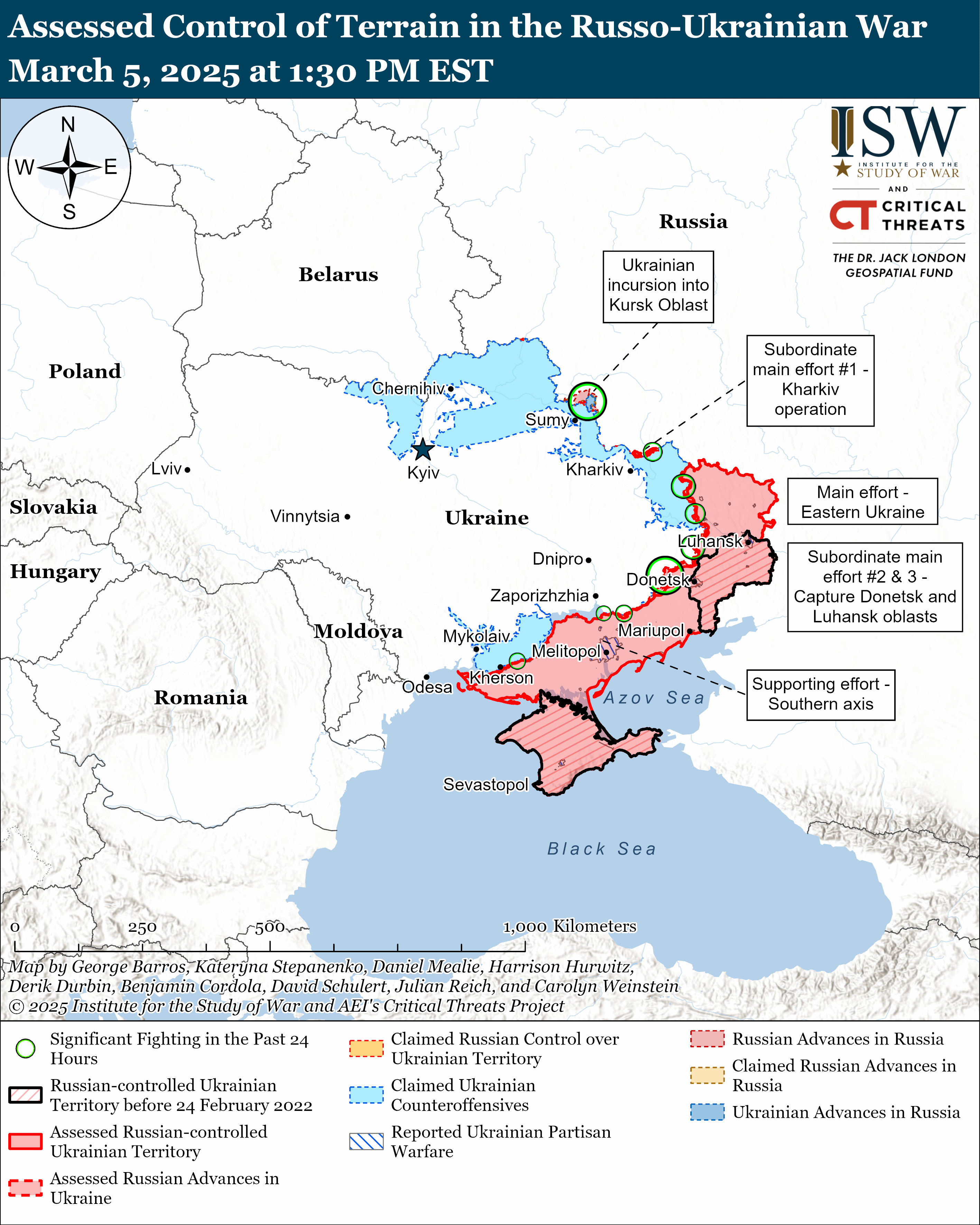
    As Veronika Poniscjakova of the University of Portsmouth writes, the battlefield advantage in Ukraine is now overwhelmingly with Russia. The Russian military is putting intense pressure on Ukrainian troops in the Kherson oblast in the south of the country.

    According to Poniscjakova, Russian forces are now reportedly attempting to cross the Dnipro river, which would allow them a clear run at the strategically important port city of Kherson. Reporting from the frontlines has described Russian assaults on Dnipro crossings as “suicide missions” that are involving heavy Russian casualties.


    Read more:
    Russia launching ‘suicide missions’ across strategic Dnipro river as pause in US aid hampers defence


    Russian forces are trying to seize a foothold across Ukraine’s Dnipro River.
    Institute for the Study of War

    Since returning to the White House, Trump has echoed some of Putin’s favourite claims. He has stated that Ukraine does not have any cards to play, is unwilling to do a peace deal and has to give up land to Russia.

    In the view of Natasha Lindstaedt, a professor in the Department of Government at the University of Essex, Trump’s support for Putin threatens security worldwide. It plays perfectly into the hands of China, she writes, which could now be emboldened to expedite its plan to annex Taiwan.

    All of this, Lindstaedt says, will make the US more vulnerable. In her view, the US is more secure and prosperous when it is working in partnership with its allies to ensure security, stability, free trade and investment. “If the US were to even reduce its security commitments to Nato by 50%, estimates suggest trade with members would fall by US$450 billion,” Lindstaedt says.


    Read more:
    How Trump’s spat with Zelensky threatens the security of the world – including the US


    Back in the Oval Office, Friday’s meeting was undoubtedly a major setback for Zelensky. He left the meeting publicly weakened, with Trump telling him to “come back when you’re ready for peace”.

    But Zelensky is not the first leader to walk out of a face-to-face meeting with their tail between their legs. In this piece, Marcus Holmes of the William & Mary Global Research Institute and Nicholas John Wheeler of the University of Birmingham draw a historical parallel in a 1961 summit between the then US president, John F. Kennedy, and the Soviet premier, Nikita Khrushchev, in Vienna.


    Read more:
    Trump and Zelensky: when face-to-face diplomacy goes wrong it can be disastrous – especially if the whole world is watching


    At that time, Kennedy admitted that Khrushchev “beat the hell out of me”, leaving him convinced that tensions with the Soviet Union would escalate. “It’s going to be a cold winter,” he remarked afterwards.

    But, as Holmes and Wheeler write, there was one crucial difference: Kennedy and Khrushchev’s bruising exchange happened behind closed doors. Zelensky was forced to experience his own Vienna moment in front of the world. This, they say, could make it even harder for Zelensky to recover politically.

    The art of the deal

    At no point in the meeting did Trump and Vance seek a resolution to their disagreement with Zelensky or attempt to find common ground. Holmes and Wheeler call this a “domination ritual” – designed to make clear that Ukraine is in no position to set terms.

    In this piece, Andrea Caputo, a professor of strategy & negotiation at the University of Lincoln, breaks down Trump’s negotiation style. Unlike typical US negotiators who are thought to avoid emotional expression, Trump uses anger and confrontation to dominate discussions and control narratives.

    He frames negotiations in zero-sum terms, where every deal must have a clear winner and loser. This, Caputo says, reinforces his public image as a strong leader.

    Caputo argues that Zelensky should have structured negotiations around US economic interests rather than western unity or moral imperatives. Otherwise, he is speaking a negotiation language that Trump doesn’t understand.


    Read more:
    How to negotiate with Trump: forget principles and learn to speak the language of business


    In the high-stakes arena of international security, Caputo says that understanding your counterpart’s negotiation style isn’t just good practice – it may be essential for survival.


    World Affairs Briefing from The Conversation UK is available as a weekly email newsletter. Click here to get updates directly in your inbox.


    ref. Where Trump’s outbursts have left Ukraine and Europe – https://theconversation.com/where-trumps-outbursts-have-left-ukraine-and-europe-251661

    MIL OSI – Global Reports

  • MIL-OSI Global: Money laundering plays a key role in every part of the illegal drugs industry – here’s how it works

    Source: The Conversation – UK – By Mark Berry, Lecturer In Criminology, Bournemouth University

    R Mendoza/Shutterstock

    The global illicit drugs trade is estimated to be worth at least half a trillion US dollars each year. Drugs such as cocaine, methamphetamine and heroin generate large revenues all along their supply chains, from where the products (and precursor materials) are grown or made – principally Colombia and Bolivia, China, Afghanistan, and the “golden triangle” of Myanmar, Laos and Thailand – to wherever the finished drugs are consumed.

    Earnings in the illicit drug trade are variable. Few people will make the kind of money that once put the Mexican former cartel boss Joaquín “El Chapo” Guzmán on the Forbes list of global billionaires. But while drug “kingpins” are the industry’s biggest individual earners, they do not hold the majority of the drug money that is generated throughout the global supply chain.

    Despite their frequent glamorisation in film and TV portrayals, drug cartels are basically international logistics companies. They work with distributors in different countries who deliver the drugs to regional wholesalers, who in turn supply the local retailers (dealers) who sell drugs to individuals.

    Everyone along the supply chain takes their cut, with most people making much more modest incomes than the millionaire drug traffickers of narcocorrido lore. In our interviews with illicit drug entrepreneurs in the US and UK, we routinely spoke to sellers whose incomes ranged from pocket money to providing a moderately comfortable life.


    Illicit drug use is damaging large parts of the world socially, politically and environmentally. Patterns of supply and demand are changing rapidly. In our longform series Addicted, leading experts bring you the latest insights on drug use and production as we ask: is it time to declare a planetary emergency?


    Around 70% to 80% of the overall revenue generated by illicit drugs is shared among the many wholesale and street-level dealers in destination countries such as the UK and US, where the price per gram is at its highest. How this money moves and is used to sustain the illicit drug trade should be an important part of any worthwhile counter-narcotics strategy. But it rarely is.

    Professional money launderers

    The people and organisations responsible for laundering drug revenues – that is, transforming them into untraceable money that can easily be spent, or into assets that can be held or sold – often exist under the radar of law enforcement and the media.

    Yet the ways illicit drug money is laundered are hardly a mystery. Techniques include wire transfers to offshore bank accounts, investments in shell companies or deposits in cash businesses, and buying foreign currencies or (to a small extent) cryptocurrencies. In addition, the straightforward physical transportation of cash across national borders is an often-used method known as a “bulk cash transfer”.

    The largest players in the illicit drugs industry, such as international cartels, national distributors and large-scale wholesalers, often use professional money launderers – some of whom have seemingly reputable jobs in the financial sector. In one recent case, US financial regulators fined TD Bank US$3 billion (£2.4 billion) – a record penalty for a bank – for facilitating the laundering of millions of dollars of drug cartel money.

    Over six years, more than 90% of the bank’s transactions went unmonitored, enabling “three money laundering networks to collectively transfer more than US$670 million through TD Bank accounts”. Then-US attorney general Merrick Garland commented: “By making its services convenient for criminals, [TD Bank] became one.”

    Video: CBC News.

    Some money laundering networks are as global as the drug supply chains they service. In June 2024, the US Department of Justice’s (DoJ) multi-year “Operation Fortune Runner” investigation saw LA-based associates of Mexico’s Sinaloa drug cartel charged with conspiring with money-laundering groups linked to a Chinese underground banking network. According to the IRS’s head of criminal investigation, Guy Ficco:

    Drug traffickers generate immense amounts of cash through their illicit operations. This case is a prime example of Chinese money launderers working hand-in-hand with drug traffickers to try to legitimise profits generated by drug activities.

    According to the DoJ, “many wealthy Chinese nationals” barred from transferring large amounts to the US by the Chinese government’s capital flight restrictions seek informal alternatives to the conventional banking system – including via schemes to launder illicit drug money. The DoJ explained how this works:

    The China-based investor contacts an individual who has US dollars available to sell in the United States. This seller of US dollars provides identifying information for a bank account in China, with instructions for the investor to deposit Chinese currency (renminbi) in that account. Once the owner of the account sees the deposit, an equivalent amount of US dollars is released to the buyer in the United States.

    These arrangements are not unique to Chinese actors. Similar arrangements occur throughout the world, including schemes to leverage the black market peso exchange and the Hawala international money transfer system.

    Professional launderers are both creating and exploiting vulnerabilities in the global financial system. Such corruption allows suspicious transactions to occur without proper checks or oversight. This not only reduces transparency in the financial system but erodes public trust in it.

    How cartels launder their money

    International drug cartels and national wholesalers have a smaller markup on their transactions, compared with retailers. But because they are responsible for moving enormous quantities of illicit drugs, they still generate millions of dollars worth of revenue.

    The most prolific known drug distributors in US history, Margarito Flores Jr and his twin brother Pedro, delivered billions of dollars worth of cocaine, heroin and methamphetamines to their US and Canadian wholesale clients between 1998 and 2009. They were working for Guzmán and Ismeal “El Mayo” Zambada García, then leaders of the Sinaloa cartel, as well as the Mexican Beltrán Leyva brothers whose cartel bore their surname.

    Today, Margarito Flores Jr trains law enforcement across the US in the methods he and his brother used to traffic drugs and run their business. In January 2015, both men were sentenced to 14 years for drug trafficking – Margarito Flores Jr would later reach out to one of this article’s authors (R.V. Gundur) after reading his book, Trying to Make It: The Enterprises, Gangs, and People of the American Drug Trade, which includes a comprehensive account of the Flores crew’s activities.

    In a subsequent interview, he told us: “My brother and I estimate that, if we added up all of the money we sent back to Mexico over the decade we sold drugs, it was probably more than US$3.5 billion.”

    The billions they remitted to Mexico were used by Guzmán, Zambada and the Beltrán Levya brothers not only to expand their drug businesses, but to corrupt powerful figures such as Mexico’s former secretary of public security, Genaro García Luna.

    García Luna, who was Mexico’s highest-ranking law enforcement official from 2006 to 2012, was sentenced to nearly 40 years in prison in October 2024 after being found guilty of taking millions of dollars in bribes from the Sinaloa cartel, as well as enabling the trafficking of more than a million kilograms of cocaine into the US. Flores explained to us:

    It’s important to understand that corruption impacts people at all levels of government. Our payoffs included local police and other people in the community, up to higher-positioned people in government. Lots of that money ended up funding the violent conflicts between cartels.

    While there has been widespread coverage of cartel drug money being laundered through high-profile businesses and banks such as Wachovia and HSBC, Flores suggested that “the money involved in the drug trade is a lot more than anybody really can understand”. The reason for this, he said, is that it’s very hard to track the flow of hard cash via lorries, boats, planes and even drones. Flores told us:

    It’s a misconception that everyone who makes a lot of money in drugs or other illegal business makes an effort to launder their money. My brother and I held much of what we earned in cash. We knew the government could eventually take everything [else].

    The twins were right: in time, that’s exactly what the US government did.

    ‘Everyday’ money laundering

    In our study of money laundering strategies used by people involved in the illicit drug trade in the UK and US, we found that street dealers do not typically undertake sophisticated laundering processes. Rather, they spend their cash on food and other routine living expenses. One independent UK drug dealer, whose experience was typical of many, used the money earned from his cocaine sales to buy groceries and pay bills for himself and his daughter.

    Spending money, even small amounts, gained through illegal activities is a money laundering offence – albeit one that is seldom prosecuted. As a result, these everyday activities that return illicit drug money to the legal economy are not well accounted for – even though the street value of drugs drives global market value estimates.

    Business-savvy street dealers can earn gross revenues that approach the earnings of high-paid white-collar workers. But they must disguise their earnings’ origins before they can spend them, of course, and various tactics are used to do this.

    Some dealers solicit close friends or family members to act as “strawmen”. These are people willing to put assets paid for by illicit drug money – such as cars, properties or even businesses – in their names on behalf of the dealer. Idris Elba’s character Stringer Bell in HBO’s The Wire was an accurate portrayal of someone investing in legal enterprises using illicit drug money.

    A guide to Stringer Bell’s character in The Wire. Video: Just an Observation.

    These strategies occur wherever illegal enterprise exists, and have done for well over a century. In the US, we interviewed wholesalers who had used family members to own houses and other properties on their behalf. This is done to mitigate against the risk of asset forfeiture should they be convicted of a crime. If an illicit enterprise can create a plausible beneficial owner who is not involved in crime, then the asset is harder to seize. This is why the Donald Trump administration’s recent suspension of beneficial owner oversight is problematic from a drug enforcement perspective.

    In liberal democracies, governments cannot investigate someone’s finances simply because they are related to criminals. The dirty money that is put into their accounts can also be disguised as legitimate income making it difficult to identify, although thorough investigations may uncover it.

    In the UK, we also talked to successful drug retailers who had set up local businesses in their own names. The EU’s law enforcement agency, Europol, has reported similar activities throughout Europe.

    Legal businesses are a common – and often hard-to-detect – vehicle to launder drug money. Bars, clubs, gyms, and hair, nail and tanning salons can be readily set up with drug money, as large cash infusions to establish a business are often not well scrutinised. These businesses are comparatively easy to run with significant cash flows, providing suitable cover for dirty money.

    For example, a beauty salon, especially one that offers high-value boutique services, could easily incorporate drug revenue into its financial accounts by reporting sales that do not occur. Tanning salons can be set up with little expense since they require only sunbeds and the rental of a property.

    Along with bars, clubs and salons, construction companies and restaurants stand out as other cash-intensive businesses with high volumes of transactions – characteristics that make good fronts for laundering money.

    It’s hard to spot a ‘dirty’ business

    There is no surefire way to tell whether a business is a laundering front. While some may look like enterprises struggling to stay afloat, others develop into viable operations that eventually no longer need dirty money to sustain them.

    Some drug dealers incorporate laundering practices within their legitimate jobs. Tradespeople such as electricians or plumbers, for example, can launder money by generating invoices for fake jobs, then reporting the income on their tax returns.

    In both the UK and US, tax authorities are not charged with evaluating the veracity of the funds reported, and are generally satisfied once tax is paid. In other words, they generally trust declared income as proof of legal business activity. Moreover, they, along with the police, lack the resources to investigate these businesses for money laundering.

    Through their legal businesses, many drug dealers pay significant taxes on their illegal revenue, and thus contribute to the economy.

    Paying income tax effectively renders this income laundered. It can be invested and used to set up other businesses, or to purchase cars and properties without suspicion. It can also bolster credit ratings, and improve access to legal financial services such as bank loans.

    Many small-time drug dealers start legal businesses in order to exit the illicit drug trade. We interviewed one cocaine dealer who had used his drug money to set up a retail electronics store; once it was successful, he stopped dealing. Similarly, the person behind a semi-legitimate nitrous oxide enterprise used his proceeds to set up a legitimate alcohol delivery service.

    Through self-laundering, these modest drug dealers transform their proceeds of crime into spendable cash – and may eventually leave criminality behind altogether.

    The (losing) battle against laundered money

    Across the world, anti-money laundering efforts against organised criminal gangs are notoriously ineffective.

    The Financial Action Task Force (FATF) – an intergovernmental organisation formed in 1999 to combat money laundering and the financing of terrorism – assesses financial regulators’ anti-money laundering controls all over the world. Countries designated as a risk that require monitoring are placed on the task force’s “grey list”, while severe, high-risk countries go on its “black list”. Being put on these lists can result in a withdrawal of international investment and implementation of sanctions by other countries.

    Although developing countries have often scored badly in their assessments, there has been some progress. While Kenya remained on the grey list in 2024, for example, it was found to have strengthened its measures to tackle both money laundering and terrorist financing. In the same year, though, Lebanon was added to the grey list over concerns on both counts.

    The FATF’s evaluation processes are designed to provide an objective assessment of whether a country has implemented its anti-money laundering and counter-terrorist financing recommendations. However, the success of the FATF’s anti-money laundering controls remains unclear.

    Video: The Financial Action Task Force.

    Often lost in the criminal financing narrative is the role of bulk cash transfers. Even in a world that is moving to cashless transactions, cash generally remains the primary currency of both the illicit drug trade and corruption.

    The biggest and most successful drug traffickers have significant cash reserves which are used to pay workers, replace drugs that are lost or seized, accrue assets, and bribe key officials.

    Reflecting on his former illicit enterprise, Margarito Flores observed: “For every kilo of cocaine or heroin or methamphetamine we sold in the US, at least a kilo of cash went back to Mexico.” For deals in Europe, Flores said: “Given the markup the further away you trade, the amount of cash sent back could be even higher – I would estimate it to be a kilo and a half.”

    Flores described the ineptitude of law enforcement in policing cash that was leaving the US:

    No matter how careful we were, my brother and I lost a handful of loads of drugs heading north [from Mexico into the US]. Heading south was different: we just had the money put on tractor trailers and had it driven it across the border. We never lost a dollar. That’s where politicians don’t pay enough attention. That cash lets traffickers keep doing business.

    Focus on the money as well as the drugs

    So long as demand for illicit drugs exists, the industry will continue – and the revenue it generates will be laundered.

    We believe that to curb the drugs trade, enforcement strategies need to go beyond simply capturing drugs and focus much more on capturing the money. Governments should go after reserves held not only by drug cartels but high-level distributors, such as those who replaced the Flores twins, and also wholesalers. People like these – comparatively high earners in destination countries – are the backbone of the illicit drugs trade.

    Transnational law enforcement should prioritise detecting and seizing bulk cash transfers. These high-volume proceeds underwrite the wellbeing of drug trafficking organisations. Digital tools, such as machine learning and artificial intelligence, can be developed to create new techniques to track and trace suspicious transactions, although they alone won’t solve all laundering problems.

    Corruption of officials also remains a problem. Governments need to ensure their officials are well paid and sufficiently monitored in their roles – be they working in government, border control, banks, police departments or prisons. Unfortunately, the US has shirked its leadership in global anti-corruption efforts with the recent halting of the enforcement of the Foreign Corrupt Practices Act, which bans the bribing of foreign officials.


    Read more:
    Mexico’s drug corruption has more to do with US demand than crooked politicians


    Anti-money laundering efforts need to be consistently supported and required. Lamentably, the US has undermined its anti-money laundering toolkit by suspending the enforcement of beneficial ownership information reporting requirements. Establishing beneficial ownership helps financial institutions to identify parties that are hiding their financial interests, which can be an indication of money laundering or other criminal activity.

    Similarly, foreign investment in producer countries can strengthen their capacity to counter laundering by supporting intelligence infrastructure and improved training. Recent cuts to USAid and the reduction of US State Department efforts in these areas is another indication that the US will no longer lead in these domains.

    As cash businesses provide an easy mechanism for cleaning money, moving to a cashless society that uses digital transactions may help ensure that money is traceable. At the same time, cryptomarkets provide a minor, but potentially increasing, pathway to hiding dirty money digitally.

    Ultimately, we should recognise the decades-long “war on drugs” for what it is: a policy costing trillions of dollars that combined mass incarceration with insufficient public health investment, and which has harmed the very communities the illicit drug trade affects the most. It is a difficult balance, but the pathway forward needs to reorient the objectives regarding drugs: invest in people, then go after the money that keeps the cartels, distributors and wholesalers afloat.


    For you: more from our Insights series:

    To hear about new Insights articles, join the hundreds of thousands of people who value The Conversation’s evidence-based news. Subscribe to our newsletter.

    Mark Berry received funding from the Dawes Trust for a prestigious PhD scholarship to undertake work that informs the contents of this article.

    R.V. Gundur received funding from the Economic and Social Research Council to undertake work that informs the contents of this article. He is also a professional member of the International Compliance Association.

    The authors wish to thank Margarito Flores Jr (kingpintoeducator.com) for his help with this article.

    ref. Money laundering plays a key role in every part of the illegal drugs industry – here’s how it works – https://theconversation.com/money-laundering-plays-a-key-role-in-every-part-of-the-illegal-drugs-industry-heres-how-it-works-251288

    MIL OSI – Global Reports

  • MIL-OSI United Nations: Choose compassion, reject cruelty to end HIV, says top UN rights official

    Source: United Nations 2

    Human Rights

    Global efforts to tackle the HIV/AIDS epidemic continue to remain insufficient, with deadly consequences, the UN Human Rights Council heard on Thursday.

    In a stark assessment of the current situation of the health crisis, Deputy UN High Commissioner for Human Rights Nada Al-Nashif warned that more than nine million people do not receive treatment, while 4,000 girls and young women contract the virus every week.

    A staggering three-quarters of them live in sub-Saharan Africa, she noted, reminding Member States that while HIV is “entirely treatable and preventable…the world is off track in ending AIDS.

    Stigma fuelling crisis

    “Stigma and discrimination are preventing concrete progress and paving the way for a resurgence of infections,” Ms. Al-Nashif said.

    Together, we have the power and the responsibility to change this. When human rights are promoted, health is protected.

    Other speakers echoed the need for human rights-based approaches to ensure universal access to treatment. They warned that discrimination and harmful laws targeting marginalized communities hinder access to prevention, testing and care.

    Keep rights at the core

    Florence Riako Anam of the Global Network of People Living with HIV (GNP+) quoted Nelson Mandela, saying that HIV is “more than a disease – it is a human rights issue.”

    In many countries, criminalization, stigma and discrimination based on sexual orientation, gender identity, drug use as well as sex work continue to obstruct HIV response efforts, with deadly consequences.

    GNP+, an NGO collecting data on stigma since 2008, has surveyed 100,000 people across 100 countries. The findings: nearly one in four respondents experienced HIV-related stigma.

    Break the barriers

    To end AIDS for good, we must dismantle the human rights-related barriers that prevent certain populations from accessing the services they need and tackle the deep gender inequalities and underlying inequities that drive starkly different health outcomes,” said Vuyiseka Dubula, Head of Community, Rights and Gender at the Global Fund to Fight AIDS, Tuberculosis and Malaria.

    Ms. Dubula, who lives with HIV in South Africa, noted that while global progress has been significant – new infections down by 61 per cent and AIDS-related deaths by 73 per cent in more than 100 countries over the last two decades—there is still much work to be done.

    “This is something to be proud of, but we can go even further in the next five years if we really are focused on ending HIV” Ms. Dubula said, referring to Sustainable Development Goal 3 (SDG3) on ensuring healthy lives for all.

    Compassion over cruelty

    Adeeba Kamarulzaman of the World Health Organization (WHO) Science Council and the Global Council on Inequality, AIDS and Pandemics echoed the need for more compassionate methods in tackling the epidemic.

    She pointed to Malaysia, her home country, which once faced a devastating HIV epidemic but has since made significant progress.

    In countries decriminalizing drug use, knowledge of HIV status is 15 per cent higher and HIV incidence is five per cent lower, she explained, adding that in places where sex work is decriminalized, infection rates are further reduced by 4.5 per cent.

    When we choose compassion over cruelty, when we invest in people instead of punishing them, we save lives,” Dr. Kamarulzaman said.

    Persistent discrimination

    Erika Castellanos, a transgender woman and Executive Director of Global Action for Trans Equality, spoke of her experience in Belize, where LGBTIQ+ people faced up to 10 years in jail before 2016. Even after the law was overturned, little has changed.

    “The stigma, discrimination and institutional barriers persist in the systems that deny us dignity, in the services that exclude us and in the societies that still see us as less than human,” said Ms. Castellanos, who has lived with HIV for 20 years.

    “I am here because of the hard work, sweat, blood and tears of countless people, many of whom did not survive this epidemic,” she told the Human Rights Council.

    I am alive – because of an HIV response that valued my life.

    MIL OSI United Nations News

  • MIL-OSI Security: Employee at Multinational DVD Company Charged with Stealing, Selling Pre-Release Commercial DVDs for Blockbuster Films

    Source: United States Attorneys General

    A worker at a DVD and Blu-ray manufacturing and distribution company used by major movie studios was arrested today in Memphis, Tennessee, for allegedly stealing DVDs and Blu-rays of blockbuster movies from the company and selling them before their official scheduled release dates. A digital copy of at least one of the stolen Blu-rays was illegally distributed tens of millions of times over the internet, causing the copyright owner tens of millions of dollars in losses.

    According to court documents, Steven R. Hale, 37, of Memphis, worked for a multinational company that, among other things, manufactured and distributed DVDs and Blu-rays of movies. From approximately February 2021 to March 2022, Hale allegedly stole numerous “pre-release” DVDs and Blu-rays, that is, discs being prepared for commercial distribution in the United States and not available for sale to the public. These included DVDs and Blu-rays for such popular films as “F9: The Fast Saga,” “Venom: Let There Be Carnage,” “Godzilla v. Kong,” “Shang-Chi and the Legend of the Ten Rings,” “Dune,” and “Black Widow.” Hale allegedly sold the DVDs and Blu-rays through e-commerce sites. At least one pre-release Blu-ray that Hale allegedly stole and sold, “Spider-Man: No Way Home,” was “ripped” — that is, extracted from the Blu-ray by bypassing the encryption that prevents unauthorized copying — and copied. That digital copy was then illegally made available over the internet more than a month before the Blu-ray’s official scheduled release date. Copies of “Spider-Man: No Way Home” were downloaded tens of millions of times, with an estimated loss to the copyright owner of tens of millions of dollars.

    The indictment, unsealed today, charges Hale with two counts of criminal copyright infringement and one count of interstate transportation of stolen goods. If convicted, he faces a maximum penalty of five years in prison on each criminal copyright infringement count and 10 years in prison on the interstate transportation of stolen goods count. A federal district judge will determine any sentence after considering the U.S. Sentencing Guidelines and other statutory factors.

    Supervisory Official Antoinette T. Bacon of the Justice Department’s Criminal Division, Acting U.S. Attorney Reagan Fondren for the Western District of Tennessee, and Special Agent in Charge Joseph E. Carrico of the FBI Nashville Field Office made the announcement.

    The FBI is investigating the case.

    Senior Counsel Matthew A. Lamberti and Trial Attorney Debra Ireland of the Criminal Division’s Computer Crime and Intellectual Property Section and Assistant U.S. Attorney Raney Irwin for the Western District of Tennessee are prosecuting the case.

    An indictment is merely an allegation. All defendants are presumed innocent until proven guilty beyond a reasonable doubt in a court of law.

    MIL Security OSI

  • MIL-OSI USA: Michigan Businessman Found Guilty of Employment Tax Crimes

    Source: US State of Vermont

    A federal jury convicted a Michigan businessman yesterday for not paying employment taxes and not filing his own individual income tax returns.

    According to court documents and evidence presented at trial, Dale Thrush, of Farwell, owned and operated several automotive repair service locations and a gas station. Thrush was responsible for withholding Social Security, Medicare and income taxes from his employees’ wages and paying those funds over to the IRS on behalf of his employees. From October 2014 through December 2016, Thrush withheld those funds from his employees’ wages but did not pay over the full amount of the withheld taxes to the IRS. Instead, Thrush used some of those funds to pay personal expenses, including the remodeling and construction costs for his wife’s business.

    In addition, Thrush did not file his own individual income tax returns for 2013 through 2016 despite being legally obligated to do so.

    Thrush was convicted of three counts of willful failure to pay payroll taxes and four counts of willful failure to file individual income tax returns. He was acquitted of seven counts of willful failure to pay payroll taxes.

    Thrush is scheduled to be sentenced on July 17. He faces a maximum penalty of five years in prison for each count of not paying employment taxes and a maximum penalty of one year in prison for each count of not filing his individual income tax returns. A federal district court judge will determine any sentence after considering the U.S. Sentencing Guidelines and other statutory factors.

    Acting Deputy Assistant Attorney General Karen E. Kelly of the Justice Department’s Tax Division made the announcement.

    IRS Criminal Investigation is investigating the case.

    Trial Attorneys Mark McDonald and Evan Mulbry of the Tax Division are prosecuting the case.

    MIL OSI USA News

  • MIL-OSI USA: Gov. Kemp Signs AFY25 Budget – Delivering Hurricane Relief, Tax Refunds, and Major One-Time Investments

    Source: US State of Georgia

    ATLANTA – Governor Brian P. Kemp, joined by First Lady Marty Kemp, Lt. Governor Burt Jones, Speaker Jon Burns, House and Senate Appropriations Chairmen Tillery and Hatchett, constitutional officers, and members of the Georgia General Assembly, today signed the Amended Budget for Fiscal Year 2025

    Excerpt of Governor Kemp’s Remarks

    I want to start by thanking the great legislative partners you see behind us and those next to me, including Lt. Governor Burt Jones, Speaker Jon Burns, Chairman Blake Tillery, Chairman Matt Hatchett, and the members of the General Assembly from both chambers and parties who overwhelmingly voted for this budget.

    We’re also glad to be joined by the Constitutional Officers here with us today and the nation’s best First Lady, Marty Kemp!

    I also want to thank OPB Director Rick Dunn and his team for all the time and hard work they put into the budget process each year alongside our partners in the House and Senate Budget Offices and all the time and effort they still have left to give as we work on the big budget. Let’s give his team a round of applause.

    Today, I’ll sign the amended budget for Fiscal Year 2025… a budget that gives relief to Georgians devastated by Hurricane Helene… makes our schools and communities safer through strategic investments… and yet again returns hard-earned money to the taxpayers. 

    All of this investment is designed to benefit our local communities but it’s also going to keep Georgians working in all parts of the state during these uncertain economic times.

    As we all know too well, inflation may have come down, but high prices haven’t. And that’s why this budget includes 1 billion dollars for another one-time refund for hardworking taxpayers!

    And as just a reminder to you all behind me, we still need the General Assembly to pass the enabling legislation.

    I’m sure some of these men and women up here will help us out with that later today!

    And as soon as we pass the second tax cut acceleration measure, we’ll be able to keep even more of Georgians’ money in their pockets… because they know how to spend it better than the government does!

    My goal working with the members of the General Assembly who have been such strong supporters in these measures has been to help Georgians fighting through 40-year-high inflation. 

    To give them a chance during these challenging times to keep their businesses going and provide for their families by putting more money in their pockets. And to help them and their children have good-paying jobs by developing an environment that attracts business and opportunity.

    That’s what people voted for in November of 2024; that’s what we’ve all been doing; and that’s what we’re going to keep doing!

    So, thank you, legislators, for helping us keep Georgia the best place to live, work, and raise a family through budgets like this.

    You can watch Governor Kemp’s full remarks and the signing of the budget here.

    “This budget includes critical midyear adjustments for Georgia’s education system, economic development projects, transportation infrastructure and public safety,” said Lt. Governor Burt Jones. “Additionally, over $250 million is included for Georgia’s agriculture and timber communities impacted by Hurricane Helene, along with relief for our fellow Georgians and local communities for recovery and cleanup efforts. I want to thank Governor Kemp, Speaker Burns, Chairman Tillery, and all members of the Senate Appropriations Committee for their hard work to ensure we passed a balanced and fiscally conservative budget, as we prepare for fiscal year 2026. Georgia is a shining example of how to budget efficiently and effectively, while putting Georgian’s hard earned dollars back in their pockets. I look forward to our continued work to appropriate taxpayer dollars in a fiscally, conservative manner.”

    “This budget reaffirms Georgia’s commitment to making strategic investments that strengthen and uplift every community, family, and citizen across our great state—all while putting money back in the pockets of taxpayers,” said Speaker Jon Burns. “As we look ahead, the House is looking forward to working alongside Governor Kemp to continue prioritizing fiscally responsible and measured investments that secure the future success of our state for generations to come.”

    In addition to investments in healthcare, public safety, education, and returning $1 billion to taxpayers through a third one-time special tax refund, the amended budget includes investments and allocations for:

    • Hurricane Helene Relief: More then $867 million for response costs and relief, including but not limited to, one-time grants to public rural and critical access hospitals included in the major disaster declaration area to assist in financial stabilization and recovery efforts, disaster relief assistance to impacted farmers and timber producers, and grants to non-profits for Hurricane Helene rebuilding and recovery efforts.
    • Education and Workforce Development: $140 million in additional allocations to fully fund QBE and support our local school systems to help us build an unrivaled workforce as we work to make Georgia the Top State for Talent.
    • Public Safety and Corrections: More than $434 million in new funding for the Department of Corrections to fortify state facilities, invest in Corrections Officers, and equip them with the tools they need to be effective and efficient.
    • Fighting Human Trafficking: $3.5 million to design a recovery center for victims of human trafficking – an effort championed by First Lady Marty Kemp – and over $187,000 to expand the Human Trafficking Prosecution Unit to the Macon and Augusta regions.
    • School Security: An additional $50 million in one-time funds for another round of security grants to all K-12 public schools.
    • Coastal Water Infrastructure: $501.7 million in funding for the development and construction of water infrastructure in Georgia’s coastal region to meet the growing demand due to historic economic development.
    • Local Water and Sewer Infrastructure: Over $266 million in funding for the Georgia Environmental Finance Authority to support water and sewer infrastructure development projects across Georgia.
    • Local Road Infrastructure: $265 million into the local maintenance and improvement grant program and $46 million to the Georgia Transportation Infrastructure Bank’s grant and loan program. 
    • Combating Wildfires: $4.7 million for the Forestry Commission to purchase a new fire suppression helicopter

    MIL OSI USA News

  • MIL-OSI Security: Michigan Businessman Found Guilty of Employment Tax Crimes

    Source: United States Attorneys General

    A federal jury convicted a Michigan businessman yesterday for not paying employment taxes and not filing his own individual income tax returns.

    According to court documents and evidence presented at trial, Dale Thrush, of Farwell, owned and operated several automotive repair service locations and a gas station. Thrush was responsible for withholding Social Security, Medicare and income taxes from his employees’ wages and paying those funds over to the IRS on behalf of his employees. From October 2014 through December 2016, Thrush withheld those funds from his employees’ wages but did not pay over the full amount of the withheld taxes to the IRS. Instead, Thrush used some of those funds to pay personal expenses, including the remodeling and construction costs for his wife’s business.

    In addition, Thrush did not file his own individual income tax returns for 2013 through 2016 despite being legally obligated to do so.

    Thrush was convicted of three counts of willful failure to pay payroll taxes and four counts of willful failure to file individual income tax returns. He was acquitted of seven counts of willful failure to pay payroll taxes.

    Thrush is scheduled to be sentenced on July 17. He faces a maximum penalty of five years in prison for each count of not paying employment taxes and a maximum penalty of one year in prison for each count of not filing his individual income tax returns. A federal district court judge will determine any sentence after considering the U.S. Sentencing Guidelines and other statutory factors.

    Acting Deputy Assistant Attorney General Karen E. Kelly of the Justice Department’s Tax Division made the announcement.

    IRS Criminal Investigation is investigating the case.

    Trial Attorneys Mark McDonald and Evan Mulbry of the Tax Division are prosecuting the case.

    MIL Security OSI

  • MIL-OSI: EV Realty Acquires EV Charging Platform Gage Zero’s Assets to Scale Truck Fleet Charging and Meet Long-Term Market Demand

    Source: GlobeNewswire (MIL-OSI)

    SAN FRANCISCO, March 06, 2025 (GLOBE NEWSWIRE) — EV Realty, Inc. (“EV Realty”), an EV infrastructure development platform powering commercial fleets, today announced that it has acquired a strategic portfolio of assets from Gage Zero, an Austin-based company focused on fleet electrification and infrastructure development for local, regional, and drayage trucking fleets.

    Gage Zero’s approach to the market, prioritizing partnerships, industry leadership, and an equitable energy transition, generated a strategic portfolio of assets and customer relationships that complements EV Realty’s development platform strengths and growing portfolio of grid-ready, shovel-ready sites throughout California. This transaction combines EV Realty’s proven expertise in infrastructure development and deployment and Gage Zero’s active development projects and deep customer relationships with established regional trucking and logistics companies.

    “Commercial fleet electrification continues to advance as vehicle manufacturers make production and supply chain investments, battery costs decline, and leading fleets—including many of Gage Zero’s partners—see the potential for greater efficiency and lower costs associated with EV trucking,” said Patrick Sullivan, EV Realty’s Co-Founder and Chief Executive Officer. “The combination of our two portfolios provides our shared customers more opportunity to plan around electrification within a broadly served regional network, which opens new freight lanes, allows trucks to be used more, and ultimately drives down costs for our customers, enabling a transition to EVs that makes dollars and sense.”     

    “We’re excited to partner with EV Realty through this acquisition. Gage Zero’s reputation in the space, prioritizing demand-led development, pairs well with EV Realty’s disciplined approach to development and its construction-ready grid-advantaged real estate portfolio. Together, we will leverage EV Realty’s substantial investment capital and proven expertise in constructing and operating EV charging infrastructure projects to deliver even greater value to our stakeholders,” said Zeina El-Azzi, Co-Founder and Chief Executive Officer of Gage Zero. “The DNA and approach of our two platforms are complementary and aligned, and this transaction makes the combined projects stronger and more equipped to deliver for our customers amidst a rapidly evolving market and regulatory environment.”

    Late last year, EV Realty announced a charging site acquisition in Torrance, CA, joining its growing portfolio of charging hubs currently under development in California. The company is also developing two hubs in San Bernardino and one in Livermore.

    Gage Zero’s development portfolio in California includes proposed charging hub projects which will expand EV Realty’s long-term network to serve its customers in locations including Long Beach, Ontario, Los Angeles, San Diego, Fresno, Oakland, and Sacramento. Other assets acquired are in Illinois and Texas, enabling medium-term expansion into additional key markets where zero-emission freight movement is gaining traction led by demand. As part of this transaction, key members of Gage Zero’s team will be joining EV Realty, ensuring continuity to deliver results for customers, partners, and key stakeholders.

    About EV Realty
    EV Realty develops, deploys, and owns charging infrastructure critical to electrifying commercial fleets in the U.S. at scale. The company accelerates the adoption of large EV fleets by focusing on the fundamental constraint all electric fleets face: low-cost, reliable, and expandable access to grid-scale power. EV Realty is developing a network of grid-optimized, large-scale EV charging hubs for delivery, logistics, and services fleet customers. Our Powered Properties™ serve multiple commercial fleets in secure, high-power locations with guaranteed charging access and availability, and are located proximate to major logistics corridors. By aggregating multiple fleets with shared private infrastructure in grid-ready locations, EV Realty charging hubs reduce upfront and recurring costs for fleets, optimize charging times and provide high utilization rates. Learn more about EV Realty and how it is transforming fleet charging at www.evrealtyus.com.

    About Gage Zero
    Gage Zero is a fleet electrification solutions company based in Austin, Texas building a zero emission future for people and the planet. Our women-led team of clean energy and transportation experts deploys capital, builds reliable infrastructure, and provides comprehensive, cost-effective electrification services that benefit commercial transportation operators, enrich communities, and support local economies. We believe industries working together can empower everyone to participate in a cleaner future.

    The MIL Network

  • MIL-OSI: Asure Announces Fourth Quarter and Full Year 2024 Results

    Source: GlobeNewswire (MIL-OSI)

    Reports Full Year 2024 Revenues of $119.8 million

    Full Year 2024 Recurring Revenues Grew 15% from Prior Year

    Recurring Revenues Grew to 96% of Total Revenues from 84% in the Prior Year

    AUSTIN, Texas, March 06, 2025 (GLOBE NEWSWIRE) — Asure Software, Inc. (“we”, “us”, “our”, “Asure” or the “Company”) (Nasdaq: ASUR), a leading provider of cloud-based Human Capital Management (“HCM”) software solutions, today reported results for the fourth quarter and full year ended December 31, 2024.

    Fourth Quarter 2024 Financial Highlights

    • Revenue of $30.8 million, up 17% year over year, excluding ERTC revenue up 22% from prior year fourth quarter
    • Recurring revenue of $28.5 million, up 14% from prior year fourth quarter
    • Net loss of $3.2 million versus a net loss of $3.6 million during prior year fourth quarter
    • EBITDA (1) of $3.4 million versus $1.1 million from prior-year fourth quarter
    • Adjusted EBITDA (1) of $6.2 million, versus $2.8 million from prior-year fourth quarter
    • Gross profit of $20.9 million versus $17.8 million from prior-year fourth quarter
    • Non-GAAP gross profit (1) of $22.5 million (Non-GAAP gross margin (1) of 73%) versus $18.8 million (and 72% in prior-year fourth quarter)

    Full Year 2024 Financial Highlights

    • Revenue of $119.8 million increased slightly year over year, excluding ERTC revenue up 17% from prior year
    • Recurring revenue of $114.5 million up 15% from prior year
    • Net loss of $11.8 million versus prior year net loss of $9.2 million
    • EBITDA (1) of $11.4 million versus $14.3 million in the prior year
    • Adjusted EBITDA (1) of $22.5 million versus $23.3 million in the prior year
    • Gross profit of $82.1 million versus $85.5 million in the prior year
    • Non-GAAP gross profit (1) of $88.2 million versus $90.3 million in the prior year

    Recent Business Highlights

    • In January 2025 we signed a major multi-year agreement with an industry leader in audit, consulting, tax and advisory  services to resell our Payroll and Payroll Tax Management solutions. The multi-year agreement will deliver comprehensive payroll and payroll tax management services for the firm’s clients enabling them to offer these services for the first time. 
    • We announced the introduction of Luna, a groundbreaking AI agent designed to enhance payroll and HR management. Unlike traditional generative AI chatbots, Luna is an advanced AI agent that understands Asure’s suite of products, serves as an industry expert, and most importantly, can act on behalf of both employees through self-service and business owners and administrators.
    • Jay Whitehead joined Asure in January 2025 as Senior Vice President to lead our AsurePay™ Platinum VIP Banking card and Marketplace businesses. He is a seasoned entrepreneur, and HCM thought leader who we expect to drive innovation and foster strategic partnerships at Asure.

    (1)This financial measure is not calculated in accordance with GAAP and is defined on page 3 of this press release. A reconciliation of this non-GAAP measure to the most applicable GAAP measure begins on page 11 of this release.

    Management Commentary

    “We are pleased to report strong results for 2024, demonstrating the continued momentum of our business. Excluding the one-time impact of ERTC revenue, our fourth-quarter revenue grew 22% year-over-year, reaching $30.8 million—an impressive finish to the year. For the full year, total revenue increased modestly to $119.8 million, but when adjusted to exclude ERTC, our revenue growth was 17% year-over-year, underscoring the strength of our core business. Recurring revenue, the backbone of our model, grew 15% year-over-year and now represents 96% of total revenue, up from 84% in 2023. Additionally, our contracted revenue backlog continued to expand, providing further visibility into future growth,” said Asure Chairman and CEO Pat Goepel. 

    “Our performance in 2024 was particularly strong in key areas, including our Payroll Tax Management product, which drove several major multi-year agreements with enterprise clients. The success of this product, along with our growing backlog, reinforces the durability of our revenue streams and positions us well for the future.” 

    “We executed our strategy despite the anticipated headwind of replacing one-time ERTC revenue, and we are entering 2025 with a solid foundation for continued growth. Our plan for 2025 includes both organic and inorganic expansion, supported by the significant investments we’ve made in technology, operations, and new product development. With these improvements, we are confident in our ability to drive sustained, long-term growth.” 

    First Quarter 2025 and Full Year 2025 Revenue Guidance Ranges

    The Company is providing the following guidance for the first quarter 2025 and full year 2025 based on the Company’s year-to-date results and recent business trends. The guidance for our first quarter 2025 and the full year 2025 excludes any contribution from future potential acquisitions.

    Guidance for 2025

    Guidance Range   Q1-2025   FY-2025
    Revenue $ 33.0 M – 35.0 M $ 134.0 M -138.0 M
    Adjusted EBITDA(1) $ 6.0 M -7.0 M   23% -24%
             

    (1)This financial measure is not calculated in accordance with GAAP and is defined on page 3 of this press release. A reconciliation of this non-GAAP measure to the most applicable GAAP measure begins on page 11 of this release.

    Management uses GAAP, non-GAAP and adjusted measures when planning, monitoring, and evaluating the Company’s performance. The primary purpose of using non-GAAP and adjusted measures is to provide supplemental information that may prove useful to investors and to enable investors to evaluate the Company’s results in the same way management does.

    Management believes that supplementing GAAP disclosures with non-GAAP and adjusted disclosures provides investors with a more complete view of the Company’s operational performance and allows for meaningful period-to-period comparisons and analysis of trends in the Company’s business. Further, to the extent that other companies use similar methods in calculating adjusted financial measures, the provision of supplemental non-GAAP and adjusted information can allow for a comparison of the Company’s relative performance against other companies that also report non-GAAP and adjusted operating results.

    Management has not provided a reconciliation of guidance of GAAP to non-GAAP or adjusted disclosures because management is unable to predict the nature and materiality of non-recurring expenses without unreasonable effort.

    Management’s projections are based on management’s current beliefs and assumptions about the Company’s business, and the industry and the markets in which it operates; there are known and unknown risks and uncertainties associated with these projections. There can be no assurance that our actual results will not differ from the guidance set forth above. The Company assumes no obligation to update publicly any forward-looking statements, including its 2025 earnings guidance, whether as a result of new information, future events or otherwise. Please refer to the “Use of Forward-Looking Statements” disclosures on page 5 of this press release as well as the risk factors in our quarterly and annual reports on file with the Securities and Exchange Commission for more information about risk that affect our business and industry.

    Conference Call Details

    Asure management will host a conference call on Thursday, March 6, 2025, at 3:30 pm Central (4:30 pm Eastern). Asure Chairman and CEO Pat Goepel and CFO John Pence will participate in the conference call followed by a question-and-answer session. The conference call will be broadcast live and available for replay via the investor relations section of the Company’s website. Analysts may participate on the conference call by dialing 877-407-9219 or 201-689-8852.

    About Asure Software, Inc.

    Asure (Nasdaq: ASUR) provides cloud-based Human Capital Management (HCM) software solutions that assist organizations of all sizes in streamlining their HCM processes. Asure’s suite of HCM solutions includes HR, payroll, time and attendance, benefits administration, payroll tax management, and talent management. The company’s approach to HR compliance services incorporates AI technology to enhance scalability and efficiency while prioritizing client interactions. For more information, please visit www.asuresoftware.com

    Non-GAAP and Adjusted Financial Measures

    This press release includes information about non-GAAP gross profit, non-GAAP sales and marketing expense, non-GAAP general and administrative expense, non-GAAP research and development expense, EBITDA, EBITDA margin, adjusted EBITDA, and adjusted EBITDA margin. These non-GAAP and adjusted financial measures are measurements of financial performance that are not prepared in accordance with U.S. generally accepted accounting principles and computational methods may differ from those used by other companies. Non-GAAP and adjusted financial measures are not meant to be considered in isolation or as a substitute for comparable GAAP measures and should be read only in conjunction with the Company’s Condensed Consolidated Financial Statements prepared in accordance with GAAP. Non-GAAP and adjusted financial measures are reconciled to GAAP in the tables set forth in this release and are subject to reclassifications to conform to current period presentations.

    Non-GAAP gross profit differs from gross profit in that it excludes amortization, share-based compensation, and one-time items.

    Non-GAAP sales and marketing expense differs from sales and marketing expense in that it excludes share-based compensation and one-time items.

    Non-GAAP general and administrative expense differs from general and administrative expense in that it excludes share-based compensation and one-time items.

    Non-GAAP research and development expense differs from research and development expense in that it excludes share-based compensation and one-time items.

    EBITDA differs from net income (loss) in that it excludes items such as interest, income taxes, depreciation, and amortization. Asure is unable to predict with reasonable certainty the ultimate outcome of these exclusions without unreasonable effort.

    Adjusted EBITDA differs from EBITDA in that it excludes share-based compensation, other income (expense), net and one-time expenses. Asure is unable to predict with reasonable certainty the ultimate outcome of these exclusions without unreasonable effort.

    All adjusted and non-GAAP measures presented as “margin” are computed by dividing the applicable adjusted financial measure by total revenue.

    Specifically, as applicable to the respective financial measure, management is adjusting for the following items when calculating non-GAAP and adjusted financial measures as applicable for the periods presented. No additional adjustments have been made for potential income tax effects of the adjustments based on the Company’s current and anticipated de minimis effective federal tax rate, resulting from the Company’s continued losses for federal tax purposes and its tax net operating loss balances.

    Share-Based Compensation Expenses. The Company’s compensation strategy includes the use of share-based compensation to attract and retain employees and executives. It is principally aimed at aligning their interests with those of our stockholders and at long-term employee retention, rather than to motivate or reward operational performance for any particular period. Thus, share-based compensation expense varies for reasons that are generally unrelated to operational decisions and performance in any particular period.

    Depreciation. The Company excludes depreciation of fixed assets. Also included in the expense is the depreciation of capitalized software costs.

    Amortization of Purchased Intangibles. The Company views amortization of acquisition-related intangible assets, such as the amortization of the cost associated with an acquired company’s research and development efforts, trade names, customer lists and customer relationships, and acquired lease intangibles, as items arising from pre-acquisition activities determined at the time of an acquisition. While these intangible assets are continually evaluated for impairment, amortization of the cost of purchased intangibles is a static expense, one that is not typically affected by operations during any particular period.

    Interest Expense, Net. The Company excludes accrued interest expense, the amortization of debt discounts and deferred financing costs.

    Income Taxes. The Company excludes income taxes, both at the federal and state levels.

    One-Time Expenses. The Company’s adjusted financial measures exclude the following costs to normalize comparable reporting periods, as these are generally non-recurring expenses that do not reflect the ongoing operational results. These items are typically not budgeted and are infrequent and unusual in nature.

    Settlements, Penalties and Interest. The Company excludes legal settlements, including separation agreements, penalties and interest that are generally one-time in nature and not reflective of the operational results of the business.

    Acquisition and Transaction Related Costs. The Company excludes these expenses as they are transaction costs and expenses that are generally one-time in nature and not reflective of the underlying operational results of our business. Examples of these types of expenses include legal, accounting, regulatory, other consulting services, severance and other employee costs.

    Other non-recurring Expenses. The Company excludes these as they are generally non-recurring items that are not reflective of the underlying operational results of the business and are generally not anticipated to recur. Some examples of these types of expenses, historically, have included write-offs or impairments of assets, demolition of office space and cybersecurity consultants.

    Other (Expense) Income, Net. The Company’s adjusted financial measures exclude Other (Expense) Income, Net because it includes items that are not reflective of the underlying operational results of the business, such as loan forgiveness, adjustments to contingent liabilities and credits earned as part of the CARES Act, passed by Congress in the wake of the coronavirus pandemic.

    Use of Forward-Looking Statements

    This press release contains certain statements made by management that may constitute “forward-looking” statements within the meaning of the safe harbor provisions of the U.S. Private Securities Litigation Reform Act of 1995. These forward-looking statements about our financial results may include expected or projected U.S GAAP, non-U.S GAAP and other operating and non-operating results. The words “believe,” “may,” “will,” “estimate,” “projects,” “anticipate,” “intend,” “expect,” “should,” “plan,” and similar expressions are intended to identify forward-looking statements. Examples of “forward-looking statements” include statements regarding our strategy, future operations, financial condition, results of operations, projected costs, revenue growth, earnings, and plans and objectives of management. We have based these forward-looking statements largely on our current expectations and projections about future events and trends that we believe may affect our financial condition, results of operations, business strategy, short-term and long-term business operations and objectives, and financial needs. The achievement or success of the matters covered by such forward-looking statements involves risks, uncertainties and assumptions, over many of which we have no control. If any such risks or uncertainties materialize or if any of the assumptions prove incorrect, our results could differ materially from the results expressed or implied by the forward-looking statements we make. Additionally, we are under no obligation to update any of the forward-looking statements after the date of this press release or to confirm such statements to actual results.

    The risks and uncertainties referred to above include—but are not limited to— risks associated with breaches of the Company’s security measures; risks related to material weaknesses; possible fluctuations in the Company’s financial and operating results; privacy concerns and laws and other regulations may limit the effectiveness of our applications; the financial and other impact of any previous and future acquisitions; domestic and international regulatory developments, including changes to or applicability to our business of privacy and data securities laws, money transmitter laws and anti-money laundering laws; regulatory pressures on economic relief enacted as a result of the COVID-19 pandemic that change or cause different interpretations with respect to eligibility for such programs; risk of our software and solutions not functioning adequately; interruptions, delays or changes in the Company’s services or the Company’s Web hosting; may incur debt to meet future capital requirements; volatility and weakness in bank and capital markets; access to additional capital; significant costs as a result of operating as a public company; the expiration of Employee Retention Tax Credits (“ERTC”) and the impact of the Internal Revenue Service recent measures regarding ERTC claims and the corresponding cash collections of existing receivables; the inability to continue to release timely updates for changes in laws; the inability to develop new and improved versions of the Company’s services and technological developments; customer’s nonrenewal of their agreements and other similar changes could negatively impact revenue, operating results and financial conditions; the exposure of market, interest, credit and liquidity risk on client funds held int rust; the Company’s operation in highlight competitive markets; risk that our clients could have insufficient funds that could result in limitations in the ability to transmit ACH transactions; impairment of intangible assets; litigation and any related claims, negotiations and settlements, including with respect to intellectual property matters or industry-specific regulations; various financial aspects of the Company’s Software-as-a-Service model; adverse effects to our business a result of claims, lawsuits, and other proceedings; issues in the use of artificial intelligence in our HCM products and services; adverse changes to financial accounting standards to the Company; inability to maintain third-party licensed software; evolving regulation of the Internet, changes in the infrastructure underlying the Internet or interruptions in Internet; factors affecting the Company’s deferred tax assets and ability to value and utilize them; the nature of the Company’s business model; inability to adopt new or correctly interpret existing money service and money transmitter business status; the Company’s ability to hire, retain and motivate employees and manage the Company’s growth; interruptions to supply chains and extended shut down of businesses; potential enactment of adverse tax laws, regulation, political, economic and social factors; potential sales of a substantial number of shares of our common stock along with its volatility; risks associate with potential equity-related transactions including dividends, rights under the stockholder plan to discourage certain actions and other impacts as a result of actions of our stockholders.

    Please review the Company’s risk factors in its annual report on Form 10-K filed with the Securities and Exchange Commission (the “SEC”) on March 6, 2025.

    The forward-looking statements, including the financial guidance and 2025 outlook, contained in this press release represent the judgment of the Company as of the date of this press release, and the Company expressly disclaims any intent, obligation or undertaking to release publicly any updates or revisions to any forward-looking statements to reflect any change in the Company’s expectations with regard to these forward looking statements or any change in events, conditions or circumstances on which any such statements are based. © 2025 Asure Software, Inc. All rights reserved

     
    ASURE SOFTWARE, INC.
    CONSOLIDATED BALANCE SHEETS
    (in thousands, except per share amounts)
           
      December 31, 2024   December 31, 2023
           
    ASSETS      
    Current assets:      
    Cash and cash equivalents $ 21,425     $ 30,317  
    Accounts receivable, net of allowance for credit losses of $6,328 and $4,787 at December 31, 2024 and December 31, 2023, respectively   18,154       14,202  
    Inventory   195       155  
    Prepaid expenses and other current assets   4,888       3,471  
    Total current assets before funds held for clients   44,662       48,145  
    Funds held for clients   192,615       219,075  
    Total current assets   237,277       267,220  
    Property and equipment, net   19,669       14,517  
    Goodwill   94,724       86,011  
    Intangible assets, net   69,114       62,082  
    Operating lease assets, net   4,041       4,991  
    Other assets, net   11,813       9,047  
    Total assets $ 436,638     $ 443,868  
    LIABILITIES AND STOCKHOLDERSEQUITY      
    Current liabilities:      
    Current portion of notes payable $ 7,008     $ 27  
    Accounts payable   1,364       2,570  
    Accrued compensation and benefits   4,485       6,519  
    Operating lease liabilities, current   1,438       1,490  
    Other accrued liabilities   6,600       3,862  
    Deferred revenue   8,363       6,853  
    Total current liabilities before client fund obligations   29,258       21,321  
    Client fund obligations   194,378       220,019  
    Total current liabilities   223,636       241,340  
    Long-term liabilities:      
    Deferred revenue   3,430       16  
    Deferred tax liability   2,612       1,728  
    Notes payable, net of current portion   5,709       4,282  
    Operating lease liabilities, noncurrent   3,578       4,638  
    Other liabilities   358       209  
    Total long-term liabilities   15,687       10,873  
    Total liabilities   239,323       252,213  
    Stockholders’ equity:      
    Preferred stock, $0.01 par value; 1,500 shares authorized; none issued or outstanding          
    Common stock, $0.01 par value; 44,000 shares authorized; 26,671 and 25,382 shares issued, 26,671 and 24,998 shares outstanding at December 31, 2024 and December 31, 2023, respectively   267       254  
    Treasury stock at cost, zero(1)and 384 shares at December 31, 2024 and December 31, 2023, respectively         (5,017 )
    Additional paid-in capital   504,849       487,973  
    Accumulated deficit   (307,226 )     (290,440 )
    Accumulated other comprehensive loss   (575 )     (1,115 )
    Total stockholders’ equity   197,315       191,655  
    Total liabilities and stockholders’ equity $ 436,638     $ 443,868  
    (1) The aggregate Treasury stock of prior repurchases of the Company’s own common stock was retired and subsequently issued effective January 1, 2024. See the Consolidated Statement of Changes in Stockholders’ Equity for the impact of this transaction.
     
     
    ASURE SOFTWARE, INC.
    CONSOLIDATED STATEMENTS OF COMPREHENSIVE LOSS
    (in thousands, except per share amounts)
           
      Three Months Ended
    December 31,
      Twelve Months Ended
    December 31,
      2024   2023   2024   2023
                   
    Revenue:              
    Recurring $ 28,521     $ 24,985     $ 114,471     $ 99,734  
    Professional services, hardware and other   2,271       1,279       5,321       19,348  
    Total revenue   30,792       26,264       119,792       119,082  
    Cost of sales   9,864       8,425       37,685       33,545  
    Gross profit   20,928       17,839       82,107       85,537  
    Operating expenses:              
    Sales and marketing   6,945       6,422       28,316       28,734  
    General and administrative   9,940       9,747       40,499       39,333  
    Research and development   2,103       1,739       7,807       6,846  
    Amortization of intangible assets   4,432       3,694       16,222       13,623  
    Total operating expenses   23,420       21,602       92,844       88,536  
    Loss from operations   (2,492 )     (3,763 )     (10,737 )     (2,999 )
    Interest income   151       326       913       1,342  
    Interest expense   (362 )     (302 )     (1,024 )     (5,639 )
    Loss on extinguishment of debt                     (1,517 )
    Other income (expense), net   (2 )     (1 )     8       (292 )
    Loss from operations before income taxes   (2,705 )     (3,740 )     (10,840 )     (9,105 )
    Income tax expense (benefit)   499       (158 )     933       109  
    Net loss   (3,204 )     (3,582 )     (11,773 )     (9,214 )
    Other comprehensive income (loss):              
    Unrealized gain (loss) on marketable securities   (565 )     1,581       540       1,368  
    Comprehensive loss $ (3,769 )   $ (2,001 )   $ (11,233 )   $ (7,846 )
                   
    Basic and diluted loss per share              
    Basic $ (0.12 )   $ (0.14 )   $ (0.45 )   $ (0.42 )
    Diluted $ (0.12 )   $ (0.14 )   $ (0.45 )   $ (0.42 )
                   
    Weighted average basic and diluted shares              
    Basic   26,602       24,907       26,054       22,138  
    Diluted   26,602       24,907       26,054       22,138  
                                   
     
    ASURE SOFTWARE, INC.
    CONSOLIDATED STATEMENTS OF CASH FLOWS
    (in thousands)
       
      Year Ended December 31,
      2024   2023
           
    Cash flows from operating activities:      
    Net loss $ (11,773 )   $ (9,214 )
    Adjustments to reconcile loss to net cash provided by operations:      
    Depreciation and amortization   22,142       19,135  
    Amortization of operating lease assets   1,386       1,481  
    Amortization of debt financing costs and discount   726       820  
    Non-cash interest expense   298       1,471  
    Net accretion of discounts and amortization of premiums on available-for-sale securities   (377 )     (119 )
    Provision for expected losses   46       2,047  
    Provision for deferred income taxes   884       225  
    Loss on extinguishment of debt         990  
    Net realized gains on sales of available-for-sale securities   (2,609 )     (2,257 )
    Share-based compensation   6,444       5,430  
    Loss on disposals of long-term assets         132  
    Change in fair value of contingent purchase consideration         175  
    Changes in operating assets and liabilities:      
    Accounts receivable   (3,998 )     (4,126 )
    Inventory   (41 )     97  
    Prepaid expenses and other assets   (1,886 )     5,101  
    Operating lease right-of-use assets         546  
    Accounts payable   (1,206 )     376  
    Accrued expenses and other long-term obligations   (1,103 )     87  
    Operating lease liabilities   (1,555 )     (1,118 )
    Deferred revenue   2,010       (2,379 )
    Net cash provided by operating activities   9,388       18,900  
    Cash flows from investing activities:      
    Acquisition of intangible assets   (13,256 )     (7,651 )
    Purchases of property and equipment   (692 )     (1,585 )
    Software capitalization costs   (10,187 )     (7,027 )
    Purchases of available-for-sale securities   (15,643 )     (27,647 )
    Proceeds from sales and maturities of available-for-sale securities   20,522       14,385  
    Net cash used in investing activities   (19,256 )     (29,525 )
    Cash flows from financing activities:      
    Proceeds from notes payable, net of issuance costs   4,995        
    Payments of notes payable   (420 )     (35,627 )
    Debt extinguishment costs         (250 )
    Net proceeds from issuance of common stock   1,370       46,800  
    Capital raise fees   (132 )     (338 )
    Payments made on amounts due for the acquisition of intangibles   (1,513 )     (311 )
    Net change in client fund obligations   (26,342 )     13,931  
    Net cash provided by (used in) financing activities   (22,042 )     24,205  
    Net increase (decrease) in cash, cash equivalents, restricted cash, and restricted cash equivalents   (31,910 )     13,580  
    Cash, cash equivalents, restricted cash and restricted cash equivalents, beginning of period   177,622       164,042  
    Cash, cash equivalents, restricted cash and restricted cash equivalents, end of period $ 145,712     $ 177,622  
                   
     
    ASURE SOFTWARE, INC.
    CONSOLIDATED STATEMENTS OF CASH FLOWS (continued)
    (in thousands)
       
      Year Ended December 31,
      2024
      2023
           
    Reconciliation of cash, cash equivalents, restricted cash, and restricted cash equivalents to the Consolidated Balance Sheets
    Cash and cash equivalents $ 21,425     $ 30,317  
    Restricted cash and restricted cash equivalents included in funds held for clients   124,287       147,305  
    Total cash, cash equivalents, restricted cash, and restricted cash equivalents $ 145,712     $ 177,622  
           
    Supplemental information:      
    Cash paid for interest $     $ 3,140  
    Cash paid for income taxes $ 18     $ 432  
           
    Non-cash investing and financing activities:      
    Acquisition of intangible assets $ 5,338     $ 357  
    Notes payable issued for acquisitions $ 3,107     $ 1,209  
    Shares issued for acquisitions $ 9,125     $ 2,543  
                   
     
    ASURE SOFTWARE, INC.
    RECONCILIATION OF NON-GAAP AND ADJUSTED FINANCIAL MEASURES
    (unaudited)
                     
    (in thousands) Q4-24 Q3-24 Q2-24 Q1-24 Q4-23 Q3-23 Q2-23 Q1-23
    Revenue(1) $ 30,792   $ 29,304   $ 28,044   $ 31,652   $ 26,264   $ 29,334   $ 30,420   $ 33,064  
                     
    Gross Profit to non-GAAP Gross Profit                
    Gross Profit $ 20,928   $ 19,704   $ 18,868   $ 22,607   $ 17,839   $ 21,280   $ 22,018   $ 24,400  
    Gross Margin   68.0 %   67.2 %   67.3 %   71.4 %   67.9 %   72.5 %   72.4 %   73.8 %
                     
    Share-based Compensation   44     44     43     40     32     28     46     31  
    Depreciation   1,190     1,232     1,145     1,110     921     984     1,309     1,009  
    Amortization – intangibles   50     50     50     50     50     50     50     268  
    One-time expenses                
    Settlements, penalties & interest   25     2     3         (6 )   8         4  
    Acquisition and transaction costs   221     367     264     39                  
    Other non-recurring expenses   84                              
    Non-GAAP Gross Profit $ 22,542   $ 21,399   $ 20,373   $ 23,846   $ 18,836   $ 22,350   $ 23,423   $ 25,712  
    Non-GAAP Gross Margin   73.2 %   73.0 %   72.6 %   75.3 %   71.7 %   76.2 %   77.0 %   77.8 %
                     
    Sales and Marketing Expense to non-GAAP Sales and Marketing Expense
    Sales and Marketing Expense $ 6,945   $ 6,680   $ 6,924   $ 7,767   $ 6,422   $ 6,597   $ 8,515   $ 7,200  
                     
    Share-based Compensation   251     269     237     243     180     210     149     124  
    Depreciation       1         1     1              
    One-time expenses                
    Settlements, penalties & interest   78     (5 )   5     18     6     30     4     11  
    Acquisition and transaction costs   9     68     37     11                  
    Other non-recurring expenses   52                         180      
    Non-GAAP Sales and Marketing Expense $ 6,555   $ 6,347   $ 6,645   $ 7,494   $ 6,235   $ 6,357   $ 8,182   $ 7,065  
                     
    General and Administrative Expense to non-GAAP General and Administrative Expense
    General and Administrative Expense $ 9,940   $ 10,378   $ 10,118   $ 10,063   $ 9,747   $ 9,294   $ 10,336   $ 9,956  
                     
    Share-based Compensation   1,081     1,187     1,122     1,535     980     936     1,298     1,142  
    Depreciation   269     264     256     251     225     200     234     210  
    One-time expenses                
    Settlements, penalties & interest   142     377     304     98     284     101     432     102  
    Acquisition and transaction costs   282     371     245     57     51              
    Other non-recurring expenses   220     253         86     53         453      
    Non-GAAP General and Administrative Expense $ 7,946   $ 7,926   $ 8,191   $ 8,036   $ 8,154   $ 8,057   $ 7,919   $ 8,502  
                     
    Research and Development Expense to non-GAAP Research and Development Expense
    Research and Development Expense $ 2,103   $ 1,973   $ 1,962   $ 1,769   $ 1,739   $ 1,803   $ 1,325   $ 1,979  
                     
    Share-based Compensation   87     90     86     85     69     76     89     40  
    One-time expenses                
    Settlements, penalties & interest   21         27     31                  
    Acquisition and transaction costs   153     195     369     147                  
    Other non-recurring expenses   29                              
    Non-GAAP Research and Development Expense $ 1,813   $ 1,688   $ 1,480   $ 1,506   $ 1,670   $ 1,727   $ 1,236   $ 1,939  
                                                     

    (1)Note that first quarters are seasonally strong as recurring year-end W2/ACA revenue is recognized in this period.

     
    ASURE SOFTWARE, INC.
    RECONCILIATION OF NON-GAAP AND ADJUSTED FINANCIAL MEASURES (cont.)
    (unaudited)
                     
    (in thousands) Q4-24 Q3-24 Q2-24 Q1-24 Q4-23 Q3-23 Q2-23 Q1-23
    Revenue(1) $ 30,792   $ 29,304   $ 28,044   $ 31,652   $ 26,264   $ 29,334   $ 30,420   $ 33,064  
                     
    GAAP Net (Loss) Income to Adjusted EBITDA
    GAAP Net (Loss) Income $ (3,204 ) $ (3,901 ) $ (4,360 ) $ (308 ) $ (3,582 ) $ (2,206 ) $ (3,765 ) $ 339  
                     
    Interest expense, net   211     109     (53 )   (156 )   (24 )   782     1,593     1,944  
    Income taxes   499     170     231     33     (158 )   (123 )   627     (237 )
    Depreciation   1,460     1,497     1,402     1,361     1,148     1,185     1,542     1,219  
    Amortization – intangibles   4,482     4,345     4,096     3,499     3,743     3,384     3,343     3,570  
    EBITDA $ 3,448   $ 2,220   $ 1,316   $ 4,429   $ 1,127   $ 3,022   $ 3,340   $ 6,835  
    EBITDA Margin   11.2 %   7.6 %   4.7 %   14.0 %   4.3 %   10.3 %   11.0 %   20.7 %
                     
    Share-based Compensation   1,463     1,591     1,488     1,902     1,260     1,251     1,582     1,337  
    One Time Expenses                
    Settlements, penalties & interest   266     375     339     147     283     140     436     117  
    Acquisition and transaction costs   665     1,001     914     254     51              
    Other non-recurring expenses   385     253         86     53         633      
    Other expense (income), net   2             (10 )   1     1,800     93     (83 )
    Adjusted EBITDA $ 6,229   $ 5,440   $ 4,057   $ 6,808   $ 2,775   $ 6,213   $ 6,084   $ 8,206  
    Adjusted EBITDA Margin   20.2 %   18.6 %   14.5 %   21.5 %   10.6 %   21.2 %   20.0 %   24.8 %
                                                     

    (1)Note that first quarters are seasonally strong as recurring year-end W2/ACA revenue is recognized in this period.

    Investor Relations Contact
    Patrick McKillop
    Vice President, Investor Relations
    617-335-5058
    patrick.mckillop@asuresoftware.com 

    The MIL Network

  • MIL-OSI: Calian Announces Upcoming Participation at Investor Conference

    Source: GlobeNewswire (MIL-OSI)

    OTTAWA, Ontario, March 06, 2025 (GLOBE NEWSWIRE) — Calian® Group Ltd. (TSX:CGY), a diverse products and services company providing innovative healthcare, communications, learning and cybersecurity solutions, announced today that the Company will be participating at the following investor conference:

    37thAnnual ROTH Conference
    Date: March 17, 2025
    Location: Dana Point, CA

    About Calian

    www.calian.com

    We keep the world moving forward. Calian® helps people communicate, innovate, learn and lead safe and healthy lives. Every day, our employees live our values of customer commitment, integrity, innovation, respect and teamwork to engineer reliable solutions that solve complex challenges. That’s Confidence. Engineered. A stable and growing 40-year company, we are headquartered in Ottawa with offices and projects spanning North American, European and international markets. Visit calian.com to learn about innovative healthcare, communications, learning and cybersecurity solutions.

    Product or service names mentioned herein may be the trademarks of their respective owners.

    Investor Relations inquiries:

    ir@calian.com

    DISCLAIMER
    Certain information included in this press release is forward-looking and is subject to important risks and uncertainties. The results or events predicted in these statements may differ materially from actual results or events. Such statements are generally accompanied by words such as “intend”, “anticipate”, “believe”, “estimate”, “expect” or similar statements. Factors which could cause results or events to differ from current expectations include, among other things: the impact of price competition; scarce number of qualified professionals; the impact of rapid technological and market change; loss of business or credit risk with major customers; technical risks on fixed price projects; general industry and market conditions and growth rates; international growth and global economic conditions, and including currency exchange rate fluctuations; and the impact of consolidations in the business services industry. For additional information with respect to certain of these and other factors, please see the Company’s most recent annual report and other reports filed by Calian with the Ontario Securities Commission. Calian disclaims any intention or obligation to update or revise any forward-looking statements, whether as a result of new information, future events or otherwise. No assurance can be given that actual results, performance or achievement expressed in, or implied by, forward-looking statements within this disclosure will occur, or if they do, that any benefits may be derived from them.

    Calian · Head Office · 770 Palladium Drive · Ottawa · Ontario · Canada · K2V 1C8
    Tel: 613.599.8600 · Fax: 613-592-3664 · General info email: info@calian.com

    The MIL Network

  • MIL-OSI: Jayud Global Logistics Appoints Hu Mengmeng as Chief Financial Officer

    Source: GlobeNewswire (MIL-OSI)

    SHENZHEN, China, March 06, 2025 (GLOBE NEWSWIRE) — Jayud Global Logistics Limited (NASDAQ: JYD) (“Jayud” or the “Company”), a leading end-to-end supply chain solution provider based in Shenzhen specializing in cross-border logistics, today announced the appointment of Ms. HU Mengmeng as Chief Financial Officer, effective March 1, 2025. She succeeds Ms. Lin Bao, who is stepping down from her position as CFO for personal reasons.

    Ms. Hu (46) brings over 20 years of extensive experience in the shipping and logistics sector, having held senior financial positions at several renowned multinational companies, including Maersk, CSAV Shipping Co, Ltd, and CMA CGM. Her expertise spans comprehensive financial management, strategic cost control, cash flow optimization, and cross-border operations.

    “On behalf of the Board and the entire Jayud team, I would like to express our sincere gratitude to Ms. Lin Bao for her dedicated service and significant contributions as CFO,” said Xiaogang Geng, Chairman of the Board and CEO of Jayud Global Logistics. “We respect her decision to step down and wish her all the best in her future endeavors.”

    “We are delighted to welcome Ms. Hu to our executive leadership team. Her wealth of experience in financial management within the logistics industry, coupled with her strategic vision and proven track record of optimizing financial operations, will be instrumental as we expand our global footprint and enhance shareholder value.”

    “I am honored to join Jayud Global Logistics at such an exciting time in the Company’s development,” said Ms. Hu. “I see tremendous opportunity to drive sustainable growth, leveraging my experience in the logistics sector to optimize financial strategies, enhance operational efficiency, and create additional value for our shareholders and customers.”

    Ms. Lin Bao will remain with the Company for a period to ensure a smooth transition of responsibilities to Ms. Hu. This transition period will facilitate knowledge transfer and maintain operational continuity in the Company’s financial management.

    Before joining Jayud, Ms. Hu served as Financial Director at Shihua Youshi Education Technology (Shenzhen) Co., Ltd. from 2017 to 2024, where she developed and implemented medium to long-term financial strategies and led comprehensive financial management initiatives. Previously, she held positions as Audit Manager at CMA CGM (China) Co., Ltd. Shenzhen Branch, Finance Manager at CSAV Shipping Co., Ltd., and Cost Manager at Maersk (China) Shipping Co., Ltd.

    Ms. Hu holds a Bachelor’s degree in Economics with a specialization in International Finance from Shenyang University of Technology. She is fluent in Chinese, Cantonese, and English.

    About Jayud Global Logistics Limited
    Jayud Global Logistics Limited is one of the leading Shenzhen-based end-to-end supply chain solution providers in China, focusing on cross-border logistics services. Headquartered in Shenzhen, the Company benefits from the unique geographical advantages of providing a high degree of support for ocean, air, and overland logistics. The Company has established a global operation nexus featuring logistic facilities throughout major transportation hubs in China and globally, with footprints in 12 provinces in Mainland China and 16 countries across six continents. Jayud offers a comprehensive range of cross-border supply chain solution services, including freight forwarding, supply chain management, and other value-added services. With its strong service capabilities and research and development capabilities in proprietary IT systems, the Company provides customized and efficient logistics solutions and develops long-standing customer relationships. For more information, please visit the Company’s website: https://ir.jayud.com.

    Forward-Looking Statements
    Certain statements in this announcement are forward-looking statements. These forward-looking statements involve known and unknown risks and uncertainties and are based on the Company’s current expectations and projections about future events that the Company believes may affect its financial condition, results of operations, business strategy, and financial needs, including the expectation that the Offering will be successfully completed. Investors can identify these forward-looking statements by words or phrases such as “may”, “will”, “expect”, “anticipate”, “aim”, “estimate”, “intend”, “plan”, “believe”, “is/are likely to”, “potential”, “continue” or other similar expressions. The Company undertakes no obligation to update or revise publicly any forward-looking statements to reflect subsequent occurring events or circumstances, or changes in its expectations, except as may be required by law. Although the Company believes that the expectations expressed in these forward-looking statements are reasonable, it cannot assure you that such expectations will turn out to be correct, and the Company cautions investors that actual results may differ materially from the anticipated results and encourages investors to review other factors that may affect its future results in the Company’s registration statement and other filings with the SEC.

    For more information, please contact:

    Jayud Global Logistics Limited
    Investor Relations Department
    Email: ir@jayud.com  

    Investor Relations Contact:
    Matthew Abenante, IRC
    President
    Strategic Investor Relations, LLC
    Tel: 347-947-2093
    Email: matthew@strategic-ir.com

    The MIL Network

  • MIL-OSI: Reliance Global Group Reports 2024 Results and Provides Business Update

    Source: GlobeNewswire (MIL-OSI)

    LAKEWOOD, N.J., March 06, 2025 (GLOBE NEWSWIRE) — Reliance Global Group, Inc. (Nasdaq: RELI) (“Reliance”, “we” or the “Company”) today provided a business update and reported financial results for the year ended December 31, 2024.

    “We are pleased to report continued revenue growth and strong operational execution in 2024,” said Ezra Beyman, Chairman and Chief Executive Officer of Reliance. “This year has been truly transformative for Reliance, driven by disciplined fiscal management, strategic investments in technology, and targeted acquisitions. Our OneFirm strategy has successfully integrated our agency operations into a unified, technology-driven platform, enhancing efficiency, reducing costs, and strengthening net operating results. These initiatives have significantly improved profitability and, we believe, positioned the Company for long-term, scalable growth in the evolving InsurTech landscape.”

    “Additionally, we believe the planned Spetner acquisition and the continued expansion of RELI Exchange’s AI-powered Quote & Bind platform are poised to drive significant value for the Company and its shareholders. Our Quote & Bind platform has revolutionized the insurance purchasing process, allowing agents to quickly generate competitive quotes and seamlessly bind policies in real time. By leveraging AI, automation, and advanced data analytics, we are enhancing efficiency, improving underwriting precision, and delivering superior service to our agents and their clients.”

    2024 Financial Highlights

    • Commission income revenue increased by $322,535, or 2%, to $14,054,361 in 2024, compared to $13,731,826 in 2023, attributed to sustained organic growth of our current in-place operations.
    • Commission expense increased by $456,660, or 12%, to $4,189,599 in 2024, compared to $3,732,939 in 2023, driven primarily by the Company’s commission income revenue mix.
    • Salaries and wages decreased by 4%, or $276,242, from $7,226,810 in 2024, versus $7,503,052 in 2023, demonstrating the Company’s ability to effectively leverage its talent (human capital) and continue to organically grow revenues.
    • General and administrative expenses increased nominally by $129,646, or 3%, to $4,219,635 in 2024, versus $4,089,989 in 2023, driven in part by acquisition related costs and general inflation, but offset by OneFirm efficiency enhancements.
    • Net loss decreased by $2,938,398, or 24%, to $9,071,584 in 2024, versus $12,009,982 in 2023. This positive swing is a result of less intangible impairment charges in the current year and the Company’s focus on streamlining its balance sheet which has previously been encumbered by certain fair value contingent and warrant liabilities that were liquidated or substantially reduced as of and for the year ended December 31, 2024, thus minimizing the impact of fair value swings affecting the Company’s profitability.
    • Adjusted EBITDA loss (“AEBITDA”), a non-GAAP financial measure, improved significantly during 2024, decreasing 39% or $205,573, from $(526,798) in 2023, to $(321,224) in 2024. This demonstrates the Company’s continued trend toward AEBITDA profitability, brought about through disciplined fiscal management and exciting organic operational growth.

    The Company also provided an update on its pending Spetner acquisition, which is in the final closing stages. Once closed, the acquisition is expected to expand Reliance’s insurance offerings, further strengthening its competitive position and enhancing its ability to serve a broader market with a more comprehensive suite of insurance solutions.

    Reliance has also expanded its RELI Exchange Quote & Bind platform, reinforcing its leadership in the InsurTech space. Initially launched in beta, the platform now includes more carriers and a broader range of insurance products, with further enhancements underway. Designed to streamline agent workflows, it enables instant quoting and policy binding, improving efficiency and accelerating policy issuance. AI-driven automation enhances underwriting accuracy, while access to top-tier carriers ensures competitive pricing and diverse coverage options.

    Moshe Fishman, Reliance’s Director of InsurTech and Operations, added “At Reliance, we are revolutionizing the insurance industry through cutting-edge technology and automation. With the continued expansion of our Quote & Bind platform, we are empowering agents with advanced tools that enhance efficiency, speed up deal closures, and maximize profitability. This initiative is a cornerstone of our strategy to make RELI Exchange the most comprehensive and accessible InsurTech solution in the industry.”

    Mr. Beyman concluded, “As we look ahead, the future for Reliance has never been brighter. With our disciplined approach to expansion, cutting-edge technology, and strategic acquisitions, we are well-positioned to capitalize on emerging opportunities in the rapidly evolving InsurTech landscape. The completion of the Spetner acquisition and the ongoing enhancements to our Quote & Bind platform are just the beginning of what we believe will be a period of unprecedented growth. We remain focused on innovation, operational excellence, and delivering superior service to our agents and customers. By staying true to our vision, we are confident in our ability to build Reliance into a highly profitable enterprise that generates sustainable long-term value for our shareholders. The momentum we have built in 2024 is only the foundation—we are excited for what lies ahead in 2025 and beyond.”

    Conference Call

    Reliance Global Group will host a conference call today at 4:30 PM Eastern Time to discuss the Company’s financial results for the fourth quarter and year ended December 31, 2024, as well as the Company’s corporate progress and other developments.

    The conference call will be available via telephone by dialing toll-free +1 888-506-0062 for U.S. callers or +1 973-528-0011 for international callers and entering access code 522829. A webcast of the call may be accessed at https://www.webcaster4.com/Webcast/Page/2381/52132 or on the investor relations section of the Company’s website, https://relianceglobalgroup.com/events-and-presentations/.

    A webcast replay will be available on the investor relations section of the Company’s website at https://relianceglobalgroup.com/events-and-presentations/ through March 6, 2026. A telephone replay of the call will be available approximately one hour following the call, through March 20, 2025, and can be accessed by dialing +1 877-481-4010 for U.S. callers or +1 919-882-2331 for international callers and entering access code 52132.

    About Reliance Global Group, Inc.

    Reliance Global Group, Inc. (NASDAQ: RELI) is an InsurTech pioneer, leveraging artificial intelligence (AI), and cloud-based technologies, to transform and improve efficiencies in the insurance agency/brokerage industry. The Company’s business-to-business InsurTech platform, RELI Exchange, provides independent insurance agencies an entire suite of business development tools, enabling them to effectively compete with large-scale national insurance agencies, whilst reducing back-office cost and burden. The Company’s business-to-consumer platform, 5minuteinsure.com, utilizes AI and data mining, to provide competitive online insurance quotes within minutes to everyday consumers seeking to purchase auto, home, and life insurance. In addition, the Company operates its own portfolio of select retail “brick and mortar” insurance agencies which are leaders and pioneers in their respective regions throughout the United States, offering a wide variety of insurance products. Further information about the Company can be found at https://www.relianceglobalgroup.com.

    Forward-Looking Statements

    This press release contains forward-looking statements within the meaning of the “safe harbor” provisions of the Private Securities Litigation Reform Act of 1995. Statements other than statements of historical facts included in this press release may constitute forward-looking statements and are not guarantees of future performance, condition or results and involve a number of risks and uncertainties. In some cases, forward-looking statements can be identified by terminology such as “may,” “should,” “potential,” “continue,” “expects,” “anticipates,” “intends,” “plans,” “believes,” “estimates,” and similar expressions and include statements such as the Company having built a best-in-class InsurTech platform, making RELI Exchange an even more compelling value proposition and further accelerating growth of the platform, rolling out several other services in the near future to RELI Exchange agency partners, building RELI Exchange into the largest agency partner network in the U.S., the Company moving in the right direction and the Company’s highly scalable business model driving significant shareholder value. Actual results may differ materially from those in the forward-looking statements as a result of a number of factors, including those described from time to time in our filings with the Securities and Exchange Commission and elsewhere and risks as and uncertainties related to: the Company’s ability to generate the revenue anticipated and the ability to build the RELI Exchange into the largest agency partner network in the U.S., and the other factors described in the Company’s most recent Annual Report on Form 10-K, as the same may be updated from time to time. The foregoing review of important factors that could cause actual events to differ from expectations should not be construed as exhaustive and should be read in conjunction with statements that are included herein and elsewhere, including the risk factors included in the Company’s most recent Annual Report on Form 10-K, the Company’s Quarterly Reports on Form 10-Q, the Company’s Current Reports on Form 8-K and other filings with the Securities and Exchange Commission. The Company undertakes no duty to update any forward-looking statement made herein. All forward-looking statements speak only as of the date of this press release.

    Contact:

    Crescendo Communications, LLC
    Tel: +1 (212) 671-1020
    Email: RELI@crescendo-ir.com

    INFORMATION REGARDING A NON-GAAP FINANCIAL MEASURE

    The Company believes certain financial measures which meet the definition of non-GAAP financial measures, as defined in Regulation G of the SEC rules, provide important supplemental information. Namely our key financial performance metric Adjusted EBITDA (“AEBITDA”) is a non-GAAP financial measure that is not in accordance with, or an alternative to, measures prepared in accordance with GAAP. “AEBITDA” is defined as earnings before interest, taxes, depreciation, and amortization (EBITDA) with additional adjustments as further outlined below, to result in Adjusted EBITDA (“AEBITDA”). The Company considers AEBITDA an important financial metric because it provides a meaningful financial measure of the quality of the Company’s operational, cash impacted and recurring earnings and operating performance across reporting periods. Other companies may calculate Adjusted EBITDA differently than we do, which might limit its usefulness as a comparative measure to other companies in the industry. AEBITDA is used by management in addition to and in conjunction (and not as a substitute) with the results presented in accordance with GAAP. Management uses AEBITDA to evaluate the Company’s operational performance, including earnings across reporting periods and the merits for implementing cost-cutting measures. We have presented AEBITDA solely as supplemental disclosure because we believe it allows for a more complete analysis of results of operations and assists investors and analysts in comparing our operating performance across reporting periods on a consistent basis by excluding items that we do not believe are indicative of our core operating performance. Consistent with Regulation G, a description of such information is provided below herein and tabular reconciliations of this supplemental non-GAAP financial information to our most comparable GAAP information are contained below.

    We exclude the following items when calculating Adjusted EBITDA, and the following items define our non-GAAP financial measure “AEBITDA”:

      Interest and related party interest expense: Unrelated to core Company operations and excluded to provide more meaningful supplemental information regarding the Company’s core operational performance.
      Depreciation and amortization: Non-cash charge, excluded to provide more meaningful supplemental information regarding the Company’s core operational performance.
      Goodwill and/or asset impairments: Non-cash charge, excluded to provide more meaningful supplemental information regarding the Company’s core operational performance.
      Equity-based compensation: Non-cash compensation provided to employees and service providers, excluded to provide more meaningful supplemental information regarding the Company’s core cash impacted operational performance.
      Change in estimated acquisition earn-out payables: An earn-out liability is a liability to the seller upon an acquisition which is contingent on future earnings. These liabilities are valued at each reporting period and the changes are reported as either a gain or loss in the change in estimated acquisition earn-out payables account in the consolidated statements of operations. The gain or loss is non-cash, can be highly volatile and overall is not deemed relevant to ongoing operations, thus, it’s excluded to provide more meaningful supplemental information regarding the Company’s core operational performance.
      Recognition and change in fair value of warrant liabilities: This account includes changes to derivative warrant liabilities which are valued at each reporting period and could result in either a gain or loss. The period changes do not impact cash, can be highly volatile, and are unrelated to ongoing operations, and thus are excluded to provide more meaningful supplemental information regarding the Company’s core operational performance.
      Other income (expense), net: Includes non-routine income or expenses and other individually de minimis items and is thus excluded as unrelated to core operations of the company.
      Transactional costs: This includes expenses related to mergers, acquisitions, financings and refinancings, and amendments or modification to indebtedness. Thes costs are unrelated to primary Company operations and are excluded to provide more meaningful supplemental information regarding the Company’s core operational performance.
      Non-standard costs: This account includes non-standard non-operational items, related to costs incurred for a legal suit the Company has filed against one of the third parties involved in the discontinued operations and was excluded to provide more meaningful supplemental information regarding the Company’s core operational performance.
      Loss from discontinued operations before tax: This account includes the net results from discontinued operations, and since discontinued, are unrelated to the Company’s ongoing operations and thus excluded to provide more meaningful supplemental information regarding the Company’s core operational performance.
         

    The following table provides a reconciliation from net loss to AEBITDA for the periods ended December 31, 2024 and 2023, respectively:

        December 31,
    2024
        December 31,
    2023
     
    Net loss   $ (9,071,584 )   $ (12,009,982 )
    Adjustments:                
    Interest and related party interest expense     1,583,610       1,656,253  
    Depreciation and amortization     1,786,068       2,609,191  
    Asset impairment     3,922,110        
    Goodwill impairment           7,594,000  
    Equity-based compensation employees, directors, and service providers     858,108       1,272,155  
    Change in estimated acquisition earn-out payables     47,761       1,716,873  
    Other income, net     (51,345 )     (6,530 )
    Transactional costs     636,494       101,500  
    Non-standard costs     123,554       58,675  
    Recognition and change in fair value of warrant liabilities     (156,000 )     (5,503,647 )
    Loss from discontinued operations before tax           1,984,714  
    Total adjustments     8,750,360       11,483,185  
                     
    AEBITDA   $ (321,224 )   $ (526,798 )

    The MIL Network

  • MIL-OSI: Fidus Investment Corporation Announces Fourth Quarter and Full Year 2024 Financial Results

    Source: GlobeNewswire (MIL-OSI)

    Board of Directors Declared Total Dividends of $0.54 per Share for First Quarter 2025

    Base Dividend of $0.43 and Supplemental Dividend of $0.11 Per Share

    EVANSTON, Ill, March 06, 2025 (GLOBE NEWSWIRE) — Fidus Investment Corporation (NASDAQ:FDUS) (“Fidus” or the “Company”), a provider of customized debt and equity financing solutions, primarily to lower middle-market companies based in the United States, today announced its financial results for the fourth quarter and full year ended December 31, 2024.

    Fourth Quarter 2024 Financial Highlights

    • Total investment income of $37.5 million
    • Net investment income of $18.6 million, or $0.55 per share
    • Adjusted net investment income of $18.4 million, or $0.54 per share(1)
    • Invested $120.3 million in debt and equity securities, including five new portfolio companies
    • Received proceeds from repayments and realizations of $122.8 million
    • Paid total dividends of $0.61 per share: regular quarterly dividend of $0.43 and supplemental dividend of $0.18 per share on December 27, 2024
    • Net asset value (“NAV”) of $655.7 million, or $19.33 per share, as of December 31, 2024

    Full Year 2024 Financial Highlights

    • Total investment income of $146.1 million
    • Net investment income of $74.6 million, or $2.29 per share
    • Adjusted net investment income of $75.4 million, or $2.31 per share(1)
    • Invested $394.5 million in debt and equity securities, including 16 new portfolio companies
    • Received proceeds from repayments and realizations of $276.9 million
    • Paid total dividends of $2.42 per share: regular quarterly dividends totaling $1.72 and supplemental dividends of $0.70 per share
    • Estimated spillover income (or taxable income in excess of distributions) as of December 31, 2024 of $45.6 million, or $1.34 per share

    Management Commentary

    “During the fourth quarter and fiscal year 2024, we extended our track record of growing our portfolio while maintaining sound credit quality overall by adhering to our proven strategy of investing in debt and equity investments,” said Edward Ross, Chairman and CEO of Fidus Investment Corporation.  “Originations for the year exceeded repayments and realizations resulting in a 13.8% increase in assets under management on a fair value basis. Our portfolio generated 11.6% higher adjusted net investment income and produced $11.6 million of net realized gains. In 2024, we distributed a total of $2.42 per share to our shareholders.  For 2025, we remain committed to our strategy and our goals of growing net asset value over time, preserving capital and delivering attractive risk-adjusted returns to our shareholders.”

    (1) Supplemental information regarding adjusted net investment income:

    On a supplemental basis, we provide information relating to adjusted net investment income, which is a non-GAAP measure. This measure is provided in addition to, but not as a substitute for, net investment income. Adjusted net investment income represents net investment income excluding any capital gains incentive fee expense or (reversal) attributable to realized and unrealized gains and losses. The management agreement with our investment adviser provides that a capital gains incentive fee is determined and paid annually with respect to cumulative realized capital gains (but not unrealized capital gains) to the extent such realized capital gains exceed realized and unrealized losses. In addition, we accrue, but do not pay, a capital gains incentive fee in connection with any unrealized capital appreciation, as appropriate. As such, we believe that adjusted net investment income is a useful indicator of operations exclusive of any capital gains incentive fee expense or (reversal) attributable to realized and unrealized gains and losses. The presentation of this additional information is not meant to be considered in isolation or as a substitute for financial results prepared in accordance with GAAP. Reconciliations of net investment income to adjusted net investment income are set forth in Schedule 1.

    Fourth Quarter 2024 Financial Results

    The following table provides a summary of our operating results for the three months ended December 31, 2024, as compared to the same period in 2023 (dollars in thousands, except per share data):

                           
      Three Months Ended December 31,              
      2024     2023     $ Change     % Change  
    Interest income $ 31,651     $ 29,511     $ 2,140       7.3 %
    Payment-in-kind interest income   2,095       1,973       122       6.2 %
    Dividend income   104       265       (161 )     (60.8 %)
    Fee income   2,998       3,522       (524 )     (14.9 %)
    Interest on idle funds   609       1,040       (431 )     (41.4 %)
    Total investment income $ 37,457     $ 36,311     $ 1,146       3.2 %
                           
    Net investment income $ 18,648     $ 16,939     $ 1,709       10.1 %
    Net investment income per share $ 0.55     $ 0.58     $ (0.03 )     (5.2 %)
                           
    Adjusted net investment income(1) $ 18,437     $ 18,837     $ (400 )     (2.1 %)
    Adjusted net investment income per share(1) $ 0.54     $ 0.65     $ (0.11 )     (16.9 %)
                           
    Net increase (decrease) in net assets resulting from operations $ 17,593     $ 26,430     $ (8,837 )     (33.4 %)
    Net increase (decrease) in net assets resulting from operations per share $ 0.52     $ 0.91     $ (0.39 )     (42.9 %)
                                   

    The $1.1 million increase in total investment income for the three months ended December 31, 2024, as compared to the same period in 2023 was primarily attributable to (i) a $2.3 million increase in total interest income (which includes payment-in-kind interest income) resulting from an increase in average debt investment balances outstanding, partially offset by a decrease in weighted average yield on debt investment balances outstanding, (ii) a $0.2 million decrease in dividend income due to decreased levels of distributions received from equity investments, (iii) a $0.5 million decrease in fee income resulting from a decrease in origination fees, partially offset by an increase in amendment and administrative fees, and (iv) a $0.4 million decrease in interest on idle funds due to a decrease in weighted average cash balances outstanding.

    For the three months ended December 31, 2024, total expenses, including the base management fee waiver and income tax provision, were $18.8 million, a decrease of $0.6 million, or (2.9%) from the $19.4 million of total expenses, including the base management fee waiver and income tax provision, for the three months ended December 31, 2023. The decrease was primarily attributable to (i) a $0.3 million increase in interest and financing expenses, (ii) a $0.6 million net increase in base management fee, including the base management fee waiver, due to higher average total assets, (iii) a $0.1 million decrease in the income incentive fee and a $2.1 million decrease in capital gains incentive fee accrued, (iv) a $0.1 million decrease in professional fees, and (v) a $0.8 million increase in income tax provision.

    Net investment income increased by $1.7 million, or 10.1%, to $18.6 million during the three months ended December 31, 2024 as compared to the same period in 2023, as a result of the $1.1 million increase in total investment income and the $0.6 million decrease in total expenses, including base management fee waiver and income tax provision. Adjusted net investment income,(1) which excludes the capital gains incentive fee accrual, was $0.54 per share compared to $0.65 per share in the prior year.

    For the three months ended December 31, 2024, the total net realized gain/(loss) on investments, net of income tax (provision)/benefit on realized gains, was $(0.5) million, as compared to total net realized gain/(loss) on investments, net of income tax (provision)/benefit on realized gains, of $19.7 million for the same period in 2023.

    Full Year 2024 Financial Results
    The following table provides a summary of our operating results for the year ended December 31, 2024 as compared to the same period in 2023 (dollars in thousands, except per share data):

      Years Ended December 31,              
      2024     2023     $ Change     % Change  
    Interest income $ 123,153     $ 109,947     $ 13,206       12.0 %
    Payment-in-kind interest income   7,840       6,634       1,206       18.2 %
    Dividend income   2,242       1,215       1,027       84.5 %
    Fee income   9,572       9,450       122       1.3 %
    Interest on idle funds   3,347       2,864       483       17 %
    Total investment income $ 146,154     $ 130,110     $ 16,044       12.3 %
                           
    Net investment income $ 74,636     $ 65,106     $ 9,530       14.6 %
    Net investment income per share $ 2.29     $ 2.47     $ (0.18 )     (7.3 %)
                           
    Adjusted net investment income(1) $ 75,367     $ 67,511     $ 7,856       11.6 %
    Adjusted net investment income per share(1) $ 2.31     $ 2.56     $ (0.25 )     (9.8 %)
                           
    Net increase in net assets resulting from operations $ 78,292     $ 77,133     $ 1,159       1.5 %
    Net increase in net assets resulting from operations per share $ 2.40     $ 2.93     $ (0.53 )     (18.1 %)
                                   

    The $16.0 million increase in total investment income for the year ended December 31, 2024 as compared to the same period in 2023 was primarily attributable to (i) a $14.4 million increase in total interest income resulting from an increase in average debt investment balances outstanding, partially offset by lower weighted average yield on debt investment balances outstanding, (ii) a $1.0 million increase in dividend income due to increased levels of distributions received from equity investments, (iii) a $0.1 million increase in fee income resulting from an increase in amendment and administrative fees, partially offset by a decrease in origination, management, and prepayment fees, and (iv) a $0.5 million increase in interest on idle funds due to an increase in average cash balances outstanding.

    For the year ended December 31, 2024, total expenses, including the base management waiver and income tax provision, were $71.5 million, an increase of $6.5 million or 10.0%, from the $65.0 million of total expenses, including income tax provision, for the year ended December 31, 2023. The increase was primarily attributable to (i) a $1.7 million increase in interest and financing expenses, (ii) a $2.6 million net increase in base management fee, including the base management fee waiver, due to higher average total assets, (iii) a $2.0 million increase in income incentive fees, partially offset by a $1.7 million decrease in capital gains incentive fees, (iv) a $0.2 million increase in professional fees, and (v) a $1.4 million increase in income tax provision.

    Net investment income increased by $9.5 million, or 14.6%, to $74.6 million during the year ended December 31, 2024 as compared to the same period in 2023, as a result of the $16.0 million increase in total investment income, partially offset by the $6.5 million increase in total expenses, including the base management fee waiver and income tax provision. Adjusted net investment income,(1) which excludes the capital gains incentive fee accrual, increased by $7.9 million, or 11.6%, to $75.4 million.

    For the year ended December 31, 2024, the total net realized gain on investments, net of income tax provision on realized gains, was $10.1 million, as compared to total net realized gain on investments, net of income tax provision on realized gains, of $22.4 million for the same period in 2023.

    Portfolio and Investment Activities

    As of December 31, 2024, the fair value of our investment portfolio totaled $1.1 billion and consisted of 87 active portfolio companies and four portfolio companies that have sold their underlying operations. Our total portfolio investments at fair value were approximately 101.4% of the related cost basis as of December 31, 2024. As of December 31, 2024, the debt investments of 50 portfolio companies bore interest at a variable rate, which represented $704.0 million, or 74.5%, of our debt investment portfolio on a fair value basis, and the remainder of our debt investment portfolio was comprised of fixed rate investments. As of December 31, 2024, our average active portfolio company investment at amortized cost was $12.4 million, which excludes investments in four portfolio companies that have sold their underlying operations. The weighted average yield on debt investments was 13.3% as of December 31, 2024. The weighted average yield was computed using the effective interest rates for debt investments at cost as of December 31, 2024, including the accretion of original issue discounts and loan origination fees, but excluding investments on non-accrual status and investments recorded as a secured borrowing, if any.

    Fourth quarter 2024 investment activity included the following new portfolio company investments:

    • Axis Medical Technologies LLC (dba MoveMedical), a leading provider of last-mile supply chain software solutions to medical device OEMs. Fidus invested $14.8 million in first lien debt and preferred equity and made additional commitments up to $0.8 million in first lien debt.
    • CP Communications, LLC, a provider of specialized technology solutions for live event broadcasters and premium video content producers. Fidus invested $8.4 million in first lien debt, subordinated debt and common equity.
    • Estex Manufacturing Company, LLC, a branded manufacturer of sewn products used in the utility, airline / aerospace, sports, and military end markets. Fidus invested $6.3 million in first lien debt and common equity.
    • Fumex, LLC, a leading provider of fume extraction and air filtration systems for industrial manufacturing applications. Fidus invested $7.4 million in first lien debt and common equity.
    • World Tours LLC, a travel tour operator focused on affinity groups in the United States. Fidus invested $7.0 million in first lien debt and preferred equity.

    Liquidity and Capital Resources

    As of December 31, 2024, we had $57.2 million in cash and cash equivalents and $95.0 million of unused capacity under our senior secured revolving credit facility (the “Credit Facility”). In 2024, we received net proceeds of $66.3 million from the equity at-the-market program (the “ATM Program”). As of December 31, 2024, we had SBA debentures outstanding of $175.0 million, $125.0 million outstanding of our 4.75% notes due January 2026 (the “January 2026 Notes”) and $125.0 million outstanding of our 3.50% notes due November 2026 (the “November 2026 Notes” and collectively with the January 2026 Notes the “Notes”). As of December 31, 2024, the weighted average interest rate on total debt outstanding was 4.6%.

    Subsequent Events

    On January 6, 2025, we invested $15.0 million in first lien debt and $0.8 million in common equity of Customer Expressions Corp. (dba Case IQ), a leading of SaaS-based Governance, Risk and Compliance (GRC) solutions to mid-size and large enterprises.

    On January 7, 2025, we invested $19.0 million in first lien debt, $0.4 million in common equity, and committed up to $2.3 million in a revolving loan to Onsight Industries, LLC, a leading provider of customized signs & displays, mailbox solutions, and site furnishings for the home builder and land developer industries.

    On January 14, 2025, we exited our preferred equity investment in Healthfuse, LLC. We received a distribution on our preferred equity investment for a realized gain of approximately $3.2 million.

    On January 24, 2025, we received a distribution on our equity investments in Medsurant Holdings, LLC, resulting in a net realized gain of approximately $8.2 million.

    On February 5, 2025, we invested $14.0 million in first lien debt, $0.5 million in common equity, $0.1 million in preferred equity, and committed up to $2.0 million in a revolving loan to Fraser Steel LLC, a designer and manufacturer of steel tubular parts and assemblies for OEM customers used in a wide range of applications.

    On February 6, 2025, we issued an additional $5.0 million in SBA debentures, which will bear interest at a fixed interim interest rate of 5.207% until the pooling date in March 2025.

    On February 13, 2025, we issued an additional $14.5 million in SBA debentures, which will bear interest at a fixed interim interest rate of 5.217% until the pooling date in March 2025.

    On February 27, 2025, we repaid $12.5 million of SBA debentures with a weighted average interest rate of 5.755% which would have matured on dates ranging from March 2032 to September 2033.

    First Quarter 2025 Dividends Totaling $0.54 Per Share Declared

    On February 18, 2025, our board of directors declared a base dividend of $0.43 per share and a supplemental dividend of $0.11 per share for the first quarter. The dividends will be payable on March 27, 2025, to stockholders of record as of March 20, 2025.

    When declaring dividends, our board of directors reviews estimates of taxable income available for distribution, which differs from consolidated income under GAAP due to (i) changes in unrealized appreciation and depreciation, (ii) temporary and permanent differences in income and expense recognition, and (iii) the amount of undistributed taxable income carried over from a given year for distribution in the following year. The final determination of 2025 taxable income, as well as the tax attributes for 2025 dividends, will be made after the close of the 2025 tax year. The final tax attributes for 2025 dividends will generally include ordinary taxable income but may also include capital gains, qualified dividends and return of capital.

    Fidus has adopted a dividend reinvestment plan (“DRIP”) that provides for reinvestment of dividends on behalf of its stockholders, unless a stockholder elects to receive cash. As a result, when we declare a cash dividend, stockholders who have not “opted out” of the DRIP at least two days prior to the dividend payment date will have their cash dividends automatically reinvested in additional shares of our common stock. Those stockholders whose shares are held by a broker or other financial intermediary may receive dividends in cash by notifying their broker or other financial intermediary of their election.

    Fourth Quarter 2024 Financial Results Conference Call

    Management will host a conference call to discuss the operating and financial results at 9:00am ET on Friday, March 7, 2025. To participate in the conference call, please dial (844) 808-7136 approximately 10 minutes prior to the call. International callers should dial (412) 317-0534. Please ask to be joined into the Fidus Investment Corporation call.

    A live webcast of the conference call will be available at http://investor.fdus.com/news-events/events-presentations. Please access the website 15 minutes prior to the start of the call to download and install any necessary audio software. An archived replay of the conference call will also be available in the investor relations section of the Company’s website.

    ABOUT FIDUS INVESTMENT CORPORATION

    Fidus Investment Corporation provides customized debt and equity financing solutions to lower middle-market companies, which management generally defines as U.S. based companies with revenues between $10 million and $150 million. The Company’s investment objective is to provide attractive risk-adjusted returns by generating both current income from debt investments and capital appreciation from equity related investments. Fidus seeks to partner with business owners, management teams and financial sponsors by providing customized financing for change of ownership transactions, recapitalizations, strategic acquisitions, business expansion and other growth initiatives.

    Fidus is an externally managed, closed-end, non-diversified management investment company that has elected to be treated as a business development company under the Investment Company Act of 1940, as amended. In addition, for tax purposes, Fidus has elected to be treated as a regulated investment company under Subchapter M of the Internal Revenue Code of 1986, as amended. Fidus was formed in February 2011 to continue and expand the business of Fidus Mezzanine Capital, L.P., which commenced operations in May 2007 and is licensed by the U.S. Small Business Administration as a Small Business Investment Company (SBIC).

    FORWARD-LOOKING STATEMENTS

    This press release may contain certain forward-looking statements which are based upon current expectations and are inherently uncertain, including, but not limited to, statements about the future performance and financial condition of the Company, the prospects of our existing and prospective portfolio companies, the financial condition and ability of our existing and prospective portfolio companies to achieve their objectives, and the timing, form and amount of any distributions or supplemental dividends in the future. Any such statements, other than statements of historical fact, are likely to be affected by other unknowable future events and conditions, including elements of the future that are or are not under the Company’s control, such as changes in the financial and lending markets, the impact of the general economy (including an economic downturn or recession), and the impact of interest rate volatility and the impact of elevated levels of inflation on the Company’s business and its portfolio companies; accordingly, such statements cannot be guarantees or assurances of any aspect of future performance. Actual developments and results are highly likely to vary materially from these estimates and projections of the future as a result of a number of factors related to changes in the markets in which the Company invests, changes in the financial, capital, and lending markets, and other factors described from time to time in the Company’s filings with the Securities and Exchange Commission. Such statements speak only as of the time when made, and are based on information available to the Company as of the date hereof and are qualified in their entirety by this cautionary statement. The Company undertakes no obligation to update any such statement now or in the future, except as required by applicable law.

    FIDUS INVESTMENT CORPORATION
    Consolidated Statements of Assets and Liabilities
    (in thousands, except shares and per share data)
                   
      December 31,     December 31,  
      2024     2023  
    ASSETS              
    Investments, at fair value:              
    Control investments (cost: $6,832 and $6,832, respectively) $     $  
    Affiliate investments (cost: $56,679 and $46,485, respectively)   102,024       83,876  
    Non-control/non-affiliate investments (cost: $1,011,646 and $883,312, respectively)   988,482       874,030  
    Total investments, at fair value (cost: $1,075,157 and $936,629, respectively)   1,090,506       957,906  
    Cash and cash equivalents   57,159       119,131  
    Interest receivable   15,119       11,965  
    Prepaid expenses and other assets   1,328       1,896  
    Total assets $ 1,164,112     $ 1,090,898  
    LIABILITIES              
    SBA debentures, net of deferred financing costs $ 168,899     $ 204,472  
    Notes, net of deferred financing costs   248,362       247,243  
    Borrowings under Credit Facility, net of deferred financing costs   43,954       (1,082 )
    Secured borrowings   13,674       15,880  
    Accrued interest and fees payable   5,784       5,924  
    Base management fee payable, net of base management fee waiver – due to affiliate   4,805       4,151  
    Income incentive fee payable – due to affiliate   4,477       4,570  
    Capital gains incentive fee payable – due to affiliate   14,703       17,509  
    Administration fee payable and other, net – due to affiliate   919       789  
    Taxes payable   1,850       1,227  
    Accounts payable and other liabilities   1,019       741  
    Total liabilities $ 508,446     $ 501,424  
    Commitments and contingencies              
    NET ASSETS              
    Common stock, $0.001 par value (100,000,000 shares authorized, 33,914,652 and 30,438,979 shares              
    issued and outstanding at December 31, 2024 and December 31, 2023, respectively) $ 34     $ 31  
    Additional paid-in capital   567,159       504,087  
    Total distributable earnings   88,473       85,356  
    Total net assets   655,666       589,474  
    Total liabilities and net assets $ 1,164,112     $ 1,090,898  
    Net asset value per common share $ 19.33     $ 19.37  
    FIDUS INVESTMENT CORPORATION
    Consolidated Statements of Operations (unaudited)
    (in thousands, except shares and per share data)
     
      Three Months Ended     Years Ended  
      December 31,     December 31,  
      2024     2023     2024     2023  
    Investment Income:                      
    Interest income                      
    Control investments $     $     $     $  
    Affiliate investments   930       858       3,533       4,026  
    Non-control/non-affiliate investments   30,721       28,653       119,620       105,921  
    Total interest income   31,651       29,511       123,153       109,947  
    Payment-in-kind interest income                      
    Control investments                      
    Affiliate investments   9             9        
    Non-control/non-affiliate investments   2,086       1,973       7,831       6,634  
    Total payment-in-kind interest income   2,095       1,973       7,840       6,634  
    Dividend income                      
    Control investments                      
    Affiliate investments               1,830       519  
    Non-control/non-affiliate investments   104       265       412       696  
    Total dividend income   104       265       2,242       1,215  
    Fee income                      
    Control investments                      
    Affiliate investments   168       5       183       65  
    Non-control/non-affiliate investments   2,830       3,517       9,389       9,385  
    Total fee income   2,998       3,522       9,572       9,450  
    Interest on idle funds   609       1,040       3,347       2,864  
    Total investment income   37,457       36,311       146,154       130,110  
    Expenses:                      
    Interest and financing expenses   6,298       5,988       24,398       22,749  
    Base management fee   4,869       4,222       18,855       16,288  
    Incentive fee – income   4,477       4,570       18,549       16,529  
    Incentive fee (reversal) – capital gains   (211 )     1,898       731       2,405  
    Administrative service expenses   704       681       2,598       2,353  
    Professional fees   739       862       3,208       2,906  
    Other general and administrative expenses   239       258       1,003       1,031  
    Total expenses before base management fee waiver   17,115       18,479       69,342       64,261  
    Base management fee waiver   (64 )     (71 )     (264 )     (287 )
    Total expenses, net of base management fee waiver   17,051       18,408       69,078       63,974  
    Net investment income before income taxes   20,406       17,903       77,076       66,136  
    Income tax provision (benefit)   1,758       964       2,440       1,030  
    Net investment income   18,648       16,939       74,636       65,106  
    Net realized and unrealized gains (losses) on investments:                      
    Net realized gains (losses):                      
    Control investments                     (11,458 )
    Affiliate investments   134       446       134       546  
    Non-control/non-affiliate investments   (710 )     19,358       11,451       34,983  
    Total net realized gain (loss) on investments   (576 )     19,804       11,585       24,071  
    Income tax (provision) benefit from realized gains on investments   43       (93 )     (1,480 )     (1,662 )
    Net change in unrealized appreciation (depreciation):                      
    Control investments                     11,083  
    Affiliate investments   7,537       714       7,954       (8,395 )
    Non-control/non-affiliate investments   (8,059 )     (10,934 )     (13,882 )     (13,047 )
    Total net change in unrealized appreciation (depreciation) on investments   (522 )     (10,220 )     (5,928 )     (10,359 )
    Net gain (loss) on investments   (1,055 )     9,491       4,177       12,050  
    Realized losses on extinguishment of debt               (521 )     (23 )
    Net increase (decrease) in net assets resulting from operations $ 17,593     $ 26,430     $ 78,292     $ 77,133  
    Per common share data:                      
    Net investment income per share-basic and diluted $ 0.55     $ 0.58     $ 2.29     $ 2.47  
    Net increase in net assets resulting from operations per share — basic and diluted $ 0.52     $ 0.91     $ 2.40     $ 2.93  
    Dividends declared per share $ 0.61     $ 0.80     $ 2.42     $ 2.88  
    Weighted average number of shares outstanding — basic and diluted   33,914,652       28,961,411       32,585,238       26,365,269  

    Schedule 1

    Supplemental Information Regarding Adjusted Net Investment Income

    On a supplemental basis, we provide information relating to adjusted net investment income, which is a non-GAAP measure. This measure is provided in addition to, but not as a substitute for, net investment income. Adjusted net investment income represents net investment income excluding any capital gains incentive fee expense or (reversal) attributable to realized and unrealized gains and losses. The management agreement with our investment advisor provides that a capital gains incentive fee is determined and paid annually with respect to cumulative realized capital gains (but not unrealized capital gains) to the extent such realized capital gains exceed realized and unrealized losses for such year, less the aggregate amount of any capital gains incentive fees paid in all prior years. In addition, we accrue, but do not pay, a capital gains incentive fee in connection with any unrealized capital appreciation, as appropriate. As such, we believe that adjusted net investment income is a useful indicator of operations exclusive of any capital gains incentive fee expense or (reversal) attributable to realized and unrealized gains and losses. The presentation of this additional information is not meant to be considered in isolation or as a substitute for financial results prepared in accordance with GAAP. The following table provides a reconciliation of net investment income to adjusted net investment income for the three and twelve months ended December 31, 2024 and 2023.

      ($ in thousands)     ($ in thousands)  
      Three Months Ended     Years Ended  
      December 31,     December 31,  
      (unaudited)     (unaudited)  
      2024     2023     2024     2023  
    Net investment income $ 18,648     $ 16,939     $ 74,636     $ 65,106  
    Capital gains incentive fee expense (reversal)   (211 )     1,898       731       2,405  
    Adjusted net investment income(1) $ 18,437     $ 18,837     $ 75,367     $ 67,511  
      (Per share)     (Per share)  
      Three Months Ended     Years Ended  
      December 31,     December 31,  
      (unaudited)     (unaudited)  
      2024     2023     2024     2023  
    Net investment income $ 0.55     $ 0.58     $ 2.29     $ 2.47  
    Capital gains incentive fee expense (reversal)   (0.01 )     0.07       0.02       0.09  
    Adjusted net investment income(1) $ 0.54     $ 0.65     $ 2.31     $ 2.56  
    (1)   Adjusted net investment income per share amounts are calculated as adjusted net investment income dividend by weighted average shares outstanding for the period. Due to rounding, the sum of net investment income per share and capital gains incentive fee expense (reversal) amounts may not equal the adjusted net investment income per share amount presented here.
    Company Contact: Investor Relations Contact:
    Shelby E. Sherard Jody Burfening
    Chief Financial Officer Alliance Advisors IR
    (847) 859-3940 (212) 838-3777
    ssherard@fidusinv.com jburfening@allianceadvisors.com

    The MIL Network

  • MIL-OSI: Global-e to Host 2025 Investor Day

    Source: GlobeNewswire (MIL-OSI)

    PETAH-TIKVA, Israel, March 06, 2025 (GLOBE NEWSWIRE) — Global-e (Nasdaq: GLBE), the platform powering global direct-to-consumer e-commerce, today announced it will host its 2025 Investor Day on Tuesday, March 11, 2025, beginning at 9:30 a.m. ET.

    A live webcast of the event will be available in the Investor Relations section of Global-e’s website at https://investors.global-e.com/news-events/events-presentations. A replay of the webcast will also be available on the website after the event.

    About Global-e Online Ltd.

    Global-e (Nasdaq: GLBE) is the world’s leading platform enabling and accelerating global, Direct-To-Consumer e-commerce. The chosen partner of over 1,000 brands and retailers across the United States, EMEA and APAC, Global-e makes selling internationally as simple as selling domestically. The company enables merchants to increase the conversion of international traffic into sales by offering online shoppers in over 200 destinations worldwide a seamless, localized shopping experience. Global-e’s end-to-end e-commerce solutions combine best-in-class localization capabilities, big-data best-practice business intelligence models, streamlined international logistics and vast global e-commerce experience, enabling international shoppers to buy seamlessly online and retailers to sell to, and from, anywhere in the world. For more information, please visit: www.global-e.com.

    Investor Contact:
    Erica Mannion or Mike Funari
    Sapphire Investor Relations, LLC
    IR@global-e.com
    +1 617-542-6180

    Press Contact:
    Sarah Schloss
    Headline Media
    sarah.schloss@headline.media
    +1 914-506-5104

    The MIL Network

  • MIL-OSI NGOs: Chinese International Women’s Day activist: ‘Feminism is a way of life’

    Source: Amnesty International –

    Li Tingting was one of five feminist activists arrested by Chinese police for organizing a campaign highlighting sexual harassment ahead of International Women’s Day 2015. Ten years on, she assesses a decade of women’s rights progress – and setbacks – in China.

    It was March 2015, and our plan was simple. My four fellow activists and I would distribute stickers on subways and buses in cities across China to raise public awareness about sexual harassment. Our message was clear: sexual harassment is not a matter of “bad luck” or something to be silently endured. It is a social issue that must be addressed and resolved.

    But on the eve of our action, and two days before International Women’s Day (IWD) 2015, we were arrested and detained for 37 days, on charges of “picking quarrels and provoking trouble”. We became known as the ‘Feminist Five’.

    This is now seen as a significant moment in China’s feminist movement. But for me personally, the arrest also had a profound impact.

    I never anticipated being detained so quickly. During my time in custody, I reminded myself every day to stay strong, persistent, and patient, believing firmly in my innocence. After my release, I carried the trauma of my experience, but I also found support from both international and domestic allies, and from my family. When my parents agreed to an interview with Al Jazeera, the police surrounded our village, blocking foreigners from entering. They detained my parents in a house, forbidding them from leaving or going to work. My parents were terrified, yet they did not place much blame on me.

    This experience profoundly deepened my understanding of China’s censorship system and the political sensitivity surrounding feminist issues. Feminism had been completely stigmatized as a dangerous political ideology, a ‘threat’ that needed to be contained.

    The All-China Women’s Federation (an off-shoot of the Chinese Communist Party) even went so far as to label feminism as a “Western ideology,” advocating instead for adherence to their interpretation of Marxist views on women and deliberately distinguishing it from Western feminist principles.

    MIL OSI NGO

  • MIL-OSI Banking: Verizon tells customers to put the phone down

    Source: Verizon

    Headline: Verizon tells customers to put the phone down

    NEW YORK – With the average Verizon home internet household boasting 18 connected devices and counting, Verizon recognizes the increasing challenge of managing screen time and its impact on overall well-being. That’s why, today, at the first-ever Verizon Digital Wellness Summit hosted by Drew Barrymore, Verizon is unveiling a series of initiatives aimed at promoting healthy digital habits for families.

    “Building healthy habits in our digital lives is essential for overall well-being. Verizon is empowering families to have peace of mind around their children’s online lives by providing resources and tools that promote digital safety – and encouraging kids to put the phones down from time to time,” said Sampath, CEO, Verizon Consumer. “We’re committed to making sure that technology enhances our lives, rather than detracts from them, and our new initiatives are a significant step in that direction.”

    Addressing the Digital Dilemma Head-On with Strategic Partnerships and Programs:

    • Discovery Education: Collaborating on a new Digital Citizenship Initiative to provide K-12 students with free tools, resources and skills needed to thrive in today’s digital world. Content is free on the website and to classrooms within the Discovery Education Experience, an essential K-12 companion for engaged classrooms.
    • Sesame Workshop: Conducting a research study with the Joan Ganz Cooney Center focused on digital well-being of children during key developmental ages of 8 to 12. The findings will address challenges families face with technology use and guide the creation of future digital wellness programs.
    • My Digital TAT2: Partnering to offer free workshops in select Verizon retail stores for parents and caregivers, providing tools to foster children’s digital wellness and navigate emerging tech trends.
    • Older Adults Technology Services (OATS) from AARP: Developing a new digital wellness course for older adults, delivered both in-person and virtually through SeniorPlanet.org, focusing on safe and effective technology use, privacy protection, and staying connected.

    “At Verizon, we’re committed to putting technology into the hands of those who otherwise might not have access to it. But access alone is not enough,” said Donna Epps, Chief Responsible Business Officer, Verizon. “Verizon wants to ensure everyone has the knowledge and skills to use technology safely and responsibly. That’s why we’re launching our digital wellness programs—empowering users of all ages with the training and resources necessary to build healthy habits and a healthy relationship with technology.”

    Showcasing the importance of offline connections at the Verizon Arcade Unplugged:

    • IRL Gaming: To coincide with the Global Day of Unplugging, Verizon is launching the Verizon Arcade Unplugged pop-up experience, transforming digital games into life-sized, interactive challenges to encourage screen-free family time. The activation will be open to select partners on Friday, March 7 and A Parently Kidding member families on Saturday, March 8. Limited general admission tickets are available here. Verizon Arcade Unplugged is also gearing up for an exciting nationwide tour this summer hitting California, Texas and major cities starting in April. Stay tuned for more updates as the experience makes its way across the country.

    Tools that help provide peace of mind in a digital world:

    • All-in-One Protection with the Verizon Family app: With features like location sharing, Parental Controls, Safe Walk with SOS, Crash Detection and Roadside assistance to keep families connected and protected. The Verizon Family app is available for all Verizon mobile customers on postpaid plans through the App Store and Google Play. More information is available at verizon.com/verizonfamily and Parenting in a Digital World.

    MIL OSI Global Banks

  • MIL-OSI Submissions: Global Bodies – IPU report: Parliamentary gender gap narrowed over the past 30 years but progress stalled in 2024

    Source: Inter-Parliamentary Union

    Geneva, Switzerland, Thursday 6 March 2025 – A new IPU report analysing three decades of women in national parliaments reveals that the percentage of seats held by women has risen from 11.3% in 1995 to 27.2% in 2025.

    The IPU report Women in parliament 1995-2025 commemorates 30 years since the 1995 Beijing Declaration and Platform for Action, the landmark UN framework which set out a roadmap for gender equality and women’s rights. (ref. https://www.ipu.org/resources/publications/reports/2025-03/women-in-parliament-1995-2025 )

    The report shows that, from 2000 to 2015, the proportion of women in parliament rose steadily. However, in recent years, this progress has slowed.

    And in 2024, despite a high number of elections with 73 chamber renewals globally, women’s parliamentary representation increased by only 0.3 percentage points, marking the slowest rate of progress since 2017.

    Parity achieved in six countries

    In 1995, no parliament had achieved gender parity.

    In 2025, six parliaments have parity or more women than men in their single or lower chambers (Rwanda, Cuba, Nicaragua, Mexico, Andorra and the United Arab Emirates).

    Regional differences

    The Americas have seen the most significant increase in women’s parliamentary participation, with a 22.7 percentage point gain across all chambers combined over 30 years. The region now has the highest average, with 35.4% of seats held by women.

    From leading the world 30 years ago for gender equality in parliament, Asia now lags behind; the region recorded the slowest growth with a gain of just 8.9 points since 1995.

    2024 elections: More diversity and prominence for gender issues

    Despite the current pushback against diversity in the United States, the November 2024 elections saw two Black women elected to the Senate for the first time and the first openly transgender person to be elected to Congress.

    The United Kingdom Parliament elected in 2024 is also the most ethnically diverse in the country’s history with Black, Asian and ethnic minorities, both men and women, comprising around 13% of the House of Commons.

    The report notes that gender issues, particularly abortion rights and issues of gender identity, had a polarizing effect on many of the elections last year, in some cases spurring an anti-feminist backlash and in others serving to mobilize female voters.

    Violence against women in politics

    The report also points to political violence against women in 2024 elections:

    Mexico’s 2024 election was one of its most violent, with an estimated 130 candidates, including 30 women, allegedly attacked, according to Data Cívica.

    In the Republic of Korea, a woman MP was physically attacked during the election campaign.

    In the United Kingdom, the 2024 election saw an “alarming rise” in candidate abuse according to a report by the country’s Electoral Commission, disproportionately affecting women.

    However, some countries, with IPU support, have taken noteworthy steps to address gender-based violence in elections and parliaments, including Australia and the United Republic of Tanzania.

    Proactive steps towards gender parity

    Countries which have taken steps towards ensuring greater gender balance have seen the most laudable progress.

    These steps include implementing well-designed quotas, making parliaments more gender-sensitive and addressing violence against women.

    The report underlines that two factors have made a significant difference in the share of women elected to parliaments: electoral systems – especially proportional representation or mixed systems – and gender quotas in any form.

    In countries with gender quotas in place, the proportion of women elected or appointed was 31.2% in 2024 compared to 16.8% in countries without.

    Quotes

    IPU President, Tulia Ackson: “True progress in women’s political representation requires political will, intentional steps and a long-term commitment. At a time when women’s rights are on the backfoot in some regions of the world, women’s leadership is more important than ever.”

    President of the IPU Forum of Women Parliamentarians, Cynthia López Castro: “The journey from 11% to 27% women in parliaments over 30 years shows us that change is possible, but also that our work is far from done as we aim for gender parity. We need to encourage the next generation to come forward and continue the fight.”

    IPU Secretary General, Martin Chungong: “IPU analysis shows that the gender glass ceiling in parliaments has cracked but is far from shattered. There has been progress but the backlash against women’s rights in some countries is extremely worrying. It will take both women and men to overcome these challenges and accelerate progress towards gender parity.”

    The IPU is the global organization of national parliaments. It was founded in 1889 as the first multilateral political organization in the world, encouraging cooperation and dialogue between all nations. Today, the IPU comprises 181 national Member Parliaments and 15 regional parliamentary bodies. It promotes peace, democracy and sustainable development. It helps parliaments become stronger, younger, greener, more innovative and gender-balanced. It also defends the human rights of parliamentarians through a dedicated committee made up of MPs from around the world.

    MIL OSI – Submitted News

  • MIL-OSI Russia: Five best articles in Russian for 06.03.2025

    MIL Analysis: Here are the top five Russian language articles published today. The analysis includes five key articles prioritized at the moment.

    Today’s analysis provides us with new results from Moscow Exchange for a year of transactions on the derivatives market. Technological sovereignty is developing independently in education.

    Marat Khusnullin said that the road infrastructure of the overpass on the 6th km of the highway A-149 “Adler – Krasnaya Polyana” is already 50% of the total task.

    Moscow Metro continues to surprise, now it is possible to pay for a trip with digital rubles. Rosneft has also developed a new high-precision robotic complex to identify the internal devices of reactor equipment and ensure the health and safety of personnel.

    You can read one of the articles below.

    1. Financial news: Almost 200 thousand people concluded transactions on the futures market of the Moscow Exchange in February.

    Transactions with futures and options on the Moscow Exchange in February 2025 were concluded by 193 thousand individuals (153 thousand in February 2024). Their share in the total trading volume of exchange-traded derivatives amounted to 63%.

    2. Vladimir Stroyev took part in an expert discussion on Russia’s technological sovereignty.

    On March 5, 2025 within the framework of the Exhibition-Forum of Educational Technologies, Infrastructure and Intellectual Solutions MMCO.EXPO-2025 an expert discussion “Rectors’ Club” was held, in which the Rector of the State University of Management Vladimir Stroyev took part.

    3. Marat Khusnullin: Reconstruction of the overpass on the Adler bypass is 50% complete.

    Modernization of the road network is one of the fundamental tasks to ensure dynamic development of the whole country. For this purpose, among other things, city bypasses are being built. In particular, the Adler bypass project is being implemented, within the framework of which the overpass on the 6th km of the A-149 Adler-Krasnaya Polyana highway is being reconstructed. Today the readiness of this artificial structure is 50%, said Deputy Prime Minister Marat Khusnullin.

    4. Moscow Metro launched a pilot of digital ruble payments by means of a universal QR code.

    The Moscow Metro together with the Central Bank of the Russian Federation (CBR) and VTB Bank is conducting a pilot launch of a new method of digital ruble fare payment by means of a universal QR code. Within the framework of the closed beta-testing the focus group has successfully purchased Troika cards and topped up the balance with a digital ruble at ticket offices.

    5. “Rosneft” creates robots for diagnostics of petrochemical equipment.

    Specialists of the Company’s Volgograd Scientific Institute developed a new high-precision robotic complex that determines the vertical position of internal devices of reactor equipment. The complex has been successfully tested at petrochemical industry enterprises of the Russian Federation.

    Learn more about MIL’s content and data services by visiting milnz.co.nz.

    Regards MIL!

    MIL OSI Russia News

  • MIL-OSI United Nations: Leveraging South-South and triangular cooperation: inclusive and technological innovations for urban health and disaster risk reduction

    Source: UNISDR Disaster Risk Reduction

    Time: 8:00 New York | 13:00 Geneva | 19:00 Bangkok | 21:00 Incheon 
    Date: 12, 19, 26 March 2025 (Wednesdays)
    (Three 120-minute online sessions and one post-course survey)
    Workshop Language: English with simultaneous interpretation in Arabic, Chinese, French, Portuguese, Russian, Spanish and International Sign Language.

    Background

    Resilient and inclusive cities are key to achieving global commitments such as the 2030 Agenda for Sustainable Development, the Sendai Framework for Disaster Risk Reduction, and the Paris Agreement on Climate Change. These cities ensure no one is left behind by actively involving all community members, particularly marginalized groups like persons with disabilities, older persons, among others in resilience planning and decision-making. The Sendai Framework emphasizes that inclusive disaster risk reduction (DRR) is essential for effective risk management, while the 2030 Agenda highlights the importance of inclusivity in achieving Sustainable Development Goal 11, which aims to make cities inclusive, safe, resilient, and sustainable. The Pact for the Future (2024) further underscores the need to empower all individuals, regardless of their background, to contribute meaningfully to the design and implementation of urban resilience strategies.

    Technological solutions play a crucial role in disaster risk reduction and management by enhancing early warning systems, real-time monitoring, and rapid response capabilities. Countries and cities are increasingly adopting and sharing innovative solutions, such as satellite-based remote sensing, AI-powered predictive analytics, and IoT-enabled sensors, to detect hazards and improve disaster preparedness. Collaborative initiatives, including joint research, technology transfers, and capacity-building programs, enable developing countries to leverage cost-effective, context-specific innovations. Mobile applications, digital communication platforms, and drone technology—often co-developed through South-South and Triangular Cooperation—enhance response efforts, fostering resilience and data-driven decision-making across at-risk regions.

    In addition to these principles, South-South and Triangular Cooperation (SSTC) offers valuable opportunities to foster knowledge sharing, capacity building, and technology exchange among countries in the Global South. The Buenos Aires outcome document of BAPA+40 (2019) underscores the role of local authorities, women, and youth in advancing South-South and Triangular Cooperation and promoting inclusive societies to achieve sustainable development. By leveraging South-South and Triangular Cooperation, cities can adopt innovative solutions to address disaster risks, including the use of technology for early warning systems, data analytics, and inclusive infrastructure design. This approach aligns with global efforts, such as WHO’s Healthy Cities initiative, which integrates public health into urban planning to enhance resilience, inclusivity, and well-being. Through South-South and Triangular Cooperation, the use of technology, and a focus on inclusivity, cities can strengthen their disaster risk reduction capacities and better prepare for challenges such as climate change, urbanization, and other emerging risks.

    Since 2020, UNOSSC, UNDRR GETI, PAHO/WHO have jointly organized four certificate online training programmes. These programs focused on leveraging South-South and Triangular Cooperation, disaster risk reduction, and integrating health emergency response and preparedness into building resilient cities and societies, addressing various phases of the COVID-19 pandemic, including outbreak response, emergency management, and recovery. The training series has been highly successful, attracting over 9,800 live session participants and over 6,500 self-paced learners from 155 countries and territories.

    Building on its success, the fifth joint training will be held in March 2025 by UNDRR, UNOSSC and PAHO/WHO, aiming to provide a foundation for engaging multi-level governments and diverse stakeholders, particularly the most at-risk groups—such as women, older persons, and person with disabilities—in disaster risk reduction, health emergency, and disaster risk management. The course will emphasize the importance of a whole-of-society approach, the use of technology, and the facilitation of South-South and Triangular Cooperation in creating inclusive, resilient and healthy cities, featuring practical tools and examples.  

    Course Objective:

    This training serves as an introductory training for urban leaders, planners, and practitioners, aiming to:

    • Increase awareness and understanding for managing complex urban disaster risks, health emergencies, and disaster risk management, leveraging technology, and facilitating South-South and Triangular Cooperation;
    • Introduce useful concepts and tools to strengthen inclusion, especially the inclusion of persons with disabilities and older persons in urban disaster risk management;
    • Better prepare city stakeholders and engage them in making cities resilient and inclusive for future crises, health and non-health emergencies and uncertainties;
    • Facilitate learning through South-South and Triangular Cooperation and sharing of experience; 
    • Inspire and motivate whole-of-society to play a key and active role in securing resilient, inclusive and sustainable urban futures.

    Expected outcome:

    By the end of this training, participants shall be able to:

    • Describe disaster risk reduction, health emergency and disaster risk management, South-South and Triangular Cooperation, use of technology, and the whole-of-society approach for creating inclusive, resilient and healthy cities;
    • Apply concepts and tools such as the Disaster Resilience Scorecard for Cities – Inclusion of Persons with Disabilities, the Disability Inclusion in Hospital Disaster Risk Management Tool (INGRID-H), and health facilities strategic risk assessment;
    • Provide examples of good practices and relevant solutions by local government authorities and diverse stakeholders in inclusive and technology-driven disaster risk reduction, health emergency response preparedness, and South-South and Triangular Cooperation.

    Targeted Audience

    Local and national government officials in charge of disaster risk reduction and management, urban development and planning and public health emergency preparedness, national associations of municipalities, urban resilience and development practitioners, as well as civil society, private sector, and academia.

    The course is open to all participants from both developed and developing countries. Participants from Least Developed Countries (LDCs) and Small Island Developing States (SIDs) are highly encouraged.

    No. of Trainees: 

    Maximum 1,000 participants can attend the live training sessions, on a first come first served basis. 

    Facilitators:

    Experts from UNDRR, UNOSSC, and PAHO with guest speakers representing various stakeholder groups, e.g., older persons, youth, women, person with disabilities, local and national governments, and academic network.

    Post-course Survey

    To enable evidence-based course evaluation, a post-course survey will be disseminated to participants to collect feedback on the course content and organization, as well as understanding participants’ development needs for follow-up and to facilitate future programmatic designing.

    Certificate:

    Certificate of participation will be given only to participants who attend all three training sessions live and complete a post-course survey. 

    Programme

    Date Program

    Wed, 12 Mar 2025

    8 AM NY EST

    9 PM KST

    (120 minutes)

    Session 1: Inclusion of Persons with Disabilities in Disaster Risk Reduction (led by UNDRR)

    • Welcome Remarks by UNOSSC, PAHO and UNDRR
    • Course introduction
    • Introduction to Disaster risk reduction (DRR), urban resilience and Making Cities Resilient 2030 (MCR2030)
    • Disability Inclusive Disaster Risk Reduction (DiDRR)
    • Practical tool for strengthening meaningful participation and accessibility of persons with disabilities in DRR
    • Case examples and experience sharing from local governments and stakeholders
    • Mini quiz

    Wed, 19 Mar 2025

    8 AM NY EST

    9 PM KST

    (120 minutes)

    Session 2: Older Persons and Disability Inclusive Urban Health Emergencies and Disaster Risk Management (led by PAHO/WHO)

    • Welcome & introduction
    • Mini quiz
    • Resilient Cities for All: Addressing Health Emergencies and Disaster Risks for the older persons
    • Disability Inclusion in Health Facilities Disaster Risk Management

    Wed, 26 Mar 2025

    8 AM NY EST

    9 PM KST

    (120 minutes)

    Session 3: Leveraging Technological Innovation for Urban Disaster Risk Reduction and Management (led by UNOSSC)

    • Welcome & introduction
    • Panel Presentations
    • Q&A and Panel conclusion
    • Training Wrap-up
    • Closing Remarks by UNOSSC, PAHO and UNDRR

    Organizers

    The United Nations Office for Disaster Risk Reduction (UNDRR) Global Education and Training Institute (GETI) was established in 2010 to develop a new cadre of professionals in disaster risk reduction and climate change adaptation to build disaster resilient societies. GETI has a global mandate to provide capacity building support to mainstream disaster risk reduction and climate change adaptation into sustainable development; convene and support inter-city learning to strengthen resilience (Making Cities Resilient); and to provide capacity building and best practice sharing support to national training institutions working on resilience issues. Based in Incheon, the Republic of Korea, UNDRR GETI is also the global secretariat of the Making Cities Resilient 2030 (MCR2030).

    The United Nations Office for South-South Cooperation (UNOSSC) was established to promote, coordinate and support South-South and triangular cooperation (SSTC) globally and within the United Nations system. UNOSSC initiated the “Global South-South Development Center Phase II” (2025-2030), with full funding support from the Government of China, which aims to facilitate practical SSTC initiatives globally in advancing the Sustainable Development Goals (SDGs).

    Pan American Health Organization (PAHO/WHO) Health Emergencies Department works with countries of the American Region to increase the health sector resilience to emergencies and disasters. PAHO’s priority is to deliver rapid, predictable, and comprehensive support to Member States in terms of prevention, risk reduction, preparedness, surveillance, response, and early recovery in case of any threat to human health, including outbreaks or disasters caused by natural phenomena, biological, chemical or radiological agent, human activities, conflicts or any other hazard. When national capacities are overwhelmed, PAHO is ready to lead and coordinate the international health response to contain disasters, including outbreaks, and to provide effective relief and recovery to affected populations. 

    For more information, contact:

    MIL OSI United Nations News

  • MIL-OSI United Nations: In Dialogue with Burkina Faso, Experts of the Human Rights Committee Commend Electoral Quotas for Women, Raise Issues Concerning Alleged Human Rights Violations by Homeland Defence Volunteers and Potential Reinstatement of the Death Penalty

    Source: United Nations – Geneva

    The Human Rights Committee today concluded its consideration of the second periodic report of Burkina Faso on how it implements the provisions of the International Covenant on Civil and Political Rights, with Committee Experts commending electoral quotas promoting women’s representation, while raising issues concerning impunity for alleged human rights violations committed by the Homeland Defence Volunteers, and the potential reinstatement of the death penalty.

    A Committee Expert welcomed the 2009 law on electoral quotas, which increased the quota for the representation of women in legislative and municipal elections from 30 to 50 per cent.  However, a 2020 law retained a 30 per cent quota; were there plans to amend it?

    A Committee Expert said there seemed to be impunity for violations committed by the special forces and Homeland Defence Volunteers.  How was the State party pursuing accountability?  Another Expert said State legislation granted self-defence militia a role in overseeing security and questioning suspects.  How was the State party preventing self-defence militia from carrying out law enforcement activities?

    One Expert said the Committee was deeply concerned by reported plans to reintroduce the death penalty in Burkina Faso.  Could the delegation clarify whether Burkina Faso was committed to abolishing the death penalty?  How was the potential reinstatement of the death penalty aligned with the State’s Covenant obligations?

    Responding to questions, the delegation said a law was implemented in 2020 that regulated quotas for women’s representation in elections, but it had since been revised.  Some 23 per cent of Government staff were women and there were five women ministers out of 23, while 27 per cent of Governors and 33 per cent of embassy staff and ambassadors were women.

    The State party did not agree with the Committee’s use of the term “self-defence militia”, the delegation said, which was not in line with reality.  Burkina Faso was facing an extraordinary security situation; security forces were reacting to neutralise terrorists.  There were no militias, only Homeland Defence Volunteers, who were under the aegis of the security forces.  State officials were not involved in the disappearances of persons; only terrorists were.  Persons who committed violations were brought before the justice system.

    The delegation said Burkina Faso had a sovereign right to decide on the imposition of the death penalty.  As the country most affected by terrorism worldwide, the State was most concerned with restoring peace and defending citizens’ rights. The death penalty existed in State legislation, such as in the military code, but there was a de facto moratorium on it.  There were plans to restore the death penalty to deter crimes of terrorism.

    Edasso Rodrigue Bayala, Minister of Justice and Human Rights, Keeper of the Seals and head of the delegation, said Burkina Faso was determined to implement civil and political rights, despite the terrorist attacks faced by the country.  The State had undertaken several institutional and legislative reforms to ensure citizens could better enjoy their rights, strengthening public institutions and structures responsible for promoting human rights.

    In concluding remarks, Mr. Bayala thanked the Committee for the high-quality dialogue.  The Government remained deeply committed to the respect of human rights and would closely heed any recommendations made by the Committee. The stabilisation undertaken by Burkina Faso was essential to bringing about lasting peace and development, and international partners were called on to support these efforts.

    Changrok Soh, Committee Chairperson, in concluding remarks, expressed appreciation for the constructive dialogue, and thanked all those who had contributed.  The discussions had covered a range of topics related to the Covenant, he said.

    The delegation of Burkina Faso was made up of representatives of the Presidency of Burkina Faso; Ministry of Justice and Human Rights; Ministry of Humanitarian Action and National Solidarity; Ministry of Defence and Veterans Affairs; Ministry of Security; Ministry of Foreign Affairs, Regional Cooperation and Burkinabe Abroad; and the Permanent Mission of Burkina Faso to the United Nations Office at Geneva.

    The Human Rights Committee’s one hundred and forty-third session is being held from 3 to 28 March 2025.  All the documents relating to the Committee’s work, including reports submitted by States parties, can be found on the session’s webpage.  Meeting summary releases can be found here.  The webcast of the Committee’s public meetings can be accessed via the UN Web TV webpage.

    The Committee will next meet in public at 3 p.m. this afternoon, Thursday 6 March to begin its consideration of the second periodic report of Zimbabwe (CCPR/C/ZWE/2).

    Report

    The Committee has before it the second periodic report of Burkina Faso (CCPR/C/BFA/2).

    Presentation of the Report

    SABINE BAKYONO KANZIE, Permanent Representative of Burkina Faso to the United Nations Office at Geneva, said through the dialogue with the Committee, Burkina Faso sought to renew its commitments to the rules and principles embodied in the Covenant.  The delegation would tackle key issues, focusing on what the Government had done to strengthen the institutional and regulatory framework.

    EDASSO RODRIGUE BAYALA, Minister of Justice and Human Rights, Keeper of the Seals and head of the delegation, said Burkina Faso was determined to implement civil and political rights, despite the terrorist attacks faced by the country.  The State had undertaken several institutional and legislative reforms to ensure citizens could better enjoy their rights.  Over the reporting period, the normative framework for the protection of civil and political rights had evolved, with the adoption of laws on the functioning of the High Council for Communication, the conditions of entry and residence of foreigners on national territory, the administration of community service, and the Homeland Defence Volunteers, as well as the 2024 amendment to the Constitution.

    The Government had strengthened public institutions and structures responsible for promoting and protecting human rights. The staff and budget of the National Human Rights Commission had been strengthened, and the National Mechanism for the Prevention of Torture was operationalised.  In 2023, the Government created a framework for consultation, monitoring and early warning of cases of alleged human rights violations and abuses, relating to the fight against terrorism, and an interministerial working group to implement the framework.  Judicial units specialised in economic and financial crimes and organised crime were created within the Ouaga 1 and Bobo Dioulasso High Courts, and a unit specialised in terrorism cases was created within the Ouaga II High Court.

    Burkina Faso attached great importance to the contribution of civil society organizations.  It adopted Law No. 039 on the protection of human rights defenders in 2017, which guaranteed the right of individuals and associations to promote and protect human rights and fundamental freedoms.  More than 500 young human rights defenders from areas affected by the security crisis were trained between 2020 and 2022. 

    After the report was tabled, the State party had trained 627 supervisors and trainers of the Homeland Defence Volunteers, and sensitised more than 32,000 volunteers and armed force members on the protection of human rights in the fight against terrorism.  It had also held trials of terrorism cases in 2023 and 2024, in which 151 people were convicted and 95 acquitted, and held empty case files operations in January 2025, which made it possible to adjudicate 4,200 cases that had been pending for several years.

    To effectively combat terrorism, major legislative, institutional and operational reforms of the armed forces had been carried out.  Legal advisers had been established within each armed forces unit.  To guarantee the protection of the population and their property against the terrorist threat, the Government established a “state of ready alert” for a period of 12 months in April 2023, duly notifying the Secretary-General of the United Nations.

    A trial to establish responsibility regarding the death of former President Thomas Sankara was concluded in 2022 with the conviction of 14 people and  compensation for the beneficiaries.  Regarding the Norbert Zongo case, the Government had implemented the judgment of the African Court on Human and Peoples’ Rights on reparations to family members and others, providing 233,135,409 CFA francs in compensation.

    To combat prison overcrowding, several measures had been adopted, including a 2024 law on community service, and the revision of the Code of Criminal Procedure, to improve the efficiency of the Burkinabe justice system.

    Regarding the fight against money laundering and the financing of terrorism, Burkina Faso had developed a new strategy with an action plan for 2021-2025.  Structures such as the Supreme Authority for State Control and the Fight against Corruption had strengthened awareness-raising on corruption and internal controls of public structures.  From 2022 to 2024, the Supreme Authority had sent 141 cases to the Public Prosecutor’s Office, 31 of which had already been tried.

    The Government had undertaken a review of the Code of Persons and the Family, aiming to harmonising the minimum legal age of marriage for men and women.  The draft Code had been transmitted to the Transitional Legislative Assembly for adoption.

    Burkina Faso was committed to freedom of the press and of opinion, freedom of assembly and the right to information.  However, these freedoms were not absolute and needed to be exercised in compliance with the law.  Restrictions could be imposed by the Government on the exercise of these freedoms in accordance with international commitments.  To enable journalists and media outlets to adapt to the security context, the Government was providing training, information and awareness-raising activities on crisis-sensitive journalism.

    Despite the progress made, the security and humanitarian challenges that Burkina Faso had been facing for several years were a major concern.  Citizens were fighting with bravery and dignity for the total eradication of terrorism. The State was calling for more solidarity and support from the international community.

    Questions by Committee Experts

    A Committee Expert noted the State party’s substantial legislative and institutional machinery, set up despite the challenges faced in the State.  What measures were in place to ensure respect for the State’s human rights commitments and implementation of the Committee’s recommendations?  Since the last review, the security and humanitarian situation had deteriorated considerably in the State party.  According to the 2024 Global Terrorism Index report, “for the first time, Burkina Faso had become the country most affected by terrorism globally”.

    The Committee noted with satisfaction that the Constitution conferred on international treaties and agreements that the State party had ratified or approved a binding nature and supra-legislative authority.  Efforts had been made by the Government to disseminate the provisions of the Covenant. Could the State party provide examples of cases where national courts had invoked the provisions of the Covenant? What legislation had been harmonised with the Covenant and relevant recommendations in the previous concluding observations?  Did Constitutional revisions strengthen civil and political rights?

    A trial had been held regarding the death of former President Thomas Sankara.  Could the State party provide information on this trial and the designation of an official burial site?

    Why had the national preventive mechanism against torture been included within the National Human Rights Commission?  What were the outcomes of its activities? Could data be provided on complaints received by the Commission?  What sanctions were issued to the perpetrators of violations?  What had the Commission done to ensure proper implementation of the law on the protection of human rights defenders?  What measures had the State party taken to ensure that the Commission could recover its accreditation with the Global Alliance of National Human Rights Institutions?

    Another Committee Expert requested more information on measures taken to ensure accountability for all persons who committed violations against former President Thomas Sankara and Norbert Zongo. Why had the High Council for Reconciliation and National Unity, which had investigated historic human rights violations occurring since the 1960s, been disestablished?  Had all its investigations been closed and did they lead to criminal sanctions?

    There had been an upsurge in human rights violations committed in the State since 2019 by different actors, including terrorist groups, non-State and military actors.  What measures were in place to raise awareness of human rights and international humanitarian law?  There seemed to be impunity for violations committed by the special forces and the Homeland Defence Volunteers.  How was the State party pursuing accountability?  What transitional justice measures and human rights education measures were in place?

    The State party had not withdrawn or renewed the state of emergency established in 2019.  Such states of emergency needed to respect basic rights; the right to individual freedoms could not be subject to exemptions.  Serious violations had occurred in the context of the fight against terrorism, including extrajudicial killings, enforced disappearance and torture. How could the derogatory legal framework in place today be reconciled with the Covenant?  When would the state of emergency be ended?

    Martial rape was prohibited in the State party. Were there any awareness raising campaigns in place to inform the public of the prohibition, and to prevent patriarchal stereotypes and violence against women?  There was an environment of impunity for violence against women in the State party.  What investigations had been carried out into violence against women, including sexual violence against displaced women?

    One Committee Expert said Burkina Faso had acceded to the United Nations Convention on Corruption in 2006, and to the African Union Convention on Corruption in 2005.  In 2017, the State adopted a law on the prevention of corruption.  Despite the efforts of the State party, however, Burkina Faso had high rankings on global corruption indices.  What measures were in place to investigate and prevent corruption?  What support did the State provide to the national committee monitoring corruption, which was reportedly encountering financial difficulties?

    The Expert welcomed the 2009 law on electoral quotas, which increased the quota for the representation of women in legislative and municipal elections from 30 to 50 per cent.  However, a 2020 law retained a 30 per cent quota; were there plans to amend it?  What measures were in place to increase the representation of women in leadership positions in public and private institutions?  There were customary practices that were discriminatory to women in Burkina Faso.  How did legislation prevent these practices?

    Parliament was reportedly yet to adopt draft legislation that would establish the legal minimum age for marriage of men and women at 18 years, and to prohibit polygamy.  When would this be adopted?  What measures were in place to prevent polygamy and raise awareness of its harms? The Committee was concerned by the continued prevalence of female genital mutilation, despite its prohibition in 1996.  What measures were in place to implement the prohibition and to combat stigmatisation and violence against women who were accused of witchcraft?

    State legislation granted self-defence militia a role in overseeing security and questioning suspects.  How was the State party strengthening the presence of security forces across the country and preventing self-defence militia from carrying out law enforcement activities?  Was the State party investigating violations by these militia?

    Another Committee Expert said that the Committee welcomed that the State party had adopted legislation prohibiting discrimination, but certain vulnerable groups were not offered protection.  Was the State party planning to adopt a comprehensive legal framework that clearly defined direct and indirect discrimination, and discrimination based on sexual orientation, gender identity and disability? What measures were in place to provide reparations for victims of discrimination, sanction discriminatory speech in the online space, and prevent discrimination against persons with albinism? Could the delegation provide information on reforms to the law on the family and their impact on lesbian, gay, bisexual, transgender and intersex persons?

    One Committee Expert welcomed recent amendments to the Criminal Code, which allowed for abortion up to 14 weeks of pregnancy, in cases of rape or incest.  However, social and cultural attitudes stigmatised women who sought abortions and there were barriers to obtaining legal abortions, pushing women to seek unsafe, clandestine abortions.  How was the State party addressing these issues?  The Expert welcomed the marked increase in free family planning services and contraception, but noted that cultural and other barriers continued to prevent access to contraception and family planning services.  How would these issues be addressed?

    The Committee was deeply concerned by reported plans to reintroduce the death penalty in Burkina Faso.  Could the delegation clarify whether Burkina Faso was committed to abolishing the death penalty?  The State party had not taken substantial steps to ratify the Second Optional Protocol to the Covenant.  What was the status of the ratification process?

    Responses by the Delegation

    The delegation said the State party did not agree with the Committee’s use of the terms “armed non-State groups” and “self-defence militia”, which were not in line with reality.  Burkina Faso was facing an extraordinary security situation. There were no non-State armed groups, only terrorist groups.  There were also no militias, only Homeland Defence Volunteers, who were under the aegis of the security forces.  State officials were not involved in the disappearances of persons; only terrorists were.  Security forces were reacting to neutralise terrorists.  In some cases, persons reported as having been disappeared were in fact terrorists.  Persons who committed violations were brought before the justice system.

    The death penalty existed in State legislation, such as in the military code, but there was a de facto moratorium on it. There were plans to restore the death penalty to deter crimes of terrorism.

    Reform of the Constitution had been stalled due to the security situation, with work to resume when the security situation had improved.

    The Government had strengthened protection against human rights violations in 2023.  Victims of such violations had the right to report them to competent State bodies and the National Human Rights Commission.  Legislation adopted in 2016 and 2017 defined the Commission’s mandate. Since 2022, the Commission had had its own budget, and its staff had recently been increased.  It was aligned with the Paris Principles. 

    Legal amendments in 2021 appointed the National Human Rights Commission as the national preventive mechanism for torture; it was currently operational and conducting activities across the country. The mechanism had been conducting awareness raising campaigns and workshops on preventing torture and had held commemorations for the victims of torture.

    The State party planned to raise the legal age of marriage to 18 years for men and women.  All citizens were equal before the law in Burkina Faso.  The State party had conducted awareness raising activities to boost social cohesion and prevent discrimination.

    In 2023, the State party submitted a letter to the United Nations Secretary-General notifying him of the state of emergency. The state of emergency provided for no exemptions to basic individual freedoms.  The Constitution stated that all citizens could invoke all international treaties ratified by Burkina Faso before the courts.  Several members of the judiciary had received training on international treaties ratified by the State party, including the Covenant.

    The remains of former President Thomas Sankara and his murdered colleagues had been buried and these persons had been given the status of “national heroes”.  Compensation had been granted related to the case of Norbert Zongo, although this case was still before the courts.

    All forms of discrimination were prohibited under State law and victims of discrimination could plead their cases with the competent authorities.  The Penal Code stipulated that discrimination based on specific characteristics was prohibited, when it aimed to infringe on rights.  Public speech inciting violence or hatred against a person or group on any grounds could be punished with up to three years imprisonment.  There were legal provisions prohibiting discrimination by employers in relation to hiring and dismissals, and defamation against any group by the press.  There was also legislation protecting persons with disabilities from discrimination. Employers could not reject applications from persons with disabilities on the grounds of their disability.

    A law was implemented in 2020 that regulated quotas for women’s representation in elections, but it had since been revised. Some 23 per cent of Government staff were women, while 33 per cent of embassy staff were women, and 27 per cent of Governors were women.

    Burkina Faso had comprehensive care shelters for women victims of violence in three locations.  The Penal Code issued penalties of imprisonment and fines for persons who accused women of witchcraft.  The State party had assisted around 30 women accused of witchcraft to return to their family environment in 2024.  There was a national strategy and action plan for eliminating female genital mutilation; close to 250 persons had been prosecuted for the crime of female genital mutilation in recent years.  Various projects had been financed throughout the country to promote women’s access to land; these had helped to increase the share of land held by women.

    Burkina Faso provided food aid, shelter and psychosocial support for internally displaced persons.  The State had established a plan spanning 2023 to 2027 for supporting internally displaced persons.

    Abortions could be carried out by authorised doctors if there was a threat to the life of the mother.  The State party had established a national action plan on family planning, which sought to increase access to contraception.

    The High Council for Reconciliation and National Unity had been abolished and another body had been established to continue its mission.

    Volunteer forces were military personnel, and therefore needed to abide by State legislation and all international treaties to which Burkina Faso was a party.  They did not enjoy impunity.  When they committed violations, they could be expelled from the security forces.  Legal texts regulated the mobilisation of volunteer forces, which were helping to recover land nationwide and put an end to terrorist attacks.  Reforms were being implemented to promote better coverage of the territory by security forces.  The State could not overcome terrorism without the help of citizens.  From 2016 to 2024, over 285 members of self-defence forces were prosecuted and issued with sanctions.

    There were State bodies that were working to prevent corruption and investigate complaints of corruption, including corruption within the security forces.  Legislation on money laundering, financing terrorism and proliferating weapons of mass destruction had been implemented.  In 2024, 81 cases of violations under this legislation had been investigated.

    The state of emergency was not in force as of October 2023, demonstrating that the security situation in the country had improved. The state of emergency had been implemented to combat the upsurge in terrorist acts and to bring back peace in the country.

    Burkina Faso attached great importance to the contributions of human rights defenders and had implemented several initiatives to create an enabling environment for them.  The law on human rights defenders mandated the State to set up a protection mechanism for human rights defenders and their family members; this was now operational.

    The Government was committed to freedom of the press.  However, hate speech and incitement to violence was not acceptable and some members of the press had been sanctioned for such activities.

    Persons with albinism had preferential access to State health and educational services.

    Burkina Faso was committed to combatting and ending female genital mutilation both within and outside its territory.  In the Human Rights Council, the State promoted resolution 50/16, which addressed female genital mutilation internationally.

    The State party was waging a complex battle against terrorists and their accomplices, who sometimes sought to hijack human rights issues. These persons could have given the Committee unreliable information.

    Follow-Up Questions by Committee Experts

    One Committee Expert called on the State party to prove that the information submitted by civil society lacked substantiation.  The Expert said that the only official notification received by the Secretary-General related to the state of emergency dated back to 2019.  Had a letter been sent concerning the most recent state of emergency?  The powers granted to the military in this state of emergency seemed to still be in force; was this the case?

    Other Committee Experts asked follow-up questions on the membership of the national preventive mechanism against torture, the resources available to it, and its powers to visit places of depravation of liberty; measures to ensure that existing laws were consistent with the Covenant; how human rights defenders were involved in the drafting of treaty body reports and whether there was a dedicated mechanism for the drafting of reports.

    Questions were also asked on measures to ensure that informal counter-terrorism actors did not abuse their powers; how the State party implemented anti-discrimination legislation to protect the rights of vulnerable persons; how the State party would guarantee access to justice for persons with disabilities and other vulnerable groups who were discriminated against; the number of discrimination complaints investigated by the State party; the State party’s legal stance on same-sex relations; measures to prevent marital rape; how the potential reinstatement of the death penalty aligned with the State’s Covenant obligations; and plans to remove administrative barriers to accessing abortions.

    Responses by the Delegation

    The delegation said it could not provide information about issues that did not exist, such as self-defence militias. The Homeland Defence Volunteers had a legal basis, and volunteers were recruited according to specific moral criteria. They were overseen by the military police and other defence forces.

    Burkina Faso had a sovereign right to decide on the imposition of the death penalty, which could act as a deterrent to terrorism crimes.  Burkina Faso had a duty to uphold the Covenant but was facing an existential crisis. It was the country most affected by terrorism worldwide.  The State was most concerned with escaping this situation, restoring peace and defending citizens’ rights.  It had eliminated the death penalty within common law.

    The Constitutional Court had invoked the Covenant in two cases.  The national preventive mechanism against torture was established in 2014 but had faced financial difficulties.  In 2021, the decision was made to incorporate the mechanism within the National Human Rights Commission to ensure its access to financing.  It worked separately from the Commission, overseeing prisons, police holding facilities and other places of detention.  It had also held workshops throughout the country to inform the public about its activities.

    The state of emergency was no longer in force, but the State party still needed to ensure security across the country.  Thus, following advice from the Constitutional Court, the State party had declared a “state of ready alert”, which gave the State the power to control the supply of resources and restrict certain rights, pursuant to the law.

    There was a plan of action in place for the promotion of human rights education and civic duty.  A study had been conducted into the alignment of the State’s legislation with Covenant provisions; the recommendations of this study were currently being implemented.  There was a specialised body established within the State party to draft reports for the treaty bodies and oversee implementation of their recommendations.

    In cases of rape or incest, if public prosecutors granted permission, women could conduct abortions within the first 14 weeks of pregnancy.  In cases of repeated marital rape, fines were imposed on the perpetrator.  The Government was conducting an awareness raising campaign on preventing marital rape.

    In March 2020, a decree was adopted for an action plan up to 2024 for human rights education within school syllabuses and educational training centres.  This action plan made it possible to provide training, awareness raising and information session to the public, civil society organisations and defence forces. Some 232 courses in human rights were organised.  An action plan for 2025-2029 was currently being developed to continue this work. 

    Burkina Faso had established traditional dispute mechanisms, including mediation.  There had been more than 4,000 complaints of violence against women in 2023 and more than 5,000 in 2024.  Access to justice was guaranteed for everybody, including those with disabilities.

    Questions by Committee Experts

    A Committee Expert asked how the mechanism for the prevention of torture worked in practice.  Could it visit places of deprivation of liberty unannounced and meet detainees without the presence of a police officer or guard?  Were requests from the authorities followed up?  Was the Human Rights Commission’s annual report widely disseminated to the authorities concerned?  Torture was prohibited, as was the use of confessions under torture, however accused officials had told the courts that confessions had been extracted from them by police.  Could the delegation provide examples of cases in which the rule of exclusion of evidence obtained under torture had been applied by the courts?

    The judicial reforms of 2023 and 2024 had significant effects on the functioning of the justice system, some of which were potentially problematic, even dangerous, including the modification of the High Council of the Judiciary to increase the share of non-magistrate members to 50 per cent, and the submission of the Public Prosecutor’s Office to the authority of the Minister of Justice.  It appeared that it was up to the Minister, in practice, to appoint, assign and sanction judges, which risked undermining the independence of judges.  There also seemed to be significant judicial backlogs and unexecuted decisions.  What strategy was envisaged to reduce those backlogs and strengthen the implementation of court decisions?  Were the reforms compatible with the impartiality and independence of justice, as enshrined in the Covenant?  What measures had been taken to strengthen the capacity of the judiciary?  How was the selection of judges organised?

    The Committee was concerned that certain magistrates who had issued decisions unfavourable to Homeland Defence Volunteers or the Executive had been forcibly conscripted.  Information had also been received regarding an instruction note from the Prosecutor General in October 2024, which reportedly gave an injunction to all prosecutors not to prosecute certain persons until they had received his prior authorisation.  Could the delegation comment on this information?  Were the Homeland Defence Volunteers subject to civilian courts when they committed crimes, or did they fall under the jurisdiction of military courts?

    Another Committee Expert asked about the steps taken to finalise the investigations relating to alleged violations committed during the 2014-2015 period of unrest , in particular regarding excessive use of force resulting in bodily harm, death and obstruction of peaceful assemblies? If State officers were found guilty, would the State party ensure that the penalties issued were proportionate to the seriousness of the crime?  Could the Committee be updated on developments relating to the National Observatory for the Prevention of Torture, with regard to its mandate, composition, financing, and data collection system, and the choice of its members?

    Another Expert said that while the Committee took note of efforts made by the State party to improve the conditions of detention, information received indicated several shortcomings in this area.  For example, the Ouagadougou prison had just one nurse.  In 2021, the State party adopted a strategic plan for the development of the prison administration with a view to humanising the conditions of detention in prisons; how had implementation of the plan been assessed?  What were the outcomes and impacts of the visits of the judicial authorities, the competent inspection bodies and non-governmental organizations to places of deprivation of liberty on the conditions of detainees?

    Burkina Faso had asserted that there were no minority groups within its population, and that the Peuhl and Tuareg communities were not minorities.  Could more information on this be provided?  According to information received over the past five years, members of the indigenous Fulani community had reported cases of being stigmatised, treated inhumanely and accused of terrorism based on their ethnicity.  What measures were being taken to ensure that the rights of all citizens were respected without discrimination?  Did the State party plan to open secure corridors to allow the population to withdraw from dangerous areas and secure their property?  The national human rights institution had made recommendations for the State party to strengthen actions to combat hate speech and incitement to violence; could the State party comment on this?

    A Committee Expert said the Committee acknowledged the progress made in the 2019 Code of Criminal Procedure, which guaranteed the right to a medical examination and legal assistance from the beginning of police custody.  However, it was concerning that these guarantees were not automatic or unconditional. Did the State intend to amend its regulations to ensure that all detained persons had immediate and automatic access to a medical examination without the need for prior authorisation or a 72-hour waiting period?  What measures had been taken to ensure that these examinations were carried out by independent doctors, guaranteeing their impartiality and confidentiality?  Would the State consider reducing the maximum period of detention without judicial control to 48 hours? 

    The Committee was aware of the enormous challenge facing Burkina Faso in the face of one of the largest humanitarian crises in its history, with more than 1.5 million internally displaced persons due to insecurity and armed violence.  In addition, the country had welcomed a significant number of refugees, mainly from Mali, who faced difficulties in accessing protection, legal documentation and basic services.  The Committee took note of Act No. 042-2008/AN on the Status of Refugees, which recognised the principle of non-refoulement and granted rights to refugees and asylum-seekers but was concerned about its implementation.  The absence of a clear procedure for determining stateless status remained a challenge, particularly affecting children born in refugee camps, despite the State’s efforts to improve birth registration and the issuance of identity documents.

    Regarding internally displaced persons, the Committee recognised the State’s efforts in humanitarian assistance, including access to food, health, education, and economic support.  However, concerns remained about camp security, gender-based violence, child exploitation and the lack of durable solutions that allowed access to sustainable livelihoods. 

    What measures had the State taken to ensure the effective application of the principle of non-refoulement and to prevent undue expulsions?  Could updated data on the number of asylum applications lodged and granted in recent years be provided?  What actions were being implemented to strengthen refugees’ and asylum seekers’ access to basic services?  Did the State intend to revise the Nationality and Civil Status Act to address gaps and establish a clear procedure for determining statelessness?  What efforts had been made to ensure timely birth registration and the free issuance of birth certificates, especially in camps for refugees and internally displaced children?  What strategies had the State implemented to guarantee the safety of internally displaced persons, in the face of risks of gender-based violence and child exploitation?

    The Committee took note of Burkina Faso’s legal framework guaranteeing freedom of peaceful assembly and association, but concerns remained about restrictions in practice, including allegations of obstruction of demonstrations by security forces and sanctions against protesters. What measures had the State taken to ensure that the intervention of security forces in demonstrations was governed by the principles of necessity and proportionality?  What independent monitoring mechanisms existed to investigate allegations of excessive use of force?  What provisions were in place to authorise or restrict demonstrations? How was it ensured that they were compatible with international standards?  What measures had been put in place to enable human rights organizations to register and operate without obstacles?  How was the safety of journalists and human rights defenders covering demonstrations guaranteed?

    The Committee noted the 2018 revision of the Electoral Code, however, concerns remained about restrictions on the exercise of the right to vote, particularly for certain groups.  What had been done to increase the political participation of women and marginalised groups in the country?  How was the independence of the institutions responsible for monitoring the electoral process guaranteed?  When would the next elections be held?

    Another Expert said the State Party had undertaken several positive initiatives to combat trafficking, including the national action plan against trafficking for 2023 to 2026, however challenges remained in implementation.  What progress had been made in implementing the national action plan?  Were there mechanisms to access its effectiveness? What measures were being taken to improve data collection?  A significant proportion of convicted traffickers continued to receive fully or partially suspended sentences, raising concerns about the deterrent effect of the legislation.  Could updated figures be provided on trafficking cases investigated, prosecutions initiated, and convictions secured?  What concrete steps were being taken to ensure that anti-trafficking laws were enforced rigorously?  How did the State Party ensure that law enforcement agencies and judicial officials received adequate training on victim-centred approaches in handling trafficking cases?  What actions was the State Party taking to address deficiencies in victim support, including limited shelter capacities and support services?

    Reports indicated that a significant number of children remained engaged in dangerous labour, particularly in small-scale gold mining and agricultural fields.  Could the delegation provide updated statistics on the number of children identified and removed from hazardous work, as well as data on their reintegration in society?  What was the anticipated timeline for adoption of the draft child protection code? Wha steps were being taken to improve the long-term reintegration of child victims of forced labour?  What measures were in place to expand shelter capacity, improve service quality, and ensure sustainable funding for victim support programmes?

    The Committee noted with concern that a review of legislation that imposed content-based restrictions to safeguard defence and security forces had not been envisaged, despite potential limitations on freedom of expression.  How did the State Party ensure that the law did not restrict freedom of expression? Had consultations on this issue been held with civil society and media representatives?  What safeguards were in place to prevent the misuse of digital restrictions?

    The Expert was also concerned by reports of escalating repression against journalists and human rights defenders, including threats, intimidation, arbitrary arrests, physical assaults, enforced disappearances, and forced conscription into security forces.  What steps had the State Party taken to investigate attacks on journalists, including the case of Atiana Serge Oulon?  How many cases of threats, arbitrary detention, and disappearances had been investigated, and what were the outcomes?  Had State agents been held accountable?  What independent mechanisms existed to prevent the abuse of security laws and conscription orders to silence dissent?

    Responses by the Delegation

    The delegation said the national prevention mechanism had three commissioners from the national human rights institution. The mechanism had carried out 12 monitoring missions to places of deprivation of liberty.  It could either inform authorities of a visit or carry out a visit unannounced.  Its report was sent to the highest authorities, including the head of State.

    A demonstration was lawful when the organisers notified the competent authorities within the conditions provided for. Media suspension occurred when the journalism ethics code had been breached.  The Government had decided to close the cases of certain journalists in the national interest. These journalists had chosen to proliferate misinformation, which would not be tolerated.

    Burkina Faso had a mix of ethnic groups.  In the fight against terrorism, terrorists, rather than ethnic groups, were targeted.  There could not be stigmatisation of any ethnic group, as all ethnic groups were represented within the armed forces.  The Supreme Council had organised an awareness raising campaign on hate speech, which was launched nationwide.  If confessions were extracted under duress, judges reserved the right to discard this evidence.  There was no category of persons whose civic rights were restricted, including the right to vote, unless they had been convicted in court and denied their voting rights.

    The State had increased magistrate, prison and notary staff significantly in the past few years.  To combat corruption in the judiciary, activities were taken as part of the disciplinary council, including the anti-corruption commission. The independence of the judiciary was expressly enshrined in the Constitution.  A specific law set up in 2024 to remove the High Council of the Judiciary from the Presidency and make it an independent body.  As a guarantee of impartiality, judges could be removed during a procedure if there was any suspicion that they were connected to the parties in a case.  The Minister of Justice did not interfere in the appointment procedure.  The State needed to ensure there was better implementation of the justice policy.

    Internally displaced persons were dealt with in an inclusive manner, with no discrimination on any grounds.  More than two million people had been returned to their places of origin.  Health centres had been opened at schools and basic services had been supplied.  The Penal Code sanctioned trafficking, including exploitation and the worst forms of child labour.  In 2022, 125 cases of child abduction were prosecuted, and eight for trafficking.  A plan had been adopted to tackle child labour, resulting in more than one million stakeholders, including 41,300 children, being made aware of the worst forms of child labour and being withdrawn from these practices.  More than 26,000 children had been reintegrated into society.

    There was a plan on trafficking up to 2021 and the State had been able to intersect trafficking networks.  A code for children was currently in the process of being adopted.

    Following the 2014 popular uprise, the prosecution service and the High Court began an investigation, and judicial proceedings were initiated.  A commission of inquiry had been put in place to identify those responsible for the violations committed during this time.  The investigation was still underway.  Some 84 persons had appeared before the military court, and 145 persons overall who had been wounded had received compensation.

    Atiana Serge Oulon had not been subjected to an enforced disappearance but had been held under state of ready alert measures. As per the Constitution, any citizen had the duty to contribute to the defence and maintaining of Burkina Faso’s integrity.  Homeland Defence Volunteers were considered auxiliaries of the defence forces and were subject to military court provisions.  When they committed offences, they fell within the scope of military jurisdiction.

    Meetings and public demonstrations could freely be held in Burkina Faso, pursuant to the law.  Freedom to demonstrate was subject to prior notification to the civilian administration.  Demonstrations could only be restricted when there was an attack against public order.

    There were no longer any obstacles for Burkina Faso nationals abroad exercising their right to vote.  The prison administration had a 2021-2025 strategic plan and plan of action, and implementation of this plan was being assessed.  Under the strategy, personnel had been trained, new prisons had been constructed, significantly reducing overcrowding, and 22 prisons had benefitted from refurbishment.

    The law on asylum application ensured all applications were dealt with in a fair manner, and all protections were offered to the applicant during the procedure.  As of August 2024, there were more than 38,000 refugees and 2,000 asylum seekers.

    The Code for the Family contained a special chapter on statelessness, dealing with conditions for determining statelessness. The Government had made significant efforts to improve birth registration and provide free birth certificates.  Campaigns had been rolled out, with more than 50,000 birth certificates being issued. Sessions had been held to provide free birth certificates, which had benefitted thousands of women and internally displaced persons.

    Detained persons had the right to request a medical examination after 72 hours of their detention.  The current length of police custody for cases linked to terrorism was 15 days maximum, with the possibility to expand for an additional 10 days. Detained people had the right to receive assistance from a lawyer, and those who could not afford to pay a lawyer were entitled to judicial assistance from the State.

    The penitentiary administration had a strategic plan for 2021 to 2025.  A steering committee had been created to assess the implementation of the plan.

    The terms “militia” or “enforced disappearances” in the context of countering terrorism were totally inappropriate.  A report had been submitted to the Committee on Enforced Disappearances in this regard.  A terrorist carried no identification card.  Their strength was to blend within the public.  While security did not prevail, rights could not be enjoyed.  It was often hard to differentiate between a terrorist and civilian, and this needed to be considered.  Burkina Faso was making many efforts to promote and protect human rights. Homeland Defense Volunteers should not be referred to as militia.

    Burkina Faso’s judiciary was still independent. The reforms which were implemented were designed to make the justice system more accessible and credible. There were 384 media organizations in the country, with over 80 per cent being privately owned.  Burkina Faso did not accept apologism for acts of terrorism; if the media contributed to propagating acts of terrorism, they were failing in their ethic duty.  The State allowed for associations to be created freely if their purpose was not contrary to public order.

    If the security situation allowed the State to organise elections, this would be done straight away.  Before elections could be organised, it needed to be ensured that all candidates and members of the public could exercise their right to vote. The State needed to be given assurances that if they organised elections, they would be safe.  All terrorists would be targeted by the State regardless of what ethnic group they belonged to.

    Follow-Up Questions by Committee Experts

    Committee Experts asked follow-up questions on topics including on the status of investigations into cases of torture; the difference between the national observatory on torture and the national preventive mechanism; the financial and logistical means available to the national preventive mechanism, its reports, and its ability to carry out announced and unannounced visits; efforts being made to reconcile combatting terrorism and respecting human rights; judges’ right to consider evidence obtained under duress, and what consequence this had on trials; the independence of the judiciary; denials of demonstrations; the involvement of women in different sectors, and how their political participation was being organised; when the next elections would be held and the proceedings put in place to ensure citizens’ participation in the elections; support services for victims of trafficking; and revisions of the Penal Code to implement the death penalty for crimes such as terrorism.

    Responses by the Delegation

    The delegation said the decision to reintroduce the death penalty had been taken due to the fight against terrorism. Terrorists were increasingly recruiting children, who were then forced to become combatants.  The more regions affected, the more people did not have access to basic rights.  The priority for Burkina Faso was to put an end to terrorism as soon as possible and restore security throughout the whole country, before meeting international obligations.  There was no death penalty for homosexuality.

    Elections were organised in November 2015, and just after these there was a terrorist attack in January 2016.  The situation had continued to get worse, despite the elections.  Elections had been organised twice in 2015 and 2020 and the situation had not changed; the State needed to find an alternative solution.

    Prosecutors had always been subject to the hierarchy of the prosecuting magistracy.  Judges remained entirely independent.

    The national preventive mechanism used the resources provided to the National Human Rights Commission.  It was up to the discretion of the mechanism to decide on whether visits were announced or unannounced.  State authorities and civil society carried out visits to places of detention. 

    Typically, evidence obtained under duress could not be admitted in court, however if such an act was key to a trial, then the evidence could be admitted.  Public officials responsible for acts of torture could be criminally prosecuted and victims could ask for reparations for damage suffered.

    No human rights organisation had been refused registration or accreditation.  They often received technical and material support from the State.  Women were fully involved in public affairs and held many decision-making positions.  Within the Government, there were five women ministers out of 23, and 33 per cent of ambassadors were women.

    Preventing a demonstration was an exception in the country; this was only done in exceptional circumstances.  If the competent authorities prohibited demonstrations, there was always a reason provided.

    Burkina Faso was trying to find a balance between combatting terrorism and protecting human rights to achieve results.  There were specialised judicial systems to combat terrorism.

    Closing Statements

    EDASSO RODRIGUE BAYALA, Minister of Justice and Human Rights, Keeper of the Seals and head of the delegation, thanked the Committee for the high-quality dialogue.  The Committee should be commended for its commitment to civil and political rights.  Mr. Bayala thanked all those who had made the dialogue a success.  The Government remained deeply committed to the respect of human rights and would closely heed any recommendations made by the Committee. Burkina Faso renewed its commitment to consolidate with the Committee in the context of the fight against terrorism. The stabilisation undertaken by Burkina Faso was essential to bringing about lasting peace and development, and international partners were called on to support these efforts.


    Produced by the United Nations Information Service in Geneva for use of the media; 
    not an official record. English and French versions of our releases are different as they are the product of two separate coverage teams that work independently.


    CCPR25.003E

    MIL OSI United Nations News

  • MIL-OSI Canada: Budget 2025: Increasing hospital capacity

    Alberta’s government is committed to enhancing health infrastructure to ensure that all Albertans have access to high-quality care when and where they need it. When designing health care infrastructure projects, it is common to include shelled (unfinished) and vacant spaces to accommodate future growth and adapt to changing needs and demand.

    All shelled and vacant space within Alberta’s health facilities will be identified and assessed to determine viable opportunities for future development. Strategically developing existing spaces is a cost-effective way to expand health care capacity faster, improving access to services and reducing wait times for patients across the province.

    If passed, Budget 2025 will help fulfil this commitment responsibly through the $10-million Develop Shelled and Vacant Space Capital Program. Under the new program, shelled and vacant spaces will be developed within existing health facilities throughout Alberta.  

    “Developing spaces that aren’t finished or are vacant is a faster and more affordable way to expand health care infrastructure. I am looking forward to identifying these development opportunities so we can increase capacity for Albertans as soon as possible.”

    Adriana LaGrange, Minister of Health

    Sites under consideration include the Peter Lougheed Centre and Tom Baker Centre in Calgary; the Mazankowski Heart Institute and Kaye Clinic in Edmonton; and the Queen Elizabeth II Ambulatory Care Centre in Grande Prairie.  

    The funding in the Capital Plan will be used to expedite development of these spaces, including comprehensive project costing and detailed planning before construction begins. By completing this groundwork upfront, the government will be able to make well-informed decisions during the approval process for future budgets.

    Alberta Infrastructure will lead the two-year planning process under the direction of Alberta Health, ensuring alignment with health care program and service needs.

    “This initiative to identify construction and renovation opportunities for underutilized spaces in hospitals will help our government improve health care capacity and better serve the needs of Albertans. We are proud to lead this program.”

    Martin Long, Minister of Infrastructure  

    Once the planning process is complete, additional capital funding will be allocated for construction under the new program. The design phase for selected projects could start as early as fall 2025.

    “Alberta Health Services will use existing facility space to expand hospital capacity and improve access to care. This investment will support patients by increasing beds and surgical capacity in our hospitals.”

    Andre Tremblay, interim president and CEO, Alberta Health Services

    This initiative is part of an even bigger ongoing expansion of hospitals across Alberta. If passed, Budget 2025 would include $265 million to increase operating room capacity as part of the Alberta Surgical Initiative capital program, as well as $11 million to advance plans for a stand-alone Stollery Children’s Hospital and $2 million to support plans for inpatient towers at both the Grey Nuns and Misericordia community hospitals that will add up to 700 beds.

    These investments build on the recently completed $84-million expansion of the intensive care, coronary care and endoscopy units at Rockyview General Hospital, which has increased staffed bed capacity by almost 50 per cent, as well as the opening of the world-class Arthur J.E. Child Comprehensive Cancer Centre in Calgary. The centre adds 160 inpatient beds within its 127,000 square metres of space, including more than 9,200 square metres dedicated to research. Both projects have already substantially increased capacity in the Calgary corridor.

    Budget 2025 is meeting the challenge faced by Alberta with continued investments in education and health, lower taxes for families and a focus on the economy.

    Related information

    • Budget 2025

    Related news

    • Building on excellence in 2025 (Jan. 9, 2025)
    • Expanding cardiac services in southern Alberta (Oct. 22, 2024)
    • Investing in rural health facilities across Alberta (Sept. 24, 2024)

    MIL OSI Canada News

  • MIL-OSI Europe: Press release – “We cannot afford to depend on others to keep us safe”, Metsola tells EU leaders

    Source: European Parliament

    At the European Council in Brussels, the European Parliament President reassured leaders that the EP can move quickly and efficiently to meet today’s unprecedented security challenges.

    “Too much is at stake, and we cannot wait any longer”, she argued, stressing the urgency for Europe to take care of its own security.

    On Ukraine, she stressed that “Peace must be a real one that does not simply lull all into a false sense of security by allowing an aggressor to keep trying to take over sovereign nations. Peace must guarantee freedom for Ukraine, security for Europe and a deterrent for those who think they can take it through force.”

    On defence, she called on the EU to invest more in defence: “Our ambition must match the unprecedented threat, the boldness of our proposals, and the speed at which they are put into action.” She was encouraged to see many good proposals on the table. “Extraordinary times require immediate measures, so I welcome all creative and flexible solutions to substantially increase and accelerate our investments in the defence sector.”

    She reassured leaders that the European Parliament can adjust to demanding circumstances by moving quickly, efficiently and effectively. “Working through the European Parliament, especially on decisions of this magnitude, is a way of fostering trust in our Union. Yes, we need swift action, but acting together is the only way of ensuring broad and deep public backing.”

    Speaking about the next Multiannual Financial Framework, she called on leaders to “align our EU budget with our priorities. We have a real opportunity to fund the strategic autonomy we need,” she said.

    Read the full speech.

    MIL OSI Europe News

  • MIL-OSI Europe: MOTION FOR A RESOLUTION on the white paper on the future of European defence – B10-0149/2025

    Source: European Parliament

    Reinis Pozņaks, Adam Bielan, Rihards Kols, Cristian Terheş, Alberico Gambino, Alexandr Vondra, Aurelijus Veryga, Jadwiga Wiśniewska, Joachim Stanisław Brudziński, Michał Dworczyk, Roberts Zīle, Sebastian Tynkkynen, Bogdan Rzońca, Carlo Fidanza, Ondřej Krutílek, Veronika Vrecionová, Geadis Geadi
    on behalf of the ECR Group

    B10‑0149/2025

    European Parliament resolution on the white paper on the future of European defence

    (2025/2565(RSP))

    The European Parliament,

     having regard to the ‘Strategic Compass for Security and Defence – For a European Union that protects its citizens, values and interests and contributes to international peace and security’, which was approved by the Council on 21 March 2022 and endorsed by the European Council on 25 March 2022,

     having regard to the national security strategies of the Member States,

     having regard to Council Decision (CFSP) 2017/2315 of 11 December 2017 establishing permanent structured cooperation (PESCO) and determining the list of participating Member States[1],

     having regard to Regulation (EU) 2021/697 of the European Parliament and of the Council of 29 April 2021 establishing the European Defence Fund and repealing Regulation (EU) 2018/1092[2],

     having regard to Regulation (EU) 2023/1525 of the European Parliament and of the Council of 20 July 2023 on supporting ammunition production (ASAP)[3],

     having regard to Regulation (EU) 2023/2418 of the European Parliament and of the Council of 18 October 2023 on establishing an instrument for the reinforcement of the European defence industry through common procurement (EDIRPA)[4],

     having regard to European Court of Auditors (ECA) special report 04/2025 of 6 February 2025 entitled ‘EU military mobility – Full speed not reached due to design weaknesses and obstacles en route’[5],

     having regard to the report by Enrico Letta of 18 April 2024 entitled ‘Much more than a market’, and in particular the section ‘Promoting peace and enhancing security: towards a Common Market for the defence industry’,

     having regard to the report by Mario Draghi of 9 September 2024 entitled ‘The future of European competitiveness’, and in particular chapter four thereof, ‘Increasing security and reducing dependencies’,

     having regard to the report by Sauli Niinistö of 30 October 2024 entitled ‘Safer Together – Strengthening Europe’s Civilian and Military Preparedness and Readiness’,

     having regard to the North Atlantic Treaty,

     having regard to the Madrid Summit Declaration issued by NATO heads of state or government participating in the meeting of the North Atlantic Council in Madrid on 29 June 2022,

     having regard to the NATO 2022 Strategic Concept of 29 June 2022 and the Vilnius Summit Communiqué issued by NATO heads of state and government participating in the meeting of the North Atlantic Council in Vilnius on 11 July 2023,

     having regard to the three joint declarations on EU-NATO cooperation signed on 8 July 2016, 10 July 2018 and 10 January 2023,

     having regard to the Washington Summit Declaration issued by the NATO heads of state or government participating in the North Atlantic Council in Washington, D.C. on 10 July 2024,

     having regard to Rule 136(2) of its Rules of Procedure,

    A. whereas, following the deteriorating geopolitical context and security environment in recent years, the strengthening of European defence, the bolstering of Europe’s operational capabilities and the ramping up of defence production are key initiatives that must be undertaken for ensuring peace, fostering development and strengthening unity between citizens and the Member States, and will contribute decisively to peace on our continent and towards ensuring the long-term security of Ukraine;

    B. whereas the recognition that Russia is the most significant threat to Europes security for the foreseeable future is paramount, and all Member States must therefore ensure a widespread increase in defence production and operational capabilities in order to ensure that credible deterrence is restored on the European continent, while simultaneously recognising that the instability in the southern neighbourhood must be fully taken into consideration;

    C. whereas, in light of the worsening external environment and despite the efforts made in recent years to enhance the EU’s crisis preparedness through new legislation, mechanisms and tools across various policy areas, the EU and its Member States remain vulnerable to multiple crisis scenarios;

    D. whereas the Commissioner for Defence and Space, Andrius Kubilius, and the Vice-President of the Commission / High Representative of the Union for Foreign Affairs and Security Policy, Kaja Kallas, have been jointly tasked with producing a white paper on the future of European defence within the first 100 days of the mandate of the new Commission; whereas this paper aims to move from political objectives expressed in general terms to specific and quantifiable objectives, and to constitute an element of defence planning;

    E. whereas the timing of the white paper may coincide with a review of the Strategic Compass threat analysis, as well as with possible proposals for a revision of the Strategic Compass, as the majority of its commitments are due for completion by 2025;

    F. whereas the white paper’s principal focus must be to outline a clear plan for how the Member States can address and overcome their growing need for greater financial, operational and logistical resources for their national armed forces and intelligence services;

    G. whereas the white paper must ensure that an effective and financeable strategy that counters hybrid warfare can be realised, particularly one that counters the ongoing attacks on subsea infrastructure that are essential for global energy transport and digital communications, as approximately 99 % of global data traffic is reliant on undersea fibre-optic cables;

    H. whereas the undersea network of the Member States consists of 39 such cables, ensuring connectivity across the Mediterranean, North Sea and Baltic Sea; whereas recent undersea cable disruptions are often dismissed as maritime accidents; whereas emerging technologies and rapid advancements in autonomous underwater drones and deep-sea espionage capabilities create key vulnerabilities that are being exploited by hostile state and non-state actors;

    I. whereas the white paper must ensure complementarity with NATO’s Strategic Concept as NATO is and must remain the principal security guarantor for the Euro-Atlantic area;

    1. Reiterates its firm support for initiatives aimed at strengthening the European defence and deterrence capacity, addressing hybrid and cyber threats, promoting industrial cooperation in the defence sector, and providing the Member States and their allies with high-quality defence products in the required quantities and at short notice; underlines that these objectives require vision, concreteness and shared commitments, both in the strictly military field and in the industrial, technological and intelligence sectors;

    2. Emphasises that the EU must adopt a comprehensive, all-encompassing approach to civilian and military preparedness and readiness, involving both government and society as a whole, as European defence is confronted with increasingly complex challenges that demand a shift in approach, in particular regarding artificial intelligence (AI), cybersecurity and multi-domain operational strategies; considers the importance of strengthening cooperation with NATO and like-minded countries and engaging with the United States to increase the resilience of the transatlantic relationship;

    3. Expects the white paper on the future of European defence to differentiate between short-term and long-term plans and objectives, to predominantly address defence sector capability issues, industrial competitiveness and investment needs, as well as to frame the overall approach to EU defence integration, with the aim of strengthening the Member States’ abilities to respond to threats – particularly in the context of Russia’s continuing war of aggression in Ukraine, combined with evolving geopolitical challenges to Europe’s southern flank, and increased military capabilities of hostile state and non-state actors – reinforce EU-NATO cooperation, ensure more efficient Member State defence spending, improve coordination between the Member States, and strengthen strategic partnerships while prioritising the transatlantic relationship;

    4. Underlines that Europe must take on greater responsibility and welcomes the fact that higher Member State investment in defence is already accelerating the consolidation of the EU’s Defence Technological and Industrial Base (EDTIB), which includes a number of large multinational companies, mid-caps and over 2 000 small and medium-sized enterprises (SMEs); stresses that the different EU initiatives and regulations should work together to incentivise this process, rather than presenting obstacles; underlines the importance of improving coherence and coordination between EU instruments and programmes of common European interest for defence;

    5. Reiterates, in this regard, that it will also be important to promptly adopt the European defence industry programme (EDIP), in order to support the European defence industrial strategy (EDIS), adopted in March 2024, which aims to enhance the EU’s defence readiness and specifically its industrial capacity;

    6. Encourages the expansion of financial support to future European defence spending initiatives that promote the mass development of operational capabilities and strategic enablers, along with a robust enhancement of civil defence infrastructure to ensure the national resilience of the Member States;

    7. Welcomes the announcement of the proposal for the exemption of defence spending from EU limitations on public spending – a first, fundamental step in the right direction;

    8. Recalls that on 31 January 2025, 19 of the Member States sent a letter urging the European Investment Bank (EIB) to take a stronger role in financing security and defence, in particular re-evaluating the EIB’s list of excluded activities, increasing funding for defence-related investments and exploring the issuance of ‘defence bonds’;

    9. Calls on the EIB to further review its policy on defence investment; welcomes the EIB’s decision to update the definition of eligible dual-use projects, but notes that its lending policy still excludes the financing of ammunition and weapons, as well as equipment or infrastructure exclusively dedicated to military use; underlines that more should be done to enable access to financing and facilitate the de-risking of defence projects across the financial institutions;

    10. Urges the Member States to support the establishment of a defence, security and resilience bank to serve as a multilateral lending institution designed to provide low-interest, long-term loans that can support key national security priorities such as rearmament, defence modernisation, rebuilding efforts in Ukraine and the buying back of critical infrastructure currently owned by hostile non-EU countries;

    11. Encourages EU defence actions aimed at supporting, initiating and incentivising better Member State coordination as Member States are the principal customers of defence equipment, and stresses that any EU initiative for defence must aim to reach a critical mass of capability development, support an appreciable share of Europe’s overall defence investments and support its defence industrial tools with financial means that have a structural effect, without coming at the expense of national defence spending;

    12. Encourages the Member States to promote cooperation between different European defence firms to encourage the combining of resources and competencies, in order to spur innovation and the development of modern military equipment;

    13. Considers that the strategic environments in which many EU common security and defence policy (CSDP) missions are present are radically deteriorating, with an ongoing war of aggression by Russia in Ukraine and its spillover effect into Moldova and the South Caucasus, a wave of coup d’états in the Sahel region and renewed terrorist campaigns in Somalia and Mozambique, all of which demonstrate the need for the white paper to ensure flexibility in a 360 degree approach to European security that strives towards building a credible and capable deterrence capacity for the Member States, and ensures that Member State civilian and military personnel can deter and respond rapidly to the growing threat environment;

    14. Recognises that the current geopolitical paradigm is the result of decades of underinvestment in European security and over-reliance on allies and partners; considers it a key priority of the white paper to outline an actionable plan to revitalise and advance deterrence along the periphery of Europe with a combination of joint civilian and military training missions that specialise in combined arms training, counter-unmanned aerial vehicle (C-UAV) and counter-improvised explosive device (C-IED) capabilities, and enhance interoperability and interchangeability among the Member States and non-EU countries;

    15. Calls for the white paper to ensure that the CSDP’s access to planning, resources and logistics is utilised in a manner that permits the CSDP to become the primary enabler of civilian crisis management during emergencies, and can be used as a practice hub for societal resilience and recovery in the face of both human-induced and natural disasters;

    16. Stresses that the white paper should promote close coordination between the EU and NATO to aid our collective defence and deterrence efforts, as well as the alliance’s effort to promote cooperative security through defence capacity-building and its open door policy;

    17. Calls for the white paper to outline how the EU and NATO should collaborate on building an integrated approach to the Black Sea, with a view to strengthening partnership in the areas of security, energy and connectivity; calls for the EU to redouble joint efforts by the EU and NATO to strengthen the deterrence and resilience of the Eastern Partnership countries by developing maritime defence capabilities, enhancing maritime interoperability, providing capabilities to deter and defend against cyber intrusions and attacks, expanding intelligence-sharing and maintaining modern outfitting of national armed forces;

    18. Highlights that Russia’s aggression against Ukraine and Iran’s aggression against Israel have demonstrated the use of drones at an unprecedented scale in modern warfare, urges the Member States to utilise the European Peace Facility, Permanent Structured Cooperation, the European Defence Agency and other available and future instruments to ensure that investment, development and joint procurement of counter unmanned aerial systems (C-UAS) and airborne electronic attack (AEA) equipment are prioritised, and to integrate C-UAS and AEA into the strategic doctrine of CSDP military training missions;

    19. Concurs with the ambition of enhancing the European pillar within NATO, with a view to augmenting strategic complementarity, by increasing the amount and range of NATO advanced training courses between European allies and partners to ensure that the Member States close the gap with the United States in operational capabilities and effectiveness; stresses that the development of EU operational capabilities can go hand in hand with the deepening of EU-NATO cooperation;

    20. Emphasises that the rise of asymmetric transnational threats has increasingly blurred the distinction between external and internal security, as well as between military and non-military security, and that this shifting landscape necessitates a comprehensive and adaptive approach to security at EU level; underlines that the Member States’ increases in defence spending should be complementary to the EU’s overall security strategy, which must evolve in response to changes in the strategic environment;

    21. Recognises that NATO and leading allies such as the United States and the United Kingdom are playing a crucial role in coordinating and leading the efforts to support Ukraine militarily not only with weapons, ammunition and equipment, but also intelligence and data; considers Russia’s ongoing war of aggression as further evidence that the most important countries for European security remain the United States and United Kingdom, as the war continues to reveal profound structural faults in EU security and defence architecture and unacceptable shortfalls in its capabilities;

    22. Highlights the need to ensure the security of the Black Sea region by assisting in the demining of Ukraine’s seawaters and to encourage the Member States to offer joint training exercises in this regard, with an emphasis on the development of maritime mine counter measure capabilities and critical seabed infrastructure protection;

    23. Underlines the importance of undersea cables and in this regard expresses worry about the recent series of cable disruptions in the Baltic Sea, which raise concerns about hybrid warfare tactics, particularly plausible deniability in state-sponsored sabotage; recalls that Russia’s increased naval presence, also through its shadow fleet, in European waters, highlights the vulnerabilities of seabed infrastructure; stresses the need to expand NATO and EU naval coordination for Baltic Sea patrols, enhance surveillance and defensive capabilities, increase investment in undersea surveillance technologies and strengthen partnerships with private telecom and energy companies for real-time monitoring of undersea threats;

    24. Encourages the Member States to provide specialised opportunities for SMEs in the European defence sector so they have the capacity to participate in the bidding process via measures such as creating a pre-approved list of companies to facilitate a speedier engagement process, introducing private equity firms that invest in SMEs into the procurement process, assisting SME growth through incubation and capital investment, reducing the complexities of bidding for contracts, and devising an internal effort to reform the amount of time taken to address contract details;

    25. Encourages the Member States to support binding commitments in their defence budgets that ensure a minimum expenditure in the field of research and development spending, in order to ensure that SME engagement and a spillover effect into the civilian marketplace can be tangibly supported;

    26. Emphasises that the Member States’ ambitions to achieve defence readiness should also be advanced through partnerships and prioritise, where possible, the integration of the Ukrainian Defence Technological and Industrial Base into the wider European Defence Technological and Industrial Base (EDTIB) and transatlantic defence technological and industrial cooperation, with a particular emphasis on joint drone and munitions development;

    27. Encourages initiatives such as the EU’s Act in Support of Ammunition Production (ASAP) to serve as a standard for advancing the much-needed increase in munitions and capabilities required for our armed forces, using ASAP as a basis for combining credible and effective multi-domain conventional force capabilities, missile defences, space support, drone development and various other key capabilities as outlined in the EDA’s Capability Development Plan;

    28. Stresses that the white paper must include an outline of institutional reforms that reinforce changes in procurement regulations and intellectual property frameworks, as well as leveraging tax incentives to promote defence-related innovation; emphasises that any such changes must be designed to ensure speed and efficiency within the procurement process and management life cycle of Member State weapons systems;

    29. Encourages speedy financing for enhancing military mobility in a manner that guarantees the upgrading of infrastructure for dual-use military and civilian purposes, contributes to the EU’s defence capabilities and realises a fully operational military Schengen area; underlines that such investments offer significant economic and security benefits; calls on the Commission to act on the recommendations of the 2025 ECA special report on military mobility and to give greater importance to the military assessment during the selection process for dual-use projects;

    30. Stresses that military mobility requires the elimination of regulatory bottlenecks that hinder the delivery of capabilities and limit the investment required to modernise defence capabilities and improve military mobility; emphasises, therefore, that the removal of obstacles, implementation of flow-monitoring and optimisation of systems for addressing cross-border threats are crucial and must be reflected in the white paper;

    31. Urges the Commission to consider financing that ensures that anti-access/area denial capabilities and civil-military fusion are prioritised within any infrastructure development objectives, particularly along the eastern flank;

    32. Supports initiatives for industrial reinforcement actions that benefit SMEs or mid-caps, demonstrate a contribution to the creation of new forms of cross-border cooperation or involve the creation of new infrastructure, facilities or production lines, or the establishment of new or the ramping-up of existing manufacturing capacities of crisis-relevant products;

    33. Encourages the Member States to prioritise the pre-deployment of personnel and capabilities in support of the eastern flank, combined with a follow-on forces and rapid deployment capability that ensures effective border security and deterrence against both hybrid warfare and Russian military manoeuvres;

    34. Underlines the Arctic’s strategic importance within the EU’s defence framework, underscoring the need for strengthened deterrence and defence capabilities in close coordination with NATO; emphasises that this cooperation is essential to address the intensifying militarisation and resource competition operated by Russian and Chinese activities in the region, and to counterbalance their expanding influence and military presence;

    35. Encourages the Member States to ensure closer synergies with national joint training and evaluation centres in Eastern Partnership countries, while also ensuring that there is widespread Member State representation in CSDP missions throughout the Eastern Partnership region, and to encourage greater participation of non-EU countries in these missions, particularly non-EU countries that have hosted successfully completed CSDP missions;

    36. Considers outer space to be an increasingly contested area, with the weaponisation of space on the rise, space security becoming an ever more critical and contested issue, and a growing rush to militarise space infrastructure; highlights the need to prioritise the defence and security of space as a critical part of Europe’s defence, and underscores the importance of securing Europe’s space capabilities and infrastructure, both on land and in orbit, to ensure continuous, secure access to data and communications;

    37. Recognises the important role that emerging disruptive technologies such as quantum computing and AI will play in our future relations with Russia and China, and calls for increasing Europe’s resilience to emerging disruptive technologies in all CSDP missions and operations;

    38. Considers that hybrid threats in the years to come will see the systematic combination of information warfare, agile combat manoeuvres, mass cyber warfare and emerging and disruptive technologies from seabed to space, with both advanced air-breathing and space-based surveillance and strike systems deployed, all of which will be enabled by advanced AI, quantum computing, increasingly ‘intelligent’ drone swarm technologies, offensive cyber capabilities, hypersonic missile systems, and nanotech and bio-warfare;

    39. Underlines the importance of civil defence and preparedness in the medium and long term, including the need to establish adequate civil protection infrastructure and planning for emergency situations; calls for the EU, its Member States and local governments to ensure the necessary investments for those purposes and a dedicated investment guarantee programme within the EIB for crisis-proofing and civil defence infrastructure;

    40. Instructs its President to forward this resolution to the European Council, the Council, the Commission, in particular the President of the Commission, the Commissioner for Defence and Space and the other competent Commissioners, the Vice-President of the Commission / High Representative of the Union for Foreign Affairs and Security Policy, the UN Secretary-General, the NATO Secretary General, the President of the NATO Parliamentary Assembly, the EU security and defence agencies and the governments and parliaments of the Member States and partner countries.


    MIL OSI Europe News

  • MIL-OSI Europe: MOTION FOR A RESOLUTION on the white paper on the future of European defence – B10-0146/2025

    Source: European Parliament

    Rasa Juknevičienė, Nicolás Pascual de la Parte, Riho Terras, Michael Gahler, David McAllister, Sebastião Bugalho, Andrzej Halicki
    on behalf of the PPE Group

    B10‑0146/2025

    European Parliament resolution on the white paper on the future of European defence

    (2025/2565(RSP))

    The European Parliament,

     having regard to the Treaty on the Functioning of the European Union (TFEU),

     having regard to Title V of the Treaty on European Union (TEU), in particular Chapter Two, Section Two thereof on provisions on the common security and defence policy (CSDP),

     having regard to the Versailles Declaration adopted on 11 March 2022 at the informal meeting of Heads of State or Government,

     having regard to the Strategic Compass for Security and Defence – For a European Union that protects its citizens, values and interests and contributes to international peace and security, which was approved by the Council on 21 March 2022 and endorsed by the European Council on 24 March 2022,

     having regard to the national security strategies of the Member States,

     having regard to the Civilian CSDP Compact – Towards more effective civilian missions, approved by the Council on 22 May 2023,

     having regard to Council Decision (CFSP) 2022/1968 of 17 October 2022 on a European Union Military Assistance Mission in support of Ukraine (EUMAM Ukraine)[1],

     having regard to Council Decision (CFSP) 2024/890 of 18 March 2024 amending Decision (CFSP) 2021/509 establishing a European Peace Facility[2],

     having regard to Regulation (EU) 2019/452 of the European Parliament and of the Council of 19 March 2019 establishing a framework for the screening of foreign direct investments into the Union[3],

     having regard to Regulation (EU) 2021/697 of the European Parliament and of the Council of 29 April 2021 establishing the European Defence Fund and repealing Regulation (EU) 2018/1092[4],

     having regard to Regulation (EU) 2023/1525 of the European Parliament and of the Council of 20 July 2023 on supporting ammunition production (ASAP)[5],

     having regard to Regulation (EU) 2023/2418 of the European Parliament and of the Council of 18 October 2023 on establishing an instrument for the reinforcement of the European defence industry through common procurement (EDIRPA)[6],

     having regard to Regulation (EU) 2024/1252 of the European Parliament and of the Council of 11 April 2024 establishing a framework for ensuring a secure and sustainable supply of critical raw materials and amending Regulations (EU) No 168/2013, (EU) 2018/858, (EU) 2018/1724 and (EU) 2019/1020[7],

     having regard to the Commission proposal of 18 April 2023 for a regulation of the European Parliament and of the Council laying down measures to strengthen solidarity and capacities in the Union to detect, prepare for and respond to cybersecurity threats and incidents (COM(2023)0209),

     having regard to the joint communication from the Commission and the High Representative of the Union for Foreign Affairs and Security Policy of 21 February 2025 on an EU Action Plan on Cable Security (JOIN(2025)0009),

     having regard to the joint communication from the Commission and the High Representative of the Union for Foreign Affairs and Security Policy of 10 March 2023 on a European Union Space Strategy for Security and Defence (JOIN(2023)0009),

     having regard to Commission Recommendation (EU) 2023/2113 of 3 October 2023 on critical technology areas for the EU’s economic security for further risk assessment with Member States[8],

     having regard to the joint communication from the Commission and the High Representative of the Union for Foreign Affairs and Security Policy of 10 November 2022 entitled ‘Action plan on military mobility 2.0’ (JOIN(2022)0048),

     having regard to the joint communication from the Commission and the High Representative of the Union for Foreign Affairs and Security Policy of 18 May 2022 on the Defence Investment Gaps Analysis and Way Forward (JOIN(2022)0024),

     having regard to the joint communication from the Commission and the High Representative of the Union for Foreign Affairs and Security Policy of 10 March 2023 on the update of the EU Maritime Security Strategy and its Action Plan entitled ‘An enhanced EU Maritime Security Strategy for evolving maritime threats’ (JOIN(2023)0008),

     having regard to the joint communication from the Commission and the High Representative of the Union for Foreign Affairs and Security Policy of 5 March 2024 entitled ‘A new European Defence Industrial Strategy: Achieving EU readiness through a responsive and resilient European Defence Industry’ (JOIN(2024)0010),

     having regard to the report by the High Representative of the Union for Foreign Affairs and Security Policy of 20 June 2024 entitled ‘Common Foreign and Security Policy Report – Our priorities in 2024’,

     having regard to the political guidelines for the next European Commission 2024-2029 by Ursula von der Leyen entitled ‘Europe’s choice’, published on 18 July 2024,

     having regard to the report by Enrico Letta entitled ‘Much more than a market’, published in April 2024, and in particular the section thereof entitled ‘Promoting peace and enhancing security: towards a Common Market for the defence industry’,

     having regard to the report by Mario Draghi of 9 September 2024 on the future of European competitiveness and in particular Chapter Four thereof on increasing security and reducing dependencies,

     having regard to the report by Sauli Niinistö of 30 October 2024 entitled ‘Safer Together: Strengthening Europe’s Civilian and Military Preparedness and Readiness’,

     having regard to the North Atlantic Treaty of 1949,

     having regard to the Madrid Summit Declaration adopted by NATO heads of state and government at the North Atlantic Council meeting in Madrid on 29 June 2022,

     having regard to the NATO 2022 Strategic Concept and to the NATO Vilnius Summit Communiqué issued by NATO heads of state and government at the North Atlantic Council meeting in Vilnius on 11 July 2023,

     having regard to the joint declarations on EU-NATO cooperation signed on 8 July 2016, 10 July 2018 and 10 January 2023,

     having regard to the ninth progress report on the implementation of the common set of proposals endorsed by EU and NATO Councils on 6 December 2016 and 5 December 2017, submitted jointly by the Vice-President of the Commission / High Representative of the Union for Foreign Affairs and Security Policy and the NATO Secretary General to the Council of the EU and the NATO Council on 13 June 2024,

     having regard to the Washington Summit Declaration issued by the NATO heads of state and government participating in the North Atlantic Council meeting in Washington on 10 July 2024,

     having regard to Ukraine’s victory plan presented by the President of Ukraine, Volodymyr Zelenskyy, to the European Council on 17 October 2024,

     having regard to the speeches and statements made at the Munich Security Conference on 14-16 February 2025,

     having regard to the statements made at the Leaders Meeting on Ukraine, held in London on 2 March 2025,

     having regard to the temporary halt of all United States military aid to Ukraine,

     having regard to the statement by the President of the Commission of 4 March 2025 on the defence package, the ReArm Europe Plan,

     having regard to Rule 55 of its Rules of Procedure,

    A. whereas the security situation in Europe has seen an unprecedented deterioration over the past years; whereas there is a common understanding that Europe needs to be able to effectively address European security challenges and achieve a state of defence readiness;

    B. whereas Russia’s war of aggression against Ukraine has been a watershed moment in European history; whereas Putin’s war of aggression against Ukraine is widely recognised as an attack on the European peace order established after the Second World War and on the global order as a whole;

    C. whereas despite previous signs and warnings, many countries have not taken the necessary defence measures; whereas the goal of committing 2 % of gross domestic product (GDP) to defence spending agreed by NATO members in 2014 is still not being met by all NATO members in the EU; whereas the gap between the 2 % goal and the actual defence spending by EU Member States amounts to EUR 1 770 billion over the 2006-2022 period[9]; whereas in 2024, 16 EU Member States that are also NATO allies were expected to exceed NATO’s 2 % defence investment guideline, compared to only nine in 2023;

    D. whereas as a result of these investment gaps, numerous reports, notably the Defence Investment Gaps Analysis of May 2022, have analysed a worrying capability gap in European defence;

    E. whereas the Draghi report highlighted a funding need of EUR 500 billion in European defence for the next decade and highlights a combination of structural weaknesses affecting the competitiveness of the EU’s defence technological and industrial base (EDTIB), and identifies fragmentation, insufficient public defence investment and limited access to financing as obstacles to a capable EDTIB; whereas the lending policy of the European Investment Bank (EIB) excludes the financing of ammunition and weapons, as well as equipment or infrastructure exclusively dedicated to military and police use;

    F. whereas the Niinistö report underlines the fact that the EU and its Member States are not yet fully prepared for the most severe cross-sectoral or multidimensional crisis scenarios, especially given the further deteriorating environment outside of the EU; whereas it insists that this preparedness is necessary for the EU and its Member States to signal to potential adversaries that they will not be able to outlast the EU; whereas it deplores the fact that the EU lacks a common plan in the event of armed aggression and underlines that the EU needs to rethink the way it defines its security;

    G. whereas Russia’s continued armament efforts and its cooperation with other authoritarian powers on armaments, vastly surpassing European stocks and production capacities, pose the most serious and unprecedented threat to world peace as well as to the security and territory of the EU and its Member States; whereas the Russian regime is strengthening its ties in particular with the autocratic leaderships of China, Iran and North Korea in order to achieve its objectives;

    H. whereas the EU is also facing the most diverse and complex range of non-military threats since its creation, exacerbated by Russia’s war of aggression against Ukraine, including foreign information manipulation and interference, cyberattacks, attacks against underwater infrastructure, economic pressures, food and energy blackmailing, instrumentalisation of migration and subversive political influence; whereas the EU should take these kind of threats seriously in its defence and security policies;

    I. whereas the recent actions and statements by the US administration have further increased concerns about the future stance of the US vis-à-vis Russia, NATO and the security of Europe;

    J. whereas the EU’s security environment has deteriorated not only in eastern Europe, but also in countries in the EU’s southern neighbourhood partnership and beyond;

    K. whereas the disastrous impact of past or ongoing wars, instability, insecurity, poverty and climate change in the Sahel region, north-eastern Africa and Libya poses serious risks to the EU’s security and its economic and trade interests; whereas the instability and insecurity in the southern neighbourhood and the Sahel region are closely interlinked with and remain an ongoing challenge for EU external border management and mitigation of illegal migration;

    L. whereas European security is linked to stability on the African continent, and the growing presence of non-European actors is testament to the lack of sufficient security and diplomatic engagement in the region to effectively counter the challenges and protect its strategic interests;

    M. whereas the Black Sea has shifted from a secondary to a primary military theatre for the EU and NATO, and, alongside the Baltic Sea, has become a pivotal strategic region for European security in countering the Russian threat;

    N. whereas the Arctic region is becoming increasingly important in terms of economic development and transport, while at the same time facing challenges linked to climate change and militarisation, as well as those resulting from increasing geopolitical competition and migration;

    O. whereas China, driven by the ambition to become a global superpower, is eroding the rules-based international order by increasingly pursuing assertive foreign and hostile economic and competition policies and exporting dual-use goods deployed by Russia on the battlefield against Ukraine, thereby threatening European security and interests; whereas China is also investing tremendously in its armed forces, using its economic power to quash criticism worldwide, and is striving to assert itself as the dominant power in the Indo-Pacific region; whereas China, by intensifying its confrontational, aggressive and intimidating actions against some of its neighbours, particularly in the Taiwan Strait and the South China Sea, poses a risk to regional and global security as well as to the EU’s economic interests; whereas China has promoted an alternative narrative for many years, challenging human rights, democratic values and open markets in multilateral and international forums; whereas China’s increasing influence in international organisations has impeded positive progress and further excluded Taiwan from rightful and meaningful participation in these organisations;

    P. whereas in 2023, Parliament and the Council concluded agreements on the European defence industry reinforcement through common procurement act (EDIRPA) and the Act in Support of Ammunition Production (ASAP), which, as short-term and emergency measures, aim to encourage the joint procurement of defence products, ramp up the European defence industry’s production capacity, and replenish depleted stocks;

    Q. whereas in 2024, the Commission proposed the establishment of a European defence industrial strategy (EDIS) and a European defence industry programme (EDIP), addressing, in particular, the improvement of EU defence capabilities and the governance, security of supply and integration of the Ukrainian defence technological and industrial base (DTIB) into its EU counterpart, the EDTIB;

    R. whereas building defence capabilities and adapting them to military needs requires a common strategic culture and shared threat perception and assessment, as well as the development of solutions to be combined in doctrine and concepts;

    S. whereas in the light of the above challenges and analyses, the President of the European Commission tasked the Commissioner for Defence and Space and the High Representative of the Union for Foreign Affairs and Security Policy with drafting a white paper on the future of European defence, which is due to be published on 19 March 2025;

    1. Believes that the white paper on the future of European defence must put forward concrete measures and options to the members of the European Council so that truly groundbreaking and much needed efforts can be made, in the shortest possible time frames, which must address the following pressing needs: to urgently and substantially increase defence capabilities, overcome fragmentation in the European defence industry market, enhance the capacity of the EDTIB, promptly identify and implement pragmatic solutions for the considerable funding needs, deepen EU-NATO cooperation through a robust European pillar in NATO, and ensure an increase in our military support to Ukraine and other neighbouring countries that share our European values;

    2. Calls on Council President António Costa to immediately convene the European Council, based on the conclusions of the white paper, so that EU leaders can agree on immediate and far-reaching decisions to implement the European Defence Union as laid out in Article 42(2) TEU and elaborate on the measures identified in the white paper; urges both the Council and the Commission to identify clear and concrete priorities for the short, medium and long term, with a corresponding timeline of actions;

    3. Reiterates its previous calls to take seriously the direct and indirect threat of a Russian attack against the EU and to prepare urgently, without any further delay, to do the utmost to improve European military capacities in order to ensure that Europe is ready for the most extreme military contingencies; calls therefore for the threat analysis of the EU’s Strategic Compass to be updated and upgraded to a threat assessment and for the measures within the compass to be adapted accordingly, in order to reflect the threat magnitude in our threat environment;

    4. Strongly believes that Europeans must take on greater responsibility within NATO, especially when it comes to ensuring security on the European continent, and hence underlines that a strong and robust European pillar in NATO is the best way to foster our transatlantic security and ensure the security of all Europeans; recalls that a true transatlantic partnership means shared responsibility, joint efforts and equal burden-sharing;

    5. Stresses the importance of learning from Ukraine’s experience in countering Russian aggression and calls for immediate measures to enhance the security and defence of the EU’s north-eastern border with Russia and Belarus by establishing a comprehensive and resilient defence line across land, air and maritime domains to counter military and hybrid threats; emphasises the need to coordinate and integrate national efforts through EU regulatory and financial instruments to accelerate implementation;

    6. Stresses that Europe continues to stand firmly on the side of Ukraine as it courageously fights for our European way of life, and recalls its conviction that it is on the Ukrainian battlefields that the future of Europe will be decided; reiterates thus that the EU will support Ukraine for as long as it takes for Ukraine to win this war, as a forced surrender by Ukraine and acceptance of a ‘peace’ treaty on Putin’s terms could accelerate the timeline for Russia to shift its aggression toward the EU or NATO; urges the EU, accordingly, to develop a ‘Ukraine strategy’, outlining clear objectives for the support of Ukraine’s defence capabilities and the integration of the Ukrainian DTIB into the EDTIB, and to find the necessary resources to implement such a strategy, while supporting European defence industry activities in Ukraine in order to ramp up local production and enhance cooperation between Ukrainian and EU defence companies; underscores that such a Ukraine strategy must be an integral part of a ‘European defence’ strategy; calls on the EU Member States to commit at least 0.25 % of their GDP to military aid for Ukraine;

    7. Emphasises the need for a holistic approach to European security, ensuring that all EU policies incorporate defence and security dimensions, supported by both regulatory and financial instruments;

    8. Believes that the EU should develop economic cooperation contingency plans to prepare for mutual support in the event of large-scale security crises, and should deepen economic and defence industrial dialogues in relation to early warnings of hard, hybrid and cyberthreats, in order to foster mutual support planning, protection of critical infrastructure, maritime and underwater safety, and other forms of deeper defence industrial cooperation; calls, in cooperation with NATO, for an enhanced response to Russia’s hybrid war that aims at destabilising not only Ukraine but the whole European continent;

    Addressing capability gaps

    9. Underlines the need to urgently address the gaps in military equipment and ammunition by building on the success of the EDIRPA and ASAP programmes and to swiftly finalise EDIP so that, through common procurement, our common European and Ukrainian capabilities are increased and our stocks of crucial defence equipment and ammunition are replenished; welcomes EDIP’s potential to improve the defence capabilities of the EU and its Member States, to strengthen security of supply and to improve the effectiveness and coherence of EU efforts through new governance structures; stresses that EDIP’s financial envelope will fall well short of meeting the ambitions laid out in EDIP and calls, therefore, for additional funding sources to be identified immediately and to include exploring the possibility of reallocations within the current multiannual financial framework (MFF), notably with regard to European defence projects of common interest and to the Ukraine support instrument that currently lacks any funding; stresses, with regard to the threat assessment of a possible Russian attack on EU and NATO territory within the next few years, the urgent need for EDIP to be implemented swiftly and for additional and substantial funding to be provided for joint European defence efforts before the next MFF;

    10. Calls for the need for a significant increase in availability of strategic enablers in the air, maritime, underwater, space and cyber domains to be addressed without delay;

    11. Suggests that successful Permanent Structured Cooperation (PESCO) and European Defence Fund (EDF) projects be prioritised along the lines of known capability gaps and that sufficient funding be ensured for projects that have proven to deliver; calls for the closure of PESCO projects that do not deliver results and/or do not provide added value in the closing of capability gaps and/or European defence readiness; stresses, in the light of the limited financial envelope of the EDF, that duplicated efforts, especially in crucial capability areas such as the hypersonic interceptor or future main battle tank systems, waste EU tax payers’ money, will prolong development efforts and thus increase the probability of procurement of such capabilities from the US, thus undermining the ambition laid out in EDIS;

    12. Calls for the architecture of the EU Defence Industrial Toolbox to be rationalised, as more financial resources alone will not ensure success, since it is even more important that these resources are spent in a more efficient and effective manner;

    13. Underlines the need to ensure coherence of output between the EU’s Capability Development Plan (CDP) and Coordinated Annual Review on Defence and the NATO capability targets, without delay, to foster complementarity and to prevent dysfunctional duplications; calls for a concrete action plan to be drawn up, including a clear timeline for each priority in line with both the CDP and the NATO Defence Planning Process;

    14. Welcomes the proposal for European defence projects of common interest on the development of common capabilities which go beyond the financial means of an individual Member State, such as a European air shield, autonomous space access and space surveillance, transport and communication capabilities, sovereign digital infrastructures, sovereign cloud infrastructure, long-range precision strike capabilities and integrated air defence, as well as complex maritime and underwater protective assets; stresses that the EU’s efforts in missile defence need to be aligned and integrated with NATO support for the European Sky Shield Initiative, driven by EU Member States; stresses the need to ensure adequate funding, to be established well before 2028, in order to deliver results with regard to the threat analyses of a possible Russian attack against EU and NATO territory within the next few years;

    15. Calls for the establishment of EU-specific rapid response strategies for underwater infrastructure protection operating in alignment with NATO while maintaining EU autonomy; encourages investment in advanced detection and surveillance systems for underwater infrastructure monitoring;

    16. Calls for the EU to further accelerate the implementation of military mobility; believes that the EU has to move from ‘mobility’ to ‘military logistics’; stresses the need for significant investment in military mobility infrastructure to enhance cargo airlift capabilities, camps, fuel infrastructure through depots, ports, air, sea and rail transport platforms, railway lines, waterways, roads, bridges and logistic hubs; stresses that this must be done in cooperation with NATO by drafting a strategic plan for developing mobility;

    17. Underlines the need to quickly agree on additional common European military forces, given that the Rapid Deployment Capacity (RDC) designed as a crisis management instrument provides only a limited European capability to react and support NATO efforts in the event of Russian aggression against EU and NATO territory; recommends, therefore, that the Helsinki Headline Goal of 1999 be revived and that the RDC be gradually extended to ultimately establish a European corps of 60 000 troops, which should be part of a permanent EU structure while being integrated into NATO’s force model;

    18. Recommends the establishment of a security of supply regime, including joint strategic stocks of raw materials and critical parts, to ensure the availability of raw materials and components needed for the production of defence products, and to allow production cycles to be ramped up faster and shortened;

    Fostering the EU’s defence technological and industrial base (EDTIB)

    19. Calls for a significant increase in common procurement by EU Member States of required European defence equipment and capabilities; calls on the Member States to aggregate demand by procuring defence equipment jointly, with the possibility of granting the Commission a mandate to procure on their behalf, ideally ensuring a long-term planning horizon for the EDTIB, thus improving the EDTIB’s production capacities and the interoperability of the European armed forces, and making efficient use of taxpayers’ money through economies of scale;

    20. Underlines the outstanding success of the EU’s first joint procurement instrument, EDIRPA, by incentivising joint procurement by Member States; believes that there is a need to continue mechanisms similar to EDIRPA and ASAP while increasing the share of funding for joint procurements compared to support measures for research and development;

    21. Believes that the development of the EU’s joint capability should be based on risk analysis provided in threat assessments and on the impact of projects on mitigating the EU’s joint security risks;

    22. Believes that it is necessary to conduct systematic analyses of lessons learned from the war in Ukraine from a technology usage perspective, and analyses of the necessity of EU and NATO standards in comparison to how they affect the cost of technology and products compared to their usage effectiveness;

    23. Stresses that EDIP must actively facilitate the participation of small and medium-sized enterprises and new market entrants through simplified access to funding, reduced regulatory barriers, and dedicated support mechanisms for scaling up operations; emphasises that EDIP should be designed as a stepping stone towards greater European sovereignty in defence production;

    24. Highlights the need to support the development of pan-European value chains in EU defence cooperation by involving companies throughout the EU in the production of defence equipment and by distributing production facilities throughout the EU in order to improve security of supply, increase attractiveness of EU defence cooperation and, above all, enhance the resilience of the supply network, thus reducing our vulnerability in the event of an armed attack;

    25. Calls for the review and adaptation of current and future legislation with regard to negative effects on the EDTIB, especially concerning production capacities and security of supply; calls for an extended mapping, in cooperation with the EDTIB, to identify all horizontal hindrances in the current legislation; calls for a detailed action plan to be developed to resolve the issues as soon as possible; underlines the need to review, simplify and harmonise the current framework for export licences and intra-EU transfer licences, as well as for cross-certification of equipment, as one of the priorities to foster better cooperation within the market and among Member States;

    26. Strongly underlines the need to significantly increase our investment in emerging and disruptive technologies and structures in defence, taking care not to disperse our resources across too many projects, including cyber defence, outer space, complex underwater protective assets, novel materials and manufacturing, artificial intelligence, quantum computing, cloud computing and sovereign cloud infrastructure, high-performance computing, the internet of things, robotics, biotechnology and nanotechnology;

    27. Calls on the Commission to leverage the full dual-use potential of space technologies, considering space as both a new operating domain and a critical enabler of multi-domain operations; underlines that the EU currently has a substantial gap in space capabilities compared to its main competitors and stresses that, in order to address this gap in space technologies, already existing flagship projects (i.e. Copernicus and Galileo) should be enhanced for defence applications; suggests, furthermore, that the EU should urgently pursue the development of its IRIS2 constellation, together with the development of further EU common projects, for example, for space domain awareness and space-based missile early-warning applications;

    28. Recalls the increasing threats of cyber warfare and underlines the need for the EU to establish an EU cyber defence coordination centre to monitor, detect and respond to cyberthreats in real time;

    29. Highlights the importance of the involvement of other industrial actors that do not undertake defence-related activities as potential partners in scaling up production when necessary;

    30. Calls for the EU to foster stronger collaboration between our armed forces, academia, industries and investors;

    Ensuring pragmatic sources of finance

    31. Calls on the Commission to bring forward a legislative proposal containing a binding commitment for Member States to reach a minimum threshold of 3 % of their GDP on defence expenditure by 2026, with the need to further increase it to 4 % by 2028 and to commit at least 0.5 % of their GDP to EU common defence; stresses that, in the light of three decades of underinvestment, the current threat to the EU requires much higher defence investment, while underlining that the EU budget can only complement but can never replace the efforts of the Member States in that regard; emphasises that national defence investment by Member States will continue to serve as the backbone of defence readiness, while EU funding and its role in harmonising and streamlining the processes may have an important impact in enhancing and multiplying these efforts; calls for the EU and its Member States to work and agree on specific ways and means to achieve a short- to long-term substantial increase in public and private investment in defence and security on the national and European levels;

    32. Welcomes the Commission’s announcement on the ReArm Europe Plan;

    33. Welcomes the Commission’s proposal to activate the national escape clause of the Stability and Growth Pact;

    34. Welcomes the Commission’s proposal for a new instrument providing EUR 150 billion in loans to Member States for joint defence investment;

    35. Welcomes the Commission’s announcement of its plans to direct more funds towards defence-related investment, including making it possible for cohesion policy programmes to be used;

    36. Calls for a system of European defence bonds to be explored for financing large-scale military investments up front, ensuring urgent capability development; calls for clear allocation criteria prioritising joint capability development, research and innovation, and military mobility infrastructure; calls, along the same lines, for the use of unused ‘coronabonds’ for defence instruments to be explored;

    37. Underlines the role of public-private partnerships which are essential to finance defence investment; proposes, therefore, a dedicated EU instrument incentivising private investment in defence following the example of InvestEU;

    38. Welcomes the Commission’s announcement of its plans to take action to mobilise private capital through an acceleration of the Savings and Investment Union and through the EIB; calls for an urgent revision of the EIB’s lending policy and immediate flexibility to remove current restrictions on financing ammunition, weapons and equipment or infrastructure dedicated to military use; stresses that this fundamental reform is necessary to unlock significant investment potential for the European defence sector, and to foster risk-sharing instruments to facilitate commercial bank lending to the sector; urges the EIB to take the necessary steps to facilitate private investment in defence, ensuring that the financial landscape supports the growing needs of the industry;

    39. Demands a review of past and new legislation and taxonomy to ensure that they are best suited to advance our European defence industry;

    40. Believes that environmental, social and governance criteria and taxonomy rules and their interpretation by rating agencies are an obstacle to ensuring increased public finance for defence and hence calls on the Commission to address this issue by, among other things, adapting the regulation on sustainability‐related disclosures in the financial services sector[10] with a view to explicitly ruling out a classification of the defence industry as sustainably or socially harmful;

    Supporting innovation

    41. Calls for the establishment of an EU agency, inspired by the US’s Defense Advanced Research Projects Agency, as part of the European Defence Agency, which should be solely responsible for supporting research in emerging and disruptive technologies, equipped with an adequate amount of venture capital; emphasises the need for expanded research and development funding to ensure participation by all Member States through the creation of specialised ‘hubs’;

    42. Believes in the need to increase the funding for academic research programmes to cooperate with the defence industry to ensure long-term in-depth research in defence;

    Finalising the common market for defence

    43. Urges Member States to stop invoking Article 346 TFEU as a means of avoiding the application of the Procurement Directive[11], thus undermining the common market for defence; calls on the Commission to close this loophole by immediately launching a review of this directive, as well as of the Intra-Community Transfer Directive[12], which is scheduled for the second half of 2025, and to recast both regulations as soon as possible with a view to strengthening the common market for defence, as well as to introducing flexibility with regard to crisis situations like those we are currently facing;

    44. Calls for the transformation of NATO standards into EU legislation in order to facilitate the interoperability of European armed forces while strengthening our capacity to negotiate these standards within NATO and to enforce the consistent implementation of these standard in practice;

    45. Presses for a common European certification scheme for weapons systems and a move beyond the current system of national certification in order to speed up the introduction of weapons systems into the armed forces of Member States;

    Fostering effective governance

    46. Deplores the lack of cohesion and effectiveness of EU defence structures and instruments resulting from the loose institutional connection between the Council and the Commission, which not only significantly limits the added value and the effectiveness of cooperation in the EU framework but also results in the ineffective use of taxpayers’ money;

    47. Calls for the creation of a permanent Council of EU defence ministers;

    48. Suggests that the Commissioner for Defence and Space should become the head of the European Defence Agency and should also be nominated as the coordinator for PESCO projects by recasting the respective Council decisions;

    49. Encourages the creation of a ‘defence readiness board’ as proposed in EDIP, led by the Defence Commissioner, which should meet frequently in different configurations, for example, EU defence ministers, national procurement directors and industry representatives;

    50. Believes that the Defence Commissioner should exercise supervision over the EU Military Committee, the EU Military Staff and military operations;

    51. Suggests that the funding for PESCO and the European Defence Agency be transferred into the common EU budget;

    52. Highlights the need for enhanced and effective parliamentary scrutiny in the area of defence, given its importance and the effects on other areas of increasing investment in defence; calls, therefore, for the establishment of an interinstitutional agreement ensuring Parliament’s access to classified information and the provision of physical infrastructure to that end, allowing for committee meetings to be conducted under the classification of EU restricted, or an even higher security classification;

    Fostering EU-NATO complementarity

    53. Calls for a true strategic partnership between the EU and NATO, in full respect of the agreed guiding principles of cooperation, as well as the decision-making autonomy of both organisations, and underlines that only together can we ensure our security and long-term prosperity;

    54. Underlines the need for an agreement on the exchange of classified information between the EU and NATO;

    55. Calls for the establishment of a regular joint armament conference between the EU and NATO in order to coordinate and align efforts with regard to capability development;

    56. Recalls the need to ensure frequent EU-NATO meetings and summits on political and experts levels, in an inclusive, non-discriminatory and reciprocal manner;

    57. Calls for the EU to reinforce the Structured Dialogue with NATO on the defence industry in order to enhance cooperation in key areas such as interoperability and standardisation;

    Fostering cooperation with non-EU partners

    58. Recalls that there is no alternative to strong and sustainable transatlantic cooperation and thus believes that every effort must be made to foster transatlantic cooperation in every field of the military and defence sectors, while recalling the need to foster European defence and develop our sovereignty;

    59. Underlines the need to enhance our partnership with like-minded countries, particularly those in Europe, such as the UK and Norway; calls for an EU-UK broad security pact, also covering key subjects such as energy, migration and critical minerals; points to the added value of fostering our relationships with global partners such as the US, Japan and Australia;

    °

    ° °

    60. Instructs its President to forward this resolution to the Council, the Commission, the Vice-President of the Commission / High Representative of the Union for Foreign Affairs and Security Policy and the parliaments and governments of the EU Member States and NATO member countries.

    MIL OSI Europe News

  • MIL-OSI Europe: MOTION FOR A RESOLUTION on the white paper on the future of European defence – B10-0150/2025

    Source: European Parliament

    B10‑0150/2025

    European Parliament resolution on the white paper on the future of European defence

    (2025/2565(RSP))

    The European Parliament,

     having regard to Rule 136(2) of its Rules of Procedure,

    A. whereas the EU is currently under attack, with hybrid incidents inside its borders, a large-scale war in its neighbourhood, and a realignment of global powers, all presenting real risks to the security of the EU and its citizens and requiring immediate, ambitious and decisive action;

    B. whereas the Commissioner for Defence and Space and the High Representative of the Union for Foreign Affairs and Security Policy are expected to present a white paper on the future of European defence on 19 March 2025, which should serve as a roadmap for such action;

    1. Urges the EU to act immediately to ensure its ability to protect its citizens, deter its enemies, support its allies and become a powerful defender of the rules-based international order and the principles of the European security architecture; urges the EU and its Member States to define a coherent, comprehensive and actionable strategy to achieve this; expects the Commission to present a proposal for such a strategy in its white paper on the future of European defence;

    2. Is firmly convinced that a united EU can overcome all the challenges it faces and become a global power for peace, security, human rights and sustainable development, but that this requires a strong EU budget or additional European financial instruments, a reliable and sovereign industrial basis, a full spectrum of European military capabilities, including strategic enablers, and an integrated command allowing all national forces to act under a unified structure at the service of the EU, alone or in complementarity with other allied forces;

    3. Believes that the strategy must include a renewed threat assessment, reflecting the recent unprecedented changes in the EU’s geopolitical context, a plan for supporting Ukraine against Russia’s war of aggression, as a key action to defend the EU’s values and protect its citizens and territory, a roadmap to close the capability gap, restore deterrence and enable autonomous EU action, and a plan to finance such vital transformations in the EU’s capacity to act;

    4. Stresses its firm commitment to continued close cooperation with NATO to reinforce deterrence, collective defence and interoperability; calls nonetheless for the development of a fully-capable European Pillar of NATO able to act autonomously whenever necessary;

    Assessing our threats and challenges

    5. Is convinced that the EU needs to define its foreign policy goals and strategic defence doctrine, identifying the most pressing challenges, systemic threats and rival actors, and to shape its defence strategy accordingly;

    6. Strongly believes that Europe is today facing the most profound military threat to its territorial integrity since the Second World War; believes that Russia and its allies are currently the most significant threat to our security and that of EU candidate countries and partners, and reiterates its condemnation in the strongest terms of Russia’s unprovoked, illegal and unjustified war of aggression against Ukraine; notes, however, that the instability in our southern neighbourhood, the rise in Chinese military power, the increased aggressiveness of some middle powers and the behaviour of the Trump administration, which appears ready to jeopardise transatlantic cooperation on common security and make a deal with the Russian aggressor at the expense of Ukrainian and European security, which are one and the same, must also be fully taken into consideration;

    7. Highlights the fact that on assessments by several European intelligence services, Russia will be ready to attack EU territory within 3 to 10 years, particularly if there is a ceasefire in its aggression against Ukraine that does not lead to a just and lasting peace; notes with deep concern that the Russian armed forces have grown in size and gained valuable battlefield experience, unlike any European forces with the exception of those of Ukraine, aims to have a 1.5 million-strong military by 2026 and has significantly ramped up its armaments production, making it an extremely worrisome threat for the EU’s security and for peace in Europe and globally;

    8. Strongly condemns Russia’s escalating hybrid warfare tactics within the EU and its neighbourhood, which encompass both non-physical and physical actions, including attacks on critical infrastructure and disruption of elections; highlights that Russia’s strategic doctrine includes significant conventional conflict in its conception and execution of hybrid war and conceives hybrid wars as the main line of future military development, rather than a temporary phenomenon; calls for the EU to immediately and significantly step up its ability to defend, attribute and punish hybrid warfare waged within its territory and that of candidate countries;

    9. Condemns all countries that are providing military equipment, financial support or any other form of assistance to Russia, thereby enabling and intensifying its ongoing aggression; warns of the very serious risks resulting from a widening of the Russian war of aggression against Ukraine; is deeply concerned that the involvement of Iran and North Korea will provide them with important lessons to modernise their military capabilities, and may accelerate their paths towards nuclearisation;

    10. Reaffirms its grave concerns about China’s increasing military investments and capabilities; expresses serious concerns about the renewed Chinese and Russian commitment to further strengthen their military ties and condemns China’s supplying of components and equipment to Moscow’s military industry;

    11. Notes with concern the increase in both intra and inter-state conflicts in the EU’s wider neighbourhood, in part driven by the hegemonic ambitions of several middle powers, the presence of aggressive non-state actors and by the fragility of several states; also notes that this leads to clear threats to the EU’s security, namely by fostering terrorism and increasing the destabilisation of populations, often forcing their displacement;

    12. Is deeply concerned by the recent actions of the Trump administration, which distance it from the values that have been at the core of its relationship with the EU, namely democracy, the rule of law, freedom of speech and support for the rules-based international order; regrets, in this regard, the votes of the US Government, aligned with the Russian Government, in the UN General Assembly and the UN Security Council on resolutions about the third anniversary of Russia’s war of aggression, as well as the unilateral decision to end Russia’s international isolation and to propose a normalisation of relations between them; strongly condemns any attempt to blame Ukraine, the victim, for the actions of the aggressor, Russia; urges the US Government to maintain maximum pressure on Russia until the latter agrees to a just and lasting peace for Ukraine; rejects any attempt by the US Government to impose a new security architecture on the EU and its Member States, and reiterates that any negotiation of such a security architecture must take place with the EU at the table; is deeply concerned by the actions of the US Government towards NATO and the doubts raised regarding the United States’ commitment to the security of the European continent; supports the peace process for Ukraine launched by European leaders, together with Ukraine, on 2 March 2025 in London, which seeks a just and lasting peace for Ukraine, and must be based on full respect for Ukraine’s independence, sovereignty and territorial integrity, the principles of international law, accountability for Russia’s war crimes and crime of aggression, Russian payments for the massive damage caused in Ukraine and credible security guarantees for Ukraine;

    13. Concurs with the assessment of the Strategic Compass that the EU is surrounded by instability and conflicts, but notes that in the meantime the situation has changed dramatically; believes that, altogether, these developments produce an encirclement of Europe that reduces its scope for the pursuit of democratically defined and autonomous interests and values, and that this requires an immediate response; recognises the evolving nature of global security threats and therefore calls for the EU to conduct more frequent threat assessments, as they are the precondition for a realistic and successful planning of capabilities and operations;

    Supporting Ukraine

    14. Urges the EU and its Member States, together with international partners and NATO allies, to immediately increase their military support to Ukraine in order to assist it in exercising its legitimate right to self-defence against the Russian war of aggression according to Article 51 of the UN Charter; calls, in this regard, for the swift adoption of the next military aid package, which should be the largest to date and reflect the level of ambition this juncture calls for; calls on the Member States, international partners and NATO allies to lift all restrictions on the use of Western weapons systems delivered to Ukraine against military targets in Russian territory; calls for a significant increase in the financing of military support to Ukraine; calls on the Member States, together with their G7 partners, to immediately seize all frozen Russian assets in order to maintain and step up the EU’s response to Ukraine’s military needs;

    15. Urges the Member States to immediately engage in joint procurement of additional capabilities, in particular ammunition for air defence and artillery, as well as any capabilities in which US assistance has played a key role thus far; further urges them to plan in advance for a possible sudden stop in US military assistance;

    16. Welcomes the continued support for the Ukrainian Armed Forces through the EU Military Assistance Mission in support of Ukraine, which has already trained more than 60 000 Ukrainian troops, and calls on the mission to continue training as many troops as possible; stresses the importance of specific training modules aimed at developing the capacities of existing and future officers of the Ukrainian Armed Forces across all levels and in accordance with their needs; emphasises that the mission should also act as a platform for the exchange of best practices that would ensure that European forces also benefit from the lessons learnt on the battlefield by the Ukrainian Armed Forces; calls on the Member States to further expand training operations for the Ukrainian Armed Forces, including training operations in Ukrainian territory;

    17. Insists on the paramount importance of cooperation with, and the integration of, the Ukrainian defence industry into the EU’s defence technological and industrial base (EDTIB), which offers clear advantages for both sides, and calls for speedier integration of the Ukrainian defence industry; recalls the importance of the European Defence Industry Programme (EDIP) to that effect, and highlights the urgency of properly financing EDIPs Ukraine Support Instrument, which is currently not budgeted; calls on the Commission to include Ukraine and its defence industry in all its defence industrial programmes;

    18. Praises the ‘Danish Model’ for support to Ukraine, which consists of procuring defence capabilities produced directly in Ukraine; urges the EU and its Member States to strongly support this model and to make full use of its potential, as there is an underutilisation of Ukraine’s defence industrial capacity, estimated at around 50 %, and it brings many advantages to both sides, such as cheaper equipment, speedier and safer logistics as well as greater ease of training and maintenance;

    19. Calls for the EU and its Member States to actively work towards maintaining and achieving the broadest possible international support for Ukraine and identifying a peaceful solution to the war that must be based on full respect for Ukraine’s independence, sovereignty and territorial integrity, the principles of international law, accountability for Russia’s war crimes and the crime of aggression, and Russian payments for the massive damage caused in Ukraine; urges the EU and its Member States to participate in establishing robust future security guarantees for Ukraine;

    Closing the capabilities gap and restoring deterrence

    20. Strongly believes that strengthening Europe’s security and defence requires not just a simple increase in ambition and action, but a complete overhaul of the way we act and invest in our security and defence, such that from now on we plan, innovate, develop, purchase, maintain and deploy capabilities together, in a coordinated and integrated fashion, while making full use of the complementary competences of all actors in Europe, including NATO;

    21. Calls on the Commission to come up with a complete programme for defence, including against hybrid attacks, ensuring that planning, research, development, procurement and management of capabilities are all done through a European lens, and that all EU funds are used as a stimulus to joint EU action, instead of perpetuating the present state of market fragmentation, divergent and incompatible capabilities, and superfluous and wasteful investments; considers EDIP to be a good step forward and as such calls for its swift adoption;

    22. Recognises that the starting point must be a realistic assessment of the current capabilities and capability gap; calls on the Commission, with the support of the European Defence Agency and in cooperation with NATO, to identify critical defence capability gaps and shortfalls in the EU, in particular for strategic enablers, where the Member States have fallen behind and become dependent on non-European allies; furthermore, calls on the Commission to transform the capability gaps into clear industrial targets that can be the object of planning and programming and benefit from an industrial policy;

    23. Declares the EDTIB to be a strategic asset of the EU, and as such considers that the Commission should be tasked with its mapping and monitoring, so as to safeguard the EU’s strengths, reduce its vulnerabilities, avoid crises, and provide it with an effective and efficient industrial policy; calls on the Commission to draw on the EU Military Committee’s expertise in the definition of defence industries’ priorities and the formulation of defence initiatives in order to ensure alignment between industrial capabilities and military needs; recalls the importance of ensuring that the EDTIB is present in all Member States, distributing the burden and the benefits equitably, and preventing its disruption by a targeted attack on a particular area;

    24. Strongly believes that EU support for the production and procurement of defence products should focus on stimulating the EDTIB, increasing production volumes and ensuring the development of native European solutions for key capabilities, in particular for domains of action where we have so far relied on support from allies, and thus be oriented towards EU-based companies; rejects a scenario in which EU funds contribute to perpetuating or deepening dependences on non-European actors, whether for production of capabilities or their deployment; notes with concern that the vast majority of EU defence investment is diverted to defence industry players outside the EU; highlights that our investments should also contribute to bringing our European allies closer together, first and foremost Ukraine, but also Norway and the UK, finding synergies between complementary industrial strengths and bolstering the interoperability of our fighting forces; states, however, that joining common projects in defence and security requires a steadfast commitment to the EU’s values and norms and demands that any industrial partnerships with non-EU allies include strong safeguards on technology transfer and design authority, ensuring that we do not face restrictions on the use of the capabilities acquired; highlights that EU funds will provide opportunities for the defence industry, but also require a commitment to give priority to orders linked to ensuring European security and defence, in particular in times of crisis;

    25. Urges the Member States to radically change the way they procure defence products, choosing common procurement by default, and to consider tasking the Commission with undertaking joint procurement on their behalf; considers that all products procured in the EU, particularly those supported by EU funds, must respect strong safeguards on technology transfer and design authority;

    26. Welcomes all measures that allow a faster and more effective ramp-up of production of defence products in Europe, in particular those that are most needed for a land war; calls for a change in paradigm from a ‘flow’ approach to a ‘stock’ approach, with stock piles of materiel ready for a sustained increase in demand; notes, in this regard, the advantages offered by mechanisms such as advance purchase agreements, the establishment of ‘ever-warm’ facilities and the creation of defence readiness pools; calls on the Commission to support the Member States in developing wartime economic cooperation contingency plans with close partners to prepare for mutual support in the case of large-scale security crises involving them directly, and to deepen wartime economic dialogues with European and global partners;

    27. Highlights that the EDTIB cannot thrive without a true single market for defence; emphasises, in this regard, the need for an effective regulatory framework aimed at encouraging innovation and cross-border cooperation in production, procurement and investment; insists on the need to remove barriers to market entry for defence products across the EU and calls on the Commission to act upon the results of the reviews of the Directives on the transfer of defence-related products[1] and defence procurement[2], considering the obstacles and costs imposed by the current fragmented framework for certification of defence products; calls on the Commission to propose a regulation for common rules on the certification of defence products and the creation of a European defence certification authority; underlines at the same time the importance of maintaining fruitful competition between different undertakings in the single market for defence; calls on the Commission to propose a regulation on the standardisation of defence products with binding industrial standards, taking advantage of the lessons learnt from the implementation of NATO defence standards;

    28. Stresses the need for greater transparency and convergence at the national and European levels on arms exports; points out the need for the Member States to respect the EU Common Position on Arms Exports, while acknowledging their competences in their defence acquisition policies;

    29. Underlines the importance of Permanent Structured Cooperation (PESCO) in improving and harmonising the EU’s defence capabilities; reiterates its regret that Member States continue to not make full use of the PESCO framework; reiterates its call on the Vice-President of the Commission / High Representative of the Union for Foreign Affairs and Security Policy and the Member States, and with the involvement of the Commission, to assess projects and their potential regularly and comprehensively with a view to streamlining the current set of projects to a small set of priority projects; believes that priority projects must focus on reducing our dependencies regarding strategic enablers, such as battlefield command and control (C2), aerial and satellite intelligence, surveillance and recognition, satellite communication, air defence and suppression of enemy air defences, military mobility, strategic and tactical air transport and aerial refuelling, missile and deep strike capabilities, drone and anti-drone technologies, combat engineering and wet-gap crossing, and airborne electronic attack; believes that these could be European Defence Projects of Common Interest (EDPCI); regrets that Parliament is not in a position to properly scrutinise PESCO projects and calls for a change of paradigm for the governance of EDPCIs, such that Parliament is adequately involved; reiterates its call on the Member States to provide an implementation report on PESCO projects to Parliament at least twice a year;

    30. Calls on the Commission to propose an EU drones package, focusing on drone and anti-drone systems and auxiliary capabilities, containing plans and funds to stimulate research and development, which should learn from the Ukrainian experience and be open to the participation of Ukraine’s highly innovative companies, as well as an industrial programme dedicated to the joint development, production and procurement of drones and anti-drone systems, and a regulation on the use of drones in civilian and military contexts;

    31. Calls on the Commission to step up the ambition of the European Defence Fund, both quantitatively and qualitatively, and to better align its work programme with the capability planning exercises; recalls that the EU’s investment in defence research and innovation is much lower than that of its industrial competitors; considers that part of the investment from the European Defence Fund (EDF) should be designed to foster partnerships between academia, ministries of defence and the defence industry, and to the creation of dedicated research centres for defence; highlights the importance of promoting the participation of the most innovative high-tech companies from the civilian sector in the EDF;

    32. Recalls that the EDTIB is currently facing a shortage of skilled workers, and calls on the Commission and the Member States to develop a strategy to train, upskill and reskill workers; considers that funding from defence programmes must be paired with requirements regarding benefits for workers and communities where the investments are located, making the European defence industry a source of high-quality jobs and earning the EDTIB broad support from the population;

    33. Calls for the EU and its Member States to quickly improve the state of military mobility and logistics, removing all unnecessary obstacles that slow down the speed at which the EU can react to threats and deploy its forces;

    34. Calls for the EU to develop a comprehensive set of instruments to detect, prevent and react to hybrid attacks and threats and protect the Union’s citizens and assets, including critical infrastructure, but also democratic institutions and processes; reiterates its call on the Member States, the European External Action Service and the Commission to consider the creation of a well-resourced and independent structure tasked with identifying, analysing and documenting foreign information manipulation and interference (FIMI) threats against the EU as a whole to increase situational awareness and threat intelligence sharing, and develop attribution capabilities and countermeasures in relation to FIMI;

    35. Stresses the importance of enhanced intelligence sharing and information exchange among the Member States and EU institutions, including Parliament, to improve situational awareness and to be able to better anticipate and counter threats to collective security and define common lines of action under the common security and defence policy (CSDP), particularly in the area of crisis management; calls on the Member States to use the EU Intelligence Analysis Centre (EU INTCEN) as an effective intelligence-sharing body to share intelligence securely, formulate a common strategic culture and provide strategic information to better anticipate and respond to crises within and outside the EU; reiterates its call for the deployment of intelligence-gathering capacities in all CSDP missions and operations, which would provide information to the EU INTCEN, EU military staff, the EU’s Military Planning and Conduct Capability (MPCC) and the Civilian Planning and Conduct Capability;

    36. Welcomes the Niinistö report and its recommendations for strengthening Europe’s civilian and military preparedness and resilience; supports the adoption of a whole-of-society approach to resilience, involving the active engagement of the EU institutions, the Member States, civil society and individual citizens in strengthening the Union’s security framework; urges the EU to increase the alignment of existing EU instruments and policies, as well as that between EU and national policies, pioneering a ‘preparedness in all policies’ approach to security and defence, ensuring they do not generate contradictory obligations or jeopardise overall defence objectives, especially during a security crisis; expects the upcoming EU strategy on preparedness to offer details of the implementation of the report;

    Enabling autonomous EU action

    37. Recalls that the Strategic Compass provides the EU and its Member States with a framework for strengthening the EU’s security and defence and for advancing towards a common forward-looking strategic culture; reiterates that the Strategic Compass’s ambitious aims and milestones can only be achieved with the corresponding political will, adequate financial contributions and openness to cooperation where necessary; calls for the Member States to take all the necessary steps and decisions and fully implement the Strategic Compass; reiterates its call to strengthen the EU-s MPCC, establishing it as the preferred command and control structure for EU military operations and providing it with adequate premises, staff, enhanced command and control, and effective communication and information systems for all CSDP missions and operations, including those of the Rapid Deployment Capacity; insists that the Rapid Deployment Capacity must achieve full operational capability in the first half of 2025 at the latest, with at least 5 000 troops; calls on the Member States to urgently pursue a more ambitious pace and scale of command integration and joint operational capability, with the goal of enabling the EU to conduct large-scale operations independently, without reliance on non-EU countries for any capability, including strategic enablers; stresses that the EU and its Member States cannot develop consistent foreign and defence policies without strong support for democratic and agile structures and decision-making processes; underlines that further institutional discussions on removing the unanimity requirement to enhance cooperation should be explored;

    38. Underlines that in the current geopolitical context, the need for continuing to operationalise Article 42(7) of the Treaty on European Union (TEU) on mutual assistance, ensuring solidarity among Member States, especially those whose geographical position leaves them directly exposed to imminent threats and challenges, regardless of whether or not they are NATO members, is of utmost importance; calls on the Vice-President of the Commission / High Representative of the Union for Foreign Affairs and Security Policy to present concrete steps towards developing a true EU solidarity policy, including by clarifying the practical arrangements in the event of a Member State triggering Article 42(7) TEU;

    39. Notes that EU candidate countries are frequently the target of destabilisation campaigns, and thus calls for the EU to ensure them greater support, in order to preserve stability and security and increase defence cooperation, especially in the fight against disinformation and hybrid warfare; is concerned that otherwise it will act as an invitation to Russia to invade them before they finally join the EU;

    40. Reiterates the importance of EU-NATO cooperation, as NATO remains, for those states that are members of it, an important pillar of their collective defence, such that EU-NATO cooperation should continue, in particular in areas such as information exchange, planning, military mobility and exchange of best practices; highlights that all EU-NATO cooperation must be mutually beneficial and inclusive and respect the EU’s capacity to act autonomously; remains concerned, in this respect, that Türkiye, a NATO member and EU candidate country, excludes Cyprus from cooperation with NATO, hampering an enhanced relationship between the EU and NATO;

    41. Underlines the need for a strong EU defence pillar within NATO, able to act autonomously from, and in complementarity with, NATO, turning the transatlantic alliance into a more equal partnership, and granting the necessary security guarantees to the EU, its Member States and whoever else they deem it necessary to extend them to;

    42. Considers it essential to formalise a security and defence partnership with the United Kingdom as a means of strengthening European security and the European pillar of NATO, in particular in the context of Russia’s war of aggression against Ukraine; underlines, in this regard, the importance of closer cooperation on information and intelligence sharing, military mobility, security and defence initiatives, crisis management, cyber defence, hybrid threats, FIMI and in jointly addressing shared threats;

    43. Calls on the Commission and the Member States to ensure that all instruments of external action, including development aid and cooperation, are aligned with the EU’s security objectives, fostering resilient societies by promoting inclusive economic growth, good governance and human rights; emphasises the crucial role that diplomacy and development cooperation play alongside military efforts in ensuring long-term international security; underscores that sustainable peace cannot be achieved through military measures alone, but requires comprehensive strategies that address the root causes of instability, such as poverty, inequality, governance failures and climate change;

    Financing our security and defence

    44. Considers that, in order to be able to protect its citizens, deter its enemies, support its allies and become a powerful actor in the defence of a rules-based international order, the EU requires an immediate, substantial and sustained investment in security and defence, in particular at EU level, using a mix of public and private funds and incentivising better spending and better collective action; calls for the EU and the Member States to urgently agree on concrete financial solutions to finance security and defence-related investments; welcomes the ReArmEU initiative by the Commission as an important first step towards swift action;

    45. Recalls that the Commission has estimated the funding needed at EUR 500 billion over the next 10 years (2025-2034), including EUR 400 billion to strengthen Member States’ defence capabilities and EUR 100 billion to support Ukraine; notes higher estimates, such as a Bruegel study referring to EUR 250 billion annually in the event that the United States withdraws its military presence from Europe; highlights that the cost of isolated action is much higher than the cost of joint action, and that the EU and its Member states can also increase their preparedness by making current investment more efficient and coordinated; highlights that the cost of non-preparedness and the consequent loss of autonomy and potential military defeat is much higher than the cost of acting decisively now;

    46. Strongly supports increased investments in our security and defence to ensure that the EU and its Member States are able to face all types of threats, from hybrid to conventional, and establish strong deterrence, while reducing dependences; notes that insecurity, social exclusion and poverty are persistently weaponised by our enemies, as they make large swaths of people more vulnerable to hostile propaganda and anti-democratic narratives; demands therefore that the increased investments in our security and defence come on top of the important investments in social cohesion and welfare, and not instead of them; calls instead for a comprehensive EU investment strategy, based on a permanent fiscal capacity that addresses both vulnerabilities in military capabilities and in the social fabric, empowering us to fight all threats to our values, social model, security and defence; underlines that this pressing investment requires raising public financial resources quickly and in substantial volumes and that this should be based on the principle of social solidarity and a fair redistribution of wealth within our European societies; calls therefore on the Commission to propose new own resources and taxes on the stakeholders benefiting from the current economic and security situation, notably through windfall profits, in order to ensure a fair and sustainable contribution to our collective resilience; recalls that investing in security and defence brings many additional benefits for European society besides greater security and autonomy, and contributes to the desire to make the EU’s economy more competitive;

    47. Warns that simply increasing national defence spending without addressing coordination issues, redundant efforts, and misaligned strategies could be counterproductive as it may exacerbate force integration challenges and drive up procurement costs for all Member States by intensifying competition between them; is therefore concerned by the Commission’s proposals in ReArmEU to activate the escape clause of the Stability and Growth Pact for defence investments, which would change the fiscal rules without creating more fiscal space and without accompanying it with proposals for increased coordinated or joint spending; recalls that any exemption should take into account the need to avoid moral hazard and avoid rewarding countries with long-standing inadequacies in their security and defence spending; demands that the Commission and the Member States design any exemptions for defence spending ramp-up in a way that incentivises coordinated spending and ensures the definition of such investments takes into account all threats, including hybrid, and the need to improve military mobility, resilience and security of communications and the availability of skilled workers;

    48. Calls therefore for the bulk of the effort to serve EU-level action; regrets that the Commission’s ReArmEU initiative is mostly based on national expenditure; furthermore calls for the EU and its Member States to give prominent coordination roles to the Commission and the European Defence Agency in new financing instruments, which should be coupled with a complete programme for defence, including against hybrid attacks, ensuring that planning, development, procurement and management of capabilities is done together, in groupings of significant numbers of Member States, and often with the Commission and the European Defence Agency acting on their behalf;

    49. Recognises that the present multiannual financial framework (MFF) is unable to provide sufficient resources for security and defence, and rejects any increases in security and defence spending in the present and future MFFs at the expense of cohesion policy funds, as proposed by the Commission in its ReArmEU initiative; calls on the Commission and the Member States to adapt the cohesion policy funds to a new geopolitical reality, shifting from a reactive, crisis-response stance to a more proactive policy focused on resilience; underlines that the EU budget alone cannot fill the defence spending gap, but has an important role to play; calls for additional EU-wide and European solutions to bridge the gap until the next MFF; highlights the importance of future MFFs in transforming the current immediate increases in security and defence into structural and sustainable EU-level efforts to ensure the EU’s security and defence;

    50. Notes the proposals to make use of readily available sources of capital to finance security and defence, namely the unspent funds of NextGenerationEU and potential financial lines from the European Stability Mechanism, similar to the programme put together during the response to the COVID-19 pandemic; believes that these options could be explored, but would fall short of the needs estimated by the Commission;

    51. Calls therefore on the Commission to raise common debt to provide the Union with the fiscal capacity to borrow in exceptional and crises situations, present and future, taking into account the experience and lessons learnt from NextGenerationEU, as we are now experiencing a pressing need to boost security and defence to protect the EU’s citizens, restore deterrence and support our allies, first and foremost Ukraine; notes additional ideas to create a rearmament bank or a special purpose vehicle with pooled national guarantees to ensure Member States have easier access to markets; underlines that the meaningful involvement of Parliament as one arm of the budgetary authority in the governance of future EU defence spending is a sine qua non; reiterates that the governance of whatever instrument is used should be such that it gives rise to a European defence programme that uses the funds to solve coordination problems in planning, developing, procuring, maintaining and deploying capabilities, reduces dependencies from non-European countries, supports the EDTIB and ultimately enables the EU and its close allies to act autonomously and in a coordinated manner;

    52. Recognises the importance of mobilising private capital into security and defence; recalls, however, that, as governments remain the sole procurers of military capabilities, private capital will not replace public capital in the security and defence sector; calls on the Commission and the European Investment Bank (EIB) to consider an investment guarantee programme, similar to InvestEU, to assist in this effort; calls on the EIB to re-evaluate the list of excluded activities, to adjust its lending policy to increase the volume of available funding in the field of security and defence, and to investigate earmarked debt issuance for funding security and defence projects; calls for more consistent support for companies by reducing unnecessary administrative burdens and simplifying procedures, in particular by increasing information-sharing between public authorities, upholding the once-only principle and making full use of digital technologies; calls for the EU to start preparing emergency procedures for projects established in response to major crises or wars;


    °

    ° °

    53. Instructs its President to forward this resolution to the European Council, the Council, the Vice-President of the Commission / High Representative of the Union for Foreign Affairs and Security Policy, the President of the Commission and competent Commissioners, the EU security and defence agencies, and the governments and parliaments of the Member States.


    MIL OSI Europe News